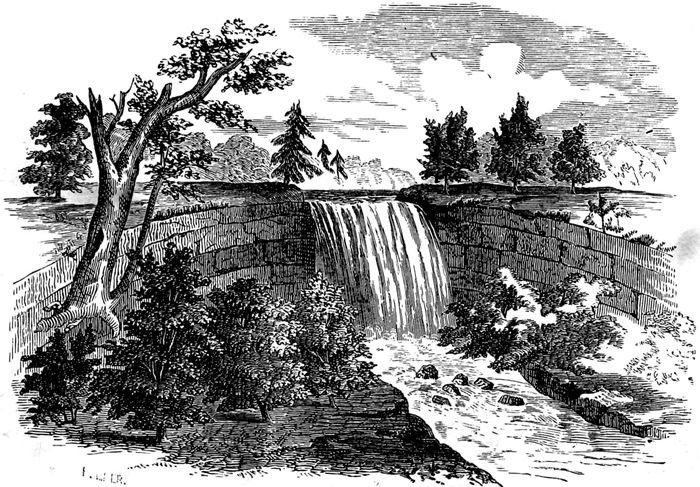
CHAPTER I. ON THE RAILWAY.
“The black steam-engine! steed of iron power;
The wondrous steed of the Arabian tale,
Launched on its course by pressure of a touch;
Ha! ha! it shouts, as on
It gallops, dragging in its tireless path,
Its load of fire.”
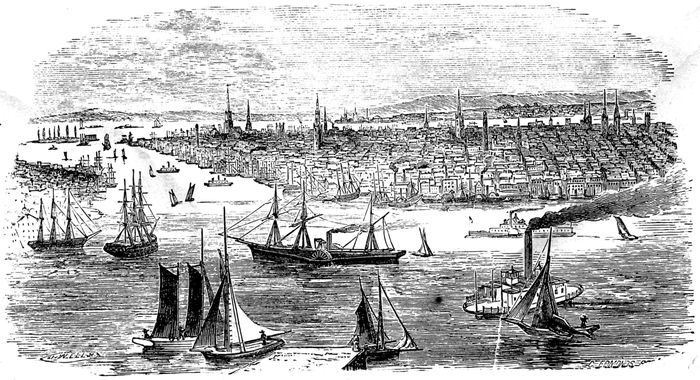
“How still Broadway looks so early in
the morning,” said Norman Lester to his
mother, as they drove down the street to
take the early train.
It was an unusual sight, the long vista
of the beautiful street in deep shadow,
peaceful and calm as if it knew no trampling
footsteps nor jostling vehicles. It
10was just waking up from its brief hour
of repose. Here and there a market cart,
laden with vegetables, was jogging leisurely
on, then a carriage with travelers
and trunks hastened onward. A few
waiters were standing at the doors of the
hotels to speed the parting guests, and
pedestrians not ignorant of sunrise and
its demands were walking on the broad
pavement. Soon the swelling tide of life
would rush through this great channel; the
anxious, earnest brow, the sad and troubled
countenances; light and trifling, and
bright and joyous faces, would all be borne
down that mighty stream. Business and
pleasure, noise, and hurry, and confusion
would come, as the ascending sun chased
away the shadows of the great thoroughfare,
and with them its brief repose.
Norman’s thoughts went beyond Broadway
and its contrast.
12
13“I have actually set out on my journey
to the West to see my uncle, a journey I
have been thinking of for two or three
years. How I wish you were going with
us, Edward,” he said to his tall cousin,
whose manliness Norman greatly admired.
“You are to be your mother’s escort to-day,
Norman,” replied Edward; “I hope
you will take good care of her. You are
tall enough to make quite a respectable
escort, but I have my doubts as to your
care and thoughtfulness. I think you are
rather a heedless boy, but I hope you will
come back greatly improved.”
“There is no saying,” said Norman,
“what this journey may do for me.”
“We shall see; but here we are at the
depôt,” was Edward’s reply.
The ferry was crossed, some oranges
bought to quiet the noisy demands of the
orange woman, seats secured, good-by
said to Edward, and Norman and his
mother were fairly off for a few days
ride on the Erie Railroad to Niagara.
14How that terrible, untiring iron horse
bore them on; how rapidly was the panorama
of wood and plain, of rock, river,
and valley, unrolled before them; how he
snorted and panted, and shot onward,
after a short pause now and then to refresh
the mighty giant.
“A little water, and a grasp
Of wood sufficient for its nerves of steel.”
The shifting landscape looked very
lovely in the softened lights of that pleasant
June day. The tender green of the
foliage, orchards in full bloom, neat farm-houses,
glimpses of the river Passaic, and
their noble views of a beautiful valley, in
the midst of which rose the spires of Port
Jervis, lying prettily among the hills, were
presented to the eye and as rapidly withdrawn.
Then the scenery became more
wild as the train rushed along the high
embankment, following the course of the
Delaware, and looking down upon its
rapid waters. It is a wild, rugged region;
15huge trees, great prostrate trunks, scarred
and blackened trophies of the progress of
the advancing settler wrestling with his
gigantic foes; log-cabins surrounded by
unsightly clearings marred with frequent
stumps; fields of wheat struggling for existence
in the scanty soil; fantastical fences
formed of twisted, gnarled, antler-like
roots. A most picturesque region, which
might, however, call forth the comment of
the sturdy Sussex farmer: “Picturesque!
I don’t know what you call picturesque;
but I say, give me a soil that when you
turn it up you have something for your
pains; the fine soil makes the fine country,
madam.”
Norman looked with astonishment on
the lofty and massive arches of the
bridges over which the railroad crosses
the valley, and had a glimpse of the water
leaping down the ravine at Cascade
Bridge. A number of men were working
there on the steep sandy sides of the
16cliff, that seemed to afford them a most
perilous footing.
One noble view he had of the Susquehanna
with its islands; and then, as they
changed cars at Elmira, the rain obscured
the lake and the fine country on their
way northward to Niagara.
CHAPTER II. TWO DAYS AT NIAGARA.
17
“As if God poured it from his hollow hand,
And had bid
Its flood to chronicle the ages back,
And notch his centuries in the eternal rock.”
“No clearing to-day, Norman,” said
Mrs. Lester, as they left the Cataract Hotel
in the drizzling rain to cross over to Goat
Island. They paused upon the bridge,
and looked upon the rapids, foaming, and
dashing, and roaring beneath.
“I can understand now,” said Norman,
“what I have read about morbid impulses,
for I feel as if I would like to jump into
the rushing water.”
The path down the hill to Juna Island
was very muddy and slippery, and they
were obliged to walk down very carefully,
lest a misstep should plunge them into
the mighty current.
18Mrs. Lester told Norman of a happy
party that once crossed the bridge to this
island; of the little girl playfully thrown
toward the fall by a young man; of the
sudden terror that led her to jump from
his arms; of his fearful plunge to save the
life he had periled, and of the twain borne
over that giddy verge. Those fresh young
lives, gone in one moment, with all of
earthly hope and aspiration.
It was fearful to think of; but how many
are daily and hourly borne, by the mighty
tides of worldliness and sin, over a more
tremendous precipice; and there are no
cries or prayers of pitying love; no man
careth for their souls!
Norman was very silent as he looked
for the first time on that wondrous fall,
the sight of which, he said, took away his
strength. He felt awed and solemnized by
this mighty display of God’s mighty works.
By the path on Goat Island, not beautiful
and attractive as usual, for the trees
19had not put on their heavy foliage, and
the path was wet and muddy, they walked
to a little rural building, where, sheltered
from the falling rain, they could look
down upon the Horse-Shoe Fall. On one
point in this magnificent cataract Norman
loved to look; it was the angular central
point where the stream is greatest in
volume, and where its exquisite hue of
emerald green continually breaks into
snowy whiteness.
“I have heard those falling waters compared
to the robes of a goddess continually
falling from her shoulders,” said Mrs. Lester;
“but the thought is scarcely spiritual
enough to satisfy one.”
“It seems too grand to say anything
about it,” said Norman; “it makes me so
silent.”
“‘Come then, expressive Silence, muse thy praise,’
is a most fitting invocation at this place,”
replied his mother.
20“I have been looking all round for
you,” said a lady, whom they had found
the day before to be a most agreeable
fellow-traveler, as she alighted from the
carriage, “and they told me at the hotel
that you had gone to Goat Island, so I
came here with the expectation of finding
you.”
After looking awhile at the fall, they
descended the hill, crossed the Terrapin
bridge, and ascending the winding staircase
in the stone tower, they came out on
the circular balcony above. It was fearful
to look from that giddy height down
into the foaming depths below, and in the
midst of those maddening waters one
could scarcely believe that the town had
a foundation sufficiently firm to resist
their onward course. The columns of
spray, driven by the east wind, almost obscured
the opposite cliffs.
Mrs. Bushnell wished Mrs. Lester and
Norman to accompany her in her drive
21round Goat Island home; but they preferred
another hour spent in sight of the
fall. Many carriages drove up while they
sat there, and men with cigars in their
mouths jumped out, ran down the hill,
over the bridge, and up the stairs to the
tower, where they took a hurried look at
the mighty torrent, and speedily regained
their carriages and were off.
“I really think, mother,” said Norman,
“that we are enjoying Niagara more
than any one. We are having such a
long look.”
In the afternoon they accompanied Mrs.
Bushnell and her nephew to the British
side of the river. They crossed the Suspension
Bridge, about two miles below the
falls. It is a miracle of art, a beautiful
work of man, in harmonious contrast with
the stupendous works of God. Norman,
who had been studying his guide book,
told them that there were more than eighteen
million feet of wire, and that the
22aggregate length of wire was more than
four thousand miles.
They rode over the lower carriage way
of the bridge, which is a single span, eight
hundred feet in length between the massive
towers by which it is supported. In
crossing they had a fine distant view of
the two falls, and of the fearful chasm
beneath, with its solemn deep waters,
quiet as if exhausted by their recent
plunge.
The afternoon was decidedly stormy,
the rain fell fast, dimming the glass of the
carriage, and driving in upon them,
when the window was open. The spray
hung before the falls as a dense cloud,
obscuring more than half of them from
view.
On their return Mr. White, Mrs. Bushnell’s
nephew, took Norman by the hand,
and walked over the railroad bridge,
while the carriage passed beneath. Norman
looked with wonder at those mighty
23cables, twisted with so many wires, and
supporting with their interlacing ropes
that great structure weighing eight hundred
tons. It seemed so solid and substantial,
that Norman did not think of
any danger in crossing it, air hung as it is
over the great abyss.
Another cloudy day, but it was a
happy day to Norman and his mother.
As they loitered at Point View and on
Goat Island, Norman took three or four
pencil sketches, to be copied and filled up
at his leisure. He gathered some pretty
white and blue flowers on Goat Island,
and arranged them fancifully in an Indian
birch-bark canoe which he had just
purchased.
“Mother,” said he, holding it up to her,
“this canoe looks just like one of which
I have seen a picture. It illustrates an
Indian legend of the paradise of flowers.
They are represented as still retaining
their flowerlike forms, leisurely reclining
24in canoes, floating gently in the placid
streams of the spirit land.”
“How pretty it looks,” said his mother,
“with those pendant white blossoms; I
shall always associate this flowery canoe
and its graceful legend with this turn in
the path on Goat Island.”
“Are we not having a delightful afternoon,
mother? the air is so pleasant, and
there are patches of blue sky, and it is
nice not to carry an umbrella,” said
Norman.
“We should not have thought of that
element of satisfaction, but for the experience
of these two days; as it is, we are
prepared fully to appreciate it.”
They very much enjoyed their walk up
to the “Three Sisters;” the rapids were of
the most beautiful green, flecked with
white foam, and in the absence of sunlight
they could look, without being dazzled,
upon the graceful majestic flow of
waters. How many longing, lingering
25looks were given from each spot as, at the
approach of evening, they reluctantly
retraced their steps.
Norman had amused himself during the
day in looking over Indian curiosities, and
in addition to a birch-bark canoe worked
in porcupine quills, pincushions, and mats
worked in beads, had purchased a Derbyshire-spar
cup and whistle at the store
near the bridge to Goat Island, with the
assurance that they were turned at Niagara,
out of Table Rock!
A parting glance from Point View the
next morning before breakfast, after which
they took the cars for Buffalo, where they
found Professor L. awaiting them. A
long ride on the railroad, near the shore
of Lake Erie, (which was not however
often visible,) carried them through Pennsylvania,
Ohio, and Michigan, and then
through Indiana and Illinois. All these
states looked very much alike to Norman
as he hurried past groves, ravines, towns,
26and prairies, and after a day and night’s
travel arrived at E., a village near Chicago,
without any very definite impressions of
the shifting scenery that had passed before
his vision.
CHAPTER III. CHILDREN MADE HAPPY.
27
“We are willing, we are ready;
We would learn, if you would teach,
We have hearts that yearn to duty;
We have minds alive to beauty,
Souls that any height can reach.”
Most grateful was the quiet repose of
Mrs. Rivers’s pretty home after the long
wearisome ride in the cars, most pleasant
was it to be kindly welcomed by old
friends in their new homes. The village
seemed full of purpose and aspiration,
springing up in an oak opening on the
shore of Lake Michigan, and clustering
round the two literary institutions that
have called it into existence. The familiar
faces gathered around Mrs. Rivers’s
tea-table recalled many dear and cherished
associations, and brought back
pleasant pictures of the past.
28Norman’s pleasures were in the present.
He was soon off to the lake with George
Rivers, wandering a while on its pebbly
shore, and then sitting on the pier fishing.
They dropped their lines in the water, and
sat waiting for a bite. Long and patiently
they sat, the sun burning their faces, but
their patience was not rewarded with
success, for they got no fish. Norman
found more companions in the little Randolphs
and Henrys, who were fishing at
the same time. They lived a few doors
from George Rivers, and they came to
see Norman, and invited him to dinner
and to tea. He had many pleasant talks,
and many games with his new friends,
who were very kind to him.
Sunday morning came; the weather
doubtful, uncertain, showery. Mrs. Lester
heard with great pleasure a lecture
from her former pastor, and a sermon
from an old friend. The Sunday school
was invited to visit the Biblical Institute
29that afternoon, to see some idols that
had just arrived from China, and to hear
Profesor L. lecture upon them. The
children were on tip-toe with expectation;
but the superintendent, after consultation
with the teachers, decided that it would
not be prudent to go; the clouds were
threatening, and the grass was wet with
the recent rain. With his pleasant face
and his kindly voice, he told the children
of this decision, and then asked all who
were in favor of going to the Biblical Institute
the next afternoon, at four o’clock,
to raise their hands. Every hand was
raised, but there was a new difficulty. A
professor in the Institute said that it would
be better to defer the visit till the next
Sabbath, as it would interfere with the
students’ recitations on Monday afternoon.
“Not the next Sabbath,” said another
gentleman; “there will be a general class-meeting
here then, which we all wish
to attend.”
30“All, then,” said the superintendent,
“who are in favor of visiting the Institute
this day fortnight, will signify it by holding
up their hands.”
Not an uplifted hand was seen; the
expression of opinion was very decided.
The children did not believe in a pleasure
so long delayed. The professor, with
great good-humor, then said that they
were disposed to gratify the children, and
that they would so arrange their recitations
as to give them a cordial welcome.
“My text is at the Institute,” said
Professor L., as he rose to speak to the
children, “and my audience here;” but
he contrived to talk to them without a
text so agreeably, that the children voted
that he should be invited to address them
the next afternoon, which he partly consented
to do.
It was a very pleasant looking Sunday
school, teachers and children all in their
31places, notwithstanding the wet walks
and the dark clouds. The children looked
bright and happy, interested in their lessons,
attentive to their teachers, and they
sang sweet hymns with great spirit and
earnestness.
Monday was bright and beautiful, and
many little hearts beat high with the
thoughts of the afternoon’s pleasure. How
glad they were that it had not been put
off for a fortnight. It was a pretty sight
to see the procession of children winding
through the grove of grand old trees on
the high bank of the lake, whose blue
waters sparkled in the sunlight. The
white sails of schooners were seen in the
distant horizon, and the lake looked so
peaceful that it was difficult to imagine
it roughened by the tempest, uttering its
loud roar as its great waves dashed against
the bank, tearing it away, and prostrating
the lofty trees that adorned it.
The children walked into the Institute,
32and entering the room on the right, saw
the walls covered with pictures of hideous
Chinese idols. One of the great idols
they had come to see was a gigantic
figure, dressed in flowing robes of white
muslin, with a ghastly face, rolling eyes,
grinning mouth, and a crown on his head.
He was attended by his servant, who had
a horrible black face, and long flowing
black garments. Such figures as these
are carried through the streets in China
to receive the worship of the people; and
thus religion, which should elevate, only
debases them; and fear is the ruling motive
instead of love.
Norman thought of that scene in the
idol temple in Rangoon: the room lined
with images of Boodh, in a sitting posture,
with folded hands, bearing lamps to
give light to a Christian prayer-meeting;
Havelock, with his Bible in his hand,
surrounded by a hundred Christian soldiers,
praying to the God of heaven, and
33singing praises to the Lord Christ in this
famous idol temple. Well, the day will
come when all the idols will be cast to
the moles and the bats, and when from
every hill-top and valley, from the broad
prairie and the green savannah, the incense
of praise shall ascend to the one
living and true God.
After the children had passed around
the rooms, and looked at the idols, they
went up stairs and seated themselves in
the chapel to hear Professor L. The
fresh breeze blew in the window, and
the lake spread its broad bosom beneath
the eye; stripes of green and blue gave
variety to its surface; little sail-boats
sailed rapidly by; and a large steamer
went proudly on its way. It was pleasant
to look out upon this noble view, and
listen at the same time to Professor L.’s
narration of what he had seen during his
three years in China.
He gave an interesting account of Miss
34Aldersey, a noble English woman, who,
while in her pretty English home, in the
midst of kind friends, and social joys, and
religious privileges, felt her heart so moved
by the spiritual destitution of the Chinese,
that she left home and friends, and all
pleasant, familiar things, and went over
the seas to China. Freely she had received;
freely she gave fortune, time, and
toil to the great work to which she had
consecrated her life. She opened a school,
and gathered in the poor neglected children.
Female children are despised in
China, and many of these poor little things,
who had no one to love them, found a
home beneath Miss Aldersey’s roof. Day
after day she sat teaching these ignorant
little girls, and telling them of Jesus and
the home he has gone to prepare for his
people. They listened to the new and
wonderful story, and their hearts were
opened to receive these heavenly truths.
One of them, after the custom of the
35country, had been bethrothed when she
was four years old, to a boy several years
older, and the time approached when she
was called upon to be married. Part of
the marriage ceremony consists of bowing
down before ancestral tablets, containing
images of their ancestors, and
burning incense to them. This the
young Christian Chinese girl refused
to do. She loved Jesus, she worshiped
God, and she would not bow down before
any idol.
In vain her parents expostulated and
entreated. In vain they offered her reward,
and threatened punishment. She
was firm in her refusal to break the law
of God. They beat her and tortured her,
but her steadfast heart, stayed upon God,
knew no fear. Faithful to her Christian
profession, this brave girl continued in
the path of Christian duty, unmoved by
tribulation and wrath and all the devices
of wicked men.
36The children then sang the noble missionary
hymn,
“From Greenland’s icy mountains,
From India’s coral strand,”
and were dismissed for a little recreation
in the grove, where there was a swing,
and cool shade, and grassy turf. Just before
sunset the children were called together,
and again in regular order walked
homeward, with faces glowing with enjoyment,
and minds and hearts filled with
happy thoughts and memories.
Wednesday morning Norman went
with his mother to the lake, just after
breakfast. The waves were gently kissing
the shore, and hours passed swiftly
away as they listened to the soothing
sound and gathered curious pebbles.
They found some small fossils, with the
remains of shells and animals in them,
and Norman was greatly delighted with
one that his mother picked up, that
looked as if it had on it a single pearl
37set in gold. They felt sorry to leave the
pleasant beach; but the morning had already
gone, and it was time to go to Mr.
Henry’s to dinner. On their return
they found a kind invitation from Mrs.
Harris to take tea at the Institute. There
were about forty students at the tea-table,
and after tea they had prayers. Instead
of the reading of the Scripture, verses
were repeated, thus enabling all who
wished to participate in the devotional
exercises; and noble and comforting
promises, and precious truths, were uttered
in varying tones. That company
of young men were girding on their
armor, that they might fight as good soldiers
under the Captain of their salvation.
They were preparing themselves for their
life-work; some of them to sow the
“precious seed” over the broad prairies of
Illinois, by the rocky bluffs and wood-crowned
hills of Wisconsin, and the blue
waters of Minnesota; while others were
38looking to the lands of the East—to Bulgaria,
and India, and China. It was
pleasant to exchange a few brief words
with these young men who, by the eye of
faith, could see more abundant harvests
than those which reward the Western
husbandmen. They had asked the Lord
of the harvest to send them as reapers
into these fields of promise, looking forward
to that blessed time when they shall
“return with joy bringing their sheaves
with them.”
Mrs. Lester afterward looked upon the
portrait of the Christian woman to whose
liberality this institution owes its existence.
That portrait ought to hang on
its walls. There is a queenly look about
the fine figure, and the way the head is
set on the shoulders, and blended goodness
and intelligence in the countenance.
In the evening of the same day Mrs.
Lester was in the room where Mrs. Garrett
died, and she thought of the blissful
39visions that may have floated about that
dying pillow glimpses of refreshing and
perennial streams to make the wilderness
rejoice and blossom as the rose. Her life
was not spent in vain on the earth.
Regular and consistent in her daily walks
of duty and piety, she has, by the judicious
bestowment of ample means, prolonged
her usefulness on the earth, linked
herself to holy activities through coming
time, and set in motion trains of influence,
the mighty results of which may
only be known in the morning of the
resurrection. She made to herself friends
of the mammon of unrighteousness, that
when she failed they might receive her
into everlasting habitations.
CHAPTER IV. THE QUEEN CITY OF THE LAKE.
40
“I saw the domes before me rise,
The lake behind me swell;
I thought upon the bygone days,
When nature wore a different phase,
And man a different skin;
And stretching far, through plain and swamp,
I saw the Indian’s fiery camp,
And heard the buffalo’s marching tramp,
And felt the mammoth’s earthquake stamp,
And all that once had been.
“A sudden change came o’er my dream;
I must have waked and dropp’d my theme.
For ships and cars, in fire and steam,
Begirt the horizon round;
Tall houses rose, with shops in front,
And bricks piled up, as bricks are wont,
In cloud-capp’d turrets frown’d;
And through the living, boiling throng
Thunder’d a thousand carts along,
And railroads howl’d their shrieking song,
Across the groaning ground.”
Norman had many little friends to say
good-by to as he left for the cars on
41Thursday morning, and very many pleasant
memories to take with him.
Kind friends were waiting for them at
the station at Chicago, and they were
soon driving through its busy streets.
They approached the river, which has
made the town, affording as it does a safe
harbor for vessels. This river runs due
east and falls into the lakes, receiving, about
a mile from its mouth, branches from the
north and the south. The river and its
branches, lined with substantial warehouses,
divide the city into the north,
south and west side. On approaching
the bridge it suddenly swung round to
give passage to a large schooner towed
by a little puffing black tug, which gave
its shrill whistle as a signal for the drawbridge
to open, and then went panting
and snorting through.
While waiting for the bridge to resume
its place, Emily Percy, a blue-eyed, fair-haired
little girl who was seated beside
42Norman, showed him an old wooden
house that formerly belonged to Fort
Dearborn, and that, with the light-house,
was the only thing left to tell of its
existence.
“Norman,” said Mrs. Lester, “this is the
fort spoken of in those lines you are so
fond of repeating about the Indians:
‘Where, to repel their fierce attack,
Fort Dearborn rear’d across their track
Its log-constructed walls.
For forty years these fronts of wood
The tempest and the foe withstood;
And many a night of fire and flood,
The dauntless garrison made good
Their supper in its halls.’”
“It is difficult to fancy any Indians
here, in the heart of this busy city,” said
Norman.
“And yet this great city,” said Mrs.
Percy “is the growth of twenty-five years.
In 1831 there were but four arrivals, two
brigs and two schooners, and now there
are eight thousand.”
43“The lonely garrison that abandoned
this fort in 1812,” said Mrs. Lester, “would
have been rather astonished, could the
vision of this city have risen up: before
them.”
“Why did they abandon the fort,
mother?” asked Norman.
“They thought it best when they heard
of General Hull’s surrender at Detroit.
Soon after leaving the fort they were
attacked by a large body of Indians, to
whom they surrendered, on condition that
their lives should be spared. Notwithstanding
this promise, the Indians cruelly
murdered several of them.”
“You must not forget to tell of Mrs.
Heald,” said Mrs. Percy, “for I think we
may call her the heroine of Chicago.”
“I leave that to you,” replied Mrs.
Lester.
“An Indian,” said Mrs. Percy, “approached
her with uplifted tomahawk,
when, with great presence of mind, she
44looked him full in the face, and smilingly
said, ‘Surely you would not kill a
squaw!’ This Indian warrior was disarmed
by this appeal, and the lady’s life
was saved.”
The schooner towed by the potent little
tug soon passed through, but they were
detained by a sloop that made its way
very slowly, and Norman had time to
look at the vessels in the river, many of
them loaded with grain, twenty-five millions
of bushels being annually received
at this grain port. He also watched with
great interest the working of a dredging
machine used to take mud out of the river
and thus deepen its channel.
A great number of carriages and carts
awaited the return of the moving bridge,
and many, pedestrians were ready to leap
upon it as it approached. The bridges
are a daily school of patience for the citizens
of Chicago.
The few days at Mrs. Percy’s Norman
45enjoyed very much. He took long walks
with Emily about the north side of the
city, which is pleasantly shaded with
trees and adorned with many fine residences.
They drove out too with Mrs.
Percy on Michigan Avenue, a noble
street, with rows of fine houses built of
beautiful cream-colored stone, and pretty
cottages embowered in shrubbery, fronting
on the lake. The railway is laid
through the water, at a short distance from
the shore, and the interval affords a fine
safe place for rowing, sheltered as it is
from the sudden storms of the lake. There
were a number of pretty row boats rapidly
darting to and fro, and young people
enjoying the air and exercise on the quiet
waters.
They returned by Wabash Avenue,
adorned with its noble churches. They
alighted, and went in to look at the new
Methodist church, which was nearly
finished. Norman thought it very beautiful.
46This, and the handsome Presbyterian
church at the next corner, are built
of the cream-colored stone which gives
such a cheerful light aspect to the edifices
in Chicago. The Second Presbyterian
church is the most antique-looking structure
in the city. It is built of a whitish
stone, spotted with black, giving it somewhat
the aspect of the white marble of
St. Paul’s begrimed with the smoke and
dust of London. This stone was found on
the prairies; the black is a sort of bitumen
that exudes from it, and as the quarry is
exhausted, this church will be unique as
well as antique in its appearance.
Norman was amused at the inequality
of the sidewalks, sometimes rising above
the carriage way, sometimes depressed
far below, so that the pedestrian is obliged
continually to go up and down steps, or
inclined planes, and to mind his ways if
he wishes to avoid a fall. The new stores
open finely on the elevated sidewalks,
47and Norman was astonished to see the
splendid rows of stores with elaborate
iron fronts. The older houses and stores
must be entered by descending steps to
reach their level. Mrs. Percy told Norman
the reason of this, that the city was
built on a flat prairie, so low that the
water would not run off, and the streets
could not be drained; and so this enterprising
people are lifting up the whole
city six or seven feet, and there must be
inequality of surface while this transition
process is going on. Norman saw a
frame house, mounted on rollers, leisurely
making its way through the streets.
Charlie Percy, who was several years
older than Norman had a chemical cabinet,
and the boys had a very animated
evening, trying a number of experiments,
making colored fires, and making fire
jump about the surface of the water.
“Here is an invitation for you, children,”
said Mr. Percy, “which I have no
48doubt you will be very glad to accept.
Mr. and Mrs. Bowers called to invite us
to accompany them to Green Park, where
they are to have a pic-nic.”
“How pleasant that will be,” exclaimed
Emily; “I am sure you will like
to go, Norman.”
The children were ready immediately
after dinner, when Mr. Bowers’s carriage
drove up for them, and at the station they
found quite a party of children, baskets in
hand, with their mothers and fathers,
bound for the pic-nic. They were a joyous
family party, Mr. Bowers’s sisters and
their families. Norman looked from the
cars upon the stately buildings of Michigan
Avenue, and there was not time to
look at much more, for a few minutes
brought them to Green Park, and the
party were soon out of the cars, and on a
bank overlooking the lake. It is a pretty
place, grassy turf, graveled walks, grateful
shade, and rustic summer houses; better
49than all, the pleasant beach with its
rounded pebbles, and the constant dash
of its gentle waves. The children had
merry games of tag and puss-in-the-corner,
then they wandered along the
beach, and then they came with sharpened
appetites to inquire when the baskets
were to be opened. “You may go and
bring them now,” was the welcome
response.
“Are we not to sit round the table in
the summer-house?” asked one of the
little girls.
“No,” replied her mamma, “it is
cooler here.”
Willing feet ran to the rustic arbor,
and willing hands brought the baskets
from the rustic table. They seated themselves
on the grass and ate the biscuits
and sardines and sandwiches, and the
gingerbread and cake. A little girl whom
they did not know was playing near her
father and mother, who were seated on a
50bench at a little distance. One of the
children, with thoughtful kindness, asked
her mother’s permission to take some biscuits
and cake to the little stranger, and
joyfully she ran off to offer of their abundance
to the little one.
After they had done full justice to the
contents of the baskets, and picked up
pebbles on the beach, they sat in the large
summer house and sang hymns, sweet
familiar hymns, sung by sweet childish
voices, sobering and sanctifying the
pleasures of that happy Saturday afternoon.
At the station they found a merry
party of school-girls who had walked out
in the morning to gather flowers on the
prairie. They were in high glee; their
large straw hats were wreathed with oak
leaves, and their hands were filled with
great bunches of flowers,
“The golden and the flame-like flower.”
Norman said good-by to Emily Percy
51at her door, for he and his mother were to
spend the Sabbath with Mrs. Bowers, and
a pleasant Sabbath it was. The conversation,
in harmony with the day, on the
piazza, after breakfast, beneath the shade
of lofty spreading trees; the sermons and
services of morning, afternoon, and evening,
different in tone and character, but
all profitable and pleasing; the visit to the
large and interesting Sunday school, in
which Mrs. Bowers taught a class, made
the Sabbath a delightful one.
Monday morning Mrs. Percy took Mrs.
Lester and Norman and Emily to her
husband’s grain warehouse, the top of
which they reached after ascending many
flights of steps. The roof is of canvas,
covered with tar, upon which, while it is
warm, pebbles are thrown, making a durable
and fire proof roof. The city lay
beneath them; they could mark its great
extent, trace the course of its dividing
rivers, with their sails, and steamers, and
52propellers; see trains of cars arriving and
departing; count the spires which
“With silent fingers point to heaven,”
and around all see the great lake and
the encircling prairie.
The warehouse was filled with dust, as
the machinery was in motion. Norman
watched the elevators lifting up the grain
from the rail-car on one side to the fifth
story of the warehouse, where it is
weighed and poured into great bins,
whence it is discharged into vessels on the
other side. The elevator is a series of
buckets on an endless band. Thousands
of bushels, from the wide prairies of Illinois,
are thus elevated, weighed, and
transferred from car to boat, to be sent to
the Eastern states or to Europe.
The saddest sight Norman saw in this
city was the great number of saloons, as
they call the shops where liquor is sold,
where drunkards are made, and where
many an unwary victim is lured to destruction.
53In almost every block, they
tempt the thoughtless; music sounds her
welcome; vice puts on her most attractive
mien; and young men forget a father’s
counsel, a mother’s prayers; and for the
momentary gratification of their appetites
they offer up reputation, character, health,
life, and their eternal all; a costly sacrifice!
Everything lost, and nothing gained
but degradation, misery, and death.
CHAPTER V. ON THE ROCK RIVER.
54
“These are the gardens of the desert; these,
The unshorn fields, boundless and beautiful,
For which the speech of England has no name,
The prairies.... Lo! they stretch
In airy undulations far away,
As if the ocean, in his gentlest swell,
Stood still, with all his rounded billows, fix’d
And motionless forever.”—Bryant.
A railway ride over the beautiful
prairies took Norman and his mother to
their place of destination. How soft and
gentle were those prairie swells, looking
like English park scenery, relieved as is
the vast expanse of meadow by scattered
groves of trees. The fine unbroken horizon
line tells you that you do not see a greater
extent of country, only because your eye
has no greater capabilities; that onward,
and all around, the vast prairie lies in its
verdure and beauty; that there, as here,
55the flowers are springing; that you may
travel north, south, east, and west, hundreds
of miles, and still that undulating
prairie, in its “encircling vastness,” will lie
around you like the sea.
At the station Norman found his uncle
looking out anxiously for him, and he was
soon pressed tenderly in his arms.
“Well, my boy,” said his uncle, “I
feared we should be disappointed again
to-day. How glad I am to see you once
more, though you have so grown I would
not have known you.”
“How is Aunt Ellen?” asked Norman.
“Very well, she is waiting anxiously for
you at home; she has been counting the
days since you wrote you were coming.”
“How well I remember,” said Norman,
“when I was a little boy, how she let me
whittle in her room, and how she
brought me bread and butter with white
sugar on it.”
“That bread and butter and sugar
56made a deep impression on his mind,”
said Mrs. Lester; “he has always connected
the thought of it with his Aunt Ellen.”
“And there is your Aunt Ellen at the
gate looking for you,” said his uncle.
Norman loved his uncle and aunt very
much, and was very glad to be with them
once more. He loved to sit by his
uncle’s side and read to him, and tell him
about his school, and about his cottage
home, and about his little cousins, Bessie
and Edith, with whom he spent so many
pleasant summer days, rambling about
the woods and among the rocks.
His uncle was an invalid, obliged continually
to recline on his couch, but he
was always cheerful, always happy. A
sister said of him, that if you put him on
the top of a rock he would be happy;
and the secret of this was, that his heart
was filled with love to God, and that he
had constant communion with his blessed
Saviour. The peace of God lay upon his
57countenance; he had no troubled or
vexing thoughts.
He loved to read and hear about the
progress of Christ’s kingdom, and about
what good men are doing to bring about
the fulfillment of that prayer, “Thy will
be done on earth as it is in heaven.”
Norman was very busy for several days,
copying his sketches of Niagara, and doing
them in pastil, and his uncle took great
interest in the progress of his work.
One day they went with a clergyman,
Aunt Ellen’s brother, to a seminary, built
on a commanding eminence above the
town. After seeing the scholars do their
sums very rapidly on the black-board,
they went to the upper story of the building,
and looked upon an extensive view.
To the north the rapid river, with its high
banks and wooded islands; to the east,
the prairie, stretching out far in the distance.
The spires and buildings of the
town toward the south, with the fine
58arches of the railing embankments, while
the river, whose falls filled the air with
sound, was spanned with the noble arches
of the railroad bridge, and the broken
ones of several ruined bridges, swept
away by the recent floods.
After leaving the seminary they wandered
in the oak grove that adorns the
bluff upon which it stands, and looked
down on the ravine which bounds the
grounds to the north.
“Now, mother,” said Norman, one
morning after breakfast, “for a walk on
the prairies.”
“I am ready,” replied Mrs. Lester; “it
is a cool, gray morning; just the day for
such a ramble.”
On and on they wandered; Norman
running to and fro, as the brilliant tint of
some flower caught his eye, made his
mother the bearer of all his floral treasures.
A fine bouquet he had after a while, yellow
lupins, the blue spiderwort, the purple
59phlox, an orange flower very much like
the wallflower, and the painted cup, made
classic by Bryant’s verse:
“Scarlet tufts
Are glowing in the green, like flakes of fire;
The wanderers of the prairies know them well,
And call that brilliant flower, the Painted Cup.”
They first walked toward the south,
where they could have glimpses of the
river; but at length they directed their
course to the east, to an octagon house,
that stood like a light-house on a hill.
Crossing the railroad, they paused a while
to see the gravel-train get its load of sand
from the banks.
“There,” said Norman, as the locomotive
gave a snort or two, as if in impatience
at the pause; “there stands the
grand old fellow to be looked at, as Mr.
Beecher says.”
A far-reaching view of the undulating
prairie, heightened at intervals by flashes
of the river gliding among the fertile
60meadows, repaid them for the ascent to
the octagon house.
On their return they stood beneath a
railroad bridge, and saw two long freight
trains pass over it. They passed a rural
town that had recently sprung up in an
“oak opening,” and arrived at home with
flowers and pleasant remembrances of
their four-mile walk on the prairies.
Norman’s quiet pleasures by his uncle’s
side, his reading and sketching, soon gave
place to more active out-of-door amusements.
He formed a friendship with two
boys who lived in the neighborhood, who
were so well-trained, that his uncle readily
consented to his intimacy with them.
“Even a child is known by his doings;”
and it is well when a boy has already
formed a character which inspires confidence,
and allows parents and friends
safely to trust in him. Such a lad will
probably retain in manhood the respect
and confidence he has won in boyhood.
61Norman went every evening with Alfred
and Herbert Walduf to bathe in the
Rock river, and sometimes he went with
them to fish, or walked with them in the
woods.
These boys were regular attendants at
the Sunday school of which Mr. Laurence,
Aunt Ellen’s brother, was superintendent,
and they asked Norman to go
with them to school. How earnestly the
children listened when their superintendent
told them of the sad fate of four of
their number who had recently joined
with them in their hymns of praise. They
had removed a short time before with
their parents to a town not far distant,
where their father had received a call to
preach. A letter had been received from
their mother, describing the situation of
their new home, by the side of a little
stream, and saying that she thought she
had found a pleasant resting-place.
Father, mother, and eight children were
62all gathered together one peaceful Sabbath;
the two elder sons having come
home from their places of business to
spend a few days with their family. Kind
and affectionate words were spoken—a
thankful retrospect of the past, and hopeful
glancings to the future.
The next day the little stream began to
rise and swell, and the children greatly
enjoyed the transformation of their quiet
brook into the rushing torrent. Enjoyment,
however, gave place to alarm as
the waters rose higher and higher, till
they reached the house.
Some men from the village came down
and advised them to seek a more secure
shelter. On measuring the waters, however,
they found that they had fallen four
inches; and the father, thinking that the
worst was over, concluded that they had
better remain in the house. The men,
gathering up some clothes that had
been left out to dry, handed them to
63the inmates of the house, and left
them.
There were anxious hearts in that lonely
dwelling that night, as they listened to
the rushing waters without. The baby
wakened, and the elder brother, to amuse
and quiet the little thing, gave it his
watch to play with. Suddenly there was
a crash, and the house was loosened from
its foundations. There was a cry heard
from the wife and mother, and then all
other sounds were lost in the roar of the
waters. Stunned, half unconscious, the
father felt himself borne onward by the
rushing flood. As the stream carried him
past an overhanging tree, he caught hold
of its branches, and there he hung till the
morning light brought help and rescue.
He was a childless man; the loving faces
of wife and children he was to see no
more till the morning of the resurrection.
Four of the bodies were found the next
morning beneath the ruins of the house.
64The infant’s hand clasped the watch, still
ticking, while its own pulse was stopped
forever. The waters of the stream, swelled
by the great freshet, had been obstructed
by a culvert on the railway till it gave
way, and the accumulated mass of waters
had swept on with resistless impetuosity,
working ruin and death.
And then Mr. Laurence enforced the
lesson so often taught, so soon forgotten,
of so living that when the cry is heard,
“Behold the bridegroom cometh!” whether
at midnight or in the morning, we may
go forth with joy to meet him.
CHAPTER VI. INDIAN STORIES.
65
Home of the Indian’s wild-born race,
The stalwart and the brave;
Alike their camp and hunting-place,
Their battle-field and grave;
Where late gigantic warriors stood,
As thick as pine-trees in the wood,
Or snipes on Jersey shore;
“Tecumseh,” “Beaver,” and “Split Log,”
And “Keokuk,” and “Horned Frog,”
And “Blackhawk,” “Wolf,” and “Yelping Dog,”
And “Possum Tail,” and “Pollywog,”
And many hundred more.—F. G. H.
Again in the cars for a journey to St.
Anthony’s Falls, and again the fertile
rolling prairie met the eye on every side.
The view was somewhat marred by the
high board fences of the railroad, that in
some places hid those broad flowery fields.
Some curious mounds, round, smooth, and
green, extended like a chain from east to
66west, and looked as if they were artificial
formations, lying as they do on the bosom
of the prairie; perhaps the burial-place
of a departed race.
Soon the high lands on the Mississippi
were seen. A portly gentleman of Galena,
just returning from a convention at
Springfield, pointed them out to Mrs.
Lester, and said, “Ma’am, there is no such
river in the world; you never saw such
scenery; you would not look at the Hudson
after it.”
“That would be unfortunate,” replied
Mrs. Lester, “as my home is on the
Hudson. Is the scenery finer than the
Highlands and the Catskills?”
“Well, ma’am, I can’t exactly say
as to that; I have not been below Albany.”
“Ah, then, you have not seen our
beautiful river, as it cannot boast of much
grandeur above Albany.”
Galena is a curious town, built on the
67side of a very steep hill; the houses rising
one above another, and in a picturesque,
romantic region. The road lay for some
time along the bank of the Fever River,
and Norman looked in vain for the lead
mines, for which this part of the country
is so famous. A very fine specimen of
the lead ore was afterward given him.
“Ah! look, mother!” he exclaimed, as
the descending sun that had been partially
vailed, shone through a rift in the clouds,
and was brightly mirrored in the placid
waters of the river. Low wooded banks
and islands were also mirrored there as
well as the shining orb and the large dark
masses of clouds. It was the great sight
of the afternoon.
At Dunleith, on the line between Illinois
and Wisconsin, the terminus of the
Illinois Central road, they went on board
the Grey Eagle, the best boat on the Upper
Mississippi.
A sunset on the Missi-sepe, the Great
68River! It was radiant and golden, but
without any pomp of crimson clouds, of
long-trailing glory.
Norman had a fine view of Dubuque,
built on a natural terrace on the opposite
shore, and creeping up four of five ravines
between the great bluffs which rise directly
behind the town. After tea, as the
boat was not to leave till morning, he
watched the lights gleaming out from the
city below, and the scattered dwellings
above, and then went to bed in his state-room.
His mother had not met the friends
whom she had expected to join at Dunleith
for this excursion, and she felt somewhat
disappointed. The morning came
in clouds and drizzling rain. The hills
were vailed; but as the boat went very
near the western shore, the passengers
could admire the wealth of foliage, and
the rich greens of those primeval forests.
A road ran along the river bank, and
69some men were quarrying stone; near
this was a deserted log-house.
On passing a very high red bluff, that
stood in the forest, like an Egyptian idol,
so curiously was it fashioned, Mrs. Lester
ran to the east side of the boat to call
Norman to look at it. He came, but
after a hasty glance returned to his play,
which for the time wholly absorbed him.
He was engaged in some merry games
with Helen and Frank Lisle, and he had
no thought for anything else. Mrs. Lisle
found that Norman was the son of a minister
who had been an intimate friend of
her sister’s. “My sister has very frequently
spoken to me of him,” she said;
“I almost think I had known him. My
sister named her eldest son after your
father, Norman, and I have been strangely
reminded of Lester at your age all the
morning.”
Norman remained a while to look at a
large raft which his mother had called
70him to see. There were twenty men upon
it; some of them with red shirts, and
another wrapping a white blanket around
him. There was a shed where one man
was cooking the dinner, and a board table
in front for their meals. A gentleman
said that a raft of that size was worth
about seven thousand dollars. There
were a number of rafts floating by this
western shore. One misses the white sails
of the Hudson on the Mississippi, where
rafts, and steamboats, and an occasional
sail-boat, are the only craft on its waters.
There were ravines running up among
the hills, and near the shore were layers
of white stone piled regularly as if laid in
mortar. Castellated bluffs peeped out
from the encircling verdure, and low
islands, covered with willows, were emerging
from the recent floods. From behind
one of these the steamer Northern Light
appeared, her bright golden star on a
back ground of green.
71After dinner the aspect of things brightened.
The clouds rolled away, and the
clear blue sky appeared in its soft beauty.
The eastern now became the most interesting
side; noble bluffs were seen far above
the lofty oaks and maples, like some
ancient towers, the strongholds of the
former lords of the soil. The town of
Guttenbay is on a table land at the foot
of one of these bluffs, and beyond it a
range of rounded hills, softly rising above
wooded islands. “O look!” said Helen
Lisle, “at that beautiful rainbow in the
spray.” It was no fleeting vision, but all
the afternoon the radiant bow, with its
hues of blended brightness, afforded
them a beautiful object for contemplation.
“See those trees,” cried Norman; “they
look as if they were running a race down
hill.”
In crossing from the east to the west
side they passed an island shaped like a
72bowl, the center filled with water, and a
broad green brim. M’Gregor’s landing
is a small busy town of one long street,
there being no place for another in the
narrow ravine. The street was filled with
wagons, and many passengers landed to
go out on the rich prairies of Iowa, to
which this ravine leads.
There is a noble view of the broad river
and its wooded islands, in crossing to
Prairie du Chien on the east side. Norman
was amused at seeing three dogs on
this prairie, the first he had seen on the
shores of the river. The town derives its
name from a family of Fox Indians, who
formerly lived there, and were known by
the name of Dogs.
The fort, though now deserted, looked
very finely with its white walls, and its
pleasant site, commanding the far reaches
of the Mississippi, and the prairie opening
into the interior.
73
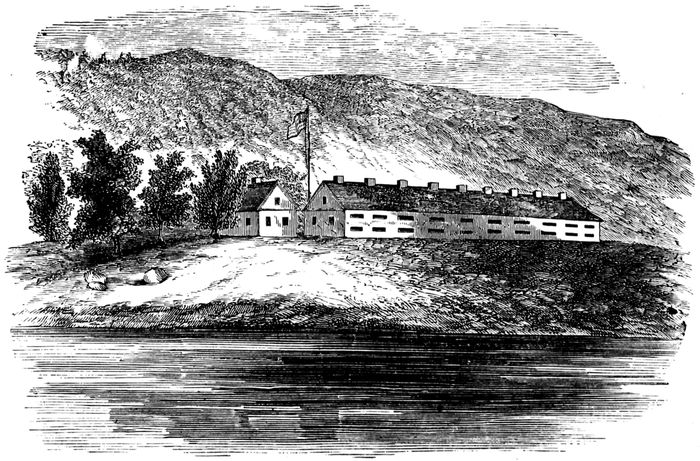
No. 666.
PRAIRIE DU CHIEN.
75“Keokuk used to live here, Norman;
do you remember the story you were
reading about him?”
“O yes, mother, he was such a brave
man. He was chief of the Sacs and
Foxes, and yet he was such a firm
friend to the whites that he exerted all
his influence to prevent his tribe from
going to war with them. At one time
when the nation had determined upon a
war with the United States, he told them
to burn their wigwams, kill their squaws,
and then to go into the enemy’s country
to conquer or to die. This speech convinced
them of the folly of engaging in a
war that could only terminate in their
ruin, and they followed his peaceful
counsels.”
“And then,” asked Mrs. Lester, “how
did he show his magnanimity when the
people were wearied with his goodness,
as the Athenians of old were at hearing
Aristides called the Just?”
“O yes, that was at Prairie du Chien
76too. They chose a young man for chief
instead of the noble chief who so long had
led them. He quietly took the lower
place, and introduced his youthful successor
to the United States agent, asking
him to treat him as kindly as he had
treated Keokuk. This noble conduct
showed the tribe their folly, and Keokuk
was soon restored to his place as their
chief.”
“Poor Red Bird,” said Mrs. Lester,
“this spot was a fatal one to him. He
was a real Indian hero; tall, lithe, and
beautiful, graceful in movement, skilled
in feats of agility, daring and brave.”
“Why was this spot fatal to him?”
asked Helen.
“He was a great friend to the whites,”
replied Mrs. Lester, and dealt kindly and
truly with them. An Indian had been
killed by a white man, and his tribe demanded
scalps to atone for this murder.
Red Bird was sent to obtain the scalp of
77the white man, but he returned, saying
he could find none.
Then came the cruel taunts of the revengeful
savages; “Red Bird was no
brave;” “he feared the pale-faces;” “he
cared not to avenge the blood of one of
their tribe.” “Red Bird must go again,”
and this time not alone, but accompanied
by cruel Indians, to watch his movements.
Poor Red Bird had never met the pale-faces
but with truth and kindness, and
now a hundred voices clamored for their
destruction; and these voices overpowered
the still small voice within him.
Red Bird and his two companions entered
a cabin, a little below Prairie du
Chien, at noon-day. It was a peaceful
family group, fearing no evil. The woman
was washing near the window that
looked toward the river; her husband
was seated by the cradle of his sleeping
child, while an old soldier sat near the
door. The Indians asked for something
78to eat, and as the woman gave them some
bread and milk, she saw an expression in
their faces that led her to fly from the
cabin to call for help. No help could
reach the ill-fated occupants of the cabin.
The tomahawk of the Indians rapidly descended;
Red Bird scalped the husband
and father, the second Indian the soldier,
while the fair hair of the infant was dangling
at the belt of the third savage, as he
left the cabin.
“And what became of Red Bird?”
asked Helen.
“He was taken by the United States
officers, and brought to trial. Red Bird,
sad and stately, drew himself up to his
full height, and said that he had always
been a friend of the white man, that he
had never before injured them, and that
he had been forced to this act of retaliation
by the taunts of his tribe; that he
thought they ought not to condemn him
for a single offense.”
79
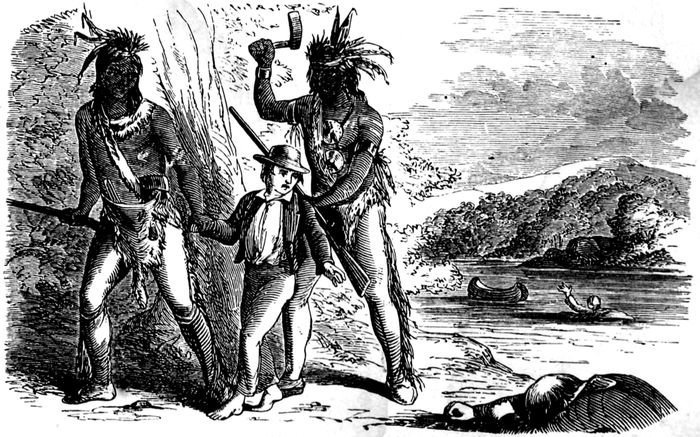
No. 666.
INDIANS KILLING A WHITE FAMILY.
81“He was put in irons, an indignity that
so wrought upon his lofty spirit, that he
pined to death.”
“Look at that log-cabin on the bank,”
said Norman; “perhaps that is the one
Keokuk slept in one night.”
“Why did he go there?” asked Helen.
“He came in and asked for a night’s
lodging. The settler’s family, who had seen
many Indians about in the afternoon,
were afraid; but the noble countenance
of their guest reassured them, and they
gave him permission to stay. In the morning
he told them that his tribe were returning
up the river, after having received
their money from the United States, and
that as some of them had drunk the firewater,
he feared they might alarm the
pale-faces in the cabin, and therefore he
had come to project them.”
Painted Rock, so called because there
are Indian paintings upon it, was on the
opposite side of the river, in deep shadow,
82while the green hill sloping toward the
south, lay in broad sunshine.
Dwellings nestled in a pretty ravine
were frowned upon by four lofty cliffs,
whose rugged rocks resembled fortifications.
One rock looked precisely like the
fragment of a massive wall. Just beyond,
a valley, branching in three directions,
ran up among the hills. Over one of
these, to the south, the dark shadow of the
bluff was thrown, while the soft rounded
hills to the north were covered with scattered
trees, resembling orchards on the
hillside, giving a cultivated look to the
scene.
No docks are needed, as the steamer,
that only draws about eighteen inches of
water, runs up anywhere close to the
shore. As it was approaching the bank
they saw a log-cabin, in the door of which
stood a man, and a little child in red frock
and white pantalets, making a pretty
picture.
83On the jutting point where the boat
touched was a white house, and a young
girl, with an earthen pitcher, was walking
down the stone steps leading to the
water.
A great yellow Egyptian-looking cliff
threw a shadow over this peaceful scene.
“There are the nine passengers who
are to land at this place,” exclaimed Norman,
as a man walked up the road followed
by eight sheep. “He has been surrounded
by that family ever since we left
Dunleith.”
“He looks very well satisfied now to
have them all safely landed,” said Helen
Lisle; “how pleased his children will be
at the grand arrival.”
The bluffs were now magnificent. The
limestone strata extended in straight lines,
looking like streets; then a bold red bluff
towered up like a great cathedral; then a
building resembling the New York Free
Academy, while lofty masses of rock,
84crowned and encircled with verdure, continually
remind one of the feudal castles
of the Rhine. It was with reluctance
they obeyed the summons to tea, which
withdrew them from the ruddy cliffs of
Wisconsin; but on returning to the deck
they saw them still, glowing in the light
of the setting sun:
“Each rosy peak, each flinting spire,
Was bathed in floods of living fire;
Their rocky summits, split and rent,
Form’d turret, dome, or battlement;
Or seem’d fantastically set,
With cupola or minaret.”
There is the mouth of the Upper Iowa
River, on the boundary line of Iowa and
Minnesota. “Good-by, Iowa,” said Norman,
taking off his hat and waving it to
the receding state.
“Crossing the river again,” said Mrs.
Lester. “We will soon be at the mouth of
the Bad Axe River, but the light is fading
so rapidly that we will not be able to see
85the spot of the decisive conflict between
the Indian and white man.”
“I never heard of that battle mother,
will you tell me something about it?”
“It was at the close of the Black Hawk
war, in 1832. The Indians were entirely
defeated by the United States troops at this
place. A number of squaws were slain
in the wild confusion of battle, not being
distinguished from the Indians in the
long grass into which they had fled for
refuge. One poor woman, as she received
her mortal wound, clasped her child close
to her bosom, and fell over upon it,
thus pinioning it to the ground. The
poor little thing was found the next day
under the lifeless body of its mother. Its
arm was broken, and the child was so
starved that, even during the painful
operation of setting the broken bone, it
eagerly devoured some meat given to it
by the compassionate soldier who had
rescued it from the arms now powerless
86for its protection. The love of another
mother bore her safely over the deep
waters. She placed her papoose in her
blanket, and holding it between her teeth,
she swam across the broad river, and
reached the opposite shore in safety.”
CHAPTER VII. SECOND DAY UPON THE MISSISSIPPI.
87
“It seems to float ever, forever,
Upon that many winding river,
Between mountains, woods, abysses,
A paradise of wildernesses.”
“It must have been a proud moment
for De Soto when he first looked upon the
lower waters of this magnificent river,”
said Mrs. Lester, as she sat with Norman
on the guards of the boat the next morning;
“what a scene it must have been;
the canoes of the Indians floating on the
waters, while on the banks hundreds of
the red men, with white feathers waving
o’er their brows, were gazing with wonder
at their new visitors.
“And when he and his followers had
crossed the bank, and the Indians knelt
to the white chief, whom they thought
was one of the children of the sun, to
88ask him for life for the dying, he told
them to pray to God, who alone could
help them.
“Soon in this dreary western wilderness
the princely De Soto breathed his
last. His people, fearing to let the Indians
know of his death, wrapped up his
body, and buried it beneath the waters
of the great river he had discovered;
while, for the first time, a Christian requiem,
softly chanted in the darkness,
mingled with the music of its winds and
waves.”[1]
“And so,” said Norman, “the mighty
river is a memorial of him. How much
I would like to have seen birch-canoes
floating on the river. And I do believe
there is one made fast to the shore just
by that ‘dug-out.’”
89“What an ugly word ‘dug-out’ is; so
different from the birch canoe,” said Mrs.
Lester.
“But, mother, it just tells what it is;
a trunk of a tree, hollowed or dug out in
the shape of a boat. But see how pretty
that bark canoe is! Don’t you remember
we were reading about it in Hiawatha;
how he girdled the birch-tree just above
its roots, and just below its lower branches,
then cut it from top to bottom, and stripped
it, unbroken, from the tree with a
wooden wedge?”
“Well, what did he do then?”
“He made a framework of cedar-boughs,
like two bended bows, and then
he sewed the bark together with the roots
of the larch-tree; bound it to the framework,
and stopped up all the seams and
crevices with resin from the fir-tree. And
then he embroidered it with porcupine
quills.”
“You remember pretty well how the
90canoe was made, Norman. I wish you
could recall some of those lines about the
birch canoe you were so fond of repeating.”
“I think I can, mother,” said Norman;
“at any rate I will repeat what I remember:”
“Thus the birch canoe was builded
In the valley, by the river,
In the bosom of the forest;
And the forest’s life was in it,
All its mystery, and its magic,
All the lightness of the birch-tree,
All the toughness of the cedar,
All the larch’s supple sinews;
And it floated on the river
Like a yellow leaf in autumn,
Like a yellow water-lily.”
“I am very glad that I have seen a
birch canoe; but I would like to see some
Indians in it; not an Indian have I seen
on the banks of this river. Now we are
going to take in wood. I wish I could go
on shore.”
It did, indeed, look most inviting, that
91piece of woodland, with its high umbrageous
roof, and deep dark recesses; and
many of the gentlemen went on shore to
gather flowers and cut sticks for canes;
one of these was handed to Norman as a
remembrance of the woods of Minnesota.
The bank was bordered with two long
wood-piles; and one of the officers of the
boat measured the height and length of a
section; and, at a word, twelve stout Irishmen
sprung on shore, and seizing each
his half dozen sticks, trotted on board.
Rapid as were their movements, it was a
long time before the great wood-pile was
transferred to the deck of the steamer, but
it was pleasant to enjoy the fragrance of
the forest and the sweet songs of its birds.
About mid-day they entered Lake Pepin,
an expansion of the river twenty-four
miles long, and from two to four miles
wide. It is a beautiful sheet of water,
with high rocky bluffs on the eastern, and
rounded wooded hills on the western bank,
92while it is bordered with a broad beach
of white gravel. A fresh breeze crossed
its waters, almost rising into a stiff gale.
Sudden gales of wind are not uncommon
on this lake, often obliging steamers to
lay to until their violence is over.
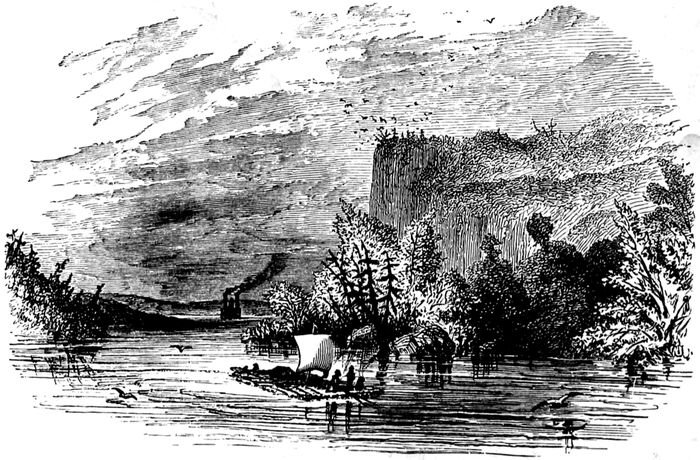
On the western shore is the celebrated
Maiden’s Rock, a bold, precipitous bluff,
rising four hundred feet above the lake.
All eyes were turned toward its towering
height. Its story is one of great beauty.
A maiden of the Sioux had given her
heart to a chief of her own tribe, who had
sought her love. The parents, however,
would not consent to her alliance with the
young brave, but insisted on her marrying
an old chief, of great wisdom and influence
in the nation. The marriage-day
was fixed, and Oola-Ita, with other Indian
maidens, was gathering berries on the
brow of this cliff for the wedding-feast.
Suddenly a plaintive song rose on the sea,
and they saw the beautiful Oola-Ita poised
gracefully on the very edge of the precipice,
her head upraised, and her long
hair floating in the wind, as she warbled
her parting song. In a moment, before
a friendly hand could arrest her, she
leaped from the precipice, and was dashed
to pieces on the rocks below.
93
95Six miles above Lake Pepin is the town
of Red Wing, finely situated on the river
bank, beneath the shadow of a towering
bluff. There was formerly the village of
Talangamane, or the Red Wing, esteemed
the first chief of his nation. The university
which bears Bishop Hamline’s
name, and which has been founded by his
liberal gift, may be seen from the water,
and near it is a large Methodist church.
Two weeks after a terrible accident
happened at this town. The steamer
Galena took fire. The pilot manfully
kept his place at the wheel; amid the
scorching flames he brought the boat to the
shore, and kept her there till the passengers
96had escaped. A mother and three
children were lost, but the rest stood in
their night-clothes on the shore; some of
them stripped of the means which were
to provide them with a home in the new
country to which they were going, but
thankful for lives saved from flood and
flame.
The presiding elder of the district came
on board at Red Wing. He was introduced
to Mrs. Lester by a Baptist minister,
who was returning to St. Paul with his
bride. He had been in the country for
twelve years, and his varied knowledge
made him a most agreeable companion.
He had been brought in familiar contact
with the Indians and with the settlers;
he could tell of the wigwam, and the log
cabin, and the thriving towns now replacing
them; he knew the character of
the strata of the river bank and the names
of the trees in the forest. He had visited
an Indian mission four hundred miles
97above the Falls of St. Anthony; had ascended
part of it in a canoe carried over
the portage past the rapids, by half-breeds.
A most quiet, domestic river it is above
St. Anthony, flowing through beautiful
prairies covered with grapes and wild
flowers, diversified with gentle hills and
groves of oak. These prairies were formerly
the resort of herds of buffaloes and
deer; wolves, too, roamed over them,
and just before dawn might be heard the
hideous cry of the great white owl.
Abundance of water-fowl used to be seen
here; ducks, geese, pelicans, swans, and
snipe; while the hawk, buzzard, and eagle
sailed on lofty wing in the regions of upper
air.
The waters of the St. Croix River looked
blue and beautiful as they flowed from
the lovely lake at its mouth into the more
turbid waters of the Mississippi, with
which they refuse for some time to mingle,
the currents of different hues running side
98by side. Magnificent forests, huge trees
(primeval) of stately trunk and deep rich
foliage, adorn the shores of the river, or
the large islands in its broad bosom.
Norman saw three wigwams on one of
these islands, and two Indian boys seated
on the shore. Not very far from this was
formerly a Sioux village of Le Petit Corbeau,
or the Little Raven. An anecdote
is told of this Indian chief, which very
finely illustrates the Saviour’s precept:
“If any man take away thy coat, let him
have thy cloak also.”
The Little Raven, going one morning
to examine his beaver-trap, found a sauteur
in the act of stealing it. The thief,
looking up, saw the chief of a nation with
which his own was at war, standing looking
at him with a loaded rifle in his hands.
The culprit expected instant death. How
great then was his astonishment when
the Sioux chief, approaching him, said:
“Be not alarmed, I come to present you
99the trap, of which I see you stand in need.
You are entirely welcome to it. Take my
gun also, as I perceive you have none of
your own, and depart with it to the land
of your countrymen; but linger not here,
lest some of my young men, who are
panting for the blood of their enemies,
should discover your footsteps in our
country, and should fall upon you.” So saying,
he gave him his gun and his accoutrements,
and returned unarmed to his village.
One would think that this Indian chief
must have heard and received the sublime
words of the apostle:
“Dearly beloved, avenge not yourselves,
but rather give place unto wrath:
for it is written, ‘Vengeance is mine; I
will repay,’ saith the Lord; therefore, if
thine enemy hunger, feed him; if he
thirst, give him drink: for in so doing
thou shalt heap coals of fire on his head.
Be not overcome of evil, but overcome
evil with good.”
CHAPTER VIII. OWAH-MENAH, THE FALLING WATER.
100
“In the land of the Dacotahs,
Where the Falls of Minnehaha,
Flash and gleam among the oak-trees,
Laugh and leap into the valley.”
St. Paul, “the diadem city of the
northwest,” situated on high bluffs, at a
bend of the river, looked very imposing
in the light of a glowing sunset. The
noisy cries of the hackmen and runners
for the different hotels filled the air as
the boat touched the wharf. Fourteen of
the passengers took the stage for St. Anthony’s
Falls. Norman was seated on
the top of the stage-coach. The glimmering
twilight and the pale moonlight
were not, however, very favorable for distant
views of a new country. Companies
of emigrants had pitched their tents and
101kindled their fire to cook their evening
meal. The light played upon the faces
of parents and children grouped around
the fire, and fell upon the white cover of
the prairie wagons, near which the horses
were tied.
There were glimpses of the Mississippi,
of a large hotel and a high observatory;
and exclamations from sleepy children
at the great musquetos lighting upon
their faces in the darkness. There was a
sound of waters in the air, and a great
building loomed up in the dim light, and
they were at the Winslow House. Great
halls, large parlors richly furnished, and
bed-rooms with velvet carpets and luxuriously
stuffed chairs. Very grand for the
northwest. It was past eleven o’clock,
and the wearied travelers were glad to
seek repose.
At four o’clock in the morning Mrs.
Lester was awakened by a knock at her
door. It was from an untiring fellow-traveler,
102who wished to see all that was
to be seen in time to return to the Grey
Eagle at ten. Mrs. Lester thanked her,
but said she could not get ready in time,
and from her window she watched the
lady, her brother, and her niece on their
way to the falls and the bridge. Sightseeing
seemed particularly unattractive in
that grey morning twilight that clothes
the landscape with a more sober livery
than that of evening.
After some ineffectual attempts to
arouse Norman, Mrs. Lester went to the
observatory, at the top of the great hotel,
to see the sun rise. It was a noble view;
the town of St. Anthony immediately beneath
the eye; the Mississippi, with its
falls, suspension bridge, and wooded island
above, and the rocky chasm below; Minneapolis,
with its spires and fine hotels, on
the opposite side of the river, and the
boundless prairie meeting the sky in that
encircling horizon.
103
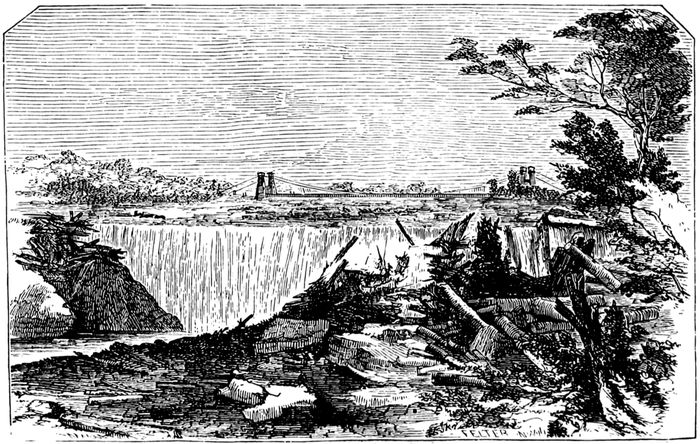
No. 666.
FALLS OF ST. ANTHONY.
105At length Norman was awakened, and
after sundry calls from his mother to
hasten his movements, he sallied forth
with her for a walk. Walking down the
street for some distance, they crossed a
little bridge leading past a large stone
mill, and after scrambling over a stony
path, they came to the edge of the river
and in view of the falls. Norman’s disappointment
was great. “Why, mother,”
said he, “have we come all this distance
to see these falls?”
In truth they were not very imposing.
The stream above was filled with logs,
floated down to be sawed in the mill, and
many of them were lodged above and below
the fall, while a shingle-machine was
built in the center. Man’s work had taken
away all the wild grace of nature.
The fall is only seventeen feet high, but
the whole scene looks finely from the
bridge below, and from the Minneapolis
side, whence it was seen by the party that
106set out on their rambles at four o’clock in
the morning.
It was a very warm morning, but near
the river the air was cool and refreshing,
and Norman gathered wild roses and
rose-buds in all their dewy freshness.
The charm of early birds, too, was not
wanting at Owah-Menah, the musical
Indian name, changed by Father Hennepin,
a French missionary, who visited
this spot in 1680, to St. Anthony’s
Falls.
As the falls of a mighty river, they are
worth seeing; and they are at the point of
transition from the prairies of the Upper
Mississippi, to the rugged limestone
bluffs below; oaks growing above, and
cedars and pines below.
On their way to the hotel Norman
gathered some purple flowers growing in
great profusion, while his mother wandered
to the suspension bridge so gracefully
thrown over the river, looked at the
107pretty wooded island, and at the mass of
drift logs collected in the boom.
After a nice and beautifully served
breakfast, Norman and his mother got
into a carriage to return to St. Paul and
the Grey Eagle. They would have liked
to spend the day at St. Paul, but Mrs.
Lester was anxious to return home, as she
thought she would be able to do, before
the Sabbath. They crossed the suspension
bridge, drove through Minneapolis,
called to say good-by to Mrs. Lisle and
the children, who had added so much to
the pleasure of their river travel, and
then rapidly over the broad prairie.
Their attention was attracted by a
lonely tomb, deeply shaded with trees, on
the banks of the Minnehaha, and the
driver told them that it was the tomb of
the young wife and child of an officer of
the army, who, when stationed at Fort
Snelling, buried his beloved ones on the
banks of this romantic stream.
108The driver stopped; they were on the
prairie, with nothing to excite expectation.
“The falls of Minnehaha
[2]Did not call them from a distance;
Did not cry to them afar off.”
Then getting out of the carriage, and
descending a narrow path, the fall was
before them, perfectly satisfying in its
beauty; a gem of a fall, at once stamping
its image on the memory; “a thing of
beauty” to be “a joy forever.”
The fall is sixty feet high, and makes
one graceful leap over an amphitheater
of rock, that recedes far enough to enable
one to walk round behind the fall, beneath
the overhanging cliff. One large
tree grew on the steep bank on which
they stood, sufficiently near to make a fine
foreground to the picture, and throw its
masses of foliage across the fall. There
was nothing to mar the perfect loveliness
109of the scene. A stir in the branches of
the great tree against which Norman
leaned induced him to look up, and there,
upon the bough,
“With tail erected
Sat the squirel, Adjidanmo;
In his fur the breeze of morning
Play’d as in the prairie grasses.”
Norman watched him leap surely from
branch to branch, over the deep abyss
below, and then gathered some pretty
flowers within reach, and asked the guide
to gather some graceful hare-bells that
hung over the steep cliff.
Another look from the head of the falls,
and a few more flowers gathered, which
they pressed, together with the rose-buds
from Owah-Menah, and they got into
the carriage.
Soon they reached Fort Snelling, in
which Norman was very much interested.
They drove round the deserted barracks,
no longer astir with “the pomp and circumstance
110of war.” Norman would have
enjoyed seeing the sentinel on duty and
the soldiers on parade. His mother
thought of the lonely lives the officers
and their families must have led on that
frontier post, far, far as it then was from
the center of civilized life.
The fort commands a noble view, placed
as it is on a commanding bluff at the
junction of the Mississippi and the St.
Peters rivers. The valley of the St. Peters,
sloping upward, with its sunny
fields, its aromatic grasses, and noble
groves, stretches onward in its beauty as
far as the eye can reach. In this valley
is found the fine red stone of which the
Indians make the bowls of their pipes; the
red paint the Sioux use so much, and the
blue and green clay used in painting, are
also found here. This lovely valley had
recently been the scene of a bloody battle
between the Sioux and Chippewas, and
the driver told Norman that he had seen
111some of wounded Indians carried through
St. Anthony by some of their tribe.
From the earliest times these two nations
have been at war; a feud transmitted
from generation to generation.
How few of these Indians have learned
the great lessons of loving kindness which
the white men ought to have taught them.
Steadily retreating from their broad prairies,
their great lakes and rivers, before
the advancing tread of the white man,
they have not, as they gave up their beautiful
homes, got a title to a grander and
more glorious inheritance in the spirit
land. How many have received firewater
and fire-arms, at the hand of the
white man! how few have taken from
him the cup of salvation! Some of the
customs of the Sioux seem to indicate
that they have come from Asia, across
the narrow straits that divide the two
continents. They offer sacrifices and
prayers to an unknown God; they have
112feasts of thanksgiving after deliverance
from danger; they offer meat and burnt-offerings;
they burn incense. These customs,
together with their peculiar countenances
and utterances, their own traditions,
and the testimony of other nations,
have convinced careful observers that
they are descendants of a race of
Asiatics.[3]
The road winds around the hill on
which the fort is built, and Norman saw
many swallows flying into nests excavated
in the banks of white sand-stone.
Crossing the river by a rope ferry, they
ascended the opposite bank, and drove
rapidly onward till they stopped to visit
Carver’s Cave.
There are several large rooms rounded
in the white sand-stone, which crumbles
at the touch. The floor was of pure white
fine sand, powdered, while through the
cave flowed a stream clear as crystal.
113Norman stooped and drank freely of the
cool refreshing water. He was delighted.
“How beautiful these arched walls are,”
he exclaimed; “how curious to have such
rooms hollowed out of the earth.”
There were other apartments to be
reached, through a narrow passage, but
the driver had no torch with him, and it
was not advisable to venture in the darkness.
Norman broke off a piece of the
sand-stone as a memorial of the cave, and
then hastened to the carriage.
Over the prairie, with its abundant blossoms;
along the high bluffs upon which
St. Paul is built; through a long busy
street; a pause at the door of a gentleman
whom Mrs. Lester had known in her
old home in the East, and they were once
more on the Grey Eagle.
And there was the lady whom they had
left at the Winslow House, just getting
out of the stage. Her face brightened as
she heard of Fort Snelling, the lovely
114Minnehaha, and Carver’s Cave; but then
she had had a very satisfactory view of
St. Anthony’s Falls, and had been able
to verify, in the truth-telling daylight,
the vague and indistinct impressions of a
moonlight drive.
CHAPTER IX. DOWN THE MISSISSIPPI.
115
Thus our idle fancies shaped themselves that day,
Mid the bluffs, and headlands, and the islets gray,
As we travel’d southward in our gallant ship,
Floating, drifting, dreaming down the Mississippi.
The gentleman whom Mrs. Lester had
called to see, and who was out driving at
the time, came to the boat to see her, and
promised her many lovely drives if she
would prolong her visit. There were
many things to say of old friends and
scenes, and he sat talking in the saloon
till Norman ran in to say that the boat
had left the wharf. Good-by was hurriedly
said, and Mr. —— hastened to
the captain to ask him to put him ashore,
as he was not prepared for a voyage
down the Mississippi.
“That is the way,” said the captain;
116“people do not mind their own business,
and then I have to attend to it.”
He good-humoredly, however, gave the
order to arrest the course of the proud
steamer, and direct its prow to the opposite
shore. It was the work of some minutes,
for they are obliged, in stopping at a
landing going down stream, to turn the
bow up the current.
“Well, captain,” said Mr. ——, as he
sprang on shore, “I promise you to go
down twice in the Grey Eagle for this.”
There were some curious caves on the
eastern bank of the river, walled up and
with windows in them. In one of these
the owner keeps his vegetables, as it is
perfectly protected from the frost.
Going down the river was the going up
reversed, and yet the same scenery became
new, seen under different aspects.
The broad sunlight that now lay on land
and water was not so favorable to artistic
effect as the softened light and the
117lengthening shadows of the previous
evening.
After dinner the Rev. Mr. Maynard
asked Mrs. Lester to go into the bow of
the boat, where there was a cool breeze,
most welcome in that sultry summer day,
and a fine view of the scenery. Norman
would not go; he was tired, and preferred
reading in the saloon, where his mother
left him. Nearly an hour passed away,
and as they were, approaching the St.
Croix River, Mrs. Lester said: “I must
show Norman this beautiful sheet of
water; he did not see it when we went
up.”
Through the long saloon she went,
opened her state-room door, he was not
there; out on the guards, not there. She
asked the stewardess, who had not seen
him since dinner. Breathless with agitation,
Mrs. Lester rushed upstairs to the
hurricane-deck, meeting Mr. Maynard,
who had come up the opposite side to
118look in the pilot-house; the boy was not
there! where could he be?
Mr. Maynard had looked in the steerage,
the barber’s shop; there was no corner
of the boat unvisited, and the terrible
dread that he had fallen overboard was
settling down on his mother’s heart as she
sank down on a chair in the saloon, when
the stewardess exclaimed, as she opened
the door of the state-room, “Here he is,
asleep in the upper berth!” And there
he was, fast asleep, with two life-preservers,
which he had tied around him, and
which his mother had mistaken for a gray
comforter.
Norman, awakened, looked down with
some wonder at the group at the door.
It was very hot; the sun’s fervent rays
were shining upon the state-room, and the
life-preservers rather added to the heat,
so that Norman had had a pretty warm
time. But he had made up by a sound
sleep for the late sitting up of the night
119before, and the early rising at St. Anthony,
and he was now quite ready to enjoy
the afternoon.
Mr. Maynard, greatly relieved that Norman
was found, pointed out his house on
the high bank of the river at Prescott,
and then said good-by, as he was going
home.
Lake Pepin looked finely, with the
“wavy curvature of its guardian hills;”
and again the Maiden’s Rock attracted
all eyes. Lake City is prettily situated
beneath the bluffs on the western bank.
A young girl, who there came on the
boat, told a sad story.
A few days before, a party of merry
young people got into a boat, to sail over
to Maiden’s Rock. The party was planned
to celebrate the birthday of a young
girl who, with her sister, and two friends,
sisters, on a visit to them, had just returned
from school for their vacation.
Two young gentlemen and another young
120lady completed the party. The morning
was bright, and the sail charming. There
was no cloud in the sky, no shadow on
that youthful group. They climbed the
Maiden’s Rock, gathered berries like those
Indian maidens, and talked of the sad fate
of the chief’s daughter; little dreaming
that in a few short hours the fate of Oola-Ita
was to be theirs, that they, too, were
looking for the last time on the waters of
Lake Pepin!
On their return a sudden flaw of wind
upset their boat in the middle of the lake.
The young men charged the young girls
to hold fast to the boat as it floated, upturned,
in the water. They did so till,
one by one, their hands becoming numb
and powerless, and their strength exhausted,
they sunk to rise no more! The
long hair of one of the girls became entangled
around the button of the coat of
one of the young men, and he succeeded
in lifting her up, and reaching the shore
121with her. The four sisters were gone,
and as the three survivors entered the
town with their heavy tidings, the friends
of the two sisters visiting Lake City drove
in to take them home. Alas, they were
already beyond the reach of earthly help
or love!
In a few days the bodies of these four
young girls were found, two of them far
down at the other end of the lake. Every
heart sympathized with the bereaved parents,
and while their house was left to
them desolate, the shadow of grief rested
on the whole town.
A clear sunset and fading twilight gave
place to the rising glories of the queen of
night.
About ten o’clock the boat stopped by
the side of a forest to take in wood. Pine
fagots, lighted on the shore, cast a ruddy
glow on the men, who ran rapidly to and
fro with their burden.
The moonlight slept peacefully on the
122waters, while from out of the shadowy
recesses of the grove a whippowill
charmed the night into silence. Rapid,
clear, and distinct were those sweet sounds,
as if he wished to sing his song for the
listening ears soon to be far away. He
seemed to have all the wood to himself, as
he warbled his delicious notes. In harmony
were they with the still beauty of
that summer night, with the mystery of
that woodland scene, and the quiet ripple
of the moonlit waters.
“Loud, and sudden, and near, the note
of the whippowill sounded, like a flute
in the woods; and anon, through the
neighboring thickets. Further and further
away it floated, and dropped into
silence.”
Later in the night there was alarm and
confusion on board. The steamer Itasca,
at a landing, ran into the Grey Eagle,
breaking her paddle-wheel. There was a
crash, and for some time none knew the
123extent of the injury received. The engines
were stopped. The emigrants sleeping
on the deck, near the broken wheel,
roused by the collision, were transferred,
with their sleeping children, to the other
side, and fruitless attempts were made to
repair the injury. After a delay of two
hours the machinery was again set in motion,
and the one paddle-wheel had to do
all the work. Happily Norman and his
mother, who were on the quiet side of the
boat, slept through all the noise and confusion.
CHAPTER X. FOURTH DAY UPON THE MISSISSIPPI.
124
Safely led and guided by pilots who could tell
The pulses of the river, its windings, and its swell;
Who knew its closest secrets, by dark as well as light,
Each bluff and ringing forest, each swamp or looming height.
Early in the morning Winona appeared,
surrounded by its protecting hills,
reposing, as do most of those pretty towns,
in the shadow of the great bluffs, “like
peace in the bosom of strength.”
The boat stopped for some time at La
Crosse, a very nourishing town. Here
Mrs. Lester saw two Indians in blankets
and leggings, a sight Norman missed, to
his great disappointment. He was at the
other end of the boat, too far off to be
summoned in time.
The pilot, having just left his watch
of six hours, came and invited them to
125come up to the pilot-house in the afternoon.
It was a welcome invitation, for
the day was very warm, and the pilot-house,
with its cool breeze, and its commanding
view of the scenery, was a most
desirable place. Norman admired the
handsome pilot as, with steadfast eye and
erect figure, he stood at the wheel, scanning
the waters, and guiding the vessel in
the channel, winding round the islands,
and from one shore to the other of the
great river. Turning the wheel, first to
the right, and then to the left, it seems
very easy work, a very simple operation;
and yet what destinies depend upon those
movements; fortune, happiness, life, all
involved! Hundreds of human beings
pass days of enjoyment and nights of
quiet rest because they have faith in their
pilot.
And there are men who, as they guide
the pen, or utter calm, truthful words, or
pray in the deep of their hearts, seem to
126be doing very little, and yet those pen
traces, those simple words, those earnest
prayers, may guide hundreds in the perilous
voyage of life, may direct their course
away from the shoals and snags that
threaten destruction, and float them safely
to their desired haven.
Norman was greatly mortified at the
disabled state of the Grey Eagle, one wing
broken, how could she maintain her triumphant
flight? Others accustomed to
yield the palm, now passed her with ease.
“I hope they know that her paddle-wheel
is broken,” said Norman; “just
look at those boats; what efforts they are
making to pass us!”
Norman watched the boats with great
interest, as they put on more steam, and
darted past the Grey Eagle, making the
landings before her, and carrying off the
waiting passengers.
The view, crossing the river from Prairie
du Chien, overlooking the islands as
127they now could from their elevated position,
was extremely fine.
The Northern Light and the Grey Eagle
met at M’Gregor’s Landing, and the
captain of the latter was telling the captain
of the former about his broken paddle-wheel
and his consequently tardy
progress.
“There is a lady trying to speak to
you,” said the pilot. On the Northern
Light was Mrs. Ralston, with whom Mrs.
Lester had intended to journey to St. Paul.
Handkerchiefs were waved and mute
signals attempted, but the few desired
words of explanation were wanting. Near
and yet afar off. The boats soon parted
for their opposite points of destination,
and Mr. and Mrs. Ralston, from the hurricane
deck, waved their good-by. Nearly
opposite M’Gregor’s landing is the mouth
of the Wisconsin River.
“There was a memorable voyage on
that river nearly two hundred years ago,”
128said Mrs. Lester. “Two canoes, containing
seven men, floated down these waters,
‘entering happily this great river with a
joy that could not be expressed.’”
“Who were they, mother?”
“Father Marquette, the gentle, good
missionary; Joliet, a citizen of Quebec,
and five Frenchmen, their companions.
They had left the Fox River, which flows
into Green Bay, and carrying their canoes,
they crossed the narrow portage that
divides it from the Wisconsin on the 10th
of June, 1673. Down the river for seven
days, floating in those majestic solitudes,
seeing neither man nor beast, passing
beautiful prairies, and green hillsides, the
discoverers at length reached the great
river which they were seeking to find.
“And where did they go then?” asked
Norman. “Over these waters the light
birch bark canoes floated for about sixty
leagues. Then they landed on the western
bank of the river, where they saw
129foot-prints on the shore. They followed
them till they came in sight of an Indian
village.
“They commended themselves to God,
and cried aloud. Four old men advanced
to meet them, bearing the calumet, the
peace-pipe, adorned with brilliant feathers,
and saying, “We are Illinois,” which
means, “We are men.” The Indians invited
the strangers to their village, prepared
a feast in their honor, and entertained
them for six days. Several hundred warriors
then escorted them to their canoes,
hanging around the neck of Marquette,
on parting, the calumet, with its plumage
of various hues, a pledge of safety for the
wanderers among savage tribes.”
“Do go on, mother, and tell me something
more about Marquette. I think his
adventures are very interesting.”
“I know little more about him, except
that he sailed down the river past the
Missouri and the Ohio, and that some
130warlike Indians, armed with clubs, axes,
bows and arrows, came out to meet them
with the fearful war-whoop. Marquette
stood up, holding the sacred peace-pipe,
and God touched the hearts of the Indians,
so that at the sight of this symbol they
threw their bows and arrows into the
canoes, and welcomed the strangers.
“On their return they sailed up the
river Illinois, through the beautiful prairies.
The tribe of Illinois that live on its
banks wanted the good missionary to
remain with them, and one of their chiefs,
with his young men, led the party to Lake
Michigan, by way of Chicago. Here
Marquette remained to preach to the
Miamis north of Chicago, and Joliet
returned to Quebec, to announce the discovery
of the upper Mississippi.
“And what became of the good Marquette?”
“Two years afterward, as he was going
to Mackinaw, he entered a little river in
131Michigan, which, for a long time afterward,
was called by his name. He requested
the men who paddled his canoe
to carry him ashore. They did so; and
there, with no shelter but the little bark
cabin which his men hastily erected, he
endured great agony. But he seems to
have had faith in Christ, and died in great
peace. In the gloom of the vast forests
he slept to wake again in the green solitudes
of the New World. His companions
dug his grave on a rising ground near the
river, and buried his body, which was
afterward taken up by the Indians, and
carried with great respect to old Mackinaw,
and placed in a little vault of a
Catholic church, which has long since
disappeared.”
The scenery that on their upward course
was vailed in mist and drizzling rain, was
now seen in its “fairest, happiest attitude.”
Nothing was wanting to “the
gentle grace” of that parting day. Purple,
132crimson, and gold painted the western
sky, as the sun sank slowly below the
horizon, lighting up a fairy scene on the
placid waters of the river. Then, as the
onward motion of the boat rudely disturbed
the sleeping glory, new combinations
of beauty sought to make amends
for the loss of the serene picture of the
radiant heavens. Golden ripples, a honeycomb
of black and gold, lay between
them and the wooded banks toward
which, as the gorgeous tints now faded on
earth and sky, Norman directed his attention.
Rocks, decayed trees and branches
covered with moss and lichen, were faithfully
mirrored in the waters, giving a
kaleidescopic effect to every object. Norman
saw, simultaneously with his mother,
exquisitely tinted butterflies, insects of
green and gray, stone altars, rustic letters,
and many other objects. Exclamations
of wonder and admiration were echoed
133from one to the other at some of these
marvelous combinations; and it was with
reluctance they turned, as the twilight
deepened, from the margin of the woodland
to the clear outline of the trees against
the western sky. There was still room
for fancy to sketch her pictures, and call
up birds and beasts in that varied outline.
“This is the pleasantest afternoon of
all,” cried Norman; “it is so nice for us
to be by ourselves.”
“And yet you forsook me first, Norman,
and, absorbed in your play, lost the
first views of the Mississippi. You said
there was a want with children which
children alone could supply—a demand
of the social nature.”
“I know it, mother; I know that I said
so, and I enjoyed those merry games very
much; but after all this has been the
happiest time.”
CHAPTER XI. A SUNDAY IN DUBUQUE.
134
“O day most calm, most bright,
The fruit of this, the next world’s bud;
The indorsement of supreme delight,
Writ by a Friend and with his blood;
The couch of time; care’s balm and bay;
The week were dark, but for thy light:
Thy torch doth show the way.”
A very pleasant room at the Julien
House afforded a welcome retreat on the
Sabbath. It was intensely hot; the burning
rays of the sun were reflected from
the towering bluffs that shield the town
from the west wind. A walk of a mile
and a half through the main street led
them to the Methodist church, where
the services were very animating and
delightful.
A cordial greeting from the minister,
who had known Mrs. Lester in the East,
135was followed by a kind invitation to the
parsonage, next door to the church. There
was a beautiful bunch of flowers on the
table, gathered on the prairies the day
before. One, the moccasin flower, a large
yellow flower, with a sort of pouch like
a gigantic calceolaria, Norman had never
seen before, and he was very much pleased
when a number of them were given to
him.
Several churches to which Mrs. Lester
went in the afternoon were closed, so she
continued her walk to the same church,
where she heard a very good sermon
from the Presbyterian minister, to whose
congregation the use of the Methodist
church was given while their own was
being repaired.
The street she took on her return home
led her nearer to the bluff, up which people
were creeping to get some cool air in
the oppressive stillness of that summer
afternoon. Every door was open, and
136quiet pleasant interiors were revealed to
the passer-by; family groups, seated on the
porch or in the parlor, reading or taking
their tea.
Toward evening, as he was sitting on
the window, Norman saw a number of
people flocking to the Levee, and he asked
his mother’s permission to follow them,
and ascertain what had happened. He
soon returned, looking very grave and
downcast. He had been in the presence
of death. A young man of nineteen had
been drowned the evening before, seized
with sudden cramps while bathing, and
they had just found his body. There it
lay, floating on the water, the head downward,
the limbs drawn up; and in the
solemn presence of death light and careless
words had been spoken that shocked
Norman, touched as he was by the unfamiliar
sight. The drowned lad was
French, an orphan and a stranger in the
land, with no one to miss him or mourn
137for him, save one loving heart, that of
a sister, left alone without kindred or
friends. Later in the evening the vehicle
containing the body stopped at a
confectioner’s, on the opposite side of the
street, and the young man was carried
in to the room he had left the evening
before, in the fullness of life and health.
“Death enters and there’s no defense;
His time there’s none can tell;
He’ll in a moment bear thee hence,
To heaven, or down to hell.”
Well is it in this life of uncertainty,
when the happiest moments may be
darkened by the presence of this grim
visitor, to be prepared for his coming;
to have our fear of him taken away; to
be able to look upon him as the messenger
sent to call us to our Father’s house.
“In the midst of life we are in death:
to whom then, O Lord, can we turn but
unto thee!”
CHAPTER XII. DOWN THE RIVER.
138
Down the river went they
In and out among its islands,
Sailed through all its bends and windings,
Sailed through all its deeps and shallows.
The morning came bright and warm as
ever.
At the boat Norman was delighted to
see his friend, the pilot of the Grey Eagle,
who introduced them to Captain Gray,
of the Kate Cassel. There he saw too the
lady who brought with her memories of
the early dawn at St. Anthony. “You
like to see everything that is to be seen,”
she said to Mrs. Lester; “under that bare
spot you see on the bluff south of the
town is the grave of Dubuque, the Indian
chief who once owned all this land.”
“Mother,” said Norman, as their kindly
139informant left them, “Dubuque is a
very strange name for an Indian chief to
have; he must have been named by the
French when he was a child.”
“Julien Dubuque,” replied his mother,
“was not an Indian, but a Frenchman, who
bought all this valuable mining region,
so rich in fine lead ore, from the Indians,
in 1788. They had been discovered two
years before by the wife of Peosta, an
Indian warrior. Dubuque died in 1810.
The Julien House is named, I suppose, in
his honor.”
For a hot and weary hour the deck
hands were busy taking on freight: first
barrels from a warehouse on the Levee
at Dubuque; then at Dunleith, a number
of reapers and mowers, very heavy and
cumbersome to be moved.
As soon as the boat was in motion
Captain Gray asked Mrs. Lester if she
would go to the pilot-house, as that was
the coolest part of the boat. Very kindly
140he escorted her thither across the hurricane-deck.
It was a delightful change
from the heated atmosphere below to the
cool refreshing breezes above.
“Two eagles at once,” said the captain.
“There is something for you to look at,
my boy.”
There was the Grey Eagle, her paddles
both in motion, and the War Eagle following
her in her northward course; a
great sight for Norman.
The banks are well wooded, and of
some elevation, and there are pretty
islands; but the scenery is more monotonous
and not so grand as that of the Upper
Mississippi. The river is much more
shallow, and can be navigated only by a
smaller class of steamboats.
The captain pointed out to them, on
the banks of the river, the entrance to a
lead mine, and a hill-top called Pilot
Knob.
At two o’clock they approached Fulton,
141and the captain courteously took them on
shore.
Fulton, the terminus of an air-line road
from Chicago, is rather an uninviting
looking place, with a grand hotel, suitable
for a great city; a destiny Fulton
does not seem likely to achieve.
Seated in the cars, Norman saw the sun
set for the last time on the great river
that had become to him a familiar friend;
saw the Rock River gleam in the moonlight;
and soon after the welcome lights
of his uncle’s home.
Norman had a great deal to tell his
uncle and aunt about the Mississippi, and
Minnehaha, and the boats, and the little
incidents of their journey, and the week
he was to spend at Dixon passed rapidly
away.
One day Norman’s aunt took Mrs. Lester
to see Father Dixon, the patriarch of
the place to which his name is given.
The hotel also bears the name given to
142him by the Indians, Nachusah, or the
White Haired. His long flowing white
hair makes him look very venerable; and
there is an expression of gentleness in his
delicate features that wins the love of the
children of the town, who all call him
Grandpapa. He established a ferry over
the Rock River thirty years ago, when
there were no white people in all the
country round, and lived here in his solitary
dwelling by the river side.
He lives there still; and Mrs. Lester
was very much interested in her visit to
him, and in his accounts of the Indians
who formerly roamed over these prairies,
now the fruitful farms of the white
men.
One day a gentleman, who lived on the
opposite side of the river, sent his two carriages
over for Norman’s uncle and aunt,
his mother and himself. As Norman was
in the woods with Herbert Waldorf, they
went without him. The bridge had been
143carried away by the flood, so they crossed
by the rope ferry. A very stout wire
rope was stretched across the river, and a
scow was fastened to this by a rope which
slipped by a wheel along the iron cable.
When they drove on the scow, the man
turned the prow of the boat up the current,
which at once urged the boat onward.
It is a very pleasant and rapid
way of crossing the river, allowing one
to have a near look of the swiftly flowing
waters.
Mr. Dexter had a pretty cottage and
fifty acres of prairie land just on the edge
of the town. Mrs. Lester went up stairs
to see the extensive view of prairie from
Ernest Dexter’s window, and then she
looked at a cabinet of fossils, most of
which he had collected himself in Illinois.
There were some very fine specimens, and
he was kind enough to give Mrs. Lester a
number of them.
The music of the piano called forth the
144rival notes of the mocking bird, and, accompanied
by several canaries, he made
the air vocal with sweet sounds. Mrs.
Lester forgot what she was playing, so
charmed was she with these delicious
songsters. Strawberries and ice-cream
were fully appreciated after the music, and
the evening’s entertainment concluded
with a magnificent sunset on the prairie.
Golden clouds were penciled softly on the
clear amber sky, while rugged wild clouds
towered up in stern contrast with this
calm serenity. One could imagine the
cliffs of Sinai in those gray clouds, so bold
and lofty, while through a torn rift
gleamed the soft blue sky. It was a
memorable sunset even in the West,
where they claim for their sunsets a peculiar
beauty.
Norman was very sorry when he heard
how much he had missed, especially as
Mr. Dexter had been kind enough to
send over twice for him. So he told
145Harold Dexter, when he saw him at
church the next day, that he would walk
over with Herbert Waldorf on Monday
morning.
After breakfast Norman and Herbert
walked over to Mr. Dexter’s, where they
found the boys waiting for them. After
a careful survey of Ernest’s treasury, and
of a smaller cabinet belonging to Harold
and his brother, they set off, with baskets
and hammers, in search of minerals. They
went to a quarry and found a very fine
fossil, a portion of a petrified snake.
They hammered at this for a long time,
but they broke it all to pieces in endeavoring
to get it out. Harold found, however,
a large stone filled with petrified
shells, which he kindly gave to Norman,
who came home in the afternoon
with his basket filled with pieces of
rock.
One afternoon Norman saw three “prairie
schooners” in the street before his
146uncle’s door. These are the emigrant wagons
with their white tops, which look not
unlike sails as you see them quietly moving
on over the far reaches of the prairie.
A number of horses and boys were standing
near them. The party were hesitating
as to their course; wishing to cross
the river, and seeing no bridge but the
railroad bridge, they were making their
way to that, when they found they could
not cross it. Hence the halt and the
consultation.
“Norman,” said his mother, “do go
and find out where those emigrants are
going.”
“O mother,” said Norman, “I would
not ask them for anything.”
“I will go then,” replied his mother,
as she opened the garden gate, and
walked up to the last prairie wagon, in
which a woman was seated with her four
children.
She seemed pleased to hear the accents
147of a friendly voice, and soon told her
simple story.
Eight years before she had been left a
widow, with six children. The boys of
twelve and fourteen did not wish to learn
a trade, and farming was not very profitable
in the part of Pennsylvania where
she lived; so she had come to seek, in the
fertile fields of Iowa, bread for her children.
She had worked hard, and days of
toil were still before her, but there was
more hope in that virgin soil of securing
a competence. The rich deep black
loam of these prairies often, at its first
sowing, bears a golden harvest, that gives
back to the farmer the amount he has
paid for the land, and the expense of its
cultivation.
Mrs. Lester asked the emigrant, in
whose patient face she had taken much
interest, if she had any friends in the new
and strange country to which she was
going.
148“O yes,” she replied; she had a married
daughter there, and a church and
Sunday school for her children. She was
a Methodist, as were the two families
with whom she was journeying; and she
would have been unwilling to go where
her children would be deprived of their
religious privileges.
There were fifteen persons in the company.
They had driven from Pennsylvania
to Cleveland, where they had taken
the cars for Chicago. The wagon was
lifted on the car, the cover taken off, and
the woman said she had had the pleasantest
ride she had ever taken in her life,
looking over the lake and the prairie from
her elevated position. From Chicago
they had journeyed on, sometimes sleeping
in their wagons, and sometimes on
the floor of some house opened for them.
There were bright, black-eyed children
peeping from the recesses of the covered
wagon, as their mother was talking to
149Mrs. Lester, and one little girl sat intently
reading. Mrs. Lester bade her goodspeed,
and the woman, with brightened
face, thanked her for her words of kindness
and sympathy.
The last day of their stay in Dixon at
length arrived, and with it came Aunt
Clara, whom Norman had never seen before,
but whom he very soon learned to
love. She showed him his picture when
a baby, which his mother had sent her,
and she found it difficult to trace any resemblance
to the tall boy before her.
Norman stayed with her and his uncle
in the evening, while his mother went out
with a gentleman and lady to take a
drive on the prairies. The day had been
very warm, but there was a cool breeze
on those boundless meadows that undulated
peacefully, in their rounded swells,
to the far horizon. The corn was laughing
in rich abundance, the wheat standing
thick on the fields, after the sun had set,
150leaving its luminous track of light in wavy
radiance; one huge cloud towered up in
solitary grandeur, its bold outline gilded
by those parting rays.
CHAPTER XIII. THE PICNIC.
151
A joyful hour! anticipated keen,
With zest of youthful appetite ...
To spread that table in the wilderness;
The spot selected with deliberate care,
Fastidious from variety of choice,
Where all was beautiful ...
With joyous exultation, guests were led
To our green banquet-room.
Norman was very sorry to part with his
dear young friends, Alfred and Herbert;
but he was very glad that his Aunt and
Uncle Lester, and his Aunt Clara, were
going with them, so that he had not to
say good-by to them. As he had traveled
over this road when he came west, he
had seen these broad prairies before, but
they were now enameled with brighter
hues. Great patches of purple phlox, a
profusion of yellow flowers, and bright
152red lilies, made all the broad expanse a
vast flower-garden. His Aunt Clara said
that many of the prairie flowers were disappearing
in the progress of cultivation.
The cattle that now covered the plains
destroyed them, and the plow rooted
them up.
“Yes,” said his uncle to Norman, “your
Aunt Clara sometimes fancies her mission
is to cultivate a blooming inclosure, in
which she will preserve all the prairie
flowers from the extinction to which they
are rapidly tending.”
Geneva, which they soon reached, is a
pretty town on the Fox River, and the
house of Henry’s aunt, whom they had
come to visit, had a view of the river and
its wooded islands. Norman’s Aunt Clayton
was very glad to see him, and very
kind to him, so that he was very happy
with his new relations. His aunt would
bring him, several times a day, a great
tumbler of good rich milk, the like of
153which he had not often seen. She sent
for Willie Clayton to meet Norman, and
the boys asked permission to bathe in the
river, Willie assuring Mrs. Lester that it
was perfectly safe. They were absent for
a long time, and as neither of the boys
could swim, Mrs. Lester became very
anxious as the dinner-hour approached,
and they had not yet returned. Mr. Clayton
very kindly offered to go in search of
them, and while he was gone the boys
made their appearance. They did not
know that they had been so long away;
they had waded over to the island, and
the time slipped away more quickly than
they thought.
After dinner Norman said his back
was very much burned, exposed, as it had
been, to the fierce rays of the sun. His
mother put some flour on it, but after
a while, it became so painful that he had
to lie down on the bed and have it covered
with flour. His neck, and back, and
154arms were all bright scarlet, and he suffered
very much from the intense burning.
The next day there was to be a school
picnic in the grove, and Willie was to
speak on the occasion. Norman said it
would be impossible for him to dress himself;
but when the animating strains of
the band floated in his window, as the
procession marched to the grove, he
thought he might make the effort. His
mother helped him to put on his clothes,
as his back was all blistered, and he walked
with her and his aunt and uncle rather
soberly to the picnic.
The children were seated on benches
under the trees, and a platform was erected
for the speakers. Norman was soon
seated beside Willie, who was also suffering
from his sun-burned back. The band
was stationed near them, and between the
recitations and declamations of the children,
“discoursed most excellent music.”
After a while the company were invited
155to partake of refreshments, and, preceded
by the band, they marched to another
part of the grove, where tables were tastefully
arranged, covered with an abundance
of good cake, and ornamented with
flowers.
Norman and Willie were in the front
rank next to the rope that separated the
children from the tables; but the pressure
from behind was rather severe on their
tender backs, so they came to where their
mothers and aunts were standing.
Mrs. Lester was happy to recognize in
one of the young men most active in providing
for the wants of the children, one
whom she had known in her former beloved
home in the East. Of his mother,
who had been a near neighbor, she retained
a most kindly remembrance; and
as she had been suddenly and recently
called to her home in the heavens, Mrs.
Lester was glad to learn that her son, left
with his brother almost alone in the
156world, was active in this western town in
the Sabbath school and in the temperance
cause, maintaining a consistent religious
character. A great field for usefulness
is opened in the West to Christian young
men. So many young men, in seeding
their fortunes in these new and thriving
towns, throw off the restraining influence
of their pious homes; absent themselves
from the house of God, and are thus easily
led aside by a thousand encircling temptations.
Exercises in geography, arithmetic, and
declamation followed the feast, some of
which the band applauded in a very graceful
manner. A number of children gathered
around the musicians, and one little
boy, in a bright red frock, stood leaning
against his father, close by the great drum,
his eyes fixed on its great circumference, and
his eyelids winking every time it was struck.
After the exercises one of the ministers
made a very good speech, in which he
157told the children that if they wanted to
rise above being mere drudges at the dictation
of others, they must study, they
must work, they must learn to think.
What they did, they must do with their
might; when they played, they must play
in earnest; and when they studied, they
must study in earnest; and that to be industrious
and to be in earnest, was the only
way to be anything, or to do anything in
the world.
He made the children laugh when he
told them that in some parts of New
Hampshire the fields were so stony, that
it was jocosely said that the farmers sharpened
their sheep’s noses that they might
eat the grass growing between the stones.
This was a wonderful story for western
children, who never saw stones on their
broad fertile prairies.
As the band played its farewell, the
company left the ground greatly pleased
with the day’s entertainment.
CHAPTER XIV. THE CAMP-MEETING.
158
The holy sounds float up the dell
To fill my ravish’d ear,
And now the glorious anthems swell
Of worshipers sincere;
Of hearts bow’d in the dust that shed
Faith’s penitential tear.
The next day Norman was to go with
his mother and aunt to a camp-meeting.
It had rained the night before, and
the clouds were gathering in rather a
threatening manner, obscuring the heavens,
and forming in dark masses at several
points on the horizon. It was
thought not very prudent to go, but
the strong desire in Mrs. Lester’s face
overpowered the cooler judgment of the
others.
“If it does not rain,” said Mrs. Lester,
“those clouds will certainly be better than
159the broad glare of sunshine we have had
for some days past.”
The carriage drove up to the door, and
calling for some friends who lived near,
they were soon on their way. The drive
was very pleasant through the Fox valley,
with frequent groves and pretty views
of the river. They drove into the pretty
town of St. Charles, across its fine bridge,
with its noble piers, through the town on
the east of the river, and after a little
while into the deep woods in which the
camp-meeting was held. The road
through the woods was very bad: deep
mud, and several sloughs, called in the
west slews. All these critical spots were
happily passed, and reaching the grove
they got out of the carriage and walked
on the camp-ground.
The gentleman who accompanied them
brought the carriage cushions to put on
the plank seats, which were rather damp
with the heavy rains of the night previous.
160There were ministers in the elevated
covered stand, appropriated to
them, and a large congregation gathered
for a love-feast. It was pleasant to hear
them speak of the happiness of religion,
to see the calm peace on their countenances,
and to listen to their expressions
of love to their Saviour, of faith in him,
and fixed resolve to live to his service.
An intermission of a few minutes before
the public service gave Norman an
opportunity of looking about him. About
thirty tents were pitched in a circle, and
in the center of the amphitheater thus
formed, seats were arranged for the congregation
beneath the shade of fine noble
trees that spread wide their branches.
One, beneath which the preachers’ stand
was placed, threw itself toward the other
trees, that bent as if to meet it, making a
most picturesque group. At each corner
of the area there was a structure formed
of four stout sticks, about five feet high,
161on which rested a platform covered with
turf. On these rude candelabras, at
dark, they kindled pine knots, to give
light to the evening meetings and to the
encampment. How much Norman would
like to have seen this wild woodland thus
illuminated, the broad glare flashing on
the gathered groups.
An excellent sermon was preached on
“Bear ye one another’s burdens, and
so fulfill the law of Christ;” and then a
young minister, with the sweet expression
of whose face Norman had been struck,
got up and made an address full of
beauty. It was enforcing the law of
kindness. He said that when they drove
to the camp-ground the day before they
had got into a slough on the road, and
there they were fast, the horses remaining
quiet after some ineffectual attempts to
move forward. The driver, he was glad
to say, betrayed no impatience, and did
not swear at the delay. Soon another
162wagon drove up, and the driver, seeing
the difficulty they were in, at once unhitched
his own horses and drew them
out. And that was what, he said, we
ought to do when we saw people in
trouble, draw them out if we had the
power. He then spoke of the harsh judgment
we often form of others, because
they are deficient in some point upon
which we lay stress. “Now,” he continued,
“these trees that bend over us
are not rounded and full on every side;
some have their wealth of branches on
one side, and some on another. And so
Christians seldom present full symmetry
of growth. One brother has a great deal
of patience and very weak faith; and one
sister has faith almost strong enough to
remove mountains and very little patience.
Now we should rather contemplate
the excellences of our Christian
friends than their deficiencies.”
He exhorted the people not to be like
163those trees that are slow to yield their
fruit, whose fruit, hard and green, required
a vigorous shake to loosen its
hold. “Rather,” said he, “be like those
generous trees, borne down with their
golden fruit, blessing the eye, and the
touch, and the taste of all around—trees
of blessing, making glad the heritage of
God.” He spoke of words of kindness
and sympathy, how often they cheered
the heart of the desolate, and brightened
the path of the wayfarer. How often
those who were collecting for benevolent
objects were more cheered with the kind
words of one who had no money to give,
than with the large gifts of another,
grudgingly bestowed.
One word of counsel he gave, rather at
variance with ordinary exhortation. He
charged his hearers to try not to be first,
but to be second. “In your plans and
pleasures think of some one before yourself;
prefer the comfort of some friend to
164your own; sacrifice your own ease to promote
the well-being of another, and you
will tread in the footsteps of Him who
pleased not himself.”
Norman saw the tears in his Aunt Lester’s
eyes, as he turned to look at her,
and he thought that she had learned that
lesson well, that she was always thinking
of other people, and preferring their comfort
to her own.
The hymn, swelled by the united voices
of that large congregation, filled the grove
with its solemn harmony, and then the
words of the benediction fell like dew
upon them.
Norman had never been to a camp-meeting
before, and the scene had all the
charm of novelty to him. He saw the
people preparing their meals in the rear
of their tents, the fire made of dry sticks
on the grounds, and the kettle hung on a
cross stick, placed in the notches of two
upright ones. The tables were spread in
165the tents, and soon surrounded by family
groups. A lady, who knew Norman’s
aunt, invited them to dinner, after
which they returned to their seats,
when the bell was rung for the afternoon
service.
The sermon was a good one, on “Gather
up the fragments that remain, that nothing
may be lost.”
Norman did not remember much of the
sermon; but one fact, given by the minister
who rose to exhort, made a great impression
upon him.
“At a time of great religious interest,”
said he, “when many persons, awakened
to a sense of their danger, were inquiring
what they should do to be saved, I spoke
to three boys, and asked them if they
could not, by personal effort, lead some
of their companions to the Saviour. One
of the boys, a tall and thoughtful lad,
stood a little apart from the rest, his eyes
fixed on the ground, while I was talking
166to them. He said nothing, but it was an
hour of fixed resolve.
“Three days after one of the boys
came to me, and said: ‘Sir, do you remember
the tall boy that stood near when
you were talking to us?’ ‘Yes, I do,’ I
replied. ‘Well, sir, he has been trying
ever since to lead sinners to Christ; and
he has persuaded three men, and two
women, and a little boy to give their
hearts to the Saviour; and there he is,
sir, talking to that gray-haired man!’ I
followed the direction of the boy’s eye,
and there stood the lad, his thoughtful
face all aglow with feeling, as he spoke
earnestly to the old man, who shortly
after came forward, and knelt as a penitent
at the altar of prayer. Who can
estimate the good thus accomplished by
the earnest efforts of this lad; and why
may not every one follow his example,
and make it his business to lead souls to
Christ?”
167It was with reluctance they left this
hallowed scene, where they had been
permitted to join the swell of holy song,
and to hear so much that was profitable;
teachings that ought to make them better.
Norman would gladly have stayed for the
evening services, to have seen those trees
gleaming out in the ruddy light, but they
would not venture to travel that road in
the darkness. As it was they had a very
pleasant drive home, where they came
just in time for tea.
CHAPTER XV. A SABBATH-DAY.
168
Types of eternal rest, fair buds of bliss,
In heavenly flowers unfolding week by week
The next world’s gladness imaged forth in this,
Days of whose worth the Christian’s heart can speak.
The Sabbath dawned clear and beautiful,
bringing refreshing breezes after the
intense heat of the past fortnight. After
the morning service in the Methodist
church Mrs. Lester stayed to the Bible class
led by the minister. The lesson was the
eighth chapter of Romans, and it was interesting
to see two old men, with spectacles,
bending earnestly over one book, and
talking over the meaning of the passage.
The members of the class were all men
and women, and there was a very free
interchange of thought, as they looked
169into the Scriptures of truth. One face
especially attracted Mrs. Lester’s attention.
It was a youthful face, rather large, very
fair, with light hair, blue eyes, and regular
features, not beautiful, but with a
sweet, heavenly expression on the high
brow, and in the untroubled eye. In the
class-meeting that followed the Bible class,
she spoke calmly, but with an unfaltering
trust, of her love to the Saviour, as being
the master-passion of her soul; that she
loved God supremely, and found him to
be a satisfying portion. Her father, who
led the class, spoke to her, with tears in
his eyes, of the time when her decrepit
form would put on immortality, and would
shine with glorious beauty; when she
would know no weary hours of pain, but
would dwell in the land where the
inhabitants shall no more say, I am
sick, but where all tears shall be wiped
away.
Yes, that sweet face was the face of a
170cripple. Her form was shrunken and
withered, and her limbs had never carried
her whithersoever she would. Her father
took her into his arms at the close of the
service, her limbs hanging limp and as
if without life, and carried her to the
little wagon in which he had drawn her
to church. Mrs. Lester asked her if she
was not tired with the long service.
“O no,” she said; she would like to stay
there till the evening prayer-meeting at
five o’clock.
It was not very often she could go to
the house of God. She felt with David,
“A day in thy courts is better than
a thousand: I had rather be a doorkeeper
in the house of my God than to
dwell in the tents of wickedness.” O how
she loved the house of God, the place
where his honor dwelleth.
This poor, crippled girl, who had known
no happy childhood, who had never been
able to participate in its sports, who had
171always been confined to the narrow precincts
of a home destitute of all the luxuries
of life, who had been daily accustomed
to pain and privation, had yet found the
true secret of happiness. It lay like moonlight
on her countenance. She had that
within which many of the rich and wise
and great, who look at will on the glorious
scenery of earth, who command the treasures
of literature and art, who surround
themselves with all the comforts and appliances
of a home of elegant sufficiency,
fail to gain—calm peace in her heart, perfect
contentment with her lot, and a spring
of never-failing happiness. Nor is she
useless in the world, though she has no
worldly means to give, nor hands or feet
to do her bidding. The light of her holy
example, her patience, meekness, resignation,
and faith, are treasures to the Church.
Every Wednesday there is a prayer-meeting
in her room, of which she takes the
charge, as she can be always present, and
172the beauty and propriety with which she
speaks of divine things make her words
very profitable.
In the afternoon Mrs. Lester and Norman
went to the prayer-meeting. At the close
of the service Mrs. Day, to whom Mrs.
Clayton had introduced her in the morning,
came up and asked her to go home
by the way of her house, as she wished to
gather some flowers for her. The large
garden, filled with flowers and shrubbery,
blooming most luxuriantly in that fertile
soil, looked cool and inviting. Mrs. Day
handed Norman some flowers as the beginning
of his bouquet, and told him to
go and pick what he liked. Pink and white
spireces, double China pinks, a few lingering
June roses, the pretty bee larkspur,
the coreopsis, candytuft, and verbenas, were
gathered in profusion by Mrs. Day’s lavish
hand, and arranged in two bouquets for Mrs.
Clayton and Mrs. Lester. “Four years
ago,” said she, “this garden was a bare
173field. I never was so discouraged in coming
to any new place.”
“You certainly have transformed it
into a very pleasant home,” replied Mrs.
Lester. “Taste and cultivation, with
such a soil as this, can soon work wonders.
You can truly sit under your own
vine and fig-tree,” continued she, pointing
to a beautiful grape-vine that had
crept up a lattice, and inclosed with its
graceful green curtain a verandah in the
rear of the house.
“Yes,” said she, “I planted that vine
myself, and it is a daily rejoicing to me,
and a sermon too. It reminds me continually
of that true Vine from which we
must draw all our life and sustenance.”
“It is well,” said Mrs. Lester, “to have
divine truths thus brought to our minds
by the objects that surround us.”
“My prairie home,” said Mrs. Day,
“was really beautiful; that was quite to
my mind; a nice house shaded with trees,
174adorned with shrubbery and flowers, and
looking upon broad fertile fields.”
“Why did you leave so pretty a
home?” asked Mrs. Lester.
“We came here to be near a church,
and to enjoy religious privileges. For
years after we went on the prairie our
house was the home of the preachers, and
meetings were always held there. As
the country became more settled the services
were transferred to a church, four
miles from us, and we at length concluded
to give up our home to our son, and come
to spend the evening of our lives in a
place where we could constantly enjoy
the services of God’s house. We have
tried to make religion the chief business
of our life, and God has prospered us.”
“And you enjoy this new country?”
inquired Mrs. Lester.
175
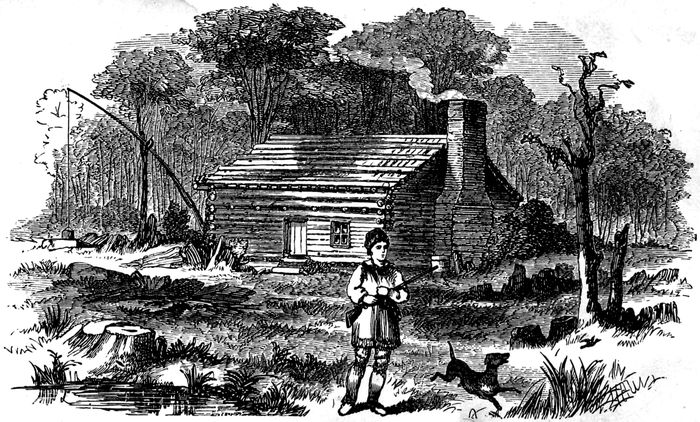
No. 666.
WESTERN SETTLER’S FIRST HOME.
177“It seems to me,” she replied, “the
oldest country God has made; such
riches as these are in the soil all ready
and prepared for the seed of the sower,
only waiting for man’s coming to yield of
its abundance.”
The sun was tinging town and prairie
with his parting beams, and the garden
was already in deep shadow when
Norman and his mother, loaded with
bright and fragrant flowers, returned
home.
CHAPTER XVI. ON THE RAIL.
178
“All the while the swaying cars
Kept rumbling o’er the rail,
And the frequent whistle sent
Shrieks of anguish to the gale;
And the cinders pattered down
On the grimy floor like hail.”
Early, very early the next morning,
the fifth of July, Mrs. Lester was aroused
by the firing of cannon, to celebrate our
national independence. Norman and
Willie had kept the third, by firing off
crackers all day, and winding up with
wheels, Roman candles, and blue lights,
exhibited to an appreciating audience on
the portico in the evening. After breakfast
Norman, his Aunt Clara, and his
mother bade good-by, and got in the
carriage which was to convey them to
Batavia, the spires of which were visible
179from Mr. Clayton’s. It was a pleasant
drive of two miles in the Fox River valley.
The man drove very fast, and they
were sorry to arrive so soon at the place
of their destination, especially when they
were told that they were to wait two
hours for the arrival of the train. The
hackman, who had come for them before
the time, had many demands for the carriage,
for which he charged an extra
price in honor of the holiday. A number
of passengers were waiting for the
train; many of them going to the celebration
at Aurora, a pretty town, all astir
with gaily dressed people, and a procession
marching to the grove where already
a crowd was gathered. It was a most
lovely country, soft rolling prairie, with
its wealth of golden wheat, of waving
corn, of graceful barley, bordered by
rich groves of timber, and dotted here
and there with towns and villages.
At Mendota they left their cars, and
180entered those of the Illinois Central Railroad.
There were several trains there,
and a great number of passengers hurrying
to and fro, and rushing in to dinner.
Norman ran first into one store, and then
into another, to buy some torpedoes, as
he was very anxious to make some noise,
to give vent to his patriotic feeling. He
came back with a large box full, just in
time, for the train was soon in motion.
And the passengers too, for the road was
so rough that the people went dancing up
and down in the most violent manner.
Mrs. Lester asked the conductor if the
road was so rough all the way? No, he
said; they had passed over the worst of
it. And with that hope Mrs. Lester
tried to enjoy the beautiful prairies, and
the noble view of the Illinois River as
seen from the high embankment over
which the road passes.
Norman would like to have seen the
“Starved Rock,” somewhere on this
181river, whither some Indians, pursued by
their enemies, fled for refuge. They
were surrounded, and all escape from the
rock prevented by their encircling foes,
who, day after day, waited for them to
surrender. At length they scaled the
rock, and found the garrison all starved
to death but one squaw, who calmly
awaited the entrance of her enemies.
The Starved Rock, however, was not in
sight, nor was any rock recalling thrilling
legend and heroic story; but another
prospect, not so agreeable, from the rear
of the car near which they were seated—a
long strait road, the rails of which were
rather too much curved to suggest ideas
of safety. “Don’t you think this road
very unsafe?” inquired Mrs. Lester of a
gentleman who was contemplating this
retrospective view of dangers passed.
“Not very, but it might be safer.”
Up and down jumped all that car-load
of passengers, whose faces wore not the
182calmest and brightest expression. Suddenly
there was an explosion that startled
people rather ready to be startled, and
Mrs. Lester, remembering the torpedoes,
turned to Norman, who was looking out
of the rear window, and said reproachfully,
“Norman, how can you do so?”
Every eye was directed toward the
blushing lad, as he earnestly exclaimed,
“Mother, it was not me.”
Returning to his seat he looked for the
torpedoes, which he found had been jolted
off the seat on the floor under his mother’s
feet, and a sudden movement of her
foot had caused the explosion of ten or
twelve of them. “There, mother, it was
you after all,” said Norman, as he gathered
up his remaining torpedoes.
Again they were startled—a prolonged
whistle, and a stoppage of the cars on an
embankment at a distance from any station.
Every head went out of the windows,
and some enterprising passengers
183went out on the platform to learn the cause
of this ominous pause. Again and again
that warning whistle; what did it mean?
At length the matter was explained.
About twenty horses were on the track,
galloping on in front of the locomotive,
which was obliged to pause till they separated
to the right and the left.
Right glad were the party when they
arrived at Bloomington. Mrs. Lester
wished to go to a very handsome hotel,
the photograph of which had been shown
to her on the Grey Eagle by the proprietor
thereof. A large unfinished building
seemed to her very like the photograph
she had seen; but that could not be, as
the photograph must have been taken
from the hotel in its finished, occupied
state, with handsome stores beneath. On
inquiry she found this was the hotel in
question, which stood there, an arrested
monument of western enterprise. They
went to the hotel opposite, and after tea
184some friends of Aunt Clara’s called to see
them, and to ask them to walk.
Bloomington is a large, finely situated
town, on the rising prairie, not far from
the fine groves that mark the course of
Sugar Creek. The president of the Illinois
University (situated in a grove near
the town) walked with them, and took
them to the observatory on the Female
College, where they had a lovely sunset
view of the town, the prairie, and the distant
woods. How cool and refreshing
were those prairie breezes after the intense
heat of the day; but they were warned
by the fading light that it was time to return.
No mountains or hills to prolong
the twilight in these regions. The sun
sinks, and speedily the darkness comes on.
Miss Allen, Aunt Clara’s friend, insisted
upon their coming in to see her. With
kindly hospitality she had sent for several
of Aunt Clara’s friends to meet her; and
while Norman was amused with some fireworks
185in the court-yard, they were refreshed
with cake and ice-cream. Miss
Allen, her brothers, and Mrs. Lester had
very pleasant conversation about some
mutual friends, and thus passed the evening
to an hour rather late for travelers who
were to rise at two o’clock in the morning.
At that early hour they were aroused,
and the omnibus conveyed them to the
station at three o’clock, where they had
the satisfaction of being told that the cars
had stopped above the junction, cause unknown.
Probably they had run off the
track, and they might not arrive before
eight o’clock.
“There is the locomotive that is to take
us,” said a gentleman, pointing to the expectant
iron horse, panting and snorting,
and rushing to and fro, as if impatient at
the delay. “I saw him in the bank on Saturday,
just below here. But he has suffered
no harm from running off the track.”
“Near them stood an engineer with his
186arm in a sling. He had been returning
to his post, as he had been off duty, when
he threw himself forward to rescue a man
who, having missed his footing on the step,
would have been under the wheel of the
car. As it was, his struggles loosened
the footing of his deliverer, who succeeded
in dragging him on the truck, from which
precarious position they were rescued as
soon as the train could be stopped. The
engineer’s arm was badly broken, but
the man whose life he had saved never
came to thank him. “I have no money
to give him, why should I go?” said he to
the conductor, who told him to thank the
man who had periled life and limb to
save him.”
“Men do not risk their lives for
money,” replied the conductor, turning
away from the ungrateful man.
“The prospect looks rather dim,” said
Aunt Clara, the first discouraging word
she had spoken.
187“How calm and quiet she was,” said
Norman, “when we were so frightened
in the rail car.”
The waiting-room of the station-house
was not very comfortable for weary passengers;
Norman established himself on
three chairs, and was soon fast asleep on
his hard bed; nor was he wakened when
his mother slipped her carpet-bag under
his head.
A group near the door was more picturesque.
It was a German family whom
they had seen the day before at the cars,
and who had passed all night at the
station. One little girl lay across a bag,
her head tending toward the floor. The
younger brother was on his knees, resting
his head on a chair, fast asleep;
while near them, her head erect, as if
watching over her goods and chattels, sat
the elder sister, a quaint, prim-looking
girl of thirteen, with a short waist, and a
little shawl pinned round it, and a broad
188flat over her braids of light hair; while
round her were bags, and boxes, and
bundles, an incongruous heap, in which
it was at first somewhat difficult to distinguish
the sleeping children. The little
boy at length, weary of his constrained
position on his knees, had pillowed his
head on his sleeping sister’s foot, which,
by sundry twitches, and a few energetic
kicks, freed itself from the encumbering
weight. But still the children
slept on. The mother was sitting
outside of the door, silent, because none
knew her language. At length a telegram
announced that the cars would be
there at five. The locomotive had been
stopped because the rails were slippery.
The early twilight brightened into day,
the train arrived, the passengers stepped
in, and a very short time brought Norman,
his mother and aunt to their point of
destination; a few houses had been dropped
down on the prairie, as the nucleus
189of a town; not very promising as a resting-place.
Soon, however, a buggy and
a wagon drove up for the travelers, who,
after a short drive, were welcomed by
their relatives.
CHAPTER XVII. THE PRAIRIES.
190
“The wondrous, beautiful prairies,
Billowy bays of grass, ever rolling in shadow and sunshine,
Bright with luxuriant clusters of roses and purple amorphas;
And over all is the sky, the clear and crystalline heaven,
Like the protecting hands of God inverted above them.”
It looked quite homelike; the house
shaded by tall trees, the garden, the
hedge of Osage orange shutting out the
wide expanse of prairie. The house was
in the corner of Tazewell county; the
barn in McLean, and the greater part
of the farm in a third county. Norman
found two new aunts to know and love,
and a tall cousin of six feet three.
It was not long before he became acquainted
with two little girls of ten and
191twelve, cousins, who lived on a farm near,
with whom he had many pleasant hours
of play. They had, too, a great deal to
talk over of their journings in the West,
for these little girls had always before
lived in a New England home. They
had seen a great many Indians, painted
in all their bravery, in Wisconsin. They
had seen a squaw, with her papoose strapped
on her back, riding on a small Indian
pony, with a child before and a child
behind.
“This, mother,” said Norman, “is pleasanter
than all; one day on a prairie is
worth ten days in town.” He was up
early in the morning to see the horses
watered before they were sent off to the
field. There were more then twenty of
them, and Norman’s cousin, Justin, selected
the handsomest colt on the farm, and
gave it to Norman for his own. Norman
was enchanted. He took an ear of corn,
and Prince followed him about, eating it
192from his hand. Even after Prince had
gone down into the field, he followed
Norman and the ear of corn home.
“Mother, look at my colt,” said Norman
in triumph; “how am I to get him
home?” There were various plans discussed,
as the one idea took possession of
his mind, but no satisfactory conclusions
were arrived at. The glow of delight
somewhat faded away. “I really do not
know what good my colt is going to do
me,” said Norman, despondingly; “I
cannot ride him here, and I cannot take
him home.”
His face brightened, however, when
David brought up a horse for him to ride.
He had never rode before but once, when
the pony threw him over his head; but
he said this was the sort of riding he
would like, to charge over the prairies.
He did ride off several miles over the
prairies by himself, and then he rode four
miles with his Aunt Clara.
193It was the time of harvest, and Norman
loved to watch the mowing machine
as it so rapidly cut down the tall grass,
and the hay-making, and the tossing it
into the great hay-stack. But what most
interested him was to watch the progress
of the great header, with its three attendant
wagons, as it loomed up so grandly
in the harvest field. Three horses urged
onward the machine, which cut off the
heads of the wheat and threw it on a
platform, whence it was taken up in an
elevator and received into a wagon, which
accompanied the gigantic machine till it
was loaded, and then, giving place to
another, drove to the great stack with its
burden. This machine requires three attendant
wagons and six men, who thus
cut down as much wheat as fifteen men
can do in the ordinary way, and stack
it to boot. These mowing and reaping
machines seem especially intended for
the extensive level grain fields of Illinois,
194which would look in vain for reapers and
mowers with the old sickle and scythe.
Something is lost however in picturesque
effect, as was most manifest in the field
next to that which the great header was
so rapidly despoiling of its riches. This
field was dotted over with the graceful
sheaves of wheat, while a number of men
were engaged in the work of binding
and stacking them together.
Norman had watched too the ploughman,
who, with a cultivator passing between
the shining corn, did the work
more laboriously done at the East by
hoeing.
He liked to watch the herds of cattle
and sheep feeding on the prairies; great
herds, for everything was on a great scale
on these western farms.
But better even than this were the stories
his cousin Justin told him about his
boyish days. He was twenty-three years
old, and he had lived on the prairie sixteen
195years. It used to be the custom, he
said, to plant a flagstaff in some central
position, and invite horsemen to leave the
groves all around and ride to this point
at a certain hour. As the hour approached
horsemen would be seen issuing
from all the groves, riding rapidly
onward, driving before them wolves,
and the timid deer, till a dense ring of
three or four hundred horsemen inclosing
the frightened animals who were then
dispatched by the clubs with which the
men were armed. Sometimes the desperate
wolves broke through the ring
where it was weakest, and then there was
waving of hats, and cheering, and galloping
after the animals, and all was wild
uproar. “I can remember” said he “the
charm these wolf-hunts had for me when
I was a boy of twelve; how I armed myself
with my club, mounted my spirited
horse, and galloped off to the stirring
scene.”
196“My cousin Walter,” continued Justin,
“liked to hunt the wolf alone. One day
he encountered a prairie wolf, whom he
pursued till the wolf plunged into the
stream to escape him. Seizing him by
the tail, he cut the strings of his hind
legs, during which operation the wolf bit
his foot, leaving the mark of his long
teeth through his boot. The disabled
wolf, however, as it emerged from the
water, made but slow progress, and Walter,
disengaging his stirrups, gave him a
blow in the forehead which killed him,
and stripping off his skin, he returned
home with his trophy, afterward to do
good service in the form of a muff for his
sister.”
Then he told of the prairie fires that
came every year. To be prepared for the
approach of this fiery invader they
ploughed several furrows near the fence
of their farm, and then several furrows at
the distance of about four rods, and to the
197grass on that interval they set fire, that
this bared strip might oppose a barrier to
the flames. Onward they would come
when the wind was from the same quarter,
with the speed of a locomotive,
crackling, flashing, leaping high in the
air, rolling great waves of lurid light onward
with fierce rapidity. They would
watch the on-coming of this sheeted
flame, terrible in its fiery glare, crimsoning
the heavens with its ruddy glow,
consuming everything in its path, sending
up fiery messengers into the sky,
and wonder whether it would be possible
for them to escape. “It was a magnificent
sight,” continued he; “never do I
expect to see anything so terrible in its
sublimity and beauty. Now that the
prairies are covered over with the habitations
of men, we have no more prairie
fires, and no more wolf hunts. No more
fierce pursuer did the prairie wolf find
than this untiring adversary of flame,
198driving before it the terrified wolves and
the gentle deer, flying for life till they
reached some timber where the fire
would be arrested.”
Norman was very sorry when the day
came for him to leave. He was sorry to
leave his aunts and cousins, to whom he
had become very much attached; he was
sorry to leave his colt, and to give up his
pleasant rides on horseback. The day
they were to leave they were to dine with
another aunt of Norman’s, and Norman,
accompanied by David, rode there on
horseback, while his cousin Justin was to
drive his mother in his buggy. She had
very much enjoyed her daily drives over
the prairies, enamelled with flowers, of
every new variety of which Justin stopped
to gather for her, and which she
prized as memorials of those pleasant
hours.
At his aunt’s Norman saw the picture
of his Cousin Walter—the hero of the
199wolf story—a face full of intelligence and
sweetness, a slender form. He was a
brilliant youth, with high hopes and aspirations,
when, in the midst of his collegiate
course, he was stricken down by
cholera, and in a few days was numbered
with the dead.
After dinner Norman mounted his
horse, and, attended by David, who rode
beautifully, he took his way toward the
station. His mother and his cousin started
about half an hour afterward, and pursued
their winding way. The road on
the prairies is continually changing; as
the new farms are fenced, the owners divert
the road from their fields to the exterior
of their farms. One memorable
place Mrs. Lester had passed on her drive
to the village the evening before. It was
a slough where, in the spring, a pair of
horses were so completely buried that it
was necessary to employ oxen to drag
them out by the head. One field, on their
200way to the station, looked as if it were
covered with pansies, the rather coarse
flowers with which it was filled being
softened by distance into this likeness.
They drove across a grassy field that
looked as if it must at some time have
been the bed of a great river, so strikingly
did the woodlands resemble the banks.
Indeed, one is often struck, in looking out
upon the prairies, with the resemblance
to a sea view. At the margin there will
frequently be a mist, such as bounds the
view on the water; the groves of timber
jut out into the prairie like headlands,
and the eye often follows these indentations
as if tracing the shore of a vast lake.
Proofs are not wanting to establish the fact
that Illinois was once the bed of a great
lake, probably an expansion of the Mississippi,
till it broke though on its headlong
course to the Gulf of Mexico. The prairie
breezes come every day to moderate the
intense heat of summer, and sweep over
201these vast plains as on the bosom of a
great inland sea. Those who build in the
timber lose these refreshing winds.
Mrs. Lester was somewhat troubled on
arriving at the station to find that Norman
was not there, though he had left so
long before her, and she looked rather
anxiously over the prairie for some signs of
his coming. The boys were not visible, and
she was contemplating the prospect of returning
to the kind friends whom she had
left when they came in sight. She waved
her handkerchief to them to hasten, as the
train was due in five minutes. Just in
time; the train was in sight as Norman
stepped on the platform; and as Justin
accompanied them into the cars to find
them seats, Mrs. Lester hurried him off,
lest he should be taken on, so short was
the pause at the station.
CHAPTER XVIII. CHICAGO, AND THE RIDE THITHER.
202
Chicago! thou shalt shine in verse,
As my adopted pet;
Thou newest slice of this New World,
Save what is newer yet.
Thy structures seem of yesterday,
And shine like scenery in the play
Just pushed upon the stage.—F. G. H.
The ride was very agreeable: boundless
views of rolling prairie, that looked
like English park scenery; scattered groves,
pretty farm houses, thriving villages, afforded
a constant succession of agreeable
objects. Far to the west was seen a
threatening cloud, at length descending in
torrents of rain to the westward, while
the sudden, violent wind that swept across
the track of the cars was succeeded by
dashes of rain. A curious optical illusion
was produced by the sun shining
from behind a dark cloud, and throwing
203lines of light across the prairie, producing
the effect of a fort, and of long rows of
white buildings. The sun was setting behind
clouds of crimson and gold when the
train arrived at Joliet, and stopped twenty
minutes for refreshments.
Joliet, named in honor of the citizen of
Quebec who first trod the soil of Iowa,
is a handsome town, ornamented with
numerous spires. Here are fine quarries
of the beautiful cream-colored stone used
so much in Chicago, and transported
thither by a canal running over the low
wet prairies parallel with the railroad.
While waiting till the train from Chicago
should pass them, Norman had a
fine view of some splendid rockets in
honor of the arrival of a noted politician
in the city.
At the station they found their kind
friend, Mr. Percy, and he drove them to
his house very rapidly. Late as it was,
Mrs. Percy and Miss Ray were at the
204door to welcome them, and, after a few
words of greeting, to show them to their
rooms.
The next morning Norman went fishing
with Charley Percy, and while he
was gone his Uncle and Aunt Lester
came in Mrs. Hunter’s carriage to take
them for a drive. Mrs. Hunter took them to
her house, where they had iced lemonade;
and Mrs. Lester returned, promising to
take tea and stay all night with Mr. and
Mrs. Lester at her brother’s, where they
were staying. This brother was a minister,
and his home had an atmosphere of
taste and refinement and piety. Choice
books, in every room, invited perusal;
illustrated works attracted the eye; a
canary warbled its sweet notes, especially
when the piano was touched; and the
mistress of the house sang the songs her
husband had written. Most pleasantly
did every object harmonize with the repose
of the Sabbath. The new Methodist
205church edifice was in the next street,
and the services were held for the last
time in the lecture-room, as on next
Thursday the church was to be dedicated
to the worship of God. At the love-feast
in the afternoon there was an earnest expression
of gratitude to God for the
abundant mercies he had showered upon
them during the past winter, and for the
prosperity that had attended their efforts
to erect a house to his service.
Mrs. Percy sent the carriage for them
in the afternoon, and they found the family
assembled in the parlor, singing
sacred songs. Each one had the music
of the hymns, and the hour before tea
thus passed most pleasantly. In the evening
Norman and his mother went with
Mr. and Mrs. Percy to church, and heard
an excellent sermon from Dr. Rice, on
the breast-plate of faith and love, and the
helmet, the hope of salvation. “How
much reason have we for thankfulness,”
206said Mrs. Lester to Norman in the evening,
“that everywhere we have found
Christian homes; everywhere family
prayer, and a love for God’s house and
service. How many such privileges
have we enjoyed!”
The next morning Dr. Davis called to
invite them to pay him a visit; Norman
went with Albert Davis, and a few hours
afterward the doctor called in his carriage
for Mrs. Lester. Norman’s uncle
and aunt were in the carriage, and when
they arrived at the doctor’s country
place, they found Norman lying on the
grass, contemplating Albert’s pony.
Norman found some very interesting
books filled with large colored plates of
birds, and plants, and Indians. He looked
at these portraits of the red men, taken by
Mr. Catlin, and read sketches of their
history with great interest
In the afternoon Dr. Davis drove them
to see the pretty grounds of a gentleman
207in the neighborhood, and to the Lake
View House, where they drank some
iced lemonade, and wandered on the
beach. It seemed very much like the
sea-shore, the great waves rolling in and
dashing against the sand, and, a little below,
the hulk of a vessel blown ashore
and stranded in the recent storm. Such
proofs of the power of old Michigan,
when its waves rise up in their might,
may be seen all along its shores, unprovided
as they are with harbors for vessels
to take refuge in at the approach of the
tempest.
CHAPTER XIX. ON THE LAKES.
208
“On the shores of Gitche Gumee,
Westward by the Big-Sea Water.
Can it be the sun descending,
Sinking down into the water?
All the sky is stain’d with purple,
All the water flush’d with crimson!”
Lake Superior, the mighty lake, fed by
two hundred rivers and streams, plunging
down falls and rapids to mingle their
waters with those of this inland ocean;
with its stern rocky walls, and overhanging
crags; with its rich mines of copper,
silver, and iron; with its abundant fisheries
of trout, pickerel, pike, carp, black
fish, and white fish; and with its grand
pictured rocks, presenting columns, towers,
arches, and ruins, and hollowed out
into vast caverns, echoing with tremendous
roar to the dash of the waves. An excursion
209proposed to this lake offered great
attractions, and Mrs. Lester was tempted
to go on the fine steamer that was to take
a party thither.
Norman supplied himself with trolling-hook
and fishing tackle, as the steamer
was to stop frequently to allow the passengers
to fish in those cold, clear, transparent
waters. Charley Percy and his
friend, Alfred Scarborough, somewhat
older than himself, were going in the
steamer to Collingwood, on their way to
Niagara; so in the evening they went to
the boat, accompanied by Mr. and Mrs.
Percy, and Alfred’s father and mother.
The saloon was gayly lighted up, the band
playing; the state-rooms were very comfortable,
and the beginning of the voyage
at least was very promising.
Good-by was said to their kind friends,
and the steamer moved slowly down the
river, past the warehouses, and through
the bridges, in the darkness, amid the
210gleaming lights here and there, and to
the sound of music, and it all seemed
very dream-like. At length they reached
the lake, and the regular lines of light on
Michigan Avenue sparkled as they sailed
away. It was very late, near eleven
o’clock, and the travelers soon sought the
repose of their berths. Mrs. Lester only
wakened in the morning in time to see
the graceful spires of Racine, sleeping
in the early morning light.
About ten o’clock they sailed into the
harbor of Milwaukee, built on both sides
of the Milwaukee River, on a high bluff
overlooking the lake. Most of the town
is built of the Milwaukee brick, which is
of a light straw-color; and though this
brick is a very fine building material, yet
it harmonizes too much with the color of
the sandy streets and sandy bluff to give
a fine effect to the town. A stronger
contrast would be better. There are some
very fine buildings; a hotel of beautiful
211and elaborate design, and a custom-house
of fine architecture, built of white stone.
Until one o’clock “The Planet” remained
at Milwaukee, awaiting the arrival
of a party who wished to go on the
excursion, and who had telegraphed them
from Chicago, and this delay enabled the
passengers to ride and walk about the
town.
A sad sight met the eyes of those who
remained on the boat. The steamboat
Traveler was just passing them, on its
way out of the harbor, when the mate,
who had given some orders not followed
to his satisfaction, let himself down from
the upper deck, by catching hold of the
middle rail of the balustrade. The rail
broke, and the man was thrown into the
water, probably receiving some mortal
blow on the way, as he never rose. Truly
there is but a step between us and death.
In that calm water, on that still, sunny
day, the hardy seaman who had braved
212death in the darkness and tempest, found
a grave.
It was very warm, and all were glad
when the steamer was once more in motion,
and the fresh breezes of the lake
came with their cooling for heated brows.
It was rather too fresh after a while, and
there was more motion than was consistent
with the enjoyment of some of the
passengers. There was a shower, too,
dimpling the lake, and driving most of the
people into the saloon.
Norman had his first experience of seasickness,
and retiring to his berth at five
o’clock, he slept there till the morning.
His mother was very sorry to have him
miss that magnificent sunset on Lake
Michigan. The rain had passed away,
and a light breeze crisped the waters.
The boat had made its last landing, and
the little town they were leaving was glorified
by its back ground of amber, deepening
into a brilliant orange. Every house
213and tree came out with marvelous distinctness,
as the sun dipped behind the
western horizon, and painted, after he had
passed from view, a gorgeous picture as
his parting gift—a gift not to be lost with
the fleeting hour, or to be confounded
with other gifts from the same source.
It was marvelous in its beauty. Clouds
of rich crimson, fading into brown, were
festooned on the serene radiance of the
clear sky. A wealth of celestial drapery
seemed drawn aside to reveal the far-off
glory. As these kindling hues faded
away, a cloud nearer the horizon assumed
the aspect of a woodland scene receding
from the shore of the lake. There were
the headlands jutting into the water, the
nodding groves, the bays running into
the land. It was difficult to make all
this extensive country only cloud-land,
and the little company at the stern of the
boat gazed upon it till the gathering
darkness hid it from view.
214It was a night of glorious shows; about
ten o’clock the northern lights threw up
their quivering brilliant scintillations far
up into the heavens, glorifying the north
with a bow of flickering beauty, even as
the west had been glorified with masses
of magnificent clouds. The lake, however,
was almost too rough to allow many
spectators to enjoy this glimpse of northern
splendors, and most of the passengers
sought the safe security of their berths.
Early in the morning Norman was
called by his mother to come out on deck
and see the Manitou Islands, with their
sandy bluffs and crown of green trees.
Norman looked at them a long time in
silence by himself. When he came to his
mother he said: “I feel almost as if I
had been looking at the Holy Land;
those islands were the holy land to
the Indians, the dwelling-place of the
Great Spirit, not to be approached by
mortals.”
215“It made me very fanciful to look at
them,” continued Norman. “The great
cloud of smoke that our steamer is sending
toward the island, and that now hovers
over it, seemed to me an oblation to
the great Manitou of the Indians.”
There was a visitor from those islands;
a pretty little bird that lighted on the
ropes, and jumped about the deck till
frightened away.
They passed Beaver Island, once inhabited
by the Mormons, who, the captain
said, seemed a very quiet, inoffensive
people when they lived there. He said
they had been very kind in assisting him
once when he ran ashore near their
island.
After breakfast Norman, his mother,
and Alfred Scarborough went to the hurricane
deck. Soon a gentleman came
up, and walked vigorously up and down,
giving at each turn some good advice to
Norman. He was an English clergyman,
216hale and fresh complexioned, with a
bright eye, and firm, quick step, though
he was seventy years of age. “I have
come out,” he said, “to get some fresh
air before breakfast. There are not many
young men that can run up a mountain
like me. Many young men only smoke,
and sleep, and eat; they never think of
taking vigorous exercise. They will
never be able to walk as I do at my
age.
“Walk, my boy,” said he, putting his
hand on Norman’s shoulder “run, leap,
and you will grow strong. Those are the
Fox Islands, are they? Well, I must go
down to my breakfast, they will not make
much on me; I can eat a pound more
than I could have when I came up.”
And thus ending his walk and sentences
together, he went down stairs.
It was a lovely morning; the cool
breeze was exhilarating, and the morning
passed quickly away as they glided
217through the straits that connect Lake
Michigan and Lake Huron; the straits so
long known under the formidable name
of the Straits of Michilimackinac, now
abridged to Mackinaw.
CHAPTER XX. MACKINAW AND LAKE HURON.
218
In our wake there follow’d, white as flakes of snow,
Seven adventurous sea-gulls, floating to and fro;
Diving for the bounty of the bread we threw,
Dipping, curving, swerving—fishing as they flew.
Just after dinner they reached Mackinaw,
where a number of the excursionists
were to remain until the boat returned
from Collingwood. The captain said they
would remain at Mackinaw time enough
to visit the fort.
Ready at the gangway as the boat
touched the shore, Mrs. Lester, Norman,
with a number of others, rushed on shore,
scarcely pausing to look through the clear,
transparent water at the white pebbles
of the beach. Up the hill to the fort, the
sun shining down on them with fervent
219heat, while his rays were reflected from
the white walls. It was, however, a short,
direct road, and the lovely view fully repaid
them for the momentary heat. A
peaceful scene lay beneath them; the
quiet little village of Mackinaw, with its
humble dwellings; the beach, sweeping
round in the form of a crescent, and the
placid waters of Lake Huron beyond,
made a pretty picture; the sentinel
walking to and fro on his post; the heavy
pieces of artillery, and piles of shot and
shell. Soldiers, grouped here and there,
greatly interested Norman. The descent
was very steep, and Norman in
one minute found himself at the foot of
the walled-in road which they had ascended.
On arriving at the boat they
found the men engaged in putting on
shore sheep and cattle for the support of
the soldiers, whose provision is thus
brought to them. Taking advantage of
the delay, Norman rushed on shore to buy
220some birch bark boxes, filled with maple
sugar, and embroidered in porcupine
quills. As he showed them to his mother
on his return, she ventured up the street
to buy some Indian work, emboldened by
the sight of the captain walking before
her.
A group of Indian women, in their
own dress, with blue cloth blankets and
leggings, attracted their attention as they
entered the shop. They were Ottawas,
and one of them had a face of great
beauty. It was oval: her features were
fine, and there was a pensive expression,
a look of sadness on her face, that made
her very interesting. Mrs. Lester wanted
to look at that face of sorrowful meaning,
and learn something of her history; but
the sight of the captain, on his return to
the boat, hastened her movements, and
hastily selecting some fans and boxes of
maple sugar, with an embroidered canoe
of birch bark, she hurried away.
221Nine more sheep to land; there would
have been a few moments to spare for a
longer perusal of the face of that Ottawa
maiden, but it was safe to come when
they did, and not run the risk of being
left. And so they were once more in
motion, with hastily gathered memories
of Mackinaw, its town and fort.
“Norman,” said Mrs. Lester, “did you
ever hear of a famous game of ball at
Mackinaw?”
“No, mother; please tell me about it.”
“It was in June. A number of Indians
had arrived near the fort, apparently to
trade, and a day was appointed for a game
of ball, of which they are very fond.
Stakes were planted, and the game, in
playing which the great object is to keep
the ball beyond the adversary’s goal, began.
The Indians uttered loud cries in
the wild excitement of the game, and the
commandant of the fort and his lieutenant
stood outside of the gate to watch
222them. The ball was tossed nearer and
nearer the fort, and the excited crowd of
Indians ran and leaped after it, when suddenly
they rushed upon the two officers at
the gate, and imprisoned them. At once
they joined some Indians who had come
into the fort under pretense of trading, and
imprisoned the whole garrison, seventeen
of whom they put to death.
“This was the beginning of Pontiac’s
war.”
“I never heard of this game of ball,”
said Norman; “but I can tell as good a
story of a pair of moccasins. May I?”
“Certainly,” said his mother. “I would
like to hear it.”
“Well, mother, I believe this was at
the beginning of Pontiac’s war too. An
Indian woman had made some moccasins
for Major Gladstone, who commanded the
fort at Detroit. They were made of a
curious elk-skin that he valued very much.
He paid her for them, and gave her the
223rest of the skin, asking her to make another
pair for a friend of his. The squaw seemed
unwilling to go home, and the major sent
for her, and asked her what she was waiting
for. She said she did not like to take
the elk-skin that he thought so much of,
as she could not make another pair of
moccasins. He asked her why she could
not make them. At first she would not
tell; but then she said he had been very
good to her, and she would tell him the
secret, that she might save his life.
“The Indians, who had asked permission
to visit the fort the next day, that they
might present the calumet to Major
Gladstone, were coming with their guns
cut off, that they might hide them under
their blankets; then, when Pontiac presented
the calumet in some peculiar way, they
were to fire upon the officers.
“The soldiers were stationed outside of
the room where the council was to be
held; the officers were armed, and when
224Pontiac was about to present the calumet,
the officers partially drew their swords
from their scabbards, and the clank of the
soldiers’ arms was heard outside. Pontiac
turned pale, and presented the calumet
without the preconcerted signal.
“Major Gladstone then stepped up to one
of the Indians, pulled aside his blanket,
and revealed the gun cut short, just as the
squaw had said. He accused Pontiac
of treachery, but said that as he had promised
them a safe audience, they might
go out of the town unharmed.”
“Perhaps if he had kept them prisoners,”
said Mrs. Lester, “he might have prevented
the war that ensued.”
How beautiful the island looked in its
commanding position! The high land in
the center, with its lofty forests rising like
a curve. How much they would have
enjoyed the day that had been promised
them at Mackinaw to visit the old fort on
its central heights, the arched rock, and
225the wild solitudes of this picturesque
region. The bold rock known as the
Lover’s Leap stood out finely from the
greenwood behind, and Norman listened
to its story told him by Mr. Bard. An
Indian maiden, who had refused to marry
a brave who loved her very much, was
one day seated on this lofty rock, looking
out on the grand view beneath her, when
she heard a stealthy step, and her rejected
lover stood by her side. The hour, the
scene were propitious to his suit, and again
it was urged with all the warmth of earnest
affection. The maiden listened, hesitated,
and at length told him that if he
would leap off that cliff she would marry
him. The Indian raised his tall form to
its utmost height, looked at the sea, the
sky, and then at the beautiful face for
which he periled the sight of both, and
leaped from the giddy verge. Strange to
say, without loss of life or limb, with the
agility and skill of a well-trained Indian,
226he took the fearful leap, which was broken
by the branches of trees and shrubbery
beneath. And thus he won his Indian
bride.
Mr. Bard, who had come to the country
when there were but two houses in Chicago
out of the fort, had been familiar with
it when the Indian tribes roved at will
over the vast prairies of Illinois. He
spoke four of their languages, and could
sing their songs. He had been twice cast
away on the shores of Lake Michigan, and
he could tell many a tale of wild adventure.
More wonderful than any fairy tale
was the aspect of the cultivated farms,
the neat farm-houses, the numerous villages
and towns, with their spires pointing
skyward, the great city that had all grown
up in a few years beneath his eye. And
those red men, with whom he had been
so familiarly associated, where had they
gone? How rapidly those western regions
are losing the element of the picturesque
227that the Indian with his bark canoe and
his wigwam give to their lakes and rivers,
with their wooded shores.
He told Norman of a most curious
scene he had once witnessed. An Indian
had a very handsome pony, which another
Indian was anxious to purchase, but which
he resolutely refused to sell. They were
both drinking, when the owner of the
pony, finding his stock of whisky exhausted,
asked the other to give or sell him a
mouthful from his remaining bottle. He
at first declined, but, on being entreated,
said that he would give him a mouthful
of whisky for the pony. The Indian at
once consented to give up his favorite
horse for the momentary gratification, and
putting his lips to those which had recently
imbibed the whisky, he received the
stipulated mouthful.
It was a repetition, in these western
wilds, of the old Hebrew story, the sacrifice
of a birthright by the hungry hunter
228for the mess of pottage given him by the
plain man dwelling in tents. Well, were
this the solitary repetition! but, alas! Esaus
are found in all our borders, giving up, for
the indulgence of present clamorous desires,
an inheritance more glorious than
any to which the first-born of earth could
ever lay claim.
The captain asked Norman if he had
seen the northern lights the evening
before. Norman said that he was asleep,
and asked the captain if he frequently saw
them.
“O yes,” he replied, “they are very
brilliant in these high latitudes. The Indians
think they are the dance of the
dead. One evening I came on deck, and
looking up at that pole I saw a bird just
resting on the gilt ball that surmounts it.
I seemed to hear the soft flutter of her
wings. I watched it for some time, and
then went in and called the engineer to
look at it. He too saw it, and when I
229turned to look at the boat every line and
point seemed luminous. He was showing
it to some ladies, and pointing toward
it a light blue flame streamed from
his finger. Everything was highly
charged with electricity, which produced
the semblance of the bird on the flagstaff
on the bow. I never saw anything
like it.”
“How long did it last?” asked Norman.
“About two hours.”
Norman then asked him about Lake
Superior, and he told him of the wonderful
beauty of the pictured rocks, of the
castles and temples jutting out of their
bold front, of their arched caverns; that
those majestic rocks, three hundred feet
high, extend ten miles, and the Indians
passed them with awful reverence, thinking
that they were the dwelling-place of
the great Manitou.
The captain spoke of the sudden storms
so violent in this “Big Sea Water” in the
230autumn, and showed Norman a very beautiful
gold watch that had been presented
to him by the citizens of Superior City, in
honor of his courage, skill, and fidelity
when his vessel was exposed to a severe
storm, and he brought her safely through
the snow, and ice, and tempest. On the
case was engraved a picture of the “Lady
Elgin,” and on the heavy gold chain, secured
by an anchor to his buttonhole,
were his initials, in massive gold
letters.
The captain showed Norman the straits
that led up into Lake Superior, and he regretted
his mother had given up the excursion
around the lake. She concluded that
as they had been gone two months from
home, it would not be well to set out on
an excursion that would detain them ten
or twelve days longer, and expose them,
moreover, to traveling on the Sabbath.
The home prospect looked so bright, however,
that they did not regret very much
231the loss of the sight of the prairies and
rocks, and all the desolate glories of this
great lake.
“Norman,” said his mother, “just think
of the courage it must have required when,
more than two hundred years ago, two
French missionaries sailed over these
lonely lakes. They were seventeen days
in a light bark canoe. They sailed past
the pretty islands we shall soon see in
Georgian Bay, and over the clear waters
upon which we are now sailing, up the
river St. Mary, which the captain showed
you, which leads to Lake Superior, and
there, at the Sault St. Marie, they told the
Indians about Jesus:
“‘A birch canoe with, paddles,
Rising, sinking on the water,
Dripping, flashing in the sunshine,
And within it came a people
From the distant land of Wabrun,
From the farthest realms of morning
Came the black-robe chief, the prophet,
He the priest of prayer; the pale-face
With his guides and his companions.’”
232A lady showed Norman a picture of
the rapids at the Sault St. Marie, with a
number of Indians in their canoes; and
the captain said they would paddle their
canoes up the rapids, and then throwing
their nets in the water as they came
down, would catch the fish going up the
stream.
After tea they seated themselves in the
stern of the vessel, and looked at her track
far over the lake. The air was cool and
exhilarating, and it was with devout gratitude
to God for the wonderful display of
his mighty works, and for his abundant
blessings, that some of the company gazed
upon the serene glory of the sunsetting.
It was not gorgeous, as was the sunset on
Lake Michigan, with clouds of purple and
crimson, but slowly, slowly the shining
orb dipped behind the waters. The evening
star hung trembling in the sky, faintly
shining out from that region of pale gold;
while the moon, high in the western
233heavens, promised for many hours her
silvery light.
Norman brought out his trolling-hook,
that he might have the pleasure of throwing
it into Lake Huron, as he was denied
that of fishing in Lake Superior. He let
it out at the end of a long and strong
fishing line, and amused himself watching
it bounce out of the water, and feeling the
twitches it gave his hand as the boat
moved rapidly onward. A lady, who sat
near, was very much amused at the stout
resistance of the waves. At length Norman
drew in his line, and lo! and behold
the hook was gone. The action of the
waves had worn away the stout cord,
made still stronger by being wound around
with thread.
“There,” said Norman, “I have lost
the hook which cost me twenty-five cents.”
“I think it has given us twenty-five
cents’ worth of pleasure,” said the lady,
who had been watching the dancing line.
234“And you have the honor of having
lost your hook in the clear waters of Lake
Huron,” added his mother. Norman was
meanwhile tying to the end of his line the
little board on which the line had been
wound, and he threw that in the water
in place of the hook. This was a more
stirring pastime. The board offered so
much stronger resistance to the waves,
that Norman had to wind the line several
times around his hand to retain his hold.
At one moment the jerk was so violent,
that the cord drew the boy toward the
low balustrade, over which he might
have easily gone, but for the interposing
arms of the lady and his mother, at once
thrown round him. There was a start
among the little company as they perceived
the boy’s danger, and Mrs. Lester
told Norman he had now better draw in
his line.
A new entertainment succeeded. Norman
had been watching a sea-gull that
235had been following directly in the track
of their vessel for many miles long before
sunset; those untiring wings of snowy
white had borne the graceful bird onward,
and ever and anon she made a circling
sweep, and rested a while on the bosom of
the water.
“Norman,” said Mrs. Bard, “you go
to the pantry, and ask for some pieces of
bread, and throw them in the water, and
you will soon have a flock of sea-gulls
following you.”
Norman waited not a second bidding,
and soon came back with some rolls and
pieces of bread. He threw some in, and
the gull did not see them. He then
waited till the bird came quite near the
vessel, and threw it up toward her. Then
he had the satisfaction of seeing the gull
slowly circle round and round, till it picked
up the morsel of bread. In a few minutes
another gull came, and then another, and
then another, till six white birds, on rapid
236wing, were hovering over the vessel’s
track, and picking up the bread cast upon
the waters.
Norman’s delight knew no bounds. It
is pleasant to feed chickens in a barn-yard;
but what is that compared to feeding
gulls on Lake Huron, and seeing them
wing their flight at your call through the
trackless solitudes of air. He was sorry
when the darkness prevented the sea-gulls
from seeing the pieces of bread, and they
“Wing’d their way to far-off islands,
To their nests among the rushes.”
The evening star soon set, and the moon
was left pale empress of the sky. How
glorious was the path of silvery light she
threw across the water. Sweet strains of
music sounded from the band, and the
eye, following that radiant pathway, would
see in it now a silvery cascade, and now
a shining road to a niche, in which hung
the moon, the crescent lamp of night. It
was a sweet conclusion to a day rich in
enjoyment. Sea, sky, and air had brought
their tribute; and the heart of man had
rejoiced, as the eye took in this wealth
of beauty. What suitable expression those
feelings found in the language of the nineteenth
Psalm!
237
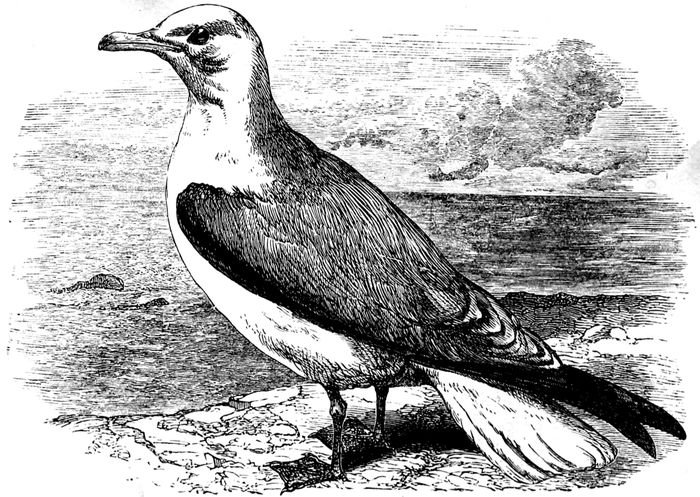
239“The heavens declare the glory of God,
And the firmament showeth his handy work.
Day unto day uttereth speech,
And night unto night showeth knowledge.
There is no speech nor language
Where their voice is not heard.
Their line is gone out through all the earth,
And their words to the end of the world.”
CHAPTER XXI. COLLINGWOOD.
240
“Forests burned for clearing, to spare the woodman’s stroke,
Buttonwood and chestnut, and ash, and giant oak.”
A bright band of light clearly defined
the eastern horizon, and heralded the approach
of the sun. A steamer, making its
way along the shore, stood out with great
distinctness in the clear atmosphere. They
were in Georgian Bay, dotted with pretty
islands, and near the southwestern shore,
deeply indented and covered with timber.
“There are our friends, the sea-gulls,”
exclaimed Norman. Yes, there they
were—
“The hungry sea-gulls
Came back from the reedy islands,
Clamorous for the morning banquet,”
their white wings glancing in the sunlight.
At length Collingwood was visible,
241a stone light-house, on an island, passed,
then another wooden light-house, and
they were in the harbor.
Norman saw two wigwams among the
trees, and a “dug-out” with four or five
Indians in it.
The train had left twenty minutes before
the smoke of the Planet was seen,
and a telegram was sent to Toronto requesting
a special train, which it was
thought would be granted. The passengers
were all seated in the cars, the locomotive
had its steam up, when a telegram
came to say that there could be no train
before four o’clock.
Collingwood is a collection of unpainted
houses built in the sand, most dreary
and uninviting in its aspect. Norman
and his mother, and Alfred Scarborough,
walked through its streets. The stores
are shaded by evergreens, stuck in the
ground, to afford a temporary shade.
They went into several stores, to buy some
242Indian things, but there was no one in the
store to sell them, and after waiting
a while they were obliged to leave. At
length Mrs. Lester found some pretty
boxes, worked with porcupine quills, and
Norman bought an Indian battle-axe.
After wandering a while on the shores of
the lake, looking down into its clear transparent
waters, and gathering some wild
flowers, they returned to the boat, where
they found the other passengers. The
view of the harbor of Collingwood was
very pretty, the waters were blue and
beautiful, and the breezes cool and
bracing.
Norman watched with great interest a
race between a little sloop and schooner,
round the light-house. The wind was so
fresh that the vessels leaned very far
over, and seemed in some danger of being
capsized.
While the train was coming slowly
up from the pier to the station, where
243the passengers awaited it, a gentleman,
with a baby in his arms, was walking on
the track. The English clergyman rushed
forward before it, waving his umbrella
and crying, “Off, man, off the track, or
in one moment you will be crushed to
atoms.”
Again they were seated in the cars.
“What beautiful spikes of purple flowers,”
exclaimed Mrs. Lester, “and close by
the station. I wish we had seen them.”
“And those brilliant red flowers,” said
Norman, “Did you ever see anything
prettier?”
“Do you think they are flowers or berries”
asked his mother; “we go so fast
that I cannot tell which they are.”
At a station where they stopped, a gentleman
got out and gathered some of
these red berries, handing them to Mrs.
Lester through the window.
“Red elderberries,” said Mrs. Lester;
“very pretty, but not the gorgeous flowers
244we thought them; we cannot press
these.”
The road lay through timber, and the
stations were groups of unpainted houses
in the clearings. Felled trees and blackened
stumps met the eye in every direction.
At a station near Lake Simcoe the
train stopped for two or three minutes,
and Norman and his mother rushed to
an opening, where they had a lovely view
of the pretty sheet of water.
A longer view they had, though not
so lovely, when the train went down on a
short railroad running to the lake, to take
the passengers who had made the circuit of
it in the little steamboat. The boat was
in sight, but some distance off, so that the
passengers seated themselves on the pier,
or on the piles of boards that encumbered
it. Logs and boards met the eye in
every direction, and an immense steam
saw-mill was at work, converting the
245felled trees of the great forest through
which they had passed, into the boards
with which the settler builds his house.
“Where is Norman?” asked Mrs. Lester
anxiously of Mr. Campbell, a Scotch
gentleman. “I do not see him anywhere.”
The gentleman told her he
would look for him, and in a few minutes
he returned with the boy.
“Mother, I went up to that wood to
gather some of these beautiful purple
flowers for you, and for that young lady.
She said she would like some of them,
and I saw that the steamboat was so far
off that I had time.”
“You should have told me where you
were going, my child, and you would
have spared me some moments of anxiety.”
“I am sorry, mother, but I was in no
danger. I wanted to get some red berries
for that young lady, but I could not
find any.”
246“You may have these,” replied his
mother; “I do not want them;” and while
Norman went to give his berries and
flowers to the young lady, with whom he
had had many pleasant talks on the
Planet, his mother pressed the pretty
spikes of purple flowers in her guidebook.
The English clergyman stayed that he
might go around Lake Simcoe, of which
most of the passengers thought they had
seen enough. It was dark when they
reached Toronto, and Norman did not
see much, roused as he was from a sound
sleep, till he walked through the stately
halls and parlors of the Rossin House,
and into his comfortable room.
CHAPTER XXII. A SUNDAY IN TORONTO.
247
What spell has o’er the populous city pass’d!
The wonted current of its life is stay’d:
Its sports, its gainful schemes, are earthward cast,
As though their vileness were at once display’d;
The roar of trade has ceased, and on the air
Come holy songs, and solemn sounds of prayer.
A bright, clear, cool Sabbath! Perfect
peace reigned in that city; not a sound
disturbed its quiet. All the stores
closed; no riding or driving; no groups
of idle people congregated anywhere;
clean quiet streets only filled with people
on their way to the house of God. It
was a striking contrast to many of our
towns in the States, where multitudes of
people are riding and driving, buying
and selling, crowding to the drinking saloons,
and in many other ways desecrating
God’s holy day.
248Mrs. Lester told Norman that she
wished him to learn that beautiful promise
in the fifty-eighth chapter of Isaiah.
“If thou turn away thy foot from the
Sabbath, from doing thy pleasure on my
holy day; and call the Sabbath a delight,
the holy of the Lord, honorable; and
shalt honor him, not doing thine own
ways, nor finding thine own pleasure, nor
speaking thine own words.
“Then shalt thou delight thyself in the
Lord; and I will cause thee to ride upon
the high places of the earth, and feed thee
with the heritage of Jacob thy father:
for the mouth of the Lord hath spoken it.”
“Mother,” said Norman, “people do
not seem to mind traveling on Sunday.
Every one was surprised that you hurried
from St. Paul, so as not to be on board
the boat on Sunday.”
“I think, my dear child, that those who
fear God will keep his commandments.
And this commandment to keep holy the
249Sabbath-day was spoken not only amid
the thunders of Sinai, but amid the blissful
solitudes of Eden. Prophet after
prophet warned the Sabbath-breaker of
coming woe, and promised blessings to
those who remembered the Sabbath to
keep it holy. Listen to the beautiful
promise God gives to those who keep his
Sabbaths: ‘Even unto them will I give
in my house, and within my walls, a
place and a name better than of sons and
daughters: I will give them an everlasting
name, that shall not be cut off.’
“Just think of the things here promised,
a home, a place in God’s house, a
position better than that even of sons and
daughters, and a name never to be forgotten.
What a reward for the faithful
and joyful keeping of the Sabbath, in
itself a happiness. But, Norman, read the
seventh verse of the same chapter, (Isaiah
lvi,) and you will find more blessings
promised.”
250Norman found the place and read:
“Even them will I bring to my holy
mountain, and make them joyful in my
house of prayer: their burnt-offerings and
their sacrifices shall be accepted upon
mine altar.”
In the morning Norman and his mother,
accompanied by Mr. Campbell, went to
the cathedral. It is a large handsome
new church, and the grassy turf around it,
shaded by fine trees, gave a very pleasant
aspect to the entrance. As they stood
near the door awaiting the pew-opener to
show them to seats, a lady in a large
square pew in the corner invited them in.
It was very warm; the pew was under the
gallery and closely curtained, and the
words of the unseen minister, as he began
the service, were inaudible. Mrs. Lester
whispered to Mr. Campbell, “Had we not
better go somewhere where we can see
and hear?”
With words of apology to the lady who
251had kindly offered them seats, they left
the pew, and were shown to another in the
nave, the body of the church. It was a
new thing for Norman to hear prayers for
Queen Victoria and the Prince Consort,
and all the royal family, instead of the
President of the United States.
Another thing showed him that he was
in a foreign country. On the front of the
gallery, just above him, were a gilt lion
and unicorn, with a crown above them.
The royal arms of England were in front
of the pew of Sir Edmund Head, the
Governor General of Canada. The sermon
was preached by the curate, a slender
young man, who was soon to go to Europe
for his health. After the service the two
aids-de-camp of the Governor General, in
full uniform, waited for him at the church
door, to attend him to his carriage. He
keeps up a sort of court, as the representative
of royalty, and his salary is $35,000.
After dinner Mrs. Lester, with Norman,
252went to see Dr. G., a Wesleyan minister,
once a fellow passenger across the
Atlantic. His house is very pleasantly
situated, overlooking the pretty grounds
of the normal school, whose fine buildings
are an ornament to the city. Once, many
years before, Mrs. Lester had taken tea
with Mrs. G., and it was very pleasant to
renew an acquaintance made under very
happy auspices. The evening service in
the Wesleyan churches did not begin till
six, and Mrs. G. asked Mrs. Lester to remain
and go to the Adelaide church with
them. Mrs. Lester, however, found it
necessary to return to the hotel, and before
she went Dr. G. showed her, from the
top of the house, the numerous churches
whose spires adorn the fair city of Toronto.
They had a pleasant walk to their hotel,
at the far end of the town; on their way
they passed several handsome churches,
one situated in a sort of court, the street
terminating at the church. It was a
253pleasant evening service at the Richmond-street
church: a very large congregation,
hearty singing, and a good earnest
sermon.
On passing the pretty Congregational
church on the corner of Adelaide and
Bay streets, they walked in and found
that the minister had just begun his sermon
on, “At midnight there was a cry
heard, Behold the Bridegroom cometh:
go ye out to meet him.” The minister,
with a strong Scotch accent was saying, as
they entered, “Who of you would be willing
to fix a time when you would be
ready to hear that cry?” He spoke of the
stillness and solemnity of the hour—midnight
silence and darkness, when the
slightest sound startles one; when the wind,
or the rustling of a branch against the
window, often terrifies one when sitting
alone or suddenly awakened from sleep.
What then will it be to hear the piercing
tones of that trumpet that will rouse the
universe?
254And then he said that that night might
the cry sound to one who was listening to
him, that suddenly, in the still watches of
the night, that soul might be called to
meet the Bridegroom. The morning
would come; the family assembled at
breakfast would miss the absent one, and
on going to his room they would find only
his lifeless remains; he would never meet
with them again on earth.
“Great God, is this our certain doom,
And are we still secure?
Still walking downward to the tomb,
And yet prepared no more?”
CHAPTER XXIII. ONCE MORE AT NIAGARA.
255
Flow on forever in thy glorious robe
Of terror and of beauty. God has set
His rainbow on thy forehead, and the clouds
Mantled around thy feet.—Mrs. Sigourney.
Ontario was sleeping in the sunshine
when they crossed it on Monday morning.
“Is this an English or American fort?”
asked Norman, as he looked at the massive
walls of Fort Niagara at the mouth
of the river. “It is an American fort,”
said a young English officer, who stood
near, “but we will come down and take
it soon.”
“Not so easily as you think,” replied
Norman.
“Yes we will,” said the Lieutenant;
“we will come down and take it, and
keep it too.”
256“I don’t believe you will,” said Norman.
“We took it once,” rejoined the officer,
“in the last war.”
“But you did not keep it,” Norman
replied.
As Norman was going off the boat the
Englishman said: “We will soon come
and annex the United States.”
From the boat to the cars, for the short
ride to Clifton Station, there is a superb
view of the Queenstown Heights, and
Brock’s monument rising proudly on its
grand pedestal.
The window of Mrs. Lester’s room, at
the Clifton House, commanded a fine
view of the falls, so that they could be
enjoyed even in the moments of rest and
dressing.
It was a lovely day, and the walk to
Table Rock is probably the most magnificent
in the world, commanding as it does,
through its entire length, a noble view of
both falls. The sunlight on the white
257foaming water made it almost painful for
the eyes to look upon.
They sat on Table Rock and looked
down upon the dazzling beauty of those
falling waters so quaintly described by
the French missionary, Father Hennepin,
who saw them in 1678. “A vast and
prodigious cadence of water, which falls
down after a surprising and astonishing
manner, insomuch that the universe does
not afford its parallel.”
They had a more extensive view of the
rapids, in connection with the falls, from
the observatory of the house near Table
Rock. Then they went to the Pagoda,
and after ascending several flights of
stairs, entered a small room containing a
round table covered with white muslin.
Norman wondered why they had come,
when the old man closed the window,
and on this white table was thrown a picture
that the greatest painter of earth
cannot equal.
258Soft and beautiful, a moving picture
first of the American falls, then of the
brown crags of Goat Island, and the soft
foliage of its forests, then of the Horse-Shoe
Fall, with its brown stone tower.
And while they were looking at this the
little steamer Maid of the Mist, was seen
making its way through the foam and
spray to the foot of that mighty cataract,
and then turning for its return
voyage.
“What a beautiful picture!” cried Norman,
laughing aloud with delight; “what
would not the Queen of England give for
such a table in her drawing room?”
“No table of mosaic or enamel can
ever equal the soft tints of that lovely
picture,” replied his mother.
“O look there! look there!” cried Norman,
as Table Rock and the road leading
to it appeared on the wonderful table.
“See those ladies with their parasols
seated on the rock, and that little girl
259with her brown straw flat, and that carriage
filled with gentlemen driving up
there; and look at these ladies walking
away; how little do they know that their
portraits are painted on this table?
“In old times, mother,” continued Norman,
“people would have thought this a
magic table, but because we know that
it is a camera obscura we do not think
it so wonderful.”
“There is the Clifton House,” said the
man, “and see that bit of foreground,
masses of foliage.”
“Norman, we must leave this enchanted
picture, for it will soon be time for us
to go back to dinner.”
One more view from Table Rock, more
beautiful than ever, crowned as it was
with a brilliant rainbow spanning the
British and American Falls, a type of
the bow of peace which should unite
the nations.
Once more the Maid of the Mist was
260seen urging her way close beneath the
American Falls. The figures on her deck,
in their waterproof dresses, looked weird
and unearthly as they stood looking up to
that mass of descending waters, and enveloped
in the clouds of spray. On their
way home Mrs. Lester stopped to purchase
some curious fossils from a man
who had his stand under some trees, and
she sat awhile on a chair he placed for
her on the grass, looking at the view,
which is exceedingly fine from this point,
commanding the fearful chasm and the
rugged rocks on the Canada side.
The same walk in the afternoon, when
they descended the stone steps leading
to the path under Table Rock: down,
down by the side of those stupendous
cliffs, towering upward in their might,
the water trickling along the crevices, till
they stood beneath the overhanging Table
Rock and looked upward at that mass
of falling waters.
261“This I like better than all,” said Norman;
“how much I would like to go behind
the sheet of water.”
“No, indeed,” replied his mother, “I
do not mean that you shall go there. But
is not this grand!”
A few minutes only and they retraced
their steps, gathering some blue hare-bells
growing out of the crevices of these rude
cliffs.
Slowly, slowly the shadow of the hills
crept up the falls, vailing their dazzling
beauty, and obscuring their radiant bows.
The sunset came too soon to close that
day of exceeding beauty; but then the
moon faintly lighted up the splendors of
the scene, kindling the rapids above the
falls, and making a path of light in the
profound depths below. A little way in
the moonlight, down the road to the ferry,
to gaze on the wonders of that fearful
chasm, softened rather than heightened by
that silvery light.
262No lunar bow to be seen till late in the
night from the Canada side. Those who
looked that night from Goat Island and
the Tower saw it in great beauty.
CHAPTER XXIV. HOME AGAIN.
263
Then tell me, what have you brought home? If but
an olive leaf, let us have it; come, unpack your budget.
Up at four o’clock; the Falls yet unvisited
by the sun’s early beams. The
birds were singing their merriest song, as
Norman and his mother, after an early
breakfast, got into the carriage, and rode
along that wonderful river to the Suspension
Bridge. A wondering glance at the
fearful depths below, as the water rolled
on beneath, mighty in its seeming stillness,
a last lingering look at the Falls as
they crossed the Suspension Bridge, and
they were at the station.
In the cars of the Central Railroad;
how rapidly they were borne onward!
how hot and dusty it soon became! Lockport,
264with its wild scenery, its commanding
views, and its splendid locks on the
canal, letting down its waters from a great
height, interested Norman more than
anything he saw. Then the salt lakes,
near Syracuse, and the great salt works
there!
But Norman was in no mood for enjoyment.
The water, of which he drank so
freely at Niagara, had disagreed with
him, and he suffered a good deal of pain.
“Mother, please do not go to Trenton
Falls.”
“O Norman, you would enjoy seeing
them very much; they are so very
beautiful!”
“I would not enjoy them at all now;
but do not let me keep you from going.”
Mrs. Lester hesitated. She was most
anxious to visit that spot, so perfectly
satisfying in its wild beauty; but it would
be a great drawback to enjoy it alone, and
she concluded to defer it till some more
265auspicious moment. She little thought
of the tragedy that would have saddened
her visit!
That afternoon a boy of fourteen fell
from one of the rocky ledges, and was at
once swallowed up in those engulfing
waters. His brother, who was with him,
missed him, and saw his hat floating in
the rapid stream. They had been brought
there, with their mother, to spend a few
weeks, by their father, who had returned
to his business in town.
And so, at Utica, instead of going to
Trenton, as she anticipated, Mrs. Lester
resumed her place in the cars, and looked
that afternoon upon the lovely Mohawk
Valley, as it was unrolled before her
view.
At East Albany Norman was looking
out of the cars at the up-train, which had
just arrived, and at a little boy running
under the cars, in front of those great
wheels that would crush him to atoms if
266the train moved while he was in his perilous
position, when Mrs. Lester exclaimed,
“Why, there’s your Aunt Augusta and
Aunt Helen!” Glances of recognition,
mute gestures, but no words possible, as
the train was just starting.
“They are going to Trenton and Niagara,”
said Mrs. Lester. “If we had gone
to Trenton we would have met them
there. There is your Uncle Charles waving
good-by from the platform.”
“And there were Bessie and Edith,”
said Norman, mournfully.
“I think not,” replied Mrs. Lester. “I
did not see them.”
“But I am sure I saw them,” said Norman;
“and that will take away half my
pleasure in getting home. I was looking
forward to telling them about all what I
had seen.”
At the depôt Mrs. Lester was kindly
greeted by Mrs. Eiledon, who insisted
upon sending her home in her carriage.
267After leaving Mrs. Eiledon at Ellesmere,
they drove on to the Glen. How beautiful
everything looked in this region of
valleys and hills! How glorious was the
sunset behind those grand, blue mountains!
How refreshing the soft evening
breezes, after the heat and dust of the
cars!
Home again. Norman’s heart leaped
up within him.
“How surprised they will be! Mother,
put your vail down, and they will think
it is Mrs. —— come to pay a visit.”
As they drove through the wood, and
came in sight of the cottage, Norman
sprang to his feet, and waving his hat
round and round, shouted a loud hurra.
Even then the party on the veranda did
not recognize the returning travelers in
the gathering twilight. They fancied
them on the distant waters of Lake Superior,
and were greatly astonished to see
their familiar faces, as they sprung out of
268the carriage. There was a loud and prolonged
shout of welcome, and cordial
embraces from mother, and sisters, and
aunts, and cousins. Yes, Norman’s little
cousins, Bessie and Edith, were there, in
spite of the vision he had had of them in
the up-train, and their voices were loud
and merry all the evening.
It was with deep gratitude to God that
Norman and his mother retired to rest
that evening. They were thankful that
his kind providence had watched over
them in their journey of more than three
thousand miles, and had brought them
home again, to find those whom they loved
well and happy.