Chapter II. The Flowers.
15

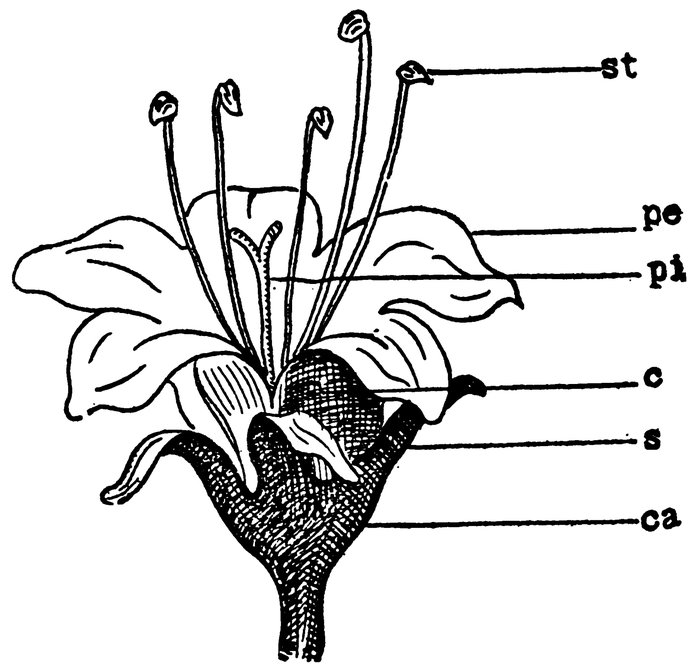
We learned that that Buttercup
family lived within the petals
of the Buttercup House. And
we learned that the pollen from
the stamen, or father, must
reach the pistil, or mother, before
the little eggs or seeds contained in the
mother can begin to grow and develop
into new plants. But the flower cannot move
about as can animals, so they must depend on
insects and outsiders to bring the pollen into the
little nest where the eggs are. But unless there
is some object attracting insects, bees, moths
and butterflies, etc., to visit the flowers, they
would not come to them, so the flowers have
many attractions, such as their color and their
odor. But the most important, and one which
is sweet is the little bag of nectar or honey
contained in many flowers which all insects love
and will go far to get. When the insect visits
the father, it rubs against his pollen, the pollen
sticks to his head or legs. Then as he visits the
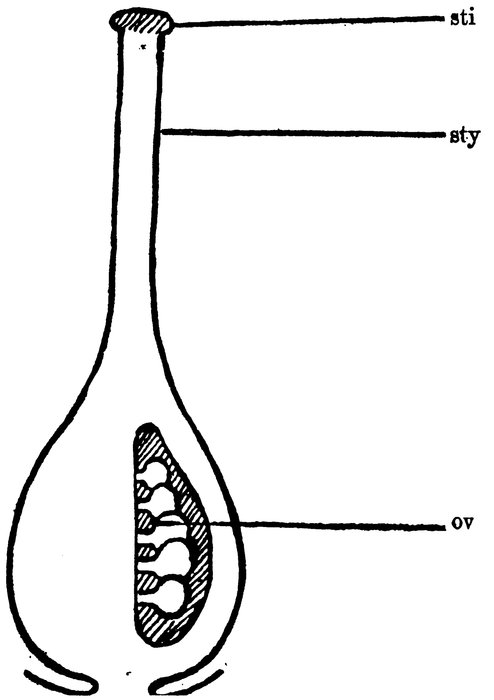
mother, if the stigma (which is the top of the
pistil, or mother) is ready for the pollen, it
shows this by becoming moist, and sometimes
16sticky. Then the pollen clings to the stigma,
and down it goes through its tiny tube, to the
little nest of ovules, or seeds, where it mates and
at once causes the seeds to become alive. Then
they grow and grow until their time comes to
burst forth and develop new plants themselves.
Now, it is also important that the little
visitors who come for the nectar, or honey,
should fly from flower to flower and not crawl,
because in doing so the pollen would drop off
and never reach the mother flower, who is
anxiously awaiting this important substance, so
that the little seeds, or babies, may begin to grow.
Consequently they have many ways of keeping
out the crawling insects. Mrs. Buttercup has a
very hairy stem, which makes a very hard
journey for Mrs. Ant and others to come into
the Buttercup house for a little sip of honey.
She often starts there, but gets so tired out that
she gives up the trip and returns to her family
without any honey for them. This plan of
growing a hairy stem is only one of the interesting
ways the flowers have of keeping out the
insects who cannot help them carry out the one
object for which they exist—to make more
flowers.
Some of the flowers have a little trap door
to their sac of honey, which only the weight of
the bee can open. Others keep their nectar in
long tubes, so that only bees with long tongues
17can reach it. An example of this is in the
Orchid of Madagascar, which has a nectar tube
eleven inches long, and depends upon one certain
kind of moth for its existence.
It is related that when Darwin was confronted
with the evidence of this flower as
against one of his theories he insisted that such
an insect must live—even before it had been
discovered! Again, other flowers keep their
petals closed, and the petals must be forced
apart in order to get the honey by a strong
bumblebee. The flowers that are fertilized by
the insects are called “insect loving.” Those
that are fertilized by the wind are called “wind
loving,” etc.
The buttercup was thought not to need the
insects to carry its pollen to the stigma—it was
for some time thought to be what is called self-fertilizing.
But the discovery of the small sac
of nectar shows that it must have a purpose, and
that purpose to attract insects to bring pollen
from other father flowers to fertilize the tiny
seeds.
The stigma is not always ready to accept
the pollen, but when it is ready it becomes moist,
and in some flowers sticky, which shows it is in
condition to accept the pollen or is ready to
mate and that the seeds are ready for their
development. This condition often lasts only a
few hours, but sometimes a few days.
18The boys had now been taught and had
seen how the pollen reaches the baby seeds. They
had been taught the importance of the pollen
for the growth of the seeds. They had seen
that after the pollen reaches the seeds, that they
are given new life, that they remain right in
their little nest and are nourished by the pistil
or mother flower, until they are full grown or
matured. Now as this process is the whole
object of the individual plant, what happens
then?
The boys were shown that as soon as the
seeds begin to grow, the petals, on the mother
flower, begin to wither, and it seemed as if the
flower gave of its beauty, form and youth in
order that the baby seeds should grow and
mature.
The boys were then taught that the plant
depends on the earth and air for its nourishment,
and as the various flowers have various
ways of keeping the crawling insects out of
their honey sac, so have they different ways of
spreading or scattering their seeds after they
have matured. If all the seeds of all plants
fell right down near the parent plant there
might not be nourishment enough to provide all
the seeds with food.
So again the outsiders assist them as they
did in carrying the pollen. This time it is the
wind which does much to assist them in this
19work. The birds, too, eat of the seeds and drop
some of them on other ground. The wind serves
the milkweed and dandelion; the birds help the
fruits, berries, and the “burrs,” help themselves
by catching on the clothing of passersby, or the
fur and hair of animals.
Then there are those seeds which are in
pods—sweetpeas, beans, peas, etc. Some of
these dry and curl up, and as this is done, it
throws the seeds in various places. Then there
are those seeds which are in burrs, nuts, chestnuts,
etc., which also burst open at a certain
time, some of them explode, and this process
scatters the seed over an area of several yards.
But the wind seems to be the most important
messenger in helping the flowers scatter their
seeds.
The boys were also taught that the plants
breathe and need care; that their struggle for
existence is intense. They are also taught of
the beautiful development of the flower under
cultivation, and Mrs. Buttercup and Mrs. Daisy
were both taken from the field and cultivated,
given plenty of light, water and the proper soil,
best suited to the needs of each, and the results
were wonderful.
The boys each were given small gardens of
wild flowers, which they cared for themselves,
and the following year they each had small
vegetable gardens.
20Every flower had a life story, they were
told, and each a different story—interesting,
intense and true.
Bobby’s mother found that the boys absorbed
this information readily and very quickly.
Although they studied the flowers for an entire
year, they also studied the frogs and birds,
together with the flowers. The mammals and
humans were taken up during the winter.
They were also told that every baby seed
continued this life of producing more flowers,
that every girl was like the mother flower who
had the little seeds hidden within her ever since
she was born, while every boy is like the father
flower and has the sac of pollen like him.
That the seeds are hidden way back in the
abdomen and when she grows big enough the
seeds will grow also and she too may be a
mother of little boys and girls.
That the pollen in the boy is kept in the
scrotum until he grows up big and strong, when
it too will be ready to add life to little seeds and
then become the father of strong boys and girls.
On a later occasion when Bobby was taking
his bath, he felt greater freedom now to ask all
kinds of questions. He pointed to the umbilicus
and asked his mother what that was for. He
was told that that was the navel, so called, and
it was where the cord had been which had tied
him to mother when he was a little seed, and
21through which he had received all his air, food
and drink. This caused great surprise, so much
so that upon the first occasion in talking with
the boys he gave this information in his own
way, which led one to understand all boys were
interested and curious about this depression in
the abdomen.
This information had a most marvelous
effect in establishing the truth in their minds;
it seemed as if they needed proof and here,
indeed, it was.
Much more time could have been spent on
the flowers, but once the idea is given that each
child is like the flowers, and that the flowers
are like people, the rest is simple.
The frogs then took their attention, but
never wholly, for on every occasion when a new
flower appeared, it was examined as to its color
and possibilities of family rearing.
Chapter III. The Toads and Frogs.
22
The next order of life to study
should have been the fishes,
but as Bobby’s mother upon
investigation found that the
nearest stream which contained
fishes was five miles away, she
decided to go on to the next highest order, the
frogs, and point out, as she went, the difference
in the two.
Of course, there was no difficulty in getting
toads, but just where to obtain and how to keep
frogs puzzled the community for a few days,
until at last it was decided first to make a pond
for the frogs to live in, and then go to the nearby
ponds and capture some.
They were especially fortunate in finding
in their locality what at one time had been a
reservoir, which had a pipe leading into it from
a nearby spring, and another pipe leading out
of it into a nearby stream. That the pipe connecting
the reservoir with the stream, it was
found, could be corked, and in a few days there
appeared a delightful pond of clear, clean and
fresh water.
23Their delight knew no restraint when the
afternoon came for them to go in search of some
occupants for this nice new home. Accordingly,
they started out a little late in the afternoon,
with pails in their hands, and eager, expectant
and happy faces.
As they came within sight of the pond,
they need search no further for frogs, for the
air was filled with sounds—queer, croaking,
unmusical sounds, but unmistakably sounds of
the joy of the existence of frogs.
As they came nearer, there was one gulp—“Chu-u-ug”—after
another, one splash after
another. Then silence reigned supreme and not
a sound could be heard.
The youngsters entered into the spirit of
the hunt and scattered about the place. Some
sat silently on logs or stones waiting patiently
for a frog to appear on the edge of the pond;
others crouched near the water waiting, with
pails in hands, ready to catch a frog the moment
he should appear.
It was great fun catching them, for no
sooner was the word passed that a frog had been
captured, when, lo! he was gone.
It was not long, however, before the little
procession was marching homeward with frogs
a-plenty.
This new pond made a fine place for them
to live in, and they thrived and grew.
24For a few days the children made a daily
excursion to the pond upon the hill, and brought
more frogs to the new home; they brought frogs’
eggs, too, which they carried carefully in their
pails.
The eggs were watched, and each day saw
a change, so that within a week the pond was
swarming with tiny tadpoles or “polly-wogs,”
as the children called them. These, too, they
carefully observed while they fed them, and as
the tiny legs and feet developed, while the tail
became absorbed and disappeared—they were
told that now the tadpole had changed into a
frog and needed air. Then stones were placed
into the pond, so large that their surfaces protruded
from the water, and upon these the baby
frogs hopped and croaked their thanks. The
tadpole can be kept in a tadpole state a long
time if he is not properly nourished. Also, if
his tail is bitten off by an enemy it will grow
again.
The toads were found to be more interesting,
because they did more actual service to
mankind. The children were told that toads
live on land almost all of the time, only going
to the water to lay their eggs; that they feed on
insects from the garden, such as the grub, cut
worm, slug, caterpillar, worms, etc. Anything
alive he will eat. The toad is, therefore, a
great help to the farmer, and no little boy would
25ever harm a toad if he but understood what a
helpful creature he is in the garden.
The frog labors under many disadvantages,
as well as having many enemies. The first great
disadvantage is that he is neither a water creature,
like the fish, nor a land creature like the
reptile; so that his struggle for existence is
very hard. Should he decide to leave one pond,
where the enemy is overwhelming, his only
chance is to start on a rainy day to discover a
new home for himself, and if he has the good
fortune to find one before the sun comes out
and dries things up, he is safe.
At first the children showed a dislike to
touch the toad on account of getting warts, but
they soon learned that the fluid which the toad
expels when he is picked up suddenly is harmless—and
produced no warts—but there is a
liquid which exudes from the toad when he is in
severe pain (his means of self-defense) that
burns the mucous membrane and causes stinging
pain.
Animals, generally speaking, are aware of
this fact, and if you watch a dog play with or
tease a toad, you will see that he does not bite
him, but simply puts his paw on him. The
skunk, too, is most careful, and rolls the toad on
the grass to wipe off this caustic fluid.
Toads during the process of development
shed their outer skins every four or five weeks.
26Adult toads shed theirs about four times a year.
This skin is shed in one piece, much as a man
removes his shirt, and is then swallowed.
The tongue of a toad is fastened in front
of his mouth, which helps greatly to catch his
food, as he shoots his tongue out and seizes it.
He does not drink like other creatures, but
absorbs water through the pores of his skin. If
kept in a dry place for even a few days, he will
grow thin and die; but if a toad has proper
environment he will live to be very old.
Toads do not breed, or produce their kind,
until they are 3 or 4 years old. When at this
age Miss Toad, or Frog, awakens from her long
winter’s sleep, she feels hungry, and glad,
perhaps, that she has lived through the winter,
for she feels life within her. Undoubtedly she
is glad and happy to be awake, and off she goes
to search for food and friends.
Perhaps she finds Mr. Toad, who, too, feels
life stirring within him; he also feels the joy of
spring, so together they go to the breeding pond.
Like Mrs. Buttercup, Mrs. Toad has within
her body a little nest where little seeds or eggs
have been kept and have been growing, and now
that the time has come when they need awakening
to a new life, they need life from the Father
Frog just as the buttercup needed pollen from
the stamen.
Mr. Toad (or Frog), too, is stirred by this
27new and wonderful life giving desire within
him—this desire to mate—and when Mrs. Toad
(or Frog) feels the eggs are to be expelled, he
comes very close to her, and in order to fertilize
every egg before it goes into the water, he holds
her fast behind the arm, and as they are expelled
he pours over them his life giving fluid, which
enters every tiny egg and gives it life—a new
life.
In a few days the eggs begin to grow; they
are all incased in a colorless, transparent jellylike
substance, which serves as food for the
tadpole while forming, and also for protection.
They are spherical in shape, and in ten days
the pond will swarm with tiny tadpoles.
Mrs. Frog lays between 500 and 1,000 eggs
at one time; Mrs. Fish, however, is still more
prolific, for she lays 1,000,000 eggs. Mrs. Fish
lays her eggs in the water. She cleans a place
by blowing all rubbish away with her fins, and
there she deposits her eggs. Many of these float
away before they can be fertilized by Mr. Fish.
Impress the child with the knowledge that
here is one of nature’s earliest signs of motion.
That the flowers could not move about to
seek their mates, but the fishes, frogs and all
higher forms of life do this, and are more particular
as they ascend the scale of life.
Thus, the children were taught that the
higher in the scale of development living creatures
28go, the greater care must be given them.
Not only to the undeveloped seed within the
mother’s body, but also to the egg after it has
passed from her to the nest, for as creatures
develop and ascend the scale, their eggs and
offspring become fewer. And emphasis was
laid on the care Mr. Frog took to fertilize the
egg BEFORE it went into the water—one step
higher than Mr. Fish.
There is no doubt that the words “cold-blooded,”
as applied to frogs and toads, hit the
mark, for there is not the slightest affection or
sympathy shown or felt for their own kind.
They give no care or concern to the eggs after
they are deposited, and the “polly-wog” has to
depend on himself.
Nature seems to have given them but one
instinct relative to their kind, and that is the
one blind impulse or instinct of reproduction.
Early in the summer months, the frog
orchestra seems well tuned, but as the cold days
come on the toads crawl into a hole, making it
as they go, while the frogs go into the mud to
sleep through the winter, out of reach of frost
and snow, where they lie dormant until the
spring air shall again inspire them with the joy
of living.
Chapter IV. The Birds and Their Families.
29
The next step to be taken
was the study of the birds.
Everywhere could be seen
father and mother birds busy
making their house for the
babes, which were soon to come
to live with them.
Great fun it was to hunt for nests and
count the number each one discovered. First,
right in Bobby’s yard was a young horse chestnut
tree, and here in this tree Mr. and Mrs.
Thrush had already built their nest, or house,
and were even now waiting for the first egg to
come.
Again the children were told that Mrs. Bird
was more active and more intelligent than Mrs.
Frog or Toad; that altogether she was a higher
creature than either the flower, the fish or the
frog; that all father birds and all father creatures
on up the scale of development use greater
care to fertilize the egg than either Mr. Buttercup,
Mr. Fish, Mr. Toad or Mr. Frog. For,
instead of fertilizing it in the water, or with the
help of the insects or wind, the egg of the higher
30creatures is fertilized while still in the mother’s
body.
Just like the flowers, Mrs. Bird has an
ovary, where the little seeds or eggs are kept.
This ovary is attached to a tiny tube, and this
tube has no separate opening directly out of the
body, but runs into the intestine very close to
the outer opening of the body, where the intestines
throw off the waste food.
Now, these little eggs have been within
the Mother Bird’s body always, ever since she
herself came out of the egg, and they have been
growing slowly all the time until a time comes
when, like the stigma of the pistil (which at a
certain time is ripe for fertilization and becomes
moist and sticky), they, too, are ripe for fertilization.
That this time has arrived is shown by
many outward signs—such as beautiful plumage
and charming songs. Especially in the male
bird does this show itself. His whole nature
seems bubbling over with the desire to mate and
the knowledge that at last he, too, has developed.
For though there are no eggs within his body,
there is something else there just as important
to the creating of new little birds, and he feels
the time has come when this fertilizing substance
is ready to do its work. His color becomes
bright, even brilliant, and his voice becomes
31enchanting. Thus he tells the world of this
glorious happiness.
This period is called the mating season—the
time when both father and mother birds
awaken to the desire of building their nest and
creating offspring.
The egg has become as developed as Mrs.
Bird alone can make it. For, like the flower
seed, the fish and frog egg, it needs the fertilizing
substance from the father bird to complete
its development.
As has been said before, the father bird
knows that there are so few eggs that he and
Mrs. Bird cannot afford to lose even one, so
great, very great care must be taken to fertilize
every egg.
There is an instinct in all creatures implanted
there for millions of years to preserve or
perpetuate their species, and this instinct shows
itself when the father creature, like the father
bird, places himself in such a position that the
fertilizing fluid can get into the mother’s body
as near as possible to the undeveloped eggs.
And as every atom of this substance is alive, it
moves on, on and on, until it reaches the egg,
where it mingles with it and the two different
substances have become one. Now after the
two substances have mingled, the egg passes
down the little tube on through the opening out
of the body into the nest. While it is passing
32through the tube, however, it accumulates a
food substance called the “white” of the egg.
This is not the living part of the egg, but simply
food just as the frog eggs were incased in a soft
substance, which served as food for the tadpole—so
in the yolk, is the new baby bird, incased
within the “white” of the egg.
At the bottom of the tube, through which
the egg passes to its opening, is a fluid which
also incases the whole egg and hardens into a
shell, and it is then ready to go into the little
nest.
After the fertilization takes place the egg
is soon ready to be laid, and so the nest must be
ready, soft and cozy. And this is what Mrs.
Thrush was now waiting for in the nest she and
Mr. Thrush had built in the horse chestnut tree.
But even this was not all. For, though the
eggs were here, the new little birds were not yet
here. And again it was shown that while the
frogs and toads left the eggs in the water to
care for themselves, Mr. and Mrs. Bird do not
and can not do this. The eggs must be kept
warm almost constantly, and so Mrs. Bird
gathers them close to her warm body and sits
on them day after day, until they are ready to
burst the shell open, and come out—the real
new birds.
Chapter V. The Birds and Their Families.
33
Now that the nest in the horse
chestnut tree was completed,
Mr. Thrush sat near by waiting
to hear the glad news that
one egg had come. So the next
time Mrs. Thrush went away
from the nest for her bath the children peeped
into the nest and there saw one speckled egg!
The next day another was there, and the next
day still another.
Mr. Thrush was a most interesting father
for the children to observe, for he fought off any
bird who ventured too near Mrs. Thrush’s nest.
For birds there are who are too lazy to build
their own nests, and boldly take possession of
any nest they can. Father Thrush knowing this,
was ever on the defensive and ready to fight to
protect his “wife” and little ones. He watched
when she went for food—and when at sundown
she went to the stream to bathe, he also watched.
The Thrushes seemed to do most of their
love-making at sundown in song. The song
consists of four notes, which the children interpreted
as saying, “Do you love me?” And the
answer came in three notes, “I love you.”
34If singing meant happiness, Father Thrush
was certainly very happy these days. For he
seemed to sing more than any of the other birds,
except, perhaps, Father Song-Sparrow, who, too,
was overjoyed at the arrival of four youngsters.
Mother Thrush never answered Father
Thrush’s musical song while she was waiting
for the eggs to hatch—she was very still then
always—but he must have taken her love for
granted, for he sang on just the same.
One day some time later when the children
took their usual place under the tree, the air
was rent with shrieks and cries from both birds,
who flew at them and scolded so shrilly that the
children decided it was best to go away, but on
watching from a distance they saw Mrs. Thrush
bring food in her mouth, and three tiny heads,
with open bills, stretch themselves above the
nest. They knew now why Mr. and Mrs.
Thrush objected to their going so near the nest
that day. The children were so excited that it
was difficult to keep them from going to the
nest to see. But when they were reminded of
the great care Mr. and Mrs. Thrush had
given the eggs, so that they might hatch into
little birds, and were told that it would trouble
them greatly and excite them to have any one
touch the nest, they decided to wait for a better
opportunity.
It did not come for several days, for Mr.
35Thrush was a most watchful father. But these
Thrush youngsters were developing so fast and
had such husky appetites it took both Mr. and
Mrs. Thrush busy to keep them fed. So when
the parents were off on their hunt for food the
children carefully looked into the nest. There
they were, three featherless, fearless, funny
things, with only knowledge enough to stretch
their necks for food.
The day that Mrs. Thrush first hurriedly
told Mr. Thrush that one scrawny “imp” had
come out of its shell, he seemed overjoyed, for
he sang all day long—even into the night. This
was, perhaps, the most vivid example of a
father’s joy the children saw. But another case
came to their notice of a father bird’s devotion—and
that was when Mrs. Sparrow deserted her
little ones.
There was an old apple tree at the back of
the house, and in the trunk of this tree Mr. and
Mrs. Sparrow had made a home for their children.
One morning there was a call of distress
from Mr. Sparrow. The children watched him
as he flew from tree to tree, and limb to limb,
calling—calling in the most plaintive tones. All
day he called until the sun went down behind
the Palisades, but no mother returned to her
children. It was quite decided that Mrs.
Sparrow was hurt, or even killed, and great was
36the excitement over this terrible possibility.
After two days of calling and calling Mrs.
Sparrow returned—but not alone. The guilty
partner of her flight came along, too, and Father
Sparrow promptly chased him away, but every
time Father Sparrow flew at him and chased
him off, Mrs. Sparrow would fly away with him.
Then poor Father Sparrow would call and coax
and tease and plead with her to return, and she
would return just long enough to see the little
fledglings, and off she would go with the other
sparrow. Each day she returned to see the
little ones and trouble the poor father, who was
trying so hard to provide for the motherless
family.
The other birds seemed most sympathetic,
and on one occasion Mr. Robin watched the
sparrow house while Mr. Sparrow chased the
wooer of his wife. This was the last time, for
Mrs. Sparrow never again returned to her
family.
No other birds ever went near that tree
wherein the lone “widower” dwelled. He seemed
greatly respected by the other birds. He taught
his little ones to fly and where to find the
choicest food in Bobby’s garden. The children
insisted on caging the cats for a few weeks so
that Father Sparrow would not have this extra
burden on him. They were of one decided
opinion that father love and devotion saved that
37family, and all agreed that it was a most important
factor in bringing up a family.
This was a most unusual case, and the boys
were made to realize its unusualness, for it is
very seldom that a mother ever deserts her
young.
It was funny to watch the sentiments of
these small tots. As soon as Mrs. Sparrow
returned for her short intervals the children got
bread and worms and all kinds of tempting food
in hopes that she would remain with her family.
They were willing like Father Sparrow to forgive
her, but as soon as she made her preparations
to go away, instinctively they picked up
stones to throw at her, so intense was their
interest, and it is feared that had not a grown-up
been with them something would have happened,
for the air was full of whispers, and words like
bean shooters, air rifles, etc., were heard occasionally.
However, their attention was diverted to
Miss Oriole, who had two young Oriole attendants.
Each asked for her love—and she would
not decide. How she teased them both, and how
desperately she flirted. Of course, the lovers
despised each other, but how wonderfully they
told her in song of their great love for her, each
trying to outdo the other.
When no one was about she must have
made up her mind to accept one, and it was
38noticed it was he with the sweetest voice rather
than the one with beautiful plumage who won
her. He was a most daring and fearless lover
and took beautiful care of her while they were
waiting for the eggs to hatch.
The summer was one lovely long day
watching the birds. As the cold weather came
on, the birds became fewer—new and strange
birds on their way to the South came for food
and flew away again.
There was no more interesting and charming
lesson of paternal love to be learned than
among the birds, and it was noticed that no
longer was the mother of sole interest, but the
father’s habits and life became of interest. The
children received their lesson of father love,
through the birds.
Where the father flowers, fish and frogs
gave themselves no concern over the young, here
was a higher creature, whose love of offspring
was not purely physical, but represented something
higher in his makeup. This was not only
the desire to procreate, but to protect and care
for his offspring after their creation.
This is perhaps one of the best times to
begin to talk to the child of its own body, if one
has not done so before.
The study of the birds gives the boy particularly
a beautiful impression of the father’s
39part in life, so that it is quite natural for him
to think of himself in this relation too.
Teach the child that there is no shame in
nature. Mothers should never say “shame on
you” when a child exposes any part of its body.
Always allow perfect freedom in his acts
and affections. Teach him that love and affection
are beautiful, and let him follow his
impulses in these. Never make children kiss
people for “form’s” sake, either aunts or uncles
or any others; let them alone in this for their
instincts are keener, often, than ours.
It was not until all the familiar birds had
gone that their thoughts turned to the higher
stage, the mammals.
Chapter VI. The Mammals and Their Children.
40
The first question one of the boys
asked was, “What is a mammal?”
It was explained to the
children that a mammal is an
animal with a hairy covering,
who breathes with lungs, and
has warm or quick circulating blood. They have
little ones, which when born are not in the form
of eggs, like the frogs or birds, but have the
same shape as their parents, though smaller and
weaker. The mother mammal nurses these
little ones with milk secreted from glands,
called mammary glands. And that is why they
are called “mammals.”
Their instincts are highly developed, and
they are considered the highest animals.
Many instances were shown them of the
meaning of instinct, as that of the mother bird
turning over her eggs every day. In fact, from
the first the word was explained in every stage
to enable them to know the difference between
instinct and reason later on.
There was no one creature taken up this
time, but all together, and some pictures were
shown them of lower tribes of man, and it was
41decided that man must be classed with the
mammals, for he is partly covered with hair,
gives birth to young in his own shape, and feeds
the young from mammary glands. They were
told that there is a mammal, the spiny ant eater,
covered with hair, which, however, lays eggs
like the birds in nests. They were told about
the kangaroo and opossum, who give birth to
their little ones very early, and carry them in a
pouch until they are able to help themselves.
As soon as the little opossum is born, Mother
Opossum picks him up in her mouth and places
him in her pouch, where he sucks away at the
milk which is secreted there, until he is strong
and able to get food for himself—which is
about the same length of time that other mammals
carry their young before giving birth to
them.
They were told of the bats and the flying
squirrels. They were told that Bobby’s cat
must be given a new clean box, or bed; that she
must not be handled roughly or chased, because
she was going to have little kittens. To the utter
astonishment of Bobby’s mother there was a
chorus of, “How do you know?” and she realized
that she might have omitted a most important
piece of information.
They were again reminded of the birds and
the undeveloped eggs coming from the ovary of
mother bird, which at a certain time become
42ripe for fertilization; of how the father bird at
a certain time feels he has developed (since the
fertilizing principle within him has developed)
so that in coming in contact with the undeveloped
egg within the mother’s body, these are
quickened into life. The same process goes on
with the mammals, but as the instinct becomes
more developed as they go higher in the scale
of life breeding becomes more complex.
They were told that where in birds the
whole egg, shell and all passes out of the mother’s
body into the nest, with the mammal the
shell becomes a thin skin, which envelops the
little one, but remains within the mother’s body
until it is grown enough and strong enough to
live on the milk from the mother. While it is
within the mother’s body it is fed from the blood
of the mother, and all the food she eats helps to
make the little ones within her strong.
It is of great assistance for a mother to
have some knowledge of the processes of assimilation
so that the children will learn how the
food products in the blood, instead of supplying
the mother, go to the child to build up bone,
muscle, nerves and tissues.
They were told that as the mammal grows
and develops within the body of the mother her
shape becomes changed—becomes larger in the
region where the new life lies, and that is how
43one could tell that Mrs. Pussy Cat was going to
have a family.
It was dwelt upon at great length that it was
necessary to know this, because every mother
needs protection from worry, excitement, cruelty,
overwork, starvation at such a period; that
she needed kindness, rest, good food, sunshine,
in order that she give the little ones strength and
health.
They were told that in smaller animals many
more eggs develop at a time and are fertilized
but in the larger animals such as cows, horses,
elephants, etc., only one egg develops and one
animal is born. In man, too, this is true. One
egg develops at a time, and if it is fertilized it
remains in its little nest (or uterus), and grows
until it is ready to stand the changed conditions
into which it must come after it is born. If it
is not fertilized it passes on out of the body and
is lost, but when it is fertilized by the father, it
remains in the uterus and grows until it is
grown enough to withstand a different life and
different surroundings.
At first the new being is only the size of a
pea (that is, in a week after it is fertilized). In
a few weeks (eight) it is the size of a lemon,
and its shape is complete. In four months it
begins to move about, to kick, to move its little
hands, and in nine months Mother Nature can
develop it no more. It is time to change, if it
44is to live, so she sends it along the passage, enlarging
the passage and stretching it as it goes—which
causes much pain and suffering to the
mother, until it reaches the outside world, where
it is taken and cared for and loved, and all the
mother’s pain is forgotten in the joy of having
her little one alive and strong and well.
One of the mothers was expecting the
arrival of a little one, and great care and tenderness
was shown her after the children knew of
this event. She was assisted up the hills,
brought flowers and all the tenderness of which
children are capable was bestowed upon her.
They anxiously watched and waited for its
arrival, looked over the small clothing which was
being prepared for it, and seemed as interested
as any grown-up could ever be.
The most interesting questions were asked
her each day. At first the young mother was
rather embarrassed, but they were asked with
such simplicity and frankness that she realized
the prudery was in herself alone, she soon
entered the talks and answered their questions.
These were mainly of the little one’s movements,
etc. Can it see? said one. Does it kick? said
another. Does it like ice cream? etc., etc., all
perfectly innocent questions which can be
answered, and makes the reproductive act the
natural and beautiful part of life that it really
is. Soon the young mother and the children
45were on the most friendly terms. They would
come to her and confide their secrets to her, tell
her words other boys had used and asked her
about these words. They came to her in preference
to telling their parents, which shows again
the necessity of every mother being the first
one to tell the child this sex knowledge, for the
one who does tell it usually holds a strong
influence over the child for some years to come.
They were taken to a farm some miles away
to see a calf a few days old. Stories were read
to them at this time about the habits of these
animals and the care of their young. They
were taken to the Museum of Natural History
in New York and to Bronx Park, and such excursions
were red letter days in their book of
childhood.
They were told of the freedom of the
animals in choosing their mates—that beauty
and strength seemed the greatest qualifications.
The story of the bees was briefly told. How the
queen bee leaves her home amidst the hundreds
of male bees who are all anxious to be the
father of the future hive. How she rambles
about for a little while, then up she flies—up,
up, straight into the clouds with hundreds of
male bees following. Gradually the weakest
bees drop off and return, but the stronger ones
still follow until there are often only two male
bees left in the race. The weaker of the two
46returns and the strongest bee of the whole hive
wins the queen bee, and fertilizes the eggs
within her body. After this act of reproduction
he dies, and Mrs. Bee returns to her hive and
lays thousands of bee eggs. The strongest gave
his life that the future bees should be given his
great strength.
The children were sad about this. They
wanted the strongest to live, and it was now the
place to teach them of their own bodies, what
cleanliness and strength means to the future
race of man.
To give the children an idea of the shape
of the uterus, Bobby’s mother took a pear,
turned the large side up, letting the stem part
hang down, it was then cut open lengthwise,
the seeds, core and stem removed. Both halves
were fastened together again with thin sticks
just to get an idea of the shape of the baby’s
nest.
The part where the stem was is like the
passage where the little one comes out into the
world after the seeds have grown.
Chapter VII. Man’s Development.
47
The great object which Bobby’s
mother had in mind was to
make these teachings of such a
nature that the children would
be impressed with the truth
that they are only part of nature’s
great and wonderful plan.
They were reminded again and again of
the stages of life—plants, frogs, birds and
mammals; of the millions of years it took to
bring about these wonderful creatures and that
at the top of the list, perfect, intelligent and
supreme, stands man. Man, the most complex
of all and the most perfect.
It was most natural for the children to consider
nutrition and reproduction as the two
most important essentials of any form of life.
Up to this point this was quite sufficient.
The animals had instincts to nourish their
bodies and also to procreate their offspring.
This seemed their life object, but since man
being the more intelligent, there must, of course,
be other and broader outlets for this great
intelligence.
48Their own bodies was a subject which took
months to cover in study. They were shown
charts of the human figure (both sexes) and all
parts of the body were named in the same way
as parts of the flower were named. Parts of the
organs of reproduction were called by their
names in telling of the works each part performed.
No special stress was laid on the naming
of these parts, but simply, casually, as one
would speak of the various parts of the eye, or
any other organ. In the same manner they
were told of the harm done to their bodies in
handling or touching any one part unnecessarily.
If the eye, ear or nose was dug into, we would
surely greatly injure ourselves, perhaps losing
the use of that organ for the rest of our lives.
The generative organs are no exception in this.
To tamper with this most wonderful part of
nature’s machinery, means not only sickness,
dullness of intellect, stupidity, physical and
mental weakness, but oftimes disables a little
child for life.
In order to grow into perfect manhood or
womanhood, all parts of the body must be
developed naturally. If a little bud of a flower
were to be roughly opened, it fades and dies
long before it can carry out the great object of
its life, namely, to develop the baby seeds within
it.
So with a boy or girl who carries within their
49bodies the making of a human life. How terrible
to cause that little life to be shattered, just
through ignorance and neglect.
The children were taught that there was
one beautiful time to come to them—to look
forward to and to hope for that time when they
can look into a tiny baby face, clasp two tiny
baby hands, and feel this wonderful and beautiful
creation a part of their being—the expression
of their souls.
They were told to keep in mind this time
which should come, and to keep their minds and
bodies clean for this wonderful gift.
As all the children were still too young to
go into the details of either menstruation or
venerea diseases, it was considered best to
dwell on the early tribes of man on up to
marriage, and wait for future developments
before going further. The tree dwellers and
cave dwellers were already familiar stories to
them. The fact that people lived together very
closely; that the woman had great freedom in
choosing the man whom she wished to be the
father of her child, even as freely as the animals
chose their mates; that in this freedom great
mistakes were often made, such as that for a
period some mothers chose their sons or brothers,
or fathers to be the father of the new little one;
that after a time it was found that this was
very injurious to this new little child, for he
50often could not walk, or talk, and was weak,
and sometimes a cripple—and more often died
very young.
So the chiefs of these tribes got together
and said this must not be, for if this continued
there would be no strong young men or women
to till the soil or fight off the animals, wild
beasts or the enemy. Then a law was made that
only those of the different tribes or families
should choose each other for the parents of the
future children, and here the lesson of the
Buttercups came in—that often Mrs. Buttercup
would reject the pollen from the stamen in her
own house, but would accept the pollen from
another buttercup house and become fertilized
with that.
The part the two sexes took in different
ways to strengthen and develop the race seemed
of great interest to the children.
The work of hunting and fishing was left
to the men of the family, while equally important
work, that of cleaning and cooking the food,
was for the women. Men spent much time in
making tools and weapons. They were able to
save much time and energy when the bow and
arrow was invented, for, instead of taking all
the time to creep upon a beast or enemy with a
knife or sharp stone, he could remain at a
distance and do the same work. Thus, men got
51a little more leisure time. With every new
invention their labor and energy was saved, but
it took much longer for labor-saving inventions
for the women to come into use.
Gradually the marriage form came into
existence, as these new tools and weapons became
more valuable. Men wanted these to go
to their very own children, so it came to pass
that the man could choose any woman he wanted
to have for the mother of his children by getting
consent from the captain or chief of the tribe.
If he received this consent then she, the woman,
must live with him, love him, honor him (no
matter what he did), and obey him in everything.
Absolute submission was the law for
the wife. If she objected to this and ran away
she was cast out and was beaten. Other tribes
had the same laws and dared not take her in, so
she was left to die. If she did not like her
husband and took another for the father of her
child she was often not only cast into prison,
but either stoned to death or burned at the stake.
Naturally, after years of this treatment,
she became submissive and so dependent on man
for her living that she dared not express herself
aloud, merely as her husband allowed her
to do so. If she was very beautiful she was not
made to work, but the prisoners of other tribes
who had been captured, were made to work for
her. Often the captain or chief had several
52wives, but the wife was allowed only one
husband.
As the children had been taught the lives
of the mother flowers, frogs, birds, bees and
mammals, there was no reason why the history
of woman should not be taken up until they
were ready for older work.
They loved to hear about this, and it seemed
just as interesting to them as the other stories.
It is important that mothers teach children
the true history of the race, and get the seed of
truth planted for future cultivation.
The marriage laws have had many changes
for the man, they were told, but few as far as
the woman is concerned. The different customs
of women in different countries can be told
them, and the general development of both men
and women can occupy a great deal of time
until the children are more ready to understand
the true or real significance of the studies to be
later dwelt on.
The children were never talked at, but
always with. They were allowed to talk freely.
Once or twice the older children seemed a little
conscious on taking up the matter of their own
bodies, yet after a few minutes as the other
children joined in the conversation, they, too,
forgot and overcame the embarrassment, and all
went well.
The children were told frankly that some
53mothers did not like their children to know
these things; that like the fairy tales and the
story of Santa Claus, the mothers liked their
children to believe that the stork brought them,
or some other fairy tale. They were told that
these things are not to be talked about with other
children, and any time any child wished to know
anything about himself or any question whatever,
to come to the mother or father, but never
to other boys or girls. These children were
taught the necessities for the excretions of the
body—that in order to have good health this
used up waste food must pass out of the body
or it would become poison and the boy or girl
become sick and die. There was no hurry in
telling anything to the children. Most of this
information was told on walks in the woods, or
at times when they seemed to want to know.
One story leads to another, and before long the
children’s questions will bring everything from
you which you wish to tell.
The result of these teachings has been
commented on by the school teachers of these
children, who say they are so truthful, clean-minded,
frank and open about all things that
it is a pleasure to know them.
Every mother can teach her children the
truth if she only knows it herself, and has the
right attitude toward it. She can elaborate on
this plan or outline as much as she wishes, but
54she must get down to the child’s world in order
to make her teachings impressive and successful.
The one unpardonable sin on the part of a
mother is to let her children learn the truth
elsewhere than from her own lips.
Chapter VIII. Conclusion.
55
One of the most important things
which a mother must keep in
mind is to give only such information
and in the manner
suitable to the child’s age. Children
differ so greatly, that it is
impossible to lay down any rules as to what and
how much should be told at any age.
Some children are very curious, and very
receptive always, while others have little curiosity
and even when told sex truths, pay little
attention to the telling, or seem little impressed
by it.
It is for each mother to do as she finds
advisable. Children will often ask a question
very seriously and before one can formulate an
answer, another question has been asked on
another entirely different subject. But the fact
that he has asked the question shows that the
mind has awakened to this curiosity, and he will
no doubt ask it again.
Mothers, be prepared! Do not force any
thing; it will all come in time if you keep close
to the child in confidence. Just be prepared.
When children are very young get them accustomed
56to the naked body. Let them run about
naked at night, perhaps while undressing for
bed. Let them bathe together or with you. If
this is done very early at any early age you will
soon find that his thoughts are clean regarding
the naked body. You can then tell him the
names of the different parts, for he will most
likely ask, and his curiosity will often entirely
cease. This is the type of boy who looks back
upon life and feels he has “always known” the
clean and beautiful of life.
This is the opportunity to tell how to care
for the body. The teeth and nose should be
cleansed morning and night. When there
is any itching of the rectum or sexual
organs this is often caused by uncleanliness
and washing of these parts at once will often
relieve the irritation.
Teach that no part of the body should be
touched unnecessarily by any one, and when
there is any discomfort of any kind to come to
the mother, who will attend to it. See that no
clothing on the child is tight or causes irritation,
for this often leads a child to touch and
handle himself and forms the habit of masturbation.
This is often acquired innocently, even at
the creeping age, and the child becomes a victim
and slave to the habit.
Keep a close watch over children for this
57habit, without making them conscious of it,
especially if the child prefers to be alone or
remains long in bed in the morning. These are
by no means positive symptoms of the habit,
only when these signs are present keep your eyes
open.
If you do find this habit is formed, keep
him up at night until he is sleepy, or at least do
not send him off to bed alone when he is not
sleepy, to lie and toss about with this temptation.
Let someone read to him or tell him
interesting stories which will divert his mind
so he can fall asleep.
The same in the morning; do not allow
children to remain in bed after they have
awakened; do not have the bed too soft or the
coverings too heavy; the room should be cool
and he should lie on his side rather than on the
back. Keep his mind busy with interest. Get
him to call you whenever he feels the temptation,
or to come where others are. If he will
trust the mother and together fight this habit, he
will soon be the victor. Always it is the same—confidence,
confidence, is such a necessary part
of the child’s life.
When a child is under four years of age is
the ideal time to gain this confidence, for then
there is nothing personal in anything you say;
all interests are general. There is no shyness
or consciousness of sex. If this has been done,
58when they take up the study of the birds more
could be told them of the sexual parts; that as
some day he was to be a father he was made
differently than mother or sister because he had
a different part to do in life’s work. That he
must keep well and grow strong in order to do
this work. There need be no mystery about the
sexual truths; impress upon it the sacredness of
the process. There is no greater crime against
a child than for a parent to allow a child to
flounder about with half truths, gathered from
polluted and corrupt associates.
Be deliberate in giving the child the truth,
as much of it as he can take at a time, or as
little but have it the truth.
You will be confronted with questions concerning
the vilest words of the street. Tell him
frankly their meaning in your own clean way,
and the correct word to use in its place. You
will find when his curiosity has been satisfied
he will no longer be curious or have any special
desire to use these words.
Every child first turns to its mother in
confidence for all these questions. Never turn
him off with a slight or embarrassed answer;
just rely upon your knowledge, your natural
knowledge, and answer him. Every mother can
do it. Do not make a Sunday School lesson of
these teachings, only to be taught once a week
on very solemn occasions. Children hate being
59talked at; just be natural, simple, interesting,
informal, and as often as the opportunity
arrives.
This confidence and early understanding
will bind you together far beyond that most
difficult period, puberty, and enable you to
strengthen the child’s ideals of manhood and
womanhood.
60
WHAT EVERY GIRL SHOULD KNOW
by
Margaret H. Sanger
CONTENTS
Girlhood—
Physical Growth
Mental Development
Puberty—
Generative Organs, Uterus, Ovaries, etc.
Menstruation and its Disorders
Sexual Impulse—
Masturbation
Sexual Impulse in Animals—in Men. Its
significance in Love
Reproduction—
Growth of the Life Cell in the Uterus
Hygiene of Pregnancy—Miscarriage
Some of the Consequences of Ignorance and Silence—
Continence in Young Men
Gonorrhoea
Syphilis
Address:
The Woman Rebel, 34 Post Avenue, N. Y. City
NO GODS NO MASTERS
THE FIRST UNVEILED FEMALE HEAD RAISED IN AMERICA
An uncompromising, unapologetic, clear cut,
revolutionary paper, dealing with sex education,
and advocating a militant attitude toward all
things which enslave the working woman.
Study, think, reason, learn thoroughly the
elements of a science that all women ought to
know: the knowledge of means to prevent conception.
Published monthly. Subscription $1 a Year.
Address: MARGARET H. SANGER
34 Post Avenue New York City