Students of vice, whether teachers, clergymen, social
workers or physicians, have been laboring for years
to find the cause and cure for vice, and especially for
prostitution. They have failed so far to agree on either
the cause or the cure, but it is interesting to know that
upon one point they have been compelled to agree, and
that is, that ignorance of the sex functions is one of the
strongest forces that sends young girls into unclean
living.
This, together with the knowledge of the rapidly increasing
spread of venereal diseases and the realization
of their subtle nature, has awakened us to the need of a
saner and healthier attitude on the sex subject, and to
the importance of sex education for boys and girls.
This need has shown itself so clearly that the question
no longer seems to be, “Is there need of instruction?”
but, “Who shall instruct?” Shall the mother or teacher
instruct? When shall such instruction be given? In
childhood, or in puberty? These are the points now
under discussion.
To the writer the answer is simple. The mother is
the logical person to teach the child as soon as questions
arise, for it is to the mother that the child goes for
information before he enters the schoolroom. If, therefore,
the mother answers his questions truthfully and
8simply and satisfies his curiosity, she will find that the
subject of sex ceases to be an isolated subject, and becomes
a natural part of the child's general learning.
A woman does not need to be a college graduate, with
a special degree in the study of botany, before she can
tell her child the beautiful truth of its birth. But she
does need to clear her own mind of prudishness, and to
understand that the procreative act is natural, clean and
healthful; that all nature is beautified through it, and
consequently that it is devoid of offensiveness.
If the mother can impress the child with the beauty
and wonder and sacredness of the sex functions, she has
taught it the first lesson, and the teacher can elaborate
on these teachings as the child advances in school. All
schools should teach anatomy of the sex organs and their
physiology, instead of teaching the human body in the
neuter gender as has been done up to this time.
The whole object of teaching the child about reproduction
through evolution is to clear its mind of any
shame or mystery concerning its birth and to impress it
with the beauty and naturalness of procreation, in order
to prepare it for the knowledge of puberty and marriage.
There must of necessity be special information for
the pubescent boy and girl, for having arrived at the
stage in their mental development they no longer take
for granted what has been told them by the parents, but
are keen to form their own ideas and gather information
independently. It is right, therefore, to give them the
facts as science has found them.
There are workers and philanthropists who say there
is too much stress put upon the subject of venereal
diseases; that the young girl after learning or hearing of
the dangers she is likely to encounter in the sexual relation,
9is afraid to marry and consequently lives a life unloved
and alone.
“Your treatment of this subject is dangerous,” said
a very earnest social worker a few weeks ago. “Such
knowledge will prevent our young girls from marrying.”
To which I replied that my object in telling young
girls the truth is for the definite purpose of preventing
them from entering into sexual relations whether in marriage
or out of it, without thinking and knowing. Better
a thousand times to live alone and unloved than to be
tied to a man who has robbed her of health or of the
joy of motherhood, or welcoming the pains of motherhood,
live in anxiety lest her sickly offspring be taken
out of her life, or grow up a chronic invalid.
I have more faith in the force of love. I believe
that two people convinced that they love each other and
desire to live together will talk as frankly of their own
health and natures as they do today of the house furnishings
and salaries. Their love for each other will protect
them from ill health and disease, and prompt them
to procure of their own accord, a certificate of health if
each has the right information and knowledge.
There are, however, different phases of nature, the
knowledge of which binds and cements the love of two
people, other than venereal diseases, for these diseases
are only symptoms of a great social disorder.
Every girl should first understand herself; she
should know her anatomy, including sex anatomy; she
should know the epochs of a normal woman's life, and
the unfoldment which each epoch brings; she should
know the effect the emotions have on her acts, and
finally she should know the fullness and richness of life
when crowned by the flower of motherhood.
10This knowledge I shall endeavor to give in the following
articles. Fragmentary the articles must of necessity
be, for there are volumes written on each subject.
I shall try to free the subjects from technicalities
and give the opinions of writers who have made these
subjects their life studies and also the facts as I myself
have learned them.
It is not my intention to thrust upon any one a special
code of morals, or to inflict upon the readers my own
ideals of morality. I only presume to present the facts
for you to accept according to your understanding.
The first subject will deal with the girl during the
age when sex first manifests itself, in that most fascinating,
interesting and puzzling period of a woman's life—the
budding period, called girlhood.
CHAPTER II. — GIRLHOOD—PART I. — The Physical Manifestations — GIRLHOOD—PART II.
11
It has been said that the American girl between the
ages of 12 and 18 is the most neglected girl in the world.
Just why this is so, it is difficult to say, but I doubt
whether she is alone in this neglect, for this is known as
the adolescent period, and it is only within the last few
years that the mental and physiological aspect of this
period has been at all considered, or its importance recognized
in any part of the world.
The adolescent period is the time occupied between
the ages of 12 and 22, when the physical development
comes suddenly into prominence; when the mental faculties
become independently active, and the sex of the individual
strongly manifests itself. It is a period of the
greatest importance to the girl herself, for her physical,
mental and moral development during this time will have
an important effect on her future life.
It is also a period of the greatest interest to the
mother, provided there is sympathy, confidence and understanding
between them. Too much importance cannot
be attached to the necessity of an early confidence
between the girl and her mother before this period arrives
for this will give a girl a sense of superiority, a poise, an
understanding of herself and her nature. She will then
be prepared for the changes taking place within herself,
and consequently be practically immune from the influence
of a bad environment, which otherwise might affect
her in a way detrimental to her health and happiness.
12Up to this period there is very little manifestation of sex.
Fortunately, we have come to recognize that healthy
outdoor play is as good for the little girl as it is for the
boy, and the ideas of our grandmothers' day—that boys
were to play ball, ride horseback, swim, shoot, etc., while
the girl's play was restricted to sedentary pursuits, such
as sewing, doll playing, etc.—have been placed on the
relic heap, and the girl of today keeps pace with her
brother in physical freedom and activity.
With the passing of those ideas passed also our ideal
of the delicate girl, with a cough, small waist and dainty
appetite, and the girl physically strong and healthy, with
a broader view of life, has taken her place.
About the age of 12 there comes a sudden change in
the girl, her dresses are outgrown, her form assumes
shape, her bust and limbs develop, and, in the words of
Stanley Hall, “hips, thighs, limbs, shoulders and arms
round out into contours more or less beautiful, curves
always predominating over angles.” Thus we come to
realize that the little girl has left us.
The physical development is not alone in this work,
for the mental and moral instincts are developing so rapidly
that it is difficult to understand this new and lovely
creature who is neither the child of yesterday nor the
woman of tomorrow.
There is often very little patience shown the adolescent
girl, for neither parents nor teachers have been
aware that this is a separate and distinct stage—this
passing from childhood into womanhood—and as such
must be recognized.
Let us first take the bony structure. It is a well
known fact that there is not sufficient lime salts in the
system to complete the bony structure until the 25th
13year. The bones are not completely hardened, which is
one of the reasons that so many deformities have their
foundation laid at this time.
The first and most noticeable change in the girl at
this age is the increase of height, which begins at the
13th year and ends about the 15th. There are girls
who begin earlier and continue to grow for several years
after this age, but it is with the average we deal, and
the growth after the age of 15 is not so perceptible.
Many girls show almost no other signs of womanly
development until after this growth has ceased. The
bones at this time are soft enough to yield to pressure
(being cartilaginous), which makes the wearing of a
corset especially dangerous, for the pressure on the ribs
interferes with the development of the lungs and tuberculosis
is more easily contracted. Corsets should not
be worn before the 21st year if possible, and then very
loosely, for tight lacing is more harmful at this age than
a few years later. Those who have made careful investigations
of the harmful effects of corsets claim that not
only are the chest and walls of the abdomen injured,
but the development of the sexual organs is seriously
hampered, causing many functional diseases, commonly
painful and irregular menstruation, caused by arrested
development of the cervix.
The girl who scoffs at the idea of the Chinese women
binding up their feet, is doubtless ignorant of the knowledge
that to bind up their own thoracic and pelvic structures,
i. e., the chest and abdominal portions of her body,
in tight corsets is doing greater harm to her health and
injury to her development than the binding of the feet
could possibly do. Ellis brings forth a few words on this
subject which shows that the habit of binding the feet
14of the Chinese women is based on the same ideas as the
European woman has when she deforms her waist—they
are both done for sexual attractiveness.
A Chinese woman's foot is more interesting than her
face—to her husband.
No man of good breeding would look at a Chinese
woman's foot in the street; such an act is most indelicate.
This question of corsets every girl should consider
seriously.
As this rapid growth begins, the girl often finds it
difficult to hold herself up straight, her shoulders become
stooped, her head and neck are thrust forward in a most
ungainly manner. As she becomes conscious of this, instead
of correcting it, she is likely to slouch and assume
the most awkward habits. Her arms seem longer to
her; hands, legs and feet become new burdens to carry,
and the desire to hide the hands behind the back, to
fold the arms, to bend one knee in order to lessen the
length of the body, and to lean on something while talking,
are all signs of this consciousness.
With the invention of modern machinery and the
monotony of specialized work in the mills and factories,
it is natural that this should bring with it, if not entirely
new diseases and deformities, at least a greater number
than have heretofore been known. Consider the little
children in the cotton mills, standing for long periods,
with the weight of the body thrown on one foot—a position,
which causes curvature of the spine. Again consider
the young girls still in their “teens” bending over sewing
machines from morning until night from year to
year; their premium for this work is right sided lateral
curvature. Sitting with one leg crossed over the other
as in sewing, carrying books under the arm to and from
15school, lifting and carrying heavy burdens, bundles, or
small children, such as the abused and deformed “little
mothers” spend their play time in doing—all cause curvature
of the spine.
Curvature is one of the most common deformities.
Any position which throws the spinal column out of its
natural line for any length of time is likely to produce it.
Regular exercise in the open air will do much to prevent
this, together with walking and dancing. If curvature
is already noticeable, then it is best to get professional
instructions and follow them closely.
Next to the rapid bony development, the changes in
the heart and circulation are most noticeable. The heart
grows more rapidly during the adolescent age than the
arteries do, which increases the supply of blood in the
arteries and causes general circulatory disturbance of
which we see many outward signs such as blushing, nose
bleed, headache, cold feet and hands, anaemia, loss of appetite,
or an appetite so capricious as to drive one frantic
trying to satisfy it, for it jumps from ice cream soda to
dill pickles, according to whim. Some of these symptoms
require special attention, particularly in the case
of the girl at school or in an office, who finds her work
a great effort, tires easily, and becomes pale and nervous.
Such a girl should spend as much time as possible in
the open air, and build up on milk and eggs. Sometimes
a simple iron tonic will do much to overcome these disturbances.
Pimples on the face are also very common at this
period. Physicians assert that with cleanliness of the
skin and regularity of the bowels, these symptoms will
disappear without the aid of medicines or cosmetics.
The above mentioned symptoms are of great annoyance
16to the adolescent girl, who is just developing pride in
looking neat and keeping up an appearance of daintiness,
and she goes to unending trouble to rid herself of facial
blemishes, which often seem to grow worse and if
tampered with, leave ugly scars.
The nervous system also undergoes great changes
at this age, and the growing girl is subject to various
forms of nervous affections, stammering, jerking, restlessness,
etc. These are symptoms which, if allowed to
continue unattended, may develop into permanent disorders.
In short, the adolescent girl needs constant
watchfulness and attention.
The organs of sense are also awakened to activity
in the adolescent girl. The sense of smell becomes extremely
acute; offensive odors are very offensive, while
pleasant ones are greatly enjoyed and desired. Thus we
find perfumes used lavishly in girlhood, and alas! too
often indiscriminately.
With the development of the other senses the sense
of color is awakened. The girl, who, yesterday allowed
her elders to choose clothing and colors for her, at this
time becomes most exacting in her own selection of ribbons
and dresses. Sunsets and forests have become
beautiful, and often the girl with artistic talent decides at
this age to choose her life work. Laces, jewelry, trinkets,
ribbons and shop windows become her world. Indeed,
so great is her desire to possess ornaments that she
has been known to resort to petty thievery, when unable
to avail herself of the means to obtain them otherwise.
Certain authorities, who have made vice and
kindred subjects a study, assert that it is this great desire
17for trinkets, silk petticoats, etc., which induces girls
to sell their bodies and enter prostitution. Such authorities
fail to see the economic significance of these
unsatisfied desires. There is something wrong with a
system of society which allows its women to sell their
bodies for such trifles, the desire for which is part of their
natural development.
Is flesh and blood and the virtue of the mothers of
the future so cheap in this land of plenty that it can be
sacrificed for such passing whims? It is impossible to
suppress that inherent and natural desire in the adolescent
girl to adorn and beautify herself. She must and
will do it.
The girl of wealth, of the so-called upper class, can
beautify herself and adorn her body with the costliest
jewels and fabrics. All eyes are upon her in admiration
of her exquisite taste and attractive appearance. Yet
this same manifestation in a working girl is condemned.
Any attempt on the part of a working girl to give expression
to the desire to be beautiful is considered
“dangerous to her welfare”; is spoken of as her “awful
desire for trinkets.”
The women of wealth set certain standards for
themselves and their class, but separate and distinct
standards for the women of the working class. It is about
time the reformers and philanthropists do something
other than deal with the symptoms of the great social
unrest, and some of the latest reports of vice investigators
have been compelled to face some of the most fundamental
causes, and acknowledged these causes.
A craving for beauty and pleasure, dancing, music,
singing and laughter, an innate hereditary desire to adorn
and beautify herself, which comes down to her from
18primitive woman, together with a burning desire for and
love of romance, characterize the adolescent girl and
often remain with her far beyond the adolescent age.
When the imagination is thus aroused it is not unusual
to learn that the young girl yields to it, tells strange
tales about herself, and is, therefore, often accused of
lying. But this and petty thievery disappear as reason
and will power are developed.
The change of voice in a girl is not so distinct as in a
boy, but the voice gradually becomes softer, fuller and of
a more womanly pitch, though the change is quite unnoticeable
while it occurs.
The hearing becomes keener, noises which a few
months ago were considered a joke are now disturbing
(such as father's loud sneeze). Music and singing have
charms, which in childhood were unappreciated.
Parents and teachers who do not appreciate the
change taking place within the girl at this period, have
small patience with such doings, calling her “giddy” and
“affected” when in reality it is all part of her development
and can be guided and directed into beautiful
channels. Together with her personal adornment comes
interest in her surroundings. New and elaborate decorations
furnish her bedroom, and toilet accessories become
objects of pride. Primitive colors are displayed, largely
in curtains, bed coverings, wall paper, etc., all of which
explain the independent ego in the stage of transition.
There are many forms of disturbance which the girl
suffers at this period, such as hysteria and insanity,
which, however, we will not dwell upon here. Enough
has been said on the subject to impress upon my readers
the cause of these physical and mental disturbances, and
19to realize that special care and consideration should be
given at this particular age of the girl.
The emotional nature also plays a most prominent
part in the developing girl, and justice, I feel, would not
be shown her here, unless we cover briefly this most interesting
part of her nature. One of the strongest emotions
which very few girls, passing from childhood into
womanhood, escape, is the religious awakening of one
kind or another. It is said by some investigators that
80 per cent. of the conversions of women in the churches
take place before the age of 20. From 30 to 40 years
only a very small percentage occur—something like 1
or 2 per cent.
It is also shown that more young girls join church
than boys. Some girls seem almost consumed by the
desire to do good and be good in every thought and word
and act, and have been known to go through various
forms of self punishment, such as fasting, sacrificing
pleasure, etc. Again, others spend hours in absolute
devotion to the neglect of health and studies. It is very
easily seen why the church takes its “flock,” while still
in the adolescent period, for at no subsequent time is the
girl's mind so plastic or impressionable. If the same
girl who enters the convent at 18 years had waited until
22, she would very likely not have entered, for the mental
changes are most intense from 16 to 18 years of age.
Another common emotional awakening of girlhood
is the affections. In boys this awakening causes them to
gather together in gangs. They follow their leader
whom they greatly admire and obey. In girls it assumes
a more simple form, the devotion to a girl friend of her
own age, and the affection between them is deep and
intense while it lasts. They tell their most private
20thoughts in secret to each other, dividing all honors,
pleasures and gifts; they are almost inseparable, and
I have known a girl whose affection was so deep for
her “chum” that she wore mourning when the chum's
father died.
Another form of affection which the girl of this age
manifests is that for an older woman, often a teacher or
neighbor. Parents sometimes look askance at this relation,
and rightly so, for a friendship can be beneficial
or harmful according to the character of the older woman.
But with all these interests there is nothing so
all-absorbing or so interesting to the adolescent girl as
herself. She has become conscious of self. Now she
burns with ambition to go out into the world and do
mighty things. She feels sure she will be a great singer,
or a dancer, or, perhaps, an actress. Again, she feels
she will write a wonderful book—about herself—or at
least she will be the heroine. Or she will write a wonderful
tragic play; or she will nurse on the battlefields
and care for the sick and dying. These, together with
thousands of other desires, burn in her mind, and can
be increased or lessened according to the character of
the books she reads. The literature placed in a girl's
hands at this age has as great an influence on her
thoughts and acts as her companions.
In early adolescence this self-consciousness manifests
itself in modesty, blushing, giggling, physical awkwardness,
mentioned earlier on this subject, all signs that
the girl is conscious of that inner self—the ego.
It is at this stage when the mother tries to explain
what the menstrual period means to the girl that she is
met with icy indifference. She refuses to talk on this
subject, or anything pertaining to the sex subject, because
21she has just become conscious of her sex, and
everything connected with it seems offensively personal.
She most likely has received her sexual information
from some one else, and the mother is astonished at the
stubborn silence on the part of her daughter. She fails
to realize that some one else has that confidence which
belongs to her and which she should have gained many
years earlier. There is a strong tie between the adolescent
girl and her sexual informant. The influence of
an older girl over a younger, between whom there are
confidences regarding sex, is surprisingly great. The
mind at this age is very susceptible to influences of any
kind, and the ideals instilled into a girl's mind are of paramount
importance.
These are only a few of the disturbances of the adolescent
girl. But they are sufficient for us to know that
at the bottom of all these disturbances is the mysterious
influence of sex gradually unfolding itself and finally
claiming its own.
At the time these emotions are in full sway along
comes a newer and deeper one. The boy with whom
she has played for the past several years, run races,
played house, ball and games, one day looks into her eyes—and
something happens.
Perhaps that look was accompanied by a pull at her
hair, a pinch on her arm, or a hit with an apple core, but
the glance was one which awakened within her a new instinct;
the consciousness of sex, and upon her horizon
man appears.
Those who have investigated boy and girl love affairs
seem to be of the opinion that they are invariably
of short duration. Out of 100 high school girls interrogated,
two had married while at school, and one of these
22had received a divorce shortly after. This goes to prove
that the boy a girl is willing to elope with, or even
starve for at 18, is quite forgotten at the age of 25.
When girls marry between the ages of 19 and 20—the
years when they are developing in body, mind and
character, they are at a loss to understand themselves,
because they are ignorant of the fact that the wonderful
instinct of sex is making itself felt. For thousands of
years this instinct has been in the germ of life. When
they have reached that age nature is preparing them
to proclaim its right, to perform their natural functions,
to propagate.
As the knowledge of the sex functions is one of the
most important to the health and happiness of the girl,
we shall now consider the girl in the period when nature
has developed and prepared her to carry out its plan, in
the Age of Puberty.
CHAPTER III. — PUBERTY—PART I. — PUBERTY—PART II.
23
Puberty is the age at which the girl or boy becomes
capable of reproduction. Writers differ in the use of the
word. Many use it to denote the whole period of time
during which the procreative ability continues, which is
usually from the fourteenth to the forty-fifth year.
There are still other uses of the word, but we will use
it as the age when the boy or girl becomes sexually
matured or ripe, the first indication of which is the
menstrual flow in the girl and seminal emissions in
the boy.
This sign of puberty is celebrated by initiations
among the savage peoples, mostly for the purpose of
trying the powers of endurance in the boy or girl.
The boy is taken away among strange tribes, is subjected
to the greatest physical pain and hardship, and among
some tribes is circumcized. The girl is often subjected
to a vaginal incision and should she cry out or show any
sign of suffering she is disgraced among the women of
her tribe and promptly expelled from the settlement.
In Ellis' Psychology of Sex the author relates of the
Yuman Indians of California how the girls prepare for
marriage at the first sign of menstruation by being wrapped
in blankets and placed in a warm pit for four days and
nights. The old women of the tribe dance about them
and sing constantly; they give away coin, cloth and
wheat to teach the girls generosity, and sow wild seeds
broadcast over the girls to cause them to be prolific.
These and various other initiations are practiced by
24nearly all savage tribes. The boys and girls receive
their sex knowledge at this time, and are instructed in
the duties of married life.
The girls are fully informed of menstruation.
It has been said the knowledge of sexual relations is
openly discussed and naturally taught; that, therefore,
it has no glamour for them, and in consequence the
women of these tribes are virtuous.
Perhaps you will wonder what bearing all this
has on What Every Girl Should Know. I relate it only
to show that the savages have recognized the importance
of plain sexual talks to their young for ages, while
civilization is still hiding itself under the black pall of
prudery.
When we speak of puberty it is necessary to have
some knowledge of the organs of reproduction and
their structure. So far the physiology taught in the
public schools has not treated of these organs. In order
to get books on this subject a girl is met with the
question: “Are you a nurse or physician?” If not the
books are denied her. Consequently the average girl
is kept in ignorance of the function of these organs,
and is at a loss to know where to go for clean information.
It is necessary, therefore, to give this information
here, without mincing words, if there is any
benefit to be derived from the following subject. It
is very simple for the girl to learn the correct names
of these organs and call them by such names. They
are the ovaries, fallopian tubes, uterus, vagina and
breasts. The breasts were not always classed as reproductive
organs, but later writers recognize their relation
to them, and as such they are now included.
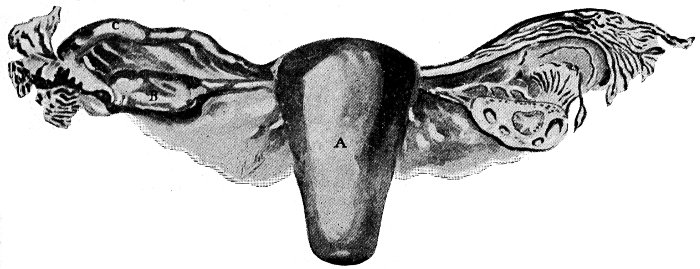
Let us first take the ovaries, which are two small
25
FIG. I.
UTERUS—TUBES AND OVARIES.
To the right the ovary and tube have been laid open.
a—Uterus.
b—Ovary.
c—Fallopian Tube.
27glands about the size and shape of an almond, placed
one on each side of the extreme lower part of the woman's
abdomen. They are imbedded in large ligaments
and tissues which also help to hold the uterus (the
womb) in place. Inside the ovaries are thousands of
little eggs called ovules, which have been there since
the birth of the girl. It is claimed there are from twenty
to fifty thousand ovules in the ovary at birth. The
work of the ovary is to develop and mature these eggs,
and send them on to be fertilized. At the time of puberty,
these eggs are all in different stages of development.
Those in the center of the ovary ripen first and
burst through the outer cover of the ovary (which is like
a capsule and at the time of menstruation becomes
swollen and congested). The ovule is caught by the
fringy ends of the fallopian tubes which are in a constant
lashing motion, which motion sends the egg
through the tube to the uterus.
The fallopian tubes are about four and one-half
inches in length and join the ovaries to the upper and
outer angle of the uterus. Its duties are to convey the
ova from the ovary to the uterus. Sometimes the
sperm cell from the male comes up into the tube to meet
the egg and it is fertilized here. The union of the two
cells usually occurs in the outer end of the fallopian tube;
but this is not the nest nature has prepared for the egg's
development, and unless it returns into the uterus it causes
serious trouble and an operation is necessary. Impregnation
in the tube is very rare, but it is possible.
The uterus, often spoken of as the womb, is a hollow
muscular organ into which the egg comes from the
tubes to be fertilized—four to eight days from ovaries
to uterus. After fertilization it remains here, is nourished
28and developed until it can develop no more.
Then it is thrown out by the contraction of the muscles,
which process we call the birth of a child. The
uterus is about three inches long, its shape is like a pear
with the small end downward. It is not fastened to any
of the bony parts, but is held in place by the ligaments
and tissues, which also allow it to move with different
movements of the body. One of the most interesting
features about the uterus which is so small in its
cavity is that it can stretch to accommodate the growing
child within it to the length of nineteen to twenty-one
inches. This is because it is one and one half inches
thick and composed of layers of muscles which are tough
and yet elastic. At the upper side of the uterus are the
openings into the fallopian tubes. At the small end
of the uterus is another opening leading into the vagina.
It is through this opening the sperm of the male comes
in order to fertilize the egg. Thus you can readily see
the uterus is the nest or cradle where the egg is to live
until it becomes strong enough to subsist on other
nourishment.
The vagina is a muscular tube-like passage which
extends from the small part of the uterus (called the
neck) to the outer surface of the body, where its opening
is usually partly closed in virgins by a thin membrane
or film known as the hymen. The walls of the
vagina are also very thick and elastic. This is sometimes
called the birth canal. The hymen was for years
a subject for discussion in the professional world among
physicians. In my talks to girls I find it a subject of
great interest and often anxiety to many of them, for
the average girl seems possessed with the old idea that
the presence of the hymen is necessary to marital happiness.
29The time was not long ago when its absence
was considered cause for serious discord between husband
and wife, and I have been told that under the old
law its absence was sufficient ground for divorce.
Fortunately, modern science has thrown some light
on this subject and disproved the theory that its absence
was necessarily due to a woman's having had sexual
relations. There are cases on record of women who
have lived four and five years in prostitution who were
found with perfectly preserved hymen. It is important
to know that it differs in size and shape in women. Also,
that in some women it has been entirely absent since
birth. Many little girls and babies have no hymen. It
can be destroyed by accident or injured by operations,
or examinations where the physician did not use the
greatest care. In some women it is easily destroyed;
in others it is more difficult. It is not at all uncommon
for a physician to find the hymen unruptured when he
comes to deliver the first born child. All of which goes
to prove that neither its presence nor its absence is
necessarily the sign of virginity.
Now that we have some idea of the situation of the
reproductive organs and their relations to one another
we shall be ready to consider in greater detail the ovule
or egg in the ovary.
Beginning with puberty the eggs from the ovary
are expelled as they ripen or mature. This process is
called ovulation and occurs about every twenty-eight
days. It is closely related to menstruation, but it is not
menstruation as you will soon learn. Some writers
say the egg is expelled at other times than at the
30menstrual periods; another writer asserts that one
passes every six hours, alternating male and female.
There are many views and ideas on the subject of
ovulation, but I will tell you of the most generally accepted
theory, that the egg is expelled from the ovary
every twenty-eight days.
When the egg ripens, the ovary discharges it and
sends it on to find its way through the tubes to the uterus.
Here we find the blood supply of the uterus greatly increased
in preparation for the egg. We find the inner
lining of the uterus becomes very soft and smooth so
that the egg can very easily find a place in which to
lodge itself after it has been fertilized. We also find
that the cells swell and multiply, all in preparation to
welcome and nourish the incoming egg or ovum. If
the egg is fertilized by the male, it then remains in the
uterus to develop. If not, it is thrown out, together
with all the preparation made to receive it. The cells
burst and discharge their contents; the mucus, blood,
cells and all come away in what is called the menstrual
flow.
At one time woman was thought to be the only
creature which menstruated. But science now tells us
that all warm blooded animals which walk erect menstruate.
The discharge is chiefly due to the position
which in standing upright, throws the large part of the
uterus higher than the neck. In animals, such as dogs,
cats, etc., the same process goes on, but the position of
these animals keeps the large part of the uterus lower
than the small part, where the blood is retained and then
reabsorbed into the system.
This process goes on every four weeks in girls after
they reach the age of puberty and continues at regular
31periods as long as the egg is not fertilized until the
reproductive age is over, which is usually between the
forty-fifth and fiftieth year. If, however, the egg is
fertilized the menstrual flow ceases and this blood supply
goes to nourish the new life in the uterus. It does not
appear again until after the birth of the child, and usually
ceases while the child depends upon the milk from
the mammal glands.
The age at which this process (menstruation) first
takes place in girls differs in individuals. Climate has
some effect upon it, for girls in warm or Southern climates
mature earlier than in colder places. In this climate
the average girl reaches puberty at fourteen years of
age. Some have been known to reach it as early as
the eleventh and others not until the eighteenth year,
all in the same place and yet normal and healthy, which
shows there is no reason for anxiety if the girl does not
menstruate at fourteen, provided she is developing
normally and is in good health. During the first few
years after its appearances the periods are likely to be
irregular. This is because the sexual organs are not
fully developed. Often the period does not occur after
the first time for three, five, eight months and sometimes
a year. This irregularity continues for two or
three years. Cases of girls coming from Europe have
been known where the period was perfectly established
over there, but after arriving in this climate the menstrual
flow did not occur again for a year and over.
Usually this irregularity lasts only a few months, and
when once it has become regular, there should be no
worry over its arrival a day or two earlier or later.
The length of time the period lasts differs in women
also. The average length of time is four or five days,
32yet there are women in which it lasts fully a week, and
others but a few hours. The length of time should not
be of as much concern as the amount of discharge which
is expelled each time. It is, of course, difficult to estimate
this, but physicians claim that more than three
protectives in twenty-four hours should not be used. In
all women the flow is most profuse during the first two
days.
The care of the health should receive more attention
during the first two days than is usually given it.
To the girl who has to work from early morning until
late at night, these two days are unusually hard on her
nerves and on her general health, and I regret that I
have no new message for her to help lighten the burden,
which under the present atrocious industrial system
makes it so hard for her.
Physicians say there should be no need of interrupting
the regular routine of the day at this time more
than any other. There are a few strong women to
whom this period makes no difference, but the average
girl in this country spends two days of pain and discomfort.
Out of 1,000 girls questioned, only 16 per cent.
were entirely free from pain, which proves that the
time has come for women to cease being ashamed of
this function, and insisting upon at least one day's rest
at the expense of her employer. Some of the old biblical
ideas instilling into the man's mind, that a woman is unclean
at this time has been the cause of much hardship
and many sneers endured by a woman during these
periods. The consequence has been that she will bear
the most intense pain rather than allow the men working
with her to suspect that she is menstruating. It is
all nonsense and wrong, and it is time women should
33band together in one great sisterhood to protect one another
from being slowly drained and exhausted of their
powers of motherhood for the benefit of their exploiters.
Women who belong to unions should demand that
this day be given them and their sisters. Girls continue
to suffer pains in the abdomen and back, pains
running down the limbs, headache, often nausea, besides
being nervous and irritable, yet hang on a strap
in an overcrowded street car, stand or sit all day in the
shop or at the machine and utter no protest. They
know, too, they are not alone in this suffering, for they
see about them day after day hundreds of other women
enduring the same pain, yet they remain silent.
How long will you endure this, working women?
There is one thing to remember, that the greatest
strain comes on the nervous system at this period. One
of the best ways to assist in building up the nerve
strength is in sleep and rest and for the girl who dares
not remain away from the shop fearing to lose her
“job” the next best thing is to get to bed early, for there's
nothing that builds up the exhausted nerves like sleep.
Fortunately, the girl at school has some consideration
shown her at this time, and it is well that this is
so, for until the period becomes established there is
special danger of overdoing in school work, which often
causes St. Vitus dance and other nervous disorders.
I believe in the regular warm tub bath, or cold
sponge followed by a good rubbing all over the body at
this time, together with nine or ten hours' sleep, and
light, nourishing food without stimulant. If the bowels
are active, it often lessens the pain considerably, and it
is very important that every girl attend to this if she has
any regard for her health. There are a few abnormalities
34of the menstrual function which I will not take the
space to state here. Before leaving the subject, I wish
to impress upon the reader that most abnormalities,
such as too little or too much flow, or very great exhausting
pain are usually caused, not by any disease of
the generative organs, but more often a disturbance of
the general health, which can often be treated and
cured by building up the system.
Every girl should learn the laws of menstruation
and its hygiene and have a full understanding of the
same. The menstrual function occurs only in the female
at puberty, but at the same time there comes to
both boys and girls, or male and female, a mysterious
and impelling influence, which has great power over the
lives of both during the adolescent period unless they
understand and control it. This is known as the Sexual
Impulse.
CHAPTER IV. — SEXUAL IMPULSE—PART I. — SEXUAL IMPULSE—PART II.
35
The sexual impulse is the strongest force in all living
creatures. It is this that animates the struggle for
existence; it is this that attracts and unites two beings,
that they may reproduce their kind; it is this that inspires
man to the highest and noblest thoughts; it is this
also that inspires man to all endeavors and achievements,
to all art and poetry; this impulse is the creative
instinct which dominates all living things and without
which life must die. If, then, this force, this impulse
plays so strong a part in our lives, is it not necessary
that we know something about it?
At the time of puberty there comes both to boys
and girls, two impulses—one, the desire to touch or
caress; to come in contact with, to write or to speak to,
an individual of the opposite sex. This impulse is much
stronger in girls than in boys. The other is the impulse
that impels the individual to discharge the accumulation
of ripe sex cells, and relieve himself of the nervous tension
which this accumulation produces. This impulse is
stronger in boys than in girls. One writer states that
this is an unconscious desire for relief from physical
congestion, not differing greatly from the sense of relief
which the emptying of the bladder or rectum produces.
These two impulses together, according to Moll,
constitute the Sexual Impulse, and this constitutes the
36foundation upon which love, the greatest of all emotions,
is based.
At the time of puberty, we learned from the last
article, that the first manifestations of sexual maturity
in the girl is the appearance of the menstrual flow. But
also at puberty there comes the sexual impulse, which
evidences itself during sleep, in a filmy substance dropping
from the mouth of the uterus. This “detumescence”
does not appear very often in young girls, but
later in life when sex instinct becomes stronger it occurs
during sleep, especially in young widows having experienced
sexual relations. They are, however, seldom aware
of its taking place; consequently, it has not the danger
which it presents to the boy.
In the preceding article on puberty, we discussed
only the girl at puberty, but here it is necessary to understand
that during puberty many changes take place in the
boy, such as change of voice, the growth of hair on the
face, various parts of the body, and most important, the
discharge of the sexual fluid commonly known as seminal
emissions. This latter symptom appears in every normal
healthy boy on reaching the age of puberty, but unlike
the menstrual period which occurs at a stated period in
girls, the seminal emissions do not depend upon a special
period; they occur at different times, often twice a
month. Unlike menstruation, which in the girl lasts
from two to seven days, the discharge lasts only a few seconds,
and is not accompanied by pain. This expulsion is
considered perfectly normal, and is not a sign of physical
or sexual weakness, but a sign that a surplus accumulation
of ripe sex cells are present and have come to their
full development and overflow. Nature takes care of
37this and uses all of this life-giving fluid according to the
needs of the individual, casting off the surplus.
It is this symptom that alarms young boys at puberty.
It is this overflow which enables quack doctors to
play upon the innocent and ignorant boy, telling him that
it is an indication of weakness. And it is also this—as the
result of telling older boys about it—that leads boys to
houses of prostitution; for they are told by their ignorant
advisers that they must have sexual relations or endanger
their sexual capacity.
It is also this overflow which, occurring in sleep
awakens the boy, and he is conscious of what has occurred;
he is conscious also of a pleasurable sensation
which this sense of relief produces, and unless warned
against it he will try at some later time to bring on this
relief by friction or mechanical means, which is known
as masturbation—often called self-abuse. The age of
puberty is one of the periods in an individual's life in
which it is easiest to acquire this habit, in girls as well as
in boys, although the girl may not be conscious of any
sensation, through the accumulation of the “detumescence”.
Yet there is the same nervous tension that exists
in boys, due to congestion of the now fully developed
genital organs, perhaps slighter in intensity, but it is
there and the girl becomes conscious of it.
In talking to older girls about sex, menstruation,
etc., she is often led into the habit of masturbation.
Cases have been known where children formed this habit
in infancy almost, through the ignorance of nurses or
even mothers, who, not aware of the consequences, have
kept babies from crying by gently patting or rubbing the
sexual parts. It may be caused also by uncleanliness,
itching, tight clothing, etc.
38When the habit is formed in very small children, it
can be exercised in the very presence of the parents, but
they being ignorant of the habit itself, or the consequences,
interpret the actions as “baby ways”. Again,
the habit is formed upon entering school. It is said no
school is free from it; and it is a fact that no institution
today is free from pupils who practice masturbation.
In public schools are found groups of perverted boys
and girls whose depraved ideas sooner or later permeate
the place. A recent issue of a conservative woman's
journal says: “In absolute filth of conversation nothing
could equal the talk of boys and girls during recess
in our schools. What is still worse is that the child is
generally instructed in masturbation, prostitution and
sometimes sexual perversity.”
This subject of masturbation is at present under
discussion from many points of view among the medical
profession; some claiming, that, as with venereal diseases,
we lay too much stress on the matter, and exaggerate
the harm done to the individual by it. One writer
plainly states that it is of such common practice that out
of a hundred young men and women, ninety-nine are addicted
to it, and the hundredth one is lying. Another says
that out of a hundred men and women arriving at the age
of 25, ninety-nine have practiced it at some time.
By these examples such writers would try to prove
that because ninety-nine people out of one hundred are
not in insane asylums the practice cannot be as harmful
as it is stated by others to be.
Let us take a sane and logical view of this subject.
In children, before they have reached the age of puberty,
prior to the development of the sexual organs, it
stands to reason that to abuse these organs before they
39are strong enough to be exercised must weaken them for
their natural functions. Again, masturbation, unlike the
sexual act, can be practiced individually and at all times
and nearly anywhere. This gives the individual unlimited
opportunity for indulgence, and consequently drains
and exhausts the system of the vitality necessary for full
development.
In the boy or girl past puberty we find one of the
most dangerous forms of masturbation, i. e., mental masturbation,
which consists of forming mental pictures, or
thinking of obscene or voluptuous pictures. This form
is considered especially harmful to the brain, for the habit
becomes so fixed that it is almost impossible to free the
thoughts from lustful pictures. Every girl should guard
against the man who invariably turns a word or sentence
into a lustful, or commonly termed, “smutty” channel, for
nine times out of ten he is a mental masturbator.
Perhaps the greatest physical danger to the chronic
masturbator is the inability to perform the sexual act
naturally. The strong physical irritants which are used
are likely to produce catarrhal disease of these organs in
both sexes, producing such irritating sensations that relief
is demanded, and this can be obtained only by repeating
the habit, and so it continues. The individual
promises himself over and over again after such exercises
to overcome the habit, but his will power gradually becomes
destroyed and the impulse continues. He knows
and intuitively feels such practice degrades him and destroys
his character; he feels he is losing control of himself,
and also realizes that his health, especially his nervous
system is being undermined.
In my personal experience as a trained nurse while
attending persons afflicted with various and often revolting
40diseases, no matter what their ailments, I never found
any one so repulsive as the chronic masturbator.
It would not be difficult to fill page upon page of
heart-rending confessions made by young girls, whose
lives were blighted by this pernicious habit, always begun
so innocently, for even after they have ceased the habit,
they find themselves incapable of any relief in the natural
act. This causes a nervous and excited condition in
the girl, tossing about nervously for hours after. It is
much more difficult for a girl to overcome the habit than
a man. The effects are more permanent in her.
Before closing this subject, however, I want to tell
of a case of an eight year old boy I attended during an
attack of measles. I found he was shy and unresponsive,
and at times very nervous and irritable with a strong
liking to be alone. I observed him closely for a few
days and reported the results of my observation to the
attending physician. He was convinced of the truth,
that the little fellow was masturbating. The physician
assigned me to the task of talking to the child, who
acknowledged that he was “touching” himself and had
been ever since he could remember. The little fellow's
mother had died when he was in infancy, leaving beside
himself a brother a year older with whom he slept. I
explained to him the danger as well as I could and the
result was that I was awakened in the night by whisperings
and found the little fellow asking the older
brother to tie his hands to the bedpost. This the older
brother did with a handkerchief, and the child went to
sleep in this way every night during the few weeks I
was attending him. The first few nights he was awake
practically all of the time struggling to overcome this
habit, which he finally overcame completely.
41At puberty every boy and girl should be taught these
dangers and temptations and also how to avoid them, by
keeping active, mentally and physically, going to bed
only when sleepy, avoiding intoxicating drinks and stimulants.
We have strayed some distance, I know, from the
beginning of our subject—Sexual Impulse—to treat of its
perversion (masturbation), but we shall now take up the
normal natural impulse and see what there is that every
girl should know.
In the first part of this article we learned that the
sexual impulse is a combination of the two impulses:
the one which impels the discharge of ripe sex cells,
strongest in the boy, and the other which impels the individual
to touch or caress an individual of the opposite
sex, strongest in the girl.
Every girl has in mind an ideal man. This ideal
begins to form sometime in the early adolescent age. He
is usually distinct in her mind as to his physical qualities,
such as dark or light hair, or brown or blue eyes. He
is always a certain physical type and often remains an
ideal to her through life. At the forming period of the
type she will be attracted toward many men who seem
to answer the ideal type, but as she reads and develops
through the various stages of the adolescent period, the
ideal changes and grows with her. As she reaches the
romantic stage the ideal must be brave, daring, courteous.
If she is inclined toward outdoor sports he must be
athletic. And so it goes on until the twenty-third year,
when the average girl has a fairly settled idea of the man
who would suit her as a mate through life.
42When the sexual impulse makes itself felt strongly
in the adolescent boy or girl, they, feeling satisfied with
the physical beauty and perfection of the other, marry,
they are unconscious that the incentive to love
when based on physical attraction alone is soon destroyed.
For sickness, poverty or disease will affect even the most
seemingly perfect physical attraction.
Let us not confuse the sexual impulse with love,
for it alone is not love, but merely a necessary quality
for the growth of love.
No sexual attraction or impulse is the foundation
of the beautiful emotion of love. Upon this is built respect,
self-control, sympathy, unity of purpose, many
common tastes and desires, building up and up until this
real love unites two individuals as one being, one life.
Then it becomes the strongest and purest emotion of
which the human soul is capable. There is no doubt
that the natural aim of the sexual impulse is
the sexual act, yet when the impulse is strongest
and followed by the sexual act without love
or any of the relative instincts which go to make
up love, the relations are invariably followed by a feeling
of disgust. Respect for each other and for one's self is a
primary essential to this intimate relation.
In plant and animal life the reproductive cell of the
male is the active seeker of the passive female cell, imbued
with the instinct to chase and bodily capture the
female cell for the purpose of reproduction.
This instinct man, as he is today, has inherited, and,
as with the lower forms of life, the senses are intensely
involved. It is kept alive by the sense of sight, sound
and smell, and reaches its highest development through
the sense of touch. It is heightened by touching smooth
43and soft surfaces—which is said to account for the pleasure
of kissing.
In the early part of this article I spoke of the desire
to touch being stronger in girls than in boys. This
desire leads a girl to kiss and fondle a man without any
conscious desire for the sexual act; whereas in the man,
to be touched and caressed by the girl for whom he has
a sexual attraction, stimulates the accumulation of sex
cells, and the desire for the sexual act becomes paramount
in his mind. Many a young girl bubbling over
with the joy of living, innocent of any serious consequences,
is oft-times misjudged by men on account of
these natural actions. But she soon puts on her armor
of defense, and stifles and represses any outbursts of
affection.
Society, too, condemns the natural expression of woman's
emotion, save under certain prescribed conditions.
In consequence of this, women suppress their natural
desires and direct this great force into other channels,
participating in the bigger and broader movements and
activities in which they are active today.
This is one reason why the type of the so-called
“old maid”, so characteristic of the generation past, has
disappeared. These great maternal powers are being
used up in the activities of modern life. Instead of allowing
it to remain dormant and make her odd and
whimsical, the modern woman turns her sexual impulse
into a big directing force.
That the male creature is the pursuer of the female
in all forms of life, there is no question, but that the
female has the choice of selection and uses fine discrimination
in her choice, cannot be denied either. This instinct
of selection seems to lie dormant in women of
44today, for at puberty nature calls to every girl to make a
selection suitable to her nature. Yet few girls follow this
instinct on account of the specter of economic insecurity
which looms up before them. Instead of asking themselves:
“Are we mateable and sympathetic?” they ask:
“Shall we have enough food, clothing and shelter?”
Indeed, girls, this system increases our degradation,
and places us in ideals lower than the animals. All over
the civilized world today girls are being given and taken
in marriage with but one purpose in view: to be well-supported
by the man who takes her. She does not concern
herself with the man's physical condition; his hereditary
taints, the cleanliness of his mind or past life, nor
with the future of the race.
There will no doubt be a great change in woman's
attitude on this subject in the next few years. When
women gain their economic freedom they will cease being
playthings and utilities for men, but will assert themselves
and choose the father of their offspring. As Bernard
Shaw tells of her in one of his greatest plays, she
will hunt down her ideal in order to produce the Superman.
There seems to be a general tendency on the part
of the woman who is demanding political freedom, to
demand sexual freedom also. When a girl reaches the
age nearing thirty her natural development tends toward
sexual freedom. It seems as though nature, knowing
the time of reproduction is drawing to a close, calls with
all the fury of her strength to complete its development
and procreate.
It is at this age where physicians claim a woman
awakens to the sexual desire, and it is at this age that women
45seek affection, or gratification with a “lover.” To
her there is nothing to say; she is mature, developed and
can judge for herself where best her happiness lies.
But to the young girl at the age of say twenty, or
even younger, immature, mentally undeveloped, there is
something she should know, and that is that every physical
impulse, every sensual feeling, every lustful desire
will come to her whitewashed with the sacred word
“Love”.
Neither the boy nor the girl knows the difference
between the sexual impulse and love. A boy meets a girl
he feels a great attraction for her, he feels the sexual impulse
throbbing within him, he is full of this life-giving
current, he feels it throughout his being; he walks lighter
and straighter, he feels it in his voice, in his laughter;
he grows tenderer within himself, and to women. He
feels all this and is sure it is a love that will never die.
If there is an attraction on the girl's part there is no difficulty
in persuading her that this feeling is love.
But it is not love; it is the creative force or sexual
impulse scattered through his being and the sexual act
brings it to a focus.
If motherhood comes to the girl through this relation,
she has developed and the experience has enriched
her life. But today the girl has an idea she has escaped
the greatest disgrace when she has avoided motherhood.
If the relation was based on physical attraction alone, a
few abortions and the monotony of every day life soon
remove this, and the man goes elsewhere in search of this
wonderful sensation which he felt at first, but did not
know how to keep or how to use.
The girl, however, has become a new being, sexually
awakened and conscious of it, but ignorant of the use
46of the forces she possesses, she plunges forth blindly, with
social and economic forces against her, and prostitution
beckoning at every turn. So she soon passes with the
crowd on the road to the Easiest Way. This is the story
of thousands of young girls living in prostitution.
Women should know that the creative instinct does
not need to be expended entirely on the propagation of
the race. Though the sex cells are placed in a part of
the anatomy for the essential purpose of easily expelling
them into the female for the purpose of reproduction,
there are other elements in the sexual fluid which are
the essence of blood, nerve, brain and muscle. When
redirected into the building and strengthening of
these, we find men or women of the greatest
endurance and greatest magnetic power. A girl
can waste her creative powers by brooding over
a love affair to the extent of exhausting her
system, with results not unlike the effects of masturbation
and debauchery.
The sexual impulse is natural. It is natural in animals,
degenerates, and in man. But in man it is mixed
with other essentials which, together, are termed love.
These essentials are derived from man's power of reasoning
by which he is known as a higher species and
through which he differs from the animals.
When man emerged from the jungle and stood upright
on his hind legs, the shape of his head and his face
changed from the long jaw and flat head of the animal to
the flat face and high head of the man. All progress from
that time forward was made along mental lines. According
to universal law then in existence he should have
been limited to a geographical area and killed by the
extreme heat or cold or starved for one kind of food if
47it were not obtained, but against all these he fought, because
he became endowed with such attributes as reason,
knowledge and will-power. Instead of using his creative
powers solely in hunting food and reproducing his
species, he used this force in making plans for his self-preservation.
He built rafts and boats to cross rivers
and streams; he devised methods of clothing himself
against extreme heat and cold and discovered various
ways of preparing food for different climates suitable
for his various needs. In other words he conserved his
creative force and redirected it into its channels
which have resulted in giving him precedence over
all other living creatures. For man has developed
a conscious mind which asserts itself by reasoning,
which in turn has developed his brain power.
It is said a fish as large as a man has a brain no
larger than the kernel of an almond. In all fish and
reptiles where there is no great brain development,
there is also no conscious sexual control. The lower
down in the scale of human development we go the less
sexual control we find. It is said the aboriginal Australian,
the lowest known species of the human family,
just a step higher than the chimpanzee in brain development,
has so little sexual control that police authority
alone prevents him from obtaining sexual satisfaction
on the streets. According to one writer, the rapist has
just enough brain development to raise him above the
animal, but like the animal, when in heat, knows no law
except nature, which impels him to procreate, whatever
the result. Every normal man and woman has the
power to control and direct his sexual impulse. Men and
women who have it in control and constantly use their
brain cells thinking deeply, are never sensual.
48It is well to understand that the natural aim of the
sexual impulse is the sexual act and the natural aim of
the sexual act is reproduction, though it does not always
result in this. It is possible for conception to take place
without love, it is even possible that there is no conscious
knowledge to procreate before or during the act, yet
this does not disprove the fact that nature has designed
it for the purpose of reproduction, no matter what uses
man has put it to today. This subject of procreation
we shall discuss next.
Every girl should know that to hold in check the
sexual impulse, to absorb this power into the system
until there is a freely conscious sympathy, a confidence
and respect between her and her ideal, that this will go
toward building up the sexual impulse and will make the
purest, strongest and most sacred passion of adult life,
compared to which all other passions pale into insignificance.
CHAPTER V. — REPRODUCTION—PART I. — REPRODUCTION—PART II.
49
In teaching children or young persons the process of
reproduction one of the cleanest, most natural and beautiful
methods of doing this is to tell them the process
which goes on in the various forms of life in the flower,
fish, frog, bird and to lead up to the highest and most
complex of all living creatures—man.
They watch the butterfly and bee carry a load of
pollen from the father buttercup to fertilize the seeds
within the mother flower. They watch Mr. and Mrs.
Frog awaken from their long winter nap, and stirred
by the life-giving impulse within them, start for the
breeding pond. They watch Father Thrush win his
mate and patiently stand guard over her during the
tedious hatching days. They are told and see that the
flowers depend upon outside forces to bring the pollen
from the male to the female to fertilize the seeds before
the seeds could grow. They are taught that the mother
fish lay her eggs in the water first and that the father
fish, unlike the flowers, being able to move about, carries
the pollen (which is now a fluid) to the seeds himself.
They are told that Father Frog, being a higher
creature, fertilized the eggs before they reached the
water, and Father Thrush being still higher in the scale
fertilized the eggs before they left the mother's body.
That the higher the species was, the greater the care
required to preserve that species.
In this way the mind is prepared for the information
which should follow.
50The girl at puberty should be taught this process
and something of what goes on within the womb after
the ovum has been fertilized. She should know that all
organic life is the result of a simple cell; that man is a
community of cells, banded together and depending
upon each cell to carry on its work, for the benefit of the
whole.
Let us first, then, get an idea of a cell and what it
is and what it does. A cell is a tiny portion of living
matter having in its center a spot or nucleus which represents
the point of germination; it is separated from its
sister cells by partitions of cell membrane.
A simple cell is formed by the fusion of two germ
cells when they meet to exchange nuclear elements.
After this fusion they are able to proceed with fission,
which means splitting into parts, and it is the subsequent
cellular growth of the fused germ-cell that constitutes
reproduction.
There are two kinds of reproductive cells, the ova
in the female and the spermatozoa in the male.
When the sexual act takes place, there is deposited
into the vagina a secretion known as semen. According
to Sutkowsky, each deposit or ejaculation contains 50,000,000
of spermatozoa.
About the same time in the act there occurs in the
female, spasmodic contractions of the muscles of the
uterus which draws in a small amount of the sperm
which the male has left there.
The sperm cell of the male under the microscope
shows that it contains both head and tail.
The tail enables it to move and advance with a tadpole-like
motion toward the ovum.
As in the lower forms of life, the male cell has
51within it the instinct to chase and capture the female
cell. Consequently, it does not depend upon the uterine
contractions of the female to enable it to reach the ovum
for fertilization. The vagina being a corrugated or
wrinkled tube, hides and secretes the sperm cell for days,
unless it is removed with water or killed by poisonous
injections.
When, however, the sperm comes near the ovum
it is drawn to it as to a magnet.
The ovum being carefully protected by nature within
the ovaries, leaves its sister cells and travels alone.
The sperm cell, however, having more dangerous paths
to travel, must provide against the uncertainty of doing
its great work by going in numbers, though it takes but
one single cell to produce human life.
A number of the male cells go to meet the ovum,
but only one enters it. Almost at the moment the head
enters the ovum it becomes completely absorbed by the
ovum and all trace of it is lost.
This union of the two cells is called fertilization,
fecundation, impregnation, or conception. Any of these
terms may be used. This union usually takes place in
the tube, but the fertilized egg does not remain there;
it wanders along and finds its way into the uterus.
Now that the ovum has been fertilized, it readily
becomes attached to the soft lining of the uterus which
has been specially prepared to receive it. No menstruation
occurs. The woman is now pregnant. A new being
is created, and marvelous changes will now take place
within the tiny cell clinging so weakly to the lining
of the uterus. At this time the ovum is so small it can
scarcely be seen by the naked eye, but in two weeks it
52has grown to the size of a pea; in four weeks to the
size of a walnut, and in eight weeks to the size of a lemon.
At this time it is three inches long and is completely
formed, the head being much larger in proportion to the
rest of its body. What has happened to the ovum in
these few weeks is briefly this: All the changes in the
evolution of the animal kingdom, that man had to pass
through to arrive at his present shape, the human embryo
goes through step by step within the uterus in a
very short period. Immediately after fertilization the
ovum begins to divide into sections or lobes, into 2, 4, 8,
16, 32, etc. cells until they are almost countless. Each
cell splits in the middle of the nucleus, forming two complete
new cells and so on.
The next stage is represented by this mass of cells
forming themselves into a shape like a hollow ball.
The third stage is the meeting of the two layers of cells,
as if the ball had collapsed, and these two layers meet
and unite as one, stretch and flatten out like a worm.
After this stage things become more complicated; new
organs begin to develop, line marks for the backbone
and intestinal canal show themselves, as do the bony and
muscular structure of the skeleton.
A slight pulsation is observed, showing the development
of the heart. The head fold is formed by a gradual
bending of the spinal column at the front end of the
ovum, which we will now call the embryo. There are
also formed at this time, processes which soon become
arms and legs, there is a furrow on the face, pits for the
eyes; all of which has happened in less than four weeks.
From this time forward development is rapid; the
bones, which up to this time have been soft matter,
grow harder, and all organs which were only outlined,
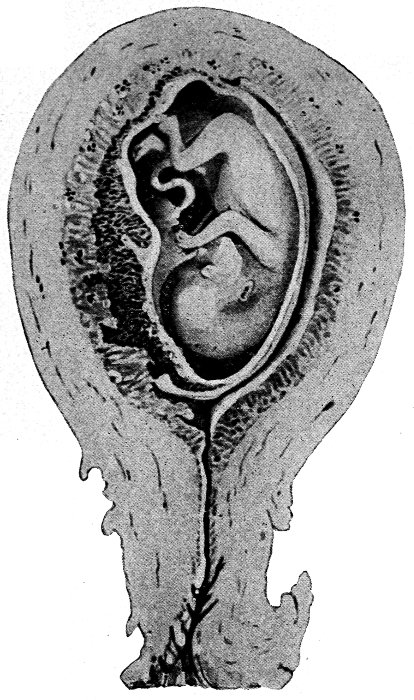
53
FIG. II.
Foetus in the Uterus at two months' pregnancy.
55now become definitely formed. At the end of the
fourth month it has grown to its natural shape. The
remaining months it increases in size and gains strength.
The uterus becomes enlarged, rises out of the pelvis
and occupies the abdominal cavity. It takes forty
weeks or 280 days to complete the growth of the human
embryo, although the time may be two weeks more or
less and yet be normal.
Let us see how the child has been fed all this time.
When the ovum is fertilized and up to the eighth week
it is fed by delicate branched threads, which form a
covering for it. These threads are called “villi”, and dip
into the uterine surface for nourishment from the mother
to supply the embryo.
About the eighth week these “villi” have grown
greatly intertwined into a mass of spongy tissue full of
blood vessels called the placenta (afterbirth). This fastens
itself to one side of the uterus, takes oxygen as well
as nutriment from the mother and sends it through the
umbilical cord to the child, the point of attachment being
at the navel, the depression left on the belly of the
child by the cutting of the umbilical cord at birth. In
the same way it takes the waste product from the child
to the mother, and she, in turn, throws them out of her
system through the kidneys, bowels and skin. The child
and placenta are both encased within a membraneous sac,
which secretes and serves to hold a watery fluid in which
the child swims.
The child is folded together with legs on the thighs
and thighs on the belly, arms on the chest and head
bent forward over the breast. Toward the end of the
term it moves about slightly, often stretches a little, and
has periods of rest when it scarcely moves, and again
56periods of great activity. A mother first feels the child
move in the fourth or fifth month. Often the young
mother at this time begins to worry over her acts lest
something she should do might deform the precious
charge she carries. This, as you can readily understand
from its early development, is impossible, for by the
end of the second month the child has been formed, and
no mental impressions of the mother can alter its shape.
Just as the nucleus of the male sperm has within it all
the contributions which the father of the child can give
it, until after it is born, so does the mother give it its
physical qualities right at the beginning.
Whatever is to be inherited from the father must
be within the substance of the spermatozoon at the time
the ovum is fertilized. He has no further pre-natal influence
over it.
It is interesting to observe that the children of so-called
great men are seldom above the average in intelligence,
where, on the other hand, almost all men of
great minds have had intelligent mothers.
How great or how little influence a mother has over
her child through her thoughts has not been proven, nor
has the subject of determining or influencing sex of the
unborn child been settled.
At the end of nine months the child's development
is complete and it is ready for its journey to the outside
world. The process of this journey is called “labor”—a
word which will describe the mother's share in it.
When this occurs before the embryo is able to live
outside the uterus it is known as abortion.
In the first part of this essay I said that if the process
57of labor occurs before the seventh month (which is the
earliest time the foetus can live for any length of time outside
the womb) it is known as abortion or miscarriage.
When labor occurs later than this or within two weeks
before term, it is known as premature labor.
The average girl in using the word abortion, has in
mind a criminal act, whereby the process of pregnancy is
purposely interrupted. She prefers the word miscarriage.
There is also a belief among girls that a miscarriage
occurring in the early stages of pregnancy can be brought
about without bad results or any serious consequences
to her health.
It is a mistake to regard an abortion as of slight importance,
for any interruption in the process of pregnancy
is always more dangerous than the natural labor at full
term. One writer claims there are more women ill in
consequence of abortion than from full term childbirth, on
account of which there are so many women who are
semi-invalids.
There can be no doubt that the often excessive loss
of blood leaves the woman in a weak and rundown condition,
thereby lessening her powers of resistance to other
diseases.
The shock to the woman's system is greater than that
produced by natural labor, and consequently leaves her
in a hysterical and often critically nervous state for some
time after.
The causes of abortion are many. Among them are
overexertion, overexcitement, shock, fright, fall, great
anger, dancing, fatigue, lifting heavy weights, purgative
medicines and excessive sexual intercourse.
The dangers resulting from abortion are blood
poison, hemorrhage—even lockjaw has been known to be
58the result of abortion, also the danger that one miscarriage
is likely to follow another, and disables a woman
to carry a child to the full term.
If there is the same care and treatment given the
woman who aborts as the woman in childbirth, she will
naturally be less likely to suffer serious results than if no
medical attention were given her.
One of the most common disturbances of pregnancy
is nausea, more commonly called “morning sickness,”
because it is felt in the morning when the woman first
assumes the erect position. As a rule, this lasts only
during the early months.
About the latter part of the fourth month, or often
not before the fifth month, movements of the foetus are
felt. These movements are called “life”, and women are
glad of this signal that all is progressing naturally. One
writer said a woman had described the first feeling of
life as “the trembling movements of a bird within the
hand.”
There are often many nervous manifestations accompanying
the pregnant woman, such as headache,
neuralgia, toothache and as a usual thing, constipation is
always present, and should receive attention. The
teeth also should receive attention at this time for they
decay easily on account of the secretions in the mouth
which are increased during pregnancy.
The breasts enlarge in the early months of pregnancy,
and there is a fullness and tingling felt often in the
fifth week. The nipples become erect and the skin
around the nipple becomes dark brown. These are only
a few of the disturbances of pregnancy, but enough to
show that other organs beside the uterus are tested in
strength and how important it is to have a good healthy
59body. In fact, every tissue and fiber in the woman's
body feels the impetus of pregnancy, and all kinds of physical
changes occur. Like in June, “Every clod feels a
stir of might, an instinct within it that reaches and
towers.”—Howell.
One of the common questions asked by young women
in early married life is how to tell if they are
pregnant.
This is not always easy, but there are a few points
on which a diagnosis is based, namely: in a healthy woman
(during the reproductive age) the function of menstruation
stops, together with the morning sickness, and
the enlargement of the breasts with dark color around the
nipples. These are early indications that pregnancy
exists. I am not going to take the time nor space to
explain that all three of the above named can exist in nervous
women, even when pregnancy does not exist. It is,
as I said before, with the average healthy girl I am dealing,
not with the exception. The only certain signs of
pregnancy are the hearing of the heart-beats of the child
and its movements.
Another question which troubles a young woman is
how to count the time when she will be confined. This,
too, is difficult to say, for an error of two weeks earlier or
later is possible, because the time of conception is seldom
definitely known. Experience has given a method of
arriving at an approximate date which is used and which
answers the purpose fairly well, though it is by no means
perfect. Add seven days to the first day of the last
menstruation and count nine months forward. For example:
Mrs. A. menstruated last, beginning October 5
add seven days; this brings the date to October 12; add
nine months, which brings the date of confinement to July
6012. It is well to have everything prepared two weeks
before this date so that the woman can be as much as
possible in the open air during the remaining waiting
days.
The dress of the pregnant woman should receive
serious attention. In the first place, it should be simple
and warm, without bands restricting the circulation of
any part of the body, like skirt bands, round garters,
corsets and tight shoes. The secret of a comfortable
outfit for the expectant mother is to have all clothing
hang from the shoulders. Combination underwear can
be bought as reasonably as the separate drawers and
shirt. There should be no pressure on the womb from
above, rather let all support come from below. The
corset gets in its harmful work by pressing down the
uterus into the pelvis, thus displacing the abdominal
organs and crowding them together in such a way as to
cause injury to the uterus as well as to the child itself.
The muscles of the uterus and abdomen are weakened and
from this results that horror of all women: the “high
stomach.” Some women, especially those having borne
children, prefer to wear in the latter days of pregnancy
an abdominal supporter. If it is well fitted to the body
it helps to assist the abdominal muscles in carrying the
weight and affords great relief. If women would devote
to making themselves comfortable during pregnancy as
much time as they give on the baby's outfit, they would
profit by it. Instead of wearing any old worn-out dress,
ill-fitting and out of style, make one “maternity” dress
to fit the figure. This can, of course, be let out in size
as the figure grows. It can be made of some pretty, inexpensive
material and gives such comfort and ease to
61the mind as well as to the body that the woman who has
once had one will never again do without it.
The food also should be simple. In fact, there are
few restrictions to be placed on food unless so ordered
by the physician. One common mistake of women is
that they believe they are eating for two persons, and
consequently, must gorge themselves, which, of course,
results in indigestion. Physicians advise a small amount
of meat once a day. Plenty of water, milk and cereals,
fruit, vegetables and especially fruit, which loosens the
bowels. Rich pastry or starches fried in fat should not be
eaten, because they are hard to digest. There is no
reason why the diet should be at all strict unless a
woman is under the special care of a physician. She
should take a moderate amount of exercise every day,
but should not get tired. Walking in the open air in the
sunlight is best. Avoid dancing, swimming and all violent
exercise; sewing on the sewing machine should be
restricted. Fainting in the early months is often caused
from bad air in overcrowded and overheated rooms, also
from an empty stomach when the woman is too busy to
notice nature's call for nourishment.
It is now generally agreed that alcohol taken by
the mother during pregnancy, has very bad effects on the
offspring.
There is little more to be said here except that a pregnant
woman should be mentally and physically active,
though not fatigued. And of all things she should keep
out of the hearing of old superstitions, which have a sign
for every act and keep a young woman constantly worried.
She should not be allowed to worry over her approaching
labor, and as far as possible be kept cheerful
and happy. Another question which concerns every
62expectant mother, is, if there is any danger in sexual
intercourse during pregnancy.
At the end of the period the child and the placenta
are expelled from the uterus. The uterus gradually returns
to its former size. It requires about six weeks
for this to occur and it is very important that there
should be no heavy lifting and overwork at this time.
As a rule after childbirth, the woman's form becomes
matured and more developed. The facial expression
takes on a kinder, a maternal look, the whole nervous
system is awakened to sympathy, pain or grief bringing
tears to the eyes quicker than ever before. Especially
is this true for the first few years following.
The important thing is that the care of the pregnant
woman should be begun in girlhood. If we are going
to be and have mothers, then we should give attention
to the development of the organs which make us
mothers.
CHAPTER VI. — SOME CONSEQUENCES OF IGNORANCE AND SILENCE.—PART I. — SOME CONSEQUENCES OF IGNORANCE AND SILENCE.—PART II. — SOME CONSEQUENCES OF IGNORANCE AND SILENCE.—PART III.
63
When the boy arrives at the age of puberty, he is in
greater danger than a girl of being not only led astray
by companions, but being actually sent into unclean
living by those nearest and most interested in his welfare—HIS
PARENTS.
The reason of this is that there has been and still
is a false idea clinging to many parents that as soon as
the boy has seminal emissions, it is a signal that he must
have sexual relations or suffer in health.
That the seminal emissions are not harmful and that
they grow less frequent as the boy grows older is a fact
of which few mothers seem to be aware.
We cannot blame the mothers of the past for not
informing their sons of this physical condition, for few
of them knew it themselves. Mothers have been as ignorant
as the boys of their sex functions as well as
other functions of the body.
They accepted sickness, disease, and even death
without a question, placing their faith and confidence
entirely in the hands of the medical profession, who,
like the rabbis and high priests, made a church of their
knowledge.
Fortunately this condition of affairs is changing,
and the knowledge of the human body, which for ages
has been most carefully locked within the medical
64libraries, is fast taking up its abode in the homes of the
people—where it belongs.
It is said that in Japan or China, the duty of a physician
is to keep his patients in good health, receiving
payment only when they are well.
Certainly this sounds like civilization.
Only a few weeks ago I had occasion to talk to a
woman about her oldest son, whom I considered sick
from overwork and lack of nourishment. She informed
me, however, that this was not so, and whispered confidently
that he was 16 years old and “in that age when
he needs a woman.” She further remarked that she and
“the papa” had talked it over with the result that the
father had told the boy, when he had “the desire for a
woman,” that he, the father, “would give him money
enough to get one.”
Think of that boy's attitude toward women, and
the danger to become affected with venereal diseases
that he was likely to contract. Yet both parents had
the sincerest wish to do their best for that boy; they
gave the best advice they knew.
One of the most common errors I have found
among people, even those educated in other lines of
thought, is that the sexual organs will become useless
unless they are used in early manhood. This is considered
untrue by the best authorities on the subject, for it
is known that the essential organs of reproduction are
glands, not unlike the tear glands of the eyes or the
milk glands of the breasts. The tear glands do not
atrophy even if one does not cry for years, nor the
milk glands during the entire period of reproduction.
The same can be said of the sexual glands.
Another idea which is fast being uprooted is that the
65sexual act is an appetite, not unlike that of hunger and
thirst, which must be fed by the boy sowing his “wild
oats” first before settling down to marriage. It is now
a recognized fact that it is no more necessary for a boy
to “sow wild oats” than it is for a girl, and women are
today demanding of men the same cleanliness of body
and mind which men have heretofore considered necessary
only in women.
It is now the unreserved opinion of the foremost
medical men of the day that a man does not suffer in
health from living a continent life, nor is he a “mollycoddle”
from so doing.
Hutchinson says: “The belief that the exercise of
the sex functions is necessary to the health of the male
at any age is a pure delusion, while before full maturity
it is highly injurious.”
Ruggles says: “Sexual abstinence is compatible with
perfect health and tends to increase virility (which means
manhood) through the reabsorption of the semen.”
The ancient Teutons were aware of this, for it is
said that it was considered a most shameful thing for
their young men to have sexual relations with a woman
before their twenty-sixth year. From observation and experience
they were convinced that men were not sexually
mature much before this age, and no one will dispute
they were strong and manly.
Statistics show that 65 per cent. of men infected
with venereal diseases (which means diseases due
to sexual intercourse) are contracted between the ages
of 15 and 21 years; and 25 per cent. are contracted in
the 21st and 23rd years.
Writers claim that from statistics they have found
men are not sexually mature before the twenty-fifth
66year and women not before the twentieth year. Yet
we find them both reeking with sexual diseases before
this age.
According to Sanger's “History of Prostitution,” it
is claimed that three-eighths of the prostitutes enter
the life before the twentieth year in New York City. It
is safe to say this is a conservative estimate, for the more
recent investigations in Chicago and other cities show a
very much higher percentage. However, this, together
with the statistics of venereal diseases mentioned above,
show that it is before the boy and girl are sexually mature
that there is the greatest difficulty in directing the
impulses and controlling the passions.
Chassaignac says that the more healthy and normal
an individual is, the better can he not only control his
passions, but the less likely is he to be disturbed by continence.
Just one more word on the subject of continence,
and that is that it is not at all unusual to find men determined
to remain continent until they find their ideal
woman. Nor for athletes in training engaged in contests,
nor for sailors on long sea voyages, and many
others for long periods of time is continence impossible;
in fact, they are better for it.
This knowledge was not lost sight of in ancient times.
Reference is made to it in the Bible, in the sending
of women prostitutes into the camps of the enemy the
night before an expected battle, in order to exhaust or
decrease the vitality of the soldiers.
When one finds an individual who realizes the force
of the sexual impulses and knows how to conserve them,
you usually find a person who does not drain or exhaust
these forces, but uses them in creative work.
67Every girl should look upon the man who indulges
freely in the sexual relations without Social responsibility,
as a prostitute far more degraded than the unfortunate
girl who is compelled to sell her body to sustain
life.
Every girl should know something about the physical
makeup of a boy as well as of her own, for upon the
well-being of both does the future race depend. To be
a real mother a woman must understand a boy's emotions
and development, if she would sympathize with him.
And when she does understand, she will not send him
to buy a woman for physical satisfaction.
It is this ignorance of parents, together with the
silence of the medical profession, which is largely responsible
for the terrible spread of venereal diseases which
exist today.
When a few years ago Dr. Morrow stated that there
is more venereal diseases among innocent, virtuous wives,
than among prostitutes, this statement should have resounded
throughout the walls of every home in the land,
instead of which it is kept intact within the covers of
large volumes, where only those wearing cap and gown
have access to it.
It is claimed that out of 1,000 married men in New
York 800 have gonorrhoea, and 90 per cent. of these
have not been cured and can infect their wives. The
result is that at least three out of every five married
women in New York have gonorrhoea.
This seems astounding and exaggerated, but the following
quotation is taken from an authority and is considered
quite conservative: “Over 90 per cent. of our
young men stray from the path of virtue before marriage;
60 per cent. contract venereal diseases which are
68difficult to cure; more wives than prostitutes have venereal
diseases; one-eighth of all diseases in New York
hospitals are venereal; 20,000 infected persons walk the
streets daily.”
It seems to me that the above facts are sufficient
to warrant every girl and boy knowing something about
these diseases.
The two venereal diseases which I will tell you something
of here are those most commonly known to all—gonorrhoea
and syphilis.
Gonorrhoea is an inflammation of the urethra (water
passage) characterized by redness, swelling, smarting
pain on the passing of water, and accompanied by thick
purulent (poisonous) discharge, at first creamy in color,
and later a greenish yellow. It is considered by the
highest authorities as solely a sexual disease in adults,
depending almost exclusively upon sexual intercourse
as its mode of origin and infection. In children, however,
it is not the rule, especially in infants and little
girls, who can be infected by the hands of the mother
or nurse being soiled with the discharge, also where the
fresh discharge is on towels, toilets, etc. It starts an
inflammation of the outer delicate parts but seldom
enters the urethra.
In former days gonorrhoea was considered an ordinary
catarrhal inflammation, “no worse than a bad
cold,” the old saying went. It was thought to originate
in women with the discharge at the end of the menstrual
period, or leucorrhoea; in fact any secretions from the
uterus, of an irritating character, were thought to be
69sources of gonorrhoea. However, with the discovery of
the microbe “gonococcus”, in 1879, by Dr. Neisser, it
is now an established fact that the disease comes from
a source where there is either latent or chronic gonorrhoea,
which, of course, means that the gonococcus is
present. It is considered a conservative estimate that
at least 50 per cent. of the adult population in this country
have suffered from gonococcal infection. More men
than women have been and are infected.
The first symptoms of the disease appear from three
to seven days after infection, and under proper treatment
the discharge may disappear in six or eight weeks.
If the man or woman places himself under the care
of a specialist within forty-eight hours after infection,
the disease is often of much shorter duration. When
allowed to become chronic, it is called gleet. Too much
emphasis cannot be put upon the danger of placing any
one with this disease into the hands of the doctors who
advertise so conspicuously, claiming rapid and complete
cures for all sexual diseases. Experience has found that
thousands of boys and young men, attracted by such alluring
promises as only the quack can put forth, have
been under such treatment, only to find later that the
disease was allowed to remain in the tissues, the discharge
only having been dried up. The germs were
allowed to continue their work on up into the bladder,
kidneys, joints, heart and even to the brain. The germs
can live for years in the body hidden away in the gland
ducts, the mucous membrane of the organ first attacked
being in a normal state, yet when a condition arises when
the vitality of the tissues in which the germs are lodged
is lowered, or which gives the germs themselves more
70nourishment or stimulus, such as alcohol or excessive
intercourse, they almost always become active again.
In women the small part of the womb (cervix), as
well as the urethra, are favorite places of attack. When
the disease attacks the cervix a woman may not be conscious
of it, and so, unless prominent symptoms attend
it, she may infect many persons in the meantime. In
man, on the other hand, the disease cannot be present
without his knowing there is something wrong, and it
should be impressed upon him that it is a moral obligation
on his part not to have sexual relations until he
has been examined and pronounced cured by a specialist
in genito-urinary diseases.
Your general practitioner will always recommend to
you a specialist if you ask him to. When the disease
attacks the uterus and ovaries it very often blocks the
fallopian tubes and prevents the impregnation of the
ovum. It is said that over one-third of the childless
marriages are due to gonorrhoea in women, innocently
contracted from their husbands. Both men and women
can become sterile from this disease. The seminal tubes
in the man become blocked, thus disabling him from impregnating
the ovum.
Again, when the disease attacks the organs of generation,
unless speedily attended to, the organs get into
a chronic state of inflammation. The disease is, therefore,
more difficult to reach, the chances of cure more
difficult, and it usually means an operation for the woman.
The great mass of ailing women who trace their
misery back to never seeing a well day since marriage,
71can be classed among those suffering with this disease,
as can also that army of women whose illness is classed
among “female disorders.”
A curious point to know is that a man may have
a hidden or latent gonorrhoea, of which he is not aware,
for it gives him no trouble, and may infect a clean,
healthy woman during sexual relations, and she in turn,
can infect him with the same disease, acting like a fresh
infection, giving rise to pain and discomfort. The
great majority of infections in women are contracted
from men who believe themselves cured, being under
the false impression that they are cured because the discharge
has ceased.
At a lecture given by a well-known physician in this
city last winter, the physician advised every girl whose
sweetheart, lover or expected husband had a history of
inflammatory rheumatism of the joints, back of him,
that as she values her life and future health, not to marry
that man without a thorough examination by a specialist
in these diseases. He declared: No young man should
have inflammatory rheumatism. This statement is considered
somewhat exaggerated by some making more recent
investigations, yet all seem to agree that a very
large majority of cases of inflammatory rheumatism of
the joints have the gonococcus present.
If the woman is not made sterile by the disease and
is able to carry the child to full term labor, then there
is another danger of infecting the child's eyes during the
process of labor, when the secretions lodge themselves
into the delicate membrane of the eyes. Then, unless
quick action is applied, the sight of both eyes can be
72lost. Over 80 per cent. of blindness in babies is due to
this germ. It can be carried into the eyes of both children
and adults by any means which can carry the discharge
to the eyes. Upon the slightest suspicion that
this has been done, medical aid should be summoned at
once.
There is one fortunate thing to know, that the germ
cannot live for a great length of time outside its natural
or proper environment, though it can for years be hidden
in the body. It dries up very quickly, and special
solutions of both bichloride and permanganate of potash
will kill the germs with which the solution comes in
contact. There is but one course to follow, that upon
any of the symptoms mentioned above, go at once to a
reliable physician and follow his instructions closely.
And remember that the causes which retard recovery
are alcoholic drinks, lack of rest, spicy food and sexual
excitement. It is said there is no positive proof against
this disease, except continency until marriage and then
monogamy.
A story is told of a young Irish physician, who, being
asked how he treated gonorrhoea, replied most tersely,
“with contimpt.” That this was for a time a general
feeling is agreed, but with the knowledge that so
many persons, especially women, contract the disease,
under the moral, as well as legal, conditions of present
society, the feeling has changed. A woman is infected
by her husband after the marriage is sanctioned by the
state and blessed by the church, neither taking the interest
in the woman's future to guarantee to her a clean
individual as a husband. Prostitution has been upheld
and women segregated for man's sexual use, the government
73going to the extent of authorizing examinations
of the women for venereal diseases to insure man's safety
from these diseases. Yet there has been no such protection
given either the woman prostitute or the wife
that the man's body is free from them. On the other
hand, every means to keep a married woman in ignorance
of the source of her infection is made by the church,
state and society in general. Every law to protect the
man's crime is made for his use, while women remain
unprotected victims of his guilt. And this, they say, is
“to protect the family and the home.”
Dr. James S. Wood tells a story of his experience
With a young woman of 25, married five years, when
she came to him. The husband admitted having had
gonorrhoea previous to marriage. The doctor found her
flowing excessively, the cervix badly torn, the uterus
sharply bent back and fixed, ovaries bound down and
adherent, the tubes thickened; a leuchorreal discharge
was present which contained gonococci, and other
symptoms which made her sick and miserable. The
doctor operated upon her, scraping her womb, sewing
the torn cervix, opening the abdomen to remove the
thickened appendix and inflamed ovaries and tubes. She
convalesced beautifully, and had no bad or unusual
symptoms for six months, at which time she returned
with a renewed infection. Careful questioning extracted
from the husband the confession that he had been
“out with the boys,” and had had a recurrence of gonorrhoea.
Most of the good which came from the operation
was spoiled by this second infection.
This is only one simple example of what is meant
by preserving the home and family at the terrible cost
74of women's lives. Women should protest against the
so-called medical secret which decrees that they be kept
in ignorance where their health, as well as life, is directly
concerned. That there are men in the medical profession
in this country, as well as in Europe, who have
openly protested against respecting the secret where another
life is involved, seems a cheerful signal of a general
social awakening in this field.
In the Medical Record, April 20, 1912, Maude Glasgow
says: “After suffering for years a woman becomes
a feeble, worn-out, nervous woman; her life is a burden
The operating table is her only hope, and she leaves it
deformed, mutilated and sexless.”
If women voluntarily exposed themselves to diseases
which would sap the husband's vitality, making
him a dependent invalid, or expose him to the shock of
a mutilating operation, or death—would men continue
to suffer? Would they allow the medical secret to
protect women in this alleged “freedom”? Every girl
knows he would neither protect her nor continue to
suffer. It is women only who have allowed the double
standard of morals to stand so long, giving men the
purest and best of their womanhood, but not demanding
the same from them. As soon as women realize the danger
to themselves and their children which they are likely
to incur from men who have lived promiscuously, they
will revolt against such standards.
Gonorrhoea differs from syphilis, and though it is
not a disease which can be transmitted from the parent
to children, as syphilis can, yet it is a subtle, wrecking
disease and can do almost as much harm to the individual.
75WHAT EVERY GIRL SHOULD KNOW
BY ORDER OF THE
POST OFFICE DEPARTMENT
FEB. 9, 1913.
[From New York Call, after temporary suppression of article, “What Every
Girl Should Know,” by the postal authorities.]
77[The particular part of the article objected to by the postal authorities].
Prominent medical authorities claim that syphilis
was not known in Europe before the discovery of
America. Others equally as prominent hold that it has
existed for many centuries in Europe, but was confused
with other diseases such as leprosy. It makes little
difference to the girl or boy today just how long or
where it came from; the point we do know is that it is
here in our homes and workshops, and we should know
what it is like and how to avoid it.
A story is told of a French nobleman whose son was
about to leave his home to live in a big city. Said the
father to the son: “If you are not afraid of God, fear
at least syphilis.” This advice might be applied today,
for if boys or girls knew, or could see the appalling results
of syphilis, they would surely fear it, for it is
humanity's most deadly foe.
Syphilis is an infectious disease, caused by a special
microbe which is acquired by contagion or heredity.
It is chronic in course, varied and intermittent in
character, and the length of time it remains in the body
is indefinite.
It is so widespread that no country in the world is
free from it, neither is any organ of the body exempt
from its ravages.
Let us take a young man indulging in promiscuous
sexual intercourse, who cohabits with a syphilitic woman.
He notices nothing wrong for about five weeks,
when he becomes aware of a pimple on the sexual organs,
78to which perhaps he pays little attention. This
grows and becomes hard at the base and is ulcerated
on the top.
About ten days after the appearance of the ulcer (or
chancre) the boy notices that the glands of the groins
begin to swell, but as there is little or no pain attached
he still pays no attention to all this.
After three, or sometimes four weeks the ulcerated
opening heals, but leaves the hard lump under the skin.
In two or even three months after the time of infection
the first general symptoms appear. His bones ache, he
is mentally depressed, slightly feverish at night, and a
rash appears upon his body and sore spots in the mouth;
and throat. These symptoms usually decide him to
consult a doctor, who finds him in the second stage of
syphilis. This condition lasts usually about two and
one-half years, the rash often lasting a short period, and
leaving, but to return again.
The blood within and the ulcers on the body contain
the poisons of the disease, and for three or four years
the poison can be transmitted by contagion, or by heredity.
The third stage is the most destructive, especially
to the nervous system, for this disease is recognized as
the greatest factor in organic disturbances of the nervous
system.
It not rarely is the cause of cerebral and spinal meningitis,
paralysis of the legs, paralysis of one side of the
body, and that most helpless and terrible disease, softening
of the brain and many other diseases which affect the
spinal cord, which are seldom ever cured. The majority
79of those diseased are left with physical or mental
infirmities, rendering them public charges.
There have been cases where the third stage did not
develop, and as this stage is not distinctly separated
from the second stage by a definite line, it may not take
place for months, or even years after the first sore appeared.
Again, this stage has been averted by careful
treatment in the early stages, and it is here the hope
of all afflicted lies.
Every case of syphilis begins with the characteristic
pimple or chancre, except inherited syphilis. The
chancre always appears where the infection enters, and
the glands swell in the same vicinity. For instance, if
in using a pipe of a syphilitic, whose mouth contains
the sore patches, the victim finds the chancre will appear
on his lips, mouth or throat, and the glands of the neck
will swell.
It is said that almost 10 per cent. of the infections
are contracted innocently, especially in European countries,
where kissing and other forms of endearment are
much indulged in. In this country it is not so common,
but more women than men contract it innocently and in
this manner.
In women, too, the first symptoms are not so characteristic
as in men. She may pay no attention to the
chancre for a month, even if she does feel aches in the
bones, she thinks she is run down, or thinks she has
malaria; even the rash does not alarm her, and often
only repeated miscarriages will be the only symptoms
she can remember of the early stages. She may continue
for years before the disease reaches the third
80stage. This is not always so, for in every individual
the disease differs in character and duration.
Gonorrhoea and syphilis differ in many ways. For
instance, the former shows itself in a week or ten days
after infection, where syphilis shows no signs for five or
six weeks.
Gonorrhoea is considered a purely sexual disease,
because infection takes place only in sexual relations
(except where the germ gets into the eyes), while
syphilis can be contracted in many other ways, through
forks, spoons, glasses or cups, towels, sponges, bathtubs,
toilets, pipes, dental and barbers' instruments, and
kissing.
Gonorrhoea is considered a social danger because of
its effect upon the sexual organs, often rendering them
sterile. Syphilis is also a social danger, but it has direct
effect upon the offspring, and upon future generations
because its effects are visited upon the child.
Sixty to eighty per cent. of the syphilitic offspring
die at birth or in early infancy. Someone has well said,
“The greatest criminal is he who poisons the germ cells.”
In hereditary syphilis there is more difficulty in gathering
facts, for the laws which control it are not so well
understood, as yet.
There is no sore or chancre in hereditary syphilis,
but other symptoms appear which every physician recognizes
and of course attends to at birth.
Under proper treatment the danger of the father
transmitting the disease to the child should cease in
81from two to five years, while the danger of the mother
transmitting it to her offspring does not end at any definite
time, for there have been mothers known to give
birth to syphilitic offspring years after all disappearance
of their own symptoms.
The strongest features of the disease transmitted to
the offspring are the deformities which it imparts to
the bones of the head as well as of the body.
It is said on good authority that if a patient, at the
end of five years, has been two years without symptoms
or treatment, he may be guaranteed for marriage.
Though he can never be wholly guaranteed from relapses
in his own person. These, however, are considered
noninfectious.
The cure of the disease depends upon the individual's
environment, constitution and his habits, chiefly as
regards alcohol and tobacco.
Alcohol is considered the commonest and most active
enemy of the patient's recovery. Men addicted to the
use of alcohol are the most difficult to cure.
There seems to be no doubt that if the disease receives
the proper treatment there is every hope for the
individual to live a normal life. Fouriner, a French authority,
says:
“Personally I could cite several hundred observations
concerning syphilitic subjects who, after undergoing
thorough treatment, have married and became
fathers of healthy, good-looking children.” The question,
82then, to receive some attention is what means are
available for the treatment of both syphilis and gonorrhoea.
Dr. Prince A. Morrow says: “Prompt curative
treatment is not only in the interests of the patients
themselves, but especially in the interests of the others
they might infect. But everywhere we are confronted
with this situation: There are no special hospitals for
this class of diseases; few general hospitals receive them
in the early, curable stage; still fewer have special
venereal wards; even the dispensary services are not
organized with special adaption to the needs of venereal
cases; few have night classes, so that working people
who go to the dispensary must lose half a day, which
often means the sacrifice of their employment. As a
consequence they resort to quacks or the use of nostrums
(secret or quack medicines). They are not cured, but
go on spreading the seeds of contagion.”
This is the condition as far as hospitals are concerned
in the matter of venereal diseases. And in relation
to private practice the average person's position is
still more deplorable. Take, for example, the story of
a girl who came under my care some years ago, after
having suffered three years with the disease. She had
been refused attendance in public hospitals in three different
cities while she was working her way to New
York. At different times she consulted physicians, only
to learn that to be cured she must be treated regularly,
and to be so treated would require money. Different
estimates were quoted from $150 to $500 for treatment.
As the amount of money left over after she had paid her
83expenses each week was never over $2, the possibility
of a cure looked hopeless. She concluded to purchase
patent medicines whenever she could, but her condition
became worse, until she was picked up by a charitable
organization, who cared for her until she died. When
I saw her all her hair, eyebrows and eyelashes
were gone, her nose and upper lip were almost
entirely eaten away, most of her teeth were
gone—in fact, to try to describe her condition
would be almost impossible.
This is only one case, but there are thousands of
syphilitics who are wandering around unable to pay
the prices which the physician asks to treat this disease.
The same can be said of gonorrhoea, and the same physician
who clamors against the prices of the so-called
quack, forgets that the price he asks of the public is exorbitant
in the extreme. So the only course for the individual
to take, if he cannot pay the price, is to remain
a menace to society. The physician assumes no responsibility
toward society to find out if the patient is under
treatment elsewhere; the patient can do as he pleases
with his disease when he closes the doctor's door. This,
then is the situation as regards society's attitude toward
the venereal subject: Society seems to take a different
attitude towards other contagious and infectious diseases,
such as measles, chicken pox, diphtheria, etc. In
these diseases, a physician has some responsibility toward
society; he must report each case as it comes to
his attention, to the Board of Health, who in turn assume
some responsibility by isolating the disease.
If this is necessary in these comparatively simple
diseases, how much more important should it be to register
84and isolate patients suffering from the venereal
diseases.
CHAPTER VII. MENOPAUSE OR CHANGE OF LIFE
85
In the previous chapter on Puberty, it was stated
that the menstrual function began in the average girl at
fifteen years of age and continued until the forty-fifth
or fiftieth year.
At this later age it ceases, together with her sexual
or child-bearing capabilities and is known as the Menopause
or Change of Life.
This constitutes a period from the beginning of irregularities
in the appearance of the menstrual flow,
until it has actually ceased, which period usually lasts
two and one-half to three years.
Thousands of women know nothing of the period
which, like puberty, they must pass through, but are entirely
ignorant of the process.
It is usual for them to look toward this age with
dread and foreboding; where a little knowledge of the
nature of the process would enable them to enter upon
this period physically prepared, which would insure
their safe arrival through this dreaded and much-feared
period.
The greatest change occurring in the woman at this
time is that which goes on in the ovaries. They cease
to do their work and ovulation stops.
The first indication that the woman has, that this is
likely to occur, is by the ceasing of the menses or
monthlies.
86Ovulation, however, very often continues for several
months, even a year after menstruation has entirely
ceased.
The glandular tissues of the uterus, tubes and
ovaries degenerate, which is said to account for the
Menopause, and that of the ovaries occurs later than
the tubes and uterus, which explains the continuance of
ovulation after the menses have stopped.
In a few women the Menopause is accompanied by
very little or almost no discomfort at all, just a sudden
stopping of the monthlies announces to them that this
period has come.
The majority, however, do not pass through this
time so easily, but suffer for the entire period with one
affliction or another.
Among those symptoms most common are flushings
or flashes, which are mostly confined to head, face and
neck, are increased by heat and motion and followed by
profuse sweating, giddiness, backache, headache, sleeplessness,
disturbances of digestion like diarrhoea or constipation,
blueness, depression of spirits, shortness of
breath, palpitation and nervous irritability.
But the most alarming symptom of the Menopause
is hemorrhage. This is too often considered lightly and
classed with the minor symptoms of this period.
Whenever there is excessive bleeding, there is surely
a cause and calls for special and immediate attention.
It may be caused by an inflamed condition of the lining
of the uterus (womb), ulceration, general diseases of the
heart, lungs and kidneys can also be the cause of excessive
bleeding at this period. Some authorities claim
87that it also has its cause in early or profuse menstruation,
too frequent and difficult labors, abortions and alcoholic
drinking, but the most common cause of hemmorhage at
this time is cancer. It is a fact that cancer in women,
from the age of 40 to 50 is more common that at any
other age.
Perhaps it is not generally known that cancer is now
known to begin as a local disease, and if taken in time
it can be removed so completely that a radical cure follows.
No wonder then, that hemmorhage should be an
alarming symptom, for if care is not taken and the
dreaded disease, cancer, is allowed to take root, the results
are too generally known to dwell upon. At the first signs
of hemorrhages or excessive flow, a woman should place
herself under the care of a gynecologist (specialist in the
diseases of woman), just as a pregnant woman is under
the care of a physician until she is entirely free from the
dangers of childbirth.
Women have heretofore looked to this period with
dread, on account of the consequences which neglect has
caused. It need not be dreaded for assuring word comes
from prominent physicians who have made this special
period a study, that the natural symptoms of the Menopause
do not portend loss of life, reason or health. It is
a period as natural to the woman as menstruation and
with little care, these symptoms or ailments will cease
in a few years, leaving the woman to enjoy years of good
health.
When the period is delayed beyond the fiftieth year,
it calls for the same attention as excessive flow. These
are two important signs of disease, and should receive
immediate care. The period is, however, often brought
88about at an earlier age than is normal, by mental or physical
shock, illness, operations, etc.
The age at which it occurs often differs with climate,
race and according to Kisch, social relations, who claims,
that the sexual function is “generally abolished earlier in
the laboring classes, who are compelled to work hard and
have many cares,” and further states that a vigorous
vitality causes prolongation of the menstrual process.
In the average woman it does not cease at once, but
has two or three periods of cessation, returns again for
an irregular period and continues in this irregularity for
the entire time of two and one-half to three years. It
is important to know that the changes which are going
on in the organs of the woman are exactly opposite from
those which occur at puberty.
At puberty the organs are increasing with life, vigor,
and vitality, while at the Menopause they are receding
or going backward.
The generative organs gradually but surely shrink
or atrophy after menstruation stops. The uterus becomes
small. The vagina, whose walls were formerly
corrugated or wrinkled, now become smooth. The orifice
or opening of the vagina, becomes shrunken, unless
it has been previously enlarged by child-bearing. The
whole process tends to show that the child-bearing period
is at an end, which in fact has caused much mental anxiety
and disturbance among women to the extent of melancholy
and insanity.
It seems a very small things to give to every woman,
going through this disagreeable period of life—a complete
change of climate and rest, until the change has become
established. Certainly she has served society to
89the best of her knowledge, often “entering into the valley
of the shadow of death”; many times fearlessly, to give
the best of herself to the race. It is a small thing to give
in return.
Tilt believes that unmarried women suffer less at this
period than married women, and says: “As at puberty,
from the ignorance in which it is still thought right to
leave young women, so at the change of life, women
often suffer from ignorance of what may occur, or from
exaggerated notions of the perils which await them.”
All that is needed is to keep guard on one's self—watch
the diet and bowels. A light vegetable diet
seems best at this time unless very actively engaged in
physical exercise, then meat once a day. Keep free
from foods difficult to digest, cheese, fried foods, hot
bread, etc., drink plenty of water and eat fruit to keep
the bowels open; slight exercise in the open air, rest,
sleep and freedom from mental anxiety are the simple
rules which are generally prescribed for women at this
time.
Tilt says: “The best way to avoid the danger of
this critical time is to meet its approach with a healthy
constitution.” And again says, “All complaints remain
chronic because there is not stamina enough to carry
them through their stages.”
It is the opinion of the foremost medical men that if
women at the first sign of irregularities, consult a gynecologist,
it would be the means of saving thousands of
lives every year, and would prepare women to enter upon
the post-climatic period in health and happiness.
CONCLUSION
90
In conclusion I cannot refrain from saying that women
must come to recognize there is some function of
womanhood other than being a child-bearing machine.
Too long have they allowed themselves to become this,
bowing to the yoke of motherhood from puberty to the
grave. No other thought has entered the mind except
to be a good mother—which has usually meant a slave-mother.
This has been her only use, her only wish and
hope—and when the age arrives where she cannot perform
this function longer, she considers herself useless.
No wonder she becomes melancholic or even insane.
Fortunately the woman of today is gradually ridding
herself of such archaic notions. More and more is she
realizing that motherhood is only one of her capabilities;
that there are certain individuals more fitted for motherhood
than others, just as individuals are better fitted
for nursing, teaching, etc.
And further must she realize that though she is past
the age of motherhood, yet she is still a woman with all
the instincts and experiences which motherhood has bestowed
upon her, and she can now begin a new development,
based upon these valuable experiences, she can
now enter into public life unhampered by the details of
kitchen and babies, for as she completes her work and
passes on, others come in to take her place.
Being free from domestic and maternal cares enables
her to give to society the benefit of her matured
thought, seasoned and enriched by these experiences.
91She often does enjoy the best health of her life after
the Menopause and this, together with a vista of a future
of usefulness, should open to the woman in the post-climateric
period, a new life—a new world.
In completing this series of articles I cannot refrain
from uttering just a word about the relation of the entire
subject I have been discussing to the economic problem.
It is impossible to separate the ignorance of parents,
prostitution, venereal diseases, or the silence of the
medical profession from the great economic question that
the world is facing today. It is here ever before us,
and the more we look into the so-called evils of the day
the more we realize that the whole structure of the
present day society is built upon a rotten and decaying
foundation. Until capitalism is swept away, there is
no hope for young girls to live a beautiful life during
their girlhood. There is no hope for boys or girls to
build up strong and sturdy bodies. There is no hope
that a woman can live in the family relation and have
children without sacrificing every vestige of individual
development. There is no hope that prostitution will
cease, as long as there is hunger. There is no hope for
a strong race as long as venereal diseases exist. And
they will exist until women rise in one big sisterhood to
fight this capitalist society which compels a woman to
serve as a sex implement for man's use.
Education is necessary—education is the need of the
people. For this will soon enable one to see that knowledge
alone does not suffice, but that it is only through
economic security that the man and the woman will
emerge in a future civilization.
(The end.)
92
READ THE
SUNDAY
CALL
The only English Sunday paper devoted exclusively
to the cause of Socialism.
The magazine section is of invaluable service
to all who desire to be well informed with the progress
of the Socialist and Labor movement all over
the world.
5 Cents Per Copy
On Sale at the principal Newsdealers.
Subscribe for the
SUNDAY CALL
One Year
$2.00
Six Months
1.00
Three Months
.50
One Month
.20
Write for a sample copy, which will be sent
free upon request.
The New York Call
444 PEARL STREET, New York City.
93
SENTINEL PRINTING CO.
PRINTERS AND PUBLISHERS
SOCIALIST NEWSPAPERS
ON
THE CO-OPERATIVE PLAN
EACH LOCAL CAN HAVE ITS OWN PUBLICATION AT SMALL EXPENSE
and give the public news weekly that the capitalist papers
suppress or distort—an invaluable aid in advancing the
cause of Socialism and establishing the Co-operative Commonwealth.
NO STOCK SUBSCRIPTION CONCERN.
Only a few dollars needed to start a paper in your town.
Write for particulars.
READY PRINTS
Two and four-page Ready Prints, six columns to the
page. Good, live matter, released day before publication.
Better than plate matter and at a price a little above first
cost of paper. Can be expressed to you at special rates.
Write for sample and particulars.
Sentinel Printing Co.,
P. O. Box 178, READING, PA.
94
How Six Little Children
Were Taught the Truth
is a book which tells a mother just
how to talk to her child regarding
the great truths of sex.
Thousands of mothers are willing
to tell their children the truth, but
have no knowledge of the words to
use, or the manner in which to tell it.
This little book tells you just how
the truth was told to children in a
successful way. It begins with the
flowers, tells of reproduction among
them, tells of the fish, frogs, birds,
dogs and cats, leading up to the
great event of a new baby neighbor.
Every mother should read this
book. It is just what she is looking
for.
Advance orders received. Price,
50 cents.
MARGARET H. SANGER,
235 West 135th Street, New York, N. Y.
95PRICE LIST
OF
“What Every Girl Should Know.”
☘ ☘ ☘
Socialist Party Locals, Branches and dealers can obtain
this book at the following prices:
Single copy (prepaid)
25 cents
5 copies (prepaid)
$ 1.00
10 copies (prepaid)
1.80
25 copies (prepaid)
4.00
50 copies (prepaid)
7.00
100 copies (prepaid)
12.00
200 copies (prepaid)
22.00
500 copies (prepaid)
50.00
1000 copies (prepaid)
90.00
Money Orders or cash must accompany all orders.
Do not fail to give proper address of party to whom
books are to be sent.
Send all orders and remittances to
Sentinel Printing Co.,
Box 178, READING, PA.
TRANSCRIBER'S NOTES
Silently corrected typographical errors.
Retained anachronistic and non-standard spellings as printed.