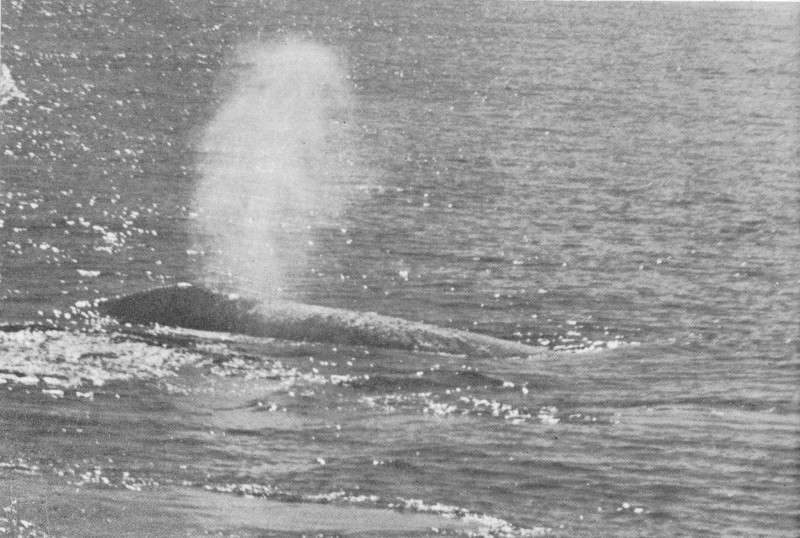
The role which whaling has played in man’s conquest of the oceans has
never been given full credit by historians. Initially, man was content to
fish along the shore, and then gradually he pushed out on the waters in
sight of land. Here he learned to be a skilled fisherman, and he began to
hunt the coastal whales. Man gradually developed the boats, gear, and the
know-how, called seamanship, and gained the courage to venture farther
and farther from land. Even as late as the 15th century sailors were extremely
superstitious and believed in sea monsters. There was, of course,
a certain basis for these imaginings. Periodically, a large whale would
strand or float ashore and it is easy to understand how these tremendous
and misshapen remains could have kindled the imagination. Whaling was
an extremely hazardous profession, calling for the utmost in nautical
skill. Throughout the development of the maritime resources of some
European states, whaling was one of their most profitable businesses. Even
though a great deal of shipbuilding was initiated by man’s speculative
desire to find new lands and to conduct trade, an equal amount was for
whaling vessels. From the Middle Ages to nearly the end of the 19th century,
oil from whales illuminated some homes and streets. Whale meat
was an important source of protein for peoples who had not yet developed
extensive animal husbandry.
For over five centuries whales have been under attack by professional
hunters, and long before that by the aboriginal peoples of many lands.
The reason whales have withstood this hunting pressure better than land
animals is due to the fact that their ocean habitat has not been invaded
by man for agriculture, and in the days of sailing ships and hand harpooning,
the whale was a formidable prey, far more so than in our present day
of motorization and automation. The tremendous area of their habitat
made it difficult and time consuming for man to find them, and his ignorance
of their migration routes and the oceanographic features which cause
whales to disperse and congregate gave the whales some protection. Technological
advances, powerful harpoon guns and totally mechanized factory
ships in the whaling industry have swung the advantage to man, and
whales are now in peril of extinction as is the whaling industry itself.
37
History tends to stress the great explorers who discovered new worlds
and the larger islands of the Pacific. However, ships cannot with full
safety, ply the seven seas until every island and shoal has been found and
charted, and ships cannot safely venture near any shore until the adjoining
waters have been systematically charted. The principal discoverers
of these danger spots have been the whalers who patiently combed so much
of the oceans in their search for whales. Every island has on it the calling
cards of Whalers who put ashore for water, food, fuel, or just to stretch
their legs and to satisfy their curiosity. This isn’t to say that they had the
time to make hydrographic surveys, but at least their log books defined
the areas where surveys would eventually have to be made. Whalers lived
adventure, and danger was their common lot. It is not surprising that
much of this adventure would find its way into the hearts of men through
yarns and tales such as Moby Dick.
Whaling was practiced long before historic times. The coastal Eskimos of
the arctic Americas and of Greenland and Spitzenberg practiced whaling.
Whales were approached in skin-covered boats and even from the edge
of ice floes. These peoples are differentiated ethnically on the basis of the
variations in their whaling techniques, in their whaling gear and in their
religious preparations for whaling. It took great courage to whale in such
frigid waters where an overturning meant death. It is not surprising that
these peoples looked to supernatural deities who required a very complex
ritual to insure a safe and successful hunt.
The principal method of hunting involved coming up alongside the
whale so that the man in the bow, the whaling captain, could spear the
chest. If he were lucky enough to drive the shaft between the ribs, the lung
could be pierced and the whale would be mortally wounded. Each time
the whale surfaced the boat would attempt another approach and lancing.
The stone tip of the lance was detachable, and when freed, led to an inverted
sealskin float by a long line of twisted sinews. These floats marked
the location of the whale during submergence. Eventually the whale,
weakened by loss of blood and by fright, would die and then came the
chore of hand pulling the whale ashore for feasting and reprovisioning
38
the village’s storehouses. The captain of the boat and his crew were considered
the most skilled and important of the hunters. Whaling was an
ancestral skill which was passed on generation to generation with great
care. The villages could ill afford to lose their best men, or the equipment
which was difficult to make.
There are interesting variations to this method. Aleutian islanders prepared
a poisonous coating for the harpoon tip which was sufficiently toxic
to kill the whale. This was prepared from the deadly aconite by a secret
process, depending upon the concentration of the alkaloid poison from
the root. Eskimos from Greenland and Spitzenberg dried another secret
coating on the harpoon tip which consisted of a bacterium which produced
fatal blood poisoning in the whale. In either method the whalers waited
for the bloated carcass to surface and then they hauled it ashore for eating.
Apparently the spoiled meat had no ill effects on these peoples, but of
course, much of their food was spoiled during the summertime.
Much of the religion of these primitive peoples centered around the
need of giving the whaler and his crewmen the necessary courage and
confidence to perform this job. Religious ceremonies were held weeks
before, and again after, every hunt. Some of the deities were whales, and
whales also figure predominantly in many of their folk tales.
The European and American whalers came in direct contact with the
Eskimos competing not only for whales, but also for seals, walrus, and fur-bearing
animals. Today, Eskimos use harpoon guns and sturdy wooden
whale boats. However, the entire village still turns out to drag a whale
ashore. Each village kills only what it requires for food and oil through
the long arctic winter. They hunt the arctic bowhead whale, although the
smaller white whale (beluga) is also hunted. The bowhead has never recovered
from commercial whaling, even though it has been protected for
years by the International Whaling Commission. The regulations however,
do not apply to the aborigines, but their needs should not have prevented
the whales from becoming plentiful again.
The Indians who occupy the coastal waters of south Alaska and British
Columbia are excellent salmon fishermen, but do not whale, even though
they possess magnificent boats suitable for this. However, at the entrance
to Puget Sound and south along the Olympic Peninsula live Indians who
hunted whales as recently as 50 years ago. They whaled in much the same
way as did the early Eskimos, with detachable stonetipped lances and sealskin
floats. It is believed that the whale they hunted was the California
gray. Boats were hewn from the massive trunks of cedars. From the bark
and wiry branches, a tough flexible line was woven, strong enough to withstand
39
the terrific pull of the whale. These Indians repeatedly lanced the
whale until its death. The generation of Indians who knew this skill is
gone, and the present generation only remembers vaguely the tales of
their grandparents. The Washington State Historical Museum in Seattle
has managed to interview the old-timers and collect their gear which is
now on display there.
The Kamchadal and Chuchee Eskimos whose villages looked out on
the summer grounds of the California gray were not inclined to whale.
They did, however, feed on any which happened to wash ashore.
Commercial whaling began in Spain during the Middle Ages. At that
time the black right whale was plentiful along the coast of the Basque
province, and it provided an ideal quarry because it could be sighted
from lookout towers along the coast and it was not difficult to approach.
Equally important, these whales floated at death so they could be pulled
ashore. They were prized for their oil, meat, and the baleen which was
sold throughout Europe. The Biscayan whalers gradually reduced the
local population of whales and began to range farther in their search.
They came at last upon the haunts of another right whale which frequented
the ice-filled seas of the North Atlantic. Here there was not a
satisfactory method to preserve the meat so this was thrown away.
There is an extensive and fascinating history of this early whaling but
only the briefest outline can be mentioned here. Throughout the story
there is a constant search for new whaling grounds to sustain operations
and to meet the increased demand for whaling products. As the industry
expanded it was forced to capture less desirable species because the other
species could not hold up against the onslaught.
Other nations took up whaling and soon the English and Dutch had
large fleets of ships manned by Basque whalers. These ships were based
in Greenland and Spitzenberg. The irregular coastlines of these wind-swept
lands provided many harbors in which shore whaling stations could
be situated. The camps were well constructed, and daily during the arctic
summer, the ships put out for whales in waters which were rough, cluttered
with icebergs, and shrouded in fog. Naturally, under such difficult
conditions, there was great loss of ships and men. The companies were not
friendly with one another and periodically raided the shore camps of
each other, stealing and burning supplies and buildings. Under normal
circumstances such activities would have been provocative of war. However,
since communications were poor and the countries concerned were
preoccupied with colonizing America, the situation took care of itself, for
in time the whales diminished and the whaling companies failed.
40
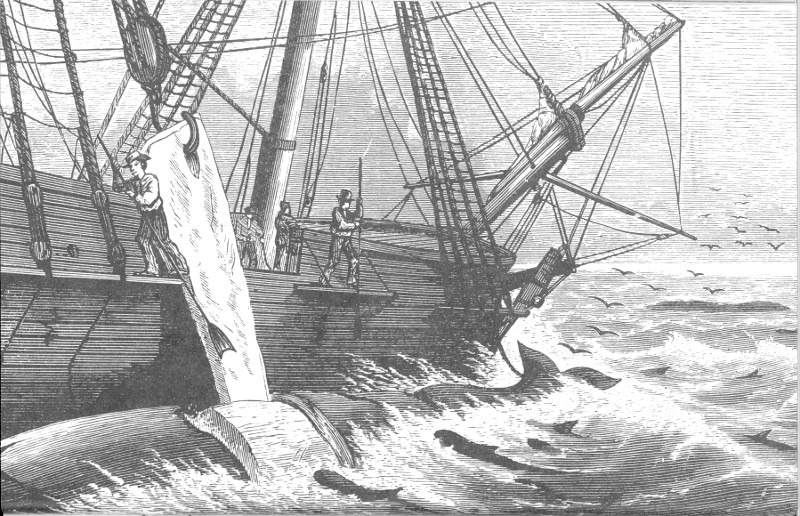
Cutting-in, from the book Nimrod of the Sea or The American Whaleman by Wm.
M. Davis. Courtesy San Francisco Maritime Museum Association.
41
Soon after this the colonists in America wrote to relatives in Europe
about the richness of the country, not the least of its resources being the
whales which spouted just off shore along the entire Eastern seaboard.
Whaling companies were formed and these were concentrated along the
New England coast. After the separation of the colonies from England,
whaling developed locally with the ships which had been engaged in
commerce between the colonies and the mother country. It did not take
long to exhaust the populations of whales, so the Whalers began to range
afar.
This led to the discovery of the haunts of the sperm whale in the open
oceans of the tropics and subtropics. Yankee ingenuity developed a new
kind of whaling in which the whales were brought alongside the base ship
for processing. It took a great deal of skill to strip the blanket of fat from
a whale which was three-fourths submerged and pitching and rolling on
the restless surface. The blubber once removed, was hauled aboard and
cooked in kettles to free the oil which was then placed in barrels and
stowed below. This form of whaling was called pelagic whaling. It was
not uncommon for ships to be away from home port for a year or two
before the casks were full. This whaling was dominated by the Americans,
and it contributed much to the prosperity of New England, providing
much of the capital which later financed its manufacturing developments.
This was the golden era of whaling so superbly described by Herman Melville
in Moby Dick. Here is a real yarn about whaling written by a Whaler
who later became a superb author.
The discovery of petroleum in Pennsylvania brought to the fore new
illuminating fuels, kerosene and natural gas which were much cheaper
than whale oil, so the whaling industry declined rapidly. This happened
at the same time steam ships were replacing sailing ships, so it is not
surprising that the beautiful sailing vessels which had been the mainstay
of whaling were brought home to every little coastal village in New
England to rot away, sad memorials to better days.
42
By the 20th century whaling was again possible because of new uses
for whaling products. Chemistry has succeeded in finding new uses for
whale oil. Fat derivatives such as soaps, margarines and a few other
products owe their abundance and low cost to the whaling industry. Packing
house technology has been applied to the butchering of whales so that
the entire animal has many uses. Tasty meats are finding their way into
the diets of many countries and the tougher, less tasty parts are ground
and used to feed cats and dogs. Farms that raise mink and other mammals
for the fur trade are heavy buyers of this source of meat to feed their animals.
The remaining parts, blood, bones, and meat scraps, are dried and
ground into nutritious meals which are used by the poultry and livestock
industries as supplementary feeds. Currently each whale produces over
$5,000 worth of products.
The heart of the processing operation is the pelagic factory ship which
is nearly as large as an aircraft carrier. They are supplied by huge tankers
which carry off the oil and by refrigerated ships which return the meat to
port. In the 20th century the United States has not seriously participated
in whaling and has not a single fleet in competition with the other countries
which now have billion dollar investments in ships and gear. For the
past 70 years, the leader in the whaling industry has been Norway. The
industry is very competitive however, and England, Japan, Netherlands,
USSR, and Germany have big investments.
The Norwegian lead was due principally to Svend Foyn who invented
the harpoon with an explosive head. The harpoon was fired by a deck-mounted
cannon and it had sufficient range and accuracy to permit killing
those whales which heretofore were too fast and wary to be handlanced.
The harpoon head had a time delay bomb which insured that the explosion
occur deep in the vitals, and that the whale was made fast to a
manila line so that it would not be lost. The cannon is mounted in the
bow of a small fast ship known as a killer boat. These little ships operate
for 1 or 2 days away from the factory ship in search of whales. The gunner
who is responsible for firing the cannon is the most important member of
the crew and on his experience and skill depend the entire operation. If he
misses or fails to kill the whale, it will alarm the other whales and a day
or two of searching may have been in vain.
43
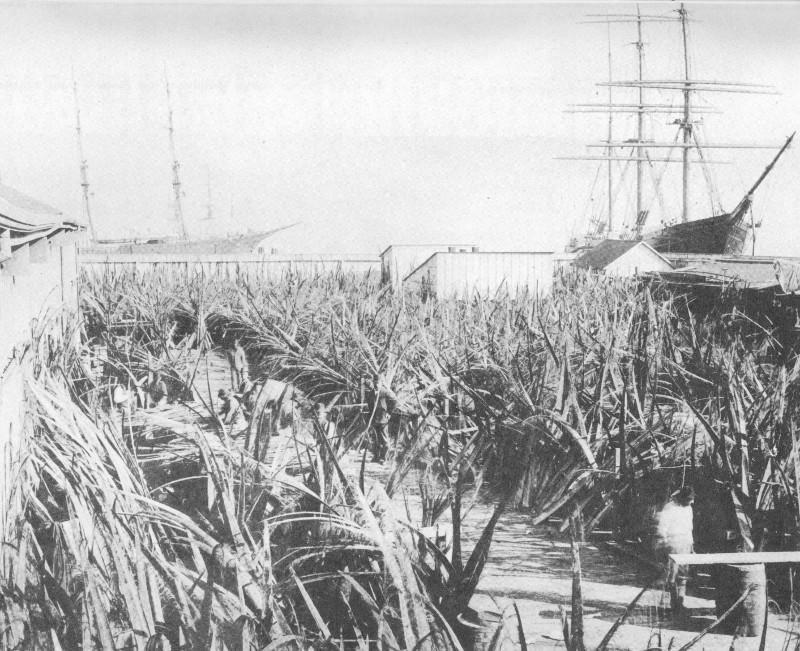
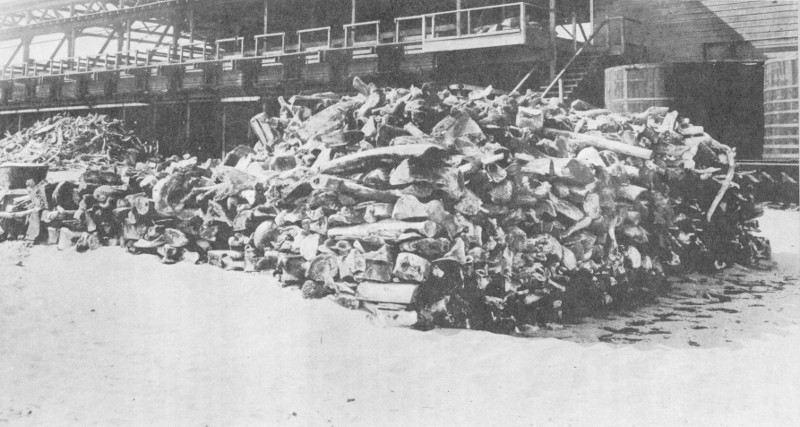
Whalebone drying; from the book San Francisco Whaling by Pacific Steam Whaling
Co., San Francisco. Ships in picture—the J. D. Peters on the right and the steam
whaler Orca on the left. Courtesy San Francisco Maritime Museum Association.
44
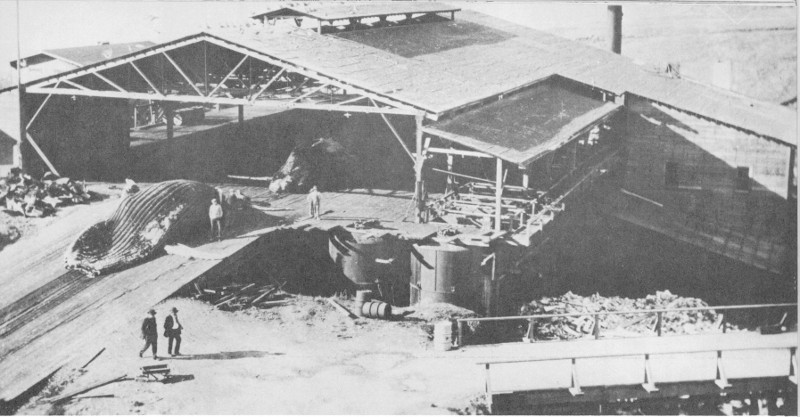
Trinidad, Calif., whaling shore station; two humpback whales on the platform. Courtesy San Francisco Maritime Museum Association.
45
The whaling season is extremely short and as soon as the yearly quota
has been reached, all countries must stop. Naturally every country tries to
get as many whales of the total as possible. Once a whale is killed, it is
hauled alongside, and the body cavity is inflated with compressed air to
make the whale buoyant. It should be remembered that the whales which
are now being processed are the “wrong” whales and they would otherwise
sink. The whale is then flagged, lighted, and a radio transmitter
secured to it, and it is cast adrift while the killer boat continues to search
for more victims. At the end of the hunting period, the killer boat retraces
its route, picking up the whales it has killed. These are secured to
the sides of the ship and brought back to the factory ship for processing.
Naturally, the technological improvements which make whaling profitable
again would have been meaningless without the discovery of new
whaling grounds. About 1900 the seas around the antarctic continent
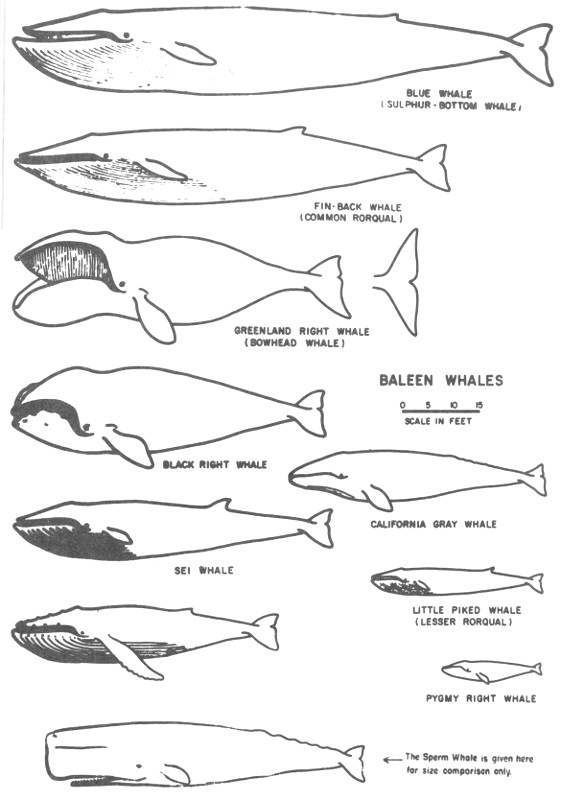
were found to be teeming with whales. These were principally three
species—the humpback, the finback, and the blue. The blue whale is
distinguished by the fact that it is the largest mammal on earth, reaching
sometimes 100 feet in length and weighing over 100 tons. It is the species
preferred by whalers but it is not as plentiful as its close relative, the finback,
which is the second largest species, ranging in length from 60 to 80
feet. The humpback whale has never been too abundant, but along with
the rorqual, or Sei whale, it has provided an extra dividend for the business.
The extreme richness of the antarctic whaling grounds is due to the
fact that the entire perimeter of the continent is open to oceanic waters,
allowing whales free access to a tremendous area of fertile waters. The
limited richness of the arctic whaling grounds is due to the fact that the
Arctic Icecap is flanked principally by the land masses of Eurasia and
North America and the whales have access only to those portions opening
from the Bering Sea and to a small area in the North Atlantic. Whales
cannot swim too far in along the coast of either mainland because the
period of open water is brief. Even in the antarctic whales tend to work
near the ice floes and occasionally get caught by the sudden closures of
the ice.
It is too difficult to estimate the number of whales which were taken
from the arctic during the many seasons that whalers worked there. However,
it cannot compare with the numbers which are realized annually
from the slaughter around Antarctica. As many as 45,000 whales have been
taken in a brief whaling season of less than 2 months. Contracting governments
under provision of the International Agreement For Regulation of
Whaling enforce the regulations as regards the number taken and there is
a penalty if a juvenile whale is killed. Nursing mothers are also protected.
The regulations are made by the International Whaling Commission and
the number of whales which can be taken each year is determined from
the statistics of the populations and these quotas are recommended by
the Commission. It is hoped that by these regulations and studies, the
industry can continue to prosper. The problems and activities of the
scientists, the majority of whom work for the various governments’
agencies, will be considered shortly.
46
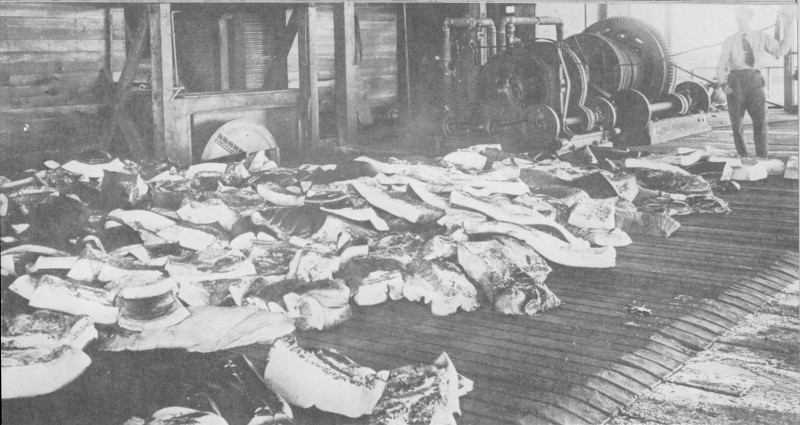
Blubber ready to process at the Moss Landing, Calif., whaling shore station, photographed 1919. Courtesy San Francisco
Maritime Museum Association.
47