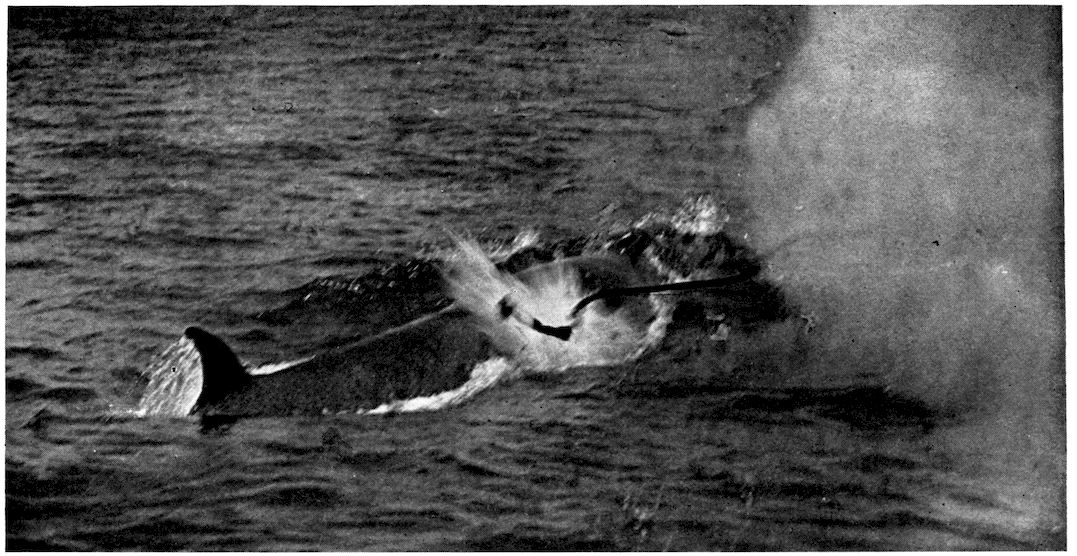
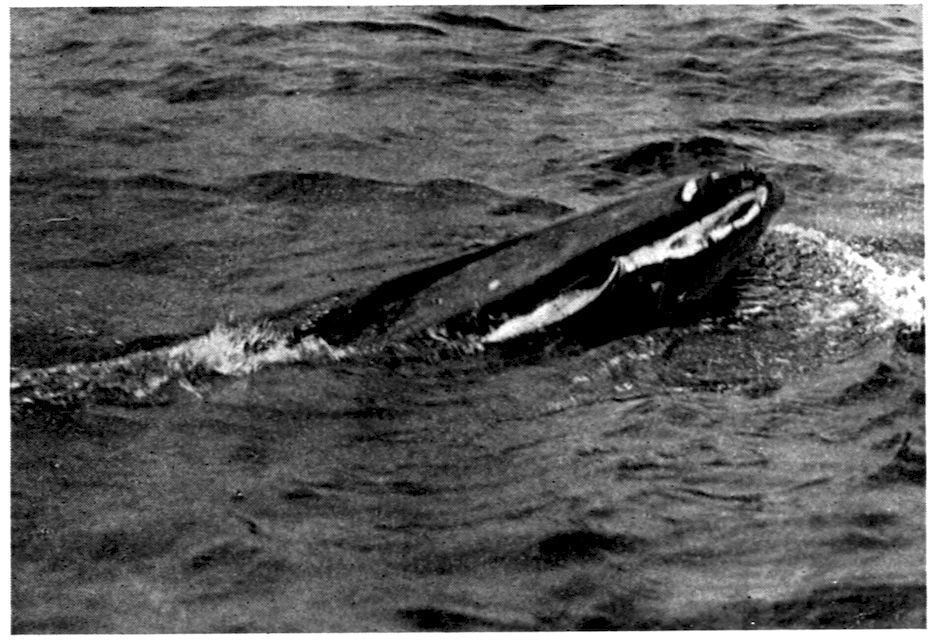
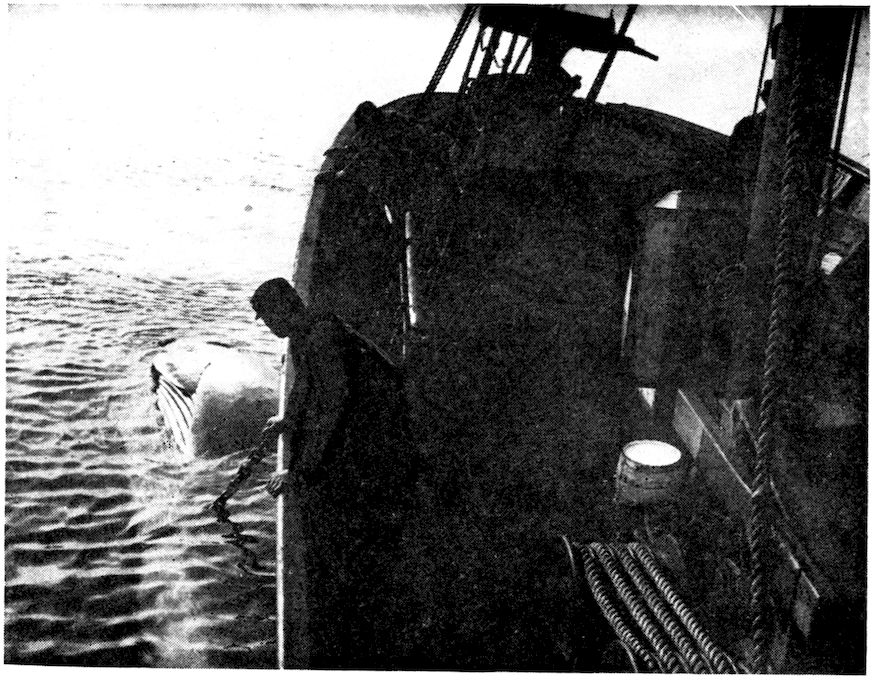
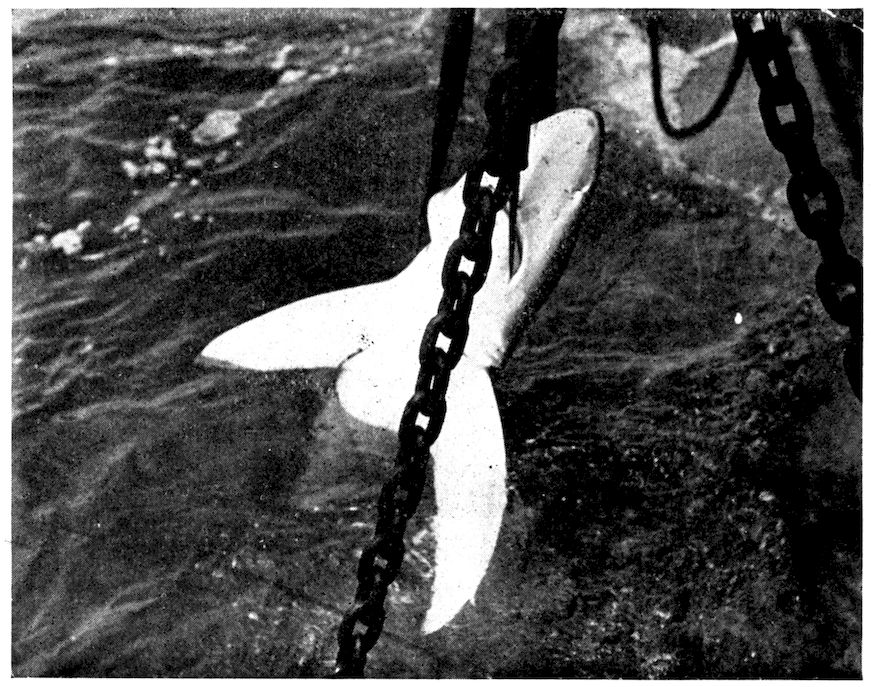
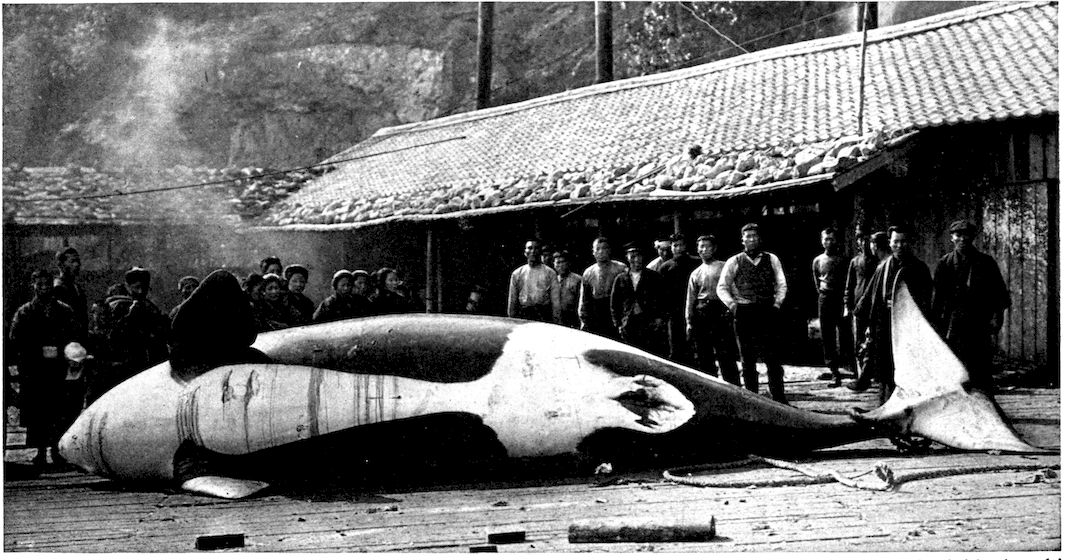
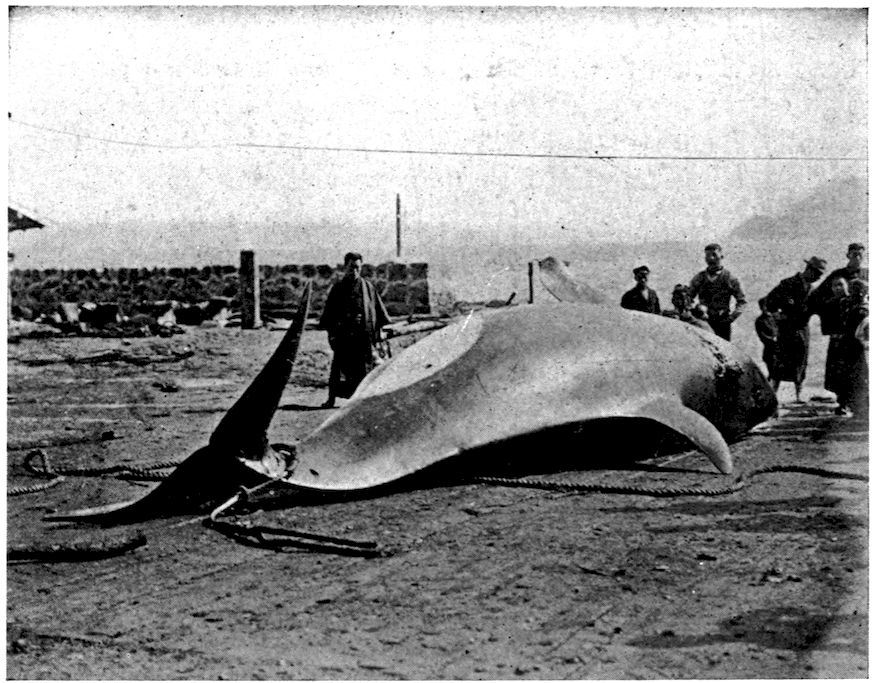
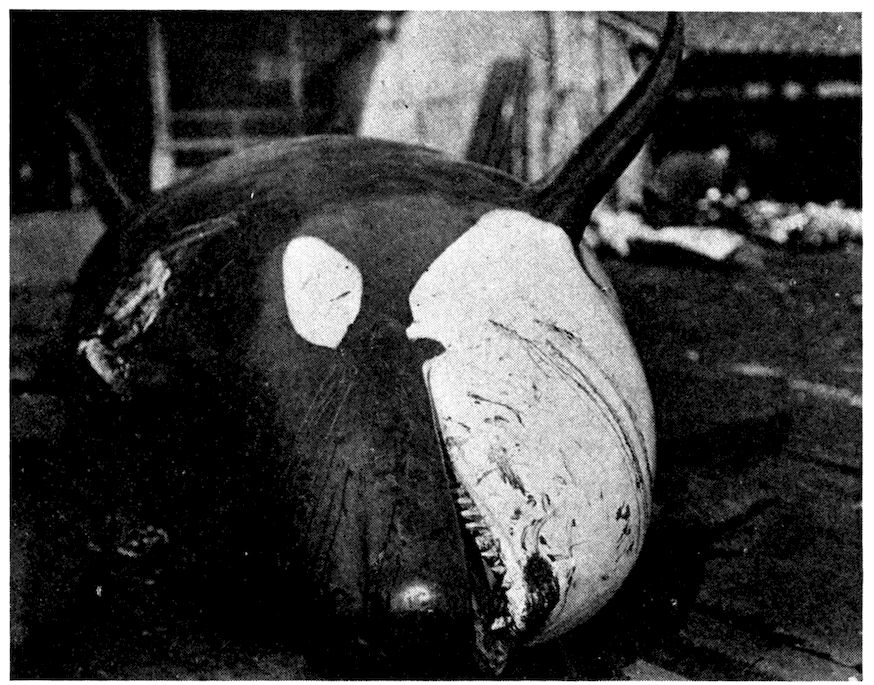
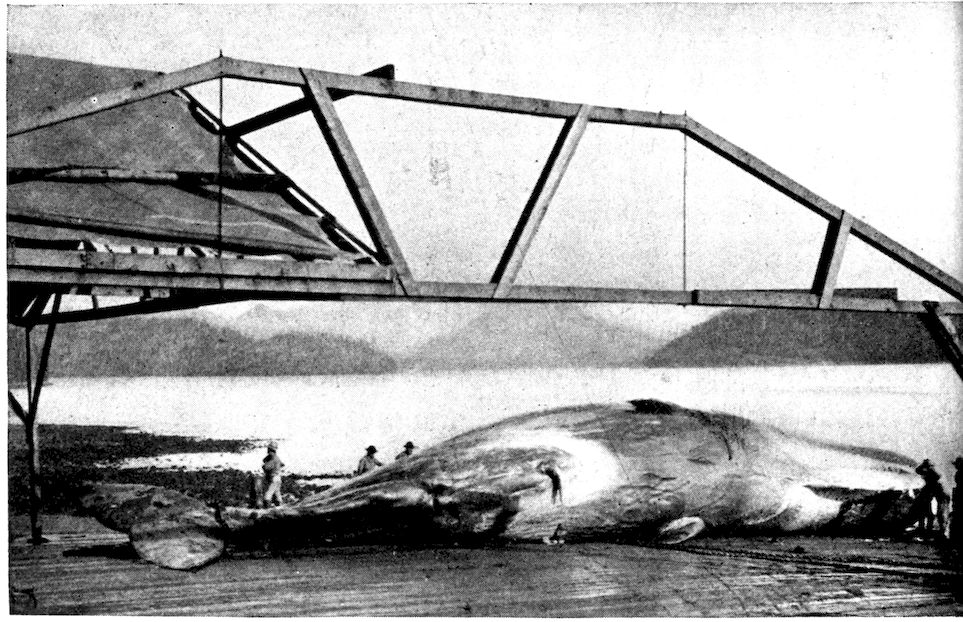
WHALE HUNTING with GUN and CAMERA A NATURALIST’S ACCOUNT OF THE MODERN SHORE WHALING INDUSTRY, OF WHALES AND THEIR HABITS, AND OF HUNTING EXPERIENCES IN VARIOUS PARTS OF THE WORLD
Transcriber’s Note:
The cover image was created by the transcriber and is placed in the public domain.
BY
ROY CHAPMAN ANDREWS
ASSISTANT CURATOR OF MAMMALS, AMERICAN MUSEUM OF NATURAL HISTORY, NEW YORK; FELLOW OF THE NEW YORK ACADEMY OF SCIENCES; MEMBER OF THE BIOLOGICAL SOCIETY OF WASHINGTON, ETC.
ILLUSTRATED
D. APPLETON AND COMPANY
NEW YORK LONDON
1916
Copyright, 1916, by
D. APPLETON AND COMPANY
Printed in the United States of America
THIS BOOK IS AFFECTIONATELY INSCRIBED TO
MY WIFE
WITHOUT WHOSE ENCOURAGEMENT IT
WOULD NEVER HAVE BEEN WRITTEN
AND TO
MY MOTHER
WHO HAS BORNE THE ANXIETIES
OF HER SON’S LONG WANDERINGS
PREFACE
vii
In this book I have endeavored to tell of modern
shore whaling as I have seen it during the past eight
years while collecting and studying cetaceans for the
American Museum of Natural History. This work
carried me twice around the world, as well as northward
on two expeditions to Alaska, and southward to
the tropic waters of Borneo and the Dutch East Indies.
I have also tried to give, in a readable way, some
of the most interesting facts about whales and their
habits, confining myself, however, to those species
which form the basis of the shore whaling industry,
or are commercially important, and which have come
under my personal observation.
In all of this work the camera has necessarily played
a large part, for it is only by means of photographs
that whales can be seen in future study as they appear
alive or when freshly killed. It is hardly necessary
to say that the photographing has been intensely interesting,
and to any one who is in search of real excitement
I can heartily recommend camera hunting
for whales.
It should be understood that this book is in no sense
a manual of the large Cetacea. I hope, however, at
some future time to write a volume which will treat
of this wonderful mammalian order in a less casual
viiiway, and thus satisfy a desire which has been ever
present in my mind since I began the study of whales.
Some portions of this book have been published
as separate articles in the American Museum Journal,
World’s Work, Metropolitan, Outing, National
Geographic, and other magazines, but by far the
greater part of it is new.
There have been many pleasurable sides to the work,
but one of the most delightful has been the friends
that I have made, and my cordial reception by the officials
of the whaling companies in whatever corner of
the world I have chanced to be.
Space will not permit me to mention all those to
whom I am indebted and who have contributed to the
success of the various expeditions, but I wish first to
express my gratitude to the Trustees of the American
Museum of Natural History, under whose auspices all
my work upon cetaceans has been conducted, and
especially to President Henry Fairfield Osborn for his
encouragement and wise counsel.
Captains I. N. Hibberd and John Barneson have
never failed in kindness and the President and Directors
of the Toyo Hogei Kabushiki Kaisha of Osaka,
and Mr. D. Ogiwara of Shimonoseki, Japan, are in
a large measure responsible for the success of the work
conducted in the Orient. Not only did these gentlemen
freely extend the courtesies of their ships and stations,
but also presented to the American Museum of Natural
History skeletons of all the large Japanese cetaceans,
which are the only specimens of Asiatic whales in
America.
ixThanks are due to the Directors of the (former)
Pacific Whaling Company of Victoria, B. C., and to
the (former) managers of the stations, Mr. Sidney C.
Ruck, V. H. Street and J. H. Quinton. Mr. Ruck also
furnished me with valuable data as to the progress of
the American West Coast whaling industry and assisted
in other ways.
I cannot mention, individually, all the gunners who
have entertained me ashore and afloat, but the kindness
of Captains H. G. Melsom, Fred Olsen and Y. E.
Andersen I shall never forget. Captain Melsom has
also read portions of the manuscript of this book and
in criticism has afforded me the benefit of his long
experience and keen observation.
My wife, Yvette Borup Andrews, has transcribed
practically all of this book from my dictation and has
assisted in numberless other ways throughout its preparation,
and to her my thanks are due.
Lastly, I wish to express my gratitude for material
assistance throughout the work upon cetaceans to Dr.
Frederic A. Lucas, Director of the Museum; Dr. J.
A. Allen, Dr. Herman C. Bumpus, Messrs. George H.
Sherwood, (late) George S. Bowdoin and Mr. and
Mrs. Charles L. Bernheimer.
Roy Chapman Andrews,
American Museum of Natural History,
New York City.
February 8, 1916.
CONTENTS
xi
INTRODUCTION
PAGE
The development of shore whaling and its progress throughout the world—The floating factory—A modern shore station—The ship, harpoon-gun and apparatus—What shore whaling is doing for science
The whalebone, or baleen—What whales eat and how—Affection for young—The fighting qualities of humpbacks—Breeding habits—Nursing the baby whale with milk—A story of whale milking
Weight and size of a blue whale—Why whales grow so large—A new-born baby 25 feet long—The wonderful strength of a blue whale—A remarkable hunt described by J. G. Millais
The giant sperm whale—Spermaceti—Ambergris—Teeth—Scrimshawing—Food—Size—Blowing and Diving—Sperms off the Japan coast—Ferocity—Length of life in whales
The beginning of whaling—The right whale and bowhead—Valuable whalebone—Right whales killed with the harpoon-gun—How bowheads are hunted—The Eskimo whalers—A right whale captured at Amagansett, Long Island
Hunting the bottlenose whale—Habits of the bottlenose—Peculiarities of the ziphioid whales—Teeth of Layard’s and Gray’s whales—Skulls—Existing ziphioid whales the last survivors of an ancient race
The commercial extermination of the right whale—Capture of the bowhead—“Whaling in Newfoundland,” by Dr. F. A. Lucas—The American Pacific coast—Sub-Antarctic whaling—Japan—Needed legislation
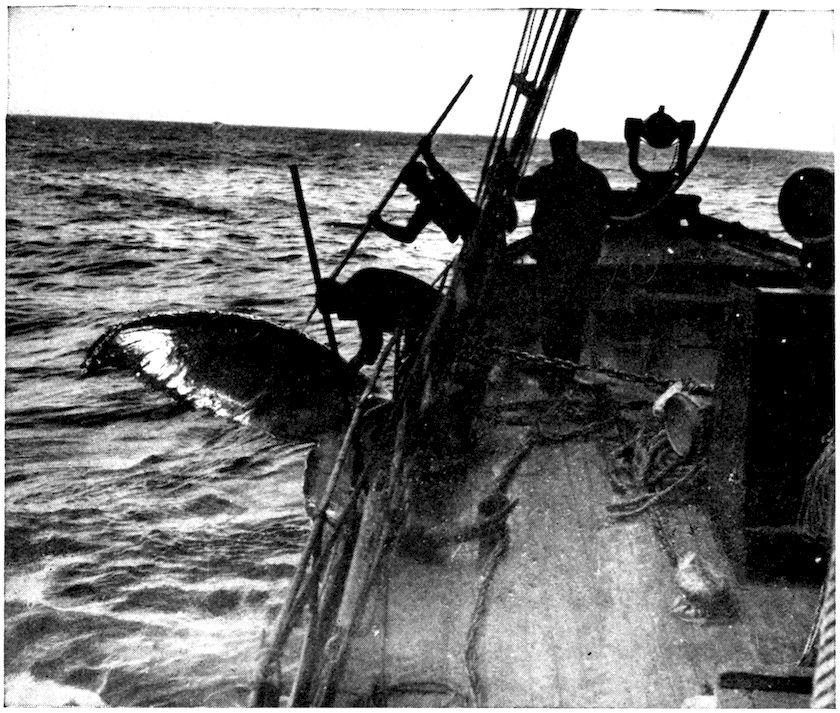
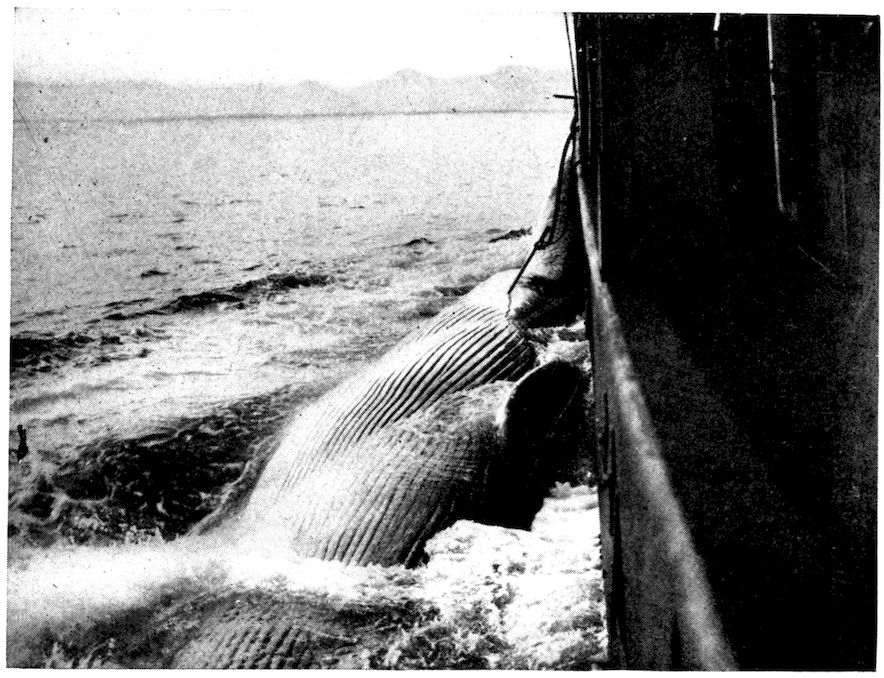
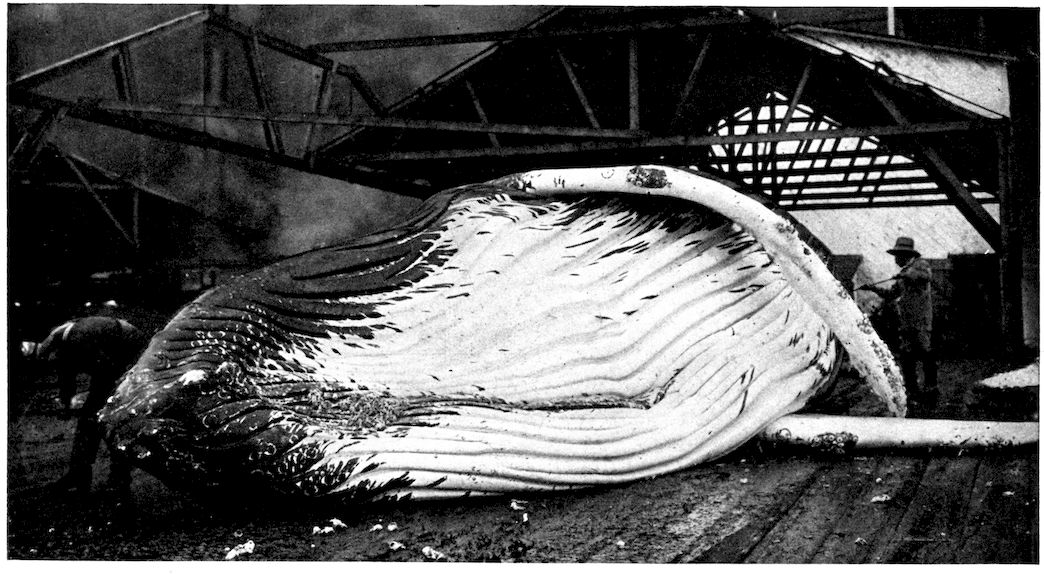
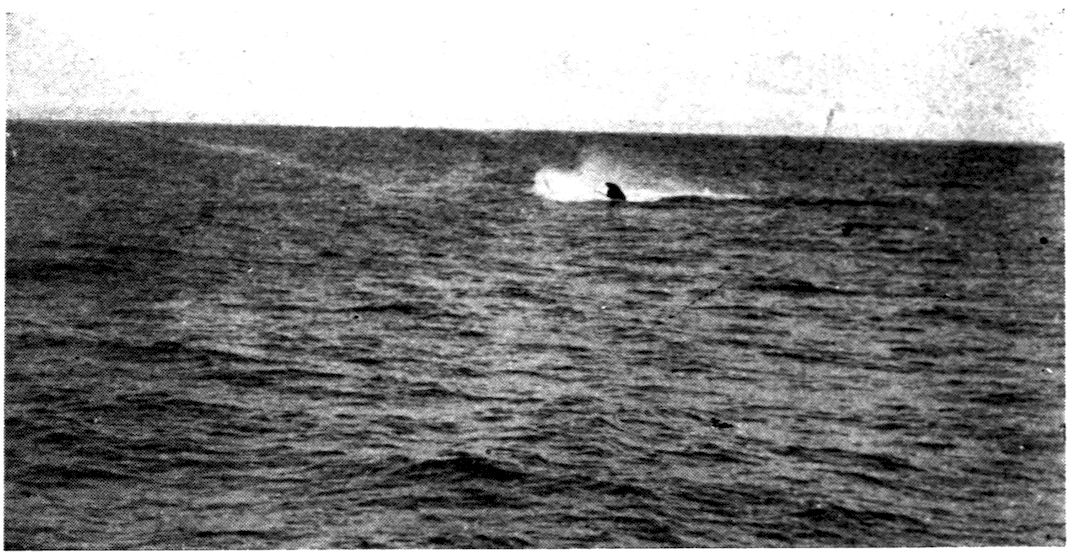
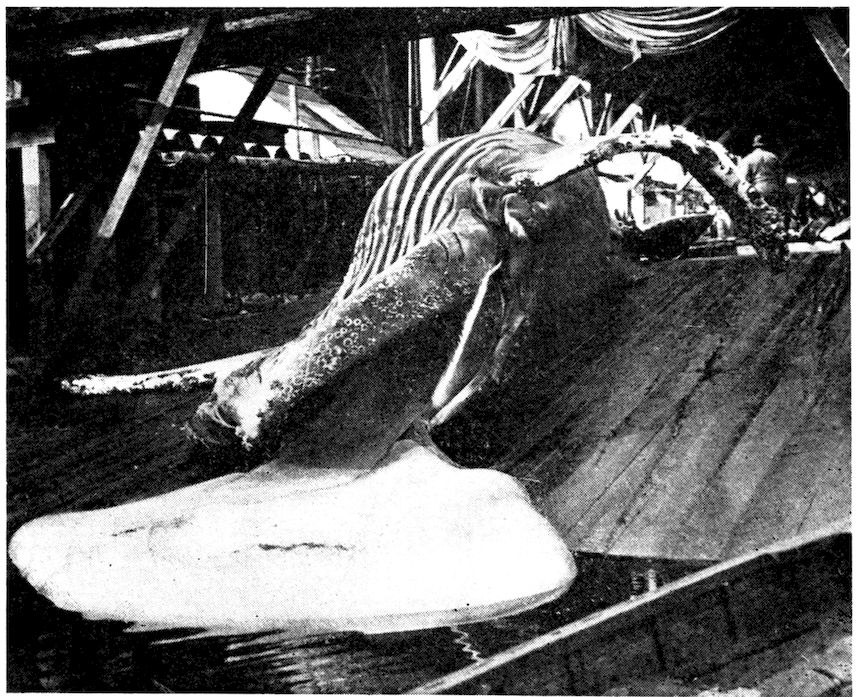
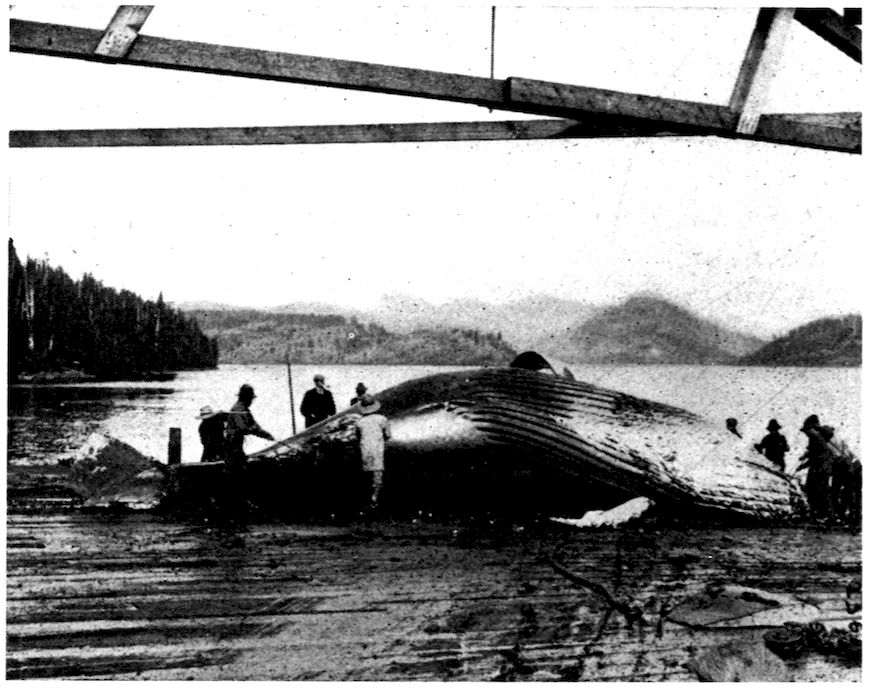
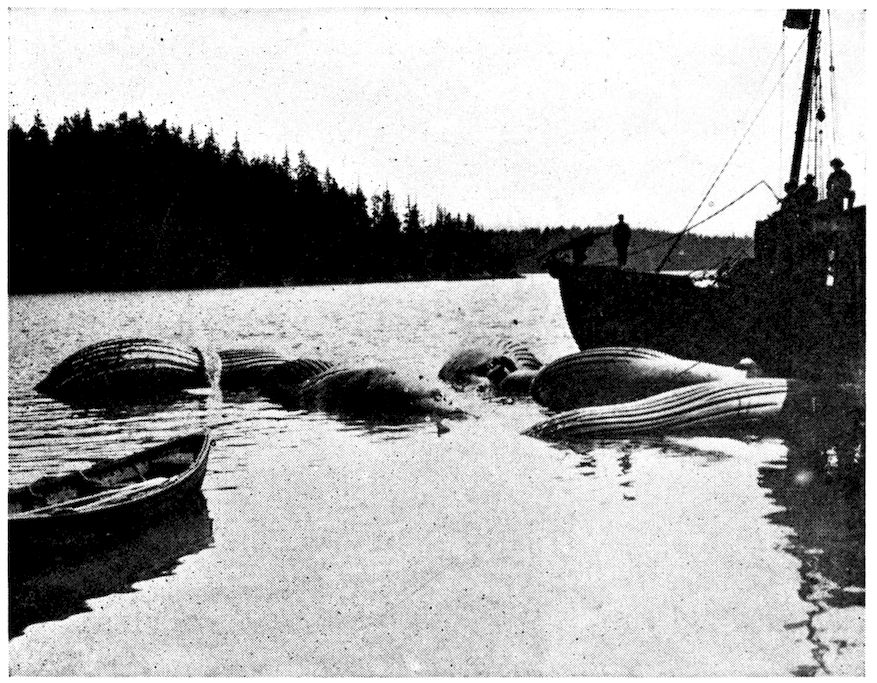
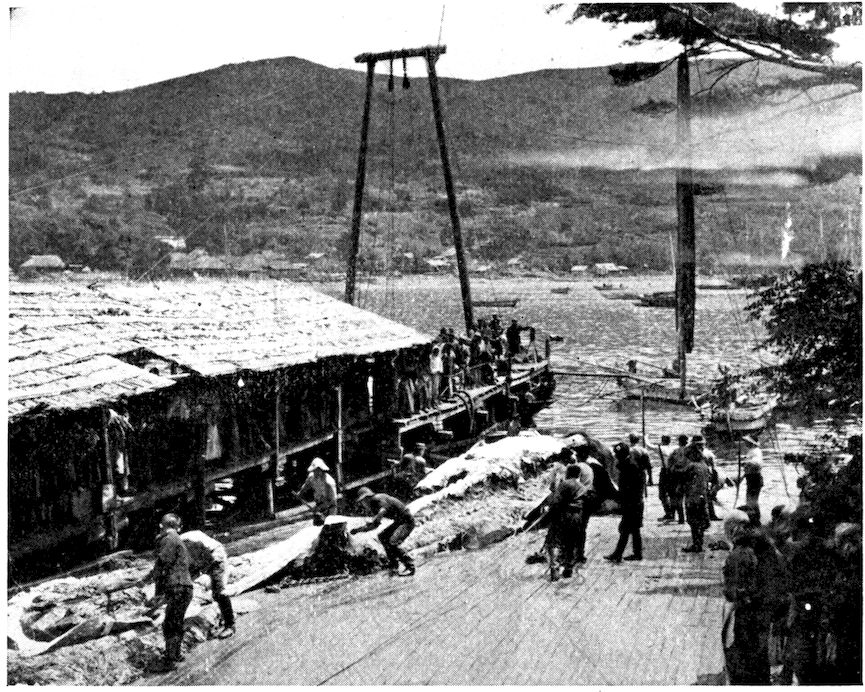
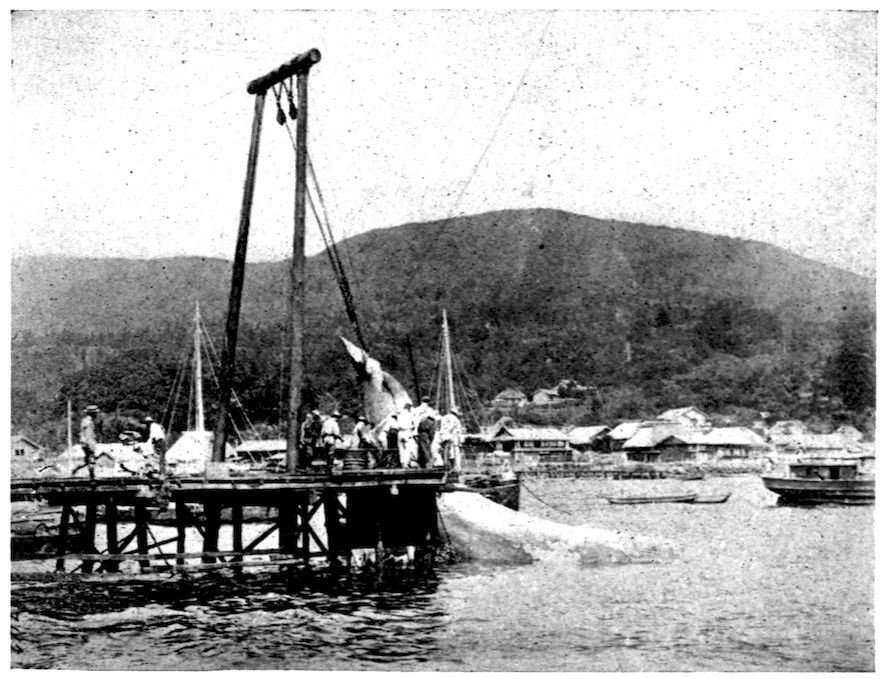
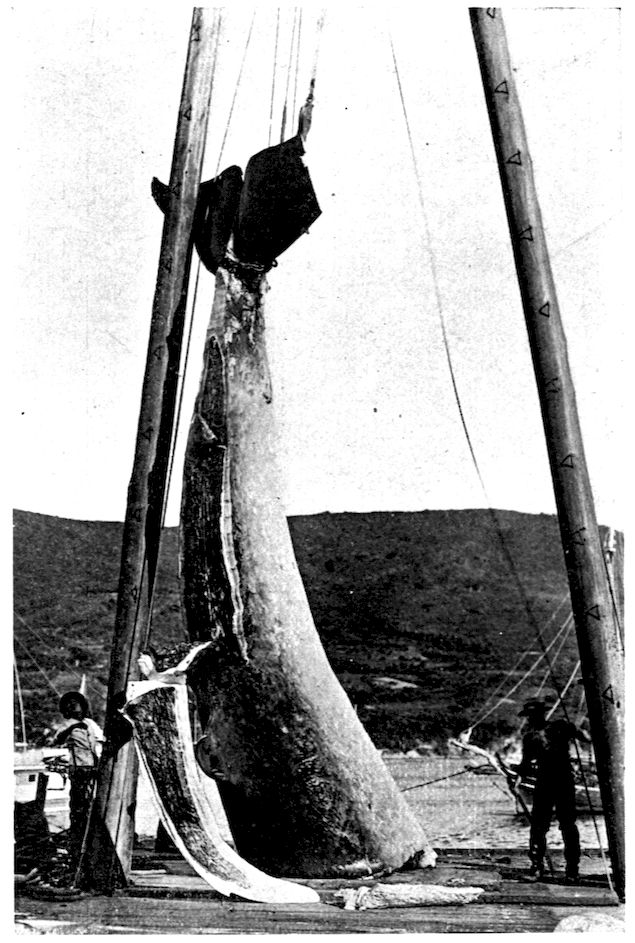
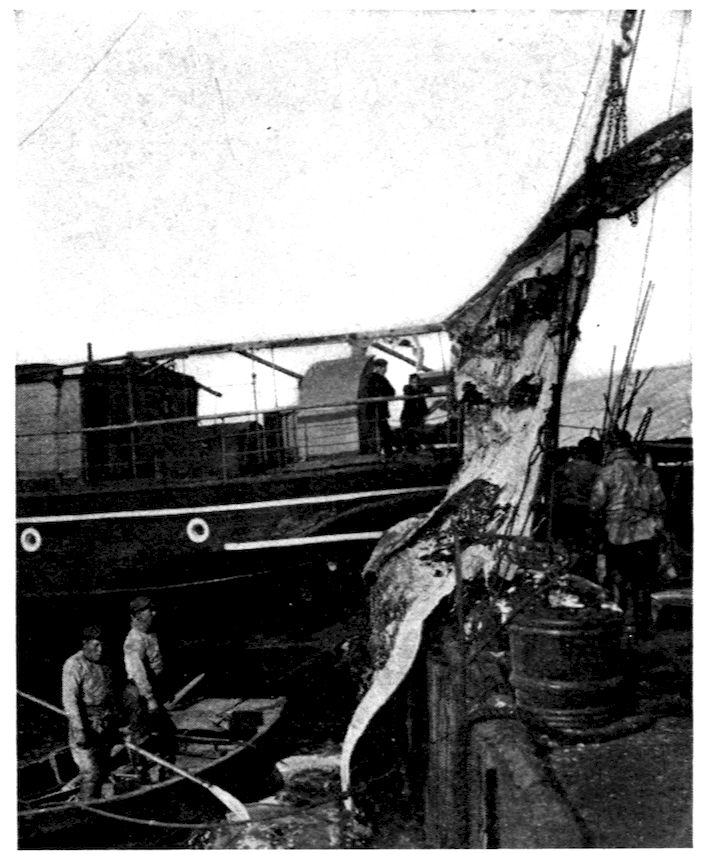
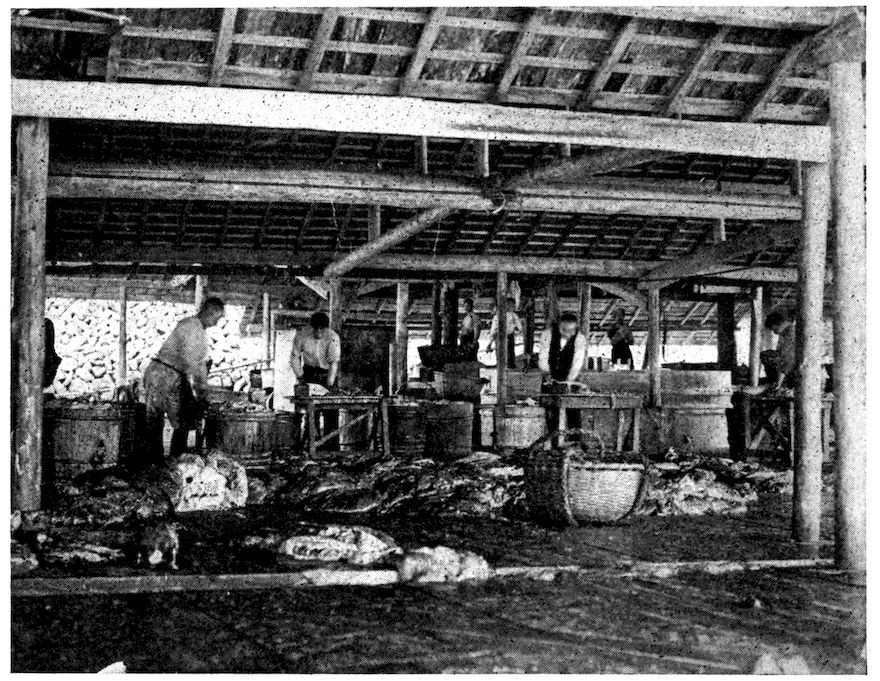
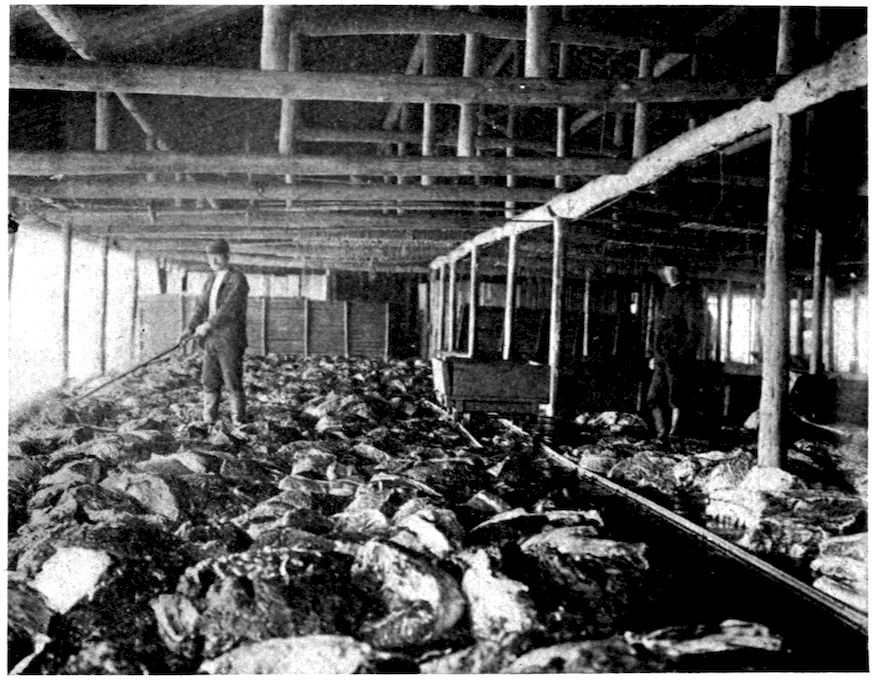
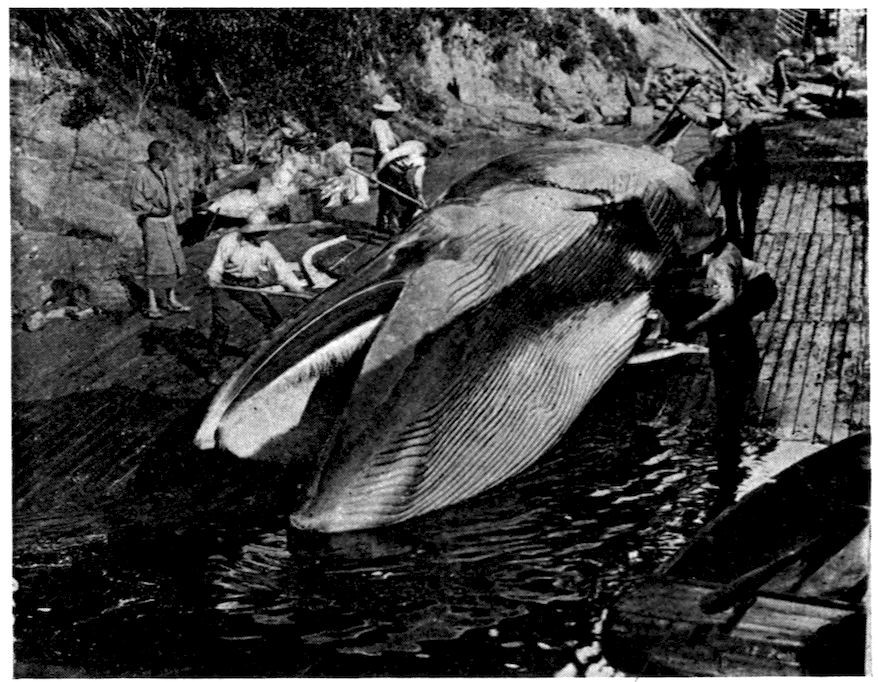
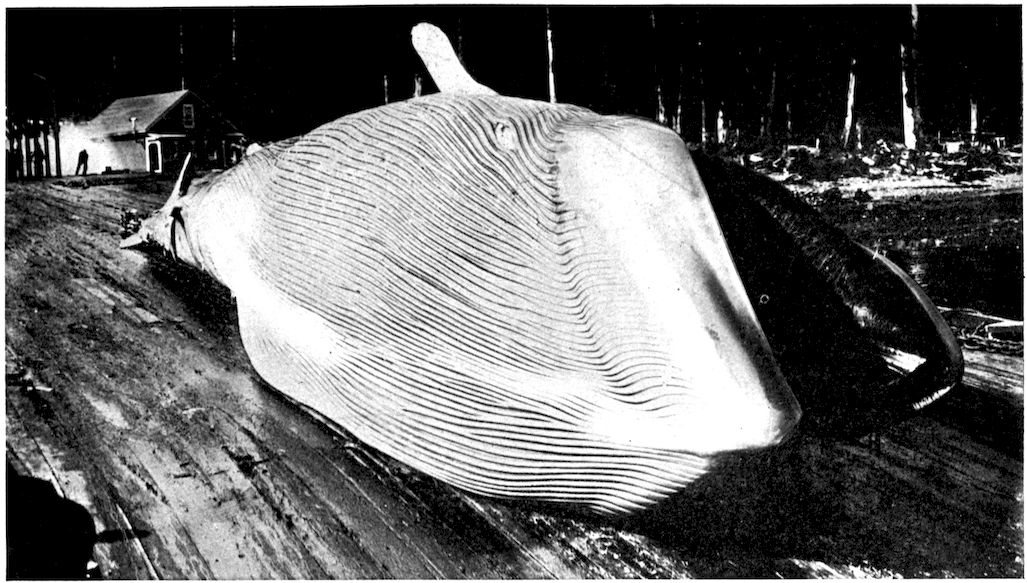
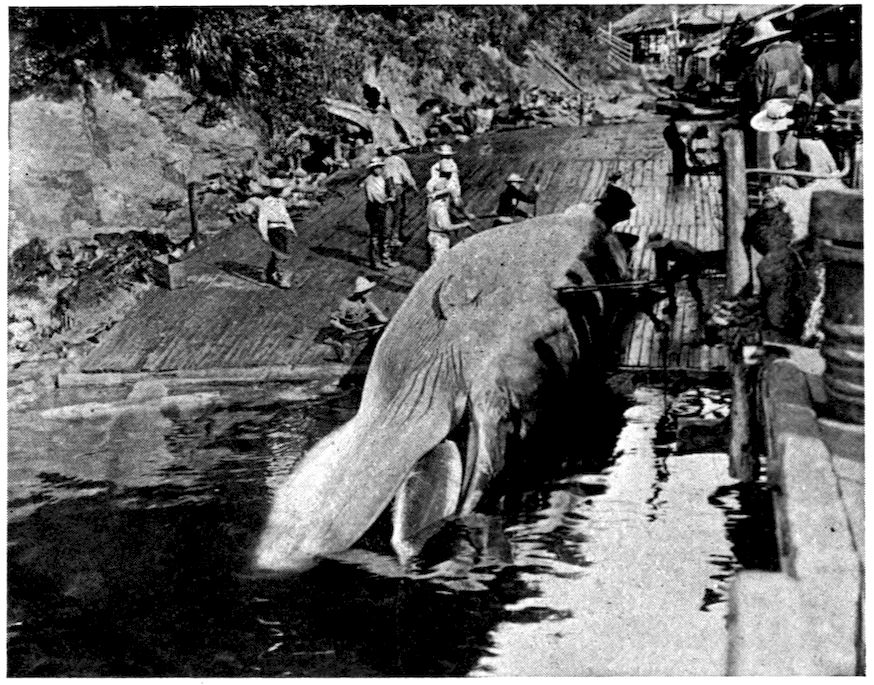
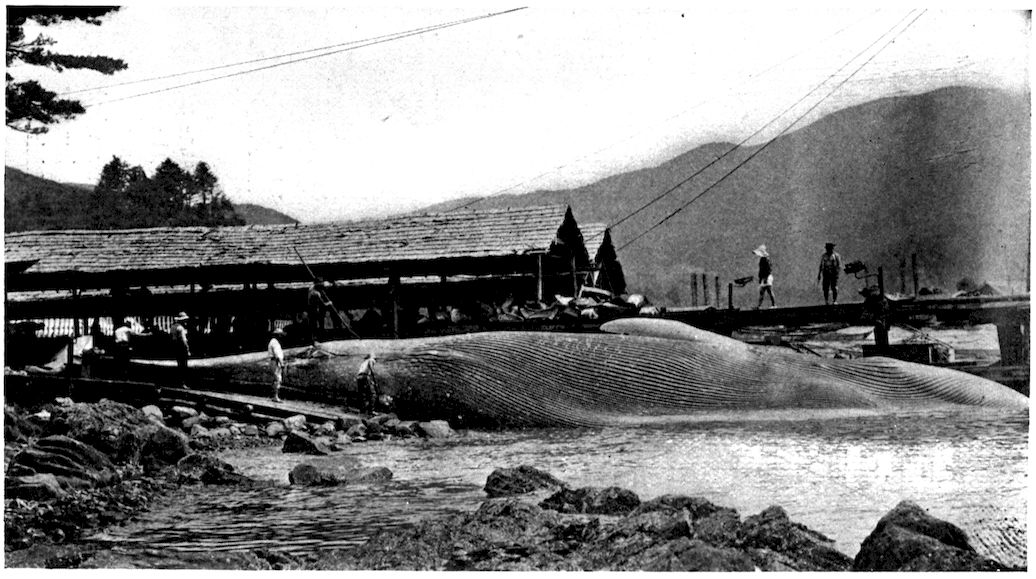
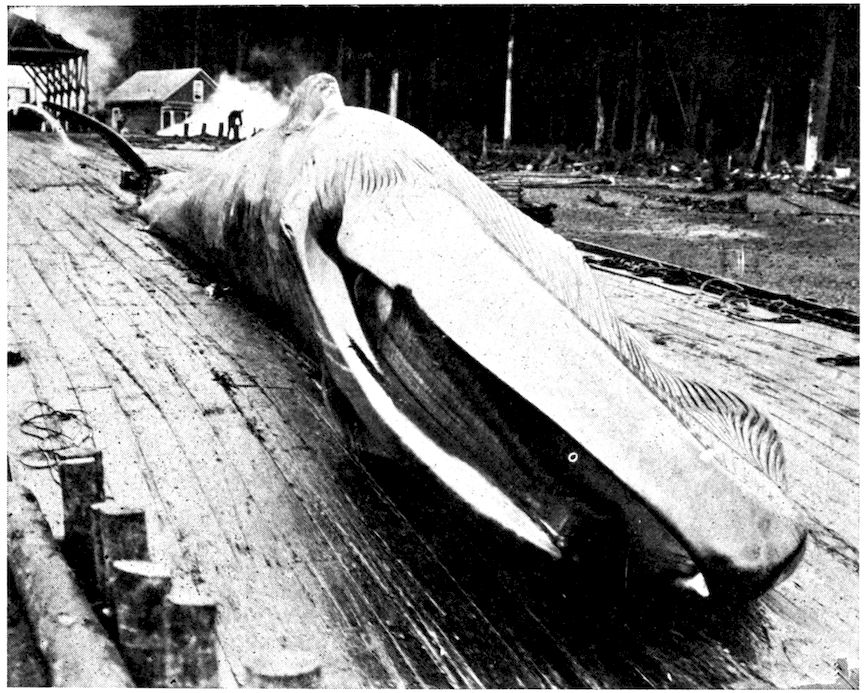
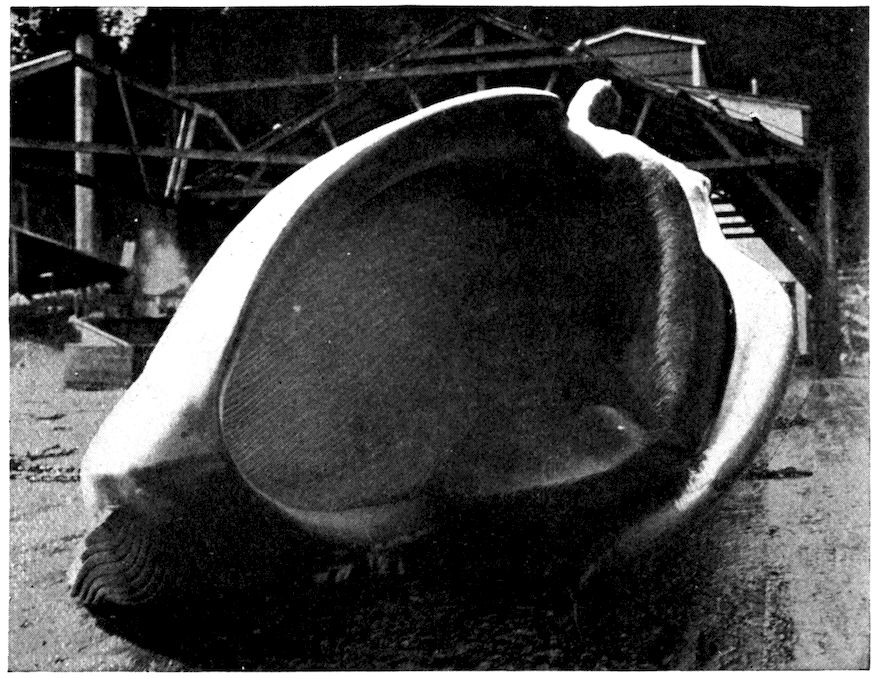
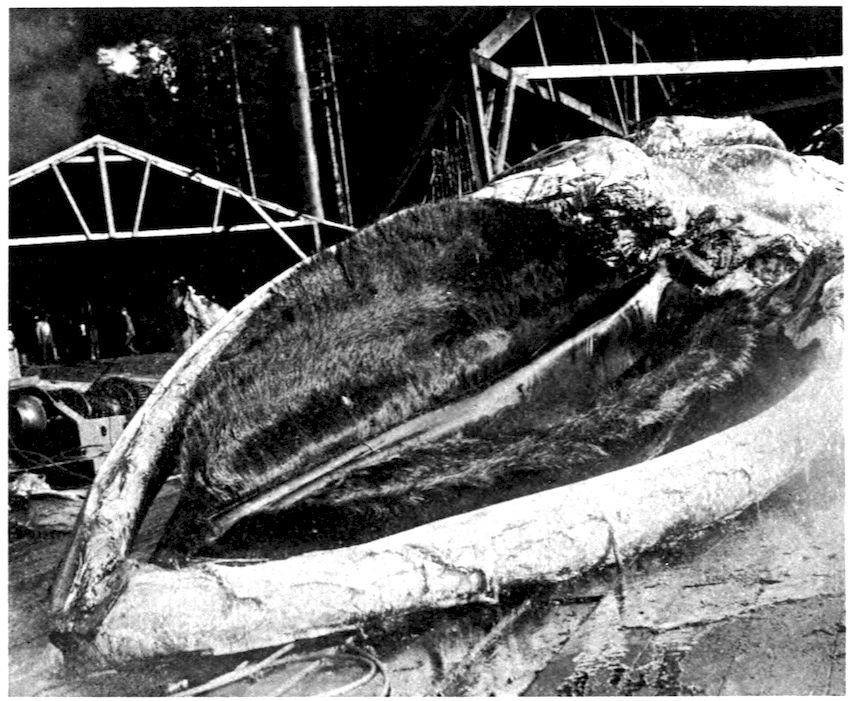
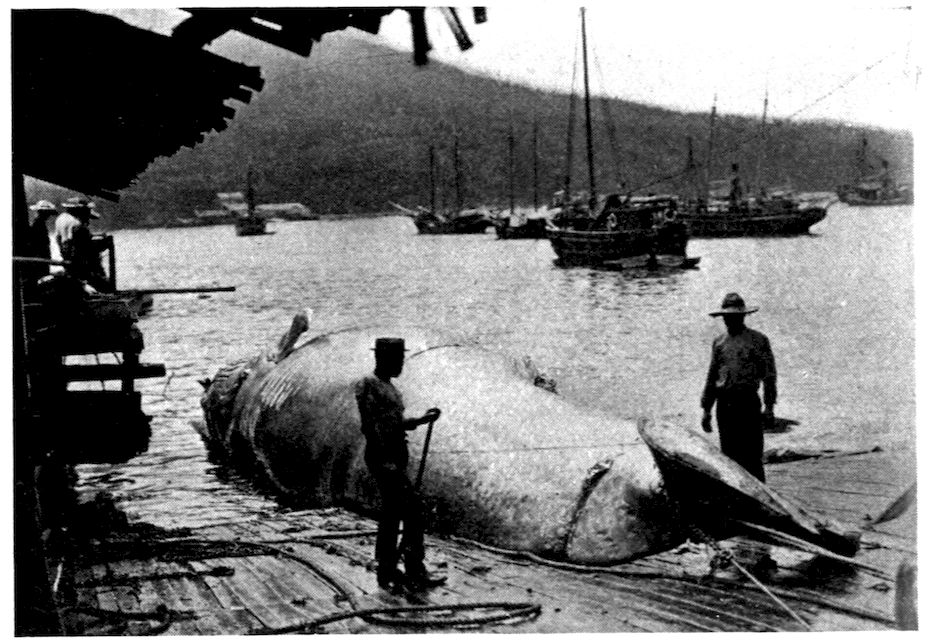
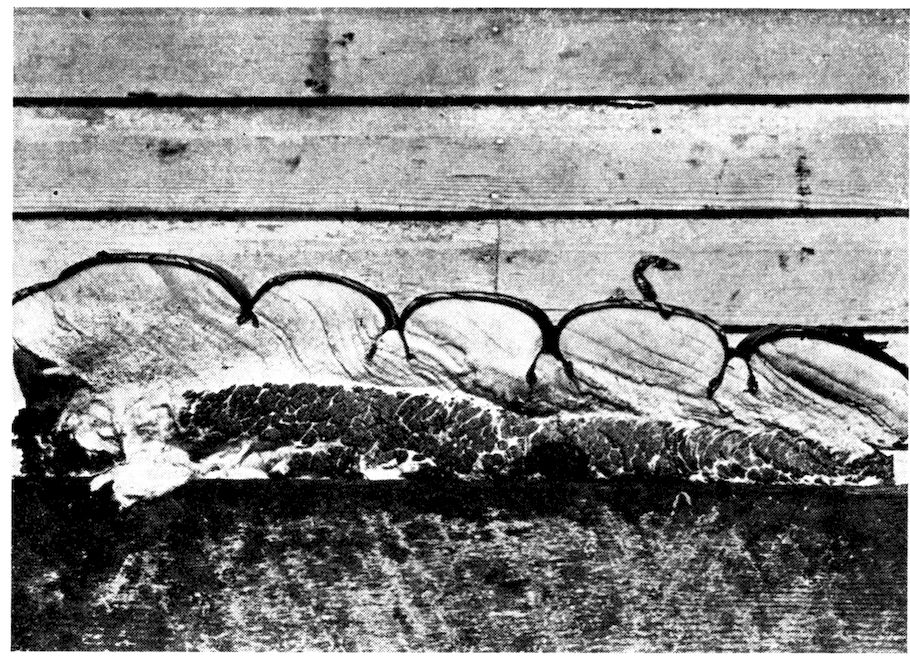
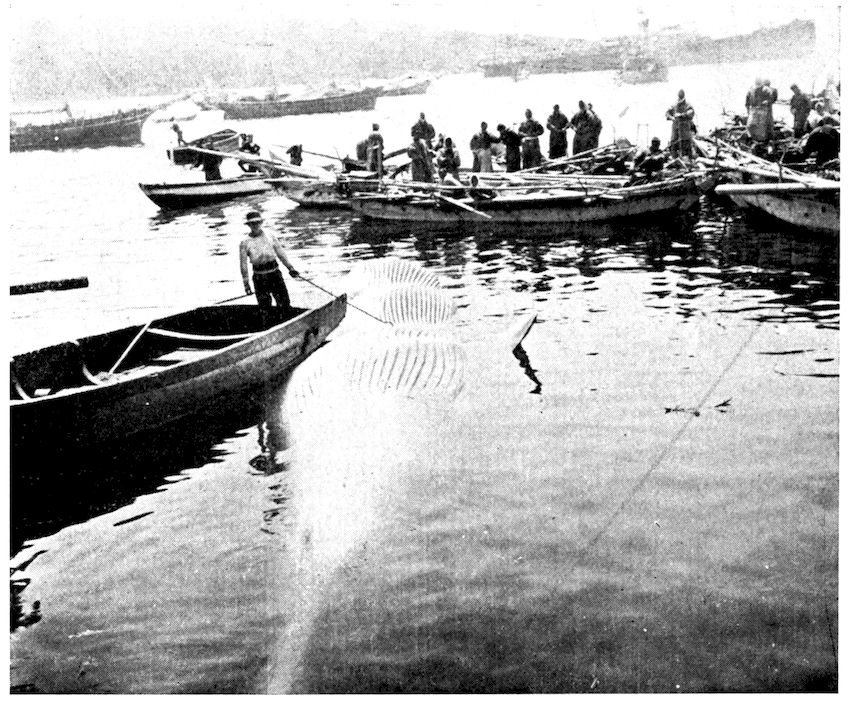
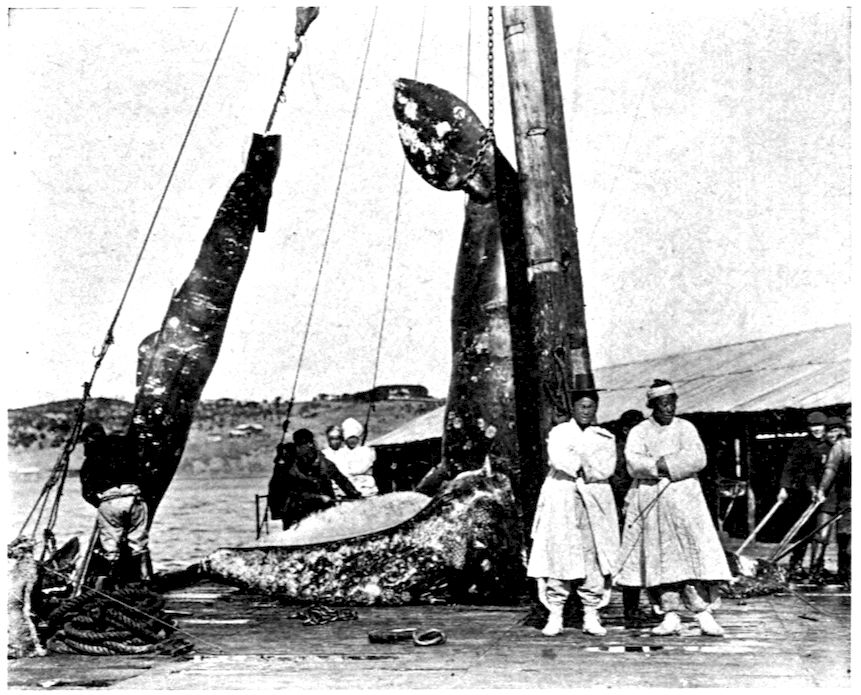
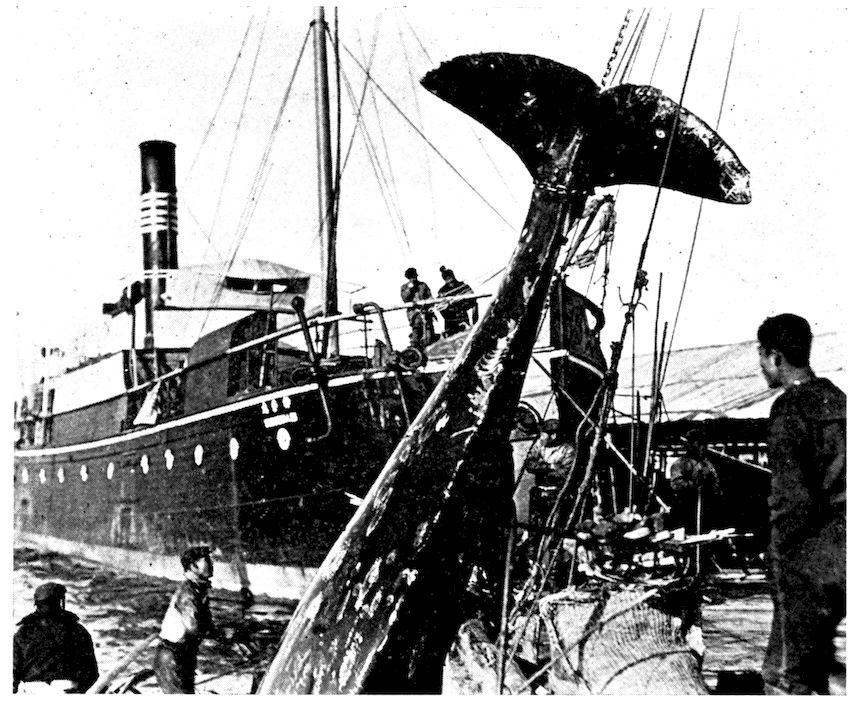
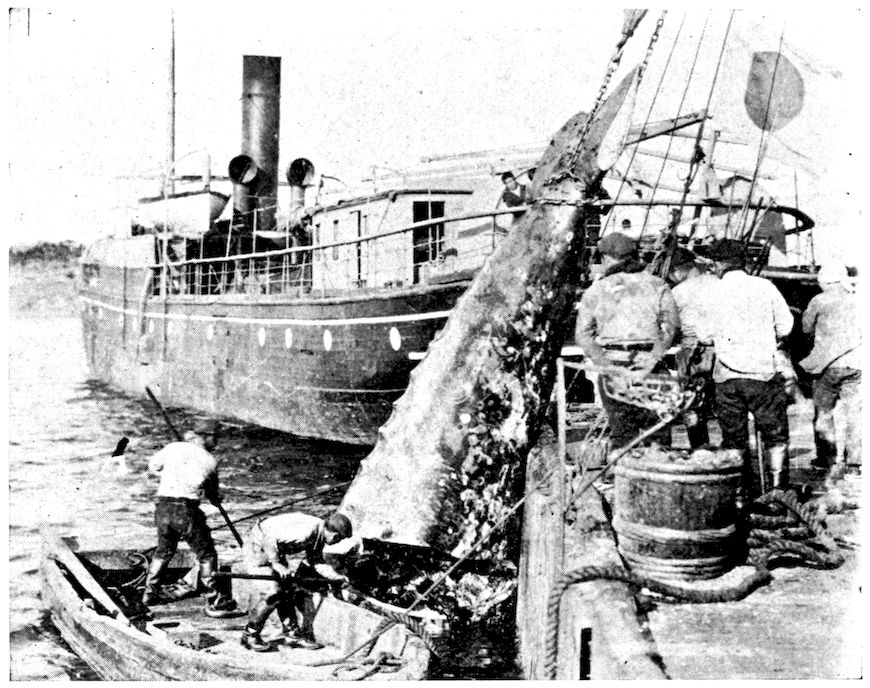
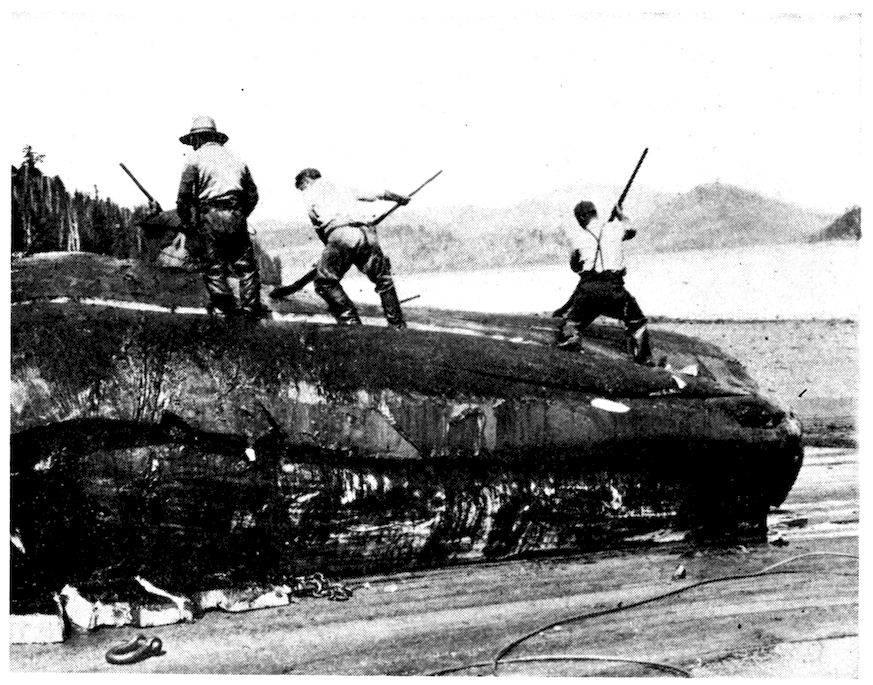
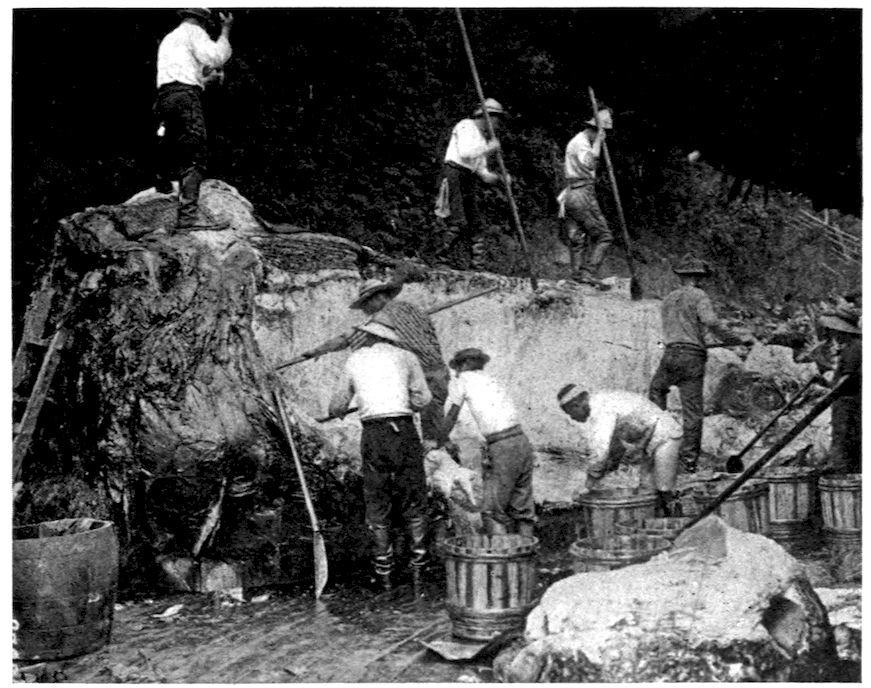
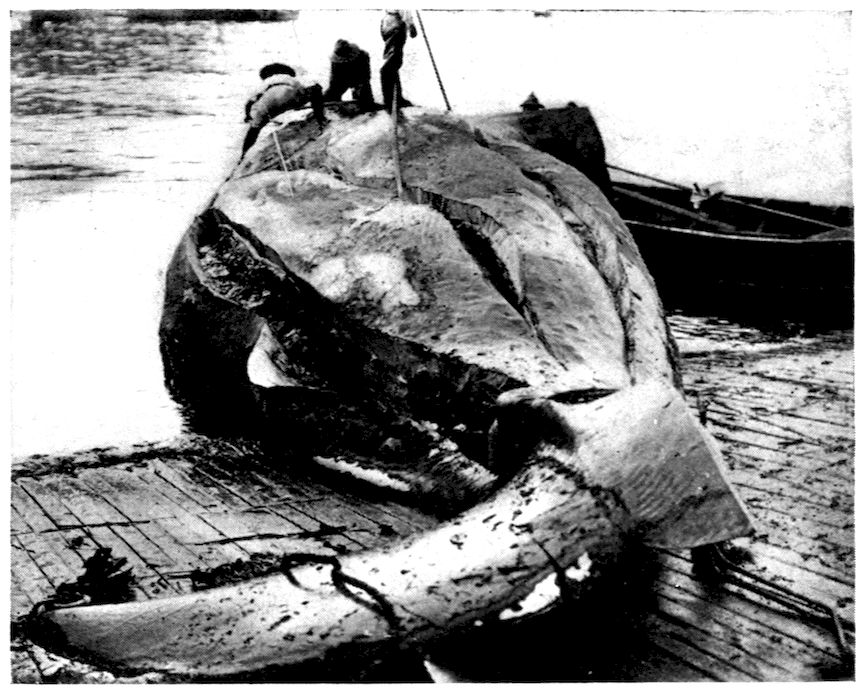
“Section by section the carcass was cut apart and drawn upward to fall into the hands of the men on the wharf and be sliced into great blocks two or three feet square”
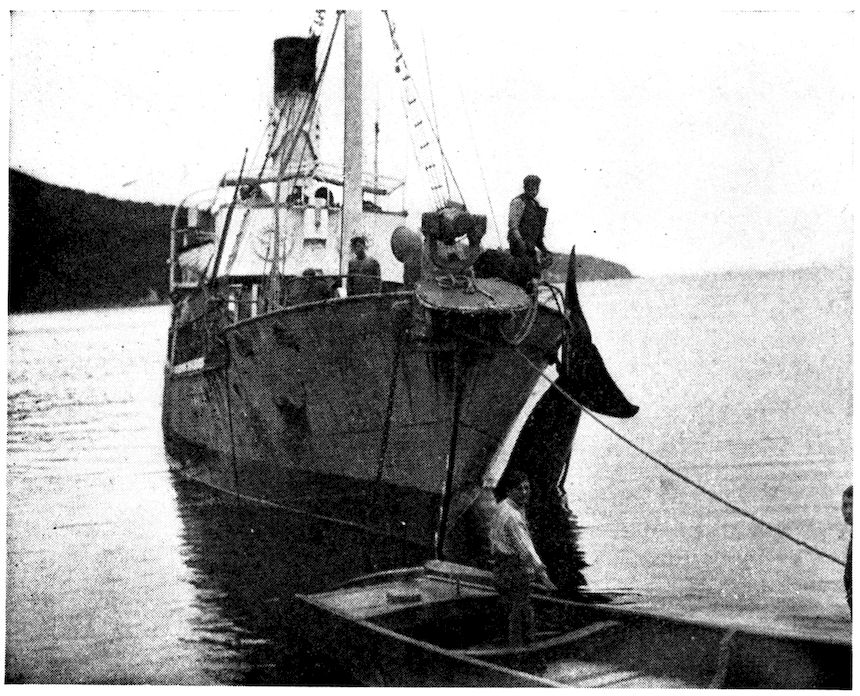
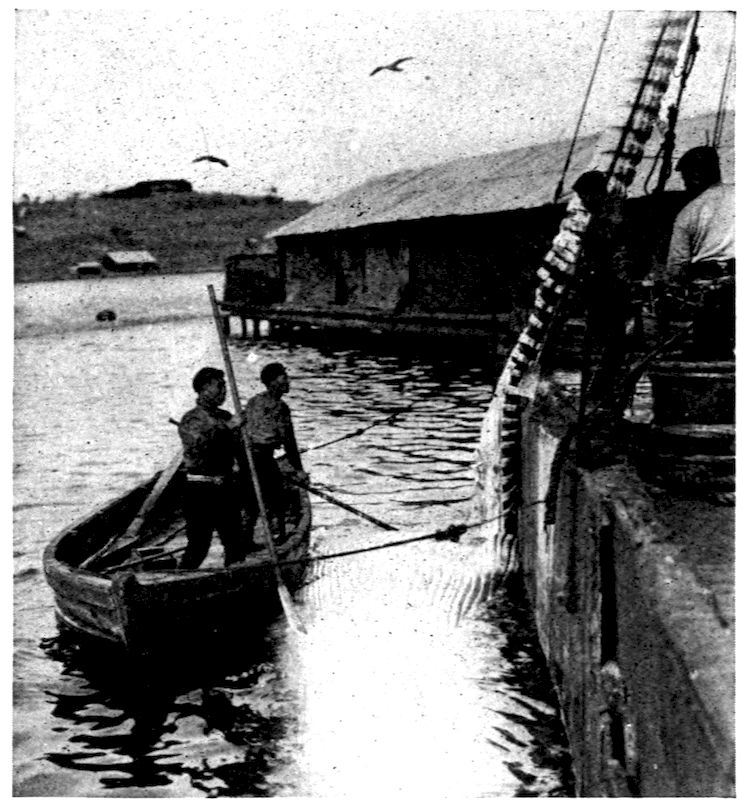
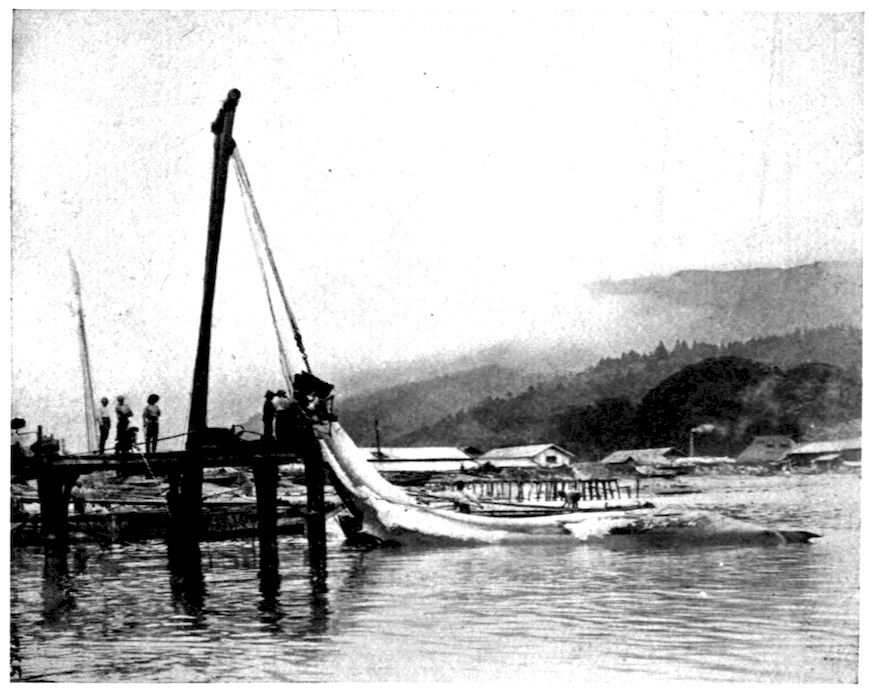
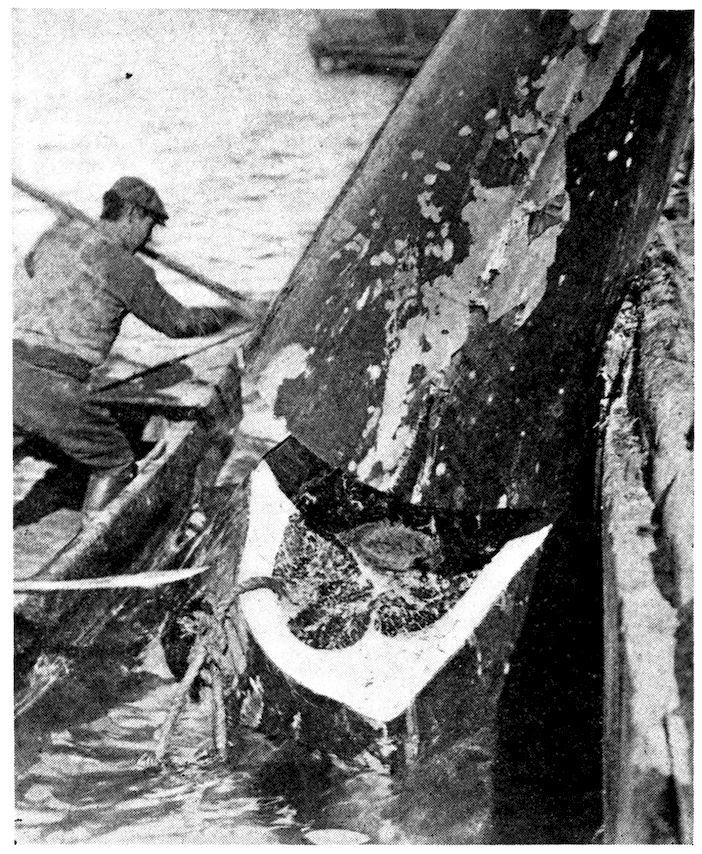
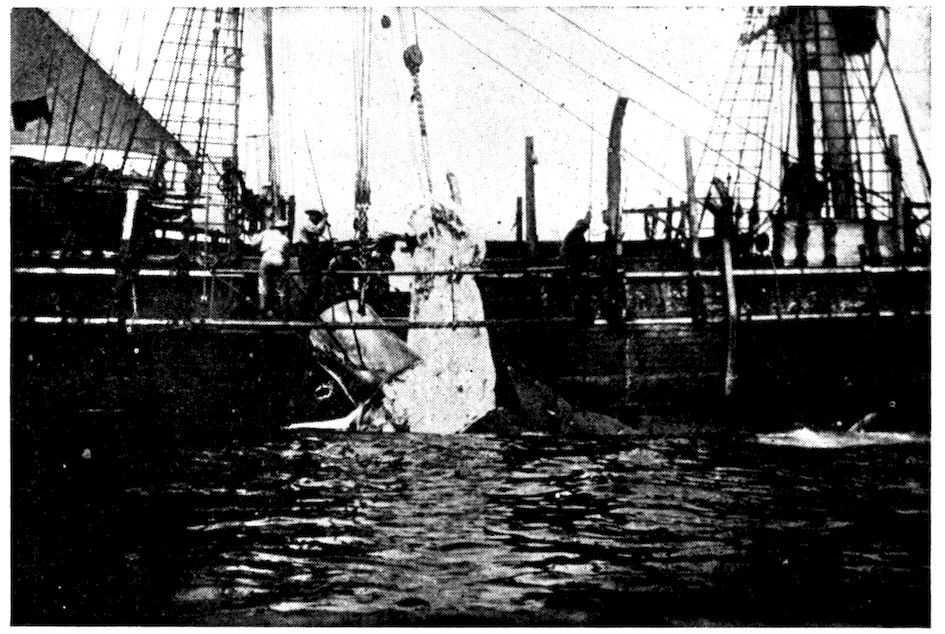
“Transverse incisions were made in the portion of the body remaining in the water, a hook was fastened to a blanket piece and as the blubber was torn off by the winch the carcass rolled over and over”
“Always the center of a screaming flock of birds which sometimes swept downward in a cloud, dipping into the waves and rising again, the water flashing in myriads of crystal drops from their brown wings”
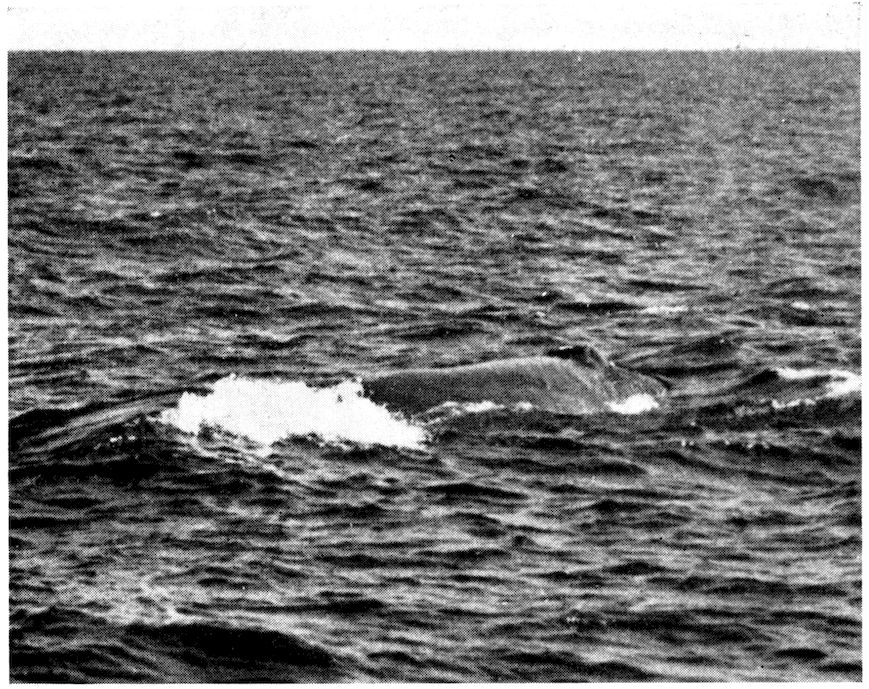
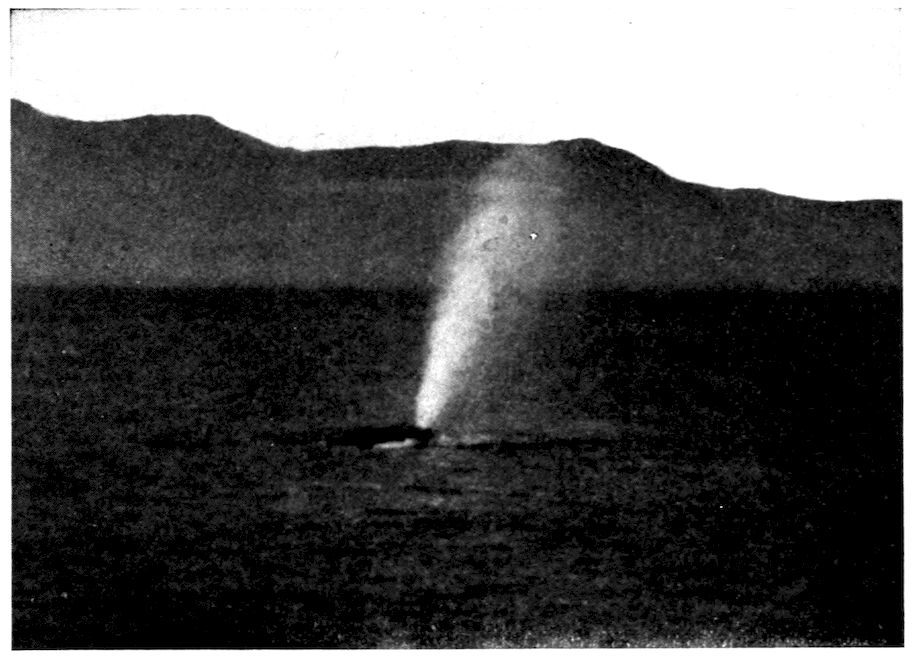
“In the mirror of my camera I could see the enormous gray head burst from the water, the blowholes open and send forth a cloud of vapor, and the slim back draw itself upward, the water streaming from the high fin as it cut the surface”
“I was ... gazing down into the blue water and waiting to catch a glimpse of the body as it rose, when suddenly a dark shape glided swiftly under the ship’s bow”
“For many years the sei whale was supposed to be the young of either the blue or the finback whale, and it was not until 1828 that it was recognized by science as being a distinct species”
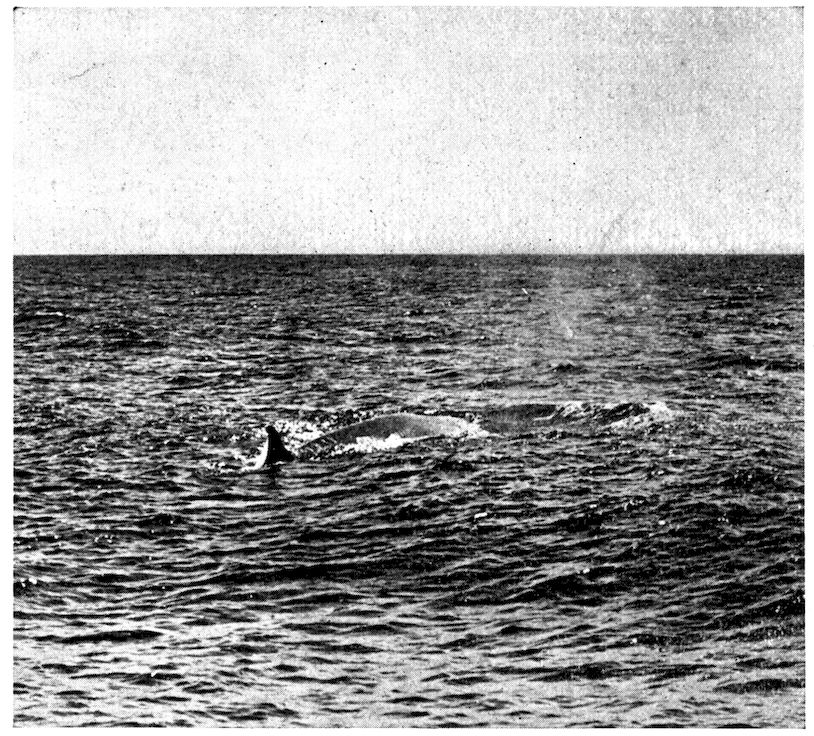
“In the water the sei whale may be easily recognized at a considerable distance by the form of the spout and the high dorsal fin which is prominently displayed as the animal swims at the surface”
“The sei whale has a roving disposition and wanders restlessly from one coast to another, sometimes ... suddenly appearing in waters where it has never before been known”
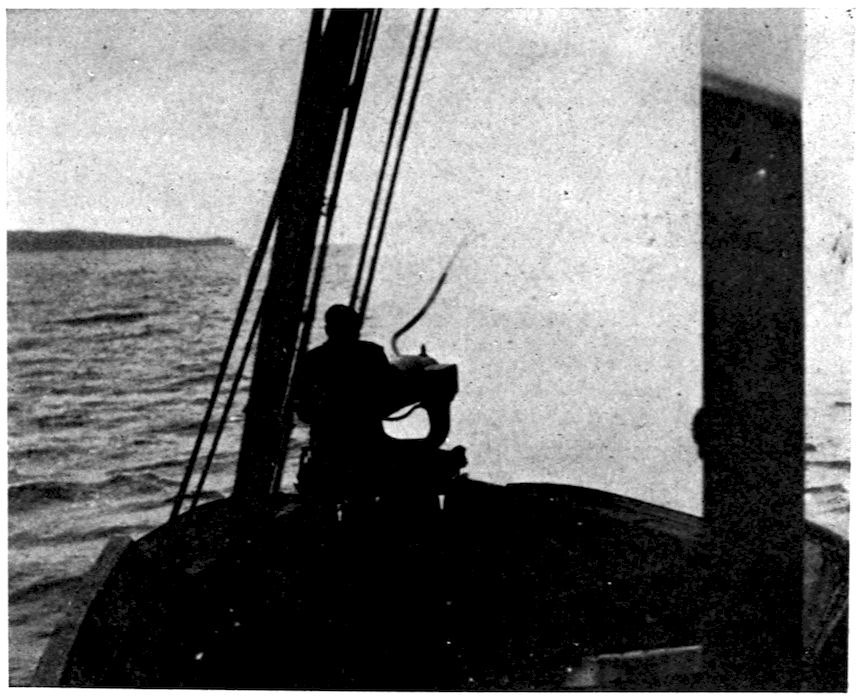
“The rope attached to the first harpoon floated backward in dangerous proximity to the propeller and it required some careful work to get the animal fast to the bow and the line safely out of the way”
“The finback whale is the greyhound of the sea ... for its beautiful slender body is built like a racing yacht and the animal can surpass the speed of the fastest ocean steamship”
“An instant later came the crash of the harpoon-gun and the nearest whale, throwing its flukes and half its body out of the water, turned head down in a long dive”
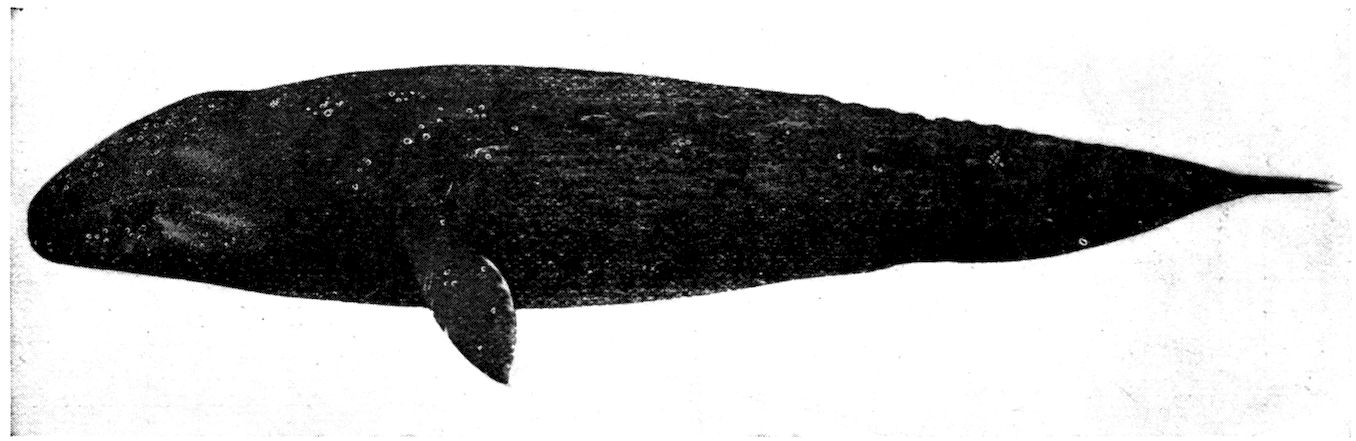
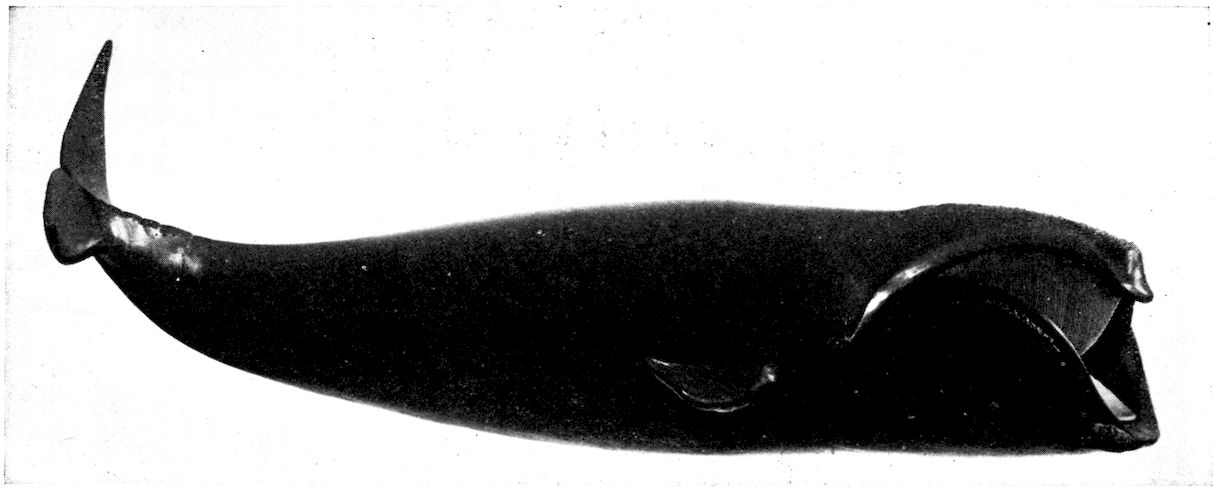
xxiThe side view of a model of a gray whale in the American Museum of Natural History prepared under the direction of the author from studies made in Korea
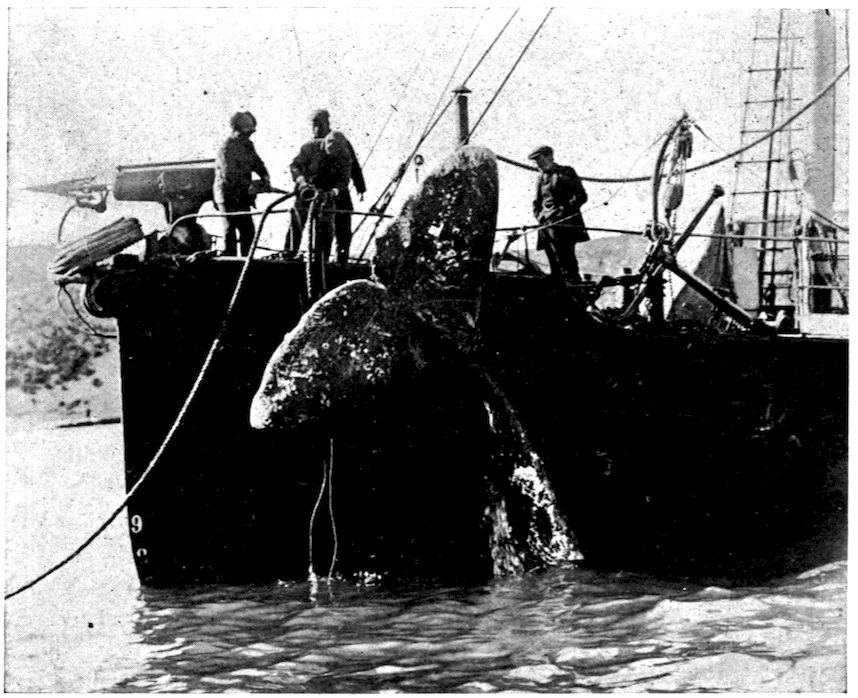
“When the winch began slowly to lift the huge black body out of the water, a very short examination told me that the kaku kujira really was the long-lost gray whale”
“The killer is the wolf of the sea and like the land wolves hunts in packs of twenty or more individuals which will attack and devour almost anything that swims”
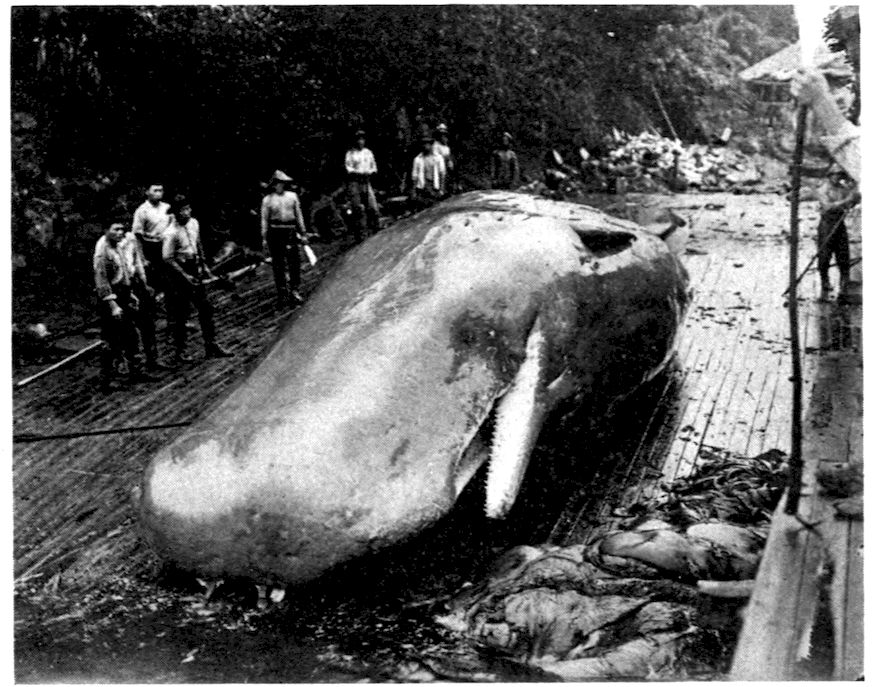
“The sperm ... has from eighteen to twenty-five massive teeth on each side of the lower jaw; these fit into sockets in the upper jaw and assist in holding the whale’s food”
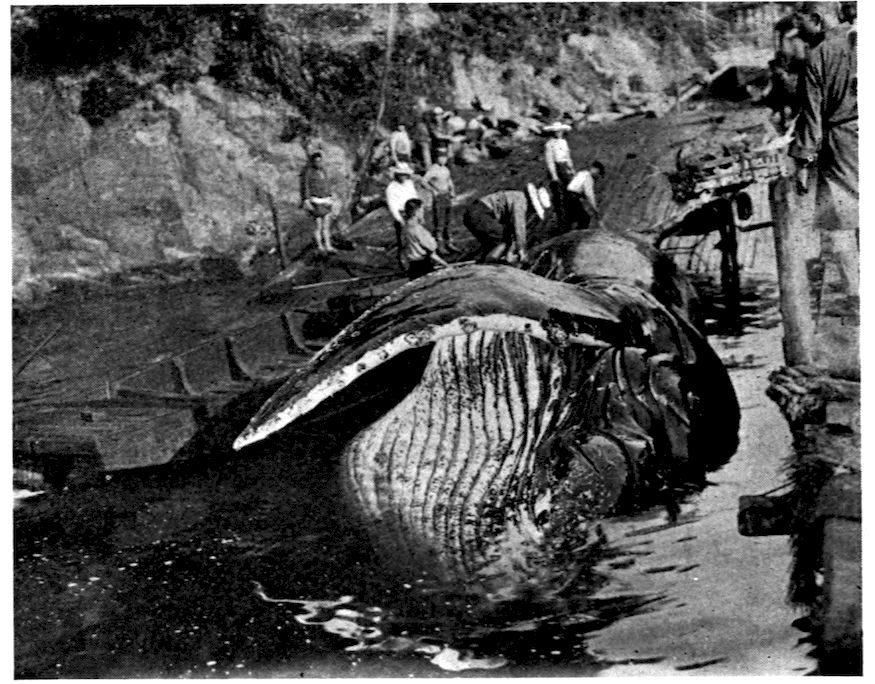
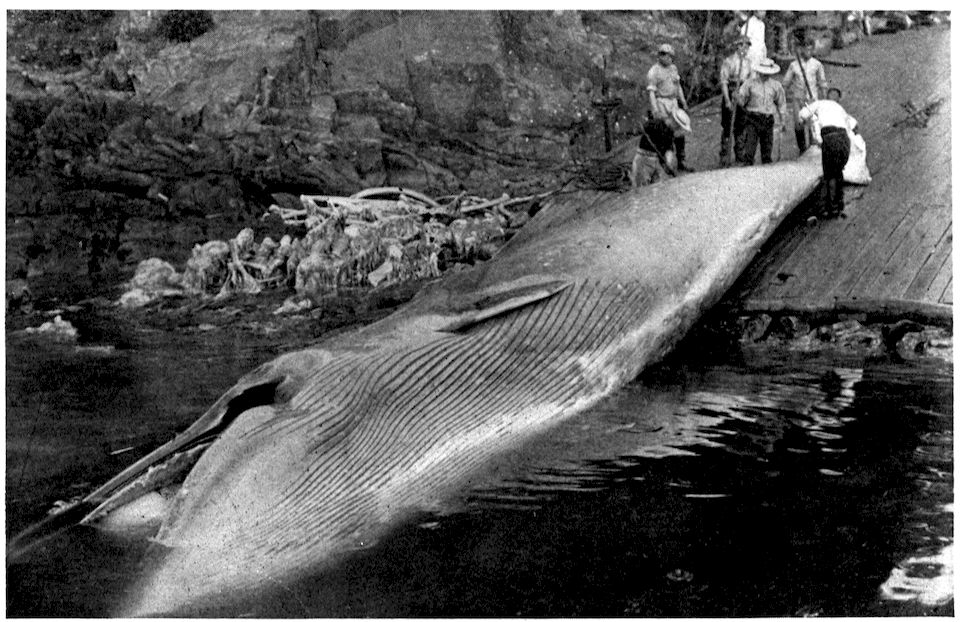
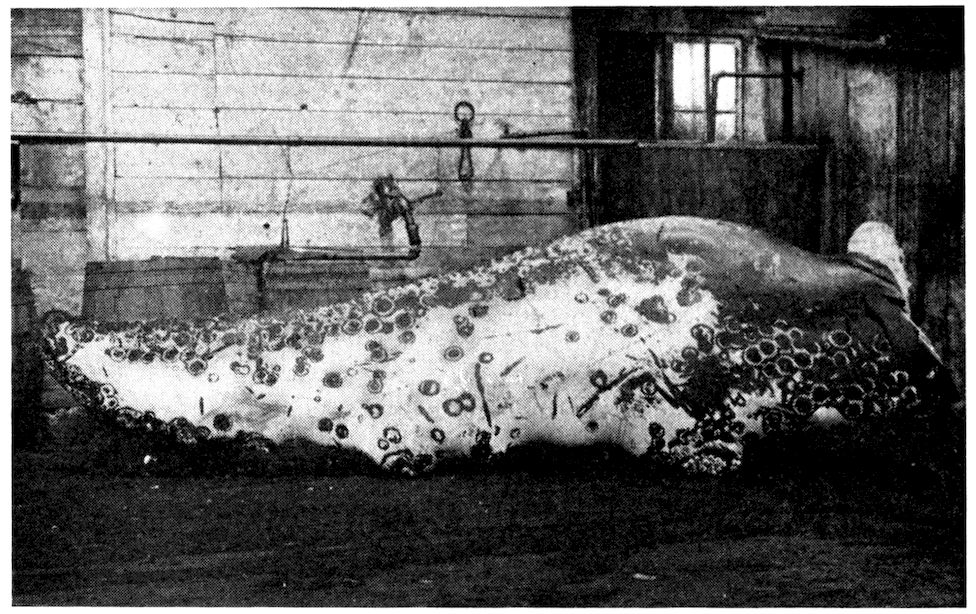
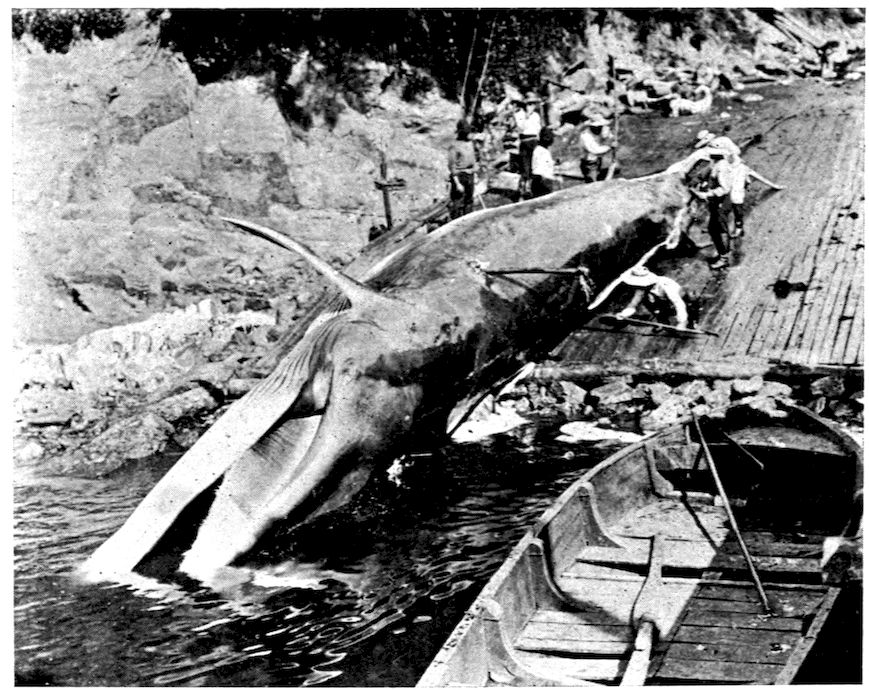
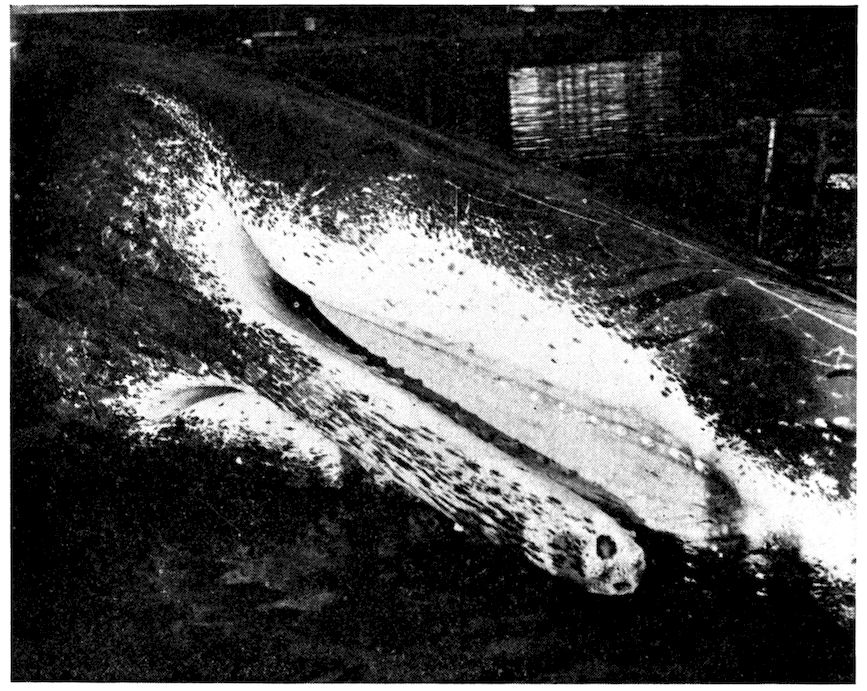
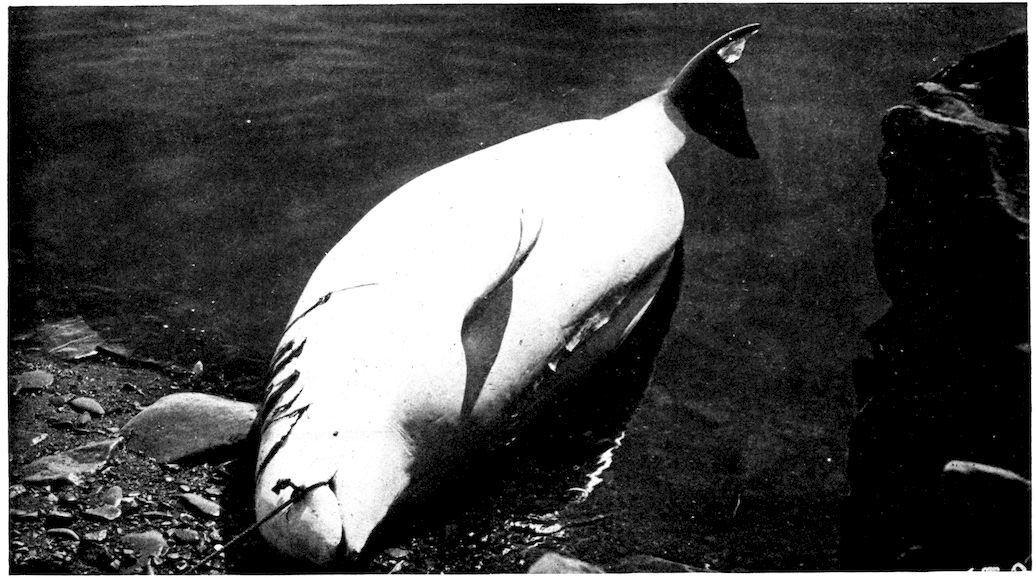
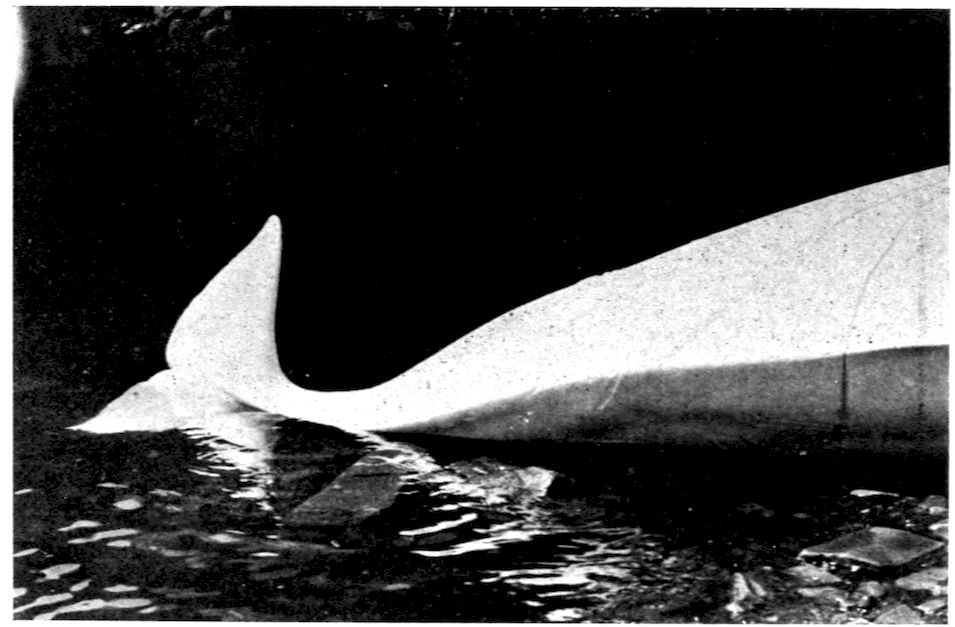
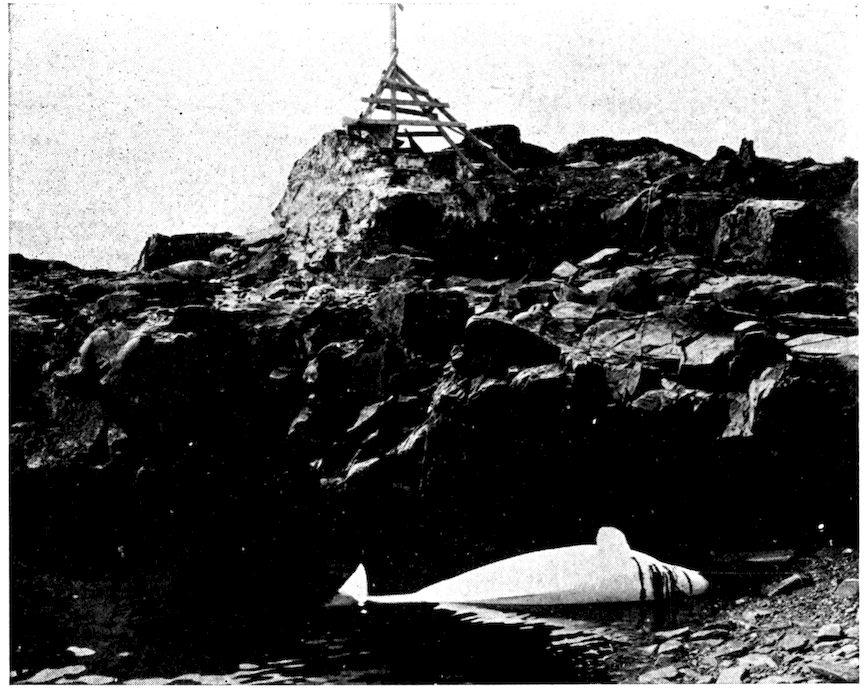
“We beached it in a sandy cove, where the gray rock wall rose in a jagged mass, making a perfect background for the white body, its purity intensified by the bright red streaks of blood which dripped from the bullet holes”
Although the commercial products of whales
have contributed largely to the comfort and
welfare of the civilized world for over a thousand
years, never have the animals been of greater
economic importance than they are today.
It is true that the magnificent fleet of ships which
had its birth in the New England States has passed
away, and that the smoke of cotton-mills now drifts
over the famous old city of New Bedford where
once the harbor was filled with the towering masts
of scores of whaling vessels.
But as one chapter of whaling history closed another
opened and the scene shifted to Norway where
Tønsberg, a little city in Christiania Bay, has become
the Alpha and Omega of the modern whaling alphabet.
It was there, in 1864, that Svend Foyn invented
the harpoon-gun and brought into existence the sturdy
2little steamships which were destined to take the
place of New England’s fleet, destroyed by the Confederate
raiders during the Civil War.
Although despised by the “deep-water” whalers of
New Bedford, nevertheless shore whaling has rapidly
grown into a world industry which today, in
the height of its prosperity, yields a revenue of nearly
$70,000,000 a year.
In the old days only three species, the sperm, bowhead
and right whale, were hunted and until Svend
Foyn invented the harpoon-gun the fin whales, of
less commercial value, were seldom captured. Their
yield of oil was so small, and the whalebone so short
and coarse, that if these products alone were utilized
they were not worth the trouble of killing. Moreover,
the great speed of the animals in the water and
their tendency to sink when dead made them unacceptable
to the men who hunted in a small boat with
a hand harpoon and lance.
With the development of steam whalers the situation
was changed, for they made possible the capture
of “finners” in sufficient numbers to warrant
the erection of stations at certain points on the shore,
near the feeding grounds of the animals, where the
huge carcasses could be brought in and converted into
commercial products.
The perfection of the harpoon-gun and steam whale
ships came only after long discouragement and persistent
effort upon the part of Svend Foyn. Foyn
was born in Tønsberg in 1809, and died there in 1894.
He went to sea at fourteen in the merchant service
3and later entered the sealing fleet where he eventually
made considerable money. It was while sealing that
he conceived the idea of capturing the fin whales with
a bomb harpoon, and 360,000 kronen were spent in
experimenting before he succeeded in building a suitable
gun and vessel.
In 1864 he went to Finmark for the first time in
the small ship Spes et Fides, but caught nothing and
was equally unsuccessful in the two following years.
In 1867 he secured the first whales at Vardö, in Varangerfjord,
and the next season killed 30. In 1869
he went north with two ships but got only 17 whales,
and in 1870 only 36. It was in this year that at
Kirkeö the first factory for converting whale flesh
into guano, or fertilizer, was built and successfully
operated. Foyn’s best years were between 1871 and
1880, when 506 whales were killed, having a value of
about 2,000,000 kronen.
In 1877 a competitive company began work in
Jarfjord, and in 1881 two others started at Vardö
and two in West Finmark near the North Cape. In
1882 Norway had 8 companies and 12 ships, and five
years later 20 companies and 35 ships. In 1890 the
whales began to show the effect of continual persecution,
decreasing rapidly in numbers, and five companies
shifted their operations to Iceland. In 1896
the 18 ships hunting there killed 792 whales, yielding
49,500 barrels of oil; in the same season 29 ships
off the Finmark coast caught 1,212 whales.
From the very beginning the Norwegian fishermen
were hostile to the shore whalers, for they believed
4that the whales drove the fish toward the land and
into their nets and that their industry was being
greatly injured by the slaughter of the animals. Although
it has been clearly demonstrated that whales
have no direct influence upon the movements of fish,
nevertheless in 1903 the Störthing prohibited shore
whaling altogether.
The efforts of the Norwegian whalers had been
watched with interest in other parts of the world and
in 1897 shore whaling began in Newfoundland; there
it thrived amazingly, and by 1905 eighteen stations
were in operation upon the island and in its immediate
vicinity.
In 1905 the first shore station on the Pacific coast
of America was built at Sechart, in Barclay Sound,
on the west side of Vancouver Island. This factory
was under the management of the Pacific Whaling
Company, of Victoria, B. C., and although their
first season was not a success, a revision of the methods
of handling the carcasses resulted in a lucrative
business being established. In 1907 a second fine
station was erected at Kyuquot, one hundred miles
north of Sechart.
About this time the Tyee Company was formed
under the direction of Captains Hibberd and Barneson,
and a station was constructed at Murderer’s Cove,
on the southern end of Admiralty Island, Alaska. The
hunting here was entirely conducted in the inland
waters of Frederick Sound, and after a few seasons
the whales became so reduced in numbers that operations
had to be transferred to the open sea about
5Cape Ommaney, sixty miles away; the Tyee Company
was later re-formed as the United States Whaling
Company.
In 1910 the Pacific Whaling Company was sold
to the Canadian North Pacific Fisheries, Ltd., with
stations at Rose and Naden Harbor, Queen Charlotte
Islands, and Bay City, Washington, besides the
two Vancouver factories. Another establishment,
known as the Alaska Whaling Company, started work
at Unimak Pass, Aleutian Islands, Alaska, and a Norwegian
firm built a station on the Pacific coast of
Mexico.
About the time Newfoundland became interested in
shore whaling, the Russians and Japanese started operations
along the coasts of Siberia and Japan, respectively.
The Russian industry there was abruptly
ended at the time of the Russian-Japanese war and
has not since been resumed, but the Japanese have
continued their work with great success and today
vie with the Norwegians in the development of shore
whaling, for by their methods almost every particle
of a whale’s carcass is utilized for human consumption.
The Toyo Hogei Kabushiki Kaisha, of Osaka, is
the largest whaling company in the world, owning fifteen
stations and twice as many ships, and conducting
operations in almost every part of the Japanese Empire.
The South African industry was founded by Mr.
John Bryde, of Sandefjord, Norway, who in 1909
erected the first station in Durban and another in the
6following year in Saldanha Bay on the west coast.
Stations have also been built at several places in
Australia and Tasmania, and in New Zealand humpback
whales are being caught in wire nets. This
method is so unique that a description of it here may
be of interest.
The station is owned by the Messrs. Cook Brothers
and is located south of the Bay of Islands, at the village
of Wangamumu. On their annual migrations
the humpback whales often pass through a narrow
channel just under Cape Brett, which separates a cluster
of outlying rocks from the mainland, and makes
an ideal spot to place the nets. Having a stretch of
five hundred or six hundred feet and a depth of two
hundred, the nets, meshed to seven feet and made of
three-eighths-inch wire rope, are hung on strong cables
buoyed by huge floats and drogues. When a whale
is sighted from the coast, steam launches place the
three nets, which are allowed to float loose, the principle
being to so hamper the whale by the entangling
wires that it falls an easy prey to the hunters. What
happens when a whale is caught can best be told in the
words of an eye-witness.
When the nets are in position the launches and attendant
whale-boats, with their crews, take up their stations at some
distance to watch for the upheaval and dancing float-line
that marks the “striking” of a whale.... Suddenly a sort
of shudder runs through the sea. There are tossing billows
and wild commotions away by the bobbing float-lines.
“Hurrah! She’s struck!” is the cry.
Away go the boats, each racing to be first “fast” to the
7struggling “fish” and so earn the bonus that rewards the
winning crew.
A mighty gray-black head, entangled in a clinging web
of wire, rears from out the water. Up, up, it goes till a
huge bulk of body towers a good fifty feet in the air, its
side fins thrashing wildly in a smother of foam. It curves
in an arch and then, like an arrow, down go whale and net
together for the “sound.”
Not for long, though. The upward drag of the bunched
net-floats, and its necessity for breath, bring the “fish”
quickly to the surface—a spouting, snorting, wallowing
mass; mad with rage, wild with terror of the unknown,
clinging horror that envelopes it.
Bang! bang! go the guns from each boat, in quick succession.
Both irons are home and well placed. A wild
quiver of flukes and fins, and the whale either “sounds”
again or “races” along the surface, towing the boats after
it at express speed. But the net holds fast, and at each
new effort for freedom the victim becomes more hopelessly
“wound up” than before.
Soon, exhausted with futile struggling, the whale comes
to rest, and there is a momentary cessation of the mad fight
as the leviathan pauses for breath. Huge, panting air-gasps
are plainly audible aboard our launch at a distance of half
a mile.
The crews are quick to seize the opportunity. With the
lance-men ready in the bow, the boats sweep in, one on
either side. “Steady with the lance.” “Now!” Eight-foot
steel blades drive deep for the heart behind the pectoral fins.
A shiver, a hissing spout of water and blood, a wallow
and roll of the huge, wire-tangled carcass, flashes of red
and white foam in the sunlight, and the black heave of a
twenty-foot fin that for one dread instant, scimitar-shaped,
a falling wall of bone and sinew, hangs over the boat and
its occupants. The boat’s crew back out like lightning, just
in time. Down crashes the mighty flail, missing its blow
8by a barefoot. There is a roar and clap of many thunders,
and jetting spurts of spray leap high into the blue.
The boats, backed clear, still hang to the lines, the crews
watching events and waiting the end. It may be that the
dying whale will “sound” again, or “race” in a final effort.
But, no. The lances have gone home. A few more wallows’
of despair, the great tail-flukes thrash the water with
lessening force, and presently the huge body, inert, lifeless,
lies quietly on the surface. Hawsers are made fast to the
dead whale, and while the boats return to their stations to
watch the remaining nets it is towed by the launch to the
flensing jetty ashore.[1]
1. D. W. O. Fagan in the Wide World Magazine, pp. 423–432.
Since the beginning of the last century the sub-antarctic
islands known as the Shetlands, South Orkneys,
Falklands, South Georgia and Kerguelen have
proved to be the greatest whaling grounds of modern
times, and are today yielding nearly $35,000,000 per
year—just one-half of the total world revenue derived
from the shore whaling industry. On South
Georgia alone, eight companies with headquarters in
Norway, England, Scotland, and Argentina are in
operation, and all the other islands have one or more
stations or “floating factories.”
In South America there are several stations on the
coast of Brazil, Argentina, and Chile, and operations
are also being carried on at Spitzbergen, the Faroe
Islands, Shetland, the Hebrides, Greenland, and the
Galapagos Islands. Shore whaling is, therefore, a
world industry in the truest sense of the word.
9
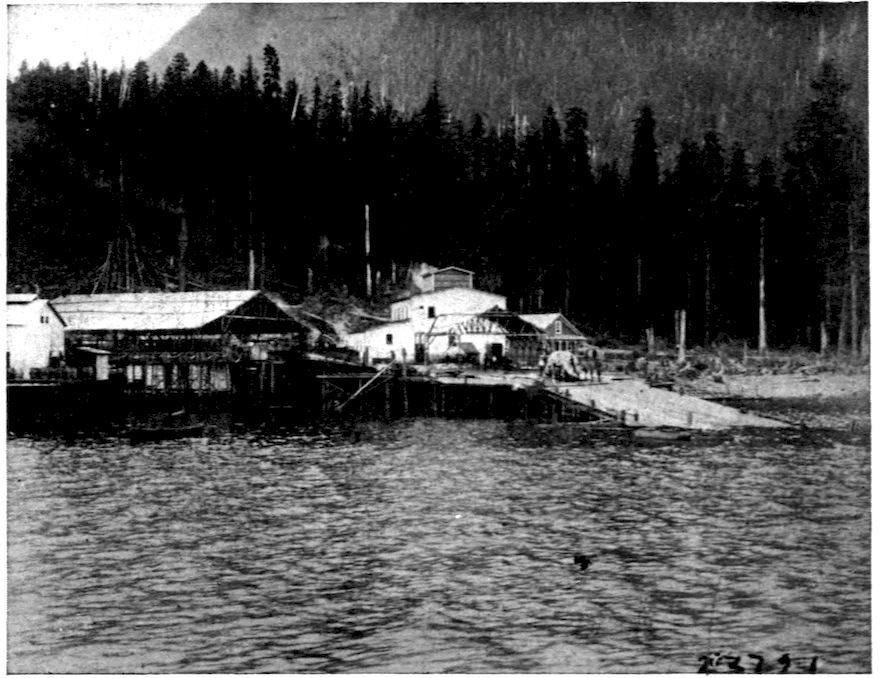
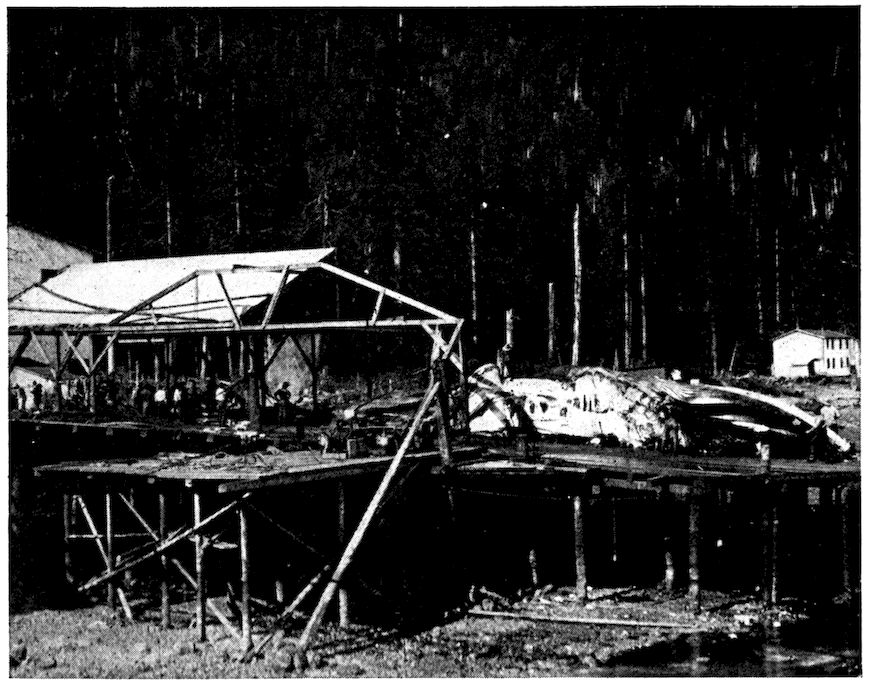
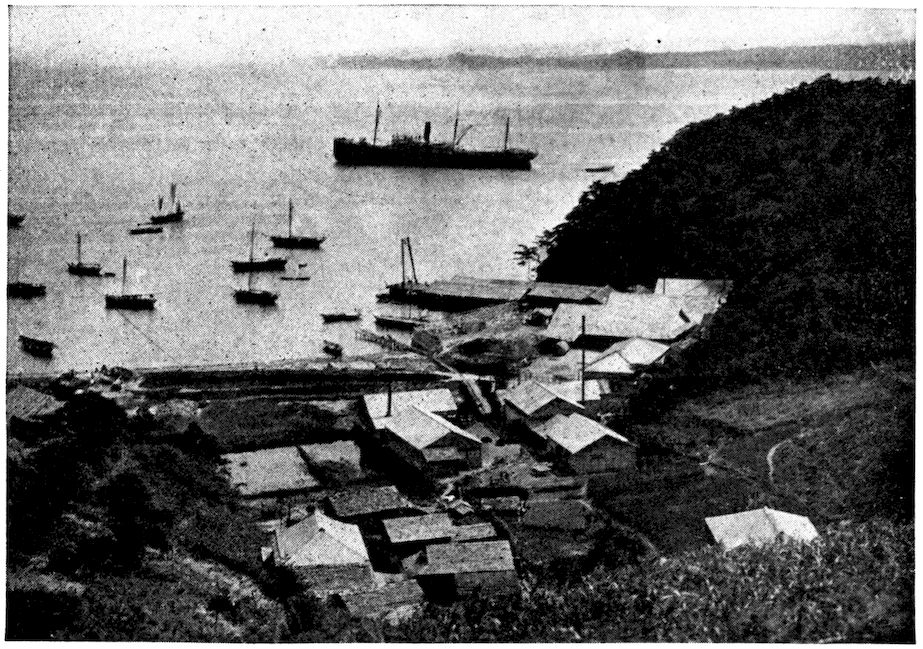
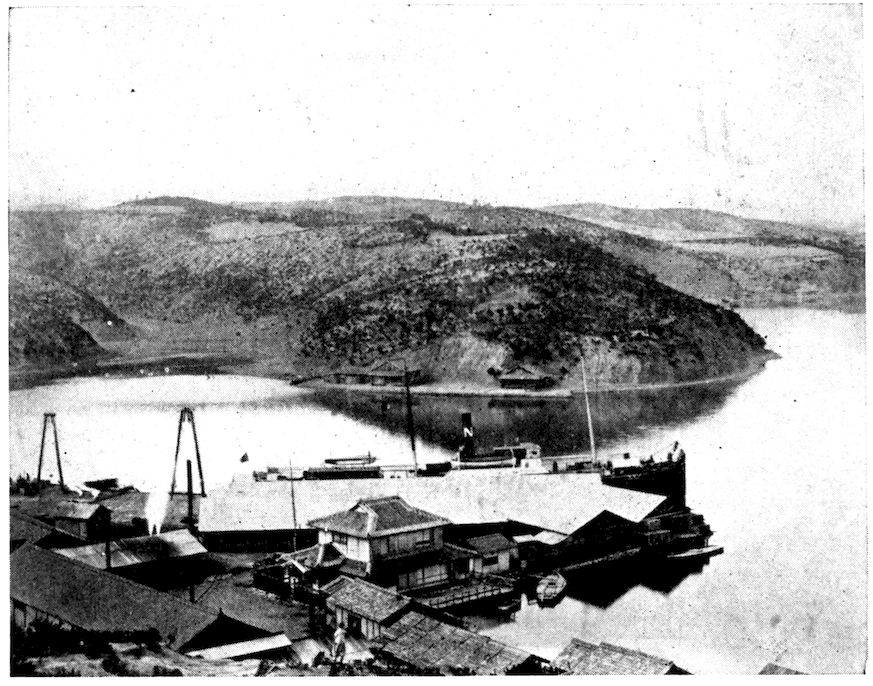
A modern shore whaling station at Kyuquot, Vancouver Island, B. C. The flensing slip, carcass platform and wharf are shown in the foreground. In the background is the manager’s dwelling.
When it was discovered that in certain localities
the whales were being rapidly killed off and the vessels
had to hunt so far from the stations as to make the
trip unprofitable, the “floating factory” was devised.
This is a large steamship of five or six thousand tons
which is fitted with huge boiling vats and can be moved
about from place to place as the whales themselves
travel. Usually two or three steamers operate from
one floating factory for formerly when only the blubber
was used and the carcass was turned adrift, one
ship could not supply enough whales to make the work
profitable. These factories are used most extensively
on the South Atlantic grounds.
10
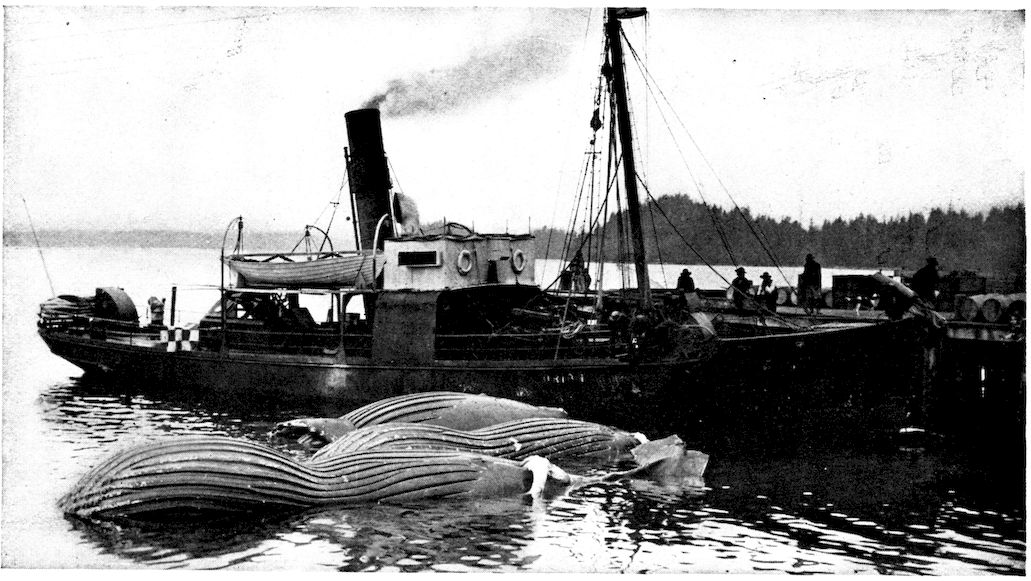
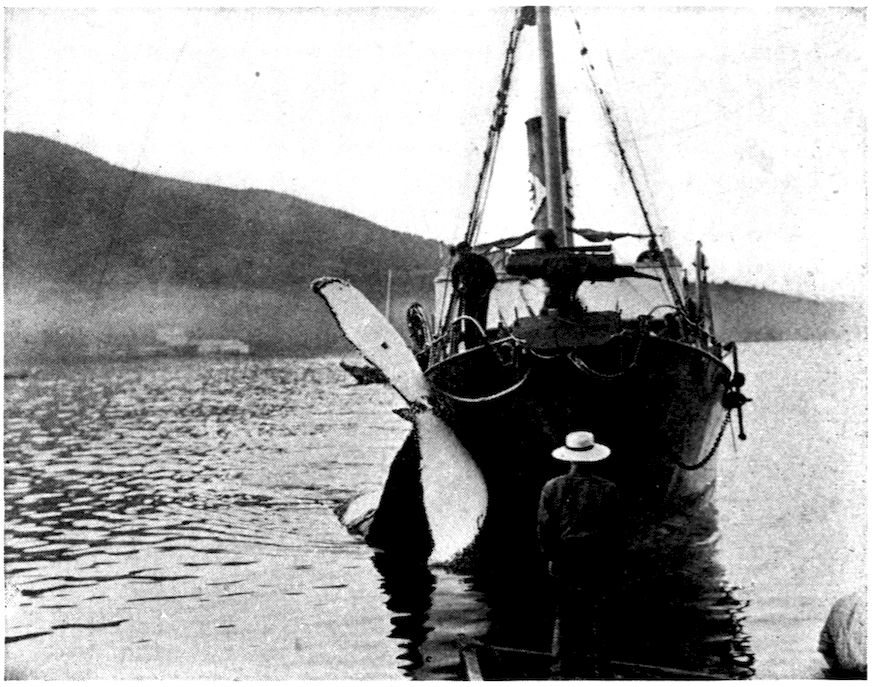
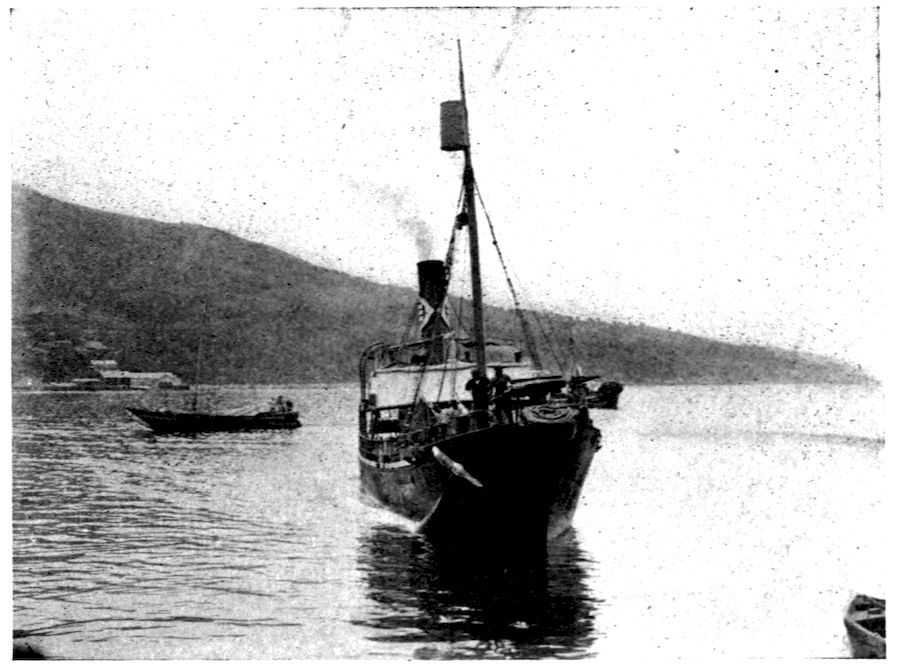
The Orion with three humpback whales at Sechart, Vancouver Island.
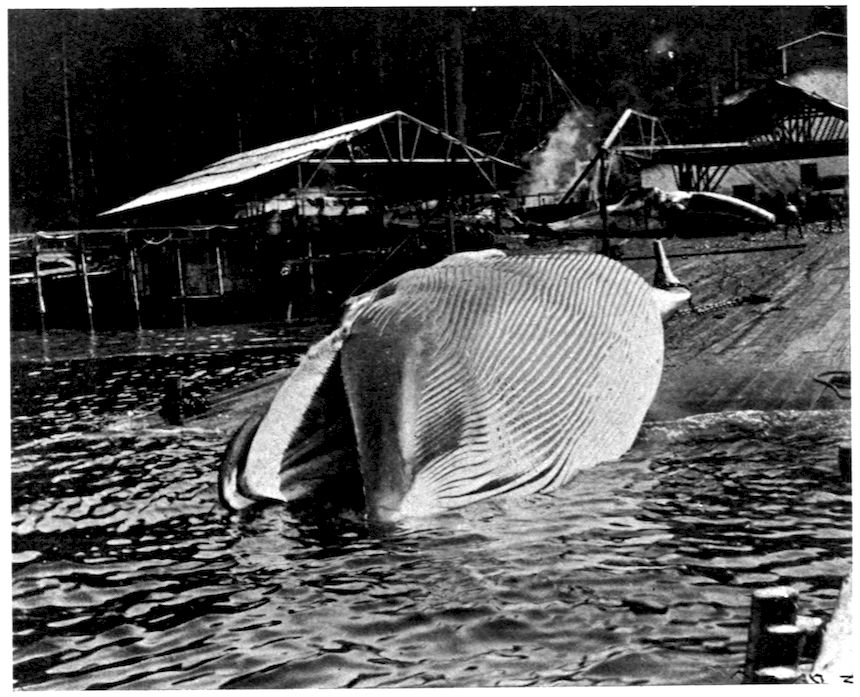
11The modern shore station is usually situated in a
bay or cove not far from the open sea. The flensing
slip and carcass platforms are the most striking portions
of the establishment, and these are surrounded
by boiling vats, the machine for drying the flesh, the
engine house, wharf, bunk houses, offices, and the
dwelling of the manager, the whole forming an imposing
group of buildings.
Many of the whaling stations have very comfortable
quarters and those on the bleak islands of the
South Atlantic are even luxurious. The manager’s
house is often beautifully furnished, with electric
light, bathrooms, and even steam heat, so that when
one becomes accustomed to the all-pervading odor
from the “dryer,” the station is a delightful place
at which to work. Although each one differs in respect
to food, nevertheless the meals are for the
most part excellent, for the managers realize that
if their men are to be contented they must be well
fed.
The whaling ships usually return to the station
each night and, if one is free from seasickness, furnish
a rather inviting home for a short stay. They
are trim, high-bowed vessels of about one hundred
tons burden, ninety to one hundred feet long, and have
a speed of from nine to twelve knots per hour. Round-bottomed
to facilitate speedy manipulation, they ride
the water like a cork but roll and pitch almost beyond
belief in the slightest seaway.
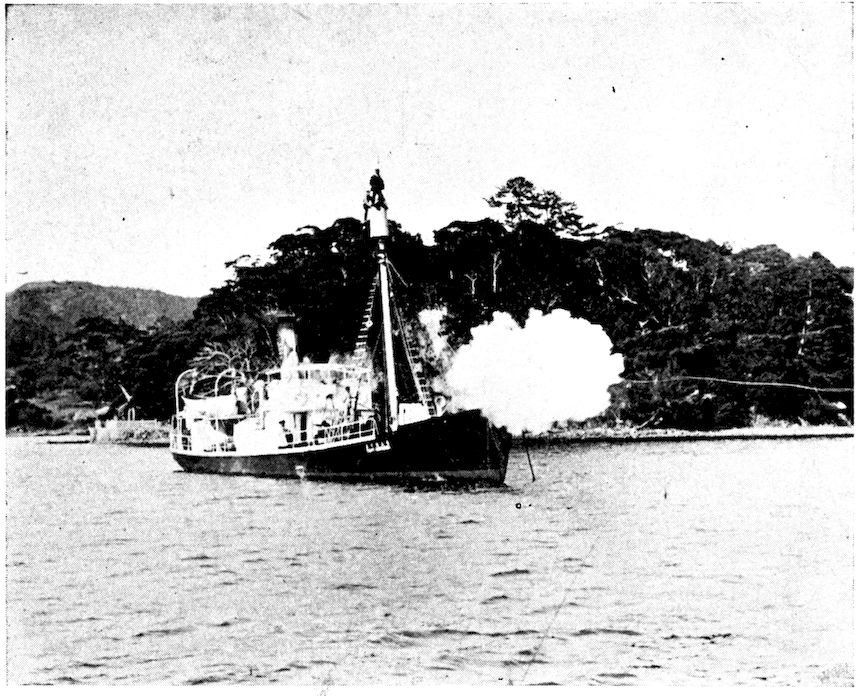
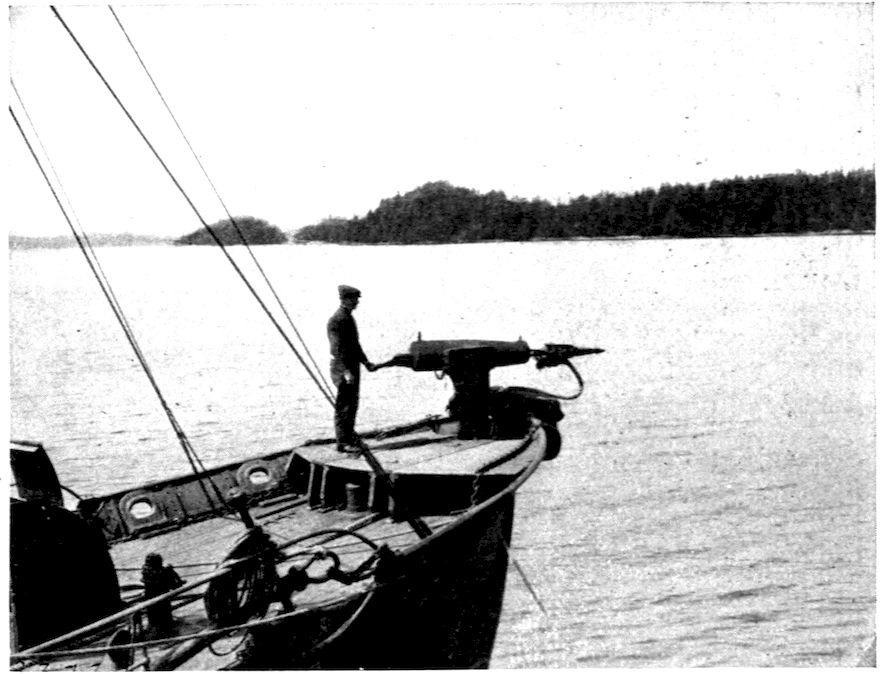
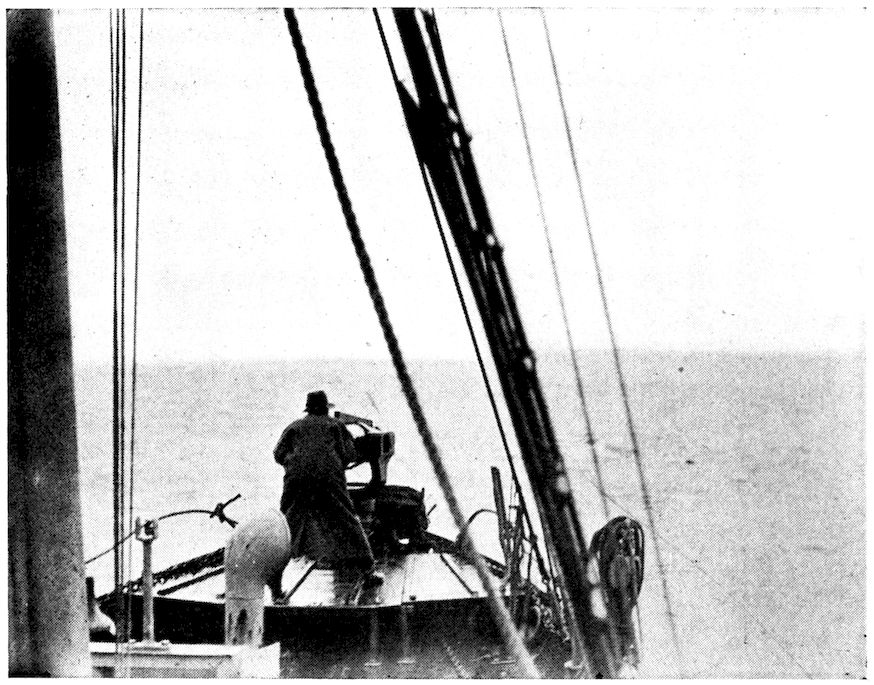
Most striking of all the upper works is the harpoon-gun
mounted upon a heavy iron support at the very
bow. It is a short cannon, 51½ inches long, with a
123-inch bore, and turns easily upon a swivel up and
down and from side to side.
At the butt end, under a short wooden handle, is
an iron lever, the trigger, which when pressed upward
explodes the gun. The charge is 300 to 375
drams of very coarse, black powder which is sewed
up in a cheesecloth sack and rammed home from the
muzzle; then come wads of oakum, hard rubber or
cork, and wool, after which the harpoon, well greased,
is pushed in and hammered solidly into place with a
wooden mallet. Some guns require more powder than
others but if too much is used the iron will be bent
as it leaves the muzzle.
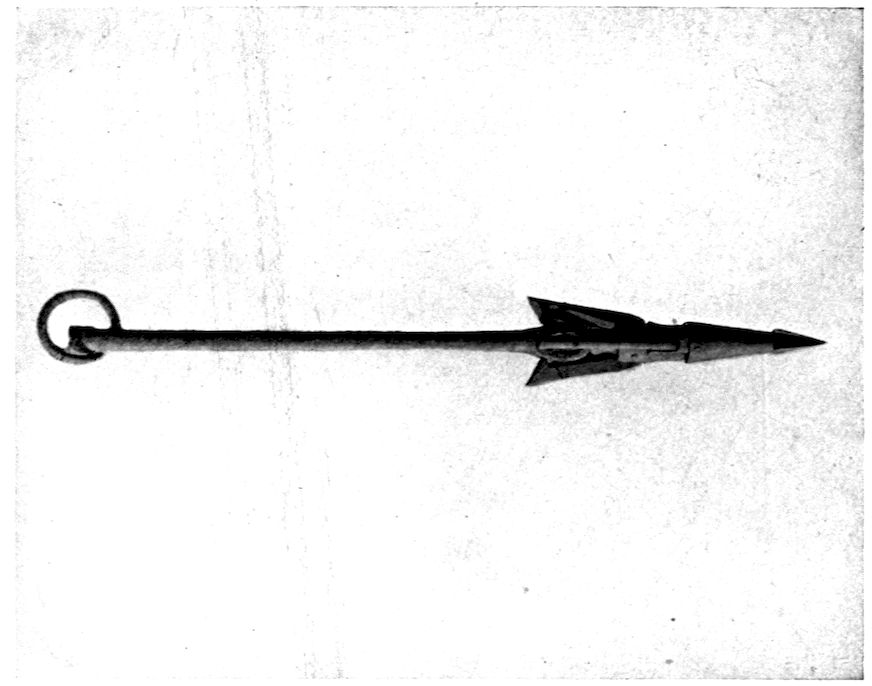
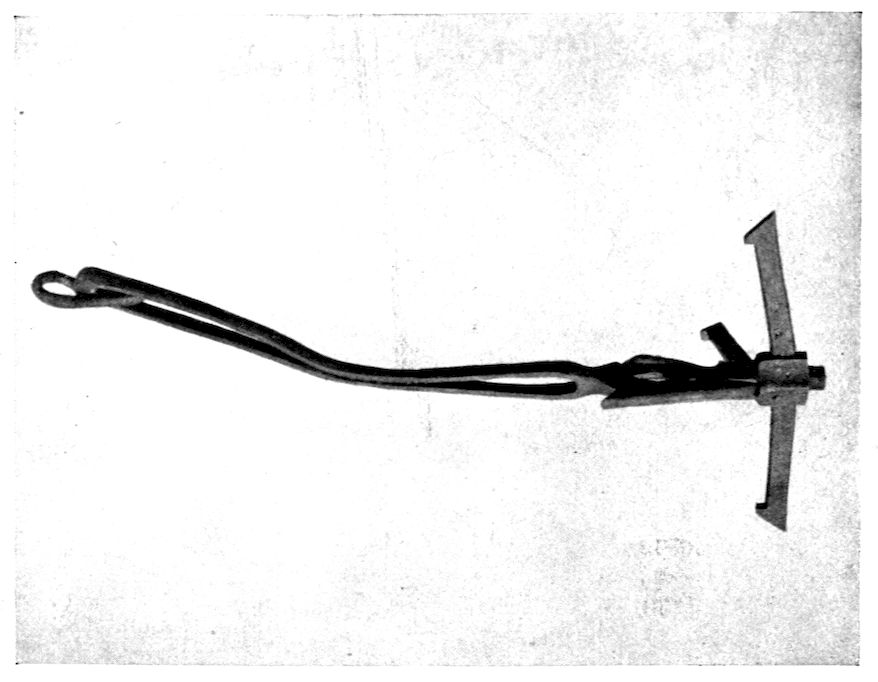
The harpoon is 76 inches in length, and has a double
shaft, at the end of which are 4 twelve-inch flukes,
or barbs; these are tied to the shaft but spread widely
upon entering the whale’s body and prevent the iron
from drawing out. The harpoon is tipped with a hollow
point, called the “bomb,” which is filled with powder
and ignited by a time fuse set for the desired interval.
Three or four seconds after the gun is fired
the bomb bursts, frequently killing the whale almost
instantly.
The harpoon is made of the best Swedish iron and weighs
one hundred and ten pounds. After it has
been fired into the body of a whale it is usually badly
bent and twisted, but the tough, elastic iron can be
straightened by the station blacksmith and made as
good as new.
13
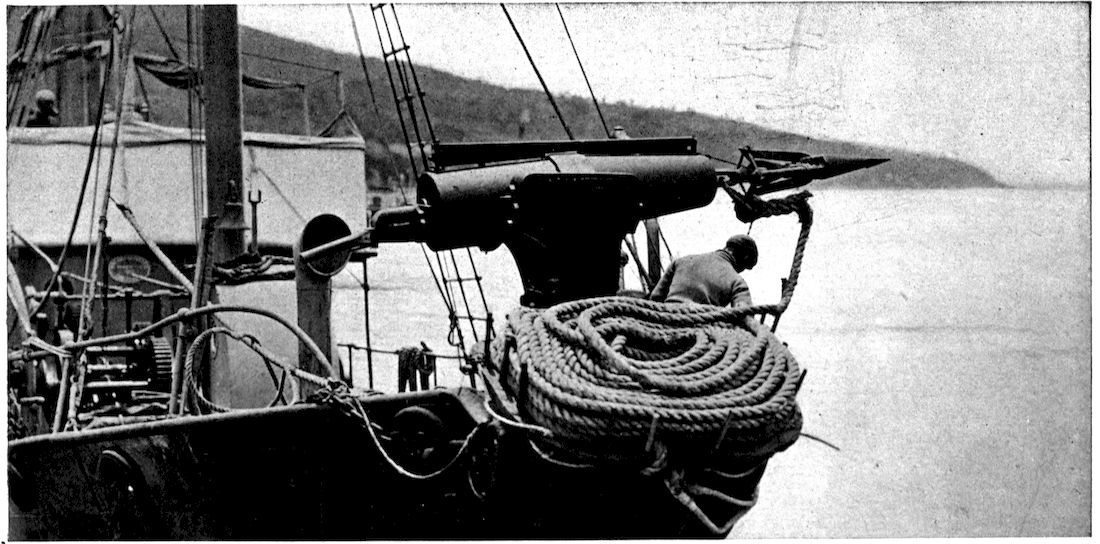
The harpoon-gun on the Rex Maru. The gun is loaded and the harpoon is shown projecting from the muzzle; coiled on the iron pan below is the rope which is carried with the iron in its flight. The winch may be seen in front of the bridge at the left of the picture.
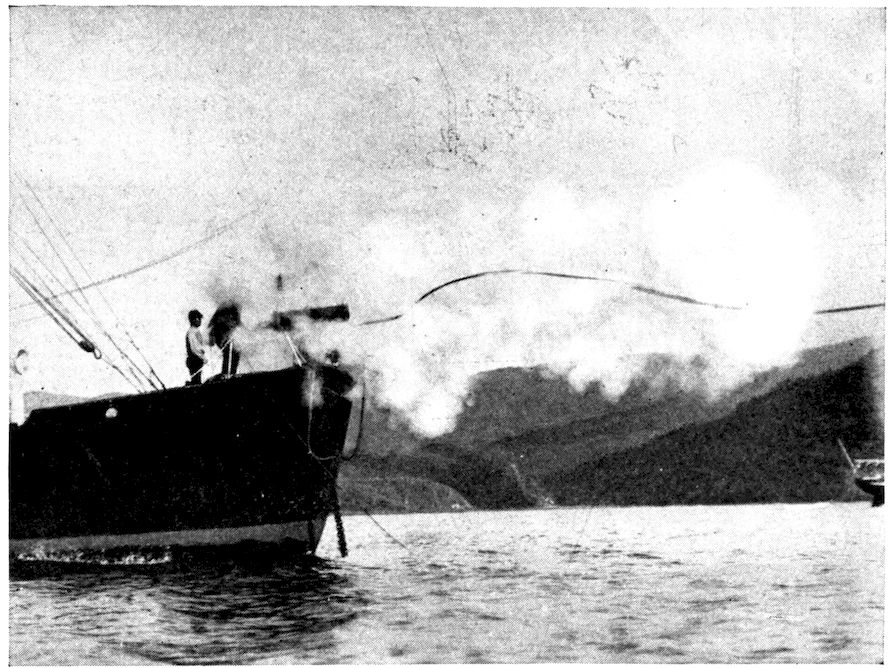
14A large ring slides easily along the double shaft of
the harpoon, and to this one end of a five-inch rope
is fastened. Forty or fifty fathoms of a somewhat
smaller line, called the “forerunner,” are coiled on a
heavy iron pan just under the gun, giving slack to
be carried with the harpoon as it flies through the
air.
From the pan the rope passes backward over a
roller in the bow of the ship to a double winch just
in front of the bridge and down into the hold, where
a thousand fathoms (6,000 feet), or more, are carried.
By means of the winch the whale is “played”
as one would use a reel on a fishing rod, and after the
animal has been killed it is hauled to the surface and
fastened to the side of the ship.
The harpoon lines are made of the finest Italian
hemp and tested for a breaking point of eighteen tons,
but the forerunner is tested for only fifteen or sixteen
tons. Some, made especially for use in hunting the
giant blue whale, will resist a strain of twenty-eight
tons. If a tight line is kept and there are no sudden
jerks the ropes seldom break.
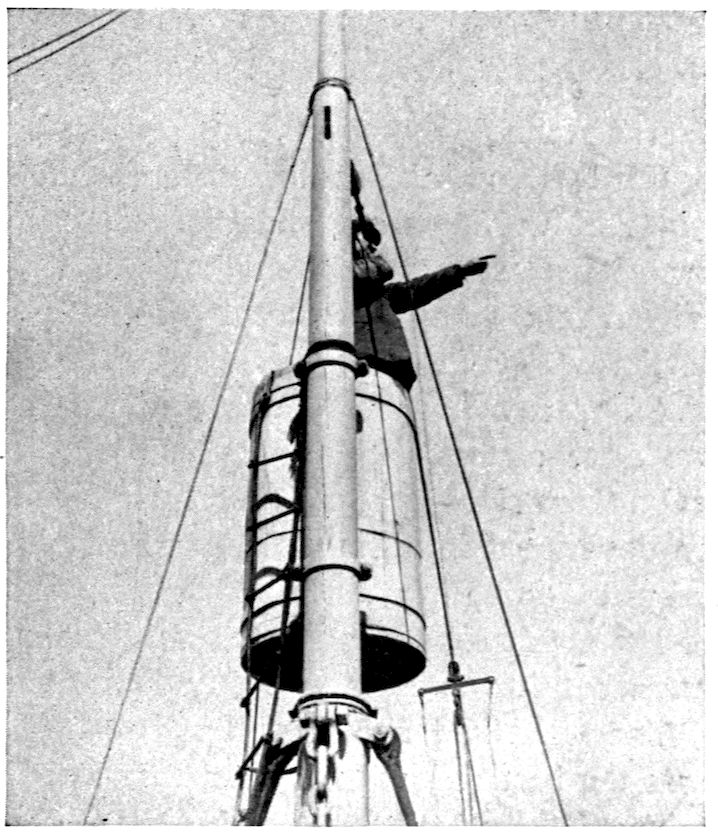
Not far beyond the winch the mast is stepped, bearing
near its peak a small barrel, called the “crow’s
nest,” from which the whales are sighted.
The vessels carry a crew of ten or twelve men beside
the captain, who is usually also the gunner. In
Japan vessels are required by the coasting laws to have
a Japanese in command, and consequently a native
captain is employed who takes the ship in and out
of the harbor. He is really the pilot, and the vessel
is turned over to the Norwegian gunner as soon as
the open sea is reached.
15
The harpoon is tipped with a hollow point called the “bomb,” which is filled with powder and ignited by a time fuse. The barbs, or flukes, are tied to the shaft of the iron.
The harpoon after it has been fired into the body of a whale. The bomb has exploded and the shaft is bent.
16Although in various parts of the world I have met
two or three gunners who were not Norwegians, there
are not many such. From their Viking ancestors the
Scandinavians have inherited their love for the sea
and, since Svend Foyn’s time, Tønsberg has sent forth
her sons to the whaleships much as did New Bedford
half a century ago. Thus the present generation has
grown up as the industry developed, and from boys
to men they have seen it in all its phases and learned
not only how to shoot a whale but how to handle it
afterward, which is fully as important.
A trial shot with the harpoon-gun. The harpoon line is shown, and three men may be seen in the barrel at the mast head.
Even as the harpoon-gun brought with it a new
17era of whaling, so it gave to the scientist undreamed-of
opportunities for the study of cetaceans. Until
shore stations were established, few indeed were the
naturalists who had examined more than five or six
whales during their entire lives. These carcasses were
usually of whales which had met with some accident
at sea and had been cast up on the beach; almost always
the animals had been dead for days before they
came under the notice of a competent scientific observer,
and had lost much of their original proportions
and color. A whale’s body begins to generate gases
at an astounding rate as soon as the animal is dead,
and within a very few hours becomes so swelled and
distorted that the true proportions are almost lost.
Even trained naturalists did not always take this fact
into consideration, and their descriptions and figures
were consequently notable chiefly for their inaccuracy.
It is only within a very few years that it has been
generally recognized how rapidly cetaceans change
color when dead, and often in scientific papers whales
are described as “black” which are never black in life.
By far the greater number of whales and dolphins
have various shades of slate, or gray, on the upper
parts, and if exposed to the sun for a few hours these
portions turn jet black.
Again, there is in all cetaceans great variation
among individuals of the same species, and whales
from the same school or “pod” may differ widely in
proportions and general color. Some may be long
and slender, others short and thick; one may have
18a light gray back and pure white underparts, while a
second, taken from the same herd, is dark slate above
and strongly shaded below; and, moreover, the skeletons
often vary almost as greatly as the external
characters.
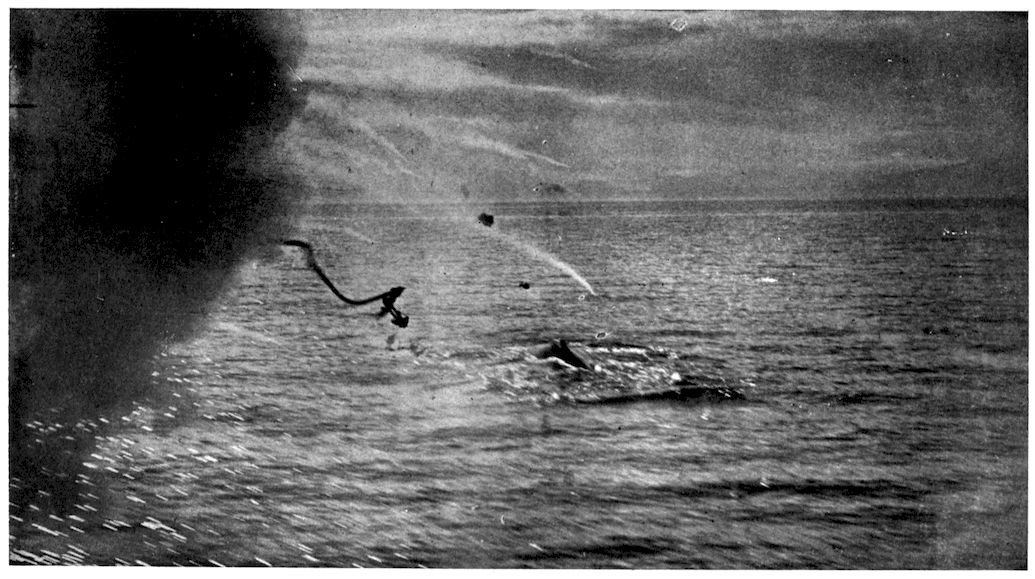
A near view as the gun is fired at a target. The harpoon rope is visible through the smoke.
Quite naturally when these extremes came under
the notice of a scientist who had, perhaps, seen but
three or four whales in his entire life, they were at
once judged to be representative of different species
and were given new names. This course cannot be
wholly condemned, for under existing conditions it
was almost the only one to be followed. Although
it did put on record many valuable facts concerning
19the history of the animals, it also resulted in multiplying
nominal species to such an extent that the
work of later investigators in separating the valid
from the invalid has become a herculean task; quite
false conclusions as to the distribution of the various
whales were also drawn, which only a vast amount of
labor and study can rectify.
The number of whales taken during a season varies
greatly with the locality, but at one of the Vancouver
Island stations when I was there in 1908, three hundred
and twenty-five were killed in seven months by
one ship. In a single week twenty-six whales were
captured, and on June 10, the S. S. St. Lawrence,
Captain Larsen, brought in four humpbacks, one blue
whale, and one finback.
Whales are such enormous creatures that the ordinary
methods used in the study of other animals cannot
be applied to them. Instead of having actual
specimens before one for comparison, a naturalist
must depend almost entirely upon photographs, notes,
measurements, and descriptions.
Until shore whaling began such data were rare and
most unsatisfactory. When a whale is cut in as it
lies along the side of a ship, it is never possible to
see the entire animal at once; it is almost impossible
to secure photographs of real value for comparative
work, and even measurements can be taken only with
difficulty and not without a large percentage of error.
Internal anatomical investigations are out of the question,
because as soon as the blubber has been stripped
off the carcass is turned adrift.
20By the establishment of shore stations these difficulties
have been largely eliminated. The whales are
usually drawn entirely out of the water upon the slip
where, before the blubber is stripped off, they can be
measured, photographed, and described. As they are
being cut in it is possible to make a fairly detailed
study of the fresh skeleton and other parts of the
anatomy—if the investigator is not afraid of blood and
grease. Moreover the great number of whales of a
single species brought to the stations allows a study
of individual variation, which evidently is greater
among some of the large cetaceans than in other groups
of mammals.
Since shore stations are located in widely separated
parts of the world, they have facilitated investigations
of the distribution, life history, and relationships
of large whales, which otherwise would have
been impossible. Thus it is obvious that a naturalist
who is fortunate enough to stay for some time at a
modern factory has opportunities for original work
such as were undreamed of before the days of steam
whaling.
The directors of the companies, and the managers
of the stations, have usually been glad to assist in
the study of the animals which form the basis of
their industry, and have generously extended the courtesies
of their ships and stations. In some instances
they have gone to considerable trouble to secure specimens
which could be prepared and presented to museums
in various parts of the world for exhibition
and osteological study. It is deeply to be regretted
21that the wholesale slaughter of whales will inevitably
result in their early commercial extinction, but meanwhile
science is profiting by the golden opportunities
given for the study of these strange and interesting
animals. Thus, the old saying that “it is an ill wind
that blows good to no one” applies very decidedly to
the whaling industry.
CHAPTER I MY FIRST WHALE HUNT
22
Great lumbering swells of gray water rolling
out of the fog from the wide sweep of the
open Pacific were the picture I saw through
the round, brass-bound frame of the porthole on the
S. S. Tees. It was the last of May, but the cold of
winter still hung in the sea air, and even when we
drew in toward the foot of the mountains which poked
their fir-clad summits far up into the mist clouds, I
shivered in my heavy coat and tramped about on deck
to keep warm. Finally when we were right under
the towering mountain’s walls, we swung abruptly
into smooth water, the long roll and pitch of the ship
slackened and died, and we were quietly plowing
our way up river-like Barclay Sound, which, from
the west coast, cuts into the very heart of Vancouver
Island.
It was hardly six o’clock in the morning when the
wail of the ship’s siren whistle shot into the deep
mountain valley where the station of the (former)
Pacific Whaling Company is located at the one-time
Indian village of Sechart. With a great deal of curiosity
I strained my eyes through the fog to study the
group of white frame buildings which straggled up
from the water’s edge back into the valley.
23
Captain Balcom at the gun on the Orion.
I could see only one or two Indians, clad in dirty
shirts and overalls, loafing about placidly staring at
the ship, but by the time she had been warped in and
the winch had started to swing aboard the great oil
casks which lined the wharf, two pleasant-faced men
appeared, one of whom I learned was Mr. Quinton,
the station manager; to him my letters were presented.
With him was Mr. Rolls, the secretary of the station,
who showed me to a room at the house. I got out
of my “store clothes” and came down to the wharf,
now lined with men of six nationalities—for Norwegians,
Americans, Newfoundlanders, Indians, Chinese,
and Japanese are employed at these west coast
stations.
24Tied up to the side of the pier was the ship Orion.
She was typical of all steam whalers, had been built
in Norway and made, under her own steam, the long
stormy passage across the Atlantic to Newfoundland.
A few years of work there and she started for the
Pacific around the Horn, beating her way northward
to the scene of her present work at Sechart.
The Orion had not gone to sea that morning, for
the fog outside made it useless to hunt; even
if the ship could have kept her bearings in the
mist it would have been impossible to see the spout
of a whale, or to follow the animal if one were
found.
The crew were all ashore, and I met Captain Balcom,
an alert young Canadian, and one of the few
successful gunners who was not a Norwegian. He
offered at once to take me “outside” with him when
the weather cleared but said we would see only humpbacks,
for the blue whales and finbacks had not yet
appeared on these hunting grounds. At Kyuquot, a
station only one hundred miles farther up the coast,
blue whales and finbacks were taken with the humpbacks
in March as soon as the station opened, while
at Sechart they did not come until July.
When the station was first located at Sechart, humpbacks
were frequently taken in Barclay Sound but
were soon all killed, and others did not take their
places. At the time I was there, the Orion seldom
found whales less than thirty miles at sea. She usually
arrived about two o’clock in the morning, dropped
her catch, and in half or three-quarters of an hour
25was again on the way out in order to reach the feeding
grounds shortly after daylight.
I went aboard with Captain Balcom at ten o’clock
and turned in on the Mate’s bunk. The cabin was
small, but not uncomfortable, and it was not long
before I was asleep. I did not even hear the ropes
being cast off in the morning and only waked when
the boy came down to call the Captain. We were
well down the Sound when I came on deck, and were
steaming swiftly along among little wooded islets half
shrouded in gray fog. Far ahead the ugly, foam-flecked
rocks of Cape Beale stretched out in a dangerous
line guarding the entrance to the Straits of
Juan de Fuca; beyond was a sheer wall of mist shutting
us out from the open sea.
The Captain was sure it was only a land fog hanging
along the coastline, and that we would soon run
through it into clear air. As the ship rose to the
long swells of gray water and burrowed her way
straight ahead deeper and deeper into the mist, everyone
on deck was drenched and shivering. Fifteen
minutes of steaming at full speed and the gray curtain
began to thin; soon we ran out of it altogether.
There was not a big sea running, but the little Orion
was dancing about like a cork. Balcom said, “It is
calm weather so long as she keeps her decks dry,”
and with this rather dubious comfort I settled down
to get used to the tossing as best I could.
Everything was intensely interesting to me, for it
was my first trip on a steam whaler. Already a man
had been sent aloft and was unconcernedly swinging
26about with glasses at his eyes watching the water
ahead. I learned later, when seasickness was a thing
of the past, what a wonderful view can be had from
the crow’s nest. The whole level sea is laid out below
like a relief map and every floating object, even
the smallest birds, shows with startling distinctness.
And if it is comparatively smooth, one can look far
down into the water and see a whale or shark long
before it is visible at the surface or to those on deck.
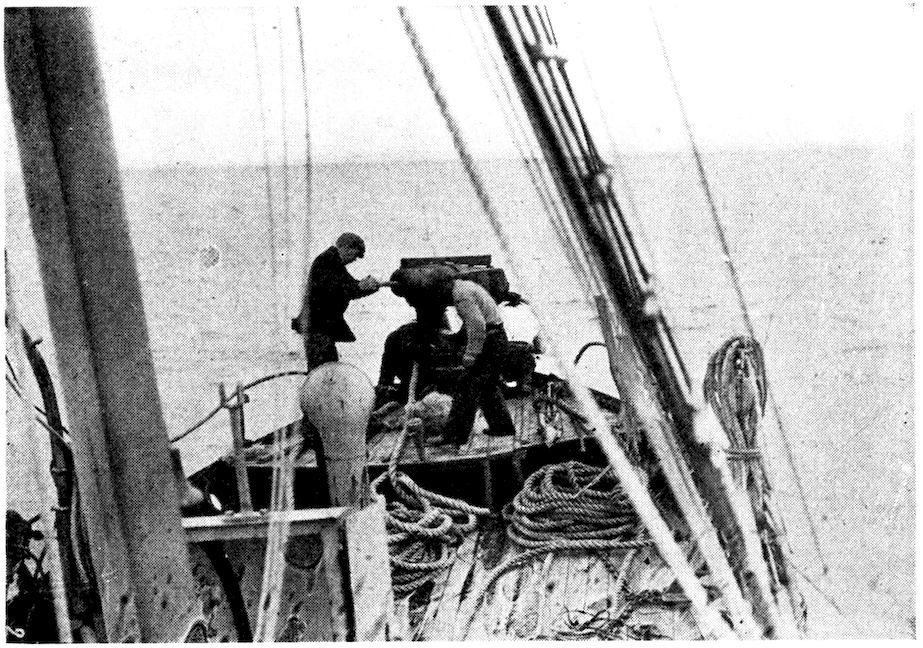
Loading the harpoon-gun. “The charge is 300 to 375 drams of very coarse, black powder which is ... rammed home from the muzzle; then come wads of okum, hard rubber or cork, after which the harpoon ... is hammered solidly into place.”
Before we left the station, the harpoon-gun had
not been loaded. The muzzle was plugged with a
wooden block and the iron rope-pan drawn upward
27and tied against the gun’s support. When coming in
from the last trip the vessel had encountered heavy
weather, and the rope was taken off the pan to prevent
it from being carried away by a wave and fouling
the propeller. Now as we were nearing the feeding
grounds, the Bo’s’n went forward to load the
gun, re-coil the harpoon line, and see that all was clear
and running smoothly.
The men on board were greatly interested in my
camera and anxious that opportunities might be given
for pictures. For two hours, with the Chief Engineer
and the Mate, I sat aft on the great coil of
towing line, used only in very heavy weather, listening
to stories of the idiosyncrasies of whales,
especially humpbacks. Their firm conviction was that
one—never could guess what a “hump” was going to
do—except that it would be exactly what was least
expected.
The Engineer had just finished telling about a big
fellow that a few days before had come up in front
of the ship and swam towards it with his enormous
mouth wide open, when the man in the barrel called
down, “Whales on the port bow!”
I jumped as though a bomb had been exploded and
grabbed my camera. The other men took things
rather quietly, for the whales were still a long way
off. The Captain tried to show me the spouts but
it was several minutes before I could distinguish
the white columns of vapor shooting up every few
seconds.
28
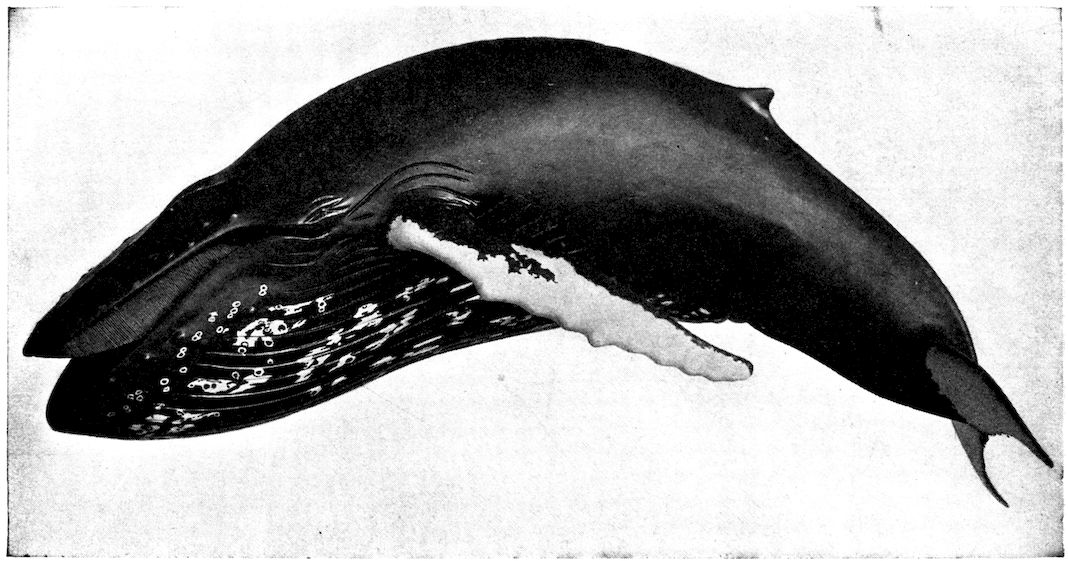
Model of a humpback whale in the American Museum of Natural History. The model was prepared by Mr. James L. Clark, under the direction of Dr. F. A. Lucas.
29There were three of them—all humpbacks. On the
instant, the dark bodies slowly rounded into view
and three huge, propeller-like tails were smoothly lifted
out of the water, elevated vertically to the surface,
and again drawn below. It is impossible to describe
the ease and beauty of the dive. To look at the heavy
body and long, ungainly flippers of a humpback one
would hardly suspect that there could be grace in
any movement, and yet the enormous animals slide
under the surface as smoothly as a water bird.
“The man in the barrel called down, ‘Whales on the port bow!’”
When the flukes came out, the Captain rang for
30half speed, for the whales would probably be down
several minutes. Turning the wheel over to the Mate,
he went forward to the gun, pushed up the spring
which cocked it, and waited, alert, for the animals
to rise.
I had descended with him from the bridge and stood
just behind the gun platform. The ship, her engines
stopped, was rolling about on the mirror-like patches
of water left by the whales as they went down. After
ten minutes of waiting three silvery clouds suddenly
shot upward a quarter of a mile away. Instantly the
engine signal rang and the ship swung about, plowing
through the water at full speed until the whales
sounded. For two hours this kept on. Each time
when we were almost within range the big fellows
would raise themselves a little higher, arch their backs,
and turn downward in a beautiful dive, waving their
huge flukes as though in derision.
I had my notebook and pencil at work as well as
the camera but it was getting pretty difficult to use
either. The wind had risen and I was deathly seasick;
even the best sailors lose their “sea legs” when
aboard one of these little eggshell boats after a long
period ashore, and mine were gone completely. The
Orion was twisting and writhing about as though possessed
of a demon, and every time she climbed a huge
wave to rock uncertainly a moment on the crest and
then plunge headlong down its smooth, green slope,
I was certain she would never rise again. Balcom
was doggedly hanging to the gun, but just after we
had both been soaked by a big sea that came over
31the ship’s nose he shouted, “If we don’t get a shot
soon we’ll have to leave them.”
At that time we were heading for the whales, which
were spouting only a short distance away. One of
them had left the others and seemed to be feeding.
He was swimming at the surface, sometimes under
for a second or two, but never far down. The ship
slid nearer and nearer with engines at dead slow until
the huge body disappeared not thirty fathoms away.
“In a minute he’ll come again,” shouted Balcom,
feet braced and bending low over the gun.
I was clinging to a rope just behind him, trying to
focus the camera, but the flying spray made it well-nigh
impossible. Suddenly I saw the Captain’s muscles
tighten, the tip of the harpoon drop an inch
or two, and caught a glimpse of a phantom shape
rushing upward.
Almost on the instant a blinding cloud of vapor
shot into our very faces, followed by the deafening
roar of the gun. I saw the black flukes whirl upward
and fall in one tremendous, smashing blow upon
the water; then the giant figure quivered an instant,
straightened out, and slowly sank. For a moment
not a sound was heard on the vessel save the steady
“flop, flop, flop” of the line on the deck as the dead
weight of forty tons dragged it from the winch.
Balcom leaned over the side and saw the rope
hanging rigidly from the ship’s bow. “I must have
caught him in the heart,” he said, “and killed him instantly.”
32
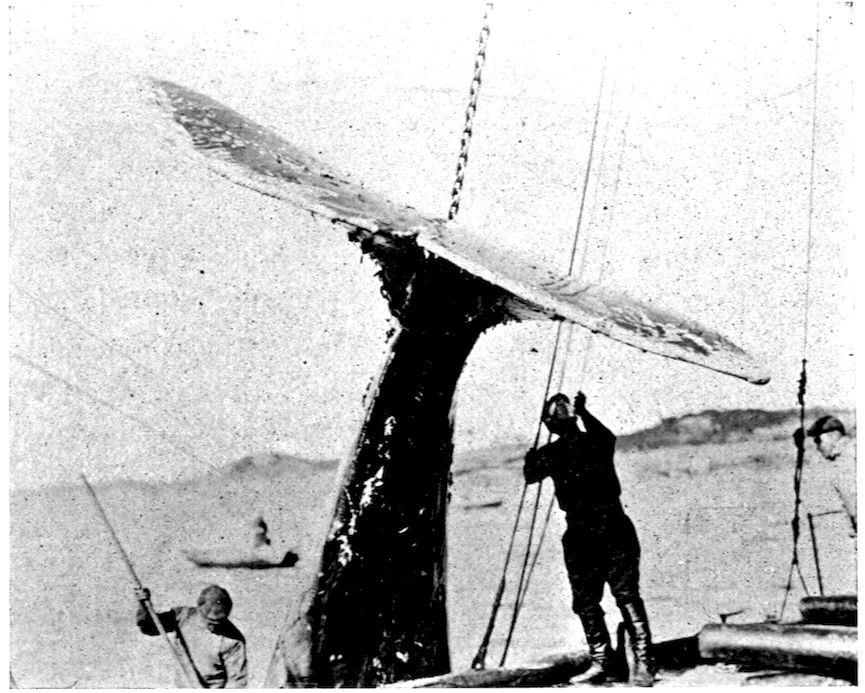
“Two men with long-handled knives began to cut off the lobes of the tail.”
As the Captain straightened up he shouted to the
Engineer to check the line. Then began the work of
bringing to the surface and inflating the dead whale.
Taking a hitch about a short iron post, the harpoon
rope was slacked and run through a spring pulley-block
on the mast, just below the barrel, to relieve
the strain of raising the great body. As the winch
ground in fathom after fathom of line the vessel heeled
far over under the tremendous weight. I was clinging
to the ship’s side looking down into the water
and soon saw the shadowy outline of the whale, fins
wide spread, nearing the surface. As it came alongside
33a lead-weighted line was thrown over the tail,
a rope pulled after it, then a small chain, and finally
the heavy chain by which the carcass was made fast
to the bow.
The winch had not yet stopped when two men with
long-handled knives began to cut off the lobes of the
tail to prevent the flukes from pounding the rail as
the body swung up and down in the seaway. Already
other sailors were working at a long coil of
small rubber hose, one end of which was attached
to an air pump and the other to a hollow, spear-pointed
tube of steel, perforated along its entire
length. This was jabbed well down into the whale’s
abdomen, the engines started, and the animal slowly
filled with air. When the body had been inflated sufficiently
to keep it afloat, the tube was withdrawn and
the incision plugged with oakum.
The other whales were a long way off when the
ship was ready to start. The man in the “top” reported
them as far to the south and traveling fast.
As there was little chance of getting another shot
that day and the wind was blowing half a gale, the
Captain decided to turn about and run for the station.
We reached Sechart at 1:30 A. M. and the whale
was left floating in the water, tied to the end of the
wharf near a long inclined platform called the “slip”;
then the Orion put out to sea and I went to bed at the
station. I shall never forget my intense surprise next
morning when I saw the humpback “cut in.” Work
began at seven o’clock, and as the Manager had just
34awakened me, I ran out and did not wait for breakfast,
thinking there would be ample time to eat when
the operations were under way. It soon became evident,
however, that there were no breathing spells
when whales were being cut in, and every soul was
at his work until the last scrap of flesh was in the
boiling vats.
“A hollow, spear-pointed tube of steel ... was jabbed well down into the whale’s abdomen, the engines started, and the animal slowly filled with air.”
After a heavy wire cable had been made fast about
the posterior part of the whale, just in front of the
flukes, the winch was started. The cable straightened
out, tightened, and became as rigid as a bar of steel.
Slowly foot after foot of the wire was wound in and
35the enormous carcass, weighing at least forty tons,
was drawn out of the water upon the slip.
One of the Japanese scrambled up the whale’s side
and, balancing himself on the smooth surface by the
aid of his long knife, made his way forward to sever
at the “elbow” the great side fin, or flipper, fifteen
feet in length.
Before the carcass was half out of the water other
cutters were making longitudinal incisions through the
blubber along the breast, side, and back, from the head
the entire length of the body to the flukes. The cable
was made fast to the blubber at the chin, the winch
started, and the thick layer of fat stripped off exactly
as one would peel an orange. When the upper
side had been denuded of its blubber covering, the
whale was turned over by means of the canting winch,
and the other surface was flensed in the same manner.
It was a busy and interesting scene. The strange,
unfamiliar cries of the Orientals mingled with the
shouts of the cutters and the jarring rattle of the
winch as the huge strips of fat were torn from the
whale’s body, fed into the slicing machine, carried
upward, and dumped into enormous vats to be boiled
or “tried out” for the oil.
When the blubber was entirely gone, the carcass
was split open by chopping through the ribs of the
upper side and cutting into the abdomen, letting a
ton or more of blood pour out and spread in a crimson
flood over the slip. A hook was attached to the
tongue bones (hyoids) and the heart, lungs, liver, and
intestines were drawn out in a single mass.
36The body was then hauled to the “carcass platform”
at right angles to, and somewhat above, the
“flensing slip,” the flesh was torn from the bones in
two or three great masses by the aid of the winch, and
the skeleton disarticulated.
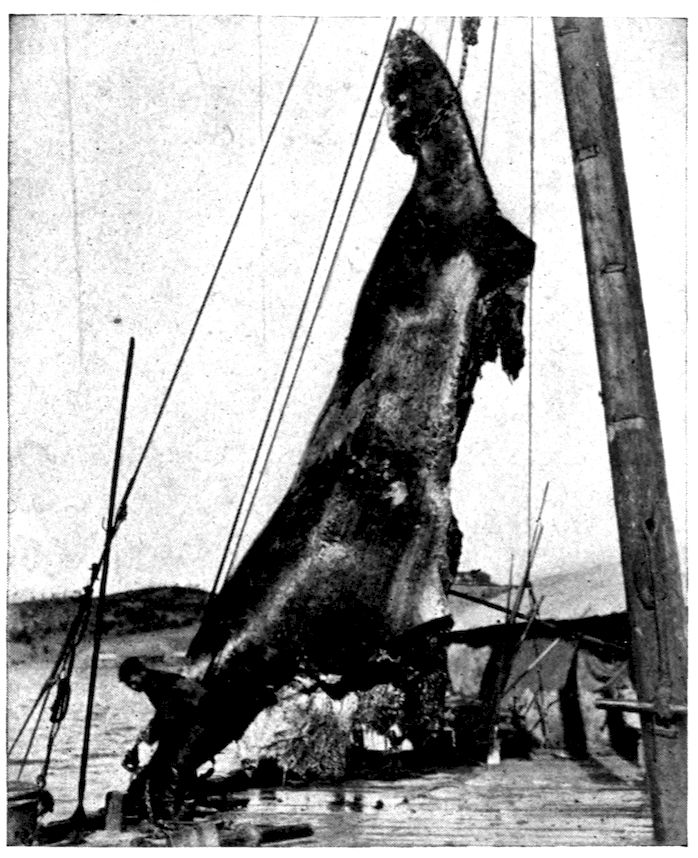
Flensing a whale at one of the Vancouver Island stations. A great strip of blubber is being torn from the animal’s side.
After the bones had been split and the flesh cut into
chunks two or three feet square, they were boiled
separately in great open vats which bordered the carcass
platform on both sides. When the oil had been
extracted, the bones were crushed by machinery making
bone meal to be used as fertilizer, and the flesh,
artificially dried and sifted, was converted into a
37very fine guano. Even the blood, of which there
were several tons, was carefully drained from the slip
into a large tank, and boiled and dried for fertilizer.
Finally, the water in which the blubber had been
tried out was converted into glue.
The baleen, or whalebone, which alone remained to
be disposed of, was thrown aside to be cleaned and
dried as opportunity offered. The baleen of all the
fin whales is short, stiff, and coarse and in Europe
and America has but little value. In Japan, however,
it is made into many useful and beautiful things.
I learned that the cutting operations at Sechart
and the other west coast stations were conducted in the
Norwegian way which is followed in almost all parts
of the world except Japan. In the Island Empire a
new method has been adopted, which, while it has
the advantage of being very rapid, is correspondingly
dangerous and will not, I think, ever be widely used.
CHAPTER II HOW A HUMPBACK DIVES AND SPOUTS
38
Although it had been possible to secure but
few good pictures during my first trip at sea
on the Orion, nevertheless I had learned much
about the ways of humpbacks. One impression, which
I subsequently found to be correct, was that this would
prove to be the most interesting of all large whales
to study—at least from the standpoint of its habits.
There are no dull moments when one is hunting
a humpback, for it is never possible to foretell what
the animal’s next move will be. He may dash along
the surface with his enormous mouth wide open, stand
upon his head and “lobtail,” throwing up clouds of
spray with smashing blows of his flukes, or launch his
forty-ton body into the air as though shot from a
submarine catapult.
He may do dozens of other highly original things,
all of which show his playful, good-natured disposition
and, if he is allowed to continue his elephantine
gambols unmolested, he is as harmless as a puppy.
But once imbed an iron in his sensitive flesh and it is
wise to keep well beyond the range of his long flippers
and powerful flukes which strike the water in every
direction with deadly, crushing blows.
The humpback is the whale which is most usually
39seen from the Atlantic passenger vessels, and may
easily be recognized because when “sounding,” or
going under for a deep dive, the flukes are almost invariably
drawn out of the water; the finback and blue
whales, the two other common species, seldom show
the flukes.
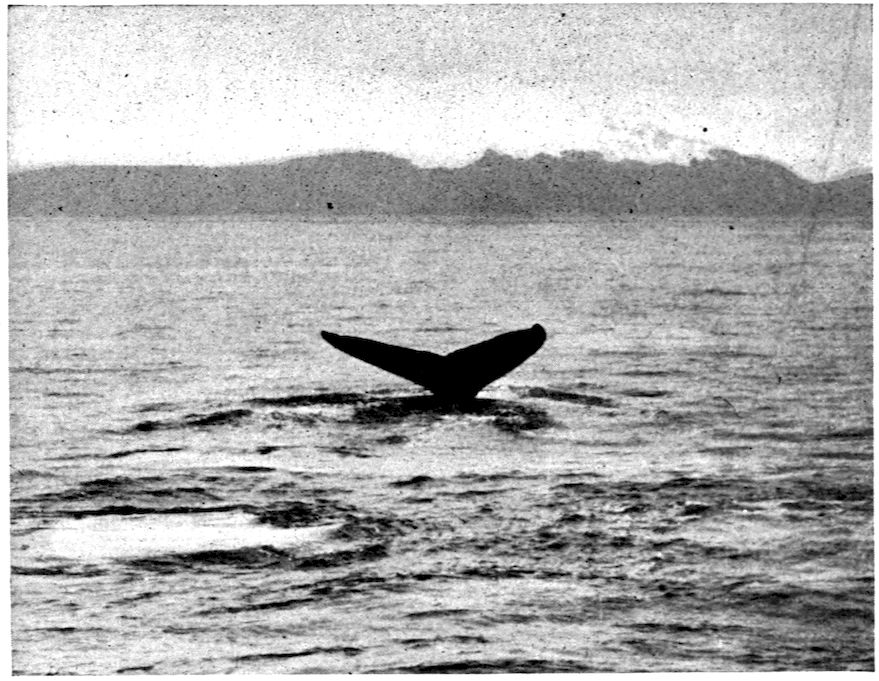
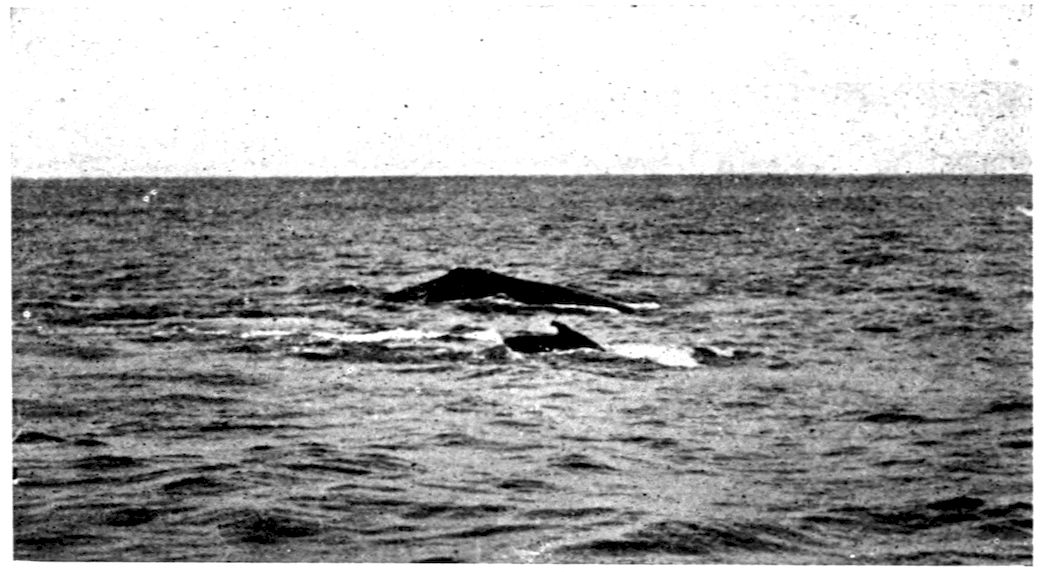
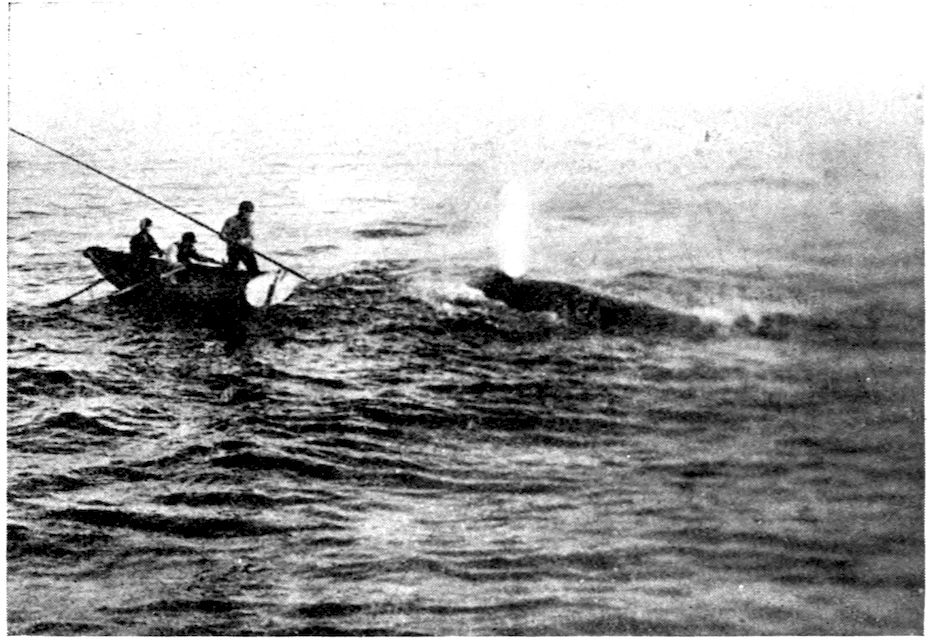
A humpback whale “sounding.” “The humpback comes up obliquely, and, as soon as the spout has been delivered, arches the back and begins to revolve.”
When a humpback dives the easy grace with which
the animal manipulates its huge, ungainly body and
great propeller-like tail, drawing it out of the water
smoothly but with irresistible force, always gives me
a thrill of admiration. I remember one day, while
crossing the Atlantic on the Kronprinz Wilhelm, a
humpback came up not far from the ship and swam
parallel with her for several minutes. Each time the
big fellow drew himself up, slowly rolled over, and
brought his flukes out, an involuntary cheer went up
from the passengers. But it is only when sounding
that the tail is shown and never when the whale is
feeding or swimming near the surface.
40
A humpback whale with a very white breast. The side fins, or flippers, are almost one-quarter the entire length of the animal, and to them barnacles attach themselves as well as to the folds of the throat and breast.
41The humpback comes up obliquely and, as soon as
the spout has been delivered, arches the back and begins
to revolve, finally drawing out the flukes and
going down vertically. When hunting, the proper
time to shoot is when the dorsal fin begins to show
above the water—depending, of course, upon the distance.
The iron then has a fair chance to reach the
lungs or heart and a larger target is presented.
How far a whale can descend is a matter of conjecture
and more or less dispute among naturalists.
One writer argues that whales cannot go deeper than
three hundred feet because of the tremendous water
pressure. But all cetaceans have certain specializations
in body structure which undoubtedly enable
them to withstand high pressure.
I have, as personal evidence upon this subject, the
fact that a blue whale, harpooned between the shoulders
and but slightly injured, dove straight downward
and took out over a quarter of a mile of rope.
We were, at the time, almost a hundred miles at
sea and so far as could be determined the animal had
gone down to the full limit of the line which hung
from the bows as rigid as a bar of steel. The whale
remained below for thirty-two minutes and reappeared
not more than a hundred yards away and directly
in front of the ship.
It is the opinion of every whaler with whom I have
talked that all the large cetaceans can descend to a
42considerable depth, and each man will give numerous
instances, similar to the one I have cited in the
case of the blue whale, to prove his point. Until
further information is available this subject must be
an open one. A smooth, circular patch of water is
always left at the spot where a large whale dives.
This is undoubtedly produced by suction and interrupted
wave action but has given rise to many ingenious
and absurd theories in explanation.
When studying whales the most important fact to
remember is that they are one-time land mammals
which have taken up a life in the water and that
their bodily activities, although somewhat modified,
are nevertheless essentially the same as those of a
horse, cow, or any other land mammal.
Since a whale breathes air, when it is below the
surface the breath must be held, for if water should
be taken into the lungs the animal would drown.
Thus, as soon as a cetacean comes to the surface its
breath is expelled and a fresh supply inhaled before
it again goes down, just as in the case of a man when
diving. However a whale is able to hold its breath
for a much longer time than can an ordinary land
mammal—even as much as forty-five minutes or an
hour.
When the animal comes to the surface the breath
which has been contained in the lungs under pressure
is highly heated, and as it is forcibly expelled into
the colder outer air it condenses, forming a column
of steam or vapor. A similar effect may be produced
by any person if, on a frosty morning, the
43breath is suddenly blown out of the mouth. I have
often seen a whale blow when its head was still a
short distance under the surface and at such times
a little water will be thrown upward with the spout.
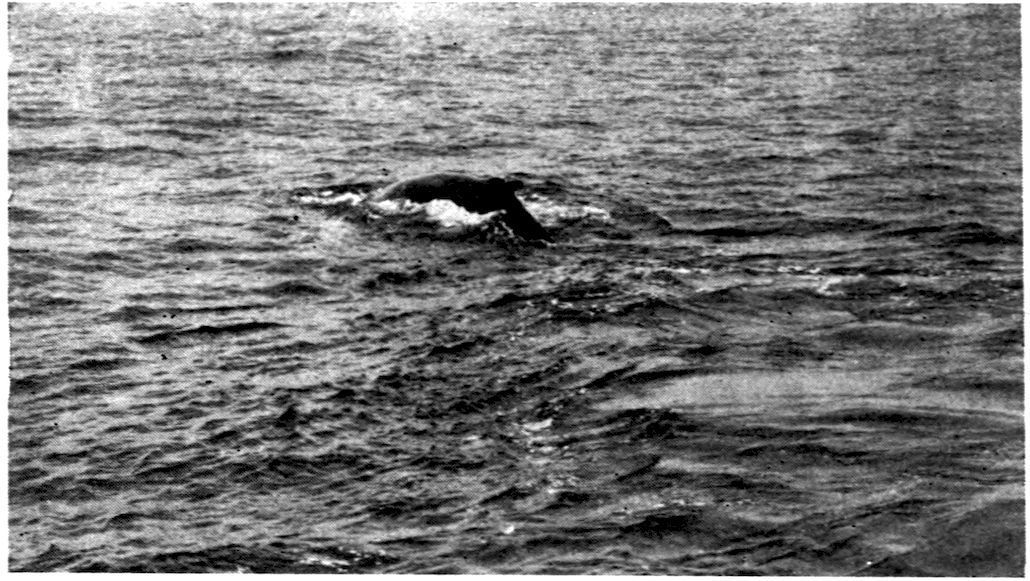
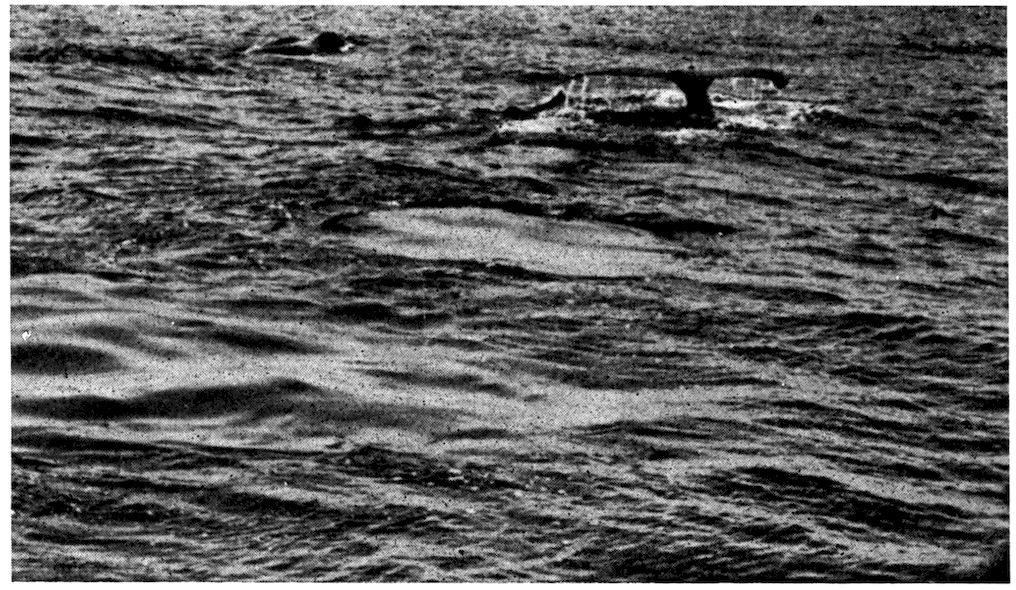
The tail of the humpback as the animal “sounds” looks like a great butterfly which has alighted upon the water.
That whales spout out of the blowholes water which
has been taken in through the mouth is probably more
widely believed than any other popular misconception.
As a matter of fact such a performance would
be impossible because a whale’s nostrils do not open
into the back of the mouth as do those of a man, and
the animal is not able to breathe through its mouth
as do ordinary land mammals.
Instead, an elongation of the arytenoid cartilages
44and the epiglottis fits into the soft palate, thereby
forming a continuous passage between the nostrils and
the trachea, or windpipe, and entirely shutting off the
nasal passages from the mouth. In this way a whale
can swim with its mouth open, when feeding, without
danger of being strangled by getting water into
the breathing organs.
The blowholes, or nostrils, have been pushed backward
and upward to open on the top of the head instead
of at the end of the snout. This is an adaptation
to aquatic life, which is also seen in other water
mammals, for in this way the nostrils are almost
the first part of the body to appear at the surface
and the whale can begin to breathe immediately upon
rising.
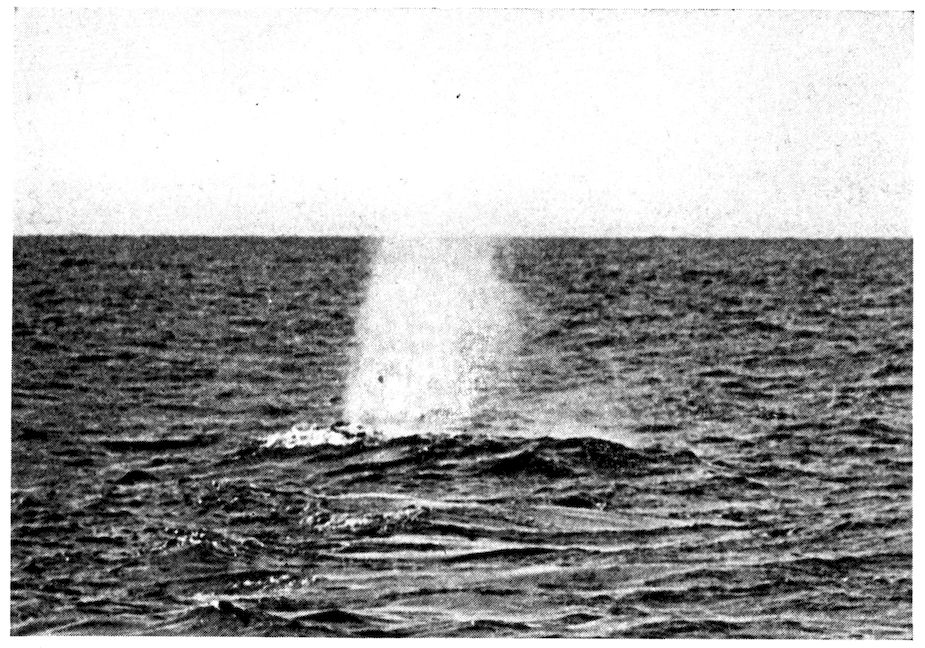
Although all the fin whales have two nostrils, the
spout ascends in a single column, which, in the humpback,
is from twelve to fifteen feet high. The cloud
of vapor is narrow at the base but spreads out at
once, forming a low bushy column which rapidly drifts
away.
The height and density of the spout in all whales
depends upon the animal’s size and the length of time
it has been below. If the whale has been submerged
but a brief period, as during surface dives, a comparatively
small quantity of air is expelled and the
breath has not had time to become highly heated;
consequently the column will be low and thin.
The first spout after sounding is usually the highest
and fullest. I have seen humpbacks, which had
been badly wounded, lying at the surface close to
45the ship, blowing every few seconds, and the spout
could hardly be seen although the opening and closing
of the blowholes and the metallic whistling of
the escaping breath were plainly distinguishable.
Immediately after the delivery of the spout the
lungs are refilled, the blowholes being opened widely
and protruded upward, and the breath rapidly drawn
in. The elevation of the blowholes is probably to
prevent a wave from slopping over and filling the
nasal passages, but when a whale lies dead upon the
slip there is no indication that the nostrils can be
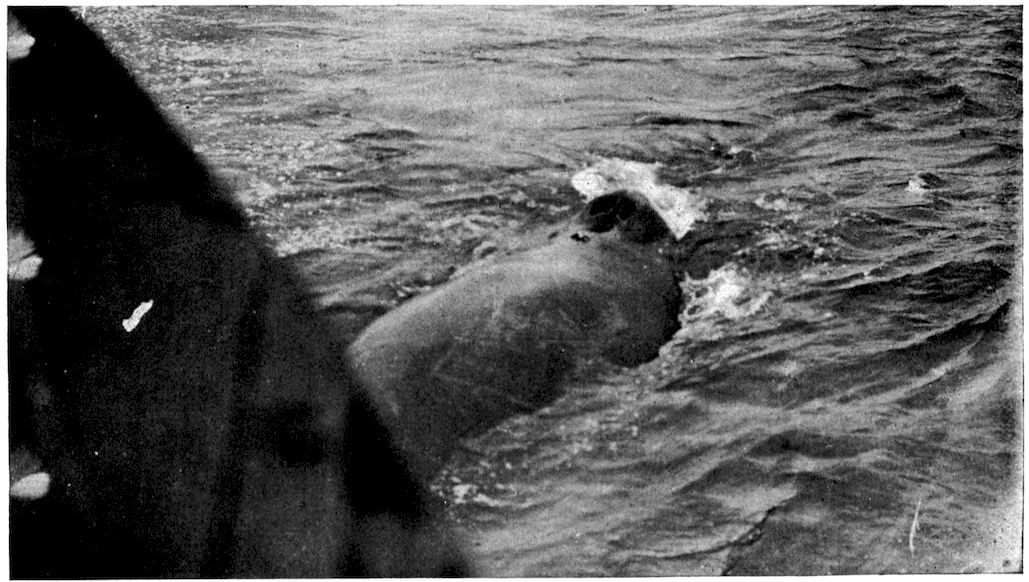
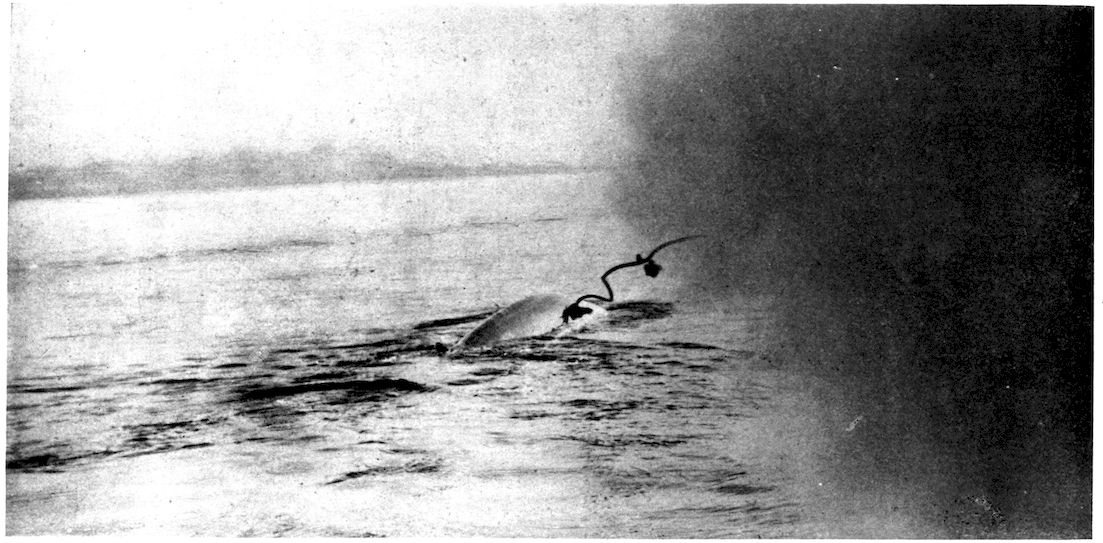
protruded. This was first learned through a photograph
of a spouting blue whale, taken by Dr. Glover
M. Allen in Newfoundland waters, and since then
I have secured two others which show it admirably.
At the time my first picture was taken we had an interesting
experience which I shall never forget.
CHAPTER III AN EXCITING EXPERIENCE IN ALASKA
46
After leaving Vancouver Island I had gone
north to Murderer’s Cove, Tyee, Alaska, and
was being most hospitably entertained on
board Captain Charles Grahame’s ship, the Tyee. We
were hunting in the waters of Frederick Sound and
had been out two days. A big finback had given us
an exciting time of it in the afternoon and evening
of the second day and I had gone to bed tired out.
Next morning at five o’clock I was awakened by
a hand on my shoulder and the voice of the Mate
saying:
“We’re in a bunch of humpbacks, sir. You’d better
get up if you want some pictures.”
As I had only removed my coat and shoes the night
before, in five minutes I was on deck with my camera
and plate holders. It was a gray day, heavy clouds
lining the sky and a strong wind blowing from the
westward. Already the little steamer was pitching
and rolling in a way which made me hate even the
thought of breakfast, but catching sight of the flukes
of a big humpback just disappearing below the surface
on the starboard side, I forgot for a moment that
there was such a thing as seasickness. I climbed to
the bridge beside the Mate who was at the wheel
47and after getting the camera ready for instant use,
took out my notebook and glasses.
The whales were all about us but feed was evidently
scarce and far below the surface, for the animals
were swimming long distances under water, only
rising to blow at irregular intervals. For three hours
we kept up a fruitless chase after first one and then
another of the humpbacks, once or twice getting so
close that a shot seemed imminent. At last the Captain,
who had come on deck, said:
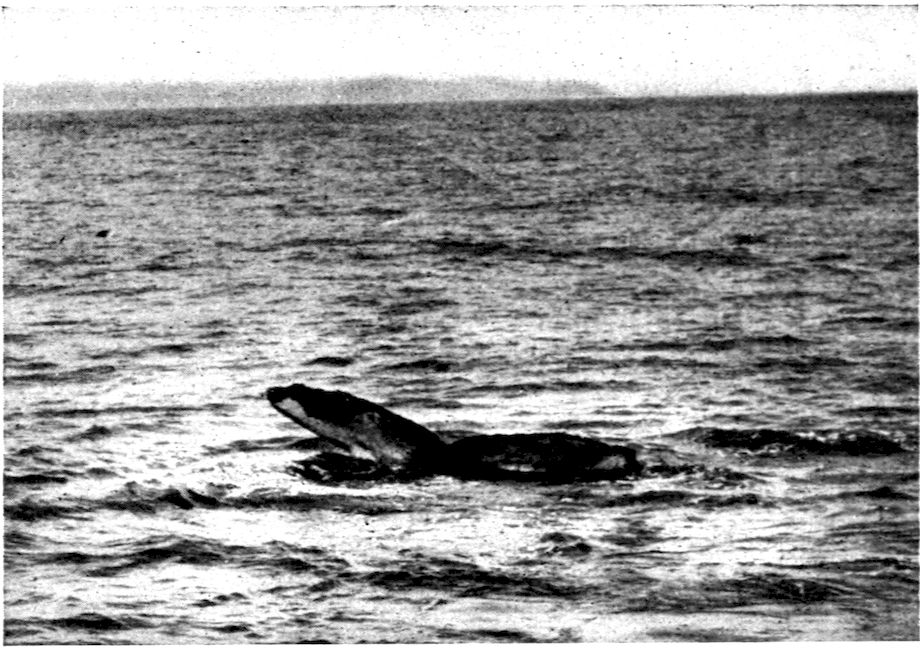
“The flukes of a big humpback just disappearing below the surface on the starboard side.”
“It’s no use to bother with these fellows; there
is no feed and we may stay here all day without killing;
we’ll go over toward Fanshaw, and see if we
can’t find another bunch.”
48Two hours of steaming brought us in sight of
Storm Island and far over near the shore we could
see several spouts. Now and then flukes would show
as one of the animals went down, indicating to my
satisfaction that some, at least, were humpbacks.
When we neared the whales I left the bridge, making
my way forward along the deck to the harpoon-gun,
and with camera ready braced myself against
a rope. The steamer was pitching furiously and it
was all I could do to keep my feet, but clinging to
a line with one hand and shielding the lens of my
camera with the other, I awaited the reappearance
of a whale that had gone down on the starboard
side.
Suddenly the gunner shouted, “There he comes!”
and pointed over the bow where the water was beginning
to smooth out in a large, green patch about
thirty fathoms away.
Before I could focus my camera, the whale had
burst into view, sending his spout fifteen feet into
the air. Evidently he saw us for he was down again
in a second, only to reappear several fathoms astern.
Time after time he showed himself, never near enough
for a shot but keeping me busy exposing plates.
After about an hour another humpback appeared
beside him and together they seemed to be enjoying
to the fullest extent the game of tag they were playing
with us. Once the larger of the two threw himself
clear out of the water, showing even the tips
of his flukes, and fell back with a splash which
sounded like the muffled clap of two great hands.
49Again he thrust his head into the air and, whirling
about, I caught him with the camera just before he
sank back out of sight.
“The captain swung the vessel’s nose into just the right position and they appeared close beside the starboard bow.”
For over an hour the game of tag continued, but
once, when the whales had been down an unusually
long time, the Captain swung the vessel’s nose into
just the right position and they appeared close beside
the starboard bow. The roar of the gun almost
deafened me and instinctively I pressed the button of
the camera, but a wave had thrown the steamer into
the air at just the wrong time and the harpoon struck
the surface several feet below the whale. Both animals
50went down churning the water into foam, and
when next we saw them they were close together, far
astern.
Although the chase had been an aggravation to
the whalers, I had reaped a harvest of pictures and
had exposed every plate in the holders. While Sorenson,
the gunner, was reloading the gun, I descended
into the hold, substituted fresh plates, and packed the
others in the pasteboard boxes. My work was hastened
by the sudden stopping and starting of the engines
which proclaimed that another whale had been
sighted and the chase already begun.
Pushing away the hatch which covered the entrance
to the hold, I swung up the steep ladder to
the deck above. Sure enough a big humpback was
spouting only a short distance away, now and then
rolling on his side and throwing his great black and
white fin in the air.
“He’s feeding,” said Sorenson, as I stepped up beside
him; “but he’s pretty wild. Perhaps we’ll kill
this time.”
Back and forth for two hours we followed the animal,
sometimes getting so close that when I saw
him burst to the surface I held my breath, expecting
to hear the roar of the gun beside me; but Sorenson,
somewhat chagrined by his miss at the last whale,
wished to be sure of this shot and would not take
a chance. The Captain swung the boat in a long circle
each time the animal disappeared and it seemed
almost certain that we would at last be near when
he came up. And so it happened, for when we had
almost despaired of getting a shot the man in the barrel
shouted, “He’s coming, right below us.”
51
“Scrambling up, I ... snapped the camera at the huge body partly hidden by the boat.”
52Looking down into the water I could see the ghostly
form of the whale rising to the surface with tremendous
force just in front of the bow. There was no
time to stop the ship and the animal burst from the
water half under the vessel’s side. I started back,
shielding my camera from the spout, and, stumbling
over a pile of chains on the deck, slid almost to the
forecastle companionway. Scrambling up, I jumped to
the rail and snapped the camera at the huge body
partly hidden by the boat.
The whale seemed dazed by his sudden appearance
under the steamer, and rolling on his side, went down
only a few feet, reappearing ten fathoms away. Sorenson,
who had held to the gun, steadied himself,
swung the muzzle about, and taking deliberate aim,
planted the harpoon squarely behind the fin. It was
a beautiful shot, and the whale went down without
a struggle. The quiet which followed the deafening
explosion was broken only by the soft swish of
the line running out from the winch and the men going
to their places. I was leaning against the side
almost weak from the excitement of the last few
minutes when Sorenson, a pleased grin on his sunburned
face, turned and said, “I didn’t miss him that
time, did I? He never moved after I fired.”
Four hours more of chasing first one and then
another brought the vessel close to a humpback and
again Sorenson sent the harpoon crashing into the
lungs, killing at the first shot. As the day had been
53a tiring one and it was too dark to take pictures, I
picked up my camera and climbed down the narrow
companionway into the Captain’s cabin. After reloading
the plate holders I lay down on the bunk listening
to the rattling of chains and the tramp of feet
on the deck above as the dead whale, with the other
which had been picked up, was made fast to the bow
of the vessel.
Bringing in a humpback at the end of the day’s hunt. The whale’s flukes weigh more than a ton.
The boat had started on the thirty-mile tow to the
station and, gradually becoming accustomed to the
rolling, I was lulled to sleep by the steady “chug, chug,
chug” of the engines and the splashing of the water
against the side.
CHAPTER IV THE “VOICE” OF WHALES AND SOME INTERESTING HABITS
54
For me, developing the photographic negatives
after a trip at sea is almost as fascinating as
taking them, and no secret treasure chest was
ever opened with greater interest than is the developing
box. After my first expedition a tank developer
was always used, for I invariably became so excited
watching the image appear upon the plate that several
were ruined by being held too long before the
red lamp.
I shall never forget the breathless interest with
which I developed the negative exposed when the
humpback whale came up beneath the ship during the
trip described in the previous chapter. I had had
no time to focus the camera, and really expected a
blurred picture, but still there was just a chance that
it might be good. The image appearing on the plate
slowly assumed form and I saw that it was a picture
of the great body partly hidden beneath the ship.
No one but a naturalist can ever know what it meant
to get that photograph and how impatiently I waited
until it could be taken from the hypo bath and examined.
I found that the plate had been exposed just after
55the spout had been delivered and while the animal
was drawing in its breath. The great nostrils were
widely dilated and protruded far above the level of
the head.
This is an excellent illustration of what an important
part the camera plays in natural history study,
for often a photograph will show with accuracy many
things which the eye does not record. When a whale
rises so close to the ship that one can almost touch
its huge body, the few seconds of its appearance are
so full of excitement that it is well-nigh impossible
to study details—at least so I have found.
During spouting, and while drawing in the breath,
the rush of air through the pipe-like nostrils produces
a loud, metallic, whistling sound which, in the larger
whales, can be heard for a distance of a mile or more.
Since cetaceans have no vocal organs it is probable
that this is the sound which is so often mistaken for
their voice in the statements that whales have
“roared,” or “bellowed like a bull.”
To me it always seems as though a whale ought
to have a voice of proportions equal to the animal’s
bulk. I have never quite recovered from the feeling
I had when I first saw a big humpback rise a few
feet from the ship. The animal appeared so enormous
that if it had uttered a terrifying roar it would have
seemed quite the natural and proper thing. The respiratory
sounds differ with each cetacean; I have
often been near humpbacks and finbacks which were
feeding together, and could always distinguish the
latter species by the sharper and more metallic quality
56of the spout. This is probably due to the fact that
the finback, since it is a larger whale, blows with
greater force than does the humpback.
The white porpoise (Delphinapterus leucas) of the
North, makes a most characteristic respiratory noise.
It is a sharp “putt” much resembling the exhaust of
a small gasoline engine and can be heard for a considerable
distance. In early June of 1909, while
hunting white porpoises in the St. Lawrence River,
a heavy fog dropped on us and for several hours we
could only wait for it to lift. All about were white
porpoises, probably several hundred, and the sharp
“putt, putt” of their spouts came from every direction,
sounding like a squadron of gasoline launches.
The number of times the humpbacks spout at each
appearance is exceedingly variable. As a general
rule, if the feed is far below the surface, requiring
a considerable period of submergence, the animals
will blow six or seven times before again descending,
in order to reoxygenate thoroughly the blood. If,
on the contrary, the feed is near the surface, the
dives are short and the number of respirations after
each one is correspondingly small. And yet I have
seen individuals which were “traveling,” or swimming
for a considerable distance under water, rise to spout
but once or twice and again descend.
I have often been asked how long a whale can stay
below the surface. It is quite impossible to answer
this with a general statement since some species can
undoubtedly remain submerged much longer than
others. Twenty minutes is my greatest record for
57humpbacks but there is no doubt that the animals
can stay under a much longer time, if necessary.
A blue whale which we struck off the Japanese
coast sounded for thirty-two minutes. In the north of
Japan there was a whale of the same species which
had had its dorsal fin shot away by a harpoon and
had become extremely wild. The animal could be
easily recognized by the large white scar on its back,
and for three successive years was hunted by various
ships of the whaling fleet. He was said to stay below
half an hour each time and only spout once or
twice between dives. One day, when seventy miles
at sea, the ship I was on raised his spout, but after
the whale went down we lost him. We were close
enough to see the white harpoon scar as he sounded
but I did not have a further opportunity to witness
his reported eccentricities.
At Ulsan, Korea, Captain Melsom killed a blue
whale which stayed below fifty minutes, spouted
twenty times, and then went down for forty minutes.
The longest period of submergence which I recorded
for a finback was twenty-three minutes. There are
many tales of the great length of time which the
small-toothed whale, called the “bottlenose” (Hyperoödon
rostratum), will remain under water but I have
had no personal experience with this species. It is
said that when a bottlenose has been harpooned it
not infrequently sounds to a great depth and stays
below for over an hour.
Many whalemen believe that cetaceans can remain
under water for a long time without coming up to
58breathe. This owes its origin to the fact that whales
will suddenly appear when for several hours previously
there has been no sign of a spout even at a distance.
Captain Grahame first called my attention to
this fact and since then I have personally witnessed
it twice.
“Suddenly, not more than two hundred fathoms in front of the ship, four humpbacks spouted and began to feed.” The flukes of one are shown, in the distance is a second which has just spouted, and the smooth patches of water where the other two descended are seen in the foreground.
Once, when sixty miles at sea off the Japanese
coast, trouble with the engines caused the ship to lie
to for about three hours. During most of that time
I was in the barrel at the masthead watching with
glasses a school of porpoises (Lagenorhynchus obliquidens),
which were playing about some distance
from the ship. As far as I could see there was not
the slightest sign of a whale nor had there been for
59at least two hours. Suddenly, not more than two
hundred fathoms in front of the ship, four humpbacks
spouted and began to feed. They remained for
almost half an hour in our immediate vicinity, wallowing
about at the surface, and then, as at a signal,
arched their backs, drew out their flukes, and sounded.
They rose again about half a mile away, spouted a
few times and disappeared.
There is not one chance in ten that those whales
could have blown within five miles of the ship, when
they first appeared, without being seen. The ocean
was as calm as a millpond and the sun so brilliant
that the spouts glittered like a cloud of silver dust
thrown into the air. From the masthead I could
see for miles and had, moreover, been watching the
water in every direction as the porpoises circled and
played about the ship.
Practically the same thing has been reported to me
at various times from other localities. Captain Grahame
said that in Alaska at a certain place in Frederick
Sound a school of finbacks used to appear suddenly
every day about four o’clock in the afternoon.
The whalemen seemed to be of the opinion that the
animals had been under the water for some hours,
perhaps sleeping on the bottom.
From what is known of the physiology of cetaceans
this is highly improbable if not actually impossible.
To me the most reasonable explanation
seems to be the one advanced by Rocovitza, viz., that
some species of whales frequently swim long distances
at considerable speed without appearing to
60blow. When there is little feed and the whales are
constantly moving, or traveling, I have seen them rise
a mile or more from the place where they last disappeared,
spout a few times and again go down, repeating
this as long as they could be seen from the
ship. There is no valid reason why the animals
should not continue for half an hour or more without
appearing to blow and during that time even slow
swimmers, such as humpbacks, could cover three or
four miles.
One day at Ulsan, Korea, Captain Hurum found
two humpbacks and struck one. Captain Melsom who
was but a short distance away came up at once and
stood by to shoot the second whale. But that individual
had absolutely disappeared and although the
sea was calm and both ships kept a sharp watch
was never seen again. Captain Melsom says it must
certainly have swum five miles without rising to spout.
When and where whales do sleep we have no means
of knowing. They have been recorded as following
ships for great distances, always keeping close by,
and I have often heard them blow at night. My
own theory is that they sleep while floating at the
surface, either during the day or night, but I have
little evidence with which to sustain it.
Whales must have some means of communicating
with each other of which we know nothing, for often
the members of a school, even when widely separated,
will leave the surface together and reappear at
exactly the same instant.
At times two whales will swim so closely together
61that their bodies are almost touching and this habit
has given rise to stories, vouched for by reputable
scientific men, about an unknown whale with two dorsal
fins. I could never bring myself to believe these
tales and often wondered how they originated, until
one day, while hunting off the coast of Japan with Captain
Anderson, we saw a so-called “double-finned”
whale. A big finback was spouting in the distance and
as we were following a sei whale which was very wild,
the Captain decided to see if we could get a shot at
the new arrival.
Two humpback whales swimming close together at the surface. These animals were feeding and coming up to spout every few seconds.
The whale was swimming at the surface and as
we neared the animal two dorsal fins were plainly
visible. Anderson was as excited as I because it
seemed that we would certainly “get fast” to the
mythical whale. We watched every movement of the
animal as it slowly crossed our bows and we could
62see the second dorsal fin about two feet behind the
first.
Suddenly the animal spouted in a way that was
unfamiliar to both of us, for the vapor column was
very thick and plainly divided. We were within forty
fathoms, almost near enough for a shot, before I realized
that our strange cetacean was really two whales—a
cow finback and her nearly grown calf. The latter
was on the far side of the mother and was pressed
closely to her side. Its dorsal fin appeared just behind
that of its parent and while the whale was broadside
to us we could see no other part of the calf’s
body. Had we not been following the animal I should
forever have been convinced that I had actually seen
a double-finned whale.
CHAPTER V THE PLAYFUL HUMPBACK
63
The first whale which I ever saw “breach,” or
jump out of the water, was a humpback in
Alaska. We raised the whale’s spout half a
mile away and ran up close before the animal sounded.
It seemed certain that he would blow again, and with
engines stopped the ship rolled slowly from side to
side in the swell. The silence was intense and our
nerves were strained to the breaking point.
Ten minutes dragged by; then, without a sound
of warning, the floor of the ocean seemed to rise
and a mountainous black body, dripping with foam,
heaved upward almost over our heads. It paused an
instant, then fell sideways to be swallowed up in a
vortex of green water. With the camera ready in
my hands I stared at the thing. It might have been
an eruption of a submarine volcano or a waterspout;
I would as soon have thought of photographing
either. Even the nerves of Sorenson, the harpooner,
were shaken and he clung weakly to the gun without
a move to use it.
The whale had dropped back scarcely twenty feet
away; if it had fallen in the other direction the vessel
would have been crushed like an eggshell beneath
its forty tons of weight. Never since then have I
64known of a whale breaching so close to a ship, although
they have frequently come out within a hundred
and fifty feet.
A few days later we had sighted a lone bull humpback
early in the afternoon and for two hours had
been doing our utmost to get a shot. The whale
seemed to know exactly how far the gun was effective
and would invariably rise just out of range. Once
he sounded forty fathoms ahead and, as I stood waiting
near the gun platform with the camera ready,
suddenly the water parted directly in front of us and
with a rush which sent its huge body five feet clear
of the surface the whale shot into the air, fins wide
spread, and fell back on its side amid a cloud of
spray.
I was watching for the animal on the starboard
bow but managed to swing about with the camera
and press the button just before he disappeared. Although
the photograph was hardly successful, nevertheless
it is interesting as being the only one yet taken
of a breaching humpback; it shows the whale breast
forward falling upon its right side.
Humpbacks probably breach in play and sometimes
an entire school will throw their forty-five-foot bodies
into the air, each one apparently trying to outdo the
others. For some reason the humpbacks of Alaska
and the Pacific coast seem to breach much more frequently
than do those in Japan waters.
This species is the most playful of all the large
whales—one of the reasons why to me they are the
most interesting. Breaching is probably their most
65spectacular performance but what the whalers call
“lobtailing” is almost as remarkable. The animal assumes
an inverted position, literally standing upon its
head, and with the entire posterior part of the body
out of the water begins to wave the gigantic flukes
back and forth. The motion is slow and measured
at first, the flukes not touching the water on either
side. Faster and faster they move until the water is
lashed into foam and clouds of spray are sent high
into the air; then the motion ceases and the animal
sinks out of sight. There is considerable variety
to the performance, the whale sometimes pounding
the water right and left for a few seconds and then
going down.
A humpback whale “lobtailing.” The animal assumes an inverted position and, with the entire posterior part of the body out of the water, begins to wave the gigantic flukes back and forth, lashing the water into foam.
Many of the gunners believe that lobtailing is indulged
in to free the whale’s flukes from the barnacles
which fasten in clusters to the tips and along the
66edges. I do not believe that this supposition can
be correct for the barnacles are embedded too firmly
in the blubber to be dislodged by such beating. That
the animals come into shallow water and rub against
rocks to rid themselves of parasites, as whalemen report,
seems much more probable.
The playful disposition of these whales is manifested
in other ways. Very frequently when a ship
is hunting a single humpback the animal will play
tag with the vessel. It will come up first on one side
and then on the other; “double” under water and
rise almost at the stern; thrust its head into the air
or plunge along the surface with half the body exposed
but always just out of range of the harpoon-gun.
Sometimes this will last for two or three hours
or until the whale is killed; at others the animal will
seem to tire of the game and with a farewell flirt
of its tail dive and swim away.
Captain Scammon says:
In the mating season they are noted for their amorous
antics. At such times their caresses are of the most amusing
and novel character, and these performances have doubtless
given rise to the fabulous tales of the swordfish and
thrasher attacking whales. When lying by the side of each
other, the Megapteras frequently administer alternate blows
with their long fins, which love-pats may, on a still day, be
heard at a distance of miles. They also rub each other
with the same huge and flexible arms, rolling occasionally
from side to side, and indulging in other gambols which
can easier be imagined than described.[2]
2. “The Marine Mammals of the North-western Coast of North
America.” By Charles M. Scammon, p. 45.
67The animals of which I have thus far been writing
are classified in the suborder Mystacoceti, or whalebone
whales, and are distinguished from the suborder
Odontoceti, or toothed whales, by the possession of
two parallel rows of thin, horny plates which hang
from the roof of the mouth. These plates, commercially
called whalebone but properly known as
baleen, are growths from the skin much like the claws,
finger or toenails of land mammals and are not composed
of bone but of a substance called “keratin.”
Each plate is roughly triangular, being wide at the
base and narrow at the tip, and has the inner edges
frayed out into long fibers; these hairlike bristles
form a thick mat inside the mouth and thus the
small shrimps and other minute food upon which
the baleen whales feed are strained out and eaten.
The development of whalebone is one of the most
remarkable specializations shown by any living
mammal. The baleen is, in reality, merely an
exaggeration of the cross ridges found in the
roof of the mouth of a land mammal and a somewhat
similar straining apparatus is present in a
duck’s bill.
The great majority of people believe that all large
whales eat fish whereas none, except the sperm whale,
does so when other food is to be obtained. All the
baleen whales eat small crustaceans and especially the
little red shrimp (Euphausia inermis), which is about
three-quarters of an inch long. These minute animals
float in great masses, sometimes near the surface
but often several fathoms below it, and the movements
68of the whales are very largely determined by
their position and abundance.
The tongue of a humpback whale, which has been forced out of the animal’s mouth by air pumped into the body to keep it afloat.
The feeding operations are most interesting to
watch, and if the shrimps happen to be but a short
distance under water, as often happens during the
morning and evening or just before a storm, they can
be easily seen. The whale starts forward at good
speed, then opens its mouth and takes in a great quantity
of water containing numbers of shrimp, turns
on its side and brings the ponderous lower jaw upward,
closing the mouth. The great soft tongue, filling
69the space between the rows of baleen, expels the
water in streams, leaving only the little shrimp which
have been strained out by the bristles on the inner side
of the whalebone plates.
The fins and one lobe of the flukes are thrust into
the air as the mouth is closed, and sometimes the
animal rolls from side to side. At this time the whales
are careless of danger and pay not the slightest attention
to a ship. The quantity of shrimp eaten by
a single whale is enormous. I have taken as much
as four barrels from the stomach of a blue whale
which even then was by no means full. Probably
when shrimp are very scarce or are not obtainable,
all the fin whales eat small fish, but during the last
eight years I have personally examined the stomachs
of several hundred finners and found fish in only
four or five individuals.
Humpbacks, like all the large whales, show great
affection for their young and many touching stories
are told of their devotion. If a female with her
calf is seen the whalemen know that both can be secured
and often shoot the calf first, if it is of fair
size, for the mother will not leave her dead baby.
This affection is reciprocated by the calf, as the following
incident, related by J. G. Millais, Esq., will
show:
Captain Nilsen, of the whaler St. Lawrence, was hunting
in Hermitage Bay, Newfoundland, in June, 1903, when he
came up to a huge cow humpback and her calf. After getting
“fast” to the mother and seeing that she was exhausted,
Captain Nilsen gave the order to lower the “pram” for the
70purpose of lancing. Every time the mate endeavored to
lance the calf intervened, and by holding its tail toward the
boat and smashing it down whenever they approached, kept
the stabber at bay for half an hour. Finally the boat had
to be recalled for fear of an accident, and a fresh bomb
harpoon was fired into the mother, causing instant death.
The faithful calf now came and lay alongside the body of
its dead mother, where it was badly lanced but not killed.
Owing to its position it was found impossible to kill it, so
another bomb harpoon was fired into it. Even this did not
complete the tragedy and it required another lance stroke
to finish the gallant little whale.[3]
3. “The Mammals of Great Britain and Ireland.” By J. G.
Millais. Longmans, Green, & Co., p. 238.
Captain H. G. Melsom tells me that in Iceland a
female humpback was killed, and her calf would not
leave the ship which was towing its dead mother but
followed the vessel until it was close to the station.
Humpbacks have a bad reputation among the Norwegians
and it is seldom that a boat is sent out to
lance a whale of this species. The gunners say that
there is too much danger in the flukes and long flippers
and that sad experience has given them a wholesome
respect. Usually, if the animal is too “sick”
to require a second harpoon it will be drawn close
up beside the ship and lanced from the bow.
From personal experience I have only negative evidence
to offer as to the fighting qualities of this whale
for, although I have seen a great many killed, never
did one give much trouble. They certainly cannot
drag a vessel as a blue whale or finback will, and apparently
do not like to pull very hard against the
71iron. I have seen humpbacks, which were being
drawn in for the second shot, squirm and give way
each time the rope was pulled taut. I do not pretend
to deny, however, the widespread and probably well-founded
belief in the danger of coming to close quarters
with this whale and will again quote Millais in
regard to this:
Pulling the barnacles off a humpback whale. This species is infested with parasites, which fasten in clusters to the throat, head, fins and flukes.
Humpbacks sometimes give trouble when struck too high
in the body or only slightly wounded, and several serious
accidents have occurred both to steamers and to the men in
the small “prams” when trying to lance the wounded whale.
72The following authentic instances have been given to me
by Norwegian captains:
In May, 1903, the whaling steamer Minerva, under Captain
John Petersen, hunting from the station in Isafjord,
made up to and struck a bull Humpback. The beast was
wild, so they fired two harpoons into it, both of which were
well placed. In the dim light the captain and two men
went off in the “pram” to lance the wounded Whale, when
the latter suddenly smashed its tail downwards, breaking
the boat to pieces, killing the captain and one man, and
breaking the leg of the other. The last-named was, however,
rescued, clinging to some spars.
A most curious accident happened on the coast of Finmark
about ten years ago. A steamer had just got fast
to a Humpback, which, in one of its mad rushes, broke
through the side of the vessel at the coal bunkers, thus
allowing a great inrush of water which put out the fires
and sank the ship in three minutes. The crew had just
time to float the boats, and was rescued by another whaler
some hours later.
Owing to its sudden rushes and free use of tail and pectorals
the Humpback is more feared by the Norwegian
whalemen than any other species, although fewer casualties
occur than in the chase of the Bottlenose. It is not
to be wondered at when you ask a Scandinavian about the
dangerous incidents of his calling he will invariably answer,
“I not like to stab de Humpback; no, no, no!” The Humpback
generally sinks when killed, and is a difficult Whale
to raise.[4]
4. “The Mammals of Great Britain and Ireland.” By J. G.
Millais. Longmans, Green, & Co., pp. 241–242.
Reliable data upon the breeding habits of all large
whales are obviously difficult to secure and, except
in the case of the California gray whale, it is impossible
73to state with certainty many facts upon this
subject. Probably the period of gestation in the
humpback is about one year and the calves are from
fourteen to sixteen feet long when born. On June
16, 1908, at Sechart, a young humpback was killed
with its mother. The calf had nothing but milk in
its stomach and milk was flowing from both teats of
the parent. I estimated that this baby humpback was
about three months old and since birth had probably
almost doubled its length.
A humpback partly in the water at the station in North Japan. The whale is lying on its side with the breast and flipper showing.
Although all the fin whales probably mate chiefly
in the early spring, nevertheless pairing is deferred
74until later in the year among some individuals, as
fœtal specimens show. Pregnant females always have
very thick, fat blubber and yield a large amount of
oil. Except in very rare cases all the large whales
have but one young at a birth and although several
instances of humpback twins have been recorded it
is certainly very unusual.
How long the calf lives upon milk is problematical,
but it can hardly be more than six months. The rate
of growth of large whales is so exceedingly rapid
that the calf would undoubtedly be able to care for
itself very soon after birth.
The two teats of all cetaceans are concealed in slits
on either side of the genital opening. In a humpback
whale each teat is the thickness of a man’s
thumb and two inches long. In the female humpback
taken at Sechart with the nursing calf, the milk
glands under the blubber had become greatly enlarged
and were like an elongated oval in shape; they
were 4 feet 6 inches long, 42 inches wide at the lower,
and 9 inches at the upper, end.
By suddenly pressing the surrounding muscles the
milk could be ejected 2 or 3 feet in a fair sized stream
and it is in this way that the calf probably receives
it. The young whale’s mouth is so constructed that
it is impossible for the animal to suck, in the ordinary
sense of the word, and the teat is much too
short, even when protruded two or three inches, to
be held between the thick, rounded lips. When the
milk is ejected into the calf’s mouth apparently considerable
sea water must go with it unless the mother
75lifts that portion of her body out of the water while
the baby is nursing, which is probably the case.
The milk itself looks exactly like cow’s cream.
I once drew out about a gallon from a humpback and
tasted it. It was very disagreeable, but I imagine that
little of the original flavor was left, for the whale
had been killed about fourteen hours before and the
milk had not only soured but was also permeated with
the gases of decomposition. I am quite sure that
if fresh the milk would not be at all bad, and stories
are told (which, however, I have never substantiated
and greatly doubt) that when at sea the Norwegians
sometimes use on the table milk from a freshly killed
whale.
A remarkable account of whale milking was published
in a New York newspaper and had such a
wide circulation that the facts may be of interest. It
seems that a reporter was sent to interview Dr. F. A.
Lucas, who had recently been at Newfoundland to
secure a blue whale’s skeleton for the United States
National Museum, and during the conversation Dr.
Lucas jokingly remarked that it would be a fine idea
to entice two or three whales into a narrow bay, bar
the entrance with posts, and anchor a carcass inside.
This would attract great numbers of small crustaceans
and give food for the captive whales. The
animals might then be trained to come to a wharf
morning and evening and submit to being milked.
Thus the problem of “the high cost of milk” for an entire
village might easily be solved.
76
The result of a single day’s hunt. Five humpback whales at Sechart, Vancouver Island.
The reporter was certain that this would fill his
editor’s idea of a whale story, but when writing it
neglected to state that his data were purely imaginary.
The story was copied in papers throughout America
and for months afterward I was deluged with letters
asking who the successful whale trainer might be.
CHAPTER VI JAPANESE SHORE STATIONS
77
In the summer of 1909, after a short expedition to
the St. Lawrence River to hunt white porpoises,
I joined the U. S. S. Albatross in the Philippines
as a special naturalist for a cruise among the
islands of the Dutch East Indies.
It was an exceedingly interesting trip, but even
though sailing over ground where thousands of sperm
whales had been killed in years gone by, not a spout
was seen. We raised our first whales at the southern
end of Formosa late in January, while steaming
northward to Japan. They were two humpbacks,
lazily rolling about in a deep bay where we had anchored
to escape a typhoon which was roaring along
the coast outside, and showed us that we were on
the edge of the Japan whaling banks, famous among
all deep-water sailors.
In February the Albatross reached the beautiful
harbor of Nagasaki and while wandering about the
streets of the picturesque little city I saw great quantities
of whale meat on sale in the markets. Peddlers
were also doing an excellent business in selling
meat and blubber from house to house, and altogether
Japanese whaling appeared to be in a flourishing
condition.
78Since absolutely nothing was known, scientifically
or otherwise, about the large whales of this coast, I
determined to leave the Albatross and investigate the
fishery as well as to secure specimens for the Museum,
if possible.
“In some instances the whales are drawn out upon the slip in the Norwegian way.”
In Shimonoseki, where one of the offices of the
whaling company is located, I found the president of
the Toyo Hogei Kabushiki Kaisha (Oriental Whaling
Company, Ltd.) most cordial in his attitude toward
my proposed work. He offered to assist me in every
possible way, and a few days later I boarded a little
Japanese freight steamer which all day and night
79plowed her way through the beautiful islet-dotted
waters of the Inland Sea to Oshima, famous in Japanese
history.
At Oshima I made my home with Mr. Ikeda, the
manager, and his wife, in a delightful little house
built into the side of a hill which overlooked the beautiful
bay with the village of Kishimoto on the opposite
shore. I have lived with many people in many lands
while wandering about the world, but never have I had
a host or hostess who did more to further my work
and personal comfort than these two delightful Japanese.
The whales are handled in such an unusual way in
Japan that there was much to learn about the industry
itself. The stations are usually situated not far
from the feeding grounds of the animals, in or near
one of the little fishing villages which dot the coast
in every bay or harbor. Eight or ten large wooden
buildings compose the factory, and there is always a
long wharf projecting into deep water, at the end
of which stand upright a pair of long heavy poles
inclined forward and joined at their extremities by
a massive crosspiece; from this are suspended the
blocks through which run wire cables from the steam
winch.
In some instances the whales are drawn out upon
the slip in the Norwegian way, but the more usual
Japanese method is a modification of that used by
the deep-sea whalers; the animals are cut in while
lying in the water, the poles at the end of the wharf
being substituted for the masts of a ship.
80
“She was listing far to starboard and we could see the huge flukes of a blue whale ... waving at her bow.”
Late in the morning on the day after I arrived at
Oshima the long-drawn wail of a siren whistle
sounded far down the bay, and in a few moments a
little whaling vessel swept proudly around a picturesque
rocky headland and steamed swiftly toward
the station. She was listing far to starboard and
we could see the huge flukes of a blue whale, the
shiro-nagasu kujira of the Japanese, waving at her
bow, the carcass stretching alongside almost to the
stern.
She slipped quietly up to the end of the wharf and
two cutters sculled a sampan out to meet her. There
81were a few hoarse shouts, a sharp command, the rattle
of a heavy chain, and a great splash as the whale
was dropped into the water.
“A steel wire cable was looped about the tail just in front of the flukes, and the huge carcass drawn slowly upward over the end of the wharf.”
On shore the station bell was clanging and men
were assembling on the wharf; strong well-built fellows
they were, many of them half naked and busy
sharpening the blades of murderous-looking knives.
With them mingled dozens of women and girls clad
in tight blue trousers and kimonas, each one armed
with a stout iron hook or with carrying racks slung
over their shoulders.
In a few moments the rattling steam winch had
82brought the whale close in shore, a steel wire cable
was looped about the tail just in front of the flukes,
and the huge carcass drawn slowly upward over the
end of the wharf.
As it rose the eager cutters attacked it savagely
with their long-bladed knives, slicing off enormous
blocks of flesh and blubber which were seized by “hook
men” almost before they fell, passed to the women,
and drawn to the back of the platform.
Meanwhile two other cutters in a sampan were
at work dividing the carcass just in front of the dorsal
fin. The entire posterior part of the whale was
then drawn upward and lowered on the wharf to be
stripped of blubber and flesh. Transverse incisions
were made in the portion of the body remaining in
the water, a hook was fastened to a “blanket piece,”
and as the blubber was torn off by the winch the
carcass rolled over and over. The head, disjointed
at the neck, was hoisted bodily upon the pier. Section
by section the carcass was cut apart and drawn
upward to fall into the hands of the men on the wharf
and be sliced into great blocks two or three feet
square.
The scene was one of “orderly confusion”—men,
women and girls, laughing and chattering, running
here and there, sometimes stopping for a few words
of banter but each with his or her own work to do.
Above the babel of sounds, the strange, half wild,
meaningless chant, “Ya-ra-cu-ra-sa,” rose and died
away, swelling again in a fierce chorus as the sweating,
half-naked men pulled and strained at a great jawbone or swung the hundred-pound chunks of flesh
into the waiting hand cars which carried them to the
washing vats. Sometimes a kimona-clad, bare-footed
girl slipped on the oily boards or treacherous, sliding,
blubber cakes and sprawled into a great pool of
blood, rising amid roars of laughter to shake herself,
wipe the red blotches from her little snub nose and
go on as merrily as before.
83
“Section by section the carcass was cut apart and drawn upward to fall into the hands of the men on the wharf and be sliced into great blocks two or three feet square.”
84It was essentially a good-natured crowd, working
hard and ceaselessly but apparently deriving as much
fun from their labor as though it were a holiday.
The spirit of the place was infectious, and as I
splashed about in the blood and grease, I talked and
joked with the cutters in bad Japanese, causing
screams of laughter when I seriously informed them
that “the sun was very hot water” by the quite natural
mistake of substituting the word atsui-yu for
atsui (hot).
Almost every night we would be awakened by the
siren whistle bringing the news of more whales. If
I did not at once stir, the little amah (maid), always
devoted to my interests, would quietly slide back the
paper screen to the sleeping room and say, “Andrews-san,
go Hogei wa kujira ga torn mashita” (Hogei
No. 5 has caught whales). When I had rolled out
of the comfortable futons and begun to dress, I would
hear little Scio-san pattering about in the other room,
gathering my pencils, notebook, and tape measure.
Looking like a beautiful night-moth in her bright-colored
kimona, with the huge bow of her obi (sash) always
neatly arranged, she would be there to help me
85into the greasy oilskins and rubber boots, and would
clump along in front to the wharf, lighting the way
with a chochin (paper lantern) that I might not bump
my head on the eaves and rafters of the low station
shed.
“Transverse incisions were made in the portion of the body remaining in the water, a hook was fastened to a ‘blanket piece’ and as the blubber was torn off by the winch the carcass rolled over and over.”
Every day Scio-san religiously went to her ugly little
stone joss in the playhouse temple on the hillside
and prayed that the “American-san” might catch
many whales and porpoises for the hakubutsu-kwan
(museum) in the wonderful fairy city across the Pacific,
86of which he had so often told her. And when
the season was ended and she had ventured to ask
the American-san himself to thank the joss, and to
please her he had done so, her joy could hardly be
contained and the tip of her little nose was almost
red from constant rubbing on the tatami (floor matting)
in her bows of thanks and farewell.
Even though it was the very middle of the night
when a ship’s whistle sounded, long before the whale
had been dropped at the wharf, paper lanterns, flashing
like fireflies, would begin to shine and disappear
among the thatched-roofed cottages and the crowd of
villagers gathering at the end of the wharf. Half-naked
men, child-faced geishas, and little youngsters
carrying sleeping babies as large as themselves
strapped to their backs, formed a curious, picturesque,
ever changing group.
Fires of coal and fat in iron racks along the wharf
threw a brilliant, yellow light far out over the bay
filled with whale ships, heavy, square-sterned fishing-boats
and sampans, and gave weird fantastic shapes
to the cutters as it glistened on their dripping knife
blades and danced over the pools of blood. But the
work always went on as quickly as in the daytime,
no matter what the hour or weather, for the meat and
blubber must be hurried on board fast transports and
sent to the nearest city to be sold in the markets and
peddled from house to house.
87
The inner side of a strip of blubber as it is being torn from a whale.
Few people realize the great part which whale meat
plays in the life of the ordinary Japanese. Too poor
to buy beef, their diet would include little but rice,
fish, and vegetables, were it not for the great supply
of flesh and blubber furnished by the huge water
mammals. In winter, if there is little fish to be had,
the meat of the humpback whale, which is most highly
esteemed, sometimes brings as much as thirty sen
(fifteen cents) per pound; but this is very unusual and
ordinarily it can be bought for fifteen sen or less.
But the edible portions are not only the flesh and
blubber. The heart, liver, tongue, intestines, and
88other parts of the viscera are prepared for human consumption,
and what little remains is first tried out
to extract the oil, then chipped by means of hand
knives, and dried in the sun for fertilizer.
“What ... remains is first tried out to extract the oil, then chipped by means of hand knives, and dried in the sun for fertilizer.”
Whale meat is coarse grained and tastes something
like venison but has a flavor peculiarly its own. I
have eaten it for many days in succession and found
it not only palatable but healthful. In fact a chemical
analysis shows it to contain about 98 per cent.
of digestible material, whereas ordinary beef has seldom
more than 93 per cent. The Japanese prepare
it in a variety of ways but perhaps it is most frequently
chopped finely, mixed with vegetables, and
89eaten raw, dressed with a brown sauce called shoyu.
In the summer when it is impossible to ship the
meat long distances because of the heat, much of it
is canned. The flesh is cooked in great kettles and
the cans made, packed, and labeled at the stations;
the meat is then shipped to all parts of the Empire.
Whale meat on the washing platforms ready to be sent to market.
It is most unfortunate that prejudice prevents whale
meat from being eaten in Europe and America. It
could not, of course, be sent fresh to the large cities,
but canned in the Japanese fashion it is vastly superior
to much of the beef and other tinned foods
now on sale in our markets. In New Zealand, the
Messrs. Cook Brothers, who have developed the
90method of capturing humpback whales in wire nets
(described in the Introduction), can a great deal of
meat and ship it to the South Sea Islands, where
it is sold to the natives.
The baleen of the fin whales, which is of little value
in Europe and America, has been put to many uses by
the Japanese. When I visited the exhibition rooms
of the Toyo Hogei Kabushiki Kaisha in Tokyo, I
was astonished and delighted at the cigar and cigarette
cases, charcoal baskets, sandals, and other beautiful
things created by their clever brains and skillful
fingers from the material which in the hands of Western
nations seems to be almost useless.
CHAPTER VII A JAPANESE WHALE HUNT
91
After spending a delightful month at Oshima,
where three fine whale skeletons were secured,
I returned to Shimonoseki to send them to
New York, and then traveled northward to Aikawa,
three hundred miles from Tokyo. Aikawa is a typical
little fishing village, situated at the end of a beautiful
bay which sometimes harbors as many as fourteen
whale ships from the four neighboring stations.
In the early spring finbacks and an occasional blue
whale are taken there, but in June and July sei and
sperm whales arrive in great numbers. The sei whale
(the iwashi kujira, or sardine whale of the Japanese)
is an exceedingly interesting species which, to the scientific
world, had been unknown in the Pacific Ocean
until my visit, although it had formed the basis of
the Japanese summer fishery for twelve or fifteen
years. My first hunt for sei whales resulted in a
very exciting experience and one which in modern
whaling is comparatively rare.
A series of violent storms which kept the ships inside
had been raging along the coast, but at last the
clouds began to break one evening and gather into
great fleecy mountains of white, now and then drifting
away enough to show the moon behind. The bad
92weather had apparently ended and at ten o’clock I
went aboard the Hogei Maru No. 5 as the guest of
Captain Y. E. Andersen.
The whaling station at Aikawa, North Japan. “Aikawa is a typical little fishing village, situated at the end of a beautiful bay which sometimes harbors as many as fourteen whale ships from the four neighboring stations.”
A streak of brilliant sunshine playing across my
face from the skylight awakened me at five o’clock in
the morning. The ship was rolling along in a moderate
swell, but the patch of sky which shone through
the open square above my head was as blue as the
waters of a tropic sea. Captain Andersen was still
asleep, and I had just decided to dress and go on
deck when the cabin boy ran hurriedly down the companionway
and called “Kujira” (whale). In five minutes
we were both on deck, and upon reaching the
bridge I said to the man at the wheel, “Kore wa nani
desu ka?” (What kind is it?)
93
A sei whale on the slip at Aikawa. This species is allied to the finback but is smaller.
94He replied in Japanese: “I don’t know yet; sperm,
I think.”
The spout of a sei whale. The column of vapor shoots straight upward and is lower and less dense than that of the finback.
I was tremendously excited at this for I wished
above all things to get at close quarters with a school
of sperm whales, which, off this coast, often numbers
several hundred individuals. I strained my eyes
through a powerful field glass, sweeping the sea ahead
to catch sight of a spout which would tell the story.
Suddenly it came, about a mile ahead, and we both
exclaimed, “Iwashi kujira!” (Sardine whale!) for the
column of vapor shooting straight upward and drifting
95slowly off on the wind was strikingly different
from the puff-like blow of the sperm.
We were running at full speed toward the animal,
which was spouting every ten or fifteen seconds.
Andersen was forward superintending the
loading of the gun and inspecting the harpoon rope
which lay coiled on the heavy iron pan at the bow.
“He ... would sometimes swim just under the surface with only the tip of the dorsal fin exposed.”
“He’s a good whale,” the Gunner called out to me,
and by that he meant that we would soon get a shot
because the animal was spouting so frequently. He
was never down longer than five minutes, and would
sometimes swim just under the surface with only the
tip of the dorsal fin exposed. At other times his
course could be followed by patches of smooth, green
96water which spread out in a broad trail behind him.
The gun had hardly been loaded before we were
close to the whale, with the engines at dead slow,
waiting for him to come up. I had taken out one
of the lenses of my camera but decided that the light
was not yet strong enough for the use of the single
combination since the shutter would have to be operated
at a high speed. Sitting down upon a tool box
near the rail, I began hurriedly to replace the back
lens and was just screwing it into position when
“who-o-o” came the spout, not five fathoms from the
stern of the ship.
We all jumped as though a bomb had been exploded
beside us and I nearly dropped the camera in
my excitement. Somehow I managed to get the lens
readjusted without accident, and stood ready with my
arm around a rope just behind the gun platform. Before
the ship swung about the whale had spouted two
or three times and gone down. We hardly breathed
while waiting and my nerves were so on edge that
I almost released the shutter of the camera when the
silence was broken by the voice of the Bo’s’n from
the “top” singing out, “He’s coming, he’s coming!”
“I can’t see him!” shouted the Gunner.
“There, there, on the port bow!” came the answer
from aloft.
With a rush the great animal burst to the surface,
and I caught a glimpse of the spout in the mirror of
my camera as it shot up in a white cloud, glittering
in the sunlight.
“Will he shoot?” I thought. “No, no, it is too
97far,” and I pressed the button of the camera as the
broad back came into view.
Almost with the sound of the shutter, and before
I had lifted my eyes from the focusing hood, I was
deafened by the roar of the gun and enveloped in a
great cloud of white smoke. It was impossible to
see, but the line could be heard singing over the roller
at the bow and, as the smoke blew away, I caught
sight of the high back-fin of the whale cutting the
water like a knife.
“I pressed the button of the camera as the broad back came into view.”
“Bur-r-r, whip!” went the heavy rope and in a few
seconds a hundred fathoms had gone out. Never had
I seen a whale run as that one did. The Engineer
at the winch was just visible through the haze of
smoke which streamed from the brake, and the smell
of powder and burning wood hung thick in the air.
98
The sei whale. From a drawing by J. Henry Blake under the direction of the author.
99Suddenly with a swish, up from the hold, fast to
the rope, came a wad of brown fishing net that had
become entangled in the coil below. I jumped to one
side just in time to miss it as it swept by and to see
it pass safely over the roller at the bow. It was a
narrow escape, for if it had jammed, the line would
surely have snapped and the whale been lost.
“The winch was then started and the whale drawn slowly toward the ship.”
The burst of speed was soon ended and the whale
sounded for ten minutes, giving us all a chance to
breathe and wonder what had happened. When the
animal came up again, far ahead, the spout was high
and full, with no trace of blood, so we knew that
100he would need a second harpoon to finish him. I
was delighted, for I had long wished for a chance
to get a roll of motion-picture film showing the killing
of a whale, and now the conditions were ideal—good
light, little wind, and no sea.
I ran below to get the cinematograph and tripod
and set it on the bridge while the gun was being loaded.
The winch was then started and the whale drawn
slowly toward the ship. He persisted in keeping in
the sunlight, which drew a path of glittering, dancing
points of light, beautiful to see but fatal to pictures.
I shouted to Captain Andersen, asking him to wait a
bit and let the whale go down, hoping it would rise
in the other direction. He did so and the animal
swung around, coming up just as I wished, so that
the sun was almost behind us. It was now near
enough to begin work and I kept the crank of the machine
steadily revolving whenever it rose to spout.
The whale was drawn in close under the bow and
for several minutes lay straining and heaving, trying
to free himself from the biting iron.
“Stand by! I’m going to shoot now,” sang out the
Gunner, and in a moment he was hidden from sight
in a thick black cloud.
The beautiful gray body was lying quietly at the
surface when the smoke drifted away, but in a few
seconds the whale righted himself with a convulsive
heave. The poor animal was not yet dead, though the
harpoon had gone entirely through him. Captain Andersen
called for one of the long slender lances which
were triced up to the ship’s rigging, and after a few
101more turns of the winch had brought the whale right
under the bows, he began jabbing the steel into its
side, throwing his whole weight on the lance. The
whale was pretty “sick” and did not last long, and
before the roll of motion-picture film had been exhausted
it sank straight down, the last feeble blow
leaving a train of round white bubbles on the surface.
A sei whale at Aikawa, Japan. This species is about forty-eight feet long and is allied to the finback and blue whales.
Andersen and I went below for breakfast and by
the time we were on deck again the whale had been
inflated and was floating easily beside the ship. When
we had reached the bridge the Gunner said:
“I don’t want to go in yet with this one; we’ll cruise
102about until twelve o’clock and see if we can’t find another.
I am going up in the top and then we’ll be
sure not to miss any.”
I stretched out upon a seat on the port side of the
bridge and lazily watched the water boil and foam
ver the dead whale as we steamed along at full speed.
Captain Andersen was singing softly to himself, apparently
perfectly happy in his lofty seat. So we went
about for two hours and I was almost asleep when Andersen
called down:
“There’s a whale dead ahead. He spouted six times.”
“‘There’s a whale dead ahead. He spouted six times.’”
103
“The click of the camera and the crash of the gun sounding at almost the same instant.” The harpoon, rope, wads, smoke, sparks and the back of the whale are shown in the photograph.
104I was wide awake at that and had the camera open
and ready for pictures by the time we were near
enough to see the animal—a sei whale—blow. He
was spouting constantly and this argued well, for
we were sure to get a shot if he continued to stay
at the surface. The Bo’s’n made a flag ready so that
the carcass alongside could be let go and marked.
Apparently this was not going to be necessary, for
there was plenty of food and the whale was lazily
wallowing about, rolling first on one side and then on
the other, sometimes throwing his fin in the air and
playfully slapping the water, sending it upward in
geyser-like jets.
“Half speed!” shouted the Gunner; then, “Slow!”
and “Dead slow!”
The little vessel slipped silently along, the propellers
hardly moving and the nerves of every man
on board as tense as the strings of a violin. In four
seconds the whale was up, not ten fathoms away on
the port bow, the click of the camera and the crash
of the gun sounding at almost the same instant. The
harpoon struck the animal in the side, just back of
the fin, and he went down without a struggle, for the
bursting bomb had torn its way into the great heart.
By eleven o’clock it was alongside and slowly filling
with air while the ship was churning her way
toward the station. Andersen went below for a couple
of hours’ sleep in the afternoon, and I dozed on the
bridge in the sunshine. We were just off Kinka-San
at half-past six, and by seven were blowing the whistle
at the entrance to the bay.
Three other ships, the San Hogei, Ne Taihei, and
105Akebono, were already inside but had no whales.
Later Captain Olsen, of the Rekkusu Maru, brought
in a sei whale, but this was the only other ship that
had killed during the day. About eleven o’clock, just
as I came from the station house after developing the
plates, and started to go out to the ship, the Fukushima
and Airondo Maru stole quietly into the bay
and dropped anchor. They, too, had been unsuccessful,
and, we learned later, had not even seen a whale.
Before we turned in for the night Captain Andersen
said to me:
“We were just off Kinka-san at half-past six, and by seven were blowing the whistle at the entrance to the bay.”
“We’ll go sou’-sou’ west tomorrow; that’s a whale
cruise. But I’m afraid there is going to be a big sea
106on, for the wind has shifted and we always get heavy
weather when it’s blowing offshore.”
The news was not very encouraging, for although
I have spent many days on whaling ships I have never
learned to appreciate perfectly the charm of the deep
when the little cork-like vessels are tossing and throwing
themselves about as though possessed of an evil
spirit. Each time, I make a solemn vow that if ever
I am fortunate enough once more to get on solid
ground my days of whaling will be ended.
CHAPTER VIII CHARGED BY A WILD SEI WHALE
107
“We hunted them for two hours, trying first one and then the other—they had separated—without once getting near enough even for pictures.”
The ship got under way at two o’clock the next
morning, and within half an hour was pitching
badly in a heavy sea. At five Andersen and I
turned out and climbed to the bridge, both wearing
oilskins and sou’westers to protect ourselves from the
driving spray. The sun was up in a clear sky, but
the wind was awful. The man in the top shouted
down that he had seen no whales, but that many birds
108were about, showing that food must be plentiful and
near the surface. Captain Andersen turned to me
with a smile:
“Don’t you worry! We’ll see one before long.
I’m always lucky before breakfast.”
Almost while he was speaking the man aloft sang
out, “Kujira!” The kujira proved to be two sei
whales a long way off. When we were close enough
to see, it became evident that it would only be a chance
if we got a shot. They were not spouting well and
remained below a long time.
“He was running fast but seldom stayed down long, his high sickle-shaped dorsal fin cutting the surface first in one direction, then in another.”
We hunted them for two hours, trying first one and
then the other—they had separated—without once
getting near enough even for pictures. It was aggravating
work, and I was glad to hear Andersen say:
109“We’ll leave them and see if we can find some
others. They are impossible.”
When we came up from breakfast six other ships
were visible, some of them not far away and others
marked only by long trails on the horizon. We passed
the San Hogei near enough to hear Captain Hansen
shout that he had seen no whales, and then plowed
along due south directly away from the other ships.
In a short time, one by one, they had dropped away
from sight and even the smoke paths were lost where
sky and sea met.
“Always the center of a screaming flock of birds which sometimes swept downward in a cloud, dipping into the waves and rising again, the water flashing in myriads of crystal drops from their brown wings.”
It was eleven o’clock before we raised another spout,
but this animal was blowing frequently and the great
cloud of birds hovering about showed that he was
“on feed.” He was running fast but seldom stayed
down long, his high, sickle-shaped dorsal fin cutting
110the surface first in one direction, then in another,
but always the center of a screaming flock of birds
which sometimes swept downward in a cloud, dipping
into the waves and rising again, the water flashing
in myriads of crystal drops from their brown wings.
As we came close we saw that the whale was in
a school of sardines, the fish frantically dashing here
and there, often jumping clear out of the water and
causing their huge pursuer a deal of trouble to follow
their quick turnings. But he managed his lithe body
with wonderful rapidity, and ever before the fish
left him many yards behind was plowing after them,
his great tail sending the water in swirling green
patches astern.
We were going at full speed and came down to half
when a hundred fathoms away, but we could not take
it slow, for the whale was running directly from us.
I got two pictures of the birds and from where I was
standing beside the gun could plainly follow the animal
in his course. As he rose about sixty fathoms
ahead and turned to go down, his back came into
view and just behind the fin a large white mark was
visible.
“That’s a harpoon scar,” said Andersen. “It is a
bad sign. He may give us a run for it, after all.”
The engines were at dead slow now, for the whale
had surely seen us and might double under water,
coming up astern. Andersen was ready at the gun,
swinging the huge weapon slightly to and fro, his feet
braced, every few seconds calling out to the Bo’s’n
aloft, “Miye masu ka?” (Do you see him?)
111We had been waiting two minutes (it seemed hours)
when the Bo’s’n shouted:
“He’s coming. He’s coming. On the port bow.”
In a second the water began to swirl and boil and
we could see the shadowy form rise almost to the
surface, check its upward rush, and dash along parallel
with the ship.
A sei whale showing a portion of the soft fatty tongue.
“Dame (no good), dame, he won’t come up!” exclaimed
Andersen. “Mo sukoshi (a little more)
speed, mo sukoshi speed! Dame, dame, he’s leaving
us. Half speed, half speed!”
112
“In the mirror of my camera I could see the enormous gray head burst from the water, the blowholes open and send forth a cloud of vapor, and the slim back draw itself upward, the water streaming from the high fin as it cut the surface. Andersen’s last words were drowned in the crashing roar of the gun.”
113Never shall I forget the intense excitement of those
few minutes! The huge, ghost-like figure was swimming along just under the surface, not five feet down,
aggravatingly close but as well protected by the shallow
water-armor as though it had been of steel. Andersen
was shouting beside me:
“He won’t come, dame, dame. Yes, now, now!
Look out! I shoot, I shoot!”
In the mirror of my camera I could see the enormous
gray head burst from the water, the blowholes
open and send forth a cloud of vapor, and the slim
back draw itself upward, the water streaming from
the high fin as it cut the surface. Andersen’s last
words were drowned in the crashing roar of the gun.
Before we could see through the veil of smoke we
heard the sailors shout, “Shinda!” (dead), and the
next instant the black cloud drifted away showing
the whale lying on its side motionless. I tried to
change the plate in my camera, but before the slide
could be drawn and the shutter reset, the animal had
sunk. Apparently it had been killed almost instantly,
for the rope was taut and hung straight down.
In a few minutes Andersen gave the word to haul
away, and the Engineer started the winch. No sooner
had the rattling wheels ground in a few fathoms than
we saw the line slack and then slowly rise. Faster
and faster it came, the water dripping in little streams
from its vibrating surface.
In a few seconds the whale rose about ninety
fathoms ahead and blew, the blood welling in great
red clots from his spout holes. He lay motionless
for a moment and then swung about and swam directly
toward the vessel. At first he came slowly, but his
114speed was increasing every moment. When almost
opposite us, about thirty fathoms away, suddenly,
with a terrific slash of his tail, he half turned on his
side and dashed directly at the ship.
“Full speed astern!” yelled the gunner, dancing
about like a madman. “He’ll sink us; he’ll sink us!”
The whale was coming at tremendous speed, half
buried in white foam, lashing right and left with his
enormous flukes. In an instant he hit us. We had
half swung about and he struck a glancing blow directly
amidships, keeling the little vessel far over and
making her tremble as though she had gone on the
rocks; then bumped along the side, running his nose
squarely into the propeller. The whirling blades tore
great strips of blubber from his snout and jaws and
he backed off astern.
Then turning about with his entire head projecting
from the water like the bow of a submarine, he
swam parallel with the ship. As he rushed along I
caught a glimpse of the dark head in the mirror of
my camera and pressed the button. An instant later
the great animal rolled on his side, thrust his fin
straight upward, and sank. It had been his death
struggle and this time he was down for good. As
the water closed over the dead whale I leaned against
the rail trembling with excitement, the perspiration
streaming from my face and body. Andersen was
shouting orders in English, Norwegian, and Japanese,
and cursing in all three languages at once.
I think none of us realized until then just what
a narrow escape we had had. If the whale had struck
115squarely he would have torn such a hole in the steamer’s
side that her sinking would have been a matter
of seconds. The only thing that saved her was the
quickness of the man at the wheel, who had thrown
the vessel’s nose about, thus letting the blow glance
from her side. It was a miracle that the propeller
blades had not been broken or bent so badly as to
disable us; why they were not even injured no one
can tell—it was simply the luck that has always followed
this vessel since Captain Andersen came aboard.
“Then turning about with his entire head projecting from the water like the bow of a submarine, he swam parallel with the ship.”
It should not be inferred that the whale deliberately
attacked the ship with the intention of disabling
her. There is little doubt in my mind but that the
animal was blindly rushing forward in his death
116flurry, and the fact that he struck the vessel was
pure accident. Nevertheless, the results would have
been none the less serious if he had hit her squarely.
“I was ... gazing down into the blue water and waiting to catch a glimpse of the body as it rose, when suddenly a dark shape glided swiftly under the ship’s bow.”
After a hasty examination showed that the propeller
was uninjured, the whale was hauled to the surface.
I was standing on the gun platform gazing down into
the blue water and waiting to catch a glimpse of the
body as it rose, when suddenly a dark shape glided
swiftly under the ship’s bow. At first I thought it
was only imagination, an aftereffect of the excitement,
but another followed, then another, and soon
from every side specter-like forms were darting
117swiftly and silently here and there, sometimes showing
a flash of white as one turned on its side.
They were giant sharks drawn by the floating carcass
as steel is drawn by a magnet. Like the vultures
which wheel and circle in the western sky far
beyond the reach of human sight, watching for the
death of some poor, thirst-smitten, desert brute, so
these vultures of the sea quickly gathered about the
dead whale. I watched them silently fasten to the
animal’s side, tearing away great cup-shaped chunks
of blubber, and shivered as I thought of what would
happen to a man if he fell overboard among these
horrible, white-eyed sea-ghosts.
Within three minutes of the time when the whale
had been drawn to the surface over twenty sharks,
each one accompanied by its little striped pilot fish
swimming just behind its fins, were biting at the
carcass.
“Dame, dame, they’ll eat my whale up,” shouted
Andersen in Japanese. “Bo’s’n, bring the small harpoon.”
118
“Two boat hooks were jabbed into the shark’s gills and it was hauled along the ship’s side until it could be pulled on deck.”
One big shark, the most persistent of the school,
had sunk his teeth in the whale’s side and, although
half out of water, was tearing away at the blubber
and paying not the slightest attention to the pieces of
old iron which the sailors were showering upon him.
When the harpoon was rigged and the line made fast,
Andersen climbed out upon the rope-pan in front of
the gun and jammed the iron into the shark’s back.
Even then the brute waited to snatch one more mouthful
before it slid off the carcass into the water. It
struggled but little and seemed more interested in returning
to its meal than in freeing itself from the
harpoon, but two boat hooks were jabbed into its
gills and it was hauled along the ship’s side until it
could be pulled on deck. This was no easy task, for
it must have weighed at least two hundred pounds
and began a tremendous lashing with its tail when the
crew hauled away. “Ya-ra-cu-ra-sa,” sang the sailors,
each time giving a heave as the word “sa” was uttered,
and the shark was soon flapping and pounding
about on deck. The seamen prodded it with boat
hooks and belaying pins and I must confess that I
119had little sympathy for the brute when the blood
poured out of its mouth and gills, turning the snow-white
breast to crimson. I paced its length as it
lay on the deck, taking good care to miss the thrashing
tail and the vicious snaps of its crescent-shaped
jaws. It measured just twelve feet and, although a
big one, was by no means the largest of the school.
Making the sei whale fast to the bow of the ship.
When the whale had been finally made fast and
the ship started, the shark, now half dead, was pushed
over the side. It had not gone ten feet astern before
the others of the pack were tearing away at
their unfortunate brother with as great good will as
they had attacked our whale.
120Andersen and I went below to an excellent tiffin,
for which I had a better appetite than at breakfast,
as the sea had subsided. The course was set for the
station to get coal and water for the next day’s run,
but we could not be in before seven or eight o’clock.
The gunner lay down in the cabin for a short nap, and
after lighting my pipe I went “top sides” to the bridge.
I had been there not more than ten minutes, when
“puf-f-f” went a sei whale about two hundred fathoms
away on the starboard beam.
A sei whale swimming directly away from the ship. The nostrils or blowholes are widely expanded and greatly protruded.
The air pumps were still at work inflating the carcass
alongside, and the gun had not yet been loaded.
Captain Andersen ran forward with the powder
charge sewed up in its neat little sack of cheesecloth;
121and after the Bo’s’n had rammed it home, wadded the
gun, and inserted the harpoon, we were ready for
work. The vessel had been taking a long circle about
the whale, which was blowing every few seconds, and
now we headed straight for it.
Like the last one, this animal was pursuing a school
of sardines and proved easy to approach. Andersen
fired at about fifteen fathoms, getting fast but not
killing at once, and a second harpoon was sent crashing
into the beautiful gray body which before many
hours would fill several hundred cans and be sold in
the markets at Osaka. The sharks again gathered
about the ship when the whale was raised to the surface,
but this time none was harpooned as we were
anxious to start for the station.
It was nearly three o’clock when the ship was on
her course and fully six before we caught a glimpse
of the summit of Kinka-San, still twenty miles away.
A light fog had begun to gather, and in the west
filmy clouds draped themselves in a mantle of red and
gold about the sun. Ere the first stars appeared, the
wind freshened again and the clouds had gathered
into puffy balls edged with black, which scudded across
the sky and settled into a leaden mass on the horizon.
It was evident that the good weather had ended and
that we were going to run inside just in time to escape
a storm.
CHAPTER IX HABITS OF THE SEI WHALE
122
“For many years the sei whale was supposed to be the young of either the blue or the finback whale, and it was not until 1828 that it was recognized by science as being a distinct species.”
For many years the sei whale was supposed to
be the young of either the blue or the finback
whale, and it was not until 1828 that it was
recognized by science as being a distinct species. The
Norwegians gave the animal its name because it arrives
upon the coast of Finmark with the “seje,” or
123black codfish (Polachius virens), but in Japan it is
called iwashi kujira (sardine whale).
A sei whale fast to the ship. The shape of the spout is well shown.
Until shore stations were erected in various parts
of the world sei whales were supposed to be very
rare and were known only from the North Atlantic
Ocean, but within the last fifteen years they have
been taken near South Africa, the Falkland and South
Shetland Islands, and Japan, and have proved to be
one of the most abundant of large cetaceans.
The sei whale has a roving disposition and wanders
restlessly from one coast to another, sometimes
journeying great distances and suddenly appearing
in waters where it has never before been known. It
124has more or less regular migrations and there is
evidence that individuals travel from the Antarctic
into the North Atlantic and Pacific Oceans.
Strangely enough a clew to their wanderings has
been given by a parasite which lives upon the whale’s
body. This Copepod, known as Penella antarctica,
produces a peculiar white or grayish oval scar two
or three inches in length, which for many years was
supposed to be a feature of the sei whale’s coloration.
I suspected at first sight that these spots were scars left
by a parasite of some sort, but it was not until two
years later that my suspicion was proved correct and
the animal itself discovered.
It was doubly interesting to find that this parasite
is an Antarctic species which has never been known
from the North Atlantic or Pacific Ocean. On the
second French Antarctic Expedition Dr. Liouville
discovered that all the sei whales taken in the South
Atlantic were bristling with these parasites but except
in rare cases the whales of the north have none
of them in situ. The parasites are short-lived and
probably die or break off during the northward travels
of their hosts, leaving only the scars behind.
It is not probable that all sei whales make this migration
annually—in fact it is highly improbable that
such is the case—but herds are apparently formed
which visit certain localities every year, now and then
being reinforced by individuals which have come either
from the Antarctic into the north or vice versa.
125
A blue whale, eighty-five feet long, at Kyuquot, Vancouver Island. This is the largest animal that has lived upon the earth or in its waters, so far as is known at the present time.
126The migration of the large Cetacea is a subject
about which very little is known and of which but
few positive statements can be made. In the case of
only one species, the California gray whale, can we
tell exactly where, when, and how far the animals
travel, for this coast-loving whale migrates as regularly
as do birds and the paths of its wanderings are
known.
“In the water the sei whale may be easily recognized at a considerable distance by the form of the spout and the high dorsal fin which is prominently displayed as the animal swims at the surface.”
In the water the sei whale may be easily recognized
at a considerable distance by the form of the
127spout and the high dorsal fin which is prominently
displayed as the animal swims at the surface.
This species does not dive very deeply and when
feeding its movements can usually be traced by the
disturbed water, as well as by the clouds of birds hovering
about the tiny sea animals which come to the
surface.
“The sei whale has a roving disposition and wanders restlessly from one coast to another, sometimes ... suddenly appearing in waters where it has never before been known.”
In Norway the sei whale feeds upon the small red
shrimp (Euphausia) and an exceedingly minute
crustacean known as “Aate” (Calanus finmarchius);
in Japan only three or four individuals which I examined
during 1910 had anything but shrimp in their
128stomachs, although the natives say that sardines are
often eaten, and call this species the sardine whale.
All the gunners assert that the sei whale can reach
a greater speed in its first rush after being harpooned
than any other large cetacean, and I have seen animals
which were not killed at once dash off like a
hooked bluefish. But the first wild rush is soon ended
and the whale is generally easily killed because it does
not have the strength and staying power of its larger
relatives, the finback and the blue whale.
On land the African hunting leopard, or cheetah
(Acinomyx jubatus), parallels the sei whale, and for
a few hundred yards can probably distance any other
animal, although it too soon tires if the chase is long.
CHAPTER X A LONG BLUE WHALE CHASE
129
“Suddenly a cloud of white vapor shot into our very faces and a great dripping body rounded out under the ship’s bow. The click of the camera was followed by the deafening roar of the gun.”
Captain Fred Olsen had invited me to
spend a week with him aboard the Rekkusu
Maru, and for five days we had been at sea losing
both coal and patience chasing finbacks with but
one whale to our credit. The fifth evening, after a
130hard day’s work with no results, the ship was headed
for Kamaishi, a good harbor some seventy miles
from Aikawa.
At 9:30 the Rekkusu was in quiet water well within
the bay and when we came on deck for a look around
we could see by their lights two whale ships riding
smoothly at short anchor chains only a little distance
away. One was Daito No. 2, Captain Larsen,
with whom I had hunted humpback whales off the
coast of Vancouver Island two years before when
he had the St. Lawrence; the other, the Airondo Maru,
Captain Reidar Jacobsen’s ship. Both Olsen and
myself were tired so we did not go aboard but turned
in at ten o’clock and were soon asleep.
The next morning I was awakened by the alternate
starting and stopping of the engines and knew
that already a whale had been sighted. It was seven
o’clock and dressing hurriedly I ran on deck to find
the ship rolling about in a heavy sea and a cold rain
falling. I got into a suit of oilskins and then climbed
to the bridge. My greeting of “O hayo” (good
morning) was answered by the man at the wheel,
who said they were hunting a shiro-nagasu (blue
whale), which had been found about six o’clock and
had almost given a shot. Captain Olsen was at the
gun and waved his hand in greeting just as we heard
the metallic whistle of the spout on the starboard
bow.
I got the camera ready for use, protecting it as much
as possible with the flap of my oilskin jacket, but was
rather dubious as to how successful the pictures would
131be. The driving rain covered the lens with a film
of water as soon as the coat was lifted, and I knew
that trouble could be expected with the shutter when
the dampness had penetrated to its curtain. The
whale came up two or three times and through the
field glasses I could see its diminutive dorsal fin and
blue-gray back which, in the rain, appeared to be
exactly the color of the water.
“For ten minutes the silence continued, then the Captain said in a quiet voice: ‘There he is, far away on the beam!’”
132Twice a shot seemed imminent but each time the
animal refused to take the last short dive which would
have brought it within range. At 9 o’clock Captain
Olsen ran to the cabin for a cup of coffee and to
change his wet clothes, for he had neglected to put
on oilskins before going on deck. He had only been
below ten minutes when the whale appeared not far
away and Olsen hurried forward, pulling on his coat
as he ran. Again the whale rose, about thirty fathoms
from the ship and just out of range.
Olsen called to me:
“Get ready; he’ll come close next time.”
Suddenly a cloud of white vapor shot into our very
faces and a great dripping body rounded out under
the ship’s bow. The click of the camera was followed
by the deafening roar of the gun; then there was a
moment’s stillness as the giant figure quivered,
straightened out, righted itself, and with a crashing
blow of the flukes swung about and dashed away, tearing
through the water partly on the surface, partly
below it.
The cry of “Banzai!” which rose from the sailors
was drowned in the shrieking of the winch and the
pounding of the line on the deck as fathom after
fathom was dragged over the iron wheels.
Through the cloud of smoke I could see the Engineer
putting all his strength upon the brake and heard
him shout for water to wet the burning wood. One
hundred, two hundred, three hundred fathoms were
dragged out when suddenly the rush ceased and the
ship lay still, quietly rolling in the swell. The whale
133had sounded, and the rope hung straight down from
the bow as rigid as a bar of steel.
Fifteen minutes we waited and there was no sign
from below. Olsen began to get uneasy and to stamp
upon the line, hoping to stir the great animal which
was sulking on the bottom.
“I don’t want him to die down there,” he said, “for
I’m afraid of this line. The starboard rope is all
right but this one is weak. If he doesn’t come topsides
to blow so I can get in another harpoon, we
may break the line in heaving him up. He’s down
a long way and the strain will be awful.”
After twenty minutes the rope began slowly to come
in, and I went forward with the Captain to the gun
platform, waiting for the whale to spout. We saw it
at last, but so far away that I thought it was a different
animal. The engines had been stopped when the
whale was down but now the ship began to move.
Faster and faster the vessel tore through the water
until Olsen ordered half speed astern.
The harpoon had struck the whale in a bad place,
for with the iron embedded between his massive shoulders
he could pull with all his strength. For half
an hour we were dragged through the water and again
he sounded. This time he was down ten minutes
and came to the surface with a rush which threw half
his eighty feet of body into the air. Then he started
off at a terrific pace. The Captain did not dare to
check his dash and ordered another line to be spliced
on when the men called up from below that the rope
was almost gone. Three-quarters of a mile of line
134was out before the animal finally slowed enough so
that the winch could hold. Even then, with the engines
at full speed astern, the ship was being dragged
ahead at nearly six knots an hour.
“I ran on deck just as the great brute rounded up right beside the bow and the gun flashed out in the darkness.”
Our catch next began a series of short dives, followed
by frantic rushes from side to side, which
lasted two hours. Each time the animal went down
the winch ground in a few fathoms of line, sometimes
losing it and more on the next mad plunge, but
slowly, surely, recovering it foot by foot.
At eleven o’clock the whale began to weaken.
Every time he rose the stay at the surface was a
little longer, his rushes became less violent, and the
135winch swallowed more and more of the coveted line.
With the powerful glasses I could see that at times
the water about his back was tinged with red, and
knew that the working of the hundred-pound harpoon
between his shoulders was making an ugly wound and
letting gallons of blood flow from his great veins.
Finally only one line besides the leader for the
harpoon was out and I had already begun to work
the camera whenever the whale rose to blow. The
wind had nearly died but had left a tremendous swell,
and the little ship was rolling and tossing like a
thing possessed. Captain Olsen, against his better
judgment, was drawing the whale in for a second
shot when the line slacked away as the ship dropped
into the hollow of a great swell, then tightened suddenly
and parted with a crack like a pistol shot when
she rose on the crest.
With an oath Olsen shouted for full speed, and
fired as the great body disappeared beneath the surface.
It was a long chance but he made it, and we
gave a wild yell as the harpoon shot over the water
in a wide semi-circle and dropped upon the whale’s
back. There was a sudden jerk, a muffled explosion,
and the line slacked away again, leaving a great crimson
patch staining the surface. The ship plunged forward
through it and I saw the bits of torn and mangled
flesh which told the story all too plainly—the bomb
on the tip of the harpoon, as it exploded, had blown
the iron out and the whale was free.
We lay to with the engine stopped to see what
would happen next. Little was said; almost the only
136sound was the retching and groaning of a pump when
the ship keeled far over to starboard with the swell.
For ten minutes the silence continued, then the Captain
said in a quiet voice: “There he is, far away
on the beam.”
Instantly the “ting, ting” of the bell in the engine
room sounded and a chase began which I shall long
remember as showing what a great part persistency
plays in whaling. All the rest of the afternoon the
little ship hung to the whale’s track, now getting almost
close enough to shoot and again losing sight
of the spout in the rain and fog. It was disagreeable
enough for me on the bridge, where I could be partly
protected from the cold rain by a canvas screen, but
Captain Olsen never left the gun. At three o’clock
a cup of tea was brought him and he drank it hastily,
meanwhile cramming a few crackers into his pocket
to be nibbled as opportunity offered.
The day wore on but the animal seemed to be
stronger instead of weaker and at five o’clock I had
given up hope that we would ever get another shot.
I had just started to leave the bridge to go below
when the whale spouted about forty fathoms away
and it seemed sure that he would rise again within
range. The man in the barrel shouted: “There he
comes!” and pointed to a spot just beside the port
bow. Captain Olsen swung the gun until he was
standing almost on the edge of the rope-pan in front.
We could see the huge form just under the surface,
but it turned down again, leaving a swirling green
trail behind it.
137“I’d have shot him in the tail if he had only come
up,” Captain Olsen shouted, “but we’ll get him yet.”
“The rope attached to the first harpoon floated backward in dangerous proximity to the propeller and it required some careful work to get the animal fast to the bow and the line safely out of the way.”
Shortly afterward the whale blew near us, dead
ahead, and as he turned to go down a school of porpoises
dashed along beside his back. When he rose
a few seconds afterward the porpoises were leaping
all about his head, and, bewildered, he did not know
which way to turn. We almost reached him but he
slid under the water just before the ship came up.
For the next few minutes he was lost in the fog and
gathering darkness and I shouted to Captain Olsen:
138“You’ll never get him. I’m going below.”
“Well, I’ll stand by until it is too dark to shoot,”
he answered. “I might get a chance yet.”
Bringing the blue whale to the station. The carcass is almost as long as the ship.
I had hardly reached the cabin and begun pulling
off my oilskins when the jerk of the engines told me
they must again be close. I ran on deck just as the
great brute rounded up right beside the bow and the
gun flashed out in the darkness. “Shinda!” yelled
the sailors, and through the smoke cloud I could see
the whale give a convulsive twist, roll on its side with
the fin straight upward, and slowly sink.
139Almost at once the winch began to take in the slack
and haul the carcass to the surface. When it came
alongside the rope attached to the first harpoon floated
backward in dangerous proximity to the propeller,
and it required some careful work to get the animal
fast to the bow and the line safely out of the way.
We had a long tow to the station, for the chase had
carried us nearly one hundred and thirty miles away,
and not until the next afternoon did the sturdy little
vessel sweep into the bay and deliver her whale to
the station where in a very few hours its flesh would
fill thousands of waiting cans and be sent to the
markets throughout the Empire.
CHAPTER XI THE LARGEST ANIMAL THAT EVER LIVED
140
The blue whale is not only the largest animal
that lives today upon the earth or in its waters,
but, so far as is known, it is the largest
animal that has ever lived. Even those giant extinct
reptiles, the dinosaurs, which splashed along
the borders of the inland seas of Wyoming and Montana
3,000,000 years ago, could not approach a blue
whale either in length or weight.
In 1903, Dr. F. A. Lucas weighed in sections a
blue whale taken at Newfoundland. The animal was
78 feet long and 35 feet around the shoulders; the
head was 19 feet in length and the flukes 16 feet from
tip to tip. The total weight was 63 tons; the flesh
weighed 40 tons, the blubber 8 tons, the blood, viscera,
and baleen 7 tons, and the bones 8 tons. So far as
I am aware this is the only specimen which has ever
been actually weighed.
Exaggerated accounts of the size of this species are
current even in reputable books on natural history,
but the largest specimen which has yet been actually
measured and recorded is one 87 feet long, stranded
a few years ago upon the coast of New Zealand; this
animal must have weighed at least 75 tons. I have
measured two blue whales 85 feet long but individuals
of this size are rare.
141
A blue whale at Aikawa, Japan. “The largest specimen which has yet been actually measured and recorded is one 87 feet long, stranded a few years ago upon the coast of New Zealand; this animal must have weighed at least 75 tons.”
142All the gunners who have hunted in the South Atlantic
or Pacific tell remarkable tales of the enormous
blue whales killed off Kerguelen and South Georgia
Islands. I have no doubt that this species reaches
90 or possibly 95 feet, but the stories of 115- and 120-foot
whales are certainly myths. As Dr. Lucas aptly
says, “All whales shrink under the tape measure.”
An eighty-two foot blue whale at Vancouver Island. The mouth is about nineteen feet in length, and the outer edges of the baleen plates are well shown.
Undoubtedly the principal reason why whales are
able to attain such an enormous size is because their
bodies are supported by the water in which they live.
143A bird is limited to the weight which its wings can
bear up in the air. A land animal, if it becomes
too large, cannot hold its body off the ground or move
about readily and is doomed to certain destruction.
But a whale has to face none of these problems and
can grow without restraint. The sperm and right
whales float when killed, but the fin whales usually
sink although the specific gravity of their bodies is
but little more than that of water.
Because whales live in a supporting medium their
young are of enormous size at birth, in some instances
the calf being almost half the length of its mother.
I once took from an 80-foot blue whale a 25-foot
baby which weighed about 8 tons. The calf was just
ready for birth and was fully formed, the whalebone
being about three inches long.
At Aikawa a sperm whale 32 feet in length contained
a fœtus 14 feet, 8 inches long, and in Alaska
while a 65-foot finback whale was being drawn out of
the water upon the slip she gave birth to a 22-foot
baby, which, of course, was dead.
Not long ago I read an account of a happy event
of this sort which was said to have occurred on the
Labrador coast, where the baby whale flopped off into
the water and swam away. This was, of course, not
true, for the fœtus would die with its mother, but
when such stories once find their way into print they
are difficult to stop.
The wonderful strength of the blue whale is almost
beyond belief, and I have listened to many stories from
Norwegians which I would not dare repeat here although
144personally I believe them to be true. J. G.
Millais, Esq., has given an interesting account of
a blue whale hunt, which I am quoting in full since it
shows, in some degree, of what this magnificent animal
is capable:
The open mouth of a blue whale. Ten or twelve men could stand in the mouth, but the throat is only eight inches in diameter.
The most remarkable and protracted hunt on record after
a Whale was experienced by the steamer Puma in 1903. The
most exaggerated accounts of this appeared in the American
and English papers, where the journalists went so far
as to say that the Whale had towed the ship from Newfoundland
to Labrador, and other wild statements. The following
particulars were given by Hans Johanessen, mate
of the Puma, so they are, at any rate, first hand.
145The Puma spied and “struck” a large Blue Whale six miles
from Placentia at nine o’clock in the morning. The animal
immediately became “wild,” and it was found impossible
to get near enough to fire another harpoon into it. For
the entire day it towed the steamer, with engines at half
speed astern, at a rate of six knots. Toward evening a
second rope was made fast to the stern of the vessel and
attached to the first line, now “out” about one mile. The
steamer then put on full speed ahead. This seemed to incense
the Whale, which put forth all its strength and dragged
the whole of the after part of the vessel under water, flooding
the after cabin and part of the engine room. The stern
rope was immediately cut with an ax and the danger averted.
The upper jaw of a blue whale, showing the mat of hairlike bristles on the inner edges of the baleen plates.
146All through the night the gallant Whale dragged the
steamer, with the dead weight of two miles of rope and the
engines going half speed astern, and at 9 A. M. the following
morning the monster seemed to be as lively and powerful
as ever. At 10 A. M., however, its strength seemed to
decrease, and at 11 it was wallowing on the surface, where
at 12:30 it was finally lanced by the captain. This great
fight occupied twenty-eight hours, the Whale having dragged
the steamer a distance of thirty miles to Cape St. Mary.
One of the troubles of this form of whaling is the difficulty
of avoiding fishing craft when the Whale is struck.
In Shetland and Newfoundland captains are not allowed to
fire at a Whale within one mile of boats or two miles of
the coast, but these precautions are generally ignored. Captain
Nilsen, when hunting in the Cabot in Hermitage Bay
in 1903, struck a large bull which lay as if dead alongside
the steamer. The crew were about to attach the tail to
the bow-chains when the Whale suddenly recovered and
started full speed for the coast, towing the steamer at ten
knots.
After an hour it stopped and lay on the surface of the
sea, when Captain Nilsen fired a second harpoon, which
only had the effect of waking up the monster. It then went
full speed for the fishing fleet, which was close at hand,
dived under their nets, and did damage to the extent of a
hundred dollars. After a further rush of five miles a third
harpoon was fired, which killed the Whale right opposite
the factory.[5]
5. “The Mammals of Great Britain and Ireland.” By J. G.
Millais. Longmans, Green, & Co., pp. 256–257.
My friend, Captain H. G. Melsom, tells me that
while hunting off the coast of Siberia he struck a blue
whale which ran out three thousand feet of line and,
with engines at full speed astern, towed the ship forward
147for seven hours at no time at a less speed than
eight knots. Some years before this in Norway he
shot a blue whale at five P. M., which dragged the ship
with engines at full speed astern, until eleven P. M.,
when he slowed down to half speed; at one A. M. he
changed to dead slow and he finally killed the whale
at two o’clock in the morning.
CHAPTER XII WHAT HAS BECOME OF THE WHALE’S LEGS
148
If a whale is struck near the tail by the harpoon
it is almost powerless to pull because the strain
on the rope straightens out its body and the animal
can swim only with difficulty. Practically all of
the forward motion is developed by means of the
flukes and the side fins are only used as balancing
organs and in turning and rising to the surface. The
flukes are not twisted in a rotary movement like the
propeller of a ship, as is commonly believed, but wave
straight up and down.
While hunting in Alaska I had an excellent opportunity
to see the manner in which a whale swims. I
had climbed to the barrel at the masthead while we
were following an enormous humpback and as the
water was like glass save for the long swell, I could
see 15 or 20 feet beneath the surface.
Suddenly the dim outlines of the whale took shape
in the green depths far below me but when near the
surface the animal checked its upward rush, turned
downward, and dove directly under the ship, rising
a hundred fathoms away on the port beam. I could
see every movement of the great body as clearly as
though the whale had been suspended in mid-air.
When the animal turned, the side fins were thrown
149outward but were pressed close to the body as it swam
under the ship.
Posterior view of a blue whale on the slip at Aikawa, Japan. The flukes have been cut off and the wide thin caudal portion of the body is well shown.
A whale’s flippers must not be compared with the
fins of a fish, for in structure the two are quite unlike.
The flippers of all cetaceans are merely the fore-limbs of ordinary land mammals, which have become
overlaid with blubber to form a paddle in adaptation
to an aquatic life and have the bones, blood vessels,
and nerves of the human arm. The flipper of the
humpback whale has four greatly elongated fingers
but in some other species there are five fingers as
in the human hand.
Cetaceans also have rudiments of the hind-limbs.
These consist of the pelvis, which is fairly well developed,
150and small nodules of bone representing the
femur and sometimes the tibia; the latter is cartilaginous
except in rare cases. These rudiments are, of
course, entirely concealed within the body and can only
be found by carefully cutting away the flesh surrounding
the sexual organs.
The flipper of a humpback whale. “The flippers of all cetaceans are merely the fore-limbs of ordinary land mammals, which have become overlaid with blubber to form a paddle.”
One of the most striking things about the blue
whale, and indeed all its relatives, are the folds which
extend longitudinally from the lower jaw backward
over the throat, breast, and abdomen. In different
species of whales the folds vary in number and width,
the furrows between them being about an inch in
depth and the skin capable of great extension.
The use of the folds has been a subject of disagreement
among naturalists, but my own belief is
151that they are an adaptation to increase the mouth
capacity and to give greater power of expansion to
the lungs.
After the humpback’s flipper has been stripped of blubber. The forearm, wrist and fingers are shown. In this species the digits have been reduced to four and are greatly elongated.
The folds are not composed of flesh but entirely
of blubber, the layer of fibrous fat which covers the
bodies of all whales, porpoises, and dolphins and
lies between the skin and the flesh. Since cetaceans
are warm-blooded animals (fish and reptiles are cold-blooded)
it is necessary for them to have some protection
from the cold. Hair is not sufficient for this
purpose as in land mammals; consequently the layer
of blubber, which acts as a non-conductor and prevents
the heat of the animal’s body from being absorbed
by the water, has been developed. It is from
this that the whale oil of commerce is boiled or tried
out. The blubber may be easily peeled off the body
in strips called “blanket pieces,” which are cut into
blocks and after being sliced are put into the trying out
kettles.
152
The folds on the throat of a finback whale. Probably the folds are an adaptation to increase the mouth capacity and to give greater power of expansion to the lungs.
When one of these great pieces of blubber is being
torn off a whale’s body it sometimes gives way and
springs back with tremendous force. At the Oshima
station in Japan, my cook who had one day been
pressed into service when several whales were waiting
to be cut in was struck fairly upon the head by a
blanket piece and instantly killed; his skull was
crushed as though it had been paper and his neck,
shoulder, and arm broken. At Aikawa a blubber strip
gave way when half the carcass of a humpback was
suspended in the air, letting the weight of some fifteen
or twenty tons fall upon a cutter standing below;
153when taken from beneath the whale the poor fellow
could hardly be recognized as a human being.
Kyuquot had trouble, also, when a blanket piece
struck a flenser’s knife, driving it into his side and
injuring him badly. And yet it is surprising what
tremendous strength and tenacity the fibrous blubber
has. A few inches of it will resist the strain of several
thousand pounds, and I have seen a whale drag
a ship through the water for half an hour with only
two harpoon prongs caught under the blubber of the
back.
When a female whale is pregnant the blubber is
much thicker and softer than at other times and
yields a greater supply of oil; from other causes it
may also be very thin, and become hard and dry.
The blubber varies in color and may be light yellow,
deep pink, or almost white. It is thinnest upon
the sides, throat, and breast, and thickest on the “neck”
just behind the blowholes, at the dorsal fin, and from
that point along the ridge of the back, or “caudal
peduncle,” almost to the flukes. On the sides an
average thickness in the fin whales is six inches, but
just behind the dorsal fin it may reach twelve or fourteen
inches.
Since cetaceans live in the water where they do not
touch rough surfaces their skins are very soft and
smooth; the skin is about half an inch thick and may
be separated from the blubber only with difficulty.
It is composed of one or more thin outer sheets (epidermis)
which may be easily stripped off, leaving
exposed the tender under layer (dermis). The skin
154is perfectly dry and does not possess either the oil
(sebaceous) or sweat (sudoriferous) glands usually
present in the skins of land mammals. Because of the
development of blubber, and the absence of functional
hair, such glands are no longer necessary. The skins
of some cetaceans, notably the white whale, or beluga,
and the bottlenose porpoise are made into leather and
furnish the “porpoise hide” of commerce, but that of
other porpoises or whales has not been put to extensive
commercial use.
A cross section of the folds on the breast of a humpback whale. The upper thin black margin is the skin, then comes the thick white blubber below which is the red flesh.
I have often read of ships being followed for days
by whales but have no first-hand information of such
occurrences. Scammon, however, remarks that he
155has “observed them following in a vessel’s wake for
several leagues,” and gives an extract from the journal
of Dr. J. D. B. Stillman of San Francisco, in
1850, concerning a blue whale, or “sulphur-bottom,”
as it is sometimes called, which followed the ship
Plymouth for twenty-four consecutive days. The
account is so interesting that I quote it in full:
The eye and ear of a blue whale. The eye is just above the corner of the mouth and the ear is the small spot about four feet behind it. The ear canal is just large enough to admit a small pencil, but because water is such a good medium for carrying sound, whales hear excellently.
November 13th: We are witnesses of a very remarkable
exhibition of the social disposition of the whale. A week
ago today we passed several, and during the afternoon
156it was discovered that one of them continued to follow us,
and was becoming more familiar, keeping under the ship and
only coming out to breathe. A great deal of uneasiness
was felt, lest in his careless gambols he might unship our
rudder, or do us some other damage.
It was said that bilge-water would drive him off, and
the pumps were started, but to no purpose. At length more
violent means were resorted to; volley after volley of rifle
shots were fired into him, billets of wood, bottles, etc., were
thrown upon his head with such force as to separate the
integument; to all of which he paid not the slightest attention,
and he still continued to swim under us, keeping our
exact rate of speed, whether in calm or storm, and rising
to blow almost into the cabin windows.
He seems determined to stay with us until he can find
better company. His length is about eighty feet; his tail
measures about twelve feet across; and in the calm, as we
look down into the transparent water, we see him in all his
huge proportions.
November 29th: The bark Kirkwood hove in sight, and
bore down to speak to us. When off a mile or two to leeward,
our whale left us and went to her, but returned soon
after. He showed great restlessness last night; and today,
whenever we stood off on the outward tack, he kept close
below us, and rose just under our quarter, and most commonly
to windward, to blow. But whenever we stood toward
the land he invariably hung back and showed discontent.
This afternoon he left us.
It is now twenty-four days since he attached himself to
us, and during that time he has followed us as faithfully as
a dog an emigrant’s wagon. At first we abused him in every
way that our ingenuity could devise to drive him off, lest
he might do us some mischief; but save some scratches he
received from our ship’s coppering and numerous sloughing
sores, caused by the balls that had been fired into him, no
damage was received by either of us by his close companionship,
157though our white paint was badly stained by the impurity
of his breath.
We long since ceased our efforts to annoy him, and had
become attached to him as to a dog. We had named him
“Blowhard,” and even fancied, as we called him, that his
came closer under our quarter, when I felt like patting his
glabrous sides, and saying: “Good old fellow.”
As the water grew shoaler he left us, with regret unfeigned
on our part, and apparently so on his. This story of
the whale is so remarkable, that were there not so many
witnesses, I would not venture to tell it, lest I be accused
of exaggeration. There were a number of experienced
whalemen among our passengers, who said the animal was a
“Sulphurbottom.”[6]
The skull of an eighty-foot blue whale, the skeleton of which was sent to the American Museum of Natural History from Japan. When crated for shipment the skull had a space measurement of twenty-one tons.
CHAPTER XIII THE GREYHOUND OF THE SEA
158
The finback whale is the greyhound of the sea,
and well deserves the name, for its beautiful,
slender body is built like a racing yacht and
the animal can surpass the speed of the fastest ocean
steamship.
It is a hard whale to kill and trouble can always be
expected if the iron strikes too far back. The first
one I ever hunted gave us a four hours’ fight, with
two harpoons in its body, and furnished abundant
proof of what a truly magnificent creature the finback
is.
It was while I was with Captain Charles Grahame
on the Tyee in Alaska. We had had an exciting
experience with a humpback whale which rose under
the ship (described in Chapter III), and after killing
it had steamed toward several finbacks which were
spouting far away near the coast. The huge brutes
were feeding and lying on the surface rolling from
side to side, thrusting their fins and flukes into the air.
I could see, with the glass, that always when taking
a mouthful of shrimps they turned on their sides,
letting the great under jaws close over the upper,
the water spurting out in streams from between the
plates of baleen.
159
“The finback whale is the greyhound of the sea ... for its beautiful slender body is built like a racing yacht and the animal can surpass the speed of the fastest ocean steamship.”
160As the vessel neared the whales the signal was
sounded for half speed, and quietly she slid through
the water toward two big finbacks which were leisurely
swimming along close together. Intent on the feed
which floated in patches at the surface and stained
the water a light pink, the whales paid not the slightest
attention to the steamer which was creeping so
slowly and quietly near them. They went down in
front of the bow, just out of range, but without
arching their backs, showing that the dive would be a
short one; and so it proved, for they reappeared only
ten fathoms away on the port bow.
“I was standing on the bridge with the camera focused and pressed the button as they rose to the surface.”
161I was standing on the bridge with the camera focused
and pressed the button as they rose to the
surface. An instant later came the crash of the harpoon-gun
and the nearest whale, throwing its flukes
and half its body out of the water, turned head down
in a long dive.
“You got him,” yelled the Captain, and it was evident
that Sorenson had hit, for the heavy rope was
running out at a tremendous rate. Fifty, seventy-five,
one hundred fathoms were taken almost before
we knew it. The man at the winch tried to check the
hissing line but the brake could not hold. Half a mile
of cable was gone before the rush ended and the Captain
rang for half speed astern. When the whale felt
the heavy drag of the vessel he stopped and sounded,
sulked on the bottom for nearly half an hour, and
finally reappeared in front of the boat, about three
hundred fathoms away, blowing strongly.
The steamer was sent astern at half speed and the
line held by the winch. The steady, relentless pull was
too much for even his wonderful strength, and slowly
we neared the whale. Back and forth he dived across
our bows, tugging at the line and sometimes gaining
a few fathoms from the grinding wheels. At last he
rose directly in front of the ship and Sorenson sent
a second harpoon crashing into his side.
Stung to renewed efforts by the biting steel, the
whale dove at right angles to the vessel’s course, keeling
the boat far over to port. I was standing on the
wing of the bridge waiting to get a picture when the
Captain shouted:
162
“An instant later came the crash of the harpoon-gun and the nearest whale, throwing its flukes and half its body out of the water, turned head down in a long dive.” The cloud of smoke, the rope and wads from the gun are shown; the harpoon has buried itself in the whale.
163“Quick! Give me a hand, sir, or he’ll cut the line
on our bow!”
I dropped my camera and jumped to the wheel
which the Captain was whirling frantically to port.
Bracing ourselves, we held it hard over and the vessel
responded almost instantly, relieving the strain
on the rope, which was sawing back and forth across
the bow.
The finback whale reaches a length of about seventy-five feet. The left side of the throat is dark slate while the right side is pure white.
The whale now began a series of dashes and deep
sounds which dragged the lines from the winch in
spite of both brakes and kept the little vessel dodging
164from side to side to avoid his blind rushes. For an
hour and a half the magnificent animal carried on the
fight, although slowly becoming weaker and weaker
from exhaustion and the loss of blood. Finally he
lay almost motionless on the surface about fifty fathoms
away, blowing frequently, great patches of blood
staining the foam about his beautiful gray body.
After waiting fifteen or twenty minutes the Captain
ordered a boat lowered and Sorenson, with two
sailors, rowed out to finish the whale with the long
killing lance. I had climbed to the barrel at the masthead,
glass and camera slung at my side, and was
watching the little pram as it neared the dying finback.
After circling around the animal the boat was slowly
backed toward it, the Gunner standing erect in the
stern with lance ready, awaiting his opportunity.
Suddenly he leaned forward and thrust the steel with
all his strength deep into the whale’s side. At the
same instant the boat was pulled away, and the beast
sank in a mass of red foam. A few seconds later he
reappeared, sending from the blowhole a thin stream
of blood which floated off on the wind.
Again and again Sorenson lanced him, each time
remaining a little longer and jabbing the lance deeper
into his body. At last the gallant animal threw his
fin into the air, rolled on his side, and sank, the taut
lines proclaiming that the fight was ended.
I had hardly climbed down the rope ladder to the
deck when Sorenson’s face, flecked with blood and
streaming with perspiration, appeared over the side.
Laying the long lance on deck, he said:
165
“I had climbed to the barrel at the masthead ... and was watching the little pram as it neared the dying finback. After circling around the animal the boat was slowly backed toward it, the Gunner standing erect in the stern with lance ready, awaiting his opportunity. Suddenly he leaned forward and thrust the steel with all his strength deep into the whale’s side.”
166“That was the toughest whale I ever killed. Not
many fight like that.”
I was surprised to find, on looking at my watch,
that it was already nine o’clock, the struggle having
lasted nearly four hours. The excitement of the day
had been intense and I was too tired to remain on
deck while the big finback was made fast to the bow,
and the floating whale picked up. Saying good night
to Captain Grahame, I went below, climbed into the
narrow bunk in the little cabin, and was asleep even
before the noise above had ceased.
Marked with a flag and left to float until the end of the day’s hunt.
The night was anything but a dreamless one to me
167and in the morning when I heard the sudden roar of
the harpoon-gun and felt the vessel tremble under the
shock I started up hardly knowing whether I was
awake or not. But the rattling winch and the thumping
of the line made certain that it was no dream.
The whale is made fast to the bow by a heavy chain and the ship starts on the long tow to the station.
Catching up camera and plate holders, I scrambled
through the companionway, forgetting in my haste
that I was without coat or shoes. Sure enough, we
were fast to a humpback which was visible about one
hundred fathoms away, swimming high out of water
and blowing frequently. When I reached the bridge,
the Mate, who was at the wheel, said:
168“Yes, he came up suddenly right under the bow;
but you’ll have plenty of chances today if the wind
keeps down. Look at those birds; there must be
lots of feed.”
I was shivering in the raw morning air and ran
back to the cabin to get into a coat and shoes. I
found Captain Grahame about to come on deck. He
laughed when he saw my scanty dress, saying:
“You camera fellows would rather run the risk of
catching your death of cold than miss a picture,
wouldn’t you!”
I assured him, through chattering teeth, that pneumonia
had no terrors when whales were in sight, but
made haste to pull on my heavy varsity sweater and
high boots. Sorenson was leisurely reloading the gun
when I went forward and the humpback, blowing
every few seconds, could be seen far ahead.
When the bomb had been filled with powder and the
fuse string adjusted, the Engineer started the winch
and the line was reeled slowly in. The animal resisted
in a half-hearted way at first, but soon gave up and
was drawn close to the ship. I stood just back of the
harpoon platform, with camera focused, waiting to
see Sorenson whirl the gun about for the second
shot, but instead of doing so he called for the lance
and made ready to kill the whale from the bow.
Leaning far out over the side, the Gunner watched
his opportunity and plunged the slender rod of steel
deep into the lungs, stabbing again and again with all
his strength. The animal gave a hoarse, coughing
blow and tried to dive, the blood welling in great red
169bubbles from his spout holes. It was a pitiful sight
as the poor brute fought gamely for life with the odds
all against him, and I turned away with a sigh of
relief when he rolled over and sank to the bottom.
While the whale was being lifted to the surface and
inflated, I breakfasted with the Captain in the little
galley, doing justice to Billy’s excellent porridge and
coffee. In half an hour we went to the bridge to relieve
the mate, and found the vessel headed to the
eastward where a number of spouts were just visible
far over toward the shore. With the glasses we could
see that they were finbacks, and the thin columns of
vapor shooting up every few seconds indicated that
the animals must be feeding.
The success of the morning and the prospects of
a good day’s hunting had put every man on board in
the best of humor. Captain Grahame paced back and
forth beside me, telling of his experiences while cruising
in Australian waters and describing wild nights at
sea as only a deep-water sailor can, meanwhile watching
the whales ahead.
In half an hour we were near them, and the vessel
was swung toward two finbacks which were separated
from the rest of the school and were swimming side
by side. As they dived we could see that one was
very small, a calf; the larger was probably its mother.
The engines were at dead slow and the little steamer
slipped quietly through the water in a long circle about
the “slick” where the whales went down. In a low
voice Captain Grahame called to the Gunner, telling
him to shoot the big one first, and at almost the same
instant I saw the telltale patch of smooth water just
in front of the bow.
170
“Sorenson hesitated, swung the gun a little to one side and fired. The great cloud of smoke blown backward in our faces shut out the water ahead, but in a few moments it lifted and I was surprised to see the whale lying on its side at the surface, apparently dead.”
171
Bringing in a finback. The harpoon rope is being cut from the iron in the whale.
I shouted to Sorenson and jumped to the starboard
side where, by leaning far out, I could see the swirling
green spot in the mirror of my camera. With a rush
the mother whale came to the surface, followed a
second later by her calf. Sorenson hesitated, swung
the gun a little to one side and fired. The great cloud
of smoke blown backward in our faces shut out the
water ahead, but in a few moments it lifted and I was
surprised to see the whale lying on its side at the
surface, apparently dead. It was the first time I had
172ever seen a finback float, although I had been told that
occasionally they did not sink when killed.
While the animal was being secured and the air
pump started, I climbed to the barrel to watch the
movements of the calf. The little fellow refused to
leave his dead mother and circled around and around
the boat within easy gunshot. Although he was swimming
low in the water, showing only a small part of
his back above the surface, I exposed a plate each time
he came near, until the stock of negatives had been
exhausted.
A finback lying in the water at Aikawa just before it is “cut in.”
In a short time Sorenson had the gun reloaded and
173stood ready for a shot at the calf when next he came
within range. From the masthead I could look far
down into the clear water and once saw the little finback
rising almost under the vessel. I shouted a warning
to the men below and as he reached the surface the
harpoon crashed into his side, going almost through
him.
Drawing up a finback at Aikawa, Japan.
When I had descended to the deck and stood beside
Captain Grahame on the bridge his face was beaming
with smiles. Pulling out his watch, he said:
“It’s only ten o’clock and I think we will tow these
three in. The rest of the bunch are scattered now,
but maybe they will come together this afternoon,
174and we can get back in time for the evening hunting.”
In half an hour all the whales had been made fast
to the bow and the engines were throbbing monotonously
as the sturdy little vessel plowed her way through
the water toward the station, leaving a long black
trail across the blue sky behind.
CHAPTER XIV SHIPS ATTACKED BY WHALES
175
After I left Alaska the Tyee Company put
into service a wooden whale ship called the
Sorenson, which in 1910 was sunk by a finback.
The animal had been struck by one iron and,
suddenly going into its death flurry, began charging
madly in every direction.
The long slender body of a finback lying on its side; the outer edges of the whalebone plates in the mouth are well shown.
176In one of its wild dashes the sixty-ton whale, coming
at a speed of probably twenty-five knots per hour,
drove straight into the ship, crushing her side like an
eggshell and tearing her almost apart. The vessel
filled so rapidly that the crew were hardly able to get
a small boat over before she went down. Later the
men were all rescued.
J. G. Millais, Esq., says of the finback:
Space will not allow me to give any of the numerous
stories of the exciting hunts to which one listens in the
galley and the cabin of the Atlantic Finwhalers, but they
prove that the chase of this great Whale calls for the sternest
courage and readiest resource.
To stand up in a tiny “pram” amidst a whirl of waters
and lance a fighting Finback is no child’s play, and requires
that six o’clock in the morning pluck that the Norsemen
possess in a high degree. Many accidents have occurred to
the boat crews when engaged in “lancing,” and one or two
to the steamers themselves.
The whaler Gracia, belonging to Vadso, was sunk by a
Finner in 1894 in the Varanger Fjord. In 1896 the Jarfjord
was sunk in ten minutes by one of these Whales charging
it, when about sixty miles north of the North Cape. A heavy
sea was running at the time, and the crew crowded into
two small prams, which would probably have been overwhelmed
had not Captain Castberg, hunting in another
steamer, come to their rescue.[7]
7. “The Mammals of Great Britain and Ireland.” By J. G.
Millais. Longmans, Green, & Co., p. 271.
Without doubt practically all ships which have been
injured or sunk by whales have been struck by accident.
Just before a whale dies it goes into what is
177called the death flurry and dashes wildly about in
every direction. If a ship or boat happens to be near
it stands an excellent chance of being rammed, for
the animal is utterly blind in its rushes.
The sperm is an exception to the rule of purely accidental
attacks, however, for there are many well
authenticated instances of whales of this species, while
only slightly wounded and not in the death flurry,
deliberately sinking boats and even three-hundred- or
four-hundred-ton vessels.
The spout of a finback whale. The column of vapor rises to a height of about twenty feet.
Almost every deep-sea whaleman has stories to tell
of “rogue” sperms, which are usually old bulls that
have sought a solitary life either from choice or ostracism
from the main herd. Such animals are often vicious
178and sometimes turn furiously upon the boats
when struck with an iron.
The “devilfish,” or California gray whale, had a
bad reputation among the whalers of fifty years ago,
for when attacked upon its breeding grounds it is said
to have fought fiercely for the protection of its young.
Under such circumstances its actions would undoubtedly
be very different from what I have observed when
gray whales were killed near Korea, where we had no
more trouble than with other species.
At sea it is often impossible to distinguish the blue
and finback whales by the way they blow. The columns
of vapor are much alike under ordinary circumstances,
except that the spout of the blue whale is
usually somewhat higher than is the finback’s. However,
much depends upon the size of the animal, since
a large finback will often blow as strongly as a small
blue whale. But if not far away the blue whale may
be easily known by the light gray-blue color of its
body, for it contrasts strongly with the dark slate
upper parts of the finback which, when dripping with
water, often look almost purplish. The Norwegian
name blahval was given to the greatest of all living
creatures because of the distinctly bluish color of its
body. The Newfoundland and American whalemen
call the animal “sulphur-bottom,” a most inappropriate
name, for there is no suggestion of yellow on its body.
The Japanese know it as shiro-nagasu (the white
finback).
The diving movements of the two species are also
similar except that in rare instances a blue whale will
179draw out its flukes when sounding, while a finback
never does. Each one ascends obliquely, delivering the
spout as soon as its head appears at the surface, and
each slowly revolves, lifting its body high out of the
water as it goes down. But the finback is more regular
in its movements when traveling than is its larger
relative. Then it will swim as straight as an arrow,
not varying a quarter of a point from its course, and
blow at regular intervals.
A finback whale “sounding” or taking the “big dive.”
The blue whale, even when not frightened, spouts
very irregularly. Under ordinary circumstances it
will blow from eight to fifteen times at a rising and
always with a tremendous noise. The sound is a metallic,
180whistling roar which can be heard at a distance
of three or four miles if there is a fog or the sea is
calm. I always have a feeling of admiration when
watching either a blue or finback whale, for the magnificent
brutes move in a slow and dignified way as
though conscious that they are the largest and most
imposing animals of ancient or modern times.
When sounding the finback sinks lower and lower until the dorsal fin disappears; this is the last part of the body to leave the surface. This species never draws out the flukes as do the humpback, sperm and right whales.
As a supplement to my own experiences while hunting
finbacks in Alaska, I have taken the liberty of
quoting a portion of J. G. Millais’ description of killing
a whale of this species off the Shetland coast, for
it shows most admirably what real excitement one can
have even in modern whaling:
181At 7:30 it was bitterly cold, when Captain Stokken again
stood beside the gun, and we were in full pursuit of a large
female Finback that seemed tamer than the rest. Eventually,
in its final “roll,” the Whale raised itself about ten
yards from the gun, and the whaler tipping the muzzle downwards,
fired and struck the quarry under the backbone.
At first the Finback was rather quiet, and then it began
to run, the strong line rushing out at a speed of about fifteen
knots. When some two miles of rope had gone over
the bow I turned to Captain Stokken and said, “How much
line have you got?”
“About three mile,” was the curt reply.
“But when that three mile goes, what then?”
“Oh, well,” was the imperturbable answer, “then I check
line, and we see which is strongest, Whale or rope. Perhaps
harpoon draws out.”
In the course of a minute the Captain gave the order
to check the line. The strain now became terrific, the
two-inch rope straining and groaning as if it would burst.
At the same moment the little steamer leaped forward and
raced over the seas at about twelve miles an hour. There
was a feeling of intense exhilaration as we rushed northwards,
the spray flying from our bows as the ship leaped
from crest to crest in the heavy swell.
I have enjoyed the rushes of gallant thirty- and even
forty-pound salmon in heavy water on the Tay—the supreme
moments in an angler’s life—but that was mere child’s
play to the intense excitement which we experienced during
the next three hours. To be in tow of a wild Whale is something
to remember to one’s dying day. You feel that you
are alive and that you are there with the sport of kings.
No wonder the Norwegians are full of life; the men, from
the captain to the cook, run to their several tasks with
eyes and hearts aflame. This is a calling which will stir the
blood of the dullest clod, and to men who are one and all
182the finest seamen in the world is the very life and essence
of the Viking nature.
Three hours of this fierce race went on, and the Whale
seemed as if it would take us to Iceland. The gallant Finback
was as fresh as ever when the captain gave the order,
“Quarter speed astern.” With a tremendous strain on the
rope and the churning of the backward driving screw our
speed was at once reduced to ten knots. It was marvelous,
the strength of that animal. The minutes and even the
hours fled by, still the great Cetacean held on its northward
course without a check.
Three hours passed; then came the order “Half speed
astern,” and we were down to six knots, the vessel and the
Whale still fighting the battle for the mastery.
In another hour the Whale showed visible signs of weakening
when “Full speed astern” brought matters to a standstill.
The machinery of man and the natural strength of
the beast still worried on for another hour, and then we
saw the steamer moving backwards, the Whale was done,
and could pull no more.[8]
8. “The Mammals of Great Britain and Ireland.” By J. G.
Millais. Longmans, Green, & Co., pp. 272–273.
A finback taking an “intermediate” or “surface” dive.
183Although the blue and finback whales of the Atlantic
and Pacific have been given different names, yet
there is little doubt but that each is represented in all
oceans by a single cosmopolitan species.
Apparently no definite barriers exist to curtail the
wanderings of the fin whales (Balænopterinæ), for
they seem to be indifferent alike to tropic or Arctic
temperatures and travel where they will. Probably
the presence or absence of the little shrimp which
forms their food is one of the greatest determining
factors of their movements.
In most oceans whales live under very similar conditions
and naturalists are gradually coming to recognize
that the laws of geographical separation which
hold universally good for land mammals are not
equally true in the case of cetaceans. In other words,
if any group of land mammals is separated from
others of its kind by impassable barriers such as water,
mountains, deserts, etc., it will gradually develop
changes in structure or external appearance due to
differences of climate, food, or other conditions of
environment.
But this is not true of the fin whales for the conditions
under which they live in the North Pacific
are very similar to those in the North Atlantic;
consequently, even if the animals of the two oceans
never mingled, they could probably continue to reproduce
themselves without material change for an almost
indefinite period. But there is strong evidence
to show that all the fin whales do travel from one
ocean to another by way of Capes Horn and Good
184Hope and, since the tropic waters of the Equator are
not an effective barrier, wander from the borders of
the Antarctic far up into the North Pacific and Atlantic,
or vice versa.
The sperm whale is also a cosmopolitan wanderer,
but the right whales apparently do not cross the
Equator which, as Lieutenant Maury remarks, acts to
them like a “belt of fire.” The bowhead is found
only in the Arctic regions.
The upper jaw of a finback whale, showing the bristles on the inner edges of the baleen plates.
Strangely enough, if whales are driven away from
inland waters they seldom return, and others will not
take the places of those which have been killed. This
185has been demonstrated on the American west coast
to the considerable financial loss of both the Tyee
Company of Alaska and the (former) Pacific Whaling
Company of Victoria, British Columbia.
The Tyee Company erected a station on the southern
end of Admiralty Island, sixty miles from the
open sea, and although when operations were first
begun finback and humpback whales were there in
hundreds, they were soon all killed and the vessels had
to hunt “outside.”
The Pacific Whaling Company spent many thousands
of dollars building a station at Nannaimo, on the
east coast of Vancouver Island, expecting to capture a
sufficient number of whales in the bay and straits to
supply their factory. Their hopes were not realized,
however, for after two or three seasons’ work there
were no more whales to kill and the station had to be
moved near the open sea.
It seems to be true that in all parts of the world the
blue and humpback whales first leave the feeding
grounds and that the finback and sei whales will remain
longer than any other, even when persistently
hunted.
CHAPTER XV REDISCOVERING A SUPPOSEDLY EXTINCT WHALE
186
Half a century ago, on the Pacific coast of
America, each year a whale appeared as
regularly as the season itself; first in December,
traveling steadily southward to the warm California
lagoons, and again in May heading northward
for the ice-filled waters of the Arctic Ocean. It came
close inshore, nosing about among the tentacle-like
ropes of kelp and sometimes wallowing in the surf
which broke among the rocks.
The Siwash Indians along the coast awaited the
coming of this whale with the same eagerness with
which the Egyptians hail the rising of the Nile, for
to them it meant a time of feasting and of “potlatch.”
In their frail dug-out canoes they hung about the kelp
fields, sending harpoon after harpoon into its great
gray body as the animal rose to breathe, until it finally
turned belly up and sank. It was a matter of only
a day or so then before the barnacle-studded carcass,
distended with the gases of decomposition, floated to
the surface and was towed to the beach by the watchful
natives.
As the years went by, however, the whales became
more wary, fewer and fewer coming into the kelp
187fields, until finally they ceased altogether and passed
up and down the coast on their annual migrations far
out at sea where they were safe from the deadly harpoons
of the hunters.
But the whales, for all their astuteness, were not
free from persecution. During the winter, when they
came into the shallow water of the California lagoons
to bring forth their young, the American whaling
ships came also, and the animals, held by mother love,
were killed by hundreds.
However, they were not always slaughtered without
making a fight to save their babies, and because
they frequently wrecked the boats and killed the crews
they gained the title of “devilfish,” and as such are
generally known throughout the Pacific rather than
by the more formal name of California gray whale,
which was bestowed upon them in 1868 by Professor
Cope.
The American fishery did not last long for continual
slaughter on their breeding grounds soon so depleted
the numbers of the gray whales that the hunt was no
longer profitable, and the shore stations which had
been established at various points along the coast finally
ceased operations altogether. For over twenty
years the species had been lost to science and naturalists
believed it to be extinct.
In 1910, while in Japan, I learned from the whaling
company of the existence of an animal known as the
koku kujira, or “devilfish,” which formed the basis of
their winter fishery upon the southeastern coast of
Korea.
188
The side view of a model of a gray whale in the American Museum of Natural History prepared under the direction of the author from studies made in Korea.
189
A ventral view of the gray whale model. Note the three furrows in the throat.
190The descriptions indicated that the koku kujira
would prove to be none other than the lost California
gray whale, and I determined to investigate it at the
earliest opportunity. Consequently during the winter
of 1911–12, I returned to the Orient and spent the
months of January and February at the station of
the Toyo Hogei Kaisha at Ulsan, a small village on
the southeastern coast of Korea.
The whaling station at Ulsan, Korea.
I shall never forget my introduction to Korea by
way of the Japan Sea. We left Hakata on the night
of January 4, in a little transport chartered by the
whaling company to carry meat and blubber to the
markets. The vessel had a tiny, very dirty cabin aft,
191just large enough for three persons, into which five
Japanese and myself were packed. It was bitterly
cold outside and such a tremendous sea was running
that the cabin deck was flooded every few moments,
keeping us wet to the skin. After a twenty-three-hour
trip, late in the afternoon we ran up the bay
which cuts deeply into the peninsula of Korea forty
miles north of Fusan.
“At the port bow hung the dark flukes of a whale, the sight of which made me breathe hard with excitement.”
As we pulled up to the long wharf at the whaling
station I could see numbers of white-robed figures
running about like goats on the hills behind the houses
or standing in limp, silent groups gazing in my direction.
192The audience, however, regarded me with no
greater curiosity than I looked at them, for the Korean
is at all times peculiar in appearance and especially
so when in full dress.
He wears a long white coat with flaring skirts,
enormous baggy trousers gathered at the ankle with
a green or purple band, and atop his head is perched
a ridiculous little hat made of horsehair with a sugar-loaf
crown and a straight brim. The hat must be tied
under his chin to keep it in place, but at times it slips
over one ear and gives its wearer a singular resemblance
to “Happy Hooligan.” His hair is gathered in
a knot on the top of his head, and the few straggling
wisps of mustache or beard which he manages to
grow are as carefully tended as a rare flower. He is
never seen without his long-stemmed pipe, and a tobacco
pouch always dangles at his belt.
The natives of Ulsan appeared to derive never ending
amusement from me and my work. They were
living an utterly lazy, aimless life and although they
never seemed to know where the next meal was coming
from they looked content and well enough fed.
Numbers were always hanging about the station waiting
to pick up any scraps of whale meat left by the
cutters, and all day long the children, each with a little
basket, poked about among the cracks in the wharf,
now and then gleaning a handful of flesh and blubber,
which would help to keep life within their bodies.
After I had secured the skeleton of a gray whale
and had piled the bones, partially cleaned, in the station
yard, the Koreans descended upon them like a
193flock of vultures. With a knife or a bit of stone they
scraped each bone, cleaning it of every ounce of meat.
At first this seemed to me a splendid arrangement, but
suddenly I discovered that some of the smaller bones
themselves were disappearing and realized that my
skeleton was slowly but surely being boiled for soup.
Cutting in a gray whale. The head is lying on the wharf and two Koreans are standing beside it. They wear long white coats, enormous baggy trousers and a horsehair hat.
It did not take long to issue an edict against all
Koreans in reference to my whale, but the matter
did not end there. The pile of toothsome bones was
too great a temptation and whenever I happened to
be out of sight some white-gowned native was sure
to steal up and leave with a bone under his coat.
194I finally discovered a very effective, and I think
highly original, way to stop the stealing. In my equipment
there was a 22-caliber rifle and several hundred
B. B. caps, the bullets from which would just about
penetrate the thick, wadded trousers of a Korean.
“When the winch began slowly to lift the huge black body out of the water, a very short examination told me that the koku kujira really was the long-lost gray whale.”
I made a hole in the shojo, the paper screen of the
Japanese house where I was living, and sat down to
watch. In a short time a Korean stole up to the pile
of bones and bent over to pick out one which he could
carry. I drew a fine bead on the lower portion of his
anatomy and when the rifle cracked the native made a
195jump which would have brought him fame and fortune
could it have been duplicated at the New York
Hippodrome. It is hardly necessary to say that he
dropped the bone. In a very short time every Korean
in the village knew that a visit to that skeleton generally
entailed difficulty in sitting down for several
days afterward and the whale was left unmolested.
On the day of my arrival at Ulsan the four whaling
ships which hunted from the station were all lying in
the harbor, for the gale had made cruising outside impossible.
As soon as we landed I met my friend,
Captain H. G. Melsom of the S. S. Main, one of the
best gunners who has ever hunted in the East. Captain
Melsom was the first man to learn how to take
the devilfish in Korean waters, because for many years
the habit of the animals of keeping close inshore
among the rocks baffled the whalers. He learned how
to trick the clever whales and hang about just outside
the breakers ready for a shot when they rose to blow.
From Captain Melsom I learned much of the devilfish
lore and many evenings on his ship, the Main, did I
listen to his stories of whales and their ways.
I shall never forget the intense interest with which
I waited for my first sight of a gray whale. On the
next day after my arrival at Ulsan I had started
across the bay in a sampan to have a look at the
village with Mr. Matsumoto, the station paymaster.
We had hardly left the shore, when the siren whistle
of a whale ship sounded far down the bay and soon
the vessel swept around the point into view. At
the port bow hung the dark flukes of a whale, the
196sight of which made me breathe hard with excitement,
for one of two things must happen—either I was to
find that here was an entirely new species, or else was
to rediscover one which had been lost to science for
thirty years. Either prospect was alluring enough
and as the vessel slowly swung in toward the wharf
and a pair of great flukes, the like of which I had
never seen before, waved in front of me, I realized
that here at last was what I had come half around the
world to see.
When the winch began slowly to lift the huge black
body out of the water, a very short examination told
me that the koku kujira really was the long-lost gray
whale and not a species new to science. But it was not
the gray whale of Scammon’s description, for this
white-circled, gray-washed body was very little like
the figure he had published in his book, “The Marine
Mammalia.”
Many new things were learned during the succeeding
months of studying this strange animal, but chief
among them were the facts that the gray whale differs
so strongly from all others that it must be placed in a
family of its own; also that it is the most primitive
of all existing large cetaceans and is virtually a living
fossil.
CHAPTER XVI HOW KILLERS TEAR OUT A GRAY WHALE’S TONGUE
197
The gray whales, as well as other large cetaceans,
have only two enemies—man and one
of their own kind, the orca or killer whale.
Although twice the size of the killers and correspondingly
strong, when one of the orcas appears the devilfish
become terrified and either wildly dash for shore
or turn belly up at the surface, with fins outspread,
paralyzed by fright.
A few days after my arrival at Ulsan, three gray
whales were brought to the station, one of which had
half the tongue torn away; teeth marks clearly showed
in the remaining portion and Captain Hurum, who
had killed the animals, told me that it was the work of
killers.
There were seven gray whales in the school, he said,
and shortly after he began to hunt them fifteen killers
appeared. The whales became terrified at once and
he had no difficulty in killing three of the seven.
When the orcas gathered the whales turned belly up
and made not the slightest attempt to get away.
A killer would put its snout against the closed lips
of the devilfish and endeavor to force the mouth open
and its own head inside. This extraordinary method
of attack was corroborated by Captain Johnson, who
198had been hunting the same school of gray whales, and,
moreover, by all the whalemen at the station, who had
witnessed it upon many other occasions.
Cutting through the body of a gray whale. The thick layer of blubber surrounding the red meat is well shown.
Of thirty-five gray whales which I examined especially,
seven had the tongues eaten to a greater or less
extent and one had several large, semicircular bites
in the left lower lip. The killers do not confine their
attention entirely to the tongue for almost every whale
which was brought in had the tips and posterior edges
199of the fins and flukes more or less torn; in several
specimens fresh teeth marks were plainly visible where
the fin had been shredded as the whale drew it out of
the orca’s mouth.
Although none of the gray whales exhibited teeth
marks on other parts of the body, undoubtedly some
of them are killed by the orcas. A female killer
which was brought in had several pieces of flesh in its
stomach, besides a strip of whalebone three inches
long. I could not positively identify the latter but
believe it to have been from a small devilfish. A male
killer was taken at the same time by Captain Hurum,
who told me that in the animal’s death flurry it had
thrown up two great chunks of flesh.
Captain Melsom brought a gray whale to the station
one day and I found that the tongue was almost
gone. He said he had passed a school of killers in the
morning and later, after steaming about fifteen miles,
had killed the devilfish. A short time afterward, a
long distance away, he saw the fins of a school of
killers which were coming at full speed straight for
the ship. They circled about the vessel and one of
them forced open the mouth of the dead whale to get
at the tongue. Captain Melsom fired at the killer with
his Krag rifle and when struck the animal lashed out
with its flukes, smashing the ship’s rail, and then disappeared.
As soon as orcas appear, if the gray whales are
not paralyzed by fright, they head for shore and slide
in as close as possible to the beach where sometimes
the killers will not follow them. The devilfish will
200actually get into such shallow water as to roll in the
wash and will even try to hide behind rocks. The
orcas are not afraid of ships and will not leave the
whales they are chasing when the vessels arrive, thus
giving much assistance to the human hunters.
The posterior part of a gray whale. Note the scalloped dorsal ridge of the peduncle and the white markings along the sides.
Captain Johnson, of the Rex Maru, brought to the
station at Ulsan a gray whale which had been shot in
the breast between the fins. He had first seen killers
circling about the whale which was lying at the surface,
belly up, with the fins outspread. The animal
was absolutely paralyzed by fright. The vessel
steamed up at half speed and Johnson shot at once, the
201iron striking the whale squarely between the flippers.
The gray whales live in such constant terror that
when porpoises are playing about a single animal, as
frequently happens, it will sometimes become terrified
and dash madly for the shore, thinking that the killers
have appeared.
I have never personally witnessed it, but the gunners
tell me that a pod of gray whales can be stampeded
much like a herd of cattle. If three or four
ships are near each other when a school of devilfish
are found, they draw together, each vessel going at
full speed, while the sailors beat tin pans and make
as much noise as possible. The whales at once dive,
but as soon as they rise to spout the vessels rush at
them again. The devilfish go down once more but do
not stay under long, ascending at shorter and shorter
intervals until finally they are plowing along at the
surface.
The animals are “scared up,” as the gunners say,
and become terrified to such a degree that everything
is forgotten except the desire to get away—and even
the means of doing that. It is not always possible to
stampede a herd, for often the whales will disappear at
the first sound and not rise again until a long distance
away. If killers are about, it is very easy for the ships
to stampede a herd of gray whales.
Even if the devilfish do exhibit considerable stupidity
when danger from orcas threatens, at other
times they are the cleverest and most tricky of all large
whales. One day Captain Melsom, on the S. S. Main,
was hunting a gray whale in a perfectly smooth sea.
202The animal had been down for fifteen minutes when
suddenly a slight sound was heard near the ship and a
thin cloud of vapor was seen floating upward from
a patch of ripples which might have been made by a
duck leaving the surface. The whale had exposed
only the blowholes, spouted, refilled the lungs, and
again sunk, doing it almost noiselessly. The gunners
assert that this is quite a usual occurrence when a
single gray whale is being hunted.
One of the most interesting things in the life history
of the devilfish is the annual migration which occurs
as regularly as the seasons. In no other large cetacean
is there anything like the migrating instinct which
carries the gray whales from the icy waters of the
north three thousand miles to the south to seek the
warm lagoons of California and Korea in which to
raise their young.
On both sides of the Pacific the migrations take
place at almost the same time. Along the Korean
coast near the end of November single pregnant females
appear, traveling steadily southward; a little
later both males and females are seen; and finally only
males bring up the rear, all having passed by January
25th.
When going south almost every female is found to
be carrying young nearly ready for birth, and all are
hurrying straight ahead as though anxious to arrive
at the breeding grounds as soon as possible. The devilfish
again pass Ulsan, Korea, on the northward trip,
about the middle of March, and by May 15 have
disappeared.
203A comparison of these observations and those made
by Scammon on the California coast show that the
migration periods of both herds correspond closely
and that the breeding grounds are in very nearly the
same latitude.
The flukes of a gray whale. The edge of the flukes of this species is very thick, but in most whales it is exceedingly thin.
As yet it is impossible to state whether or not the
Korea or California herds mingle in the north during
the summer. Information gathered from the whalers
tends to show that a large part of the former school
summers in the Okhotsk Sea, and a large part of the
latter in the Bering Sea and farther north. Individuals
of the two herds may mingle and interbreed during
204their sojourn in the north, but it is probable that
whales which have been born near either the Korea
or California coasts will find mates among the
members of their own herd during the southern
migration, and return annually to their birthplace.
It is quite conceivable that the case of the gray
whale may be like that of the fur seal, where it has
been shown conclusively that members of the American
and Japanese herds do not mingle in the north
although separated by comparatively few miles of
water.
Because of its regular migrations, the period of
gestation of this species can be more nearly determined
than that of any other large whale, and is
about one year. Mating appears to take place in the
south during December or early January, and the
calf is ready for delivery at the same time the following
winter; probably calves are born but once in two
years. The length of the gray whale calf at birth is
between twelve and seventeen feet and undoubtedly
its size is much more than doubled during the first
year after birth.
The devilfish is a shore-loving species and on its
annual migrations always prefers to cruise along close
to the beach. When unmolested it swims about four
or five miles an hour and cannot exceed nine miles
even when badly frightened and doing its best to get
away.
At times the whales will go in so close to the shore
that they are actually rolling in the surf, and seem to
enjoy being pounded by the breakers. Scammon has
205observed the same habit in the California specimens
and says:
A strip of blubber from the back of a gray whale with the short flipper at the end of it.
About the shoals at the mouth of one of the lagoons, in
1860, we saw large numbers of the monsters. It was at the
low stage of the tide, and the shoal places were plainly
marked by the constantly foaming breakers. To our surprise
we saw many of the whales going through the surf
where the depth of water was barely sufficient to float
them. We could discern in many places, by the white sand
that came to the surface, that they must be near or touching
the bottom.
One in particular lay for half an hour in the breakers,
206playing, as seals often do in a heavy surf; turning from side
to side with half extended fins, and moved apparently by
the ground-swell which was breaking; at times making a
playful spring with its bending flukes, throwing its body
clear of the water, coming down with a heavy splash,
then making two or three spouts, and again settling under
water; perhaps the next moment its head would appear,
and with the heavy swell the animal would roll over in
a listless manner, to all appearances enjoying the sport intensely.
We passed close to this sportive animal, and had
only thirteen feet of water.[9]
Often, when being hunted, the Korean whales would
swim into water so shallow that the ships could not
follow, and remain there until the men had given up
the chase.
CHAPTER XVII SOME HABITS OF THE GRAY WHALE
207
Although the stomachs of a great number
of gray whales were carefully examined, I
could never discover what constitutes their
food, and no one else seems to have had better success.
In every case the stomach was more or less
filled with dark green water in which the only solid
materials were bits of kelp, a little seaweed, and small
masses of light green gelatinous material.
The stomachs of two individuals contained a number
of waterworn pebbles and several small pieces of
what appeared to be finely shredded flesh still connected
by its fibers; this certainly was not fish. It
is probable that the kelp, seaweed, and pebbles had
been taken in with other material and were not swallowed
intentionally.
All the gunners assert that when the gray whales
appear at Ulsan on their migrations they are invariably
traveling straight ahead and apparently not stopping
to feed. This information, combined with the
fact that little except water could be found in the
stomachs, lends strong support to the theory that
when upon their annual migrations the devilfish do not
feed at all, and during the winter draw for nourishment
upon the fat of their thick blubber. This is true
208of the fur seal during the breeding season, and of
other water mammals. When the male fur seals arrive
upon the “rookeries” at the Pribilof Islands to
await the coming of the females, their bodies are covered
with layer upon layer of fat. During the following
four months the bulls do not leave the land
and neither eat, drink nor sleep while they guard their
harems, subsisting upon the fat which has been stored
up on their bodies. When the animals leave in the fall
to spend the winter at sea, they have become so thin
through their self-enforced fasting that they are mere
skeletons of their former well-fed selves.
Scammon says that in the spring the blubber of
the devilfish is dry and yields but comparatively little
oil, as would be the case if the animals had fasted
during the winter. I have no personal information as
to this because in Korea these whales are not killed
on their northward migrations. So many other and
more valuable species can be taken during the spring
that the devilfish are allowed to depart unmolested.
If they do feed while on their migrations, the food in
their stomachs would certainly have been discovered
when the animals were cut in at the stations.
The male devilfish at all times shows strong affection
for the female, and when a school of males, led
by one or two females, is found, if one of the latter is
wounded, often the bulls refuse to leave until the cow
is dead.
Captain Melsom tells me that while hunting a pair
of devilfish near Ulsan he shot the female, and the
male would not leave his dead consort, keeping close
209alongside and pushing his head over her body. Later
he struck the male with a harpoon, but did not get
fast, and even then it returned and was finally killed.
Captain Melsom about to lance a gray whale from the pram.
Scammon says that when attacked in the lagoons
with their young the devilfish would turn furiously
upon the boats, and that almost every day injuries to
the crews were reported. He gives an interesting account
of two gray whales which, in February, 1856,
were found aground in Magdalena Bay:
Each had a calf playing about, there being sufficient depth
for the young ones, while the mothers were lying hard on
the bottom. When attacked, the smaller of the two old
whales lay motionless, and the boat approached near enough
to “set” the hand lance into her “life,” dispatching the animal
at a single dart. The other, when approached, would
210raise her head and flukes above the water, supporting herself
on a small portion of the belly, turning easily and heading
toward the boat, which made it very difficult to capture
her.
It appears to be their habit to get into the shallowest
inland waters when their cubs are young. For this reason
the whaling ships anchor at a considerable distance from
where the crews go to hunt the animals, and several vessels
are often in the same lagoon.[10]
The whalemen in Korea, where the hunting is done
from small steamships by the Norwegian method, do
not regard the animals as especially dangerous. They
seldom lance one from the pram, as is frequently done
with other whales, because the devilfish seem to be
very sensitive to pain and as soon as the iron penetrates
the body the animal will raise itself in the water,
throwing its head from side to side and sometimes
lashing about with its flukes and flippers.
Probably if the gray whales were hunted on their
breeding grounds about the southern end of Korea,
they would be found to be dangerous even to the vessels
themselves, but I doubt if more so than other
species under similar conditions.
Most whales are subject to diseases of various kinds
and the devilfish is no exception. One specimen was
brought to the station at Ulsan with all the flesh on
the left side of the head badly decomposed and in
some places entirely gone, leaving the bone exposed;
what remained hung in a soft, green evil-smelling
mass. The whale had evidently suffered considerably
211from the disease, for it was very thin and the blubber
was dry.
After the death stroke. The lance has penetrated the lungs and the whale is spouting blood.
A second specimen had a large swelling on the ventral
ridge of the peduncle, which, upon being opened,
proved to be a large capsular tumor about one foot in
depth and of a like diameter. The skin upon the
snout of a third individual was drawn into small
circular patches, leaving large sections of the blubber
exposed.
The entire body of the devilfish is thickly infested
with “whale lice” and barnacles. The former resembles
a diminutive crab and by means of the sharp claws
212on its feet fastens itself firmly on the soft skin of
the whale. Wherever there is an injury or abrasion
of any sort, quantities of these parasites cluster and
breed.
On the snout and top of the head the skin is usually
roughened, or cornified, much like the “bonnet” of the
right whale, this being caused by the attacks of the
whale lice. If one of these parasites is placed upon
the hand it begins slowly to raise the body upon the
front legs, driving its claws into the flesh, and in a
short time will be firmly fastened and can only be removed
with difficulty. The whale lice are crustaceans
and have been named Cyamus scammoni after Captain
Charles M. Scammon, who first discovered them upon
the gray whales of California.
Besides whale lice the devilfish are the hosts of hard,
shell-like barnacles known as Cryptolepas rhachianectei.
These imbed themselves deeply on all parts of the
body and sometimes are found in large clusters.
Whenever a barnacle becomes detached a circular,
grayish pit remains; this becomes white as the wound
heals, and the scar is exactly like that produced on
the humpback by the barnacle Coronula diadema.
Without doubt these parasites cause the whale a great
deal of annoyance and the animals probably rub themselves
against rocks in endeavors to scrape them off.
The hairs on the devilfish are longer and are distributed
more uniformly over the entire head than in
the case of any other whale. This is an exceedingly
interesting and important fact and, together with many
other anatomical characters, indicates that the gray
213whale is a very primitive species which is more like
its ancient, fossil ancestors than any other existing
large cetacean.
The presence of hairs upon whales and dolphins is
evidence that when the animals lived upon the earth,
millions of years ago, they must have been entirely
covered with hair as are ordinary land mammals.
The hair of most whales is confined to the snout and
chin but in the devilfish it is distributed in irregular
rows over the top and sides of the head.
The hair on cetaceans is in a degenerate condition
and does not possess at the base a gland (sebaceous)
for the secretion of oily matter to supply it with
nourishment and lubrication as in land mammals. It
seems probable that the loss of hair in cetaceans is
largely due to their aquatic life, because the blubber
performs the function of hair in keeping the animals
warm and an outer covering is no longer needed;
also most land mammals need hair to protect their
tender skins from bruises and abrasions but for a
whale this is unnecessary.
The manatee, or sea cow, an entirely aquatic mammal,
has lost nearly all hair, and in the walrus it has
become very much reduced; the latter animal spends
almost all its time in the water, coming out but comparatively
seldom to sleep upon the smooth ice; and
in addition to the blubber it has developed an exceedingly
tough skin. It is true that seals all possess
blubber, and some an additional coat of thick soft fur,
but they are not as yet exclusively aquatic; although
much of their life is spent in the water, they still come
214upon the land for extended periods during the breeding
season and need hair for protection from the rough
rocks upon which they rest, rather than for warmth.
The blubber of the devilfish is thick and fat and
varies in color from red to flesh-pink. Because of this
difference the Japanese recognize two kinds of gray
whale—the aosaki (red blubber) and the shirosaki
(white blubber), but this is merely an individual difference
and certainly is not sufficient ground for specific
distinction.
The Japanese consider the meat and blubber of the
devilfish to be of poorer quality for eating than that
of any other baleen whale. In the winter, during December
and January when the price is at the highest,
the blubber sells for about 4 sen (2 cents) per pound
and the red meat at 10 sen (5 cents).
CHAPTER XVIII THE WOLF OF THE SEA
215
Although the killer whale has no great commercial
value, it is often brought in at the
shore stations and figures so prominently in
all deep-sea life that to omit it from any book on
whaling would be a grave error.
The killer is the wolf of the sea and like the land
wolves hunts in packs of twenty or more individuals
which will attack and devour almost anything that
swims. Every whaleman has stories to tell of the
strength and ferocity of these sea terrors, but I think
that the incident witnessed by Captain Robert F. Scott
and published in the journal of his last ill-fated expedition
is one of the most remarkable experiences of
which I have ever known. It is so interesting that I
have quoted it in full:
Thursday, January.—All hands were up at 5 this morning
and at work at 6. Words cannot express the splendid way
in which everyone works and gradually the work gets organized.
I was a little late on the scene this morning, and
thereby witnessed a most extraordinary scene.
Some 6 or 7 killer whales, old and young, were skirting
the fast floe edge ahead of the ship; they seemed excited
and dived rapidly, almost touching the floe. As we watched,
they suddenly appeared astern, raising their snouts out of
water. I had heard weird stories of these beasts, but had
never associated serious danger with them. Close to the
water’s edge lay the wire and stern rope of the ship, and
our two Esquimaux dogs were tethered to this.
216
“The killer is the wolf of the sea and like the land wolves hunts in packs of twenty or more individuals which will attack and devour almost anything that swims.” This specimen, taken at Oshima, Japan, was twenty-six feet in length, and its skeleton was sent to the American Museum of Natural History.
217I did not think of connecting the movements of the whales
with this fact, and seeing them so close I shouted to Ponting,
who was standing abreast of the ship. He seized the
camera and ran toward the floe edge to get a close picture of
the beasts, which had momentarily disappeared. The next
moment the whole floe under him and the dogs heaved up
and split into fragments. One could hear the “booming”
noise as the whales rose under the ice and struck it with
their backs.
A posterior view of a killer showing the high dorsal fin. In the male the dorsal is over six feet in height but in the female it is only four feet.
218Whale after whale rose under the ice, setting it rocking
fiercely; luckily Ponting kept his feet and was able to fly
to security. By an extraordinary chance also, the splits had
been made around and between the dogs, so that neither
of them fell into the water. Then it was clear that the
whales shared our astonishment, for one after another their
huge hideous heads shot vertically into the air through the
cracks which they had made. As they reared them to a
height of 6 or 8 feet it was possible to see their tawny
head markings, their small glistening eyes, and their terrible
array of teeth—by far the largest and most terrifying in the
world. There cannot be a doubt that they looked up to
see what had happened to Ponting and the dogs.
The latter were horribly frightened and strained to their
chains whining; the head of one killer must certainly have
been within 5 feet of one of the dogs.
After this, whether they thought the game insignificant,
or whether they missed Ponting is uncertain, but the terrifying
creatures passed on to other hunting grounds, and
we were able to rescue the dogs, and, what was even more
important, our petrol—5 or 6 tons of which was waiting
on a piece of ice which was not split away from the main
mass.
Of course, we have known well that killer whales continually
skirt the edge of the floes and that they would
undoubtedly snap up any one who was unfortunate enough
to fall into the water; but the facts that they could display
such deliberate cunning, that they were able to break ice
of such thickness (at least 2½ feet), and that they could
act in unison, were a revelation to us. It is clear that
they are endowed with singular intelligence, and in future
we shall treat that intelligence with every respect.[11]
11. “Scott’s Last Expedition.” Arranged by Leonard Huxley.
New York, 1913, Vol. I, pp. 65–66.
Dr. Charles H. Townsend, Director of the New
219York Aquarium, tells of an interesting experience on
the Pribilof Islands, which illustrates the terror in
which the killers are held by other water mammals.
He was collecting a number of the great Steller’s sea
lions for the Smithsonian Institution and was shooting
the animals, which were on land, with a repeating
rifle.
The sea lions began rushing toward the water in
terror when suddenly the high dorsal fin of a killer
whale appeared a few fathoms offshore. The sea lions
stopped short and could not be forced into the water,
preferring to face the unknown danger of the rifle
rather than certain death in the jaws of an enemy
which from earliest babyhood they had been taught
to fear.
The killer belongs to the dolphin family, of which it
is the largest member, reaching a length of from
twenty to thirty feet. These animals are found in almost
every ocean of the world and, although several
species have been described, probably there is but one,
Orca orca. The dorsal fin of the male is six feet
high while that of the female is but three and one-half
or four feet, and this has led to the naming of
specimens which have proved to be only the male and
female of the same species.
Killers will apparently eat anything that swims and
fish, birds, seals, walrus, whales, and porpoises are all
equally acceptable. Their capacity is almost unbelievable,
and there is a record of thirteen porpoises and
fourteen seals being taken from the stomach of a
twenty-one-foot specimen.
220Dr. Wilson speaks of killers in the Antarctic as follows:
Of the whales, the most prominent of all are the Killers,
or Orca whales, which scour the seas and the pack-ice in
hundreds to the terror of seals and penguins. The Killer
is a powerful piebald whale of some fifteen feet in length.
It hunts in packs of a dozen, or a score, or sometimes many
scores. No sooner does the ice break up than the Killers
appear in the newly formed leads of water, and the penguins
show well that they appreciate the fact by their unwillingness
to be driven off the floes.
From the middle of September to the end of March these
whales were in McMurdo Strait, and the scars that they
leave on the seals, more particularly on the Crab-eating
seal of the pack-ice, afford abundant testimony to their
vicious habits. Not one in five of the pack-ice seals is
free from the marks of the Killer’s teeth, and even the Sea
Leopard, which is the most powerful seal of the Antarctic,
has been found with fearful lacerations.
Only the Weddell Seal is more or less secure, because it
avoids the open sea. Living, as it does, quite close inshore,
breeding in bights and bays on fast ice some ten or twenty
miles from the open water, it thus avoids the attacks of
the Killer to a large extent.[12]
12. “The Voyage of the Discovery,” 1905, App., p. 470.
In Japan killers are abundant, especially near Korea,
and I have seen numbers of the animals in the Bering
Sea and along the coast of Vancouver Island. The
Japanese call the killer “takamatsu” and in various
parts of America it is known as the orca, thresher, or
grampus. The two latter terms are especially confusing
and inappropriate, for the name thresher properly
221belongs to a shark and grampus to a species of porpoise
(Grampus griseus).
The trident-shaped area of white, the white spots
behind the eyes, and the enormous dorsal fin are very
conspicuous on the black body, and the animal may be
recognized at a long distance; fœtal specimens have
orange-buff where the adult is white.
The killer can swim at a tremendous speed and because
of the nature of its food the sounds and bays
along the coast which swarm with every variety of
marine life are more frequently its feeding grounds
than the open sea.
Scammon says that the killer is a menace to even the
full-grown walrus, especially when pups are with their
parents. He states that sometimes the young walrus
will mount upon its mother’s back to avoid the killer
and that then “the rapacious orca quickly dives, and,
coming up under the parent animal, with a spiteful
thud throws the young one from the dam’s back into
the water, when in a twinkling it is seized, and, with
one crush, devoured by its adversary.”[13]
The killer’s habit of forcing open a whale’s mouth
and eating the tongue from the living animal, is an
extraordinary method of attack which has long been
recorded by the whalemen who hunted the Arctic bowhead.
I must confess, however, that I had always been
skeptical as to the accuracy of this report until my
own experiences with the gray whales in Korea, where
its truth was clearly demonstrated.
222Another story which is undoubtedly purely mythical,
although it has astonishingly wide credence, is that of
“the swordfish and the thresher.” It is said that a
swordfish with a killer will attack a large whale,
prodding the animal from below with its “sword” and
preventing it from diving, while the killer tears out
the tongue.
An anterior view of a killer. The heavy teeth and the white spot just behind the eye are well shown.
I have personally interviewed a number of men
who were reported to have witnessed such a combat,
but have never yet found one who had seen a swordfish,
or had any evidence of one being there, although
the killer could easily be seen. They usually defend
223their story by saying that a swordfish must have been
below, otherwise the whale would have sounded. Undoubtedly
what prevents the whale from diving is the
fact that it becomes paralyzed with fright and so utterly
confused that it is unable to escape.
An orca probably could not kill a large whale alone,
but single individuals undoubtedly cause all the fin
whales great annoyance by biting off the tips of their
flukes and flippers; at least two-thirds of the whales
brought to the stations had the flukes or flippers injured.
I have a photograph of a young finback whale
with the flipper torn and mangled and plainly showing
a killer’s teeth marks.
The sperm whale is probably the only marine animal
which is more than a match for a herd of killers.
The enormous lower jaw of a sperm whale presents
an array of teeth even more formidable than those
of the orca, and I greatly doubt if the killer could
succeed in terrifying this whale; it is significant that
the flukes and flippers of sperms are practically always
free from injuries.
Like other members of the dolphin family, the killer
has twelve teeth in both jaws and they may be
readily distinguished from those of the sperm whale
by their smaller size and flatter basal portion.
CHAPTER XIX A STRANGE GIANT OF THE OCEAN
224
Of all the strange animals which live in the sea
the sperm whale is certainly one of the most
extraordinary; whenever I look at one I feel
like saying with the country boy who had just seen
his first camel:
“There ain’t no such thing, b’gosh.”
A sperm whale lying on the slip at Kyuquot, Vancouver Island. Note the slender lower jaw and the small side fins.
Its head, which occupies one-third of the entire body,
225is rectangular in shape, and contains an immense tank
filled with liquid oil known as “spermaceti.” It is
only necessary to cut an opening in the “case,” as this
portion of the head is called, and with a bucket dip
out ten or fifteen barrels of oil.
Spermaceti congeals slightly when cooled and in appearance
is much like soft white paraffin. Beneath
the oil-case is a great mass of cellular tissue, called
the “junk,” which also contains spermaceti although
not in a liquid condition. Spermaceti is used almost
entirely for lubricating fine pieces of machinery and
its quality is very much superior to the oil obtained
from the blubber.
The use to the whale of the oil-case is largely a
matter of conjecture. My own belief is that it acts
as a great reservoir and that the animal draws upon it
for nourishment during periods of food scarcity.
Bears, seals, and other animals store up on their
bodies great quantities of fat which enable them to
live without food during hibernation, or the breeding
period, and the sperm whale is possibly a similar case;
some specimens are killed which are “dry,” and have
practically no oil in either the blubber or head.
Spermaceti should not be confused with “ambergris,”
a substance of great value in the manufacture
of perfumes, which is obtained only from the sperm
whale. Ambergris is due to a pathological condition
of the intestines and is never found in healthy whales.
It is impossible to tell just how the substance is formed,
but the fact that it often contains cuttlefish beaks leads
to the supposition that it is in some way connected with
226the squid and cuttlefish upon which the sperm whale
feeds.
Stripping the blubber from the head of a sperm whale. Immediately beneath the blubber of this portion is the oil-case. The blowhole may be seen at the end of the snout.
If but a small amount of ambergris is produced it
will often pass off with the excreta and, since it is very
light, may be found floating in the water, but the entire
intestines of dead whales have been known to be
clogged with the substance. It is exceedingly valuable,
the black ambergris being worth at the present time
$12.50 an ounce, and the gray, which is of superior
quality, $20. As much as $60,000 worth has been
taken from the intestines of a single whale.
It is not itself used as an odor but as a fixative in
227perfumes; that is, to make the fragrance last. Many
substitutes for ambergris have been adopted in commercial
work, but as yet none has been found which is
as effective as the original substance.
For hundreds of years ambergris has been known
and used in various ways. It was formerly supposed
to have wonderful medicinal qualities (which, however,
are largely mythical) and in Asia was employed
as a spice in cooking. The Turks have long considered
it of the greatest value, and pilgrims who traveled to
Mecca used to bring it as an offering. Ambergris has
a peculiar and not disagreeable odor which, when
once identified, will not easily be forgotten; after
touching it traces of the smell will still remain even
though the hands have received several washings.
During the last eight years at least fifty persons
have brought to my office for identification almost as
many different substances which they have found floating
or washed up on the seacoast, and which they devoutly
prayed might prove to be ambergris. One
man brought as a sample a large piece of tallow from
a barrelful which he had collected at considerable
trouble and expense; another had a portion of a jellyfish,
and a third carefully treasured a mass of dirty
soap. But as yet no one has brought “the real thing.”
Ambergris is soluble in alcohol and this is a good first
test for those to whom the substance is unknown.
The sperm is by far the largest member of the
toothed whale family and has from eighteen to twenty-five
massive teeth on each side of the lower jaw;
these fit into sockets in the upper jaw and assist in
228holding the whale’s food. Upper teeth are also present
but are in a rudimentary condition and, except in
rare cases, do not protrude into the sockets; undoubtedly
in ancient times the upper teeth were as well developed
as the lower but since they have not been
needed they have gradually atrophied and almost disappeared.
Like the teeth of other animals, those of
the sperm whale are hollow in the basal half of their
length for the reception of nerves; in young whales
this nerve cavity is wide and deep but it almost closes
with increasing age.
“The sperm ... has from eighteen to twenty-five massive teeth on each side of the lower jaw; these fit into sockets in the upper jaw and assist in holding the whale’s food.”
229Quite frequently the lower jaw of an immature
animal will be injured and as the whale grows its jaw
becomes twisted like an enormous corkscrew. The
widespreading posterior part of the jaw is called the
“panbone” and from it the sailors make walking
sticks, pie-markers, hairpins, and carvings which are
often beautifully executed. “Scrimshawing,” or
drawing upon whale’s teeth, also helps to while away
many weary hours when the ship lies still in a tropic
calm.
Cutting away the “junk” from the “case” of a sperm whale. The junk is a mass of cellular tissue which also contains spermaceti.
The sperm whale is a lover of warm currents which
230favor the giant squid and cuttlefish on which it lives,
and although it has been taken as far north as the
Aleutian Islands, Alaska, even there it is in the comparatively
warm waters of the Japanese stream; it
has also been captured in the sub-Antarctic near the
Falkland Islands.
The squid reach a length of twenty feet or more and
the whale sometimes has terrific battles with its huge
prey, the tentacles of which, armed with deadly suckers,
tear long gashes in the skin of the head and snout,
leaving white scars crisscrossed in every direction. In
Japan I took several enormous spiny lobsters from the
stomach of a sperm whale, as well as the remains of a
shark and seventy or eighty yellow parrot-like beaks
of the cuttlefish.
Unlike the whalebone whales, of which the opposite
is true, the male sperm is very much larger than the
female, and an old bull will sometimes reach a length
of seventy feet and weigh eighty or ninety tons. Such
an animal is a truly colossal creature. The head of a
sixty-foot sperm, which was killed by Captain Fred
Olsen in Japan especially for the American Museum,
was almost twenty feet in length, and the skull, when
crated, had a space measurement of twenty-six tons;
it was so large that it would barely pass through the
main hatch of the steamship which carried it to New
York.
The sperm has only a single S-shaped blowhole situated
almost at the end of the snout on the left side,
and its spout, which is like that of no other whale,
may be easily recognized even at a considerable distance;
231the low, bushy, vapor column is directed diagonally
forward and upward, and the animal blows much
oftener and more regularly than other large cetaceans.
A sperm may spout thirty or forty times when not
disturbed, generally lying still but occasionally swimming
slowly during the entire breathing period.
An anterior view of a young male sperm whale. The head occupies one-third the entire length of the animal and the lower jaw is much shorter than the upper.
When a bull is wallowing at the surface, the “hump”
(corresponding to the dorsal fin of the fin whales) is
first seen, and at regular intervals, as the spout is
ejected, the nose appears some forty feet ahead. The
length of time he stays at the surface, the number of
232spouts, and the interval between them are all very
regular and thus the hunters, after a particular whale
has been observed for a few minutes, know exactly
when the animal will again appear and how long it
will remain visible.
After its blowing has been finished, the head gradually
sinks, the back and “small” are curved upward,
the flukes are lifted slowly high into the air, and the
whale goes straight down.
During the “big dive” the animal remains below
from fifteen to forty minutes and when reappearing,
if not disturbed, swims tranquilly along just below the
surface at a rate of about three or four miles an hour.
His body is then horizontal, with the hump projecting
above the water.
When frightened and speeding, a totally different
attitude is assumed and the great flukes are moved
violently up and down; at each downward stroke the
head sinks eight or ten feet below the surface but rises
with the upward motion, presenting only the cutwater-like
lower portion. The upstroke of the tail appears
to be the more powerful of the two, and at the same
time the broad upper half of the head is lifted above
the surface. A speed of ten or twelve miles an hour
can be reached in this way, which the whalers describe
as “going head out.”
The sperm is very playful and like the humpback
frequently “breaches,” or throws itself out of water,
shooting into the air at an angle of about 45 degrees
and falling back upon its side. It sometimes lobtails
also, pounding the water into spray with its flukes.
233When a sperm is harpooned with a hand iron it often
rolls over and over on the surface, winding the line
about its body and causing the hunters a deal of
trouble.
The tongue of a sperm whale; it is strikingly different from the enormous flabby tongue of the whalebone whales.
Along the Japanese coast during July the sperm
whales sometimes appear in enormous herds of four
hundred or more; the great animals will lie at the
surface spouting continually and the sea for half a
mile will be alive with whales.
When the steam whalers find a school of this sort,
signals are set to bring in all the ships which may be
near, and there is excitement enough for everyone.
234The guns bang as often as they can be loaded and the
whales made fast, and the number killed is merely a
question of how many harpoons each ship carries, or
the hours of daylight left when the herd is found.
The head of the sixty-foot sperm whale, the skeleton of which was sent to the American Museum of Natural History, from Japan. The “case” yielded 20 barrels of spermaceti.
The school will usually move very slowly, blowing
and wallowing along at the surface, and the animals
in the center are heedless of the slaughter on the outskirts
of the herd. At times, however, the whales
will stampede at the first gun, and it then becomes
a stern chase, which is often a long one, before a ship
can get fast.
235At Aikawa, one day, a whale ship with a Japanese
gunner raised a herd of sperms a long way from the
village. The man allowed his greed to get the better
of his judgment and killed ten whales. He made
them all fast to the ship, which could barely move her
load through the water, and it was not until three days
later that she arrived at the station. The whales had
all “blasted,” or decomposed, and were not as valuable
commercially as a single fresh one would have been.
The meat of this species is so dark and full of oil
that it is of but little use as food. Nevertheless, during
the summer it is sold to the native coal miners
of Japan who live in such extreme poverty that they
are glad to get even such meat at two or three sen per
pound.
I shall not attempt to chronicle here the numerous
authentic instances of ships or boats which have been
destroyed and sunk by sperm whales, for they are
the common property of every book on deep-sea whaling.
They leave no doubt that these animals often
turn the tables on their hunters and attack with savage
ferocity and dire results.
Apparently the sperm is the only whale which will
deliberately turn upon its pursuers when not in its
death flurry. Not only is its tail used with terrible
effectiveness in sweeping the surface of the water and
delivering smashing blows, but boats are often crushed
like kindling wood between its horrible jaws.
It would be interesting to know how long sperm
whales live. The bull which was killed in Japan for
the American Museum showed unmistakable evidences
236of great age. Its head was covered with white crisscrossed
scars, bearing testimony of terrific battles
with giant squids in the ocean depths, and the teeth
of its lower jaw were worn almost flat, projecting
only an inch or two above the gum. The bones of
its skeleton were hard and rough, being covered with
tubercles and bony growths.
A posterior view of the head of the Museum’s sperm whale. The thick covering of blubber which encircles the head is well shown.
All this indicated that the animal had lived for
many years, but how many it is impossible to tell.
The condition of the skeleton shows whether a whale
is old or young, for in immature animals the bones
of the skull are separated (i. e., the sutures are open),
the plates on the end of the vertebræ (epiphyses) are
free, and all the bones are soft and spongy. Even
237though the whale may have reached adult size, which
it usually does in three or four years, the evidences
of youth are still present in the skeleton.
Reasoning by analogy (which is always unsafe), I
have come to the conclusion that a whale’s life is
well within one hundred years, but I must admit that
my argument is mainly theory and that there are but
few facts with which it may be supported. Until
recently, many naturalists held the view that whales
lived for hundreds of years and that they did not
reach adult size until long after birth. The latter
contention has been proved utterly wrong, but of the
former we have little new knowledge; neither do I
see how we can ever estimate a whale’s age with any
degree of accuracy.
CHAPTER XX A DEEP-SEA SPERM WHALE HUNT
238
Every time I see a sperm whale shot with a
bomb harpoon from the bows of a steamship,
I have more respect for the old-time hunters
who kill the huge brutes with a hand harpoon and
lance. The vitality of a sperm is enormous, and even
when several bombs have exploded in its body the
animal will often fight for hours before it spouts
blood and dies.
When Captain Olsen secured the sixty-foot sperm,
the skeleton of which was sent to the Museum, he
got fast with one iron but did not kill the whale. After
some time the vessel was near enough for a second
shot, and Olsen fired a harpoon which was bent slightly
upward at the point. The heavy iron, instead of penetrating
the blubber, rebounded, and when it was drawn
back by the winch was found to be actually bent
double, the point of the bomb being within a few
inches of the opposite end. It required three harpoons,
each weighing one hundred and ten pounds, to finish
the whale.
Yet with a magnificent courage which is only half
appreciated by a landsman, the fearless New Bedford
whalers attack these colossal animals with merely a
239slender hand lance. Is it to be wondered at that our
New England ancestors in such a training school made
a history of which every American may well be proud?
A female sperm whale at Aikawa, Japan. The head of the female is much more pointed than that of the male.
Although deep-sea whaling is practically ended,
year after year two or three ships drop away from
the New Bedford wharves bound for the Hatteras
grounds for sperm whales. The cruises are short—only
six or seven months—and the whales are killed,
cut in, and tried out at sea in the old-time way. But
even this lacks much of the glamour and romance of
the old days, when sons of New Bedford’s best families
manned the boats, for now the crews are usually
“Brava” negroes from the Kay Verde Islands, and
240the only white men in the ship’s company are the Captain
and perhaps one or two of the Mates.
The excitement of the hunt is still there, however,
and it takes the same nerve and the same cool head
to fasten to and lance a sperm, as it did fifty years
ago. I have had no personal experience in this kind
of whaling, and therefore it does not fall within the
scope of this book, but by way of contrast I have
quoted a few extracts from the “Diary of a Whaling
Cruise” by Victor Slocum, Harpooner.[14]
14. Forest and Stream, Vol. 67, 1907, pp. 928, 930, 968.
When a whale is cut in at sea the carcass is made
fast to the lee side of the ship, and a skeleton platform
of heavy planks is rigged to project beyond the whale,
just above the surface. The mates take their places
there and, with long “whale spades,” make incisions
through the blubber, which is stripped off in long
blanket pieces by means of a block and tackle suspended
from the mast. When the blubber is all in,
the head is cut away and hauled on board, where the
case is bailed, then the chains are slacked and the
great carcass sinks into the green depths below to furnish
food for thousands of hungry sharks.
Mr. Slocum tells of a sperm whale hunt in the following
words:
At 4 A. M. all hands started to cut in, and just as we got
through heaving, it was whales again—just after dinner.
I was glad of that, and so was everybody else, for the
work and exposure was beginning to pull on us, and a full
stomach is none too good to go down in a boat with. The
whales were close by, and a large school of them, too. There
241was just a breath of air stirring, so up went the sail and
we paddled as noiselessly as aborigines upon our quarry.
There seemed to be whales everywhere, as far as the eye
could reach, and all tame—just rolling and snorting in the
water they lay in; once in a while one would jump like a
trout and make a splash like a waterfall, just to amuse
himself.
At last we got close to one that suited us, and the boats
went on head and head; there was not wind enough to
manage with the sail, and dipping with the paddle was undesirable
for it might result in a scare, so we lay perfectly
still, right in his course, and on he came.
A posterior view of the Museum’s sperm whale. Longitudinal cuts have been made through the blubber revealing the flesh beneath.
242The harpooner stood up with his darting gun and iron,
and just as the great snout passed under our boat, he plunged
it vertically right into the middle of the back. There was
the report of the gun, a heaving of the boat clear of the
water, a sensation like that of passing through a waterspout,
and the dull explosion of the shell all in the space
of the next second—then the leviathan stretched out dead.
The bomb had killed him instantly, and it was well for
us that it did, for in the case of an ordinary iron being
used, we would have been stove to pieces.
As we backed away, up came the black snout of another
whale, and then two or three more. They did not seem
to know that there was any mischief, and they rolled on
top of the dead one as though nothing had happened. What
an opportunity to get another one! If there had been a
chance to mark our “fish” without getting stove by the
others, and cutting loose as we did in a former case, we
could have killed another and another; but that was impossible,
so a “waif” was set for the second boat, and on
they came under oars. And how the bully boys rowed, for
the cry had gone up that we were stove, and they pulled
to save our lives.
Cutting in a sperm whale at sea by the old-time method.
243As they got close, we urged them with our cheers and
cries to go in and show what they were good for. Straight
ahead they shot onto the “bunch,” and just as they almost
touched one that they had picked out, there was the curve
of an iron through the air; the next minute they were going
like the wind with the whale’s flukes just clearing the stern,
throwing spray in every direction.
The second mate, as cool as a cucumber and with a happy
smile on his face, stood in the bow crouched down to keep
as dry as possible, and with his bomb gun under his arm
was yelling, “Haul in on the line!” There was no slacking
our speed for him, with half a chance to get in a shot!
By night two whales were being worked on. That day’s
excitement and sport was worth a hundred dollars to me,
for the whole thing was truly marvelous and it fully compensates
for all the discomfort and privation that I have
felt....
The cutting in and trying out of the blubber is a prosy
job, and nasty is no name for it. All hands strip down to
a shirt, a pair of overalls rolled up to the knees, showing
bare shins and sockless feet in large brogans, and in we go—grease
from head to foot—day and night until the whale
is all cut safely on board. If we tarried, bad weather would
no doubt deprive us of our spoil.
It gives you a funny sensation at first to get into a deckful
of blubber, with the slimy stuff around your exposed
cuticle, and oil squashing out of your shoes at every step.
But I am getting used to that now, and I feel like a veteran....
The try-works are run day and night, while there is
blubber to feed them, and the refuse scrap is all the fuel
they need, so it is very economical. They consist of two
large caldrons mounted in brick work, near the center of
the ship, and the whole structure is about six feet high. In
244the dark, with the flame roaring out of the short chimneys
and torches stuck on poles about the deck to give light,
we must form an interesting spectacle. The men, moving
about the deck under the peculiar illumination, look like
conspirators in a comic opera.
CHAPTER XXI THE RIGHT WHALE AND BOWHEAD
245
Whaling began more than a thousand years
ago in the Bay of Biscay, on the coast of
Spain. The Basques, who were the first
hunters, soon learned that a certain kind of whale,
among the hundreds which came into the bay, yielded
finer baleen and a greater amount of oil than any
other and therefore it was said to be the “right whale
to kill.”
In later years other species were gradually recognized,
but the name “right whale” clung to the animal
which was first hunted and thus it is known today.
The scientific name, Eubalæna glacialis, bestowed
upon it in 1789 by the Abbé Bonnaterre, is
hardly appropriate, for the whale is not a lover of
cold and does not go into the icy waters of the far
north or south.
As years went by and right whales began to decrease
in numbers, the hunters wandered afar and discovered
in the waters about Davis Strait and Greenland
another whale which was only a larger edition
of the first and which eventually became known as
the Greenland right whale, or bowhead; its smaller
relative was then distinguished from it as the North
Atlantic right whale.
246
A model of a right whale in the American Museum of Natural History. Prepared by Mr. James L. Clark under the direction of the author, from studies made at Amagansett, L. I.
247The bowhead is appropriately named because the
fore part of the head is arched in almost a half-circle
to make room for the enormous baleen which hangs
in the mouth. This sometimes reaches a length of
fourteen feet, and is so exceedingly fine and elastic
that until recent years it often sold for $4 or $5 per
pound.
A small (calf) right whale on the beach at Amagansett, L. I. Note that no dorsal fin is present in this species.
Since an average sized bowhead yields 2,000
pounds[15] of baleen, a single animal was thus worth
$8,000 or $10,000, and if a ship took two or three
whales each season a profitable voyage was insured.
248Although the baleen of the smaller right whale is
of excellent quality, it seldom exceeds nine feet in
length and consequently this species is not so valuable
as its Arctic relative.
Whalebone is used principally in corsets, dress stays,
whips, and other articles where strength and elasticity
are required, but a few years ago several substitutes,
such as “featherbone,” “near-bone,” etc., were perfected;
since some of these proved fully as good as,
and were very much cheaper than, baleen, it was no
longer profitable to outfit expensive vessels and Arctic
whaling abruptly ended.
Both the bowhead and right whale live upon minute
crustaceans, called “brit,” which are strained out by
means of the mat of bristles on the inner side of the
baleen plates; when the mouth is closed the whalebone
folds back on both sides of the tongue, but
straightens out again as the great lower jaw is
dropped.
On the extreme end of the snout the right whale
always has an oval roughened area, some two feet in
length, called the “bonnet.” This growth is produced
by whale lice (Cyamus) and barnacles (Coronula),
and although it is never absent in this species it is not
found on the bowhead. Neither of these whales has
a dorsal fin or folds on the ventral surface of the body,
because their heads are so proportionately large that
it is not necessary to increase the throat and mouth
capacity by any external modifications.
The right whale is found only in temperate waters
and does not go into the far north or south. It is
249frequently taken by the shore whalers on the coasts
of Japan, Australia, and South America, and is much
less timid than the bowhead; it is also much quicker
in its movements and is consequently a more dangerous
whale to attack for the men who hunt in small
boats with a hand harpoon and lance.
The bowhead, on the contrary, is exceedingly difficult
to approach and very slow in its movements. It
is exclusively a whale of the northern hemisphere,
found only in the waters of the Arctic Ocean, Greenland,
Hudson’s Bay, and the Bering and Okhotsk Seas.
The finest bowhead grounds of today are those
north of Bering Strait; as the ice breaks in the spring
the whales follow the coast eastward, past Point Barrow,
Alaska, as far as Banks Land. In the fall they
again pass Point Barrow, going westward toward
Wrangle Island, off the Siberian Coast.
Until Arctic whaling ceased, the ships used to leave
San Francisco or Seattle in time to arrive at Point
Barrow when the ice had broken sufficiently to allow
them to smash their way through, and then cruise
about under sail or tie up to the floe-ice where they
could watch for whales from the masthead. The bowheads
have such acute hearing and are so very timid
that if the vessels use steam the propellers would be
heard at a long distance and a whale would never be
seen.
As soon as a whale is sighted, two or three small
boats are lowered and each endeavors to be the first
to reach the animal. The bowhead’s blowholes are
situated on the summit of a prominent bunch and
250immediately behind them is a deep concavity over the
base of the skull, and the “neck.” When the whale
lies at the surface only the blowholes and back show
above water, and the attacking boat, coming from behind,
endeavors to sail directly over the submerged
neck. As the boat crosses the whale, the harpooner
thrusts a hand bomb-iron into the body; the bomb explodes
and plows its way into the backbone, often
killing the animal almost instantly.
Stripping the blubber from the large right whale at Amagansett. This specimen was fifty-four feet long and the largest that has yet been scientifically recorded.
The most difficult part of the work is to approach
so noiselessly that the boat can cross the neck and
place the bomb harpoon properly. If the whale is not
killed at once it will usually run at considerable speed
and, perhaps, dive under an ice-floe, in which case, if
the boat does not carry sufficient line, the rope must
be cut or certain destruction follows.
251As far back as tradition goes, the Eskimos of
northern Alaska have been a race of mighty hunters
and whalemen. At the largest villages, near every
cape and headland, the passing of the dark days of
winter marked the preparations for the great “devil
dance,” the invariable prelude to the spring whale
hunt. About April 1, all the able-bodied men of the
village would build across the ice to the water a road
over which they might haul their boats and sleds.
Their gear, consisting of a few fathoms of walrus-hide
line fitted with sealskin bladders and tied to a
short flint-headed spear, was primitive enough, but effective.
On the appearance of a bowhead all the boats took
up a position in some comfortable nook along the
edge of the ice-floe. When the whale came near a
boat, the head man, whose place was usually in the
stern, turned the canoe head-on toward the ice and
sang the great death song, handed down from some
famous whale-killing ancestor. This consumed fifteen
or twenty minutes and then the harpooner thrust his
flint-headed spear into the whale, doing little except
frighten it nearly to death.
As it passed the next canoe the same performance,
without the song, was repeated, continuing until the
number of skin pokes made it impossible for the whale
to dive. Then the natives paddled up to finish the
animal with their flint-headed killing lances.
When the whale was dead a slip, or runway, had to
be cut to the edge of the water and the carcass secured
by walrus-hide lines passed round a rude windlass
252constructed of a rounded cake of ice and a piece
of driftwood. Then the huge body could be hoisted
up, or, if the edge of the ice was too rough, cut in
while rolling over and over in the water. The meat,
blubber, “black skin,” and bone were equally divided
and sent ashore on sleds, where they could be dressed
and prepared for the winter.
The Amagansett whale covered with ice after the blubber had been stripped off the carcass.
The advent of the white man to engage in beach,
or floe, whaling was a momentous event for the natives
of northern Alaska and was the beginning of
the end of their age-old methods. The first attempts
made at Point Barrow in 1884 were without result, but
two years later, under the Pacific Steam Whaling Company,
a successful footing was gained and the Eskimos
253began to adopt the white man’s guns, bombs, and
other gear.
The changes introduced by the white man were profound
and the Eskimo of today has almost completely
adopted his methods and materials; even the native
boat—the only practical one for floe whaling—has
been modified; the ancient superstitions are gone and
the Eskimos have acquired a taste for the luxuries
of civilization. Trading stations have been established
at various points along the Arctic coast. Point Barrow
boasts of an extensive native village besides several
white residents, and further to the eastward the
whalers often wintered at Herschel Island, increasing
the profits of the voyage by trade in furs.
But bowhead whaling is almost a thing of the past.
The present low price of baleen for either white man
or Eskimo, and the closed season on fur have sealed
the fate of the Arctic whaler.
The hunt for right whales still goes on but has been
robbed of much of its picturesqueness, for the shore
whalers soon learned that the animals could be shot
with the harpoon-gun from their little steamers. But
since the baleen has fallen in price they are not of very
much greater value than the large fin whales; in Japan
a humpback is really more appreciated because its
flesh is much better for eating than that of any other
species.
Right whales are often taken on the coast of Long
Island, N. Y., and even now, at Amagansett, a whale-boat
is kept in readiness to be launched whenever
a spout is seen. In February, 1907, a crew under the
leadership of Captain Josh Edwards killed a large
right whale, the skeleton and baleen of which were
secured for the Museum at an expense of $3,200.
254
“We had to stand in freezing water while cutting away at the huge mass of flesh which encased the bones.”
255Captain Josh, as he was known to all the country
near and far, was a genial old man, radiating good
nature—a typical whaler of the old school. Although
seventy-six years had whitened his hair, when the cry
of “Ah! Blow-o-o-o!” had sounded through the village,
he forgot his age and was in the first boat to leave
the beach on the five-mile chase. And it was his arm,
still strong under the weight of years, which sent the
keen-edged lance at the first thrust straight into the
lungs of the whale.
Mr. James L. Clark, formerly of the Museum, and
myself, as soon as word of the whale was received,
hastened to Amagansett, where we had two weeks of
the hardest sort of work to secure the skeleton.
The carcass was beached just at the edge of low
tide, where surf was continually breaking over it,
and we had to stand in freezing water while cutting
away at the huge mass of flesh which encased the
bones.
The temperature was +12°, and, to add to our difficulties,
on the second day a terrific storm almost
buried the carcass in sand so that it was necessary
to build a breakwater of flesh against the surf, and
laboriously dig out the skeleton bone by bone.
The Amagansett whale was an old female, fifty-four
feet long, and proved to be the largest specimen which
had then been recorded. On the same day that it
was captured, a smaller thirty-eight-foot whale, evidently
256the calf of the first, was killed at Wainscott,
Long Island. This skeleton was also secured, and
was eventually sent to London, while the Amagansett
whale with its baleen remains in the Museum to be
mounted in the Hall of Water Mammals. Just a
year later another right whale, a twenty-eight-foot
calf, was killed at Amagansett, but its carcass was lost
in a storm.
The baleen of a right whale. This specimen had whalebone eight feet long.
As yet it is impossible to say with authority just
how many species of right whales exist. Some years
ago Lieutenant Maury, after studying the daily logs of
hundreds of whaling vessels, prepared a chart which
appears to show that the animals do not cross the
257belt of tropical water at the Equator, and that the
right whales of the northern and southern hemispheres
are thus definitely separated. Acting upon the supposition
that since there could be no communication between
them these whales must certainly have become
differentiated enough to form distinct species, each
has been given a scientific name.
In the light of present knowledge, however, this
apparent separation cannot be considered sufficient
ground for dividing the right whales into northern and
southern species, unless a critical comparison of their
external and internal anatomy reveals constant differences.
CHAPTER XXII THE BOTTLENOSE WHALE AND HOW IT IS HUNTED
258
There is a strange and interesting family of
small-toothed whales known as the ziphioids,
which owes its commercial importance to a single
species, the bottlenose. This whale seldom reaches
a greater length than thirty feet, and takes its name
from the bottle-like snout or beak which, at the extreme
tip of the lower jaw, bears two small pointed
teeth almost concealed in the gum.
These whales were never extensively hunted until
1882, when Captain David Gray went north in the
schooner Eclipse and returned with a cargo of oil
which demonstrated the profits of the venture. The
next year he got two hundred bottlenoses and it was
not long before the Norwegians began operations on
a large scale. In 1891, from Norway alone, seventy
ships sailed for bottlenoses and killed a total of three
thousand animals. In later years the business declined
because of the scarcity of whales and the difficulties
and dangers of the hunt, for in no branch of modern
whaling is there such a large percentage of fatal
accidents.
The bottlenose ships are small schooners of thirty
to fifty tons, carrying several small boats and usually
259armed with six guns fore and aft; in addition, each
boat has a gun mounted on the very bow. The guns
are much smaller than those of the steam whalers
and shoot harpoons only three feet long, with several
strong barbs but without explosive points. Each iron
carries with it twenty or thirty fathoms of “forerunner,”
which leads to the main five-hundred-fathom line
coiled in a tub at the stern of the small boat. As
soon as a whale has been struck, a turn of the rope
is thrown about a small post called the “puller,” to
check the speed of the running line. The small boats
carry four sailors each—two at the oars, one to steer,
and one at the gun.
The work in the bitter cold and freezing water, to
say nothing of the ever-present possibility of having
one’s head, arm, or leg shorn clean off by the whizzing
rope, robs bottlenose hunting of its attractiveness,
and it is difficult, at present, to find competent men
who will ship even for a short cruise. Therefore
these whales have been but little studied and there
is much to learn about their habits and family life.
Most of our present knowledge is due to the observations
of Captain David Gray and Mr. Axel Ohlin,
who in 1891 spent two years on a bottlenose vessel.
According to Mr. Ohlin, when a herd of whales
is sighted, if it will not come within range of the ship,
one or two boats are launched which slip quietly
toward the animals. Generally the whales spout several
times at intervals of thirty or forty seconds and
then sound, to remain below sometimes for an hour
or more. The boats lie to where the school has disappeared
260and when the whales again rise to the surface
are quietly swung about until the gunner gets
a fair shot.
If the harpoon misses, which often happens in a
choppy sea, the gun is again loaded and the line hauled
in with the greatest haste. Instead of being frightened
by the report, the whale’s curiosity is usually
aroused, and an opportunity for a second shot is soon
given.
When a bottlenose has been hit, the harpooner immediately
twists the line several times around the
puller, the steersman makes sure that the rope is clear,
and one of the oarsmen hoists a flag to signal the
other boats or the ship to stand by in case of accident.
The whale usually dives straight downward at tremendous
speed and has been known to take out five
hundred fathoms of line in two minutes. At such
times, no matter how carefully the harpoon rope may
have been coiled in the stern, there is great danger
that it may run foul or get entangled. If a knot is
formed, the line must be cut instantly or the boat will
be dragged under water. Not infrequently the line
gets looped about the body of one of the sailors and
the man is either killed or loses an arm or leg.
When the bottlenose reappears after the first rush,
usually he is almost exhausted and lies quietly at the
surface spouting frequently. A second boat then tries
to get near enough for a shot or to thrust a hand
lance into the whale’s lungs.
Like all cetaceans, just before the bottlenose dies
261it goes into the death flurry and plunges back and
forth lashing the water into foam or throwing its body
into the air. It is well to keep at a safe distance
during the flurry or a stove boat will result.
When the whale has been killed, the freezing line
is hauled in and the animal towed to the vessel to
be cut in. The blubber is stripped off as the body
rolls over, is sliced into thin sections, and thrown into
iron cisterns in the ship’s hold; the carcass is then
left to sink.
A full-grown male bottlenose will yield about two
tons of oil and two hundredweight of spermaceti,
which is contained in the “forehead” in the same relative
position as the “case” of the sperm whale. The
great masses of fat at the bases of the jawbones are
also of considerable value. An analysis of the bottlenose
oil and spermaceti shows it to be as fine in
quality as that of the sperm, and the whales yield a
large amount considering their small size.
The tremendous strength and endurance of the bottlenose
are proverbial and I doubt if many of the extraordinary
tales which one hears in the cabins of
the shore whaling vessels are greatly exaggerated. It
seems certain that this whale can, and does, remain
under water longer than any other large cetacean,
and its strength and endurance in proportion to its
size are probably surpassed only by the killer (Orca
orca).
Bottlenose whales are said to throw their entire
bodies into the air, their powerful flukes giving such
tremendous power to the leap that they take the water
262again headfirst instead of falling back helplessly on
their sides.
The animals are gregarious and usually travel in
herds of five to ten individuals; more than ten are
rare, but many different schools may be in sight at
the same time, separated from each other by only a
short distance. The old bulls sometimes lead a solitary
life, but herds of young bulls, cows, and calves,
led by a bull, are often seen.
The differences of age and sex can easily be determined
both by the color and the shape of the head.
The young vary from black to light brown in the
older individuals and females, and old bulls are often
almost yellow, with much white about the head and
neck.
The mating period appears to be in April or May
and the period of gestation about twelve months,
although there is little definite information concerning
breeding habits. Like all cetaceans, the young are very
large at birth, and Captain Gray writes that from a
female bottlenose twenty-nine feet long he removed
a fœtus ten feet in length by five feet six inches in circumference.
A fœtus of slightly larger size has also
been recorded by Guldberg.
The hearing of the bottlenose is very acute and
a school of whales will detect the sound of a ship’s
propeller at a long distance, but instead of being
frightened, the animals often surround the ship or
boats and exhibit the greatest curiosity; nor will they
leave until they have thoroughly examined the strange
object.
263A herd will never leave a wounded comrade while
it is still alive, but swim away as soon as it is dead.
The hunters often take advantage of this loyalty, after
they are fast to a bottlenose, by harpooning a second
before the first is killed. The whales crowd about
the wounded ones, coming in the most mysterious
manner from all parts of the compass, and sometimes
ten or fifteen can be taken before the school is lost.
The bottlenose appears to feed exclusively upon a
bluish-white cuttlefish about six inches long, for nothing
else has been taken from their stomachs as far as
I have been able to learn. Like the orca and sperm
whale, when a bottlenose is killed it almost always
ejects large quantities of cuttlefish from its mouth.
Judging by the length of time the animals remain
under water and their heavy spouts when reappearing,
they must have to go to a great depth to find their
food. The two minute teeth at the tip of the lower
jaw can be of no assistance whatever in feeding and
will undoubtedly eventually disappear altogether.
The bottlenose is common in the North Atlantic
and Arctic Oceans, and although rare on the Finmark
coast are numerous about Spitzbergen, Iceland, Nova
Zembla, East and West Greenland, Davis Straits, and
Labrador. Near the Faroe Islands and Iceland they
have been most relentlessly persecuted and hundreds
of whales are taken annually.
Specimens have never been recorded from the Pacific,
but Captains H. G. Melsom and Fred Olsen assured
me that they had seen bottlenoses along the
northern coast of Japan not far from Aikawa. Whalemen
264of their experience who have hunted the animals
in the Atlantic could hardly be mistaken, and I feel
certain that before long specimens will be taken in
Pacific waters.
Whether or not they will prove to be specifically
identical with the Atlantic bottlenose it is, of course,
impossible to say. So far as present information extends
there appears to be but a single species, the
Hyperoödon rostratum, described by Müller in 1776.
Because of the great changes which age and sex produce
in color and in the shape of the head, numerous
names have been given to individuals which have all
proved to be specifically identical with the common
form, H. rostratum.
Although the bottlenose is the only commercially
important member of the family Ziphiidæ, and is consequently
the best known, the other species of this
strange group are not less interesting. All the ziphioids
are characterized by the tail which has no notch
in the center and by the one or two pairs of teeth
in the lower jaw, near or at the end, which sometimes
develop in a most unusual way.
In one species, Layard’s whale (Mesoplodon layardi),
the two flat, strap-like teeth in the lower jaw
grow upward to a height of eight or ten inches and
sometimes bend over the long pointed snout, preventing
the animal from opening its mouth more than an
inch or two. How the whale feeds when the jaws
are thus locked is a mystery.
In one species, Mesoplodon grayi, besides the pair
of functional teeth near the end of the lower jaw, a
265row of small teeth are present on either side, entirely
embedded in the gum of the upper jaw. These never
appear on the surface, even in the oldest animals, and
are similar to the teeth concealed in the upper jaw
of the sperm whale. In ancient times they were undoubtedly
all well developed, but as the food of the
whales changed, and the teeth became of less and
less importance, they gradually began to disappear.
The front portion of the skull of all the ziphioid
whales is produced in the form of a long cylinder of
bone which, although open in the middle in young
specimens, gradually fills up by ossification of the central
cartilage and eventually becomes of almost flinty
hardness.
Because of the extreme solidity of this portion of
the skull it fossilizes very perfectly. When digging
for the fortifications about the city of Antwerp hundreds
of these bones and teeth were found, and many
have been taken from the “Red Crag” deposits in
England.
Ziphioid whales are evidently an ancient group
which was once very widely distributed. They are
found today in the greatest numbers in the seas about
New Zealand and Australia, but single specimens are
continually appearing unexpectedly in almost every
part of the world.
Recently a specimen was washed ashore on the coast
of New Jersey and the skeleton sent to me for identification.
I was surprised to find that it represented
a species, Mesoplodon densirostris, which before had
been recorded only near New Zealand.
266When in Japan in 1910 I saw a photograph of a
whale which was said to occur at certain times of the
year only in Tokyo Bay, and when a skeleton was
finally secured for the American Museum of Natural
History, the whale was found to represent an exceedingly
rare species, Berardius bairdi, which had
been taken only in Alaskan waters.
Thus, it is evident that at the present time we know
almost nothing about the distribution of these strange
whales. Every year or two new species are being discovered
and there is evidence to show that the family,
as it now exists, is the last survivor of a once numerous
group.
CHAPTER XXIII HUNTING WHITE WHALES IN THE ST. LAWRENCE RIVER
267
The porpoises and dolphins which form the
family Delphinidse are in all essential respects
toothed whales.[16]
16. A glance at the classification in the Appendix will explain
their relationship to other cetaceans.
The name “porpoise” is usually applied to the
round-headed members of the family, while “dolphin”
distinguishes those which have pointed snouts or
beaks.
The fish (Coryphæna), properly called dolphin,
which passes through brilliant changes of color when
dying, is often confused with the cetacean because of
its name, although, of course, they are not related in
the remotest degree. Because of this confusion I seldom
use the name dolphin but speak of all members
of the group as porpoises.
There are so many species of porpoises that it
would not be possible in a book of this character to
describe them all; therefore, as with the whales, only
those of commercial importance will be considered.
Most of the members of this family are small, only
the killer whale (see Chapter XVIII) and the blackfish
exceeding twenty feet in length.
268
The white whale, or white porpoise. The skin of this species furnishes much of the “porpoise hide” leather of commerce.
269The white porpoise, or white whale as it is more
usually called, is not only the most beautiful but also
one of the most important members of the family, for
it is this animal which furnishes much of the porpoise
hide and porpoise oil of commerce.
Like its nearest relative, the narwhal, it is a northern
species, seldom being found where the water is
far above the freezing point; but during the spring
the animals come into the St. Lawrence River by
thousands and some remain throughout the summer.
In early June of 1909 I left New York for the little
French town of Tadoussac at the mouth of the
Saguenay River to study these interesting cetaceans
and secure skeletons and plaster casts for exhibition
in the Museum.
There are a number of French dwellers along the
St. Lawrence River who live by selling the skins
and oil of the Marsouin blanc, and arrangements were
made to hunt with one of them. The day before, I
had driven twenty-five miles from Tadoussac to the
porpoise hunter’s cabin and in the morning, shortly
after five o’clock, my cameras were loaded into one
of the canoes and we paddled around the rocky headland
into the little cove where the yawl from which
we were to hunt lay at anchor.
A run of four hours took us across the St. Lawrence
and we began beating up the south shore against
a strong head wind. It was slow work and not until
three o’clock in the afternoon did we drop anchor in
a shallow cove at Apple Island, our destination. There
is a strong tide rip about the eastern end of this little
270point of land, and in it the whales play back and
forth, feeding on the small fish which drift in with
the current. After stowing the sail, one of the canoes
with two of the men put out from the harbor while
the three of us who remained climbed over the rocks
to the highest point of the island.
The wind had changed and blew strongly from the
southwest, topping the long swells with white and
churning the waves into foam as they broke along
the ragged shore line. Three or four whales could
be seen some distance away and the canoe headed for
them, as it swung around the point, in spite of the
rough water. With my glasses, I watched the little
craft bobbing about among the whitecaps, slowly nearing
the specter-like forms which rose every few seconds
and sank, only to appear again a few feet farther
on.
When they were about one hundred yards away,
the men became motionless and the boat drifted onward
with the wind. The porpoises paid not the
slightest attention to the canoe and went down only
a few feet ahead. As they left the water the man
in the bow suddenly leaned forward and with gun
ready waited the reappearance of the animals. They
came up not twenty feet away and hardly had their
snowy heads appeared above the surface when a thin
white line of smoke shot from the gun and the nearest
whale threw itself high in the air, falling back in a
cloud of spray. Instantly the canoe leaped forward,
the man in the bow balancing the harpoon, but the
whale straightened out and sank before he could
271throw the iron. With disappointed faces the men returned
and climbed the rock where we were sitting.
We watched until six o’clock but no more porpoises
appeared, and I was glad when we reached the boat
for the wind cut like a knife as it drove across the
hilltop. The cabin was so small that we could not
sit upright and it was next to impossible to move
when we were all there together; however, it was
warm and that was something. After our dinner of
stew, made from potatoes and onions, we packed ourselves
away for the night, each on a narrow board
which served as a bunk.
The posterior part of a white whale. The entire animal is snow white except for a narrow edging of brown on the flukes and flippers. The young of this species are entirely brown.
Next morning I was awakened by the regular lap,
lap, lap of the water against the bows, and knew that
272the boat was already under way. Crawling down
from my narrow shelf I wriggled through the hatchway
to the deck above. It was a perfect morning,
the sun already an hour high and a fresh breeze coming
from the west. We were headed down the river
for an island four miles distant, about the lower end of
which, with the glass, a large school of whales could
be seen playing back and forth in the tide rips. I
stretched out on top of the cabin drinking in the fresh
salt air and enjoying the warm sunshine which was
doubly welcome after the raw wind of the day before.
As we neared the upper end of the island, I heard
a confused murmur of sounds, and with a question
turned to the porpoise hunter. “Myack,” he said, and
I saw that the shore was lined with a great flock of
eider ducks. He threw the tiller over and as we
drew in toward the land one or two stragglers rose
and then, with a perfect roar of wings, the whole
flock launched itself into the air. It was a magnificent
sight as the great birds whirled past us, the black
and white plumage of the males flashing in the sunlight.
I watched them through my glasses until, with
a sudden graceful curve, they swung down clear to
the water and were lost in the blue wisps of fog which
still hung in the air.
We sailed along abreast of the island and dropped
anchor in a perfect rock-walled harbor at its lower end.
Not far away in the tide rip a school of white whales
were darting back and forth after the fleeing capelan.
My excitement was at fever heat, for since the water
was fairly smooth I was to try my luck at shooting.
273When the canoe was lifted over the side, we slid away
from the yawl, out of the harbor, and into the upper
end of the tide rip, with hardly a sound save the
drip of water from the paddle blades. On the gunwale
in front rested the end of the heavy shotgun
loaded with a lead ball, and at the right lay the slender
harpoon, the line neatly coiled and fastened to
a bulky cedar float.
“A big white fellow slipped under only a hundred feet away, headed directly for us.”
We had hardly three hundred yards to paddle and
in a few moments were in the midst of the whales, the
short, metallic puffs as they spouted sounding on
every side. There were many young animals in the
school, their brownish bodies showing in striking contrast
to the snowy backs of the old ones, and we drifted
quietly among them, waiting to pick our specimen.
It was a sore temptation as whale after whale passed
close beside us, and time and again I sighted along
274the rusty barrel of the gun at a swirling patch of
water, only to drop the muzzle as a brown back appeared
at the surface. The old whales seemed to
know that danger lay in the silent gray object which
had appeared so suddenly near them, and with the
nicest accuracy gauged the shooting distance, keeping
just within the safety zone.
We floated along on the current, passing most of
the school, and headed for a little group of white
animals which were feeding a short distance away
from the others. They did not seem to be disturbed
as we neared them, and we hardly dared to breathe
when a big white fellow slipped under only a hundred
feet away, headed directly for us.
Up he came with a rush and down again, so close
that we could see the water run in little ripples off his
snow-white back. My fingers trembled on the trigger
of the gun but he was still coming toward us and
in a few seconds the telltale patch of green water
began to smooth out right ahead. I fired at the
instant there was a glint of the snowy head over the
long brown gun barrel.
The shock of the heavy charge whirled me half
around in the canoe and there was barely time to
snatch the harpoon before we were at the spot where
the porpoise was thrashing about on the surface of
the water. At a side thrust from the iron the whale
threw itself high into the air, falling back in a cloud
of spray. A mad rush to one side and again the
ghostly form shot from the water, the white body
writhing as it fell back.
275The whale fought desperately to free itself, rushing
from side to side and lashing the water into foam
with its flukes. We had thrown the float overboard
at the first leap and were waiting a short distance
away for a second shot. The animal’s struggles finally
became less violent and as it lay on the surface trying
hard to keep upright I fired a second ball into its neck;
with a last convulsive twist the beautiful creature
slowly sank. We paddled for the buoy which was bobbing
about near us and checked the carcass before it
had gone far down, raising it to the surface by forcing
the canoe ahead.
The two men in the other boat had been watching
from near the shore and when they saw that the
whale was dead paddled out to help us tow it around
the headland into the harbor near the yawl. We
beached it in a sandy cove where the gray rock wall
rose in a jagged mass, making a perfect background
for the white body, its purity intensified by the bright
red streaks of blood which dripped from the bullet
holes. There was something almost uncanny about
the picture, the beautiful, ghost-like animal, a very
Spirit of the North, seeming strangely out of place
away from its ice-bound home.
Its body was unmarked by the slightest tinge of
color except at the outer margin of the tail which
was bordered with grayish-brown. Also the short
broad fins or flippers, strongly upcurved at their ends,
were edged with brown, becoming darker at the tips.
The small head, which, unlike most cetaceans, joined
the body by a distinct neck, ended in a short stubby
276snout, or “lip,” and seemed remarkably out of proportion
to the animal’s size. Each jaw was armed with
nine, rather weak, cylindrical teeth, the well-worn tips
showing that our specimen was fully adult, although
not old.
“We beached it in a sandy cove, where the gray rock wall rose in a jagged mass, making a perfect background for the white body, its purity intensified by the bright red streaks of blood which dripped from the bullet holes.”
Because the vertebræ of the neck are not joined together
as in other porpoises, the white whale and
narwhal are placed in a separate division, or subfamily
of the group; their relationship is also shown
in other ways, one of which is the absence in both of
a dorsal fin.
277While I measured and photographed the porpoise
I had killed, the other men climbed the rocks to see
if they could discover where the school had gone. In
about an hour they hurried back to the cove and reported
that the whales were near the upper end of
the island following a tide rip which swung in close
to shore. The wind, however, had begun to freshen
and blew a perfect gale directly toward the island.
I was anxious to get some pictures of the white
porpoises, but it would have been useless to think of
photographing in all that rush of wind and spray, so
the four men put off in the canoes while I continued
work upon the dead whale. In about three hours
they returned, each towing a full-grown porpoise and
almost exhausted. It had been hard and dangerous
work to kill the whales and bring them in, for the
wind drove with tremendous force across the clear
stretch of river, catching the tops of the waves and
whirling the spray like snow. We stayed at the island
for three days, killing two more porpoises and taking
the skin, oil, and skeletons. After the blubber had
been scraped from the skins they had a value, in the
raw state, of about seven dollars, and a considerable
amount of oil was obtained from the fat. The skeletons
were what I was particularly interested in, and with
four in the hold of the yawl and a freshly killed porpoise
towing behind, we sailed down the river, past
the rocky entrance to the Saguenay, and into the
beautiful harbor where three hundred years before
the hardy French explorers had dropped anchor and
on its shores built the quaint little town of Tadoussac.
CHAPTER XXIV THE BOTTLENOSE PORPOISE IN CAPTIVITY
278
For two hundred years a porpoise fishery has
been conducted in a somewhat desultory manner
at Cape Hatteras, North Carolina. The
animal which forms the basis of this industry is the
bottlenose porpoise (Tursiops truncatus), one of the
commonest species of the Atlantic coast, which is especially
abundant at Hatteras during the winter.
The present fishery is owned by Mr. Joseph K. Nye
of New Bedford, Massachusetts, a gentleman who fortunately
appreciates the opportunities offered at Cape
Hatteras for studying this porpoise and its life history.
Through his courtesy several live specimens were
presented to the New York Zoölogical Society
and were transported to the New York Aquarium
under the direction of Dr. Charles H. Townsend, its
Director.
Dr. Townsend deserves the greatest credit for his
perseverance, after several failures, in finally bringing
to this city nine porpoises, four of which lived seven
months and one twenty-nine months in a circular pool
thirty-seven feet in diameter and seven feet deep, in
the Aquarium.
This is a record which has never been equaled and,
indeed, I am not aware that any other aquarium of
the world has a pool large enough to contain a school
of such lively ocean rangers.
279
Photo by Dr. C. H. Townsend.
“They are taken with a net of extra heavy twine, about 1,000 feet long, which is placed about 200 yards outside the line of surf and parallel with it.”
280During the months these animals lived under Dr.
Townsend’s eyes, he was given an opportunity such
as no other naturalist has ever had to study and observe
their habits and daily life. The results of his
observations have been published by the New York
Zoölogical Society[17] and with Dr. Townsend’s permission
I am quoting in this chapter portions of his interesting
paper and republishing several of his photographs.
17. “The Porpoise in Captivity.” By Charles Haskins Townsend.
Zoölogica, Vol. I, No. 16.
Cape Hatteras is the only point in North America where
a porpoise fishery has ever been regularly conducted, and
where such animals can be taken near the shore and beached
with drag seines. The Bottle-nosed porpoise winters off
our South Atlantic coast and is quite common in the vicinity
of Cape Hatteras during the fall, winter and spring months.
Schools of porpoises may be seen passing every day just
outside the surf.
They are taken with a net of extra heavy twine, about
one thousand feet long, which is placed about two hundred
yards outside the line of surf and parallel with it. At each
end there is a boat in waiting, ready to carry the haul lines
directly ashore as soon as a band of porpoises has passed
between the net and the surf. After the lines have been
carried ashore the porpoises are considered fairly secure,
for they do not often attempt to cross the haul lines, and
even when they do, can usually be frightened back by having
someone shake each line continuously while it is being
hauled in.
281
Photo by E. R. Sanborn.
“Thirty-three porpoises were beached in the haul of the seine which provided our specimens.... Porpoises are valuable for their jaw oil, hides and body blubber, the value of each being in the order given.”
282It requires considerable time to bring the ends of the
big seine to the beach, but even then some of the porpoises
may get away by leaping over the net or attempting to dive
under it. The former can be prevented to some extent by
sending a boat to the outer curve of the net, which serves
to keep the animals from charging against it. Some of those
that attempt to dive underneath become enmeshed and, being
air breathers, are soon drowned. Thirty-three porpoises
were beached in the haul of the seine which provided our
specimens. The greatest number taken in a single year appears
to have been fifteen hundred.
Porpoises are valuable for their jaw oil, hides and body
blubber, the value of each being in the order given. The
oil derived from the jaws represents the greater part of
the value, being worth ordinarily twenty dollars a gallon,
refined. It is extracted from the broad posterior branches
of the lower jaw, and is universally used for the lubrication
of watches, clocks and similarly delicate mechanisms.
An attempt was made at the Hatteras fishery to utilize the
carcasses of these animals for fertilizer, but, as the location
is isolated, the question of fuel for the furnace proved too
serious and the project was abandoned.
The Bottle-nosed Porpoise (Tursiops truncatus) is the
only species of porpoise that has ever been taken at the
Hatteras fishery. Our eight-foot specimens represent the
average size. A number of animals were measured in November,
however, which exceeded nine feet in length. The
greatest length for this species at Hatteras is twelve feet,
but this is altogether unusual. Measurements and weights
taken in November show that a porpoise five and a half
feet long weighs 100 pounds; six feet, 160 pounds; seven
feet, 200 pounds; and eight feet, 300 pounds.
The movement of porpoises along the great beach which
extends in a general southwesterly direction from Cape
Hatteras is usually close to the surf. The bands appear
to move in both directions. Residents of Hatteras are of
the opinion that the majority of those in the vicinity of
Hatteras Inlet move to the eastward, turning south from
283the Cape, whence they gradually swing back to the mainland.
They have not, however, been followed away from
the beach, and their winter movements are not known with
certainty.
Immediately after their capture at Hatteras, where they
were brought to land with a large drag-seine, the porpoises
were placed for twenty-four hours in a deep salt water pond
just back of the ocean beach. Here they had an opportunity
to recover somewhat from the fright of capture, and
to rest in cool water. No chances whatever were taken
in the matter of temperature. On the beach their natural
warmth of body would no doubt have been greatly increased
by the hot sunshine.
The following day they were seined out of the pond and
placed in the shipping tanks, which were then hoisted on
board a schooner and at once filled with water. During the
voyage through the fresh waters of Pamlico Sound and
the Great Dismal Swamp Canal, the water in the tanks was
changed whenever it became warm. After reaching the New
York steamer at Norfolk the cooling of the porpoise tanks
en route was greatly simplified by the use of the steamer’s
salt water hose.
The shipping of porpoises alive is therefore a simple
matter. The adult animals readily stand transportation,
while the young do not. If carried in long, narrow boxes
large enough to accommodate them without rubbing, and
if kept supplied with sufficient cold water to support and
cover them, they can be handled easily enough. There is
probably no reason why a porpoise, under such conditions,
should not be carried in a tank many times the two days’
journey from Hatteras to New York, although on a journey
by rail the changing of the water would be difficult
and expensive. While its temperature could be controlled
by the use of ice, the water carried without changing would
be seriously fouled, for two or three days. The question
of food could be disregarded for a few days without injury.
284The captive porpoises are very lively and keep swimming
day and night, rising to blow usually with each circuit
of the pool. Being kept in shallow water, they probably
breathe oftener than they would in deep water. They often
swim under water, belly up, like seals, but never lie upon
the bottom or bask at the surface as the latter do. Visitors
ask whether they ever rest—a question not easy to
answer. If they do, it is apparently without cessation of
forward motion. Nevertheless they are quieter at night
when most of the lights are cut off, and do not indulge
in boisterous play.
For a time two of them habitually moved from left to
right, while three took the opposite course, but this practice
soon became less regular and is apparently breaking
up. Sometimes the speed is slow, but more often it is rather
rapid. Occasionally they indulge in a bit of racing that
makes high waves, the water surging up to the coping of
the pool. A porpoise speeding around the pool can make
a right-angled turn as quickly as a frightened fish, without
lessening speed.
When being fed all regularity of movement is abandoned,
and they rush in various directions to seize at the surface
the fishes slowly thrown into the pool. This continues for
some time after feeding, until all sunken scraps are gleaned
from the bottom. All food is swallowed under water. Frequently
a porpoise will play with a dead fish, thrusting its
head clear of the water and throwing the fish from five to
ten feet away, when it is recovered and thrown again. Such
play may last half an hour, or until the fish is reduced to
scraps too small to be thrown. It is not uncommon for
two or three of them to be engaged in throwing fishes at
the same time and the practice is becoming habitual.
285
Photo by Dr. C. H. Townsend.
“Immediately after their capture at Hatteras ... the porpoises were placed for 24 hours in a deep salt water pond, just back of the ocean beach. Here they had an opportunity to recover somewhat from the fright of capture, and to rest in cool water.... The following day they were seined out of the pond and placed in the shipping tanks, which were then hoisted on board a schooner and at once filled with water.”
286Several times a day they indulge in very active play,
darting with mock ferocity after each other, or leaping
quite clear of the water and striking with heavy splashes.
They often swim on their backs, with the jaws out of water,
or on their sides repeatedly striking the surface with the
head. When leaping a favorite trick is to throw the body
around until the dorsal fin is forward, with a resulting
splash that sends the spray quite out on the floor. A high
leap by one of them is usually a signal that starts them
all to leaping. Our fears that they might leap quite out
of the pool were unfounded; they are clever enough to
avoid the wall which surrounds them.
Another game is played by going around the pool with
short dives, each time striking the surface with the flat
of the tail. When the pool is entirely full of water their
play is livelier than when the water level is lowered. The
increased depth gives them more confidence and they often
turn complete forward and backward somersaults.
The ordinary swimming motion of the tail is up and
down, but, if playfully charged by a companion, the porpoise
seems to make a spurt ahead by more or less side
action of the tail. This is not easy to determine, however,
and may be more apparent than real, as the water is too
much disturbed by high speed dashes for accurate observation.
The animal undoubtedly relies upon its tail for
propulsion, the flippers or pectoral fins being brought into
action in making turning movements. Several of the porpoises
have lately taken to swimming on their backs, and
the movement of the flippers and tail at such times is easily
seen contrasted with the white under parts. In swimming
on the back, however, there is considerable lateral action
of the tail.
Frequently three or four of them will bunch together in
the center of the pool, rolling and rubbing against each
other in a ball-like mass suggestive of the tussling of puppies.
This may at times mean that they are merely scratching,
as the single porpoise kept in the Aquarium for two
and a half months last summer frequently rubbed his sides
or back against the back of a large sturgeon kept in the
same pool. This injured porpoise indulged in no play and
287swam day and night in the same circle from right to left,
but always fed freely.
There is considerable mobility of the neck of the porpoise,
an animal lacking all outward appearance of a neck.
The head can be turned down at an angle of about 45
degrees to the body, and can be turned as far sideways
with equal readiness. These motions can be seen at feeding
time and when the animals are tossing fishes.
There is no evidence that the porpoise can see out of
water. In throwing a fish the head is often thrust well
above the surface, but the animal seems to be always intent
on its plaything, entirely disregarding the visitors leaning
over the rail five or six feet away. While a fish thrown
into the water is promptly seized, the porpoise pays no attention
to a fish suspended by a thread two inches above
the surface. If the eyes of porpoises and other whales
were fitted for observation above the surface of the water,
as are the eyes of seals, they might long ago have learned
to use them in the same way.[18]
18. I do not believe that because the porpoise would not seize
a fish suspended above the water, it is evidence that it could
not see it. Not being accustomed to take its food out of the
water, the animal probably did not know what the fish was. A
wounded porpoise which I kept alive for some time on a ship
in the Pacific could see my hand if it was brought within a few
feet of its eyes. R. C. A.
Porpoises instantly recognize any change that may occur
in connection with the water level of the pool. The entirely
noiseless opening of a distant valve to lower the water is
apparent to them and may stop their play temporarily. A
pool only thirty-seven feet in diameter does not of course
afford space for the high activity of which the porpoise
is capable. Nevertheless they often leap three feet or
more clear of the surface, sometimes striking the water
forcibly enough to throw spray thirty feet into the air.
The visitor soon gets the impression that they enjoy life
even in captivity and their keepers, while always vigilant
as to their needs, have ceased to be concerned about their
safety, regarding them as almost domesticated animals.
288
Photo by E. R. Sanborn.
“The captive porpoises are very lively, and keep swimming day and night, rising to blow usually with each circuit of the pool.”
289The naturally sociable and gregarious habits of porpoises
is evidently not lessened by captivity. Sometimes they seize
each other by the back just behind the dorsal fin, but there
are no tooth marks on any of them and it is probably done
in play. The indications are that they are altogether amiable
and inoffensive toward each other. The only species
of porpoise destructive to its kind is the well-known “Killer”
(Orca gladiator).
Our porpoises were observed mating in January, and
again in March and April. It is possible that they will breed
in captivity if their lives are not shortened by indoor life.[19]
19. Unfortunately all the female porpoises died at the time Dr.
Townsend’s paper was passing through the press. R. C. A.
Our porpoises were heavy feeders, the five consuming
about ninety pounds of fresh fish a day. This quantity of
food has kept them in good condition, apparently without
loss of weight. For several days after their arrival they
would eat nothing, but at the end of a week they began to
take live fishes and, after having once started to feed, it
was not difficult to get them to take dead fish. A few
days of hunger brought them around, as it does in the case
of the newly captured seal or sea lion. Their principal food
is herring and tomcod purchased in the markets. The live
crabs thrown to them at various times were quickly seized
and much tossed about, but were not eaten.
The keeping of porpoises in captivity has presented some
difficulties with the water supply, their excrement constantly
discoloring the water. The pool cannot be drained empty
and cleaned, like those used for seals, as stranded, and consequently
frightened, porpoises beat the ground with their
tails so violently that they would be injured by the daily
emptying of the pool. The water is now being kept fairly
clear by carrying extra pipe lines to the pool and greatly
increasing the flow of water. The pool is supplied with
290brackish and rather impure water pumped from New York
Harbor, as it is not practicable to supply it with pure sea
water from the Aquarium’s large storage reservoir, on
account of the fact that porpoises would rapidly discolor
the stored sea water which is so important to the health
of the collection of marine fishes in the Aquarium.
The necessity of keeping them in the water of the Harbor,
and exhibiting them in a public exhibition room which has
to be heated during the winter makes it, of course, impossible
to hold them under entirely favorable conditions, yet
they are undoubtedly doing well. They could no doubt be
kept for some time in fresh water, as is sometimes done with
seals and sea lions, but they would eventually suffer from
the lack of the salts contained in sea water. Porpoises,
perhaps of this species, frequently enter the fresh waters
of Pamlico Sound through the inlets southwest of Hatteras,
and many species of marine porpoises make long
journeys into the fresh waters of rivers.
CHAPTER XXV THE BLACKFISH
291
The blackfish, the most gregarious and one of
the largest members of the porpoise family, is
sometimes called the “pilot whale” because it
blindly follows a leader and the herds can be driven
almost like a flock of sheep.
Several species have been recognized in different
oceans of the world, but the most common and widely
distributed is the one called by naturalists Globicephalus
melas, which occurs in great schools on both sides
of the North Atlantic.
It is perhaps most abundant about the Faroe Islands
north of Scotland, where the natives take advantage
of its follow-the-leader habit and drive the herds into
narrow fjords to be slaughtered by the hundreds and
used for oil and food. These blackfish hunts of the
Faroes are famous and lend a welcome touch of romance
and picturesqueness to the present-day whaling
which contains so little of the old-time glamour.
When a school of grind, as they are called by the
Faroe men, is sighted, word is telephoned along the
coast, and whether it is night or day, boats begin to
assemble to surround the porpoises. The herd is slowly
and quietly driven toward the mouth of the fjord
which has been selected by the first boats on the scene—preferably
292a fjord with shallow water at the head—and
as reinforcements arrive the men are arranged
in definite formation by the director of the hunt.
The progress of the herd is very slow at first, about
a mile an hour, but when once well within the fjord
itself the boat crews close in, begin to beat the water
vigorously with their oars, and to throw stones among
the most backward of the school.
Perhaps the porpoises may suddenly turn and break
for the open sea, and then follows a race by the outlying
boats to cut them off. Instead of diving or
rushing the boats which block their way, the guileless
grind turn about tumultuously and once more race up
the fjord. When the school is thoroughly scared, they
break away again and again with a mad dash, only to
be turned back by the encircling boats, until they reach
the shallow water at the end of the fjord and rush far
up toward the shelving shore.
As soon as they begin floundering about at the water’s
edge,, a little crowd of fishermen who have been
hiding behind the rocks, dash into the water and grasping
the stranded whales by the fins plunge sharp knives
into the necks of the struggling brutes.
Meanwhile in slightly deeper water the boatmen
are spearing the porpoises not already stranded.
Everywhere there is an atmosphere of carnage; the air
itself becomes infected with the odor of blood. In the
fjord, now stained crimson, there is a confused mass
of boats and blood-splashed men wading fearlessly
among the floundering whales. Some of these make
mad rushes for shore, scattering groups of men bending over the stranded grind; others in their last agonies
dive on the muddy bottom and, half out of water,
beat the air with their great tails. The hunt may last
for hours, for some of the boats chase the stragglers
even out to the open sea.
293
A school of “blackfish” at Cape Cod. These animals often work their way into shallow water, where they are stranded by the receding tide.
294
A Pacific blackfish (Globicephalus scammoni). This species has no white on the under parts.
When the carnage has ended and the receding tide
has left the grind high and dry upon the beach, the
sheriff and his assistants count and measure the animals
preparatory to allotment. Every porpoise has its
special number cut into the thick blubber which covers
its cylindrical head. The largest whale is given to the
native who first sighted the school. One-tenth of the
295rest is put aside for the sheriff’s fee, taxes, and expenses;
of the remainder a large proportion is allotted
to the villagers living on the borders of the fjord
where the kill takes place, every woman and child
having a share. The total value of a catch of five
or six hundred may be over $12,000.
The morning following the hunt the cutting in begins,
each crew or group of villages taking, without
bickering or protestation, the whales apportioned to
them by the sheriff. After the blubber has been removed,
the meat is carefully cut away from the skeleton,
piled in neat heaps, and carried away by the
women in wooden creels to their homes. All that remains
to mark the scene of carnage is the white
skeletons bleaching in the sun.
But blackfish are not of use to the Faroe Islanders
alone, for wherever one of the old-time whaling vessels
cruises for sperm whales, the green crews and gear are
tried out if a school is found. And throughout the
voyage when whales are scarce, few of the vessels are
above “lowering” for a herd of these huge porpoises.
The common blackfish of the North Atlantic is
without a trace of color above, but has a narrow line
of white on the breast and belly, which widens into a
fountain-jet shape on the throat. The species found
on the American Atlantic coast south of New York
(G. brachypterus) is black everywhere upon its body,
like the blackfish of the Pacific (G. scammoni).
Twenty-four feet seems to be about the maximum
size of this porpoise, which in the entire family is exceeded
in length only by the killer whale.
CHAPTER XXVI THE PASSING OF THE WHALE
296
The world hunt for the whale began a thousand
years ago in the Bay of Biscay and it bids fair
to end ere the close of the twentieth century.
After the extermination of the North Atlantic right
whale on the coast of Spain, the hunters pushed northward
to Finland and Iceland, and it is even possible
that whalers visited Newfoundland long before Columbus
saw American shores.
The relentless warfare to which the right whale was
subjected for hundreds of years culminated in the
sixteenth century, and only stopped short of actual extermination
through the discovery, in the far north,
of its larger and more valuable relative, the bowhead.
Then the right whale dropped from sight, supposedly
being extinct, and although it appeared again a hundred
years later, it has never recovered from the effects
of its early persecution.
The capture of the bowhead began in 1612 in the
open waters between Spitzbergen and Greenland, and
soon extended to Davis Strait and Baffin Bay. After
two hundred years of unceasing pursuit this whale
was driven to the remotest parts of the Arctic Ocean
and was so nearly exterminated that now, when northern
297whaling has practically ended, its recovery in
numbers is exceedingly doubtful.
All this happened before the modern harpoon-gun
diverted attention to the fin whales which during the
last half-century have been so ruthlessly butchered by
means of every invention at man’s disposal that their
commercial extinction is inevitable within a very few
decades if the slaughter is continued unchecked.
By commercial extinction I mean decrease in the
number of whales to the point when their pursuit will
no longer be profitable. While this may not mean total
extermination because of the great expense connected
with the modern methods of capture and handling the
carcasses, yet the whales will have been so reduced in
numbers that they can never again become abundant.
Enormous and highly specialized animals are usually
slow breeders and especially liable to extinction, and
since it has taken millions of years to evolve the whale,
it is extremely unlikely that such evolution can again
be duplicated upon this planet.
Even if we deny whales the right to live, and disregard
the scientific importance of this marvelously
specialized group of mammals, it is apparent that,
reduced to a sordid standard, our problem demands
immediate attention. It is of the utmost importance
that while there is yet time the governments of the
world should realize that if proper legislation is enacted
to regulate the killing of whales, a great and
lucrative industry can not only be conducted profitably
in the present, but preserved for the future.
The history of modern whaling in Newfoundland,
298where American shore stations were first established,
is an excellent example of what will happen sooner
or later in every other part of the world if commercial
greed remains unchecked. In 1908, Dr. Frederic
A. Lucas, who from personal investigation is one of
the best informed students of the subject, published
a carefully prepared account of the Newfoundland
fishery and I cannot do better than quote here a portion
of his remarks. Dr. Lucas says:
Before 1903 we have no data as to the number of whales
taken along the coast of Newfoundland and can only say
that the value of whale products rose successively from
$1,581, in 1898, to $36,428, in 1900, and $125,287 in 1902.
Making a rough estimate, based on the value of the whale
fishery, one may say that this represents not less than 350
whales, more probably about 500, since prior to 1902 the
waste was very great. The first whaling station in which
modern methods were adopted was established in 1897 and
its success was so great that in 1903 four others had been
erected and three more planned, although but three steamers
were then employed. R. T. McGrath in the Report of the
Newfoundland Department of Fisheries for 1903 gave it as
his opinion that no more applications for factories should
be granted for some years to come, saying, “Two factories
are about to be erected, one at Trinity and one at Bonavista—during
the coming year. This will make eight factories in
all, viz., Balena, Aquaforte, Snook’s Arm, Chalem Bay, Cape
Broyle, Bonavista and Trinity. In my opinion no further
applications should be granted for some years. If licenses
are given without restriction, it will result in complete
depletion of this industry within a short time; whilst if
judiciously dealt with, it will be a profitable source of revenue,
and a great assistance to the laboring people of the
299colony for many years to come.” This advice, however, was
not heeded, the only restriction placed on whaling being
that stations should not be nearer one another than twenty
miles and that but one steamer should be employed. These
restrictions were practically of no avail, as one steamer
was all that could then be employed to advantage and
a run of twenty miles is nothing to a 12-knot vessel. So
whaling stations rapidly multiplied until by 1905 eighteen
were in operation, occupying all the more favorable locations
about Newfoundland, Labrador and the Gulf of St.
Lawrence, and fifteen steamers were employed. The effects
of this over-multiplication were felt at once, and while in
1903 three steamers took 858 whales, or an average of 286
each, in 1905 fifteen steamers took but 892 whales, or an
average of only 59 a vessel.
In
1903
3
vessels took
858
whales
„
1904
10
„ „
1,257
„
„
1905
15
„ „
892
„
„
1906
14
„ „
429
„
„
1907
14
„ „
481
„
3,935
whales
Taken between 1898–1902, estimated
350
„
4,285
whales
Thus in ten years more than 4,000 whales have been captured
in the immediate vicinity of Newfoundland. The
effect was disastrous and caused the ruin of the smaller
companies, the chief sufferers being the smaller shareholders
who had invested their entire capital.
Since then the number of stations in operation has been
reduced and some of the steamers sold, not more than ten
stations being operated in any one year and only six or eight
300of these at one time. Still the catch has steadily decreased
and in 1913 only two hundred and twenty-two whales were
taken.
One of the arguments in favor of indiscriminate whaling
has been the theory that whales had the whole world to
draw upon and that the depletion in any one locality would
soon be supplied by overflow from another. To a slight extent
this may be true, for there seems some reason to believe
that whales do now and then pass from the Pacific
to the Atlantic,[20] but on the whole whales are restricted in
their range as other animals[21] and extermination in one place
means extermination in that locality for all time. Another
fallacy was the belief that the supply of whales was practically
limitless and that one might “slay and slay and slay”
continuously. There is not a more mischievous term than
“inexhaustible supply,” and certainly none more untrue. So
we see our inexhaustible forests on the verge of disappearing,
our inexhaustible supplies of coal and oil daily growing less,
and the end of the inexhaustible supply of whales in sight.
Man is recklessly spending the capital Nature has been centuries
in accumulating and the time will come when his
drafts will no longer be honored. It matters not whether
the vessel is a bucket or an ocean, one can only take out as
much water as it contains and where all is outgo and no
income, it is merely a question of time when one or the
other will be emptied.[22]
20. “Capt. Bull states that a sulphur-bottom whale shot on the
coast of Norway contained a harpoon fired into it on the coast
of Kamchatka and that a humpback killed off Aquaforte was
found to have in the flesh an unexploded bomb lance fired from
a San Francisco whaler in the Pacific.”
21. “For example, the sulphur-bottom is not found or occurs as
a straggler on the east coast of Newfoundland; although once
common on the south coast.”
22. “The Passing of the Whale.” Zoölogical Society Bulletin,
July, 1908, No. 30, supp., pp. 446–447.
301Thus, about fifteen years after the first modern
station was erected in Newfoundland shore whaling
practically ended, for today only six or eight factories
are in operation and have a combined yearly catch
of about two hundred whales, instead of over one
thousand two hundred as in 1904.
With Newfoundland’s history in mind we may turn
to the American Pacific where, because of different
conditions, the story has been only partially duplicated.
From Mexico to Bering Sea there is an enormous
extent of coast line where the feeding grounds lie
close to shore and sustain a proportionally greater
number of whales than in the restricted area of Newfoundland
and Labrador. Here, as in every other
ocean, the result of persistent persecution will be inevitable,
but under such conditions it will be longer
deferred.
There is a slow but constant yearly decrease in the
number of whales taken along the Pacific Coast, and
yet if stations are not concentrated, undoubtedly the
industry will continue to be a profitable one for several
years to come.
Near the islands of the sub-Antarctic, conditions are
more favorable for shore whaling than in any other
portion of the world. The waters of these seas are
especially productive of the shrimp (Euphausia) and
other plankton upon which most of the large Cetacea
feed, and thousands of fin whales are present where
there are dozens in other oceans. This great abundance
of marine life caused the development of the
302floating factories which until recently operated without
restriction and are the most pernicious agencies
of modern invention in the wholesale destruction of
whales.
A floating factory consists of a large steamer
equipped with blubber try works and can be moved
about from place to place as the feeding grounds
change. Four or five vessels hunt from each floating
factory, supplying it with whales from which the
blubber is stripped off and tried out on board the
large ship.
When operations first began in the sub-Antarctic,
whales could be killed so easily that in some instances
only the thickest portions of the blubber were taken
and the remainder left upon the carcass to be turned
adrift; thus but a fractional portion of the value of
each whale was secured while thousands of animals
were killed. A blue whale eighty feet long, treated
in this manner, would probably not be worth more
than $40 or $50, while in Japan, where the by-products
are highly utilized, a specimen of equal size would have
a value of $4,000.
Very fortunately at South Georgia, one of the
largest whaling centers of the far southern waters,
the British Government realized that such pernicious
activities could only result in the quick ruin of the
industry, and enacted laws which compelled the floating
factories to use the carcasses as well as the
blubber.
303
A skeleton of a finback whale in the American Museum of Natural History.
304While to the early hunters on the South Atlantic
grounds the supply of whales must have seemed inexhaustible, yet the concentrated activity of the last
ten years has caused alarming inroads into the great
herds which fed along the edge of the Antarctic
Circle.
On South Georgia alone there are at the present
time eight stations with headquarters in Norway,
Great Britain, and Argentina, and the South Shetlands,
Falkland, South Orkney, and Kerguelen Islands
are the homes of many floating factories and permanent
stations.
It is true that because of its remoteness the cost
of whaling operations in the far south is very heavy
and that the slaughter will cease automatically when
the profits are no longer commensurate with the investment,
but owing to the extraordinary concentration
of whales on these feeding grounds, before that
time comes the ravages will have been so great that
probably the animals can never again attain a firm
hold upon life.
The excessive slaughter in the South Atlantic has a
direct effect upon the industry in other parts of the
world, for it is very probable that the fin whales go
northward from the Antarctic waters into both the
Atlantic and Pacific Oceans.
In Japan it will be a national catastrophe when
whaling ceases, because the diet of the ordinary native
would consist of little besides rice, fish, and vegetables
were it not for the thousands of tons of whale
meat which are distributed fresh or canned to almost
the entire Empire, and which furnish a healthful
and palatable food at a low cost.
305Since labor is very cheap in Japan and especially
because each whale is worth an extraordinary amount
for food, operations can be carried on long after they
would be unprofitable in almost any other part of the
world; thus the extermination of whales will undoubtedly
be very nearly complete in the Island Empire.
The flesh of the humpback is most highly esteemed
for food by the Japanese and this species was consequently
very ardently pursued. Although most abundant
of all a few years ago, humpbacks are now so
rare that only twenty-five or thirty are taken yearly
in all Japan. The blue whales are disappearing almost
as rapidly and it will not be long before the
Japanese will have to depend entirely upon the finback
gray, and sei whales.
Unfortunately there appears to be a universal belief
that shore whaling is a short-lived industry and
that everyone must get for himself the greatest possible
share of the profits without regard for the future.
It is commercial greed in its worst form, because in
the mad scramble for quick money, such pernicious
operations as those of the floating factory are inaugurated,
and but a small part of the real value of
each whale is secured after its life has been taken.
My plea is for proper legislation which will force
the industry to develop its great untouched possibilities
and save it for the future while yielding a reasonable
profit during the present.
But it must be intelligent legislation, for “blanket”
laws are worse than none at all. Conditions vary with
every place where shore whaling is conducted and
306laws which were excellent for Newfoundland would
be absurd on the coast of British Columbia.
Personally I cannot see how the much-discussed
international legislation can be of assistance. It appears
to me that local laws are what is needed.
Experts should be employed to study carefully conditions
in each locality in order that recommendations
may be intelligent. I know of one government which
actually declared a closed season upon whales, during
which the animals could not be hunted, obviously to
allow the females to bring forth their young. Since
the fin whales breed irregularly throughout the year,
such bungling attempts at legislation are worse than
useless and serve only to expose the ignorance of
those who make them.
In not a single country of the globe where shore
whaling is being carried on today are there intelligent
laws to insure for the future an industry which is
yielding millions of dollars every year, or to save from
extermination the animals which, of all others on the
land or in the sea, have taken the most important place
in the history of the world.
APPENDIX — I. CLASSIFICATION OF THE CETACEA — II. DIAGNOSES OF THE WHALES DESCRIBED IN THIS BOOK — BLUE WHALE, SULPHURBOTTOM Balænoptera musculus (Linn.) — FINBACK, RAZORBACK Balænoptera physalus (Linn.) — SEI WHALE, RUDOLPHI’S RORQUAL Balænoptera borealis (Lesson) — HUMPBACK Megaptera nodosa (Bonn.) — NORTH ATLANTIC RIGHT WHALE, BLACK WHALE Eubalæna glacialis (Bonn.) — BOWHEAD, GREENLAND RIGHT WHALE Balæna mysticetus (Linn.) — CALIFORNIA GRAY WHALE, DEVILFISH Rhachianectes glaucus (Cope) — SPERM WHALE, CACHALOT Physeter macrocephalus (Linn.) — KILLER WHALE, ORCA, GRAMPUS, THRESHER Orca orca (Linn.) — WHITE WHALE, BELUGA, MARSOUIN BLANC Delphinapterus leucas (Pallas) — BLACKFISH, PILOT WHALE, CA’ING OR GRINDHVAL Globicephalus melas (Traill) — BOTTLENOSE PORPOISE Tursiops truncatus (Mont.) — III. THE SKELETON OF THE CETACEA — IV. ADAPTATION AS SHOWN BY THE CETACEA
307
In order to make clear the relations to each other of the
whales and porpoises I have given below a classification and
brief diagnosis of the principal groups. The currently
accepted subfamilies of the Physeteridæ and Platinistidæ
have been omitted for the purpose of simplifying the classification.
Order Cetacea. Whales and Porpoises.
A. Suborder Mystacoceti. Whalebone Whales.
I. Family Balænidæ. Right and Fin Whales.
a. Subfamily Balæninæ. Right Whales.
Head long—skull much arched—whalebone
long and very fine—no grooves on
ventral surface—no dorsal fin—greatest
length, 65 feet.
b. Subfamily Balænopterinæ. Fin Whales.
Head short—skull slightly arched—whalebone
short and coarse—grooves on
ventral surface—a dorsal fin—greatest
length, 87 feet.
II. Family Neobalænidæ. Pigmy Right Whale.
Head short—skull greatly arched—whalebone
long, slender and white—no
ventral grooves—a dorsal fin—ribs very
broad and flat.
III. Family Rhachianectidæ. California Gray Whale.
Head short and moderately arched—whalebone
308short, coarse and widely
spaced—2 to 4 grooves on the throat—no
dorsal fin—greatest length, 48 feet.
B. Suborder Odontoceti. Toothed Whales.
I. Family Physeteridæ. Sperm Whales.
Head large and blunt—a single blowhole—40
to 50 teeth in the lower jaw—no
functional teeth in upper jaw—a dorsal
hump—greatest length, 70 feet.
II. Family Ziphiidæ. The Ziphioid Whales.
Head pointed—snout produced in form
of a beak—a single crescent-shaped
blowhole on top of head—one or two
pairs of functional teeth in lower jaw—no
teeth in upper jaw—greatest length,
30 feet.
III. Family Delphinidæ. Porpoises.
a. Subfamily Delphininæ.
Medium size—two or more neck vertebræ
joined—single crescent-shaped blowhole
on top of head—teeth in both jaws—usually
a high dorsal fin—greatest
length, 30 feet.
b. Subfamily Delphinapterinæ. White Whale
and Narwhal.
Medium size-head small and neck vertebræ
all separated—single crescent-shaped
blowhole on top of head—no
dorsal fin-flippers very broad—greatest
length, 20 feet.
IV. Family Platinistidæ. Fresh Water Porpoises.
Small size—neck vertebræ all separate—single
crescent-shaped blowhole on top
of head—all inhabit fresh or brackish
water—greatest length, 12 feet.
309
Very large size. Average length, 76 feet; maximum
length, 87 feet. The pectoral fins are about 15 per cent. of
the total length, falcate and bluntly pointed. The dorsal fin
is small and variable in form, but usually more or less falcate;
it is situated behind the line of the anus. Many ventral
folds.
The color of the body is mottled gray, the proportions of
light and dark tints varying greatly in different individuals,
but the body is usually lightest at the shoulder and between
the flippers and the umbilicus. The head is a little darker
than the body and unmarked. A few entirely white spots
are usually present on the posterior ends of the abdominal
folds.
The pectoral fins are gray on the upper surface, except at
the tip, and white below. The flukes are plain gray above,
and below are marked with fine light and dark gray lines
running antero-posteriorly. The dorsal fin is dark gray and
the whalebone black.
The rostrum of the skull is very broad with the free
margins of the maxillæ convex; the nasal bones are oblong
with truncated anterior margins. Vertebral formula: cervicals
7, dorsals 15 (–16), lumbars 14 (–16), caudals 26
(–28). Total, 63–65. Habitat: cosmopolitan.
Large size and very slender form. Average total length,
62 feet; the maximum, 81 feet. The pectoral fins are about
12 per cent. of the total length, lanceolate and pointed. The
310dorsal fin is moderate in height and falcate; it is situated
just behind the line of the anus. Many ventral folds.
The color of the body is dark gray above and white
below, the two colors merging imperceptibly into each other
on the flanks. The coloration of the head is not bilaterally
symmetrical, there being more white on the right side than
on the left. The right side of the lower jaw is white and
also the anterior third of the whalebone; the left side of
the lower jaw and left baleen are dark gray. The gray of
the flanks extends obliquely down and back from the pectoral
fins toward the flanks, but does not reach the inferior
edge of the peduncle, which is white.
The pectoral fins are gray above and white below. The
flukes are dark gray above and white below, with a gray
posterior margin. The whalebone is gray, striped longitudinally
with yellowish white in varying proportions; the
anterior baleen on the right side is all yellowish white.
The rostrum of the skull is narrow and pointed with the
free margins of the maxillæ nearly straight. The nasal
bones are narrow and pointed on the median line anteriorly.
Vertebral formula: cervicals 7, dorsals 15 (–16), lumbars
14 (–15), caudals 25 (–26). Total, 61–63. Habitat: cosmopolitan.
Moderate size. Average total length, 42 to 43 feet; maximum
length, 53 feet. The dorsal fin is large, and falcate;
it is situated just anterior to the line of the anus. Many
ventral folds.
The color of the head and back is dark gray; on the sides
and flanks the gray of the back becomes lighter and the
flanks are beautifully marked with wavy gray lines. The
throat and breast are white, but a wide dark gray band runs
across the belly. The ventral line from the anus to the
flukes is gray. The pectoral fins above and below are dark
311gray, but somewhat lighter on the anterior half of the under
side. The flukes above are dark gray like the back, and
below are light gray in the ventral portion, becoming darker
on the edges. The whalebone is bluish-black with white
bristles.
The rostrum of the skull is narrow and triangular with
straight sides as in the Finback. The nasal bones are
oblong and truncated anteriorly. The first rib is usually
bifurcated. Vertebral formula: cervicals 7, dorsals 14 (–13),
lumbars 13 (–14), caudals 22 (–23). Total, 56–57. Habitat:
cosmopolitan.
Form massive and ungraceful. Head flat and blunt with
dermal tubercles’ along the sides and middle. Ventral folds
few and broad. Average total length, 45 feet; maximum
length, 55 feet. The pectoral fins are more than one-fourth
the entire length with several prominent bunches along the
anterior edge. The dorsal fin is low, thick and somewhat
falcate, and the flukes are broad with crenate posterior
edges.
The color is black with white markings. The head, back
and sides are black and the throat and breast to about opposite
the pectoral fins are splashed and streaked with white
in varying degrees. On the lower lips, sides of the jaw and
about the chin, throat and breast are spots, circles and
crescents of white; these are probably the scars left by
barnacles and other parasites. Between the flippers in the
middle of the breast there is usually an irregular transverse
patch of white, 10 or 12 inches in diameter.
The flippers are black above with many white spots and
circles, and white below except for a broad patch of black
at the base. The flukes are normally black above with white
spots along the edges; below they are white, spotted and
circled with black, except in the basal third, where there
312is a large black area. The whalebone is dull black, with
brownish black bristles.
Skull very broad with an obtuse rostrum. The nasal
bones are rather narrow and pointed anteriorly. Vertebral
formula: cervicals 7, dorsals 14, lumbars 11 (–10), caudals
21. Total, 53 (–52). Habitat: cosmopolitan.
Form massive. Head about one-fourth the total length
and rostrum much arched, with a protuberance near the
anterior end, called the “bonnet.” Lower lip very large,
and the free margin is more or less sinuous. Pectoral fins
very broad and short. No ventral furrows and no dorsal
fin. The color is black throughout, with more or less white
on the throat and breast in some individuals. Greatest
length, 54 feet.
Rostrum of skull very long, narrow and curved. Nasal
bones large, broad and oblong. Sternum broad and irregularly
triangular. Scapula broader than high. Vertebral
formula: cervicals 7, dorsals 14, lumbars 11 (10–12),
caudals 23 (–26). Total, 55 (–57). Habitat: in temperate
waters in both hemispheres.
Form massive. Head enormous, exceeding one-third the
total length of the whale. Upper jaw greatly arched to accommodate
the long whalebone. No “bonnet.” Blowholes
elevated and followed by a deep concavity over the “neck.”
No ventral furrows and no dorsal fin. The color is black,
with some white about the throat and lower lips. The whalebone
is black, long and very elastic; in some individuals it
reaches a length of 14 feet. Greatest length, 65 feet.
313Rostrum of skull long, narrow and remarkably arched.
Vertebral formula: cervicals 7, dorsals 12, lumbars 14,
caudals 22. Total, 55. Habitat: Arctic waters only; not
found in Antarctic.
Form robust. Upper jaw moderately arched. Two to
four furrows on throat. No dorsal fin. The color is black,
or very dark slate, thickly marked about the snout, lips,
chin and jaws with white flecks and small spots. On the
sides, breast and belly are many roughly elliptical, irregular
grayish markings and white circular spots which are apparently
the scars left by barnacles. The amount of white
varies greatly with individuals, but is seldom entirely absent.
The pectoral fins and flukes are black on both surfaces,
with scattered white spots and circles. Average size, 40
feet; maximum size, 49 feet.
Skull with a broad strip of frontal exposed upon the vertex.
Nasals very long and broad. Cervical vertebræ all free.
Anterior ribs with tubercles, necks and heads. Vertebral
formula: cervicals 7, dorsals 14, lumbars 12, caudals 23.
Total, 56. Habitat: North Pacific Ocean only.
Size large and form massive. Head blunt. A single
S-shaped blowhole at the end of the snout. Forty to 50 teeth
in lower jaw. No functional teeth in upper jaw. A prominent
“hump” on the back.
The color is slate gray, with some white about the lower
jaw and snout, which is crossed in every direction by long
white lines (scars). White or gray patches are usually
found about the umbilicus. Greatest length, 70 feet.
314The bones of the skull are elevated to form a high crest
above and behind the nares. The rostrum is very massive
and wide, but gradually tapers to the apex, and is concave.
Lower jaw very long and narrow. Atlas free, but all the
other cervical vertebræ united into a solid mass. Vertebral
formula: cervicals 7, dorsals 11, lumbars 8, caudals 24.
Total, 50. Habitat: cosmopolitan, in warm currents.
Form robust. Head pointed. Heavy pointed conical teeth
in both jaws. An extremely high dorsal fin. The color is
black, with an elliptical white spot on each side of head.
The throat and breast are white and there is a trident-shaped
area of white on the belly and flanks. A white or grayish
patch is usually present just behind the dorsal fin. The
flukes above are black, and below white except for a black
band on the posterior margins and tips. Greatest length,
30 feet.
Rostrum about equal in length to the cranial part of the
skull, broad and flattened above, rounded in front. Teeth
usually twelve in each jaw. Vertebral formula: cervicals 7,
dorsals 11–12, lumbars 10, caudals 53. Total, 51–52. Habitat:
cosmopolitan.
Form robust. Head very small and marked off from body
by an ill-defined neck. No dorsal fin. Pectoral fins very
broad and upturned. The color is pure white in the adult,
except for a very narrow band of brownish on the edges of
the flukes and flippers. The young are entirely brownish.
Skull rather narrow and elongated. Eight to ten teeth in
both jaws—cervical vertebræ all free. Vertebral formula:
315cervicals 7, dorsals 11, lumbars 9, caudals 23. Total, 50.
Habitat: North Atlantic and North Pacific.
Form robust. Head large and very round. Dorsal fin
thick and triangular. Pectoral fins very long and narrow.
The color is black throughout, except for a narrow fountain-shaped
area of white on the throat, breast and belly.
Greatest length, 30 feet.
Skull broad and depressed. Premaxillæ strongly concave
in front of nares. Vertebral formula: cervicals 7, dorsals
11, lumbars 12–14, caudals 28–29. Total, 58 or 59. Habitat:
North Atlantic Ocean.
Head produced in the form of a beak. Strong teeth in
both jaws. A well-developed dorsal fin.
The color is dark gray on the head, back and sides, and the
throat, breast and belly are white. Average length, 8 feet;
greatest length, 12 feet.
Rostrum tapering. Palate not grooved. Symphysis of
mandible short. Forty to 50 teeth. Vertebral formula: cervicals
7, dorsals 13, lumbars 17, caudals 27. Total, 64. Habitat:
North Atlantic Ocean.
The skeletons of whales and porpoises are so frequently
preserved in museums that, for the benefit of those who
wish to understand more fully the Cetacea, a brief general
description of the osteology is given below. Unfortunately,
316however, it is impossible to present the subject except in
semi-technical language.
The bones of the Cetacea are comparatively light and
fragile, the hard, shell-like exterior being thin and the interior
filled with spongy “cancellous tissue” which is considerably
impregnated with oil. In structure they are exactly
opposite to those of the Sirenia (the aquatic mammalian
order including the sea cows, or manatees, and the dugongs),
which have very heavy solid bones of almost flinty hardness.
Cetacean bones are easily affected by weather, and if
exposed to the sun, rain and wind for a comparatively short
time the hard exterior becomes white and chalk-like.
The whale’s skeleton is highly modified in adaptation to
an aquatic existence and is very distinctive of the cetacean
order. In a general view it is seen to be greatly elongated,
the skull is pointed, the fore-limbs are short and flat and the
hind-limbs are represented by nodules of bone; all these accompany
a fish-like body which offers little resistance to its
passage through the water.
The skull is perhaps more greatly modified than any
other portion of the skeleton, and if a trained anatomist who
had not studied the Cetacea were to examine a whale’s skull,
he would probably be at a loss to identify correctly its parts.
The brain case is small and rounded, the eyes are situated
far back and the facial portion greatly elongated. The back
of the brain case is formed by an extraordinarily developed
supra-occipital bone which extends forward and upward to
meet the frontal, entirely excluding the parietals from the
summit of the skull. The nostrils have rotated backward
and upward and are almost vertical instead of horizontal as
in other mammals; thus the nasal bones are greatly reduced
in size.
The skull of a toothed whale in general appearance is
quite unlike that of a whalebone whale; the nasals are very
small, and the maxillæ, premaxillæ and frontals meet above
the nostrils to form a bony ridge which is sometimes developed
into an extraordinary crest. In some cases the crest
317overhangs the blowholes and is asymmetrical, the right side
being much more strongly developed than the left.
The facial portion, or rostrum, of the right whales is
narrow and greatly arched, but in the Balænopteras it is
wide and flat; in the toothed whales it may be either wide
and concave, as in the Physeteridæ, or narrow and beak-like
as in the Ziphiidæ and Delphinidæ.
The neck, or cervical, vertebræ of all the Cetacea are exceedingly
thin and plate-like and usually either two or three
of the entire series are fused. In large-headed species, such
as the right whales, the neck is reduced to a minimum and
the cervical vertebræ are all joined in a solid mass to bear
the weight of the enormous skull.
The remainder of the spinal column, as in all mammals, is
divided into dorsal, lumbar and caudal vertebræ. The first
series bear ribs and the last, which are those of the “tail
region,” may be distinguished by the V-shaped “chevron
bones” attached to the lower side of each vertebral body;
because of the absence of functional hind-limbs no sacrum
is present.
The ribs of the whalebone whales differ from those of
other mammals because all but the first two or three have
lost the capitulum, or head, and articulate by only the tuberculum
to the transverse processes of the vertebræ.
In the baleen whales the sternum, or breast bone, is so
reduced that it only articulates with the first pair of ribs,
the lower ends of those remaining being free. Thus with
the weak attachment of the ribs to the vertebræ and no
fastening to the sternum, a loose “thoracic box” is formed,
which is capable of great lateral movement as the enormous
lungs expand and contract.
In the toothed whales conditions are somewhat different.
Many of the ribs have the normal attachment by head and
tubercle to the vertebræ and are joined by their lower ends
to the sternum, which consists of several pieces; thus the
thoracic box is much more rigid than in the baleen whales.
The bones of the fore-limbs of ordinary mammals are
318present in the cetacean flipper, but they become greatly
flattened and overlaid with adipose tissue to form a paddle.
In the right whales the five fingers of the mammalian hand
are present, but in others one finger has been lost, and the
digits are greatly elongated. The scapula, or shoulder blade,
is a wide, flat, fan-shaped bone, and the clavicles, or collarbones,
have entirely disappeared. The hind-limbs are rudimentary,
when present at all, only being represented by
bony nodules, and the pelvis is reduced to two spindle-shaped
bones quite unlike that of land mammals.
The skeleton of each group of the Cetacea, although
similar in general characters, varies enormously in the details
of construction, and to anyone interested in osteology
will prove a fascinating subject for investigation.
There are many indisputable evidences that whales once
lived upon the land and walked upon four legs like ordinary
quadrupeds, yet how remarkably different from any land
mammal is their present form!
We see that almost all aquatic creatures have torpedo-shaped
bodies, which offer the minimum of resistance to
their passage through the water. Thus as the whales gradually
changed from a terrestrial to an aquatic life their bodies
assumed the elongated form essential for successful existence
in a liquid medium.
Accompanying this change of bodily shape was the elimination
of all unnecessary structures which offered resistance,
and the whale’s smooth, soft, hairless skin was one of the
results. But the hair of a land mammal acts as a non-conductor,
preventing the heat of the blood from being absorbed
by the air, and as the whale’s body became naked it was
necessary to blanket it with some other protective covering;
thus the layer of fat or blubber developed between the skin
and the flesh. Fish and amphibians do not need a warm
319covering because their blood is cold and changes with the
temperature of the medium in which they live.
Besides giving warmth to a land mammal, hair acts as a
protection for its tender skin; but since a whale lives in the
water, where bruises or abrasions are unlikely, such protection
is unnecessary. With the loss of hair the sweat and
oil glands which are present in the skins of land mammals
finally disappeared.
When any creature becomes aquatic it must necessarily
develop means for progression through the water, and thus
the caudal portion of the whale’s body by degrees expanded
into the wide, flat, boneless tail, or flukes. But instead of
being vertical to the axis of the body like the tail of a fish,
the whale’s flukes are horizontal, obviously to give the animal
greater facility in rising to the surface to breathe.
With the development of the flukes there came a change
in the whale’s fore-limbs, which were flattened and covered
with connective tissue and blubber. The excellent paddles
thus formed, while probably of little use in forward motion,
assist in rapid turning and act as balancing organs to keep
the animal upright in the water. In some species an adipose
dorsal fin has also developed as a further balancing aid.
During the development of the flippers and flukes the
hind-limbs, which were no longer of use to the whale, became
small and weak, sunk into the blubber and finally disappeared
altogether, the greatly modified pelvic elements and
nodules of bone or cartilage representing the femur alone
remaining.
The heads of most cetaceans are long and pointed, acting
as a “cut-water,” but one of the most remarkable aquatic
adaptations is the position of the nostrils, or blowholes,
which open upon the very summit of the head, in either a
single or double aperture, instead of at the end of the snout.
The cause of this migration of the nostrils is obvious, for in
this position the blowholes first appear at the surface and
the whale can begin to breathe while the rest of its body
is yet under water.
320In all cetaceans the facial portion of the skull is greatly
elongated, and especially in the Mystacoceti the mouth is
exceedingly large to accommodate the baleen, which hangs
in two parallel rows from the upper jaw. Probably no
mammalian adaptation for the securing of food is more remarkable
than the whale’s baleen. It is almost unbelievable
that an animal which once had teeth could, as its food
changed, replace them by a complicated straining apparatus
such as the whalebone. The baleen is an epidermal growth
and is in reality merely an exaggeration of the transverse
ridges present in the mouths of land mammals.
We know that the Mystacoceti at one time had teeth, for
in fœtal whales two sets of minute teeth are present under
the skin, corresponding to the “milk” and “permanent” dentition
of ordinary mammals, but these disappear before the
baleen begins to develop.
Another interesting feeding adaptation is present in the
throat of the whale. The nostrils, instead of opening into the
back of the mouth, as in land mammals, are directly connected
with the lungs by a prolongation of the “windpipe”
called the epiglottis, which entirely shuts off the whale’s
breathing passage from the mouth. Thus the animal can
swallow its food beneath the surface without danger of
strangulation through getting water into its lungs.
When whales lived upon the land external ears were necessary,
but as they became completely aquatic such “sound collectors”
were not only of no more use but highly undesirable,
because, like the useless hind-limbs, they offered additional
resistance to the water; therefore the external ears
were lost, but their muscles still remain about the minute
ear-orifices of the present-day Cetacea.
The internal modifications which the whales underwent
as they assumed an aquatic existence are fully as remarkable
as the external changes. In the section on osteology
it has been explained how, in living cetaceans, the entire
skeleton is loosely articulated so that great flexibility and
freedom of movement is given to the body, how the neck
321is shortened and the vertebræ have become thin and closely
packed together to support the large head, and how the
breast bone is reduced and the ribs so loosely articulated to
the vertebral column that the huge lungs have full power
of expansion. All these are necessary modifications of the
mammalian skeleton which have been caused by the change
from a terrestrial to an aquatic existence.
The lungs of the Cetacea are unlobulated and of extraordinary
size; the diaphragm, the muscular partition which
separates the thoracic from the abdominal cavity, is oblique,
and the brain greatly convoluted and of a high type; the
brain is especially notable for the loss of the olfactory, or
smelling portions, which are of no use to an aquatic mammal.
Thus it is apparent in a review of only the most obvious
changes what a wonderful example of adaptation to environment
is furnished by the Cetacea.