New Bedford undoubtedly owed its whaling success to its proximity to
Nantucket, to its wonderful harbour, and to the honesty, thrift, and
good business ability of its citizens, most of whom were Quakers.
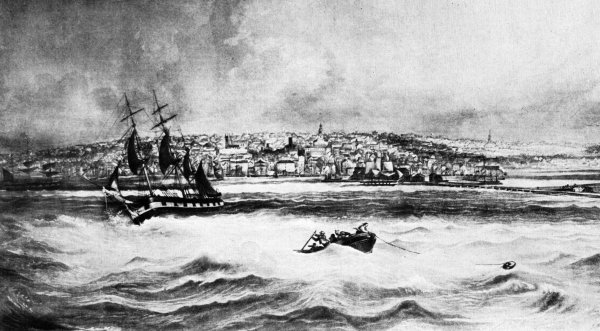
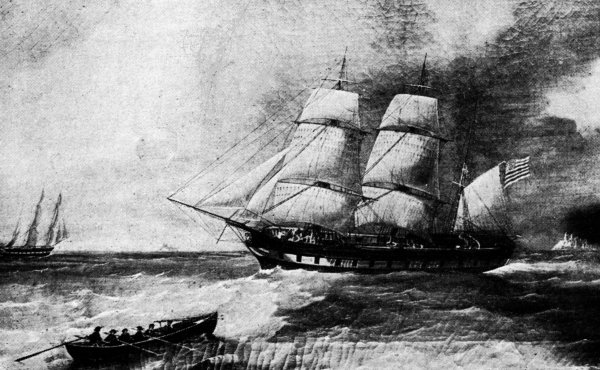
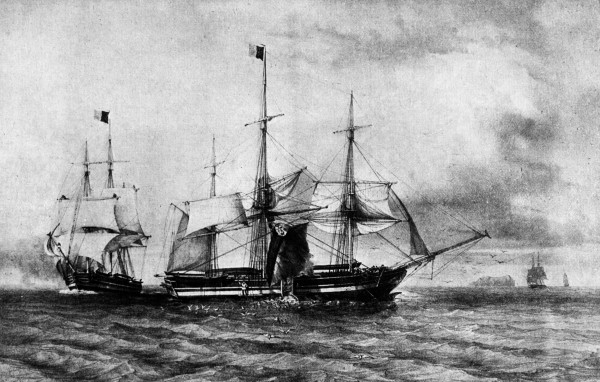
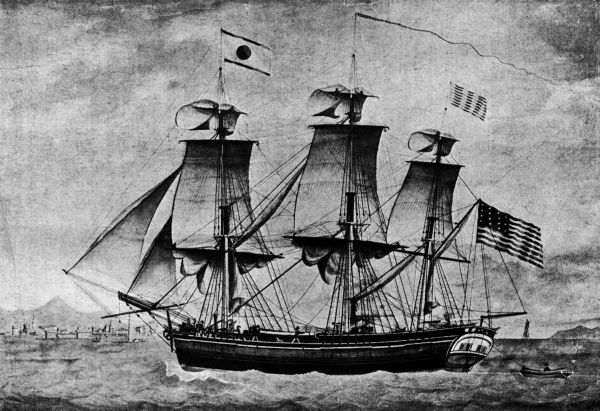
A whaler leaving New Bedford Harbour.
As in Nantucket, the whole city lived to go whaling, and as each
inhabitant made more money, he moved his residence higher up on the
Hill. It is said that there was an inn called the “Crossed Harpoons,”
and another called “Spouter Inn,” and there is a Whaleman’s Chapel on
Johnny Cake Hill where regular Sunday services were held, at which the
following hymn was always sung by the congregation:—
“The ribs and terrors of the whale
Arched over me in dismal gloom,
While all God’s sun-lit waves rolled by
And left me deepening down to doom.
“I saw the opening maw of hell,
With endless pains and sorrows there;
Which none but they that feel can tell—
Oh, I was plunging to despair—
“In black distress I called to God,
When I could scarce believe him mine,
He bowed his ear to my complaints—
No more the whale did me confine.”
The pulpit of this chapel was made to represent the prow of a
whaleship, and was ascended by means of a rope ladder, which the
minister, who had been a harpooner in his youth, hauled up after him.
Around the walls of this little church can still be seen tablets
erected in memory of many whalemen who lost their lives at sea. There
also was a daily paper called The Whaleman, which gave the reports of
the whaleships and the whaling news. It has been said that New Bedford
fathers gave whales for dowers to their daughters, and that they had
reservoirs of oil in their attics to burn on gala occasions.
It is a curious fact that three Morgans not long ago married three
Rotchs, three Rotchs married three Rodmans, and three Rodmans married
three Motleys. Among other well-known New Bedford whaling families are
the Hathaways, Swifts, Howlands, Morgans, Stones, Delanos, Rodmans,
Seaburys, Giffords, Tabers, Grinnells, and Wings.
Whaling was a tremendous financial gamble, and until a vessel came
home “clean” or “greasy,” meaning empty or full, the success of the
voyage was not known. They tell a story of a New Bedford captain who
had been out for nearly four years, and as he came up to the wharf the
owners asked him what luck he had had. His reply was, “I didn’t get any
whales, but I had a damn good sail.” There is another tale of a seaman
whose vessel left New Bedford on the day of his mother’s funeral.
Naturally he set sail with a heavy heart, and during his three years’
cruise he thought many times of his sorrowful father at home. As the
ship neared the docks he was met by his father with “Hurry up, Jim, I
want to introduce you to your new mother.” There were many changes at
home during a long cruise, and sometimes even the fashions had entirely
changed. One whaleship captain described his surprise at seeing for the
first time the crinoline or hoop skirt.
The real founder of New Bedford, and the pioneer of the whale fishery
at this port, was Joseph Russell, who sent his ships out in 1765.
Several years later the first ship was launched and was called the
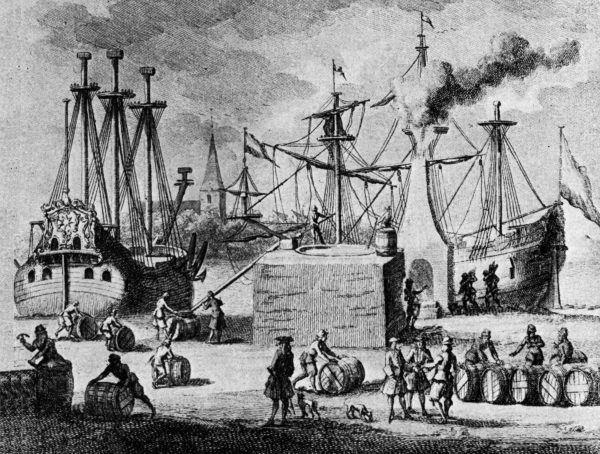
“Dartmouth,” and this vessel is well known to history owing to the fact
that she was one of the ships that carried into Boston Harbour the tea
that was thrown overboard. The whaling industry increased steadily,
except during the wars, until 1857, when the New Bedford fleet numbered
three hundred and twenty-nine vessels, was valued at over twelve
million dollars, and employed over twelve thousand seamen. If these
vessels had been strung out in line, they would have stretched over ten
miles. In addition to these sailors, thousands of others were employed
at home making casks, irons, ropes, and many other articles used in
whaling. In fact, it was often stated that the population was divided
into three parts,—those away on a voyage, those returning, and those
getting ready for the next trip.
There were many nationalities represented in the crews of the whalers,
and the New Bedford streets presented a very foreign appearance, with
Spaniards, Portuguese, Dutch, Norwegians, Germans, French, English,
Scotch, Irish, Sandwich Islanders, and New Englanders at every turn. A
large number of Portuguese served on whaleships, and a part of the city
near the south end of Water Street became known as Fayal.
The “Golden Age,” as it is called, of whaling was between 1825 and
1860, and during the whole of this period New Bedford assumed the lead,
even long after other ports had given up the pursuit. It is estimated
that about the year 1848 there were over seventy millions invested
in the industry and seventy thousand persons derived from it their
subsistence.
It is an interesting fact that the insurance on American whalemen
was about one-half the rate that was charged the Englishman, which
certainly showed the superiority of our Yankee seamen. There were
several whaling insurance companies in New Bedford. There is a story
told of a New Bedford ship owner who had just heard that his vessel
had gone down and he hadn’t yet received the insurance policy from the
company. He sent a letter down to the office which read as follows:
“I have heard from my ship and thee need not place the insurance.” Of
course, the policy was sent up immediately.
The New Bedford whalers explored new grounds, and to this fact chiefly
is due the continued prosperity of its whale fishery, but it was to die
slowly; in 1875 the fleet from this port had declined to 116 vessels,
in 1886 to 77 ships, and in 1906 to 24.
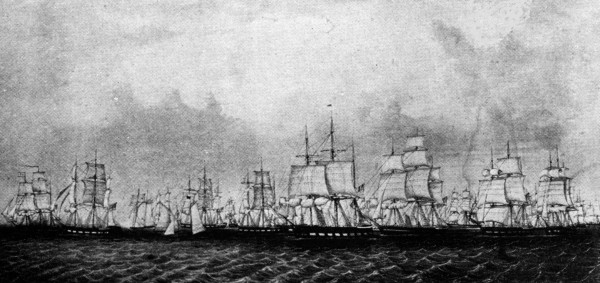
The famous Stone Fleet sailing from New Bedford, Nov.
16, 1861. The ships were loaded with stones and were sunk in the
mouths of certain Southern harbours during the Civil War, to prevent
blockade runners from entering. The vessels in this picture are the
Garland, Maria Theresa, Rebecca Simms, Leonidas, South America, Archer,
American, Harvest, Amazon, Cossack, Courier, Henrietta, Potomac,
Kensington, Herald and L. C. Richmond.
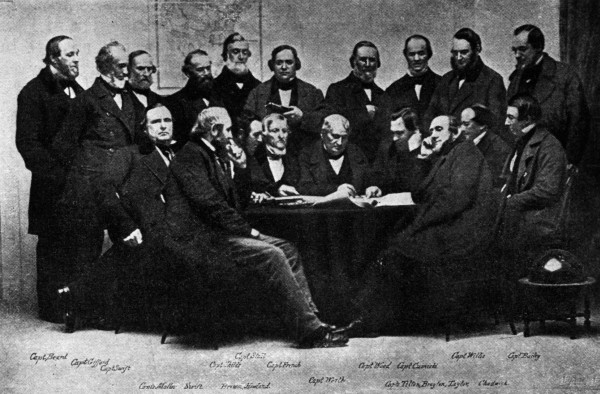
The captains of the Stone Fleet. A fine type of old
New England ship masters. Standing from left to right—Captains Beard,
Gifford, Swift, Childs, Stall, French, Wood, Cumiski, Willis, Bailey.
Sitting from left to right—Captains Malloy, Swift, Brown, Howland,
Worth, Tilton, Brayton, Taylor, Chadwick.
One of the chief historical events of New Bedford happened in 1861,
when the famous Stone Fleet sailed from that port. The United States
government decided to purchase some old ships and sink them in the
channels of the harbours of Charleston and Savannah, to prevent
blockade running during the war. H. Bartlett & Sons supervised their
purchase and Captain Rodolphus N. Swift was the general agent. Bartlett
purchased some of the old whalers for as small a price as thirty-one
hundred and fifty dollars, some of them having more cement than wood
in their hulls. To James Duddy, a teamster, fell the task of supplying
the seventy-five hundred tons of stones with which to fill the vessels,
and many a New Bedford stone wall now lies at the bottom of some of
our Southern harbours. Captain Rodney French, an old “slaver,” who
afterwards became Mayor of New Bedford, was selected as commander of
the fleet, and on Thanksgiving Day most of New Bedford assembled on the
wharves and saw fifteen of her once famous fleet, which had for years
been the homes of its seamen, sail forth never to return. It must have
been a very sad day for the city, and it may be said that this event
marked the beginning of the decline of the industry at New Bedford.
One captain insisted upon washing the decks of his ship every morning,
using pulverized stones instead of sand, and another, to give the fleet
a warlike appearance, mounted a formidable “Quaker” gun, made from a
section of a spar.
A second fleet sailed later in the year, making forty-five vessels in
all. Although the expedition cost the government about a quarter of a
million dollars, its success was only temporary. The captain of the
“Alabama” swore vengeance on New Bedford and destroyed or captured
every whaler he could find, and in the “Alabama” awards that were made
after the war New Bedford received a large share.
Ten years later occurred the worst disaster that ever befell a whaling
fleet. Thirty-four whalers were caught in the ice in the Arctic regions
and sunk, and it is a curious fact that, while the loss reached one
million five hundred thousand dollars, not a single human life was
sacrificed. These three pictures of a series of five on the following
page show the sinking of the ships, the abandonment of their vessels,
which had their flags union down, and the eighty-mile sail through
the ice-floes to the open sea, where twelve hundred and nineteen men,
women, and children were taken home in the seven whalers that had not
been lost in the ice. It must have been very crowded, as each ship had
to stow away several hundred persons in addition to her own crew. There
were many sad hearts as they left their vessels and almost all of their
belongings, and started off in the small boats. The trip to sea and the
trans-shipment in the heavy swell must have been made with the utmost
care, otherwise many lives would have been sacrificed. The loss to the
New Bedford owners was so tremendous that they never really recovered
from the catastrophe, and many families had to economize for years
after. The Swifts, Howlands, and Rotchs were among those who lost ships.
On one of the vessels in the first picture of this series was a large
quantity of the finest Manila cigars and also some rare Madeira
wine, that had been picked up in the Philippines the year before on
instructions from the ship’s owner. When the captain of this vessel
reached New Bedford and reported the loss of his command, the owner’s
first question, after listening to the dismal tale, was whether his
cigars and wine had been saved. “All of it,” came the reply. “Where is
it?” said the owner, looking more cheerful. “Well, you see, I drank the
wine and Mr. Jones, the mate, he smoked the cigars, and they certainly
done us both good,” replied the captain.
The ship “Progress,” shown in the last picture, forms an interesting
connecting link between the Stone Fleet and this 1871 disaster.
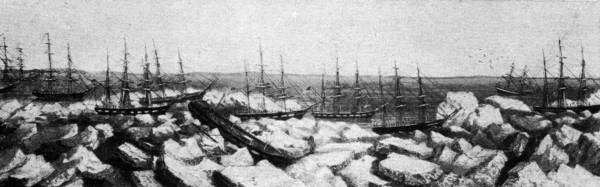
Abandonment of the whalers in the Arctic Ocean,
September, 1871. Vessels surrounded by the ice, and many of them in a
sinking condition.
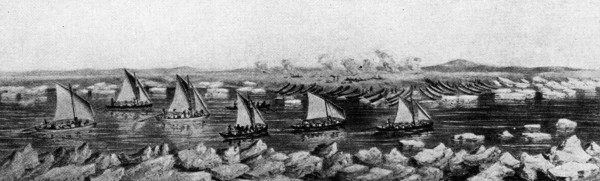
Abandonment of the whalers in the Arctic Ocean,
September, 1871. Showing the whaleboats being hauled up on Blossom
Shoals, where the ship-wrecked crews spent the night crowded under the
upturned boats.
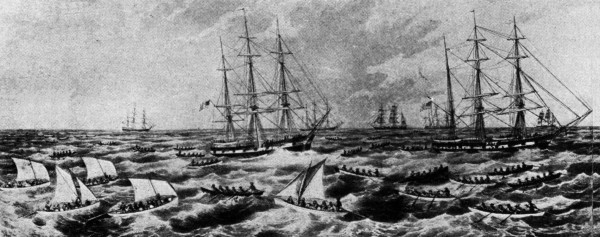
Abandonment of the whalers in the Arctic Ocean,
September, 1871. The seven ships receiving the 1217 men, women, and
children of the abandoned vessels. The sea was very rough and the
trans-shipment was very dangerous. The ship “Progress,” whose history
is given on the opposite page, is at the right of the picture.
Under the name of the “Charles Phelps” she whaled from Stonington, Conn., for
a number of years and finally was purchased for the Stone Fleet. She
was found to be in such good condition that the government decided not
to sink her, and she returned to New Bedford and was sold; and it was
this same vessel that took part in the rescue of the twelve hundred and
nineteen shipwrecked people ten years later. In 1893 she was fitted out
as if for a whaling voyage and towed by way of the St. Lawrence River
to Chicago, where she was exhibited at the Fair, and now lies rotting
on the sands of the lake at South Chicago. No other whaler ever had so
interesting and varied a history.
The year after this Arctic disaster found the fleet again in the
Arctic, and the “Minerva,” one of the ships left at Point Belcher, was
discovered and found to be in good condition; the others had sunk. One
lone person was found who had remained on board his ship for the whole
year, and his sufferings had been fearful. The natives had stolen all
the whalebone and oil from the sinking vessels, and when some of the
same shipwrecked captains arrived the next year the Esquimaux tried to
sell them back their own property, and one native was using one of the
chronometer cases as a dinner pot in which to boil his blubber. The
“Minerva” was manned and sailed to New Bedford and continued in the
whaling industry.
New Bedford ships suffered severely during the Rebellion, but later
new ones were added to the fleet and business again prospered. Lack of
space prevents enumerating the achievements of American whalers during
the Civil War. Captain William P. Randall, however, will go down in
history as a hero of this war; he was brought up on a whaleship and
later served in the navy.
Captain Frederick Fish, father of Frederick P. Fish and Charles H.
Fish, of Boston, was one of the best known and most respected of
the whaling captains sailing out of New Bedford. He commanded the
“Montreal” and the “Columbus” when only twenty-two years old, made nine
voyages round the world, and was one of the most successful whalers of
his day. Once when near the Sandwich Islands his vessel happened to
anchor very close to an English ship, and Captain Fish noticed that
every evening at sunset the English commander, while at anchor, set
all sails and then furled them again in order to show how quickly this
work could be performed. After a few evenings Captain Fish ordered his
crew to do the same, and the time consumed was so much less that the
next evening the Englishman decided he did not care to go through the
performance; in fact, he never tried to show off again in that port.
There is also another amusing story told about Captain Fish. His ship
at one port took on a great many chickens, which were used for food,
and finally one of the crew rebelled and informed the captain that he
had eaten enough hen. He was immediately ordered out on a yard-arm and
was made to crow like a rooster for such a long time that when he was
again allowed on deck, he had a most excellent appetite for another
chicken dinner. Captain Fish delighted in telling of the time when
he took a local pilot on board somewhere in the Pacific to conduct
his vessel into port. He asked the navigator if he were sure of his
course, and received a prompt and decisive answer in the affirmative.
Presently, to the disgust of the captain, the vessel touched. The next
question put to the pilot was whether or not he could swim, and finding
that he could, Captain Fish ordered his crew to throw him overboard.
This was done, and, the distance being short, the swimmer made the
land, and the captain himself took his vessel in the rest of the way.
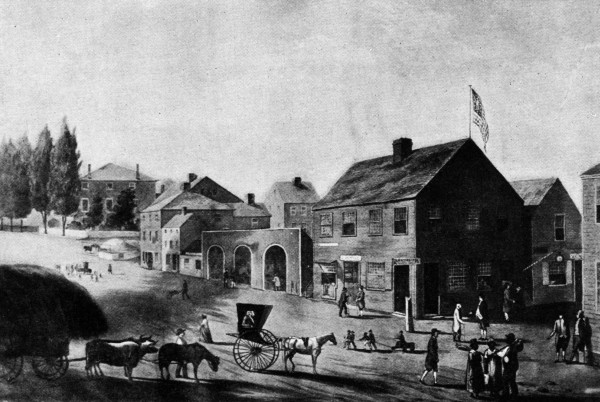
New Bedford fifty years ago (1808). (This print is dated
1858.)
Captain Fish was an excellent story teller, and another yarn has been
handed down in connection with one of his trips. The voyage had been
very unsuccessful, and as he was looking over his chart he tossed his
dividers down in a disgruntled manner, and by accident they chanced to
stick in the chart. He then conceived the novel idea of sailing to the
very place where his instrument happened to land, and curiously enough
he was rewarded by a very large catch.
Once when one of his whaleboats had been overturned by a fighting
whale he hurried to the assistance of the crew, who were struggling
in the water, and to his amazement found two of them squabbling over
the ownership of a pair of old shoes, instead of thinking about saving
their lives. It is a curious fact that he never learned to swim, and
often saved his life when capsized by grabbing some floating débris.
His nerve and courage were remarkable, and it is related that even on
his death-bed he told the doctor an amusing story.
This picture of New Bedford in 1808 is most interesting. The oil
market shed on the right-hand side of the street was built in 1795 by
Barnabas Russell for his son Joseph, and the last building shown on
the right of the picture was the mansion of William Rotch, Sr., and
the first estate in the village at that time. This Rotch was the son
of Joseph Rotch, one of New Bedford’s earliest whalers, and he himself
is represented in his old chaise, the only private carriage then in
the town. He is negotiating for a load of hay, and from all accounts
he must have been a keen business man, for he was often seen going to
market so early that he had to use a lantern. All the other figures in
this picture also are intended to represent well-known citizens of the
time. The two men shaking hands are Captain Crocker and Samuel Rodman;
the latter, who was the son-in-law of William Rotch, had the reputation
of being the best dressed man in New Bedford in his day. One of the
boys harnessed to the small cart is the Hon. George Howland, Jr.,
great-uncle of Llewellyn Howland. H. H. Hathaway, Jr., and Thomas S.
Hathaway have three ancestors in the picture.
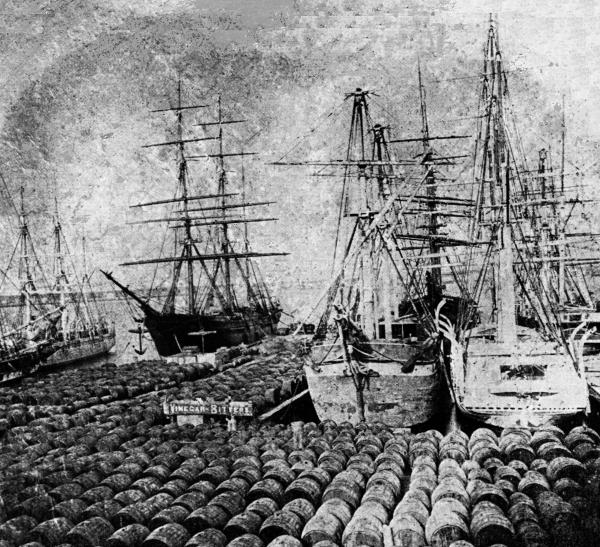
Oil stored on the wharves at New Bedford awaiting a
favorable market. The owners, dressed in silk hats, long-tailed coats,
and polished top boots, might often be seen watching, testing, and
marking the oil-barrels.