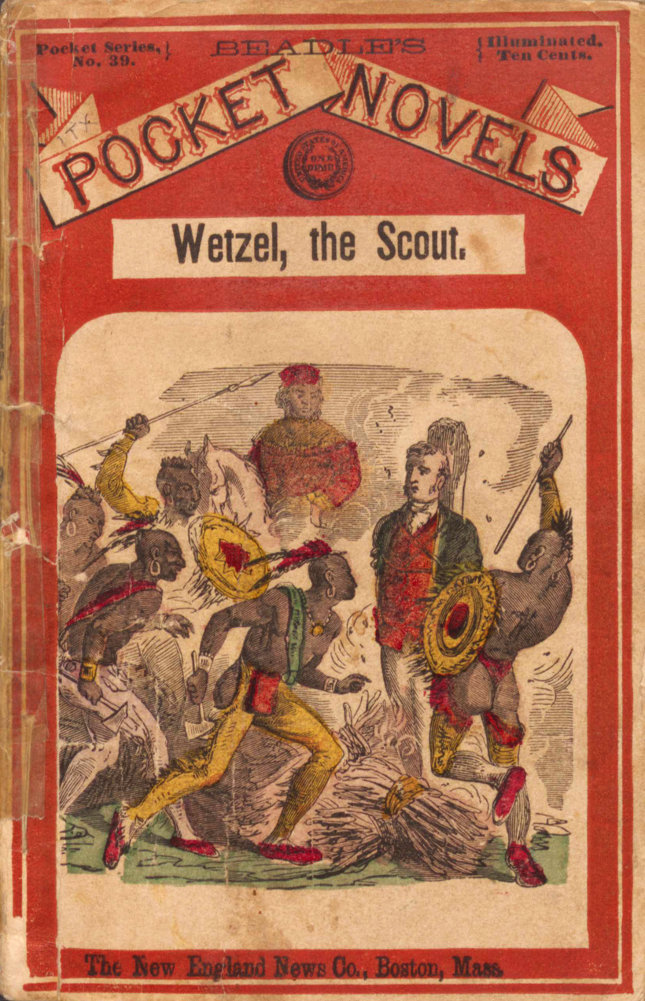
“Who fired that gun?” demanded Captain Parks, as he
turned around and faced his terrified negro, Pompey.
“Hang me, if I don’t believe it was you, Pompey.”
“Heben sabe me, massa captain; I wouldn’t do such a
ting for ten fousand dollars!”
“Let me see your gun.”
The trembling African obeyed. It required but a moment
for the irascible captain to ascertain that the piece had just
been discharged.
“Yes, you black rascal, it was you! Take that!” he added
giving his servant a tremendous kick. The latter paid
not the least heed to it, and finally added, as if addressing
himself,
“Come to tink soberly on de matter, I bring to mind I
did have de hammer up, so as to be ready for de Injins
when dey do come, and jist now I stubbed my toe, and
jerked on de trigger, and I s’pose dat am what made de
blasted ting go off so mighty suddint like.”
“Of course it was, you black rascal! It came within an
inch of my head. If anything like that happens again, I’ll
leave you here in the woods for the Indian’s tomahawk.”
“Heben sabe me, I’ll be careful.”
Captain Parks, a blunt, corpulent, middle-aged man, who
had served and been wounded in the Revolutionary war,
was toilsomely making his way along the banks of the
Ohio, near the close of day, followed by his servant, a great
fat negro, of about as much use as a common ox would
have been. He was endeavoring to reach a certain point,
10
which had been described to him by the renowned ranger
Lew Wetzel, for the purpose of being taken on board a flat-boat
on its way down the Ohio. His own family and a
number of friends were on board, and after seeing them
embark, a goodly number of miles above, he had gone overland
for some distance in order to meet a man on an important
business matter. Remaining with him no longer than
could be helped, he made all haste toward the rendezvous,
which he had just reached at the time we introduce him to
the reader.
“Yes, Pompey, here’s the spot!” exclaimed Captain
Parks, looking around in surprised pleasure. “There’s the
uprooted tree, with the shrubbery growing around its roots,
that Wetzel told me to be on the look-out for.”
“Yaas, and dar am de riber dat he said would be dar,
too.”
“The river, you blockhead? Of course, else how could we
meet the flat-boat.”
“Dat am so,” returned Pompey, thoughtfully, and a moment
later he shouted, “Ki yi? dar he comes now.”
“You blasted fool, that is a canoe full of Indians! Stoop
down, or they’ll have our scalps in ten minutes.”
The men sank down out of sight, while the canoe that
had attracted their attention, made its way swiftly across
the river several hundred yards above. Its inmates seemed
unaware of their presence, as they advanced straight
across the river without swerving to the right or left.
As Captain Parks was anxiously scanning the savages he
was certain he saw a white man sitting in the stern, and
from appearances he was the guiding spirit of the forces.
While scrutinizing him the negro at his elbow again spoke.
“Dar it am dis time, shuah.”
He was not mistaken this time. Coming around a bend
above, the flat-boat floated slowly and silently forward under
the perfect control of the current. When first seen it
had the appearance of a large, square box, at either end of
which was hung a lengthy oar, which now and then swayed
and dipped in the water. The cabin ran the entire
length, except at each end there was a small space left sufficient
11
to contain a half-dozen men. Above these open spaces
the heavy bullet-proof sides rose for five feet. A small
narrow window was pierced in the sides, opening and shutting
at pleasure, while a trap afforded egress to those within.
The spaces at the ends communicated with the cabin by
means of another small door, so that the inmates of the
boat, whoever they might be, were able to pass and repass
without exposing themselves to danger from an ever watchful
foe without.
Viewed from the shore, not a sign of life would have
been seen at first. Some invisible but skilful hand seemed
to dip and sweep the long guiding oars and keep the boat
in the channel. But a closer view would have shown a
small, dark spot-like appearance above the gunwale at the
stern, which at long intervals changed its position, and then
for so long a time remained stationary as to give the impression
that it was a part of the boat itself. This small object
was a coon-skin cap, and it rested upon the head of him who
was guiding this boat through the perils that environ it. A
nearer approach, and a low hum, as though persons were
conversing in the cabin, might have been heard; but no
other appearances of life would have been seen upon the outside,
except the one individual referred to. He was a man
young in years, yet with an expression of face and appearance
of dress that showed he had much experience in backwoods
life. He was rather dull, of a muscular, massive
frame, and had a fine, intelligent expression of countenance.
His nose was small and finely formed, his eyes black and
glittering, his long black hair fell in curling masses over his
shoulders, his mouth was small and expressive, and there
was an appearance of compactness about his frame that
showed his formidable reserve of strength and activity. He
was attired in the usual hunting costume of the day—coon-skin
cap, with hunting shirt, leggins and moccasins made of
deer-skin. A belt passing around the waist was the repository
of a couple of savage-looking knives, while a long polished
rifle rested against the cabin.
Our two friends on shore waited until the flat-boat was
nearly opposite, when Captain Parks arose to his feet and
12
made a signal with his hat. The eagle eye of Wetzel quickly
detected it, and swinging his own cap over his head to signify
that all was right, a small sort of canoe was instantly
lowered, and propelled by the skilful paddle of the renowned
ranger himself, it soon reached the shore, and received
the two men on board.
“Dar am a hundred fousand Ingines!” whispered Pompey
in a horrified whisper. “Let’s got back to de flat-boat a
little sooner dan possible.”
Wetzel looked inquiringly at the captain, who made answer:
“A canoe full, passed just before you came in sight.”
“I seen ’em,” returned the ranger. “There’s a white
man with ’em too. I’m afraid we’ll have trouble from ’em
afore long, too.”
“Golly hebbin! let’s go back home.”
“Shut up, you black rascal.”
A few minutes later our friends were received on board
the flat-boat, and most joyfully welcomed by its occupants.
It was already getting dark, so that the meeting had not
occurred too soon. It singularly happened that both Captain
Parks and the flat-boat were delayed several hours in
reaching the appointed spot.
There were a dozen upon the boat beside Wetzel, including
the females of Stuart, Kingman and Parks, and several
young, enterprising men.
Stuart was a sturdy, middle-aged farmer, who had first
proposed this undertaking, and was the leading spirit of the
enterprise. He was a corpulent, good-natured man, and was
accompanied by his wife, and a meek, blue-eyed daughter
of eighteen or twenty years. Kingman was a relative of
Stuart’s, was of about the same age, and of the same pleasant,
social disposition. His only child was a son, just verging
into manhood, who had hopefully joined the little expedition.
The third mentioned was Parks, our first acquaintance,
who was about forty years of age, with a heavy
grizzly beard and bushy hair, and of so irascible a disposition
that he had gained the name of the “Mad Captain.”
13
He was childless, having lost his only son in battle some
years before.
The party at the time we introduce them to the notice of
the reader, were engaged over their evening meal, and thus
the hunter Wetzel was undisturbed by the presence of any
of them.
Suddenly, like the flash of a demon’s eye, a bright spot of
fire flamed from the inky blackness of the western shore,
the sharp crack of a rifle burst upon the night air, its sullen
echoes rolling far up and down the river. Not a motion
or word on the flat-boat betrayed that the sound of a rifle
had been heard. Wetzel was standing as usual, resting
quietly on the oar, and heard the whizz of the bullet as it
skimmed over the boat in front of him. Not the least discomfited,
he neither spoke nor changed his position at the
startling sound. A deliberate half-turning of the head and
an apparently casual glance at the shore from which the
shot had come, were all that betokened his knowledge of
the threatened danger. There was little need of cautioning
the inmates, as they were well aware of the dangers by
which they were surrounded. Around Wetzel stood Kingman
and Parks, while at the opposite end were young Kingman
and a friend by the name of Russel. The females remained
below.
The night was one of those clear, beautiful ones, when the
silence is so perfect that the dark forest seems to have a
deep, sullen, and almost inaudible roar, and there is soft
music in the hum of the myriads of insects in the air. As
the moonlight rested upon the youthful, but already bronzed
face of the brave Wetzel, it disclosed one of no ordinary
intelligence.
There is a magic power in the moonlight, when it rests
like a silver veil upon the countenance, softening and mellowing
the outlines, until every feature glows with a radiant
mildness.
And, when a few moments later, Irene Stuart made her
appearance, her face was of surpassing beauty. She was
rather below the medium size, of a light delicate frame. As
she emerged from below a heavy shawl enveloped her, concealing
14
her faultless form to the shoulders. There was no
covering for the head, and her dark clustering hair gathered
loosely behind, fell in a black mass over her shoulders. The
moonlight gave to the mild blue eyes a languid softness, and
the whiteness of the face seemed increased by the same enchanting
veil. The night journey was continued in safety,
and the next day the wished-for settlement was reached.
Here they were all received with open arms, and were
speedily incorporated into the settlement proper.
The men had come for the purpose of carving out new
homes for themselves in this great wilderness, and they went
to work with the determination to do so. By mutual assistance,
cabins for all were soon erected, and a large portion
of the forest cleared and put under cultivation.
Matters progressed well until, after the lapse of a few
months, rumors reached the settlement of a frightful increase
of the outrages upon the part of the savages. The menacing
danger to the settlement finally assumed such a form
that stockades were erected and the place put in a state of
defense.
A month or two passed thus, until the succeeding spring,
when Wetzel arrived at the settlement with a call for twenty
men to join a company that were going to march into
the Indian country for the purpose of teaching them that
the whites could not be murdered with impunity.
The desired twenty at once responded to the call. Among
these were Mad Captain Parks, Kingman, Stuart, and others
who were in the flat-boat. Wetzel was to be the leader
until they reached the appointed rendezvous, a number of
miles up the river, when the whole was to be placed under
the command of Col. Sandford, a man who had experienced
considerable Indian fighting. The entire force was to
number two hundred and fifty, and it was confidently
hoped that a summary check would be put to the outrages
that were becoming frightfully common along the frontier.
At the appointed time the whole two hundred and fifty
gathered at Fort Lafayette (the one of ancient days) and
with high hopes they set out for the Indian town of Lushne,
under the lead of the gallant Colonel Sandford.
15
To reach this, it was necessary to cross a large stream—a
tributary of the Ohio. This was done in safety, and late
one night they encamped within a comparatively short
distance of the Indian town. A greater number of sentinels
were put on duty, and the rest lay down to be ready for the
“tug of war” that they confidently counted on for the morrow.
In spite of the extraordinary precautions that were taken
the picket line was broken through, and an overwhelming
body of Indians poured into the camp. The officers endeavored
to rally them; but Colonel Sandford was almost instantly
shot, and the panic become complete.
Many of the men performed prodigies of valor. Wetzel
raged like a madman; but the men broke, and were
scattered like chaff, and were hewn down as they ran.
Finding it was all useless to attempt to stay the tide,
Wetzel, Captain Parks and Kingman attempted to save
themselves. The two former successfully made their escape
in the darkness, but the latter was wounded, and crawled
for safety beneath a cluster of bushes. Here he lay all night,
while the dreadful carnival went on. He caught sight of
the shadowy forms rushing to and fro, heard the continual
shrieks of the victims, and now and then the death yell of
some over-venturesome Indian. He expected every moment
to be discovered, and to share the fate of his companions.
When the morning finally dawned, the tumult died away,
and overpowered by his exhaustion he fell asleep. When
he awoke the day was well advanced. As he regained his
consciousness he looked about him; but no person was visible.
The massacre was finished.
Kingman crawled to a brook near by and quenched his
thirst, and then made his way back again, seeing no prospect
for him but to lie there and perish, or suffer a death of
violence from the hands of the first one who should discover
him.
He lay there all day. At nightfall he was startled by the
appearance of a little whiffit of a dog directly in front of
him. Knowing that some one else must be close at hand,
16
he managed to lure the brute to him, when he cut his throat
from ear to ear.
“There,” he muttered, as he wiped the blood from his
hands, “you can’t betray my hiding place.—sh!”
Just then he looked up and saw the renegade Johnson
but a few rods away, and apparently looking for something.
CHAPTER II. POMPEY IN WAR.
“Dis yer gemmen ob color orter for to go to war, dat am
sartin. While de rest am sheddin’ dar blood round dese
parts, it ain’t right for him to be idle.”
Thus soliloquized Pompey when the forces marched from
his village to join those in invading the Indian country.
The reason he gave himself, however, was not the true step
that influenced him. Through his thick skull there crept
some such logic as this:
“If de best men lebe dis place, den dis place becomes de
weakes’. De Injins will find dis out, and den what’s to
sabe us dat stays behind? Whereas and wherefore dem dat
goes away will be de safes’. Darfore, inasmuch as, de best
ting I can do is to go wid ’em. Darfore, howsumever, I
go.”
He hurried along and overtook the party before they had
penetrated any great distance in the forest. The leaders
were disposed to send him back; but he was so earnest in
his entreaties to be allowed to go that they finally consented,
and he formed one of the party.
When the attack was made, Pompey broke for cover.
His prudent resolve was to remain out of sight as long as
there was danger, and then to be “in at the death,” and
claim his share of the glory.
Such being his situation, it was out of his power, as a
matter of course, to comprehend at once the disaster that
had befallen Colonel Sandford and his command. When he
found the whites were scattering and seeking individual
17
safety, and the Indians roaming everywhere in search of
victims, he began to suspect that all had not gone as well as
he had hoped.
“Gerrynation! I begin to tink it’s time dis yer black
man was tinking of libing.”
At the time he gave expression to this thought, Pompey
was crouched beneath some thick undergrowth, and glaring
out upon the Indians, who seemed to be passing all around
and in every direction. Here he remained until broad daylight.
He had wit enough to understand that it was now
impossible for him to escape discovery. The place in which
he lay was the very one which a frightened fugitive would
naturally secrete himself, and was therefore the one which
the Shawnees would search. It would be certain death to
attempt to escape by fleeing. His huge feet and short legs
could not be compared with those of his enemies. He therefore
hit upon the brilliant idea of feigning death until nightfall,
when he could make off under cover of darkness.
He had barely made this resolution, when a stalwart Indian
walked straight to the bushes, and pulling them aside,
peered in. Perhaps the glare of the sun, or the utter darkness
of Pompey himself, made the negro invisible for a few
moments; for it is certain that some considerable time elapsed
ere the savage uttered his all-expressive “Ugh!”
Pompey kept his eyes open until he saw the red-skin
glaring down upon him, and then he shut his orbs as tightly
as if he were expecting to hold a fly beneath each lid. At
the same moment he drew in a long breath, stoutly resolved
to hold it until the Indian went away. But as second after
second passed, his discomfort rapidly became overwhelming.
But he held out like a hero, until absolutely human nature
could do no more. Suddenly he gave a tremendous puff,
somewhat after the fashion of a laboring steam-engine.
“Gosh hang it! dar! no use tryin’! If I’d kept in any
longer I’d busted!”
The Shawnee indulged in a huge grin as he discerned the
African stretched out upon the ground, his eyes rolling, and
his great white teeth chattering with fear.
“Ugh! come out—me kill.”
18
“Oh, good Mr. Injin, I love you ’most to death. Please
don’t hurt me! Oh, good Mr. Injin, please don’t hurt a feller
like me!”
“What do here?”
“Please don’t hurt me. I come along, good Mr. Injin
jes’ to keep de rest from hurtin’ you. You can ax any of
’em if I didn’t.”
What would have been the ultimate result of all this it is
impossible to say, but there can be little doubt but that the
negro would have been tomahawked had not a peculiar
whoop attracted the attention of the Indian. Without further
noticing the supplicant he leaped away in the woods,
uttering a reply to the signal, and disappeared almost instantly.
Pompey took advantage of this opportunity. He left that
part of the neighborhood as fast as he could travel, and
continued walking all night.
The whole distance back to the settlement was made
alone, without encountering a single human being. A kind
Providence watched over the poor fellow’s footsteps. The
first man he saw was the sentinel of the town, who discharged
his gun at him, excusing himself on the plea that he was so
dark he thought it was night itself, and fired his gun into it
to clean out the barrel.
19
CHAPTER III. THE RENEGADE.
The renegade stooped and narrowly examined the marks
which his dog had made in searching for the new trail, but
as he had been to the spring once or twice, and had gone in
many other directions beside the one toward Kingman’s retreat,
it was impossible to follow up the right one.
It was now getting dark rapidly. Already the shadows
of the wood were growing darker each moment, and blending
together.
The renegade moved cautiously about, peering at each
spot which he judged possible to contain a human being.
“Don’t ’pear to find any, though I shouldn’t wonder if
thar’s two, there ’bout. Like to know where Nero is.”
He stopped and called again his brute, but, of course, he
came not.
“Beats the devil whar that dorg am!” he exclaimed,
somewhat nettled. “I’ll have to wollop him when he
comes home ag’in.”
It was now so dark that his form was quite indistinct to
Kingman. The latter saw him stand a moment and then
soliloquize:
“Now, s’pose there war some feller hid under them bushes,
he’d have a fine chance to bring me down, wouldn’t he?
Thunder! I didn’t think of that all the time I’ve been standin’
here.”
This sudden discovery appeared considerably to affect him,
for he turned on his heel and disappeared in the darkness.
Pete Johnson, the renegade, was perhaps as incarnate a monster
as Simon Girty; but, added to his crimes, he had a failing
which the other great renegade had not. He was cowardly
and fearful of his personal safety in battle. Girty, no
one will deny, was a brave and daring fighter, and was often
20
perfectly reckless of danger, while Johnson invariably
showed the white feather when in peril.
Darkness had now settled over the forest, and Kingman,
having greatly recovered, stealthily emerged from his hiding-place.
“Yes,” he muttered, looking toward the spot where he
had last seen his enemy; “yes, there was a fellow under a
bush, and nothing in the world would have given him a
greater pleasure than to have sent a bullet through that
black heart of yours. Never mind; your reward will come
some day.”
And he turned and plunged in the forest.
The spot where the battle recorded had taken place, was
in Sciota Valley, but a short distance from the river of that
name, and toward this Kingman bent his steps. He could
hear the shouts of the savages, and see their lights flitting
through the trees, as they moved about in the village.
Some, he knew, were still absent in the forest, searching for
prey, and he was yet by no means out of danger, as the river
bank would probably be watched the whole night. His
wound pained him now more than usual, and he was fearful
of a fever renewing itself before morning.
He took the river bank, for by following this he would
avoid that singular mistake which persons lost in the wilderness
so often make—that of coming, after a long time,
back to the precise spot from which they started. The
Sciota emptied into the Ohio, and by following its banks he
would in time reach the settlement, as Wetzel and the
hunters had done some time before.
As he approached the river, the moon was shining upon
it, and he could plainly discover the dark line of the opposite
shore. He hurried along the bank in the hope of finding
some Indian canoe, but was disappointed. As every
moment was of value to him, he commenced his homeward
march at once. For a mile or so he kept within the wood,
until, judging that he had gone far enough to be beyond danger,
he took the shore and hastened onward. For a mile or
so the beach was composed of a hard, gravelly sand, which
made the walking easy and pleasant on such a warm moonlight
21
night. Kingman could not help congratulating himself
upon his own pleasant lot, when he reflected upon the
fate of so many others, despite the severe and troublesome
wound he had received.
“Yes,” he exclaimed, half aloud, “I’m in a fair way to
get home again, and I thank Heaven for it. If I should happen——hello!”
The latter exclamation had good reason for its utterance.
In coming around a sharp bend in the river, he had encountered
a Shawnee Indian, and the two stood face to face!
They were not fifty feet apart, and each appeared equally
astonished. As Kingman stood, the moon shone upon his
back, so that his features were concealed from his enemy,
while the face of the latter was as distinctly visible as at
noonday. Kingman saw his large, dark eyes glowing, and
his whole countenance working with passion; but suddenly
it changed, and losing the hold upon his knife, a grim smile
came over his swarthy features as he said in a low tone,
“You scare Long Tom, Pete. He tink you oder man.”
Kingman saw in a moment that he had been mistaken
for the renegade. His dress was similar, and his stature
about the same, so that it could not be wondered at.
Without losing a moment he availed himself of the mistake.
“Wal, I reckon I did scarce you, Tom! Wagh! wagh!”
he laughed, imitating as nearly as he remembered the renegade’s
tones and actions.
“What scarce me for?”
“’Cause you was fool enough to git scart, wagh! But
ain’t there no more of Injins with you?”
“Long Tom all alone.”
“Wal, he won’t be long.”
“Why tink so?”
“’Cause here’s as’ll send him whar thar are more. Wal,
I will.”
“Send Long Tom where?”
“You’ll see in a minute. But what made ye come down
this way alone, Tom? Ye mought ov met some o’ the
white men.”
22
“Damme! wish me had.”
“What would you do?”
“Me do so,” and the savage made a motion with his
hands as though he were scalping a person.
“You’ve come a good ways lookin’ fur him, wagh!”
“Me go furder.”
“Thar won’t be need of that.”
“Why, white dog round here?” eagerly asked the Indian,
approaching nearer.
CHAPTER IV. SURROUNDED BY PERIL.
This conversation, as will probably be seen, was purposely
carried on by Kingman in order to throw the savage off his
guard. An encounter he saw was unavoidable between
them, and Kingman, in his wounded state, was fearful of
the consequences to himself unless he employed some such
stratagem as this.
He glanced at his rifle and saw he had preserved the
priming from loss and moisture.
“I think the woods are full of the whites, Tom. Haven’t
you seen any?”
“Only dem shoot in battle. Me no find any in woods.”
“I seed one hid in a tree. Wal, I reckon I did.”
“You kill him?”
“That’s a purty question to ax Pete Johnson. Thought
you knowed better, Tom, than that. Ef Pete didn’t raise
thar har bootyful then smash me.”
“Eh! fix ’em did, Pete? Good!” added the savage approaching
still closer.
The two were now within ten yards of each other. Kingman
feared a discovery each moment.
“Would you like to shoot a white, Tom?”
“Eh? wouldn’t Tom serve him so quick!” replied the savage,
again going through the motions of scalping in the air.
23
“Wal, just look ’cross the river. Don’t you think there
is something there that looks suspicious?”
The unsuspecting Indian turned and gazed in the direction
indicated. At the same moment he heard the click
of Kingman’s rifle.
As he turned his alarmed gaze around he received the
bullet full in the heart, and with a wild yell sprang several
feet in the air.
The savage saw at once the treachery which had been
practised upon him, and in his death-struggle, as he was, he
hurled his tomahawk with tremendous force at Kingman.
So truly was it aimed, that a mere accident may be said to
have saved his life.
He had only lowered his musket, and the barrel was still
before his breast.
As the weapon whizzed through the air it was driven directly
at Kingman’s body, but in its passage it encountered
the gun-barrel, emitting a stream of sparks at the concussion,
and glanced off several yards into the river, and fell
with a loud splash.
“There, Long Tom, I didn’t want to kill you, but I had
no choice. I feel sorry for you,” said Kingman, as he saw
the savage clutching the sand in his agony.
He avoided looking at him, and rapidly passed on, hoping
to get beyond so sickening a sight.
Had the savage been any other than a Shawnee, Kingman
would have felt more pity for him; but he well knew
that the whole trouble upon the frontiers was owing to this
same tribe. In fact, it is a question whether a more villainous
tribe of Indians ever existed upon the North American
Continent then than the Shawnees. They had figured in
many of the blackest tragedies of the “dark and bloody
ground,” and their very name for a long time was one of
the greatest terror to the settlers. There was no compact,
however sacred, no treaty, however pledged, that they
hesitated to violate.
Then first known, their hunting-grounds were in the
everglades of Florida and the adjoining country. Here their
savage, treacherous disposition became at last so unbearable
24
to the other tribes that the Choctaws, Cherokees, and
most powerful tribes of the South united together and
swore eternal destruction to them.
The Shawnees stubbornly maintained their ground for a
number of years, until, seeing that nothing but decimation
or utter annihilation remained to them, they gathered together
and left their hunting-grounds forever.
Journeying northward, they reached the Ohio in time,
when they determined to settle. There were broad, waving
prairies, and deep, glorious forests, where the deer and buffalo
ranged in thousands, and bright, flashing rivers, in which
the fish sported in myriads. The Wyandots (as friendly
then, when a mighty nation, as now, when the miserable
remnant of one) welcomed them, spread the deer-skin for
them to sit upon, and smoked the calamut as the token of
eternal friendship.
Here the Shawnees grew to be one of the most powerful
tribes in the whole North-west, and at the same time their
vindictive, blood-thirsty disposition seemed to increase.
None were more active in the old French war, and none
more difficult to bring into Wayne’s treaty, when forty years
afterward the war on the frontiers was believed to have
been brought to a close.
After the celebrated victory of Mad Anthony, the Shawnees
remained peaceful for a dozen years, when they again
broke out in the well-known war under their renowned
Tecumseh. As this is a matter of history, it is not necessary
further to refer to it here.
Of course, it is not to be supposed that this long digression
passed through the brain of Kingman after slaying the
Shawnee before him, for the good reason that one half of
the events mentioned had not yet taken place. It was now only
1780, and the Shawnees were in the fell tide of their
strength, and had received no check from the pioneers.
Kingman only remembered that the Indian he had slain was
a Shawnee—his most mortal enemy.
The moon was now high in the heavens and as he journeyed
along the shore, its light was so intense as to render it
quite perilous to remain so exposed.
25
Once or twice the long, low howl of the wolf was heard
faintly in the distance, and the shrill, human-like cry of the
panther sounded fearfully nigh. The fact that there were
others than human enemies in the wood made him hesitate
about plunging into it. As he had used his ammunition, he
had also thrown his rifle away, so as not to be encumbered
with it, and with no weapon but his knife, he was in no
condition to run into danger.
But at last the low, gravelly beach terminated. The dark
overhanging forest, with its matted undergrowth, reached
down to the water’s edge, and his path must now lead
through to this tangled maze.
As he stood hesitating whether in his present exhausted
condition it was best to camp for the night, or to continue
his journey, a bright thought struck him. Directly before
him lay a small tree, shivered by lightning. It was partly decayed,
light and buoyant, and could be easily shoved into
the water. This was quickly done, and he once more returned
to congratulate himself upon his success. The water
was warm and pleasant, and as it was a cool summer night,
much warmer than the air. The sapling contained a number
of dead branches and knots upon it, and being considerably
lighter than Kingman at first supposed, he was able to
float upon it with scarcely more than wetting his feet.
Fatigued and exhausted as he was, he found a heavy
drowsiness gradually creeping over him. He had had little
sound sleep for the past ten nights, and his exertions had
been so great, that he felt certain it would be impossible to
resist the feeling. So, placing his limbs so securely among
the branches as could be done he gave way to the feeling,
and prepared for a pleasant night’s slumber.
Gliding unresistingly along with the smooth current,
with nothing but the gentle, liquid rippling of the river
around, and the bright moon overhead, and the sullen, hollow
roar of the forest on shore, no one could resist the
drowsy goddess. Slowly but surely unconsciousness was
creeping over him. Sky, forest, and water were mingling in
a delightful confusion from which he felt no desire to separate
them; and as all things were assuming that blankness
26
which precedes our passing off into sleep, he was startled
and recalled to his senses by a sudden shock. Starting up,
he saw that he had struck against the upper end of a small
sandy island, and the tree had remained fast. It required
but a few moments to free this, and once more he was floating
gently with the current. This time he slept, but he was
destined to have a startling awaking. His wound made him
feverish, and all sorts of fantastic visions were darting
through his head. Bears, Indians, renegades, and dying
friends, passed continually before him, and finally, after a
fitful hour’s sleep, he partially awoke. As he lay languidly
stretched on the tree, striving to set things right before him
a peculiar clicking noise sounded in the water. At first, it
seemed a part of his dreams, and he took no further notice
of it; but it continued regularly, and was evidently approaching.
He waited a few moments, until thoroughly
awakened—he raised his head and looked about him. The
moon was pouring a flood of light upon the river, so that the
slightest object was discernible. As he turned his eye toward
shore, he discovered a canoe, propelled by a single
man, rapidly bearing down upon him. He looked hurriedly
at the person, and was satisfied that it was no other than
Pete Johnson the renegade.
“I’d rather see the bear, or the devil, than you,” was
Kingman’s mental ejaculation as he quietly dropped off the
tree, and commenced swimming toward the opposite shore.
He did not believe the renegade was after him, or had discovered
him, but was only crossing the river; and, as he
was likely to pass rather uncomfortably close to the tree, he
thought it best to get out of his way.
But such was not the case. As he turned his head, he
saw that the canoe was pursuing him. Still hoping that
he had not been seen, he came up a dozen feet away, and
commenced swimming in an opposite direction. But the
canoe was after him, no mistake.
“No use, ole hoss, I’ve got you this time!” exclaimed he
in the boat.
“What do you want of me?” demanded Kingman.
“Keep off, or I’ll shoot you.”
27
“Wagh! wagh! You will, eh? Blaze away, if you can.
Come, you might as well knock under and go ’long docile,
for there’s no airthly help for yer.”
As he said this the canoe shot rapidly ahead again, almost
upon him.
The latter again dove, and came up directly under the
stern of the canoe, where he hoped he would not be discovered.
He felt he would rather be shot in the water than
fall into the hands of the renegade.
Hearing a movement in the boat, and fearing discovery,
he closed his feet together to sink again; but, before his
head disappeared beneath he was caught by the hair,
and in spite of every resistance he could offer, was pulled
into the canoe.
As he was pulled head foremost into the canoe, he fully
expected to be brained upon the spot, and more than once
his head rang with the expectation of the blow. He lay for
a moment on his face, without moving. In his feverish,
exhausted condition, what resistance could he offer to the
herculean strength of the renegade? His clothes were wet,
and clinging to his shivering body, and a more miserable
being probably never existed than he was at this moment.
Astonished at the silence of his enemy, he raised his head
and looked up. Instantly one of the loudest, heartiest,
most ringing laughs he ever heard greeted his ears.
“Wal, Kingman, you’re the most doleful-looking rat I
ever heard on! Why, who’d you take me for? Ha! ha!
ha!”
“Why, Abram Moffat, is this you?”
“No, it’s me. How are you? Give us your paw for old
acquaintance.”
Not the renegade, but Kingman’s old friend was sitting
before him. The very person of all he wished to see.
“Where in the name of creation did you come from?”
asked Kingman.
“And where, I may ask, did you start?”
“Why, you known well enough. I was wounded in the
battle, and have been trying to reach home.”
28
“Trying to swim all the way?” asked Moffat, with a sly
look.
“No, only a part of it. I believe I stand a chance of getting
a ride the rest of the way.”
“Yes, a slight chance if you behave yourself, and don’t
jump overboard and try to paddle off.”
“No danger of that, for I am about used up now.”
“Yes, I can see that you are; let’s pull into shore and
start a fire.”
So saying, Moffat turned the head of the canoe, which
had been floating down the current all this time, toward
shore, and in a few moments its prow struck the land, and
they sprang out. It was now near midnight, and it was
high time that Kingman was in other hands. His exposure
in the water had hastened his chilling fever, and the strain
which his system had undergone now suffered reaction, and
his condition was fast becoming critical. In a few moments
Moffat had a bright fire burning down in a ravine or hollow,
where it could not be easily seen until within a few
yards of it. He saw Kingman’s condition, and immediately
stripped him and gave him a most vigorous rubbing, until he
was all aglow with the circulation. He examined his
wound, and found that it was not at all dangerous, but
needed dressing. This he hastily did, and then wrapping
him in his own blanket, he laid him near the fire and maintained
watch himself until morning.
Nothing occurred seriously to alarm our two friends
through the night. Once or twice Moffat heard the distant
bay of the wolf and the piercing scream of the panther, and
several times, as he looked up, he could see the fiery eyeballs
of some wild beast glaring through the bushes above
him. Then apparently after wondering at the meaning of
the unusual scene, they withdrew, and their retreating steps
could be heard, while the continued footfalls of other beasts
were audible until daylight. But the fire was a life-guard.
No denizen of the forest dare cross the blazing ring, no matter
how slight it was; and when the faint streaks of morning
illumined the east, the last hopeful loiterer took his departure
and disappeared in the wood.
29
Kingman slept sweetly and heavily—so heavily, in fact,
that it was broad day when he opened his eyes and gazed
wondering about him.
“How do you feel, George?” asked Moffat.
“Oh!—is that you, Abe? I didn’t know you.”
“How many more times are you going to ask whether I
am what I am? But that ain’t answering my question—how
do you feel?”
“Like a new man, as I am,” replied Kingman, springing
triumphantly to his feet.
Not a trace of last night’s fever remained. The restless,
bloodshot eyes were now calm and sparkling; the red,
throbbing face was cool and glowing; and the shivering, exhausted
frame was now firm and graceful. Moffat had taken
him just at the proper moment, and the fever had been
broken and the equilibrium of the system restored.
“Wal, you do feel right, eh? Glad to hear it. Hungry?”
“I’m slightly of that opinion. I feel, just at this moment
as though I could eat a Shawnee, tomahawk rifle and all.”
CHAPTER V. THRILLING ADVENTURES.
Moffat took his departure in quest of game, and soon returned
with a wild duck, which he had managed to approach
unobserved, and kill with a well-aimed stone, there being too
much danger in firing his gun. The bird was speedily cooked
and eaten, with the keenest of appetites upon the part of
both.
“Now,” said the ranger, “as we ain’t exactly sartin of our
neighbors, we’ll seperate fur awhile. I’ll go to the left and
you to the right, and we’ll jine again, by that point of
bank, which you remember is about a quarter of a mile
down the river.”
There was some risk in this, although, with proper prudence,
there was no need of either running into danger. Accordingly
30
they separated, and each taking the route designated
by the scout, and moving with the stealthy tread of panthers
seeking their prey.
They had been separated about fifteen minutes, and each
was advancing silently, cautiously and stealthily, when
our hero suddenly discovered an Indian in his war paint approaching.
As quick as thought the young man “sprang to
cover,” by darting behind a large oak tree. The tree behind
which he was sheltered was, as said, a very large one of
the oak species. The protection of the Shawnee was much
smaller, and barely served to cover his body; but it was
enough, and all he desired.
Kingman stood a moment, as if to decide his course, and
then he walked with a stealthy tread about ten feet from the
tree, and dropped upon the ground. In doing this, the tree
had been kept in a range with the Indian, so as to still screen
his body, and his purpose was unsuspected. He now sank
flat upon his face, and commenced working himself slowly
backward, his eye fixed upon the tree he had just left, and
his whole caution exerted not to deviate from the range.
Had the savage once caught a glimpse of his movements,
it would have been all up with Kingman. As it was, the
Shawnee was half expecting some stratagem or treachery,
and never once removed his gaze from the spot where he
supposed his victim to be; but so consummately had our
hero arranged this that as yet not the remotest suspicion had
crossed the mind of the savage. He was, however, doomed
to pass a more fearful ordeal than he yet dreamed.
The wood being open, and the ground devoid of the thick,
tangled undergrowth so common in some other parts, Kingman
was compelled to use the most extreme caution that no
mismovement was made upon his part. As he proceeded,
the friendly angle he made with the tree grew less, and the
ground that was safe for him consequently more narrow
each moment. More than once he found himself deviating
from the line, and almost exposing himself. His progress
was very slow and wearisome. The distance necessary to
be passed before he could rise to his feet was considerably
over a hundred yards, and not half that distance was yet
31
crossed. When near the center, and moving slowly and
painfully along, Kingman was startled by his feet coming in
contact with some hard substance. Turning his gaze, he
saw a rotten and decayed log lay directly across his path.
This was a new difficulty to be got over, or gone around.
But there was no time for hesitation, and waiting but a
second, he lifted his feet and commenced pushing himself
over. His body passed over safely, and, feeling considerably
relieved, he recommenced his novel retreat. But he
had scarcely taken a step, when he heard a sound beside
him that made his blood tingle with horror. It was the
warning of the rattlesnake! Glancing furtively around,
Kingman saw the reptile within six feet of him. His scaly,
glittering body lay coiled like a rope, and from the centre
his head, terrible in its beauty, rose some eighteen inches,
and was drawn back, ready for the fatal strike. The tail
on the outside of the horrid ring was gently swaying, giving
forth that deadly rattle, and the whole body seemed alive
and excited. Hardly a more terrible spectacle can be conceived
than that of the coiled and bristling rattlesnake.
The one in question was about five feet in length, and was
gathered in a circle of a foot in diameter. The head was
drawn back in a glistening arch, like the neck of a swan.
As he lay, a patch of the sunlight broke through the treetops
and rested upon him, making his whole body to glisten
with a thousand brilliant variegated colors. His eye shone
with a malignant glitter, like the ray of the star through
the dark cloud, and his tongue flashed with lightning-like
rapidity round his flat, swaying head. So rapid and incessant
were the movements of this, that to Kingman it resembled
a tiny stream of bright red blood crossing the neck and
head in every direction. Several times the cavernous jaws
were distended, and the white fangs, loaded with venom,
could be seen curving inward, and as pointed as a needle.
Kingman saw all this in less time than it takes us to describe
it. His first movement, upon seeing the reptile so
nigh him, was an involuntary recoil, which had well discovered
him to his human enemy. He felt the double danger
that now menaced him. The rattlesnake had warned him
32
once, and in a minute would strike. He could spring to his
feet, and, with a little dexterity, avoid him; but, in the
place of the sluggish reptile, the swift bullet of the Shawnee
could not be avoided. No; Kingman made up his mind
that an encounter with the reptile was preferable to one
with the vindictive Shawnee.
Favored by the log over which, as will be remembered,
he had just passed, and by still being in perfect range with
the Indian, Kingman rose upon one knee and grasped his
stick with both hands. It was a dangerous movement, and
he durst not turn to see whether the savage had noticed it.
But it must be done, and he could not remove his gaze from
the snake, whose head now rose and drew back several inches,
and whose eye glittered with tenfold brightness at his
own threatened danger. He now rattled for the last time,
and drew his neck back like a bent bow, when the stick of
Kingman flashed through the air so rapidly as to be invisible,
and struck the reptile just at the junction of the head
and neck. Any other snake would have dodged the blow,
quick as it was; but this species, besides being sluggish, is
easily killed with a slight wound. As it was, the force
with which Kingman struck was so great, and the blow
so well aimed, that, incredible as it may seem, the head was
stricken clean from the body. Kingman heard it snap,
and, as the trunk spurted its hot blood on him, saw something
spin like a ball through the air, and fall several yards
away. A glance showed him the head writhing among the
leaves, and the mouth gaping to its utmost extent.
The instant the head of the rattlesnake was severed from
his trunk, the body doubled in a knot, and then whirled
with lightning-like gyrations in his horrible agony. Fortunately
for Kingman it took another direction, and still
writhing and twisting, it shot off among the trees.
The greatest immediate danger was now rid of, and Kingman
betook himself again to escaping from the Indian.
When he fully realized the imminent peril from which he
had been delivered, a sort of desperate reaction came over
him, and he grew reckless and careless. He turned and
made the rest of his retreat on his feet, stooping very low
33
and moving quite rapidly. He was, however, unobserved,
and reached another small ravine, for which he had so earnestly
wished. Down this he bounded, and ran for the
river.
“It is the opinion of this gentleman that he has gotten
into about enough trouble from leaving broad trails for the
Shawnees, and he proposes another plan.”
With this, our hero stepped into the water and again
commenced swimming. He did not strike for the channel,
for this would have been certain destruction, but continued
close along shore. Heavy branches of trees and huge bushes
overhung the water for fifteen or twenty feet from the
shore and afforded an almost impenetrable protection for
him. Beneath these he gently swam, and was half carried
by the current, catching at the leaves and twigs within his
reach.
When Kingman and Moffat separated, as mentioned in our
last chapter, the latter concluded that before making his
retreat sure, it was best to determine more definitely the
whereabouts and intentions of the Shawnees. With this
purpose he proceeded farther down the ravine and crossed
it in the same place, and a few minutes after Kingman’s
pursuer did; so that three individuals moved over nearly
the same spot, and at nearly the same time, without one
suspecting the presence of the other, except in the case of
our hero. Kingman reached the opposite side of the ravine,
and he reascended it for several hundred yards for the purpose
of ascertaining the precise position of the Indian above.
This necessarily required some time, and was only partially
successful. He approached nigh enough to hear the “ugh!”
of a savage in conversation with another, when he deemed
it best to make good his retreat.
The fact that the Shawnees were still watching above he
considered as evidence that his stratagem to insure the escape
of Kingman had been perfectly successful; for, if
they suspected anything, they would not still be lying in
ambush as they were. With these thoughts, he now made
his way toward the river for the last time, trusting to come
upon Kingman and the boat. He reached the river at a point
34behind the Shawnees, pursuing our hero, so that the two
latter were below him on the river. It was singular that
the three should be in such proximity and still ignorant of
the other’s proceedings. The appearance of Moffat upon
the ground would have made a material difference in the
programme of affairs; but such was not destined to be the
case.
Moffat took a careful survey of the river bank, but of
course saw nothing either of Kingman or the boat. Not
doubting, however, but the latter had made off with it, and
was waiting at some point lower down for him, he proceeded
onward. Scarcely a hundred feet lower he saw the boat
lying under and fastened by one of the overhanging bushes.
He was considerably surprised at this, and feared that it
augured ill for Kingman. He waded out and examined it.
There were no signs of a struggle having taken place, and
the oars lay precisely as they did when he left the boat himself.
Still, only partially satisfied, he stepped into it, shoved
it out clear from the bushes, and commenced rowing down
stream. The noise made doing this reached the ears of the
Shawnee above, but did not succeed in drawing him from
his watch; for, as the reader has probably noticed, he had
fixed his heart upon obtaining Kingman’s scalp, and was determined
that nothing else should draw him from it.
Moffat had rowed several hundred yards as silently as
possible, when he was startled by hearing a movement in
the bushes. He dropped his oars instantly, seized his rifle,
and sank into the bottom of the boat. Fixing his gaze upon
the shore, he imagined he could see a dark body half in
the bushes and half in the water, struggling as though it
wounded. Not daring to fire, he rowed within a short distance,
and called out just loud enough to reach it:
“Is that you, Kingman?”
“I am of that opinion. What’s the news?”
“I have just found a poor dog, half drowned, in the water.”
“Why don’t you pick him up, then?”
“Afraid he might swim away, if I should try.”
“Try, and see whether he will.”
Moffat rowed up to him, and took him in.
35
“Now pull for the other shore,” said Kingman, “for I
have had enough of this for the present.”
In going across, nothing occurred to alarm them, and
our two friends related to each other their experience since
they parted. Moffat gave it as his opinion that Kingman
had had quite an adventure—something that would do to
tell when they got home.
“But where do you suppose that Shawnee of yours is?”
asked Moffat.
“I suppose he is watching behind that tree yet,” laughed
Kingman. “You haven’t told me yet how you came
by this canoe.”
“Oh, there is little to tell of that. When our company
dropped their doors with which they were carrying the
Injin fort, and I found every man was for himself, and all
for no, I thought I’d try a journey on my own hook. So
I dug for the woods until I supposed I was clear of the
crowd, when I made tracks for the river. Just before I
got there, I come ’cross two little Injin boys—little devils
out shooting our men and learning to scalp on their own
hook; and, would you believe it, the confounded imps had
a couple top-knots they had haggled off of some poor fellow’s
head. They found them half dead, I suppose, and
then shot and finished them. They didn’t happen to have
loaded their guns yet, and the way I walked into their
meat-houses was a caution to bears. That split in that
rifle stock came from splitting both their heads. I laid
’em out stark and stiff, so that there’s no likelihood of
their lifting the hair of any more of our boys for a considerable
time. Wal, as their guns wan’t of any use to me, I
let ’em alone, and just took their ammunition, and went
on down the river. After going a half mile or so, I stumbled
onto this canoe pulled in snug under the bank. As
the owner wasn’t about to ask permission, I borrowed it
until I could return it.
“Wal, I spent that day pulling down the river, keeping
close under the shore, and watching all-fired close for Injin
sign. I didn’t see anything worth noticing through the
day, and at night I run into shore, turned the canoe over
36
me, and curled up for a snooze. The air was so warm and
there was so many musketoes, and I felt so kind of all-overish,
that I crawled out agin, and squatted on top of
the boat. I heard a gun go off, and that started my nerves.
I sat watching the river a good long while. The moon
was shining so bright that I could see anything as plain as
day. Purty soon a tree come floating down, and I thought
I seed an Injin’s head in it. Thinking as how it might be
the one that owned the canoe, who was looking for it, I
launched it, and when out, I intended to apologize. The
moon shone so bright, that, before I got to him, I seed it
was a white man. The rest you know.”
By this time our friends had reached the opposite shore.
Here, after a short and earnest consultation, they determined
to keep the river as long as possible. Accordingly
they again shoved into the stream, and continued upon
their way.
CHAPTER VI. AT THE SETTLEMENT.
The disastrous termination of the battle of Chillicothe
was a severe blow to the settlements along the frontier,
and none, perhaps, felt it more than our own village. Defeat
was not dreamed of with such ardent troops, and under
the leadership of Colonel Sandford, and the experienced
Indian-fighter, Wetzel. Instead of giving a check to
the savage depredations, this really added an impetus.
The Shawnees and several tribes united, and under the
harangues of their chiefs and leaders, finally believed that
the whites could be still driven from their grounds forever.
The great Tecumseh had not arisen yet to seek to
stay the inevitable tide of extermination with his masterly
genius, but the warriors were as numerous and their intentions
as deep-rooted.
Could some such man as Tecumseh have arisen at this
time, the Indian wars on the frontier would have been
37
much more bloody and formidable than they were. Many
of the tribes were at variance with each other, and some
of the severest battles ever fought upon the “dark and
bloody ground” were between the rival tribes. Though
all were opposed to the whites, they could not unite
against them. Their leaders were too short-sighted, and in
spite of their utmost efforts, the tide of emigration still
rolled westward.
Long and anxiously was the return of the volunteers
looked for. The sentinels at the block-houses continually
watched every point of the forest and river, and the deep
interest felt in the result of this expedition was shown by
all. Finally a few days afterward, a couple of stragglers,
worn and haggard, emerged from the wood, and entered
the settlement. They were immediately surrounded by
numbers, eager and anxious, to whom they related the
sad particulars of defeat. Several they had seen fall upon
the battle-field, but who were shot or wounded they
were unable to tell. The retreat had been so disorderly
and confused that the two in question had taken to the
woods together, and made all possible haste for home.
In the afternoon, Captain Parks, Prentice, and all of
the volunteers, except Pompey, and the killed and our
two friends, returned. From them the full particulars of
the battle were received. Those who escaped the massacre
had made a rapid retreat for Pennsylvania, so that the
settlements were again left to their own protection.
“But where are Kingman, Smith, and Moffat? I don’t
see them among your number,” asked the minister, Edwards,
of Captain Parks.
“Smith I saw killed. I don’t know where Moffat and
that madcap, Kingman, are. I saw them both fighting
like devils, and suppose if they ain’t scalped, they’re scouting
around the country somewhere. Umph! the all-firedest
battle I ever saw fought.”
“Very unfortunate—very unfortunate.”
“That Wetzel is a trump, and understands what he is
about, but the men hadn’t a chance.”
38
“The boldness of the Indians will no doubt be increased
by their triumph.”
“I don’t know as their boldness will require much increase,
but the way they walked into the retreating soldiers
did credit to their cruelty.”
“This is a sad thing if Kingman is lost. He was a fine
noble-hearted, promising young man, and his loss will be
deeply felt by all. But, beside his parents, there is one
to whom the blow will be terrible.”
“Who is that?”
“Irene Stuart. You know her. She came with you.”
“Yes; but why should she feel it?”
“There is something more than friendship”—
“Umph! I understand. He’s gone in there. Yes; I
understand. But, I don’t believe he’s gone under, because
his being absent at the same time with Moffat shows pretty
certain that they are together, and they do say that
that long, spindle-shanked fellow that I once kicked clear
of the ground is one of the best Indian fighters in the parts.
He can run like a deer, and is as cunning and wide-awake
as that Mingo, Logan. No; I think they’re in some scrape
but he’ll bring both out all right.”
“I do earnestly pray that he will. Irene asked me to
inquire when she heard some of the men had arrived, and
I must now go to her. You think, then, there is nothing
wrong done, if I encourage her to hope?”
“Of course not. I won’t believe he’s dead if he don’t
come back for a month, unless Moffat comes in and says
he saw him go under.”
“If you have nothing to detain you, suppose you go on
to the house. The families are very anxious to get the
particulars, and I suppose your wife is looking with much
concern for your reappearance.”
“Umph! not much, I guess; but I’ll go down with you,
for I happen to be most confoundedly hungry.”
39
CHAPTER VII. WAITING AND WATCHING.
The result of the battle had one salutary effect upon the
settlement: it gave every one a true sense of the danger
in which they all stood. Thus far they had relied too
much upon the good-heartedness of the Indians. They
now saw their mistake, and remedied it before it was too
late. Most of the men set to work, and in a short time a
double row of firm pickets enclosed the settlement. Although
buried deeply and firmly into the earth, of course
they were not impregnable; but they were a protection
which few settlements on the frontier were willing to do
without. They enclosed the settlement in the shape of a
square, with a block-house, well manned, at each corner.
A scout, whose principal duty was to skirt along the
Ohio and watch the movements of the hostile tribes, came
in a short time after the battle and reported that a flat-boat,
with some thirty persons on board, bound for this
settlement, had been enticed into shore by a white man,
not more than a dozen miles up the river, and every one
tomahawked!
The scout believed that the renegade was no other than
the notorious Pete Johnson, who figured in our account of
the battle of Chillicothe. Girty was at the bottom of the
affair and had given strict and positive orders that no
white man, woman, or child who fell into their hands
should be spared!
This scout’s present duty was to visit the settlements
along the frontier and warn them to make preparations
for the worst. The Indians were evidently concentrating
to strike some decisive blow against civilization, and woe
to the villages whose sentinels slumbered and who were
found unprepared.
40
There could no longer be any doubt of the intentions of
the tribes through the whole territory.
“A war, and a long and bloody one, I fear, is unavoidable,”
remarked Edwards, in conversation with the scout.
“It must come to that, sooner or later,” replied the latter,
“and I don’t see the need of putting the thing off.
Them Injins have got to lose about half their number, and
get most eternally lammed before they’ll holler ‘enough.’
I go in for giving them particular fits when we undertake
to do it.”
“There have been rumors that Colonel Clark is to march
against them with his Kentucky Rangers. Do you know
whether such is the case?”
“I think he will—since this battle he will be compelled
to. I hope the colonel will do it, for he ain’t the man to
order his men to retreat when they get the upper hand of
the red cowards.”
“Provided they do get the upper hand,” smiled the
minister.
“Oh, no danger about that. The colonel understands
Indian fighting, and he’ll show some of it, too, when he
undertakes it.”
“Something better than their last colonel, I hope.
Umph!—couldn’t be any worse,” remarked Captain Parks,
who had just come.
“Wal, mistakes will sometimes happen,” said the scout
in extenuation; “and I s’pose that Colonel Sandford’s was
one of them; but that don’t shift the blame, for all that.
He made the blunder, and would, like as not, do it again,
and consequently he ain’t fit to go into Injin ground.”
“The Wetzel brothers render great service to the settlement,
I understand,” observed the minister.
“They are regular teams. If they’ll let Lew Wetzel
manage matters, there’ll be no mistake made; he knows
all about Injin ways.”
“The Shawnees, I believe, are causing the most trouble?”
“Them imps are at the bottom of the whole trouble
we’ve had. They have always been mean and ugly
41
enough to do anything, and since Simon Girty has got
among them, they’re nothing but a set of devils let loose
upon airth. It’s the fact,” added the scout, as he noticed
a look of displeasure upon the minister’s face. “It’s the
fact, I say; them Shawnees are the biggest set of villains
that ever walked on two legs or four either, for that
matter.”
“I suppose that this renegade has a great influence over
them?”
“A great influence? Well, there?” repeated the scout,
gesticulating very emphatically, “There ain’t a Injin chief
west of Pennsylvania that can do more with his tribe than
he can, and there ain’t a single chief among the Shawnees
who dare persist in opposing him. No, sir.”
“Girty I knew when a boy,” said the minister, “and I
have prayed many a time for him since. Although a dark
and guilty man, he is a brave one, and was led to forswear
his race on account of the brutal treatment he received
from them. I have often wondered whether it were possible
to win him back again.”
“Win him back again?” repeated the scout, recoiling a
step or two, in perfect amazement. “No, sir; never. A
greater monster never breathed, and as long as he lives his
whole aim will be to revenge himself upon us; and what
is worse, he isn’t alone. There’s that Pete Johnson, as big
a devil, and a bigger coward, and a half dozen others,
among the Injins, who are ever setting them on.”
“Umph! they’ll get paid for it yet.”
“But I see the day is well along,” remarked the scout,
“and I must be on my way to the other settlements.”
The ranger, after a few minutes further conversation,
left our friends, and departed. The words recorded took
place the next day after the battle described in a preceding
chapter, and up to this time nothing had been heard
of Moffat and Kingman. During the interval Pompey had
come in, who of course knew nothing. Their prolonged
absence occasioned the most painful apprehension. All
but Captain Parks were extremely doubtful of their return
and Kingman’s parents were compelled to believe that
42
their promising “George” was lost forever to them. The
sad uncertainty of their fate cast a gloom over all the settlement.
But there was one upon whom the blow fell, as the minister
remarked, with double weight. The gentle, blue-eyed
Irene Stuart and the daring George Kingman had
long been plighted—plighted in hearts, but not in words.
All had seen and understood the claim which he had upon
her, and although there was many an admiring eye
cast upon the lithe and graceful form, yet none pretended
to dispute his right. All gave way, and pronounced the
handsome twain “a fine match.”
Irene watched with a straining eye for the form of her
beloved to appear among the returned. None other than
she who has experienced it can understand the painful
doubt, the distressing uncertainty of a heart in such a
situation: and when the fatal knowledge, like a blow of
death, strikes all at once, then it is that the soul feels its
great agony. As the good minister communicated gently,
and with an air of hopefulness, the tidings that Moffat
and Kingman had not returned, she felt her heart sink
within her. The minster noticed her sudden paleness and
faintness, and hastened to remark.
“Oh, my child! you must not take it thus. There is
good reason to believe that your friend is living, and will
yet return.”
“Did any one see them fall?” she asked, in a voice so
calm that it was frightful.
“Not at all. Gavoon, who was killed, was seen when
shot, as were most of the others; but no one noticed our
friend.”
“Then there is hope!”
“To be sure—to be sure. Moffat is very skillful, they
say, in savage ways, and has been delivered from so many
dreadful dangers that it can hardly be supposed with reason
that he has not escaped from this.”
“But why do they remain so long away?”
“Many reasons might detain them of which we know
43
nothing, child. I have by no means given up hope, and
I think it is not wrong for me to encourage you in hoping
for the best.”
“I will try,” she remarked, faintly, as she arose and
went to her room, where she might indulge her sorrow in
secret.
The good minister had arisen to depart, when Mrs. Stuart
hurried into the apartment.
“Ah! how do you do, sister?” he exclaimed, extending
his hand.
“Pretty well in body, but wretched in spirit. O dear!
few know the horrors and sufferings we nervous women go
through for the men’s sake.”
“What is the trouble now?” he asked, with an air of
solicitude.
“What is the trouble, do you ask? Why, isn’t these
awful times now, with these savage Indians murdering and
hacking people. I expect, just as like as not, they’ll murder
us all in our homes. There’s no telling what they won’t
do in this heathen country. Lord of massy! I should
think they had done enough now.”
“Ah! my good sister, you must be more hopeful. The
Lord will deliver us from our peril. Remember there are
strong and willing hearts around you.”
“Yes, that’s a slight consolation; but then them Injins
will do almost anything. Only think how they run off
with George Kingman.”
“But that is not certain yet, by any means. Many others,
including myself, have not given up our hopes of him
yet.”
“Oh, he’s gone, you may be sure of that. I’ve been up
to see Mrs. Kingman. She felt a little propped up, I believe,
by what the people had said; but I told her there
was no use in hoping, for he’d got into the hands of them
heathens, and they hacked him all to pieces.”
“And what did she say to that, my good sister?”
“Oh, she burst out a cryin’ like, and wrung her hands
saying as how she feared so all the time. It’s always so;
44
we women do suffer nearly everything for the unfeeling
men. Yes, oh, yes!”
A sort of hysterical sob and whimper followed this, but
in a moment she revived again.
“I have one consolation, at any rate—we won’t see any
of them nasty Indians in heaven, when we get there.”
“Don’t say that, sister, for I hope and expect to meet a
great many there.”
CHAPTER VIII. HOME AGAIN.
The prolonged absence of Kingman and Moffat, to say
the least, was certainly singular. Several days had now
elapsed since the battle, and if they were in the woods, or
had escaped the vengeance of the Shawnees, there could
be no reason offered why they had not made their appearance.
The most sanguine began to doubt—all despaired
save the captain, who, when questioned, replied with more
than his usual protervity.
“He’ll come if you only wait. Umph! I don’t see anything
to worry about.”
The fifth day wore slowly away without any tidings of
the missing ones, and darkness was again gathering over
the quiet village. There was an air of subdued repose up
on everything. The quiet tree-tops were not swayed by
the slightest zephyr, and the broad Ohio glistened like a
sheen of silver as it flowed without a ripple beneath the
horizontal rays of the setting sun. The dark forms of
the sentinels could be seen at the block-houses, and here
and there a quiet settler wended his way through the ungainly
streets. The few cattle and horses were gathered
home, and all were ready for the slow approaching night
to close around them.
Irene Stuart stood at the open door of her cabin, as she
had every evening since the battle, gazing vacantly out
upon the Ohio. The last rays of the sun were shooting
45
brilliantly over the tree-tops and illuminating them with
a golden glow; the hum and noise of work around her
had ceased, and the mournful stillness harmonized well
with her sad and mournful thoughts. It was easy to tell
where they were. It was easy to tell where they had been
every night when she had stood thus, lost in communion
with them. It is sometimes hard beneath the most convincing
proof to believe that one is dead. When gazing
upon the form of some cherished one, dressed ready for
the grave, a strange doubt will sometimes come over us,
that there is still life within him. The most improbable
theories will present themselves and have a hearing. Perhaps
we imagine that he is only feigning death, and will
yet arise and speak before fastened within the coffin; or
we may experience a faint, tormenting part of that awful
thought of burying one alive, and our tortured imagination
conceives of the unutterable horror of his waking
within the tomb. Then, again, a hope that there yet is
power in medicine subtle enough to win the soul back,
sustains us to the brink of the grave. A thousand conflicting
theories—perhaps in Divine Providence—prevent
us from fully realizing the truth as it is.
Hopes, fears, doubts, constant and intensified, had had
continual play with Irene. Sometimes when cold, common
sense had its sway, it carried with its overwhelming
evidence the conviction that George Kingman was lost
forever to her. Then instantly a thousand contingencies
would present themselves, and her heart would throb tumultuously
with the hope thus awakened. These conflicting
feelings had told upon her, even in the short time
since they had held alternate region. There was a vacant
wandering expression of the eye, a languid listlessness of
manner, and an absent unconsciousness to what was passing
immediately around her, that show unmistakably the
deep hold these thoughts had upon her. Sometimes she
would stand as motionless as death itself, with that expression
of the eye as though gazing at the clouds in the
horizon miles away. And often when questioned upon
some different subject, her reply would relate to the all-absorbing
46
topic of her mind, she would move like an automaton
among the living, scarcely heeding a word or
movement of those around.
Her parents pronounced her conduct queer, and trusted
she would soon get over it. The good minister frequently
visited the house. At such times Irene would be herself
again, and would cheer up and converse about whatever
was proposed, gradually verging to the one great topic,
however, until, at the departure of her friend, she was
completely lost again. The worthy man understood fully
her case, and used every means he could devise to win her
from the fearful control of her feelings.
Irene was standing in an attitude of earnest meditation,
as was said, at the door of her cabin. Her parents were
absent, so that there was nothing to prevent her relapsing
into one of her unconscious spells. This was the reason
why she did not notice an unwonted noise in the village—this
was the reason why she did not hear a confusion of
voices a short distance away, and the reason why, when a
form flitted past her vision, it made no impression upon
it; or more properly, the impression was made upon the
retina, and the optic nerves sped the intelligence up to
the brain; but the brain had took much other business on
hand, and took no notice of it whatever.
A confused, waving field was Irene Stuart’s vision at
that time. There was that peculiar, indescribable confusion
of forms and colors which one sometimes experiences
during a mental aberration. All unimaginable figures
doubled and disappeared within one another with noiseless
celerity; objects never dreamt of before took form and
motion, and her vision finally became a gorgeous mixture
of light and darkness, of shadow and sunlight, and of
forms and colors.
But amid all these, an object gradually took shape. At
first it had the appearance of a long, dark, undulating column,
directly in the centre of her field of vision. It swayed
gently from side to side, as though agitated by a passing
breeze, but the base still maintained its place without
motion. Slowly, almost enough to be imperceptible, it
47
diminished in size, and the airy figures around grew dimmer
and more obscure every moment. Once or twice it
seemed as though some sound proceeded from the shaft,
but Irene heeded it not, although her gaze still remained
from a languid unwillingness to remove it, riveted upon
the dark object. Suddenly it diminished in size to that
of a man, and the first thought that had anything of vigor
in it was, that it bore some resemblance to a human
form. By a seemingly desperate effort, she roused herself
and looked intently at it. It was a human form.
“Why, Irene, how long before you are going to speak
to me?”
“Oh, George! is it you? I was thinking so deeply!”
“Thinking? thinking of what?” asked Kingman, approaching
and taking one of her hands, and looking
searchingly into her rich blue eyes.
“Why, thinking of you,” she replied, impulsively.
“Thank Heaven!” he added, in a low tone, as he embraced
her fervently, and half carried her within the cabin.
For a moment Irene was totally overcome; the great
strain which her system had undergone now suffered a
reaction, and she was as weak and helpless as a child.
There seemed an utter abandonment about her which made
her a dead weight in Kingman’s arms: not a dead weight,
either, but a live one, and for that matter our hero felt
perfectly willing that it might be thus for any length of
time. He brushed the dark curls from her forehead, and
kissing it ardently, drew her head down upon his shoulder,
where for a few moments the sobs came without restraint.
But she shortly recovered herself, and he allowed
her to withdraw herself from his arms and seat herself
beside him.
“What made you remain so long away?” she asked,
with a deep, yearning look which Kingman felt.
“I could not help it.”
“Could not help it? Why not? Were you hurt?”
“A little; not much, but so much that we could not
travel fast without danger.”
“Was Moffat injured?”
48
“Not in the least; and had it not been for him, it is
doubtful whether you would ever have seen me again.”
“Oh, George, you do not know how many times I did
think so! Mother and father and your folks all thought
you must have been killed. Captain Parks said you were
not, and Mr. Edwards believed you would yet return to
us. I prayed that you might, and yet it did not seem
that you,—I am so glad!” and she gave one of those soulful
glances that it made Kingman blush at his own happiness.
“I thought perhaps you might think rather strange of
my absence”——
“Rather strange,” she interrupted, with a reproving
look.
Kingman drew her head over upon his shoulder, and
pressed her ardently to him. She sprang to her feet.
“I must look upon you again,” she laughed, “for it
seems hardly possible that you are really here now. Yes;
I believe it is George Kingman, after all.”
“And as I have some doubt of the truth of my eyes,
permit not only to look upon you, but to taste you,” added
Kingman, rising and imprinting a kiss upon her burning
cheek.
“There, that will do! Now tell me where you have
been all this time. But does any one else know you have
returned?”
“Does any one else know I have returned? A fine
question to ask when I have been in the village three or
four hours.”
“That time? Impossible! What have you been doing?”
“Circulating among the neighbors. Moffat and I have
been here a long time. I went home and the folks acted
crazy. I thought mother would go demented. I never
knew she thought so much of me before. As luck would
have it, Captain Parks was in, and he made a great time.”
“Very glad to see you of course?”
“I suppose so; he just gave his ‘umph!’ and said he
was beginning to respect me. A little while after, Edwards,
49
hearing, I suppose, that I had arrived, came in.
He gave me one of the heartiest grips I ever had, and told
me that before I stopped to see my parents, I should have
knelt down and thanked God for my preservation.”
“How like him! What did you answer?”
“I told him I had already done so. He said it gave
him pleasure to hear it, and he hoped I would remember
the One who never forgot me. Well, after a little talk,
he smiled in that pleasing way of his, and said he was
just thinking there was some one else who would like to
see me. I asked him who he could mean, of course, not
knowing who it was; but he looked so mischievous, I
know I blushed and showed that I knew well enough who
he meant. So after some more conversation, I left and
came here.”
“How long ago?”
“A good while, indeed. I came up as silently as possible,
intending to give you a surprise. When I came up
to the door, I saw you standing in it, and supposed you
had seen me, so I laughed, called you by name and approached.
You did not reply, and I was frightened to see
you look so.”
“To see me look how?”
“Why, so much like death. At first I started, and almost
believed you were dead—you appeared so white, and
your eyes were fixed upon the clouds away off in the sky.
I spoke again, but you made no answer, and I was afraid
to approach you. I thought perhaps you were asleep, and
in a fit of somnambulism, and waited to see if you moved.
By-and-by, you remember, you did, and finally saw me
standing before you. What did it mean, Irene? Have
you ever been thus before?”
“I suppose so, several times. At any rate, I have been
spoken to about it.”
“Were you really asleep.”
“I don’t know, George, I have been filled with such
distressing doubts about you, that it must have caused my
singular actions. It seemed I couldn’t help it, and I
50was afraid I would go crazy. Perhaps I have already,”
she laughed, looking up into his face.
“I am glad and yet very sorry to hear this, Irene,” said
Kingman, pressing the affectionate girl to him and drawing
her head down again upon his shoulder. “I am glad
for it shows me unmistakably that my love is returned;
and I am sorry because it shows that it may have had a
sad effect upon your system. You must get over it
now.”
“I hope I shall, as the cause is removed.”
“Not removed, for it strikes me that he is nearer you
this moment than he has been for a number of days.”
“Then if the cause is not removed, the cure has been
applied, I suppose,” smiled Irene.
“Yes, once or twice; another application cannot hurt,”
added Kingman, applying his lips to the cheek of his fair
companion.
“But, George, you have not told me yet the whole particulars
of the battle with the Indians, and the terrible
suffering you must have undergone. Let me hear it now,
will you?”
“Just sit a little closer, then, as I do not wish to talk
too loud.”
Irene offered no resistance as Kingman drew her close
to him, and, twining one arm around her, commenced the
recital of his adventures. The night had now come on,
and the room was dark, save where the mellow moonlight
streamed within the half open door. Not another soul
was in the house, save the two lovers. There was a delicious
feeling that came over both, as they were together,
alone! where no curious eyes were gazing upon them, and
no inquisitive ears were bent to catch their sacred words.
Kingman proceeded, and, in a low tone, related all that
has been given to the reader. As he spoke of the fearful
escapes he had passed through, he could feel the heart of
Irene flutter painfully, and she would start involuntarily
when he referred to the sudden deliverances from all of
them. The hours unnoticed flew by, and still they sat and
conversed.
51
“Did you see father and mother?” asked Irene.
“Yes, they were at home, talking with Edwards.”
“It is time they returned, is it not?”
“O, never fear! they will be along after a while.”
“But it seems to me it must be late, for see there is
scarcely any moonlight upon the floor as there was a while
ago.”
“Something must be in the way—helloa! there!”
This exclamation came from Kingman as he raised his
hat and saw both Mr. and Mrs. Stuart standing in the
door.
“Why, how long have you been there?” asked Irene,
springing to her feet, and bundling around for the pine
knot with which to light the room.
“Not more than a couple of hours,” laughed Stuart.
“Gracious alive! what do you suppose will become of
you?” indignantly demanded his wife.
“I am sure I have no idea. Why do you ask?”
“Just think what an awful falsehood you told!”
“Pray, what was it, my dear?”
“Why, that we had been standing here over two hours,
when you know we just arrived. Only think of it!”
“I told no story, my dear. I said we had not been here
over a couple of hours, and I don’t think you will pretend
to contradict it.”
“Well, it’s all the same,” snapped Mrs. Stuart, bouncing
into the house. Irene, by this time, had succeeded in
lighting the pine knot, which threw out an oily, smoky
light, making every part of the room, however, perfectly
visible. Kingman arose, and after bidding all a good
night, stepped forth and made his way toward his home.
The sky was clear, and the bright moon rendered objects
very distinct at a great distance. He had nearly reached
his destination when he encountered Moffat.
“Ah! how’s this, Moffat? What keeps you out so late?”
“Something different from what has kept you.”
“It is of more importance?”
“I think so, as it concerns the welfare of the settlement.”
52
“Why, what is it, then? Out with it.”
“There’s something suspicious-like down in this part.
I have been up to fort for an hour or two, talking to the
boys. It was up at that one. I was talking to Tom
O’Daniels, when he pointed his finger down this way, and
axed me if I seen anything. I watched pretty closely, and
after a while I thought I did. He was going to fire his
musket, but concluded it wasn’t worth while, as it might
scare all the people for nothing. I started down this way,
and was coming ’long quiet-like, when I heerd you. So
I just rose and come on as though I didn’t s’picion anything
and I suppose if there was anything going on I
spoilt the sight of it.”
These words were spoken in a half whisper, but in such
a manner as to give the idea to any one who might see
them that it was but a commonplace conversation passing
between them.
“Any idea of what it is?” asked Kingman.
“I suppose there have been Injins skulking ’bout the
place every night since the battle. The boys say they’ve
seen something going on about this time for two or three
nights. They couldn’t make a mark big enough to fire
at, but the people know it, and don’t sleep so sound as
they did before. See here, Kingman, we must watch.”
“What I was thinking. Where shall we station ourselves?”
“Not a great distance apart, as we may need to help
each other. You go a little nearer the upper fort, and I
will go down toward the river bank and keep a look-out
there. Move careful, for I s’pose you’ve learned by this
time that a Shawnee has sharp ears.”
“What signal between us shall call the other?”
“A whistle like the whippowil.”
The two parted. Moffat, as he proposed, made his way
to the river bank, while Kingman approached the picket
at a point further above. The town, it will be remembered,
was inclosed by a strong, double row of pickets planted
firmly into the ground, and protected at each angle by
a compact, bullet-proof block-house. Kingman opened a
53
sort of door or entrance, which could only be opened from
the inside, and passed out, so that he was in the space between
the two picket rows. Here he lay upon the ground
and listened.
He did not expect to hear anything, as he judged if
there were Shawnees in the vicinity, they had found out
they were suspected, and would not make their appearance
again that night. But he had scarcely lain two minutes
when he heard that dead thumping, such as is made
by several persons walking upon the ground. Placing
his ear to the earth, the footsteps were plainly audible.
The Indians, as they undoubtedly were, approached the
outside picket, at the nearest point to Kingman. Here the
low mumbling of their voices could be heard, as if in
conversation, but no words could be distinguished. A
few minutes after, and Kingman heard them at work at
one of the pickets. They were fast loosening it, and,
fearful that they might make an entrance, he gave the signal
for Moffat to approach. The savages instantly paused
as if listening, and then made off, just as Moffat entered
the door behind Kingman.
“What’s the matter?” queried Moffat, eagerly.
Kingman related all that had happened, and the alarm
of the savages at hearing his signal.
“What I feared,” said the hunter. “These are bad doings.
I’d bet my life that this settlement will be attacked
by Indians to-morrow night.”
54
CHAPTER IX. THE NIGHT ATTACK.
Kingman and Moffat remained on watch the whole
night, but the Shawnees did not again make their appearance.
There was evidently some deep laid plan upon their
part, which they were prosecuting with unusual caution.
Although there had been suspicion awakened with the
settlers, and their most careful and experienced men were
deputed as sentinels, yet nothing thus far had been discovered
during the day-time to awaken apprehension. Several
times before, in the history of this settlement, the first
intimation the settlers had of danger was by detecting
savages lurking in the woods during the day.
In the morning, after the event alluded to, the men
were made aware of the danger which threatened them,
and a consultation was held as to what steps should be
taken. The general belief was that a large Indian force
was scattered through the woods, and were making preparations
for an attack. Under these circumstances the advice
of the minister, Edwards, was taken; viz:—to dispatch
several scouts to ascertain if possible the strength of
their enemies, and the probable manner in which they
would attempt the assault, and also for each settler to fortify
his own house, in case they should get within the enclosure.
Several old Indian fighters, including Moffat, crept carefully
into the woods, and reconnoitered for over an hour.
The result was what was anticipated. There were unmistakable
signs of a large Indian force. In addition to this,
Moffat examined the outside row of pickets, and found
there were several which had been nearly severed by some
keen instrument in the hands of the Indians. No other
part of the enclosure had been touched.
55
Late in the afternoon, a scout from Boonesborough made
his appearance, and was admitted. He reported that there
was a pretty general uprising among the savages, and
Colonel Boone was daily expecting an attack. Kenton
was at one of the weaker settlements, as there were alarming
signs of war along the whole frontier, and there was
no certainty who would suffer first.
As the night slowly settled over the wilderness, the
pioneers collected in their homes to spend an hour or so
with their families. The evening meal was scantily partaken
of, at the close of which all knelt and sent up a fervent
supplication for protection by the Great Being above.
Then, after a few more words, the females and children
retired, and the men rose and sallied forth to the block-houses.
Kingman, after leaving his mother, proceeded to the
house of Stuart. Stuart himself was gone, but Irene was
still watching for him.
“Ah! up yet?” he laughed. “You ought to be abed.”
“I have no desire to sleep, and do not intend to, until
the danger is over.”
“Why, what help do you suppose you can offer?”
“Perhaps none, but when our friends are in such danger,
little sleep, it seems, should come to the others.”
“I trust we shall escape without much trouble,” said
Kingman, hopefully. “There may be no attack, after all
is said and done.”
“Oh, I hope not! There is war all the time. It is
dreadful. I pray it may soon end.”
“Keep up a good heart, Irene. So, good by, now.”
“Good by, dear; may heaven protect you.”
He hastily embraced her, and then turned and joined
the rest.
The men congregated, as said, in the different block-houses,
which were so built as to protect the four sides of
the town, while several of their scouts entered the space
between the two picket rows to guard against any artifice
or stratagem. The Indians were probably aware that the
56
settlers had made preparations, for they deferred the attack
until a late hour.
Although the settlers’ families retired to rest, there were
few indeed who closed their eyes upon that night. Irene
stood in the same spot she had bidden adieu to Kingman,
waiting and watching with a beating heart the men
as they passed to and fro, or stood motionless at their
posts.
The sky was full of tumultuously flying clouds, which
obscured the light of the moon, and sometimes threw an
inky darkness over the town and forest. Then, again, it
would shine out full and clear, and the dark forms of the
watchers and scouts could be seen as they passed out from
the block-houses and communicated with each other.
Then, as a straggling cloud passed over the face of the
moon, its shadows glided noiselessly and swiftly over the
village, like a great phantom, shrouding everything in its
ghastly light.
Gradually the night wore on. Irene and her mother
stood side by side, and when the moonlight streamed
down upon the village, they could see that in every cabin
door there were others standing the same as themselves.
Not a word was spoken by any one, for there was something
in the hour, the occasion, and surrounding circumstances
that made every heart silent. Irene had fallen
into a sort of half-unconscious, dreamy reverie, when she
was startled by hearing her mother exclaim:
“In mercy’s name, what is that?”
The cause of Mrs. Stuart’s exclamation was what appeared
to be a bright stream of fire that shot from the
northern block-house and ascended high into the sky.
A moment’s glance showed it to be a burning arrow cast
by their assailants. It arose in a fiery curve, and as it
turned and fell described a beautiful arch. Ere it had
reached its destination another shot upward, and another,
and another, until the air was filled with the hissing,
burning missiles. They were flying in every direction,
and falling upon the cabins and block-houses. For a moment
57
Irene was bewildered by the scene, and scarcely
comprehended it.
“Oh, we shall be burned alive!” exclaimed Mrs. Stuart.
The daughter saw that one of the burning arrows had
struck the cabin within a few feet of her. Here it stuck,
while the small twist of flame round the head crackled
and snapped in the logs. Without a moment’s hesitation,
our heroine stepped forward, and seizing the arrow, drew
it forth and threw it upon the ground.
“Heaven save us! Ain’t you burnt?” asked her mother.
“But slightly; but look, they are falling all around us.”
It was true. Everywhere, like serpents of fire, they
crossed in the air, while some fell upon the ground, and
others buried their keen points in the cabins and block-houses.
Little balls of fire were visible in different places,
and the air was filling with smoke. As may be supposed,
the females were greatly alarmed, and there seemed imminent
danger of all the cabins being ablaze in a short time.
Women began running to and fro, plucking the arrows
and dashing water upon their cabins, while the fiery missiles
continued raining down upon them.
“Don’t be scart,” called out Moffat, as he rushed among
them. “Don’t be scart; these arrers can’t do no harm.
The cabins are too green to burn, and the Injins are too
green to see it. Jerusalem!”
This last exclamation was caused by one of the flaming
missiles dropping so close to his person as to graze his
coat or hunting-shirt, and set it on fire. He slipped out
of it in a twinkling, and dodged back to the block-house
as fast as possible. His words had allayed the panic and
reassured the females, for he had spoken the truth. The
cabins were of such construction that, with one exception,
there was the least possible danger of their taking fire,
and it was the same with the block-houses and pickets.
The wood in them was still green, and full of sap, and the
flame borne by the Indian arrows had no effect upon them,
except to cause a slight smoke and a great panic.
This the Indians soon learned, and ceased their efforts
in this direction. A silence of perhaps a half hour followed—the
58
deep, almost audible silence which precedes
the bursting of the storm. The savages, up to this point,
had given utterance to no yells, and had persisted to a
man in remaining invisible, so that not a shot had been
exchanged upon either side. Those in the block-houses
had done their utmost to catch a glimpse of their assailants,
but thus far had not succeeded. When the flying
arrows made their appearance, they seemed as if shot from
the branches of the trees, and the wood was so dense that
a most effectual concealment was given all.
The clearing around the settlement, it will be remembered,
extended several hundred feet, so an enemy would
be compelled to expose themselves if they made a close
attack. As the Shawnees ceased their efforts for a while,
every settler loaded his gun, for he well knew that it
would be needed in a short time.
“What’s the next thing on the programme?” asked
Moffat, who was standing beside the minister within
the block-house.
“It is hard telling, I guess,” replied Edwards.
“Some trickery that we ain’t thinking about, I’ll be
bound. Them Shawnees won’t give up so easy as all
that.”
“Moffat—see here, Moffat!” called a man at one of the
loop-holes.
“What’s the trouble there?”
“Just take a peep through the loop-hole and see whether
there is anything to be seen.”
Moffat stepped forward as requested, and took a scrutinizing
glance of the clearing in front. His suspicions were
aroused, for he gazed several minutes without speaking a
word.
“Do you make anything of it?” inquired his friend.
“Shawnees, as sure as thunder!”
“Pass the word to the others there, and blaze away.”
The pioneers were soon aware that the Shawnees were
attempting to approach them. As they looked forth, they
could see upon the outer edge of the clearing, their forms
flat upon the ground, and creeping as stealthily as shadows.
59
At the distance, and among the stumps and logs, it
was hard to discover them, and none but a hunter’s eye
would have done it. Orders were given to withhold the
fire until they were much closer, and upon the point of
rising for the result.
Steadily, but imperceptibly to the inexperienced eye,
the Shawnees approached the settlement. They could not
be seen to move, and the way in which Kingman judged
of their approach was by comparing the position of one of
the dark forms with that of a stationary object. In a short
time a relative change of position would be seen which
became more perceptible each moment. Edwards, who
was one of the leaders, seeing that the savages would turn
all their exertions toward scaling the pickets or effecting
an entrance through them, dispatched a large number of
men from the block-house to guard the block-houses, so
that the guards of the towns was not weak at any
point.
Fortune favored the settlers. When the Shawnees were
but comparatively a few yards distant, the clouds cleared
from the face of the moon, and as the moonlight streamed
down once more, the gleaming, expectant, upturned faces
of the Indians could be seen. All understood that this
was the moment to fire, and simultaneously nearly a hundred
rifles in the different block-houses broke upon the
air. As many infuriated yells broke forth, and seemingly
from the very ground, scores of savages sprang to their
feet and rushed toward the pickets. Here the cool and
steady conduct of the settlers availed them. It was impossible
to scale the guard, or either to burn or batter it
down, except by vigorous, prolonged labor.
The Indians set desperately at work, not heeding the
murderous fire which was poured upon them. But it soon
told too fearfully, for every shot was well aimed; and
when a hunter’s rifle belched its contents a Shawnee was
sure to bite the dust. The block-houses were unrelentless
in their fire, and continued to pour their shots in upon the
dark, dancing bodies without, who still kept madly at
work, howling and yelling like so many demons.
60
And all this time numbers kept pouring from the woods,
until there were several hundred assaulting the settlement.
The attack was made from all sides, at the same moment
and by equally formidable numbers, so that each block-house
had its due share of work. To add to the confusion,
the horses and cattle within the enclosure became
panic-struck, and their affrighted snorts and bellowing
could be heard among the din of conflict. The discharge
of the rifles was so continued and regular that it sounded
like the firing of a well-drilled army—platoon at a time;
and though it could not help telling fearfully upon the
Shawnees, it seemed in reality to have no effect.
“Fire quicker, boys, and with a sure aim,” commanded
Edwards, in a low tone. “The pickets will be down, if
they keep on in that way.”
“Well, here’s a try,” said a man beside him, as he placed
his rifle through a loop-hole. “I wonder what execution
this bullet will do?”
As he fired it, Edwards heard a groan, and turning
hastily around, saw the man was dying. An Indian bullet
had entered the orifice directly beside the muzzle of
his rifle, and flashing along the barrel, had struck him in
the face, shattering his forehead and killing him almost
instantly.
“Take him out of the way; there’s no help for him,”
commanded Edwards.
Moffat and Captain Parks (who was also a leader upon
this occasion,) seized the poor fellow and quickly drew
him outside the block-house.
“Umph! his shot had a different effect from what he
thought,” remarked the captain, as he deposited him on
the ground and hastened within again.
The Shawnees, with unusual bravery, maintained their
efforts, fired to desperation at the resistance encountered,
and seemingly determined to force the pickets at all risks.
It was no longer necessary for the hunters to take aim—in
fact, it was impossible to miss hitting the Indians, they
were everywhere—and Captain Parks finally ordered his
61
men to load and fire as fast as possible, without taking
time to aim.
In the height of the conflict the pickets, which had been
weakened the previous night, yielded to the tremendous
pressure, and the Shawnees commenced pouring in the
breach.
And now came the struggle for life. Once within the
village, and its doom would be fixed forever. At sight of
the dark forms of the Shawnees struggling through the
opening, a perfect fury took possession of the settlers. The
good minister, Edwards, understood in an instant the
cause of the increased tumult, and with a yell that might
and would have done honor to a Shawnee chief, leaped
from the block-house, and flew to the defence. His ready,
powerful arm was needed, for the exultant savages were
pressing almost irresistibly forward.
But the impetuosity of the Indians was their own destruction
and defeat. They pressed and struggled so desperately
among each other that their actions were cramped
and rendered of little avail. The pioneers, fired with
fury of desperation, cut and shot and battered and knifed
them like so many animals, until, in a short time, the further
entrance of the assailants was prevented by the dead
bodies of their own comrades blocking up the breach!
The crisis of the battle had now passed. There was no
prevailing against the defense of the settlers, and the
Shawnees made as disorderly and turbulent a retreat as
they had an assault. Without stopping to carry the dead
or the wounded, they plunged headlong into the corner
of the wood.
The dead bodies of the savages were instantly thrust
through the breach, which was closed up and barricaded
as firmly as circumstances would allow. This done, Edwards
and Captain Parks returned to their block-house,
leaving a sufficient number to still guard the pickets, should
the assault be repeated. But those skilled in Indian warfare
knew that for an hour at least they were safe, as their
enemies would spend that time in consulting upon the
next step to be taken. The wives and children of the
62
hardy pioneers, as soon as they saw that hostilities were
suspended, hastened forward to see who had fallen in the
conflict. The deep sigh of relief which they drew, when
Edwards communicated the strange fact that, beside the
man shot at the commencement of the skirmish, not one
of the number was killed, showed the deep, heartfelt interest
they felt for all.
Many of the hunters took the occasion to clean their
guns and refresh themselves, while others more cautious,
continued their ever vigilant watch. As the moon permitted,
they could sometimes distinguish among the prone
bodies before them the writhing form of some poor savage
in his death agonies, and the glazed stare of the others,
stark and stiff, their features distorted and their hands
closed with a rigid, deathly clutch upon their body or
upon the ground. It was a sad, soul-sickening sight, but
a sight which would pale before the horrors that were yet
to be enacted along the frontier.
As the night wore on, the Shawnees from time to time
fired their random shots from their concealment, but no
general demonstration was made. Their repulse had been
a most complete and decided one. At intervals a burning
arrow whizzed over the pickets and buried itself in the
cabins beyond, as if they still had hope of accomplishing
the destruction of the settlement, and now and then a
venturesome savage crawled as close to the block-house
as possible and fired his rifle at the loop-holes alone; but
such a daring attempt was pretty sure to cost him his
own life, as the flash of his gun would discover him to the
watchful hunters, who sent a volley at him.
Then many attempts were made to approach the settlement
by stratagem. The inexperienced settler would be
struck at seeing a bush upon the outer edge of the clearing,
and he would wonder with himself that it never attracted
his notice before; after which he would be surprised
at seeing it much nearer than at first; and while at
a loss to explain the curious circumstance, which no extra
rubbing of the eyes could do, he would perhaps be startled
by the flash and report from out the very centre of
63
it, and then immediately the death yell of the assailant
as he attempted to make his retreat to safer concealment.
Then, again, objects so like logs as to deceive the eye of
all but the most suspicious, would make their appearance,
and seemingly rolled by invisible hands, continue to approach
slowly and surely the settlement, until their sudden
change of form showed their true character.
In many cases the Indians did conceal themselves behind
the logs which still lay upon the outer edge of the clearing,
and by cautiously rolling them forward as they lay
extended upon the ground, succeeded in approaching
within a few yards of the block-house without the least
personal danger to themselves. They would then make
several shots over the top of the log and dodge down to
avoid. But they accomplished nothing at all, and ran
such imminent risk themselves of being shot during their
retreat, that these and similar attempts were finally abandoned.
All such artifices were but artifices indeed, which the
prisoners had learned long before, and which could not
take them by surprise. The Shawnees had learned much
from the Mingo Logan, as their attempts of conducting the
attack were similar in several cases; but, as we have shown,
they met with such poor success that they finally ceased,
and for a long time not a shot was exchanged between the
two parties. The whites believed that their silence was
a ruse to give the impression that they had withdrawn,
and thus threw them off their guard. For over an hour,
not the slightest sound or movement betrayed the presence
of the Shawnees.
Suddenly the combined yell of over a hundred throats
rent the air, with such horrid force as to make the blood
of every one tingle, and as many bullets rattled against
the pickets and block-houses. But the settlers were not
thrown off their guard; they cocked their rifles and held
them pointed toward the wood. But no Indians made
their appearance. This was another stratagem, the meaning
of which could hardly be divined, if it had any meaning
at all.
64
Finally the settlers saw with glad hearts that the day
was at hand. The east was fast becoming gray and light
and there would soon be an opportunity of resting their
harassed and weary frames. Edwards and Captain Parks
would not suffer one of the men to withdraw until the sun
had risen above the wilderness, and its broad dazzling
light showed the perfect day. Then, as nothing could be
seen of their vindictive enemies, and it was pretty certain
they had returned to a man, the majority of the settlers
left the block-houses and their stations for refreshment
and rest. It was found that three of the whites had been
killed, and some half dozen slightly wounded. During
the day the former were buried with appropriate and solemn
ceremony. Several were so disfigured and mangled
that the white sheet which had been thrown over them
was not removed when they were placed within the
ground.
It was in the afternoon that most of the settlers gathered
in the corner of the settlement which had been set apart
for the resting-place of the dead, to witness and participate
in the ceremonies. The minister read, in a subdued
and feeling voice, a short hymn, which was sung in low
and mournful tones, and then all knelt upon the earth, and
his clear, rich voice ascended to heaven. As they rose to
their feet, he made a few remarks upon the solemn scene,
and then the three bodies, one by one, were lowered into
separate graves. In a short time they were covered with
the sod, and their forms blotted forever from the face of
the earth.
The scene in front of the settlement was horrid and soul-sickening
in the extreme. The Shawnees during the preceding
night had succeeded in removing a number of
their dead companions, but over a dozen still remained
scattered over the clearing and around the closed breach.
In front could be seen three Indians stretched upon the
earth, stark and stiff, their hands closed with a deadly
clutch around their rifles, and their fixed glazing eyes
staring at the blue sky above them. The disfigurement of
their faces was rendered more ghastly by war paint daubed
65
upon them. The blood had mixed with this until it
was impossible to distinguish them, and, as the wound of
each was in the face, some idea may perhaps be formed of
their appearance. Others lay doubled and knotted in heaps
just as when they died, and a couple were stretched face
downward upon a stump, their arms dangling over. The
greatest number were stretched before the breach. There
they lay in every imaginable position; some as if quietly
sleeping and others twisted and bent into inconceivable
distortions, and scattered over the clearing were coagulated
pools of blood, dark and murky on the hard earth, and
bright and glistening on the logs where the sun could
reach it.
It was near the middle of the afternoon, when most of
the men were engaged in the funeral ceremonies of the
dead, and while Kingman and Moffat were keeping watch
in the northern block-house that a curious, yet characteristic
circumstance took place. Moffat had seated himself
for a time, while Kingman was still gazing intently through
one of the loop-holes. The hunter watched him a few
moments and then remarked,
“It seems to me, George, that something has taken your
eye out there. What is it? Does one of the Shawnee’s
top knots strike your fancy?”
“No; but I tell you, I ain’t satisfied yet by any means
that the Injins are out of the wood.”
“What’s up? Seen one? Shouldn’t wonder if there
was two or three there; but I’ll bet my life that there ain’t
no more.”
“There is something moving in the bushes yonder, certain.
Just take a look. It is close to that tree where you
shot your first Shawnee.”
Moffat arose and did as requested. He answered in a
moment.
“There is somebody there, sure enough, but I can’t
make him out.”
“Shall I not fire, and teach him better manners?”
“No. You would only scare the women, and it ain’t
66
certain by no means that there’s an Injin there, and I make
it a point never fire at a venture.”
“Indian it isn’t, sure enough,” replied Kingman, excitedly.
As they both looked, they saw a white man dressed in
the costume of a hunter step cautiously forth and approach
one of the bodies. He stooped and looked at it a moment,
and then catching the head in his left hand, jerked out
his knife and had the scalp off in a moment. This he repeated
until there were several bleeding trophies suspended
at the girdle around his waist.
“That is cool,” remarked Kingman. “What business
has he to do that?”
“Settling some old grudge, perhaps, against the varmint.”
“A cowardly way of settling it, at any rate. Why
doesn’t he take the live savages instead of the dead ones.”
“’Cause there are none to take. He ain’t one of the
chaps as is afraid. No, sir, he’d raise the top-knot of any
Shawnee, dead or kicking.”
“But this is not the place to commit such barbarities
as that, and I’ll stop him before any of the others see him.”
Kingman applied his mouth to the loop-holes, and
shrieked.
“Helloa there! What are you at?”
The backwoodsman raised his eyes and looked up at
the block-house, but made no reply. He then stooped,
and seizing another Indian committed the same disgusting
outrage upon him. His coolness and unconcern touched
Kingman, and he called out.
“Did you hear what I said?”
“None your business,” retorted the hunter, continuing
his operations as before.
“Confound him!” muttered Kingman to Moffat. “I
have a great notion to give him a taste of cold lead for
his imprudence.”
“You try it, and you will never pull another trigger,”
replied Moffat in his tone of deadly meaning.
67
“Why, what has got into you so suddenly?”
“Do you know who that man is?”
“I known he is as much savage as any Shawnee I have
ever yet seen.”
“Wal, sir, that chap is my brother, and if you’ve got
any differences to settle he’ll give you the chance, but if
you undertake any trick, here’s his brother, and there’ll
be a dead man in your tracks in two minutes and a half.”
“I beg your pardon, Abe; I had no idea who the man
was. A friend of yours is a friend of mine, no matter who
or what he is. Forgive me, will you? Your hand on it?”
With true backwoodsman frankness and good nature,
Abe Moffat extended his bony palm, and a genial smile lit
up his countenance.
68
CHAPTER X. COLONEL CLARK AND HIS RANGERS.
At this moment the subject of their conversation, Tom
Moffat, made his appearance at the entrance. Upon seeing
that he was a white man, he was admitted at once.
He strode in with that independent, careless air so common
to his race, paying no attention to the inquisitive looks
that were cast upon him.
The first person who met him was Edwards, who had
just returned from the funeral ceremonies referred to.
“Why, what brings you here?” he asked, with a smile.
“My legs, I believe. How are you thriving, George?”
“Very well. How does it go with you?”
“Tolerable only. Had quite a scrimmage here, from
the look of things.”
“Yes; this is bad business—though kind Providence
has watched over us thus far. His great name be praised
for it.”
“How many killed?”
“Three only. This is a severe loss; but it’s nothing to
that which we were compelled to inflict upon these heathens
who so wantonly assail us. It seems that they
should learn wisdom by their sad experience.”
“Any other of the varmint would, except them Shawnees.
They kill and hack so much they’re willing to stand
it just for the fun.”
“It seems that you have been indulging in some of their
savage practices,” remarked Edwards, in a tone of quiet
rebuke, as he glanced at the scalps at the hunter’s waist.
“Yas,” he returned, looking complacently down at
them, “I sometimes indulge. There was such a smart
chance of ha’r lifting that I had to walk into the business.”
69
“It is strange to me that any man professing to be civilized
can cammit such revolting crimes that these North
American Indians alone have the credit for.”
“All edycation—all edycation, George. It went kindly
against the grain the first time I tried it, but I soon got
my hand in; and, sir, there ain’t nothing like it. I tell
you it’s high, George, to serve a Shawnee that way.”
“It is horrible, Thomas, and I would that you could be
induced to cease it.”
“Now, have you ever clipped a red-skin top-knot?”
“Me! Why, of course not!”
“Then you can’t tell anything about it, my good friend
without experimenting. I and any one else can see what
a disgusting”——
“Beg pardon, George, I can’t you know.”
“Any one else can see what a disgusting practice it is.
You have seen it thus. It struck you as such when you
first contemplated it, and you admit that it required considerable
effort before you could bring yourself to it.”
“Wal, now, George, it lays all in edycation. You know
what imps these Shawnees are; and where they have done
as them have, I can’t see the harm of serving them in the
same way—can’t see the difference to save my life.”
“It’s no use talking with you, I see, Thomas. I am
sorry that you are so wedded to the practice; but it will
make no difference in my respect for you. We are old
friends, remember, and I am glad to see you any time.
Pardon me for keeping you talking so long, when I should
have asked you to rest and refresh yourself.”
“Thank you, George, I don’t need rest. ’Cause why?
I ain’t tired. And as for refreshments, I don’t know much
about them.”
“Wel, then, consider this your home as long as you are
willing to remain with us, which I trust will not be a very
brief period. Do you bring any news?”
“I have a little, which I’ll give you after a while.”
“Good or bad—I suppose I may inquire?”
“Wal, it’s good; so you needn’t worry about it.”
70
“In that case I shall not, for we have had enough
gloomy tidings and doings of late.”
“I believe I’ve got a brother somewhere ’bout these
parts, or used to have,” remarked the hunter, gazing searchingly
about him.
“He is in the block-house, I believe, standing watch. I
will call him, or you can visit him there, as you choose.”
“What is he standing watch for? Shawnees?”
“For enemies, which are certainly thick enough around
us.”
“You kin call him, then, for he’s watching for what ain’t
about. I took a tramp around the settlement afore I came
in, and things is all right.”
“Have our enemies indeed retreated?” inquired a spectator.
“There isn’t a shadow of one of ’em for five miles around,
except the dead ones.”
“Thank Heaven for that, for we have had enough of
this awful business to last a lifetime. May I ask, friend,
the appearance things bear along the frontier? You are
a scout, I take it, and are able to give us information.”
“Things look dubious, I must say,” replied the backwoodsman,
looking down to the ground and shaking his
head.
“Any fresh outrages of which we have not heard?”
“Not that I knows on, being I don’t know what you’ve
heard; but I can tell you the varmint, especially these
thundering Shawnees, are at it all the time. They are
at Boonesborough half the time trying to come some of
their tricks over the colonel, and we boys as are ranging
the woods up and down the ’Hio sees tall times—wal we
do. It’s hard fur the settlements and wimmen folks, but
fur us scouts and rangers it’s big fun.”
“What is the probability of general war?”
“It must come sooner or later—there’s no helping it.”
“Why are you so certain, my friend?”
“’Cause I can see things as they is. If Bowman had given
them a regular lambasting when he tried it, you
wouldn’t have seen the trouble you have—no, sir!”
71
“I have no doubt of it. That unfortunate campaign
has given the Indians a poorer opinion of our strength
and powers and a much better one of their own.”
“Just so—exactly. If them Shawnees could get all the
other to jine in like, they would feel able to sweep us clean
from the airth; and I ain’t certain but what they’d be able
to do it afore we got help from the East. But there’s the
rub, you see, some of these tribes hate each other as much
they do us; and being as they all hate us, each one is trying
to finish the job without the help of the other.”
“I see no help, either, except in a war of extermination.
It would be a dreadful thing to carry the struggle to the
knife, but I see no other alternative. They have rejected
all our offers of friendship, and are determined to exterminate
us, and the safety of us and ours absolutely requires
that the war should be carried into their own country,
though for that matter they claim, I suppose, that it is
already within their own country.”
“That’s the doctrine I’ve been argyfying for a long time
and I think they’ll soon see it’s got to be done. But it
’pears to me that George is gone a long time for that
brother of mine. Hello! here they come. How d’ye do,
Abe?”
“How are you, Tom?”
The brothers met, and the others feeling the indelicacy
of remaining, withdrew and left them alone. A conversation,
which it is not necessary we shall record, passed between
them.
Tom Moffat was older than his brother by six or seven
years, and was one of those scouts or rangers whose business
it was to skirt along the Ohio between the settlements,
and to ascertain the doings and intentions of the hostile
tribes and to warn the whites when danger threatened
them. The services of such men were invaluable. There
was hardly a movement of the Shawnees which they did
not discover and communicate, and to their timely warning,
in more than one instance, was the salvation of hundreds
owing.
The information which the scout imparted upon this
72
occasion was that Colonel Clark had determined, with
his Kentucky Rangers, to march against the Indians at
Chillicothe, and to bring them to battle. A summary
chastisment was imperatively demanded, and our settlement
willingly volunteered to assist their gallant friends
in the expedition.
Colonel Clark, a few weeks subsequent to these events,
called together his Kentucky Rangers, as they were termed,
for marching against the Indian settlements at Chillicothe.
Tom Moffat, the scout, conducted his brother,
Kingman, and half a dozen others, through the wilderness
to join them, as our settlement had already gained quite a
fame for its readiness in assisting such expeditions.
This was in the summer of 1780. The Rangers collected
together, and headed by Colonel Clark, a gallant and
inexperienced Indian fighter, they reached the Indian town
a day later; but the Shawnee runners had apprized their
nation of the force marching against them, and when the
villages were reached not even a squaw or pappoose was
visible. This was a surprise to the whites, as they fully
expected to meet the combined warriors and have a bloody
battle; nevertheless, they determined that the cowardly
Indians should not escape them.
Their scouts were first dispatched to reconnoitre the forest,
to prevent falling into ambush. They reported that
not a savage was in sight, and it was evident they were
thoroughly intimidated, and had retreated to a safe distance.
Colonel Clark then gave the order to burn the
Indian villages and destroy their corn-fields.
In a few moments the flames from the different lodges
burst forth and communicated to the others. They were
made of light, combustible material, and in an incredible
short space of time the whole village was one mass of
roaring, crackling flame. The smoke ascended far over
the tree-tops and gathered and formed a dark, heavy cloud,
which settled in the horizon. These evidences of conflagration
were witnessed by more than one Shawnee from his
hiding-place, and he trembled, for he knew what a justly-excited
73
people was revenging its wrongs. Not an Indian
made his appearance while the rangers were at work.
When the last cabin had burned to the ground, the
whites entered the corn-fields. A half hour later and not
a stalk of corn was standing! Everything was destroyed
upon which it was possible to lay their hands. Colonel
Clark then gave orders to remain upon the ground until
the afternoon, hoping that the Shawnees would still give
battle. But it was useless; they had apparently lost the
bravery for which they had become so distinguished, for
they carefully avoided showing themselves.
Finally the rangers set out on their return homeward,
burning and destroying everything along the way. While
retreating, a few of the infuriated Shawnees followed them
and managed to pick off several of their number from their
hiding-places in the tree-tops and ledges. An attempt
was made to draw them into ambush, which came uncomfortably
nigh succeeding. So effectually was it arranged
that the most cunning and experienced scouts did not
discover it until almost upon it.
During the wars on the frontier, it was the invariable
custom of the white forces in marching through the forest
to keep their scouts constantly ranging the country for the
double purpose of being warned of all ambushes and to
gain a knowledge of the enemy’s movements. These scouts
were often the salvation of the whites, and a few years later,
when the great generals marched with their forces
against the arrayed tribes of the West, they were enrolled
and recognized as an indispensable part of the army. The
brilliant and wonderful exploits of such men as Captain
W. Wells, M’Arthur, Davis, M’Cleland, Beason, Williams,
O’Bannion, M’Donald and others are found recorded in
the history of our country.
Several skirmishes took place during the homeward
march, and the rangers were constantly harassed by the
Indian scouts following and lurking in the rear. Several
hand-to-hand struggles took place between the whites and
these scouts, and it was not until they were all within
sight of their destination that the pests disappeared and
74
our friends were allowed to proceed unmolested upon their
way.
This chastisement of the Shawnees was most effectual
and summary. Their depredations and outrages up to
this point had increased frightfully, and scarce a day passed
in which the report of a murder or a massacre did not
reach the different settlements. The power of the settlers,
through the blunder of Colonel Bowman, had been greatly
underrated and scorned, and there were many chiefs
who really believed that a vigorous, determined movement
by the Shawnees alone would be sufficient to overwhelm
every settlement along the Ohio river. But the
expedition just returned had convinced them of their fatal
mistake. They saw what a comparatively small force
could do against all of their numbers, and they had sense
enough to understand that nothing short of general combination
of the rival tribes of the “dark and bloody
ground” could offer any check to the approaching tide of
civilization.
It was now the autumn of 1780. The great revolutionary
struggle of the colonies was nearly terminated, and many
were turning their attention toward the millions of acres
of rich land beyond the Ohio. The advent of a foreign
army had impoverished the country, and many a homestead
had been razed to the earth and its wealth swept away for
ever. Several new settlements had been implanted upon
the river above, and the old ones, in spite of the disastrous
circumstances by which they were surrounded, had
continued to thrive and increase. It sometimes seems,
when emigration commences to a new country like the
West, at this time, that the settlers are without will of
their own, but fulfilling destiny, for no combination of
opposition, dangers and perils can check them. Rumors
constantly reached the East of the horrid barbarities perpetrated,
and of the numerous flat-boats that were decoyed
into shore and their inmates slaughtered; and yet there
was hardly a week in which some boat, freighted with its
weak and defenceless load, did not launch upon the Ohio
and turn their prow fearlessly forward.
75
Some of these were victims to the cruelty of the renegades
and savages, but their places were filled by others
as hopeful and eager as they had been.
And amid all these formidable circumstances there
were meek and good men who hesitated not to brave all
for the pleasure of their good Master. The Moravian missionaries
had penetrated the wilderness, and the seed
sown by them was already bearing good fruit. Numbers
of Indians were converted to Christ, and withstood all the
temptations of the chase and battle-field. They remained
together and engaged in agriculture, and withdrew entirely
from their rude and warlike brethren. It was a beautiful
and instructive sight—the one small spot radiant with
the smile of Heaven amid the mighty wilderness, made
doubly dark and gloomy by the hand of man.
The faithful energetic followers of Wesley were already
numbered among the pioneers. They were brave, resolute
men, who could shoulder the rifle and lead to battle,
swing the glittering ax in the forest, or point the way to
heaven. Theirs was the religion for the time. Freed
from the restraints and conventionalities of civilized life, it
was from the heart. Its representatives were men whose
words were plain to the uneducated backwoodsman, and
who never set forth truth beyond their comprehension.
For a time after the expedition of Colonel Clark comparative
peace reigned along the frontier. A number of
flat-boats descended the river, and reported that they had
not been disturbed during the passage. This made the
settlers hopeful, and many began to believe war over.
Numbers engaged in felling the trees around their settlements,
and extending their boundaries; strong commodious
cabins made their appearance; and some, more venturesome
than their tired neighbors, erected their dwellings
in the edge of the wood, beyond the immediate protection
of the block-house, and here they removed with their families.
Emigration received an impetus which otherwise
would have required years.
But matters could not remain thus. The warlike disposition
76
of the powerful Shawnees could brook restraint
for a long time.
In the summer of 1781, reports reached the settlements
that a boat had been stopped near the mouth of the Sciota
and all its inmates—nearly a score—had been massacred.
The notorious Pete Johnson and Simon Girty figured in
this outrage. They made several attempts to decoy them
to shore, but the whites had been warned, and would have
escaped had they possessed any knowledge of the channel
of the river; but unfortunately they ran ashore during the
night, and before they could escape, the savages, headed
by Girty, poured a volley into them, which killed or rendered
helpless all on deck, and then rushed upon the
boat.
The women were outraged and tomahawked, Pete Johnson
leading in the latter barbarity; and, as if to incite the
settlers along the river, the flat-boat was carefully preserved
from injury, and with several of the mangled corpses
upon it set afloat.
It glided some twenty or thirty miles when it struck
the shore and grounded.
One of the rangers, passing down the river, discovered
it, and suspecting foul play, waded out and climbed into
it.
As he passed over the gunwale he was nearly overcome
with the horrid stench of the putrefying bodies. Nothing
daunted, he plunged resolutely into the cabin, where
the full horrors burst upon his vision. Stretched out at full
length lay some eight or nine women and men, bloated
and bloody, piled upon each other, and glued together in
their own blackened blood.
He waded to the shore, broke off several dried branches,
and piled them at the cabin door. It was now nearly
dark, and he set fire to them and pushed the boat into the
stream. At last the hull, burnt to a charred cinder, dipped
beneath the water and disappeared from view.
77
CHAPTER XI. THE CAPTAIN AND THE INDIAN.
The report of the outrage on the flat-boat, we say,
reached our settlement, but it was discredited by many,
among whom, of course, was Captain Parks. And even
when the ranger himself related to the astonished people
what he had witnessed and done, the irascible captain told
him he had imagined it all. He held such faith in the
chastisement given by Colonel Clark, that there was but
one argument which could make him believe the savages
had really commenced their outrages again. That argument,
in its most convincing form, he was to receive.
As is generally the case, the long pre-emption from attack
gave to the pioneers an undue sense of security, and
many of them more than once culpably exposed themselves
to danger. No warning or remonstrances could induce
some from plunging into the forest and erecting
their cabins more than a rifle-shot from the block-houses.
The restless, eager enterprise, so peculiar to the American
people, manifested itself in every proceeding.
In those days nearly every species of game abounded in
the wood: the bear, buffalo, deer, panther, elk, coon, wolf,
and the numberless smaller animals. These, with the myriads
of delicious fish, showed the goodly inheritance of
the pioneer.
One morning, in the late summer, Captain Parks shouldered
his rifle and plunged into the wood, determined to
spend the day in the hunt. The minister, Edwards, ventured
to caution him, but he only received an impatient
“Umph!” for his good intentions. He would neither permit
any one to accompany him, and evinced considerable
temper when it was ventured upon the ground of safety.
He turned his footsteps toward the Licking river, and his
object was to bring down several deers. In a short time
78
he reached a celebrated deer lick, and bringing his dog to
him, concealed himself in the bushes.
Lying thus, with his gaze turned up the lick, he saw
nothing behind him until his dog uttered a low growl of
alarm. Turning around, instead of an animal, he saw
nothing less than a Shawnee Indian following his trail!
But at this unlucky moment the dog gave a bark and
sprang to his feet. The Indian, at the first alarm, sprung
backward, and stood on the defensive, and the captain
seeing that he was discovered, arose and approached him,
while each held his rifle ready to fire at the first demonstration
of the other. But neither fired, as they both recognized
each other.
The savage had often been in the settlement, and was
generally known to the whites as a drunken, worthless sot.
Some suspected him of treachery, although he had never
been detected in any overt act, and professed friendship
to them. But he had the appearance of a low, cunning
fellow, and was carefully shunned by the most cautious.
He had been christened Bill by the settlers, and it had
been remarked that for the last few months he had not
been noticed in the vicinity of the settlement.
“Why, how see you, Bill?” asked the captain, extending
his hand.
“Me good. How captain?”
“All right. Hunting, I see?”
“Yeh; me huntin’ for dam deer.”
“Wal, did you get on their track?”
“Purty nigh track o’ sunken’.”
“Track of what?” demanded the captain, in a towering
passion.
“Me don’t know; tink him dam Mingo,” eagerly replied
the savage.
“Umph! our tracks looks a good deal alike.”
“Yeh! much like,” repeated the Indian.
“If I’s sure you were following me, Bill, I’d shoot you
in a minute.”
The small restless eye of the Shawnee fairly snapped
with electric blackness for an instant as he gazed at the
79
captain; but the latter returned his look with his own
glittering orbs and awed him at once.
“I hardly think you would try such a thing, because I
always treated you gentlemanlike; kicking you out the
house when you gave me any of you jaw, and licking you
like blazes when you insulted the woman. And you chaps
got such a whipping from our boys that I hardly believe
you will try any of your tricks very soon again.”
“Shawnees do nothing; much ’fraid.”
“S’pose so. Come, Bill, be honest. Did the Shawnees
stop a flat-boat up the river and butcher all hands?”
“No; big lie; nebber do such thing.”
“Well, I don’t believe they did. Where’s Simon Girty
and that devil, Pete Johnson? Raising the devil among
your people?”
“Girty am so (imitating the action of scalping) and
Johnson gone back with own folks.”
“You don’t say?” asked the captain, swallowing the
falsehood.
“Yeh; me help to do it to Girty.”
“Umph! that’s one good thing you have done in your
life. How came them to scalp Simon Girty.”
“Him want to kill all whites: he do too much.”
“I haven’t seen you around the settlement since you
went off so drunk. Thought maybe you were gone.”
“Bill go live with squaw and take care of ’em.”
“Oh, married, I see. Well, that’s all right, I s’pose—but
I started out on a deer hunt, and I am of the opinion
that it’s few deer we shall see if we stand here talking.”
“Very good; Bill shoot deer, too.”
Captain Parks returned to his hiding place, and the Indian
followed, and passed beyond and concealed himself
behind him. The Shawnee held his rifle toward the captain,
and continually raised his head as though he expected
the approach of some animal; but the captain soon became
convinced that these glances were bestowed upon
himself. They remained in this position for an hour. At
the expiration of that time the captain arose and expressed
80
his determination of going home. The savage arose
also, and they started together.
When within a few miles of home, they reached a large
brook, in which were thrown several stones, to assist in
crossing over. Without hesitation, our friend stepped on
these and commenced passing. As he reached the opposite
shore, he turned suddenly around to see the savage.
This movement saved his life, for at that instant the savage
raised his rifle and fired. The bullet shattered the
powder-horn at the captain’s waist, and before he could
recover, the Indian uttered a yell of defiance and disappeared
in the forest.
“After him, dog, and tear him to pieces!” he exclaimed,
furiously.
The dog plunged into the forest with a howl, and took
his trail with the quickness of lightning. Suddenly the
yelp of the dog ceased, and before he had taken a dozen
steps, the moaning, bleeding form of his dog appeared.
He dropped with a whine at the captain’s feet. The poor
brute was dead, and Captain Parks was convinced that
the Shawnees were pretty well rid of their friendly feeling
toward the settlers.
CHAPTER XII.
It is one of those pleasant summer days, a few months
after the occurrence of the events recorded in our last
chapter, that we take a glance at the settlement which
figures so conspicuously in our narrative, and which latterly
had enjoyed comparative quiet.
Captain Parks, on his return from the adventure related
in our last chapter, had given his opinion that the whole
Shawnee tribe, and Bill especially, were a set of unmitigated
scoundrels, and that it would never do to repose the
least confidence in them.
Late in the evening of the beautiful summer’s day of
which we speak, Kingman and Irene passed through the
81
block-house and arm-in-arm made their way slowly toward
the river.
The girlish beauty of Irene had ripened into all the fascinating
charms of womanhood. There was a deeper
blueness in her mild, affectionate eye, though it could still
sparkle with its wonted fire, and a meeker, more subdued
expression of the countenance.
“What a magnificent night,” remarked Kingman.
“Too beautiful to sleep,” returned Irene.
“For what, then, is it made?”
“For meditation and devotion.”
“And love!” added Kingman, pressing the girl impulsively
to him. “It is now three years since I first asked
you to be my bonny wife, Irene. You did not refuse me,
but thought you were too young, and I waited another
year before I asked you. You made the same answer the
second time, and I have now waited two long years without
making the slightest reference to it. We are both
older, and I trust I am wiser now. Irene, will you be my
wife?”
“I guess I am too old now.”
Kingman looked down into the face resting upon his
shoulder, for he did not know the meaning of the words—but
it was not dark enough to conceal the roguish
twinkle of her eyes.
“Don’t you think I am getting too old?” she asked,
reaching up and brushing the hair from his forehead.
“Well, you are rather old, that’s a fact—older than I
ever knew you to be before—‘but better late than never,’
you know.”
“Then it matters little how late it is—so suppose we
wait a few years longer yet.”
“An unsupposable case, my dear.”
“But not an impossible one.”
“I hope so. My gracious! I have waited three years
already.”
“But we will be wiser and older then.”
“We will be older, I suppose, but little wiser.”
82
“And wiser, too, I am sure. We can try it and see, at
all events.”
“Irene, will you not promise me now?” asked Kingman,
in an earnest tone.
“Perhaps so. Ask and see.”
“Well, then, will you be my wife?”
“Yes.”
“Within a year?”
“Yes.”
“Within six months?”
“Yes.”
“Within three months?”
“No, sir.”
“When will you, Irene?”
“Next spring.”
“In February?”
“February is not in the spring; no, sir, not then.”
“Do name the time; I suppose it will be the last day
of the season.”
“No, George. I will become your wife on the first of
May—in the month of roses and flowers.”
Kingman drew the trembling girl closer to him, and
pressed a pure kiss on her burning cheek. They sat and
conversed far into the night, their voices just loud enough
to reach only the ears for which they were intended.
“Should we not return?” at length asked Irene.
“I see no need of hurrying. Why do you ask?”
“It is somewhat late; and, besides,” she added, in a
lower tone, “I believe I have heard something wrong.”
“Not frightened, Irene, are you?”
“Yes: for I fear we are in danger.”
“In danger from whom, I should like to know.”
“From Indians and wild animals.”
“From Indians! do you suppose there could be found
a savage, Irene, who would harm a hair of your head?”
Kingman had hardly ceased speaking when he heard a
rustling, and started to his feet. He reached forward to
his rifle, which he had leaned against a tree not three feet
away. It was gone!
83
“By heavens! we are in danger. Keep quiet, dearest,”
he whispered.
The next instant they heard the deep, suppressed laughter
of some one. Both were confounded. Wonder for a
moment held them silent, then, as Kingman looked up he
saw a form standing in the entrance.
“Frighten you any?” asked the well-known voice of
Abe Moffat.
“Rather,” laughed Kingman. “Have you got my
rifle?”
“I picked one up that was leaning against a tree here.”
“How did you get it without my knowing it?”
“Just reached over and hauled it up without saying a
word. You needn’t blush so, Irene; I didn’t hear George
ask you to be his bonny wife; I didn’t hear you promise
him you would; but, George, if you value your little angel,
you’d better get out of this as soon as convenient.”
“What mean you?” asked both, eagerly.
“O nothing! only the devil is to pay among the Shawnees
again.”
“How did you know we were here?”
“I seen you go, and I can tell you, as I just now told
you, you must do this courting at home, or in some safer
place than this.”
Kingman concluded that the advice of the ranger was
good, and arose at once.
Whether the storm of war would not have reached our
settlement or not it is difficult to tell. But the smouldering
fire among the frontier was fanned into a raging flame
by the perpetration of one of the greatest outrages that
ever disgraced the American history. In March, 1782,
Colonel Daniel Williamson and his command inhumanly
massacred over a hundred of the peaceful Moravian Indians.
These had long been such warm friends to the whites
that they had incurred the displeasure of their own people
thereby, and their murder was therefore entirely unprovoked
and without the shadow of excuse.
Colonel Williamson sowed the wind and others reaped
the whirlwind.
84
CHAPTER XIII. REAPING THE WHIRLWIND.
A few days subsequent to the massacre of the Moravian
Indians, Abe Moffat made his appearance at the village,
and reported their slaughter. For days nothing else was
referred to, and the minister, Edwards, was so heartbroken
that he started at once and alone through the wilderness
to satisfy himself of the full extent of horrors.
The distance to the scene of the massacre was great, and
it was a week’s journey to go and return; but an impetus,
such as seldom influence the motives of any one, impelled
him forward. He arrived upon the ground late at night.
With a silent and cautious tread the divine emerged
from the forest and walked through the stricken village.
There was a faint moon overhead that threw a ghastly
light upon the scene, and the ripple of the muddy Tuscarora,
as it flowed darkly by, was the only sound that
disturbed the solemn stillness. All at once, and unconsciously
to himself, he came upon the edge of the pit containing
the slaughtered bodies. At sight of the putrid
Indians, piled promiscuously together, and rendered doubly
woful by the moonlight streaming down upon them, a
sudden faintness overcame him, and ere he could withdraw,
he fainted and swooned away.
He recovered in a few moments, and without trusting
himself to look again, turned and disappeared in the forest.
Late at night he started a fire against the dark trunk
of a huge oak, and lay down to rest.
The divine generally slept heavily; but the terrible
sight which he had so lately witnessed still haunted him
in his dreams. He was feverish, and often uttered words
that showed upon what his mind was constantly running.
After a while he commenced dreaming. He saw the whole
85
butchery again, as his terribly excited imagination conceived
it, and finally it seemed that one of the Indians
suddenly sprang up and brandished a tomahawk over his
head. He possessed no power of moving, and finally
awoke, covered with cold and perspiration. As he started
up he found a portion of his dream a reality. In the
dim moonlight the glowing eyeballs and gleaming visage
of an Indian were visible close to his face.
“Why, Wingenund, is that you? What is the matter
that you look so?”
This Wingenund was a Shawnee chief who was known
and respected by many of the whites for the sterling qualities
he possessed. He was brave, honorable, and—what
was almost a paradox in a Shawnee—was merciful. He
had taken little part, in the frontier wars, although, in the
battles with other Indian tribes, he was the bravest among
the brave. He was a middle-aged man, of much intelligence,
and often visited the different settlements. He
spoke the English language very fluently, and avoided
that extravagant manner of expression so common among
the North American Indians. Hence, the astonishment of
Edwards was natural at seeing him in such a suspicious
attitude.
“What is the matter, Wingenund? You would not
take my life, would you?”
“I did not know you, good man, and came near doing
it. But Wingenund will never harm you.”
“Nor any other white man, I hope.”
“Wingenund has dug up the hatchet, and it shall never
be buried again until it has drank the blood of the cowardly
white men.”
“What does this mean, good friend? I thought you
were our friend.”
“I was, good man, but am no longer.”
“Not the friend of our settlement?”
“I am the friend of no man in whom a drop of pale-faced
blood runs, except of Simon Girty and his men.”
“Are you not a friend to me, good Wingenund?”
86
“If we meet in battle, there is nothing but enmity between
us.”
“I am sorry for that, but I trust we shall never meet
thus. But, Wingenund, let me ask the meaning of this
change, although I fear I know the reason already.”
“Have you been yonder?” asked the savage, pointing
his hand back of him.
“I have only just returned,” replied the divine.
“You have seen the Moravian Indians?”
“I have seen them, Wingenund.”
“And yet you ask why I have dug up the hatchet!”
“But, remember, Wingenund, that none of us undertake
to justify the cause of Williamson, and why should
you seek to take vengeance upon the innocent?”
The chieftain’s brow grew darker still as he replied:
“It cannot do, good man; the tribes who have fought
each other will unite together to make war upon you. I
have passed through the villages and stirred them up. I
told them what Williamson and his men had done, and
that was enough. You must beware now.”
“Wingenund, I know you are a brave man, and do not
believe you would harm anyone whom you believed to be
a friend. Listen, then, to what I say. We heard, some
months ago, that Colonel Williamson, with one hundred
men, was preparing to march against the Shawnees. The
Shawnees had broken in upon their settlements at night,
had burned their houses and scalped their women and
children. They did this without provocation upon the
part of the whites, and we knew they would do it again.
To prevent this, these men were sent to chastise the offenders.
They were not sent to murder defenceless people,
as they did. One of our men joined them. He accompanied
them to the Moravian towns, not dreaming of
their intentions. When he saw the awful work they were
about to commence, he told Colonel Williamson to his
face that he was a base coward and villain to undertake
it. He appealed to the men to join him in their resistance,
running the risk of being shot himself while he did
so. Nearly a score besought their commander to spare the
87
lives of the Indians, and boldly stepped forward and demanded
that it should be done. But the others refused.
They were determined that all in their power should die,
and those who first spoke against it, finally joined the
others. But he from our settlement did not. He did
what he could to prevent it, but could not. But he took
no part in it. He was their friend, and felt as all but
these men did. When this man arrived, and reported that
he had seen these things, I could not believe him at first.
I hastened here alone to satisfy myself of what I saw. I
have told you how we feel, and, Wingenund, will you raise
the hatchet against us?”
The chief trembled at this question, and Edwards saw
that he was deeply affected. He remained silent a moment,
and then answered:
“The good man has spoken truth. The other Shawnees
and Indians may slay your people, but Wingenund
never will.”
“That rejoices my heart, my good friend.”
“But I warn you,” he added, impetuously, as he recoiled
a step—“I warn you, good man, of what is coming,
that you may be prepared. The red men have gathered
like the stars in heaven, and they have sharpened their
knives and sung the war-song around the camp-fires. Wo
to him who crosses into the country! He shall never return.
Our scouts are scouring the woods, and none shall
escape their eyes. Be warned, good man, Wingenund has
spoken.”
Before Edwards could intercept the chieftain or make a
reply, he wheeled around and darted away into the darkness.
The minister replenished his fire, and although he knew
that the warnings of his savage friend should be heeded,
he did not hesitate to lie down again in slumber. This
time he was not disturbed, and when he awoke the sun
was shining high in the sky, and the songsters of the wood
were chattering gaily overhead. Slinging his rifle over
his shoulder, he turned his face toward home.
The savages had comparatively little success along the
88
frontier. The different settlements were so thoroughly
armed and prepared, and the rangers so watchful and vigilant,
that it was impossible to come upon them unprepared.
Stragglers and hunters underwent the most danger,
as they were followed and attacked by superior numbers
in the woods, and rarely escaped their implacable
foes. The great Tecumseh at this time was but a mere
boy, yet the valiant deeds of his companions fired his soul,
and he gave evidence even at this early day, of that wonderful
prowess and courage which has since rendered his
name immortal.
The Indians, growing bolder and more exasperated at
their ill-success, finally crossed the frontier and attacked
the settlers in Western Pennsylvania and Virginia. Several
houses were burned, and their inmates either put to
the torture or carried away into captivity. This was a
bold proceeding, and demanded punishment immediately.
A call was made for volunteers, and the incensed settlers
collected together at once. Nearly five hundred men enrolled
themselves for the campaign, and to show the feeling
which actuated the settlers, we have only to mention
that the monster, Williamson, was elected leader; and he
made no secret of his intention to murder the remaining
Moravian Indians. This created so much indignation
among the men and subordinate officers that Col. Crawford,
a brave and humane man, was appointed to the command,
with power to control the actions of the entire
force.
On account of the unexpected change in the aspect of
affairs along the frontier, Irene had informed Kingman
that she considered it best to defer their marriage day until
there was peace, or at least, a nearer approach to it
than at present. In the midst of war, when their own
people were engaged in it, it seemed hardly proper their
marriage should take place. Kingman saw the justice
of what she said, and agreed that an indefinite postponement
was demanded.
On the 22nd of May, a glorious spring morning, Colonel
Crawford marched with his force into the Indian country.
89
The first point visited was the Moravian towns, which
they found deserted and forsaken. Here Abe Moffat, who
had joined the company as spy, notified Crawford that
their motions were watched by numerous Indian spies,
and that every preparation was made to give them battle.
The greatest care was necessary to avoid being drawn into
ambush, and Crawford ordered the men to march slowly,
keeping a good distance behind the rangers and scouts.
There were nearly a dozen of these constantly outlying the
army, who communicated at all times with it. As there
was a score of Indian spies, most consummate tact and
cunning was called into play for the two forces to avoid
each other. As it was, personal encounters took place between
the scouts, and the soldiers often heard the report
of their arms or the yells of conflict. The Indian spies
concealed themselves in the thick tops of the trees, and
as this was practiced by numbers of the white rangers, it
more than once happened that an Indian or American spy
found themselves both inhabitants of the same tree. In
such a case a short contest, always fatal to one and often
to both, took place.
In this manner the American party marched forward,
until at Upper Sandusky they found themselves compelled
to give battle to an overwhelming force of Indians.
The rangers warned Crawford that it would be a desperate
and bloody struggle, as the savages were exasperated
to the high pitch of fury by the slaughter of the Moravian
Indians, and they had learned that Colonel Williamson
was with him.
Crawford formed his men in order of battle as quickly
as possible, addressing them, and awaking an enthusiasm
which gave him great confidence. The battle commenced
immediately, Crawford’s force preserving admirable order,
and withstanding nobly the charge of the savages.
But at the next charge Crawford saw, with inexpressible
disgust, the cowardly Williamson (who feared the Indians
were endeavoring to secure him) turned in with the utmost
confusion and make a break for the woods. Crawford,
in a voice of thunder, sprang forward and endeavored
90
to check the retreat; but it was impossible. A panic
had taken possession of them, and the exulting Indians
gave them no chance or opportunity to reform.
Simon Girty took part in this memorable conflict, and
during the retreat dashed into the woods and took prisoner—Abe
Moffat! This he would never have accomplished
had Abe not labored under the greatest disadvantages.
He had broken the lock of his rifle so as to be unable to
fire it, and was singled out by Girty, who being mounted
ran him down before he had the slightest chance of concealing
himself. Giving him in charge of several Indians,
Girty again took to the woods and captured two more
whites. Upon arranging them, it was found that there
were over forty. Among these was Colonel Crawford himself.
A council was immediately held, and the whole were
painted black, and condemned to the stake!
We shall dwell upon the fate of but two of these—Colonel
Crawford and Abe Moffat.
At the village resided the Indian chief, Wingenund.
This chief had been known to Crawford sometime before,
and had been on terms of true friendship with him, and
kindly entertained by him at his own house; and such act
of kindness, all red men remember with gratitude. Wingenund
does not appear to have been present when the
preparations were made for burning of the prisoners, but
resided not far from the village and had retired to his
cabin that he might not see the sentence of his nation executed
upon one calling him his friend; but Crawford
requested that he might be sent for, cheering his almost
rayless mind with the faint hope that he would interfere
and save him. Accordingly Wingenund soon appeared
in the presence of the bound and naked white men.
He was asked by Crawford whether he knew him, when
the Indian said he believed he did, and then asked:
“Are you not Colonel Crawford?”
“I am,” replied the colonel.
The chief displayed much agitation and embarrassment.
“Do you not recollect the friendship that always existed
between us?” said Crawford.
91
“Yes,” said the chief, “I remember that you have been
kind to me and we have often drank together.”
“I hope the same friendship continues,” said Crawford.
“It would, of course, were you where you ought to be.”
“And why not here?” urged the colonel. “I hope you
would not desert a friend in time of need. Now is the
time for you to exert yourself in my behalf, as I should do
for you were you in my place.”
“I cannot. The King of England himself, were he to
come to this spot, with all his wealth and influence, could
not interfere. The blood of the innocent Moravians, more
than half of them women and children, cruelly and wantonly
murdered, calls too loudly for revenge!”
“My fate, then, is fixed,” said the wretched man, “I
must prepare to meet death in its worst form.”
Wingenund, shedding tears, and deeply affected, then
withdrew.
The colonel, observing terrible preparations going forward,
called to Girty, who sat on horseback, and asked if
the Indians were going to burn him. Girty replied in the
affirmative. The colonel heard the intelligence with firmness,
merely remarking that he would bear it with fortitude.
At this juncture a Delaware chief arose and addressed
the crowd in a tone of great energy, pointing frequently
to the colonel. As soon as he had ended, a loud
whoop burst from the assembled throng, and they all rushed
at once upon the unfortunate Crawford.
A terrible scene of torture was now commenced. The
warriors shot charges of powder into his naked body,
commencing at the calves of his legs, and continuing to
his neck. The boys snatched the burning hickory poles,
and applied them to his flesh.
The squaws would take up a quantity of coals and hot
ashes, and throw them upon his body, so that in a few
moments he had nothing but fire to walk upon!
While this awful scene was being enacted, Girty rode
up to the spot where Dr. Knight stood. After contemplating
the sufferings of the colonel for a few moments,
Girty told the doctor that he had a foretaste of what was
92
in reserve for him. He swore that he need not expect to
escape death, but should suffer it in all the extremity of
torture.
The terrible scene had now lasted more than two hours,
and Crawford had become much exhausted. At length
he sunk in a fainting fit upon his face, and lay motionless.
Instantly an Indian sprung upon his back, knelt lightly
on one knee, made a circular incision with his knife upon
the crown of his head, and clapping the knife between
his teeth, tore the scalp off with both hands.
Scarcely had this been done when a withered hag approached
with a board full of burning embers, and poured
them upon the crown of his head, now laid bare to the
bone. The colonel groaned deeply, arose, and again walked
slowly around the stake. But why continue a description
so horrible?
Nature at length could endure no more, and at a late
hour in the night he was released by death from the hands
of his tormentors.
When Colonel Crawford was stripped and painted black
for the stake, his shoes were also taken off and cast away.
Moffat stood by when this was done, and the action
seemed to have given him a thought, for he kicked off his
own moccasins, and walking forward to where the shoes
lay, he managed to work his feet into them.
Of course his actions were observed by the Indians, but
they supposed that nothing was intended by it further
than to secure a protection for his feet.
When Crawford, in his torture, was compelled to walk
barefooted over the living coals, Girty turned upon his
horse and spoke to Moffat:
“Ah, that’s what you put on them shoes of his’n for, is
it? Never mind—when we come to toast you, they won’t
do you no good.”
One or two more of the prisoners were burned upon the
spot, when it was determined to march the others to the
Shawnee towns, where hundreds of others might feast
themselves with the sight. For this purpose the prisoners
93
were separated, and under the guardianship of either
one or two Indians, marched off singly into the wood.
Dr. Knight, the companion of Crawford, as said before,
was given in charge of one warrior, from whom he managed
to escape in the wood during the march. The others,
who had any appearance of stubbornness, or who seemed
likely to give trouble, were given over to well-armed savages
to watch their motions.
Such was the case with Moffat.
The Shawnee towns were a long distance away, and, as
the prisoners were compelled to keep separate by their
masters, the march required considerable time.
Moffat was the very last one who started. He rejoiced
at this, as it left the coast clear behind him, and Girty had
accompanied those in front.
The ranger could see, from the looks the two savages
gave him, that they were anxious to ascertain his feelings.
If his eye sparkled, or he retained his usual vivacity, their
suspicions would be aroused; and he accordingly feigned
the deepest despondency and despair.
During the day, Moffat’s hands had been simply tied behind
him, and he marched in front of the two savages. At
night, he well knew he should be more securely bound,
and it was his determination to elude his enemies, if possible,
before that time.
In the afternoon he feigned sickness, beseeching the savages
to halt and rest at short intervals. Although hungry,
he refused all food, and on one or two occasions actually
dropped to the ground, as if with faintness.
The suspicions of the Indians were naturally roused at
first, but the sickness of their captive was so well assumed
and carried out, that they were finally deceived. They
halted several times, and allowed him a few moment’s
rest. As Moffat lay upon the ground, at such times, he
groaned and rolled and writhed as though in great pain;
but, in reality, he was working at the thong which held
his wrists. By doubling his foot beneath him, catching it
and twisting the thong over the shoe, he succeeded in getting
it in such a position as to allow him to chafe and rub
it against the nails in the shoe. Now, it is no easy matter
for a person to bring his foot and hand together behind
him and keep them in that position for any length of time;
and if one is disposed to doubt it, they can easily satisfy
themselves by a trial. But with the lithe, muscular ranger
it was quite an easy matter. His great hope was to
94
chafe the ligature until it could be broken by a desperate
tug. In this he was more successful; for, as he lay upon
the ground, rolling and writhing as usual, he felt the cord
part behind him, and his hands were free. In a moment
he arose, of course keeping them behind him, and the
string in its position as much as it was possible for him to
do so.
From the manner of the savages, it was evident they
suspected nothing.
Abe, however, rather overdid the matter at last. He
became so faint, and sank to the ground so often, that the
savages began to get out of patience. They ordered him
to his feet several times, and once, when he did not rise
soon enough, he was brought up all standing by a rousing
kick. This did not suit him very well; but under the
circumstances he concluded to pocket the insult, for the
good reason that there was no other course for him to
pursue.
At last darkness commenced settling over the forest.
The savages were anxious to reach some point ahead, and
as their frequent halts for their prisoner had delayed them,
they now hurried forward and traveled later than they
otherwise would. One savage, as stated, walked in front
of Moffat, and the other behind.
As they were walking in a part of the forest darker and
denser than usual, Moffat suddenly wheeled upon his feet,
and before the hindmost savage could suspect his intention,
struck him a stunning blow that felled him like a
death-stroke. As he darted away the rifle of the other
Indian was discharged and he started in pursuit. But he
was out of sight, and in the forest—that is all a Western
ranger asks. The whole night was before him, and he
would have every opportunity that he wished.
He had run but a few rods when he settled down to a
walk, for he felt that his escape was effected. The settlement
was reached in due time, where he was gladly received
by his friends. His escape may be considered one
of the most remarkable that he had yet met with.
CHAPTER XIV.
When Abe Moffat reached the settlement, he heard
startling news indeed. Irene Stuart, while wandering a
95
short distance from the stockade the afternoon before, had
been heard to utter a piercing shriek, and when the minister,
Edwards, who was the nearest, ran toward the spot,
he saw her in the hands of a brawny, painted savage, who,
carrying her as he would have carried an infant, dashed
into the woods, and immediately disappeared.
This bold abduction, as a matter of course, created the
greatest excitement. Several started at once in pursuit;
but it being near dusk, they were unable to follow the
trail, and they shortly returned without having gained a
glimpse of the captor or captive. It happened that at
this time Lewis Wetzel, the renowned ranger, was at the
settlement, and he and the leading men at once met together
for consultation. Kingman, naturally enough, was
anxious to begin the pursuit instantly.
“No use,” said Wetzel; “we can’t help getting off the
track, and then we shall lose all the time it’ll take us to
come back and start agin.”
“But will they pause to camp to-night—for there must
be other Indians in the vicinity—and will we come up to
them right away in the morning?” asked the excited
lover.
“I hardly think we shall. They will hurry, of course,
all they can, for they know well enough they will be pursued,
and we’ll have to travel pretty fast if we get sight
of them before they are safe home again.”
“The plan, then, is decided,” said Edwards. “Wetzel
and Kingman, here, will start at daylight, in pursuit,
while, from the necessity of the case, we are compelled to
remain at home. May God be with them!”
This moment there was a movement at the door, and as
they parted, Abe Moffat entered. Several grasped his
hand, and he asked:
“What’s the row? No trouble, I hope, this time?”
“Trouble enough,” replied Kingman, and he gave, in a
few words, the particulars of what is already known to the
reader.
“And I have bad news, too, for you,” said Abe. “Colonel
Crawford’s force was defeated more completely than was
Sanford’s. Over one hundred have been killed, and more
than thirty burnt at the stake! I seen Colonel Crawford
burnt myself! I was painted black for the stake, but the
Lord helped me to get away, and I’m down here, ready for
any service.”
The effect of this intelligence can scarcely be imagined.
96
“I’m good for a two week’s tramp, and I ask it as a
special favor, Wetzel, that you let me take your place.”
“I’ve a great notion to foller that girl, and I don’t see
how Abe can do much, as he must be about used up now.”
“Why not both of you go?” queried Stuart.
Both Wetzel and Abe shook their heads.
“It won’t do,” replied the former. “There mustn’t be
over two in pursuit. Just as sure as there are, they won’t
do nothing. No sir—it won’t do.”
“Two is just the number that is needed,” added Abe.
“You can go, Abe,” said Wetzel, after a moment’s reflection.
“It hurts my feelings to back out, but I don’t
believe you would ask to go unless there was some good
idee in your head. If you can draw a sight on that
Pete Johnson, just make it your special duty to wipe
him out from the face of the universe!”
It was agreed by Moffat that he would rise at the
earliest sign of morn, awake Kingman, and the two pass
noiselessly out into the forest without disturbing the
others. Each was provided with a rifle, some thirty
charges of powder, and a piece of jerked venison sufficient
to last them several days.
At a late hour the men departed from Edward’s house
to their homes.
As the night settled over the village, it was still and
motionless, as though all were wrapped in the profoundest
slumber. Not a soul was moving save the few sentinels,
conversing together and exchanging their places
at long intervals.
Hour after hour wore slowly away, and for the twelfth
time Kingman returned, fretful and impatient, to his corner,
as the light of day had not yet illumined the east. He sat
a moment, when he heard Moffat move.
“Hallo! anybody about?” called out the latter.
“Yes, yes, I’m here! Do wake up, for your sleep seems
eternal.”
“Fudge! Now don’t be in a hurry,” replied Moffat,
kicking his blanket off from him. “Just take a peep at
the door to see if there’s any light.”
“No, there is not a streak of day. I looked only this
minute.”
“Look again. I’ll bet my rifle against your life you will
see it this time.”
Kingman stepped to the door, and again looked forth.
Sure enough, just over the eastern edge of the wilderness a
97
gray, misty light was visible, and there was no mistaking
its cause.
“Day is at hand, indeed!” exclaimed he, joyously. “Let
us be off at once.”
“Not too fast, for there must be considerable more light
before we start.”
The two men made noiseless but careful preparations for
their journey. A burning pine knot afforded them a bright,
though oily and smoky light. Their hunting shirts were
buckled tightly beneath their girdles, from each of which
protruded the handles of a couple of knives; their moccasins
secured, and their rifles examined most minutely; and
as Moffat looked around and saw that nothing else was
wanting he blew out the light and the two men stepped
forth into the open air. No one was yet visible stirring in
the settlement, and they made their way cautiously toward
the northern and largest block-house. It was yet so early
and dark that there was no necessity of starting for a half
hour yet. As they reached the block-house Kingman was
surprised to find a considerable number of their friends already
there. Among them he noticed Captain Parks,
Wetzel, Stuart, Prentice, and several others.
“Rather ’arly, ain’t you?” remarked Wetzel.
“Yes; we will wait here a while before we start. Lew,
do you suppose it is the Shawnees who have carried her
off, or some other tribe?”
“I guess it’s the Shawnees. They’re generally in all
kinds of deviltry, and that Pete Johnson, I believe, figures
among them.”
“He is as often in the other tribes, so that you can hardly
tell anything by that. She’s in desperate hands, I can
tell you,” added Moffat, in a lower tone.
“I know that, and you have a hard job before you,
Abe.”
“Umph!” remarked the captain; “If you can only rid
the country of that Pete Johnson, you will be immortalized.
Do it, and I’ll never kick you again—I won’t, upon
my honor.”
“Then I think I will do it,” laughed the ranger.
“Isn’t it time to be moving?” asked Kingman, anxiously.
“Yes; it’s getting light, and we might as well start.”
“George,” said Stuart, as he took our hero’s hand, and
the tears streamed down his face, “be careful, and do your
98
utmost, for you know what there is at stake. She is yours
forever if you can save her. God grant it.”
All now bade our friends farewell, and they made their
way cautiously out of the block-house. By this time the
sun was just appearing above the edge of the forest, and
they hurried forward upon their dangerous duty.
The trail was immediately taken, and pursued with the
most unwearying assiduity. Kingman, whose border experience
had toughened his sinews and strengthened his
muscle, was unwilling to pause for more than a moment’s
rest. The great fear that his beloved was in the power of
the renegade Johnson, was too tormenting to allow a moment’s
rest.
In a few hours they reached the spot where the fugitives
had encamped. A brief examination revealed the gratifying
fact that they were all comparatively a slight distance
ahead, although there was no question but that they were
proceeding quite rapidly.
With this was made a startling and dreaded discovery—a
white man was one of the captors. Such being the case
it could be no other than Johnson the renegade.
“Merciful heavens!” exclaimed Kingman, in agony.
“We must soon overtake them or it will be too late.”
“You’re too excited,” said Moffat, to whom the same
question could be applied. “You’re too excited. Take
things coolly.”
“But how can I? How much longer is that man to desolate
the frontier?”
“I have an idea that he has run about the length of his
rope. I somehow or other feel as though we were going
to wipe him out.”
“God grant it!” fervently exclaimed Kingman. “He
has earned his death over and over again for the last dozen
years.”
An hour or two later Moffat announced that they were
rapidly gaining upon the captors, and if they continued
progressing as they were evidently doing at that time, the
probabilities were that they would be overtaken by nightfall,
or sooner.
It was only when the hunter insisted upon it that our
hero would consent to stop and take a few mouthfuls of
food.
There was a cool deliberation in the movements of
Moffat that was strangely in contrast with the nervous
restlessness of the lover. In fact they were just the men
99
to engage in the enterprise. In the afternoon the trail
showed signs of an increased gait upon those who were
being pursued. This discovery gave Kingman increased
anxiety. Finally the gathering darkness compelled them
to give up the pursuit.
“Just what I expected!” exclaimed Kingman, in despair.
“We may now as well yield up, and go home.”
The ranger touched him on the shoulder, and pointed
ahead.
“What does that mean?”
The glimmer of a camp-fire was discernible through the
trees. That it was the camp-fire of those whom they were
searching for, there could not be a moment’s doubt.
“All now depends upon keeping cool,” said the ranger.
“We will steal up until we get a good view. You may
take the Indian and I will take the renegade.”
Side by side the two crawled cautiously forward. The
Indian was preparing supper, while Pete Johnson was lying
upon the ground, smoking a pipe. Irene sat on a
fallen tree, her wrists bound together, and her head bowed
as though she was giving away to her great woe.
Abe Moffat looked at Kingman, and whispered so that
he was just able to hear him.
“Take your man, and be sure that you don’t miss, or he
may not miss me.”
“All right; I will take the savage. Never fear for me.”
Simultaneously the rifles came to their shoulders, and
pointed like the finger of fate toward the doomed ones.
Simultaneously their sharp crack broke upon the stillness,
and at the same instant the two victims fell forward upon
their faces, dead.
Irene Stuart was still gazing in wonder for the explanation
of this, when her lover came rushing toward her, and
the next moment she was enfolded in his arms.
Abe Moffat scratched his head until they were through,
and then suggested that they take the back trail. This
they did until they were far removed from the dead
bodies, when, as all three were thoroughly exhausted, they
halted for the night.
Bright and early, after a refreshing breakfast, the homeward
journey was resumed, and just as night set in they
came in sight of the settlement. As they looked toward
it Kingman said:
“As we are now safely back again, and our marriage has
100
been postponed several times, don’t you think it is about
time it was consummated?”
“You need wait no longer, dearest,” said she, leaning on
his arm; “you have been very good to submit to my whims
thus far.”
* * * * * * *
It was a genuine old-fashioned wedding, such as our
grandmothers tell about. Fiddling, and dancing, and
mirth, and cider, and apples, and jollification were the distinguishing
features. All went as merry as a goodly number
of marriage bells, and it was not until the “wee small
hours ayant the twal” that the parties separated and went
to their homes.
The death of Johnson the renegade, was a relief to all
the settlements. His influence, beyond all question, had
incited most of the massacres, and now that he was gone,
there was some hope felt that peace might be reasonably
looked for.
But peace did not come until 1794, about a dozen years
later, when the incomparable Anthony Wayne—“Mad Anthony”—gathered
his invincibles together, and scattered
the combined forces of the aggressive tribes as the autumn
leaves are scattered before the tornado. A long, lasting
peace then came, unbroken until the mighty Tecumseh
arose, and led his warriors to battle. But his history belongs
not to us. Our work is done, and we now bid our
kind readers an affectionate adieu.
BEADLE & ADAMS’ New Twenty Cent Novels!
The TWENTY CENT NOVELS’ series will embrace none but NOTED
WORKS OF NOTED AUTHORS, chiefly in the field of a purely American
romance, of marked originality and high interest—price, size and
literary character all adapting them to the widest circulation. Those
seeking for The Best American Novels will find them in this series.
The books already issued embrace:
ALBERT W. AIKEN’S
NOTED DICK TALBOT ROMANCES! NAMELY:
Overland Kit,
Rocky Mountain Rob,
Kentuck, the Sport,
Injun Dick.
Works of unequaled power, brilliancy and interest—a combination
of Bret Harte, Gustave Aimard and Charles Reade—virtually introducing
a New School of American Romance, and whose extraordinary
success opens a New Era in Popular Literature.
Now in press, and to issue in order, as indicated:
5—The Scalp Hunters. BY CAPT. MAYNE REID.
6—The Prairie Mazeppa. BY ALBERT W. AIKEN. Ready Dec. 1st.
7—The Silent Hunter. BY PERCY B. ST. JOHN. Ready Dec. 20th.
Sold by all newsdealers; or sent, post-paid, to any address, on receipt
of price—Twenty Cents each—by
BEADLE AND ADAMS, Publishers,98 William Street, N. Y.
The immense popularity of the four romances of which Dick Talbot
(“Injun Dick”) is the center of interest, impels the publishers to put
them into volumes of convenient size and attractive style, each volume
to be a complete story, and to be sold at the remarkably reasonable
price of Twenty Cents.
Unable to keep these most noted of all Mr. Aiken’s productions in
print, as serials, in the New York Saturday Journal, their appearance
in book shape will be welcomed by those who, having read all
or a portion of the romances, as serials, wish to reperuse them, and to
have them in permanent form; while, to those who have heard of
the stories, but who have not been able to obtain them, this announcement
will be received with satisfaction.
To readers in general it may be said with truth that in this series
they have several of the most brilliant novels which American literature
has offered—a combination of Bret Harte, Gustave Aimard and
Charles Reade, that gives us the New School of Romance of which
every American may well be proud.
The following is the order of issue:
Rocky Mountain Rob. Now ready.
Kentuck, the Sport. Ready.
Injun Dick. Ready.
Overland Kit. Ready.
Sold by all newsdealers; or sent, post-paid, to any address, on receipt
of price—Twenty Cents each—by
BEADLE AND ADAMS, Publishers,98 William Street, N. Y.
104
THE ILLUMINATED DIME
POCKET NOVELS!
Comprising the best works only of the most popular living writers in the field
of American Romance. Each issue a complete novel, with illuminated cover,
rivaling in effect the popular chromo,
And yet Sold at the Standard Price—Ten Cents!
Incomparably the most beautiful and attractive series of books, and the most
delightful reading, ever presented to the popular reading public.
Distancing all rivalry, equally in the beauty of the books and their intrinsic
excellence as romances, this new series will quickly take the lead in public favor,
and be regarded as the Paragon Novels!
NOW READY, AND IN PRESS.
No. 1—Hawkeye Harry, the Young Trapper Ranger. By Oll Coomes.
No. 2—Dead Shot; or, The White Vulture. By Albert W. Aiken.
No. 3—The Boy Miners; or, The Enchanted Island. By Edward S. Ellis.
No. 4—Blue Dick; or, The Yellow Chief’s Vengeance. By Capt. Mayne Reid.
No. 5—Nat Wolfe; or, The Gold-Hunters. By Mrs. M. V. Victor.
No. 6—The White Tracker; or, The Panther of the Plains. By Edward S. Ellis.
No. 7—The Outlaw’s Wife; or, The Valley Ranche. By Mrs. Ann S. Stephens.
No. 8—The Tall Trapper; or, The Flower of the Blackfeet. By Albert W. Aiken.
No. 9—Lightning Jo, the Terror of the Santa Fe Trail. By Capt. J. F. C. Adams.
No. 10—The Island Pirate. A Tale of the Mississippi. By Captain Mayne Reid.
No. 11—The Boy Ranger; or, The Heiress of the Golden Horn. By Oll Coomes.
No. 12—Bess, the Trapper. A Tale of the Far South-west. By Edward S. Ellis.
No. 13—The French Spy; or, The Fall of Montreal. By W. J. Hamilton.
No. 14—Long Shot; or, The Dwarf Guide. By Capt. Comstock.
No. 15—The Gunmaker of the Border; or, The Hunted Maiden. By James L. Bowen.
No. 16—Red Hand; or, The Channel Scourge. By A. G. Piper.
No. 17—Ben, the Trapper; or, The Mountain Demon. By Maj. Lewis W. Carson.
No. 18—Wild Raven, the Ranger; or, The Missing Guide. By Oll Coomes.
No. 19—The Specter Chief; or, The Indian’s Revenge. By Seelin Robins.
No. 20—The B’ar-Killer; or, The Long Trail. By Capt. Comstock.
No. 21—Wild Nat; or, The Cedar Swamp Brigade. By Wm. R. Eyster.
No. 22—Indian Jo, the Guide. By Lewis W. Carson.
No. 23—Old Kent, the Ranger. By Edward S. Ellis.
No. 24—The One-Eyed Trapper. By Capt. Comstock.
No. 25—Godbold, the Spy. A Tale of Arnold’s Treason. By N. C. Iron.
No. 26—The Black Ship. By John S. Warner.
No. 27—Single Eye, the Scourge. By Warren St. John.
No. 28—Indian Jim. A Tale of the Minnesota Massacre. By Edward S. Ellis.
No. 29—The Scout. By Warren St. John.
No. 30—Eagle Eye. By W. J. Hamilton.
No. 31—The Mystic Canoe. A Romance of a Hundred Years Ago. By Edward S. Ellis.
No. 32—The Golden Harpoon; or, Lost Among the Floes. By Roger Starbuck.
No. 33—The Scalp King; or, The Squaw Wife of the White Avenger. By Lieut. Ned Hunter.
No. 34—Old Lute, the Indian-fighter; or, The Den in the Hills. By Edward W. Archer.
No. 35—Rainbolt, the Ranger; or, The Ærial Demon of the Mountain. By Oll Coomes.
No. 36—The Boy Pioneer. By Edward S. Ellis.
No. 37—Carson, the Guide; or, the Perils of the Frontier. By Lieut. J. H. Randolph.
No. 38—The Heart Eater; or, The Prophet of the Hollow Hill. By Harry Hazard.
No. 39—Wetzel, the Scout; or, The Captive of the Wilderness. By Boynton Belknap, M. D.
No. 40—The Huge Hunter; or, The Steam Man of the Prairies. By Edward S. Ellis. Ready Jan. 4th.
No. 41—Wild Nat, the Trapper. By Paul Prescott. Ready Jan. 18th.
No. 42—Lynx-cap; or, The Sioux Track. By Paul Bibbs. Ready Feb. 1st.
No. 43—The White Outlaw; or, The Bandit Brigand. By Harry Hazard. Feb. 15th.
☞ Beadle’s Dime Pocket Novels are for sale by all newsdealers; or will be sent, post-paid, to any
address, on receipt of price, TEN CENTS EACH, by
BEADLE AND ADAMS, Publishers,98 William Street, N. Y.
Transcriber’s Notes
Silently corrected a few typos.
Retained publication information from the printed edition: this eBook is public-domain in the country of publication.
In the text versions only, text in italics is delimited by _underscores_.
Created a Table of Contents based on the chapter headings; generated {headings} for two uncaptioned chapters.