The kings of England held their Court in the Old Palace, the Palace of
Westminster, for five hundred years. Of all the buildings which formed
that Palace, there remain at this day nothing but a Hall, greatly
altered, a Crypt, and a single Tower. Sixty years ago, before the last
of the many fires which attacked the Palace, there was left, much
disfigured, a single group of buildings which formerly contained the
heart of the Palace, the king’s House. This group, however, was so much
shut in and surrounded with modern houses, courts, offices, taverns, and
stores, that the ancient parts could be with difficulty detached.
Fortunately this task was accomplished before the fire: one can
therefore restore one part, at least, of the Palace.
In considering the Palace of Westminster, we have the choice, as regards
time, of any year we please between the accession of Edward the
Confessor and the removal of Henry VIII. to York House. Let us take the
close of the fourteenth century; let us attempt to restore the Palace as
it was in the reign of Richard II. It was a time when that shadowy,
intangible force called Chivalry was most active. Yet at best it was
never stronger than its successor, which we now call Honor. Chivalry
taught loyalty, even unto death; protection of the weak; respect for
women; fidelity in love; mercy to the conquered; charity to the poor;
obedience to the Church; fidelity to the spoken word—you may find these
teachings in the pages of Froissart. Knights who obey these precepts are
greatly extolled by poets; yet the opposites of these things are
continually reported by historians. I think that we may roughly, but
certainly, ascertain the chief besetting sins of any age by looking for
the contraries, which will be the things which preachers and poets do
mostly extol.
It has been remarked that antiquarians are prone to fall into the
incurable vice of looking at the past through the wrong end of the
telescope. This comes from constantly endeavoring to reconstruct the
past out of an insufficient number of fragments. Of course the result is
that everything is reduced in size. Thus, many antiquarians, being
afflicted with this disease, have found themselves unable to see
anything but a collection of miserable hovels in that London of the
fourteenth century which was a city of nobles’ palaces, merchants’
stately houses, splendid churches, monastic buildings, beautiful and
lofty, side by side with warehouses, wharves, ships riding at anchor,
crowded streets, and rich shops. No antiquary, however, is wrong in
showing that Westminster was, at this time, nothing more than a City—as
yet not called a City—gathered round the Church and the Court. To those
who journeyed thither from London by the river highway, a line of noble
houses faced the river, each with its stairs, its barges, and its water
gate. Thus, taking boat at Queenhithe, the traveler passed, among
others, Baynard’s Castle, Blackfriars’ Abbey, Bridewell Palace,
Whitefriars, the Temple, Durham House, the Savoy, York House, before he
reached the King’s Stairs at Westminster. At the back of these houses,
where is now Fleet Street and the Strand, there were no houses in the
fourteenth century, except just outside Ludgate. As late as 1543,
according to the map of Anthony van den Wyngreede, the houses of
Westminster were all gathered together in that little triangle opposite
Westminster Hall, whose northern boundary was the stream running down
Gardener’s Lane and cutting off Thorney. All beyond was open country
lying in fields and meadows.
It is impossible to ascertain what, and of what kind, were the buildings
of Edward the Confessor: tradition always assigned to him the Painted
Chamber and the group of buildings which survived to the year 1835. Let
us, however, consider what were the actual requirements of a Royal
Palace under the Plantagenets. It will be seen very soon that this group
of buildings could have formed only a very small portion of the whole
Palace. It will also be found that the Palace grows in the mind as we
consider it. At first the Court was itinerant. Edward the Confessor was
constantly traveling into different parts of his realm: he kept every
Christmas, except his last, at Gloucester; his Easter he kept at
Winchester; he resided a good deal at Westminster; we hear of him at
Worcester; at Sandwich; he hunted in Wiltshire. Henry II., whose actual
itinerary has been recovered and published, seldom remained more than a
few days in one place; he was sometimes in France for three or four
years at a time; during the whole of his long reign he was only in
Westminster on seventeen occasions, and then often for a night or two
only. Until the Tudors began a stationary Court, the kings of England
traveled a great deal, and, in case of war, always went out with the
army. Whether they traveled or whether they stayed in one place, there
was always with them a following greater than that of any baron. Warwick
rode into London with seven hundred knights and men at arms; that was
but a slender force compared with the company which rode after the king.
Cnut, who perhaps began this first standing army, had three thousand
“hus-carles”; Richard II. had four thousand archers always with him.
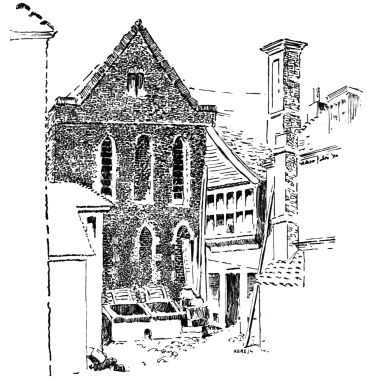
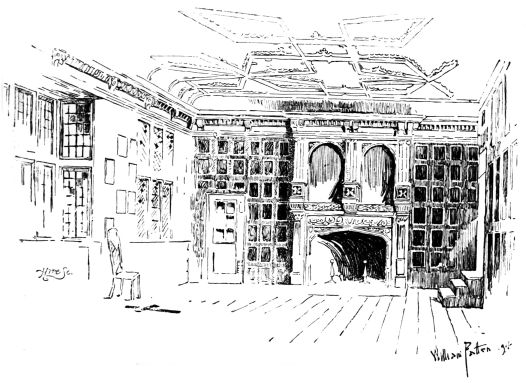
EAST END OF THE PRINCE’S CHAMBER.
First, then, for the people, the service, the officers, necessary for
the Court. There were, to begin with, the artificers and craftsmen.
Everything wanted for the Court had to be done or made within the
precincts of the Palace. There were no Court tradesmen; no outside
shops. The king’s craftsmen were the king’s servants; they had quarters
of some kind, houses or chambers, allotted to them in the Palace; they
received wages, rations, and liveries. Thus, in Richard II.’s Palace of
Westminster there were retained for the king’s service a little army of
three hundred and forty-six artificers—viz., carpenters, coopers,
blacksmiths, whitesmiths, goldsmiths, jewelers, “engineers,”
pavilioners, armorers, “artillers,” gunners, masons, tilers, bowyers and
fletchers, furriers, “heaumers,” spurriers, brewers, every kind of
“making” trade: everything that was wanted for the king’s service was
made in the king’s Palace—except, of course, the fruits and harvest of
the year, the wine, spices, and silks, and costly things that came from
the far East through the markets of Bruges and Ghent. These craftsmen
were all married—we are not, remember, in a monastery. Give them an
average of each five children, and we have, to begin with, a little
population of about two thousand five hundred. Take next the
commissariat branch: one begins already to realize the stupendous task
of feeding so many, and the order and system which must have grown up to
meet these wants with certainty and regularity. Thus we find that every
branch of the commissariat had its officers: clerks, ushers, and
serjeants—a responsible service, with individual and clearly defined
duties—for pantry, buttery, spicery, bakehouse, chandlery, brewery,
cellars, and kitchen. Of these officers there were two hundred and ten.
How many servants they had it is impossible to tell. But if we multiply
the number of officers by three only, for the servants, we get a total
of six hundred. If these men were also married, they, with their wives
and
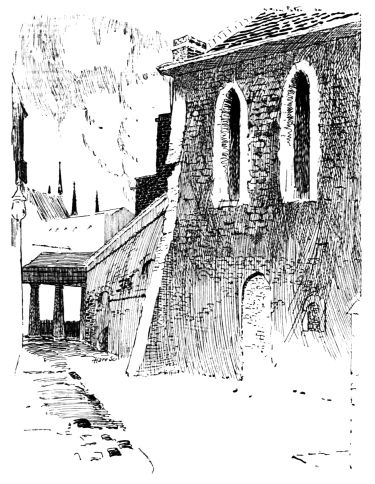
SOUTH SIDE OF THE PRINCE’S CHAMBER.
children, would give us another company of four thousand. But some of
the servants in the kitchen might be women. Then we have the gardeners,
the barbers, who were also blood-letters, the bonesetters (a very
necessary body), the trumpeters, messengers, bedesmen, grooms, and
stable-boys—no one can reckon up their number. Add to these the
lavenders or laundry-women who embroidered, did fine needlework, made
and mended, weaved and spun—many of these were doubtless the wives and
daughters of the servants. A step higher brings us to the chaplains, the
College of St. Stephen, the minstrels, the clerks and accountants, the
scribes and illuminators, the heralds and pursuivants. Another step, and
we come to the judges and the head officers, with all their staff,
clerks, and servants. Next the archbishops, bishops and abbots, some of
whom were always with the king. Then we come to the great officers of
state: viz., the Grand Seneschal Dapifer Angliæ or Lord High Steward,
who was head and chief of every department, next to the king; the High
Justiciary or Lord Chief Justice; the Seneschal, Dapifer Regis, or
Steward of the Household; the Constable, the Marshal, the Chamberlain,
the Chancellor, and the Treasurer.[2] Lastly, there was the royal
household with its officers: the Clerks of the Wardrobe, the King’s
Remembrancer, the Keeper of the Palace, the Queen’s Treasurer, the Maids
of Honor (domicellæ), the Gentlemen Ushers and the pages, and (which
we must again set down) the King’s regiment of four thousand archers.
I think it is now made plain that the people attached to a stationary
Court numbered not hundreds, but many thousands; it is not too much to
estimate the number of inhabitants within the walls of Westminster
Palace in the reign of Richard II. at twenty thousand—all of whom had
“bouche of court” (i. e., rations, pay, arms, lodging, and living).
It was, therefore, a crowded city, complete in itself, though it
produced nothing and carried on no trade; there were workshops and
forges and the hammering of armorers and blacksmiths, but there were no
stalls, no chepe, no clamor of those who shouted their goods and invited
the passengers to “buy, buy, buy.” This city produced nothing for the
country; it received and devoured everything—it was not an idle city,
because the people earned their daily bread; but for all their labor
they never increased the wealth of the country. Listen to the voice of
the poet—it is Harding who speaks of King Richard’s Court:
Truly I herd Robert Ireliffe say,
Clerk of the Green Cloth, that to the household
Came every daye, for moost partie alwaye,
Ten thousand folke by his messe is told,
That followed the hous, aye, as thei would;
And in the kechin three hundred servitours,
And in eche office many occupiours.
And ladies faire, with their gentilwomen,
Chamberers also and lavenders,
Three hundred of them were occupied there:
Ther was greate pride among the officers,
And of all menne far passing their compeers,
Of riche arraye, and muche more costious
Than was before or sith, and more precious.
The ten thousand do not include the women and children.
We have ceased to desire a Court magnificent with outward splendor and
lavish expenditure. There has been, in fact, no such Court among us
since that of Charles II.; and the splendor of his Court was but a poor
thing compared with the splendor of the Third Edward, who was
magnificent—or of Richard II., who was profuse. Let us remember that
in our time we cannot make any show, or festival, or pageant—we have
lost the art of pageantry—which can compare with the shows which our
forefathers saw daily: the shows of magnificent trains, queens and
princesses in such raiment as the greatest lady of these times would be
afraid to put on, lords and knights and gentlemen of the livery, streets
with their gabled houses hung with crimson and scarlet cloth; minstrels
and music everywhere; mysteries and pageants and allegories, with fair
maidens and giants, angels and devils; lavish feasts at which conduits
ran with wine for long hours and all the world could get drunk if it
pleased. And there was never anything more splendid than Richard II.
himself. The time of great shows vanished, like the spirit of Chivalry,
during the Wars of the Roses.
What kind of quarters were given to the king’s courtiers and his army
and his servants? This is a question to which one can give no
satisfactory answer. We hear of many rooms and buildings, but there does
not exist any description or plan of the palace as it was. It must
certainly have contained a vast number of buildings for the
accommodation of so many thousands. The fact that these buildings
existed was proved after the fire of 1834, when a most extensive range
of cellars and vaults was found to exist under the burned buildings
round St. Stephen’s. The old buildings had long before been destroyed
and modern houses had taken their places; but the vaults and cellars
remained, showing by their strength and solidity the importance of the
halls and chambers that had been built upon them.
It was the first duty of the mediæval builder to provide a wall of
defense. This was done at Westminster. The wall, as indicated on the
plan, entirely surrounded the Palace; it was provided with a water gate
at the King’s Bridge or King’s Stairs; a postern at the Queen’s Stairs;
a gate leading into the Abbey precinct east of St. Margaret’s Church; a
subway by which the king could enter the Abbey, at Poet’s Corner; and a
gate opposite the Great Hall leading into the Wool Staple.
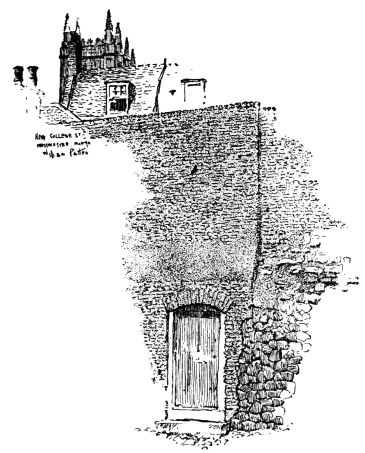
A BIT OF THE OLD WALL FROM BLACK DOG ALLEY.
Thus fortified, the Palace assumed something of the usual plan of a
Norman castle. The Outer Bailly was represented by the New Palace Yard,
with its Clock Tower and place for martial exercises, ridings, and
tournaments. Westminster Hall faced the Outer Bailly; to right and to
left, to east and to west, stood buildings; on the south were other
buildings which inclosed the Inner Bailly, now Old Palace Yard; south of
these were gardens and stables with less important houses, offices, and
barracks. The great mass of the Palace buildings was between Westminster
Hall and the river.
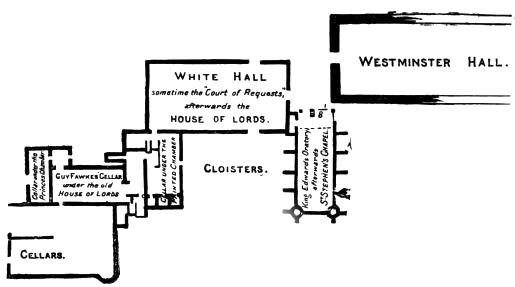
PLAN OF WESTMINSTER PALACE IN 1834.
Of the old Palace there survived, long after the removal of the Court to
Whitehall, and until the fatal fire of sixty years ago, a group of its
most interesting and most historical buildings. Changes had been made in
them; their roofs were taken down and replaced, their windows were
altered, the very walls in some had been rebuilt; yet they were the
rooms in which Edward the Confessor and all the kings and queens of
England lived up to the time of the Eighth Henry. Beneath them the solid
substructures of the Confessor remained after the fire, and, for all I
know, remain to this day.
The plan shows the position of these buildings. Beginning with the
south, there is first of all the Prince’s Chamber, afterward the Robing
Room of the old House of Lords. It was forty-five feet long and twenty
feet wide; it ran east and west. The chamber had five beautiful lancet
windows on the south side and three each on the east and west. On the
north side it opened into the old House of Lords. It was in this room
that Queen Elizabeth hung up the tapestry celebrating the defeat of the
Spanish Armada. This excellent piece of work was afterward transferred
to the Court of Requests, where it was burned in the last fire.
The hall adjoining the old House of Lords formed, with the Painted
Chamber and the Court of Requests, Edward the Confessor’s living rooms.
Under the House of Lords was the King’s kitchen, afterward the cellar
where Guy Fawkes and his friends placed the barrels of gunpowder. After
the Lords removed to the Court of Requests this room was called the
Royal Gallery.
The third room, perhaps the most beautiful, was the Painted Chamber.
This hall, certainly that in which the Confessor breathed his last, was
eighty feet long, twenty broad, and fifty high—a lofty and narrow room,
perhaps too narrow for its length. The meaning of its name had long been
forgotten, until the year 1800, when, on taking down the tapestry, which
had hung there for centuries, the walls were found to be covered with
paintings, representing on one side of the room the wars of the
Maccabees, and on the other side scenes from the life of Edward the
Confessor. It was then remembered, or discovered, that in an itinerary
of two Franciscan pilgrims in the year 1322, preserved among the
manuscripts of Corpus Christi, Cambridge, these paintings are mentioned.
In the year 1477 the hall was called St. Edward’s Chamber; Sir Edward
Coke calls it the Chamber Depeint or St. Edward’s Chamber.
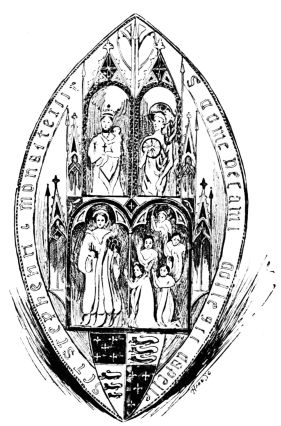
COLLEGIATE SEAL OF ST. STEPHEN’S.
The fourth of these groups of ancient buildings was the Council Room of
King Edward, called afterward the White Hall, the Little Hall, the Court
of Requests, and the House of Lords.
In the midst of this stately group of noble buildings rose the most
stately and most noble chapel of
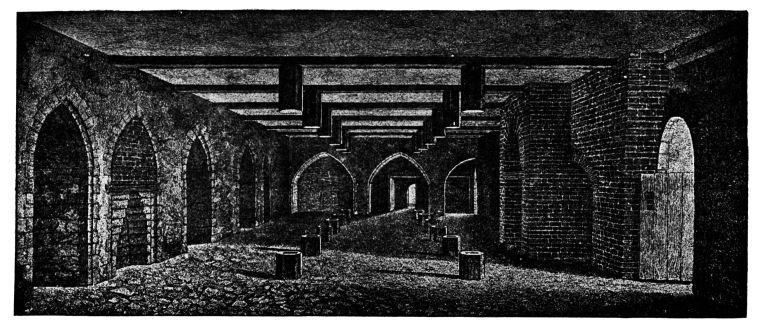
INTERIOR OF THE CRYPT CALLED THE “POWDER PLOT CELLAR,”
BENEATH THE OLD PALACE OF WESTMINSTER, LOOKING TOWARD CHARING CROSS.
TAKEN DOWN IN JUNE, 1883.
St. Stephen. It was founded, according to tradition, by King Stephen, on
the site, it has been sometimes said, of the Confessor’s oratory; but
this seems not true, for the oratory was on the east of the Painted
Chamber. The chapel was rebuilt, as a thank-offering for his victories,
by Edward I., who then endowed it with large revenues. His foundation
was large enough to maintain a college, consisting of dean, twelve
secular canons, and twelve vicars; it was, in fact, a rich foundation
planted in the middle of the Palace, over against the Abbey. Was there
any desire on the part of the King to separate the Court from the Abbey?
Perhaps not; but there arose perpetual quarrels between the College and
the Abbey. The masses said in St. Stephen’s for the past and present
kings might just as well have been said, one supposes, in the Abbey. So
rich was the foundation that at the Dissolution its revenues were a
third of those of St. Peter’s. By that time the College buildings
contained residences or chambers for thirty-eight persons. These
buildings consisted, first, of the exquisite Chapel, which afterward
became the House of Commons; the Chapel of our Lady de la Pieu, standing
somewhere to the south of St. Stephen’s (in this Chapel Richard heard
mass before going out to meet Wat Tyler); the Crypt, which happily still
remains; the exquisite cloisters, long since vanished; with the Chantry
Chapel, and the said residences of the dean, canons, and vicars, and
King Richard’s Belfry. The Chapel was smaller than some other royal
Chapels,—Windsor, for instance, and King’s, Cambridge,—but it was
beautiful exceedingly, and in its carved work and decorations perhaps
more finished than any other Church or Chapel in the country. Details of
the Chapel have been preserved for us by J. T. Smith (“Antiquities of
Westminster”), and by Brayley and Britton’s “Houses of Parliament.” The
beauty of the cloisters of the Chantry Chapel, and of the Chapel itself,
makes the fire of 1834, on this account alone, a great national
disaster. Such work can never again be equaled. At the same time, the
Chapel had been so much altered and cut about for the accommodation of
the Commons that it was irretrievably spoiled.
The next of this group of ancient buildings was Westminster Hall. On
this monument and its historical associations many have enlarged. Let it
suffice in this place to remind ourselves that William Rufus built it,
Richard II. enlarged it and strengthened it, and that George IV.
repaired and new-fronted it.
On the east side of the Hall was the Court of Exchequer, built by Edward
II. This hall was seventy-four feet long and forty-five broad. The
traditions of the chamber are full of curious stories. It was the
breakfast room, it was said (one knows not why), of Queen Elizabeth; a
chamber adjoining was her bedchamber. She at least reformed the Court of
Exchequer. There were two cellars under the Court of Exchequer, called
“Hell” and “Purgatory.” As their names denote, they were prisons. The
former name was also applied to a tavern in the Palace precinct.
The notorious Star Chamber was on the east side of New Palace Yard. The
room was probably rebuilt in the time of Queen Elizabeth. It was used
afterward as the Lottery office.
One more “bit” of the Palace still remains. If you turn to the left on
reaching the eastern end of Great College Street, after passing through
stables and mews,
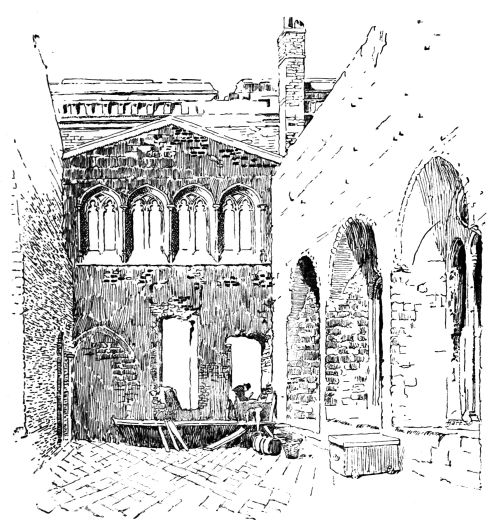
WEST END OF THE PAINTED CHAMBER AS IT APPEARED AFTER THE
FIRE OF 1834.
you will light upon a most venerable old Tower hidden away in this
corner. It is the last of the many Towers which formed part of the
Westminster Palace. It was always ascribed to the Confessor as part of
his Abbey buildings. When antiquaries first considered it, they found
that Edward I. bought the piece of ground on which it stands of the
Abbey; so it was concluded that he bought the Tower upon the ground.
Later antiquaries, however, on fresh investigations, made up their minds
that there was no Tower when Edward took the ground; therefore—the
logic of the antiquary is never his strongest point—Edward built this
Tower. Again, other antiquaries examined further, and they have now
decided that the Tower was built by Richard II. One would have preferred
the Confessor as architect, but the end of the fourteenth century gives
us a respectable antiquity.
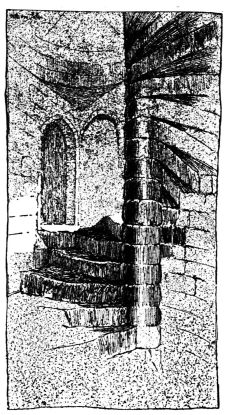
CURIOUS NEWEL STAIRCASE AT THE SOUTH-EAST ANGLE OF PAINTED CHAMBER.
Certain accounts of repairs,—carpenters’, masons’,
painters’ work,—still preserved, enable us to get a clearer
understanding of the buildings that, in addition to the central group,
which can be so exactly described and figured, made up the old Palace of
Westminster. There must have been work for builders going on
continually, but in the years 1307 to 1310 there were very extensive
repairs, in consequence of a fire; the bills for these repairs have been
preserved. They speak of the following buildings: of the Little Hall, of
which mention has been already made; of the water-conduit—the pipes of
which were repaired or restored; of the Queen’s Hall; the Nursery; the
Mayden Hall, the private hall of the domicellæ, maids of honor—all
these halls had their chambers, wardrobes, and galleries; of the
chambers and cloisters round the
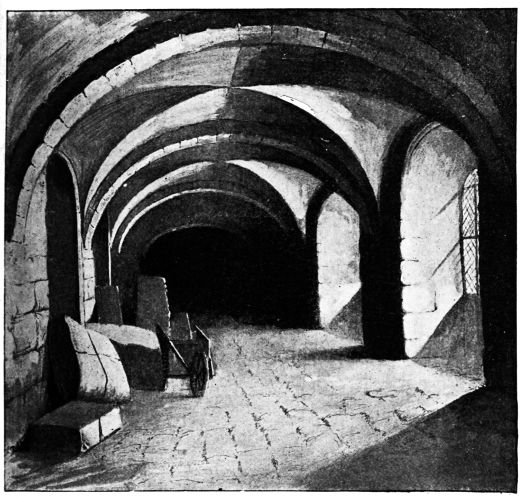
VAULT UNDER THE PAINTED CHAMBER.
Inner Hall,—was this the old House of Lords?—of the King’s Wardrobe;
of Marculf’s Chamber; of the Chandlery; of the Lord Edmund’s Palace; of
the Almonry; of the Gaol; of the houses and chambers of the chaplains,
clerks, and officers of Court and Palace; of houses standing in the
Inner Bailly—i. e., Old Palace Yard; of herbaries, vineries, gardens,
galleries, aqueducts, and stew ponds.
It is impossible to assign these buildings and places to their original
sites. Take the plan of Thorney, with its Palace, Abbey, and City.
Remember that there was an open space for the Inner Bailly—Old Palace
Yard; and another for the Outer Bailly—New Palace Yard. In this respect
the Palace followed the practice of every castle and great house in the
country; even in a college the first court is a survival of the Outer
Bailly. Leave, also, an open space east of the wall from the Jewel House
to the outer wall for the gardens and herbaries—perhaps, like the
Abbey, the Palace had gardens in the reclaimed meadows outside. Then
fill in the area between the King’s House and the river with other
halls, houses, offices, galleries, wardrobes, and cloisters. Let
barracks, stables, shops of all kinds run under the river wall; let
there be narrow lanes winding about among these courts, connecting one
with the other, and all with the Inner and the Outer Bailly and the
Palace stairs. This done, you will begin to understand something of the
extent and nature of the King’s Palace in the fourteenth century. Add to
this that the buildings were infinitely more picturesque than anything
we can show of our own design, our own construction, our own grouping.
The gabled houses turned to the courts and lanes their carved timber and
plaster fronts; the cloisters glowed in the sunshine with their
lace-like tracery and the gold and crimson of their painted roofs and
walls; gray old towers looked down upon the clustered and crowded little
city; everywhere there were stately halls, lofty roofs, tourelles with
rich carvings—gables, painted windows, windows of tracery most
beautiful, archways, gates, battlements; granaries, storehouses, barns,
chantry chapels, oratories, courts of justice, and interiors bright with
splendid tapestry, the colors of which had not yet faded, with canopies
of scarlet and cloth of gold, and the sunlight reflected from many a
shining helm and breastplate, from many a jeweled hilt and golden
scabbard, from many a trophy hanging on the walls, from many a coat of
arms bright with color—azure, or gules and argent. It is the color in
everything that makes the time so picturesque and bright. We see how
small their chambers were, how narrow were the lanes, how close the
houses stood; but we forget the bright colors of everything, the
hangings and the arras, the painted shields, the robes and dresses, the
windows and the walls, the chambers, halls, and refectories, the
galleries and the cloisters. When Time brings in another age of
color—it is surely due—we shall understand better the centuries of the
Plantagenets.
When the fire destroyed these buildings how much we lost that connected
us with the past! True it is that in Westminster Abbey and in
Westminster Hall we seem to stand face to face with the history of the
country. In the Hall were done such and such things; before us lies the
effigy of a king to remind us that he was a living reality—to most of
us the past is as unreal as the future; we need these reminders lest the
voice of our ancestors should fall upon our ears with no
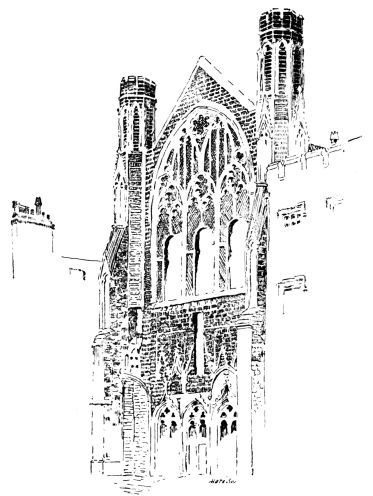
EAST FRONT OF ST. STEPHEN’S CHAPEL AS IT APPEARED AFTER
THE FIRE OF 1834.
more meaning than the lapping of the tide or the babble of the brook or
the whisper of the stream among the rushes. But we have nothing to
remind us of the Palace where the Princes lived; the things that were
done in them are not in the Book of Kings, but in that of the Things
Left Out—the Book of Chronicles—mostly as yet unedited.
Princes were born here, and played here, and grew here to the age when
they could ride the great horse and practice exercises in the New Palace
Yard. Kings’ daughters were born here, and were kept here till they were
sent away to marry—strange lot of the King’s daughter, that she never
knew until she married what her country was to be! Queens prayed here
for the safety of their husbands and their sons; here was all the home
life, the private life of the Kings and Queens; in these chambers were
held the King’s feasts; here he received ambassadors; here he held his
council; here he looked on with the Queen at the mummeries and masques;
here he held Christmas revelry; here he received and entertained—or
else admonished—my Lord Mayor and Aldermen of London; here were his
Parliaments; here were executed many nobles; here God Himself was
invited to give judgment on the ordeal of battle. In the Painted
Chamber, for instance, died King Edward the Confessor; this was the
council-chamber of the Normans; here Edward III. received the embassy of
Pope Benedict XII.; here Charles’s judges signed his death warrant; here
Chatham lay in state. In the Court of Requests, close by, Richard I.
heard cases as a judge; here Edward IV. kept his Christmas in 1472, and
entertained the Mayor and Aldermen. In the old House of Lords Bacon was
sentenced and disgraced, Somers was acquitted, Chatham was struck down.
Under this hall the conspirators of the Gunpowder Plot piled the barrels
which were to destroy the Lords sitting in council. In Old Palace Yard
died Raleigh; on the north side of Old Palace Yard lived Geoffrey
Chaucer, clerk of the works. From the Confessor and Harold through five
hundred years of kings and princes, for the whole history of England’s
Parliament, for the whole history of English law and justice, the things
that belonged to these chronicles passed in this succession of halls and
chambers.
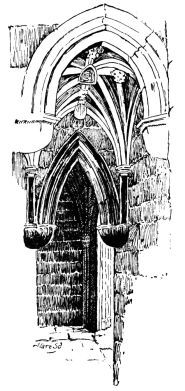
PASSAGE FROM ST. STEPHEN’S CHAPEL TO THE CLOISTER.
Thus, then, presented to you, was the Palace. You have restored the
Palace of Westminster. It stands before you, plain and clear. But as yet
it is a silent city—a city of the cold daybreak, a city of the
sleeping. Fill it again with the living multitude—the thousands who
thronged its courts—when it was the Palace of the Second Richard. Look:
the men-at-arms and esquires and knights bear the cognizance—a fatal
cognizance it proved to many—of the White Hart. It is the Palace of the
Second Richard, whose court was the most splendid, and his expenditure
the most prodigal, that the country had ever witnessed.
It is the third day of May, 1389. The sun rises before five and the day
breaks at three at this season; long before sunrise, before daybreak,
the silence of the night is broken by the rolling of the organ and the
voices of the monks at Lauds; long before sunrise, even so early as
this, there are signs of life about the Court. Stable-boys and grooms
are up already, carrying buckets of water; dogs are leaping and barking;
when the sun lifts his head above the low Surrey hills and falls upon
the wall and towers of the Palace, the narrow lanes are full of men
slowly addressing themselves to the work of the day. Clear and bright
against the sky stand the buildings; huddled together they are,
certainly—it is not yet a time for architectural grouping, except in
the design of an abbey, which is generally placed where there is room
enough and to spare. Where there is the King there is an army; there is
also a place which may be attacked: therefore the smaller the
circumference of the wall, the better for the defense. Besides, a Palace
is like a walled city: it grows, but it cannot spread; it fills up. This
hall needs another beside it; that chamber must have a gallery; this
chapel must have cloisters; here let us put up a clock tower; if there
are council chambers, there must also be guest chambers; the Court
becomes more splendid, the Palace precinct becomes more crowded.
The place is more like a camp than a Palace. The grooms lead out the
horses—there are thousands of horses in the place; in both Outer and
Inner Bailly the pages,—wards of the King,—boys of eight or nine to
sixteen, are exercising already, riding, leaping, fencing, running. In
the long chambers, where the archers lie upon beds of rushes and of
straw, the men are gathered about the doors passing round the blackjack
with the morning draught. At the water gate are crowding already the
boats laden with fish caught in the river and brought here daily. The
servants are
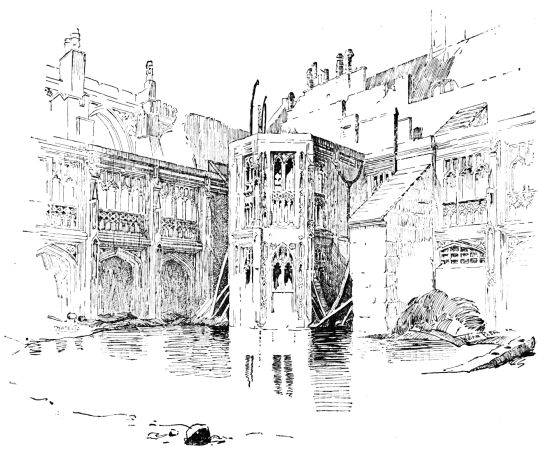
CLOISTER COURT AS IT APPEARED AFTER THE FIRE.
running to and fro; the fires are lit in kitchen and in bakery: the
clerks, pen in hand and ink-bottle hanging from their belts, go round to
the offices. Listen to the baying of the hounds; see the falconers
bringing out their birds; here are the chained bears rolling on the
ground; there go the young nobles hasting to the King’s chamber—it is
the time of gorgeous raiment: half a manor is in the blue silk jacket of
that young lord, one of the King’s favorites. There is already, from
this side or that, the tinkling of a mandolin, the scraping of a crowd;
yonder fantastic group, the first to enter when the Palace gates are
thrown open, are mummers, jugglers, and minstrels, who come to make
sport for the archers and for the Court if the King’s Highness or the
Queen’s most excellent Grace so wills. These people can play a mystery
if needs be; or they can dress like fearful wild beasts, or dance like
wild men of the woods; they have songs from France—love songs, songs
for ladies; rougher songs in English for the soldiers; they can dance
upon the tight-rope; they can eat fire; they can juggle and play strange
tricks which they have brought hither all the way from
Constantinople—at the sight of them you cross yourself and whisper that
it is sorcery. As for the music of the King’s chamber, that is made by
the King’s minstrels, who wear his colors and have bouche of court. See
yonder gayly dressed young man: he is a minstrel; none other can touch
the harp and sing with skill so sweet; he looks on with contempt at the
fantastic crew as they sweep past to the soldiers’ quarters; they, too,
carry their minstrel instruments with them, but their music is not his
music. In the evening the minstrel will join in the crowd to see the
dancing of the girls—the almond-eyed, dark-skinned girls of Syria—who
follow the fortunes of the mummers and toss their round arms as they
dance with strange gestures and wanton looks, at sight of which the
senses swim and the brain reels and the soul yearns for things
impossible.
The noise of the Palace grows; it is wide awake: the day has begun.
Outside the Palace, the road—there is now a road where there was once a
marsh or shallow with a ford—is covered with an endless procession of
those who make their way to the Palace and the Abbey with supplies. Here
are drivers with herds of cattle and flocks of sheep; here are long
lines of pack horses laden with things; here are men-at-arms, the
following of some great lord: this is a procession which never ceases
all the year round. And on the river barges are coming down the stream
piled up, laden to the level of the water, with farm produce; and at
flood tide barges come up the stream from the Port of London, sent by
the merchants whom the King despoils,—yet they have their
revenge,—boats laden with the things for which this magnificent Court
is insatiable: cloth of gold, velvet, and silk; wines of France and
Spain and Cyprus and Gaza; spices, perfumes, inlaid armor and arms,
jewels and glass and plate, and wares ecclesiastic for the outer glory
of St. Peter and St. Stephen—golden cross and chalice silver gilt, and
vestments such as can only be matched in the Church of St. Peter at
Rome.
Also along the Dover road, and up and down the road called Watling, and
up the river and down the river, there ride day and night the King’s
messengers. Was there a special service of messengers? I think
THE STAR CHAMBER. DEMOLISHED IN 1834.
not; men were dispatched with letters and enjoined to ride swiftly.
There were neither telegraphs nor railways nor postal service, yet was
the Court of every great king fully supplied with news. If it came a
month after the event, so it came to all. We of to-day act on news of
the moment; the statesmen of old acted on news of yesterday or yesterday
fortnight. But communications with the outer world never ceased; news
poured in daily from all quarters: from the Low Countries; from France
and Spain; from Rome; from the Holy Land. Whatever happened was carried
swiftly over Western Europe. If the king of Scotland crossed the border,
in three days it was known in Westminster; if there was a rebellion in
Ireland, four days brought the news to Westminster; if the Welsh harried
the March, three days sufficed to bring the news to Westminster. Beside
the messengers and bearers of dispatches, there were pilgrims who
learned and carried about a vast quantity of information; there were the
merchants whose ships arrived every day from Antwerp and from Sluys; and
there were the foreign ships which came to London Port from the Levant
and the Mediterranean.
The messengers as they arrived at the Palace of Westminster carried
their letters not to the King, but to the Archbishop of Canterbury and
to the Duke of Gloucester, the King’s uncle.
As for what follows, it is related by Francis de Winchelsea, scribe or
clerk to the King’s Council, the same who went always limp or halt by
reason of a knee stiffened by kneeling at his work; for before the
Council the clerk who writes what he is commanded must neither sit nor
stand. He kneels on his left knee and writes on the other knee. Many
things were secretly written by Francis which are kept in the Abbey hard
by, not to see the light for many years,—perhaps never,—because things
said and done in secret council must not be spread abroad, as the cleric
Froissart spread abroad all he knew and could learn, to the injury of
many reputations. Thus sayeth Francis:
“On the morning of that day—the Induction of the Cross—it chanced that
I was standing in the Cloisters of St. Stephen, whither I often repaired
for meditation. The King came forth, and with him one—I name him
not—who was his companion and friend. They walked in the cloisters, I
retiring to a far corner; they were deep in conversation, and they
marked me not. They talked in whispers for half an hour. Then the King
said aloud, ‘Have no fear: this day will I reward my friends.’
“‘Beau Sire,’ replied the other, ‘your friends have mostly lost their
heads thus far. Yet to die as your Highness’s friend should be reward
enough.’
“‘Thou shalt not die. By St. Edward’s bones—when it comes to dying——
But wait.’
“Then I knew that something great was going to happen. And since
whatever happens to Princes affects their subjects, I began to tremble.
‘This day,’ said the King. Now, there was not any Prince in the world
more comely to look upon than King Richard. Since the time of David
there had never been a Prince of more lovely aspect. He was then in
early manhood: his chin and cheek were lightly fringed with down rather
than with a beard; his face was long; his flowing hair was of a light
brown; his eyes were large,—I have noticed that the eyes of those who
sit apart and dream are often large,—yet could the King’s eyes become
suddenly and swiftly terrible to meet: never yet was English King who
was not terrible in his wrath. His nose was long and thin, his mouth was
small and delicately shaped, his chin was not long, but round and firm;
his shoulders were sloping, his fingers were long. He loved, as no other
great Lord ever loved, rich apparel: he commonly wore a doublet or
jerkin of green, embroidered with flowers, crowns, and the letters of
his name. He was already twenty-three years of age, yet he took no part
in the affairs of his own kingdom, which was managed by his uncles, the
Dukes of Lancaster and Gloucester; so that, if it be permitted thus to
speak of a King, he was fast falling into contempt as a Roy Fainéant,
one who would do nothing; and there were whispers, even in the Palace,
that a king who can do nothing must, soon or late, give place to one who
can. Yet I marked that the King looked ever to his archers, of whom he
had four thousand, and that he entertained them royally and kept them to
their loyalty. Doubtless Richard remembered the fate of his
great-grandfather, Edward the Second.
“At the hour of nine, mass said and breakfast dispatched, the King’s
Council met in Marculf’s Chamber. There were present the Archbishop of
Canterbury, the Bishop of Hereford, the Duke of Gloucester, and the Earl
of Arundel. And I also was there, on my knee, pen in hand, ready to
write.
“My Lords of the Council discoursed pleasantly of this and of that: they
had no suspicion of what would happen. Nor had I guessed the King’s
purpose. Now learn what the Roy Fainéant did.
“While the Archbishop was speaking, without a word of warning, the
council door was suddenly flung open wide and the usher called out, ‘My
Lords—the King!’
“Then Richard stood in the doorway; upon his head he wore a crown; in
his hand he carried his scepter; on his shoulders hung the mantle of
ermine, borne below by two pages; and through the door I saw a throng of
armed men and heard the clink of steel. Then I understood what was about
to happen.
“The Council rose and stood up. White were their cheeks and astonied
were their faces.
“‘Good my Lord——’ began the Duke of Gloucester.
“The King strode across the room and took his seat upon the throne. Let
no one say that Richard’s eyes were soft. This morning they were like
the eyes of a falcon; and the look which he cast upon his uncle betrayed
the hatred in his heart and foretold the revenge that he would take.
Afterward, when I heard of the King’s visit to Pleshy, I remembered that
look.
“‘Fair uncle,’ he said, ‘tell me how old am I?’
“‘Your Highness,’ replied the Duke, ‘is now in your twenty-fourth year.’
“‘Say you so? Then, fair uncle, I am now old enough to manage mine own
affairs.’
“So saying, he took the Great Seal from the Archbishop, and the keys of
the Exchequer from the Bishop of Hereford; from the Duke of Gloucester
he took his office; he appointed new Judges; he created a new Council.
“Look you,” said Francis of Winchelsea, “how secret are the counsels of
the mighty! They keep their designs secret because they cannot trust
their courtiers. The King made no sign when his uncles took the
management of the realm into their own hands; he was not yet strong
enough: he amused himself. They drove away his favorites and beheaded
them; the King still made no sign; he amused himself. When the moment
came he sprang up and delivered his blow. ’Twas a gallant Prince. Alas!
that he was not always strong. That he compassed the death of the Duke
of Gloucester no one doubts; but then the Duke had compassed the death
of his friends. Twice in his life Richard was strong; on that day and
another; twice was he strong.
“That night there was high revelry in the Palace; the mummers and the
minstrels and the music made the Court merry; and the dancing girls
moved the hearts of the young men. And the King’s Fool made the
courtiers laugh when he jested about the Duke’s amazement and the
Archbishop’s discomfiture. And as for me, plain Francis the scribe, I am
inclined, seeing the miseries that have since fallen upon that most
puissant Prince and upon this country, to humble myself and to
acknowledge the mercy of Heaven in refusing me a higher place than this
of scribe. The Kings succeed; the council changes; the ax and the block
are always doing their work; but the scribe remains, and were it not for
the stiffness of this right knee and a growing deafness, I should have
but little cause for complaint.”
Here ends the manuscript of Francis de Winchelsea.
When the King’s House was removed from Westminster to Whitehall the
importance of the old Palace suffered little diminution. St. Stephen’s
was dissolved, but the chapel was not destroyed nor were the cloisters
broken down. The Commons came across the road, leaving the Chapter House
and exchanging one lovely building for another. They proceeded so to
alter and to rebuild and add and subtract that by the time of the fire
there was not much left of the old St. Stephen’s. The other buildings of
the Palace were gradually modernized, so that in the end little was left
of the old Palace except the nest of chambers that belonged in the first
instance to Edward the Confessor, with the Hall of Rufus. As for this
mediæval Palace, with its narrow lanes, its close courts, its corridors
and cloisters, its lancet windows, its tourelles, its carved work—all
that was gone, never to be replaced. But a good deal of history, a great
many events, had to take place on this site before the building of the
present House of Parliament, which is the greatest change of all. I set
out in these chapters with the desire not to repeat, more than was
necessary, stories that have been told over and over again. It is not
always possible to avoid this repetition, since things must be related
if only to avoid a probable charge of ignorance. Some things can be
avoided as belonging rather to the History of the Nation than the
History of Westminster. Among such things are the rise and development
of the House of Commons. Some things again may be avoided as having been
told so often that no one is ignorant of them; such as the death of
Henry the Fourth in the Jerusalem Chamber. In what follows, chiefly
concerning the Palace after its desertion by the King, there will be
found some things well known to everybody, some things half known, some
things not known at all.
In the Old Palace Yard, the open court belonging to the first Palace,
many functions took place; tournaments, executions, trials by battle. At
one of these tournaments, that of 1348, two Scottish knights, the Earl
Douglas and Sir William Douglas, prisoners of war, acquitted themselves
so valiantly that the King sent them home free. Of executions in Old
Palace Yard there is recorded the hanging of a man for slaying another
within the Palace; his body, for an example, remained hanging for two
days. Of trial by battle, many are recorded in Tothill Fields and
elsewhere, and those of Old Palace Yard. One of these was held in the
presence of King Edward III., between Thomas de la Marche and John de
Visconti, to prove that the former had not been guilty of treachery
against the King of Sicily. De la Marche unhorsed his opponent and
struck him in the face as he fell. It is not stated what became of the
wounded man.
On the south side of the Old Palace Yard were certain fish ponds, or
stew ponds, which were kept stocked with eels and pike. On the east side
Geoffrey Chaucer, for a very short time,—less than a year,—occupied a
house. It stood nigh to the White Rose tavern, abutting on the old Lady
Chapel. King Henry the Seventh’s Chapel now occupies the site. And there
was a gateway or passage from the Abbey churchyard to Old Palace Yard,
over which was a house sacred to the memory of Ben Jonson, who lived
there.
In the southeast corner of Old Palace Yard stood the house which was
hired by Percy, one of the conspirators of the Gunpowder Plot, through
which the barrels of powder were conveyed to the vaults. In Palace Yard
four of the conspirators, Guy Fawkes, Thomas Winter, Ambrose Rokewood,
and Robert Keyes were executed fifteen years later, to the shame and
dishonor of the English nation. Raleigh was brought to Old Palace Yard
to die. The day chosen for his execution was Lord Mayor’s Day, so that
the crowd should be drawn to the pageant rather than the execution. It
is curious to read how Lady Raleigh attended at the execution and
carried away the head in a bag. She kept it during the rest of her life,
and after her death it was kept by her son Carew. The body lies buried
in the Chancel of St. Margaret’s.
The memory of these great mobs closes the history of Old Palace Yard.
One of these was in 1641, when six thousand citizens, armed with swords
and clubs, seized on the entrance to the House of Lords and called for
justice against Lord Strafford. The second, in 1773, when the Sheriff
and Aldermen and Common Council of London, in a procession of two
hundred carriages, attended by a huge mob, went to Westminster to
petition against the Excise scheme of Sir Robert Walpole. The third is
the mob that followed Lord George Gordon. On this occasion both Lords
and Commons found it necessary to adjourn.
New Palace Yard has been the scene of many eventful episodes in history.
Take, for instance, the history of the fight between the men of London
and the men of Westminster. From this story may be learned the
difficulty of controlling a mob, and that a London mob—and a mob fired
with a sense of wrong: that kind of wrong that always fires an
Englishman’s blood, when the game is played against the rules. Sport of
all kinds must be played by rule. Here were the men of Westminster
fairly and honestly beaten. That they should seek to revenge themselves
in so mean and treacherous a fashion—oh! it was intolerable! How would
the men of Yorkshire be fired with rage if, after a football match, the
conquerors should be treacherously assailed and murdered? Yet this is
exactly what happened. Let Stow tell the tale:
On Saint Iames day, the Citizens of London kept games of defence and
wrestling, neere vnto the Hospital of Matild, where they got the
maisterie of the menne of the Suburbes. The Baylie of Westminster
deuising to be reuenged, proclaymed a game to be at Westminster vppon
Lammas daye, wherevnto the Citizens of London repayred, and when they
had played a while, the Baylie with the men of the suburbs harnised
themselves and fell to fighting, that the Citizens being foully wounded,
were forced to runne into the Citie, where they rang the common Bel,
and assembled the Citizens in gret number, and when the matter was
declared, euery man wished to reuenge the fact. The Maior of the Citie
being a wise man and a quiet, willed them firste to moue the Abbot of
Westminster of the matter, and if he wold promise to see amendes made,
it were sufficient: but a certaine Citizen named Constantine Fitz
Arnulfe, willed that all houses of the Abbot and Baylie should be pulled
downe, whiche word being once spoken, the common people issued out of
the Citie without anye order, and fought a ciuil battaile: for
Constantine the firste pulled downe many houses, and ofttimes with a
loude voyce cryed in prayse of the sayd Constantine, the ioye of the
mountaine, the ioy of the mountaine, God helpe and the Lord Lodowike.
A fewe dayes after this tumult, the Abbot of Westminster came to
London to Phillip Dawbney, one of the kings counsel, to complaine of
the iniuries done to him, which the Londoners perceyuing, beset the
house aboute, and tooke by violence twelue of the Abbots horsses away,
cruelly beating of his men, &c. But whiles the foresayde Daubney,
laboured to pacifie the vprore, the Abbot gotte out at a backe dore of
the house, and so by a boate on the Thamis hardlye escaped, the
Citizens throwing stones after him in great aboundāce. These things
being thus done, Hubert de Burgo, Justiciar of England, with a great
armye of men came to the Tower of London, and sent for the Maior and
Aldermē, of whom he enquired for the principal aucthours of this
faction. Then Constantine, who was constaunt in the sedition, was more
constante in the aunsweare, affirming, that he had done it, and that he
hadde done muche lesse than he ought to haue done. The Justiciar tooke
him and two other with him, and in ý morning carely sent them to
Falcatius by water, with a gret number of armed men, who brought
Constantine to the gallowes, and when he sawe the rope about his necke,
he offered for his life 15000. marks, but that would not saue him: so he
was hanged with Constantine his nephew, & Galfride, that proclaymed his
proclamation on the sixteenth of August.
Then the Justiciar entring the City with a great army, caused to be
apprehended as many as he coulde learne to be culpable, whose feet and
hands he caused to be cut off, which crueltie caused many to flee the
Citie.
The king toke of the Citizens 60 pledges, which he sēt to diuers
Castelles: he deposed the Maior, appointing a Gardien or keeper ouer the
Citie, and caused a greate gybet to be made, and after heauie
threatnings, the Citizens were reconciled, paying to the king manye
thousande markes.
The bawling for the Lord Lodowicke was a very foolish thing to do. It
showed, first, that the Londoners associated the men of Westminster with
the Court; it showed also that the memory of Prince Louis of France, who
had taken up his residence for a time in London, still survived. But it
was ill advised, because it set the King against the citizens.
The pillory of New Palace Yard has held some notable persons in its
embrace: Perkin Warbeck, for instance, who had to read his own
confession. The same ceremony was performed in Cheapside “with many a
curse and much wondering,” says Stow. In this pillory stood Alexander
Leighton, for a fanatical libel. Here stood William Prynne for writing
the “Histrio Mastix.” Here stood Titus Oates, and here stood the printer
of Wilkes’s famous “No 45.”
New Palace Yard was formerly an inclosed area, surrounded by buildings
picturesquely grouped. I do not think we have anything to show more
picturesque than New Palace Yard in the fifteenth century. On the North
side stood the Clock Tower, just where Parliament Street now begins. It
was a very handsome Clock Tower, erected against his will by Chief
Justice Ralph Hingham in the reign of Edward I. He was amerced in the
sum of eight hundred marks for altering a court roll in favor of a poor
man. His charity cost him dear. There was a warden of the Clochier, and
the bell, called Tom, was the heaviest in London. In the year 1698 the
Clock Tower was given to the Vestry of St. Margaret’s. They proceeded to
pull it down—one knows not why. The materials were sold for £200; the
bell for £385 17s. 6d.; it weighed 82 cwt. 2 qrs. 21 lbs. The bell was
recast and taken to St. Paul’s.
On either side of the Clock Tower ran houses
belonging to the merchants of the Wool Staple, the market place of which
was at the back of the houses; an archway opened into King Street at the
northwest corner; the west side was occupied by houses, the gate into
the Abbey, and St. Margaret’s; on the south side was Westminster Hall,
with the Courts of the Exchequer; on the east was the Star Chamber,
ending in what was called the Bridge, and a pier running out into the
river. Under the Courts of the Exchequer were two prisons called “Hell,”
and “Purgatory.” There was also “Heaven,” and all these places became
taverns.
When one speaks of Westminster Hall it seems as if the whole of English
history rolls through that ancient and venerable building. Historians
have exhausted their eloquence in speaking of these gray old walls. What
things have they not seen? The coronation banquets; the entertainments
of kings; the proclamations; the solemn oaths; the State trials; we
cannot, if we would, keep out of Westminster Hall. It was once the High
Court of Justice: three Judges sat here in different parts of the Hall,
hearing as many cases.
The State trials may be left to Macaulay and the historians. I think
that we are here most concerned in that curious trial of the ‘prentices
which followed “Evil May Day,” 1547.
Everybody knows that the Church of St. Andrew Undershaft is so called
because a tall May-pole, the highest in London, was laid along, under a
pentice, the side of the church and a row of houses called Shaft Alley.
Every May Day the pole was taken off its iron hooks and set up on the
south side of the church in the street, being higher than the steeple
itself. Now, as to the connection of the steeple with Westminster Hall,
it shall be told in the words of Maitland:
“About two Years after this, an Accident happened, which occasioned the
Epithet of Evil to be added to this Day of Rejoicing, and that Day was
afterward noted by the Name of Evil May Day. In the ninth Year of the
Reign of King Henry VIII. A great Heart-burning, and malicious Grudge,
grew amongst the Englishmen of the City of London, against
Strangers; and namely, the Artificers found themselves much aggrieved,
because such Number of Strangers were permitted to resort hither with
their Wares, and to exercise Handicrafts, to the great Hindrance and
Impoverishing of the King’s Liege People: Which Malice grew to such a
Point, that one John Lincolne, a Broker, busied himself so far in the
Matter, that about Palm-Sunday, or the fifth of April, he came to
one Dr. Standish, with these Words; ‘Sir, I understand that you shall
preach at the Spital on Monday in Easter Week; and so it is, that
Englishmen, both Merchants and others, are undone by Strangers, who
have more Liberty in this Land, than they, which is against Reason, and
also against the Commonweal of this Realm. I beseech you, therefore, to
declare this in your Sermon, and in so doing you shall deserve great
Thanks of my Lord-Mayor, and of all his Brethren.’ And herewith he
offered unto the said Doctor a Bill containing the Matter more at large:
But Doctor Standish, wisely considering, that there might more
Inconvenience arise from it, than he would wish, if he should deal in
such Sort, both refused the Bill, and told Lincolne plainly, that he
meant not to meddle with any such Matter in his Sermon.
“Whereupon the said Lincolne, went unto one Dr. Bell, or Bele, a
Canon of the aforesaid Spital, that was appointed likewise to preach
upon Tuesday in Easter Week, at the same Spital, whom he persuaded
to read his said Bill in his Pulpit. Which Bill contained (in effect)
the Grievances that many found from Strangers, for taking the Livings
away from Artificers and the Intercourse from Merchants, the Redress
whereof must come from the Commons united together; for, as the Hurt
touched all Men, so must all set to their helping Hands: Which Letter he
read, or the chief Part thereof, comprehending much seditious Matter,
and then he began with this Sentence; Cœlum Cœli Domino, Terrain autem
dedit Filiis Hominum, i. e., The Heavens to the Lord of Heaven, but
the Earth he hath given to the children of Men: And upon this Text he
shewed how this Land was given to Englishmen, and, as Birds defend
their Nests, so ought Englishmen to cherish and maintain themselves,
and to hurt and grieve Aliens for Respect of their Commonwealth: And on
this Text, Pugna pro Patria, i. e., Fight for your Country, he
brought in, how (by God’s Law) it was lawful to fight for their Country,
and thus he subtilly moved the People to oppose Strangers. By this
Sermon, many a light-headed Person took Courage, and spoke openly
against them: And by chance there had been divers ill Things of late
done by Strangers, in and about the City of London, which kindled the
People’s Rancour the more furiously against them.
“The twenty-eighth Day of April, divers young Men of the City picked
Quarrels with certain Strangers, as they passed along the Streets: Some
they smote and buffeted, and some they threw into the Channel; for which
the Lord Mayor sent some of the Englishmen to prison, as Stephen
Studley, Skinner, Stevenson Betts, and others.
“Then suddenly rose a secret Rumour, and no Man could tell how it began,
that on May-Day, next following, the City would slay all the Aliens,
insomuch that divers Strangers fled out of the City.
“This Rumour came to the Knowledge of the King’s Council; whereupon the
Lord Cardinal sent for the Mayor, and other of the Council of the City,
giving them to understand what he had heard.
“The Lord-Mayor, as one ignorant of the Matter, told the Cardinal, that
he doubted not so to govern the City, but that Peace should be obtained.
“The Cardinal willed him so to do, and to take heed, that, if any
riotous Attempt were intended, he should by good Policy prevent it.
“The Mayor coming from the Cardinal’s House, about four o’Clock in the
Afternoon, on May-Eve, sent for his Brethren to the Guildhall; yet
was it almost seven o’Clock before the Assembly was set. Upon Conference
had of the Matter, some thought it necessary, that a substantial Watch
should be set of honest Citizens, which might withstand the Evil-Doers,
if they went about any Misrule: Others were of contrary Opinion, as
rather thinking it best, that every Man should be commanded to shut up
his Doors, and to keep his Servants within. Before eight o’Clock, the
Recorder was sent to the Cardinal with these Opinions, who, hearing the
same, allowed the latter: And then the Recorder, and Sir Thomas More,
late Under-Sheriff of London, and of the King’s Council, came back
again to the Guildhall, half an Hour before nine o’Clock, and there
shewed the Pleasure of the King’s Council; whereupon every Alderman sent
to his Ward, that no Man, after nine o’Clock, should stir out of his
House, but keep his Doors shut, and his Servants within, until nine
o’Clock in the Morning.
“After this Command was given in the Evening, as Sir John Mundy,
Alderman, came from his Ward, he found two young Men in Cheap, playing
at the Bucklers, and a great many young Men looking on them; for the
Command seemed to be scarcely published: He ordered them to leave off;
and, because one of them asked, Why? he would have them sent to the
Compter: But the ‘Prentices resisted the Alderman, taking the young
Man from him, and cried, ‘Prentices, ‘Prentices! Clubs, Clubs! then
out of every Door came Clubs, and other Weapons, so that the Alderman
was put to Flight. Then more People arose out of every Quarter, and
forth came Serving-men, Watermen, Courtiers, and others, so that by
eleven o’Clock there were in Cheap six or seven hundred; and out of
St. Paul’s Church-yard came about three hundred. From all Places they
gathered together, and broke open the Compter, took out the Prisoners
committed thither by the Lord-Mayor for hurting the Strangers; they went
also to Newgate, and took out Studley and Betts, committed for the
like Cause. The Mayor and Sheriffs were present, and made Proclamation
in the King’s Name, but were not obeyed.
“Being thus gathered in crowds, they ran thro’ St. Nicholas’s
Shambles; and at St. Martin’s Gate Sir Thomas More, and others, met
them, desiring them to return to their Homes, which they had almost
persuaded them to do; when some within St. Martin’s, throwing Sticks
and Stones, hurt several who were with Sir Thomas More, particularly
one Nicholas Dennis, a Serjeant at Arms, who, being much wounded,
cried out, Down with them; and then all the unruly Persons ran to the
Doors and Windows of the Houses within St. Martin’s, and spoiled all
they found. After that they ran into Cornhill, and so on to a House
East of Leadenhall, called the Green-Gate, where dwelt one Mewtas,
a Picard, or Frenchman, with whom dwelt several other Frenchmen.
These they plundered; and, if they had found Mewtas, they would have
struck off his Head.
“They ran to other Places, and broke open and plundered the Houses of
Strangers, and continued thus till three o’Clock in the Morning, at
which Time they began to withdraw; but by the Way they were taken by the
Mayor and others, and sent to the Tower, Newgate, and the
Compters, to the Number of three hundred.
“The Cardinal, being advertised of this by Sir Thomas Parre, sent him
immediately to inform the King of it at Richmond; and he forthwith
sent to learn what Condition the City was in. Sir Roger Cholmeley,
Lieutenant of the Tower, during the Time of this Business, shot off
certain Pieces of Ordnance against the City, but did no great Hurt.
About five o’Clock in the Morning the Earls of Shrewsbury and
Surrey, Thomas Dockery, Lord Prior of St. John’s, George Nevil,
Lord Abergavenny, and others, came to London, with what Forces they
could get together; so did the Inns of Court: But, before they came, the
Business was all over.
“Then were the Prisoners examined, and the Sermon of Doctor Bell
called in Question, and he sent to the Tower. A Commission of Oyer
and Terminer was directed to the Duke of Norfolk, and other Lords,
for the Punishment of this Insurrection. The second of May, the
Commissioners, with the Lord-Mayor, Aldermen, and Justices, went to
Guildhall, where many of the Offenders were indicted; whereupon they
were arraigned, and pleaded Not Guilty, having one Day given them,
‘till the fourth of May.
“On which Day, the Lord-Mayor, the Duke of Norfolk, the Earl of
Surrey, and others, came to sit in the Guildhall. The Duke of
Norfolk entered the City with one thousand three hundred Men, and the
Prisoners were brought thro’ the Streets tied with Ropes; some Men, some
Lads but of thirteen or fourteen Years old, to the Number of two hundred
and seventy-eight Persons. That Day John Lincolne, and divers others
were indicted; and the next Day thirteen were adjudged to be drawn,
hanged and quartered; for Execution whereof ten Pair of Gallows were set
up in divers Places of the City, as at Aldgate, Blanchapleton,
Grass-Street, Leadenhall, before each of the Compters, at
Newgate, St. Martin’s, at Aldersgate, and Bishopsgate: And these
Gallows were set upon Wheels to be removed from Street to Street, and
from Door to Door, as the Prisoners were to be executed.
“On the seventh of May, Lincolne, Sherwin, and the two Brothers
named Betts, with several of their Confederates, were found guilty,
and received Sentence as the former; when, within a short Time after,
they were drawn upon Hurdles to the Standard in Cheapside; where
Lincolne was first executed; but, as the rest were about to be turned
off, a Reprieve came from the King to stay the Execution: upon which the
People shouted, crying, God save the King; and thereupon the Prisoners
were carried back to Prison, there to attend the King’s farther
Pleasure.
“After all this, all the Armed Men, which before had kept Watch in the
City, were withdrawn; which gave the Citizens Hope that the King’s
Displeasure towards them was not so great as themselves conceived:
Whereupon, on the eleventh of May, the King residing at his Manor of
Greenwich, the Mayor, Recorder, and divers Aldermen, went in Mourning
Gowns to wait upon him; and having Admittance to the Privy-Chamber
Door, after they had attended there for some Time, the King, attended
with several of his Nobles, came forth; whereupon they falling upon
their Knees, the Recorder in the Name of the rest spake as followeth:
“‘Most Natural, Benign, and our Sovereign Lord, We well know that your
Grace is highly displeased with us of your City of London, for the
great Riot done and committed there; wherefore we assure your Grace,
that none of us, nor no honest Person, were condescending to that
Enormity; yet we, our Wives and Children, every Hour lament that your
Favour should be taken from us; and forasmuch as light and idle Persons
were the Doers of the same, we most humbly beseech your Grace to have
Mercy on us for our Negligence, and Compassion on the Offenders for
their Offences and Trespasses.’
“To which the King replied; ‘Truly you have highly displeased and
offended us, and therefore you ought to wail and be sorry for the same;
and whereas you say that you the substantial Citizens were not
consenting to what happened, it appeareth to the contrary; for you
never moved to let them, nor stirred to fight with those whom you say
were so small a Number of light Persons; wherefore we must think, and
you cannot deny, but that you did wink at the Matter: Therefore at this
Time we will neither grant you our Favour nor Goodwill, nor to the
Offenders Mercy; but resort to our Lord Chancellor, and he shall make
you an Answer, and declare to you our Pleasure.’
“At this Speech of the King’s, the Citizens departed very sorrowful;
but, having Notice that the King intended to be at his Palace of
Westminster on the twenty-second of May, they resolved to repair
thither, which they did accordingly, though not without the Appointment
of Cardinal Wolsey, who was then Lord Chancellor; when as a Cloth of
Estate being placed at the upper End of Westminster-Hall, the King
took his Place, and after him the Cardinal, the Dukes of Norfolk and
Suffolk, the Earls of Wiltshire, Surry, Shrewsbury, and Essex,
with several others; the Lord-Mayor, Recorder, and Aldermen, together
with many of the Commons, attending in their Liveries; when, about nine
o’Clock, Order was given for the bringing forth the Prisoners, which was
accordingly done; so that in they came in their Shirts, bound together
with Ropes, and Halters about their Necks, to the Number of four hundred
Men, and eleven Women, one after another; which Sight so moved several
of the Nobility, that they became earnest Intercessors to the King for
their Pardon.
“When Silence was made, and they were all come into the King’s Presence,
the Cardinal sharply rebuked the Mayor, Aldermen, and Commonalty, for
their negligence; and then, addressing his Speech to the Prisoners, he
told them, That for their Offences against the Laws of the Realm, and
against his Majesty’s Crown and Dignity, they had deserved Death:
Whereupon they all set up a piteous Cry, saying, Mercy, Gracious Lord,
Mercy; which so moved the King, that, at the earnest Intreaty of the
Lords, he pronounced them pardoned; upon which giving a great Shout,
they threw up their Halters towards the Roof of the Hall, crying, God
save the King. When this News was bruited abroad, several that had been
in the Insurrection, and had escaped, came in upon their own accords
with Ropes about their Necks, and received the Benefit of the King’s
Pardon; after which the Cardinal gave them several good Exhortations
tending to Loyalty and Obedience; and so dismissed them, to their no
small Joy; and within a while after the Gallowses that were set in the
several Parts of the City, were taken down, which so far pleased the
Citizens, that they expressed infinite Thanks to the King for his
Clemency.
“This Company was called the Black Waggon; and the Day whereon this
Riot and Insurrection happened, bears the Name of Evil May-Day to
these our present Times. And thus have you heard how the Citizens
escaped the King’s Displeasure, and were again received into Favour;
though, as it is thought, not without paying a considerable Sum of Money
to the Cardinal to stand their Friend, for at that Time he was in such
Power, that he did all with the King.
“These great Mayings and May-Games, with the triumphant Setting-up
the great Shaft, a principal May-pole in Leadenhall-Street before the
Parish Church of St. Andrew, thence called Undershaft, were not so
commonly used after this Insurrection on May-Day, 1517, as before.”
The story must be finished, though this part of it does not belong to
Westminster, by showing the end of the shaft.
After the Evil May-Day it was never raised again. This proves the
growing dread, in the minds of the officials, of the mob when they came
together. The after history of London is full of this dread, which
experience fully justifies. The famous May-pole hung upon its hooks from
the year 1517 to the year 1549, the third of Edward VI. There flourished
at that time a certain person named Sir Stephen, a curate of St.
Katharine Cree, a fanatic of the most abominable kind. He wanted to turn
the Reformation into a Revolution; all the ancient ways were to be
abandoned or turned upside down. He wanted the names of churches to be
altered; the names of the days of the week to be altered—“Saturday” is
sheer pagan, and so is Friday, for we all know who Freya was; he wanted
fishdays to be any days except Friday and Saturday; and Lent to be
observed at any time of the year except the time between Shrove Tuesday
and Easter Sunday. “I have often,” says Stow, “seen this man forsaking
the pulpit of his said parish church, preach out of a high elm tree in
the midst of the churchyard, and then entering the church, forsaking the
altar, to have sung his high mass in English upon a tomb of the dead
towards the north.” Now on one occasion Sir Stephen preached at Paul’s
Cross, and he told the people that by naming the church St. Andrew
Undershaft they made an idol of a May-pole. “I heard his sermon,” says
Stow, “and I saw the effect that followed, for in the afternoon of that
present Sunday, the neighbours and tenants to the said bridge over whose
doors the said shaft then leaned, after they had well dined, to make
themselves strong, gathered more help and with great labour rending the
shaft from the hooks, whereon it had rested two and thirty years, they
sawed it in pieces, every man taking for his share so much as had lain
over his door and stall, the length of his house: and they of the alley
divided among them so much as had lain over their alley gate. Thus was
this idol, as he, poor man, termed it, mangled and after burned.”
Many great and memorable events took place in the Hall, apart from the
grand functions of State, or beside them. For instance, here began the
massacre of the Jews at the coronation of Richard I. Here, in the same
reign, the Archbishop and the Lords sat to pronounce sentence upon
William Longbeard, who came with thousands of followers, so that they
dared not pronounce sentence upon him. Here they brought the prisoners
of Lincoln, a hundred and two Jews charged with crucifying a child, Hugh
of Lincoln. That must have been a strange sight, this company of aliens
who could never blend with the people among whom they lived: different
in face, different in ideas, different in religion. They are dragged
into the Hall, roped together: the prospect of death is before them;
they are accused of a crime which they would not dare to commit, even at
the very worst time of oppression; even when the wrongs and injustices
and hatred of the people had driven them well-nigh mad. At the end of
the Hall sit their judges; the men-at-arms are at their side to let none
escape; the Hall is filled with people eager for their blood. The
witnesses are called: they have heard this said and that said; it is all
hearsay—there is nothing but hearsay; and at the close eighteen of them
are sentenced to be hanged, and the rest are driven back to prison,
lucky if, after many years, they live to receive the King’s release.
Stalls and shops for books, ribbons, and other things were set up along
the sides of the Hall; and it was always a great place for lawyers.
Lydgate says, speaking of the Hall:
Within this Hall, neither riche nor yet poore,
Wolde do for aught, althogh I sholde dye:
Which seeing I gat me out of the doore,
Where Flemynge on me began for to cry,
Master, what will you require or by?
Fyne felt hatts or spectacles to rede,
Lay down your sylver and here you may spede.
And so enough of Westminster Hall and the History of England.
![[Image of the book's cover unavailable.]](images/cover_lg.jpg)


