The course of lectures, of which the following are part, were delivered
before the St. Mary’s committee of the Algic Society. Two of them only
have been published. They are here continued from the article “Indian
Languages,” at page 202 of the “Narrative of the Discovery of the actual
Source of the Mississippi, in Itasca Lake,” published by the Harpers, in
1834. The family of languages selected as the topic of inquiry, is the
Algonquin. All the examples employed are drawn from that particular
type of it which is called Chippewa, in our transactions with them, but
which they uniformly pronounce themselves, Od-jib-wa. These terms
are employed as perfect synonyms. The phrase “Odjibwa-Algonquin,”
wherever it occurs, is intended to link, in the mind of the inquirer, the
species and the genus (if we may borrow a term from natural history) of
the language, but is not fraught with, or intended to convey, any additional
idea. The three terms relate to one and the same people.
LECTURE III.
Observations on the Adjective—Its distinction into two classes denoted by the presence
or absence of vitality—Examples of the animates and inanimates—Mode of their
conversion into substantives—How pronouns are applied to these derivatives, and the
manner of forming compound terms from adjective bases, to describe the various natural
phenomena—The application of these principles in common conversation, and in
the description of natural and artificial objects—Adjectives always preserve the distinction
of number—Numerals—Arithmetical capacity of the language—The unit
exists in duplicate.
1. It has been remarked that the distinction of words into animates and
inanimates, is a principle intimately interwoven throughout the structure
of the language. It is, in fact, so deeply imprinted upon its grammatical
forms, and is so perpetually recurring, that it may be looked upon, not
only as forming a striking peculiarity of the language, but as constituting
the fundamental principle of its structure, from which all other rules have
derived their limits, and to which they have been made to conform. No
class of words appears to have escaped its impress. Whatever concords
other laws impose, they all agree, and are made subservient in the establishment
of this.
It might appear to be a useless distinction in the adjective, when the
substantive is thus marked; but it will be recollected that it is in the
plural of the substantive only, that the distinction is marked. And we
shall presently have occasion to show, that redundancy of forms, are, to
considerable extent, obviated in practice.
For the origin of the principle itself, we need look only to nature, which endows
animate bodies with animate properties and qualities, and vice versa.
But it is due to the tribes who speak this language, to have invented one set of
adjective symbols to express the ideas peculiarly appropriate to the former,
and another set applicable, exclusively, to the latter; and to have given
the words good and bad, black and white, great and small, handsome and
ugly, such modifications as are practically competent to indicate the general
nature of the objects referred to, whether provided with, or destitute
of the vital principle. And not only so, but by the figurative use of
these forms, to exalt inanimate masses into the class of living beings, or
to strip the latter of the properties of life—a principle of much importance
to their public speakers.
This distinction is shown in the following examples, in which it will be
observed, that the inflection izzi, generally denotes the personal, and au,
un, or wud, the impersonal forms.
| Adj: | Inanimate. | Adj: | Animate. |
| Bad | Monaud | ud | Monaud | izzi. |
| Ugly | Gushkoonaug | wud | Gushkoonaug | oozzi. |
| Beautiful | Bishegaindaug | wud | Bishegaindaug | oozzi. |
| Strong | Söng | un | Söng | izzi. |
| Soft | Nök | un | Nök | izzi. |
| Hard | Mushkow | au | Mushkow | izzi. |
| Smooth | Shoiskw | au | Shoiskw | oozzi. |
| Black | Mukkuddäw | au | Mukkuddäw | izzi. |
| White | Waubishk | au | Waubishk | izzi. |
| Yellow | Ozahw | au | Ozahw | izzi. |
| Red | Miskw | au | Miskw | izzi. |
| Blue | Ozhahwushkw | au | Ozhahwushkw | izzi. |
| Sour | Sheew | un | Sheew | izzi. |
| Sweet | Weeshkob | un | Weeshkob | izzi. |
| Light | Naung | un | Naung | izzi. |
It is not, however, in all cases, by mere modifications of the adjective
that these distinctions are expressed. Words totally different in sound,
and evidently derived from radically different roots, are, in some few instances,
employed, as in the following examples:
| Adj: Inanimate. | Adj: Animate. |
| Good | Onisheshin | Minno. |
| Bad | Monaudud | Mudjee. |
| Large | Mitshau | Mindiddo. |
| Small | Pungee | Uggaushi. |
| Old | Geekau | Gitizzi. |
It may be remarked of these forms, that although the impersonal will, in
some instances, take the personal inflections, the rule is not reciprocated, and
minno, and mindiddo, and gitizzi, and all words similarly situated, remain
unchangeably animates. The word pungee, is limited to the expression
of quantity, and its correspondent uggaushi, to size, or quality. Kishedä,
(hot) is restricted to the heat of a fire; keezhautä, to the heat of the
sun. There is still a third term to indicate the natural heat of the body,
Kizzizoo. Mitshau (large) is generally applied to countries, lakes, rivers,
&c. Mindiddo, to the body, and gitshee, indiscriminately. Onishishin,
and its correspondent onishishsha, signify, handsome or fair, as well
as good. Kwonaudj a. a. and kwonaudj ewun a. i. mean, strictly, handsome,
and imply nothing further. Minno, is the appropriate personal
form for good. Mudgee and monaudud, may reciprocally change genders,
the first by the addition of i-e-e, and the second by altering ud to
izzi.
Distinctions of this kind are of considerable importance in a practical
point of view, and their observance or neglect, are noticed with scrupulous
exactness by the Indians. The want of inanimate forms to such words as
happy, sorrowful, brave, sick &c. creates no confusion, as inanimate nouns
cannot, strictly speaking, take upon themselves such qualities, and when
they do—as they sometimes do, by one of those extravagant figures of
speech, which are used in their tales of transformations, the animate forms
answer all purposes. For in these tales the whole material creation may
be clothed with animation. The rule, as exhibited in practice, is limited,
with sufficient accuracy, to the boundaries prescribed by nature.
To avoid a repetition of forms, were the noun and the adjective both to
be employed in their usual relation, the latter is endowed with a pronominal,
or substantive inflection. And the use of the noun, in its separate
form, is thus wholly superceded. Thus onishishin, a. i. and onishishsha,
a. a. become Wanishishing, that which is good, or fair, and Wanishishid,
he who is good or fair. The following examples will exhibit this
rule, under each of its forms.
Compound or Noun-Adjective Animate.
| Black | Mukkuddaw | izzi | Makuddaw | izzid. |
| White | Waubishk | izzi | Wyaubishk | izzid. |
| Yellow | Ozahw | izzi | Wazauw | izzid. |
| Red | Miskw | izzi | Mashk | oozzid. |
| Strong | Song | izzi | Song | izzid. |
Noun-Adjective Inanimate.
| Black | Mukkuddäw | au | Mukkuddäw | aug. |
| White | Waubishk | au | Wyaubishk | aug. |
| Yellow | Ozahw | au | Wäzhauw | aug. |
| Red | Mishkw | au | Mishkw | aug. |
The animate forms in these examples will be recognized, as exhibiting
a further extension of the rule, mentioned in the preceding chapter, by
which substantives are formed from the indicative of the verb by a permutation
of the vowels. And these forms are likewise rendered plural in
the manner there mentioned. They also undergo changes to indicate the
various persons. For instance onishisha is thus declined to mark the
person.
| Wänishish-eyaun | I (am) good, or fair. |
| Wänishish-eyun | Thou (art) good, or fair. |
| Wänishish-id | He (is) good or fair. |
| Wänishish-eyang | We (are) good or fair (ex.) |
| Wänishish-eyung | We (are) good a fair (in.) |
| Wänishish-eyaig | Ye (are) good or fair. |
| Wänishish-idigj | They (are) good or fair. |
The inanimate forms, being without person, are simply rendered plural
by in, changing maiskwaug, to maiskwaug-in. &c. &c. The verbal signification
which these forms assume, as indicated in the words am, art, is,
are, is to be sought in the permutative change of the first syllable. Thus
o is changed to wä, muk to mäk, waub to wy-aub, ozau to wäzau, misk
to maisk, &c. The pronoun, as is usual in the double compounds, is
formed wholly by the inflections eyaun, eyun, &c.
The strong tendency of the adjective to assume a personal, or pronomico-substantive
form, leads to the employment of many words in a particular,
or exclusive sense. And in any future practical attempts with the
language, it will be found greatly to facilitate its acquisition if the adjectives
are arranged in distinct classes, separated by this characteristic principle
of their application. The examples we have given are chiefly those
which may be considered strictly animate, or inanimate, admit of double
forms, and are of general use. Many of the examples recorded in the
original manuscripts employed in these lectures, are of a more concrete
character, and, at the same time, a more limited use. Thus shaugwewe,
is a weak person, nökaugumme, a weak drink, nokaugwud, a weak, or
soft piece of wood. Sussägau, is fine, but can only be applied to personal
appearance: beesau, indicates fine grains. Keewushkwa is giddy,
and keewushkwäbee, giddy with drink, both being restricted to the third
person. Söngun and songizzi, are the personal and impersonal forms of
strong, as given above. But Mushkowaugumme, is strong drink. In
like manner the two words for hard, as above, are restricted to solid substances.
Sunnuhgud is hard (to endure,) waindud, is easy (to perform.)
Söngedää is brave, Shaugedää cowardly, keezhinzhowizzi, active, kizhekau,
swift, onaunegoozzi lively, minwaindum happy, gushkwaindum, sorrowful,
but all these forms are confined to the third person of the indicative,
singular. Pibbigwau, is a rough or knotted substance. Pubbiggoozzi,
a rough person. Keenwau is long, or tall, (any solid mass.) Kaynozid
is a tall person. Tahkozid a short person. Wassayau is light;
wassaubizzoo, the light of the eye; wasshauzhä, the light of a star, or any
luminous body. Keenau is sharp, keenaubikud, a sharp knife, or stone.
Keezhaubikeday, is hot metal, a hot stove, &c. Keezhaugummeda, is hot
water. Aubudgeetön, is useful,—a useful thing. Wauweeug is frivolous,
any thing frivolous in word, or deed. Tubbushish, appears to be a general
term for low. Ishpimming is high in the air. Ishpau, is applied to
any high fixture, as a house, &c. Ishpaubikau is a high rock. Taushkaubikau,
a split rock.
These combinations and limitations meet the inquirer at every step.
They are the current phrases of the language. They present short,
ready, and often beautiful modes of expression. But as they shed light,
both upon the idiom and genius of the language, I shall not scruple to add
further examples and illustrations. Ask a Chippewa, the name for rock,
and he will answer awzhebik. The generic import of aubik, has been explained.
Ask him the name for red rock, and he will answer miskwaubik,—for
white rock, and he will answer waubaubik, for black rock
mukkuddäwaubik,—for yellow rock, ozahwaubik,—for green rock, ozhahwushkwaubik,—for
bright rock, wassayaubik, for smooth rock, shoishkwaubik,
&c. compounds in which the words red, white, black, yellow,
&c. unite with aubik. Pursue this inquiry and the following forms will
be elicited.
Impersonal.
| Miskwaubik-ud. | It (is) a red rock. |
| Waubaubik-ud. | It (is) a white rock. |
| Mukkuddäwaubik-ud. | It (is) a black rock. |
| Ozahwaubik-ud. | It (is) a yellow rock. |
| Wassayaubik-ud. | It (is) a bright rock. |
| Shoiskwaubik-ud. | It (is) a smooth rock. |
Personal.
| Miskwaubik-izzi. | He (is) a red rock. |
| Waubaubik-izzi. | He (is) a white rock. |
| Mukkuddäwaubik-izzi. | He (is) a black rock. |
| Ozahwaubik-izzi. | He (is) a yellow rock. |
| Wassayaubik-izzi. | He (is) a bright rock. |
| Shoiskwaubik-izzi. | He (is) a smooth rock. |
Add bun to these terms, and they are made to have passed away,—prefix
tah to them, and their future appearance is indicated. The word “is”
in the translations, although marked with brackets, is not deemed wholly
gratuitous. There is, strictly speaking, an idea of existence given to these
compounds, by the particle au in aubic, which seems to be indirectly a
derivative from that great and fundamental root of the language iau. Bik,
is, apparently, the radix of the expression for “rock.”
Let this mode of interrogation be continued, and extended to other adjectives,
or the same adjectives applied to other objects, and results equally
regular and numerous will be obtained. Minnis, we shall be told, is an
island: miskominnis, a red island; mukkaddäminnis, a black island; waubeminnis,
a white island, &c. Annokwut, is a cloud; miskwaunakwut, a
red cloud; mukkuddawukwut, a black cloud; waubahnokwut, a white
cloud; ozahwushkwahnokwut, a blue cloud, &c. Neebe is the specific
term for water; but is not generally used in combination with the adjective.
The word guma, like aubo, appears to be a generic term for water,
or potable liquids. Hence the following terms:—
| Gitshee, | Great. | Gitshiguma, | Great water. |
| Nokun, | Weak. | Nokauguma, | Weak drink. |
| Mushkowau, | Strong. | Mushkowauguma, | Strong drink. |
| Weeshkobun, | Sweet. | Weeshkobauguma, | Sweet drink. |
| Sheewun, | Sour. | Sheewauguma, | Sour drink. |
| Weesugun, | Bitter. | Weesugauguma, | Bitter drink. |
| Minno, | Good. | Minwauguma, | Good drink. |
| Monaudud, | Bad. | Mahnauguma, | Bad drink. |
| Miskwau, | Red. | Miskwauguma, | Red drink. |
| Ozahwau, | Yellow. | Ozahwauguma, | Yellow drink. |
| Weenun, | Dirty. | Weenauguma, | Dirty water. |
| Peenud, | Clear. | Peenauguma, | Clear Water. |
From minno, and from monaudud, good and bad, are derived the following
terms. Minnopogwud, it tastes well; minnopogoozzi, he tastes
well. Mauzhepogwud, it tastes bad; mawzhepogoozzi, he tastes bad.
Minnomaugwud, it smells good; minnomaugoozzi, he smells good; magghemaugawud,
it smells bad; mawhemaugoozzi, he smells bad. The inflections
gwud, and izzi, here employed, are clearly indicative, as in other
combinations, of the words it and him.
Baimwa is sound. Baimwäwa, the passing sound. Minwäwa, a
pleasant sound. Maunwawa, a disagreeable
sound. Mudwayaushkau, the sound of waves dashing on the shore.
Mudwayaunnemud, the sound of winds. Mudway au kooskau, the
sound of falling trees. Mudwäkumigishin, the sound of a person falling
upon the earth. Mudwaysin, the sound of any inanimate mass falling on
the earth. These examples might be continued ad infinitum. Every modification
of circumstances—almost every peculiarity of thought is expressed
by some modification of the orthography. Enough has been given
to prove that the adjective combines itself with the substantive, the verb
and the pronoun—that the combinations thus produced are numerous,
afford concentrated modes of conveying ideas, and oftentimes happy terms
of expression. Numerous and prevalent as these forms are, they do not,
however, preclude the use of adjectives in their simple forms. The use
of the one, or of the other appears to be generally at the option of the
speaker. In most cases brevity or euphony dictates the choice. Usage
results from the application of these principles. There may be rules resting
upon a broader basis, but if so, they do not appear to be very obvious.
Perhaps the simple adjectives are oftenest employed before verbs and nouns,
in the first and second persons singular.
| Ningee minno neebau-nabun, | I have slept well. |
| Ningee minno weesin, | I have eaten a good meal. |
| Ningee minno pimmoossay, | I have walked well, or a good distance. |
| Kägät minno geeghigud, | It (is) a very pleasant day. |
| Kwunaudj ningödahs, | I have a handsome garment. |
| Ke minno iau nuh? | Are you well? |
| Auneende ain deyun? | What ails you? |
| Keezhamonedo aupädushshäwainenik, | God prosper you. |
| Aupädush Shäwaindaugoozzeyun, | Good luck attend you. |
| Aupädush nau kinwainzh pimmaudizziyun, | May you live long. |
| Onauneegoozzin, | Be (thou) cheerful. |
| Ne miuwaindum waubumaun, | I (am) glad to see you. |
| Kwanaudj Kweeweezains, | A pretty boy. |
| Kägät Söngeedää, | He (is) a brave man. |
| Kägät onishishsha, | She (is) handsome. |
| Gitshee kinözee, | He (is) very tall. |
| Uggausau bäwizzi, | She (is) slender. |
| Gitshee sussaigau, | He (is) fine dressed. |
| Bishegaindaugooziwug meegwunug, | They (are) beautiful feathers. |
| Ke daukoozzinuh? | Are you sick? |
| Monaudud maundun muskeekee, | This (is) bad medicine. |
| Monaudud aindauyun, | My place of dwelling (is) bad. |
| Aindauyaun mitshau, | My place of dwelling is large. |
| Ne mittigwaub onishishsha, | My bow (is) good. |
| Ne bikwukön monaududön, | But my arrows (are) bad. |
| Ne minwaindaun appaukoozzegun, | I love mild, or mixed, tobacco. |
|
| Kauweekau neezhikay ussämau ne sugguswaunausee, | But I never smoke pure tobacco. |
| Monaudud maishkowaugumig, | Strong drink (is) bad. |
| Keeguhgee baudjeëgonaun, | It makes us foolish. |
| Gitshee Monedo nebee ogee ozhetön, | The Great Spirit made water. |
| Inineewug dush ween ishkädäwaubo ogeo ozhetönahwaun, | But man made whiskey. |
These expressions are put down promiscuously, embracing verbs and
nouns as they presented themselves; and without any effort to support the
opinion—which may, or may not be correct—that the elementary forms
of the adjectives are most commonly required before verbs and nouns in
the first and second persons. The English expression is thrown into Indian
in the most natural manner, and of course, without always giving
adjective for adjective, or noun for noun. Thus, God is rendered, not
“Monedo,” but, “Geezha Monedo,” Merciful Spirit. Good luck, is rendered
by the compound phrase “Shäwaindaugoozzeyun,” indicating, in a
very general sense the influence of kindness or benevolence on success in
life. “Söngedää” is alone, a brave man; and the word ”Kägät,” prefixed,
is an adverb. In the expression “mild tobacco,” the adjective is entirely
dispensed with in the Indian, the sense being sufficiently rendered by the
compound noun “appaukoozzegun,” which always means the Indian
weed, or smoking mixture. “Ussamau,” on the contrary, without the
adjective, signifies, “pure tobacco.” “Bikwakön,” signifies blunt, or
lumpy-headed arrows. Assowaun is the barbed arrow. Kwonaudj
kweeweezains, means, not simply “pretty boy,” but pretty little boy; and
there is no mode of using the word boy but in this diminutive form—the
the word itself being a derivative, from kewewe, conjugal with the regular
diminutive in ains. “Onaunegoozzin” embraces the pronoun, verb and
adjective, be thou cheerful. In the last phrase of the examples, “man,” is
rendered men (inineewug) in the translation, as the term man cannot be
employed in the general plural sense it conveys in this connection, in the
original. The word “whiskey,” is rendered by the compound phrase
ishködawaubo, literally, fine-liquor; a generic for all kinds of ardent
spirits.
These aberrations from the literal term, will convey some conceptions
of the difference of the two idioms, although, from the limited nature and
object of the examples, they will not indicate the full extent of this difference.
In giving anything like the spirit of the original, much greater deviations,
in the written forms, must appear. And in fact, not only the
structure of the language, but the mode and order of thought of the Indians
is so essentially different, that any attempts to preserve the English idiom—to
give letter for letter, and word for word, must go far to render the
translation pure nonsense.
2. Varied as the adjective is, in its changes it has no comparative inflection.
A Chippewa cannot say that one substance is hotter or colder
than another; or of two or more substances unequally heated, that this, or
that is the hottest or coldest, without employing adverbs, or accessory adjectives.
And it is accordingly by adverbs, and accessory adjectives, that
the degrees of comparison are expressed.
Pimmaudizziwin, is a very general substantive expression, in indicating
the tenor of being or life. Izzhewäbizziwin, is a term near akin to it, but
more appropriately applied to the acts, conduct, manner, or personal deportment
of life. Hence the expressions:
| Nin bimmaudizziwin, | My tenor of life. |
| Ke bimmaudizziwin, | Thy tenor of life. |
| O Pimmaudizziwin, | His tenor of life, &c. |
| Nin dizekewäbizziwin, | My personal deportment. |
| Ke dizhewäbizziwin, | Thy personal deportment. |
| O Izzhewäbizziwin, | His personal deportment, &c. |
To form the positive degree of comparison for these terms minno, good,
and mudjee, bad, are introduced between the pronoun and verb, giving
rise to some permutations of the vowels and consonants, which affect the
sound only. Thus:—
| Ne minno pimmaudizziwin, | My good tenor of life. |
| Ke minno pimmaudizziwin, | Thy good tenor of life. |
| Minno pimmaudizziwin, | His good tenor of life. |
| Ne mudjee pimmaudizziwin, | My bad tenor of life. |
| Ke mudjee pimmaudizziwin, | Thy bad tenor of life. |
| Mudjee pimmaudizziwin, | His bad tenor of life. |
To place these forms in the comparative degree, nahwudj, more, is prefixed
to the adjective; and the superlative is denoted by mahmowee, an adverb,
or an adjective as it is variously applied, but the meaning of which,
is, in this connexion, most. The degrees of comparison may be therefore
set down as follows:—
| Positive, | Kishedä, | Hot, (restricted to the heat of a fire.) |
| Comp. | Nahwudj Kishedä, | More hot. |
| Super. | Mahmowee Kishedä, | Most hot. |
| Your manner of life is good, | Ke dizzihewäbizziwin onishishin. |
| Your manner of life is better, | Ke dizzhewäbizziwin nahwudj onishishin. |
| Your manner of life is best, | Ke dizzhewäbizziwin mahmoweé onishishin. |
| His manner of life is best, | Odizzhewabizziwin mahmowee onishishinine. |
| Little Turtle was brave, | Mikkenoköns söngedääbun. |
| Tecumseh was braver, | Tecumseh nahwidj söngedääbun. |
| Pontiac was bravest, | Pontiac mahmowee söngedääbun. |
3. The adjective assumes a negative form when it is preceded by the
adverb. Thus the phrase söngedää, he is brave, is changed to, Kahween
söngedääsee, he is not brave.
| Positive. | Negative. |
| Neebwaukah, | Kahween neebwaukah-see, |
| He is wise. | He is not wise. |
| Kwonaudjewe, | Kahween kwonaudjewe-see, |
| She is handsome. | She is not handsome. |
| Oskineegee, | Kahween oskineegee-see, |
| He is young. | He is not young. |
| Shaugweewee, | Kahween Shaugweewee-see, |
| He is feeble. | He is not feeble. |
| Geekkau, | Kahween Geekkau-see, |
| He is old. | He is not old. |
| Mushkowizzi, | Kahween Mushkowizzi-see, |
| He is strong. | He is not strong. |
From this rule the indeclinable adjectives—by which is meant those adjectives
which do not put on the personal and impersonal forms by inflection,
but consist of radically different roots—form exceptions.
| Are you sick? | Ke dahkoozzi nuh? |
| You are not sick! | Kahween ke dahkoozzi-see! |
| I am happy. | Ne minwaindum. |
| I am unhappy. | Kahween ne minwuinduz-see. |
| His manner of life is bad. | Mudjee izzhewabizzi. |
| His manner of life is not bad. | Kahween mudjee a izzhewabizzi-see. |
| It is large. | Mitshau muggud. |
| It is not large. | Kahween mitshau-seenön. |
In these examples the declinable adjectives are rendered negative in see.
The indeclinable, remain as simple adjuncts to the verbs, and the latter
put on the negative form.
4. In the hints and remarks which have now been furnished respecting
the Chippewa adjective, its powers and inflections have been shown
to run parallel with those of the substantive, in its separation into animates
and inanimates,—in having the pronominal inflections,—in taking an inflection
for tense—(a topic, which, by the way, has been very cursorily
passed over,) and in the numerous modifications to form the compounds.
This parallelism has also been intimated to hold good with respect to
number—a subject deeply interesting in itself, as it has its analogy only in
the ancient languages, and it was therefore deemed best to defer giving examples
till they could be introduced without abstracting the attention from
other points of discussion.
Minno and mudjee, good and bad, being of the limited number of personal
adjectives, which modern usage permits being applied, although
often improperly applied, to inanimate objects, they as well as a few other
adjectives, form exceptions to the use of number. Whether we say a good
man or a bad man, good men or bad men, the words minno and mudjee,
remain the same. But all the declinable and coalescing adjectives—adjectives
which join on, and, as it were, melt into the body of the substantive,
take the usual plural inflections, and are governed by the same rules in
regard to their use, as the substantive, personal adjectives requiring personal
plurals, &c.
Adjectives Animate.
Singular.
| Onishishewe mishemin, | Good apple. |
| Kwonaudjewe eekwä, | Handsome woman. |
| Songedää inine, | Brave man. |
| Bishegaindaugoozzi peenasee, | Beautiful bird. |
| Ozahwizzi ahmo, | Yellow bee. |
Plural.
| Onishishewe-wug mishemin-ug, | Good apples. |
| Kwonaudjewe-wug eekwä-wug, | Handsome women. |
| Songedää-wug inine-wug, | Brave men. |
| Bishegaindaugoozzi-wug peenasee-wug, | Beautiful birds. |
| Ozahwizzi-wug ahm-ög, | Yellow bees. |
Adjectives Inanimate.
Singular.
| Onishishin mittig, | Good tree. |
| Kwonaudj tshemaun, | Handsome canoe. |
| Monaudud ishkoda, | Bad fire. |
| Weeshkobun aidetaig, | Sweet fruit. |
Plural.
| Onishishin-ön mittig-ön, | Good trees. |
| Kwonaudjewun-ön tshemaun-un, | Handsome canoes. |
| Monaudud-ön ishkod-än, | Bad fires. |
| Weeshkobun-ön aidetaig-in, | Sweet fruits. |
Peculiar circumstances are supposed to exist, in order to render the
use of the adjective, in this connexion with the noun, necessary and
proper. But in ordinary instances, as the narration of events, the noun
would precede the adjective, and oftentimes, particularly where a second
allusion to objects previously named became necessary, the compound expressions
would be used. Thus instead of saying the yellow bee, wäyzahwizzid,
would distinctly convey the idea of that insect, had the species
been before named. Under similar circumstances kainwaukoozzid, agausheid
söngaunemud, mushkowaunemud, would respectively signify, a tall
tree, a small fly, a strong wind, a hard wind. And these terms would become
plural in jig, which, as before mentioned, is a mere modification of
ig, one of the five general animate plural inflections of the language.
Kägat wahwinaudj abbenöjeeug, is an expression indicating they are
very handsome children. Bubbeeweezheewug monetösug, denotes small
insects. Minno neewugizzi, is good tempered, he is good tempered.
Mawshininewugizzi, is bad tempered, both having their plural in wug.
Nin nuneenahwaindum, I am lonesome. Nin nuneenahwaindaumin, we
(excluding you) are lonesome. Waweea, is a term generally used to
express the adjective sense of round. Kwy, is the scalp. (Weenikwy his
scalp.) Hence Weewukwon, hat; Wayweewukwonid, a wearer of the
hat; and its plural Wayeewukwonidjig, wearers of the hats—the usual
term applied to Europeans, or white men generally. These examples
go to prove, that under every form in which the adjective can be traced,
whether in its simplest or most compound state, it is susceptible of number.
The numerals of the language are converted into adverbs, by the inflection
ing, making one, once, &c. The unit exists in duplicate.
Päzhik, One, general unit
Ingoot, One, numerical unit | Aubeding, Once. |
| Neesh, Two. | Neeshing, Twice. |
| Niswee, Three. | Nissing, Thrice. |
| Neewin, Four. | Neewing, Four-times. |
| Naunun, Five. | Nauning, Five-times. |
| N’goodwaswä, Six. | N’goodwautshing, Six-times. |
| Neeshwauswä, Seven. | Neeshwautshing, Seven-times. |
| Shwauswe, Eight. | Shwautshing, Eight-times. |
| Shongusswe, Nine. | Shongutshing, Nine-times. |
| Meetauswee, Ten. | Meetaushing, Ten-times. |
These inflections can be carried as high as they can compute numbers.
They count decimally. After reaching ten, they repeat, ten and one, ten
and two, &c. to twenty. Twenty is a compound signifying two tens,
thirty, three tens, &c., a mode which is carried up to one hundred n’goodwak.
Wak, then becomes the word of denomination, combining with the
names of the digits, until they reach a thousand, meetauswauk, literally, ten
hundred. Here a new compound term is introduced made by prefixing
twenty to the last denomination, neshtonnah duswak, which doubles the
last term, thirty triples it, forty quadruples it, &c., till the computation
reaches to ten thousand, n’goodwak dushing n’goodwak, one hundred
times one hundred. This is the probable extent of all certain computation.
The term Gitshee, (great,) prefixed to the last denomination, leaves the
number indefinite.
There is no form of the numerals corresponding to second, third, fourth,
&c. They can only further say, nittum first, and ishkwaudj, last.
LECTURE IV.
Nature and principles of the pronoun—Its distinction into preformative and subformative
classes—Personal pronouns—The distinction of an inclusive and exclusive form
in the number of the first person plural—Modifications of the personal pronouns to imply
existence, individuality, possession, ownership, position and other accidents—Declension
of pronouns to answer the purpose of the auxiliary verbs—Subformatives, how
employed, to mark the persons—Relative pronouns considered—Their application to the
causative verbs—Demonstrative pronouns—their separation into two classes, animates
and inanimates—Example of their use.
Pronouns are buried, if we may so say, in the structure of the verb.
In tracing them back to their primitive forms, through the almost infinite
variety of modifications which they assume, in connexion with the verb,
substantive and adjective, it will facilitate analysis, to group them into
preformative and subformative, which include the pronominal prefixes
and suffixes, and which admit of the further distinction of separable and
inseparable. By separable is intended those forms, which have a meaning
by themselves, and are thus distinguished from the inflective and
subformative pronouns, and pronominal particles significant only, in connection
with another word.
1. Of the first class, are the personal pronouns Neen (I,) Keen (thou,)
and Ween or O (he or she.) They are declined to form the plural persons
in the following manner:
| I, | Neen. | We | Keen owind (in.) |
| | | We | Neen owind (ex.) |
| Thou, | Keen. | Ye | Keen owau. |
| He or She, | Ween or O. | They | Ween owau. |
Here the plural persons are formed by a numerical inflection of the
singular. The double plural of the first person, of which both the rule
and examples have been incidentally given in the remarks on the substantive,
is one of those peculiarities of the language, which may, perhaps,
serve to aid in a comparison of it, with other dialects, kindred and foreign.
As a mere conventional agreement, for denoting whether the person addressed,
be included, or excluded, it may be regarded as an advantage to
the language. It enables the speaker, by the change of a single consonant,
to make a full and clear discrimination, and relieves the narration
from doubts and ambiguity, where doubts and ambiguity would otherwise
often exist. On the other hand, by accumulating distinctions, it loads the
memory with grammatical forms, and opens a door for improprieties of
speech. We are not aware of any inconveniencies in the use of a general
plural. But in the Indian it would produce confusion. And it is
perhaps to that cautious desire of personal discrimination, which is so apparent
in the structure of the language, that we should look for the reason
of the duplicate forms of this word. Once established, however, and
both the distinction, and the necessity of a constant and strict attention to
it, are very obvious and striking. How shall he address the Deity? If
he say—“Our father who art in heaven,” the inclusive form of “our”
makes the Almighty one of the suppliants, or family. If he use the exclusive
form, it throws him out of the family, and may embrace every living
being but the Deity. Yet, neither of these forms can be used well in
prayer, as they cannot be applied directly to the object addressed. It is
only when speaking of the Deity, under the name of father, to other persons,
that the inclusive and exclusive forms of the word “our” can be
used. The dilemma may be obviated, by the use of a compound descriptive
phrase—Wä ö se mig o yun, signifying—THOU WHO ART THE FATHER
OF ALL. Or, universal father.
In practice, however, the question is cut short, by those persons who
have embraced Christianity. It has seemed to them, that by the use of
either of the foregoing terms, the Deity would be thrown into too remote
a relation to them, and I have observed, that, in prayer, they invariably address
Him, by the term used by children for the father of a family, that is,
Nosa, my father.
The other personal pronouns undergo some peculiar changes, when
employed as preformatives before nouns and verbs, which it is important
to remark. Thus neen, is sometimes rendered ne or nin, and sometimes
nim. Keen, is rendered ke or kin. In compound words the mere signs
of the first and second pronouns, N and K, are employed. The use of
ween is limited; and the third person, singular and plural, is generally indicated
by the sign, O.
The particle suh added to the complete forms of the disjunctive pronouns,
imparts a verbal sense to them; and appears in this instance, to be
a succedaneum for the substantive verb. Thus Neen, I, becomes Neensuh,
it is I. Keen, thou, becomes Keensuh, it is thou, and Ween, he or she,
Weensuh, it is he or she. This particle may also be added to the plural
forms.
| Keenowind suh. | It is we (in.) |
| Neenowind suh. | It is we (ex.) |
| Keenowa suh. | It is ye, or you. |
| Weenowau suh. | It is they. |
If the word aittah be substituted for suh, a set of adverbial phrases are
formed.
| Neen aittah, | I only. | Neen aittah wind, | We &c. (ex.) |
| | Keen aittah wind, | We &c. (in.) |
| Keen aittah, | Thou only. | Keen aittah wau, | You &c. |
| Ween aittah, | He or she only. | Ween aittah wau, | They &c. |
In like manner nittum first, and ishkwaudj last, give rise to the following
arrangement of the pronoun:
| Neen nittum, | I first. |
| Keen nittum, | You or thou first. |
| Ween nittum, | He or she first. |
| Keen nittum ewind, | We first. (in.) |
| Neen nittum ewind, | We first. (ex.) |
| Keen nittum ewau, | Ye or you first. |
| Ween nittum ewau, | They first. |
ISHKWAUDJ.
| Neen ishkwaudj, | I last. |
| Keen ishkwaudj, | Thou last. |
| Ween ishkwandj, | He or she last. |
| Keenowind ishkwaudj, | We last (in.) |
| Neenowind ishkwaudj, | We last (ex.) |
| Keenowau ishkwaudj, | Ye or you last. |
| Weenowau ishkwaudj, | They last. |
The disjunctive forms of the pronoun are also sometimes preserved before
verbs and adjectives.
NEEZHIKA. Alone. (an.)
| Neen neezhika, | I alone. |
| Keen neezhika, | Thou alone. |
| Ween neezhika, | He or she alone. |
| Keenowind neezhika, | We alone (in.) |
| Neenowind neezhika, | We alone (ex.) |
| Keenowau neezhika, | Ye or you alone. |
| Weenowau neezhika, | They alone. |
To give these expressions a verbal form, the substantive verb, with its
pronominal modifications, must be superadded. For instance, I am alone,
&c., is thus rendered:
| Neen neezhika nindyau, | I am alone, ᙭ aumin. |
| Keen neezhika keedyau, | Thou art alone, ᙭ aum. |
| Ween neezhika Iyau, | He or she is alone, &c. ᙭ wug. |
In the subjoined examples the noun ow, body, is changed to a verb, by
the permutation of the vowel, changing ow to auw, which last takes the
letter d before it, when the pronoun is prefixed.
| I am a man, | Neen nin dauw. |
| Thou art a man, | Keen ke dauw. |
| He is a man, | Ween ah weeh. |
| We are men, (in.) | Ke dauw we min. |
| We are men, (ex.) | Ne dauw we min. |
| Ye are men, | Ke dauw min. |
| They are men, | Weenowau ah weeh wug. |
In the translation of these expressions “man” is used as synonymous
with person. If the specific term inine, had been introduced in the original,
the meaning thereby conveyed would be, in this particular connexion,
I am a man with respect to courage &c., in opposition to effeminacy. It
would not be simply declarative of corporeal existence, but of existence in
a particular state or condition.
In the following phrases, the modified forms, or the signs only, of the
pronouns are used:
| N’ debaindaun, | I own it. |
| Ke debaindaun, | Thou ownest it. |
| O debaindaun, | He or she owns it. |
| N’ debaindaun-in, | We own it (ex.) |
| Ke debaindaun-in, | We own it (in.) |
| Ke debaindaun-ewau, | Ye own it. |
| O debaindaun-ewau, | They own it. |
These examples are cited as exhibiting the manner in which the prefixed
and preformative pronouns are employed, both in their full and contracted
forms. To denote possession, nouns specifying the things possessed,
are required; and, what would not be anticipated, had not full
examples of this species of declension been given in another place, the
purposes of distinction are not effected by a simple change of the pronoun,
as I to mine, &c., but by a subformative inflection of the noun, which is
thus made to have a reflective operation upon the pronoun-speaker. It is
believed that sufficient examples of this rule, in all the modifications of
inflection, have been given under the head of the substantive. But as the
substantives employed to elicit these modifications were exclusively specific
in their meaning, it may be proper here, in further illustration of an important
principle, to present a generic substantive under their compound
forms.
I have selected for this purpose one of the primitives. Ie-aú, is the abstract
term for existing matter. It is in the animate form and declarative. Its inanimate
correspondent is IE-EÉ. These are two important roots. And they are
found in combination, in a very great number of derivative words. It will
be sufficient here, to show their connexion with the pronoun, in the production
of a class of terms in very general use.
Animate Forms.
| | Singular. | Plural. |
| | Nin dyë aum, | Mine. | Nin dyë auminaun, | Ours. (ex.) |
| Poss.
| | | Ke dyë auminaun, | Ours. (in.) |
| | Ke dyë aum, | Thine. | Ke dyë aumewau, | Yours. |
| Obj. | O dyë aum-un, | His or Hers. | O dyë aumewaun, | Theirs. |
Inanimate Forms.
| | Singular. | Plural. |
| | Nin dyë eem, | Mine. | Nin dyë eeminaun, | Ours. (ex.) |
| Poss.
| | | Ke dyë eeminaun, | Ours. (in.) |
| | Ke dyë eem, | Thine. | Ke dyë eemewau, | Yours. |
| Obj. | O dyë eem-un, | His or Hers. | O dyë eemewaun, | Theirs. Poss. in. |
In these forms the noun is singular throughout. To render it plural,
as well as the pronoun, the appropriate general plurals ug and un or ig
and in, must be superadded. But it must be borne in mind, in making
these additions, “that the plural inflection to inanimate nouns (which have
no objective case,) forms the objective case to animates, which have no
number in the third person,” [p. 30.] The particle un, therefore, which
is the appropriate plural for the inanimate nouns in these examples, is only
the objective mark of the animate.
The plural of I, is naun, the plural of thou and he, wau. But as these
inflections would not coalesce smoothly with the possessive inflections, the
connective vowels i. and e. are prefixed, making the plural of I, inaun,
and of thou, &c. ewau.
If we strike from these declensions the root IE, leaving its animate and
inanimate forms AU, and EE, and adding the plural of the noun, we shall
then,—taking the animate declension as an instance, have the following
formula of the pronominal declensions.
Pron.
Sing. | Place of the Noun. | Possessive inflection. | Obj. inflec. to the noun sing. | Connect. vowel. | Plu inflec. of the pronoun. | Obj. inflect. n. plu. | Plural of the Noun. |
| Ne | | aum | | – i – | – naun | | – ig. |
| Ke | | aum | | – e – | – wau | | – g. |
| O | | aum | un | | | | |
| O | | aum | | – e – | – wau | – n | |
To render this formula of general use, six variations, (five in addition
to the above) of the possessive inflection, are required, corresponding to
the six classes of substantives, whereby aum would be changed to am,
eem, im, öm, and oom, conformably to the examples heretofore given in
treating of the substantive. The objective inflection, would also be sometimes
changed to een and sometimes to oan.
Having thus indicated the mode of distinguishing the person, number,
relation, and gender—or what is deemed its technical equivalent, the mutation
words undergo, not to mark the distinctions of sex, but the presence
or absence of vitality, I shall now advert to the inflections which the pronouns
take for tense, or rather, to form the auxiliary verbs, have, had,
shall, will, may, &c. A very curious and important principle, and one,
which clearly demonstrates that no part of speech has escaped the transforming
genius of the language. Not only are the three great modifications
of time accurately marked in the verbal forms of the Chippewas,
but by the inflection of the pronoun they are enabled to indicate
some of the oblique tenses, and thereby to conjugate their verbs with accuracy
and precision.
The particle gee added to the first, second, and third persons singular of
the present tense, changes them to the perfect past, rendering I, thou, He,
I did—have—or had. Thou didst,—hast—or hadst, He, or she did—have,
or had. If gah, be substituted for gee, the first future tense is
formed, and the perfect past added to the first future, forms the conditional
future. As the eye may prove an auxiliary in the comprehension of
forms, which are not familiar, the following tabular arrangement of them,
is presented.
| First Person, I. |
| Nin gee, | I did—have—had. |
| Nin gah, | I shall—will. |
| Nin gah gee, | I shall have—will have. |
| Second Person, Thou. |
| Ke gee, | Thou didst—hast—hadst. |
| Ke gah, | Thou shalt—wilt. |
| Ke gah gee, | Thou shall have—wilt have. |
| Third Person, He, or She. |
| O gee, | He or she did—has—had. |
| O gah, | He or she did—has—had. |
| O gah gee, | He or she shall have—will have. |
The present and imperfect tense of the potential mood, is formed by
dau, and the perfect by gee, suffixed as in other instances.
| First Person, I. |
| Nin dau, | I may—can, &c. |
| Nin dau gee, | I may have—can have, &c. |
|
| Second Person, Thou. |
| Ke dau, | Thou mayst—canst, &c. |
| Ke dau gee, | Thou mayst have—canst have, &c. |
| Third Person, He, or She. |
| O dau, | He or she may—can, &c. |
| O dau gee, | He or she may have—can have, &c. |
In conjugating the verbs through the plural persons, the singular
terms for the pronoun remain, and they are rendered plural by a retrospective
action of the pronominal inflections of the verb. In this manner
the pronoun-verb auxiliary, has a general application, and the necessity
of double forms is avoided.
The preceding observations are confined to the formative or prefixed
pronouns. The inseparable suffixed or subformative are as follows—
| Yaun, | My. |
| Yun, | Thy. |
| Id, or d, | His, or hers. |
| Yaung, | Our. (ex.) |
| Yung, | Our. (in.) |
| Yaig, | Your. |
| Waud, | Their. |
These pronouns are exclusively employed as suffixes,—and as suffixes
to the descriptive compound substantives, adjectives and verbs. Both
the rule and examples have been stated under the head of the substantive,
p. 43. and adjective, p. 81. Their application to the verb will be shown,
as we proceed.
2. Relative Pronouns. In a language which provides for the distinctions
of person by particles prefixed or suffixed to the verb, it will
scarcely be expected, that separate and independent relative pronouns
should exist, or if such are to be found, their use, as separate parts of
speech, must, it will have been anticipated, be quite limited—limited to
simple interrogatory forms of expression, and not applicable to the indicative,
or declaratory. Such will be found to be the fact in the language
under review; and it will be perceived, from the subjoined examples, that
in all instances, requiring the relative pronoun who, other than the simple
interrogatory forms, this relation is indicated by the inflections of the verb,
or adjective, &c. Nor does there appear to be any declension of the separate
pronoun, corresponding to whose, and whom.
The word Ahwaynain, may be said to be uniformly employed in the
sense of who, under the limitations we have mentioned. For instance.
| Who is there? | Ahwaynain e-mah ai-aud? |
| Who spoke? | Ahwaynain kau keegœdood? |
| Who told you? | Ahwaynain kau ween dumoak? |
| Who are you? | Ahwaynain iau we yun? |
| Who sent you? | Ahwaynain waynönik? |
| Who is your father? | Ahwaynain kös? |
| Who did it? | Ahwaynain kau tödung? |
| Whose dog is it? | Ahwaynain way dyid? |
| Whose pipe is that? | Ahwaynain döpwaugunid en-eu? |
| Whose lodge is it? | Ahwaynain way weegewomid? |
| Whom do you seek? | Ahwaynain nain dau wau bumud? |
| Whom have you here? | Ahwaynain oh omau ai auwaud? |
Not the slightest variation is made in these phrases, between who, whose,
and whom.
Should we wish to change the interrogative, and to say, he who is there;
he who spoke; he who told you, &c., the separable personal pronoun ween
(he) must be used in lieu of the relative, and the following forms will be
elicited.
| Ween, kau unnönik, | He (who) sent you. |
| Ween, kau geedood, | He (who) spoke. |
| Ween, ai-aud e-mah, | He (who) is there. |
| Ween, kau weendumoak, | He (who) told you. |
| Ween, kau tö dung, | He (who) did it, &c. |
If we object that, that in these forms, there is no longer the relative pronoun
who, the sense being simply, he sent you, he spoke, &c., it is replied
that if it be intended only to say, he sent you, &c., and not he who sent
you, &c., the following forms are used.
| Ke gee unnönig. | He (sent) you. |
| Ainnözhid, | He (sent) me. |
| Ainnönaud, | He (sent) him, &c. |
| Iau e-mau, | He is there. |
| Ke geedo, | He (spoke.) |
| Kegeeweendumaug, | He (told) you. |
| Ke to dum, | He did it. |
We reply, to this answer of the native speaker, that the particle kau
prefixed to a verb denotes the past tense,—that in the former series of terms,
in which this particle appears, the verbs are in the perfect indicative,—and
in the latter, they are in the present indicative, marking the difference
only between sent and send, spoke and speak, &c. And that there
is absolutely no relative pronoun, in either series of terms. We further
observe, that the personal pronoun ween, prefixed to the first set of terms,
may be prefixed with equal propriety, to the second set, and that its use
or disuse, is perfectly optional with the speaker, as he may wish to give
additional energy or emphasis to the expression. To these positions,
after reflection, discussion and examination, we receive an assent, and thus
the uncertainty is terminated.
We now wish to apply the principle thus elicited to verbs causative, and
other compound terms—to the adjective verbs, for instance—and to the
other verbal compound expressions, in which the objective and the nominative
persons, are incorporated as a part of the verb, and are not prefixes
to it. This may be shown in the causative verb, To make Happy.
| Mainwaindumëid, | He (who) makes me happy. |
| Mainwaindumëik, | He (who) makes thee happy. |
| Mainwaindumëaud, | He (who) makes him happy. |
| Mainwaindumëinung, | He (who) makes us happy. (inclusive.) |
| Mainwaindumëyaug, | He (who) makes us happy. (exclusive.) |
| Mainwaindumëinnaig, | He (who) makes ye or you happy. |
| Mainwaindumëigowaud, | He (who) makes them happy. |
And so the forms might be continued, throughout all the objective
persons.—
| Mainwaindumëyun, | Thou (who) makest me happy, &c. |
The basis of these compounds is minno, good, and aindum, the mind.
Hence minwaindum, he happy. The adjective in this connexion, cannot
be translated “good,” but its effect upon the noun, is to denote that
state of the mind, which is at rest with itself. The first change from this
simple compound, is to give the adjective a verbal form; and this is
effected by a permutation of the vowels of the first syllable—a rule of very
extensive application—and by which, in the present instance, the phrase
he happy, is changed to he makes happy, (mainwaindum.) The next step
is to add the suffix personal pronouns, id, ik, aud, &c., rendering the expressions,
he makes me happy, &c. But in adding these increments, the
vowel e, is thrown between the adjective-verb, and the pronoun suffixed,
making the expression, not mainwaindum-yun, but mainwaindumëyun.
Generally the vowel e in this situation, is a connective, or introduced
merely for the sake of euphony. And those who maintain that it is here
employed as a personal pronoun, and that the relative who, is implied by
the final inflection; overlook the inevitable inference, that if the marked
e, stands for me in the first phrase, it must stand for thee in the second, he
in the third, us in the fourth, &c. As to the meaning and office of the
final inflections id, ik, &c.—whatever they may, in an involuted sense
imply, it is quite clear, by turning to the list of suffixed personal pronouns
and animate plurals, that they mark the persons, I, thou, he, &c., we, ye,
they, &c.
Take for example, minwaindumëigowaud. He (who) makes them
happy. Of this compound, minwaindum, as before shown, signifies he
makes happy. But as the verb is in the singular number, it implies that
but one person is made happy, and the suffixed personal pronouns singular,
mark the distinctions between me, thee, and he, or him.
Minwaindum-e-ig is the verb plural, and implies that several persons
are made happy, and, in like manner, the suffixed personal pronouns
plural, mark the distinctions between we, ye, they, &c. For it is a rule
of the language, that a strict concordance must exist between the number
of the verb, and the number of the pronoun. The termination of the verb
consequently always indicates, whether there be one or many objects, to
which its energy is directed. And as animate verbs can be applied only
to animate objects, the numerical inflections of the verb, are understood to
mark the number of persons. But this number is indiscriminate, and
leaves the sense vague, until the pronominal suffixes are superadded.
Those who, therefore, contend for the sense of the relative pronoun
“who,” being given in the last mentioned phrase, and all phrases similarly
formed, by a succedaneum, contend for something like the following form
of translation:—He makes them happy—him! or Him—he (meaning
who) makes them happy.
The equivalent for what, is Waygonain.
| What do you want? | Waygonain wau iauyun? |
| What have you lost? | Waygonain kau wonetöyun? |
| What do you look for? | Waygonain nain dahwaubundamun? |
| What is this? | Waygonain ewinain maundun? |
| What will you have? | Waygonain kau iauyun? |
| What detained you? | Waygonain kau oon dahme egöyun? |
| What are you making? | Waygonain wayzhetöyun? |
| What have you there? | Waygonain e-mau iauyun? |
The use of this pronoun, like the preceding, appears to be confined to
simple interrogative forms. The word auneen, which sometimes supplies
its place, or is used for want of the pronoun which, is an adverb, and has
considerable latitude of meaning. Most commonly it may be considered
as the equivalent for how, in what manner, or at what time.
| What do you say? | Auneen akeedöyun? |
| What do you call this? | Auneen aizheneekaudahmun maundun?(i.) |
| What ails you? | Auneen aindeeyun? |
| What is your name? | Auneen aizheekauzoyun? |
| Which do you mean; this or that?(an.) | Auneen ah-owainud, woh-ow gämau ewidde? |
| Which do you mean; this or that?(in.) | Auneen eh-eu ewaidumun oh-oo gãmau ewaidde? |
| Which boy do you mean? | Auneen ah-ow-ainud? |
By adding to this word, the particle de, it is converted into an adverb of
place, and may be rendered where.
| Where do you dwell? | Auneende aindauyun? |
| Where is your son? | Auneende ke gwiss? |
| Where did you see him? | Auneende ke waubumud? |
becomes quite necessary in writing the language. And in the following
sentences, the substantive is properly employed after the pronoun.
| This dog is very lean, | Gitshee bukaukdoozo woh-ow annemoosh. |
| These dogs are very lean, | Gitshee bukauddoozowug o-goo annemooshug. |
| Those dogs are fat, | Ig-eu annemooshug ween-in-oawug. |
| That dog is fat, | Ah-ow annemoosh ween-in-ao. |
| This is a handsome knife, | Gagait onishishin maundun mokomahn. |
| These are handsome knives, | Gagait wahwinaudj o-noo mokomahnun. |
| Those are bad knives, | Monaududön in-euwaidde mokomahnun. |
| Give me that spear, | Meezhishin eh-eu ahnitt. |
| Give me those spears, | Meezhishin in-eu unnewaidde ahnitteen. |
| That is a fine boy, | Gagait kwonaudj ah-ow kweewezains. |
| Those are fine boys, | Gagait wahwinaudj ig-euwaidde kweewezainsug. |
| This boy is larger than that, | Nahwudj mindiddo woh-ow kweewezains ewaidde dush. |
| That is what I wanted, | Meeh-eu wau iauyaumbaun. |
| This is the very thing I wanted, | Mee-suh oh-oo wau iauyaumbaun. |
In some of these expressions, the pronoun combines with an adjective,
as in the compound words, ineuwaidde, and igeuwaidde, those yonder, (in.)
and those yonder (an.) Compounds which exhibit the full pronoun in coalescence
with the word Ewaidde yonder.
Columbus discovered the West Indies Oct. 12, 1492.
Americo Vespucio, discovered the coast of South America, 1497.
Cabot discovered the North American coast 1497.
De Leon discovered Florida 1512.
Cortes, enters the city of Mexico, after a siege, Aug. 13, 1521.
Verrizani, is said to have entered the bay of New York, 1524.
Cartier discovered the St. Lawrence, 1534.
Jamestown, in Virginia, is founded, 1608.
Acknowledged date of the settlement of Canada, 1608.
Hudson discovers the river bearing his name, 1609.
The Dutch build a fort near Albany, 1614.
The Pilgrims land at Plymouth Dec. 22, 1620.
New Amsterdam taken from the Dutch by the Duke of York and Albany
and named New York 1664.
La Salle discovers the Illinois in upper Louisiana 1678.
discovers Lower Louisiana, and is killed 1685.
Ke-wa-kons, a chief of the straits of St. Mary’s, told me, during an interview,
in 1827, that but seven generations of red men had passed away,
since the French first appeared on those straits. If we take the date of
Cartier’s first visit to the St. Lawrence, as the era of their acquaintance
with this nation, A. D. 1534, we should have 56 years as the period of an
Indian generation. Should we take, instead of this, the time of La Salle’s
first arrival on the upper lakes, 1778, there would, on the contrary, be but
a fraction over 22 years for a generation. But neither of these periods,
can be truly said to coincide with the probable era of the chief’s historical
reminiscences. The first is too early, the last too late. An average of
the two, which is required to apply the observation properly, gives 38
years as the Indian generation. This nearly assimilates it to the results
among Europeans, leaving 8 years excess. Further data would probably
reduce this; but it is a department in which we have so little material,
that we must leave it till these be accumulated. It may be supposed that
the period of Indian longevity, before the introduction of ardent spirits,
was equal, perhaps, a little superior, to that of the European; but it did
not exceed it, we think, by 8 years.
Ke-wa-kons, whom I knew very well, was a man of shrewd sense, and
respectable powers of observation. He stated, at the same interview, that
his tribe, who were of the Odjibwa type of the Algonquins, laid aside their
Akeeks, or clay cooking-vessels, at that time, and adopted in lieu of them,
the light brass kettle, which was more portable and permanent. And
from that time, their skill in pottery declined, until, in our day, it is entirely
lost. It is curious to reflect, that within the brief period of 150
years, a living branch of coarse manufacture among them, has thus been
transferred into an object of antiquarian research. This fact, should make
historians cautious in assigning very remote periods of antiquity to the
monumental evidences of by-gone generations.
It is by such considerations that we get a glimpse of some of the general
principles which attended the early periods of discovery and settlement,
in all parts of the continent. Adventurers came to find gold, or furs, to amass
wealth, get power, or to perform mere exploits. Nobody cared much for
the native race, beyond the fact of their being the medium to lead to these
specified objects. There were none, to record accurately, their arts, and
other peculiarities, which now excite intense interest. They died away
very fast, whole tribes becoming extinct within a generation or two. The
European fabrics, then introduced, were so much superior to their own,
that they, at once, discontinued such rude arts as they practised, at least in
our northern latitudes. New adventurers followed in the track of Columbus,
Amerigo, Cabot, and their compeers and followers, who, in the lapse
of time, picked up, from the soil, pieces of coarse pottery, pestles and such
like things, and holding them up, said,—“See these!—here are evidences
of very great skill, and very high antiquity.”
It is not the intention by any means, to assert, that there were not antiquities
of a far higher era, and nobler caste, but merely to impress upon inquirers,
the necessity of discriminating the different eras in the chronology
of our antiquities. All Indian pottery, north of the capes of Florida and
the Gulf of Mexico, is of, or preceding the era of the discovery; but there
is found in graves, a species of pottery, and vitrified ware, which was introduced,
in the early stages of traffic, by Europeans. Of this transition
era between the dying away of the Indian arts, and the introduction of the
European, are the rude pastes, enamel and glass beads, and short clay
pipes of coarse texture, found in Indian cemeteries, but not in the tumuli.
In place of these, our ancient Indians used wrought and unwrought sea
shells of various species, and pipes carved out of seatites and other soft
materials.
Mr. Anderson remarks in his biography of Catharine Brown, that
“the Cherokees are said to possess a language, which is more precise and
powerful than any into which learning has poured richness of thought, or
genius breathed the enchantments of fancy and eloquence.”
David Brown, in one of his letters, in the same volume, terms his people
the Tsallakee, of which we must therefore take “Cherokee,” to be a
corruption. It is seen by the Cherokee alphabet, that the sound of r does
not occur in that language.
FAITH.
When Chusco was converted to Christianity at the mission of Michilinackinac,
he had planted a field of potatoes on one of the neighbouring
islands in lake Huron. In the fall he went over in his canoe, with his
aged wife, to dig them—a labour which the old woman set unceremoniously
about, as soon as they got into the field. “Stop!” cried the little old
man, who had a small tenor voice and was bent nearly double by age,—“dare
you begin to dig, till we have thanked the Lord for their growth.”
They then both knelt down in the field, while he lifted up his voice, in
his native language, in thanks.
The native tribes who occupy the borders of the great lakes, are very
ingenious in converting to the uses of superstition, such masses of loose
rock, or boulder stones, as have been fretted by the action of water into
shapes resembling the trunks of human bodies, or other organic forms.
There appears, at all times, to have been a ready disposition to turn
such masses of rude natural sculpture, so to call them, to an idolatrous
use; as well as a most ingenious tact, in aiding the effect of the natural
resemblance, by dots or dabs of paint, to denote eyes, and other features,
or by rings of red ochre, around their circumference, by way of ornament.
In the following figures, 1, 2, 3, 4, 5, some of these masses are represented.
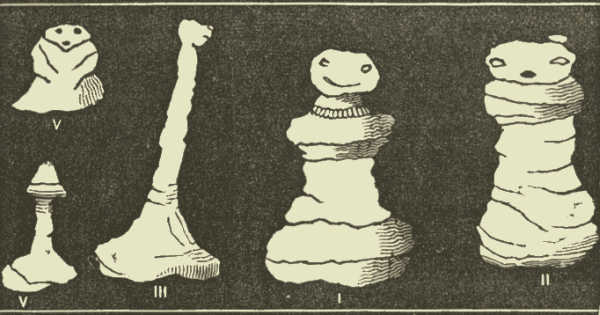
Number 3. was brought to the office of the Indian Agent at Michilimackinac
in 1839, and placed among objects of analagous interest to
visitors. It consisted of a portion of a vein or mass of gneiss or granite,
from which both mica and feldspar were nearly absent, existing only in
trace, while the quartzy portion predominated, and had, by its superior
hardness, resisted the elemental action. The mode of the formation of such
masses is very well known to geologists, resulting, in almost every case,
from the unequal degree of hardness of various parts of a mass, submitted
to an equal force of attrition, such as is ordinarily given by the
upheaving and rolling force of waves on a lake, or ocean beach. To the
natives, who are not prone to reason from cause to effect, such productions
appear wonderful. All that is past comprehension, or wonderful, is
attributed by them to the supernatural agency of spirits. The hunter or
warrior, who is travelling along the coast, and finds one of these self-sculptured
stones, is not sure that it is not a direct interposition of his
God, or guardian Manito, in his favour. He is habitually a believer in
the most subtle forms of mysterious power, which he acknowledges to be
often delegated to the native priests, or necromancers. He is not staggered
by the most extraordinary stretch of fancy, in the theory of the
change or transformation of animate into inanimate objects, and vice
versa. All things, “in heaven and earth,” he believes to be subject to
this subtle power of metamorphosis. But, whatever be the precise operating
cause of the respect he pays to the imitative rolled stones, which
he calls Shingaba-wossins, and also by the general phrase of Muz-in-in-a-wun,
or images, he is not at liberty to pass them without hazarding
something, in his opinion, of his chance of success in life, or the fortune
of the enterprize in hand.
If the image be small, it is generally taken with him and secreted in
the neighborhood of his lodge. If large and too heavy for this purpose,
it is set up on the shore, generally in some obscure nook, where an offering
of tobacco, or something else of less value, may be made to it, or
rather through it, to the spirit.
In 1820 one of these stones (No. 2.) was met by an expedition of the
government sent north, that year, for the purpose of interior discovery
and observation, at the inner Thunder Bay island, in Lake Huron. It was
a massy stone, rounded, with a comparatively broad base and entablature
but not otherwise remarkable. It was set up, under a tree on the island,
which was small, with the wide and clear expanse of the lake in plain
view. The island was one of those which were regarded as desert, and
was probably but seldom stopped at. It was, indeed, little more than a few
acres of boulders and pebbles, accumulated on a limestone reef, and bearing
a few stunted trees and shrubs. The water of the lake must, in high
storms, have thrown its spray over this imaged stone. It was, in fine, one
of those private places which an Indian might be supposed to have selected
for his secret worship.
In No. 3. is figured an object of this kind, which was found in 1832,
in the final ascent to the source of the Mississippi, on the right cape, in
ascending this stream into lac Traverse—at the distance of about 1000
miles above the falls of St. Anthony. I landed at the point to see it, having
heard, from my interpreter, that such an object was set up and dedicated
to some unknown Manito there. It was a pleasant level point of
land shaded with trees, and bearing luxuriant grass and wild shrubbery
and flowers. In the middle of this natural parterre the stone was placed,
and was overtopped by this growth, and thus concealed by it. A ring of
red paint encircled it, at the first narrowed point of its circumference, to
give it the resemblance of a human neck; and there were some rude
dabs to denote other features. The Indian is not precise in the matter of
proportion, either in his drawing, or in his attempts at statuary. He seizes
upon some minute and characteristic trait, which is at once sufficient to denote
the species, and he is easily satisfied about the rest. Thus a simple
cross, with a strait line from shoulder to shoulder, and a dot, or circle
above, to serve for a head, is the symbol of the human frame; and without
any adjunct of feet, or hands, it could not have been mistaken for any
thing else—certainly for any other object in the animal creation.
CHAPTER I.
PRELIMINARY REMARKS.—SYMBOLICAL REPRESENTATIONS AND HIEROGLYPHICS, ONE OF THE
EARLIEST OBSERVED TRAITS IN THE CUSTOMS AND ARTS OF THE AMERICAN ABORIGINES;
BUT THIS ART NOT SUSPECTED TO HAVE A SYSTEMATIC FORM AMONG THE RUDE
HUNTER TRIBES OF NORTH AMERICA, UNTIL THE YEAR 1820, WHEN IT WAS DISCOVERED
ON THE SOURCE OF THE MISSISSIPPI. THIS INSTANCE GIVEN, WITH A DRAWING;
THE HINT PURSUED.
The practice of the North American tribes, of drawing figures and
pictures on skins, trees, and various other substances, has been noticed
by travellers and writers from the earliest times. Among the more northerly
tribes, these figures are often observed on that common substitute for
the ancient papyrus, among these nations, the bark of the betula papyracea,
or white birch: a substance possessing a smooth surface, easily impressed,
very flexible, and capable of being preserved in rolls. Often these devices
are cut, or drawn in colours on the trunks of trees, more rarely on
rocks or boulders. According to Colden and Lafitou records of this rude
character were formerly to be seen on the blazed surface of trees, along some
of the ancient paths and portages leading from the sources of the Atlantic
rivers into the interior, or in the valley of the St. Lawrence; but
these, after satisfying a transient curiosity, have long since yielded to the
general fate of these simple and unenduring monuments. Pictures and
symbols of this kind are now to be found only on the unreclaimed borders
of the great area west of the Alleghanies and the Lakes, in the
wide prairies of the west, or along the Missouri and the upper Mississippi.
It is known that such devices were in use, to some extent, at the era
of the discovery, among most of the tribes, situated between the latitudes
of the capes of Florida, and Hudson’s Bay, although they have been
considered as more particularly characteristic of the tribes of the Algonquin
type. In a few instances, these pictorial inscriptions have been found
to be painted or stained on the faces of rocks, or on loose boulders, and
still more rarely, devices were scratched or pecked into the surface, as is
found to be the case still at Dighton and Venango. Those who are intent
on observations of this kind, will find figures and rude hieroglyphics invariably
at the present time, on the grave posts which mark the places
of Indian sepulchre at the west and north. The nations who rove over
the western prairies, inscribe them on the skins of the buffalo. North of
latitude 42°, the bark of the birch, which furnishes at once the material
of canoes, tents, boxes, water-dippers, and paper, constitutes the common
medium of their exhibition. Tablets of hard wood are confined to
such devices as are employed by their priests and prophets, and medicine-men;
and these characters uniformly assume a more mystical or sacred
import. But the recent discovery, on one of the tributaries of the Susquehanna,
of an Indian map, drawn on stone, with intermixed devices, a
copy of which appears in the 1st volume of the collections of the Historical
Committee of the American Philosophical Society, proves that stone
was also employed in that branch of inscription. This discovery was on
the area occupied by the Lenapees.
Colden, in his history of the Five Nations,[23] informs us that when, in
1696, the Count de Frontenac marched a well appointed army into the
Iroquois country, with artillery and all other means of regular military
offence, he found, on the banks of the Onondaga, now called Oswego
river, a tree, on the trunk of which the Indians had depicted the French
army, and deposited two bundles of cut rushes at its foot, consisting of
1434 pieces—an act of defiance on their part, which was intended to inform
their invaders, that they would have to encounter this number of
warriors. In speaking in another passage of the general traits of the
Five Nations, he mentions the general custom prevalent among the Mohawks
going to war, of painting, with red paint, on the trunk of a tree,
such symbols, as might serve to denote the object of their expedition.
Among the devices was a canoe pointed towards the enemies’ country.
On their return, it was their practice to visit the same tree, or precinct,
and denote the result: the canoe being, in this case, drawn with
its bows in the opposite direction. Lafitou, in his account of the nations
of Canada, makes observations on this subject to which we shall more
particularly refer hereafter, which denote the general prevalence of the
custom in that quarter. Other writers, dating as far back as Smith and
de Bre, bear a passing testimony to the existence of this trait among the
northern tribes. Few have however done more than notice it, and none
are known to have furnished any amount of connected details.
A single element in the system attracted early notice. I allude to the
institution of the Totem, which has been well known among the Algonquin
tribes from the settlement of Canada. By this device, the early
missionaries observed, that the natives marked their division of a tribe
into clans, and of a clan into families, and the distinction was thus very
clearly preserved. Affinities were denoted and kept up, long after tradition
had failed in its testimony. This distinction, which is marked with
much of the certainty of heraldic bearings in the feudal system, was seen
to mark the arms, the lodge, and the trophies of the chief and warrior.
It was likewise employed to give identity to the clan of which he was a
member, on his ad-je-da-teg or grave-post. This record went but little
farther; a few strokes or geometric devices were drawn on these simple
monuments, to denote the number of men he had slain in battle.
It has not been suspected in any notices to which I have had access,
that there was a pictorial alphabet, or a series of homophonous figures, in
which, by the juxtaposition of symbols representing acts, as well as objects
of action, and by the introduction of simple adjunct signs, a series of disjunctive,
yet generally connected ideas, were denoted; or that the most prominent
incidents of life and death could be recorded so as to be transmitted
from one generation to another, as long at least as the monument and the
people endured. Above all, it was not anticipated that there should have
been found, as will be observed in the subsequent details, a system of symbolic
notation for the songs and incantations of the Indian metas and
priests, making an appeal to the memory for the preservation of language.
Persons familiar with the state of the western tribes of this continent,
particularly in the higher northern latitudes, have long been aware that
the songs of the Indian priesthood, and wabenoes, were sung from a kind
of pictorial notation, made on bark. It is a fact which has often come to
the observation of military officers performing duties on those frontiers,
and of persons exercising occasional duties in civil life, who have passed
through their territories. But there is no class of persons to whom the
fact of such notations being made, is so well known, as the class of Indian
traders and interpreters who visit or reside a part of the season at the
Indian villages. I have never conversed with any of this latter class of
persons to whom the fact of such inscriptions, made in various ways, was
not so familiar as in their view to excite no surprise or even demand remark.
My attention was first called to the subject in 1820. In the summer
of that year I was on an exploring journey through the lake country. At
the mouth of the small river Huron, on the banks of Lake Superior,
there was an Indian grave fenced around with saplings, and protected
with much care. At its head stood a post, or tabular stick, upon which
was drawn the figure of the animal which was the symbol of the clan to
which the deceased chief belonged. Strokes of red paint were added to
denote, either the number of war parties in which he had been engaged,
or the number of scalps which he had actually taken from the enemy.
The interpreter who accompanied us, and who was himself tinctured with
Indian blood, gave the latter, as the true import of these marks.
On quitting the river St. Louis, which flows into the head of the lake
at the Fond du Lac, to cross the summit dividing its waters from those of
the Mississippi, the way led through heavy and dense woods and swamps
and the weather proved dark and rainy, so that, for a couple of days together,
we had scarcely a glimpse of the sun.
The party consisted of sixteen persons, with two Indian guides; but
the latter, with all their adroitness in threading the maze, were completely at
fault for nearly an entire day. At night we lay down on ground elevated
but a few inches above the level of the swamp. The next morning as
we prepared to leave the camp, a small sheet of birch bark containing devices
was observed elevated on the top of a sapling, some 8 or 10 feet
high. One end of this pole was thrust firmly into the ground leaning in
the direction we were to go. On going up to this object, it was found,
with the aid of the interpreter, to be a symbolic record of the circumstances
of our crossing this summit, and of the night’s encampment at this
spot. Each person was appropriately depicted, distinguishing the soldiers
from the officer in command, and the latter from the scavans of the party.
The Indians themselves were depicted without hats, this being, as we noticed,
the general symbol for a white man or European. The entire
record, of which a figure is annexed, accurately symbolized the circumstances,
and they were so clearly drawn, according to their conventional
rules, that the intelligence would be communicated thereby to any of their
people who might chance to travel or wander this way. This was the
object of the inscription.
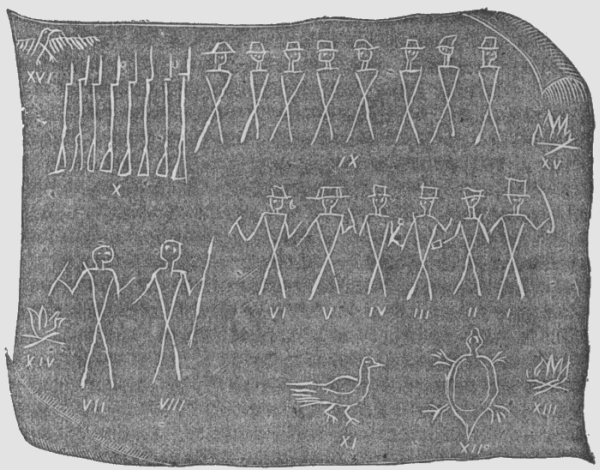
Fig. No 1. represents the subaltern officer in command of the party
of the U. S. troops. He is drawn with a sword to denote his official
rank. No. 2 denotes the person who officiated in quality of Secretary.
He is represented holding a book. No. 3 denotes the geologist and mineralogist
of the party. He is drawn with a hammer. Nos. 4 and 5 are
attachés; No. 6, the interpreter.
The group of figures marked 9 represents eight infantry soldiers, each
of whom, as shown in group No. 10, was armed with a musket. No. 15
denotes that they had a separate fire, and constituted a separate mess.
Figures 7 and 8 are the two Chippewa guides, the principal of whom,
called Chamees, or the Pouncing-hawk, led the way over this dreary summit.
These are the only human figures on this unique bark letter, who
are drawn without a hat. This was the characteristic seized on, by them,
and generally employed by the tribes, to distinguish the Red from the white
race. Figures 11 and 12 represent a prairie hen, and a green tortoise,
which constituted the sum of the preceding day’s chase, and were eaten
at the encampment. The inclination of the pole, was designed to show
the course pursued from that particular spot: there were three hacks in
it, below the scroll of bark, to indicate the estimated length of this part
of the journey, computing from water to water, that is to say, from the
head of the portage Aux Couteaux on the St. Louis river, to the open shores
of Sandy lake, the Ka-ma-ton-go-gom-ag of the Odjibwas.
The story was thus briefly and simply told; and this memorial was
set up by the guides, to advertise any of their countrymen, who might
chance to wander in that direction, of the adventure—for it was evident,
both from this token, and from the dubiousness which had marked the
prior day’s wanderings, that they regarded the passage in this light, and
were willing to take some credit for the successful execution of it.
Before we had penetrated quite to this summit, we came to another
evidence of their skill in this species of knowledge, consisting of one of
those contrivances which they denominate Man-i-to-wa-teg, or Manito
Poles. On reaching this our guides shouted, whether from a superstitious
impulse, or the joy of having found a spot they certainly could recognize,
we could not tell. We judged the latter. It consisted of eight
poles, of equal length, shaved smooth and round, painted with yellow
ochre, and set so as to enclose a square area. It appeared to have been
one of those rude temples, or places of incantation or worship, known to
the metas, or priests, where certain rites and ceremonies are performed.
But it was not an ordinary medicine lodge. There had been far more
care in its construction.
On reaching the village of Sandy lake, on the upper Mississippi, the
figures of animals, birds, and other devices were found, on the rude coffins,
or wrappings of their dead, which were scaffolded around the precincts
of the fort, and upon the open shores of the lake. Similar devices
were also observed, here, as at other points in this region, upon their
arms, war-clubs, canoes, and other pieces of moveable property, as well
as upon their grave posts.
In the descent of the Mississippi, we observed such devices painted on
a rock, below and near the mouth of Elk river, and at a rocky island
in the river, at the Little Falls. In the course of our descent to the Falls
at St. Anthony, we observed another bark letter, as the party now began
to call these inscriptions, suspended on a high pole, on an elevated bank
of the river, on its west shore. At this spot, where we encamped for the
night, and which is just opposite a point of highly crystalized hornblende
rock, called the Peace Rock, rising up through the prairie, there were left
standing the poles or skeletons of a great number of Sioux lodges. It is
near and a little west of the territorial boundary of the Sioux nation; and
on inspecting this scroll of bark, we found it had reference to a negociation
for bringing about a permanent peace between the Sioux and Chippewas.
A large party of the former, from St. Peter’s, headed by their chief,
had proceeded thus far, in the hope of meeting the Chippewa hunters,
on their summer hunt. They had been countenanced, or directed in this
step, by Col. Leavenworth, the commanding officer of the new post, just
then about to be erected. The inscription, which was read off at once, by
the Chippewa Chief Babesacundabee, who was with us, told all this; it
gave the name of the Chief who had led the party, and the number of
his followers, and gave that chief the first assurance he had, that his mission
for the same purpose, would be favourably received.
After our arrival at St. Anthony’s Falls, it was found that this system
of picture writing was as familiar to the Dacotah, as we had found it
among the Algonquin race. At Prairie du Chien, and at Green Bay,
the same evidences were observed among the Monomonees, and the Winnebagoes,
at Chicago among the Pottowottomies, and at Michilimakinac,
among the Chippewas and Ottawas who resort, in such numbers, to that
Island. While at the latter place, on my return, I went to visit the grave
of a noted chief of the Monomonee tribe, who had been known by his
French name of Toma, i.e. Thomas. He had been buried on the hill
west of the village; and on looking at his Ad-je-da-tig or grave post,
it bore a pictorial inscription, commemorating some of the prominent
achievements of his life.
These hints served to direct my attention to the subject when I returned
to the country in 1822. The figures of a deer, a bear, a turtle, and a crane,
according to this system, stand respectively for the names of men, and
preserve the language very well, by yielding to the person conversant
with it, the corresponding words, of Addick, Muckwa, Mickenock, and
Adjeejauk. Marks, circles, or dots, of various kinds, may symbolize the
number of warlike deeds. Adjunct devices may typify or explain adjunct
acts. If the system went no farther, the record would yield a kind of information
both gratifying and useful to one of his countrymen who had
no letters and was expert in the use of symbols; and the interpretation
of it, would be easy and precise in proportion as the signs were general,
conventional, and well understood. There was abundant evidence in my
first year’s observation, to denote that this mode of communication was in
vogue, and well understood by the northern tribes; but it hardly seemed
susceptible of a farther or extended use. It was not till I had made a
personal acquaintance with one of their Medas—a man of much intelligence,
and well versed in their customs, religion, and history, that a more
enlarged application of it appeared to be practicable. I observed in the
hands of this man a tabular piece of wood, covered over on both sides,
with a series of devices cut between parallel lines, which he referred to,
as if they were the notes of his medicine and mystical songs. I heard
him sing these songs, and observed that their succession was fixed and
uniform. By cultivating his acquaintance, and by suitable attention and
presents, such as the occasion rendered proper, he consented to explain
the meaning of each figure, the object symbolized, and the words attached
to each symbol. By this revelation, which was made with closed doors,
I became a member or initiate of the Medicine Society, and also of the
Wabeno Society. Care was taken to write each sentence of the songs
and chants in the Indian language, with its appropriate devices, and to
subjoin a literal translation in English. When this had been done, and
the system considered, it was very clear that the devices were mnemonic—that
any person could sing from these devices, very accurately, what he
had previously committed to memory, and that the system revealed a curious
scheme of symbolic notation.
All the figures thus employed, as the initiatory points of study, related
exclusively to either the medicine dance, or the wabeno dance; and each
section of figures, related exclusively to one or the other. There was no
intermixture or commingling of characters, although the class of subjects
were sometimes common to each. It was perceived, subsequently, that
this classification of symbols extended to the songs devoted to war, to
hunting, and to other specific topics. The entire inscriptive system, reaching
from its first, rudimental characters, in the ad-je-da-tig, or grave board,
to the extended roll of bark covered with the incriptions of their magicians
and prophets, derived a new interest from this feature. It was easy
to perceive that much comparative precision was imparted to interpretations
in the hands of the initiated, which before, or to others, had very
little. An interest was thus cast over it distinct from its novelty. And
in truth, the entire pictorial system was thus invested with the character
of a subject of accurate investigation, which promised both interest and instruction.
It has been thought that a simple statement of these circumstances,
would best answer the end in view, and might well occupy the place of a
more formal or profound introduction. In bringing forward the elements
of the system, after much reflection, it is thought, however, that a few remarks
on the general character of this art may not be out of place. For,
simple as it is, we perceive in it the native succedaneum for letters. It is
not only the sole graphic mode they have for communicating ideas, but it
is the mode of communicating all classes of ideas commonly entertained
by them—such as their ideas of war, of hunting, of religion, and of
magic and necromancy. So considered, it reveals a new and unsuspected
mode of obtaining light on their opinions of a deity, of the structure or
cosmogony of the globe, of astronomy, the various classes of natural objects,
their ideas of immortality and a future state, and the prevalent notions
of the union of spiritual and material matter. So wide and varied,
indeed, is the range opened by the subject, that we may consider the Indian
system of picture writing as the thread which ties up the scroll of
the Red man’s views of life and death, reveals the true theory of his
hopes and fears, and denotes the relation he bears, in the secret chambers
of his own thoughts, to his Maker. What a stoic and suspicious temper
would often hold him back from uttering to another, and what a limited
language would sometimes prevent his fully revealing, if he wished,
symbols and figures can be made to represent and express. The Indian
is not a man prone to describe his god, but he is ready to depict him, by a
symbol. He may conceal under the figures of a serpent, a turtle, or a
wolf, wisdom, strength, or malignity, or convey under the picture of the
sun, the idea of a supreme, all-seeing intelligence. But he is not prepared
to discourse upon these things. What he believes on this head, he
will not declare to a white man or a stranger. His happiness and success
in life, are thought to depend upon the secrecy of that knowledge of the
Creator and his system in the Indian view of benign and malignant
agents. To reveal this to others, even to his own people, is, he believes,
to expose himself to the counteracting influence of other agents known
to his subtle scheme of necromancy and superstition, and to hazard success
and life itself. This conduces to make the Red man eminently a
man of fear, suspicion, and secrecy. But he cannot avoid some of these
disclosures in his pictures and figures. These figures represent ideas—whole
ideas, and their juxtaposition or relation on a roll of bark, a tree, or
a rock, discloses a continuity of ideas. This is the basis of the system.
Picture writing is indeed the literature of the Indians. It cannot be
interpreted, however rudely, without letting one know what the Red man
thinks and believes. It shadows forth the Indian intellect, it stands in the
place of letters for the Unishinaba.[24] It shows the Red man in all periods
of our history, both as he was, and as he is; for there is nothing
more true than that, save and except the comparatively few instances
where they have truly embraced experimental christianity, there has not
This gigantic tumulus, the largest in the Ohio valley, was opened some
four or five years ago, and found to contain some articles of high antiquarian
value, in addition to the ordinary discoveries of human bones, &c. A
rotunda was built under its centre, walled with brick, and roofed over, and
having a long gallery leading into it, at the base of the mound. Around
this circular wall, in the centre of this heavy and damp mass of earth, with
its atmosphere of peculiar and pungent character, the skeletons and other
disinterred articles, are hung up for the gratification of visiters, the whole
lighted up with candles, which have the effect to give a strikingly sepulchral
air to the whole scene. But what adds most to this effect, is a kind
of exuded flaky matter, very white and soft, and rendered brilliant by
dependent drops of water, which hangs in rude festoons from the ceiling.
To this rotunda, it is said, a delegation of Indians paid a visit a year or
two since. In the “Wheeling Times and Advertiser” of the 30th August
1843, the following communication, respecting this visit, introducing a
short dramatic poem, was published.
“An aged Cherokee chief who, on his way to the west, visited the rotunda
excavated in this gigantic tumulus, with its skeletons and other
relics arranged around the walls, became so indignant at the desecration
and display of sepulchral secrets to the white race, that his companions
and interpreter found it difficult to restrain him from assassinating the
guide. His language assumed the tone of fury, and he brandished his
knife, as they forced him out of the passage. Soon after, he was found
prostrated, with his senses steeped in the influence of alcohol.
“’Tis not enough! that hated race
Should hunt us out, from grove and place
And consecrated shore—where long
Our fathers raised the lance and song—
Tis not enough!—that we must go
Where streams and rushing fountains flow
Whose murmurs, heard amid our fears,
Fall only on a stranger’s ears—
’Tis not enough!—that with a wand,
They sweep away our pleasant land,
And bid us, as some giant-foe,
Or willing, or unwilling go!
But they must ope our very graves
To tell the dead—they too, are slaves.”
Ontario, is a word from the Wyandot, or, as called by the Iroquois,
Quatoghie language. This tribe, prior to the outbreak of the war against
them, by their kindred the Iroquois, lived on a bay, near Kingston, which
was the ancient point of embarkation and debarkation, or, in other words,
at once the commencement and the terminus of the portage, according to
the point of destination for all, who passed into or out of the lake. From
such a point it was natural that a term so euphonous, should prevail among
Europeans, over the other Indian names in use. The Mohawks and their
confederates, generally, called it Cadaracqui—which was also their name
for the St. Lawrence. The Onondagas, it is believed, knew it, in early
times, by the name of Oswego.[25] Of the meaning of Ontario, we are left
in the dark by commentators on the Indian. Philology casts some light
on the subject. The first syllable, on, it may be observed, appears to be
the notarial increment or syllable of Onondio, a hill. Tarak, is clearly,
the same phrase, written darac, by the French, in the Mohawk compound
of Cadaracqui; and denotes rocks, i.e. rocks standing in the water. In
the final vowels io, we have the same term, with the same meaning which
they carry in the Seneca, or old Mingo word Ohio.[26] It is descriptive of
an extended and beautiful water prospect, or landscape. It possesses all
the properties of an exclamation, in other languages, but according to the
unique principles of the Indian grammar, it is an exclamation-substantive.
How beautiful! [the prospect, scene present.]
Erie is the name of a tribe conquered or extinguished by the Iroquois.
We cannot stop to inquire into this fact historically, farther than to say,
that it was the policy of this people to adopt into their different tribes of
the confederacy, the remnants of nations whom they conquered, and that
it was not probable, therefore, that the Eries were annihilated. Nor is it
probable that they were a people very remote in kindred and language
from the ancient Sinondowans, or Senecas, who, it may be supposed, by
crushing them, destroyed and exterminated their name only, while they
strengthened their numbers by this inter-adoption. In many old maps,
this lake bears the name of Erie or “Oskwago.”
Huron, is the nom de guerre of the French, for the “Yendats,” as
they are called in some old authors, or the Wyandots. Charlevoix tells
us that it is a term derived from the French word hure, [a wild boar,] and
was applied to this nation from the mode of wearing their hair. “Quelles
Hures!” said the first visiters, when they saw them, and hence, according
to this respectable author, the word Huron.
When this nation, with their confederates, the Algonquins, or Adirondaks,
as the Iroquois called them, were overthrown in several decisive
battles on the St. Lawrence, between Montreal and Quebec, and compelled
to fly west; they at first took shelter in this lake, and thus transferred their
name to it. With them, or at least, at the same general era, came some
others of the tribes who made a part of the people called by the French,
Algonquins, or Nipercineans, and who thus constituted the several tribes,
speaking a closely cognate language, whose descendants are regarded by
philologists, as the modern Lake-Algonquins.
The French sometimes called this lake Mer douce, or the Placid sea.
The Odjibwas and some other northern tribes of that stock, call it Ottowa
lake. No term has been found for it in the Iroquois language, unless it
be that by which they distinguished its principal seat of trade, negociation
and early rendezvous, the island of Michilimackinac, which they called
Tiedonderaghie.
Michigan is a derivative from two Odjibwa-Algonquin words, signifying
large, i.e. large in relation to masses in the inorganic kingdom, and
a lake. The French called it, generally, during the earlier periods of
their transactions, the lake of the Illinese, or Illinois.
Superior, the most north-westerly, and the largest of the series, is a term
which appears to have come into general use, at a comparatively early
era, after the planting of the English colonies. The French bestowed
upon it, unsuccessfully, one or two names, the last of which was Traci,
after the French minister of this name. By the Odjibwa-Algonquins,
who at the period of the French discovery, and who still occupy its
borders, it is called Gitch-Igomee, or The Big Sea-water; from Gitchee,
great, and guma, a generic term for bodies of water. The term IGOMA,
is an abbreviated form of this, suggested for adoption.
The poetry of the Indians, is the poetry of naked thought. They
have neither rhyme nor metre to adorn it.
Tales and traditions occupy the place of books, with the Red Race.—They
make up a kind of oral literature, which is resorted to, on long
winter evenings, for the amusement of the lodge.
The love of independence is so great with these tribes, that they have
never been willing to load their political system with the forms of a regular
government, for fear it might prove oppressive.
To be governed and to be enslaved, are ideas which have been confounded
by the Indians.
These Extracts are made from “Cyclopædia Indiaensis” a MS. work in preparation.
No. I.
Hudson River.—By the tribes who inhabited the area of the present
County of Dutchess, and other portions of its eastern banks, as low down
as Tappan, this river was called Shatemuc—which is believed to be a derivative
from Shata, a pelican. The Minisi, who inhabited the west banks,
below the point denoted, extending indeed over all the east half of New
Jersey, to the falls of the Raritan, where they joined their kindred the
Lenni Lenape, or Delawares proper, called it Mohicanittuck—that is to
say, River of the Mohicans. The Mohawks, and probably the other
branches of the Iroquois, called it Cahohatatea—a term of which the interpreters
who have furnished the word, do not give an explanation. The
prefixed term Caho, it may be observed, is their name for the lower and
principal falls of the Mohawk. Sometimes this prefix was doubled, with
the particle ha, thrown in between. Hatatea is clearly one of those descriptive
and affirmative phrases representing objects in the vegetable and
mineral kingdoms, which admitted as we see, in other instances of their
compounds, a very wide range. By some of the more westerly Iroquois,
the river was called Sanataty.
Albany.—The name by which this place was known to the Iroquois,
at an early day, was Schenectady, a term which, as recently pronounced
by a daughter of Brant, yet living in Canada, has the still harsher sound
of Skoh-nek-ta-ti, with a stress on the first, and the accent strongly on
the second syllable, the third and fourth being pronounced rapidly and
short. The transference of this name, to its present location, by the English,
on the bestowal on the place by Col. Nichols, of a new name, derived
from the Duke of York’s Scottish title, is well known, and is stated,
with some connected traditions, by Judge Benson, in his eccentric memoir
before the New York Historical Society. The meaning of this name, as
derived from the authority above quoted, is Beyond the Pines, having
been applied exclusively in ancient times, to the southern end of the
ancient portage path, from the Mohawk to the Hudson. By the Minci,
who did not live here, but extended, however, on the west shore above
Coxackie, and even Coeymans, it appears to have been called Gaishtinic.
The Mohegans, who long continued to occupy the present area of Rensselear
and Columbia counties, called it Pempotawuthut, that is to say, the
City or Place of the Council Fire. None of these terms appear to have
found favour with the European settlers, and, together with their prior
names of Beaverwyck and Fort Orange, they at once gave way, in 1664,
to the present name. A once noted eminence, three miles west, on
the plains, i.e. Trader’s Hill, was called Isutchera, or by prefixing the
name for a hill, Yonondio Isutchera. It means the hill of oil. Norman’s
Kill, which enters the Hudson a little below, the Mohawks called
Towasentha, a term which is translated by Dr. Yates, to mean, a place
of many dead.
Niagara.—It is not in unison, perhaps, with general expectation, to find
that the exact translation of this name does not entirely fulfil poetic preconception.
By the term O-ne-aw-ga-ra, the Mohawks and their co-tribes
described on the return of their war excursions, the neck of water which
connects lake Erie with Ontario. The term is derived from their name
for the human neck. Whether this term was designed to have, as many
of their names do, a symbolic import, and to denote the importance of this
communication in geography, as connecting the head and heart of the
country, can only be conjectured. Nor is it, in this instance, probable.
When Europeans came to see the gigantic falls which marked the strait,
it was natural that they should have supposed the name descriptive of that
particular feature, rather than the entire river and portage. We have
been assured, however, that it is not their original name for the water-fall,
although with them, as with us, it may have absorbed this meaning.
Buffalo.—The name of this place in the Seneca, is Te-ho-sa-ro-ro. Its
import is not stated.
Detroit.—By the Wyandots, this place is called Teuchsagrondie;
by the Lake tribes of the Algic type, Wa-we-á-tun-ong: both terms signify
the Place of the turning or Turned Channel. It has been remarked
by visiters who reach this place at night, or in dark weather, or are otherwise
inattentive to the courses, that owing to the extraordinary involutions
of the current the sun appears to rise in the wrong place.
Chicago.—This name, in the Lake Algonquin dialects, to preserve the
same mode of orthography, is derived from Chicagowunzh, the wild
onion or leek. The orthography is French, as they were the discoverers
and early settlers of this part of the west. Kaug, in these dialects is a
porcupine, and She kaug a polecat. The analogies in these words are
apparent, but whether the onion was named before or after the animal,
must be judged if the age of the derivation be sought for.
Tuscaloosa, a river of Alabama. From the Chacta words tushka, a
warrior, and lusa black.—[Gallatin.]
Aragiske, the Iroquois name for Virginia.
Assarigoa, the name of the Six Nations for the Governor of Virginia.
Owenagungas, a general name of the Iroquois for the New England
Indians.
Oteseonteo, a spring which is the head of the river Delaware.
Ontonagon; a considerable river of lake Superior, noted from early
times, for the large mass of native copper found on its banks. This name
is said to have been derived from the following incident. It is known
that there is a small bay and dead water for some distance within its
mouth. In and out of this embayed water, the lake alternately flows, according
to the influence of the winds, and other causes, upon its level.
An Indian woman had left her wooden dish, or Onagon, on the sands, at
the shore of this little bay, where she had been engaged. On coming
back from her lodge, the outflowing current had carried off her valued
utensil. Nia Nin-do-nau-gon! she exclaimed, for it was a curious piece
of workmanship. That is to say—Alas! my dish!
Chuah-nah-whah-hah, or Valley of the Mountains. A new pass in the
Rocky Mountains, discovered within a few years. It is supposed to be
in N. latitude about 40°. The western end of the valley gap is 30 miles
wide, which narrows to 20 at its eastern termination, it then turns oblique
to the north, and the opposing sides appear to close the pass, yet there is
a narrow way quite to the foot of the mountain. On the summit there is
a large beaver pond, which has outlets both ways, but the eastern stream
dries early in the season, while there is a continuous flow of water west.
In its course, it has several beautiful, but low cascades, and terminates in a
placid and delightful stream. This pass is now used by emigrants.
Aquidneck.—The Narragansett name for Rhode Island. Roger Williams
observes, that he could never obtain the meaning of it from the natives.
The Dutch, as appears by a map of Novi Belgii published at Amsterdam
in 1659, called it Roode Eylant, or Red Island, from the autumnal
colour of its foliage. The present term, as is noticed, in Vol. III. of
the Collections of the R. I. Hist. Soc. is derived from this.
Incapatchow, a beautiful lake in the mountains at the sources of the
river Hudson.—[Charles F. Hoffman, Esq.]
Housatonic; a river originating in the south-western part of Massachusetts,
and flowing through the State of Connecticut into Long Island
Sound, at Stratford. It is a term of Mohegan origin. This tribe on retiring
eastward from the banks of the Hudson, passed over the High-lands, into
this inviting valley. We have no transmitted etymology of the term,
and must rely on the general principles of their vocabulary. It appears
to have been called the valley of the stream beyond the Mountains, from
ou, the notarial sign of wudjo, a mountain, atun, a generic phrase for
stream or channel, and ic, the inflection for locality.
Wea-nud-nec.—The Indian name, as furnished by Mr. O’Sullivan,
[D. Rev.] for Saddle Mountain, Massachusetts. It appears to be a derivative
from Wa-we-a, round, i.e. any thing round or crooked, in the inanimate
creation.
Ma-hai-we; The Mohegan term, as given by Mr. Bryant [N. Y. E. P.]
for Great Barrington, Berkshire County, Massachusetts.
Massachusetts.—This was not the name of a particular tribe, but a
geographical term applied, it should seem, to that part of the shores of the
North Atlantic, which is swept by the tide setting into, and around the
peninsula of Cape Cod, and the wide range of coast trending southerly.
It became a generic word, at an early day, for the tribes who inhabited this
coast. It is said to be a word of Narragansett origin, and to signify the
Blue Hills. This is the account given of it by Roger Williams, who
was told, by the Indians, that it had its origin from the appearance of
an island off the coast. It would be more in conformity to the general
requisitions of ethnography, to denominate the language the New England-Algonquin,
for there are such great resemblances in the vocabulary
and such an identity in grammatical construction, in these tribes, that we
are constantly in danger, by partial conclusions as to original supremacy,
of doing injustice. The source of origin was doubtless west and south-west,
but we cannot stop at the Narragansetts, who were themselves derivative
from tribes still farther south. The general meaning given by Williams
seems, however, to be sustained, so far as can now be judged. The
terminations in ett, and set, as well as those in at and ak, denoted locality
in these various tribes. We see also, in the antipenultimate Chu, the root
of Wudjo, a mountain.
Ta-ha-wus, a very commanding elevation, several thousand feet above
the sea, which has of late years, been discovered at the sources of the
Hudson, and named Mount Marcy. It signifies, he splits the sky.—[Charles
F. Hoffman, Esq.]
Mong, the name of a distinguished chief of New England, as it appears
to be recorded in the ancient pictorial inscription on the Dighton Rock,
in Massachusetts, who flourished before the country was colonized by the
English. He was both a war captain, and a prophet, and employed the
arts of the latter office, to increase his power and influence, in the former.
By patient application of his ceremonial arts, he secured the confidence
of a large body of men, who were led on, in the attack on his enemies,
by a man named Piz-hu. In this onset, it is claimed that he killed forty
men, and lost three. To the warrior who should be successful, in this enterprize,
he had promised his younger sister. [Such are the leading events
symbolized by this inscription, of which extracts giving full details, as interpreted
by an Indian chief, now living, and read before the Am. Ethnological
Society, in 1843, will be furnished, in a subsequent number.]
Tioga.—A stream, and a county of the State of New-York. From
Teoga, a swift current, exciting admiration.
Dionderoga, an ancient name of the Mohawk tribe, for the site at the
mouth of the Schoharie creek, where Fort Hunter was afterwards built.
[Col. W. L. Stone.]
Almouchico, a generic name of the Indians for New England, as printed
on the Amsterdam map of 1659, in which it is stated that it was thus “by
d inwoonders genaemt.” (So named by the natives.)
Irocoisia, a name bestowed in the map, above quoted, on that portion of
the present state of Vermont, which lies west of the Green Mountains,
stretching along the eastern bank of Lake Champlain. By the application
of the word, it is perceived that the French were not alone in the use
they made of the apparently derivative term “Iroquois,” which they
gave to the (then) Five Nations.
The following are the names of the four seasons, in the Odjibwa
tongue:
| Pe-bon, | Winter, | From | Kone, | Snow. |
| Se-gwun, | Spring, | " | Seeg, | Running water. |
| Ne-bin, | Summer, | " | Anib, | A leaf. |
| Ta-gwá-gi, | Autumn, | " | Gwag, | The radix of behind &c. |
By adding the letter g to these terms, they are placed in the relation of
verbs in the future tense, but a limited future, and the terms then denote
next winter, &c. Years, in their account of time, are counted by winters.
There is no other term, but pe-boan, for a year. The year consists of
twelve lunar months, or moons. A moon is called Geézis, or when
spoken of in contradistinction to the sun, Dibik Geezis, or night-sun.
The cardinal points are as follows.
| (a) | North, | Ke wá din-ung. |
| (b) | South, | O shá wan-ung. |
| (c) | East, | Wá bun-ung. |
| (d) | West, | Ká be un-ung. |
a. Kewadin is a compound derived from Ke-wa, to return, or come
home, and nodin, the wind. b. Oshauw is, from a root not apparent, but
which produces also ozau, yellow, &c. c. Waban is from ab, or wab, light.
d. Kabeun, is the name of a mythological person, who is spoken of, in
their fictions, as the father of the winds. The inflection ung, or oong, in
each term, denotes course, place, or locality.
I.
Wheeling (Va.), August 19th, 1843.
I have just accomplished the passage of the Alleghany mountains, in
the direction from Baltimore to this place, and must say, that aside from
the necessary fatigue of night riding, the pass from the Cumberland
mountains and Laurel Hill is one of the easiest and most free from
danger of any known to me in this vast range. An excellent railroad
now extends from Baltimore, by Frederick and Harper’s Ferry, up the
Potomac valley and its north branch quite to Cumberland, which is
seated just under the mountains, whose peaks would seem to bar all
farther approach. The national road finds its way, however, through a
gorge, and winds about where “Alps on Alps arise,” till the whole vast
and broad-backed elevation is passed, and we descend west, over a
smooth, well constructed macadamized road, with a velocity which is
some compensation for the toil of winding our way up. Uniontown is
the first principal place west. The Monongahela is crossed at Brownsville,
some forty miles above Pittsburgh, whence the road, which is
everywhere well made and secured with fine stone bridges, culverts and
viaducts, winds around a succession of most enchanting hills, till it
enters a valley, winds up a few more hills, and brings the travellers out,
on the banks of the Ohio, at this town.
The entire distance from the head of the Chesapeake to the waters
of the Ohio is not essentially different from three hundred miles. We
were less than two days in passing it, twenty-six hours of which, part
night and part day, were spent in post-coaches between Cumberland and
this place. Harper’s Ferry is an impressive scene, but less so than it
would be to a tourist who had not his fancy excited by injudicious
descriptions. To me, the romance was quite taken away by driving
into it with a tremendous clattering power of steam. The geological
structure of this section of country, from water to water, is not without
an impressive lesson. In rising from the Chesapeake waters the stratified
rocks are lifted up, pointing west, or towards the Alleghanies, and
after crossing the summit they point east, or directly contrary, like the
two sides of the roof of a house, and leave the inevitable conclusion
that the Alleghanies have been lifted up by a lateral rent, as it were, at
the relative point of the ridge pole. It is in this way that the granites
and their congeners have been raised up into their present elevations.
I did not see any evidence of that wave-like or undulatory structure,
which was brought forward as a theory last year, in an able paper forwarded
by Professor Rogers, and read at the meeting of the British Association
for the Advancement of Science at Manchester. No organic
remains are, of course, visible, in this particular section, at least until
we strike the coal and iron-stone formation of Pittsburgh. But I have
been renewedly impressed with the opinion, so very opposite to the
present geological theory, that less than seven thousand years is sufficient,
on scientific principles, to account for all the phenomena of fossil
plants, shells, bones and organic remains, as well as the displacements,
disruptions, subsidences and rising of strata, and other evidences of
extensive physical changes and disturbances on the earth’s surface. And
I hope to live to see some American geologist build up a theory on just
philosophical and scientific principles, which shall bear the test of truth.
But you will, perhaps, be ready to think that I have felt more interest
in the impressions of plants in stone, than is to be found in the field of
waving corn before the eye. I have, however, by no means neglected
the latter; and can assure you that the crops of corn, wheat and other
grains, throughout Maryland, Pennsylvania and Western Virginia, are
excellent. Even the highest valleys in the Alleghanies are covered
with crops of corn, or fields of stacked wheat and other grains. Generally,
the soil west of the mountains is more fertile. The influence of
the great western limestones, as one of its original materials, and of the
oxide of iron, is clearly denoted in heavier and more thrifty cornfields
along the Monongahela and Ohio valleys.
Of the Ohio River itself, one who had seen it in its full flow, in April
and May, would hardly recognize it now. Shrunk in a volume far
below its noble banks, with long spits of sand and gravel running almost
across it, and level sandy margins, once covered by water, where armies
might now manœuvre, it is but the skeleton of itself. Steamboats of a
hundred tons burden now scarcely creep along its channel, which would
form cockboats for the floating palaces to be seen here in the days of
its vernal and autumnal glory.
Truly yours,
HENRY R. COLCRAFT
II.
Grave Creek Flats (Va.), August 23, 1843.
I have devoted several days to the examination of the antiquities of
this place and its vicinity, and find them to be of even more interest
than was anticipated. The most prominent object of curiosity is the
great tumulus, of which notices have appeared in western papers; but
this heavy structure of earth is not isolated. It is but one of a series
of mounds and other evidences of ancient occupation at this point, of
more than ordinary interest. I have visited and examined seven mounds,
situated within a short distance of each other. They occupy the summit
level of a rich alluvial plain, stretching on the left or Virginia bank of
the Ohio, between the junctions of Big and Little Grave Creeks with
that stream. They appear to have been connected by low earthen
entrenchments, of which plain traces are still visible on some parts of
the commons. They included a well, stoned up in the usual manner,
which is now filled with rubbish.
The summit of this plain is probably seventy-five feet above the
present summer level of the Ohio. It constitutes the second bench, or
rise of land, above the water. It is on this summit, and on one of the
most elevated parts of it, that the great tumulus stands. It is in the
shape of a broad cone, cut off at the apex, where it is some fifty feet
across. This area is quite level, and commands a view of the entire
plain, and of the river above and below, and the west shores of the
Ohio in front. Any public transaction on this area would be visible to
multitudes around it, and it has, in this respect, all the advantages of the
Mexican and Yucatanese teocalli. The circumference of the base has
been stated at a little under nine hundred feet; the height is sixty-nine
feet.
The most interesting object of antiquarian inquiry is a small flat stone,
inscribed with antique alphabetic characters, which was disclosed on the
opening of the large mound. These characters are in the ancient rock
alphabet of sixteen right and acute angled single stokes, used by the
Pelasgi and other early Mediterranean nations, and which is the parent
of the modern Runic as well as the Bardic. It is now some four or five
years since the completion of the excavations, so far as they have been
made, and the discovery of this relic. Several copies of it soon got
abroad, which differed from each other, and, it was supposed, from the
original. This conjecture is true; neither the print published in the
Cincinnati Gazette, in 1839, nor that in the American Pioneer, in 1843,
is correct. I have terminated this uncertainty by taking copies by a
scientific process, which does not leave the lines and figures to the
uncertainty of man’s pencil.
The existence of this ancient art here could hardly be admitted, otherwise
than as an insulated fact, without some corroborative evidence, in
habits and customs, which it would be reasonable to look for in the
existing ruins of ancient occupancy. It is thought some such testimony
has been found. I rode out yesterday three miles back to the range of
high hills which encompass this sub-valley, to see a rude tower of stone
standing on an elevated point, called Parr’s point, which commands a
view of the whole plain, and which appears to have been constructed
as a watch-tower, or look-out, from which to descry an approaching
enemy. It is much dilapidated. About six or seven feet of the work
is still entire. It is circular, and composed of rough stones, laid without
mortar, or the mark of a hammer. A heavy mass of fallen wall lies
around, covering an area of some forty feet in diameter. Two similar
points of observation, occupied by dilapidated towers, are represented to
exist, one at the prominent summit of the Ohio and Grave Creek hills,
and another on the promontory on the opposite side of the Ohio, in
Belmont county, Ohio.
It is known to all acquainted with the warlike habits of our Indians,
that they never have evinced the foresight to post a regular sentry, and
these rude towers may be regarded as of cotemporaneous age with the
interment of the inscription.
Several polished tubes of stone have been found, in one of the lesser
mounds, the use of which is not very apparent. One of these, now on
my table, is 12 inches long, 1¼ wide at one end, and 1½ at the other. It
is made of a fine, compact, lead blue steatite, mottled, and has been
constructed by boring, in the manner of a gun barrel. This boring is continued
to within about three-eighths of an inch of the larger end, through
which but a small aperture is left. If this small aperture be looked
through, objects at a distance are more clearly seen. Whether it had
this telescopic use, or others, the degree of art evinced in its construction
is far from rude. By inserting a wooden rod and valve, this tube
would be converted into a powerful syphon, or syringe.
I have not space to notice one or two additional traits, which serve to
awaken new interest at this ancient point of aboriginal and apparently
mixed settlement, and must omit them till my next.
III.
Grave Creek Flats, August 24, 1843.
The great mound at these flats was opened as a place of public resort
about four years ago. For this purpose a horizontal gallery to its centre
was dug and bricked up, and provided with a door. The centre was
walled round as a rotunda, of about twenty-five feet diameter, and a
shaft sunk from the top to intersect it; it was in these two excavations
that the skeletons and accompanying relics and ornaments were found.
All these articles are arranged for exhibition in this rotunda, which is
lighted up with candles. The lowermost skeleton is almost entire, and
in a good state of preservation, and is put up by means of wires, on the
walls. It has been overstretched in the process so as to measure six
feet; it should be about five feet eight inches. It exhibits a noble frame
of the human species, bearing a skull with craniological developments
of a highly favorable character. The face bones are elongated, with a
long chin and symmetrical jaw, in which a full and fine set of teeth,
above and below, are present. The skeletons in the upper vault, where
the inscription stone was found, are nearly all destroyed.
It is a damp and gloomy repository, and exhibits in the roof and walls
of the rotunda one of the most extraordinary sepulchral displays which
the world affords. On casting the eye up to the ceiling, and the heads
of the pillars supporting it, it is found to be encrusted, or rather festooned,
with a white, soft, flaky mass of matter, which had exuded from
the mound above. This apparently animal exudation is as white as
snow. It hangs in pendent masses and globular drops; the surface is
covered with large globules of clear water, which in the reflected light
have all the brilliancy of diamonds. These drops of water trickle to the
floor, and occasionally the exuded white matter falls. The wooden
pillars are furnished with the appearance of capitals, by this substance.
That it is the result of a soil highly charged with particles of matter,
arising from the decay or incineration of human bodies, is the only
theory by which we may account for the phenomenon. Curious and
unique it certainly is, and with the faint light of a few candles it would
not require much imagination to invest the entire rotunda with sylph-like
forms of the sheeted dead.
An old Cherokee chief, who visited this scene, recently, with his
companions, on his way to the West, was so excited and indignant at
the desecration of the tumulus, by this display of bones and relics to the
gaze of the white race, that he became furious and unmanageable; his
friends and interpreters had to force him out, to prevent his assassinating
the guide; and soon after he drowned his senses in alcohol.
That this spot was a very ancient point of settlement by the hunter
race in the Ohio valley, and that it was inhabited by the present red
race of North American Indians, on the arrival of whites west of the
Alleghanies, are both admitted facts; nor would the historian and antiquary
ever have busied themselves farther in the matter had not the
inscribed stone come to light, in the year 1839. I was informed, yesterday,
that another inscription stone had been found in one of the
smaller mounds on these flats, about five years ago, and have obtained
data sufficient as to its present location to put the Ethnological Society
on its trace. If, indeed, these inscriptions shall lead us to admit that
the continent was visited by Europeans prior to the era of Columbus, it
is a question of very high antiquarian interest to determine who the
visitors were, and what they have actually left on record in these antique
tablets.
I have only time to add a single additional fact. Among the articles
found in this cluster of mounds, the greater part are commonplace, in
our western mounds and town ruins. I have noticed but one which
bears the character of that unique type of architecture found by Mr.
Stephens and Mr. Catherwood in Central America and Yucatan. With
the valuable monumental standards of comparison furnished by these
gentlemen before me, it is impossible not to recognize, in an ornamental
stone, found in one of the lesser mounds here, a specimen of similar
workmanship. It is in the style of the heavy feather-sculptured ornaments
of Yucatan—the material being a wax yellow sand-stone, darkened
by time. I have taken such notes and drawings of the objects
above referred to, as will enable me, I trust, in due time, to give a connected
account of them to our incipient society.
IV.
Massillon, Ohio, August 27th, 1843.
Since my last letter I have traversed the State of Ohio, by stage, to
this place. In coming up the Virginia banks of the Ohio from Moundsville,
I passed a monument, of simple construction, erected to the
memory of a Captain Furman and twenty-one men, who were killed by
the Indians, in 1777, at that spot. They had been out, from the fort at
Wheeling, on a scouting party, and were waylaid at a pass called the
narrows. The Indians had dropped a pipe and some trinkets in the
path, knowing that the white men would pick them up, and look at
them, and while the latter were grouped together in this act, they fired
and killed every man. The Indians certainly fought hard for the possession
of this valley, aiming, at all times, to make up by stratagem what
they lacked in numbers. I doubt whether there is in the history of the
spread of civilisation over the world a theatre so rife with partisan
adventure, massacre and murder, as the valley of the Ohio and the
country west of the Alleghany generally presented between the breaking
out of the American revolution, in ’76, and the close of the Black
Hawk war in 1832. The true era, in fact, begins with the French war,
in 1744, and terminates with the Florida war, the present year. A
work on this subject, drawn from authentic sources, and written with
spirit and talent, would be read with avidity and possess a permanent
interest.
The face of the country, from the Ohio opposite Wheeling to the
waters of the Tuscarawas, the north fork of the Muskingum, is a series
of high rolling ridges and knolls, up and down which the stage travels
slowly. Yet this section is fertile and well cultivated in wheat and
corn, particularly the latter, which looks well. This land cannot be
purchased under forty or fifty dollars an acre. Much of it was originally
bought for seventy-five cents per acre. It was over this high, wavy land,
that the old Moravian missionary road to Gnadenhutten ran, and I pursued
it to within six miles of the latter place. You will recollect this
locality as the scene of the infamous murder, by Williamson and his
party, of the non-resisting Christian Delawares under the ministry of
Heckewelder and Ziesberger.
On the Stillwater, a branch of the Tuscarawas, we first come to level
lands. This stream was noted, in early days, for its beaver and other
furs. The last beaver seen here was shot on its banks twelve years
ago. It had three legs, one having probably been caught in a trap or
been bitten off. It is known that not only the beaver, but the otter,
wolf and fox, will bite off a foot, to escape the iron jaws of a trap. It
has been said, but I know not on what good authority, that the hare
will do the same.
We first struck the Ohio canal at Dover. It is in every respect a
well constructed work, with substantial locks, culverts and viaducts. It
is fifty feet wide at the top, and is more than adequate for all present
purposes. It pursues the valley of the Tuscarawas up to the summit,
by which it is connected with the Cuyahuga, whose outlet is at Cleveland.
Towns and villages have sprung up along its banks, where before
there was a wilderness. Nothing among them impressed me more than
the town of Zoar, which is exclusively settled by Germans. There
seems something of the principles of association—one of the fallacies of
the age—in its large and single town store, hotel, &c., but I do not
know how far they may extend. Individual property is held. The
evidences of thrift and skill, in cultivation and mechanical and mill work,
are most striking. Every dwelling here is surrounded with fruit and
fruit trees. The botanical garden and hot-house are on a large scale,
and exhibit a favorable specimen of the present state of horticulture.
One of the assistants very kindly plucked for me some fine fruit, and
voluntarily offered it. Zoar is quite a place of resort as a ride for the
neighboring towns. I may remark, en passant, that there is a large
proportion of German population throughout Ohio. They are orderly,
thrifty and industrious, and fall readily into our political system and
habits. Numbers of them are well educated in the German. They
embrace Lutherans as well as Roman Catholics, the latter predominating.
Among the towns which have recently sprung up on the line of the
canal; not the least is the one from which I date this letter. The name
of the noted French divine (Massillon) was affixed to an uncultivated
spot, by some Boston gentlemen, some twelve or fourteen years ago.
It is now one of the most thriving, city-looking, business places in the
interior of Ohio. In the style of its stores, mills and architecture, it
reminds the visitor of that extraordinary growth and spirit which marked
the early years of the building of Rochester. It numbers churches for
Episcopalians, Baptists, Methodists and Presbyterians, and also Lutherans
and Romanists. About three hundred barrels of flour can be
turned out per diem, by its mills. It is in the greatest wheat-growing
county in Ohio (Stark), but is not the county-seat, which is at Canton.
V.
Detroit, Sept. 15th, 1843.
In passing from the interior of Ohio toward Lake Erie, the face of the
country exhibits, in the increased size and number of its boulder stones,
evidences of the approach of the traveller toward those localities of
sienites and other crystalline rocks, from which these erratic blocks and
water-worn masses appear to have been, in a remote age of our planet,
removed. The soil in this section has a freer mixture of the broken
down slates, of which portions are still in place on the shores of Lake
Erie. The result is a clayey soil, less favorable to wheat and Indian
corn. We came down the cultivated valley of the Cuyahoga, and
reached the banks of the lake at the fine town of Cleveland, which is
elevated a hundred feet, or more, above it, and commands a very extensive
view of the lake, the harbor and its ever-busy shipping. A day
was employed, by stage, in this section of my tour, and the next carried
me, by steamboat, to this ancient French capital. Detroit has many
interesting historical associations, and appears destined, when its railroad
is finished, to be the chief thoroughfare for travellers to Chicago and the
Mississippi valley. As my attention has, however, been more taken
up, on my way, with the past than the present and future condition of
the West, the chief interest which the route has excited must necessarily
arise from the same source.
Michigan connects itself in its antiquarian features with that character
of pseudo-civilisation, or modified barbarianism, of which the works
and mounds and circumvallations at Grave Creek Flats, at Marietta, at
Circleville and other well known points, are evidences. That this
improved condition of the hunter state had an ancient but partial connection
with the early civilisation of Europe, appears now to be a fair
inference, from the inscribed stone of Grave Creek, and other traces of
European arts, discovered of late. It is also evident that the central
American type of the civilisation, or rather advance to civilisation, of the
red race, reached this length, and finally went down, with its gross idolatry
and horrid rites, and was merged in the better known and still existing
form of the hunter state which was found, respectively, by Cabot,
Cartier, Verrezani, Hudson, and others, who first dropped anchor on our
coasts.
There is strong evidence furnished by a survey of the western country
that the teocalli type of the Indian civilisation, so to call it, developed
itself from the banks of the Ohio, in Tennessee and Virginia, west
and north-westwardly across the sources of the Wabash, the Muskingum
and other streams, toward Lake Michigan and the borders of Wisconsin
territory. The chief evidences of it, in Michigan and Indiana,
consist of a remarkable series of curious garden beds, or accurately furrowed
fields, the perfect outlines of which have been preserved by the
grass of the oak openings and prairies, and even among the heaviest forests.
These remains of an ancient cultivation have attracted much attention
from observing settlers on the Elkhart, the St. Joseph’s, the Kalamazoo
and Grand river of Michigan. I possess some drawings of these
anomalous remains of by-gone industry in the hunter race, taken in former
years, which are quite remarkable. It is worthy of remark, too,
that no large tumuli, or teocalli, exist in this particular portion of the
West, the ancient population of which may therefore be supposed to
have been borderers, or frontier bands, who resorted to the Ohio valley
as their capital, or place of annual visitation. All the mounds scattered
through Northern Ohio, Indiana and Michigan, are mere barrows, or repositories
of the dead, and would seem to have been erected posterior to
the fall or decay of the gross idol worship and the offer of human sacrifice.
I have, within a day or two, received a singular implement or ornament
of stone, of a crescent shape, from Oakland, in this State, which
connects the scattered and out-lying remains of the smaller mounds,
and traces of ancient agricultural labor, with the antiquities of Grave
Creek Flats.
VI.
Detroit, Sept. 16th, 1843.
The antiquities of Western America are to be judged of by isolated
and disjointed discoveries, which are often made at widely distant
points and spread over a very extensive area. The labor of comparison
and discrimination of the several eras which the objects of these discoveries
establish, is increased by this diffusion, and disconnection of the
times and places of their occurrence, and is, more than all, perhaps, hindered
and put back by the eventual carelessness of the discoverers, and
the final loss or mutilation of the articles disclosed. To remedy this evil,
every discovery made, however apparently unimportant, should in this
era of the diurnal and periodical press be put on record, and the objects
themselves be either carefully kept, or given to some public scientific institution.
An Indian chief called the Black Eagle, of river Au Sables (Michigan),
discovered a curious antique pipe of Etruscan ware, a few years ago, at
Thunder Bay. This pipe, which is now in my possession, is as remarkable
for its form as for the character of the earthen-ware from which it
is made, differing as it does so entirely from the coarse earthen pots and
vessels, the remains of which are scattered so generally throughout
North America. The form is semi-circular or horn-shaped, with a quadrangular
bowl, and having impressed in the ware ornaments at each angle.
I have never before, indeed, seen any pipes of Indian manufacture of
baked clay, or earthen-ware, such articles being generally carved out of
steatite, indurated clays, or other soft mineral substances. It is a peculiarity
of this pipe that it was smoked from the small end, which is rounded
for the purpose of putting it between the lips, without the intervention
of a stem.
The discoverer told me that he had taken it from a very antique grave.
A large hemlock tree, he said, had been blown down on the banks of the
river, tearing up, by its roots, a large mass of earth. At the bottom of the
excavation thus made he discovered a grave, which contained a vase,
out of which he took the pipe with some other articles. The vase, he
said, was broken, so that he did not deem it worth bringing away. The
other articles he described as bones.
Some time since I accompanied the chief Kewakonce, to get an ancient
clay pot, such as the Indians used when the Europeans arrived on
the continent. He said that he had discovered two such pots, in an entire
state, in a cave, or crevice, on one of the rocky islets extending
north of Point Tessalon, which is the northern cape of the entrance of
the Straits of St. Mary’s into Lake Huron. From this locality he had
removed one of them, and concealed it at a distant point. We travelled
in canoes. We landed on the northern shore of the large island of St.
Joseph, which occupies the jaws of those expanded straits. He led me
up an elevated ridge, covered with forest, and along a winding narrow
path, conducting to some old Indian cornfields. All at once he stopped
in this path. “We are now very near it,” he said, and stood still, looking
toward the spot where he had concealed it, beneath a decayed trunk.
He did not, at last, appear to be willing to risk his luck in life—such is
Indian superstition—by being the actual discoverer of this object of veneration
to a white man, but allowed me to make, or rather complete, the
re-discovery.
With the exception of being cracked, this vessel is entire. It corresponds,
in material and character, with the fragments of pottery usually
found. It is a coarse ware, tempered with quartz or feldspar, and such
as would admit a sudden fire to be built around it. It is some ten inches
in diameter, tulip-shaped, with a bending lip, and without supports beneath.
It was evidently used as retorts in a sand bath, there being no
contrivance for suspending it. I have forwarded this curious relic entire
to the city for examination. I asked the chief who presented it to me,
and who is a man of good sense, well acquainted with Indian traditions,
how long it was since such vessels had been used by his ancestors. He
replied, that he was the seventh generation, in a direct line, since the
French had first arrived in the lakes.
VII
Detroit, Sept. 16th, 1843.
There was found, in an island at the west extremity of Lake Huron,
an ancient repository of human bones, which appeared to have been gathered
from their first or ordinary place of sepulture, and placed in this
rude mausoleum. The island is called Isle Ronde by the French, and is
of small dimensions, although it has a rocky basis and affords sugar maple
and other trees of the hard wood species. This repository was first
disclosed by the action of the lake against a diluvial shore, in which the
bones were buried. At the time of my visit, vertebræ, tibiæ, portions of
crania and other bones were scattered down the fallen bank, and served
to denote the place of their interment, which was on the margin of the
plain. Some persons supposed that the leg and thigh bones denoted an
unusual length; but by placing them hip by hip with the living specimen,
this opinion was not sustained.
All these bones had been placed longitudinally. They were arranged in
order, in a wide grave, or trench. Contrary to the usual practice of the present
tribes of red men, the skeletons were laid north and south. I asked
several of the most aged Indian chiefs in that vicinity for information respecting
these bones—by what tribe they had been deposited, and why
they had been laid north and south, and not east and west, as they uniformly
bury. But, with the usual result as to early Indian traditions,
they had no information to offer. Chusco, an old Ottawa prophet, since
dead, remarked that they were probably of the time of the Indian bones
found in the caves on the island of Michilimackinac.
In a small plain on the same island, near the above repository, is a long
abandoned Indian burial-ground, in which the interments are made in the
ordinary way. This, I understood from the Indians, is of the era of the
occupation of Old Mackinac, or Peekwutinong, as they continue to call
it—a place which has been abandoned by both whites and Indians, soldiers
and missionaries, about seventy years. I caused excavations to be
made in these graves, and found their statements to be generally verified
by the character of the articles deposited with the skeletons; at least
they were all of a date posterior to the discovery of this part of the country
by the French. There were found the oxydated remains of the brass
mountings of a chief’s fusil, corroded fire steels and other steel implements,
vermillion, wampum, and other cherished or valued articles. I
sent a perfect skull, taken from one of these graves, to Dr. Morton, the
author of “Crania,” while he was preparing that work. No Indians
have resided on this island within the memory of any white man or Indian
with whom I have conversed. An aged chief whom I interrogated,
called Saganosh, who has now been dead some five or six years, told me
that he was a small boy when the present settlement on the island of
Michilimackinac was commenced, and the English first took post there,
and began to remove their cattle, &c., from the old fort on the peninsula,
and it was about that time that the Indian village of Minnisains, or Isle
Ronde, was abandoned. It had before formed a link, as it were, in the
traverse of this part of the lake (Huron) in canoes to old Mackinac.
The Indians opposed the transfer of the post to the island of Michilimackinac,
and threatened the troops who were yet in the field. They
had no cannon, but the commanding officer sent a vessel to Detroit for
one. This vessel had a quick trip, down and up, and brought up a
gun, which was fired the evening she came into the harbor. This produced
an impression. I have made some inquiries to fix the date of this
transfer of posts, and think it was at or about the opening of the era of the
American revolution, at which period the British garrison did not feel
itself safe in a mere stockade of timber on the main shore. This stockade,
dignified with the name of a fort, had not been burned on the taking
of it, by surprise, and the massacre of the English troops by the Indians,
during Pontiac’s war. This massacre, it will be recollected, was in 1763—twelve
years before the opening of the American war.
VIII.
Detroit, Oct. 13th, 1843.
The so-called copper rock of Lake Superior was brought to this place,
a day or two since, in a vessel from Sault Ste-Marie, having been transported
from its original locality, on the Ontonagon river, at no small labor
and expense. It is upwards of twenty-three years since I first visited
this remarkable specimen of native copper, in the forests of Lake Superior.
It has been somewhat diminished in size and weight, in the meantime,
by visitors and travellers in that remote quarter; but retains, very
well, its original character and general features.
I have just returned from a re-examination of it in a store, in one of
the main streets of this city, where it has been deposited by the present
proprietor, who designs to exhibit it to the curious. Its greatest length
is four feet six inches; its greatest width about four feet; its maximum
thickness eighteen inches. These are rough measurements with the rule.
It is almost entirely composed of malleable copper, and bears striking
marks of the visits formerly paid to it, in the evidences of portions which
have from time to time been cut off. There are no scales in the city
large enough, or other means of ascertaining its precise weight, and of
thus terminating the uncertainty arising from the several estimates heretofore
made. It has been generally estimated here, since its arrival, to
weigh between six and seven thousand pounds, or about three and a half
tons, and is by far the largest known and described specimen of native
copper on the globe. Rumors of a larger piece in South America are
apocryphal.
The acquisition, to the curious and scientific world, of this extraordinary
mass of native metal is at least one of the practical results of the
copper-mining mania which carried so many adventurers northward, into
the region of Lake Superior, the past summer (1843). The person who
has secured this treasure (Mr. J. Eldred) has been absent, on the business,
since early in June. He succeeded in removing it from its diluvial
bed on the banks of the river, by a car and sectional railroad of two links,
formed of timber. The motive power was a tackle attached to trees,
which was worked by men, from fourteen to twenty of whom were
employed upon it. These rails were alternately moved forward, as the
car passed from the hindmost.
In this manner the rock was dragged four miles and a half, across a
rough country, to a curve of the river below its falls, and below the
junction of its forks, where it was received by a boat, and conveyed to
the mouth of the river, on the lake shore. At this point it was put on
board a schooner, and taken to the falls, or Sault Ste-Marie, and thence,
having been transported across the portage, embarked for Detroit. The
entire distance to this place is a little within one thousand miles; three
hundred and twenty of which lie beyond St. Mary’s.
What is to be its future history and disposition remains to be seen. It
will probably find its way to the museum of the National Institute in the
new patent office at Washington. This would be appropriate, and it is
stated that the authorities have asserted their ultimate claim to it, probably
under the 3d article of the treaty of Fond du Lac, of the 5th of August,
1826.
I have no books at hand to refer to the precise time, so far as known,
when this noted mass of copper first became known to Europeans.
Probably a hundred and eighty years have elapsed. Marquette, and his
devoted companion, passed up the shores of Lake Superior about 1668,
which was several years before the discovery of the Mississippi, by that
eminent missionary, by the way of the Wisconsin. From the letters of
D’Ablon at Sault Ste-Marie, it appears to have been known prior to the
arrival of La Salle. These allusions will be sufficient to show that the
rock has a historical notoriety. Apart from this, it is a specimen which
is, both mineralogically and geologically, well worthy of national preservation.
It is clearly a boulder, and bears marks of attrition from the action
of water, on some parts of its rocky surface as well as the metallic
portions. A minute mineralogical examination and description of it are
required. The adhering rock, of which there is less now than in 1820,
is apparently serpentine, in some parts steatitic, whereas the copper ores
of Keweena Point on that lake, are found exclusively in the amygdaloids
and greenstones of the trap formation. A circular depression of opaque
crystalline quartz, in the form of a semi-geode, exists in one face of it;
other parts of the mass disclose the same mineral. Probably 300 lbs. of
the metal have been hacked off, or detached by steel chisels, since it has
been known to the whites, most of this within late years.
IX.
Detroit, Oct. 16th, 1843.
In the rapid development of the resources and wealth of the West,
there is no object connected with the navigation of the upper lakes of
more prospective importance than the improvement of the delta, or flats
of the St. Clair. It is here that the only practical impediment occurs to
the passage of heavy shipping, between Buffalo and Chicago. This
delta is formed by deposits at the point of discharge of the river St. Clair,
into Lake St. Clair, and occurs at the estimated distance of about thirty-six
miles above the city. The flats are fan-shaped, and spread, I am
inclined to think, upward of fifteen miles, on the line of their greatest
expansion.
There are three principal channels, besides sub-channels, which carry
a depth of from four to six fathoms to the very point of their exit into
the lake, where there is a bar in each. This bar, as is shown by the
chart of a survey made by officers Macomb and Warner, of the topographical
engineers, in 1842, is very similar to the bars at the mouths of the
upper lake rivers, and appears to be susceptible of removal, or improvement,
by similar means. The north channel carries nine feet of water
over this bar, the present season, and did the same in 1842, and is the
one exclusively used by vessels and steamboats. To the latter this tortuous
channel, which is above ten miles farther round than the middle
channel, presents no impediment, besides the intricacies of the bar, but
increased distance.
It is otherwise, and ever must remain so, to vessels propelled by sails.
Such vessels, coming up with a fair wind, find the bend so acute and
involved at Point aux Chenes, at the head of this channel, as to bring the
wind directly ahead. They are, consequently, compelled to cast anchor,
and await a change of wind to turn this point. A delay of eight or ten
days in the upward passage, is not uncommon at this place. Could the
bar of the middle channel, which is direct, be improved, the saving in
both time and distance above indicated would be made. This is an
object of public importance, interesting to all the lake States and Territories,
and would constitute a subject of useful consideration for Congress.
Every year is adding to the number and size of our lake
vessels. The rate of increase which doubles our population in a given
number of years must also increase the lake tonnage, and add new
motives for the improvement of its navigation.
Besides the St. Clair delta, I know of no other impediment in the
channel itself, throughout the great line of straits between Buffalo and
Chicago, which prudence and good seamanship, and well found vessels,
may not ordinarily surmount. The rapids at Black Rock, once so formidable,
have long been obviated by the canal dam. The straits of Detroit
have been well surveyed, and afford a deep, navigable channel at all
times. The rapids at the head of the river St. Clair, at Port Huron,
have a sufficiency of water for vessels of the largest class, and only
require a fair wind for their ascent.
The straits of Michilimackinac are believed to be on the same water
level as Lakes Huron and Michigan, and only present the phenomenon
of a current setting east or west, in compliance with certain laws of the
reaction of water driven by winds. Such are the slight impediments on
this extraordinary line of inland lake navigation, which is carried on at
an average altitude of something less than 600 feet above the tide level
of the Atlantic. When this line of commerce requires to be diverted
north, through the straits of St. Mary’s into Lake Superior, a period rapidly
approaching, a short canal of three-fourths of a mile will be required
at the Sault Ste-Marie, and some excavation made, so as to permit vessels
of heavy tonnage to cross the bar in Lake George of those straits.
X.
Dundas, Canada West, Oct. 26th, 1843.
Fortunately for the study of American antiquities the aborigines
have, from the earliest period, practised the interment of their arms,
utensils and ornaments, with the dead, thus furnishing evidence of the particular
state of their skill in the arts, at the respective eras of their history.
To a people without letters there could scarcely have been a better index
than such domestic monuments furnish, to determine these eras; and
it is hence that the examination of their mounds and burial-places
assumes so important a character in the investigation of history. Heretofore
these inquiries have been confined to portions of the continent
south and west of the great chain of lakes and the St. Lawrence; but
the advancing settlements in Canada, at this time, are beginning to disclose
objects of this kind, and thus enlarge the field of inquiry.
I had, yesterday, quite an interesting excursion to one of these ancient
places of sepulture north of the head of Lake Ontario. The locality is
in the township of Beverly, about twelve miles distant from Dundas.
The rector of the parish, the Rev. Mr. McMurray, had kindly made
arrangements for my visit. We set out at a very early hour, on horseback,
the air being keen, and the mud and water in the road so completely
frozen as to bear our horses. We ascended the mountain and
passed on to the table land, about four miles, to the house of a worthy
parishioner of Mr. McM., by whom we were kindly welcomed, and after
giving us a warm breakfast, he took us on, with a stout team, about six
miles on the Guelph road. Diverging from this, about two miles to the
left, through a heavy primitive forest, with occasional clearings, we came
to the spot. It is in the 6th concession of Beverly.
We were now about seventeen miles, by the road, from the extreme
head of Lake Ontario, at the town of Hamilton, Burlington Bay; and on
one of the main branches of the bright and busy mill-stream of the valley
of Dundas. As this part of the country is yet encumbered with dense
and almost unbroken masses of trees, with roads unformed, we had frequently
to inquire our way, and at length stopped on the skirts of an
elevated beech ridge, upon which the trees stood as large and thickly as
in other parts of the forest. There was nothing at first sight to betoken
that the hand of man had ever been exercised there. Yet this wooded
ridge embraced the locality we were in quest of, and the antiquity of
interments and accumulations of human bones on this height is to be
inferred, from their occurrence amidst this forest, and beneath the roots
of the largest trees.
It is some five or six years since the discovery was made. It happened
from the blowing down of a large tree, whose roots laid bare a quantity
of human bones. Search was then made, and has been renewed at subsequent
times, the result of which has been the disclosure of human skeletons
in such abundance and massive quantities as to produce astonishment.
This is the characteristic feature. Who the people were, and
how such an accumulation should have occurred, are questions which
have been often asked. And the interest of the scene is by no means
lessened on observing that the greater part of these bones are deposited,
not in isolated and single graves as the Indians now bury, but in wide
and long trenches and rude vaults, in which the skeletons are piled longitudinally
upon each other. In this respect they resemble a single deposit,
mentioned in a prior letter, as occurring on Isle Ronde, in Lake
Huron. And they would appear, as is the case with the latter, to be
re-interments of bodies, after the flesh had decayed, collected from their
first places of sepulture.
No one—not the oldest inhabitant—remembers the residence of Indians
in this location, nor does there appear to be any tradition on the
subject. It is a common opinion among the settlers that there must
have been a great battle fought here, which would account for the accumulation,
but this idea does not appear to be sustained by an examination
of the skulls, which, so far as I saw, exhibit no marks of violence.
Besides, there are present the bones and crania of women and children,
with implements and articles of domestic use, such as are ordinarily deposited
with the dead. The supposition of pestilence, to account for the
number, is subject to less objection; yet, if admitted, there is no imaginable
state of Indian population in this quarter, which could have produced
such heaps. The trenches, so far as examined, extend over the
entire ridge. One of the transverse deposits, I judged, could not include
less than fifteen hundred square feet. The whole of this had been once
dug over, in search of curiosities, such as pipes, shells, beads, &c., of
which a large number were found. Among the evidences of interments
here since the discovery of Canada, were several brass kettles, in one of
which were five infant skulls.
Could we determine accurately the time required for the growth of a
beech, or a black oak, as they are found on these deposits, of sixteen,
eighteen and twenty inches and two feet in diameter, the date of the
abandonment or completion of the interments might be very nearly fixed.
The time of the growth of these species is, probably, much less, in the
temperate latitudes, and in fertile soils, than is commonly supposed. I
am inclined to think, from a hasty survey, that the whole deposit is the
result of the slow accumulation of both ordinary interment, and the periodical
deposit or re-interment of exhumed bones brought from contiguous
hunting camps and villages. To this, pestilence has probably added.
The ridge is said to be the apex or highest point of the table lands, and
would therefore recommend itself, as a place of general interment, to the
natives. Bands, who rove from place to place, and often capriciously
abandon their hunting villages, are averse to leaving their dead in such
isolated spots. The surrounding country is one which must have afforded
all the spontaneous means of Indian subsistence, in great abundance.
The deer and bear, once very numerous, still abound.
We passed some ancient beaver dams, and were informed that the
country east and north bears similar evidences of its former occupation by
the small furred animals. The occurrence of the sugar maple adds
another element of Indian subsistence. There are certain enigmatical
walls of earth, in this vicinity, which extend several miles across the
country, following the leading ridges of land. Accounts vary in representing
them to extend from five to eight miles. These I did not see,
but learn that they are about six feet high, and present intervals as if for
gates. There is little likelihood that these walls were constructed for
purposes of military defence, remote as they are from the great waters,
and aside from the great leading war-paths. It is far more probable that
they were intended to intercept the passage of game, and compel the deer
to pass through these artificial defiles, where the hunters lay in wait for
them.
Ancient Iroquois tradition, as preserved by Colden, represents this
section of Canada, extending quite to Three Rivers, as occupied by
the Adirondacks; a numerous, fierce, and warlike race, who carried on
a determined war against the Iroquois. The same race, who were
marked as speaking a different type of language, were, at an early day,
called by the French by the general term of Algonquins. They had
three chief residences on the Utawas and its sources, and retired north-westwardly,
by that route, on the increase of the Iroquois power. Whoever
the people were who hunted and buried their dead at Beverly, it is
manifest that they occupied the district at and prior to the era of the discovery
of Canada, and also continued to occupy it, after the French had
introduced the fur trade into the interior. For we find, in the manufactured
articles buried, the distinctive evidences of both periods.
The antique bone beads, of which we raised many, in situ, with crania
and other bones, from beneath the roots of trees, are in every respect
similar to those found in the Grave Creek mound, which have been improperly
called “ivory.” Amulets of bone and shell, and pipes of fine
steatite and indurated red clay, are also of this early period, and are
such as were generally made and used by the ancient inhabitants prior to
the introduction of European wrought wampum or seawan, and of beads
of porcelain and glass, and ornamented pipes of coarse pottery. I also
examined several large marine shells, much corroded and decayed, which
had been brought, most probably, from the shores of the Atlantic.
Having made such excavations as limited time and a single spade would
permit, we retraced our way to Dundas, which we reached after night-fall,
a little fatigued, but well rewarded in the examination of an object
which connects, in several particulars, the antiquities of Canada with those
of the United States.
The following papers, relative to the early occupancy of these straits,
were copied from the originals in the public archives in Paris, by Gen.
Cass, while he exercised the functions of minister at the court of France.
The first relates to an act of occupancy made on the banks of a tributary
of the Detroit river, called St. Deny’s, probably the river Aux Canards.
The second coincides with the period usually assigned as the origin of the
post of Detroit. They are further valuable, for the notice which is incidentally
taken of the leading tribes, who were then found upon these straits.
It will be recollected, in perusing these documents, that La Salle had
passed these straits on his way to “the Illinois,” in 1679, that is, eight
years before the act of possession at St. Deny’s, and twenty-two years
before the establishment of the post of Detroit. The upper lakes had
then, however, been extensively laid open to the enterprise of the missionaries,
and of the adventurers in the fur trade. Marquette, accompanied
by Alloez, had visited the south shore of Lake Superior in 1668,
and made a map of the region, which was published in the Lettres Edifiantes.
This zealous and energetic man established the mission of St.
Ignace at Michilimackinac, about 1669 or 1670, and three years afterwards,
entered the upper Mississippi, from the Wisconsin. Vincennes,
on the Wabash, was established in 1710;[27] St. Louis, not till 1763.[28]
Canada, 7th June, 1687.
A renewal of the taking possession of the territory upon the Straits [Detroit]
between Lakes Erie and Huron, by Sieur de la Duranthaye.
Oliver Morel, Equerry, Sieur de la Duranthaye, commandant in the name
of the King of the Territory of the Ottawas, Miamis, Pottawatamies,
Sioux, and other tribes under the orders of Monsieur, the Marquis de
Denonsville, Governor General of New France.
This day, the 7th of June, 1687, in presence of the Rev’d Father Angeleran,
Head of the Missions with the Ottawas[29] of Michilimackinac, the
Miamis of Sault Ste-Marie, the Illinois, and Green Bay, and of the
Sioux of Mons. de la Forest, formerly commandant of Fort St. Louis on
the Illinois, of Mons. de Lisle, our Lieutenant, and of Mons. de Beauvais,
Lieutenant of Fort St. Joseph, on the Straits [Detroit] between
Lakes Huron and Erie. We declare to all whom it may hereafter concern,
that we have come upon the banks of the river St. Deny’s, situated
three leagues from Lake Erie, in the Straits of the said Lakes Erie
and Huron, on the south of said straits, and also at the entrance on the
north side, for and in the name of the King, that we re-take possession
of the said posts, established by Mons. La Salle for facilitating the voyages
he made or caused to be made in vessels from Niagara to Michilimackinac,
in the years * * * * * * at each of which we have caused to
be set up anew a staff, with the arms of the King, in order to make the
said renewed taking possession, and ordered several cabins to be erected
for the accommodation of the French and the Indians of the Shawnees
and Miamis, who had long been the proprietors of the said territory,
but who had some time before withdrawn from the same for their greater
advantage.
The present act passed in our presence, signed by our hands, and by
Rev. Father Angeleran, of the society of Jesuits, by MM. De la Forest,
De Lisle and De Beauvais, thus in the original:
Angeleran, Jesuite.
De la Duranthaye [la Garduer].
De Beauvais, and
De la Forest.
Compared by me with the original in my hands, Councillor Secretary
of the King, and Register in Chief of the Royal Council at Quebec, subscribed,
and each page paraphe.
Collated at Quebec, this 11th September, 1712.
[Signed],
Byon et Vandreuil.
Memoir of Monsieur de la Mothe Cadillac, relative to the establishment of
Detroit, addressed to the Minister of Marine, 14th September, 1704:
La Mothe Cadillac renders an account of his conduct relative to the establishment
of Detroit, by questions and answers. It is the Minister who
questions, and La Mothe who answers:
Q. Was it not in 1699 that you proposed to me an establishment in
the Straits which separate Lake Erie from Lake Huron?
A. Yes, my Lord.
Q. What were the motives which induced you to wish to fortify a
place there, and make an establishment?
A. I had several. The first was to make a strong post, which should
not be subject to the revolutions of other posts, by fixing there a number
of French and Savages, in order to curb the Iroquois, who had constantly
annoyed our colonies and hindered their prosperity.
Q. At what time did you leave Quebec to go to Detroit?
A. On the 8th of March, 1701. I reached Montreal the 12th,
when we were obliged to make a change. * * * * I left La Chine the 5th
of June with fifty soldiers and fifty Canadians—Messrs. De Fonty, Captain,
Duque and Chacornach, Lieutenants. I was ordered to pass by the
Grand River of the Ottawas, notwithstanding my remonstrances. I
arrived at Detroit the 24th July and fortified myself there immediately;
had the necessary huts made, and cleared up the grounds, preparatory to
its being sowed in the autumn.
Compare these data, from the highest sources, with the Indian tradition
of the first arrival of the French, in the upper lakes, recorded at
page 107, Oneota, No. 2.
The Vicksburg Sentinel of the 18th ult., referring to this tribe of
Indians, has the following:—“The last remnant of this once powerful
tribe are now crossing our ferry on their way to their new homes in the
far West. To one who, like the writer, has been familiar to their bronze
inexpressive faces from infancy, it brings associations of peculiar sadness
to see them bidding here a last farewell perhaps to the old hills which
gave birth, and are doubtless equally dear to him and them alike. The
first playmates of our infancy were the young Choctaw boys of the then
woods of Warren county. Their language was once scarcely less familiar
to us than our mother-English. We know, we think, the character
of the Choctaw well. We knew many of their present stalwart braves
in those days of early life when the Indian and white alike forget disguise,
but in the unchecked exuberance of youthful feeling show the real
character that policy and habit may afterwards so much conceal; and
we know that, under the stolid stoic look he assumes, there is burning in
the Indian’s nature a heart of fire and feeling, and an all-observing keenness
of apprehension, that marks and remembers everything that occurs,
and every insult he receives. Cunni-at a hah! They are going away!
With a visible reluctance which nothing has overcome but the stern
necessity they feel impelling them, they have looked their last on the
graves of their sires—the scenes of their youth—and have taken up their
slow toilsome march, with their household gods among them, to their
new home in a strange land. They leave names to many of our rivers,
towns and counties; and so long as our State remains, the Choctaws,
who once owned most of her soil, will be remembered.”
FIRST VOYAGE.
Forty-two years had elapsed from the discovery of America by Columbus,
when Jacques Cartier prepared to share in the maritime enterprise
of the age, by visiting the coast. Cartier was a native of Normandy, and
sailed from the port of St. Malo, in France, on the 20th April, 1534. It
will be recollected that the conquest of Mexico had been completed 13
years previous. Cartier had two small vessels of 60 tons burden and 61
men each. The crews took an oath, before sailing, “to behave themselves
truly and faithfully in the service of the most Christian king,” Francis
I. After an unusually prosperous voyage of 20 days, he made cape
“Buona Vista” in Newfoundland, which he states to be in north latitude,
48° 30′. Here meeting with ice, he made the haven of St. Catherine’s,
where he was detained ten days. This coast had now been known since
the voyage of Cabot, in 1497, and had been frequently resorted to, by
fishing vessels. Jean Denis, a native of Rouen, one of these fishermen,
is said to have published the first chart of it, in 1506. Two years after
wards, Thomas Aubert, brought the first natives from Newfoundland to
Paris, and this is the era, 1508, commonly assigned as the discovery of
Canada. The St. Lawrence remained, however, undiscovered, nor does
it appear that any thing was known, beyond a general and vague, knowledge
of the coast, and its islands. The idea was yet entertained, indeed,
it will be seen by subsequent facts, that America was an island, and that a
passage to the Asiatic continent, existed in these latitudes.
On the 21st May, Cartier continued his voyage, sailing “north and by
east” from cape Buona Vista, and reached the Isle of Birds, so called
from the unusual abundance of sea fowl found there, of the young of
which the men filled two boats, “so that” in the quaint language of the
journal, “besides them which we did eat fresh, every ship did powder
and salt five or six barrels.” He also observed the godwit, and a larger
and vicious bird, which they named margaulx. While at this island,
they descried a polar bear, which, in their presence leapt into the sea, and
thus escaped. On their subsequent passage to the main land, they
again encountered, as they supposed, the same animal swimming towards
land. They manned their boats, and “by main strength overtook her,
whose flesh was as good to be eaten, as the flesh of a calf two years
old.” This bear is described to be, “as large as a cow, and as white as a
swan.”
On the 27th he reached the harbour of “Carpunt” in the bay “Les
Chastaux,” latitude 51°, where he was constrained to lay by, on account
of the accumulation of ice, till the 9th of June. The narrator of the voyage
takes this occasion to describe certain parts of the coast and waters of
Newfoundland, the island of St. Catherine, Blanc Sablon, Brest, the Isle
of Birds, and a numerous group of Islands called the Islets. But
these memoranda are not connected with any observations or discoveries
of importance. Speaking of Bird and Brest Islands, he says, they afford
“great store of godwits, and crows, with red beaks and red feet,” who
“make their nests in holes underground, even as conies.” Near this locality
“there is great fishing.”
On the 10th June, he entered a port in the newly named island of
Brest, to procure wood and water. Meantime, boats were dispatched to
explore among the islands, which were found so numerous “that it was not
possible they might be told, for they continued about 10 leagues beyond
the said port.” The explorers slept on an island. The next day they
continued their discoveries along the coast, and having passed the islands,
found a haven, which they named St. Anthony: one or two leagues beyond,
they found a small river named St. Servansport, and here set up a
cross. About three leagues further, they discovered another river, of
larger size, in which they found salmon, and bestowed upon it the name
of St. Jacques.
While in the latter position, they descried a ship from Rochelle, on a
fishing voyage, and rowing out in their boats, directed it to a port near at
hand, in what is called “Jaques Cartier’s Sound,” “which,” adds the narrator,
“I take to be one of the best, in all the world.” The face of the
country they examined, is, however, of the most sterile and forbidding character,
being little besides “stones and wild crags, and a place fit for wild
beasts, for in all the North Island,” he continues, “I did not see a cart load
of good earth, yet went I on shore, in many places, and in the Island
of White Sand, (Blanc Sablon,) there is nothing else but moss and small
thorns, scattered here and there, withered and dry. To be short, I believe
that this was the land that God allotted to Cain.”
Immediately following this, we have the first description of the natives.
The men are described as being “of an indifferent good stature and bigness,
but wild and unruly. They wear their hair tied on the top, like a
wreath of hay, and put a wooden pin within it, or any other such thing, instead
of a nail, and with them, they bind certain birds feathers. They are
clothed with beast skins, as well the men as women, but that the women go
somewhat straiter and closer in their garments, than the men do, with their
waists girded. They paint themselves with certain roan colours; their
boats are made of the bark of birch trees, with the which they fish, and take
great store of seals. And as far as we could understand, since our coming
thither, that is not their habitation, but they come from the main land, out of
hotter[30] countries to catch the said seals, and other necessaries for their living.”
From this exploratory trip, the boats returned to their newly named harbour
of Brest, on the 13th. On the 14th, being the Sabbath, service was
read, and the next day Cartier continued his voyage, steering southerly,
along the coast, which still wore a most barren and cheerless aspect.
Much of this part of the narrative is taken up with distances and soundings,
and the naming of capes and islands of very little interest at the
present day. They saw a few huts upon the cliffs on the 18th, and
named this part of the coast “Les Granges,” but did not stop to form any
acquaintance with their tenants. Cape Royal was reached and named
the day prior, and is said to be the “greatest fishery of cods there possibly
may be, for in less than an hour we took a hundred of them.” On the
24th they discovered the island of St. John. They saw myriads of birds
upon the group of islands named “Margaulx,” five leagues westward
of which they discovered a large, fertile, and well-timbered island, to
which the name of “Brion” was given. The contrast presented by the
soil and productions of this island, compared with the bleak and waste
shores they had before encountered, excited their warm admiration; and
with the aid of this excitement, they here saw “wild corn,” peas, gooseberries,
strawberries, damask roses, and parsley, “with other sweet and
pleasant herbs.” They here also saw the walrus, bear, and wolf.
Very little is to be gleaned from the subsequent parts of the voyage,
until they reached the gulf of St. Lawrence. Mists, head winds, barren
rocks, sandy shores, storms and sunshine, alternately make up the landscape
presented to view. Much caution was evinced in standing off
and on an iron bound coast, and the boats were often employed in exploring
along the main land. While thus employed near a shallow
stream, called the “River of Boats,” they saw natives crossing the stream
in their canoes, but the wind coming to blow on shore, they were compelled
to retire to their vessels, without opening any communication with
them. On the following day, while the boats were traversing the coast,
they saw a native running along shore after them, who made signs as they
supposed, directing them to return towards the cape they had left. But
as soon as the boat turned he fled. They landed, however, and putting a
knife and a woollen girdle on a staff, as a good-will offering, returned to
their vessels.
The character of this part of the Newfoundland coast, impressed them as
being greatly superior to the portions which they had previously seen,
both in soil and temperature. In addition to the productions found at
Brion’s Island, they noticed cedars, pines, white elm, ash, willow, and what
are denominated “ewe-trees.” Among the feathered tribes they mention
the “thrush and stock-dove.” By the latter term the passenger pigeon is
doubtless meant. The “wild corn” here again mentioned, is said to be
“like unto rye,” from which it may be inferred that it was the zizania,
although the circumstance of its being an aquatic plant is not mentioned.
In running along the coast Cartier appears to have been engrossed with
the idea, so prevalent among the mariners of that era, of finding a passage
to India, and it was probably on this account that he made such a
scrupulous examination of every inlet and bay, and the productions of the
shores. Wherever the latter offered anything favourable, there was a
strong disposition to admiration, and to make appearances correspond with
the theory. It must be recollected that Hudson, seventy-five years later,
in sailing up the North River, had similar notions. Hence the application
of several improper terms to the vegetable and animal productions of the
latitudes, and the constant expectation of beholding trees bending with
fruits and spices, “goodly trees” and “very sweet and pleasant herbs.”
That the barren and frigid shores of Labrador, and the northern parts of
Newfoundland, should have been characterised as a region subject to the
divine curse, is not calculated to excite so much surprise, as the disposition
with every considerable change of soil and verdure, to convert it into a
land of oriental fruitfulness. It does not appear to have been sufficiently
borne in mind, that the increased verdure and temperature, were, in a great
measure, owing to the advancing state of the season. He came on this
coast on the 10th of May, and it was now July. It is now very well
known that the summers in high northern latitudes, although short, are attended
with a high degree of heat.
On the 3d of July Cartier entered the gulf to which the name of St.
Lawrence has since been applied, the centre of which he states to be in
latitude 47° 30′. On the 4th he proceeded up the bay to a creek called
St. Martin, near bay De Chaleur, where he was detained by stress of weather
eight days. While thus detained, one of the ship’s boats was sent
ahead to explore. They went 7 or 8 leagues to a cape of the bay, where
they descried two parties of Indians, “in about 40 or 50 canoes,” crossing
the channel. One of the parties landed and beckoned them to follow
their example, “making a great noise” and showing “certain skins upon
pieces of wood”—i.e. fresh stretched skins. Fearing their numbers, the
seamen kept aloof. The Indians prepared to follow them, in two canoes,
in which movement they were joined by five canoes of the other party,
“who were coming from the sea side.” They approached in a friendly
manner, “dancing and making many signs of joy, saying in their tongue
‘Nape tondamen assuath.’”[31] The seamen, however, suspected their intentions,
and finding it impossible to elude them by flight, two shots were
discharged among them, by which they were so terrified, that they fled
precipitately ashore, “making a great noise.” After pausing awhile, the
“wild men” however, re-embarked, and renewed the pursuit, but after
coming alongside, they were frightened back by the strokes of two
lances, which so disconcerted them that they fled in haste, and made no
further attempt to follow.
This appears to have been the first rencontre of the ship’s crew with
the natives. On the following day, an interview was brought on, by the
approach of said “wild men” in nine canoes, which is thus described.
“We being advertised of their coming, went to the point where they were
with our boats; but so soon as they saw us they began to flee, making
signs that they came to traffic with us, showing us such skins as they
clothed themselves withal, which are of small value. We likewise made
signs unto them, that we wished them no evil, and in sign thereof, two of
our men ventured to go on land to them, and carry them knives, with
other iron wares, and a red hat to give unto their captain. Which, when
they saw, they also came on land, and brought some of their skins, and so
began to deal with us, seeming to be very glad to have our iron wares and
other things, dancing, with many other ceremonies, as with their hands to
cast sea water on their heads. They gave us whatever they had, not
keeping any thing, so that they were constrained to go back again naked,
and made us signs, that the next day, they would come again and bring
more skins with them.”
Observing a spacious bay extending beyond the cape, where this intercourse
had been opened, and the wind proving adverse to the vessels quitting
their harbour, Cartier despatched his boats to examine it, under an expectation
that it might afford the desired passage—for it is at all times to
be observed that he was diligently seeking the long sought passage to the
Indies. While engaged in this examination, his men discovered “the
smokes and fires” of “wild men” (the term constantly used in the narrative
to designate the natives.) These smokes were upon a small lake, communicating
with the bay. An amiable interview took place, the natives presenting
cooked seal, and the French making a suitable return “in hatchets, knives
and beads.” After these preliminaries, which were conducted with a good
deal of caution, by deputies from both sides, the body of the men approached
in their canoes, for the purpose of trafficking, leaving most of
their families behind. About 300 men women and children were estimated
to have been seen at this place. They evinced their friendship by
singing and dancing, and by rubbing their hands upon the arms of their
European visitors, then lifting them up towards the heavens. An opinion
is expressed that these people, (who were in the position assigned to the
Micmacs in 1600 in Mr. Gallatin’s ethnological map,) might very easily
be converted to Christianity. “They go,” says the narrator, “from place
to place. They live only by fishing. They have an ordinary time to fish
for their provisions. The country is hotter than the country of Spain, and
the fairest that can possibly be found, altogether smooth and level.” To
the productions before noticed, as existing on Brion’s island &c., and which
were likewise found here, he adds, “white and red roses, with many other
flowers of very sweet and pleasant smell.” “There be also,” says the
journalist, “many goodly meadows, full of grass, and lakes, wherein
plenty of salmon be.” The natives called a hatchet cochi, and a knife
bacon[32] It was now near the middle of July, and the degree of heat experienced
on the excursion induced Cartier to name the inlet, Baie da
Chaleur—a name it still retains.
On the 12th of July Cartier left his moorings at St. Martin’s creek, and
proceeded up the gulf, but encountering bad weather he was forced into a
bay, which appears to have been Gaspe, where one of the vessels lost her
anchor. They were forced to take shelter in a river of that bay, and
there detained thirteen days. In the mean while they opened an intercourse
with the natives, who were found in great numbers engaged in
fishing for makerel. Forty canoes, and 200 men women and children
were estimated to have been seen, during their detention. Presents of
“knives, combs, beads of glass, and other trifles of small value,” were
made to them, for which they expressed great thankfulness, lifting up their
hands, and dancing and singing.
These Gaspe Indians are represented as differing, both in nature and
language, from those before mentioned. They presented a picture of
abject poverty, were partially clothed in “old skins,” and lived without the
use of tents. They may, says the journalist, “very well and truly be
called wild, because there is no poorer people in the world, for I think,
all they had together, besides their boats and nets, was not worth five
sous.” They shaved their heads, except a tuft at the crown; sheltered
themselves at night under their canoes on the bare ground, and ate their
provisions very partially cooked. They were wholly without the use of
salt, and “ate nothing that had any taste of salt.” On Cartier’s first landing
among them, the men expressed their joy, as those at bay Chaleur had
done, by singing and dancing. But they had caused all their women,
except 2 or 3, to flee into the woods. By giving a comb and a tin bell to
each of the women who had ventured to remain, the avarice of the men was
excited, and they quickly caused their women, to the number of about 20,
to sally from the woods, to each of whom the same present was made.
They caressed Cartier by touching and rubbing him with their hands;
they also sung and danced. Their nets were made of a species of indigenous
hemp; they possessed also, a kind of “millet” called “kapaige,”
beans called “Sahu,” and nuts called “Cahehya.” If any thing was
exhibited, which they did not know, or understand, they shook their
heads saying “Nohda.” It is added that they never come to the sea, except
in fishing time, which, we may remark, was probably the cause of
their having no lodges, or much other property about them. They would
naturally wish to disencumber their canoes as much as possible, in these
summer excursions, that they might freight them back with dried fish.
The language spoken by these Gaspe Indians is manifestly of the Iroquois
type. “Cahehya,” is, with a slight difference, the term for fruit, in the
Oneida.
On the 24th July, Cartier set up a cross thirty feet high, inscribed,
“Vive le Roy de France.” The natives who were present at this ceremony,
seem, on a little reflection, to have conceived the true intent of it,
and their chief complained of it, in a “long oration,” giving them to understand
“that the country was his, and that we should not set up any cross,
without his leave.” Having quieted the old chief’s fears, and made use
of a little duplicity, to get him to come alongside, they seized two of the natives
for the purpose of taking them to France, and on the next day set sail,
up the gulf. After making some further examinations of the gulf, and being
foiled in an attempt to enter the mouth of a river, Cartier turned his thoughts
on a return. He was alarmed by the furious tides setting out of the St.
Lawrence; the weather was becoming tempestuous, and under these circumstances
he assembled his captains and principal men, “to put the question
as to the expediency of continuing the voyage.” They advised him
to this effect. That, considering that easterly winds began to prevail—“that
there was nothing to be gotten”—that, the impetuosity of the tides was such
“That they did but fall,” and that storms and tempests began to reign—and
moreover, that they must either promptly return home, or else remain where
they were till spring, it was expedient to return. With this counsel he
complied. No time was lost in retracing their outward track, along the
Newfoundland coast. They reached the port of “White Sands,” on the
9th of August. On the 15th, being “the feast of the Assumption of Our
Lady,” after service, Cartier took his departure from the coast. He encountered
a heavy storm, of three days continuance, “about the middle of
the sea,” and reached the port of St. Malo, on the 5th of September, after an
absence of four months and sixteen days.
This comprises the substance of the first voyage of discovery, of which
we have knowledge, ever made within the waters of the St. Lawrence.
The Newfoundland and Nova Scotia coasts, together with the shores of
the North Atlantic generally, had been discovered by Cabot, 37 years before.
The banks of Newfoundland had been resorted to, as is known pretty freely
for the purpose of fishing, for 26 years of this period, and the natives had
been at least, in one instance, taken to Europe. But the existence of the
St. Lawrence appears not to have been known. Cartier, is, therefore, the
true discoverer of Canada, although he was not its founder. The latter honour
was reserved for another. In the two succeeding voyages made by Cartier,
of which it is proposed to make a synopsis, his title as a discoverer, is
still more fully established.
SECOND VOYAGE.
A. D. 1535, May, 19th, Cartier left St. Malo, on his second voyage of
discovery, “to the islands of Canada, Hochelaga, and Saguenay,” with
three ships—the “Hermina” of 100 to 120 tons—the “little Hermina”
of 60 tons, and the “Hermerillon” of 40 tons, commanded by separate
masters, acting under his orders as “General.” He was accompanied by
several gentlemen and adventurers, among whom the narrator of the
voyage mentions, “Master Claudius de Pont Briand, son to the Lord of
Montceuell, and cup-bearer to the Dauphin of France; Charles of Pomerais,
and John Powlet.” He suffered a severe gale on the outward
passage, in which the ships parted company. Cartier reached the coast
of Newfoundland on the 7th July, and was not rejoined by the other vessels
till the 26th, on which day the missing vessels entered “the port of
White Sands” in the bay des Chasteaux, the place previously designated
for their general rendezvous.
On the 27th he continued his voyage along the coast, keeping in
sight of land, and consequently running great risks, from the numerous
shoals he encountered in seeking out anchorages. Many of the islands
and headlands named in the previous voyage, were observed, and names
were bestowed upon others, which had before escaped notice. Soundings
and courses and distances, are detailed with the tedious prolixity, and probably,
with the uncertainty of the era. Nothing of importance occurred
until the 8th of August, when Cartier entered the gulf, where he had previously
encountered such storms, and which he now named St. Lawrence.
From thence on the 12th, he pursued his voyage westward
“about 25 leagues” to a cape named “Assumption,” which appears to
have been part of the Nova Scotia coast. It is quite evident that the idea
of a continuous continent was not entertained by Cartier at this period,
although the Cabots had discovered and run down the coast nearly 40
years before (1497,) He constantly speaks of his discoveries as “islands”
and the great object of anxiety seems to have been, to find the long
sought “passage” so often mentioned in his journals.
The two natives whom he had seized on the previous voyage, now told
him, that cape Assumption was a part of the “southern coast,” or main,—that
there was an island north of the passage to “Honguedo” where
they had been taken the year before, and that “two days journey from
the said cape, and island, began the kingdom of Saguenay.”
In consequence of this information, and a wish to revisit “the land he
had before espied,” Cartier turned his course towards the north, and re-entering
the Gulf of St. Lawrence, came to the entrance of the river,
which is stated to be “about thirty leagues” across. Here, the two natives
told him, was the commencement of “Saguenay,”—that it was an
inhabited country, and produced “red copper.” They further informed
him, that this was the mouth of the “great river of Hochelaga, and ready
way to Canada,”—that it narrowed in the ascent towards Canada, the
waters becoming fresh; that its sources were so remote that they had
never heard of any man who had visited them, and that boats would be
required to complete the ascent.
This information appears to have operated as a disappointment on Cartier,
and he determined to explore northward from the gulf, “because he
would know” to use the quaint language of the narrator, “if between the
lands towards the north any passage might be discovered.” No such
passage could however be found, and after devoting ten or twelve days to
re-examinations of points and islands before but imperfectly discovered, or
to the discovery of others, he returned to the river St. Lawrence, which
he began to ascend: and on the 1st Sept. he came to the entrance of the
Saguenay river, which is described as a bold and deep stream, entering
the St. Lawrence, between bare, precipitous rocks, crowned with trees.
Here they encountered four canoes of Indians, who evinced their characteristic
caution and shyness. On being hailed, however, by the two captive
natives, who disclosed to them, their names, they came along side.
But the journal records no further particulars of this interview. They
proceeded up the river next day. The tides are noticed as being “very
swift and dangerous,” and the “current” is described as equalling that at
Bordeaux. Many tortoises were seen at the “Isle of Condres,” and a
species of fish, which are described of equalling a porpoise in size, with a
head resembling a greyhound’s, and of unspotted whiteness. It may be
vague to offer a conjecture from such a description as to the species of
fish intended, but as the natives reported them to be “very savoury and
good to be eaten,” it may be inferred, that the sturgeon was meant.
Many of the descriptions of the animal productions of America, given by
Cartier, appear to be drawn up, rather with a view to excite wonder, in
an age when wonders were both industriously sought, and readily credited,
than to convey any accurate idea of their true characters and properties.
On the 7th of Sept. they reached the island now called Orleans, where,
it is said “the country of Canada beginneth.” This island is stated to be
ten leagues long, and five broad, being inhabited by natives who lived exclusively
by fishing. Having anchored his vessels in the channel, he
made a formal landing in his boats, taking the two captives, Domaigaia,
and Taignoagny, as interpreters. The natives at first fled, but hearing
themselves addressed in their own tongue, and finding the captives to be
their own countrymen, friendly intercourse at once ensued. The natives
evinced their joy by dancing, and “showing many sorts of ceremonies.”
They presented Cartier, “eels and other sorts of fishes, with two or three
burdens of great millet, wherewith they make their bread, and many
great mush mellons.” This “great millet” appears to have been zea
mais, which is here for the first time noticed, amongst the northern Indians.
The report of the arrival of their lost countrymen D. and T.
seemed to have put all the surrounding villages in commotion, and Cartier
found himself thronged with visitors, to whom he gave presents,
trifling in themselves, but of much value in the eyes of the Indians. The
utmost harmony and good feeling appear to have prevailed.
On the following day Donnacona, who is courteously styled the Lord of
Agouhanna, visited the ships, with 12 boats, or canoes—ten of which however,
he directed to stay at a distance, and with the other two and 16 men
approached the vessels. A friendly conference ensued. The chief, when
he drew near the headmost vessel began “to frame a long oration,
moving all his body and members after a strange fashion.” When he
reached Cartier’s ship, the captives entered into free discourse with him,
imparting the observations they had made in France, and the kind treatment
they had experienced. At this recital Donnacona was so much
pleased, that he desired Cartier to reach him his arm, that he might
kiss it. He not only kissed it, but “laid it about his neck, for so they use
to do, when they will make much of one.” Cartier then entered into the
chief’s boat, “causing bread and wine to be brought,” and after eating
and drinking with him and his followers, the interview terminated in
mutual satisfaction.
The advanced state of the season, and the determination to visit Hochelaga
(now Montreal) before the ice formed, admonished Cartier to look
for a harbour, which would afford a safe anchorage for his largest vessels
during the winter. He selected “a little river and haven,” opposite
the head of the island, to which he gave the name of “Santa Croix,”
being in the vicinity of Donnacona’s village. No time was lost in bringing
up and mooring the vessels, and driving piles into the harbour for
their better security. While engaged in this work, further acquaintance
was made with the natives, and their opinion of Cartier’s visit, began to
manifest itself, by which it appeared, that the friendship established with
him was rather apparent, than real. About this time Taignoagny and
Domaigaia were suffered to return to their villages, and it soon became
apparent, that the knowledge they had acquired of the French, would be
wielded to put their countrymen on their guard against encroachments
upon their soil. Taignoagny, in particular, rendered himself obnoxious
to the French, by his sullen and altered conduct, and the activity he afterwards
manifested in thwarting Cartier’s design of visiting the island of
Hochelaga, although it appears, he had, previous to leaving the vessels,
promised to serve as a guide on the expedition.
Donnacona himself opposed the projected visit, by argument, by artifice,
and finally, by the extraordinary resource of human gifts. His aversion
to it first evinced itself by keeping aloof, and adopting a shy and suspicious
demeanour. Cartier finding this chief, with T. and D. and a numerous
retinue in his vicinity, “under a point or nook of land,” ordered a part of
his men to follow him, and suddenly presented himself in the midst of
them. After mutual salutations, Taignoagny got up and addressed him,
in behalf of Donnacona, complaining that they came armed, to which
Cartier replied that, it was the custom of his country, and a custom he
could not dispense with. The bustle and heat of the introduction being
over, Cartier played the part of a politic diplomatist, and was met by Donnacona
and his counsellors on his own grounds, and the whole interview,
though it resulted in what is called “a marvellous steadfast league of
friendship” can only be looked upon, as a strife, in which it is the object
of both parties to observe the most profound dissimulation. This
“league” was ratified by the natives, with three loud cries, “a most horrible
thing to hear” says the narrator.
On the very next day Donnacona, attended with T. and D. and 10 or
12 “of the chiefest of the country, with more than 500 persons, men, women
and children,” came on board of the vessels, at their moorings, to
protest against the intended voyage of exploration. Taignoagny opened
the conference, by saying to Cartier, that Donnacona regretted his design
of visiting Hochelaga, and had forbid any of his people from accompanying
him, because the river itself “was of no importance.” Cartier replied
that his decision was made, and urged the speaker to go with him, as he
had promised, offering to make the voyage every way advantageous to
him. A prompt refusal, on the part of T. and the sudden withdrawal of
the whole collected multitude, terminated this interview.
On the next day Donnacona re-appeared with all his followers, bringing
presents of fish, singing and dancing. He then caused all his people
to pass to one side, and drawing a circle in the sand, requested Cartier
and his followers, to enter into it. This arrangement concluded, he began
an address, “holding in one of his hands a maiden child ten or
twelve years old,” whom he presented to Cartier, the multitude at
the same time giving three shouts. He then brought forward two male
children, separately, presenting them in the same manner, and his people
at each presentation, expressing their assent by shouts. Taignoagny, who
by this time had drawn upon himself the epithet of “crafty knave” told
the “captain” (as Cartier is all along termed,) that one of the children
was his own brother, and that the girl was a daughter of Donnacona’s
“own sister,” and that this presentation, was made to him, solely with a
view of dissuading him from his expedition. Cartier persisted in saying,
that his mind was made up, and could not be altered. Here, Domaigaia
interposed, and said, that the children were offered as “a sign and
token of good will and security,” and not with any specific purpose of
dissuading him from the expedition. High words passed between the two
liberated captives, from which it was evident that one, or the other, had
either misconceived or misrepresented the object of the gift. Cartier however,
took the children, and gave Donnacona “two swords and two copper
basins,” for which he returned thanks, and “commanded all his people
to sing and dance,” and requested the captain to cause a piece of
artillery to be discharged for his gratification. Cartier readily improved
this hint, to show them the destructive effects of European artillery,
and at a signal, ordered twelve pieces, charged with ball, to be fired into the
contiguous forest, by which they were so astounded that they “put themselves
to flight, howling, crying, and shrieking, so that it seemed hell
was broke loose.”
These attempts to frustrate the purposed voyage, having failed, the natives
endeavoured to put the captain’s credulity to the test, and operate
upon his fears. For this purpose three natives were disguised to play the
part of “devils,” wrapped in skins, besmeared, and provided with horns.
Thus equipped they took advantage of the tide, to drop down along side
Cartier’s vessels, uttering words of unintelligible import as they passed,
but keeping their faces steadfastly directed toward the wood. At the
same time Donnacona, and his people rushed out of the wood to the
shore,—attracting the attention of the ships’ crews in various ways, and
finally seized the mock “devils” at the moment of their landing, and
carried them into the woods, where their revelations were uttered.
The result of this clumsy trick, was announced by Taignoagny and
Domaigaia, who said, that their god “Cudruaigny had spoken in Hochelaga”—importing
ill tidings to the French, and that he had sent these
three men to inform them that, there was so much ice and snow in the
country, that whoever entered it, must die. After some interrogatives
pro and con, in the course of which the power of “his Priests” was oddly
contrasted by the French commander with that of the “devils,” both
Taignoagny and Domaigaia coincided in finally declaring that Donnacona,
“would by no means permit that any of them should go with him
to Hochelaga,” unless he would leave hostages in his hands.
All these artifices appear to have had but little effect on Cartier’s plan.
He told his freed interpreters, that if they would not go willingly, they
might stay, and he would prosecute the voyage without them. Accordingly,
having finished mooring his vessels, on the 19th September he set
out to explore the upper portions of the river, taking his smallest vessel
and two boats with fifty mariners, and the supernumerary gentlemen of his
party. A voyage of ten days brought him to an expansion of the river,
which he named the lake of Angolesme, but which is now known under
the name of St. Peter. Here the shallowness of the water, and rapidity
of the current above, induced him to leave the “Hermerillon,” and he
proceeded with the two boats and twenty-eight armed men. The fertility
of the shore, the beauty and luxuriance of the forest trees, mantled as
they often were, with the vine loaded with clusters of grapes, the variety
of water fowl, and above all the friendly treatment they every where received
from the Indians, excited unmingled admiration. One of the
chiefs whom they encountered presented Cartier with two children, his
son and daughter, the latter of whom, being 7 or 8 years old, he accepted.
On another occasion he was carried ashore by one of a party of hunters,
as “lightly and easily as if he had been a child of five years old.”
Presents of fish were made, at every point, where he came in contact
with the natives, who seemed to vie with each other in acts of hospitality.
These marks of welcome and respect continued to be manifested during
the remainder of the journey to Hochelaga, where he arrived on the 2d
of October. A multitude of both sexes and all ages had collected on the
shore to witness his approach, and welcome his arrival. They expressed
their joy by dancing, “clustering about us, making much of us, bringing
their young children in their arms only to have our captain and his company
touch them.” Cartier landed, and spent half an hour in receiving
their caresses, and distributed tin beads to the women, and knives to some
of the men, and then “returned to the boats to supper.” The natives
built large fires on the beach, and continued dancing, and merry making
all night, frequently exclaiming Aguiaze, which is said to signify “mirth
and safety.”
Early the next morning Cartier having “very gorgeously attired himself,”
and taking 20 mariners, with his officers and supernumeraries,
landed for the purpose of visiting the town, taking some of the natives for
guides. After following a well beaten path, leading through an oak
forest, for four or five miles, he was met by a chief, accompanied by a retinue,
sent out to meet him, who by signs gave him to understand, that
he was desired to rest at that spot, where a fire had been kindled, a piece
of civility, which it may be supposed, was something more than an empty
compliment on an October morning. The chief here made “a long discourse,”
which, of course, was not understood, but they inferred it was
expressive of “mirth and friendship.” In return Cartier gave him 2
hatchets, 2 knives and a cross, which he made him kiss, and then put it
around his neck.
This done the procession advanced, without further interruption, to the
“city of Hochelaga,” which is described as seated in the midst of cultivated
fields, at the distance of a league from the mountain. It was secured
by three ramparts “one within another,” about 2 rods in height, “cunningly
joined together after their fashion,” with a single gate “shut with
piles and stakes and bars.” This entrance, and other parts of the walls,
had platforms above, provided with stones for defensive operations. The
ascent to these platforms was by ladders.
As the French approached, great numbers came out to meet them.
They were conducted by the guides, to a large square enclosure in the
centre of the town, “being from side to side a good stone’s cast.” They
were first greeted by the female part of the population, who brought their
children in their arms, and rushed eagerly to touch or rub the faces and
arms of the strangers, or whatever parts of their bodies they could approach.
The men now caused the females to retire, and seated themselves
formally in circles upon the ground; as if, says the narrator,
“some comedy or show” was about to be rehearsed. Mats were then
brought in by the women, and spread upon the ground, for the visitors to
sit upon. Last came the “Lord and King” Agouhanna, a palsied old
man, borne upon the shoulders of 9 or 10 attendants, sitting on a “great
stag skin.” They placed him near the mats occupied by Cartier and his
party. This simple potentate “was no whit better apparelled than any of
the rest, only excepted, that he had a certain thing made of the skins
of hedgehogs, like a red wreath, and that was instead of his crown.”
After a salutation, in which gesticulation awkwardly supplied the place
of language, the old chief exhibited his palsied limbs, for the purpose of
being touched, by the supposed celestial visitants. Cartier, although he
appeared to be a man of sense and decision, on other occasions, was not
proof against the homage to his imputed divinity; but quite seriously fell
to rubbing the credulous chiefs legs and arms. For this act, the chief
presented him his fretful “crown.” The blind, lame, and impotent, of
the town were now brought in, and laid before him, “some so old that the
hair of their eyelids came down and covered their cheeks,” all of whom
he touched, manifesting his own seriousness by reading the Gospel of
St. John, and “praying to God that it would please him to open the
hearts of this poor people, and to make them know his holy word, and
that they might receive baptism and christendom.” He then read a portion
of the catholic service, with a loud voice, during which the natives
were “marvellously attentive, looking up to heaven and imitating us in
gestures.” Some presents of cutlery and trinkets were then distributed,
trumpets sounded, and the party prepared to return to their boats. When
about to leave their place, the women interposed, inviting them to partake
of the victuals they had prepared—a compliment which was declined,
“because the meats had no savour at all of salt.” They were followed
out of the town by “divers men and women,” who conducted the whole
party to the top of the mountain, commanding a wide prospect of the plain,
the river and its islands, and the distant mountains. Transported with a
scene, which has continued to afford delight to the visitors of all after times,
Cartier bestowed the name of “Mount Royal” upon this eminence—a
name which has descended, with some modifications, to the modern city.
Having satisfied their curiosity, and obtained such information respecting
the adjoining regions, as their imperfect knowledge of the Indian language
would permit, they returned to their boats, accompanied by a promiscuous
throng of the natives.
Thus ended, on the 3rd Oct. 1535, the first formal meeting between the
French and the Indians of the interior of Canada, or what now began to
be denominated New France. As respects those incidents in it, in which
the Indians are represented as looking upon Cartier in the light of a
divinity, clothed with power to heal the sick and restore sight to the blind,
every one will yield the degree of faith, which his credulity permits.
The whole proceeding bears so striking a resemblance to “Christ healing
the sick,” that it is probable the narrator drew more largely upon his
New Testament, than any certain knowledge of the faith and belief of a
savage people whose traditions do not reach far, and whose language,
granting the most, he but imperfectly understood. As respects the description
of a city with triple walls, those who know the manner in which
our Indian villages are built, will be best enabled to judge how far the
narrator supplied by fancy, what was wanting in fact. A “walled
city” was somewhere expected to be found, and the writer found no better
place to locate it. Cartier no sooner reached his boats, than he hoisted
sail and began his descent, much to the disappointment of the Indians.
Favoured by the wind and tide, he rejoined his “Pinnace” on the following
day. Finding all well, he continued the descent, without meeting
much entitled to notice, and reached the “port of the Holy Cross,” on
the 11th of the month. During his absence the ships’ crews had erected
a breastwork before the vessels, and mounted several pieces of ships’ cannon
for their defence. Donnacona renewed his acquaintance on the following
day, attended by Taignoagny, Domaiga, and others, who were
treated with an appearance of friendship, which it could hardly be expected
Cartier could sincerely feel. He, in return visited their village
of Stadacona, and friendly relations being thus restored, the French prepared
for the approach of winter.
Winter came in all its severity. From the middle of Nov. to the
middle of March, the vessels were environed with ice “two fathoms
thick,” and snow upwards of four feet deep, reaching above the sides of
the vessels. And the weather is represented as being “extremely raw
and bitter.” In the midst of this severity, the crews were infected with
“a strange and cruel disease,” the natural consequence of a too licentious
intercourse with the natives. The virulence of this disorder exceeded
any thing that they had before witnessed, though it is manifest, from the
journal, that it was in its virulence only, that the disease itself presented
any new features. A complete prostration of strength marked its commencement,
the legs swelled, the “sinews shrunk as black as any coal.”
The infection became general, and excited the greatest alarm. Not more
than 10 persons out of 110 were in a condition to afford assistance to the
sick by the middle of February. Eight had already died, and 50 were
supposed to be past recovery.
Cartier, to prevent his weakness being known, as well as to stop further
infection, interdicted all intercourse with the natives. He caused that
“every one should devoutly prepare himself by prayer, and in remembrance
of Christ, caused his image to be set upon a tree, about a flight
shot from the fort, amid the ice and snow, giving all men to understand
that on the Sunday following, service should be said there, and that whosoever
could go, sick or whole, should go thither in procession, singing
the seven psalms of David, and other Litanies, praying, &c.”
The disorder, however, continued to spread till there were not “above
three sound men in the ships, and none was able to go under hatches
to draw drink for himself, nor for his fellows.” Sometimes they were
constrained to bury the dead under the snow, owing to their weakness
and the severity of the frost, which rendered it an almost incredible labour
to penetrate the ground. Every artifice was resorted to by Cartier, to
keep the true state of his crews from the Indians, and he sought unremittingly
for a remedy against the disorder.
In this his efforts were at last crowned with success, but not till he had
lost 25 of his men. By using a decoction of the bark and leaves of a certain
tree, which is stated to be “the Sassafras tree,”[33] the remainder of his
crews were completely recovered. The decoction was drank freely, and
the dregs applied externally, agreeably to the directions of Domaigaia, to
whom he was indebted for the information, and who caused women
to bring branches of it, and “therewithal shewed the way how to use it.”
The other incidents of the winter were not of a character to require notice.
Mutual distrust existed. Cartier was in constant apprehension
of some stratagem, which the character and movements of his savage
neighbours gave some grounds for. He was detained at the bay of the
Holy Cross till the 6th May, 1536. The narrator takes the opportunity
of this long season of inaction to give descriptions of the manners and customs,
ceremonies and occupations of the Indians, and to detail the information
derived from them, and from personal observations respecting the geographical
features and the productions of the country.
Touching the faith of the Indians, it is said, they believed no whit in
God, but in one whom they call “Cudruiagni,” to whom, they say, they
are often indebted for a foreknowledge of the weather. And when he is
angry, his displeasure is manifested by casting dust in their eyes. They
believe that, after death, they go into the stars, descending by degrees towards
the horizon, and are finally received into certain green fields,
abounding in fruits and flowers.
They are represented as possessing all property in common, and as
being “indifferently well stored” with the useful “commodities” of the
country—clothing themselves imperfectly in skins, wearing hose and shoes
of skins in winter, and going barefooted in summer. The men labour
little, and are much addicted to smoking. The condition of the women is
one of drudgery and servitude. On them the labour of tilling the grounds,
&c., principally devolves. The young women live a dissolute life, until
marriage, and married women, after the death of their husbands, are condemned
to a state of perpetual widowhood. Polygamy is tolerated. Both
sexes are represented as very hardy, and capable of enduring the most intense
degree of cold. In this there is little to distinguish the native
of 1536 from that of the present day, if we substitute the blanket for the
muttatos,[34] and except the remark respecting the condition of widows, the
accuracy of which, as it was made upon slight acquaintance, may be reasonably
doubted. It may also be remarked, that the condition of young
women, as described by Cartier, was more degraded and vitiated than it is
now known to be among any of the North American tribes.
The geographical information recorded respecting the St. Lawrence
and its tributaries is generally vague and confused. But may be referred
to as containing the first notice published by the French of the Great
Lakes. Cartier was told by Donnacona and others that the river originated
so far in the interior, that “there was never man heard of that found
out the end thereof,” that it passed through “two or three great lakes,” and
that there is “a sea of fresh water,” alluding, probably, to Superior.
At what time the ice broke up, is not distinctly told. It is stated that
“that year the winter was very long,” and a scarcity of food was felt
among the Indians, so much so, that they put a high price upon their venison,
&c., and sometimes took it back to their camps, rather than part with
it “any thing cheap.” Donnacona and many of his people withdrew
themselves to their hunting grounds, under a pretence of being absent
a fortnight, but were absent two months. Cartier attributed this long
absence to a design of raising the country, and attacking him in his fortified
positions—a design which no cordiality of friendship on the part of D.
would prevent his entertaining, and which the latter gave some colour to
by neglecting to visit Cartier on his return with great numbers of natives
not before seen, and by evading the attempts made to renew an intercourse,
by feigning sickness as the cause of his neglect. Cartier felt his own
weakness, from the death of so many of his crew and the sickness of others,
and has recorded for his government on this occasion the proverb, that
“he that takes heed and shields himself from all men, may hope to escape
from some.” He determined to abandon one of his vessels, that he might
completely man and re-fit the others, and appears to have been diligent in
making early preparations to return. While thus engaged, Donnacona
(April 22,) appeared with a great number of men at Stadacona, and John
Powlet, “who being best believed of those people,” he sent to reconnoitre
them in their principal villages, reported that he saw so many people, that
“one could not stir for another, and such men as they were never wont to
see.” Taignoagny, whom he saw on this occasion, requested him to beseech
Cartier to take off “a lord of the country,” called Agonna, who
probably stood in the way of his own advancement. Cartier availed himself
of this request to bring on an interview with Taignoagny, and by flattering
his hopes, finally succeeded in the execution of a project he appears
to have previously entertained. This was nothing less than the seizure
of Donnacona, Taignoagny, Domaigaia, (his previous captives,) and “two
more of the chiefest men,” whom, with the children before received, making
ten persons in all, he conveyed to France.
This seizure was made on the 3d of May, being “Holyrood day,” at a
time when Cartier had completed his preparations for sailing. He took
formal possession of the country, under the name of New France, by
erecting a cross “thirty-five feet in height,” bearing a shield with the arms
of France, and the following inscription:
“Franciscus primum dei gratia Francorum Rex regnat,”
a sentence upon which this unjustifiable outrage formed a practical comment.
Three days afterwards he sailed from the port of the Holy Cross,
leaving crowds of the natives to bewail the loss of their chiefs. And
whose kindness led them to send on board a supply of provisions, when
they found they could not effect their liberation. Finding the current of
the St. Lawrence much swoln, he came to anchor at the isle of Filberds,
near the entrance of the Sagnenay, where he was detained nine days. In
the meantime many of the natives of Sagnenay visited the ships, and finding
Donnacona a prisoner, they presented him three packs of beaver. On
the 17th May, he made an unsuccessful attempt to proceed, but was forced
back and detained four days longer, waiting “till the fierceness of the waters”
were past. He entered and passed out of the gulph on the 21st, but
encountering adverse winds, did not take his final departure from the Newfoundland
coast till the 19th June. He then took advantage of a favorable
wind, and performed the homeward voyage in 17 days. He entered the
port of St. Malo, July 6, 1536, having been absent less than 14 months, 8
of which had been passed in the St. Lawrence.
THIRD VOYAGE.
The reports and discoveries of Cartier were so well received by the
King of France (Francis I), that he determined to colonize the newly
discovered country, and named John Francis de la Roche, Lord of Roberval,
his “Lieutenant and Governor in the countries of Canada and
Hochelaga.” Cartier retained his former situation as “Captain General
and leader of the ships,” and to him was entrusted the further prosecution
of discoveries. Five vessels were ordered to be prepared at St. Malo, and
measures appear to have been taken to carry out settlers, cattle, seeds,
and agricultural implements. Much delay, however, seems to have
attended the preparations, and before they were completed, Donnacona
and his companions, who had been baptized, paid the debt of nature. A
little girl, ten years old, was the only person surviving out of the whole
number of captives.
It is seldom that a perfect harmony has prevailed between the leaders
of naval and land forces, in the execution of great enterprises. And
though but little is said to guide the reader in forming a satisfactory opinion
on the subject, the result in this instance proved that there was a
settled dissatisfaction in the mind of Cartier respecting the general arrangements
for the contemplated voyage. Whether he thought himself
neglected in not being invested with the government of the country he
had discovered, or felt unwilling that another should share in the honors
of future discoveries, cannot now be determined. It should be recollected
that the conquest of Mexico had then but recently been accomplished
(1520), and it is not improbable that Cartier, who had taken some pains
to exalt Donnacona into another Montezuma, thought himself entitled
to receive from Francis, rewards and emoluments in some measure corresponding
to those which his great rival, Charles, had finally bestowed
upon Cortez.
Whatever were the causes, four years elapsed before the ships were
prepared, and M. La Roche, on visiting the vessels in the road of St.
Malo, ready for sea, then informed Cartier that his artillery, munitions,
and “other necessary things” which he had prepared, were not yet arrived
from Champaigne and Normandy. Cartier, in the meantime, had
received positive orders from the King to set sail. In this exigency, it
was determined that Cartier should proceed, while the King’s Lieutenant
should remain “to prepare a ship or two at Honfleur, whither he
thought his things were come.”
This arrangement concluded, La Roche invested Cartier with full
powers to act until his arrival, and the latter set sail with five ships,
“well furnished and victualled for two years,” on the 23d of May, 1540.
Storms and contrary winds attended the passage. The ships parted company,
and were kept so long at sea, that they were compelled to water
the cattle, &c., they took out for breed, with cider. At length, the vessels
re-assembled in the harbor of Carpunt in Newfoundland, and after
taking in wood and water, proceeded on the voyage, Cartier not deeming
it advisable to wait longer for the coming of La Roche. He reached
the little haven of Saincte Croix (where he wintered in the former voyage),
on the 23d of August. His arrival was welcomed by the natives,
who crowded around his vessels, with Agona at their head, making
inquiries after Donnacona and his companions in captivity. Cartier
replied, that Donnacona was dead, and his bones rested in the ground—that
the other persons had become great lords, and were married, and
settled in France. No displeasure was evinced by the intelligence of
Donnacona’s death. Agona, on the contrary, seemed to be well pleased
with it, probably, as the journalist thinks, because it left him to rule in his
stead. He took off his head-dress and bracelets, both being of yellow
leather edged with wampum, and presented them to Cartier. The latter
made a suitable return to him and his attendants in small presents,
intimating that he had brought many new things, which were intended
for them. He returned the chieftain’s simple “crown.” They then
ate, drank, and departed.
Having thus formally renewed intercourse with the natives, Cartier
sent his boats to explore a more suitable harbor and place of landing.
They reported in favor of a small river, about four leagues above, where
the vessels were accordingly moored, and their cargoes discharged. Of
the spot thus selected for a fort and harbor, as it was destined afterwards
to become celebrated in the history of Canada, it may be proper to give
a more detailed notice of Cartier’s original description. The river is
stated to be fifty paces broad, having three fathoms water at full tide,
and but a foot at the ebb, having its entrance towards the south, and its
course very serpentine. The beauty and fertility of the lands bordering
it, the vigorous growth of trees, and the rapidity of vegetation, are highly
and (I believe) very justly extolled. Near it, there is said to be “a high
and steep cliff,” which it was necessary to ascend by “a way in manner
of a pair of stairs,” and below it, and between it and the river, an interval
sufficiently extensive to accommodate a fort. A work of defence
was also built upon the cliff, for the purpose of keeping the “nether
fort and the ships, and all things that might pass, as well by the great, as
by this small river.” Upon the cliff a spring of pure water was discovered
near the fort, “adjoining whereunto,” says the narrator, “we found
good store of stones, which we esteemed to the diamonds” (limpid
quartz). At the foot of the cliff, facing the St. Lawrence, they found
iron, and at the water’s edge “certain leaves of fine gold (mica) as thick
as a man’s nail.”
The ground was so favorable for tillage, that twenty men labored at
an acre and a half in one day. Cabbage, turnip, and lettuce seed, sprung
up the eighth day. A luxurious meadow was found along the river, and
the woods were clustered with a species of the native grape. Such were
the natural appearance and advantages of a spot which was destined to
be the future site of the city and fortress of Quebec,[35] “but to which
he gave the name of ‘Charlesbourg Royal.’”
Cartier lost no time in despatching two of his vessels to France, under
command of Mace Jollobert and Stephen Noel, his brother-in-law and
nephew, with letters to the king, containing an account of his voyage
and proceedings, accompanied with specimens of the mineral treasures he
supposed himself to have discovered; and taking care to add “how
Mons. Roberval had not yet come, and that he feared that by occasion
of contrary winds and tempests, he was driven back again into France.”
These vessels left the newly discovered town and fort of “Charlesbourg
Royal” on the 2d of September. And they were no sooner despatched,
than Cartier determined to explore the “Saults” or rapids of the St.
Lawrence, which had been described to him, and partly pointed out, during
his ascent to the mountain of Montreal. Leaving the fort under the
command of the Viscount Beaupre, he embarked in two boats on the 7th
of September, accompanied by Martine de Painpont and other “gentlemen,”
with a suitable complement of mariners. The only incident recorded
of the passage up, is his visit to “the Lord of Hochelay”—a chief
who had presented him a little girl, on his former visit, and evinced a
friendship during his stay in the river, which he was now anxious to
show that he preserved the recollection of. He presented the chief a
cloak “of Paris red,” garnished with buttons and bells, with two basins
of “Laton” (pewter), and some knives and hatchets. He also left with
this chief two boys to acquire the Indian language.
Continuing the ascent, he reached the lower “Sault” on the 11th of
the month, and, on trial, found it impossible to ascend it with the force
of oars. He determined to proceed by land, and found a well-beaten
path leading in the desired course. This path soon conducted him to an
Indian village, where he was well received, and furnished with guides
to visit the second “Sault.” Here he was informed that there was
another Sault at some distance, and that the river was not navigable—a
piece of information that meant either that it was not navigable by the
craft Cartier had entered the river with, or was intended to repress his
further advance into the country. The day being far spent, he returned
to his boats, where four hundred natives awaited his arrival. He appeased
their curiosity, by interchanging civilities, and distributing small
presents, and made all speed to return to Charlesbourg Royal, where he
learned that the natives, alarmed by the formidable defences going on,
had intermitted their customary visits, and evinced signs of hostility.
This inference was confirmed by his own observations on the downward
passage, and he determined to use the utmost diligence and precaution
to sustain himself in his new position.
The rest of this voyage is wanting. Hackluyt has, however, preserved
two letters of Jacques Noel, a relative of Cartier, written at St.
Malo in 1587, with the observations of latitude, courses, and distances,
made by “John Alphonso of Xanctoigne,” who carried out La Roche,
Lord of Roberval, to Canada, in 1542, and a fragment of Roberval’s narrative,
which indicated the sequel of Cartier’s third and last voyage.
From the latter, it appears that Roberval entered the harbor of Belle
Isle in Newfoundland, on the 8th of June, 1542, on his way to Canada;
and while there, Cartier unexpectedly entered the same harbor, on his
return to France. He reported that he was unable “with his small
company” to maintain a footing in the country, owing to the incessant
hostility of the natives, and had resolved to return to France. He presented
the limpid quartz, and gold yellow mica, which he had carefully
cherished, under a belief that he had discovered in these resplendent
minerals, the repositories of gold and diamonds. An experiment was
made the next day, upon what is denominated “gold ore,” by which
term the journalist does not probably refer to the “mica,” considered,
in an age in which mineralogy had not assumed the rank of a science, as
“leaves of gold,” but to pieces of yellow pyrites of iron, which it is mentioned
in the description of the environs of “Charlesbourg Royal” Cartier
had discovered in the slate rock. And the ore was pronounced “good”—a
proof either of gross deception, or gross ignorance in the experimenter.
Cartier spoke highly of the advantages the country presented
for settlement, in point of fertility. He had, however, determined to
leave it. He disobeyed Roberval’s order to return, and “both he and
his company” secretly left the harbor, and made the best of their way to
France, being “moved,” as the journalist adds, “with ambition, because
they would have all the glory of the discovery of these parts to
themselves.”
January 21st, 1829.
AN ADDRESS READ BEFORE THE CHIPPEWA COUNTY TEMPERANCE SOCIETY, AT
SAULT STE-MARIE, MAY 8th, 1832.
The effects of intemperance on the character of nations and individuals
have been often depicted, within a few years, in faithful colors, and
by gifted minds. “Thoughts that breathe and words that burn” were
once supposed to be confined, exclusively, to give melody to the lyre,
and life to the canvass. But the conceptions of modern benevolence
have dispelled the illusion, and taught us that genius has no higher objects
than the promotion of the greatest amount of good to man—that
these objects come home to the “business and bosoms” of men in their
every day avocations—that they lie level to every capacity, and never
assume so exalted a character, as when they are directed to increase the
sum of domestic happiness and fire-side enjoyment—
“To mend the morals and improve the heart.”
It is this consideration that gives to the temperance effort in our day,
a refined and expansive character—
“Above all Greek, above all Roman fame”—
which has enlisted in its cause sound heads and glowing hearts, in all
parts of our country—which is daily augmenting the sphere of its influence,
and which has already carried its precepts and examples from the
little seaboard village,[36] where it originated, to the foot of Lake Superior.
And I have now the pleasure of seeing before me a society, assembled on
their first public meeting, who have “banded together,” not with such
mistaken zeal as dictated the killing of Paul, or assassinating Cæsar, but
for giving their aid in staying the tide of intemperance which has been
rolling westward for more than three centuries, sweeping away thousands
of white and red men in its course—which has grown with the
growth of the nation, and strengthened with its strength, and which
threatens with an overwhelming moral desolation all who do not adopt
the rigid maxim—
“Touch not, taste not, handle not.”
The British critic of the last century little thought, while moralizing
upon some of the weaknesses of individual genius, that he was uttering
maxims which would encourage the exertions of voluntary associations
of men to put a stop to intemperance. It was as true then as now, that
“in the bottle, discontent seeks for comfort, cowardice for courage, and
bashfulness for confidence.” It was as true then, as now, that the “negligence
and irregularity” which are the fruits of this habit, “if long continued,
will render knowledge useless, wit ridiculous, and genius contemptible.”
“Who,” he exclaims, “that ever asked succors from
Bacchus, was able to preserve himself from being enslaved by his auxiliary?”[37]
And is there a species of servitude more pernicious in its influence,
more degrading in its character, more destructive of all physical
and intellectual power, than the slavery of inebriation? The rage of
the conflagration—the devastation of the flood—the fury of the tempest,
are emblematic of the moral fury of the mind under the influence of
alcohol. It is equally ungovernable in its power, and destructive in its
effects. But its devastations are more to be deplored, because they are
the devastations of human faculties—of intellectual power—of animal
energy—of moral dignity—of social happiness—of temporal health—of
eternal felicity.
Intemperance is emphatically the parent of disease, mental and physical.
Its direct effects are to blunt the faculty of correct thinking, and
to paralyze the power of vigorous action. Nothing more effectually
takes away from the human mind, its ordinary practical powers of discrimination
and decision, without which man is like a leaf upon the tempest,
or the chaff before the wind. Dr. Darwin has aptly compared the
effects of spirituous liquors upon the lungs to the ancient fable of Prometheus
stealing fire from heaven, who was punished for the theft by
a vulture gnawing on the liver.[38] A striking allegory: but one which is
not inaptly applied to characterize the painful and acute diseases which
are visited upon the inebriate. Dr. Rush was an early advocate of the
cause. He likened the effects of the various degrees of alcohol, in spirituous
drinks, to the artificial mensuration of heat by the thermometer,
and took a decided stand in pointing out its poisonous effects upon the
system, in the generation of a numerous class of diseases, acute and
chronic.
If unhealthy food had been the cause of such disorders, the article
would be rigidly shunned. No man would choose to eat twice of the
cicuta; to use bread having a portion of lime in it; or to drink frequently
of a preparation of sugar of lead. Even the intemperate would fear to
drink of alcohol, in its state of chemical purity, for its effects would certainly
be to arrest the functions of life. Yet he will drink of this powerful
drug, if diluted with acids, saccharine and coloring matter, water
and various impurities, under the disguised names of wine, brandy, rum,
malt liquors, whisky, cordials, and mixed potations, which all tend to
pamper the natural depravity of the human heart, and poison its powers
of healthful action.
Alcohol is one of the preparations which were brought to light in the
age of the Alchemysts—when the human mind had run mad in a philosophic
research after two substances which were not found in nature—the
philosopher’s stone, and the universal panacea. One, it was believed,
was to transmute all substances it touched into gold, and the other, to cure
all diseases. The two great desires of the world—wealth and long life,
were thus to be secured in a way which Moses and the Prophets had
never declared. A degree of patient ascetic research was devoted to the
investigation of natural phenomena, which the world had not before witnessed;
and modern science is indebted to the mistaken labors of this
race of chemical monks, for many valuable discoveries, which were, for
the most part, stumbled on. So far as relates to the discovery of the
alcoholic principle of grains, a singular reversal of their high anticipations
has ensued. They sought for a substance to enrich mankind, but
found a substance to impoverish them: they sought a power to cure all
diseases, but they found one to cause them. Alcohol is thus invested
with great talismanic power: and this power is not to create, but to
destroy—not to elevate, but to prostrate—not to impart life, but death.
How extensive its uses are, as a re-agent and solvent, in medicine and
the arts—or if its place could be supplied, in any instances, by other substances—are
questions to be answered by physicians and chemists. But
admitting, what is probable to my own mind, that its properties and uses
in pharmacy and the arts are indispensable in several operations, in the
present state of our knowledge—does this furnish a just plea for its ordinary
use, as a beverage, in a state of health? No more than it would,
that because the lancet and the probe are useful in a state of disease,
they should be continued in a state of health. And do not every class
of men who continue the use of ardent spirits, waste their blood by a diurnal
exhaustion of its strength and healthy properties, more injurious than
a daily depletion; and probe their flesh with a fluid too subtle for the
physician to extract?
The transition from temperate to intemperate drinking, is very easy.
And those who advocate the moderate use of distilled spirits are indeed
the real advocates of intemperance. No man ever existed, perhaps, who
thought himself in danger of being enslaved by a practice, which he, at
first, indulged in moderation. A habit of relying upon it is imperceptibly
formed. Nature is soon led to expect the adventitious aid, as a hale
man, accustomed to wear a staff, may imagine he cannot do without it,
until he has thrown it aside. If it communicates a partial energy, it is
the energy of a convulsion. Its joy is a phrenzy. Its hope is a phantom.
And all its exhibitions of changing passion, so many melancholy
proofs of
“the reasonable soul run mad.”
Angelic beings are probably exalted above all human weaknesses.—But
if there be anything in their survey of our actions which causes
them to weep, it is the sight of a drunken father in the domestic circle.
Instructed reason, and sound piety, have united their voices in decrying
the evils of intemperance. Physicians have described its effects in
deranging the absorbent vessels of the stomach, and changing the healthy
organization of the system. Moralists have portrayed its fatal influence
on the intellectual faculties. Divines have pointed out its destructive
powers on the soul. Poetry, philosophy and science, have mourned
the numbers who have been cut down by it. Common sense has raised
up its voice against it. It is indeed—
“——a monster of so frightful mien,
That to be hated, needs but to be seen.”
Like the genie of Arabic fable, it has risen up, where it was least
expected, and stalked through the most secret and the most public
apartments. And wherever it has appeared, it has prostrated the human
mind. It has silenced the voice of eloquence in the halls of justice and
legislation. It has absorbed the brain of the scientific lecturer. It has
caused the sword to drop from the hand of the military leader. It has
stupefied the author in his study, and the pastor in his desk. It has
made the wife a widow in her youth, and caused the innocent child to
weep upon a father’s grave. We dare not look beyond it. Hope, who
has attended the victim of intemperance through all the changes of his
downward fortune, and not forsaken him in any other exigency, has
forsaken here. Earth had its vanities to solace him, but eternity has
none.
“Wounds of the heart—care, disappointment, loss,
Love, joy, and friendship’s fame, and fortune’s cross,
The wound that mars the flesh—the instant pain
That racks the palsied limb, or fever’d brain,
All—all the woes that life can feel or miss,
All have their hopes, cures, palliatives, but this—
This only—mortal canker of the mind,
Grim Belial’s last attempt on human kind.”
If such, then, are the effects of ardent spirits upon the condition of civilized
man, who has the precepts of instructed reason to enlighten him,
and the consolations of Christianity to support him, what must be the
influence of intemperate habits upon the aboriginal tribes? I propose
to offer a few considerations upon this subject. And in so doing I disclaim
all intention of imputing to one nation of the European stock, more
than the other, the national crime of having introduced ardent spirits
among the American Indians. Spaniards, Portuguese, Swedes, Dutch,
Italians, Russians, Germans, French and English, all come in for a share
of the obloquy. They each brought ardent spirits to the New World—a
proof, it may be inferred, of their general use, as a drink in Europe, at
the era of the discovery. Whatever other articles the first adventurers
took to operate upon the hopes and fears of the new found people, distilled
or fermented liquor appears to have been, in no instance, overlooked or forgotten.
It would be easy to show the use made of them in the West Indies,
and in the southern part of our hemisphere. But our object is confined
to the colonies planted in the North. And in this portion of the
continent the English and French have been the predominating powers.
It had been well, if they had predominated in everything else—if they
had only been rivals for courage, wisdom and dominion. If they had
only fought to acquire civil power—conquered to spread Christianity—negotiated
to perpetuate peace. But we have too many facts on record
to show, that they were also rivals in spreading the reign of intemperance
among the Indians; in gleaning, with avaricious hand, the furs from
their lodges; in stimulating them to fight in their battles, and in leaving
them to their own fate, when the battles were ended.
Nor do we, as Americans, affect to have suddenly succeeded to a better
state of feelings respecting the natives than our English ancestry possessed.
They were men of sterling enterprise; of undaunted resolution;
of high sentiments of religious and political liberty. And we owe to them
and to the peculiar circumstances in which Providence placed us, all that
we are, as a free and a prosperous people. But while they bequeathed to
us these sentiments as the preparatives of our own national destiny, they
also bequeathed to us their peculiar opinions respecting the Indian tribes.
And these opinions have been cherished with obstinacy, even down to
our own times. The noble sentiments of benevolence of the 19th century
had not dawned, when we assumed our station in the family of nations.
If they were felt by gifted individuals, they were not felt by the body of
the nation. Other duties—the imperious duties of self-existence, national
poverty, wasted resources, a doubtful public credit, a feeble population,
harassing frontier wars, pressed heavily upon us. But we have seen
all these causes of national depression passing away, in less than half a
century. With them, it may be hoped, have passed away, every obstacle
to the exercise of the most enlarged charity, and enlightened philanthropy,
respecting the native tribes.
Nationality is sometimes as well characterized by small as by great
things—by names, as by customs. And this may be observed in the
treatment of the Indians, so far as respects the subject of ardent spirits.
Under the French government they were liberally supplied with
brandy. Under the English, with Jamaica rum. Under the Americans,
with whisky. These constitute the fire, the gall, and the poison ages of Indian
history. Under this triple curse they have maintained an existence
in the face of a white population. But it has been an existence merely.
Other nations are said to have had a golden age. But there has been no
golden age for them. If there ever was a state of prosperity among
them, which may be likened to it, it was when their camps were crowned
with temporal abundance—when the races of animals, furred and unfurred,
placed food and clothing within the reach of all—and when they
knew no intoxicating drink. To counterbalance these advantages, they
were, however, subject to many evils. They were then, as they are
now, indolent, improvident, revengeful, warlike. Bravery, manual
strength, and eloquence, were the cardinal virtues. And their own feuds
kept them in a state of perpetual insecurity and alarm. The increased
value given to furs, by the arrival of Europeans, created a new era in
their history, and accelerated their downfall. It gave an increased energy
and new object to the chase. To reward their activity in this employment,
ardent spirits became the bounty, rather than the price. A twofold
injury ensued. The animals upon whose flesh they had subsisted
became scarce, and their own constitutions were undermined with the
subtle stimulant.
Historical writers do not always agree: but they coincide in their testimony
respecting the absence of any intoxicating drink among the northern
Indians, at the time of the discovery. It is well attested that the
Azteeks, and other Mexican and Southern tribes, had their pulque, and
other intoxicating drinks, which they possessed the art of making from
various native grains and fruits. But the art itself was confined, with
the plants employed, to those latitudes. And there is no historical evidence
to prove that it was ever known or practised by the tribes situated
north and east of the Gulf of Mexico. Dr. Robertson, an able and faithful
describer of Indian manners, fully concurs with the Jesuit authors, in
saying that no such beverage was known in the north, until Europeans
found it for their pecuniary interest to supply it. After which, intoxication
became as common among the northern as the southern tribes.[39]
Three hundred and forty years ago there was not a white man in
America. Columbus discovered the West India Islands; but Cabot and
Verrizani were the discoverers of North America. Cartier and Hudson
followed in the track. The first interview of Hudson with the Mohegan
tribes, took place at the mouth of the river which now bears his name.
It is remarkable as the scene of the first Indian intoxication among them.
He had no sooner cast anchor, and landed from his boat, and passed a
friendly salutation with the natives, than he ordered a bottle of ardent
spirits to be brought. To show that he did not intend to offer them
what he would not himself taste, an attendant poured him out a cup of
the liquor, which he drank off. The cup was then filled and passed to
the Indians. But they merely smelled of it and passed it on. It had
nearly gone round the circle untasted, when one of the chiefs, bolder
than the rest, made a short harangue, saying it would be disrespectful to
return it untasted, and declaring his intention to drink off the potion, if he
should be killed in the attempt. He drank it off. Dizziness and stupor
immediately ensued. He sank down and fell into a sleep—the sleep
of death, as his companions thought. But in due time he awoke—declared
the happiness he had experienced from its effects—asked again
for the cup, and the whole assembly followed his example.[40]
Nor was the first meeting with the New England tribes very dissimilar.
It took place at Plymouth, in 1620. Massasoit, the celebrated
chief of the Pokanokets, came to visit the new settlers, not long after
their landing. He was received by the English governor with military
music and the discharge of some muskets. After which, the Governor
kissed his hand. Massasoit then kissed him, and they both sat down
together. “A pot of strong water,” as the early writers expressed it,
was then ordered, from which both drank. The chief, in his simplicity,
drank so great a draught that it threw him into a violent perspiration
during the remainder of the interview.[41]
The first formal interview of the French with the Indians of the St.
Lawrence is also worthy of being referred to, as it appears to have been
the initial step in vitiating the taste of the Indians, by the introduction of
a foreign drink. It took place in 1535, on board one of Cartier’s ships,
lying at anchor near the Island of Orleans, forty-nine years before the
arrival of Amidas and Barlow on the coast of Virginia. Donnaconna, a
chief who is courteously styled the “Lord of Agouhanna,” visited the
ship with twelve canoes. Ten of these he had stationed at a distance,
and with the other two, containing sixteen men, he approached the vessels.
When he drew near the headmost vessel, he began to utter an
earnest address, accompanied with violent gesticulation. Cartier hailed
his approach in a friendly manner. He had, the year before, captured
two Indians on the Gulf of St. Lawrence, and he now addressed the chief
through their interpretation. Donnaconna listened to his native language
with delight, and was so much pleased with the recital they gave,
that he requested Cartier to reach his arm over the side of the vessel,
that he might kiss it. He was not content with this act of salutation,
but fondled it, by drawing the arm gently around his neck. His watchful
caution did not, however, permit him to venture on board. Cartier,
willing to give him a proof of his confidence, then descended into the
chief’s canoe, and ordered bread and wine to be brought. They ate and
drank together, all the Indians present participating in the banquet,
which appears to have been terminated in a temperate manner.[42]
But like most temperate beginnings in the use of spirits, it soon led to
intemperance in its most repulsive forms. The taste enkindled by wine,
was soon fed with brandy, and spread among the native bands like a
wildfire. It gave birth to disease, discord, and crime, in their most
shocking forms. Too late the government and the clergy saw their
error, and attempted to arrest it; but it was too deeply seated among
their own countrymen, as well as among the Indians. Every effort
proved unsuccessful; and the evil went on until the Canadas were
finally transferred to the British crown, with this “mortal canker”
burning upon the northern tribes. Those who have leisure and curiosity
to turn to the early writers, will see abundant evidence of its deep and
wide-spread influence. It became the ready means of rousing to action
a people averse to long continued exertion of any kind. It was the
reward of the chase. It was the price of blood. It was the great bar to
the successful introduction of Christianity. It is impossible that the
Indian should both drink and pray. It was impossible then, and it is
impossible now: and the missionary who entered the forest, with the
Bible and crucifix in one hand, and the bottle in the other, might say,
with the Roman soliloquist, who deliberated on self-murder,
“My bane and antidote are both before me:
While this informs me I shall never die,
This in a moment brings me to my end.”
National rivalry, between the English and French governments, gave
a character of extreme bitterness to the feelings of the Indians, and served
to promote the passion for strong drink. It added to the horrors of war,
and accumulated the miseries of peace. It was always a struggle between
these nations which should wield the Indian power; and, so far
as religion went, it was a struggle between the Catholic and Protestant
tenets. It was a power which both had, in a measure, the means of
putting into motion: but neither had the complete means of controlling it,
if we concede to them the perfect will. It would have mitigated the
evil, if this struggle for mastering the Indian mind had terminated with a
state of war, but it was kept up during the feverish intermissions of
peace. Political influence was the ever-present weight in each side of the
scale. Religion threw in her aid; but it was trade, the possession of
the fur trade, that gave the preponderating weight. And there is nothing
in the history of this rivalry, from the arrival of Roberval to the
death of Montcalm, that had so permanently pernicious an influence as
the sanction which this trade gave to the use of ardent spirits.
We can but glance at this subject; but it is a glance at the track of a
tornado. Destruction lies in its course. The history of the fur trade is
closely interwoven with the history of intemperance among the Indians.
We know not how to effect the separation. Look at it in what era you
will, the barter in ardent spirits constitutes a prominent feature. From
Jamestown to Plymouth—from the island of Manhattan to the Lake of
the Hills, the traffic was introduced at the earliest periods. And we
cannot now put our finger on the map, to indicate a spot where ardent
spirits is not known to the natives. Is it at the mouth of the Columbia,
the sources of the Multnomah, or the Rio del Norde—the passes of the
Rocky Mountains on Peace River, or the shores of the Arctic Sea? it is
known at all these places. The natives can call it by name, and they
place a value on its possession. We do not wish to convey the idea that
it is abundant at these remote places. We have reason to believe it is seldom
seen. But we also believe that in proportion as it is scarce—in proportion
as the quantity is small, and the occasion of its issue rare, so is
the price of it in sale, and the value of it in gift, enhanced. And just so
far as it is used, it is pernicious in effect, unnecessary in practice, unwise
in policy.
The French, who have endeared themselves so much in the affections
of the Indians, were earlier in Canada than the English upon the United
States’ coast. Cartier’s treat of wine and bread to the Iroquois of the
St. Lawrence, happened eighty-five years before the landing of the Pilgrims.
They were also earlier to perceive the evils of an unrestrained
trade, in which nothing was stipulated, and nothing prohibited. To prevent
its irregularities, licenses were granted by the French government
to individuals, on the payment of a price. It was a boon to superannuated
officers, and the number was limited. In 1685, the number was
twenty-five. But the remedy proved worse than the disease. These
licenses became negotiable paper. They were sold from hand to hand,
and gave birth to a traffic, which assumed the same character in temporal
affairs, that “indulgences” did in spiritual. They were, in effect,
licenses to commit every species of wrong, for those who got them at
last, were generally persons under the government of no high standard
of moral responsibility; and as they may be supposed to have paid well
for them, they were sure to make it up by excessive exactions upon the
Indians. Courier du bois, was the term first applied to them. Merchant
voyageur, was the appellation at a subsequent period. But whatever
they were called, one spirit actuated them—the spirit of acquiring wealth
by driving a gainful traffic with an ignorant people, and for this purpose
ardent spirits was but too well adapted. They transported it, along with
articles of necessity, up long rivers, and over difficult portages. And
when they had reached the borders of the Upper Lakes, or the banks of
the Sasketchawine, they were too far removed from the influence of
courts, both judicial and ecclesiastical, to be in much dread of them.
Feuds, strifes, and murders ensued. Crime strode unchecked through
the land. Every Indian trader became a legislator and a judge. His
word was not only a law, but it was a law which possessed the property
of undergoing as many repeals and mutations as the interest, the pride,
or the passion of the individual rendered expedient. If wealth was accumulated,
it is not intended to infer that the pressing wants of the Indians
were not relieved—that the trade was not a very acceptable and
important one to them, and that great peril and expense were not encountered,
and a high degree of enterprise displayed in its prosecution. But
it is contended, that if real wants were relieved, artificial ones were created—that
if it substituted the gun for the bow, and shrouds and blankets
in the place of the more expensive clothing of beaver skins, it also
substituted ardent spirits for water—intoxication for sobriety—disease
for health.
Those who entertain the opinion that the fall of Quebec, celebrated in
England and America as a high military achievement, and the consequent
surrender of Canada, produced any very important improvement
in this state of things, forget that the leading principles and desires of the
human heart are alike in all nations, acting under like circumstances.
The desire of amassing wealth—the thirst for exercising power—the
pride of information over ignorance—the power of vicious over virtuous
principles, are not confined to particular eras, nations, or latitudes. They
belong to mankind, and they will be pursued with a zeal as irrespective
of equal and exact justice, wherever they are not restrained by the ennobling
maxims of Christianity.
Whoever feels interested in looking back into this period of our commercial
Indian affairs, is recommended to peruse the published statistical
and controversial volumes, growing out of the Earl of Selkirk’s schemes
of colonization, and to the proceedings of the North West Company.
This iron monopoly grew up out of private adventure. Such golden
accounts were brought out of the country by the Tods, the Frobishers,
and the M’Tavishes, and M’Gillvrays, who first visited it, that every
bold man, who had either talents or money, rushed to the theatre of
action. The boundary which had been left to the French, as the limit
of trade, was soon passed. The Missinipi, Athabasca, Fort Chipewyan,
Slave lake, Mackenzie’s and Copper Mine Rivers, the Unjigah and the
Oregon, were reached in a few years. All Arctic America was penetrated.
The British government is much indebted to Scottish enterprise for the extension
of its power and resources in this quarter. But while we admire the
zeal and boldness with which the limits of the trade were extended, we
regret that a belief in the necessity of using ardent spirits caused them to
be introduced, in any quantity, among the North West tribes.
Other regions have been explored to spread the light of the gospel.
This was traversed to extend the reign of intemperance, and to prove
that the love of gain was so strongly implanted in the breast of the white
man, as to carry him over regions of ice and snow, woods and waters,
where the natives had only been intruded on by the Musk Ox and the
Polar bear. Nobody will deem it too much to say, that wherever the
current of the fur trade set, the nations were intoxicated, demoralized,
depopulated. The terrible scourge of the small pox, which broke out
in the country north-west of Lake Superior in 1782, was scarcely more
fatal to the natives, though more rapid and striking in its effects, than the
power of ardent spirits. Nor did it produce so great a moral affliction.
For those who died of the varioloid, were spared the death of ebriety.
Furs were gleaned with an iron hand, and rum was given out with an iron
heart. There was no remedy for the rigors of the trade; and there was no
appeal. Beaver was sought with a thirst of gain as great as that which
carried Cortez to Mexico, and Pizarro to Peru. It had deadened the
ties of humanity, and cut asunder the cords of private faith.[43] Like the
Spaniard in his treatment of Capolicon, when the latter had given him
the house full of gold for his ransom, he was himself basely executed.
So the northern chief, when he had given his all, gave himself as the victim
at last. He was not, however, consumed at the stake, but at the
bottle. The sword of his executioner was spirits—his gold, beaver skins.
And no mines of the precious metals, which the world has ever produced,
have probably been more productive of wealth, than the fur-yielding
regions of North America.
But while the products of the chase have yielded wealth to the white
man, they have produced misery to the Indian. The latter, suffering for
the means of subsistence, like the child in the parable, had asked for
bread, and he received it; but, with it, he received a scorpion. And it
is the sting of the scorpion, that has been raging among the tribes for
more than two centuries, causing sickness, death, and depopulation in its
track. It is the venom of this sting, that has proved emphatically
“——the blight of human bliss!
Curse to all states of man, but most to this.”
Let me not be mistaken, in ascribing effects disproportionate to their cause,
or in overlooking advantages which have brought along in their train, a
striking evil. I am no admirer of that sickly philosophy, which looks
back upon a state of nature as a state of innocence, and which cannot
appreciate the benefits the Indian race have derived from the discovery
of this portion of the world by civilized and Christian nations. But
while I would not, on the one hand, conceal my sense of the advantages,
temporal and spiritual, which hinge upon this discovery, I would not, on
the other, disguise the evils which intemperance has caused among
them; nor cease to hold it up, to the public, as a great and destroying
evil, which was early introduced—which has spread extensively—which
is in active operation, and which threatens yet more disastrous consequences
to this unfortunate race.
Writers have not been wanting, who are prone to lay but little stress
upon the destructive influence of ardent spirits, in diminishing the native
population, and who have considered its effects as trifling in comparison
to the want of food, and the enhanced price created by this want.[44] The
abundance or scarcity of food is a principle in political economy, which
is assumed as the primary cause of depopulation. And, as such, we see
no reason to question its soundness. If the value of labor, the price of
clothing and other necessary commodities, can be referred to the varying
prices of vegetable and animal food, we do not see that the fact of a
people’s being civilized or uncivilized, should invalidate the principle;
and when we turn our eyes upon the forest we see that it does not. A
pound of beaver, which in 1730, when animal food was abundant, was
worth here about a French crown, is now, when food is scarce and
dear, worth from five to six dollars; and consequently, one pound of
beaver now will procure as much food and clothing as five pounds of the
like quality of beaver then. It is the failure of the race of furred animals,
and the want of industry in hunting them, that operate to produce
depopulation. And what, we may ask, has so powerful an effect in
destroying the energies of the hunter, as the vice of intemperance?
Stupefying his mind, and enervating his body, it leaves him neither the
vigor to provide for his temporary wants, nor the disposition to inquire
into those which regard eternity. His natural affections are blunted, and
all the sterner and nobler qualities of the Indian mind prostrated. His
family are neglected. They first become objects of pity to our citizens,
and then of disgust. The want of wholesome food and comfortable
clothing produce disease. He falls at last himself, the victim of disease,
superinduced from drinking.
Such is no exaggerated picture of the Indian, who is in a situation to
contract the habit of intemperance. And it is only within the last year
or eighteen months—it is only since the operation of Temperance principles
has been felt in this remote place, that scenes of this kind have become
unfrequent, and have almost ceased in our village, and in our settlement.
And when we look abroad to other places, and observe the
spread of temperance in the wide area from Louisiana to Maine, we may
almost fancy we behold the accomplishment of Indian fable. It is related,
on the best authority, that among the extravagances of Spanish enterprise,
which characterized the era of the discovery of America, the natives
had reported the existence of a fountain in the interior of one of the
islands, possessed of such magical virtues, that whoever bathed in its
waters would be restored to the bloom of youth and the vigor of manhood.
In search of this wonderful fountain historians affirm, that Ponce
de Leon and his followers ranged the island. They only, however, drew
upon themselves the charge of credulity. May we not suppose this tale
of the salutary fountain to be an Indian allegory of temperance? It
will, at least, admit of this application. And let us rejoice that, in the
era of temperance, we have found the spring which will restore bloom
to the cheeks of the young man, and the panacea that will remove disease
from the old.
When we consider the effects which our own humble efforts as inhabitants
of a distant post have produced in this labor of humanity, have
we not every encouragement to persevere? Is it not an effort sanctioned
by the noblest affections of our nature—by the soundest principles of
philanthropy—by the highest aspirations of Christian benevolence? Is
it not the work of patriots as well as Christians? of good citizens as well
as good neighbors? Is it not a high and imperious duty to rid our land
of the foul stain of intemperance? Is it a duty too hard for us to accomplish?
Is there anything unreasonable in the voluntary obligations by
which we are bound? Shall we lose property or reputation by laboring
in the cause of temperance? Will the debtor be less able to pay his
debts, or the creditor less able to collect them? Shall we injure man,
woman or child, by dashing away the cup of intoxication? Shall we
incur the charge of being denominated fools or madmen? Shall we violate
any principles of morality, or any of the maxims of Christianity?
Shall we run the risk of diminishing the happiness of others, or putting
our own in jeopardy? Finally, shall we injure man—shall we offend
God?
If neither of these evils will result—if the highest principles of virtue
and happiness sanction the measure—if learning applauds it, and religion
approves it—if good must result from its success, and injury cannot
accrue from its failure, what further motive need we to impel us onward,
to devote our best faculties in the cause, and neither to faint nor rest
till the modern hydra of intemperance be expelled from our country?
The Cattaraugus (N. Y.) Whig, of a late date, mentions that Gov.
Blacksnake, the Grand Sachem of the Indian nation, was recently in that
place. He resides on the Allegheny Reservation, about twenty miles
from the village; is the successor of Corn Planter, as chief of the Six
Nations—a nephew of Joseph Brant, and uncle of the celebrated Red
Jacket. He was born near Cayuga Lake in 1749, being now ninety-six
years of age. He was in the battle of Fort Stanwix, Wyoming, &c., and
was a warm friend of Gen. Washington during the Revolution. He was
in Washington’s camp forty days at the close of the Revolution—was
appointed chief by him, and now wears suspended from his neck a beautiful
silver medal presented to him by Gen. Washington, bearing date
1796.
THE POLICY PURSUED TOWARDS THEM BY GOVERNMENT, AND
THE PRESENT CONDITION OF THE TRIBES WHO HAVE
REMOVED WEST OF THE MISSISSIPPI.[45]
The removal of the Indian Tribes within our State boundaries, to the
west of the Mississippi, and their present condition and probable ultimate
fate, have been the topic of such frequent speculation, misunderstanding,
and may we not add, misrepresentation, within a few years
past, both at home and abroad, that we suppose some notice of them,
and particularly of the territory they occupy, and the result, thus far,
of their experiment in self-government, drawn from authentic sources,
may prove not unacceptable to the public.
The nomadic and hunter states of society never embraced within
themselves the elements of perpetuity. They have ever existed, indeed,
like a vacuum in the system of nature, which is at every moment
in peril, and subject to be filled up and destroyed by the in-rushing of
the surrounding element. Civilisation is that element, in relation to
non-agricultural and barbaric tribes, and the only question with respect
to their continuance as distinct communities has been, how long they
could resist its influence, and at what particular era this influence
should change, improve, undermine, or destroy them. It is proved by
history, that two essentially different states of society, with regard to
art and civilisation, cannot both prosperously exist together, at the same
time. The one which is in the ascendant will absorb and destroy the
other. A wolf and a lamb are not more antagonistical in the system
of organic being, than civilisation and barbarism, in the great ethnological
impulse of man’s diffusion over the globe. In this impulse, barbarism
may temporarily triumph, as we see it has done by many striking
examples in the history of Asia and Europe. But such triumphs have
been attended with this remarkable result, that they have, in the end,
reproduced the civilisation which they destroyed. Such, to quote no
other example, was the effect of the prostration of the Roman type of
civilisation by the warlike and predatory tribes of Northern Europe.
Letters and Christianity were both borne down, for a while, by this irresistible
on-rush; but they were thereby only the more deeply implanted
in the stratum of preparing civilisation; and in due time, like the grain
that rots before it reproduces, sprang up with a vigor and freshness,
which is calculated to be enduring, and to fill the globe.
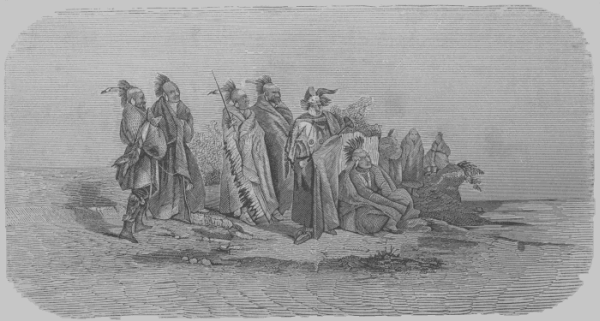 SAUKIE AND FOX INDIANS.
Civilisation may be likened to an absorbent body, placed in contact
with an anti-absorbent, for some of the properties of which it has
strong affinities. It will draw these latter so completely out, that, to
use a strong phrase, it may be said to eat them up. Civilisation is found
to derive some of the means of its perfect development from letters and
the arts, but it cannot permanently exist without the cultivation of the
soil. It seems to have been the fundamental principle on which the
species were originally created, that they should derive their sustenance
and means of perpetuation from this industrial labor. Wherever agricultural
tribes have placed themselves in juxtaposition to hunters and
erratic races, they have been found to withdraw from the latter the
means of their support, by narrowing the limits of the forest and plains,
upon the wild animals of which, both carnivorous and herbivorous, hunters
subsist. When these have been destroyed, the grand resources of
these hunters and pursuers have disappeared. Wars, the introduction of
foreign articles or habits of injurious tendency, may accelerate the period
of their decline—a result which is still further helped forward by internal
dissensions, and the want of that political foresight by which civil
nations exist. But without these, and by the gradual process of the
narrowing down of their hunting grounds, and the conversion of the
dominions of the bow and arrow to those of the plough, this result
must inevitably ensue. There is no principle of either permanency or
prosperity in the savage state.
It is a question of curious and philosophic interest, however, to observe
the varying and very unequal effects, which different types of
civilisation have had upon the wild hordes of men with whom it has
come into contact. And still more, perhaps, to trace the original efficiency,
or effeminacy of the civil type, in the blood of predominating
races, who have been characterized by it. In some of the European
stocks this type has remained nearly stationary since it reached the
chivalric era. In others, it had assumed a deeply commercial tone, and
confined itself greatly to the drawing forth, from the resources of new
countries, those objects which invigorate trade. There is no stock,
having claims to a generic nationality, in which the principle of progress
has, from the outset, been so strongly marked, as in those hardy, brave
and athletic tribes in the north of Europe, for whom the name of Teutons
conveys, perhaps, a more comprehensive meaning, than the comparatively
later one of Saxons. The object of this race appears continually
to be, and to have been, to do more than has previously been
done; to give diffusion and comprehension to designs of improvement,
and thus, by perpetually putting forth new efforts, on the globe, to carry
on man to his highest destiny. The same impulsive aspirations of the
spirit of progress, the same energetic onwardness of principle which
overthrew Rome, overthrew, at another period, the simple institutions
of the woad-stained Britons; and, whatever other aspect it bears, we
must attribute to the same national energy the modern introduction of
European civilisation into Asia.
When these principles come to be applied to America, and to be tested
by its native tribes, we shall clearly perceive their appropriate and distinctive
effects. In South America, where the type of chivalry marked the
discoverers, barbarism has lingered among the natives, without being
destroyed, for three centuries. In Canada, which drew its early
colonists exclusively from the feudal towns and seaports, whose inhabitants
had it for a maxim, that they had done all that was required of
good citizens, when they had done all that had been previously done, the
native tribes have remained perfectly stationary. With the exception
of slight changes in dress, and an absolute depreciation in morals, they
are essentially at this day what they were in the respective eras of Cartier
and Champlain. In the native monarchies of Mexico and Peru,
Spain overthrew the gross objects of idolatrous worship, and intercalated
among these tribes the arts and some of the customs of the 16th century.
With a very large proportion of the tribes but little was attempted beyond
military subjugation, and less accomplished. The seaboard tribes
received the ritual of the Romish church. Many of those in the interior,
comprehending the higher ranges of the Andes and Cordilleras, remain
to this day in the undisturbed practice of their ancient superstitions
and modes of subsistence. It is seen from recent discoveries, that there
are vast portions of the interior of the country, unknown, unexplored
and undescribed. We are just, indeed, beginning to comprehend the
true character of the indigenous Indian civilisation of the era of the discovery.
These remarks are sufficient to show how feebly the obligations
of letters and Christianity have been performed, with respect to the red
men, by the colonists of those types of the early European civilisation,
who rested themselves on feudal tenures, military renown, and an ecclesiastical
system of empty ceremonies.
It was with very different plans and principles that North America
was colonized. We consider the Pilgrims as the embodiment of the
true ancient Teutonic type. Their Alaric and Brennus were found in
the pulpit and in the school-room. They came with high and severe
notions of civil and religious liberty. It was their prime object to sustain
themselves, not by conquest, but by cultivating the soil. To escape
an ecclesiastical tyranny at home, they were willing to venture themselves
in new climes. But they meant to triumph in the arts of peace.
They embarked with the Bible as their shield and sword, and they laid
its principles at the foundation of all their institutions, civil, literary, industrial,
and ecclesiastic. They were pious and industrious themselves,
and they designed to make the Indian tribes so. They bought their
lands and paid for them, and proceeded to establish friendly neighborhoods
among the tribes. Religious truth, as it is declared in the Gospel,
was the fundamental principle of all their acts. In its exposition
and daily use, they followed no interpretations of councils at variance
with its plain import. This every one was at liberty to read.
Placed side by side with such an enlightened and purposed race, what
had the priests of the system of native rites and superstitions to expect?
There could be no compromise of rites—no partial conformity—no giving
up a part to retain the rest—as had been done in the plains of Central
America, Mexico and Yucatan. No toleration of pseudo-paganism, as
had been done on the waters of the Orinoco, the Parana and the Paraguay.
They must abandon the system at once. The error was gross
and total. They must abjure it. They had mistaken darkness for light;
and they were now offered the light. They had worshipped Lucifer
instead of Immanuel. This the tribes who spread along the shores of
the North Atlantic were told, and nothing was held back. They
founded churches and established schools among them. They translated
the entire Bible, and the version of David’s Psalms, and the
Hymns of Dr. Watts, into one of their languages. Two types of the
human race, more fully and completely antagonistical, in all respects,
never came in contact on the globe. They were the alpha and omega
of the ethnological chain. If, therefore, the Red Race declined, and
the white increased, it was because civilisation had more of the principles
of endurance and progress than barbarism; because Christianity
was superior to paganism; industry to idleness; agriculture to hunting;
letters to hieroglyphics; truth to error. Here lie the true secrets of
the Red Men’s decline.
There are but three principal results which, we think, the civilized
world could have anticipated for the race, at the era of the discovery.
1. They might be supposed to be subject to early extermination on the
coasts, where they were found. A thousand things would lead to this,
which need not be mentioned. Intemperance and idleness alone were
adequate causes. 2. Philanthropists and Christians might hope to reclaim
them, either in their original positions on the coasts, or in agricultural
communities in adjacent parts. 3. Experience and forecast
might indicate a third result, in which full success should attend
neither of the foregoing plans, nor yet complete failure. There was
nothing, exactly, in the known history of mankind, to guide opinion.
A mixed condition of things was the most probable result. And this,
it might be anticipated, would be greatly modified by times and seasons,
circumstances and localities, acting on particular tribes. Nothing less
could have been expected but the decline and extinction of some tribe,
whilst the removal of others, to less exposed positions, would be found
to tell upon their improvement. The effects of letters and Christianity
would necessarily be slow; but they were effects, which the history of
discovery and civilisation, in other parts of the world, proved to be
effective and practical. What was this mixed condition to eventuate
in?—how long was it to continue? Were the tribes to exercise sovereign
political jurisdiction over the tracts they lived on? Were they to
submit to the civilized code, and if so, to the penal code only, or also
to the civil? Or, if not, were they to exist by amalgamation with the
European stocks, and thus contribute the elements of a new race?
These, and many other questions, early arose, and were often not a little
perplexing to magistrates, legislatures, and governors. It was evident
the aboriginal race possessed distinctive general rights, but these existed
contemporaneously, or intermixed with the rights of the discoverers.
How were these separate rights to be defined? How were the weak
to be protected, and the strong to be restrained, at points beyond the
ordinary pale of the civil law? If a red man killed a white, without
the ordinary jurisdiction of the courts, could he be seized as a criminal?
And if so, were civil offences, committed without the jurisdiction of
either territory, cognizable in either, or neither? Could there be a
supremacy within a supremacy? And what was the limit between
State and United States laws? Such were among the topics entering
into the Indian policy. It was altogether a mixed system, and like most
mixed systems, it worked awkwardly, confusedly, and sometimes badly.
Precedents were to be established for new cases, and these were perpetually
subject to variation. Legislators, judges, and executive officers
were often in doubt, and it required the wisest, shrewdest, and best men
in the land to resolve these doubts, and to lay down rules, or advice, for
future proceeding in relation to the Red Race. It will be sufficient to
bear out the latter remark, to say, that among the sages who deemed
this subject important, were a Roger Williams, a Penn, a Franklin, a
Washington, a Jefferson, a Monroe, a Crawford, and a Calhoun.
It must needs have happened, that where the Saxon race went, the
principles of law, justice, and freedom, must prevail. These principles,
as they existed in England at the beginning of the sixteenth century,
were transferred to America, with the Cavaliers, the Pilgrims, and the
Quakers, precisely, as to the two first topics, as they existed at home.
Private rights were, as well secured, and public justice as well awarded
here, as there. But they also brought over the aristocratic system,
which was upheld by the royal governors, who were the immediate representatives
of the crown. The doctrine was imprescriptible, that the
fee of all public or unpatented lands was in the crown, and all inhabitants
of the realm owed allegiance and fealty to the crown. This doctrine,
when applied to the native tribes of America, left them neither
fee-simple in the soil, nor political sovereignty over it. It cut them
down to vassals, but, by a legal solecism, they were regarded as a sort
of free vassals. So long as the royal governments remained, they had
the usufruct of the public domain—the right of fishing, and hunting, and
planting upon it, and of doing certain other acts of occupancy; but this
right ceased just as soon, and as fast, as patents were granted, or the public
exigency required the domain. The native chiefs were quieted with
presents from the throne, through the local officers, and their ideas of independence
and control were answered by the public councils, in which
friendships were established, and the public tranquillity looked after.
Private purchases were made from the outset, but the idea of a public
treaty of purchase of the soil under the proprietary and royal governors,
was not entertained before the era of William Penn.
It remained for the patriots of 1775, who set up the frame of our present
government, by an appeal to arms, to award the aboriginal tribes
the full proprietary right to the soil they respectively occupied, and to
guarantee to them its full and free use, until such right was relinquished
by treaty stipulations. So far, they were acknowledged as sovereigns.
This is the first step in their political exaltation, and dates, in our records,
from the respective treaties of Fort Pitt, September 17, 1778,
and of Fort Stanwix, of October 22, 1784. The latter was as early
after the establishment of our independence, as these tribes—the Six
nations, who, with the exception of the Oneidas, sided with the parent
country—could be brought to listen to the terms of peace. They were
followed by the Wyandots, Delawares, and Chippewas, and Ottowas,
in January, 1785; by the Cherokees, in November of the same year;
and by the Choctaws and Shawnees, in January, 1786. Other western
nations followed in 1789; the Creeks did not treat till 1790. And from
this era, the system has been continued up to the present moment. It
may be affirmed, that there is not an acre of land of the public domain
of the United States, sold at the land offices, from the days of General
Washington, but what has been acquired in this manner. War, in which
we and they have been frequently involved, since that period, has conveyed
no territorial right. We have conquered them, on the field, not
to usurp territory, but to place them in a condition to observe how much
more their interests and permanent prosperity would be, and have ever
been, promoted by the plough than the sword. And there has been a
prompt recurrence, at every mutation from war to peace, punctually, to
that fine sentiment embraced in the first article of the first treaty ever
made between the American government and the Indian tribes, namely,
that all offences and animosities “shall be mutually forgiven, and buried
in deep oblivion, and never more be had in remembrance.”[46]
The first step to advance the aboriginal man to his natural and just
political rights, namely, the acknowledgment of his right to the soil, we
have mentioned; but those that were to succeed it were more difficult
and complex in their bearings. Congress, from the earliest traces of
their action, as they appear in their journals and public acts, confined the
operation of the civil code to the territory actually acquired by negotiation,
and treaties duly ratified by the Senate, and proclaimed, agreeably
to the Constitution, by the President. So much of this public territory
as fell within the respective State lines, fell, by the terms of our political
compact, under State laws, and the jurisdiction of the State courts;
and as soon as new tracts of the Indian territory, thus within State boundaries,
were acquired, the State laws had an exact corresponding extension
until the whole of such Indian lands had been acquired. This provided
a definite and clear mode of action, and if it were sometimes the
subject of doubt or confliction, such perplexity arose from the great extension
of the country, its sparsely settled condition, and the haste or
ignorance of local magistrates. And these difficulties were invariably
removed whenever the cases came into the Supreme Court of the United
States.
Without regard to the area of the States, but including and having
respect only to the territories, and to the vast and unincorporated wilderness,
called the “Indian country,” Congress provided a special code
of laws, and from the first, held over this part of the Union, and holds
over it now, full and complete jurisdiction. This code was designed
chiefly to regulate the trade carried on at those remote points between
the white and red men, to preserve the public tranquillity, and to provide
for the adjudication of offences. Citizens of the United States, carrying
the passport, license, or authority of their government, are protected by
their papers thus legally obtained; and the tribes are held answerable for
their good treatment, and if violence occur, for their lives. No civil
process, however, has efficacy in such positions; and there is no compulsory
legal collection of debts, were it indeed practicable, on the Indian
territories. The customs and usages of the trade and intercourse,
as established from early times, prevail there. These customs are
chiefly founded on the patriarchal system, which was found in vogue on
the settlement of the country, and they admit of compensations and
privileges founded on natural principles of equity and right. The Indian
criminal code, whatever that is, also prevails there. The only exception
to it arises from cases of Americans, maliciously killed within the
“Indian country,” the laws of Congress providing, that the aggressors
should be surrendered into the hands of justice, and tried by the nearest
United States courts.
These preliminary facts will exhibit some of the leading features of
the mixed system alluded to. Its workings were better calculated for
the early stages of society, while population was sparse and the two
races, as bodies, kept far apart, than for its maturer periods. As the intervening
lands became ceded, and sold, and settled, and the tribes themselves
began to put on aspects of civilisation, the discrepancies of the system,
and its want of homogeneousness and harmony, became more apparent.
Throughout the whole period of the administrations of Washington,
and John Adams, and Jefferson, a period of twenty years, the low state of
our population, and the great extent and unreclaimed character of the
public domain, left the Indians undisturbed, and no questions of much
importance occurred to test the permanency of the system as regards
the welfare of the Indians. Mr. Jefferson foresaw, however, the effect
of encroachments beyond the Ohio, and with an enlightened regard for
the race and their civilisation, prepared a new and consolidated code of
all prior acts, with some salutary new provisions, which had the effect to
systematize the trade and intercourse, and more fully to protect the rights
of the Indians. This code served, with occasional amendments, through
the succeeding administrations of Madison, Monroe, and John Quincy
Adams, into that of General Jackson, when, in 1834, the greatly advanced
line of the frontiers, the multiplied population, and necessarily
increased force of the Indian department, and the large amount of Indian
annuities to be paid, called for its thorough revision, and a new general
enactment was made.
Previously, however, to this time, during the administration of Mr.
Monroe, it was perceived that the Indian tribes, as separate communities,
living in, and surrounded by, people of European descent, and governed
by a widely different system of laws, arts, and customs, could not
be expected to arrive at a state of permanent prosperity while thus locally
situated. The tendency of the Saxon institutions, laws, and jurisprudence,
was to sweep over them. The greater must needs absorb
the less. And there appeared, on wise and mature reflection, no reasonable
hope to the true friends of the native race, that they could sustain
themselves in independency or success as foreign elements in the
midst of the State communities. It was impossible that two systems of
governments, so diverse as the Indian and American, should co-exist on
the same territory. All history proved this. The most rational hope
of success for this race, the only one which indeed appeared practical
on a scale commensurate with the object, was to remove them, with
their own consent, to a position entirely without the boundaries of the
State jurisdictions, where they might assert their political sovereignty,
and live and develope their true national character, under their own
laws.
The impelling cause for the action of the government, during Mr.
Monroe’s administration, was the peculiar condition of certain tribes, living
on their own original territories, within the State boundaries, and
who were adverse to further cessions of such territory. The question
assumed its principal interest in the State of Georgia, within which portions
of the Creek and Cherokee tribes were then living. About ten
millions of acres of lands were thus in the occupancy of these two tribes.
As the population of Georgia expanded and approached the Indian settlements,
the evils of the mixed political system alluded to began strongly
to evince themselves. In the progress of the dispersion of the human
race over the globe, there never was, perhaps, a more diverse legal, political,
and moral amalgamation attempted, than there was found to exist,
when, in this area, the descendants from the old Saxons, north-men
and Hugenots from Europe, came in contact with the descendants (we
speak of a theory) of the idle, pastoral, unphilosophic, non-inductive race
of central Asia, living in the genial climate and sunny valleys of Georgia
and Alabama.
The American government had embarrassed itself by stipulating at an
early day, with the State of Georgia, to extinguish the Indian title within
her boundaries, at the earliest practicable period, when it could be done
“peaceably and on reasonable conditions.” The Indians, as they advanced
in agriculture, became averse to sell. The Georgians, as they
increased in numbers, became importunate for the territory to which they
had, in this event, the reversionary right. The President was frequently
importuned by the State authorities. The Indians were frequently
brought to consider the subject, which was one that increased its importance
with years.
We have deemed it proper to put this matter in its right attitude in
relation to the great question of Indian removal; and as furnishing, as it
did, reasons for the early consideration and action of the government.
It is not our intention to pursue the Georgia question disjunctively—we
have neither time nor space for it here, and will only further premise,
that it is susceptible of some very different views from those often premised
of it.[47] That it was one of the prominent considerations which
led the administration of Monroe to take up betimes the general question
of the Indian tribes, is well known and remembered, and apparent from
a perusal of the public documents of the era.
Governed by such considerations, Mr. Monroe communicated a special
message to Congress on the 27th of January, 1825, recommending
the removal of all the tribes within the States and Territories, and providing
for their future “location and government.” This is the official
date and foundation of the plan of removal, which has been so generally,
and may we not add, so successfully and propitiously to the best interests
of the tribes, carried into effect. “Being deeply impressed with
the opinion,” observes this venerated statesman, who has, years since,
gone to join the patriot spirits who achieved our independence—“that
the removal of the Indian tribes from the land which they now occupy,
within the limits of the several States and Territories, to the country
lying westward and northward thereof, within our acknowledged
boundaries, is of very high importance to the Union, and may be accomplished
on conditions, and in a manner, to promote the interests and happiness
of those tribes, the attention of the government has been long
drawn, with great solicitude, to the object.
“For the removal of the tribes within the limits of the State of Georgia,
the motive has been peculiarly strong, arising from the compact with
that State, whereby the United States are bound to extinguish the Indian
title to the lands within it, whenever it may be done peaceably, and
on reasonable conditions.
“In the fulfilment of this compact, I have thought that the United
States should act with a generous spirit, that they should omit nothing
which should comport with a liberal construction of the instrument, and
likewise be in accordance with the just rights of those tribes. From the
view which I have taken of the subject, I am satisfied that, in the discharge
of these important duties, in regard to both the parties alluded to,
the United States will have to encounter no conflicting interests with
either: on the contrary, that the removal of the tribes from the Territories
which they inhabit, to that which was designated in the message at
the commencement of the session, which would accomplish the object
for Georgia, under a well digested plan for their government and civilisation,
in a mode agreeable to themselves, would not only shield them
from impending ruin, but promote their welfare and happiness. Experience
has clearly demonstrated that, in their present state, it is impossible to
incorporate them, in such masses, in any form whatever, into our system. It
has also demonstrated, with equal certainty, that without a timely anticipation
of, and provision against, the dangers to which they are exposed, under
causes which it will be difficult, if not impossible, to control, their degradation
and extermination will be inevitable.”
We have underscored the last two sentences, because they express
in forcible and just language, the experience of the American government,
in relation to the subject, after an experiment of fifty years, dating
from ’75, and lie, indeed, at the foundation of the present Indian policy.
It is also the experience of sound and calm observers, who have watched
the operation of our laws and customs upon the isolated Indian communities
in the States. Every year has exemplified the futility of raising
them up to the European standard in industry, in intelligence or character,
while thus situated; nor indeed, has it been practicable to shield
them effectually against the combined effects of intemperance, personal
sloth, and of popular and vulgar contumely.
Mr. Calhoun, whose report on the subject was transmitted to Congress,
with the message above named, communicates the details essential
to the execution of the proposed plan. He states the whole number
of Indians to be removed from the States and Territories, excluding
those located west and north of Lake Michigan and the Straits of St.
Mary’s, at 97,000 souls, who occupy about 77 millions of acres of land.
The country proposed for their location is that stretching immediately
west, beyond the boundaries of the States of Missouri and Arkansas,
having the River Arkansas running through its centre from west to east,
the Missouri and Red rivers respectively as the northern boundary, and
the vast grassy plains east of the Rocky Mountains, as its western
limit.
The map which we publish of this territory, is drawn on the basis of
one which was published by Congress in 1834, in illustration of the report
of the committee on Indian affairs of May 30th of that session. It
embraces all the locations of tribes to that period.
The plan proposed the gratuitous grant of the country to the respective
tribes, and their removal to it at government expense. It embraces
the transference to it, of their schools established by religious societies, and
supported, in part, by the civilisation fund, and all their means of moral
and religious culture. It is based on the pursuit of agriculture, the mechanic
arts, and the raising of cattle and stock. It invests the tribes
with full power of making and executing all their laws and regulations,
civil and criminal. It stipulates military protection, to keep the surrounding
tribes at peace. It leaves them their political sovereignty;
being without the boundary of the States, under their own chiefs and
local governors, with such aids as are necessary to enable the various
tribes to associate and set up the frame of an associated government to
be managed by themselves, and as subsequently proposed in Congress,
to be represented in that body whenever the system shall be perfected
so as to justify this measure. It proposed, as the basis of removal, a
solemn act of Congress, guaranteeing the country to them, and excluding
its future incorporation into the States. A second location, in the
northern latitudes, was proposed for the Indians west of Michigan, where
a further body of 32,266 souls were estimated to reside.
Such were the general principles of Mr. Monroe’s plan, submitted in
1825, and subsequently adopted by Congress, in its essential features.
It has now been in operation EIGHTEEN YEARS, and it is proposed, in
bringing this paper to a close, briefly to examine the condition and prospects
of the expatriated tribes, in the country to which they have been
transferred.
By a report from the proper department, transmitted to Congress with
the President’s message in 1836, the result of the first ten years’ experiment
is shown to have been the actual migration of 40,000 from
their original seats, east, to the allotted Indian territory, west of the Mississippi.
Of this number, 18,000 were Creeks, 15,000 Choctaws, 6,000
Cherokees, 2,000 Chippewas, Ottawas, and Pottowattomies, 1,300
Shawnees, 800 Delawares, 500 Quapaws, 400 Seminoles, 600 Kickapoos,
400 Senecas, and an average of, say 250 each, of Appalachicolas,
Weas, Piankashaws, Peorias and Kaskaskias. In this statement, small
fractions over or under, are omitted. A location and permanent home
has been provided for seventeen tribes and parts of tribes; a number
which, in the succeeding seven years, we speak from documents before
us, has been largely augmented. The whole body of the Cherokees, of
the Creeks, or Muscogees, of the Chickasaws and Choctaws, &c., and
also, with the exception of one principal band, of the Seminoles, have
been removed. Portions of other tribes, not then full, have joined their
kindred; and some whole tribes, who had not before come into the arrangement,
and ceded their lands east, as the Miamas of the Wabash,
and the Wyandots of Sanduskey, have since accepted locations in the
Indian territory. The Chickasaws are all located with their affiliated
countrymen, the Choctaws; and numbers of the ancient Iroquois confederacy,
the Six Nations of New York, as well as the ancient Mohegans
and Munsees, have, within a few years, selected locations south of
the Missouri. The entire number of red men now concentrated on those
plains and valleys, where winter scarcely exerts any severity of power,
may be set down at 77,000 souls, leaving, from the official report of
1841, but 21,774 of the original estimated number of 1825, to be removed;
exclusive of those west of the straits of Michilimackinac and St.
Mary’s.
From the documents accompanying the annual report transmitted to
Congress by the President, in December, 1840, the amount of funds
invested by the government in stocks, for the Indians, was $2,580,000,
on which the annual interest paid to them was $131,05. Twenty-four
of the tribes had permanently appropriated, by treaty, $60,730 per annum,
for the purpose of education. The number of schools maintained,
and the number of pupils actually taught, are not furnished. It is gratifying
to know, from this source, that civilisation, agriculture, and the
mechanic arts, are making a rapid progress, and that education and
Christianity are walking hand-in-hand. Planting and raising cattle are
adopted generally. Portions of the most advanced tribes have devoted
themselves to the mechanic arts, supplying themselves, to a limited extent,
with smiths, wheelwrights, carpenters, and joiners, and some other
branches. Spinning and hand-loom weaving are practised to some extent.
There are native merchants, among the three principal southern
tribes, who ship their own cotton and other products to market, and supply
their people, in return, with such products of the East and West Indies,
and other parts of the world, as they require. A large part of the
contracts, particularly for Indian corn, required to subsist the United
States troops in that quarter of the Union, is furnished by native contractors.
Their legislation is performed in representative councils, and
is well adapted to the actual and advancing state of society. Many of
their leading men are well educated; some of them classically; and the
general moral and intellectual tone and habits of the tribes, are clearly
and strikingly on the advance. It requires, it is believed, but time and
perseverance in civil associations, to lead them to the same results arrived
at by other barbarous nations, and to demonstrate to them the
value and importance of a general political confederation, founded on the
principles of equal rights and equal representation, supported by public
virtue and intelligence.
Having sketched the cause of the decline of that portion of the North
American Indians, who were seated along the Atlantic, and the plan
proposed for checking it, we shall now, with the map and documentary
evidence before us, devote a few moments to the present condition and
prospects of the more prominent tribes.
1. The Choctaws, beginning at the extreme south of the territory, are
the first in position. They occupy the country above the State of Arkansas,
extending from the Arkansas to the Red river, following up the
Canadian branch of the former, comprising an area of about 150 miles
in breadth, by 200 in length. They are bounded by Texas south-west.
The country is well adapted for grain and the raising of stock, in its
middle and northern parts, and for cotton on the south. Many of the
natives have large fields, where, but a few years since, the forest was
untouched. Saw mills, grist mills, and cotton gins, are either erecting
or erected throughout the country. Salt is manufactured by an intelligent
Choctaw. Iron ore has been found, and specimens of gold have
been picked up in various places.
This tribe is governed by a written constitution and laws. Their territory
is divided into three districts, each of which elects, once in four
years, a ruling chief, and ten representatives. The general council,
thus constituted, and consisting of thirty councillors, meets annually, on
the first Monday in October. Voters must be Choctaws, of age, and
residents of the districts. The three chiefs have a joint veto power
on all laws passed; but two-thirds of the council may re-pass them after
such rejection.
The council of thirty appoint their own speaker and clerk, and keep
a journal. They meet in a large and commodious council-house, fitted
up with seats for members and spectators, and committee rooms. Their
sessions are, usually, about ten days in duration. They are paid two
dollars per diem for their services, out of public funds.
In addition to this evidence of capacity for self-government, there are
judicial districts established, the right of trial by jury is secured, and
there is an appeal to the highest tribunal. All the males, of a special
age, are subject to do military duty: for this purpose the territory is
subdivided into thirty two captaincies, the whole being placed under the
orders of a general. The council has passed many good and wholesome
laws; among them, one against intemperance and the sale of ardent
spirits. The collection of debts is at present not compulsory, being
regulated by questions of credit, punctuality, and honor, which are to be
adjusted between the buyer and seller. The country is too sparsely
settled, and the popular odium against incarceration too strong, to permit
a resort to it. Thus, it will be seen, this tribe exhibit in their frame
of government the elements of a representative republic, not a pure
democracy, with perhaps sufficient conservative power to guard against
sudden popular effervescence.
The Choctaws have twelve public schools, established by treaty
stipulations with the United States. There are several missionaries
amongst them, of the Presbyterian and Methodist denominations, whose
labors are reported by the public agents to be beneficial, and calculated
to advance their condition. There are four public blacksmith shops,
two of which are exclusively worked by the natives. The strikers, or
assistants, at all the shops, are natives. Shops have also been erected,
in various parts of the nation, which are occupied only in the spring and
summer, in planting and crop time. The mechanics in these are natives,
who are paid, not by the individuals requiring aid, but out of public
funds. The nation has an academy located in Scott county, Kentucky,
at which 125 students were taught in 1839 and 1840. This institution
is now in the process of being established in their own territory. This
tribe we learn by the Secretary of War’s report, appropriated $18,000
of their annuities, in 1843, to educational purposes.
2. Chickasaws. This tribe is of the same lineage as the Choctaws;
and, by a compact with the latter, they occupy the same territory, and
live intermixed with them. It constitutes a part of this compact, that
the Chickasaws are to concentrate their population, and form a fourth
election district, which shall be entitled to elect ten representatives, and
three senatorial chiefs, to the national Council. The aggregate amount
of the vested funds of this tribe, in 1840, was $515,230 44; of which
$146,000 is devoted to orphans. The annual interest paid by the government
is $27,063 83. They participate equally in the advantages of
the Choctaw academy, and have had many of their youth educated at
that institution.
3. Next, in geographical position, to the united Choctaws and Chickasaws,
are the Muskogees, who are more generally known under the
name of Creeks. They occupy a territory one hundred and fifty miles
in length, by ninety in breadth. They are bounded on the south by the
Canadian fork of the Arkansas, and by the district of the Seminoles,
which lies between the main branch of this stream and its north fork.
Their territory reaches to a point opposite the junction of the Neosho,
and is protracted thence north to the Cherokee boundary. It is a rich
tract, well adapted to the growth of corn, vegetables, and esculents,
and the raising of stock. It is not as abundantly watered by running
streams as some of the tracts, or rather, it is a characteristic of its
smaller streams that they run dry, or stand in pools, during the latter
part of summer. In place of these, it has some good springs. The
main and the north fork of the Canadian are exemptions from the effects
of summer drouth. In point of salubrity, the country is not inferior to
other portions of the Indian territory.
The government of the Creeks is still essentially the same which
they exercised on the banks of the Chattahoochee and the plains of
Georgia. They exist in chieftainships, each head of which has his own
local jurisdiction, civil and criminal. Each ruling chief has his village
and his adherents; and the condition of things partakes of what we shall
be understood by designating feudal traits. They have no written constitution;
their laws are, however, now reduced in part to writing.
General councils, or conventions, not exact in the period of their occurrence,
consider and decide all general questions. At these, the chieftainships
are all entitled to representation. Local questions, of right
and police, come before the local chiefs, and are settled according to
usage. They adhere to the original mode of working common or town
fields, at which it is the duty of all to assist, both in the original clearing
and in the annual labor of planting and reaping. There are also individuals,
possessing slaves, who manage pretty extensive plantations.
More corn is raised by this tribe than by any other now located West.
Over and above their own wants, they have for several years had a
large amount for sale and exportation. Less attention has been paid to
the raising of stock, for which, indeed, the country has been deemed less
propitious; but this branch of industry has of late years attracted more
attention.
The Creeks had, for many years prior to their removal, been divided
into upper and lower towns—a distinction which has been transferred to
the West. Opothleyoholo is the chief of the Upper, and Roly McIntosh
of the Lower Creeks. These two chieftainships embrace the lesser
ones, and divide the nation into two parties. It was the Lower towns,
headed by the father of the present chief (whose tragic death we have
mentioned), that ceded the Georgian territory, and thus sided in the
policy of that State. The condition in which this tribe existed, in portions
of Georgia, Alabama, and Mississippi, was, in other respects, peculiar.
In emerging, as they were well in the process of doing, from the
hunter to the agricultural state, the institution of slavery, by which they
were surrounded, and in which they participated, gave a peculiar development
to their industry. Chiefs, who were averse to work themselves,
employed slaves, and thus the relation of planter and slave
was established long before the question of their removal occurred. The
effects of this were to exalt a portion of the nation above, and to depress
others below, the average standing. The disparity which took place in
laborious habits and in wealth, also impressed itself on education, dress,
manners, and information generally. Although the idea of slavery was
well known to the red race from the earliest times, and they all have a
word for it, in their native vocabularies, and practised it on their prisoners,
yet the result we are considering was accelerated by an admixture
of European blood in their chieftains. Hence it is that this
tribe, and one or two others in the south, have for years been able to
put forth intelligent chiefs to transact their public business, who have
astonished the circles at Washington. Yet, if they were followed to
the huts of the common people, at home, there was a degree of ignorance
and barbarity, even below the standard of our leading northern
tribes. Two kinds of testimony, respecting the condition of the southern
tribes, both very different, and both true, could therefore be given.
The Creeks came west, soured and disappointed, and but little disposed
for the effort before them. They had suffered in various ways,
and they had left the southern slopes and sunny valleys of the southern
Alleganies with “a longing, lingering look.” They had never manifested
a general interest in schools, and none whatever in religion. The
latter is still the prevalent feeling. It is believed there is not a missionary
now tolerated among them. There is a more friendly feeling towards
education. Neither had they made much advance in mechanic arts.
The chiefs were too proud, the common people too indolent, to learn the
use of the saw or the hammer. Some change, in this respect, is
thought to have ensued. Mechanics are employed for their benefit and
at their charges, by the government, which must introduce the elements
of mechanical industry. They dress in a rather gaudy, but picturesque
manner. They live in comfortable houses of squared or scored logs,
fitted up with useful articles of furniture, and they employ beasts of
burthen and of pleasure. It is the evidence of the government agents,
that the signs of advancing thrift and industry are among them. Time
alone, it is believed, is necessary, with a perseverance in present efforts,
to carry them onwards to civilisation and prosperity.[48]
4. Seminoles. This tribe is of the language and lineage of the
Creeks. They are appropriately placed on a tract within the general
area of the latter, bounded on the south by the Canadian fork of the
Arkansas, and by the lands of the Choctaws and Chickasaws. The
tract has an extent of seventy miles from east to west, and is fully adequate
to their wants. A blacksmith’s shop is maintained for them;
they are furnished with agricultural implements, and have been gratuitously
subsisted, as other tribes, one year, at the public expense. It is
thought to be unfavorable to their progress, that they have been allowed
to migrate with their slaves, who are averse to labor and exert a paralysing
influence on their industry. This tribe is far behind the other
southern tribes in civilisation and manners. They occupied, while in
Florida, a region truly tropical in its climate, and which yielded spontaneously
no unimportant part of their subsistence, in the arrowroot and
in sea fish. Their chief product thus far, in the west, has been corn.
They live under the authority of local chiefs, who, as in all their past
history, exercise influence in proportion to their talents and courage.
Their withdrawal from scenes and situations which served as nurseries
of idle, savage habits, and their association with the other leading tribes,
who are now bent on supporting themselves exclusively by agriculture,
have been favorable. They have been at peace since their arrival on
the waters of the Arkansas; and it is anticipated that they will, by example
and emulation, assimilate themselves in industry with the pre-existing
tribes. It has already been demonstrated that they will sustain
themselves in their new field of labor. But few of their numbers—from
the last accounts not exceeding 100[49]—now remain in Florida.
5. Cherokees. This tribe is prominent among the native stocks in
the United States, and is foremost in the efforts it has made to take rank
among civilized nations. In this effort it has passed through some
severe and tragic ordeals from internal dissensions, from which it would
seem, that in proportion as the prize is brought within their grasp, are
the trials multiplied which delay its seizure. And, notwithstanding its
strong claims to consideration on this head, they have, it must be admitted,
much to attain. The original position of the Cherokees, in
the valleys and the western spurs of the Alleganies, and remote from
the disturbing causes which agitated the other tribes, was highly favorable
to their increase and advance. No tribe in North America had
remained so completely undisturbed, by red or white men, up to the
year 1836. They were early, and to a considerable extent, cultivators;
and whatever they were in ancient times, they have been a
nation at peace, for a long period. Soon after the close of the late
war of 1812, a portion of this tribe went over the Mississippi, and, by
a compact with government, placed themselves between the waters of
the White river and the Arkansas. This advance formed the nucleus
of that political party, who have mingled in their recent assemblies
under the name of Western Cherokees, and who deemed themselves
to be entitled to some rights and considerations above the Eastern
Cherokees. The principal dissensions, however, grew out of the
question of the cession of the territory east of the Mississippi. This
was a broad question of sale or no sale, emigration or non-emigration.
At the head of the affirmative party was Ridge; at the head of the
negative, Ross. The latter, in addition to his being the leading chief
and most prominent man, was in a large majority, and, for a time,
successfully resisted the measure. The former drew a number of
the best educated chiefs and men to his side. Availing himself of
the temporary absence of his antagonist, Ross, from the country, he
ceded the country, and sealed the fate of his tribe east of the Mississippi.
It was a minority treaty, but the consideration was ample;
it secured large prospective advantages, besides a large and rich domain
in the West. It was, therefore, sustained by the government; the U. S.
Senate ratified it, adding some further immunities and further compensation,
at the instance of Ross. The tribe was removed, but it went west
with a deadly feud. In the end, Ridge, like McIntosh, paid for his
temerity with his life. A representative government was set up, consisting
of a house of delegates or representatives, annually chosen by districts;
a senatorial council, with powers of revision or co-action, and an
executive elective head. A code of laws has been adopted, and a
judiciary created to carry them into effect. This system, which has been
in operation some six or seven years, has been found adequate to
sustain itself through scenes of severe trial; and it must be regarded
as one which, modified as it may be, is destined to endure.
The territory of the Cherokees is between that of the Creeks and
Osages. It is ample beyond their wants, fertile, and generally well
watered. The Arkansas crosses it centrally; it has the Neosho and
the State of Arkansas as its eastern boundary. It is well adapted to
the cereal grains. Corn, wheat and oats succeed well, together with
melons and culinary vegetables of all descriptions. The Cherokees
have been long accustomed to husbandry. They own large stocks of
horses, cattle, hogs and sheep. They occupy substantial and comfortable
houses. Many of their females spin and weave, and numbers of
their people are clothed in their own manufactures. Well improved
farms extend through their settlements. A number of their merchants
are natives, who buy and sell produce, and import foreign merchandise.
Reading and writing are common attainments. They have schools and
churches. They have mills for grinding grain. They manufacture salt
to a limited extent. The country yields stone coal and gypsum. The
prairies, which are interspersed through the tract, yield a fine summer
range for cattle, and produce a species of grass, which, when properly
cured, is little inferior to timothy. With a country which has thus the
elements of prosperity in itself, and an intelligent and industrious population,
this tribe must, ere long, present the gratifying spectacle of a
civilized race.
6. The Osages. This tribe is indigenous, and formerly owned a
large part of the territory which is now assigned to others. Their habits
and condition have been, however, but little benefited by the use which
they have made of their annuities. Great exertions have been made by
the local agents to induce them to give up their erratic mode of life,
and become agriculturists. To this end stock and agricultural implements
have been furnished them, and other facilities given, but without
any general effects. Among these may be named the building of mills,
and the erection of well built cabins for their chiefs. There is no tribe
to which the term predatory may be so appropriately applied as to the
Osages. They have, from an early day, been plunderers on that frontier,
among red and white men. Possessing a large territory, formerly
well supplied with the deer, elk and buffalo, powerful in numbers, courageous
in spirit, and enjoying one of the finest climates, these early
predatory habits have been transmitted to the present day. They are
loth to relinquish this wild license of the prairies—the so-called freedom
of the roving Indian. But it is a species of freedom which the
settlement of Missouri and Arkansas, and the in-gathering of the semi-civilized
tribes from the south and the north, has greatly restricted.
Game has become comparatively scarce. The day of the hunter is well
nigh past in those longitudes. When to this is added the example of
the expatriated Indians, in tillage and grazing, their field labors in
fencing and erecting houses, their improved modes of dress, their
schools, and their advanced state of government and laws, the hope
may be indulged that the Osages will also be stimulated to enter for the
prize of civilisation.
Such are the six principal tribes who form the nucleus, or, to use a
military phrase, the right wing of the expatriated aboriginal population,
as the bands are arranged in their order from south to north, in the
trans-Ozark or Indian territory. It would afford us pleasure to devote
some separate considerations to each of the remaining nineteen tribes and
half tribes, or remnants and pioneers of tribes, who make up this imposing
and interesting colony, where, for the first time since the settlement
of the Continent, the Indian race is presented in an independent, compact,
and prosperous condition. But it would manifestly extend this
article beyond its just limits, and we must therefore generalize our remaining
notices.
We still, however, adhere to a geographical method. The Senecas
from Sandusky, and the mixed Senecas and Shawnees, are situated
north-east of the Cherokees, and between the latter and the western
boundary of Missouri. They possess a hundred thousand acres of choice
lands. The Sanduskies number 251 souls; the mixed band, 222. They
are represented as farmers and stock-raisers, frugal, industrious, and less
addicted to intemperance than their neighbors. They cultivated, in
1839, from two hundred and fifty to three hundred acres of corn. They
have a blacksmith’s shop, under treaty stipulations, and possess good
stocks of horses, cattle, and hogs. The Quapaws adjoin the Senecas
and Shawnees on the north, and, as the latter, have their lands fronting
on the Neosho. This band formerly owned and ceded the south banks
of the Arkansas from its mouth as high as the Canadian fork. They are
indolent, much addicted to the use of ardent spirits, and depressed in
numbers. They have a tract of 96,000 acres. They cultivate, generally,
about one hundred acres of corn, in a slovenly manner. Part of their
numbers are seated on the waters of Red River, and the Indian predilection
for rowing is nourished by the frequent habit of passing to and fro.
This erratic habit is an unerring test of the hunter state.
The Piankashaws and Weas are of the Miami stock, and came from
the waters of the Wabash. They are located on 255 sections, immediately
west of the western boundary of Missouri, and about 40 miles
south of the Konza. Their population is 384, of which 222 are Weas.
Immediately west of them are the Peorias and Kaskaskias of the Illinois
family. They number 132, and possess 150 sections, which gives an
average of more than a square mile to each soul. Still west of these,
are the Ottowas of Ohio, about 200 in number, and above them, a small
band of 61 of the Chippewas of Swan Creek and Black River in Michigan.
These locations are all on the sources of the Osage River. The
lands are fine, partly woods and partly prairie, and are easily cultivated.
These six fragmentary bands are not dissimilar in their habits of living
and the state of their advance in agriculture. They subsist themselves
by raising corn and cattle and hogs. They evince an advancing condition,
and are surrounded by circumstances eminently favorable to it.
The Shawnees are placed at the junction of the Konza with the Missouri,
extending south and west. They number a little short of 1300,
and own a territory of ten thousand square miles, or 6,400,000 acres.
They are cultivators and graziers in an advanced state of improvement.
Hunting may be occasionally resorted to as a sport or amusement, but it
has, years since, been abandoned as a source of subsistence. Indeed,
the failure of the game in that region would have rendered the latter imperative,
had not their improved habits of industry led to it. This tribe
have essentially conquered their aversion to labor. They drive oxen
and horses trained to the plough. They split rails and build fences.
They erect substantial cabins and barns. They have old corn in their
cribs from year to year. They own good saddle-horses and saddles, and
other articles of caparison, and a traveller or visitor will find a good meal,
a clean bed, and kind treatment in their settlements.
Next in position to the Shawnees are the Delawares, the descendants
of the ancient Lenno Lenapees of Pennsylvania. Allies and kindred
in their ancient position, they are still in juxtaposition in their new
Their tract begins at the junction of the Konza and Missouri on the
north, and after running up the former to the Konza reserve, extends
north and west so as to embrace it on the north. It contains about
2450 square miles, or 2,208,000 acres. They number, at the last dates
to which we have referred, 826 souls, and are on the increase. In point
of habits, industry, and improvement, they are perhaps not inferior to
any of the northern stocks. Shielded from intemperance by their position,
out of the State limits, where they are exclusively under the influence
and protection of Congress laws, this tribe, together with the entire
circle of Indian communities on that frontier, has been for some years
in a favourable position for recovering and developing their true energies.
They have, within a few years, received into their protection a small
band (182) of the Monceys, and a smaller one, of 74, of the Stockbridges:
the latter, we need hardly inform the intelligent reader, are descendants
of the ancient Mohegans, and the former of the Minsi and Minnisinks,
who, at the era of the colonization of “Nova Belgica” and New York,
were respectively located on the east and the west banks of the Hudson.
The Stockbridges are civilized; the Munsees less so, but industrious.
Both are poor, and without funds.
Immediately succeeding the Delawares are the Kickapoos, an erratic
race, who, under various names, in connection with the Foxes and Sacs,
have, in good keeping with one of their many names,[50] skipped over half
the continent, to the manifest discomfort of both German and American
philologists and ethnographers, who,in searching for the so-called “Mascotins,”
have followed, so far as their results are concerned, an ignis
fatuus. The Kickapoos have 12,000 square miles, or 768,000 acres.
It is a choice, rich tract, and they are disposed, with the example of the
Delawares and Shawnees, to profit by it. They raise corn and cattle,
hogs and horses, and are prosperous. Their numbers, in 1840, were
470. There is a tract of 200 square miles, on the Great and Little
Namaha, assigned to the metifs, or descendants of mixed blood, of the
Iowas, Otoes, and Missouris. These separate the removed and semi-civilized
tribes, south and west of the Missouri, from the wild indigenes—we
mean the Otoes, the Pawnees, the Omahaws, and the Sioux,
who extend over vast tracts, and exist without any sensible improvement
in their condition. The same remark may be applied to the Konzas,
who are, however, hemmed in between the Delawares and the
Shawnees, except on their western borders. It is no part of our purpose
to consider these tribes, as, over and above the influence of contiguous
examples, they constitute no part of the evidence affecting the general
question of the plan of removal.
That this evidence, as now briefly sketched, is favorable, and indeed
highly favorable, to the general condition and prosperity of the removed
tribes, is, we apprehend, clearly manifest. Not only have they been
placed beyond the wasting influence of causes which oppressed them,
within the circle of the State communities; but they have received in
exchange for their eastern lands, a territory which, as a whole, is highly
fertile and salubrious. It is a territory which has required little comparative
labor to cultivate, made up as it is of mixed forests and prairies.
It is also, viewed in extenso, well watered, having those noble streams,
the Red River, the Arkansas, the Konza, the Platte, and the Missouri,
with their tributaries, running through it. The range which it affords
for cattle and stock, and the abundance of wild hay, of a nutritious quality,
has proved very favorable to an incipient agricultural population, and
greatly mitigated the ordinary labors of farming in northern climates.
There are no latitudes in North America more favorable to the growth
of corn. The cotton plant has been introduced by the Choctaws and
Chickasaws, on the banks of Red river. It is a region abounding in salt
springs and gypsum beds, both which must hereafter be fully developed,
and will prove highly advantageous. It is above the first or principal
rapids of the great streams running down the plateau of the Rocky Mountains,
and consequently affords sites for water-mills, which are scarce
and almost unknown on the lower Arkansas. There is, indeed, a combination
of circumstances, which are calculated to favor the General
Government plan, and foster the Indians in a general attempt at civilisation
and self-government. And we look with interest, and not without
anxiety, at the result of the experiment.
We are aware that there are trials before them, arising from great
diversity of feelings and opinions, and states of civilisation. Some of
the tribes are powerful, advanced, and wealthy; some feeble and poor.
Education has very unequally affected them. Laws are in their embryo
state. The Gospel has been but partially introduced. In clothing the
native councils with some of the powers of a congress, and regulating
their action by constitutional fixity, there is great care and deliberation
required, not, at once, to grasp too much. There is perhaps yet greater
danger in enlarging the authority of the chiefs and sagamores into something
like presidential dimensions. The natives have great powers of
imitation; and it is to be feared that they will content themselves by
imitating things which they do not fully understand or appreciate. The
national character of the Indians is eminently suspicious. There is a
fear to trust others, even themselves. Delegated power is narrowly
watched, and often begrudged when given. The acts of their public
men are uniformly impugned. The thought seems hardly to be entertained
by the common Indians, that an officer may be guided by right
and honest motives. The principle of suspicion has, so to say, eaten out
the Indian heart. The jealousy with which he has watched the white
man, in all periods of his history, is but of a piece with that with which he
watches his chiefs, his neighbors, and his very family. Exaltation of
feeling, liberality of sentiment, justness of reasoning, a spirit of concession,
and that noble faith and trust which arise from purity and virtue,
are the characteristics of civilisation; and we should not be disappointed
if they do not, all at once, grow and flourish in these nascent communities.
Still, our hopes predominate over our fears. Where so much has
been accomplished as we see by the Cherokees, the Choctaws, and
Chickasaws, and our most advanced northern tribes, we expect more.
From the tree that bears blossoms, we expect fruit.
We have no expectation, however, that without some principles of
general political association, the tribes can permanently advance. To
assume the character and receive the respect of a commonwealth, they
must have the political bonds of a commonwealth. Our Indian tribes have
never possessed any of these bonds. They are indeed the apparent remnants
of old races, which have been shivered into fragments, and never
found the capacity to re-unite. The constant tendency of all things,
in a state of nature, has been to divide. The very immensity of the continent,
its varied fertility and resources, and its grand and wild features,
led to this. Hitherto, the removed tribes in the West have opposed an
associated government. They have stoutly and effectually resisted and
rejected this part of the government scheme. They fear, the agents
say, it is some plan to bring them under the civil yoke. Time, reflection,
and education must tend to correct this. More than all, their civil
discussions must tend to show the necessity of a more enlarged and general
frame of government, in which some individual rights must be yielded
to the public, to secure the enjoyment of the rest. We think there
is some evidence of the acknowledgment of this want, in their occasional
general councils, at which all the tribes have been invited to be present.
During the last year (1843) such a convocation was held at Tablequah,
the seat of the Cherokee government. At this, there were delegates
present from the Creeks, Chickasaws, Delawares, Shawnees, Piankashaws,
Weas, Osages, Senecas, Stockbridges, Ottowas, Chippewas,
Peorias, Pottowattomies, and Seminoles. The result of these deliberations,
we are informed, was a compact in which it was agreed:—
1. To maintain peace and friendship among each other.
2. To abstain from the law of retaliation for offences.
3. To provide for improvements in agriculture, the arts, and manufactures.
4. To provide against any cession of their territory, in any form.
5. To punish crimes, committed by one tribe, in the bounds of another.
6. To provide for a general citizenship among the contracting parties.
7. To suppress the use or introduction of ardent spirits.
These are very mixed principles, containing no basis of a government;
yet, futile as they are, we apprehend they contain no effective power
for their enforcement. A law without a penalty is like a rope of sand.
Any of these parties might nullify either of these acts, by neglecting
to enforce it. It is, we apprehend, the mere expression of the popular
will, in a council, without any binding obligation of the whole, or a majority
of the tribes, to compel obedience from the delinquent members.
It may, however, lead to further deliberations; and we cannot but regard
the movement as one which betokens political forethought and purpose.
Our greatest apprehensions, we must confess, before closing this paper,
arise from the peculiar geographical position of the Indian territory with
relation to our own. And this could not, perhaps, have been anticipated
twenty years ago, when the plan was formed. Our population is on the
broad move west. Nothing, it is evident, will now repress them this side
of the Pacific. The snowy heights of the Rocky Mountains are already
scaled; and we but apply the results of the past to the future, in saying
that the path which has been trod by a few, will be trod by many. Now,
the removed tribes are precisely in the centre of this path. From the
mouth of the Platte, or the Konza, the great highway to the Oregon
must run west. Whether this new tide of emigration will be successful
or unsuccessful, will those who compose it spare to trample on the red
man? Will they suddenly become kind to him, to whom they have
been unkind? Will they cease to desire the lands which their children
want? Will they consent to see the nation separated by an Indian
state? Will they award honors, nay, justice, to that state? Twenty
years will answer these questions.
Choctaws.—An appropriation of $113,000 has been made by Congress
for the removal and subsistence of the Choctaws now in Mississippi.
There are upwards of six thousand in our state, comprising
about eleven hundred families. These are under Colonels Johnson and
Fisher. The half of the money due the Indians, and to be paid after
their landing in their new homes in the West, is to be funded. This
will effectually prevent all speculation, and enable the Indians to obtain
and hold what is due them. Those now in the state are guarded against
all coercive measures for their removal, and left free to go West or
remain in their homes in Mississippi.—Southern Reformer.
The tickenagun, or Indian cradle, is an object of great pride with an
Indian mother. She gets the finest kind of broad cloth she possibly can
to make an outer swathing band for it, and spares no pains in ornamenting
it with beads and ribbons, worked in various figures. In the lodges
of those who can afford it, there is no article more showy and pretty than
the full bound cradle. The frame of the cradle itself is a curiosity. It
consists of three pieces. The vertebral board, which supports the back,
the hoop or foot-board, which extends tapering up each side, and the arch
or bow, which springs from each side, and protects the face and head.
These are tied together with deer’s sinews or pegged. The whole structure
is very light, and is carved with a knife by the men, out of the linden
or maple tree.
Moss constitutes the bed of the infant, and is also put between the child’s
feet to keep them apart and adjust the shape of them, according to custom.
A one-point blanket of the trade, is the general and immediate wrapper of
the infant, within the hoop, and the ornamented swathing band is wound
around the whole, and gives it no little resemblance to the case of a small
mummy. As the bow passes directly above the face and eyes, trinkets
are often hung upon this, to amuse it, and the child gets its first ideas of
ornament from these. The hands are generally bound down with the
body, and only let out occasionally, the head and neck being the only part
which is actually free. So bound and laced, hooped and bowed, the little
fabric, with its inmate, is capable of being swung on its mother’s back, and
carried through the thickest forest without injury. Should it even fall no
injury can happen. The bow protects the only exposed part of the frame.
And when she stops to rest, or enters the lodge, it can be set aside like any
other household article, or hung up by the cradle strap on a peg. Nothing,
indeed, could be better adapted to the exigencies of the forest life. And in
such tiny fabrics, so cramped and bound, and bedecked and trinketed,
their famous Pontiacs and King Philips, and other prime warriors, were
once carried, notwithstanding the skill they afterwards acquired in wielding
the lance and war club.
The Indian child, in truth, takes its first lesson in the art of endurance,
in the cradle. When it cries it need not be unbound to nurse it. If the
mother be young, she must put it to sleep herself. If she have younger
sisters or daughters they share this care with her. If the lodge be roomy
and high, as lodges sometimes are, the cradle is suspended to the top poles
to be swung. If not, or the weather be fine, it is tied to the limb of a
tree, with small cords made from the inner bark of the linden, and a vibratory
motion given to it from head to foot by the mother or some attendant.
The motion thus communicated, is that of the pendulum or common
swing, and may be supposed to be the easiest and most agreeable
possible to the child. It is from this motion that the leading idea of the
cradle song is taken.
I have often seen the red mother, or perhaps a sister of the child, leisurely
swinging a pretty ornamented cradle to and fro in this way, in
order to put the child to sleep, or simply to amuse it. The following specimens
of these wild-wood chaunts, or wigwam lullabys, are taken from
my notes upon this subject, during many years of familiar intercourse with
the aboriginals. If they are neither numerous nor attractive, placed side
by side with the rich nursery stores of more refined life, it is yet a pleasant
fact to have found such things even existing at all amongst a people
supposed to possess so few of the amenities of life, and to have so little
versatility of character.
Meagre as these specimens seem, they yet involve no small degree of
philological diligence, as nothing can be more delicate than the inflexions
of these pretty chaunts, and the Indian woman, like her white sister, gives
a delicacy of intonation to the roughest words of her language. The
term wa-wa often introduced denotes a wave of the air, or the circle described
by the motion of an object through it, as we say, swing, swing, a
term never applied to a wave of water. The latter is called tegoo, or if it
be crowned with foam, beta.
In introducing the subjoined specimens of these simple see saws of the
lodge and forest chaunts, the writer felt, that they were almost too frail of
structure to be trusted, without a gentle hand, amidst his rougher materials.
He is permitted to say, in regard to them, that they have been exhibited to
Mrs. Elizabeth Oakes Smith, herself a refined enthusiast of the woods,
and that the versions from the original given, are from her chaste and
truthful pen.
In the following arch little song, the reader has only to imagine a playful
girl trying to put a restless child to sleep, who pokes its little head, with
black hair and keen eyes over the side of the cradle, and the girl sings,
imitating its own piping tones.
| Ah wa nain? | (Who is this?) |
| Ah wa nain? | (Who is this?) |
| Wa yau was sa | (Giving light—meaning the light of the eye) |
| Ko pwasod. | (On the top of my lodge.) |
Who is this? who is this? eye-light bringing
To the roof of the lodge?
And then she assumes the tone of the little screech owl, and answers—
| Kob kob kob | (It is I—the little owl) |
| Nim be e zhau | (Coming,) |
| Kob kob kob | (It is I—the little owl) |
| Nim be e zhau | (Coming,) |
| Kit che—kit che. | (Down! down!) |
It is I, it is I, hither swinging, (wa wa)
Dodge, dodge, baby dodge;
And she springs towards it and down goes the little head. This is
repeated with the utmost merriment upon both sides.
Who is this, who is this eye-light bringing
To the roof of my lodge?
It is I, it is I, hither swinging,
Dodge, dodge, baby dodge.
Here is another, slower and monotonous, but indicating the utmost
maternal content:
Swinging, swinging, lul la by,
Sleep, little daughter sleep,
’Tis your mother watching by,
Swinging, swinging she will keep,
Little daughter lul la by.
’Tis your mother loves you dearest,
Sleep, sleep, daughter sleep,
Swinging, swinging, ever nearest,
Baby, baby, do not weep;
Little daughter, lul la by.
Swinging, swinging, lul la by,
Sleep, sleep, little one,
And thy mother will be nigh—
Swing, swing, not alone—
Little daughter, lul la by.
This of course is exceedingly simple, but be it remembered these
chaunts are always so in the most refined life. The ideas are the same,
that of tenderness and protective care only, the ideas being few, the language
is in accordance. To my mind it has been a matter of extreme
interest to observe how almost identical are the expressions of affection in
all states of society, as though these primitive elements admit of no progress,
but are perfect in themselves. The e-we-yea of the Indian woman
is entirely analogous to the lul la by of our language, and will be seen to
be exceedingly pretty in itself.
2. The original words of this, with their literal import, are also added,
to preserve the identity.
(a.)
- Wa wa—wa wa—wa we yea, (Swinging, twice, lullaby.)
- Nebaun—nebaun—nebaun, (Sleep thou, thrice.)
- Nedaunis-ais, e we yea, (Little daughter, lullaby.)
- Wa wa—wa wa—wa wa, (Swinging, thrice.)
- Nedaunis-ais, e we yea, (Little daughter lullaby.)
(b.)
- Keguh, ke gun ah wain e ma, (Your mother cares for you.)
- Nebaun—nebaun—nebaun, e we yea, (Sleep, thrice, lullaby.)
- Kago, saigizze-kain, nedaunis-ais, (Do not fear, my little daughter.)
- Nebaun—nebaun—nebaun, (Sleep, thrice.)
- Kago, saigizze-kain, wa wa, e we yea, (third line repeated.)
(c.)
- Wa wa—wa wa—wa we yea, (Swinging, twice, lullaby.)
- Kaween neezheka kediausee, (Not alone art thou.)
- Ke kan nau wai, ne me go, suhween, (Your mother is caring for you.)
- Nebaun—nebaun—nedaunis-ais, (Sleep, sleep, my little daughter.)
- Wa wa—wa wa—wa we yea, (Swinging, &c. lullaby.)
- Nebaun—nebaun—nebaun, (Sleep! sleep! sleep.[51])
THE HARE AND THE LYNX.
3. The story of the Wabose, (Hare,) and the Pighieu, (Lynx,) will at
once remind the reader of the so often recited tale of little Red Riding
Hood, in which the reciter imitates the tones of the wolf, and the little nursery
listener hears with a growing amazement, and starts as if he felt
the real wolf’s teeth at the close.
This story is partly spoken and partly sung. The Teller imitating alternately
the Hare, and its enemy, the Lynx.
There was once, she says, a little Hare living in the lodge with its grandmother,
who was about to send it back to its native land. When it had
gone but a little way, a Lynx appeared in the path, and began to sing,
Where pretty white one?
Where little white one,
Where do you go?
Tshwee! tshwee! tshwee! tshwee! cried the Hare, and ran back to
its grandmother. “See, grandmother,” said the timid little creature,
“what the Lynx is saying to me,” and she repeated the song. “Ho!
Nosis,” that is to say, courage my grandchild, run along, and tell him you
are going home to your native land: so the Hare went back and began
to sing,
To the point of land I roam,
For there is the white one’s home,—
Whither I go.
Then the Lynx looked at the trembling Hare, and began to sing,
Little white one, tell me why
Like to leather, thin and dry,
Are your pretty ears?
Tshwee! tshwee! tshwee! tshwee! cried the Hare, and she ran back
to her grandmother, and repeated the words. “Go Nosis, and tell him
your uncles fixed them so, when they came from the South.” So
the Hare ran back and sang,
From the south my uncles came,
And they fixed my ears the same,—
Fixed my slender ears.
and then the Hare laid her pink ears upon her shoulders, and was about
to go on, but the Lynx began to sing again,—
Why, why do you go away?
Pretty white one, can’t you stay?
Tell me why your little feet,
Are made so dry and very fleet?
Tshwee! tshwee! tshwee! tshwee! said the poor little Hare, and she
ran back again to the lodge to ask again. “Ho! Nosis!” said the grandmother,
who was old and tired, “do not mind him, nor listen to him, nor
answer him, but run on.”
The Hare obeyed, and ran as fast as she could. When she came to
the spot where the Lynx had been, she looked round, but there was no
one there, and she ran on. But the Lynx had found out all about the
little Hare, and knew she was going across to the neck of land; and he
had nothing to do but reach it first, and waylay her; which he did: and
when the innocent creature came to the place, and had got almost home,
the Lynx sprang out of the thicket and eat her up.
The original chant, omitting the narrative part as given above, runs in
this fashion, word for word.
| Lynx. | Tah kau | (where ah!) |
| | Tah hau | (where ah!) |
| | Wa bose | (little white one) |
| | Wa bose | (little white one) |
| | Ke te e zha | (are you going?) |
| Hare. | Na kwa oushing | (to the point of land) |
| | Ain dah nuk e aum baun | (in my native country) |
| | In de e zha | (I go.) |
| Lynx. | Au neen | (what!) |
| | Au neen | (what!) |
| | A nau be kaus o yun aig | (causes it,) |
| | Kish ke mun ing | (why like stripes of leather) |
| | Ish o tow ug a una, | (are your ears?) |
| Hare. | Nish ish sha ug | (my uncles,) |
| | O sha wun e nong | (when from the south) |
| | Ke e zha waud | (they came,) |
| | Ningeeaizh e goob un eeg | (they did fix me so.) |
| Lynx. | Tah kau | (where ah!) |
| | Tah kau | (where ah!) |
| | Wa bose | (little white one,) |
| | Wa bose | (little white one,) |
| | Ke de e zha | (are you going?) |
| | Au neen | (why?) |
| | Na naub o kos o yun | (look they so,) |
| | Kish ke mun a, | (like dry bits of leather,) |
| | I izh e zida una, | (your feet ha!) |
4. THE KITE AND THE EAGLE.
This is a specimen of Indian satire. The coward is boastful when
there is no danger: pretension succeeds in the absence of real merit! A
Kite was boasting how high he could fly, and ventured to speak disparagingly
of the eagle, not knowing that the latter overheard him. He
began to sing in a loud voice,
I upward fly
I! I alone disdain the air
Till I hang as by a hair
Poised in the sky.
The Eagle answers disdainfully, looking down from a branch far
above the Kite,
Who mounts the sky?
Who is this, with babbling tongue
As he had on the storm-cloud hung,
Who flies so high?
The Kite in a shrinking, feeble voice,
The great Khakake
I’ve sometimes thought he flew so high
That he must see within the sky
The dawn awake.
The Eagle despises him, and yet cannot forbear to answer,
I spurn you all, ye prating throng
How often have I passed ye by
When my broad pinions fleet and strong,
Soared up where leapt the thunder cry!
Nor ye with feeble wing might dare,
Those hill-tops high, to mount in air.
and he soared off, up, up into the sky till the boaster could not behold
him. But no sooner was the Kite left alone to himself than he began to
sing again so as to be heard on every side,
I upward fly
I, I alone disdain the air
Till I hang as by a hair
Poised in the sky.
Literally thus.
| Kite. | Neen a | (I alone) |
| | Neen a | (I alone) |
| | Ta wa e ya | (can go up) |
| | Bai bwau | |
| | As shau dau | (so as to seem as if hanging by a hair) |
| | Wa ke ge naun |
| | O shau wush ko geezhig oong a | (from the blue sky.) |
| Eagle. | Au wa nain | (Who is this?) |
| | Au wa nain | (Who is this?) |
| | Tshe mud je wa wa | (with babbling tongue, who boasts) |
| | Ke pim o saing. | (of flying so high?) |
Kite (shrinkingly) replies, “Oh I was only singing of the great Khakake,
it is he who is said to fly so high.”
Eagle disdainfully replies, “Tshe mud je wa wa, that is great babbler,
or bad-tongue, you are below my notice,” &c., and soars aloft.
Kite, resuming its boasting tone, as soon as the eagle is out of hearing,
| Neen a | (I alone &c., the whole being a |
| Neen a | repetition of the first part.) |
| Ta we ya | |
| Bai bwau | |
| As shau dau | |
| Wa ke ge naun, | |
| O shau wush ko, geezhig oong a. | |
5. THE RAVEN AND WOODPECKER.
A still farther view of Indian manners and opinions is hid under this
simple chant. Opinion among the forest race, makes the whole animated
creation cognizant and intelligent of their customs.
A young married woman is supposed to go out from the lodge, and
busy herself in breaking up dry limbs, and preparing wood, as if to lay
in a store for a future and approaching emergency.
A raven, perched on a neighbouring tree, espies her, at her work, and
begins to sing; assuming the expected infant to be a boy.
In dosh ke zhig o mun
In dosh ke zhig o mun
In dosh ke zhig o mun
My eyes! my eyes! my eyes! Alluding to the boy (and future man)
killing animals as well as men, whose eyes will be left, as the singer anticipates,
to be picked out by ravenous birds. So early are the first notions
of war implanted.
A woodpecker, sitting near, and hearing this song, replies; assuming
the sex of the infant to be a female.
Ne mos sa mug ga
Ne mos sa mug ga
Ne mos sa mug ga.
My worms! my worms! my worms! Alluding to the custom of the
female’s breaking up dry and dozy wood, out of which, it could pick its
favourite food, being the mösa or wood-worm.
Want of space induces the writer to defer, to a future number, the remainder
of his collection of these cradle and nursery chants. They constitute
in his view, rude as they are, and destitute of metrical attractions,
a chapter in the history of the human heart, in the savage phasis, which
deserves to be carefully recorded. It has fallen to his lot, to observe more
perhaps, in this department of Indian life, than ordinary, and he would not
acquit himself of his duty to the race, were he to omit these small links
out of their domestic and social chain. The tie which binds the mother
to the child, in Indian life, is a very strong one, and it is conceived to
admit of illustration in this manner. It is not alone in the war-path and
the council, that the Red Man is to be studied. To appreciate his whole
character, in its true light, he must be followed into his lodge, and viewed
in his seasons of social leisure and retirement. If there be any thing
warm and abiding in the heart or memory of the man, when thus at ease,
surrounded by his family, it must come out here; and hence, indeed, the
true value of his lodge lore, of every kind.
It is out of the things mental as well as physiological, that pertain to
maternity, that philosophy must, in the end, construct the true ethnological
chain, that binds the human race, in one comprehensive system of unity.
The Polynesian languages, like those of the Algonquin group of North
America, have inclusive and exclusive pronouns to express the words
we, ours, and us. They have also causative verbs such as, to make afraid,
to make happy, &c., but while there appears this analogy in grammatical
principles, there are some strong points of disagreement, and there appears
to be no analogy whatever in the sounds of the language. There are
eight well characterized dialects in the Polynesian family. They are the
Tahitian, the Owyhee, [Hawaiian] Marquesan, or Washingtonian, Austral
island, Hervey island, Samoan, Tongatabu, and New Zealand. In
seven of these, the name for God is Atua, in the eighth, or Tongua dialect,
it is Otua. Great resemblances exist in all the vocabularies. Much of
the actual difference arises from exchanges of the consonants r and l,
h and s, and a few others. They possess the dual number. The scheme
of the pronouns is very complete, and provides for nearly all the recondite
distinctions of person. Where the vocabulary fails in words to designate
objects which were unknown to them before their acquaintance with
Europeans, the missionaries have found it to fall in better with the genius
of the language, to introduce new words from the Greek, with some modifications.
Thus they have introduced hipo for horse, arenio for lamb,
areto for bread, and baptizo for baptism.
To continue faithful during a course of prosperity, says Xenophon, hath
nothing wonderful in it, but when any set of men continue steadily attached
to friends in adversity, they ought, on that account, to be eternally remembered.
There are but two sources only, says Polybius, from whence any real
benefit can be derived, our own misfortunes and those that have happened
to other men.
One wise counsel, says Euripides, is better than the strength of many.
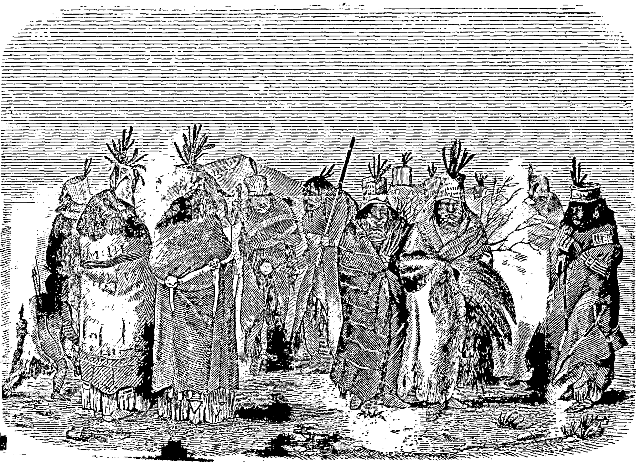 Women of the Mandan Tribe
From “New England Prospect.”
CHAPTER XIX.
OF THEIR WOMEN, THEIR DISPOSITIONS, EMPLOYMENTS, USAGE BY THEIR HUSBANDS, THEIR
APPARELL, AND MODESTY.
To satisfie the curious eye of women-readers, who otherwise might
thinke their sex forgotten, or not worthy a record, let them peruse these
few lines, wherein they may see their owne happinesse, if weighed in the
womans ballance of these ruder Indians, who scorne the tuterings of their
wives, or to admit them as their equals, though their qualities and industrious
deservings may justly claime the preheminence, and command better
usage and more conjugall esteeme, their persons and features being
every way correspondent, their qualifications more excellent, being more
loving, pittifull, and modest, milde, provident, and laborious than their
lazie husbands. Their employments be many: First their building of
houses, whose frames are formed like our garden-arbours, something
more round, very strong and handsome, covered with close-wrought mats
of their owne weaving, which deny entrance to any drop of raine, though
it come both fierce and long, neither can the piercing North winde, finde
a crannie, through which he can conveigh his cooling breath, they be
warmer than our English houses; at the top is a square hole for the
smoakes evacuation, which in rainy weather is covered with a pluver;
these bee such smoakie dwellings, that when there is good fires, they are
not able to stand upright, but lie all along under the smoake, never using
any stooles or chaires, it being as rare to see an Indian sit on a stoole at
home, as it is strange to see an English man sit on his heels abroad.
Their houses are smaller in the Summer, when their families be dispersed,
by reason of heate and occasions. In Winter they make some fiftie or
thereescore foote long, fortie or fiftie men being inmates under one roofe;
and as is their husbands occasion these poore tectonists are often troubled
like snailes, to carrie their houses on their backs sometimes to fishing-places,
other times to hunting places, after that to a planting-place, where
it abides the longest: an other work is their planting of corne, wherein
they exceede our English husband-men, keeping it so cleare with their
Clamme shell-hooes, as if it were a garden rather than a corne-field, not
suffering a choaking weede to advance his audacious head above their infant
corne, or an undermining worme to spoile his spurnes. Their corne
being ripe, they gather it, and drying it hard in the Sunne, conveigh it to
their barnes, which be great holes digged in the ground in forme of a
brasse pot, seeled with rinds of trees, wherein they put their corne, covering
it from the inquisitive search of their gurmandizing husbands, who
would eate up both their allowed portion, and reserved seede, if they
knew where to finde it. But our hogges having found a way to unhindge
their barne doores, and robbe their garners, they are glad to implore
their husbands helpe to roule the bodies of trees over their holes, to
prevent those pioners, whose theeverie they as much hate as their flesh.
An other of their employments is their Summer processions to get Lobsters
for their husbands, wherewith they baite their hookes when they goe
a fishing for Basse or Codfish. This is an every dayes walke, be the
weather cold or hot, the waters rough or calme, they must dive sometimes
over head and eares for a Lobster, which often shakes them by their hands
with a churlish nippe, and bids them adiew. The tide being spent, they
trudge home two or three miles, with a hundred weight of Lobsters at
their backs, and if none, a hundred scoules meete them at home, and a
hungry belly for two days after. Their husbands having caught any fish,
they bring it in their boates as farre as they can by water, and there leave
it; as it was their care to catch it, so it must be their wives paines to fetch
it home, or fast: which done, they must dresse it and cooke it, dish it, and
present it, see it eaten over their shoulders; and their loggerships having
filled their paunches; their sweete lullabies scramble for their scrappes.
In the Summer these Indian women when Lobsters be in their plenty
and prime, they drie them to keepe for Winter, erecting scaffolds in the
hot sunshine, making fires likewise underneath them, by whose smoake
the flies are expelled, till the substance remains hard and drie. In this
manner they drie Basse and other fishes without salt, cutting them very
thinne to dry suddainely, before the flies spoile them, or the raine moist
them, having a speciall care to hang them in their smoakie houses, in the
night and dankish weather.
In Summer they gather flagges, of which they make Matts for houses
and Hempe and rushes, with dying stuffe of which they make curious
baskets with intermixed colours and portractures of antique Imagerie
these baskets be of all sizes from a quart to a quarter, in which they carry
their luggage. In winter time they are their husbunds Caterers, trudging
to the Clamm bankes for their belly timber, and their Porters to lugge
home their Venison which their lazinesse exposes to the Woolves till they
impose it upon their wives shoulders. They likewise sew their husbands
shooes, and weave coates of Turkie feathers, besides all their ordinary
household drudgerie which daily lies upon them.
[Of the treatment of babes the writer says]: The young Infant being greased and sooted, wrapt
in a beaver skin, bound to his good behaviour with his feete upon a board
two foote long and one foote broade, his face exposed to all nipping
weather; this little Pappouse travells about with his bare footed mother
to paddle in the ice Clammbanks after three or foure dayes of age have
sealed his passeboard and his mothers recoverie. For their carriage it is
very civill, smiles being the greatest grace of their mirth; their musick
is lullabies to quiet their children, who generally are as quiet as if they
had neither spleene or lungs. To hear one of these Indians unseene, a
good eare might easily mistake their untaught voyce for the warbling of
a well tuned instrument. Such command have they of their voices.
Commendable is their milde carriage and obedience to their husbands, notwithstanding
all this their customarie churlishnesse and salvage inhumanitie,
not seeming to delight in frownes or offering to word it with their
lords, not presuming to proclaime their female superiority to the usurping
of the least title of their husbands charter, but rest themselves content under
their helplesse condition, counting it the womans portion: since the
English arrivall comparison hath made them miserable, for seeing the
kind usage of the English to their wives, they doe as much condemne
their husbands for unkindnesse, and commend the English for their love.
As their husbands commending themselves for their wit in keeping their
wives industrious, doe condemne the English for their folly in spoyling
good working creatures. These women resort often to the English
houses, where pares cum paribus congregatæ[52], in Sex I meane, they do
somewhat ease their miserie by complaining and seldome part without a
releefe: If her husband come to seeke for his Squaw and beginne to bluster,
the English woman betakes her to her armes which are the warlike
Ladle, and the scalding liquors, threatening blistering to the naked
runnaway, who is soon expelled by such liquid comminations. In a word
to conclude this womans historie, their love to the English hath deserved
no small esteeme, ever presenting them some thing that is either rare or
desired, as Strawberries, Hurtleberries, Rasberries, Gooseberries, Cherries,
Plummes, Fish, and other such gifts as their poore treasury yeelds
them. But now it may be, that this relation of the churlish and inhumane
behaviour of these ruder Indians towards their patient wives, may
confirme some in the beliefe of an aspersion, which I have often heard
men cast upon the English there, as if they should learne of the Indians
to use their wives in the like manner, and to bring them to the same subjection,
as to sit on the lower hand, and to carrie water and the like
drudgerie: but if my own experience may out-ballance an ill-grounded
scandalous rumour, I doe assure you, upon my credit and reputation, that
there is no such matter, but the women finde there as much love, respect,
and ease, as here in old England. I will not deny, but that some poore
people may carrie their owne water, and doe not the poorer sort in England
doe the same; witnesse your London Tankard-bearers, and your
countrie-cottagers? But this may well be knowne to be nothing, but the
rancorous venome of some that beare no good will to the plantation. For
what neede they carrie water, seeing every one hath a Spring at his
doore, or the Sea by his house? Thus much for the satisfaction of
women, touching this entrenchment upon their prerogative, as also concerning
the relation of these Indians Squawes.
That the tribes west of the Missouri, and beyond the pale of the
ordinary influence of civilization, should retain some shocking customs,
which, if ever prevalent among the more favoured tribes east of the Mississippi
and the Alleghenies, have long disappeared, may be readily conceived.
Wild, erratic bands, who rove over immense plains on horseback,
with bow and lance, who plunge their knives and arrows daily into the
carcasses of the buffalo, the elk and the deer, and who are accustomed to
sights of blood and carnage, cannot escape the mental influence of these
sanguinary habits, and must be, more or less, blunted in their conceptions
and feelings. Where brute life is so recklessly taken, there cannot be the
same nice feeling and sense of justice, which some of the more favoured
tribes possess, with respect to taking away human life. Yet, it could
hardly have been anticipated, that such deeds as we are now called upon
to notice, would have their place even in the outskirts of the farther “Far
West,” and among a people so sunk and degraded in their moral propensities,
as the Pawnees. But the facts are well attested.
In the fierce predatory war carried on between the Pawnees and Sioux,
acts of blood and retaliation, exercised on their prisoners, are of frequent
occurrence. In the month of February, 1838, the Pawnees captured a
Sioux girl only fourteen years of age. They carried her to their camp
on the west of the Missouri, and deliberated what should be done with
her. It is not customary to put female captives to death, but to make
slaves of them. She, however, was doomed to a harder fate, but it was
carefully concealed from her, for the space of some sixty or seventy days.
During all this time she was treated well, and had comfortable lodgings
and food, the same as the rest enjoyed. On the 22nd of April, the chiefs
held a general council, and when it broke up, it was announced that her
doom was fixed, but this was still carefully concealed from her. This
doom was an extraordinary one, and so far as the object can be deduced,
from the circumstances and ceremonies, the national hatred to their enemies
was indulged, by making the innocent non-combatant, a sacrifice to the
spirit of corn, or perhaps, of vegetable fecundity.
When the deliberations of the council were terminated, on that day,
she was brought out, attended by the whole council, and accompanied on
a visit from lodge to lodge, until she had gone round the whole circle.
When this round was finished, they placed in her hands a small billet of
wood and some paints. The warriors and chiefs then seated themselves
in a circle. To the first person of distinction she then handed this billet
of wood and paint; he contributed to this offering, or sort of sacrificial
charity some wood and paint, then handed it to the next, who did likewise,
and he passed it to the next, until it had gone the entire rounds, and each
one had contributed some wood and some paint. She was then conducted
to the place of execution. For this purpose they had chosen an open
grassy glade, near a cornfield, where there were a few trees. The spot
selected was between two of these trees, standing about five feet apart, in
the centre of which a small fire was kindled, with the wood thus ceremoniously
contributed. Three bars had been tied across, from tree to tree,
above this fire, at such a graded height, that the points of the blaze,
when at its maximum, might just reach to her feet. Upon this scaffold
she was compelled to mount, when a warrior at each side of her held fire
under her arm pits. When this had been continued as long as they supposed
she could endure the torture, without extinguishing life, at a given
signal, a band of armed bow-men let fly their darts, and her body, at
almost the same instant, was pierced with a thousand arrows. These
were immediately withdrawn, and her flesh then cut with knives, from
her thighs, arms and body, in pieces not longer than half a dollar, and put
into little baskets. All this was done before life was quite extinct.
The field of newly planted corn reached near to this spot. This corn
had been dropped in the hill, but not covered with earth. The principal
chief then took of the flesh, and going to a hill of corn, squeezed a drop
of blood upon the grains. This was done by each one, until all the
grains put into the ground, had received this extraordinary kind of sprinkling.
This horrible cruelty took place in the vicinity of Council Bluffs.
Offers to redeem the life of the prisoner had been made by the traders, in
a full council of eighty chiefs and warriors, but they were rejected. The
original narrator was an eye witness. He concludes his description by
adding, that his wife’s brother, a Pawnee, had been taken prisoner by the
Sioux, in the month of June following, and treated in the same manner.
Truly, it may be said that the precincts of the wild roving Red man, are
“full of the abodes of cruelty.”
Hunting and war are arts which require to be taught. The Indian
youth, if they were not furnished with bows and arrows, would never
learn to kill. The same time spent to teach them war and hunting, if
devoted to teach them letters, would make them readers and writers. Education
is all of a piece.
Example is more persuasive than precept in teaching an Indian. Tell
him that he should never touch alcohol, and he may not see clearly why;
but show him, by your invariable practice, that you never do, and he may
be led to confide in your admonitions.
BY E. F. HOFFMAN.
[From the Chippewa.[53]]
I looked across the water,
I bent o’er it and listened,
I thought it was my lover,
My true lover’s paddle glistened.
Joyous thus his light canoe would the silver ripples wake.—
But no!—it is the Loon alone—the loon upon the lake.
Ah me! it is the loon alone—the loon upon the lake.
I see the fallen maple
Where he stood, his red scarf waving,
Though waters nearly bury
Boughs they then were newly laving.
I hear his last farewell, as it echoed from the brake.—
But no, it is the loon alone—the loon upon the lake,
Ah me! it is the loon alone—the loon upon the lake.
By the late Mrs. H. R. Schoolcraft, who was a grand daughter of the war chief
Wabojeeg.
Sweet little bird, thy notes prolong,
And ease my lonely pensive hours;
I love to list thy cheerful song,
And hear thee chirp beneath the flowers.
The time allowed for pleasures sweet,
To thee is short as it is bright,
Then sing! rejoice! before it fleet,
And cheer me ere you take your flight.
The following song, taken from the oral traditions of the north, is connected
with a historical incident, of note, in the Indian wars of Canada.
In 1759, great exertions were made by the French Indian department,
under Gen. Montcalm, to bring a body of Indians into the valley of the
lower St. Lawrence, and invitations, for this purpose reached the utmost
shores of Lake Superior. In one of the canoes from that quarter, which
was left on their way down, at the lake of Two Mountains, near the
mouth of the Utawas, while the warriors proceeded farther, was a Chippewa
girl called Paig-wain-e-osh-e, or the White Eagle, driven by the
wind. While the party awaited there, the result of events at Quebec, she
formed an attachment for a young Algonquin belonging to the French
mission of the Two Mountains. This attachment was mutual, and gave
origin to the song, of which the original words, with a literal prose translation,
are subjoined:
I.
Ia indenaindum
Ia indenaindum
Ma kow we yah
Nin denaindum we.
Ah me! when I think of him—when I think of him—my sweetheart,
my Algonquin.
II.
Pah bo je aun
Ne be nau be koning
Wabi megwissun
Nene mooshain we
Odishquagumee.
As I embarked to return, he put the white wampum around my neck—a
pledge of truth, my sweetheart, my Algonquin.
III.
Keguh wejewin
Ain dah nuk ke yun
Ningee egobun
Nene mooshain we
Odishquagumee.
I shall go with you, he said, to your native country—I shall go with
you, my sweetheart—my Algonquin.
IV.
Nia! nin de nah dush
Wassahwud gushuh
Aindahnuk ke yaun
Ke yau ninemooshai wee
Odishquagumee.
Alas! I replied—my native country is far, far away—my sweetheart;
my Algonquin.
V.
Kai aubik oween
Ain aube aunin
Ke we naubee
Ne ne mooshai we
Odishquagumee.
When I looked back again—where we parted, he was still looking
after me, my sweetheart; my Algonquin.
VI.
Apee nay we ne bow
Unishe bun
Aungwash agushing
Ne ne mooshai we
Odishquagumee.
He was still standing on a fallen tree—that had fallen into the water,
my sweetheart; my Algonquin.
VII.
Nia! indenaindum
Nia! in denaindum
Ma kow we yuh
Nin de nain dum we
Odishquagumee.
Alas! when I think of him—when I think of him—It is when I
think of him; my Algonquin.
Eloquence on the part of the speakers, is not so much the result of
superior force of thought, as of the strong and clear positions of right, in
which they have been placed by circumstances. It is the force of truth,
by which we are charmed.
An Indian war song, sung in public, by the assembled warriors on the
outbreak of hostilities, is a declaration of war.
An old grey man on a mountain lived,
He had daughters four and one,
And a tall bright lodge of the betula bark
That glittered in the sun.
He lived on the very highest top,
For he was a hunter free,
Where he could spy on the clearest day,
Gleams of the distant sea.
Come out—come out! cried the youngest one,
Let us off to look at the sea,
And out they ran in their gayest robes,
And skipped and ran with glee.
Come Su,[54] come Mi,[55] come Hu,[56] come Sa,[57]
Cried laughing little Er,[58]
Let us go to yonder broad blue deep,
Where the breakers foam and roar.
And on they scampered by valley and wood,
By earth and air and sky,
Till they came to a steep where the bare rocks stood,
In a precipice mountain high.
Inya![59] cried Er, here’s a dreadful leap,
But we are gone so far,
That if we flinch and return in fear,
Nos,[60] he will cry ha! ha!
Now each was clad in a vesture light,
That floated far behind,
With sandals of frozen water drops,
And wings of painted wind.
And down they plunged with a merry skip,
Like birds that skim the plain;
And hey! they cried let us up and try
And down the steep again.
And up and down the daughters skipped,
Like girls on a holiday,
And laughed outright, at the sport and foam
They called Niagara.
If ye would see a sight so rare,
Where nature’s in her glee,
Go, view the spot in the wide wild west,
The land of the brave and free.
But mark—their shapes are only seen
In fancy’s deepest play,
But she plainly shews their wings and feet
In the dancing sunny spray.
OR SUPPLICATION FOR MERCY, AND A CONFESSION OF SIN, ADDRESSED
TO THE AUTHOR OF LIFE, IN THE ODJIBWA-ALGONQUIN TONGUE.
BY THE LATE MRS. HENRY R. SCHOOLCRAFT.
- 1. Gaitshe minno pimaudizzeyun, Gezha Monedo, gezhigong aibeyun.
- 2. Keen, maumauwaikumig waozhemigoyun.
- 3. Keen, kah ozhiéeyong, keen gaugegaikumig, kai nuhwaunemeyong,
aikoobemaudizzeyong.
- 4. Keen, kainuhwaubaimeyong, geezhig tibbikuk tibishko.
- 5. Keen, Keozheahn-geezhik-geezis, dibbik-geezis, aunungug gia.
- 6. Keen, kegeozhetoan tshe kimmewung, gia tshe annimikeeaug, tshe
sai sai yung, tshe sogepoog gia.
- 7. Keen kau ozheiyong tshe unnewegauboweyaung, kakinnuk kau
ozheudjig akeeng.
- 8. Kee, gemishemin odjechaugwug, wekaukaine bosigoog. Kee
gemishemin kebauzhigo kegwiss Jesus Christ, tshe oonjenebood neenowind.
- 9. Mozhug issuh nemudjee-inaindumin, kagait mozhug nemudjee-eki-domin;
nahwudj neminwaindumin tshe mudjee-dodumaung.
- 10. Kagaitego me kaisoondje izhauyaungebun mudjee Moneto.
- 11. Showainemishinaum, Gezha Monedo.
- 12. Showainemishinaum, Jesus Christ.
- 13. Maishkoodjetoan ne mudjee-odai-enaunin.
- 14. Meezhishenaun edush oushke odaiyun.
- 15. Apaidush nah saugeigsayun, gia dush todumaung kau izhè gugeekwayun.
- 16. Me ozhissinaum odaiyun tshe minwaindumaung, tshe annahme
autogoyun.
- 17. Showainim neendunahwaitmaugunenaunig unishenaubaig.
- 18. Showainim kukinnuh menik pemaudizzejig akeeng.
- 19. Showainemishenaum kaidokoo pemandizzeyong, appe dush neeboyong.
- 20. Showainemishenaum neen jeechaugonaunig tshe izhowaud keen.
- 21. Kaugegaikumig edush tshe menawaunegooz eyong ozaum ne
mudje-pemaudizzewin auno unnahmeyauyongin.
- 22. Kauween edush kewee pemaudizzewin, kishpin aitah appainemo
yong Kegwiss Jesus Christ.
- 23. Aipetainemud kegwiss showainemishenaum. Kunnah gai kunnah
TRANSLATION.
- 1. Great good author of Life, Gezha Monedo, abiding in the heavens
- 2. Thou hast made all things.
- 3. Thou art the giver,—Thou, the everlasting preserver of life.
- 4. Thou hast guarded me, by day and by night.
- 5. Thou hast made the sun and moon, and the stars.
- 6. Thou makest the rain, the thunder, the hail, and the snows.
- 7. Thou didst make man to stand upright, and has placed him over all
that is on the earth.
- 8. Thou hast given us souls, that will never die. Thou hast sent thy
son Jesus Christ to die for us.
- 9. Continually are our thoughts evil, and truly, our words are evil continually.
- 10. Verily, we deserve punishment with the Spirit of Evil.
- 11. Show pity on us, Gezha Monedo.
- 12. Show pity on us, Jesus Christ.
- 13. Reform our wicked hearts.
- 14. Give us new hearts.
- 15. May we love thee with all our hearts, and by our acts obey thy
precepts, (or sayings.)
- 16. Give us hearts to delight in prayer.
- 17. Show mercy to all our kindred, unishenaubaig, or common people,
(means exclusively the Red Men.)
- 18. Show mercy to all who live on the earth.
- 19. Pity us, and befriend us, living and dying.
- 20. And receive our souls to thyself.
- 21. Ever to dwell in thine abiding place of happiness.
- 22. Not in our own frail strength of life, do we ask this; but alone in
the name of Jesus Christ.
- 23. Grant us thy mercy, in the name of thy Son. So be it ever.
Those who take an interest in the structure of the Indian languages,
may regard the above, as an improvised specimen of the capacity of this
particular dialect for the expression of scripture truth. The writer, who
from early years was a member of the church, had made a translation of
the Lords prayer, and, occasionally, as delicate and declining health permitted,
some other select pieces from the sacred writings, and hymns, of
which, one or two selections may, perhaps, hereafter be made.
The distinction between the active and passive voice, in the Odjibwa
language, is formed by the inflection ego.
| Ne sageau, | I love. |
| Ne sageau-ego, | I am loved. |
Whoever has heard an Indian war song, and witnessed an Indian war
dance, must be satisfied that the occasion wakes up all the fire and energy
of the Indian’s soul. His flashing eye—his muscular energy, as he
begins the dance—his violent gesticulation as he raises his war-cry—the
whole frame and expression of the man, demonstrate this. And long
before it comes to his turn to utter his stave, or portion of the chant, his
mind has been worked up to the most intense point of excitement: his
imagination has pictured the enemy—the ambush and the onset—the victory
and the bleeding victim, writhing under his prowess: in imagination
he has already stamped him under foot, and torn off his reeking scalp:
he has seen the eagles hovering in the air, ready to pounce on the dead
carcass, as soon as the combatants quit the field.
It would require strong and graphic language to give descriptive utterance,
in the shape of song, to all he has fancied, and seen and feels on
the subject. He, himself, makes no such effort. Physical excitement
has absorbed his energies. He is in no mood for calm and connected
descriptions of battle scenes. He has no stores of measured rhymes to
fall back on. All he can do is to utter brief, and often highly symbolic
expressions of courage—of defiance—of indomitable rage. His feet
stamp the ground, as if he would shake it to its centre. The inspiring
drum and mystic rattle communicate new energy to every step, while
they serve, by the observance of the most exact time, to concentrate his
energy. His very looks depict the spirit of rage, and his yells, uttered
quick, sharp, and cut off by the application of the hand to the mouth, are
startling and horrific.
Under such circumstances, a few short and broken sentences are
enough to keep alive the theme in his mind; and he is not probably conscious
of the fact, that, to an unimpassioned and calm listener, with note
book in hand, there is not sufficient said to give coherence to the song.
And that such a song, indeed, under the best auspices, is a mere wild
rhapsody of martial thought, poured out from time to time, in detached
sentences, which are, so to say, cemented into lines by a flexible chorus
and known tune. The song and the music are all of a piece. Vivid
and glowing, and poetic pictures will float in such a train, and often strike
the imagination by their graphic truth and boldness; but the poet must
look elsewhere for finished melody, and refined and elaborate composition.
The Indian is to be viewed here, as elsewhere, as being in the highest
state of his physical, not of his mental phasis. Such glimmerings may
however be picked out of these warlike rhapsodies, as denote that he is of
a noble and independent tone of thinking. We shall at least enable the
reader to judge. The following specimens, which have been derived from
actors in the depths of the forest, consist of independent songs, or stanzas,
each of which is sung by a different or by the same warrior, while the
dance is in progress. The words have been taken down from a young
Chippewa warrior of lake Superior, of the name of Che che-gwy-ung.
It will be perceived that there is a unity in the theme, while each warrior
exercises the freest scope of expression. This unity I have favoured by
throwing out such stanzas as mar it, and afterwards arranging them
together.
WAR SONG.
a. In beginning this song the warrior has turned his eyes to the clouds.
| O shá wan ong | (From the place of the south) |
| Un dos′ e wug, | (They come,) repeat. |
| Pe nä′ se wug, | (The birds, i.e. the warlike birds.) |
| Ka baim wai wá dung-ig. | (Hear the sound of their passing screams on the air.) |
b. The idea of ravenous birds hovering in the sky, still prevails—
| Tod ot′ to be | (I wish to change myself to be) |
| Pe nä′ se. | (A bird.) |
| Ka dow′ we á we yun′. | (His swift body—to be like him.) |
c. The warrior now rises above all thoughts of fear.
| Ne wä be na, | (I cast it away.) |
| Né ow a. | (My body.) |
| Ne wá be na, | (Repeats.) This is a high symbolical boast of personal bravery. |
| Né ow a. |
d. He appeals to the Great Spirit for extraordinary power.
| Na bun á kum ig, | (On the front part of the earth,) |
| Tshe bá be wish′ em ug. | (First shines [strikes] the light.) |
| In do main′ em ik, | (Such power to me,) |
| Mon′ e do, | (My God,) |
| Shä wa nem id. | (In thy mercy give!) |
By the boldness of this figure he claims the omnipotent power of the
sun to see and discover his enemies.
e. He upbraids such of his people as hold back, and do not join in the
dance—that is to say, enlist in the war.
| Wä go nain′, e win? | (Why do ye, warriors,) |
| A be yun ah, | (Stand back?) |
| Wä wos is se, we yun. | (Ye who bear the mark of the Awasees.) |
The Awasee is a kind of fish, which is the totem of a clan.
f. He declares his full purpose to enter into the war.
| Ne má je, e yeh! | (I go to the spot—the war path!) |
| Ne má je, e yeh! | (Repeats.) |
| Ne me kun ah, e yeh! | (My war path!) |
| Ge zhig neen wá tin, | (My sky is fair and clear.) The common phrase to denote good fortune. |
| Hoh! Ne monedo netaibuätum o win. | (Let others linger. Onward! my God!—my right!) |
In presenting these specimens of the original words of some of our
western warriors, we are permitted to give the annexed versions of them
from the pen of one of our most gifted writers.
WAR-SONG—“Pe-nä′ se-wug.”
(From the Algonquin of Schoolcraft.)
BY C. F. HOFFMAN.
I.
Hear not ye their shrill-piping
screams on the air?
Up! Braves for the conflict
prepare ye—prepare!
Aroused from the canebrake,
far south by your drum,
With beaks whet from carnage,
the Battle Birds come.
II.
Oh God of my Fathers,
as swiftly as they,
I ask but to swoop
from the hills on my prey:
Give this frame to the winds,
on the Prairie below,
But my soul—like thy bolt—
I would hurl on the foe!
III.
On the forehead of Earth
strikes the Sun in his might,
Oh gift me with glances
as searching as light.
In the front of the onslaught,
to single each crest,
Till my hatchet grows red
on their bravest and best.
IV.
Why stand ye back idly,
ye Sons of the Lakes?
Who boast of the scalp-locks,
ye tremble to take.
Fear-dreamers may linger,
my skies are all bright—
Charge—charge—on the War-Path,
for God and the Right.
Take the following additional example, of a death song. These stanzas
have all been actually sung on warlike occasions, and repeated in my
hearing. They have been gleaned from the traditionary songs of the
Chippewas of the north, whose villages extend through the region of lake
Superior, and to the utmost sources of the Mississippi. Those bands are
the hereditary foes of their western neighbours, the Dacotahs or Sioux,
who are generally called by them, by way of distinction, Na do wä′ sees,
that is to say, OUR ENEMIES. The allusions in the songs are exclusively to
them. In writing the original, I omit the chorus, as it is not susceptible
of translation, and would increase considerably the space occupied.
DEATH SONG.
1. In opening this song the warrior is to be contemplated as lying
wounded on the field of battle.
| A′ be tuh ge′ zhig, | (Under the centre of the sky,) |
| Ne bá baim wä′ wä. | (I utter my baim wä wä.) |
Baimwäwä, is the sound of passing thunders, which will convey a
just idea of the violence of this figure.
2. His thoughts revert to the star of his destiny.
| Ain dah′ so gezhig | (Every day, thou star!) |
| Ke gá gun o wá bom in. | (I gaze at you.) |
It is the morning star that is here alluded to.
3. He sees the birds of carnage hovering over the field.
| A′ be tuh geézh-ig | (The half of the day) |
| Ai be yaun | (I abide—gazing) |
| Pe nä se wug | (Ye warlike birds.) |
4. He keeps the flight of these birds before his mind and hears their
shrill cries.
| Pe misk wosh e wug | (They fly round the circuit of the sky.) |
| Pe nä′ se wug | (The birds—circling) |
| A′ be tuh geezh ig oag. | (Round half the circuit of the sky.) The meaning is, approaching him
in circle more nearly, as life becomes fainter in him. |
5. This figure is continued. He lies bleeding.
| A′ zha waush e wug | (They cross the enemy’s line) |
| Pe nä se wug. | (The birds.) |
6. He feels that he is called to another world.
| A pit she Mon e doag | (The high gods) |
| Ne mud wää | (My praise) |
| Wá we ne goag. | (They sound.) |
7. He is content and willing to go.
| Kä gait′, ne min wain′ dum | (Full happy—I) |
| Ne bun aí kum ig | (To lie on the battle-field) |
| Tshe bá be wish e naun. | (Over the enemy’s line.) |
DEATH-SONG—"A′ be tuh gé zhig."
(From the Algonquin of Schoolcraft.)
BY C. F. HOFFMAN.
I.
Under the hollow sky,
Stretched on the Prairie lone,
Centre of glory, I
Bleeding, disdain to groan,
But like a battle cry
Peal forth my thunder moan,
Baim-wä-wä!
II.
Star—Morning-Star, whose ray
Still with the dawn I see,
Quenchless through half the day
Gazing thou seest me—
Yon birds of carnage, they
Fright not my gaze from thee!
Baim-wä-wä!
III.
Bird, in thine airy rings
Over the foeman’s line,
Why do thy flapping wings
Nearer me thus incline?
Blood of the Dauntless brings[*]
Courage, oh Bird to thine!
Baim-wä-wä!
Hark to those Spirit-notes!
Ye high Heroes divine,
Hymned from your god-like throats
That Song of Praise is mine!
Mine, whose grave-pennon floats[*]
Over the foeman’s line!
Baim-wä-wä!
WAR SONG.
Where are my foes? say, warriors, where? No forest is so black,
That it can hide from my quick eye, the vestige of their track:
There is no lake so boundless, no path where man may go,
Can shield them from my sharp pursuit, or save them from my blow.
The winds that whisper in the trees, the clouds that spot the sky,
Impart a soft intelligence, to show me where they lie,
The very birds that sail the air, and scream as on they go,
Give me a clue my course to tread, and lead me to the foe.
The sun, at dawn, lifts up his head, to guide me on my way,
The moon, at night, looks softly down, and cheers me with her ray.
The war-crowned stars, those beaming lights, my spirit casts at night
Direct me as I thread the maze, and lead me to the fight.
In sacred dreams within my lodge, while resting on the land,
Bright omens of success arise, and nerve my warlike hand
Where’er I turn, where’er I go, there is a whispering sound,
That tells me I shall crush the foe, and drive him from my ground.
The beaming WEST invites me on, with smiles of vermil hue,
And clouds of promise fill the sky, and deck its heavenly blue,
There is no breeze—there is no sign, in ocean, earth or sky,
That does not swell my breast with hope, or animate my eye.
If to the stormy beach I go, where heavy tempests play.
They tell me but, how warriors brave, should conquer in the fray.
All nature fills my heart with fires, that prompt me on to go,
To rush with rage, and lifted spear, upon my country’s foe.
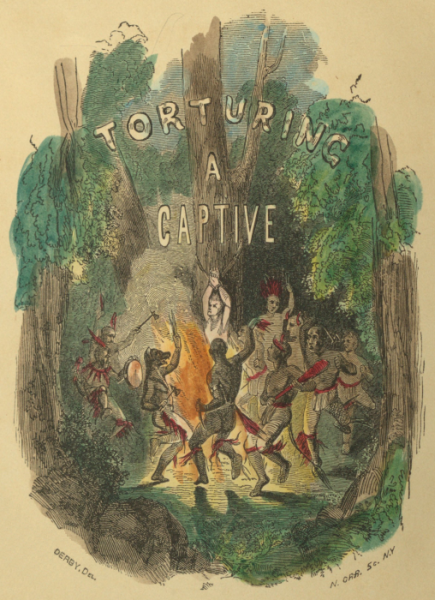 TORTURING A CAPTIVE