VI A LONELY CANDIDATE
Nothing useless is, or low;
Each thing in its place is best:
And what seems but idle show,
Strengthens and supports the rest.
—Longfellow.
Magnus strolled leisurely along, thinking first that he could show
these cadets how to run, and then beginning to have grave doubts on
the subject; and finally finding himself a seat under the trees, where
he could look and listen in shady comfort. Eyes and ears had full
occupation.
There was a busy note of preparation everywhere, and especially
among the drums. Beating there, and then beating here; the sound caught
up and echoed back from the grey rocks on the green hillside. Then
came out uniforms of various sorts (Magnus personified the dress, not
knowing the men) and proceeded to mark off a certain space on the green
in front of him, setting a gay little banner at the four corners of a
large, large square.
Then, at first slowly, but soon hurrying up from every point
of the compass, a many-coloured crowd swarmed in and filled the
seats—filled them presently so full that Magnus gave up his place
to the next gauzy creature that came along. She fluttered down into the
seat with much gratulation and no thanks, and Magnus gravely took his
stand in the rear.
He had no lack of company, even there. Officers in various uniforms,
civilians in all sorts of coats, and girls in all sorts of finery,
stood beside and around him.
And now, also, there came straying in another small posse, whom Magnus
instinctively knew as of his own kind. Yes, they must be candidates;
partly, perhaps, because they could not possibly be anything else; no
other class owned them. Yet how did he know that?—to whom all
classes here were strange. What possible connection between that dapper
little fellow in straw hat and black alpaca coat, and this young giant
who wore a cloth cap and a fluttering linen duster? Or how was his
next neighbour in a Derby and long frock coat like the fourth man, who
wore brown trousers, a cutaway coat, and a wide-awake? Yet even Magnus
could see that "candidate" was written on them all. So plainly, indeed,
that he stepped further back and put himself behind the tree. Anybody
who looked at him standing there—and some did look—saw a
tall, well-made young fellow in a neat and perfectly unobtrusive suit
of brown-grey cloth. Very dark hair and with a wilful curl that tossed
it about every way. Excellent features, ignorant as yet of life's
moulding touch; and a sweet, mobile mouth, set just now in very grave
lines indeed, and so hiding one of the great charms of his face. For
nobody could watch Magnus Kindred when he smiled or laughed, and not
notice the clean look: the utterly pure and true lines into which
those grave ones changed. For the rest, hands and feet were well shaped
and in excellent order; and the whole bearing was both self-reliant and
unconscious.
But it seemed as if the gayer grew the scene, the soberer grew that
young face gazing out from behind the tree. For of all the lonely
places, commend me to an unknown throng of pleasure-seekers, where
everyone belongs to someone, is waiting for someone, or is waited for,
and you belong to none. No eyes are watching for you, no heart stirs
when you come in sight; and no one will miss you if you do not come at
all.
So Magnus felt that day. The more people came, the more he was crowded
almost from standing-room, the wider grew the heart distance between
himself and the bright world about him. Gay girls, pretty girls,
thronged the seats and the walk; Magnus only felt that none of them
was Cherry, and every older woman that came by, decked in feathers and
flowers and laces, sent his thoughts off with such a rush to his own
dear mother, in her simplest go-to-meeting bonnet, that it was all the
boy could do to stand there and give no sign. And at even the officers
he looked askance, wondering which of them might possibly be "Tacs."
"Poor fellow!" said some of the kind hearts amid the finery. "He
looks pretty homesick."
"Such a handsome boy, too. You must take him out in the German,
Floy."
"Oh, he can't go to the German," said Miss Floy, who had reached
the mature age of thirteen. "None of the plebs can. And he's only a
candidate, yet. Besides, I don't care much for any man that doesn't
wear chevrons."
And the mother laughed and repeated the smart saying to her next
neighbour.
If there arose in the mind of Charlemagne Kindred an instant resolve
to wear chevrons, at whatever cost, you must not think hardly of him.
These pretty, airy creatures wield a powerful sceptre and their silken
cords are strong.
How the people crowded in! They sat where they could, and stood
where they shouldn't. They grouped themselves round the old trees,
and made a strong background to the iron seats. Officers, civilians,
matrons, girls—and candidates. Little children dropped down
on the green edge of the parade ground, and at last grown-up and
hard-pushed people sat there, too. Then an imposing police sergeant
came along, waving them off with his black wand. And
the people jumped up, growling and frowning, and, as soon as they saw
his back, dropped down again.
As for Magnus, the whole thing seemed to wind him up in tightening
cords of tension. He was outside now, but to-morrow at this time he
would be in; caught and bound and caged behind a cordon of regulations.
Assigned a place, turned over to duties which he could in no wise quit
or change. Not to see home again for two long years.
Should he do it? Or should he, in these last hours of freedom, set
himself free for good? Take the first train for the West, and leave all
his great prospects behind him, and the chevrons and shoulder-straps to
someone else? Thoughts came and went, surged and rolled back; and the
whistle of each train, as it flew by, just made the confusion deeper.
"Come!" they seemed to say. "Come-m-me-me!"
Meantime the review went on; the citizen actors showed how they
could not march and the cadets how they could; and this last part was
so fine that Magnus fairly forgot himself and his trouble. Round the
great square they went; the grey and white lines moving like some one
elastic thing. Corners made no break, hot sunbeams seemed unnoticed.
So they marched round; first slow, then fast; and then began the
double-timing.
How beautiful it was! Privates in their glancing lines; cadet
officers leading on, and running backwards or forwards with equally
unerring footsteps. Heading all, the Commandant. Years had passed away
since he learned the double-quick; and the supple boy had changed
into the grey-haired man; but his foot never faltered, his step never
lagged. The white-plumed blue uniform led on the grey with a gallantry
it was pretty to see. Magnus watched the whole with deepest admiration;
down to the last bit of timeful running with no music to mark it
off.
He was noticing every step; eyeing the black shoe-soles
that came up as one, the bent-knee line of white trousers, the glitter
of the guns; forgetting everything else, when again the hated word came
full upon his ear.
"Just look at that candidate, will you! It's as good as a play. I
wonder he didn't join in."
"Ya-as," was answered in a drawling tone by her escort. "There he
stands. Study his perfections now, while you can, Miss Jenny. Next week
he will have ceased to shine upon the polite world. Exit the candidate,
enter the beast. That is, if he gets in, which is doubtful."
A small thing may do the work where a large one fails; trains got no
hearing, after that. That he would enter became instantly a fixed fact
to that particular candidate.
The girl was certainly pretty. How would Cherry look, sitting
there, and with himself in a grey coat bending over her, and twirling
her parasol? Cherry was handsomer—miles away—than this
girl. Deeper eyes, tenderer mouth, more glowing cheeks, too, for that
matter. Yet she would not look so, the boy honestly owned to himself,
though fuming a little over the admission; the whole make-up would be
different. The very idea of such shoes as this damsel thrust out into
the sunlight had never entered Cherry's wholesome head. "Shoe pegs,"
Magnus called the heels, with great scorn, and set right in the middle
of her foot. And scarlet stockings. And her dress—what was it
made of? No, Cherry would not look so; and however he might frown,
Magnus felt the glamour, as most men do, of city dressmaking and "the
correct thing."
"Country-made gowns look so different," said someone behind him.
Then that girl further on, in fluffs of white lace and muslin, white
shoes, white gloves, and her dainty head crowned with "an acre" of
Leghorn, and "a half bushel" of roses. No, neither would Cherry look
like her. And now the boy's fancy brought the little country
maiden, in her country garb—even her Sunday best—and set
her down beside these two. A plain white gown, with no setting off but
the simple ruffles which Cherry had embroidered, and the exquisite
laundry work which she had also done herself. Black shoes, which were
made for walking ("but either one of those white ones could hold 'em
both," thought Magnus, in his hot fancy). Then a broad straw hat, round
which Violet's deft fingers had twined a dark green riband; while the
hands, which were small, indeed, and comely, but unwhitened with either
idleness or lemon, wore only a pair of spotless Lisle thread gloves.
Magnus looked at the pink, the white, the tan kids all about him,
and drew a deep breath.
"But she shall sit there!" he said, with one of his fierce mental
bursts. "She shall sit there, and look just so. No, not just so, for,
if they try their prettiest, they can never any of them look like
her."
VII IN FOR IT
With this hand work, and with the other pray,
And God will bless them both from day to day.
—Old Vierlander Motto.
Some little time after the foregoing events, the
following letter was sent from the West Point
Post Office:
"Camp Hard, June —, 18—.
"My Dear Folks at Home:
"Well, I am in for it. Uncle Sam has me, body and soul. At least
the body is self-evident, and as I don't get time to say my soul's my
own, I suppose he claims that, too,—Mr. Wayne to the contrary.
Bought and paid for and sworn in; and earmarks enough for a drove of
pigs. Do you want to know what I look like, you girls? Just at present
I am a compound of grey and green in about equal mixture. No, I guess
the green has it. Hair cut short, army shoes, and a brand new prison
dress which might fit anybody else as well as it does me, and better. I
get up by a gun, and go to bed by a drum, and have a bugle to tell me
when to go to sleep, and as we are young and tender in the ways of the
world, at every meal the first captain informs us when to stop eating.
(He's nothing special to look at, Cherry. Don't open your eyes too
wide. But he's such an old spoon that he's always in a hurry to get out
and walk with some girl or other)."
"We study straight lines in the morning, and play leap-frog in
the afternoon; and have girls come and make fun of us while we're at
it. Yesterday they enjoyed it more than was good for themselves, and
one of the officers ordered them off."
"There are two special prigs in chevrons, who have charge of our
thumbs and shoulderblades; and when you girls come to see me, one
of 'em won't get an introduction, that's all. What do you think he
did yesterday? It was hot enough to melt down your ideas, if you had
any—hot as the middle line of the equator; and he had been
drilling us as if he had never been drilled himself, and didn't know
how it felt. So, when drill was over, he stood a lot of us round his
tent door in the sun, and then made iced lemonade, and sat there
drinking it with us looking on. Give us some? Not quite. Go to the
store and buy our own lemons, Rose? Why, we can't get a shoestring
without a special order. Corporal Mean smuggled in his sugar from the
Mess Hall; and I guess Miss Flyaway brought him the lemons. If you want
to know about Miss Flyaway, she's one of the girls; a summer girl, as
they say here, and we plebs could spare her till winter just as well as
not. She's as bad as a third-class corporal—only we can laugh at
her and we can't at him. If we did, we'd be skinned in a minute. This
is what I should hear read out after parade:
"'Kindred—disrespect to superior officer, at about 4.30 P. M.'—demerits according. Oh, well! we'll
wear through somehow; it takes a good deal to kill a man. And they're
not all like that. Cadet Captain Steady called me into his tent to-day
and gave me a whole lot of good advice that would have gone to mother's
heart. There's another Captain, too, Mr. Upright, who's as nice as
he can be; and some of the Tacs aren't very bad to take. But we've
got one in our company! I just wish you could see him. We call him
Towser—because he's always nosing round,
and sniffing about everywhere, to see what sort of a dry bone he
can find to pick. He hasn't hived any of mine yet, but he spied
a whole square inch of paper in front of Randolph's tent and
reported him for disorder. You have to polish your shoestrings
to go down A Company street, when he's in charge. So whoever
sees him coming fires off a volley, and then we all know.
Bow—wow—wow—wow—wow—wow!"
"You'll like my tentmate, Rig. That's not his name, of course,
but we call him so because he's so B. J. about his dress. They don't
leave him much hair to brush, but what he has takes up half his spare
time."
"Now I know mother is aching to put in her questions—just
waiting till I get through writing stuff. Well, ma'am, you see, we just
have to praise ourselves a little bit here, because if we don't do
it, it don't get done; and so I call myself a pretty good boy. Whether
I'd suit you exactly, I'll not say. I go to prayer-meeting twice a
week and once to Chapel (have to go there, so you needn't give me
a credit), and I've not missed reading my chapter one day yet. Mr.
Upright came by the other day when I was at it, and he stopped and
walked in."
"'Keep straight on with your good home habits, Mr. Kindred,' he
said, 'no matter what anybody says or does. Read the Bible just as much
as you like; the more, the better. Remember:
"'He always wins, who sides with God.'"
"So I read every day. And I'm not likely to stop praying as long
as I have you four to pray about. I guess I shall keep my colours
flying—a storm flag, anyway. But it does blow pretty hard here
sometimes, that is sure. Train says I can't do it. No use, he declares:
says he's tried it and it won't work. (He was turned back, and so he
has been here a year and thinks he knows.) He says there's
no place in the course for religion; just as well give it up
first as last."
"So I told him my mother had no 'give up' in her
dictionary and never taught me how to spell the words."
"Poor Train! His mother went to heaven three years
ago; though how she can enjoy herself up there, with him
going on as he does down here, I can't see. Maybe she
doesn't know."
"There goes the first drum! Good-bye. Kiss each other
all round for me, beginning anywhere."
"Magnus Kindred,
U. S. Corps of Cadets."
"You mustn't think hard of Rig; he's a real good fellow.
But you see he's a pinky-white creation: and it hurts his
feelings to look like an acorn."
This letter was duly addressed, sealed, and stamped;
went on the orderly's back to the post-office, and thence, in
due course, across the continent to the far-off simple home
at Barren Heights. There it alighted with the force and
precision of a bombshell. That is, if force may be measured
by commotion.
The strange phrases, the new ideas, the dim, vague
vision of most unwonted doings—there is no telling what
a stir-up it all was. The three girls had gone to the post
office together in the course of their afternoon walk, and
had taken turns at bringing the precious missive home.
Now they sat about on the front steps, while Mrs. Kindred,
in the porch rocking chair, opened and read the letter aloud.
I think she never even thought of a hidden meaning in
"Camp Hard," passing it by as a mere name; but as she
read on, even where the words themselves were perplexing,
their intent was unmistakable. At the end of almost the
very first sentence Mrs. Kindred took off her glasses, laid
them down on the letter, and looked about her.
"No time to say his soul is his own," she said. "Why, what does this
mean?"
Everybody else had felt the shock, but as usual they all crowded in
to the rescue.
"It must be just his way of talking," said Violet. "Don't you know,
mother, that when Magnus gets excited he always goes on stilts?"
"And of course, he is very busy," said Rose, "with so many new
things to do."
"And you can see he is talking in the air, Mrs. Kindred," said
Cherry's sweet voice, "because he instances something for which he does
not want time. Magnus has never called his soul his own, since he
gave it to Christ to save and keep."
"Dear boy!" said the mother. "Thank you, Cherry, for reminding me.
Yes, I will not doubt,"—and she read on.
"I cannot see why he says 'skinned,'" said Violet. "It's a very
queer way to talk."
"But just like him," said Rose. "Magnus always did talk
wild—just a little bit," the sisterly censure softening down.
"And you see they play games for exercise—so that is very
good."
"I suppose studying straight lines must mean drawing," said Cherry,
looking down at the open letter. "Magnus will not care what they do, if
they will only let him draw."
"I am not so anxious about all that," said the mother
thoughtfully. "Boys at school must have some hardships and do many
things they do not like. And you see he does go to prayer-meeting and
read the Bible."
"But he says such strange things," said Violet, studying the letter
from her side. "Do all people in the East have names like that?
'Rig,' and 'Mean,' and 'Upright'—it sounds like the Pilgrim's
Progress."
"And so it is," said the mother, smiling faintly, through
two big teardrops, "and Magnus is going over a part of the road where
we have never been. That must be, girls. But the Lord is as strong
there as here in Barren Heights; and Magnus is no weaker than he was at
home—bless his dear heart! He never could bear that word 'weak.'
I wish he had told us what he means by 'a storm flag.'"
"Why, it must be a flag that flies in all weathers!" cried Cherry.
"So strong that the wind cannot tear it, and so deep-coloured that the
rain cannot wash it out."
Well for them all that she did not know enough to add, "And so small
that it can hardly be seen."
But no such thought cast its dark shadow. Mrs. Kindred looked at the
sweet eyes, all aglow with the spirit of the martyrs; the lips in a
quiver, the cheeks in a flush; then took Cherry in her arms and kissed
her.
"You are never anything but a blessing," she said, and went away
to pour out tears and petitions in her own private room; with a
heart-aching sense all the while that she wished some other boy had
the glory and the brass buttons, and that her own Magnus was safe at
home.
Meanwhile the girls in the porch talked on.
"I dare say you are right about the flag, Cherry," said Rose, "but
there are other things I cannot understand."
"It is dreadful about his clothes," put in Violet.
"I do not mind that so much," said Rose. "Mother always said
Magnus was a fidget to fit. But what can he mean by B. J.? Oh, girls,
do you think it could possibly be some dreadful expression he has
learned, and didn't like to write out to us?" And Rose put her head
down, in great distress.
"It could not be!" said Violet, with a scared look. "Why, you are
talking about Magnus! Rose, I believe you are crazy."
"I think I must be," said Rose, lifting her head and
brushing off the tears. "Of course, it is all my nonsense. Cherry,
where are you going?"
"Home," said the girl, pulling on her deep sun-bonnet. "I have
something to do. I'll be down again soon."
No one noticed how white the young face had grown while the other
girls wept; no one guessed the cause of this sudden home-going; but as
she went, Cherry clenched her hands for very anguish of heart. Magnus
change like that? Magnus learn words so bad that he would not write
them home? No indeed!—it could not be; she knew it could not.
All the same, that vision of possibility had come into her heart, and
come to stay; and nothing stilled the aching until she had carried her
burden to the feet of Him, "Who is able to keep you from falling, and
to present you faultless before the presence of his glory."
Cherry did not cry: she was not given to tears: but from that day
on, two Bible verses answered to each other in her heart like a sweet
chime:
"Thou hast a few names, even in Sardis, that have not defiled their
garments," and "He is able to save to the uttermost."
VIII RUBS THE WRONG WAY
Now don't go off half cock; folks never gains
By usin' pepper sarce instead o' brains.
—Biglow Papers.
If Cadet Magnus Kindred knew in a general sort of
way that all the simple, loving women folk at home
were praying for him morning, noon, and night,
"and watching thereunto with all perseverance," it was
with a very easy remembrance of the fact, and not the
faintest idea that anything but pleasure touched the case.
And he would have simply shouted at Rose's panic over the
unexplained "B. J." In fact, if anybody knows the origin
of those two cabalistic letters, Magnus certainly did not.
Indeed, he had scant time for running down questions. Drills began
as soon as examination was over, and were pushed on "fiercely" (as
Randolph declared), hot sun or no sun, rested or tired. Though Magnus
had been used to such an active open-air life that all this came easier
to him than to some others. As to the rest, he got along pretty well
for a "pleb," having a certain sensible nature which made light of
hardships, and was not quick to take offence. So when he was jeered and
pointed at, chin poked in and toes pushed out, he rarely said anything
stronger, even to himself, than, "Just you wait!" Good common sense
everywhere befriended him, even when the drill masters abused their
power, or first classmen showed their prowess by "jumping" plebs.
So he brought in water and cleaned guns; stood attention, and stood
his ground; and when the time came for
that amusement, "advanced ghosts" in the most correct terms, but kept
his musket against all attempts of Cadet Devlin and his compeers. Nay,
on one such occasion, he gave the marauder the most accurate measure
of himself upon the ground that the young man had ever had. Of course
Magnus was reported, but he gave too straight answers for the charge
to stand, and the upshot was that Mr. Devlin lost his chevrons "for
hazing plebs." The whole account caused great consternation at home,
only lulled by the assurance Magnus gave that if he had let anyone take
his gun, he himself might have been put in "light prison" or sent home
in disgrace. For to the bewildered mind of a pleb in those early days,
anything might happen.
Devlin swore vengeance, and in a small way carried it out. But young
Kindred laughed off some things, ignored others, and now and then gave
Mr. Devlin a blaze out of his honest eyes before which that gentleman
rather shrivelled up. Nobody liked to exactly try to handle Charlemagne
Kindred: there was about him "a look of unknown quantities"—as
Mr. Upright remarked one day. Cadet Upright was a staunch friend; and
it was a blessing to all the plebs in Camp Hard that year that he was
head man over them.
"Come and clean my gun, Mr. Kindred," he would say, adding, when
Magnus was in the tent, "The gun is not very dirty, and there is no
hurry about it, but you must be doing something, and in here is better
than out there."
A fact which Magnus realised when from the cool recesses of the tent
he saw other plebs fetching water in the sun, or standing attention for
a lecture from Mr. Devlin: teased and worried and laughed at by Mr.
Prank.
It was during the fervid days of that July that Rig ("poor Rig," as
Magnus generally termed him in the letters home) went through a small
bit of experience
which, by his own account, made him "a sadder, if not a wiser, man."
The morning was intensely hot. The plebs had been out at their
early drill and now in the canvas shade were enjoying a few minutes'
rest. Guard-mounting was just over, and for a brief space no one had
anything special to do. The visitors' seats were nearly deserted, with
only a few sentimentals from either side the colour-line still lounging
there. The sentries paced up and down in full fatigue dress: the row of
stacked arms shimmered in the heat.
In his tent Magnus was devouring over again the last night's letter
from home, and so did not notice what was going on, until the shadow of
Cadet Prank in the tent door made him look up in time to see Rig (alias
McLean) start to his feet and stand very stiff indeed.
"Good-day, Mr. McLean," said the man with chevrons. "Don't disturb
yourself, I'll not come in. I know you've been hard at it this morning,
and I really hate to ask you to go out again,—but in such a
case,"—and Mr. Prank gazed into the glowing sunshine in deep
perplexity.
Magnus, watching from the depths of the tent, saw the gleam which
no effort of Prank's could keep out of his eyes, with the dangerously
solemn lines about the mouth. But poor Rig at such honeyed words from
an upper classman, lost what little everyday perception belonged to
him. "He's just got to learn for himself, though," thought Magnus,
looking on with intense amusement.
Mr. Prank suddenly turned and glanced suspiciously down towards the
listener; but Magnus was all quiet, behind his letter.
"You see, Mr. McLean," Prank went on, dropping his voice a little,
"I want a man I can trust, to do me a small service. If you are not too
much fatigued—it would not take long."
Visions of Mr. Prank for his bosom friend, and Camp Hard suddenly
transformed into Elysium, floated before Rig's eyes.
"Yes, sir,—no, sir," he answered, gathering up the points.
"It is really but a minute's work," said Prank with another glance
over Rig's head towards Magnus; "but a particular friend of mine has
gone on guard without his gloves. Most absent-minded man alive! And if
the Com. comes along, he's ruined. So I thought if you would just take
them to him—you see I should have to report him. He's on post
No. 6."
Mr. Prank held out a pair of immaculate white gloves. But now Rig
drew back. To waylay a sentinel on his beat, was something so clearly
beyond pleb limits that he took fright.
"Yes, sir," he began; "certainly, sir. But you know, sir, it's
against orders, I believe——"
Mr. Prank drew himself up to all his inches.
"That will do," he said. "Of course, I don't know much about
regulations and never heard the orders. Very kind of you to instruct
me, I am sure; I shall not forget it! Sorry to have disturbed your
toilette, Mr. McLean, but I thought such a trifle could not seriously
put you out. Someone else, probably, will be kind enough—whose
hair curls easier than yours."
And tucking the white gloves into the cadet pocket (his sleeve), Mr.
Prank strode haughtily away.
Rig felt miserable. He did not see that Magnus in his dark
corner was shaking from head to foot. But to lose his character for
obligingness! With a bound he was after the retreating chevrons.
"Oh, Mr. Prank!" he said. "Of course I didn't mean that you didn't
know, sir; and I have just thought of a way, if you think it will do. I
can hang the gloves on one
of the bayonets where the arms are stacked, you know, sir, and then he
can get them for himself."
"The very thing!" said Prank, with a well-kept face. "I see you
are bright, Mr. McLean, as well as obliging. Take the gloves, my dear
fellow, and be quick. And count upon me hereafter."
With a swelling heart Rig stepped briskly up to the shining row of
guns, where not an inch nor a line was out of the most spick-and-span
state of military precision, and hung the white pendant on a glittering
point of steel. And as he turned—alas! he was tapped on the
shoulder and marched off to the guard tent "for tampering with the
arms."
"I shouldn't have minded that so much," he said afterwards to
Magnus, "if I hadn't been such a double-distilled fool. And I'm not a
fool really, you know,—but I'm not 'a gem of purest ray serene,'
either. And I just lost my head with being told I was."
Plenty of that sort of sport (to give it its common name) went on
in Camp Hard, and even the most patient men grew tired of it, and the
most good-natured got cross. It is monotonous when all the fun goes to
somebody else. Even the straight shoulders sometimes rebelled against
the perpetual bracing up; and many a poor fourth classman wished that
his grey trousers had no side seam which could serve as a landmark to
his weary thumbs: for in those days "finning out" was in full force.
But indeed it was sometimes hard to take even what the law
allowed.
A strict order had been published that no cadet should ask a pleb
to perform any menial service, but when Corporal Main remarked, "Mr.
Stone, there are some very dusty shoes in my tent,"—no more was
needed. Stone was just come in from drill, and ached in every inch; but
he went at the shoes, and cleaned and rubbed and polished
for dear life, while Corporal Main strolled off with Miss Flyaway, and
told her the story.
Again, another humane order was read out one day in the Mess Hall,
to the effect that in that place of supposed relaxation plebs need not
"brace," but might sit and stand "at will." But the minute the reader's
back was turned Cadet Prank drawled out:
"Boys, hadn't you all a great deal rather brace up?"
And so many hurriedly answered, "Yes, sir!" that the contrary noes
were never counted.
That was the way of it; and by dint of being laughed at and pointed
at; drilled, straightened, pulled into shape, and called "beasts," the
fourth classmen began to feel as if in truth the name fitted. They
huddled together in corners, talked in whispers, and told endless
stories of home.
IX CAMP HARD
Marcus Antonius. Cæsar dear, is there no way this
troubling my dear little plebeian sentinels can be stopped?
Cæsar. There probably is, but we have not found it
yet.
—Colour Line Tragedy of 1890.
Nor yet. And so, year by year, for a time, the
new fourth classmen worked out pretty fairly
Lowell's lines:
"Mis'ble as roosters in a rain,
Heads down, and tails half-mast."
Magnus Kindred was speeding along through camp one morning, thinking
of home, when he was hailed by an upper classman.
"See here, beast, what's your name?"
Magnus made answer, with what composure of face and voice he could
call up at such short notice.
"Where did you come from?" And again the reply came with fair
coolness.
"Got so few men out there, they give 'em long names to stretch out
and cover the country. Who was your pred.?"
"Mr. Dunn, sir. He resigned, sir."
"Good example for you to follow in November," said Mr. Seaton, "but
you've got to be taken care of in the mean time. Wipe that smile off,
sir! What's your technical name?"
"Haven't got any, sir."
"Well, if anyone asks you that again, tell 'em it's Lorenzo Monkey,"
said Seaton, and walked away.
Magnus shook his fist at him (mentally), but what can a
pleb do? And so to the next inquirer he answered (pretty ungraciously,
it must be owned):
"Somebody said it was Lorenzo Monkey, sir."
"Can't have a monkey without a tail," said Mr. Danby. "Now remember,
beast, you are technically called: 'Lorenzo Monkey; and the name is not
fame.' Take your eyes off me, sir!"
Well, the tail grew—naturally; and every time the name was
called for, to amuse one man or a dozen, somebody would add on a word,
and then Magnus was bid to rattle the whole thing off, amid shouts of
laughter. He was required also to write out his technical name in full,
and hand the paper in under the guise of an official document: a half
sheet of paper duly folded, and inscribed as follows:
Camp Hard,
West Point, N. Y.,
July —, 18—.
Kindred, C,
Cadet Private. Co. "A." 4th Class.
Subscribed Copy of
"Technical Name."
Within, it ran thus:
Camp Hard,
West Point, N. Y.,
July —, 18—.
To Cadet Lieut. Crabapple. (Through the proper channels.)
Sir: I have the honour to submit the following,—my technical
name for the summer encampment, U. S. M. A. To wit:
I am Lorenzo Monkey; and the name is not fame. It is tame: it is
lame: it is shame: it is blame: it is game. Yet I claim, a Colonial
dame was my flame, when I came. Same at same.
Very respectfully,
Your obedient servant,
Charlemagne Kindred,
Cadet Private, Co. "A." Fourth Class.
To Cadet Lieut. Crabapple,
Commanding Battalion of Crabs.
Magnus chafed at all this stuff; growled over it, almost resisted;
and yet it was wise to pass things by as quietly as he could. All the
same, his feeling towards some of the upper classmen was getting to be
a very fixed fact, indeed.
Mr. Prank, for instance, was much given to hops,—also to
prinking for the same: and it was in his heart to combine all the good
things he could, and "crawling" plebs came in among the rest. So on hop
nights, after supper, when Mr. Prank was shaving, dressing, and vainly
endeavouring to curl his short hair, Magnus Kindred was frequently
detailed as valet. The work being to follow Mr. Prank about the tent
and fan him during these fatigues, and also to soothe and attune his
feelings by singing "Annie Laurie" or some other lovelorn ditty. How
Magnus did hate it!—and how he did secretly vow vengeance, if
ever he himself should have half a chance with Mr. Prank's best girl!
But then! Mr. Prank had a relay of "best girls," and could spare one or
two just as well as not.
On the other hand, the two men who "tented" with Magnus thought he
had an easy time.
"If you had to black Mr. Mean's shoes!" said Randolph.
"Or clear up after old Seaton," said Rig.
Rig's technical name taxed all his powers of memory and patience. It
began:
"I am the distilled quintessence of stuff, the double-dyed result of
being dipped in the Styx,"—and so on, ad infinitum, and to Rig,
certainly, ad nauseam.
Homesickness had broken loose in the fourth class, of late, and
become epidemic. These boys were but boys, and the manliest of them
all would—many a day—have given up his hopes of being a
brigadier just to lay his head down on his mother's apron, and have
her pet him and comfort him, and make him feel that he was not a
"beast."
"But she'd not find any hair to stroke, now," said Magnus
Kindred, in one of these spasms. And then he caught
hold of himself again, set his teeth in his favourite fashion, and
announced to himself that he meant to be adjutant.
"And I'll not look like you, either," he went on, apostrophising Mr.
Larkin, who just then came strolling by between two admiring girls,
turning from one to the other with much the air of the exquisite who
said:
"Really, now, you know—won't somebody come and share me?"
The young adjutant's buttons were very bright, and his waist was
very small; and the red and white (brown) of his complexion left
nothing to be desired. If he had been a girl, you might have called his
walk "willowy," but I know not the masculine of that. And the barber
had plainly been open to persuasion in his case, and had left almost a
lovelock or two on the tall head.
Magnus Kindred watched the party go by, but they did not see him.
In one of the rocky, shady nooks on Flirtation, where the green leaves
rustle and the river whispers softly to the shore, there he had hidden
himself away with his sweet and bitter fancies. Hard, literal facts
they were just then, for Magnus.
The footsteps died away, and more came, quicker and brisker than the
first; and two cadets went by his hiding place. Then another with his
best girl (for the time being); and Magnus watched them all. As the
silence fell again a wood thrush in the shadows behind him rang its
liquid chime.
Then a tall cadet with chevrons, and the dainty air and manner which
had earned him the soubriquet of "Gentleman Joe," passed slowly by with
his mother on his arm; he bending down to her, and she looking up to
him, while a little white fidget of ten years old flitted about the
two.
But when these were out of sight, then Magnus Kindred threw himself
face down among the moss and ferns, and gave no further heed to outside
things.
"Oh, mother!—and Cherry, and Violet, and Rose—and home!" It
was very bitter for a while. And when at last, in answer to a distant
drum-call, Magnus roused himself, and got on his feet, he knew that he
hated that drum, and all it betokened, just as hard as he could.
Gentler thoughts came, as he mounted the hill. The clear notes of
the thrushes were all around him, but in their grave sweetness there
were no faltering tones; and while it pierced the boy's heart it
strengthened it, too. Yes, one day he would be the tall man with
chevrons, leading his mother along Flirtation; and she should be as
proud of him as Mrs. Gresham was of her son. And, instead of that child
in white, there would be—but here the drum became imperative, and
Magnus stowed away all the rest of his thoughts, and double-timed every
remaining step up to Camp Hard.
X BAND CONCERT
I cannot bear it any longer, said the pewter soldier as he sat on the
drawers; it is so lonely and melancholy here.
—Hans Andersen.
It was the evening for band concert at the camp: a warm first of
August. A red glow lingered over Crownest, the stars came out slowly,
hazy with the heat; the katydids were publishing their arrival in the
usual contradictory way. As the twilight deepened, the camp began to
light up, and in front of the colour-line one especial burner shone
full upon the concert programme, which was posted on a stick. Beyond
this a small circle of lights marked the standing place of the band.
Cadets were everywhere—half in a tent, or half out; walking,
sauntering, standing, in twos and threes and half-dozens; some down on
the grass where the lights shone full, and some hid away in the shadows
towards Fort Clinton.
Other figures were coming up, too, and dresses of every hue flitted
across the plain. The dew lay sweet and fresh upon every grass-blade,
but then the grass was short, and nobody minded dew when going to band
concert.
Often some grey uniform was escorting some dainty lady: these
coming straight from the houses, and those others pausing, after a
delightful tryst at Trophy Point, or a saunter along the upper bends of
Flirtation. For, in those days, the concert night limits were—so
far as you could hear and distinguish the music.
The plebs kept together, and away from the gay throng;
unless where some especially happy boy had a cousin on hand. But a
great event had marked that day in Camp Hard; for the obnoxious "grey
bags" had disappeared, giving place to the full uniform, bell buttons
and all complete; and at last the plebs looked like cadets.
Magnus Kindred had been as jubilant as anyone over the change,
and nobody had given a heartier parting kick to the grey bag. But "a
competency is what a man has, and a little more"—and so, then,
the young man wanted someone to look at him. How his mother and sisters
would have stroked the sleeve of that wonderful dress coat, and admired
the buttons: how they would have studied out every turn of braid and
quirl of adornment. And Cherry—no, they were not her little hands
he seemed to feel on his arm: her hands were just folded in their
pretty way, and she stood a few steps off, laughing at the others,
and secretly admiring him. She never said so, but what innocent,
true-hearted girl can quite keep it out of her eyes, when her hero
stands before her? Or, if the eyes sometimes grew shy and turned away,
the lips laughed, and told it still.
"Bless her dear heart!" Magnus said, almost aloud, his own lips
parting in a smile at the sweet vision. But then they closed again
firmer than ever. Two thousand miles away (it seemed five thousand to
Magnus), and two whole years before he could go there. And a weary sigh
measured off both time and space, and found them endless.
"Joseph," whispered Mrs. Gresham to her son (they were just opposite
Magnus), "who is that boy?"
"Kindred—fourth class."
"He looks like a first-class fellow," said Mrs. Gresham, watching
him, as he suddenly moved off and joined the grey circle around
the band. "What a fine face he has! I noticed him yesterday before
parade."
"Good fellow enough," assented Mr. Gresham, who was
just then "noticing" the arrival of Miss Saucy. "But he's so awfully
homesick. Blue as Cat's eyes."
"Well, you're not obliged to call me 'Cat,' sir, if you are a
captain," said the little girl, trying hard to make a pinch tell
through the thick cadet cloth. "He's the one that was up among the
rocks, Aunt Effie. I told you, and you wouldn't look."
"Certainly not," said Mrs. Gresham. "Never try to see anybody who
does not wish to be seen, Catty."
Miss Catty pouted.
"I knew he was a cadet," she said, "for I saw the bell buttons. And
I thought cadets always want to be looked at. They act so."
There was a burst of laughter from the group that had gathered round
Mrs. Gresham.
"Oh, what a pity she's not a little older!" cried Miss Flyaway.
"Your mainstay ought not to graduate for six years to come, Mrs.
Gresham, that Catty might be up to the situation. But then, we poor
damsels would have lost him. So it's best as it is. Things are
generally best as they are."
"Some few things might be improved," said Mrs. Gresham quietly.
"Joseph, I wish you would bring up Mr. Kindred, and introduce him."
"Now, ma'am?"
"Yes, now. We can spare you so long as that."
"Oh, with the greatest pleasure!" cried Miss Flirt, making a
profound courtesy; while Miss Flyaway called after him: "Don't hurry
yourself, we'll wait."
"Tell him you wouldn't go away for anything," said the
irrepressible Catty.
"You saucy monkey!" said Miss Flirt. "You ought to be in bed and
asleep."
"I don't believe you were, at my age," said Catty, with better logic
than she knew.
"Hush, Catty!" said her aunt. "Mr. Carr, who is that officer talking
with Mrs. Seaton?"
"The arch-fiend, we call him," said Carr, with a laugh. "He's the
professor of confusion worse confounded, Mrs. Gresham. Do you want him
brought up, too?"
"Thank you, no: here comes Joseph. How do you do, Mr. Kindred?" And
Mrs. Gresham gave Magnus a warm clasp of the hand that went to his
heart.
"Come and sit here by me," she said, making room for Magnus. "I
suppose you enjoy these concerts very much?"
"Sometimes," Magnus answered her. "They make a change."
"Why don't you go to the hops, if you want a change?" said Catty,
leaning her elbows on her aunt's lap, and gazing up at the new
acquaintance. Magnus laughed in spite of himself.
"How do you know but I do?" he said.
"I never see you there when I go," said Catty.
"I'll tell you, child," said Miss Flirt, coming to the rescue. "Mr.
Kindred never goes to the hops in the hop room, because at this time of
year he has no end of hops outdoors."
Catty looked mystified.
"I'm not talking to you," she said, turning her back. "But I never
met you out walking either, Mr. Kindred. Don't you ever walk with
anybody but your best girl? I never do, when my special cadet's on
guard."
Amid the little hubbub which this called forth, Mrs. Gresham rose
up.
"If you will give me your arm, Mr. Kindred," she said, "I should
like to walk round the camp. The lights and shades show so differently
from different points; it is pleasant to watch them. I have been in
Europe for three years, and West Point is new to me. What is the band
playing now?"
"I'm not sure, ma'am. One of Moore's melodies comes next."
"How lovely the shadows are! I used to be quite a painter in my
young days," said Mrs. Gresham as they strolled along. "Is that one of
your studies?"
"Not this year, ma'am. Indeed we have no real studies 'in camp.'"
"But still many things that deserve the name: I understand. What do
you call the hardest thing you have to do?"
"Sometimes, 'study to be quiet,'" said Magnus, with a look and tone
at once so playful and so full of feeling that Mrs. Gresham opened her
heart, and took him right in.
"Ah, yes!" she said, "I can well believe it. And I am glad you have
Bible words at hand for your hard places."
"Do you care about them?" said Magnus quickly. "I thought nobody
did, here."
"About Bible words? Oh, yes they do!" said Mrs. Gresham, with her
gentle smile. "You do not know many people here yet, Mr. Kindred."
"And I am not likely to, very soon," said Magnus. "But I spoke too
quick. Yes, I know there are some right here in the Corps who care.
There's Mr. Upright of the first class. I do not believe he ever misses
a chance of doing the out-and-out thing for a Christian to do. And Mr.
True of the third, he's another. Oh, there are a lot among us that know
enough—if we only hold out," he added soberly.
Mrs. Gresham had listened for her son's name, but it did not come.
He, too, "knew enough," but alas! only that very morning when he
came in from drill, Magnus had heard him curse his horse, and the
instructor, and the whole concern, in terms that would have wrung the
gentle mother's heart. The girls did not know, as they hung
upon his arm; the officers did not guess, seeing only the
straight military figure and good face: only God knew, and
the fellow-students to whom Gresham was setting his example.
The mother felt the omission, sighed, waited, and
sighed again; then silently locked up her fears and her
disappointment.
"But you must hold out, Mr. Kindred," she said. "If you are a
professing Christian, you have sworn it."
"Yes, ma'am," Magnus answered soberly, "and I mean it, too. But
there are harder times here than you can guess."
"It is the pinch that shows what a man is," said Mrs. Gresham. "If
you must run, run before the firing begins."
Magnus laughed.
"I'll remember," he said.
"But remember, too," said Mrs. Gresham, "that here as everywhere
else: on the Hill Difficulty of West Point, no less than among the
Delectable Mountains at home, you are to be a witness for Christ."
"Yes, ma'am—you would think so," said Magnus excitedly, "and
so mother thinks. But how are you going to do anything here? Religion
don't count, in this old camp."
"Religion may come in and stay, even where she is not fêted and
caressed," said Mrs. Gresham.
"That is true enough," said the boy, colouring. "All the same, you
can't guess, as I said, what a hard time she has. And now guard duty
begins; and it'll be drill and walk post, walk post and drill, night
and day. Your shoulders poked in, and your feet kicked out. Skinned if
you don't skin somebody else, and nearly skinned actually if you do.
Told forty things a day that you don't understand, and then given extra
tours because you don't. That's what they say. Why, there are six
hundred and sixty-eight separate regulations that we are supposed to
keep!"
"Six hundred and sixty-eight!" said Mrs. Gresham. "Well, it must
take a very lively imagination to 'suppose' that three hundred boys
will keep six hundred and sixty-eight regulations."
"They know we can't do it," said Magnus hotly. "But we're bid to,
all the same. And they punish us if we don't."
"Good-evening, Mrs. Gresham," said another voice, and Cadet Main
(alias Mean) came up and shook hands. "What work of charity have you in
tow now?"
"Mr. Kindred has been telling me about the many regulations," said
Mrs. Gresham.
"Oh, regulations!" said Main. "Yes, there's quite a little many of
'em. Keeps a fellow busy to break 'em all; but some of us max it, every
time."
"Break them? You mean 'keep them,'" said Mrs. Gresham.
"No I don't—not I!" said Main, laughing. "You'd better believe
I don't. Why, the only fun I have in life is breaking regulations."
"Breaking them?" repeated Mrs. Gresham, looking bewildered. "But you
will get yourself into trouble, so, Mr. Main."
"Will, shall, have, and expect to," said Main. "I'm bound to get
some fun out of this old prison."
"Suppose the walls open, rather suddenly, and let you out."
"Make my best bow, and go. It'll be a great loss to the service. But
you should talk to Lorenzo here, Mrs. Gresham; he's played good boy
ever since he came. Regular pet of the Com.'s, he is. Why, he won't
even help carry off Sammy from the Mess Hall."
"And pray how comes 'Sammy,' as you call him, to need carrying
off?" demanded Mrs. Gresham severely. But that brought such a chorus of
laughter from the whole
group of cadets (several more had gathered round), that
Mrs. Gresham let her question drop.
"We'll run it up to the hotel some day, and present him, Mrs.
Gresham," said Main.
"If you 'run it'—to anywhere I am, I'll not see you," said the
lady.
"Why, you can't keep all the regulations," said Devlin. "Not if
you did your level best. You just have to break them."
"Then what is it all for—this Blue Book you tell of?"
"Light reading for the Academic Board," suggested Mr. Sharpless.
"Skinning made easy," said Main. "Every new Tac makes a new rule and
tacks it on. They'll bring it up to a thousand presently."
They had made the circuit of the camp, and now came round once more
to the open space before the lights, with its shadowy border where the
motley groups paused, moved on, went in and out. The camp points of
flame flickered, and peered into the dusk; contesting now with a nobler
light their right of search. For in the east the moon was rising;
lifting her fair face above the hilltops, and pouring a flood of summer
glory over river and plain.
"Just so she will be rising at home," Magnus thought. "With the
girls all sitting on the steps, and mother in her rocking chair in the
porch."
It is well for the homesick cadet that his surroundings are so fine,
beguiling him with their beauty; but it is also a good thing that he
never can do much "mooning" at once. Before Magnus had got to the
middle of his third sigh came the sharp voice of the drum, calling him
to order. And yet "sharp" is hardly the word; only neglected duty takes
on that tone, but the drum-call was brisk, imperative, unmistakable.
Yet fine, as well, and stirring; as duty attended to always is.
It was pretty to see the grey and white figures coming out from
the dusky shadows among the trees, and crossing to the tents. Some
at a quick run, others slowly, as under protest: here and there one
very lingeringly, with many a backward look and farewell word, to some
white-robed vision that shewed angelic in the uncertain light.
Meanwhile, the racket of drum and fife filled all the air, rattling
up and down the company streets. The crowd scattered, the band tramped
off; and still here and there a tardy cadet came hurrying in, but only
in time to get a cold "late" or "absence."
"Oh, it is such fun to make them run!" said one fair creature
delightedly. "I just kept Mr. Dunkirk fooling along after the first
drum; and there he goes, for all he is worth."
"Too late?" queried a quiet lady in a dark dress.
"Not too late to get to bed," said Miss Saucy. "They won't make
him walk post to-night, poor boy. But he'll be on the black list
to-morrow."
"Then you won't have him to walk with on Saturday," said another
girl.
"Have somebody else, ma chère. One gets tired of the same man too
often. If I didn't trip him up now and then I should die of a surfeit
of honey, and never have a chance at treacle and lumps of sugar."
"But do you mean to say," said the lady in black, "do you really
mean to say that you get these young men into difficulty wilfully?
That you are responsible for their being late?"
"Well, I do everything wilfully," said the girl—"and I am
never responsible for anything. So I don't know how you'll fix it."
"I shall tell the Commandant to-morrow!" said the lady excitedly.
"No good." said the girl. "He can't skin me—and he
will skin him. It don't hurt much: he don't care. Says
he don't."
"He ought to care!"
"Very likely he ought," said Miss Saucy. "Oh, he's not absolute
perfection—won't be canonised till he's dead, I dare say."
XI ON GUARD
Twelve small strokes on the tinkling bell;
Midnight comes, and all is well!
—Culprit Fay.
Yes, with the new uniform came also new work, as Magnus had been
warned. Guard duty put in its claim, and the plebs were promoted to
walk post, and to learn what upper classmen could do to make that duty
unpleasant. "Jumping plebs" went on with variations. "Crawling" seems
to be the favourite word now, but probably the thing itself is not much
slower than it was of yore.
The first night on guard was a never-to-be-forgotten thing to Magnus
Kindred.
It was a quiet night enough, so far as disturbances went, for this
time the tide of mischief seemed to set in some other direction. But
that only left the power of the night itself unchecked. So still, so
solemn, so sweet, and yet with such a bitter flavour. Strange beyond
description, and beautiful past all telling.
Charlemagne had gone on with the second relief, tattoo had beat, and
taps had said its closing word; and now all private lights were out.
The day had been hot, but the night came down dewy and cool; and the
full summer moon was slowly flooding the world with glory, and lining
out everything in clear black and white.
Every tent wall was raised to let in the air. The prostrate men
on the floors were as still as the white canvas above their heads.
Sleeping off drills and difficulties here,
and there plotting and planning; or perhaps gazing out into the night
with wide-open, homesick eyes.
A faint breath stirred the trees around Camp Hard; from across the
plain one could just catch the sound of slow footsteps, where the
enlisted sentry paced up and down the Officers' Row. Far below, on the
river, boats went and came: a sloop, dreaming noiselessly along on the
incoming tide; or two steamers, signalling before they met. You could
hear the dash of the swell upon the shore, and the panting breath of
the fierce little tugs, with the more stately beat of the paddles of a
side-wheeler. Over all, the moon rode high and clear.
And, for this night, the Western pleb was unmolested. Not a stray
ghost crossed his beat. Up and down, up and down, in company with his
shadow, the slow, measured step leaving his thoughts free: and they had
all gone home. And so it was, that by degrees Magnus Kindred fell into
one of his desperate fits of lonely homesickness, ready to fire off his
musket, or do any lawless thing, if only so he might be arrested and
dismissed to freedom, mother, and the girls. And on post you cannot
throw your arms into the air and yourself down on the ground; not get
even the smallest bit of any such slight relief.
As Magnus turned on his beat, pacing now towards the western hills,
the exceeding beauty of the bit of star-spangled sky to the north was
full in view. The Great Bear and his associates held on their shining
way, despite the moon, calm, high, lifted above all of earth's tears
and turmoils. What was that his mother used to sing?
"Ye stars are but the shining dust
Of my divine abode;
The pavement of those heavenly courts
Where I shall see my God."
Magnus remembered with another of his sharp twinges.
"All right for her!" he thought, pacing back again to meet
the moon, "all right for them all! But the folks that tread those
pavements have gotten the victory."
"I do not think, myself," Cadet Kindred went on candidly, eyeing the
stars once more, "that I am fighting for it hard enough to hurt, just
at present. 'Gotten the victory,'" he repeated to himself, "won it, and
kept it."
The dear folks at home might not even be thinking of him, just then;
they were doubtless all peacefully asleep, each having laid down her
heart's desire at the feet of Him "that keepeth Israel," so leaving the
far-off young sentinel in His tender care. But Magnus knew, almost as
if he had heard them, the prayers sent up for him that night.
A sharp, resonant cry brought him suddenly back to Camp Hard and
duty. From the post in front of the camp the sentinel gave the hour.
"Number One! Half-past ten o'clock and all's--well!"
Then it came to Magnus.
Now the guard had been admonished, that very day, not to mumble the
words, but to give each its full value, clear and strong. But this
first man was sleepy, or lazy, and gave small heed to the order. His
"All's well!" was loud enough, but seemed rather a matter of hope than
of certainty.
I am not sure that Magnus even supposed that he himself was working
out the spirit of the order, but he was homesick and disheartened,
as well as ignorant of military affairs; and with that a little bit
reckless, and ready to do anything for a change. What did it matter,
anyhow? And so, as it came to his turn, he shouted forth the call at
the top of his voice, and to the closing notes of the retreat bugle
call at parade.

Number-two: Half-past ten o'clock and all is ... well!
[Listen]
And half the camp heard it.
Of course there was a stir, and Magnus was reported for "calling
the hour in an improper manner." But he went scot-free, after all, by
reason, doubtless, of his short acquaintance with guard duty.
XII OFF GUARD
Are you shining for Jesus loyally,
Shining just anywhere;
Not only in easy places,
Not only just here and there?
—F. R. Havergal.
In such fashion days and weeks rolled by; as time-wheels will, over
the roughest ground, and through the most uninteresting country. For
without doubt, drills can become monotonous; and if the body yielded
itself more and more easily to regulations, as the time went on, so did
not always the mind.
At first, in the strangeness of everything, details went for less,
but now that he no longer wore the grey bag, to have his toes still
kicked out set his blood tingling. He was so well made by nature, that
"this extra regulation ramrod style," as he spitefully termed it,
seemed like persecution. For some of the drill masters by no means
slackened their demands as the need of them grew less.
"Get your shoulders back, Mr. Kindred!"
"Get them back, sir!"
"Get them back!"
"He had better take a sledge hammer and pound them
in," Magnus declared one day.
"You'll be pounded for disrespect," Rig warned
him.
"All right; it's a true bill. I don't respect that man,
and I never shall."
"But officers, you know," suggested Rig.
"Oh, officers!" said Magnus loftily. "What business has he to be an officer,
with the manners of a boot-black?"
However, as I said, time did wear on; with parades, drills,
gymnastics, and the rest of it. And in the intervals, when upper
classmen walked with the pretty girls, and went to teas and picnics,
the plebs drew together and eyed them from a distance, making many
comments, uttering many groans; but, most of all, knitting up firm and
strong the class bond which no after-years could break.
This class bond is a most natural thing among boys who have faced
hardships side by side; and in a way, it is very fine; but it has its
danger, too.
The stand taken by each one in the class for and with each other
one, in those first hard weeks when they feel as if every man's
hand was against them all, sometimes passes into a "Stand by the
class!" which cramps the influence, and hinders the action of many an
individual man. "The class, right or wrong!" is never a safe motto.
One other little event in camp life that summer may be told over
here, for its after-effect upon Magnus Kindred.
There were two or three men in the pleb class who, by reason of a
certain offhand brightness of thought and tongue, had more influence
with the rest than they deserved, for either their principles or their
brains. Men able to put the wrong thing into such brilliant words, that
the real meaning was lost sight of in the fun and the glitter. And so,
in the scarcity of amusements, Magnus fell into the habit of lingering
where they stood; listening to their sayings, laughing at their
sallies, and, to a certain degree, following their lead. And, as often
happens, the light words, the smart speeches which were not true, won
their way. He began to hearken more readily, and more easily lent
himself to plans and projects he might better have let alone; getting
into the swirl of a current not likely to land him on any good and
fruitful shore.
And then, as birds of a feather are apt to find each other out,
some men of like tendencies in the first class made common cause, in a
way; finding an admiring look of any sort quite pleasant, and a pleb a
convenient catspaw, now and then. They made the musical ones come in
for a chorus; and under such innocent cover matured their plans, and
told their stories, to nobody's good.
If one of these wits set forth the fact that "Muffti" was sure to
lead the prayer-meeting that night, Magnus would perhaps stay in his
tent, or wander off beyond sound of the hymns, which always pricked
his conscience and his heart as well. Or if some smart man made fun of
the preacher who was to fill the chaplain's place during the summer
vacation, Magnus was careful the next Sunday to practise himself in the
fine art of sitting bolt upright when fast asleep. He grew to be an
expert at smuggling in "boodle": he took the loan of books he had much
better have let alone.
"Come round to my tent after dinner, Mr. Kindred," said Cadet
Upright one day; and of course Magnus went; then stood attention in the
straightest sort of way; very much wondering for what unknown breach of
rules he was to be called to account by the first Captain.
So he stood up to all his inches, just within the tent door, while
Cadet Captain Upright sat on a camp stool facing him; a stray sunbeam
working its way in to touch the chevrons, and lighting up the honest,
sunburnt face. Mr. Upright was no beauty, but not a man in the Corps
was more thoroughly respected than he. "Not much to look at," said Sam
Weller of his hat, "but it's an astonishin' 'un to wear!"
"Mr. Kindred," began Upright, "I asked you to come, because I wanted
to talk to you."
He paused, and Magnus responded, "Yes, sir."
"You are in danger," Upright went on. "You are taking risks no wise
man will shoulder."
"What have I done, sir?" Magnus demanded, stiffening slightly.
"Nothing special, to my knowledge," said the first captain, "But I
see you in slippery places, where sooner or later a man must go down.
And the mud often sticks for a good while to come, even after—and
even if—he picks himself up and gets away."
"I don't see, sir," Magnus began—"what risks are you talking
of, Mr. Upright?"
"The risk of being false to yourself, and to your Christian pledge
and name; the risk of (practically) forgetting your mother and your
mother's words."
But now Magnus burst forth.
"Forgetting my mother!" he said. Then checking himself:
"Oh, well, sir, that proves you never saw her, Mr. Upright."
Upright laughed, and his eyes shone.
"Good for you!" he said heartily. "But, Mr. Kindred, you are
training with the wrong crowd."
And now Magnus coloured, and his eyes went down. Upright watched him
for a moment in silence; then he took up a slip of paper, and held it
out.
"Here is a reminding text I wrote off for you," he said. "Take it
with you up and down the post. 'He setteth a print on the heels of my
feet.' That will do, sir," and Magnus saluted, and whirled away.
"Might be the Com. himself, for the style he talks!" he grumbled,
under his breath. But all the same, the words sank in. They were too
true to miss a hearing,
on the one side, and had been too kindly spoken to lose
it, on the other. Yes, he was training with the wrong
crowd, there was no doubt of that.
Magnus winced under the confession. There was no one he so little
liked to find fault with as himself, and to court-martial Cadet
Kindred, on his own knowledge and belief, was extremely unpleasant.
But the finding of the Court is rarely severe in such cases;
and Magnus presently let himself off with a few admonitions to be
more careful. He went to prayer-meeting regularly, boned discipline
a little, and kept away from that crowd (what he called) "all he
could."
Then they broke camp, and marched into barracks, and that was a
help, for work began at a rate that left scant time for lawless play.
Magnus Kindred had studied before, studied hard, but never with the
exactness of drill and discipline and pressure that now filled every
day. Breakfast, recitation, study, dinner, study, recitation, drill;
then dress parade, supper, and study. Some of the plebs resigned and
went home, others talked gloomily of being "found" in January; before
which wintry fear homesickness itself gave way. And again others drew
the buckles of their armour tight, looked well to their stirrups, and
went at the difficulties, lance in rest.
XIII A BLUE CHRISTMAS
No age, no race, no single soul,
By lofty tumbling wins the goal.
The steady pace it keeps between;
The little points it makes unseen;
By these, achieved in gathering might,
It moveth on, and out of sight:
And wins, through all that's overpast,
The city of its hopes at last.
—Mrs. Whitney.
Of these true knights Charlemagne Kindred was one. Lessons,
problems, questions, went down before his fierce assault. He had never
enjoyed being headed off in what he chose to do; and had pledged it to
himself that if ever anything did that kind office for him, it should
not be West Point.
"You stop me?" he would say to some particularly obnoxious book.
"You get in my way?" and probably the hard-headed volume would then
and there find itself pitched to the furthest corner of the room. But
after that little expression of opinion, Magnus would pick the book up,
and bone with all his might. Smith's "Conic Sections" got quite used to
such short excursions, and Ketel's "French Grammar" grew old before its
time.
Rig's method was different.
"Kin, I'm growing grey," he said plaintively one morning.
"Grey as a goose."
"No, but really," said Rig, laying down the book. "This thing's too
hard, you know. Breaks a man all up."
"You'd best stick yourself together again before two o'clock," said
Magnus.
"No good," said Rig, taking up another study volume from the heap.
"I'll try this a while. Nobody ought to be expected to learn such
stuff."
"Put that book down!" Magnus thundered at him, from his own
corner.
"Oh, I can put it down easy enough," Rig said rather sulkily. "But I
can't see what business it is of yours."
"Now fold your hands, and spell zero ten times backwards," said
Magnus, "and then take your Davies, and go to work. Unless you want to
fess solid for the rest of your life."
"Well—Say, Kin,—what a good fellow Mr. Upright is."
"Mr. Upright's a cold max. Mind your business."
Pushing and pulling did a good deal for Rig that winter. There was a
little stir about the holidays, when the happy upper classmen who had
won their Christmas leave went off for unlimited bliss in a limited
time, and those who had lost it abused "luck." And there was also the
mild interest of a better dinner than usual. But to the plebs, for whom
no getting away was possible, and to whom no Point festivities were
open, that first Christmas was a thing to live through as best they
might. I think some of them despised even the dinner, with the flavour
of their mother's cookery yet lingering and fresh.
How hard it was! "The most miserable day they ever spent," as many
a one has said since. And the letters and home trifles that arrived
in the mail-bag were not much help in the line of bracing up. Magnus
put Cherry's bookmark in his Bible, and his mother's picture up his
sleeve; while the toilet cushion and cover on which the two girls had
bestowed so many loving looks, as they wrought out the pretty devices,
were hid away in his clothes bag; no such decorations being allowed in
barracks.
Then he wrote letters to them all, then he tried to study, but who
can study on a legal holiday?
So at last Cadet Kindred donned his grey fearnaught, wandered
down among the rocks and snow-drifts on Flirtation, and listened
to the grinding of the ice cakes in the dark river. The sky, blue
with an unearthly far-away depth of colour, was pushed back by the
whitened hills: all nature seemed locked up and unapproachable and
unsympathising.
"Those fair blue heavens so distant are,
Their very clearness seems to say
How far, how far!
They lie above man's stormy way."
And Magnus Kindred felt as desperately lonesome as he thought it was
in the power of man to be.
There were no loiterers now under the "Kissing Rock"; no echoing
steps within "First-class Cave"; all the old seats and trysting places
were snow capped and silent. Even the broad folds of the Post flag
would have been some company, a little cheer to his sad eyes as he once
more came out upon the plain. But the Post flag was safely folded away;
and only a wee, wintry looking storm flag, whipped out in many a past
gale, was abroad to brave the keen-edged airs that stirred round Trophy
Point. Could anything exceed the dreariness and length of that wretched
Christmas Day?
Then such cake for tea—though I doubt if Purcell's best would
have suited Magnus that night. He was glad when the drummers began
their noisy tattoo, that he might unroll his mattress, go to bed, and
forget his misery.
New Year's Day was not quite so bad, perhaps because the coming
examination lent at least a dash of red pepper to the monotony, and the
first evening of the new year was full of study and talk, questions,
fears, and surmisings.
Blue letters home went off in troops, and many a man arranged
definitely just what he would do after he was "found," of which last
fact he felt sure. With the great hop that graced this week, or the gay
damsels who graced the hop, the fourth class had nothing to do.
It was natural enough that the strain and fatigue of the examination
should be followed by a certain dislike for work at all. The men who
were "found" had vanished; the men who had gone up a section were
quietly in place, while others had as quietly joined "the Immortals,"
a better name than its popular substitute. And from now on until June,
things would remain pretty much as they were.
No wonder, then, if the reaction set in strong. Snow blocked the
favourite cadet walks; permits for skating were cut. No parades, no
stirring drills, except in the riding-hall, and the plebs had no good
of them.
Then there were stormy days when even the officers' row was gloomy,
and things grew very tame indeed. The bent bows ached to spring back,
and the pent-up steam was ready to blow off in any direction; for
mischief at least makes a change, and to break regulations and not be
found out, gave life a certain flavour. It was a pity, but not at all
strange.
And so, in some parts of the barracks, license, not liberty, was the
popular word. The great point of interest by day and by night being how
to defy the blue book, and not get caught.
The leaders were bright men, some of them; personable, pleasant to
talk to, fair mathematicians, and capital cooks over the gas-light.
Several had friends who sent them money, sweets, mince pies, and
tobacco: all smuggled in by unscrupulous outside hands. And these
dainties were freely dispensed by the happy owners.
As to the rest, they were light fingered enough for pick-
pockets, and could abstract and convey to barracks anything—except
"Sammy"—from the mess-hall table; and I have even been told that
this one exception lost its place that year.
But so far, you could charge things pretty fairly upon fun, and the
delightful exercise of skill. If, as was alleged, they carried off two
pounds of sugar for every lemon they got hold of, still, one must do
something; and as they said, "the sugar was all paid for out of their
own allowance."
A much graver thing—perhaps the worst in the whole
business—was the bribing enlisted men. Some free lances, indeed,
were much too fond of "chancing" it, to do their frisky deeds by proxy.
They fetched for themselves what they wanted, with a daring of which
I may not tell. But others would get the sentry at the gate to pass
things in; or a bandsman to bring all sorts of contraband goods from
the Falls. Other people helped, but a mess-hall waiter could only lose
his place and run away, while the sentinels were in trust.
Now Magnus Kindred had not been so brought up, and the sight and
hearing of certain things at first made him indignant. But they looked
lighter coloured the fifteenth time than the first. The memory of Mr.
Upright's words also faded out, and when springtime came, and days grew
long and nights were bright, he had fallen back into much the old way,
and was training with (or training) the wrong crowd. And he was so
agile and wary that he never got caught, which was perhaps his loss.
"I don't see how you work it, Kin," Rig complained one day. "You do
everything you have a mind to, and yet even Towser will swear you in
for sweet cream every time. But as for me, if both my shoe toes aren't
blacked exactly alike, I'm skinned to a certainty."
I am not sure that Magnus relished the compliment,—one has a
choice about praise,—but he made no answer, and did not change
his too successful ways.
And thus that pleb winter did much work for him in more lines than
one. For you cannot keep hard at hard studies, as he did, without a
swift and increasing rate of progress; the Hill Difficulty of West
Point, as Mrs. Gresham had called it, yielded better and better
footing, week by week. But alas, it is also true that you cannot
constantly fling even small stones at the law, without that fine pillar
of strength's being chipped and frayed, and in a sort defaced. Magnus
Kindred did not call his doings by any such dignified name, but all
the same, freedom and lawlessness were getting very much mixed in his
mind. While the right of the authorities to command, and his own right
to disobey, were in a worse tangle still. The wise, dignified, and
wholesome rule of "Honour to whom honour, fear to whom fear," was much
dethroned in those days.
So the course of the days and the drift of the ways went on. Winter
slid early into spring. Company drills began, and the full tide of
everything set in, especially walks. Bright parasols appeared on the
sidewalk, and the old seat at Gee's Point once more received its
guests.
A general stir of preparation was in the air; grass was dressed,
branches trimmed, and rubbish burned. Cleaning house was on hand, and
dressmakers; and always drills, drills, drills. To the Post in general,
these signs meant the coming of the Board of Visitors, and all the
whirl of examination week: but to the cadets, chiefly June.
All that spring, in spite of much work, Magnus Kindred wrote home
very regularly; long, amusing letters. Telling less of his inner life
than the hearts at home would have liked; but the strangeness of what
he said of the
outer partly covered this up. And I doubt whether Magnus knew how
little he told.
Of one thing, however, he was dimly conscious. At first, his
mother's expressions of trust and hope, given in Bible words or her
own, had been a comfort and help to him; they seemed to bring her
nearer and to make him stronger. But of late he had been often inclined
to slur over those parts of her letters, and to hurry on "to get the
news first"—as he put it to himself. He never stopped to ask why;
and it was again Mr. Upright who opened his eyes, and showed him how
quietly they had been closing and falling asleep.
There are tears as well as smiles, on that fateful day in June. Here
is a mother, who, having had her son within easy reach for the last
four years, knows that now, after the short graduation leave, he will
be whirled away beyond her ken. To Barrancas, it may be, or Huachuca,
or Indian Territory. So the mother breaks down and cries visibly.
And here are roommates, who have stood shoulder to shoulder in all
sorts of hardships, now henceforth, until, they are grey-haired men,
to live as far apart as this broad country can put them; and it is a
sobering thought.
Then, this pretty, timid girl, who has ventured her heart on the
insecure ground of cadet soft speeches; or thought out her wedding
dress after one particular walk around Flirtation; or tried the class
ring on one of her own slender fingers, without being asked to keep it
there.
"Oh, it is too dreadful!" she cries, stamping her little foot, and
with the tears all ready, when that heartless band fall off into "The
Girl I Left Behind Me." "I can not see what they find in that old
tune."
It goes hard with her, sometimes, poor child, in matter of
health.
And sometimes a like hope is laid down with the grey,
and the blue must seek another charmer; and earth is—henceforth
and comparatively—a desert. All sorts of things happen at
graduation; and when you hear an eager, "You will be sure to come back
in August," it does not follow that he will, or that she will wait for
him if he does.
But there was no shallow sentiment about Mr. Upright. On the day
of his graduation, the young first captain, having put off his cadet
honours and come out in plain "cits," went down to the mess-hall dinner
to look round the old place once more, and to speak farewell words
to his own company and the Corps. Magnus Kindred caught his eye and
smile, and started a yell for Mr. Upright, which quite cut short that
young man's power to say much; but every word had the resonance of true
metal.
"'Quit you like men! be strong.' 'Strong in the Lord, and in the
power of his might,'" he said; vainly trying to shake all the hands
held out to him. But if the tones faltered, the meaning was full
strung, and Magnus once more opened his eyes, and looked at himself and
his doings. And the more he looked, the less he liked it.
It was a good day for feeling blue. The sudden quiet, the cut-down
numbers; envy of the furlough men, and to a degree, of the graduates,
made men restless and dull. No drill, no parade, and not even "a plank"
left of the Board of Visitors. Not even many girls to look at; for half
the Post, and three-tenths of the visitors, had sailed away with the
gay throng on the down boat, and candidates swarmed everywhere.
Magnus Kindred strolled off by himself to the river edge, sat down
and looked himself over.
"Absolutely getting used to things!" he confided to his favourite
oaks and cedars. And then he began to see what was the character of
those things. Of course, a boy
could not grow up anywhere, alas! in this poor world, and not now and
then hear men swear; but oaths from his comrades had at first shocked
him exceedingly. There was one man, for instance, who for a low mark in
the section room, a bad ride, a rainy Saturday, would have his mouth so
full of cursing that it seemed hard to get it all out. He lived near
Magnus; and many a time had the boy secretly stopped his ears to shut
out the terrible words. Rig said the air was "blue" with them.
But quick and keen it came to Magnus now, that he had long ceased
to take any such precautions. Ah! only last night, after the reading
of the black list, he had wondered idly to himself, whether Carr would
find something new to say.
Some hot, unwonted tears sprang up at that, with some very pricking
thoughts of the four pure hearts at home keeping watch for him. And the
thoughts grew and piled up, and sharpened their edges.
I should have said that when the new cadet officers were read out on
Graduation Day, Magnus found himself promoted to the rank of corporal.
Soon after this the Corps went into camp.
XIV CAMP GOLIGHTLY
As 'twixt the silences, now far, now nigh,
Rings the sharp challenge, hums the low reply.
—Biglow Papers.
Yearling Camp was wonderfully unlike the dreary pleb camp of a year
ago. The special hazers, drill masters, and tormentors of last year
were gone away on furlough, or gone for good, and there was a new first
class to take the lead. And if everyone was sorry to lose Mr. Upright,
"many a dry eye followed" Mr. Devlin and Mr. Prank.
Now the yearlings threw off their reserve, came out of hiding, and
were introduced to the ladies. Some wore chevrons, some were drill
masters, some frequented the hops, and almost all of them learned
to play the cavalier and to win fair companions for walks before
breakfast and after drill; for band practice, for band concert, and the
delightful wanderings on O. G. P. The long winter months of work were
in the dim distance, the next big milestone was marked furlough, and
at hand were summer and the summer girl. Sisters came, and cousins;
introductions were many, flirtations not a few.
"It's the most delicious place!" cried Nina Dangleum one day. "You
are always falling in love, and it never comes to anything."
It was not to be supposed that amid such breezes Magnus Kindred
could keep himself unfanned. To give him his due, he had no particular
taste for flirting, and did not often mean it; he was too earnest a
fellow to like half-way
measures, or to go into anything only skin-deep. And I think his own
blessed cluster of womankind at home had set the standard too high for
him to enjoy drawing a girl on to be silly, even if it was amusing to
see. He had also not much taste for talking unmitigated stuff, or much
knack at doing it, and at this time of his existence would have nearly
endorsed Mr. Weller's words:
"Wot's the use o' calling a young 'ooman a Wenus? Just as well call
her a griffin, or a king's arms."
But the gales that stirred about West Point just then were very
perfume-laden; and almost any woman might seem like an angel, when you
first come out of the double shadow of pleb year and barracks, where
tactical officers were your chief glimpses of the outside world.
The soft, "Mr. Kindred, I saw you coming clear across the plain,"
smoothed down very pleasantly the plumage which had been so roughly
stroked the wrong way. The "Tac" might have reported those very bell
buttons that very day as in need of rubbing up; but if Miss Flyaway
could see them as soon as the man left camp, you perceive it took off
the effect.
In matters of discipline, however, and of military precision Magnus
was, on the whole, a careful fellow (Rig spelled it "lucky"), and so
when other men had their freedom tied up, he was often detailed to walk
with the friend or the cousin and give her "a good time." Thus he came
in for rather more than his share of sweets.
It was charming to wander almost anywhere in those fair days, and
well nigh as good to lie in the shadow of the trees about Fort Clinton,
with a book or without. The "without" was Rig's style.
"Kin—I'm no end comfortable!" he declared one day, lying back
on the green with his arms above his head.
"Same at same," responded Magnus, from behind his home newspaper.
Rig suddenly sat up.
"Say, Kin, I want to go to artillery drill to-morrow night as chief
of caissons."
"All right. If you're detailed for guard, shall I take the girl?"
"Steady!"
But after all, so it fell out; and when the Band concert began,
Magnus escorted Miss Dangleum through the shadows to where the light
battery guns stood ready, helped her to mount a caisson, and was in
close attendance till the drum beat. One of these old caissons was
quite a favourite "box" with the girls.
"Beastly!" Rig declared it all, when he came off guard next day.
"I saw him having the spooniest sort of a time," said Randolph
maliciously. "Chappy and the Kitten were on the next gun. I say, I'm
tired walking post. I'm going to bone colours."
"Go in and win," Magnus admonished him.
"Well, you'll see," said Randolph. And to be sure, such a polishing
of buttons, and rubbing up of arms, as followed were unknown before in
Randolph's tent. Magnus declared that the buttons made him wink clear
across A Company Street.
Just at the last possible moment before the critical guard-mounting,
Randolph rushed in upon his two friends.
"Say, boys, lend me a pair of white trousers. I can't find any of
mine that are fit to go with my buttons."
"Well, I've only one pair fit to go with mine," said Magnus. "Sorry!
but they'd be too long for you."
"Rig's will do," said Randolph, making a dash at the pile of
trousers. "Thanks awfully. My, how they shine!"
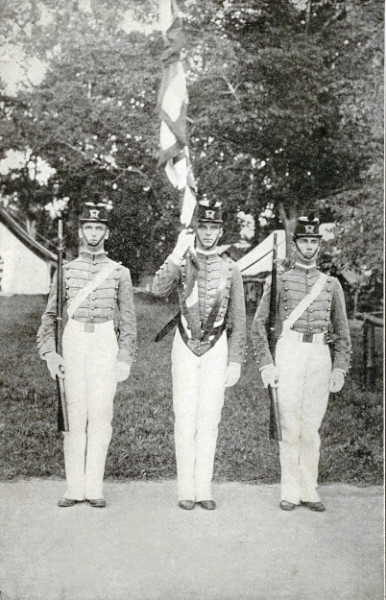
THE COLOR GUARD
Well, they certainly did. Spotless, unwrinkled, as if they, too,
had been "boning" colours. Randolph marched out on higher heels than
those prescribed in the regulations, and later on presented himself
fearlessly as a candidate
for honours. And the inspecting officer's face seemed to say he had
reason; Randolph could see approval in every look and gesture. Gloves,
buttons, gun were scrutinised; the trousers were dazzling and smooth.
Then the officer passed round for a back view. Hair right length,
collar right height above the grey, belt and buttons adjusted to a
nicety.
"Mr. Randolph," said the cadet adjutant, as he came round in front,
"I would have given you colours but for those trousers."
And when Randolph got in and scrutinised himself he found that the
borrowed trousers were deeply frayed at the ankle! After which the
young man professed himself blue and bored.
"Just my luck," he said. "But I'll get even with him, see if I
don't. They were only fringed behind."
Two or three days after this, Randolph accosted Magnus.
"Say, Kin, want some fun? Like to see Coxy scared within an inch of
his life?"
"No sort of objection on my part; rather B. J. in you to propose
it."
"It's more than propose," said Randolph. "Just you hang round my
tent about nine o'clock."
Then after supper Randolph took his stand at the foot of A Company
Street, where the plebs were busily going back and forth between the
hydrant and the tents.
"Mr. Johnson!" he said, hailing a D Company pleb, but keeping his
voice well down.
"Yes, sir."
The pleb slackened his pace a little, but did not look round, and
Randolph stood glancing carelessly about, as if thinking of nothing in
particular.
"When you have carried in that pail come at once to the darkened
tent at the head of the street."
"Yes, sir."
"What is your name, sir?" to another.
"Mr. Ummerstot, sir."
"Mr. Upstart! I would like to know, Mr. Upstart, if you have no
superior whose pail needs tilling as well as your own? Go home at once,
and then report at my tent. The one with no light in it."
"Yes, sir."
When six more were under orders, Randolph strolled back to the front
of his tent, and as fast as the plebs came up, he passed them in. They
might stand at ease, but must not talk above a whisper. When they were
all in hiding, Randolph spoke through the closed door of the tent.
"Mr. Johnson!" in a low undertone.
"Yes, sir."
"Your special technical name for this evening is Hippotherium. Do
you hive it?"
"Yes, sir."
"Mr. Upstart! Your special name till tattoo is Semnopithereus."
"Mr. Parboil!"
"Mr. Carboil, sir," said the poor pleb, with a mild preference for
his own name.
"I said Parboil. Your name will be Cereopithereus. Mr.
Cereopithereus, you are first cousin to Mr. Semnopithereus, and
according to Darwin, you each bear the same relation to a man that a
pleb does to his superiors."
So the eight names were given, and then Randolph began again:
"Mr. Ichthyosaurus, you and your fellow animals will answer to your
special technical names at roll-call, by a growl. You, sir, are an
extinct reptile. Did you ever hear an extinct reptile growl?"
"No, sir."
"You other animals, stop that unseemly snicker. Where have you
lived, sir, all your life to know so little?"
"In Massachusetts, sir."
"The very headquarters of fossil life. Well, sir, if you have any
imagination at all, growl as nearly as you can in the hypothetical
voice of that extinct reptile called an Ichthyosaurus."
A low growl, ending in a suppressed chuckle.
"Order there, in the zoölogical museum! Mr. Hippotherium!" and
another growl followed in a different key.
"How," said Randolph, when the roll had been gone through, "the
countersign is: 'Here comes the unsuspecting stranger!' Do you
understand?"
The painful general growl that answered him was cut short by a
smothered laugh.
"Attention! When you hear the countersign and see the tent flap
lifted you are to growl all together, with your deepest and heaviest
roar."
A few minutes passed silently by. Randolph loitered about near
the tent, as one might do who found the evening air refreshing. Then
suddenly Adjutant Cox passed down the colour line.
"Say, Cox," Randolph hailed him, "come and see what I've got in my
tent."
Thinking only of boodle, for which he had a soft spot, Mr. Cox came
up, and pushed back the tent flap.
"Here comes the unsuspecting stranger!" cried Randolph, and from the
darkness poured forth such a horrible and very prehistoric roar that
the tall cadet made one spring across the company street, demanding in
no gentle tones of Randolph "What on earth he had got there?" Then,
"hiving" the joke, he walked rapidly away. Only one such roar could
be risked, and after a little more hectoring the plebs were let out
quietly one by one, and Randolph sought out Magnus and Rig to receive
their compliments on his success.
XV SIGNALING FOR HELP
All common things, each day's events,
That with the hour begin and end,
Our pleasures, and our discontents,
Are rounds by which we may ascend.
—Longfellow.
It was a new experience to be on guard as corporal; and instead of
the tedious pacing up and down, to go round the camp at set intervals,
posting the reliefs, and then to sleep or lounge in the guard tent. No
more sounding out the "All's well!" in proper, or improper, style; but
it seemed to Magnus that he never missed hearing it.
But whereas in the old days he used to wish every time he called the
hour that the beautiful, serious, and weird cry could reach across the
continent, even to his mother's ears, now, on the whole, he was content
that it did not.
"If only she could hear it!" he used to think; if only the "All's
well!" could cross those weary miles that kept her away. But now,
somehow, he did not wish it. Yes, it was all well with the camp, all
well with the Post; was it all well with him? Would the words bear a
true report as she would understand them?
Cadet Kindred studied the point a good deal as he lay there in the
guard tent looking himself over, or stole a solitary walk now and then.
And I say "stole" advisedly. Short of stealing away, a solitary walk
was hard to get.
If, at the risk of his neck, he slid down some sheer cliff to the
river's edge, few indeed would follow him, but a
cadet boat might come along shore with a barge-load of girls in tow.
And sometimes he was quick enough to dodge behind the bushes, and
sometimes he sat still and let the shower of exclamations come.
"Oh, there's Mr. Kindred!"
"Just see Mr. Kindred!"
"Mr. Kindred, please get right into the boat."
"Haven't a permit."
"There's nobody round," said the Kitten. "Jump in quick. You never
can get back up there without being dashed to pieces."
"Hardly with. Then there'll be one less 'additional' in the
way."
"How dreadful! I thought you were better brought up than to talk
so."
"I was."
"Were you really so very well brought up?" said the Kitten, with her
head on one side. "Do you know, I should never have thought it."
Magnus rose to his feet, and doffed his cap profoundly.
"Now you've done it, Puss," said Miss Saucy.
"Why, I don't see how," said the Kitten. "I hate well-brought-up
people; that's why I spoke."
"Better hate Kin as fast as you can, then," said Chappy from the
boat, "so's there'll be a chance for some of the rest of us. Why, he
don't sleep in chapel more than every other Sunday."
"How can he help going to sleep, poor boy?" said Miss Saucy. "Such
sermons!"
"Well, come now," said another cadet, "that last sermon wasn't half
bad. And not more than twice as long as was necessary."
"Yes, but for these times!" quoth Miss Saucy. "Why, it was just like
saying 'Be good,' don't you know?"
"Hard upon the times, wasn't it?" said Magnus.
"Well, row on," said the Kitten with a deep sigh. "I see by his face
nothing I can say will do any good. But it is such a pity! I never
guessed he was that sort. A new fad, isn't it?" she said in a loud
aside, as the oars dipped and rose. "Good-bye, Mr. Kindred! I hope your
meditations will be very profitable."
"Thank you," Magnus answered, standing up again, "I think they
will."
He watched the boat as it went on over the dimpling water, then
changed his place a little, and began on a new end of his thoughts.
This girl had "never guessed he was that sort."
Maybe she was only telling society fibs, but Magnus would not let
himself off so. For what reason had he ever given her to think him a
Christian? Where had his colours been, in all these walks and talks and
meetings? Up his sleeve, in hiding?
"But I cannot flaunt them in people's faces," Magnus pleaded for
himself.
No, and no more did the flag its stars and stripes; only waved them
joyously overhead.
He had been ready to say that the constant frolic with the gay
crowd was not good for him, but how about his side of the influence?
Had he ever tried talking sense to girls whom he condemned for talking
only nonsense? "Ye are the salt of the earth," but salt refreshes,
stimulates, purifies; how far had he been like that? Without being
priggish, without setting up for a preacher, could he not show in
every way that the service of Christ was better than all else, and the
knowledge of Him the most joyful thing in all this world? "Ye are my
witnesses," said the Lord Jesus; and what sort of testimony did Cadet
Magnus Kindred give from day to day? No matter how other men did, what
had he done?
The final outcome of all these cogitations was a letter.
"Camp Golightly,
"July —, 18—.
"My Dear Mother:
"I don't see why you don't come East and look after your boy. How
do you know what he is about here? Better come and see whether you
want him home on furlough; that is, if that time ever comes, which I
don't believe it will. Three, six, well nigh eight months yet before it
will even be 'One hundred days to June.' Besides, they may find me in
January, and then, instead of going home, I should go as straight to
the Antipodes as if they'd shot me out of a catapult."
"Don't be uneasy; I'm not skinned more than twice a day on an
average; skins grow fast here, and skinning is nothing when you get
used to it. So the eels say. And I'm sure to take daddy's scalp when we
get back to barracks. Not much of a possession, either, I must own."
"Do you realise, ma'am, that your son is that much detested and
overworked and maligned being a yearling Corporal?—wearing
chevrons, and sporting dignity enough for three Major-Generals?
Come and see me drill the plebs; best fun you ever saw in your
life—when you aren't one of 'em."
"But now, mother, this is serious. Do bring up our three girls
respectably, so that when they come here for first-class camp, they'll
know how to behave. But first of all, you've got to come yourself and
brush me up. Buy your ticket for West Point, stop at Garrisons, cross
in the ferryboat, and take the omnibus up the hill. Look out both sides
all the way up; and the minute you see a grey uniform throw up his cap,
get out. I suppose I might run it down the hill, but then if I get in
con. and couldn't see you all the time you were here, it wouldn't pay.
And Towser'd be sure to be round with his patent magnifiers."
"So I'll go to the edge of limits, and as you don't know
where that is, look out. If you get lost, I'll put Towser on the track
and he'll know where you are before you know it yourself. I wonder the
Phil. Department don't set him to work on the lost Pleiad."
"Heigh-ho! I wish you were here this minute—with your bag full
of gingercakes. I was on guard last night, and had nothing to eat but
those old cast-iron sandwiches. So we put 'em in the reveille gun and
they went off that way. Love to the girls. Don't bring 'em this time,
but come yourself."
"Your (very) third class Corporal,
Charlemagne Kindred."
"I enclose a picture of myself which you may like to see."
XVI RE-ENFORCEMENTS READY
Rien n'est impossible: il y a des voies qui conduisent à toutes
choses; et si nous avions assez de volonté, nous aurions toujours
assez de moyens. —Rochefoucauld.
"Like to see it!" Well, I suppose they did. It will not do to say
that never was photograph so devoured; too many just such counterfeits
of boys in grey have sped across this broad continent and been just so
received; but it was well for this particular one that mere looking at
things cannot wear them out.
At first, after one astonished look and exclamation they all broke
down and cried. Partly for joy—for how handsome he was! and how
those bell buttons did set him off!—partly for the wild longing
it stirred to have him in their arms again. But with this came in
another feeling: that keen, subtle pang which detects a change. Was
their own wayward, careless, happy-go-lucky Magnus really hid away
behind that perfectly buttoned coat? For even a year at West Point
makes a wonderful change, which even accustomed eyes find marvellous;
what wonder that these unwonted ones grew wide open as they gazed? He
had graduated from the mild sway of persuasion and was under orders.
If the first half hour's study of the picture was full of joy, it
may be doubted if the pain of the second had all the softening that
really belonged to it. This exact, stately young man, her Magnus,
who used to catch her in his
arms and whirl her off her feet. This soldierly fellow their
brother, who would swing himself by one foot from the
apple tree and climb the lightning rod and hold on by his teeth to the
window sill? They did not write all this out for themselves, but the
smiles faded. Not their boy any longer, but Uncle Sam's.
"I should think they might have left him just a few curls!" said
Violet, identifying one small grievance. "Oh, I wonder what Cherry will
say?"
"I wish she'd come," said poor Mrs. Kindred, trying hard to speak
calmly. "Cherry is always so wise. And I am such a goose," she added,
feeling after a stray smile. "Of course, he could not be at West Point
and a soldier and look like my little boy still."
"Let me run up with it to Cherry and bring her back," said Rose.
"No, no, leave it here!" cried the mother. "I cannot have it out of
my sight one minute. Oh, girls! was there ever such a handsome fellow
seen, anywhere?"
"Never, I do believe," said Rose. "Mother, his eyes haven't changed
one bit. Just see how they laugh at you——" But that look
stopped the words.
"What is going on here?" said a sweet young voice at the window.
"What are you all studying out?" And Cherry's quick, soft steps came
through the hall and into the room.
"Don't tell her! Don't tell her!" cried both the girls in an eager
whisper.
"Come in, love," said Mrs. Kindred. "We were just wishing for
you."
"Yes, come and tell us what you think," said Rose. And placing
themselves each side of Cherry, the two girls marched her up to a place
behind their mother's chair, where she could look over Mrs. Kindred's
cap and see the picture, watching to hear what she would say.
But Cherry said never a word. She started, and gave a little cry at
first sight of that wonderful presentation
of her hero, but then she stood quite still; her fingers interlacing
each other, the red and white playing hide and seek on her young
face. That undefined change which they all felt came to her with a
difference. For Magnus had never been hers to have and to hold, but
only to gaze at from a safe distance; and suddenly, lo! he had become
more wonderful than ever. Whether this put him further away or not gave
Cherry no trouble just then; she had forgotten herself and the whole
world at first sight of this picture of that astonishing person, Cadet
Charlemagne Kindred.
"Do you think it looks like him, dear?" Mrs. Kindred said
plaintively; and with a quick jump down to earth, Cherry answered in
the most matter-of-fact way:
"It must, Mrs. Kindred; it is a photograph."
"That's true," said the mother. "I had forgotten that, Cherry; you
always say just the right thing." And she turned round and held up her
face to kiss the girl who had spoken with such calm wisdom. But poor
Cherry found out then that her own nerves were overstrung, and she
had no answer ready. And what sort of an unconscious feeling was it
that made her turn away and take up the empty "Pach" envelope and look
inside; could Magnus have put in a second copy for her? An action, by
the way, it was a pity that young man did not see, walking, as he was
just then, round Flirtation and making pretty speeches to the youngest
Miss Fashion.
Cherry laid down the envelope and put on her hat.
"You are strange people not to like it," she said.
"Why, we do!" cried both the girls. "Only we felt just a little bad
because it looks different."
"But you knew he would grow older, didn't you?" said Cherry, tying
the hat-strings. "And you could not expect them to let his coat go
flying open, in the Army."
"To be sure, that is just it," said the mother, gazing
at her young soldier; "he is in the Army. Dear me!
Dear me! But take off your hat and sit down, child; here is a whole
long letter to read."
There could be but one answer to that. Cherry put herself on a foot
cushion behind the table, just where she could have a good peep at the
picture whenever she chose, and the reading began. But with the very
first sentence Mrs. Kindred laid down the sheet and looked about her
with bewildered eyes.
"He doesn't see why I don't come and look after him!" she said.
"Why, I thought he had the whole Government to do that."
"And it's the first time Magnus ever asked such a favour of anyone,
I am sure," said Rose.
"Oh, but you see," said Cherry from behind her table, "he is
homesick, Mrs. Kindred, and wants you; and nothing else will do."
"He must have got over his homesickness long ago," said Violet.
"Just the first sort," said Cherry; "but you see it has come back
again. It is four hundred and twenty-three days since he saw his
mother." Her voice choked a little.
"Well, you are an almanac, there is no doubt," said Rose, quite
failing to trace this exact tally to its true source. "Dear mamma,
don't look so! It's just lovely of him to be homesick for a sight of
you; he ought to be."
"And of course, you will go to him at once," put in Violet. "Then
you can tell us all about him and the place and everything."
"Go to him!" These lively spirits, treading down impossibilities
with their young feet, were too much for her.
"Why, girls, I haven't the money."
"You shall have my new winter bonnet—which was to be," said
Rose.
"And all my Christmas presents which, perhaps, were
not to be," said Violet. "I've got five cents besides in my strong
box."
"And Uncle Thorn will help," said Rose. Mrs. Kindred held up her
hand.
"Be quiet, all of you," she said, "or I shall lose my senses." She
sat looking at that boy in grey who was homesick for the sight of
her.
"It isn't 'all of us,' at all, mamma," said Violet, "for Cherry is
as still as a mouse. Speak up, red lips, and give us your opinion."
Speaking low, as before, Cherry made answer that it would be safe to
read the whole letter, before deciding upon anything, which was such
a self-evident point of wisdom that they all laughed, and the reading
began again.
"Now, mamma, don't stop till you get through, no matter what he
says," pleaded Rose. And Mrs. Kindred tried, but in truth it was hard.
Every sentence or two she would stop and look up helplessly, at the
two faces that bent over her, or try for encouragement from Cherry's
shining eyes, down by the table. Which eyes, however, were not always
in sight. Cherry found some wonderful things in the letter, which
the others missed; and so now and then retired into her own private
meditations. "Bring up our three girls" and "when they come."
Clearly, then, she also was expected at "first-class camp," whatever
that might be.
"Cherry, you don't seem to hear, my child. What does he mean
about their 'finding' him and his not coming home, but going to the
Antipodes?"
"I think it is just some of his nonsense, Mrs. Kindred," said the
girl, too happy to be alarmed. "He wants to make you come, and so he
says all the queer things he can think of. You see West Point hasn't
really changed him one bit."
"Dear fellow!" said the mother, with another look at
the picture. "I think you must be right, Cherry. I am getting used to
the dress a little. And I'd almost give my life to see him. But do you
really think I could go so far alone, even if I had the money?"
With the happy courage of their years, the girls assured her that
nothing possibly could be easier; get in and get out all right, and the
railway companies would do the rest.
"Uncle Thorn will put you in, you know," said Violet, "and as for
your getting out, when you are so near Magnus I don't believe anybody
could keep you in the cars without handcuffs and fetters. You'll just
fly out."
"But suppose I fly out too soon?" said Mrs. Kindred, to whose eyes
the two thousand miles of space loomed up very large indeed.
"You will not," said Rose decidedly. "Conductor will not let you.
Read on, mamma, please."
So Mrs. Kindred read on, only to get more hopelessly mixed as to the
real state of things. "Skins" and "scalps"—third-class corporals
and the Antipodes; laying it off on the West Point vernacular did not
clear up the meaning a bit. And when the letter had been read carefully
twice through from end to end, Mrs. Kindred laid it down and calmly
announced that she should set off for the East as soon as she could get
ready. And the girls kissed her and cheered her, and only wished they
could go too.
And things turned out a good deal as they had said. Mr. Thorn
not only bought her ticket, but put her in careful charge of the
conductor. The girls packed the modest little trunk, stowing in all the
gingercakes there was room for; Violet laid in a dainty handkerchief
embroidered with the young cadet's initials, Rose added a small
pincushion "to go in his pocket," and Cherry, with some demurs, sent
him her last little drawing of the old apple tree which had been his
own special private
gymnasium. Cherry had a very pretty knack with her pencil. Then they all
went to the station to see her off, even some of the neighbours joining
in.
"It's a clear Providence your goin', Mrs. Kindred," said one good
woman, whose husband had come West looking for "royal roads" to wealth
and place. "Now you kin tell us all about it, for sen' Magnus went,
we've been athinkin' o' sendin' our Bill. He's a dreffle shiftless
feller: don't take after me, if I do say it. Bill just despises work in
any shape or way, and so his father kinder thought maybe he'd do for
West Point. They'd pull him through, likely, just as they do the rest,
and then he'd he provided for."
Happily, the train came, and nobody could answer. The girls went
home and held an indignation meeting, and Mrs. Kindred rolled swiftly
away, very soon forgetting everything else in the one thought that she
was going to see her boy.
XVII THREE CHEERS AND A TIGER
'Twas morn, a most auspicious one:
From the golden East the golden sun
Came forth his glorious race to run,
Through clouds of most splendid tinges.
Clouds that lately slept in shade,
But now seemed made
Of gold brocade;
With magnificent golden fringes.
—Hood.
Yes, it was a royal August day. The last summer
month has a very different character in different
places. In town, where, instead of
"Three months of sunshine bound in sheaves"
you have the same stored up in pavements and glowing from brown
stone fronts, it is a time which men naturally enough choose for their
vacation, and leave the city home behind them as fast and as far as
they can. September rains may clear the air, but till then, away.
But in the Highlands, with here and there a rare exception, August
is one of the very loveliest months of all the year. We say of a
human face that it is finer after life has given its touches and done
somewhat of its fine chiselling, and a little so does the last summer
month surpass the two that went before. More sedate than jocund June;
far calmer than July with its tempests and fervid heats, the shadows
fall differently, the changed lights give you a new insight into
things. The days are so exquisite partly because they are shortening;
the flowers hurry out in troops.
And nowhere in all the year do we have such a succession of wonderful
sunset skies as in August. Then the temperature is for the most part
perfect; the cool mornings and evenings only the fairer for the midday
heat. It is a time when you can sit out, dine out, and well nigh take
leave of the house altogether.
One wise thing inexperienced Mrs. Kindred remembered to do. From
point to point as the miles rolled by, she sent postals to the girls at
home, and one at the outset to Magnus. He knew just when to look for
her. And so, when the day came, and dinner was over, Cadet Charlemagne
reported his absence at the guard tent, and strolled away to Trophy
Point, and seated himself to wait and watch. Too early yet by an hour;
but he was restless and could do nothing else.
The day was cloudless now; the noon heats still in the air; the
hazy, lazy hum of the locusts thrilled out on every side. Perhaps lazy
is not just the word—but there are no inflections; they fight it
out on one line, as few tired workers ever can.
A suspicion of real haze hung over Newburgh; the more distant hills
looked faint and dreamy. Far up the river a long tow wound silently
down, leaving its trail upon the quiet water; nearby a sloop or two
went softly on, spreading their white wings to the breeze. There was
just enough air stirring to lift and drop, lift and drop, the bunting
on the flagstaff.
Magnus sat looking and listening, drawing a deep breath now and
then. How long it seemed since he first saw Trophy Point and that
flagstaff!—and it was really but fourteen months. He glanced
up at the flag, just then shaking out its lovely folds. That had not
changed. And he knew his mother had not; she would be just the same
blessed person she had always been. But how about himself? and what
would she think of him? And now, studying
that question, Magnus took out mentally his own private stand of
colours and looked at them, matching them with the flag overhead. It
hung very still just then; and yet he could see a star here, a touch of
the stripes there. Storms might beat it to ribands, but they could not
change the colours nor make the flag come down.
"That weak strip of bunting!" thought Magnus, with a certain
interlining of words not complimentary to himself. And other words
written above his father's grave came quick and clear: "The world
passeth away, and the lust thereof: but he that doeth the will of God
abideth forever."
Magnus stood up and walked slowly along the little path to another
point, whence he could see the "Central" road.
"I'm no end glad she's coming!"—so ran his thoughts. "But I
just wonder how she'll like her boy? And there she comes!"
For now a puff of white smoke rose up at the mouth of the Breakneck
tunnel and then fell into a long, curling line, and began to wind its
way rapidly along the curves of the river road.
Magnus watched it, jumped on the seat to see it better still, and
then tossed his cap into the air like any boy let out of school.
"Hurrah, old flag!" he cried; "there she comes! Now you'll see
somebody worth looking at."
The white line rushed on, paused at Cold Spring, whirled along over
the north bay and hid itself in the green Island woods, while Magnus,
again waving his cap and this time so recklessly that it was near
going down the hill, hurried away to Battery Knox, ran up on the green
parapet, and stood to watch. The engine came puffing over the south
bay as if the fate of the nation hung on its speed, dived into the
Garrisons tunnel and slowed up.
How long it stayed!
"Just to put off mother and her little trunk!" thought Magnus,
laughing to himself, and then getting such dim eyes that he could not
see a thing. But he felt as if he could hug even the trunk.
And now, puff, puff, the train slowly moved away from the station,
and the little ferryboat rang her bell. Of course, his mother was
there, in the small, dark throng that came down to the river, and of
course he must therefore really see her, but—Oh! it was too
tantalising! I think at that minute Magnus would have given anything
(except furlough) for a good glass.
The boat was off, steering across the river in a pretty curve to
suit the tide; the smooth water turning back in two long lines of
wrinkles in her wake.
Magnus leaped down from the parapet and was speeding away up the
path at a great rate when there came a hail:
"Mr. Kin—dred!"
Magnus paused to see.
Clustered about the pathetic white column that looking calmly down
on the silent river, tells in such vivid fashion its terrible tale of
struggle and death, were three or four very summery looking girls: Miss
Fashion, Miss Dangleum, and another whom Magnus did not know.
"Do come here, Mr. Kindred," pleaded Miss Dangleum.
Well, a cadet is nothing if he is not a squire of distressed
damsels. Magnus turned and jumped down to where they stood.
"What's the matter?" he said; "has a fan gone down the hill? or is a
parasol in trouble?"
"There, isn't that just like you!" said Miss Fashion. "No, nothing
so serious as that."
"Miss Beguile has come," said Miss Dangleum, "and she asked you down
to a private view of her eyes."
"Oh, Nina!" said Miss Beguile, in soft expostulation.
"We also wanted her to see yours," said Miss Nina daringly. "She
doesn't believe cadets have any under those caps."
Magnus doffed his own particular cap, as in duty bound, but the view
Miss Beguile got of his eyes was very short and unsatisfactory.
"Now find us a nice seat," said Miss Dangleum. "We've got lots of
boodle."
"Certainly—at any other time," began Magnus, "but
now——"
"You don't mean to say you've got a previous?" cried the girls.
"Very previous, indeed. I am just going to meet my mother."
"Your mother?" said Miss Beguile with the sweetest air of interest.
"How charming!"
"Dear me, where does she come from?" drawled Miss Fashion.
But now Mr. Kindred's eyes came to the front and declared
themselves.
"She comes from home," he said. "Excuse me, I am late"; and with
another touch of his cap Magnus sprang away up the path about as fast
as a man could go and not run.
"He has magnificent eyes," said Miss Beguile.
"Yes, but no use," said Miss Dangleum. "I cannot bring that man to
terms, do what I will."
"Flinty, is he?" said Miss Beguile. "Well, I mean to get hold of
him, girls, I give you notice. He's the sort of man I like."
"Is there any sort you don't like, Bessie?" said Miss Fashion.
"Oh, it's always great fun to have men round, no matter what sort
they are," confessed her friend. "But the unapproachable is my dearest
choice, every time."
XVIII HIGH SUMMER
Far through the memory shines a happy day.
—Lowell.
Magnus meanwhile went speeding on; leaping over space, and
chafing at the lost minutes in terms not very flattering to his fair
disturbers. But he was in good time, after all. The stage had waited
for a West Shore train, and when Magnus reached the furthest and
nearest point to which he might go, the horses with their light load
were but just nearing the riding hall.
Slowly, slowly—how that stage did creep along. Magnus crossed
the road, went back again, darted from one point to another; if only
he could get a good glimpse inside! Now the lumbering thing turned a
little; ah, it was just empty. No; surely that was a bonnet on the
further seat; and now at this window looking out for him! And surely if
ever a forage cap went high in air, one went then. But the moment it
was within reach again Magnus pulled it far down over his own eyes. He
had been at West Point more than a year, looking at tactical officers,
professors, dignitaries of all sorts; with wild cadets and all kinds
of girls; and now this was his mother's face, and like nothing else in
all the world. The boy's heart gave a bound fit to burst something less
elastic than a young heart always is.
As for poor Mrs. Kindred, when she saw that cap go up in the air, of
course you know what happened to her.
But she would not look away, even to cry, and sat gazing at that tall
figure in grey and drawing the long sobbing breaths that bear such a
very mixed freight. She even forgot to pull the check string, and would
have been driven straight on if Magnus, in a voice stern enough for the
first captain, had not bidden the driver stop. And it seemed so natural
and fitting that her boy should pay her fare that when he pulled out a
hidden quarter and passed it up to the driver no qualms of fear that he
might be "skinned" for so doing disturbed her mind. Of course cadets
have no more business with pocket money than they have with pockets,
but she did not know that.
Magnus got one hand on his arm, gripping it with the other hand as
if he thought she might run away; and drew her rapidly along through
the nearest byways to a nook among rocks and trees that he deemed his
own private discovery. Once there, hidden away in the sweet, cool
shadow, with the river plashing softly far below, and a wood thrush
ringing his chimes near by, Cadet Corporal Kindred threw his cap down
on the grass, put his arms round his mother, and hid his face in her
neck as if he had been six years old.
It was just what the mother needed. For at first sight, this tall,
splendid fellow with braid and buttons and chevrons, straight as a
line, and with all the saucy curls cut away, laid her under a spell.
Except the first meeting kiss she had had hardly a sign from him unless
that grip of her hand. But now, with her boy in her arms, he was her
boy still, and she quite too happy for this lower world.
"Child," she said at last, "what have they done with your hair? Have
you been sick?"
Then Magnus looked up and laughed; the old shine in his eyes making
her heart leap.
"Regulations," he said. "I am nothing any more but
a bundle of regulations, mother. Might about as well be a convict
labeled 379."
"Regulations!" Mrs. Kindred repeated. "I wish I had the making of
them."
"I wish you had, mother. And there are some three hundred and odd
more boys here, who would confidingly hand the job over to you. Then
we'd have pie every day for dinner and cake for supper, Saturday in the
middle of the week, and no Monday morning recitations."
"But Magnus," said Mrs. Kindred, bewildered over this very mixed lot
of grievances, "don't you have cake for supper?"
"Now and then a mysterious compound which goes by that name," said
Magnus. "We are having it scientifically analysed to see whether it is
all new-process granite, or whether one part mud comes in."
But here the innocent, perplexed face was too much for him. He
almost shouted with fun, tossing his cap up higher than it had ever
been.
"You blessed mother!" he said. "You haven't changed one
bit—not a pin's point. There was one on your shoulder just now to
scratch me, exactly as there always used to be."
"Oh, my dear!" cried poor Mrs. Kindred. "I did not mean to leave
that pin there. I just stuck it in last night in the sleeping car."
"But you always did 'just stick it in,' you know," said Magnus
disrespectfully; "and I never remember the time when it didn't just
stick out. It wouldn't be you without a pin on your shoulder."
"It wouldn't be you if you were not a saucy boy," said the mother,
and then they looked in each other's eyes and laughed; how happy they
were!
"All right, mammy," said Magnus. "That pin gave me a welcome nothing
else could. How are the girls?"
"The girls are lovely," said Mrs. Kindred. "Cherry has tried to fill
your place, Magnus, ever since you came away."
"H'm, I don't know about that," said Magnus. "Tell her she can't
have but half of it, fair and square."
"Oh, well, you know how I talk," said Mrs. Kindred. "She could not
really, dear, nor anybody else. But she is the dearest girl, Magnus,
and so wise. We have to get her to explain all the queer things in your
letters."
"Do I write queer things?"
"Very; or they sound so to us. And I get quite worried sometimes.
And then Cherry will say in that pretty way of hers, 'You know it is
Magnus, Mrs. Kindred, so he could not mean that.'"
If two sparks flew from Cadet Kindred's eyes at these words, only
the green moss at his feet was witness thereto. But, then, a very grave
look came over his face. His mother watched him anxiously.
"You do not think I really meant that, dear?" she said. "No one on
earth could fill my boy's place with me, Magnus."
"No, no; I understand," he said, without looking up. "But she
deserves it so. Cherry is a great deal better than I am, mother."
The mother smiled contentedly. Very small improvement did her boy
need for her. But she would not say that; just as well for him not to
know how high he stood on the general merit roll. And it was a fine new
West Point development, if Magnus was inclined to underrate his own
perfections. Which, by the way, was not at all what that young man was
doing. But Cherry's simple, unquestioning faith in him suddenly touched
up his memory of certain things which (in spite of being "Magnus") he
had done, and the recollection was not pleasant. Not very bad things,
Oh, no! but by no means up to Cherry's standard.
"It's not worth while for her to come on before furlough," he said,
thinking aloud.
"Her?" Mrs. Kindred repeated questioningly.
"Yes, any one of the girls," said Magnus. "You see, the winter
journey is one thing; and then in the winter there's such a beastly lot
of studying to do. And in the spring I shall be boning every minute.
But wait till first-class camp. Or you might all come back with me from
furlough—just for a first sight of the place."
"But my dear!" said Mrs. Kindred. "Why Magnus, you talk as if we had
the Bank of England at our back."
"No, only me in front," said Magnus with a gleam of his bright eyes.
"You don't suppose I am going to worry through the last two years here
without a sight of you all? Wouldn't pay to bone rank if nobody came to
see my chevrons. Just as well go on and get rattled like some of the
rest of them."
"But my dear!" said poor Mrs. Kindred. "'Rattled' and 'bone' you've
said twice. And you called your studies 'beastly.' I thought they
taught English at West Point."
How Magnus laughed!
"There are Tacs over yonder," he said, "with a party of summer
girls; and one of the girls offered me a lot of boodle. And the Com.'s
out riding, and the Supe's gone to town, and the Arch-fiend is at the
seaside."
"Now Charlemagne, stop!" said Mrs. Kindred. Magnus gave her another
delighted hug.
"Oh mammy!" he said; "this is you, and no mistake. I didn't quite
believe it was at first." And kissing first one hand and then the
other, Magnus put them both back in her lap, and laid his cheek down
upon them. The mother got one hand away and softly stroked the fine
head.
"I do not understand about your hair, yet," she said.
"Regulations."
"And why do you wear such a thick coat this warm day, Magnus?"
"Regulations."
"Why my dear! Well, you might unbutton it at least," said Mrs.
Kindred.
"Regulations."
Mrs. Kindred was silent a minute.
"I took my dinner in Poughkeepsie," she said, "because I was not
sure of getting here in time for yours; and I know it is not good for
you to wait."
"No ma'am, it isn't—here," said Magnus.
"But we can have supper at any time you like."
Magnus, without raising his head, gave a groan and wished they
could.
"Well, we can," said Mrs. Kindred. "I can wait till late, or have
it early, Magnus, just as suits you. What do you mean by sighing like
that? What is in the way?"
"Regulations."
"Oh well!" said the mother, trying to smother her disappointment;
"you have some other thing on hand? Never mind, dear, then we'll be
together at breakfast."
"No, we sha'n't."
"Why not?"
"Regulations. We cannot have one single meal together while you are
here, mammy."
And now, indeed, Mrs. Kindred had no more to say; the bands of red
tape seemed to be winding all about her heart, and drawing very tight
indeed. She had so pictured to herself the joy of once more handing her
boy his cup of coffee. But it must be best for him, she said bravely to
herself; or else they would not make such rules. And, whatever was best
for him—
"What can you do, dear?" she said aloud, but with a plaintiveness
that went to the boy's heart. He sat up and took her in his arms.
"I can do lots, mammy!" he said. "Never you worry one bit. I can't
do it for breakfast, and I can't do it to-night, but some other day
I'll cut supper, and we'll have it down here together. And we'll have
picnics instead of dinner. And I'll walk with you every minute of
release from quarters."
"Release!" The word jarred on the mother's ear; to what had she sent
her boy? But then, whatever it was, it agreed with him splendidly;
never had she seen Magnus in more jocund health and strength; life at
its best was in every look and motion. And the eyes that flashed and
sparkled at her were not the least in the world careworn or overworked.
So Mrs. Kindred locked up all her dismayed pangs and questionings, and
once more stroking her boy's cropped head, remarked that it was said to
make the hair grow to cut it.
"I'll have a mop when I come out, then," said Magnus. "How does
Cherry wear her hair now? same old way?"
"Oh yes!" said Mrs. Kindred; "only it's never twice just the
same. You know her curls arrange themselves—as yours used to,
Magnus."
"Disarrange was the word for me. If anybody cuts hers off, I'll
shoot him."
"I think somebody did cut one off once, without being shot," said
Mrs. Kindred. Magnus coloured.
"That was only one," he said. "Why didn't you bring them all along?
The girls, I mean."
"Why, you unreasonable boy," said his mother; "you expressly bade me
not."
"I had been here so long, I forgot that you always minded," said
Magnus, with a saucy look.
"Well, I did not always," said Mrs. Kindred; "but the girls could
not have come off in such a moment, Magnus; they were not ready."
"Girls never are. They'd learn, if they had a week or
two in camp. Bang goes the reveille gun—and in just two minutes
you have to be dressed and out in line, swearing that 'Kindred, C.' is
present and accounted for."
"Swearing, Magnus?"
"Well, some of the men make the statement pretty loud. I am one of
the mild kind, and 'roar gently.'"
"Yes, I know what your gentle roars amount to," said his mother
derisively. "But Magnus, do they really make you dress in two
minutes?"
"By my watch."
"But you haven't got a watch," said the perplexed mother.
"And therefore am subject now and then to miscalculations."
"Well, West Point has not changed you yet, to hurt," said the
mother, smiling at him. Magnus took her tender hands and put one on
each side of his face.
"Mammy," he said, "it is the jolliest thing to see you sitting
there, puzzling your dear head over my grinds. I could cry, if I wanted
to. But I say, when you do bring the girls, don't give 'em time to get
ready. They shan't come here looking as if they'd never had anything
before, but had got it now, sure."
"But our girls have always had enough, you know, Magnus, and they
are not likely to have any more," said Mrs. Kindred, cutting both
knots.
"They are worth all the girls I have seen here, multiplied by twelve
dozen," said Magnus. "Oh, mother, why didn't they come! But I tell you,
you'll have your hands full when they do. Violet will make a sensation.
And Rose—I think True will be fathom deep at first sight of Rose;
he likes quiet, sweet, strong girls."
"I should think most people would," said Mrs. Kindred. "And how
about Cherry?"
"I said nothing about Cherry."
"Am I not to bring her?"
"Oh yes! she had better come too," said Magnus. "Mammy, it is
as good as a month of Saturdays just to look at you. You are the
handsomest woman on the Post."
And now pink tinges came upon the sweet pale face; and Mrs. Kindred
was certainly the happiest woman anywhere about.
XIX THE VISITORS' SEATS
With whom doth Time gallop withal?
—Shakespeare.
Alas. Time did not slacken his pace for those two people. After that
very first day, when Mrs. Kindred really took in the astounding fact
that she was there, she began to count almost the seconds as they
ticked away, and grudged even those spent in sleep.
She would sit far on into the night, looking over from her window to
where her boy's tent rose up sharp and white in the moonshine; and with
the first drum-beat in the morning was at her post, sending off her
heart and her blessing to that grey line where Magnus stood. If he was
on guard she watched for glimpses of his tall figure as he went up and
down, posting reliefs, and in a sort loved the whole white battalion
that marched away to dinner because one particular white helmet rested
on his head. And never was there a more devoted frequenter of the camp,
as she waited there on the visitors' seats for his moments of leisure,
happy between whiles that he was at least nearby.
Then she steadied her nerves to bear the sharp reports in the Light
Battery drill, and watched manœuvres and evolutions as eagerly as
if she understood them all. How stately Magnus looked in his various
trappings; how nimbly he tumbled in and out of the caissons. And when
the sergeant shouted out at parade:
"Company A, one corporal absent!"—how thankful
that particular mother was that it could not possibly be her son.
It was astonishing to see such honours and cares resting upon
his young head; drilling plebs, posting sentinels; no wonder he had
changed. Was the change in him all for the better? The mother could not
quite tell. When Magnus was with her that joy swept everything else
away; but sometimes, as she sat alone, her thoughts worked hard, and
many things came in to tangle and perplex them.
Loitering about the camp in this way, and never missing a formation,
Mrs. Kindred also could not miss a good deal else. The Point was not
crowded; but the summer girl—and the summer girl's supposed
chaperon—were in sufficient force; and as young people nowadays
think their words worth hearing, Mrs. Kindred did not need to strain
her ears nor give undue attention to know much that was said and
done.
It was a glimpse into a life unguessed before. Her own had been
simple, earnest, and useful, from her youth up. The three girls at home
were as merry as crickets, and overflowing with fun and frolic; but
the cricket fun—if fun it be—was not more guileless and
true-hearted than theirs.
But now, sitting under the trees and watching her boy from a
distance, Mrs. Kindred would sometimes hear, close at hand, some word
or sentiment that made her start and look round, with a great wish that
the girl's mother were there; and behold, quite often she was. Then
this mother would get up and change her seat.
Small use. Near the new place sat a tall young lady in tennis rig
set free, while her waist was drawn in until playing must have been
hard work. A game had been on, for Miss Viny's cheeks were flushed, and
she still brandished her racket. She was talking over her shoulder to a
semi-young officer.
"I think you have a great deal too much to do with
Captain Chose, Miss Viny," said this gentleman. "You know he is in a
very peculiar position with regard to his wife."
And the handsome girl, flashing round at him her daring eyes, made
answer:
"That only makes him the more interesting!"
Mrs. Kindred shivered slightly, and once more changed her seat.
And now she got among a bevy of girls who were talking of Magnus;
they fluttered in and settled down all around her, too eager over their
subject to know or care who heard their talk.
"I'll get hold of him somehow. I'm bound to do it," said a dark girl
in very extreme costume. "I told you I would, and I will."
"Not worth the bother," said a plump little damsel in pink. "There
are plenty more."
"Not plenty with eyes like his; there's not such another pair in the
Corps. They're just heavenly."
"Yes, aren't they?" said the plump girl. "When he looks at you it
makes you feel queer all over."
"I was afraid you were going to say, all through," said Miss
Beguile; "and you know there isn't any 'all through' to you,
Kitten."
"Now I call that too bad," said the Kitten. "When I am universally
known to be all heart."
"Good you are," said Miss Saucy, "for you give everyone a piece and
the supply might fail. But there's a good deal of you, such as it is,
Kitten. You'll turn the three F's, if you live long enough."
"Some people don't think there's too much of me," said the Kitten,
pouting.
"About half the Corps, I should judge. Now I believe in one grand
master passion, don't you know. I think it's dear."
"It's a passion for a master—if you're in love with Mr.
Kindred," said a fourth girl. "He'll manage you, Bessie. Make you
behave."
If anybody had had time to notice the quiet little mother sitting
there, he would have seen a very perceptible start, and a pair of eyes
as indignant as such tender eyes could be. Those girls after her
young magnate? Mrs. Kindred was fit to go that moment to headquarters
and demand a cordon of red tape to surround her boy. But she could do
nothing; could not speak to the girls, could not (alas) even shake
them. Then she seemed to remember seeing him bow to these very ones;
and with a certain dress-coat air, which now Mrs. Kindred marked as one
of the new things about Magnus that disturbed her.
What if Cherry had seen and heard it all? And suddenly Mrs. Kindred
knew why it was Cherry she thought of, and not Rose or Violet.
Here was a new and difficult complication. Yes, of course, it was
all natural, the mother felt, and plain enough now she thought of it.
Whether Cherry herself yet knew, or not, she would, just as soon as
Magnus took a fancy to somebody else. Could he do that, after having
once known her? Mrs. Kindred waited till the next relief went on, and
Magnus within the guard tent was quite out of sight, and then went to
her room to think and to pray.
Should she talk to Magnus?—no; skating is generally safer
than navigation in broken ice. And the next day but one she was to go
home.
No further sight of her boy could be hoped for that night, and Mrs.
Kindred shut herself in and watched the silent camp long after the
sweet "curfew" bugle had cried to every light:
"Put it out! Put it out! Put it out!"
XX JUST THEE AND ME
Hushed with broad sunlight lies the hill,
And minuting the long day's loss,
The cedar's shadow, slow and still,
Creeps o'er the dial of grey moss.
—Lowell.
The next day rose fairer than ever. Magnus came off at eight o'clock
with "old guard privileges," and having also kind permission from the
authorities to dine with his mother in the woods.
Now the ordering and preparing of this dinner had been a great
joy to Mrs. Kindred; what though the correct dainties could not be
had. Green corn to boil was an impossibility, even if a kettle could
be found; and home-made rolls were far out of reach, and not all the
canned things that were ever turned out could replace her own home-fed
chickens and home-cured ham. The supplies from the baker were fresh
and clean and well looking—yet Mrs. Kindred sighed, thinking of
Violet's loaves of cake, and Cherry's pies.
Magnus, however, was not so critical, he did not see even such as
these every day, and so enjoyed everything to his mother's heart's
content. And as she feasted on her boy there was really no lack
anywhere. The fair August lights and shades chased each other among
cedars and oaks, the locusts hummed; the birds that had nestlings sped
swiftly to and fro, bringing food. Fall after fall of rocky woods and
winding road lay at their feet; below all, the white camp in its green
setting, then the river—never twice
the same. Far up in the north the Catskills lifted their blue,
changeless heads.
It was all so wondrous and so new to Mrs. Kindred that she was
watching it, taking it in, even when she thought she had no eyes but
for Magnus. The hills bewitched her; the distant blue, the nearer
green; on all sides she seemed to hear the silent chanting of her
favourite psalm:
"I will lift up mine eyes unto the hills, from whence cometh my
help."
Surely this was a place wherein to grow "strong in the Lord"; a
place where to remember:
"Thou wilt make them drink of the river of thy pleasures."
"Mammy, you don't eat," said Magnus, beginning on another small pie.
"You might venture—just a little. I think there'd be enough left
for me."
"My dear, I have too much," said the mother. "Magnus, don't eat any
more of that pie; it is not Cherry's make, remember."
"Don't I know it! But her pies are across the continent, worse luck.
It is good the know-nothing girls here don't try their hand. Shade of
Scipio Africanus, what a poisoning of cadets there would be! Dr. Senna
says that if it wasn't for Pretty Newcomb and her candy—with a
sprained ankle now and then—he shouldn't have a man on the sick
list."
"Well, that is good," said Mrs. Kindred heartily; "the place must
agree with you all. Magnus, do you know many people here?"
"Three hundred cadets, more or less, and too many officers quite
intimately," said Magnus, trying the cake. "Besides the bugler and the
orderly."
"Any ladies?"
"Quite some."
"I really do wish they taught English here," said
poor Mrs. Kindred. "You are just as bad as ever, Magnus."
"Worse!" But Magnus laughed up into her eyes with a look that to the
mother negatived that. What eyes his were! And that reminded her.
"Have you ever met a Miss Kitten?"
"The cadets' 'pet Kitten'? Well, I should say I had, rather."
"Magnus; I do not like to hear you talk so."
"But that is what she is, mammy, so why shouldn't I say it?"
"Always speak respectfully about women, my dear."
"Women? Well, let her pass for that," said Magnus, unconsciously
quoting Portia.
"You do know her then?"
"Enough to take off my cap when I meet her and walk while she
talks," said Magnus. "Why mammy, what makes you so curious about the
Kitten?"
"I am interested in anyone you know."
Mrs. Kindred went on, silently putting the remains of the feast
into the basket. Magnus, leaning on one elbow, watched the hands that
did their work so quietly and well. Then he bent down and kissed first
one hand and then the other, touching them with cheek as well as lips.
And Mrs. Kindred left her basket, and coaxed his head down on her lap,
softly stroking and caressing it. Magnus drew a long, deep breath.
"Mammy," he said, "they don't grow beds of Roses and Violets out
here, nor anywhere, I guess, but at home."
"It is you that have to grow 'out here,' Magnus."
"Yes'm. How much?" said Magnus; "I'm a good half-inch taller
already."
"Dear me!" said Mrs. Kindred, quoting her favourite lines:
"It is not growing like a tree
That makes man better be."
"A whole half-inch, Magnus?"
Magnus laughed.
"Ah, mammy," he said, "you can't keep dark worth a cent. Truly, a
whole half-inch. Call it three-quarters."
"I must remember and tell the girls," said Mrs. Kindred.
"Yes, don't forget," said Magnus ironically. "Charge your memory,
and tie a red string round every finger. Then tell 'em the first minute
they meet you at the station, mother, and have it off your mind."
"You are a very saucy boy," said Mrs. Kindred, trying to look
grave.
"West Point is a developing place, as some wise M. C. said last
June. Have the girls grown, mother? How tall is Cherry?"
"Grown a little, I think, in several ways. Every day I see her, I
think she could not be sweeter—and then the next day I think she
is," said Mrs. Kindred warmly.
"Bless her dear heart!" Magnus remarked under breath.
"Sometimes I think she works too hard," said Mrs. Kindred. "I really
believe that child carries a book in her pocket, and studies every
chance she gets. She has coaxed the other girls into a sort of class,
and for two hours every day they study together."
"Good for her!" said Magnus; "good for 'em all. Studies are
extremely developing. I wish I could send 'em all mine. I think I have
grown enough."
"I suppose you carry a book in your pocket, too," said Mrs. Kindred,
taking her turn at the irony.
"Haven't got one," said Magnus; "or doubtless I should. The books
are on hand, but the pocket is wanting."
"No pocket?"
"No'm. Now you have an idea of desolate destitution."
And Magnus raised himself on one elbow again, drew out a white
handkerchief from his sleeve, and after a melancholy wave in the air,
tucked it back again.
"But my dear!" said Mrs. Kindred.
"Ah, you see what development costs here," said Magnus. "No wonder
I have shot up into the air, that being the only place where I
couldn't run against regulations. Just notice to-night at parade what
preternaturally tall men we have in the Corps. You see there are no
Tacs up overhead,"—and Magnus gazed pathetically into the serene
blue.
"Stop fooling," said his mother. "Magnus, if you have no
pockets—why, I never heard of such doings!—then where do
you put anything?"
"Up my sleeve."
"Nonsense; your sleeve will not hold much to speak of."
"No," said Magnus; "and so what it holds is generally not spoken
of. In winter we have a resource—a small one; but in summer we
should be hard up if it wasn't for the girls."
"What have the girls to do with your pockets?" said Mrs. Kindred
rather severely.
"Would fill them, if we had any. As it is, they fill their own and
empty them at our feet."
"Magnus, I don't know you," said his mother; "I never heard you talk
in that way at home, and I do not like it now."
"Well, it's the truth," said Magnus. "The Kitten threw a pear after
me yesterday, as I went by; and only this morning Miss Midget pelted
the men who were at Derby Drill, from her basket of peaches. What can a
man do? You must speak of people as you find them."
Mrs. Kindred drew a longer sigh than her boy had done.
"If that is for me, you needn't," said Magnus; "Kittens
aren't lions, mammy. I'm better off than Daniel, yet. Only his detail
of an angel stayed by him,—and mine comes—and will go!" And
Magnus brought the beloved hands up to his face again.
Poor Mrs. Kindred! it was all so strange and sweet, and perplexing
and delightful, that she was on the very edge of a burst of tears. That
touch of her boy's fingers and face, so long unfelt, and for so long to
be again, just wrung her heart. And when so many other confusing ideas
came to tangle themselves in with this, no wonder her nerves got out of
order. And so, as such dear people will, finding earth altogether too
much for her, Mrs. Kindred took refuge where the ways are marked out,
and the standing sure.
"I am glad you reminded me of Daniel," she said, her voice faltering
in spite of her. "Yes, 'My God will send his angel' to look after
you."
"He has," put in Magnus.
"But dear," the mother went on, "Daniel risked everything, for
loyalty to his master. I should go home with a glad heart if I knew
that was true of you."
How sweet the summer silence lay between the two. The soft plash of
the river quickened just now by the swell of a passing boat; the bird
notes waking up a little as the day wore on; the lengthening shadows,
the descending sun. And no human voice broke the hush. If a sigh came
to Mrs. Kindred's lips, it was stayed there; if deprecating, excusing
words were ready with Magnus, not one came out. Hand in hand, so they
sat; but presently the mother's heart went up in such eager, wordless
prayer that, except that hand-clasp, she was conscious of nothing else.
Magnus, glancing at her furtively from under his cap, saw the closed
eyes and the rapt face; but even as he looked, the eyes opened and
lifted with a glow of love and trust that sent his own face down, down
into her lap.
"Well?" she said gently. "How is it dear? Are you like that?"
"Not much!" Magnus answered, sitting straight up again, and gazing
off at the shining river. "About as little as you'd like to have me.
But mother, you don't know how hard it is."
"Perhaps I do," she said. "The world power does not go by places,
nor is the devil shut up to any State. Didn't you tell me that you had
always at least a storm flag out?"
"Did you guess what I meant?"
"Cherry guessed," said Mrs. Kindred. "She said you never took your
flag down, even on the stormiest days."
"Like Cherry!" cried Magnus. "Her true heart could not even imagine
anything else. Well, mother, that's what it ought to mean—and
what it does mean, for that blessed old banner down yonder. The
toughest wind that blows never finds that flagstaff empty, from
reveille to retreat. And in the deadest sort of a calm you can see a
touch of blue and a gleam of red clinging and glowing about the top of
the old pole."
"And for you, Magnus? What does it mean for you?" the mother said
anxiously.
"Oh, nothing very bad!" Magnus answered. "Only sometimes I seem to
fly my storm flag in fair weather."
There was a long, quiet pause. Magnus waited for his mother to
speak, and her words were not ready. The young cadet, looking at her
again, found no shocked expression, as he had feared; the tender face
was grave and thoughtful, but calm; the eyes gazing out far beyond
him.
"Dear," she said at last, "are all the men in your Company
Christians?"
"All the men in my Company? Well, I should say not."
"Or all your special associates?"
"Why, no! Not by several and many."
"Magnus, suppose this pretty place was suddenly peopled
with aliens, and not an American left but the one in charge of the
colours. What should he do?"
"Hang out the garrison flag, if it blew to tatters!" said Magnus.
Mrs. Kindred laughed, but her eyes filled and her lips trembled.
"Yes, dear," she said. "So do."
XXI ME ONLY
"Everything goes away," said the Dryad: "goes away as the
clouds go, never to return." —Hans Andersen.
That was the last long talk they had together. A brief walk next
morning before eight o'clock; another—ah, how short—to the
brow of the hill where they had met that first day; and then Magnus
pulled his cap over his eyes and strode away to his hidden nook, and
the mother went quietly sobbing down the hill. Alas! how fast the
minutes flew now that had seemed so loitering when she came.
As for Magnus, he watched the ferryboat every foot of the way over;
waved his cap frantically to the cluster of dark spots that went up the
sloping path to the station; then listened for the roar of the coming
train with an intensity that made him start when he heard it. With
a great pang he saw the pliant black line wind out from between the
cloven rocks and swing along to the station, almost holding his breath
in the minute's hush that came next. Hardly a minute; then puffs of
black smoke curled up into the air, the engine gave its usual snort at
such trifles as love and life and parting, and the train glided on into
the tunnel, flew out across the bay, and past the Island; the trail of
smoke fainted and faded away on the sweet summer air, and Cadet Kindred
shook his fist at the whole thing.
What right had that black engine to carry his mother off before his
very eyes? And what business had he to be lingering there behind her?
If it could have been done
suddenly and quietly, I believe Magnus would have resigned on the spot,
and taken the next train home.
But red tape has its use. What letters and papers and statements
such a step would involve; what answering of official questions; and
Cadet Charlemagne Kindred did not feel prepared to state publicly that
he, who had survived to be a yearling corporal, must now resign for
homesickness. A drum-call in the distance also lent its persuasions.
The usual is generally, after all, the easiest thing to do, so Magnus
put his cap in position, and set his face towards camp and duty. But
taking off the cap again, he first bowed very low towards the steadfast
old hills through whose cuts and chasms his mother had just vanished,
kissing his hand to her in mute farewell; then resolutely walked
away.
There was a pleb drill that afternoon, and with the way one has of
being good by proxy, Mr. Kindred kept his little set of men to their
work most unflinchingly, with small allowance for mistakes, and none
at all for inattention. Such zeal bestowed upon himself would have
wrought wonders. To hear him, you would have thought a mathematical
line the only easy position, and any sort of twist or bend that might
be ordered merely a pleasing variety of the same. "Brace up"—the
poor, distracted fourth classmen felt sure he must have done it in his
cradle.
Miss Dangleum came by and paused to look—and Magnus was
sublimely unconscious of her presence; the Kitten held out a box of
bonbons—and he went by at the double-quick. Then Miss Saucy
joined the group, with Miss Bessie Beguile, and finally, that young
lady's mother came slowly on the scene.
"What's the matter here?" said the panting chaperon. "How you girls
do run! What are you looking at? Who's fainted? These drills are
positively barbarous!"
"Oh, don't you just wish he would faint?" cried the
Kitten. "Such fun! Then we'd all rush in with our smelling-bottles,
while Mrs. Beguile ran for water!"
"While I—ran—for water!" quoth Mrs. Beguile, with a
thought of her rather stout proportions.
"But you'd be the only one, you know, mamma," said Miss Bessie
sweetly. "Because we couldn't invade the guard tents alone."
"Nor in company, either," said Miss Saucy. "Nobody's going to faint,
Mrs. Beguile, unless it's me, because we can't get Mr. Kindred to look
at us."
"My dear!" said Mrs. Beguile. "I am surprised! Never show such
special interest. Why, you will turn the young man's head."
"Just what we're after," said the Kitten. "And what we'll do, too.
I'll make him look at me—I vow I will!"
The words were spoken half aloud, but the young lady got not a
glimpse of the eyes in question. Corporal Kindred's words of command
rang out minus let or hinderance; and if the girls put themselves in
the way, he led his men straight on, and they had to get out of it.
"I don't mind," said Miss Saucy, after one of these raids. "It's
fun. And he can't help seeing us!"
"It's ravishing to hear anything in such a voice," said Miss
Beguile. "If I were going to be shot, I should like to have him give
the order."
"It wouldn't be exactly what you call going off the stage to slow
music," said Miss Saucy, as a sharp and imperative "Halt!" came from
the young corporal's lips. The girls refreshed themselves with a
prolonged titter, the weary plebs dropped down upon the grass. Magnus
walked slowly down the road.
"I wonder if one might venture to address his High Mightiness,
in these his moments of comparative leisure?" said Miss Dangleum.
"They are so pernickity about drills. Mr. Kindred!" (softly and
experimentally).
Magnus turned within a yard of the young lady and paced back.
"Oh, Mr. Kindred! If there was a snake here, could you come and kill
it? Wouldn't a rattlesnake be against regulations?"
And now there was a smothered laugh among the plebs. But the
corporal turned and took his way past the ladies again, and gave no
sign.
"Mr. Kindred!" (very pleadingly) while one pretty hand held out a
box of brown chocolates and another a red-cheeked peach. In apparently
deep abstraction Mr. Kindred once more paced down the road.
"I'll throw it at him! I vow I will," said Miss Saucy. "If I could
knock his cap off, I should die radiant."
And she did her best. But some puff of adverse wind, some swerve in
the fair hand, spoiled all; the corporal's cap maintained its position;
the peach fell harmlessly at his feet.
"Attention!"
The plebs started, and so did the girls.
"I'll go home after that," said Miss Saucy. "The only thought left
to make life bearable is, that he'll come back after drill and pick it
up." But he did not.
Parade followed drill, and supper came after parade; and then in
the cool evening light people began to gather for band concert. What
pleasure Magnus had had there with his mother, night after night! This
time he did not want to see anybody or hear anything. Yet the evening's
witchery kept him out of his tent, and the unearthly sweetness from
some of the brass instruments drew him, little by little, into the
group around the band. Pretty soon Rig touched him on the shoulder.
"Say, Kin, Miss Dangleum wants you."
"What for?"
"Wants to show you how she's done her back hair."
"Don't get off any grinds on me to-night," said Magnus, "I'm not in
the mood."
"What shall I tell her?"
"What you like!"
"All right. I'll go back and report that you are out of town, and
have left a bear to keep house."
Which apparently he did, to judge by the shout of laughter that went
up.
"Oh, do bring him!" cried a pretty voice. "I do so dote upon bears.
Oh, I think they're dear! Which one is Mr. Kindred?"
"You'll know by his eyes, when he turns round," said Miss Saucy.
"But that's the only way I can ever tell cadets apart—by their
eyes," said Miss Midget. "Is that the reason they order 'Eyes front' so
much?—so that the officers can know which one to report?"
Another laugh followed.
"You'd better believe old Towser would know, if they hadn't any eyes
at all," said Randolph, "or if he hadn't!"
"Well, he hasn't, much," said Miss Saucy.
"Stands to reason," said Rig, "because he's got 'em all
over—diffused. In the back of his head, and on his
shoulder-straps, and the white stripe down his trousers, and the point
of his nose."
"That's awfully funny!" said Miss Beguile. "Must make it awfully
lively for all of you."
"Just does. The only enjoyment he has in life is skinning cadets. So
it's 'Skin 'em! Skin 'em!' all the day long. Too much shirt-collar at
breakfast, and too little coat above belt at drill."
"And too much hair," said Mr. Carr. "I declare, when Towser comes
rubbing up and down the back of my head, I feel as if I was a baby
getting washed and dressed."
The girls clapped their hands in applause.
"Such pretty hair, too," said the Kitten, "or would be, I'm sure, if
one could see it." Mr. Carr made a profound reverence.
"Thank you so much," he said. "Awfully good of you. Wish you'd give
Towser a hint."
"Wherever did the poor man get such a name?" said Miss Beguile.
"Simple and descriptive," said Mr. Carr.
"Look here, D. T.," said Rig, "I wouldn't be as funny as I could,
not every time, don't you know. You might get the blues for disrespect.
He's sure to be round."
"And why do you call him 'D. T.'?" demanded another girl.
"Doubletimes it every day," said Rig. "Gets a late in the morning,
and a cold absence at night."
"But what can we do to rouse Mr. Kindred from this awful
abstraction?" said Miss Dangleum.
"Let's give him homeopathic treatment," said the Kitten. "D. T.,
double-time it over to the band and bid them play 'Love Not.'"
"I'll go," said Rig. "He won't get there till the drum beats. 'Love
Not'—I never heard of such a tune in my life."
"You will—first time you make love to the wrong girl," said
Miss Saucy. "Now go!"
"They won't do it for him," said Carr; "they can't—unless
the Com. or the officer in charge says so. You'll have to go yourself.
Towser's in charge."
"Send the Kitten," said Miss Dangleum. "That will just fit. Here,
Puss, draw in your claws and stretch out your paws, and go get an order
for the band to play 'Love Not.'"
So the écru dress flitted away, and the others watched with deep
interest.
"He won't do it," said Randolph.
"Yes, he will," said Miss Dangleum. "Puss is a match for the whole
canine contingent."
And so it proved. The band finished the fantasia they had in hand,
took their short rest, and struck off into the old, time-worn air.
And now everybody stopped to listen; some because they remembered it
so long ago, and some because it was so old that it was new.
Magnus Kindred knew it well. The flood of new music had spread but
slowly over his own little home region, and this air had always been
a favourite with his mother. In the old childish days, before sorrows
came, he had many a time heard her sing it. And now, amid the sweet
rendering of the band, he seemed to hear her dear voice still, and the
old words kept sounding in his ears:
"Love not! Love not!
The thing you love may change."
"Never!" Magnus said to himself. Not one of those four beloved
people at home could ever swerve from him. What stuff those song makers
did write!
He followed the band through the variations and interlude. Then
began the simple air again; and the words would come:
"Love not! Love not!
The thing you love may die."
A great pang shot through the boy's heart. Could such
things happen to him? How had his mother looked?
Magnus turned away from the band and hid himself in
the dark recesses of his tent.
XXII GIRLS
Rien de trop est un point
Dont on parle sans cesse, et qu'on observe point.
—La Fontaine.
So Miss Dangleum failed for that time. But "To-morrow is also a
day," says the proverb. And it is not in human nature to be always
insensible to blandishments. Mr. Kindred found himself scanning his
wonderful eyes in the small glass quite oftener than was needed. He
could also pick out Miss Dangleum's red parasol clear across the plain
from all its compeers; and knew at least half of Miss Beguile's fans by
experience. She declared that he had broken a quarter of them, but this
statement is plainly incorrect.
The Point filled up to crowding as the encampment neared its close,
and introductions, walks, picnics, were multiplied, and every cadet who
liked the fun could have enough of it.
Magnus Kindred, for one, had about all he could manage, Rig's
favourite cousin was always on his hands when Rig himself was on guard
or in confinement. This happened pretty often, and as Rig was his
"wife" Magnus could not object. Chapman's sister was often turned over
to him because Chapman's best girl was also at the Point.
Then there was every now and then some plain, unnoticed girl whom
Magnus in his chivalry would look after and take out, giving her a
royal good time. There were guests at some of the houses where the
young cadet had been made welcome, and he must help amuse them. And
finally (for
my hero was every inch a man), there were wits and beauties with
whom he liked to stand at least as well as the best. It was all very
enticing, and he was so lonely when his mother had gone that petting of
any sort felt good.
So that last part of August was one grand whirl, in which common
sense and right ways got drawn in and danced a breakdown. At least that
was what Cadet Kindred said of it himself in his calmer moments. For
"Kindred—late at roll-call," "Kindred—absent at supper,"
had been read out too often from the blue list after parade.
Magnus was on guard the last night but one of Camp Golightly, and
between reliefs took time to foot up his accounts. What had he to
show for those weeks since his mother went away? Or (excepting only
her visit) for the whole of "Yearling Camp"? Not much, he thought to
himself with a curl of his lip. The little pleasure he had given was
easy and cheap; the pleasure he had had—well, it did not look
very bright to him now. Not very satisfactory.
It seemed rather small business to take all the sweets he could get:
compliments, flattery, and boodle, from girls to whom he neither would,
could, nor should, give more in return than a walk or two; perhaps only
the convenient phrase:
"Thanks, awfully."
And that very phrase was his mother's aversion.
And it was no end mean, to laugh at a thing and then afterwards
score it sharply. Was he still "training with the wrong
crowd"—only of girls this time?
Then he changed his ground and came up on the other side. How far
had he been a power for good in all those weeks? How much stronger or
purer had any company been for his presence? Who had learned to think
sweeter things of religion for his glad life? Whose doubts had weakened
in the light of his faith? Was anyone more
ready to swear fealty to Christ for his constant witnessing to the
blessedness of the service? Nay, Cadet Kindred knew, now that he took
time to think, what had ailed some of the merrymaking. It jarred his
conscience. And sometimes he had felt it at the time.
That Sunday afternoon, when he had walked about with Miss Dangleum,
and smiled at her vapid infidelities, the twinge had been so sharp, as
he thought of his mother in the old porch at home, drawing strength and
knowledge from her open Bible, that he never did that thing again.
But he had laughed at Miss Beguile's jests about church and church
service, and the very next day, in chapel, had taken the sugar plums
she offered under cover of her fan.
He had been indignant when some girl, displeased with the sermon,
shook her fist at the preacher then and there. But perhaps she had
never been taught any better—and what had been his own criticisms
of that very sermon? Just as open as he dared make them.
Cadet Kindred felt rather sick of himself, on the whole.
"That's a large place in which to keep your colours!" he said,
looking down into his grey sleeve.
In some things he had stood firm. The first brandy snap he got hold
of at Mrs. Beguile's picnic went over the cliffs at Fort Putnam, to the
great excitement of a nest of young squirrels. And the first bonbon
drugged with rum followed: first, and last.
"But, easy and cheap!" he repeated to himself. "I was not going to
be tricked into taking that stuff. I had said I wouldn't."
What else had he "said"?
Coming off next morning with O. G. P., Magnus got leave to go to the
trunkroom, and hunted out a little copy of the Church covenant which he
knew his mother had packed in with his other things. Then, under one of
the
shadowing trees of Fort Clinton, he lay on the grass and read it
over.
"Unto Him, the Lord, you do now give yourself away, in a covenant
never to be revoked, to be His willing servant forever."
Was it like a good servant to listen to slighting talk about his
Master's laws? To be silent when the Name that is above every name was
lightly spoken? Could he not rise and go from any company? How long
would he be quiet if his mother's name was handled so? He did always
wince, he was glad to remember, but who had been the wiser?
"Not even a poor little storm flag!" he said bitterly to himself.
"And these are but catspaws that come to me."
Magnus turned over on his elbow, and looked across to the flagstaff,
where the colours were having a lively time in the breeze; looked and
looked, his eyes growing very grave, his lips firm.
"You're worth a half hundred of me, old comrade," he said, with a
reverent wave of his cap. What was that his mother had said in her last
letter?
"Thou, therefore, my son, endure hardness, as a good soldier of
Jesus Christ." Turning back after a while to his former position,
Magnus found himself face to face with a pile of muslin and lace, of
which Miss Saucy was the fair centre. She stood a little away, gazing
pensively at him, her white kids clasped in what might be either
entreaty or dismay.
"Oh, there's nothing the matter, is there?" she said. "I was so
afraid you'd had a sunstroke, or something. And you know you promised
me a walk this morning."
"Did I?"
"Yes, and it's very rude of you to forget it."
"Well, it is not too late for the walk," said Magnus,
slipping the little book up his sleeve, and putting himself by the
young lady's side. "Which way?"
"Round the plain. I mustn't get out of sight, because I have to walk
with Mr. Chapman at twelve."
"'Have to' expresses it."
"You shan't make fun of him," said Miss Saucy. "Of course, he's not
some people,—but then he never forgets his walks, which some
people do. What was that book you were studying?"
"Regulations."
"Blue book?"
"No, white."
"Then it was the black one. Boning discipline! I don't believe it.
Not you."
Magnus bowed.
"Let me see, then," she said. "I know it's just some old thing with
a love letter inside. Give it to me!"
Magnus drew out the little book and handed it over, but Miss Saucy
was a very bewildered girl indeed, as she turned the pages.
"What?" she said. "I can't make head or tail of this thing. What
sort of stuff is it, anyhow?"
"Stuff that will wear."
"It'll wear you—wear you out," said Miss Saucy. "You are
at least two years older than you were last night. Oh, I don't know
anything about religion, except the outside of course, don't you know;
but that's enough. So the Chaplain has given you the points, and
you're going to pose; Cadet Kindred, the serious man. Well, it'll be
a variety. Come, let's go; I'll be the first to have a walk with him,
anyhow. Will this do-o-o?" said the girl, drawling out her words, and
bringing the corners of her little mouth as far down as they would go.
"Mr. Kindred, what will be a profitable subject for us to discuss, as
we take our solemn way under the brooding trees that
shadow the path once called Flirtation? The low state of grace in the
Corps, and what to do about it? Then when we've settled that we might
turn our brilliant light upon the girls and go for them."
"You said you wanted to walk on the plain," Magnus answered her.
"Plain's too gay. Do you think, Mr. Kindred, you could lend me your
lovely book just till to-morrow? It might do me no end of good. And you
know how much I need it."
"The book would do you no good at all," said Magnus, trying to
keep cool. "If that is what you want, you had better read your own
Bible."
"Haven't one to my name,—so there!" said Miss Saucy. "Oh, I
never dare read the Bible, for fear of what I might find. I suppose you
see me there quite often, all done up in black, and labelled like old
letters. 'To be——'"
"Stop!" Magnus said, so sharply and suddenly that Miss Saucy did
stop for sheer amazement.
"Well, I vow!" she said. "I wonder what right you have to speak to
me so, Mr. Cadet Kindred."
"No right at all," said Magnus. "Only, if you play with Bible words,
you will cut your own fingers; and I'm not going to stand by and see
you do it. That is all. So if I should leave you and go back to camp,
you'll know why." And Magnus strode on at a pace quite beyond the usual
Flirtation saunter.
"I never—was—so talked to—in all my—many
years of existence," said Miss Saucy, pretending to whimper. "I
know I'm an awfully bad girl—and it's awfully sweet of you
to tell me so. Such a nice time, too, when there's nobody round to
take my part. Really looks as if you cared," added she, with soft
intonation. "Don't go so fast, Mr. Kindred, please! I won't say another
word—not half a word. Not if we meet a procession of snakes. Or
my best
man with another girl. Or your best girl with another man."
"You will not meet her," said Magnus. "She is too far away."
"Well, that is abominable," said Miss Saucy, as a turn of the walk
brought them face to face with another couple. "That is awfully,
savagely cruel. Oh, Nina Dangleum! Here is Mr. Kindred telling me he is
engaged to be married! How are we all to live on and smile?"
"Excuse me; I said nothing of the sort," said Magnus.
"Awfully of the sort, I should say," retorted Miss Saucy. "Ought
to be, if you're not. With a faraway girl that hides all the rest of
creation."
"Then we are not to congratulate both parties?" said the second
man in grey, Mr. Short.
"Yes, me, by all means—that I'm not the other girl," said
Miss Saucy. "We've been having the awfullest quarrel! I never guessed
Mr. Kindred had such a temper: he always struck me as one of the
sweet-milk division. Like the Zulu's dog, you know, that eat up all the
missionary's Bible and could never fight any—more."
"Naturally," said Magnus.
"Well, the dog didn't die—if that's what you mean," said Miss
Saucy. "Only his popularity."
"What do you know about missionaries?" said Short, with a laugh.
"That's a story made to order."
"It isn't! I guess I can hear things; I've got ears."
"Two pink shells," Mr. Short suggested. Miss Saucy made him a
sweeping courtesy.
"Positively, the first decent word I've had said to me this morning.
Mr. Kindred has been simply savage. But, do you know, Nina," she went
on, half aside, "I think he believes it suits his style. Very fetching,
don't you know. Why his eyes just glowed! If I wasn't so awfully afraid
of him, I vow I'd make him angry every day."
"Nothing left for you two, that I see, but coffee and pistols," said
Short. "I suppose you can shoot, Miss Saucy?"
"I suppose I can't."
"Shall I take the job off your hands?"
"Oh, no use!" said the girl. "Mr. Kindred can't fight. He's the
Zulu's dog."
Magnus coloured; but with a quiet steadiness of face and voice that
held the essence of bravery, he said:
"True, Oh, Miss Saucy! So, as it is to be peace and not war, shall
we walk on?"
And Miss Saucy actually behaved herself, for the rest of the way;
and declared afterwards that she never had known Mr. Kindred so
fascinating.
Late in the afternoon, Rig coming into the tent was much astonished
to find Magnus with his arms on the locker, and his head on his
arms.
"Whatever's to pay now?" he said. "Just seen Pretty Newcomb go by
with Carr? I wouldn't mind, Kin! There's several girls left."
"Rig," said Magnus, looking up at him, "if you bring all your
brilliant intellect to bear in September, I'm afraid the Institution
will blow up."
"Couldn't get the old thing started. Well, what is it, then? What
are you at, all by yourself here? We've been having lots of fun in D
Company."
"Good place for it," said Magnus; "your sort."
"What are you about, anyway?"
"Adding up two and two, and trying to make them six."
"Talk of blowing things up!" said Rig; "if that isn't inflation!
You'll find it a quicker job, Kin, to fetch in two more, if time is any
object to you."
"When you want sense," said Magnus, "go straight to the man who
hasn't got any, and he'll give you his whole
stock. I'll pit you against the world. Clear out and curl your hair;
I've got something to do."
And Magnus took from his Bible the slip of paper Mr. Upright had
given him a year ago, then turned over to the fourth chapter of the
first epistle of Peter, and put it in there for a mark. But he looked
long and steadily at the staunch words:
"Yet if any man suffer as a Christian, let him not be ashamed."
After a little Rig came and peered over his shoulder again.
"Hard at it yet?" he said.
"Yes," said Magnus, "and like to be. Just look at this! 'If ye be
reproached for the name of Christ, happy are ye.' And I don't feel
happy, worth a cent. I feel just as cross as two sticks."
"But you can't take that as a command," said Rig, looking puzzled.
"Folks don't feel happy to order."
"Not a command, no; it merely states the case. How I should feel if
the cause were as dear to me as it ought to be."
"Well, I'd like to know what you're cross about," said Rig gloomily.
"All the girls at your feet, and never twitted with anything by the
Com. If it was me, now! You know how I shone in the blue list the other
night."
Magnus nodded.
"Well, I hadn't really done anything," said Rig; "not worth
mentioning, you know; and so I put in an explanation. And it was
disallowed."
"Naturally."
"What do you mean by 'naturally'?"
"The way of the world, or the tactical part of it."
"But I wasn't going to stand it, if it was, you know; and I polished
up my buttons, brushed the top of my head, swept my face, and went to
see the Supe."
"Submitted your explanation to him?"
"Another, Kin, another, with variations. Told him I didn't really
know the act was against rules. Which I didn't, except by hearsay; and
that's not evidence in law."
"Haven't you a copy of the blue book?" demanded Magnus.
"Always sleep with it clasped to my heart, so as to know when to
wake up," said Rig. "But now, Kin, what do you think the Supe did?
Passed right over my innocent face and guileless bearing, my spotless
gloves and inky shoes, and went for me like a Bengal tiger."
"'Mr. McLean,' he said, 'ignorance in your case is no excuse, sir.
You have been reported for breaking almost every rule known to this
Institution. That will do, sir.'"
"And you came away, as usual, sadder and wiser?"
Rig heaved a deep sigh.
"Yes," he said, "'sadder and wiser' will be my motto, Kin, as long
as I stay here."
Magnus laughed and held out his hand.
"I mean to make you better that, this year," he said.
XXIII THE GRIM GRAY WALLS
I'm older'n you,—and I've seen things a many;
And my experience,—tell ye what it's ben;—
Folks that worked thorough was the ones that thriv;
But bad work follers ye's long's ye live.
—Biglow Papers.
Next day the tents were struck; and the manifold delights of Camp
Golightly drifted away beyond recall. But how pretty—and how
gay—the scene was, that last morning.
A perfect day to begin with; the air crisp enough to herald the
coming fall; everything at its best, and the crowd at its largest.
Mothers, brothers, sisters, cousins, friends, and strangers, the whole
Post, and half the neighbourhood. The groups are always very varied,
often picturesque.
Here stands a tall first classman, perfectly hemmed in by the dear
people from home. His cap is off, and his face aglow; and lifted
high up in his arms is the pet of the family; the little girl's hand
straying round his neck, her soft childish dress and his gleaming
chevrons setting each other off in a very perfect way.
Beyond them is a many-coloured group of girls and dresses, but the
girls look sleepy, and the muslins a trifle tired. The small hours of
the hop last night have been too much for both. They are languidly
talking over supposed conquests, rousing up now and then to say
good-bye to special cadet friends, with many promises to come back next
June for graduation. Under another tree is another
party in the freshest of dresses, but themselves in the dumps.
"Why, Amy!" says one of the calmest of the group, "you are almost
crying!"
"Oh, it is too awful to have it all go!" said Miss Amy, never taking
her tearful gaze from the white tents. "I asked Ella this morning
how she could possibly sit there and eat all that chicken and egg. I
couldn't touch a thing!"
And beyond these again stands a camera and its attendant genii,
where a half-dozen mothers and their cadet sons are getting
photographed together.
Great army wagons pass back and forth between camp and barracks,
bearing away bedding, lockers, brooms, and looking-glasses; and over
the same short road go men in grey, with private effects too precious
for the wagon, or perhaps only a belated broom.
Out in the company streets there gathered and grew the while, this
day, an array of rubbish; old shoes and gloves, old boxes that had once
held boodle, white jars that must have known tobacco, and yet had
baffled (somehow) all tactical noses. White handkerchiefs—this
one, indeed, duly marked "Smith, J." but this other, alas! filmy and
fine with embroidery and lace. Once coveted and begged for and hid
away, now tossed out among mess-hall spoons, stray towels, and broken
glass. Had it even, perhaps, belonged to the fair damsel now weeping
over the coming wreck of Camp Golightly? Take warning, young ladies,
and do not waste your pocket handkerchiefs.
As time went on, the grey element gradually faded out from about the
seats, and the white canvas began to shrink and fall from its smooth
shapeliness, with cadets clustering in and about every tent.
The drummers came, and the first drum sounded. The tents shivered
and swayed, the cadets took new positions,
the breeze played over their heads and threatened to strike the tents
at its own pleasure. Another drum, and now every eye and hand are
needed to maintain even the semblance of a camp. Another—and the
pretty little white town falls prostrate, and the grey men have the
field.
Then fold and bundle up, with some cheers for the quickest; the full
band marches in, the Commandant leads off on horseback—and away
goes the grey-and-white host, plumes waving, arms glancing, all down
the old road to the officers' row, and so on to barracks. And over the
plain in all sorts of groups and combinations, goes a motley crowd of
the sovereign people, vainly striving to get there first.
Poor little Miss Amy! Your cambric handkerchief lies limp and low in
D Company street; and the man who was to keep it "always" marches past
in the battalion, his head high in air.
A day or two of freedom follow, for getting settled; a few last
bewitching walks are taken by some, while others peep into their study
books and try to brush off a little of the summer's dust which dims
that respected pile. And so comes the 1st of September.
I think Magnus Kindred was glad to get back to barracks, if only
to tackle the year which should bring in furlough, and the yearling
course certainly gave him enough to do. But who could not work with
furlough before him? and of late another thought had taken new hold of
his heart. He was but one, yet the honour of the name he bore was just
so far in his keeping. If he stood high, it would be one answer to the
taunt that religion made muffs of men. That would surely be said, if he
were low in discipline, careless in dress, idle in studies.
So for one cause and another, Magnus worked with all his might;
stood one in discipline, and in other things went
steadily up. And his example told; there was a strong, sound atmosphere
about him that other men could feel.
His dose of bitter-sweet thoughts about himself had done him good;
and though he could not help hearing and seeing many things he did not
like, join in them he would not, even if people laughed at him. More
stringent orders than any blue book shows had taken new hold of the
boy's heart, drawing him back from evil, speeding him on to good. "I
have sworn unto the Lord, and I will perform it." Magnus and the flag
had a good deal to say to each other in those days.
What busy days they were! New studies, new drills, riding among
the rest; but that was a delight. The days shortened, the girls
drifted away to less studious regions, the leaves fell—then the
snowflakes; and the winter settled down into the long, steady stride
which brought furlough nearer with every step.
January's first week sifted out several men from the yearling class;
Mr. Carr among the rest. But as for some reason Mr. Carr took up his
abode in the neighbourhood, he was still at least as useful an ally in
helping them break regulations as he had been while in the Corps.
"If you want some fun," Rig said to Magnus one day, "just hang round
the west wall of the Academic after supper."
"What about? I'm not going to put my fingers into a dark pocket."
"Nobody wants 'em in. There'll be enough without yours," said Rig.
"But Carr is going to bring up a grocery store, and I thought you might
like to see it."
"Bring up a grocery! Look out it doesn't turn into light prison for
some of you."
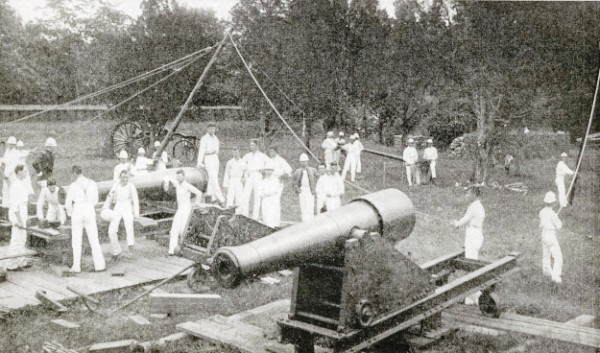
MOUNTING HEAVY GUNS IN FORT CLINTON
However, groceries being rare in that particular locality, when
Magnus went out for his evening walk he did stroll towards the old
Academic. The night was moonless, and
not overbright with even stars; but the white spread of snow made
things quite plain enough. And presently, as Magnus stepped down the
walk, he saw a dark huddle of figures near the appointed west wall.
A small sled and a very big box, with a half-dozen cadets playing
stevedore.
Then an officer came along the walk, meeting Magnus, who saluted
and passed on. The officer glanced rather curiously down towards the
dark group, but, with his mind full of something else, he merely took
a short cut across the area, and so through the sallyport from the
inside.
It was at a critical moment. Box after box of chickens, mince pies,
cakes, ham, sweets, celery, and so forth, had been pounced upon, stowed
in bags, and carried off. Rig's turn came last.
"I believe it's a mistake, you all going the same way," he said, as
he seized the last bag of chickens. "I'll slip round the corner, and
come in from the plain."
So round he went in the dusky light and met Lieutenant Benton in
the very mouth of the sallyport. Rig saluted, and slipped in. But dark
as it was under the grey arch, the officer's practised eyes found
something unusual about the cadet outlines, and the next moment he
turned and gave chase.
Rig had the start, and would have got off out of sight in another
second if Mr. Benton had not suddenly shouted:
"Cadet, halt!"
Then it was all up.
"What have you there, sir?"
"Chickens, sir."
"Go to the guard-house and turn them in."
Crestfallen and sour, Rig crossed the area, set his bag down at the
door of the guardhouse, and went in with his report. Being promptly
ordered to produce his plunder, Rig stepped to the door—and
behold! one chicken only was left. The light-fingered, light-footed
boys in grey had in
that two minutes rifled the bag and vanished. And Rig felt
smaller than his own chicken when he turned it in, with the
big bag, to the officer of the day.
"Just my luck!" he said gloomily. But he never knew who ate the
chickens.
XXIV NINETY-NINE DAYS TO JUNE
The bargain must be,
That, as long as I choose, I am perfectly free.
For this is a sort of engagement, you see,
That is binding on you, but not binding on me.
—Nothing to Wear.
It is impossible to put in words what furlough means to a
two-years-from-home boy. For "boy" he is still, to the dear home
group, as well as in West Point pranks and frolics. But from the time
the Hundredth Night is over there is a steadily growing pressure of
excitement. It is not long till, for themselves, the men begin to count
the hours.
A great deal of outdoor work comes with the softening skies and
freshening earth. Company drills, dress parades, make the Point all
alive again, and the cadets full of growls. Not all the prospective
laurels for perfect marching can make the means to that end a pleasure.
They have no time for it, they say; time is so precious, when you do
not want to spend it in some particular way. But rides on the road are
good, after the winter drills in the Hall; and Saturday afternoons just
perfect—except on the area. Springing grass, opening flowers,
scented air, and in the distance—June.
For at West Point June has a gift for everyone. In the first class,
graduation; to the old second class, first-class camp and privileges;
for the old third class, furlough. While the plebs become yearlings,
and call themselves the happiest of all.
As the time comes on, all sorts of tradesmen invade the Point; men
with samples of cloth for uniforms and for "cits"; with sashes, swords,
hats, gloves, helmets, and handbags; with trunks, class albums, studs,
canes, and umbrellas. Each Saturday afternoon is weighted with the most
perplexed sort of shopping. For when you have lived two years, or four
years, in a forage cap, it takes a good deal of study to know whether
you will be most Adonis-like in a stove-pipe, or a wide-awake, or a
plain straw hat. The cut of coats, the colour of trousers, cause deep
debate, as also the probable worth of one tradesman's word as against
another's.
With first-class questions Magnus had nothing this year to do, but
over one furlough point he had a sharp fight with himself. The "cit"
clothes in which he had come as a candidate were odious to him on that
very account. All the same, one way to save money was to wear them
home. So Cadet Kindred braced up mentally, and said that was just
what he would do. And then, to put an extra touch to his goodness,
he thought he would try them on and see how ugly they were; break it
to himself gently, and by degrees, before he walked out through the
sallyport in open day.
It was a splendid plan. For lo and behold! under the hard, despised
West Point training, Mr. Kindred had grown and filled out and developed
until he could not possibly wear those old clothes.
Magnus tossed the coat up to the ceiling, regardless of what might
happen to the plaster, and joined the shopping band that very day.
It was delightful now, in the soft spring weather, to go out at
every release from quarters, for a stroll round the plain, or down by
the river. How lovely Flirtation was! An army of "Dutchman's breeches"
held all the best posts among the rocks by the wayside, scaling the
cliffs even
down by the landing. And in the deeper shade north of Battery Knox,
whole beds of dog-tooth violets filled the spots of damper ground,
lifting their elegant heads like the highbred beauties that they
are.
Among the tougher growths, iron wood and black birch were charming
with their tresses, and the young tufts of maple and oak and hickory
leaves were a joy to see. Shad blossoms and dogwood "picked out" the
green; from some far-down hidden corner the spice bush spiced the air.
Saxifrage spread whole sheets of bloom; and Lowell's "dear common
flower" gleamed everywhere.
And then the girls came. Some "opening buds" that had come fresh
from Paris; and some early birds, besides robins and song sparrows.
The company drills had lookers-on; the walks round Flirtation were not
always games of solitaire.
Among the visitors who appeared thus early, was a certain Mrs.
Granton, with two girls of her own, and two belonging to other
people—Miss Bee and Miss Clive. The Granton girls were just
average damsels, but, of course, having a gay brother in the first
class, they went everywhere, and knew everybody. Miss Clive was an
heiress and played ditto, ditto upon yet stronger ground.
In the wake of these triumphant young ladies came Miss Bee with just
funds enough to pay her own bills, but no particular store of either
wealth or beauty.
She was a sensible girl, had a sensible little face, with pleasant
eyes and a merry mouth, but had not knowledge to make the most of
herself in the way some others did; nor, it may be, the inclination.
No poppy leaves stained her cheeks, no powder whitened her forehead,
no foreign coils of hair swelled out the moderate portion which was of
home growth. And no extra-high heels put her further up in the world
than she was by nature. Her shoes were "common sense"; her gloves were
large enough to button
all the way; her parasol was brown, and she had a trick of saying
nothing she did not mean.
No girl who behaves herself will ever be slighted at West Point;
cadets are too courteous and too chivalrous as well. But in view of
all I have told of Miss Bee, you will easily guess that her place in
the public interest was small. Everyone was polite to her, but no one
missed her, or looked for her, or wondered where she was. Cadets never
scowled at each other for her sake; and pretty girls never cared what
she had on. Yet perhaps among them all there was not one who tasted
every crumb of pleasure with such keen relish as Miss Bee. She had
had so little of it in her life, poor child! This was her first real
outing. No wonder West Point was fairyland, and every cadet a born
prince in disguise.
At first, indeed, she was terribly afraid of them; conscious,
perhaps, of her own lack of "fetching" qualities, but by degrees that
changed a little. The innocent colour started to her cheeks as readily
as ever, when some grey uniform came up with:
"Good-evening, Miss Bee. How did you enjoy the Light Battery this
morning?"
But when none of them came, when they were all swept away in the gay
whirl of beauty and fashion, and she sat solitary with Mrs. Granton,
this was not quite so easy to bear, Mabel found, as at first. And many
a brave struggle for victory went on under the old trees before parade,
and Saturday afternoons at the Hotel, and in her own room. Nobody
guessed it, and she never told.
It was no great wonder if, to this rather dull young life, thus
suddenly set down at the edge of the bright whirl, the hero of all
romance, past, present, and future, should array himself in bell
buttons and grey dress coat. It was also quite natural that this hazy
individual should develop into the face and figure of Cadet Charlemagne
Kindred, with
no fault on his part, and no special folly on hers. In truth, it was
some time before the child picked up a dictionary of herself, with
definitions.
But Magnus was undoubtedly one of the handsomest men there, with
keen eyes that could be wondrously soft upon occasion, a winning smile,
and a laugh that was refined and pure as well as gay. And then, as may
happen, his good intentions led him perilously far. He thought the girl
rather neglected by her own party, and so took special pains to see
and to speak to her whenever she was about. He asked her for a walk,
when there was danger of her being left behind; asked her opinion,
right over the head of Miss Dashaway, and (I shall have to confess it)
enjoyed the quick flutter of colour that lit up her face whenever he
came near. For Magnus had no thought of risk in the matter; he was far
too much of a gentleman—too much of a man—to try to draw
her on for his own amusement. He just meant to be kind to her, though
he did pick up a little pleasure for himself as he went along. Now and
then he took refuge with her when other girls bored him; made her a
"previous" against Miss Flirt's advances, and never noticed that all
the while he was drinking in silent flattery by the cupful; getting his
own mind so befogged, indeed, that he could not see how swiftly and
surely one poor little craft was heading for a very dangerous coast.
Cadet Kindred was not a vain fellow, but what man does not feel
the bewitchment of having eyes watch for him and look up to him, even
though he be too careless of them to know their colour? What man does
not like to have his words counted and treasured as if they held the
distilled wisdom of the sages and the ages? And Magnus was also minus
a dictionary, and did not know how to spell things one bit. The girl
must have a good time, he told himself, she could not be left riding
at anchor while all the rest set sail, and what might happen if he too
often played pilot,
to that he never gave a thought. All that was in the realm of
impossibility, in this connection. Wise men and poor girls.
It looked so impossible to other eyes, and the girl kept her own
counsel so well that it drew little notice. Rig did once or twice ask
Magnus if he was getting rattled with that little Bee girl, and some
others remarked that Kin was practising how to flirt when the time
came; but such words were empty air to Magnus. It was well for all
parties that June stepped in, with its absorbing demands.
There were plenty of men who did more flirting and frolicking now
than ever, but not so Magnus Kindred. Everything dropped out of his
life but home and furlough. Each night he wrote to his mother about
three lines, telling her what the "Exam" had done with him that day,
and in all the other between-times he was either freshening up his
knowledge of some hard points of study, or he was taking long walks
with June, and June only, to clear his brain. If he heard voices, or
caught a glimpse of grey coats or red parasols, Magnus sheered off,
scaling the rocks or scrambling down the cliffs to some breakneck
spot, quite beyond reach for any cadet who had girls in tow. There he
would lie on the moss and listen to the river, or the bell notes of
the thrush; listen without hearing, as he planned his journey home.
He would take such a train, and make such a connection, and jump off
at the old station at just such a time. He would not tell them quite
when to expect him, because they would be sure to come to meet him,
and some of them would cry—right there before everybody. And it
was a bother to attend to your luggage with three girls round your
neck. But then Magnus laughed and coloured too. There could hardly be
three—yet somehow two seemed even more objectionable. And still
if he sent no word, and they did not meet him, there was a good half
hour lost from that end of his furlough.
So he argued it, back and forth. And all the while, poor little Miss
Bee was weeping secret tears over the seeming defection of her knight.
She must have displeased him somehow.
"My sisters can hardly wait until I get home!" said Mr. Randolph one
night.
"There's another man's sister can hardly wait until I do," said
Clive.
XXV FURLOUGH
Den away, away, for I can't wait any longer.
Hooray! Hooray! I's goin' home!
—Old Shady.
It is strange how some event towards which you have been working,
and which seemed to fill earth and sky till you reached it, at once
then sinks down and becomes hardly distinguishable from the plain. So
passed by the examination to Magnus Kindred.
In fact everybody is so fagged out by the 12th of June, tired with
work, with gaiety and excitement, that feeling seems swallowed up of
high pressure. This may be one reason why the bad success of other men
affects so little those who have won through. Exceptionally strong as
class feeling is at West Point, the dropped names seem to make very
slight impression. And in some cases, of course, there is no surprise.
When a man bones nothing but mischief, and tries to crowd into the
three weeks before examination the study which should have filled six
months, June is not always kind to him. Unless, indeed, he be one of
those men who are pure mathematics—and even then the discipline
column may cut him down. So it was with small surprise that Magnus
heard Chapman's name among the "found deficient." Chapman did not
whimper, but he took it hard.
"It's that beastly calculus!" he confided to Magnus, in the hurried
moments of parting. "Oh, yes! I know what you mean by raising your
eyebrows, but a man couldn't live here if he didn't run it now and
then."
"But you see a man can't always live here if he does," said
Magnus.
"Bosh! Yes, he can. Only they don't all run against old Towser every
time, as I did. No, it wasn't that at all, it was the calculus."
And doubtless, in great measure, it was. Another boy, from far away,
fairly came to tears.
"I don't see how I am to go home!" he said. "I don't know what my
mother will say!"
While another, who had got a turn-back, liked so little what his
mother did say that he gave her a sharp little lecture on the
Graduation ground.
"I can't tell what makes you go on so!" he burst forth. "I'm only
turned back. Lots of men are sent away altogether. Why do you talk like
that? What's the matter?"
Poor mothers! It is often pathetic to hear them explain the case to
other people.
"He's a good boy, Miss Smith; but you know he has always been
delicate. Hard study never agreed with him." (True, this last.)
"You see, Mrs. Brown, he has had such trouble with his eyes that I
wonder he has kept up at all. I really must speak to the Superintendent
about the study lights. Then these early recitations. Why, at home we
never thought of waking him up till eight o'clock, and then gently, you
know, and by degrees. And now he says that gun just goes through his
head without a word of preparation. I suppose, really, that is what
ails his eyes."
"Everything here is so wretchedly mismanaged!" commented a wise and
sympathetic damsel. "The cadets are abused at every turn. I don't see
how they stand it. It is the meanest place!"
"Well, I've done what I could to straighten things," said a beaming
matron. "Look at this bag,—absolutely worn out in the service. It
has brought Tom everything—from
cigars up. And when he wants money, he has only to say so."
Strange, that with such care Tom should ever grumble at
anything—especially regulations.
But graduation has come and gone, the graduates have scattered; some
for home, some for Europe, some to be married "on graduation leave."
For three months they have "the world before them, where to choose."
The furlough men, too, are scattered, yet more widely and
individually, speeding away on the spider's web of railways that covers
the country. Class supper was over, changed from a gay revel to a
less brilliant memory, and Magnus Kindred went whirling along towards
home. And the great question of taking them all by surprise was still
unsettled.
The home folks, however, had their own ideas on the subject, and for
at least two days before Magnus could possibly come, they had met every
train from the East; Mrs. Kindred, Rose, and Violet. Cherry went the
first time, but after that absented herself on one plea or another. And
so on that sweet June afternoon, when the train slowed up to let off
the one passenger and the one trunk, the three were in hiding behind
the station.
No one could ever describe what that first home-coming was to
Magnus. For miles and hours the excitement in the boy's heart had been
working itself up to white heat, as point after point rose up to give
him welcome. Here a cliff and there a hill; the schoolhouse near by,
the church further off; if he had only had a dozen straw hats, I think
eleven of them would have gone out of the window, for pure joy.
But the little platform was empty, save of officials; not a creature
got out of the train but Magnus, and not one was waiting to get in. Not
a figure broke the broad June sunlight that filled the old road towards
home. But when
he had hurriedly tramped down the steps, he found himself in his
mother's arms, with the two girls sobbing for joy on either side.
Of the next few minutes, I think no one of them could afterwards
give much account. Then Magnus, with one arm round his mother, gave
that hand to Violet, and the other to Rose, and so they walked along.
How they talked!—with tongues once set free; but most of all, how
they looked at each other. Mother and son had met within the year, but
the two girls gazed at their handsome brother with a surprised delight
that could never have enough.
"But I had forgotten that you were so brown, Magnus," said Rose.
"Drills."
"You always were straight," said Violet, "but now——"
"Bracing up."
"And your hair is so short," said Rose.
"Regulations."
Then how they all laughed and hugged each other over again, for
there were only the wild birds to see.
"Well, certainly, if brevity be the soul of wit, you have improved
in one line," said Rose.
"They teach it out there," said Magnus. "'Mr. Kindred, your head is
on one side, sir!'—'Yes, sir. Which side, sir?'"
"And what did you get for being so saucy?" asked the mother, as the
laugh died away.
"Nothing that time. Even Towser can't skin a man unless he gets hold
of him. But wherever is Cherry? When you all came out of the first
bush, I thought she would jump out of the second."
"She's at home," said Rose. "We wanted her to come, and she
wouldn't."
"But she did the first time," said Violet eagerly; "the first day we
thought you might come."
"Oh, ho!—and as I didn't show up then she put on her
high-heeled shoes," said Magnus. "Girls are all just alike the world
over."
"No, they are not!" cried both the charming specimens then
present. "And you shall not say that of Cherry. She is like nobody
else—and nobody else is like her."
And privately, Magnus thought his own two sisters very unlike most
other girls. With their fresh, unjaded faces, undoctored complexions,
untrammelled feet and waists, and unspoiled minds, they made a
wonderful sweet contrast to Miss Dashaway and Miss Flirt. Magnus had
not known how his estimate of women had run down among the crowd till
he found it mounting up again, ten degrees at a time.
Even Cherry's absenting herself—it provoked him heartily,
and he felt himself much injured, but it was after all a refreshing
change after Miss Dangleum's ways. Yes, demonstrations were the man's
business, and in his present mood Magnus felt quite equal to them,
could he but get hold of the right person.
No half-grown girl in half-long dresses appeared, however, as they
reached the house, but for a few minutes Magnus had all he could
manage. The old dog (prudently left at home) was nearly as wild over
the meeting as his young master; jumped upon him, clung to him, danced
round him, whimpered, whined, and barked for joy. It was not five
minutes before the two were rolling down the grass slope together,
then running a sharp race, and then flying all over the old house from
room to room. Magnus shouldered his trunk and rushed upstairs with it,
and Plato dashed after him, wakening all the echoes that were anywhere
about. The two girls, putting rolls in the oven and setting on cream
and butter, almost danced in their tiptoe joy; the mother in the small
sitting-room hid her face in her hands, and cried and gave thanks. Just
to hear that boy's step overhead, what was it like? And then to have
the pair
come racing down the old stairs when supper was ready, Plato barking in
a perfect scream of delight;—do you wonder that the prayer for a
blessing was spoken low and falteringly? or that a hush filled all the
room for some moments thereafter?
Then the three busied themselves earnestly about their boy's supper,
and the boy also lent his assistance; Plato lying on the floor and
winking at him. The old dog was afraid to really go to sleep lest he
should lose sight of his young master.
"I suppose her High Mightiness expects me to put on my war paint
to-morrow, and to go and ca—ll," said Magnus, drawling out the
last word with ridiculous intonation.
"Who? Cherry? Now, Magnus, you shall not call her that," said
Rose.
"Shall not, hey? I will call her anything I like," said Magnus.
"Well, go on, then, and do it," cried Violet, with a laugh, "for
here she is."
And in more confusion than he expected from himself, after this
bravado, Cadet Kindred started up from the table and found himself face
to face with his old playmate.
Cherry had the advantage of him; she had seen the photograph, and
was partly prepared for what she saw now—not quite. But to
Magnus, with eyes full of the gleesome, outspoken girl of sixteen, this
vision of a tall, slender maiden of eighteen summers, with something of
a woman's shy reserve floating round her like the daintiest filmy veil,
was altogether new. He had seen nothing like it. She was so lovely, so
dainty, so sweet—if any epithets presented themselves, they died
on his tongue.
And the girl, too, had caught her breath; the living presence is
always so far beyond the picture. All her nicely
prepared words of welcome took to their heels, and Cherry held out her
hand and said simply:
"How do you do?"
Magnus got hold of the hand, and kept it; held it fast while he
pushed and pulled chairs about to give her a place by himself. The hand
was something tangible—especially as it was not quite ready to be
held.
"How do I do?" he repeated, as she took her seat: "you don't care.
Why didn't you come to meet me?"
"I think you had enough at the station."
"And you had enough at home, I suppose."
"Enough to do—yes."
"Well, how can you spare the time to be here now?" said Mr. Kindred,
pursuing his inquiries. A girl who did not wear even the semblance of a
heart upon her sleeve was something new of late, and exasperating. "It
is very frivolous work to sit by and see me eat supper."
"It will be less so, when I get something to eat myself," Cherry
answered demurely. "But I can wait still longer, if it is not certain
the supply will hold out."
"There! now you have got it," cried Rose, clapping her hands; "and
good for you, too. Hectoring her in that style! Give her some berries,
Magnus, before you eat another one. Cherry picked two thirds of them
with her own fingers."
"She did!" said Magnus, reddening in spite of himself under Cherry's
fire; second classman on furlough and presumptive first sergeant though
he was. "That explains why I've had to empty the sugar bowl. I'm sorry
I have made such a raid, Cherry, but you shall have what is left."
And swiftly he drew everything as near the girl's plate as the
dishes could find room. Bread plate and butter plate, cake basket,
cheese, cream pitcher, water pitcher, and the wreck of the broiled
chicken. Then seizing the berry
bowl Magnus began to pile the sweet wild strawberries upon her plate,
adding slowly and skilfully till they ran down to the very edge and
rose up in the middle a red fragrant cone.
"How will that do to begin?" he said. "Will you have some
sugar?—but I suppose not, as you picked them yourself and put all
the tartness into mine."
The other three looked on, laughing and interested; but now Cherry
was out of her depth. She looked down at the strawberry hill, at the
dishes, then glanced round at Magnus. What did he mean? Was he really
vexed? Could he really think? It was the fairest kind of a look, so
earnest and questioning. What do you mean? it said.
I think Cadet Kindred knew very promptly what he meant, and saw some
things clearly which had been hanging about in a sort of uncertain
haze. And thus in answer to her shy questioning, Cherry met a look so
keen and merry and full of mischief, full of she hardly knew what, that
her eyes fell and the pink flushes came hurrying over her face.
Then Magnus laughed. He had the vantage now which belonged to him,
and he felt better.
"Cherry," he said, "you are a transparent humbug! Mother, will you
give me a cup of tea?"
"I think you are an extremely rude boy," said Mrs. Kindred, putting
in an extra lump of sugar the while. "If these are your West Point
manners, you will need a few terms at some other school."
"West Point manners are all packed away with my dress coat. This is
the original Magnus variety."
"It is good to know," said Rose. "Here we have all been rubbing
our manners up, to receive you properly."
"Oh, that's it, is it?" said Magnus, turning to gaze at Cherry.
"Good to know, as you say. I did suspicion it was something got up for
my express benefit."
"Let her alone, and finish your supper," said Mrs. Kindred. "That
is, if you ever intend to finish."
"Emphatically I do!" said Magnus. "If I didn't, I could never begin
again, and that would be a loss out here. Cherry, give me just a few
berries off your plate. I am bashful about taking any more out of the
dish. The sugar has given out, too," he added, dropping his voice; "and
these will not want any."
Poor Cherry!—she literally found not a word to say, but
sat looking down at her plate in helpless silence, as the hands she
remembered so well conveyed away part of its contents. Then Rose came
with a replenished sugar-bowl and set it down by him. But Magnus waved
it away.
"Thank you, no," he said. "These are too sweet for sugar. How do you
suppose Cherry worked it, to get them all on her plate?"
"Crazy boy!" said Rose, "you put them there yourself. Magnus, is
your dress coat here?"
"Truly. Had to bring it along, lest a war should break out before
I get back. May need it yet——" with an indescribable
inflection which only Cherry caught.
"Then if you have done, as mother says," said Violet, "go straight
upstairs and put it on, and come down and show yourself."
"Put on my dress coat, after such a supper," quoth Magnus. "I think
I will!"
"Don't be foolish," said Rose. "Go at once, if you want pancakes for
breakfast."
"Make it waffles——"
"Very well, then, waffles," cried both the girls, laughing at him.
"Now Magnus, go! While your hair is short."
XXVI CHERRY
'Tis the middle watch of a summer night.
The earth is dark, but the heavens are bright;
Naught is seen in the vault on high,
But the moon and the stars and the cloudless sky,
And the flood that rolls its milky hue,
A river of light, in the welkin blue.
—Culprit Fay.
And thus it was, that in ten minutes or so there entered upon the
scene a fine presentation of a West Point cadet: short hair, white
collar, bell buttons, and all the rest.
Just inside the door Magnus paused, drew himself up, and gave a
comprehensive military salute; then came on with quick, regulation
step, halted in front of Cherry, and took off his cap with the true
cadet swing.
"Thought you'd be out, Miss Reserve. I saw you clear across the
plain. Now Cherry, you must ask how I could possibly see so far."
"What would you answer if I did?" Cherry said diplomatically. This
photograph in person was not easy to talk to.
"I should remark that I can always see some people, across the
world. Then you must put your head on one side and say: 'But you know
you have such eyes, Mr. Kindred!'"
"Well, I certainly shall not say that," Cherry declared, venturing
a look.
"Magnus, you are a young peacock," said his mother.
"Fine feathers, mammy. How do you like West Point,
Miss Reserve? Is this your first visit? Very warm, isn't it? What do
think of our view?"
Oh, how they laughed at him, Cherry and all! Magnus kept a grave
face.
"Will you walk with me after supper?" he went on. And Cherry's sweet
eyes opened full on him, to see what he meant.
"That is not the way at all," said Magnus (approving it highly,
all the same). "You must put your head on the other side now and say:
'Really, Mr. Kindred—he! he!—I'm awfully sorry—but
I've given all my walks away.' Then I shall answer fiercely: 'Tell me
one of the men, and I'll go fight him and get it back.' Now, Cherry,
clasp your hands and say pleadingly: 'Oh, no! Please don't, Mr.
Kindred! I remember now—there is one walk just before breakfast.
Would that be too early for you?' And I answer practically: 'Nothing is
too early for me, Miss Reserve, after you have opened your eyes.' And
then you must give me an admiring glance and say: 'Oh, don't talk of
my eyes, Mr. Kindred!' Then the drum-beats, and I double-time it into
camp."
"You need not say 'you'—I should never say such things,"
Cherry declared; this vision of other girls acting as a tonic, though
she laughed with the rest.
"Of course not! You do not say anything to me," retorted Magnus.
"She is too polite to interrupt you," said Rose. "Do you mean to say
that West Point girls talk like that?"
"Some of the girls. Cherry will when I have walked with her a few
times."
Cherry glanced up in quick denial, meeting then the aforesaid eyes
looking so handsome and competent and full of frolic and power that her
own beat a hasty retreat.
"And you walk with such girls?" demanded Violet.
"Oh, yes—" Magnus said easily. "One cannot be uncivil just
because they are complimentary."
"But before breakfast!" said Rose. "Is there no other half hour in
the day that would do?"
"My dear girl, it's not that half hour in particular; it is every
half hour they can get. You wouldn't have them pink and white their
cheeks for nothing."
"Pink their cheeks?"
"Why, yes," said Magnus. "Pink them—frost them. I'm sure I
don't know how it's done."
"You are telling traveller's tales," said Mrs. Kindred gravely.
"Well, I like that!" said Magnus. "Why, mammy, they all do it.
Clinker says so. At least not all, I suppose. Of course, there are
exceptions."
"Charlemagne"—began Mrs. Kindred. But at this word Magnus
turned to her and "stood attention," bracing up to the fullest extent,
and saluting with such profound gravity and respect that the rest all
shouted, and the mother's face gave way.
"There is no doing anything with you," she said. "You must give them
no end of trouble at West Point. Go upstairs and take off that toggery,
and see if you can be a reasonable boy."
"I've got to give Cherry her walk first," said Magnus. "She has
never walked with a real live cadet; and she may as well practise on me
before she undertakes the rest of the Corps next summer."
"I look like that," said Cherry, with some scorn.
"Very much like it, I should say," responded Magnus. "I know how
it will be. 'Say, Kindred, who's that awfully nice girl you've got on
hand? Introduce me, won't you? Your sister, aint she? Well, don't let
her promise all her walks to those spoony fellows. You want her to have
a good time, you know.'"
Magnus hit it off with excellent mimicry, and the room was in a buzz
of amusement.
"Then I shall say," he went on, "that my sisters are in quite
another package, and that to ensure her having a good time, she has
promised all her walks to me."
"She hasn't at all," said Violet.
"She will—by that time," said Magnus confidently; enjoying the
pulsating colour in Cherry's face, and comparing it with the unmoved
tinting of poppy leaves. "Why, even to-night she'll not walk home with
anybody but Cadet Kindred, in full canonicals."
"Magnus!" said his mother, "I think you are absolutely beside
yourself."
"Do cadets all talk in that style?" demanded Rose.
"Not all so brilliantly as I do, by any means, but in the same
general way."
"Then I think they need a professor of common sense at West
Point."
"And I think you had better go to bed and to sleep," said Violet.
"We'll walk home with Cherry. Your brain is getting overexcited."
"Silence and solitude will calm it down," said Magnus. "If you all
go, there will be a chatter, but Cherry and I know each other so well
that there is no need to speak. She will not try to keep me, mammy;
I'll be right back."
There is no doubt but Cherry was laughing when they set out, partly
for nervousness, but also in part for the mere infectious atmosphere
of frolic. She gave no sign, however, being much under the spell of
the tall, erect figure at her side. Whenever she looked up and tried
to throw off the glamour, one glint of the bell buttons brought it on
worse than before.
"Aren't we walking very fast?" said Magnus mildly.
"But you told your mother you would be right back," said Cherry.
"From your front door—not from ours." The laugh rippled out at
that, as Cherry moderated her pace.
"No use, you see," said Magnus, falling into an easy saunter. "I can
do the double faster than you can. I knew you meant to scoot away by
yourself, the minute I went to change myself into a cit."
"Who told you?" said Cherry.
"You."
Silence fell upon this; then Magnus began again:
"You see, I really wanted to have you alone awhile—I wanted to
ask tidings of an old friend of mine. I thought perhaps you could tell
me where to find her; girls always seem to know about girls."
"Oh, I do not!" said Cherry hastily, running over in her mind all
the girls she had ever heard of. "You should ask Rose."
"Rose doesn't know everything. I dare say you can tell me if she has
moved off. I thought so much of her!" said Magnus pensively, gazing
up at the stars. "We used to be very intimate. I left my heart in her
keeping—whatever she did with it. Why—you will hardly
believe me—but she used to live here, in your house. And when I
was going away to West Point she kissed me right at this very gate."
"She didn't!" cried Cherry hotly, and then hung her head.
"Oh, you do know her then?" said Magnus. "Why didn't you say so
before? And where do you suppose she probably is now?"
Cherry resolutely stopped and faced him; what though the full
moonlight effect well nigh swept off her self-possession.
"Magnus," she said, "you are talking great nonsense. It may be the
West Point fashionable way of talking sense, but we are plain folks out
here and have not had your advantages."
And here Magnus made a bow so profound that it sent Cherry's words
to the right-about.
"What next?" said Magnus. "That is all more or less true, so far,
but well begun is only half done."
"Oh, it is no use to talk to you!" said Cherry. "And it never was,
for that matter."
"My talking is of some use, however," said Magnus. "I have quite
succeeded in bringing myself back to your recollection. What more did
you want to say, pretty girl?"
"That you are extremely silly," said Cherry, with the laugh getting
into her voice.
"There is no contenting these women of sense!" said Magnus. "If I
fib, she scolds: if I tell truth, she flouts me. If Derby drill will
only handle this line of approaches, I shall learn how, in time. Don't
walk so fast, wise damsel."
"Will you come in and see papa to-night?" said Cherry, not
slackening her pace in the least.
"Well, hardly," said Magnus. "I like to make it all safe with the
daughter before I rush into the paternal presence."
If Cherry had been that sort of a girl, I think she would have lent
him a very earnest and hearty little cuff. As it was, she gave him
one hopeless glance and slipped through the little gate, as her next
neighbour would have said, "spryer'n an eel."
But quick steps were play to Magnus, and before Cherry's foot had
touched the doorstone he was beside her. His hands met round but not
touching her, putting the girl in a charmed circle of space; and the
strong, clear voice chanted out an old playtime couplet:
"Open the ring and let her in,
And kiss her when you get her in."
"Oh, Magnus! do hush!" Cherry said desperately.
"You are altogether wild to-night. And everybody will find it out!" she
added, as if that doubled the case. She made a quick motion to dive
under "the ring" and get away, which was quite fruitless.
"Stand still," Magnus admonished her. "Unless you want the prison
walls to converge, as in that old tale of the Inquisition. I am going
to put you straight through the catechism. First of all, will you
confess that you are a humbug and a fraud?"
"I am only myself," Cherry faltered, but standing so still now that
she hardly dared breathe.
"Only yourself—a very good answer. Well, I never want you to
be anything else, more or less. Do you understand?"
"The words are tolerably plain," said Cherry.
"Then if you are 'only yourself,' why didn't you welcome me
home?"
"What did you want me to say?" said Cherry, with again a little
break in her voice.
"Say?" repeated Magnus. "You should have thrown up your hands and
eyes, and then taken down the dictionary and used every word there was
in it."
But now Cherry laughed.
"You would have had a pretty mixed dose, if I had," she said.
"Well, that is past," said Magnus; "you can't do it now. So you must
have the catechism. Are you glad to see me?"
"Very."
"You are delighted?"
"Yes"—a little slower.
"Out of your wits with joy?"
"No," said Cherry; "you are the only person out of his wits."
"Ready to do anything I ask you?"
"In reason"—again slowly.
"Out of reason?"
"No."
"You will dream of me to-night?"
"I hope not."
"You will go wherever I want you to while I am here?"
"I—think so."
"And you will walk with me three times a day at West
Point and with nobody else?"
"I shall not be at West Point. Magnus, do stop fooling
and let me go."
"Bid me good-night, then."
"Good-night."
"I mean the way we said good-bye."
"That is the way I said good-bye," Cherry answered.
"It wasn't the way I said good-bye," said Magnus. "This was
the way. And this is the way I say good-night. Cherry, you are a
transparent fraud."
"But you must go," Cherry urged, very grave and quiet now. "If you
do not go, you never can come again!" she added, as a last argument.
"What a wise girl! I believe she could tackle warped surfaces."
"Are they any harder to manage than you are?" said Cherry. "You
know"—but she checked herself. It would not do to mention her
father again, even to save his being waked up by all this talking under
his window.
"Know what?"
"Less than you think," said Cherry coolly.
"The professors have been trying to din that into me for the last
two years," said Magnus, "but I never thought to have you take it up.
What were you going to say?"
"I shall not tell you."
"Sugar and spice," quoted Magnus. "Shows what I have to expect at my
first wild frontier post."
"I can tell you what to expect before that," said Cherry. "If you
stay here moonshining any longer, you 'will be pale to-morrow,' like
your namesake in Dickens."
"Then you can hand over some of your pinks," said Magnus. "Besides,
my dear, I must inform you of a well-known West Point fact: truth
misapplied ceases to be useful. Mr. Peter Magnus was storing his good
looks to propound a certain question next day. Whereas I, having
settled it to-night——"
But just there Cherry made a quick movement of her pretty head,
stooped under the enclosing arms, and was out of sight in a second.
Magnus ran down the hill, whistling at the top of his power. I am
not sure that Cherry knew what he whistled; and I doubt if he knew
himself; but I think it was "The Girl I Left behind Me."
"My dear boy," said Mrs. Kindred, as her cadet came in, "you forget
that it is night in these Western regions. Have you been round the
neighbourhood whistling people up?"
Magnus threw himself down on the floor at her feet.
"Mammy, if you'd not been allowed to whistle for two years, you
would know how good it feels."
"Not allowed to whistle? What could comfort you?" said the mother,
laying her hand caressingly on his head. "Well, I suppose if three
hundred boys got to whistling, the effect might be rather powerful."
"What kept you so long, boy?" said Rose.
"Cherry. She is a rather slow girl, sometimes."
"She isn't!" cried Violet. "Never! She is just the quickest girl
going."
"Cherry—as I have found her," said Magnus gravely.
"Do all cadets tell fibs?" inquired Rose.
"Unless I am a shining exception, they do."
"Well, do they all look like you?" said Violet.
"Making allowance for the difference of men," said Magnus, with easy
assurance.
"What are those things on your arm for?"
"Rank, power, and responsibility. They are not 'things,' they are
chevrons."
"What's the sense of cutting your hair so short?"
"So as to see better how to skin us for 'too much shirt collar,'"
replied Mr. Kindred.
"Girls," said the mother, "you must really let him go to bed. I do
not think he half knows what he is about."
"Don't I, though!" cried Magnus, springing up. "Just one hour and a
half ago tattoo beat, and I wasn't there to hear it."
And once more the cap did duty in the air, as Magnus gave a
tolerably quiet version of the class yell.
"Go, child," his mother repeated, smiling at him.
"Yes, I must," said Magnus. "Cherry said I should be pale to-morrow.
It is worth while going to sleep, with no reveille gun ahead."
XXVII OFF LIMITS
Forgotten the sounds of drum and fife,
Forgotten the winter days so drear;
But all was keen with the glad new life
That throbs in the veins in the furlough year.
—Howitzer of 1891.
It was just like the cross grain of human nature that without a
sound but the singing of birds to rouse him, our young soldier should
wake up at precisely reveille gun time. In fact he did it for three
days, to his great disgust; and then, as he said of himself, learned to
know how happy he was.
Of course, this first morning at home, with everything before him
except drills and regulations, going to sleep again was impossible.
So with the sublime unconsciousness of other people's slumbers which
marks young men of his age, Magnus lay still and began to whistle. And
with that other line of forgetfulness which shows the inferiority of
the feminine mind, there was not a woman in the house but would have
given her best sleep to hear him.
They were not asleep, however, but up and stirring; and it was
perhaps some closing door or opening window, or the long unheard voice
of the coffee mill, which reminded Cadet Kindred that in these regions
there was no preparatory drum; and that such a noise as he had been
making would quite rule out the thought of any private suggestions at
his door. Wherefore, he had better get up.
But what fun—to dress as he liked, in what he liked, and be as long as he
liked about it.
With these thoughts came another to hasten his motions: would Cherry
come to breakfast? And if she did, then just when would she come? And
here Magnus paused before a piquant illustration of the young lady
herself, drawn from memory—or, as the real novelists put it,
"which had been photographed on his heart in one brief moment." And
thus it seemed:
A tall, delicately formed girl, with dark hair, which did not
crinkle and curl like his own, but parted in shining waves and rings;
a complexion colourless in general, but where the rosy tints came and
went like a pink cloud, in swift pulsations. The eyes—no, Mr.
Kindred thought he had not a fair look at her eyes last night, and that
was one thing to do to-day. Also her hand was a soft and fresh thing to
touch. And at this point Magnus opened his door and passed out.
On the way downstairs he peeped into his mother's room, but no one
was there, and he went straight on to a small room on the first floor
which was a sort of offshoot from the house, and hardly bigger than a
good-sized bay window.
But the picture he found there Magnus never forgot.
The room had been his father's summer study. Too cold for winter
use, but in June perfection, with every window open to the air. Roses
and honeysuckles climbed up and ran across and strayed in; amid the
tangle birds sang and twittered and builded. Further off were cattle
and chickens, with an old drum major of a turkey cock strutting before
the barnyard throng. The scent of hayfields was mingled with the yet
rarer fragrance of new-mown grass.
If the room had been larger, the minister's old library would have
made small show; but as it was, the strips of wall between the windows
were quite well covered. It was a very old affair in every way; leather
covers much worn
with handling, shutting in truths that were but the brighter for much
believing. Very old-fashioned books. You could not find a copy of "Why
I am a Doubter"; nor a single treatise on "The Eternal Equilibrium of
Things." The glad toiler in Christ's vineyard had had no use for "The
Trammels of Faith, and how I Got beyond Them"; and as little for "The
Proper Sphere and Limit of the Bible, Set Forth and Defined."
But there was Baxter's "Call to the Unconverted," which the minister
himself had also preached; with Bunyan's "Holy War between Diabolus
and the Town of Mansoul," the which he himself had also waged; there
was "The Saint's Everlasting Rest," upon which he now had entered.
There was also old Matthew Henry's "Commentary" in its six volumes,
which gave people so much to do on the plane of the lower criticism,
that they had small chance to wish for the higher; with Fox's "Book of
Martyrs," and "Lives of the Port Royalists," and Doddridge's "Rise and
Progress of Religion in the Soul."
Only two chairs were in the room: one, where inquirers had so
often sat and troubled hearts found peace, was pushed back now, its
service done; but the minister's chair still stood by the minister's
table where lay the minister's Book of books; and in the chair sat the
minister's widow.
She was not reading at the moment: I think she had been listening
to the gay sounds upstairs; and a tender, happy smile was on her lips,
in perfect keeping with the words on which her eyes had been. But
everything in that room was in keeping, to Magnus: his mother's cap
looked to him not a whit purer than her face; nor was the shine outside
the windows more gladsome than the look she turned to him. The young
cadet was at her side in an instant, down on his knees with his head on
her shoulder.
"What waked you up so early, child?"
"The echo of that reveille gun came clear across the Continent for
the express purpose."
"Hardly. I heard you whistling some time ago."
"Did I disturb you?"
"You could not do that," said the mother.
"But you were reading."
"Thoughts of you are never far away from the Bible, nor the Bible
from thoughts of you. Where have you been reading this morning,
Magnus?"
"I've not been reading anywhere. Mother, do you think I had better
run up for Cherry? or will she be here all right on time?"
"Time for what?" said Mrs. Kindred, rather opening her eyes at this
very rapid transit.
"Breakfast."
"Did she say she would come?"
"Why—no," said Magnus. "I took it for granted."
"Never take anything for granted about Cherry, except that she will
do just what is right. She never goes anywhere, Magnus, until she has
given her father his breakfast and seen to his morning comfort in every
way."
"I should think she might come," Magnus said discontentedly. "It's
my first morning home. He could get along for once."
The mother smiled a little at the wide space demanded by the young
people in these days, and the side corner deemed enough for the elder;
but the usurpers are too lovely and beloved to be resisted. And
besides, there is a sort of "while they can"—that checks many a
word; the tender, pathetic force of Dr. Bonar's thought:
"Take thou my place, and be thy feast
Sweeter than mine has been!"
"Cherry will not come, Magnus," she said. "She never
gets free before ten or eleven o'clock. So tell me why you have done no
reading to-day."
"Out of the habit," said Magnus. "I never do it in the morning."
"What is your Bible time?"
"Well, if I can be said to have one, it is more apt to be at night,"
said Magnus. "I don't always read then, but most generally I do."
"At night?" said the mother, carefully hiding all signs of the
underground shock that made her heart tremble. "I like to read at
night, too. But then, dear, if you do not read in the morning as well,
you have no fresh heartful of the blessed words to live by through the
day." And she looked round at Magnus with such eager, anxious, pleading
eyes as went straight to his heart. Which truly was not far to seek,
that morning. He jumped up and put himself in the other chair, drawing
it up to her.
"Mammy," he said, "let me tell you about it. It's this way. The gun
wakes me up. And I tumble downstairs half dressed, and declare at the
top of my voice that I am myself, and nobody else. That is, the first
sergeant calls 'Kindred!' and I yell back 'Here!' Then I rush in again,
and tumble into bed, clothes and all, and get the very best nap you
ever dreamed of."
"Another nap? For how long?"
"Two minutes and a quarter, drum time. Then I finish dressing and go
to breakfast. And after breakfast, we don't have very much time before
recitation."
"Cannot you read then?"
"Once in a while I do," said Magnus. "Not always. Maybe I do a
little boning in math. Maybe I take a walk with the nicest girl there
is round."
His mother could not help smiling.
"Can you always get the nicest?" she said.
"Oh, yes!" Magnus answered easily; "unless she happens
to be somebody else's best. Sometimes then. You see, so long as she
doesn't look me in the face, she can fancy I am her 'best' man."
"Why, Magnus!" his mother said, half laughing now, but really
anxious; "how do you behave, to make that possible?"
Magnus laughed too, with great delight.
"Sure enough," he said, "how do I? Maybe I go through the
motions."
And now it was Mrs. Kindred who, after a moment's pause, changed the
subject.
"Look, dear," she said, laying her hand on the open Bible, "I was
reading just here: the parable of the sower. And my thoughts had been
going back and forth from the seed which the fowls of the air were let
pick up, to that other which fell in an honest and good heart, and
'with patience,' brought forth an hundred-fold."
Magnus ran his eyes over the passage.
"There are lots of fowls of the air at the Academy," he said.
"Maybe no more than elsewhere. But they have no business in your
life, Magnus."
"No, mammy, they haven't," he said, hesitating a little with the
difficulty of making his case plain. "All the same, they come in. I'll
go to a right down good prayer-meeting Sunday night, and come back
meaning to be the joy of your heart from that time on. Think I'll go
straight to bed, so as to be sure and keep good till morning. Well,
the moon is coming up as I get back to camp, and there is Randolph
with pink and white gowns in tow; and I stop to speak, and they all
say: 'Oh, come for a little walk!' I don't want to, and I half turn
away—and then I go. The prayer-meeting isn't all gone by the
time I get back, but there has been more of it picked up than you'd
like."
"Yes," the mother answered, thinking in her heart that she had not
prayed half enough for her boy in his hard places.
"Why, I've seen a man stay to Communion," Magnus went on, "and when
we came out, there was Pretty Newcomb waiting for him in the rain, at
the foot of the Chapel steps. Just walked him off alongside of her
umbrella—or under it. And what are you going to do?"
"I see. But, Magnus, you said 'Sunday' night. What sort of girls are
at the Camp Sunday night?"
"Summer girls," said Magnus briefly.
"Well, dear," said the mother, the cheerful tone coming back to
her voice, "the Lord is 'able to keep you from falling,' even in the
most difficult places; and to make you 'fruitful to every good work,'
in spite of all the fowls of the air that ever fluttered down. But
remember, that on your part the word is: 'Hold fast that which thou
hast, that no man take thy crown.'"
"I know." But then Magnus remembered something else, and was
suddenly silent.
And now came a soft, imperative call to breakfast.
"Waffles!" cried Rose in the distance, and the talk ended. Only as
the mother went out with her boy's arm round her waist, she looked up
at him with her true eyes.
"Magnus, never 'go through the motions,' as you call it, with the
wrong woman. Never, as a sham. It dishonours the woman and degrades
the man, and robs the other woman—the right one—of somewhat
that belongs to her alone."
"Well, I never really have, mammy," said Magnus gravely; "so make
your mind easy. And I never shall—unless the right one throws
me over. I don't know what
I'll do then."
And in spite of all previous warning Magnus looked round the
breakfast room for Cherry, and not finding her, felt very much
aggrieved.
There was no lack of talk and laughter, however; the joy of those
four people in being together was extreme, and of course, the others
did not miss Cherry, not having expected her, but Magnus did. The
reserved, dainty girl had taken him by storm. They had always been
inseparable as children, and as true boy and girl, though never with
any freedom on her part, even then, that passed the prettiest bounds.
Now she had stepped off a little, regarding him from a safer grown-up
distance, and Magnus was wild to annihilate both time and space, and
whatever else came in his way. She had bloomed out into something much
rarer than he knew could be in the world, and Cadet Kindred surrendered
at discretion, and without a summons. I believe he found that last
fact the crowning charm. If Cherry had held forth her little finger to
draw him on, or had in any way shortened that new indefinable distance
between him and her, I think Magnus would have struck off a percentage
from her perfections. It vexed and bewitched him equally.
So the young man sat opposite the open window, where the smoke from
the other house curled softly into view, and thought himself ill-used
and happy in about half and half mixture. He watched the winding path,
but it remained empty. Then he looked at his sisters; how handsome they
were, too! Splendid girls, both of them; and wouldn't they make a stir
in first-class camp? Of course his mother had always been perfection.
And here his eyes came round to her, with a smile of such joyful love
and content that poor Mrs. Kindred was very near making a goose of
herself, as she would have phrased it. What it was to have her boy home
again!
"But I cannot see why they don't move down here!"
Magnus broke forth irrelevantly. "Living on there all by themselves in
that stupid old house."
"Stupid?" cried Violet. "Why, it's the very prettiest house in all
the State."
"You had best not let Cherry hear you say such things," remarked
Rose. "She loves that house with all her heart."
"Stuff!" said Magnus. "She'll have to leave it some time."
"She will not while her father lives," said Mrs. Kindred.
"Why, mother, girls do it every day."
"Girls—but not Cherry," the mother answered; and Magnus was
so charmed with the saying, and the fair little pedestal on which
it placed his heart's delight, that he adopted it for a private
phrase of his own; used many times afterwards, it may be said, when
"girls—but not Cherry," were around.
"Then, when she will not come, you go to her?" he asked.
"Oh, she always comes," said Violet; "some time in the day."
"Some time in the day!"
"According to what she has to do. Only letter days she always came
early, and left the work till she got back."
"Some of it," corrected Rose. "But there's no letter due from Magnus
to-day, you know, so we cannot tell when she will be here."
"Now that is too bad!" said Mr. Kindred, pushing back his chair.
"Coming to hear my letters, and not coming to see me!"
"Well, the letters were very interesting, you know——"
Violet began, and then thought it prudent to vanish.
"But, my dear," said Mrs. Kindred, "as you must of course go up
there this morning yourself before you pay any other visits, I do not
see how it really matters."
"No, of course," said Magnus briskly. "Oh, mammy, I wish you'd pick
out a lot of such easy duties for me."
"We cannot go with you," said Rose, "because we also have something
to do; but we will come after you. You must wear your cadet clothes for
Mr. Erskine."
So Magnus put himself in trim, and charging his sisters not to hurry
on his account, and promising faithfully to wait till they came, began
to mount the hill. Good for him the girls were busy—and yet,
suppose that other girl were hid away in some part of the house to
which Rose and Violet could go, while he could not?
Magnus whistled his thoughts down the wind, as he went on, and then,
with a sudden fancy to approach unnoticed, hushed his tones and even
his steps, and went in, seeing nobody. Through the hall to the back
door—and there got another picture to think of in barracks.
XXVIII ON EXHIBITION
Wise men always
Affirm and say,
That best is for a man
Diligently
For to apply,
All business that he can.
—Sir T. More.
The Red House had been set very near the branch road by which
he came up, and in front there was only a short path and a bit of
greensward, but at the back lay a big old-fashioned garden, sloping
gaily down towards a bit of woodland and a talkative brook.
Overlooking all this was a very wide porch with sashes on all sides
which could be shut, but which on this warm still morning were all slid
back. The porch within was full of flowers, with various rustic holders
to hang and to stand and to rest on the sills, a wonderful basket of
lilies of the valley being the centre piece on the breakfast table.
There were traces in the house of other days and more Eastern
regions, and the little spider-legged table was dark with long years
of service, the spoons were slim-stemmed and delicate, the dishes of
exquisite blue and white.
But the dishes held very simple viands: bread, milk, wheat, with
fruit and flowers, were about the whole, for some hurts or injuries
dating back to the war time had slowly brought Mr. Erskine to a
semi-invalid state, and Cherry wanted nothing but what her father
had.
I have told you nothing about Mr. Erskine—and yet he was a
very noticeable man. Hair whitened more with
sorrow than years (it had changed suddenly upon the death of his wife),
cheeks where the native red still lingered, setting off the look of
extremely delicate health, with features refined and above-board in
every line. The eyes were both soft and flashing, the smile—once
the merriest in the world—now never lost its shade of pathos.
Everything about the man was refined, the daintily cared-for hand, the
plain, scrupulously neat dress. Across one edge of the placid brow a
red scar swept down and hid itself among the thick locks of frosted
hair, and now, as you looked further, you could see that the right hand
had lost its mate, and the left sleeve hung empty.
With one hand resting lightly on that shoulder and kneeling at her
father's side, Cherry read to him from a book laid open on the table,
while Mr. Erskine was slowly finishing his plate of strawberries,
dipping them, one by one, in the white sugar. Now and then a word of
question, of comment, of explanation, passed between the two, with
heads lifted and eyes meeting each other, then the reading went on
again.
This was what Magnus saw; and though he made out no words, the mere
tones of Cherry's voice seemed to him as sweet as any bird or brook
or leaf-stir in the whole morning concert; and I know not how long he
might have stood there in the shadows of the hall, if little Snip, the
terrier, being officer in charge and scenting mischief, had not rushed
in from the garden on a tour of keen inspection coupled with much
comment. Cherry rose quickly to her feet, Magnus stepped out upon the
porch, and catching hold of her hand, as he went by, dropped down upon
one knee by Mr. Erskine, in laughing glee at his astonishment.
"Magnus!" he cried. "My dear boy, is this you? Can it be possible!"
The one arm came round the boy and drew him close.
"So this is what made you stumble over your report of
last night," Mr. Erskine went on, turning to Cherry; "you were hiding a
secret." Cherry blushed scarlet.
"Did I stumble, papa?" she said, carrying off the dishes.
"Very much, for you. Well, my boy, there is no need to ask you how
you are. Stand off there, and let me have a good look."
"I didn't mean to come in war paint, sir," said Magnus, as he
obeyed; "but they said at home you would want to see it."
"Of course I do. Well, they certainly turn out—showy fellows
over there." Mr. Erskine hesitated over his adjective, as if to choose
a safe one. Cherry bit her lips, Magnus laughed and coloured too.
"They try for it," he said; "but we hope to be useful also, some
day, Mr. Erskine."
"Of all the 'some days' for being useful, I have ever found to-day
the very best. Sit down and give an account of yourself. Let the cloth
wait, Cherry. I suppose you want to hear it all, too. Unless you heard
it last night."
"No, indeed, sir," said Magnus. "I did not have a chance to tell her
half." This with a glance at Cherry, which she did not mean to see.
"Papa," she said, "it will take but a minute to finish the table,
and then we can listen so much better."
"Have your own way, love," her father answered, smiling. "My dear
love!" he said under his breath, watching her. Then he turned to
Magnus.
"Of course we know a good deal about you," he said, "for we have
read and reread your letters, but I think I can understand them better
now. And so these are the famous bell buttons?"
"Yes, sir, the regulation sort."
"Truly, they are pretty bright," said Mr. Erskine, with an amused
smile. "Are the coats still pocketless?"
Cadet Kindred disclosed the hiding place of his handkerchief.
"I should call that hard lines," said Mr. Erskine. "Your mother gave
us a description when she came home, and I rather think Cherry cried
over it. 'What will Magnus do without pockets?' she said. 'Because,
you know, papa, if there was ever anything he did not have in his
pocket, it was only what he could not find.' Do you remember, love?"
"Papa," said Cherry, much abashed at both the story and the laugh it
brought, "I think it is enough to have said silly things without having
them repeated."
She fetched her work basket, and placing herself at the other side
of her father, took out some bit of white stuff, and began to fold and
hem with great speed and dexterity. Magnus watched her, wishing it
were something for him. He had now and then seen a girl with a crochet
needle in these two years, or straining her eyes over a piece of mussed
unhappy looking drawnwork, but everything about Cherry and her basket
was as fresh as the morning. Her strip of muslin might have just come
from the shop, and have gone straight back there again, for all the
disturbance it had from her neat handling.
"Yes, she's a busy child," said Mr. Erskine fondly, noting where the
eyes were bent; "busy and sweet as the day is long. But come, Magnus,
draw up your chair, and let us have the story. Of course, as I said,
we have heard a great deal, but we want the whole thing now, don't we,
love? Do you wear all that finery every day?"
"Yes sir, except when nobody is supposed to see us. We have an ugly,
comfortable blouse for study, and meals, and recitations. With fatigue
suits, of course, for drills."
"Look your worst at recitations, hey? I should think it good policy
to look your best."
"Wouldn't make any difference with those old buffers,"
said Magnus. "They don't care if you fess perfectly frigid. They'd just
as soon give you zero as anything else."
Mr. Erskine's mouth took on a quizzical look.
"Sounds like cold weather, doesn't it, love?" he said. "But let
us go on regularly. Suppose it was term-time, how would your day
begin?"
"With the gun, always, sir. Unless I am boning math. and have waked
myself up for early study. I'm too much of a sleepyhead to do it
often."
"Best not; you need the sleep."
"Yes, but when you want to max it, and have been getting two-nine
for three days running, you see that will not do," said Magnus. "And I
will not bugle; and I can't fudge worth a cent."
The comical look passed into a laugh this time, low and very
pleasant, Cherry joining in, after a vain attempt to keep herself
quiet.
"Next in prominence to the gun comes breakfast, I suppose," said Mr.
Erskine.
"Yes, breakfast—slumgudgeon stew, and the rest of it," said
Magnus. "But the bread and butter and milk are always good. They've
taken to calling the roll after breakfast, as well as before, in case
slumgudgeon should have laid some slain man under the table. Then comes
a bit of release from quarters. If I've been fizzling lately, maybe I
put in the time on French; but I am more apt to take a walk."
"That is well," said Mr. Erskine. "A brisk walk puts the brain in
good order."
"It's not always a brisk walk, though," said Magnus. "Most often I
go dawdling along with some girl."
And now Cherry was so still that only the swift-flying needle seemed
to move. Mr. Erskine looked amused.
"I should think that a poor preparing for the section room," he said.
"Can't be helped if it is," said Magnus. "There's such a lot of
girls—and summer girls—about, it takes every minute you can
get. Chappy comes up and says: 'Kin, just give my sister a walk, will
you? Awfully nice girl, but if I don't bone a little I'll be found in
French, sure guns. And besides, my best girl is here.' So I go. Then
Miss Beguile says: 'Oh, Mr. Kindred! I've never seen Fort Putnam.
Please take me!'"
How they both laugh at him—Cherry holding back a little, then
letting her merry notes ring in.
"That sounds stringent," said Mr. Erskine. "Do you notice, love, his
fine distinction between 'girls' and 'summer girls'? That is something
we simple people know nothing of. By the way, I suppose you must be a
summer girl—as he never sees you in the winter."
"If anyone ever dares call her a summer girl," said Mr. Kindred
promptly, "I'll knock him down quicker than he ever had it done
before."
"Hands off! I'll not call her so," said Mr. Erskine, laughing. "She
is an everyday girl, and better each time. But Magnus, suppose your
best girl happens to be also on hand?"
"She never is, sir. She has not been at the Point since I went
there."
"Hard on you, if she went there before; you speak as if she were a
fixed fact. Do you know, Magnus, I am rather sorry to hear that."
"Why, sir?" demanded Magnus, noting the pulsating colour in the fair
face bent over the needlework.
"Well, when I thought of it, I hoped you would keep clear of all
such entanglements till you knew what you wanted."
"I did, sir."
"Oh, of course! I beg pardon; I should have said till you had seen a
little more of the world."
"Do you think the world is the place to choose, sir?"
Mr. Erskine smiled, half sorrowfully.
"I have only an old matchlock," he said, "and cannot cope with you
young sharpshooters. But my boy, what I meant was this. When the boy
goes off to college and grows into new mental strength and riches,
and the girl stays at home and gets not half a chance, poor child, to
do anything but wash dishes or (now do not glower at me) perhaps does
not wish for higher things, then the man comes home raised to a plane
where she is not fitted to stand by his side, and she can never be the
helpmeet for him that she should."
Magnus listened respectfully; watching that lovely, flitting colour,
it was not hard to sit still.
"You think," he said, "that some girls wouldn't amount to much at a
one-company post. When a man was hard up for comrades?"
"Not unless they were 'best girls' in truth."
"Oh, well, mine is," said Magnus confidently, "the very bestest
sort. I don't know how much she knows—but if I stay at the
Academy two years longer I shall have a stuffed head, full enough to
lend on every occasion. Besides, it's not needful for a man's peace of
mind that his wife should understand wave motion, is it, sir?"
Mr. Erskine laughed at him, and Cherry laughed too, though now
colouring furiously.
"I suppose it is not needful," her father said, not noticing her,
"unless in practice. Well, I hope it will turn out all right for you.
I had a friend, Magnus, who got entangled, as I call it, very early,
went away to college, and when he came back with all his honours, his
mother forbade the bans on that distinct plea; she said the girl was
too ignorant. I think my friend would have gone straight on through it
all, but the girl was not of that sort. She refused to enter any family
by the side door. So they waited, the engagement was virtually broken,
and years
went by. Then the mother died, the man sought his old love and married
her. But Magnus, the girl had spent those years not in lamenting, not
in flirting, but in solid, hard study. So that when at last they went
forth in life together she had passed him, and was the better educated
of the two."
What was Cherry laughing at? For while the cheeks had not all cooled
down, the lips had parted in but half-controlled curls of fun.
"Well, if she was proficient in warped surfaces, I hope they enjoyed
talking it over in their play-spells," said Magnus. "I've no use for
some of those things, they sift out too many good men. We all felt bad
to have Chuck go."
"Finished his course?" said Mr. Erskine.
"At West Point, sir; graduated at the wrong end, dropped. He did
everything to stay; ran a light after taps, cut society, and sat night
after night with his feet in cold water and his hands in his hair
(what there was of it)," Magnus added in parenthesis. "But nothing did
any good; he'd go next day and fess on a clean board. 'Mr. Simpkins,'
the instructor asked him one day, 'are you as stupid at drill as you
are in the section room?' And Chuck turned with the blandest face and
answered: 'Nigh on to it, Lieutenant!' And he was."
How the listeners laughed again.
"But that was Simpkins," Cherry remarked. "You said 'Chuck.'"
"'Chuck' was his cadet name."
"Do they name everyone?" asked Mr. Erskine.
"Very generally. But some names go with the office. The fattest man
in the class is 'Tubs,' and the oldest 'Daddy'; while the cleanest-face
man in all the Corps may be 'mud,' because his pred. or his resemblance
owned the name. 'Deacon' and 'Squire', 'Mile-High' and 'Shorty',
'Pretty Jones' and 'Lady Crane.'"
"What is yours?" said Cherry.
"Only 'Kin'; sometimes with the 'Kith' added. Do you see?"
"I see that you are a very wide-awake set of boys," said Mr.
Erskine. Cherry slowly pulled off her thimble.
"Papa," she said, "I sent word that they must all come here to
dinner, and it is time for me to go and see to things."
"I will come and help," said Magnus.
"Thank you, no," Cherry answered him gaily. "Housekeeping is one of
the few things you have not studied. Stay and talk to your mother,
she is just here."
So while the two girls followed Cherry, the other three people sat
talking over many things, the two elders closely scanning the young
cadet; and he, all unconscious of their scrutiny, showing himself
just as he was in truth. Certainly the stories and pranks he rattled
off were full of mischief, and as surely they gave small token of a
reverent respect for regulations. But there was no taint of anything
mean or low, no word that savoured of "conduct unbecoming an officer
and a gentleman." The mother breathed freer with every new light thrown
upon his West Point life, and felt that her boy had come back to her
pure as he had gone away. The eyes of the two old friends met in
joyful sympathy time and again, as Magnus talked and told, and their
laughter had no reserve of anxious questioning. And when at last Magnus
detailed himself to go and look after the girls and dinner, Mr. Erskine
stretched out his hand to the happy mother.
"He is a splendid fellow," he said; "a grand boy! I congratulate you
with all my heart."
XXIX SKIRMISHING
O wha can prudence think upon,
And sic a lassie by him?
O wha can prudence think upon,
And sae in love as I am?
—Old Song.
Magnus, meanwhile, with quite as much of the "boy" as the "grand"
about him, despite his inches, tiptoed off along passages and through
doorways that he knew by heart, following the hum of voices. So
presently came out into the small summer kitchen, where a pleasant
smell of good cookery steamed and puffed and whiffed from various
vessels within and upon the stove. Dishes stood ready on the table,
with white-covered pans of rolls just waiting to be baked, but save the
old cat, winking and blinking by the oven door, there was nobody in
charge.
Magnus gave her a toss up in the air for old times' sake, peeped
cautiously out at the broad back steps, then let himself easily down
through the open window and came round the other way upon the scene of
the sweet chatter that was going on.
The three girls were on the steps, Rose and Violet hulling
strawberries, while Cherry in a wide check apron, sat on the lowest
step of all with a basket of lettuce at her side, picking over the
fresh green leaves, and dropping them into a pan of cold water. A thick
clump of lilac bushes served as a screen.
"Do you know," Rose was saying, "I cannot believe it,
yet. I think I cried for joy a little bit, when I waked up in the night
and remembered that Magnus was really here."
"And doesn't he look well?" said Violet; "and isn't he a beauty?"
"Do not tell him that," Cherry answered with discretion. She would
have given a ready enough answer a week ago, but somehow, with the
continent no more between them, the young damsel had grown wary.
"I'm afraid everybody else will tell him," said Rose. "But he is not
spoiled a bit yet. Don't you think so?"
"Not a bit."
It was a very mild way of giving her estimate, and Cherry scolded
herself that she could not answer freely, as she had always done;
called herself to account for the shyness which had sprung into life
with, indeed, the very first coming of that photograph.
"I am such a goose!" poor Cherry thought, bending down low over the
lettuce basket. "What shall I do to myself? If only he had not acted so
last night!"
And just here, by way of composing matters, two hands came softly
round her head, and were laid lightly and respectfully upon her eyes.
It was one of his old teasing ways with her.
Cherry's start passed almost into a tremor. She put up her hands to
remove the obstruction, and they were taken and held fast; and what
more Magnus might have dared had there been no witnesses, will never be
known.
Cherry lifted her face, trying to speak sternly.
"Magnus," she said, "you have not improved one bit. I thought
West Point was to make a man of you—or a better man—or
something."
"It has made 'something' of me," he retorted, gazing down at her.
"Give you three guesses."
"Too much else to do. Set that pan of lettuce on the
table, please. Don't you see how busy I am?" And Cherry drew towards
her a basket of green peas and began to shell with all her might.
"I see it—to the depths of my heart," Magnus answered as he
did her bidding. "Here, Viola, give us your apron. If I don't sit down
and help this girl, I shall have her fainting away on my hands."
"No, you will not," Cherry said very decidedly.
But Magnus spied a spare apron on a nail, and, tying it carefully
round his neck, he put himself down on the doorstep, and dived in among
the pea pods. Always taking, if he could, the very one of which Cherry
had laid hold, and then dropping that and seizing her fingers, and then
mysteriously scattering the peas from his own hands or shaking them
out of hers, so that the rolling things had to be sought on all sides.
Which last process Cadet Kindred pursued so zealously that more than
once his face and Cherry's shining locks came very near together.
The sisters looked on, laughing and delighted. For just so those two
had teased and scolded and played together, since they were big enough
to play, and to see it all go on again in the old fashion was too good
for anything. Of the subtile difference that had crept in, their young
eyes took no note. And Cherry herself tried hard to ignore it, laughing
with the rest, and very well holding her own, but dimly conscious all
the while that things she would have ventured once, she did not venture
now.
"Boy, why do you tie that string round your neck?" said Rose. "Have
you forgotten how aprons are worn?"
"A lost art. But this is the improved style, which I mean to
introduce at West Point. I cannot see how the Tactical Department
has overlooked aprons so long. We're too young to know when to wear
overcoats, so aprons to keep our trousers clean would be just the
thing. I'll introduce them."
"When you go back, I suppose," said Rose sarcastically. "I'll lend
you mine for a pattern."
"When I go back as Com.," Magnus answered with dignity. "When I am
Com. and Cherry is Supe. then you'll see."
"You could see now, if you would look," said Cherry, as a podful of
peas rolled down the step.
"I am looking with all my eyes.—And they dare to call you a
summer girl!" Magnus broke forth, watching the lovely pink cloud of
colour that came and went with such swift changes.
"Will you please tell us what a summer girl is like?" said Violet.
"She has danced about a good deal in your letters, but we everyday
people don't know what she is. Come, boy, describe her."
"Her!" Magnus repeated. "She is to the full as plural as she is
singular."
"Many of them at West Point, are there?" said Rose.
"Car loads; stunning, too, as they can be, some of them. Take your
breath away. Say, girls, where's the old banjo? In existence yet?"
"Oh, dear, yes," said Rose. "Only no one has played it since you
went away."
"And it is here, too," said Violet. "Mother made us bring it this
morning, because she was sure Mr. Erskine would like to hear you
sing."
Magnus laughed.
"Thought he couldn't wait until to-morrow," he said. "Or knew she
couldn't. Mammy hasn't changed, that is plain. But I shall sing to Miss
Erskine first. About her namesake—and some other things."
He jumped up and went for the banjo, placing himself then in the
doorway where he could look down upon Cherry. She had put away the
peas, and now had in her hand a bowl of yellow cream, which she was
softly beating to a
stiff froth. The other girls had finished their berries, and sat
near her on the steps. Beyond, the honey bees hummed over clover and
mignonette, the little brook tinkled along unseen. Behind him, Magnus
could hear the pleasant murmur of the talk that went on within the
house. Then a cow lifted up her voice and gave a long, plaintive moo,
and a wren under the eaves poured out new tidings of the wealth that
came to her every five minutes. Magnus leaned back his head against the
doorpost and listened.
"That bird sings for all she is worth," he said. It took such hold
of him; the sweet home air and sounds and sunshine, the two dear girls
watching him with their loving admiration, and the yet dearer, whose
bent-down face told more than she meant it should, the sights and
scents from hayfields and hills—it came upon Magnus Kindred like
a spell. And as with it all mingled in the echoes of music from the
graduating parade, he struck a few notes on the old banjo, and then
sang out from the depths of his heart:
"Home, home! Sweet, sweet home,
O there's no place like home!
There is no place like home."
Cadet Kindred had by nature a rather rarely fine voice. Art had
indeed never tutored nor trained it, but it was one of those voices
which can never by possibility sing out of tune or time, and in the two
years he had been away, exercise and growth had both strengthened and
sweetened it; a sort of revelation now to the listening girls.
The two sisters gazed at him as if nobody had ever sung before;
Cherry's beater went slower and softer, then stopped, and the girl sat
in breathless listening; until her lips began to tremble, and there
came such a surge of sorrow and sympathy and delight in the music,
and—and—everything else; that Cherry laid one hand upon her
breast as if to quiet and keep it down, and at first dared not look at
the singer, and then could not take her eyes away.
As for Magnus, he had thrown himself into the music, as was his
wont, being for the time all rapt and unconscious of other things.
From "Sweet Home" to "Lang Syne"—back and forth as the band had
done—so went the voice, and it was not until the words woke up
some special association that Magnus took note of the sweet, pitiful
eyes that were fixed on him. The other girls had pulled out their
handkerchiefs.
"We twa hae paidlet in the burn,
Frae morning sun till dine;
But we've wandered mony a weary fit,
Sen auld lang syne."
"That is just what we did, Cerise—do you remember? And just
what I have done, since."
"But oh, Magnus!" she cried, "were you so homesick as that?"
"Homesick? Your blue apron is rose-colour to it."
"I am glad we did not know," Cherry said with a long breath,
beginning slowly to beat her cream. "You were very good not to
tell."
"And did nobody help you or speak to you?" questioned the two young
sisters, coming up nearer to sit at his feet.
"I had help enough," said Magnus, softly twanging the strings of his
banjo. "Everybody from the Com. to the third-class corporals bade me
brace up. And if I wanted a lonely walk in the open air on Saturday, I
had only to wear my hair long and dishevelled as a sign of grief, and
they'd give to me without asking. And if I dead-beat and went to the
Hospital to get a chance to mope a little, Dr. Pestle would give me
some compound to make me sick, lest I should lose my time and be down
there for nothing. The Tacs were so afraid I should 'wet my couch with
briny tears' that they made me keep the old thing tight rolled up till
bed time. I was too tired to cry, then."
"Queer help," said Rose.
"The best that could be, Rosy. They made me mad, and then I was all
right."
"I should call that poor comfort," said Violet.
"Nothing like it, however," said Magnus. "Dries up your feelings
quicker than fourteen pocket-handkerchiefs. You owe the world one, and
you mean to live till you pay it. So suicide can wait."
"Magnus, I wish you would not talk so," Cherry said appealingly.
"Now there is Cerise," Magnus went on. "If I could once make
her thoroughly angry with me, she wouldn't mind anything else that
happened. The thing is how. I haven't found out yet."
"And you never will," said Rose. "You cannot do it."
"I cannot, hey? That is good to know. Gives me great freedom of
action. I'll store up the information for future use."
"What makes you call her Cerise?" said Rose.
"Practising my French. Of course I never thought of her in common
English when I was away."
"Cherry, he cannot be with you five minutes without beginning to
tease," said the girls, laughing. "He is the very same boy he always
was."
"I think he has made good progress in the art of telling fibs," said
Cherry in turn.
"Fibs!" Magnus repeated, with much unworded scorn. "You'll see
about that. I mean to tell the truth while I am home now, if I never
do again." And with the most funny, rollicking tone Mr. Kindred caught
up his banjo and dashed off into "The Girl I Left Behind Me"; rattling
it out, throwing in recitative here and there, and putting such spirit
and vim into the performance that now the girls all laughed till
they nearly cried again; but this time Cherry kept her eyes on her
cream.
Then quick and easily as the band had done, Magnus dropped once more
into the plaintive burden of:
"Home, home; sweet, sweet home;
There is no place like home,—
There is no place like home."
But now, when he stopped playing, his two sisters came round him
caressing him, hanging upon him, and even Mrs. Kindred looked in from
the other room and said:
"Magnus, don't play that any more. You break my heart. I shall never
be able to let you go back again."
Magnus laid the banjo aside.
"Don't fret now, mammy," he said. "It has been pretty tough, but the
worst is over."
XXX A MORNING TALK
Hope rules a land forever green:
All powers that serve the bright-eyed queen
Are confident and gay.
Clouds at her bidding disappear;
Points she to aught? The bliss draws near,
And fancy rules the way.
—Wordsworth.
That was a wonderful day. But it may be remarked, that Mr. Kindred
went home more than ever discontented with the length of the hill.
"Living up there," he said, "when we are all down here. It is too
bad. How many times a month does Cherry walk down here in the sun?"
"She need not walk in the sun," said the girls, laughing at him.
"There is shade all the way if she wants it. Why, she comes every day,
you foolish boy."
"At what hour, generally, you foolish girl?"
"Oh, all sorts of times," said Violet; "after breakfast, and before
dinner, and after tea. But they are both coming down to-day to dine
with us."
"I think I will just go up and make sure they understand that,"
said Magnus. "Cherry does not always take up an idea as quick as she
might."
And away he dashed out of the house and began to double-time it up
the hill, the three women at home watching from the window in admiring
joy.
"He is the best looking fellow that ever was," said Rose. And the
mother answered as Cherry had done:
"Yes, but do not tell him so."
Then the girls laughed.
"Oh, mother," they cried, "you do it, every time you look at him."
Magnus meanwhile sped lightly up the hill. He had his reasons for
liking to go at this particular time; the picture yesterday was too
lovely for him not to long to see it again, and it might be that Cherry
read to her father every morning. Then what was the book? Cherry had
closed it so suddenly upon his coming, that he caught no glimpse of
the inside; but the outside stirred his curiosity. It was an old
book, bound in the dainty old-time vellum, once marked and embossed
with gold; but that was much faded and worn away. It did not look
like a Bible, and yet that, Magnus felt, was the correct thing for
Cherry—such a girl as she was—to be reading to her father
at breakfast time. Other people's duties are marked out in such very
distinct lines that even colour blindness is rarely doubtful over
them.
But no murmur of voices met him, as he paused at the front door; and
something warned him to go quietly round the house to the steps that
ran down into the garden. And sure enough, he had his picture, but a
different one this time.
A little white-covered tray on the upper step held bread and milk
and berries, and on the step below sat Cherry, with a book in her lap.
She jumped up at the sound of his footfall, and put the book away,
coming back instantly to her place.
"Mr. Erskine out?" Magnus asked, as he took position at her feet.
"Oh, no, not out. It is one of the days when that old bullet wound
gives so much trouble that the best thing is to keep quite still."
"You don't read to him, such days?"
"He has had the reading—and he had his breakfast,"
said Cherry; "but he made me come down and take mine in the fresh
air."
"And instead of doing it, you fall to reading again," said Magnus,
reaching up his hand to the milk pitcher and filling her glass. "Please
to begin at once."
"Please to have some too, then. There are more strawberries on the
table inside."
"Two breakfasts to-day, against some other morning when I shall have
none," said Magnus. "What are you waiting for? Something else I should
get?" For Cherry sat lingering, and had not touched her spoon.
"Well?" Magnus repeated, watching her. He had a spoonful of berries
on the way to his mouth, and still her hands had not stirred.
"But Magnus—you haven't—will you ask the blessing?"
Cherry said.
The berries came down with a rush.
"Go on," he said, with an odd change in his voice. And Cherry bent
her head and spoke the few sweet words as simply and gladly as if they
were but a breath of native air. Magnus was stirred more than he cared
to own.
"Heaven and earth come pretty close together where you are," he
broke out, eating his berries and forgetting the sugar.
"Where anybody is," said Cherry. "Heaven must be near when the Lord
is close by, 'with you,' and 'at your right hand.'"
She was all changed this morning; so quiet, so self-possessed.
"Well, you see," Magnus went on impulsively, "one gets out of
practice. I've not heard a blessing asked for two years, till I came
home. Except when mother and I had our picnic."
"Not in your Mess Hall?"
"Well, I should say not!"
"But, Magnus——"
"What?"
"You can always ask one silently for yourself."
Magnus gave a long groan.
"I believe your flag is sixty feet long," he said. "What do you
suppose the other three hundred men would say to me?"
"I do not know."
"Not care, I dare say. Well, to begin, they'd give me a silence,
just as like as not."
"A what?"
"A silence. That's what we give a Tac who oversteps bounds, or a
party of women who are brought in to see the animals feed. There's a
universal din up to that moment, and then every man drops his knife and
fork, stops his tongue, and looks. You don't know what silence means
till you've heard that."
"What a very queer custom! And that is what they might do to you?
But it could not last long, I suppose, because they would have to eat
their breakfast."
"No, it would not last long!" said Magnus ironically. "First Rig
begins: 'Hello, Kin! Most through? Lose your breakfast?' And Crane:
'Say, Kin! Come and bless what's left on our table.' And Crinkem would
yell: 'Shut up, and let him alone! He's praying for strength to eat the
steak.'"
The girl's colour flitted back and forth as he spoke; then her eyes
lighted up.
"It does not sound pleasant," she said; "but Magnus, if I were you,
I think I would try it."
"I don't doubt you would," said Magnus, thinking his own thoughts.
"Sixty feet long in all weathers. But Cerise, besides all that, there
isn't time. We have but just so many minutes for breakfast, anyhow; and
while I had
my eyes shut, somebody else might get my roll. No great
gain, but still a loss."
"That would be very sad," said Cherry, with a comical smile. "But
then, you would enjoy the rest so much better. Magnus," she went on
seriously, "did you ever think how many faint-hearted Christians there
may be in the crowd who would take courage from you to do right?"
"And so help me face the silence?"
"It is grand to face wrong things for right reasons!" said Cherry,
her eyes like two opals, showing their hidden fire. "'And they departed
from the Council, rejoicing that they were counted worthy to suffer
shame for his name.'"
Magnus looked at her.
"Yes, talk to me," he said. "I want all the talking to I can
get. But I can tell you, Cerise—do you mind my calling you
so?"—he broke off abruptly.
"Why, no," the girl answered. "It does not sound quite natural."
"Not like old times—no, of course not. Well, would you like
Chérie better? I think I should," said Mr. Kindred, watching the
pink tinges with a delightful sense of having the reins in his own
hands again. "It is more closely descriptive, and just as good for my
French."
"You are without question the most absurd boy this side of West
Point!" said Cherry. "Have you emptied your strawberry basket? I must
put these things away."
"We must, indeed," said Magnus, handling dishes and bearing them off
into the house. "You know I have come to take you back with me?"
"Have you! It might have been wise—not to say civil—to
state that before."
"But I don't want to go," said Magnus. "I'd rather have you all to
myself here."
"Well, will you please stop practising your favourite
wave motion, and keep out of my way?" said Cherry, much hindered in her
progress by finding Magnus before her at every turn.
"Haven't studied it yet,—so there. Now, Cherry, you surely did
not mind what I said about wave motion?"
"Why should I mind?"
"I mean what I said about women's not needing to learn it."
"If all the men understand it through and through, that might leave
the women free for other work," said Cherry critically, as if she were
weighing the case.
"Ah!" said Magnus; "now you are beginning to talk like yourself. I
haven't half known you since I came home. Tease away, ma Chérie."
"Magnus, don't you want to run upstairs and get papa's tray? He must
be done with it by this time."
"Why, of course," said Cadet Kindred. "Only—this is the
second time you have sent me to him,—and as I remarked the other
night——"
"I declare!" Cherry exclaimed, giving him a good sight of the fire
sparks. But then she turned and darted away up some back staircase so
fleetly and softly that he could not even tell by which way she had
gone. And when the pursuer by ordinary routes had reached the room,
Cherry was in calm conversation with her father.
Mr. Erskine was sitting by the window, and certainly looked rather
surprised at the headlong style in which Magnus rushed in; but smiled
and shook hands very cordially.
"Cherry sent me to get your tray, sir," the young man explained;
"and she was so high-strung over my seeming hesitation that, after
that, I stumbled upstairs as fast as I could."
"I see—chaffing each other as usual," said Mr. Erskine.
"Papa," Cherry put in, safely ensconced now behind her
father and her work basket, "you must not believe one word these cadets
say."
"These cadets!" Magnus retorted. "Please to be more personal in your
remarks. I stand up for the veracity of the Corps."
"And represent it, no doubt."
"I wonder who is wandering into fib-land now," said Magnus. "Mr.
Erskine, if you take her at her word, and never believe anything I say,
I shall live to see the day when, with tears in her eyes, she will
assure you of my perfect truth and reliability."
"Indeed you will not," said Cherry. "Unless you live to be a hundred
and ten."
Mr. Erskine laughed heartily. Just so had those two been sparring
ever since they were in leading strings; perfect inseparables, but
never together ten minutes without getting up a skirmish of some
kind.
"I am sorry this is one of your bad days, sir," Magnus went on;
"but the sun is very bright, as you can see, sir, and the air is
soft—you can feel that. I like to back up my words when I can.
And perhaps you will kindly take hold of my arm, sir, and judge if it
is likely to give way under the weight of your hand down the hill."
"All which means," said Mr. Erskine, "that I am expected by the dear
people down there?"
"Yes, sir. And I think mother will be disappointed if you don't
come—but I'll scoot down and get a note from her to say so. And
Rose will cry out, 'Oh, dear!' and Violet will exclaim, 'Dear me!' At
least," said Magnus, correcting himself, "it will be something like
that. Even warped surfaces cannot always help a man to know just what a
woman will say."
And Cadet Kindred stood back with the air of one who, having just
sent a shell from the siege battery, and seen it hit the mark, feels
that he deserves well of his country.
"Why 'warped surfaces'?" said Mr. Erskine, laughing up at the handsome
young fellow, whom he loved next to his own daughter.
"Uncertain, sir. And incomprehensible. Greatest puzzle I know," said
Magnus.
"Well," said his friend slowly, "you are a good persuader, Magnus.
Cherry, you are going, of course."
"If you do, papa."
"Not else? Then I must try. I know you want to see all you can of
your old playmate. It is better than letters, isn't it, love? I can
tell you, Magnus, there was no keeping her at home letter day, no
matter what the weather was."
If Cherry sighed inwardly, "Oh, papa!" she gave no sign.
"I am very happy to hear it, sir," said Magnus, in his stateliest
tones. "It was beautiful filial devotion in Cherry. Of course she knew
how anxious you were to know that, as yet, I was out of light prison. I
hope she never took cold, or injured her health in any way, going out
in all weathers to relieve your anxiety."
"Truly, it was not all for me," said Mr. Erskine. "Do you remember,
love, the week when the track was snowed up? and the overdue letter
that never came at all? Magnus, those were dark days. I believe Cherry
went down to the other house six times between sunrise and sunset; and
then when at last the mail-bag came, our letter did not."
"It was very beautiful of her to take so much trouble to quiet
your mind, sir," said Magnus, watching the swift, pulsating colour in
Cherry's fair cheek.
"Nay, I took very little of it to myself," said Mr. Erskine, going
calmly on, as men will, through they know not what. "My heart ached
for her that day when she came back with her pale face, and said so
patiently, 'We must wait till to-morrow, papa.' Then at night they all
came
up here; and I had to say over everything I had ever known or heard
about trains, letters, and—boys. You ought to be a good fellow,
Magnus, with four such women-hearts watching over you."
"Yes, sir. Don't you think it might further the cause if they told
me a little more about it?" said Magnus, with an innocent face.
"Papa—he knows quite enough for his good," Cherry
remonstrated.
"Yes, and he might not like to hear it all," Mr. Erskine went on, in
the same unconscious fashion. "Poor little girl! How her voice shook
when she began to read to me that morning!"
"What did she read, sir?" Magnus questioned, with an odd change in
his own.
"I think we were in the Revelation just then. Were we not, love?"
"Yes, papa,"—very low.
"Yes, I remember. 'The sea of glass,' and 'them that had gotten the
victory.' Cherry read it as if she was ready to have the time come."
"Papa!"—it was almost a cry. "Why will you go back and bring
that all up again? Cannot you find pleasanter things to tell him?"
"No, he cannot, and you know it very well," said Magnus decidedly.
"Leave fib-land to me. I wish you would show me the very chapter,
please, Mr. Erskine."
"Hand me the book—there it is, love, on my table."
"I'll bring you another, papa,—" and Cherry went swiftly to
the next room.
Magnus, however, had his own private reasons for thwarting her
whenever he could, if it was only in the choice of a book; and before
she could get back he had brought the other volume to Mr. Erskine.
"Papa, this is better," Cherry said, coming in; but Magnus
shook his head at her, and she silently came down to her seat again.
Then came a surprise.
Magnus had been so busy watching her that neither book had had
much notice. Now, as Mr. Erskine turned the leaves, saying: "Here,
this is the place," Magnus bent down over his friend's shoulder
to look, and behold! he could not read one word. It might be the
Revelation—but it was also Greek. At least, so he supposed.
"Well, which was the book she was reading from that day?" he
said, looking at Cherry, who now sat perfectly still, with the other
Testament in her lap and her hands folded upon it. And if it had not
been impossible, he would have thought she was biting her lips hard to
keep back a laugh.
"This is the very one," said Mr. Erskine, all unconscious. "She
always reads in this—we both like it better. It is worn on the
outside," he went on, turning the book over and giving the vellum
affectionate touches, "but I like these old bindings, don't you? The
time-stained cover for the things which time can neither stain nor wear
out. This was the book and the place where she read that morning."
"I should like to hear her read it now," said Cadet Kindred, feeling
considerably dazed.
"Read it to him, love," said Mr. Erskine, giving the old book to
her; and without raising her eyes Cherry obeyed, but in tones so low,
that but for their clearness, the eager listener could hardly have
caught one word. Understand one word he did not.
"Magnificent, are they not?" said Mr. Erskine. "But the English
version holds its own," he added musingly.
"'And I saw, as it were, a sea of glass mingled with fire; and them
that had gotten the victory over the beast, and over his image, and
over his mark, and over the number
of his name, stand on the sea of glass, having the harps of God.'"
"Yes, that was it. You see, my boy, if you had indeed gotten the
victory, and passed on into the exceeding glory and the joy, it did
not so much matter if, for a little space, we broke our hearts down
here."
It was a strange, wholesome ten minutes for Cadet Kindred; and I
think as he stood there looking down at Cherry, he took the measure of
his smallest storm flag more accurately than he had ever done before.
In fact he could hardly find it to measure, but seemed to hear the
empty halyards whipping against the staff. And that girl had been
staying her heart with the thought of his victory and crown!
"That was the first hard day," said Mr. Erskine; "and the letters
did not come for a week. What was our next reading, love? Magnus would
like to hear them all."
But now Cherry's answer burst forth:
"Papa—I cannot!"
The father's hand came tenderly on her head.
"That is too much to ask," he said. "Those days are better out of
sight. Go and get your hat, love, and we will try to reach our dear
friends down the hill. Poor little girl!" he said, as Cherry sprang
away; "it was a very hard time for her. And everybody looked to her for
comfort. Violet would come up and cry on her shoulder, and Rose would
beg her to go down and talk to your mother; and Cherry went and came,
and reasoned and hunted up possible causes, and cheered everybody but
herself. With a smile always ready, but pale as the winter sunshine.
You see the lines were down, so that we could not telegraph, and when
the first train broke through, even then there was no letter. She is a
brave heart."
"She is the very dearest girl in all the world!" Magnus said
eagerly.
"About that," her father answered—"well, love, here you are. Now
we shall see what this brave young shoulder that is so ready to be
useful, can do."
"Then, as you will not need me, papa, I will run on ahead," and
Cherry slipped in among the trees, and was out of sight directly.
XXXI THE SUMMER GIRL
No man has complained that you have discoursed too long on any
subject, for you leave us in an eagerness of hearing more.
—Dryden.
The other two walked slowly on. They had always been cronies, as a
man and even a small boy can be; and now Magnus found his old friend
full of the keenest interest in all the new life and varying work of
which the young cadet had so much to tell. Slowly down the pretty hill
they went; Mr. Erskine taking from Magnus what help he could for his
lame side, and the cadet trying to make the regulation step know its
place. And it was so pleasant to see, so like the dear old times, that
the four at the cottage dropped everything to watch them as they came.
Then Mrs. Kindred hurried out to welcome her guest, the two sisters
got hold of Magnus, and Cherry went quietly back to finish setting the
table.
I doubt she was not minding her business too closely, smiling to
herself over the words and laughter that came past the half-open door
of the closet where she was sorting out spoons; for she never heard
what stealthy steps drew near, and her first warning of danger was the
sudden darkening of the closet by the shutting of the door. Cherry
sprang towards it just in time to hear the bolt shot and the key
withdrawn. Then came a struggle outside.
"Oh, Magnus, stop! Cherry is in there!"
"Safe as possible."
"Give me the key! She wants to be out here."
"Then why did she go in?"
"She went for the spoons, you intolerable boy," said Violet.
"Do to talk of," said Magnus coolly. "No, my dear; she went because
this intolerable boy was around. So you perceive it is very kind of me
to keep her where she cannot see him. Come, chicks; let's get the old
banjo, and I'll sing you the 'Song of the Summer Girl.'"
"If you sing one single note when Cherry is not by to hear, we will
stop our ears," said Rose.
"Then you will not be able to tell her about it afterwards," said
Magnus. "Come along."
"Well, you cannot have your dinner till we get the spoons," said
Violet.
"At West Point we eat with forks—when we have them," said
Magnus. "When we do not, we take our fingers. Where is that banjo?"
The girls followed him, talking and scolding and threatening to tell
Mr. Erskine, but Cherry had no idea of waiting for outside help. She
was a girl of resources, and the case in hand was not very hard. For
this was an outside lock, simply screwed on; an old knife made a fair
screwdriver; and, when Magnus had just reached the next room, a soft
chink made him look round, and there was Cherry, calmly putting the
spoons in place.
"Where did you come from?" he said, turning back.
"The spoon drawer. Do I understand that West Point cadets scorn both
spoons and forks?"
"I'll teach you something about West Point cadets, before I go,"
Magnus asserted, stepping towards her.
"How good of you!" said Cherry mockingly, as she slipped round
the table. "We're such an ignorant set out here. Magnus, if you
would announce a lecture on warped surfaces, I really think it would
draw."
What Magnus would have said or done, and how Cherry
might have suffered for her temerity, does not appear. Rose came
in, bearing a dish of such chicken pot-pie as Magnus declared never
grew on a reservation; Violet followed with potatoes and peas and
beets—the pretty red, white, and green of the summer garden; and
they all sat down to dinner. Then Magnus found that he had neither
spoon nor fork.
"Why, Violet, how careless," the mother said, as he made known the
fact.
"No, mamma, not I."
"Mrs. Kindred," said Cherry, "Magnus said that West Point cadets
could eat with their fingers, so I thought if he enjoyed it, we should
like to see how it was done. And it would be one less to wash. And the
chickens are cut up," she added gravely. Mrs. Kindred laughed.
"If you two are having a fight, I'll keep out," she said. "Go and
help yourself, Magnus." And this he would have done from Cherry's
plate, if that young damsel had not laid fast hold of her property; so
he took Violet's instead.
But it was a delightful dinner: what though the courses were few
and simple, and the trained waiters only the three girls. Then the two
elders carried Magnus off to the porch for another talk while the girls
cleared the table, and then they also came out, bringing the banjo.
"Now for the summer girl!" they cried, and Magnus left his place for
one on the steps at Cherry's feet.
"She has been called 'a summer girl,'" he said, "and I want to see
how she likes her portrait. This lay is named: 'The Idle of the Summer
Girl.'"
"Your writing?" said Rose.
"If you admire it, yes."
"Dear me, child," said Mrs. Kindred, "do they waste your time out
there writing poetry?"
"They don't waste any of my time they get hold of, you'd better
believe," said Magnus. "I should forget what
time means if I didn't filch a little for my own use, now and then.
This is: 'The Idle of the Summer Girl. By Two Who Idled With Her,'
Cadet Rig being the other party. All the weak lines are his. There's
another touching ditty on the same theme, much sung in camp at the time
of full moon, but it takes two to do it justice, as you can judge from
a specimen verse."
Magnus twanged the banjo lugubriously, and began his song, changing
voice for the supposed two singers, and giving the words of comment in
his own:
1st Cadet: "O the Summer Girl has come to town."
2d Cadet: "Alas, my heart!"
1st Cadet: "In a sky-scraper hat, and a trail—ing gown."
2d Cadet: "Alas, my heart!"
3d Cadet: "Steady on that, you haven't got any."
At least four voices cried:
"Go on! Go on!"
"Can't," said Magnus; "it exhausts my feelings. Too spoony."
"Is that the way you talk to each other?" said Violet.
"Very much the way."
"And does nobody take up the cudgels for the poor summer girl?"
inquired Mr. Erskine.
"Oh, I'll take them up, if you wish," said Magnus. "My Idle does her
justice," and he dashed off into a tune crazy enough for a patchwork
quilt:
"I sing the song of the Summer Girl;
She feels for the lonely cadet.
Her chocolate creams, in my very dreams
I seem to taste them yet."
("N. B.—The last ones weren't fresh. Bought at the station
probably.")
"The peaches she threw at my head at drill,
The apples she dropped at my feet;
The little pound cake that she made me take,
First biting, to make it sweet."
"Magnus—she didn't!"
"Rose—she did!"
"And you eat it?"
"Tossed it over my shoulder while she bestowed one on
Chappy. Robins aren't fetched up particular, as I was.
Why, that's nothing!"
"Nothing?"
"No," said Magnus. "When a girl puts a lump of
sugar between her teeth and comes round offering everybody
a bite, that is rather steep."
"And yet, long life to the Summer Girl!
Far be it from me to flout her.
She's made in the shop, and she's not tip-top,
But what could we do without her?
There were two spoons and a single dish,
Two hearts that beat as one;
When we sat by the wall before recall,
Eating ice cream in the sun."
A general shout of derision greeted this, except from Cherry, who
had grown rather quiet over these extraordinary "idles."
"Well, you must have been homesick, I should say," remarked Rose.
"Why, Magnus, I did not know you had it in you to flirt," said his
mother.
"Don't think I have, mammy, to any dangerous extent. What's the row?
Can't a man sing a song o' sixpence without being immediately spotted
for one of the blackbirds?"
"But eating out of the same dish!" said Violet.
"If you had been a year at West Point, you'd eat ice cream out
of anything," said Magnus, "and almost with anybody. I am generally
careful to keep far away on my own side, and to grow more modest as the
partition wall grows thin."
"But you had no money," said Mrs. Kindred. "I cannot see where you got
ice cream."
"Summer girl stands treat. When you see a group of fainting cadets
gathered round Delmonico's, you may take your affidavit there's a
summer girl inside. Why, the amount of boodle that fair creature
smuggles into camp and throws around generally would set a country
store up in business."
"Boodle?" queried Mr. Erskine.
"Contraband sweets of life, sir."
"But Magnus, you said 'smuggled,'" said his mother.
"Had to be smuggled, mammy, or it could never get in. Tacs would
confiscate and eat it up. And it might disagree with some of 'em.
Better let any number of cadets suffer from indigestion and go to the
hospital than have Towser off duty for a single day."
"My dear," said Mrs. Kindred, trying hard to keep a grave face, "I
do not like to have you breaking rules."
"Don't like it myself," said Magnus virtuously. "They should not
make 'em so fragile."
"If they are fragile, keep off."
"Just can't, mammy. Here we've had breakfast at half past six. Then
we go head over heels into math. and heels over head into tan bark;
and not another regulation mouthful to be had till one o'clock. Flesh
and blood can't stand it, you know. We just have to have a barrel of
apples handy, and a box of crackers; and any other trifles we can pick
up."
"A barrel of apples!" said Rose. "And 'smuggled' in! Wherever in the
world do you keep them?"
"You are going to be such a favourite with the Tacs next summer, I
think I will not tell," said Magnus.
"Poor starved boy!" said Rose. "And he has been home two whole days,
and not even half a dish of ice cream, yet."
"I have had all the ice I want, thank you," said Cadet Kindred, looking
up at Cherry, who as I said, had been very silent while all these other
girls filled the air. "Cream has been scarce. Perhaps if you two
would stir up some sort of stuff to-morrow, Cherry would come down and
freeze it."
"You shall freeze it yourself," said Violet.
"Agreed—with her to help me." And laughing up at her with
mischievous eyes, Magnus finished his song:
"But never you trust the Summer Girl,—
Or you will find to your sorrow,
That just as she smiled on Tubs to-day,
She'll smile on Daddy to-morrow."
XXXII LAYING FOUNDATIONS
There are three short and simple words, the hardest of all to pronounce
in any language, but which no man or nation that cannot
utter, can claim to have arrived at manhood. Those words are, I
was wrong.
—James Russell Lowell.
The early tea was over, and long shadows were falling as the little
party broke up. The three girls were still debating what sort of ice
cream they should make, when just beyond the gate a neighbour, driving
by, offered Mr. Erskine a seat in his buggy. Then Magnus turned to his
sisters.
"Stay here, you girls," he said. "I have to speak to Cherry very
seriously; and I doubt if she likes to be lectured before people. Run
in."
The girls laughed and obeyed; but perhaps Cherry did not choose to
wait for lectures, nor mean to have them, for she spoke first. They
were going slowly up the hill, Magnus falling into the West Point
saunter, to which Cherry rather unwillingly conformed.
"We are walking very slow," she ventured. "And you used to walk so
fast."
"West Point style. The very first day they impressed it upon my mind
that fast walkers want to get somewhere. And, Cerise, just now I do
not."
"Magnus," she said suddenly, "what did you really mean by a 'storm
flag'?"
"Ah!" said Cadet Kindred, in a tone of deep satisfaction, "now I
have got it. I thought it could not be long before Cherry would take me
in hand."
"But whatever did you mean?"
"Come over here and sit down," he said, drawing her away from the path
to a rock among the trees, and laying himself at her feet. "Now what
was it I said in that unfortunate letter?"
"It was not unfortunate," said Cherry, "for we were very glad to get
it; only that puzzled us. You said you kept some sort of a storm flag
flying. And we did not know what a storm flag might be."
Magnus looked down for a moment in silence.
"No wonder," he said, "for the idea is something that never
came into your true heart. You know what it means to strike your
colours?"
"Yes—oh, yes!"
"And what it is to keep them flying,—for you do it every
day."
"And I thought that must be what you meant," said Cherry. "You
did not like to call your flag a big one, but it was always bravely
flying."
"I meant more than that—or less," said Magnus. "Cerise, a
storm flag is a sort of between thing. It may blow pretty hard, you
think, and so you haul down your beautiful fair-weather banner and run
up another that costs less; a little, little strip of bunting that
hardly shows it is there. You know it is; and once in a while, in a
good light, you can see the colours; but that is about all. It does
not encourage the world much, and tells of hard weather more than of
victory and joy. Do you understand now, dear girl?"
Cherry was looking at him with the keenest attention; the pulsations
of colour came and went.
"But, Magnus," she began.
"Yes, Chérie. Say whatever comes into your heart to say."
"Then there is a little short time every now and then when the
colours are really down?"
"Yes. And the harder the gale, the longer it takes to get them
up again. It is often slow work, anyhow," said Magnus, with some
bitterness at himself.
Cherry sat silent, looking down.
"What would happen to the other flag—the big one—if you
left it flying?" she said.
"In a gale? Go to ribands, probably—the real one."
"Yes, the real one. But that is just what the bullets do to it!"
said Cherry, her eyes glowing and deepening. "And everybody only loves
such a flag the better."
"And you love me the less."
The girl started slightly, with the sudden transfer of the subject
to herself, but she made no answer.
"Speak!" Magnus said, getting hold of her hand and giving it a
little shake. "Cherry, you've got to speak. Do you?"
"No," she answered slowly; "you know that could not be. We have been
friends too long. I was a little disappointed, that is all."
I suppose there are few wholesomer views a man can get of himself
than through the eyes of the right sort of woman; but the wholesome is
not always the sweet. Cadet Kindred said to himself just then that it
was extremely bitter. He had been disappointed in himself, of course,
more than once, but that was another matter. One gives little softening
touches to one's own private lectures; excusing and explaining. Now,
this true heart, which he well believed would never flinch in the
direst extremity, had counted the minutes when the colours were down,
measured the storm flag, and been "disappointed."
If she had said sharper things, he could have borne it better. Was
this weak girl going to sail away from him on every tack? This morning
she had read pages where he knew not a word; this afternoon she was
ready for the
forefront of that life battle where he had at least thought of
dodging behind a tree.
He sat looking down, slowly swinging her hand back and forth,
thinking of the days and times when he had trained with the wrong
crowd, giving countenance to what at heart he disapproved. Nothing so
dreadfully bad, perhaps, but very small work for him, a servant of the
Great King; not loyal, not dauntless.
True, he had afterwards called himself to order; had "braced
up" spiritually, and even for a time won the title of "saint"; but
"steadfast, immovable," he had not been. And in that swift way in
which thoughts work, there flashed upon him the story of one of the
battles of the Wilderness, when, as the young colour-bearer was shot
down, another caught the banner from his hand—and another from
his, until for a few minutes the colours just fell and rose, fell and
rose—but never allowed to touch the ground; not once.
"Magnus——"
"What?" he said.
"Will you please to look up and speak?" The tone was deprecating,
the dark eyes wistful and grave.
"There does not anything please me just now, except holding your
hand. No, you cannot get it away. You see, Cherry, this is how it is:
there's a strong tide there, setting the way you shouldn't go."
"Everywhere," put in Cherry.
"So mother says; but I speak of what I know. When you first get to
the Academy, you are so homesick that you'd like to pray and read the
Bible all the time; it seems more like home than anything else. Then
you are plagued, and get provoked. Then upper classmen drive you to
prayer-meeting, and of course you don't want to go. Then you get so
tangled up in the work and the hazing that you'd give your own dog two
cents to tell you who you
are. You can't keep Sunday,—at least, you think you
can't,—with guard-mounting in the morning and dress parade at
night, and in barracks a lesson a mile long for eight o'clock Monday
morning."
"But Magnus, you do not study on Sunday?" Cherry said anxiously.
"I did once—and maxed it straight through, had a splendid
week, and saw visions of Willet's Point. So I thought I'd try it again.
And that week I just went down; got the worst marks I ever had, and,
instead of the doughty Engineer Corps, had the Immortals in full view.
So I concluded to get back into the good old ways and stay there."
Cherry laughed, but her eyes glistened. "That was one of the Lord's
gentle rebukes," she said.
"Well, it lasted," said Magnus. "I haven't done that thing
again."
"And they make no allowance for the day before's being Sunday?"
"Not a bit. Why, one of the instructors advised us to have our
prayer-meeting early Sunday night, that there might be more hours for
study."
"But if you told them, Magnus?"
"They would just think I was shirking. You see we could not ask in
numbers enough to be a power, for many of the men do not care. That's
another thing in one's way; see a first classman as meek as Moses at
prayer-meeting, and then in camp have him just as hateful as Pharaoh
and all the Egyptians."
"To you yourself, Magnus?"
"I was a pleb once, you know. And nothing was too bad to do to a
pleb, for the best of men. No, I take that back; we had—and we
have—some splendid upper classmen; men who dose you with good
counsel. It is not always pleasant to take, Chérie, but it did me lots
of good, for they lived
up to it themselves. They help, too, in other ways. Get a pleb in out
of the sun, and give him some play work in a tent, and so keep him away
from the hazing parties and give him time to breathe. Mr. Upright was
always doing such things."
"I should think everyone would love him very much."
"Yes, but you mustn't," said Magnus, giving her hand a little swing.
"You are not to love anybody but me. However, Upright isn't there now;
graduated, and gone to make enlisted men good and happy, wherever he's
stationed. Trueman is such another; and Starr, in our class. Ugliest
little man you ever saw, and the best."
"Then I do not believe he is the ugliest," said Cherry decidedly.
"But it was not like that last year, Magnus?"
"Oh, no! Yearlings have leave to step out and show themselves. Get
invited to picnics, some of them, and go to the hops, most of them, and
are wild for fun, all of them."
"Well, Magnus?"
"Well, Chérie, you see how it was. I have not been as bad as I
might, nor anything like as good. They think me a pretty reliable
fellow over there, but I'm not by any means what you would call
a shining light. Six in studies, and one in discipline, and a
double-first at all sorts of mischief."
Cherry could not help smiling.
"The very same boy you always were," she said.
"Pretty much. Only this is mischief that tells. Chocolate parties in
rooms after lights are out."
"After lights are out?"
"Supposed to be. Explosions on the area coming from nowhere and
nothing; and post dogs, painted to admiration."
"But, Magnus!"
"What, my lady?"
"You do not do such things?"
"I drank the chocolate—should have got skinned for it, too,
only I stood behind something when Towser came in. And I looked at
the dog. And I did not go out of my wits with astonishment at the
explosions. Queer, too; for when you get together a bell button, a
match, a white feather, a little powder, and a second classman, they
make more noise than you would suppose possible."
"I thought they kept such watch of you," Cherry said. "We have
wasted a great deal of sympathy."
"No you haven't, and yes, they do; that's the fun. Some of the men
will tell you that breaking regulations is all the fun they have."
"Not you, Magnus?"
"No, not I exactly. I never can quite get rid of a certain respect
for law and order. But you would laugh yourself; you couldn't help it,
to see a solemn-looking Tac inspecting for apples, and know that they
were within an inch of his nose, where he couldn't find them."
"And you all kept grave?"
"Stood attention, like the sweet boys we were, till he was
gone,—and stood on our heads afterwards."
Cherry did laugh, but rather doubtfully. "I suppose it must be fun,"
she said, "but I wish you would let the other boys have it."
"That is not the only sort, by any means," said Magnus. "One day
Miss Flirt had brought Crinkem a basket of pears. Well, he stored them
skilfully in parts unknown, till friendly darkness should come to help;
had to go to drill, and told Carr (who hadn't) to keep an eye on the
basket. Which Carr did. Wasn't a pear there when Crinkem got back."
"Who is Crinkem?"
"First classman, then."
"And who is Miss Flirt?"
"A summer girl who stays all the time, and flirts with
everybody."
"With you?"
"No, because she can't. She jeered me when I was a poor candidate,
and I vowed revenge."
"I should say revenge lay in the other direction," remarked
Cherry.
"Not for her. She's been on tiptoe to rope me in, ever since I wore
chevrons. I did half think I would teach her a lesson when I got to be
first captain."
"Oh, Magnus, don't!"
"Why not?"
"Because she is a woman," said Cherry earnestly. "Oh, Magnus, help
even the silly people, if you can. I've been thinking so much lately
of the dear Lord's words: 'Ye are the salt of the earth.' Don't you
know how salt gives strength and character to even things tasteless and
ready to spoil?"
Magnus bent down, reverently touching his lips to the hand he
held.
"It's a pledge," he said. "I'll let Miss Flirt alone; help her, if
I can. But Cerise, I only said thought. And I have not thought it
any more since I have seen you again. You are certainly that salt, for
me."
"How did the class supper go off?" Cherry inquired, changing the
subject. "You were full of it when you wrote last."
"It went off," said Magnus soberly. "The crowd was there. And some
of the crowd were too full of it afterwards. Don't speak about that;
I'd like to forget it."
She looked at him a little wonderingly, with that grave, earnest
look which was so innocent of evil, but said no more. Magnus watched
her for a minute, then gently laid back in her lap the hand he had been
holding, and turned half away.
"You want to hear about it," he said, "and you shall; it is best you
should. Cherry, you know cadets are forbidden strong drink, in any
shape, while they are at the Post?"
She nodded.
"Well, before furlough and before graduation, there is always a vote
taken by each class,—'wet or dry,' for the class supper; shall
they have wine—or shall they not? I have heard of one class who
fought it through for temperance, and won. With, of course, a minority
protest; but so really a minority that the other was counted as the
class vote; and their names should be gold-starred in every register.
Our class had no such proud distinction, nor the late first; and the
usual results followed."
"But Magnus!" The girl's colour changed so that he could not bear to
look at her.
"Yes?" he said, with a deep breath. "Ask any questions you like."
"I cannot ask!" she cried in distress. "These men whom you praise so
highly, who are so pleasant, so brilliant——"
"Were under a cloud that night, some of them," said Magnus gravely.
"They did not fall under the table, Cherry, but they did try to get
upon it and harangue the world from thence. It took pretty forcible
persuasions to keep some of them down."
"Alas!" Cherry said, in a tone of sorrow and pity that might have
gone to anybody's heart, her sweet eyes brimming over. "Oh, Magnus,
what did the minority do?"
Magnus glanced up at her.
"Stood to their votes, some of them," he said; "and some
did not. And of those last, Cherry, I was one."
"You, Magnus?" The words came with such a cry that
the young man felt as if he had been struck. Not another
word followed, but he could see that she was trembling from head to
foot.
"Do not mistake me," he said gently. "I did not disgrace myself in
any open way, but I did take more than was good for me. For the first,
and for the last time, the Lord being my witness and my help."
And now something in his words scattered the last show of Cherry's
self-control. She exclaimed once more:
"Oh, Magnus!"
But then her head went down in her hands, and she cried as bitterly
as only those women who rarely cry at all can do—silently,
uncontrollably, shaken like a young willow by this sudden flood which
had burst its bounds. Cherry could not stay the tears, could not look
up nor speak.
And Magnus on his part ventured neither word nor touch, and after
a minute or two no look. The sight of the dear head, bowed so low in
its distress, was more than he could bear. He turned away, with a sort
of groan, thinking of that miserable night with unmeasured scorn of
himself. Not that he had by any means gone the length of many another
man; no one had been obliged to call him to order or see him home. But
he knew that both dignity and manhood had been tampered with, and the
scorn was deep. Not even a poor storm flag out that night!
Would Cherry ever speak to him again?
And now he turned towards her once more. One long curly brown tress
had slipped from the comb, and lay waving down at his side. Magnus
looked at it, touched it softly, then turned away again.
There came a sound of steps and voices, and, too quick to be
hindered, Cherry sprang to her feet and darted away; and Magnus was
taken possession of by his two young sisters, one on either side.
"What are you doing?" said Violet gaily. "Composing a sonnet to the
summer girl's eyebrows?"
"They are not always her own. What are you about, chicks? wandering
round at this time of night."
"We came to help you get home," said Rose. "Or to find out if you
were coming."
"Because, if you are not, one pint of flannel cakes for breakfast
will be enough," said Violet. "Where is Cherry?"
"I do not know."
"Oh, you took her home, and got moonstruck on the way back," said
Rose.
"Struck with something. It was more like Ithuriel's spear," said
Magnus absently.
"But what were you at, sure enough?"
"Getting photographs of myself in the moonlight."
"Snap-shots?" Rose asked, laughing at him.
"Just that. You are good little girls to look me up. Come, let us
go."
And with a sort of bitter-sweet sense of holding fast what he had,
Magnus put his arm round each, and so led them down the hill, their
young voices making merry, the girlish arms locked round him, fast and
true.
This did not lay his thoughts, however. Should he ever mar the joy
of these gay tones? ever make the innocent eyes look down in shame, for
him? Thoughts, questions, purposes, surged through the young cadet's
head as he walked along, and Magnus would fain have gone straight to
the silence of his own room. But they had waited prayers for him, and
of course he must take his place.
There are moods, however, in which no prayers but one's own will
do; and though Magnus did hear his mother's voice, and the chapter she
read, he could never have told a word of it afterwards. He got away as
soon as he could, and went upstairs; went to his own room and locked
the door, and fell on his knees; it seemed to him as if only so could
he even think out anything clearly.
How had it all come about? The wild transport of the last few days
had confused everything.
He remembered now that one and another had counselled him not to go,
to cut the class supper, and so save money, risk, and name. "I'll have
nothing to do with the whole thing," Twinkle had said. And he could see
the staunch, quiet face of some who were there and yet stood to their
vote. Why had not he?
It was not real cowardice, Magnus said to himself. He had thought
the word, and yet the bravery called for had not been so much that of
standing a taunt or refusing a persuasion; the men had not said so very
much to him. Perhaps, indeed, more open attack might have roused more
open resistance. But he had lacked that utterly "valiant for the truth"
heart, which for love of the cause, and seeing the fight at hand,
flings out the unpopular banner and stands beside it.
As in those dreadful days of the New York riots, when all the
servants in a certain house declared their sympathy with the rioters
and against the flag. And the dear mistress of the house, alone there,
and with no one to back her, ran out the biggest "Old Glory" she could
find, from her very most conspicuous window, and kept it floating.
Just there, Magnus felt, had been his fault, ever since he went to
the Academy; his religion had been too little an open, positive thing;
had not gone forth enough from its own intrenchments. He had rarely
ever tried to make himself a power for good. There had been back and
forth progress and impulses (if I may so put it), but not steady, daily
growth; not joyful, burning zeal for Christ and his cause. So, in the
wild excitement of that day and night, he had forgotten everything but
that he was off on furlough. Now it had come to this.
Had he lost Cherry? He could not tell. But he would be worthy of
her, whether or not. If the joy of his life
was gone, and sometimes Magnus felt that it was, yet honour and truth
remained. "What shall it profit a man, if he shall gain the whole world
and lose his own soul?"
Nay, he would neither "lose himself," nor be "cast away." Thoughts
passed into earnest, pleading prayer, into new consecration vows; and
when the next fair dawn came stealing over the shadowed world, Cadet
Charlemagne Kindred had folded away his storm flag, and nailed his
noblest colours to the mast, and bid them fly!
XXXIII BUILDING THEREON
Do you know you have asked for the costliest thing
Ever made by the Hand above?
A woman's heart and a woman's life,
And a woman's wonderful love?
You have written my lesson of duty out;
Manlike have you questioned me:
Now stand at the bar of my woman's soul,
While I shall question thee.
—Mrs. Browning.
But with that point settled, and a stand taken which Magnus knew
would now, by the grace of God, be held till death; there came also a
restless impatience to see Cherry again and know the worst—if
worst it was to be. And so, when Mrs. Kindred bade him go up the hill
after breakfast and see how Mr. Erskine fared after his walk, Magnus
went off with the most eager alacrity.
He found the two over their reading, as on that first day. Mr.
Erskine greeted him very warmly, Cherry gave a little cold, trembling
hand, and no look at all.
"We were almost through our passage," Mr. Erskine said. "Will you
sit down, my boy, and wait five minutes before we begin to talk?"
Magnus said truly that he should like very much to listen, and if
Cherry opened her lips to say no, she thought better of it, and went
straight on with her reading.
But it was with extreme difficulty; the voice shook and
fell; more than once she stopped short for breath to go on, and at
last, midway in a verse, the words faltered, broke, and after a
moment's brave struggle, Cherry hid her face on her father's breast.
"My poor little girl!" he said soothingly, kissing the bowed head.
"She is not herself, Magnus, this morning. Got up with a headache and a
white face. I was quite troubled about her. And in some moods the words
and imagery of the Bible search out all one's weak spots."
"I do not understand Greek, sir," said Magnus briefly.
"Oh, you do not? Then I should not have made you listen. I beg
pardon. This was it,—a grand passage:
"'And there shall be no more curse; but the throne of God and of the
Lamb shall be in it; and his servants shall serve him; and they shall
see his face; and his name shall be in their foreheads.'"
"But you should not break down there, love. That is all
victory."
"She was thinking of those who have not won it, sir," said
Magnus.
"Perhaps—dear heart!" said her father. "Well, my boy, never do
you be one of those. Fight the good fight, even on the smallest field.
'As a good soldier of Jesus Christ.'"
"I mean it, sir," Magnus answered gravely. "Mr. Erskine, what that
girl needs is fresh air. If you will send her off for a good walk with
me, I'll find a place in the woods where she can leave her headache. Do
you want her to sputter Greek to you any longer?"
"'Sputter Greek!'" Mr. Erskine repeated. "Well, that certainly
displays your knowledge of the language. Yes, go, love. I think Magnus
is right."
"I know he is, this time," said that young man confidently.
"I wish I could stay with you, Mr. Erskine, while she is gone, but then
you see she wouldn't go. I'll stay as long as you like when we come
back."
"I don't doubt it," said his friend, smiling. "I know you of old.
'Sputter Greek,' indeed! My Cherry, who has such a specially fine
accent. I think she is very good to go with you at all."
"Cherry never thinks of herself, sir," said Magnus. "If you ask her
this minute, she will tell you she has thought only of me, ever since I
came in."
A quick, assenting colour leaped into the pale cheeks for a moment,
as Cherry tied on her hat, but she said nothing; and Mr. Erskine was
too well used to the chaffing between the two to do more than laugh at
it.
So they went out into the perfect June day, slowly along amid
hedgerows and flowers, bees, butterflies, and birds, to the edge of
the shadowy woodland. For some reason of his own, Magnus had put on
the grey that morning, and now as they went on, Cherry could not but
notice and admire the free, regular step, and the easy exactness of the
tall shadow that kept pace with her own. But he said nothing, nor did
she, and once, glancing up at him from under her hat, she noted the
deep quiet of his face—very, very grave, yet with a fine, clear
steadfastness that seemed to herald victory from henceforth. A man's
face now, a boy's no longer.
Absorbed as he appeared to be, Magnus must have been also watching
her, for he caught the look.
"Yes?" he said. "What were you going to ask? Sit down, Cerise; here
is a good place for you."
But he did not put himself at her feet, as yesterday, nor even close
at her side, but on a grey rock a little way off; then threw his cap
down on the grass, and sat watching her anxiously.
"What is it?" he said again. "Speak out all that is in
your dear heart. You could not offend me, and hurts from you will only
do me good."
Probably the "all" in Cherry's heart was a good deal, just then; for
at first she could bring nothing out.
"I am not sure that I was going to say anything," she answered with
effort.
"Well, you looked at me," said Magnus. "What was that for? To see
what sort of a wild animal I had turned into since last night?"
"No, no! Oh, Magnus don't talk so. People may look at each other, I
suppose."
"I suppose they may—and I have been looking at you. Cherry,
have you been crying over me all night? Because, if you have, I might
as well go and drown myself at once."
Cherry remarked logically that she did not see how that would help
matters.
"They used to say you never cried," Magnus said reproachfully.
"Most women keep a few tears for special occasions," said Cherry,
trying to speak lightly.
"Well, you have squandered your whole stock on me," said Magnus;
"you don't look as if there could be one tear left. I'm not worth it,
Cherry. Such a coward, such a careless fellow; yielding to temptation,
and with only bravery enough left to own it. I wonder you should cry
over him."
Plainly, the fountain had not yet run dry, for the girl looked at
him with her eyes full.
"Oh, Magnus!" she cried, "why do you talk so? You break my
heart."
"Well, you are breaking mine," said Magnus; "so we're quits."
"What have I done?" Cherry faltered.
"Thrown me off like a bad package. You didn't look at me when I came
in, you hardly spoke to me. I suppose I
deserve it, but that does not generally make things much easier."
"Just now you found fault with me for looking at you."
"Found fault, did I?" said Magnus. "I wonder you dare say such a
thing to me."
"Well, remarked upon it, then," Cherry corrected herself.
"A man is pretty apt to remark upon the first gleam of anything like
sunlight he has seen for twelve hours."
"Those twelve hours having come off chiefly in the night."
"Stop chopping logic with me! If I get cross there is no telling
what I may do. Cherry, why don't you say out all the dreadful things at
once, and have them off your mind?"
"But, I thought it was to cure my head you brought me here?"
"You did not think any such thing. You knew I had to have it out
with you, some time, and now you will not let me do it. Never even gave
me your hand when I came in, but just a little piece of ice."
"You are quite wild this morning," Cherry said, with the feeling
that detachments were coming up faster than she could manage them.
"Men are apt to be, when they are waiting to be shot and the guns
don't go off."
"But how do I hinder your having a talk?"
"It takes two to make a bargain, doesn't it? Oh, yes, I can talk on
by myself, Saturdays and Sundays, and all the week, and tell the truth
straight through. How lovely Cherry looks this morning! The first night
I came back I found she had grown handsomer than I ever thought any
woman could be, and I think so still. And there's not a girl in all the
world that is half so good. And I never cared two straws for anybody
else—and never shall. Never
could, for that matter. And I've been a fool, and a poltroon, and
anything else you like; and so she has thrown me off, and has no use
for me any more. And it makes me just mad to sit here and think that
I have lost her. And some day I shall get her wedding cards, with the
name of some nice man who never tied his shoestrings in a hurry."
"Magnus, why, Magnus!" Cherry said, astonishment sending every other
feeling to the rear. "What is the matter with you?"
"That."
"What has come over you?"
"This."
"But we cannot have our talk on such terms," said Cherry, catching
her breath a little.
"They're the only terms we shall ever talk on again," said Magnus.
"We always chose each other out, from the time we could walk; and I
knew I loved you with all my heart when I went away. But the minute I
saw you again, that first night, I knew that I never should—never
could—love anybody else. Not if I lived to be nine hundred and
ninety-nine, and you got in love with forty other men."
Cherry could not help laughing, in spite of herself, for sheer
nervousness.
"I think that would cure you," she said.
"No, it wouldn't. I ought to know, after fighting the thing through
all night."
"But, Magnus, we used to be just brother and sister," Cherry said
very low.
"No, we didn't. Maybe you think so. We're not that now, anyway, and
never shall be again. That was why I poured out the whole thing to you
last night, and made you sick. I wanted you to know everything there
was to tell. Just how weak and wicked and mean I could be. I knew
I didn't deserve to hold your hand this morning, and that was the very
reason I wanted it so much."
"But, Magnus," Cherry said, the bright drops welling up again, "that
'could' is in the past."
"With the Lord's help, yes!" he answered. "I will live a pure life
and a true life, even if I must live it alone. Your arrow did its
work."
"Mine?" the girl cried. "Oh, Magnus, was I so unkind?"
"So kind. But I was pierced through, all the same."
"I did not mean it," she said, the tears dropping down. "Oh, Magnus,
I did not mean it!"
"Well, you had better mean it," he said; "good enough for me. If
there were more girls like you in the world there'd be more better men.
Why, half of the women you see almost put the stuff down your throat.
Give it to you so sweetened and spiced and fussed up that you don't
know what you're taking. And when it's once in your mouth, it's pretty
hard not to swallow it."
"Very hard, I should think," said Cherry. "It looks easier to refuse
it altogether."
"For you, I dare say; but things are not always exactly what they
look, for other people. However, I am going to try it. So if you ever
happen to read in the papers of a hopelessly insane cadet, you'll know
who it is."
Again the girl's eyes filled, though a bit of a smile came too.
"Magnus," she said, "I think you are called to be a leader."
"Looks like it."
"But I mean, really. How many other fellows, do you think, may take
heart to follow, if you will but show the way?"
"So you said before. How many? I don't know; perhaps some. Oh, there
are men enough there now who never
touch anything stronger than water. And I never did, till that unlucky
night. But I've been in lately, somehow, with the other crowd."
"Crowds are unsafe places," Cherry said with a sigh.
"Well, don't waste any long breaths on me," Magnus said. "Why do
you?"
The girl's lips parted in that same pathetic smile, but then they
began to quiver, trembling so that she could not speak.
"I wonder at you," Magnus repeated. "Why don't you tell me all your
mind, and bid me go? What do you want of such a Derelict?"
"Magnus, you are very hard to me."
"I? Hard to you?" Magnus repeated, at her feet now. "To you? My
beauty, and treasure, and heart's delight? The girl I love best in all
the world, and the only one I ever can love better than everything
else. I, hard to you? The girl I left behind me, with my heart in
her keeping. And now she sits there, despising me. Cherry, I never was
anything but true to you; never. I have fooled with other girls, but I
did not care a red cent for the whole lot."
"No—" Cherry said, drawing a long, long sigh. "Oh Magnus! you
were not true to yourself."
"Never mind me," Magnus answered unreasonably. "I don't want you
for a missionary. If I've got to have one, call in some old wrinkled
specimen that will not distract my mind. If you don't care anything
about me except to get me creditably out of the world, why, say so. I
have told you all the worst things about myself. And if you are willing
to work it as we always did; I carrying you over the hard places, and
you brushing the mud off with your own little hands—you can say
that, too."
"Oh, Magnus!" she cried, "there must not be any mud."
"There must not be, and there isn't going to be; but what if there
was? We can't have the marriage service
made over just for us two, I suppose. I mean it shall be for better and
better, every day I live—but you've got to take me 'for better,
for worse.'"
I fancy few men have any faint notion what it is to a woman to have
her image of perfection marred; perhaps men less often set up ideals,
unless in the line of beauty; and that is altogether a lower erection.
To see "fragile" written on your tower of strength, and the hero marked
"human," in unmistakable letters, is a very, very sharp lesson. A
good one, though; the sooner that form of idolatry ceases the better;
letting the woman down—or up—to her proper station of
helpmeet. Cherry's heart was ringing yet with the ache and the sorrow,
her eyes dazed with this sudden mortal light let in upon the world of
dreams and imaginations.
Her love was not changed, she knew that; as it had gone out to
the hero, so still it went out to the man, and would, while her life
lasted. No question to settle there. But now another was stirring in
the girl's heart, coming on a sudden uncalled for, unwelcome—and
the old words of the apostle confronted her:
"And the wife see that she reverence her husband."
Could she do that? For suppose—
Cherry could not put the thought in actual black and white, even
to herself, but none the less she heard it speak. He had been tempted
once—what if it happened again, or again?
And now the girl lifted her head and looked at him, as if to spell
out the answer; never guessing how she looked. Wistful, questioning,
eager; a look so pathetic in its love and sorrow that Magnus had all he
could do to sit still and bear it. But then Cherry turned away again,
and dropping her face in her hands cried and sobbed as if she had never
cried before.
"That means, you give me up," Magnus said, struggling
with himself. "You have no use for me any more; and I may go to Jericho
or the moon, as I like best. Well, it is natural, I suppose. What could
you want with anyone who had even once given way? I shall never blame
you, Cherry. But, stop crying, dear heart! It's hard lines for a man to
be killed two ways at once. Cherry—stop! Do you hear?"
With a great effort the girl controlled herself, and looked up,
pushing the tears to right and left; drawing one of those long
clearing-wind breaths of which women seem to have the prerogative. A
breath at once of loss and of courage, coming from the depths of pain,
but telling of courage and hope; that sort of sigh which has many a
time been followed by a shout of victory.
Magnus had been watching her eagerly, but as she looked up, his eyes
turned away, and Cherry again studied him. What a boy he was still,
after all: the young head with its short, curling hair, already showing
that West Point barbers were far away; the smooth cheek giving faint
tokens of what soon would be. The very hands looked so young. They were
not clasped nor folded, but lay absolutely still, with that air of
intense waiting which the whole figure wore. Cherry gazed at them, one
and another scene of her young life wherein those hands had played a
part coming up before her. Played it so well and so kindly that she had
every line of them by heart; sledding, strawberrying, nutting, riding;
the broken toys they had mended, the strong help they had been in many
a rough place. Always gentle and patient for her, always ready to do
her bidding; the tenderest hands when she was hurt, the most untirable
for her need.
Cherry almost cried out aloud, for the sudden stricture of heart,
but she kept herself in hand, and now her look went up to the face
again, and she found that Magnus was watching her, with the intensest,
hungry, longing eagerness.
He did not stir, but sat still in that attitude of waiting.
"Magnus—"
"What?"
"Why do not you speak?"
"I have nothing to say, Cherry."
"Nothing?"
"Nothing. I have said all I can. I might promise never to grieve
you again; might promise all sorts of beautiful things; but you
know—and I know—that something stronger than mere love of
you, dear, must do the work, and that the work must be done, whether
you ever love me again or not. I believe I did not know I could be
tempted—and I have been left to find it out. If I tell you that
I have sworn unto the Lord and will not go back, it is not to plead my
cause with you, Cherry; but because I know that just for old-time's
sake, your dear heart will always care that your old playmate should
grow into a man and not a beast."
"Oh, Magnus!" she cried, in that same sudden way.
"Well, that is what it amounts to. That was what I called myself
next morning. And then with the joy of getting home and among
you all again—and the wonder of seeing what you had grown
into—everything else went out of my head. I was so eager to have
you that I took it for granted you would have me. Then I remembered
that for two whole years you had seen nothing of me, and the more I
loved you the more that thought kept coming up. So then I gave you the
whole story, and lost all I care for in this world. But it had to be
done—and I should do it again. You needn't look at me so, dear,
and try to hide how you feel. You could not help being disgusted. I do
not blame you in the least, Cherry."
"Oh, Magnus!" she cried again. "How can you use such words about
me?"
"What words shall I use? You were disgusted, and you know it."
"No, oh, no!"
"What then? Choose your own words, and tell me."
"I thought my heart was breaking," the girl said, pressing both
hands upon her breast. "That was all."
"Was that all?" Magnus said, with a sort of quiet rage at himself.
"Had I done nothing but that? Only broken the truest heart that ever
beat? Nothing more?"
"Please, please!" Cherry pleaded. "Magnus, I cannot talk to you if
you say such things."
"Go on then, you, and do the talking. Didn't I tell you I had
nothing more to say?"
Cherry hesitated a moment, and then she put out her hand and laid it
softly on that other which had grown so brown with handling guns and
pontoons. Magnus winced, as at the touch of sharp steel, but his own
hand never stirred.
"What is it?" he said rather shortly.
"Magnus—does your mother know?"
"I am going to tell her."
"No, no, do not! There is no need," Cherry said earnestly.
"Not much use, perhaps," he answered in a gloomy tone. "She's bound
to be my mother, through thick and thin."
"Promise!" Cherry said.
"What have you got to do with it?" Magnus asked her, looking up.
"What business is it of yours, anyhow? You have washed your hands of me
and my concerns."
"Magnus, you know that is not true."
"I hope it will not take more tears to do the work," he went on in
the same tone. "There have been enough shed now, to clear away fifteen
years of memories."
"You do not think so, or you would not say it," poor
Cherry protested. "You are just trying to make me contradict
you."
"Am I?" said Magnus, with a half laugh. "Well, go ahead and do it,
then. Say nothing could ever make you forget me."
"Nothing ever could."
"Say you did love me with all your heart when I went away."
"Yes."
"And all the time I was gone."
"All the time."
"And when I came home."
"Yes," the girl answered in her grave, sweet tones.
"So little while ago!" Magnus said, with a deep breath. "Cherry, you
were very distant to me at first—have been, all along."
"You were a little bit of a stranger."
"And now you know me too well. So it goes. If I had not told
you—but it is better so."
"Oh, yes; far better!" the girl said earnestly. "Secrets are
terrible things between people who—care for each other."
"How cautiously she chooses her words," Magnus said, in the same
hard way. "Has to stop and think whether she even cares."
"Magnus, that is not true."
"Didn't you stop to think what to say?"
"Yes."
"Well, then."
"People stop to think for different reasons."
"You were afraid of saying too much, and you know you were."
"If you are so very far-seeing, perhaps you can also tell me
why."
"Because you are as true as the blue sky," said Magnus;
"and as tender, and so you wanted to use the softest words you could,
and hurt me the least."
"You would not 'make a max,' as you call it, on girls," said Cherry,
her lips parting in a bit of a smile. "I did not choose my words so, at
all."
"Why, then?"
"Because I am a girl, I think," she answered rather slowly.
"And so did not want to give more pain than you could help. That is
just what I said."
"Do you ever play stupid at West Point?" Cherry said a little
impatiently.
"No need to play it."
"Well, there is no need now," she said, springing up; "and I am
going home till you come back to your common sense."
"No, don't go!" Magnus said, catching hold of her dress. "Sit down
and lecture me, scold me, say what you will of me, only stay a while
longer. Cherry, you do not know what it is to have the only girl in the
world throw you off."
She turned then, and stood looking down at him; the fair face
telling all he wanted to know; but, as Cherry had said, he was not well
read in girls.
"Magnus," she said, "what makes you talk so? I am not 'the only girl
in the world'—but I have not thrown you off. You know I could not
do that. Unless——"
"Unless what?" he said eagerly.
"Unless I knew you had chosen such ways," the girl said, growing
very white. "And then it would be you that had thrown me off."
XXXIV AMBUSHES
Soft silken hours,
Open suns, shady bowers;
'Bove all, nothing within that lowers.
—Crashaw.
Magnus was as good as his word, and stayed all day. What though
Cherry was summarily sent off, after the early dinner, to sleep away
the effects of her headache. Whether she slept or not I would not dare
say; but certainly Magnus talked, and kept Mr. Erskine well amused,
till she appeared again.
But he gave not a hint of the morning's work; about that, both
parties most interested held their peace. I think they both craved
silence for a while, and so kept in hiding; not ready yet to hear
common tongues discuss the new-found wonder of the world. Cherry had
been too shaken and bruised—there were too many sharp details
still vividly in sight—for her to go straight to her father, as
perhaps at another time she might have done; she needed to steady her
own thoughts first. And for Magnus, too, the morning had been a hard
one, even with its culmination of joy. Besides, counting Cherry his own
from that time forward, the small ceremony of asking for her could well
wait. Probably Mr. Erskine needed no telling how things stood. And if
it were indeed a secret, what fun to keep it such! He wanted no words
on the subject, just now, save from Cherry herself. Not yet.
All the family from the other house came up the hill to tea next
day, but saw nothing new. If Cherry was more
quiet than usual, that was not strange, after such a headache; and if
Cadet Kindred, on the other hand, was as full of pranks as the veriest
boy could be, it was not such an unheard-of thing as to draw any
special attention. One thing they might have seen, that his mischief
and frolic never came near Cherry; towards her his manner was a silent
devotion of the most tender and serious sort, but he kept everyone else
in such a breeze that no one gave heed.
Speeding back from the post-office with a handful of letters, Magnus
announced that Messrs. Twinkle and Rig—alias Cadets Starr and
McLean—were coming to make him a visit in the course of their
furlough wanderings, and everybody at once went into committee on the
proper and possible means of delighting them.
Magnus, indeed, turned off the matter very easily.
"It is done to your hand," he affirmed. "Mother's cake and pies and
bread and butter—with two girls—would make the average
cadet almost too happy to support life."
"Two girls!" Rose commented. "You seem to leave Cherry out."
"I did—that's a fact," Magnus said, with a queer gesture. "But
then you also leave me out, and I am a third cadet; so it's all right.
She'll not stand in the cold."
"I do not think she will, if the others have any sense," said
Rose.
"The average cadet has not much, when there are girls around," said
Magnus. "He has such hard rubs all day from the Profs and Tacs that
their soft ways get the better of him."
"We have no soft ways, here," said Rose decidedly.
"Not for me, I know; but wait till Twinkle comes along."
"Twinkle—what a name!" said Violet.
"He couldn't miss it, being a small man called Starr," said Magnus.
"And he's not a blazer, by any means; keeps down well near the horizon,
and never even poses as a first-magnitude man. Sometimes when he fesses
more than usually frigid, we sing him to sleep with:
"Twinkle! Twinkle! little Starr!
How I wonder what you are."
"I think that is perfectly mean!" said Rose indignantly. "Making
sport of each other's misfortunes."
"We should die if we didn't make sport of something," said Magnus.
"And you laugh easier when you take another man's scalp, than when he
takes yours."
"Well, of all the lingo that ever was heard, I think your cadet
slang is the queerest," said Violet.
"Glad it meets your approval," Magnus said, with a bow. "Say,
Cherry, just promise you'll walk with nobody but me, while those
fellows are here. Have a previous every time. These girls are so
keen-set for brotherly kindness that they'll be sacrificing themselves
on me to let you have the strangers. You're too tall for Twinkle, and
Rig will turn your head."
"Or she will turn his," said Violet.
"I suppose that is it. But it wouldn't do for Rig to get rattled.
The poor boy has got to go back and bone for dear life. Rose will
keep him up to his duty; talk geometry to him, and make his life a
burden."
"Rose will?" said that young person, lifting her eyebrows. "Well, I
wish Cherry would talk some sense into you."
"Nobody can do it half so well," said Magnus, with a change of tone.
"And she is going to try; she is to give me a special private lecture
every day I am here. So that it is really quite providential to have
Twinkle and Rig on hand, for they'll keep you two girls amused and out
of the way."
"Indeed! And who is to amuse mother?"
"Cherry and I."
And Magnus stooped down by his mother, with arms about her neck, and
laid his face close to hers.
"Cherry and I, mammy," he said softly. "Do you understand? Cherry
and I?"
Only Cherry saw the little start, the eager look at him, and the
slight nod with which Magnus answered. But Mrs. Kindred was a wise
woman, and said no word. Perhaps she prayed a little more for the two
after that; though really I do not know whether she could. There sprang
up an instant wish in Cherry's mind, however, that no word should be
said to anybody else until the two strange cadets should have made
their visit and gone. Magnus was quite wild enough, even with this
slight check upon his proceedings. And an unconsciously deprecating
look went over to him, which the young man caught, read, and answered
with a profound bow.
"Yes, lady," he said; "your commands shall be obeyed. Even to the
half of my fortune. Or, as I haven't any at all, perhaps the whole will
not be too much."
"By the way," said Mr. Erskine, noting (and somehow resenting) the
pink tints that came up in Cherry's cheeks; "what has become of that
'very best sort of a girl' you talked so fast about last week?"
"What has become of her?" Magnus repeated, standing involuntary
"attention."
"Yes. Where is she?"
"At home, sir."
"I will not ask where that is, as I have not permission," said Mr.
Erskine, smiling now; "but what does she say to your coming here first
and staying so long?"
"She has made no objection as yet, sir. So I do not think she
will."
"Well, she ought, if she cares enough for you," said Mr.
Erskine. "Boy, I'm afraid you have got yourself tangled up in a foolish
thing."
"What should you call 'enough,' sir?"
"Well—all she can," said Mr. Erskine.
"How much could any first-best girl care for me, sir?" said
Magnus, moving a step or two for a better view of Cherry.
"Oh, you need not try the modest game here," said Mr. Erskine,
laughing at him. "It is too late in the day for that. If she only
cares a little, let her go; and find one who will love all there is in
you, and a good deal more that she thinks is there. I wouldn't give a
counterfeit five cents for a tepid girl."
Mr. Erskine spoke with such disgustful energy that everybody laughed
out.
"But what girl is this?" Rose demanded. "Someone you never told us
of?"
"There are fifty girls I never told you of."
"And besides, Rose, he is only attitudinising," said Mr. Erskine. "I
do not believe the girl is in existence that could get him away. He is
just young man enough to like the part of an easy-minded lover."
Magnus remarked with some energy that it was better than the part of
an uneasy-minded lover, every time. But now the fun of the thing got
hold of him, and sealed his lips in earnest. No, if really people could
not see, they could wait.
Several other things came in to further and abet the silence.
First of all, the neighbourhood waked up to the fact that a
prospective brigadier was among them, and the inroads to see Magnus,
and to hear him tell his experience, were many—and "a nuisance."
So he himself declared, making wry faces over his popularity.
Then, Mr. Erskine had one of his suffering weeks, when
troubling him with questions was not to be thought of. Magnus detailed
himself as head nurse, taking all the night work, sending Cherry off
to bed, and gathering up the reins generally in his own hands, proving
himself most tender and efficient as well as strong. Of course, things
must be talked over before he went back; but even Cherry herself could
not think this a good time.
On the back of all these hinderances, and just as Mr. Erskine began
to be about again, came the other two cadets.
XXXV OF COURSE
Admire my daughter! Sir, you're very good.
—Tales of the Hall.
There followed such a round of teas on the hill and dinners at the
cottage; of picnics, walks, drives, and berry-scouts, that the days
gave up their ordinary rate of progress, and flew. June had long been
out of sight; and now July was ending, and August close at hand. Magnus
indeed closed his ears to the soft flutter, as the days winged by; but
not so Mrs. Kindred, and not so Cherry. The girl began to look forward
with absolute dismay to the drawing out from her daily life of this
gold-twisted silken thread. What should she do, when Magnus was away
again?
If I say that she was getting bound to him in deeper and finer trust
and love, with every new day's experience, it is no more than the
truth; and no more, I think, than he deserved. Love for the right sort
of woman puts a man at his best, and brings him out wonderfully. Count
the minutes? Ah, yes! two hearts at least did that. In just so many
days more Magnus must leave them all.
Then suppose Mr. Erskine—no, it could not be; and yet, after
every such decision, one always goes back to say the "suppose" over
again.
"Magnus, I do wish you would have your talk with papa," Cherry
ventured one day.
"You recommended that at first—twice, if I recollect right,"
remarked Cadet Kindred.
"I did nothing of the sort. But I should think you might have
commended it to yourself by this time."
"It is such fun to puzzle him."
"But it will not be fun to grieve him," Cherry said.
"Is he going to be grieved? Then it will all come upon your hands.
You know you can wheedle any bird off any bush at any time."
"'Wheedle' papa!" Cherry said with some energy. "Not I, I promise
you."
"Well, I know you mean to keep all your promises to me," said
Magnus. "But come along, and see me throw myself at his feet. Then he
can save time, and give us his blessing together."
"No, I am not going," Cherry said, pulling her hand away and trying
not to laugh.
"You are worse than Lord Ullin's daughter," said Magnus. "She
plunged into all the danger there was around. Chérie, will you send me
a letter every single day?"
"Oh, do not talk about letters yet!" Cherry said, in such a pitiful
tone that Magnus forgot all about Mr. Erskine, and gave himself up to
the task of comforting her. And it was the father himself who at last,
unawares, brought on the talk.
"Only twenty days left," he said one morning, when Magnus came into
his study and sat down, with an absent-minded air.
"Nineteen, sir."
"Then you settle down to hard work again."
"For two years, sir."
"And then?"
"Then I take my diploma and a three-months' leave, and come back
here."
"Three months—till October."
"Yes, sir."
"That is better than nothing," said Mr. Erskine; "but we shall all
think it very short."
"I cannot stay until quite October," said Magnus, "but towards
that."
"And then?"
"Then I take Cherry and go to my post."
But now Mr. Erskine sat straight up, grasping the arm of his
chair.
"Take Cherry!" he repeated. "My baby! It is Cherry you want to
take to San Carlos?"
"It may not be San Carlos, sir. Of course, I must take her wherever
I go."
"Well, you need not get up before gunfire to bone assurance," said
Mr. Erskine. "My Cherry! And what do you suppose she will say to this
brilliant plan for her happiness?"
"I do not think she much cares where we go, sir," Magnus answered,
with easy confidence.
It was an indescribable pang that shot through the father's
heart. His one treasure, his pearl of all the world, already did
not "much care" where she went, so long as she could be with this
youngster—put her hand in his, and go!
"It may happen that I shall care," he said huskily. "What makes you
think I will give her up to go anywhere?"
"But you can go, too, you know, sir," Cadet Kindred answered,
with that same calm tone which ignores the hard and cuts through the
impossible. "We have talked about it a great deal."
"It strikes me that a little of the talking should have come to
me."
"Yes, sir; but then you are so seldom alone—always reading or
something on hand—it was hard to find a chance. And then you were
sick. And I thought you must see for
yourself. And then, if you didn't, it was such fun to puzzle you,"
Magnus said honestly.
"So seldom alone," Mr. Erskine repeated rather bitterly. "I suppose
it will be often enough in the future. No, do not say another word to
me now. Take yourself off, young man, and get out of my sight, and give
me a chance to draw my breath. My Cherry!"
It was perhaps just as well for everybody that the two guests were
still there, and the fun and frolic at high-water mark; the best
intentions thereto, or even the justest cause, could not make anybody
look grave or stiff or anxious. Therefore Mr. Erskine had time to study
up his hard question unnoticed.
"Question," indeed, it hardly was. Mr. Erskine knew, without
thinking, that he loved Magnus Kindred like his own son; and it took
very little awakened observation to show him that, on Cherry's part,
the old childish affection had passed into the deepest and strongest
that a woman can know. Reserved and self-contained as she always was,
her father could see a hundred little tokens which he marvelled he had
never noticed before. He watched Magnus, too, with very keen-set eyes,
studied him, weighed him in all sorts of scales, and, on the whole,
was well content. Just about as much of a boy as ever, only more of
a man; gay, saucy, absurd, and sensible; but through it all now, in
whatever touched Cherry, there was an indescribable tone of reverence
which became him well, as it does any man who has won for himself the
priceless trust of a true woman's love. His own love and devotion were
patent enough. Magnus had certainly "taken it hard," as people say.
The father noted it well, and judged it all of a quality that would
wear.
Once making up his mind to the situation, it was amusing enough; and
the two elders of the party had many a quiet laugh at the skill with
which Messrs. Twinkle and
Rig were headed off, and never allowed to improve their acquaintance
with Cherry. It was always somebody else with whom they were fated
to walk, and to whom they might make pretty speeches; and with all a
man's recklessness about possible damage to other hearts, and lest his
tactics should be found out, Magnus hunted up other girls—old
acquaintances of the neighbourhood—to share the burden which at
first Violet and Rose had borne alone.
"But, Magnus!" Mrs. Kindred protested one day, "you go on like
crazy boys, you three. Girls about here aren't used to young fellows
who say everything they do not mean. My dear, I fear you are sowing
mischief. Jenny Mott went home last night with her head more than half
turned."
"Easy job for Rig to finish, then," said Magnus. "Never mind, mammy;
keep up your spirits. We're not so unlike other boys as you seem to
think. It is getting to be rather serious with Twinkle and Viola."
"Now, my dear!" Mrs. Kindred said, with her hand on his arm; "now,
Magnus! you must not put any nonsense into that child's head!"
"Couldn't if I would," said Magnus; "not an inch of room. You
couldn't get a grain in sideways after Twinkle's been talking to her.
He's a right good fellow, mammy; don't drink, don't smoke, don't
flirt—much; and if his light isn't of the very biggest, it's
always there, which is better. She might do worse."
"But, Magnus, Violet is hardly grown up."
"Why don't you tell Twinkle so, and ask him to wait?" said Magnus,
with a very grave face. But then he laughed.
"Oh, mammy!" he said, "when cadets are about, it's 'all luggage at
the risk of the owners.' I had picked out somebody else for Vio, if
only he's not gone before she gets there. What a thing it is to have me
well settled in life before your anxieties over the girls come on!" And
then
Magnus kissed her, and set his face towards the other
house.
"But Magnus!" said Mrs. Kindred, calling him back, "you have not
told me what Mr. Erskine says. Do you know yourself? He knits his brows
so sometimes, when he is looking at you, that I never dare ask him. Is
he willing, do you think?"
"He will be, before I get through with him," said Magnus
confidently, and he went whistling up the hill, as though that small
task were done to his hand.
XXXVI SAN CARLOS
Mix up a barrel of sand and ashes and thorns, and jam scorpions
and rattlesnakes along in, and dump the outfit on stones, and heat
the stones red hot; and set the United States army loose over the
place chasin' Apaches; and you've got San Carlos.
—U. S. Soldier, in Harper's Magazine.
And I suppose so it was; the task was really ended when the idea
came in. A strong protector for his darling when his own care should
fail, had been the longing in Mr. Erskine's heart for many a day, and
Magnus Kindred had always been second only to Cherry in his heart. Yet
to give her up before the time, and, instead of leaving her, to have
her leave him, it was sharp enough. No wonder he knit his brows now and
then in the midst of all the gaiety, and almost put out a hand between
his child and this youngster who claimed such rights and took them with
such assurance. No wonder if he frowned a little now, to-day, as Magnus
came whistling up, and throwing himself down on a lower step of the
porch, waited for the older man to speak.
But for a while the silence was unbroken, as Mr. Erskine made a
sort of final examination; obliged to come back to the judgment he had
given weeks ago, that Charlemagne Kindred was "a splendid fellow." The
critical eyes could find no fault.
Very serious the face was now, as he sat there looking off,
schooling himself to patient waiting, once in a while almost starting
up at some sound of Cherry's voice or step within the house. I am
afraid Mr. Erskine took a malign
pleasure in keeping him where he was. The malignity was not deep,
however, for once, when some scrap of a song floated down from an open
upstairs window, there came a look over the face of Cadet Charlemagne
Kindred—a sudden light and love and joy—to which the
father's eyes gave such sympathetic answer that he was fain to screen
them with his hand.
"Well, young sir," he began at last, "I suppose you want to know
what I have to say to you?"
"Yes, sir. Furlough ends next week," Magnus answered, without
looking round.
"Then back for two years more?"
"Back for two years, sir."
"Magnus, what sort of an inner life have you lived at West Point?
They have made a soldier of you outwardly; we can all see so much; but
it is possible for a man to be that, and yet have no soldier's heart
within."
Magnus coloured deeply.
"Yes, sir," he said. "I know it. And that has been true of me a few
times, Mr. Erskine. Never but once in any great thing."
"There are no little things in right and wrong, boy."
"No, sir. I should have said, in what people call great."
Mr. Erskine was silent with sudden pain; he had not looked for such
an answer. Then Magnus turned round, and sat facing him, looking full
up.
"I have told Cherry the whole thing, straight through," he said;
"and now I will tell you, sir, if you wish."
Mr. Erskine drew a breath of relief. If he had told Cherry, it
could be nothing very bad; and that he had told her half cleared it
away.
"No, do not tell me," he said. "If Cherry knows, that is enough.
But, Magnus, I never expected you to lack the soldier heart!"
The boy's eyes flushed, and his lips were unsteady as he said:
"Nor I, sir. You cannot possibly be half so disappointed in me as I
was in myself."
There was a long pause. What that bit of schooling was to Magnus it
would be hard to describe; but he said not a word to shorten it. With
head well up, and eyes looking gravely off at the fair landscape, of
which they saw not a thing, so he sat; and Mr. Erskine watched him. His
whole heart went out to the boy in tenderness and up for him in prayer.
Not a hero in his own right, perhaps, but a better, stronger thing is
the man whom God keeps, and who trusts the Lord for all power to keep
himself.
"The people that know their God, shall be strong and do
exploits."
"You told Cherry," the elder man began at length. "And what did
Cherry say?"
"Broke my heart into little pieces," said Magnus briefly.
It was Mr. Erskine's turn to have wet eyes, though he smiled too.
"So!" he said. "My boy, did you ever realise that you might break
her heart?"
"Don't ask me to realise it any more than I do, sir," Magnus
answered, with a troubled voice. "You see she minds things that some
people call trifles."
"Like a true woman," said Mr. Erskine. "I am glad she does."
"So am I!" said Magnus, with hearty emphasis. "There is not a thing
about her that I am not glad of. But I have told her everything, Mr.
Erskine," he added, "and she forgives me."
"Like a woman again," thought the father. "And she is ready to go
with you to San Carlos?"
"I don't know why you will persist in sending me there, sir," Magnus
said, with just a touch of impatience. "That
seems to be your favourite post. We have not spoken of
San Carlos."
"No, I suppose all your talk has been of Fortress Monroe, Governor's
Island, and West Point," said Mr. Erskine, in a mocking tone. "Those
are the usual first posts for young second lieutenants."
"West Point!" Magnus repeated scornfully. "If you had the faintest
idea, Mr. Erskine, what West Point is without Cherry, you would know
that San Carlos will be the ranking post in the country when she gets
there!"
And the young man sprang to his feet, as if tenter hooks were
restless things.
Mr. Erskine held out his hand. "Forgive me, my boy," he said. "I
will not tease you any more. Go and find my treasure—and take her
for your treasure, and guard her with your life. I do not mean in
the common sense of dying for her, but in the nobler, costlier way of
living for her. Shield her from any touch of shame, from any sense of
loss, from any shadow of pain or sorrow that is not Heaven-sent. Live
so that she will be prouder of you every day. Magnus, my darling is a
trust."
There was something very sweet and solemn too in the way Magnus took
the extended hand, and dropping on his knee kissed it earnestly.
"As such I take her, sir. My most dear trust, for every hour I
live."
But then he sprang up again, threw his arms round Mr. Erskine with a
hug like a young bear, and with a joyous shout of "Ho for San Carlos!"
darted away into the house to find Cherry.
XXXVII RUSHED INTO CAMP
Whither I must, I must.
—King Henry IV.
If love does sometimes contrive to do for itself what the poet
wished, and "annihilate time," over the "space," alas! it has generally
no power. Those last days at home were to Magnus only quarter-days;
but once in the cars, and the miles drew out a lengthening chain that
fairly seemed to clank in his hearing. Two years now, almost, away from
those dear faces; two years more without Cherry.
To be sure, she was coming to first-class camp; that was something.
She had not said she would, but she must; or he should simply die, and
the authorities would have to send him home.
As the train flew on, tossing everything behind its back, classmates
began to straggle in, catching the express from one point or another;
each State giving up its contingent of much-disgusted men, all equally
gloomy and rebellious. What was the use of the old concern, anyhow? So
they grumbled, keeping down each other's low spirits, and ever and anon
launching forth upon the departed joys of the last eight weeks; opening
their hearts less or more, according to the man. For in some coat
pockets lay hid a little glove, carefully wrapped in rosy thoughts, and
(I was going to say) here and there also a mitten, in different-hued
tissue paper. But no, I take that back; nobody ever gets a mitten on
furlough, which is perhaps the reason why so many engagements date back
to just that point.
They felt very small just now, with love and home behind them;
speeding away towards drums, Tacs and the reveille gun. I think some
of them would have liked to slide off on a railroad "Y," and so ride
backwards all the rest of the way, as under protest.
Through all the grumbling Charlemagne Kindred was profoundly silent,
only jerking his words out when they must come, in a way that made the
others pronounce him "a gingersnap." But snaps are sweet, and he was
not.
"Just think," Rig said lugubriously, as he dropped into the seat
by Magnus, "this time to-morrow I shall not have even the show of a
pocket."
"That's square; you'll have nothing to put in it."
"And I've got three confinements to serve out the first thing," said
Crane, in front.
"All right—you went in for them," said Magnus, with a
comfortable consciousness of his own clear score.
"Didn't; I went out."
So the talk went on, and Magnus sat vaguely listening, seldom
joining in, his whole self reaching back towards that beloved region
whither he could not go. He longed to have the talk stop, the train
stop, the world stop—almost: anything, to change the pitiless
rush and roar with which he was speeded away from all he loved
best.—Mile after mile, hour after hour; till he felt ready to
start up and cuff somebody, if only so he could make a change. They
talk of homesick plebs, and those fellows have it hard enough; but I
doubt if it compares with the mal de pays of the furlough men when
they come back.
Cadet Kindred fought it, wrestled with it; then suddenly turned
and began to fight himself. For was not this West Point life the very
thing singled out just now for him? The surest, best, and quickest way
in which he could win education, position, and the means to live? The
shortest road to that fair home for Cherry which tinted even his
dreams? Had it not been the Lord's appointment, far more than that
which dated back to Congressman Ironwood? I do not think the ache died
out, a bit; but the antagonism did. Ready for duty, ready for all that
might come with duty; yes, that should be true of him. As clearly as
to-morrow he would answer to his name at roll-call, so now in his heart
Charlemagne Kindred said: "Yes, Lord, here!" What were they all praying
for him at home? Not only, not chiefly, that he might win the honours;
but that his daily life might be an honour to the cause of Christ.
The miles did not shorten after that; home still shone oh, how
vividly! and shoulder-straps looked dim and hazy in the distance, and
graduation but a myth; but the brave heart addressed itself to wait,
and to work, and to endure.
The great city was reached, and trunks and men conveyed across to
where the swift steamer lay taking in her living freight. The whole
class, gathered now from all sides of the great country, mustered in
"cits" for the last time.
As I think, it was a happy thing for these young schoolmen, that in
the year of which I write, the "rush" was still in its glory; not yet
found out to be unmilitary and dangerous. But now the first classman is
supposed to forget that he ever was a boy.
For my part, I am glad to know this for a clear fallacy. No power
on earth, not even time, can ever drive the mischief out of some men,
or kill the frolic that lies hid behind those sober suits of grey. The
most sedate bearing may belong to the plotter of the most consummate
exploits; and the gravest men take your breath away telling what they
have done. Ah, it is not the boy in them that needs watching, but the
undisciplined man.
But as I said, in those days the hopeless task was not begun. So
when the boat reached the landing, and her
signal went sounding up the hill, a rousing reception was ready.
The furlough men had been watching with sober eyes, as one grey wall
after another peered through the trees; and now they stepped wearily
along the steep, winding road, bags in hand; a dusty, rebellious lot.
Then paused at the top of the hill and clustered together in front of
the Library.
Before them lay the cavalry plain, brown and powdery with sun and
riding; the black guns of the Light Battery; then the camp. Rank after
rank, in their exact order, the white tents gleamed in the sunshine. A
moment the travellers saw it all.
Then on the nearer side there gathered a grey and white swarm of
figures; the furlough men spread themselves in a long single line,
and, joining hands, began to double-time it across the plain. The grey
figures dashed out across what was afterwards the famous "Post No. 6,"
swooped down upon the furlough men, and "rushed them into camp."
There followed ten minutes of utter Babel-like confusion; hats,
caps, handbags, and men were on the ground or in the air, as the case
might be. I think Mr. Starr lost his foothold on firm earth several
times, while Magnus Kindred made things just as lively for one or two
small first classmen. Men hugged each other or shook hands, according
to the various degrees of size and friendship. The ladies on the seats
clapped hands; the yearlings, on their way to dancing, turned and gave
a cheer. Then the hubbub was over. The furlough men dived into their
tents, and came forth to dinner roll-call full blown cadets, with very
sober faces. The rush helped them for the minute, but it could not
last; they were a sorry-looking lot.
Charlemagne Kindred came out too, after a while (anything but his
own thoughts!), and was most effusively greeted by Miss Beguile and
Miss Saucy. But being
promptly bid to stand and deliver a full, true, and unvarnished account
of the summer's work and play, he got off as soon as he could and
took his sergeant's chevrons and his loneliness down Flirtation for a
walk.
How unbearable these average girls were to him after Cherry! Cherry,
with her quaint, womanly ways, and low-toned voice, and earnest eyes; a
hundred times fairer in her fresh print dress than they with all their
silks and streamers! "A trust"—ah, she was one worth having. And
it was with a very moved and joyful heart that Cadet Kindred realised
how surely upon his keeping of that trust, hung all the joy and
brightness of her sweet life. Hers—and theirs; four true women
looking up to him.
On the whole, it was a very good bit of thinking the young sergeant
did there, with the lovely river sweeping by at his feet, and the
leaves in a glad rustle behind him. Yes, every new bit of honour that
he could win, in any line, would be gilded anew for them. He must send
them a correct drawing of even the new chevrons.
Magnus again mounted the hill, but at the edge of the broken ground
he faced about and took off his cap to the flag.
"Glad to see you, old friend!" he said. "Henceforth, you and I are
going to run things together. I'm enlisted now, for all the storms that
blow."
XXXVIII HIGH GROUND
But never sit we down and say,
"There's nothing left but sorrow."
We walk the Wilderness to-day,
The promised Land to-morrow.
—Gerald Massey.
There was much wedging and crowding in the camp that night,
lightened somewhat by the big hop which shortened the night for so
many. Not for Magnus. He went to bed, thinking the night would be two
nights long: quite sure he should not close his eyes.
But youth, and health, and the long journey, and even sorrow, quite
upset his calculations. When the hop men turned in, Magnus hardly
roused up enough to give a short answer to some details; and when the
sharp voice of the reveille gun spoke in his ear, it was as clear a
wake-up—and alas! as disgusted a one—as Cadet Kindred had
ever known. But breaking camp at least would be welcome: hard work
suited his mood just now much better than play.
Yet before the hour drew on, he strolled out towards the visitors'
seats; the exquisite morning, the dainty wreaths of mist, and the
sweet, pure air, making him so homesick that he craved even a chatter
of tongues that should stop his thoughts.
The seats were a waving line of colour. Hats turned up, and
hats turned down; bonnets too small to be seen, and hats like
umbrellas; ribands, laces, streamers of every kind. Plenty of grey
coats, too; first classmen and yearlings in their glory, with other
disconsolate furlough men,
searching the crowd for a friend, if possibly such a thing remained
to them east of the Rockies, or north of Mason and Dixon's line.
Everywhere a busy chatter, with introductions, greetings, inquiries,
and much swinging of cadet caps. Sugar-plums abounded. On the grass a
group of children sunned themselves in front of the grown-up people,
sometimes aping their ways.
Magnus was taken possession of rapturously,—had to touch a
half-dozen gloves in as many seconds.
"And where have you been all summer, Mr. Kindred?" Miss Fashion
inquired in gracious tones.
"In a much better place than this old camp, Miss Fashion."
"That goes without saying," chimed in Miss Saucy. "Any place where
you were, would of course overtop the rest of the world."
"It might," Magnus answered, thinking of the oak shadows where he
had sat with Cherry. I am not so sure that he heard Miss Fashion's next
words, looking over her head towards the Western sky. The West! The
West!
"And of course your desire for study is immense," the young lady
went on, a little louder.
"Quite insatiable!"
"Oh, you're too good to be true!" said Miss Saucy.
"But don't you feel all out of training?" said another girl. "I
should think it would come awfully hard at first."
"On the contrary, I feel in better training than ever in my life
before."
"But that is awful!" said the Kitten. "Back from furlough 'in
training'? Why, Magnus, you'll come out blue."
"I expect it," said Magnus, with a bow. "That is what I am aiming
for."
"Now that I call mean," said the young lady; "taking one up so.
How sharp you have grown all of a sudden!"
"Best let him alone, Puss," said Miss Saucy, "or you'll cut your
fingers. He's been at the seaside, eating razors."
"Using 'em, too," said the Kitten, gazing at Magnus. "Didn't it go
to your heart to cut off your moustache?"
"Everything goes to my heart. That is my weak point."
"What was the last arrival?" demanded Miss Saucy.
"That drum." And in answer to the warning rub-a-dub, Cadet Kindred
touched his cap to the ladies and crossed the green strip in front of
the colour line.
"Oh, dear!" sighed Miss Kent, a pretty blonde in her first West
Point season, and who had taken the whole yearling class as near to her
heart as is usual on such occasions; "I shall just cry, I know I shall,
when that camp goes down! Think, girls, there won't be any place to go
to spend the day!"
"The seats under the trees," suggested Miss Beguile.
"Oh, yes, you can sit there as long as you please," said Minna Kent,
"but they can't come and sit with you. Some old dowager always pokes
along and turns them out."
"And if the men look at you in ranks, you're none the wiser," said
Miss Saucy. "Do you know, I just made Clinch look at me the other
night as he came round Towser. He was acting-adjutant. It's the meanest
thing to break camp before cold weather. There it goes!—our
camp!"
But it was the same old story, after all. Always crushed sugar plums
under foot and withered flowers; the air filled with heart-beats that
nobody heard, and glances that no one saw.
The cadets get rid of their plumes and trappings; the girls hold
fast to all they have; and away they all go, for walks, talks, and
flirtations. Two girls to a cadet, three cadets to a girl, or two very
special chums together.
Among the solitary stragglers was Charlemagne Kindred.
He waited till every girl was out of sight, dodged or shook off his
loitering comrades, and then, with steady step went straight across
the plain and took stand beneath the waving folds of his old love, the
flag.
Two whole years—two years and three months almost—since
the first day when he stood in that circling shadow and took his vow of
brave allegiance. Leaning back now against the white pole, he tried to
scan the two years' record.
In the main, he had kept his vow; love had never faltered, nor
fealty. But he knew now, far better than he knew then, that for this
love as for the other he must live, as well as be ready to die. The
honour of the Stars and Stripes was at stake, wherever an American
fought out his personal life-fight with evil. On harder fields
sometimes than Chapultepec, and with no earthly glory for reward. No
name on a tall column, no tablet in chapel or hall. Unknown, perhaps,
while the fight lasted: no notice taken, until the Great Captain shall
speak the "Well done," when he comes to survey the field.
Looking up at the red, white, and blue, Magnus said to himself that
devotion, purity, and truth were the real defenders of the country;
winning victories far beyond what powder and shot could ever gain;
keeping the flag not only flying, but unstained.
"Winning victories"—he repeated to himself, looking up
again at the lovely waving folds of the flag: "positive, as well as
negative."
Bible words are very positive.
"He that is not with me is against me," said the Lord Jesus. "He
that gathereth not with me, scattereth."
"But they don't leave us time for anything like that," Magnus
thought, in half excuse. "It takes so long just to be; to look after
your own prayers and reading. There isn't any chance to do."
And now he remembered the lovely, constant shining of Cherry's life in
even the commonest, everyday things; the halo that was always about
her. Set her at any sort of work, in any sort of company, and you could
never doubt for a moment whose she was and whom she served. The King's
seal was there. Such a life is positive, by its very nature.
"But then she is like nobody else," Magnus went on, as his rapturous
thoughts finished off with a long, heavy sigh. "And she has a little
space to breathe in, too. But here—just math. and chem., study
and drill, from dawn to dark." Then other words came up before his
eyes.
"Whatsoever ye do, do it heartily; as to the Lord, and not to
men."
"Whatsoever ye do, in word or deed, do all in the name of the Lord
Jesus."
"Even those old lessons," commented Cadet Kindred. "I rather suspect
I've been setting my study books at the wrong angle. I know Cherry says
that drudgery fades out, if you write the name of Jesus on it. Wonder
if it would work so with anybody but her?"
And a long, dull procession of days rose up in sight; each one
loaded down with hard, monotonous work. Not prettily varied, with one
day this and next day that, but a steady, straight on pull in the same
lines, for weeks together.
"And we can't turn and twist about as you do, old flag," he said,
"but have got to stand attention (or sit it) every time. It would feel
sort o' good, if we could just choose our own positions for firing off
blunders."
"Whatever in the world are you holding up the flagstaff for?" said
Rig's astonished voice, as that young man came up from among the guns.
"Beastly dull here, isn't it? I say, Kin, when's that awfully pretty
sister of yours coming?"
"Which one?"
"Well, both, then," corrected Rig.
"After you graduate—if you ever do."
"You may well say if. But you'll be gone yourself, then."
"Maybe I shall not let them come at all. There are too many girls
here now." And Magnus cast cynical eyes towards several free-and-easy
damsels who were sauntering across the plain, well attended.
"There they go," he said; "men and girls and parasols. And the
parasols are the only things in the lot with a grain of sense. Just
hear that pink girl laugh! She's got Duncy in tow, telling him: 'Oh,
Mr. Duncy! you are so amusing!'"
"Shouldn't wonder if she wasn't. I think he is, sometimes, myself,"
said Rig.
"He is a consistent goose," said Magnus.
"Come, now, Kin, you're out of humour," Rig said soothingly. "You'll
feel better after dinner."
"No I shall not," Magnus answered crossly. "Last Thursday I had
chicken pie and apple fritters."
Rig gave a groan.
"Well," he said, "it can't be helped, so eat all you can. And there
goes the drum."
The two set off for barracks, but if Magnus had eased his mind, he
had certainly given his heart an extra load.
"Kindred's as glum as a post," remarked a smart first classman.
"Easy to see his girl's gone back on him."
Magnus caught the words, but then came a thrill of joy. No, that
could never be true; and his girl was the very best in all the world.
The sights and sounds about him grew indistinct; and with thoughts two
thousand miles away, Cadet Kindred finished his dinner and never knew
what it was. Only "Company A, rise!" awaked him from his dream.
XXXIX MORE GIRLS
Pray to God, but continue to row to the shore.
—Russian Proverb.
But work did come hard! The reveille gun was such an impertinence
after the lazy summer mornings at home. Every officer figured as an
enemy, every drill was an unmitigated bore. And despite what people
say about changed seasons, it rained Saturday afternoon then, as it
always does now; while if it rained other days too, yet it was sure to
clear up in time for drill—or the cadets thought so, which did as
well.
Such meals, too, three times a day! Fair enough in ordinary, and
easily disposed of by the healthy young appetites, whetted with hard
work and open air; but thrown into utter disgrace just now by the
background of "mother's" dainties and "home" cream. They were sober
enough, these furlough men. But it is hard for even quiet steeds to
go calmly back from pasture into the traces; some other fiery young
coursers were simply rampant. A good deal of mischief went on in those
first weeks in barracks.
Magnus Kindred kept out of it, partly because he had Cherry's image
before his eyes; but also because he liked his freedom better than
anything else, and had never learned to confound license with liberty.
No amount of fun on Monday, would pay him for spending the next
Saturday afternoon on the area.
So while other men "ran it" to the Hotel or to Highland Falls,
paying that unpleasant penalty, Cadet Kindred kept his playtime
free, taking long, long walks over the mountain or in other leafy
regions where the squirrels and woodpeckers had it all to themselves.
Studying the fanciful piebald of the autumn leaves, gathering the
quaint yellow witch-hazel blooms, and the white ladies' tresses; and
bringing back to barracks such a clear head for study that he went
up hand over hand. Men said he was in love—which was certainly
true; and some, that he was trying to "bootlick the Supe," which was as
certainly false. And again others, that he was "boning Willet's Point."
But no; he was doing better, and simply "boning" the highest stand he
could reach.
Meanwhile, to grace the lovely fall weather, several new
flowers—or birds—might be seen at parade and on the
sidewalk. And Magnus had been duly presented, and had done his first
devoirs to the fair strangers. But after that he thought he might
please himself again, and muse and climb among the beloved old
rocks.
"Where does Mr. Kindred go every Saturday?" Miss Berry demanded
of Rig one day. "You know I'm visiting at the corner house, and can
watch both ways. But while I'm running from one window to the other, he
always contrives to vanish; and I never can tell into which house."
"Of course I cannot say, Miss Jo," Rig answered, "because you know
I never get round the corner. The minute I see you watching for me, I
stop and come in."
"Watching for you! I think I see myself," said Miss Berry.
"You'll see something very sweet, when you do," said Rig
politely.
"It'll be something pretty sour, if you're not careful," retorted
Miss Berry. "But say—I'm awfully curious to know. Where does he
go most, Saturdays?"
"Why, nowhere, to visit, they say," said the hostess.
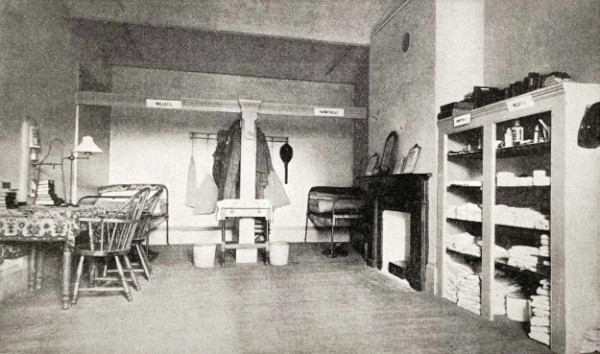
CADET ROOM IN BARRACKS
"Isn't there someone he cares about out West, Mr. McLean?"
"He has two charming sisters."
"Oh, of course!—all you cadets have charming sisters," said
Miss Jo impatiently. "Anybody else?"
"Lots of girls there," Rig replied. "They haven't all come East by
several."
"What do Western girls look like?"
"Angels, some of 'em," said Rig, thinking of Violet's eyes.
"Did you see Mr. Kindred's best girl?"
"I rather suspect I saw three of them," Rig answered slowly.
"Three! Why, the man's a Turk. Wasn't one better than the other?"
"I thought so," said Rig. "It's a matter of opinion, I suspect."
"Oh, shut up!" said Miss Jo, with beautiful ease of manner. "It's no
more possible to get the truth out of a cadet, than——"
"Than to get it without him," suggested Rig.
"I'll get at it somehow, you'd better believe," said Miss Jo. "What
were these three girls called?"
"One of them seemed to have a sort of French title; the other two
answered to plain English."
"French—that's a likely story. What do you know about
French?"
"Not much," Rig confessed. "Don't be hard on me, Miss Jo. I expect
to be found in January, but you might leave a fellow hopes till
then."
"And you will not tell us a thing about Mr. Kindred," joined in
another girl.
"Well, now"—said Rig,—"that's putting it rather strong.
But here comes Kin himself; he ought to know. He's of age, ask him, as
the Jews said in the Bible."
And Mr. McLean stepped to the window and hailed his friend, who
had not had the faintest intention of calling upon anybody that
afternoon.
However, so summoned, there was nothing else to do. So Magnus came
in, hung up his cap in the hall, shook hands with his hostess and the
other ladies, and then, after the manner of cadet chaff, asked Rig what
he was fooling there for? wasting his own time as well as Miss Jo's?
"She said she hadn't any to lose, so I'm safe there," answered Mr.
McLean.
"Make the most of it,—that won't carry you far," said Miss Jo.
"What do you suppose he has been doing, Mr. Kindred?"
"Could not guess—when it is Rig."
"Absolutely quoted the Bible to me. I came so near fainting away
that he called you in for a tonic."
"Quoted it pertinently?"
"No, impertinently. Oh, Mr. Kindred, will you let me have a walk
after chapel on Sunday?"
"Certainly—but I cannot take you to get it."
"I suppose that passes for cadet wit," said Miss Jo, pouting. "Why
cannot you, pray?"
"Something else to do: a previous."
"You can't fool me so," said Miss Jo, shaking her flaxen head. "You
know your best girl isn't here."
"What then?"
"Then there is nobody else you need walk with. I think you're very
unkind, Mr. Kindred. And I've got such a box of candy as you never
saw."
"Let me see it now," said Magnus, smiling. "Destroy ignorance
wherever you find it."
"I guess I will! No, I'll give that walk to Mr. Clayton, and nobody
else shall have a crumb."
"Or a smile."
"Good for Clayton," said Rig. "Then he won't have to
dead-beat to the hospital Monday morning, but can go there for good and
sufficient reasons."
"Aren't you ashamed!—as if my candy was poison," said Miss Jo
indignantly.
"Mr. Kindred," said the hostess, "my curiosity is astir about this
'best girl' of yours; I should like to know your taste. What is she
like?"
"Like herself: I know nobody else," said Magnus.
"So then she really does exist somewhere?"
"Why, you asked about her."
"Yes, of course I did; but then I didn't know but Mr. McLean had
been fooling us."
"Would he dare do that?"
"It's my belief he fools about everything," said Miss Jo. "And you
too. I don't think you cadets know how to be serious about a single
thing."
"Grinds are almost the staff of life here," said Magnus. "But you
do Rig unjustice: he'll be serious enough when he gets zero in wave
motion."
"Don't speak of wave motion Saturday afternoon," pleaded Rig. "It's
the only time in the week when anything stands still and right side up.
The air waves, and the light waves; and not a thing is steady, from
Saturday night to Saturday noonday."
"I hope you do not study wave motion on Sunday," said the hostess
reprovingly.
"Only practises it in chapel, you know," said Magnus. "Rig goes
to sleep systematically, and keeps up in wave motion by a series of
graceful nods."
"Ha! ha!" laughed Rig. "Well, I sometimes do, that's a fact.
Somebody stuck a pin into me last Sunday. Wasn't you, was it, Kin?"
"It was not my pin. Come away, Rig, you've got another visit to pay
before retreat," and the two bowed themselves out.
"I don't believe I'll call on Miss Saucy to-day," said Rig, as they
walked along. "I got thinking about your handsome sisters, and that
takes the taste out of other girls."
"Oh, does it!" said Magnus mockingly. "If you say that again, I'll
report you to the Com. for a cannibal. There—the Kitten is
tapping on the window for you, and you can go to Miss Saucy later. Run
in; there's a lot of girls staying there."
And Rig ran in. But in the hall, while giving himself those
finishing touches in which even men indulge, Rig found that Cadet
Kindred had slipped away to parts unknown.
XL ON FORT PUT
Think truly, and thy thoughts
Shall the world's famine feed;
Speak truly, and each word of thine
Shall be a fruitful seed.
Live truly, and thy life shall be
A great and noble creed.
—Dr. Bonar.
No, Cadet Kindred was in no mood for "other girls" that day; had he
not just been writing his heart out to Cherry? and was not her last
letter lying perdu up his sleeve? You could not expect him to have
any relish for common doings.
So with the easy, steady gait which I wish all men might copy,
Magnus went swiftly on to the west end of the officers' row. Past Miss
Saucy, who signalled him from her friend's porch; past Miss Bee, who
bowed from an open window; past the talk and the laughter, the scent
of chocolate, the certainty of sugar plums. Then at the last house of
the old "west limits" he turned sharply round the corner, and began
to mount the hill. Small danger of "other girls" here, or of other
men, unless a few homesick strollers like himself; and these were
passed with only a nod. The real denizens of the roadway were wild and
sweet as the day. Red squirrels and brown chipmunks darted across the
path, whisked into holes, or chattered in the treetops; "the sound of
dropping nuts," the rustle of leaves, the voice of a crow or a gull,
only made the stillness more exquisite. The rocks were cushioned
with mosses; the ferns and the early fallen leaves of chestnut and
butternut
made a lovely carpet all about; the clear air seemed strung and tuned
to the last pitch of harmony. Far down, down, the winding river, in
its varying shades of blue and grey, flowed silently among the hills,
flecked with the white wings of two or three sloops and schooners; but
all too distant for the murmur of the little waves, the creaking of
cordage, to reach him.
Cadet Kindred paused several times at points where the view opened;
then addressing himself to the hill again, and choosing the old broken,
steep-pitched track of a hundred years ago. The Revolutionary style
suited his mood to-day; and he sped up the last steep incline with a
will; passed through the old sallyport, sprang up the parapet, and sat
down to gaze.
At his feet the rough hillside went in tumbling, breaking fashion
down to the little fringe of houses in the officers' row; and beyond
them the green plain spread out its fair expanse, with Barracks and
Academic Library and Chapel, walling it in on the south. Elsewhere the
river, and beyond that again the hills. From above the trees on Trophy
Point the fair, curling folds of the flag, with an action which would
have been lazy had there been any call for haste, lifted and drooped
at the top of the tall white staff. Magnus Kindred stood up again and
saluted, with a flourish.
"Yes, old friend," he said, "we are sworn comrades now, whatever
happens. One full summer more for me here, and then away to the ends of
the earth: but that blessed old rag will fly just as well at San Carlos
as at West Point, and be just as ready to read me a lesson."
And with that, Magnus stretched himself out on the green slope,
pulled forth Cherry's letter, and read it through twice.
Then he studied the flag again; musing over things he
had heard and read. Of the men who ran up the colours
when their ship was sinking in the deep, dark sea; of standards dyed
with the life-blood of their defenders. Of the failures that yet were a
triumphant success.
"My half day's work is done,
And this is all my part.
I give a patient God
My patient heart:
"And grasp his banner still,
Though all its blue be dim;
These stripes, no less than stars,
Lead after him."
"I wonder if that fellow loved anybody," Magnus questioned with
himself, a stricture coming over his heart at thought of the young
soldier under whose death-pillow the brave, pitiful lines were found.
"And I wonder if I could have said it in his place? But that is
what it means. That is just what I have to do for the old Stars and
Stripes—and for the Lord's banner."
And secure against the criticisms of chipmunks and chickadees,
Magnus began at the old ballad of the "Star-Spangled Banner," and sang
it straight through.
"Well sung, and to the purpose," said a pleasant voice, and Magnus
started up, to find a gentleman close behind him; and, as he saw at a
glance, no less a person than his friend of the candidate journey.
It was plain, however, that Mr. Wayne did not know him. How could he
find in the close-cropped hair the wayward, curly locks of two years
ago? or see, in this happy compound of uniform and drill, the homesick
boy whom he had cheered and comforted?
"Do not let me disturb you," said the newcomer, taking a seat near
Magnus. "I was wandering round among the old walls, thinking how much
had crumbled and how much grown up since their day, not knowing there
was anyone up here but myself. And when suddenly the dear old
song rang out, I could not help coming near to listen. Has
it come into fashion again, in these latter days?"
"Not especially, that I know of," said Magnus. "But I was brought up
on it."
"So was I. And where were you brought up?"
Magnus named his State.
"Strange!" said Mr. Wayne. "The first boy I ever spoke to who was
coming to West Point was from that State; and now so is also the first
full-fledged cadet I meet with here."
"Yes, we have a good representation from all our districts," said
Magnus.
"Do you men from the same State always hold together in any special
way?"
"Against all the rest of the world, yes," said Magnus. "But we often
choose our chums from the Antipodes."
"For private and personal reasons, rather than public; I see. But
then of course you know them all, more or less; and so you must know
the man I am after."
"A relation of yours, sir?" Magnus inquired gravely.
"Oh, no, not at all; only an acquaintance of a day and a night.
But I should like to see him again very much; in fact that was why
I stopped over a day here. I wonder if he is in the corps still?
Must be, I think; he did not look like a fellow to be 'found' in
anything,—unless caution and self-control."
"That's a bad showing," said Magnus. "I'd rather chance it in
math."
"You must know him, of course, if he is here," Mr. Wayne went on;
"for he was from your State, I know. I had his name down—and I
also had my pocket-book stolen! Can you tell over the list of your
State delegation?"
So Magnus began.
"Smith, J., 2d; Jones, L.; Devius, E.; Smith, T. A.; Marston,
Kindred——"
"That's the man!" broke in Mr. Wayne; "Charlemagne Kindred. And you
say he is here still?"
"Oh, yes, he's here," said Magnus, with a half groan.
"Doing well?"
"Doing all sorts of ways. He is just back from furlough, and as blue
as a mouldy cheese."
"Back from furlough! Ah, then he has seen his mother again. That
ought to cure him of doing 'all sorts of ways.' Where does he stand in
his class?"
"Oh, he keeps out of the Immortals," said Magnus with a shrug.
"Might max it oftener, if he didn't read so many magazines and write so
many letters."
"Letters, hey? These 'left behind' girls have a good deal to answer
for. And yet such a trust as a woman's life and happiness, ought to
steady any man, and put him at his best."
"He has four just such trusts," said Magnus. "I don't know that
they'd all die if he went to the bad, but two of them would."
"Four—you seem to know him very well," said Mr. Wayne, turning
to look more narrowly at his companion.
"I don't know, sir: sometimes I think I do, sometimes not. He takes
me all by surprise every now and then," said Magnus.
But with that he turned his eyes full upon Mr. Wayne, and the
recognition was instant.
"And this is you!" said Mr. Wayne. "I see it now. Indeed I think I
felt it all along. Sit over there, and let me look at you."
So Magnus changed his seat for another, and went through a new sort
of inspection; differing in toto from that of any member of the
tactical department. For Mr. Wayne's eyes passed rapidly over grey
cloth and bell buttons (Magnus feeling quite sure the while that any
dulness
or disorder there would have been noted) and came to the young face,
with a look so searching and wise that the sunburnt cheeks reddened,
and the eyes went down. Only for a moment, however: then they met the
search squarely, and with a laugh.
"Yes, sir," said Cadet Kindred, "that is just about what I am."
Privately, Mr. Wayne had been thinking to himself that just what he
saw was a remarkably fine-looking fellow, whom anybody might be proud
to call son or brother. For the eyes were steady and true; and when the
face broke in a smile or a laugh the mouth had the same utterly clean
look which had marked it two years ago. Mr. Wayne noted it all, and
drew a deep breath of rejoicing.
"I give most humble and hearty thanks," he said, reverently lifting
his hat. Magnus sprang up and came back to his old seat.
"Were you so doubtful of me, sir?" he said. "And what made you
doubtful?"
"Not doubtful of you, my boy, but certain of the world. And the
world—even this little world here—is a hard place."
"This is an awful place!" said Magnus.
"You think so now, because you are just back from furlough. But
you will find the world power in full force still, when you get to
some far-off frontier post. Very few lives have a steady fair breeze
straight into heaven. 'Ye must take the wind in your face if ye will
fetch Christ,' said old Samuel Rutherford; and most of us find it so.
But then, 'How sweet is the wind that bloweth out of the airth where
Christ is.'"
And Magnus remembered instantly that ever since he came to West
Point, he had hailed the west wind, because it seemed to come from
home.
"How can you always tell, sir, whence it comes?" he
asked suddenly. "Being disagreeable doesn't prove a thing right."
"Truly no. But you know what Christ himself is, Mr. Kindred; study
him, his character, his will, his throne. It is not hard to match your
colours, if you are really so minded. West Point is not so unlike
everywhere else as you seem to think. I remember a young man who went
from here to Texas, and wrote back that he was still fighting the
world, the flesh, and the devil. Finding the world perhaps a little
less down there, but the flesh and the devil about as usual. And so you
will find it. 'The kingdom of God is within you'—not outside:
whether at Governor's Island, or San Carlos."
"What makes you speak of San Carlos, sir?" Magnus said, with almost
a start.
"One of the worst posts in the army, is it not?—or counted
so?"
"I am not afraid of San Carlos," said Magnus decidedly. "The devil
always has to clear out, when an angel comes in."
Mr. Wayne turned and looked at him.
"So!" he said; "that is all settled, is it? But no, my young sir:
Satan held a dispute with an archangel once, long enough for some
pretty strong words on both sides. And you are going to take an angel
to San Carlos!"
Almost just what Mr. Erskine had said.
"Were you ever there, sir?" Magnus asked.
"Oh, yes."
"Doesn't the place need angels?"
And now Mr. Wayne laughed.
"You have the best of me there," he said. "Yes, not a doubt of that,
it does. And it is the very place that the white wings love to brighten
if they can. But Mr. Kindred, if your particular angel is to live at
San Carlos—or anywhere—and not break her heart; spread her
white wings
and fly away from earth and you together; you have got to fight the
devil yourself; hand to hand, and wherever you find him. These earthly
angels are not quite so robust as the old painters make out the
heavenly to be."
"She is the very centre of my life!" cried Magnus. But Mr. Wayne
sighed.
"It happened once," he said, "that a young graduate of West Point
brought his three-months' bride not to San Carlos, but to Fortress
Monroe. Of course, the 'pleasant fellows' of the garrison went to work
to entertain him, and one of them told me this story:
"'We had a little supper party,' he said. 'Not very large, but
correct and choice; and we kept it up pretty late; and X. Y. got more
than he could manage gracefully. So some of the stronger heads among us
set out to get him home. Late, as I said; servants asleep, lights out,
and I guess we knocked and rang more than once. Then X. Y.'s young wife
came down, candle in hand, to let him in. Poor girl—I did feel
sorry for her when I saw her white face, as the candle flared out upon
him.'"
There came up before Charlemagne Kindred, as his friend spoke, the
vision of another face; so blanched, so stricken in its grief, and all
for him. He bowed his head upon his hands.
Mr. Wayne asked never a word. He looked at the fine young man beside
him, not knowing just what he might have touched, and then away over
the fair hills and the soft flowing river. What a world! Peace written
everywhere on the exquisite setting; and everywhere in the picture the
sharp life and death conflict. Then the glad words in the Revelation
made answer:
"And I saw, and, behold, a white horse; and he that sat on him had a
bow: and he went forth, conquering and to conquer."
"Amen!" Mr. Wayne said aloud: adding half under his
breath: "'Oh that thou wouldest rend the heavens, that thou wouldest
come down, that the mountains might flow down at thy presence!'"
Magnus looked up in surprise.
"Only an old habit of mine," Mr. Wayne said, smiling at him. "I
live so much alone, that I very often talk to myself for lack of a
listener."
"Do you want to see these mountains flow down?" Magnus asked, gazing
in his turn at the fair hills.
"Not these in themselves; only I long for all which the prophet's
words imply. To see the crooked made straight, and the rough places
plain; to hear the royal proclamation of the Prince of Peace sound
out across this burdened earth; one could be willing to have 'every
mountain and island' moved out of their places. To have that trumpet
blast fill all the air:
"'The kingdoms of this world are become the kingdoms of our Lord and
of his Christ; and he shall reign for ever and ever.'"
"No more miserable captives to the power of evil; no more strong men
'whom Satan hath bound at his own will."
"No midnight shades, no clouded sun,
But sacred, high, eternal noons."
"How naturally the words follow:
"'We give thee thanks, O Lord, because thou hast taken to thee thy
great power, and hast reigned.'"
Then Magnus began and told him the whole story; pouring out details,
and not sparing himself in the least. And Mr. Wayne listened in deepest
silence, with a grave, tender face which drew on confidence. Magnus did
not once name Cherry, only at the end he said:
"I told her everything. And if I thought I should ever again make
her look as she did then, I think I would shoot myself."
"Powder is very cheap," Mr. Wayne said slowly. "It is the meanest,
smallest, silliest back door through which a man ever shirked his
difficulties. But to live a strong life, to have one's self in hand
and keep a tight rein, that costs, and costs tremendously; demands
a man's whole will-power, and the mighty grace of God. There is no
promise whatever to the one who runs away; they are all: 'To him that
overcometh.'"
"Yes sir, I know," Magnus answered him. "But instead of costing, it
seems to me the only life that pays."
"And where do you get dividends, but from investments?" said Mr.
Wayne quickly. "You gain from what you put in: knowledge from study,
health from exercise, advance from toil. You bone discipline, and you
stand one; you bone mathematics, and you max it every time."
"No, you don't," said Magnus. "Not some of us."
"Yes you do. Not all just alike, perhaps; one man puts in more
brains than another, and so maybe gets larger returns; but the slower
fellow maxes it for him; the dividends are as large as the stock will
warrant. And to my mind, that is the only ambition worth a copper. I've
no patience with this trying to get ahead of somebody else in any line.
Get ahead of yourself; break your own record."
"Not making other men your measure," Magnus said.
"No. That's the way Paul puts it: 'I press toward the mark for the
prize'; not to get ahead of Peter or James or John. The colour markers
always in advance, flagging out new ground."
"What do you count a man's colour markers, sir?" Magnus said,
looking amused.
"Perhaps clean purpose of heart and loyalty to God would come near
it. The Great Captain has thrown open to you—to every young
man—a wondrous Promised Land.
He says: 'Go in and possess it. Ye are well able to overcome.' The land
is not all 'fish and cucumbers and melons,' with a good deal of garlic,
like the Egypt degradation and bondage; but 'a goodly land of springs
and fountains, of oil olive and honey; whose stones are iron, and out
of whose hills thou mayest dig brass.' I do not believe you cadets are
half aggressive enough."
"In what way, sir?"
"Every way. Suppose your colour markers had been up to their duty
on that sad night, and you pressing forward for the Lord's 'Well
done.'"
"Yes," Magnus answered, with a thrill of pain that somehow got into
his voice.
"Or suppose," Mr. Wayne went on, laying a tender hand on the young
man's shoulder, "suppose you had been praying for those other men whose
ways you knew; working with them, persuading them into the service of
Christ?"
"Oh, that could not be," Mr. Kindred said decidedly. "At least, I
might pray for them, of course, but I could not say much."
"Why not?"
"Against cadet code, sir. We let each other pretty well alone."
"Cadet code!" Mr. Wayne repeated. "You tease each other now and
then, I fancy?"
"Always!"
"And laugh at each other?"
"Without stint."
"Perhaps introduce each other occasionally?"
"Why, of course, sir!" Magnus answered.
"And probably the cadet code would permit you to pull a man out of
the river, or tell him the barracks were ablaze? It is framed only
against the important things, hey?"
"Don't you call it important to pull a man out of the river?" Magnus
asked, with a laugh.
"Rather. Nothing like pulling him into the kingdom."
The clouds sailed silently by, river and hill darkening and
brightening as the shadows fell and passed; the leaves rustled softly
among the oak branches and stirred with a different music among the
pines. Then from far down below sounded a drum—Magnus started
up.
"Thank you, Mr. Wayne!" he said earnestly. "Come to the guard-house
before call to quarters. I must go."
"I will walk down with you," said his friend.
"But I must run!"
And away he went, springing down the hill through every short cut
that could be found; the grey and white showing, and hiding, and coming
out again further on.
Mr. Wayne watched him with great interest, taking his own pace the
while down the hill; and now, as he went, from every other quarter came
just such flying figures. From the woods, from Flirtation, from the
river; from lingering last words on doorsteps, and girls and bonbons in
the houses. Hastening along with the graceful ease of long practice,
hurrying to lose themselves behind the grim grey walls of barracks.
And Mr. Wayne watched and laughed; but then his eyes grew grave.
Will they make such haste at every call of duty, these gay youngsters?
on hand and "ready" at each noble muster? Alas, no! Even now some are
getting an "absence," and some a "late," and of others the guns are
not cleaned and the bell buttons will be tarnished. Ready! it is a
short word; but it means a man's whole ceaseless purpose, self-denial,
and care. How little those speeding figures on the green guessed that
anybody on the old hillside was praying for them; but I believe the
very skill and swiftness with which they darted along, gave stringency
to
the prayer; such power for good, such forces for evil; such ease in
doing the right thing, such recklessness, sometimes, whether it was
done or not. Through his glass, Mr. Wayne could study it all out.
See that one now; a tall fellow, going over the ground at a rate to
take common people's breath away. It is not altogether his fault that
he has to run for it; his best girl is on hand to-day, and this was a
critical walk round Flirtation. Drum-calls were scarcely heard, and
minutes flew unheeded. No carelessness of orders kept him back, and no
contempt for them make him linger now. He does not mean to have even
a late; and so dashes on and wins. There is some jeering and clapping
as the tall figure comes up; "Two-forty" being his affectionate
soubriquet; but all the same he is there, in ranks, with about ten
seconds or less to spare.
Another—Oh, yes, he set out to run; anathematising the
drum, the parade, and the regulations, and so soon stops; runs
again—and stops, with a sort of what's-the-use air. "How much
time?" he asks another, who is walking calmly on.
"None at all."
Whereupon he quickens his steps; but not so the second. The
drum-beats come thicker and faster—that makes no odds. It is only
a "skin" more or less, he says to himself; and he's sure to get it some
other way, if not this; and he has lost his Christmas leave already.
So, while the rest fall in, and answer to roll-call, he comes leisurely
up to barracks, some minutes after the last man has shouted "Here!"
That is Cadet Clinker all through; if he is going to fess, he'll
"fess cold." No one knows better than he how many demerits a man may
get and still keep his place in the corps; or what delicate shades of
meaning there are about "taking advantage of permits." So he runs it
here and
runs it there; goes off limits in all sorts of ways, places, and times,
and gets help from all the friendly smugglers that infest the Post.
He is one who entraps others, serving out his stores in many-coloured
glasses or dainty cups, teaching the younger men strange oaths and
unwholesome ways; making many a weak boy ashamed of his mother's
counsels and his father's rules.
"Il y a des héros en mal, comme en bien."
You see he is such a pleasant fellow,—handsome, rich,
plausible; a great favourite with the ladies; and with a head about
equally divided between folly and mathematics. Excellent gifts, all
thrown away; and worst of all, thrown where they are stumbling blocks
for other men. But he is a tremendous favourite all the same, with much
more courage to do wrong than he has to do right.
It is a thing to see Mr. Clinker come forth and walk about the
Post, a day or two after one of his prize-fight exploits. His mouth
is swelled, his eyes bruised, his nose knocked out of all its fine
proportions. But he steps jauntily along, and the pretty girl at his
side gazes up into the disfigured face as if Clinker were one of the
first defenders of the country, newly risen from the shadows of old
Fort Clinton.
To-night Magnus watched him coming over the plain, and thought of
Mr. Wayne's words. No, he had never prayed for Clinker, much less tried
to win him to better ways. And Cadet Kindred remarked to himself, quite
privately, that he would rather "pull him out of the river" than do
that, every time.
Mr. Wayne stayed over Sunday, and Magnus spent with him every
minute that he could. The day was still and mild, so they could be out
of doors the whole time; and I hardly know which of them enjoyed it
most.
"If surroundings made men, you cadets should be the noblest set on
earth!" Mr. Wayne broke forth, as late in
the afternoon they walked up from Battery Knox, and paused in the
little clearing where "Dade and his Command" will be thought of for
many a long day. "Such wonders of beauty on every side, in mountains
and sky and river; and whichever way you turn, such reminders of men
who have 'fought a good fight' on the field of honour. Look at the
old flag, and think how it has been shot at and insulted; defied and
threatened; yet how splendidly it floats off to-day! And the guns that
lie sleeping beneath its shadow were captured by men who knew no such
words as 'hard' or 'easy.' And the great iron links once stretched
across the river tell of other chains triumphantly broken, in the face
of fearful odds. On all sides you find written: 'Faithful unto death.'
Life purpose, life and death effort, life-blood, have done it all; the
blood of men who 'counted not their life dear unto themselves' when the
country had need. And the one traitor among them—why, you will
not have his name even in sight! His tablet is a blank."
Slowly pacing up the walk again, Mr. Wayne went on, half to
himself:
"Then Paul answered: 'What mean ye to weep and to break mine heart?
for I am ready not to be bound only, but also to die at Jerusalem for
the name of the Lord Jesus.' Magnus" (with sudden change of tone) "when
we parted two years ago at the Grand Central, I bade you make friends
with the flag; now I tell you to open a recruiting office. I think
you Christian men in the corps are making a grand mistake."
"If you cannot reach the nation,
Gather in the men you know:
Teach your friend the way to glory—
Draw your comrade where you go."
Cadet Kindred stopped short and faced him.
"Yes," Mr. Wayne said, answering the look; "I know
all about it. But the Lord said: 'He that gathereth not
with me, scattereth'. And if you think it will be easier to
take positive ground and begin positive work for Christ
among a lot of strange officers at your first post, I think
you are mistaken."
XLI UP CROWNEST
Crowds of bees are giddy with clover,
Crowds of grasshoppers skip at our feet:
Crowds of larks in their matins hang over,
Thanking the Lord for a life so sweet.
—Jean Ingelow.
If Cadet Kindred rose up next morning with the very spirit of the
Crusades astir in his heart; ready to charge down upon the Saracens,
lance in rest; he said to himself as the day went on, that if Mr. Wayne
had ever been a West Point cadet, that gentleman would know some things
he did not know now.
Here had Magnus been dreaming all night how he knocked a bumper
out of Randolph's hand; how he had run Rig up to the first section in
French; and how he had pitched Clinker back over the Commissary wall,
just in time to prevent his being missed and "skinned." Also how he
himself had been publicly thanked for these exploits by the Academic
Board in full session. But, alas! "the stuff that dreams are made of"
fades in the morning sun, and from these pleasing nocturnal visions Mr.
Kindred passed to a particularly tough recitation, with corresponding
low marks, and thence to the stubbornest horse in the hall, that would
not take the hurdles, and made him instead take the tan. And now, as
he sat in his room, tired and growly, the mail brought him nothing but
a desperately perfumed pink note. Magnus said "Phew!" and moved to the
window.
"Sent the whole shop, hasn't she?" said Rig. "That's Mrs. Newcomb, a
mile off."
"Just listen, will you?" said Magnus. "She wants to give a picnic
on Crownest, and tells me to bring men enough for five girls! How many
apiece, do you suppose?"
"Unknown quantity; all depends on the girls. Who are they?"
"Doesn't tell. Miss Pretty, of course, for one; she is a niece or
something. Then there's another girl, 'just from abroad,'—'and
the rest you know.' Well, I'll take the new girl, at a venture."
"Then you'll not have to think up any new grinds," said Rig. "Lucky
man. And I'll take Miss Pretty. If she's heard all mine before, she
won't say so. So we are two."
"And Clinker's three——"
"What do you have him for?" said Rig. "He's in every single
thing—when he isn't on the area."
"She wants him. By name," said Magnus. "Hopes 'dear Mr. Clinker will
be at leisure.'"
"That's a neat way of hoping he's out of Con." said Rig. "Say,
didn't she have a granddaughter or something, getting rubbed up in
Paris? That's the new girl."
"Granddaughter!" said Magnus. "Just let Mrs. Newcomb hear you say
that! But I'll take the rubbed-up girl, whoever she is, my risk. And
Miss Frisk will take you. She's sure to be along."
"Sure to get Clinker, if she is," said Rig. "Wonder if the little
Busy Bee will come? Kin, you're hard on that girl."
"Don't want me to be soft, do you?" said Magnus, with the drum
cutting him short.
Of course the names of the party were all out before Saturday; the
girls could not talk of much else. And as for cadets, each girl might
have had five, had the limits of the lunch basket agreed thereto. The
day was perfect, the dresses faultless, and Mr. Clinker happily "at
leisure," for once.
Not everybody knows—but few try to know—how witching
that climb up Crownest is, if you take the old "Cadet Trail." The way
goes along for a while at the level of the plain, but then betakes
itself to the air; presently mounting up and up with a straight pitch
before you. There come turns, of course, winding round some unscaleable
rock; and gentler going over a small knoll or two, and quite a level
stretch around the shoulder, in the "Nest." But very often it is just
a steep ladder of a path, to be climbed as best you can. A wilderness
of grey rock and green woods; feathery hemlocks, sombre oaks, ash
trees, maples, and hickory. Below these, dogwood and other "cornels,"
with ironwood, shad blossom, witch hazel, and laurel. Lower still
ferns—unlike those in the valley; with orchids of a new type,
yellow gerardias, purple gerardias, partridge berry, and wintergreen.
Then the brown leaves of last year, half covering the mosses, and
thickly sprinkled in turn with the red and yellow of to-day.
The rarest scents are in the air: the balsam breath of the sweet
brier, and from the new-fallen and falling leaves that special
fragrance of the autumn woods—sweet, racy, heart-piercing, a waft
from days gone by and withered, their work all done.
Many of the birds have already gone South; but robins are here, and
chickadees, and the cry of the gulls is in perfect keeping with the
cool air and the white caps on the river.
Up through this wilderness of wild and fragrant things, the little
party went joyously along; or if not quite that on Mrs. Newcomb's
part, yet it is painful to relate that her trips and stumbles did but
heighten the fun for all the rest. In many a place it took two men to
get her on at all. Magnus would leave his pretty companion safe on some
high standpoint, jump down again himself, and with Crane on the other
side carefully engineer Mrs. Newcomb to a place
beside her niece. It might also be noticed that Mr. Clinker and his
convoy generally lagged behind at such crises, or got into some tangle
themselves, from which they came out, safe and suddenly, as soon as
Mrs. Newcomb was disposed of. And by and by Cadet Kindred, being quite
alive to the situation, quickened his pace, and passed on too far ahead
for any new service to be required of him.
On and up the two flitted along—like grey and red squirrels,
averred the toiling Mrs. Newcomb; but even for themselves there were
difficulties.
Here, for instance, stands an immense rock that stops the way. And
as Miss Lane measures it with her eyes, behold! there is Magnus on top
of it, reaching down his hand to her.
"Do you expect me to climb up there?" Cadet gives a little gesture
of the head which Dickens would have said meant, "He rather thought
so."
"How did you get there yourself?"
"Came."
"Are there any snakes up there?"
"Not so many as where you are."
Miss Lane seized his hand, made unheard-of efforts, and mounted the
rock, then looked down complacently.
"Why, how slow you are!" she cried. "Just jump up as I did.
Oh—what was that—a rattle?"
"Yes; Rig's tin pail against his buttons," said Magnus, laughing.
"I wish he'd give it to someone who does not wear buttons. Must
people always carry tin pails when they go out to enjoy themselves?"
"You'll like it at the top. And we're almost there now."
Trees grew shorter and scarcer, rocks stood up in bolder
self-assertion; and, with a last steep climb, the grey and the red came
out upon the mountain's lovely head, and,
after a shout of victory, sat down to look and breathe. Oh, how
wonderfully fair earth is from the top of Crownest!
On the west, beyond the dipping hillside, the broad valley lay in
seven shades of green—slope beyond slope—till it touched
the soft horizon blue. To the north, the far-off Catskill range
rose, shoulder to shoulder, from the more level land, a great lonely
pile. Then on the south, beyond the locked-in Highlands, Tappan lay
shimmering in the sunlight, a blue inland sea; while just across the
river on its eastern shore, the bluff ends of the mountains fell apart,
and you could see the long valleys between; the grey-green ridges like
grim ribs, running eastward towards the Connecticut line. The river
itself was decked with various craft; over all there wandered a faint,
fitful north breeze.
From their vantage ground Magnus and his companion watched the
toiling party below, for whom neither earth nor sky had any special
charm just then. Privately Mrs. Newcomb was assuring herself, that the
next time she gave a picnic it would not be on the top of Crownest;
the girls might say what they liked. And Mr. Clinker was inwardly
chafing against the good lady's value in avoirdupois. (Quite literally,
sometimes, when on a bad bit of road she surged up against him.) Rig
was laughing to himself at them, at Magnus, and at things generally;
and aloud at the sallies of Miss Freak; while the last couples of the
party fumed a little at the slow progress and the narrow trail. How
came those two to get ahead? There they sat, in triumphant ease, the
grey and the red.
"You men are a very peculiar set," Miss Lane said suddenly.
"I am sure you ladies are."
"Oh, I am not talking of the whole human race," said Miss Lane: "it
is cadets that are so odd, so unlike other people."
"That is good," said Magnus. "One would not wish to be like
everybody else."
"How you chop one up. I mean other students. Do you try to be unlike
all other cadets?"
Magnus shook his head.
"I get the credit sometimes, without trying."
"And I can see you deserve it, too," said the girl. "You would have
tugged Aunt Newcomb all the way up here, if you hadn't thought Mr.
Clinker meant you should."
Magnus laughed.
"Do you call that being odd?" he said. "It is just even."
"And then, instead of standing off like a shirk, you did the
polite thing and ran away. Do you always run from difficulties, Mr.
Kindred?"
"Bad for me if I do," said Magnus. "A foe in the rear is worth two
in front."
"Then you generally fight?"
"People, or things?"
"Both."
"Well, as to the people," Magnus answered, "I have not been much
tried. It depends on yourself somewhat, I fancy; and I have never been
challenged since I entered the Corps."
"What would you do if you were?"
"What I would, is one thing," Magnus said rather slowly. "By my good
leave, I should say no."
"Would you—and be pointed at?"
"You're sure to be pointed at for something," Magnus answered
lightly. "It's a choice of cases."
"But I cannot imagine a man like you saying no!" said the girl
eagerly. "Not fight, if you were challenged? You are brave, I know."
"How do you know? If I am, I shall never fight for fear of being
pointed at."
"But why?" Miss Lane repeated, her bright eyes searching his face.
"Tell me quick, Mr. Kindred. They'll all be up here directly, and I
cannot possibly wait to know till to-morrow. Why wouldn't you fight? I
believe you could whip any man in the Corps."
"There is one rule," said Magnus, meeting her look, "which I have
sworn to keep. It is an old rule, and a short one, but it covers a
great deal of ground. 'Whatsoever ye do, in word or deed, do all in
the name of the Lord Jesus.' I could not so endorse my acceptance of a
challenge."
The girl looked at him with wide open eyes.
"You will find those old rules of yours terribly in the way,
sometimes," she said.
"Sure sign that I am off the track, then," said her companion,
smiling. "Fences don't matter when you mean to keep the road. But
doubtless most good things have their inconvenient side."
"Aunt Newcomb, for instance," said Miss Lane, changing her tone. "I
think I should count both sides 'inconvenient,' if I had to pull her up
the hill. By the way, Mr. Kindred, why didn't your rule oblige you to
take the brunt of the burden to the last?"
"It might in some cases," said Magnus; "not in this. Clinker had to
earn his lunch, and there was no other way for him to do it."
"Well, there they come," said Miss Lane, rising up, "to cut short
our talk; I am quite sorry. You interest me, Mr. Kindred; cadets with
'views' are a novelty. But I rather wish you would fight!"
"I dare say I could get a broken head in the riding-hall some day,
when I'm on Dangerfield—would that do?" said Magnus, laughing
back at her as he went forward to give Mrs. Newcomb a hand, which was
gratefully taken.
"Oh, Mr. Kindred—thank you! This has been certainly—the
most awfully grand—walk I ever experienced."
"It isn't a walk at all, Aunt Newcomb," said Miss Freak. "It's a
clamber, and a climb, and the roughest sort of time. I've ruined my
best pair of shoes, and not another this side of New York. And five
walks on hand for to-morrow."
"Get an order on the Captain from the Com.," Rig suggested.
"Fit warranted," said Miss Freak, putting her little foot out into
the sunlight. "I wonder you don't offer me your own, Mr. McLean, at
once, and save what is left of mine."
"You wouldn't need but one," said Rig; "and regulations require me
to have two."
"Much you care for regulations, up here."
"Freaky, my dear," said her aunt, "I wish you girls would unpack the
baskets, and heat up our coffee. I am just worn out."
"But you must have a fire," said Miss Lane. "Who'll make it?"
Then followed the prettiest, liveliest bustle. The hilltop all
around them was covered with a low growth of huckleberry bushes; and
here and there, scattered about among this, were twigs and sticks and
chips, dry and bleached and just ready to burn.
Choosing with some care a rock whence the fire could not easily
spread, a gay little blaze was soon kindled, and the cold coffee
put under—or over—its care. Then busy hands unpacked or
uncovered the baskets. Sandwiches were in one, cake in another, late
peaches filled a third. Miss Freak had a box of Huyler's somewhat
luscious sweets; Miss Newcomb an assortment of peanut brittle, cocoanut
cakes, and sweet chocolate; and the wind kept still, and did not blow
even a napkin away.
But the last time Magnus Kindred had been at a picnic,
it was in the far-away home region, and with just the home group around
him; and now it all came back to him in a moment; with the tones of his
mother's voice as she asked for a blessing on their day's pleasure. And
I suppose it was this that made him pause unconsciously, after he had
taken his stand by the fire to pour out the steaming coffee.
"What is it?" said Mrs. Newcomb, in her plaintive voice. "Not hot
yet?"
Then Miss Freak laughed out, and Miss Newcomb looked at her, and
Miss Lane watched this cadet who had "views."
"Oh, aunty!" cried Miss Freak, "don't you know he's one of the
too-good-for-this-earth boys? Why, coffee out of an ice box would scald
his throat, if somebody didn't pray over it first. He's waiting for you
to say grace, ma'am."
"Waiting for me!" Mrs. Newcomb repeated helplessly. "But your uncle
always does it, you know, Freaky."
"Well, he isn't here," said Miss Freak. "Come, aunty!" The girls
were choking themselves with their pocket-handkerchiefs; the cadets,
better used to endurance, kept their gravity intact. Charlemagne
Kindred stood absolutely still; but his thoughts went flying back to
the honeysuckle-wreathed porch, and Cherry, and how she had waited for
him. Blessings on her! she never came near him but to do him good.
"Why doesn't the man pour out his coffee?" Miss Lane was saying
impatiently to herself.
"Mr. Kindred," said Mrs. Newcomb in a sort of appeal—"girls,
be quiet—I am ashamed of you. Mr. Kindred, will you be kind
enough to say grace yourself? Of course, it is quite proper to have it
done, and a man can do it so much better."
"Not this man!" So shot the feeling through Cadet Charlemagne. This
man, who had never even come near such a thing in public. But quick as
Nehemiah got his orders, so on the instant the young cadet had his. Was
he
not pledged to shun no point of witness-bearing? And, with again one
swift thought of Cherry, Magnus obeyed; standing there by the little
fire, while good Mrs. Newcomb bowed her head, and the others watched
him from their mossy seats. And the words were Cherry's own, as she had
said them on that well-remembered morning.
"He that is faithful in that which is least is faithful also in
much." This was a very small thing to do, but I think nobody ever
guessed what it cost Magnus Kindred. And as little did he imagine,
how that small bit of open confession broadened out and took its full
proportions to other eyes. There was something in the serious face,
something in the reverent voice, something about it all, indeed, that
everybody felt. As Mr. Kindred came forward now with Mrs. Newcomb's
coffee cup, Clinker looked at him curiously, McLean with a sort of
wondering veneration, while Miss Lane said to herself: "Fight! Of
course he could!" But then Magnus threw himself into the fun, and in
two minutes had fanned the frolic to a point that quite outshone the
fire.
"So nice to have a private chaplain along," Miss Freak had said
airily, trying to throw off her thoughts. But the other girls frowned
down all attempts at fun in that direction, and harmony reigned. Or, to
speak more correctly, the lunch baskets reigned in a very harmonious
atmosphere.
Sitting about on moss or stones, after the good cheer had vanished,
the cadets got off so many "grinds" that poor Mrs. Newcomb declared
she should have no strength left to help her down the hill. Then they
sang songs, and gave out conundrums. The girls made chains of the pine
needles, and the men in grey put them on, and declared them emblematic
and imperishable.
On her part, Miss Lane went on with her study of Magnus Kindred,
watching him keenly. She noticed that
though he took the frail green links from her hands, putting them round
his cap, twining them about his arm, he said no word of their being
"fetters"—called them garlands, instead. She felt that in all the
light play, the cavalier-like deference, there was no sham devotion,
no hint of deeper things. Yet he wore his class ring. And she knew she
was pretty, and felt certain she was well dressed. It piqued her; she
would have liked to see those green chains press hard, with a permanent
sensation. And then, when she went off to look at some side view which
Mr. Clinker recommended, what did Mr. Kindred do but seat himself by
Mrs. Newcomb and talk to her! It was extremely trying.
I think, to me, the way down Crownest is more difficult than the way
up; taking hold perhaps upon a set of less-used muscles; but the party
all came safe and sound to the lower level and easier going of the
plain.
"Now you must be sure and come to us at Christmas," Mrs. Newcomb was
saying, as they parted. "We shall expect you all."
"Well, I can't come, sorry to say," Mr. Clinker answered with a
laugh. "I've got a previous with the Com. Awfully hard lines for
me—but it's just my luck."
XLII CHRISTMAS LEAVE
Count me o'er earth's chosen heroes, they were men that stood
alone. —James Russell Lowell.
Cold weather came early. Mrs. Newcomb's picnic was the last of the
season, and most of the human birds of passage grew chilly, and took
their bright plumage back to city streets. A few visitors lingered on;
people with no children to put to school, or with some son or brother
in the Corps.
Only the steadfast old hills flung out their hardy colours—and
flung them off; decking themselves with an occasional white cap
instead. The blue river rolled by in deep foamy wrinkles; the distant
Catskills had donned their snow.
No parades now, but noisy drills, with light battery, siege battery,
and sea-coast guns, making the hills roar out in countless echoes. Only
Battery Knox lay quiet, unmoved in all the commotion, keeping silent
watch near the white shaft of "Dade and his Command." While far away
beyond the hubbub, a small army of white and grey and brown stones told
of other soldiers, who had fought their last battle, and answered to
the last command. Very little told there, indeed, but of the soldier;
the man almost left out. But on one old, old stone are words to make
one's heart leap up for joy:
"He that doeth the will of God, abideth forever."
October ran its bright course, and the shorter, darker days of
November came softly in, but very fair, even yet. The hills set
forth their rocky heights and fastnesses, stripped now of the
softening leaves, and still the cold grey of the stone was warmed and
clouded with the wilderness of brown tree stems. And every here and
there rose up a tall hemlock or cedar or pine, in its dark, dauntless
green, while not a few red oaks still sported the tatters of their
autumn flags. Along the river on the lower ground, black alder bushes
showed a wealth of "winter berries," beautiful as coral beads, and a
close match in colour.
Drills ceased, and dress parade began; and in the dusky time between
gunfire and supper the men had chance for a good constitutional upon
the well-swept sidewalk of the officers' row. Wrapped in long grey
fearnaughts, with steady, swinging step, they went up and down, in ones
and twos and threes, almost like an open procession; talking, talking,
and discussing. Now the last blunder of the "Com.," now the latest whim
of the "Supe"; then the marks of the day. Here, consigning all tactical
officers to the prompt dealing of a drumhead court-martial, and here
busy with the charms of some fair new girl. Oftenest of all, perhaps,
dwelling on Graduation, Furlough, and First-class camp.
But you never saw them walk arm in arm, like other
students,—this would strike any stranger. Close together, but
both hands free. Perhaps the regulation salute, with its frequent,
instant, and exact demands, may be partly the cause of this.
A fellow once hastening over to the hop with a girl on one arm, and
her shoes and fan laying claim to the other, passed a certain dignitary
with only a bow of the head, and was of course reported.
Going next day to explain and get the report off, he was told:
"Drop the girl! Drop the shoes! Salute, salute!"
Another feature of West Point life which I think would strike
unwonted eyes, is the universal opening of
front doors at four o'clock. Up to that time, after the midday
refection of whatever name, West Point on the plain might be a city
asleep, with slow pacing sentries guarding its slumbers. But when
the sweet four o'clock bugle sounds out, waking the echoes and the
antagonistic dogs, the houses wake up too. Bonnets go on, gloves slide
into place, and the fair wearers come forth with a delightful sense
of expecting or being expected (for both things are in place), and
the thinnest veil of unconcern to hide it all. It is a very pretty
scene.
Officers and professors come hastening back from the section room,
gay turnouts wheel hither and thither, and the cadets are presently
out in force. For drill, for parade, for walks, according to the time
of year and the state of the weather. Football was not yet the rage,
in Magnus Kindred's time, nor bicycles; and so every man you met was
practising the noble art of walking, or showing how splendidly West
Point can ride.
As November speeded away, Christmas leave began to rise up in the
distance, and to claim many thoughts. Men who had lost it were down on
their "luck" (the cadet spelling for carelessness), men who had won it
debated in what way the few dear hours of freedom should be spent; and
many a fellow from some far-down or far-off corner of the land stood
pledged to go with his happier friend whose home was nearer by.
In all these joys, as usual, the poor fourth classmen had no share.
They walked, indeed, like the rest; one must do something; but they
talked gloomy things. No Christmas leave for them—and not much of
anything else but hard work. They were not supposed to need anything
else. No damsels on the sidewalk proffered them sugar plums, very few
people even knew them by sight.
I will do Magnus Kindred the justice to say that the keen memory of
some of his own early days at the Post
made him a little bit thoughtful of these forlorn young strangers. It
was no great credit to him, perhaps, if he now and then passed on to
fourth class hands a box of Miss Flirt's best candy, but he did better
than that. He gave words of encouragement and counsel, cheered up the
faint hearts, and would smile and speak to a pleb on the sidewalk, just
as if he himself had not been first sergeant, and a prime favourite
with the ladies.
Some people will say he could have had no time to look after anyone
but himself, but you never know how much you have, till you divide
it up with needy people. And I doubt if helping takes more time than
hazing. It is rather a question of which word you will say, what look
you will give. And there had come to Cadet Kindred the wholesome
perception that he could be a power for good or for evil, with all
these younger boys. Consciously or unconsciously, they were watching
the upper classmen, and taking tone from them.
"What is in the way of your living just as earnest Christian lives
here, as at home?" he had said one day to some plebs who were gradually
sliding back from all their good home habits. And one answered:
"Because we are so far from home, sir, and can't go to church so
often, and can't keep Sunday as we have been taught."
But another said boldly:
"Because the first classmen are so different in camp from what they
are in prayer-meeting."
And it set Magnus to thinking. His own pleb days were not so long
past that he could forget how he used to watch Mr. Upright, to see what
all his brave words in the prayer meeting came to in the week; finding
the first captain's straight everyday walk a constant help. And just
such service he himself was called upon to render to these new men.
It had been a doubt with Mr. Kindred, as the holidays drew on,
whether after all he would use his Christmas leave. He had it, easy
enough, but what should he do with it? Home was too far away to be even
thought of, and short of home, what was there he cared for? Magnus
rather thought he would stay at the Post.
However, as the time drew near, and Mrs. Newcomb renewed her
invitation, and Mrs. Beguile sent up hers, Magnus yielded to the
prospective charms of the Metropolitan Museum, Central Park, and New
York harbour; and joined the gay party that were going to town. Five
days' escape from the reveille gun was, after all, worth something.
Busy, gay days! In their quiet "cit" dress the cadets roamed about
all day, and then at night, in correct cadet costume, went to dinner
here and supper there, until Magnus thought he must have been presented
to all the pretty girls in town. Rooms were full of floating sashes and
falling lace and skirts that could "stand alone": and the men in grey
moved about among the airiest kind of clouds and billows; a maze of
bewildering scents and sounds and visions, with old friends and new on
every hand.
The last night of all there was a large gathering of young people at
the house of Mrs. Beguile, and of course the West Pointers were petted
and wondered over to their hearts' content. In fact Magnus had more of
it than he wanted; he grew tired of being asked for bell buttons, and
telling how often he had his hair cut. McLean enjoyed it, and Randolph
could never have too many girls around, even if the fair creatures
had to stand on tiptoe and peep over each other's shoulders. But Mr.
Kindred was in a very critical mood, thinking of Cherry; and found
himself comparing necks and shoulders on every hand. He was saying
stringent things to himself anent one of the prodigal owners, when Mrs.
Beguile touched him on the arm.
"I do not wonder you are lost in admiration," she said, following
his eyes, which were just then fixed on the youngest Miss Fashion; an
extremely handsome young lady, too much of whose dress seemed to have
slid down to the floor in a mass of curling frills and furbelows.
"Like Venus rising from the sea, is she not, Mr. Kindred, with her
white foamy draperies?"
Magnus considered this rendering.
"Why did Venus rise from the sea?" he asked abruptly. But now Mrs.
Beguile looked at him.
"Why?" she repeated. "Dear me! how should I know? I'm not the
least bit classical. Because she liked to, I suppose. But my dear
Mr. Kindred, as our great poet has beautifully remarked, 'Life is a
business, not good cheer.' Will you come with me and make yourself
useful?"
"What an opening—to a man who has been totally useless for
the last four days!" Magnus answered, as he followed his hostess
to the supper room. "But if your poet had seen that table, Mrs.
Beguile, he would have written down life to be good cheer and not
business—couldn't help it, you know; it would have confused his
mind to that extent."
Mrs. Beguile took this as a great joke, and went about repeating
it.
"Cadets have such pretty ways of saying things," she remarked. "Oh,
Busy, here's Mr. Kindred. You used to see him at West Point, you know,
and he's just as nice as ever."
Poor little Miss Bee! Did she need to be assured of that? But she
bore herself gallantly, was just glad enough and not too glad to see
him, gave one thought to her dress—so unfashionably high and
plain—and never found out with what deep approval Cadet Kindred
noticed its modest cut and simple trimmings.
"Cherry might ask her to be one of the bridesmaids," he thought.
Poor little Mabel!
"Say, Kin," Rig confided to him as he went by with Miss Flirt's
empty plate; "just two things not here, cast-iron pancakes, and
'Sammy.'"
"And the first captain," added Randolph, "yelling out 'Battalion,
rise!' before we're half through."
"What do you think of this, for Commissary beef?" quoth Twinkle,
devouring a sandwich in blissful ignorance of its component parts.
"Mr. Kindred! Mr. Kindred!" called out Miss Freak from a window seat
behind him; "do please get me a glass of punch. I'm just dying with
thirst."
Magnus stepped over to a side table and brought the young lady a
glass of sparkling cold water. Miss Freak promptly handed it back.
"What did you bring that for?" she asked. "I didn't say water, man
alive!"
"Best thing I know, when you are thirsty," said Magnus. "Try it
once."
"Try it once," the girl repeated mockingly. "Do you suppose I never
have?"
"She wants punch," remarked Miss Saucy.
"She thinks she does."
"She knows she does," said Miss Freak, with a stamp of her little
foot. "You'd better believe she knows what she wants."
"I never heard that ladies could not be mistaken, did you?" said
Magnus provokingly.
"Mrs. Beguile! Mrs. Beguile!" called out Miss Freak, "here's one of
your guests very rude to me!"
"What is it, Freaky?" asked the good lady, bustling up. "Rude to
you? Oh, I guess not. Mr. Kindred will take care of you."
"If she will let me."
"Why, he's the very man!" said Miss Freak. "I want some punch, and
he'll not get it for me."
"Not get it for you, dear?"
"Doused me with cold water," said the young lady, pouting.
"Doused you!" Mrs. Beguile looked at the pink draperies, which gave
no sign of such heroic treatment; then she turned to Magnus.
"I am trying to take care of her, Mrs. Beguile," Magnus said.
The good lady looked at him,—the clean, clear face, the
bright eyes; looked across to the great punch bowl, where the ladling
and quaffing went ceaselessly on, her own boys among the crowd, and a
shadow fell on her placid face.
"Do you drink nothing but water yourself, Mr. Kindred?"
"Nothing, ma'am."
"Not even punch?"
"No, ma'am."
Another look went across the room, and then Mrs. Beguile said with a
half sigh:
"Freaky, if I were you, I'd let him take care of me as he thinks
best; and of himself, too. You are a brave man, Mr. Kindred."
"'The Lord cover his head in the day of battle,'" said a low voice
behind Magnus. He turned quickly, but perhaps the speaker had turned
too, for he saw no sign.
"I thought you wouldn't fight?" said Miss Lane, laughing up at
him.
As for Miss Freak, she pouted, and made believe cry; and Randolph
darted over to the great bowl, coming back with a glass of punch in
each hand, one for his own companion and one for Miss Freak.
"Such airs!" commented portly Mrs. Chose, sailing by. "Setting
himself up above the rest of the world. Just
the way with those West Pointers. I told you so, Miranda; more strut
than sense. I'll never take you to West Point again."
"Oh, yes you will," said Miss Miranda cheerfully, "because I'm
going. Give me the strut, every time."
"I admire your courage, Mr. Kindred," said another lady; "it is
quite touching in so young a man. But I am always sorry to see a fine
thing wasted, thrown away: misdirected zeal, you know, for instance.
You cannot think for a moment that one of those small glasses of punch
could affect a person in any way?"
"It might make him want another, Mrs. Bright," Magnus answered
respectfully. She was a very pleasant, sensible woman, and had always
been very kind to him.
"Want another? Well, let him have it. Two such glasses of simple
punch? Why, the head that wouldn't stand that isn't worth the
purchase."
"Mine would be worth more before than it would after," Magnus
answered gaily, but not without a twinge.
"Oh, are you particularly susceptible?"
"Not that I know of, ma'am."
"Of course, if you are," the lady went on, "you do right to let it
alone. But you might grant others the pleasure. Really, I think it is
rather narrow of you, Mr. Kindred, and so I don't like it. You know you
have always been my model cadet."
Magnus bowed.
"Fences have a narrow look, I do suppose," he said, "but they are
good things, in spots. And I'd rather disappoint you so, than in some
other ways, Mrs. Bright."
The two stood silent for a moment, looking off towards the punch
bowl. Men came and went, and went and came, with other people's
glasses; and then stood still and emptied their own. Young men, old
men, with women on the outskirts.
"And you will not get me a glass?" said Mrs. Bright; looking up at
her favourite.
"No, ma'am, if you please," Magnus said, with very winning
deference. "You will not ask me, Mrs. Bright?"
"You cannot think there is any risk for me? Would it be against
West Point regulations? But they are not in force here."
"No; although West Point honour is mine to guard, wherever I am,"
answered Magnus. "But I have said it to myself, that I will never take
nor give the stuff in any form. For a regulation older than West Point,
Mrs. Bright."
"What, then?"
"'If meat make my brother to offend, I will eat no meat while the
world standeth, lest I make my brother to offend.'"
Very hilarious voices from the region of the punch bowl emphasised
the clear, brave words.
"I don't like it," said the lady frankly. "You upset all my
ideas."
"But why do you keep him mewed up here in the corner, Mrs. Bright?"
said Miss Saucy, who had been listening intently behind backs. "I
don't believe he's had one scrap of supper. Have a cup of tea; do,
Magnus. You can't live upon air, man, even in the plural. Here's some I
brought you myself. Taste it and see how good it is. You like lemon, I
know."
Magnus took the cup from the glittering fingers, expressed his
thanks, and tasted as he was bid. Then instantly turned and set the
full cup down on the table, coming back to his place without a word.
A great burst of laughter greeted him. Miss Saucy fairly sank down
into a chair, and Miss Newcomb and a half-dozen more clapped hands with
delight.
"What is all this?" said Mrs. Bright sternly; the
screaming style was not to her taste, and she had caught the sudden
flush and gleam on the face of Charlemagne Kindred. "What is all this,
girls?"
"Rum," Magnus said briefly.
"It wasn't!" cried Miss Saucy; "it was good, honest tea, Mrs.
Bright."
"With dishonest seasoning."
"That was a very unladylike trick," said Mrs. Bright. "Girls, I am
extremely astonished at you. Rum in tea? Why, I never heard of such a
thing."
"Oh, aunty," cried Miss Freak, with her hands on her sides, "there's
lots of things you never heard of!"
"Well, I am glad I have heard of you!" said Mrs. Bright, giving
Magnus a good grip of her hand. "Glad I have heard you, too. And now I
must go."
Miss Lane, who had been a keen looker-on at all this, came up a
little closer.
"How does it work?" she said softly. "You know I warned you those
old rules would get in your way."
"They have not yet," said Magnus. "I am all standing, thank you."
"I see; straighter than ever. It's a great thing to have 'views,'"
said Miss Lane, with a laugh. "When they materialise like yours."
For a few minutes the air was full of "See you at the New Year's
Hop"—"Take you to the Hundredth Night"—"Come for
first-class camp." Then the company separated, the lights went out, and
the punch bowl was left to its own reflections.
XLIII THE HUNDREDTH NIGHT
Oh, who will leave West Point retreats,
A hundred days to come?
Oh, who will walk the city streets,
A hundred days to come?
Oh, who will wear their suits of cits,
Oh, who will boast of spooning fits,
Who'll lose their cents but not their wits,
A hundred days to come?
—West Point Howitzer of '93.
The January examination that year came on and went off, bearing
with it but few wrecks. One or two hard-working men who were cut out
for lines of life where mathematics counted less; with two or three
careless ones who coveted lines where there was no work at all. And now
in everybody's mind the cold days and hard studies ranged themselves
in a shortening vista, with June at the end. June! the short word
for first-class camp, furlough, yearling camp, and graduation. While
to Charlemagne Kindred and many another, was added in the thought of
friends at home who had promised to grace June with their presence.
Some men talked about this, but he never did—at least, not in
full. To his roommate he did sometimes speak of his mother and her
coming, but not of his sisters; never of Cherry. No one knew that she
existed, except the men who had been there, and they had been very much
thrown off to the other girls even then. And as Magnus was extremely
popular at West Point, there were always girls at hand to suggest
unlimited chaffing, without crossing the continent to find occasion
thereto. Letters came and went in troops, of course, but so they did
for other men. Three girls he never heard of wrote to Magnus, desiring
a correspondence, and he turned the letters over to Mr. Trent, who had
quite a lively time. Thus, one way and another, the weeks swung on,
and Washington's birthday was close at hand.
"One hundred days to June!"
So rang out the joyful tidings in the Mess Hall one snowy winter
morning, making the old place on a sudden all summer with warm
exultation. It was almost beyond belief; and the fourth classman
detailed to announce the date might have been chaired and borne back to
barracks on the shoulders of the crowd, had such doings been allowed
at the Academy. As things were, however, all that could be given him
was the further privilege of announcing next morning, that the days had
dwindled to ninety nine.
But just in here came the Hundredth Night extravaganza; like
Hallowe'en, or the Carnival, or any other special occasion when wits
run wild.
If I should try to give you the details of any one particular
Hundredth Night frolic, I might either make anomalous blunders or else
mark out and specify some one special year, and so date my story. Let
me rather, then, give a chance medley from many celebrations, of things
that were done—or might have been done—only vouching for
the general truth of its details.
Of course Magnus Kindred was in the forefront of everything, with
his untiring energy, fine voice, and ready wit; and no beavers could
have worked harder over a winter house, than these men over one winter
frolic. Plans, dresses, scenery, jokes, and poems, with here and there
an elaborate mock-machine; what patience, what perseverance, what
endless fertile wits, they did display. Every Saturday afternoon, every
minute of release from quarters, went into the work. Ladies were called
upon for hints
and materials; good-natured officers gave their accoutrements and their
advice. The very professors lent their coats to the wicked boys who
were preparing to "skin" their benefactors, in the only way possible to
cadets.
For the men in grey may not argue, remonstrate, or petition; may
not even ask why. "Theirs but to do and die," as they themselves would
put it; until the Colour Line comes round, or the Hundredth Night.
Then, twice in the year, they are allowed to state their opinions,
grievances, and desires, though still within certain limits. Woe be to
the man who ventures to disagree with his instructor in the section
room; but at the Hundredth night he may make what fun of him he
can—within limits.
Of late, however, the censorship over these frolics has been so
strict that they are shorn of their old glory. The wild garden effect
has changed into more "correct" growths, well trained and trimmed: less
distinctive, less individual. Wits will not play without space to play
in. But in those times of which I write, it seems to have been thought
that steam pent up was more dangerous than the same blown off; and that
the quips and jibes and flings, so dear to cadet hearts, were most
innocuous when well shaken up and aired twice a year.
Cadet rebukes rarely miss the mark through being wrapped in too much
cotton. But if a few cuts and scratches follow they are not deep, and
the surrounding fun half heals them. I defy anybody to look grave, when
that grey house "comes down" in a roar of merriment.
Of course, many of the jokes are so local and technical that a
stranger would be puzzled. West Point affairs, personal hits at cadets,
or memories of the section room, figure largely. But whether you
understand or not, you have to laugh, just for the rollicking joy that
goes on behind you.
The jolly storm of applause sweeps you helplessly along.
There are years when you go to the Hundredth Night between snowbanks
as high as yourself, and along slippery white paths; there are others
when the hills are clouded, and the mist hangs low, and the gas lights
twinkle and peer through a grey veil. There are still others when air
and hills and sky are at the brightest and bonniest, with a clear,
hard, brown earth; and you cross the plain amid a glory of contesting
lights:—gas round the quarters; a young moon dipping her lovely
crescent behind the hill; Newburgh's electric lights winking and
blinking like live things, from ten miles away; and close before you,
the whole front of barracks in a blaze of lit-up rooms. It is so fair,
so weird, that you can only look and look, back and forth, from side to
side.
As you gaze and loiter, small parties pass you on the way: people
intent upon other effects than those of light and shadow. Generally a
cadet with a girl—or two girls; with sometimes a chaperon, and
sometimes not. But remember that every West Point cadet is held to be a
knight par excellence; a gentleman all through; and so, by long usage
and experience, judged to be a fit and sufficient escort on every such
occasion. It is the regular thing.
And then when the figures flit by you side by side or arm in arm;
pink and grey, or grey and yellow, or, as now, furs and cadet cloth,
all your comment is for the pretty combination. And when some solitary
greatcoat goes speeding along to meet an appointment at the Hotel
or the houses, you instantly hope that the girl will not keep him
waiting.
For the minutes are running on; and whoever wants a good
seat—or a seat at all—had better not delay.
There is a grey throng about the steps of the old Mess Hall, and
girls in quantity.
They press up the stone steps, and pour into the hall, pretty and
flushed, proud and sufficient. Officers with
their families join in, and now and then a distinguished stranger;
and these fill up the front seats. Then come civilians, visitors, and
their escorts. Behind the curtain mysterious sounds of tools at work
tell of preparations not quite complete. There is music, a pause, and
more music; and then from behind the curtain a tall, grey figure steps
gravely forth, bows low to the audience, and begins the regulation
Hundredth Night address. It is the president of the first class.
Whoever makes the speech, and whatever else he puts in it, the
refrain is always:
"One hundred days to June!"
I think I never knew but one exception; and I missed the old words
then; but this night they were in full force. Yet the speech was in
some ways as unlike most others as he himself was different from many
men. Strong, tall, square shouldered, both mentally and physically,
Cadet Trueman no more thought of turning a stone wall, or dodging a
river, than if they had been pebbles and rivulets. Which way he ought
to go, that way he went; the only sort of a steeplechase in which no
man comes to grief. Not a brilliant man, but a diligent; "hard work and
hard praying" had brought him nobly through. Trueman stood high, wore
high chevrons, and knew less (experimentally) of the area of barracks
than any man in his class. No ladies' man, as you might guess; although
the chevrons, or something, won him many admiring looks. But if ever
you met Mr. Trueman meandering round Flirtation with a girl, you might
be sure it was a case of philanthropy, pure and simple, and that the
damsel was on his hands by no volition of his own. And he never asked
for the further favour of a walk after chapel, or on O. G. P. He always
acquitted himself well on such occasions, but that was the last of it;
and he joyfully slid back among the bachelors again. And now, as he
came forward and bowed to the
expectant throng, no thought of any—or all—the bright eyes
in the room made his pulse one throb the quicker. He had stir enough,
in the mere heading of his speech:
"One hundred days to June!"
"Who is that?" whispered a stylish new girl for whom Magnus Kindred
played cavalier.
"Fort Put. In moments of deepest affection, 'Old Put.'"
"How absurd you cadets always are! Wherefore do you call him
that?"
"Only thing in the neighbourhood like him. Crownest is a trifle
large for even his inches."
The girl looked indignant, as if she thought Magnus was fooling her;
but then the speech began.
Happy for you, perhaps, that no complete copy has come to my hands;
you are spared the danger of being even asked to read it. But the
last sentences so fixed themselves in Magnus Kindred's mind that he
sent them off to Cherry next day, word for word. And of course I have
unlimited control of the correspondence. "Ladies and Gentlemen" figured
politely in the opening words, but Cadet True soon forgot them; looking
clean across the gay flower garden in front to the grey mass behind:
the vivid, eager, forceful lives hid away beneath those trim dress
coats.
"One hundred days to June! To freedom, to power, to Life! Men
of 18—, shall your freedom be liberty or license? your power
sworn in for good, or for evil? Shall life be a failure—or a
success? The names that rank highest to-day, will they keep their proud
position? The names that stand lower, will they show the world what
they could have done here, but for Wave Motion and Spanish?"
And now Mr. Trueman had to pause, for this mention of their dire
enemies brought the grey house down.
"It may be—it can be, if you will," he went on. "Every
man has it in him to do royal work. 'The people that know their God
shall be strong, and do exploits.'
"Fight the fight, Christian!
Jesus is o'er thee.
Run the race, Christian!
Heaven is before thee.
Thee from the love of Christ
Nothing shall sever:
Mount when thy work is done,
Praise him forever."
The grey figure bowed and disappeared behind the curtain amid great
cheering.
"Good for you, Old Put!" cried Magnus heartily. "You see," he
explained to his companion, "True's just the same (or a trifle better)
in barracks than he is at prayer-meeting. That's how he won his name.
Nothing but treachery could have put the old fort in the hands of the
enemy,—and that failed. I believe," said Mr. Kindred, turning
bright eyes on his companion, "that if Arnold had carried out his plan,
the rocks on the hillside would have risen up and fought back the
invaders."
Miss Cray looked at him.
"You're very patriotic, aren't you, Mr. Kindred?"
"Rather," Magnus answered with dry emphasis.
"I've been abroad so long," said the pretty girl, "I get puzzled. I
do know about Arnold. There's his tablet in the chapel, you know. But
who were Grant and Sherman, anyway? Didn't they figure in the last war,
somehow?"
"Some people thought they did," said Cadet Kindred, with a face that
had no expression whatever. And then, happily, the curtain drew up.
But how shall I give any idea of the performance to one who has
never seen the like? Hits at officers, burlesques of unpopular orders,
take-offs of the girls, with jibes and chaff at each other that would
have made anybody but
cadets just savage. Being cadets, they caught the fun, stood the jeers,
and laughed—roared—till the Mess Hall rang.
With all this, songs—often very good; or a charming bit of
"silent manual"; and scenes and situations sometimes true, always
possible, and very droll. Then some mock machinery that one wondered
how they ever found time to make; unheard-of problems and discoveries
worked out in most ingenious ways, with just enough flavour of this or
that instructor's style to "adorn the tale"—whether any moral
came in or not.
Enter a donkey, carefully compounded of four plebs within—and
I cannot guess what without. Ears and tail of the proper length,
hide of the proper colour. He is slightly jerky and uncertain about
his first coming in; but that is all in keeping for a descendant of
the donkey "what wouldn't go"; and there is no hitch whatever in the
performance. I believe one of the legs fainted as time went on; but the
little beast (I mean the donkey), being skilfully pulled by the tail,
beat a masterly retreat upon the other three.
A showman comes in with an armful of pictures, clever crayon
sketches of nooks on Flirtation; of unhorsed cadets; of cadet dreams,
and first-post realities. The showman pulls them away, one after the
other, with brief words of comment, prefacing the last with a bit of
glowing praise and liking—and lo! there stands before you the
life-size "counterfeit" of the well-beloved Superintendent; cleverly
enlarged by the cadet artist from a picture in some magazine. How the
men cheer! They'll have a slap at him, like enough, among the jokes,
but they love him none the less.
Then stalks out to view a stately papa, and a whole bevy of blooming
daughters flutter in after him. They are dressed to kill, and come
flirting and fanning, bridling and
prinking, in a way to instruct some bona fide girls. The butterfly
poise of these airy damsels is quite admirable, and could only have
been won by long and careful study of the originals.
A dance of cuirassiers follows: but thereby hangs a
tail—longer than the donkey's.
There had been for some time a highly unpopular dog at the Post;
whether bearing his own demerits, or those of his master, history saith
not. But some months before this winter night, and with his owner
away, the dog had been mysteriously and marvellously painted by hands
unknown.
Condign punishment was ready for the offenders. But the prefix to
the old receipt for cooking a hare ("First catch it") is eminently in
place at West Point,—and no one was caught. It was told, sub
rosa, and with great delight, how word flashed over the wires: "The
dog has been painted"; and how, when the owner came back, he met the
chief culprit first of all, and said he was glad to see him. But all
this had passed, and the dog was himself again.
Now, to-night, the four cuirassiers, booted and spurred and
helmeted, went on with their dance, singing their song the while, when
suddenly from behind the scenes slid in the dog—the paint stripes
in order as they had been before, and the medallion on its side with
the number of its master's regiment all complete. The carefully moulded
little body gave hardly a hint of its pillow-case skin.
Midway across the stage the dog stood still. And instantly the
cuirassiers paused in their dance, drew up around the dog and solemnly
saluted, with sword points to the earth, as if the whole tactical
department had been there in person. A wild dance followed, and the dog
was then solemnly borne off on the points of the cuirassiers' weapons.
But words cannot give the utter drollery of
the thing, nor tell the perfect way in which it was carried
out.
Then came more music, and the reading of the Howitzer.
A cadet Howitzer is a small, wholly original newspaper, full of
everything in general; grinds, burlesques, sharp hints and comments,
with bits of ridiculous fact as well; free as air, and sometimes as
breezy. Verses to the cadet girl, verses at her, as well as touching
the stringent professor, and the unpopular drill. Grievances painted in
high colours, and jokes about cadets that are as merciless as they are
many.
Scene: Riding hall.
Lieut. B.: "Mr. H., let go that horse's mane, sir!"
Cadet H. "I—I—I'm afraid he'll fall down if I do,
Lieutenant."
"Why is T. like necessity?"
"Because he knows no Law."
"A first-class horse—the Spanish pony."
"Mabel, what became of that West Pointer you were engaged to?"
"O, he turned out to be a disappointer."
Scene: Section room.
Cadet L.: "Stucco is made by mixing gypsum with a large
solution."
Instructor: "Large solution of what?"
Cadet: "The text does not state, sir. It just says it is mixed with
a solution of size."
Scene: Section room.
Professor: "Now, gentlemen, the Indians made signs of natural
and living objects their language. For instance, if they wished to
represent the Little Horn River they drew a little horn; and if they
wished to represent the Big Horn River, they drew a big horn."
Cadet C.: "Professor, how did they represent the Little Big
Horn?"
Such, and such like, keen-worded trifles; a line, or a page long;
often very bright, seldom complimentary, but always most impartial in
their bestowal of hits.
Miranda: "I think Mr. W. is the most absent-minded cadet I know."
Jenny: "How so, dear?"
Miranda: "Why, last night he took the waltz position when we were
just sitting still on the Hotel piazza!"
"For sale: We have on hand a large edition of C.'s 'Art of
Dismounting'; the most complete work of its kind. Also K.'s treatise on
'The Tanbark; as I have found it.'"
So goes the Howitzer; and the audience are kindly told that at the
end of the explosion the members of the medical department will pass
in and out among the seats, administering "three pills, three times a
day," to each of the wounded. "Warranted to cure."
I might give sharper-pointed details; but things that pass with the
saying, in an evening frolic, might jar or rasp if written down in cold
black and white. At the time (to their good sense be it spoken), no one
laughs more readily than the sufferers themselves. And in spite of the
local colour, which is confusing to a stranger, the jokes do very much
explain themselves. As when the Irish schoolmaster, counting up his
boys, suddenly demands: "Where, thin, is Tommy L.?" and a make-believe
urchin cries out: "Plase, sor, he's puttin' on the shtamps on that last
letter to Philadelphy!" the shout from the Corps makes it easy to guess
what sort of hands will open the letter.
Now the curtain rises on Flirtation rocks and trees; and a well
made-up damsel passes across the stage and out of sight, followed
presently by a cadet captain, who hurries along in her steps, peering
anxiously from side to side.
"She said she'd walk this way!" he murmurs perplexedly, as he too
disappears.
The steps die out, and a third-class corporal comes on
the scene. He also scans the seats and the bushes as he hastens by.
"Wonder if I'm late?" he questions. "She said she'd walk this
way."
Again the silence settles down, broken this time by the less evenly
assured tread of a pleb. "Not long from home, but very far!" is written
all over him. Plainly he is following up a very unwonted gleam of
pleasure.
"She said she'd walk this way!" he exclaims rather breathlessly as
he dives in among the shadows.
The scenes, by the way, are remarkably well painted by those busy
amateur hands, and vary greatly from year to year. "A street in old
Vienna" was especially good; and some of the World's Fair incidents
pertaining thereto, laughable enough.
But look at the clock upon the wall! and remember that this is
Saturday night.
The last joke has shaken the house, the last song died away; the
gay company pours out of the old doors, and the Hundredth Night is
over.
XLIV PRESSING ON
I work with fury and delight, because I must get on, and I do get
on. —Baron Bunsen.
Morning by morning now the shortening roll of
days makes part of the cadet breakfast.
"Ninety-nine days to June!"
"Ninety-eight days to June!"
"Ninety-seven days to June!"
And all listen, and every heart takes a lighter bound. Ask any man,
from now on, what is the news, and the odds are that you will get for
answer:
"Ninety-six days to June!"—or forty-six, as the case may be. I
had a note once from a cadet, dated:
"Barracks. Sixty-four days to June!"
But then he forgot to sign his name. That did not matter.
It is a strong pull, each man for himself, for the next three
months; a sort of individual "tug of war." I think Magnus had never
worked so hard in all the time he had been at West Point. Perhaps
chemistry and wave motion had something to do with this, for our hero
was no genius. Nothing but honest work carried him on. Higher thoughts
than of rank lit up the musty pages, and made music for the dull
company drills. Truly he was not unmindful of the charms of an engineer
post for Cherry; but several born mathematicians stood between him and
any hope of that. Yet all he could do, he would. The honour of the
Christian name, no less than Cherry's sweet life, was
in his trust, to dim or to brighten; and no man should ever adorn the
tale with the name of Charlemagne Kindred, when saying that religion
spoiled men, and should be left to women and children.
So Magnus had his own secret joy over every high mark. Never had he
enjoyed "maxing it," as he did that winter, and never had he done it so
often.
Some years ago, when the graduating class received their Bibles,
and Dr. Wm. M. Taylor made the presentation address, he bade every man
cull from his morning reading—no matter how brief it was—a
sort of rose-in-the-buttonhole word for the day. Something like that
our young cadet had learned to do. Nothing had hindered his daily
reading since furlough, hard as it seemed to spare the minutes, some
days, when work was unusually pressing. But perhaps that very pressure
taught him to dive right into the meaning of what he read; catch up
a message, and bear it away. Now a promise, now a precept, now a
prayer; a breath of joyous hope, a gleam of unearthly glory. That real
rose-in-the-buttonhole which dress coats and blouses may never wear,
would have drooped in the drill, fainted in the section room, and been
lost in the tan bark. But it seemed to Magnus as if his invisible
blooms grew only fairer as the day went on. The fragrance was royal, as
it came and went in such variety.
"Hopeth all things, endureth all things."—
"Ye are my witnesses, saith the Lord."—
"Whatsoever ye do, do it heartily, as unto the Lord, and not unto
men."—
"Nevertheless, the Lord stood by me."—
Nobody knew all this; few people read the signs; though they did
note the high marks, and could say that "Kindred" (in his own way) was
the gayest man in barracks. But I fear they deemed him a crank, all the
same. Rig would look up at the clatter caused by "Analytical Mechanics,"
as it struck the corner of the room; and then see Magnus with
an odd smile on his face make a rush for the obnoxious volume, and
plunge into it again with all his might. "Studying like mad," as his
easy-going comrade phrased it; but Magnus only called it "heartily."
Or in the section room, with his wits gone a wool gathering, and his
ideas in May-day confusion; every thought he had, tangled up with those
last letters from home; desperately tempted to "bugle it," and let some
other man bear the brunt; then the sweet "royal law" he was wearing
that day gave its counsel, and braced him at once to do the right
thing. He would answer, ready or unready, when his turn came. No man
stumbled or doubted the truth of religion, because of any section-room
meanness or selfishness on the part of Charlemagne Kindred.
And so an unwelcome order, from perhaps a disagreeable man, turned
round in the wind and came first (for him) as the Lord's command. "Obey
them that have the rule over you, and submit yourselves." You will
easily guess that Cadet Kindred remained high in discipline.
And later on, first in studies also? No, by no means. Willet's Point
never showed its head on the horizon; the leaders in the class were not
men to be dislodged. And some studies came hard. Then (and now perhaps
it is well I am far away from some of my friends) Cadet Kindred would
have nothing to do with "ponies." Those seductive little frauds looked
just as enticing, maybe, to him as to other men; but common sense and
loyalty made him let them alone.
"Common sense—for what am I here for," he answered Rig one
day, "but to tread the paths of learning? And that does not mean going
pony-back."
"You can sort of line out the ground, you know," Rig said; "and then
wear out your shoes all you want to at San Carlos."
San Carlos! What visions came with the name. For a moment Rig's face
showed through a golden haze.
"But besides," Magnus went on, bringing his thoughts back, "it's not
doing things 'heartily.' The Lord gave me this appointment to make just
the most out of it I could. I cannot look up to Him from a 'pony,' and
say I have learned my lesson."
"But the Bible says, He always helps those that help themselves,"
remarked Rig.
"No, it doesn't; not the first word. You have borrowed some man's
'pony' for that. It says 'Fear not, for I will help thee,'—"
and Magnus plunged into his lesson again. The Divine strength that
is trusted in, is a wonderful power; and Cadet Kindred pushed on and
pushed up, every now and then took some other man's scalp, and never
lost his own.
And he found the Sunday rest a great thing. Broken in upon, indeed,
by a guard-mounting and parade; by police calls, inspection, and now
and then guard duty; but between whiles full of quiet time to think.
It was such a pleasure to pile up the study books Saturday night,
and leave the dark mass untouched till Monday morning. It took
faith—a good deal—in some crises of work, but it paid well.
The free time was so good. Not hours snatched unlawfully, but taken of
right, according to that most wise and blessed law of the Lord: "In it
thou shalt not do any work."
In fine weather Magnus kept himself much out of doors, letting the
dust of the week clear all away from eyes and heart and brain, till the
balance of things, so often confused in the weekday rush, swung steady
and true once more.
"I don't see how you do it, Kin," said Randolph one day. "Do you run
a light after taps?"
"Never," said Magnus. "I study all I can Saturday, and as early as I
can Monday morning."
"Always ready for eight o'clock?"
"I will not say the details are always just as clear as
they were on Saturday, but then my head is so much
clearer. I get along, somehow."
"Well, I should say you did!" commented Rig. "Maxing
it every blessed day last week."
XLV NOTHING SERIOUS
A warrior so bold and a virgin so bright
Conversed as they sat on the green.
Alonzo the brave was the name of this knight:
The damsel, the fair Imogene.
—Lewis.
One of the mild amusements of this spring for Magnus was watching
Rig. For Mr. McLean had fallen in love. Not deeply, for that implies
certain other depths—or hopelessly, for there was every
likelihood that he would get out again all safe; but unmanageably.
Unutterably, Rig called it, and Magnus unendurably.
So the young man mooned over photographs, sported (in his room) an
end of pink riband; tumbled his hair all he could, and went down in
everything.
"I say, Rig!" Magnus admonished him one night, "keep out of the
'immortals,' whatever else you do."
"I cannot do much of anything," Rig answered mournfully.
"Well, I'd try, if I died in the effort," said Magnus. "Bone
chevrons; your charmer has a quick eye for them."
"She has a quick eye for everything."
"Wearing bell buttons." But Rig did not heed him.
"Confess, Kin, you never saw such eyes."
"Only about five hundred and forty times, when I used to go
cat-fishing. Ever notice catfish eyes, Rig?"
"They're so blue!" said Cadet McLean. "So deeply,
darkly——"
"If you don't shut up," Magnus shouted at him, "I'll
try if I can't shake some sense into you. Quit sighing like a furnace.
You nearly blew the gas out."
"Of course I can't expect you to understand," said Rig. "You live
only in books, far away from all this sort of thing."
"I hope so, this sort," said Magnus.
"You see, my heart is larger than my head," said Mr. McLean. "Always
was."
But now Magnus threw down his book, and pitched into his friend
very literally; pounding him, hustling him, getting him into a real
fisticuff fight to protect himself.
"Feel better, don't you?" said Mr. Kindred, when the two faced each
other, flushed and panting. "Balance of power restored?"
"I don't know how I feel!" said McLean. "I've lost all my ideas."
"Well, don't advertise them at any high figure," said Magnus.
"Let 'em alone,
And they will come home,
With their little tails behind 'em.
"Sit down and study, like a reasonable being. If I were a woman, I
wouldn't look at a man who couldn't hold his head up when my back was
turned."
"It is quite impossible for me to look at a book," said Rig.
"Very good; sit still and sigh, and I'll write your explanation."
"To whom? What about?" Rig sat up now and gazed at him.
"To the Prof. To-morrow. As follows:
"'Sir: I have the honour to state that I have fallen into a six-inch
mud puddle, and cannot get out in time for recitation. So wave motion
must wait.'"
"Stuff!" McLean said rather angrily.
"Stuff, and nothing but stuff. Rig, when you get fired in June,
your dear devoted will not turn her head to see which way you go to
take the train. Not much!" said Magnus, relieving his feelings with a
bit of slang, and then diving into his own problems for the next day.
And Rig could get neither word nor look more that night. But whatever
traditions may say, unlimited chocolate creams do not help a man with
his tactics; nor does plum cake after taps provide him a clear head for
next day's wave motion.
"You could make better marks, Mr. McLean," said the Superintendent
one day, meeting Rig. "Why don't you, sir?"
And if Rig had been openly honest, he would have answered:
"Love—and mince pie, sir."
Magnus scolded his friend, fought him, jeered him; then tried other
measures.
The days were softening and lengthening, with grass and flowers on
the jump. Visitors were arriving in numbers; and for Magnus had come,
from away across the continent, a bunch of snowdrops in Cherry's last
letter. Somehow his own great happiness made the young cadet anxious
for his friend.
"Look here, Trent," he said one day to another classmate, "can't you
pitch in and spoon that Curry girl? Rig will be ruined."
"Spoon her yourself."
"Haven't time. One more will make no difference to you."
"Thanks. Rig will put a bullet in my head, if he suspects."
"Well, your brain always did need fresh air," said Magnus, "so that
will fit. Why, to-day, in the section room, Hammer asked him the colour
of old red sandstone,—and Rig answered:
"'Blue, Lieutenant.'"
"Ha! ha!" laughed Mr. Trent. "But isn't this rather a queer
business to be talked up by our high and mighty magnate of the tender
conscience? The man who keels over at the mere sight of a 'pony.'"
"Pshaw! if it was some girls," said Magnus. "But it will
make no difference to her either. You've both worn your hearts
out—supposing you ever had any."
"Thanks—awfully! And you think Miss Curry might be induced
to hand over 'those fossil remains that she terms her affections' to
me?"
"To your temporary care. You wear chevrons," said Magnus. "And your
affections are as fossilised as hers, allowing for the argument's sake
that such things ever existed. Just stroll up on the other side, when
Rig's around. She'll be delighted. And as neither of you could possibly
fall in love with anybody, there'll be nobody hurt."
"Except Rig."
"Rig!" Magnus said impatiently. "Rig ought to be cut in little
pieces and sewed up some other way."
"Kin," said Mr. Trent, striking an easy attitude across the back of
a chair, "you amuse me."
"Well, clear out and amuse yourself," said Magnus. "I've got a
previous with this old book. And if Catkins finds you here, you'll be
skinned for all he is worth."
Which warning Mr. Trent saw fit to heed.
XLVI TRYING LETTERS
Though there's always enough to bear,
There is always something to do;
We have never to seek for care,
When we have the world to get through.
—Charles Swain.
But whoever succeeded in driving the moth away from the candle?
Magnus was fain to content himself with remembering that on most singed
human moths, wings grow anew very fast.
Miss Curry welcomed Mr. Trent's advances with a gracious smile, but
she by no means let go her hold of Rig; and Rig had perfectly lost
his head. The girl might flout him five times a day, and these cool
applications did but heighten the fever.
From the middle of April on, there was pretty steady "cadet
weather." Whatever the dawn may threaten, it always clears off in time
for drill, except on Saturdays, when the order is reversed, and the
rain sets in with double force just as the hours of freedom begin.
Rain did not hinder some men. Magnus rather enjoyed wrapping himself
in his long grey coat and stalking off into the gloom and the fog.
The hills were so lovely in their misty caps, the air so laden with
spring sweets: spice bush and trillium, black birch and dogwood and
azalia, and all the leaf buds just bursting their varnished sheath. How
fragrant the pines were! and the cedars and hemlocks: how dainty the
small clouds of wayfaring birds just come to spend the night. And in
another month his birds of passage would be here, and the air full of
their voices.
Sometimes when Magnus thought of it, the excitement half made him
wild; and he would set off for a sharp run up the hill, or a one-sided
leap-frog among the rocks. Then he would throw himself down on the moss
and hold his head and think. Or he took a squirrel track to the top of
a tall tree and shouted (not too loud) and waved his cap to the passing
trains, and saluted the old flag.
The Point filled up fast with candidates; and as Magnus looked at
them, he did not much wonder at the glances which had once been cast on
him. He found a slight touch of contempt the easiest thing in the world
to creep in. A host of these sombre drones seeking something to do, a
swarm of gay butterflies demanding only honey; what a motley crowd it
made.
Even Magnus was drawn in by the honey-seekers; and took Miss Freak
a walk after trailing arbutus, because she asked him so sweetly;
and indeed himself asked some other girls to go here or there. And,
of course, being a cadet, he said pretty things and made himself
agreeable, though never beyond certain limits (N. B. I do not mean
cadet limits, this time). As Miss Freak said, with her charming
frankness:
"He never gives you anything to think of at night, when you get your
back hair down."
But in spite of that small drawback, Mr. Kindred had his full share
of what Mr. Clinker facetiously termed "drilling the Light Battery."
Some very pleasant and sensible girls came to the Point that spring;
and in the great longing for sweeter tones than those of the average
cadet, Magnus was ready enough to make acquaintance and take walks. And
the girl generally declared: "It has been most delightful." Only when
one gauzy creature looked up at him and said:
"Isn't it strange? You know I've always wanted to live at an army
post—but I'm not engaged yet,"—then
Cadet Kindred grew silent, and as soon as possible resigned in favour
of Mr. Clinker.
So the hope-gilded days flew on: but with the end of May came a
check.
Magnus got back from a long walk, to find two letters on his table.
I know it is the correct thing for hero and heroine to "tear open"
their letters, but Magnus cut his as carefully as if the very envelope
might hold its quota of words.
"Dear Magnus," so the clear handwriting began, "I am
afraid—no, I suppose I hope—that you will be very sorry.
For I cannot go East with Mrs. Kindred and the girls."
And here, truth compels me to say, Cadet Kindred threw down
the letter, and stamped about the room in a small tempest of
displeasure.
"What's up?" queried Rig, who had noted the postmark. "Hasn't gone
back on you, has she?"
For which harmless suggestion, Magnus promptly tumbled the offender
out of his chair, and left him to pick himself up.
"I say! Steady on that, you know," commented Mr. McLean. "Girls are
plenty; but where will you find a friend like me?"
"That was a beastly insinuation!" said Magnus in hot wrath.
"Was it? Girls are all alike, old boy." And Rig heaved a sigh.
"They're not! And this isn't what you mean by a girl. It's
a—a——"
"An angel, perhaps," said Rig. "Then allow me to inquire what
business you have to be rattled, with anything an angel sees fit to
do."
"Rig," said Magnus seriously, pausing before him, "do you know
whereabouts we are in barracks?"
"Second floor, first div.," Rig answered.
"Well, you can have a chance to measure the breadth of the window,
and the depth to the ground, just as soon as you want it."
"Thanks, I'm sure," said Mr. McLean. "At this moment, I am hard at
work on the problem of your temper, minus your common sense. What does
the letter say?"
"Don't know yet," said Magnus. "I've only read three lines."
Rig looked at him, and then gathering up his own books, he carried
them over to the cold steam pipes, laid them down, and perched himself
at one end.
"You must excuse me," he said; "you are so plainly insane, that a
due regard to my personal safety brings about this temporary coolness.
'Distance lends enchantment'—but you are more irresistible near
by."
Magnus flung back into his chair again, with a half groan, and took
up the letter. If it had been release from quarters he would have gone
to Fort Put for the reading.
"Cannot come East!" he muttered to himself. "What's the use of
reading on? She will not—and that's just where it is." And yet he
read.
"Papa is not strong this spring; not at all able for the journey;
and I cannot leave him alone. He says 'Go'—but I cannot, Magnus.
Not this year." ("Bless her for that!") Magnus interlined. "But the
girls are to see everything, and remember everything, and tell it all
to me; and maybe when you graduate we can all be there."
"I think I will not write any more to-day, because I cannot talk
of anything but this; and it is not best to say too much. But we are
fighting in the same field, Magnus, even if we are out of sight of each
other, and we get our orders from the same King. How I have thought
over and
over, the seeing you at parade! I felt sure I could always pick you out
from all the three hundred. Good-bye.—Your Cherry."
It was well for Magnus that he had little time to brood over his
disappointment. June was near at hand, some few "planks" of the Board
of Visitors already arriving, and some last study to be done.
"You bone straight on through the year," Randolph said to him one
day. "Why, in life, man, don't you let up, now and then?"
"I'm after another bone," Magnus answered him. But he did not say
that when the "standing" roll came to the hand he loved best, her eyes
must find the name of Charlemagne Kindred as high as it could possibly
be.
"Just as high as I can put it," he told himself, with a fresh rush
at everything. For faith does not spoil a man, nor holy living mar his
scholarship.
So Magnus studied, and played tennis, and ran races; did exploits on
the poles and ropes, and threw everybody who dared wrestle with him;
won his marks, kept his chevrons, and did not lose his popularity.
But disappointments are said to hunt in couples. The next week after
Cherry's letter of bad news, came one from Mrs. Kindred, with addition
to the same. For she, too, must stay at home.
"Cherry wants my help in every way," wrote the mother. "I must stay
with her. And it is really better, dear, on all accounts. For if I live
till next June, I must go then to see you graduate,—and two such
journeys cost."
Magnus sat back in great gloom, and declared that June was "fizzling
out."
"I suppose the next word will be that Viola and Rose have some sort
of a previous at the North Pole," he said.
XLVII MRS. CONGRESSMAN
Pure was her mind and simple her intent,
Good all she sought and kindness all she meant.
—Crabbe.
But no such climax followed. The girls wrote that they were to leave
home on such a day, in charge of the wife of that very Congressman who
had given Magnus his appointment. A true woman of the world in some
things, but kindly, and not wanting in sense and tact. People said she
liked uniforms herself, and was glad of a train of girls because it
drew on a train of cadets. But neither thing was so very exceptional
and unheard of that people needed to be hard on her. And she chose her
girls well; always, if she could, some hid-away damsel whose one chance
of getting to the Point this might be. And now, when the boy owed his
place to her husband's good offices, it was her delight to take his
sisters. The one stipulation was that she should have her own way about
the bills.
"I must have a clear mind," she said, "and stop when I choose, and
where I choose, or the trip won't be a speck of good. It's nobody's
business how I manage my affairs, and you chits needn't strike in to be
the first."
So in this lady's ample care Rose and Violet made the long journey,
and enjoyed every scrap of it. The meals in the dining car, and (I'm
afraid) the bunks in the so-called sleeper; even the small delays, for
then they could look out to better advantage; and Mrs. Congressman
voted them the two best girls she had ever taken anywhere. "Always
ready for breakfast," she said, "and always willing to wait. It
was as good as music to hear them laugh when we had to switch off on
the side track, or when folks jammed past them to dinner; it sweetened
the whole car; curled everybody's feathers...."
It was true, and I think would have been, even on a journey not into
"Fairyland," though of course that helped. But the two were very quiet
in their eager looking; the laugh and the exclamation were low-toned
and well-bred. They asked sensible questions, and not too many even
of them. Only when they got talking of Magnus, then indeed, the
words came, with such sparkles and dimples and exultation, that Mrs.
Congressman began to think her husband had done a bright thing for the
country, when he gave that young soldier his place. But no one else in
the car found out that they had a brother at West Point, and were on
their way to see him; nor that their escort was the wife of an Hon. M.
C.; such cheap fame our two girls had not learned to seek.
And thus it was a delightful little party that after some hours of
rest, and a late breakfast, bestowed themselves in a palace car of the
11.30 train, and went swaying and swinging up the river.
People may say they have seen the Hudson, but never before as it
is to-day, or as it will be to-morrow. The tide, the wind, the time
of year, the temperature, the magnetic conditions, join hands in an
endless chain of new effects. With a blue sky it is one thing, and will
change its complexion on the instant, with the shadow of a passing
cloud. To-day, in a frolic of white caps racing down before the north
wind, and to-morrow rolling up in dull leaden surges, with a southern
Banshee at its back. Now lapping the shore with sweetest whispers, now
decked with a fringe of winter ice. Then frozen over from shore to
shore, fitting in among the hills like an accurately cut sheet of white
paper. But living, even then, with mysterious cracks and
reports, with little plashes, where the tide breaks out along the
edge.
It was May yet, with the lilac storm just past, and the river
in full flood, tossed and heaving from the strain of the east
wind. The green of the hills—the endless shades of the young
leafage—seemed almost to change while you looked. The girls grew
too breathless to talk even about Magnus, and to the hackneyed eyes
of Mrs. Congressman, there was positive refreshment in the way those
two arm-chairs whirled on their pivots, for last glimpses and new
effects.
"My dear girls, I wish my neck had the untirable quality of yours,"
she said.
"Tired—how could one be tired?" said Violet. "Oh, Rose! just
see that vessel with her sails swung out each side. That must be what
Cooper means by 'wing and wing.'"
"Yes, the wind is stirring up," said Mrs. Congressman; "I'm sure I
wish it would;" and she plied her fan.
"Let me fan you!" Rose cried, turning her chair away from the
entrancing view.
"No, no! Look out and see all you can. I may be an old goose, but I
know a little."
"You are just as kind as you can be, Mrs. Ironwood," said Rose
gratefully.
"But allow me to remark, young ladies," said their friend, looking
amused, "that at West Point there are also some things, and people,
to look at. So don't get your necks stiff. You must not gaze in one
direction all the time, there."
"Yes, ma'am. O, Violet, did you hear? The next stop is Garrisons!"
And the two girls took hold of hands, as if to keep each other
still.
"Yes, we're fairly in the Highlands now," said Mrs. Congressman,
tying her bonnet strings. "Well, children,
I'm glad you're so happy, and it's a real pleasure to have you along.
Some girls are just a nuisance at West Point."
"Oh, I hope we shall not be a nuisance," Violet said, but looking
out all the while.
"I'm afraid we shall make a great many mistakes," said Rose,
studying the rocky green Dunderberg with her heart in her eyes. "You
know we have just lived at home. Couldn't you tell us now, before we
get there, how to do?"
"Bridges for rivers you'll not have to cross," quoth Mrs.
Congressman, who had imbibed a little of her husband's manner, which
now and then came out. "No use, child; you never do what you think you
will. The chief thing at West Point, as everywhere, is to be a lady as
much as a girl, and that you both are, always."
"Oh, thank you, ma'am!" Rose said warmly.
"There is one other thing," Mrs. Congressman went on, "that I might
just remark. No manner of use, but it'll not do any harm. It is only,
girls, that you must never believe anything cadets tell you."
This brought both chairs round on a sharp pirouette.
"Not anything!"
"But, you do not mean Magnus."
"Oh, Magnus is all the knights of the round table rolled into one;
of course he takes in truth among his smaller virtues. The rest do
not."
"Why, I thought Magnus said truth was one of the very first things
there!" said Rose.
"Official truth. No cadet is allowed to fib officially. So they take
it out socially."
The speaker kept a perfectly grave face, and the two girls looked
aghast, felt so, all through the tunnel. But as they ran out in sight
of Fort Montgomery and the tall outlines that rose up beyond, cadets
(except Magnus) sunk down into very sublunary things.
"Oh, well, Magnus isn't so," Rose said contentedly.
"And we are not likely to see much of other cadets," Violet said,
pressing close to her window.
Mrs. Congressman watched them for a minute; the graceful heads,
the fair, well-bred faces; but then she seemed to find something very
amusing out of her own window, for she smiled to herself till they
reached Garrisons. There might be several cadets, she thought, who
would have a word to say to that statement.
If Magnus had scanned the way over and up, because there was nobody
there, for him, with what a difference the two young sisters watched
every point where possibly he might be. Silently they followed their
leader into the old omnibus, and noted every stone, stick, and leaf,
that decked the road up the hill.
Passing the Mess Hall came a new sensation; for the day was so warm
that windows and doors stood wide open, and there was not only the
usual tumult of voices, but also a tangle of heads, arms, and grey
cloth in view from the omnibus.
"The boys are at dinner," said Mrs. Ironwood.
"Oh, and is Magnus there, too?" cried the girls.
"Unless he's in the hospital."
"In the hospital!"
"He ought to be, if he's not eating his dinner. Might have sprained
his ankle, dismounting too fast. Might have swallowed too much of Miss
Somebody's cake."
But both these ideas were summarily dismissed.
"He is in there, of course," Rose said, her eyes full, and her heart
wafting a blessing to the unseen brother; and with one consent the
girls kissed their hands to the old grey building.
"Now, children," said Mrs. Congressman as they jolted on, "I must
tell you one thing. This is all very well, tucked away in the 'bus with
me; but never do you kiss hands to anybody at West Point, under other
circumstances. There are always cadets lurking round in the bushes, and
they'll think you mean them."
How the girls laughed! Whether because they had just been so near
Magnus, or at this image of an ambush of other cadets, or the faint
spice of danger in the air, or the general culmination; but even the
quiet Rose came down from her dignity, and the omnibus rattled up to
the hotel with a chorus of fun inside.
The needs of life are helpful and calming. Washing the dust off
quiets one down, and prosaic dinner brings back one's sober senses. It
was an extremely demure pair of girls that followed Mrs. Congressman
into the dining-room, and gave earnest heed while she ordered dinner,
surveyed the guests, scolded the waiter, and praised the soup.
"You must eat, girls," she said. "Build yourselves up for what's
before you. I suppose this is the last quiet minute we shall have to
ourselves till we go away."
"What is to happen to us?" said Violet merrily.
"Walks," said Mrs. Ironwood. "And talks. And stands. I hope you've
both brought plenty of shoes."
"I noticed the stones, as we came along," said Rose.
"Stones! It's the soft going that tells on the shoes, child.
I brought Mary Gates here one rainy spring, and she finished her
overshoes in a week, and I had to send her home."
"In a week! Did she dance instead of walking?"
"Danced attendance," said Mrs. Congressman. "I didn't mean to pun,
girls, but that was the fact. Now I should take you straight off to the
guard-house to see Magnus——"
"The guard-house?"
"The visitors' room, there, silly! but work begins at two o'clock,
and we shouldn't find him. So I'll go and get a snooze, and you'd best
do the same."
"We could not possibly sleep," said Violet. "We'll sit out on the
piazza and look."
"It's a fine view, whichever way," said Mrs. Ironwood; "but the Land
of Nod is more to my mind just now. Sit out here, then, or do what you
like, only don't go off hotel limits. There's no town crier here. And
call me at a quarter past three. And girls"—she put her head
inside the door again—"whatever you do, don't go down and stand
at the hotel fence."
The girls listened to the retreating footsteps, but then they looked
at each other and laughed.
"West Point must be an odd place," said Rose.
"And she is the oddest woman! What ails the hotel fence, any more
than all other fences?" said Violet. "It looks pretty strong."
However, they obeyed orders, and wandering about a little, as all
doors stood open, came presently out upon the north piazza and the
north view.
XLVIII THE GUARD-HOUSE IN JUNE
The little birds sang as if it were
The one day of summer in all the year.
—Lowell.
I do not know when Mrs. Congressman would have been roused from
her nap, if the clock on the old tower had not told its tale of the
passage of time. But when three sonorous notes had sounded, after that
the girls kept close watch, for soon Magnus would be but a half hour
away.
They passed round to the west side, and sat watching the hills and
the plain and the clock, by turns; and it wanted two minutes of the
quarter when they went in. And Mrs. Ironwood was prompt. She waked up
at once, donned a fresh gown and an astonishing bonnet; looked her
girls over critically, to make sure their simple preparations had come
out all right, then sailed away down the steps and across the plain,
with her pretty convoy close following.
Late spring everywhere, blue sky and hot sun; a ravishing green
carpet, and just a stir of such air as breathes nowhere but in the
Highlands. Gaily dressed women spotted the green, dark-blue officers
came and went; the bugler at the sallyport handled and toned his
bugle.
Straight through the sallyport the Western dame led her two
girls, passing grey coats on the way across the area, and meeting
others at the guard-house; nodding to one, hailing another, but
giving no introductions; until after making known her wishes to the
magnificent officer of the day, she turned to her girls, and presented
Cadet-Captain
Trueman. Then panted up the narrow staircase to the visitors' room,
which was hot, and not magnificent.
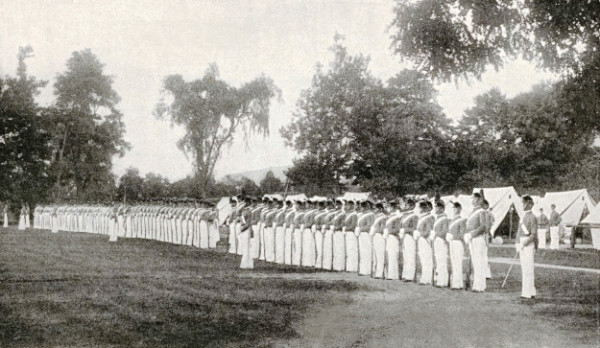
PARADE REST IN CAMP
Mrs. Ironwood and her fan at once absorbed the window, the two girls
stood shyly behind her; and back and forth before their eyes went the
slim grey figures in the area. Some who knew Mrs. Ironwood and doffed
their caps to her gave just a swift second glance at the two new faces.
For a cadet never stares, or does it so surreptitiously from under his
visor that nobody knows.
But the minutes seemed long. Mrs. Ironwood's fan plied back and
forth, the girls stood watching.
"What makes them all look just alike?" said Violet. "I should say
that man has been across six times already." Mrs. Ironwood laughed.
"Maybe he has," she said. "You'll bring the chaos to order in a day
or two. Look very monotonous, don't they? I suppose you'll not even
know Magnus when he comes."
But a little cry from both the girls answered that. Another grey
figure came hurrying across the open space, swung his cap high in air
beneath the window, and came tearing up the stairs.
After the first words, Mrs. Ironwood went back to her seat, and left
them to themselves, interviewing at more length some of her friends
below; but then she made a move.
"We must get out of here," she said. "There come more bonnets, and
there'll be more cadets, and we shan't have standing room."
"When the bugle blows," said Magnus. "I can't leave here till four
o'clock. But it's close on that now."
"And then we can have you all the rest of the afternoon," said
Violet.
"No, little peach blossom, you cannot. There's a review on hand.
I'll take you down to the seats. There it goes—" And the sweet
four o'clock call rang out in front of barracks,
repeated then at different points, and answered by soft echoes from the
hill.
The little party made their way out, and down among the old trees
by the officers' row, where already the seats were filling up. But
Magnus found them a good place, and himself stood in front; mounting
guard over his treasures with a joy and pride it was pleasant to see.
He quite ignored the suggestive looks that came from other men in grey.
Just now, he wanted his sisters all to himself. And the way they gazed
at him could not be told.
To see how he knew by instinct when an officer came by; instantly
whirling around to salute, to note how very often that cap came off to
some embodiment of fashion and finery, was a great study. For Magnus
was on tiptoe, and put in all the flourishes the law allowed. Only at
the sound of the first drum did his exalted state come down.
"That drummer ought to be hung at the sallyport," he said.
"But it is all so pretty," said Rose. "And so in keeping,
Magnus."
"You do not know drums," he said. "That call means: 'Charlemagne
Kindred—and every other cadet out for a breath of fresh
air—walk straight off to barracks.'"
"Does it?" said Violet. "Then why don't you go? We'll walk over with
you."
"Sit still! Why don't I go?" and Mr. Kindred gave fresh utterance to
his disdain.
"Now it sounds again," said Rose. "Is that a second invitation to
'walk'?"
"No; this one says: 'Magnus Kindred—and every other man who is
enjoying himself—run!'"
"O, then, do go, dear!" pleaded the girls. "O, Magnus! do not be
late. See, those men are running."
But Magnus gave no sort of heed. He bowed to Miss
Newcomb, looked after the speeding grey coats, and remarked calmly:
"Let them run. They want practice." But when the next call sounded,
Magnus turned.
"That spells," he said: "'Magnus Kindred—and every other poor
fellow who doesn't mean to be skinned—scamper!'" and scamper he
certainly did. The two girls watched him, breathless and anxious.
"There are three ladies right in his way," said Violet. "Oh, I hope
they'll not stop him!"
But no, indeed; a cadet dodging a "late" is not so easily stopped.
Magnus knew them, took off his cap to them, spoke some words of
greeting, but never stayed his pace; and his sisters had the pleasure
of seeing him dive in through the sallyport before the drum said
another word. Then they looked at each other and laughed.
"Such a boy!" said Rose.
"But how he did run," said Violet. Then they both were silent with
intensest interest. For the old grey barracks presently took to itself
the well-known likeness of a beehive in swarming time, and ignorant
eyes could as little tell what was going on as the uninitiated can
guess that the bees are searching for their queen. Hanging round the
doorways, clustering in front, with new forms all the time pouring out,
until, like the tin pan of the farmer's wife, that mysterious drum
brought order, and they settled down in a long, long line upon the
sidewalk.
Just at this point, with all the dangerous element in safe bonds,
Mrs. Ironwood left her girls for a while and went for a chat on one
of the hospitable porches behind her. Several other people also moved
away, for a walk or a talk; and the vacant seats were taken by a
handful of girls just come on the ground, and who, noting the new
faces, were now in the keen pursuit of knowledge.
At first, however, they seemed more eager to give it, talking
fast and loud, and sometimes across the two young
strangers who were watching every movement on the plain.
But when the march down from barracks ended in another
motionless line upon the green, and each girl began to
pick out her friends and favourites, despite the confusing
chin-straps, then it was impossible not to listen.
"Look at Mr. True," said one; "he's a mere mathematical line."
"He'd be adorable, if he wasn't such a poke," said another.
"I'd give more to see that man brought to terms!"
"What terms?"
"Unconditional surrender. Down on his knees."
"Mr. Randolph is just behind him," said the first. "And Mr. Crane is
fourth from the end in B Company."
"Which is Mr. Kindred?" said Rose, turning to her.
"Second man with the cross-belt. Do you know him?" said the young
lady, much surprised.
"I have met him several times."
"Well, anybody who knows Magnus Kindred after meeting him 'several
times,' may go up head," said Miss Saucy.
"Is he a poke, too?" asked Violet, with a grave face.
"No, he's too wicked for that," said Miss Cray.
"Wicked?" said little Miss Wren. "Why, he's one in discipline all
the time."
"Well, he'd better be two, and have a few grains of civility," said
Miss Cray. "Absolutely he left me all standing in the middle of the
plain yesterday, just because that ridiculous drum chose to beat!"
"But that was a very good way to be left," said Rose merrily.
"Perhaps if you had been all falling, he would have stayed."
"Fine idea to work up!" said another girl, laughing, but Miss Cray
tossed her head.
"Nobody cared, either way," she said. "How do you know what
'perhaps' he would have done?"
"Why, we are both his sisters," said Violet. And for once in her
life Miss Cray was taken aback.
"Fancy it!" she said. "Where are you staying?"
"At the hotel."
"We are at Cranston's. Who is your chaperon?"
"Mrs. Ironwood."
Which was better care than Miss Cray herself could boast, and so the
force of circumstances dealt another blow.
"Well, don't serve me out too large a slice of humble pie," she
said. "I'm awfully fond of Mr. Kindred, myself. The trouble is, he's
not so awfully fond of me. And wounded hearts, you know!"
"If Mr. McLean were here, he'd say: 'Steady!'" remarked Miss Wren.
"Do you know Mr. McLean, too?" she said, turning to Violet.
"Yes."
"Met him 'several times'?"
"Yes."
"But you must come from the West?"
"There are quite a number of people out there," said Violet.
"And one can visit, even on a prairie," said Miss Cray politely.
"But it seems so odd."
Perhaps for a freer discussion of the oddity of things, that party
moved away, and Mrs. Ironwood came back to her charge. But social
duties still claimed her to such a degree that she hardly looked at the
review, and not at all at the girls, for a good while. Then in some
moment of silence, a soft, long-drawn breath made her turn her head.
The cadets were just passing, double-timing round the square, and
the good lady saw that her two girls had hold of hands, and that the
eyes of both were full. What about? Only for one particular dress coat
with a white cross-belt,
one particular pair of shoes that darted past; the owner whereof was
so far from feeling himself a hero that he was just pronouncing under
breath the whole review a mean contrivance to keep men out in the sun.
Ah, young brothers! have you any faint vision of what your sisters see
in you?
"Pull up your wraps, girls," said Mrs. Congressman. "It turns cool
here, the minute the sun drops behind the hill. And I suppose wild
horses wouldn't get you away before parade. Well, they'll have dealings
with that man."
The end of the battalion was just passing, one single cadet officer
bringing up the rear; and this man's sash had come untied. And as he
darted on, one long red streamer trailed gracefully behind him; too
heavy to float, unless with more wind astir.
The girls were in fits of merriment; only our two girls looked
grave.
"Just think!" whispered Rose; "it might have been Magnus."
"But why doesn't he stop and tie it up?" said Violet.
"Stop and tie it up?" said Mrs. Congressman, who caught the words.
"Why, if his head was off, he couldn't stop to put it on. Not in a
review."
Between review and parade there was a charming bit of free time when
Magnus came down to see his sisters. Miss Cray and her party took for
granted he was coming also to see them, and there was some bridling and
handling of sugar-plum boxes. And it was quite a shock, when Magnus,
after bowing to them, turned away, and found himself a seat between
"those two Western girls," whom he could see any time.
Sweet brief minutes; I wonder if unlimited free hours can ever have
the subtle charm that used to hang over the now-and-then release from
quarters?
Mr. Starr came up to claim acquaintance, and presently
coaxed Rose away to introduce her to the sidewalk, as he said;
Cadet-Captain Trueman appeared, preferring the same claim, though of so
much later date. And Miss Cray looked on.
As for my two girls, they were more than content; Violet finding
the grave, dark-browed Mr. True a very interesting person indeed; and
Rose so taken up with Mr. Starr's sallies of fun and comment, that she
missed all the admiring glances bestowed upon her own sweet eyes and
laughing mouth. The first drum came all too soon.
Starr went on to just the point where they had turned before, came
slowly back and led Rose to her seat; then standing before her and
going on with his talk. And Miss Cray listened.
"Mr. Trueman," she said presently, putting in her word, "we had a
wager about you last night."
"About me? That certainly speaks you all ladies of much leisure."
"Now, don't begin to preach," said Miss Freak. "Be good for once,
and tell us."
"And what, if you please?"
"The point was this," said Miss Saucy. "Kate said that before you
will go down on your knees to a woman, you must have a cushion a mile
high. The rest of us thought that perhaps a yard might do."
"Pardon me!" said Mr. Trueman, with some energy; "if ever I kneel to
a woman, I shall want no cushion!"
And the tall cadet captain bowed gravely to Violet, touched his cap
to the others, and walked away.
A quick clearance of grey coats from about the seats followed. Over
by the innocent-looking reveille gun stood two soldiers in blue, at the
foot of the flagstaff were two more. The flag showed off its beauties,
lifting, falling, floating away in circling folds upon the fitful air;
then drooping, a mere line of colour against the staff. Then
came a series of wild yells from the front of barracks, answering the
roll-call, and then parade.
In spite of the dignitaries who generally "assist" at a review,
adding all that position or plumage can give, they never get off
anything at West Point that is quite so good as an old-time dress
parade. I use my adjective wittingly, for—no disrespect to the
new tactics, they hurt the effect. To-night everything was perfect,
even the music. The band struck up "Money Musk," or some other
time-honoured quick-step, known in those happy days before "Boulanger"
was heard of; the grey files came down the green in absolute order, and
drew up in a long, unbroken, glancing line, before the seats.
The hills across the river were in a glory of sunshine, the higher
heads that sentinel the north entrance to the Highlands showed sunlight
and shadow, too. The river went silently along, you could just hear the
paddles of the Mary Powell, as she speeded round Gee's Point on her
northward course. All this, while the adjutant dressed the line, and
brought it to parade rest.
"Sound off!"
It matters little what they played then, for as the drum major
raised his baton and struck his attitude, and the throng of bandsmen
went nimbly after him, our two Western girls were absolutely and wholly
bewitched. To see the black plumes slanting off as one before the
breeze, with the stir of a red sash here and there, and the glinting of
breast-plates and bayonets and bell buttons in that long moveless line.
Then to behold the band of musicians getting tangled up in a maze at
the turn, but coming out all right, and playing for dear life through
it all,—they were so wrapped and lost, no wonder the gun made
them jump.
Then the wonder of the manual, to unwonted eyes; the comical
different voices in which the sergeants reported, with hand on heart
(supposedly), and the amused guesses
as to how in Company D there should be two privates absent and
unaccounted for. Even the jumble of the orders was delightful.
"Headquarters Military Academy, West Point, N. Y., May 10,
18—" so much was generally plain. As also "Special Order. No.
forty three-e-e!" But whether it gave Cadet Nameless leave of absence
for two weeks, or said he was to be shot in two days, only the nature
of the case made clear. To their ears, it might as well have been the
one as the other.
The reading ends, the adjutant tucks the folded paper into the
breast of his dress coat, comes neatly round on one heel, and waves his
sword to the officer in charge.
"Sir, the orders are published."
"Dismiss the parade, sir!"
Another skilful pirouette, and the adjutant faces the line and
sheathes his sword.
"Parade dismissed!"
The swords of all the cadet officers rattle down into the scabbard,
the adjutant steps loftily back to his old place by the line.
"Forward! Guide centre! March!"
And with another gay burst of music, the cadet officers come
forward, salute the officer in charge, and disperse (in these days
draw up behind him); the long, grey line breaks into companies, the
music changes its measure, and away they all go to barracks, to the
sweet strains of "Pop Goes the Weasel!" Every right arm swings just so,
every black shoe sole displays its regulation state, in most regulation
order. But how many furtive blessings brushed the head of Cadet Kindred
as he went by, that obtuse young fellow never guessed.
Tea at the hotel, after all this, was prosaic enough, but doubtless
the most soaring bird comes down to rest, and finds the lower lands
quite bearable, with further flight
in prospect. So the two girls relished their bread and butter and
strawberries with no alloy, for was not Magnus coming after supper for
a walk? Magnus, and perhaps two more.
"Everything is so unusual," Rose said; "it makes one feel quite
distinguished. Think of walking 'till call to quarters!"
"Yes, think of it," said Mrs. Congressman, carefully creaming her
black tea. "Then you've been in the cars night and day since Monday.
You must excuse me, young ladies. I know girls are untirable where
cadets are concerned, but I am too old a bird for that sort of chaff,
and I am going straight to my bed, as soon as I see you off. With your
brother along, you'll not need me."
"May we sit on the piazza after we come back? Or must we go to bed,
too?" asked Violet.
"Sit there? Yes. Must you go to bed? No. Sit there and gaze at the
barracks till shutting up time comes, and then go upstairs and carry it
on from your window. You're not obliged to go to bed at all, while you
are at West Point. Who's coming to-night?"
"Magnus, of course, and Mr. Trueman. And Mr. McLean said he would,
if he could."
"Three for two girls; you begin well. There, they are coming out,
and you can go stand at the fence, and I can go to my bed."
"Why should we stand at the fence?"
"'Mahomet and the mountain,'" said Mrs. Congressman. "Bell buttons
cannot come any nearer, without a special permit."
"But I do not like that," said Violet, drawing back. "You know you
bade us not. It looks as if we were waiting for somebody."
"Silly girl! That is just what you are doing: now isn't then. Come,
I'll see you safe to the fence."
So under that broad, protecting shadow the girls went down the walk;
shy, and glad, and expectant, and just a trifle afraid; for were there
not four dark figures coming rapidly across the plain? It was all so
strange and entrancing; the straight shadows, the measured step.
"Ah, here you are!" cried Magnus. "Good-evening, Mrs. Ironwood."
"How d'ye do again," said that lady. "How d'ye do, Mr. Trueman, and
Mr. McLean—and, as I'm alive!—Mr. Bouché! I suppose two
of you have come for me. I'm so broad, you think one wouldn't hear
what the other was saying, and you could both fool me to your heart's
content."
There was a laugh and a protest (very honest, so far as the coming
for her was concerned), and then the young people turned away, and
Mrs. Congressman went to her much coveted repose.
"She fulfils her destiny," said Mr. Bouché, as he placed himself by
Rose. "The only possible use of a chaperon is to go to sleep."
XLIX FLIRTATION AND OTHER PLACES
When feelings were young, and the world was new.
—Pringle.
There is no need to describe that walk, nor the many that followed
it. Anybody who has been a girl—or had care of a girl—at
West Point, knows without telling; though doubtless the walks vary
according to the girl. But hither and thither, then as now, went Peace
and War, in endless new combinations. Down among the grey rocks and
green mosses of Flirtation, where the tide flowed by as softly as the
minutes, and all the pretty whispers sounded true. Or up on the old
fort; green enough once, but in these days pathetic as well as lovely
in its helpless decline, and where much history might have been talked,
and was not. Kosciusko's garden, Fort Clinton, even the Officer's
Row—what tales they might tell, and are silent.
I must do Mrs. Ironwood the justice to say, that she did not fulfil
her destiny after that night, so far as it involved going to sleep
when she should be on duty. And she did the duty well, as befits long
habit. Always accidentally on hand; keen-eyed, though taking no notice;
interfering when she must, in a way that was wholly pleasant—and
unmanageable. The two girls, so unlearned in the world, could not have
had a more wisely careful friend. Violet never guessed how it was that
she was generally free to walk with Mr. Trueman, nor why Mr. Clinker
always fell to the lot of Mrs. Ironwood herself. "She must be very fond
of him," thought the girls. And Magnus was careful,
too, in a way, and would by no means present everybody he knew to his
two young sisters.
So within that twofold invisible fence Violet and Rose moved
joyously on, and had—as they wrote home—"the very loveliest
time that girls could."
And it became plain to lynx-eyed Mrs. Congressman, that Magnus soon
ceased to be the only grey figure on the horizon. His walks with other
girls were borne meekly; and the days when he was on guard called forth
less lamentation. In short (in the prettiest sort of way) the cadet
fever had claimed our two young Westerners. As how should it not, when
they were in such demand? Men did not stand round them to see "what
those girls would do next," the poorest sort of a compliment; but came
for the real liking and appreciation of the fair womanliness, of which
even faulty men have an idea—or an ideal. Then fresh common sense
is very pleasant when you find it; and if Rose was thought too sensible
by some—or too sedate, Violet was as full of fun and frolic as
any young, unspoiled nature ought to be; so they set each other off.
But the fun was not pointed with slang, nor did the frolic show out in
shrieks of laughter, or in familiar ways. It never occurred to either
of them that it was witty to say "Get out!" or ladylike to beg for
buttons and buckles. Or interesting, to give a kiss to some man who was
unmannerly enough to ask it. But nobody dared that of them.
Mrs. Ironwood's "sleepy" eyes saw all these things; saw also,
by degrees, some others. She could tell, to a time, how often
Cadet-Captain Trueman had walked with Violet, as also that Violet
seemed quite unconscious that he came oftener than other men.
"Great pity!" said Mrs. Ironwood in her heart, waving her fan there
on the hotel piazza. "He's the best fellow living—and she's the
girl of girls for him. But she hasn't
a sou—and he hasn't; it would never do. I did try to keep Rose
in the way—but my! he'd get round a standing army. Study, drills,
examination, don't head him off one bit. A fine piece of three weeks'
work! And in ten days more he graduates, and there's an end."
And just at that very time, this is what was going on among the
casemates at Fort Putnam.
"Do you think you could live on a second lieutenant's pay?" Trueman
was saying. "It is not much, you know—but then at first we should
probably be stationed at some small one-company post, where it would
not be needful to make a show."
"I have never lived where it was needful, or possible, to make
a show," said Violet, with a bit of a laugh at the idea of being
"stationed" anywhere. "But you know I have had no chance to think of
anything yet."
"Yes, of course," said Trueman; "it's all very sudden to you. But
the first minute I saw you I knew I had met my fate, and I have done
nothing but think, ever since. Thinking out the fairest story that ever
came into any man's heart. And I am going so soon. Write home to-night,
will you, Miss Violet, and get leave to promise?"
And then with the sound of coming footsteps, the two drew apart a
little, and walked decorously down the hill; Trueman screening himself
carefully with Violet's blue parasol from the sun without, and she
conscious only of a strange new sunlight within.
Rose, meanwhile, was having a different sort of talk with Mr.
Bouché; an American, despite his French name.
He was a handsome fellow, stood well up in his class, and was
proficient in more than West Point learning; but as much adrift as any
unpiloted boat in all matters of faith, and some of practice. Why he
sought out Rose Kindred (as he had done persistently from the day she
came) it
would be hard to tell, unless from that peculiar masculine contrariness
which, as Mrs. Ironwood phrased it, "makes Arctic men always swear by
the South Pole."
It was Mr. Bouché's special delight to get Rose away from everyone
else, find her a splendid seat in some leafy nook, throw himself down
on the grass where he must needs look up and so could properly gaze
into her face, and then draw her into an argument. I do not know that
Rose was more wedded to her opinions than other women, but she knew
what she believed, which they do not all. And when the point was of
importance she could fight, and fight well; zeal and love of the truth
holding their own fearlessly against more polished weapons. Even as
did the old "Queen's Arm" in the hand of one of her ancestors at
Concord.
On this particular afternoon, every place seemed taken. Gee's
Point, of course, but also the seat by the river edge, and the almost
unscalable rocks, and the grey stones that lie about the way to Battery
Knox.
"Never mind," Rose said. "I am not tired. I would just as leave
walk."
"Tired! You? No," said Mr. Bouché; "you are the most rested creature
that ever lived. But I am a lazy fellow, and I want a comfortable
place, where you can lecture me."
"Upon your laziness?"
"Upon what you will. I need it all round."
"There will not be time for an all-round lecture before parade."
"Bother parade!" said Mr. Bouché. "Why need you remind a fellow
of parade, just when he's happy? Here—come this way. Now we
can dive through these bushes—look out for your dress, Miss
Rose!—and we can sit on the rock and be out of the way of all the
spoons. And Catkins himself couldn't find us."
Laughing at him, guarding her dress, following through the tangle
like a true fresh-air girl, Rose presently forgot everything in the
loveliness that was all about. Behind them, trees and bushes were both
shade and screen; but in front there was only rock, river, and hill.
The grey ledge on which they stood took a sudden dip almost at their
feet, and went down, down, sheer and smooth, with little to break the
line till it ended in a low fringe of riverside bushes. And the stream
itself, curling rapidly round Gee's Point, went in full flow through
the broadening channel towards Anthony's Nose and the "Race." One or
two sailing vessels beat up against the breeze; from under the fringe
of bushes came the measured dip of oars. The east-side hills, with
their wavy outline, caught the full glory of the sinking sun.
"Oh, how beautiful!" Rose cried.
"Yes!" said Mr. Bouché, who had been eyeing the girl much as she
studied the landscape; "just what I was thinking."
"It is like nothing I ever saw anywhere else," said Rose.
"Nor I," assented her companion.
"You see, I have never been just here before," said Rose, turning at
the somewhat peculiar tone of voice. "Have you?"
"I am not sure—that I have," said Mr. Bouché, considering with
himself whether certain sensations in the region of his heart could
possibly (in a cadet of such wide experience) mean something new. "It
rather seems to me not. What are you going to lecture me about, Miss
Rose?"
"Nothing."
"Oh, yes, you are!" cried Bouché, rousing up. "That's not fair. It
is in the bond that you are to lecture."
"Who signed the bond?"
"I—for self and partner," said Bouché audaciously.
"'Himself and he,'" said Rose, quoting Cowper.
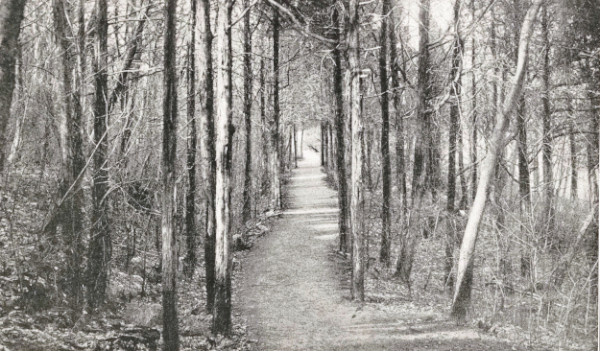
FLIRTATION
"Now, that is truly unkind," said Mr. Bouché, with an injured air;
"and therefore not like you, Miss Rose. And people should always speak
in character. I am surprised at you. Do you believe that I never think
of anybody but myself?"
"Oh, I suppose when you are speaking to me, you must be thinking of
me a little," said Rose, a faint tinge coming into her cheeks as she
made the admission. "Look at that eagle flying across the river."
"Let him fly—" said Bouché. "You really suppose I think of
you 'a little,' then? When it's week days and Sundays, Saturdays
and common days. When the reveille gun has grown sweet to my ear,
because——"
"Now hush!" Rose interrupted him. "That is a good place to stop.
Nothing ever yet made the reveille gun sound sweet to a cadet."
"Other cadets."
"Well, you are just another cadet," said Rose.
Bouché burst into a laugh, in spite of his efforts to look
tragic.
"There," he said; "she's making fun of me. It's all up. I am only
'just another cadet.' One more in her train. Only so many additional
bell buttons, and a pair of chevrons thrown in."
"Who is the professor of nonsense here?" Rose demanded. "I never saw
such proficients as you cadets are, in all my life. Have you had forty
pages to learn? and are you trying them off on me? Very well recited,
Mr. Bouché."
"It isn't at all. You are getting off grinds on me the whole time,
and that's not fair. I should think conscientious scruples would hinder
you."
"Conscientious scruples?"
"Yes," said Bouché. "The way you throw away opportunities tries even
my conscience. You see, Miss Rose, I
never had folks to stand round me and keep me straight. I've been a
Topsy boy, all my life."
"Topsy-turvy?" suggested Rose.
Bouché drew a deep sigh.
"There it goes again," he said; "I shall have to take it, I suppose.
But I guess it's true. And now, when somebody has a chance to set me
right, she don't do it."
"What could she do?" Rose asked, seriously now.
"For one thing, she could take a long, long walk with me on Sunday.
Keep me out of mischief the whole afternoon."
"You mistake, Mr. Bouché," said Rose, turning her clear, grave eyes
upon him. "Getting into mischief one's self, never helps anybody else
out."
"How would you get in?" Bouché said eagerly. "I'd max it on care of
you."
"Ah, yes, I do not doubt. But—I was not brought up so," Rose
said, hesitating over her words. "At home, Sunday is such a special,
set-apart, happy day. We never take it for common things."
"It would be a very special and happy day for me, if you would take
the walk," said Bouché. "Of course you would count it 'common' doings
to go with me, any day."
"It is not fair to twist my words," said Rose, looking troubled.
"Then if it would be uncommon, you can go. You are throwing down
opportunities, Miss Rose. I'll take you to some remote, far-wilderness
corner, and you shall preach to me till the drum beats. I'm as meek as
skim-milk on Sunday. Why, if you only tell me to take my cap and go to
chapel, I shall do it."
"But you have to do that."
"You'd better believe I wouldn't be there else," said Bouché. "But
I'll listen to you a quarter longer than we give the chaplain."
"I do not think you will—for I shall not speak, on Sunday,"
said Rose.
"Not speak! Turning into 'a sweet, silent Carthusian,' and thinking
up hard things to say to me on Monday."
Rose did not at once answer.
"Mr. Bouché," she said, "I think you make a great mistake about the
chapel."
"It's the biggest-sized mistake to make me go there."
"But if you went willingly, you would forget all about being made to
go," said Rose.
How Bouché laughed! Rose coloured a little, but stood her ground.
"I mean," she said, "the bonds you strive against are the ones that
press hard."
"Good beginning," said the cadet, controlling himself. "Go on, Miss
Rose."
"Well," she said, "then you need not have laughed at me quite so
much. But somebody says, there are two ends to a sermon."
"Only one here," said Bouché, "and that's at the beginning."
"Two ends," Rose went on steadily; "the human and the Divine, the
text and the preacher. If you begin with the preacher, one man may not
like him, and another one may——"
"That man hasn't reported yet," Bouché interrupted her.
"And it would be just the same," Rose said, "if an angel came and
preached to you. Some men would be sure to criticise him, and study the
length of his wings."
"Wishing he'd use 'em to fly away with; that would be me, every
time—unless he wore your bonnet."
"So the best speaker would not please you all," Rose concluded. "But
if you would begin with the text, you could not dispute that authority,
nor question that style.
You would not dare to criticise it. And if you were studying the text
all the way through, no sermon could seem dull, because it would have
such living light upon it, from the Lord's own living words."
There was such a light and glow on the girl's own face, that Mr.
Bouché gazed at her with evident admiration.
"All depends," he said. "Give me my particular angel for the
preacher, and the text may go."
"Mr. Bouché," said Rose, rising up, "I am sure I heard a drum."
"You can always hear a drum here, any time of day or night."
"Not that drum; listen!"
"Happy drum to be listened to."
"But seriously, we must walk on; you will be late."
"'One private absent.' Hard on the Com. But it's not imminent yet,
Miss Rose."
"Why, you do not look!" said Rose. "See how the shadow lies on the
river. Please go! Just run on; never mind me."
"Never mind you!" said Bouché, taking leisurely steps at her side.
"Not if I know it."
"Mr. Bouché, you will be late."
"Like enough. The first sergeant of D Company will tell it with
his hand on his heart, regretfully adding: ''Tis true, 'tis pity;
pity 'tis, 'tis true.' And old Powder Flask will jump for joy in his
regulation shoes."
"What for?"
"The chance of skinning me for the ninety-ninth time this week."
"Well, I'll not be responsible for his joy," said Rose. "Good-bye!"
And as they came to one of the many cross-paths that led towards the
plain, Rose suddenly turned up the ascent, running so lightly and
easily that it was almost as pretty to see as the regular double-time.
Bouché stood
open-eyed for a second, and then came up with her, fuming.
"Now this is atrocious, preposterous, unheard of!" he said. "I don't
care a button for a 'late.'"
"Well, you should," said Rose, laughing round at him, keeping
her pace and her breath admirably. "And this might turn into a cold
absence. You ought to care. Magnus says discipline counts. There's a
different sort of text for you."
"I vow!" said Bouché. "Don't you give me any of his wise sayings,
or I'll punch his head when I get back to barracks, the first
thing."
"Not the first," said Rose with a gay laugh, as they reached the
edge of the open, "Look! there goes the band. Run, Mr. Bouché!"
"As if I hadn't been running!" said Bouché, much aggrieved. "Miss
Rose, I'll owe you one better for this."
And then, run he did.
L FAIRYLAND
Their shields before their breasts, forth at once they go,
Their lances in the rest levelled fair and low;
Their banners and their crests waving in a row.
—Frere.
The first week in June at West Point is such an old story that I
had best not say much about it here. The (generally) perfect weather,
the stirring drills, the crowd of lookers-on, with the sort of jail
delivery from study hours and usual restrictions. The cadets come out
and sun themselves like hibernated bees, or bears, with an unlimited
taste for honey. "Best" dresses sweep the ground, "best" bonnets brave
the wind; only the serene blue sky looks down unmoved at the show and
frolic and madcap doings of the people. It is a little older than
they.
The furlough men are wild with joy and expectation; the plebs have
grown two inches since May. Second classmen are sporting imaginary
chevrons (the nearest some of them will come to it); and the almost
graduates walk at ease, kings in their own right. Bewitching damsels
repeat the question, "O, where do you expect to be stationed?" But
alas, the reply is not always, "Anywhere—with you!" That might
have been in yearling camp; but things have changed; cadet limits are
down; and Choice opens its eyes and waits.
In fact, there is need of some sober sense just now. For with the
looming up of Fort Grant or Custer; Barrancas, Camp Assiniboine, or San
Carlos: comes also the question
of comforts and climates. These delicate creatures can walk all day
and dance all night in West Point air. But what will their high heels
do at Huachuca? and how will their fair cheeks stand the heat at Eagle
Pass? Are they brave to be left with only soldier attendants when the
young lieutenant is ordered off on a scout after Indians? Can they
make bread, where the baker does not come round? and keep their sweet
patience when some "ranking" new arrival swoops down upon their pretty
quarters, and bids them move? Or again, what if the modest pay of a
second-lieutenant should not comport with twenty-dollar bonnets?
Such questions go for little, when it's "a girl I have known
for fifteen years"; but they press rather hard upon last week's
acquaintance. No wonder many a face in the class looks thoughtful. And
no wonder, either, that there are so many last leave-taking walks, for
just the fair outlines and the grand old river, near and among which
the men have won their shoulder-straps.
Among all the unwonted eyes that ever saw June come over West
Point, none could get more delight than did Cadet Kindred's two young
sisters. The mere shining out of the whole post in white trousers was
an event. And the guns that greeted the Board of Visitors were, to the
full, as imposing, as the various "planks" in that respected body. The
girls watched every point of the welcoming review, and then studied
the chosen guests as they trooped into the "big house" reception. But
better than chicken salad indoors, was the music discoursed by the band
in the pretty grounds outside. It may be said, however, that Violet did
not fail to see Mr. Trueman, in sash and plume, go up the steps with
the rest of the graduating class, and to think for one brief moment
that it might be pleasant to go there too.
Only parade that night, but a wonderful walk after supper;
and next day, and every day for ten more, a series of varied pleasures.
The examinations in the library were positively awe-inspiring; such
battle plans, such hieroglyphics. There was some trembling of heart
the first time they saw Magnus under fire; but he so plainly knew
what he was about, that fear soon passed into rejoicing. And when Mr.
Clinker was set to read Spanish, and the story (as translated) sounded
unutterably ridiculous, Mrs. Ironwood declared that her two girls
behaved better than she did.
Something of this in the morning; at night a concert; in the
afternoon a drill. Perhaps on the cavalry plain with the ear-tearing
racket of the Light Battery; where the guns were sometimes pointed at
the ladies, and the ladies cried out, and stopped their ears, and ran
away; and the hills sent back the thunder, and the descending sun half
glorified the clouds of dust. Or maybe they went down by the river, and
saw Mr. Trueman and a throng of unknown men build the pontoon bridge,
themselves sitting on the grass in a blaze of sunshine, which the north
wind softened down. With gay dresses on every side, and grey-and-white
men standing behind them, or down on the grass too. Sugar-plums
in many hands, the perfume of flirtation in all the air; and certainly
their own attendant cavaliers were well disposed for both these soft
delectations. But if Rose looked round, it was generally to put some
intelligent question, which Bouché could only answer in kind; and
Violet's bright eyes were too eagerly watching what Mr. True did with
his boat, to heed what Randolph whispered about them.
How skilfully those huge grey pontoons swung into line; how stirring
was the sounding tramp of the plank-bearers; how curiously they locked
arms going back, and how very charming was the walk over that strange
bridge when it was done.
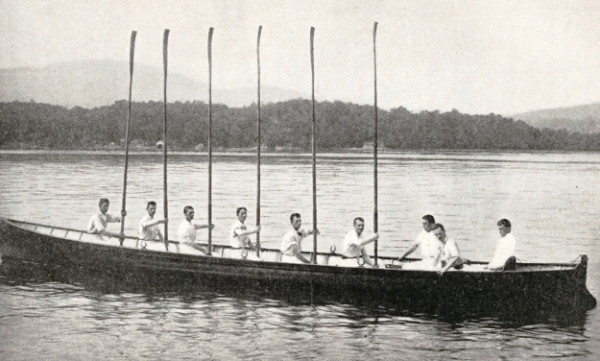
CADET BOAT AND CREW
Another day came skirmish drill, with the grey files in all sorts of
varied action; the men scattered over the plain as a sower casts his
seed. Speeding down in the hollow, dashing up the ridge, disappearing
behind the trees, and firing straight at the pretty spectators. In
those days, the short midway rest was all right for visiting; and so,
when the other men dropped down on the grass, Magnus and Mr. Trueman
and quite a little crowd came over to the seats, cap in hand. Smoky,
and dusty, and hot—and charming—for a few minutes of lively
talk. To the begrimed warriors every girl looked perfectly resplendent,
in her fresh summer dress.
Then, as the drill went on, and the privates came down on one knee
to fire, or crouched down, or lay at length, with the cadet officers
standing motionless behind them; what terribly exposed positions the
chevrons seemed to have! What a mark for the enemy's guns was each
straight figure, casting its motionless shadow across the sunlit grass.
Bullets might whistle over the men on the ground—but for these!
It was all too real; and the young sisters were glad when those on the
ground sprang up, and leaders and men were merged in an equality of
danger.
One night there was the noisy, vivid, weird mortar drill; touched
up with talk, flitting changes of place, comments, explanations, and
fairyland bursts of red fire. What a night that was! The roar of the
guns, the soft-spoken words; the flash-illumined smoke, the dark
figures behind the "footlights" on the battery; the motley human mass
which the crimson fire caught in its red glow.
Less picturesque, but more breathless in interest, was the cavalry
drill on the plain and the grand charge.
In happy ignorance that surgeons and their attendants were in
watchful waiting, the two girls found the whole thing just magnificent,
and caught no hint of danger, even from other people's outcries. There
was one lady in particular,
handsome, well-dressed, and knowing everybody, whose son was in the
drill, and whose fears were many and public. In the midst of the most
harmless evolutions she was, as she phrased it, "on thorns"; and she
danced about as if it were true.
Up on a seat to see better; down again that she might not see
at all; with little cries and shrieks and groans of fright or
expostulation—it was droll enough. Rose thought she would watch
her when the charge really came,—and forgot her as July forgets
December.
There had been a few minutes of seeming quiet, the squad all down by
the library; but anyone who looked keenly could see this man examining
his bridle, and that one tightening the girth. You could see them
looking to their stirrups, or rising a little in the saddle to get a
better seat. Then they began to move forward, slowly at first, then
quicker, till the word was given:
"Charge!" and horses and men came tearing along like a Kansas
cyclone upon the resounding road.
In some of the quieter moments before the charge, Rose and Violet
had picked out two or three men they knew, noting their horses (they
were not all dark then); and now, even in that dusty whirlwind,
the grey and the black could be seen and followed. And—yes,
certainly—Mr. Trueman's horse has leaped the Hotel fence, and the
plucky rider puts him at it again, and comes bounding back. And Mr.
Clinker's steed has swerved at the crossroad and gone dashing along
towards Trophy Point, for freedom and Highland Falls. However, he
missed in both, and everything came out right, and nobody was hurt; and
the drill was pronounced in every way first-class. But for days after,
when Violet shut her eyes, she seemed to see the flashing sabres, and
hear again the ringing shout; and to watch that particular grey horse
as he leaped the hedge.
Then came graduation; and Violet had the first sight of
Mr. Trueman's diploma, as soon as he could step aside and show it. And
Magnus was made first captain, and Mr. Bouché shone forth as adjutant;
and even Mr. McLean found his arm adorned with three bright bars, to
his own astonishment.
"All owing to Kin," he confided to the two sisters. "If he hadn't
pinched me black and blue every day since Christmas, I should be on my
way back to Kansas, to hoe potatoes for the rest of my life."
It may be said, in passing, that Mr. Trueman lingered at the post
for a few days in "cits," and finally departed with a permit to show
himself in the Western home, and plead his own cause there.
Mrs. Ironwood lingered, too, even longer, to let her charge have a
taste of the pretty concerts and guard-mounting in camp; and then the
girls packed their trunk, and saw the hills fade away in a mist that
was all in their own eyes.
LI THE HOME-STRETCH
A gold fringe on the purpling hem
Of hills the river runs,
As down its long green valley falls
The last of summer suns.
Along its tawny gravel bed
Broad-flowing, swift, and still,
As if its meadow-levels felt
The hurry of the hill,
Noiseless between its banks of green
From curve to curve it slips;
The drowsy maple shadows rest
Like fingers on its lips.
—Whittier.
To come down from two girls of your own to none, is a long step; and
I think if ever Cadet Charlemagne was ready to put the full value on
the many fair and gay women at the Point, it was just then, when his
sisters had gone. Not another sight of his own to be hoped for till a
whole long year should roll away. First-class camp though it was, I
think he would have liked the busy term-time better.
But he talked with Miss Lane, he walked with Miss Newcomb; and did
the civil thing to a handful of new visitors; went to picnics, teas,
and such like merrymakings; and through it all found himself pining for
Cherry, and wondering what they were all about at home. In the very
midst of the frolic, with bright eyes and soft hands on every side, the
refrain of the old song would keep coming up:
"O this is no' my ain lassie!
Fair though the lassie be."
Such a mood works differently with different men; with Magnus it
wrought in a very becoming fashion. For the high mark put upon the
three girls far away, set the standard for his behaviour to those
near by. "Help them," Cherry had said. And so, over his ordinary good
manners and winning ways, there had come that grave air of chivalry,
that deference to women because they were women, which sets off a
man's own manhood as nothing else can. His heart was elsewhere, but
his best service was theirs to command. Now and then he ventured a
reproof.
"You must not do that," he said one day to Miss Lane; receiving an
instant "Thank you!" which spoke her good stuff. And even when he came
between Miss Saucy and some lawless escapade with a firm: "You shall
not do that!" the words were so courteous and earnest that the girl
yielded with:
"There, there—I won't. Hush up!"
It was kind work to do, and the giving pleasure was always pleasant;
but for his own delights Magnus fell back into his solitary woodside
walks, with now and then a long pull upon the river. Up and down the
shining current; fighting the wind, breasting the tide; tossed with
mimic billows, or shivering a mirror of blue; so he went. Now coasting
along at oar's length from the shore, where the hills rose up in
castellated masses of rock and the cool shadow lay deep; then resting
on his oars, and gazing through the peerless north gateway at the
flood of sunset over Newburgh Bay. Sometimes showing it all to Cherry,
"on their wedding trip"; or again, sent back here as Commandant, with
Cherry the fair Frau Commander of the Post. And then—
A faint strain of music broke in upon his dream; the oars hung
motionless, dripping their bright drops.
A soldier's funeral was passing slowly up the winding Camptown road;
the grave notes of the band coming clear and soft across the water;
the flag drooped midway. Magnus reverently bared his head. Then he sat
listening.
There was so little tide that a dip of the oars now and then kept
the boat in place; and Magnus sat there motionless, until the third
volley rang out among the echoes, and to the usual lively racket the
men came marching home.
"Yes!" he said to himself, as he began to pull down stream again.
"When the time comes for Old Glory to wrap me up, let them bring me
here and lay me there, to sleep among the hills."
And with a shake of the head at his own musings, Cadet Charlemagne
made the boat fairly spin till it reached the landing, and dashed into
the sallyport with full five minutes to spare.
The Fourth of July that year rose exceedingly hot. A misty haze
veiled the mountains, the dew lay thick on every blade of grass; the
silent black-mouthed guns were dripping with moisture.
Being a holiday, even the reveille gun took an extra nap; and
the camp lay in absolute stillness for a half hour beyond its usual
time. Only the sentries paced up and down in the heightening glare;
and far away in the Logtown regions you could hear the sputtering of
fire-crackers and know that Independence Day was begun.
Meanwhile, by the same token, a lively ambush was preparing in the
quiet camp—a thing not distinctly set down and forbidden in West
Point rules, and with what we call constructive evidence cadets concern
themselves but little. And so with happy unconcern, Magnus and Twinkle,
and pretty much all the first class who were not on duty, arranged the
frolic. And for once the plebs liked their orders.
Up came the sun, touching Crownest, gilding Fort Putnam,
peering into every bush and tree; and from the other side up came the
band, their white helmets making a winding line of light across the
plain. They took post at one corner of the camp; and then, as the Stars
and Stripes swung slowly up to the head of the flagstaff, began their
march and their music, saluting the colours.
You have all heard how the piper of Hamelin played the rats out,
where none were seen before; and something like that happened now. The
camp was for all useful purposes asleep. But as soon as the inspiring
notes of "The Red, White, and Blue" broke up the stillness, there came
a stir.
At quick step, and to a full-blast medley of national airs, the band
passed through the camp; up A Company Street and down B Company Street;
and as they went, out poured a chance-medley crowd to match. A crowd of
plebs, wrapped in sheets, in blankets, in every sort of harum-scarum
costume; with brooms for muskets, and the strict orders of upper
classmen for regulations.
With all other cadet eyes peering through tent curtains to watch,
the crazy throng came after the band in full procession. And even when
the officer in charge woke up to the state of things, these agile boys
kept out of the way; slipped through between tents to the next Company
street, and then re-forming and marching on joyously, until, as the
band came round to its starting point, and "Yankee Doodle" filled all
the air, the queer contingent drew up in order before them, solemnly
presented arms (alias broom-sticks) scattered, dived, and disappeared.
And only the most sedate and orderly faces could be seen at roll-call.
That was great fun. Better than the Fourth of July dinner, Magnus
declared.
The usual festivities graced the morning. The muster, and the march
across the plain to the old trees before the library. The band played,
Magnus read the "Declaration,"
and Mr. Bouché made a speech which proved him, in theory,
a model patriot.
Then the midday salute of forty odd guns thundered out among the
hills; returned by them in six times as many echoes; and the work of
the day was done. Once upon a time, when powder was cheap, there used
to be a salute at sunrise, too, and at sundown.
Magnus strolled away to one of his haunts by the river, and sat
himself down to watch the tide come in. It was almost full flood; the
water creeping silently up, hiding every mud-stained rock, floating off
the drift from every corner. One could see how it picked up its freight
of chips and sticks and sawdust; but the current was so strong, the
water so bright, that the dark streaks hardly counted. In fact, Magnus
enjoyed the whole process, finding fair images for himself.
"Just so," he thought, "would the June-tide set in, when:
"Whatever of life has ebbed away
Comes flooding back, with a ripply cheer,
Into every green inlet, and creek, and bay."
Bearing away then, of course, to parts unknown, all the
disagreeables of life; studies, drills, and regulations. Wave motion
giving place to Cherry. "It is so pleasant," said one of these
pre-graduates to me, "to think of never again having to do anything I
don't want to do!"
Magnus was so deep in his dreams down there one day that a step
close by made him start. This was no gauze-winged vision, however, but
a poor, homesick pleb. In the gray, baggy suit of first initiation,
with clouded brow and an air of general forlornness, he looked as
little like flood tide as a fellow could do.
He glanced at the trim first classman down among the bushes, went a
few steps on, turned, hesitated, and finally came up behind Magnus.
"Shall I disturb you, sir?" he said deprecatingly.
"No; come on. Rocks are Government property. You're Mr. Renwick,
aren't you?"
"Yes, sir."
The boy sat himself down at the water's edge, and looked gloomily
off. He was a slight fellow, just touching the regulation age;
fair-skinned, soft-haired, with an unmistakable air of love and petting
about him. "A mother's boy" all over. There were hearts aching for a
sight of him somewhere, without a doubt.
Magnus eyed him a while from a first-class standpoint; then his look
softened. What wretched, desperate hours he himself had spent in that
very dress among those very rocks. And then of a sudden Cadet Kindred
fell to wondering what the Lord would say to this poor heart, were he
there himself in bodily presence? And the reply was instant:
"Be pitiful, be courteous."
"You were in the pleb formation on the Fourth?" he said abruptly.
"Yes, sir."
"Liked it?"
"No, sir. At least I liked it well enough, but I didn't
enjoy it."
"Why not?"
"Last Fourth was better."
"Oh, was it!" said Magnus ironically. "Did you think to bring
home-doings in your pocket when you came to West Point?"
"No, sir," said Renwick, with a sigh. "I suppose not."
"If you had all you wanted at home, why didn't you stay there?"
"I had not all I wanted," said the boy, rousing up. "I wanted an
education, and we were too poor for me to get it anywhere else."
"My case precisely. And to-day you think home is worth all the
education that ever was heard of. So have I, a thousand times. But it
isn't, for all."
"Did you ever feel so, Mr. Kindred?" said the boy, changing his
seat for one a little nearer. "Everybody says you've had a clear run of
luck, straight through."
"Stuff!" Magnus answered him. "Are you a Christian, Mr. Renwick?"
"I hope so, sir."
"Hope so! Well, are you an American?"
"Why, of course I am."
"How do you know? You may be a Chinese."
"Well, I know—whether I can tell how or not," said the boy.
"Certain sure where you belong in this world, and not sure at all
where you belong in the next. Unsound business, Mr. Renwick."
Renwick looked at him.
"You are a queer man!" he said.
"My one distinction. Found I couldn't lead off in anything else,
here. What are you going to be?"
"A success—if I can, sir."
"Well, the only way to success is, to succeed."
"I know as much as that myself, sir."
"Practise it then. You might as well try to take that hill at one
jump, as think to be a success in January and June, and a failure all
the rest of the time. Unless you're a fine mixture of laziness and
mathematics. I am not myself."
"Very little mathematics about me," said Renwick; "and they speak as
if that was everything here. So I don't see what I am to do."
"Do?" Magnus said. "Why, dig like a prairie dog! Things are not so
deep down that they can't be routed out. And get all the help you
can, and take all you can get."
"Do you mean 'ponies'?" said Renwick with a doubtful look.
"I do not mean 'ponies'!"
"But they say you are always so busy?"
"O yes, I'm busy enough; have to look out for my own scalp, you
know. My advice is always at your service, but my time most generally
not."
"Then I don't see what you mean, sir."
"Have you a Bible, Mr. Renwick?"
"Yes, sir, of course."
"Read it?"
"Sometimes."
"Well, at one of those rare intervals," said Magnus, "put three
marks in it. A red one here:
"'Call upon me here in the day of trouble. I will deliver thee.'"
The boy drew a long sigh.
"Mother's verse," he said. "But that will not bring me home."
"No, and you don't want to go. Then a long blue one here:
"'What time I am afraid I will trust in thee.'"
"Hold on there," said Renwick. "I'm not afraid, sir, and I don't
expect to be."
"You will be, quite unexpectedly, some day, when you get into the
section room and find you have left your wits in barracks. But put a
broad white mark here, and keep it white:
"'Walk in the light.'"
"Keep out of all dark ways, Mr. Renwick. You can have the Lord's
help every time and all the time, on those terms."
Renwick looked at him again.
"Well, that's the first time I ever heard of getting through West
Point so," he said.
"Tiptop way, you'll find," said Magnus.
"And that is your whole list of directions?"
"Finished up with the first one: dig! You must work like all the
beavers between whiles, or you'll never have the face to pray such
prayers."
"I heard you were odd," was Renwick's comment.
"And now you think the half wasn't told you. Sound doctrine,
nevertheless."
"But mathematics!" said the boy; "and natural philosophy! and
Spanish!"
"Know them all through now, don't you?" said Magnus; "and so want no
help."
"No, no, sir! of course not. But I mean—Mr. Kindred, do all
the head men get to the top of the class your way?"
"Probably not."
"Then why do you lay it out for me?"
"Only sure way I know."
"To push me up head?"
"To put you somewhere where it's worth while for a man to stand,"
said Magnus. "You might come out head—and be a disgrace to
the service. You might go down before French twistifications, get
dropped—and live to bless the country some other way."
"I thought you meant I should be sure to graduate," said Renwick,
disappointed.
"There's but one thing sure." And rising to his feet, Cadet Kindred
chanted out a scrap of an old hymn.
"Looking off unto Jesus,
I go not astray:
My eyes are on him
And he shows me the way.
The path may seem dark
As he leads me along;
But following Jesus,
I cannot go wrong."
"Does it ever seem dark to you, sir?" Renwick said wistfully.
"Lots of times."
"It is so hateful here," the boy burst forth; "the place, and the
drills, and the cadets, and everything!"
"Yes, isn't it!" said Magnus heartily. "I have felt just so. Why,
there are days when I should like to shoot the cadets, burn down the
barracks, pitch all those old study books into the blaze, and tie the
Tacs within roasting distance."
The two looked at each other, and then both broke into a laugh.
"Splendid old place, isn't it?" said Mr. Kindred. "And the drills
are as good as the rack for stretching a man. And the cadets aren't
much worse than the rest of the world. You and I are two of them. Come
on! Let's go take a look at the flag. That always puts me to rights
when I turn sour. 'Hail, Columbia, happy land!' and West Point is part
of it."
"The sweet red, white, and blue,
The brave red, white and blue,
Has done so much for me,
And done so much for you."
LII THE BIG RECEPTION
When shall I come to the top of that same hill?
——You do climb up it now; look how we labour.
—Shakespeare.
A very busy six months followed first-class camp; the autumn full
of drills and study, the winter of examination, hard work, and the
Hundredth Night. With the opening spring poured in the usual flood of
tradesmen and their wares; company drills began, early visitors came,
and June was coming. The lower classmen, as usual, were on tiptoe with
glee and excitement; and, also as usual, were the ballasting thoughts
in many a first-class head. Questions of regiments, of posts, and of
girls.
But for Charlemagne Kindred all that was settled. If he were ordered
to the North Pole, and stationed on the tip end of it, he should still
take Cherry. And if he could not keep the wind from roughening her
soft hair, Lieutenant Kindred would be a much more incompetent person
than Cadet Charlemagne thought possible. Cherry was just the girl for
Arctic regions; she would sketch the icebergs, sing to the seals, and
teach them Greek. And in the long evenings by their driftwood fire,
they could plan out where to live when he wore three stars on his
shoulder, and was retired on full pay for special services as yet
unknown. A little soon for that, to be sure; but there is no harm in
being beforehand, even "quite some," as they say in New Jersey. They
could draw plans for the house, and so save on architects when the time
came.
Other big questions came up for other men. Should this
one assume at once the debt which the dear home people shouldered so
patiently to send him to West Point? And how much can this other save
from his slender pay, to help educate his young brothers and sisters?
It touches one's heart to see the dainty articles of dress that are
bought for the girls at home, whose life has been chiefly homespun.
Then what work will they find to do at the strange, far-away posts?
Work in that other army to which, as boys, they were mustered in? For
there are many church members in the corps; and I doubt if there is
one to whom the old vows do not come up in mind before graduation.
Sometimes, perhaps, with a never-so-keen perception of what Paul meant
when he said: "I have finished my course; I have kept the faith." Paul
could have claimed the lower honours too; learned, skilled, an acute
theologian, a matchless writer. But no earthly plaudits were in his
thoughts; only the Lord's "Well done"; the crown which those Royal
hands would give him "at that day."
The spring flew on, tossing off its freight of snowdrops, violets,
columbine, and apple blossoms. Twenty-three days to June, twenty-two
days; then came more tidings.
Mr. Erskine was failing, so the mother wrote; failing steadily and
fast. It was doubtful if Magnus would see his friend again; and the
young cadet's heart went out with a great yearning to the lonely girl
of whom he would so soon be the chief earthly protector. And once again
Magnus gave thanks for that grace which had brought him through the
fire, and made him fit to take such a charge. But none of them could
come for graduation.
"Of course we cannot leave Cherry," so Violet wrote; "one of us
is up there all the time. Cherry looks like a white wind-flower. O,
Magnus, I wish you were here!" And Magnus gave a groan and turned to
his tally: twenty-one days to June.
But he did what he could. He wrote Cherry a letter
every day, saying everything he could to beguile her thoughts. He sent
the last picture of himself, and the class picture, and a photograph
of the up-river view. In every letter went his marks for the day,
with what bits of mischief or of news the Post could furnish. He told
what girls he had walked with, and of his rambles alone; giving her
much to read and to talk of. With all this he studied untiringly,
refused invitations, went up in his marks, and was often fagged enough
when tattoo beat; but less with the work than with excitement and
tension.
He had applied for a regiment not then near San Carlos; but so much
depended upon how many men went to Willet's Point that he could guess
little as to his own placing. One thing was sure, he was learning
fast. Lessons of patience, of self-control, of trust; so winning true
promotion, day by day. Finding out also, with new understanding,
the exceeding helpfulness of prayer; learning to lay down cares and
questions at the feet of that blessed Lord Jesus who "doeth all things
well." Rank and post, life and death, could safely be left with Him! A
great peace and a great strength were in the face of Magnus Kindred in
those days.
If he seemed graver than usual, it was that with every chance his
thoughts flew away. Or, rather, were some of them always in that
far-off sick-room. For whoever else might be with her, Magnus knew,
unerringly, how Cherry's heart reached out for him. How, in every hard
moment, with every new token of the coming sorrow, the longing for him
leaped up and grew. Sometimes it made him almost desperate enough to
go, at all risks.
As a last comfort to himself and to her, Magnus took off his class
ring and expressed it on, bidding her wear it till he came to put
another in its place. She would not take it last summer, but she must
now. And there was no telling
what that ring was to the girl, and to her father as well,
making the bond so tangible and real. Cherry studied it in her lonely
night watches, and Mr. Erskine's heart gave thanks at every gleam of
the stone as her hands' sweet ministry came about him. While far away,
Magnus, on his part, was verifying and honouring all their trust.
So came on June, with her rose-trimmed slippers; and it seemed
that first summer afternoon as if the whole countryside poured down
upon West Point. Long before four o'clock the seats were full, then
crowded; the wagon-load of campstools vanished as they came; and soon
even standing-room was at a premium. And when the Board of Visitors
had reviewed the Corps, and the Corps the Board, everybody who had the
right crowded in to the reception, while the left-out throng whirled
round with one accord, and sat staring with all its eyes at the open
door and solid front of the Superintendent's quarters. If only X-rays
had been on hand! The interest grew to a keen point when the first
class (all together then, though now they go scattering in) passed
through the gate, doffed their plumed hats, and vanished within the
doorway.
Magnus was claimed by old friends and presented to new, had a great
grip of Mr. Wayne's hand, and brought little Miss Bee a plate of
lobster salad deeply bordered with sunshine.
I think Cadet Charlemagne had learned a little more about girls
than he once knew; and the light and colour that came into this
particular shy face at sight of him, smote him with a sense of at least
possible past mistakes. She had no need to think so much of his small
civilities. And Mr. Kindred bowed himself away, and made merry in a
gauzy circle of colours near by. And then, when Miss Bee looked so
left out in the cold, Magnus rushed up again, took her plate, brought
her an ice, and made things worse than ever. Manlike, he thought the
fast-and-loose plan worked to admiration.
Now privately, Miss Bee cared nothing for lobster and very little
for ice; but it felt so good to be noticed and to have something to
do, that I think she hardly knew what she had. And had not Mr. Kindred
said the ice would "refresh" her? So she ate a little, played with it a
little, and heard, nolens-volens, a good deal of talk.
"Why, here is Mr. Kindred!" said one of his Christmas friends. "All
on tiptoe for shoulder-straps."
"Mr. Kindred has small occasion to stand on 'tiptoe' for anything,"
said Miss Lane. "But what have you done with your beautiful class ring?
Not lost it?"
"Hardly, since I know where it is. Lost things are said to keep cool
company in the moon."
"What is keeping company with your ring?" said Miss Saucy. "Your
heart, of course?"
"Of course."
"Will she be here for the hop?"
"Since when were hearts feminine? No, I do not think 'she' will,"
said Magnus. "Hearts are best at home, hop nights."
The talk went on, the crowd drifted; and little Miss Bee in her
corner held her plate and ate her ice, and tasted nothing. Of course,
she had seen that the ring was missing; but then no girl had boasted
its possession. And men took whims.
What tales dark corners could tell; of hard-pressed fights, of
struggles, of victory! The band played, the throng increased—then
began to thin out. Presently Magnus came and took the plate from the
weary fingers, asking if she would have anything more.
"No, nothing," she assured him with a smile. But something in the
smile and its quiet patience, made him dart over to the table and fetch
a handful of the gayest bonbons and mottoes, and bestow them in Miss
Bee's own hands. A man's blunder, again! And yet perhaps not.
Of course the sweets were not eaten; they were conveyed away and stored
among Miss Bee's few chiefest treasures; but I think in time they
became a comfort, too; shining tokens of what a friend she had had in
one of the foremost men of the Corps. It could not be helped that this
put other men at a discount.
For the ten days that followed no one saw much of Cadet Kindred,
in any of those between-times that he could call his own. West Point
outlines had cast their lovely spell about him; and with every chance
he was down by the river, up among the rocks; climbing the leafy ways;
saying good-bye, and then coming back to say it again.
LIII THE FIRST POST — Transcriber's Note
A ravelled rainbow overhead
Lets down to life its varying thread;
Love's blue,—joy's gold,—and fair between
Hope's shifting light of emerald green;
With either side, in deep relief,
A crimson pain, a violet grief.
—Mrs. Whitney.
I never understand how people can chatter all through the graduating
parade. Standing before other people who fain would see, but with their
own backs to the show; gabbling on about trains and stages, weather and
wraps, to the utter discomfiture of the quiet souls who are straining
their ears to catch the "standing," just then read out by the cadet
adjutant; and finally pausing long enough to wonder "Whatever is he
talking so long about, anyway?"
"Headquarters Military Academy, West Point, N. Y. Special order, No.
fifty-nine!" So much with the knowledge that comes by iteration, you
make out; but the human wall shuts off the rest. Such people should
stay at home.
If you are a stranger and unwarned, you may easily miss some special
points in the show to-night. You will not know that, when the battalion
comes marching down to the tune of "The Dashing White Sergeant," it
means that from fifty to seventy of its men are on dress parade for the
last time. And as they come nearer and wheel into line, you will hardly
notice, that among those orderly grey figures, there is every here and
there one who carries only side-arms, his musket left behind. And when
these come out
and form a quiet line in front of the rest, you will not guess that
they are never again to go through the manual or be mingled with the
other men. Also for this night, the Commandant himself steps out upon
the ground, instead of the usual officer in charge.
The line is dressed, and then—
"Parade rest!" and then—
"Sound off!"
And with sweet, clear rendering, the band begins to play:
"In cottage or palace,
Wherever I roam,
Be it ever so humble,
There's no place like home.
Home! Home!
Sweet, sweet home!"—
O what does it mean, to those men who (except for the short
furlough) have been four years in exile! They give no sign; motionless
as so many statues; the black chin straps merging faces, and hiding
what may be there. The June air stirs the soft edges of the black
plumes, floating them off as one; the sunset glitters on buckle and
bayonet; the great garrison flag curls and uncurls its mighty folds.
"It may be for years and it may be for ever," before the men of
that front rank will look upon the scene again. They have hated it,
sometimes, and longed to get away, but now they know how well they love
it. What things those old hills and they have gone through together!
from the forlorn pleb days until now. And even with that thought, the
band lapses softly into another mood:
"Should auld acquaintance be forgot,
And never brought to mind?"
and every heart answers to the pleading of "Auld Lang Syne."
For these classmates, after to-morrow, will be scattered to the four
winds. Some, not to meet again till they are
grey-haired men; never all to stand together, until the day when
before the King "in his glory," "shall be gathered all nations."
Believers or unbelievers, they think of it now. They may not speak nor
touch each other, nor turn the head, but they think.
It is as well, perhaps, that "The girl I left behind me" puts in her
word just here, and you have to laugh, partly because you were so near
crying. But Lang Syne and Sweet Home have the last saying, as the band
comes back to its place.
Parade goes on, and for once everybody is "present or accounted
for." The orders are published, the standing read (not always, in these
days), and then the graduating class come forward, and with dress hats
off and held at the correct angle, shake hands with the Commandant and
have a short address from him. And while the little company pass down
and stand in line before the trees (not that either, now), the old
Commandant turns hastily away from the show, and seeks his own front
door. It is a long ago "Lang Syne" that he remembers, and far better
than these youngsters, he knows what all this means.
But the music begins again, with another change. "I see them on
their winding way" fills all the air. The lines break up; and buckle
and bayonet, sash and plume, come gaily past the seats, and then as
they pass the waiting graduates, again the plumed hats come off, while
cheers ring out in eager greeting from their comrades marching by.
"I know I shall cry when it comes to that!" said a gay young first
classman to me. And I have no doubt he did. But there are no lookers-on
in front of them, and the old plain tells no tales.
The next ten or twelve waking hours are little but hurry and rush.
The big hop on hand for society men: with farewell visits, last ends of
packing, and countless bits of red
tape to be tied in regulation knots. Then last looks at the river, and
hands laid lovingly and for the last time upon some of the old grey
rocks.
In front of the library a platform is raised, and draped with the
star-spangled banner, and a canvas canopy stretches across from tree
to tree. Strong ropes wall in the space below, where stand the chairs,
rank after rank, and as the morning hours run on, sentinels guard
the ropes against all intruders. The seats, of course, are, first of
all, for cadets and people of the Post, but just there does the dear
general public wish to sit, and for whom the chairs are placed affects
them not at all. So, for an hour or more, there is a sort of running
fight—a skirmish line—all round the lines of rope, and the
sentries well nigh meet their match. Demands, complaints, exclamations,
are loud-voiced and many, and neither orders nor fixed bayonets win
much respect.
"Those are the orders, ma'am."
"I'm not responsible, ma'am."
"No, ma'am, no one allowed inside the ropes."
"Sit there? Those seats are reserved for the mothers, ma'am."
"But we are the mothers," cried one good dame to the stony
official. And as the guard turned to ward off some new intruder, one
could but laugh at the adroitness with which she slipped in behind
his back, to be again ordered out. At last come dignitaries in such
very full feather that the crowd stands back and becomes a trifle more
modest. The hands on the clock move on, cadets who were wandering about
with mothers and friends leave them and go off to barracks. Men for
the platform come leisurely along, sure of a good place; the upper
ten for the seats below make more speed, seeking the best. Then the
superintendent, the adjutant, and all the glittering people in train of
the Board of Visitors, mount the platform, and
make it a study of sheen and colour. Drums sound in the distance, then
nearer, and the whole battalion comes marching down. They halt at the
back of the crowd, stack arms, and the graduating class file in and
take their seats.
There is a short prayer from the chaplain, "Hail, Columbia!" from
the band, and then the address—or, maybe two. From the president
of the board generally, followed often by words from some high ranking
officer, or some notability in civil life. Addresses sometimes wise,
sometimes more—otherwise—than one could wish; very seldom
vivid and instinct with fire. The country figures, of course, and "this
Institution," and the flag, with the service, in a mild sort of way.
All eyes are fixed upon this particular class, and the army welcomes
it with open arms. And the cadets have done well, and the professors
have done their best. On the whole, the sort of speeches to which you
would like to apply a match and bring them to either a blaze or to
ashes. How rarely—Oh, how rarely!—have these veterans in
camp or council one word of real cheer, wisdom, and fire, for these
"youngsters," these smooth-faced new recruits.
Perhaps it makes less difference than I think to the grave young men
waiting there, bare-headed and absorbed; they have been at such high
pressure, and have so much else to think of. They listen, and applaud,
from time to time, and generally in the right place. Once in a while
you may notice that just there the Southern hands are silent.
More music follows, and then the adjutant with his stack of diplomas
comes to the front and stands behind the Superintendent, or whoever is
to give them out: in the old days, it was often General Sherman. One by
one he takes the parchment from the adjutant, and the names are called
off in order of standing.
"Harvey Linton!"
A tall, dark-haired young fellow rises from the grey mass, comes to
the foot of the platform, and with a low bow takes the credentials for
which he has toiled so bravely.
"I congratulate you, sir," says the donor; "not so much for being
at the head as for the hard work which has put you there,"—and
Linton bows again, and goes back to his seat.
"Yes, he has done very well—ve—ry well," so his father
in the crowd answers friendly words, trying hard to seem unconscious
that his son has carried off first honours.
"Anson Dent!" and this time it is a broad shouldered Wisconsiner,
followed by a Virginian, a fair haired Hoosier, and all the rest. But
you notice other differences among the men. For while some smile and
bow gratefully, others give the briefest sort of nod, and some none at
all. Some flush, and some grow pale, and some hands almost grab the
diploma as if a right had been long withheld. And one casts furtive
glances towards a certain bewitching bonnet in the crowd, as he goes
to his seat, and the next sends a deeper gaze across the gay lines,
seeking a face and dress the plainest there, but the best beloved in
all the world; while many see only the friends a thousand miles away.
One man unrolls his diploma and studies it with all his eyes, his
neighbour plays with his, as if it were the veriest trifle—a mere
bagatelle.
"Charlemagne Kindred!"
And I am bound to own that this man went forward in a dream. With
one swift glance at Mr. Wayne, he did catch the loving interest in that
face, but the rest of the people might as well have been a fog bank. He
was feeling so much that he seemed not to feel at all, until when they
broke up, and Twinkle pressed through the crowd, crying:
"Where is my mother! I want my mother!"
And then Magnus could have shaken him, for daring to put his own
heart-cry in words.
Indiscriminate cheering was not the fashion in those days. A
specially popular man, or one who had done his work against special
odds, might have some hearty plaudits. But generally the applause was
kept for "the last man," who by brilliant carelessness or industrious
breaking of regulations, footed "the immortals." Of course, they
all cheered him. Had he not kept someone else from being "last
man?"—even now and then (it is whispered) closing up the class
end so that no one else could fall through. But after all, somebody
must be last, so cheer him on. He may outrank you yet, in life.
The scene changes. Everyone rises to the "Star-Spangled Banner,"
there is the benediction, the cadets march away to the "Left Behind
Girl" once more; and then girls present, who will not accept the
situation, tear along to the front of barracks to hear the new
orders.
The companies are drawn up in line, never again to stand together
there, and the adjutant publishes the orders for the last time.
It is a long reading. Lists of the men who graduate, of the men who
go on furlough, and of the new cadet officers; and again the friendly
chin-straps do the part of words, and "conceal thought." But if you are
near enough, and know the faces, you can see a gleam in the eyes of the
men who are to wear chevrons, or gloom on the faces of some who are
left in ranks, while the furlough men are almost dancing. But not even
a half-inch stir, anywhere.
When the reading is done, and they break ranks, then indeed frolic
breaks loose, and every sort of thing is on hand. Graduates rush
to their rooms, clasping a hand here and there as they go, to put
off the grey once more and forever. Furlough men also "scoot" away,
eager to come out in "cits" for the journey; while the others hug and
congratulate each other in a threefold tangle, sometimes; the new
officers hurry to put on their chevrons; and (lest the
fun should be one-sided) are now and then caught and borne away and put
under the hydrant by the zealous yearlings.
Meantime the sallyport fills up with girls, matrons, friends, old
graduates, and people in general. The gay overflow pours out into the
area of barracks, all waiting to see the young lieutenants and the
furlough men shine out in "cits." And they are about as different from
each other, when they come, as they were in the old candidate days. One
tall man in an extra tall hat, the next neat and harmonious down to
his small handbag, and this one just a trifle loud and mixed. Twos and
threes and one alone, hardly to be known at first, with their canes and
neckties. The furlough men shine all over with joy, the young graduates
have thoughts. So this face grows grave over a handshake, and this
other stalwart fellow breaks down in his words of farewell, and leaves
them unsaid.
Mr. Wayne stood there with the rest, watching for Magnus, and then
having a word with him from time to time, until that matter-of-fact
regulation drum beat the call for dinner, and the new cadet officers
marched the men away.
The air is still full of hurry, for most of those who are going want
to take the down boat, and there are a few last calls to pay, and some
unfinished business with the commissary or the "Com." But one way and
another the area is cleared, the men slip out of sight, and graduation
is over. Few words may tell the rest.
Mr. Erskine had passed away from this earthly life, during that
very week in June; and it was a very pale and grief-stricken girl,
much needing him, that Magnus took in his arms when he reached home.
And later on in the summer there was a quiet wedding, with just a few
classmates in full-dress uniform to light up the room, and Mr. Wayne to
join the two hands in a bond which should never be broken.
And their first post? What does that matter? However, it was one
with plenty to do, and some things to bear; a good place wherein to
shine as the Lord's true servants, and an excellent one from which to
look up to Him.
For the rest, it stood on high ground, with a fine outlook, and a
fair climate. It was called Fort Content.
Obvious typographical and punctuation errors have been corrected.
Blank pages have been removed.
There are inconsistencies in the display of attributions in the poetry and
quotes following chapter headings. These have been retained.
In the body of the text closing quotes have been omitted before poetry,
after a colon and in correspondence. The text reproduced here is true
to the original.