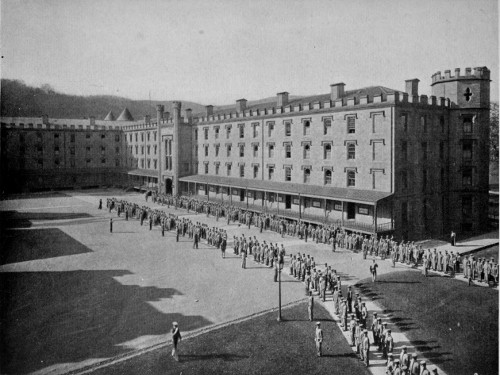
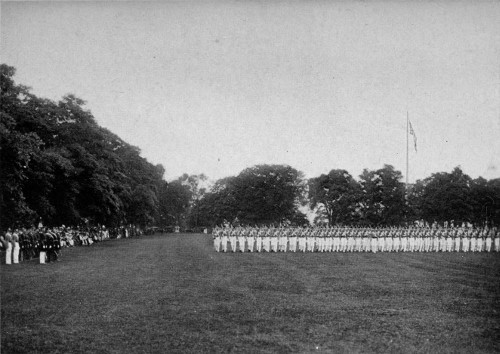
On a fine bright morning about the middle
of June, every year, the Corps of Cadets
wakes up to find that Battle Monument and vicinity
have been completely transformed. The
Quartermaster’s men have canopied a portion of
the monument’s platform with beautiful brand-new
flags, and placed under them comfortable
wicker chairs for the President, the Secretary of
War, the various generals, and other dignitaries
who usually honor West Point with their presence
on this graduation day. On the front edge of
the platform is a rostrum, flag bedecked, for the
speaker of the occasion, and spread over the green
lawn are rows and rows of seats that await
the coming of the cadets. Promptly at ten
o’clock, the Corps swings across the parade
ground to take its place for the final ceremonies
that mark the separation of another class from
its midst.
This is the day of days in the life of each man of
the graduation class. His four years are at last
completed and he is about to be given the great
prize for which he has so ardently striven—a
commission in the Army. As he takes his seat
in front of the platform, he is a little nervous in
spite of the joy at having achieved his ambition.
He realizes that he is about to sever the ties that
have held him fast for the last four years and to
bid farewell to a portion of his life that is finished.
A little tug comes at his heart-strings but it
quickly vanishes as he listens to the eloquent words
of the chief speaker, oftentimes the President,
unfolding to his receptive imagination the duties
and honors that await him in his new life as an
officer. And when the President reminds him of
West Point, of her traditions, of the advantages
that he has been lovingly given, and of what is
expected of him in the Army, there comes to his
eyes a moisture from pride and gratitude. Into his
mind rapidly crowd a thousand and one recollections
of his associations at the Academy. He knows now
that he must leave the Corps behind, that he must
renounce the delightful camaraderie of its members,
and give up the beautiful surroundings
wherein he has grown in body, mind, and soul.
It is true that he can no longer wear the “gray,”
or take away with him his friends, or the buildings,
but he does take away with him something
that is finer than all of these. One can see it in his
face and in his bearing. He goes forth, his heart
armed with the triple brass of Duty, Honor,
Country, and his soul filled with the Spirit of
West Point. All of his nature has been elevated
and benefited by this indefinable essence. It
forever connects him with hundreds of other men
in all parts of our country and identifies him with
an institution whose very name, West Point,
no matter where seen or heard, thrills him with
pleasure. This name connotes the details of the
most impressionable period of his life. Even the
words themselves seem to have a distinction and
personality that no other words possess. They
are flavored with romance and make one think of
something fresh and crisp and clean, something
almost hallowed. They are themselves clothed
with the spirit of the place under whose influence
and power he will forever remain.
He leaves the Academy to join the great fraternity
of West Pointers in the Service, animated by
the same spirit. With them, he is this year (1917)
called upon by the President to train for war a large
army of his fellow citizens, and prepare them to meet
an enemy schooled in the art of war by disciplined
leaders. West Point sends him forth to this task,
rich in knowledge. His Alma Mater is confident
that he will train these men of the new Army in the
fundamentals of their profession and that he will
inspire them with his ideals of courage and of honor,
and imbue them with the Spirit of West Point.
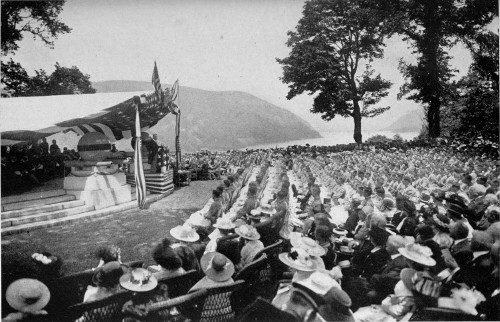
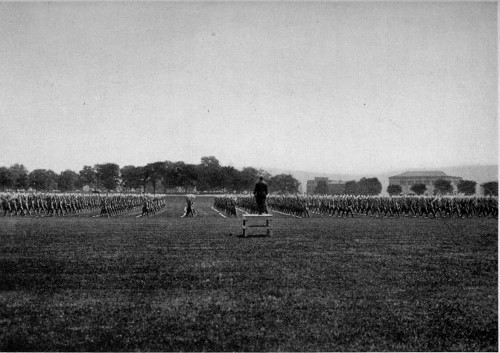
Photo White Studio
Graduation—President Wilson Addressing the Graduating Class
“We’ll bid farewell to Cadet grey and don the Army blue”
In the training of the National Army, he will
have all sorts of men under his command, but the
spirit of the Academy will make him patient and
kind with the stupid, lend a hand to the weak,
give a word of cheer to the down-hearted (there
will be plenty of them), and instill into all the ideal
of duty. The kind of discipline that he himself
received at West Point will be theirs. He will
teach them to bear uncomplainingly their burdens,
to be loyal and obedient, to care for their health,
and to march and to fight with a spirit that knows
not weariness or depression. Then when these
men shall be sufficiently trained, he will go with
them to France, in the wake of the first division
of Regulars led by a gallant West Pointer, Major-General
John J. Pershing. Here he will appreciate
as never before the value of a great moral force
like the spirit of West Point. It will aid him in
overcoming the obstacles in his path and in those
of his men, especially when the heroics of war
and the novelty of being abroad have ceased to
interest them, and they find themselves in the
trenches in No Man’s Land. They will be
drenched by the rain and burnt by the sun; they
will have to endure the vermin, the mud, and the
dust. They will be driven nearly mad by the
shrieking and bursting of the shells, they will see
their comrades killed and wounded, and perhaps
they too will suffer the same fate, but they will
not flinch; because he who leads them will have
given them something of his spirit—a part of
himself that West Point made. He must be the
prop upon which they may lean, if need be, and
his spirit the reservoir upon which they may draw
for refreshment. And should he be called upon
to pay the supreme sacrifice, he will leave them
the Spirit of West Point to carry them to victory,
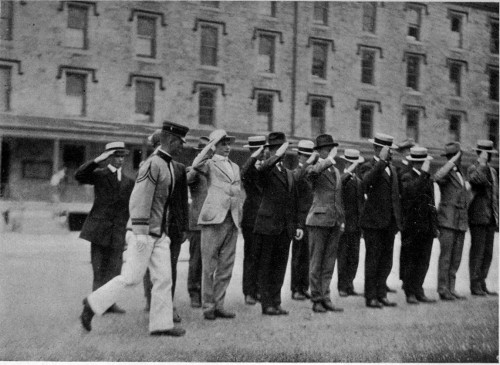
while he goes to join the ghostly assemblage of
his fellow West Pointers, standing bareheaded to
salute him, as he has stood many times in the
presence of the living Corps.
The Corps! Bareheaded salute it,
With eyes up, thanking our God
That we of the Corps are treading,
Where they of the Corps have trod—
They are here in ghostly assemblage,
The men of the Corps long dead,
And our hearts are standing attention,
While we wait for their passing tread.
We, sons of today, we salute you,
You sons of its earlier day,
We follow, close order behind you
Where you have pointed the way;
The long gray line of us stretches
Through the years of a century told,
And the last man feels to his marrow
The grip of your far-off hold.
Grip hands with us now, though we see not,
Grip hands with us, strengthen our hearts,
As the long line stiffens and straightens,
With the thrill that your presence imparts.
Grip hands, though it be from the shadows,
While we swear, as you did of yore,
Or living or dying to honor
The Corps, and the Corps, and the Corps.
The Act of Congress approved May 4, 1916, provides as
follows:
“That the Corps of Cadets at the United States Military
Academy shall hereafter consist of two for each Congressional
district, two from each Territory, four from the District of
Columbia, two from natives of Porto Rico, four from each State
at large, and eighty from the United States at large, twenty of
whom shall be selected from among the honor graduates of educational
institutions having officers of the Regular Army detailed as
professors of military science and tactics under existing law or
any law hereafter enacted for the detail of officers of the Regular
Army to such institutions, and which institutions are designated
as ’honor schools’ upon the determination of their relative
standing at the last preceding annual inspection regularly made
by the War Department. They shall be appointed by the President
and shall, with the exception of the eighty appointed from
the United States at large, be actual residents of the Congressional
or Territorial district, or of the District of Columbia, or of the
island of Porto Rico, or of the States, respectively, from which
they purport to be appointed: Provided, That so much of the
Act of Congress approved March fourth, nineteen hundred and
fifteen (Thirty-eighth Statutes at Large, page eleven hundred
and twenty-eight), as provides for the admission of a successor
to any cadet who shall have finished three years of his course at
the academy be, and the same is hereby, repealed: Provided
further: That the appointment of each member of the present
Corps of Cadets is validated and confirmed.
“Sec. 2. That the President is hereby authorized to appoint
cadets to the United States Military Academy from among enlisted
men in number as nearly equal as practicable of the Regular
Army and the National Guard between the ages of nineteen
and twenty-two years who have served as enlisted men not less
than one year, to be selected under such regulations as the
President may prescribe: Provided, That the total number so
selected shall not exceed one hundred and eighty at any one time.
“Sec. 3. That, under such regulations as the President shall
prescribe, the increase in the number of cadets provided for by
this Act shall be divided into four annual increments, which shall
be as nearly equal as practicable and be equitably distributed
among the sources from which appointments are authorized.”
Annual Increments.—States at large, 21; Congressional districts,
92; Alaska, District of Columbia, Hawaii and Porto Rico, combined,
1 each year to the source longest without an appointment,
and, when the periods are equal, the choice to be by lot; Honor
Schools, 5; Regular Army, 23 in 1916, 22 in 1917, 23 in 1918, and
22 in 1919; National Guard, 22 in 1916, 23 in 1917, 22 in 1918, and
23 in 1919.
How Made.—The appointments from a Congressional district
are made upon the recommendation of the Representative in
Congress from that district, and those from a State at large upon
the recommendations of the Senators of the State. Similarly,
the appointments from a Territory are made upon the recommendation
of the Delegate in Congress. The appointments from
the District of Columbia are made upon the recommendation of
the Commissioners of the District. Each person appointed must
be an actual resident of the State, District, or Territory from
which the appointment is made.
The appointments from the United States at large are made
by the President of the United States upon his own selection.
The cadets from Porto Rico, who must be natives of that island,
are appointed by the President on the recommendation of the
Resident Commissioner.
The appointments from among the honor graduates of educational
institutions designated as “honor schools” will be made
upon the recommendation of the heads of the respective schools.
The appointments from among the enlisted men of the National
Guard will be made upon the recommendation of the Governors
of the respective States and Territories.
The appointments from among the enlisted men of the regular
army will be made upon the recommendation of the Commanding
Generals of the Territorial Departments.
The Secretary of War is authorized to permit not exceeding
four Filipinos, to be designated, one for each class, by the Governor
General of the Philippine Islands, to receive instruction at
the United States Military Academy at West Point: Provided,
That the Filipinos undergoing instruction, shall receive the same
pay, allowances, and emoluments as are authorized by law for
cadets at the Military Academy appointed from the United States,
to be paid out of the same appropriations: And provided further,
That said Filipinos undergoing instruction on graduation shall be
eligible only to commissions in the Philippine Scouts. And the
provisions of section 1321, Revised Statutes, are modified in
the case of Filipinos undergoing instruction, so as to require
them to engage to serve for eight years, unless sooner discharged,
in the Philippine Scouts.
Date of Appointments.—Appointments are required by law to
be made one year in advance of the date of admission, except in
cases where, by reason of death or other cause, a vacancy occurs
which cannot be provided for by such appointment in advance.
These vacancies are filled in time for the next examination.
Candidates.—For each vacancy from a State at large, or
Congressional or Territorial district, three candidates should be
nominated, one of the candidates to be named as principal, one
as first alternate, and one as second alternate. The first alternate,
if qualified, will be admitted in the event of failure of the principal;
the second alternate, if qualified, will be admitted in the event
of the failure of the principal and the first alternate.
For vacancies in the cadetships allotted to the honor graduates
of the “honor schools,” one candidate may be nominated each
year before September 1st from each school. In case the total
number of candidates so nominated is not equal to three times
the number of vacancies, the War Department will assign additional
appointments among the schools to complete this total.
For vacancies in the cadetships allotted to the enlisted men of
the National Guard, the candidates will be apportioned as near as
practicable among the States, Districts, and Territories according
to their enlisted strength. With the exception of the candidates
from the District of Columbia, they will be selected by the Governors
from successful competitors in a preliminary examination held
between January 1st and January 15th of each year, such examination
to be of a scope and nature similar to the regular examination
for entrance to the United States Military Academy. The candidates
from the National Guard of the District of Columbia will be
similarly selected by the Commanding General of that organization.
The candidates nominated for the cadetships allotted to the
enlisted men of the regular army shall not exceed three times the
number of existing vacancies and shall be equitably distributed
among the Territorial Departments by the War Department.
If the number of applications in any Department exceed the
share allotted to it by the War Department, the candidates in
such Department will be chosen from the successful competitors
in a preliminary examination held between January 1st and
January 15th, such examination to be of a scope and nature
similar to the regular examination for entrance to the United
States Military Academy.6
Each candidate designated to take the regular examination for
admission to the United States Military Academy will receive
from the War Department a letter of appointment, and he must
appear for examination at the time and place designated therein.7
Fitness for admission will be determined as prescribed in the
Regulations, United States Military Academy.
Examinations of candidates will be competitive in the following
classes, and will be the regular examination for entrance to the
United States Military Academy:
(1) Candidates from the United States at Large, other than
honor graduates of honor schools.
(2) Candidates from the United States at Large, who are
honor graduates of honor schools.
(3) Candidates from the enlisted men of the National Guard.
(4) Candidates from the enlisted men of the Regular Army.
The Filipino candidates selected for appointment, unless otherwise
notified by the War Department, shall appear for mental and
physical examination on the second Tuesday in January of each
year before a board of Army officers to be convened at such place
in the Philippine Islands as the commanding general of the
Philippine Department may designate.
Admission by Examinations.—On the third Tuesday in March
of each year candidates selected for appointment shall appear
for mental and physical examination before boards of Army
officers to be convened at such places as the War Department
may designate.
Each candidate must show by examination that he is well
versed in algebra, to include quadratic equations and progressions,
and in plane geometry, English grammar, composition and
literature, descriptive and physical geography, and general and
United States history, as explained in the circular of notification.
Admission by Certificate.—The Academic Board will consider
and may accept in lieu of the regular mental examination:
(1) A properly attested certificate (Form I) that the candidate
is a regularly enrolled student in good standing without condition
in a university, college, or technical school accredited by the
United States Military Academy, provided that the entrance
requirements of the course he is pursuing require proficiency
in subjects amounting to not less than 14 units of the list given
below.
If attendance at college extends over a semester, a full record
of academic work at the college, giving subjects taken and grades
attained in each, must accompany the certificate; if attendance
at college extends over less than a semester and the candidate
was admitted to college by certificate, a certificate (Form II)
from the preparatory school giving a full record of studies taken
and grades attained must accompany the college certificate. If a
scrutiny of the certificate submitted shows low grades, the
certificate will be rejected.
A certificate indicating enrollment in or admission to an
institution at any other time than that specified in the college
register for regular admission or enrollment will be not
accepted.
(2) A properly attested certificate (Form II) that the candidate
has graduated from a preparatory school or public high
school accredited by the United States Military Academy, provided
that he has in his school work shown proficiency in subjects
amounting to not less than 14 units of the list given below.
If a scrutiny of the certificate submitted shows evidence of low
grades or of graduation at an irregular date, the certificate will
be rejected.
(3) A properly attested certificate (Form III) from the College
Entrance Examination Board that the candidate has shown
proficiency in the examinations set by the board in subjects
amounting to 14 units from the list given below. If a scrutiny
of the certificate submitted shows low grades, the certificate
will be rejected.
The list of subjects and the corresponding weights in units is as
follows:
Every certificate must show evidence of proficiency in the following
subjects.
|
|
Units. |
| Mathematics, A1 |
|
1 |
| Mathematics, A2 |
|
½ |
| Mathematics, C |
|
1 |
| English, A |
|
2 |
| English, B |
|
1 |
| History, A } |
any two |
2 |
| History, B } |
| History, C } |
| History, D } |
|
|
7½ |
(b) OPTIONAL.
The remaining 6½ units may be supplied from among the following
subjects, and no others.
|
|
Units. |
| Mathematics, B |
|
½ |
| Mathematics, D |
|
½ |
| Mathematics, E |
|
½ |
| Mathematics, F |
|
½ |
| History, A } |
Any not submitted
among required subjects |
1 |
| History, B } |
1 |
| History, C } |
1 |
| History, D } |
1 |
| Latin, 1 |
|
1 |
| Latin, 2 |
|
1 |
| Latin, 3 |
|
2 |
| Latin, 4 |
|
1 |
| Latin, 5 |
|
1 |
| Greek, A1 |
|
½ |
| Greek, A2 |
|
½ |
| Greek, B |
|
1 |
| Greek, C |
|
1 |
| Greek, F |
|
1 |
| French, A |
|
2 |
| French, B |
Either one but not both |
1 |
| French, BC |
2 |
| German, A |
|
2 |
| German, B |
Either one but not both |
1 |
| German, BC |
2 |
| Spanish |
|
2 |
| Physics |
|
1 |
| Chemistry |
|
1 |
| Biology |
|
1 |
| Botany |
|
1 |
| Physiology |
|
1 |
| Physical geography |
|
1 |
| Drawing |
|
1 |
|
|
35 |
The definition of unit and of the ground covered by the designated
subjects is that of the College Entrance Examination Board.
Credits must correspond to the unit values of the respective
subjects. Greater credit than indicated will not be allowed;
less credit will be understood as evidence that the entire subject
has not been completed.
Certificates should be submitted not later than February 15th.
A certificate received between February 15th and the examination
will receive consideration, but in view of the short time left to the
Academic Board to investigate its value, no assurance will be
given that such certificate can be acted on in time to exempt
the candidate from the mental examination.
Candidates who submit certificates on a date which does not
allow the Academic Board sufficient time to investigate its value
and notify them regarding the final action thereon prior to the
day set for the examination, should proceed with the regular
examination.
Candidates who are informed that their certificates have been
accepted must present themselves at the regular time and place
as herein prescribed, for physical examination.
A certificate which is accepted as satisfactory for one examination
will be regarded as satisfactory for any other examination
which may be set for entrance with the same class.
Any certificate accepted for one class, and presented for a
succeeding class, should be accompanied with a full statement of
the candidate’s educational work in the interim, and both certificate
and statement will be subject to careful scrutiny by the
Academic Board. (Par. 65, Regs., U. S. M. A.)
All necessary papers, including a set of blank certificate
forms, are furnished to each duly nominated candidate by The
Adjutant General of the Army.
Note.—Certificates will be accepted only from candidates
appointed from States at large, Congressional districts, Territories,
and the District of Columbia.
Certificates may be accepted for admission of candidates
from the Regular Army and National Guard in the same
manner as they are accepted for candidates nominated by
Congressmen, except that acceptable certificates entitle the
candidate to appointment only in case the authorized number
of vacancies for that year are not filled by the regular
examination.
Date of Admission.—Candidates who fully conform to the
requirements set forth in the preceding paragraphs, and who
report in person to the Superintendent before 10:30 A.M. the
second day, Sunday excepted, following the date of regular
graduation, shall be admitted as cadets of the United States
Military Academy, and shall receive their warrants as soon as
practicable.
Engagement to Serve.—Immediately after reporting to the
Superintendent for admission and before receiving their warrants
of appointment candidates are required to sign in the presence
of the Superintendent, or of some officer deputed by him, engagements
for service in the following form:
I, —— ——, of the State (or Territory) of ——, aged —— years,
——months, do hereby engage (with consent of my parent or
guardian) that from the date of my admission as a cadet of the
United States Military Academy I will serve in the Army of the
United States for eight years unless sooner discharged by competent
authority.
In the presence of —— ——.
In the case of the Filipino cadets the engagement shall be made
to serve in the Philippine Scouts. (See Sec. 1321, R. S.)
Oath of Allegiance.—Each cadet shall, previous to his admission
to the academy, take and subscribe an oath or affirmation in the
following form:
I, —— ——, do solemnly swear that I will support the Constitution
of the United States and bear true allegiance to the
National Government; that I will maintain and defend the
sovereignty of the United States paramount to any and all
allegiance, sovereignty, or fealty I may owe to any State, county,
or country whatsoever, and that I will at all times obey the legal
orders of my superior officers and the rules and articles governing
the Armies of the United States. (Sec. 1320, R. S.)
Sworn to and subscribed at —— this — day of ——, nineteen
hundred and —, before me.
Qualifications.—No candidate shall be admitted who is under
17 or over 22 years of age or less than 5 feet 4 inches in height
at the age of 17, or 5 feet 5 inches in height at the age of 18 and
upward, or who is deformed or afflicted with any disease or
infirmity which would render him unfit for the military service
or who has, at the time of presenting himself, any disorder
of an infectious or immoral character. Candidates must
be unmarried.
Each candidate must on reporting at West Point present a
certificate showing successful vaccination within one year; or a
certificate of two vaccinations made at least a month apart,
within three months.
Note.—Candidates are eligible for admission from the day they
are 17 until the day they become 22 years of age, on which latter
day they are not eligible.
Each candidate designated as principal or alternate for appointment
as cadet at the Military Academy should ascertain as soon
as practicable whether or not he has any physical defect that
would disqualify him for admission to the academy or any that
should be corrected by treatment previous to presenting himself
for examination. For this purpose he should immediately
cause himself to be examined by his family physician, and, if he
desires, also by an Army surgeon at the nearest military post.
Such an examination should enable the candidate to decide
whether to devote the time and possible expense which may be
necessary for preparation for the entrance examination or to
relinquish his appointment.
The presentation by a candidate of his letter of conditional
appointment, or the presentation by a prospective candidate of
a letter signed by a Member of Congress stating that the bearer is
to be a candidate for cadet appointment and requesting that he
be physically examined, will be sufficient authority for an Army
surgeon at any military post to make the desired physical examination.
Upon completion of this examination, the Army surgeon
will inform the candidate of the result, and, in case a disability
be found, whether such disability is believed to be permanent
and disqualifying for military service or whether it is believed
to be of a temporary or curable nature. The examination is to
be regarded as preliminary only, and in no manner to affect the
decision of the regular medical examining board.
The physical examination is conducted under the following
instructions prepared by the Surgeon General of the Army:
Candidates who, upon reporting, present evidence that they have
been excused from the mental examination under the provisions
of the certificate privilege, or as the result of having qualified
mentally at a previous examination, are usually examined physically
as soon as possible after reporting and are not required to
wait until the schedule of mental examinations has been completed.
The physical examination of all candidates taking the
mental examination begins on the fourth day and is continued
daily until completed.
Hearing must be normal in both ears.
Vision as determined by the official test types must not fall
below 20/40 in either eye. If below 20/20, it must be correctable
to 20/20 by proper glasses.
In the record of all examinations the acuity of vision without
glasses, and also with glasses when the acuity is less than 20/20,
will be given for each eye separately; in the latter case the correction
will also be noted.
Hyperopia with vision less than 20/20 and myopia or astigmatism,
either hyperopic or myopic, with vision less than 20/40,
are causes for rejection.
Squint uncorrectable by glasses (not prisms) is a cause for
rejection.
Color blindness, red, green, or violet, is cause for rejection.
The foregoing requirements apply to eyes from disease, either
acute or chronic. All lesions of the fundus, except those due to
simple myopia, lesions not progressive in character, whether old
or of recent origin, are causes for rejection.
A certificate from a competent oculist may be accepted at the
option of the examining board, as evidence of freedom from
lesions of the fundus.
Teeth.—A candidate must have at least 12 of the 20 double
teeth in serviceable condition, so placed that 6 of them are
“opposed” by 6 others. Where not all of the third molars have
erupted and there are none opposed, 8 serviceable double teeth
must be present, so placed that 4 are opposed by 4 others. Where
there are two opposed third molars, the requirements will be
at least 6 double teeth opposed by 6 others. Well crowned
teeth are considered as good teeth. Teeth containing large
cavities or exposed nerves are considered as cause for rejection,
but a candidate with unsound teeth may be accepted subject
to the condition of having cavities filled and teeth put in satisfactory
shape before the date set for his entrance to West Point.
The following are causes of disqualification if found to exist
to such a degree as would immediately or at no very distant
period impair the efficiency of the candidate:
1. Feeble constitution; unsound
health from whatever
cause; indications of
former disease, glandular
swellings, or other symptoms
of scrofula.
2. Chronic cutaneous affections,
especially of the
scalp.
3. Severe injuries of the bones
of the head; convulsions.
4. Impaired vision, from
whatever cause; inflammatory
affections of
the eyelids; immobility
or irregularity of the iris;
fistula lachrymalis, etc.
5. Deafness; copious discharge
from the ears.
6. Impediment of speech.
7. Want of due capacity of the
chest, and any other
indication of a liability
to a pulmonic disease.
8. Impaired or inadequate
efficiency of one or both
of the superior extremities
on account of fractures,
especially of the
clavicle, contraction of
a joint, deformity, etc.
9. An unusual excurvature or
incurvature of the spine.
10. Hernia.
11. A varicose state of the
veins of the scrotum or
spermatic cord (when
large), hydrocele, hemorrhoids,
fistulas.
12. Impaired or inadequate
efficiency of one or both
of the inferior extremities
on account of varicose
veins, fractures, malformation
(flat feet, etc.),
lameness, contraction, unequal
length, bunions,
overlying or supernumerary
toes, etc.
13. Ulcers or unsound cicatrices
of ulcers likely to
break out afresh.
The requirements of the following tables of physical proportions
are minimum for growing youths and are for the guidance of
medical officers in connection with the other data of the examination,
a consideration of all of which should determine the
candidate’s physical eligibility. Mere fulfilment of the requirements
of the standard tables does not determine eligibility,
while on the other hand no departure below the standard should
be allowed unless upon the unanimous recommendation of the
medical examining board for excellent reasons clearly stated in
each case.
The physical requirements should be those of the age at the
birthday nearest the time of the examination. Fractions greater
than one-half inch will be considered as an additional inch of
height, but candidates 17 years old must be at least 64 inches, and
those 18 years and upward at least 65 inches in height.
| Age. |
Height,
inches. |
Weight,
pounds., |
Chest measurement expiration, inches. |
Chest mobility, inches. |
| 17 yrs. |
64 |
110 |
29 |
2 |
| 65 |
112 |
29¼ |
2 |
| 66 |
114 |
29½ |
2 |
| 67 |
116 |
29¾ |
2 |
| 68 |
119 |
30 |
2½ |
| 69 |
122 |
30¼ |
2½ |
| 70 |
125 |
30½ |
2½ |
| 71 |
128 |
30¾ |
2½ |
| 18 yrs. |
65 |
117 |
30¼ |
2 |
| 66 |
119 |
30½ |
2 |
| 67 |
121 |
30¾ |
2 |
| 68 |
124 |
31 |
2½ |
| 69 |
127 |
31¼ |
2½ |
| 70 |
130 |
31½ |
2½ |
| 71 |
133 |
31¾ |
2½ |
| 72 |
136 |
32 |
3 |
| 19 yrs. |
65 |
121 |
30¾ |
2 |
| 66 |
123 |
31 |
2 |
| 67 |
125 |
31¼ |
2 |
| 68 |
129 |
31½ |
2½ |
| 69 |
133 |
31¾ |
2½ |
| 70 |
137 |
32 |
2½ |
| 71 |
141 |
32¼ |
2½ |
| 72 |
145 |
32½ |
3 |
| 73 |
149 |
32¾ |
3 |
| 20 yrs. |
65 |
122 |
31 |
2 |
| 66 |
124 |
31¼ |
2 |
| 67 |
126 |
31½ |
2 |
| 68 |
130 |
31¾ |
2½ |
| 69 |
134 |
32 |
2½ |
| 70 |
138 |
32¼ |
2½ |
| 71 |
142 |
32½ |
2½ |
| 72 |
146 |
32¾ |
3 |
| 73 |
150 |
33 |
3 |
| 74 |
154 |
33¼ |
3½ |
| 21 yrs. |
65 |
123 |
31¼ |
2 |
| 66 |
125 |
31½ |
2 |
| 67 |
127 |
31¾ |
2 |
| 68 |
132 |
32 |
2½ |
| 69 |
137 |
32¾ |
2½ |
| 70 |
142 |
32½ |
2½ |
| 71 |
147 |
32¾ |
2½ |
| 72 |
152 |
33 |
3 |
| 73 |
157 |
33¼ |
3 |
| 74 |
162 |
33½ |
3½ |
| 75 |
167 |
33¾ |
3½ |
| 22 yrs. |
65 |
125 |
31½ |
2 |
| 66 |
127 |
31¾ |
2 |
| 67 |
129 |
32 |
2 |
| 68 |
134 |
32¼ |
2½ |
| 69 |
139 |
32½ |
2½ |
| 70 |
144 |
32¾ |
2½ |
| 71 |
149 |
33 |
2½ |
| 72 |
154 |
33¼ |
3 |
| 73 |
159 |
33½ |
3 |
| 74 |
164 |
33¾ |
3½ |
| 75 |
169 |
34 |
3½ |
| 76 |
174 |
34¼ |
4 |
The following is a list of the Army posts at which the examination
is usually held:
Fort Banks, Mass.
Fort Slocum, N. Y.
Washington Barracks, D. C.
Jackson Barracks, New Orleans, La.
Fort Shafter, Honolulu, Hawaii.
Columbus Barracks, Ohio.
Fort Williams, Maine.
Fort St. Michaels, Alaska.
Fort Sill, Okla.
Fort Leavenworth, Kans.
Jefferson Barracks, Mo.
Fort Ethan Allen, Vt.
Fort Dade, Fla.
Fort Logan H. Roots, Ark.
Fort Logan, Colo.
Fort Sam Houston, Tex.
Presidio of San Francisco, Cal.
Corozal, Canal Zone.
Fort McPherson, Ga.
Fort Snelling, Minn.
Fort Sheridan, Ill.
Vancouver Barracks, Wash.
Fort Bliss, Texas.
Fort Wm. H. Seward, Alaska.
Fort Rosecrans, Cal.
The examination takes place as follows, viz.:
| 1st Day.— |
Blank for personal and school history to be filled out
by all who report for examination, 11 a.m. to 12,
noon, 1 hour. |
|
History, 1 to 5 p.m., 4 hours. |
| 2d Day.— |
Algebra, 9 a.m. to 1 p.m., 4 hours. |
|
Geography, 2 to 5 p.m., 3 hours. |
| 3d Day.— |
Geometry, 9 a.m. to 1 p.m., 4 hours. |
|
English Grammar, Composition, and Literature, 1:30 to
5:30 p.m., 4 hours. |
Every candidate who reports is required to fill out, in the
most careful manner, the personal and school history sheet
and the autograph and official notification address blanks. The
fact that a candidate may be reporting for the physical examination
only, does not by any means exempt him from accomplishing
these blanks, as the information they contain is vitally necessary
for the permanent and statistical records of the Military Academy.
The candidate is given all assistance needed to insure the proper
filling out of these papers.
Algebra.—Candidates will be required to pass a satisfactory
examination in that portion of algebra which includes the following
range of subjects: Definitions and notation; the fundamental
laws; the fundamental operations, viz.: Addition, subtraction,
multiplication, and division; factoring; highest common factor;
lowest common multiple; fractions, simple and complex; simple
or linear equations with one unknown quantity; simultaneous
simple or linear equations with two or more unknown quantities;
graphical representation and solution of linear equations with
two unknowns; involution, including the formation of the squares
and cubes of polynomials; binomial theorem with positive integral
exponents; evolution, including the extraction of the square and
cube roots of polynomials and of numbers; theory of exponents,
radicals, including reduction and fundamental operations,
rationalization, equations involving radicals; operations with
imaginary numbers; quadratic equations; equations of quadratic
form; simultaneous quadratic equations; ratio and proportion;
arithmetical and geometrical progressions. Candidates will
be required to solve problems involving any of the principles or
methods contained in the foregoing subjects.
The following questions were used at a recent examination:
1. (a) Simplify [(x - y)2 + 6xy] - [(x2 + 2xy) - {x2 - [2xy - (4xy
- y2)]} - (-x2 - 2xy)].
(b) Factor (1) a9b9 + 64c6 (2) x2 - y2 - 2y - 1 (3) x3 - 3x2
+ 4.
2. Solve √((4/x2) + 5) - √((4/x2) - 5) = 2. Prove that your answers
are correct.
3. How many terms will there be in the expansion of (a⅒ + b⅕×15)
by the binomial formula?
Write the 6th term in the simplest form.
What other term will have the same coefficient?
Write down this term and simplify it.
4. A number of workmen, who receive the same wages, earn
together a certain sum. Had there been 7 more workmen,
and had each one received 25 cents more, their joint earnings
would have increased by $18.65. Had there been 4
fewer workmen, and had each one received 15 cents less, their
joint earnings would have decreased by $9.20. How many
workmen are there, and how much does each one receive?
5. (a) Find the value of 5x3 + 2x2 - 3x - 1 when x = 1 - √(-4)
(b) Simplify (5×√(x4/3)-3/2
6. Two trains run toward each other from A and B, respectively,
and meet at a point which is 15 miles farther from A
than it is from B. After the trains meet, it takes the
first train 2⅔ hours to run to B, and the second 3⅜
hours to run to A. How far is it from A to B?
| 7. Solve |
{ (1/a + 1/b)x + (1/a - 1/b)y = 4 |
| { |
| { x/(a + b) + y/(a - b) = 2
|
8. (a) Deduce a test for finding when the roots of the equation
ax2 + bx + c = 0 are: 1º real and unequal; 2º real and
equal; 3º imaginary; 4º numerically equal with contrary
signs.
(b) Apply the tests to find the nature of the roots of the
equations
| 1º 3x2 + 4x - 10 = 0 |
| 2º 5x2 + 6 = 0 |
9. Given a square whose side is 2. The middle points of its
adjacent sides are joined by straight lines forming a second
square inscribed in the first. In the same manner, a third
square is inscribed in the second, a fourth in the third, and
so on indefinitely. Find the sum of the perimeters of all
the squares.
Substitute for any of the above.—A person has $6,500, which he
divides into two portions and lends at different rates of
interest, so that the two portions produce equal returns.
If the first portion had been lent at the second rate of
interest, it would have produced $180; and if the second
portion had been lent at the first rate of interest, it would
have produced $245. Find the rates of interest.
Plane Geometry.—Candidates will be required to give accurate
definitions of the terms used in plane geometry, to demonstrate
any proposition of plane geometry as given in the ordinary text-books
and to solve simple geometrical problems either by a
construction or by an application of algebra.
The following questions were used at a recent examination:
1. Theorem: The three medians of any triangle intersect in a
common point which is at two-thirds of the distance from
each vertex to the middle of the opposite side.
2. Theorem: If two triangles have their three sides respectively
equal, the triangles are equal in all respects.
3. (a) How many circles can be drawn tangent to three given
straight lines? (b) Problem: To draw a circle through
a given point and tangent to two given straight lines.
4. Theorem: If two parallel right lines be divided into corresponding
parts, proportional each to each, and straight
lines be drawn through the corresponding points of
division, these straight lines will pass through a common
point.
5. Exercise: Find the locus of all points, the sum of the squares
of the distances of any one of which from two fixed
points is equal to a given square.
6. Problem: Given two circles, to construct a third circle
equivalent to their difference.
7. Exercise: If the radius of a circle is 5, find the area of the
segment subtended by the side of a regular hexagon.
8. Theorem: The areas of two triangles which have an angle
of the one equal to an angle of the other, are to each
other as the products of the sides including those angles.
9. Problem: Through a given point on one side of a triangle to
draw a right line which shall divide the triangle into two
equivalent areas.
Substitute for any one of the above.—(a) Define commensurable
quantities; incommensurable quantities. Give example
of each. (b) Theorem: In the same circle or equal
circles, two angles at the centre have the same ratio
as their intercepted arcs (whether commensurable or
incommensurable).
English Grammar.—Candidates must have a good knowledge
of English grammar; they must be able to define the terms used
therein; to define the parts of speech; to give inflections, including
declension, conjugation, and comparison; to give the corresponding
masculine and feminine gender nouns; to give and apply the
ordinary rules of syntax.
They must be able to parse correctly any ordinary sentence;
giving the subject of each verb, the governing of each objective
case, the word for which each pronoun stands or to which it refers,
the words between which each preposition shows the relation,
precisely what each conjunction and each relative pronoun
connects, what each adjective and adverb qualifies or limits, the
construction of each infinitive, and generally to show a good
knowledge of the function of each word in the sentence.
They must be able to correct in sentences or extracts any
ordinary grammatical errors.
It is not required that any particular textbook shall be followed;
but the definitions, parsing, and corrections must be in accordance
with good usage and common sense.
The following questions indicate the character of the examination:
1. (a) He comes, the herald of a noisy world. (b) Next anger
rushed, his eyes on fire. (c) Get on your nightgown,
lest occasion call us and show us to be watchers. (d)
Hark! Hark! the lark at heaven’s gate sings. (e)
Why do you stay so long, my lords of France? (f) Go
you before to Gloucester with these letters. (g) Society
has been called the happiness of life. (h) The guardsman
defended himself bravely. (i) They that reverence
too much old times are but a scorn to the new. (j) I
will bring you certain news from Shrewsbury.
In the above sentences pick out the following grammatical
constructions. (Indicate the number of the sentence and
write the word or words which answer the question.)
Imperative mood. Abstract noun. Transitive verb. Two
relative pronouns. Noun in apposition. Verb in
subjunctive mood. Adverb of manner. Relative
pronoun. Indirect object. Interjection.
2. Write a simple sentence containing a compound subject.
Write a simple sentence containing a compound predicate.
Write a complex sentence containing an adjective
clause. Write a complex sentence containing an
adverbial clause of manner. Write a sentence containing
a preposition with a compound object. Write a sentence
containing an adverb clause of time. Write a sentence
containing a noun (or substitute) clause used as the
subject of the sentence. Write a complex sentence
containing an adverb clause of place. Write a sentence
containing an adjective phrase, and an adverb phrase.
Write a sentence containing a verb in the passive voice.
3. Write sentences containing the following: The preterite
(or past) tense (active voice) of the verb “choose.”
The perfect tense (active voice) of the verb “swim.”
The pluperfect (or past perfect) tense (active voice) of
the verb “burst.” The future perfect tense (active
voice) of the verb “eat.” The perfect tense (active
voice) of the verb “know.” The present participle of
the verb “lie.” The perfect infinite of the verb “study.”
The perfect participle of the verb “knock.” The future
tense, passive voice, of the verb “defeat.” The future
perfect tense, passive voice, of the verb “pay.”
4. In the passage below, indicate the gender of all the nouns
and pronouns by the following device: Underscore
once those that are masculine; twice those that are
feminine; thrice all those that are neither.
“The bride kissed the goblet, the knight took it up.
He quaffed off the wine, and he threw down the cup,
She looked down to blush, and she looked up to sigh,
With a smile on her lips and a tear in her eye.
He took her soft hand ere her mother could bar,—
‘Now tread we a measure!’ said young Lochinvar.
So stately her form and so lovely her face,
That never a hall such a galliard did grace;
While her mother did fret, and her father did fume,
And the bridegroom stood dangling his bonnet and plume;
And the bride-maidens whispered, ‘‘Twere better by far,
To have matched our fair cousin with young Lochinvar.’”
5. Write sentences containing the following: An auxiliary verb.
The comparative of “recent.” The superlative of
“bad.” The plural of “lily.” The masculine of
“witch.” An intransitive verb. A collective noun.
The comparative of “lazy.” The plural of “shelf.”
The plural of “ruby.”
6. Parse the words in italics in the following sentences: “Some
soils, like the rocky tract called the Estabrooke Country
in my neighbourhood, is so suited to the apple, that it
will grow faster in them without any care, than it will in
many places with any amount of care.”—Henry D.
Thoreau.
7. Correct all errors in the following: The man who committed
the murder was hung. Who can this letter be from? It
is me that he fears. The red rose smells sweetly, but the
yellow one does not smell so good. He asked if either
of the men could identify their own clothing.
8. Punctuate and capitalize the following: it was old dr parr
who said or sighed in his last illness oh if i can only live
till strawberries come the old scholar imagined that if
he could weather it till then the berries would carry him
through no doubt he had turned from the drugs and
the nostrums or from the hateful food to the memory of
the pungent penetrating and unspeakably fresh quality
of the strawberry with the deepest longing the strawberry
is always the hope of the invalid and sometimes no
doubt his salvation it is the first and finest relish among
the fruits and well merits dr botelers memorable saying
that doubtless god could have made a better berry but
doubtless god never did john burroughs.
English Composition and English Literature.—Candidate will
be required:
1. By the writing of short themes on subjects chosen by themselves
within limits set by the examination paper, to prove (a)
their ability to spell, capitalize, and punctuate, and (b) their
mastery of the elementary principles of composition, including
paragraphing and sentence structure.
2. To give evidence of intelligent acquaintance with three
plays of Shakespeare—one comedy, one history, and one tragedy—The
Merchant of Venice, Henry V, and Macbeth being especially
recommended.
3. To exhibit a fair knowledge of the history of English
literature and of the names of the most prominent authors, and
of the names of their principal works.
The general character and scope of the examination are indicated
by the following:
1. In a few paragraphs (about 250 words) tell the most important
facts about the life and works of any one of the following
authors: Robert Burns, John Milton, John Keats,
Edgar Allan Poe, Alfred Tennyson, Charles Dickens.
2. In a paragraph (about 250 words) discuss the Victorian period
in English literature, paying attention to the following
points: (a) the characteristics of the literature, (b) the
chief writers, both in prose and poetry.
3. In a few paragraphs (about 250 words) discuss the Puritan
period in English literature, telling what is meant by the
term, the object and results of the Puritan movement,
the chief writers with their works, and the main characteristics
of the literature.
4. Elective question (may be chosen in place of either 2 or 3).
Write a few paragraphs (250 words) on the characteristics
and importance of the works of the Concord writers,
Emerson, Hawthorne, and Thoreau, mentioning the
chief works of each.
5. Write two compositions of about 200 words each selecting
your subjects from the following list: (a) The story of
the chase. (Lady of the Lake—Scott.) (b) Silas
Marner’s Early Life. (Silas Marner—George Eliot.)
(c) The Story of Jessica. (Merchant of Venice—Shakespeare.)
(d) The Character of Brutus. (Julius
Caesar—Shakespeare.) (e) The Story of Ida and the
Prince. (The Princess—Tennyson.) (f) The Trial of
Rebecca. (Ivanhoe—Scott.) (g) The Murder of Duncan.
(Macbeth—Shakespeare.) (h) Character Sketch
of the Ancient Mariner. (The Ancient Mariner—Coleridge.)
(i) Threshing Day on a Western Farm.
(j) The Village Drug Store. (k) Along the Wharves in
a Seaport Town. (l) An Irrigated Farm. (m) A
Cotton Mill. (n) An Accident.
Geography.—Candidates will be required to pass a satisfactory
examination in descriptive geography and the elements of physical
geography. A preponderance of weight is attached to a knowledge
of the geography of the United States.
In descriptive geography of the United States, candidates
should be thoroughly informed as to its general features and
boundaries; adjacent oceans, seas, bays, gulfs, sounds, straits, and
islands; lakes, the location and extent of mountain ranges; the
sources, directions, and terminations of the important rivers,
the names of their principal tributaries, and at what points, if
any, these rivers break through highlands on their way to the
ocean; the water routes of communication from one part of the
country to another; the location and termination of important
railroad lines; the boundaries of the several States and Territories
and their order along the coasts, frontiers, and principal rivers;
the location and boundaries of the island possessions; and the
names and locations of the capitals and other important cities of
the several States, Territories, and island possessions.
In short, the knowledge should be so complete that a clear
mental picture of the whole of the United States is impressed on
the mind of the candidate.
In descriptive geography of other countries, candidates should
be familiar with the continental areas and grand divisions of
water; the earth’s surface; the large bodies of water which in
part or wholly surround the grand divisions of the land; the
capes, from what part they project and into what waters; the
principal peninsulas, location, and by what waters embraced;
the parts connected by an isthmus; the principal islands, locations,
and surrounding waters; the seas, gulfs, and bays, the
coasts they indent, and the waters to which they are subordinate;
the straits, the lands they separate, and the waters they connect;
the locations of the principal lakes, the locations, boundaries,
capitals and principal cities of the political divisions of the
world.
In physical geography, candidates should be familiar with the
relief of the earth’s surface; the principal mountain systems, the
river systems and watersheds; the coastal and lake plains; and the
influence of climate, soil, mineral deposits, and other physical
features on the resources, industries, commercial relations, and
development of a country and its people, especially of the United
States.
The following questions indicate the character of the examination:
1. Define. (a) Geography, (b) Physical Geography, (c) strait,
(d) isthmus, (e) isotherm.
2. In respect of climate, into what zones is the earth’s surface
divided? Name the circles separating these zones from
one another. In what zone are the Philippines?
3. (a) What and where is the International Date Line? (b) In
going from San Francisco to Manila is a day lost or
gained? Give reasons for answer.
4. How many “times” has the United States! What are they?
5. What waters surround the United States?
6. Is it possible to go from Duluth to Detroit by water? If so,
what bodies of water would be passed through?
7. Name the larger islands of the Philippines, and of the
Hawaiian Group, respectively. On what island is
Manila? Honolulu? Iloilo?
8. Name two great coal regions of the United States.
9. What is (a) the most northern State of the United States?
(b) the most southern? (c) the most eastern? (d) the most
western?
10. Which of the United States has the longest coast line?
11. Where is the Mohawk Valley?
12. Bound—Michigan, Kentucky, Connecticut.
13. Locate accurately the following cities—El Paso, Albany,
Zamboanga, Panama, San Antonio, Kalamazoo.
14. Name the transcontinental railways west of the Mississippi
in order from north to south.
15. Name the countries of Central America. Which one of
these borders on Mexico?
16. Name in order, beginning at the Isthmus of Panama, the
countries of South America that touch on the Caribbean
Sea and the Atlantic Ocean.
17. The meridian through Atlanta, Georgia, intersects what
South American Republics? Is the continent of South
America, as a whole, east or west of the United States?
18. What two countries of South America have no sea coast?
19. A vessel goes from London, England, to San Francisco by the
Suez Canal. Through what waters does it pass?
20. What waters connect the Black Sea with the Mediterranean?
The Gulf of Aden with the Red Sea?
21. Where does the Danube rise? through what countries does it
flow? and where does it empty?
22. What three rivers flow north into the Arctic from Siberia?
23. What mountains lie between France and Spain? Between
Tibet and India?
24. Name in order in a clockwise direction the countries bordering
on the Mediterranean.
25. Where is—Mount Shasta, Popocatepetl, Chimborazo,
Everest, Apo, Fujiyama, Blanc, Mayon.
26. Where and what is—Mukden, Valdivostok, Liberia, Melilla,
The Celebes.
27.—Locate—Elba, Saint Thomas, Cape Race, Hankow, Formosa,
Bonin Islands, Juraez, Zanzibar, Colon, Volga
River, Elbe River, Cebu, Seville, Andalusia, Zaragoza,
Macedonia, Nepaul, Bogota, Beirut, Malta, Macao,
Dublin.
28. Name the capitals respectively of—Afghanistan, Portugal,
Nebraska, Vermont, French Indo-China, Philippine
Islands, Montenegro, Georgia, Oregon, Roumania, Persia,
Florida, Java.
History.—Candidates must be thoroughly familiar with such
material as is contained in good high school textbooks on the
subject (a) of the History of the United States, and (b) of the
History of Europe from the Fall of Constantinople (1453) to the
outbreak of the French Revolution (1789).
In history of the United States, the examination will include
questions concerning early discoveries and settlements; the forms
of government in the Colonies; the causes, leading events, and
results of wars; important events in the political and economic
history of the Nation since its foundation.
In history of Europe from 1453 to 1789, special emphasis will
be laid upon the political and social development in France,
Prussia, and England.
The following questions indicate the character of the examination:
1. Describe political conditions during the latter half of the
fifteenth century in what is now Germany.
2. What countries were ruled by Charles V of Spain at the
height of his power?
3. Why was Luther summoned to the Diet of Worms? What
was done at this Diet?
4. Who was Melanchthon? What was the Religious Peace of
Augsburg? What was its importance?
5. What was the Council of Trent? Over how long a period
did its meetings extend? What were the important
acts of this Council?
6. What ruler was instrumental in separating England from
Roman Catholic influence? How was this separation
accomplished? Describe two acts of Parliament important
in this connection.
7. Outline the causes of Elizabeth’s quarrel with Mary Queen
of Scots. State its political importance and its results.
8. Under what circumstances during Elizabeth’s reign did
England come into conflict with Spain? What event
marked the crisis of this conflict?
9. State the nature, causes, dates, and leaders of the Puritan
Reformation.
10. Describe the important acts of Parliament passed in the
reign of Charles II to regulate the religious situation.
11. Describe the court and court life in France in the time of
Louis XIV. Name five prominent men connected with
Louis XIV’s court.
12. What part did Gustavus Adolphus and Richelieu play in the
Thirty Years’ War? How may we reconcile Richelieu’s
political acts with his religious convictions?
13. What nations were engaged in the War of the Spanish
Succession? What issues were at stake? What were
the important provisions of the Peace of Utrecht (1713)?
14. What was the revolution of 1688 in England? How was it
accomplished?
15. What is meant by the cabinet system of government?
Account for the advance of cabinet government in the
reigns of George I and George II.
16. For what qualities and what acts was the Great Elector
(Frederick William of Prussia) noted?
17. State the cause and the result of the first war between
Frederick the Great and Maria Theresa. Name two famous
battles of the Seven Years’ War in which Frederick
the Great was victorious.
18. State the results of the Seven Years’ War for France according
to the provisions of the Treaty of Paris (1763).
19. Why were Frederick the Great, Catherine II of Russia,
and Joseph II of Austria called “enlightened despots”?
Describe the work of any one of these rulers.
20. Outline two of the fundamental causes for the unrest in
France during the early years of the reign of Louis XVI.
1. State concisely the achievements of—(a) De Narvaez; (b)
De Soto; (c) Hudson; (d) La Salle.
2. (a) Where and when was the first permanent English
settlement in America made? (b) What arrangement
was made for the government of this settlement?
3. (a) When and where did the first colonial assembly in
America meet? (b) What was Bacon’s Rebellion? (c)
When and where was the first permanent English settlement
in New England established?
4. (a) What brought the first settlers to Maryland? (b)
Who was their leader?
5. (a) What was the immediate cause of the Revolutionary
War? (b) What were “writs of assistance”? (c) What
was the “Mutiny Act”?
6. (a) When and where did the first Continental Congress
meet? (b) What was accomplished by this Congress?
(c) Name the original thirteen colonies.
7. (a) Who were the principal leaders in the two battles of
Saratoga? (b) What were the effects on the American
people of these battles? (c) What was the Wyoming
Massacre?
8. (a) What European country was the first to acknowledge
the American independence? (b) In what ways did this
country aid in bringing the Revolutionary War to a
successful close?
9. State the significance of the following in United States
history: (a) Shays’ Rebellion; (b) Steuben; (c) Alien
and sedition laws; (d) Kosciusko.
10. (a) What were the causes of the war with England in 1812?
(b) What treaty ended this struggle? (c) Who was
President of the United States during this war?
11. By what means, from whom, and during whose Presidency
were the following territories obtained for the United
States? (a) Louisiana, (b) Florida, (c) Alaska.
12. (a) What was the “Spoils System”? (b) What was the
Nullification ordinance passed by South Carolina in 1832?
13. Discuss briefly the nature and importance of the following:
(a) The Wilmot Proviso. (b) The Dred Scott Decision.
(c) The Fugitive Slave Law.
14. Name the commanders and the results of the following battles:
(a) Vicksburg, (b) Fredericksburg, (c) Cold Harbor.
15. Name the Presidents of the United States who have had a
second term of office.
16. (a) What various causes underlay the declaration of war
against Spain? (b) What important battles on land and
sea were fought during the Spanish-American War?
(c) What treaty ended this war and what territory was
ceded to the United States as a result of it?
All cadets are examined physically in May of each year, and
those found physically disqualified to continue with the course, or,
in case of the first class, for commission in the Army, are discharged.
Academic duties are suspended from the completion of the June
examinations until the end of August. During this period cadets
live in camp and are engaged in military duties and exercises and
in receiving practical instruction in military and other subjects.
Academic duties are also suspended from December 24th until
January 2d, except for those undergoing examination. All duties
and exercises, as far as practicable, are suspended on New Year’s
Day, February 22d, May 30th, July 4th, Thanksgiving Day, and
Christmas Day.
Cadets of the first, second, and third classes not undergoing
examination are allowed short leaves at Christmas, if their conduct
during the preceding year has been satisfactory. Excepting
these short leaves for good conduct, cadets are allowed but one
leave of absence during the four years’ course. This leave is
granted to those cadets who have successfully completed the
third-class course of study, and extends from the middle of June
to the 28th of August.
The pay of a cadet is $600 per year and one ration per day, or
commutation therefor at 30 cents per day. The total is $746.00
to commence with his admission to the academy. The actual
and necessary traveling expenses of candidates from their homes
to the Military Academy are credited to their accounts after their
admission as cadets.
No cadet is permitted to receive money, or any other supplies,
from his parents, or from any person whomsoever, without the
sanction of the Superintendent. A most rigid observance of this
regulation is urged upon all parents and guardians, as its violation
would make distinctions between cadets which it is the
especial desire to avoid; the pay of a cadet is sufficient for his
support.
Candidates are authorized to bring with them the following
articles: Hairbrush, nailbrush, toothbrush, shoebrush, comb, 8
drawers (summer), 12 handkerchiefs (white), 4 nightshirts or
pajamas, 8 socks (black cotton), 6 bath towels, 6 face towels, 1
trunk, 8 undershirts (summer), whisk broom, shaving mug,
winter underwear, and athletic uniforms, shoes, and goods.
Cadets are required to wear the prescribed uniform. All
articles of their uniform are of a designated pattern, and are
sold to cadets at West Point at regulated prices.
Immediately after admission candidates must be provided
with an outfit of uniform, etc., the cost of which is about $160.
This sum, or at least $100 thereof, must be deposited with the
treasurer of the academy before the candidate is admitted. It is
best for the candidate to take with him no more money than he
needs for traveling expenses and for his parents to send the
required deposit by draft, payable to the Treasurer, United States
Military Academy. The deposit is credited at once to the
cadet’s account. Upon graduation a cadet who has exercised
proper economy will have sufficient money to his credit with the
treasurer of the academy to purchase his uniform and equipment
as an officer.
The attention of applicants and candidates is called to the
following provisions of an Act of Congress approved May 17,
1886, to regulate the promotion of graduates of the United States
Military Academy:
That when any cadet of the United States Military Academy
has gone through all its classes and received a regular diploma
from the academic staff, he may be promoted and commissioned
as a second lieutenant in any arm or corps of the Army in which
there may be a vacancy and the duties of which he may have
been judged competent to perform; and in case there shall not
at the time be a vacancy in such arm or corps he may, at the
discretion of the President, be promoted and commissioned in it
as an additional second lieutenant, with the usual pay and
allowances of a second lieutenant, until a vacancy shall happen.
There axe two terms of academic instruction: September 1-December
23, and January 2-June 4. A semiannual examination
is held December 26-31, and an annual examination June 5-12.
At the December examination cadets, who are found to be proficient
in subjects they have completed during the preceding
term are arranged according to merit in each subject. At the
June examination they are similarly arranged and they are also
assigned general standing in the class as determined by their
standings in the various subjects. When a subject of study is
completed during a term an examination concluding the work in
that subject is sometimes held. Cadets deficient in studies at
any examination are discharged from the academy unless for
special reasons the academic board recommends otherwise.
Cadets exceeding at any time the maximum number of demerits
allowed for six months are reported to the academic board as
deficient in conduct.
First term, September 1-December 23.
Second term, January 2-June 4.
Semiannual examination, December 26-31.
Annual examination, June 5-12.
New cadets, upon reporting for duty, are given infantry recruit
instruction, with gymnastic and calisthenic exercises, until they
join the battalion.
Practical instruction is given during the summer encampment,
and from September 1st to November 1st, and from March 15th
to June 1st, in infantry, artillery and cavalry drill regulations,
in target practice with the rifle, revolver, mountain gun and field
gun, and in military engineering.
During the summer encampment, cadets of the third and fourth
classes are also taught swimming and dancing, and those of the
first class, the service of seacoast artillery and submarine defense
at fortifications. The first, third, and fourth classes participate in
exercises in minor tactics, practice marches, problems and practical
field work, in which the employment of all arms is exemplified.
Practical instruction in fencing and gymnastic exercises and in
boxing and wrestling is given to the fourth class from October
1st to June 1st, and to the other classes from November 1st to
March 15th.
Instruction in riding is given to the first class during the
encampment and from September 1st to June 1st, excepting the
month of February; to the second and third classes, from November
1st to March 15th and also to the third class during the summer
encampment. Instruction with English pad saddles is given
to the first class, and in polo to the first and second classes.
During the academic season recitations in hippology are held
for the first class and in drill regulations for the second, third,
and fourth classes. Instruction is also given in writing orders
and in solving problems involving the disposition of small forces.
Previous to graduation, lectures are given the first class upon
uniforms and equipments, and upon etiquette and customs of
the service.
Infantry Drill Regulations, U. S. Army.
Field Artillery Regulations, U. S. Army.
Mountain Artillery Drill Regulations, U. S. Army.
Cavalry Drill Regulations, U. S. Army.
Elements of Hippology. Marshall.
Coast Artillery Drill Regulations, U. S. Army.
U. S. Army Regulations.
Field Service Regulations, U. S. Army.
Small Arms Firing Manual, U. S. Army.
Drill Regulations for Machine Gun, Infantry.
Drill Regulations for Machine Gun, Cavalry.
Manual of Interior Guard Duty, U. S. Army.
Manual of Physical Training, U. S. Army.
Regulations for Field Maneuvers, U. S. Army.
Manual of Instruction for Pack Transportation.
Regulations, U. S. M. A.
U. S. Army Regulations.
Regulations for the Uniform of the U. S. Army.
Manual of Courts-Martial, U. S. A.
Army Register, U. S.
Engineer Field Manual.
The course in civil and military engineering and the art of war
is confined to the first-class year.
The course in civil engineering begins September 1st and is
completed during the first term, which closes with the Christmas
holidays. It comprises brief treatises on the mechanics of civil
engineering, framed and masonry structures, the materials of
engineering, water supply, and sewerage.
The course in military engineering and the art of war begins
on January 2nd and closes on the 3rd of June. Military engineering
embraces the study of field and permanent fortifications and
siege works. The art of war embraces the study of the organization
of armies, employment of the different arms in combination,
logistics, and strategy. To familiarize the students with its
principles, lectures are delivered on military subjects and the
principal operations of about twenty selected campaigns are
studied. During this course the students are taken to the
battlefield of Gettysburg to familiarize them with the effects of
topography on the employment of troops in the field.
Civil Engineering. Fiebeger.
Field Fortifications. Fiebeger.
Permanent Fortifications. Fiebeger.
Elements of Strategy. Fiebeger.
Army Organization. Fiebeger.
Siege Works. Mercur.
Field Service Regulations, U. S.
Campaign of Gettysburg. Fiebeger.
Campaigns and Battles. Department.
Story of the Civil War. Ropes. Cambria Steel.
The department has a well selected reference library on civil
engineering, military engineering, and the art of war.
The course in natural and experimental philosophy begins
with and continues throughout the third academic year. Mechanics
is studied during the first term. The text used is Gordon’s
Mechanics. Many of the principles are illustrated by apparatus
in the lecture and section rooms, and the students are required
to repeat and explain these experiments. The course aims to be
as complete as possible with the limitation that it can be properly
covered in a term of about 90 to 100 days by students having a
proficient knowledge of the calculus; the treatment is sufficiently
mathematical to furnish a confident basis for advanced work
in the technical staff after graduation.
During the second term about 120 lessons are allotted to this
department. The first half of this time is devoted to the subjects
of sound and light. The authorized textbook is Gordon’s Sound
and Light.
Astronomy is studied in the remainder of the second term. The
text used are Young’s General Astronomy and Michie and Harlow’s
Practical Astronomy. The principal aim of this course, in addition
to its important value in educational development, is to
furnish an ample basis for the establishment of stations in explorations
and surveys.
The class attends daily throughout the year, except eight days,
during which half the class attends daily.
Sound and Light. Gordon.
Mechanics. Gordon.
General Astronomy. Young.
Practical Astronomy. Michie and Harlow.
Numerous standard works on the general subjects covered
by the course are available for reference.
The course in mathematics begins with the fourth-class year
and continues through the third-class year.
In the fourth-class year, algebra is completed in alternation;
first with geometry, then with trigonometry. Plane analytical
geometry is begun.
In the third-class year, plane and solid analytical geometry
and descriptive geometry are completed in alternation. The
calculus and least squares finish the course.
The course in algebra covers the entire subject as generally
taught in colleges, but the student is expected to have already
mastered elementary algebra to include the progressions and
the solution of the quadratic equation. The course in elementary
geometry includes the books that relate to the plane and those
that relate to space, but the student is expected to have mastered
the former. Plane and spherical trigonometry includes the
complete solution of the plane and spherical triangles. The
course in analytical geometry includes the discussion of the
general equation of the second degree in the plane and the particular
forms of the equation of the second degree in space.
Descriptive geometry includes the orthographic projections
of the right line, the plane, ruled surfaces and surfaces of revolution,
tangent planes and intersections of surfaces. It also takes
the subjects of shades and shadows, perspective, isometric projections
and spherical projections.
The course in differential and integral calculus covers the
ground of the usual college textbook, including briefly the subject
of ordinary differential equations.
Elements of Geometry. Phillips and Fisher.
Advanced Course in Algebra. Wells.
Quadratics and Beyond. Fisher and Schwatt.
Elements of Plane and Spherical Trigonometry. Crockett.
Logarithmic Tables. Newcomb.
Conic Sections, Coördinate Geometry. C. Smith.
Coördinate Geometry. Fine and Thompson.
Elements of Analytical Geometry (Solid). Smith and Gale.
Descriptive Geometry. Church.
Linear Perspective. Pillsbury.
Differential and Integral Calculus. Granville.
Integral Calculus. D. A. Murray.
Differential Equations. D. A. Murray.
Method of Least Squares. Johnson.
This department embraces two branches of physics not included
in its title, namely heat and electricity.
The course begins September 1st of the third academic year and
extends throughout this year; exercises, recitations, laboratory
work or lectures take place on all week days.
Commencing September 1st, general chemistry, alternating with
lessons in heat, occupy the time until the close of the term in
December, recitations or other exercises being had daily.
During this term all members of the class whose progress, as
shown by their recitations, warrants it, are given laboratory
practice in chemistry. This practice begins with chemical manipulations
and proceeds in the usual general order of elementary
laboratory work. The laboratory exercises are one hour and
fifty minutes long. It is generally possible to give all parts of
the class some laboratory experience; the amount of this work,
however, varies with the aptitude of the student from a few hours
to forty-five or fifty hours.
This term closes with an examination upon the essential parts
of the entire course, which all cadets who have not shown a required
proficiency in daily work must take.
In chemistry the course is a descriptive general one, based upon
a concise statement of the more essential principles of chemistry,
and includes that class of information deemed most important to
non-specialists, together with an accurate and logical treatment
of many useful applications of chemistry.
The course in heat is short, but it is a comprehensive elementary
course intended to embrace what is most applicable to subsequent
work at the academy and what is most useful in general education.
Beginning January 2d the daily exercises alternate between
geology, mineralogy, and electricity. This term also closes with
an examination, covering the essential parts of the subjects
studied during the term, which all cadets who have not shown a
required proficiency in daily work must take.
The course in geology is a brief but scientific presentation of the
essential elements of this branch of science.
The mineralogy is an eminently practical course consisting
of the descriptive study and the practical determination of the
important minerals. The lithological and palæontological part
of geology is accompanied in study by the continued practical
examination of the objects described.
The course in electricity is a brief exposition of the leading
electrical phenomena and their relations to each other. It
includes a study of the general principles of the subject and of the
typical machines, generators, motors and transformers, together
with the more important uses of electricity. The laboratory
exercises give experience with a number of the machines and in
the use of a great variety of apparatus employed in the numerous
forms of electric measurements. In this term the laboratory
work is a part of the electrical course and all cadets enter the
laboratory. All laboratory work is performed under the immediate
supervision of an instructor.
Elementary Lessons in Heat. Tillman.
Descriptive General Chemistry. Tillman.
Practical Chemistry. (Laboratory Guide.) Clowes.
Elements of Geology. Le Conte.
Important Minerals and Rocks. Tillman.
Elements of Electricity. Robinson.
During all terms standard works on the respective subjects
are available for reference both to cadets and instructors.
The course in drawing extends through the third- and second-class
years, attendance on alternate afternoons for a period of
two hours during the full academic year.
The order of instruction is as follows:
| Third Class Year |
Second Class Year |
| 1. |
Use of drawing instruments. |
1. |
Elementary problems in third angle projection. |
| 2. |
Problems in plane geometry. |
2. |
Machine drawing, third angle projection. |
| 3. |
Problems in descriptive geometry. |
3. |
Assembly and working drawings from models. |
| 4. |
Lettering. Exercises in this subject continue throughout the course. |
4. |
Topographical sketching and drawing. |
| 5. |
Building construction drawing. |
|
|
| 6. |
Isometric and oblique projection. |
|
|
Instruction is mainly through a loose-leaf system of printed
instruction sheets covering the various drawings and phases
of the work. These are supplemented by short section-room
lectures and blackboard illustrations when necessary. Personal
instruction is given when needed.
The course in modern languages comprises instruction in
French and in Spanish.
Instruction is given in reading, in composition, and in conversation.
The course opens September 1st, and continues until
June 4th, some 219 lessons in all.
Instruction is given in reading, in composition, and in conversation,
to which special attention is paid.
The course opens October 4th, of the second-class year and
closes June 4th of the first-class year, 176 lessons all told.
The present textbooks are:
| French:— |
Martin’s French Verbs. |
|
Grammar. Essentials of French, François. |
|
Elements of French Pronunciation, Jacobs. Bercy’s
La Langue Française. |
|
Introductory French Prose Composition, François.
Mérimée’s Colomba. |
|
About’s Roi des Montagnes. |
|
Marchand’s French Idioms. L’Illustration. Lecture
pour Tous. |
|
Labiche and Martin’s Voyage de M. Perrichon. |
|
Daudet’s Lettres de Mon Moulin. |
|
Rostand’s Cyrano de Bergerac. |
|
Pattou’s Causeries en France. |
|
French Conversation Exercises. Military Reading. |
|
Dupont’s En Campagne. |
| SECOND AND FIRST CLASS |
| Spanish:— |
Spanish Grammar, Olmsted and Gordon. A Spanish
Reader, Bramby. |
|
Crawford’s Spanish Composition. |
|
A Trip to South America—Waxman. |
|
Por Esos Mundos, monthly, published in Madrid. |
|
“A B C,” Spanish Daily Newspaper. |
|
Spanish Conversation and Idioms, Department of
Modern Languages, U. S. M. A. |
|
Scientific and Technical Spanish Reader, Willcox. |
|
Lecturas Modernas—Charles Alfred Downer. |
| BOOKS OF REFERENCE |
| French:— |
Cassell’s French Dictionary. |
|
Military Technical Dictionary. Willcox.
|
| Spanish:— |
New Spanish-English and English-Spanish Dictionary,
by Cuyás. Appleton. |
The course in law, which is carried throughout the entire first-class
year, embraces the following subjects:
1. Elementary Law.
2. Constitutional Law.
3. International Law.
4. Military Law.
5. The Law of War.
The quiz method of instruction is employed in the section
room. The authorized textbooks are supplemented from time
to time by means of lectures, and important principles are emphasized
by requiring an examination and analysis of a considerable
number of leading cases. Some time is also devoted to
library work, with a view to familiarizing students with the use of
a law library in the solution of practical questions. The purpose
in view in the course is to give the student an elementary knowledge
of the fundamental principles of law, with special emphasis
upon those subjects a knowledge of which is essential to the
proper understanding of his obligations and duties as a citizen
and as an officer of the Army.
Elements of Law. Davis, G. B.
International Law. Davis, G. B.
Constitutional Law. Davis, E. G.
Military Law. Dudley.
The department has a law library of about 2,500 volumes,
accessible to cadets.
Fourth Class.—This class is given an elementary course in the
theory and practice of surveying, instruction in this subject alternating
with mathematics during the last 66 recitation days of the
academic year. From May 1st to June 4th the entire morning
is devoted to practical instruction in the methods of surveying
and in the use and adjustment of instruments. During this
period cadets apply in the field the principles and methods taught
them in their theoretical study of the subject. The course
includes instruction in the use of chains and tapes, in profile and
differential leveling and in earthwork computations, in the use of
compass, plane table, transit and stadia with special reference
to the employment of these instruments in military topographic
surveying. The slide rule used to facilitate the work of computation,
and the principles upon which it is based are discussed during
the theoretical course.
Third Class.—During the period of the summer encampment
the cadets of this class receive practical instruction in military
field engineering and military signaling. The course in field
engineering comprises knots and lashings, rowing, construction
of floating bridges with wooden pontoons, canvas pontoons and
rafts, and instruction in military camp expedients. The course
in signaling is limited to visual means only, including the flag,
the heliograph, and the acetylene lantern. The International
Morse Code is applied in the transmission of short messages both
plain and cypher.
Simple exercises in topographic and hydrographic surveying
are also given.
First Class.—During the summer months cadets of the first
class are instructed in military reconnaissance and map making.
This work follows close upon the fundamental instruction in the
same subject given in the Department of Drawing, extends the
instruction in sketching to include road and position sketching,
mounted and on foot, individual and combined. Demonstrations
and limited instruction are given in the various processes of map
reproduction.
In the fall instruction is given in all classes of improvised bridges
and stream crossing, the use of cordage and tackle, erection of
derricks, flagpoles, etc., and the use of explosives in military
demolitions.
The spring course is on field fortification work including the
principles of locating, tracing, and profiling field works, the construction
of trenches, revetments, obstacles, head cover, splinter
and bomb proofs. This instruction is arranged in a progressive
series of exercises, resulting finally in the construction of a section
of a simple infantry redoubt.
Military signaling is taught this class in both the fall and spring
periods; the work covers the construction and operation of field-wire
and buzzer lines and the radio-communication equipment.
Theory and Practice of Surveying (17th Edition).—Johnson—Smith.
| Plane Surveying. Tracy. |
| The Engineer Field Manual. Office of the Chief of Engineers,
U. S. A. |
| Signal Book, U. S. Army. Office of Chief Signal Officer, U. S. A. |
| The Slide Rule. Alexander. The Slide Rule. Clark. |
The subject of ordnance and gunnery is studied by the cadets
of the first class throughout the academic year.
The course of instruction covers the principles involved in the
construction and use of war material. It is broadly divided
into three parts: the theoretical, the descriptive, and the practical.
The theoretical part includes the study of the action of explosives,
the study of interior and exterior ballistics, the theories of gun
and carriage construction, and the principles of gunnery. The
theoretical part of the course is not the same for all cadets, those
showing the necessary proficiency taking a special course in the
time devoted by the remainder of the class to review work.
The descriptive part of the course covers the processes of
manufacture of powders, guns, projectiles, and armor; and describes
the small arms, cannon, machine and rapid-fire guns in
use in the United States service, with the carriages, ammunition
and accessory appliances required for their service. The
department is well supplied with models, which are used in conjunction
with the text.
The practical part of the course covers the operation of machines
and appliances used in the fabrication of modern ordnance, the
latter work being in effect a short but valuable course in manual
training.
In connection with the course, visits are made to Watervliet
Arsenal, where the process of gun construction is observed, and to
the Ordnance Proving Ground at Sandy Hook, where actual
firings from the several classes of guns are observed, including
usually one or more shots against armor, and where the latest
developments in war material are seen.
| Ordnance and Gunnery. Lissak. |
| Exterior Ballistics. O’Hern. |
| Stresses in Wire-Wrapped Guns and in Gun Carriages. Ruggles. |
Ballistic Tables. Ingalls.
Mathematical Tables. Newcomb.
Publications of Ordnance Department. U. S. Army.
The course in military hygiene begins with the second academic
year and consists of 13 recitations and 6 demonstrations.
The textbook used is Keefer’s Military Hygiene; the instruction
covers the essentials in the care of troops from the point of view
of the line officer, particular attention being given to personal
hygiene, transmissible diseases, post and camp sanitation, clothing,
and the effects of alcohol and other narcotics.
Practical demonstration in the field is given of the methods of
construction and operation of the various camp sanitary
appliances such as latrines, water sterilizers, incinerators, etc.
Instruction in first-aid is given to cadets in small groups by
practical demonstrations in the treatment of wounds, hemorrhage,
fractures, drowning, poisoning, and other emergencies.
During the summer practice march, practical instruction is
given in camp sanitation.
A Textbook of Military Hygiene and Sanitation. Keefer.
| Military Hygiene. Havard. |
| Elements of Military Hygiene. Ashburn. |
| Practical Hygiene. Harrington. |
The course in English and History begins with the fourth class
in September and continues throughout the academic year, the
whole class attending daily except Saturday. The class is divided
into two parts, which alternate in reciting English and History.
In English, the course of instruction is planned to inculcate the
essential principles of rhetoric, both by study of the textbook and
by frequent practice in the various forms of composition (including
practice in personal and official correspondence), to create an
intelligent appreciation of the best in English Literature by the
study of selected literary masterpieces, and to impart a knowledge
of the important facts in the history of English literature and
language by the study of a textbook and by lectures.
In History, the course of instruction is planned to acquaint
the student with the political, social, and economic history of
Europe from the beginning of the French Revolution to the
present day, to make him familiar with the fundamental
principles of civil government, with special reference to the
United States, and to give him knowledge of various typical forms
of modern national and municipal governments.
| English Composition in Theory and Practice (new and revised
edition). Henry S. Canby and others. |
| Leading English Poets, Ed. by Holt. |
| Shakespeare’s Works. |
| History of English Literature, by W. J. Long.
|
| The Major Dramas of Sheridan. |
| Selections from Addison. |
| Selections from the Prose of Macaulay. |
| Selections from Stevenson. |
| The Development of Modern Europe, Vol. I. By J. H. Robinson
and C. A. Beard. |
| Europe since 1815. C. D. Hazen. |
| Introduction to the Study of Government. Holt. |
Cadets and officers have free access to the library, which
comprises over 95,000 books, maps, and manuscripts. The collection
contains substantially all standard books on the subjects
taught in the Academy and is especially complete in military
subjects. Its card catalogues (about 338,000 cards) are arranged
with the special object of saving the time of cadets. The library
is open on week-days from 8 A.M. to 7:30 P.M.; Saturdays from
8 A.M. to 9:30 P.M.; on Sundays and Holidays from 2 to 6 P.M.
(A. O., M. A., July, ’16.)
| NO. |
Name. |
Army Rank when Appointed. |
Term of Service |
Remarks. |
| FROM |
TO |
| 1 |
Jonathan Williams |
Major, Corps of Engineers |
April 15, 1802 |
June 20, 1803 |
Resigned. |
| 2 |
Jonathan Williams |
Lieut. Colonel, Corps of Engineers |
8April 19, 1805 |
July 31, 1812 |
Resigned. |
| 3 |
Joseph G. Swift |
Colonel, Corps of Engineers |
July 31, 1812 |
Mar. 24, 1814 |
Relieved. |
| 4 |
Alden Partridge |
Captain, Corps of Engineers |
Jan’y 3, 1815 |
July 28, 1817 |
Relieved. |
| 5 |
Sylvanus Thayer |
Captain, Corps of Engineers |
July 28, 1817 |
July 1, 1833 |
Relieved. |
| 6 |
René W. DeRussy |
Major, Corps of Engineers |
July 1, 1833 |
Sept. 1, 1838 |
Relieved. |
| 7 |
Richard Delafield |
Major, Corps of Engineers |
Sept. 1, 1838 |
Aug. 15, 1845 |
Relieved. |
| 8 |
Henry Brewerton |
Captain, Corps of Engineers |
Aug. 15, 1845 |
Sept. 1, 1852 |
Relieved. |
| 9 |
Robert E. Lee |
Captain, Corps of Engineers |
Sept. 1, 1852 |
Mar. 31, 1855 |
Relieved. |
| 10 |
John G. Barnard |
Captain, Corps of Engineers |
Mar. 31, 1855 |
Sept. 8, 1856 |
Relieved. |
| 11 |
Richard Delafield |
Major, Corps of Engineers |
Sept. 8, 1856 |
9Jan’y 23, 1861 |
Relieved. |
| 12 |
Peter G. T. Beauregard |
Captain, Corps of Engineers |
9Jan’y 23, 1861 |
Jan’y 28, 1861 |
Relieved. |
| 13 |
Richard Delafield |
Major, Corps of Engineers |
Jan’y 28, 1861 |
Mar. 1, 1861 |
Relieved. |
| 14 |
Alexander H. Bowman |
Major, Corps of Engineers |
Mar. 1, 1861 |
July 8, 1864 |
Relieved. |
| 15 |
Zealous B. Tower |
Major, Corps of Engineers |
July 8, 1864 |
Sept. 8, 1864 |
Relieved. |
| 16 |
George W. Cullum |
Lieut. Colonel, Corps of Engineers |
Sept, 8, 1864 |
Aug. 28, 1866 |
Relieved. |
| 17 |
Thomas G. Pitcher |
Colonel 44th Infantry |
Aug. 28, 1866 |
Sept. 1, 1871 |
Relieved. |
| 18 |
Thomas H. Ruger |
Colonel 18th Infantry |
Sept. 1, 1871 |
Sept. 1, 1876 |
Relieved. |
| 19 |
John M. Schofield |
Major General, U. S. Army |
Sept. 1, 1876 |
Jan’y 21, 1881 |
Relieved. |
| 20 |
Oliver O. Howard |
Brigadier General, U. S. Army |
Jan’y 21, 1881 |
Sept. 1, 1882 |
Relieved. |
| 21 |
Wesley Merritt |
Colonel 5th Cavalry |
Sept. 1, 1882 |
July 1, 1887 |
Relieved. |
| 22 |
John G. Parke |
Colonel, Corps of Engineers |
Aug. 28, 1887 |
June 24, 1889 |
Relieved. |
| 23 |
John M. Wilson |
Lieut. Colonel, Corps of Engineers |
Aug. 26, 1889 |
Mar. 31, 1893 |
Relieved. |
| 24 |
Oswald Ernest |
Major, Corps of Engineers |
Mar. 31, 1893 |
Aug. 21, 1898 |
Relieved. |
| 25 |
Albert L. Mills |
1st Lieutenant, 1st Cavalry |
Aug. 22, 1898 |
Aug. 31, 1906 |
Relieved. |
| 26 |
Hugh L. Scott |
Major, 14th Cavalry |
Aug. 31, 1906 |
Aug. 31, 1910 |
Relieved. |
| 27 |
Thomas H. Barry |
Major General, U. S. Army |
Aug. 31, 1910 |
Aug. 31, 1912 |
Relieved. |
| 28 |
Clarence P. Townsley |
Colonel, Coast Artillery Corps |
Aug. 31, 1912 |
June 30, 1916 |
Relieved. |
| 29 |
John Biddle |
Colonel, Corps of Engineers |
July 1, 1916 |
|
|
Note.—The selection of the Superintendents of the Military Academy was confined to the Corps of Engineers from the establishment
of the Institution, March 16, 1802, till the passage of the law of July 13, 1866, which opened it to the entire Army. By the Act of
June 12, 1858, the local rank of Colonel was conferred upon the Superintendent.
- A. B., n. Area Bird, term used to designate one who regularly
walks the area.
- B. A., n. Busted aristocrat. Title given to a cadet officer who
has been deprived of his chevrons.
- B-ache, n. An official explanation of a report.
- B-ache, v. To submit an explanation, to talk.
- Beast, n. Name given to new cadets during their first few weeks
at M. A.
- Beast Barracks, n. Designation for the period of time a man is
a beast: the first three weeks when he is quartered in barracks.
- Bird, n. See A. B.
- B. J., a. Literally means “bold before June”; as applied to a
fourth classman who is impertinent and fresh.
- Black Book, n. Regulations, U. S. M. A.
- Blasé, a. Indifferent. Syn. B. J.
- Bone, v. To study.
- —— check book. To be economical.
- —— dis. To try to avoid getting demerits.
- —— efficiency. To be military for no apparent reason.
- —— files. To strive for class standing.
- —— make. To strive for chevrons.
- —— muck. To endeavor to increase in brawn.
- —— tenths. To study hard for a better mark.
- Boodle, n. General term used to designate all eatables, contraband.
- Boodler’s, n. The confectioner’s.
- Bootlick, v. To curry favor obsequiously, to praise.
- Bootlick, n. A “stand in.”
- Bootlick Alley, n. A street passing in front of the officers’ tents
in camp (off limits to plebes).
- Brace, n. Term applied to muscular efforts of fourth classmen
to look military.
- Brace, v. To assume an excessive military position. Obsolete.
- B. S., n. Loquaciousness; superfluity of talk.
- B. S., v. To be loquacious.
- Buck, n. Cadet in ranks; one who has no chevrons.
- Bugle, v. To stand at the board all the period to escape reciting.
(Not applicable to first-class year).
- Bump, v. To deprive cadet officer of chevrons.
- Butt, n. The remainder of anything, as the butt of a skag; of a
month.
- Cit., n. A Civilian.
- Cits., n. Civilian clothing.
- Clean Sleeve, n. A cadet who has never worn chevrons.
- Com., n. Commandant of Cadets.
- Con., n. Confinement.
- Corp., n. Corporal.
- Crawl, v. To correct or rebuke someone (especially fourth
classmen) in a severe manner.
- Crawling, n. A rebuke.
- Deadbeat, n. An easy job; one who deadbeats.
- Deadbeat, v. To avoid some distasteful duty.
- Dis., n. Discipline.
- Dissy, a. Lacking in demerits.
- Div., n. A division of barracks.
- Doughboys, n. The infantry.
- Drag, v. To escort a lady; to pull a man out of bed; to pull off a
pair of white trousers.
- Drag, n. A puff of skag.
- Femme, n. A member of the fair sex.
- Fess, v. To fail.
- Fess, n. A failure.
- File, n. A member of the male sex; one of the successive grades
in military rank.
- Find, v. To find deficient and discharge.
- Flirtation, n. Flirtation Walk.
- Formation, n. Any military function or military gathering.
- Fried Egg, n. The crest of the U. S. M. A. used on the cap and
full dress hat.
- Gig, v. To report for a delinquency.
- Gig List, n. The delinquency list.
- Goat, n. A low ranking man in any subject.
- Grind, n. A joke.
- West Point Grind, n. A practical joke of the kind in which the
victim sees no humor.
- Gross, a. Lacking in intelligence.
- Growley, n. Tomato catsup.
- Growley, v. To blush.
- Gum, v. To make a mistake.
- Gumstick, n. One who is in the habit of gumming it.
- Hell Cats, n. The U. S. M. A. detachment of field music.
- Hell Dodgers, n. Active members of the Y. M. C. A.
- Hive, v. To understand; to discover.
- Hivey, a. Smart, brainy, able to understand things.
- Ignorance and Gummery, n. Ordnance and Gunnery.
- Juliet, n. A cadet who enters in July.
- Laundry Spike, n. An especially long pin used by the laundry;
a girl who works in the laundry.
- Limits, n. The boundary beyond which a cadet may not go.
- L. P., n. A person who is undesirable.
- L. P., v. To give an undesirable task to anyone.
- Make, n. A cadet officer.
- Max, n. A perfect mark.
- Max, v. To finish a job in a perfect manner.
- Missouri National, n. A tune supposed to bring rain.
- Muck, n. Muscle.
- O. C., n. The Officer in Charge.
- O. D., n. The Officer of the Day.
- O. G., n. The Officer of the Guard.
- —oid. A suffix added to a noun or a verb to denote the agent by
which the action in the noun or verb is accomplished, i. e.
Ridoid—one who rides; Hopoid—one who attends hops.
- P., n. A Professor.
- P. C. S., n. Previous condition of servitude. Occupation before
entering.
- P. D., n. Pennsylvania Dutchman.
- Pipe, v. To look forward to anything; to build castles in the
air.
- Plebe, n. A fourth classman.
- Plebeskin, n. A flannel blouse issued to new cadets. Very badly
fitting.
- Plebeskin, n. A report for hazing.
- P. M. E., n. Practical Military Engineering.
- Podunk, n. A cadet’s home town. A name applied to any
small town to denote its insignificance; a local newspaper.
- Police, v. To discard; to relegate to the scrap pile; to throw
from a horse’s back; to clean up, as to police a room.
- Poop, v. To memorize verbatim.
- Poop, n. One who memorizes by heart.
- Poop Deck, n. The balcony of the south cadet guard house,
used by the officer in charge.
- Pred., n. Predecessor; a cadet’s forerunner in office.
- P. S., v. To spoon on the post.
- Quill, n. A person addicted to reporting cadets on every opportunity; subject matter for a report.
- Recognize, v. To admit a fourth classman to the upperclass
status.
- Reverse, n. A position of disfavor, as to get a reverse on the
tac.
- Run-it-on, v. To take advantage of.
- Scavenge, v. To acquire something that someone else no longer
wants or has thrown away.
- Skag, n. A cigarette.
- Skin, n. A report for delinquency.
- Skin, v. To report a delinquent.
- Skin list, n. The delinquency list.
- Slug, n. A disagreeable duty; an award of special punishment for
some major offense.
- Soirée, n. An unpleasant task or duty.
- Soirée, v. To cause inconvenience or annoyance.
- Speck, v. To commit to memory.
- Speck, n. One who commits to memory.
- Slum, n. Mess Hall stew (unknown ingredients).
- Soundoff, n. A voice capable of being heard at long range.
- Sound off, v. To bellow; to use the voice to the limit of its
capacity.
- Spoon, v. To court, amuse, entertain, or converse with a femme.
- Spoony Up, v. To make neat or attractive.
- Step Out, v. To hurry.
- Sub-div., n. A subdivision of barracks: a cadet officer in charge
of a subdivision.
- Supe, n. The Superintendent.
- Tac, n. A Tactical Officer.
- T. D., n. The Department of Tactics.
- Tarbucket, n. The full dress hat.
- Tenth, n. The smallest division of the West Point system of
marking.
- Tie Up, v. To get a thing gloriously mixed up.
- Turnback, n. A cadet who has been turned back to join the next
succeeding class.
- Walri, n. One who cannot swim.
- Writ, n. A written review recitation.
- Yearling, n. A third classman.
TOC entry “VIII.—Growing Muscles 174” changed to read “VIII.—Growing Muscles 194” to match actual page.
Obvious printer errors corrected silently.
Inconsistent spelling and hyphenation are as in the original.