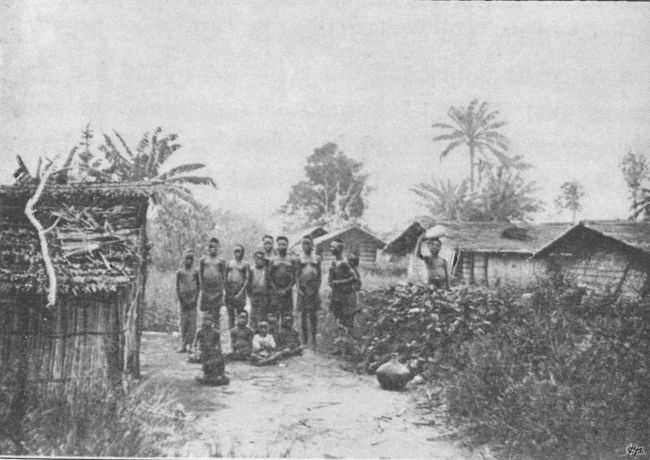
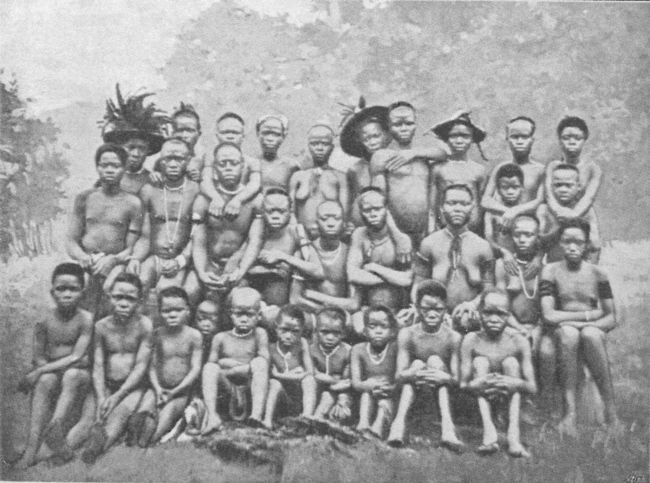
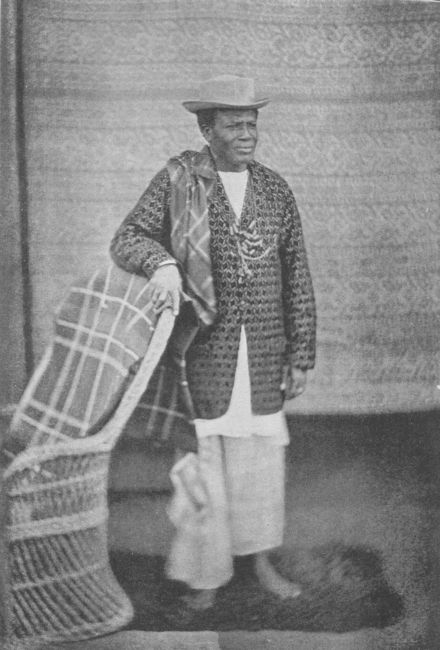
It is with some diffidence I attempt this task, because many more able
men have written about this country, with whom occasionally I shall most
likely be found not quite in accord; but if a long residence in and
connection with a country entitles one to be heard, then I am fully
qualified, for I first went to Western Africa in 1862, and my last
voyage was in 1896.
Previous to 1891, the date at which this Coast (Benin to Old Calabar)
was formed into a British Protectorate under the name of the Oil Rivers
Protectorate, now the Niger Coast Protectorate, each of the rivers
frequented by Europeans for the purpose of trade was ruled over more or
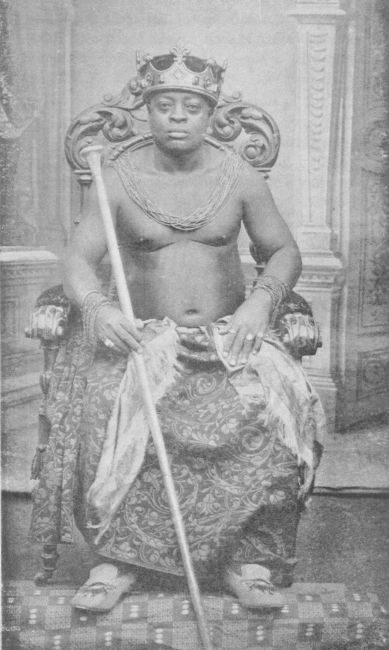
less intelligently by one, and in some cases by two, sable potentates,
who were responsible to Her Britannic Majesty’s Consul for the safety
and well-being of the white traders; also for the fostering of trade in
the hinterlands of their district, for which good offices they were paid
by the white traders a duty called “comey,” which amounted to about 2s.
6d. per ton on the palm oil exported. When the palm kernel trade
commenced it was generally arranged that two tons of palm kernels should
be counted to equal one ton of palm oil so far as regards fiscal
arrangements. The day this duty was paid was looked upon by the king, or
kings if there were two of them, as a festival; in earlier years a
certain amount of ceremony was also observed.
The king would arrive on board the trader’s hulk or sailing ship (some
firms doing their trade without the assistance of a hulk) to an
accompaniment of war horns, drums, and other savage music. With the king
would generally come one or two of his chiefs and his Ju-Ju man, but
before mounting the gangway ladder a bottle of spirit or palm wine would
be produced from some hidden receptacle, one of the small boys, who
always follow the kings or chiefs to carry their handkerchiefs and
snuff-boxes, would then draw the cork and hand a wine-glass and the
bottle to the Ju-Ju man, who would pour himself out a glass, saying a
few words to the Ju-Ju of the river, at the same time spilling a little
of the liquor into the water; he would then drink up what remained in
the glass, hand glass and bottle to the king, who would then proceed as
the Ju-Ju man had done, being followed on the same lines by the chiefs
who were with him.
Their devotions having thus been duly attended to, the king, Ju-Ju man
and his attendant chiefs would mount the ladder to the deck of the
vessel. The European trader would, as a rule, be there to receive him
and escort him on to the poop, where the king would be asked to sit down
to a sumptuous repast of pickled pork, salt beef, tinned salmon, pickles
and cabin biscuits. There would be also roast fowls and goat for the
trader and his assistants, and for vegetables yams and potatoes, the
latter a great treat for the white men, but not thought much of by the
natives.
The king with his friends making terrific onslaughts on the pork, beef
and tinned salmon, after having eaten all they could would ask for more,
and pile up a plate of beef, pork and salmon, if there was any left, to
pass out to their attendants on the main deck, at the same time begging
some biscuits for their pull-away boys in the canoe, a request always
acceded to.
Drinkables, you will observe, so far have had no part in the feed; it is
because these untutored natives follow Nature’s laws much closer than
Europeans, and never drink until they have finished eating. The king,
having done justice to the victuals, now politely intimates to the
European trader that “he be time for wash mouth.” Being asked what his
sable majesty would like to do it in, he generally elects “port win,” as
the natives call port wine. His chiefs, not being such connoisseurs as
his majesty, are, as a rule, satisfied with a bottle or two of beer or
gin, carefully sticking to the empty bottles.
In the meantime, had you looked over the side of the ship, you would
have wondered what his majesty’s forty or fifty canoe boys were doing,
so carefully divesting themselves of every rag of cloth and hiding it by
folding it up as small as possible and sitting on it. This was so as to
point out to the trader, when he came to the gangway to see the king
away, that “he no be proper for king’s boys no have cloth.”
The king, having duly washed his mouth, is now ready to proceed with the
business of his visit. The payment of the comey is very soon arranged,
it being a settled sum and the different goods having their recognised
value in pawns, bars, coppers or crues according to the currency of the
particular river.
But the “shake hand”[80] is now to be got through, and the “dashing”[81]
to the king; his friends who are with him want their part, and it would
surprise a stranger the number of wants that seem to keep cropping up in
a West African king’s mind as he wobbles about your ship, until, finding
he has begged every mortal thing that he can, he suddenly makes up his
mind that further importunity will be useless; he decides to order his
people into his canoe, which in most cases they obey with surprising
alacrity, brought about, I have no doubt, by the thought that now comes
their turn.
Arrived at the gangway, his majesty, in the most natural way imaginable,
notices for the first time (?) that his boys are all naked, and turning
with an appealing look to the trader, he points out the bareness of the
royal pull-away boys, and intimates that no white trader who respects
himself could think of allowing such a state of things to continue a
moment longer. This meant at least a further dash of four dozen
fishermen’s striped caps and about twelve pieces of Manchester cloth.
One would suppose that this was the last straw, but before his majesty
gets into his canoe several more little wants crop up, amongst others a
tot of rum each for his canoe boys, and perchance a few fathoms of rope
to make a new painter for his canoe, until sometimes the white trader
almost loses his temper. I have heard of one (?) who did on one
occasion, and being an Irishman, he thus apostrophised one of these
sable kings, “Be jabers, king, I am thinking if I dashed you my ship you
would be after wanting me to dash you the boats belonging to her, and
after that to supply you with paint to paint them with for the next ten
years.” There was a glare in that Irishman’s eye, and that king noticed
it, and decided the time had come for him to scoot, and history says he
scooted. In the early days of the palm oil trade, the custom inaugurated
by the slave traders of receiving the king on his visit to the ship was
by a salute of six or seven guns, and another of equal number on his
departure, the latter being an intimation to all whom it might concern
that his majesty had duly received his comey, and that trade was open
with the said ship. This was continued for some years, but as the
security of the seas became greater in those parts the trading ships
gave up the custom of carrying guns, and the intimation that the king
“done broke trade” with the last arrival was effected by his majesty
sending off a canoe of oil to the ship, and the sending round of a
verbal message by one of the king’s men.
Since the year 1891 the kings of the Oil Rivers have been relieved of
the duty of collecting comey, as a regular government of these rivers
has been inaugurated by H.B.M. Government, comey being replaced by
import duties.
Though there is a great similarity in the native form of government in
these parts, it would be impossible to convey a true description of the
manners and customs of the various places if I did not treat of each
river and its people separately; I shall therefore commence by
describing the people of Benin.
The Benin kingdom, so far as this account of it will go, was said to
extend from the boundaries of the Mahin country (a district between the
British Colony of Lagos and the Benin River) and the river Ramos; thus
on the coast line embracing the rivers Benin, Escravos, and Forcados,
also the hinterland, taking in Warri up to the Yoruba States.
For the purpose of the work I have set myself, I shall treat of that
part of the kingdom that may be embraced by a line drawn from the mouth
of the river Ramos up to the town of Warri, thence to Benin City, and
brought down to the coast a little to the north of the Benin River. This
tract of country is inhabited by four tribes, viz., the Jakri tribe, the
dominant people on the coast line; the Sobo tribe, a very timid but most
industrious people, great producers of palm oil, as well as being great
agriculturists; an unfortunate people placed as they were between the
extortions of the Jakris and the slave raiding of the Benin City king
for his various sacrificial purposes; the third tribe are the Ijos,
inhabiting the lower parts of the Escravos, Forcados, and Ramos rivers;
this latter tribe are great canoe builders and agriculturists in a small
way, produce a little palm oil, and by some people are accused of being
cannibals; this latter accusation I don’t think they deserve, in the
full acceptation of the word, for thirty-three years ago I passed more
than a week in one of their towns, when I was quite at their mercy,
being accompanied by no armed men and carrying only a small revolver
myself, which never came out of my pocket. Since when I have visited
some of their towns on the Bassa Creek outside the boundary I have drawn
for the purpose of this narrative, and never was I treated with the
least disrespect.
The fourth tribe is the Benin people proper, whose territory is supposed
to extend as far back as the boundaries of the Yoruba nation, starting
from the right bank of the Benin River. In this territory is the once
far-famed city of Benin, where lived the king, to whom the Jakri, the
Sobo, and the Ijo tribes paid tribute.
These people have at all times since their first intercourse with
Europeans, now some four hundred years, been renowned for their barbaric
customs.
The earlier travellers who visited Benin City do not mention human
sacrifices among these customs, but I have no doubt they took place; as
these travellers were generally traders and wanted to return to Benin
for trade purposes, they most likely thought the less said on the
subject the best. I find, however, that in the last century more than
one traveller mentions the sacrifice of human beings by the king of
Benin, but do not lead one to imagine that it was carried to the
frightful extent it has been carried on in later years.
I think myself that the custom of sacrificing human beings has been
steadily increasing of late years, as the city of Benin became more and
more a kind of holy city amongst the pagan tribes.
Their religion, like that of all the neighbouring pagans, admits of a
Supreme Being, maker of all things, but as he is supposed to be always
doing good, there is no necessity to sacrifice to him.
They, however, implicitly believe in a malignant spirit, to whom they
sacrifice men and animals to satiate its thirst for blood and prevent it
from doing them any harm.
Some of the pagan customs are of a sanitary character. Take, for
instance, the yam custom. This custom is more or less observed all along
the West Coast of Africa, and where it is unattended by any sacrificing
of human or animal life, except the latter be to make a feast, it should
be encouraged as a kind of harvest festival. When I say this was a
sanitary law, I must explain that the new yams are a most dangerous
article of food if eaten before the yam custom has been made, which
takes place a certain time after the yams are found to be fit for taking
out of the ground.
The new yams are often offered for sale to the Europeans at the earliest
moment that they can be dug up, some weeks in many cases before the
custom is made; the consequence is that many Europeans contract severe
attacks of dysentery and fever about this time.
The well-to-do native never touches them before the proper time, but the
poorer classes find it difficult to keep from eating them, as they are
not only very sweet, but generally very cheap when they first come on
the market.
The king of Benin was assisted in the government of his country and his
tributaries by four principal officers; three of these were civil
officers; these officers and the Ju-Ju men were the real governors of
the country, the king being little more than a puppet in their hands.
It was these three officers who decided who should be appointed governor
of the lower river, generally called New Benin.
Their choice as a rule fell upon the most influential chief of the
district, their last choice being Nana, the son of the late chief
Alumah, the most powerful and richest chief that had ever been known
amongst the Jakri men. I shall have more to say about Nana when I am
dealing with the Jakri tribe.
Amongst the principal annual customs held by the king of Old Benin, were
the customs to his predecessors, generally called “making father” by the
English-speaking native of the coast.
The coral custom was another great festival; besides these there were
many occasional minor customs held to propitiate the spirit of the sun,
the moon, the sky, and the earth. At most of these, if not all, human
sacrifices were made.
Kings of Benin did not inherit by right of birth; the reigning king
feeling that his time to leave this earth was approaching, would select
his successor from amongst his sons, and calling his chief civil officer
would confide to him the name of the one he had selected to follow him.
Upon the king’s death this officer would take into his own charge the
property of the late king, and receive the homage of all the expectant
heirs; after enjoying the position of regent for some few days he would
confide his secret to the chief war minister, and the chosen prince
would be sent for and made to kneel, while they declared to him the will
of his father. The prince thereupon would thank these two officers for
their faithful services, and then he was immediately proclaimed king of
Benin.
Now commences trouble for the non-successful claimants; the king’s
throne must be secure, so they and their sons must be suppressed. As it
was not allowed to shed royal blood, they were quietly suffocated by
having their noses, mouths and ears stuffed with cloth. To somewhat take
the sting out of this cruel proceeding they were given a most pompous
funeral.
Whilst on the subject of funerals I think I had better tell you
something about the funeral customs of the Benineese.
When a king dies, it is said, his domestics solicit the honour of being
buried with him, but this is only accorded to a few of his greatest
favourites (I quite believe this to have been true, for I have seen
myself slaves of defunct chiefs appealing to be allowed to join their
late master); these slaves are let down into the grave alive, after the
corpse has been placed therein. Graves of kings and chiefs in Western
Africa being nice roomy apartments, generally about 12 feet by 8 by 14,
but in Benin, I am told, the graves have a floor about 16 feet by 12,
with sides tapering to an aperture that can be closed by a single
flag-stone. On the morning following the interment, this flag-stone was
removed, and the people down below asked if they had found the King.
This question was put to them every successive morning, until no answer
being returned it was concluded that the slaves had found their master.
Meat was then roasted on the grave-stone and distributed amongst the
people with a plentiful supply of drink, after which frightful orgies
took place and great licence allowed to the populace—murders taking
place and the bodies of the murdered people being brought as offerings
to the departed, though at any other time murder was severely punished.
Chiefs and women of distinction are also entitled to pompous funerals,
with the usual accompaniment of massacred slaves. If a native of Benin
City died in a distant part of the kingdom, the corpse used to be dried
over a gentle fire and conveyed to this city for interment. Cases have
been known where a body having been buried with all due honours and
ceremonies, it has been afterwards taken up and the same ceremonies as
before gone through a second time.
The usual funeral ceremonies for a person of distinction last about
seven or eight days, and consist, besides the human sacrifices, of
lamentations, dancing, singing and considerable drinking.
The near relatives mourn during several months—some with half their
heads shaved, others completely shaven.
The law of inheritance for people of distinction differs from that of
the kings in the fact that the eldest son inherits by right of
primogeniture, and succeeds to all his father’s property, wives and
slaves. He generally allows his mother a separate establishment and
maintenance and finds employment and maintenance for his father’s other
wives in the family residence. He is expected to act liberally with his
younger brothers, but there is no law on this question. Before entering
into full possession of his father’s property he must petition the king
to allow him to do so, accompanying the said petition with a present to
the king of a slave, as also one to each of the three great officers of
the king. This petition is invariably granted. A widow cannot marry
again without the permission of her son, if she have a son; or if he be
too young, the man who marries her must supply a female slave to wait
upon him instead of his mother.
Theft was punished by fine only, if the stolen property was restored,
but by flogging if the thief was unable to make restitution.
Murder was of rare occurrence. When detected it was punished with death
by decapitation, and the body of the culprit was quartered and exposed
to the beasts and birds of prey.
If the murderer be a man of some considerable position he was not
executed, but escorted out of the country and never allowed to return.
In case of a murder committed in the heat of passion, the culprit could
arrange matters by giving the dead person a suitable funeral, paying a
heavy fine to the three chief officers of the king and supplying a slave
to suffer in his place. In this case he was bound to kneel and keep his
forehead touching the slave during his execution.
In all cases where an accusation was not clearly proved, the accused
would have to undergo an ordeal to prove his guilt or innocence. To
fully describe the whole of these would fill several hundred pages, and
as most of them could be managed by the Ju-Ju men in such a way, that
they could prove a man guilty or innocent according to the amount of
present they had received from the accused’s friends, I will pass on to
other subjects.
Adultery was very severely punished in whatever class it took place; in
the lower classes all the property of the guilty man passed at once to
the injured husband, the woman being severely flogged and expelled from
her husband’s house.
Amongst the middle class this crime could be atoned for by the friends
of the guilty woman making a money present to the injured husband; and
the lady would be restored to her outraged lord’s favour.
The upper classes revenged themselves by having the two culprits
instantly put to death, except when the male culprit belonged to the
upper classes; then the punishment was generally reduced to banishment
from the kingdom of Benin for life.
Amongst these people one finds some peculiar customs concerning
children. Amongst others, a child is supposed to be under great danger
from evil spirits until it has passed its seventh day. On this day a
small feast is provided by the parents; still it is thought well to
propitiate the evil spirits by strewing a portion of the feast round the
house where the child is.
Twin children, according to some accounts, were not looked upon with the
same horror in Benin as they are in other parts of the Niger Delta; as a
fact, they were looked upon with favour, except in one town of the
kingdom, the name of which I have never been able to get, nor have I
been able to locate the spot; but wherever it is, I am informed both
mother and children were sacrificed to a demon, who resided in a wood in
the neighbourhood of this town.
This law of killing twin children, like most Ju-Ju laws, could be got
over if the father was himself not too deeply steeped in Ju-Juism, and
was sufficiently wealthy to bribe the Ju-Ju priests. The law was always
mercilessly carried out in the case of the poorer class of natives—the
above refers solely to the part of Benin kingdom directly under the king
of Old Benin, and does not hold good with regard to the Sobos, Jakris,
or Ijos.
According to Clapperton the Benin people are descendants of the Yoruba
tribes, the Yoruba tribes being descended from six brothers, all the
sons of one mother. Their names were Ikelu, Egba, Ijebu, Ifé, Ibini
(Benin), and Yoruba.
According to the late Sultan Bello (the Foulah chief of Sokoto at the
time of Captain Clapperton’s visit to that city), the Yoruba tribes are
descended from the children of Canaan, who were of the tribe of Nimrod.
In my opinion there is room for much speculation on this statement of
the Sultan Bello.
It is a very curious fact that the people of Benin City have been, from
the earliest accounts we have of them, great workers in brass. Might not
the ancestors of this people have brought the art of working in brass
with them from the far distant land of Canaan? Moses, when speaking of
the land of Canaan, says, “out of whose hills thou mayest dig brass”
(Deut. viii. 9). Here we must understand copper to be meant; because
brass is not dug out of the earth, but copper is, and found in abundance
in that part of the world.
Yet another curious subject for reflection, from the first information
that European travellers give us (circa 1485) in their descriptions of
the city of Benin, mention has invariably made of towers, from the
summits of which monster brass serpents were suspended. Upon the entry
of the punitive expedition into Benin City in the month of February,
1897, Benin City still possessed one of these serpents in brass, not
hanging from a tower, but laid upon the roof of one of the king’s
houses.
Might not these brazen serpents be a remnant of some tradition handed
down from the time of Moses? for do we not read in the Scriptures, that
the people of Israel had sinned; and God to punish them sent fiery
serpents, which bit the people, and many died. Then Moses cried to God,
and God told him to make a serpent of brass, and set it on a pole.
(Numbers xxi. 9.)
While on the subject of serpents, I may mention that in the
neighbourhood of Benin, there is a Ju-Ju ordeal pond or river, said to
be infested with dangerous and poisonous snakes and alligators, through
which a man accused of any crime passing unscathed proves his innocence.
There are some other customs connected with the position of the king of
Benin, as the head of the Ju-Juism of his country, which seem to have
some trace of a Biblical origin, but which I will not discuss here, but
leave to the ethnologists to unravel, if they can.
That they were a superior people to the surrounding tribes is amply
demonstrated by their being workers in brass and iron; displaying
considerable art in some of their castings in brass, iron, copper and
bronze, their carving in ivory, and their manufacture of cotton
cloth—no other people in the Delta showing any such ability.
The Jakri tribe, who inhabit that part of the country lying between the
Sobo country and the Ijo country, were the dominant tribe in the lower
or New Benin country. Being themselves tributary to the Benin king, they
dare not make the Sobo or Ijo men pay a direct tribute to them for the
right to live, but they indirectly took a much larger tribute from them
than ever they paid the king of Benin.
The Jakris were the brokers, and would not allow either of the
above-named tribes to trade direct with the white men.
The principal towns of the Jakri men were:—Brohemie[82] (destroyed by
the English in 1894): this town was generally called Nana’s town of late
years. Nana was Governor of the whole of the country lying between a
line drawn from the Gwato Creek to Wari and the sea-coast; his
governorship extending a little beyond the Benin River, and running down
the coast to the Ramos River. This appointment he held from the king of
Benin, and was officially recognised by the British Consul as the
head-man of the Jakri tribe, and for any official business in connection
with the country over which he was Governor. Jeboo or Chief Peggy’s
town, situated on the waterway to Lagos; Jaquah town or Chief Ogrie’s
town. The above towns are all on the right bank of the river.
On the left bank of the river are found the following towns:—Bateri, or
Chief Numa’s town, lying about half an hour’s pull in a boat from Déli
Creek. Chief Numa, was the son of the late Chief Chinomé, a rival in his
day to Allumah, the father of Nana, the late Governor; Chinomé was the
son of Queen Doto of Wari, who years ago was most anxious to see the
white man at her town, and repeatedly advised the white men to use the
Forcados for their principal trading station; but the old Chief Allumah
was against any such exodus, and as he was a very big trader in
palm-oil, he of course carried the day, and the white men stuck to their
swamp at the mouth of the river Benin.
Close to Numa’s town his brother Fragoni has established a small town.
At some little distance from Bateri is Booboo, or the late Chief
Bregbi’s town. Galey, the eldest son of the late Chinomé, has a small
town in the Déli Creek. This man, though the eldest son of the late
Chief Chinomé, is not a chief, though his younger brother Numa is. Here
is a knotty point in Jakri law of inheritance, which differs from the
Benin City law on the subject.
Wari, the capital of Jakri, though almost if not actually as old a town
as Benin City, has never had the bad reputation that the latter city has
always had. I attribute this to the fact that the ladies of Warri have
always been a power in the land.
Sapele is a place that has come very much into notice since the country
has been under the jurisdiction of the Niger Coast Protectorate, and is
without doubt one of the best stations on the Benin territory. I am glad
to say that the Europeans have at last deserted to a great extent their
factories at the mouth of the Benin River, and are now principally
located at Sapele and Wari.
The Jakri tribe claim to be of the same race as the people of Benin City
and kingdom. This I am inclined to dispute; I think they were a coast
tribe like the Ijos. Tradition says that Wari was founded by people from
Benin kingdom and for many years was tributary to the king of Benin, but
in 1778 Wari was reported to be quite independent. They may have become
almost the same race by intermarriage with the Benin people that went
to Wari; but that they were originally the same race I say no.
The religion of the Jakri tribe and the native laws and system of
ordeals were, as far as I have been able to ascertain, identical with
those of the Benin kingdom; with the exception of the human sacrifices
and their law of inheritance which does not admit the right of
primogeniture—following in this respect, the laws of the Bonny men and
their neighbours. Twin children are usually killed by the Jakris, and
the mother driven into the bush to die.
The Jakri tribe are, without doubt, one of the finest in the Niger Coast
Protectorate; many of their present chiefs are very honest and
intelligent men, also excellent traders. Their women are noted as being
the finest and best looking for miles round.
The Jakri women have already made great strides towards their complete
emancipation from the low state in which the women of neighbouring
tribes still find themselves, many of them being very rich and great
traders.
The Sobo tribe have been kept so much in the background by the Jakris
that little is known about them. What little is known of them is to
their credit.
We now come to the Ijo tribe, or at least, that portion of them that
live within the Niger Coast Protectorate; these men are reported by some
travellers to be cannibals, and a very turbulent people; this character
has been given them by interested parties. Their looks are very much
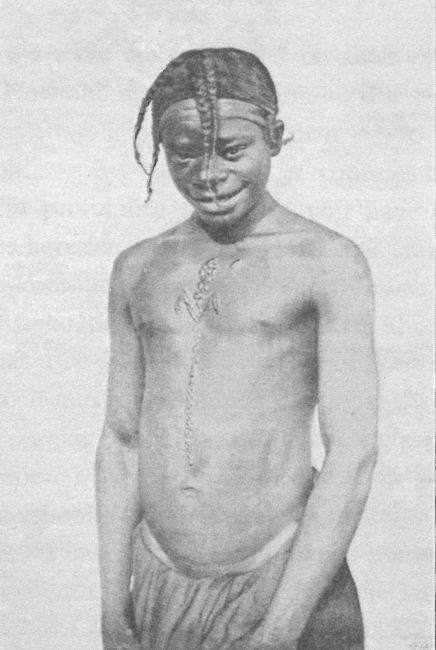
against them as they disfigure their faces by heavy cuts as tribal
marks, and some pick up the flesh between their eyes making a kind of
ridge, that gives them a savage expression. Though I have put the limit
of these people at the river Ramos, they really extend along the coast
as far as the western bank of the Akassa river. They have never had a
chance and, with the exception of large timber for making canoes, their
country does not produce much. Though I have seen considerable numbers
of rubber-producing trees in their country, I never was able to induce
them to work it. No doubt they asked the advice of their Ju-Ju as to
taking my advice, and he followed the usual rule laid down by the
priesthood of Ju-Ju-ism, no innovations.
Whilst I was in the Ijo country I carefully studied their Ju-Ju, as I
had been told they were great believers in, and practisers of Ju-Ju-ism.
I found little in their system differing from that practised in most of
the rivers of the Delta.
In all these practices human agency plays a very large part, and this
seems to be known even to the lower orders of the people; as an
instance, I must here relate an experience I once had amongst the Ijos.
I had arranged with a chief living on the Bassa Creek to lend me his
fastest canoe and twenty-five of his people, to take me to the Brass
river; the bargain was that his canoe should be ready at Cock-Crow Peak
the following morning. I was ready at the water-side by the time
appointed, but only about six of the smallest boys had put in an
appearance; the old chief was there in a most furious rage, sending off
messengers in all directions to find the canoe boys. After about two
hours’ work and the expenditure of much bad language on the part of the
old chief, also some hard knocks administered to the canoe boys by the
men who had been sent after them, as evidenced by the wales I saw on
their backs, the canoe was at last manned, and I took my seat in it
under a very good mat awning which nearly covered the canoe from end to
end, and thanking my stars that now my troubles had come to an end I
hoped at least for a time. I was, however, a very big bit too premature,
for before the old chief would let the canoe start, he informed me he
must make Ju-Ju for the safety of his canoe and the safe return of it
and all his boys, to say nothing of my individual safety.
One of the first requirements of that particular Ju-Ju cost me further
delay, for a bottle of gin had to be procured, and as the daily market
in that town had not yet opened, and no public house had yet been
established by any enterprising Ijo, it took some time to procure.
On the arrival of the article, however, my friend the old chief
proceeded in a most impressive manner to repeat a short prayer, the
principal portion I was able to understand and which was as follows: “I
beg you, I beg you, don’t capsize my canoe. If you do, don’t drown any
of my boys and don’t do any harm to my friend the white man.” This was
addressed to the spirit of the water; having finished this little
prayer, he next sprinkled a little gin about the bows of the canoe and
in the river, afterwards taking a drink himself. He then produced a leaf
with about an ounce of broken-up cooked yam mixed with a little palm
oil, which he carefully fixed in the extreme foremost point of the
canoe.
At last this ceremony was at an end and we started off, but alas! my
troubles were only just beginning. We had been started about half an
hour, and I had quietly dozed off into a pleasant sleep, when I was
awakened by feeling the canoe rolling from side to side as if we were
in rough water; just then the boys all stopped pulling, and on my
remonstrance they informed me Ju-Ju “no will,” id est, that the Ju-ju
had told them they must go back. I used gentle persuasion in the form of
offers of extra pay at first, then I stormed and used strong language,
or at least, what little Ijo strong language I knew, but all to no
avail. I then began to inquire what Ju-Ju had spoken, and they pointed
out a small bird that just then flew away into the bush; it looked to me
something like a kingfisher. The head boy of the canoe then explained to
me that this Ju-ju bird having spoken, id est, chirped on the
right-hand side of the canoe, and the goat’s skull hanging up to the
foremost awning stanchion having fallen the same way (this ornament I
had not previously noticed), signified that we must turn back. So turn
back we did, though I thought at the time the boys did not want to go
the journey, owing to the almost continual state of quarrelling that had
been going on for years between the Ijos and the Brassmen. I was not far
wrong, for when we eventually did arrive at Brass, I had to hide these
Ijo people in the hold of my ship, as the very sight of a Brassman made
them shiver.
The following morning the same performance was gone through; we started,
and at about the same point Ju-Ju spoke again; again we returned. My old
friend the chief was very sorry he said, but he could not blame his boys
for acting as they had done, Ju-Ju having told them to return. He would
not listen when I told him I felt confident his boys had assisted the
Ju-Ju by making the canoe roll about from side to side.
However, I thought the matter over to myself during that second day, and
decided I would make sure one part of that Ju-ju should not speak
against me the next morning, and that was the goat’s skull, so during
that night after every Ijo was fast asleep, I visited that skull and
carefully secured it to its post by a few turns of very fine fishing
line in such a manner that no one could notice what I had done, if they
did not specially examine it. I dare not fix it to the left, that being
the favourable side, for fear of it being noticed, but I fixed it
straight up and down, so that it could not demonstrate against my
journey.
I retired to my sleeping quarters and slept the sleep of the just, and
next morning started in the best of spirits, though continually haunted
by the fear that my little stratagem might be discovered. We had got
about the same distance from the town that we had on the two previous
mornings when the canoe began to oscillate as usual, caused by a
combined movement of all the boys in the canoe, I was perfectly
convinced, for the creek we were in was as smooth as a mill pond. Many
anxious glances were cast at the skull, and the canoe was made to roll
more and more until the water slopped over into her, but the skull did
not budge, and, strange to relate, the bird of ill omen did not show
itself or chirp this morning, so the boys gave up making the canoe
oscillate and commenced to paddle for all they were worth, and the
following evening we arrived at my ship in Brass. We could have arrived
much earlier, but the Ijos did not wish to meet with any Brassmen, so we
waited until the shades of night came on, and thus passed unobserved
several Brass canoes, arriving safely at my ship in time for dinner.
I carefully questioned the head boy of the Ijo boys all about this bird
that had given me so much trouble. He explained to me that once having
passed a certain point in the creek, the bird not having spoken and the
skull not having demonstrated either, it was quite safe to continue on
our journey, conveying to me the idea that this bird was a regular
inhabitant of a certain portion of the bush, which was also their sacred
bush wherein the Ju-Ju priests practised their most private devotions.
The same species of bird showed itself several times both on the right
of us and on the left of us as we passed through other creeks on our way
to Brass, but the canoe boys took no notice of it.
In dealing with the Benin Kingdom I have allowed myself somewhat to
encroach upon the Royal Niger Company’s territory, which commences on
the left bank of the river Forcados and takes in all the rivers down to
the Nun (Akassa), and the sea-shore to leeward of this river as far as a
point midway between the latter river and the mouth of the Brass river,
thence a straight line is drawn to a place called Idu, on the Niger
River, forming the eastern boundary between the Royal Niger Company’s
territory and the Niger Coast Protectorate. I have not defined the
western boundary between the Royal Niger Company’s territory and the
other portion of the Niger Coast Protectorate otherwise than stating
that it commences on the seashore at the eastern point of the Forcados.
Benin Kingdom, as a kingdom, may now be numbered with the past. For
years the cruelties known to be enacted in the city of Benin have been
such that it was only a question of ways and means that deterred the
Protectorate officials from smashing up the place several years ago.
It is a very curious trait in the character of these savage kinglets of
Western Africa how little they seem to have been impressed by the
downfall of their brethren in neighbouring districts. Though they were
well acquainted with all that was passing around them. Thus the fall of
Ashantee in 1873 was well known to the King of Dahomey, yet he continued
on his way and could not believe the French could ever upset him. Nana,
the governor of the lower Benin or Jakri, could not see in the downfall
of Ja Ja that the British Government were not to be trifled with by any
petty king or governor of these rivers; though Nana was a most
intelligent native, he had the temerity to show fight against the
Protectorate officials, and of course he quickly found out his mistake,
but alas! too late for his peace of mind and happiness; he is now a
prisoner at large far away from his own country, stripped of all his
riches and position. Here was an object lesson for Abu Bini, the King of
Benin, right at his own door, every detail of which he must have heard
of, or at least his Ju-Ju priests must have heard of the disaster that
had happened to Nana, his satrap.
Nothing daunted Abu Bini and his Ju-Ju priests continued their evil
practices; then came the frightful Benin massacre of Protectorate
officials and European traders, besides a number of Jakris and Kruboys
in the employment of the Protectorate.
The first shot that was fired that January morning, 1897, by the
emissaries of King Abu Bini, sounded the downfall of the City of Benin
and the end of all its atrocious and disgusting sacrificial rites, for
scarcely three months after the punitive expedition camped in the King’s
Palace at old Benin.
The two expeditions that have had to be sent to Benin River within the
last few years have been two unique specimens of what British sailors
and soldiers have to cope with whilst protecting British subjects and
their interests, no matter where situated.
I do not suppose that there are in England to-day one hundred people who
know, and can therefore appreciate at its true value, the risk that each
man in those two expeditions ran. In the attack on Nana’s town the
British sailors had to walk through a dirty, disgusting, slimy mangrove
swamp, often sinking in the mud half way up their thighs, and this in
the face of a sharp musketry fire coming from unseen enemies carefully
hidden away, in some cases not five yards off, in dense bush, with
occasional discharges of grape and canister. But nothing stopped them,
and Nana’s town was soon numbered with the things that had been.
It was the same to a great extent in the attack on Benin, only varied by
the swamps not being quite so bad as at Nana’s town, but the distance
from the water side was much farther; in the former case one might say
it was only a matter of minutes once in touch with the enemy; in the
attack on Benin city it was a matter of several days marching through
dense bush, where an enemy could get within five yards of you without
being seen, and in some places nearer. Almost constantly under fire,
besides a sun beating down on you so hot that where the soil was sandy
you felt the heat almost unbearable through the soles of your boots, to
say nothing of the minor troubles of being very short of drinking water,
and at night not being able to sleep owing to the myriads of sand-flies
and mosquitoes; getting now and again a perfume wafted under your
nostrils, in comparison with which a London sewer would be eau de
Cologne.
I was once under fire for twelve hours against European trained troops,
so know something about a soldier’s work, and for choice I would prefer
a week’s similar work in Europe to two hours’ West African bush and
swamp fighting, with its aids, fever and dysentery.
Before I quit Benin I want to mention one thing more about Ju-Ju. When
the attack was made on Benin city, the first day’s march had scarcely
begun when two white men were killed and buried. After the column passed
on, the natives came and dug the bodies up, cut their heads and hands
off, and carried them up to Benin city to the Ju-Ju priests, who showed
them to the king to prove to him that his Ju-Ju, managed by them, was
greater than the white man’s; in fact, the king, I am told, was being
shown these heads and hands at the moment when the first rockets fell in
Benin city. Those rockets proved to him the contrary, and he left the
city quicker than he had ever done in his life before.
To point out to my readers how all the natives of the Delta believed in
the power of the Benin Ju-Ju, I must tell you none of them believed the
English had really captured the King until he was taken round and shown
to them, the belief being that, on the approach of danger, he would be
able to change himself into a bird and thus fly away and escape.
Brass River is then the first river we have to deal with on the Niger
Coast Protectorate, to the eastward of the Royal Niger Company’s
boundary.
The inhabitants of Brass call their country Nimbé and themselves Nimbé
nungos, the latter word meaning people. Their principal towns were
Obulambri and Basambri, divided only by a narrow creek dry at low water.
In each of these towns resided a king, each having jurisdiction over
separate districts of the Nimbé territory; thus the King of Obulambri
was supposed to look after the district on the left hand of the River
Brass, his jurisdiction extending as far as the River St. Barbara. The
King of Basambri’s district extended from the right bank of the Brass
River, westward as far as the Middleton outfalls; included in this
district was the Nun mouth of the River Niger. These two kinglets had a
very prosperous time during the closing days of the slave trade, as most
of the contraband was carried on through the Brass and the Nun River
both by Bonnymen and New Calabar men after they had signed treaties with
Her Majesty’s Government to discontinue the slave trade in their
dominions. When eventually the trade in slaves was finally put down
their prosperity was not at an end, for they went largely into the palm
oil trade, and did a most prosperous trade along the banks of the Niger
as far as Onitsa.
Though these two kings always objected to the white men opening up the
Niger, and did their utmost to retard the first expeditions, they were
not slow in demanding comey from the early traders who established
factories in the Nun mouth of the Niger; this part of the Niger is also
called the Akassa.
These people are a very mixed race, and to describe them as any
particular tribe would be an error. I believe the original inhabitants
of the mouths of these rivers were the Ijos, and that the towns of
Obulambri and Bassambri were founded by some of the more adventurous
spirits amongst the men from the neighbourhood of Sabogrega, a town on
the Niger; being afterwards joined by some similar adventurers from
Bonny River. The three people are closely connected by family ties at
this day.
As a rule these people have always had the character of being a well
behaved set of men; it is a notable fact in their favour that they were
the only people that, once having signed the treaty with Her Majesty’s
Government to put down slavery, honestly stuck to the terms of the
treaty; unlike their neighbours, they did so, though they were the only
people who did not receive any indemnity.
They, however, have occasionally lost their heads and gone to excesses
unworthy of a people with such a good reputation as they have generally
enjoyed.
Their last escapade was the attack on the factory of the Royal Niger
Company at Akassa some few years ago, and for which they were duly
punished; their dual mud and thatch capital was blown down, and one
small town called Fishtown destroyed.
Impartial observers must have pitied these poor people driven to despair
by being cut off from their trading markets by the fiscal arrangements
of the Royal Niger Company. The latter I don’t blame very much, they are
traders; but the line drawn from Idu to a point midway between the Brass
River and the Nun entrance to the Niger River, as being the boundary
line for fiscal purposes between the Royal Niger Company and the Niger
Coast Protectorate, was drawn by some one at Downing Street who
evidently looked upon this part of the world as a cheesemonger would a
cheese.
In 1830 it was at Abo on the Niger where Lander the traveller met with
the Brassmen, who took him down to Obulambri, but no ship being in Brass
River, they took him and his people over to Akassa, at the Nun mouth of
the Niger, to an English ship lying there. History says he was anything
but well received by the captain of this vessel, and that the Brassmen
did not treat him as well as they might; however, they did not eat him,
as they no doubt would have done could they have looked into the future.
Whatever their treatment of Lander was, it could not have been very bad,
as they received some reward for what assistance they had given him some
time after.
It was amongst these people that I was enabled to study more closely the
inner working of the domestic slavery of this part of Western Africa,
and where it was carried on with less hardship to the slaves themselves
than any place else in the Delta, until the Niger Company’s boundary
line threw most of the labouring population on the rates, at least they
would have gone on the rates if there had been any to go on, but
unfortunately the municipal arrangements of these African kingdomlets
had not arrived at such a pitch of civilisation; the consequence was
many died from starvation, others hired themselves out as labourers, but
the demand for their services was limited, as they compared badly with
the fine, athletic Krumen, who monopolise all the labour in these parts.
Then came the punitive expedition for the attack on Akassa that wiped
off a few more of the population, so that to-day the Brassmen may be
described as a vanishing people.
The various grades of the people in Brass were the kings, next came the
chiefs and their sons who had by their own industry, and assisted in
their first endeavours by their parents, worked themselves into a
position of wealth, then came the Winna-boes, a grade mostly supplied by
the favourite slave of a chief, who had been his constant attendant for
years, commencing his career by carrying his master’s
pocket-handkerchief and snuff-box, pockets not having yet been
introduced into the native costume; after some years of this duty he
would be promoted to going down to the European traders to superintend
the delivery of a canoe of oil, seeing to its being tried, gauged, &c.
This first duty, if properly performed, would lead to his being often
sent on the same errand. This duty required a certain amount of savez,
as the natives call intelligence, for he had to so look after his
master’s interests that the pull-away boys that were with him in the
canoe did not secrete any few gallons of oil that there might be left
over after filling up all the casks he had been sent to deliver; nor
must he allow the white trader to under-gauge his master’s casks by
carelessness or otherwise. If he was able to do the latter part of his
errand in such a diplomatic manner that he did not raise the bile of the
trader, that day marked the commencement of his upward career, if he was
possessed of the bump of saving. All having gone off to the satisfaction
of both parties, the trader would make this boy some small present
according to the number of puncheons of oil he had brought down, seldom
less than a piece of cloth worth about 2s. 6d., and, in the case of
canoes containing ten to fifteen puncheons, the trader would often dash
him two pieces of cloth and a bunch or two of beads. This present he
would, on his return to his master’s house, hand over to his mother (id
est, the woman who had taken care of him from the time when he was
first bought by his Brass master). She would carefully hoard this and
all subsequent bits of miscellaneous property until he had in his
foster-mother’s hands sufficient goods to buy an angbar of oil—a
measure containing thirty gallons. Then he would approach his master
(always called “father” by his slaves) and beg permission to send his
few goods to the Niger markets the next time his master had a canoe
starting—which permission was always accorded. He had next to arrange
terms with the head man or trader of his master’s canoe as to what
commission he had to get for trading off the goods in the far market. In
this discussion, which may occupy many days before it is finally
arranged, the foster-mother figures largely; and it depends a great deal
upon her standing in the household of the chief as to the amount of
commission the trade boy will demand for his services. If the
foster-mother should happen to be a favourite wife of the chief, well,
then things are settled very easily, the trade boy most likely saying he
was quite willing to leff-em to be settled any way she liked; if, on the
contrary, it was one of the poorer women of the chiefs house, Mr.
Trade-boy would demand at least the quarter of the trade to commence
with, and end up by accepting about an eighth. As the winnabo could
easily double his property twice a year—and he was always adding to his
store in his foster-mother’s hands from presents received each time he
went down to the white trader with his father’s oil—it did not take
many years for him to become a man of means, and own canoes and slaves
himself. Many times have I known cases where the winnabo has repeatedly
paid up the debts of his master to the white man.
According to the law of the country, the master has the right to sell
the very man who is paying his debts off for him; but I must say I never
heard a case of such rank ingratitude, though cases have occurred where
the master has got into such low water and such desperate difficulties
that his creditors under country law have seized everything he was
possessed of, including any wealthy winnaboes he might have.
Some writers have said this class could purchase their freedom; with
this I don’t agree. The only chance a winnabo had of getting his freedom
was, supposing his master died and left no sons behind him old enough or
capable enough to take the place of their father, then the winnabo might
be elected to take the place of his defunct master: he would then become
ipso facto a chief, and be reckoned a free man. If he was a man of
strong character, he would hold until his death all the property of the
house; but if one of the sons of his late master should grow up an
intelligent man, and amass sufficient riches to gather round him some of
the other chief men in the town, then the question was liable to be
re-opened, and the winnabo might have to part out some of the property
and the people he had received upon his appointment to the headship of
the house, together with a certain sum in goods or oil, which the elders
of the town would decide should represent the increment on the portion
handed over. I have never known of a case where the whole of the
property and people have been taken away from a winnabo in Brass; but I
have known it occur in other rivers, but only for absolute misuse,
misrule, and misconduct of the party.
Egbo-boes are the niggers or absolute lower rank of slaves, who are
employed as pull-away boys in the oil canoes and gigs of the chiefs, and
do all the menial work or hard labour of the towns that is not done by
the lower ranks of the women slaves.
The lot of these egbo-boes is a very hard one at times, especially when
their masters have no use for them in their oil canoes. At the best of
times their masters don’t provide them with more food then is about
sufficient for one good square meal a day; but, when trade is dull and
they have no use for them in any way, their lot is deplorable indeed.
This class has suffered terribly during the last ten years owing to the
complete stoppage of the Brassmen’s trade in the Niger markets.
This class had few chances of rising in the social scale, but it was
from this class that sprang some of the best trade boys who took their
masters’ goods away up to Abo and occasionally as far as Onitsa, on the
Niger.
Cases have occurred of boys from this class rising to as good a position
as the more favoured winnaboes; but for this they have had to thank some
white trader, who has taken a fancy to here and there one of them, and
getting his master to lend him to him as a cabin boy—a position
generally sought after by the sons of chiefs, so as to learn “white
man’s mouth,” otherwise English.
The succession laws are similar to those of the other Coast tribes one
meets with in the Delta, but to understand them it requires some little
explanation. A tribe is composed of a king and a number of chiefs. Each
chief has a number of petty chiefs under him. Perhaps a better
definition for the latter would be, a number of men who own a few slaves
and a few canoes of their own, and do an independent trade with the
white men, but who pay to their chiefs a tribute of from 20 to 25 per
cent, on their trade with the white man. In many cases the white man
stops this tribute from the petty chiefs and holds it on behalf of the
chief. This collection of petty chiefs with their chief forms what in
Coast parlance is denominated a House.
The House may own a portion of the principal town, say Obulambri, and
also a portion in any of the small towns in the neighbouring creeks,
and it may own here and there isolated pieces of ground where some petty
chief has squatted and made a clearance either as a farm or to place a
few of his family there as fishermen; in the same way the chief of the
house may have squatted on various plots of ground in any part of the
district admitted by the neighbouring tribes to belong to his tribe. All
these parcels and portions of land belong in common to the House—that
is, supposing a petty chief having a farm in any part of the district
was to die leaving no male heirs and no one fit to take his place, the
chief as head of the house would take possession, but would most likely
leave the slaves of the dead man undisturbed in charge of the farm they
had been working on, only expecting them to deliver him a portion of the
produce equivalent to what they had been in the habit of delivering to
their late master, who was a petty chief of the house.
The head of the house would have the right of disposal of all the dead
man’s wives, generally speaking the younger ones would be taken by the
chief, the others he would dispose of amongst his petty chiefs; if, as
generally happens, there were a few aged ones amongst them for whom
there was no demand he would take them into his own establishment and
see they were provided for.
As a matter of fact, all the people belonging to a defunct petty chief
become the property of the head of the house under any circumstances;
but if the defunct had left any man capable of succeeding him, the head
chief would allow this man to succeed without interfering with him in
any way, provided he never had had the misfortune to raise the chief’s
bile; in the latter case, if the chief was a very powerful chief, whose
actions no one dare question, the chances are that he would either be
suppressed or have to go to Long Ju-Ju to prosecute his claim, the
expenses of which journey would most likely eat up the whole of the
inheritance, or at least cripple him for life as far as his commercial
transactions were concerned. It is of course to the interest of the head
of a house to surround himself with as many petty chiefs as he possibly
can, as their success in trade, and in amassing riches whether in slaves
or goods, always benefits him; even in those rivers where no heavy
“topside” is paid to the head of the house by the white traders, the
small men or petty chiefs are called upon from time to time to help to
uphold the dignity of the head chief, either by voluntary offerings or
forced payments. Public opinion has a good deal to say on the subject of
succession; and though a chief may be so powerful during his lifetime
that he may ride roughshod over custom or public opinion, after his
death his successor may find so many cases of malversation brought
against the late chief by people who would not have dared to open their
mouths during the late chief’s lifetime, that by the time they are all
settled he finds that a chief’s life is not a happy one at all times.
Claims of various kinds may be brought up during the lifetime of a
chief, and three or four of his successors may have the same claim
brought against them, each party may think he has settled the matter for
ever; but unless he has taken worst, the descendants of the original
claimants will keep attacking each successor until they strike one who
is not strong enough to hold his own against them, and they succeed in
getting their claim settled. This settlement does not interfere with the
losing side turning round and becoming the claimants in their turn. Some
of these family disputes are very curious; take for instance a case of
a claim for five female slaves that may have been wrongfully taken
possession of by some former chief of a house, this case perhaps is kept
warm, waiting the right moment to put it forward, for thirty years, the
claim then becomes not only for the original five women, but for their
children’s children and so on.
The Brass natives to-day are divided into two camps as far as religion
is concerned: the missionary would no doubt say the greater number of
them are Christians, the ordinary observer would make exactly the
opposite observation, and judging from what we know has taken place in
their towns within the last few years, I am afraid the latter would be
right.
The Church Missionary Society started a mission here in 1868; it is
still working under another name, and is under the superintendence of
the Rev. Archdeacon Crowther, a son of the late Bishop Crowther.
Their success, as far as numbers of attendants at church, has been very
considerable; and I have known cases amongst the women who were
thoroughly imbued with the Christian religion, and acted up to its
teaching as conscientiously as their white sisters; these however are
few.
With regard to the men converts I have not met with one of whom I could
speak in the same terms as I have done of the women.
Whilst fully recognising the efforts that the missionaries have put
forth in this part of the world, I regret I can’t bear witness to any
great good they have done.
This mission has been worked on the usual lines that English missions
have been worked in the past, so I must attribute any want of success
here as much to the system as anything.
One of the great obstacles to the spread of Christianity in these parts
is in my opinion the custom of polygamy, together with which are mixed
up certain domestic customs that are much more difficult to eradicate
than the teachings of Ju-Ju, and require a special mission for them
alone.
Almost equal to the above as an obstacle in the way of Christianity is
what is called domestic slavery; Europeans who have visited Western
Africa speak of this as a kind of slavery wherein there is no hardship
for the slave; they point to cases where slaves have risen to be kings
and chiefs, and many others who have been able to arrive at the position
of petty chief in some big man’s house. I grant all this, but all these
people forget to mention that until these slaves are chiefs they are not
safe; that any grade less than that of a chief that a slave may arrive
to does not secure him from being sold if his master so wished.
Further, domestic slavery gives a chief power of life and death over his
slave; and how often have I known cases where promising young slaves
have done something to vex their chief their heads have paid the
penalty, though these young men had already amassed some wealth, having
also several wives and children.
People who condone domestic slavery, and I have heard many
kindly-hearted people do so, forget that however mild the slavery of the
domestic slave is on the coast, even under the mildest native it is
still slavery; further, these slaves are not made out of wood, they are
flesh and blood, they in their own country have had fathers and mothers.
During my lengthened stay on the coast of Africa I never questioned a
slave about his or her own country that I did not find they much
preferred their own country far away in the interior to their new home.
Some have told me that they had been travelling upwards of two months
and had been handed from one slave dealer to another, in some cases
changing their owner three or four times before reaching the coast. On
questioning them how they became slaves, I have only been told by one
that her father sold her because he was in debt; several times I have
been told that their elder brothers have sold them, but these cases
would not represent one per cent. of the slaves I have questioned; the
almost general reply I have received has been that they had been stolen
when they had gone to fetch water from the river or the spring, as the
case might be, or while they have been straying a little in the bush
paths between their village and another. Sometimes they would describe
how the slave-catchers had enticed them into the bush by showing them
some gaudy piece of cloth or offered them a few beads or negro bells,
others had been captured in some raid by one town or village on another.
Therefore domestic slavery in its effect on the interior tribes is doing
very near the same amount of harm now that it did in days gone by. It
keeps up a constant fear of strangers, and causes terrible feuds between
the villages in the interior.
What is the use of all the missionaries’ teaching to the young girl
slaves so long as they are only chattels, and are forced to do the
bidding of their masters or mistresses, however degrading or filthy that
bidding may be?
The Ju-Juism of Brass is a sturdy plant, that takes a great deal of
uprooting. A few years ago a casual observer would have been inclined
to say the missionaries are making giant strides amongst these people. I
remember, as evidence of how keenly these people seemed to take to
Christianity up to a certain point, a little anecdote that the late
Bishop Crowther once told me about the Brass men. I think it must have
been a very few years before his death. I saw the worthy bishop
staggering along my wharf with an old rice bag full of some heavy
articles. On arriving on my verandah he threw the bag down, and after
passing the usual compliments, he said, “You can’t guess what I have got
in that bag.” I replied I was only good at guessing the contents of a
bag when the bag was opened; but judging from the weight and the
peculiar lumpy look of the outside of the bag, I should be inclined to
guess yams. “Had he brought me a present of yams?” I continued. “No,” he
replied; “the contents of that bag are my new church seats in the town
of Nimbé; the church was only finished during the week, and I decided to
hold a service in it on Sunday last; and, do you believe me, those logs
of wood are a sample of all we had for seats for most part of the
congregation! I have therefore brought them down to show you white
gentlemen our poverty, and to beg some planks to make forms for the
church.” I promised to assist him, and he left, carefully walking off
with his bag of fire-wood, for that was all it was, cut in lengths of
about fifteen inches, and about four inches in diameter. Here ends my
anecdote, so far as the bishop was concerned, for he never came back to
claim the fulfilment of my promise; but later on one of my clerks
reported to me that there had been a great run on inch planks during the
week, and that the purchasers were mostly women, and the poorest natives
in the place. This fact, coupled with the fact that the bishop never
came back for the planks he had begged of me, caused me to make some
inquiries, and I found that the church had been plentifully supplied
with benches by the poorer portion of the congregation.
Yet how many of these earnest people could one guarantee to have
completely cast out all their belief in Ju-Juism? If I were put upon my
oath to answer truthfully according to my own individual belief, I am
afraid my answer would be not one.
What an awful injustice the missionary preaches in the estimation of the
average native woman, when he advises the native of West Africa to put
away all his wives but one. Supposing, for instance, it is the case of a
big chief with a moderate number of wives, say only twenty or thirty, he
may have had children by all of them, or he may have had children by a
half dozen of them,—what is to become of those wives he discards? are
they to be condemned to single blessedness for the remainder of their
days? Native custom or etiquette would not allow these women to marry
the other men in the chief’s house; they can’t marry into other houses,
because they would find the same condition of things there as in their
own husband’s house, always supposing Christianity was becoming general.
These difficulties in the way of the missionary are the Ju-Ju priests’
levers, which they know well how to use against Christianity, and which
accounts for the frequent slide back to Ju-Juism, and in some cases
cannibalism of otherwise apparently semi-civilized Africans.
The Pagan portion of the inhabitants of the Brass district have still
their old belief in the Ju-Ju priests and animal worship.
The python is the Brass natives’ titular guardian angel. So great was
the veneration of this Ju-Ju snake in former times, that the native
kings would sign no treaties with her Britannic Majesty’s Government
that did not include a clause subjecting any European to a heavy fine
for killing or molesting in any way this hideous reptile. When one
appeared in any European’s compound, the latter was bound to send for
the nearest Ju-Ju priest to come and remove it, for which service the
priest expected a dash, id est, a present; if he did not get it, the
chances were the priest would take good care to see that that European
found more pythons visited him than his neighbours; and as a rule these
snakes were not found until they had made a good meal of one of the
white man’s goats or turkeys, it came cheaper in the long run to make
the usual present.
It is now some twenty years ago that the then agent of Messrs. Hatton
and Cookson in Brass River found a large python in his house, and killed
it. This coming to the ears of the natives and the Ju-Ju priests, caused
no little excitement; the latter saw their opportunity, worked up the
people to a state of frenzy, and eventually led them in an attack on the
factory of Messrs. Hatton and Cookson, seized the agent and dragged him
out of his house on to the beach, tied him up by his thumbs, each Ju-Ju
priest present spat in his mouth, afterwards they stripped him naked and
otherwise ill treated him, besides breaking into his store and robbing
him of twenty pounds worth of goods. The British Consul was appealed to
for redress, and upon his next visit to the river inquired into the
case, but, mirabile dictu, decided that he was unable to afford the
agent any redress, as he had brought the punishment on himself. I don’t
mention the name of this Consul, as it would be a pity to hand down to
posterity the fact that England was ever represented by such an idiot.
Besides the python the Brass men had several other secondary Ju-Jus;
amongst others may be mentioned the grey and white kingfisher, also
another small bird like a water-wagtail, besides which, in common with
their neighbours, they believed in a spirit of the water who was
supposed to dwell down by the Bar, and to which they occasionally made
offerings in the shape of a young slave-girl of the lightest complexion
they could buy.
The burial customs of this people differed little from others in the
Niger Delta, but as I was present at the burial of two of their
kings—viz. King Keya and King Arishima, at which I saw identically the
same ceremonial take place, I will describe what I saw as far as my
memory will serve me, for the last of these took place about thirty
years ago.
The grave in this instance was not dug in a house, but on a piece of
open ground close to the king’s house, but was afterwards roofed over
and joined on to the king’s houses. The size of the grave was about
fourteen by twelve feet, and about eight feet deep. At the end where the
defunct’s head would be, was a small table with a cloth laid over it,
upon this were several bottles of different liquors, a large piece of
cooked salt beef and sundry other cooked meats, ship’s biscuits, &c. The
ceiling of this chamber was supported by stout beams being laid across
the opening, upon which would be placed planks after the body had been
lowered into position, then the whole would be covered over with a part
of the clay that had been taken out of the hole, the rest of the clay
being afterwards used to form the walls of the house, that was
eventually constructed over the grave; a small round hole about three
inches in diameter being made in the ceiling of the grave, apparently
about over the place where the head of the corpse would lay. Down this
would be poured palm wine and spirits on the anniversaries of the king’s
death, by his successor and by the Ju-Ju priests. This part of the
ceremony would be called “making his father,” if it was a son who
succeeded; if it was not a son, he would describe it as “making his big
father”; though he was perhaps no blood relation at all.
Previous to the burial the body of the king lay in state for two days in
a small hut scarcely five feet high, with very open trellis work sides.
I believe they would have kept the body unburied longer if they could
have done so, but at the end of the second day his Highness commenced to
be very objectionable. The king’s body was dressed for this ceremony in
his most expensive robes, having round the neck several necklaces of
valuable coral, to which his chiefs would add a string more or less
valuable according to their means, as they arrived for the final
ceremony. The Europeans were expected to contribute something towards
the funeral expenses, which contribution generally consisted of a cask
of beef, a barrel of rum, a hundredweight of ship’s biscuits, and from
twenty to thirty pieces of cloth. Even in this there was a certain
amount of rivalry shown by the Europeans, to their loss and the natives’
gain. One knowing trader amongst them on this occasion had just received
a consignment of imitation coral, an article at that time quite unknown
in the river, either to European trader or to natives; so he decided to
place one of these strings of imitation coral round the king’s neck
himself, and thus create a great sensation, for had it been real coral
its value would have been one hundred pounds. He had, however, not
counted on the king’s very objectionable state, and when he proceeded to
place his offering round the king’s neck, he nearly came to grief, and
did not seem quite himself until he had had a good stiff glass of brandy
and water. The news spread like wildfire of this man’s munificence, and
soon the principal chiefs waited upon him to thank him for his present
to their dead king; the other Europeans were green with jealousy, though
each had in his turn tried to outdo his neighbour; unfortunately, there
was a Scotchman there “takin’ notes,” and faith he guessed a ruse, but
he was a good fellow and friend of the donor, and kept the secret for
some years, and did not tell the tale until it could do his friend no
harm.
The cannons had been going off at intervals for the last two days.
Towards ten o’clock of the second night after death the king was placed
in a very open-work wicker casket, and carried shoulder high round the
town, and then finally deposited in his grave. During this time the
cannons were being continually fired off, and individuals were assisting
in the din by firing off the ordinary trade gun. I and another European
concealed ourselves near the grave, and carefully watched all night to
see if they sacrificed any slaves on the king’s grave, or put any poor
creatures down into the grave to die a lingering death; but we saw
nothing of this done, though we had been informed that no king or chief
of Brass was ever buried without some of his slaves being sent with him
into the next world; as our informant explained, how would they know he
had been a big man in this life if he did not go accompanied by some of
his niggers into the next?
The firing of cannon is kept up at intervals for an indefinite number of
days after the final interment; but there is no hard and fast rule as
to its duration as far as I have been able to ascertain, and I think
myself it is ruled by the greater or less liberality of the successors,
who are the ones who have to pay for the gunpowder.
Amongst other customs that are common to all these rivers and this river
is the killing of twin children; but since the mission has been
established here the missionaries have done their utmost to wean the
people from this remnant of savagery.
A curious custom that I have heard of in most of these rivers is the
throwing into the bush, to be devoured by the wild beasts, any children
that may be born with their front teeth cut. I found this custom in
Brass, but with an exception, id est, I knew a pilot in Twon Town who
had had the misfortune to be born with his upper front teeth through;
whether it was because it was only the upper teeth that were through, or
whether it was that the law is not so strictly carried out in the case
of a male, I was never able to make sure of; however, he had been
allowed to live, but it appears in his case some part of the law had to
be carried out at his death, viz. he was not allowed to be buried, but
was thrown into the bush, to fall a prey to the wild beasts, and any
property he might die possessed of could not be inherited by any one,
but must be dissipated or thrown into the bush to rot. I believe the
Venerable Archdeacon Crowther has been instrumental in saving several of
these kind of children in Bonny.
The women of Brass are, like their sisters in Benin river, moving on
towards women’s rights; for though they have been for many generations
the hewers of wood and drawers of water, and made to do most of the hard
work of the country, they had commenced some years ago to enjoy more
freedom than their sisters in the leeward rivers. They still do most of
the fishing, and the fishing girls of Twon Town used to present a pretty
sight as some fifteen or twenty of their tiny canoes used to sweep past
the European factories, each canoe propelled by two or three graceful,
laughing, chattering girls; with them would generally be seen a canoe or
two paddled by some dames of a maturer age. Though passée as far as
their looks were concerned, they could still ply their paddle as well as
the best amongst the younger ones, as they forced their frail canoes
through water to some favourite quiet blind creek where the currentless
water allowed them to use their preparation[83] for stupefying the fish,
and in little over three hours you might see them come paddling back,
each tiny canoe with from fifty to a hundred small grey mullet,
sometimes with more and occasionally with a few small river soles.
The Brass man, like his neighbours, had his public Ju-Ju house as well
as his private little Ju-Ju chamber, the latter was to be found in any
Brass man’s establishment which boasted of more than one room; those who
could not afford a separate chamber used to devote a corner of their own
room, where might be seen sundry odds and ends bespattered with some
yellow clay, and occasionally a white fowl hung by the leg to remain
there and die of starvation and drop gradually to pieces as it
decomposed.
The public Ju-Ju house at Obulambri was not a very pretentious affair;
it consisted of a native hut of wattle and daub, the walls not being
carried more than half way up to the eaves, roofed with palm mats; in
the centre was an iron staff about five feet high, surrounded by eight
bent spear heads; this was called a tokoi, at the foot of it was a hole
about three inches in diameter, down which the Ju-Ju priests would pour
libations of tombo or palm wine, as a sacrifice to the Ju-Ju. I was
informed that this Ju-Ju house was built over the grave of the original
founder of Obulambri town. Behind the tokoi, on a kind of altar raised
about eighteen inches from the ground, were displayed about a dozen
human skulls; at the time I visited it the Ju-Ju man explained to me
that the greater part of these had belonged to New Calabar prisoners
taken in their last war with those people; besides the skulls were
sundry odds and ends of native pottery, as also a few bowls and jugs of
European manufacture. What part this pottery played in their devotions I
could never get a Ju-Ju man to explain, some of them appeared to have
held human blood. Stacked up in one corner were a few human bones,
principally thigh and shin bones.
The Brassmen do not often sacrifice human beings to their Ju-Jus, except
in time of war, when all prisoners without exception were sacrificed.
Their Ju-Ju snake occasionally secured a small child by crawling
unobserved into a house when the elders were absent or asleep. I once
was passing through a small fishing village in the St. Nicholas river,
when most of the inhabitants were away fishing, and hearing terrible
screams went to see what was the cause of the trouble, and found several
women wringing their hands and running to and fro in front of a small
hut. For several minutes I could not get them to tell me what was the
cause of their trouble; at last one of them trembling, with the most
abject fear and quite unable to speak, pointed to the door of the hut.
I went and looked in, but it was so dark I could see nothing at first,
so stepped inside; when, getting accustomed to the semi-darkness, I saw
a large python, some ten or twelve feet long, hanging from the ridge
pole of the hut immediately over a child about two years old that was
calmly sleeping. To snatch up the child and walk out was the work of a
moment. I then found that the woman who had pointed to the door of the
hut was the mother of the child—her gratitude to me for delivering her
child from certain death can be more easily imagined than described.
Upon asking why she had not acted as I had done, she replied she dare
not have interfered with the snake in the way I had done. I afterwards
asked several of the more intelligent natives of Brass if the Ju-Ju law
did not allow a mother to save her child in such a case. Some said she
was a fool woman, and that she could have taken her child away the
moment she saw it in danger; but others said had she done so, she would
have been liable to be killed herself or pay a heavy fine to the Ju-Ju
priests; and I am inclined to believe the latter version to be
correct.[84]
Amongst other curious customs these people make use of the feather
ordeal, to find out robbery, witchcraft, and adultery, &c. In this
ordeal it rests a great deal with the Ju-Ju man who performs it whether
it proves the party guilty or not. This ordeal is performed as
follows:—The Ju-Ju man takes a feather from the underpart of a fowl’s
wing, making choice of a stronger or weaker one, according to how he
intends the ordeal shall demonstrate, then, drawing the tongue of the
accused as far out of his mouth as he can, forces the quill of the
feather through from the upper side and draws it out by grasping the
point of the feather from the under side of the tongue; if the feather
is unbroken the accused person is proved guilty, if on the contrary the
feather breaks in the attempt to pass it through the tongue it proves
the innocence of the person. It may be seen from this description how
very easy it was to prove a person innocent, the mere fact of the
feather breaking in the attempt to push it through the tongue being
sufficient; thus, when suitably approached, the Ju-Ju man could not only
prove a person’s innocence, but also save him any inconvenience in
eating his mess of foo foo and palaver sauce that evening.
The intervening rivers between the Brass and New Calabar Rivers are the
St. Nicholas, the St. Barbara, the St. Bartholomew, and the Sombrero;
the influence of the king of New Calabar may be said to commence at the
St. Bartholomew River, extending inland to about five or ten miles
beyond the town of Bugama. The lower parts of the St. Bartholomew and
the numerous creeks, running between that river and New Calabar are
mostly inhabited by fishermen and their families, their towns and
villages being without exception the most squalid and dirty of any to be
found in the Delta. Beyond fishing, the males seem to do little else
than sleep; occasionally the men assist their wives and children in
making palm-leaf mats, used generally all over the Delta in place of
thatch—not a very profitable employment, as the demand varies
considerably according to the seasons. After a very rough and
boisterous rainy season, the price may be two shillings and sixpence, or
its equivalent, for four hundred of these mats, each mat being a little
over two feet in length, but falling in bad times to two shillings and
sixpence for five to six hundred. A roof made with these mats threefold
thick will last for three years.
These people call themselves Calabar men simply because they live within
the influence of the Calabarese. In the upper part of these small
rivers, about a day’s journey by canoe from the mouth of St.
Bartholomew, is the chief town of a small tribe of people called the
Billa tribe, connected by marriage with the Bonny men, several of the
kings of Bonny having married Billa women. These people are producers in
a small way of palm-oil, and though they are located so close to the New
Calabar people, prefer to sell their produce to the Bonny men, who send
their canoes over to the Billa country to fetch the oil, the latter
people not having canoes large enough for carrying the large puncheons
which the Bonny men send over to collect their produce in.
The New Calabar men are now split up into three towns called Bugama,
where the king lives; Abonema, of which Bob Manuel is the principal
chief; and Backana, where the Barboy House reside. Besides they have
numerous small towns scattered about in the network of creeks connecting
the Calabar River with the Sombrero River. Previous to 1880 these people
all dwelt together in one large town on the right bank of the Calabar
River, nearly opposite to where the creek, now called the Cawthorne
Channel,[85] branches off from the main river.
For some few years previous the chief of the Barboy House, Will Braid,
had incurred the displeasure of the Amachree house, which was the king’s
house. For certain private reasons the king, with whom sided most of the
other chiefs, had decided to break down the Barboy house, which had
been a very powerful house in days anterior to the present king’s
father, and tradition says that the Barboys had some right to be the
reigning house. Will Braid, the head of the house at this time, had by
his industry and honourable conduct raised the position of the house to
very near its former influence. This was one of the private reasons that
caused the king to look on him with disfavour.
When one of these West African kinglets decides that one of their chiefs
is getting too rich, and by that means too powerful, he calls his more
immediate supporters together, and they discuss the means that are to be
used to compass the doomed one’s fall. If he be a man of mettle, with
many sub-chiefs and aspiring trade boys, the system resorted to is to
trump up charges against him of breaches of agreement as to prices paid
by him or his people in the Ibo markets for produce, and fine him
heavily. If he pays without murmur, they leave him alone for a time; but
very soon another case is brought against him either on the same lines
or for some breach of native etiquette, such as sending his people into
some market to trade where, perchance, he has been sending his people
for years; but the king and his friendly chiefs dish up some old custom,
long allowed to drop in abeyance, by which his house was debarred from
trading in that particular market. The plea of long usance would avail
him little; another fine would be imposed. This injustice would
generally have the effect desired, the doomed one would refuse to pay,
then down the king would come on him for disregarding the orders of
himself and chiefs; fine would follow fine, until the man lost his head
and did some rash act, which assisted his enemies to more certainly
compass his ruin. Or he does what I have seen a persecuted chief do in
these rivers on more than one occasion: that is, he gathers all his
wives and children about him, together with his most trusted followers
and slaves, also any of his family who are willing to follow him into
the next world, lays a double tier of kegs of gunpowder on the floor of
the principal room in his dwelling-house and knocks in the heads of the
top tier of kegs. Placing all his people on this funeral pile, he seats
himself in the middle with a fire-stick grasped in his hand, then sends
a message to the king and chiefs to come and fetch the fines they have
imposed on him. The king and chiefs generally shrewdly guessed what this
message meant, and took good care not to get too near, stopping at a
convenient distance to parley with him by means of messengers. The
victim finding there was no chance of blowing up his enemies along with
himself and people, would plunge the fire-stick into the nearest keg,
and the next moment the air would be filled with the shattered remains
of himself and his not unwilling companions.
Having digressed somewhat to explain how chiefs are undone, I must
continue my account of the New Calabar people and the cause of their
deserting their original town. This was brought about by Will Braid, on
whom the squeezing operation had been some time at work. He turned at
bay and defied the king and chiefs; this led to a civil war, in which he
was getting the worst of the game, so one dark night he quietly slipped
away with most of his retainers and took refuge in Bonny. This led to
complications, for Bonny espoused the cause of W. Braid and declared war
against New Calabar; thus in place of suppressing Will Braid they came
near to being suppressed themselves, the Bonny men very pluckily
establishing themselves opposite New Calabar town, where they threw up
a sand battery, in which they placed several rifled cannon, and did
considerable damage to the New Calabar town, from whence a feeble return
fire was kept up for several days, during which time the Calabar men
occupied themselves in placing their valuables and people in security,
and eventually, unknown to the Bonny men, clearing out all their war
canoes and fighting men through creeks at the back of their town to the
almost inaccessible positions of Bugama and Abonema. The Bonny men
continued the bombardment, but finding there was no reply from the town,
despatched, during the night, some scouts to find out what was the
position of things in the New Calabar town; on their return they
reported the town deserted. The Bonny men lost no time in following the
New Calabar men to their new position, but found Bugama inaccessible, so
turned their attention to Abonema, which they very pluckily assaulted,
but were repulsed with considerable loss, losing one of their best war
canoes, in which was a fine rifled cannon; at the same time the Bonny
chief, Waribo, who had most energetically led the assault, barely
escaped with his life, as he was in the war canoe that had been sunk by
the New Calabar men. This victory was very pluckily gained by Chief Bob
Manuel and his people, who were greatly assisted in the defence of their
position by having been supplied at an opportune moment with a
mitrailleuse by one of the European traders in the New Calabar river.
This defeat somewhat cooled the courage of the Bonny men; the war
however continued to be carried on in a desultory manner for several
months, until both sides were tired of the game, and at last all the
questions in dispute between the king and chiefs of New Calabar and Will
Braid, and the matters in dispute between the New Calabar men and the
Bonny men were by mutual agreement left to the arbitration of the king
and chiefs of Okrika, and King Ja Ja and the chiefs of Opobo. The
arbitrators met on board one of Her Majesty’s vessels in Bonny River in
1881, King Ja Ja being represented by Chief Cookey Gam and several other
chiefs, the king and chiefs of Okrika being in full force. The result of
the arbitration did not give complete satisfaction to any party, owing
to the advice of Ja Ja on the affair not having been listened to in its
entirety. However, W. Braid returned to New Calabar territory and
founded a town of his own, assisted by his very faithful Chief Yellow of
Young Town. Thus ended the last war between the old rivals Bonny and New
Calabar. It is on record that these two countries had been scarcely ever
at peace for any length of time since New Calabar was first founded some
two hundred and fifty years ago, when, tradition says, one of the
Ephraim Duke family left Old Calabar and settled at the spot from whence
they retired in 1880.
Old traders I met with in the early sixties informed me that during one
of these wars, between the years 1820 and 1830, the king Pepple, then
reigning in Bonny succeeded in capturing the king of Calabar of that
time (the grandfather of the last king Amachree), and to celebrate his
victory and royal capture, made a great feast to which he invited all
the European slave traders then in his country. The feast was a right
royal one, the king had a special dish prepared for himself which was
nothing less than the heart of his royal captive, torn from his scarcely
lifeless body.
The New Calabar people, though said to be descended from the Old Calabar
race, have not retained any of the characteristics of the latter,
neither in their language nor dress, nor have they retained the
elaborate form of secret society or native freemasonry peculiar to the
Efik[86] race called Egbo.
Their religion is the same animistic form of Ju-Juism and belief in the
oracle they call Long Ju-Ju situated in the vicinity of Bende in the
hinterland of Opobo, common to all the inhabitants of the Delta; besides
the latter, they are believers in the power of a Ju-Ju in some mystic
grove in the Oru country. The peculiar test at this latter place is said
to have been established by some ancient dame having uttered some
fearful curse or wish at the spot where the ordeal is administered. The
descriptions of this are rather vague, as no one who has undergone it
has ever been known to return, that is, if he has really seen the oracle
work, for if it works it is a sign of his guilt and drowns him; if he is
innocent it does not work, so on his return he is not in a position to
describe it. But the proprietors of this interesting Ju-Ju have for very
many years found that a nigger fetches a better price alive than when
turned into butcher’s meat; they have therefore been in the habit of
selling the guilty victim into slavery in as far distant a country as
possible; but occasionally one of these men have drifted down to the
coast again, but dare not return to his own country as no one would
believe he was anything else but a spirit. One of these “spirits” I had
the pleasure to interview on one occasion, and he told me that the only
ones who were actually drowned were the old or unsaleable men; when two
men went to this Ju-Ju or ordeal well, to decide some vital question
between them, the party taking best would want to see his dead or
drowned opponent; for this purpose the Ju-Ju priests always kept a few
of the old and decrepit votaries on hand to be drowned as required, but
the opponent was never allowed to stand by and see the oracle work, but
was taken up to the well and allowed to see a dead body lying at the
bottom, and after he had glanced in and satisfied himself there was a
drowned person there, he would be hurried away by the Ju-Ju priests and
their assistants. That these priests had the supernatural power to make
the water rise up in the well, this “spirit” thoroughly believed, and
when I offered the suggestion of an underground water supply brought
from some higher elevation, he scouted the idea and gave me his private
opinion thus: “White man he no be fit savey all dem debly ting Ju-Ju
priest fit to do; he fit to change man him face so him own mudder no fit
savey him; he fit make dem tree he live for water side, bob him head
down and drink water all same man; he fit make himself alsame bird and
fly away; you fit to look him lib for one place and you keep you eye for
him, he gone, you no fit see him when he go.”
Which little speech turned into ordinary English meant to say that white
people could not understand the devilish tricks the Ju-Ju priests were
able to do, they could so disguise a person that his own mother would
not recognise him, this without the assistance of any make-up but simply
from their devilish science; that they could cause a tree on the banks
of a river to bend its stem and imbibe water through its topmost
branches; that they could change themselves into birds and fly away; and
lastly, that they could make themselves invisible before your eyes and
so suddenly that you could not tell when they had done so.
I asked him why the Ju-Ju man had not altered him, so that when he sold
him it would be impossible for any one who had known him in his own
country ever to recognise him if they saw him in another. His reply was:
“Ju-Ju man savey them man what believe in Ju-Ju no will believe me dem
time I go tell dem I be dem Osūkū of Young Town come back from
Long Ju-Ju. He savey all man go run away from me in my own country.”
“Well,” I said, “how about the people amongst whom you now are? they
believe in very nearly the same Ju-Jus that your own people do, what do
they say about you?” “Oh! they say I be silly fellow and no savey I done
die one time, and been born again in some other country.” I then asked
him how they accounted for his knowing about the people who were still
alive in his own country and to be able to talk about matters which had
taken place there within the previous five or six years. Then I got the
word the inquirer in this part of the world generally gets when he
wishes to dive into the inner circles of native occultism, viz.,
“Anemia,” which means “I don’t know.”
The chiefs in New Calabar in the days of the last king’s father were an
extremely fine body of men, both physically and commercially; the latter
quality they owed to the strong hand the king kept over them, and the
excellent law he inaugurated when he became the king with regard to
trade, viz., that no New Calabar chief or other native was allowed to
take any goods on credit from the Europeans. His power was absolute, and
considering that he inherited his father’s place at a time when the
country was in the throes of war with Bonny—his father being the king
captured by the king of Bonny mentioned previously—the success of his
rule was wonderful, for he pulled his country together and carried on
the war with such ability that Bonny ultimately was glad to come to
terms; a peace was agreed upon which lasted many years, until the old
king of Bonny died, and his son wishing to emulate his father re-opened
hostilities, but with such ill-success and loss to his country that it
eventually led to his being deposed and exiled from his country for some
years.
The New Calabar people are and have been always great believers in
Ju-Juism, the head Ju-Ju priest being styled the Ju-Ju king and ranking
higher than the king in any matters relating to purely native affairs.
The shark is their principal animal deity, to which they were in the
habit of sacrificing a light-coloured child every seven years. This used
to be openly and ostentatiously performed by a procession of a
half-dozen large canoes being formed up at the town of New Calabar, each
canoe being manned by forty to fifty paddlers; in the midships of each
canoe a deck some ten feet long would be placed on which the Ju-Ju
priests and a number of the younger chiefs and the grown-up sons of the
chief men would huddle together and keep up a continuous howling and
dancing, accompanied with the waving of their hands and handkerchiefs,
until they arrived down near the mouth of the river. When the water
began to be so rough that the singers and dancers could not keep their
feet, it was a sign the offering must be cast into the sea; the Ju-Ju
men and their assistants all supplicating their friend the shark to
intercede with the Spirit of the Water to keep open the entrance to
their river and cause plenty of ships to come to their river to trade.
Their Ju-Ju house in their original town was a much larger and more
pretentious edifice than that of Bonny, garnished with human and goats’
skulls in a somewhat similar manner, unlike the Bonny Ju-Ju house in the
fact that it was roofed over, the eaves of which were brought down
almost to the ground, thus excluding the light and prying eyes at the
same time; at either side of the main entrance, extending some few feet
from the eaves, was a miscellaneous collection of iron three-legged
pots, various plates, bowls and dishes of Staffordshire make, all of
which had some flower pattern on them, hence were Ju-Ju and not
available for use or trade—the old-fashioned lustre jug, being also
Ju-Ju, was only to be seen in the Ju-Ju house, though a great favourite
in Bonny and Brass as a trade article—at this time all printed goods or
cloth with a flower or leaf pattern on them were Ju-Ju. Any goods of
these kinds falling into the hands of a true believer had to be
presented to the Ju-Ju house. As traders took good care not to import
any such goods, people often wondered where all these things came from.
Had they arrived shortly after a vessel bound to some other port had had
the misfortune to be wrecked off New Calabar, they would have solved the
problem at once, for anything picked up from a wreck which is Ju-Ju has
to be carried off at once to the Ju-Ju house. I remember on one occasion
visiting this Ju-Ju house just after a large ship called the Clan
Gregor bound into Bonny had been wrecked off New Calabar, and found the
Ju-Ju house decked both inside and out with yards of coloured cottons
from roof to floor; but the Ju-Ju priests did not get all their rights,
for some tricky natives on salving a bale of goods would carefully slit
the bale just sufficiently to see what were the goods inside, and
should they be Ju-Ju would not open them, but take them to their
particular friend amongst the European traders, and get him to send them
away to some other river for sale on joint account.
Every eighth day is called Calabar Sunday, the day following being
formerly the market day or principal receiving day for the white traders
of the native produce, which consisted principally, and still does, of
palm oil. The native Sunday was passed in olden days by the chief in
receiving visits from the white men and jamming[87] with them for any
produce he had the intention of selling the following day, or clearing
up any little Ju-Ju matters that he had been putting off for the want of
a slack day, not because it was his Sunday, but because that was a day
on which by custom he could not visit the ships. I remember it was on
paying a visit to old King Amachree, the father of the late king of the
same name, I saw for the first time a native sacrifice. I was then
little more than a boy as a matter of fact, I was under seventeen years
of age, but filling a man’s place in New Calabar who had been invalided
home. The old king had taken me under his special protection and gave me
much good advice and counsel, which was of great use to me in my novel
position. My employers ought to have been very thankful to him, for
though I was the youngest trader in the river by some twelve years, I
held my own with them and got a larger share of the produce of the river
than my predecessor had done, all owing to the old brick of a king, who
would come and see how I was doing on the big trade days, and if he
thought I was not doing as well as my neighbours he would send off a
message to a small creek close to the shipping, where the natives used
to wait with their oil until it was jammed for, id est, agreed for,
and order three or four canoes of oil to be sent off to me, though I had
not seen its owner to agree with him as to what he was to get for it. I
held this appointment for a little over six months, when, my senior
having returned, I had to go back to my duties in Bonny under the chief
agent of the firm, a Captain Peter Thompson, one of the kindest-hearted
skippers that ever entered Bonny river. In those days we all had some
nickname that we were known by amongst the natives, and another amongst
the white men. Amongst the former he was called Calla Thompson, because
he was short, in contradistinction to another Thompson who was tall,
called Opo Thompson; but his name amongst the white men was Panter
Thompson, owing to his inability to pronounce the “th” in panther during
a discussion as to whether we had tigers or only panthers on the West
Coast of Africa. Poor Panter, after a most successful voyage of a little
over two years, was preparing to return home, and had only a few more
weeks to remain in Bonny, when in stepping into his boat his foot
slipped and he fell into the river at a point known to be infested with
sharks. A brother skipper jumped into the boat, and actually clutched
him by his cap at the same moment poor Panter said “I am gone, Ned!” no
doubt feeling himself being drawn down by some hungry shark.
His son now commands one of the finest steamers of the African Steamship
Company, and seems to have inherited in a marked degree all the good
qualities of his father; so, travellers to West Africa, if you want a
comfortable ship and a thorough good fellow to travel with, take your
passage in the ship commanded by Captain Willie Thompson, R.N.R.
But this is digressing. I must get back to New Calabar and tell you what
I saw at my introduction to Ju-Juism under the auspices of dear old King
Amachree. The occasion was the swearing Ju-Ju with some people in the
interior, with whom they had only lately opened up commercial relations,
and they wanted them to swear they would trade with no other people but
them. The deputation, who represented the market people, looked as wild
a lot as one could wish to see, and, as far as I could make out, the
ceremony I was watching was a kind of preliminary canter to a more
impressive, and most likely more diabolical one to be carried out at
some future date in the stranger folks’ country. On this occasion the
officiating Ju-Ju priest did not seem to address any of his words to the
strangers, who looked on with a certain amount of fear depicted in their
countenance.
The Ju-Ju priest was clothed (?) in a superb dark-coloured and
greasy-looking rag about his loins, barely sufficient to satisfy the
easiest going of European Lord Chamberlains; but from the expressive
grunts of satisfaction which greeted his appearance in the Ju-Ju house,
I was led to suppose his dress was quite correct and proper for the
occasion. His head was shaved on the right side, and all down his right
side and leg he had been dusted over with some greyish-white native
chalk. He said a few words in an undertone to one of his assistants, who
went out of sight for a moment or so and quickly returned with a very
fine almost milk-white goat, the poor beast seeming to anticipate its
fate from its fearfully loud bleating. The Ju-Ju priest seized the poor
beast by its muzzle with his left hand, and dexterously tossing its body
under his left arm, forced its head back towards his left shoulder until
the neck of the beast formed an arc, his assistant handing him at this
moment a very sharp white-handled spear-pointed knife, which he drew
across the animal’s throat, almost severing its head from its body.
Quick as lightning he dropped on one knee and held the bleeding animal
over a receptacle, having the appearance of a large soup plate,
fashioned in the clay of the ground immediately in front of the altar
arrangement. In the centre of this plate was a hole down which the
quickly coagulating blood slowly trickled; after the interval of what
appeared to me minutes, but was in fact most likely less than a minute,
the Ju-Ju man laid the lifeless body of the goat down with its neck over
the opening in the plate, leaving it there to drain. At the moment of
the sacrifice various gongs and old ship bells were struck by young men
stationed near them for that purpose—a wrecked ship’s bell being
generally presented to the Ju-Ju house, though not as in the case of
Ju-Ju goods by law prescribed. New Calabar people had been fairly well
observant of this custom, and the wrecks numerous, judging from the
number of ships’ bells in the Ju-Ju house. At every movement of the
Ju-Ju priest the king and chief would grunt out a noise very much
resembling that auld Scotch word “ahum.”
The Ju-Ju house had amongst its possessions several ill-shapen wooden
idols, and scattered about the affair that represented an altar were
various small idols looking very much like children’s dolls; also
several large elephant’s tusks, and two or three very well carved ones,
with the usual procession of coated and naked figures winding round
them.
The present king of New Calabar[88] is a son of my old friend King
Amachree, and is called King Amachree also, but has shown little of the
ability of his late father, being completely led by the nose by his
brother George Amachree, who practically rules both king and people.
The former is a small, quiet, and rather amiable man, but of a
vacillating and unreliable character; his brother and prime minister is,
on the contrary, a tall and very fine specimen of the negro race,
endowed by nature with a very suave and not unmusical voice, a very able
speaker, clear and logical reasoner, but of a very grasping nature—an
excellent and successful trader and exceedingly nice man to deal with,
as long as he has got things moving the way that suits him and his
policy; but when thwarted in his designs, trading or political, he
becomes a difficult customer to deal with, and a very unpleasant and
objectionable type of negro “big man.” Nevertheless, had he had the
fortune to have been born in a civilised Africa, I feel confident his
natural abilities, assisted by education, would have made him a man of
eminence in whatever country his lot might have been cast.
Most of the New Calabar chiefs bear a very favourable repute amongst the
white traders, and compare very favourably intellectually with the
neighbouring chiefs of the Niger Delta.
Another chief of no mean capacity is Bob Manuel, of Abonema, exceedingly
neat, almost a dandy in appearance, a very shrewd trader, clear and
concise in his speech, honourable in all his dealings, of a very
reserved temperament; but a charming man to talk with, once started on
any topic that interests him or his visitor.
Owing to some peculiarities in their dress, the New Calabar chiefs are
very different to the chiefs in other parts of the Delta. They never
appear outside of their houses unless robed in long shirts (made of real
india madras of bold check patterns, in which no other colour but red,
blue and white is ever allowed to be used) reaching down to their heels;
under this they wear a singlet and a flowing loin cloth of the same
material as their shirts. Of late years, during the rainy season, some
of them have added elastic-side boots and white socks, but the most
curious part of their get-up is their head-gear, for since about 1866
they have taken to wearing wigs. These are only worn on high days and
holidays and at special functions, but the effect sometimes is so
utterly ridiculous as to be more than strangers can look at without
laughing. Imagine an immensely stout and somewhat podgy negro with
elastic-side boots, white stockings, long shirt, several strings of
coral hung round his neck and hanging in festoons down as far as where
his waistcoat would end, did he wear one, a Charles II. light flaxen
wig, the latter topped up by an ordinary stove-pipe black silk hat!
This fashion of wearing wigs, I am afraid, was unconsciously inaugurated
by me, having taken with me in 1865 to New Calabar some wigs that I had
used in some private theatricals in England. A chief named Tom Fouché
saw them, and was enchanted with a nigger’s trick wig, the top of which
could be raised by pulling a hidden silk cord, and eventually he became
the proud possessor of my stock, and produced a great sensation the
first public festival he appeared at. Previous to this I never saw a wig
in New Calabar; as a matter of fact, they have no excuse for them, a
bald-headed native being an almost unheard-of curiosity, and grey or
white heads are very scarce. Alas! like all pioneers, I did not reap the
reward I should have done, as I left the New Calabar river before the
fashion had caught on, and Messrs. Thomas Harrison and Co., of
Liverpool, became the principal purveyors of wigs to the Court of New
Calabar.
These people are remarkable for the bold stand they have made against
the persecution of their neighbours almost from the day their founder
planted his foot on the New Calabar soil, or mud rather, I should say;
besides their wars with the Bonny men, they were often attacked by the
Brass men, allies of Bonny. With the Okrika men they were almost
constantly at war. This latter was a kind of guerilla warfare carried on
in the creeks, and consisted in seizing any unprotected small canoe with
its crew of two or three men or women and cargo, the latter generally
being yams or Indian corn, the custom being on both sides to eat these
prisoners.
The Church Missionary Society established a mission here in 1875, but
during the war of 1879 and 1880 the missionary had to leave. Their
success had not been brilliant up to this date, owing, no doubt, in some
measure, to the immense power wielded by the Ju-Ju priests in New
Calabar.
It was not until 1887-8 that the missionaries were able to again
commence their labours amongst these people, and then not in the
principal town. Archdeacon Crowther, however, succeeded about this time
in getting a plot of ground in Bob Manuel’s town, Abonema, for the
purpose of building a mission station. As to the success of this last
effort I can’t speak from personal observation, as I left this river
shortly afterwards myself; in fact, it was on my last visit to Abonema
that I conveyed in my steamer, the Quorra, the missionary and his wife
to their new home from Brass. They were a young couple of very well
educated and most intelligent Sierra Leone natives.
This river was the most important slave market in the Delta, as a matter
of fact surpassing in numbers of slaves exported any other single
slave-dealing station on the West or South-West Coast of Africa.
According to Mr. Clarkson, the historian of the abolition of the
slave-trade, this river and Old Calabar exported more slaves than all
the other slave-dealing centres on the West and South-West Coasts of
Africa combined.
It is a well-known fact that for about two hundred years the average
annual output of slaves through the Bonny River was about 16,000 (this
included the shipments from New Calabar), totalling up to the immense
number of 3,200,000 souls taken out of this part of Africa during two
centuries.
The above figures do not represent the total depletion this part of
Africa suffered during this time. To the above immense number of slaves
exported must be added the number of lives lost in the raids made on the
Ibo villages for the purpose of capturing the people to sell as slaves;
we must also add the number that died on their way down from the
interior to the coast, and to these again must be added the slaves
refused by the European trader by reason of any defect, malformation,
or incipient signs of disease. The fate of these poor souls was sad; but
perhaps many of their brethren envied them their quick release from the
cares of this world. The native slave-dealer was too practical a man to
burden himself with mouths to fill that he could not immediately turn
into cloth, rum, gunpowder or coral, so oftener than otherwise he would
simply tell his own niggers to drop their canoe astern of the slave
ship, cut the rejected slaves heads off, and cast their bodies into the
river to feed the sharks, this often taking place within sight of the
European slaver.
A very moderate allowance for loss of life between the interior and the
slave-ship from the above-mentioned causes would be at the least 40 per
cent.; thus totalling the immense number of 4,480,000 souls sent out of
this one district in about two centuries. The greater number of these
were Ibos, a slave much sought after in the olden days by planters in
the West Indies and the Southern States of America.
I have mentioned these latter facts here to point out to my readers that
the so-called benevolent domestic slavery as practised on the coast of
Western Africa and tolerated in Her Britannic Majesty’s West African
Colonies, must, as a natural consequence, lead to a deplorable loss of
life, though not in so wholesale a manner as the export of slaves led to
in former days.
The Bonny people claim to be descended from the Ibo tribe, but I should
be inclined to think that their proper description to-day would be a
mixture of Ibos, Kwos, Billa, and sundry infusions of blood from
inter-marriage with the female slaves brought down by the slave-dealers
from places lying beyond and at the back of the Ibo people.
Whatever their origin may have been, a commercial spirit is, and has
been since their first intercourse with Europeans, a very highly
developed trait in their character. As I have already shown, they were
the greatest slave traders in Western Africa, and when that, for them,
lucrative trade was finally put a stop to by the treaty signed on the
21st of November, 1848, between Her Britannic Majesty’s Consul and King
Pepple, whereby King Pepple was to receive an annual present of $2,000
for six years—[previous to this, one, if not two treaties had been
signed by King Pepple, with Her Britannic Majesty’s representatives,
with the same object; but the greed of gain had been too much for his
dusky Majesty, combined with the continued presence on the coast of the
Spanish slave-dealers; one of the latter being established at Brass as
late as 1844]—they then turned their whole attention to the legitimate
trade of palm oil, and soon became the largest exporters of that article
on the West Coast of Africa. Their trade in this article had not been
inconsiderable since 1825, at which date the Liverpool merchants had
seriously turned their attention to legitimate trade.
In 1837-38, the export of palm oil was already about 14,200 tons, all
carried in sailing vessels principally owned in Liverpool, and mostly by
firms that had been in the slave trade.
Like the natives of Brass, many of these people have embraced the
Christian faith, the Church Missionary Society having placed one of
their stations here in 1866, some two years earlier than the Brass
Mission was commenced.
Their endeavours have certainly met with considerable success in
prevailing upon a large number of the natives to give up many of their
Ju-Ju practices; amongst others, the worship of the iguana, an immense
lizard, which from time immemorial had been the Bonny man’s titular
guardian angel. They not only got them to give up worshipping this
saurian, but also, to mark a new departure in their religious ideas, the
missionaries prevailed upon the people to organise a general iguana
hunt; so, following the old saying of “the better the day, the better
the deed,” one Easter Sunday, about the year 1883 or 1884, or about
twenty-two years after the establishment of the mission, the bells of
the mission church rang out the signal for the wholesale slaughter of
these reptiles. To such an extent and with such good will did the people
work that day, that by evening time not one was left alive in the town.
That day it was everybody’s job to kill these reptiles, but it was
nobody’s job to clear away the dead bodies, there being no County
Council in Bonny to see to the scavenger work after this animal St.
Bartholomew; the consequence was the stench was so great from the
decaying bodies that every European predicted a general sickness would
be the natural outcome of it all; but no such unlucky event happened,
and the natives did not seem to notice the extra strong perfume very
much—one of them observing, to a growl about it by a white man, that
“it be all same them trade beef you sell we people for chop.”
The Bonny men until late years were steeped in all the most vile
practices of Ju-Juism—sacrificing human beings to their various Ju-Jus,
and eating all their prisoners captured in war, certain of their Ju-Ju
practices demanding an annual human sacrifice. If at this time they
happened to be at peace with their neighbours, and consequently without
any prisoner to be sacrificed, the Ju-Ju men would disguise themselves
in some fantastic dress (some Europeans have said they disguise
themselves as leopards; I have never seen this disguise used, and doubt
it very much), and prowl about the town and its byeways, seizing for
their purpose in preference some stray stranger that might be staying in
the town; failing a stranger, some noted bad character belonging to the
town in whose fate no one would be greatly interested would be seized
upon. To say these practices are completely stamped out would be,
perhaps, not quite the truth; but that they are being stamped out I feel
convinced, and considering what believers in Ju-Ju these people have
been, I think I may say fairly quick.
The common sense of the people is assisting very much, and the women are
showing themselves capable of something better than what their former
state condemned them to. The final decision to slaughter the iguana some
years ago was brought about by them in a great measure on solid common
sense grounds, for had not the iguana been their mortal enemy for years
by eating their fowls and chickens before their eyes, thus destroying
about the only means a woman of the lower class, or one who had ceased
to please her lord and master, had of making a little pin money.
The Ju-Ju house of Bonny, once the great show place of the town, has now
completely disappeared and its hideous contents are scattered; strange
to say, I saw, only a few weeks ago, in the house of a lady in London,
one of the sacrificial pots of native earthenware that had done duty for
many generations in the Bonny Ju-Ju House.
A description of this Ju-Ju house may be interesting to some of my
readers. It was an oblong building of about forty feet long by thirty
broad, surrounded by mud walls about eight or ten feet high; one portion
over where the altar stood had had sticks arranged, as if the intention
had been at some time to roof it over; at the end behind the altar the
wall had been built in a semicircle; the altar looked very much like an
ordinary kitchen plate rack with the edges of the plate shelves picked
out with goat skulls. There were three rows of these, and on the three
plate shelves a row of grinning human skulls; under the bottom shelf,
and between it and the top of what would be in a kitchen the dresser,
were eight uprights garnished with rows of goats’ skulls, the two middle
uprights being supplied with a double row; below the top of the dresser,
which was garnished with a board painted blue and white, was arranged a
kind of drapery of filaments of palm fronds, drawn asunder from the
centre, exposing a round hole with a raised rim of clay surrounding it,
ostensibly to receive the blood of the victims and libations of palm
wine.
To one side, and near the altar, was a kind of roughly made table fixed
on four straight legs; upon this was displayed a number of human bones
and several skulls; leaning against this table was a frame looking very
like a chicken walk on to the table; this also was garnished with
horizontal rows of human skulls—here and there were to be seen human
skulls lying about; outside the Ju-Ju house, upon a kind of trellis
work, were a number of shrivelled portions of human flesh.
Whilst writing about the wholesale slaughter of iguanas I forgot to
mention that this was not the first time an animal that was Ju-Ju and
held in high veneration had had a general battue arranged for it. The
monkey used to hold a place in Bonny equal with the iguana, but for some
reason or another it fell from its high estate, and was as ruthlessly
slaughtered by its quondam worshippers.
Other Ju-Jus were the shark and the Spirit of the Water, or supposed
guardian angel of the Bar. The bull was at one time worshipped, but not
of late years; but still fresh beef was Ju-Ju, and twenty years ago no
Bonny gentleman would touch it.
Like fresh beef, milk of cows or goats was never used by natives,
neither were eggs eaten by Bonny men or any of the neighbouring coast
tribes.
Native houses in Bonny are very little different to the general run of
native houses along this coast, as far as the external appearance goes;
but inside they are perfect Hampton Court mazes to the uninitiated. A
noticeable peculiarity is that the entrance door and all the other
doorways in a native house have a fixed barrier about eighteen inches
high between each room from whence start the doorways proper. This forms
a very favourite seat of the master of the house or his wife, but one
must never step over them while any one is sitting on them; a man
stepping over one while a man is sitting there means “poison for eye,”
as the natives express it, which means to say your action will cause
them sickness. A man doing the same when a female is sitting in this
position has a much more significant meaning, and for a slave would
entail a good flogging.
No community of natives demonstrates the peculiar workings of domestic
slavery so well as these people, for in no other place on the coast can
any one find so many instances of the rapid rise of a bought slave from
the lowest rung of the slave ladder to the topmost.
The bought slave was quite a different class to the son of a slave born
in Bonny of slave parents; for outside the direct descendants of the
Pepple family, the freemen of Bonny could be counted on one hand;
therefore, a slave born in Bonny was looked upon as being almost equal
with a freeman. These were called Bonny free; and the Bonny free, though
they boast of their birth, can’t boast of the most brains, for the most
intelligent men of these people—especially during the last fifty
years—have been bought slaves, with few exceptions.
In 1837, the then reigning King Pepple had to get Captain Craigie of
H.M. Navy to assist him in asserting his rights, a slave of his having
usurped his place. A few years after, in 1854, this same King Pepple was
deposed by his chiefs for making continuous war on New Calabar, and thus
draining the wealth of the country, as well as for his cruelties to his
own people; they, at the same time, found out another charge against him
that he was an usurper, as there was a young man named Dapho Pepple, a
son of his elder brother, who was entitled to the throne, and, with the
assistance of the late Consul Beecroft, the change was made and the
fighting King Pepple was taken away to Fernando Po, and eventually found
his way to England in 1857; there he resided four years, was carefully
looked after by the temperance party, and eventually became a convert to
Christianity. Several sets of verses were strung together for and about
him by the goody goody papers of the time. He made strong appeals to the
British public for £20,000 to establish a mission in his country; but in
this matter I am afraid he was not successful, as the mission was never
started by him, and on his arrival home in Bonny River, in August, 1861,
there was a dearth of current coin in the royal pockets.
The following is King Pepple’s address in verse, which, he asserted, he
spoke when seeking funds to establish a mission in his country. He only
asked for a modest £20,000. I never heard what he got, but one thing I
do know, whatever he did get, he never expended a shilling of it for the
purpose it was given him:—
Beloved bretheren,
Young and old,
I come to day to ask for gold
To help the missionary Coons
Who brave Bonny’s hot simoons.
Tooralooral! Rich and poor,
A pewter plate is at the door!
Now why must each of you decide
Your heart and purse to open wide?
It is because the imbued sin
That e’en now lurks each heart within
Tooralooral! with all its might
Is prompting you to close them tight.
And then it must not be forgot
That Hell is wide and awful hot,
And gibbering fiends around us grin
With joy to see us tumble in.
Tooralooral! don’t forget
The Devil he may have you yet.
But would you from destruction turn,
Nor ’mid sulphurous vapours burn,
But each become a blessed spirit,
And kingdom come with joy inherit.
Tooralooral! tip us a bob,
To help us on our holy job.
Remember, friends, we are but dust,
And die in course of time we must.
To show the seeds have taken root
By yielding up the proper fruit,
Tooralooral! are you willing
To subscribe another shilling?
If you will help to save the nigger
Your crown of glory shall be bigger,
More white your robes, your sandals smarter,
When we shall meet above herear’ter
Tooralooral! Psalms and Hymns,
Cherubs sweet and Seraphims.
Fields of glory, floods of light,
Sweet effulgence, Angels bright,
Sounds symphoneous, jewels rare,
Sheets of gold and perfumed air.
Tooralooral! fellow men,
Hallelujah! and Amen.
By what specious reasoning he succeeded in prevailing upon the
authorities at the Foreign Office to countenance his return to Bonny, or
what he described as his dominions, I know not. The fact, however, is on
record that he did get this permission, and that he found some good
friends in London to assist him with sufficient cash to pay £900 down on
account of the charter of the Bewley, a small vessel of only about 180
tons register, which was to carry him and his consort, the Queen
Eleanor, better known in Bonny as Allaputa, and their royal suite, which
consisted of nine English men and two English women; amongst the former
he had nominated the following officials, viz., premier, secretary, an
assistant secretary, three clerks, and one doctor, a farmer, and a valet
for himself. Mrs. Wood, the gardener’s wife, was to be schoolmistress,
and the other English woman was to act as a maid of honour to the Queen
Eleanor. All these people had agreements for salaries varying from £60
to £600 per annum, some of them with an allowance of £15 for uniform;
several of the agreements contained a clause that stipulated that the
king was to supply them with suitable apartments in the royal palace.
On arriving in the Bonny river, these poor people had a rude awakening,
for they found that the king was not wanted by his people, had no royal
palace, and no revenues. However, they did not immediately quit the
service of the dusky monarch, but held on in the hope of getting
sufficient arrears of pay out of him to pay their passages home; they
had some reason for their action, for the old king still had a strong
party friendly to him in the town. The king funked landing amongst his
late subjects, and he remained on board the Bewley, until the 15th of
October, landing at last with many misgivings. Strange to relate, the
same day the walls of the Bonny Ju-Ju house crumbled to bits, caused, no
doubt, by the heavy rains, but the king looked upon it as an omen boding
no good to him.
When the king landed, the captain of the Bewley gave the European
suite notice that he could not supply them with food any longer, as the
king was not able to pay him what he owed the ship.
These poor people now found themselves in a sad plight, but the
Liverpool supercargoes in the river gave them quarters in their
different sailing vessels and hulks. Those who wished to try their luck
in some other place on the coast had their passages paid by the
supercargoes of the river; Miss Mary, the queen’s maid of honour, was
about the first to be sent home, the gardener and his wife left in
November, and by the end of December the last of the king’s white suite
left the river. None were ever paid their arrears of wages, the king
being with difficulty made to find £10 towards the passage money of the
doctor. Strange to relate, though these eleven white people could not be
said to have passed their time in Bonny river under the best conditions
for health, being cooped up on board a vessel of only 180 tons
register, yet only one of them died, that one being the king’s valet.
All had remained more than two months in the river, some four months, at
a time, when, according to some authorities, the coast climate is most
to be dreaded.
King Pepple never regained his ancient sway over the Bonny people, and
after lingering in very indifferent health a few years, during which
time he was every now and again springing some new intrigue on his
people, he passed away at Ju-Ju Town, where he had been living almost
ever since his return to his native land, for his health’s sake, he
asserted, but rumour had it that he felt himself safer away from the
vicinity of his more powerful chiefs.
After his death, the affairs of Bonny went back into the hands of the
four regents, as they had been since the death of King Dapho up to the
time of King Pepple’s return in 1861, and in a great measure remained
during the few years Pepple lived.
These regents had originally been appointed by the late Acting Consul
Lynslager on the 1st of September, 1855, and were the heads of the
following houses:—
| Name of House. |
|
Native Name of Chief in
Possession in 1855. |
Name of chief in
Possession in 1869. |
| Annie Pepple |
|
Elolly Pepple |
Ja Ja. |
| Captain Hart |
|
Apho Dappa |
Still alive. |
| Adda Allison |
|
Generally called Addah. |
" " |
| Manilla Pepple |
|
Erinashaboo |
Warrabo. |
Oko Jumbo
Jim Banago |
} |
Advisers to the regents,
both wealthy men. |
Still alive.
Squeeze Banago. |
The above lists show in a very marked manner the favourable side of
domestic slavery; every one of the above chiefs were bought slaves or
the sons of bought slaves, and in that case would be Bonny free. Ja Ja
was bought by Adda Allison, and by him presented to Elolly Pepple, the
name Ja Ja signifying a present in some native language in the
hinterland of Bonny. Oko Jumbo was a slave bought by Manilla Pepple.
Captain Hart was a slave bought from the Okrika people, and had been
head slave of the late King Dapho. The others I am not sure about, but
Squeeze Banago and Warrabo may have been Bonny free, though I have my
doubts, but in no case from 1855 up to this date, 1869, had a son
inherited from his father. I don’t wish to be understood never did;
because cases have occurred, and did occur during this time, where the
son followed the father, but in these six principal Houses the chief was
not the son of the former head of the House. A House, in native
parlance, meant a number of petty chiefs congregated together for mutual
protection, owning allegiance generally to the richest and most
intelligent one amongst them, whom they called their father, and the
Europeans called a chief. A House could be formed as Oko Jumbo formed
his. He, as I have said above, was a bought slave, yet, by his superior
intelligence and industry, he amassed, in early life, great wealth, was
able to buy numerous slaves, some of whom showed similar aptitude to
himself, to whom he showed the same encouragement that his master had
shown him, and allowed them to trade on their own account. These men in
their turn bought slaves, and allowed them similar privileges. This kind
of evolution went on with uninterrupted success until Oko Jumbo, after
twenty years’ trading, found himself at the head of five or six hundred
slaves; for, according to country law, all the slaves bought by his
favoured slaves (now become petty chiefs or head boys) belonged to him
as he belonged to Manilla Pepple; but owing to his accumulated riches
and numerous followers he was beginning to take rank as a chief and head
of a House. One must not think that the assistance given by an owner of
slaves to here and there one, as described above, is all pure
philanthropy; it is nothing of the kind, for for every hundred pounds
worth of trade the slave does on his own account nowadays means £25 into
the coffers of his master. In the early sixties this profit was not so
great, but it represented in those days a ten to fifteen per cent.
commission to the head of the House.
There were five kinds of commission paid by the European traders to the
heads of Houses. There were Ex Bar, Custom Bar, Work Bar, Gentlemen’s
Dash and Boys’ Dash, and as a slave who had been allowed to trade by his
master rose in the social scale he marked the different stages he passed
through by being allowed gradually to claim these various commissions on
his own oil from the Europeans; thus at first he would get only the
boys’ dash, = 1 pes of small Manchester cloth, value about 2s., and a
fisherman’s red cap, worth about 3d. The latter was supposed to go to
his pull-away boys to buy palm wine. The second stage in his progress
would be marked by his being allowed to take the gentlemen’s dash,
consisting of two pes of cloth, value 2s. 6d. each. The third he would
be allowed to receive a portion of the work bar on his oil, sometimes
only a third, gradually increasing until he would be allowed to claim
the whole work bar. On arriving at this latter stage he would be
expected to provide a war canoe and men and arms for the same, ready at
any moment to turn out and fight for the general good of the country or
to take part in any quarrel between his master and any other chief in
Bonny, or to attend his master with it when he wished to visit any small
country and make a little naval demonstration if these people had been a
little slack in paying their debts. In course of time, this man, having
supplied a war canoe, would aspire to being recognised as a chief, and
thus be entitled to wear an eagle’s feather in his hat. To arrive at
this stage he would have to make some payments to the principal Ju-Ju
men of the town, and if he never had been at war, and thus missed the
opportunity of cutting an enemy’s head off, he must purchase a slave for
this purpose and cut the poor creature’s head off in cold blood in the
Ju-Ju house. This function was rigorously insisted upon by the Ju-Ju
men, and under no circumstances would they allow a man to become a chief
who had not cut a man’s head off, either in war or in cold blood. After
this ceremony, the new-made chief would be duly introduced, at a public
meeting, to all the other chiefs, and the next day several brother
chiefs would accompany him round to the various trading ships in the
port, to intimate to the Europeans that he was a full chief, and
entitled to receive all the work bar, ex bar, gentlemen’s dash and boys’
dash that a chief was entitled to. I have previously mentioned custom
bar; this originally was paid only to the king, and consisted of one
iron bar upon every puncheon of oil bought by the European trader; in
early days the king used to put a boy on board each ship to collect this
toll, but in course of time found that he was more sure to be honestly
dealt with if he left the white man to pay him occasionally what was due
to him, than to receive it daily through his bar-boy. On the deposition
of King Pepple, the custom bar was collected by the four regents, whose
descendants demanded it as a right, even after the return of the king,
and continued to get it, until a few years ago, when all these bars were
abolished in Bonny by mutual consent, and in their place was paid
“topping,” varying from time to time, according to the saneness of the
white traders, from twenty to thirty per cent. on the price of the oil,
gentlemen’s and boys’ dash still being continued.
Referring back to the head-cutting ceremony, I must here mention a
curious fact, when one remembers the savage state of these people, that
I have known many Bonny men who were in a position to be made chiefs,
and had conformed to all the preliminary forms, but who shirked the head
cutting in cold blood, preferring thus to continue head boys only, until
forced by the chiefs (generally instigated by the Ju-Ju men) to complete
the ceremony. One in particular, named Jungo, I remember, who at the
time of the civil war in Bonny in 1869 had been for some time eligible
to become a chief, yet shirked the head cutting; he was amongst those
who followed Ja Ja in his retreat to the Ekomtoro, afterwards called the
Opobo; it was not until some years after arriving in the Opobo that some
Ju-Ju priest remembered that Jungo had not distinguished himself during
the war, and that he had yet to perform his head cutting. Poor Jungo was
one of the mildest natured black men I have ever known, and tried all
kinds of schemes to get out of the ordeal, even offering to give up some
of his acquired rights, but public opinion and the Ju-Ju priests were
too much for him, and the slave to be sacrificed was bought, and the
ceremony carried out by Jungo; but he was such a poor performer that he
unintentionally caused considerably more pain to his victim than
necessary, for Jungo tried to do the terrible deed by striking with his
face turned the other way, the victim absolutely cursing him for his
bungling. This latter episode may, perhaps, be put down as a traveller’s
yarn, but it is not at all to be wondered at, when it is known that
these poor wretches are made drunk previous to being decapitated.
Having described how a slave might become a chief, I will now describe
how one became the head of a House or chief, and afterwards made himself
a king, and one of the most powerful in this part of Africa.
When Elolly Pepple died (some say he was poisoned), shortly after the
return of King Pepple in 1861, the Annie Pepple House was for some time
left without a head. The various chiefs held repeated meetings, and the
generally coveted honour did not seem to tempt any of them; by right of
seniority a chief named Uranta (about the freest man in the House, some
asserted he was absolutely free), was offered the place, but he, for
private reasons of his own, refused. After Uranta there were Annie
Stuart, Black Foobra and Warrasoo, all men of some considerable riches
and consideration, but they also shirked the responsibility, for Elolly
had been a very big trader, and owed the white men, it was said, at the
time of his death, a thousand or fifteen hundred puncheons of oil,
equivalent to between ten and fifteen thousand pounds sterling, and none
of the foremost men of the house dare tackle the settlement of such a
large debit account, fearing that the late chief had not left sufficient
behind him to settle up with, without supplementing it with their own
savings, which might end in bankruptcy for them, and their final
downfall from the headship. At this time there was in the House a young
man who had not very long been made a chief, though he had, for a
considerable number of years, been a very good trader, and was much
respected by the white traders for his honesty and the dependence they
could place in him to strictly adhere to any promise he made in trade
matters. This young chief was Ja Ja, and though he was one of the
youngest chiefs in the house, he was unanimously elected to fill the
office. He, however, did not immediately accept, though his being
unanimously elected amounted almost to his being forced to accept.
He first visited seriatim each white trader, counted book (as they
call going through the accounts of a House), and found that though there
was a very large debit against the late chief, there was also a large
credit, as a set off, in the way of sub-chief’s work bars and the late
Elolly’s own work bars. At the same time, he arranged with each
supercargo the order in which he would pay them off, commencing with
those who were nearing the end of their voyage, and getting a promise
from each that if he settled according to promise they would get their
successor to give him an equal amount of credit that they themselves had
given the late Elolly. A few days after, at a public meeting of the
chiefs of the Annie Pepple House, he intimated his readiness to accept
the headship of the House, distinctly informing them that, as they had
elected him themselves, they must assist him in upholding his authority
over them as a body, which would be no easy task for him when there were
so many older and richer chiefs in the House who were more entitled than
he was to the post. The older chiefs, only too delighted to have found
in Ja Ja some one to take the responsibility of the late chief’s debts
and the troubles of chieftainship off their shoulders, were prepared,
and did solemnly swear, to assist him with their moral support, taking
care not to pledge themselves to assist him in any of the financial
affairs of the House.
Ja Ja had not been many months head of the Annie Pepple House before he
began to show the old chiefs what kind of metal he was made of; for
during the first twelve months he had selected from amongst the late
Elolly’s slaves no less than eighteen or twenty young men, who had
already amassed a little wealth, and whom he thought capable of being
trusted to trade on their own account, bought canoes for them, took them
to the European traders, got them to advance each of these young men
from five to ten puncheons worth of goods, he himself standing guarantee
for them. This operation had the effect of making Ja Ja immediately
popular amongst all classes of the slaves of the late chief. At the same
time, the slaves of the old chief of the House began to see that there
was a man at the head of the House who would set a good example to their
immediate masters. Some of these young men are now wealthy chiefs in
Opobo, and as evidence that they had been well chosen, Ja Ja was never
called upon to fulfil his guarantee.
Two years after Ja Ja was placed at the head of the House the late
Elolly’s debts were all cleared off, no white trader having been
detained beyond the date Ja Ja had promised the late chief’s debts
should be paid by. In consideration for the prompt manner in which Ja Ja
had paid up, he received from each supercargo whom the late chief had
dealt with a present varying from five to ten per cent. on the amount
paid.
From this date Ja Ja never looked back, becoming the most popular chief
in Bonny amongst the white men, and the idol of his own people, but
looked upon with jealousy by the Manilla Pepple House, to which belonged
the successful slave, Oko Jumbo, who was now, both in riches and power,
the equal of Ja Ja, though never his equal in popularity amongst the
Europeans. Though there was a king in Bonny, and Warribo was the head of
the Manilla House, id est, the king’s House, Oko Jumbo and Ja Ja were
looked upon by every one as being the rulers of Bonny. The demon of
jealousy was at work, and in the private councils of the Manilla House
it was decided that Ja Ja must be pulled down, but the only means of
doing it was a civil war. The risks of this Oko Jumbo, Warribo and the
king did not care to face, as though the Oko Jumbo party was most
numerous, each side was equally supplied with big guns and rifles up to
a short time before the end of 1868, when two European traders, on their
way home, picked up a number of old 32 lb. carronades at Sierra Leone,
and shipped the same down to Oko Jumbo. This sudden accession of war
material, of course, put him in a position to provoke Ja Ja, and he cast
about for a causus belli, but Ja Ja was an astute diplomatist, and
managed to steer clear of all his opponent’s pitfalls. A very small
matter is often seized upon by natives as a means to provoke a war, and
in this case the cause of quarrel was found in “that a woman of the
Annie Pepple House had drawn water from some pond belonging to the
Manilla Pepple House.” This was thought quite sufficient. A most
insulting message was sent to Ja Ja, intimating that the time had come
when nothing but a fight could settle their differences. His reply was
characteristic of the man; he reminded them that he had no wish to
fight, was not prepared, and, furthermore, that neither he, nor they,
had paid their debts to the Europeans. The latter part of the message
was too much for an irascible, one-eyed old fighting chief named Jack
Wilson Pepple, so off he marched to his own house, and fired the first
round shot into the Annie Pepple part of the town, and civil war was
commenced. It was a bit overdue, the last having taken place in 1855. As
a rule, they come round about every ten years, like the epidemics of
malignant bilious fever of the coast.
The Annie Pepple House was not slow to reply, but Ja Ja knew he was
over-matched, both in guns and numbers of fighting men, so he only kept
up a semblance of a fight sufficiently long to allow him to make a
retreat to a small town called Tombo, in the next creek to the Bonny
creek, only about three miles from Bonny by water, less by land.
From here he was in a better position to parley with his opponents, and
make terms if possible, but he soon saw that no arrangement less than
the complete humiliation of himself and people was going to satisfy his
enemies, for besides the jealousy of Oko Jumbo, the young King George
Pepple, son of the gentleman who had been to England and brought out the
European suite, had not forgotten that the Annie Pepple house,
represented by the late Elolly, had been the chief opponents of his late
father when he returned to Bonny in 1861 after his exile.
This young man had been educated in England, and I must say did credit
to whoever had had charge of his education. He both spoke and wrote
English correctly, and had his father been able to hand over to him the
kingship as he had received it in 1837, he might have blossomed into a
model king in West Africa; but, alas! the only thing he inherited from
his father beyond the kingship was debt—king only in name, receiving
only so much of his dues as the principal chiefs liked to allow him, not
having the means of being a large trader, looked upon with scant favour
by the Europeans, and owing to his English education lacking the rude
ability of such men as Oko Jumbo and Ja Ja to make a position for
himself, he became but a puppet in the hands of his principal chiefs; a
fate, I am afraid, which has generally befallen the native of these
parts who has attempted to retain any of the teachings of Christianity
on his return amongst his pagan brethren.
Few people can understand the reason of this. It is simply another proof
of the wonderful power of Ju-Ju amongst these people, for it is to that
occult influence that I trace the general ill-success of the educated
native of the Delta in his own country,—unless he returns to all the
pagan gods of his forefathers, and until he does so many channels of
prosperity are completely closed to him.
I am afraid I have wandered a little from my subject, but in doing so I
hope I have made some things clear that otherwise might have appeared a
little mixed from an European point of view, so will now return to Ja
Ja.
From Tombo Town Ja Ja communicated with the Bonny Court of Equity, and a
truce was arranged, native meetings followed, and after several weeks of
palavering, no better terms were offered Ja Ja than had before been
offered to him. The white men interested themselves in the matter, and
held meetings innumerable, until at last they were as divided as the
natives. With the exception of one or two at the outside, they
understood so little of the occult workings of native squabbles that
they could do little to smooth matters over. In the meantime, Ja Ja had
been studying a masterly plan of retreat from Tombo Town to a river
called the Ekomtoro, also called the Rio Condé in ancient maps.
Once in this river, by fortifying two or three points he would be able
to completely turn the tables on his enemies by barring their way to the
Eboe markets, but to get there he would have to pass one, if not two,
fortified points held by the Manilla Pepple people. Besides this, what
would his position be when there, if he could not get any white men
there to trade with? Luckily for him, there dropped from the clouds the
very man he wanted. This was a trader named Charley, who had been in the
Bonny River some years before, and was now established at Brass on his
own account. At an interview with Ja Ja, that did not last half an hour,
the whole plan of campaign was arranged. Charley returned to Brass and
confided the scheme to his friend, Archie McEachan, who decided to join
him. Thus Ja Ja had the certainty of support in his new home if he could
only get there, and get there he did.
Being shortly after joined by these two white traders trade was opened
in the Ekomtoro, and on Christmas Day, 1870, Ekomtoro was named the
Ŏpŏbō River, after Ŏpŏbō, the founder of the town of
“Grand Bonny,” as Bonny men delight to call their mud and thatch
capital.
The name of Ŏpŏbō was chosen by Ja Ja himself. To students of
the peculiar relationship existing between a bought slave and his
master, the latter looked up to and called father by his slave, this
choice of the name of a man who had been a great man in his father’s
house, id est, his master’s, demonstrates in a striking manner the
veneration a bought slave, under the system of domestic slavery in these
parts, in many cases displays, equalling in every respect that of the
free-born direct descendant.
The tables were now turned with a vengeance, and Ja Ja remained the
master of the position, and for several years kept the Bonny men out of
the Eboe and Qua markets; eventually agreeing to have the differences
between himself and the Manilla Pepple people settled by the arbitration
of the New Calabar and the Okrika chiefs with Commodore Commerell and
Mr. Charles Livingstone, Her Britannic Majesty’s Consul for the Bights
of Benin and Biafra, as referees.
Evidently the arbitrators considered that Ja Ja was in no way to blame
for the civil war that had taken place in Bonny, for in the division of
the markets that had been common property when Ja Ja and his people had
formed an integral part of the Bonny nation, the greater part was given
to Ja Ja and his right to remain where he had established himself fully
recognised.
Immediately on this settlement being come to, Her Britannic Majesty’s
Consul entered into a commercial treaty with Ja Ja recognising him as
King of Opobo. This treaty was signed January 4th, 1873, the deed of
arbitration having been signed the day previous.
In giving my readers the history of this man up to this point, I have
always had in my mind the question of domestic slavery, being anxious to
give its most favourable side as fair an exposition as its unfavourable.
I have in previous pages mentioned some of the latter, but those remarks
only dealt with the early stages of the slave’s condition after capture
in the interior and his risks of arriving alive at his destination. I
have now to deal with him as a chattel of one of the petty chiefs,
chiefs or kings of Western Africa, admitting that his chances of
improving his condition are manifold, his life until he gets his foot on
the first rung of the ladder of advancement is terrible; he never knows
from one moment to another when he may be re-sold, he is badly fed, in
fact, some masters never feed their slaves at all when they are not
actually employed pulling a canoe or doing other labour such as making
farm, cutting sticks for house-building, &c. Failing these employments,
the slave has all his time to himself. His chances of putting this time
to any profit are very few in the Oil Rivers; and should he by chance
get some employment from a white man, his owner takes good care to
receive his pay, the only thing the slave getting out of it being three
full meals a day for a few days, making the starvation fare he is
accustomed to the harder to bear afterwards. Were it not for their
adopted mother, id est, the woman they are given to on being bought,
their state would be absolutely unbearable in times of forced idleness;
but these women almost invariably have considerable affection for their
numerous adopted children, and though their means may be very limited,
they generally manage to supply them with at least one meal a day in
return for the many little services they perform for them, such as
fetching water, carrying firewood in from the bush, selling their few
fowls and eggs to the white men, and doing any other little matter of
trade for them.
Even those slaves who have been lucky enough to fall into the hands of a
master who sees that they at least do not starve, have along with their
less lucky brethren to put up with the ungovernable fits of temper which
some of these black slave owners display at times, in many cases
inflicting the most terrible punishment for trivial offences, as often
as not only on suspicion that the slave was guilty. Amongst the numerous
punishments I have known inflicted are the following.
Ear cutting in its various stages, from clipping to total dismemberment;
crucifixion round a large cask; extraction of teeth; suspension by the
thumbs; Chilli peppers pounded and stuffed up the nostrils, and forced
into the eyes and ears; fastening the victim to a post driven into the
beach at low water and leaving him there to be drowned with the rising
tide, or to be eaten by the sharks or crocodiles piecemeal; heavily
ironed and chained to a post in their master’s compound, without any
covering over their heads, kept in this state for weeks, with so little
food allowed them that cases have been known where the irons have
dropped off them, but they, poor wretches, were too weak to escape, as
they had been reduced to living skeletons; impaling on stakes; forcing a
long steel ram rod through the body until it appeared through the top of
the skull. The above are a few of the punishments that even to this day
are practised, not only in the Niger Delta, but in the outlying
districts of the West African colonies. It is very rare that the
Government officials get to know anything about them; and when they do,
it is difficult to procure a conviction owing to the fear natives have
to come forward and act as witnesses.
Besides the punishments enumerated above, there are many others, some of
which are too horrible to be described here.
One often hears people who know a little about West Africa talk about
native law, but they forget to mention, if they happen to know it, that
in a powerful chief’s house there is only one exponent of the law, and
that is the chief; for him native law only begins to have effect when it
is a matter between himself and some other chief, or a combination of
chiefs, whose power is equal or superior to his own.
As an instance of the form which native justice (?) sometimes takes, I
will relate what took place some years ago in one of the oil rivers. An
old and very powerful chief had a young wife of whom he was immoderately
jealous. Amongst his favourite attendants was a young male slave, a mere
boy, to whom he had given many tokens of his favour; but the demon of
jealousy whispered to him that his young slave boy was looked upon with
too much favour by his young wife—herself little more than a child.
That a slave of his should dare to cast his eyes on his wife was more
than this terrible old chief could stand, so he decided to put an end at
once to the love dreams of his slave, and at the same time point out to
any other enterprising slave of his how dangerous it was to aspire to
the forbidden favours of a chief’s wife. So he ordered his young wife to
cook him a specially good palm oil chop, a native dish of great repute,
for his breakfast the following morning. The next morning when he sat
down to his breakfast his favourite slave was behind his chair in
attendance; his young wife was present to see her lord and master was
properly served—the wives do not sit at table with their husbands—when
suddenly the chief turned in his chair and ordered his young slave to
sit at table with him. Naturally the slave hesitated to accept such an
unheard-of honour as to sit at table with his master; quickly scenting
something terrible was going to befall him, he attempted to leave the
apartment, but other slaves quickly barred his way, and he was brought
back trembling with fright, the beads of perspiration rolling down his
face and body in little rivulets, and placed in a chair opposite his
master, who, all this time had not displayed any signs of anger;
gradually the boy began to regain somewhat his scattered senses. Finding
his master displayed no signs of anger, he began to do as he was
ordered, the chief at the same time plied him with repeated doses of
spirits, till at last the boy began to chatter, and attacked the food
with a will. At length, having eaten and drunk till he could scarcely
stand, his master asked him had he enjoyed his young mistress’s cooking.
On his replying yes, the chief called for a revolver, and telling him it
was the last thing he ever would enjoy of his young mistress, he emptied
the six chambers of the revolver into the poor lad’s head; then having
ordered his body to be thrown into the river, went on with the usual
occupations of the day, never having once mentioned the reason of his
act to his people nor explaining his meaning to his young wife.
To the native mind the chief’s actions spoke as plainly as possible; but
not having spoken, his wife’s family could not, had they wished, have
made a palaver about his wife’s good fame; for though the chief was
originally a bought slave or nigger himself, his young wife was country
free, her family being sufficiently powerful to have made things
uncomfortable for him if he had accused her without proof of guilt. Had
she been a slave, the chances are she would have been slaughtered.
I do not wish to convey to my readers the idea that all chiefs in the
Niger Delta are cruel monsters, but they all have power of life and
death over their slaves; the mildest of them occasionally may find
themselves so placed that they are compelled in conformity with some
Ju-Ju right to sacrifice a slave or two. The ordinary punishments for
theft and insubordination practised amongst these people are often
terribly cruel and unnecessarily severe.
Of course the Government of the Niger Coast Protectorate is steadily
breaking down these savage customs, wherever and whenever they hear of
them being practised within their jurisdiction; but the formation of the
country, the dense forests, and the superstition of the people, all
assist in keeping most cases from coming to their knowledge.
Before taking leave of the Bonny people, I must not omit to mention that
the custom of destroying twin children and children who had the
misfortune to be born with teeth was, and is, a custom still observed
amongst them. Another custom prevalent amongst these people, and common
more or less to all other natives in the Delta, was the destroying of
any woman if she became the mother of more than four children.
This river lies a few miles to the east of Bonny River. The inhabitants
of the lower part of the river are called Andoni men, and during the
slave-dealing days these people were as well known to Europeans as the
Bonny men, but, owing in a great measure to the much deeper water at the
entrance to Bonny River than was to be found on the Andoni bar, the
former river offering thus more facilities for deep-draughted ships,
the traders gradually deserted the Andoni altogether, though these
people were, I believe, the original owners of the land now claimed by
the Bonny people as forming the Bonny kingdom. The Andoni men, being
deserted by the European traders, gradually became a race of fishermen
and small farmers. The Bonny men, having become the dominant race, and
not allowing the Andonis any intercourse with the white traders in their
river, the Andoni men protested against this treatment, and waged war
against the Bonny men on many occasions in the early part of this
century. The last war between these two peoples continued for some
years; the Bonny men not always getting the best of these encounters,
were very glad to come to terms with them in 1846, a treaty being then
signed between the two tribes, wherein the Andoni men were secured equal
rights with the Bonny men, but the commercial enterprise of these people
seems to have died out. Yet the King of Doni Town, as their principal
town is called in old maps, was reported by traders, who visited him in
1699, as being a man of some intelligence, speaking the Portuguese
language fluently, and having some knowledge of the Roman Catholic
faith, yet still adhering to all the customs of Ju-Juism, furthermore
describing the people as being such implicit believers in their Ju-Ju
that they would kill any one who touched any of the idols in their Ju-Ju
house.
This may have been true at the time, but about five and twenty years ago
I visited the town of Doni, as also their Ju-Ju house, and handled some
of their idols, and they showed no irritation at my so doing. I had, of
course, asked permission to do so of the Ju-Ju man who was showing me
round. I have no doubt they would resent any one interfering with them
without their permission. When I visited these people they gave me the
idea that they had never seen a white man, or had any communication with
him, for I vainly searched for any evidence that the white man had ever
been established in their river. From all I was able to gather of their
manners and customs I found that they differed little from any of their
neighbours, though they are always described by interested parties as
being inveterate cannibals and dangerous people for strangers to visit.
ToList
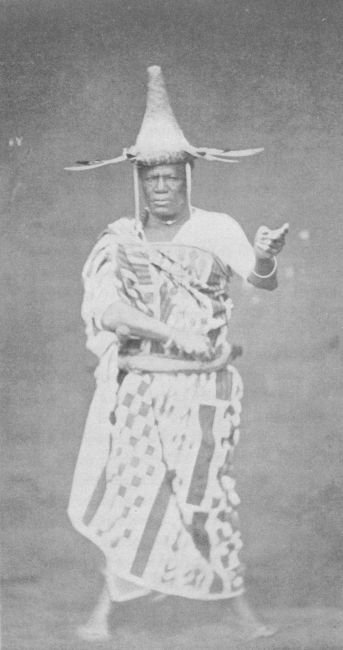 Ja Ja Making Ju Ju
[To face page 540
Ja Ja Making Ju Ju
[To face page 540
After leaving Andoni, and continuing down the coast some ten or fifteen
miles, the Opobo discharges itself into the sea. This river, marked in
ancient maps as the Rio Condé and Ekomtoro, is the most direct way to
the Ibo palm-oil-producing country.
This river was well known to the Portuguese and Spanish slave traders,
but as Bonny became the great centre for the slave trade, this river was
completely deserted and forgotten to such an extent that, though an
opening in the coast line was shown on the English charts where this
river was supposed to be, it was never thought worth the trouble of
naming, and remained quite unknown to the English traders until it came
suddenly into repute, owing to Ja Ja establishing himself here in 1870.
The people here are the Bonny men and their descendants who followed Ja
Ja’s fortunes, therefore their manners and customs are identical with
those of Bonny.
The physical appearance of these people is somewhat better than that of
the Bonny men, owing, I think, to the position of their town, which is
built on a better soil, and raised a few feet higher than that of Bonny
from the level of the river, also their uninterrupted successful trade
since their arrival in this country has doubtless not a little
contributed to their improved condition, while, on the other hand, the
Bonny men suffered severely during the years from 1869 to 1873, owing to
Ja Ja barring their way to the markets, and they seem never to have
recovered themselves.
Trading stations of the white men are at the mouth of the river and at
Eguanga, the latter a station a few miles above Opobo town.
Opobo became, under King Ja Ja’s firm rule, one of the largest exporting
centres of palm oil in the Delta, and for years King Ja Ja enjoyed a not
undeserved popularity amongst the white traders who visited his river,
but a time came when the price of palm oil fell to such a low figure in
England that the European firms established in Opobo could not make both
ends meet, so they intimated to King Ja Ja that they were going to
reduce the price paid in the river, to which he replied by shipping
large quantities of his oil to England, allowing his people only to sell
a portion of their produce to the white men. The latter now formulated a
scheme amongst themselves to divide equally whatever produce came into
the river, and thus do away with competition amongst themselves. Ja Ja
found that sending his oil to England was not quite so lucrative as he
could wish, owing to the length of time it took to get his returns back,
namely, about three months at the earliest, whilst by selling in the
river he could turn over his money three or four times during that
period. He therefore tried several means to break the white men’s
combination, at last hitting upon the bright idea of offering the whole
of the river’s trade to one English house. The mere fact of his being
able to make this offer shows the absolute power to which he had arrived
amongst his own people. His bait took with one of the European traders;
the latter could not resist the golden vision of the yellow grease thus
displayed before him by the astute Ja Ja, who metaphorically dangled
before his eyes hundreds of canoes laden with the coveted palm oil. A
bargain was struck, and one fine morning the other white traders in the
river woke up to the fact that their combination was at an end, for on
taking their morning spy round the river through their binoculars (no
palm oil trader that respects himself being without a pair of these and
a tripod telescope, for more minute observation of his opponents’
doings) they saw a fleet of over a hundred canoes round the renegade’s
wharf, and for nearly two years this trader scooped all the trade. The
fat was fairly in the fire now, and the other white traders sent a
notice to Ja Ja that they intended to go to his markets. Ja Ja replied
that he held a treaty, signed in 1873, by Mr. Consul Charles
Livingstone, Her Britannic Majesty’s Consul, that empowered him to stop
any white traders from establishing factories anywhere above
Hippopotamus Creek, and under which he was empowered to stop and hold
any vessel for a fine of one hundred puncheons of oil. In June, 1885,
the traders applied to Mr. Consul White, who informed King Ja Ja that
the Protectorate treaty meant freedom of navigation and trade.
So the traders finding their occupation gone, decided amongst themselves
to take a trip to Ja Ja’s markets, the only sensible thing they had done
since the trouble commenced. This was a step in the right direction,
namely, by attempting to break down the curse of Western Africa id
est, the power of the middle-man.
The names of the four traders who first attempted to trade in the Ibo
markets of King Ja Ja deserve to be recorded, for their action was not
without great risk to themselves. They were:
Mr. S. B. Hall
Mr. Thomas Wright
Mr. Richard Foster |
} |
English |
Mr. A. E. Brunschweiler—Swiss.
|
To these must be added the name of Mr. F. D. Mitchell, who, though not
in the first trip to the markets, joined in the subsequent attempt to
establish business amongst the interior tribes. Their reception at the
markets was not altogether a success, owing to the reception committee,
or whatever represented it in those parts, being packed with either Ja
Ja’s own people or Ibos favourable to him.
This good beginning was continued under great difficulties by these
first traders with little profit or success for about two years, owing
to the great power of Ja Ja amongst the interior tribes and the pressure
he was able to bring to bear on the Ibo and Kwo natives.
In the meantime, clouds had been gathering round the head of King Ja Ja.
His wonderful success since 1870 had gradually obscured his former keen
perception of how far his rights as a petty African king would be
recognised by the English Government under the new order of things just
being inaugurated in the Oil Rivers; honestly believing that in signing
the Protectorate treaty of December 19th, 1884, with the sixth clause
crossed out, he had retained the right given him by the commercial
treaty of 1873 to keep white men from proceeding to his markets, he got
himself entangled in a number of disputes which culminated in his being
taken out of the Opobo River in September, 1887, by Her Britannic
Majesty’s Consul, Mr. H. H. Johnston, C.B., now Sir Harry Johnston, and
conveyed to Accra, where he was tried before Admiral Sir Hunt Grubbe,
who condemned him to five years’ deportation to the West Indies, making
him an allowance of about £800 per annum and returning a fine of thirty
puncheons of palm oil, value about £450 in those days, which the late
Consul Hewett had imposed upon him, a fine that the Admiral did not
think the Consul was warranted in having imposed.
Poor Ja Ja did not live to return to his country and his people whom he
loved so well, and whose condition he had done so much to improve,
though at times his rule often became despotic. One trait of his
character may interest the public just now, as the Liquor Question in
West Africa is so much en evidence, and that is, that he was a strict
teetotaler himself and inculcated the same principles in all his chiefs.
In his eighteen years’ rule as a king in Opobo he reduced two of his
chiefs for drunkenness—one he sent to live in exile in a small fishing
village for the rest of his life, the other, who had aggravated his
offence by assaulting a white trader, he had deprived of all outward
signs of a chief and put in a canoe to paddle as a pull-away boy within
an hour of his committing the offence.
During the Ashantee campaign of 1873 Sir Garnet Wolseley sent Captain
Nicol to the Oil Rivers to raise a contingent of friendly natives; on
his arrival in Bonny he was not immediately successful, so continued on
to Opobo, where he was the guest of the writer. Upon Captain Nicol
explaining his errand, Ja Ja furnished him with over sixty of his
war-boys, most of whom had seen considerable fighting in the late war
between Bonny and Opobo. The news reaching Bonny of what Ja Ja had done,
put the Bonny men upon their mettle, and when Captain Nicol reached
Bonny on his way back to Ashantee, he found a further contingent waiting
for him from the Bonny chiefs.
This combined contingent did good work against the Ashantees, being
favourably mentioned in despatches. Poor Captain Nicol, who raised them,
and commanded them in most of their engagements with the enemy, was, I
regret to say, killed whilst gallantly leading them on in one of the
final rushes just before Coomassie was taken.
In recognition of the above services of his men, Her Most Gracious
Majesty Queen Victoria presented King Ja Ja with a sword of honour, the
King of Bonny receiving one at the same time.
Shipwrecked people were always sure of kindly treatment if they fell
into the hands of Ja Ja’s subjects, for he had given strict orders to
his people dwelling on the sea-shore to assist vessels in distress and
convey any one cast on shore to the European factories, warning them at
the same time on no account to touch any of their property. He was also
the first king in the Delta to restrain his people from plundering a
wrecked ship, though the custom had been from time immemorial that a
vessel wrecked upon their shores belonged to them by rights as being a
gift from their Ju-Ju—an idea held by savage people in many other parts
of the world.
It seems a pity that a man who had so many good qualities should have
ended as he did. He was a man who, properly handled, could have been
made of much use in the opening up of his country. Unfortunately, the
late Consul Hewett was prejudiced against Ja Ja from his first interview
with him, finding in this nigger king a man of superior natural
abilities to his own.
Had the late Mr. Consul Hewett had the fiftieth part of the ability in
dealing with the natives his sub and successor, Mr. H. H. Johnston,
showed, there would never have been any necessity to deport Ja Ja.
Unfortunately, between Ja Ja’s stubbornness and the late Consul Hewett’s
bungling, matters had come to such a pass that some decisive measures
were actually necessary to uphold the dignity of the Consular Office.
When Mr. H. H. Johnston succeeded the late Mr. Consul Hewett, the Opobo
palaver was in about as muddled a state as it was possible for it to
have got into. Matters had been in an unsatisfactory state for some
years between King Ja Ja and the late Consul. Ja Ja had over-stepped the
bounds of propriety in more ways than one. He tried the same tactics
with Mr. Johnston, who to look at, is the mildest-looking little man you
can imagine, and therefore did not fill the native’s eye as a ruler of
men; but Mr. Johnston very soon let Ja Ja and the natives generally see
he was made of different stuff to his predecessor, and the first
attempts on Ja Ja’s part not to act up to the lines he laid down for him
settled his fate. Mr. Johnston offered him the choice of delivering
himself up quietly as a prisoner or being treated as an enemy of the
Queen, his town destroyed and himself eventually captured and exiled for
ever. He elected to give himself up, was taken to Accra and there tried
and condemned after a fair hearing. I was present myself at the trial,
and old friend as I was to him, I don’t think the verdict would have
been otherwise had I been in the judge’s place, though there were many
extenuating circumstances in his case, all of which were fully
considered by Admiral Hunt Grubbe in his final sentence.
I feel confident that had Mr. Consul Johnston had the management of
affairs in the Opobo a few years earlier, Ja Ja would never have been
deported, and instead of having to censure him, he would have handled
him in such a manner as to make use of his influence in furthering
British interests. I do not think I can describe the late King Ja Ja
better than Mr. Consul Johnston did in a letter he addressed to Lord
Salisbury under date of September 24th, 1887, wherein he writes as
follows:—“Ja Ja’s chief friends and supporters for years past have been
the naval officers on the coast. His generous hospitality, his frank,
engaging manner, his naïf discourse, and amusing crudities of diction
have gained the ready sympathy of these gentlemen; no doubt Ja Ja is no
common man, though he is in origin a runaway slave,[89] he was cut out
by nature for a king, and he has the instinct of rule, though it not
unfrequently degenerates into cruel tyranny.
“His demeanour is marked by quiet dignity, and his appearance and
conversation are impressive.
“Nevertheless, I know Ja Ja to be a deliberate liar,[90] who exhibits
little shame or confusion when his falsehoods are exposed. He is a
bitter and unscrupulous enemy[91] of all who attempt to dispute his
trade monopolies, and the five British firms whose trade he has almost
ruined during the past two years.”
A complaint often made against the Government by merchants established
on the West Coast of Africa is want of official protection and
assistance; in many cases in the past this has been the case; but they
certainly could not make this complaint during the few months that Mr.
Consul Johnston was at the head of the Consular service in the Oil
Rivers. I will here give a summary of what exertions were made by the
Government to assist the merchants in their praiseworthy attempts to get
behind the middlemen in this one river, where Ja Ja was always given the
credit of being the head and front of the obstruction, nothing ever
being said about the king and chiefs of Bonny, who were equally
interested with Ja Ja in keeping the white men out of the markets, their
principal markets being on the River Opobo.
Owing to the energetic representations of Mr. Consul H. H. Johnston, the
British Government placed at his disposal for the settlement of the
market question and the Ja Ja palaver the following Government vessels,
viz., the Watchful, the Goshawk, the Alecto, the Acorn, the
Royalist, and the Raleigh, the latter bringing Admiral Sir Hunt
Grubbe up from the Cape of Good Hope for the trial of King Ja Ja.
Result: Within a very short time after the deportation of Ja Ja, all the
firms who had been so anxious to establish in the interior markets and
thus get behind the middlemen (without doubt the curse of the Oil Rivers
and every part of Africa where they are tolerated) gave up trading at
the interior markets that had caused the Government so much trouble to
open for them, and made an agreement with the middlemen, represented in
this case by the Bonny men and Opobo men, that they would not attempt to
trade any more in the interior markets if the middlemen would promise to
trade with no European firm that attempted to trade in the interior
markets. On the writer’s last visit to the Opobo in 1896 there was only
one firm trading in the interior markets, and that firm was not one of
those that were in the river at the time of the clamour for the removal
of Ja Ja and the opening of the interior in 1887.
This river was first visited in modern days in 1871 by the late Mr.
Archie McEachan, who found the people very troublesome to deal with, and
did not long remain there. No doubt the people were not so easy to deal
with as those natives that have been for some hundreds of years dealing
with Europeans; but as he was at the same time posing as a friend and
supporter of Ja Ja, and the oil he got in Kwo Ibo was being diverted
from Ja Ja’s markets, the latter no doubt exerted a certain amount of
pressure on his friend, and aided, if he did not actually cause him to
decide to withdraw from Kwo Ibo.
Kwo Ibo lay fallow for some time, then one or two Sierra Leone men
attempted to trade there, but with little success, owing to the
influence King Ja Ja had in the country. It was not until 1880-1 that
any sustained effort was made to trade in this river; but about this
time a Mr. Watts established a small trading station there, and
succeeded in creating a trade, though he had a very difficult task to
combat the opposition of King Ja Ja, who considered he was being
defrauded of some of his supposed just rights. Had Mr. Watts pushed his
way into the interior markets and dealt direct with the producers, he
would deserve the united thanks of every merchant connected with the
trade in the Niger Delta; but he did not, and contented himself with
buying his produce on a little better terms than he could have done in
Opobo or Old Calabar, and created another set of middlemen, who to-day
consider they, like their neighbours, are justified in doing their
utmost in keeping the European out of the interior. Mr. Watts eventually
sold out his interest in the trade of this river to the combination of
river firms now known under the name of the African Association of
Liverpool.
A mission has been established here for some years and I had the
pleasure of meeting the missionary in charge, some two years ago, on his
way home after a long sojourn in the Kwo Ibo; his description of the
people and of the success of his mission work was most interesting. If
he has returned to the seat of his labours and is still alive, I can
only wish him every success in the work in which evidently his whole
heart was centred.
The name Kwo Ibo, which has been given to this river, gives one the idea
that the inhabitants are a mixture of Kwos and Ibos. This to a certain
extent may be a very good description as regards the inhabitants of the
upper reaches of the river, which takes its rise, so it is supposed, in
a lake in the Ibo country, afterwards passing through the Kwo, and
discharges itself into the sea about half-way between the east point of
the Opobo River and the Tom Shotts Point.
The lower part of the river is inhabited principally by Andoni men by
origin, but calling themselves Ibenos or Ibrons.
These people deserve a great deal of credit for the plucky manner in
which they withstood the numerous attacks the late King Ja Ja made upon
them, and their stubborn refusal to discontinue trading with the white
men established in their river, though they were but ill-provided with
arms to defend themselves. During several years they must have suffered
severely from the repeated raids the late King Ja Ja made upon them, not
only from losses in battle, but also in having their towns destroyed and
many of their people carried off as prisoners. Some of the earlier raids
made by Ja Ja, I must in fairness to him say, were to a great extent
brought on by the actions of the Ibrons themselves, who were not slow to
attack and slay any Opobo men they caught wandering about, if the latter
were not in sufficient numbers to defend themselves.
In language, these people are closely allied to the old Calabar people,
and many of their customs show them to have had more communication with
those people than they have had with the Andoni people, at any rate for
many years. I find no mention amongst the writings of the early
travellers to Western Africa of their having visited this river, nor is
it even named on any old chart that I have consulted, though on some I
have seen a river indicated at the spot where the Kwo Ibo enters the
sea.
Needless to mention, they were, and the majority are to-day, steeped in
Ju-Juism, witchcraft, and their attendant horrors.
The Kwo people, whose country lies on both sides of the Kwo Ibo, and
behind the Ibenos, are the tribe from whom were drawn the supplies of
Kwo or Kwa slaves known under the name of the Mocoes in the West Indies.
I now come to the last river in the Niger Coast Protectorate, both banks
of which belong to England, the next river being the Rio del Rey, of
which England now only claims the right bank, Germany claiming the left
and all the territory south to the river Campo, a territory almost as
large as, if not equal to, the whole of the Niger Coast Protectorate,
which ought to have been English, for was it not English by right of
commercial conquest, if by no other, and for years had been looked upon
by the commanders of foreign naval vessels as under English influence?
Owing to some one blundering, this nice slice of African territory was
allowed to slip into the hands of the Germans, hence my account of the
Oil Rivers ought to be called an account of the Oil Rivers reduced by
Germany.
In speaking of the inhabitants of this river, I must also include the
people who inhabit the lower part of the Cross River. This explanation
would not have been necessary some few years ago, but I notice the more
recent hydrographers make the Cross River the main river and the Old
Calabar only a tributary of that river, which is, without doubt, the
most correct.
The principal towns are Duke Town (where are to be found nowadays the
headquarters of the Niger Coast Protectorate, the Presbyterian Mission,
and the principal trading factories of the Europeans), Henshaw Town,
Creek and Town; besides these, the various kings and chiefs have
numberless small towns and villages in the environs. In the lower part
of the Cross river are many fishing villages, the inhabitants of which
are looked upon as Old Calabar people, and owing to the latter being the
dominant race they have to-day lost, or very nearly so, any trace of
their forefathers, who I believe to have been Kwos with a strong strain
of Andoni blood.
These villages did, in days anterior to the advent of the European
traders, an immense business with the interior in dried shrimps, the
latter being used by the natives, not only as a flavouring to their
stews and ragouts, but as a substitute for the all necessary salt.
The original inhabitants of the district now occupied by the Old Calabar
people were the Akpas, whom the Calabarese drove out, and to a great
extent afterwards absorbed. This immigration of the Calabarese is said
to have taken place very little over one hundred and fifty years ago.
Originally coming from the upper Ibibio district of the Cross River,
they belong to the Efik race, and speak that language, though nowadays,
owing to numerous intermarriages with Cameroon natives and the great
number of slaves bought from the Cameroons district, they are of very
mixed blood. Most of the kings and chiefs of Old Calabar owe their rank
and position to direct descent, some of them being of ancient lineage, a
fact of which they are very proud. In this respect they differ in a
great measure from their neighbours in Bonny and Opobo, where, oftener
than otherwise, the succession falls to the most influential man in the
House, slave or free-born.
The principal town of these people boasted, some few years ago, of many
very nice villa residences, belonging to the chiefs, built of wood, and
roofed with corrugated iron, mostly erected by a Scotch carpenter, who
had established himself in Old Calabar, and who was in great request
amongst the chiefs as an architect and builder. Unfortunately, these
houses being erected haphazard amongst the surrounding native-built
houses did not lend that air of improvement to the town they might
otherwise have done if the chiefs had studied more uniformity in the
building of the town, and arranged for wide streets in place of alley
ways, many of which are not wide enough to let two Calabar ladies of the
higher rank pass one another without the risk of their finery being
daubed with streaks of yellow mud from the adjacent walls.
The native houses of the better classes are certainly an improvement
upon any others in the Protectorate, showing as they do some artistic
taste in their embellishments. They are generally built in the form of a
square or several squares, more or less exact, according to the extent
of ground the builder has to deal with and the number of apartments the
owner has need for. In some cases, I have seen a native commence his
building operations by marking out two or three squares or oblongs,
about twenty feet by fifteen, round which he would build his various
apartments or rooms. In the centre of the inner squares, which are
always left open to the sky, you almost invariably find a tree growing,
either left there purposely when clearing the ground, or planted by the
owner; occasionally you will find a fine crop of charms and Ju-Jus
hanging from the branches of these trees.
The inner walls, especially of the courtyards, are in most cases
tastefully decorated with paintings, somewhat resembling the arabesque
designs one sees amongst the Moors. No doubt this art and that of
designing fantastic figures on brass dishes, which they buy from the
Europeans and afterwards embellish with the aid of a big-headed nail and
a hammer, comes to them from the Mohammedans of the Niger, of whom they
used to see a good deal in former days.
With regard to the dress of these people, I have not anything so
interesting to relate about them as I had of the New Calabar gentlemen.
Except on high days and holidays, there is little to distinguish the
upper classes here from the same classes in any of the other rivers of
the Protectorate, except that it might be in the peculiar way they knot
the loin cloth on, leaving it to trail a little on the ground on one
side, and their great liking for scarlet and other bright coloured
stove-pipe hats. On their high festivals the kings appear in crowns and
silk garments; the chiefs, who do not stick to the native gala garments
of many-hued silks, generally appear in European clothes, not always of
irreproachable fit, their queen, as every chief calls his head wife,
appearing in a gorgeous silk costume that may have been worn several
seasons before at Ascot or Goodwood by a London belle. Sometimes you may
be treated to the sight of a dusky queen gaily displaying her ample
charms in a low-cut secondhand dinner or ball dress that may have
created a sensation when first worn at some swagger function in London
or Paris. As the native ladies do not wear stays, and one of the
greatest attributes of female beauty in Calabar is plumpness, and plenty
of it, you may imagine that the local modiste has her wits greatly
exercised in devising means to fill up the gaping space between the
hooks and eyes. I once heard a captain of one of the mail steamers
describe this job as “letting in a graving piece down the back.”
One of the customs peculiar to the Old Calabar people, practised
generally amongst all classes, but most strictly observed by the
wealthier people, is for a girl about to become a bride to go into
retirement for several weeks just previous to her marriage, during which
time she undergoes a fattening treatment, similar to that practised in
Tunis. The fatter the bride the more she is admired. It is said that
during this seclusion the future bride is initiated into the mysteries
of some female secret society. Many of the chiefs are very stout, and
given to embonpoint, a fact of which they are very proud.
The lower-class women are not troubled with too much clothing, but still
ample enough for the country and decency’s sake. As one strolls through
the town to see the market or pay a visit to some chief, one often
encounters young girls, and sometimes women, in long, loose, flowing
robes, fitting tight round the neck, and on inquiring who these are, the
reply generally comes, “Dem young gal be mission gal, dem tother one he
be Saleone woman.”
The mission here is the United Presbyterian Mission of Scotland,[92] and
a great deal of good has been done by it for these people, and is being
done now, and great hopes are expected from their industrial mission,
started only a few years ago, therefore, it would be unfair to make
further comment on the latter; it is a step in the right direction.
Some of the missionaries to Old Calabar have put in about forty years of
active service, most of it passed on the coast. Amongst others who have
lived to a great age in this mission should be mentioned the Rev. Mr.
Anderson, who lived to the advanced age of between eighty and ninety
years, greatly respected by both the European and native population.
Amongst the lady missionaries the name of Miss Slessor stands out very
prominently, and, considering the task she has set herself, viz., the
saving of twin children and protection of their mothers, her success has
been marvellous, for the Calabarese is, like his neighbours, still a
great believer in the custom that says twin children are not to be
allowed to live. This lady has passed about twenty years in Old Calabar,
a greater part of the last ten years all alone at Okÿon, a district
which the people of Duke Town and the surrounding towns preferred not to
visit, if they could manage any business they had with the people of
Okÿon without going amongst them. Many of these old customs will now be
much more quickly stamped out than in the past, owing to the fact that
it is in the power of the Consul-General to punish the natives severely
who practise them. The preaching and exhortation of the missionaries to
the people in the past was met by the very powerful argument, in a
native’s mind, that “it was a custom his father had kept from time
immemorial, and he did not see why he should not continue it,” the Ju-Ju
priests being clever enough to point out to the natives that, though the
missionaries preached against Ju-Juism, they could not punish its
votaries. But that is all changed now, and even the Ju-Ju priests begin
to feel that the power of the Consul-General is much greater than that
of their grinning idols and trickery.
Though these people have been in communication with Europeans for at
least two centuries, and under British influence for upwards of sixty
years, and a mission has been established in their principal town for
the best part of fifty years, it was a common thing to see human flesh
offered for sale in the market within a very few years of the
establishment of the British Protectorate.
In judging the result of missionary effort in this river, or, in fact,
any other part of Western Africa, one is apt to exclaim, “What poor
results for so much expenditure in lives and money!” The cause is not
far to seek if one knows the native, and has sufficiently studied his
ways and customs as to be able to understand or read what is working in
his brain.
The upper or dominant classes, consisting of the kings, the chiefs, the
petty chiefs and the trade boys (the latter being the traders sent into
the far distant markets to buy the produce for their masters, and it is
from this class that many of the chiefs in most of these rivers spring)
are all, to a man, working either openly or secretly against the
missionaries. Even when they have become converts and communicants, in
very many cases they are as much an opponent as ever of the missionary.
I can fancy I see some enthusiastic missionary jumping up with
indignation depicted in every feature to tell me I am not telling the
truth about his particular converts. Well, as I expect to be called a
liar, I have taken care to admit that a very few converts are not
opposed to the missionary, in order that I may say to any missionary
that particularly wishes to wipe the floor with me that perchance his
special converts are included in the minority that is represented by the
very few cases where the convert is wholly and solely for the mission.
What are the causes that lead these people to work against the missions?
First and foremost is Ju-Ju and its multifarious ramifications,
consisting of Ju-Ju priests of the district, the Ju-Ju priests of the
surrounding country, and the travelling Ju-Ju men, described by the
natives as witch doctors, who keep up a communication of ideas and
thought from end to end of the pagan countries of West and South-West
Africa.
Secondly, not only is the teaching of Christianity opposed to Ju-Juism,
but it is also opposed to the whole fabric of native customs other than
Ju-Juism. Polygamy, for example, is an actual necessity, according to
native custom, thus a wife after the birth of an infant retires from the
companionship of her husband and devotes herself for the following two
years to the cares of nursing. Then, again, at certain times, according
to native custom, a woman is not allowed to prepare food that has to be
eaten by others than herself. This would place the man with only one
wife in a peculiar position, as it is a general custom in all these
rivers, from the kings downwards, to have their food cooked by one of
their wives. This custom arises from the fact that poisoning is known to
be very much practised amongst all the Pagan tribes, and experience has
taught the men that their greatest safety lies in the faithfulness of
their wives, for the wives are aware that they have all to lose and
nothing to gain by the death of their husbands.
Many people who have visited Western Africa will say that the reports of
secret poisoning on the coast are travellers’ yarns; but to refute that
I will here describe a custom met with still in many places on the
coast, and invariably practised amongst all natives in the purely native
towns in the immediate vicinity of the coast towns. Even the coast towns
people practise it still in every case amongst themselves and in some
cases with the Europeans. Of course, I don’t say that the educated negro
or coloured missionary will do it with Europeans, but many of the
educated natives will do it with the uneducated native, and this custom
is that your native host will never offer you food or drink without
first tasting it to show you it is not poisoned. While I am on this
topic, let me give any would-be travellers amongst the Pagans a bit of
advice. Once they strike in amongst the purely native, always follow
this custom; it will do no harm and may save them from unpleasant
experiences.
Thirdly, the native instinct of self-preservation is as much the first
law of nature to the negro as it is to the rest of mankind. At first
sight it might be said, “Where is the link between self-preservation and
missionary effort, and how comes it to work against the missions?” I
will try to explain this point as clearly as possible.
Naturally the first people the missionary came in contact with were the
coast tribes. These people, in almost if not every case, are
non-producers, being simply the brokers between the white man and the
interior; in not a few cases behind the coast tribes are other tribes
who are again non-producers and are the brokers of the coast brokers, or
make the coast brokers pay a tribute to them for passing through their
country. No place so well illustrated this system as the trade on the
lower Niger as it used to be conducted by the Brass, New Calabar and
Bonny men. Previous to the advent of the Royal Niger Company in that
river, these people paid a small tribute to perhaps a dozen different
towns on their way up to Abo on the Niger—some of the Brass men used
even to get as far as Onicha or Onitsha. Now that the Royal Niger
Company is trading on the Niger, none of these people can go to the
Niger to trade. Well, there you have one of the great objections to
mission effort. Each of these small tribes who were non-producers have
lost the tribute they used to exact from the Brass, Bonny and New
Calabar native brokers, therefore all the non-producers are averse to
the white man passing beyond them, be he missionary or trader. Of
course, the greatest objectors to the white man penetrating into the
interior are the coast middlemen, for it strikes at once at the source
of all their riches, all the grandeur of their chieftainship, and for
the rising generation all hope of their ever arriving to be a chief like
their father or their masters, and have a large retinue of slaves, for
the favourite slaves are in no way anxious to see slavery abolished,
because with its abolition they only foresee ruin to their ambitious
views.
Thus you will understand me when I point out to you the weak spot in
nine-tenths of the mission effort. They have been trying to look after
the negro’s soul and teaching him Christianity, which in the native mind
is cutting at the root, not only of all their ancient customs, but
actually aims at taking away their living without attempting to teach
them any industrial pursuit which may help them in the struggle for
life, which is daily getting harder for our African brethren as it is
here in England.
When I am speaking of mission effort I ought to include Government
effort in the older colonies. No attempt has been made, as far as I am
aware of, to open technical schools or to assist the natives to learn
how to earn their living other than by being clerks or petty traders.
To describe all the customs of the Old Calabar people would take up more
space than I am allowed to monopolise in this work.
They have numerous plays or festivals, in which they delight to disguise
themselves in masks of the most grotesque ugliness. These masks are, in
most cases, of native manufacture, and seem always to aim at being as
ugly as possible. I never have seen any attempt on the part of a native
manufacturer of masks to produce anything passably good looking.
Egbo, the great secret society of these people, is a sort of
freemasonry, having, I believe, seven or nine grades. To attempt to
describe the inner working of this society would be impossible for me,
as I do not belong to it. Though several Europeans have been admitted to
some of the grades, none have ever, to my knowledge, succeeded in being
initiated to the higher grades. The uses of this society are manifold,
but the abuses more than outweigh any use it may have been to the
people. As an example, I may mention the use which a European would make
of his having Egbo, viz., if any native owed him money or its
equivalent, and was in no hurry to pay, the European would blow[93] Egbo
on the debtor, and that man could not leave his house until he had paid
up. Egbo could be, and was, used for matters of a much more serious
nature than the above, such as the ruin of a man if a working majority
could be got together against him. This society could work much more
swiftly than the course adopted in other rivers to compass a man’s
downfall; vide Will Braid’s trouble with his brother chiefs in New
Calabar.
The country up the Cross River, which is the main stream into the
interior, improves a very few miles after leaving Old Calabar; in fact,
the mangrove disappears altogether within twenty miles of Duke Town,
being replaced by splendid forest trees and many clearings, the latter
being, in some instances, the farms of Old Calabar chiefs. On arriving
at Ikorofiong, which is on the right bank of the river, you find
yourself on the edge of the Ikpa plain, which extends away towards Opobo
as far as the eye can see. I visited this place thirty-five years ago,
and stayed for a couple of days in the mission house, the gentleman then
in charge being a Dr. Bailey. At that time this was the farthest station
of the Old Calabar mission; since then they have established themselves
in Umon, and have done great service amongst these people, who were
previously to the advent of the mission terribly in the toils of their
Ju-ju priests. The people of Umon speak a language quite different from
the Calabarese. Umon is about one hundred miles by water from Old
Calabar.
Twenty or thirty miles further up the Cross River you come to the
Akuna-Kuna country, inhabited by a very industrious race of people,
great producers and agriculturists, and having abundance of cattle,
sheep, goats and poultry. These people received one of Her Majesty’s
consuls with such joy and good feeling, and so loaded him with presents
of farm produce, that his Kroo boatmen suffered severely from
indigestion while they remained in the Akuna-Kuna country. A little
farther up the river is the town of Ungwana, a mile or so beyond which
is now to be found a mission station. This district is called Iku-Morut,
and a few years ago the inhabitants were never happy unless they were at
war with the Akuna-Kuna people. This state of things has been much
modified by the presence in the country of protectorate officials.
About sixty miles by river beyond Iku-Morut is the town Ofurekpe, in the
Apiapam district. This place, its chief and people are everything to be
desired, the town is clean, the houses are commodious, the inhabitants
are friendly, and their country is delightful. They are a little given
to cannibalism, but, I am very credibly informed, only practise this
custom on their prisoners of war.
Beyond this point the river passes through the Atam district, a country
inhabited, so I was informed, by the most inveterate of cannibals. Not
having visited these people, I am not able to speak from personal
experience; but as I have generally found in Western Africa that a
country bearing a very bad character does not always deserve all that is
said against it, I shall give this country the benefit of the doubt, and
say that once the natives get accustomed to having white people visit
them, and have got over the fearful tales told them by the interested
middlemen about the ability of the white men to witch them by only
looking at them, then they will be as easy to deal with, if not easier,
than the knowing non-producers.
I know of one interior town, not in Old Calabar, where the principal
chief had given a warm welcome to a white man and allotted him a piece
of ground to build a factory on, which he was to return and build the
following dry season. Before the time had elapsed the chief died,
without doubt poisoned by some interested middleman. When the white man
went up to the country according to his agreement, the new chief would
not allow him to land, and accused him of having bewitched the late
chief. The white trader was an old bird and not easily put off any
object he had in view, so stuck to his right of starting trade in the
country, and by liberal presents to the new chief at last succeeded in
commencing operations, with the result that the new chief died in a very
short time and the white man, who was put in charge of the factory, was
shot dead whilst passing through a narrow creek on his way to see his
senior agent, this being done in the interior country so as to throw the
blame upon the people he was trading with. No one saw who fired the
fatal shot, and the body was never recovered, as the boys who were with
him were natives belonging to the coast people and in their fright
capsized the small canoe he was travelling in, so they reported; but
some months after the white man’s ring mysteriously turned up, the tale
being it was found in the stomach of a fish.
I will here describe one other very practical custom that used to be
observed all over the Old Calabar and Cross River district, but which
has disappeared in the lower parts of the river, owing no doubt to the
efforts of the missionaries having been successful in instilling into
the native mind a greater respect for their aged relatives than formerly
existed. If it ever occurs nowadays in the Calabar district it can only
take place in some out of the way village far away in the bush, from
whence news of a little matter of this kind might take months to reach
the ears of the Government or the missionary; but this custom is still
carried on in the Upper Cross River, and consists in helping the old and
useless members of the village or community out of this world by a tap
on the head, their bodies are then carefully smoke-dried, afterwards
pulverised, then formed into small balls by the addition of water in
which Indian corn has been boiled for hours—this mixture is allowed to
dry in the sun or over fires, then put away for future use as an
addition to the family stew.
With all the cannibalistic tastes that these people have been credited
with, I have only heard of them once ever going in for eating white men,
and this occurred previous to the arrival in the Old Calabar river of
the Efik race, if we are to trust to what tradition tells us. It appears
that in 1668-9 four English sailors were captured by the then
inhabitants of the Old Calabar River; three of them were immediately
killed and eaten, the fourth being kept for a future occasion. Whether
it was that being sailors, and thus being strongly impregnated with salt
horse, tobacco and rum, their flesh did not suit the palate of these
natives I know not, but it is on record that the fourth man was not
eaten, but kindly treated, and some years after, when another English
ship visited the river, he was allowed to return to England in her.
Since that date, as far as I know, no white men have ever been molested
by the Old Calabar people.
There has been occasionally a little friction between traders and
natives, but nothing very serious, though it is said some queer
transactions were carried on by the white men during the slave-dealing
days.
PART I — A VOYAGE TO THE AFRICAN OIL RIVERS TWENTY-FIVE YEARS AGO. BY JOHN HARFORD — TRADING IN THE CAMEROONS
It was in the month of December, 1872, when I with seventeen others left
our good old port of Bristol bound for one of the West African oil
rivers on a trading voyage. It was a splendid morning for the time of
year: bright, fine, and clear, when we were towed through our old lock
gates, with the hearty cheers, good-byes, and God-speed-yous from our
friends ringing in the air; and although there were some of us made sad
by the parting kiss, which to many was the last on this earth, there was
one whose heart felt so glad that he has often described the day as
being one of the happiest in his life, and that one was your humble
servant, the writer. Our first start was soon delayed, as we had to
anchor in King Road and wait a fair wind. And now a word to any hearers
who may be about to start on a new venture. Always wait for a fair
wind—when that comes make the best use you can of it. Our fair wind
came after some two weeks, and lasted long enough for us to get clear of
the English land; but before we were clear of the Irish, we encountered
head winds again. Being too far out to return, we had to beat our ship
about under close reefed topsails for another week. This was a rough
time for all on board. At last the wind changed, and we this time
succeeded in clearing the Bay of Biscay and then had a fairly fine run
until we reached St. Antonia, one of the Cape de Verde Islands. This we
sighted early one morning, and in the brilliant tropical sunshine it
appeared to me almost a heavenly sight. We soon passed on, the little
island disappeared, and once more our bark seemed to be alone on the
mighty ocean. After a week or so we sighted the mainland of that great
and wonderful continent Africa—wonderful, I say, because it has been
left as if it were unknown for centuries, while countries not nearly its
equal in any way have had millions spent upon them. Our first land fall
was a port of Liberia. Liberia, I must tell you, is part of the western
continent with a seaboard of some miles. It was taken over by the
American Republic and made a free country for all those slaves that were
liberated in the time of the great emancipation brought about by that
good man William E. Channing. Here, on their own land, these people, who
years before had been kidnapped from their homes, were once more free.
After a week’s buffeting about with cross currents and very little wind
we at last reached the noted headland of Cape Palmas, a port of Liberia;
we anchored here for one night and next morning were under way again.
This time, having a fair wind and the currents with us, we soon made our
next stopping place, which was a little village on the coast-line called
Beraby. Here we had our first glimpse of African life. Directly we
dropped anchor a sight almost indescribable met the eye of what appeared
to be hundreds of large blackbirds in the water. We had not long to wait
before we knew it was something more than blackbirds, for soon the ship
was crowded from stem to stern with natives from the shore jabbering
away in such a manner very alarming to a new-comer. I am not ashamed to
confess that I was anything but sorry when the ship was cleared and we
were off once more; this was soon done as we had only to take on board
our Kroo men, or boys, as they are always called, although some of them
are as finely built as ever a man could wish to be. We took about twenty
of these boys, who engage for the voyage and become, like ourselves,
part of the ship’s crew. After each one had received one month’s pay
from our captain, and duly handed it over to their friends, and said
their good-byes, general good-wishes were given, and we again up anchor,
and set sail for the well-known port of Half Jack, which ought to be
called the Bristol port of Half Jack, for here we met some half-dozen
Bristol ships, who gave our captain a regular good old Bristol welcome.
A few words about this important port may be of interest, although I am
sorry to say we have managed to let it, valuable as it is, get into the
hands of the French, like many more in that part. Half Jack is a very
low-lying country with a large lagoon, as it is called running, between
it and the mainland. Along the sides of this lagoon the country villages
are situated, which produce that great product palm oil; this is sold to
the Half Jack men, who in turn sell to our Bristol men and they ship it
to all parts of Europe. We now leave Half Jack to its traders and
natives, and after our captain has paid his complimentary visits, we set
sail for the Gold Coast town of Accra; but before reaching that, we have
to pass many fine ports and splendid headlands. Axim, in particular, I
must mention, as it has recently come very much to the fore, owing to
the great quantity of mahogany that is now being exported from there, a
wood that has revolutionised the furniture industries of this
country—it has also enabled the thrifty men and women of England to
make their homes more bright and cheerful by giving them the very cheap
and beautiful furniture they could not have dreamed of years ago, when
the only mahogany procurable was the black Spanish, which was far too
expensive for ordinary persons to think about. Axim, in addition to this
great export of wood, is the port of departure for the West African gold
mines, and they will I have no doubt, in time prove of great value. The
Ancobra River empties itself here. Axim being at its mouth, this river
would be very useful in helping to develop the interior of this part,
were it not that the mouth was so shallow and dangerous, two obstacles
that the science of the future will, I expect, remove. We are now
passing some of the finest specimens of coast scenery it is possible to
see. I can better describe it by comparing it somewhat to our North
Devon and Cornwall coasts, such splendid rocks and headlands and land
that I venture to say will eventually prove very valuable.
We next come to the important town of Elmina, one of the departure ports
of the Ashantee country, and also where all noted prisoners are kept.
King Prempeh, late of Ashantee, is now awaiting her Majesty’s pleasure
there; many others have found Elmina their home of detention after
attempting to disobey our gracious Queen’s commands.
Cape Coast Castle is our next noted place. This is the chief departure
port for the Ashantee country, and was at one time the Government seat
for the Gold Coast Colony. It is a very fine rock-bound port, and from
the sea its square-topped, white-washed houses, and its Castle on the
higher promontory, form an imposing-looking picture. It is second to
Accra for importance in this part; much gold comes from here. It is also
a celebrated place for the African-made gold jewellery, some of which is
very beautiful in design and workmanship. The grey parrots form a great
article of barter here. Hundreds of these birds are brought to Liverpool
every week, I may almost say all from this place. The people are chiefly
of the Fantee tribe, and a fine and intelligent race they are. They have
good schools, and many of the younger men ship off to other parts of the
coast as clerks, &c. Good cooks may be engaged from here, which is a
fact I think well worth mentioning.
And now we sail on to the present seat of Government for the Gold Coast
Colony, Accra. This is a fine country, a flat, table-like land along the
front, with the hills of the hinterland rising in the background. The
landing here is somewhat dangerous in the rough season, and great care
has to be taken by the men handling the surf-boats to avoid them
capsizing. Many lives have been lost here in days gone by.
I told you before why we called at the Kroo village Beraby, and the port
of Half Jack. We now anchored at Accra to engage our black mechanics,
for which the place is noted. Here you may procure any kind of mechanic
you may mention—coopers, carpenters, gold- and silver-smiths,
blacksmiths, &c. In those early days the coopers and carpenters were
engaged to assist our Bristol men, but to-day the whole of the work is
done by the natives themselves. I do not think you would find a white
cooper or carpenter in any of the lower ports, some of the natives
being very clever with their tools. We also engaged our cooks, steward,
and laundry men, which any establishment of any size in these parts must
keep. For all these trades the natives have to thank chiefly the Basel
Mission, which is, I believe, of Swiss origin. This mission started
years ago to not only teach the boys the word of God, but to teach them
at the same time to use their hands and brains in such a way that they
were bound to become of some use to their fellow men, and command ready
employment. This mission, I cannot help feeling, has been one of the
greatest blessings they have ever had on that great continent. It has
sent out hundreds of men to all parts, and to-day the whole of the West
Coast is dependent upon Accra for its skilled labour. This way of
instructing the natives is now, I am pleased to say, being followed by
nearly all our missionary societies, and it is certainly one of the best
means of civilising a great people like the Africans are.
Not to take powder and shot and shoot them down because they don’t
understand our Christian law, but teach them how to make and construct,
that they in time may become useful citizens, and that they may be
better able to learn the value of the many valuable products growing in
their midst, they will be ever thankful to us and bless our advent among
them. These Accra people are a very fine race, clean, and distinctly
above the ordinary type of negro, clearer cut features, well-built men
and women. The women, especially, are superior to any of the West
Africans I have met with up to the present. They, like their husbands,
are fond of dress, and, like their husbands too, are hard-working and
industrious; this was shown by the readiness of these people to
undertake the porterage in the prompt manner they did for the late
Ashantee Expedition, and which must have done a great deal towards
bringing about the success of the same. You will be better able to
understand this if you will suppose, we will say, six thousand men were
landed at Land’s End, their destination being Bristol, and with no train
or horse to carry the food supply and ammunition, let alone the heavy
guns. For this work some thousands of porters are required, each one of
which must carry from 60 to 100 pounds in weight. This is carried on the
head, and when I tell you these people think nothing of doing twenty
miles a day, day after day, you will realise how physically strong they
must be. The manner in which they rallied round the Government—men,
women, and children—as soon as it was decided an expedition should be
sent, must have been very encouraging to those in command.
One thing, however, about these Accra people, while they have very much
improved themselves in their dress they have not improved their villages
as much as we would wish to see, but this will all come in time. Our old
towns used to abound in narrow courts and lanes, while we to-day like to
see open spaces, broad streets, &c., with plenty of fresh air, knowing
it is an absolute necessity to us, and it should be the first care of
our councillors to do away as far as possible with all dens and alleys,
so that if the cottage is small, the cottager can breathe pure, fresh
air; for, as you all know, the working man’s stock-in-trade is his
health—when that goes, the cupboard is often bare.
Now, I think it is about time we hove anchor and said good-bye to Accra.
Our coopers and carpenters are engaged, and our crew being completed we
set sail for our destination.
After being some four or five days crossing the Bight of Biafra, we
sighted the island of Fernando Po. Here our captain having to do a
little business, we anchor for the night in the harbour of Santa Isabel.
The little island of Fernando Po once belonged to us, but we exchanged
it some years ago with the Spanish Government for another island in the
West Indies, which our Government thought of more value. This, as far as
the West Coast was concerned, was a pity, because at the time I am
speaking of the island was a flourishing place, with about half-a-dozen
or so English merchants, and a fairly good hotel; but not so now, for
while there is still business going on, the place is not advancing, and
a place that does not advance must go back. The chief merchants there
to-day are English. This the Spanish would not have if they could help
it, but being under certain obligations to them they suffer them to
remain.
The first view of Fernando Po when you arrive in the bay is a perfect
picture; it makes one almost feel they would never like to leave there;
its white houses all round the front on the higher level, its wharves
and warehouses at the bottom, and its beautiful mountain rising
magnificently in the background. Its whole appearance is very similar to
the island of Teneriffe. It seems strange that here, almost in the
middle of the tropics, if you have any desire to feel an English winter,
you have only to go to the top of the Fernando Po mountain, which can
easily be done in two days, or even less, for while at the foot the
thermometer is registering 85° or 90° in the shade, on the top there is
always winter cold and snow.
Now, I think we had better continue our journey. We took a few
passengers on board, and then set sail for the Cameroon River. This
being only fifty or sixty miles distant, we were not long before we came
to anchor off what is called the Dogs’ Heads. Here we had to wait the
flood, and almost three-quarter tide, to enable our ship to pass safely
over a shallow part of the river called the flats. Now we come in sight
of the then noted King Bell’s Town, called after a king of that name.
Here our ship is moored with two anchors, and here she has to remain
until the whole of her cargo has been purchased. This was done, and is
even to-day, by barter, that is exchanging the goods our ship has
brought out for the products of the country, which at that time
consisted only of palm oil, ivory, and cocoa-nuts; but before we
commence to trade the ship has to be dismantled—top spars and yards
taken down, and carefully put away with the rigging and running gear;
spars are then run from mast to mast, and bow to stern, forming a ridge
pole; then rafters are fastened to these coming down each side,
supported by a plate running along the side, supported by upright posts
or stanchions; the rafters are then covered with split-bamboos, over
these are placed mats made from the bamboo and palm trees. It takes, of
course, some thousands of mats to cover the ship all over, but this is
done in about a month, and all by natives who are engaged for that
particular work and belonging to that place. Our ship now being housed
in, all hands who have not been sent to assist in taking another ship to
England are given their different duties to assist the captain in
carrying on the trade.
Each ship in those days had what was then called a cask house, that was
a piece of land as nearly opposite as possible to where the ship lay
moored. This land was always kept fenced round with young mangrove props
or sticks, forming a compound; inside this compound would be two,
perhaps three, fairly good sized stores or warehouses, and also an open
shed for empty casks which had to be filled with palm oil and stowed in
the ship for the homeward voyage. Now the first work to be done after
the ship was made ready for trading, was to land as much of her cargo as
was not immediately required for trading purposes, such as salt,
caskage, earthenware, and all heavy goods. Salt in those days, as in the
present, formed one of the staple articles of trade, therefore a ship
would generally have from 200 to 300 tons of this on board, all of which
would have to be landed into one of these store houses. At that time
that meant a lot of labour, as every pound had to be carried by the
natives from the boats to the store in baskets upon the head, over a
long flat beach. To-day all this is altered, the salt is sent out in
bags, and each store has a good iron wharf running out into the river
with trolly lines laid upon it, which runs the goods right into the
store, and so saves an immense amount of labour. After the salt came the
casks, packed in what are called shooks; that is, the cask when emptied
at home here, is knocked down and made into a small close package and in
that condition only taking up an eighth part of the room it would take
when filled with the palm oil, thus enabling the ship to carry, in
addition to her cargo, enough casks to fill her up again completely
when filled with oil. To carry on this work the crew of the ship was
divided into two parts, one to work on board, the other on shore. The
shore work was generally allotted to the Kroo boys we engaged up the
coast, with one of the white men in charge, while the white crew with
three or four natives would work the ship. In addition to all this work,
trade would be going on every day, which meant 100 or so natives coming
and going constantly from half-past five in the morning until three or
four in the afternoon, when trade would cease for the day. This release,
I need scarcely tell you, was most welcome to us all, for during the
whole of this time the ship was nothing but a continual babel, which not
unfrequently ended in a free fight all round, when, of course, a little
force had to be used to restore quiet.
The trading would be carried on in this way. The after end of the ship
was partitioned off and made to resemble a shop as nearly as possible,
in this were displayed goods of all kinds and descriptions too numerous
to mention here. In front of this shop, at a small table, the captain
sat, while an assistant would be in the shop ready to pass any goods
that were required out to the purchasers, who first had to take their
produce, whatever it might be, to the mate, who would be on the main
deck to examine the oil and see that it was clean and free from dirt of
any kind; he would also measure whatever was brought by the natives,
then give them a receipt, or what was commonly called a book. This book
was taken to the captain, who would ask what they required. All that
could be paid for from the shop was handed over, while for the heavy
goods another receipt or book was given which had to be handed to the
man in charge of the store on the beach, who gave the native his
requirements there. So the work would go on from day to day, and month
to month, until the whole of the ship’s cargo had been bought, then the
mat roof was taken off, masts and spars rigged up, sails bent and the
ship made ready to sail for Old England. This, I must tell you, was a
happy time for all on board, after lying, as we often did, some fourteen
or fifteen months in the manner I have described. During these long
months many changes took place; some of our crew fell ill with fever,
and worst of all dysentery, one of the most terrible diseases that had
to be contended with at that time. Three of our number, one after the
other, we had to follow to the grave, while others were brought down to
a shadow.
Here I experienced my first attack of African fever, which laid me low
for some two weeks. I remember quite well getting out of my bed for the
first time; I had no idea I had been so ill; I could not stand, so had
to return to my berth again. This was a rough time for us—we had no
doctor, and very little waiting upon, I can tell you. If the
constitution of the sufferer was not strong enough to withstand the
attack he generally had to go under, as it was impossible for the
captain to look after the sick and do his trade as well, and as he was
the only one supposed to know anything about medicine, it was a poor
look out. (I have known, after a ship had been out a few months, not a
white man able to do duty out of the whole of the crew.) These were our
hard times, as, in addition to working all day, the white crew had to
keep the watch on board through the night, while the Kroo boys did the
same on shore. So that when any of our men were ill, the watch had to be
kept by the two or three that were able. Many a night after a hard day’s
work I have fallen fast asleep as soon as I had received my
instructions from the man I relieved. I fear my old captain got to know
this, for he used to come on deck almost always in my watch, and
sometimes ask me the time, which I very rarely could tell him. One night
he caught me nicely. I was fast asleep, when suddenly I felt something
very peculiar on my face. I put my hands up to rub my eyes as one does
when just awakening, and, to my horror, my face was covered with palm
oil, our captain standing at the cabin door laughing away. “What is the
matter?” he said; “has anything happened?” “Yes,” I replied; “you have
given me the contents of the oil-can.” I need scarcely tell you I did
not sleep much on watch after that. The wonder to me now is that we did
not lose more lives during that trying time.
Rumours of wars, as they were called, amongst the natives occasionally
reached us, but we were left pretty much unmolested. One day the captain
and I had a free fight with fifty or sixty natives, some of whom had
stolen a cask from our store, which I happened to discover. We got our
cask back and a few of them had more than they bargained for. Another
time while I was on board a ship fitting out for home, the captain of
her saw a native chief coming alongside who was heavily in his debt, so
he made up his mind, without saying a word to any one, to make him a
prisoner, so he invited him downstairs to have a glass of wine, leaving
the forty or so people who had accompanied their chief in his canoe on
deck. The captain then quietly locked him up, the chief shouted for
assistance, his people rushed down and the tables were soon turned, for
they took the captain prisoner and nearly killed him into the bargain,
one man striking him with a sword nearly severed his hand from his arm,
the two or three whites on board were powerless. The natives having
taken complete charge of the ship, we managed to hoist our flag for
assistance, which was soon at hand, but too late to be of any use, for
as soon as they had liberated their chief from his imprisonment, they
all made off as quickly as they could to their own village. The captain
was of course greatly to blame for not saying a word to any of us of his
intention and for so underrating the strength of the chief’s people. The
chief was eventually brought to justice, however, by our own Consul.
One other little break occurred to me to vary the monotony of those long
months. Attached to our ship was a small cutter which used to run down
to small villages outside the Cameroon River. To one called Victoria I
journeyed once with the mate and our little craft on a small trading
venture. Victoria is situated at the foot of the splendid Cameroon
mountain, which, like its neighbour at Fernando Po, always has snow at
the peak; it is over 13,000 feet high and at that time only one or two
men had ventured to the summit—one was, I believe, the late Sir Richard
Burton. Since then several others have succeeded, amongst them the
present Sir Harry Johnston, who did a lot of travelling when he was
Vice-Consul, in those parts. Victoria is a snug little place. It was
founded some years ago by a very old missionary, a Mr. Seagar, a man who
did a great work in his time and whose name will never be forgotten in
the Cameroon River. It lies in what is called Ambas Bay, which is
sheltered somewhat from the south-west winds by two small islands. On
one of these a British Consulate was erected a few years ago. The whole
of this part as well as the Cameroon River is now a portion of the
German Colony. We soon completed our business here and returned once
more to our duties in the river. Between Victoria and Cameroon is the
village of Bimbia, said to be one of the most noted slave depots in the
district. Hundreds of slaves used to be shipped from here in the days
when the trade was allowed, and it is said that some time after the
trade was prohibited one of these slave ships was just about to embark
her human freight, when a British man-o’-war hove in sight. The captain,
thinking his ship would be taken—and it was, I believe—and wanting to
secure the golden dollars he had, took them to the shore and buried
them. This is said to be thousands and thousands of pounds and is still
unfound, so goes the tale. I tell it to you as it was told to me.
Our daily routine in the river was so similar that we will now consider
the whole of the ship’s cargo had been bought, and she is getting ready
to make a start for home, which we were all very glad of; but our joy
did not last long, for the mail arriving just at that time with letters
from England, the captain received communication from our owners that
they were sending out another ship, which he was instructed was for our
chief mate to take charge of. That meant that the mate would have to
remain to lay the cargo of her, while our old ship went home; but the
poor man had been very ill for some time previous to this news, and was
totally unfit to take charge; so under the circumstances there was only
one thing to be done, and that was for the captain to remain and send
the mate home. As soon as this was decided upon, two of us were asked to
stay behind and help to work the newly-arrived vessel. I was one, the
cook was the other (our skipper liked to be looked after in the eating
department). Well, we soon settled down in our new quarters, and in a
week or so said good-bye to our old ship and shipmates, who were jolly
glad to get out of the river, and did not envy us poor fellows who had
to go through all the old duties over again without a bit of change.
However, we entered upon our work with cheerful hearts. We had a good
captain, and had no intention of leaving him as long as he remained out.
Perhaps a word or two about the natives’ trade tricks might interest
you, then you will see a mate’s life on an African trading ship was not
altogether a “bed of roses”; and he had to be pretty sharp to catch
them, otherwise our wily friends would be sure to have him. For
instance, they had a happy knack of half-filling their casks with thick
wood, secured in such a way to the inside of the heads that, instead of
there being fifty gallons of oil in the cask which it would measure by
the gauging rod, it would possibly not contain more than twenty-five;
water, too, was very often introduced to make up a deficiency, and if
you happened to tell our friend his oil contained water, you were told
not water, it is rain. Another dodge was to mix a certain kind of herb
with the oil, which caused it to ferment, so that half casks could very
easily be made to look full ones. Dirt as well was freely used by the
natives when they thought they could get it passed, so one had to keep
one’s eyes open.
PART II — PIONEERING IN WEST AFRICA; OR, “THE OPENING UP OF THE QUA IBOE RIVER”
In the year 1880, I was asked by a Liverpool firm to undertake certain
work in connection with one of the trading establishments on the Old
Calabar River. The offer came at a very opportune time. Being anxious to
improve my position, like most young fellows, I accepted, and was soon
on the way to my new undertaking. My first business was to take an old
ship, that had seen the best of her days, and had been lying there in
the stream for many years as a trading hulk, now being considered unsafe
to remain longer afloat. I had to place her on the beach in such a way
that she could still be used as a trading establishment. This was not a
small matter, as the beach upon which she had to be placed was not a
good one for the purpose. However, I found that if I could get her to
lie on a certain spot I had carefully marked out, there was every
possibility of a success; but I fear I was the only one that thought so,
as it was fully twelve months before my senior would let me undertake
the venture; at last I got his consent, and in a very short time the
vessel was landed safely, and, I am pleased to say, did duty for over
ten years. It was while waiting for this consent that the beginning of
the events I am going to narrate took place.
Business was somewhat quiet in the Old Calabar, so our senior thought he
would go for a bit of an excursion to a place called Qua Iboe, which was
supposed to be a small tributary of the great river of Old Calabar, but
which he found to his astonishment was some twenty-five miles westward
of the mouth of the Old Calabar, and ninety miles from our main station
at Calabar; however, he did not like to return without seeing the place,
so he and his crew went, and after two or three days’ journey, they
suddenly found themselves in the midst of breakers, and it was only by
luck they got washed into the mouth of the river Qua Iboe, half-dead
with fright, so much so that our senior would not venture back in the
boat, but preferred walking overland.
After being absent seven or eight days, he returned to headquarters with
a very lively recollection of what he had gone through. Not being
accustomed to the sea, the knocking about of the small boat very much
upset him, then the long overland journey back took all the pleasure out
of what he had intended to be a little holiday. Consequently, on his
return he had but little to say about the river he had gone to see; and
not being of a talkative disposition, had I not pressed him on the
subject, I think, as far as our establishment was concerned, the Qua
Iboe would have been a blank space on the map to-day, as many more fine
places are in that great continent.
So while we were at dinner, an evening or so after his return, feeling
very anxious to hear something about his excursion, I remarked that we
had not heard him say much about the new river. “No,” said he; “for the
simple reason is that I know but very little about it, except that I
nearly got capsized in the breakers.” “Well,” I said, “is it a river of
any size? Would it not be a good place to open up a new business?” “Oh,
yes!” he said; “the river is a fair size, and it may or may not be a
good place for business. We can’t go there, we have not the means; we
could not go without a vessel of some sort.” “Well,” said I, “would you
go if you could? Or, in other words, will you give me all the support I
need if I undertake to go?” “Yes, certainly,” he said; “I shall be only
too pleased to give you anything we have here.”
That night I got to work and laid out all my plans. First I had to find
a vessel. We had attached to our hulk a good large boat that would carry
about ten tons. This boat I soon got rigged up with mast and sails. This
done, I had a house constructed about sixty or seventy feet long by
twenty wide, made ready to be put up on whatever spot I should pitch
upon when I reached my new destination. This work, of course, took some
little time. However, the eighth day after I had my senior’s consent to
go, I was sailing away from the Old Calabar, with my little craft and
sixteen people besides myself.
It took some four or five days to get to the long-looked-for Qua Iboe.
At last we were rewarded with a glimpse of the bar and its breakers,
which we had to pass before we could get into the river. We, however,
reached it safely, and with thankful hearts I can tell you, as our
journey had been anything but a pleasant one—so many of us in such a
small craft. I felt bound to take this number, as in addition to wanting
these people for the building of the establishment, I wished to make as
big a show as I could to the, at that time, unknown natives, who had
the reputation of being as bad a lot as were to be met with anywhere on
the West Coast. Anyhow, I thought they would have to be pretty bad if I
could not make something of them, so I sailed my boat flying up the
river to the first village, which was supposed to be the senior one in
the river, and was always called Big Town. It was just dusk when we
arrived. We dropped anchor, and decided to rest for the night; but I
found the villagers very excited, and not liking at all my advent among
them, as they had just had news from the up-country informing them that
if they allowed a white man to remain in their river, King Ja Ja, who
was the very terror not only of this place, but of some fifty or sixty
miles all round, had threatened to burn their towns down; he laying
claim to all this country, allowed no one to trade there but himself.
The advice I had from these people was that I had better go back and
leave them and their river to themselves. But I said, No, I am not going
back. I have come to open a trading station and to remain with you, and
that King Ja Ja, or any one else but our British Consul, would never
drive me from that river alive. I saw, though, it was useless taking any
notice of these frightened people, so I up anchor the next morning, and
sailed up the river; near the next village I saw a suitable spot for our
establishment. I at once anchored our boat, landed our people with house
and everything we had brought, put up a bit of a shanty to sleep under
for the time, and set to work to build our house; this, I may tell you,
did not take long, for by the end of the week we had a fine-looking
place up, such a one had never been seen in that part before. The house
complete, my next work was to get goods for the natives to buy from us.
This meant a journey for me.
Ten days after our first arrival, our house and store were up and built,
and I was away to the Old Calabar in our boat with some of my people to
get goods to start our trade with; the remainder stayed to put the
finishing touches to our building and to clear the land near.
I was soon back at my post again and trade started. After this I had to
make several journeys to keep our supply good, and all went well for
about three months, with the exception of continuous rumours as to what
King Ja Ja intended to do; these I took no notice of, as I did not
anticipate he would molest me or my people. However, my peaceful
occupation was not to last for long; for while I was away at Old Calabar
replenishing our stock, a day or two previous to my return King Ja Ja,
with about a thousand of his men, pounced down unexpectedly on these Qua
Iboe people, burnt down seven villages, took one hundred prisoners, and
drove the remainder of the population into the woods, cutting down every
plantain tree, and destroying everything in the way of food stuff that
was growing in the place. I arrived off the bar the day after this
terrible business had taken place. When I left the river I left twelve
of my people there. The head man had instructions that as soon as they
saw me off the bar, when the tide was right for me to come in, to hoist
a white flag.
The day I arrived, after waiting until I knew high water must have
passed, I took my glasses, but there was not a soul visible. Not caring
to risk our little vessel without the signal, I took a small boat we had
with us and started over the bar into the river. What my surprise was
you will readily understand when, arriving at the store, I found only
one man, half-dead with fright, and crying like a child; all I could get
out of him was that Ja Ja had been there and killed every one in the
place. The first thing I did was to at once return to the vessel, and
bring her in with the remainder of my people. We landed all our stores,
then I immediately hoisted our English ensign on the flag-staff. I
prayed to the Almighty to defend us and the country from the tyranny of
these dreadful men who had caused so much misery for these poor people.
Their wretchedness I was soon brought face to face with.
The morning after my arrival, if ever a man’s heart was softened mine
was, and the tears came to my eyes when I saw crawling into the house
from the woods a poor, half-starved cripple child, covered with sores,
and in a dreadful state. We took it in at once and cared for it. Then I
sent my people into the woods to see if they chanced to come across any
one, and to tell them to come in under our flag, and I would see that no
harm again befell them. In this we were very successful, for one after
the other they arrived, more dead than alive, until some 700 of them
were in and around our house. The next thing to be thought about was
food for them. My last cargo fortunately was all rice and biscuits. This
relieved me somewhat, and I felt we could at least manage for a short
time.
To find food for such a great number gave me, as you may suppose,
serious thought, for there was not a scrap left in the district; the
land in this particular part being of a poor nature, the food grown at
the best of times was very small, and this little had all been
destroyed. But we had not to wait long before witnessing one of the
greatest blessings that could have happened. As soon as the men had
somewhat recovered from their fright, they began to go out into the
river to fish, when such quantities were caught that never in the
remembrance of any person in that country had such an amount of fish
been seen. Load after load was brought to the shore, in fact, some had
to spoil before it could be cured.
What did all this wonderful catch bring about? While a short time before
these people had been in the greatest poverty and distress, now they are
rejoicing and thankful for this abundance of food and wealth. I say
wealth because fish in this part of Africa is more precious than gold
with us. With fish anything can be bought in the market, from the
smallest article to the largest slave. So you see here was our relief
brought about by the ever bountiful Providence, whose all-seeing eye is
ever near those who are in want and need and ask His aid, whether it be
the poorest slave in Africa or the orphan child in England.
From this time we began to gather strength day by day. New arrivals came
in who had managed to get away to some place of safety until they felt
they could return to their native place with security.
As soon as Ja Ja and his men had destroyed the villages they returned to
their town of Opobo, with the hundred prisoners, the whole of whom they
massacred in cold blood, and exhibited to their townspeople, and, I am
sorry to say, to some Europeans, for days. While this fearful murdering
was going on twenty-five miles away from us I, with a few of the most
courageous Ibunos, or Qua Iboe people, made a tour of the principal
villages in the Ibuno country to let the inhabitants know of the deadly
onslaught that had been committed on the people at the mouth of the
river. They all swore to stand by us to a man, and to keep themselves
free from Ja Ja’s tyrannical rule. After making this round we returned
to the mouth of the river and turned our attention to the defence of the
new villages that were about to be built.
A little accident occurred to us while leaving the last village, called
Ikoropata, that may be worth mentioning as a warning to others who might
be placed in a similar situation. We had just started after having a
long palaver with the chiefs, our men, about twenty, marching in single
file, I near the leading man. All at once I noticed he was carrying his
gun in a very alarming and unsuitable way. Had it gone off by accident,
which is not an unusual occurrence, the man behind him was bound to
receive the contents, with perhaps fatal results. Having stopped them
and explained the danger of carrying guns in this position, we started
off again, every man with his weapon to his shoulder. Strange to say, a
few minutes after the very man’s gun I had noticed at first blew off
into the air with a tremendous report. Had this happened before, I fear
we might have had to take one of our comrades back more dead than alive.
The escape was a marvellous one, and not easily forgotten by any of us.
Now being back amongst our own people, we set about to get all the guns
we could together, and all able bodied men I told off for gun practice
and defence drill. This I carried on day after day, until we had quite a
little band of well-trained men. All this time we were continually
receiving rumours from the Opobo side as to what Ja Ja’s next intentions
were, and to keep up the excitement he sent about 200 men as near the
mouth of the river as he dared. They settled themselves in a creek two
or three miles away from us, and here they used to amuse themselves by
letting off now and again a regular fusilade of guns. This generally
occurred in the middle of the night when every one but the watchmen had
gone to sleep, and had such an effect on the frightened Ibunos that
often two-thirds of them would rush off to the woods under the
impression that the Opobos were again making a raid upon them. This went
on for weeks, so much so that I was almost losing heart, and sometimes
thought I should never get confidence in the people. At last, to my
great surprise one evening in walked to my house the whole of the
chiefs, who had just held a meeting in the village and passed a law that
no person should again leave the town. They said they had come to tell
me they felt ashamed of themselves for running away so many times and
leaving me alone and unprotected in their country, and had decided to
leave me no more, but that every man should stand and die if needs be
for the defence of their towns. Whether Ja Ja’s people heard of this
resolution I don’t know, but they soon dropped their gun firing at
night, and eventually left their camping ground. Their next move was to
get into the Ibunos’ markets, and worry them there. This I was
determined should not be done if I could help it. It was a long time
before there was any real disturbance, although I could see that the
Ibunos were daily getting more frightened that the Opobo people would
monopolise their markets, and in that case they knew there would be very
little chance for them.
At last news came down the river that the Opobos had that afternoon sent
a canoe to a market or town called Okot for the purpose of starting a
trade with the natives. Now Okot was at that time one of the best
markets the Ibunos had, and for them to be suddenly deprived of this
trading station would be a terrible calamity to us all. I did not know
what was to be done. The Ibunos would not go to the market to face the
Opobos, neither would they go further up the river for fear of being
molested by them. The only thing to do was to go myself and start a
station at the same place, and which would enable me to keep an eye on
their movements, so I at once made ready to start the same evening, and
by five o’clock next morning I landed at Okot, and found the Opobo canoe
there also, but like all Africans, time not being an object to them,
they had not gone to the king or the owner of the land at the landing
place. We did not wake the Opobos up on our arrival, but I immediately
started for the village, and at daylight walked into the presence of the
king of that part, who was so surprised to see a white man in his
village that it took him some time to believe his eyes. Poor old chap! I
fear he must have wished several times afterwards that he had never seen
a white man, for he was taken prisoner by the Government in 1896 or 1897
for insisting, I believe, in carrying out some human sacrifice at one of
the feast times, and died in prison. But to return to my mission. I soon
made him understand that I had come to start a trading station at his
beach, but before doing this I had to secure the land at the landing
place for the purpose. This he readily consented to, telling me at the
same time that although the land at that particular spot did not belong
to him he would instruct the owner of it to sell me all I wanted. So
after paying the usual compliments to the old king, I started back for
the landing place with the owner, who had already sold his right to me,
and was now only coming to show us the extent, which was the whole of
the land of any use on this spot. Just as we got back we found our
Opobo friends preparing to go to the village to see the king and also
get permission to build on this land, but their surprise on being told
by him that he had no land on the spot to give them I will leave you to
imagine. But the Opobos at that time took a lot of beating, and they
decided to build a house without getting the permission of any one, and
an iron roofed house too, which was considered by the natives then a
great thing. After the house had stood for some time, our consul being
in the river, we had the disputed land brought before him and thoroughly
discussed. After hearing evidence on both sides for two days, it was
decided that it belonged to us, and the Opobos were ordered to remove
their house. But before this settlement occurred we had a lot to contend
with from them. They did all in their power to debar us from keeping our
establishments open there, and for two or three years we had continual
trouble with them, occasionally firing at our people; luckily they
seldom hit any one. Then they tried competing with us in trading. This I
did not mind, as I considered it a fair means of testing who was who. Ja
Ja, I knew, was a very rich man, and if we attempted to follow them in
their extravagant prices we should soon be ruined. My policy was to let
them go ahead, which they did, paying almost twice as much for their
produce as we could possibly afford to pay. This lasted a great deal
longer than I anticipated, and I feel sure Ja Ja must have lost a deal
of money. After about twelve months of this reckless trading we were
left pretty much to ourselves at Okot, and being fairly well settled
down I began to look about for a good beach to start my next
establishment. I had not to look far. On the left bank of the river,
about two and a half miles down from Okot, was the landing beach of
Eket. Here there is a rising cliff about fifty feet high, and I had
often remarked when passing this spot, “If I were going to build a house
to live in here I should like to build it on this hill.” The situation
was so good, as it was right in an elbow of the river, and from the top
of the hill you had a view of the river branching off both up and down
at right angles. An opportunity occurring for me to start a house at
Eket, I went and saw the people, who were very pleased for me to come
among them. So a little house was built, and a young coloured assistant
named William Sawyer placed in charge, who proved to be one of the best
men I ever had in the country. He needed to be, too, for the Ekets were
the most trying of any of the peoples we had to deal with. I never left
my stations for any length of time. Once or twice a week I visited them,
but no matter how short a time I was away there was always a grievance
to be settled at Eket. Poor Sawyer had a terrible time; the people had
an idea they could do as they liked with the factory keeper, and would
often walk off with the goods without paying for them, which Mr. Sawyer
naturally objected to, usually ending in a free fight, sometimes my
people coming off second best. The trade at that time at Eket was not
large, although it was a good one, and I did not want to give it up if
it could be helped. But my patience came to an end when I arrived upon
the scene one day and found Mr. Sawyer had been terribly handled the day
before. There had been a big row, and I could see by his face he had had
very much the worst of the fight. I felt I could not allow this any
longer, so summoned a meeting of all the chiefs and people. We had a
very large meeting, one of the largest I ever remember, and after
explaining to them my reason for calling them together, told them it was
my intention to close the little house and go to some people higher up
the river, who would be pleased for us to come among them, and would not
ill-use my people as the Ekets were doing, and showing them how badly
they had treated Mr. Sawyer, who had done nothing more than his duty in
trying to protect the property that was under his care, and which they
seemed to think they had a better right to than he. When they had heard
my complaint and warning to close the house, the old and ever respected
chief of all the Ekets rose to his feet. The people seeing this, there
was silence in a moment (which every one knows who has happened to have
been present at an African palaver is indeed a rarity), he being much
loved and reverenced in his own town. As soon as he started I felt we
were going to hear something worth hearing, and we did, for if ever
there was a born statesman this was one. He said, “We have heard with
sorrow of the way in which your people have been so ill-used by our
people, and it is a shame to us a stranger should be so treated who is
trying to do his best to bring business among us. Not only have you
brought a business to us, where we can come and exchange our produce for
our requirements, but you have opened our eyes to the light, as it were,
and we have no intention that you should leave us. You have been sent to
us by Abassy (which means God), and he will never let you leave us. Your
trade will grow in such a way that you will see here on this beach far
more trade than you will be able to cope with, so cast away from your
mind the thought of leaving us. The disturbances that have been going on
we will stop. It is not our wish that it has been so; it is the young
boys of the village who know no better. We will put a stop to it in
such a way that you will find your people from this time will have but
little to complain about.” After such a speech you may be sure I gave up
all thought of leaving the Eket people, and I need scarcely tell you
that this same spot has become the centre of the whole of the trade of
this river. The words spoken by the venerable and, I believe, good old
chief came as true as the day. We did see often and often more trade
than we could cope with, and the establishment grew in such a way that
the natives themselves often used to wonder. I never had anything to do
with a more prosperous undertaking in Africa, and to-day there are few
establishments on the West Coast that can surpass it, either in its
quiet, steady trade or healthy climate. I used to say one could live as
long as they liked. On the hill there is a very fine house, with acres
and acres of good land at the back of it, while at the foot of the hill
are all the stores and the shop where the daily work and trade goes on
year in year out.
Several very remarkable incidents happened here. One evening, just as we
were going to dinner, a woman came and stood a little way from the
house. I could see that she was crying bitterly and evidently in great
distress. “What is the matter?” I said. “Affya (that is her brother) is
dying, and I want you to come and see him before it is too late.” Now
Affya was one of the finest young fellows at Eket, and one whom I felt
would be a sad loss to a people who wanted so much leading and
governing, as it were. So I lost no time, but went off at once with the
woman to see if I could do anything. On our arrival at the house things
looked bad enough, and I feared the worst when I saw him laid out, as
every one there thought, for dead—the finest young fellow at Eket. I
fell on my knees by his side and prayed as earnestly as man could to
our Heavenly Father, and begged for this life to be spared to us. All at
once he moved as though suddenly aroused from sleep, and in a moment I
had him up and on the back of one of my boys, and away to Eket House as
fast as possible, and laid him on the verandah to sleep and rest free
from the close and stuffy hut he had been in before. After a little
nourishment he slept all night. I kept watch near him, and next morning
what was my surprise when he told me he was feeling quite strong and
able to walk back to the village. This I allowed him to do after the sun
had got well high, as I could plainly see the lad was out of all danger.
Should these lines ever get into the hands of that lad, for lad he will
always be to me, I feel very sure he will say, “Yes, this wonderful
returning to life did indeed happen to me, Affya, son of Uso, at Eket,
at the village of Usoniyong, in the month of July, 1892.” This is one of
the many incidents that occurred whilst I was in charge at Eket and the
Qua Iboe River. Another evening, just after dinner, my steward came to
me saying there was a rat under the house (our house stood on iron
columns). “A rat,” I said; “what do you mean?” “Well, a small woman.”
“Go and bring her up; do not be afraid.” He looked at me as much as to
say you will be afraid when I do bring her up. Presently he appeared
with a child in his arms, such a sight I never shall forget—almost
starved to death, and covered with marks where she had been burnt with
fire-sticks. This poor little thing, after wandering many days in the
wood, at last found her way to our house. She was too ill to have
anything done to her that evening, so I had a bed made for her in the
sitting-room, close to my door, so that I could hear should she get
frightened in the night. The little thing woke up many times, but was
soon off to sleep again when I had patted and spoken to it. The next day
we had her seen to, the steward boy set about and made her some dresses,
and after a warm bath and plenty of food, in a few days the little girl
was the life of our house. The poor little thing had been left without
father or mother, and had become dependent upon an uncle, or some other
relative, who had ill-used her in such a terrible manner that he had
left her for dead. How she ever found strength to get to our house was
almost a mystery.
After being with us for twelve months, some other relatives laid claim
to her, and as I was just leaving for England, I allowed them to take
her, but not without making four or five of the principal chiefs
responsible for her welfare. She will now be a grown woman, but will
look back upon those happy months with pleasure, I feel sure.
Another incident may be of interest—quite a change of scene—showing
you how you may be as kind and as good to a people as it is possible to
be, yet you must always be ready to defend yourself at a moment’s
notice, which will be seen from the following circumstances. We had been
troubled for some time past with night robberies, not very serious at
first, but they became more frequent than I cared about. I gave the
matter serious attention, but we could not trace the thieves, do what we
would; the strange thing was, that as soon as a robbery had been
committed, a native, a sort of half slave, was sure to be seen about the
beach putting on what seemed to me a sort of bravado manner; but, of
course, he never knew anything about the people who had been tampering
with the premises, and he always appeared to be surprised to think that
any one should do such a thing, but at last matters came to a climax;
our plantain trees had been cut down, and a whole lot of fine plantains
stolen, as well as a lot of wire fencing. I was vexed to the extreme
when this dastardly work was brought to my notice. But what was my
surprise, no sooner had my lad reported the matter to me, when along
walked the very man I have just described, looking as bold as brass.
Said I to myself, “If you have not done this stealing you know something
about it, and you will have to give an account of your movements before
you leave these premises.” So I sent orders to have him immediately put
under arrest, which was done, and he was given to understand that until
the thieves, whoever they were, had been brought to justice, he would
have to remain under arrest.
This was an unexpected blow for my friend, but he proved one too many
for my people. He managed to get the best side of his keeper, and
slipped; next morning we had no prisoner, the bird had flown. I knew he
would work no good for us in the villages, neither did he; he went from
village to village, right through the Eket country, telling the people
the most dreadful things, and the most abominable lies, of what had been
done to him the short time he was our prisoner; so much so, that he got
the people quite furious against me and my people. Just as an agitator
will work up strife in England if he is not checked, so it was with this
man; he got every village to declare war against me. This went on for
three or four days, until he got them all to concentrate themselves.
They were all brought one night to within a quarter of a mile of our
establishment; here they had their war dances all night, yet I did not
think there was any likelihood of their attacking us. Still, for a
couple of days things did not appear right, the people seemed strange in
their manner; so I thought it not wise to be caught napping, and I made
some preparations for an attack if we were to have one, and had the
Gatling gun placed in position at the rear of the house. This I felt was
quite enough to defend the house, if I could but get a fair chance to
use it, although I was in hope I should not be called upon to do so.
We had not long to wait, for at 5.30 in the morning after a continuous
beating of drums all night, I got up and walked out on the verandah,
which was my usual custom, not thinking we were going to be attacked,
but when I looked round, the wood and bush seemed to be alive with
people, and some of them were already advancing towards the house, while
one chief, more daring than the others, came on near enough for me to
speak to him. Seeing this unexpected development of affairs, and the
suspicious look of my friend near at hand, I called to my boy, who was
near, to bring my revolver, and no sooner had the chief got within
twenty paces or so of the house, when I called upon him to stop and tell
me what was their mission so early in the morning. He said they had come
to talk over the matter of the man I had imprisoned. But I said this is
not the time of day we usually talk over matters we may have in
dispute—the afternoon being always the recognised time. “Yes,” said my
friend, “but we want to settle matters now.” “All right,” I said, and
with that I held my revolver at his head, and ordered him to stand, and
not move an inch, or I would shoot him dead on the spot. The people at
the back, seeing what was taking place, began to move towards the
house. I said to my boy, “run to the beach and tell Mr. Sawyer to come
up.” This was my coloured assistant, whom I knew I could trust. The lad
was away, and Mr. Sawyer at my side before the people had got too near.
“What am I to do, sir?” “Take this revolver and hold it to that man’s
head, whilst I jump to the Gatling; if he moves, shoot him down.” There
was not half a move in him, and in a moment I was at the Gatling. By
this time there was a general move forward from all parts of the bush,
but no sooner did this black mass see I was at the gun, and determined
to fight or die, quicker than I can write these words, I saw the whole
body fall back in dismay. There was my opportunity. I jumped from the
Gatling, went straight to the people, and demanded of them what they
wanted to do. Their answer was—“We don’t know; we are a lot of fools,
and we have lost our heads; send us back, we have no business to come to
fight against you, and we don’t want to.”
By seven o’clock that morning the trade was going on in our
establishment as though nothing had happened. This little incident I
have always described as a bloodless battle, won in a few moments; yes,
in almost less time than it has taken me to write its description. This
matter we finally settled, after holding a large meeting with all the
chiefs and people. The laws of these people are very definite; you must
have absolute proof of a person’s guilt, before you can even accuse him.
I had to sit as judge over my own case, which was rather an unfair
position for one to be placed in. But as the laws are definite it was
simple enough to decide. The question was—“Had I any proof that this
man was one of the thieves, or in any way connected with the affair?” I
had not; my evidence was purely suppositional. This ended the matter. I
was in the wrong, therefore I had no alternative but to put a fine upon
myself, which I did, and was very pleased to end what had nearly cost me
my life, and probably also a number of my people. After this affairs
went on merrily at Eket.
There was a place called Okon some few miles up the river from Eket, and
here I proposed to start another establishment, so had made all
preparations at Ibuno for that purpose, and left the latter place with
my boat, people, provisions and materials. We arrived at Okot overnight,
intending to sleep there, as it was the nearest beach to Okon. All went
well until the next morning, when we were preparing to start. My factory
keeper at Okot came to me in the most serious manner possible, wanting
to know if I really meant going to Okon. I said “Certainly, we have come
up for the purpose.” “Well,” he said, “I think you had better not go;
there are very nasty rumours about here that it is intended to do you
some harm if you should attempt to open up at Okon; in other words, men
have been appointed to take your life.” “All right,” I said; “we must
take our chance; we shall not turn back until we have tried.” So away we
went, I in a small boat with a few boys, the others in another boat with
the etceteras. We arrived at Okon and landed our goods, but we found a
number of Ja Ja’s people had arrived before us. I took no notice of them
any more than passing the time of day. However, I must confess I did not like
their demeanour. Nothing was said and our provisions were safely
housed in a native shanty. Here I intended to remain while building our
own house. The timber, iron and other goods were placed on the spot we
intended to occupy. This done, I started off with a couple of boys to
acquaint the king and the people of the village of our arrival, and to
get the king or some of his chiefs to come down and allot me the land I
required. We had been in the village some little time, and matters were
well-nigh settled, when all at once there was a general stampede from
the meeting house, and just at that moment I heard a regular fusilade of
guns, and in came running one of my people from the beach, nearly
frightened to death. “Massa, massa, come quick to the beach; Ja Ja’s men
have burnt down the house and want to shoot us all, and all our goods
are in their hands.” By this time a lot of Ja Ja’s men were in the
village, and I was left absolutely alone with the exception of my own
boys and the one that had run up from the beach. Every native had rushed
to his compound as soon as the firing had commenced. I turned to my
boys, told them not to fire, but to keep cool, do as I told them, and be
ready to protect themselves if any one attacked them, not else. So down
we slowly walked to the beach. Here was a sight for me! All my goods
thrown to the four winds, my house burnt to the ground, and about a
hundred or more of Ja Ja’s or Opobo men arranged up in line, every man
with his rifle and cutlass, ready to fight, which they evidently
anticipated I should do as soon as I appeared on the scene; but this I
had no intention of doing. To attempt to show fight against such odds
would have been simply suicidal, so I made up my mind to show the best
front possible under the circumstances, called my boys, placed them in
equal numbers on either side of me, with our backs to the bush and
facing our would-be enemies. I then inquired what they wished to do.
Drawing my revolver, which was a six chambered one, I held it up. “If
you want my life you may have it, but, FIRST, let me tell you, inside
this small gun I hold six men’s lives; those six men I WILL have,
then you may have me.” Not a word was uttered. Then I said, “If you do
not want that, I and my people will leave you here in possession of
these goods and the house that you have already partly destroyed.” With
this I ordered my boys to the boats, to which we went quietly and in
order, leaving our Opobo friends dumbfounded and baulked of the main
object of their mission.
When we had got well clear of the beach I was thankful indeed, for never
was a man nearer death than I was at that time, I think. We went down to
Ibuno as fast as our boats could go, our boys singing as Kroo boys can
sing when they feel themselves free from danger. I only stayed a few
hours at Ibuno. As soon as the tide served I made right away to Old
Calabar to lay the whole affair before H.M. Consul. After this I felt I
had done my duty in the matter of the Opobo business. The affair was, of
course, settled against the Opobos, and they had to leave the Okon beach
to us absolutely.
I must not deal with the rough side only of pioneer life in West Africa,
so I think I will just touch upon one of the many kindnesses shown to me
by the Ibunos during these troublous times. The Qua Iboe bar, like many
others along the coast, more so in this particular part, is very
treacherous, being composed of quicksand. It is always on the move, so
the channel changes from place to place. Sometimes you go in and out at
one side, sometimes at the other, and sometimes straight through the
centre. These moving sands require a great deal of careful watching and
constant surveying, which I used to invariably see to and do myself
about once a fortnight. While out on this work one day, with four boys
and Mr. Williams, who at that time had a small establishment at Ibuno,
and was as anxious as I was to know the true position of the channel, we
were both working small sailing craft—we had not risen to a steamer
then—(now there is, and has been for a considerable time, one working
the same river), and started off, the weather being fairly fine, and to
all appearances the sea very quiet. All went well with us going out. I
got soundings right through the channel, and after passing safely we
turned our boat about to come back into the river again. Along we came
until we got right into the centre of the bar, then suddenly a sea took
us, and before any one could speak the boat was over. We were under
water and the boat on top of us. Being a good swimmer, I was not afraid,
but immediately dived down and came up alongside the boat. My boys were
round me like a swarm of fish, not knowing whether I could swim or not.
I soon put their minds at rest and told them not to trouble about me,
but to get everything together belonging to the boat and get her
righted. This done, “Now,” I said, “if you will all keep your heads and
do as you are told, we shall get the boat and ourselves through all
right.” So we divided, three on one side, three on the other, and swam
with the boat until we reached the beach, which was about a mile and a
half distant, and I can tell you took us some considerable time. Before
we landed we had been something like three hours in the water, which is
no small matter anywhere, much less in West Africa, where one is not
always in the best of condition. Mr. Williams got very frightened and, I
think, was in doubt once or twice as to whether we should reach the
shore; but we did, and were truly thankful, and although we did not
openly show it, we gave none the less hearty thanks from our inmost
hearts. After landing we righted our boat and paddled off up river to
our factory. Here we arrived before any of the natives knew what had
happened. Our boys soon put the news about, as they felt they had had a
marvellous escape. Mr. Williams and I drank as much brandy as we could
manage, then I jumped into bed and remained until the next morning. I
believe he did the same too. At daylight I awoke and felt, to my
surprise, as well as I ever felt in my life. Being so long in the water,
I fully anticipated a severe attack of fever next day, but it wasn’t so,
and I was about my business as though nothing had happened. I don’t
think I should have thought any more about it had not the Ibunos so
forcibly reminded me of the danger we really had passed through. After
having so many narrow escapes this one appeared to pass as a matter of
ordinary occurrence. Not so to them; the afternoon of the day after the
accident, while I was out about the work, I saw an unusual number of
natives going to the house, each little contingent carrying baskets of
yams and fish. I had not long to wait before one of my boys came to tell
me the Ibuno people wished to speak with me at the house. I went to them
at once. Here was my dining room full of natives, and in the centre a
pile of yams two or three feet high, and fish, the very finest that had
been caught that day, as well as some very beautiful dried fish, enough
to last me and my people, I should think, a month or more. This sight
took me rather by surprise, not quite knowing what was about to take
place. I took the chair which was placed for me and waited. All being
quiet, one of the chiefs rose up and said, “We know you are somewhat
surprised to see all us villagers here to-day, and also the food we
have brought with us which is now in front of you, but we have come to
tell you how sorry we all were, men, women and children throughout our
villages, when we heard you had been thrown into the sea, and all had
such a narrow escape of losing your lives. We are all the more sorry to
think that not one of our people were able to render you the slightest
assistance. Had we seen you or known what was taking place every canoe
would have come to your aid, but we did not, and while we were sitting
comfortably in our houses you were struggling in the water. To us this
has been a grief, and to show you how thankful we are to think you have
been preserved to us through this danger and many others, we have
brought for your acceptance the best we can offer you. We are but poor,
as you know, but these gifts come from our hearts as a present to you
and a thank-offering to our Father in Heaven who has been pleased to
restore you to us unhurt. We are, we must tell you, thankful in more
ways than one for your deliverance, because had you been lost our great
enemy Ja Ja would at once have said his Ju Ju had worked that it should
be so.” With this he sat down.
For me to attempt to express what I felt at that moment would be
impossible; I must say I felt a very unpleasant feeling in my throat,
and I don’t know but that some of the water I had had too much of the
day before was having a good try to assert itself. If it had, it was not
to be wondered at; for any one would have to have been hard indeed if
such kindness did not touch them; even the strongest of us are bound
sometimes to give way for a moment. I did not attempt to hide from them
the fulness of my heart, and the gratitude I felt for such kindness,
where I least expected it. I told them I had not thought much of the
accident, but I was thankful to think my life and my people had been
spared, and I only hoped I should live to show them how their great
kindness would ever be remembered by me, and would not be forgotten as
long as life lasted. After general thanks our meeting broke up and
ended, but has never been forgotten.
After we had got fairly well established and our trade began to develop
itself, our firm at Liverpool chartered a small brig, with a general
cargo of goods for us, which in due time I was notified of. Now this was
a great event, not only for us, but for the river, as this would be the
first sailing ship that had ever entered the Qua Iboe to bring in and
take out a cargo direct. Everything that had been done before this was
by small craft, and transhipped at one of the main rivers; so I was very
anxious that the arrival of this ship should be made as complete a
success as possible. I knew it would be next to impossible to bring her
in right over the bar, as deeply laden as she would be from England, as
our depth of water was not more than 8 ft. 6 in. to 9 ft. at spring
tides, and this vessel would draw from 10 to 11 ft. at the very least.
In due time the little ship was sighted off the bar. As soon as the tide
made, I put off to her to receive her letters, and to give the captain
instructions as to what I wished him to do. On arriving alongside, the
first thing I found was that her draft of water was 11 ft., so I told
the captain he could not possibly go into the river with that draft, so
we decided to lighten her all we could; I left again for the shore to
make all the necessary arrangements to this end. The next morning our
boats were started off out; the day being fine they all got alongside
without much trouble, and brought away as much as they could carry,
which was not more than about twenty tons; this from 200 did not make
much impression on the ship’s draught. Next day all the boats were again
despatched; this time the weather was anything but favourable, and, to
my dismay, while all the boats crossed the bar in safety, not one could
get to the ship; the wind and current being so strong down from the
westward against them, they all fell away to leeward. When night came on
they anchored, as they could neither get to the ship nor back to the
river; here they were without food or fire. All remained until the next
day, when the weather, if anything, was worse; so when evening came and
they all found it was useless trying to get back into the river or to
the ship, and being without food, they all ran before the wind for the
Old Calabar River, which was some twenty-five miles to the mouth, then
about thirty-five miles more of river, until they got to our
establishment there; here they eventually arrived nearly starved; while
I, with only one boy, was left at the Ibuno factory in a dreadful state
of mind, as you may imagine, wondering what had happened to our people,
and also what was to be done with the ship and cargo. The spring tides
were upon us, and the vessel either had to come in at once, or remain
out another fortnight, and be under demurrage, which meant a very
serious matter for us. Being our first ship, it was most unfortunate.
The only thing to do was to bring her in as she stood. This had to be
done at all costs; so I at once got Mr. Williams, who, by-the-bye, was
generally to the fore in time of need, to lend me his boat, with three
of his boys; these, with my one, made up some sort of a crew. Away we
went, and got safely out. On the way I had a good survey of the bar, so
as to get every inch of the water it was possible. This carefully done,
we arrived alongside the ship, and no one was more surprised than the
captain, when I told him I had come out to take his ship into the river,
if he was ready. “Yes,” he said; “if you will undertake to do it.” “I
will,” I said. “You work your ship as I tell you, and we shall get in
all right, I feel confident.”
The order was given to loose all sails and heave anchor, which was done
in a very short time. As the tide was near to being high, there was no
time to be lost. We were soon under way, and our little craft, with all
sails set, bounding for the bar. I had my channel to a nicety; over we
went, to my astonishment, without a touch. The relief I felt when this
was passed, I am unable to describe. In a short time the first ship that
had ever entered Qua Iboe River from England direct was anchored off our
factory. The natives crowded down to see this, to them, wonderful sight,
and when I landed I was immediately carried on the shoulders of some of
the crowd up to my house. The delight in the river that evening was
great indeed; so much so, that I shall not easily forget that event.
Still, my troubles were not quite at an end, for while we had the ship
in, we had no one to discharge her cargo; but “necessity being the
mother of invention,” I called the chiefs of the village together, and
told them of my position. One boy was all I had, and the cargo must come
out of the ship. “All right,” they said, “show our people what has to be
done; we will discharge the ship.” Next morning our beach was alive with
people, and by the evening of the next day she was completely
discharged and ready for homeward cargo. We could now afford to take
more time. The next thing was to commence loading; this we had got well
on with, when our people returned. After this we were not long in
getting our ship ready for going out over the bar again, which was done
as successfully as she was brought in. After getting her clear we ran
her to Old Calabar to complete her loading for England. This ended our
first ship, others followed after, one of which got left on the bar a
wreck, and another turned back and was condemned in the river. We soon
gave up the idea of working sailing ships. A small steamer was bought,
and after this things went fairly well.
APPENDIX III — TRADE GOODS USED IN THE EARLY TRADE WITH AFRICA AS GIVEN BY BARBOT AND OTHER WRITERS OF THE SEVENTEENTH CENTURY. BY M. H. KINGSLEY — GAMBIA TRADE, 1678. — SIERRA LEONE, 1678. — THE GOLD COAST. — USE MADE OF EUROPEAN GOODS BY THE NATIVES OF THE GOLD COAST. BARBOT. — SELECTION OF GOODS FOR FIDA OR ONIDAH, CALLED BY THE FRENCH JUIDA, NOW KNOWN AS DAHOMEY, WITH MAIN SEAPORT WHYDAH. — BENIN TRADE GOODS. — OUWERE (NOW CALLED WARRI) TRADE, AND THE NEW CALABAR TRADE, 1678. — OLD CALABAR TRADE, 1678. — TRADE OF RIO DEL REY, AMBOZES COUNTRY, CAMARONES RIVER, AND DOWN TO RIO GABON. — SELECTION OF GOODS FOR THE ISLANDS FERNANDO PO, ST. THOMAS’S, PRINCE’S, AND ANNOBON. — TRADE GOODS FOR CONGO AND CABENDA, 1700. — TRADE GOODS FOR SAN PAUL DO LOANDA. — FOOTNOTES:
“Those used in trade by the Senga Company of Senegal at St. Lewis and
Goree and their dependent factories of Rufisco, Camina, Juala, Gamboa
(Gambia), circa 1677.
“For the convenience of trade between the French at the Senega and the
natives, all European goods are reduced to a certain standard, viz.,
hides, bars, and slaves, for the better understanding whereof I give
some instances. One bar of iron is reckoned as worth 8 hides, 1 cutlace
the same, 1 cluster of bugles weighing 4¼ lbs. as 3 hides, 1 bunch of
false pearls 20 hides, 1 bunch of Gallet 4 hides, 1 hogshead of brandy
from 150 to 160 hides. Bugles are very small glass beads, and mostly
made at Venice, and sold in strings and clusters. At Goree the same
goods bear not quite so good a rate, as, for example, a hogshead of
brandy brings but 140 hides, 1 lb. of gunpowder 2 hides, 1 piece of
eight 5 hides, 1 oz. of coral 7 or 8 hides, 1 oz. of crystal 1 hide, an
ounce of yellow amber 2 hides.
“A slave costs from 12 to 14 bars of iron, and sometimes 16, at Porto
d’Ali 18 to 20, and much more at Gamboa, according to the number of
ships, French, English, Portuguese, and Dutch, which happen to be there
at the same time. The bar of iron is rated at 6 hides.
“Besides these, which are the most staple commodities, the French import
common red, blue, and scarlet cloth, silver and brass rings or
bracelets, chains, little bells, false crystal, ordinary and coarse
hats, Dutch pointed knives, pewter dishes, silk sashes with false gold
and silver fringes, blue serges, French paper, steels to strike fire,
English sayes, Roan linen, salamporis, platillies, blue callicoes,
taffeties, chintzs, cawris or shells, by the French called bouges,
coarse north, red cords called Bure, lines, shoes, fustian, red
worsted caps, worsted fringe of all colours, worsted of all kinds in
skeins, basons of several sizes, brass kettles, yellow amber, maccatons,
that is, beads of two sorts, pieces of eight of the old stamp, some
pieces of 28 sols value, either plain or gilt, Dutch cutlaces, straight
and bow’d, and clouts, galet, martosdes, two other sorts of beads of
which the blacks make necklaces for women, white sugar, musket balls,
iron nails, shot, white and red frize, looking-glasses in plain and gilt
frames, cloves, cinnamon, scissors, needles, coarse thread of sundry
colours, but chiefly red, yellow, and white, copper bars of a pound
weight, ferrit, men’s shirts, coarse and fine, some of them with bone
lace about the neck, breast, and sleeves, Haerlem cloths, Coasveld
linen, Dutch mugs, white and blue, Leyden rugs or blankets,
Spanish leather shoes, brass trumpets, round padlocks, glass bottles
with a tin rim at the mouth, empty trunks or chests, and a sort of bugle
called Pezant, but above all, as was said above, great quantities of
brandy, and iron in bars; particularly at Goree the company imports
10,000 or more every year of those which are made in their province of
Brittany, all short and thin, which is called in London narrow flat
iron, or half flat iron in Sweden, but each bar shortened or cut off at
one end to about 16 to 18 inches, so that about 80 of these bars weigh a
ton English. It is to be observed that such voyage-iron, as it is called
in London, is the only sort and size used throughout all Nigritia,
Guinea, and West Ethiopia in the way of trade. Lastly, a good quantity
of Cognac brandy, both in hogsheads and rundlets, single and double, the
double being 8, the single 4 gallons.
“The principal goods the French have in return for these commodities
from the Moors and Blacks are slaves, gold dust, elephants’ teeth,
beeswax, dry and green hides, gum-arabic, ostrich feathers, and several
other odd things, as ambergris, cods of musk, tygers’ and goats’ skins,
provisions, bullocks, sheep, and teeth of sea-horses (hippopotamus).”
The main trade of the Senga or Senegal Company seems to have been gum
and slaves in these regions. Gold dust they got but little of in
Senegal, the Portuguese seeming to have been the best people to work
that trade. The ivory was, according to Barbot, here mainly that picked
up in woods, and scurfy and hollow, or, as we should call it, kraw kraw
ivory, the better ivory coming from the Qua Qua Ivory Coast. Hides,
however, were in the seventeenth century, as they are now, a regular
line in the trade of Senegambia, and the best hides came from the
Senegal River, the inferior from Rufisco and Porto d’Ali. Barbot says:
“They soak or dye these hides as soon as they are flayed from the beast,
and presently expose them to the air to dry; which, in my opinion, is
the reason why, wanting the true first seasoning, they are apt to
corrupt and breed worms if not looked after and often beaten with a
stick or wand, and then laid up in very dry store houses.” I have no
doubt Barbot is right, and that there is not enough looking after done
to them now a days, so that the worms have their own way too much.
The African hides were held in old days inferior to those shipped from
South America, both in thickness and size, and were used in France
chiefly to cover boxes with; but in later times, I am informed, they
were sought after and split carefully into two slices, serving to make
kid for French boots.
“The French reckoned the trade of the Senga Company to yield 700 or 800
per cent, advance upon invoice of their goods, and yet their Senga
Company, instead of thriving, has often brought a noble to ninepence.
Nay, it has broken twice in less than thirty years, which must be
occasioned by the vast expense they are at in Europe, Africa, and
America, besides ill-management of their business; but this is no more
than the common fate of Dutch and English African Companies, as well as
that to make rather loss than profit, because their charges are greater
than the trade can bear, in maintaining so many ports and other forts
and factories in Africa, which devour all the profits.” I quote this of
Barbot as an interesting thing, considering the present state of West
Coast Colonial finance.
“The factors of the English Company at James Fort, and those of the
French at Albreda and other places, drive a very great trade in that
country all along the river in brigantines, sloops, and canoes,
purchasing—
Elephants’ teeth, beeswax, slaves, pagnos (country-made clothes),
hides, gold and silver, and goods also found in the Sengal trade.
In exchange they give the Blacks—
Bars of iron, drapery of several sorts, woollen stuffs and cloth, linen
of several sorts, coral and pearl, brandy or rum in anchors, firelocks,
powder, ball and shot, Sleysiger linen, painted callicoes of gay
colours, shirts, gilded swords, ordinary looking-glasses, salt, hats,
Roan caps, all sorts and sizes of bugles, yellow amber, rock crystal,
brass pans and kettles, paper, brass and pewter rings, some of them
gilt, box and other combs, Dutch earthen cans, false ear-rings,
satalaes, and sabres or cutlaces, small iron and copper kettles, Dutch
knives called Bosmans, hooks, brass trumpets, bills, needles, thread
and worsted of several colours.” This selection practically covered the
trade up to Sierra Leone.
“Exports.—Elephants’ teeth, slaves, santalum wood, a little gold, much
beeswax with some pearls, crystal, long peppers, ambergris, &c. The
ivory here was considered the best on the West Coast, being, says
Barbot, very white and large, have had some weighing 80 to 100 lbs., at
a very modest rate 80 lbs. of ivory for the value of five livres
French money, in coarse knives and other such toys. The gold purchased
in Sierra Leone, the same authority states, comes from Mandinga and
other remote countries towards the Niger or from South Guinea by the
River Mitomba. The trade selection was: French brandy or rum, iron bars,
white callicoes, Sleysiger linen, brass kettles, earthen cans, all sorts
of glass buttons, brass rings or bracelets, bugles and glass beads of
sundry colours, brass medals, earrings, Dutch knives, Bosmans, first
and second size, hedging bills and axes, coarse laces, crystal beads,
painted callicoes (red) called chintz, oil of olive, small duffels,
ordinary guns, muskets and fuzils, gunpowder, musket balls and shot, old
sheets, paper, red caps, men’s shirts, all sorts of counterfeit pearls,
red cotton, narrow bands of silk stuffs or worsted, about half a yard
broad for women, used about their waists.
The proper goods to purchase, the cam wood and elephants’ teeth in
Sherboro’ River, are chiefly these:—
Brass basons and kettles, pewter basons, and tankards, iron bars,
bugles, painted callicoes, Guinea stuffs or cloths, Holland linen or
cloth, muskets, powder, and ball. A ship may in two months time out and
home purchase here fifty-six tons of cam wood and four tons of
elephants’ teeth or more.”
The trade selection for the Pepper Coast was practically the same as for
Sierra Leone, only less extensive and cheaper in make, and had a special
line in white and blue large beads. The main export was Manequette
pepper and rice, the latter of which was to be had in great quantity but
poor quality at about a halfpenny a pound; and there was also ivory to
be had, but not to so profitable an extent as on the next coast, the
Ivory. The same selection of goods was used for the Ivory Coast trade as
those above-named, with the addition of Contaccarbe or Contabrode,
namely, iron rings, about the thickness of a finger which the blacks
wear about their legs with brass bells, as they do the brass rings or
bracelets about their arms in the same manner. The natives here also
sold country-made cloths, which were bought by the factors to use in
trade in other districts, mainly the Gold Coast; the Ivory Coast cloths
come from inland districts, those sold at Cape La Hou are of six
stripes, three French ells and a half long, and very fine; those from
Corby La Hou of five stripes, about three ells long, and coarser. They
also made “clouts” of a sort of hemp, or plant like it, which they dye
handsomely, and weave very artificially.
This coast has, from its discovery in the 15th century to our own day,
been the chief trade region in the Bight of Benin; and Barbot states
that the amount of gold sent from it to Europe in his day was £240,000
value per annum.
The trade selection for the Gold Coast trade in the 17th and 18th
centuries is therefore very interesting, as it gives us an insight into
the manufactures exported by European traders at that time, and of a
good many different kinds; for English, French, Portuguese, Dutch, Danes
and Brandenburghers were all engaged in the Gold Coast trade, and each
took out for barter those things he could get cheapest in his own
country.
“The French commonly,” says Barbot, “carry more brandy, wine, iron,
paper, firelocks, &c., than the English or Dutch can do, those
commodities being cheaper in France, as, on the other hand, they (the
English and Dutch) supply the Guinea trade with greater quantities
of linen, cloth, bugles, copper basons and kettles, wrought pewter,
gunpowder, sayes, perpetuanas, chintzs, cawris, old sheets, &c., because
they can get these wares from England or Holland.
“The French commonly compose their cargo for the Gold Coast trade to
purchase slaves and gold dust; of brandy, white and red wine, ros solis,
firelocks, muskets, flints, iron in bars, white and red contecarbe, red
frize, looking glasses, fine coral, sarsaparilla, bugles of sundry sorts
and colours and glass beads, powder, sheets, tobacco, taffeties, and
many other sorts of silks wrought as brocardels, velvets, shirts, black
hats, linen, paper, laces of many sorts, shot, lead, musket balls,
callicoes, serges, stuffs, &c., besides the other goods for a true
assortment, which they have commonly from Holland.
“The Dutch have Coesveld linen, Slezsiger lywat, old sheets,
Leyden serges, dyed indigo-blue, perpetuanas, green, blue and purple,
Konings-Kleederen, annabas, large and narrow, made at Haerlem;
Cyprus and Turkey stuffs, Turkey carpets, red, blue and yellow
cloths, green, red and white Leyden rugs, silk stuffs blue and white,
brass kettles of all sizes, copper basons, Scotch pans, barbers’
basons, some wrought, others hammered, copper pots, brass locks, brass
trumpets, pewter, brass and iron rings, hair trunks, pewter dishes and
plates (of a narrow brim), deep porringers, all sorts and sizes of
fishing hooks and lines, lead in sheets and in pipes, 3 sorts of Dutch
knives, Venice bugles and glass beads of sundry colours and sizes,
sheep skins, iron bars, brass pins long and short, brass bells, iron
hammers, powder, muskets, cutlaces, cawris, chintz, lead balls and shot,
brass cups with handles, cloths of Cabo Verdo, Qua Qua, Ardra and
Rio Forcada, blue coral, alias akory from Benin, strong waters and
abundance of other wares, being near 160 sorts, as a Dutchman told
me.”
I am sorry Barbot broke down just when he seemed going strong with this
list, and I was out of breath checking the indent, and said “other
wares,” but I cannot help it, and beg to say that this is the true
assortment for the Gold Coast trade in 1678. The English selection
“besides many of the same goods above mentioned have tapseils, broad and
narrow, nicanees fine and coarse, many sorts of chintz or Indian
callicoes printed, tallow, red painting colours, Canary wine, sayes,
perpetuanas inferior to the Dutch and sacked up in painted tillets
with the English arms, many sorts of white callicoes, blue and white
linen, China satins, Barbadoes rum, other strong waters and spirits,
beads of all sorts, buckshaws, Welsh plain, boy-sades, romberges,
clouts, gingarus, taffeties, amber, brandy, flower, Hamburgh brawls,
and white, blue and red chequered linen, narrow Guinea stuffs
chequered, ditto broad, old hats, purple beads. The Danes,
Brandenburghers and Portuguese provide their cargoes in Holland
commonly consisting of very near the same sort of wares as I have
observed the Dutch make up theirs, the two former having hardly
anything of their own proper to the trade of the Gold Coast besides
copper and silver, either wrought or in bullion or in pieces of eight,
which are a commodity also there.
“The Portuguese have most of their cargoes from Holland under the
name of Jews residing there, and they add some things of the product
of Brazil, as tobacco, rum, tame cattle, St. Tome cloth, others from
Rio Forcado and other circumjacent places in the Gulf of Guinea.”
“The broad linen serves to adorn themselves and their dead men’s
sepulchers within, they also make clouts thereof. The narrow cloth to
press palm oil; in old sheets they wrap themselves at night from head
to foot. The copper basons to wash and shave. The Scotch pans serve in
lieu of butchers’ tubs when they kill hogs or sheep, from the iron bars
the smiths forge out all their weapons, country and household tools and
utensils; of frize and perpetuanas, they make girts 4 fingers broad to
wear about their waists and hang their sword, dagger, knife and purse of
money or gold, which purse they commonly thrust between the girdle and
their body. They break Venice coral into 4 or 5 parts, which
afterwards they mould into any form on whetstones and make strings or
necklaces which yield a considerable profit; of 4 or 5 ells of English
or Leyden serges, they make a kind of cloak to wrap about their
shoulders and stomachs. Of chintz, perpetuanas, printed callicoes,
tapsiels and nicanees, are made clouts to wear round their middles. The
wrought pewter, as dishes, basons, porringers, &c., serve to eat their
victuals out of, muskets, firelocks and cutlaces they use in war; brandy
is more commonly spent at their feasts, knives to the same purposes as
we use them. With tallow they anoint their bodies from head to toe and
even use it to shave their beards instead of soap. Fishing hooks for the
same purpose as with us. Venice bugles, glass beads and contacarbe,
serve all ages and sexes to adorn their heads, necks, arms and legs very
extravagantly, being made into strings; and sarsaparilla.”—Well, I
think I have followed Barbot enough for the present on this point, and
turn to his description of the dues the natives have to pay to native
authorities on goods bought of Europeans, which amounted to 3 per cent.
paid to the proper officers; the kings of the land have at each port
town, and even fishes, if it exceeds a certain quantity pays 1 in 5;
these duties are paid either in coin or value. Up the inland they pay no
duty on river fish, but are liable to pay a capitation fee of one
shilling per head for the liberty of passing down to the sea-shore
either to traffic or attend the markets with their provisions or other
sorts of the product of the land, and pay nothing at their return home,
goods or no goods, unless they by chance leave their arms in the
village, then the person so doing is to pay one shilling.
The collectors account quarterly with their kings, and deliver up what
each has received in gold at his respective post, but the fifth part of
the fish they collect is sent to the king as they have it, and serves to
feed his family.
No fisherman is allowed to dispose of the first fish he has caught till
the duty is paid, but are free to do it aboard ships, which perhaps may
be one reason why so many of them daily sell such quantities of their
fish to the seafaring men.
Barbot, remarking on this Gold Coast trade, says: “The Blacks of the
Gold Coast, having traded with Europeans ever since the 14th century,
are very well skilled in the nature and proper qualities of all European
wares and merchandize vended there; but in a more particular manner
since they have so often been imposed on by the Europeans, who in former
ages made no scruple to cheat them in the quality, weight and measures
of their goods which at first they received upon content, because they
say it would never enter into their thoughts that white men, as they
call the Europeans, were so base as to abuse their credulity and good
opinion of us. But now they are perpetually on their guard in that
particular, examine and search very narrowly all our merchandize, piece
by piece, to see each the quality and measure contracted for by samples;
for instance, if the cloth is well made and strong, whether dyed at
Haerlem or Leyden—if the knives be not rusty—if the basons,
kettles, and other utensils of brass and pewter are not cracked or
otherwise faulty, or strong enough at the bottom. They measure iron bars
with the sole of the foot—they tell over the strings of contacarbel,
taste and prove brandy, rum or other liquors, and will presently
discover whether it is not adulterated with fresh or salt water or any
other mixture, and in point of French brandy will prefer the brown
colour in it. In short they examine everything with as much prudence and
ability as any European can do.”
“The goods sold by English and Dutch, Danes, Brandenburghers,
&c., ashore, out of these settlements are generally about 25 per cent.
dearer to the Blacks than they get aboard ships in the Roads; the
supercargoes of the ships commonly falling low to get the more customers
and make a quicker voyage, for which reason the forts have very little
trade with the Blacks during the summer season, which fills the coast
with goods by the great concourse of ships at that time from several
ports of Europe; and as the winter season approaches most of them
withdraw from the coast, and so leave elbow room for the fort factors to
trade in their turn during that bad season.
“In the year 1682 the gold trade yielded hardly 45 per cent. to our
French ships, clear of any charges; but that might be imputed to the
great number of trading ships of several European nations which happened
to be at that time on the coast, whereof I counted 42 in less than a
month’s time: had the number been half as great that trade would have
appeared 60 per cent. or more, and if a cargo were properly composed it
might well clear 70 per cent. in a small ship sailing with little
charge, and the voyage directly home from this coast not to exceed 7 or
8 months out and home, if well managed.”
These observations of Barbot’s are alike interesting and instructive,
and in principle applicable to the trade to-day. Do not imagine that
Barbot was an early member of the Aborigines’ Protection Society when he
holds forth on the way in which Europeans “in former ages” basely dealt
with the angelic confidence of the Blacks. One of his great charms is
the different opinions on general principles, &c., he can hold without
noticing it himself: of course this necessitates your reading Barbot
right through, and that means 668 pages folio in double column, or
something like 2,772 pages of a modern book; but that’s no matter, for
he is uniformly charming and reeks with information.
Well, there are other places in Barbot where he speaks, evidently with
convictions, of “this rascal fellow Black,” &c. and gives long accounts
of the way in which the black man cheats with false weights and
measures, and adulterates; and if you absorb the whole of his
information and test it against your own knowledge, and combine it with
that of others, I think you will come to the conclusion that it is not
necessary for the philanthropist to fidget about the way the European
does his side to the trade; the moralist may drop a large and heavy tear
on both white and black, but that is all that is required from him.
Unfortunately this is not all that is done nowadays: the black has got
hold of Governmental opinion, and just when he is more than keeping his
end up in commercial transactions, he has got the Government to handicap
his white fellow-trader with a mass of heavy dues and irritating
restrictions, which will end most certainly in stifling trade. My firm
conviction is that black and white traders should be left to settle
their own affairs among themselves.
The French opened trade in this district in 1669, when the Dutch were
already there.
“The main export of this coast was ‘slaves, cotton cloth, and blue
stones, called agoy or accory, very valuable on the Gold Coast.’
“The best commodity the Europeans can carry thither to purchase is
Boejies or cawries, so much valued by the natives, being the current
coin there and at Popo, Fida, Benin and other countries further east,
without which it is scarcely possible to traffic there. Near to Boejies
the flat iron bars for the round or square will not do, and again next
to iron, fine long coral, China sarcenets, gilt leather, white damask
and red, red cloth with large lists, copper bowls or cups, brass rings,
Venice beads or bugles of several colours, agalis, gilded looking
glasses, Leyden serges, platilles, linen morees, salampores, red
chints, broad and narrow tapsiels, blue canequins, broad gunez and
narrow (a sort of linen), double canequins, French brandy in ankers or
half-ankers (the anker being a 16 gallon rundlet), canary and malmsey,
black caudebec hats, Italian taffeties, white or red cloth of gold or
silver, Dutch knives, Bosmans, striped armoizins, with white or
flowered, gold and silver brocadel, firelocks, muskets, gunpowder, large
beads from Rouen, white flowered sarcenets, Indian armorzins and
damask napkins, large coral earrings, cutlaces gilded and broad, silk
scarfs large umbrellors, pieces of eight, long pyramidal bells.”
All the above-mentioned goods are also proper for the trade in Benin,
Rio Lagos and all along the coast to Rio Gabon.
“Exports, 1678: cotton cloths like those of Rio Lagos, women slaves,
for men slaves (though they be all foreigners, for none of the natives
can be sold as such) are not allowed to be exported, but must stay
there; jasper stones, a few tigers’ or leopards’ skins, acory or blue
coral, elephants’ teeth, some pieminto, or pepper. The blue coral grows
in branching bushes like the red coral at the bottom of the rivers and
lakes in Benin, which the natives have a peculiar art to grind or work
into beads like olives, and is a very profitable merchandise at the Gold
Coast, as has been observed.
“The Benin cloths are of 4 bands striped blue and white, an ell and a
half long, only proper for the trade at Sabou river and at Angola,
and called by the blacks monponoqua and the blue narrow cloths
ambasis; the latter are much inferior to the former every way, and
both sorts made in the inland country.
“The European goods are these: cloths of gold and silver, scarlet and
red cloth, all sorts of calicoes and fine linen, Haerlem stuffs with
large flowers and well starched, iron bars, strong spirits, rum and
brandy, beads or bugles of several colours, red velvet, and a good
quantity of Boejies, cawries as much as for the Ardra (Fida) trade being
the money of the natives, as well as them; false pearls, Dutch cans
with red streaks at one end, bright brass large rings from 5 to 5½
ounces weight each, earrings of red glass or crystal, gilt looking
glasses, crystal, &c.”
“Exports mainly slaves and fine cloths from New Calabar district and
Ouwere. ‘The principal thing that passes in Calabar as current money
among the natives is brass rings for the arms or legs, which they call
bochie, and they are so nice in the choice of them, that they will
often turn over a whole cask before they find 2 to please their fancy.’
“The English and Dutch import there a great deal of copper in small
bars, round and equal, about 3 feet long, weighing about 1¼ lbs.,
which the blacks of Calabary work with much art, splitting the bar into
3 parts from one end to the other, which they polish as fine as gold,
and twist the 3 pieces together very ingeniously into cords to make what
form of arm rings they please.”
“The most current goods of Europe for the trade of Old Calabar to
purchase slaves and elephants’ teeth are iron bars, in quality and
chiefly, copper bars, blue rags, cloth and striped Guinea clouts of
many colours, horse bells, hawks’ bells, rangoes, pewter basons of 1, 2,
3 and 4 lbs. weight, tankards of ditto of 1, 2, and 3 lbs. weight, beads
very small and glazed yellow, green, purple and blue, purple copper
armlets or arm rings of Angola make, but this last sort of goods is
peculiar to the Portuguese.”
The blacks there reckon by copper bars, reducing all sorts of goods to
such bars; for example, 1 bar of iron, 4 copper bars; a man slave for 38
and a woman slave for 37 or 36 copper bars.
“The Dutch have the greatest share in the trade here in yachts sent
from Mina on the Gold Coast, whose cargo consists mostly of small copper
bars of the same sort as mentioned at Old Calabar, iron bars, coral,
brass basons, of the refuse goods of the Gold Coast, bloom coloured
beads or bugles and purple copper armlets or rings made at Loanda in
Angola, and presses for lemons and oranges. In exchange for which they
yearly export from thence 400 or 500 slaves, and about 10 or 12 tons
weight of fine large teeth, 2 or 3 of which commonly weigh above a
hundredweight, besides accory, javelins and some sorts of knives which
the blacks there make to perfection, and are proper for the trade of the
Gold Coast.”
“Ambozes country, situated between the Rio del Rey and Rio
Camarones, is very remarkable for the immense height of the mountains
it has near the sea-shore, which the Spaniards call Alta Tierra de
Ambozi, and reckon some of them as high as the Pike of Teneriffe
(this refers to the great Camaroon, 13,760 feet). Trade in teeth, accory
and slaves, for iron and copper bars, brass pots and kettles, hammered
bugles or beads, bloom colour purple, orange and lemon colour, ox horns,
steel files, &c.”
The trade in the Rio Gabon at this time was inferior to that at Cape
Lopez. Indeed, the ascendency the Gaboon trade attained to in the middle
parts of this 19th century was an artificial one, the natural outlet for
the trade being the districts round the mouth of the Ogowé river, which
penetrates through a far greater extent of country than the rivers
Rembwe and Ncomo, which form the Gaboon estuary or Rio Gabon of
Barbot.
“Great numbers of ships ran to Cape Lopez Gonzalves in the seventeenth
century, and did a pretty brisk trade in cam wood, beeswax, honey and
elephants’ teeth, of which last a ship may sometimes purchase three or
four thousand-weight of good large ones and sometimes more, and there is
always an abundance of wax; all which the Europeans purchase for knives
called Bosmans, iron bars, beads, old sheets, brandy, malt, spirits or
rum, axes, the shells called cauris, annabas, copper bars, brass basons,
from eighteen-pence to two shillings apiece, firelocks, muskets, powder,
ball, small shot, &c.”
There were about 150 ships per annum calling and trading at San Tomé in
the seventeenth century. The goods in “French ships particularly
consist in Holland cloth or linen as well as of Rouen and
Brittany, thread of all colours, serges, silk stockings, fustians,
Dutch knives, iron, salt, olive oil, copper in sheets or plates, brass
kettles, pitch, tar, cordage, sugar forms (from 20 to 30 lbs. apiece),
brandy, all kinds of strong liquors and spirits, Canary wines, olives,
carpets, fine flour, butter, cheese, thin shoes, hats, shirts, and all
sorts of silks out of fashion in Europe, hooks, &c., of each sort a
little in proportion.”
In connection with this now but little considered island of San Tomé, so
called from having been discovered in the year 1472, under the direction
of Henry the Navigator, on the feast day of the Apostle Thomas, there is
an interesting bit of history, which has had considerable bearing on the
culture of the Lower Congo regions.
The Portuguese, observing the fertility of the soil of this island,
decided to establish a colony there for the convenience of trading in
the Guinea regions; but the climate was so unwholesome that an abundance
of men died before it was well settled and cultivated. “Violent fevers
and cholicks that drove them away soon after they were set a-shore.”
“The first design of settling there was in the year 1486 but perceiving
how many perished in the attempt, and that they could better agree with
that of the continent on the coast of Guinea, it was resolved by King
Jaõ II. of Portugal that all the Jews within his dominions, which were
vastly numerous, should be obliged to receive baptism, or upon refusal
be transported to the coast of Guinea, where the Portuguese had already
several considerable settlements and a good trade, considering the time
since its first discovery.
“A few years after such of those Jews as had escaped the malignant air,
were forced away to this Isle of San Tomé; these married to black women,
fetched from Angola in great numbers, with near 3,000 men of the same
country.
“From these Jews married to black women in process of time proceeded
mostly that brood of mulattos at this day inhabiting the island. Most of
them boast of being descended from the Portuguese; and their
constitution is by nature much fitter to bear with the malignity of the
air.” (For a full account of this matter see the History of Portugal
by Faria y Sousa, p. 304.)
San Tomé is now very flourishing, on account of its soil being suited to
cocoa and coffee, and there are to-day there plenty of full-blooded
Portuguese; but the old strain of Jewish mulattos still exists and is
represented by individuals throughout all the coast regions of West
Africa. Moreover, these mulattos secured in the seventeenth century a
monopoly for Portugal of the slave trade in the Lower Congo, and I
largely ascribe the prevalence of customs identical with those mentioned
in the Old Testament that you find among the Fjort tribes to their
influence, although you always find such customs represented in all the
native cultures in West Africa (presumably because the West African
culture is what the Germans would call the urstuff), but I fancy in no
culture are they so developed as among the Fjorts.[94]
“Blue bafts, a piece containing 6 yards and of a deep almost black
colour, and is measured either with a stick of 27 inches, of which 8
sticks make a piece, or by a lesser stick, 18 inches long, 12 of which
are accounted a piece, Guinea stuffs, 2 pieces to make a piece,
tapseils have the same measure as blue bafts.
Nicanees, the same measure.
Black bays, 2½ yards for a piece, measured by 5 sticks of 18 inches
each.
Annabasses, 10 to the piece.
Painted callicoes, 6 yards to the piece.
Blue paper Slesia, 1 piece for a piece. Scarlet, 1 stick of 18 inches or
½ a yard is accounted a piece.
Muskets, 1 for a piece.
Powder, the barrel or rundlet of 7 lbs. goes for a piece.
Brass basons, 10 for a piece. We carry thither the largest.
Pewter basons of 4, 3, 2 and 1 lb. The No. 4 goes 4 to the piece, and
those of 1 lb. 8 to a piece.
Blue perpetuanas have become but of late in great demand, they are
measured as blue bafts, 6 yards making the piece.
Dutch cutlaces are the most valued because they have 2 edges, 2 such go
for a piece.
Coral, the biggest and largest is much more acceptable here than small
coral, which the Blacks value so little that they will hardly look on
it, usually 1½ oz. is computed a piece.
Memorandum. A whole piece of blue bafts contains commonly 18½
yards, however some are shorter and others exceed.
Pentadoes. Commonly contain 9 or 9½ to the piece.
Tapseils. The piece usually holds 15 yards.
Nicanees. The piece is 9 or 9½ yards long.”
The main export of Congo was slaves and elephants’ teeth and grass
clothes called Tibonges, were used by the Portuguese as at Loando in
Angola. Some of them single marked with the arms of Portugal, and others
double marked, and some unmarked.
The single marked cloth was equal in value to 4 unmarked, equal to about
8 pence.
“Cloths with red lists, great ticking with long stripes and fine wrought
red kerseys, Silesia and other fine linen, fine velvet, small and
great gold and silver laces, broad black bays, Turkish tapestry or
carpets, white and all sorts of coloured yarns, blue and black beads,
stitching and sewing silk, Canary wines, brandy, linseed oil, seamen’s
knives, all sorts of spices, white sugar and many other commodities and
trifles as great fish-hooks, pins a finger long, ordinary pins, needles
and great and small hawks’ bells.
“The English compose their cargoes generally of brass, basons,
annabasses, blue bafts, paper, brawls, Guinea stuffs, muskets, powder,
nicanees, tapseils, scarlet, Slesia’s, coral, bags, wrought pewter,
beads, pentedoes, knives, spirits, &c., all sorts of haberdashery,
silks, linens, shirts, hats, shoes, &c., wrought pewter plates, dishes,
porringers, spoons of each a little assortment are also very probably
vended among the Portuguese, and also all manner of native made cloths
from other parts of Guinea fetch good prices in Angola.”