Large-size versions of illustrations are
available by clicking on them.
WEST AFRICAN FORESTS
AND FORESTRY
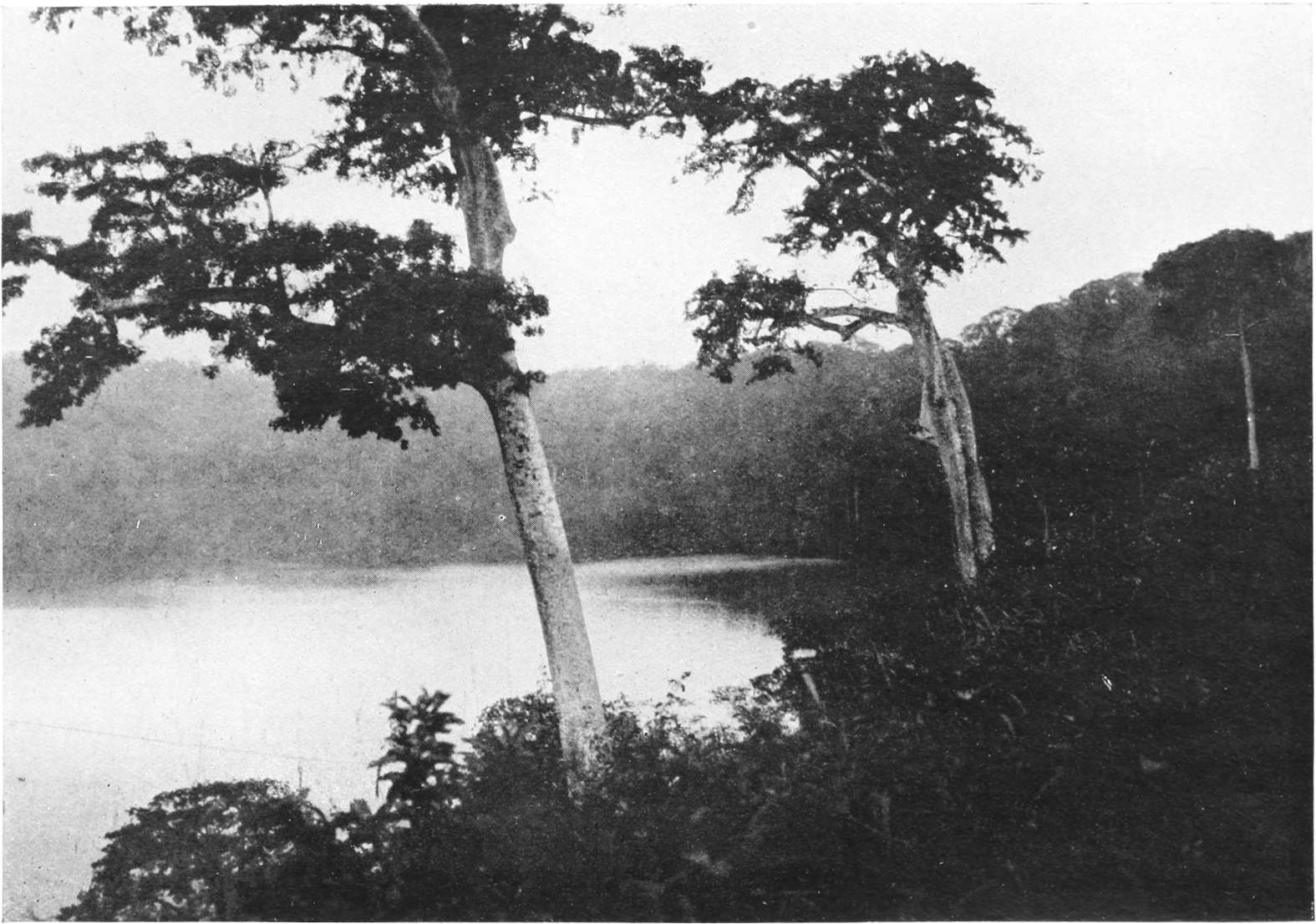
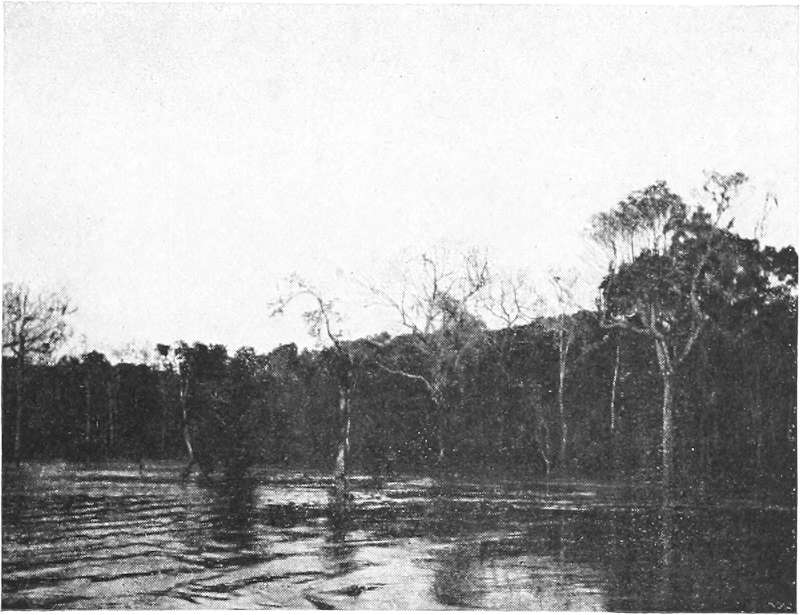
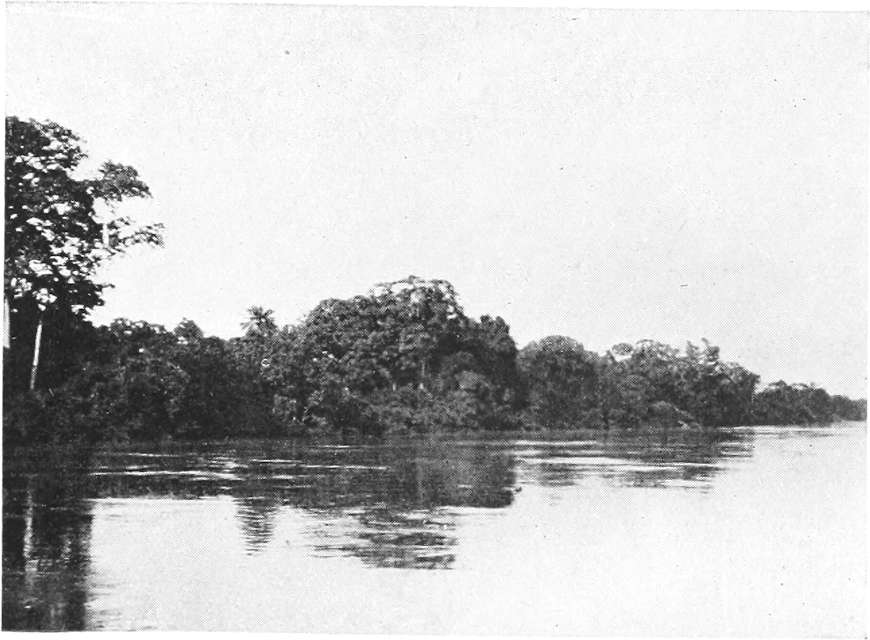
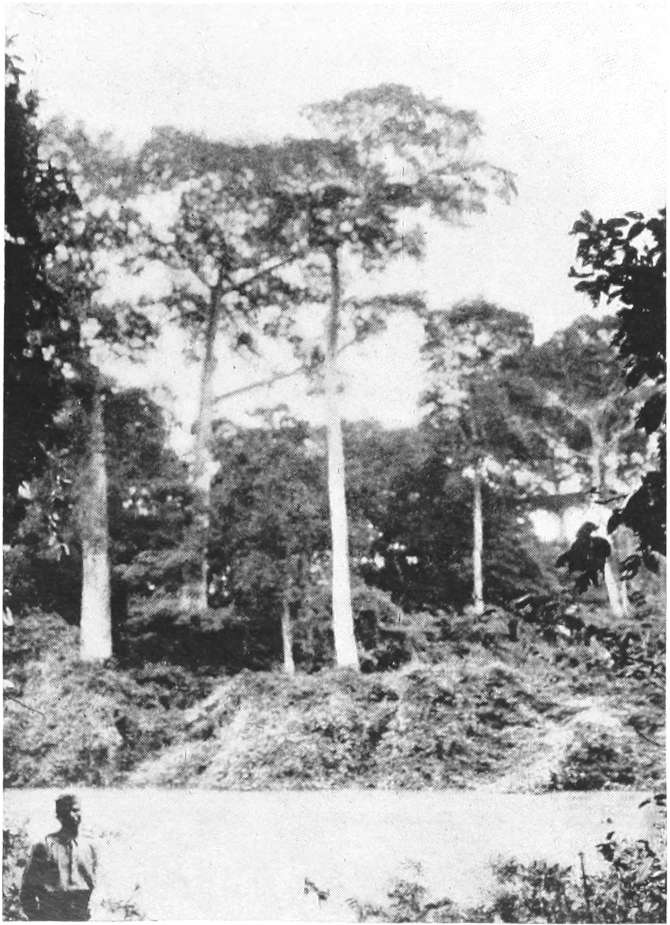
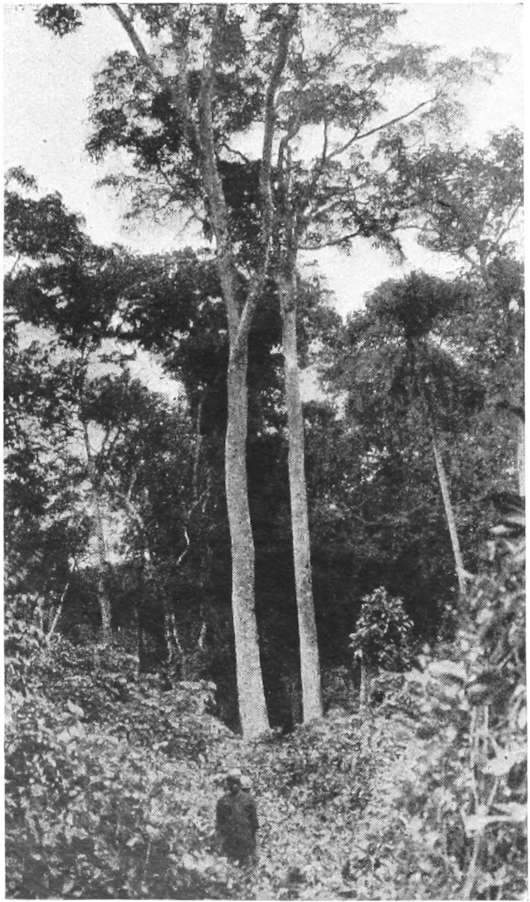
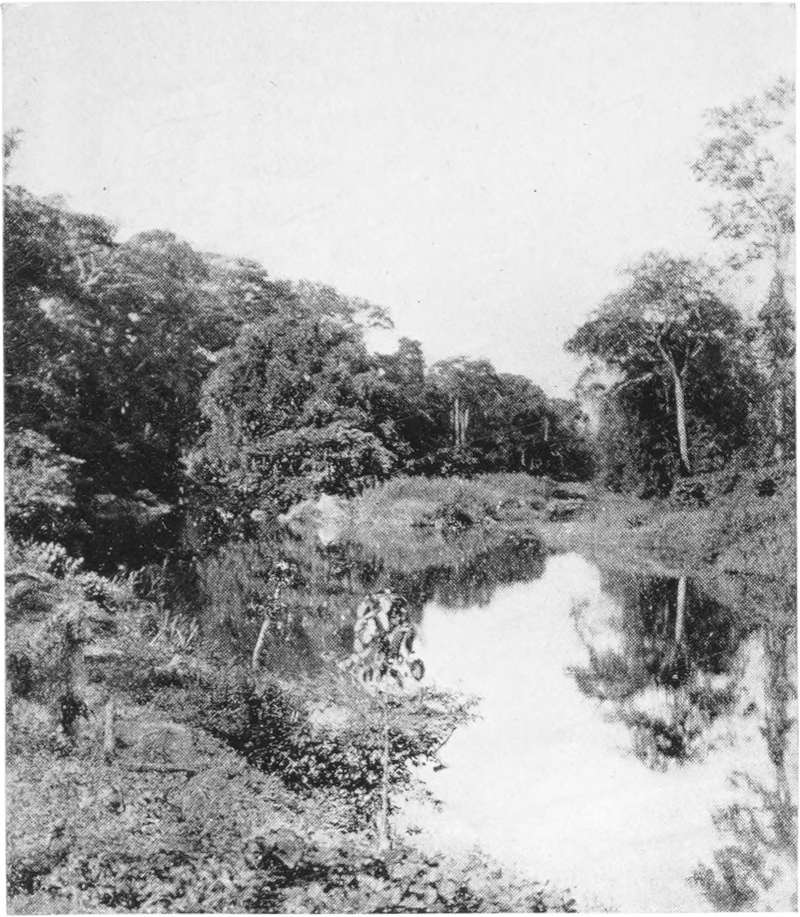
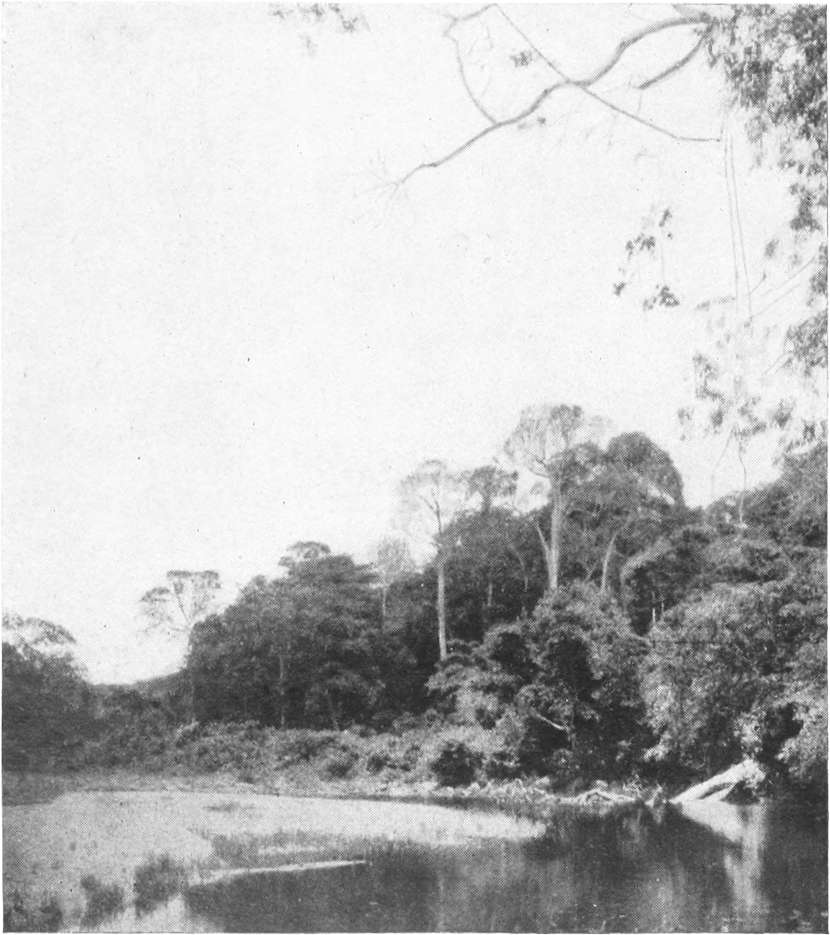
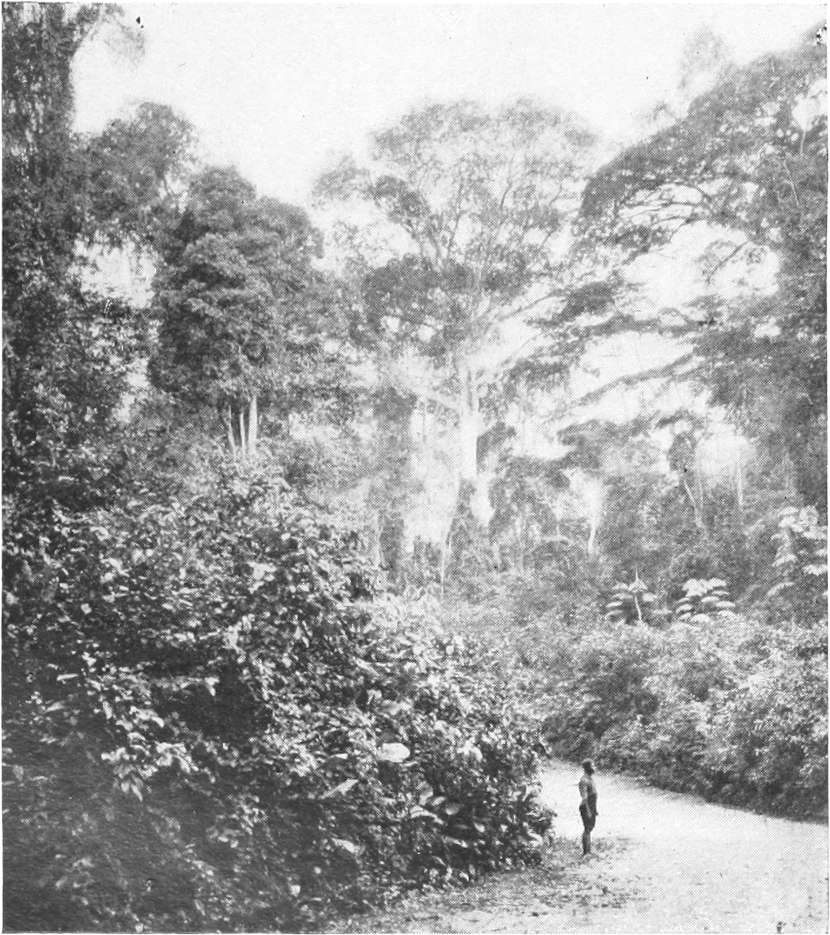
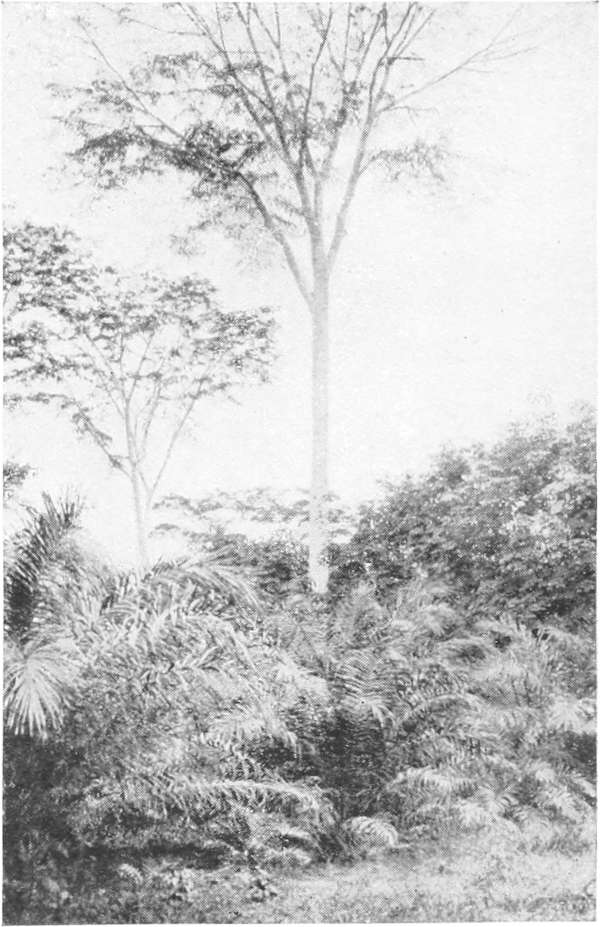
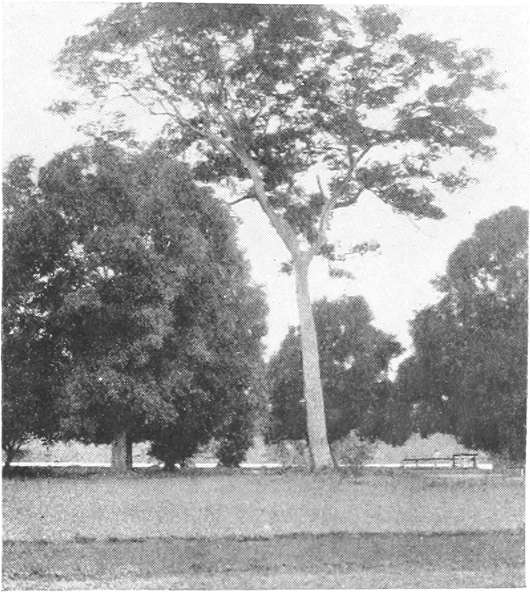
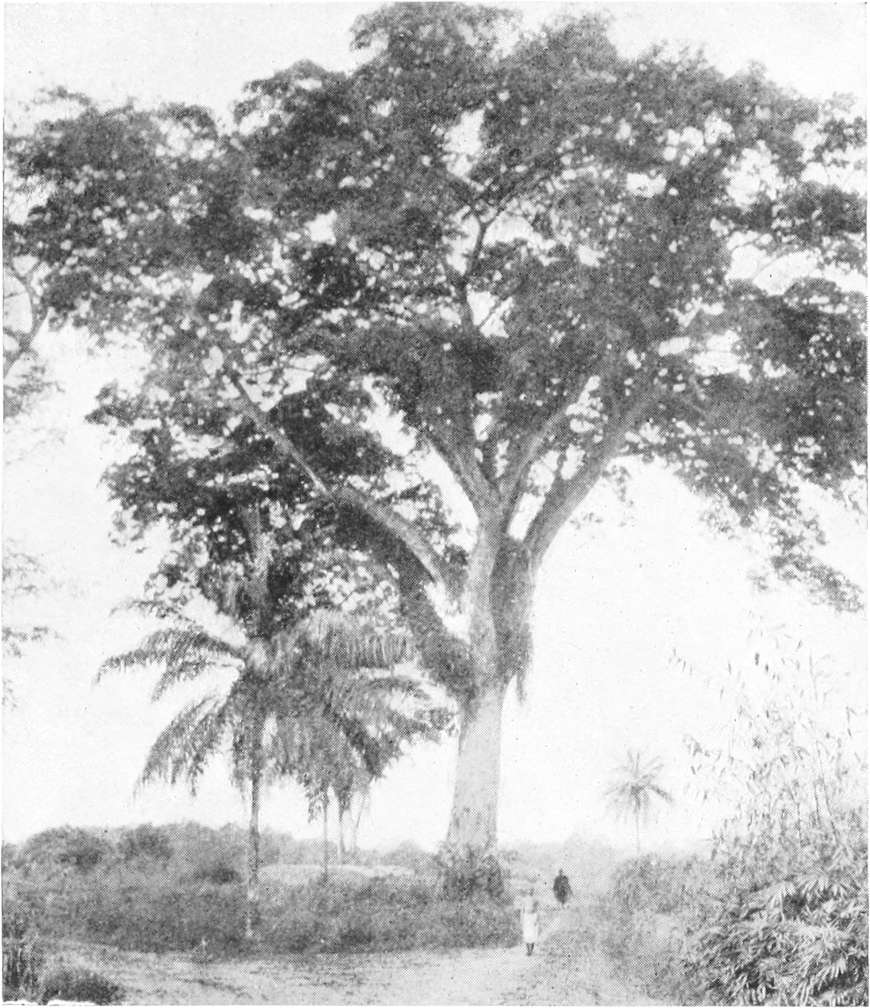
Fig. 1.—Mixed Evergreen Forest on the edge of Barombo Lake (Elephant
Lake), Cotton Trees in foreground.
Frontispiece.
BY A. HAROLD UNWIN D.Oec., M.Can.,
S.F.E. Late Senior Conservator of Forests,
Nigeria
WITH 110
ILLUSTRATIONS
BY THE AUTHOR
T. FISHER
UNWIN LTD LONDON: ADELPHI TERRACE
First published in
1920
(All rights reserved)
TO MY MOTHER
PREFACE
While going
round inspecting timber areas being worked by European firms in
Nigeria, I have often been asked for a book with illustrations
showing the different kinds of trees which might be felled, and
also giving some account of the trees themselves, as well as the
main work of the Forest Department. It is with the idea of trying
to supply this want that I have mainly compiled this work, in the
hope that, however imperfect it may be, the various timber getters
and users in Nigeria may find it useful.
I have not attempted to give accurate descriptions of the trees,
as this has already been done by Mr. Foster in his work Notes
on Nigerian Trees and Plants, and I would refer readers to
that volume, and to the botanical works, such as Useful Plants
of Nigeria, issued under the authority of the Director of Kew
Gardens, and the Flora of Tropical Africa, by Oliver; but
only refer to some specific feature of the trees that are most
common or useful, by which they can be recognized by an ordinary
observer without botanical knowledge.
I wish to acknowledge with thanks the assistance given to me by
the Central and Southern Secretaries for permission to use the
annual Forest Report from the year 1906 onwards.
I wish also to express my thanks to the Under-Secretary of State
for the Colonies for permission to use my Reports on the Forests of
Sierra Leone and the Afforestation of Togo.
To Mr. H. N. Thompson, the Chief Conservator of Forests of
Nigeria, I am indebted for much useful information obtained from
his Report on the Gold Coast Forests.
To Mr. R. E. Dennett, Deputy Chief Conservator of Forests, who
has given me much help and advice in compiling this work, and more
especially for reading through the proofs, I tender my grateful
thanks.
Two most valuable
chapters on the Forests and botanical features of the Northern
Provinces of Nigeria were written by Dr. J. M. Dalziel, to whom I
owe grateful thanks for his encouragement in this work.
My greatest thanks are due to Mr. C. E. Lane-Poole, Commissioner
of Forests, Victoria, for the use of the list of the Sierra Leone
trees.
To M. Chevalier I return grateful thanks for his list of the
Ivory Coast trees.
For the constant and unfailing interest and devotion to the work
of Miss Christina E. Lacy, acting as amanuensis, I beg to extend my
heartfelt thanks.
Further thanks are also due to my wife, who has lent not only
practical assistance, but has been the mainspring of inspiration
for the completion of this work.
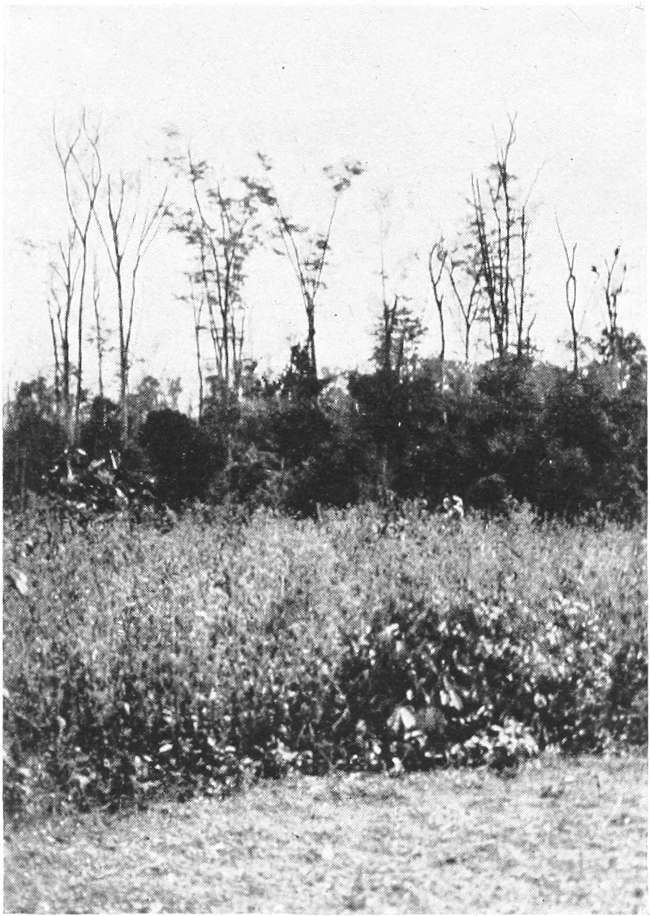
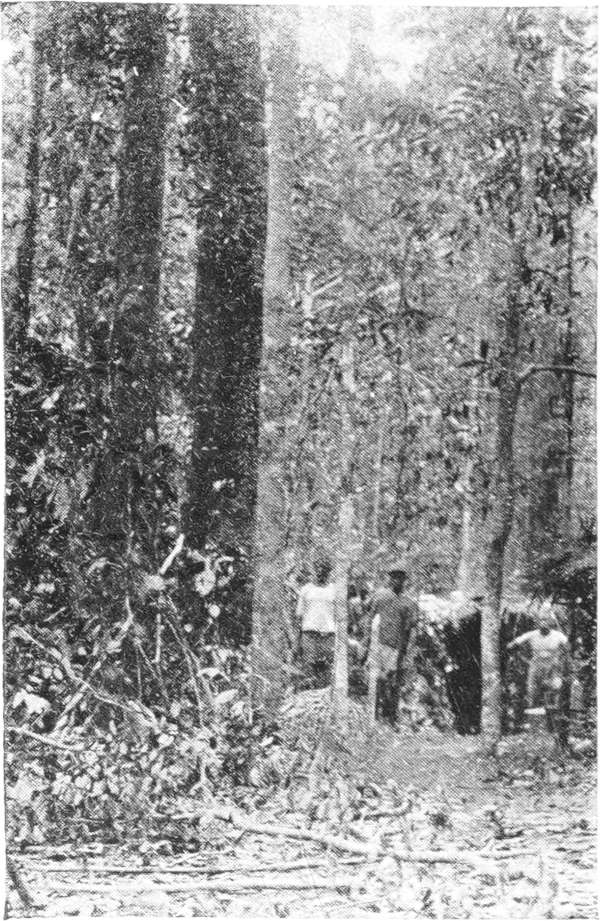
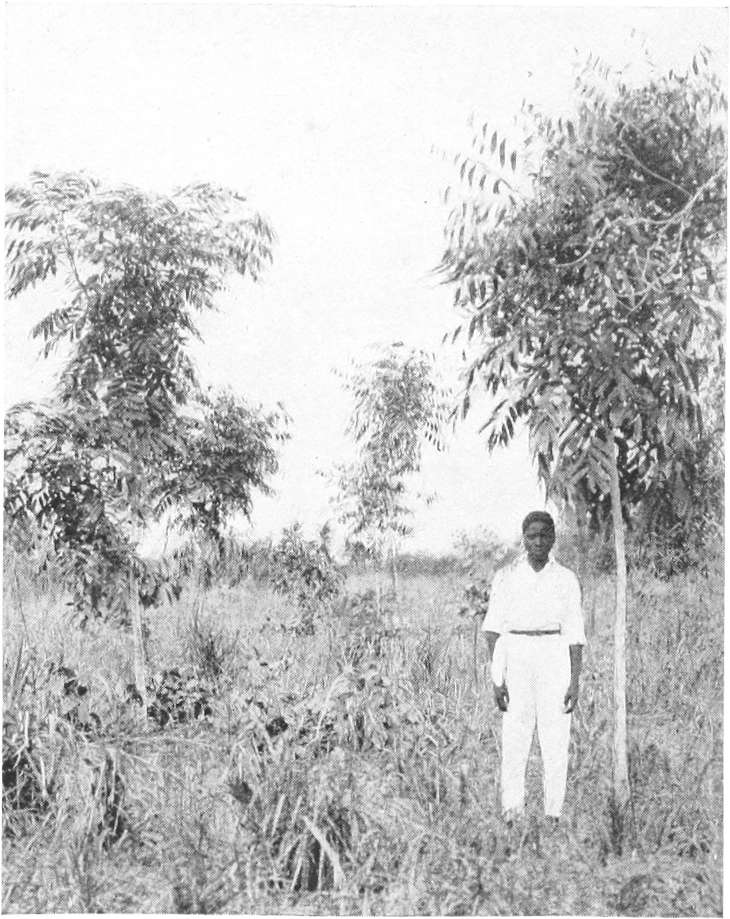
Forest of true Gum Copal (Copaifera
salikounda), showing nearly all the trees bare of foliage and
dying, due to overtapping, near Sussuwuru, Moyamba District
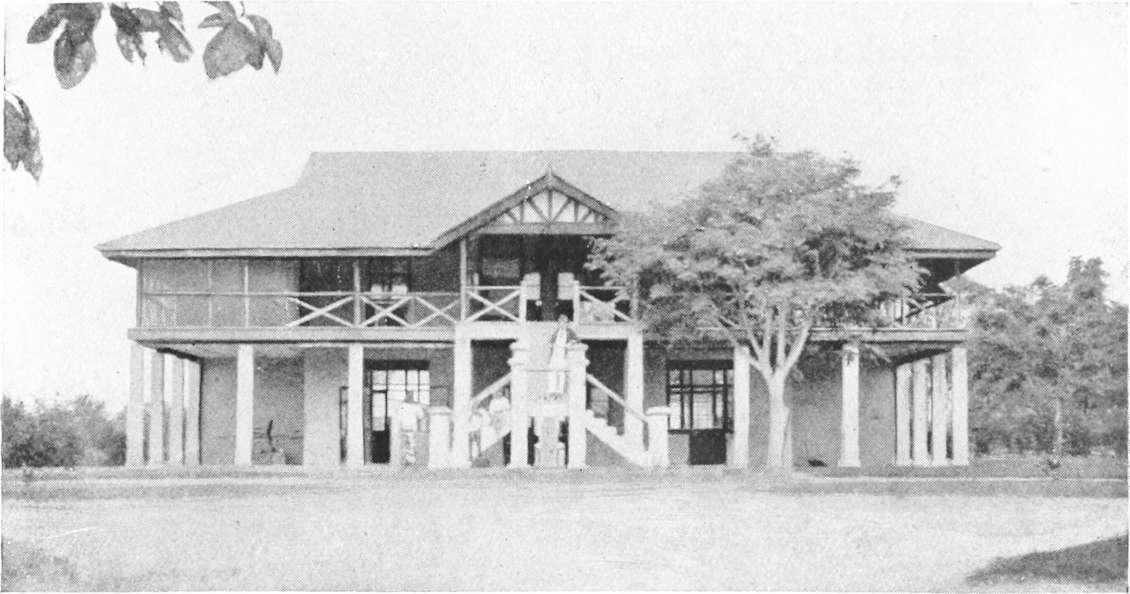
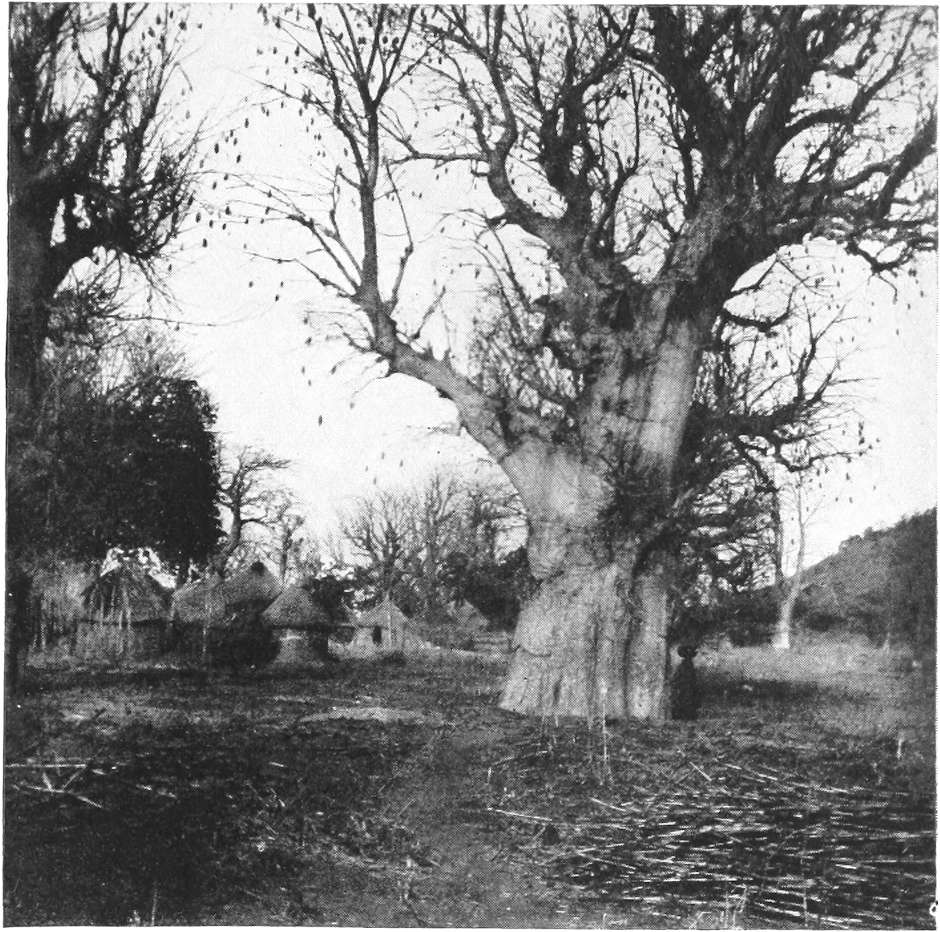
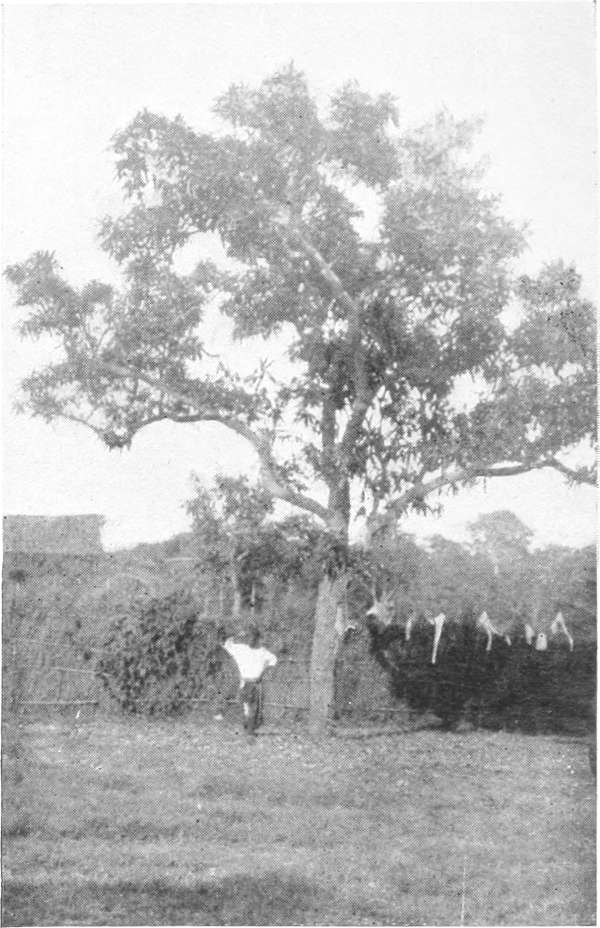
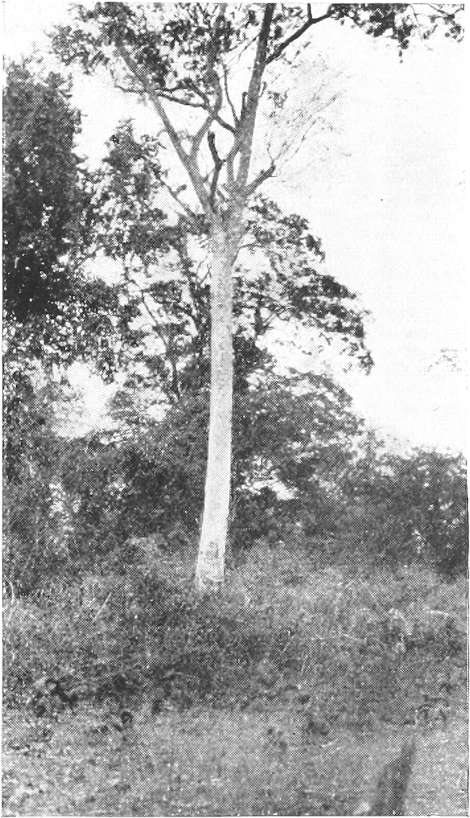
Shea Butter Tree (Butyrospermum
Parkii) in fruit, April 1911, standing near the Conservator of
Forests’ house. This tree has been protected from fire for nearly
four years
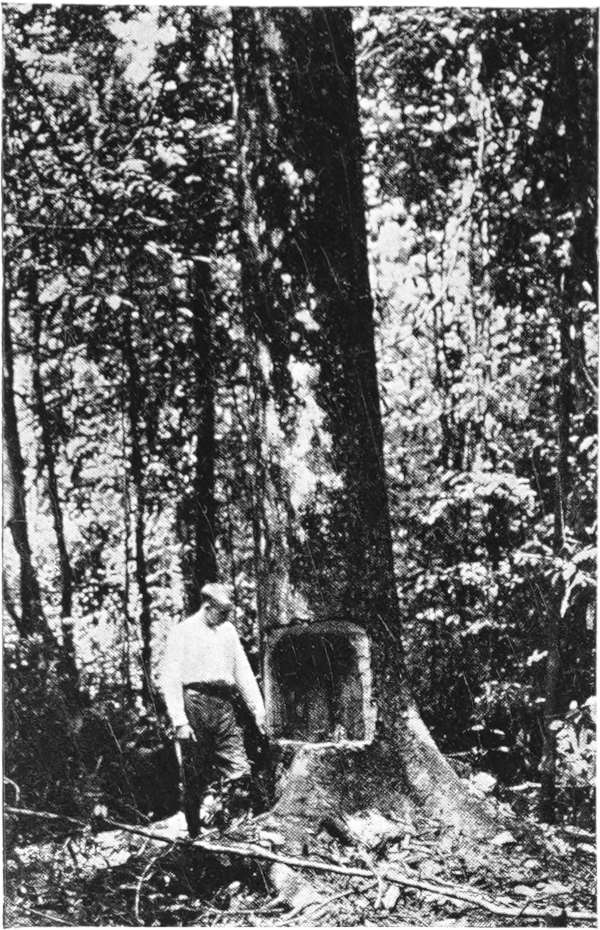
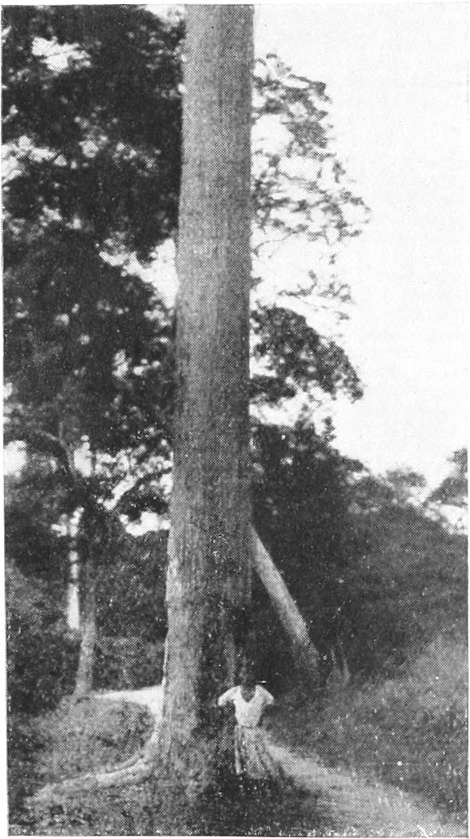
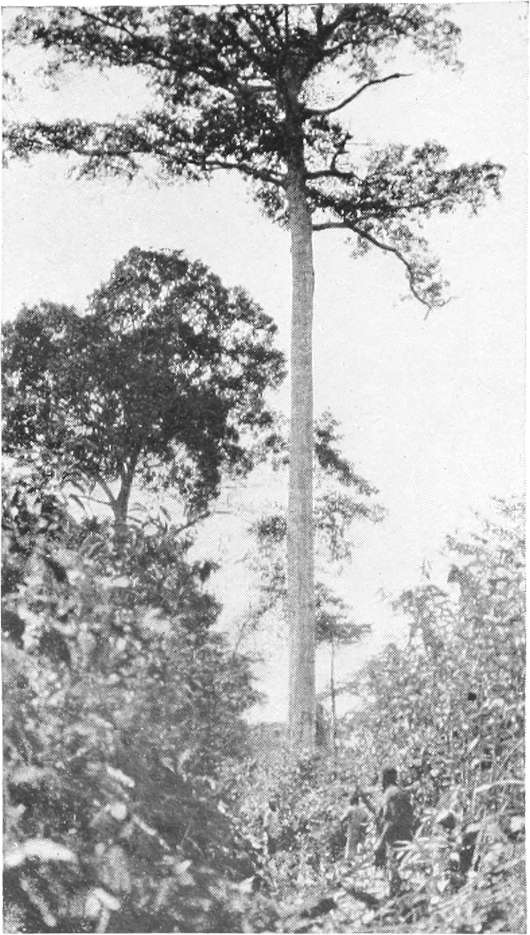
Large full-grown Iroko Tree
(Chlorophora excelsa) standing near Ibadan, Jebu Ode Road,
Mamu Forest Reserve, in May 1910. See Fig. 69, which is of the same
tree taken five years later
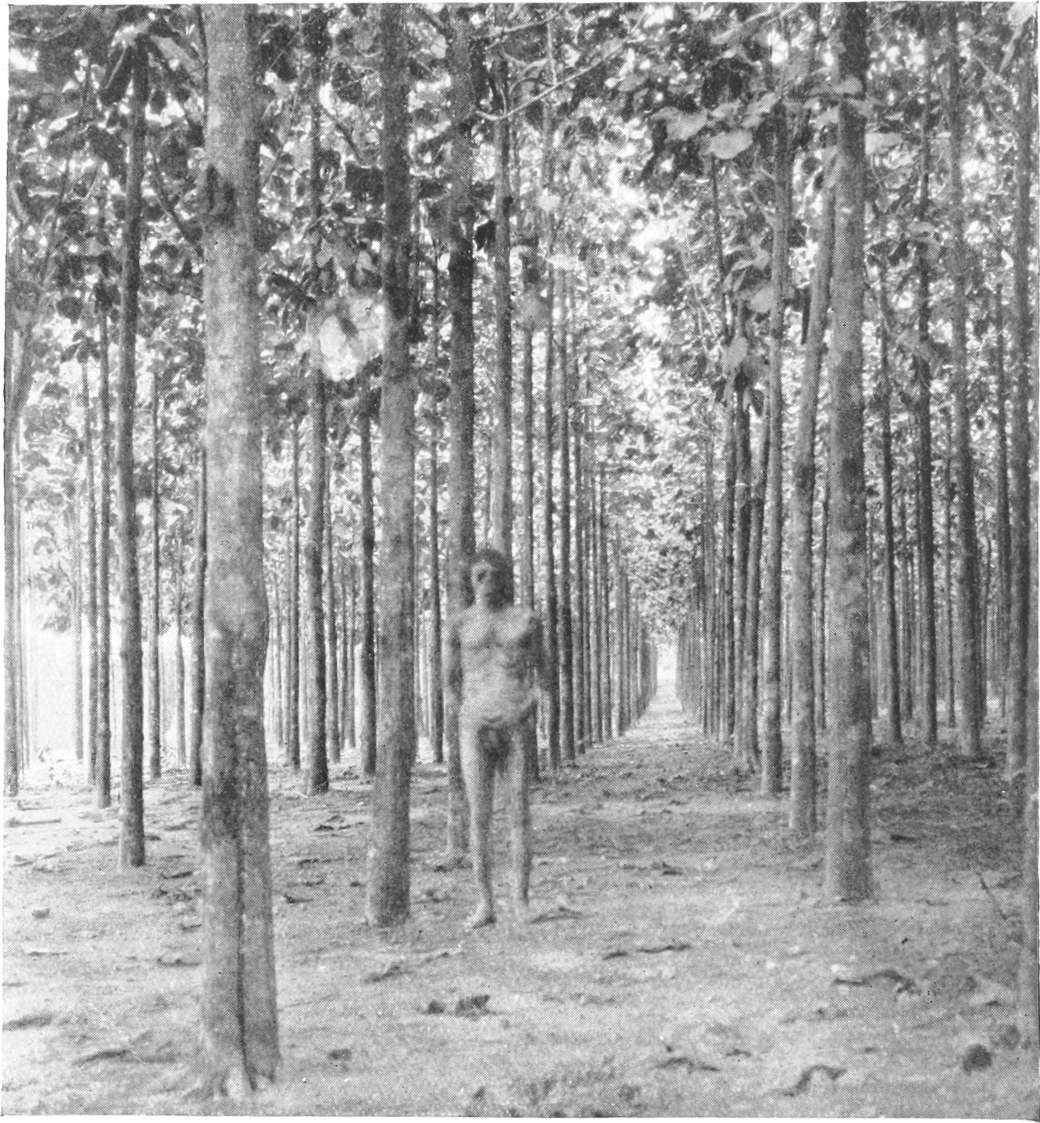
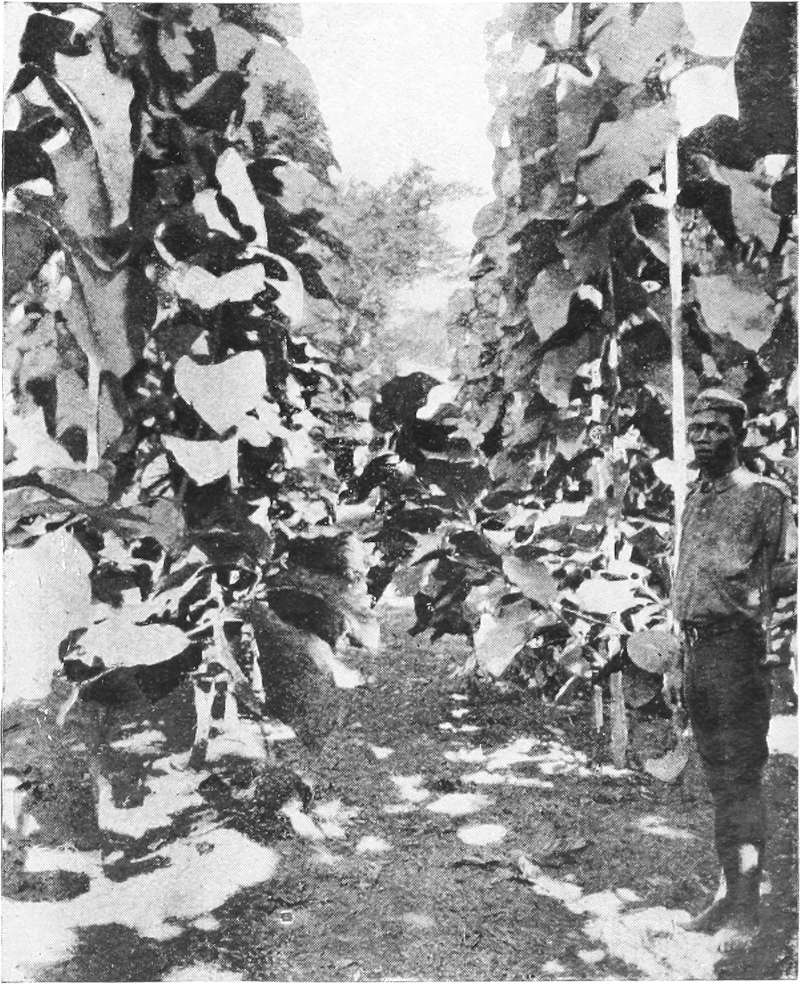
Mixed Mahogany Plantation, Khaya
grandis on left, K. Punchii in centre, and
Entandrophragma in the right foreground, six years old, near Ogba,
Benin Province
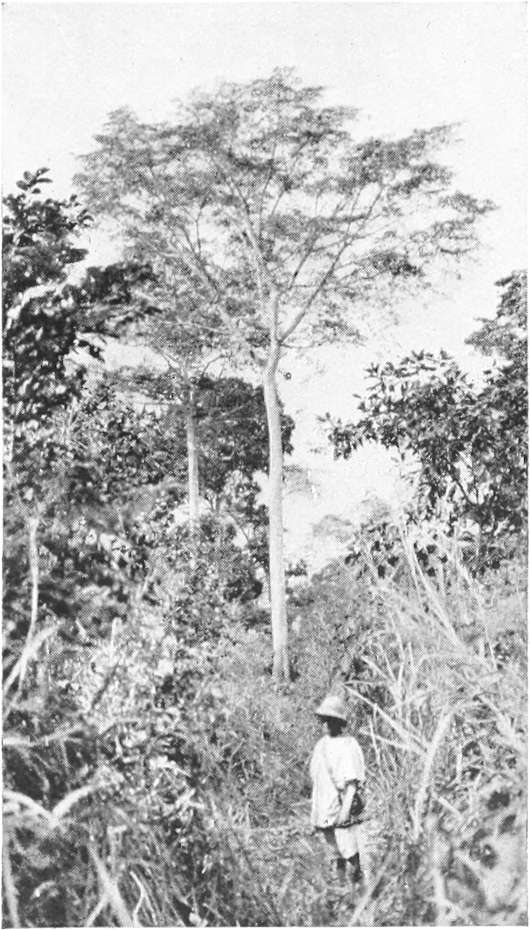
Medium-sized African Pearwood,
Mimusops Djave, standing in the middle of the road outside
Degema Station on the road to Illimema, since felled, and logs sold
in England
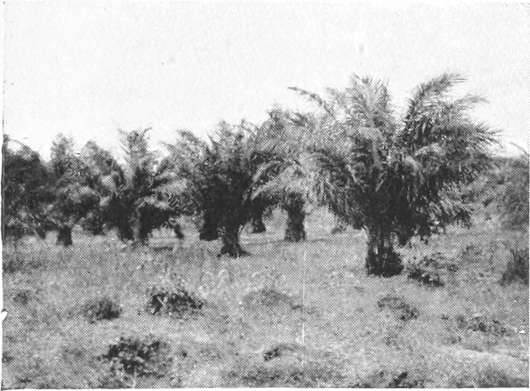
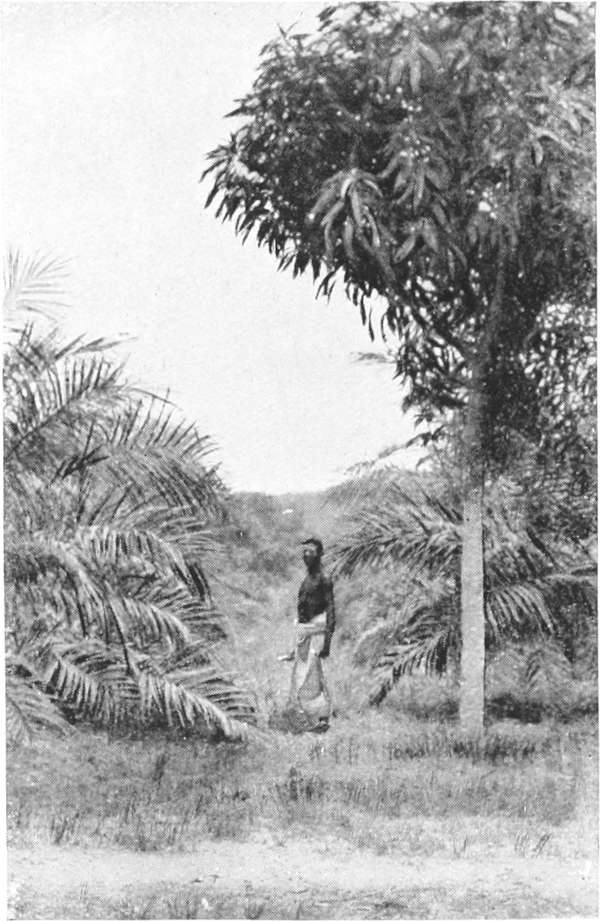
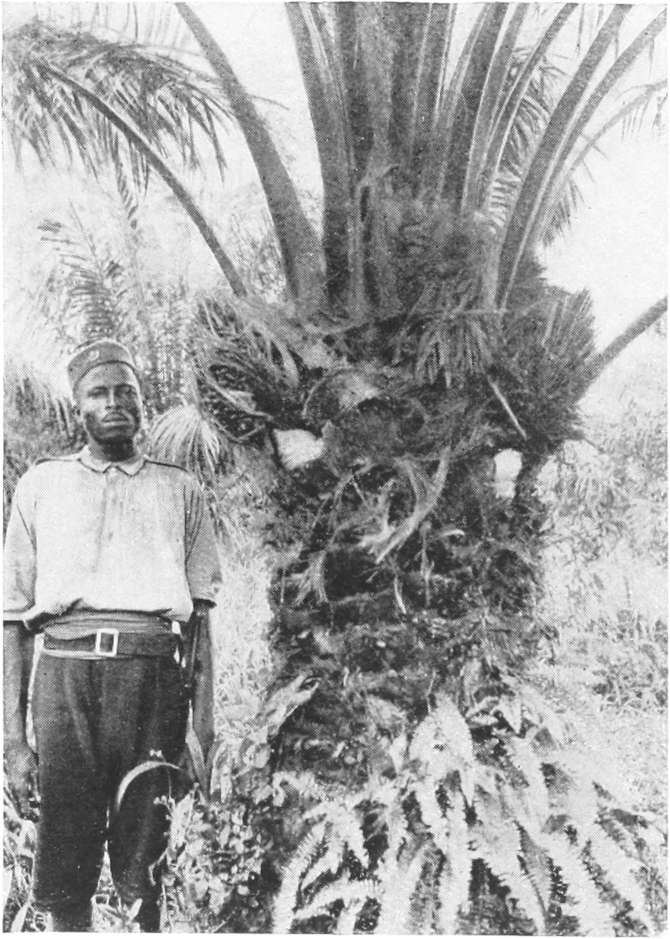
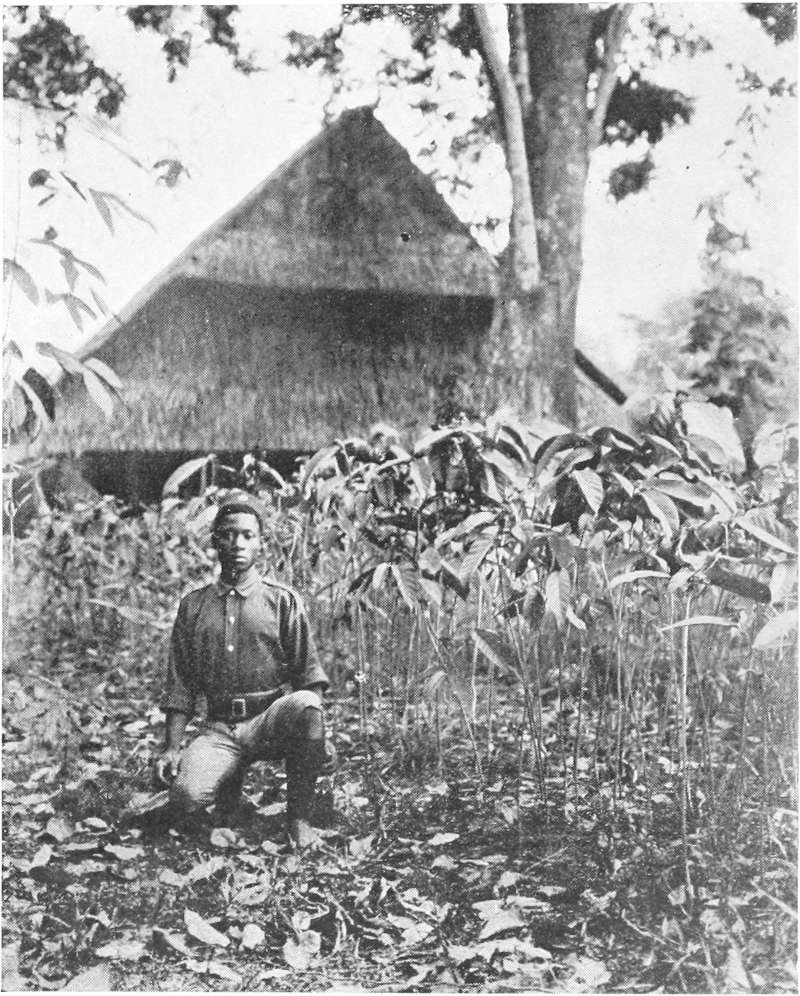
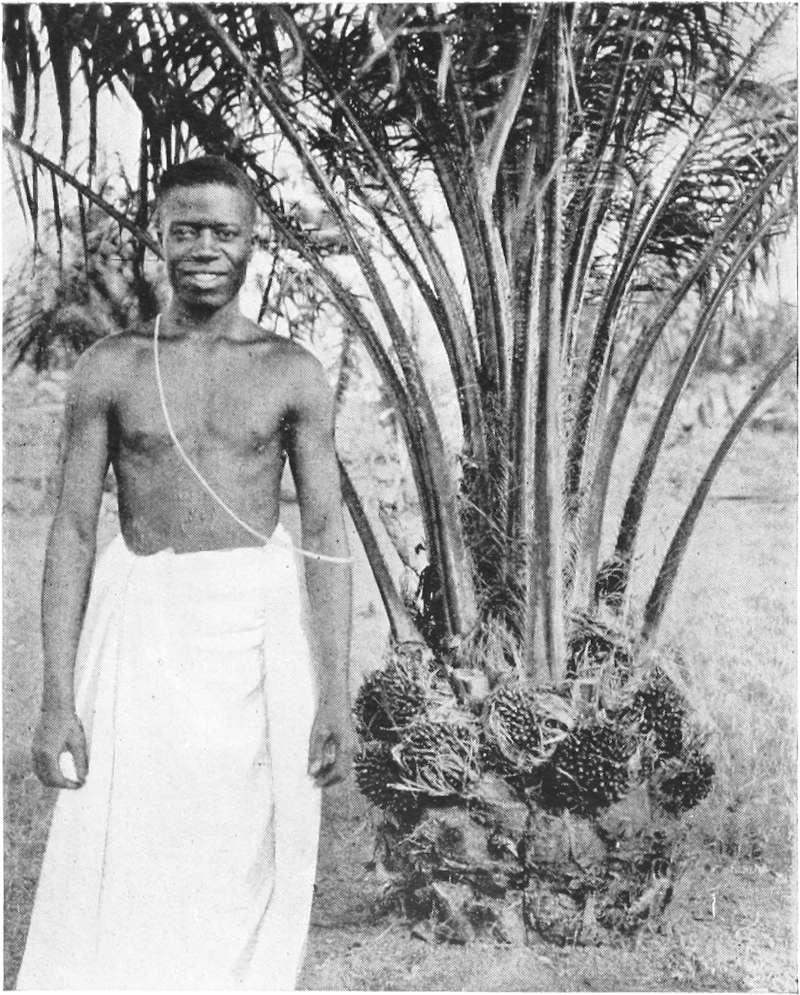
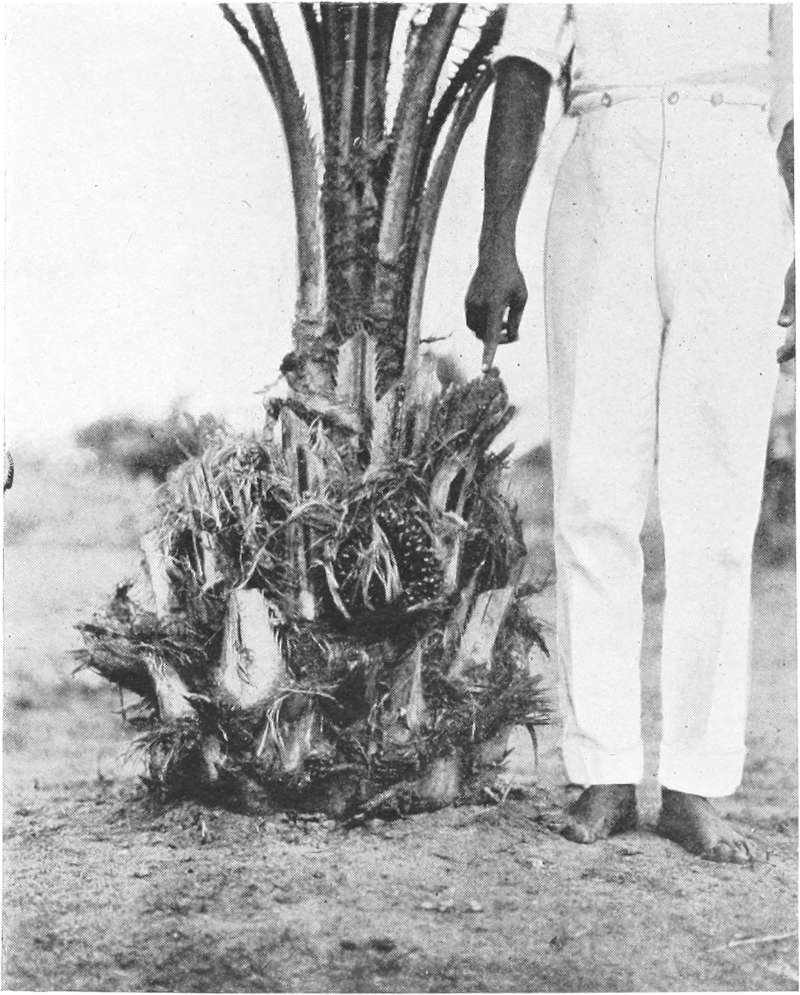
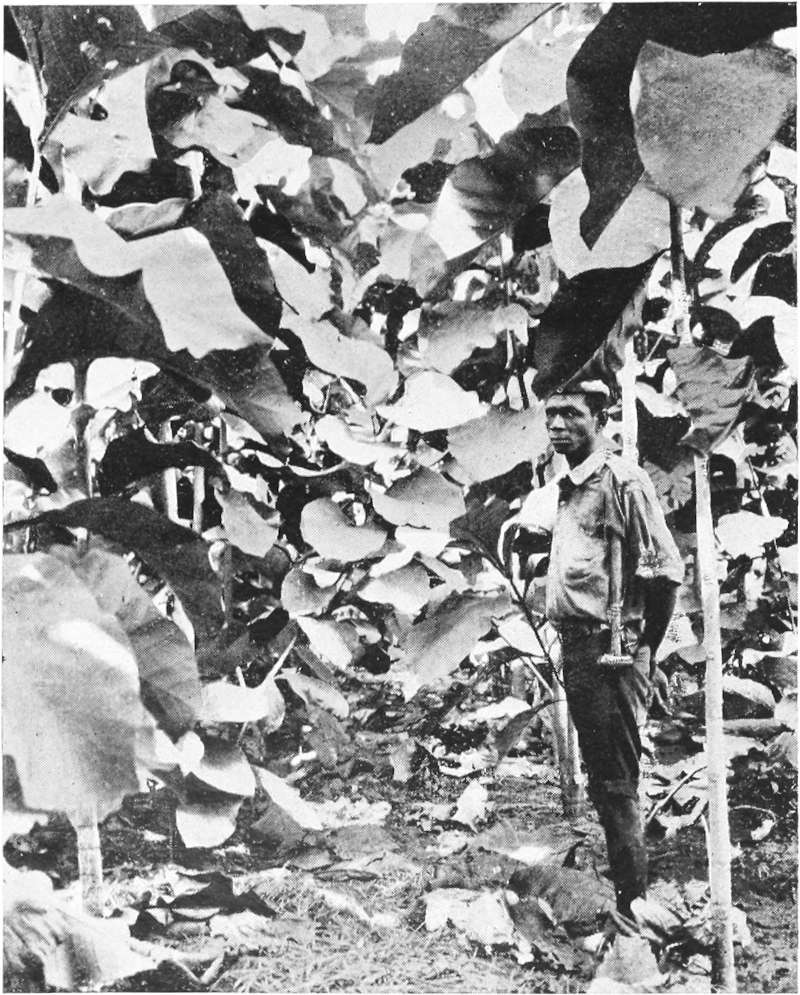
Seven-year-old Oil Palm in bearing,
rather over-pruned, showing male inflorescence just below boy’s
finger and bunch of fruit in the middle of the picture
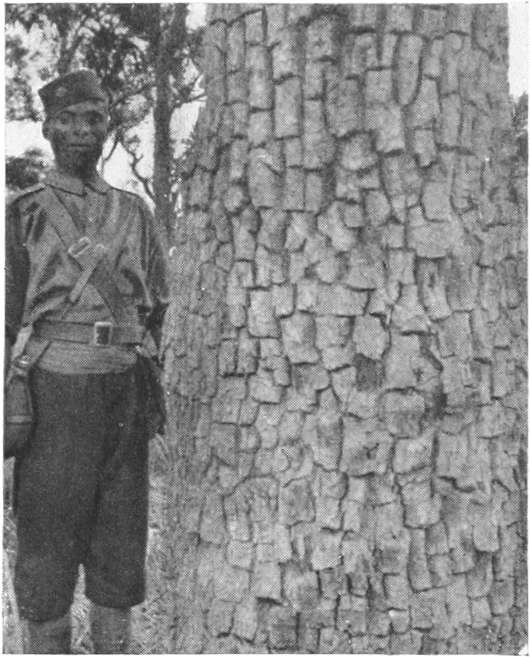
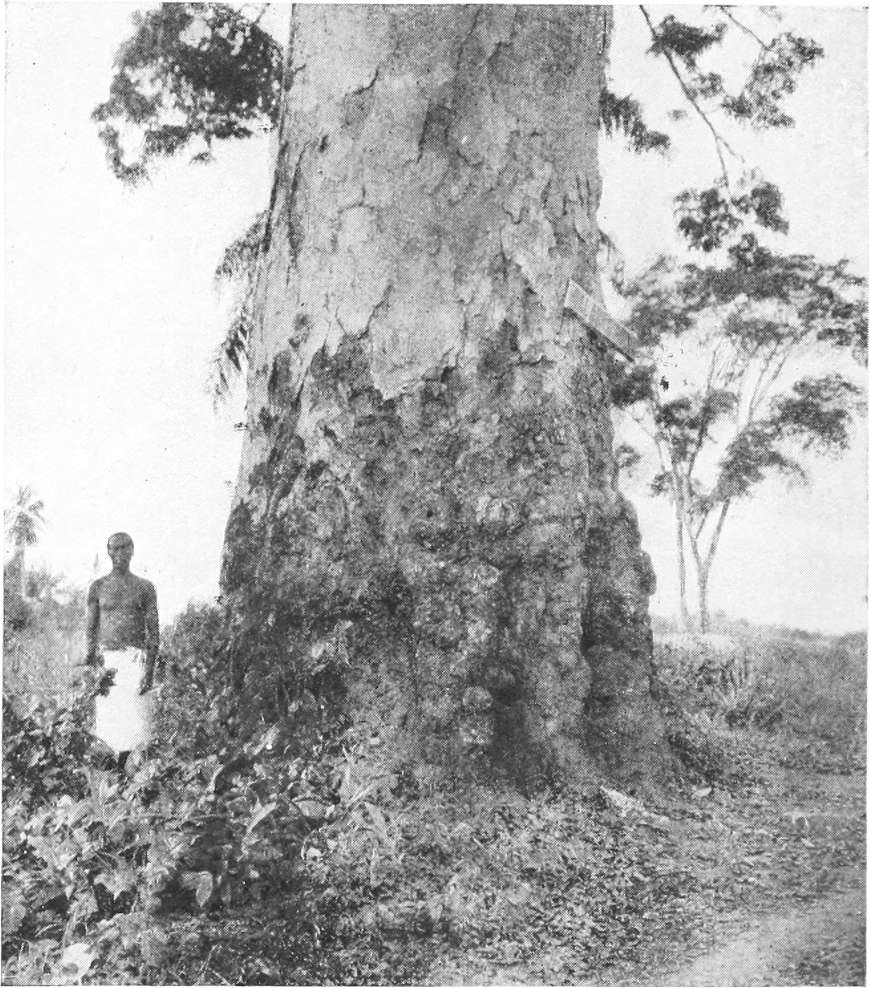
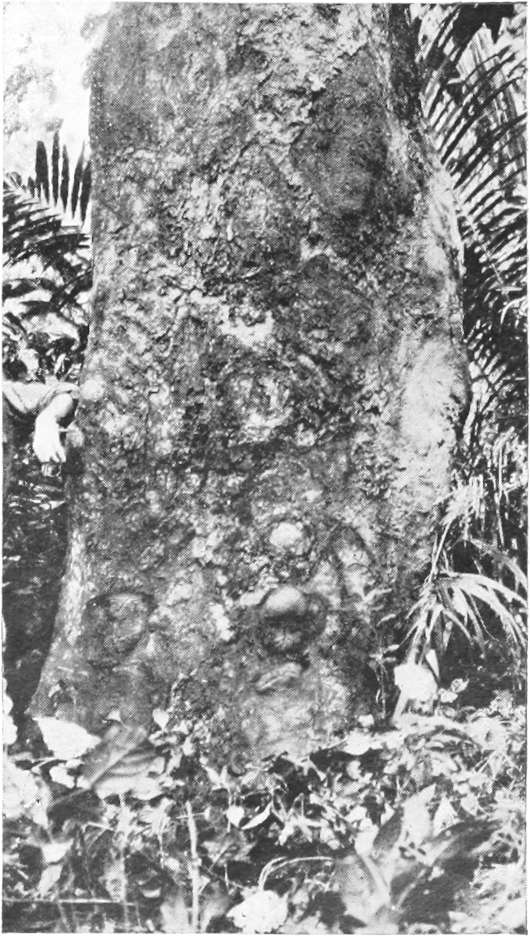
Base of mature Brachystegia
spicæformis standing at the side of the Calabar Road, Calabar,
showing both the scaly untouched bark and the wounded section
covered with nodules
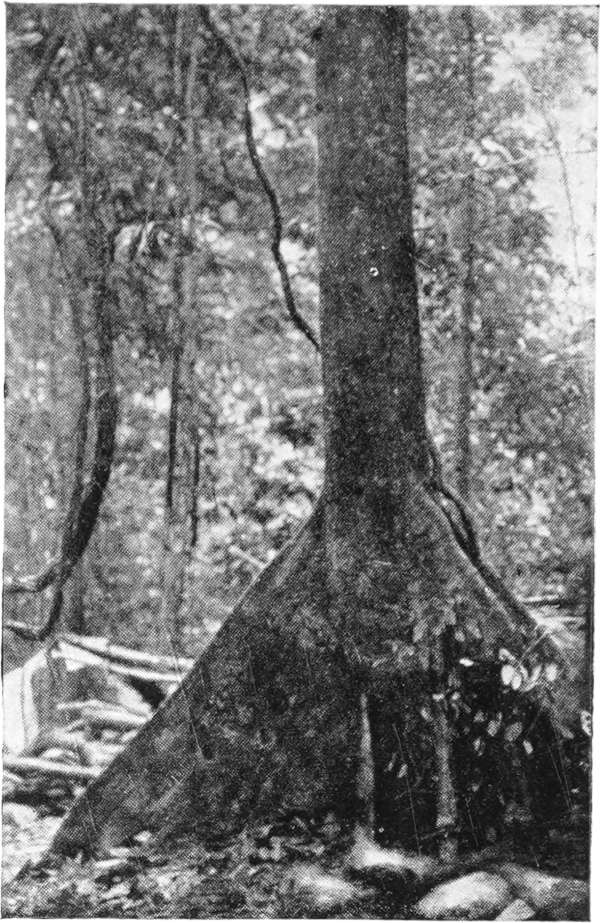
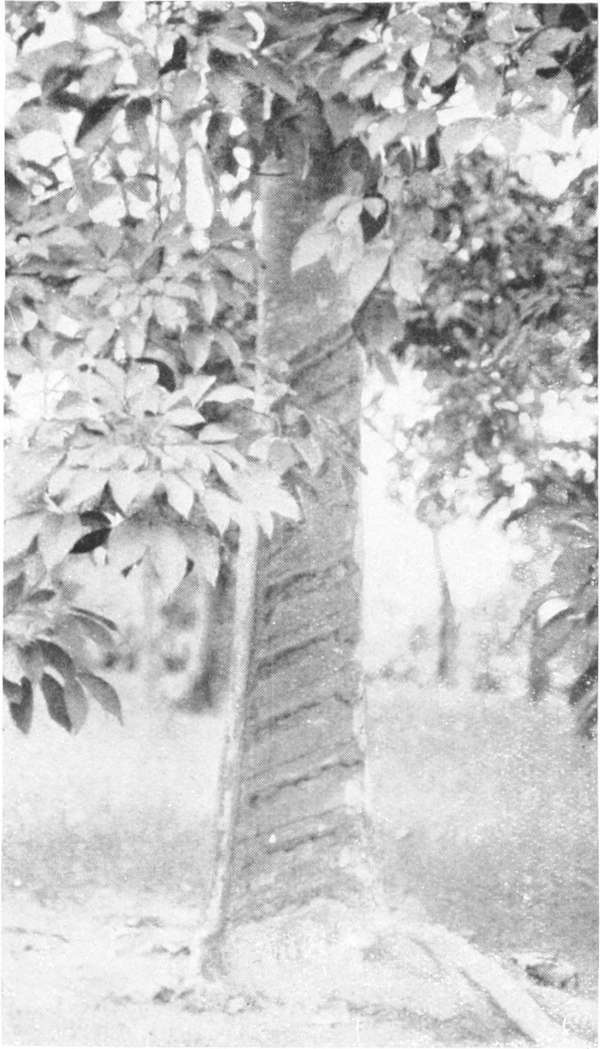
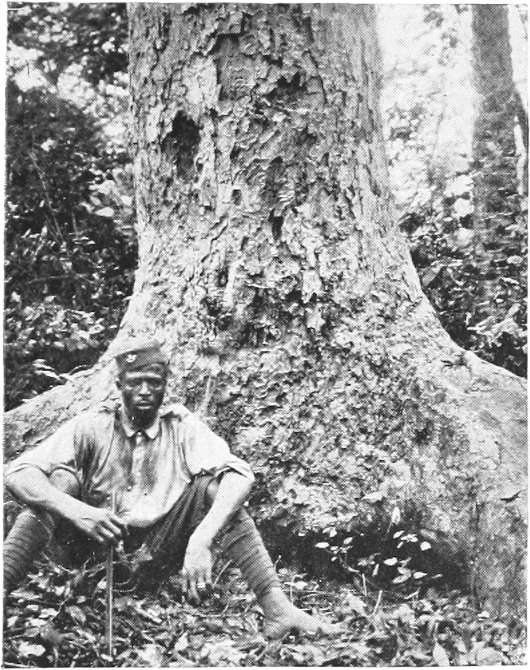
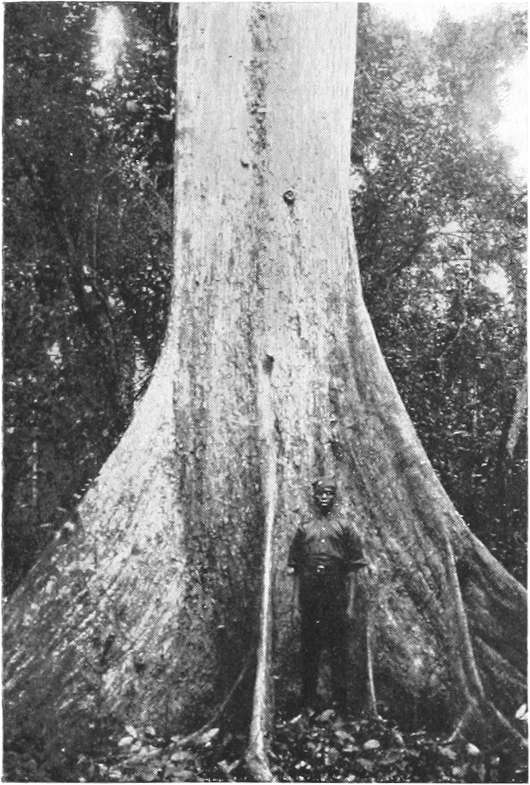
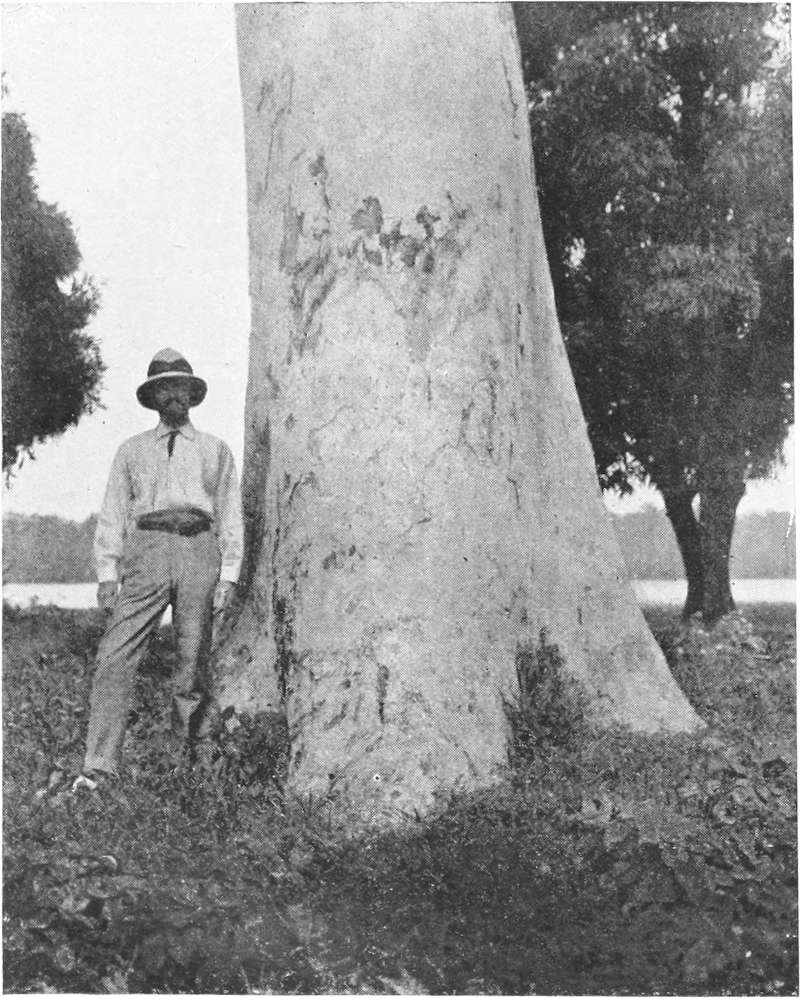
Mahogany, Khaya Senegalensis (?),
standing at the edge of Ikrigon Forest Reserve, showing base of
trunk with old bark wounds already healed over
496
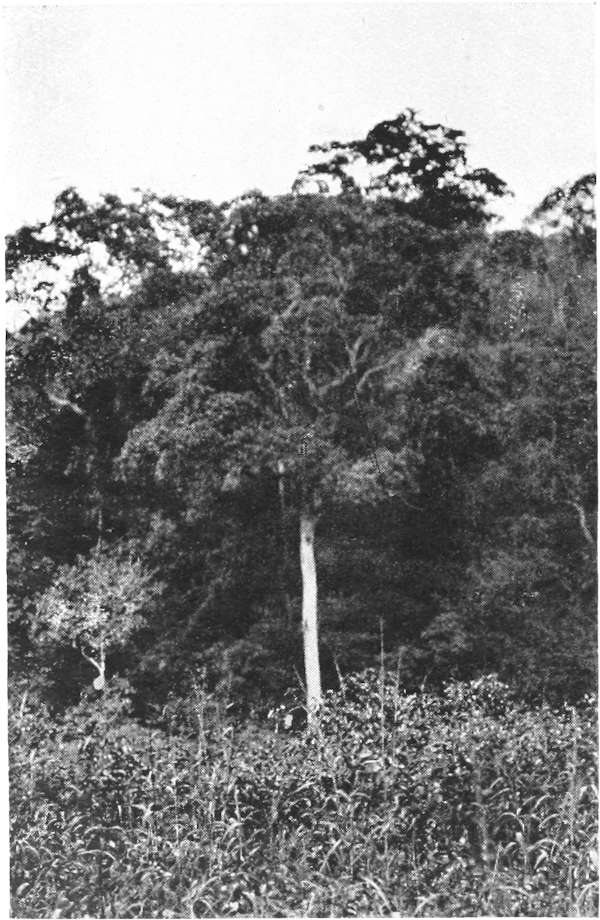
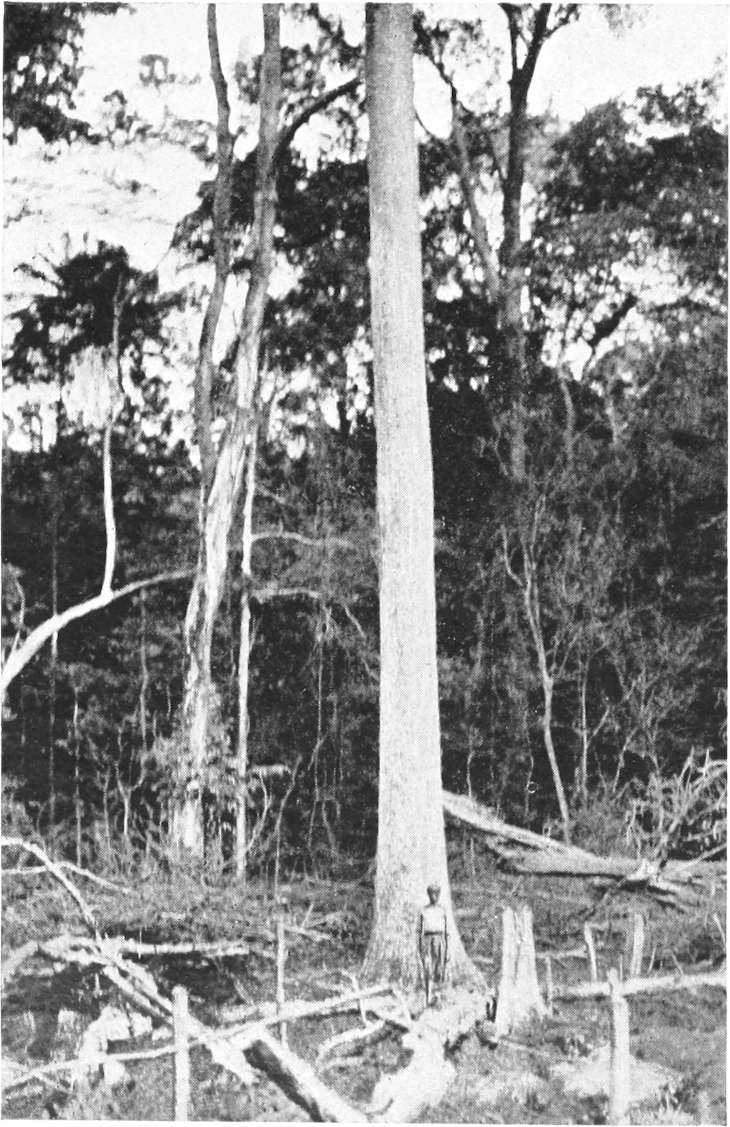
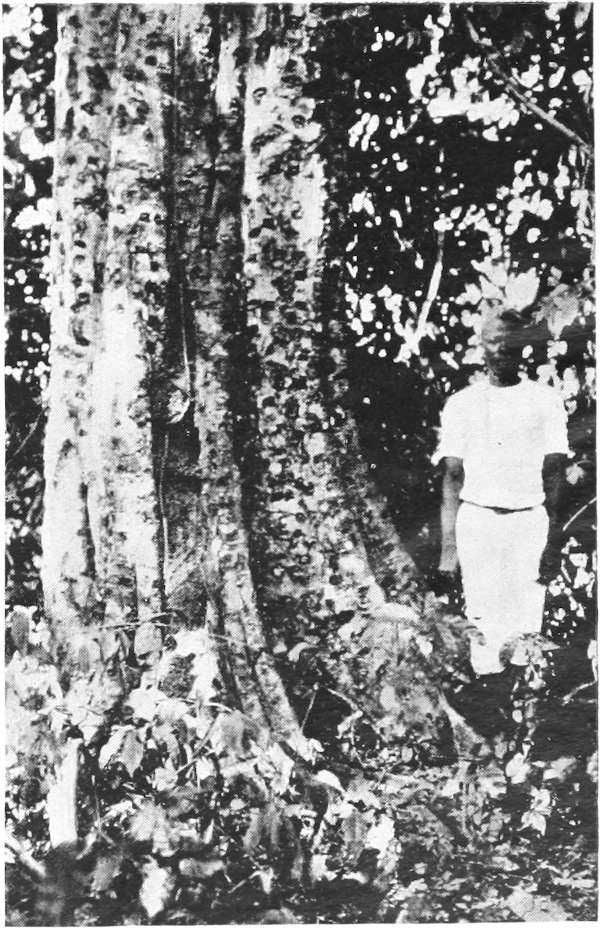
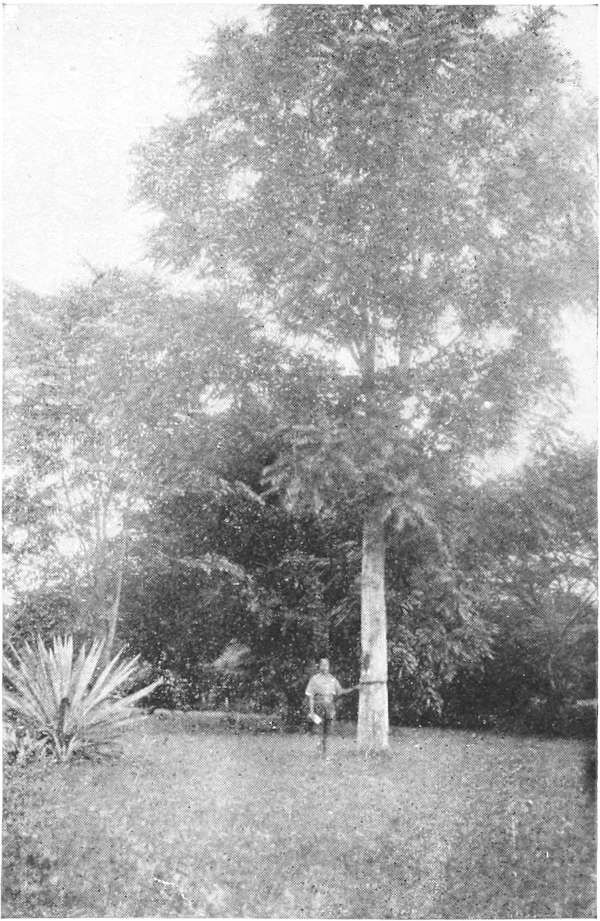
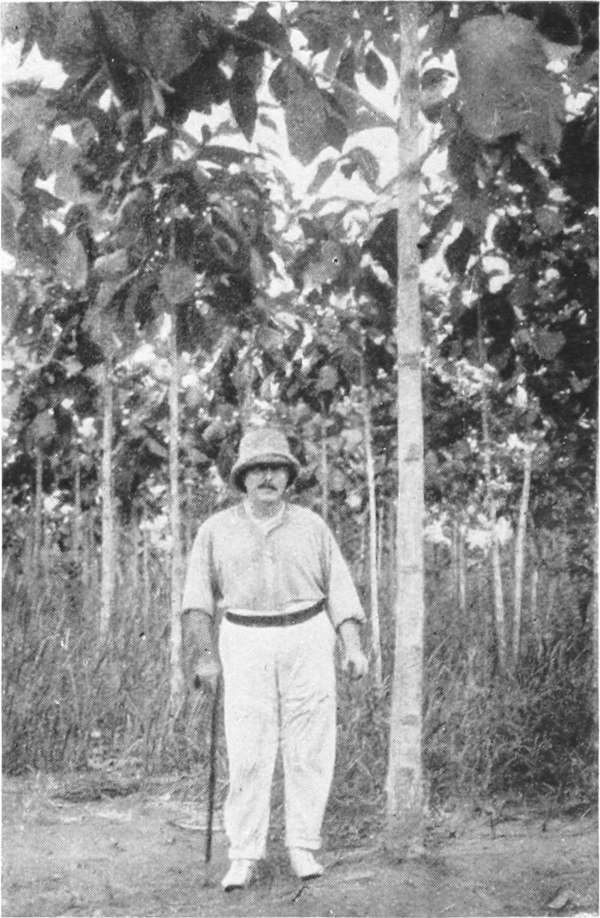
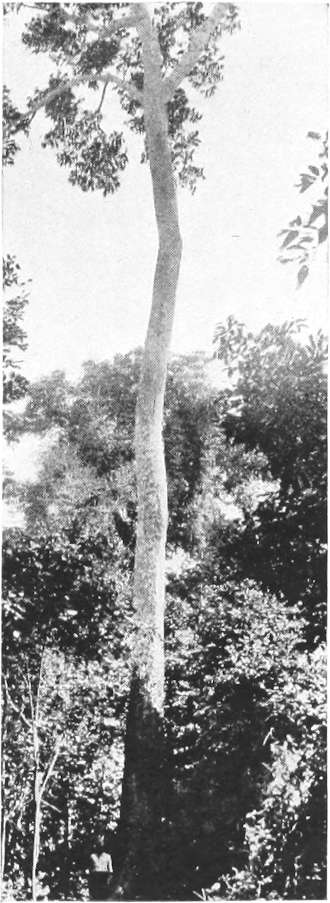
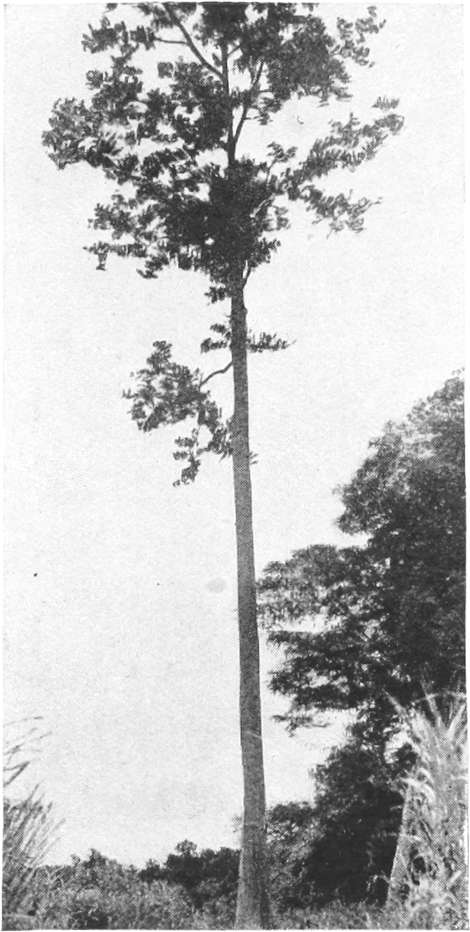
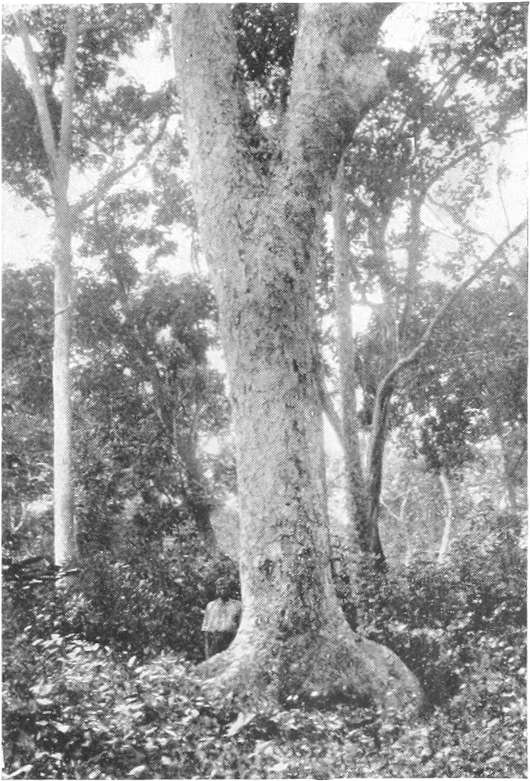
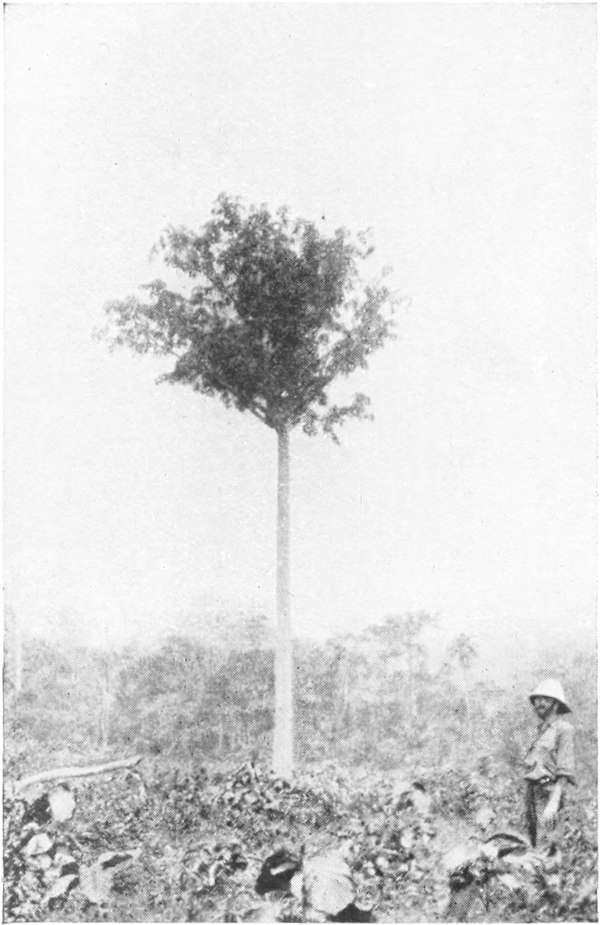
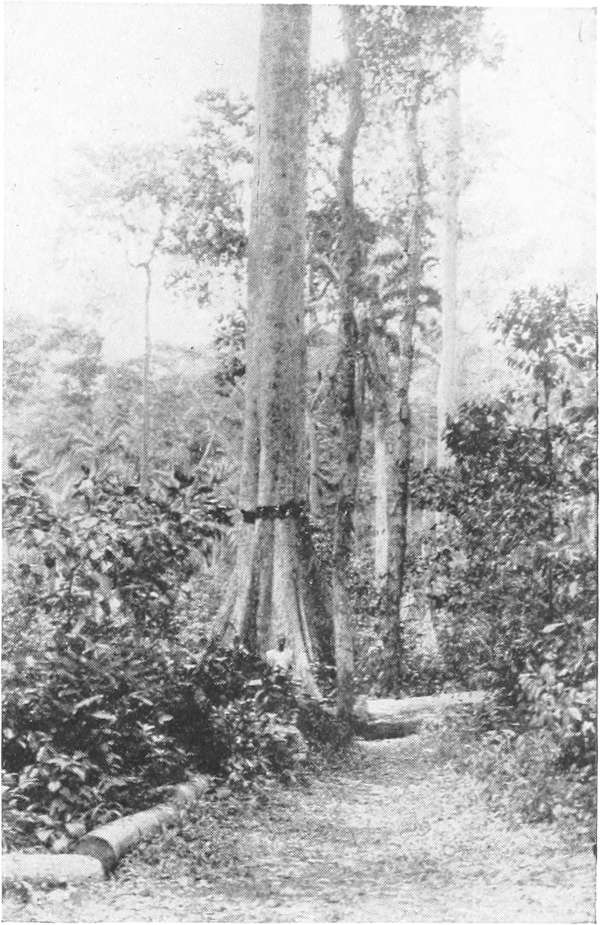
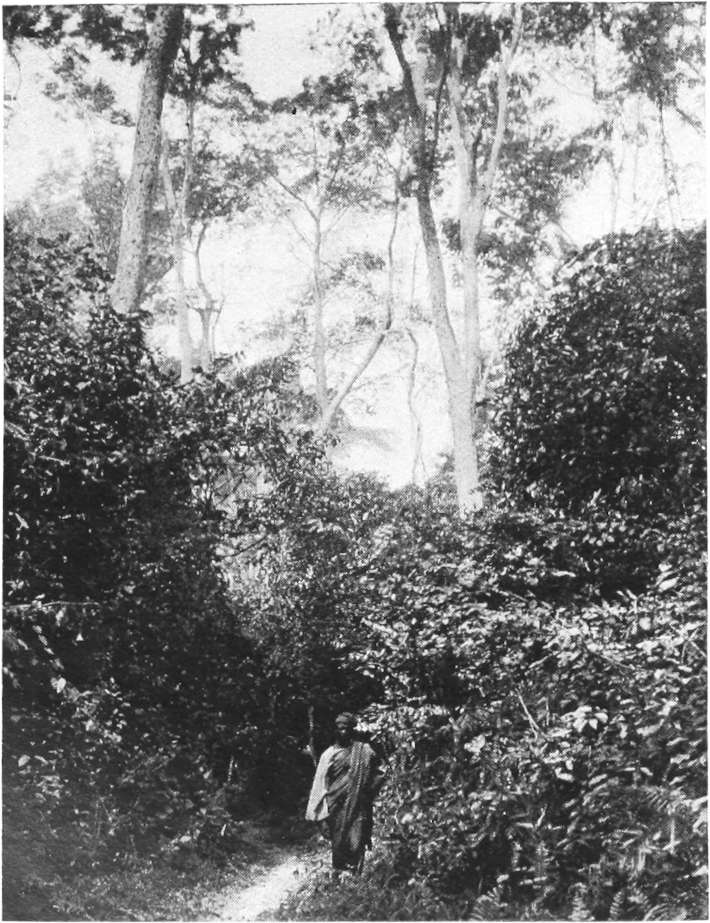
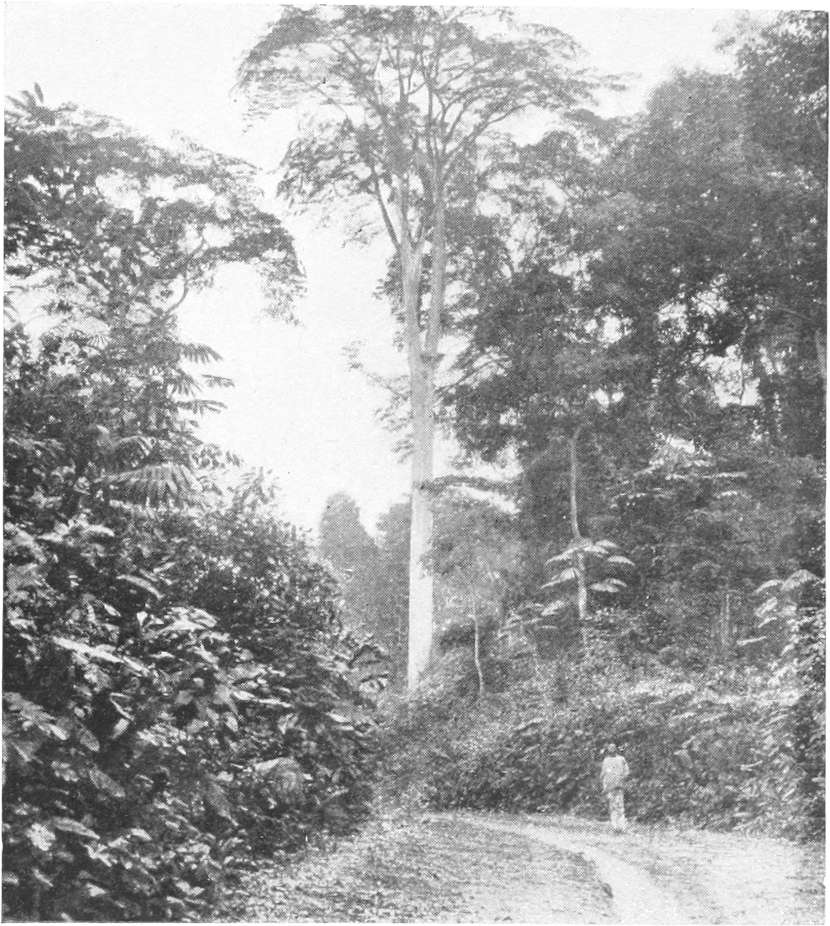
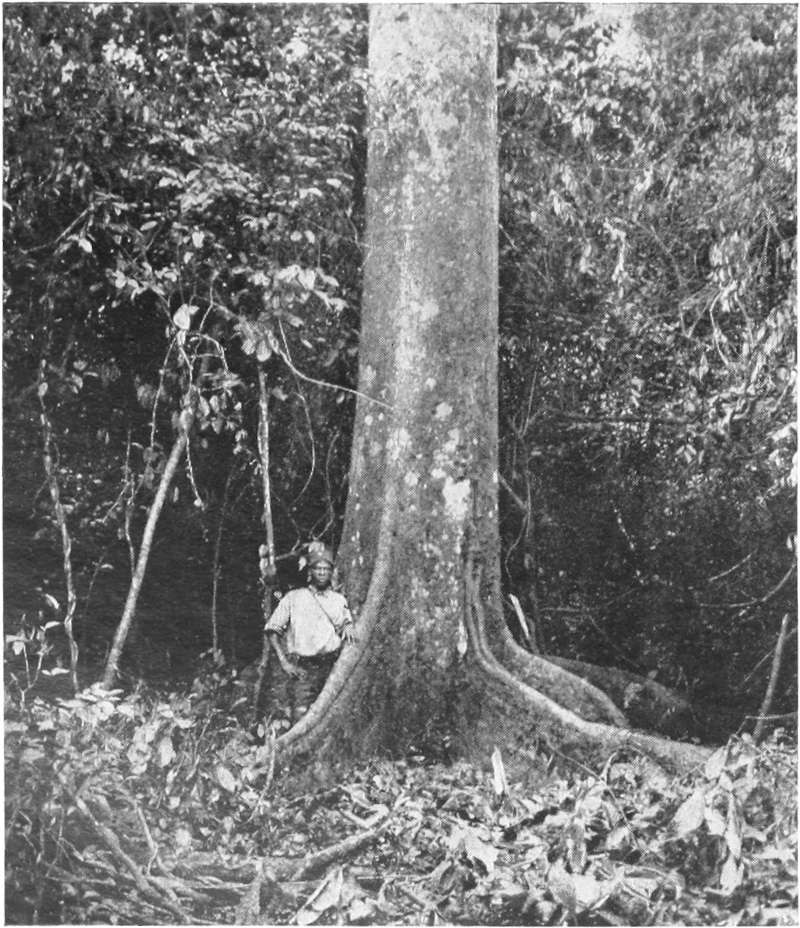
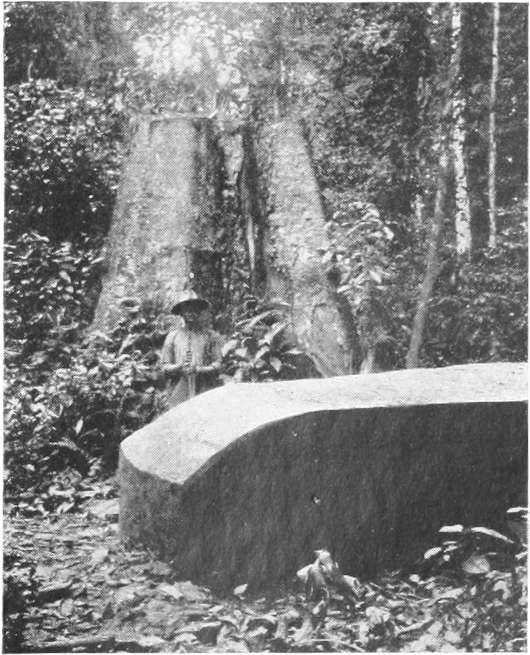
Fig. 2.—Red Ironwood (Lophira procera) in the Forest,
Gumah.
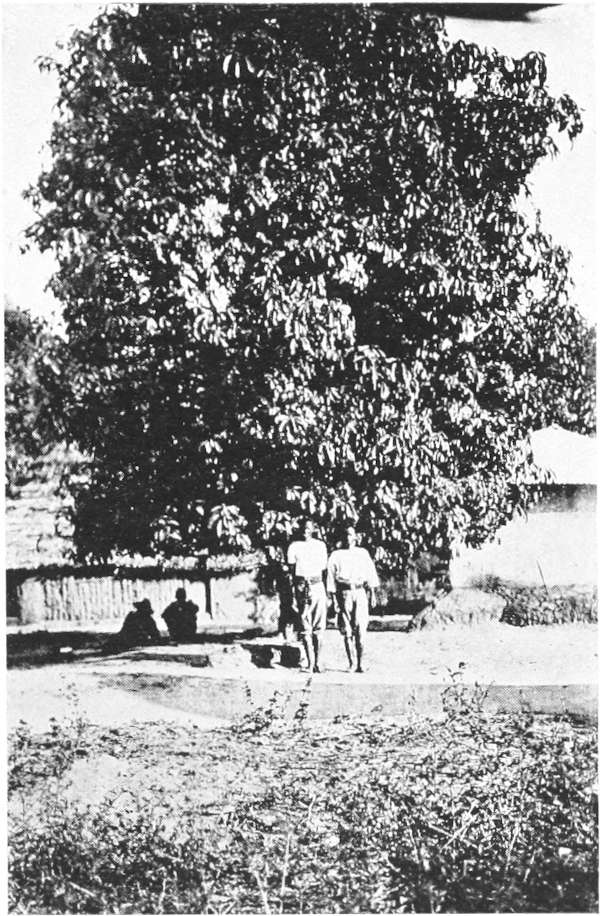
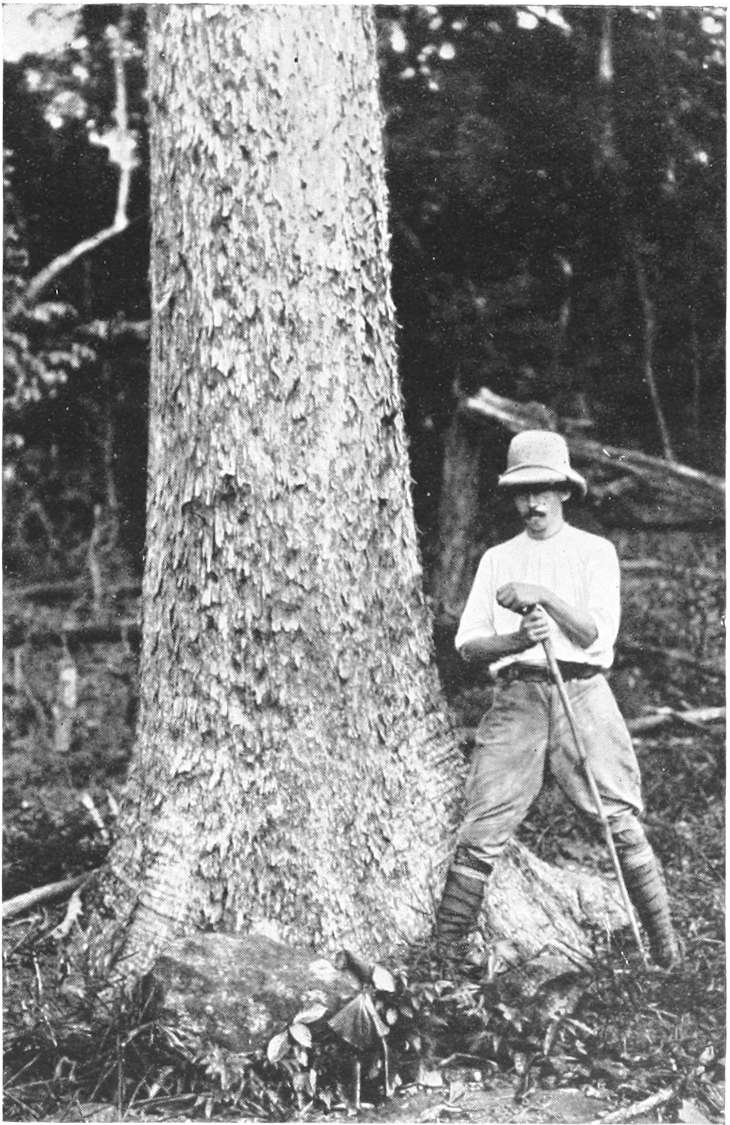
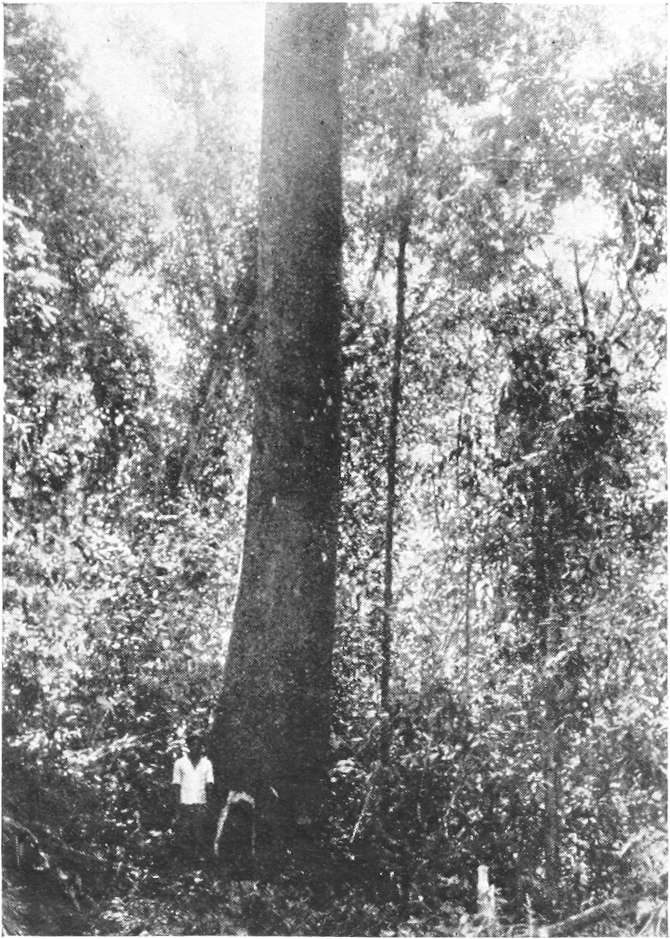
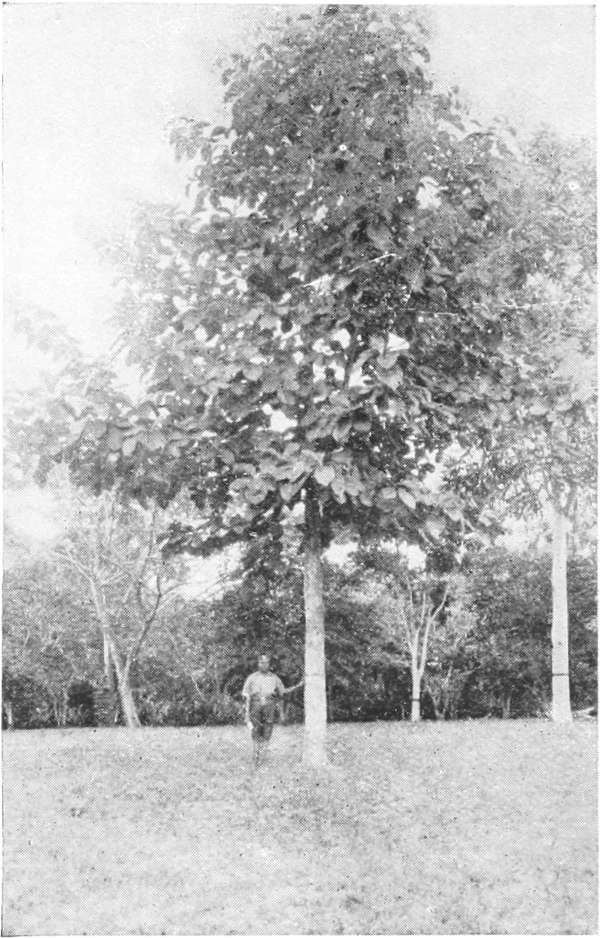
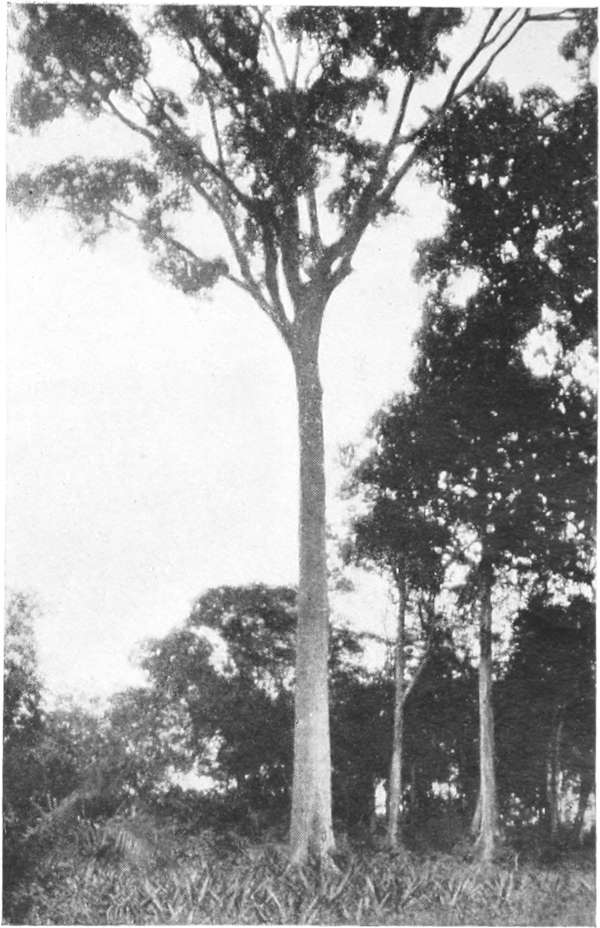
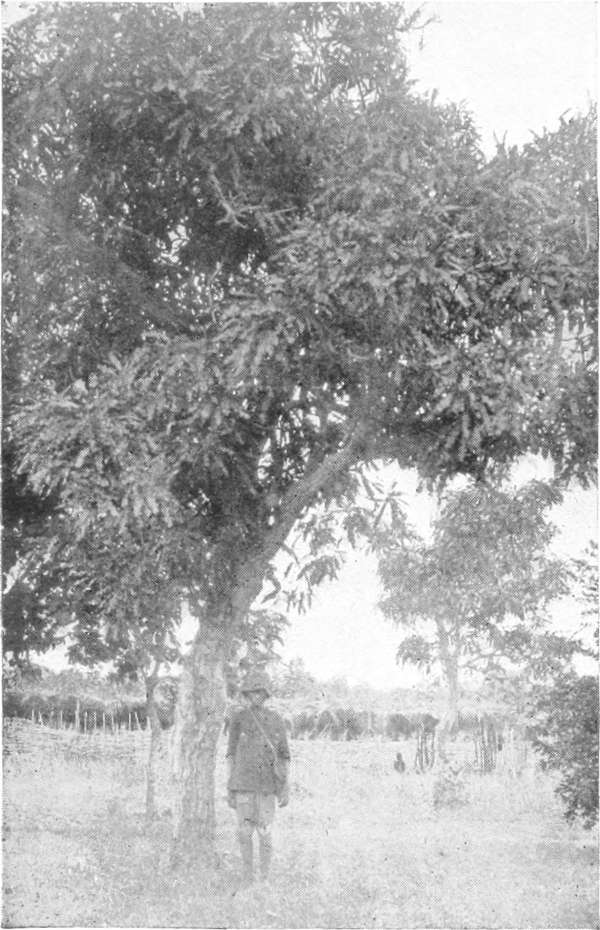
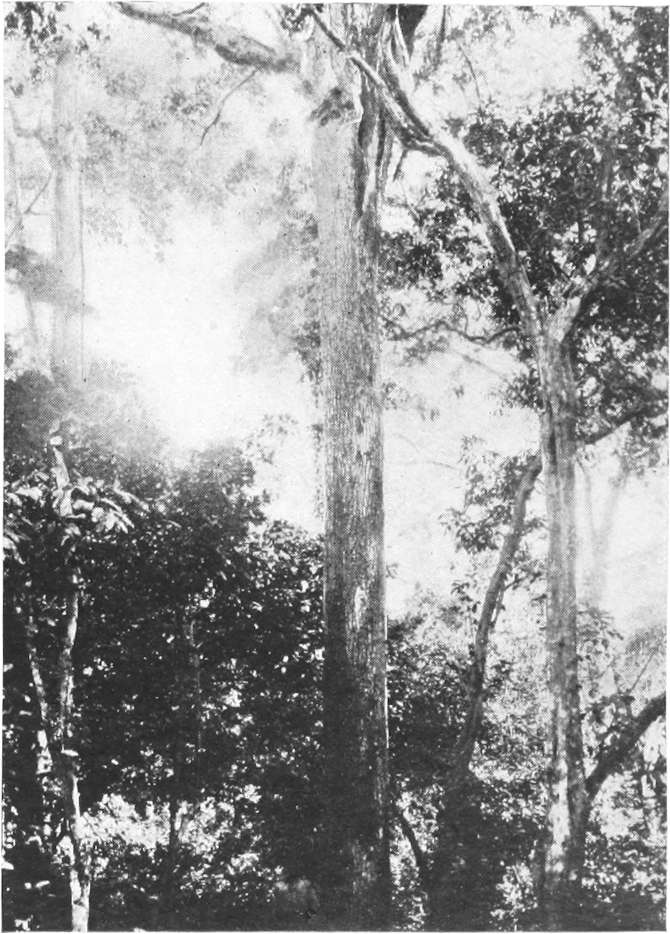
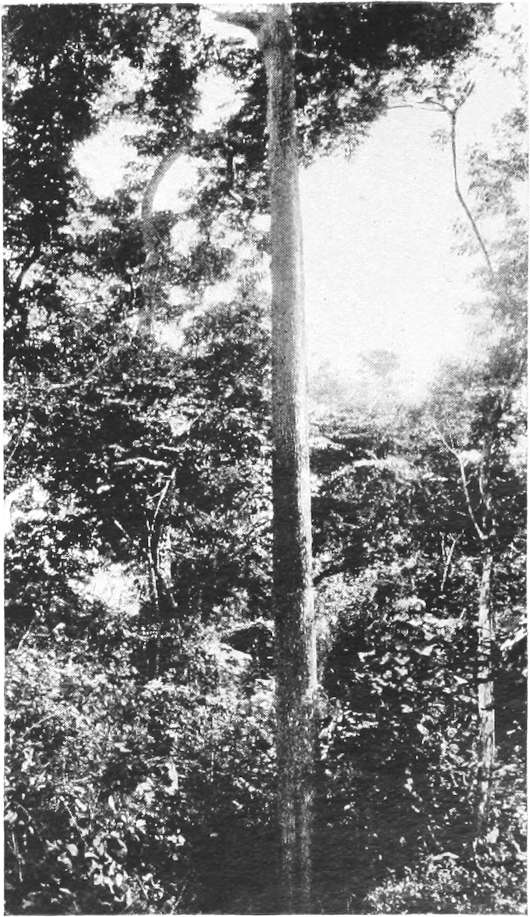
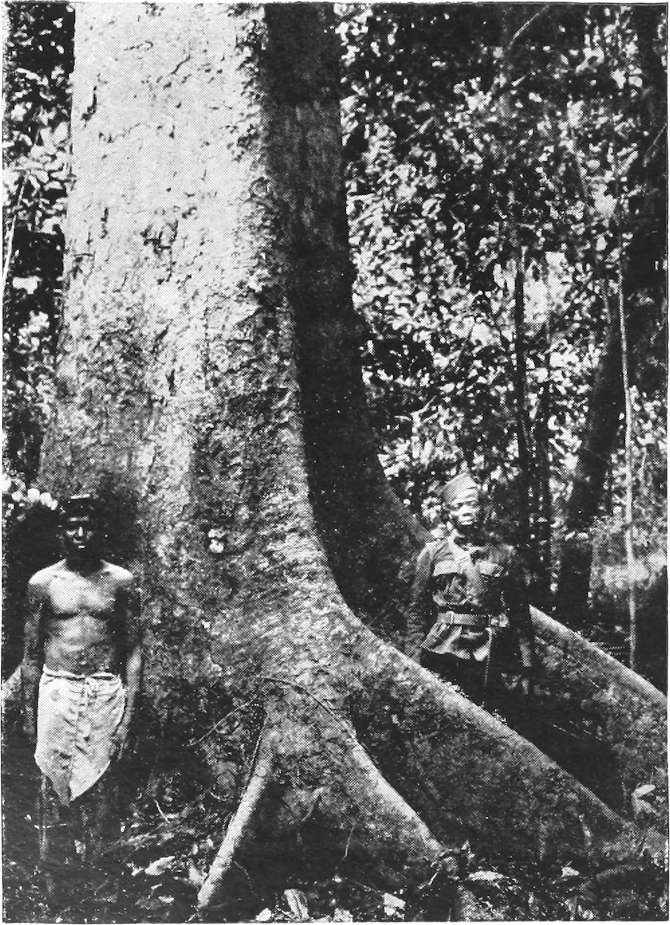
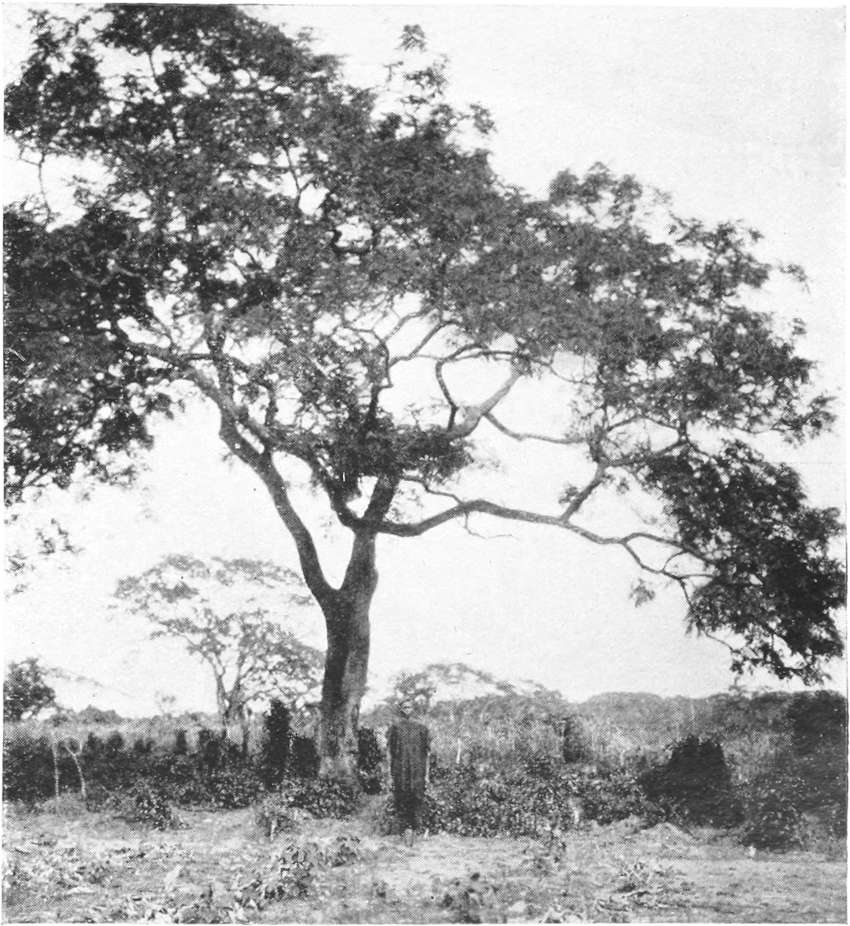
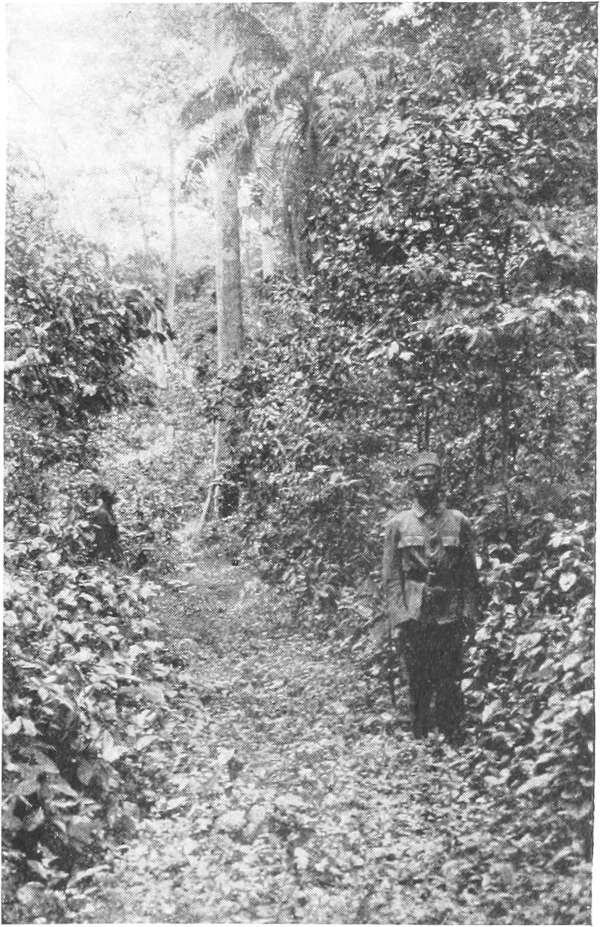
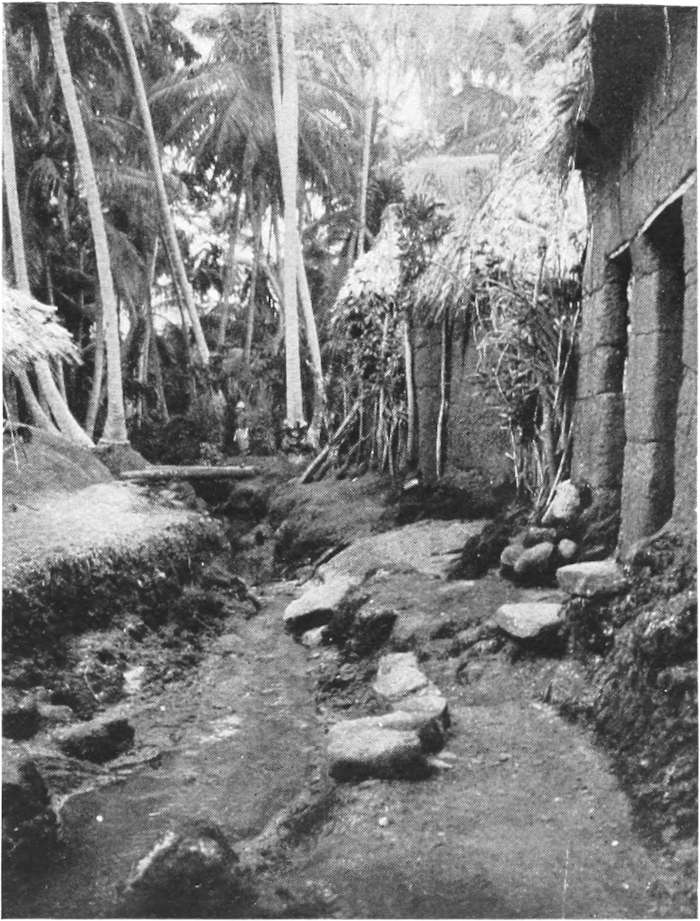
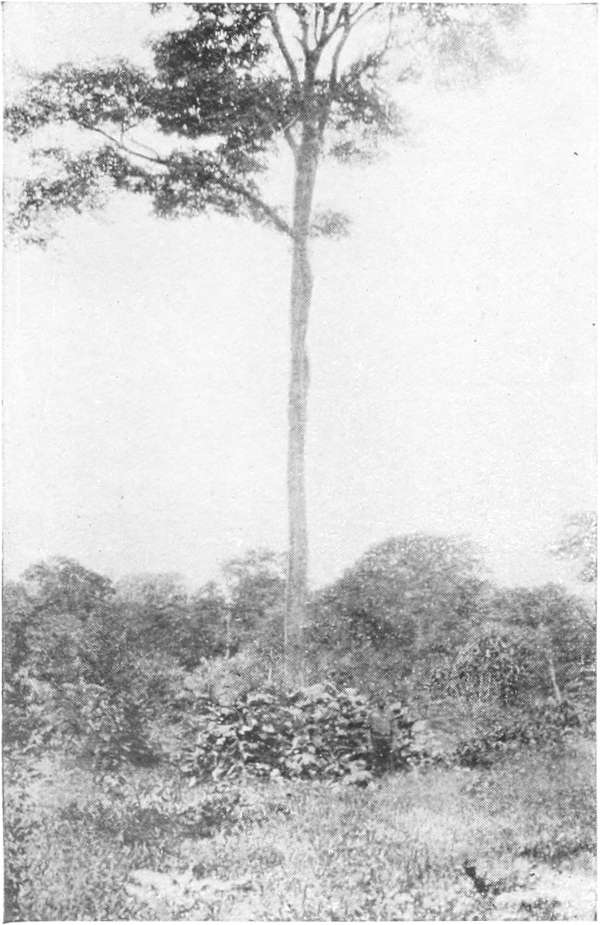
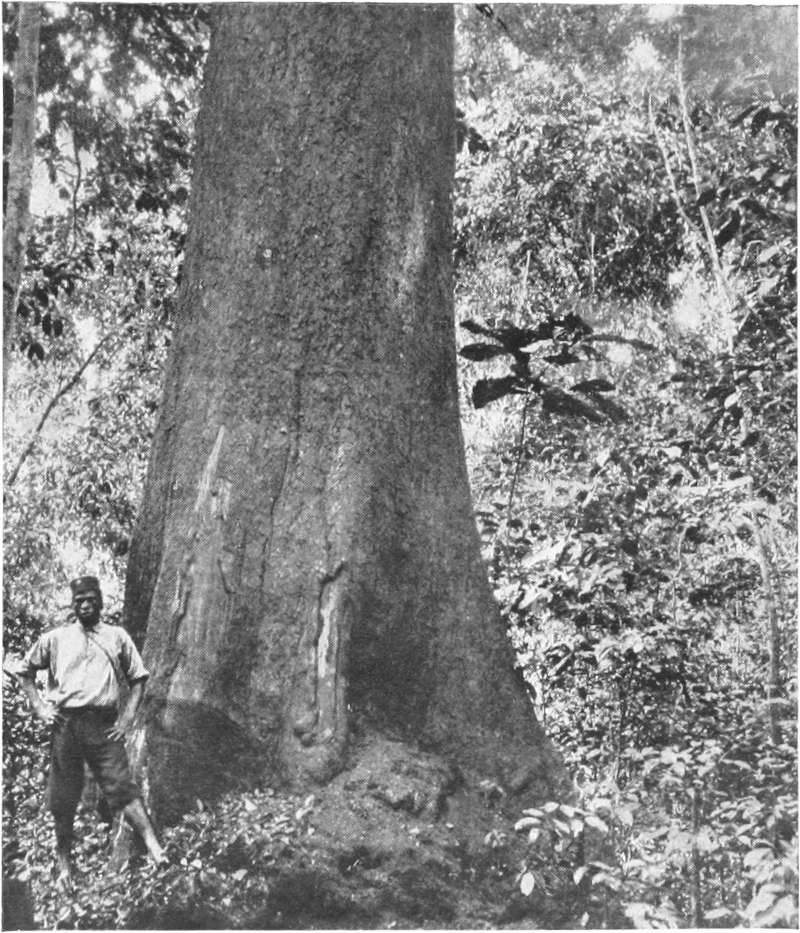
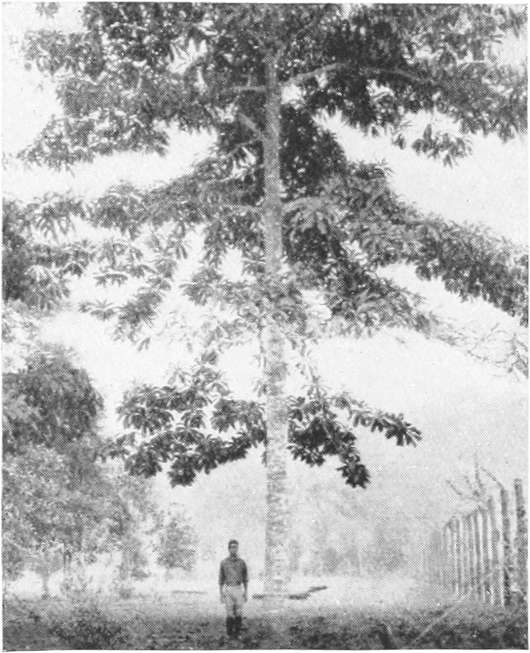
Fig. 3.—Mature Cola Tree (Cola vera), growing in Fundo Village,
Protectorate of Sierra Leone.
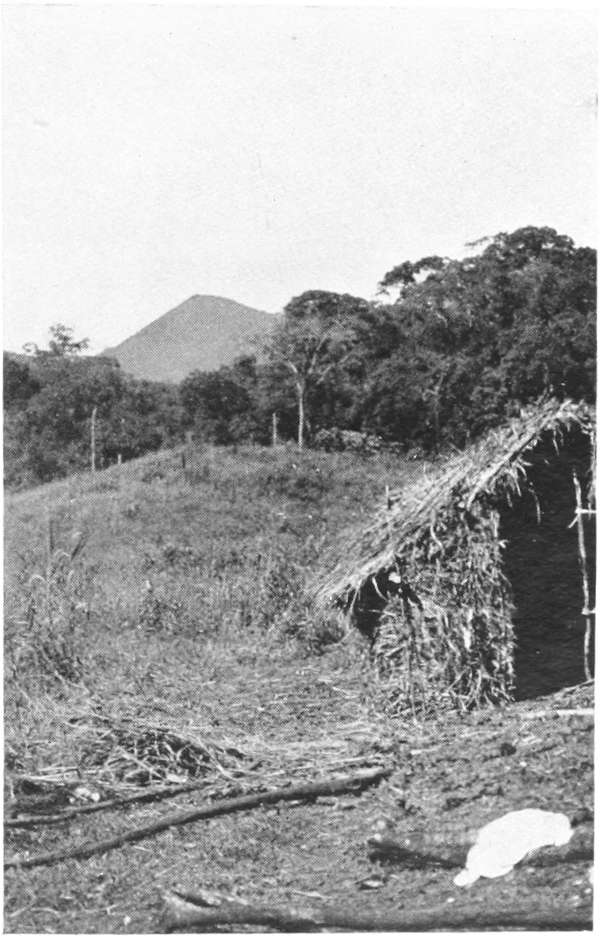
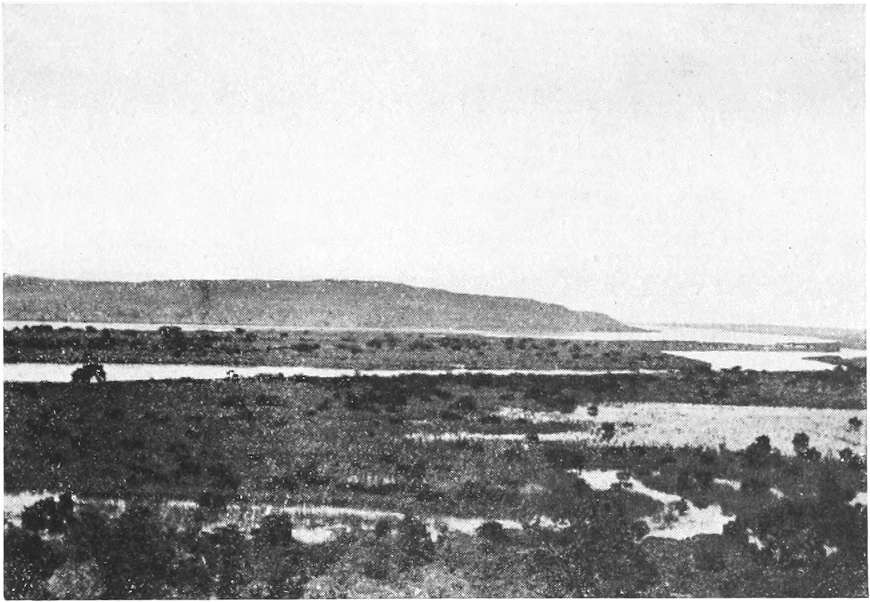
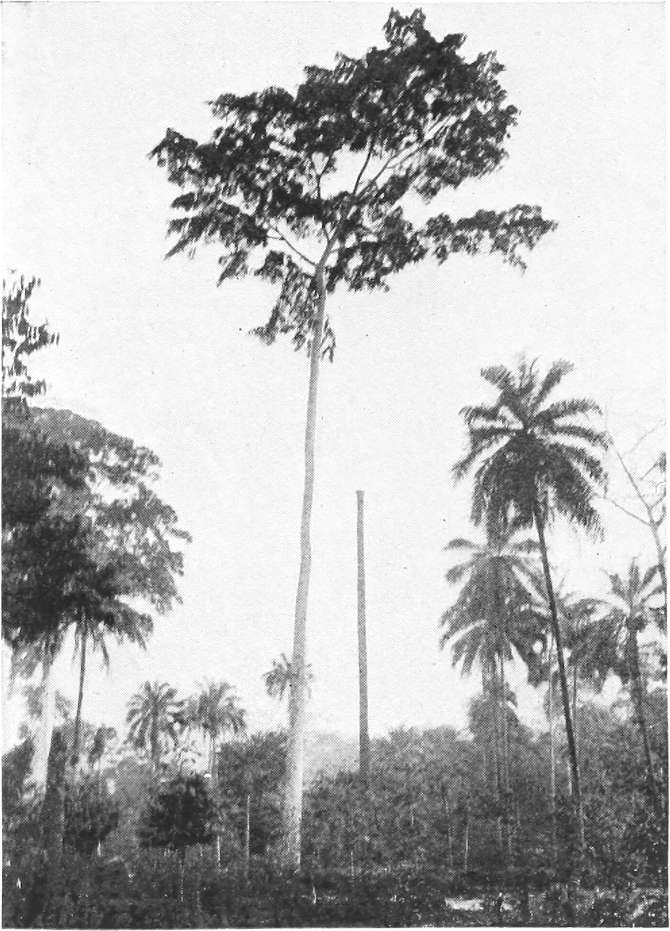
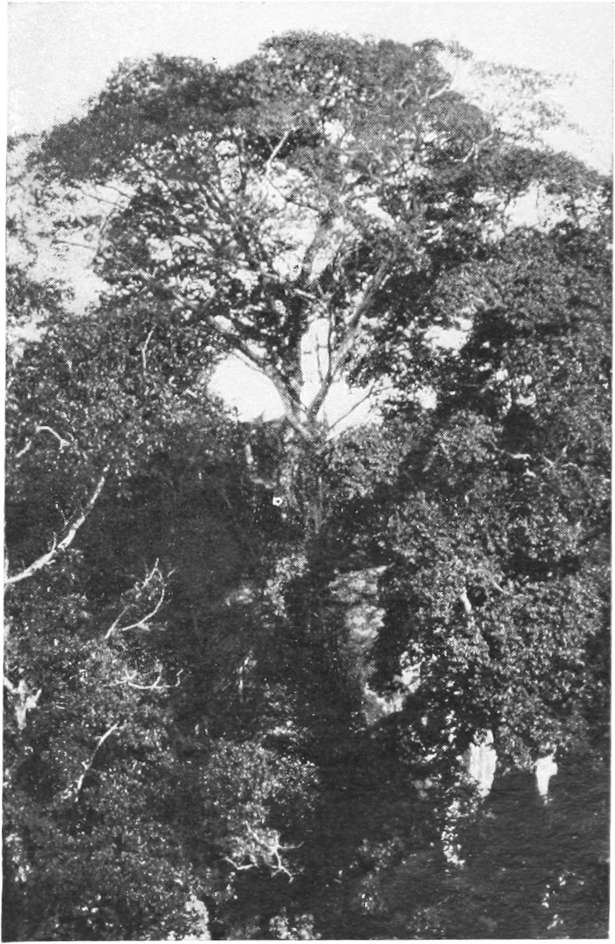
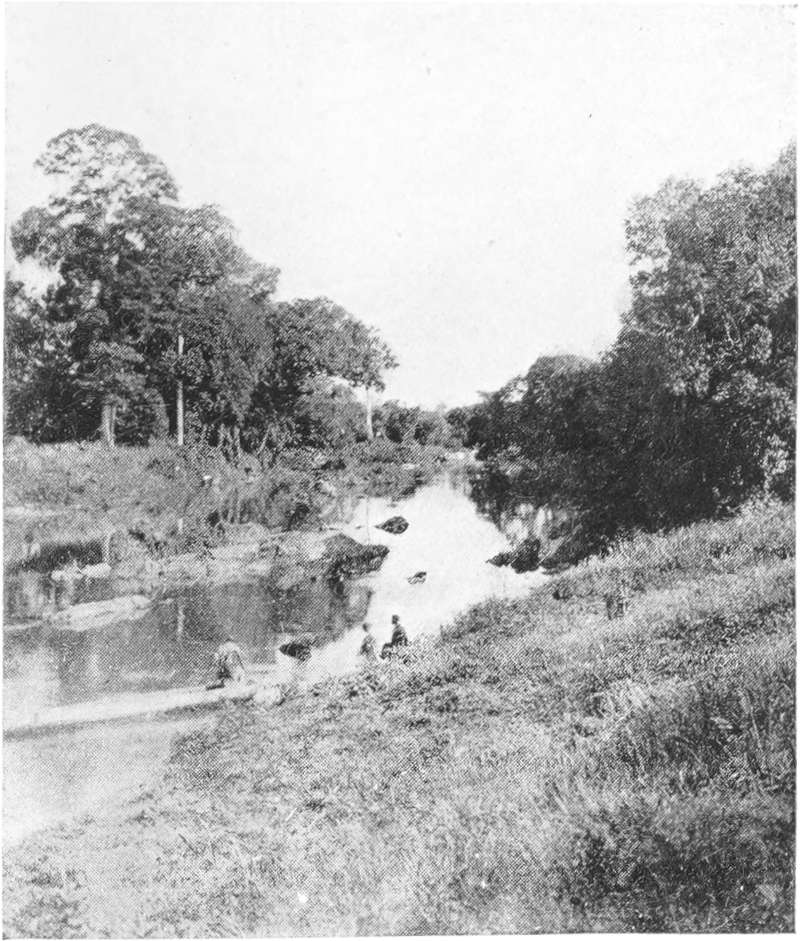
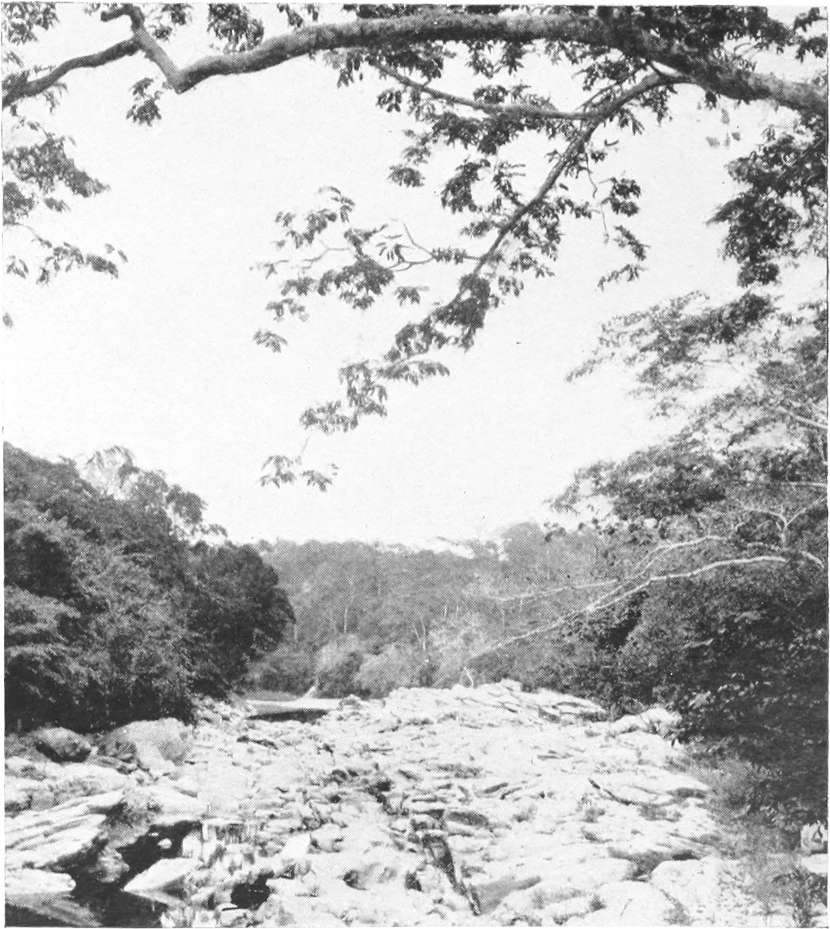
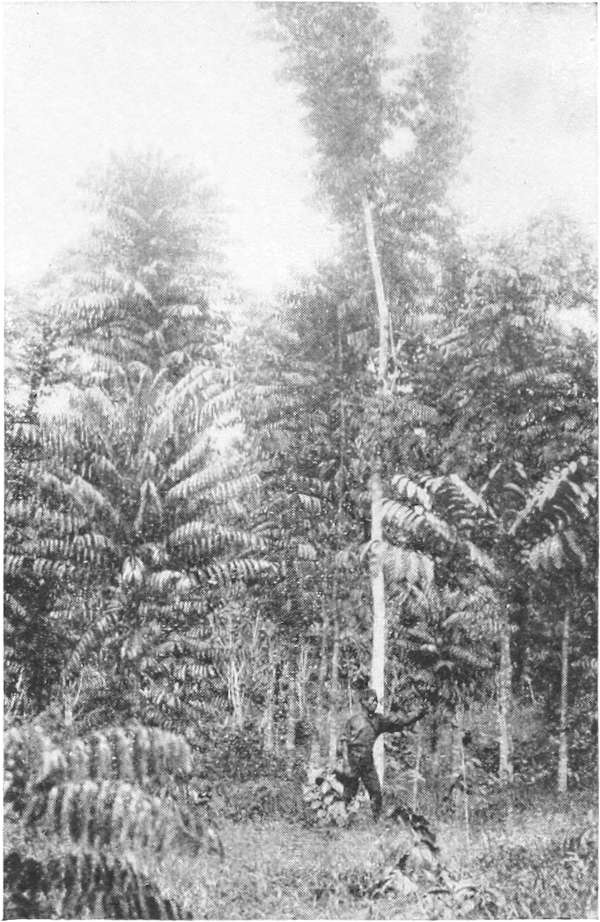
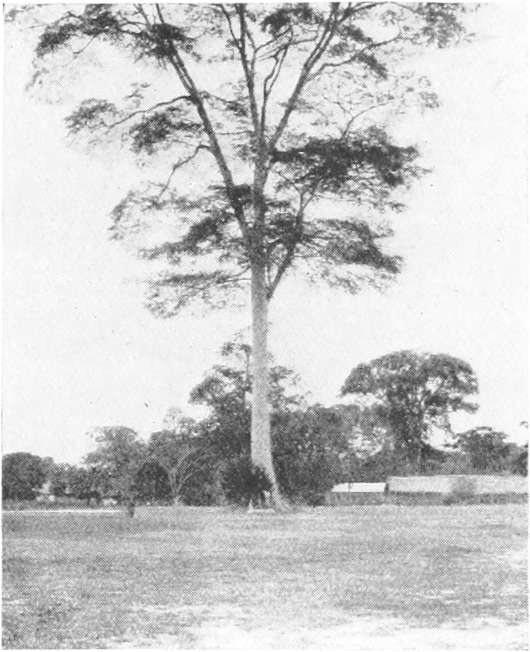
Fig. 4.—View of Gumah Mountain, from the Gumah.
WEST AFRICAN FORESTS
AND FORESTRY
CHAPTER I
THE FORESTS OF WESTERN AFRICA
From a large scale-map of
Africa, the various British West African Colonies and
Protectorates, as well as Liberia, French Ivory Coast, the late
German Colonies of Togo and Cameroons, can be seen on the western
side of that Continent. In fact, these territories are all within
the Tropics, and also between the latitudes of 13° North in the
Gambia to nearly the Equator in the Cameroons, and between
longitude of 17° West to 10° East. Roughly speaking, Upper Guinea,
as this part is usually called, covers an area of 100 to 200 miles
wide by a length of over 1,500 miles, as a sylvan belt mainly of
one type of vegetation, which botanically, however, only begins to
alter as the boundary of the Cameroons is approached in the eastern
part of Nigeria. Therefore one finds several trees extending right
through this area, and also an almost unbroken forest all the way
along the coast line, and roughly 100 to 150 miles inland. The
width of the forest varies rather according to the aspect of the
coast line, because the prevalent wind being south-west, the
greatest rainfall, and thus the heaviest type of forest, occurs
when the coast line runs at right angles to the prevailing wind.
This occurs, for instance, near Calabar, Nigeria in the Cameroons,
part of the Gold Coast near Axim, and Sierra Leone near Freetown.
In some instances this effect is accentuated by the proximity of
mountains near the coast, as, for instance, north of Calabar and
north of Benin. One tree, which might be taken as a type, is the
Rhodesian Mahogany, Afzelia Africana, which is found right
in this belt of forest on its northern side. As the name implies,
it is also found in Rhodesia, near the Victoria Falls. Mahogany,
Khaya Senegalensis, is another tree found in the Gambia,
also in Nigeria right up to the Cameroon border, over 1,500 miles
away.
However, in this huge forest belt there are great variations in
the rainfall, from 20 to over 175 inches in the Oban Hills of
Nigeria. There are also, naturally, variations in soil and
elevation, which make differences in the character of the forest. The proximity
to the sea causes yet another difference in the type of vegetation,
combined as it often is with low elevation.
Broadly speaking, then, one can differentiate several distinct
types of forest, though owing to slight changes in a locality the
one merges into the other and very sharp boundary lines cannot be
drawn.
I. The Mangrove Swamps are usually near the sea coast, though
not always at the sea coast; a strip of Evergreen Forest is usually
found actually on the sandy dunes of the sea coast. The Mangrove
Swamps also extend up the rivers near the coast as a fringe a mile
or more wide.
II. The Evergreen Forest is usually found on the sea coast, also
extending inland up the rivers, and also on low land up to an
elevation of a few hundred feet, as, for instance, the forest on
the banks of the Calabar River.
III. The Freshwater Swamp Forests are also found in this type of
locality.
IV. The Mixed intermediate Forest is found usually where the
rainfall does not exceed 60 inches, or in slightly hilly country,
and contains a few deciduous trees. Typical trees of this forest
are the Triplochiton Nigericum and Mimusops
multinervis. It contains both evergreen and deciduous
trees.
V. The Fringing Forest, or “Gallerie” Forest of the Germans, is
found at the edge of rivers or lakes, where the rainfall is
otherwise too low for the mixed deciduous forests.
VI. The Savannah Forest, sometimes so-called Dry-zone Forest,
usually occurs with a rainfall of 30 to 50 inches. The typical tree
of this is the Lophira alata.
VII. The Evergreen Forest of the hills, chiefly above an
altitude of 2,000 or 3,000 feet. It is especially noticeable on
Mount Itakum and the Boji Hills (elevation 5,000 feet).
VIII. The Open Orchard Forest, with shrubby trees of small
growth.
These, then, roughly follow the Œcological Divisions according
to Warming, which are as follows:
Mangrove Swamp,
True Savannah,
Treeless Savannah, low and high grass,
Bush Savannah,
Tree Savannah,
Savannah Forest,
Sclerophyllus formations, such as
Bush and Forest,
Bamboo Forest.
Forests are in
addition named after the locality, such as Benin Forests, Oban
Forests, Ondo Forests. Again, yet another nomenclature is after the
kind of tree represented, such as Evergreen Forest, where all the
trees are evergreen all the year round; for instance, Calabar
Forests, Ondo, South Benin.
The mixed forests and intermediate forests, where the trees are
both evergreen and deciduous, growing side by side, such as
Olokemeji Forests, Benin Forests, Obubra Forests, and Bende
Forests. Thus summarising the Nigerian Forests, we get the
following formations:
Grass, a few stunted bushes of Acacia
Isoberlinia, North Ogoja.
CHAPTER II — APPENDIX I — APPENDIX II
THE GAMBIA
In the early part of the
nineteenth century a considerable quantity of African Mahogany,
obtained from Khaya Senegalensis, a dry-zone mahogany-tree,
was shipped to England; in fact, this was the original source of
African Mahogany, as also it was the first tree from which it was
obtained. Even now this tree is one of the most prevalent in the
strip of land on both banks of the Gambia, so far as British
territory is concerned.
At the present time no mahogany is being shipped from the
Gambia, but recently an Ordinance was passed regulating the cutting
of firewood and forest trees.
Forests in the ordinary sense of the word cannot be said to
exist in the Gambia, but no doubt a considerable amount of timber
could be obtained from the dry-zone country. The total length of
the colony is 300 miles, and approximately 5 miles wide, on either
side of the Gambia River, which makes it in the aggregate a
considerable tract of country, in all 4,500 square miles, of which
the colony proper occupies 4 square miles.
So far only Rosewood (Pterocarpus erinaceus), Mahogany
(Khaya Senegalensis), and small pieces of Baywood, probably
also a mahogany, have been reported from the Gambia. In 1908 a
certain amount of wood was cut for the making of charcoal by a man
from the Canary Islands. In 1909, 102 tons of charcoal were
exported, and in 1910, 176 tons, valued at £634. Since then no
other returns are available, so apparently this industry has come
to an end. There is no Forest Officer in the Gambia, and no
proposals for Forest Reserves have been put forward by the
Government. Part of the land near the mouth of the Gambia is swampy
and covered with the usual Mangrove forests.
In the Bulletin of the Imperial Institute, vol. viii,
1910, p. 244, it is stated that the specimens of rosewood and
mahogany forwarded to the Imperial Institute were reported on as
follows:
Rosewood (Dalbergia sp.), reddish-yellow with darker
lines and red pores, solid and compact, resembling rosewood except
in colour. The timber would not pass as rosewood on the market. It
has an agreeable
odour, is hard and heavy, weighing 45½ lb. per cubic foot. It
turned and polished well, sawed very easily, but was difficult to
plane; planing left a smooth, bright surface.
Mahogany (Khaya Senegalensis) may be looked upon as
inferior baywood, the wood light in colour, of poor figure, hard to
plane, but when planed leaves the surface bright and woolly in
alternate bands; very cross grained, sawed and turned easily.
Weight, 41½ lb. per cubic foot. Should be very useful locally, but
probably not of sufficient value for much export trade.
Even in this comparatively small colony a certain amount of
forest land should be preserved, more especially that which is
unsuitable for agriculture. In every country there is always some
poor or rocky land which is not favourable to the growing of
agricultural crops.
The oil palm is another useful tree, which yields the well-known
palm oil and kernels; however, here the oil is required locally for
alimentary purposes, and therefore only the palm kernels are
exported.
The following shows the exports for five years:
Year.
Tons.
£
s.
d.
1910
467
5,640
0
0
1911
443
4,756
0
0
1912
445
6,518
0
0
1913
545
9,026
0
0
1914
494½
7,814
17
11
It will be noticed that the very high prices ruling for part of
1913 and the beginning of 1914 had the effect of causing increased
exports to be made.
Here, as in the case of other products, planting could be
undertaken with advantage, as the yield of kernels and oil is good;
even if the increased amount of oil produced was sold locally, the
increased output of kernels would find a market in England, where
they are needed.
It is a tree which allows cultivation of field crops to be made
between the oil palms for several years before the palms become too
big and shut out the light necessary for field crops. In the drier
climate of the Gambia a planting distance of probably 16 feet would
be sufficient to ensure a good yield, and yet give sufficient
distance between the trees to allow room for them even when
mature.
If an Agricultural or Forest Department, which at present does
not exist in the Gambia, could not supply young seedlings or nuts
for planting, one of the trading firms could secure them from one
of the other West Coast Protectorates. Of course, in many
cases, if the natives
could be induced to believe that a good price would always be paid
for kernels, they would no doubt make small plantations of oil
palms themselves, as some fruit always falls to the ground in the
picking, is thus not boiled, and so is suitable for furnishing seed
for planting. It is, of course, inadvisable to plant boiled nuts,
as many do not germinate, owing to the germ having been destroyed
by the boiling of the fruit; others do, however, as can be seen in
the young oil palms sprouting from heaps of uncracked nuts which
the natives leave near the villages.
FOREST FEES IN GAMBIA
A new list was published by
the Legislative Council in Gambia which fixes the different rates
of fees for the right of felling useful timber for export.
The fees are as follows:
Felling of Useful Timber for
Export.
For each sort of useful trunk
10s. per trunk.
Felling of Useful Timber
which is not intended for Export.
For each trunk, Rosewood (Jacaranda,
Palisander wood)
5s. per trunk.
For each trunk, Mahogany
1s. per foot after felling.
For each trunk in Mandingo Falls
9d. per foot after felling.
For each trunk in Tumbo
8d. per foot after felling.
For each trunk in Jaffo
6d. per foot after felling.
For each trunk, Cotton-tree
4d. per foot after felling.
For every other valuable tree
4d. per cubic foot.
THE GAMBIA—FOREST EXPORTS
Products.
1909.
1910.
1911.
1912.
1913.
1914.
Qty.
£
Qty.
£
Qty.
£
Qty.
£
Qty.
£
Qty.
£
Cane
—
—
—
—
—
—
—
—
—
—
59
bdls.
4
Gum Arabic
—
—
—
—
—
—
—
—
—
—
2
tntons
44
Ground nuts
53,644
tntons
323,231
58,456
tntons
387,943
47,931
tntons
437,472
64,169
tntons
502,069
67,404
tntons
622,098
66,884
tntons
650,460
Palm kernels
389
tntons
3,526
467
tntons
5,640
444
tntons
4,758
445
tntons
6,518
546
tntons
9,026
494
tntons
7,814
Rubber
15,548
lblb.
1,550
7,148
lblb.
952
10,733
lblb.
836
4,335
lblb.
409
12,995
lblb.
1,027
3,548
lblb.
102
Wax
48,969
lblb.
2,180
25,718
lblb.
1,274
33,871
lblb.
1,514
30,830
lblb.
1,164
31,518
lblb.
990
15,513
lblb.
473
Wood and timber
4
pkpkgs.
4
162
pkpkgs.
63
155
pkpkgs.
28
178
pkpkgs.
55
1,562
pkpkgs.
20
30
pkpkgs.
10
Oil (palm)
361
glgals.
39
108
glgals.
12
—
—
—
—
—
—
—
—
Lumber
—
—
—
—
—
—
273
ftfeet
2
—
—
—
—
Gum copal
—
—
90
lblb.
—
—
—
—
—
—
—
—
—
Totals
4
pkpkgs.
330,530
162
pkpkgs.
395,885
155
pkpkgs.
444,608
178
pkpkgs.
500,218
1,562
pkpkgs.
633,161
30
pkpkgs.
658,911
54,033
tntons
58,923
tntons
48,375
tntons
64,614
tntons
67,950
tntons
67,382
tntons
64,509
lblb.
32,956
lblb.
44,604
lblb.
35,165
lblb.
44,513
lblb.
19,061
lblb.
361
glgals.
108
glgals.
273
ftfeet
59
bdls.
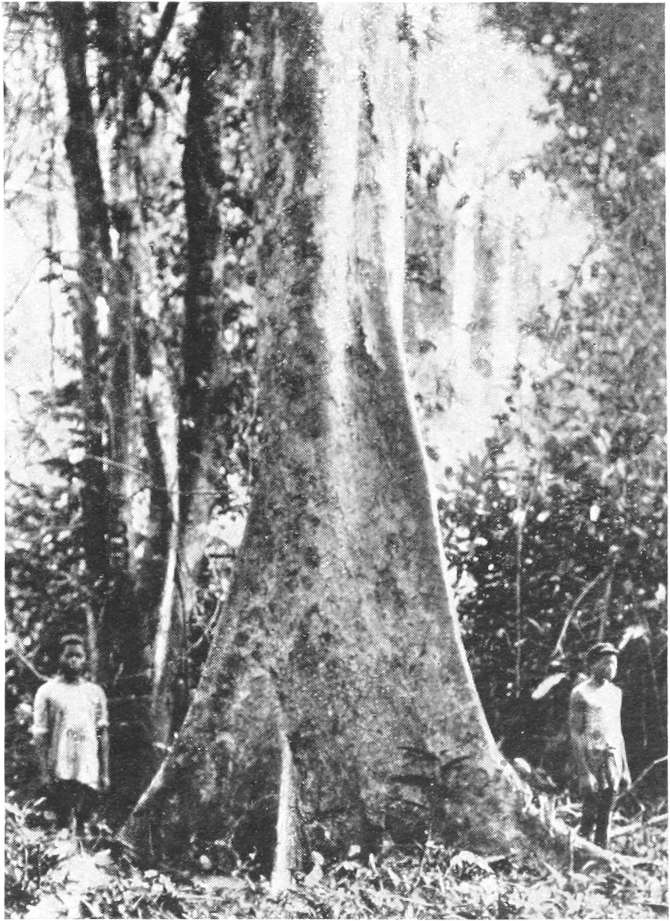
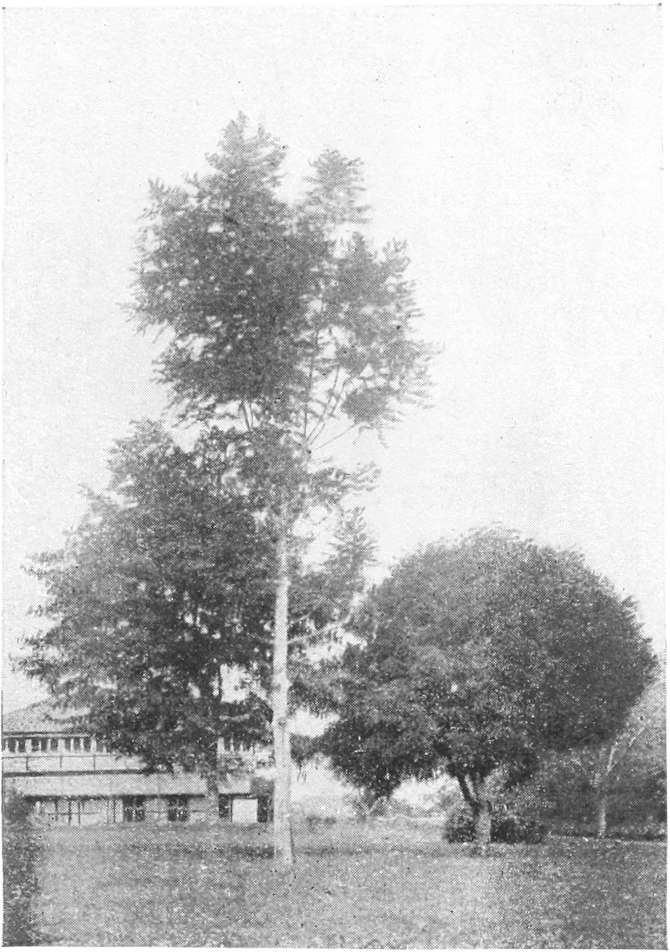
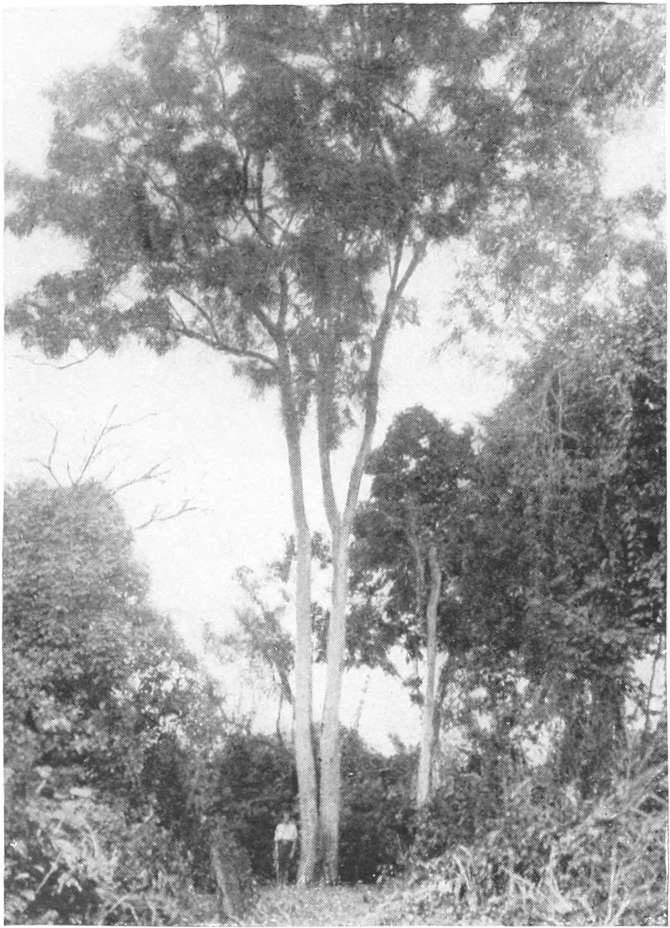
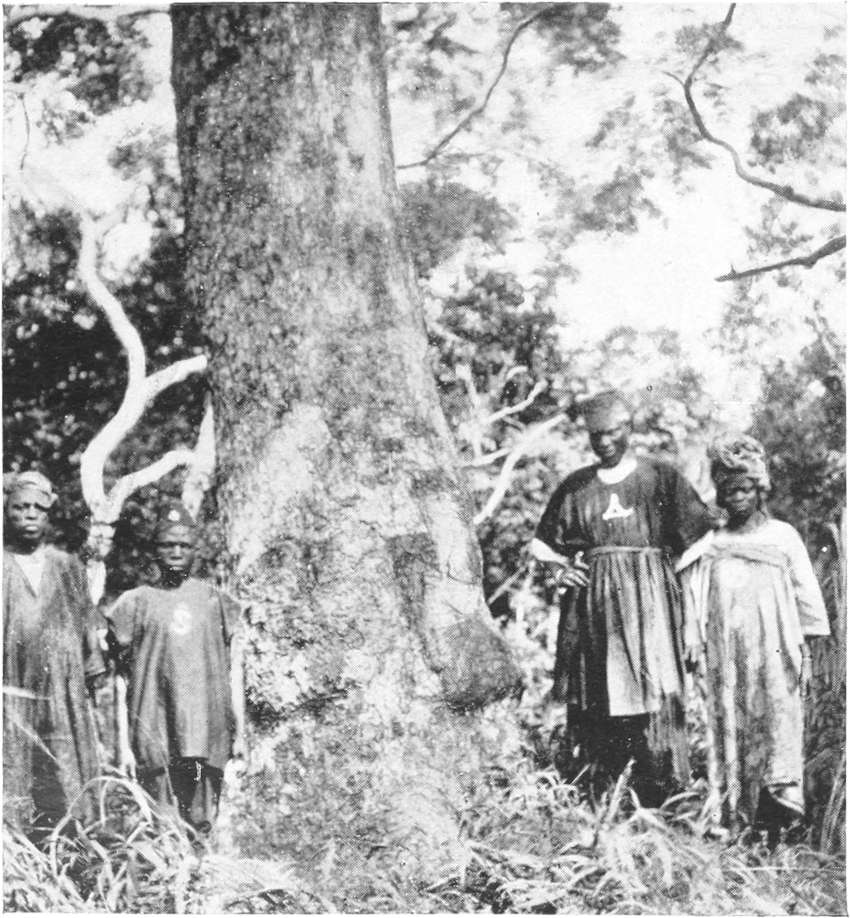
Fig. 5.—African Oak (Oldfieldia Africana), showing bole in middle
foreground, near Bureh Town Bridge.
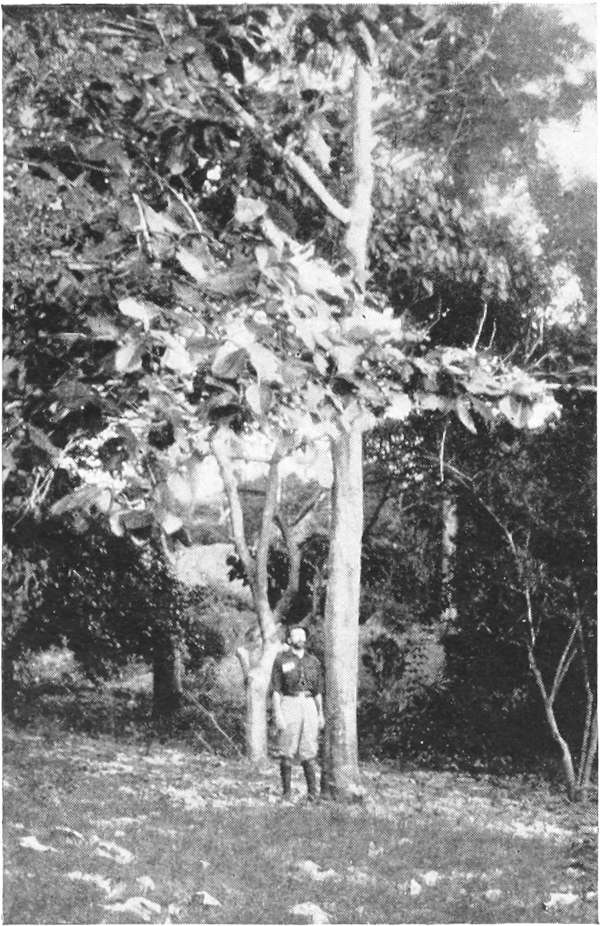
Fig. 6.—African Oak (Oldfieldia Africana), showing Scaly Bark at
base of tree, the late Mr. C. W. Smythe standing beside
it.
To face p. 24.
CHAPTER III — I. The Forests. — II. Notes on Timber Trees. — III. Trees Cut for Local Use. — IV. Minor Forest Produce. — V. The Forest Department of Sierra Leone. — VI.—INDIGENOUS FOREST TREES — APPENDIX I — APPENDIX II — APPENDIX III
SIERRA LEONE
The Colony and Protectorate
of Sierra Leone cover an area of approximately 34,000 square miles,
or, to make it more comprehensible, it is almost the same size as
Ireland. Probably in the earliest times the whole territory was
covered with some kind of arborescent growth, varying from open
savannah and deciduous forest to close, impenetrable evergreen rain
forest.
Now scarcely 1 per cent. of this forest remains, one of the most
important tracts being the Sierra Leone or Peninsular Mountain
Forest, situated on the mountain due east of Freetown. The whole of
this region was once covered with forest, now reduced to an area of
approximately 48 square miles, or 30,000 acres. All this tract down
to the 500-foot control line has been reserved as a permanent
forest, so that eventually the whole peninsular forest will have an
area of 75 square miles. Illustrations Nos. 2
and 4 show a general view of these forests.
Other important mountain forests are those situated on the
Kassewe Hills, Kagnari Mountains, Kambui Hills, Panguma Hills,
Nimmini Mountains, Loma Mountains, Bunbola Hills, and Maramper
Hills. In addition to these areas, timber trees are felled at
Kangahan and Yonni, as well as in the peninsular mountains and
Maramper Hills, especially for local use.
Turning now to a consideration of the forests more in detail,
one naturally first deals with the most accessible ones, i.e. of
the peninsular mountains. From the beautiful harbour of Freetown,
Sierra Leone, one sees the edge of these forests between Leicester
Peak and Sugar Loaf Mountains. From these two points it skirts the
hill station, extending thence roughly parallel to the sea as far
as Kent; the largest wooded slopes face the ocean, only a narrow
strip of forest being found on the landward side of the mountains
near Burehtown and John Obey. The forest extends practically from
the water’s edge on the estuary of the Bureh River right up the
mountains to an elevation of 2,000 feet, with a rainfall of upwards
of 160 inches per year. Silvan vegetation is very luxuriant, the
giant trees standing
close together, often entwined and joined to each other by various
large creepers, the whole forming an almost impenetrable grove,
into which only the diffused light of the sun reaches. The
undergrowth is not very thick, except where old trees have fallen
or where mature trees have been felled; this is partly owing to the
dense shade of the tall trees, and therefore the trunks of these
trees can be seen. A large Cedar Mahogany 23 feet in circumference
was seen. This specimen of a mahogany was one of the largest trees
found, and shows to what size the trees attain in this peninsular
forest. One of the commonest trees found is the Red Ironwood, or
sometimes called in Sierra Leone Ironpost, botanically known as
Lophira procera. A picture of a large specimen of one of
this species is shown as illustration No. 2.
Another very common tree is a species of Mimusops, known as
pearwood, or sometimes mahogany, when sold as timber. The African
Violetwood, sometimes known as Blackwood, is comparatively common.
Rhodesian Mahogany, usually called Kontah, botanically known as
Afzelia Africana, is also found. Real African Oak
(Oldfieldia Africana) is seen singly scattered throughout
forests. A patch of true Gum Copal trees is found, as well as
isolated specimens in some parts of the forest. Rock Elm
(Chlorophora excelsa) is seen both in the forest and in the
clearings made for farms. The Oil Palm (Elaeis guineensis)
is sparsely distributed in the forest, but more frequent in the
abandoned farms. The above-named trees are representative of some
of the very large number of hardwoods and other trees of economic
value in the forest. There are, however, also a very large number
of softwoods found scattered amongst the other trees in the forest;
a beautiful Whitewood (Alstonia Congensis) is, for instance,
one of such softwoods. The Cotton Tree (Eriodendron
anfractuosum) is probably the one most commonly found. Various
Albizzias are also met with in a similar manner.
Taking now the different species of timber trees individually,
the following are most important:
1. Real African Oak (Oldfieldia Africana), which is
termed Tortorza by the Timanis and Paulai by the Mendis. As
illustration No. 5 shows, this is a very large
and tall tree. It often attains a bole length of 50 feet and a
girth of 16 feet. It is found singly, scattered through the forest.
The habit of its branches, open crown, and greyish bark make it
look not unlike a European oak. In reality the bark is scaly,
gradually peeling off in flakes. The tree in illustration No. 6 shows this characteristic peculiarity to
advantage, and also shows a medium-sized tree, approximately 10
feet in girth. The tree fruits moderately, and has an indehiscent
capsule not unlike
the shape, size and colour of an oak-apple. The capsule has five
faint ribs on its surface, but contains only three seeds. The
little seedling, with light grey stem and white lenticels, is
easily recognized. It usually has also only three leaflets on its
leaves, instead of forming true digitate leaves as a full-grown
tree. The sapling once started shows fairly rapid growth, and
during the early years stands a good deal of shade. It should
therefore be classified as a slight shade-bearer. African Oak is a
dark reddish-brown wood, which is very hard and most durable. It
has, of course, a much closer grain than ordinary oak. A very
smooth surface can be obtained by planing the timber. Locally,
small trees are cut for conversion by pit-saw into timber for boat
keels. This timber was exported as teak from Sierra Leone 1827 to
1835 for use in the English Navy. It was afterwards lost sight of,
though the natives continued to use it locally. During 1908 a few
round logs of short length (12-16 feet) of this timber were
exported to England and sold in a Liverpool market for 2s. 6d. per
cubic foot (extreme measure).
2. Ironpost, or African Oak, or Red Ironwood (Lophira
procera), is the most common tree throughout the peninsula.
According to the Conservator of Forests in Sierra Leone, 80 per
cent. of the trees of the peninsular forest are Lophira
procera. All stages of growth are found, from the smallest
seedlings to the largest tree, over 100 feet high and 20 feet in
girth. In the forest the tree has an orange-coloured bark, which
rapidly turns grey when exposed to the rays of the sun. The bole is
not always quite cylindrical, especially near the base, where it
often develops rather angular root protuberances. This seems to
occur more often on rocky ground, such as that where the tree is
found in the peninsula. For a similar reason the bole is not always
straight, though in the ordinary way the tree has a comparatively
small crown with short branches. Thus, in proportion to the size of
the tree, the bole is very long, the twigs are thickish, and the
long thin paper-knifelike leaves appear at the ends of them.
Seedlings seem to come up wherever suitable conditions of
reproduction are found. A clear bole is typical of these trees in
the pole stage of growth. Illustration No. 2
shows a large specimen on the edge of the forest, and there are
many large trees with the peculiar root protuberances, growing in
the forest. The timber is very hard and of a dark red colour, which
it retains when dry. The heartwood forms comparatively early in the
life of the tree, and although the sapwood is white, it is almost
as hard as the heartwood. For this reason comparatively small trees
yield timber, and thus can be felled earlier than trees in which
the heartwood forms later. Of course, in this connection it should
not be forgotten that the market does not desire logs of too small
a size, i.e. of 18 inches or under, when squared. Locally
this is known as
Ironpost, and is sold for house-building, and, as its name implies,
it is used for the uprights of the house. The Public Works
Department have a regular schedule of timbers which are used, and
this timber is mentioned amongst them, and is bought from native
contractors at 3d. per superficial foot for boards, and 3d. to 6d.
per linear foot for beams and posts. This timber has been used as a
substitute for real African Oak, when it is sold as African Oak. A
regular supply of logs could be obtained from the peninsular
forest.
3. Cedar Mahogany (Pseudocedrela sp.; termed Bissimi by
the Mendis). This tree, which grows to a very large size, is not
very prevalent. The largest tree, some 23 feet in girth, was found
above the Gumah. The bole is usually very long and straight, which
makes it very cylindrical. This last characteristic of the tree is
all the more accentuated by its having no root projections at its
base. This species appears to be one of the largest trees in the
forest. It is apparently a very fast-growing tree, forming
heartwood comparatively early, though the sapwood is rather wide
(up to 10 inches in a tree 7 feet in diameter). This timber has not
been exported, but wood from similar trees on the coast has been
exported and sold in the European market as mahogany (scented).
There is no reason to believe, therefore, that the wood from this
tree would not fetch a similar price. Owing to this tree being so
fullwooded, a larger proportion of the bole can be converted into
logs than is the case with other kinds of mahogany trees which have
large root flanges.
4. African Walnut (Lovoa Klaineana). This is a
medium-sized tree of the Mahogany family, which, owing to the brown
colour of the wood, has been termed African Walnut in the timber
trade. Although not very prevalent, it yields one of the timbers
suitable for export.
5. Satin Mahogany (Guarea sp.) is another medium-sized
tree which is prevalent in most parts of the peninsula. The grain
of the timber is of course similar to Mahogany, as the tree from
which it is obtained belongs to the Mahogany family. The timber
when planed has a satiny sheen on it, which may make it valuable in
the European market. It has not been cut for local use.
6. African Pearwood (Mimusops sp.) is a large tree with a
good bole of fair length. Only a moderate number of this species
were found, but there are at least two, if not three, other species
of Mimusops which yield a timber which has been sold as mahogany.
The grain of the timber of the first-named tree is more open,
sometimes figured, and of a lighter reddish colour than the other
species. These other trees yield a dark-red timber of close grain,
which is much harder than mahogany. These Mimusops are found at a
higher altitude than most timber trees. The forest, therefore,
above an elevation of 2,000 feet, is much more valuable owing to
the presence of this tree. These trees attain a girth of 12 feet and a height
of upwards of 150 feet. The bark of the trunk of the tree is
smoother than that of mahogany.
7. White Mahogany (Canarium Schweinfurthii), also known
sometimes as Gaboon Mahogany, is a very tall forest tree which
attains a bole length of 70 feet, with a girth of 10 feet. It is
not very plentiful, but is one of the light-coloured species of
mahogany. It has a definite shipping value of 2s. 6d. in the round
per cubic foot.
8. African Mammee or Mammy Apple (Ochrocarpus Africanus)
is a large tree attaining a girth of 10 feet, with a bole length of
30 feet. It is moderately prevalent. The timber has a pretty grain,
and is of a reddish colour, which is similar to mahogany.
9. Dita (Detarium Senegalense) is a large tree with the
bole length of 30 feet and a girth of 12 feet. Although it is not a
very common tree, it is a useful addition to the number of trees
which yield timber similar to mahogany. The fruit is large, has an
edible pericarp, and is sold in the market under the name of
Dita.
10. Red Cedar (species of Sterculiaceæ) is a large and
straight-growing tree, which reaches a girth of 10 feet. The tree
has very characteristic root flanges, which can be seen in
illustration No. 10. The timber has a
mahogany-like grain, though of a somewhat more open texture. It is
one of the most prevalent trees in the peninsular forest.
11. Kontah, or Mahogany (Afzelia Africana), is a large
tree with oval crown and bole length of 30 feet. Only a few
specimens were met with in the forest, though the tree often grows
up in old clearings. The timber is of a reddish-brown colour,
somewhat hard and very durable. It takes the place of an oak timber
economically, although it is not really of that type. The grain of
the timber has much longer and more open pores than oak, though it
could probably be sold as an oak or teak substitute in the European
market.
12. Rock Elm, also known as African Oak or Teak, is a common
tree attaining large dimensions. Being a very durable wood of
moderate hardness, it largely takes the place of European oak in
the economy of the country, which, with its yellowish light-brown
wood, rapidly becoming a nice old-oak brown colour, makes it a very
similar timber, although, as the first name, Rock Elm, indicates,
the tree is botanically a member of the Elm family. White ants
occasionally attack its sapwood, but make no progress in the
heartwood. The wood is not attacked by fungi to any extent.
Wherever the rainfall is sufficient, seedlings of this tree come up
in the old farms, and when cut down it sprouts again from the
stump.
13. East Indian Walnut (Albizzia Lebbek) is a
medium-sized tree which grows very quickly. The heartwood, which
matures comparatively early, is a light-brown colour, similar to
walnut. The timber
has an open, pretty grain. It is one of the trees which comes up in
old farms, provided rainfall is moderate.
14. Satinwood (Zanthoxylum macrophyllum) is a
medium-sized tree with a clear bole of 30 feet, combined with a
narrow crown and small branches. It is a very common tree in the
peninsular forest, and it is also found growing up in the old
farms, where the rainfall is adequate (60 inches). The wood is the
typical light-yellow colour. The grain of the timber is very fine
and hard, which makes it less liable to shrink than other more
open-grained woods. The heartwood forms early, though where trees
grow up very quickly, roughly only half of the diameter width of a
tree is made of heartwood. That is to say, in a tree a foot in
diameter, approximately 6 inches will be heartwood. In the
evergreen forest there is another species of Zanthoxylum which
attains a rather larger size than the first named. It is, however,
not quite so prevalent as the other species. In common with other
species of Zanthoxylum, it bears all round the stem extremely large
woody spines. In this species the spiny protuberances are exactly
like small round cones of wood, with a diameter 2 inches at the
base. Yet a third species of Zanthoxylum Senegalense yields
a similar satinwood, almost as close grained, which, however, is
found growing as a small tree at the edge of the deciduous forest
before the dry-zone belt is reached. This tree is characterised by
its much smaller leaf, with pinnæ broader in proportion to their
length than the former species. In a similar manner the woody
protrusions on the stem do not project more than three-quarters of
an inch from it, compared to those of the second-named species,
which attain a length of 3 inches. The timber of this dry-zone
Satinwood is just as valuable as the former species. It is fairly
prevalent in the more open forest where it is found. It withstands
the annual grass fires to some extent, and seedlings appear in the
neighbourhood of mature trees.
15. Violetwood is a medium-sized tree with a smooth bark not
unlike beech, and a bole of up to 20 feet in length and 12 feet in
girth. It is, however, a little crooked in growth, but this is not
an undesirable feature, because the texture of the grain often thus
becomes figured. Specimens which were collected showed this growth,
and a few species had a very pretty figured grain. It is quite a
common tree in the peninsular forest. The fruit of this tree is a
pod about a foot long and an inch wide, containing on the average
eight oblong flattish beans. The wood is of a greenish-brown
colour, and is very hard, heavy and durable, judging by the timber
of fallen trees. The timber when planed has a scent of violets,
hence the English name which I have given to it. The tree has not
been cut for use as an export timber, though it is well worth a
trial. It is not used locally, so that all available supplies of
timber could be used for export.
16. Pterocarpus erinaceus (African Rosewood) is a small
tree of the savannah
forest, which is found in the Karina district and other parts of
the country. It is one of the commonest trees, and occurs in small
groups scattered throughout these forests. The timber is a
reddish-brown colour and of a similar texture to the ordinary
Camwood or Padauk, of which genus it is a member. The wood,
however, of this species is much harder than that of the others,
and the coloration is often partially streaked, both features being
due probably to the much slower growth owing to the annual grass
fires. From the neighbouring territory of Senegal the timber has
been exported to France as African Rosewood, where it finds a good
market; but it is doubtful if it could compete with the Bahia
Rosewood in the English market, owing to its less brilliant colour;
the timber is, however, worth a trial.
17. Baphia nitida (Camwood) is a small-sized tree, which
is commonly found at the edge of villages and in old farms. It is a
somewhat slow-growing tree, in which the heartwood forms none too
early and in a somewhat irregular manner, occasionally small
patches forming comparatively near the bark. The wood is hard, and
the heartwood of a deep claret-red colour. The timber is close
grained and of fine texture, which planes very smooth after being
cut and dried. In recent years much smaller quantities of Camwood
have been sent away (see Appendix I) than
between the years 1827 and 1835 (see Appendix
II), when between 5 and 802 tons were exported. In this
connection, too, there can be no doubt that Camwood is obtained
from the tree known botanically as Baphia nitida, because
this tree is found in Sierra Leone, whereas Barwood, or the
so-called Camwood of Nigeria, the produce of Pterocarpus
tinctorius or Osun, which has not yet been reported from the
neighbourhood of Sierra Leone, could not have been absolutely
killed out between the years 1835 and 1900.
1. Morinda citrifolia? (the Brimstone) is the most common
tree, from which the largest amount of timber which is used locally
is obtained. Growing, as it does, with a girth up to 20 feet and a
bole length of 50 feet, the local sawyers can usually make a very
large number of 12-feet planks 1 inch thick out of each tree. The
chief use of this timber is for weather-boards, which are sold at
10s. per 100 feet. All the native houses in Freetown are faced with
weather-boards of this kind of timber. After being cut down, shoots
sprout out from the stump, forming in a few years small trees of
useful size, especially in old farms. The name of this tree,
Brimstone, denotes the wonderful sulphur-like colour of the wood.
The durability of this timber for outside work and its
termite-resisting qualities have given it a premier position
amongst local timbers. The Brimstone has a fruit not unlike coffee, and
bears seeds plentifully; it should therefore not be difficult to
raise seedlings for making plantations. The trees grown from
stool-shoots do not appear to attain nearly such a large size as
those grown from seedlings in the forest.
2. Chlorophora excelsa (Rock Elm, African Oak) is a
common tree which is cut for local use. The heartwood, which
rapidly darkens from a light-yellow brown colour to a dark old-oak
brown colour on exposure to air, is very durable for inside or
outside work. Though white ants attacks and destroy the sapwood,
they make little or no progress in properly seasoned heartwood.
Locally it realises 10s. per 100 feet. It is plentiful, and has a
distinct tendency to spread into old farms, where the seedlings
have more light to develop than in the forest.
3. Iyawey (Red Cedar, or Isganwe) is also a common tree
which is cut for local use. It is a large and straight-growing
tree, and attains a girth of about 10 feet. Owing to the wood being
comparatively soft, easy to saw and of a nice red colour, it
fetches 12s. per 100 feet, which is more than is obtained for
several other local timbers.
4. Oldfieldia Africana (Black Oak, Beechwood) is cut for
local use, for sale as planks at 2¼d. per foot, and uprights and
beams at 3s. per cubic foot. One of the chief uses of this timber
is for the keelsons of the locally made sea-going boats. Owing to
the difficulty of the local sawyers in handling heavy logs on the
raised wooden pit-saw framework on which the logs are sawn, only
comparatively small trees are felled, and consequently there is
more waste, and undersized trees are prematurely sacrificed owing
to the poor methods of the local sawyers. Less timber, especially
heartwood, is thus obtained.
5. Parinarium sp. (White Oak) is a moderately common
tree. It attains a good height and a girth of 12 feet. It has large
root flanges reaching about 10 feet up the bole. Although a
somewhat hard wood, it is used locally either as planks and posts
or as beams and logs. It is said to be durable, and is worth 2s.
per cubic foot when sawn.
6. Afzelia Africana (Mahogany, Kontah) is a medium-sized
tree which is not very prevalent in the forest, but is much more so
outside in the open forest country. The timber, which is hard, has
an open grain with a good yellow-brown colour, not unlike Iroko. It
is very durable, and used as planks and logs. In the plank it is
sold at 6d. per superficial foot, and in the log at 3s. 6d. per
cubic foot. This is considered one of the best local woods, partly
owing to its grain being somewhat similar to mahogany. Seedlings
appear in old farms where there are but few grasshoppers. Otherwise
trees grown in a nursery are attacked by these insects, as well as
by rodents of different kinds.
7. Daniellia Ogea (Blue Bessie) is sold as planks at 3d.
per superficial foot.
It is closely related to Paradaniella Thurifera; the former
tree is more prevalent in the green forest, and the latter in the
open deciduous forests, which attains a girth of 10 feet and a bole
length of 30 feet, while the first-named species reaches a girth of
over 20 feet and a bole length of over 100 feet. It is sold locally
chiefly for house-building.
8. Griffonia palescens Koronko is felled for sale as
planks at 2½d. per superficial foot.
9. Coula edulis? (Almond Wood) is a medium-sized tree
which is cut into planks 1 to 2 inches thick and up to 12 feet
long, and sold at 2½d. per superficial foot.
10. Rhizophora racemosa (Mangrove) grows in pure “stands”
in the swamps near the sea coast, chiefly in the estuaries of the
rivers. It attains a girth of 4 feet and a height of 80 feet. It is
sold as poles 9 to 12 feet in diameter at the rate of 2½d. per
cubic foot. Very large areas of mangrove forest occur, so that
ample supplies of this kind of timber are assured. Locally it is
often used for house-building, and is preferred to many other
timbers.
11. Ochrocarpus Africanus (Mammy Apple) is a large tree
attaining a girth of 10 feet and a bole length of 30 feet. It is
evidently not so prevalent as it used to be, owing to the fact that
the best trees have been felled. Seedlings, however, appear very
readily from the large fruit when it falls in suitable germinating
places in the forest. It is much prized locally on account of its
pretty grain and red mahogany-like colour. It is sold as planks,
joists or posts at 3d. or 3½d. per superficial foot.
12. Anisophyllea laurina (Monkey Apple) is a very lofty
tree, attaining a girth of 12 feet and a bole length of 40 feet.
Although moderately prevalent in the forests, it is very plentiful
outside in the deciduous forests. It shoots up very strongly from
the stump after an old tree has been cut down. Wood obtained from
these stool-shoots is, however, not so good or of such large size
as that obtained from seedling trees. The timber is a light-brown
colour, but a very pretty grain, full of medullary rays, giving it
a sheen not unlike oak. Locally it is sold as joists and posts at
the price of 3d. to 6d. per superficial foot.
13. Lophira procera (Red Oak, Kokank, also known as
Ironpost) is sold as planks, posts and beams at 3½d. to 6d. per
superficial foot. It is chiefly used for house-building. A full
description of this tree is given under the heading of the export
timbers, so that nothing more need be added here.
14. Parinarium excelsum (Rough-skinned Plum) is a very
common tree, which attains a girth of 12 feet and a bole length of
30 feet. It yields a hard timber with open grain. It is sold
locally as planks or logs at 6d. per cubic foot for building
timber. The fruit, which, as the name indicates, is like a green plum,
is covered with white lenticels, making the surface very rough. The
flesh is of a yellowish colour and soft, with a pasty nature. It
has a sweet, pleasant taste. The wood, when freshly cut, has a
sweet, beeswax-like scent, similar to that of the fruit.
15. Whismore, which is sold as planks at 2½d. per superficial
foot, is another very useful timber, not unlike cedar in texture.
The tree comes up very readily in old farms, and has very large
tripinnate leaves. Apparently it grows very fast, though this does
not appear to hinder the early formation of heartwood, which is of
a very light brown colour, though the sapwood is quite white. It
attains a girth of about 9 feet and a bole length of 50 feet. The
bark forms very characteristic fissures, dividing it into more or
less diamond-shaped pieces, rather reminiscent of the European Elm.
Although the tree does not occur in actual groups, more than one
will usually be found in the same locality.
16. Uapaca Heudelotti (Sugar Plum, Red Cedar) is a large
tree with rather a spread of crown and numerous aerial roots. It
attains a girth of 9 feet and a bole length of 20 feet. The timber
has a close and fine grain, and is of a reddish colour. Locally it
is cut and used for the ribs of sea-going boats. It is apparently
quite durable for this purpose. It is very prevalent, and usually
grows near waterways.
17. Pycnanthus Kombo (White Cedar) is a very large tree
which attains a girth of 12 feet and a bole length of 80 feet. It
is very prevalent, and can be recognised by the flat crown and long
straight branches coming out at right angles to the stem. When cut
it exudes a reddish-coloured mass of semi-liquid nature. The bark
reminds one of the Mahoganies, though on the whole it is more
fissured. The timber is soft and of a pinkish colour, though it
gives more the impression that it is white and tinged with red. It
has a very open grain with particularly long pores, reminding one
of cedar (Cedrela). It is cut locally for sale as
planks.
18. Pterocarpus Erinaceus (African Rosewood) is mentioned
amongst the number of possible export timber-bearing trees. It is
also used locally in the making of a musical instrument called
Balangi, after the timber has lain some months in the ground. In
the drier portions of the country it is a useful tree for
house-building. It seeds readily, and is usually found in large
quantities.
19. Baphia nitida (Camwood) is also one of the export
produce bearing trees, but which has been used as a colouring
matter for putting on the body from time immemorial. The local
people, however, prefer to use cakes of the ground-up produce of
the Barwood (Pterocarpus Tinctorius) from Southern Nigeria,
which commands a higher price. That this product of Baphia
nitida is the true Camwood is practically proved by the fact
that this tree was first identified from Sierra Leone, whence it is all exported,
and also by the fact that Barwood, or the Southern Nigeria Camwood,
is not found in Sierra Leone.
Although the above completes the description of the most
important local timber trees, there are many others which might be
used with satisfaction. One of these trees, known as Yabonji by the
Mendis, has a grain, colour and softness similar to white pine, and
is sold locally as yellow pine. Erythrophlœum Guineense
(Sassybark) yields a hard timber suitable for bridge-building, as
it is very durable and grows to a large size, though not always
with a very long bole. Mountain Mahogany, a species of
Lonchocarpus, has a grain similar to pine, with resin-like canals
in the wood. It grows to a large size, with a straight bole 50 feet
in length and a girth of 10 feet. Combwood (Conapharingia
pachysiphon) is a small tree, which yields a yellow wood
similar in texture and grain to boxwood, though a little softer.
Locally it is used for making native combs. There is also a
so-called Leopardwood, termed Koligi by the Mendis, which has a
curious striped grain a little reminiscent of a leopard’s skin;
hence the name. The local inhabitants have various chewsticks,
which are obtained from guttiferous trees or Vernonia species.
Carapa Gayensis is found and used locally both as a timber
and also the seeds for making an oil for the skin. In connection
with all this local felling it should be noticed that there is
scope for sawn timber of all kinds, more especially when it is
taken in conjunction with the fact that over 2,000,000 feet board
measure of planks, etc., are imported every year. A small mill
placed near Bureh Town would probably be able to supply all wants
as far as Freetown and the immediate neighbourhood were concerned,
and water power might be available from the Gumah River, which
flows down very rapidly to the sea. A mill, on the whole, is more
economical in conversion than the local sawyer, as all slabs are
left to rot in the forest, but these a mill would consume in
power-making, or they would be resawn into smaller boards or
shingles. At present there is no sawmill in the whole country, so
that there is an open field for this venture, with a forest
adjacent to the market and suitable conditions of labour.
No account of the Sierra Leone forest would be complete without
a description of the two chief vegetable products of the forest,
namely Palm Oil and Kernels and Gum Copal.
Turning first of all to Gum Copal, known botanically as
Copaifera Salikounda, which is a true copal gum, not to be
confused with the gum from Daniellia Ogea and other allied
species, illustrations Nos. 8 and 9 show this tree standing in the open, and also the
shape of the trunk at
nearer inspection. It will be seen that it is rather a tall tree,
with open thin crown and straight upward-spreading branches. The
bole usually does not exceed 30 feet in length, and then forks or
divides into three main stems. The curious marks on the stem,
making the tree look as if it were attacked with some form of
canker, are those made by tapping the trees for the gum. At the
beginning of the dry season small squares of bark, about an inch
across, are removed from the tree, beginning at the ground, upwards
to 20 and 30 feet. At the corners of each little square gum
gradually exudes during the dry season in the form of an
ever-increasing sized globular tear, which hardens on exposure to
the air. By the end of the dry season, as in February or March, it
has attained a size of half an inch or so, and is then quite hard
and white and nearly transparent. Only a few little pieces of bark
adhere to its surface, and these are easily removed. Then these
tears are collected in a bag, sorted, and then sold to the European
firms in Sierra Leone and elsewhere. The average tree yields 1 lb.
of gum copal per year.
In the peninsular forest a patch of Gum Copal trees is found
near Bureh Town. In the Protectorate, irregular belts occur, such
as that on the Kassewe Hills and north of Moyamba. On the banks of
the Rokell River, too, it occurs in single specimens dotted along
the bank. The smooth grey bark of the stem is not unlike Beech,
except for the fact that it is pitted by the tapping squares, which
occlude only very gradually.
The leaves are in pairs, but have such a straight inner edge
that they appear like one leaf which has been cut in half down the
middle. The main vein of the leaf is at one side of it. In this
manner the leaf is unmistakable, though a Cynometra leaf is
somewhat similar, and also a Bauhinia; but in the former the vein
is more in the centre and the leaves are quite separate and not
close together, and in the latter they are joined at the base. The
tree appears to be easily killed by overtapping. Before the
formation of the Forest Department, whole forests had been
destroyed in this way, one of which I saw north of Moyamba during
an inspection of the Gum Copal belt.
The timber of this tree is a red-brown colour, of hard texture,
with a pretty grain. It is, of course, of the type of purple-heart.
It is very durable and termite-proof, though a borer attacks it
slightly. The wood of trees killed by overtapping proves to be
quite sound and useful for any purpose where a hard timber is
required.
The tree can be grown from the flat, round, paper-like seeds,
which are bought at £1 a bushel in Sierra Leone. The tree usually
bears well, and the seed is collected off the ground. Young
self-sown seedlings are found, which shows that the seeds germinate
readily too. It does not stand transplanting very well, but with
care soon recovers.
It grows rapidly, and reaches a tapable size in ten years,
approximately. It does not seem very exacting with regard to soil.
In the peninsula it grows on rocky soil, and in Moyamba on an
alluvial soil.
Recently the exports have decreased, as the following figures show, chiefly owing to the
destruction of the trees by overtapping. However, when the forests
have recovered, the younger trees have matured, and the trees since
planted are in bearing, and an increase may be expected. It is the
most valuable, Gum Copal usually being worth 8d. to 1s. 6d. a
pound, but if quite clean and white it fetches as much as 2s. 6d. a
pound. Its chief use is for varnish-making, though the best grades
are used for pharmaceutical preparations. It is far easier to tap
than rubber, and the cost of preparation is therefore very low, so
that it should prove worth cultivating on a large scale. The market
for Gum Copal is a comparatively large one, and other sources of
supply, such as those of Kauri Gum from New Zealand, are
decreasing, or not entirely meeting the demand. It is only a
question of time before the whole supply will have to be obtained
from cultivated trees.
It stands a certain amount of shade during the first four years,
but from the fifth year onwards it is distinctly a light-loving
species. On the whole it is almost a gregarious tree, as usually
groups of trees are found up to fifty or more, and in a whole
forest the prevalent tree will be Gum Copal; for instance, in the
Gum Copal belt near Susuwuru. A planting distance of 6 feet will
probably prove advantageous, as the tree has a distinct tendency to
branch low down on the stem if not forced to grow up straight by
the presence of other trees. Then in the tenth year a judicious
thinning out of the weakest trees by tapping to death would give
additional space to the others and allow for greater girth
increment for the other clean-stemmed trees. An early financial
yield would also thus be obtained.
In the economy of the country, more important even than the Gum
Copal is the Oil Palm (Elæis Guineensis), which is found in
the Forest, scattered in groups and belts amongst farms inland, as
at Blama, and near the sea coast, as at Sherbro, and also as
isolated individual trees in the drier parts of the Protectorate.
Towards the northernmost part of the country it is not seen at all,
though climatically there is nothing to stop it growing if planted
in suitable localities. It tends to spread with increasing
cultivation of the ground, so long as the rainfall is sufficient
and the soil moist enough for it. In the forest itself it is very
sparsely distributed. Owing to the large population and the
comparatively small area on which the Oil Palm is really plentiful,
more palm oil is eaten than exported. This is most clearly seen in
the quantity of exports of both products, which show a much larger
proportion of kernels than oil.
The fruit usually
ripens in January, February, March, or sometimes earlier, and is
left for six months. Usually the trees have to some extent been
cleared by the natives, then on a certain day the bunches of fruit
may be cut. This takes place after the natives have cut the bush
down for making the chief’s farm. It also ensures, incidentally,
that most of the fruit is quite ripe, though this is not the reason
why the natives may not begin cutting off the bunches when they
like. The bunches of fruit are left in the forest at convenient
places at the edge of the path, covered with palm leaves. After a
week or so these are taken to the village, and all the drupes cut
off with a machete. These are next put in large earthenware pots
with a little water, which are then placed over a good fire. In
about an hour the fruit is thoroughly steamed. The fruit is then
piled into a trough of beaten clay with a palm-nut bottom, or even
stones. Water is poured in, and the fruit is pounded with the feet
and also with a small pestle. The oil gradually rises in yellow
fatty masses on the surface of the water, and is collected with the
hand and put into a clean pot. As soon as a pot is filled, it is
placed over a good fire to boil. When it has been boiled thoroughly
it is strained, the strained oil being that usually eaten or sold
to firms for export. The residue of dirt and pieces of fibre is
used as an illuminant in the native lamps. The nuts are placed in
the sun to dry for two or three months, after which they are
cracked with a stone or a piece of iron and the kernels collected
in boxes or bags for sale. The fibre in the washing trough is
thoroughly squeezed by hand and all oil extracted. The water is let
out of the trough gradually, and all oil collected from the sides
of it. It is also washed down with water to collect the more
adhesive particles. Even so, there is a large percentage of waste.
An oil is also made from the kernels by heating them in an iron
vessel over a fire. This oil is used for the skin or for
wounds.
In the ordinary way oil palms are not planted, though in moving
to a new area where farms have not been made before the natives
take oil-palm fruit with them, which get scattered as nuts; these
germinate and form the nucleus of a group of oil palms in that
locality. Considering the large population and its increasing need
for the oil, the planting of oil palms appears to be
remunerative.
Palm Wine-tree (Raphia vinifera) is used very largely
where it is found in the extensive forests near the rivers and sea
coast in swampy places. Piassava fibre is obtained from this
source, but so far has not been used in Sierra Leone for this
purpose, whereas in the neighbouring country some of the best
piassava is obtained. The people are, however, otherwise occupied,
so that until there is a greater population it is unlikely that
this industry will be taken up. The approximate area of wine palms
is 3,000 square miles in various parts of the whole country. Some
of the best areas are found on the banks of the Mano, Morro, Maho and Rokell Rivers.
The long fronds of the leaves yield the steering and pushing poles
for canoes, also most useful rafters and scantlings for houses. The
leaves themselves are made into mats for covering the houses. They
are said to last seven years when properly put on. The fruit of the
tree is used for stupefying fish, which can then be very easily
speared by the natives. The tree is usually set on fire to draw the
palm wine, though this more often happens subsequently to the
taking of the wine. A tree does not last more than three years with
severe tapping, such as it is subject to by the natives.
Borassus flabellifer (Fan Palm, Bottle Palm) is found in
the northern, drier part of the Protectorate, but so far is not
used to any extent for house-building, for which the timber is most
suitable, being very durable, of good length, and can be split. The
nuts of the large coconut-like fruit are useful as a substitute for
vegetable ivory, though thus far no use has been made of them. The
approximate area of distribution of this species of tree is about
4,000 square miles. Quite a trade is done in various kinds of bark,
altogether from about fifteen different species of trees, of which
most are collected in the Peninsular Forest. Amongst them is found
the Sasswood, or that of Erythrophlœum Guineense, the
notorious native poison, though it is not at all certain that
nowadays in Sierra Leone it is used for this purpose.
In the course of 1911 a Forest Department was formed by the
appointment of a Conservator of Forests; this has been gradually
enlarged until there are now three Assistant Conservators of
Forests as well. The chief work of the Department so far has been
the drafting and passing of a Forestry Ordinance in 1912 and the
demarcation of two Forest Reserves. The Peninsular Forest, with its
new boundaries, comprises 75 square miles, and the Kassewe Hill.
Other areas have been set aside, notably the Kagnari Hills and
Kambui Hills as Forest Reserves, and Nimmini and Loma Forests
examined previous to demarcation with a view to their reservation.
The Gum Forests were closed to tappers with the consent of the
chief, so that the trees could recover from previous overtapping.
In addition to this work, some rubber planting has been done in the
Gumah, and one Assistant spends all his time on this work,
nurseries having been formed in different places—Mano, Bo, and
Falaba. A large number of botanical specimens of the trees and
shrubs have been forwarded to Kew for identification, so that
gradually the silvan vegetation is becoming known. No planting of
oil palms (Elæis Guineensis) has been undertaken yet,
despite the large export of this product. Rubber planting has
not been forgotten
either. So far very little revenue has been received for
timber-felling fees, which means really that in the past the
forests have been destroyed, and now only small quantities can be
cut. It does indeed make one pause and think what immense forests
must have existed in the days of 1827, when so many loads of timber
were exported, as shown in the table on p.
64. If those forests had been preserved then, they would be
yielding high returns now, and the Department would be
self-supporting, instead of having money invested first in
plantations before returns are obtained. However, now that the
Department has been formed, a definite Forest Ordinance has been
passed, under which Forest Reserves can be made, and the future of
the existing forests is thus assured. Sooner or later all of them
will yield a monetary return, besides benefiting the country
climatically and preserving the soil.
One can really look upon Forestry as a kind of Endowment
Assurance, with returns which may begin at once with existing
forests, or later with afforestation begun now. The return is
always sure, more especially now, with continually rising timber
prices. In Sierra Leone, of course, for some years money will have
to be put into Forestry work before adequate returns can be made,
owing to the reckless mismanagement of the forest in the early part
of the nineteenth century. For the purpose of easy reference, a
list of some of the most important timber
trees is appended, and with both the Mendi and Timani names, when
it is possible to give these, and an English equivalent is also
given where one uses a name suggestive of the use of the
timber.
So far the Department has not leased any areas for the
exploitation of timber for export or local use, though there are
several areas available, such as the peninsular forest. Even an
organization of the sawyers and boat-builders would be a useful
work, and machinery for cutting the various woods would lead to
greater production and a saving of timber, of which so much is now
wasted. Again, the enormous demand for firewood in Freetown, most
of which is waterborne, could be more advantageously met with a
small sawmill or movable plant in connection with the other
wood-using industries already named. The mangrove swamps would
provide material ready at hand for conversion. The railway requires
firewood at certain points; there again is scope for improved
methods of dealing with it, yielding profit both to the contractor
and to the Forest Department.
Fig. 7.—Pterocarpus esculentus in flower near Fakar Kole, at the
edge of the Peninsular Forest.
Fig. 8.—Forest of true Gum Copal (Copaifera salikounda), showing
nearly all the trees bare of foliage and dying, due to overtapping,
near Sussuwuru, Moyamba District.
Fig. 9.—True Gum Copal (Copaifera salikounda), showing base of stem
with tapping squares, near the bank of the Rokell River, north of
Moyamba District.
To face p. 40.
Species marked with an asterisk (*) are Lane
Poole’s[1]; those marked with an obelisk (†) are the
Author’s.
Pandanaceæ.
Pandanus candelabrum. Screw Pine. Bambi
(Mendi).
Pandanus sp. near P. candelabrum.*
Screw Pine. Pambei (Mendi).
It is a tree with wide-spreading prop roots always
growing in running fresh water. The leaves are used in
basket-making.
The well-known Oil Palm. It is a most useful tree,
thriving best near villages, but growing abundantly in the northern
part of the forests. The nuts contain a large quantity of oil. They
are used also for planting.
Borassus flabellifer.* Fan or Daleb Palm.
Tunka (Timani); Hoke (Mendi).
It grows to about 70 feet in the grass country.
Umbrellas are made from the leaves, also baskets. The stems are
used for building-posts.
Sometimes called the Tombo Palm. It is very
gregarious, being frequently found forming almost a small forest in
swampy ground.
Raphia sp. near R. Gaertneri.* Kili
(Mendi).
It is a small plant of only 10 feet, growing in the
swamps. It does not yield wine. Baskets and mats are made from the
leaf stalks and thatch from the leaves.
Calamus sp.* Balui (Mendi).
This is a climbing palm or rattan, growing to the
top of the highest trees, having a diameter of 2 inches, armed with
strong hooked spines. The stem, when split, is used for tying the
rafters of houses; lengths of it are used as clothes-lines.
Suspension bridges are even made over the river.
Calamus sp.* Tambelei (Mendi).
This species grows as high as the preceding one,
but is only ½ inch in diameter. Besides being used as cordage, it
is employed as thatching.
Liliaceæ.
Dracæna Mannii.* Ningei (Mendi).
This tree grows to 30 feet in height, and is called
the Asparagus Tree by Europeans, because the flavour of the young
leaves is like asparagus. The natives eat them chopped with their
rice.
Ulmaceæ.
Trema affinis.* Gombei (Mendi).
A small tree, from 25 to 30 feet. It springs up in
cleared farms; the wood is of little use except as thatching laths.
The bark is peeled and eaten for coughs.
A much-branched tree, yielding a latex, which
coagulated has been sold at from 6d. to 1s. a lb. in London as
paste rubber.
Ficus sp.* Wild Fig or Sandpaper Tree.
Indäihen (Mendi).
This species has rough leaves like sandpaper, hence
its name. They are used to clean woodwork.
Ficus platyphytes. Gonwé (Mendi).
Chlorophora excelsa.* Iroko, Teak, African
Oak. Tema (Timani); Sime or Semei (Mendi).
It is found particularly near old clearings, but
not so frequently in the forest. It is a termite-resisting timber;
called Teak, Oroko or African Oak, when exported, it is worth about
1½d. per superficial foot. At one time the latex was used as an
adulterant for rubber. It polishes well and makes very handsome
furniture. Canoes, pestles, rice-basins, etc., are made from it.
Dr. Unwin suggests that Iroko is a corruption for rock elm.
It is a common tree, growing to about 60 feet in
old farm lands, and affords a shade for forest species to get a
footing. It is remarkable for its wide-spreading prop roots and
large palmate leaves.
Myrianthus arboreus.* Fofoi (Mendi).
A small tree.
Myrianthus sp.* Fofoi (Mendi).
A small tree.
Myrianthus serratus.* Fofoi (Mendi).
A small tree with edible fruit.
Olacaceæ.
Coula edulis.* Tokei (Mendi).
It is a large tree bearing walnut-like nuts, the
kernels of which are good to eat both raw and cooked. Oil is
obtained from the kernels, which are valued at £7 a ton.
Olax.*
A small tree.
Loranthaceæ.
Loranthus langwensis.* Mistletoe. Gongui
(Mendi).
This is the common mistletoe, which may be seen
growing on a great number of trees. Specially common on Guava and
Kola Trees.
Menispermaceæ.
Triclisia macrophylla. Ndawi (Mendi).
A climbing shrub.
Anonaceæ.
Xylopia Æthiopica.* The Spice Tree.
Umberikum (Timani); Kewe or Hewe (Mendi).
Monodora Myristica.* Calabash Nutmeg or
False Nutmeg. Gboite (Mendi).
It is a medium-sized tree, with rose-pink,
sweet-smelling flowers. The fruit is the false nutmeg.
Xylopia sp. near X. Elliotii.* Yellow
Wood. Belvi or Kpaini (Mendi).
This tree grows to a medium height, with thin but
very straight stem up to 18 inches in diameter. Its wood has been
exported to Europe, where it has taken the place of American
whitewood.
Xylopia parviflora.*
A tall tree of 20 feet, growing on the bank of the
Moa River.
Cleistopholis sp. near C. patens.*
Moigbwamy (Mendi).
This tree grows to a height of 80 feet. Strips of
the bark are used by the natives for making brow-bands and
shoulder-straps when carrying palm hampers.
Hexalobus grandiflorus.* Njahewe
(Mendi).
It is a large, wide-crowned tree, with conspicuous
white flowers.
Pachypodanthium Staudtii.*
A large-boled forest tree, with grey, rough bark,
of which the timber is very hard to saw.
Stenanthera hamata.*
A small tree.
Uvaria Afzelii.*
A tree of 15 feet in height, with very
heavy-scented flowers.
Uvaria sp.*
A tall, straight tree, with blackish-green
longitudinally ribbed bark.
Uvaria macrocarpa.* Finger Root.
This tree is found 15 feet in height. The root is
used medicinally by the Creoles, and by them called Finger
Root.
Myristicaceæ.
Pycnanthus Kombo.* White Cedar. Kuwul
(Timani); Boye (Mendi).
It is a very tall tree, attaining a girth of 12
feet, which is cut locally, but not for export, owing to its soft
wood and open grain.
Moringaceæ.
Moringa pterygosperma.* Horse-radish Tree;
or Oil of Ben Tree.
The oil in the seeds is 38 per cent., and they are
valued at £9 a ton in London. The oil is suitable for lubricating
clocks and watches. The wood is not used.
This tree attains a large size and seeds very
readily. It yields a useful hardwood; is felled locally and for
building purposes. The grain of the wood is too open to be of much
use for export. It is of a reddish-brown colour. The pulp around
the seed is eaten.
A quick-growing, soft-wooded tree, pretty evenly
distributed through the forest. It attains a girth of 9 feet and a
bole length of 30 feet. It is cut locally for house-building and
other purposes. A
fragrant resin is exuded and much used as a scent by the Creoles
and natives.
A large but not very straight-growing tree, which
attains a girth of 9 feet. It has been exported, but the price
obtained for it is not available. The wood is hard, but works up
well, and has been used by the Public Works Department of Southern
Nigeria.
Erythrophlœum sp. near E.
micranthum.* † Sasswood or Redwater Tree.
The bark contains a virulent poison, which is used
as an ordeal. It is a large forest tree, having a green bole. The
wood is used to make canoes.
Erythrina Senegalensis.*
A tree 20 feet high, with handsome red flowers. The
branches are armed with prickles. The wood is used for fencing.
Erythrina sp.* Malei (Mendi).
This is a large tree, 80 feet in height, with
wide-spreading branches. The stem is pale grey and covered with
strong prickles. The flowers are pink.
Piptadenia Africana.* K’Kuperb (Timani);
Mbeli or Mbelignli (Mendi).
This tree is very plentiful, and attains a large
size. The wood is of a brown colour, hard and durable. Strong
canoes are made from it.
The wood is of a brown colour, hard and durable.
The natives use the ashes of the burnt pods for making soap. The
wood is sold for 1s. 1d. per cubic foot in the English market.
Parkia Africana. Locust Bean. Ebbe (Timani);
Gumwi (Mendi).
Parkia filicoidea. Forest Locust. Gimwi
(Mendi).
Parkia biglobosa.* Locust Bean.
A wide crowned tree, 50 feet in height, bearing
conspicuous red flowers and long pods. The pulp around the seed is
edible, but the seed itself is considered a great delicacy ground
and mixed in soup.
Parkia sp. Gumni (Mendi).
The tree is much like the P. biglobosa, but
is found growing wild
in the forests. It differs in having well-developed buttress roots.
The seed is not eaten.
Lonchocarpus. Mountain Mahogany. Ali
(Timani); Jumbowill (Mendi), probably Peltophorum sp.
A very tall and straight tree, with a bole of 50
feet and a girth of 10 feet. It is found everywhere, especially on
the edges of old clearings and in old farms. It has been felled for
export, but no data are available as to its worth. The wood
resembles pine, being soft and full of resin-like canals.
A valuable dye is obtained from the leaves, which
takes the place of indigo and is sold at from 4s. to 4s. 6d. a
pound in England.
Lonchocarpus sericeus.*
A branched and gnarled tree growing on the sea
shore, its roots often being washed by the tide. The timber is
close-grained, hard and durable.
Cassia Sieberiana.* Bongbo or Bangbwei
(Mendi).
A small tree bearing handsome yellow flowers. A
decoction is made from the root to ease elephantiasis, also stomach
troubles.
Copaifera Guibourtiana.* Sierra Leone Gum
Copal. Akak (Timani); Kobwi (Mendi).
This tree was found growing on the ridges and
low-lying land near York and Bureh Town, also in Ronietta, Karene
District, and Kassewe Hills. It is noted for its gum. The dead wood
works up very well, having a fine grain and red colour, and should
be of value for export. Locally it has only been used for
bridge-building. The average price paid by local traders for the
gum appears to be 1s. a pound.
This is a small but valuable tree, confined
principally to the drier parts of the country, particularly in the
Karina forests. The wood finds a good market in France. Locally it
is used to make a musical instrument called “Balangi.” The seeds
are intoxicating when eaten raw.
It
yields a wood with a pleasant scent, which grows to a stem length
of 20 feet and girth of 12 feet. The wood would probably be
figured, owing to its peculiar growth, ebony-like, hard, heavy and
of a greenish-brown colour. It bears a pod about a foot long and an
inch wide. The tree grows in great quantities, but it is not used
locally, owing to its hardness. It should be tried in European
markets.
Macrolobium elongatum.*
It is a small shrubby tree.
Macrolobium sp. near M. Heudelotii.*
†
A medium-sized tree found chiefly near water. The
pod is larger than the other Macrolobiums.
Macrolobium Limba.* Mbombi (Mendi).
This tree reaches a height of 40 feet. Its roasted
leaves, when ground and mixed with water and ashes, are used for
ulcers.
Dialium Guineense.* Black Tumbler or Velvet
Tamarind. Mabump (Temni), (Timani); Mamboi (Mendi).
A medium-sized tree bearing edible, velvety
seed-vessels.
Dialium Senegalense. Black Tumbler. Baut, I
(Timani); Burogono Mambui (Mendi).
Afzelia bracteata.* Konta. Konta (Timani);
Bendiguri or Kpendeideli (Mendi).
Afzelia Africana.*
These two trees are very much alike as far as
timber is concerned. The wood is much used locally, and it may be
of value for export, as the texture is similar to mahogany. The
A. Africana yields a particularly good mahogany substitute
under the name of Kontah or Counter wood.
Afzelia sp.*
A large-crowned tree.
Berlinia acuminata.* Kpendei (Mendi).
This tree grows to a height of 80 feet, having a
very conspicuous flower. It is much used in cabinet-making.
B. Heudelotiana.* Helei (Mendi).
A large tree, 50 feet in height.
B. sp. near B. stipulaceæ.* Tzabembi
(Mendi).
A large tree, the seeds of which are made into
counters by the Mendis to play Warry.
Brachystegia sp.* Bodgei (Mendi).
It reaches the height of 150 feet, and is one of
the largest forest trees, with wide buttress roots.
A climber, 10 feet in height. The stem used for
killing fish.
Baphia nitida.* Camwood Tree. Mat, Kam
(Timani); Bendwi or Bunduei (Mendi).
A small tree from which dyewood, a fast red dye, is
obtained. The wood is hard and heavy, and is used for rice-mortar
pestles and walking-sticks.
Albizzia Brownii.* Albizzia. Bakbwi or
Bpakpei (Mendi).
This is a medium-sized tree yielding a reddish wood
of moderately fine grain, somewhat resembling mahogany. The
heartwood is very pretty. It should be saleable in Liverpool
market.
This species rarely attains a diameter at the base
of more than 18 inches. It nearly always has a rotten heart.
Detarium Senegalense.* Mahogany, Dita. Kita
(Timani); Dupwi II, Kolei (Mendi).
It is a very lofty tree, which yields a wood sold
as mahogany in the Liverpool market. The grain is not so close as
is usual in mahogany, but the colour is good. The fruit is edible
and eaten locally. Dita is the name given to it. It is not very
common.
Detarium sp.*
A large tree of 60 or 70 feet in height, probably a
new species.
Millettia cf. drastica.*
A small tree.
Millettia Lane-Poolei.* Togbeli (Mendi).
A small tree or shrub about 15 feet in height, with
white, scentless flowers. There are three other varieties, with
flowers ranging from white and pink to mauve.
Millettia pallens.*
A medium-sized tree with mauve flowers.
Millettia sp. near M. Sangana.*
A medium-sized tree with erect pods and mauve
flowers.
Millettia rhodantha.*
A medium-sized tree with yellow, aromatic wood.
Mimosa Dinklagei.* Gumgui (Mendi).
A medium-sized tree, 50 feet in height.
Newtonia insignis.*
A tree about 80 feet in height, with well developed
buttress roots.
Peltophorum.* Njomboguli (Mendi).
A large tree.
Ormosia monophylla.*
Linaceæ.
Ochthocosmus Africanum.* Tuanyei
(Mendi).
A small, fairly common tree.
Humiriaceæ.
Saccoglottis Gabunensis.*
This tree yields a first-class timber. The bark
strips off cleanly and is sold in Calabar at 5s. a roll 30 inches
long and 18 inches in diameter.
Rutaceæ.
Zanthoxylum macrophyllum.* Spiny Satinwood.
Witkoran (Timani); Pfui II (Mendi).
This tree yields a very pretty yellow wood, with a
somewhat open grain.
A medium-sized tree, with most peculiar conically
shaped woody protrusions on the bark. It has not been cut
locally.
Zanthoxylum rubescens.*
An armed tree from 12 to 15 feet high.
Burseraceæ.
Canarium Schweinfurthii. White Mahogany.
Beri (Mendi).
This tree is not very common. A very large tree
which has been found 150 feet high, with a bole of 70 feet and a
girth of 10 feet. It could be cut locally and would make a valuable
addition to local furniture woods. It is, however, hard to saw.
Meliaceæ.
Lovoa Klaineana.* † African Walnut.
It is a medium-sized tree, not very common; the
value of the timber varies from 1¾d. to 3d. per foot.
Lovoa sp. near L. Klaineana. African
Walnut.
A medium-sized tree.
Carapa procera.* Crabwood, Coondi, Kakunt
(Timani); Kuwi Kowi (Mendi).
It is a medium-sized tree, which is evenly
distributed everywhere. It yields a mahogany-like wood, which has
been sold in the Liverpool market.
Carapa Gayensis.
Guarea. Satin Mahogany. Kaffi (Mendi).
A fair-sized tree, having a grain similar to
mahogany, but with a satiny sheen which may make it very valuable.
It is not cut locally, but might be tried for export.
Guarea sp. near leptotricha.* † Kaffi
(Mendi).
A tree.
Pseudocedrela. Cedar Mahogany. Bissimi
(Mendi).
This tree grows to a very large size. The timber is
similar to that of a tree found in Southern Nigeria, but it appears
to be a different species; the sapwood is wider and the heartwood
has a better colour. It is fairly common.
Pseudocedrela sp. near P.
utilis.*
A large tall tree, yielding a handsome wood.
Ekebergia.*
Medium-sized tree.
Khaya.*
Dr. A. H. Unwin found a Khaya in a Gola forest
which has since been ceded to Liberia. The Khayas yield timber
(African Mahogany), gum, tanning-barks and medicaments.
Trichilia Heudelotii.*
Trichilia sp. near T.
Prieuriana.*
A medium-sized tree.
Trichilia sp.* Jawei (Mendi).
Turræa sp.*
A small tree, from 12 to 15 feet.
Polygalaceæ.
Carpolobia alba.* Bofelei or Gibofoyoi
(Mendi).
It is a small tree called Poor Man’s Candle.
Carpolobia lutea.*
A shrub or small tree.
Dichapetalaceæ.
Chailletia toxicaria.* Magbevi (Mendi).
A violent poison is made from the kernel, used by
the natives to destroy dogs and vermin. They have also used it to
poison well-water in hostile villages. The pulp of the fruit is
harmless and edible.
Euphorbiaceæ.
Ricinodendron Heudelotii. Mahogany. Kino
(Timani); Boi (Mendi).
This tree yields a mahogany valued at 2d.-3½d. per
superficial foot. It is rather an uncommon tree, but as it seeds
very readily and
develops rapidly, more could be planted. A large number are found
along the river banks.
Ricinodendron Africanus.* Gbolei
(Mendi).
A tree 90 feet high with horse-chestnutlike leaf.
The timber is soft, and used for making masks for Bundu devils,
also rice spoons and plates. The seeds are rich in oil, but the
natives do not extract it; they are, however, used by the native
women in the rattle for their Bundu dance.
Uapaca Guineensis.* Sugar Plum, Red Cedar.
Kulil (Timani); Kondi (Mendi).
A large spreading tree with aerial roots. It is cut
locally and used for the ribs of local boats. The wood is of a
reddish colour and fine grain, which might sell as mahogany. Some
species yield edible fruits.
Uapaca Heudelotii.*
This is a tree growing up to 60 feet along the bank
of the Moo River.
This tree attains a large size, a height of 120
feet and diameter at the base of 5½ feet. The bole often reaches 60
feet without a branch, though sometimes the bole is short, owing to
its growing in a laterite soil. It is more frequent in the southern
than the northern forests. It has not been cut locally, though the
natives recognise it as a very hard wood. It has been used for dock
gates.
Cyclostemon. Toye (Mendi).
Flueggea microcarpa.* Tigwi (Mendi).
Amanoa bracteata.* Jagbouei (Mendi).
A tree which grows up to 5 feet in diameter, and
straight from the ground to a height of 60 feet. It is then much
branched. The timber is not used.
Anthostema Senegalense.* Mamboi (Mendi).
It is a small tree growing on the sea shore.
Antidesma laciniatum.
A tree attaining a height of 25 feet.
Bridelia ferruginea.*
It is a small tree of about 20 feet high, very much
branched. All through the dry season it drips water at night.
Bridelia micrantha.* Igili (Mendi).
This species also reaches a height of 20 feet. It
is used for making charcoal, and a medicine is made from meat
stewed in the water in which the roots have been boiled.
Hasskarlia didymostemon.*
This tree grows to a height of 50 feet, with a
diameter at the base of 20 feet. It is one of the diœcious
trees.
Hymenocardia acida.* Fagbajoi (Mendi).
A small tree, knotted, gnarled and branched,
growing both in the open and in the forest.
Hymenocardia Heudelotii.*
A small tree.
Hymenocardia lyrata.* †
This species is found in the peninsular
forests.
Macaranga Barteri.* Ndeiwei (Mendi).
It is a medium-sized armed tree, reaching about 50
feet, and 18 inches in diameter at the base. A light wood used for
firewood.
Macaranga heterophylla.* Fofui (Mendi).
A medium-sized tree.
Macaranga monandra.* Ndeiwei (Mendi).
It is a medium-sized armed tree, up to 50 feet
high, and 8 inches at the base, with reddish-brown pubescent
branches. It is useless except as firewood.
Mæsobotrya sp.*
A small tree.
Mareya spicata.* Nguangua (Mendi).
A tree reaching 30 feet in height. The leaves have
a bitter taste; a decoction of them is used as a poison.
Microdesmis puberula.* Nikli (Mendi).
A small tree, reaching about 15 feet in height. The
fruit is edible.
Phyllanthus discoideus.* Tijoi (Mendi).
A common tree, 60 feet in height, with a diameter
of 18 inches.
Anacardiaceæ.
Mangifera Africana.* White Oak or
Greenheart. Peri (Timani); Bewe-Bauban (Mendi).
A tree growing to 40 feet in height, with root
flanges extending 10 feet up the stem; it has a girth of 12 feet.
The tree is cut locally. The seeds are edible.
Spondias lutea.* Common Plum or the Hog Plum
of the Creoles. Luep (Timani); Bogi or Gbojei (Mendi).
A large tree, with rough, grey bark; it resists the
grass fires very well. They yield timber, tanning material,
medicaments and edible fruit, from which a spirituous drink is
prepared.
A tree growing to a height of 35 feet. It is
regarded as an evil tree, and neither man nor beast touches it. A
poison is extracted from the root, with which Mendis poison their
enemies.
Lecaniodiscus cupanioides.* †
A small tree.
Phialodiscus unijugatus.* Yokomi
(Mendi).
A tree of 50 feet in height. This tree bears
conspicuous red capsules, which contain black seeds having a yellow
ovule. The leaves and twigs are macerated in pools in the rivers to
kill fish.
A decoction of the leaves is used for curing
gonorrhœa.
Bombacaceæ.
Adansonia digitata.* Baobab, Cream of Tartar
or Monkey Bread. Ungari (Timani); Sackwi Mbauwi (Mendi).
It is a slow-growing tree, but a valuable one,
yielding fibre, paper pulp and a native medicine. Sodium chloride,
potassium and acid tartrate have been found in the leaves.
Bombax Buonopozense.* Kinguei (Mendi).
A large deciduous tree, often called the Red Cotton
Tree on account of its flowers. It yields a fibre called Kapok.
The Cotton Tree of commerce. The fibre fetches from
2d. to 4d. a pound in London. It grows readily from seed. The seed
is valuable, as it yields an oil, and the ash of the seed contains
28·5 per cent. of phosphoric acid and 24·6 per cent. of potash (the
latter makes a valuable manure). The wood is used locally for
canoes and platters.
The ashes are used for soap. It yields a gum
similar to that of Tragacanth, Astragalus gummifer.
Sterculia cordifolia. Red Oak. K’fut
(Timani); Buni (Mendi).
Cola acuminata.* The Kola Tree. Tuloi
(Mendi).
This tree yields the Kola nut, a most valuable
export. Very little, however, is sent to Europe, but great
quantities to French Senegal. It contains great stimulating
properties, and enables travellers to march long distances without
food. The tree grows wild in certain forests, and begins to yield
at six or seven years old. The nut is little thought of by
Europeans, owing to its bitter taste. The price varies from £10 to
£12 a measure (160 lb.).
Cola angustifolia.* Denbehawi (Mendi).
A small tree, the leaves of which are used as a
stomach medicine. The Munchis use the wood to make their short
bows.
Cola leonensis.* † Booni (Mendi).
A small tree with large leaves.
Cola simiarum.* Baboon Kola. N’goloduloi
(Mendi).
A large tree, 60 feet in height. A fine specimen of
it grows over the wooden bridge at Kennema.
Heritiera.* Red Cedar or Harmon. Yawi
(Mendi).
It yields a very handsome, easily worked wood,
useful for any purpose. The fruit is edible.
Leptonychia.* Mbagboldede (Mendi).
It grows only to the size of a shrub or small tree.
The leaves are used to cure thorn wounds.
Ochnaceæ.
Lophira procera.* African Oak, Red Ironwood,
Ironpost. Ringa (Timani); Hendui or Endwi (Mendi).
This tree attains about the same size of the
Oldfieldia; there does not seem to be any microscopical difference
in the texture or grain of the wood. It is much used by builders,
as it is proof against the attacks of termites. This tree also
yields oily seeds and medicaments.
Lophira Alata.* Katank (Timani); Endwi
(Mendi).
A small tree having seed yielding 43 per cent. oil,
valued at £24 to £25 a ton.
Gomphia congesta.* Colonguli (Mendi).
A small tree undergrowth.
Ochna sp.*
A small tree.
Guttiferæ.
Ochrocarpus Africanus.* African Apple or
Mammy Apple Tree. Mammee, Bakum (Timani); Kaikumba (Mendi).
A large tree, attaining a girth of 10 feet and a
bole of from 20 to 30 feet. It has been cut locally, and is much
prized on account of its pretty grain and red colour. It is used
for joinery and similar work.
Garcinia Kola.* † Kofé (Mendi).
Garcinia epunctata.* †
A small tree.
Garcinia polyantha.* Bitter Kola. Sagbei
(Mendi).
This is a small tree with thick yellow latex; the
fruit is edible.
Chewstick. This is a very prevalent tree, though it
does not reach very stout dimensions. The roots are used
extensively for native chewsticks.
Haronga Madagascariensis.* Mbeli
(Mendi).
It is a small tree which grows readily on farm
lands. The juice below the bark is orange-red. The wood resembles
that of Proteaceous trees and is very beautiful.
Mammea sapota.*
Locally called Mammy Supporter. It is a handsome
tree and has an edible fruit.
Vismia leonensis.*
A small tree of 15 feet.
Allanblackia floribunda.*
A medium-sized tree.
Violaceæ.
Alsodeia sp.*
A small tree. Some of these yield timber.
Alsodeia sp.*
A medium-sized tree growing near the river.
Flacourtiaceæ.
Homalium molle.* Niagalei (Mendi).
It is a large tree, very tall and straight.
Homalium sp.* Kologalei (Mendi).
A large straight tree, often confused with H.
molle.
Rhizophoraceæ.
Anisophyllea laurina.* Monkey Apple. Kant
(Timani); Kanti (Mendi).
This
is a very lofty tree, with a bole of 40 feet and girth of 12 feet.
It has not been tried as timber away from the locality, but should
be valuable as an export, having a pretty grain, full of medullary
rays. The local value is 3d. to 6d. per lineal foot. It is fairly
common in the forest, but very plentiful outside, as it shoots up
from the stump when cut down. Naturally, the wood from such trees
is not so good as from seedlings.
Rhizophora racemosa.* Mangrove. Dingi
(Mendi).
This is a small tree of the swamps which is found
very useful for poles and firewood. It fetches a high price from
the bakers—£1 10s. to £1 15s. a cord. The bark contains 18 per
cent. of tannin.
Combretaceæ.
Anogeissus.* †
A chewstick with a black heart. It will kill out
Lalong grass.
Laguncularia racemosa.*
This is a shrub which grows in the mangrove swamps.
It yields a second-rate tannin bark.
Terminalia scutifera.* †
A large straight, tall-boled tree, yielding a
useful timber to shipwrights.
Terminalia sp.* Bagi (Mendi).
A very large tree, even taller than T.
superba, and the timber is yellower. The tree is gnarled and
much branched near the sea-shore. The wood is much used for canoes.
Dye and a yellow wash for sore feet are obtained from the bark.
Terminalia superba.* Kojagei (Mendi).
A very large tree of 150 feet or more. The timber
is soft and white, used for indoor work, but it is much attacked by
borers.
Myrtaceæ.
Eugenia calophylloides.*
A small tree.
Melastomaceæ.
Memecylon, cf. M. spathulandra.†
It is a small tree growing in the swamps near Bureh
town.
Araliaceæ.
Cussonia Djalonensis.
A medium-sized to large tree growing in the
savannah forests. It has a thick grey, rough bark.
Sapotaceæ.
Mimusops sp. Benin Mahogany. Tuntumi
(Timani); Sukai I (Mendi).
It is a kind of mahogany which is very common, and
attains a girth of 12 feet, with a smaller bole than the ordinary
mahogany. The wood is of a reddish colour and rather hard. This
tree is found growing at a higher altitude than most timber trees,
which makes the forest situated at 2,000 feet much more
valuable.
Mimusops sp. Mahogany substitute. Bobbyboya
Water (Timani).
This is a very large tree, with hard red wood sold
as mahogany, not very plentiful.
Mimusops. Mahogany substitute. Abugie
(Mendi).
Another species of hard mahogany. It is not very
plentiful, but worthy of export. It is of large size and good “form
figure,” somewhat the shape of a cylinder.
Mimusops Djave.* †
A large beautiful tree, yielding a valuable sound
timber.
Mimusops. African Pearwood. Sukai II
(Mendi).
A large tree with a good bole. It has been exported
and sold in the Hamburg market at 6d. a foot. The wood is of a
reddish colour, a little harder than mahogany, and of close grain.
It would pay to plant out any seedlings found.
Sideroxylon longistylum. Kafe or Kaffi
(Mendi).
Some species yield timber, edible seeds and
medicaments.
Sideroxylon Alymerii. Teyei (Mendi).
A medium-sized tree bearing a seed rich in oil. The
oil of the seed is very like that of the coconut in taste; it is
used for frying food or for hair-oil.
Chrysophyllum sp. Tuinynelli (Mendi).
All the Chrysophyllum species yield timber and
edible fruits.
Chrysophyllum sp. Star-apple. Terle
(Mendi).
Chrysophyllum ellipticus.* Beari
(Mendi).
A small species growing on the sea-shore.
Chrysophyllum. African Star-apple. Bungi
(Mendi).
Chrysophyllum pruniforme.* Heleilahin
(Mendi).
Elephants are fond of the bark.
Ebenaceæ.
Diospyros sp.* †
A medium-sized ebony.
Maba Mannii.
A tree.
Loganiaceæ.
Anthocleista nobilis.* Pongoi-hei
(Mendi).
This is a larger species than the A.
parviflora; it is not armed. The root is used as a medicine.
The wood is soft and useless.
Anthocleista parviflora.* Pongoi-hini
(Mendi).
In English sometimes called Cabbage Palm. This
species reaches scarcely over 30 feet in height; it is armed with
strong, twin-set spines. The wood is soft and useless.
This tree grows to a height of 50 feet. It is rare
in Sierra Leone, but has been found in Kagnari, Nimmini and Loma
Mountains. It yields a good rubber.
Funtumia Africana.* Rubber. Buboi
(Mendi).
This species grows to a height of 70 feet. It
yields an abundant latex of no commercial value.
Polyadoa Elliotii. Boxwood. K’Palen
(Timani); Kofee or Kofei (Mendi).
It is a small tree with greenish pimply bark. The
wood is very hard, like boxwood, and is used to make hair combs and
hoe handles. Medicine is made from the bark.
Alstonia Congensis.* † Kauwi (Mendi).
A large, tall tree with a straight stem, found in
the peninsular forests.
Landolphia Owariensis jenje.* Common Rubber
Vine. Huwi Djenjei (Mendi).
The export of this rubber was at one time very
profitable, but the natives overtapped the tree, and even dug up
the roots to extract the rubber. The fruit of this species is
edible.
Landolphia Heudelotii.*
This is a climber 40 feet in height, and one of the
most valuable of the Landolphias, found in many parts; but it is
the characteristic vegetation of the dry interior of Senegambia and
the Upper Niger.
Landolphia leonensis.* Nali (Mendi).
A climber reaching the tops of the highest trees.
The fruit is 3½ inches in diameter. The pulp around the seed is
edible. The latex is used as bird-lime, but yields no rubber, and
cannot even be used as an adulterant.
Callichilia subsessilis.*
It is a shrub or small tree having a handsome
flower.
Conopharyngia crassa.*
A small tree bearing a double fruit as large as a
child’s head.
C. longiflora.*
A small tree bearing a conspicuous heavy-scented
flower.
Holarrhena Africana.* Nukoi (Mendi).
A small or medium-sized tree. Wooden serving spoons
for rice are made from the wood. The leaves beaten to a pulp are
used for poultices.
Holarrhena ovata.* Bubbuoi (Mendi).
Used as a stirring-stick.
Pleioceras Afzelii.
A small tree.
Pleiocarpa tricarpella.
A small tree.
Rauwolfia vomitoria. Kawogei (Mendi).
A very common small tree, 20 feet high.
Swizzle-sticks for mixing drinks are made from it, and the natives
use the large branches for mixing indigo dye.
Voacanga Africana.*
A tree 30 feet high bearing very fragrant
flowers.
Voacanga obtusa.*
A tall tree.
Voacanga Thonnersii.*
A medium-sized tree of 50 feet in height, with
ornamental cream flowers. It has been seen growing in the
swamp-land near the 180th milestone on the railway to Kennema.
Asclepiadaceæ.
Xysmalobium granitiolum.
A small tree in the river bed.
Borraginaceæ.
Cordia sp. Kpetellahen (Mendi).
It is a large tree growing on river banks. The bark
is edible.
Verbenaceæ.
Vitex grandifolia.
Some of this species yield timber, vegetables,
edible fruits and medicaments.
Vitex Cienkowskii.* Heinokohun (Mendi).
A tall tree growing at the edge of the forest.
Vitex doniana.* Lubei (Mendi).
A small tree growing in the savannah country in the
Koinadugu district.
An ink made from the leaves is used by the Mohammedan teachers.
Vitex micrantha.* Fevei (Mendi).
A tree reaching a height of 70 feet and 2 feet 6
inches at the base. The timber is useful for many purposes. The
Mohammedan teacher has his school slates made from it.
Vitex oxycuspis.* †
A small tree.
Avicennia Africana.*
A small tree growing in the mangrove swamps.
Premna hispida.* Kafei (Mendi).
A small tree. A decoction for ulcerated mouths is
made from the leaves.
Bignoniaceæ.
Spathodea campanulata.* Tulip Tree.
It is a large tree yielding timber, edible seeds
and medicaments. It is also used as an ornamental tree.
It is a tree reaching a height of 40 feet. Its use
is principally medicinal. The root and leaves are used for scrotal
elephantiasis, and a decoction from the bark is applied to sore
feet. It is much used for quick fences, as it grows readily from
stakes.
This tree grows to a height of 150 feet, and has
been found with a bole of 50 feet, a girth of 16 to 20 feet, and
diameter of 5 feet without any branches. The wood is of a bright
yellow colour, commonly used for weather-boards. It is sold near
Freetown at 10s. per 100 feet. Its English name is given because of
the peculiar colour of the wood. Its durability and ant-resisting
qualities have given it a high place among the local timbers. It is
used for building wooden vessels, mortars, etc. It will shoot up
from the stump, so a good deal of small timber is obtained from old
farms. Neither its colour nor grain make it of any worth for
export. The bark is made into a decoction for malaria, and the
natives after marching bathe their feet in the water in which it
has been boiled.
Morinda confusa.* Wawae (Mendi).
It is a climber, the leaves of which are used in
medicine.
A small tree, 30 feet in height and about 1¼ feet
in diameter at the base. It is only useful as firewood. The leaves
are used as medicine in various diseases; supposed to be specially
efficacious for malaria.
Pausynistalia Lane-Poolei.* Gibowali
(Mendi).
It is a large tree having green-brown deciduous
bark, on which marked depressions are left when it comes off. The
bole is straight and branchless up to 40 feet. The flowers are
light yellow on first coming out, afterwards turning a purple
pink.
Pavetta Baconia.*
A shrub or small tree.
Psilanthus ebracteolatus.*
A small tree, 20 feet in height, having white
flowers.
Bertiera glabrata.* Kafahinei (Mendi).
A small tree, 25 feet in height. The leaves are
made into a medicine to soothe teething babies.
Blighia sapida.* Akee Tree. Islii of the
Akus.
It is cultivated for its fruit, which is wholesome
and savoury.
A tree 25 feet in height, having a diameter of 1
foot at the base. The bark, when dried and beaten into powder, is
used as a remedy for sore feet. The wood splits easily and is used
in thatching.
Crossopteryx Kotschyana? or
Africana.*
A small tree.
Croton penduliflorus.*
A small tree of 35 feet.
Gaertnera paniculata.*
This is only found as a small tree on the
sea-shore, but said to grow big in the forest.
Gardenia sp. near G. physophylla.*
Buittigirri (Mendi).
A medium-sized tree growing in swamps.
Heinsia jasminiflora.* Pegblagei
(Mendi).
It is a tree of about 20 feet in height; the
flowers white and much like jasmin. Scrapings of the bark are used
for irritation of the skin at rice-harvest.
Mitragyne. Mbuandae or M’boy
(Mendi).
A large, tall tree, 100 feet high and 4½ feet in
diameter at the base. It is only found in swamp-land. It yields a
light, white wood much used in indoor work. The leaves are very
large and are used for wrapping kolas; they are sold in Freetown at
3d. a bundle.
Morelia Senegalensis.*
This is a small tree half scandent.
Oxyanthus unilocularis.*
A small tree.
Oxyanthus speciosus. Pebulai (Mendi).*
This tree is common near Freetown. The bark is
aromatic, and when dried in the sun is used as a scent.
Randia acuminata.*
A small tree with large oval fruit.
Randia genipæflora.*
A shrub or small tree.
Randia macrantha.*
A small tree common everywhere. It bears handsome
white fragrant bell-flowers. The black pulp around the seed is
edible.
Randia malleifera.* Pondei (Mendi).
A small tree bearing very fragrant white
bell-flowers. The seeds when ground are mixed with water to make a
sort of black paint used by the native women.
Randia sp. near R. macrantha.*
A small tree, 20 feet in height, bearing an
oval-shaped fruit.
Randia sp. near R. caudata.*
A small tree, 25 feet high, bearing small but
conspicuous fan-shaped fragrant flowers.
Vangueria nigrescens.
A small tree.
Sarcocephalus esculentus.* Sierra Leone
Peach. Ameliki (Timani); Golli Nyumbuyambei (Mendi).
A very common tree growing to a height of 25 feet.
It has conspicuous white heads of flowers and an edible fruit.
A small tree about 25 feet in height, growing in
the rain forest. The burnt ashes are used in soap-making and the
sediment, when dried, is used as snuff or Lubi.
SIERRA LEONE—FOREST EXPORTS
Products.
1910.
1911.
1912.
1913.
1914.
Qty.
Value.
Qty.
Value.
Qty.
Value.
Qty.
Value.
Qty.
Value.
£
£
£
£
£
Camwood
—
142
13·382
tntons
67
—
36
—
—
—
142
Coconuts
—
116
—
54
—
99
—
114
—
116
Cocoa seeds
—
41
—
—
—
17
—
52
—
41
African coffee
3·544
tntons
303
10·559
tntons
501
7·062
tntons
347
7·632
tntons
598
3·549
tntons
303
Gum copal
16·446
tntons
3,075
27·768
tntons
2,965
17·010
tntons
1,606
23·764
tntons
2,682
16·258
tntons
3,075
Ground nuts
1,229
bsbush.
214
874
bsbush.
189
1,202
bsbush.
257
2,448
bsbush.
488
1,229
bsbush.
214
Kola (bitter)
—
12
—
3
—
—
—
30
—
12
Kola nuts (dried)
0·794
tntons
10
2·698
tntons
51
2·908
tntons
56
0·843
tntons
66
0·794
tntons
10
Kola nuts (fresh)
1,924
tntons
279,185
1,596
tntons
194,260
1,649
tntons
276,473
1,865
tntons
328,003
1,924
tntons
279,185
Palm oil
436,144
glgals.
38,537
725,648
glgals.
69,927
728,509
glgals.
67,314
617,088
glgals.
56,659
436,144
glgals.
38,537
Palm kernels
35,915
tntons
559,313
42,892
tntons
657,348
50,750
tntons
793,177
49,201
tntons
920,943
35,915
tntons
559,313
Piassava
983
tntons
19,492
906
tntons
12,501
1,146
tntons
15,461
839
tntons
12,280
983
tntons
19,492
Rubber
2·266
tntons
364
18·501
tntons
5,917
9·808
tntons
2,962
5·500
tntons
1,292
2·775
tntons
364
Shea butter
—
15
—
1
—
3
—
—
—
15
Shea nuts
3·685
tntons
27
—
—
—
—
—
—
3·700
tntons
27
Totals
38,848
tntons
900,846
45,468
tntons
943,791
53,583
tntons
1,157,816
51,943
tntons
1,323,207
38,849
tntons
900,846
1,229
bsbush.
874
bsbush.
1,202
bsbush.
2,448
bsbush.
1,229
bsbush.
436,144
glgals.
725,648
glgals.
728,509
glgals.
617,088
glgals.
436,144
glgals.
SIERRA LEONE—FOREST EXPORTS
Articles.
1827.
1828.
1829.
1830.
1831.
1832.
1833.
1834.
1835.
Total.
Timber, loads
10,742
1,114
Not enumerated
18,983
24,048
1,771
16,951
9,302
82,911
Camwood, tons
550
303
592
644
975
911
802
4,837
Palm oil, gallons
27,011
75,676
364
tntons
397
casks
480
casks
592
casks
928
—
Gum copal, casks
81
—
18
96
133
87
197
612
COMPARATIVE STATEMENT OF TIMBER IMPORTS INTO SIERRA
LEONE, 1902-7 and 1910-15
Year.
Superficial
feet.
Value.
Year.
Superficial
feet.
Value.
£
£
1902
765,501
4,765
1910
1,273,631
9,935
1903
1,705,805
11,066
1911
965,410
8,842
1904
1,642,738
10,097
1912
2,337,851
21,403
1905
1,768,611
8,886
1913
2,507,327
22,425
1906
1,188,702
9,827
1914
2,883,564
26,893
1907
2,351,559
18,856
1915
2,503,751
26,279
Total
9,422,916
63,497
Total
12,471,534
115,777
CHAPTER IV — I. The Gola Forest. — II. The Most Valuable Trees. — III. Conditions of Working Timber. — IV. TREES AND RUBBER VINES — APPENDIX
LIBERIA
This comparatively narrow
strip of Africa, extending from Cape Palmas on the east to the Mano
River on the west, an area of 40,000 square miles, is a Negro
Republic under the nominal protection of the United States. It is
bounded on the west by the British Colony and Protectorate of
Sierra Leone, and on the north and east by the French possessions
of Senegal and the French Ivory Coast.
Some years ago a large rubber company was formed to exploit the
wild-growing rubber vines and trees, and until recently fairly
large amounts were secured. Apart from rubber, however, there are
large forests, one of the best being the Gola Forest, on the
western boundary and contiguous to the Sierra Leone
Protectorate.
This Gola Forest is formed by the confluence of the Morro and
Mano Rivers, being thus triangular in shape and approximately 250
square miles in extent. No natives actually live in it, though
there are a few villages at the edge, such as Yandahun and
Dambarra. The typical forest is seen in the view of the River Morro
near the junction of the Mano. Here herds of elephants roam and
make tracks through the dense growth of numerous trees; in fact,
the only paths there have been made by the elephant. The Chief of
Tunkia always has at least ten youths with him learning the art of
elephant-hunting, for which a large fee for tuition is paid. In
illustrations Nos. 10 and 12 views of the inner parts of the forest are
given.
The chief species of trees suitable for cutting for export are
the following:
1. Mahogany (Khaya ivoriensis), probably, a very well
textured wood with some very pretty medullary rays and a thorough
sheen on it when planed. Illustration No. 13
shows a specimen of this tree.
2. Satinwood (Afrormosia laxiflora), a large tree with
smooth bark, which varies from light green or yellow to an
orange-red shade, thus making it very conspicuous in the forest.
See illustration No. 11, which shows one of
these trees of medium size.
Fig. 10.—Large Brimstone Tree (Sarcocephalus sp.), Gola
Forest.
Fig. 11.—African Satinwood (Afrormosia laxiflora). Gola
Forest.
To face p. 66.
3. The African Oak
(Oldfieldia africana), Paulai of the Mendis is more common
in the southern than in the northern part of the forest. It attains
a large size, but has not yet been exploited either by a European
or a native firm. This is one of the most durable of African
timbers. As it has already been described in the chapter on the
Sierra Leone trees, further notes on this tree are unnecessary
here. Illustrations Nos. 5 and 6 show this tree to advantage, especially its
straightness of growth.
4. The real Satinwood (Zanthoxylum macrophyllum), not an
uncommon tree, of small size. It is most easily recognised by its
very long pinnate leaves. One leaf may attain a length of 6 feet.
There is another species of Zanthoxylum which also has a similar
kind of timber.
5. African Walnut (Lovoa Klaineana). This tree is not
very prevalent, but is scattered in small groups throughout the
forest.
6. Cedar Mahogany, a species of Guarea which attains a large
size. It is none too prevalent, though it is scattered singly
throughout the forest.
7. African Pearwood (Mimusops lacera) is a very good
reddish timber, often with figure in the grain. Although much
harder than mahogany, it has been sold as such.
8. The Iroko (Chlorophora excelsa) is common near the old
farms, but is not so prevalent in the forest proper. It has not yet
been exploited from here, nor is it cut locally.
9. The Red Ironwood Tree (Lophira procera) is very
prevalent, and attains much the same size as elsewhere. It has not
yet been exploited.
10. The so-called Mahogany, the timber of a tree, a species of
Parinarium, known as Pauwilli of the Mendis. This is one of the
most prevalent trees in the forest. It is also somewhat gregarious,
as many as forty specimens being sometimes found in one group. The
timber of this tree was exported from Southern Nigeria some years
ago. It grows to a height of 150 feet, with a clear bole of 60 feet
in height, and upwards of 18 feet in girth. Illustration No. 2 shows the trunk especially, and the base of one
of these trees. A most typical scene in the northern part of the
Gola Forest is shown in illustration No. 12,
several of the trees in that picture being Pauwilli.
All the above-mentioned trees have been cut and exported in the
log from various parts of Western Africa. There are, however,
several other trees which might be cut and used as export timbers,
as, for instance:
11. The White Mahogany (Canarium Schweinfurthii), which
attains the same size as elsewhere, but is not so commonly
found.
12. Rhodesian Mahogany (Afzelia bracteata?), which is
fairly common and attains a medium size.
13.
Brachystegia spicæformis, which yields a light-brown hardish
timber with very pretty grain. (See illustration No. 104, which shows a very large specimen of this tree
in Nigeria.) It is very prevalent, in fact one of the commonest
trees in the Gola Forest, so that large quantities of timber could
be obtained.
14. Wismah (Sierra Leone name) is also found, and apparently
grows up very quickly in old farms.
15. The Red Oak (Berlinia auriculata) is quite prevalent,
especially near the banks of streams. It attains a large size, and
the timber has been sold as oak in the European market. Here it has
not yet been cut.
In addition to the trees which can be felled for conversion into
export timbers, there are others which may be cut for sale locally,
such as:
16. The Brimstone (Morinda citrifolia?), one of the most
suitable trees for the purpose. One of the largest trees was 5 feet
in diameter, and had also a clear bole of 50 feet. On the whole it
grows to a larger size in the Gola Forest than in Sierra Leone.
Illustration No. 10 shows one of these trees
from which a timber specimen had been cut.
17. The Hamon, which is apparently a species of Sterculiaceæ,
although not of enormous size, has a straight bole, which divides
up into four or five very large and thin root flanges. It is one of
the most prevalent trees in the forest. Illustration No. 14 shows the peculiar formation of the roots of
this tree.
18. Piptadenia africana, a very large tree with small and
fine pinnate leaves. It is frequently met with, in fact one of the
commonest of the trees in the forest. It yields a hard brown wood
which is durable.
19. The so-called Mountain Mahogany, probably a species of
Leguminoseæ. It attains a large size, and yields a timber not
unlike that of Red Pine.
Up to the present no local or other sawyers have worked in this
forest. Although only a few trees have been mentioned which could
be cut for use locally, there are many others out of approximately
a hundred different kinds which are found in the forest.
There are other products, such as oil beans, obtained from
Pentaclethra macrophylla, a large forest tree; gum copal,
obtained from Daniellia Ogea, one of the largest forest
trees; palm oil and kernels from the Oil Palm (Elæis
guineensis), which is found in all the clearings. Piassava,
obtained from Raphia vinifera, is found on the banks of the
two rivers, Morro and Mano. Rubber could be obtained from the
African Rubber Tree (Funtumia elastica) and various rubber
vines, such as Landolphia Owariensis, and others. Dika nuts
could be procured, as the tree which bears them, Irvingia
Barteri, is commonly found; also the Tallow Tree (Pentadesma
butyracea), which bears a large number of oil-bearing nuts in
its large fruit; the Dita (Detarium Senegalensis), which
yields a mango-like fruit, eaten locally. Bitter Kola (Garcinia
kola) is found, but not often sold in the local market. The
rough-skinned Parinarium excelsum yields a fruit which is
eaten locally; the African Star-apple (Chrysophyllum
Africanum) is found in the forest, and also planted. In other
villages the Akee, being obtained from Blighia sapida, is
quite common in the forest, though the edible fruit is not used.
The Mackay or Sea Bean (Entada scandens) is a huge creeper
which grows to 350 feet in length and 3 feet in girth. Near
Dambarra, from a stout specimen hung a complete pod containing
fourteen beans.
The Mano or Bewa River forms the natural outlet for the
extraction of timber, as the Morro River forms one boundary of the
Gola Forest, and this river joins the former rather more than
half-way through the forest. The Mano River reaches the sea about
80 miles from the end of the forest; thus logs of timber could be
brought down the Mano straight into the sea.
Very good timber of various kinds of mahogany has been shipped
from several ports, such as Sassandra and Grand Bassam on the Ivory
Coast. Good prices, such as 1s. to 2s. 3d. per superficial foot,
have usually been paid for this timber. There is therefore no
reason why similar timber from Liberia should not fetch equally
good rates, when properly cut, squared, and sold under similar
conditions.
Conditions of working are very similar on the West Coast of
Africa, but may vary somewhat in detail from place to place.
However, if at the outset natives accustomed to working timber in
Nigeria or the Ivory Coast were employed, good results would be
obtained. Gradually a local native staff would be built up, so that
the services of those from another part of the coast could be
dispensed with and cheaper working thus assured; because imported
labour, whether skilled or otherwise, is usually more expensive
than that of the locality. Lower shipping rates should be paid from
Liberia than from the Ivory Coast or Gold Coast, owing to the
distance being less to the European markets where the timber is
sold.
The other forests of Liberia should be thoroughly examined to
see what amount of timber is there. It is usual to work several
areas in conjunction, as the cost of management per unit of output
(the log) is thus reduced.
Palmæ.
Elæis Guineensis. Oil Palm.
The well-known Oil Palm. It does not thrive in the
forests among taller trees. It grows best near villages. (Found in
Sierra Leone, too.) Quantities of oil obtained from it. The leaves
are used for roof coverings.
Raphia vinifera. Wine Palm.
The leaves used in weaving, brushes, mats, etc.
Grows in swampy ground.
Borassus flabellifer and B.
Æthiopium. Fan Palm, Piassave.
Both most useful trees. The leaves for roofs, fibre
for ropes. The sap made into a sweet kind of toddy. Wood for house
and bridge building. The B. Æthiopium grows from 60 to 80
feet high, the leaves 5 to 12 feet long.
Ancistrophyllum.
Fibre used for weaving.
Liliaceæ.
Dracæna surculosa. Dragon’s Blood.
A much branched tree, having white flowers and red
berries. Found in Sino Kim, Kakatown and Monrovia.
Moraceæ.
Chlorophora excelsa. Oroko, Teak, African
Oak.
A large, well-known tree, used for many purposes
where durability is required. Frequently found; it grows well near
old farms. It is also found in Sierra Leone. The wood seems to be
proof against termites and fungoid diseases. It is the best wood
for railway sleepers.
Musanga Smithii. Corkwood.
The first tree to appear after a farm has been
abandoned; its thick leaves, when they fall, form a heavy layer of
humus.
Antiaris. Fig species.
Fig-like fruit, used in medicine.
Ficus Vogelii. Rubber.
Grows from 20 to 40 feet, yields so-called Balata,
or an inferior rubber. Found on St. Paul’s River, Grand Basā.
Ficus sp. Rubber.
Yields rubber; branches reddish colour; grows in
the Kuru country.
Ficus Whyteii. Rubber.
A large forest tree yielding abundant rubber.
Myrianthus serratus.
A deciduous tree having mulberry-like fruit of
pleasant taste.
Olacaceæ.
Coula edulis.
Bark and leaves have a resinous sap. The oily seeds
of this tree are very pleasant to the taste; it has no connection,
however, with the Cola Nut.
Anonaceæ.
Xylopia oxypetala. Yellow wood.
A moderate-sized tree with white, scented flowers,
growing in the bush of the littoral.
Xylopia Dinklagei.
A small glabrous tree.
Xylopia Æthiopica.
From 30 to 60 feet in height. Fruit aromatic, used
as a tonic. Wood elastic, made into masts and oars.
Xylopia humilis.
A small tree with broad top and pendulous branches,
growing in the primary forests of the littoral.
Uvaria scabrida.
A moderate-sized tree in the primary forest, found
on the banks of the Cestos River.
Uvaria Dinklagei.
Similar to the last; grows in the humid parts of
the coast bush.
Uvaria Afzelii.
Similar to the above.
Polyalthia Oliverii.
A small glabrous tree growing in the coast
forests.
Popowia Whyteii.
A small tree with glabrous leaves.
Anona muricata. Sour Sop.
A small glabrous tree, the Sour Sop of English
colonists.
Anona palustris. Alligator Apple.
A tree with soft wood, used as cork. Fruit edible,
frequently made into a refreshing drink. It is found in the swamps
of Grand Basā.
Monodora myristica. Calabash
Nutmeg.
A small tree having showy flowers and aromatic
seed; the much esteemed Calabash Nutmeg of West Africa.
Monodora tenuifolia.
Found in the primary forests of Grand Basā. Very
similar to the last; narrower leaved.
Myristicaceæ.
Pycnanthus Dinklagei. Muskat Nut.
Tree reaches the height of 30 feet, with drooping
branches. It supplies good timber and oily seeds.
Pycnanthus kombo.
The seeds of this variety contain 73 per cent. of
fat and burn like a candle.
Rosaceæ.
Parinarium macrophyllum. Rough-skinned
Plum.
A very common tree, used locally for building
purposes; oak-like texture. Fruit yellow, the size of a goose-egg;
sometimes called Gingerbread Plum.
Parinarium excelsum. Wild Plum.
Parinarium sp. Wild Plum.
Also found in Sierra Leone. Used for building
locally; grain too open for export. P. excelsum and
sp. very similar.
Chrysobalanus icaco. Cocoa Plum.
Chrysobalanus ellipticus. Cocoa Plum.
A tall shrub or small tree, with greenish-purple
edible fruit known as Cocoa Plums. These two are very similar; both
found near Grand Basā.
Leguminosæ.
Lonchocarpus laxiflora. Mountain
Mahogany.
Supplies a good useful wood and dyes. It is also
found in Sierra Leone.
Lonchocarpus sericeus.
An ornamental tree with downy twigs, reddish-violet
papilionaceous flowers; wood hard and heavy, not very well known.
Found in Grand Basā.
Lonchocarpus Barteri.
Similar to L. sericeus, but a loftier
tree.
Lonchocarpus Zenkeri.
Entada scandens. Mackay or Sea Bean.
The well-known liana, the fibre used in rope and
net making.
Dialium Senegalense. Black Tumbler.
A hard wood, useful in the building trade; also
grows in Sierra Leone.
Dialium Englerii.
Timber useful for many purposes. A refreshing drink
is made from the edible fruit.
Dialium Dinklagei.
A small tree with umbrella-like top.
Albizzia fastigiata. Albizzia.
All Albizzias are proof against termites. Wood used
where durability is required, and therefore very valuable. The
branches are pendulous, flowers white and fragrant. Found in
Monrovia and Sino Basin.
Albizzia Brownei. Albizzia.
A hard, useful wood. A large forest tree with
cracked greyish bark.
Albizzia sp. Albizzia.
A large tree of good form and hard wood. The tree
cylinder-shaped, heartwood a bright, pretty colour. Not very
plentiful. Quite worthy of export.
Detarium Senegalense. Mahogany, Dita.
A beautifully marked hard wood, with a bole of 30
feet and girth of 12 feet.
Pentaclethra macrophylla. Oil Bean Tree.
Yields oil-bearing seeds or beans, used as an
article of food. The ashes after burning the dry pods are useful in
soap-making.
Parkia filicoidea. Forest Locust or Locust
Bean.
A very common tree in Liberia, but wood of little
value. The bean is eaten locally.
Erythrina Senegalense.
Deeply cleft bark; wood of little value.
Piptadenia Africana.
It grows everywhere in great quantities in Liberia.
The wood is hard and valuable.
Afrormosia laxiflora. Satinwood.
A beautiful clear brown wood, used for building
purposes.
Baphia nitida. Camwood.
Very valuable as a red dye-wood.
Baphia pubescens. Camwood.
Valuable dye-wood.
Cassia podocarpa.
Grows best on very dry ground; common on native
farms, 70 miles up the St. Paul River. Wood extraordinarily
hard.
Mimosa Dinklagei.
A small tree found in the coast woods of Grand
Basā.
Daniellia Ogea. Benin Gum Copal.
Wood soft. When the tree has attained a large size,
it is attacked by the boring beetle; the gum then exudes and falls
to the ground, and is so collected. Value, 5d. or 6d. a pound.
Daniellia sp. Gum Copal sp.
Very similar to the C. Ogea.
Didelotia Engleri.
A small tree found in the humid woods of the
coast.
Polystemonanthus Dinklagei.
A small tree growing on the banks of St. John’s
River, Grand Basā.
Xylia Evansii.
Beautiful plumed trees; small heads of flowers. A
pretty ornamental tree.
Rutaceæ.
Zanthoxylon sp. Satinwood.
Fairly hard wood, with rough, knotty bark in the
shape of cone-like, woody protrusions.
Zanthoxylon macrophyllum. Spiny
Satinwood.
Smaller than the last, but somewhat similar; the
wood a very pretty yellow, with open grain.
Citrus aurantium. Common Orange.
A very ornamental tree. Leaves and buds used in
perfumery. Fruit edible, valuable for export. Timber useful in many
ways.
Simarubaceæ.
Irvingia Barteri. Dika Nut or Borbor.
The fruit is edible, seeds oily. Dika butter, dika
bread and a kind of chocolate are made from it. The wood is also
used.
Burseraceæ.
Canarium Schweinfurthii.
Wood useful in commerce. The oily seeds are
edible.
Meliaceæ.
Lovoa Klaineana. African Walnut.
Has a shady crown of branches. A good shade
tree.
Carapa procera. Crabwood.
A small tree cut and sold as cedar mahogany for
building purposes.
Carapa Gayensis.
This tree supplies a good timber; the oily seeds
are used in medicine.
Pseudocedrela. Cedar Mahogany or African
Walnut.
The tree is 65 feet in height, wood used for
building purposes and for furniture; not very common. It should be
a useful export timber.
Trichilia Heudelotii.
A small tree; wood easy to work; not well
known.
Khaya grandis. Benin Mahogany.
A fine tree, sometimes attaining the height of 130
feet, and 14 feet in diameter. The trunk has slight root flanges.
The wood of a beautiful surface, a most valuable wood in furniture
and carriage making.
Guarea Africana. Satin Mahogany.
Grain similar to mahogany and might be sold for it.
Should be a useful export wood.
Pynærtia ealænsis.
Not very well known; flowers in long, showy
panicles.
Euphorbiaceæ.
Ricinodendron Heudelotii.? Mahogany.
Sold as mahogany. The wood is used locally for
boat-building. The tree seeds readily, so could easily be
planted.
Hasskarlia didymostemon.
Attains the height of 40 to 80 feet; leaves
yellowish-green and yellow catkins. Not well known.
Oldfieldia Africana. Real African Oak.
A tall, fine tree, with a bole of 50 feet and girth
of 16 feet. Most useful in boat-building, especially for the keels.
It seeds very readily. Many years ago it was exported as teak
(1827-35), though this afterwards ceased.
Anacardiaceæ.
Mangifera. Mango species, Greenheart.
The Mango Tree, very plentiful. It attains a girth
of 12 feet. A greyish wood used for building purposes.
Mangifera sp. Bush Pawpaw.
Used in building.
Mangifera sp. Whitewood.
Used in building.
Odina acida.
A small deciduous, glabrous tree; the powdered
bark, mixed with other substances, used as a paint for the
face.
Spondias lutea.
A tall, glabrous tree, with yellow, plum-like
fruits, which are edible. They are often made into a refreshing
drink. The wood bright-coloured and hard; it has the useful quality
of growing when put in as fence posts.
Sapindaceæ.
Blighia sapida. Akee.
A useful shade tree near dwellings, growing to the
height of 97½ feet. Wood light yellow in colour.
Allophyllus Africana.
A small, common tree with hard, blackish fruit,
growing along the coast of Grand Basā; wood useful in many
ways.
Dodonæa viscosa.
A small tree having viscid branchlets saturated
with resin, which serve as torches. The wood is used for engraving
and in turnery.
Malvaceæ.
Gossypium Peruvianum. Kidney-tree
Cotton.
These African cotton-plants are still imperfectly
known. Probably used locally.
Bombacaceæ.
Eriodendron anfractuosum. Cotton Tree.
Grows to the height of 160 feet. Smooth, bright
grey bark, having cracked appearance. Wood not of much value in
commerce. Handsome, brilliant crimson flowers.
Bombax Buonopozense. Red Cotton Tree.
A large deciduous tree, often attaining 162 feet in
height, with tuberculate, prickly bark and scarlet flowers with
firm, velvety petals. Wood of little value in commerce.
Sterculiaceæ.
Sterculia oblonga. Yellow Wood.
A tree of medium height, the wood soft, and fibre
strong and tough. Exudes gum.
Sterculia sp.
Fruit edible, the oily seeds used medicinally.
Triplochiton.
Fruit winged, flowers panicled, leaves ragged.
Cola acuminata. Cola.
Much like the Poplar in appearance. The wood is
used in ship-building, house-building and furniture. The oily,
edible Cola Nut is in great demand.
Cola digitata.
The oily seeds much used in medicine.
Heritiera utilis.
The timber hard and useful for various purposes,
the bark in tanning. Fruit woody.
Dilleniaceæ.
Tetracera potatoria. Water Tree.
A small, hairy tree growing on the dry and sunny
parts of the coast savannahs. It yields a profuse amount of water
from the stems; hence its name.
Tetracera leiocarpa.
Very similar to the above. Used as a medicine by
the natives.
Tetracera Dinklagei.
Similar to the other Tetracera species.
Tetracera sp. White Cedar.
Reaches a girth of 10 or 12 feet. Wood soft and
grain too open for export.
Ochnaceæ.
Lophira procera. African Oak or Red
Ironwood.
This tree yields oil-bearing seeds. The wood is
hard and heavy, of a reddish brown. Sold as African Oak. The wood
is also used in charcoal-making.
Guttiferæ.
Pentadesma. Butter or Tallow Tree.
A tall, slender tree growing by the streams. Wood
light in colour, useful in various ways. Also found in Sierra
Leone.
Garcinia kola. Bitter Cola.
A large but slow-growing tree, with a hard,
prettily grained wood, rather uncommon.
Garcinia sp.? Mahogany.
The wood sometimes sold as mahogany.
Garcinia sp. Chew-stick.
The smaller roots are used as chew-sticks, but
taking these in the drastic method in which it is done generally
means death to the tree. It is found on summits of the
mountains.
Flacourtiaceæ.
Smeathmannia lævigata.
Smeathmannia sp.
The buds are single, growing in the axils of the
leaves. Leaves toothed. There are fifteen species of this tree; not
very common. Wood of little value.
Rhizophoraceæ.
Rhizophora mangle.
The Mangrove species. It grows in swamps or on the
banks of rivers of Liberia. The wood is hard and heavy but easily
worked; much used for poles and firewood, the bark in tanning.
Rhizophora racemosa.
The Mangrove species. Very similar to the
above.
Myrtaceæ.
Psidium guajava. Guava.
A small tree growing near Monrovia. Fruit edible,
the well-known Guava of commerce.
Sapotaceæ.
Mimusops sp. The Bobby Water or Benin
Mahogany.
A very common kind of Mahogany, attaining a bole of
50 feet and girth of 12 feet. It will grow at a higher elevation
than most forest trees. Wood very useful in the making of
furniture.
Mimusops lacera. African Pearwood.
A tall, fine-looking tree, with good bole. It would
pay to plant these unsparingly. It grows well near the coast. The
hard, red wood is very useful and most valuable in
furniture-making, inlaying, veneering, etc.
Chrysophyllum sp.
A tree of medium height. Fruit edible. The wood not
well known in commerce.
Sideroxylon longistylum.
This tree supplies a good timber. The fruit is
edible.
Omphalocarpum.
A kind of Guttapercha is obtained from this tree.
It supplies also a good, useful timber.
Apocynaceæ.
Rauwolfia vomitoria. Swizzle-stick.
A good workable timber is obtained from it. Stone
fruit.
Funtumia Africana. False Rubber
Tree.
The rubber is useless, being sticky, like birdlime.
Height from 15 to 20 feet.
Funtumia sp. Boxwood.
Much the same as above. Found also in Sierra
Leone.
Funtumia elastica. True Rubber Tree.
One of the most important rubber-trees of Africa
(also Sierra Leone); produces good rubber. Height 100 feet.
Conopharyngia. Rubber.
Another rubber-tree, yielding only small
quantities, of little use in commerce.
Landolphia Owariensis. Vine Rubber.
Another of the best rubber-trees; grows in the Sino
Basin.
Landolphia jenje. Vine or White Ball
Rubber.
A very good rubber, even better than L.
Owariensis.
Bignoniaceæ.
Newbouldia lævis.
A pinnate-leaved tree with dense panicles of pink
flowers like the foxglove; the fruit long and slender. The
bright-coloured wood is very even in texture, much used in
fence-making.
Rubiaceæ.
Sarcocephalus esculentus. Sierra Leone
Peach.
Flowers in large heads, white and fragrant.
Deep-red fruit, the peach of the country, the size of a man’s fist.
The wood much used for inlaying.
Morinda sp.? Brimstone.
A tree with bole of 50 feet in height, girth from
16 to 20 feet. The wood is bright yellow in colour, not of much
value, but the root-wood is sold in the native markets for yellow
dye and the bole wood for weather-boards. It is very hard and
resists attacks of insects.
Randia maculata.
A very pretty ornamental tree, with glossy leaves
and white flowers.
Coffea Liberica. Liberian Coffee.
A tree about 20 feet in height. Coffee-berries the
size of a cherry.
LIBERIA—FOREST EXPORTS
Products.
1908.
£
1909.
£
1910.
£
1911.
£
1912.
£
Palm kernels
200,489
bsbush.
41,916
—
—
—
—
—
—
—
—
Palm oil
876,000
glgals.
60,223
—
—
1,149
bsbush.
359
—
—
—
—
Rubber
169,566
lblb.
8,478
—
—
—
—
—
—
—
—
Coffee
1,459,082
lblb.
27,966
—
—
6,774
lblb.
353
103,032
lblb.
5,648
93,822
lblb.
4,589
Coffee seed
—
—
—
—
1,690,955
lblb.
32,978
—
—
—
—
Coffee scions
—
—
2,082,540
lblb.
35,830
—
—
1,851,993
lblb.
38,508
1,514,193
lblb.
47,456
Coffee trees
—
—
—
—
—
—
—
—
—
—
Piassava
7,396,863
lblb.
38,528
—
—
—
—
—
—
—
—
Kola nuts
—
—
—
—
384,830
lblb.
2,408
—
—
—
—
Calabar beans
4,318
lblb.
37
—
—
—
—
—
—
—
—
Guttapercha
—
—
—
—
—
—
—
—
—
—
Camwood
—
—
—
—
—
—
—
—
—
—
Ivory
14,514
lblb.
4,447
—
—
—
—
—
—
—
—
Totals
9,044,343
lblb.
181,599
2,082,540
lblb.
35,830
2,082,559
lblb.
36,098
1,955,025
lblb.
44,156
1,608,015
lblb.
52,045
876,000
glgals.
1,149
bsbush.
200,489
bsbush.
Fig. 12.—Gola Forest, general view, near Morro River.
Fig. 13.—Mahogany (Khaya Ivoriensis), the late Mr. C. W. Smythe
standing beside it, Gola Forest.
Fig. 14.—Young Yawey Cedar (Heritiera?), Gola Forest.
To face p. 80.
CHAPTER V — LIST OF TREES — APPENDIX
THE IVORY COAST
Thanks to Monsieur Auguste
Chevalier’s very varied and extensive travels on the Ivory Coast,
we have obtained very graphic descriptions of the belt of forest
extending nearly 150 miles inland and parallel to the coast.
In his books Les Végétaux Utiles de l’Afrique Tropicale
Française, Fasc. V., Première Etude sur les Bois de la
Côte d’Ivoire, and Les Végétaux utiles de l’Afrique
tropicale française, Fasc. VII (Première Partie),
Documents sur le Palmier à Huile, on the vegetation of
this French Colony, not only are there general descriptions of some
of the best and most accessible forests, but also there are full
descriptions of the individual trees, together with most of their
botanical and most valuable vernacular names.
Considering that the area of the Ivory Coast is 130,000 square
miles, and the forest belt about 150 miles wide, the mahogany
industry should be still further developed than it is at the
present time.
So far, on the average, the Ivory Coast has been noted for its
figured mahogany, the Ports of Grand Bassam, Assinie (a town and
river of Upper Guinea), and La Hou being the most noted, and having
given almost their name to different classes of Ivory Coast
mahogany. For several reasons this type of mahogany has fetched
higher prices than that of the average from elsewhere. Sassandra,
at the mouth of a similar named river, and also Cavally, on the
Cavally, are minor ports for the shipment of mahogany.
First and foremost the wood obtained from what Monsieur
Chevalier terms Khaya Ivoriensis is of a much more sheeny
nature than that of either Khaya Senegalensis, Khaya
grandis or Khaya Punchii.
In the next place, the method of working is most peculiar.
Usually, individual natives cut a few trees at a time, standing
nearest a waterway or lagoon; in fact, these were picked trees
which the natives thought contained figured wood, and this had the
effect of only a one-sided working of the forest, thus leaving many
other valuable trees. On the average, the distribution of the
numbers and of the various species is about the same as in other
parts of West Africa. Apparently many of the ordinary trees have
often been left standing, or at any rate most of those which are
too inaccessible. A tree standing more than about a mile from water is too far for
a native working almost single-handed, and only collecting a few
labourers for hauling his logs to the waterway.
In recent years, however, British as well as French firms, with
a larger amount of capital, have started to work the forests.
Regulations have been drawn up by the local Government in a similar
manner and of a similar nature to those in force generally on the
West Coast of Africa. The Government also has built a railway
passing through and near some of the forests north of Grand Bassam.
Since its inception, a further impetus has been given to the
mahogany trade. However, in the matter of water transport, the
rivers of the Ivory Coast, such as the Tano, mostly flowing in
British territory, but emptying itself into the sea at Assinie (the
port for logs in French territory), the Yar or Abi, the Komoe, the
Zini, and Bandana, the Sassandra and Cavally, can none of them be
said to be at all good for the floating out of logs. La Hou is the
port for the Bandana and Zini Rivers, after their junction;
Sassandra is the port for the Sassandra and Cavally for the
Cavally. At the mouth of each of them there is a shallow bar, and
this in turn causes a bad surf, and in other parts the coast lacks
harbours, and the formation of it is unsuitable for the shipment of
timber. No doubt, as time goes on, an effective means will be
invented for dealing with the passage of the logs through the surf,
especially at the mouths of rivers. So far, from all accounts, the
rivers themselves have not been cleared of snags and rocky
obstructions for the transport of the timber. This factor again has
reacted on the output, and many of the finest forests remain
unworked. Owing to the fact of this accidental policy of only
cutting the best mahogany trees, the intensive exploitation of the
forests by cutting other species of trees (the timber of which has
already found a market in Europe) has been greatly hindered. Among
such timbers are the following:
Khaya Ivoriensis,
Chlorophora excelsa,
Lophira alata,
Afzelia microcarpa,
Entandrophragma macrophylla,
Canarium Schweinfurthii, or Occidentalis.
On the whole, English firms working on the Ivory Coast have been
encouraged and not hindered, but some of the minor regulations
appear to be rather irksome and vexatious in their working, and the
firms have felt that their tenure of the forest rights was not
quite so secure as elsewhere in West Africa.
The export duties placed on mahogany cut on the banks of the
Tano in Gold Coast territory are almost of such a nature as to
prohibit the profitable working of the Tano forests.
(Chevalier’s.)
Pandanaceæ.
Pandanus candelabrum. Sometimes known as
Screw Pine.
A well-branched tree, supported by aerial roots;
leaves spinous and in dense spirals.
Fig. 15.—Teak Plantation of 1908, 35¾ feet high, Sokode, in
1911.
Fig. 16.—Teak Plantation of 1907 and 1908 on Hill-side,
Atakpame.
CHAPTER VI — LIST OF INDIGENOUS TREES AND RUBBER VINES — APPENDIX
THE GOLD COAST
Area, 80,000 square
miles.
During 1909, a most interesting and exhaustive Report on the
Forest of the Gold Coast, as well as Ashanti and the Northern
Territories, was written by Mr. H. N. Thompson, the Chief
Conservator of Forests of Nigeria. As a result of this Report, a
Forest Department was formed in 1910. This Forest Department now
consists of a Conservator, Deputy, and three Assistant Conservators
of Forests. However, legislation for the proper preservation of the
forest and creation of Forest Reserves has not been passed, so that
the scope of the Forest Department’s usefulness has been much
curtailed.
It would be quite superfluous here to try and describe the
forests in such a masterly fashion as has been done by Mr.
Thompson, but anyone who is interested in the Gold Coast Forests
should read the Report for themselves. It will suffice to give an
outline of the main features of the Forest Administration and a
general description of the forests.
With the author’s permission I have given a list of the
timber-trees, together with the botanical names, so far as they are
known.
The people of this very rich country have in a short-sighted way
very much hindered real progress in Forestry by refusing to assist
in the creation of Forest Reserves. Forest Reserves are, of course,
simply forest permanently set aside for the production of timber or
other such forest products. The people of the Gold Coast have,
apparently, judging by extracts from the local Press, got the idea
into their heads that the making of a Forest Reserve necessarily
means the ownership of the land on which the forest stands passing
into the possession of the Government. This, of course, is quite a
contrary view to the true conception of a Forest Reserve, which is
an area set apart by the Supreme Government as a forest for the
permanent production of timber, etc., and usually managed by the
Forest Department of the country. It may be a State forest, a
communal forest, a municipal forest, or even a private forest which
is thus placed under Forest Laws as a Forest Reserve. The user
(that is, the man who has the right of usufruct in it) is not
generally in a position to protect it thoroughly, and to some
extent foregoes present temporary profits for future permanent
returns.
The diverse forms
of forests named above, under the permanent management of the
State, are seen in Switzerland, Germany, France, Russia, Japan, and
India, not to mention Nigeria, so that it cannot be called an
isolated system.
The cocoa industry has quite overshadowed that of collecting
palm fruit, making palm oil, and cracking of palm nuts to obtain
the kernels, with the result that these exports are small compared
with Sierra Leone even, which is a much smaller colony, with a
climate less propitious for palm-trees.
The following table shows the exports for the last five
years:
Tons.
£
1909
14,553
113,784
1910
14,252
185,058
1911
13,254
175,890
1912
14,629
205,365
1913
9,744
159,128
In the year 1913 forest produce, in the shape of logs, etc., to
the value of £3,327,743 was exported. It would be disastrous to the
country if a few loud-voiced, narrow-minded people were to prevent
proper measures being adopted for the welfare of the country.
Considering their previous education and small experience in these
wide economic matters, it is only natural that they should take
this view, but, on the other hand, that is no reason why the
Supreme Government should not do what is necessary for the future
permanent benefit of the country. A child is not allowed to play
with fire, although it may very much like to see the flames; in the
same way the British people, as locally represented by the Gold
Coast Government, cannot allow the inhabitants of the district to
play fast and loose with their priceless treasures, the African
forests, well knowing that the country will be permanently injured
thereby. Examples are to be found to-day of countries which have
allowed their forests to be destroyed. Spain and Portugal are
typical of this, and even in Africa one has the spectacle of France
putting untold millions into Forestry in Algeria in order to
restore the rainfall. Morocco and Mesopotamia are further examples
of countries in a similar condition, where the forests have been
destroyed. Palestine, with its ancient forests of Lebanon, is the
most drastic example of forest destruction, quite apart from
Turkish misrule. A similar process has taken place in the Soudan,
and this locality is only now being laboriously re-afforested by
the Forest Department there. In India, European countries, Canada,
Australia, and in the United States it has been proved that it is
only by a central Government Agency that the forests will be
properly preserved both for this generation and the next;
therefore, before it is too late, it behoves the Gold Coast people
to recognise their responsibility to future generations and allow
the necessary legislation, so that the forests may be preserved and
rightly utilised.
(From Mr. H. N. Thompson’s Report on the Gold Coast
Forests.)
Screw Pine. Often found near villages on the coast
and where drier conditions prevail, in sheltered spots. Reaches
height of 30 feet. Leaves used in mat-making.
Gramineæ.
Bamboo sp.
Some of these attain a great height. Used for many
purposes by the natives.
Cyperaceæ.
Bulbostylis barbata.
Bulbostylis laniceps.
Quite small trees.
Palmæ.
Ancistrophyllum sp. Eye (Fanti).
Large kind of rattan. Scandent palm.
Borassus flabellifer. Makube (Fanti); Makube
(Ashanti); Kube (Akwapim); Malankwi (Apollonian); Ago (Quitta); Ago
(Krepi); Ago (Accra).
Borassus æthiopica.
The wood, exclusive of pith, extremely hard.
Pericarp of nut edible. Savannah forests.
Raphia vinifera. Adube and Doka (Fanti);
Doka (Ashanti); Tombo (general West Coast); Doka (Apollonian); Doka
(Aowin); Alati (Quitta); Alati (Krepi).
Raphia Hookeri.
Wine (from stem) and bamboo palm. Piassava fibre
prepared from the rachis and the leaves, poles from bamboo in
building; pinnæ for baskets and thatch. Seed beaten to pulp thrown
in water to catch fish.
Elæis Guineensis. Abe (Fanti); Arere,
Abeletia (Apollonian); Beteng (Aowin); Ede (Quitta); Ede
(Krepi).
Oil Palm of commerce. Derived from this tree, also,
the chief supply of palm wine and piassava fibre. The coast natives
use the leaf rachis for building and the leaves for thatch.
Calamus Barteri.
Scandent palm.
Calamus deerratus. (West) Uwatia and Oyea
(Ash.) (Ashanti).
A large tree, the timber of which is liable to
attacks by white ants; when seasoned, used for planks. The latex is
one of the chief rubber adulterants.
Antiaris toxicaria. Ofu, Ohonton
(Fanti).
Antiaris Africana.
Chlorophora excelsa. Odoum or Odum
(Twi).
Timber very hard and durable; not easy to export,
because it will not float in its green state. A large and valuable
timber-tree found in the fringing forests, the driest parts.
Urticaceæ.
Urera.
A small tree, very common. Fibre very useful.
Olacaceæ.
Coula edulis.
Medium-sized tree with edible fruit.
Olax subscorpoidea.
Anonaceæ.
Anona Senegalensis.
The wild Custard Apple. Fruit edible.
Anona palustris.
Fruit edible. Both these grow in savannah forests.
Roots used in making floats.
Monodora brevipes.
Found in mixed deciduous forests.
Monodora tenuifolia. Dubiddi (Ashanti).
Hexalobus grandiflora.
A large, handsome tree.
Xylopia parviflora.
Xylopia striata.
Xylopias all small trees, except
Æthiopica.
Xylopia Æthiopica.
A fairly large tree. Wood resists attacks of white
ants. Used for native house-posts.
Myristicaceæ.
Pycnanthus Kombo. Ote (Twi). Oti or Etsu
(Fanti); Oti (Ashanti); Tika (Apollonian); Attenli (Aowin); Oti
(Accra).
The timber is useful for domestic purposes, roof
shingles, etc. A fatty oil is obtained from the seeds. A
medium-sized tree, straight-stemmed; wood not durable.
Lauraceæ.
Tylostemon Mannii.
A small tree.
Rosaceæ.
Parinarium sp. Affram (Twi).
Wood used by natives for building purposes.
Parinarium curatellæfolium.
Very common locally. The fruit edible.
Parinarium robustum.
Very little known about this tree.
Parinarium polyandrum.
In the savannah forests.
Parinarium mobola.
Small tree, but good timber. Fruit edible.
Chrysobalanus ellipticus. Ababele
(Apollonian).
Found near fresh-water lagoon. The fruit of a blue
colour, small and edible.
A first-class, durable tree. Timber very valuable.
The dominant tree of the savannah forests. Pod 4 to 7 inches long.
Used for railway sleepers, furniture, and building purposes.
Afzelia fastigiata.
Erythrophlœum Guineense.
A fine, spreading tree of the savannah forests.
Wood hard and durable; used for building. The Sasswood or Ordeal
Tree. The bark is poisonous; infusions of it are used by the
natives for the ordeal test, especially on the Kroo coast. It
regenerates freely from seed. Impervious to attacks of white
ants.
Found in the fringing forests. Small tree, of
little use.
Pterocarpus erinaceus.
The Senegal Rosewood Tree. The savannah
forests.
Albizzia Brownei.
Fringing forests. Valuable wood, rich brown colour;
hard and very durable. Height of tree about 100 to 120 feet, girth
of 10 feet.
Albizzia Angolensis.
Albizzia Abruana.
Albizzia fastigiata.
Found on disused farms. The timber should be useful
for local bridge-making, etc., also furniture. A gum of little
value obtained from it.
Acacia Sieberiana.
Acacia catechu.
A common tree, very gregarious, in open grass
country. Catechu procured from it. Similar to the species in Burma.
The heartwood less well developed than Burmese variety. Sometimes
called the Cutch Tree. Gum arabic.
Baphia nitida.
A small tree, frequently found, except in the
driest parts. The Camwood of commerce, though camwood is really the
product of Pterocarpus.
Dialium Guineense.
Known as Sierra Leone Tamarind. Very local; fruit
edible.
Berlinia acuminata.
Medium-sized tree. Gum obtained from it. Ornamental
wood; does not work well.
Berlinia Auriculata.
A small tree.
Berlinia Heudelotii.
Medium height. Grows on river banks.
Cassia bicapsularis.
Cassia fistula.
Tree much like a laburnum, of medium size.
Cassia tora.
Cassia alata.
Flowers more brilliant than C. fistula.
Found near villages.
Cassia lophira.
Cassia Sieberiana.
Cassia Occidentalis.
Milletia Thonningii.
Milletia Zechiana.
Bussea Occidentalis.
A small tree with bright-yellow flowers.
Newtonia insignis.
A tall tree with very smooth bark.
Calpocalyx.
A medium-sized tree of the evergreen forests.
Lonchocarpus sericeus.
Timber not much good; branches for hoe-handles.
Lonchocarpus cyanescens.
The young leaves for making blue dye.
Entada Soudanica.
A small, spiky tree; grows in dry, open
country.
Entada Abyssinica.
Grows in savannah forests. Small tree.
Dichrostachys nutans.
Ormosia laxiflora.
A tree of about 30 feet in height, much gnarled and
twisted.
Copaifera salikounda.
Cylicodiscus Gabunensis. Ajumkobi
(Ashanti).
Sold as greenheart in the Liverpool market; 90 or
100 feet in height. Very much like Piptadenia Africana.
Distemonanthus Benthamianus.
Ecastaphyllum Brownei.
A small white-flowered tree.
Erythrina Senegalensis.
A medium-sized tree, found chiefly in the dry
parts. It has very ornamental scarlet flowers.
Linaceæ.
Hugonia acuminata.
Hugonia Planchoni.
Hugonia platysepala.
Hugonia octhocosum.
The Hugonia species are all small trees growing on
the sea-shore.
Rutaceæ.
Zanthoxylum Senegalense. Ainyere
(Apollonian).
Timber good quality. Bark used medicinally. A tree
of the fringing forests—from a shrub on the sea-shore to a tree of
40 feet in height inland.
Simarubaceæ.
Hannoa Klaineana. Feutia (Aowin).
A medium-sized tree. Timber soft.
Irvingia sp. Okurii (Ashanti).
Yields a latex copious white when tapped, but
turning red on exposure. Used as a rubber adulterant.
Irvingia Barterii.
One of the species that bears the Dika Nut or Wild
Mango of commerce. Edible. Vegetable oils and fats. Tree of medium
size.
A mahogany growing on the shores of the Sacred
Lake. Fringing forests.
Khaya Senegalensis.
This tree attains the height of from 50 to 60 feet
and a girth of 6 feet. Grows best in open dry-zone grass country.
Not easy to export, as it does not grow near waterways. A gum of
little value obtained from it.
Khaya Punchii.
Found in fringing forests, rainy districts and
swamps. Timber very useful in furniture-making.
Khaya Ivoriensis.
The principal mahogany-yielding tree (Mr.
Thompson).
Khaya caudata.
Khaya sp. (Dubon or
Dubini). Dubini (Twi); Dubini (Wassaw); Odupon or Dubini
(Fanti); Odubin (Ashanti); Tiame Tiame (Apollonian); Tiama Tiama
(Aowin).
The ordinary mahogany of the moist evergreen
forests.
Khaya sp. Krubua (Twi); Okunmankra
(Fanti).
Khaya sp. Afana or Apurro (Twi); Appapyayi
(Fanti).
Two small unidentified trees from the mixed
forests.
Cedar; the largest of the species. A fine
timber-tree.
Pseudocedrela Kotschyii.
Savannah forests; attains a great height. Timber
hard, of reddish colour, gnarled and twisted, so difficult to
obtain timber of any size. Used for building by the natives. Roots,
bark and leaves used medicinally (rheumatism).
Pseudocedrela sp. Tiama Tiama
(Apollonian).
A new species of the cedars.
Pseudocedrela cylindrica. Peukwa (Twi);
Punkwa (Wassaw); Tiama Tiama (Apollonian).
A large tree of the fringing forests, growing on
the banks of the streams; sometimes shipped as mahogany. Vegetable
oils and fats obtained from it.
Entandrophragma cylindricum.
Entandrophragma ferrugineum.
Entandrophragma macrophylla.
Entandrophragma Septentrionale.
Entandrophragma utilis.
Found near Mansu and Supom. The timber of the
Entandrophragma species is exported under the name of cedar. The
cylindricum attains a height of 100 feet. Wood gummy, and
unsuitable for veneers. Sometimes called “unscented mahogany.” The
utilis under the name of “sapele scented wood.”
Trichilia Heudelottii.
A small tree of little value.
Trichilia rubescens.
Attains a height of 30 feet.
Trichilia Prieuriana.
Medium-sized tree with flaky bark and much-curled
branches. Wood of red colour, not unlike cedar, but close-grained
and hard, and has a tendency to twist when sawn.
In fringing forests on the banks of streams.
Vegetable oils and fats obtained from this tree. The wood is soft,
but burns well; used by natives as fuel.
Bridelia micrantha.
Small tree of the dry zone. A deep reddish-brown
dye obtained from this tree. It is made a fast colour by the
admixture of old iron, such as old kerosene tins, which seems an
important part of the fixing.
Macaranga Barterii.
Macaranga heterophylla.
Macaranga monandra.
Macaranga Rowlandii.
These four Macaranga species are all small,
little-known trees. The Monandra species is a small cauliflorous
tree.
Often planted near villages. A useful shade tree,
and part of the fruit edible, called Akee. In the forest a
good-sized, straight tree. Timber excellent; hard, good grain, and
easily worked.
Paullinia pinnata.
A small tree or shrub.
Phialodiscus unijugata.
Small tree. Wood of little account.
Lecaniodiscus.
Small tree. Wood of little account.
Eriocœlum.
A river-side tree.
Aphania.
Small tree, little known.
Deinbollia insignis.
Small tree, little known.
Melianthaceæ.
Bersama Chippii.
A small ornamental tree with sweet-scented
flowers.
Rhamnaceæ.
Zizyphus Spina-Christi.
A small tree with edible fruit. Wood very useful in
cabinet-work.
Lasiodiscus.
A small, little-known tree.
Zizyphus mucronata.
A small tree of the savannah forests.
Vitaceæ.
Leea.
A small tree of the savannah forests. Fruit
edible.
Tiliaceæ.
Grewia carpinifolia.
Glyphæa Grewioides.
Triumfetta sp.
Three small fibre-yielding trees. The Grewia has
brilliant yellow flowers.
The Silk Cotton Tree. Red-flowered. A tall tree
with horizontal branches with spiny protuberances. Grows in the
mixed forests. It yields a kapok (fibre) similar to the
Eriodendrons.
This species is confined to the rain forests of the
maritime zone.
Adansonia digitata.
The Baobab Tree. The pulp of the fruit is eaten by
the natives; flavour acid. The seeds are washed, pounded and
steeped in water for ten days. The North-west Ashanti natives use
it to flavour soup. This tree is very rich in wood fibre, which
realises from £9 to £10 per ton, and is of great commercial value.
A gouty-looking tree, and grows in open country, rocky soil.
The white-flowered silk cotton-tree of the fringing
forests, one of the
largest trees of West Africa. The wood is very light, and should be
useful in making light wood articles, such as boxes and toys, but
there is no market for it at present. The fibre is good, and the
wood should also make pulp in paper-making; but there is no market,
owing to the expense involved in collecting it.
Sterculiaceæ.
Heritiera utilis. Awabima (Twi); Pteryyota
Wawampe’e (Ashanti); N’yankon, Yankom or Yankun (general West
Coast).
Tall tree; height, 60 to 100 feet. The wood of
little value, as it is very soft. Found in the fringing and
intermediate forests.
Sterculia tomentosa.
Height, 40 to 50 feet. Intermediate and fringing
forests. The fruit grows in clusters, kidney shaped, with a dense,
reddish tomentum.
Sterculia Barterii.
Flowers when the tree is leafless—appears covered
with red flame. The wood is soft and of little value; it should
make a good paper-pulp. The inner bark used to make rope.
Sterculia tragacantha.
A medium-sized tree. Wood of little worth.
Triplochiton Johnsonii. Wawa or Wawwaw
(Twi); Owawa (Wassaw).
A good timber-tree. Bark used locally for roofing.
Strong, works well and has satiny sheen. When used in exposed
places it is subject to dry-rot. Tall, straight-growing tree.
Should be useful for inside building.
Cola Afzelia.
Fringing forests. Monkey Cola. Fruit bright-red in
colour, something like Kola. Tree grows to a height of 40 or 50
feet.
Cola laurifolia.
A very small species.
Cola acuminata. Bessi (Ashanti); Esseri
(Apollonian); Ewasi (Aowin); Gwe (Grunchi); Evi (Quitta); Guru
(Hausa).
The Kola Nut of commerce is obtained from this
tree.
Cola caricifolia.
Mansonia altissima.
Timber-tree; useful for domestic purposes.
Cola cordifolia.
Found in the savannah forests.
Cola sublobata.
Cola vera.
The Hausa, supposed to be the best.
Cola verticulata.
Tree little known and of little value.
Scytopetalaceæ.
Scytopetalum Tarquense.
A small tree of the evergreen forests, bearing
white flowers.
Ochnaceæ.
Lophira procera.
Lophira is also called the Kaku or Red Ironwood
Tree; the most durable timber of the West Coast. Very valuable as
fuel; it has highly calorific properties. It grows solely in the
maritime zone, in swampy land. It is of great weight, and will not
float. Very useful for piles in wharves, etc.
Lophira alata.
A very fine, tall tree, growing from 20 to 50 feet.
The bark is dark and rough; timber very hard and durable. The seeds
are rich in oils. The tree is sometimes mistaken for the Shea
Butter Tree. Common in open grass country.
Butter or Tallow Tree. An edible fat is obtained
from the seeds. Also used in soap-making. A thick yellow juice
exudes from the tree when cut. A fine tree.
A yellow dye is obtained from the bark. The leaves
are used as a medicine for dysentery. There is a red watery
exudation from the bark.
Psorospermum.
A large shrub, sometimes may be called a tree, in
the savannah forests.
Cochlospermaceæ.
Cochlospermum tinctorium.
A large shrub of the savannah forests. The bark is
used in rope-making. A yellow dye is obtained from the roots.
Lindackeria dentata.
A medium-sized tree.
Violaceæ.
Alsodeia. Notonima (Ashanti).
A shrubbery tree of little value.
Smeathmannia pubescens.
A shrubby tree with conspicuous white flowers.
Flacourtiaceæ.
Oncoba echinata.
A small tree with white cauline flowers.
Oncoba Gilgiana.
A large shrub.
Oncoba dentata.
A small tree.
Rawsonia spinosa.
A medium-sized tree.
Smeathmannia pubescens.
A shrubby tree with conspicuous white flowers.
Lecythidaceæ.
Napoleona Vogelii.
A small tree, grows by river banks. The wood is
easily worked. Fruit edible.
Rhizophoraceæ.
Anopyxis ealænsis. Kokoti (Wassaw); Anchi or
Kokoti (Fanti); Abari (Apollonian).
Good timber-tree, much used for fuel.
Combretaceæ.
Combretum Afzelia.
Found near rivers.
Laguncularia racemosa.
White Mangrove. Grows in swamps.
Anogeissus leiocarpus.
A tall tree, from 30 to 50 feet in height. The
roots are used as chew-sticks. The heartwood very durable, brown or
blackish-brown. The grey ash of sap and heart woods used as a
mordant. Tannin and gum obtained from this tree.
Combretum Zenkerii.
A large, shrubby tree.
Combretum sp. Esseah or Essia (general West
Coast).
The “Stinkwood” Tree.
Terminalia sp. Emril, or Emil or Emiri
(general West Coast).
The wood is used locally for shingles. In
intermediate forests. Branches in tiers or whorls. A huge tree,
bark black.
Terminalia superba. Offram (Twi);
Offram (Fanti).
Found in the fringing forests, of great height and
extremely straight. Branches in whorls, barely noticeable in the
full-grown tree. Timber medium strength and hardness, light
coloured, with discoloured patches. Works up very well, but of no
great value for export.
Terminalia macroptera.
Found in the savannah forests.
Terminalia Togoensis.
A small tree of dry zone, of no particular
value.
Pteleopsis.
A large tree. Timber little used.
Strephonema Apoloniensis.
A small tree, species little known.
Myrtaceæ.
Eugenia Guineensis.
A large tree. Work used for many purposes. Fruit
edible and medicinal.
A workable wood obtained from it, also guttapercha.
The seeds worn as ornaments at their feasts by Apollonians.
Mimusops multinervis.
Grows to the height of 60 or 80 feet, with a
corresponding girth. Timber hard and durable, red in colour, with a
fine grain. Its weight and hardness are against its ordinary use,
but it is a fine wood for sleepers.
Shea Butter Tree. One of the most valuable trees,
found very frequently. Bark thick, rough, and often gnarled and
twisted. Flowers creamy-white, leaves straplike. The fruit is
something like a yellow plum, ripe in May. It is very similar in
appearance to the Lophira alata, but the Shea butter tree
exudes a white latex when cut; the Lophira does not. Timber good,
but as the tree is usually only from 20 to 30 feet in height
(occasionally 50 feet), it is not large enough for most purposes.
The vegetable oil or butter has an agreeable sweetish taste, much
used in cooking.
Mimusops sp. Opapea (Twi); Opepeli
(Fanti).
Vegetable oils from all the Mimusops species.
Mimusops Djave. Baku (Twi); Baku (Fanti);
Baku (Ashanti); Makure (Apollonian); Makwe (Aowin); Abaku
(Accra).
Vegetable oils and fats obtained from M.
Djave. A very good timber-tree.
Vincentella impressa.
A new species. A large tree, found growing on the
river banks.
Chrysophyllum albidum.
Edible fruit. Not so well known as Chrysophyllum
Africanum.
Chrysophyllum Africanum.
The Star-apple Tree, often cultivated for its
fruit, and also as a shade tree.
Ebenaceæ.
Diospyros mespiliformis.
A tree of the fringing forests—the Ebony Tree. Very
abundant. Of medium size, 50 to 60 feet in height, 6 to 8 in girth.
The heartwood is usually streaked with brown. The larger trees are
generally hollow.
Diospyros Mombuttensis.
Diospyros xanthochlamys.
Oleaceæ.
Schrebera Golungensis.
Found in the fringing forests. Very uncommon. A
large tree; timber very good.
Loganiaceæ.
Strychnos emarginata and others.
Anthocleista sp.
A medium-sized tree, near fresh-water swamps. Large
white flowers. Wood of no special value.
Two kinds of rubber obtained: “root-rubber,” after
crushing the bark and stems and washing out the rubber, or
“white-ball,” by tapping and scoring, and coagulating the latex as
it exudes by lime-juice rubbed on the bark. It is valued at 1s. 9d.
to 2s. a pound, the root-rubber at 1s. 6d. a pound.
Landolphia florida.
A quantity of milky juice which becomes a pasty
mass, but has no market value.
Landolphia Droogmansiana.
Good rubber obtained when growing in dry ground,
worthless when in swampy ground.
Landolphia Senegalensis.
Landolphia Thompsonii.
Widely spread in the fringing forests; does not
yield good rubber, only a pasty mass from the latex.
Landolphia scandens.
No yield of rubber.
Landolphia Klainei.
Inferior rubber.
Carpodinus hirsuta. Alibida (Hausa).
Very robust and hairy (hence its name). Found in
mixed forest belts. It yields a flake or paste rubber, extracted by
tapping and coagulated by boiling.
Clitandra elastica. Beckindanko (Hausa).
Yields a good rubber, sold at 1s. 3d. or 1s. 6d. a
pound.
The yield of this rubber-tree is called the Lagos
or Silk rubber. Found in the evergreen rain forests. Very little
inferior to Para rubber. The amount procured from F.
elastica is less than Para rubber.
Funtumia Africana.
Spurious rubber-tree; though in appearance very
much like F. elastica, the leaves are coarser and pods
longer. The latex, when coagulated, forms a sticky mass like
birdlime, sometimes used for adulterating other latices.
Wood rather soft; only fit for inside building or
toy-making. It grows best in the swamp country. A fairly large
tree, slightly
buttressed with smooth bark. The natives mix the latex with
rubber.
Rauwolfia Cumminsii.
Rauwolfia vomitoria.
A small tree, not over 20 feet in height.
Polyadoa umbellata.
Tree of 30 feet in height, growing in the fringing
forests near rivers.
Holarrhena Wulfsbergii.
Grows in the fringing forests. A tree with drooping
branches. Flowers white and fragrant. The wood is very soft, of
little value.
Voacanga Africana.
A small tree, widely distributed. It has a milky
latex, which is used in adulterating rubber.
Asclepiadaceæ.
Kanahia consimilis.
A shrubby tree growing near water.
Convolvulaceæ.
Prevostea Africana.
A small tree, little known.
Prevostea Heudelotii.
Small tree; wood of no value.
Borraginaceæ.
Cordia Irvingii.
Found in the rain forests of the Okwawu hill
system. Timber used locally for shingles. A spreading tree,
reaching to about 60 feet in height.
Ehretia cymosa.
A small tree. Wood used for various purposes. Fruit
edible and medicinal.
Verbenaceæ.
Lantana camara.
Shrubby tree.
Lippia adoensis.
Shrubby tree.
Vitex megaphylla.
Both Vitex species grow in the savannah
forests.
Vitex cuneata.
A common tree about 30 feet in height. Of no known
value.
Avicennia Africana.
One of the tallest trees in the mangrove
association, yielding a workable wood, medicine and tannin.
Clerodendron splendens.
A shrubby tree.
Bignoniaceæ.
Spathodea campanulata. Osisiru
(Ashanti).
A medium-sized tree, found in the fringing forests.
Provides a useful timber, medicine, and from the seeds an article
of food. Large yellow trumpet-shaped flowers.
Dolichandrone lutea.
A tree of about 30 feet in height.
Kigelia pinnata.
The fruit has a thick rind and is edible. Timber
and drugs obtained from it. Sometimes called Sausage Tree, from the
sausage-shaped fruits which hang down a long stalk. A small
tree.
Newbouldia lævis. Sasanemasa (Ashanti).
An evergreen tree, from 30 to 40 feet in height.
Pink trumpet-shaped flowers. The natives use it as a boundary
tree.
Acanthaceæ.
Acantha montana.
A shrubby tree having medicinal properties.
Rubiaceæ.
Mitragyne macrophylla. Baya (Twi); Yar-yar,
or Ya-ya (general West Coast); Baya (Aowin).
A large tree growing in the fresh-water swamps.
Timber good.
Good timber, used locally. Wood of a golden yellow
colour, very ornamental, hard and durable, easily worked.
Sarcocephalus Russegeri. Osupawa
(Fanti).
The Russegeri grows in the savannah forests.
Gardenia tenuifolia.
Fruit edible. A bushy, ornamental tree.
Urophyllum hirtellum.
A shrubby tree. Dyes obtained from it.
Randia genipæflora.
A small tree having fine trumpet-shaped
flowers.
Randia maculata.
A bushy tree, very ornamental when in flower.
Oxyanthus tubiflorus.
A very ornamental shrub or small tree. Timber, dyes
and medicine obtained from it.
Compositæ.
Vernonia conferta.
A large-leaved, small tree. The timber of one
variety fairly good.
Flintwood, not identified.
Okisibisi (Fanti).
Good timber, used for mine-props.
GOLD COAST—FOREST EXPORTS
Product.
1909.
1910.
1911.
1912.
1913.
Qty.
£
Qty.
£
Qty.
£
Qty.
£
Qty.
£
Cola nuts
—
93,850
—
77,716
—
93,099
—
134,231
—
144,705
Lumber
9,838,959
sfsup. ft.
82,937
14,938,749
sfsup. ft.
148,122
13,975,196
sfsup. ft.
138,836
23,573,891
sfsup. ft.
228,748
37,392,100
sfsup. ft.
366,097
Palm kernels
11,598
tntons
112,425
14,182
tntons
185,058
13,254
tntons
175,891
14,628
tntons
205,364
9,744
tntons
159,128
Palm oil
2,007,296
glgals.
120,978
2,044,868
glgals.
161,388
1,610,209
glgals.
128,916
1,444,432
glgals.
112,885
860,155
glgals.
65,652
Rubber (raw)
1,233
tntons
263,694
1,438
tntons
355,876
1,191
tntons
219,447
888
tntons
168,729
588
tntons
87,915
Totals
12,831
tntons
673,884
15,620
tntons
928,160
14,445
tntons
756,189
15,516
tntons
849,957
10,332
tntons
823,497
2,007,296
glgals.
2,044,868
glgals.
1,610,209
glgals.
1,444,432
glgals.
860,155
glgals.
9,838,959
sfsup. ft.
14,938,749
sfsup. ft.
13,975,196
sfsup. ft.
23,573,891
sfsup. ft.
37,392,100
sfsup. ft.
CHAPTER VII — Introduction. — I. The Forests between or at the Stations. — II. The Forest Department Plantations. — III. District Plantations. — IV. NOTES ON INDIGENOUS TREES — APPENDIX I — APPENDIX II — APPENDIX III
TOGO
During the latter part of
1911 I had the opportunity of visiting Togo. Since August 1914 it
has been in the occupation of British and French troops,
administered as a co-dominion.
Forest Station work has been the main work of the Forest
Department since the inception, both under the District Officer and
subsequently under the trained officer. There is only 1 per cent.
of forests in the whole country.
Lome, the capital of Togo, formed my starting-point, and there
His Excellency the Governor and the Secretary of the Colony advised
me as to the best route and supplied me with many interesting
details as to the system of taxation, etc.
Taxation.—In Lome every man above sixteen years of age
has the choice of paying 6s. per year or working twelve days for
the Government. On the coast it is found that the natives prefer to
pay the tax, but inland the twelve days’ work is usually given.
This Government work consists of plantation and road making,
bridge-building, erecting rest-houses, and many other kinds of
public work.
Near Lome the ground is very sparsely covered with thorny shrubs
and occasional Baobabs, Adansonia digitata, but on nearing
the valley of the Schio the soil improves and small plantations of
sugar-cane appear. Though no attempt has been made here to develop
this industry, the natives of Tagblekovke and other places sell
large quantities of the cane. Oil palms are seen on both sides of
the line, chiefly, however, on the river banks, owing to the annual
grass fires. Scattered silk cotton-trees also occur along the river
banks, otherwise only the normal dry-zone vegetation is found.
The rainfall, however, is quite sufficient for the growth of a
deciduous forest. The remains of fringing forests on the banks of
the Rivers Schio,
Lili and Haho consist of Pterocarpus erinaceus,
Erythrophlœum Guineense, Terminalia Togoensis and a
few specimens of Afzelia or Cynometra.
I.
Fig. 17.—One-year-old Oil Palms amongst seven- to ten-year-old Trees,
1911.
Passing on to the Haho-Baloë district, plantations occur at the
junction of these rivers in an open plain of scanty dry-zone
forest. A fringing mixed forest of the normal type, varying from
200 to 500 yards in width, was found on the banks of each river,
and as it formed a complete fire protection, was left untouched. In
the open forest the most common trees are the Pseudocedrelas,
Pterocarpus erinaceus, Butyrospermum Parkii and
Terminalia.
The rainfall varies at this spot from 28 to 39 inches annually.
The higher rainfall is probably the true average, if considered in
conjunction with the natural vegetation. A great change in the
vegetation was noticeable between Nuatjä and Atakpame; the typical
dry-zone trees, such as Pterocarpus erinaceus, Shea Butter,
Lophira and others, were soon left behind, and on nearing the hilly
country of Atakpame a more flourishing condition was evident. Oil
palms were growing in profusion both on the banks of the rivers and
also on the sides. Large cotton-trees, Triplochiton
Nigericum, Iroko, Chlorophora excelsa, Sterculia
cordifolia and other trees of this kind were seen. The rainfall
is much higher here, averaging from 58 inches, spread over the
months of April, May, June, July, August and September, and a
little in October. This rises to 58 inches, falls to 52, 105 miles
to the north of Atakpame, in the Sokode District. This is spread
over the usual rainy season of West Africa; more rain, however,
falls in September than in the northern part of Southern Nigeria
during the same month. After leaving the hills of Atakpame behind,
we took the road to Sokode, and between the Rivers Tagbadja and Au
the following dry-zone trees were most prevalent: Lophira
alata, Shea Butter, Terminalia Togoensis and
Pterocarpus erinaceus. As we advanced the Shea Butter Tree
ceased, but more Terminalia were seen; Pterocarpus in groups and
Pseudocedrela Kotschyi became very prevalent. Fringing
forests were seen in the level country which followed along the
banks of the Ana River.
On the third day’s march I found a large specimen of Khaya
Senegalensis and several smaller ones at a place just above the
eighth parallel of latitude, below which the Khaya
Senegalensis is rarely found. Beyond this were Paradaniella
thurifera, Borassus flabelliformis, Fan Palm, Afzelia
Africana and Shea Butter, and less of the species already
mentioned.
These were succeeded by small pure forests of Berlinia
Kerstingii, Afzelia, Ormosia laxiflora, Bauhinia
reticulata, Erythrina Senegalensis, Parinarium
polyandrum and Parkia Africana, syn. filicoidea.
Nearing Blita rest-house, bamboos appeared, Agave rigida,
and also a Ceara-rubber plantation.
It was
interesting to find on inquiry that this plantation was the result
of 1,000,000 Ceara seeds distributed to the natives in 1907. The
vegetation on the banks of the rivers and streams consisted mostly
of deciduous forest, with typical dry-zone trees at the edges. In
addition, Pentadesma Kerstingii and Dalbergia
melanoxylon were seen.
The last-named species has, according to German botanists, been
confused with Diospyros mespiliformis, so far as the timber
is concerned. The last two miles before reaching Sokode were
covered with extensive plantations.
Dry-zone Trees.—Between Sokode and Bassari, a distance
of 37 miles, are the Malfakassa Mountains, of which the summits are
mostly bare, owing to the annual grass fires, but a dense growth of
Berlinia Kerstingii, Terminalia and Afzelia Africana
grow in the moister valleys.
On the more open ground the usual dry-zone trees were seen, and
the Khaya Senegalensis on the banks of each of the four
rivers.
The rainfall is the same as that of Sokode, about 52 inches,
although the atmosphere is moister, which is partly due to the
higher altitude.
The somewhat cooler temperature of the air causes heavy dews,
and these also, in their turn, increase the moisture of the air.
The differences are thus very marked between Sokode and Bassari as
to the atmospheric moisture, and also as to the variation in the
growth of the trees at the two stations.
After a short visit of two days I left Bassari for Jendi, 70
miles to the north-west. One range of hills on the way is
noticeable for the pure formation of iron ore which “crops out” and
causes the tree-growth to be small.
The vegetation becomes very sparse towards the valley of the
Oti, 30 miles distant from Bassari, and this is owing to a great
change in the climatic conditions as compared with Bassari, as well
as the annual grass fires. The sole representatives of the dry-zone
vegetation, which, near Bassari, had originally consisted of
Khaya Senegalensis, Afzelia and Shea Butter trees, are the
Baobabs, Adansonia digitata.
The rainfall is only 43 inches per year. The poor vegetation
found near Jendi gradually gives way, between that station and
Kete-Kratschi, to more typical dry-zone trees, such as Shea Butter,
Lophira, Afzelia and Berlinia Kerstingii.
Oil palms were found on the third day growing near the banks of
the streams, and more Afzelia in the open country. Mimusops
multinervis and Diospyros were found near the River Volta, at
the edge of a wide belt of evergreen forest.
The dry season is much prolonged in most years. On the average
the rainfall is 46·8 inches. At the next station on the tour,
Pfandu, the
rainfall rises to 55 inches per year. Near the summit of the
station hill the soil is poor, but excellent on the lower
slopes.
The climatic conditions of Pfandu, a substation to Misahöhe, are
unfavourable, and labour is less obtainable. The road between these
two stations passes through very poor dry-zone forest, but on
entering the Misahöhe mountainous region we came upon a fine
evergreen forest. The most common trees noticed were Khaya
Klainii, Mahogany, Iroko and Terminalia superba, the
shingle-wood tree, also Triplochiton, Sterculia cordifolia,
Carapa procera, Piptadenia Africana, Pentaclethra
macrophylla, Detarium Guineensis, Brachystegia
spicæformis, Berlinia acuminata, Afrormosia
laxiflora, Satinwood, Alstonia Congensis,
Ricinodendron Africanum and Eriodendron Nigericum.
The mahoganies of this district were remarkably fine trees, mostly
over 10 feet in girth.
A written permit, costing 3s. per tree, has to be obtained for
cutting trees, and also permission from the Commissioner, before
forest land may be cleared.
The high rainfall of Misahöhe, which is 62 inches per year,
produces a very moist atmosphere.
After a visit of three days to the Misahöhe Station, I left for
Palime, the terminus of the Lome Railway. On the way down the
mountain, the contrast between the eastern and western slopes was
very noticeable, a deciduous forest covering the eastern slope and
an evergreen forest the western. For the first 10 miles from Palime
on the way to Lome, mahoganies, oil palms and other trees abounded,
but gradually gave way to the same drier type of forest as that
seen on the Nuatjä railway-line.
This condition of vegetation continued until Lome was reached, a
distance of 75 miles.
During 1907 there was a Forestry Conference in Berlin with
regard to the afforestation of the Colony of Togo (which is wooded
only to the extent of 1 per cent.), with the result that the area
of Haho-Baloë was first chosen, and the plantation started at the
junction of the rivers.
A fringing mixed forest on each bank of the river was left
untouched, as they formed a fire protection for the plantation.
Pseudocedrelas, Pterocarpus erinaceus, Butyrospermum
Parkii and Terminalia were the most common trees found in the
open forest between the rivers.
The altitude of this area above sea-level is about 480 feet. It
slopes slightly from north to south and is triangular in shape.
Seedlings were first tried, but did not survive the first
season, and since
that time seeds have been sown, and this proved a great success.
Eight species of trees have been used to form these
plantations:
(1) Teak, Tectona grandis.
(2) Afzelia Africana, also called Rhodesia Mahogany or
Apa.
(3) Sasswood, Erythrophlœum Guineense.
(4) African Mahogany, Khaya Senegalensis.
(5) Khaya Klainii, Mahogany.
(6) Iroko, Chlorophora excelsa.
(7) Kapok, Ceiba pentandra.
(8) Anogeissus Leiocarpus, Chew-stick Tree.
One-sixth of the total area, however, has been planted with
teak; in all, 491,300 seedlings. The Erythrophlœum seedlings are
most numerous, the wood of this species being hard, durable and
termite resisting. It has been used with great success for piles
and trestles in bridge-building.
Afzelia and the two mahoganies will be valuable and useful
timbers, especially the mahoganies, as they are indigenous to the
country, and there is not the element of speculation attending
introduced trees.
In addition to the eight chief species named above, a few
specimens of Detarium Guineense (the Dita fruit of Sierra
Leone) and Cynometra were planted, but their growth is slow. A
mixed crop, consisting of Parkia filicoidea, the Locust
Tree, Prosopis oblonga, Anogeissus leiocarpus and
Detarium Guineense (Senegalense), has also been planted.
The mixture is a good one, but the growth has been slow. The
general appearance of the area where teak has been planted, in
spite of the fact that the bush was left standing, is that of a
teak plantation, for the teak has outgrown all the indigenous trees
and formed a complete thicket.
Owing to the lack of drainage in the soil, as well as attacks of
the borer, the Khaya Senegalensis has grown slowly. Slow
growth is noticed also in the Apa, Afzelia Africana, but
that seems to be typical of the tree.
During the first year the cost of planting (including building
and labour) worked out at £4 4s. an acre, but by the third year
this amount was reduced to £1 2s. The valuation of the whole
plantation is at least £10,000.
The second Forest Department’s afforestation area is Mo-Kamaa,
which is being planted in a similar manner and with similar
planting methods to the area situated near the Haho-Baloë. Tax
labour has been used to a large extent in these plantations. The
situation is particularly suitable for planting operations, owing
to its being protected on two sides by the rivers from the
annually recurring fires of this locality. The altitude is about
500 feet above sea-level.
As in the case of Haho, nurseries were made for oil palms only,
various species being sown in lines, between which the forest
growth was left standing, so as to form shade for the seedlings.
Approximately 600,000 seedlings have survived, about 400,000 Khayas
and 200,000 teak.
Dry-zone mahogany, Khaya Senegalensis, and teak have been
planted in addition to the oil palm. The Khaya, even up to 12 feet
in girth, is found all over the locality, and near the bank of the
Kamaa a few oil palms.
The teak has grown much faster than the Khaya, the average
height of the former being 6 feet and that of the latter only 2
feet. The teak seedlings are beginning to outstrip the indigenous
trees in the locality.
The mixture of these two trees, as far as can be judged, has
been a great success. For, by the persistent foliage of the Khaya
falling to the ground at a different period to that of the teak,
the necessary protection to the soil, when the teak-trees are
leafless, is thus given, and the Khaya (Mahogany) benefits by being
drawn up by the quickly growing teak, and in both cases there is
less tendency to form strong side branches.
With the advent of the proposed railway, the timber in this
locality will be of great value; but even without this advantage
the present value is at least £1,000.
The planting scheme contemplated is enormous, and includes an
area of 96,000 acres. An actual start has been made with 295
acres.
It is an interesting fact that the mixed plantations in the
afforestation areas have nearly all been made by the Forest
Department, and the pure plantations by the Commissioners at the
District Stations.
Approximately 300 acres are composed of mixed plantations and
256 of pure plantations.
The following mixed plantations are found in the Haho-Baloë
afforestation area:
(1) Sasswood and Teak.
(2) Sasswood, Teak and Mahogany, Khaya
senegalensis.
(3) Sasswood, Teak and Khaya Klainii.
(4) Sasswood, Afzelia and Cynometra Afzelia.
(5) Sasswood and Afzelia Africana.
(6) Sasswood, Khaya Senegalensis and Afzelia
Africana.
(7) Sasswood and Khaya Klainii.
The most profitable mixture of all these is the teak, Khaya
Klainii and Sasswood, though all have something in their
favour.
These mixed forests need much attention, as one species
frequently outgrows
another, one suppressing the other, and the mixture consequently no
longer existing. More European supervision is required to remove
suppressed or crooked trees.
Avenues of trees suitable for street-planting have been largely
made in Lome. The Terminalia catappa (almond-tree) is one of
the most useful trees for this purpose; at least 12 feet of the
stems are quite free from branches, and thus the trees cannot
harbour many insects.
The coconut, though made use of for this purpose, is not so
suitable, as it lacks height-growth; the Dracæna also, which does
not improve the roadside, and a species of Ficus, probably
platyphylla, which loses its foliage in the dry season, are
neither of them a success. Near the Government House a large number
of Casuarina equisitifolia have been planted; these have
flourished well, as they can stand the ocean wind blowing almost
continuously at Lome.
In the Experimental Gardens, which are situated 80 feet above
sea-level, there are many interesting varieties.
The soil, a mixture of very poor sand with a great deal of iron,
is not favourable to height-growth of the teak (Tectona
grandis); the seeds, though in great quantities, are small and
ill-developed. The mahogany, too, showed poor height and girth
growth, the locality was evidently not suitable for it. Other trees
that did not seem to thrive were Cedrela odorata, the
Cigar-box Cedar Tree, Pithecolobium dulcis, Funtumia
elastica, Bread-fruit, Artocarpus incisa, Ficus
Vogelii, Borassus flabellifer, Bixa orellana,
Acacia catechu, Casuarina equisitifolia, Manihot
Glaziovii and Manihot dichotoma; but the oil palms,
Elæis Guineensis, and Ficus elastica were doing
exceeding well and were of a healthy green colour. Bamboos and the
usual tropical fruits had also been planted. The Kapok tree
(Ceiba pentandra according to German botanists, and
Eriodendron Nigericum according to Kew botanists), which has
been planted too far apart, has made very little growth.
Under the guidance of the Director I visited the Agricultural
School at Nuatja, 50 miles from Lome. Experimental work of all
kinds was carried on here. In the nurseries were to be found Kapok,
Ceiba pentandra, cotton and oil palms. In a machinery shed
were a cotton gin and press, and husking machines for other seed.
Lectures are given early in the year, and as the season advances
practical work takes their place.
A great drawback to the extension of the Atakpame District
plantations (95 miles from Lome) is the shortness of labour, as the
natives pay their tax instead of working.
The main
plantations have been made on the east side of the station, on a
slope facing south. Teak has been very largely planted here, no
less than 25,400 seedlings since 1901, when the work was started.
Others are Treculia Africana, African Bread-fruit, Sasswood,
Mimusops multinervis, the hard red wood of the Olokomeji
Reserve, Kapok, Ceiba pentandra, and Cashew Nuts. A new
Piptadenia, named Kerstingii after Dr. Kersting, was tried,
but most of the plants died. An avenue of Eucalyptus
citrifolia, with its delicate foliage, has developed well and
fully deserves mention.
The teak has grown well everywhere, except in a small swampy
area, where the trees look unhealthy. The very large crops of seeds
during the last three years have caused the height-growth to fall
off in comparison with earlier years.
Most of the trees are planted too far apart, but nevertheless,
seeing the whole hillside, east of the station, covered with a teak
forest produces a very wonderful effect on the mind.
If the teak alone is taken as a basis of valuation, the total
value cannot be less than £2,500.
The Sokode District plantations have a great advantage over
those at Atakpame, as tax labour has been used almost entirely and
the population is much larger than elsewhere. As soon as an
experiment with regard to agricultural crops, fruit and forest
trees proved satisfactory, plantations were at once made.
The orchards, farms and plantations begin on the south-east
slope of the hillside, round the station to the south, finishing to
the west and north-west of the office building. The plantations
occur between the altitude of 1,000 and 1,260 feet. The variations
of soil are very remarkable, from poor laterite to rich loam, from
sand to swamp; but it is not to be wondered at, when the large area
is taken into account.
As at nearly all the other stations, teak has been the most
extensively planted tree, some 81,000 seedlings having been set out
on an area of 115·9 acres. Oil palms have also been planted in
great numbers. These are set some distance apart to get the full
benefit of the sun and develop large crowns and stems. Some of the
other species planted are: Khaya Senegalensis, Iroko,
Funtumia elastica, Ficus elastica, Ceara Rubber,
Para, Hevea Braziliensis, Manihot dichotoma,
Manihot heptaphylla and Manihot Pianhyensis. Three or
four species only of the following trees: Albizzia
Cæsalpinia, including Sappan, Cassia florida,
Cedrela odorata, Berlinia Kerstingii, Ceiba
pentandra, Detarium Senegalense, Diospyros
mespiliformis, Anogeissus leiocarpus, Eucalyptus,
Melia azedarach, Morinda citrifolia, Ormosia
laxiflora, Parkia Africana, Pentadesma
Kerstingii, Poinciana regia, Pseudocedrela
Kotschyi, Pterocarpus erinaceus and Aspidosperma
Quebracho.
The mixed
plantations are not very plentiful, but teak and oil palms have
been planted together, though not systematically, and have proved a
very profitable mixture, which is worthy of notice here. In its
early years the oil palm is a shade-bearing tree, so that the shade
of the teak does not hinder its growth. In the oil-bearing season
the teak is leafless, which is beneficial to the formation of fruit
in the oil palm. The dense foliage of the oil palm kills the
adventitious shoots or side branches of the teak, so rendering
pruning unnecessary. In the dry season the soil is protected most
thoroughly by the evergreen foliage of the oil palm, and its masses
of small roots conserve the moisture of the soil, while the
wide-spreading roots of the teak allow the surface water to run
away. For instance, teak and Iroko are not so suitable a mixture,
as they both cast their leaves at the same time, though when
planted together the teak tends to accelerate the height-growth of
the Iroko, and also keeps it freer from the attacks of the gall
bug.
If space permitted, many more instances of the advantage and
disadvantage of these mixtures might be given.
Orchards have been largely planted at Sokode too. Oranges,
limes, tangerines and Cola vera have done well, and the
Spondias dulcis yields very large fruit. The date palms have
not yet fruited. Fibre plants, including sisal hemp, and the Panama
palms seem to be growing well; fibre for Panama hats is obtained
from this palm.
A substation of Sokode, Bassari, was my next stopping place. The
station is situated on the northern side of the mountain,
overlooking the valley of the River Kamaa. The plantations, with
the exception of the Ficus elastica, which is 200 feet
higher up, are all planted below the station. The approximate
altitude is 1,350 feet above sea-level.
The following species have been most extensively planted: Teak,
Oil Palms, Afzelia, Khaya Senegalense, Iroko, Ebony, Kapok,
Funtumia, Ficus elastica, Manihot heptaphylla,
Manihot Pianhyensis, Aspidosperma Quebracho,
Cæsalpinia Sappan and Cassia florida. Large orchards
had been made, and these contained tangerines, lemon and many other
kinds of tropical fruits; and very fine specimens of Eucalyptus
trees showed how suitable this locality was for them.
About 200,000 trees have been planted here within ten years.
Funtumia, when planted with teak, grows well in this area, as
the shade of the teak is beneficial to it; but planted alone, the
leaves become a poor colour and drop prematurely. The same thing is
noticeable when planted with mahogany.
In the case of Ebony, one of the knottiest forestry problems of
Europe, viz. that of finding suitable trees for admixture, has been
solved. Many of them died when planted pure, but the gaps being
filled with teak, the ebony seedlings, put into competition with
this fast-growing
tree, have been “drawn” up quicker than they would have otherwise
grown, and have done remarkably well.
The most northerly station that I visited was Jendi,
approximately on latitude 9·30, at an altitude of 640 feet above
sea-level. The method of planting was slightly different at Jendi,
agricultural crops being grown for three years between the rows of
forest-tree seeds, only the oil palms and teaks being planted out
as one-year seedlings from the nursery.
Besides these two species, Khaya Senegalensis, Afzelia
Africana, Date Palms, Ceara Rubber, and Rambong Rubber have
also been planted. Altogether 457,200 seedlings are growing.
As firewood alone is worth 3d. a bundle, timber of all kinds is
very valuable in this locality, the teak plantation alone being
worth £200.
Kete-Kratschi, the station adjoining Jendi and overlooking the
Volta Valley, is a specially interesting one, because it was
started by Graf Zech, the late Governor of Togo, who was so
desirous of seeing plantations made everywhere. At this station the
plantations were first made half a mile away, and these have done
better than the later ones planted to the east of the station.
Teak has been largely planted, and considering the poor soil and
low rainfall, has done remarkably well. For the first time a
parasite in the shape of a species of Loranthus was found growing
on the upper branches of two large teak-trees, but no diminution in
the growth of the teak was noticeable. Afzelia, Khaya
Klainii and Khaya Senegalensis have been planted in
large numbers, and experiments made with Albizzia lebbek,
Poinciana regia, Acacia catechu and Ceiba
pentandra. A few oil palms and Casuarinas have found a place in
the plantations. Eight miles from the Volta Valley is the station
of Pfandu, situated on an open, isolated hill with a sheer cliff to
the east and sloping gradually away to the north-west and
south.
The only variation here in the planting system was that Cassada
was largely used as an agricultural crop between the rows of tree
seedlings, which were put in the year after the Cassada had been
planted. Though the Cassada afforded a shade for the young
seedlings, the latter did not seem to show sufficient growth to
warrant a further trial of the system. The teak especially thrives
here, the tree having reached a height of 36 feet and a girth of 14
inches, and these trees have already been felled for house-building
purposes. The plantation is valued at £550.
Ceara rubber is now being tapped on a large scale. Sasswood,
Erythrophlœum Guineense, Iroko, Oil Palms, and Funtumia
elastica have been planted in large numbers, and a few
Afzelias, Diospyros mespiliformis and Kapok trees.
The hill station of Misahöhe overlooks the valley of the
Chedscho and Agu, with the highest mountain in Togo opposite. The
people have means
to pay the tax here, so labour is scarce and prisoners are employed
in keeping the plantations clean. The altitude of the highest
plantation is 1,800 feet above sea-level. Manihot Glaziovii
has been planted in greater numbers than any other tree; next comes
Teak, then Para Rubber, of which one had been tapped with
satisfactory results, Funtumia elastica, Oil Palms, Khaya
Klainii, Sasswood and Cola vera. Small plantations of
Ficus elastica, Cocoa and Anogeissus leiocarpus have
also been made. One curious mixture was seen, Teak and Cola
vera; the teak-trees tended to grow much faster, and the Cola
benefited by the shade.
The most northerly and the driest stations are Sansane Mangu and
Kalangasshi, where I was told 1,037 acres had been planted with
Teak, Khaya Senegalensis, Ceara Rubber and Afzelia. It is
proposed to form the third afforestation area of 15,000 acres at
Kalangasshi.
In smaller quantities are to be found the Locust Bean, Parkia
filicoidea, Manihot Glaziovii, Shea Butter, Iroko,
Ficus elastica, Oil Palms, Funtumia elastica,
Afzelia Africana and Kapok. Some teak and a few other trees
had been planted at Bismarckburg, an old substation to
Kete-Kratschi, and the same varieties at Ho, a substation to
Misahöhe.
I was unable to obtain figures as to the number of trees planted
at the above three stations, but teak is reported to be doing well
at them all.
In addition to the species of indigenous trees planted, and also
introduced, species such as Teak, Tectona grandis, and many
others have been planted on a small scale.
130 to 195 feet high. From 39 to 65 feet in
circumference. One of the highest trees in the Colony. One of the
most useful trees of West Africa for building purposes and
furniture.
Musanga Smithii.
65 feet in height. The wood very light, sometimes
takes the place of cork. Wood used for cigar boxes, also sometimes
in cellulose factories.
Myrianthus arboreus. Avogolo or awogolu
(Ewe).
Myrianthus serratus.
Like horse chestnut in appearance; orange flowers.
Wood brittle, used for fences.
Antiaris Africana (syn. Antiaris
toxicaria). Logo (Ewe); Ssäre (Tschaudjo).
Fruit fig-like.
Ficus grandicarpa. Furu (Tschaudjo).
Milky juice oozes from bark when cut. 65 feet in
height. Bark smooth; regular branching. Figs gathered in March.
Ficus vallis choudæ.
Ficus exasperata. Fola (Tschaudjo).
Ficus bembicicarpa. Kedā (Tschaudjo).
There are about 30 varieties of figs.
Ficus lutea.
Ficus rokko. Kedā (Tschaudjo).
Ficus tiliifolia. Adyokŭkola
(Tschaudjo).
Ficus umbrosa. Tisemu (Tschaudjo).
Ficus djurensis. Tura (Tschaudjo).
Ficus brachypus. Ebö (Ewe); Bauri
(Haussa).
Reddish bark. Wood heavy.
Ficus tesselata.
Ficus dusenoides.
Ficus Togoensis.
Ficus sokodensis.
Proteaceæ.
Faurea speciosa.
Protea Bismarckii. Düdürede (Tschaudjo).
Wood yellowish-red in colour, used for furniture.
Height 32½ feet.
Olacaceæ.
Ximenia Americana.
Yellow heartwood resembles the scented white
sandalwood.
Trees of stunted appearance in Savannah, but
growing higher in better soil. Wood is oak-like and very
hard—uniform texture. Used for wooden pegs or pins, and other
purposes in building, when durability is important.
Wood much valued for its heartwood and because of
its rarity. Withstands the attacks of termites, and therefore much
used in house and ship building, wheels for gun-carriages, etc.
Takes a foremost place in export of wood.
Height 48¾ feet. A very beautifully marked wood.
Proof against attacks of termites; much valued in building and for
table-making, also mortars for crushing yams.
Daniellia thurifera. Lipiti or Dsati (Ewe);
Tschato (Tschaudjo); Orokpo (Anago); Auwolo (Akposso); Masche
(Haussa); Saingja (Asante); Kenjang (Kratschi); Sa (Fõ).
Height from 65 to 97½ feet. Common in the prairies.
The sapwood is white, and the heartwood reddish and very hard.
Barrels are made from it.
Berlinia Heudelotiana. Ademá or Baba (Ewe);
Buda͡u (Tschaudjo); Kochoá (Kratschi).
Large tree with white showy flowers, growing on
banks of rivers.
Heavy wood of light brown colour. Only of secondary importance.
Berlinia Kerstingii. Tau (Tschaudjo).
65 to 97½ feet high, grows on open prairie. Wood
used for rafters in house-building.
The wood is of a light greyish-white colour, fairly
heavy.
Meliaceæ.
Khaya Senegalensis. Frimu (Tschaudjo).
A large tree sometimes attaining a height of 130
feet and over. 13¼
feet in diameter. Has a beautiful surface; is most useful in
commerce for furniture, carriages, cases for microscopes, etc. The
fruit is about the size of an apple, with four valves and four rows
of flat seeds.
Khaya Klainii.
The seed vessel has five valves, and the fruit is
larger than the last. Known as the African or Gambia mahogany of
commerce.
Pseudocedrela Kotschyi. Alu (Ewe); Dituturi
(Tschaudjo); Krŭbete (Asante); Kedemponasi (Kratschi).
65 feet in height. The wood is of a greyish colour,
serviceable in building and furniture industry. The natives use it
for drums and barrels.
Carapa procera.
Not much known, though used in Senegambia as a
building mahogany.
Melia Azedarach.
A small, much cultivated tree; the purplish blue
flowers are like the Spanish elder. The sapwood whitish, the
heartwood reddish. Easy to work; used in the making of
furniture.
Ekebergia Senegalensis. Frimŭabalŭ́
(Tschaudjo).
A large tree growing in the mountainous districts.
Wood light yellow and fairly heavy, and uniform texture.
Trichilia emetica. Adyanyapesō
(Tschaudjo).
Trichilia Prieuriana. Dilifū
(Tschaudjo).
These two are small trees, fairly easy to work, of
a light yellowish-coloured wood.
A small prairie tree. The hollow twigs are used in
pipe-making.
Sapium Guineense.
Sapium Kerstingii.
Sapium Mannianum.
These three trees are not of much importance.
Ricinodendron Africanus.
Vegetable oils and fats obtained from this tree.
The wood is soft and used for fuel.
Anacardiaceæ.
Mangifera Indica.
Mango tree. A greyish wood, useful for building
purposes.
Anacardium occidentale. Atisiā (Ewe).
Reddish, fairly hard wood, used in boat-building,
also for charcoal.
Spondias lutea. Kinyelu (Tschaudjo); Akiko
or Agliko (Atakpame); Nayile (Konkomba).
Tall, slender tree. The fruit is edible, yellow,
and downy. Abundant in the prairies, now introduced in many
localities. Bright-coloured wood, fairly hard and heavy.
Pseudospondias microcarpa. Onyangba
(Atakpame).
Stately tree, 65 feet in height. Nothing is known
of the wood.
97½ feet in height in the coast forests. A good
furniture and building wood.
Talisiopsis oliviformis. Waogbŭ́m
(Tschaudjo).
Perhaps identical with Zanha golungensis. 65
to 97½ feet high, with reddish bark. Wood used for furniture and
building. The fruit is downy, of an orange colour, and edible.
The sap-wood is a bright red, and the hard
heartwood a dark red; used for carriage-building and furniture.
Bombacaceæ.
Bombax Buonopozense. Fulṓ or Folṓ
(Tschaudjo); Sanbúgo (Mangu).
Grows on high ground and also by the streams.
Height about 162½ feet. A marvellous sight when covered with its
crimson blossoms. The bark is smooth and bright grey, with rough
cracked appearance. Of small account in commerce.
Adansonia digitata. Adido (Ewe); Kuka
(Haussa); Dádie (Asante); Kelle (Kratschi).
Called also bread-fruit tree.
Ceiba pentandra. Wu (Ewe); Komu (Tschaudjo);
Ogu (Anago); Ju (Akposso); Huti (Fõ).
Wood little used, though it should be valuable in
the cellulose factories.
Eriodendron Nigericum.
Sterculiaceæ.
Sterculia tragacantha. Akplẽ or Loloẽ (Ewe);
Kaderabobo (Tschaudjo).
A huge tree of the Gallery Forests, also found
singly near villages. The leaves are a foot long. The wood hard and
heavy, used in Senegambia for strengthening the coast and for
rafters.
Cola acuminata.
The tree resembles the poplar. Proof against the
attacks of insects; useful for carriage and furniture-making, and
ship-building.
Cola laurifolia. Jojau (Kabure).
The wood is very pliable and used in the making of
bows (for shooting).
Cola caricifolia. Alensuneku (Atakpame).
Cola astrophora.
Cola supfiana.
Cola Afzelii.
Triplochiton Johnsonii.
Triplochiton Nigericum.
Pterygota Schumanniana.
The wood of these five trees is little known.
Firmiana Barteri. Tschingbelika
(Tschaudjo).
From 130 to 162½ feet high. The regular,
pyramidal-shaped trunk ends in plank-like roots. The natives make
cups and bowls and floats from the wood. The flowers are a
beautiful scarlet, appearing before the leaves.
Ochnaceæ.
Ochna Afzelii. Tanam (Tschaudjo).
Moderately high tree, with hard, beautifully-marked
bright brown wood. Used in turning and table-making.
A very common tree of the prairies, so much like
the Shea butter as to be frequently mistaken for it. The wood is
hard, heavy, and dark, reddish-brown, and sold as African oak.
Guttiferæ.
Pentadesma Kerstingii. Budyonū
(Tschaudjo).
Grows on the wooded banks of streams. A tall,
slender tree with lightish brown wood, very similar in texture to
that of the Ochnaceæ family. Used by the natives in various
ways.
Dipterocarpaceæ.
Monotes Kerstingii. Kesáng (Tschaudjo).
Height about 48¾ feet. It is found frequently in
the prairies. Easily recognized by the likeness of its leaf to a
curved hollow of a hand. The wood is only useful for burning.
A tall, thorny shrub, with white rose-like flowers.
The wood is capable of taking a good polish, used in inlaying.
Caloncoba Gilgiana. Efiohlĕ (Ewe).
A fair-sized tree. The wood is also used for
inlaying.
Rhizophoraceæ.
Rhizophora mangle. Woto or Atrati (Ewe).
Rhizophora mucronata.
Little is yet known of the mangroves of Togo. The
Rhizophora mucronata of East Africa has a reddish brown
wood, hard and heavy, but easily worked; used in building.
Combretaceæ.
Combretum sokodense. Ssissiku
(Tschaudjo).
Flourishes in pasture land and by streams. The bark
is cork-like and
deeply corrugated, the wood brownish and very hard. Height, 35
ft.
Combretum Kerstingii. Alembole
(Tschaudjo).
Hard, greyish-brown wood, used for firewood.
Terminalia dictyoneura. Ssua
(Tschaudjo).
Terminalia macroptera. Ssua dau
(Tschaudjo).
These two Terminalia both have a beautiful glossy
brown wood, useful for many purposes. Both are about 48¾ feet in
height.
Terminalia Baumannii. Opäti (Atakpame).
A beautiful prairie tree, the wood not yet
tried.
Terminalia superba.
Terminalia Togoensis.
Pteleopsis Kerstingii. Ssissinā
(Tschaudjo).
A fair-sized tree in the Bassari savannah. The
natives say it has neither flowers nor fruit, but this naturally
cannot be the case.
Anogeissus leiocarpus. Tsetse or Echéché
(Ewe); Kodelia (Tschaudjo); Anyi (Anago); Ogo (Akposso); Kánnâ
(Asante); Kakanla (Kratschi); Chlehó (Fõ).
A tree 97½ feet high, growing on the river banks
and on the moist savannahs, very widespread. The fruit is much like
that of our alder. The wood very hard, proof against attacks of the
termites, with a black heartwood like ebony, and used as such. The
most valuable wood of the Colony.
Myrtaceæ.
Syzygium Guineense. Tschapēa
(Tschaudjo).
A fair-sized tree on the shore slopes. A white,
easily-worked wood. Used by the natives for making tools, images of
their gods, chairs, etc. In some parts for building purposes.
A characteristic tree of the Baobab savannahs near
Misahöhe. The wood is spongy and cannot be worked, but the ashes
are of use in making a blue dye.
Umbelliferæ.
Peucedanum araliaceum, var.
fraxinifolium. Ländo (Tschaudjo).
A tree under medium height, of the pasture lands.
The bark of the young shoots is used for squirts and syringes. The
wood is easy to cut.
Sapotaceæ.
Butyrospermum Parkii. Yotsa or Yo (Ewe);
Ssomū (Tschaudjo); Káde (Hausa); Krangkú (Asante); Kedempo
(Atakpame); Aiomiti (Kirikiri).
The Shea butter tree. Height 48¾ to 65 feet. The
tree is so plentiful that it is a rare thing not to find one in any
district. The fruit is soft and edible; the wood a beautiful
brownish-red of even texture, and capable of taking a good polish.
Much used in furniture-making.
Pachystela cinerea.
An immense tree growing along the coast. Wood
unknown in the market.
Chrysophyllum obovatum. Katumbulia
(Tschaudjo).
A tree of medium height with edible fruit. Its wood
not known in commerce. It should be of use, as are most of those
belonging to this family.
A large tree found among the mountain streams, and
also in the plains of the coast regions. The trunk has on the
outside wavy cross-lines that look like a border, and give it a
very curious appearance. The hard wood is made into shuttles,
shovels, scoops, etc., by the natives.
The wood of both these two Mimusops is like that of
the Butyrospermum in colour and structure. Rarely found higher than
32½ feet.
Mimusops lacera. Wueti (Ewe).
The tallest and most beautiful tree in the
immediate neighbourhood of the sea. Its hard red wood is made into
walking-sticks, also for inlaying and veneering of furniture and
parquets.
Ebenaceæ.
Diospyros mespiliformis. Dongke or Jeti
(Ewe); Tingalō (Tschaudjo).
A semi-cultivated tree growing to the height of 81¼
feet. The trunk is often from 3¼ to 4¹⁄₁₆ feet in diameter. A
widely spreading shady tree. Its height in the prairies is much
less. Found very abundantly and takes a high place as in copses and
park lands. The fruit is edible, round, and of a bright red colour.
The heartwood is hard and durable, and black as ebony. The tree is
of great value commercially for many purposes as ebony.
A tree growing only from small to moderate size on
the hill slopes, with a bright-red fruit—a thorn-bearing tree. The
wood is durable and hard, used for shovels, walking-sticks,
rafters, etc., and the flexible branches in the making of
traps.
Diospyros tricolor.
One of the most frequent trees on the shore and
prairies of the coast region, growing only to the height of a man.
It has a yellowish-red three-sided fruit; the stem seldom attains
more than the thickness of the finger. It is used for
walking-sticks. A hard white wood.
Maba Warneckii.
A fair-sized noticeable tree, rarely found, and
little known.
Oleaceæ.
Linociera nilotica.
A small, unimportant tree. The wood is light brown,
of even texture, and great durability.
Both these trees have a strong stem of
bright-coloured wood, with a fine grain, and should be of value.
The fruit of the Buettneri is edible, something like an orange.
Height 97½ feet, growing in the terraced or gallery
woods, and also in small groves. The trunk is very straight at
first, then widely branched. The trunk of the young trees is marked
with leaf-scars; the leaves attain the length of feet, and are used
by the natives as quivers for their arrows. The white,
easily-worked wood is used for many purposes.
Apocynaceæ.
Holarrhena Wulfenbergii.
A tall tree of the Agome Mountains and the coast
forests of Sokodé-Bassari, also found singly near villages and
farms. The white wood is fairly heavy and easily worked, used in
carving figures, etc.
Conopharyngia crassa.
A tree of varying height, with drooping branches.
Found only in Misahöhe.
Voacanga Africana. Kongkong
(Tschaudjo).
A fair-sized, widely-spread tree in copses and by
the streams. The wood is like that of the Holarrhena, only of a
deeper shade. The round white-coloured fruit, growing two together,
look like spots on the dark foliage.
Kickxia Africana (syn. Funtumia
elastica).
Reaches the height of 65 feet. Growing in Misahöhe
and Kete-Kratschi. The wood is little known. All the trees of this
family are distinguished by a rich milky juice in bark, leaves, and
fruit.
Alstonia congensis.
Borraginaceæ.
Cordia Gharaf.
A fair-sized tree known only in one locality. A
hard, durable wood used in building. There is no doubt that there
are other species in Togo, and so far as the Cordia has been used,
it has proved to be a most useful tree.
Ehretia cymosa. Okoni (Kratschi).
Found in the coast regions, growing to the height
of 13 to 16¼ feet. Seldom met with. It has masses of white
blossoms; the fruit is a berry about the size of a pea. The wood
has not yet been proved.
A large barkless tree, with spreading crown. Leaf
with five divisions in the form of a hand, the flowers in large
clusters of white blossoms. Ink is made from the shiny black,
edible fruit and the young leaves. This tree is widely spread over
the hill slopes and forest prairies. The wood is moderately hard
and useful for inlaying; the natives make ribs of boats from
it.
Leaves with three divisions, the underside hairy.
Flowers blue, in clusters like the last. The fruit is more like an
acorn, and the tree shrub-like. The natives make fishing-tackle
from the wood.
Vitex cuneata.
Premna Zenkeri.
A tall tree growing on the mountain slopes of
Bassari. Leaves
simple and broad; the small, white flowers are in panicles a foot
long. The wood is entirely like the V. Cienkowskii.
Avicennia Africana. Amu-ati (Ewe).
A broad-spreading leafy tree from 39 to 48¾ feet in
height, and about 7 inches in diameter; leaves dark green, the
underside grey, and flowers a smudgy white. Its wood is used for
boat-building in Gabun, but little known elsewhere. It is closely
allied to the Avicennia officinalis of East Africa, which
has a beautiful, violet-coloured wood; is very hard and heavy.
A wonderful leafy tree, 97½ feet in height, with
wide-spreading crown of foliage, and greyish-green warty trunk. In
the flowering time the tree is a mass of crimson flowers—a
beautiful sight in the coast woods and on the hill slopes. In
Europe it goes by the name of tulip-tree. The buds are filled with
a sweet, watery fluid, which the children use as squirts. The wood
should be of great service, but does not seem to be used.
A medium-sized prairie tree, found plentifully also
near the villages, where the small branches are used as material
for fences. When the tree is young, it stands very erect, but later
the remarkably long branches bend to the ground. The flowers are
either rose-coloured, violet, or bright blue. The bright-coloured
wood is fairly heavy, uniform in texture, very similar to the V.
Cienkowskii.
Markhamia tomentosa. Tschitschíñe
(Atakpame).
Appears to grow only among the mountains. The
flowers are yellow, with red stripes; the leaves and husks both
yellowish brown. Children use the flower buds as playthings. The
wood is like that of the Newbouldia lævis.
Markhamia lutea.
Usually found as a shrub, but occasionally to the
height of 19½ to 26 feet high, with rough or warty, blackish bark,
and yellow flowers in great quantities.
A small tree seldom found taller than 32½ feet, a
greenish-grey bark, divested of leaves. When in bloom it has much
the appearance of a
peach-tree. The flowers, which appear before the leaves, are pink,
edged with white and reddish-brown, with striped and spotted lip.
Found frequently in the forest savannahs, and occasionally on the
highlands. The brownish dye from the bark is used by the girls for
their lips, and chewed as Kola. The wood is much the same as the
last three species.
Found in damp places in the prairies and on the
banks of rivers. The well-known liver-sausage tree. The wood is
suitable for small buildings.
Kigelia pinnata.
Rubiaceæ.
Hymenodictyon Kurria.
All belonging to this family have simple leaves in
pairs. Found as a shrub and a small tree in the terraced woods and
mountains. The solid wood, of a clear mahogany colour, is much used
in India for agricultural implements, but little known here in
Togo.
Crossopteryx Africana. Tyenyeṓlo or Pasau
(Tschaudjo).
Crossopteryx Kotschyana.
Found to the height of 32½ feet in the prairies of
the coast zone and a few scattered inland. According to the opinion
of an importer, this wood is one of the best of Togo. It is clear
brown, very hard and heavy, and of fine texture. The natives make
shuttles and tablets for the Koran from it.
Adina microcephala. Barā (Tschaudjo).
A tree of 97½ feet in height, growing on the river
banks of Sokodé-Bassaris. The wood takes a very high place as to
value, but it has a peculiar odour and an oily feeling to the
touch. The fibres from the twigs are made into tooth-brushes.
Mitragyne macrophylla. Yŏwi or Togba
(Atakpame).
A gigantic tree growing on the swampy banks of
streams, with an excellent wood used by the natives for making
doors, drums and barrels.
Smaller than the last, found on ground which is
occasionally under water. Its yellowish-white wood is used for
beams and rafters. It forms also a beautiful, easily-worked
furniture wood.
Mitragyne Africana. Séssëu (Atakpame).
A small tree which flourishes in swampy places and
parts overflowed by the streams. Its blossoms are used as hay. The
particularly valuable wood is proof against attacks of
the termite, very
hard, and much used in building. The wood of all the Mitragyne
species are valued in Tropical Africa on account of their
durability and being proof against weather and easily worked.
A small shrubby tree, with long, tendril-like
branches, white fragrant flowers, and strawberry-coloured fruit.
The wood is used considerably for mosaic work and inlaying.
A small tree or shrub with rigid branches, fragrant
white flowers, and yellow, spindle-shaped fruit, tasting like a
crab-apple, scattered in small clumps over the prairie. Spoons and
similar articles are made from the white, fairly hard wood.
Gardenia ternifolia. Kau këure (Tschaudjo);
Nassarlĭ or Nabuli (Dyakossi).
Similar to the preceding tree in appearance, etc.,
but the fruit is cylindrical in form, like a small cucumber.
Gardenia medicinalis. Kau belia or abalia
(Tschaudjo).
The same characteristics as the last; the fruit is
much smaller, round, and furrowed.
Gardenia assimilis.
Gardenia Abeokutā.
These trees are all found in the higher forests as
undergrowth, and are very similar in every respect.
Plectronia vanguerioides. Dädäfunde
(Atakpame).
Medium-sized tree. Occasionally found as a shrub in
the coast and mountain forests. The wood is only useful as
firewood.
Pavetta Baconiana. Genferrebiesó
(Mangu).
Pavetta crassipes.
Used as firewood.
Morinda citrifolia. Amakḗ (Ewe); Ketyĕlenga
(Tschaudjo); Aké (Atakpame); Maticki (Ho).
A tree 32½ feet in height, with a broad, shady
crown, seems to be bearing blossoms or fruit all the year round.
The flowers are in the form of little round bunches; the fruit is
greenish-yellow, spongy, and growing together in large masses—each
fruit about the size of a pear. The white wood is not of much
value, but the rootwood is sold in the native markets for making
yellow dye. Two species of this tree seem to be known in Togo, one
found frequently on the coasts, the best known, and another variety
in North Togo, less common and with a much smaller fruit.
Compositæ.
Vernonia Senegalensis. Avenya (Ewe); Tusima
or Tingma (Tschaudjo).
The only one of the family which attains a height
of 19½ feet, and stem of 6 or 7 inches in diameter. The leaves are
a greyish-green; the flowers, a yellowish-white, appear in great
masses. The wood is fairly heavy, light brown in colour, and very
easy to work. Of the many varieties from which the twigs and roots
are used for brushes, this one is the most valuable.
Fig. 28.—Large Para (Hevea Braziliensis), Ebuttemetta Gardens, age
about sixteen years.
To face p. 150.
CHAPTER VIII — I. The Rivers, Ports and Forests of Nigeria. — II. The Mahogany and Timber Industries. — III. The Permanent Forests or Forest Reserves. — IV. Afforestation in Nigeria. — V. The Forest Department. [3] — VI. A Review of the Botanical Features of Northern Nigeria. — 1. Tree Savannah or Savannah Forest . — 2. Bush Savannah . — 3. Park Savannah. — 4. Evergreen Fringing Belts. — VII. Some Trees of Hausaland. — APPENDIX I — APPENDIX II — APPENDIX III — APPENDIX IV — SCHEDULE A — SCHEDULE B
NIGERIA
Starting from Lagos, the
first port of call, the coast is flat, sandy, and low-lying as
compared with the typical seaboard of Europe with its cliffs. Long
sandy beaches with scattered coconut palms in the background are
more prevalent in this part of Nigeria than the water-covered
mangrove swamps, showing rather a stunted growth. Westwards from
Lagos there are the scattered mangrove formations in the estuary of
the Yewa River, near which is the trading station of Badagri.
Following the line of the coast, somewhat better mangrove areas are
found towards the mouth of the Benin, Escravos and Forcados Rivers.
The estuary of the Niger, extending from the last-named river as
far as the Sombreiro, shows varied development of the mangrove type
of vegetation, as well as the first admixture of other hardwood
trees at the edge of the mangrove zone. On the way one passes the
Ramos, the Brass, Nun, St. Bartholomew and St. Barbara, each
forming outlets for the forests further north. Beyond the Sombreiro
the estuaries of the New Calabar, Cawthorne and Bonny Rivers
contain further mangrove areas, usually in the form of large
islands. Eastwards of the Bonny River the mangrove to some extent
gives way to comparatively large areas known as rain forests, owing
to the comparatively heavy rainfall in those localities. The
Andoni, Opobo, Kwaiebo form the outlets for these forests.
The Cross, Calabar, Kwa and Akwayefe are the most easterly
rivers in Nigeria. In the estuary of each, more especially of the
Cross River, the finest mangrove forests are to be seen. Next to
these in point of height and straightness of bole are the forests
on the banks of the St. Barbara and Forcados Rivers.
The Lagos River, with its present bar-draught of 19 feet, is
followed eastwards by the port of Forcados, showing 19 feet. As
subsidiaries, and northwards from Forcados, are the inland ports of
Warri and Koko, both, and especially the latter, being
timber-shipping centres. Sapeli, another 40 miles up the Benin
River beyond Koko, was and still remains a timber port of some
importance, and from it the trade name of one kind of mahogany,
namely Sapeli wood, is derived. Brass, considerably further
eastward, is practically a seaside port, to which some
produce of the
Niger Delta is brought. Degema, Bugama, Bakana, Okrika and Port
Harcourt are inland ports all reached from Bonny, situated at the
mouth of the river of the same name. Opobo, on the Imo, is yet
another inland port with a 14-foot bar at the river mouth. Eket is
the small port for the Kwaiebo River, whence small steamers run to
Calabar. Oron, on the western side of the estuary, is also a port
worthy of mention. Though Calabar is some 15 miles above the
junction of the Akwayefe, Kwa and Cross Rivers, it is the chief
port of Eastern Nigeria. It is situated on the side of a hill some
200 feet high on the bank of the Calabar River, which is half a
mile wide at this point.
Turning now to the next type of forest met with after leaving
the mangrove zone, the thick, heavy, evergreen rain forest is seen.
On the western side in the province of Abeokuta it has very largely
been destroyed, only comparatively small isolated areas remaining.
In the Ondo province, however, some of the most extensive and
heaviest timber areas of this type are found. A good network of
rivers, such as the Ogun, Ona, Oshun, Oni, Shasha and Owenna, when
flooded, form the outlets for timber worked in these localities. In
the northern part of the Warri province and the southern part of
the Benin province large representative areas of the evergreen type
are found, though there they tend to mingle with the tall, mixed
deciduous forests. To a small extent in the Owerri, but to the
largest extent in the Calabar province, the rain forests find their
finest development, culminating in the Oban Hills on the eastern
side of the latter provinces. The rainfall there is 175 inches per
annum.
The Sasswood is one of the first trees to appear when the
mangrove swamp gives way to the evergreen forest. Other large trees
are the mahoganies, found chiefly on the old banks; red ironwood,
with its brilliant red fresh leaves in the late autumn. In fact,
these leaves are often taken for flowers, owing to their very
bright colour. They gradually, however, assume a dark green colour
as the season advances. An unidentified species of gum-copal which
grows to colossal dimensions is found scattered rather diffusely
and curiously in these areas. Different kinds of ebony, with wood
varying from brown to green black, are seen throughout the zone,
though, as with other trees, a different species is found in the
different provinces; on the whole, the blackest wood is found where
the rainfall is heaviest.
The mixed deciduous zone, which consists both of deciduous and
evergreen trees, mingles and gradually develops at the northern
edge of the evergreen rain forest; in many cases the one goes over
into the other almost imperceptibly, and it is only perhaps after
half a day’s march that one realizes that one has left the
evergreen type behind and reached the forests where half the trees
lose their leaves every year. A very large development of these
forests is found in the Abeokuta, Oyo, Jebu-ode and Ondo provinces.
Very heavy inroads have been made in these forests, and it remains
to be seen whether sufficient will be preserved to ensure the
future fertility of the soil and the requisite rainfall. One of the
most prominent species is the cotton-tree, with its great root
buttresses and muscle-like protuberances from the stem. The Obechi,
or Arere, is another magnificent timber tree, with soft white wood
and maple-like leaves, which grows to huge dimensions. The African
greenheart, which may grow 12 feet in diameter, is hard enough to
break the blade of an axe. The Iroko, taking the place of oak in
African economy, is another tree frequently met with, and it
extends its area of distribution as the forests are opened up with
clearings. East of the Niger this formation is only found to a
small extent in the Onitsha province; a little larger in the
northern part of the Owerri province, and still largest in the
northern part of the Calabar and the southern part of the Ogoja
province. In fact, the finest development of the mixed deciduous
forests is found in the last-named province, just north of the
Cross River, where it is really at the edge of the true deciduous
forest. In this zone some three kinds of mahogany are found, in
some places very diffusely scattered, in others up to a thousand
mature trees in eight square miles, or in a third nearly every tree
a mahogany on both sides of the road for over half a mile. The four
species in this zone vary less from province to province than they
do in the case of the evergreen forest zone, though the total
number may be greater.
Beginning again on the western side, the open deciduous forest
or dry-zone formation shows itself over a very wide extent in Oyo,
Northern Jebu-ode, and in the Northern Benin provinces. East of the
Niger it is of wide extent in the Northern Onitsha and Northern
Ogoja provinces, but it also occurs in the northern part of the
Owerri province as an artificial product of man’s destruction of
the original forest. In some places this formation, owing to the
trees being close together, more nearly approaches the deciduous
forest. In others, owing to the poor and stunted nature of the
arboreal growth, it more nearly approaches the open grass savannah
formation. Only north of the Oyo province near Shaki, or north of
Ogoja in that province, could it be said that this kind of
formation is seen.
One of the most prominent kinds of trees found is the Shea
Butter, the nut of which is used in the making of chocolate cream
and margarine. This tree, varying in size from a large oak to a
short, stunted, gnarled and burnt relic of better forest
conditions, is found over very wide areas in the Oyo and northern
part of the Abeokuta province. Strangely enough, this tree does not
appear in the northern part of the Benin or Onitsha province, and
only occurs again in the north-eastern corner of the Ogoja
province. The locust-trees, with their open crown and feathery
leaves and long pods similar to French beans, are conspicuous all
through the zone, and near the villages are specially
preserved. Mahogany
is represented in this zone as another species which does not
attain a greater girth than 10 feet and which is often gnarled and
crooked owing to the annual grass fires. A medium sized Cedrela, or
hard cigar-box wood, is found in isolated patches in the northern
part of the Abeokuta and southern part of the Oyo province. The
balsam-copaiba-tree is also very common in this zone in the North
Benin, Onitsha and Ogoja provinces.
The forests of this zone are perhaps the least valuable from the
financial point of view, chiefly owing to their geographical
position and defective means of transport, but economically they
are of great value to the agricultural community, both for their
forest produce as well as their soil-preserving and
rainfall-conserving properties. The chief timber areas are situated
in the heavy rain forest and mixed deciduous forest areas, though a
few have recently been taken up in the mangrove swamps.
As a minor, though important, development to the main forests
are the evergreen hill forests, which find wide development in the
northern part of the Jebu-ode, Ondo, Benin, Ogoja and Calabar
provinces. On the whole, the species do not vary so much as might
be expected, and in many cases it simply means a further
distribution of certain evergreen trees beyond their zone of
natural development, owing to suitable climatic conditions in these
hills. For instance, the red ironwood appears next the mangrove
swamp on the bank of the St. Barbara River, again in the evergreen
forests near Calabar, and reappears in the hill forests of Oban,
much further north. Probably the most typical trees of the hill
forests are an unidentified species of gum-copal, as well as
several species of Guttiferæ.
The fringing forests are found chiefly on the banks of the
rivers in an area which is otherwise covered with the open
deciduous or dry-zone formation. Two leguminous trees are most
typical of this zone. Stray deciduous or evergreen trees from the
other zones are also seen. Such forest is thick with a fair amount
of undergrowth, and the trees form a close canopy. The fringes vary
from a few yards to half a mile in width.
A further subsidiary form is found on the summits of the highest
mountains, such as the Boji Hills, with their stunted satinwood
trees, shrubs and grass. In some places there is yet another minor
formation, that of the freshwater swamps. Some typical examples of
these are found on the banks of the Calabar, Osse and Owenna
Rivers. In most cases only one, or any how only a few species of
trees are found, whereas in the major formations several hundred
different species appear. The growth in these swamp formations,
both mangrove and freshwater, is on the whole not so large as that
of the evergreen forest. Again, the evergreen forest does not show
such fine development or such height of tree as the mixed deciduous
forests, though occasionally the greatest girth of bole is found in
the evergreen forests.
According to Nigerian law, timber includes planks sawn for logs
and trees hollowed out or shaped for any purpose whatever. The
timber-working industry, then, is a wide one, covering really three
distinct fields of activity, though one or more may be combined.
First, there is the felling of mahogany chiefly, and other
furniture-wood trees for export. In the second place, the native,
and to a slight extent the European firms, cut timber for local
use, mainly in the forest, such as planks, canoes and posts.
Thirdly, there is the Government, which under the auspices of the
Forestry Department chiefly, and to some extent under the Public
Works Department, cuts timber of various kinds, chiefly Iroko, for
railway buildings and road bridges.
Turning now first of all to the export industry, which is most
important at the present time, though the local demand for timber
will soon dwarf that of the former, there is a definite sequence of
action necessary in embarking on this form of economic
development.
As soon as a firm decides on timber-getting, an application
(made out in triplicate) has to be sent in with good maps or plans
of the area, which is applied for, to the Conservator of Forests of
that circle. It is understood that the area in question has been
thoroughly examined by the firm before the application is made. A
fee of £3 in stamps as well as a banker’s guarantee of £400 for
each area of 100 square miles is also necessary before the
application can be considered. The species of tree to be cut should
also be stated, as well as the names of the villages and chiefs
occupying or living in or adjacent to the area. Owing to the time
taken in making the fullest inquiries into the occupancy and other
rights, as well as ascertaining the financial standing of the firm
in question, it is usually several months before the applicant
hears that the area has been granted.
Before this the applicant should also forward a confidential
statement, stating exactly what capital there is available to
develop the timber areas. An additional banker’s reference to the
Crown Agents will save unnecessary delay in the granting of the
area.
Before the notification of the grant of the area, the licence is
made out in the Conservator’s office, for which a £5 stamp as well
as three good maps are necessary. Roughly, an additional £2 10s. is
required to satisfy the legal fees upon registration, which follows
immediately after the execution of the licence by the licensee of
the grantees. It should be especially noted that anyone acting on
behalf of a firm should be in the possession of a registered power
of attorney, enabling him to act in the fullest possible way for
the applicant or company acquiring land rights. This power of
attorney should be registered beforehand, otherwise another delay
will ensue whilst this is being done.
As soon as the area is granted, the applicant should mark all
boundaries with the
necessary marks, which also appear in the licence. Within six
months after the granting of the area, work has to be begun. The
first proceeding is to send in a list of trees, numbered serially
from one upwards, stating the species, size (girth at 10 feet above
ground), where situated, name of nearest village and chief
occupying land in the vicinity, together with the amount of fees
and royalties payable on the trees. The trees have been marked and
numbered previous to the duplicate lists being sent in. It is usual
to pay a cheque or bill for the fees and cash for the royalties,
then one of the two lists sent in is returned to the sender marked
“Permission granted.” Felling can now begin. On the whole, the
general practice is to cut the trees down in the earlier months of
the year and have nearly all completed by March or April. Logging,
with a cross-cut saw or axe, and squaring with an axe and adze,
follows as soon as the trees are felled, and, as it takes longer,
continues afterwards right into May or June. Hauling begins as soon
as sufficient logs are ready to be drawn and the hauling roads have
been cleared. Usually different gangs haul to those employed on the
tree-felling and squaring. Eighty or a hundred boys are lined up
and haul on two ropes attached to the end of the log. The log,
having been shaped at the end to allow easy hauling over the
rollers or ground, is “snaked” along to the nearest waterside,
river bank or creek. Here two timber-dogs are driven in the end for
attaching the cane or rope to hold several together. In the smaller
streams or creeks, single logs, or two joined together, float down
to another station, where a bigger raft of 40 to 100 logs is made
up. In a good many rivers the rise of the water takes place in
July, and it is then that the largest number of logs float out.
Another lesser rise for the most part, except in the largest, such
as the Cross or Niger Rivers, occurs in October, when all logs
possible are got out for that season.
Logs left by this last flood usually have to stay until the
following year, when the river will rise again. Sometimes as many
as three seasons elapse before it is possible to get out some logs.
The higher reaches of the Owenna have an unenviable reputation in
this respect. Several short rainy seasons following each other
successively cause the same result. The Ijors are the chief
“waterboys,” who contract to take logs down the creeks at 5s., 10s.
or 15s. a log, according to distance and nature of the creek. The
Ossiomo has also a bad name, owing to its swift current and the
liability of losing the logs.
Most labour is engaged direct, though handed over to a
contractor who is paid 1½d. to 1¾d. per foot of timber squared or
logged brought to the nearest waterside. The labour, however, is
paid by the European firm, which is entirely responsible for the
payment.
The shipment of the logs is made at Koko, Warri or Forcados from
Lagos and at Lagos itself, the first-named port taking the
majority. Many firms have a branch store and office at this port,
or another firm
ships logs for others not represented at a fixed charge per log.
Export entries showing numbers of logs, size and value are
presented to the Customs Department before shipment. Koko, which
used to be quite free from the Teredo borer, is now unsafe for logs
after a fortnight’s floating in the water there.
The shipping companies do not particularly desire logs as
freight, owing to their weight and unwieldiness in handling. Space
is left between them to some extent in the hold. The hatches have
to be especially long to take the biggest logs. From Lagos,
Forcados, Calabar, etc., a freight rate varying from 35s., 40s., to
45s.[2] per ton for 2¾, 3 and over 5-ton logs. Koko, on
the other hand, is only 25s., with 10s. extra for primage. This is
the same with the other freight rates.
During the voyage the logs gradually dry, and often by the time
they are put into the timber yard of the brokers they are split or
cracked. Only the best logs, 30 feet long and quite sound at the
start, stand all the rough handling they get. Auction sales take
place about once a fortnight in the busy season, though sales by
private treaty take place occasionally. Logs can sometimes be sold
ex quay too, though by far the most of the wood is sold by public
auction. The inclusive charge of landing, stacking and selling at
the dock is roughly 10 per cent. of the value of the log. In fact,
it is quite a considerable item of expense, and often makes the
difference between profit and loss on the smaller and lower-grade
logs. All logs are sold by the superficial foot, i.e. one foot
square, one inch thick “sale measure.” Sale measure obtains only in
the mahogany trade for square logs, and is roughly 20 per cent.
less than the actual cubical contents of the log. Round logs are
measured and sold by extreme (full) measure. A wane of six inches
or less is left on the squared logs, because it makes them less
liable to crack and split at the corners, and also it saves a good
deal of timber which would otherwise be wasted.
Liverpool is the best mahogany market, though fair prices are
obtainable for good logs in London. Hamburg used to be the market
for Gaboon wood, and on the whole new woods were better received
than in the English market. As a rule, figured mahogany always
commands a good price, whereas plain wood, with the exception of
roey or counter-top timber, only fetches a moderate or low price,
unless the market is understocked at the time. The best wood is
obtained from the Ivory Coast, and the next best is Benin or Lagos
wood. Sapeli wood is very heavy, and found a market chiefly in
Germany. Cross River wood has yet to be shipped and proved, though
samples there looked very good and even showed some figure. So far,
only the leased areas have been spoken of. Now we return to the
Reserves, where, however, permits to cut trees can only be
obtained. Here leases are usually not granted. The rules with
regard to replanting do not apply in the same way, as all planting is in the
hands of the Department. On the whole, stricter supervision may be
exercised in the Reserves than on leased areas. Although a firm has
no lease, the security of tenure for cutting the trees would be at
least as good as under a lease. No other firm would be in the same
position to fell and extract timber as the first one to whom
permission was granted. The Government would not allow any other
amounts of trees to be felled that would injure the working of the
forest by the first applicant.
Local felling is conducted by one or two firms in their areas,
which were in the first instance obtained for export timber. For
the most part, however, the natives or native foreigners fell
various kinds of trees such as Iroko, Chlorophora excelsa,
Owussu, Sarcocephalus esculentus, Ume, Pterocarpus
soyauxii and Pterocarpus Osun, Edat, Saccoglottis
Gabunensis. Nearly half the permits issued are for Iroko, the
main building timber of the Yoruba and Benin and Ibo countries. The
Camwoods or Barwoods are felled next to obtain the brilliant red
heartwood, chiefly from the roots, but also from the stem. A
dyewood which produces a fast colour is obtained by rubbing a small
pointed section on a flattish piece of the same wood. A yellow
dyewood is obtained from Anyeran Afrormosia laxiflora.
The canoe-making industry absorbs a large number of trees. The
native, chiefly Ijor, chooses the tree with great care as to
straightness of stem and length of bole. It is felled near a river
bank or otherwise reasonably accessible place. First of all two
sides are flattened parallel to each other; at the same time the
length of the canoe is chosen and the tree bole cut off at the
required length. A narrow groove about half the depth of the
diameter of the log is now made with small axes and an adzelike
instrument. The log is then shaped externally like a canoe,
especially both bow and stern. Next, more wood is cut away on the
inside and some pieces of wood stuck across to keep the canoe open.
A shelter is put over it during a hot day. As soon as the requisite
amount has been cut out, dry palm branches are placed all round the
canoe outside on the ground; longer cross pieces are fixed over the
canoe of the required length for thwarts when the canoe is
finished. Long stakes are driven into the ground opposite each of
these on each side of the canoe, so that the natives can obtain a
strong leverage over the canoe. Fire is now put to the palms,
beginning with the bow of the canoe. The heat makes the wood expand
and thus opens the canoe; at the same time the natives pull down
the stakes at the side of the canoe and press the cross pieces into
their places. This extends gradually the whole length of the canoe
in the course of the day, which is the most strenuous of all, as
upon the energy and care exercised on this day in making the canoe
open out evenly in its entire length and the same amount each side
depends its future success in the water. It may turn out lopsided,
or, as is often the
case, a hole may appear in the middle of the stern end, owing to
the centre of the tree having been rather old and rotten. This can
be covered over, and is often above the waterline.
Canoes vary in size from the Oguta canoe, in which the paddler
has to keep one foot in the water to balance the canoe, to the
twelve-puncheon canoe of the big traders. This last will have a
great hollow dug out fully 6 feet deep at the stern end and over 60
feet long.
The sawyers cut the tree all round, fell it, and then cut it
into 12-feet length logs, as far as the bole allows. The huge
branches are left untouched. A large pit is dug quite close to the
logs, and one by one they are placed over and sawn, first two sides
and then into three large planks; finally these are cut into
12-inch planks one inch thick. Most of the work is done within four
miles of the railway line or within twenty miles of a large town,
such as Jebu-ode, Ife, Ibadan, Abeokuta. Truck loads of this timber
may be seen at Ilugun or Ogunshileh, on the Nigerian Railway.
Permits are also issued for the making of smaller articles, such
as verandah posts, culled out of a guttiferous tree; sleepers, sawn
from Iroko (Chlorophora excelsa); sword-sheaths, made from
Ogohen (Musanga Smithii); mortars, cut from Apa (Afzelia
Africana); pestles, fashioned out of Eba (Lophira
procera).
The dyewood industry in itself is chiefly developed on the banks
of the Cross River. The trees are felled in the Oban forests,
allowed to lie a year or two, then cut up into long 3- to 4-inch
irregular-shaped scantling or poles. These are sold chiefly in the
Oban market, after which they are cut into small sections. Women
take these up and make lozenge-shaped bricks about a foot long in
the greatest length. These are sold at 6d. each.
Under Government auspices, one of the first enterprises was the
sawmill at Etehetem. A very hard redwood, termed Apassa by the
Efiks (Mimusops lacera), and also mahogany (Ochrocarpus
Africanus) were cut. Owing to the difficulty of expansion and
the increasing cost of the logs, the plant is to be moved
elsewhere. The railway had a small plant at Han, where timber and
sleepers were cut for the Baro Kano line. At Ebuttemetta the
railway also have a small mill for cutting chiefly Iroko, Apa, and
a little redwood.
Of the various firms, Messrs. McIver had a small mill in Lagos,
chiefly for sawing up mahogany logs not worth shipping to England.
Later, in 1909, Messrs. Miller Brothers built a mill at Koko town;
Agba (Copaifera sp.?) as well as mahogany logs have been
cut; Ebbe and Obiache, and Obechi (Triplochiton Nigericum),
the last-named being a good whitewood.
The Anglo-French Company have started a plant near Oron Eastern
Circle to cut sleepers out of mangrove wood, Lagenaria and
Rhizophora.
Lastly, the
Government have started a new mill at Apapa, near Lagos, for
cutting logs obtained near Akilla, on the Oni River, in the
Abeokuta province, and the planing, grooving and recutting is done
in connection with the Public Works yards and furniture-making
establishment in Lagos.
The Akilla work is run entirely by the Forestry Department.
Trees are felled, cut into logs and brought to the waterside; then,
rafted with others, floated in kerosine tins on lighter wood to
Apapa. A regular rate is charged per cubic foot. Work was started
in August 1914, and already several thousand logs have been
delivered at Apapa.
In the main, all Forest Reserves become the permanent forests of
a country. So far as Nigeria, for instance, is concerned, certain
definite and well-defined portions of the original forests have
been set aside, by agreement with the natives, as Forest Reserves.
If these areas had not been set aside, they would have been liable
to destruction under the form of shifting cultivation which the
local people practise. For instance, at Olokemeji there are several
thousand acres in the middle of the Reserve which were cleared some
years ago and have not yet grown up. This would have been the fate
of the rest of the forest if it had not definitely been placed
under the care and protection of the Forest Department. The same
applies to other areas scattered over the country.
It is somewhat hard to define the meaning of a Reserve.
Essentially it is an area permanently set aside for the production
of timber or other forest produce. In many cases, however, the
trees or the forests have to be preserved in the interests of the
climatic conditions of the locality. If it is found that by cutting
down a forest the rainfall decreases every year, the springs dry
up, and the land becomes covered with grass, where actual grass
fires kill all young vegetation and even hinder farming operations,
then the forest must be reserved. To take some examples: In the
colony of Sierra Leone there is a Peninsular Mountain Forest, a
large and valuable Reserve, 80 per cent. of which is covered with
red ironwood, Lophira procera. Then in the Protectorate
there are the Kambui Hills, Kennema, then Nimmini, and the Loma
Mountain Reserve. In the colony and Protectorate of the Gold Coast
there is the Dunkwah Reserve. Some of the most improved reserves in
the southern province of Nigeria are in the Western Circle. There
are Olokemeji, Mamu, Ilaro, Oshun, Owenna and Ondo Reserves. Again,
in the Central Circle there are the Okumu, Obagie, Gilli-gilli, the
Uhi, and the Ogba Forests.
In the Eastern Circle there are the Oban, Ikrigon and Ajasso
Reserves, in all aggregating about 2,000 square miles.
Contrary to the usual idea, we have seen that a Forest Reserve
is in reality only
a permanent forest, which is primarily maintained for the definite
production of some forest or other product. It cannot be too much
emphasized that it is definitely set aside to be used wisely; and
for all the trees taken, suitable replanting operations are
undertaken by the Forest Department. The name “Reserve” is in fact
rather a misnomer. In the early stages of a forest administration
it is convenient to talk about Forest Reserves as distinct from the
rest of the country, which is usually covered with forest and
termed “unreserved” forest. It may, later on, become agricultural
land; it may also be reserved, in which case it becomes a Forest
Reserve or one of the permanent forests of the country. The main
point to be observed with a Reserve is that it is primarily for
use, and not that the timber is to be reserved and not to be
utilized by the general public. Even in those cases where the local
demands of the people are great and have to be satisfied first,
before any outside timber exporter is allowed to work the forest,
it is utilized to the greatest extent compatible with its
maintaining a yearly permanent output of timber or other forest
product. Permanency of output is the watchword, and strict
utilization of the increment-bearing capacity of the forest each
year. The increment is of course the amount which each tree grows
each year. This amount, added together over the whole area, makes
up the quantity which may be felled, on the proportional area
during the rotation, in any one year. Thus, to give a concrete
example: If an area is 100 square miles in extent, and the rotation
is 100 years, then one-hundredth of that area, or one square mile,
may be cut over in one year; also, if the sum of the growth amounts
to 40 cubic feet per acre per year, this means to say that an
annual cut of 25,600 cubic feet can be made each year over one
square mile of the area, in the case of a clear felling of all the
trees, or spread over an area of 10 square miles in the form of a
slight thinning of the trees. In the Temperate Zone, on moderate
soil, 40 cubic feet of timber per annum is a good yield, so that in
the Tropics we may expect a yield of quite double this amount;
therefore it will be seen how readily the forest can grow and how
much timber can be obtained permanently from the Permanent Forests
or Reserves.
Another great advantage of the Permanent Forest or Forest
Reserve, compared with the ordinary leased areas, is the fact that
the planting is done by the Forest Department and not by the
leaseholder. In an ordinary leased area this planting is a
considerable source of expenditure and worry to the leaseholder,
and even then satisfactory results are hard to be obtained. He is
continually being reminded of his planting duties by the Forest
Department, and he is continually striving to keep up the
proportionate amount of planting, i.e. 24 trees for every tree
felled, and this is by no means easy to attain. Although the annual
leaseholder working in a Forest Reserve may be under greater supervision and more
stringent forest regulations than in the ordinary leased areas, on
the whole his prospects of getting out greater quantities of timber
more expeditiously and cheaply are much greater than in the
ordinary areas.
Particularizing some of the great concrete objects for which
reserve is made:
Firstly, the permanent supplies of timber of all kinds, with a
view to turning out approximately the same quantity year after year
in perpetuity—in fact, if anything, gradually increasing the output
year after year. This means to say that, although the forest is cut
down, it is replaced at the same rate at which it is cut down.
Putting it in another way, there must be as many blocks, or
portions or actual “stands” in the forest as represent the number
of years which elapse between the time a tree is planted and the
time it is cut down. This period is known to foresters as “the
rotation,” and in northern temperate countries, for Coniferous
trees the time is usually reckoned at about 80 years. In the
tropics, with mahogany, Iroko and other timbers, it may be only
necessary to allow 60 years, or perhaps on very poor ground 100
years. In the case of teak in Burma, a rotation between 80 and 100
years is perhaps about sufficient to enable merchantable timber to
be produced. Putting it in another way, in the forest, in order to
have the permanent yield, there must be sufficient trees of each
girth class, so that when the largest, say those over 12 feet in
girth, are cut down, there must be sufficient of those between 10
and 12 feet, which will grow during a 10-year period (in which they
are cut) from 10 feet to 12 feet in girth. At the present time it
has been found convenient to classify each class as “under 2 feet,
2 to 4 feet, 4 to 6 feet, 6 to 8 feet, 8 to 10 feet, 10 to 12 feet,
and over 12 feet.” The object of this is to clear away, or have
cut, all those trees over 12 feet in girth. This makes room for
younger, quicker-growing timber. Although, under the Nigerian
Forest Law, the girth of mahogany has been reduced to 11 feet, and
in some districts to 10 feet, eventually, as the older and more
unremunerative slower-growing trees are cut down, it will be
possible to reduce the girth still further. To put this question of
the permanent yield in yet another way: All the trees from one year
old, or from the smallest size to those over 12 feet in girth,
represent what we may call the forest capital. Now, the object of
the rotation is only to take the interest on this capital; that is
to say, the amount which grows on all the trees over the whole area
for one year. It would, however, not do to clip off little pieces
from each tree over the whole area, as they would be quite useless
as timber. Therefore this amount is calculated out as so many cubic
feet per annum, or so many trees above a girth of 12 feet or 11
feet, or whatever the girth limit may be, and this amount, either
in cubic feet or in the number of trees, is allowed to be cut down
each year. Then we know that year after year this amount can be cut
down again, and as the soil and other conditions improve and the
rate of reproduction is hastened by proper cultural methods in
improving the soil, by draining and other methods of amelioration,
still larger results may be obtained.
Fig. 29.—The Chief Conservator of Forests’ House, with five-year-old
Albizzia Lebbek standing beside it.
Fig. 30.—Three Capsules of Mahogany (Khaya grandis Ivoriensis and
Punchii), from banks of Owena River.
Fig. 31.—Capsules of three Species of Entandrophragma: E.
Macrophyllum, the largest; E. utilis, the next in size; and E.
cylindricum, the smallest.
To face p. 162.
Secondly, the object of these Reserves is to produce firewood,
more especially in the neighbourhood of large towns; in fact,
already in several cases, firewood plantations or Reserves have
been made, such as those at Ibadan and on the sandy flats near
Lagos. In these cases, trees five, seven or ten years old are large
enough for that purpose, more especially of the following species,
Cassia Siamia, or Albizzia Brownii.
Thirdly, to provide grazing land, more especially in the more
northern part of Nigeria, where the object is to divide up the
area, so that so many cattle may graze on each area in different
years, or for different periods of the year, so as to give the
pasture and small trees which may be growing a chance to revive and
grow again. By this means the pasture is improved and made of
permanent value. It is also possible under this system to undertake
permanent improvements in these large pastures by a certain amount
of drainage in the lower parts, and fire protection in the upper
and higher parts. In this way the cattle obtain a better pasturage
and reach maturity all the quicker. In times of bad season, too,
some of the closed areas may be opened for pasturage, thus ensuring
that the head of cattle may not be allowed to go down owing to
death due to drought or lack of pasture. In this way the grazing
reserve acts as a kind of insurance against loss of stock in bad
seasons of no rainfall.
Fourthly, the production of oil seeds and nuts, such as the Oil
Bean, Pentaclethra macrophylla, or the African Wood Oil-nut,
Ricinodendron Africanus. It may also be the production of
Cola nuts, which thrive in the forests in the shade, or in the
partial shade, of other forest trees, and the Cacao Bean, which
also, in certain localities, should stand in the partial shade of
forest trees, more especially in the dry season.
Fifthly, the production of fibres, such as that from the tree
known as Eso, Firmiana Barteri, the bark of which is used
for making rope. Then there are the various creepers, such as
Kakoba, Entada scandens, which is also used for making rope
by the Hausa and Yoruba, more especially fly-switches by the Benin
natives. Then there are the canes, such as Egbe, used for roofing
amongst the Yorubas and Okakan, Eremospatha sp. (large Benin
rattan), and Ikan, Eremospatha macrocarpa (small Benin
rattan), also used for making rope, and a kind of string which both
the Benin and Jekii natives use for tying lath pieces together in
house-building and in making coverings for their canoes.
Sixthly, the production of domestic articles, such as
sponges, Luffa
Soudanica, or wrapping-leaves for food, termed Ewayon by the
Yorubas, or thatching laths, Ebe by the Benin natives, and the
roofing canes termed Itebe by the Yorubas.
Seventhly, the production of medicinal plants, such as those for
native Ju-ju; and some, such as Cassia occidentalis,
Cassia fistula, also useful to Europeans.
The main difference between the beautiful,
untouched existing forests and a Forest Reserve is chiefly in the
matter of management. In the unreserved forests a lease may be
granted for five or seven years, and the leaseholder may fell a
great number of trees, such as mahogany, Iroko, etc. At the same
time there is nothing to hinder the natives or original occupier or
user of the land from clearing the greater part of the forest,
except the protected trees, and making farms throughout the area;
thus, in fact, gradually hindering, or at least reducing, the
possible output of timber from that area. No new seedlings come up
in these areas which are farmed, and, in fact, the fires which are
made in the course of clearing the land for farming operations kill
the young growth of all kinds. In reality, in a Forest Reserve
there is more permanency with regard to the output of timber than
in the original forest; there is, in fact, absolute permanency.
Although no actual lease may be granted for a period of several
years in a Forest Reserve, yet, as a matter of fact and usual
experience, after a year’s working it would be quite unlikely for a
Forest Department to stop the timber merchant from working the
forest again, or rather from allowing him much the same number of
trees as he had in the former year, because not only would the
revenue from the forest suffer, but timber experience would have to
be gained with another firm, which means a loss of time as well as
revenue. Thus, in the ordinary way it is more satisfactory to have
the same firm working in that locality year after year, provided
they pay an adequate price for all the timber trees which they
have. They can then invest the proper amount of capital in plant
and hauling appliances, and thus make a greater profit and exploit
the forest to better advantage than if a fresh firm came in year
after year.
To give a more concrete idea of what these areas mean, we will
take it that on the average there are only 50 trees per acre which
are of some value or another, either for timber for local use or
for export, and taking the average rate of fee at only 4s. per tree
(it should be noted that mahogany and so on are rated at £2 16s.
per tree), it will be seen that the value of these forests is in
all £12,800,000. This sounds a great deal, but when it is
considered what a very large number of trees can now be utilized,
either locally, in the form of planks and scantlings, and joists
for posts, not to speak of all the various kinds of mahogany,
Iroko, walnut, ebony and other substitutes which can be used for
export, it will be seen that this value is none too great; in
fact, to the timber
leaseholder they would be worth at least ten times as much. Of
course, in this calculation all sizes of trees above a girth of 4
feet are considered, for the sake of making the valuation as
complete as possible. Naturally, the smaller girth trees would not
immediately be utilized, but when we are totalling up the amount of
forest or wood capital involved in the valuation, it is necessary
to include them and put a value on them. If the necessity arose,
even they could also be utilized and would at least bring in the
amount of the lowest valuation per tree.
The Forest Reserves stand also in a special position to the
local people, for, after all, these Reserves formed originally part
of the forest from which were supplied all the major wants of the
native, such as timber, firewood, oil nuts and seeds, fibres,
domestic articles and medicinal plants; therefore, whatever the
main lines of protection of a good forest, the needs of the people
of that locality must have the first consideration. After these
wants have been fully supplied, then any surplus in the way of
timber or other commercial products can be sold or exported
elsewhere. This leads us to consider the fact that a Permanent
Forest or Forest Reserve leads to a permanent source of revenue
from that particular forest. Owing to the fact that there is the
permanent yield of timber established in that area, it means that
permanent money is being obtained from those trees and being
brought into the Treasury as part of the permanent revenue of the
country. If there is any increase, owing to the increased value of
the timber trees thus gained—and the more stability there is, the
better for the country—better arrangements can be made with regard
to the reproduction of the forests. If there is a greater revenue
being obtained from the forests, even more money can be justly
expended by the Forest Department for the buying of better
implements for planting and the Forest Station generally, for the
making of permanent improvements in the forests, such as draining,
road-making and fire protection. If these forests are not protected
and unreserved, then in the course of time they must completely
disappear, owing to the fact that man is so constituted that if he
sees land, which may or may not be suitable for agriculture,
covered with trees, he naturally thinks it would be better to cut
these down and see what agricultural crop will grow there,
regardless of the fact that there may already exist, or he may have
cleared, fifteen times as much land as he requires for farming
operations each year.
In addition to all the above, there are the indirect effects of
forests, which have been considered in the section dealing with the
relation between Agriculture and Forestry. On the whole, it is
better for the Central Government or Federal Government to manage
the Forest Reserves, as by that means there is greater impartiality
in their management and more stability and continuity in the Forest
policy adopted
towards them. In each case, however, it is essential to have either
co-opted or elected representatives of the locality, either by the
chiefs or by representatives of the people, so that the wishes and
needs of the locality may be thoroughly considered.
Lastly, and by no means the least important feature of the
Forest Reserve, is the æsthetic view. In the regions of Permanent
Forests, healthier localities are afforded for the people, and they
are also prettier and more pleasant. This applies not only to
temperate-zone forests, but also to tropical forests. It is a
well-known fact also that where there are permanent forests the
value of the other land in that locality is always rated higher,
and is worth more for leasing if adequately covered with a
sufficient proportion of forest.
The Forest Department, not being content with obtaining a
revenue out of the forests from the trees cut down for export or
for local use, have spent and are spending several thousands of
pounds each year in planting valuable forest trees. Going back
historically before the time when the Forest Department had a
sub-head in the estimates for “Labour for Plantations” or “Teak
Plantations” or “Upkeep and Improvement of Forest Reserves,” we had
the annual planting of many tens of thousands of mahogany-trees by
the timber leaseholder. The whole of this was chiefly done in the
Benin district of the Benin province. Although this transplanting
of self-sown mahogany-trees into better situations near timber
camps, or at the side of falling roads and into the spaces left by
the fallen mahogany-trees, was by no means carried out very
systematically or under very expert planters, the results are all
the more creditable to those who so early started to reproduce the
forests. It is most interesting to see in different parts on the
banks of the Osse River young thrifty plantations now nearly twenty
years old and nearly 30 feet high. In a similar way in the forest
there are to be seen large numbers of somewhat smaller sized
mahoganies growing singly or in groups, only needing a certain
amount of clearing and tending to prevent their being overgrown by
other forest trees. Scattered though they are throughout the
forest, it is not too much to say that the prospective younger aged
forest will be more valuable than that which originally stood in
its place.
Easier to find, though in some way less attractive to look at,
are the regularly made mahogany plantations of the Forest
Department. In addition to isolated specimen trees which are found
in the forest Arboretums at Calabar, Degema, Benin City and
Olokemeji, several thriving plantations are found near Benin City
in the Ogba and Obagie Reserves, in the Ilaro, Mamu and Olokemeji
Reserves. In the last-named are the most extensive areas of all,
and also, despite
many failures owing to experiments on bad soil and seasons of
extreme drought, the growth of the trees gives the greatest promise
of mature trees, or at any rate merchantable trees, being grown in
a comparatively short period. Plantations have also been made at
Awka, Udi, Okwoga and Ida.
Already on the old town site of Ijaiye, mahoganies have been
seen over 6 feet in girth which have grown up from self-sown
seedlings within a period of about sixty years. The soil in this
locality is none too good, and the rainfall on the average
certainly does not exceed 50 inches per annum. Near 47 Benin
villages small communal plantations of mahogany have been made.
All the mahoganies apparently, especially when grown in “pure”
plantations, are attacked by a leading-shoot borer, which so
weakens the leading shoot as to make it fall off, and the tree
subsequently grows with two leaders. Later on this forms a large
fork in the tree, which, when the time comes for felling, is by no
means to be despised, forming as it does usually a very good
“curl.” In other respects it is disadvantageous in reducing the
length of the single straight bole. In this manner it has the
effect of reducing the number of logs of long length and even shape
and large size that can be obtained in one tree. In many cases, a
log can be cut above from each limb forming the fork; but of course
these are both much smaller than those from the bole, and are
usually not nearly so straight, and one or other of the limbs is
liable to be broken when the tree is felled. In the original forest
only isolated trees are attacked by this leading-shoot borer,
whereas in a plantation nearly all the trees suffer by its
depredations.
Various species are being tried for admixture with the mahogany
in order to hinder the spread of the attacks. At Olokemeji there is
a mahogany plantation largely interplanted with two species of
Mimusops multinervis and Mimusops Elengi. So far this
appears most suitable, as the soil is kept thoroughly covered by
the dense shade cast by the Mimusops, and there is a very
considerable space between each mahogany-tree. However, the
mahogany grows faster than the Mimusops, so that after the first
few years it does not have so much effect. Even so, it tends to
keep the bole of the mahogany clean and the state of the soil in
mechanical and physical condition such as to be most conducive to
the growth of mahogany.
A mixture occasionally seen in nature has yet to be copied—that
of mahogany and Chewstick (Anogeissus leiocarpus). To some
extent it is seen at Olokemeji, where the self-sown seedlings have
come up in a mahogany plantation, but of course they were rather
too late to effect the result, i.e. protecting the mahogany from
the leading-shoot borer. At Ilaro a most typical Mahogany Reserve,
an isolated plantation made amongst secondary growth, has more than
held its own with little or no tending after the first two years,
and yet the trees
overtop all the surrounding growth. In some cases, both at
Olokemeji and Mamu, either self-sown or planted Iroko
(Chlorophora excelsa) is found growing amongst the mahogany.
Owing to the attacks of the coccus on the Iroko hindering its
height growth, it has not had as beneficial an effect as might have
been expected. Transplanting self-sown trees from an overshaded
locality in the forest, where they usually first appear in a more
open locality, has proved on the whole most successful. Again,
transplanting self-sown seedlings scarcely one year old from an
overshaded locality into one with more light has accelerated the
growth of the seedlings, preventing them being killed by the
excessive shade, and at much less cost has thus established a small
plantation in the Benin forests.
With the collection and planting of the seeds from the
teak-trees originally planted about 1889 in the Ebuttemetta garden,
a new area opened in the afforestation of Nigeria. Seedlings
developed rapidly, and were found to grow at least 10 if not 18
feet in the first year. Although not always keeping up this promise
of exceedingly rapid growth, more especially in height, the teak
bids fair to become, as in Burma so in Nigeria, the most valuable
of all trees. On the whole it has been by far the most extensively
planted tree of any in Nigeria, excepting that in the case of
mahogany many more have been planted in the Central Circle. Teak
plantations are now found as widely apart as on the banks of the
Cross River near Ikom, Inkum, Ndeh and Ikrigon amongst the historic
stones, and in the Arboretum at Calabar. Near Ndeh, for over a
quarter of a mile the river bank is quite enlivened by the large
and showy leaves as well as the tall, thin stem of the teak. To a
lesser extent, though appearing more picturesque, is the riverside
plantation on the opposite bank just below Abragba. In a district
with a rainfall of about 60 inches and a deep sand alluvial soil,
the teak so far has proved quite at home in the Cross River
districts of the Eastern Circle. Even amongst the thickly growing
grass at Ikrigon they have survived after coming up from seeds sown
at stake, and bid fair to become an established tree of that
locality.
Teak has also found a place in the plantation near Mpot and the
Oban Reserve. Going over now to the Central Circle, we have Oria,
situated near the right bank of the Niger in the Benin province,
with its rapidly growing teak plantations. Again choosing a local
climate similar to that where teak is found has so far proved it to
be a most suitable tree for this locality. Many other trees do not
thrive or attain much size near here, so that the teak is all the
more valuable for that reason. Near Benin itself, with its heavier
rainfall and comparatively approximate to the sea (about 45 miles),
it is doubtful if teak will do so well. Even so, growing more
slowly, it would prove an additional most valuable tree to those
already found growing in the district from which timber has already
been obtained.
Again, in the
Western Circle the very largest teak plantations are found: even
from the railway carriage window you get an impression of the
extent of these just before reaching the Eruwa Road station, and
again just after leaving Olokemeji station, between 85 and 90 miles
from Lagos respectively. Despite one or two fires, trees at Eruwa
Road show quite average growth for the Southern Provinces of
Nigeria. In seven years the trees had reached a girth of over 12
inches and a height of over 25 feet. Happily, they were not
fruiting so profusely as at Olokemeji. This plantation is all the
more interesting in that it was made primarily for the use of the
Railway Administration to supply teak timber for sleepers and
constructional work.
On closer inspection it will be seen that the Olokemeji
plantations nearest the railway comprise six “falls,” “stands,” or
“compartments” of 25 acres each, adjoining each other. Although the
trees everywhere have not grown as well as on the better soil,
these are far and away the largest plantations of any in Nigeria.
Each “stand” is separated from the next by a broad ride and top and
bottom by a broad road. Near by these are another two compartments
of 25 acres each, though neither of these is entirely filled with
teak, as also the first one in the other series. Nearer the
bungalows there are the first made plantations of 1908, thriving,
yet growing on the poor laterite soil. These stretch away nearly
half a mile into the open deciduous forests at the back. What a
strange contrast is presented in the dense, close growth of the
teak plantation, with its soil covering of decaying and large brown
leaves of the teak, compared to the stunted growth of Red Ironwood,
small Bauhinia, some Paradaniellas and a few gnarled oak-like Shea
Butter Trees! Such teak plantations open up a long vista of future
developments in the conversion of the poor dry-zone vegetation into
forests of valuable trees, both with and without extensive
permanent improvements of the soil and subsoil. Even the large
raceme-like clusters of the flowers, almost covering the whole of
the teak trees in April and May, are not to be despised for
improving the looks of a grassy lawn near a bungalow. A glimpse
through the tall Terminalias on both sides of the Ogun, just before
the curve is reached at Olokemeji village, reveals yet another teak
plantation on the lower slopes of the easternmost of the two hills.
Olokemeji means the “man of, or owner of, two hills” (oke
means a hill, and meji means two, in Yoruba). Again, still
further along in the valley of the stream, near the station, are
some other older teak plantations from the years 1910, 1911. Here
there is yet a different contrast. The broad, wide masses of the
teak plantation are still on one side rather overshadowed towards
the hillside by the giants of the mixed deciduous forests, such as
the cotton-tree (Eriodendron Orientale) and Sterculia
cordifolia and ebony (Diospyros mespiliformis). However,
later on the teak, growing on better soil than is found
in many parts of
the Olokemeji Reserve, will no doubt equal it, if not surpass
it.
Further to the south, in the Ilaro Reserve, teak has not proved
to be so much at home; although growing well the first year or so,
the rate of growth since then has been distinctly disappointing.
The soil may have been too damp, and the rainfall of the locality
may be a little high, and perhaps later on it may be proved that it
can be grown on the higher land at a profit.
Further eastward and further northward, in the Mamu Reserve, the
teak has grown as well, if not better than up the Cross River.
Trees five years old have reached a girth of 24 inches and a height
of 35 feet; with its good soil and comparatively high rainfall,
probably rather more than 60 inches, Mamu bids fair to be one of
the homes of teak in Africa. The older plantations on the river
bank, some three miles away from those on the side of the
Ibadan-Jebu-ode Road, have done nearly as well as those standing on
inferior soil. So far the only damage done to any of the trees
anywhere is that caused by a mistletoe-like parasite termed Afoma
by the Yorubas, and known botanically as Polystachys
odorata. However, only isolated trees having been attacked both
at Olokemeji and Mamu, it is not difficult to combat its presence
by cutting the trees down and burning the parasite. Still further
north, on the bank of the Ogun just above the bridge on the
Oyo-Iseyin Road, is yet another teak plantation. This was mainly
formed by many of the seedlings in the nursery not being
transplanted in time and being allowed to grow up altogether
unthinned. Teak, however, forms such very persistent side branches,
and has such a tendency to flower and fruit early in its existence,
that only helps it to form a clean straight bole and retards the
period of flowering by being planted close together. Also, nearly 5
per cent. of all the stems have a tendency to bend over and form
stronger side branches than a leader, and have, in fact, rather a
more shrub-like habit than that of a tree. Again, quite 1 per cent.
grow very slowly right from the beginning and thus sooner or later
get suppressed. For these reasons, then, more are required right
from the beginning in order to form a full crop of clean-boled
timber.
In the Ondo Circle there are some teak at Awshun, where, owing
to rather a high rainfall and somewhat low-lying ground, the trees
have not grown so very fast after the first year.
In addition to isolated specimens over twelve years old in the
Olokemeji Arboretum region, the oldest trees of all are found in
the Ebuttemetta gardens near Lagos. These trees are nearly thirty
years of age, and show a girth of about 6 feet. By no means growing
on good soil, or in a suitable locality either with regard to
elevation or the close proximity to the lagoon and the sea, useful
for the best growth of teak, they do not at all show the possible
limits of growth of this tree. Already sample sections have been cut from one or
two of these trees and reported on most favourably by the Railway
Administration. Similar samples have been sent to the Imperial
Institute for exhibition purposes. In a short time the first
thinnings of the plantations will take place, and it will be
possible to see for what purpose they are most suitable. At any
rate, it is a termite-proof wood, and despite the fact that the
white ants often attack the growing tree, they usually eat only the
outer bark, leaving the tree quite intact and alive.
In all, about 300 acres have been planted with teak, and even at
the low valuation of the cost of making them they are worth at
least £45,000. In this case a nominal value of only 3s. per cubic
foot is assumed. As has proved the case in Burma, probably on the
best soils only a period of eighty years will have to elapse before
the final filling of the trees is made on the better classes of
soil, and one of a hundred on the poorer soils. At approximately
regular intervals of every ten years after the first ten or fifteen
have elapsed from the date of the making of the plantation,
thinnings are made. With each succeeding period the trees cut out
are of larger size, and thus of increasing value with each decade.
These returns soon more than cover the cost of planting, and assume
greater and greater proportion towards the end of the rotation.
Another tree with which a considerable amount of work has been
done is the Iroko (Chlorophora excelsa). Here, despite many
disappointing results, care and attention show that this tree is
capable of reproducing itself in a comparatively short period.
Beyond many specimens in the Arboretum at Olokemeji, a whole
plantation was made by the Railway between that place and Eruwa
Road. Seedlings come up in large numbers from fresh seed sown in a
nursery. In fact, sometimes, as at Olokemeji, they have appeared
thicker than grass. Subsequently, when transplanted, many thousands
died, the roots being apparently unable to quickly adjust
themselves to new surroundings and grow again before the leaves
have transpired nearly all the moisture from the plant, and thus
quite withered and dried it up. However, those which have survived
show fair growth, even on poor laterite soil. This soil, of course,
is quite unsuited, and certainly one of the poorest mediums in
which to plant Iroko.
Natural regeneration or the sowing of seeds at stake seems to be
the best method, as we have in nearly all the Reserves large
numbers of young Iroko seedlings of all ages and sizes coming up.
In that connection one of the most instructive Forest Reserves is
that of Ikrigon, where the Iroko (Chlorophora excelsa) is
the most prevalent tree. Here, where most of the land has been
farmed at one time or another and where the rainfall on the whole
is sufficient to induce a good forest growth, the Iroko has tended
to increase in numbers all through this part of the country. It may
also be said, of course, that the natives have directly helped in this
process, by leaving some of the less straight and more branched
Iroko-trees standing. They have used the best for canoe-making. In
this manner seed-bearing trees have been available, and with part
of the ground having been cleared for farms, the conditions have
been most suitable for the reproduction of the tree. Subsequently
the farms have been abandoned and the young trees have grown up
amongst the weeds, creepers, and other inferior tree species, such
as Albizzia, just according sufficient shade and protection for the
young Irokos, and yet not too dense or thick to prevent them from
sooner or later emerging and overgrowing the rest of the trees.
Although, of course, many trees growing up under these conditions
branch somewhat low down, they do not suffer nearly to the same
extent, and sometimes not at all, from the attacks of the leaf
coccus. This has two effects: not only does it not hinder and
retard the sapling’s growth, but also all the sooner it reaches the
higher zone or greater distance from the ground (as far as its
upper foliage is concerned), so that these attacks do not occur.
Again, the competition of the various weeds, Albizzias, creepers,
etc., has the effect of so stimulating the growth of the young
Iroko that in such positions it reaches a much greater height in a
quicker time than when planted in pure plantations. From numerous
observations it appears that after the first year the height growth
may exceed 6 feet in one season. Even later this is kept up, and if
the rest of the forest growth remains comparatively thick, no side
branches can be formed on the bole of the Iroko, so that
clean-stemmed trees are the result. As it gets older the Iroko
stands less shade, and thus any small branches which do form are
soon killed by the surrounding trees. Thus it is seen how we find
these very straight, long-boled Irokos in the forests. Again, too,
it is not very expensive, and at least much cheaper, to undertake
partial cleaning and pruning amongst the self-sown Iroko-trees,
especially to eliminate forks low down in the stem. Various
experiments undertaken in the Ikrigon, Olokemeji and Mamu Reserves
showed how quickly the sapling Irokos respond to this treatment. In
some cases, trees only 2 inches in diameter and forked have reached
nearly 4 inches in diameter and nearly doubled in height in one
year. Another advantageous feature of the Iroko is the rapid,
satisfactory, and smooth way in which the occlusion of the wounds
made by pruning takes place. Even in the case of a very crooked
tree covered with several branches, in fact almost forming a crown,
these may be marked but not all cut until the following year.
Surfaces of less than 2 inches will be nearly occluded over, and a
tendency of the tree towards a crown will be almost obliterated at
that point and be forming much higher up the tree.
Apparently, the more northward the tree is found the less liable
it is to attack by the leaf coccus. Whilst it is found in the
Olokemeji, Ilaro
and Mamu Reserve, it is less frequent in the Ikrigon Reserve. In
the Sokode it was quite unknown. This last-named place is in Togo,
and the plantation is situated in a latitude of over 9° North.
In the Ilaro and to a lesser extent in the Mamu Reserve it has
been remarkable how rapidly the Iroko increases in girth when given
plenty of space after being freed from the surrounding forest
trees. In these trees, when showing a girth of from 4 to 8 feet,
the diameter increment is most rapid. In most cases it averages
over 6 inches in girth, and in one case at Ilaro it was as much as
11 inches in one year. This rapid growth in girth is all the more
valuable as the trees of this size growing in the high forest have
usually nearly completed their height growth. Thus the bole is
comparatively long and clean, and the extra growth is put on evenly
all the way up, tending to make it more cylindrical than
before.
With the protection of the forests alone as Forest Reserve both
in the evergreen and mixed deciduous forest zone, not only are many
Iroko-trees preserved and allowed to grow to their full size, but
also large numbers of self-sown seedlings come up in the abandoned
ground and augment the value of the forests. This is an additional
reason why the farming in a Reserve cannot be continued for any
length of time. The old farms become more and more filled up with
valuable young Iroko-trees, which would be at any rate damaged, if
not killed, by the farming operations.
Even without taking into consideration the number of planted
trees, the Forest Department has practically guaranteed certain
future quantities of Iroko timber in the number of small trees
which have been preserved and the potential value of the little
ones grown up since the Reserves were made. Only in one part of the
country is this anything like the case, and that is in the Ahoada
district, where the natives use the Iroko-tree as a boundary mark
between the different village lands and also between many farms. To
a minor extent this can be seen in the Onitsha district, where the
Iroko-trees have been preserved inside the villages, thus giving
them the appearance of being the woods of the country while the
rest of the land is bare. It is, however, just the reverse. They
form the towns and villages amongst the trees, which are thus
preserved from the axe and fire of the local farmer. Despite the
fact that a fair number of large oversized Irokos have been cut
each year in the Olokemeji Reserve, there are many more of the
smaller size now coming on than were in existence when the first
fellings took place.
Another tree which has received a considerable amount of
attention is the Cigar-box Cedar (Cedrela odorata), and to a
lesser extent the Toon (Cedrela Toona). Although both are
exotic trees, the former especially shows very quick growth.
Despite the unevenness with which it is liable to come up from
seed, the rapid growth of the tree soon compensates for this
disadvantage. In three or four years it may be from 18 to 24 feet
high and 8 to 16 inches in girth. Both the largest individual
specimens as well as plantations are found in the Olokemeji forest
as well.
More in place in the firewood plantations near Lagos and Ibadan
is the Casuarina (Casuarina equisetifolia). At Olokemeji
this tree has only done comparatively well. Also an exotic, it is
most useful for planting near the sea-side on sandy soil, and in
places with a smaller rainfall. It will also stand a comparatively
dry atmosphere. The wood of this tree is very hard, almost like
Ironwood. It is sometimes known as the Australian Beef Tree. Its
numerous small branches on the stem make the wood rather knotty and
of less value for general construction work. However, its heating
power as a firewood is very great. Amongst all the forest trees it
is one which yields the greatest amount of acetic acid, which forms
the basis of an explosive.
Another Australian tree which has been used to a lesser extent
for Afforestation purposes is the Blue Gum of various kinds.
Eucalyptus citriodora and E. amygdalina have proved
to grow the quickest of any planted in Nigeria. Many others have
been tried, but most have not survived. Specimen trees and small
groups are seen as far apart as Onitsha, on the banks of the Niger,
Ikassa, near the mouth of the Nun branch of the Niger, the
Botanical Gardens, Calabar, the Olokemeji Arboretum and Forest
Plantations, not to forget the streets of Lagos. In a similar way
Casuarinas are seen near Government House at Calabar and in Lagos,
besides the forest Arboretums and plantations.
Another exotic from India, Lagerstrœmia (Lagerstrœmia flos
Reginæ), has grown well both on the banks of the Ogun and on
poor laterite soil of the Olokemeji Forest Reserve. For the sake of
the flowers alone it is worth planting to ornament a garden or the
edge of a plantation. The masses of mauve flowers last a
considerable time and blend most beautifully with the foliage and
any green grass near by. Although of branching habit when planted
10 feet apart, if planted closer it will grow straighter and with
cleaner bole. The timber is hard and very durable. So far this tree
has proved a valuable introduction, especially for planting poor
soils and river banks liable to inundation.
A later, though an exceedingly good introduction is that of the
Satinwood (Swietenia chloroxylon), which gives promise in
the Olokemeji Forest Reserve of making a valuable addition to the
number of timber trees of indigenous and exotic origin. This tree
yields the Ceylon satinwood, which is usually worth at least £12
per ton. The almost silvery-white tufted formation of the leaves is
reminiscent almost of the Eucalyptus, though the leaf is rather
smoother and not
quite so narrow in proportion to its length as most of the
Eucalyptus family.
Fig. 32.—Cedrela odorata, seven years old, with Forest Office in
background, Olokomeji.
Fig. 34.—Teak (Tectona grandis), ten years old, Olokomeji
Arboretum.
To face p. 174.
Some years ago the seeds of Pinus Mercusii were planted
in several places, including those of higher elevation. Although it
many cases the seed germinated, the seedlings subsequently
died.
Another exotic, the Swamp Cypress or Bald Cypress, or, as it is
known in England, the Deciduous Cypress (Taxodium
distichum), was tried near Benin City some years ago for swamp
planting. Here, as in the other case, the seeds germinated and the
small trees reached the height of about a foot and then
subsequently died. The swampy ground where they were planted may,
however, have been rather too acid or sour for them. The climate,
of course, was no doubt considerably hotter than that of the
Southern States of the United States, in which country this tree is
indigenous.
The original Spanish Mahogany, or Swietenia mahagoni, was
intended for Afforestation purposes with a view to its yielding on
the average a more highly valued wood than that of the African
Mahogany. However, in Africa generally, and in the Olokemeji
Arboretum, it has proved a very slow growth and more liable to
attack by the leading-shoot borer than even the indigenous
mahogany-tree.
For the comparatively dry laterite soil of the Olokemeji Forest
Reserve, Indian Rosewood or Blackwood (Dalbergia latifolia)
has proved a valuable introduction. Growing comparatively fast and
of somewhat branching habit, it soon covers the ground. It is, of
course, better in mixture with others in order to produce clean
stems. Latterly the larger trees have been attacked by a borer and
considerable damage has been done. Still, in spite of it the trees
have gone on growing, and apparently are capable of outgrowing the
damage without an enormous loss of increment. In all, several acres
have been planted with this tree.
Indian Walnut (Albizzia Lebbek) has found a foremost
place in the firewood plantation at Ibadan and Ede, as well as in
the forest plantations at Olokemeji. Its rapid growth and
comparative indifference to soil make it a comparatively valuable
tree for Afforestation purposes. Although it is usually only
considered suitable for firewood, there is no doubt that its wood
can be used as a substitute for walnut, as it is in India. Already,
in fact, it is largely a forest escape in Africa, and is found in
many of the old farms and cultivated places. Its greyer, almost
silvery-grey, foliage easily distinguishes it from that of
Albizzia Brownii, which has larger leaves.
A South American exotic, the Lignum Vitæ (Guaiacum
officinale), is found in isolated specimens in the Olokemeji
Arboretum and forest plantations. With such a very slow-growing
tree, which may show half an inch growth in a year, it is difficult
to be patient and wait for the many years before it will attain
even a size large enough from which to cut the smallest bowl for a game of
skittles or bowls. Its very yellow small foliage is most
distinctive and not unlike box (Buxus sempervirens), but the
leaf is flatter and does not curl like box.
One of the most valuable introductions in the forest plantations
at Olokemeji and in the firewood plantations at Ibadan is the
Siamese Cassia or Bombay Blackwood (Cassia Siamea). Almost
indifferent as to soil and not requiring a heavy rainfall, and
casting a heavy shade, it soon grows on the laterite, covers the
ground, killing weeds, and rapidly attaining the size of a tree. In
the plantations at Olokemeji, the trees reached a height of over 20
feet and a girth of about a foot in five years. It is one of the
few trees that will thoroughly kill the Econ grass. The masses of
yellow flowers which appear in the crown of the tree and also in
the leader rather interrupt the height growth, but make a
magnificent show at the end of the dry season. It continues to
flower and fruit for the larger part of the year. Either as a
firewood tree or as a timber tree, it should always be worthy of a
place in all Afforestation areas where the rainfall is none too
heavy. The hard, almost black wood is of value in India, so that it
should prove of value in Nigeria when the trees are large enough
for cutting into planks or boards. Amongst the exotic trees which
have not yet found a place is the Trinkomali Wood (Berrya
Ammomilla) and Indian Rose Chestnut or Ironwood (Mesua
ferrua), seedlings which were obtained from seeds of the large
trees in the Botanical Gardens at Victoria. If they grow well in
Nigeria, the somewhat heavy and flexible Trinkomali Wood or Petwun
and the Ironwood should both prove of value for local industrial
work.
Although found as specimen trees in the Olokemeji Arboretum,
Copaifera officinalis has not been formed in plantations,
though small groups of the West African Gum Copal (Copaifera
salikounda) are seen in the Ogba plantation of the Central
Circle. Both these trees are doing very well, more especially the
latter, which have reached a height of over 12 feet in six years.
The former had produced some tears of gum three-quarters of an inch
in diameter in the tenth year of its growth. In addition to these
two, there is the Cameroon Gum Copal (Copaifera Demeusii),
seedlings of which were obtained from the Botanical Gardens at
Victoria. Considering that the last-named tree is indigenous in a
territory so much closer to Nigeria than either of the first-named
Gum Copals, it is highly probable that this one will grow better
than either of the others. Up to the present it is not known,
however, how the yield of the Gum Copal compares with either of the
former. As far as West Africa is concerned, the Sierra Leone Gum
Copal has proved to be the most prolific in this respect.
The Indian Almond (Terminalia catappa) is seen more as an
avenue tree, mostly in towns such as Lagos, but also in the Mamu
Forest Reserve. It is certainly one of the best shade trees for
planting at the
side of roads. Its rather formal habit, with the almost even whorls
of branches, fits in with the straightness and even width of a
road. By many it is not realized that the nuts can be comparatively
easily cracked and the kernel inside is good to eat.
Michelia champaca is another most suitable tree for
avenues. The chestnut-like leaf and the large, almost magnolia-like
flowers are of a white colour, giving it a “distinguished”
appearance such as is necessary for a roadside tree. The flowers,
too, are used for making scent.
Both as a shade tree and for its gum the Balsam of Peru
(Toluifera Pereiræ) is also worthy of a place both in
avenues and in plantations. Some seedlings were obtained from the
Botanical Gardens at Pretoria, where the tree has grown
comparatively well. Not so suitable for plantations apparently at
Olokemeji is the Sugar Palm (Arenga saccharifera). However,
in isolated places small plantations have been made with the Sago
Palm (Corypha elata), such as in the swamp opposite Calabar
and the small grove of the Betel Nut Palm (Areca catechu)
near Lagos. Both these give promise of being useful acquisitions to
the palms of economic use in Africa.
Before leaving the exotic trees, mention must be made of the
Thuya (Thuya occidentalis), which were obtained from the
Canary Islands by Major Cockburn and planted on the hill at Obubra.
Although somewhat slow growing, they have thrived in that climate
and do not suffer from disease. This is the only example of a
Conifer which has been successfully introduced into Nigeria.
Amongst the other indigenous trees of which plantations have
been made there is the Cedar Mahogany (Pseudocedrela
Kotschyi), Emi gbegiri, Yoruba, which apparently grows but
slowly in Olokemeji. It is much the same with the self-sown
seedlings and with root suckers, both of which have proved
disappointingly slow in that locality.
Then also at Olokemeji we have the dry-zone Mahogany, Khaya
Senegalensis, Oganwo of the Yorubas and Ogwangu of the Benis,
growing in a small plantation and raised from seed brought by H. N.
Thompson, Esq., from the Shaki district in 1910. So far the growth
has been comparatively rapid, though the tree is occasionally
attacked by the leading-shoot borer, which makes it fork
comparatively low down.
Of the African Walnut and the Long-capsuled Mahogany, Lovoa
Klaineana and Entandrophragma Candollei, most isolated
specimens and groups appear to have been planted in the leased
areas of Benin. In addition to these, some other specimens and
small plantations are found in the Calabar, Degama, Benin and
Olokemeji Arboretums, as well as in the plantations of the Ogba and
Olokemeji. Thus far only the Long-capsuled Mahogany has been
planted in these; the difficulty of obtaining seed of the African
Walnut has precluded its wider distribution in the various plantations.
Long-capsuled Mahogany grows very fast, usually with an undivided
stem and a big tuft of long pinnate leaves near the top of the
tree. Stump shoots form very readily and soon attain a large size,
as is noticeable in the specimen in the Benin Arboretum.
The plantations of Ebony (Diospyros mespiliformis),
Kanran of the Yorubas, have been made in the Olokemeji Forest
Reserve. Although, of course, very slow growing, it demands further
attention, as it yields a good black ebony.
Amongst the soft woods there are plantations of Triplochiton
Nigericum, Arere of the Yorubas and Obechi of the Benis, in the
Olokemeji Forest Reserve. At first growing rather slowly, they bid
fair to prove one of the most rapid growing trees. A mixture where
teak was introduced to fill up the blanks will be interesting to
watch in its future development, as to whether the teak will
eventually outgrow the forest maple.
Although the firewood plantations at Ibadan and certain parts of
the plantations of Olokemeji have been filled up with West African
Walnut (Albizzia Brownii), Ayinre Bonabona of the Yorubas,
they will prove probably of greater value for the production of
timber than for firewood. However, as a firewood tree it has
yielded several cords of wood from one tree after only seven years
of growth. So far it has certainly proved to be the tree which
produces the greatest amount of firewood in the shortest period of
time. It sprouts well from the stump, so that for a time its
reproduction is very easy and assured.
The Oil Bean (Pentaclethra macrophylla), Apara of the
Yorubas and Opaga of the Benis, is found chiefly reproduced
artificially, either by being sown at stake or planted along the
sides of the roads in the Owerri and Benin provinces. Considering
the hardness of the wood, the tree grows not excessively slowly,
though, of course, compared to a softwood it is slow.
Camwood (Pterocarpus Osun), Osun by the Yorubas, Ume by
the Benis, has found a place in the Mamu Forest Reserve, its
congener Pterocarpus Indicus having been planted in the
Olokemeji Forest Reserve. However, as far as the size and habit of
growth is concerned, the African Redwood or Barwood appears to be
much superior to the Indian Paduak. The latter usually soon
develops a triple stem with many small side-branches, whereas the
African species always shows an undivided stem. In rate of growth
“Osun” seems to be rather slow compared to many other trees.
Self-sown seedlings come up readily in suitable localities, such as
the Ikrigon Reserve, and on the whole develop more quickly. Anyhow,
the continual demand in increasing amounts of this red dye-wood
necessitates the careful preservation of the tree in the forest, as
well as its continual reproduction by natural regeneration or
plantations in the Forest Reserve.
Amongst the Mamu
Forest Plantations there is that of African Oak (Afzelia
Africana), Apa (Yoruba), Aligna (Benin), one of the few
survivals of the efforts made to reproduce this tree artificially.
The many insect and rodent enemies give isolated plantation
seedlings very little chance to develop.
Although Shea Butter (Butyrospermum Parkii), Emi Ori or
Emigidi (Yoruba), has been tried as a plantation tree, the
germination of the nuts is very poor, and the rodents attack them
unmercifully. Apparently root-suckers form the chief means of
reproduction for this tree. They are very prevalent and very
persistent once they have sprouted. The forest fires destroy a
great deal of the flower in the early part of the year, preventing
formation of the fruit, and thus the means of reproduction by seed
is very much reduced. The improvement in trees protected from fire
at Olokemeji is most marked.
At Degema there is a plantation of Mimusops Djave (?), or
Aganokwi of the Benis, which shows comparatively fast growth; in
eleven years the trees had reached a height of about 25 feet and a
girth of 2 feet 6 inches. Although it sprouts well from the stump,
it is easier to raise from seed, but the seedlings require great
care in transplanting.
At Olokemeji, Shinglewood (Terminalia Superba), Afara, by
the Yorubas and Egoyn Nufwa by the Benis, is being tried in a mixed
plantation. The growth has been rapid, and would probably surpass
that of teak after the first five years.
Over considerable areas of the Olokemeji and the Ibadan
plantations the Yoruba Chewstick, or Ayin of the Yorubas
(Anogeissus leiocarpus), has been planted. Its growth has
been moderately rapid, reaching a height of about 8 feet in four
years. In addition to the value of its wood both as a chewstick and
from the fact that a mordant for dyes can be made from its ashes,
the young plant kills all the Econ grass growing round it with its
leaf fall. This makes the tree one of the most advantageous for
Afforestation purposes. Its light-green foliage and delicate,
graceful build, and slender bole and branches, make it also
valuable as an avenue tree in the dryer parts of the country. In
its similarity to the European birch it might almost be called the
birch of Africa.
With the Dika Nut (Irvingia Barteri), Oro by the Yorubas
and Okherli by the Benis, small sample plots have been made in the
Mamu Reserve and isolated specimens planted near the Calabar
Arboretum.
Although not for Afforestation purposes but for the production
of Palm Wine, Raffia vinifera, Ako by the Yoruba, Augor by
the Benis, has been planted and seeds distributed amongst the
villagers of the upper parts of the Cross River districts. When
these are grown there will not be such a demand for cutting down
the oil-palm-tree for making palm wine as there is at the present
time.
Allowing only a
value of 3d. per tree on all the trees planted during the last
fifteen years, all the mahoganies and plantations are worth
£240,000.
In two circles and parts of a third a great deal of work of an
Afforestation nature was undertaken years before any actual forest
plantation could be made. These are the communal rubber plantations
of the Ireh Rubber (Funtumia elastica). In the Central
Circle, near over 700 villages and towns, plantations varying from
a hundred plants to ones covering several acres and containing many
thousands, were made, aggregating in all the setting out of over a
million trees in a period of about five years. In the Eastern
Circle, in over a hundred villages, and in the Ondo and Western
Circles over two hundred village plantations were made.
Subsequently Para Rubber (Hevea Braziliensis) was added and
substituted for the Funtumia wherever the climate was suitable for
it. Now the communities concerned have a very valuable asset, which
they can tap from year to year and augment at their leisure.
Whatever happens to the forest or the immediate neighbourhood of
the village, there will at any rate remain the rubber plantation,
giving grateful shade to the roadsides and the ground near the
villages. In one case a village planted over 1,200 Para
rubber-trees, which even as a commercial asset are by no means to
be despised.
In addition to these efforts on the part of the natives, acting
under the advice and guidance of the Forest Department, there are
the numerous rubber plantations in all the Forest Reserves. In the
earlier days these were planted with Funtumia, where, for instance,
in the Mamu Forest Reserve nearly one square mile of land is
planted with this tree.
Then, again, there are the district plantations, more especially
in the Eastern Circle, where in many cases Para Rubber was planted
instead of Funtumia. These areas are for the most part smaller than
those of the Forest Reserve or Communal Plantations. They served
more as demonstration areas to show how rubber would grow in that
locality.
Furthermore, near almost each native court in the Eastern Circle
rubber plantations, in many cases of Para and in others of
Funtumia, were made.
The general cost of the Communal District and Native Court
Plantation was practically limited to the amount involved in
payment of the native Forest staff. These men, however, had other
duties to perform, and on the average certainly not more than
one-third of their time was occupied in the making of these
plantations. For the making of the other plantations of the Forest
Reserve about £2,500, or sometimes £3,000, has been spent annually
in making them and in the cost of their upkeep once they have been
made. Owing to the long dry season in Nigeria the number of plants
failing to survive
it is somewhat high, and this very considerably increases the cost
of the final establishment of the plantation. For some years the
cost in many cases amounted to £10 per acre for the first year and
£1 or £2 for subsequent years, for the cost of “beating up” and
keeping the plantations clean. With the greater experience gained
both in regard to the habits of the different trees and in the
methods of reproduction most suitable to various parts of Nigeria,
the cost has been somewhat lessened. However, even so, the cost
compared to European or English plantations is not abnormally high.
In Africa there is no land to buy, and no wire-netting is needed
for the plantations, and the land usually planted has not a
“letting” or “sporting” value, as it has in England. The buying out
or compensating of the native rights of the usufruct of the soil is
not so very expensive, especially when it is spread over
comparatively large areas, as it usually is in West Africa. Then,
again, even with the cost of £10 per acre, the total value of a
crop after fifty or sixty years would certainly not be less than
3s. per cubic foot of the timber, which thus allows ample margin
for 5 per cent. compound interest on the original outlay, and a
profit besides. In many cases the timber would be worth a great
deal more, and also the value of the intermediate thinnings is not
inconsiderable. Both these factors have been left out of the
account, in order not to in any way exaggerate or make too
optimistic estimates of the value of a forest plantation. But
beyond the financial side of the value of forest plantations, more
especially in a tropical country like Nigeria, is the very valuable
indirect effect they have on the whole welfare of the country.
First of all, plantations in forest groves improve and beautify
a locality, whether on the level or amongst hills.
In the second place, the forest induces a greater rainfall in
itself and its immediate vicinity.
Then the rainfall which actually falls in the forest is partly
re-evaporated to fall again, thus making extra rainfall, and also
the rain which actually reaches the ground in the forest is only
gradually absorbed, thus making the flow of springs and rivers
regular.
Both on the level and especially on slopes, a covering of trees,
such as a forest, hinders the washing away of the surface soil or
tilth of the land.
Forest trees only require one-twelth of the mineral matter out
of the soil that an agricultural crop does, covering the same
area.
In a forest plantation there is always greater humidity in the
air, and thus many plants of economic value, such as cocoa, can
grow in its vicinity, which would otherwise not be possible to be
grown in that locality.
A forest acts as a moderating influence on the temperature of
the air, being lower inside the forest than outside, when the sun
is very hot.
Conversely, when it is cold outside in the “harmattan” season it is
warmer in the forest.
Nearer the interior of the forest certain better grasses and
pasture are found, which are of incalculable value, in a drought,
to the cattle in that locality.
During the long period of the rotation, usually at least 60 or
80 years, in most forests there are large accumulations of leaf
mould or litter, which on occasion can be used in reasonable
quantities for manuring neighbouring agricultural lands. This is of
incalculable benefit where the ground outside the forest is
comparatively poor and dry.
It has been proved also that in these long forest rotations the
mineral rock and subsoil have time to weather, and add further
mineral matter to the enrichment of the soil.
The forest, too, provides grateful shelter and sanctuary for
game animals and birds of all kinds, thus providing, especially in
Africa, the largest source of meat which the native has.
When all these indirect advantages and good effects of the
forest are added together and a definite value put on them, and
then considered in addition to all the timber and firewood the
forest produces, it will be seen how wonderfully and providentially
beneficial the forests really are, and also how absolutely
essential they are in a country like Africa.
Just as effective, and cheaper, except perhaps as regards time,
than the artificially made forest plantation, are the protected
forests; even in the worst case, starting with a poor country
growth and small dry-zone shrubs and trees, after ten years there
is a compact, close-growth, medium-sized tree with straightened
stem and less branching habit, and the ground comparatively free
from grass. During a further period this forest can be thinned out
by removing the poorer shrubs and trees and allowing seedlings of
more valuable species to come up. They will often do this in the
shade of poorer and more hardy trees. Still later, as the
soil-moisture conditions improve, the humidity increases as well as
the rainfall; still other species come in or can be introduced
artificially. Eventually, by the end of the first rotation there is
probably quite a different forest to that in existence at the time
of the annual grass-fires, and one which is more akin to the
original forests before the advent of Man with his firestick.
Quite apart from any money which has been spent on direct forest
plantations, the indirect effect of the protection afforded to the
trees in the various forest reserves is of almost incalculable
value. If the figure should be calculated out even at a low rate of
only £1 per acre, then the total value is £768,000 for the Reserves
already made. Again, considering this result has only been attained
after about fifteen
years’ work, it will only go to show the vast potentialities and
resources that may be eventually created, or preserved from
destruction, in Nigeria.
MEASUREMENTS OF
PLANTED TREES IN THE OLOKEMEJI RESERVE
Species.
Original
Age in
1911.
1911.
1912.
1913.
1911.
1912.
1913.
Mean Average Growth
in One Year.
Height in
feet.
Height in
feet.
Height in
feet.
Girth in
inches.
Girth in
inches.
Girth in
inches.
Height in
feet.
Girth in
inches.
1.
Tectona grandis
3½
27
30·5
34
15·25
18·25
21
—
—
2.
„ „
5½
32·5
37·25
38
24·25
28
32·5
—
—
3.
„ „
3½
26·5
32·75
34·5
14·75
19·5
23·5
—
—
4.
„ „
3½
25·5
28·75
—
12·25
16·0
18·5
—
—
5.
„ „
3½
25·5
29
—
13
15·5
18·5
—
—
6.
„ „
3½
27
32·35
—
15·25
18·5
21·5
—
—
7.
„ „
3½
11
17
—
08
10
12
—
—
8.
„ „
3½
24
24·75
—
10·5
13
15·5
—
—
9.
„ „
3½
21
21·5
—
12·25
15
19
—
—
10.
„ „
3½
24·5
26·25
—
13
16
18
—
—
11.
„ „
3½
21
26·5
—
14·75
19
22
—
—
12.
„ „
3½
22
28·25
—
12·75
15·5
27
—
—
13.
„ „
3½
23
29·25
—
13·5
15·5
18
—
—
14.
„ „
3½
32
37·25
—
15
19
22·5
—
—
15.
„ „
3½
21
—
—
10
—
—
—
—
16.
„ „
3½
12
—
—
04·5
—
—
—
—
17.
„ „
3½
32·5
—
—
12·25
—
—
—
—
18.
„ „
3½
22
56
—
10·5
45
—
—
—
19.
„ „
8½
51
—
—
42·75
—
48
—
—
20.
„ „
8½
47·5
51·5
—
37
39
42
07·62*
04·83*
21.
Cedrela odorata
6½
40
43·75
49
36·5
41
45
06·8
06·28
22.
„ „
6½
35·5
40·50
44
27·25
30·50
34·5
06·15
04·74
23.
Chlorophora excelsa
4½
13
19·75
23·5
15
21
27·75
04·16
04·72
24.
Triplochiton Nigericum
2½
25
31·75
35·5
12
16
19·5
12·3
19·0
25.
Terminalia superba
8½
65
73·0
74
48
51
53
08·31
06·0
26.
Eucalyptus sp.
8½
95·5
90·75
94
34·75
37
37
10·98
04·26
27.
Khaya sp.
3½
22
33·5
39
10
15·5
19
09·0
04·23
28.
„ „
3½
15
23·5
28
9·75
13
15
06·34
03·59
29.
Casuarina sp.
—
—
22·5
30
—
—
11
—
—
30.
„ „
—
—
22·5
30
—
—
10·5
—
—
* Average for twenty teak-trees.
European Forest Officers are of two ranks, the
scientifically trained Conservators of Forests and the
executively trained Foresters.
The scope of this paper will only cover the former, as very few
of the latter are Europeans, and most of them Nigerians.
From Oxford, Cambridge and Edinburgh, graduates in Forestry can
usually be procured. The training at these centres covers roughly a
year or a year and a half’s work on the elementary subjects, such
as Botany, Mathematics, Geology, Mensuration, Surveying, and
Political Economy. In addition, a year or two years’ work on the
professional subjects, Silviculture or the growing of Forests,
Forest Protection, Forest Utilization, Forest Botany, Forest
Entomology, Forest History and Forest Policy is required. At the
end of the course, six months’ practical work in Scottish or
English forests follows, during which period working plans and
market conditions are especially studied.
After being accepted for appointment in Nigeria, a further three
months’ course is taken at the Royal Gardens, Kew; and six months’
practical work on the Continent was (before the war) usually
required. At Kew, the object is to acquire a working knowledge of
the most important Botanical Orders which contain the African
trees. The continental course shows the student forests which have
been under a definite scheme of management for over a hundred
years. It takes one, in fact, right through the life-history of a
tree from a seedling in the nursery-bed to the well-grown
financially mature tree, marked ready for the axe, a period of
about eighty years.
The initial appointment is for three years on probation, after
which it may be confirmed. The initial salary of an Assistant
Conservator of Forests is £300 per annum, rising by increments of
£15 to £400 per annum. The first appointment dates from the day of
sailing, the passage being paid by the Nigerian Government, and
salary on half-pay begins from the date of departure until the
arrival in Nigeria, when full salary begins to accrue. Intending
candidates should bear in mind that an early selection for
appointment entitles them to seniority over other candidates who,
owing to their being fully qualified, are appointed immediately,
and thus reach the Colony before them. Locally, a commuted
travelling allowance of £42 per annum is drawn to compensate for
the extra cost entailed in inspecting the forests. A limited number
of carriers, or other means of transport, are provided by the Government. For the
purpose of more rapidly getting about, a bicycle, motor, or horse
may be kept, and an allowance is given for maintenance. The cost of
living is high, even when furnished quarters or a bungalow are
provided.
Fig. 35.—Teak, six years old, Olokomeji Arboretum.
Fig. 36.—Khaya Senegalensis, five years old, from seed obtained by H.
N. Thompson, Esq., in Shaki District.
Fig. 37.—Mature Iroko Tree (Chlorophora excelsa), over 12 feet in
girth in 1911, since cut down and used for building the Chief
Conservator of Forests’ House.
To face p. 184.
Lagos is the first port of call in Nigeria, and there is a
railway journey of 123 miles before reaching Ibadan, the temporary
headquarters of the Forest Department. Olokomeji, 90 miles from
Lagos, is the old headquarters, and from here the forestry work of
the Southern Provinces is directed. Zaria, situated some 450 miles
from Lagos, is the headquarters of the Forestry Department in the
Northern Provinces.
A newly appointed officer would be liable to be sent to either
of these last-named places; but owing to the larger number of men
being stationed in the Southern Provinces, the majority are sent to
that centre. Olokomeji is in the middle of a Forest Reserve 26
square miles in extent, and is also the headquarters both of the
Western Circle and of its northern division. In each circle there
is a Conservator of Forests in charge, and he has an assistant to
manage each division. In the event of a shortage of staff it may
happen that a new man is put in charge of a division and thus has
an opportunity of learning all about the work much more quickly
than would otherwise be the case. In the ordinary way he only
corresponds with his Conservator and the timber interests of his
division on purely local matters.
Since 1901, a moderately large Arboretum has been planted at
Olokomeji, containing quite a number of indigenous trees growing
under natural conditions, according to the type of climate found in
that locality, and also some exotic trees which grow in similar
climates in Asia or South America. In a comparatively short time
the new Forest Officer can get a very fair idea of the most
important timber trees found locally, as well as elsewhere. In
connection with the work of renewing the labels on specimen trees,
ocular demonstration of all these trees is obtainable. The local
Ranger can usually supply the vernacular names, and here is a wide
field for linguistic qualifications. Yoruba is the local language,
Benin is spoken by a large number of people in the Central Circle,
and Hausa by nearly all itinerant traders throughout the country.
Ibo, another language, is spoken by nearly 3,000,000 inhabitants,
while many of the Cross River people (Eastern Circle) speak Efik;
some, however, speak New Calabar or Ibibio, while again, in a large
part of the Niger Delta, Brass or Ijor is spoken. Sooner or later
the language of the locality should be acquired, and in fact this
is prescribed by Government order as a necessary preliminary to the
granting of the first increment.
The routine office work includes simple book-keeping, analysis
of records, appointments of staff, the engagement of native
labour and all
payments. The executive work outside is carried out by the Forest
Guards, Foresters, and Rangers, who require constant supervision.
Owing to the distance, only some of them can report at Forest
Headquarters each month, and the rest must be seen when the Forest
Executive Officer makes his tour of inspection. If possible,
travelling should take the place of indoor work for at least ten
days a month.
At first sight, on examining the tropical forest, it appears
like a very mixed collection of different kinds of trees; on closer
inspection, however, similarities and contrasts are apparent, such
as Ebony, Diospyros mespiliformis, with its thin, black
scaly bark, and that of the somewhat regularly, deeply fissured
bullet-wood tree, Mimusops multinervis, and its white latex,
which the former does not exude.
In walking through a forest, it is normally best to make the
carriers precede. Owing to their tendency to lag, and their desire
to sit down at inconvenient times, it is an advantage to have them
in front. Frequently one may have to stop and examine a flower or
leaf, and it only adds to the carriers’ labour if the whole column
has to stop whilst seeds and specimens are being collected. A march
of about 15 miles is sufficient, and takes up the better part of
the day, if an examination of the forests is being made on the way.
In most parts villages are eight to ten miles apart, sometimes
nearer; so the carriers can stop and purchase food. In the larger
forests, however, a distance of over 20 miles is sometimes covered
without sight of a house; in that case the people of the last
village are asked to bring food for the carriers, and the carriers
themselves are given a day’s food as well, which has to be cooked
on reaching camp. In some places the chiefs provide food (yams,
etc.), which is distributed to the carriers, or in some places 3d.
a day per head is allowed them for purchasing food. So long as the
carrier gets food and his load is not excessively heavy, he is
quite cheerful and walks well. He will pick his way in mud, over
roots, and up the steepest rocks in the hill forests.
Current wages vary from 9d. to 1s. a day, the head-man getting
from 1s. to 2s. a day. Local felling-permits being issued both by
the District and Forest Officers to natives for felling timber for
local use, at District Stations a call is paid the District Officer
to discuss current forest questions and examine the permit books.
At the same time there is an opportunity of seeing what further
development of forest work is possible in the district. The local
Forest Guards, Foresters, or Forest Rangers report themselves,
usually giving a very good account of the local forest conditions.
Since the demand for local timber has been growing, a stop may have
to be made to supervise the marking or girdling of suitable trees
for bridge-building under the auspices of the Public Works
Department. On a journey through the mahogany forest, the different
camps of the timber firms have to be visited. These firms have
hundreds of square miles for the purpose of exploiting mahogany and
furniture woods. At the same time the checking and inspecting of
the stumps of all the trees felled has to be gone through. The
young mahogany seedlings are also seen, and from the number of
these it is known whether sufficient have been planted to take the
place of those cut down. The very rapid growth of these trees can
here be studied to advantage; trees now 40 feet high have only been
planted a few years. The relative value of the direct planting of
seedling trees as compared with the natural regeneration of the
forest by self-sown seedlings can be observed with ocular
clearness. In one part of the forest one sees natives standing on a
platform hacking away with an axe into a huge 50-feet mahogany; in
another place a similar tree, fallen, its 90-feet bole already sawn
into three round logs: while in a third locality may be seen a
native, axe or adze in hand, squaring mahogany logs with a 4-feet
side. Later in the season eighty or more natives are engaged in
dragging one of these logs on round billets of wood (for rollers)
along a track, roughly cleared to the height of a man, to the
nearest natural water-way; still later (that is, in July or
August), when the rivers rise, the logs may be seen floating singly
down to the rafting-place on the main creek, where rafts are made
with logs four or eight abreast, each fastened to the next, from a
timber-dog at either end, with cane. From here, riverine natives
such as the Ijors take the logs to the nearest river or ocean-going
steamer port.
The administrative work of the Department is in the hands of the
Senior Conservators of Forests, under whom the Conservators manage
their circles. The Chief Conservator of Forests, the head of the
Department, initiates and controls the whole policy of the
Department, being relieved of all details of administration. In
order to ensure continuity of policy and action, a Working-plans
Division has been formed. A working plan for the forests is a
scheme of management laid down for a number of years; no change can
be made in such a plan without special reference both to the head
of that division and to the head of the Department. With only one
year’s service, followed by leave of absence, continuity of action
would be broken if it were not for a definitely approved plan.
The Forest Department has supplied the Railway, Marine, and
Public Works Department with timber of various kinds. In some cases
the timber is obtained by departmental working, and in others is
cut by native contractors under the supervision of the Department.
In the first instance, the conditions under which timber is to be
supplied to other departments are put before the Secretariat,
and when once the
work has been begun, the local Forest Officer deals direct with the
department concerned.
Forestry progress in Nigeria has been less tardy than in several
other Colonies, though many forests have been destroyed owing to
lapse of time before the formation of a department. In 1904 there
were eight, and there are now twenty-four administrative
appointments. The amalgamation of Northern and Southern Nigeria
into one administration should accelerate the development of
Forestry. It is as yet only in its initial stages, and scarcely
more than a thousand square miles of forests, out of nearly a
hundred thousand which exist in some form or another, have been
permanently set aside for further timber production. The
revenue-earning capacity of the Forest Department has been somewhat
diminished by the war; but with recent legislation more local
revenue should be obtained, which should more than off-set any loss
already sustained. Provided the financial position of Nigeria
remains strong, the prospects of the Forest Department are quite
bright.
Although Nigeria has by far the largest Forest Department, very
similar conditions of service obtain in the other West African
Colonies of the Gold Coast and Sierra Leone; but there are no
Forest Officers in the Gambia.
By Dr. J. M. Dalziel.
The Northern Provinces of Nigeria exhibit in an interesting
manner the transition, now familiar in West Africa, of physical
characteristics from the tropical forest to the border region “that
just divides the desert from the sown.”
So far as the progressive stages may be stated in terms of
geographical latitude, we may place the northern limit of the
forest belt at about 8° North latitude. A convenient natural
boundary in a portion of the area under consideration may be
accepted in the lower course of the Benué River from its tributary,
the Katsina River, or even as far up as Ibi, to the Niger at
Lokoja. On the other hand, the southern limit of the desert is
taken at about 17° North latitude, or higher, and thus falls some
three or more degrees beyond the northern boundary.
Between these arbitrary limits lies the greater part of Northern
Nigeria and practically the whole of Hausaland, presenting physical
features which vary through grassy plains and rolling downs,
orchard-bush and thin-crowned forest, laterite plateaux and hilly
woodlands, to the mountains of the Bauchi Highlands. The vegetative
covering over a very large area can be classed as one or other type
of savannah, tree and bush savannah, or open orchard and treeless
savannah, with intermediate grades. Local topography alters the
type here and
there, galleries of evergreen vegetation occupying the intersecting
belts of permanent streams or fringing a marsh, wide meadows
bordered by low forest, but occupied entirely by grasses of few
species, with scattered islets of foliage, or, again, outcrops of
bare laterite and isolated domes and turtle-backs of crystalline
rock, “inselbergs” and “kopjes,” introducing features of their
own.
The Niger Delta displays admirably the high evergreen or moist
tropical forest. This probably connects itself through the Kameruns
with the great Central African forest of French and Belgian Congo,
which is again said to be continuous through the gap between
Ruwenzori and Lake Albert with that of British East Africa.
West of the Niger Delta the coast, including Lagos, Dahomey and
Togo, is sandy, and bush rather than high forest commences almost
on the shore. Ascending the Niger, one finds that the true “rain
forest” ends, but not abruptly, in the neighbourhood of Asaba; a
gradual transition occurs, first to an intermediate type, partly
evergreen with many large trees, but mingled with those that lose
their leaves in the months of little rainfall. This change is
apparent even on the river-bank, and below Lokoja a more open but
still semi-evergreen forest clothes the valleys, but shows already
more of the deciduous element on the hills. Farther north the
voyage from the mouth of the Kaduna River to the Zungeru light
railway terminus at Barijuko, as often experienced in previous
years, reveals again the progressively deciduous character of the
foliage, resulting in a still more open forest.
The river-bank, however, possessing permanent moisture and its
own local climate, is an inadequate index of the general features
over the country at large. To travel by land from Baro to Zungeru,
and thence either through Kontagora to Sokoto, or by Zaria to Kano
and Gummel, is to have the complete vision of the West African
savannah in its various degrees, and, except for local
interruptions associated with considerations of altitude or
geological outcrop, etc., or with the lines of perennial streams,
to have it in its regular sequence.
Leaving out of account for the present the region south of
Lokoja and of the south bank of the Benué, which in part represents
the “Zone Guinéenne” of Chevalier, we find that the two routes
suggested above will take one through country almost entirely of
the types included by the same writer within the “Zone
Soudanienne,” with an approach at places along the Anglo-French
boundary to the conditions occurring in his “Zone Sahélienne.” It
would be difficult and misleading to express these zones definitely
in terms of latitude, but one might hazard the statement that the
Guinea Zone passes to the Soudan Zone somewhere between 8° and 10°
North, and the latter extends either to the northern boundary or
verges on a drier belt beyond the latitude of 12° or 13° North. If
a complete botanical survey were possible, one could then
subdivide each belt into its different areas and provinces, with
their special floral characteristics, but at present one must be
content to indicate broadly the general composition.
The Soudan Zone, indeed, includes the greater part of Hausaland
and is representative of the typical West African savannah and
savannah forest. It merges into the drier sandy “steppe” conditions
in the north and into the mixed deciduous and semi-evergreen
forests farther south. The only giants in height are the
silk-cotton-trees (Eriodendron orientale), but baobabs of
enormous girth are common, and the largest timber trees are
probably the Maje (Paradaniellia Oliveri) and the Kawo
(Afzelia Africana), fair specimens of the dry-zone mahogany,
Madachi (Khaya Senegalensis), occurring also in favourable
situations.
Across the central part of Northern Nigeria, let us say from
Kontagora and South Sokoto through the whole of Zaria and South
Kano to South Bornu (but excluding the Bauchi plateau, of which I
cannot speak from personal knowledge), the plants named in the list
here given might be regarded as the average association of species,
trees, shrubs and herbaceous, the chief Natural Orders being
represented as follows:
Anonaceæ by the common wild custard
apple, Gwandar daji, Anona Senegalensis, a shrub.
Capparidaceæ by the Ingidido, Cratæva
Adansonii, by shrubs or woody undershrubs of genera
Boscia and Mærua, some thorny scramblers of the genus
Capparis, and the familiar weed Gasaya, Gynandropsis
pentaphylla.
Bixineæ by the Rawaya, Cochlospermum
tinctorium, a shrub.
Hypericineæ by the shrub Kaskawami,
Psorospermum Senegalense.
Ochnaceæ by the Namijin kade, Lophira
alata, a tree very typical of the region, two or three species
of Gomphia, and a new species of Ochna, a small shrub
with crenulate leaves.
Malvaceæ by numerous species of
Hibiscus, including the cultivated Rama (chiefly K.
cannabinus) and Cotton, with the Ramaniya, Urena lobata,
and various undershrubs and suffrutescent weeds, mostly of the
genus Sida. The Kuka or baobab, Adansonia digitata,
and the Rimi or Silk-cotton Tree, Eriodendron orientale,
marking the sites of human habitations, past or present, are
typical species of this area, as is also the red-flowered Gurjiya,
Bombax buonopozense (Bombacaceæ).
Sterculiaceæ by the Kukuki, Sterculia
tomentosa, a tree, with which we may place the common
undershrub Hankufa, Waltheria Americana.
Tiliaceæ by several species of
Grewia, the most familiar being the Dargaza, G.
mollis, by two or three species of
Corchorus,
edible herbs allied to jute, and by shrubby weeds of the genus
Triumfetta.
Simarubaceæ by Hannoa undulata, a
small-sized tree characteristic of the region, and by Irvingia
Smithii, a tree more abundant in the South.
Burseraceæ by two species of
frankincense-tree—Boswellia Dalzielii and B.
odorata—and by Commiphora Kerstingii, a green-barked
tree familiar as an enclosure fence in towns.
Meliaceæ by Khaya Senegalensis,
the mahogany of the Soudan Zone, by Trichilia emetica, and
by Pseudocedrela Kotschyii; also by the naturalized Kurnan
nasara, Melia Azedarach.
Olacaceæ by the Tsada, Ximenia
Americana, a shrub with small yellow, acid plums, and by the
evergreen climbing shrub, Opilia celtidifolia.
Celastraceæ typically by the shrub
Gymnosporia Senegalensis, and less by two or more species of
woody twining Hippocrates.
Sapindaceæ by the woody twiner
Paullinia pinnata, the 3-foliate shrub Schmidelia
Africana, and the world-wide twining weed Cardiospermum
Halicacabum.
Anacardiaceæ by the tree Odina
Barteri, by other species of Odina of more local
distribution, and by two species of Anaphrenium.
Connaraceæ by the abundant little shrub
Byrsocarpus coccineus.
Proteaceæ by a single species of
Protea, a shrub with large capitate flowers, of local
distribution in the Central areas.
Polygalaceæ by Securidaca
longipedunculata and the field weed Polygala
arenaria.
Leguminosæ by—
Larger trees: the Maji or Kadaura, Paradaniellia Oliveri,
and the Kawo, Afzelia Africana.
Medium-sized and smaller trees: Parkia filicoidea,
Prosopis oblonga, Pterocarpus erinaceus,
Isoberlinia doka, Berlinia acuminata in ravines,
Tamarindus Indica; several Acacias, e.g. A.
Sieberiana, A. campylacantha, A. Arabica;
Albizzia Chevalieri, Entada Sudanica; Afrormosia
laxiflora and Burkea Africana.
Small trees and shrubs: Detarium Senegalense, Bauhinia
reticulata and B. rufescens, Erythrina
Senegalensis, Lonchocarpus laxiflorus, Dichrostachys
nutans, Mimosa asperata on stream-banks, Cassia
Sieberiana, C. Kotschyana and others, along with several
shrubby species of Cassia and the dwarf C.
mimosoides, Swartzia Madagascariensis, Ormocarpum
bibracteatum.
To these must be added the Zamarke, Sesbania punctata,
and other spp., and a host of herbaceous plants or half
woody undershrubs, chiefly belonging to the genera
Crotalaria, Indigofera, and Tephrosia, others
of Desmodium, Eriosema, etc., and twiners of
Vigna and Rhynchosia.
The chief
cultivated Leguminosæ of the region are: Indigo, Indigofera
arrecta and other spp., Arachis hypogæa, Vigna
sinensis in numerous varieties, and Voandzeia
subterranea.
Rosaceæ mainly by Parinarium
curatellæfolium, to which may be added P. polyandrum in
the South and P. macrophyllum in the North.
Combretaceæ by several species of
Terminalia, of which the commonest are the Baushe (of more
than one species) and the Kandari, T. macroptera; more fully
by a number of species of Combretum, which are trees often
gum-yielding, and very typically by the Marike, Anogeissus
leiocarpus.
Myrtaceæ by Eugenia Owariensis, a
tree, and E. coronata, a shrub.
Lythraceæ by the “henna” shrub,
Lawsonia alba, and the weed of damp places, Ammannia
Senegalensis.
Araliaceæ by an interesting species,
Cussonia Nigerica, a small tree of peculiar habit.
Rubiaceæ by Adina microcephala, a
fair-sized tree by bush streams; by very numerous small trees and
shrubs, e.g. Crossopteryx Kotschyana, Sarcocephalus
Russegeri, Pavetta Barteri, Feretia canthioides,
the Gardenia erubescens and the Gauden kura, G.
ternifolia, the Giyaiya, Mitragyne Africana, typical of
the islets of foliage clothing the grassy swamps, Morelia
Senegalensis on stream-banks, and by more humble but abundant
species of Oldenlandia, Spermacoce, Octodon,
etc.
Sapotaceæ by the Shea Butter Tree,
Butyrospermum Parkii, probably the most characteristic
member of the association.
Ebenaceæ by the African Ebony,
Diospyros mespiliformis.
Apocynaceæ typically by the arrow-poison
woody climber Strophanthus sarmentosus, which is always
wild, and S. hispidus, which is generally planted near
villages—both species called Kwankwanni; also by the more common
and inferior rubber vine, Landolphia florida, and shrubs
Carissa edulis and Cryptolepis Nigritiana, the woody
twiners Tacazzea Barteri and other spp., with
numerous others.
Asclepiadaceæ by the very typical giant
milkweed Tumfafiya, Calotropis procera, probably always in
association with man, the smaller undershrub Asclepias
lineolata, and several suffrutescent herbs with tuberous and
sometimes edible rootstocks of the genera Xysmalobium and
Schizoglossum.
Loganiaceæ by Strychnos spinosa,
S. alnifolia, and S. triclisioides, all shrubs or
small trees.
Boraginaceæ by Cordia Abyssinica,
a small tree, the undershrub Trichodesma Africanum, three or
four weeds of the genus Heliotropium, etc.
Bignoniaceæ by Stereospermum
Kunthianum, a small tree, and the Aduruku, Newbouldia
lævis, confined to towns and rarely more than a tall, slender
shrub; the Rahaina or Rawuya, Kigelia Æthiopica, occurs, but
in an interrupted distribution.
Verbenaceæ by Vitex Cienkowskii, a fair-sized
tree, V. diversifolia, a small tree or shrub, and
undershrubs such as Lantana salvifolia, Lippia
Ukambensis, and a few species of Clerodendron, etc.
Euphorbiaceæ by Uapaca Guineense,
usually only a rather small tree in the deciduous forest,
Bridelia ferruginea and B. scleroneura, both shrubs,
Phyllanthus floribundus, forming sometimes thicket-like
clumps, P. reticulatus, a shrub, Flueggea microcarpa,
a white-berried shrub, Antidesma venosum, and very typically
by the Jan yaro, Hymenocardia acida, a shrub which in these
open regions has nearly always an ochre-red bark. Numerous herbs
and half-woody weeds are common, belonging to the genus
Euphorbia (E. pilulifera, E. Ægyptiaca, and
congeners), Acalypha, Phyllanthus, etc., the Castor
Oil shrub (Ricinus communis) and the Physic Nut (Jatropha
curcas) are cultivated, while thoroughly representative through
the whole area are the familiar cactus-like Tinya, Euphorbia
unispina and E. Poissoni, and the Kerana, E.
Barteri, the latter at least never away from habitations.
Moraceæ by a host of species of the
genus Ficus (or Urostigma) not yet fully elaborated
botanically, e.g. Baure, Chediya, Durumi, Kauriri, Wa, etc.
Ulmaceæ. A representative variety is
Celtis integrifolia, a fairly large tree.
Salicaceæ by one species of
Salix.
Loranthaceæ by seven or eight species of
the parasite Loranthus, called Kauchi, clothing deciduous
trees with epiphytic foliage.
Orders represented mainly by flowering herbs, undershrubs, etc.,
are:
Menispermaceæ by the popular medicinal
twiner Jibda kassa, Cissampelos Pareira.
Nympheaceæ by at least four species of
Bada or water-lily, Nymphæa.
Papaveraceæ by the Yellow Poppy,
Argemone Mexicana.
Caryophyllaceæ by species of
Polycarpæa characteristic of the dry zone.
Geraniaceæ by the familiar weed
Biophytum sensitivum.
Droseraceæ by the widely distributed
Sun-dew, Drosera indica.
Ampelideæ by numerous vines of the
genera Vitis, Cissus, and Ampelocissus, of
which perhaps the most striking are Dodoriya, Vitis
quadrangularis, and Dafara, Vitis pallida, while wild
vines with edible berries called Tsiberi kinkini are generally of
one or other species of Ampelocissus.
Cucurbitaceæ by the familiar cultivated
Kabeova or pumpkin, Cucurbita Pepo, and Duma, the
bottle-gourd, Lagenaria vulgaris, with its endless
varieties, the Guna or water-melon, Citrullus vulgaris, and
by many wild and half-wild species, e.g. the Balsam
Apple, Momordica
balsamina, the Loofah gourd, Luffa Ægyptiaca and L.
acutangula, Cucumis prophetarum, and one or more species
of tuberous-rooted Trochomeria.
Ficoideæ by common succulent weeds, e.g.
Trianthema monogyna, T. pentandra, and Gisekia
pharnaceoides, and by species of Mollugo in river-beds,
etc.
Compositæ by some weeds of cosmopolitan
distribution, e.g. Ageratum conyzoides, Eclipta alba,
etc., and by very numerous herbs and suffrutescent plants, amongst
which the genus Vernonia is the most abundantly represented,
including one typical of the region, viz. V. nigritiana,
with several species of Aspillia, Coreopsis, etc.,
and the chewstick shrub, Vernonia amygdalina.
Melastomaceæ by a few species of
Dissotis and Osbeckia.
Campanulaceæ by a common little
blue-flowered weed, Cephalostigma Perrottetii, and a water
herb, Sphenoclea Zeylanica.
Hydrophyllaceæ by three or more species
of Hydrolea, e.g. H. Guineensis, etc.
Lentibulaceæ by ten or more species of
Utricularia.
Convolvulaceæ, a conspicuous order, well
represented by numerous species of Ipomæa, a few of
Merremia, and a few erect undershrubs of the genus
Astrochlæna, to which one may add the little blue-flowered
weed Evolvulus alsinoides, of wide distribution in the
world.
Solanaceæ by the “Thorn Apple,”
Datura Metel, by numerous species of Solanum, some
edible, e.g. the several cultivated varieties of the native bitter
tomato, Gauta, varieties of S. Melongena; others poisonous,
e.g. Gautan kura, Solanum incanum, and others; also by two
common weeds of the genus Physalis, and the popular herb
simple, Dandana, Schwenkia Americana.
Scrophulariaceæ by Scoparia
dulcis, of world-wide distribution, and by several parasitic
species of Striga, of which the most familiar is the Makasar
adwa, S. Senegalensis. Besides numerous humble weeds of
cosmopolitan genera, e.g. Moniera, Ilysanthes, etc.,
mostly occurring in damp places, two or three species of
Sopubia may be taken as characteristic of the
bush-lands.
Acanthaceæ by a variety of weeds, etc.,
of the genera Blepharis, Monechma, Justicia,
etc., to which the following may be added as characteristic of the
Order in Hausaland: Nelsonia campestris, a soft herb of
slightly acid taste, Peristrophe bicalyculata, an occasional
fodder plant, and Dyschoriste Perrottetii, the mucilaginous
seeds of which are used to remove spicules from the eye.
Pedaliaceæ by the locally cultivated
Ridi, Sesamum Indicum, and other wild species of
Sesamum, by the weed Ceratotheca sesamoides, and by
the half-shrubby Rogeria adenophylla.
Labiatæ by several cultivated tubers,
such as the Tumuku and Risga, by odorous species of Ocimum
and Æolanthus, e.g. the Dodoya, Ocimum Americanum,
the weed Acrocephalus polytrichus, and by many common herbs
of various other genera.
Amaranthaceæ by the native spinage,
Alayafu, Amaranthus caudatus, the Zaki banza, A.
viridis, a wild species sometimes cultivated, and by several of
the common weeds found in other countries—Celosia argentea,
Pupalia lappacea, etc.
Thymelæaceæ by the poisonous Tururibi,
Lasiosyphon Kraussii, a yellow-flowered, low, suffruticose
plant with a woody rootstock, and by two of three species of
Gnidia.
Aristolochiaceæ by the twiner
Aristolochia albida.
Lauraceæ by the leafless twiner
Cassytha Guineensis.
The Monocotyledonous Orders may be said to be represented as
follows:
Hydrocharitaceæ by the yellow-flowered
aquatic herbs Ottelia lancifolia and Boottia
Abyssinica.
Orchidaceæ by a fair number of tuberous
terrestrial orchids, of which Lissochilus arenarius is the
most typical, several Habenarias and Eulophias, and a
very few epiphytes, e.g. Ansellia Congoensis.
Scitamineæ abundantly by Kœmpferia
Æthiopica in open woods, Costus afer in shady ravines,
and Fitta, the food-wrapper leaf, Clinogyne filipes, in
streams, etc.
Iridaceæ by several species of
Gladiolus, e.g. G. quartinianus, and of
Tritonia.
Amaryllidaceæ by Crinum
yuccæflorum, the red-flowered Hæmanthus rupestris,
Pancratium trianthum, and Curculigo
Gallabatensis.
Taccaceæ by the tuberous Tacca
involucrata.
Dioscoreaceæ by Dioscorea
prehensilis and other cultivated yams, chiefly in the South or
on pagan hills, and by some species which are either wild or
escapes.
Liliaceæ by several species of
Urginea, e.g. U. Nigritiana, U. Indica, etc.,
by other bulbous species of the genera Anthericum,
Dipcadi, etc., by the climbing lily, Gloriosa
superba, several species of Chlorophytum, Aloe
Barteri, and by prickly scramblers such as Asparagus
Pauli-Guilelmi, Smilax Kraussiana, etc.
Alismataceæ by some flowering
water-plants, e.g. Burnatia enneandra, Lophotocarpus
Guyanensis, etc.
Commelinaceæ by various species of
Aneilema—A. lanceolatum, A. Sinicum, etc., of
Commelyna—C. nudiflora, C. umbellata, etc.,
and of Floscopa and Cyanotis.
Palmæ by the Giginya, Borassus
flabellifer, var. Æthiopum, the Goriba, Hyphæne
Thebaica, chiefly in the North, and the Tukuruwa or Bamboo
Palm, Raphia vinifera, in ravines only.
Aroideæ by Culcasia scandens, by
the Kinchia with yellow rhizome, Stylochiton Dalzielii,
Amorphophallus Barteri and A. dracontioides,
Anchomanes Dalzielii, and other species.
Cyperaceæ by very numerous species of
Cyperus, e.g. the edible Aya, C. esculentus, and the
uncultivated Aya aya, C. rotundus, C. Fenzelianus,
etc., and several of Pycreus, Fimbristylis,
Kyllingia, Bulbostylis, etc.
Gramineæ by the predominant tribe,
Andropogoneæ, with numerous other genera—Eragrostis,
Aristida, Digitaria, Pennisetum,
Chloris, etc., and by a single locally distributed bamboo,
Oxytenanthera Abyssinica. The chief cereal is Guinea Corn,
Dawa, Sorghum vulgare; both species of sugar-cane, Rake,
Saccharum officinarum, and Takanda, Sorghum vulgare,
var. saccharatum, are cultivated.
The Filices are poorly represented by
the widely distributed Adder’s Tongue, Ophioglossum
vulgatum, the water-fern, Cratopteris Thalictroides, by
Adiantum lunulatum, A. Schweinfurthii, and a few
species of Nephrodium asplenium, etc., by no means typical
of the region.
Having thus given a bird’s-eye view of the
floral composition in the central region of Hausaland, one may
proceed to examine the variations revealed in passing south to the
semi-evergreen forests and north to the drier open savannahs.
Southwards the transition is gradual, and nowhere abrupt, from
forest savannah with annual bush-fires and consequent tendency to
revert to grass, to forests in which the number of species is
greater and the deciduous element is more mingled with evergreens,
either by the persistence of species which in a drier region are
deciduous, but retain their foliage where the increased rainfall
allows of this variation, or by the appearance of species which
always possess the evergreen habit. Bombax buonopozense is
an example of the former and probably also Afzelia Africana
and several others.
Some of the added constituents either absent from or more rare
in the area of lesser rainfall are:
Capparidaceæ: Ritchiea sp.,
Capparis viminea, etc.
Bixineæ: Oncoba spinosa.
Sterculiaceæ: Cola
laurifolia.
Rutaceæ: the Fasa kwari, Zanthoxylum
Senegalense.
Meliaceæ: Trichilia retusa.
Anacardiaceæ: Spondias lutea,
Hæmatostaphis Barteri, and the cultivated mango.
Sapindaceæ: Blighia sapida.
Connaraceæ: scrambling shrubs, e.g.
species of Agelæa and Cnestis.
Fig. 38.—Marsh or “Fadama,” with islets of foliage, Benué overflow,
near Yola.
Fig. 39.—The Lower Niger in flood.
Fig. 40.—Fringing Forest on River Benué in the rainy
season.
To face p. 196.
Leguminosæ: Tetrapleura Thonningii,
Piptadenia Africana, Erythrophlœum Guineense,
Cynometra Vogelii, Pterocarpus esculentus, Dialium
Guineense, Millettia sp. near M. Sanagana and
other species of Millettia, Cordyla Africana,
Berlinia Heudelotii, Cæsalpinia Bonducella,
Lonchocarpus cyanescens, Baphia pubescens and B.
nitida.
Rosaceæ: Parinarium
subcordatum.
Combretaceæ: several species of
scarlet-flowered Combretum of climbing habit—C.
racemosum, C. constrictum, etc.
Myrtaceæ: Napoleona Vogelii.
Rubiaceæ: Morinda citrifolia,
Cuviera acutiflora, Canthium Vanguerioides, Ixora
radiata, Uncaria Africana, Oxyanthus
unilocularis, some species of Mussænda, etc.
Rhizophoraceæ: Weihea
Africana.
Sapotaceæ: Mimusops sp.
Apocynaceæ: Voacanga obtusa and
V. Africana, Landolphia Owariensis and other
spp., Carpodinus hirsuta, Pleioceras Barteri,
and the tree Wadda, Rauwolfia sp. near R.
Welwitschii.
Loganiaceæ: Anthocleista
Vogelii.
Convolvulaceæ: Calonyction
speciosum, Merremia umbellata, etc.
Bignoniaceæ: Spathodea
campanulata.
Acanthaceæ: Acanthus montanus,
Asystasia Coromandeliana, etc.
Verbenaceæ: Vitex chrysocarpa and
V. Angolensis.
Piperaceæ: Piper umbellatum and
Piperomia pellucida.
Moraceæ: Chlorophora excelsa,
Ficus Vogelii and other spp., Myrianthus
serratus.
Ulmaceæ: Trema Guineensis.
Ampelideæ: Leea Guineensis.
Polygalaceæ: the cultivated Polygala
butyracea and the dwarf species, P. Clarkeana.
Balanophoraceæ: the root-parasite
Thonningia sanguinea.
Amongst Monocotyledonous Orders the
Scitamineæ are more in evidence, Palisota thyrsiflora
(Commelinaceæ) appears (along with a Begonia on moist
rocks—B. rostrata), and the water-loving Aroid,
Cyrtosperma Senegalense.
The Oil Palm, Elæis Guineensis, becomes locally common,
ferns become epiphytic, and the Elk’s-horn fern, Platycerium
Æthiopicum, appears.
Northwards the savannah forests, with
plenty of broad-leaved trees and shrubs, or the open park-like
formations with surface well covered with grasses and herbs, give
way in some places to still drier Acacia forests, and in others to
open areas of scrub, nearly treeless, the soil possessed by grasses and low, scattered
shrubs, often thorny. Nevertheless, good pastures are often to be
found, frequented by the Fulani in the comparatively short rainy
season, and only at some points towards the French boundary do the
conditions approach those described by Barth in the latitude of
Zinder and Timbuctoo. For example, part of North Bornu, with a
rainfall sometimes not exceeding 10 inches, may exhibit features
entitling it to rank with the upper region of Chevalier’s “Zone
Sahélienne.” A typical association in these scrub regions is
familiar to the Hausas in three of the plants mentioned below, viz.
the Sabarra, Guiera Senegalensis, the Magariya, Zizyphus
jujuba, and the Dashi, Balsamodendron Africanum. Sokoto,
with an average rainfall of 25 or more inches, still possesses
thinly treed savannahs and bush-lands, with a vegetation composed
of grasses, small sedges, low shrubs and the commoner leguminous
and other weeds.
Nor does the transition occur evenly across the whole region. In
the eastern part between Kano and North Bornu the Acacia type
prevails, and whole areas may occur occupied largely by Acacia
Seyal, with yellow or rusty ochrey bark. On the western side
Acacias, though present, do not appear to prevail, and between Kano
and Sokoto there exists a stretch of broad-leaved forest in which
most of the species found in Central Hausaland reappear, but after
all these differences may be found to hold only over limited
areas.
The wide and well populated circle around large northern towns,
highly cultivated and more or less stripped of trees to supply fuel
does not quite display the natural conditions of the bush, where
uncontrolled fires prevent natural regeneration of forest on
cleared land, and where open grassy formations with stunted
vegetation tend to encroach on the higher types of tree
savannah.
The species more characteristic of the northern drier belt
within the Soudan Zone—if an arbitrary limit is allowed we may
place it about 12° North latitude—may now be briefly indicated,
though it will be understood that many of them are already present
farther south.
Capparidaceæ: most of the species of
Capparis, Boscia and Mærua existing farther
south here prevail; the low shrub Boscia Senegalensis is
common, while Cadaba farinosa is a characteristic shrub.
Simarubeæ: the Aduwa, Balanites
Ægyptiaca, is a typical species of this region.
Burseraceæ: the Dashi, Balsamodendron
Africanum, a shrub yielding African Myrrh, is familiar, with
its congener B. pedunculatum.
Rhamnaceæ: the Kurna, Zizyphus
Spina-Christi, usually planted in towns, the Magariya, Z.
jujuba, and the Magariyar kura, Z. mucronata, the last
two being very characteristic of the open savannah.
Anacardiaceæ: the Danya, Spondias
sp., a fair-sized tree with yellow, plum-like fruit having a
leathery rind, is abundant.
Leguminosæ: Acacias are the most typical, but are not
as a rule markedly flat-topped, e.g. A. Seyal, A.
Senegal, A. albida var. saccharata,
Dichrostachys platycarpa, forming thorny thickets, while
Entada Sudanica, Acacia Sieberiana, A.
campylacantha, Albizzia Chevalieri and others are also
evident. Parkinsonia aculeata is found in towns; the Tripoli
or Senegal Senna, Filasko, Cassia obovata, is common, and
the Tsamiya, Tamarindus Indica, becomes a predominant
tree.
Rosaceæ: the Ginger-bread Plum, Gawasa,
Parinarium macrophyllum, is more familiar.
Combretaceæ: the Geza, Combretum
sp. near C. altum, a shrub or small tree, with several
gum-yielding trees of the same genus; the low shrub Sabarra,
Guiera Senegalensis, is perhaps the most typical plant of
the nearly treeless savannah.
Cucurbitaceæ: the half-wild Gurji,
Cucumis Melo, var. agrestis, is common, and the
Bambus, a variety of water-melon, is known in the North.
Rubiaceæ: a characteristic species is
Randia Nilotica, a thorny shrub; Gardenia Sokotensis
is a new species found on low rocky hills.
Apocynaceæ: the Kariya, Adenium
Honghel, an unarmed cactus-like shrub, deciduous, with
rose-coloured flowers, planted in towns, is characteristic.
Asclepiadaceæ: the small milk-weed,
Glossonema Nubicum, and the twiners Oxystelma
Bornuense, Pergularia tomentosa and Leptadenia
lancifolia, are all abundant, while the Karan masallachi,
Caralluma Dalzielii, generally planted farther south, is
found wild on bare rocky places.
Euphorbiaceæ: very typical are the two
milk hedge Euphorbias, Aguwa, E. sepium, and Fidda sartsi,
E. lateriflora.
Moraceæ: species of Ficus planted
for shade grow to a large size, especially the Chediya, F.
Thonningii, and the Durumi, F. syringifolia; other
species generally start as epiphytes.
The Gramineæ is
the prevailing Natural Order of Monocotyledons, and includes all
types—little annuals, perennial-rooted Andropogons, etc.,
and the Burugu, Panicum stagninum, which blocks the streams.
The fragrant Nobe, Cymbopogon Sennariensis, is a
characteristic tufted species, whilst the bur-grass Karangia,
Cenchrus catharticus, has long since spread far
southward.
Rice and wheat are cultivated; the Bulrush Millet, Gero,
Pennisetum typhoideum, tends to displace Sorghum, and
a wild rice, Oryza silvestris, is found. The cultivated
sugar-cane is the Takanda, Sorghum vulgare, var.
saccharatum.
Of Liliaceæ the onion and garlic are
features of cultivation. Several bulbous herbs not peculiar to the
North are common, e.g. Dipcadi occidentale, Urginea
spp., etc.
The Goriba or
Dum Palm, Hyphæne Thebaica, is predominant, accompanied also
by the Giginya or Deleb Palm, while the Date begins to appear.
Within the limits of the Soudan Zone of
vegetation many different types of savannah may be found, besides
the expected alterations in botanical groupings resulting from the
presence of perennial moisture or due to elevation and rocky
outcrop. Leaving the latter out of account, a few notes may be made
of some of the varieties familiar to travellers in the Northern
Provinces.
Across a considerable area of Central Hausaland, e.g. occupying
a large part of the Zaria plateau west of the Bauchi Highlands, the
country, where not cleared for farming, is covered with an open
deciduous forest of fair height. This is a fairly closely wooded
type, and although it contains few truly evergreen elements apart
from those lining the streams, there is, perhaps owing to differing
vegetative periods for different species and to the double
flowering season noted for many trees in West Africa, practically
always a fair amount of foliage present. A proportion of the trees
have well developed stems and fairly high crowns, with a leafy
canopy which filters but never excludes direct sunlight, and the
average height of the larger trees is from 30 to 40 feet. In the
best developed portions of such forest the grasses do not
predominate, but frequent clearings or patches of stony outcrop
lead to the open conditions in which hardy perennial grasses take
root, and annual burning results in the encroachment and
multiplication of areas of the lower bush savannah referred to
below.
This variety of forest is typically seen in Zaria province, e.g.
between the village of Ruka and the Koriga stream, near which point
a sudden drop in elevation occurs, and is familiar in parts of
South Sokoto, Kontagora and Nassarawa, etc. Lophira alata
has its chief habitat here, but perhaps the prevailing and most
characteristic tree is one called Doka, which has been identified
as Isoberlinia doka, Craib, et Stapf. It has broad, shining
leaves, and large, flat 5-6 seeded pods which dehisce with curling
valves. It seeds abundantly, and young seedlings spring up quickly
in the forest or by wayside clearings, etc. Along with it will be
found its congener, the Fara doka, Isoberlinia Dalzielii,
Craib, et Stapf., less abundant, and differing as to its more
obvious features in having leaves not shining, a paler grey bark
and a general slight degree of pubescence of all parts. Both
species exude a coarse red resin, which does not appear to be of
value.
Most of the arborescent species mentioned in the list of the
average association detailed above are to be found, sometimes
harbouring
epiphytic Ansellias and a few woody climbers but no typical
lianes, and an undergrowth composed of Leguminous and Composite
herbs and undershrubs with some grasses. This type of forest
probably at one time covered a much wider area and had a greater
extension northward than at present. As mentioned above, a large
proportion of its constituents may again be found in the Duru
forest between Sokoto and Kano, while within the memory of
officials of the present administration areas of woodland
previously visible from Sokoto have been denuded for firewood. It
tends progressively to give place to the following more open
variety of savannah.
This is probably the form of “bush” with which travelling
officials, hunters, and others are most familiar in every province,
and is, when not overloaded with tall grass, deserving of the term
“open orchard savannah.” It is composed of scattered shrubs and
small trees of short growth and of a considerable sameness, the
whole picture being practically filled in with grasses, which may
grow to a height of 6 to 8 feet in the rains, but which are swept
off by bush-fires in the dry period, leaving bare the intervening
spaces, soon to be reoccupied by suffrutescent plants with
persistent rootstocks, and later by weeds and the same grasses as
before. This resurrection is not due to seeding, which is itself
abundant, but mainly to the fact that the majority of bush grasses
have perennial underground stems, which, once given occupation, are
difficult to dislodge, and, assisted by the recurrent fires, which
kill off the seeds and the seedlings of broad-leaved trees, have
everything in favour of their natural progress to predominance.
The commoner bush grasses of this habit found here are:
Andropogon Gayanus, Cymbopogon Ruprechtii, C.
diplandrus, C. giganteum, C. hirtus, C.
rufus, Andropogon tectorum, A. apricus,
Rottbœllia exaltata, Pennisetum pedicellatum, etc. In
clumps, generally found in special situations, e.g. near river
banks, etc., are Vetiveria zizanoides, Saccharum
spontaneum, Arundo donax, etc. It is possible that some
of these species which now cumber the soil might be put to use in
supplying the raw material for paper.
The prevailing shrubs and small trees of this formation are
generally somewhat as follows: Bauhinia reticulata and B.
rufescens, Detarium Senegalense, several species of
Combretum with the dwarf C. herbaceum; also
Afrormosia laxiflora and occasional Acacias, e.g.
A. Sieberiana, Entada Sudanica, Dichrostachys
nutans; bright flowering species, such as Cochlospermum
tinctorium; several shrubby species of Hibiscus;
Cassia Arereh, C. Goratensis and other species,
Lonchocarpus laxiflorus, Securidaca longipedunculata,
Grewia mollis, Feretia canthioides; the
Gardenias—G. ternifolia, G. erubescens, etc.;
Stereospermum Kunthianum, Sarcocephalus Russegeri,
Parinarium curatellæfolium, Psorospermum Senegalense, Ximenia
Americana, Anona Senegalensis, Pseudocedrela
Kotschyi, Strychnos spinosa and other spp.,
Bridelia ferruginea, Hymenocardia acida,
Gymnosporia Senegalensis. Occasional larger trees will often
be species of Terminalia, Prosopis oblonga,
Butyrospermum Parkii, Lophira alata, Vitex
Cienkowskii, Sterculia tomentosa, Pterocarpus
erinaceus, or even Afzelia Africana and Paradaniellia
Oliveri.
In the above association remark must be made of the Taura,
Detarium Senegalense, which is here rarely of dimensions
meriting the designation of tree, and therefore very different from
the large timber known in the southern forests and found also on
the forested slopes of Patti at Lokoja; of the Makarfo, a tree of
twisted habit, not often over 30 feet high, with flaking bark,
apparently much inferior to the Afrormosia laxiflora, if it
is this species, in the greater mixed deciduous forests farther
south; and of the Tsada, Ximenia Americana, which is here
unarmed, has rather thin, glabrous leaves, sometimes almost
shining, and thus differs in habit from the coastal variety, if the
identity is certain, which is spiny, has dull leaves sometimes
half-succulent, and is appropriately called by the French “Citron
de la mer.”
The open park-like formation is another which is typical of this
region. It is, perhaps, best seen where the population is not quite
sparse, as in the latter case the previous type tends to take
possession. The Shea Butter Tree is the one which more than any
other gives the tone to this type, but Parkia filicoidea
and, especially in the North, the Tamarind are perhaps equally
representative. The two first-named, though not necessarily
indicating the proximity of a village, have probably in most cases
owners, and the intervening spaces may or may not be more or less
cultivated. Open park-like country may, however, occur apart from
any contemporary interference by man, and wide stretches of it
appear alternating with scattered orchard bush or with open
grass-land. The grasses are of the previously mentioned types, with
many species of Eragrostis, Aristida, small annual
tufted grasses and sedges, along with Cassia mimosoides,
Oldenlandia grandiflora, O. Senegalensis and other
Leguminous and Rubiaceous weeds. Other trees which well maintain
the park-like appearance are Terminalia macroptera,
occasional species of Ficus, Vitex Cienkowskii,
Acacia Arabica and A. Sieberiana.
In flat, wide-stretching meadows which are often marshy in the
rains, this formation also maintains its character, single trees or
island-like clusters of tree and shrub dotting the expanse of heavy
grass which is burnt to desolation by the yearly fires. These
islets are generally found to be composed of Giyaiya, Mitragyne
Africana, with shrubs such as Feretia canthioides,
Sarcocephalus Russegeri, and scrambling undershrubs added thereto, while
the edge of such a meadow or “fadama” is in some cases fringed with
deciduous high woods, in which occasionally timbers like Khaya
Senegalensis and Paradaniellia Oliveri may appear along
with the vegetation characteristic of Type 1.
Along the water-courses which intersect the savannah lands will
be found dark evergreen strips of foliage, which, when extending
beyond the stream-banks and forming a fairly dense canopy, whatever
the nature of the underwood, are generally implied in the Hausa
word “kurumi.” The streams may not be always truly perennial, but
the verdure remains because the moisture in the soil persists long
enough to maintain the non-deciduous type, although bush-fires may
reach their very margins. Where a perennial stream of any magnitude
occurs, species will be found whose distribution in the Soudan Zone
is confined to such localities, but which are widely represented in
the South.
Instead of enumerating the constituents of these strips of
fringing forest, we may briefly refer to the vegetation of the
River Benué, which has been already indicated as in some degree
marking the boundary between the semi-evergreen or mixed deciduous
forests and the drier tree savannah and open bush lands. The
evergreen galleries along the streams or fringing the swampy glades
may be taken as on the whole botanically similar to the bank
foliage of the Benué and its backwaters, creeks and tributaries.
One feature of this type is the abundance of woody climbers, often
concealing the foliage of their supports, and conspicuous to the
eye in the flowering season are the Combretaceæ, which are
here scrambling and climbing shrubs instead of erect trees, e.g.
the flame-flowered Combretum racemosum, C.
constrictum, etc., Quisqualis Indica and others; also
two or three species of Landolphia with other rubber vines,
and of Mussænda, scarlet-fruited Connaraceæ,
Uncaria Africana, climbing by its old flower-stalks becoming
woody hooks, and Alchornea cordata, the most typical liane
of these formations. Other twiners are the showy moon-convolvulus,
Calonyction speciosum (Ipomæa bona-nox), the Cowhage,
Mucuna pruriensis, Dioclea reflexa, Entada
scandens and numerous Ampelideæ. These tend to form a
dense and sometimes impenetrable tangle, but where trees of timber
size occur the undergrowth is more scanty and a variety of forest
weeds appear, in which the Scitamineæ may be prominent.
The Benué region is rich in trees, of which the following
species may be mentioned: Goron ruwa, Irvingia Smithii, and
Gedar kurumi, Pterocarpus esculentus, Trichilia
retusa, the large timber tree called Kiriyar kurumi
(undetermined), Erythrophlœum Guineense, Millettia
sp., Sanagana and M. sericeus, Cynometra
Vogelii, Anthocleista nobilis, Berlinia Heudelotii,
Baphia nitida, Chlorophora excelsa, Cola
laurifolia, Parinarium subcordatum, Kigelia
Æthiopica, Uapaca Guineensis (here a large tree and
sometimes prop-rooted), Ficus spp. Smaller trees and shrubs
are: Spathodea campanulata, Voacanga obtusa and V.
Africana, Morinda citrifolia, Xylopia parviflora,
Zanthoxylum Senegalense, Oncoba spinosa, Vangueria
euonymoides, Ixora radiata, Polysphæria
macrostyla, Garcinia ovalifolia, Myrianthus
serratus, Elæis Guineensis and Raphia vinifera.
Not all of these extend far beyond the Benué, but the majority of
them will be found in one or other fringing belt far into the
deciduous region, and perhaps the two which best represent this
extension of the semi-evergreen to the savannah are the woody
climber Alchornea cordata and the tree Irvingia
Smithii.
In a general view, Northern Nigeria, thus lying beyond the
equatorial belt, possesses plant features which, apart from river
and stream fringes, range between the mixed deciduous and
xerophilous habit, and in the dry season the prevailing character
of the open savannah forests is a monotonous drab or grey,
intersected by the dark lines of greenery following the streams or
encircling the swamps. The climate is largely of the continental
type, with a temperature ranging from 120° F. to 40° or less
(exclusive of thermometer readings on the Bauchi plateau), and a
rainfall which throughout will usually fall between 30 and 50 or 60
inches, with diminution to 20 or even 10 inches in the most
northerly provinces. Such a climate, with the concomitant
regularity of two, not four, well marked seasons, the dry and the
wet, is entirely that associated with the occurrence of savannah
formations, scattered bush with prevailing grasses, suffrutescent
herbs and small trees, much open grass or thinly timbered
park-land, with stretches of thick woods which are generally not
heavily grassed and never cumbered with impenetrable
undergrowth.
Trees which are valuable timber species in the moist southern
forests often scarcely attain reputable dimensions in the deciduous
zone.
These conditions also, which are doubtless partly the result of
ill-considered human operations, put certain definite restrictions
on cultivated species and determine the character of the natural
products of the wild. The staple cereal is Dawa or Sorghum,
instead of maize, with Gero or Pennisetum typhoideum in the
North. Possibly the limit of Guinea Corn as a staple of native
cultivation is also the limit of the savannah forests, i.e. of the
region of trees of secondary size, short of the region of Acacias,
of Geza, Combretum altum, and of scrub, where Bulrush Millet
is the commoner. Both species are generally cultivated along with
beans, Vigna Sinensis. The sweet potato displaces the yam
and cassava; industrial cultivation is represented by cotton and
indigo. Of forest products, the most representative are Shea nuts
and gum arabic, rather than rubber and large timber; and lastly,
both cattle-grazing
and horse-breeding are important industries proper to the
region.
By Dr. J. M. Dalziel.
A few notes on some of the better known trees of Northern
Nigeria are here given, the Hausa name being appended in most
cases.
In the mixed deciduous forests towards the coast this appears as
a large timber tree, in certain regions dominant both in abundance
and size, and is also a constituent of the moist evergreen forests.
In Northern Nigeria it never forms a straight stem, never attains
the dimensions of a timber tree, and has generally a twisted stem
and main branches. Its habit, therefore, rather than its mere
presence, affords a striking instance of the changes accompanying
the limited rainfall of the savannah forests, and its distribution
probably does not extend beyond the northern boundary. The trunk
has a somewhat pale piebald appearance, resulting from the flaking
of large pieces of the bark exposing lighter portions below. The
centre wood is so dark in colour as to have led European foremen of
works to report it as lignum vitæ, and the wood is hard enough to
earn for it in some districts, along with other trees, the
designation “break axe.” It has shining leaves, whitish flowers and
thin, flat pods.
Afzelia Africana, Sm. Kawo; “African” or
“Rhodesian” Mahogany, “Mahogany Bean,” etc.
A large tree, common to nearly all types of forest in West
Africa, tropical high forest, mixed deciduous and savannah. In
Northern Nigeria large specimens may still be found, though these
do not generally have tall, straight stems, but show the
wide-spreading umbrella crown common in drier regions.
Paradaniellia Oliveri, Rolfe. Kadaura or
Maje.
This has previously been classed with Daniellia
thurifera, Bennett, the so-called West African Copaiba Balsam
Tree.
In the Northern Provinces of Nigeria it is one of the largest
trees, 50 to 80 feet, with strong, straight stems and affording
good timber for local use. The chief native use of the oleo resin
is to fumigate garments. Its distribution probably stops short of
the northern boundary.
Isoberlinia doka, Craib, et Stapf.
Doka.
A tree which is the prevailing type in the savannah forests of
Central Hausaland, generally 30 to 40 feet high, with broad,
shining leaves,
rather small white flowers and large flat pods containing five or
six discoid seeds. The valves of the pods curl up after dehiscence,
and young seedlings spring up vigorously where not choked by grass,
farm clearings in Zaria province being often quickly occupied by
them.
A coarse red resin exudes from injuries or punctures of the
bark.
Isoberlinia Dalzielii, Craib et Stapf. Fara
doka.
Another new species of similar occurrence and habit, differing
in having a more grey appearance associated with a slight
pubescence, leaves not shining and pods less smooth. A species of
the wild silkworm, Anaphe Moloneyi, and perhaps others, are
found on them.
Pterocarpus erinaceus, Poir. Madobia;
“Senegal Rosewood,” “African Kino,” etc.
A tree generally of 30 to 40 feet or more in open savannah
forests, easily recognized by its bright yellow flowers, the
regular venation of the leaves, and the bristly, flat, one-seeded
pods. The blood-red resin is a variety of Kino, and in districts
where the Camwood is not found, the bark of Madobia is sometimes
sold as a substitute. The wood is hard and fine-grained.
Cassia Sieberiana, DC. and C.;
Kotschyana, Oliv. Marga or Gamafada.
These are small trees with conspicuous yellow flower racemes,
having a superficial resemblance to laburnum. They are abundant in
the dry savannah regions as well as in savannah forest, and flower
freely in the dry season. The pods are long and cylindrical and do
not dehisce. Cassia Arereh, Del., is similar, but the leaves
are more acuminated and the pods split up longitudinally.
Detarium Senegalense, Gmel. Taura.
A good timber tree in the mixed deciduous and higher savannah
forests, as also in the mountainous peninsula of Sierra Leone.
Fairly large specimens of timber dimensions occur in the rocky
forest overlooking Lokoja, but the Hausa Taura, hitherto identified
as botanically the same, is of a very different habit, abundantly
represented in the open bush savannah as a shrub or small tree
having somewhat flattened fruits, oval, less succulent than, and
one-half or one-third the size of, those shed by the forest
specimens.
A very familiar tree in the northern Hausa States and Bornu, as
well as in French territory to the north, but much less common on
parts of the border-line between Southern and Northern Nigeria, so
that probably its actual distribution is local and interrupted.
Barth places its
limit at Tagalel, in Damerghu, or about 15° North latitude.
In Hausaland it is a conspicuous tree, less from its dimensions
than from the beauty of its foliage, sometimes umbrella-spreading
and at others compact, and giving a good deal of shade when in full
leaf. The ground becomes littered with the small leaflets in the
dry months, and as a rule little undergrowth is to be found beneath
it.
In Sokoto and Kano provinces, and elsewhere in the North,
specimens with a dense, compact and symmetrical crown are common,
the branches often reaching to within 3 or 4 feet of the ground.
The fruit has familiar medicinal and culinary uses, but rarely
develops the soft rich pulp of the Indian specimens. One of the
wild silkworms, Anaphe sp., feeds on the leaf, the silken
nest being called “Tsamiyar Tsamiya.” A familiar association which
did not escape the notice of Dr. Barth is that of tamarind and
baobab, in which case the former is often without a proper bole and
spreads itself half scandent amongst the stout branches of the
baobab.
A characteristic tree of the savannah forests, and one of the
most typical members of the open park-like formations. It appears
to be scarce in Bornu, but abundant from Zaria to Katsina, and its
northern limit is probably about 14° North latitude.
The pods afford both food and fodder, the fermented cakes called
Daudawa, made from the seeds, being an article of local commerce.
In the bush, far from villages, Dorowa trees are ownerless, but
elsewhere they are generally private property.
Burkea Africana, Hook. Farin makarfo.
A tree of 30 to 40 feet, of irregular distribution in open
savannah forests, fairly common between Yola and Bornu as well as
in Southern Sokoto. It has light, silky foliage, flowers in
pendulous, creamy spikes, and dark, almost black, bark. The hard
wood is used for handles of axes and hoes.
Prosopis oblonga, Benth. Kiriya.
A common tree of the savannah region, extending beyond the
Anglo-French boundary, but better developed in the Benué region,
where fair timber specimens occur. The wood is hard, with red
centre wood, and takes a beautiful polish. It is recognized by its
acacia-like foliage, spikes of creamy flowers and stout brown pods,
with seeds sometimes used like those of Dorowa.
Bauhinia reticulata, DC. Kargo.
A shrub or small tree, one of the commonest constituents of the
bush savannahs; readily recognized by the cleft leaves, rusty
bark and flat,
twisted pods. The tough bark forms an emergency tie-tie, and its
long vast fibres furnish strong cordage, which is its chief use in
Northern Nigeria. The bark and leaves, containing tannin, have
astringent uses.
Acacia Sieberiana, DC. Fara kaya, or “White
Thorn Acacia.”
A very widely distributed species in the deciduous zone, not
usually gregarious and occasionally flat-topped. It is easily
recognized by its generally dark foliage and pale bark, the flowers
not yellow, but in small, creamy-white balls, and by the long white
thorns. It yields a soluble gum, which is perhaps not of the best
quality.
Acacia Arabica, Willd. Bagaruwa; Indian
“Babool.”
One of the commonest species, especially in the northern Hausa
States and Bornu, and a source of gum arabic. The flowers are in
bright yellow balls and the foliage is a good camel food. The
jointed pods are “Sant” or “Gambia” pods, used all over the Soudan
for tanning.
Acacia Senegalensis, Willd. Dakwora.
Usually only a shrub, not often over 10 feet, sometimes
gregarious, and characteristic of the thin bush savannahs; it has
grey bark, flowers in white spikes, and three sharp recurved
stipular hooks at the base of each leaf.
This species yields probably the best gum from Senegal to
Somali, and the root-bark affords a very tough fibre.
Acacia albida, Del., var.
saccharata, Benth. Gawo.
A fair-sized tree, confined to the open dry country in the
North, extending into French territory, and an important camel
food, but not a gum yielder. The flowers are in creamy-white spikes
and the pods are yellow and twisted. It is peculiarly deciduous in
the wet season, and bursts into foliage just at the cessation of
the rains.
Acacia Seyal, Del. Dussa; “Talh of the
Soudan.”
A rather small tree, not often over 20 feet, but gregarious and
very abundant in North-east Hausaland and Bornu, less common, but
local, in Sokoto, etc. It has a yellow or ochrey bark, white thorns
and brilliant yellow balls of flowers, and the pods are narrow,
sickle-curved and constricted between the seeds. The gum is of good
quality, but not equal to that of A. Senegal.
A fairly tall tree with white flower-spikes and strongly curved
spines suggesting the native name. It is sometimes gregarious in
limited forest patches, and the gum is said to be good in colour,
cleanliness, etc.
Fig. 41.—A Baobab (Adansonia digitata).
Fig. 42.—Giginya or “Fan Palm” (Borassus flabellifer, var. Æthiopum),
with Water-lilies (Nymphæaceæ).
To face p. 208.
Albizzia Chevalieri, G. et P.
Katsari.
A tree of 30 to 40 feet, common in the more open savannah
formations, especially in the northern districts. It has whitish
flower-balls, with long, pinkish stamens and thin, flat pods. The
bark is sometimes used for tanning.
Entada Sudanica, Schweinf. Tawatsa.
A small tree of the savannah forests and open plains, easily
distinguished by the peculiar jointed pods, each embossed seed
section falling out and leaving the empty marginal frame. The
flowers are in yellowish axillary spikes, generally two or three
together.
Mimosa asperata, Linn. Kaidaji.
Forms dense thorny thickets fringing the open bush streams. The
flowers are in pinkish balls, and the leaves possess the sensitive
quality in a mild degree.
Lophira alata, Banks (Ochnaceæ). Mijin
kade.
An “African Oak” and one of the most familiar trees of the
savannah forests and open country. It is apparently very similar to
Lophira procera, the “Red Ironwood” timber tree of the
southern forests; frequently stunted by forest fires. The seeds
yield an oil and the bark is medicinal. The flowers are in handsome
white panicles, appearing about November or December, and the leaf
and habit often give it an appearance resembling the Shea Butter
Tree, but the leaf is beautiful and finely veined. An extraordinary
fact is the widespread belief of pagan tribes in the efficiency of
the leaf as a charm.
A giant in the evergreen forests, and still a comparative giant
in the dry zone. In Northern Hausa towns the only very tall trees
are Rimi; the wood is light and the stems are sometimes hollowed
out for canoes: the floss of the seeds is Kapok, and has the usual
local uses. Barth says its distribution eastwards stops at 11° East
longitude, and that it is therefore absent from Bornu proper.
Northwards it apparently scarcely extends beyond the
Anglo-French boundary.
A member of the evergreen forests, but quite a common tree of
the open country and savannah forests, sometimes more or less
gregarious, and extending at least beyond the Anglo-French border.
It reaches about 40 feet or more in height, with crowded spines on
the bark and tulip-like red flowers appearing during the deciduous
period, generally after the middle of December and in January.
Adansonia digitata, B. Juss. Kuka;
“Baobab.”
A characteristic tree of the dry savannah regions, often grouped
in inhabited areas, with enormously stout stems, but in height
limited to 40 to 60 feet. Specimens of 30 to 40 feet girth are not
quite uncommon, the swollen stem, with soft, spongy wood, being an
adaptation to a dry climate, by storing water to meet excessive
transpiration by the leaves.
The bark is smooth and often has a shiny purplish tinge. Apart
from fibre from both bark and wood, the dry fruit pulp and the
seeds are prepared in various ways as food and drink. Large
specimens are still found at Maradi, north of the Sokoto boundary,
but chiefly stunted trees are met with at Zinder.
Sterculia tomentosa, G. et P.
(Sterculiaceæ). Kukuki.
A member of the semi-evergreen forests and common also in the
dry zone as a medium-sized tree with soft, palmate-shaped leaves
and pods four or five together, splitting to expose the black seeds
with yellow arils. A watery juice from the bark refreshes thirsty
travellers and a kind of gum tragacanth exudes from the trunk.
Hannoa undulata, Planch. (Simarubeæ).
Namijin gwabsa or Takandar giwa. (One of two species called by the
latter name, videCussonia.)
A common tree of no great size in the savannah forest. The
leaves are pinnate, with five to seven leaflets on long stalks, the
flowers, in creamy, fragrant panicles, appearing in October or
November, and the fruit is a black plum with unpleasant taste.
Irvingia Smithii, Hook. fil.
A tree of evergreen and mixed deciduous forests which invades
the ravines and fringing belts in the savannah region as far at
least as Kontagora. In the Benué region it is a fairly large tree
of 40 feet or more, often gregarious, as in a patch of moist forest
opposite Katsina Allah, along with Pterocarpus esculentus.
The scarlet fruits are known as Goron ruwa or Goron biri (i.e.
Water or Monkey Kola), and are eaten by monkeys.
Balanites Ægyptiaca, Del. Aduwa; “Desert
Date.”
Typical of the Soudan and of the northern drier provinces of
Nigeria and extending into French territory; characterized by its
bifoliate deciduous leaves, spiny habit in dry soil and evergreen
bark. The yellow oval fruit has a thin layer of sugary,
bitter-sweet pulp, and the kernel yields Betu oil.
Boswellia odorata, Hutch., and B.
Dalzielii, Hutch. (Burseraceæ). Hano or Ararabi.
Two new species of “Frankincense Tree,” yielding a
fragrant gum resin.
They reach 30 feet or so in height, have white bark which peels off
in thin sheets, racemes of white flowers and pinnate leaves with
serrate leaflets.
Commiphora Kerstingii, Engl. Dali or
Bazana.
A small tree, commonly used as a fence support around native
compounds. The bark is smooth and green, and the soft wood can be
hollowed out for quivers.
Balsamodendron Africanum, A. Rich.
Dashi.
A shrub commoner in the northern regions, extending beyond the
Anglo-French boundary. In arid regions it forms a good hedge, with
some resemblance to the blackthorn. The leaves and bark are
fragrant, and it yields a gum resin which is a variety of African
myrrh.
Khaya Senegalensis, A. Juss. (Meliaceæ).
Madachi; “West African Mahogany” of the dry zone.
A large tree for the dry savannah region, but one of the smaller
of the mahoganies. In the North, where dry conditions prevail, it
tends to favour the banks of streams or the edges of marshy
meadows, and is never buttressed, but often acquires a good
spreading crown. Good timber specimens have been found on the
Gurara River, but apart from this, and perhaps some other favoured
localities, it does not as a rule exceed about 4 feet to 4½ feet in
girth. It occurs from Gambia to Nigeria and Kamerun, and is again
found as a West African element in the flora of Uganda and
Mozambique. Northwards it reaches North Sokoto, but apparently does
not extend to Zinder. The bark is a reputed bitter tonic in native
medicine.
Pseudocedrela Kotschyi, Harms. Toman or
Tonas; “Dry-zone Cedar.”
In Northern Nigeria this is rarely more than a small to
medium-sized tree of 20 to 30 feet, and not usually of good
straight growth, probably from the effect of annual fires, but
yielding a fine wood. The leaflets are undulate-margined, the
flowers are in graceful panicles, appearing about February and
March, and the dry, erect capsules, full of winged seeds, split
from above downwards in five valves. Occasionally little copses of
the species occur, as it seeds freely and numerous seedlings
arise—most of them, however, doomed to perish in the next
bush-fire. In protected localities it might be fostered into a
useful timber tree. Natives find various medicinal uses for the
bark.
Trichilia emetica, Vahl. Jan sayi.
A fairly common tree across Central Hausaland, not often much
over 20 feet in height. It has medicinal properties; the white
flowers are fragrant and used to rub the teeth, and the seeds yield
a less important oil.
Trichilia retusa, Oliv.
A large timber tree with tall, straight stems, found in the
Benué region. The flowers are white, appearing about January, in
axillary racemes or below the leaves; the leaflets are generally
five or three, with wide, shallow indentation at the tip.
Odina Barteri (Anacardiaceæ). Faru.
A fair-sized deciduous tree of the savannah forests, with
pinnate pubescent leaves and inconspicuous flowers in pendulous,
clustered racemes. It yields a sort of resin, and the small fruits,
tipped with four sharp points, are eaten by birds.
? Spondias sp. Danya.
A very common tree of the drier savannah forests, very abundant
in the North; it has light foliage of pinnate leaves with small
leaflets and a yellow, very pleasantly flavoured fruit, with a
tough rind like that of the mango. The fruits litter the ground in
the months of May and June. The wood is very hard and used for
making a heavy kind of basin known as akushi.
Anogeissus leiocarpus, G. et P.
(Combretaceæ). Marike.
This is one of the “Chew-sticks” of Yoruba, and while occurring
in fringing forests and evergreen patches, it is very common in the
open savannah regions, but probably does not extend beyond the
northern boundary. It may be 50 feet in height, and possesses
light, graceful foliage, pale bark and small yellowish flowers in
globose heads, forming tiny dry two-winged fruits. It affords an
inferior gum and is much used medicinally.
Terminalia sp., near T. macroptera,
G. et P. Baushe.
A fairly large tree, 40 feet or more in height, with the oval
winged and embossed fruits of the genus, along with its congeners,
e.g. T. Elliotii, Engl. and Diels, T. Baumanii, Engl.
and Diels, etc., very abundant and typical of the savannahs of
Northern Nigeria. Bows and sticks are made from the roots.
Terminalia macroptera, G. et P.
Kandari.
A smaller tree with much broader leaves, typical of open
park-like formations.
Combretum spp.
Several arborescent species of Combretum are truly
characteristic of the open and bush savannahs, and are well
represented even in the northern parts, where, however, in some
districts, they are replaced by Acacias. They are practically all
gum-bearing; the flowers are small and yellowish in axillary
spikes, but the genus is generally easily recognized by the fruits having four
papery wings and the usually whorled arrangement of the leaves. The
Northern Nigerian species have not all been fully determined, and
the native names are at present somewhat confused and may include
more than one species. Most of them in this region are shrubs or
small trees, occasionally reaching 30 feet or so, with smooth or
hoary foliage. The Taramniya is generally C. leonense, Engl.
and Diels; the Chiriri of Sogoto includes probably C.
Hartmannianum, Schweinf., and other species; the Dalo is C.
glutinosum, Perr., or near it.
A small tree, very common in the bush and forest savannah,
usually only about 10 to 15 feet high, with pale leaves and a dry,
pear-like fruit. Of its congeners, P. macrophyllum, Sabine,
the Gawasa or Gingerbread Plum, is its representative in most
northerly provinces, and P. polyandrum, Benth., with
grape-like bunches of purple not edible fruit, is common in the
southern parts of the deciduous region.
Eugenia Owariensis, Beauv. (Myrtaceæ).
Malmo.
A small tree, generally about 20 to 30 feet in height and always
found in moist places, by streams, etc. It has shining, odorous
foliage, white, fragrant flower-clusters, and a small black-purple,
succulent fruit.
Cussonia Nigerica, Hutch. (Araliaceæ).
Gwabsa or Takandar giwa.
A new species, occurring in the open and bush savannahs as a
small tree from 10 to 15 feet in height, with peculiar bare, raking
branches, producing at their ends clusters of digitate leaves or of
long catkin-like spikes of inconspicuous flowers. Incisions in the
rough, fissured bark yield a clear gum. (For the native name
compare Hannoa undulata.)
Cratæva Adansonii, G. et P. (Capparideæ).
Ingidido.
A small tree, occasionally 20 feet high, fairly abundant in the
North, of local distribution and common in towns. The leaves are
trifoliate and can be used as a vegetable; the flowers are white
and the fruit yellow, spherical, and about the size of a small
orange.
A small tree characteristic of the dry open regions and commonly
planted in northern towns. It is generally about 10 to 20 feet
high, spiny, with leaves three-nerved, and a rather dry, edible
berry of pleasant taste.
Z. jujuba, Lam., is the Magariya, and is similar, but in
these regions generally has less of a stem and is more shrubby and
thorny, and is not, as a rule, planted, though the fruit is even
pleasanter.
Sarcocephalus Russegeri (Rubiaceæ).
Tafashia.
A shrub, or occasionally a small tree, common in moist meadows,
but found also in the open dry bush. The flowers are in rather
large creamy balls, and the coarse red, succulent fruit is the
analogue of the Sierra Leone peach, S. esculentus, Afzel,
which grows to a large tree in the evergreen forests.
Mitragyne Africana, Korth. Giyaiya.
This is a characteristic tree of swampy areas in the deciduous
regions, found by streams and marshes or forming island-clumps with
a few lesser shrubs and weeds in the grassy meadows, which dry up
in the rainless months. It is generally from 20 to 30 feet in
height and has close, spherical heads of whitish flowers and
smooth, but not shining, leaves with regular venation.
Crossopteryx Kotschyana, Fenzl.
Kasfiya.
A small tree of 15 to 20 feet, with foliage resembling that of
Giyaiya, bunches of whitish flowers, and abundant small black,
pill-like fruits, which remain attached long after they are
ripe.
Adina microcephala, Hiern. Kadanyar
rafi.
A fairly tall tree of 30 to 40 feet, found in stream-banks in
the savannah region. It has whitish balls of flowers and tapering
smooth leaves.
Morelia Senegalensis, A. Rich. Innuwar
bauna.
An evergreen shrub 10 to 20 feet high, common on stream-banks,
and found both in the semi-evergreen forests and in the fringing
belts of the deciduous region. The flowers are white and somewhat
fragrant, and the fruit is spherical, tipped by the tubular remains
of the calyx.
A typical tree of the savannah hinterlands, and one which gives
the park-like character to many parts of Northern Nigeria, it
barely extends to the northern boundary, and is rarer on the Bornu
side. It is generally 25 to 30 feet high or more, with a dense
crown and a curiously corrugated bark. Flowers, in white, head-like
clusters generally appear about December. The brown, chestnut-like
kernels are ripe about July. The milky juice and the coarser
venation of the leaves readily distinguish this tree from
Lophira alata.
Diospyros mespiliformis, Hochst.
(Ebenaceæ). Kanya or Kaiwa; “African Ebony.”
A fairly large tree, up to about 40 feet in height, in the
savannah forests and open country, extending north to beyond the
Anglo-French
boundary, larger in the mixed deciduous forests farther south and
in fringing evergreen belts. The foliage is dark and the bark
blackish; the inconspicuous whitish flowers, of separate sexes on
different trees, are attractive to bees. The wood is white, with a
black heartwood, and the spherical yellow fruits (“Monkey Guava”)
have a crisp rind and sweet edible pulp, with four or five
seeds.
Strychnos spinosa, Lam. (Loganiaceæ).
Kokiya.
A small thorny tree with opposite three- to five-nerved leaves,
conspicuous by its round yellow fruit, which is orange-like, but
has a hard rind and flat seeds embedded in a pleasant acid edible
pulp.
Cordia Abyssinica, R. Br. (Boragineæ).
Aliliba.
A shrub or small tree with broad leaves and white flowers,
valued for the sweet yellow berries, which are used in making
sweetmeats.
Kigelia Æthiopica, Decne.; var.
Bornuensis, Sprague (Bignoniaceæ). Rahaina or Rawuya.
A species of “Sausage Tree,” of irregular distribution in
Northern Nigeria, known in Sokoto, etc., but commoner in the Benué
region and in Bornu (possibly more than one species occurring). It
grows to a fairly large size, with dense foliage and pendulous
racemes of lurid purple and spotted flowers and large, yam-like
fruits.
Stereospermum Kunthianum, Cham. Jiri or
Sansami.
A small tree of the savannah forests, with smooth pale bark,
beautiful pink caducous blossoms and long slender pods.
Vitex Cienkowskii, Kotschii et Peyr.
(Verbenaceæ). Dinya.
A fairly large tree, chiefly of open forest country and
extending at least as far as the Anglo-French border. The bark is
somewhat smooth, the crown of digitate leaves fairly dense, and the
black, damson-like fruits are used in making molasses and
sweetmeats. The natives value the wood as strong and suitable for
local use.
Uapaca Guineensis, Muell. Arg.
(Euphorbiaceæ). Ka Jafogo.
In the open country a rather small tree, with the habit of a
Ficus, but becoming a large tree, sometimes prop-rooted, in the
Benué region and in some ravines.
Chlorophora excelsa, Benth. and Hook.
(Moraceæ). The “Iroko” or “Odum.”
Some of the splendid Nupé canoes are made of this, but the tree
really belongs to the southern forests, though it occurs in the
Benué region and perhaps in some northward extensions in river
valleys.
Celtis integrifolia, Lam. Zuwo or
Dukki.
This is a fairly large tree of the savannah forest region, found
as far north at least as Sokoto. The leaves are edible and are used
as fodder.
Ficus or Urostigma spp.
This genus has not yet been fully elaborated, and the native
names cannot in all cases be definitely applied to distinct
botanical species. The following appear tp be fairly established:
Chediya, Ficus Thonningii, Bl., one of the commonest shade
trees, planted in towns and abundant far North in French territory;
Durumi, F. syringifolia, Warb., perhaps equally common, with
shining heart-shaped and pointed leaves; Baure, F.
gnaphalocarpa, A. Rich. (the rough-leaved species with soft
figs which are sometimes considered edible); Uwar yara, F.
Capensis, Thunb. (sensu lato), recognized by the wavy
or indented-margined leaves, and especially by the figs being borne
in dense clusters on the trunk; Gamji, F. platyphylla, Del.
(the source of “Red Kano Rubber” and the host of one of the wild
silkworms, Anaphe sp.). Kawuri probably includes F.
kawuri, Hutch., and F. glumosa, Del. Wa is a species
with broadly cordate leaves, strongly veined, and Shirinya is a
narrow-leaved species. F. Vogelii, Mig., is a glossy-leaved
rubber-tree, more abundant in ravines and in the moister forests
farther South.
The Gamji and Shirinya, and perhaps some of the others, almost
invariably begin life as epiphytes.
Most of the species have abundant aerial rootlets, and the latex
of F. Vogelii, of Gamji, and perhaps of Kawuri and Shirinya,
yields rubber of varying quality.
Raphia vinifera, P. Beauv. (Palmeæ).
Tukuruwa; “Bamboo Palm,” “Wine Palm.”
This well-known palm is found in ravines in the savannah region
as far as Zaria province, but is a proper member of swampy patches
and moist forests of the South. Roofing poles and palm-wine are its
products most used in the North.
Borassus flabellifer, var. Æthiopum,
Warb. Giginya; “Deleb,” “Palmyra” or “Fan Palm.”
The most characteristic palm of Hausaland, with tall, straight
and often beaded stems. The germinating shoots from the planted
nuts are a vegetable called muruchi, and the wood and
leaves have the familiar uses in house-building, mat and basket
weaving, etc.
Hyphæne Thebaica, Mart. Goriba; “Dum” or
“Gingerbread Palm.”
The typical palm of the more northerly Hausa provinces,
characterized by its forked stems and obliquely fan-shaped leaves.
The kernel and the
rind of the nut are used in certain food preparations, and the
fronds have the usual applications for plaited utensils, etc.
Phœnix dactylifera, Linn. Dabino; “Date
Palm.”
Introduced by Arabs and confined (with a few exceptions, e.g. at
Yola Mosque) to the Northern towns.
In Kano it may be possible to see the three palms, Deleb, Dum
and Date, together, but the last is in no sense a tree of
Hausaland.
J. M. Dalziel.
Fig. 43.—Mahogany (Khaya grandis), 6½ years old, showing bent leader,
owing to previous one being eaten out by the leading-shoot
borer.
Fig. 44.—1909 Mahogany (Khaya grandis and K. Punchii). Plantation
after six years’ growth, near road to Chief Conservator’s House,
Olokemeji Arboretum.
Fig. 45.—The largest Mahogany (Khaya Punchii), seven years old,
Olokemeji Arboretum, in the Forest Reserve.
To face p. 216.
NIGERIAN TREES.—A LIST OF TREES FOR THE NORTHERN
PROVINCES
(Hausa names obtained from Hausa Botanical
Vocabulary, by J. M. Dalziel.)
Botanical Name.
English Name.
Hausa.
Gramineæ.
Oxytenanthera Abyssinica
—
Gora.
Palmæ.
Raphia vinifera
Bamboo Palm, Tukuruwa Palm or Wine
Palm
Gongola or Gwongola gwangwala (Nupe),
Tukuruwa; also Murli, Gangame.
Hyphæne Thebaica
Dum Palm or Gingerbread Palm
Goriba, Kaba or Kodago and Kwalo
(nut).
Elæis Guineensis
Oil Palm
Kwakwa.
Cocos nucifera
Coconut Palm
Kwakwar, Attagura.
Borassus flabellifer, var. Æthiopum
Deleb Palm, Fan or Palmyra Palm
Giginya.
Salicaceæ.
Salix
Willow
Ba ruwana, syn. Rimni (Sok.).
Ulmaceæ.
Celtis integrifolia
Nettle Tree
Dukki or Dunki, syn. Zuwo (Kano, Zaria,
etc.); also Dinkin.
Moraceæ.
Artocarpus incisa
Breadfruit
Barabutu (corruption of Breadfruit).
Ficus gnaphalocarpa
—
Baure, Bauren fadama, Bauren rafi.
Ficus sp.
—
Bijaje.
Ficus populifolia
—
Bishiyapl bishiyoyi, generic.
Ficus Thonningii
—
Chediya, Gazari or Gizeri (Hadeija).
Ficus sp.
—
Danko maiwari.
Ficus sp.
Large Fig
Dulu.
Ficus syringifolia
Small Fig
Durumi.
Ficus platyphylla
Guttapercha Tree
Gamji or Ganji (Kano).
Ficus Capensis
—
Garicha (Zanfara), Haguguwa (Kano and
Bauchi), Uwar yara (Kano and Katagum).
Ficus Kawuri and Ficus glumosa
—
Kawuri.
Chlorophora excelsa
—
Loko.
Ficus sp.
—
Non gwanki.
Ficus sp.
Narrow-leaved Fig Tree
Shisinya, syn. Shiriya (Sok.).
Ficus Vogelii
—
Taba ni ka samu, cf. Kurnan nasara and
Zogalagandi.
Ba-Zanfare (Katagum), syn. Rai dore,
Sanga-sanga (Sok. and West).
Tetrapleura Thonningii
—
Dawo (Hausa?), Ai-da (Yoruba), cf.
Kalangon daji and Sandan mayu.
Isoberlinia doka
—
Doka.
Isoberlinia Dalzielii
—
Fara doka.
Parkia filicoidea
African Locust Bean Tree
Dorowa, Dorawa.
Acacia Seyal
“Tall” Gum Acacia
Dushe (Kano), Dussa (E. Hausa), syn.
Jimshi (Sok.), and (?) Ishishiya (Zanfara).
Acacia Sieberiana
Acacia
Fara kaya, syn. Bauji (E. Hausa).
Acacia campylacantha
Acacia Catechu
Farachin shafo or Kumbarshafo. Karkara
(Kano), Karki (Sok., Kats., and Zanf.), Kayar rakumi; also Karo
(Kano, Sok., and Kats.).
Acacia macrostachys
—
Gardayi.
Acacia albida
—
Gawo.
Lonchocarpus laxiflorus
—
Farin sansami, syn. Shunin Biri Zanfara
halshen sa.
Afzelia Africana
African Mahogany or Mahogany Bean
Fasa-daga, Kawo.
Cassia Kotschyana
—
Gamma fada hada fuda (Sok.).
Pterocarpus esculentus
—
Gedar, Kurumi.
Erythrophlœum Guineense
Sasswood or Ordeal Tree
Gwaska or Itchen gwaska.
Bauhinia rufescens
—
Jirga (Sok. and Kats.), syn. Tsatsagi
(Sok. Zaria, Kano, etc.).
Paradaniellia Oliveri
West African or Ilorin Copaiba Balsam
Tree
Kadaura (Kano, Zaria, etc.).
Mimosa asperata
—
Kaidaji, Kardaji (Sok.).
Tetrapleura
—
Kalangen daji.
Ambygonocarpus Schweinfurthii
—
Kashi Kashi (Kontagora Kols).
Albizzia Chevalieri
—
Katsari.
Prosopis oblonga
—
Kiriya, Akiye or Akwiye (seeds),
Kokara.
Burkea Africana
Break-axe Tree
Kurdi, Bakin makarfo, Kariye gatari.
Acacia Caffra?
Thorny Acacia
Kwandariya.
Pterocarpus erinaceus
Africa Rosewood or “Bloodwood”
Madobia.
Paradaniellia Oliveri
Balsam Tree
Maje (Sok.).
Syn. Daniellia Thurifera
West African Copaiba Balsam Tree
Syn. Kadaura (Kano, Zaria, etc.).
Baphia pubescens
Camwood
Majigi.
Erythrina Senegalensis
Coral Tree
Majiriya (Sok. and Kats.), Minjiriya
(Kano).
Afrormosia laxiflora
Break-axe Tree
Makarfo, also called Kariye gatari.
Indigofera secundiflora
—
Dan marike.
Cassia goratensis
—
Runhu or Rumfu.
Parkinsonia aculeata
Jerusalem Thorn
Dan sarikin itatuwa (Sok. and Kats.),
Sasabani (Hadeija, etc.), Sharan lobbi (Sokoto), cf. Alambo.
Lonchocarpus laxiflorus
—
Shunim biri, syn. Farin sansami (Sok. and
Kats.), Halshen sa Zanfar.
Lonchocarpus cyanescens
West African Indigo or Yoruba Wild
Indigo
Talaki or Talakin Yarubawa.
Detarium Senegalense
—
Taura.
Entada Sudanica
—
Tawatsa or Tawassa.
Tamarindus Indica
Tamarind Tree
Tsamiya.
Rutaceæ.
Zanthoxylum Senegalense
—
Fasa-kwari.
Limonia
—
Kokuwa (Sok. and West).
Simarubaceæ.
Irvingia Smithii
—
Goron biri or Goron ruwa.
Hannoa undulata
—
Takandar giwa (Kats., Sok. and Zanf.),
syn. Namijin gwabsa (Kontagora, etc.); also Raken giwa.
Burseraceæ.
Canarium Schweinfurthii
“African Elemi Tree”
Atillis.
Boswellia odorata
Frankincense Tree
Basamu (Sok. and Zanf.).
Boswellia Dalzielii
Frankincense Tree
Syn. Hano (Sok. and Kats.), and Ararabi
(Kats.).
Commiphora Kerstingii
—
Dali and Dalu (Kano and Katsina), syn.
Bazano (Kano and Zaria), Gurzundali (Katagum), Hana gobard
(Zanfara), Ka Ki ganin bula (Zanfara); also Bar nagada.
Balsamodendron myrrha
Myrrh
Jawul.
Meliaceæ
Melia Azedarach
Pride of India, Persian or African Lilac,
or Bead Head
Itchen kurdi, syn. Kurnan nasara, E.
Hausa Kontagora.
Trichilia emetica
—
Jan saye (Sok., Zanf., Kontaga).
Khaya Senegalensis
Species of African Mahogany
Madachi or Madwachi (Sok.).
Pseudocedrela Kotschyi
—
Tuna (often pronounced Tunam or
Tunas).
Euphorbiaceæ
Hymenocardia acida
—
Jan yaro or Jan itache.
Uapaca Guineensis
—
Ka fafogo.
Euphorbia Barteri
—
Kerana.
Euphorbia Abyssinica
—
—
Phyllanthus floribundus
—
Majiriyar kurumi (Kano); also called
Kumchi (Sok. and Zanf.).
Anacardiaceæ.
Spondias sp.
Yellow Plum
Danya (fruit called Nunu), C. Tsadar
Masar.
Odina Barterii
—
Faru, syn. Tudi (Zanfara), Farum biri
(Sok.).
Anacardium Occidentale
Cashew
Kanju.
Mangifera Indica
Mango
Mangoro.
Spondias lutea
Hog Plum, Yellow Spanish or Jamaica
Plum
Tsadar Lamarudu or Tsadar Masar.
Hæmatostaphis Barteri
Blood Plum
Tursuje.
Sapindaceæ.
Blighia sapida
Akee Apple
Alale, usually called Gwanje kusa.
Rhamnaceæ.
Zizyphus Spina-Christi
—
Kwina, cf. Magariya.
Zizyphus jujuba
Jujube Tree
Magariya.
Zizyphus mucronata
Buffalo Horn
Magariyar kura.
Vitaceæ.
Vitis quadrangularis
—
Dodoriya or Dadori.
Bombacaceæ.
Bombax buonopozense
—
Gurjiya, syn. Kuriya (Sok. and
Zanf.).
Bombax buonopozense
Red-flowered Silk-cotton Tree
Kuriya (Sok. and Zanf.), syn.
Guriya.
Adansonia digitata
Baobab, Monkey-bread Tree, or Sour
Gourd.
Kuka.
Eriodendron Orientale
White Silk-cotton Tree
Rimi (Kano) or Rini (Sok.).
Sterculiaceæ.
Cola acuminata
Kola Nut
Goro or Labuje goriya (largest
nuts).
Sterculia tomentosa
—
Kukudi.
Flacourtiaceæ.
Oncoba spinosa
—
Kokochiko.
Combretaceæ.
Terminalia sp.
—
Baushe.
Nr. Terminalia macroptera
—
Kandari.
Terminalia Elliotti
—
—
Terminalia Baumanii
—
—
Terminalia Avicennioides
—
—
Combretum Kerstingii
—
Chiriri (Sok. and Zanf.), syn. Dagera and
probably also Zindi.
Combretum glutinosum
—
Dalo.
Combretum sp., probably Combretum
altum
—
Geza.
Combretum sp. (?) Combretum leonense
—
Goga jiki.
Anogeissus leiocarpus
Chew-stick Tree
Marike.
Combretum verticillatum
—
Taramniya.
Combretum geitonophyllum and others
—
—
Combretum leonense
—
Wuyan damo.
Combretum sp. near
—
Zindi (Katagum, Kanuri).
Combretum Hartmannianum, probably same as C.
Kerstingii
—
Chiriri.
Myrtaceæ.
Eugenia caryophyllata
Clove
Kanumfari.
Eugenia Owariensis
—
Malmo.
Araliaceæ.
Cussonia Nigerica
—
Gwabsa (Sok., Kats. and Zanf.), Raken
giwa.
Sapotaceæ.
Butyrospermum Parkii
Shea Butter Tree
Kadanya or Kadai.
Ebenaceæ.
Diospyros mespiliformis
—
Kaiwa (Sok.) or Kanya (Kano).
Loganiaceæ.
Anthocleista nobilis (G. Don)
Cabbage Tree
Kwari.
Anthocleista Vogelii (Planch)
—
Kwari.
Anthocleista parviflora (Baker)
—
Kwari.
Apocynaceæ.
Voacanga obtusa
—
Kokiyar biri (Kontagora)
Rauwolfia Welwitschii
—
Wadda.
Borraginaceæ.
Cordia Abyssinica
—
Aliliba
Verbenaceæ.
Vitex Cienkowskii
—
Dinya (Kano), Dumya (Sok.)
Vitex diversifolia
—
—
Solanaceæ.
Solanum sp.
—
Jaudari (E. Hausa), syn. Gorgo.
Bignoniaceæ.
Newbouldia lævis
—
Aduruku, syn. Ba reshe (?).
Stereospermum Kunthianum
—
Jiri or Sansami or Sasami, syn. Jiri dan
sarikin itatuwa (Sok. and Kats.).
Kigelia Æthiopica, var. Bornuensis
Sausage Tree
Rahaina, syn. Rawuya (Sok.) and Nonon
giwa.
Rubiaceæ.
Randia malleifera
Gardenia sp.
Katambiri.
Randia Nilotica
—
Barbaji, syn. Tsibra or Tsura
(Sok.).
Mitragyne Africana
—
Giyeya or Giyaiya.
Crossopteryx Kotschyana
—
Kasfiya (Sok., Kats. and Zanf.).
Sarcocephalus Russegeri
A common Chew-stick
Tafashia.
Adina microcephala
—
Kadanyar rafi or Kadanyar kurumi.
Compositæ.
Vernonia amygdalina
—
Fate fate.
Vernonia sp.
—
Shiwaka.
NIGERIA—FOREST EXPORTS
Products.
1909.
1910.
1911.
1912.
1913.
Qty.
£
Qty.
£
Qty.
£
Qty.
£
Qty.
£
Palm kernels
158,849
tntons
1,815,967
172,998
tntons
2,450,814
176,389
tntons
2,574,405
184,624
tntons
2,797,411
174,720
tntons
3,109,820
Palm kernel shells
853
tntons
1,512
1,168
tntons
2,070
943
tntons
973
1,472
tntons
3,140
649
tntons
1,313
Palm kernel oil
—
—
—
—
—
—
499
tntons
16,341
3,857
tntons
129,443
Palm oil
6,335
tntons
1,447,163
76,850
tntons
1,742,234
79,336
tntons
1,696,876
76,994
tntons
1,654,933
83,085
tntons
1,854,384
Kernel cake
—
—
—
—
—
—
—
—
—
31,484
Rubber
619
tntons
109,076
1,175
tntons
311,691
961
tntons
179,355
705
tntons
25,022
510
tntons
89,995
Gum arabic
—
—
—
—
373
tntons
6,559
307
tntons
1,785
710
tntons
3,133
Gum copal
—
—
—
—
10
tntons
362
72
tntons
1,686
19
tntons
322
Gutta-percha
—
—
—
—
104
tntons
8,787
106
tntons
5,419
74
tntons
4,424
Shea butter
309
tntons
5,230
340
tntons
6,804
248
tntons
4,978
179
tntons
4,798
120
tntons
4,044
Shea nuts
9,728
tntons
78,029
4,464
tntons
43,510
3,629
tntons
35,518
7,756
tntons
46,609
9,420
tntons
70,427
Kola nuts
—
—
—
—
79
tntons
2,377
72
tntons
2,136
48
tntons
1,459
Coconuts
2,240
tntons
71,916
—
—
20,500
ntnuts
82
15,550
ntnuts
51
147,745
ntnuts
496
Kapok
—
—
—
—
2
tntons
152
1
tnton
69
19
tntons
1,097
Copra
21
tntons
259
—
—
96
tntons
1,672
94
tntons
1,628
96
tntons
1,890
Timber, mahogany
—
46,372
—
60,191
13,675
lglogs
55,575
15,565
lglogs
78,006
19,152
lglogs
105,440
„ ebony
—
—
—
—
74
tntons
266
37
tntons
102
119
tntons
608
„ other than furniture
—
—
—
—
3
tntons
1
5
tntons
2
10
tntons
5
Camwood
—
—
—
—
—
1
13
tntons
46
67
tntons
314
Mangrove bark
—
—
—
—
504
tntons
671
213
tntons
448
48
tntons
200
Rafters
—
—
—
—
280
pkpkgs.
28
95
pkpkgs.
8
40
pkpkgs.
2
Beeswax
—
—
256
tntons
—
11
tntons
566
4
tntons
247
5
tntons
388
Totals
178,955
tntons
3,574,524
257,252
tntons
4,617,314
262,767
tntons
4,569,211
273,158
tntons
4,639,892
273,583
tntons
5,410,695
20,500
ntnuts
15,550
ntnuts
147,745
ntnuts
13,675
lglogs
15,565
lglogs
19,152
lglogs
280
pkpkgs.
95
pkpkgs.
40
pkpkgs.
IMPORTS OF TIMBER INTO NIGERIA
Wood and Timber, Rough Hewn, Sawn and
Split.
Superficial Feet.
£
1910
5,754,135
34,166
1911
3,246,924
35,920
1912
3,915,004
37,904
1913
4,531,262
43,157
1914
6,094,126
54,673
1915
4,194,935
45,027
1916
Information not yet available
—
Totals
27,736,386
£250,847
NIGERIAN TREES PROTECTED UNDER THE FORESTRY
ORDINANCE
With the gracious permission of the Nigerian Forest Department
and the Nigerian Government a copy of the schedule of protected
trees under the Nigerian Forestry Ordinance has been inserted
here.
PROTECTED TREES
1st Class Trees.
Fee, 46s.; Royalty,
10s.; Total, 56s.per tree.
(a) 11 feet minimum girth
limit.
Khaya. All species except K. Senegalensis.
Mahoganies. Ogangwo (Yoruba); Gedu (Benin); Digiten (Brass);
Dirinshi and Odala (Ibo); Efriyo-moniba (Efik).
Entandrophragma. All species, scented Mahoganies. Ijebo
(Yoruba); Onomokyukyu and Ikwapobo (Benin); Eden (Efik); Etori
(Ekoi).
Sterculia. All other species except those detailed in
other classes.
Terminalia Togoensis.
Treculia Africana. Afon (Yoruba).
Xylopia Æthiopica. Eru (Yoruba); Kimba (Hausa).
Chrysobalanus Icaco. Ikate (Yoruba).
8th Class
Trees.
Minimum girth limit, 12 inches.
Fees—On trees over 24 inches
in girth, 6d.per tree. On trees 12 to 24 inches in girth,
3d.per tree.
Rhizophora racemosa. Red Mangrove. Egba (Yoruba).
Rhizophora mangle. Red Mangrove.
Avicennia Africana. White Mangrove. Ofun (Yoruba).
For the purposes of this schedule, the girths must be measured
at a vertical distance of 4 feet 6 inches from the ground at the
foot of the tree, or in the case of buttressed trees at the place
where the highest buttress merges into the stem.
PROTECTED MINOR FOREST PRODUCE
1st Class.
Fee, 15s.; Royalty,
5s.; Total, 20s.per
permit.
Rubber—taken from wild rubber-yielding trees and
vines.
Bamboo poles—taken from the midribs of the Tombo palm
(Raphia vinifera) or other species of Raphia. Piassava
fibre from the stem and midribs (leaf stalks) of the Raphia
and other species of palms.
And in the Northern Provinces:
Poles, gofas, etc., not to exceed 6 inches in diameter, taken
from Isoberlinia sp., Anogeissus leiocarpus,
Ormosia laxiflora, Lophira alata or Pterocarpus
erinaceus.
Chew-sticks—or native tooth-brushes taken from the
roots of the Iyin tree (Anogeissus leiocarpus).
Native sponges—made from the bast fibres of various
species of vines and lianes.
Pandanus fibre (from the screw pine) and the leaf stalk
of all species of Phrynium, taken for the manufacture of mats.
Gum copal.
Gum arabic—and other gums procured from
Acacias.
Fig. 49.—Shea Butter Tree (Butyrospermum Parkii) standing near the
Conservator of Forests’ House, June 1915, after being protected
from fire eight years.
Fig. 50.—Teak (Tectona grandis), three years old, Compartment 2,
Range 2, Olokemeji Forest Reserve.
Fig. 51.—Shea Butter Tree (Butyrospermum Parkii) in fruit, April
1911, standing near the Conservator of Forests’ House. This tree
has been protected from fire nearly four years.
Fig. 52.—Shea Butter Tree (Butyrospermum Parkii) standing near the
Conservator of Forests’ House. The same tree of which the fruit was
photographed, April 1911.
To face p. 234.
CHAPTER IX — NON-INDIGENOUS TREES OF NIGERIA — NOTES ON NIGERIAN TREES OF WHICH THE BOTANICAL NAMES ARE NOT KNOWN
THE NIGERIAN TIMBER TREES
INDIGENOUS TREES OF NIGERIA
B. Southern
Provinces.
Palmæ.
Raphia Hookeriana. Hooker’s Palm or the
Piassava Palm. Aiko (Yoruba); Iya (Efik); Angor (Benin); Ori (Oban,
Ekoi).
It is found chiefly in the Calabar, Warri, and Ondo
provinces of Nigeria, mixed with R. vinifera at the edges of
estuaries and rivers in the evergreen forest zone.
One of the main differences between this palm and
R. vinifera is that the fruit is much shorter (at the most
1½ inches long and ¾ inch in diameter) and more stumpy in shape,
coming abruptly to a point at the tip. R. vinifera, on the
other hand, is much longer, reaching 2½ to 3 inches in length and ¾
inch to an inch in diameter, and it is very elliptical in shape.
The bunches of fruit of this palm, R. Hookeriana, are much
smaller, rarely exceeding more than a foot in length, and
containing 50 to 75 nuts, whereas R. vinifera may have
bunches 3 feet long, each containing 500 nuts or more. In the stem,
too, this palm is smaller, often not reaching more than 6 to 9
inches in diameter, with a total height of 20 feet, whereas R.
vinifera will reach over a foot in diameter and a total height
of over 60 feet. The natural cleaning of the stem begins much later
in this palm, and does not reach anything like the height of that
of R. vinifera. In many specimens, in fact, the stem remains
always more or less covered with the very upward tending branches.
In this respect it reminds one a little of R. Ruffia. The
leaves, however, are more similar to R. vinifera, but only
about half the size, especially in length; they are not quite so
wide, nor are the leaf stalks quite so large.
The timber is very similar, but more fibrous and of
a looser texture than that of R. vinifera. It is a little
easier to cut. In the older specimens the foliage still retains its
dark green colour compared with the dry, yellowish hue which R.
vinifera takes on as it gets older. It is a somewhat
slow-growing,
shade-bearing tree. It likes a somewhat rich soil, but can,
however, stand in water, and apparently withstands floods. Natural
regeneration appears to be good.
The timber has not been cut for export nor for
local use. The fronds are occasionally used for a similar purpose
as that of R. vinifera, and sometimes the leaves also.
Native Use.—The fronds and leaves are used
in a similar way to those of R. vinifera. The base of the
leaf stalk is cut off into lengths up to 6 feet (it almost
encircles the tree and extends much further up than in the case of
R. vinifera) and laid in stagnant water. After the
intervening substance between the fibres has got more or less soft
and partly rotted away, the whole is taken out and the fibres
cleaned with a kind of comb. These are then dried, and packed
together in bundles of 20 pounds upwards, and sold to the European
factory as Piassava. This industry is more widespread in the Eket
district of the Calabar province, but it has taken a great number
of years of thought and careful attention to bring it up to its
present dimensions. The cutting of the leaves is undertaken mostly
by the men and the rotting and cleaning of the fibre mostly by the
women. Before the war Piassava fibre was rarely worth more than £28
per ton. It is now worth over £70. Unless, however, a price of at
least £20 per ton is offered in Liverpool market for this fibre, it
is doubtful if the industry can be made profitable for everyone
concerned, producers included.
Raphia vinifera. The Palm Wine Tree, or
Tombo Palm, or Bamboo, the last named being the name used by the
English-speaking Jekris. Ako (Yoruba); Emmaha Augor (Benin); Oukot
(Efik).
It is found in the Abeokuta, Ondo, Benin, Warri,
Owerri and Calabar provinces and the Colony of Nigeria, at the
edges of the streams and rivers in the evergreen forest zone, where
it grows in large groups and pure forests.
It is a medium-sized palm, growing separately with
one stem, which clears itself of the leaf fronds for about half its
height between the twelfth and fifteenth year. The trunk then is
comparatively smooth, except for the very large scars of the leaf
stalk. The fronds are the longest of any of the African palms,
reaching sometimes a length of 40 feet, roughly sickle shaped; in
section they reach about 2 inches diameter at the broadest part,
and are a yellow-brown colour. The leaves come out from the stalk
almost at a right angle, thus making them much wider and, owing to
their greater length, much finer and heavier foliage than that of
the Oil Palm, or
even the Coconut Palm. In fact, an isolated specimen growing well
could be not unfavourably compared to the Royal Palm in the
grandeur of its spread of leaf and the beauty of the
outward-spreading, fan-shaped bold crown. Both the male and the
female flowers are very conspicuous. The bunches of fruit, up to 3
feet in length, hang down like enormous elongated bunches of yellow
grapes. The nuts are covered with a smooth yellow hard skin, set in
scales very similar to those of a cone, except that each scale is
tightly joined to the next. When the fruit decays, or is boiled,
the scales come off as well as the yellow, fibrous matter, which
gives a yellowish tinge to the water. The main difference between
the base of the Oil Palm and that of the leaf of this tree is the
extension of it more than half round the bole in the case of R.
vinifera, and also flatly and smoothly down the stem. On the
other hand, in the Oil Palm the leaf grows more abruptly out of and
away from the stem. Owing to the Tombo Palm stem being smaller (on
the average only 9 inches in diameter), the base of the frond
extends nearly all round the tree, the lower one overlapping the
higher one, and each placed in revolving fashion round the trunk,
one above the other. The leaf scars of the Oil Palm are much
smaller. Owing to the greater length of the leaf of this palm, the
crown does not appear to be such a tuft of leaves at the top of the
tree as in the case of the Oil Palm. In old age it appears more as
a cylindrical mass of leaves occupying the upper half or third of
the tree.
The timber is more fibrous and soft than that of
the Oil Palm. The fibres, however, are dark brown, almost black
when very wet or after they have lain in water for any length of
time.
On the whole the tree is slow-growing, even slower
than the Oil Palm. It stands a good deal of shade in the earlier
stages, but later on is apparently a light-demanding tree. It grows
in freshwater swamps and at the edges of such places. Although it
thrives best in certain localities, it can be planted and does grow
on solid and comparatively dry land near Calabar. In the Calabar
province they are often planted as an avenue leading up from the
main road through the farm to the house. It will stand floods.
Natural regeneration is good, and with the spread of propagation it
tends to be more widely distributed. In the Calabar and Ogoja
provinces seeds were distributed to the natives for planting for
the production of palm wine to take the place of that obtained from
the Oil Palm. The timber has not been used for export, nor has it
been cut for local use. The leaf stalks, however, have
been used for
building labourers’ lines and in some European houses. In a similar
way the leaves themselves have been used as a roofing material
after being made up into small mats.
Native Use.—The tree is tapped near the
base of the leading leaves, or at the base of the male
inflorescence, for the production of the sap, which is collected in
calabashes. These are placed in position every evening and emptied
every morning, and replaced in position. Occasionally the
chimpanzees climb up the palms, drink the wine in the calabash and
replace it. A native once shot a chimpanzee, finding it was the
thief of his palm wine and not a human being. The wine is of a
white, sometimes almost creamy colour, and when fresh is quite thin
and foamy. It has a rather pleasant, sweet, and almost sharp taste.
After being kept a few days it begins to ferment, and even moderate
quantities are intoxicating. Either fresh or fermented, it is sold
in bottles or calabashes in the local markets. The supply scarcely,
if ever, exceeds the demand. The natives often put pieces of the
bark of Tala, Saccoglottis Gabunensis, in the wine to give
it a more bitter taste. Occasionally also the bark of mahogany and
other trees is used. Tala, however, is the correct bark to use, and
it forms an article of local commerce for this purpose. Owing to
the comparative inaccessibility of some of the “stands” of this
tree away in the swampy regions near the estuaries of some of the
larger rivers, such as the Benin and the Siluko, there are still
vast areas where neither the leaves are cut nor the palms tapped
for wine. The seeds are boiled and placed in the bottom of a canoe,
and when sufficient canoes have been got together, each with its
quota of boiled nuts, these are trodden with the feet of those in
the canoe, and both the nuts and the scaly shell as well as the
small amount of yellow flesh are thrown in the water of a
half-stagnant river. This yellow substance partly blinds and
stupefies the fish, the smaller ones of which come half floating
and swimming to the surface, the larger ones being washed along
near the bed of the river. These are caught in convenient places
where the river has been staked all across its width and bamboo
netting put down, except for an opening where a flexible net is
used. Some of the people go about in small canoes, netting the fish
that come to the surface. One of the most famous spots to see this
is in the Osse River, in the reach just below Noami, where the
combined fishery forces of the Jekris and, to a lesser extent,
Sobos and Ijors, for a day or two in succession in April each year,
carry on this work. The catch of fish obtained is enormous. Unless,
however, it can be soon smoked and dried, much of it goes bad. This
method of getting fish is also used by individual natives in
stagnant backwaters of rivers and in isolated pools. The poison
apparently does not spoil the taste or other quality of the fish.
Occasionally this palm is also used for getting out the Piassava
fibre, but it appears to be more difficult, and it is doubtful if
it is as valuable as the fibre obtained from R. Hookeriana.
Owing, however, to the fact that both species grow in the same
locality and often quite mixed together, it is highly probable that
part of the Piassava obtained is taken from this palm. In order to
stimulate the flow of sap, a fire is often made at the base of the
tree, which burns all the lower leaves and even part of the top,
and thus induces an extra flow of sap, but of course to the
detriment of a continual yield, as the tree subsequently dies.
In many parts of the country there is a regular
local industry in the making of roofing mats from the leaves of
this palm. The small ones, about 3 feet long, are, however, sold 25
for 3d. and the big ones, over 6 feet long, 25 for 6d. In some
places they are cheaper. As a roofing material they are very
durable, and will last at least seven years. If, however, they are
put on very thickly, overlapping more than two-thirds of their
width, and the roof is thoroughly smoked from the inside, it
becomes nearly black, and will last fifteen years. For native
houses it is one of the most used roofing materials, except in the
Benin country, where the large Ewayon leaves are used. Roofing mats
are, of course, being superseded by galvanized iron in the more
civilized places. The leaf stalk is used both as a pole for pushing
lighters or heavily laden canoes through comparatively shallow
water, or as a boat-hook, or pushing and guiding pole for the
smaller canoes in getting up swift, winding and comparatively
narrow rivers.
Raphia Ruffia. Roofing Palm.
Chief Characteristics.—It does not form a
proper stem, like other raphias; the long, thin leaves sprout out
from the ground, and only when the tree is some years old is there
any trace of a stem, which is quite short. The petioles are thin,
compared to the length, and the leaflets are thin and narrow.
Distribution.—It is found in the Calabar
and Ogoja Provinces of Nigeria. It is often planted near
watercourses in damp valleys to provide roofing material for the
natives, who make mats from the leaves (Ikom, Obubra
districts).
Phœnix reclinata. Swamp Date Palm. Elekikobi
(Yoruba); Ukukon (Benin).
A common tree of the Warri province of Nigeria. It
is usually found in
or at the edge of the mangrove swamp, where it appears to thrive.
It is often rather bent in shape, and does not exceed 10 feet in
height. It is usually partially gregarious, though the groups of
this species are much smaller than those of P. spinosa. The
natives in this locality scarcely use it at all. The fruit is
rather smaller, and it bears in a less prolific manner than P.
spinosa.
Phœnix spinosa. Wild Date Palm. Okun
(Yoruba); Ukukon (Benin).
It is a common tree in the Ogoja, Benin, Ondo and
Ibadan provinces of Nigeria. In appearance more like a very thin
stemmed Oil Palm, on nearer approach the bluish-green, almost
silvery, more open, shorter and rather sharply pointed fronds
readily distinguish it from the Oil Palm group. The fruit is the
shape of a very small date, many of which are borne on thin fibrous
twigs of a very stout stalk. It is usually found in the open
deciduous or savannah forest zone.
The natives use the stems for rafters and
house-posts; the fruit and bark are used medicinally; and the
leaves are used for making sieves, hats, mats and bags.
Calamus deerratus. Benin Cane or Rattan.
Erogbo (Benin).
It is found in the Benin province of Nigeria. It is
one of the rarer canes of the forest, has a yellow flower, and is
found near Okenuhen. The canes are used for fences and
house-building.
Eremospatha macrocarpa (Mann and Wenal).
Small Benin Rattan. Ukan (Yoruba); Ikan (Benin).
It is found in the Benin, Calabar, Ondo and
Abeokuta provinces of Nigeria.
It is a common ½-inch thick cane, which attains a
length of nearly 200 feet. It grows in clumps and climbs up over
the surrounding trees. The fruit is yellow and rather like a small
larch cone which has not opened. It is used for making rope and
baskets, tying timber rafts, house-building, etc.; in fact, it is
the best cane in West Africa.
Eremospatha sp. Large Benin Rattan. Okakan
(Benin).
It is found in Ondo, Abeokuta, Benin, Warri, Brass,
Owerri, Calabar and Ogoja provinces of Nigeria.
It is a large creeper, nearly an inch in diameter
and attaining a length of nearly 200 feet. It is usually found
partly growing on other trees in more or less open places at the
edge of the forest, near river banks, in the evergreen forest zone;
it is also found at the edges of swamps in the same region. It
often forms dense cane brakes. One of the most typical features of
this cane is the reddish-orange cone-like fruit, which is borne in large clusters on
the terminal shoot of the creeper.
The light-yellow, long spikes of the male flowers
are most conspicuous early in the season, especially when seen from
a canoe when passing down a river like the Osse.
The natives strip off the bark and long shoots of
fish-hooklike spines, and use the comparatively smooth canes as
supports for the canoe mats and for making tying material for
house-building; it is also used for making rope. When whole, it is
used in making bridges as well as for joining logs together for
rafting purposes. When cut into short lengths and bent at one end,
it can be used for walking-sticks.
It is rather a slow-growing creeper, and usually
ten or twelve grow out of one root stock. In 1904 this cane was
examined in England as a substitute for rattan, but it was found to
be more brittle, and the internodes were found to be too close
together to be attractive as walking-sticks. Still later, in 1908,
it was tried for basket work, but was found to be too coarse both
in structure and texture of grain.
Elæis Guineensis. The Oil Palm, the West
African Palm. Ope, Ipa ukoro (Yoruba); Udin (Benin).
It is found in all the Southern Provinces of
Nigeria and as far North as Zungeru, in the Northern Provinces. It
belongs to the evergreen forest zone, though it will spread with
cultivation into the mixed deciduous and dry zones.
It is the common palm of all the farms and forests
of the moist and mixed zone of Nigeria. It bears a bunch of fruit
containing as many as two thousand individual fruits in one drupe.
In the drier parts there may be only as many as one hundred seeds.
There is one forked palm on the right-hand side of the line about
seven miles from Ibadan, just beyond Moor Plantation. This is a
very rare occurrence, and I have only seen one in twelve years’
travelling in Nigeria. The male inflorescence is not unlike a very
close horse’s tail, turned up on end. The orange-brown-coloured
female flowers are very small, and do not last long (a few days).
The male flowers always appear first, and above the female in each
case. The natives say some trees only bear male flowers, but it is
doubtful if this is ever true, except in very isolated cases. It
bears fruit in the fifth year, and will go on for about a hundred
years. There is a most marked difference in the height of a tree
which has grown up in the “high forest” and one which has come up
in an old farm, the former being fully 100 or even 150 feet high
and the latter only 20 to 30 feet in height. In a similar way the
bole of the forest-grown palm is only about 3 feet in girth, whereas the farm-grown
palm may be over 6 feet in girth. It goes without saying that the
latter bears larger bunches of fruit and the individual nuts are
larger and also more numerous.
Between the twelfth and fifteenth year the tree
begins to clear itself of the lower leaves, thus forming a clean
bole up to the tuft of fronds at the top.
Owing to the fact that the bunches of fruit form in
the axis of the leaf stalk, they are compressed very tightly, and
thus ripen comparatively slowly. By cutting off the leaf
immediately below the fruit, the ripening period is shortened by
three weeks. This is, of course, partly due to the increased amount
of light. Cutting leaves, however, above the fruit, or at all
excessively in number, leads to a deceleration in growth, so that
pruning should only be moderate. Both in the forest and in the
open, epiphytic ferns, figs, and other plants grow amongst the
leaves on the stem, and more especially later at the top of the
tree. The trees are rarely, if ever, cleaned of these hindrances to
healthy growth, but naturally they retard the flowering and
ripening of the fruit. The leaves are also used for making brushes
for sweeping the ground.
Native Use.—Oil is made from the pericarp
of the fruit, and from the kernels, for rubbing on the skin. The
leaf stalk is used for roof-poles.
Natural regeneration is good, although the Oil Palm
thrives best in a deep, moist soil with considerable mineral
content. It is, however, found growing amongst rocks on laterite
and poor sandy land, and that in such case the rainfall is
deficient, i.e. below 40 inches. A few small plantations have been
made. It is noticeable that self-grown seedlings grow much slower
than those transplanted. In the first year the self-sown seedlings
grow only one pair of leaves, whereas those transplanted grow five
or six in the same period. Apparently the Oil Palm does not thrive
unless the soil is kept well covered and a good surface tilth
maintained. With a planting distance of 20 to 24 feet there is
considerable scope for the planting of other crops between. The
chief difficulty appears to be to grow these at a profit without
impoverishing the soil or hindering the quick development of the
Oil Palm. On suitable soil the most profitable crops appear to be
the following: ground-nuts, beans (three or four kinds), Egusi
Bara, Citrullus vulgaris.
A fuller consideration of this subject, and the Oil
Palm generally, will be found in the separate section about it.
Elæis Guineensis, var. Thompsonii.
The Palm of Everlasting Life or King Palm. Eviromilla (Benin). This
is the meaning according to the Benin name.
It is found in the Colony of Lagos, and Abeokuta
and Benin provinces of Nigeria. On the whole, it is an uncommon
tree, but there is no doubt of its being an indigenous tree to this
part of Africa. The leaves are long and very compressed, being set
at an acute angle to the leaf stalk and of smaller size than in any
other species. It gives the palm almost the appearance of a Cycad.
It also looks as if the leaves had closed up with the cold or were
not fully developed. The leaves also are of a much darker green
(almost olive-green) than the ordinary palm. Amongst the Benis it
is considered the Sacred Oil Palm Tree, the nut obtained from it
being especially revered. From the Resident’s office is seen one of
these trees which was planted in the Benin City Arboretum some nine
years ago. It is a very slow-growing palm, having scarcely one
quarter of the rate of growth of the ordinary oil palm. The stem is
much thinner in proportion to the height than the ordinary oil
palm; and it does not attain more than half the height of an oil
palm. When growing in a group, it gives quite a funereal
appearance.
The nuts are used by the natives as “Ju-ju” of
divination to see into the future. It is said that “the nuts talk,”
in the Benin country, where the tree is held to be that of
everlasting life.
Elæis sp. Ope trumfo (Yoruba).
Abeokuta province, Yoruba country.
Elæis sp. Small Oil Palm. Ope Ifu No. I
(Yoruba); Ogiedi (Benin).
Abeokuta province, Yoruba country.
Elæis Guineensis, var. Lisombe. Palm,
or Lisombe Palm, or Soft-shelled Palm. Ogeddin (Benin).
The main difference of this species is in the small
oblong, pointed fruit on a much smaller drupe, and the larger
quantity of oil obtained from the pericarp and the very small
kernel in the nut. It is also much softer to crack. The foliage
looks a fresher green than the ordinary variety; also the leaflets
are placed at an acuter angle to the leaf stalk than the other.
It is not very prevalent in the Benin, Abeokuta,
Calabar and Ogoja provinces of Nigeria.
Silviculture.—The nuts, when sown, do not
germinate true to species, except for a few per cent. It is planted
in the Indem country of the Ogoja province.
Native Use.—The oil is collected in a
similar way to the other, but is liked more by the natives of
Benin. The kernels are used for making oil as well.
Hyphæne. Dum Palm or Forked Palm.
Kaba, Kodago, Kwalo (nut), Goriba (Dr. Dalziel’s Hausa list).
It is found in the Zaria and Niger provinces of
Nigeria.
The only branched palm in West Africa. It attains a
height of 30 feet. It is more or less gregarious in habit, though
the individual groups of palms are not very large. It is apparently
somewhat fire-resisting, though this may be due to its being found
amongst the dry-zone vegetation. The stem is short and the two
forks often crooked, so that little or no use is made of the wood
by the natives. The seeds are turned into buttons, and so have
recently obtained a value for this purpose. They were first sent to
England from the Soudan, where apparently the tree is much more
common than in West Africa.
Borassus flabelliformis, var.
Æthiopica. Palmyra or Black Run Palm, Fan Palm, Bottle Palm,
Arac Palm. Agbon, Olodu, Igoti (Yoruba); Oluwa (Benin).
It is a common tree in the dry-zone forest regions
of Ibadan, Benin, Onitsha, and Ogoja provinces of Nigeria. This
palm, with the swollen upper part of the bole making it appear more
like a large inverted bottle, is thus not to be mistaken for any
other. The huge fan-shaped leaves distinguish it from either the
Coconut Palm or the Oil Palm. In the distance, too, the leaves
appear more silvery-green, and not the yellow-green of the Coconut,
or the bright, fresh green of the Oil Palm, or the sombre dark
green of the Wine Palm. A large mass of coconut-shaped nuts, but
with a smoother, more yellow surface, and more cylindrical in
shape, without the ridges of the coconut, are another feature of
this tree. At the base of each nut the old sepals of the flower
remain, appearing like large dark-brown leaf scars. The young
seedlings are easily seen amongst the grass, sticking up as they do
like little silvery-green fans of varying size, in detail showing
the folds of a fan most distinctly, the leaf opening out in a
similar way to a fan. The bole is dark brown and practically
smooth, showing no leaf scars, and only faintly lined vertically
down the stem. The base is only slightly swollen, and the roots do
not form a large mound round it, as is the case with the Oil Palm,
and to some extent with the Tombo Palm. Inside the fruit there are
two or three large, flattish nuts.
The timber is fibrous, hard, but very durable and
quite termite proof. Although the upper part of the stem is hollow,
long sectional pieces, four by two, and even thicker, can be cut
out. It planes up with a smooth surface, and the grain looks very
pretty with the thick fibres. It nails fairly well and splits
longitudinally.
It
is a light-loving tree, moderately fast growing for a palm. It is
usually found growing gregariously in groups of a few acres up to
hundreds of acres in extent. However, it is rarely thick enough to
thoroughly shade the ground. Natural regeneration is good, even
though in most areas annual grass-fires run through the trees and
to some extent char the fruit. No plantations have been made of
these species.
The timber has not been exported, but locally it
has been used for house-building, as well as for fences near the
railway. The natives occasionally use it for house-building, but
they do not know how to tap it for the wine. The leaves are
sometimes used for making temporary shelters. The fruit is
sometimes eaten, and has a pleasant taste. The nuts might be
exported for making into buttons.
Cyanastraceæ.
Cyanastrum cordifolium. Ikoto.
It has an edible fruit. Found in the Benin province
of Nigeria.
Liliaceæ.
Dracæna sp. Dragon’s Blood. Ewanenimi
(Benin).
It has a very long, thin leaf of the usual
monocotyledonous type and with a somewhat branched stem, with thin
papery bark.
It is fairly common in the Benin country. It is one
of the few monocotyledonous trees of the forest, and thus easily
distinguishable from other trees. The parallel veins of the leaf
are very long and laid fairly close together. The stem is very
porous and not woody, being more fibrous in type. It reaches a
girth of about 4 feet and a height of 40 feet.
Native Use.—The leaves are used by the
natives medicinally; and occasionally the sap is used to blind
people.
It has a wider and shorter leaf than the Ewanenimi
tree, but again with the parallel veins, which are, of course,
typical of the monocotyledon. It does not really form proper
timber, but the stem is of a spongy, fibrous nature. It reaches a
girth of about 5 feet and a height of about 50 feet. It usually has
one stem, which is unbranched for a very considerable length, but
sometimes a whole group will grow up in one place.
Both this and the former species are
propagated very easily by cuttings. In fact, it is possible to take
the end of a branch complete with the leaves and put it in the
ground, when it will grow. It likes a comparatively deep moist
soil, though it will stand any amount of drought without actually
dying. It stands pruning well and grows moderately rapidly.
It is useful for making live fences.
Native Use.—Both Yorubas and Benis use the
tree for boundaries, simply sticking cuttings in wherever it is
wished to mark a place. “Ju-ju” places are also marked in this way.
The leaves are used medicinally in Benin.
Dracæna sp. Boundary tree. Oro Igbo
(Yoruba); Uruaro (Benin).
A common Dracæna found in the Benin and Abeokuta
provinces of Nigeria. It is often used for making fences to farms
and boundaries for village or farm land, and for marking special
“Ju-ju” places. The Benin people state that it has more latex than
the other species of this genus.
Marantaceæ.
Clinogyne, syn. Donax cuspidata.
Yoruba Soft Cane. Toto (Y.).
It is found in the Abeokuta province of Nigeria. It
is a small soft cane which grows gregariously in groups from a
quarter to half an acre in extent in the Olokemeji Reserve, to a
height of about 5 feet, and has large, alternating, very fine
parallel-veined leaves. Inflorescence, raceme or panicle-like
bracts, deciduous. Some species yield starch or fibre. Toto is
found quite abundantly in the middle of the Olokemeji Reserve. It
is used for mat-making, and considered most valuable.
Orchidaceæ.
Polystachya sp. (Lindl.). Eme-ela
(Yoruba).
It is found in the Olokemeji Reserve in the
Abeokuta province of Nigeria.
Polystachya odorata. Afoma (Yoruba).
This is a parasitic plant, very similar to
mistletoe, which attacks many kinds of trees and has recently been
found on the six-year-old teak at Mamu and Olokemeji, in the
Abeokuta province of Nigeria.
Ulmaceæ.
Celtis solenostigma. Hard Celtis (large).
Ita (Yoruba); Ita, Uta (Ikale); Ohianamemme, Ohia (Benin); Omoin,
Itako, Ita gangan (Egba).
It
is found in the Abeokuta, Ibadan, Ondo, Benin, Owerri, and Ogoja
provinces of Nigeria, in the mixed deciduous forest zone, where it
is usually very prevalent. In many places it is almost
gregarious.
It is a large tree 10 feet in girth, with smooth
stem and large, long, thin buttresses. It has a bigger leaf (6
inches) than the other Ita, with a very prominent mid vein on the
leaf.
The fruit is dark coloured. The root buttresses are
very long and thin, extending sometimes 15 feet up the trunk of the
tree. They are, however, shallower and thinner than in the case of
mahogany and cotton trees. They merge gradually at an angle of
about 15 degrees into the stem. The bole may reach a length of
about 90 feet, and is usually very straight. The crown is
compressedly spherical, rather shallow in proportion to the size of
the tree, but fairly wide-spreading. Occasionally, if the bark has
a yellow tinge, especially in smaller specimens, the tree may be
mistaken for Opele, Schrebera Golungensis.
Timber is white and very hard, and splits well when
it is dry. When dry it is inclined to be brittle, though it shows
considerable lateral strength. The texture of the grain is fine,
and it planes up with a smooth surface. It is liable to split with
nails, but it saws well. Under cover it is durable; in the open,
unless very carefully dried, it is liable to decay. When thoroughly
dry it hardens very considerably, and is not attacked by white
ants, especially when used in a suitable place. When dry it will
float, but the wood is liable to become discoloured by contact with
water.
As firewood it burns slowly, gently and steadily,
giving out much heat. It is a fairly rapid-growing tree, at first
shade-bearing and later somewhat light-demanding; in the older
stages it scarcely protects the soil. Up to the pole stage it is a
soil-improving tree, the leaves making a rich humus. Natural
regeneration appears to be good. It does not sprout from the stump.
Considering its size it is fairly wind-firm. No plantations have
been made of this tree.
The timber has not been exported, not has it been
sawn up for local use. Considering its prevalence, it deserves a
trial.
Native Use.—It is considered the best
firewood in Benin, and also used as firewood among the Yorubas.
Celtis sp.? Soft Celtis (small). Ita ita
(Yoruba); Ohia (Benin).
It is found in the Abeokuta, Ibadan, Ondo, Benin,
and Ogoja provinces of Nigeria, in the mixed deciduous forest zone,
where it is very prevalent.
It
is a medium-sized tree up to 4 feet in girth, with medium sized,
thin leaves and white-coloured twigs. The stem is slightly scaly
and yellowish-green in colour, especially in the upper parts. A
very common tree in the deciduous forest. With its yellowish-green
bark in the upper part of the bole it is very similar to Opele,
Schrebera Golungensis, and can often be mistaken for it. The
trunk, however, is not slightly pitted, as is the case with
Schrebera. On the whole, this tree is shorter, reaching a height of
about 40 feet. The root buttresses are much slighter than in the
case of C. solenostigma, though they are of a similar shape,
being very thin and merging gradually into the trunk to a height of
about 5 feet from the ground.
Timber is white and fairly hard, but not durable.
It hardens somewhat on exposure to the air. The texture of the
grain is fine, but occasionally cross-grained. It planes moderately
well, and takes nails moderately well also, more so than C.
solenostigma. It saws easily and splits well.
As a firewood it burns steadily and slowly, giving
out great heat. It does not crackle nor cause sparks.
It is a moderately fast growing, at first
shade-bearing, and subsequently a light-demanding tree. During most
of its life it is a soil-protecting and soil-improving tree.
Natural regeneration is good. It sprouts a little from the stump,
but not strong enough for purposes of reproduction.
The timber has not been exported, nor has it been
sawn up for planks for local use. Being smaller than C.
solenostigma, after trial it may not be found so useful, but it
could be used for similar purposes.
Native Use.—Firewood of the best kind, and
occasionally used as side house-posts.
It is found in the Abeokuta, Ibadan and Benin
provinces of Nigeria, in the mixed deciduous forests, where it is
moderately prevalent.
It is a medium-sized tree with nettle-like leaves,
which wither rapidly. It has a very thin, smooth bark. The fruit is
small, thin and long, and is eaten by pigeons. It grows up where
old trees fall in the forest, and is also a common tree in old
farms. Medium-sized specimens are in general appearance, from a
little distance, very similar to Iroko, and it can be mistaken for
this tree. The crown, however, is narrower, and the foliage is
somewhat thicker, and the leaves and branches are placed rather
closer together than those of Iroko. The bark is slightly fissured, and does not show
lenticels like the Iroko, especially not on the roots. In
proportion to the size of the tree, the root spurns are larger than
in the case of Iroko. It it usually found growing singly, whereas
groups of Iroko are often common, or anyhow several are found in
one locality.
The timber is white and of medium hardness, but
very durable indeed. It is termite proof. It planes well, but does
not split easily. It saws well and takes nails fairly easily.
It is of fairly rapid growth, at first
shade-bearing, and later a somewhat light-demanding tree, with
soil-protecting and soil-improving qualities. Natural regeneration
only appears to be moderate. It sprouts from the stump.
The timber has not been exported, not has it been
sawn up for local use.
Native Use.—The timber is used amongst the
Benis as rafters and ceilings for house-building, as it is uncut or
squared.
Trema affinis or T. Africana. African
Elm. Afofero (Yoruba).
Found in the Abeokuta province of Nigeria.
Moraceæ.
Antiaris toxiaria. False Oroko. Oro Aiyo,
(Egba) (Yoruba); Ogiovu (Benin).
It is a common tree in the Calabar, Ogoja, Owerri,
Warri, Benin, Ondo, Ibadan and Abeokuta provinces of Nigeria.
It is a large tree, reaching a girth of 15 feet and
a bole length of 70 feet, of very cylindrical shape. There are
large surface roots, which stick up out of the ground on roadsides,
but form only low root spurns. The bark is grey, smooth and almost
shiny in the sun. The crown is heavier and less open than Iroko,
but otherwise in habit it is similar. The leaves on the whole are
smaller and the foliage generally is of a lighter green than the
Iroko, except when the latter puts on new leaves in February or
March. The fruit is a little spherically shaped nut with a papery
covering easily removed, disclosing a round nut with small markings
all round it. Two kernels are found inside on cracking it. The
slash is yellowish white, and gradually a little thin white latex
exudes. The tree usually appears after a few years on abandoned
farms. The leaf is rough to the hand, almost as bad as Ficus
asperata, but there are no hairs on the under surface. On the
whole the branches are much flatter than Oroko, though the top of
the crown is round. The timber is soft and white all through.
Termites attack it. It is very light and might almost pass as a
substitute for cork. It has large and wide medullary rays, more especially in the
root. In cross section the root looks almost porous.
Native Use.—Amongst the Yorubas the bark
is used medicinally and the wood for doors, benches and matchet
handles.
It grows very fast and likes light. Scale insects
like to make their nests in a junction of a branch with the stem,
where there is quite a hollow. In youth the firm and almost
horizontal branches are quite a contrast to the long, up-shooting
or drooping branches of Oroko. It has not been cut either for local
use or for export.
The roots are used for making corks in the Calabar
district.
It is used often as a “Ju-ju” tree, like the Iroko,
chiefly in the Calabar Division. The hunters sit near the tree,
when in fruit, because the Maxwell’s Duika, Yellow-backed Duika,
Red-headed Duika, etc., eat the fruit. The bark is used in sections
for making bags by sewing the two ends together, as well as one
side.
Antiaris sp. Ovu (Benin).
It is a common tree in the Benin and Ondo provinces
of Nigeria. It is medium-sized, reaching a girth of 9 feet and a
bole length of about 50 feet. The leaf is larger, but the crown
appears thicker and heavier than Antiaris toxiaria. The seed
is the same size as Antiaris T., but the root spurns are
very slight, even less than Antiaris T. The branches spread
out from the stem, thus making the crown longer and narrower than
Antiaris T. In this respect the Antiaris sp. is more
like the Oroko than the Antiaris T.
The timber is white and soft. No proper heartwood.
It splits well.
It is a shade-bearer and is often found in the
thick forest. It grows much slower than Antiaris T.
It has not been cut for local use or exported to
Europe. Perhaps it could be tried for wood pulp.
In Benin the branches of this tree are used for
making figures of their ancestors, which are placed outside the
house. The bark is used for making bags in a similar way to that of
Antiaris T. It is also used for making rope or string for
tying bags.
Antiaris sp. Cedar-like Lauro. Oregbon I
(Yoruba); Opputtu (Benin).
It is a common tree found in the Benin and Abeokuta
provinces of Nigeria. It is very similar in habit and shape to the
Antiaris toxiaria, but it does not attain nearly such a
large size. The tree exudes very fine, white latex in a very small
quantity. The timber is soft and white and not durable.
Fig. 53.—Mature Opepe (Sarcocephalus esculentus), in middle of
picture, across Ogun River, Olokemeji Forest Reserve.
Fig. 54.—Mature Oganwo (Khaya Punchii), near Dajopa, Olokemeji
Reserve, showing base of stem for nearly 12 feet stripped of
bark.
It
is a soil-protecting and soil-improving tree, and stands a good
deal of shade. The tree has not been cut for local use, nor has it
been tried as a timber for export.
Ficus sp. Common Fig. Obobo (Yoruba); Ohau
(Benin).
It is a common tree of the Calabar, Ogoja, Owerri,
Warri, Benin, Ondo, Ibadan and Abeokuta provinces of Nigeria. One
of the most typical features of this tree is its free growth, open
crown, and green, yellow and orange-coloured bark from the base
upwards. It is a medium-sized tree, attaining a girth of 10 feet.
The small red-coloured figs attract pigeons especially, as well as
other birds, to the trees in the fruiting season. The leaf is small
for a Ficus and oval in shape. The wood is white and soft. The
white latex which exudes from the trunk when cut distinguishes this
tree from the satinwood, Afrormosia laxiflora, with which it
might be confused owing to the similar shades of green, yellow and
orange-colour of the bark. It is chiefly found in the secondary
forest, also near villages in the evergreen forest zone. Owing to
the parrots and pigeons carrying the seed, reproduction from this
source, both in epiphytic and tree form, is very good, but it is
most usually found growing alone in an open place, without any
support from other trees. It is very fast growing and impatient of
shade.
The wood has not been used locally nor for export,
nor does the native apparently have any use for it, as it soon rots
when cut down.
The native occasionally eats the ripe fruit.
Ficus exasperata. Emido, Oboba (Yoruba).
This tree is found in the Abeokuta province.
Ficus Thonningii. Opoto (Yoruba).
This is one of the smaller fig-trees of the mixed
deciduous zone. As with the others, it is not used as a timber
tree, but occasionally for fences.
It is a common tree in the Benin, Ibadan and
Abeokuta provinces of Nigeria. It is chiefly found in the mixed
deciduous forests. It is of no use as a timber tree, but is used
occasionally for fences by the natives.
It is the common tree of the Calabar, Ogoja,
Onitsha, Benin, Ondo and Abeokuta provinces of Nigeria. This is the
most common fig-tree, and is usually found along the sides of roads
in the native villages. The very large, shiny leaf (not quite as
glossy as Ficus Indica) is one of the most typical
features of this
tree. In Benin it is usually deciduous for about thirty-six hours,
and the pinkish tips of the fresh leaves and the great rapidity of
their development are remarkable. The bark is dark brown and
rougher than the other species. In the Benin Forestry Compound
there is a large specimen. On the whole, it is less common in the
evergreen forest than near villages or roads. In the forest it is
most often found as an epiphyte growing on oil palms, Sasswood, and
oil-bean trees. The timber is white and soft; it has not been used
for local purposes nor for exports. The “Balata rubber” of the
Upper Niger district is obtained by roughly coagulating the latex
of this tree in the air, with or without reagents, such as the
latex of Bauhinia reticulata, or salt. The natives use the
tree for making fences by sticking in pieces of the stem of
suitable length, and in a similar manner it is used as a shade tree
on the sides of roads in the villages. This is more especially the
case in the villages in the dry zone, where other shade trees are
scarce. Pigeons and parrots spread the seed, and thus its
reproduction is assured.
Ficus platyphylla. Gambia Rubber.
It is also found in the upper reaches of the Ogan
River, in the Ogo province of Nigeria.
It is a common tree in the Ogoja, Owerri, Benin,
Onitsha, Ibadan, Ondo and Abeokuta provinces of Nigeria.
It is often found as a small, scrubby tree, though
when fully grown it reaches a girth of 8 feet, especially in the
Benin province. The rough leaves are harsh to the touch.
The pigeons are very fond of eating the fruit and
seeds.
The wood is white and soft.
The leaf is of the usual Ficus style, with a short
stalk and deeply dentated, making almost a five-lobed leaf.
The leaves might be useful as a substitute for
sandpaper. It has not so far been cut for export or local use.
Native Use.—The leaves are used for
cleaning calabashes by the Yorubas and Benin people.
Ficus sp. Ograw (Yoruba).
Found in the Abeokuta province.
Musanga Smithii. Cork-wood or Umbrella Tree.
Agbawo or Aga (Yoruba); Ogohen (Benin); Oro (Brass).
It is a very common tree, found growing in new
clearings amongst the evergreen and mixed forests of the Calabar,
Ogoja, Owerri, Onitsha (?), Warri, Benin, Ondo, Ibadan and Abeokuta
provinces of Nigeria.
It
is a medium-sized tree with an umbrella-shaped crown. It is the
most distinctly gregarious tree of any in the forest, often alone
covering many acres of land, supported on a series of aerial roots,
the centre one of which is really the tap-root. The tree looks
altogether top-heavy when mature (it is short-lived). It reaches a
girth of nearly 5 feet. The bark is thin and of a light brown
colour, spotted here and there with large yellow lenticels. The
large pink sheath containing the immature staminate flower is often
found lying on the forest pathway after the storm. The leaf is
reminiscent of the horse chestnut, but with about eight digits. The
young leaflet is of an orange-red colour. It is doubtful if it
passes an age of thirty years.
The timber is white and soft, with no
distinguishing heartwood, but with brown pith half an inch in
diameter. When properly dried it has a fine, smooth grain and is
usually free of knots. It dries much harder than when freshly cut.
It splits well, but it is rather brittle.
It is the quickest growing of all the African
forest trees, and certainly reaches timber size before any other.
Regeneration by seed is prolific, seeds often germinating after
lying dormant for over a hundred years, when a heavy forest is cut
down. It is a light-lover, protecting the soil with its heavy
foliage, and enriching it by making a good mould when it falls to
the ground. It will stand a little shade as a young seedling. Very
few trees will grow under it, though it is a useful “nurse.”
The timber is used for floating other wood heavier
than water, but it has not been exported or cut for local use. The
roots are used medicinally, and hunters tap the tree for water in
the dry season.
Native Use.—As the Yoruba name implies, a
group of the aerial roots is used for a native chair. Young 6-inch
stems, split in half, cut about 4 feet long and dried, are used
upright to form the walls of temporary farm-buildings. The wood is
also used in place of cork, and for making matchets and knife
scabbards in the Benin and Ibo countries respectively.
It is a very large forest tree, reaching a girth of
30 feet and a bole length of 90 feet under favourable conditions.
The male tree is usually thinner and of more compressed build,
whereas the female shows more spreading growth and
larger size; it is
also quicker growing than the male. The female has stout,
finger-thick, solid catkins, whereas the male has thin, long, open
catkins up to 6 inches long. The timber of the male is darker brown
and closer grained than that of the female, and also harder. The
sapwood is wider in the female tree, but there is also a very wide
difference between trees of both genders when they are grown in the
open, old farms, or in dense, high forest, the latter yielding the
hardest and closest-grained timber. The crown is almost
umbrella-shaped and open, so that the leaves appear large in
proportion, and it is usually possible to see through it. Three or
four large limbs form the mainstay of it (see plate No. 37). The yellow lenticels on the stem, especially
in younger specimens, and also on the red roots, are typical of the
tree. The slash is yellowish, with little red spots in it. A little
white latex flows out too.
In proportion to the size of the tree the root
spurns are not very large, reaching 3 or 4 feet up the tree, and
being well rounded, do not spoil the shape of the base of the bole.
In older specimens the bark becomes brown, and finally almost grey
in colour, and scales off to a slight extent. Although it forms
very large side roots, it has a tap-root going to considerable
depth. The loose seeds are small and flat, being not unlike those
of alder, but rather larger and thinner.
It is found in all the Southern Provinces of
Nigeria, both in the evergreen and mixed forest zones, where it is
none too prevalent.
Timber.—Sapwood is yellowish white, and
the heartwood of a yellow brown to dark brown (oak to teak brown).
It is moderately hard, very durable and termite-proof. It does not
plane very well, being sometimes cross-grained; it can, however, be
worked up to a smooth finish. The grain is rather open and the
pores very long. It has, however, an oily feel, and a certain
amount of sheen. It takes nails with difficulty, splits moderately
well and saws easily. It soon darkens on exposure to the air and
light, becoming in this respect much darker than oak in a similar
period. When seasoned properly it does not warp excessively. If
taken green from the forest zone into a drier climate it will
split. In the past a good deal of timber has been used in this
state.
It is a moderately fast-growing, at first
shade-bearing and subsequently a light-demanding tree, with
soil-protecting and soil-improving qualities. It is deciduous for a
few weeks in the year, generally in February or March, but
specimens vary a great deal in this respect. Natural regeneration
is very good, and
in suitable localities it tends to spread more and more with the
advance of the native farms into the forest. It stands
transplanting very badly. Nursery sowings, however, show an
enormous percentage of germination, the seedlings often coming up
more thickly than grass. The ground pig eats the roots of
transplanted seedlings, especially in localities where there are
less desirable trees. It will grow as much as 6 feet in one year,
and wherever it has much light in the forest, self-sown seedlings
will grow 3 or 4 feet each year. The leaves are attacked by a
minute coccus which causes them to swell up into an irregular
shape, including the bud, thus stopping the growth for that season.
Inside each of these swellings there are several of the young
insects. Only the younger trees are attacked, and from the pole
stage onwards trees do not appear to suffer nearly so much. In
localities, too, where the trees grow very rapidly they appear to
be less attacked, if at all. It is not very susceptible to fire,
though in the mixed deciduous the base of the stem is often burnt.
It is one of the most storm-firm of all the African trees. The bole
is very cylindrical, especially if the tree which has been growing
in the forest is given plenty of space to grow. The increment put
on the bole is very great, being as much as 11 inches in
circumference in one year.
In 1906 sample logs of this timber were sold in the
Liverpool market as Iroko at 5d. per superficial foot, sale
measure. Since that date it has been sold as African Oak and
African Teak at a similar price, and appears now to be fairly well
established in the market. As there are large supplies in many
districts, such as the Yoruba country, Onitsha, Ahoada and Ogoja
districts, there should be no difficulty in keeping the market
supplied with moderate quantities year by year, at perhaps, though,
slightly increasing costs. Locally the tree has been felled and
sawn up for planks, scantlings, rafters, beams and general
constructional work. By the Railway Administration it has thus far
been considered the best wood for sleepers. Amongst the natives it
is often worth more than it is to the European, the price varying
from half a crown to 4s. 6d. per cubic foot for sawn boards 12 feet
long, 12 inches wide and 1 inch thick.
Native Use.—The most valued of all woods
for wall-plates and door lintels, treasure-boxes, washing-basins
for chiefs. Doors, too, are made of it in Benin. Women place little
pieces of chalk, yams, plantains, cowries, coco yams at the base of
the tree, and it is said they will be blessed with children. Chiefs
sacrifice a goat with a mat and a fine white cloth to
propitiate the
witches, who are supposed to hold their court in the Iroko tree and
try to catch one of the sons of the chief.
This tree is usually found near the edge of the
villages of the Calabar, Benin, Ondo and Abeokuta provinces of
Nigeria.
It grows to a large size, with a bole length of 20
feet and a girth of 9 feet, but it is usually a rather
open-crowned, spreading tree. For its size the foliage is not
over-dense. The leaves are single and roughly lanceolate, with a
dark-green and rather shiny upper surface. The most conspicuous
feature of this tree is the huge green, perfectly spherical-shaped
fruit. Immature fruits of all sizes, from a cricket-ball upwards to
a size of 18 inches in diameter, are seen growing close against the
stem of the trunk and bigger branches of the tree. Some years ago,
one of these ripe fruits fell off a tree at the edge of the Benin
market and struck a woman on the shoulder with such force that she
died a few days later. The natives subsequently cut the tree
down.
The chief use of the tree is the fruit, which is
placed in water to rot so that the seeds can be more easily
extracted from the concentrically arranged fibres growing from the
centre of the fruit outwards to the periphery. These are
subsequently cooked and eaten, often being beaten up in a soup.
From the outside the fruit looks as if it were made up of thousands
of little green fibres closely packed together from the centre of
the fruit, with the ends sticking out on the surface, thus giving
it a rough feeling to the touch and making it appear as if it were
full of holes.
The junction of a branch with the stem shows a
large swelling all round the base of the branch, which thins out to
its regular size about 6 to 9 inches away from the trunk.
The tree is comparatively slow-growing, but of a
soil-protecting and light-loving nature. In the dry season, great
quantities of dew condense on this tree, so that underneath the
soil is kept moist. Probably more dew falls on this tree than
Myrianthus arboreus, which shows a similar feature.
Thus far the wood has not been used for any
purpose.
It is a small to medium-sized tree, with short stem
rarely exceeding 8
feet in height, and a much-branched, heavy crown, with very large
leaf, cut up in the form of a large digit, much more pronounced
than the horse chestnut. The leaves, on falling, rot and form a
heavy layer of black humus. In the dry season the dew condenses to
such an extent on the leaves that the tree drips in the morning,
and the neighbourhood of such trees is always moist when the rest
of the forest is dry.
The large, rough, elongated, pear-shaped fruit,
like an overgrown sweetsop, is quite characteristic of this
tree.
It is found in the Ondo, Benin, Owerri, Warri,
Calabar and Ogoja provinces of Nigeria.
It is scarcely big enough for timber, but would
make a good undergrowth for a light-loving species such as mahogany
or teak, and would kill all weeds on good soil. Usually found on
good soil. The timber is white and soft.
No botanical name. Iragbo-Amuje (Yoruba);
Igogo (Benin).
It is a large tree with almost hard white wood,
more the texture of Triplochiton. The fruit is a drupe, with a
small nut inside. Termites do not attack the wood. It is a
quick-growing tree, which comes up very frequently in old
farms.
It is a common tree in the Benin country.
It is a shade-bearer.
Native Use.—In the Benin country it is
used for door lintels and cross-pieces in house-building.
Urticaceæ.
Urera. Ela (Yoruba); Akinrankiri
(Benin).
Found in the Yoruba and Benin countries.
Proteaceæ.
Faurea speciosa. Red-brown timber.
Found in the Calabar province.
Olacaceæ.
Heisteria parvifolia. White Nut (?).
Ikereoha (Benin).
It rarely exceeds the height of about 8 feet and a
girth of about 1 foot.
This is a small shrub with red flowers of four
petals at right angles to each other, in the middle of which a
white-coloured fruit forms. On peeling off the white skin, a black
nut is disclosed, which is edible. It tastes more like a hazel-nut.
The red flower is the most distinguishing feature, and makes this
plant show up amongst the evergreen zone.
It is found in the Ondo, Benin, and Calabar
provinces of Nigeria.
It
is a shade-bearing and slow-growing shrub, with soil-protecting and
soil-improving qualities. It serves a very useful purpose amongst
the undergrowth in the forest. Natural regeneration appears to be
fair, but no plantations have been made with this species. The nuts
have not been tested in the export market. Amongst the natives the
nuts are very popular, and it is the only use which they have for
this shrub. This chiefly refers to the Benin district.
It is found chiefly in the Benin province of
Nigeria, though probably its area of distribution extends to the
Ondo and Ogoja provinces as well. It is a tall, comparatively
thin-boled tree in proportion to its height. Attaining a girth of
about 8 feet, the bole is 40 feet in length. The bark is dull green
and not very thick, being more in the nature of cortex than real
bark. The most typical feature of the tree is the fruit, which is a
spherically-shaped nut with a pointed tip. When dry, it is marked
with shallow groves about half a millimetre apart, all converging
to the tip. When cracked, the kernel obtained is rather pleasant to
the taste, with plenty of oil. The timber is a yellowish colour and
moderately hard. It is fairly durable, though it is attacked by a
small wood-borer when it is left lying in the forest. It is a
moderately fast-growing tree, but is a shade-bearing, soil
protecting and improving tree. Natural regeneration appears to be
poor. No plantations have yet been made with it, but its yield of
nuts should be tested. The timber has not yet been exported, nor
has it been cut for local use. So far, the chief use of the tree is
the nut, but even here proper tests have not yet been made, and it
is only the natives who really know the tree. The exact oil content
has yet to be tested.
Coula edulis. Nkula in the Gaboon, Gaboon
Nut. Omumu (Benin).
An edible nut containing oil. It is nearly round in
shape, but slightly depressed at the top, with a soft shell.
Chief Characteristics.—The tree is of
medium size, with narrow crown and small leaves, the fruit being
borne on the upper side of the branches. It is moderately common
near Ugo and also on the Siluko road (both in Benin). This is
apparently a rare tree in reality, and it may be mistaken for
Ivialegbi.
The timber is brown with a red tinge, almost
hard.
Native Use.—The nut decorticated is sold
in the native markets and eaten as a delicacy.
Value.—According to report made some years
ago, it was valued
at £7 per ton in Liverpool. It was difficult to get sufficient for
a sample.
Loranthaceæ.
Loranthus leptolobus. African Mistletoe, or
Red-flowering Loranthus.
Found in the Yoruba and Benin country.
Menispermaceæ.
Cissampelos Owariensis. Ebewaki (Benin).
A medicinal plant.
Cissampelos Pareira (L.). Jokoye
(Yoruba).
It is found in the Olokemeji Reserve of the
Abeokuta province of Nigeria.
Anonaceæ.
Enantia polycarpa (Kew). Abeokuta Bark,
Kanda or Canta Bark. Ghido (Yoruba).
It is a common tree of the Ondo, Benin, Owerri,
Ogoja and Calabar provinces of Nigeria.
It is a medium-sized tree, attaining a girth of 5
feet and a bole length of 25 feet. The most peculiar feature of the
tree is the fruit, a bundle of reddish clubs all coming out of the
twig at one point. The stem is dull green, with scattered lenticels
here and there. The bole is uneven near the base and almost divided
by large spurns, which makes it difficult to cut out a square log.
Standing in dense shade usually, and often with a piece of the bark
removed, showing the yellow cambium layer or wood, it is easily
distinguished from other trees.
The yellow wood is similar both in the sap and in
the heartwood. It splits well, even into tiny thin, lath-like
pieces. It is soft, but planes up into a smooth surface. The
medullary rays are often prominent, and make the wood look very
pretty. The sheen of the wood also adds to its appearance.
The tree is a shade-bearer and rather slow-growing;
perhaps in more open localities it would grow faster. Natural
regeneration does not appear to be good, though more extensive
observations on this point may reveal more. Small quantities of
seed are borne each year. It sprouts a little from the stump, but
this method of reproduction cannot be relied upon. Cuttings have
not yet been tried. It likes a good moist soil of the evergreen forest and lower
parts of the mixed deciduous forest. It has not yet received a
place in the forest plantations.
Samples of the timber have been tried in England
and used with good effect as a substitute for American “Whitewood,”
to which it is similar in texture. Its small size rather hinders
its more extensive use. In the Benin district it is used as
cross-pieces and rafters in building; wooden shovels are also made
from it. It is occasionally used to make a yellow dye, especially
the bark. Native caps are made from the bark, which is fibrous. It
is also used for verandah-posts and door-frames.
Dennettia tripetala. Igberi (Yoruba); Ako
(Benin).
It is a common tree in the Benin, Ondo (?) and
Abeokuta provinces of Nigeria.
It is a medium-sized tree, reaching a maximum girth
of 6 feet, with a short bole and a much-branched crown. Most
commonly seen as a shrub-like tree in the mixed deciduous forest.
The flower has three petals, with red colour inside and brown
outside. The flowers grow on the stem or the twigs with little or
no stalk, usually two or three in one place.
The timber, which is white and soft, is eaten by
termites. There is no proper heartwood.
It is a shade-bearer, and rather slow-growing tree.
It likes good soil, and is rather an indication of a loose, good
and deep soil.
It has not been exported or used locally.
Native Use.—The fruit, which has a peppery
taste, is eaten. The chiefs only eat the fruit after it has become
red and really ripe. The small boys use the new young leaves
uncooked to make the mouth warm when the rain falls.
Dennettia sp. Agedegbo, Ako (Benin).
This tree was determined from specimens obtained in
the early part of 1917 from Olokemeji, where it is somewhat common.
Owing to the fact that only immature and mature fruiting specimens
were sent, it may be identical with Dennettia tripetala. It
is, however, a much smaller tree, and the fruit is not nearly so
large and is a more oblong shape than D. tripetala. It is a
small, much-branched tree and yields a hard, whitish-yellow wood
which might be used as substitute for lancewood. The Benis eat the
fruit, but the Yorubas have no use for the tree.
Xylopia Æthiopica. Negro Pepper. Eru
(Yoruba); Unie (Benin); Atta (Efik).
Is a medium-sized tree with silvery smooth, grey
trunk, and found
growing near the banks of rivers in all the southernmost provinces
of Nigeria.
Fig. 56.—Large-leaved Mahogany (Khaya grandis), 14 feet in girth,
with smaller Iroko (Chlorophora excelsa) standing at the side,
Olokemeji Forest Reserve.
Fig. 57.—Arere (Triplochiton Nigericum), 120 feet high, thirty years
old.
Fig. 58.—Ebony (Diospyros mespiliformis), 7 feet 6 inches in girth,
on Dajopa Road, Olokemeji Reserve.
To face p. 260.
It is stated to be useful for oars and masts for
small boats, according to the report on the Exhibition of 1867.
Since that date, however, it has not been used for this purpose.
The bole reaches a girth of about 5 feet and a length of about 45
feet. The crown is narrow and comparatively long, but rather
compressed and compact. The foliage is dense and comparatively
close together. The root spurns are slight and narrow, not
extending very far up the bole. In proportion to its height the
trunk is thin and very cylindrical in shape, though occasionally
near the base it may not be absolutely round and tends to bulge out
rather more on one surface than the other. The fruit, when ripe, is
like a bunch of black keys, or little short, round-ended pieces of
wood, all projecting out of one central stalk or fork, which is the
most typical feature of the tree. The cortex is comparatively thin,
and remains smooth even in the mature trees. The bole tapers only
very slightly, and does not divide or send out any branches until
the crown is reached.
The sapwood is white, as also the heartwood, except
that the latter tends to have a very light yellowish-brown tinge,
especially as it seasons. It is moderately hard, showing great
elasticity, planing with a smooth surface, splitting moderately
well, taking nails and not warping or shrinking to any great
extent. Even fresh it is comparatively a dry wood. It saws well and
shows considerable textile strength, as also strength in
compression, is moderately heavy and termite-proof. The texture of
the grain is very fine and even, and the grain is very
straight.
This tree is somewhat slow-growing, shade-bearing,
soil-protecting, and soil-improving. Natural regeneration is
moderate. It does not sprout from the stump. It stands a certain
amount of flooding, but it seems to demand a good soil with plenty
of moisture, including a very moist atmosphere. No plantations have
been made of this tree.
The timber has not been felled for export, nor has
it been cut for local use, but it appears to deserve a trial as a
substitute for lancewood, or other woods which show considerable
elasticity. It should be noted that it belongs to the same family
as that of the lancewood. Owing to the straightness and comparative
evenness of the bole for a very considerable length, it might be
suitable for shafts or even telegraph poles.
The fruit is used as a kind of comestible amongst
most of the natives, as it has a peppery taste which is not
unpleasant.
It
is usually dried and sold in the native markets, several bunches
for a penny. By some it is almost looked upon as a medicine.
Xylopia parviflora (Eng. and Diels).
Small-flowering Negro Pepper. Sesedo, Issa oku (Yoruba); Aghako or
Oziza (?) (Benin).
This tree is found in the Abeokuta and Benin
provinces of Nigeria, where it is none too prevalent. It is a
medium-sized tree with a very straight, thin and tall bole. Except
for its size it is very much like X. Æthiopica; the fruit is
much smaller and scarcely to be seen from the ground. The timber is
grey-white, and the heartwood, though occasionally a light brown,
is scarcely to be distinguished from the sapwood. It is hard,
durable, and said to be termite-proof. It does not take nails
easily, nor does it split well, but it saws comparatively easily.
Natural reproduction by seeds appears to be poor. It scarcely
sprouts from the stump. It is a shade-bearing, soil-protecting and
soil-improving tree.
The timber has not been exported. The bark and
roots are used medicinally.
It is used locally for house-building, as
verandah-posts or supports for the roof. It has considerable
tensile strength and stands compression better still.
This is found in the Oyo and Ogoja provinces of
Nigeria. It is a small, shrub-like tree, with a short stem of about
4 or 5 feet, and has a very oval leaf, almost ovate in shape. It
bears a yellow fruit which divides up into the typical segments
common to this family. It resembles the Sugar Apple, has a
delicious taste, and the fruit is most refreshing on a hot day at
the end of the dry season. The tree is fire-resisting. Being
deciduous, it is not a soil-improving tree. It is soil-exacting,
but is also found in rocky localities. The tree is not very
prolific, but sprouts very strongly from the stump and to a less
extent with root suckers. The small timber is occasionally used for
house-building.
The wood is supposed to be soft, and to have been
introduced into the country some years ago.
It is found in the Abeokuta province of Nigeria.
The fruit is edible, the foliage dense and heavy. In the dry season
the dew condenses on the leaves and towards morning drips off on to
the ground, thus keeping the immediate vicinity of the tree quite
moist. The leaves, when decayed, make a rich humus. It is one of
the most valuable soil-improving trees.
Anona Mannii.
It grows in the forest region of the Central and
South Provinces of Nigeria. It is a medium-sized tree bearing large
green fruit close to the stem.
Popowia Mannii.
A specimen of this Popowia has been found in
Alasko, near the Oha River in the Ibadan province of Nigeria.
Anona Afzelii. Probably the same as
Dennettia sp. Ako, Aggedegbo (Benin).
It is found in the Abeokuta, Benin and Warri
provinces of Nigeria.
It is a medium-sized tree of the more swampy parts
or moister regions of the evergreen forest zone. The leaves are a
very large size, often reaching a length of 1 foot. The wood is
yellowish-white and soft and not very durable. Owing to the very
dense foliage, quite a thick layer of humus is formed in the shade
of the tree, so that its soil-improving properties are very great.
It would be a valuable tree for underplanting mahogany or any
deciduous tree, both with a view to providing soil cover and
improving the soil.
The natives do not use this wood.
Hexalobus grandiflorus (Benth.) Afara
(Yoruba).
Found in the Abeokuta province.
Uvaria Afzelii. Gbogbonshe (Yoruba).
It is found in the Abeokuta province of Nigeria. A
small tree with hard wood.
Uvaria Busgenii. Paddlewood. Umaja or Umazza
(Benin); Uruiju Arogu (Yoruba).
It is found in the Calabar, Ogoja (?), Benin, Ondo
and Abeokuta provinces of Nigeria.
It is a large tree, and reaches a girth of about 10
feet with a good bole and limbs. The crown is narrowish, being
formed by many small branches. The bark is light green, scaling off
and leaving yellow patches with a red edge to each; otherwise it is
smooth and almost shining. It is a common tree of the evergreen
forest. With the exception of slight hollows near the base of the
stem the bole is quite round.
The timber is a faint orange-colour with a reddish
tint. There is very little difference between the heart and sap
wood, except that the former is a lighter colour. It splits well
and planes into a smooth surface. At the corner of a square block
pieces are liable to split off. The grain is a little open and the
pores are rather long.
Termites (white ants) make no impression on it.
The timber is hard,
with a certain amount of rigidity, and yet has no resilience.
It is a slow-growing tree and shade-bearer. Judging
by the number of small trees found, reproduction from seed must be
good. It does not sprout from the stool, and root suckers are
thrown up after the trees have been felled. It likes moist and deep
soil, which must be moderately good, e.g. the red soil of Benin and
sandy loam of Badagry district.
In 1906 samples of the wood were sold in the
Liverpool market as Sabicu and realized 1s. to 2s. per superficial
foot. It has also been used for European house-building in the
Calabar province.
Native Use.—It is chiefly used for making
paddles. It is also used for joists and posts by the Benin
people.
Uvaria Chamæ (Kew). Eruju (Yoruba).
It is a large shrub with sweet-scented flowers.
Lagos Island.
Artabotrys sp. Ako gbogbonshe (Yoruba).
It is found in the Olokemeji Reserve of the
Abeokuta province of Nigeria.
In younger trees there are a few narrow white
streaks in the dull green bark, which gives it quite a distinctive
appearance.
Chief Characteristics.—It is a
medium-sized tree with yellow flowers tinged with white, most
conspicuous after they have fallen to the ground. The flower has
three petals with wavy edges, and reminds most people of an orchid.
In fact, many have asked whether it is not an orchid. The leaves
are light green, especially on the under-side, though darker as the
rainy season advances. The fruit is a spherical drupe, containing
several small nuts or seeds. The tree flowers before the leaves
come fully out, so that it looks very handsome indeed. It is, in
fact, one of the prettiest of all the flowering trees. It flowers
at the end of February or at the beginning of March. It reaches a
girth of about 2 feet and a bole length of about 10 feet, though it
is often much branched from about 4 feet from the ground.
It is quite common in the Abeokuta province of
Nigeria, especially in the Olokemeji Reserve and on the road
between that place and Mamu, in the Benin province, as well as
being found in the mixed deciduous forest zone.
The timber is hard and white and fairly durable. It
is tough and does not split well.
Although it stands a little shade it is a somewhat
slow-growing,
light-loving tree, but does not protect the soil. Natural
regeneration appears to be fair. It sprouts well from the stump,
often in this way forming quite a clump. On these stool shoots it
bears flowers and fruit early. It transplants badly, more
especially when placed in the open. It is somewhat exacting as to
soil, demanding a certain amount of moisture as well as depth. It
is somewhat fire-resisting, sprouting out again after such
injury.
As it does not really reach timber size, it is not
of much use for local constructional purposes.
Native Use.—The smaller trees are used as
walking-sticks and the larger ones are sometimes used for hoe and
axe handles. In clearing the land for farms, stool shoots are left
standing, to act as supports for the tendrils of the yams after
they have been planted.
Monodora myristica, var. grandifolia.
Calabash Nutmeg. Lakoshe or Abo Lakoshe, Ilakosin, Igbo (Yoruba);
Ukposa, Eddo Binoyoba (Benin).
It is found in the mixed deciduous forests of the
Ibadan, Ondo, Benin, Owerri, and Ogoja provinces of Nigeria, where
it is somewhat prevalent.
Chief Characteristics.—It is a large tree,
up to 7 feet in girth, with open crown and thin foliage. The
flowers are very conspicuous when they fall, having three very
large pointed red petals streaked with white, almost reminiscent of
an orchid. The edge of the petal is wavy, too. On the tree, the
flowers hang from the under-side of twigs with very short petioles.
It is the most handsome and largest flowering tree amongst the
Monodoras. It is, however, never quite so much covered with flowers
as the M. tenuifolia. The flowers are considerably larger,
being quite half to one inch longer. The bole reaches a length of
about 15 feet, but is often branched lower down. The fruit is a
large drupe, containing a number of small nuts.
The timber is whitish, hard and somewhat tough, and
does not split well.
It is a moderately fast-growing, light-demanding
tree. With the exception of the period when it loses leaves, it is
a soil-protecting and soil-improving tree.
Although it scarcely reaches timber size, it might
be tried for smaller constructional purposes, such as handles,
posts, or rails. The quantities, however, are not very large.
Native Use.—The nut is ground up and used
in soup.
Grows abundantly throughout the Tropics. The
seeds are useful as condiments or as medicine.
Myristicaceæ sp.
Pycnanthus Kombo. White Cedar. Akomu
(Yoruba); Omocham (Benin).
It is found in the Calabar, Ogoja, Owerri, Benin,
Ondo and Abeokuta provinces of Nigeria.
It is a very common tree, especially at the edges
of roads and in old farms. It is not so common in the original
forest. It grows up to 15 feet in girth. It has a very cylindrical
bole, with long, straight, outstanding branches growing close
together, more or less forming a flat crown. The leaves are large
and pinnate, and the small fruit, which grows in clusters, half
opens, disclosing a bright red interior with one round seed covered
with pink, mace-like fibre. The slash is pinkish-white, and heavy,
sticky white latex streaked with red exudes very freely after it
has been cut.
The timber is soft and white and not durable. It
has not so far been used either for export or locally.
Lauraceæ.
Ocotea cf. Egg-shaped fruit tree. Agkwokhau
(Benin).
Found in the Benin province.
Capparidaceæ.
Cratæva Adansonii (Guill. et Perr.). Egun
oran (Yoruba).
Tree 30 feet high with yellow flowers. Found
growing at Fiditi, Oyo province.
Capparis Thonningii. Ekkana, Awoa
(Yoruba).
It is found in the Olokemeji Reserve of the
Abeokuta province of Nigeria.
It is found in the Olokemeji Reserve of the
Abeokuta province of Nigeria, and Asaba district, Benin
province.
It is a large tree with irregular surface to the
bole, muscular-like protrusions being seen here and there, as well
as similar shaped depressions. The crown is wide and flattish, and
of light foliage. The fruit is a large, nasty-smelling,
apple-shaped drupe.
The timber is white, with apparently little
difference between
sap and heart wood, and it is hard and tough, not splitting at all
easily.
It is a somewhat slow-growing, shade-bearing,
soil-protecting and soil-improving tree, said to be termite-proof.
It has considerable resiliency, and stands a certain amount of
bending strain.
The timber has not been used for export, nor has it
been sawn up for planks for local use.
Native Use.—The Yorubas use the timber for
making mortars for food.
Parinarium sp. Red Mahogany. Abue (Egbado,
Yoruba); Dabadogun (Benin).
It is plentiful in the Benin and the Abeokuta
provinces of Nigeria.
Chief Characteristics.—It grows into a
large tree, but is often seen as a small tree, suppressed by other
quicker-growing trees. The dense, somewhat spreading crown is a
typical feature of the tree. Its large leaves attract attention,
especially compared to the size of the tree. The bole is often
crooked and covered with dark green cortex, with only a limited
amount of fine bark.
It has a hard, red wood, not unlike mahogany, but
with a more fibrous grain. It is durable, especially when left in a
wet place. It works up with a good surface and very pleasing
colour, making it thoroughly worthy of being a substitute for
mahogany. Being a shade-bearer, soil-protecting and soil-improving
tree, it should eventually find a place in the forest plantations.
Despite its slow growth, its other silvicultural qualities are
worthy of attention.
It has not yet been exported, not has it been
felled for local use. For the former it appears to deserve a
trial.
Native Use.—It is used for firewood.
Parinarium robustum. Sometimes called
Mahogany Nuts, Nikko Nuts; Benin Mahogany. Ugibisaro (Benin);
Aiyeni (Egbado); Aiye, Aghaghe, Aiyeni (Yoruba).
It is found in the Abeokuta and Benin provinces of
Nigeria, in the evergreen forest zone, where it is not very
prevalent. It is a large forest tree, reaching a girth of over 12
feet and a bole length of about 70 feet. In the dry season, in the
distance, the leaves show the typical dried-up yellow appearance of
the Parinariums, especially being somewhat shiny in appearance. The
fruit is not unlike a very large, very dark green plum, but rather
more flattened and not so round. The inside nut is compressedly
spherical, showing five large eyes or holes out of which seeds
germinate.
The
sapwood is yellowish-white and somewhat broad in proportion to the
size of the tree, and the hard wood is mahogany-red coloured, but
with more fibrous grain. It planes up with a smooth surface and
splits fairly easily, especially when nailed. It is moderately hard
and quite durable, and is not supposed to be attacked by white ants
(termites). Like most of the Parinariums, the fresh wood smells
something like honey, and the timber tends to darken on exposure to
the air, thus improving in colour.
On the whole it is a shade-bearing tree and not
very fast-growing. It has soil-protecting and soil-improving
qualities. Natural regeneration only appears to be very moderate.
Like most of the Parinariums, the kernels of the fruit are pecked
out by various birds. No plantations have been made of this
tree.
Quite by accident, in 1906 some logs obtained from
this tree were cut and exported, and sold in the Liverpool market
as Benin mahogany at 4d. per superficial foot. Since then, however,
none has been cut.
Amongst the Benin natives the timber is
occasionally used for house-building.
Parinarium excelsum. Essago (Benin).
It is found in the Ondo, Benin, Owerri and Calabar
provinces of Nigeria, in the evergreen forest zone, where in
certain localities it is very prevalent.
In appearance it is like the rough-skin plum of
Sierra Leone, but a larger and taller tree. The leaf usually looks
dry and grey, especially underneath. The crown is oval and very
dense, with a mass of large limbs. The bark is covered with white
lenticels, which make it look grey. It usually bears a large crop
of fruit each year.
It reaches a girth of over 12 feet and a bole
length of about 50. In proportion to the height, the bole is not so
long as in the cases of many other forest trees. The fruit is more
uneven in surface than that of P. robustum, and the surface
is also more or less speckled with little white raised lumps,
giving it a roughness to the touch. The fruit inside is
yellowish-white, rather hard and not unpleasant to taste. Where it
is found, especially in the more swampy parts, it is often almost
gregarious in habit. It is an evergreen tree.
The wood when freshly cut smells like honey. The
sapwood is yellowish-white and the heartwood is brown. On the whole
it is much harder than P. robustum. Occasionally it appears
cross-grained, and does not plane up with such a smooth finish. It
saws less easily, and it is hard to drive nails into it. It does not split
well. It is rather a heavy wood and does not float.
It is a somewhat slow-growing, shade-bearing tree,
which thoroughly protects the soil and improves it with its leaf
fall. Natural regeneration appears to be none too good. No
plantations have been made of this tree.
It has not been felled for local use, but
occasionally it has been used for firewood, which is of somewhat
high calorific power. The fruit is occasionally useful to
temporarily assuage hunger in the forest.
It was sold as African greenheart at 1s. 6d. to 1s.
9d. a cubic foot in the Liverpool market in 1906.
Native Use.—None, and the fruit is not
eaten. Elephants eat the fruit.
Parinarium polyandrum (Benth.) (?). Plum.
Ako Idofun (Yoruba).
Smaller fruit than P. curatellæfolium and
very hard; similar flowers, the leaves rough and only slightly
grey-green on the under-surface. Stem reddish-brown with long
lenticels, leaves larger and longer.
It is found in the Abeokuta province of
Nigeria.
Native Use.—The tree is used by the
natives for building farmhouses.
A small tree 10 feet in height and 1 foot in
diameter, with large umbelliferous flowers of a white colour. The
leaves are rough and shiny on the upper surface, and with more
white underneath than the P. polyandrum.
Native Use.—The fruit is edible, though
not usually eaten. No use as firewood. The wood is used for
building farm-sheds.
It is commonly found in Benin, Ibadan and Abeokuta
provinces of Nigeria, more especially in the latter. It is a small
tree bearing large and long racemes of yellow flowers in February,
making it very reminiscent of the laburnum. The tree is leafless at
the time, so that the flowers are all the more conspicuous. The
almost rectangular branching habit of this tree, combined with the
rather thin twigs, is very typical. It yields a hard, red wood, but
the sapwood is yellowish-white. The natives use the fruit medicinally and
the timber for house-building. The pods are usually about a foot
long and half an inch in diameter.
Cassia tora. Cassia. Ako Kere (Yoruba).
It is found at Olokemeji, in the Abeokuta province
of Nigeria. Its medicinal use as a remedy for ringworm is not known
to the natives of that locality.
Cassia fistula. Cassia. Bembedo
(Yoruba).
It is rather an uncommon tree of the Benin province
of Nigeria, one specimen being found in the Idah district; the
longer (1 to 2 feet) and stouter (¾ to 1 inch) pod is most typical
of this tree. It is otherwise much the same size as Cassia
Sieberiana. The natives use the fruit medicinally, but look
upon the tree as a “great medicine.”
Cassia podocarpa (G. and P.). Cassia.
Asunwon (Yoruba).
It is a small shrub-like herb with large upright
flowers, which is usually found growing in waste places at the edge
of villages in the Yoruba country, in the mixed deciduous forest
zone. A medicine to cure blackwater fever is made from this plant,
though doctors now say it is not an infallible cure.
It is found in the Ibadan, Abeokuta, Onitsha and
Ogoja provinces of Nigeria, chiefly at the edge of the dry-zone
forest.
It is a small tree, 12 feet high and 18 inches in
girth, with almost brick-red or orange-coloured bark, which is thin
and often scarred by natives. It has a long, thin pod with thin,
flat seeds. It reminds one very much of a small Dalbergia. It
stands the annual fires well, though it gets singed each year. The
base of the bole is often somewhat enlarged with the constant
cutting of the bark both of the stem and the uppermost roots.
The timber is yellowish-red and not very hard, but
rough to work up, being more in the nature of a turner’s than a
joiner’s wood. The grain is often by no means straight, and the
wood shows a little figure.
Withstanding the fires so well, it serves, or
should serve, as a nurse for the introduction of more valuable
species amongst the dry-zone trees, especially on the laterite
soils. Natural regeneration is good and it sprouts well from the
stump. Root suckers do not appear to be so prevalent as in many
dry-zone species. It is a light-loving species, which does not
protect the soil
properly, though the foliage is comparatively dense for that type
of tree. It is slow-growing. No plantations have been made.
It does not attain sufficient size for export, but
it might be tried for local turnery work. It is useful for local
hut-building.
Native Use.—House-building, and the roots
when boiled are used in medicine as a tonic.
A very conspicuous tree, with its orange-red trunk
near the base, gradually shading off to yellow higher up, and
towards the branches a light-green colour. Large, irregular-shaped
pieces of bark fall off from time to time, in a similar way to the
plane-tree of Europe, though with its reddish trunk it is not so
much like the plane as Afzelia Africana. The root flanges or
spurns are very thin and do not extend beyond about three feet up
the stem of the tree. In plate No. 82 one of
these trees, growing near Benin, shows the open, rather narrow
crown with its few main limbs supporting it.
It is commonest in the Benin, but also found in the
Ondo, Owerri and Calabar provinces in the moist evergreen forests.
It is also seen in secondary forests of the same zone.
The timber planes well, but does not split. It saws
easily, but takes nails with difficulty. It is sometimes figured,
especially logs from the base of the tree.
It is pretty easily killed by fire at the roots,
though otherwise it tends to spread with cultivation. The sapwood
is almost white and the heartwood a yellowish-green, when fresh,
but a dull yellow when dry. It is very hard and withstands the
attacks of white ants (termites). Even the sapwood of a young tree
had not rotted after six years near the bank of the Ogba, Benin
province. It grows moderately quickly.
The flower is inconspicuous and small, and the pod
is also small, being about 2½ inches long and ½ inch broad,
containing two or three flat seeds. The tree does not bear very
heavily, and in consequence natural regeneration is not very good,
though such seeds as actually form properly seem to germinate well.
In youth it bears some shade, but in middle age seems to be almost
a light-demander.
Although when freshly cut the wood does not float,
when thoroughly dry it would not be difficult to float it with a
lighter species.
The
timber was reported as satinwood and worth 3d. to 1s. per
superficial foot in the Liverpool market in 1906, and that moderate
quantities (of fair length and squares) would be taken.
It is one of the most common waterside trees of all
the Southern Provinces of Nigeria; some of the rivers on the banks
of which it is found are the Ovia, Ogun and Cross River. Belonging
to the mixed deciduous forest zone, it is in the middle reaches of
these rivers where it is most prevalent.
A typical feature of this small tree is the bright,
yellow-coloured flower, which quite brightens up the banks of the
rivers at the end of February or March. Another most peculiar
feature is the odd, somewhat kidney-shaped fruit with its rough
surface corrugations, containing inside a hardish nut about 1 inch
in diameter. Either the nuts or the fruit are often seen floating
down the rivers, especially where they are tidal. The leaves are
more typical of the Pterocarps, otherwise the fruit is most unlike
either those of the genus or even of the family. The bole of the
tree is short, smooth and almost silver-grey in colour, though it
is often discoloured with the mud from the perennial floods of the
river. It is usually seen with more than one stem.
The timber is white and not over-hard. It is not
very durable.
The tree is not very fast-growing, but is an
evergreen, with a short period in which nearly all the leaves fall.
It serves a most useful purpose in holding the banks of the streams
wherever it is found, and it is noticeable that its roots appear to
extend a long way back and that it is one of the last trees to be
washed out by floods. It sprouts fairly well from the stump when
cut, unless it is almost at once submerged by the floods, which
points to the fact that it should be cut only at the beginning or
towards the end of the dry season. Natural regeneration appears to
be fair, but no plantations have been tried with this tree.
The nuts have not been examined to see what they
contain, though they are of nutritive value.
For export it does not yield large timber, and for
local use it is rather small, but for local huts it might
occasionally be used where other timber is scarce, as in the dry
zone. It makes a fair firewood in those places. Although the fruit
is supposed to be edible, very few natives have tried it, and
apparently it is only used in times of great scarcity.
Fig. 60.—Oil Palm in bearing, two bunches of fruit in view, Olokemeji
Forest Reserve.
To face p. 272.
Pterocarpus Osun. African Padouk or
Barwood. Osun, Osun dudu (Yoruba); Ume, Ureben (Benin); Opepe
(Ikala, Ijor).
It is found in the Ogoja and Calabar provinces of
Nigeria, in the mixed deciduous forest zone, where it is none too
prevalent. A specimen was found near Ibami, in the Obubra district.
It is a small tree with small yellow flowers and rather small
leaves. The branches are placed close together and the crown is
very dark and thick. The bole is short, rarely exceeding 15 feet in
length, and the bark a dark brown colour. The bole reaches a girth
of about 5 feet.
The sapwood is white and the heartwood of a
dull-red colour, but in proportion the sapwood is rather wide. It
is moderately hard, fairly durable, but not termite-proof. It
planes well, saws easily, takes nails; it does not split very
well.
It is a somewhat slow-growing, shade-bearing,
soil-protecting and soil-improving tree. Natural regeneration does
not appear to be very good. It is doubtful if it sprouts from the
stump. It has not been cut for export, nor has it been felled for
local use.
On the Cross River the Camwood was sold to the
European merchants, at the rate of 409 billets per ton, for £4
10s., so that with the added cost of river and ocean freight and
sale charges, there was no profit when it was being sold at £6 10s.
per ton in the Liverpool market. Better prices are always secured
if it is shipped in squared logs, 24 inches square and 24 to 30
feet in length.
Apparently it is not the Camwood used by the
natives, because plenty of trees are seen scattered about in the
neighbourhood of Obubra untouched.
Pterocarpus erinaceus. African Rosewood.
Apepe, Ara (Yoruba); Oyo, Upeka (Benin).
This tree grows in the dry-zone savannah forests of
the Ogoja province of Nigeria. It is of small size; the flowers,
which are yellow, appear in March. The timber is of little value,
the tree not being large enough to yield a useful timber, but it
has been sold as African Rosewood. It has a beautiful rose-red
colour.
It is found in the Calabar, Ogoja, Benin and Ondo
provinces of Nigeria. On the bank of the Cross River, near the
Ossizza factory, there is a large specimen, standing about 20 feet
away from the water’s edge.
It is not very common, and chiefly found near river
banks in the evergreen forest towards their northern limit. It is a
medium-sized tree, reaching a girth of 9 feet at the
most and a height
of 70 feet. The bole length does not exceed 40 feet. The bark is
light-brown, almost yellow-brown, with rough fissures and fibrous
surface, more like an elm, though thinner. The branches are thin
and light-coloured. In flower the tree is a mass of little yellow
peaflowers, and numerous bees swarm round the crown of the tree,
indicating its presence. Again, when the fruit ripens the crown is
a mass of yellow-brown winged fruits all fluttering in the wind.
They are always in bunches near the ends of the twigs. The fruit is
round and flat, with no hairs on it, with a thin papery wing
completely surrounding and joined to it, which makes it rather
thicker and stiffer than the other species. It is not at all
typical of the Pterocarpus genus. The seed in the centre has a
rough surface. The trunk usually is not quite straight, having a
slight bend or two in its length. In habit, more like a Combretum
or young elm to look at. The crown is round, almost spherical, and
does not usually occupy more than one-third of the height of the
tree.
The sapwood is white; the heartwood is of a dull
purply colour, which is inclined to stain into the sapwood after
the tree is cut down and exposed to rain. On the whole the colour
of the wood is deeper than that of the other Pterocarpus, but it is
said to yield a less fast and poorer coloured red dye than that of
the other species, P. Osun. It is moderately hard. It planes
well, and is sometimes cross-grained. It takes nails easily, but
does not split very well, though it saws with comparative ease.
Although it stands a good deal of shade in its
youth, it is apparently a light-demanding tree with soil-protecting
and soil-improving qualities. It is not very fast-growing. Natural
regeneration appears to be poor, chiefly, perhaps, owing to the
fact that the seeds are quickly eaten by small boring insects soon
after they fall to the ground. It is rather exacting as to soil,
and prefers the deep, moist, sandy loam. Only isolated specimens
are seen.
The timber has not been exported yet, and despite
the fact that it does not reach such a large size as P.
Osun, it deserves a trial. For local use it should find a place
for house construction in a similar position to which the Osun and
others are used by the natives.
It has not been cut or used as a dye root, chiefly
owing to its poorer colour. It is, however, used in
house-building.
Pterocarpus. Cross River Camwood.
It is found in the Obubra district of the Calabar
province of Nigeria. In habit it is very similar to the other
Camwoods.
Pterocarpus Soyauxii. Large Fruited
Camwood. Arakpa, Ume (Benin); Ukpa (Efik).
It is found in the Ogoja, Benin, Warri (?), Ondo,
Ibadan (?) and Abeokuta (?) provinces of Nigeria.
It is a common tree in the mixed deciduous forests,
reaching a height of 80 to 100 feet, with a bole length of 50 feet
and a girth of 10 feet. The bark is a darker colour than P.
Osun, but a little rougher. The leaf is smaller than P.
Osun, but is unarmed. The most typical difference in this tree
is the fruit, which is the largest of all, 2½ to 3 inches in
diameter, with plenty of prickly thorns in the centre of each
surface. The wood is a much darker red, quite a dull, almost purple
red. The root spurns on the whole extend higher up the trunk than
P. Osun (up to 4 feet). The slash is white, but thin red
latex soon exudes out of it.
The wood is hardish, but the sapwood is very white
and soft. The wood does not make the same kind of stain as P.
Osun, though apparently it keeps its colour much better than
P. Osun. When exposed to light, P. Osun loses it very
quickly and becomes a dull-brown colour. The grain is open and
varies a little in colour, giving it a pleasing effect. Termites do
not attack it. It splits well.
It sprouts from the stump slightly, but such shoots
do not attain any size. Seedlings come up readily from fallen
seeds. The seeds are liable to be eaten by the “ground pig” almost
at once. It grows moderately quickly, but is a light-lover. It has
an undivided stem.
Samples were sent to Liverpool in 1916 and sold as
African Padauk, and it was reported that “small quantities sell”
satisfactorily. It has been cut for local use for buildings.
Native Use.—It is used for making wooden
shovels, all out of one piece. Also in house-building as
wall-plates at the top of the mud walls, also in the Oba’s house
for uprights.
Erythrophlœum sp. Sasswood. Inyi
(Benin).
This tree was determined from material from the
Central Circle.
It is found in the Ibadan, Abeokuta, Ondo, Benin,
Onitsha and Ogoja provinces of Nigeria in the mixed deciduous
forest zone, where it is often very prevalent, more especially
north of Ifon and Alabeta in the Benin province.
It
is a large tree, reaching a girth of over 10 feet and a bole length
of over 30 feet. The crown, however, is large and wide-spreading,
but generally spherical in shape. Comparatively low down, the bole
divides up into three or four main limbs. The trunk is seldom very
straight, usually having a twist in one direction or another. The
root spurns are moderately large, but are rounded in shape. The
bark is dark-brown and thick, scaling off to a slight extent in old
age. The fruit is a pod about 3 inches long and an inch wide,
containing six or eight flattish black beans, black to brown. These
burst when ripe, but the seeds only gradually fall to the ground.
The fine pinnate leaves are close together and open out into dense
foliage most typical of the Leguminoseæ. The upper part of the
limbs and trunk is light-brown. The flowers are minute and not
often seen.
The sapwood is dull yellow and the heartwood a dull
red-brown. It is very heavy and hard, but not as hard as red
ironwood or the Yoruba ironwood. It is very durable and quite
termite-proof; although sometimes a little cross-grained, with good
tools it can be worked up to a smooth finish by planing. Holes have
to be made in it for nails. It saws well, but splits only
moderately easily. In the saw mill it was found that the hardness
of the wood blunted the saws, which needed constantly
sharpening.
It is a slow-growing, shade-bearing,
soil-protecting, soil-improving tree. Natural regeneration appears
to be good, and it is moderately resistant to fire. Tends to
condense dew in the dry season. It suppresses most other trees by
shade. Amongst the dry-zone vegetation it clings to the banks of
rivers, and is common on the upper banks of the upper reaches of
the Ogun. No plantations have been made with this tree.
In 1906 sample logs of the sister tree, E.
micranthum, were exported and sold in the Liverpool market as a
species of oak, so that this timber deserves a trial as a
substitute for teak or oak.
It was cut for the Public Works Department at
Onitsha and found very suitable for decking of bridges. The small
bridge over the Nkissi, near Onitsha, was built entirely with this
timber.
It is found in the Warri, Benin and Calabar
provinces of Nigeria.
As a small tree, one of the first to appear when
the mangrove swamp gives way to the evergreen rain forest near the
coast. On solid
land it attains a large size, even larger than that of E.
Guineense. The pod is a little larger than that of E.
Guineense, and the bark smoother. The crown is dense and very
large, almost spherical in shape, and reaching more than one-third
down the length of the tree.
The timber is very similar in its qualities to
E. Guineense, but has a straighter grain in the larger
specimens. It is very durable.
It is a slow-growing, shade-bearing tree, with
soil-protecting and soil-improving qualities. Natural regeneration
does not appear to be very good, though numerous pods are borne on
the tree almost every year. No plantations have yet been made with
it.
For local use, it has not been cut in a similar way
to E. Guineense. The natives occasionally use this tree for
making canoes. In the 1906 timber report from the Liverpool market
it was valued as a species of oak at 1s. 9d. per cubic foot, and
was not considered so good as either red oak, Lophira
procera, or white oak, Ostryoderris impressa.
Native Use.—The bark is boiled in water
and a beautiful red-coloured liquid is produced. It is administered
as an ordeal trial for witchcraft, and is not poisonous if given in
large doses.
This tree is found in the Abeokuta, Ibadan (?),
Ondo, Benin, Warri, Owerri, Calabar and Ogoja provinces of
Nigeria.
It is a rough, scaly-barked tree of huge size (see
illustration), reaching a girth of 30 feet and
a height of 150 feet. The crown is flattish, formed by a few
wide-spreading limbs and numerous small branches. The foliage is
moderate for a Leguminous tree. The yellowish flowers are almost
unseen, being placed underneath the leaves. The dark-brown woody
pods burst with a bang not unlike a gunshot, and release four or
five flat black, shiny beans about ½ inch across. The foliage goes
almost black on reaching the ground, killing all the small plants.
A brownish gum exudes from the tree when cut, and this hardens into
a reddish, opaque mass similar to Almeidina, and in fact is the
source of this gutta percha-like substance.
Timber.—It is a rather hard, light-brown
wood with pretty, almost evenly distributed streaks of darker brown
shade in it. It is very durable. The white sapwood soon rots on
exposure to the weather. It is suitable as a furniture wood.
Silvicultural Characteristics.—It
bears a good deal of shade. It reproduces almost every year
plentiful mature seed; grows fast, but not so rapidly as the
cotton-tree, Ricinodendron and others. It is sometimes distinctly
gregarious, as, for instance, south-west of Benin City.
European Use.—It has not been exported,
but the P.W.D. have used it for verandah-posts and planks. It has
been much admired for the good colour of the wood and the streaky
grain.
Native Use.—By the Benin people it is not
considered a good wood, but the gum is sometimes used.
Daniellia ogea. Gum Copal. Ogea (Yoruba);
Ogea (Benin); Udeni (Ibo, Owerri); Mpanju, Ikpanya, Akpanya (Efik).
Also known as D. oblonga and Cyanothyrsus ogea, but
now called D. ogea.
This tree is found growing in the heavy-rain
intermediary forest of Benin, Ondo country and Mamu Reserve. It is
a very fine tree with straight rounded bole, often reaching a
height of 120 feet before the first branch. The bark is light grey
and slightly ringed. The flowers blue and not very noticeable.
Timber.—Of no commercial value, as it is
soft and rots quickly.
Uses.—A good gum copal is obtained from
it, the best in the ground, after the tree has rotted. It is used
for varnish making; worth 30s. to 60s. a hundredweight.
Daniellia Fosteri. Gum Copal. Oguja or Ogea
(Yoruba).
Found near Olokemeji and Ijebu-Ode. It yields a
third-quality resin according to Holland in The Useful Plants
of Nigeria.
It is found in the Ondo, Benin and Ogoja provinces
of Nigeria. The bole is the straightest and most cylindrical of any
of the African forest trees. It often attains a height of over 100
feet before the first branches are reached. The cylindrical shape
is further enhanced by the few quite concentric rings on the bark,
horizontally arranged round the trunk of the tree. The bark is
otherwise quite smooth and of a silvery-green or light-green
colour; for the size of the tree it is very thin, and the tree may
reach a girth of 25 feet, and the bark then is usually only ½ to ¾
inch thick. The slash is yellowish-white; the sapwood is white and
scarcely distinguishable from the heartwood, which gradually takes
a pinkish tinge when it is dry. The flowers are blue and not unlike
those of the fuchsia, and the tree is easily seen at the end of the
dry season by the
bare crown with its blue flowers. The path later on is covered with
these. There are practically no root spurns, the stem emerging
straight away from the ground. The crown is very flat, and does not
usually occupy more than one-fifth of the total height of the tree.
The branches are few and of slight and almost feathery build. The
timber is soft, not durable nor termite-proof. It saws easily, does
not split very well, and considering its softness it does not plane
at all well nor with a very smooth surface. Natural reproduction by
seed appears to be poor, although plenty of seeds seem to ripen;
there is one seed in each pod. It is a light-loving, deciduous
tree, but for eleven months of the year it is certainly a
soil-protecting and soil-improving tree. It demands a deep, moist
and somewhat rich soil, though judging by the various localities in
which it is found it is doubtful if it is really exacting as to
soil.
In 1906 sample logs of this timber were sent to the
Liverpool market and considered to be a species of mahogany, but of
no value. Natives have not used it to any extent for local
purposes.
This is a common tree in the Abeokuta, Ondo, Benin,
Warri, Owerri, Onitsha, Calabar and Ogoja provinces of Nigeria. It
is one of the most prevalent trees in the evergreen forests, but is
also found in the mixed deciduous forests, especially, in both
cases, near the edges of the waterways. It is a very large tree,
attaining a height of over 120 feet and a girth of over 12 feet.
The bole is often 80 or 90 feet in length and perfectly straight.
The crown is thin, ovally flat, but wide-spreading. The thick,
heavily foliaged and drooping appearance at the ends of the
branches makes the tree a most handsome ornament to a station. At
the root, flanges are comparatively long and widespreading,
reaching often over 6 feet up the stem, having root spurns quite 12
or 15 feet away from the tree. The stem divides up into a few large
branches which form the crown; the bark is yellow-brown and smooth,
but when the tree is growing in the sunlight it becomes a much
lighter colour and sometimes almost grey. The slash is yellow, with
a light-brown tinge; the flowers are quite inconspicuous when they
appear in January or February, being formed of little narrow
spikes. One of the most conspicuous features of this tree is the
thin, flat pod, which may grow as much as 1 foot long and nearly 1
inch broad. Six to eight seeds are contained in each pod, and these,
including the wing, are 2 inches in length. The flat seed, which is
found in the centre, is brown and shiny, and is only about
one-sixteenth to one-eighth of an inch in thickness. It has a tiny
string-like attachment to the centre, which distinguishes it from
Newtonia on the one hand and Cylicodiscus on the other. The young
green foliage is also most distinctive and attractive in its
freshly salmon-pink colour, also the greenish tips of the older
leaves. The leaves themselves are bipinnate; there are often twenty
to twenty-four pairs of pinnæ, each of which is about half an inch
long.
The sapwood is white and comparatively wide; the
heartwood is a pretty light-brown colour, a little darker when
fresh, but still retaining a good light-brown colour when it is
dry. Although at first rather heavy and hard, it seasons as a
comparatively light and scarcely hard wood; it planes well and saws
fairly easily; takes nails moderately well, but does not split at
all easily, especially when fresh; has an open grain and the pores
are comparatively long. It is a durable wood and is almost
termite-proof, especially when it is quite dry. When moderately dry
the logs float in water. It weighs 53 pounds per cubic foot.
It is a light-loving species which does not protect
or improve the soil, except in so far as it is a leguminous tree
and its roots thus improve the ground. It is a moderately rapidly
growing tree which stands a little shade in its youth. Natural
regeneration appears to be only moderate. It sprouts well from the
stump, and stump shoots appear to be very persistent. It is rather
sensitive to fire and is easily killed by placing rubbish near its
roots and then burning the heap. No plantations have yet been
formed for this tree. In the forest the seeds fall to the ground
and are soon eaten by a small boring insect. It likes a
comparatively good soil, but is found on sandy soil which has great
moisture; it does not like flooding, but will stand a little.
Locally, it is occasionally used as a
house-building timber. The bark is occasionally chipped off for use
medicinally. Europeans have cut it up and used it as
verandah-posts, joists and verandah handrails. However, in an
unseasoned state the sapwood was attacked by termites, and thus it
was not entirely satisfactory. The heartwood when quite dry does
not warp and appears to be very durable.
In 1906 sample logs of this timber were sold in the
Liverpool market as “Greenheart” at 2s. 9d. per cubic foot. Since
that date no regular supplies have been sent to the
market, so that it
has not been thoroughly tested as to its value as an export
timber.
Isoberlinia Doka (Kew).
It is found in the Ogoja, Abeokuta and Owerri
provinces of Nigeria.
It is a medium-sized tree with rather large,
widespreading pinnate leaves. It is one of the few trees that are
gregarious in habit, groups from half an acre to an acre in extent
being found. The tree is used for house-building and withstands a
certain amount of fire, as it grows at the edge of the dry-zone
forest.
This is a common tree in all the Southern Provinces
of Nigeria. Although it is found most frequently in the evergreen
forest zone, a small, bush-like variety is also found in the open
deciduous forest. The most conspicuous features of this tree are
the large foot-shaped unripe pods; these stick out, isolated, at
right angles to the general direction of the surface of the
ground—this makes them appear all the more prominent and most odd
in appearance. When the pods burst, the large flat beans are
released, and each side of the pod curls up, but appears speckled
white with round dull spots along the middle. The flowers are
white, nearly 2 inches across, with one red streak in the centre.
In the evergreen forest zone these flowers do not seem so
conspicuous, but in the dry zone the tree is covered with blossom,
making it one of the most beautiful. In the heavy forest zone the
bole reaches the length of nearly 80 feet and the girth of over 20.
With its smooth, shiny grey bark, at the first glance it is not
unlike a beech-tree. The root spurns are usually quite small, and
do not extend beyond 2 feet up the stem. The slash is white and of
a yellow colour on the inner edge. The leaves are pinnate, with one
odd leaf at the end, being usually nearly 3 inches long; the total
length of the leaf is often over 1 foot. The freshly ripened beans
are almost square in shape, flat, and nearly a quarter of an inch
thick. Each side of the pod is usually the size of an average man’s
foot, and sometimes larger; it is also not unlike it in shape, but
the curve where the instep should be is very slight. The crown is
spherical and very large, often occupying one-third of the total
height of the tree. The foliage is comparatively dense, and it is
not possible to see through the top of it. The tree loses its
leaves for a very short time each year. In the dry zone it is often not much more than
a shrub, or at most a small tree 35 feet in height.
The sapwood is white and wide. The heartwood is of
a deep-red colour, especially when freshly cut; when dry it still
retains a good red colour, and from this feature it has been termed
“red” oak. The timber saws fairly well, but splits badly; it is
somewhat hard to plane it up to a smooth surface, as it is
sometimes cross-grained. The heartwood is termite-proof; it takes
nails only moderately well. It is a moderately hard and durable
wood; it does not warp very much. When the logs are dry they will
float in water. The weight of the timber is 55 pounds per cubic
foot.
Considering the prevalence of the tree, natural
regeneration is poor—rodents may account, of course, for many of
the beans; it sprouts well from the stump. In the dry-zone forest
region root suckers appear too. It is a shade-bearing and
soil-improving tree; it does not grow very fast. No plantations
have yet been made with this tree, though it deserves a place in
experimental plantations. It demands a good soil, and the roots go
down to a greater depth than many of the other trees.
Locally it is used as a house-building timber, and
occasionally the dried pods are used as firewood.
In 1906 sample logs of this tree were sold in the
Liverpool market as red oak at 2s. per cubic foot. It was not
considered as good as Aligna or as Erumacie. Since that date no
further shipments of this timber have been made. A further testing
of the market by small trial shipments of logs would thoroughly
reveal its value as an export timber.
Berlinia auriculata (Benth.). Red Oak.
Ekpagoize (Benin).
Found near the Okwo River in the Siluko
sub-district of the Benin province. It is not quite such a large
species as the B. acuminata.
It is a very common tree in the Calabar, Owerri,
Warri, Benin, Ondo (?) and Abeokuta provinces of Nigeria.
It is a large tree, with wide spreading fruit
flanges. It has darker and heavier foliage and a wider crown than
Parkia filicoidea. It often shows up on river banks with its
light-red young leaves. It should be easily distinguished from
other similar trees of this family by its cluster of beans, similar
to French beans, when ripe. These are yellow, and the spice-like
scent and the round balls of staminate flowers of a
crushed strawberry
colour are not easily forgotten. Often only the yellow pistil is
found lying on the path. It likes a damp to wet soil, and is
usually found growing at the edge of, or actually in, freshwater
swamps.
Timber.—The wood is hardish, but is said
to rot easily, though it appears to be rather doubtful, and
probably only applies to unseasoned wood.
Natural regeneration by seed is good. The tree
stands a good deal of shade in its younger stages of growth. No
other trees will grow under it, and few can stand any or much of
its shade.
European Use.—It has not so far been used
by Europeans for export or local use.
Native Use.—The seeds are cooked and eaten
to some extent by the Yorubas and Benin people.
Parkia filicoidea. African Locust. Irugba
(Yoruba name for fruit); Igba the tree (Yoruba); Gumui (Mendi);
Olibracha (Egba) (Yoruba).
This is a common tree in Abeokuta, Oyo, Benin, and
Ogoja provinces of Nigeria. It is found in the deciduous forests.
It reaches a height of over 60 feet, with a girth of 5 feet. One of
the most distinguishing features of this tree are the very feathery
leaves, which appear after the flowers. The large spherical balls
of the red staminate flowers enliven the tree in the early part of
the year; later in the year masses of pods, each about 9 inches
long, hang down from the ends of the twigs. The base of the bole is
often gnarled, partly with the slight root flanges and by the
almost continual cutting of the bark by the natives. Normally the
bark is brown and comparatively smooth. The bole is short, dividing
about 20 feet from the ground into a large number of small
branches. On the whole, as the tree advances in age the branches
tend to become pendulous. The crown, spherical in shape, is
inclined to be irregularly broken up—partly by the different length
of the branches.
The sapwood is white and the heartwood a dull-brown
colour; for the size of the tree the sapwood is wide. It saws
indifferently well, splits badly; it is hard to plane; it is said
to be termite-proof. The wood is hard and tough.
The tree is a light-loving but not soil-improving
species, except in so far as the root globules take up nitrogen and
free it for the use of other plants. Naturally, generation is none
too good. Root suckers appear to some extent; it sprouts most
readily from the stump. Perhaps the lack of young self-sown
seedlings is due to the fact that the seeds are largely used by the natives. In a few
places small plantations have been made with this tree. It is very
fire-resisting, and apparently the fruit-bearing capacity of the
tree is not reduced to any extent by the prevalence of the annual
grass-fires in the localities where it is found. During the whole
of its life it is a slow-growing tree.
The yellow pulp in the pods is eaten by the
natives. The bark at the base of the tree is chipped off and used
for making a tonic when infused with water. The tree is
occasionally used locally as a house-building timber; for this
purpose it is used chiefly as uprights in the main buildings.
The timber has not been tried for export, and it is
doubtful whether its size warrants its use for this purpose.
The dark-green feathery foliage on its oval crown
is very typical of this tree, especially when it is found near a
roadside in the mixed forests. It is also often found on river
banks at the edge of the dry zone or in other parts of the mixed
forests. The indehiscent pods with four edges, leaving practically
no centre, are most typical of the tree; they are shiny and have a
peculiar medicinal smell. The fruit is known as Igmikkia, by which
name the tree is most usually called by Europeans, in the Benin
country.
The tree is prevalent in the Abeokuta, Ondo, Oyo,
Benin, Onitsha, Owerri, Calabar and Ogoja provinces of Nigeria.
It is a shade-bearer and thoroughly protects the
ground all the year round, except for about two weeks when the
leaves fall. Natural regeneration does not appear to be good,
seedlings being rarely found, and no plantations have been made
with it, though if of more value it might be mixed with teak. The
seeds always command a ready sale at a low price.
The wood is hard, brown, and splits badly. No use
has yet been found for it. It is sometimes cross-grained, the
sapwood white.
The natives use the timber for making doors,
window-frames and benches. The seeds are sold in the Yoruba, Benin
and Ibo markets; they are cooked for soup, which acts as a slight
aperient or is of other medicinal value.
Millettia Thonningii (Baker). Ito (Yoruba);
Ebakwe (Benin).
It is found in the Benin and Abeokuta provinces of
Nigeria. It is a small tree really, reaching a girth of only 4
feet, with a short bole and a few somewhat slender and drooping
branches. The twigs and new leaves are distinctly of weeping habit.
In February, in the mixed forest, the bare tree shows up
with its beautiful
clusters of lilac-coloured, pea-shaped flowers, and later in
delicate contrast to the fresh, light-green leaves. The trunk is
usually not quite straight, being bent about 8 or 10 feet from the
ground. The bark is smooth, thin, and almost of a silvery-grey
colour. The branches are very whippy and difficult to break.
Timber.—The wide sapwood is white and the
narrow heartwood green-brown when freshly cut. It is very hard, of
fine grain and texture, and planes with a smooth surface. It does
not split; is very rough and flexible.
It is a shade-bearer and grows slowly. The fruit is
a small black and pointed pod which opens when ripe, having about
three or four beans inside. It is easily killed by fire, but
sprouts freely from the stool. It does not crack nor warp.
It has not been exported nor cut for local use, but
it should be a good wood for turnery.
Native Use.—It is used for knives and
axe-handles.
Fig. 61.—Base of Bilinga (Afzelia Africana), 14 feet in girth, Dajopa
Forest Reserve Olokemeji Reserve.
Fig. 62.—Shea Butter (Butyrospermum Parkii), 7 feet in girth, near
Oniloku Road, Olokemeji Reserve.
Fig. 63.—Afara (Terminalia superba), base of mature tree over 12 feet
in girth, Olokemeji Reserve.
Fig. 64.—Afzelia Africana, 14 feet in girth, showing bole and usual
fork, Ijaiye Range, Dajopa, Olokemeji Forest Reserve.
To face p. 284.
Cynometra Afzelii. Waterside Cynometra.
Akushunmajadin, Alade (Ikale); Iku (seeds), Aka, Eggi (Yoruba);
Ogabezzi, Ogikiomi Upakeka (Benin).
It is a common tree in the Benin province of
Nigeria. On the whole it is smaller than C. Mannii, though
it has a similar habit. It grows, too, in similar localities,
though for the most part it is confined to the evergreen forest
zone. It also grows more or less in gregarious groups. The shade of
this species is just as dense, if not denser than that of the
foregoing. The leaf of the Cynometra is distinguishable from most
other leaves because the mid-rib of it is placed towards the inner
or almost straight-sided edge of the leaf. In fact, if two leaves
are held closely together, they almost look as if they were one
which had been cut in half. Benin natives have no use for this tree
except as firewood.
It is a common tree on the banks of streams in the
Ibadan and Abeokuta provinces of Nigeria. One of the most
characteristic features of this tree is the pinkish-red colour of
the fresh leaves, hanging at the ends of the drooping branches. In
November each year the large, corrugated, single bean in each
almost indehiscent pod is another curious feature of this tree. The
trunk is usually short—in fact, often divided into three or four
separate stems, almost at the base. Narrow fringes consisting
almost entirely of this species are found on river banks. The dense
shade cast by this tree prevents any other species from growing
underneath. The timber is hard and difficult to split, and
apparently it is not attacked by white ants. The tree is a shade-bearer.
Natural reproduction from the seed is good, it being distributed
often by water. It also sprouts from the stump. A few root shoots
also appear. The tree has not been cut for local use nor has it
been used for export. The natives use the wood for making posts and
doors.
Distribution.—In the Abeokuta, Ondo,
Benin, Warri, Owerri, Calabar provinces of Nigeria.
Chief Characteristics.—It is a very large
tree of the evergreen forest zone, attaining a height of 200 feet
and a girth of 30 feet. It is armed in its earlier growth up to the
pole stage, when all the brown thorns disappear. Its long, brown
pods, up to 3 feet long and 1½ inches wide, opening from one side
only, with their long, thin, papery seeds, are most typical of the
tree.
Compared to its size the bark is thin, and in old
age it is inclined to scale off in small pieces. In the distance it
looks practically smooth. This is one of the most gigantic and
impressive trees of the forest, with its enormous bole stretching
cylindrically up amongst and over the other trees, with a large,
widespreading, somewhat flatly shaped spherical crown. The leaves
are pinnate, with three of four pairs of little ovate pinnæ, with
one odd one at the end. The flowers are minute, forming little,
thin, knitting-needle-thick spikes of yellow bloom. These last only
a few days, and only once in thirteen years have I seen the flower.
The tree and pod are unmistakable, even when it is a large one. The
numerous brown pods hang down amongst the foliage and appear to be
much longer than those of any other Leguminous tree. This feature
alone distinguishes it from any similar species. The bole divides
up into a few large limbs and many small branches, making the
foliage lighter and thinner than many other Leguminous trees, but
not so thin as that of Piptadenia Africana. The root spurns
are very slight and rounded, merging into the bole of the tree 1
foot to 3 feet above the surface of the ground. At the base of the
bole the bark is sometimes cut off by the natives for “Ju-ju”
purposes, and then an additional swelling appears there.
The sapwood is white and narrow, the heartwood
greenish-brown when fresh, and yellowish-brown after it has lain in
the forest for a few years. It is very hard—in fact, one of the
very hardest of African timbers. Under cover it is very durable. In
the open it does not last so long. It is termite-proof.
The sapwood,
however, rots in the open, and the heartwood softens very
considerably. It is somewhat fibrous, but it planes up well, with a
smooth surface. It does not take nails, saws well, and splits
moderately well. It has considerable elasticity. It makes a very
hot-burning firewood, but is inclined to crackle and make
sparks.
It is a moderately fast-growing, shade-bearing,
soil-protecting and soil-improving tree. Natural regeneration
appears to be fair, but the seeds are often eaten by little boring
insects, soon after they fall to the ground. It appears to be
rather exacting as to soil, liking a deep, moist loam sand with
good drainage. It is scarcely a fire-resisting tree, but very storm
firm—in fact, one of the safest trees.
In 1906 sample logs of this tree were sold in the
Liverpool market as African Greenheart at 1s. 8d. per cubic foot,
and were stated to be good greenheart. Since then none has been cut
or shipped to England. With the exception of its use for
verandah-posts for a public building in Benin city, it has not been
cut or sawn up in planks for local use. Considering the
comparatively large quantity available, it deserves a fair trial
both for export and local use, more especially for heavy
constructional work, such as bridges, piles, uprights.
Amongst the Benis it is sometimes a “Ju-ju” tree,
and is said to impart strength.
Leptoderris.
Owerri province of Nigeria. It is a medium-sized
tree found growing near the Imo River, but not very common. It has
a hard wood.
Is a small tree, which is usually found near
villages, being left by the natives when land is cleared. The white
flowers are almost of pea shape. It has a small leaf, and does not
usually get any larger than about four inches in diameter.
It is found in the Ondo, Abeokuta, Benin and
Calabar provinces of Nigeria.
The real Camwood of commerce.
It is very slow-growing, and is not a hard wood,
with dark-red heartwood of small size in proportion to the size of
tree. It forms late, too. If the stem is wounded, even the sapwood
becomes a rich red colour like the heartwood.
The probable origin of the word “Camwood” is taken
from the Timani name, Cam, of the Baphia nitida tree in
Sierra Leone. From another point of view this is all the more
interesting, as the original exports of Camwood were made from
Sierra Leone in the
early part of the nineteenth century, and this name “Cam” brings
together the tree from which the Camwood is obtained and the tree
botanically known as Baphia nitida.
Native Use.—A piece of the wood and a leaf
are placed on the ground where a woman has borne a child, whether
it be on a road or in the house. Not used in Benin as a
dyewood.
It is found in the Abeokuta, Benin and Calabar
provinces of Nigeria.
A small tree of typical Baphia habit, which is
common in parts of the Benin district of the same named province.
It has considerable elasticity, though it dries rather hard and
does not give much in that state. It is a rather slow-growing tree,
which lights the shade of the forest, and is also a soil-protecting
and soil-improving tree. Natural regeneration appears to be good in
several places. It sprouts slightly from the stump, when felled. No
plantations have yet been made with this tree. The walking-sticks
have not been exported to England for trial in the market.
The curiously shaped single root, sticking out
almost at right angles to the stem, makes a good walking-stick; it
is curved as well slightly, too. When the bark is peeled off and
the stem partially charred, it looks very effective.
It is a small tree, 30 feet high and 3 feet in
girth, with usually half the bole sapwood white, and dark-red
heartwood, which is hard and close-grained. The flowers are white,
with yellow tips to the two petals. It is often seen just outside
villages, or where two paths meet.
Native Use.—It is not used for dye, though
apparently the wood is just as suitable as B. nitida.
It has also been determined as Carpolobia
lutea, and as one of the Oleaceæ.
It is a shrub with a stem of about 4 feet in
height. The fruit is a small nut containing three small kernels.
The wood is very hard.
Native Use.—The seeds are eaten.
Macrolobium palisoti. Ogaba (Benin); Nya
(Efik).
It is a common tree of the Abeokuta, Ibadan, Ondo,
Warri, Benin, Owarri and Calabar provinces of Nigeria. It only
reaches a girth of about 2 feet and a height of 20 feet.
The leaf has two
pairs of pinnæ, with one end leaflet. The small pod containing two
or three flat seeds is most typical of this tree; the seeds are ¾
inch in diameter and of a dark-brown colour; the flowers are white;
the timber is cross-grained and rather hard; the sapwood is white
and the heartwood of a dark brown. The tree is a shade-bearer,
soil-protecting and improving. It is usually found amongst the
undergrowth in the thicker parts of the evergreen forest zone.
Natural regeneration is usually good. The wood is used locally in
the Yoruba and Benin country for posts; it has not been sawn up for
planks, nor has it been exported to England.
Macrolobium stipulaceæ.
It was stated it was found in the Calabar
province.
Nr. Macrolobium sp. Ogabeszi (Benin).
It is found in the Benin province of Nigeria. It is
a small tree of the evergreen forest zone. The foliage is very
dense. The tree has a short bole of about 15 feet, and the crown is
much branched; the pod is rather larger than Macrolobium
palisoti. According to the natives, this is the “Ogaba” of the
waterside. The timber has not been exported to Europe, nor do the
natives use this somewhat hard wood to any extent.
It is found in the Ibadan, Abeokuta, Benin, Calabar
and Ogoja provinces of Nigeria. In the mixed deciduous forests it
is very prevalent in certain localities. Of medium size, it rarely
exceeds a girth of 5 feet. Where found, it often comprises over 10
per cent. of the standing stock of the forest.
The wood is used for small boats in Senegal. It
exudes a red-coloured sap in small quantities.
The fruit, with its flat and round, velvety little
pods, is most typical of this tree. These are of a very dark
chocolate colour, and in the distance appear almost black. The bole
is usually silver-grey. The slash is light-red, and the reddish,
latex-like substance exudes when the bark is cut. The crown is
dense and compressed, being mainly made up of a number of small
branches. In proportion the leaves are small and make a very dense
foliage. The rusty-red slashing marks, or other marks caused by
damage to the trunk of the tree, show up most distinctively,
especially against the grey surface of the cortex, are one of the
most distinguishing features of this tree.
The sapwood is white, the heartwood is dull-red,
rather larger in proportion than we should suspect, compared with
the size of the tree. It is hard and tough, and does not split
well. It planes up,
however, with a smooth surface, is very durable and termite-proof.
It does not take nails well, but saws fairly easily.
It is a somewhat slow-growing, shade-bearing,
soil-protecting and soil-improving tree. Natural regeneration
appears to be good. It appears to be a little exacting in regard to
soil. It is slightly fire-resisting, chiefly, perhaps, owing to the
fact that few weeds or grass grow in its shade. No plantations have
been made of this tree. It bears a good crop of fruit almost every
year.
It has not been felled for export, nor has the
timber been sawn up for local use. It was formerly used in the
Congo for pulley-blocks, for which purpose it is said to be
admirably suited. Amongst the natives it is sometimes used for
house-building.
Nr. Newtonia. Boji Albizzia or Giant
Pod.
It is rather an uncommon tree of the Boji Hills
forest; the enormous flat, papery pod makes it easily
distinguishable from any other tree.
The pod is about 15 inches long and 9 inches wide,
with a slight depression in the middle of one side.
Pithycolobium altissimum. Bent Pod or Gambia
Pod.
It is a medium-sized tree, found at the edge of
swamps near the sea coast in the evergreen forest zone. It appears
to stand a waterlogged soil.
The pods are used for tanning hides and making ink
(Moloney). It has curious semicircular pods, which are typical of
the tree, containing eight to ten seeds.
It is found in the Benin province of Nigeria. It is
a medium-sized tree, reaching a girth of 7 feet and a bole length
of 40 feet.
This tree has often been confused botanically with
Berlinia acuminata, but it is undoubtedly an Afzelia. The
flowers are of a reddish colour and very pretty; the foliage is not
quite so heavy as that of the other Afzelias; the pod is rather
smaller than that of either Afzelia Africana or Afzelia
cuanzensis. The wood is a reddish-brown colour, a little
cross-grained, but more durable than the other Afzelias. It does
not split well, and can only be planed with difficulty; the grain
is very coarse and fibrous. Samples of this timber have been
shipped to England and sold as red oak. The natives scarcely ever
use the wood, partly because the tree is not very prevalent.
It
is found in the Benin, Ondo, Abeokuta, Calabar, Owerri and Ogoja
provinces of Nigeria.
It is a medium-sized tree, with a pod, which is
usually slightly crumpled or bent, containing about six or eight
black nuts, with a red aril at the base, and each nut is pointed
more, and less rounded, than in A. Africana. On the whole it
is found more in the deciduous mixed forest than on the edge or in
the dry-zone forest region, where A. Africana abounds. The
bark does not scale oft so much as that of A. Africana. It
stands more shade than A. Africana. It does not reach such
large dimensions, though logs up to 18 inches square and 24 feet in
length could be obtained.
Up to the present the tree has not been cut to the
same extent as A. Africana, though the wood is very similar
and apparently just as durable.
No separate report has been made on the timber as
to its value in the European markets.
Afzelia bella. Calabar Afzelia. Aligna
(Benin).
It is found in the Calabar province of Nigeria. It
is more common in the Cameroons.
It is a small tree, with large white flowers with a
pretty, reddish streak in each petal. The pod is of usual Afzelia
size and appears rather large for the size of the tree. The type
specimen stands on the Calabar Golf Course, between the seventh and
eighth holes. It is apparently uncommon, though more may be found
on closer study of the forests. The fruits appear to have the same
qualities as those of other Afzelias. In Nigeria it has so far not
been utilized. The bark is not so scaly as that of A.
Africana.
Afzelia pachyloba (nov. sp.).
Forest Afzelia or Yellow Aril. Apa (Yoruba); Orodo (Benin).
It is a medium-sized tree, with long, pointed nuts
with a bright sulphur-coloured aril instead of the orange-colour of
Africana or red of Cuanzensis. It does not appear to be such a
common tree as A. Africana, but much the same number of
trees as that of A. cuanzensis.
It is found in the evergreen forests of Ondo, Benin
and Abeokuta provinces of Nigeria.
The sapwood is white and the heartwood is brown. It
is very hard, almost as hard as Lophira, according to the natives.
Self-sown seedlings do not appear in large numbers.
It is used for similar purposes as A.
Africana. It is a shade-bearing and soil-improving tree.
No separate report has been made on the timber, and
so far it has not been exported to the English markets.
This may be the tree which yielded the
so-called teak in the Benin forests some years ago, and fetched a
price of 5d. per foot superficial.
The bark scales off in a similar way to Afzelia
Africana.
Afzelia bracteata (T. Vogel). Benin Bilinga.
Ekpagoize (Benin).
It has a red flower, is found in the Benin
province, but is apparently rather rare.
The Benin name indicates that it is the Ekpagoi or
Berlinia of the waterside. It is usually found near or on the bank
of a stream. It is a large tree, which is otherwise similar to the
other Afzelias.
The natives have apparently not tried it for
building purposes.
Trade Name.—Bilinga, similar wood from the
French Congo, so named for some years.
It is found in the Abeokuta, Ibadan, Ondo, Benin,
Owerri, Onitsha and Ogoja provinces of Nigeria.
The round, orange-coloured aril at the base of the
black nut is typical of this tree. It sometimes has a reddish
tinge, but it is always round and completely surrounds the base of
the nut, in contradistinction to A. cuanzensis, in which the
aril is red and pointed and much thinner in build.
The spherically-shaped crown with its flattish top
is most typical of this tree. The largish leaves and the paucity of
their number make the foliage open, so that daylight can be seen
through it. In the distance it appears dense.
The sapwood is white, and the heartwood a rich
oak-brown colour. It is one of the most durable West African
timbers. It planes well and can be worked up with a good finish. It
does not split well. It is obtainable in logs up to 30 inches
square and 30 feet in length.
Though slow in growth it would average that of many
European trees. It stands a good deal of shade in its youth, but it
is really more of a light lover than a shade-bearer. Self-sown
seedlings are few; apparently rodents eat them. In a similar way it
is difficult to make a plantation, many being eaten or dying in the
transplanting. One of the most successful methods evolved is that
of sowing seeds in lines about 4 feet apart; a large number then
come up and provide ample for a crop on the same land. They are not
transplanted. When of middle age it will stand fire and the shade
of the tree keeps the ground moist.
It is a soil-protecting and soil-improving tree;
good crops of seeds
are borne almost every year. The flowers are reddish, with white
edges to the petals. The reddish tinge is quite distinctive in this
genus, the white being that of Berlinia.
The bark drops off in large scales in places on the
trunk towards middle and old age, in a similar fashion to the
European plane. However, they do not leave the stem as smooth,
though the lighter patches where the bark falls off brighten the
bole up and make it quite distinctive amongst the other trees.
The timber has been constantly used by the P.W.D.
at Onitsha. In the Liverpool market it was stated that it might be
marketable as oak, at a low figure, in 1906. A similar species was
being shipped from Gaboon in 1914 and fetched a fair price.
Albizzia fastigiata (Oliv.). East Indian
Walnut. Ayinre langara, Ayinre ogo (Eg.) (Yoruba); Uwowe Lugu,
Uwowelabafun (Benin); Uyat (Efik).
It is a large tree, up to 7 feet in girth and of
corresponding height. Fruit narrower than A. sp.; only half
an inch, with four or five seeds in each. This species has the most
durable wood of all the Albizzias, but is not termite-proof, and
has heartwood of a brown colour and white sapwood. The smallest
leaf of all the Albizzias is met with in this tree, having very
fine pinnæ.
Although not indigenous to Africa, it is now found
almost everywhere in all the mixed deciduous forests of the
Southern Provinces of Nigeria. The bark is rather rougher than that
of A. Brownii. The basal root spurns are narrower, though
they do not project more than 2 feet up the stem. On the whole the
foliage is thicker, and the crown gives the appearance of being a
little denser and not so feathery as that of A. Brownii.
The wood planes well, splits fairly easily, takes
nails and saws well. It is what the carpenters would call a wood
easy to work. The grain is of fine texture and has a certain amount
of lustre.
It is a fast-growing, light-loving tree, which does
not protect the soil. The leaves, however, form a rich humus, which
enriches the soil. Natural regeneration appears to be good, and
with the spread of farms this tree tends to increase its area of
distribution. It will stand a little shade in its youth. A few
plantations have been made with this tree.
Up to the present the timber has not been exported,
but deserves a trial as an African Walnut, though it is difficult
to obtain large-sized logs. It has occasionally been cut for local
use. It is used by the natives for firewood, and occasionally, when
split, for temporary house-building in the farms.
Albizzia Brownii. African Walnut.
Ayinre, Ayinre Bona Bona (Yoruba); Owewe nolemare, Ikpawudu
(Benin).
It is a large tree, up to 7 feet in girth, with
wide fruit 2 inches across, containing four or five seeds. There
are three or four pairs of pinnæ to each leaf, which is the largest
of all the Albizzia leaves. The heartwood is more like walnut in
colour, though of course softer and with more open grain. It could
no doubt, however, be used as a substitute for walnut.
It is a common tree in the mixed deciduous forests
of the Abeokuta, Ibadan, Benin, Owerri, and Ogoja provinces, where
it is tending to widen its area of distribution with the spread of
cultivation.
The fruit is very papery and almost transparent. It
is rather larger than Albizzia sp., Shemusholoshi, but of
about the same length. Its smooth, almost orange-coloured bark in
the earlier stages is almost typical of the tree. As it gets older,
a somewhat more corky bark forms in large scales which can be
stripped off. The lop-sided shape of the pinnæ is very typical of
the tree, making the leaves look almost like those of a true Gum
Copal. The main vein is near the straighter side of the leaf.
The sapwood is white and the heartwood a mahogany
brown. It has rather an open grain, but a good deal of lustre, and
is easily worked. It planes well and takes nails easily. It splits
fairly well and saws quite easily. It is not quite so durable as
A. fastigiata, but it is more durable than the other
Albizzias, except A. sp., Shemusholoshi. It is not
termite-proof. It has considerable tensile strength compared to the
other species, and a certain amount of elasticity.
It is the fastest growing of all the Albizzias and
a light-loving tree. It scarcely protects the soil, but the leaf
fall makes a good humus. It stands a little shade in its youth.
Natural regeneration is very prolific. No plantations have been
made with this tree. It appears to be a little more exacting as to
soil than the other Albizzias, but will grow on almost any
soil.
The timber has not been exported, but deserves a
trial as a substitute for walnut. Owing to the fact that there are
considerable supplies, and that it reaches a size to produce logs
of the requisite dimensions, it appears to offer some possibilities
as an export wood. Locally it has often been used for cutting up
into planks, and is liked among the Yorubas for this purpose. In
other places it has been used as a house-building wood, as well as
for firewood. It has also been used for making beams, planks and
doors. The roots, leaves and bark have been used amongst the Yorubas for
medicinal purposes.
According to Mr. H. N. Thompson, Chief Conservator
of Forests in Nigeria, who has seen the fruit of this tree, it is
most certainly an Albizzia.
Chief Characteristics.—It has been
described by a German as not unlike a solitary-standing pine, with
its dark foliage of small pinnate leaves, which are larger than
Piptadenia Africana and yet smaller than Cylicodiscus
Gabunensis. In the above description it is very similar in
habit to Piptadenia Kerstingii. The dark brown bark, which
is roughish, is light-brown on the upper part of the stem. The
crown is flat, consisting of two or three wide, outspreading
branches. It has the usual flat, papery pod. The leaves are used by
the Benin people for soup.
Distribution.—It is found in the Abeokuta
province of Nigeria.
Timber.—It is fairly close-grained, though
not nearly so hard as either Piptadenia Africana or
Cylicodiscus Gabunensis.
Use.—The Yorubas use the bark medicinally
as a stomachic, and the trunk is usually swollen at the base owing
to the cortex being removed so often.
It is found in the Ibadan and Benin provinces of
Nigeria, in the mixed deciduous forests, where it is quite
prevalent. It is a medium-sized tree, attaining a girth of about 6
feet and a bole length of 30 feet. It is commonly seen in old
farms, and usually more than one is found in the same locality. The
thin, yellow, spiky flowers are rather pretty. The fruit is rather
smaller than that of the other species.
The sapwood is white, and the heartwood is a light
yellow-green. It is soft and not very durable; it is attacked by
white ants (termites). However, it saws well, planes well, takes
nails easily and splits moderately well. It can be cut into
good-sized planks.
Timber, yellowish-green, and yields large
planks.
It is a fast-growing, light-loving tree, which
scarcely protects the soil, and only slightly improves it with its
leaf fall. Natural regeneration is good, the seedlings growing up
rapidly in any open place in the mixed deciduous forests.
The timber has not been tried for export, nor has
it been used to any
extent for local use. It deserves a further trial both as an export
wood and as a wood for local floor-boards. Its qualities are far
from properly known.
It is a large tree, up to 6 feet in girth. It has
rather narrower pinnæ, but of similar round shape to A.
Brownii.
It is a common tree of the mixed deciduous forests
in the Abeokuta, Ibadan, Ondo, Benin, Onitsha, Owerri and Ogoja
provinces of Nigeria.
The root spurns are very small. The bark gets
rougher than that of A. Brownii in old age, the crown is
longer and more feathery, and the leaves appear to be more of a
silvery green.
The sapwood is white and the heartwood is of a
yellowish-brown colour, tending to become a light brown when
exposed to the air. It is comparatively soft; is not termite-proof.
It is easy to work, planing and sawing well, and taking nails
easily and splitting fairly well. It is, however, less durable than
A. Brownii or fastigiata. When split and dried it is
more durable than when cut up in the ordinary way. The wood hardens
very considerably on exposure to the sun.
It is a light-loving, fast-growing tree. It
scarcely protects the soil, but the leaf fall enriches it. Natural
regeneration appears to be good. It tends to spread with the
increase of farms, more especially on the poorer laterite soils. A
few plantations have been made with this tree. The volume of
produce per acre is less than in the case of A. Brownii, but
apparently greater than any of the others. It is less rapidly
growing than A. Brownii, but faster than the others.
The timber has not been used for export, and it is
doubtful if it would repay the cost. Locally it has been used for
planks, but it is not liked so much as that of A. Brownii or
fastigiata. By the local people it is used for firewood, and
occasionally for building temporary houses.
Anglocalyx ramiflorus (Taub). Ekiyawa
(Benin).
It is a large tree, attaining a girth of 8 feet,
but the trunk is not over-long in proportion. It is a
shade-bearing, soil-protecting and soil-improving tree. The bark is
a dark olive-green and smooth. It is found in the Benin province of
Nigeria. Natural regeneration appears to be poor. The wood is
yellowish-brown and floats when quite dry. The timber was valued at
nothing in 1906 and stated to be a whitewood in the Liverpool
market.
Native Use.—None.
Ostryoderris impressa. White Oak.
Awaw or Erumacie (Yoruba); Ori, Ehrurumesi, Erurunuesi, Awaw,
(Usshin) (Benin).
It is a common tree in the Calabar, Ogoja, Benin,
Owerri and Abeokuta provinces of Nigeria. To be seen along the
Benin-Siluku Road, as also in the Badagry district on the
Ayobo-Osuke Road.
It is a straight-boled, tall tree, with flattish
crown made up of few straight branches with large pinnate leaves,
making it appear flatter than it really is. The bark is slightly
scaly with fine fissures. The slash is red, exuding a red latex. It
reaches a height of 150 feet with a girth of 12 feet. The white,
papery, pointed, flat, lozenge-shaped fruit, with a small
kidney-shaped seed attached to the centre of the surface of one
side, is most typical of the tree. The spurns are almost
non-existent, so that the tree can be felled near the ground
without trouble.
The timber is white in the sap and brown-white in
the heartwood, but not over-hard, very tough and not splitting
easily. It is hard to fell, being very flexible. It planes
moderately well. The colour darkens with age.
It is a light-loving tree after the first few
years. It grows moderately rapidly. It is a soil-improving and
covering tree. Natural regeneration appears poor, though many seeds
are usually seen on the ground. Insects appear to eat them rapidly.
No plantations have been made with this tree, but experiments would
show whether it grows well from seed.
In 1906 a sample log was exported and sold in the
Liverpool market as white oak at 2s. per cubic foot, and it was
recommended for shipment by the brokers.
Native Use.—It is used as posts for frames
on which yams are tied in the Benin farms. In temporary houses,
small trees are trimmed and squared for the forming of the walls,
instead of dried mud.
Dalbergia saxatilis. West African Blackwood
(?). Awow (Benin).
It is a small tree of the mixed deciduous forest of
Benin; it is occasionally used by the natives for hoe and axe
handles.
Dalbergia sp. West African Blackwood.
Emosobegan, Paran (Yoruba).
Found in the Olokemeji Reserve.
Dalbergia sp. North Benin Blackwood.
This is found near Aroko, in the Onitsha province,
and near Ishoka, in the Benin province. It is a small tree with
very hard wood. In habit very similar to Ormosia laxiflora,
with its orange-coloured bark, which is rougher than O.
laxiflora and not so scaly. The wood is used for axe and hoe
handles by the natives.
This Dalbergia is fairly common in the Olokemeji
Reserve, in the Abeokuta province of Nigeria.
Copaifera sp. True Benin Gum Copal.
This tree is found near the Uhi, close to the
source of the Ossiomo River, Benin province. This apparently is
rather an uncommon tree. The Benin natives do not know how to tap
the tree for gum, nor how to use the gum.
Cf. Copaifera. Enyenewu. Enyenewu
(Yoruba).
Found in the Yoruba country.
Copaifera sp. Boji Hills Copaifera.
So far it has not been tapped for the gum, the
local people apparently not knowing its value.
This Bauhinia grows in dry, open country. It is a
small, spreading tree bearing white flowers.
Uses.—The fibrous bark is used for tying,
and an infusion from the leaves is used in coagulating rubber
latex. The stem is occasionally used for making house-posts. It is
a fire-resisting tree and shades the soil.
Bauhinia Thonningii (Schum.).
This is a small shrub-like tree of the upper part
of the Benin province of Nigeria. It is found near Agbede. It has
red flowers. The sap of this tree has sometimes been used for
coagulating rubber.
Physostigma venosum. Calabar Bean or Ordeal
Bean. Eseri (Efik).
It is found growing in the Calabar district. The
seed is poisonous; used in ordeals and medicinally.
The most noticeable feature is the furrow (about ⅛
inch wide and deep) in the upper side of the bean. None of the
closely allied Mimosa species show this peculiarity.
This large creeper is found in the Benin and
Calabar provinces of Nigeria. It is not very prevalent. The most
remarkable features about it are the stoutness of the stem, which
attains a diameter of nearly 1 foot and the total length of over
100 feet, and its immense pod, which is often over 3 feet in
length. The pod is divided into segments, each nearly 2 inches
square, and each containing one large bean, almost a square in
shape, 1½ inches and nearly ¾ inch thick. These beans have
occasionally been used for making match-boxes, for which
they are admirably
suited. The outer part of the stem of the creeper is very rough and
almost corrugated, especially near its base; the leaves are very
small, considering the size of the whole creeper. It is
comparatively slow-growing. It grows in the dense evergreen forest,
and when drawn taut over the first branches of one of the large
trees it is not unlike the bole of a small tree itself. When cut,
the two ends part with a bang, like the breaking of a ship’s
hawser. The natives use the smaller parts of the stem for
fly-switches, for which they are very good and durable. The creeper
is, however, not cultivated.
Entada Soudanica. Ogurohe (Yoruba).
Found in the Ibadan province.
Entada Abyssinica. Unwanwanis (Benin).
It is found in the upper part of the Benin province
near Ishoka. It is a large creeper with rather smaller bean than
E. scandens. The beans have been used for making small
match-boxes in Europe. The natives consider the bean a “Ju-ju.”
Dioclea reflexa. Ishe, Agbarin (Yoruba).
A climber, found in the Ibadan province.
Mucuna urens. Ox-eye Bean. Awipu
(Benin).
Found in the Benin and Abeokuta provinces.
Mucuna sp. Preussii. Yerepe (Yoruba).
Found in the Olokemeji Reserve and Benin
province.
Acacia pennata (Willd.). Acacia. Okwekwe
(Benin).
It is found in the upper part of the Benin, Ibadan,
Ogoja and Abeokuta provinces. It is a small, scandent shrub with
very sharp thorns, but which yields one of the strongest fibres for
making fishing lines or native rope. It forms almost impenetrable
masses which are very unpleasant to go through without a
matchet.
Acacia Sieberiana. African Rosewood. Sie
(Yoruba).
This is a somewhat uncommon Acacia of the Oyo
province of Nigeria. Being of medium size, its very handsome
racemes of yellow flowers show up to great advantage. The bark is
rough, the bole short, and usually divided 8 or 10 feet from the
ground. The sapwood is white and the heartwood a rose-pink colour,
which makes it not unlike the typical rosewood of commerce. The
heartwood is comparatively wide, and it is very hard, durable and
termite-proof. It saws well and splits moderately easily, but does
not take nails at all well. Reproduction by seed is apparently
poor; it sprouts fairly well from the stump. It is a light-loving
species, but being of the leguminous family it is a soil-improving
tree. The wood has not yet been exported, but locally it has
occasionally been
used for house-building, the forked stem being much appreciated by
the natives.
It is found in the Abeokuta province of Nigeria. It
is a small tree growing up to 6 feet in girth. It has a small pod
containing eight seeds inside. The inside of the pod is white and
the seed is brown. The flower is yellow, and is used by girls in
decorating their ears. Usually found in towns, where it is planted.
The seeds are sold in the market.
The timber is dark-red, surrounded by a narrow
white sapwood. It is hard, like ebony. The bark is very much
fissured and peels off in large scales.
The seeds of this tree and Jagiri are used with
water for scraping the leather for making the fells smooth. Sold at
Itaku and Shapon markets.
Acacia campylacantha. Confectioner’s Gum or
African Catechu. Ede (Yoruba).
It is found in the Abeokuta, Oyo, Borgu, Niger, and
Nassarawa provinces of Nigeria.
It is a very common tree, growing almost everywhere
in groups. The stem is of a whitish to slight yellow colour, almost
reminding one of the larch, but the whole tree is armed with short,
sharp thorns. It reaches a girth of nearly 4 feet and a height of
over 50 feet. The slash is light-brown, and a pale, yellowish-pink
gum exudes from it. The tree usually forks about 20 or 30 feet from
the ground, the other branches being rather crooked in shape. In
February or March a mass of small yellow flowers appear, and in the
autumn small pods cover the tree. The sapwood is white, and the
heartwood varies from a dull red-brown to a rich, almost rosy red.
In the latter case it is exceedingly pretty wood. The wood is
moderately hard; it splits and planes badly, saws fairly well, and
only takes nails indifferently. The wood dries rather harder and is
more durable than when freshly cut and than would be expected. It
is said to be termite-proof. A reddish colouring matter exudes from
the heartwood, but this feature is typical of the cutch which is
obtained from a similar tree in India.
Natural regeneration by seed appears to be good,
hosts of young trees being found near the older ones. In fact, in
localities of low rainfall it is tending to spread and fill up all
vacant spaces after the annual grass-fires have burnt all the
vegetation. It is a light-loving tree which does not protect the
soil. The leaves are not unlike conifer needles, and enrich the
soil to a certain extent, more especially as the tree is
deciduous.
As a timber it has not been cut for export, but
certainly the
better-coloured wood, and that which has been more slowly grown,
deserve a trial.
So far, the greatest use of this tree has been the
production of the pink-coloured transparent gum which is one of the
best of the confectioner’s gums in Great Britain. Very large
quantities are exported every year from the Northern Provinces.
Large round tears or lumps form on the stem of the tree when it is
cut. Locally the tree is used for house-building, but it is not
considered a durable wood.
A common creeper of the mixed deciduous zone. It is
found in the Abeokuta, Oyo, Ibadan, Ondo, Benin, Warri, Onitsha,
Owerri, Calabar and Ogoja provinces of Nigeria.
It is usually found growing in large impenetrable
masses 3 to 4 feet high. It is armed throughout with short but very
sharp, bent prickles.
It often grows up in waste places where the bush
has been cleared in the mixed deciduous forest zone.
Both the Yorubas and Benis use the inside fibres of
this creeper for making a very strong kind of rope—in fact, it is
the strongest of all native-made ropes. It does not get so stiff or
harsh as that made of Eso from the Firmania Barteri.
It is a moderately common tree of the Abeokuta
province of Nigeria. Its most distinguishing feature is the size of
the leaf, which is similar to the tulip-tree. It reaches a much
larger size than E. Senegalensis and has a girth of over 6
feet. The bark is a dark duck-egg-green colour, with a few white,
shallow longitudinal fissures. The prickles on the stem are more
scattered and much larger than those of E. Senegalensis. The
slash is white and the bark thin when compared to the size of the
tree. The wood is white and soft, and not durable. It cuts and saws
easily, but does not plane well. It is a light-loving tree which
does not protect the soil. It has not been cut for local use, nor
for export. As a soft whitewood for interior use it ought to find a
local market.
It is a common tree in the upper part of the
Onitsha, Benin,
Ondo, Ibadan and Abeokuta provinces of Nigeria. One of the most
typical features of this small tree are the small, pink, coral-like
flowers which appear in February. The tree is armed with a few thin
but very sharp thorns; the foliage is slight and open. On suckers
or stool-shoots the leaf is much larger and almost lyre-shaped. It
is usually found in waste places or in open clearings in the mixed
deciduous forest. It yields a soft wood which is not durable. It is
sometimes used for making fences.
Tephrosia Ansellii (Hook). Boro
(Yoruba).
It is found in the Olokemeji Reserve of the
Abeokuta province of Nigeria.
This small shrub is apparently indigenous to
Africa, but is usually seen planted in the fields of the Abeokuta,
Oyo, Benin, Owerri and Ogoja provinces of Nigeria. It is not unlike
a large upright vetch, but with a strong, green stem, almost woody
in growth. It reaches a height of about 3 feet and flowers very
profusely, and bears a large number of pods, not unlike those of
the runner bean. The plant is cut down and placed in the water
where it is desired to catch all the fish, chiefly in stagnant
pools of rivers or ponds. The effect of the poison from it blinds
and stupefies the fish so that they are easily caught. Under the
Game Preservation Ordinance, its use has been prohibited, but with
its widespread cultivation and general utility it has been found
very difficult to eradicate the custom or the plant. Incidentally
it is a very good green manuring crop for agricultural land.
However, most natives are unaware of this fact, and it is usually
only planted for the purpose of using it as a fish-poison.
Burkea.
A species of Burkea was found near the Oyan River
in the Oyo province of Nigeria.
This tree is found in the Olokemeji, Ibadan, Ilesha
and Calabar districts. It is a medium-sized tree, which bears
lilac-coloured flowers. As the flowers appear before the leaves in
the dry season, it is then very ornamental, and is in fact one of
the prettiest flowering trees. The wood is very hard and the
heartwood green when freshly cut.
Timber.—This is not of much service.
Uses.—Hoe-handles are made from the
branches, and the bark is used in medicine.
Lonchocarpus sp. Mamu
Lonchocarpus.
Found in the Mamu Forest.
Lonchocarpus cyanescens. Yoruba Indigo. Elu
or Ela (Yoruba).
This is one of the intermediate forest climbing
shrubs, but has been cultivated throughout the country.
Uses.—The well-known Yoruba blue dye is
made from the leaves. The stem is sometimes used for house-building
posts. It is a shade-bearing, soil-improving tree. Natural
regeneration appears to be poor.
Cæsalpina Bonducella. Shayo (Yoruba).
The bean of this creeper is used in games amongst
the Yoruba boys.
It is rather an uncommon tree, found in the
Olokemeji Reserve of the Abeokuta province of Nigeria. It is a
small tree, a part of which is used for killing fish.
Indigofera hirsuta. Indigo. Epa ile
(Yoruba).
It is found in the Mamu Reserve of the Ibadan
province of Nigeria.
Indigofera stenophylla. Indigo. Aro Boro
(Yoruba).
It is found in the Olokemeji Reserve of the
Abeokuta province of Nigeria.
It is a large-sized tree, reaching a girth of about
12 feet and a bole length of 40 feet. The root spurns are very
extensive and often reach 4 or 5 feet up the stem, thus quite
breaking up the base of the bole. The bark at first is a light
yellow-brown, darkening in old age to a deep brown, and scaling off
somewhat.
Chief Characteristics.—It has dense
foliage and a heavy, branched crown, and very flat pods about 1
foot long and up to 2½ inches broad, containing seven or eight
large, flat brown beans about 1 inch in diameter and ¼ inch thick.
The pods open with a loud report not unlike the sound of a 12-bore
gun.
Distribution.—It is found in the Lower
Province of Nigeria, near the watercourses outside Abeokuta, Jebu,
Ode, Benin, Onitsha, Owerri, Calabar and Ogoja.
Silvicultural Qualities.—The tree grows
readily from self-sown or artificially sown beans, as is seen in
the Avenue at Benin City, which was sown at stake in 1904. It bears
pods in the twelfth year in the open, but later in the forest. It
is usually very prolific, bearing at least some pods every year.
The bole is not always very straight, and it has a distinct
tendency to form strong side branches, and the crown is
therefore a large
oval one. The flowers are little yellow spike, which are very
inconspicuous; they are borne on the old wood rather on the
underside of the twig, in November or December and later. The tree
stands dense shade, and it thoroughly covers the ground and
prevents the growth of weeds.
It has a tendency to branch comparatively low down,
when growing as an avenue tree, and thus does not grow so tall.
This, however, has an advantage that the large pods have not so far
to fall to the ground, and thus are not so dangerous to passers-by.
The oil-beans have been collected and sold in England in small
quantities.
The sapwood is of a dirty white colour and the
heartwood of a dark brown, forming comparatively early in the life
of a tree. The wood is very hard, but sometimes rather
soft-grained, rather fibrous in texture, and the pores are somewhat
wide and deep. It does not plane well, splits with difficulty;
holes have to be made before nails can be put into it, and it saws
none too easily. It is very durable and termite-proof. Considering
its hard wood and comparatively early production of seed, and the
huge pods, it is by no means a slow-growing tree. It reaches a
height of 9 to 12 feet in twelve years. The pod is the stoutest and
largest, but not the longest, of all African timber trees. The
beans are collected in boxes and sold to the factories at 6d. to
9d. each. To be made quite safe for eating they have to be boiled
nearly twelve hours, the outer husk of the bean being rather hard,
though not very thick. The future will alone show whether this tree
will prove of greater value for timber or oil production.
Uses.—The timber has been shipped to
Europe and sold as greenheart at 1s. 6d. to 1s. 9d. per cubic foot.
Locally, in the Benin City district and elsewhere, it is used for
making mortars for beating yams and other food. The beans are eaten
by the natives in most parts, though they are not considered a
delicacy. The empty pods are used where firewood is scarce, as they
burn well. It is, and has been, very extensively used as a
shade-tree for public roads in the Owerri district, as well as in
Afikpo and Benin. Some people object to the falling pods, but it is
an excellent shade-tree, especially in the dry season, as it is an
evergreen tree. It is a soil-protector, and would do for
underplanting or interplanting teak.
Pterogopodium. Agba, Pink Mahogany. Asokale,
Asu Kole (Ikale); Asre (Yoruba) (Egbado); Agba (Benin).
The scattering of the white flowers on the path or
roadway is an indication of the presence of the tree, quite
apart from the
wonderful bole, exceeding nearly all others in cylindrical
shape.
Chief Characteristics.—It is a very large
forest tree, with clear bole of 90 feet and open crown formed with
two or three large, upspreading limbs, flatly oval on the top. It
is quite reminiscent of an old elm in the shape of the crown. The
single-seeded winged fruit is most typical, no other species of
Leguminoseæ having a similar seed except the nearly related
Pterolobium (?). The bark is comparatively thin,
silvery-grey in colour, with a few more or less well-defined ridges
running horizontally round the trunk here and there. These are most
typical, and it is the only tree which shows them. In some places
they amount to small nodules of bark.
This tree is found commonly in the Benin and Ondo
provinces of Nigeria, where it is prevalent, and in the northern
part of the Benin province, and seen in almost gregarious patches
in the secondary forest. The slash is yellowish-white, and in the
younger trees a dirty pinkish sap exudes, but later on, especially
from deep cuts, the gum copal forms and gradually hardens into
solid lumps of various size.
Silvicultural Peculiarities.—It loves a
deep soil with plenty of moisture, which may even be flooded or
partially waterlogged during the rainy season. A chalky or limy
soil seems to suit it best. It is a fast-growing, light-loving
tree, though it stands a little shade in its youth. The light,
feathery foliage does not shade the ground, though when in falls it
enriches it. The root spurns are most slight, extending only from a
few inches to 1 foot above the surface of the ground; in fact,
sometimes the trunk appears to come straight out of the ground,
like a round log on end. Natural regeneration is none too good, but
this is chiefly due to lack of light in the mixed forests. No
plantations have yet been made with this tree.
It has not been exported, but it deserves a trial
as a furniture-wood for drawing tables and office equipment
generally. It is sawn up into planks and boards at Koko Town, and
contains a gum which makes the saws stick a little. It makes a
good, soft wood for table tops, of a pinkish colour and clear,
close grain. The gum is sold.
Native Use.—It has been used for canoe
making in the Ondo province. The gum is used for an illuminant, and
was at one time used entirely for this purpose. In 1906 logs of
this timber were sold in Liverpool market as a kind of mahogany of
light colour.
Prosopis oblonga. Yoruba Charcoal Wood.
It is found in the Ibadan and Ogoja provinces of
Nigeria, and may
yet be found in the Onitsha and northern part of the Benin
provinces. On the whole, it is not common, and is seen singly. Two
typical specimens of this tree stand in the Olokemeji Reserve
Arboretum. It has small, pinnate leaves, very much like tamarind,
but they are almost silvery-grey and hang down, instead of being
green and rigid, as the tamarind. The twigs and branches are very
slight, compared to the thick ones of the tamarind. The bark of the
trunk is grey, too, with thin cortex, which becomes slightly
fissured in old age. The trunk is straight and tall, compared to
tamarind. The crown is longish and thin, with a few small branches.
It is somewhat feathery in habit and is delicate in build compared
to most dry-zone trees. It is one of the most typical of dry-zone
trees. The seed is small, about the size of apple-pips, contained
in a papery pod, from 1 inch to 1½ inches long. It stands the
annual grass-fires comparatively well, despite the fact that the
bark is none too thick.
Timber.—Hard, white wood, termite-proof
and very durable. The bark is thin but rough, and small pieces can
be pulled off with the fingers. It is a deciduous tree, though it
does not lose its leaves for a long period. It is a light-loving
tree, which does not protect the soil, though the leaves (few as
they are) make a good leaf-mould. It is slow-growing, and does not
reach a girth exceeding 5 feet. Natural regeneration appears to be
poor, but further observations on this point may disclose more. No
plantations have been made with this tree, though, with its
desirable qualities, some experiments seem to be indicated. It does
not sprout well from the stump, nor do any root shoots appear
before or after it is cut down.
It has not been exported, and has only been used
occasionally locally.
Use.—The timber has been used for sleepers
in Togo, where it has proved the most durable of all timbers for
that purpose. In the Yoruba country it has been used for making
charcoal of the best kind for iron-smelting.
Detarium Senegalense. Hard Mahogany. Ogwega
(Benin).
This is none too prevalent a tree of the Benin and
Ogoja provinces, where it is found in the mixed forests. It reaches
a girth of over 12 feet and a bole length of over 40 feet, but in
proportion to its height, the crown usually occupies more than half
of it. The crown is usually widespreading and spherical in shape.
The fruit is like a mango in form, but after the surface begins to
decay, the fibres, instead of being fine and all coming out from
the central nut, as in the mango, spread out vein-shaped all round
the nut, starting more or less as thick veins at the base, and then
subdividing into thinner ones, spreading round the nut in an
irregular manner. The decaying fruit has a most unpleasant, not to
say distinguishing, smell. However, this is more than compensated
for by the pleasant taste of it when served as stewed fruit.
The sapwood is whitish-yellow, and the heartwood
brown-red. It is hard, with somewhat fibrous grain, yet planes up
with a good surface. Takes nails, but does not split well. It is
durable, and supposed to be termite-proof, except for the sapwood,
which the white ants often destroy. It saws moderately easily. In
older trees the wood sometimes shows a little figure.
It is a somewhat slow-growing tree and a
shade-bearer, with soil-protecting and soil-improving qualities. In
fact, in most cases it is only found on comparatively rich soil,
and in this respect appears to be more exacting than many other
trees. Natural regeneration does not appear to be very good, but
this may be due to the fact that animals eat the seeds. No
plantations have been made of this tree.
In 1906 samples of this timber were sold in the
Liverpool market as mahogany at 2¾d. per superficial foot, 3s. per
cubic foot. It was reported to be of very hard texture, a dirty
brown colour, and only one log sold. Since that date, however, none
has been exported. It has not been felled for local use. The fruit
can be stewed, and makes a nice addition to the other African
fruits.
Native Use.—The shell of the nut is used
for making prayer-beads and strung on a wire.
Ormosia laxiflora. Shedun (Yoruba).
Found in the Olokemeji Reserve and Ibadan
province.
Paradaniellia Oliveri. Ilorin Balsam,
African Balsam of Copaivi, Balsam. Iya (Yoruba); Osia (Benin); Ozia
(Ishan); Ozaba (Ibo Asaba).
Found in the dry zone of the Southern Provinces of
Nigeria. A common tree, growing to a height of 40 or 50 feet.
Use.—Balsam of Copaiba.
Xylia Evansii. Bentpod.
It is found in the Ogoja province of Nigeria in the
mixed deciduous forest zone, but it is by no means a very common
tree.
A medium-sized tree, with the curious bent-shaped
pod typical of the Xylia, found in the Obubra and Ikom districts of
Nigeria, on the left bank of the Cross River. It has a hard, red
wood, which splits well. The sapwood is white, but not very wide in
an average-sized tree.
It is a slow-growing, shade-bearing tree, which
thoroughly protects
the soil and improves it with its leaves decaying year after
year.
The natives have not used the tree, nor has it been
felled for local use by Europeans. It has also not been tried for
export.
Pandanaceæ.
Pandanus candelabrum. Screw Pine. Ebbo
(Benin).
In some rivers of the Abeokuta, Ondo, Benin, Warri,
Onitsha, Owerri and Calabar provinces of Nigeria it is a common
watershrub or small tree. Often it is seen only a tangled mass of
long prickly leaves, armed with spikes all down each side and half
floating in and above the surface of the water. Sometimes, again,
it is seen as a tree with two or three more or less complete whorls
of branches on the uppermost part of the stem and a mass of
drooping leaves from the crown. The white stem is supported by
several soft, corky-looking aerial roots. It seldom exceeds 2 feet
in girth and 30 feet in height. The white flower is very
conspicuous, with its cone-like shape, which becomes more
pronounced as the fruit begins to ripen and turns green. The scent
is very pungent and overpowering. The trees form almost
impenetrable thickets at the edge of the more sluggishly flowing
rivers. These often impede navigation and have to be cut away.
The stem is very porous when dry, and cannot be
said to yield timber, though the cork-like material might serve for
a light substitute for it.
Natural regeneration appears to be very good.
The fibre has not been exported in any quantity,
but it is very tough, and apparently very durable and of moderate
length (average 3 feet).
Native Use.—When dried the leaves are used
for making mats for wrapping goods as well as for sleeping-mats. In
the Benin and Jekri country, long (2 feet) thin receptacles are
made which are used for salt, which is sold in these bags in the
market. The bag keeps the salt dry. It is sometimes planted near
villages in damp places for the purpose of obtaining the mat
material locally, where it is not found naturally in the
swamps.
Humeriaceæ.
Aubrya Gabunensis. Brass Mahogany-bark
Tree.
This is a very large forest tree of the Brass
district, with a bark very similar to that of mahogany, but to
which it bears no relationship.
Fig. 67.—Khaya Senegalensis, 1910, on bank of Ogun River, near
Iporin, Oyo Province.
Fig. 68.—Locust Tree (Parkia filicoidea), in bearing, Oyo District,
1910.
To face p. 308.
The
trees are sometimes cut down by the natives and used for large
dug-out canoes. The timber is termite-proof, and the natives say
that canoes made from this timber are very durable, though rather
heavy, and liable to become waterlogged when filled with water. It
is of a dull reddish-brown colour and has rather a coarse
grain.
It is found in the Ibadan, Abeokuta, Benin, Onitsha
and Ogoja provinces of Nigeria, at the edge of the mixed deciduous
zone and the lower part of the dry-zone forest region. It is only a
medium-sized tree, attaining a girth of about 4 feet and a height
of about 50 feet. The bole always remains armed with short, woody
protrusions, each having a black thorn at the apex. In the upper
part of the bole and the branches there are only thorns. The
pinnate leaf has usually three pairs of pinnæ and one end-leaf. All
the leaves are broader and about only half as long as those of
Z. macrophyllum. On the whole, this makes the foliage appear
thicker, and, in fact, gives greater shade than Z.
macrophyllum. In proportion the bole is shorter and the crown
larger and more spread out than in the case of Z.
macrophyllum. The bole has a greater tendency to divide lower
down into three subsidiary stems, thus spoiling the length of it
for timber. The bunches of small, black seeds are smaller than
those of Z. macrophyllum, and if anything the seeds are also
smaller too.
The timber is very similar to that of Z.
macrophyllum, the sapwood and heartwood being the same colour,
except that the heartwood is often of a little darker shade, and
bears a greater proportion to the diameter of the tree than in the
case of Z. macrophyllum. On the whole it is harder, and more
often shows a little figure. Although it does not reach such a
large size, in many ways it is superior, the grain being rather
finer, and showing more sheen, and if anything it works up to a
finer texture when planed. It is just as durable and termite-proof.
It is a light-loving tree, but will stand a certain amount of
lateral shade. Owing to the prevalence of grass-fires, it is
slower-growing than Z. macrophyllum, but if anything it
shades the ground better, and considering where it usually stands,
it is a slight soil-improving tree. Natural regeneration is fair.
No plantations have been made with this tree. Samples of this
timber have not yet been exported, though, as it is a sister tree
to the West Indian
Satinwood, it ought to command a similar price. It has not been
felled for local use. The natives occasionally cut it for
house-building timber, but it is not at all popular, owing to its
being armed with spikes.
It is found in the Abeokuta, Ondo, Benin and
Calabar provinces of Nigeria, in the mixed deciduous forest zone,
where it is very prevalent, especially in old farms.
Chief Characteristics.—It has a very large
leaf, up to 6 feet long, with forty pairs of leaflets, each rather
smaller than those of Z. Senegalense. There are no thorns on
the branches, but many on the stem, which is thoroughly armed until
old age, when most of the woody spikes drop off. It bears a large
bunch of small, black, spherical-shaped seeds. It is a common tree
in abandoned farms of the mixed deciduous forest zone. The thorns
are more sharply pointed than Z. Senegalense and not so
woody at first, but later form a thorn at the top of each wooden
protrusion. One specimen found in the Olokemeji Reserve had very
few wooden protrusions, each armed with a thorn, but there were
larger leaves than Z. macrophyllum, though in all not quite
so long. In old age the stem is almost smooth, and may reach a
girth of nearly 6 feet and a length of over 30 feet. The crown is
slender and broken up with three or four main branches. The base of
the bole in old age is spotted with yellow lenticels.
It is a light-loving, quick-growing tree, which
does not protect the ground, and only to a certain extent acts with
its leaves as a soil-improving tree. Natural regeneration is very
good, and on the whole, at the edge of the evergreen and mixed
deciduous forest zone, with the increase of farms it is tending to
spread in greater numbers than before, and in some places groups of
them are found, whereas in the original forest only isolated
specimens are obtained. No plantations have been made with this
tree.
The sapwood is light-yellow and the heartwood of a
darker yellow shade. In quickly grown trees it is not very large,
but in the older trees comprises more than two-thirds of the
diameter of the tree. The timber is hard, fine-grained, planing up
smooth in texture. It does not take nails well, nor split well,
saws, however, cleanly, and occasionally shows a little figure.
In 1906 samples of this timber were sold in the
Liverpool market as Sabicu at 2s. to 2s. 6d. per foot, and reported
of a very hard nature. Since then, however, none has been
cut or exported.
Locally it has not been used in any form. It should be noted,
however, that this is a sister tree of the West Indian Satinwood,
and considering that it grows to a larger size than that one, the
timber should demand a still higher price.
Use.—In the Benin country the timber is
used for making door-plates before putting dried clay on the top,
and also used for doors.
Zanthoxylum sp. n. Dwarf Satinwood.
Boji.
Chief Characteristics.—The fruit is a mass
of red berries very similar to the Mountain Ash of Europe, but a
small tree armed with a few scattered spines of short length, but
not very woody, more in the nature of thorns. It attains a girth of
10 inches and a height of 15 to 20 feet.
Distribution.—It was only found on the
summit of the Boji Hills from an elevation of 4,500 to 5,000 feet,
where other vegetation gave out and only grass grew otherwise.
It has a very hard, yellow wood of the usual satiny
nature. It made very good firewood on the mountain top.
It is found in the Benin and Ondo provinces of
Nigeria.
It is a common tree near the banks of rivers in the
evergreen forest. It is of medium-size, reaching a girth of about 7
feet; the bole is long (40 feet); the root buttresses reach up the
bole about 3 feet. The stalk has a few prickles, especially when it
is small, but they disappear in old age. The leaf is smaller than
P. osun, but much the same as Akume, Pterocarpus sp.
The habit is typical of a Pterocarpus and not of Zanthoxylum. The
bark is quite smooth and always unarmed. The fruit is ovoid and
flat, with the seed at one end, rather different in this respect to
Pterocarpus, and without the prickles on it. The slash is white,
and soon red drops of latex-like fluid exude from the tree. The
branches are upspreading and the crown is large, though narrow, the
bole being about two-thirds of the total height.
The sapwood is white and the heartwood is yellow
when young and dark-red, like P. osun, when old. It is hard,
but splits well. Termites attack it. It is cross-grained and stands
a little bending; otherwise it is brittle, when bent far.
It is slow-growing and a light-lover. It likes a
good soil which is moist and has depth. It does not sprout from the
stool. Seed reproduction is good, and the seedlings are found in
the neighbourhood of old trees. It is a deciduous tree for three
months in the year (dry season).
It
has not been cut for local use or exported to Europe. It is used
for making shovels for mud-puddling in the building of Benin
houses; also for pegs in the walls of a chief’s house.
Toddalia sp. Oie (Yoruba).
A climbing shrub common in Tropical West Africa.
The fertile stamens are equal in number to the petals. Leaves
digitate.
This is a small tree growing near the villages,
cultivated for its shade and for medicinal purposes. The fruit
looks like an orange, but the shell is hard and it is not
edible.
It is found in the Abeokuta, Ondo, Benin, Warri,
Onitsha, Owerri, Calabar and Ogoja provinces of Nigeria.
With its smooth, shining, small dark-green leaves
it is quite distinguishable from other forest trees. The very
spherical shape of the crown and the short bole are also most
typical of the tree. It is often found near river banks or in damp
localities. Wherever found, it is usually preserved by the natives,
though not actually cultivated or tended.
The flower is inconspicuous, but the fruit is like
a small mango, becoming quite yellow when ripe, though much harder
and of a much sharper flavour.
The wood is hard and durable; the sapwood is
yellowish-white and the heartwood yellow. It is impervious to white
ants.
The tree is a shade-bearer, especially in youth,
but grows very slowly. Those planted near Leopardstown, Calabar,
were only 6 to 8 feet high after ten years’ growth. It is true they
received little or no attention and occasionally the grass was
burnt near them.
No regular plantations have been made, though one
plot was planted in the Mamu Reserve in 1910. Further experiments
in cultivation, and especially pruning and tending to see how early
the tree will bear fruit, are worth undertaking. A method to
increase the size of the fruit, and with it the size of the kernel,
might be discovered and thus make it a profitable tree to grow in
plantations.
Reported on by the Imperial Institute in
1904, and kernels worth £14 a ton then in London.
Native Use.—House-building. The fruit is
eaten, and then the nut is cracked and the kernel beaten up and
served as soup. Fruit or nuts or both are sold in the markets of
Benin and Yorubaland.
It is found occasionally in the Benin province of
Nigeria. It is a tree with similar growth to Irvingia
Barteri, but reaches a larger size, up to 12 feet. The bole
length is also greater, 40 feet. The fruit is larger than
Irvingia Barteri, but of the same shape. It is rather
uncommon in the evergreen forest. The crown is smaller and occupies
only the upper third of the stem. The branches are larger, too, and
of lesser number in proportion than Irvingia Barteri.
The wood is yellow in the sapwood and brown in the
heartwood, and hard. It is hard to split. The heartwood is very
small, being only about 1 foot out of a diameter of 4 feet.
Termites do not attack the wood.
It is a shade-bearer and grows slowly. It does not
sprout from the stool, but reproduction by seed is good. The duikas
eat the fruit.
It has not been cut for local use nor exported to
Europe.
It is used, by tying four seeds together like
Ogwega, for a game. The fruit is not eaten because it is not
sweet.
Irvingia sp. Pwekupweku (Benin).
It is a common tree in the Benin province of
Nigeria. It is a large tree, reaching a girth of 15 feet and very
tall. The fruit is yellow, and large as an African mango, but with
a very much sweeter smell and sweet taste. The branches are
flattish, and so the crown is wide, with a long bole and shallow
crown. It has a long, lanceolate leaf with insignificant veins. The
wood is hard, with white sapwood and brown heartwood. It grows on
good soil, which is moist and deep in the evergreen forests. It is
a shade-bearer and grows moderately fast.
Native Use.—The fruit is used for killing
rats after it has been cooked and mixed with palm oil chop. It is
then given to them, and they at once fall down dead.
Simarubaceæ
(Planch).
Hannoa undulata. Whitewood. Igigun (Egba);
Igbo (Lagos); Orisi (Igbado, Yoruba).
It is found in the Calabar, Owerri, Benin, Warri,
Ondo, Ibadan and Abeokuta provinces of Nigeria.
It
is a very large tree, reaching a girth of 12 feet and a bole length
of about 50 feet, which grows up very readily in old farms or
clearings in the evergreen forest and lower parts of the mixed
forests. It has a large, broad leaf, which is deciduous for about a
month in the year. The flower, which is white in colour, is in the
form of racemes (?). The bark is green, with grey streaks up and
down, and the slash is white with yellow markings; it smells sweet,
too. The fruit is oblong and black, more like a plum. The spurns
are very slight.
The wood is very soft and white all through. It
dries without warping, but if not cut properly is liable to be
attacked by small borers of the furniture kind. It planes with a
smooth surface. It is very light, more so even than Musanga wood.
The grain is fine, though such pores as there are, are long. It
splits well and adzes well too. It shrinks considerably in drying,
but this might be obviated by girdling and drying very gradually in
shade when cut green.
It is a very quick-growing tree, almost as fast as
Ricinodendron. It is a light-lover, and is rather intolerant of
shade, except in its youth. It grows best from seed reproduction,
as the power from the stool is very slight and soon dies back.
It was sampled in 1912 at Degema, but has not been
exported to Europe. A trial as a wood for making pulpwood seems
indicated. It is split up into flat pieces for doors and
mantelpieces, also for making the walls of temporary houses, each
piece being set upright to the other, with any round edge on the
outside.
It is found in all the Southern Provinces of
Nigeria, chiefly as a planted tree in the neighbourhood of
villages, and on the sides of the roads leading to them, being more
prevalent in the Benin and Oban than the other districts. It is a
medium-sized tree, reaching a girth of about 7 feet and a height of
about 70 feet.
The gum, which exudes when the tree is cut with a
matchet, smells very much like incense when burnt, and is of a
white colour. It is always planted in the villages, partly for
shade, chiefly for food, especially in the Oban country.
The fruit is first of all a grey, and then a purple
colour, and a very cylindrical plum shape, in all about 2½ inches
long and rather more than 1 inch in diameter. It is very much like
turpentine to taste, especially when not quite ripe, and
in the centre of
the fruit there is an oblong nut rather more than 1 inch in length,
more or less round, with four ribbed edges, all culminating at the
apex. The leaves are large, consisting of four to six pairs of
pinnæ, which are shiny and dark-green on the upper surface, and
almost silver-grey underneath. The trunk is often very much cut
about and chipped, and little pieces of the white gum are often
seen in the old scars. It usually bears fruit heavily every
year.
The sapwood is white and the heartwood is of a
faint pink colour. It is not very hard, but more like mahogany in
texture and character. Owing to its irregular growth and branching
habit, it is often rather knotty and cross-grained.
It is a shade-bearing, somewhat slow-growing tree,
which only partially protects the soil, but on the whole improves
it with its fall of leaves. Natural regeneration appears to be
rare, chiefly perhaps owing to the fact that the natives pick the
fruit even before it is quite ripe, and take it away to eat in
their houses. It is usually planted by the natives as a
transplanted seedling, about 3 feet high. Considering the poor
flavour of the fruit, it is rather surprising that it is so widely
planted and comparatively speaking so much tended by the natives in
certain districts. It is moderately fire-resisting and
dew-collecting, especially in the dry seasons, the ground in the
vicinity of the trees often being quite damp with the condensed dew
falling off the leaves.
It has not been felled for export or for local use.
The tree, however, provides grateful shade in the more open parts
of the country, in the neighbourhood of villages.
The gum has not been collected for export, but is
considered of value. However, no tapping experiments have been
tried.
Native Use.—The fruit is called a pear,
and is liked by most natives, who eat it raw. It is sometimes sold
in the markets at five for one penny.
Canarium Schweinfurthii. Pink Mahogany,
Bastard Mahogany. (Sometimes sold as Gaboon Mahogany or African
Elemi. Anikantuhu, Ako, Ibagbo (Yoruba); Onumukyukyu (Benin); also
known as Ikwapbo. (The Benin name means Kyukyu or bird, Onumu or
Incense-tree.)
Chief Characteristics.—Evenly striated
bark of orange to light-yellow colour, turning grey on exposure to
full rays of the sun. The seed is small and similar to that of
Pachylobus edulis, but much smaller.
Distribution.—A few in the Western, more
in the Central west and south of Benin, and most common in the
Eastern Circle,
especially north of Calabar, in the mixed deciduous forest zone,
and to lesser extent in the evergreen forest zone.
It is a large forest tree, with a girth of over 12
feet and a bole length of about 90 feet. Being more or less
preserved by the natives when found in the forests, in clearing for
their farms, it is often now seen on the roadsides. The slash is
white, and as the roots beside the road are often cut by the
natives, the yellowish-white gum exudes, forming a small white
layer on the surface of the root. This has a most pleasant smell,
and is not unpleasant to taste. It is closely allied to, if not
much the same character as, the “Balsam of Tolu.” The leaf is
comparatively small, with three or four pairs of pinnæ, and growing
more or less in tufts, this being reminiscent of the Mahogany
family. The root spurns are very slight, and in this respect it is
more like the European Ash, and usually there are one or two main
roots which spread out, down the slightly enlarged bole at the
base. Otherwise the tree is one of the most cylindrical in shape,
falling away with the increasing height less than almost any other.
It is a deciduous tree. The pores are very fine and rather longer
than in the ordinary mahogany, and the wood is not so sheeny.
The sapwood is white, and in fast-grown trees often
6 inches through. The heartwood is of a delicately pink mahogany
colour, darkening to a light-brown mahogany on exposure to the air
and sunlight. It is not very hard, and splits fairly well. It
planes up with a smooth surface. It saws well and also takes nails
fairly well. It has very considerable elasticity. It is lighter
than most kinds of mahogany. The logs will float as soon as at all
dry.
In youth it stands a good deal of shade, but later
on it is on the whole a light-demanding tree. It is a fairly
quick-growing tree, but tends to become very slow when left alone
in the open. It needs a rich soil, but is also found on poorer
land. It needs more moisture than many others. Although not a
soil-protecting tree, the leaves yield a fair amount of humus in
their annual fall. Natural regeneration is fair, but it is rather
susceptible to fire, and much of it is thus killed. No plantations
have been made of this tree.
In 1906 a sample was sold in the Liverpool market
as Gaboon Mahogany at 1s. 6d. per cubic foot full measure, and in
1907 sample logs of this tree were exported to the Liverpool
market, where they were sold as light Benin Mahogany at 2d. per
superficial foot. Since then none has been felled.
The natives occasionally cut the tree for planks,
and use the wood
for making canoes, chiefly owing to its lightness and
elasticity.
Chief Characteristics.—A large tree, with
larger fissures than C. Schweinfurthii, about 6 inches
apart; the bark is inclined to scale off in between. The leaves are
a little larger, but the gum is very similar and used for similar
purposes.
Distribution.—It was found in the
Olokemeji Forest Reserve.
It is deciduous for about three weeks in the year,
chiefly November, but otherwise it is a soil-protecting and
soil-improving tree.
The tree has not been felled for export or for
local use. Nor do the natives appear to have used it for any
purpose.
Canarium Mansfeldii. Gaboon Mahogany.
This species is found on the banks of the Upper
Cross River.
It is a common tree, found in the Calabar, Ogoja,
Owerri, Warri, Benin, Ondo and Abeokuta provinces of Nigeria.
It is a small tree, growing to a girth of about 6
feet. The pinnæ and the whole leaf are both much larger than the
mahogany leaf, even including that of grandifolia. It often
grows with a divided bole, two small stems shooting upwards from
about 3 feet from the ground. The leaves grow in very distinct
tufts on the edge of the branches. The bark is smooth and a
light-green colour, with a few vertical uprights when the tree is
old. The fruit is a large, roughly round, woody drupe. The covering
shell dehisces into eight parts, releasing about twenty hard,
brown, round-cornered, almost square nuts. The seeds are eaten by
porcupines. It is found in the freshwater swamps in the evergreen
forest and in damp places of the mixed deciduous forest. The timber
is pink when freshly cut, and the heartwood has the red-brown
typical of the Mahogany family. The small size of the timber rather
militates against its reaching the high value of mahogany.
The tree is a shade-bearer in its younger stages of
growth, and even when older it still stands a considerable amount
of shade. Self-sown
seedlings are not often seen. Perhaps this is due to so many of the
seeds being eaten by animals. The stump scarcely sprouts after it
has been freshly cut. Considering the size of the tree, a very fair
number of nuts ripen each year.
No use has been made of the seeds, though they
yield a similar oil to that of the Crab Oil Tree of South
America.
In 1906 a sample of the timber was sold in the
Liverpool market as Mahogany Cedar, scented, at 2½d. and 3½d. per
superficial foot.
Native Use.—The bark is used by pregnant
Yoruba women and for sores and as a cough mixture. It is used
underneath palm leaves as a roofing material in the Benin
country.
It is found in the Ondo, Benin and Ogoja provinces
of Nigeria, at the edge of the mixed deciduous forest zone, where
it is very prevalent in some places, such as at the edge of the
Ifon Owo-Akure Road.
Chief Characteristics.—It is a large tree
of the mixed forests. It attains a girth of 14 feet and a
corresponding height. It is, however, taller in proportion than
K. Punchii. It has long, upward-tending root flanges, though
not so large as those of K. Ivoriensis or the Coast
Mahogany. The crown is open compared to the other Khayas, except
K. Senegalensis. It has conspicuously large pinnate leaves,
with three or four pairs of leaflets quite 10 inches in length,
each leaflet being 4 inches long. The stem is smoother than K.
Punchii, and in that respect more like K. anthoteka. The
leaves of this species are the most shiny of all; in fact, the
others appear dull beside them. The bole, on the whole, is cleaner
than K. Punchii and longer, though it forks or divides into
a head in the characteristic Mahogany way. The shininess of the
leaves is one of the greatest characteristics of this tree. The
capsule is somewhat larger than K. Punchii. It is also a
little thicker, and the tip is not so long or sharp. It opens out
into five segments, as a rule, but sometimes there may be only
four. The seeds themselves are a little oblong in shape and not
quite so square as in K. Punchii, although they are just as
thin and flat.
The timber is the typical Benin Mahogany, with
somewhat long pores, first of all rather pink, then a rich
mahogany-brown colour. Occasionally the sapwood is very wide in
proportion to the
size of the tree, but this is more in the case of very quickly
grown trees. It sometimes shows very rich figure of a “roey” nature
as well as “fiddleback,” more especially in the root buttresses.
Here, owing to the storms to which the tree is exposed, the fibres
of these buttresses become fractured and compressed, thus giving a
broken and mottled appearance to the grain after it has been cut up
lengthways. In this species the wood of the “curls” often shows a
rather bolder roe than in the case of those obtained from K.
Punchii or Ivoriensis.
On the whole this is the most quickly growing of
all the Khayas. In its youth it stands a certain amount of shade,
and, in fact, always, but it would appear to demand a good deal of
light for its full and quick development. It is a thoroughly
soil-protecting and soil-improving tree. The leaves make a rich
humus. Natural regeneration is good, and, in fact, appears to be
much better than in the case of the other Khayas. It sprouts from
the stump a little. It appears to be somewhat exacting as to soil,
preferring somewhat deep, rich and moist sites. In plantations it
has already found a place. It has also been planted, mixed with
other species of Khaya, in the small nurseries, plantations and
lines of trees made by the timber-lease holders. It does not seem
to be attacked so severely by the leading-shoot borer as in the
case of K. Punchii. Owing to the fact that the seeds usually
fall on more open ground, it is not eaten so quickly by the little
boring insects.
The timber is being constantly exported and mixed
up with the other species of Khaya. Being lighter, it floats higher
on the water than the other species, more especially
Entandrophragma. It has occasionally been used by the natives for
making canoes, as also for sawing up into planks.
This tree does not attain such a large size as
either K. grandis or K. Ivoriensis, but it often
exceeds a girth of 12 feet and a bole length of 70 feet. The bottom
log of a tree is often found to show figured wood. This is perhaps
owing to the bark being constantly removed, and to the succeeding
occlusion of the wounds following at different times, according to
when the bark is removed.
Chief Characteristics.—It has a
comparatively small leaf, with five or six pairs of leaflets. It
has slight root spurns, or protuberances, or even in some cases
none at all. It is generally particularly rough at the base, owing
to the bark having been continually removed by the local people.
Higher up, the stem
is covered with brown-coloured bark, which is slightly pitted. The
leaves are in tufts, though to a lesser extent than either K.
grandis or Ivoriensis. The large masses of small white
flowers remind one of lilac. It is of the same white colour. It
flowers in February, when it is also in new leaf. Compared with
K. grandis it usually has a shorter and somewhat more curved
bole.
Distribution.—It is found in the Abeokuta,
Ibadan and Benin provinces of Nigeria.
The capsule is of medium size, splitting open into
five segments which remain attached at the base. On the whole it is
rather thinner than K. grandis or Ivoriensis, but
does not come to such a sharp point as either of those two.
The timber is very similar in grain and texture to
the other Khayas, but if anything it is a little heavier and a
little closer texture then either grandis or
Ivoriensis, especially in those districts where it grows in
the mixed deciduous forests, and where the base of the trunk is
burnt with an occasional grass-fire.
Although not quite so fast-growing as the other
Khayas, it is a fast-growing tree with soil-protecting and
soil-improving qualities. Natural regeneration is fair, though the
little thin, flat seeds are very soon attacked by a little boring
insect when they fall to the ground. However, when rapidly gathered
after having fallen, they retain their germinative capacity for a
greater length of time than in the case of the Entandrophragmas. On
the whole, if the locality is not too dry or fires too prevalent,
this tree tends to widen its area of distribution with the spread
of farms. The leading-shoot borer attacks this tree in its younger
stages perhaps even more than the other Khayas, more especially
when it is planted pure. In this connection it should be noted that
this Khaya, as well as the others, is not gregarious in habit,
being always found singly, though varying much in number per square
mile. This factor rather indicates that pure plantations should not
be made, or at any rate that it should only be planted in small
groups mixed with other species, also in small groups, from a
quarter to one acre in extent. In leased timber areas it has been
planted mixed with other species. On the whole, it has not been
exported so much as the other Khayas. It has been sold as Niger
Mahogany.
Value.—3d. to 6d. per superficial foot
from Sapoba, in the Benin province. The natives occasionally cut it
for sawing into planks.
Fig. 69.—Mature Iroko (Chlorophora excelsa) and Teak, one year old,
Mamu Forest Reserve, Ibadan Forest, in 1915.
Fig. 70.—Large full-grown Iroko Tree (Chlorophora excelsa) standing
near Ibadan, Jebu Ode Road, Mamu Forest Reserve, in May 1910. Same
tree as Fig. 69.
Fig. 71.—Untouched Forest on Summit of Ado Rock, Oyo Province,
1910.
To face p. 320.
Khaya anthotheca?. White-barked Mahogany or
White Mahogany,
King of the Timber. Funfun (Yoruba); Ogwangu Nufwa, Ogigedu
(Benin).
Many specimens of this tree are found in the mixed
forests on the banks of the Ovia River in the Ifon district of the
Benin province, and also isolated trees near the banks of the Owena
River in the Ondo province.
The chief characteristic of this tree is the
speckled white bark, which gives the stem generally a light, almost
white or grey colour. The white patches in the bark occur
irregularly scattered all round the bole, being chiefly confined to
the lower half of it. In young trees the four very strong lateral
roots show up prominently above the ground, leading away from the
tree more or less at right angles and remaining above the surface
of the ground for two or three feet. This feature to some extent
persists even in old age, but then it is not so pronounced, as
these roots tend to form more or less stout buttresses similar to
the others, but coming out more abruptly and forming a more
shelf-like protuberance from the stem.
The timber is supposed to be lighter, and of a
lighter colour than that of the other Khayas. However, it appears
to be only rather more of a pinkish-brown when freshly cut, taking
on the typical mahogany-brown once it is exposed to the air. So
far, it has always been sold mixed up with the other species cut in
the same area, and realizes similar prices. It may perhaps have
even helped towards the scoring of the higher average price of 6d.
per superficial foot which was obtained from one area where this
species is found.
Khaya n. sp. Mahogany. Ogwangu (Benin).
This was found in the Benin province of Nigeria. In
the wood, it shows a considerable difference to the other Khayas,
being a much lighter red-brown colour and of more open texture.
This species is supposed to be that from which most
of the coastal mahogany is obtained, more especially in the more
low-lying regions. The wood is of a richer and darker colour and
somewhat heavier than that of the other species. The most typical
feature, though, is the very sheeny nature of the wood and the very
considerable size of the medullary rays, which, however, are not
conspicuous, as in the wood from Nigeria.
Chief Characteristics.—The tree has an
open crown with a few upspreading branches, and apparently much
less foliage than
its “confrères.” The leaves are small, very grey, specially on the
under-surface, giving them almost the character of Eucalyptus
leaves. The bole is shorter than the other Khayas, with a slightly
scaly bark and only a small thickening of the base and no root
buttresses at all. The bark is darker than Khaya Punchii,
though the scales are often grey. The capsule is almost frequently
four-sectioned, though this is not an absolute rule, as other
Khayas have been found bearing capsules dividing into three, four
and five sections. It does not exude gum so readily as Khaya
Punchii, and the gum is of a redder colour. Illustration
No. 67 shows the lower part of the bole of a
tree 10 feet in girth.
Distribution.—It grows on the banks of the
Ogun River above the Iseyin-Oyo Road, Ibadan province, Akure, Benin
and Ogoja provinces of Nigeria. It is found as one of the most
prevalent trees near Obudu and in the Onitsha province north of
Ogrugu.
Timber.—It is of redder brown colour than
either Khaya Punchii or grandis, and has a greater sheen.
The texture of wood is a little closer, and, owing to the annual
grass-fires burning the stem, is slightly figured. Logs could not
be cut much more than 20 feet in length, owing to the bole not
always being straight, though the large branches would make small
ones and curls.
Silvicultural Qualities.—It stands a great
deal of drought, though in its drier area of distribution it is
usually to be found near river banks. The seed keeps a high
percentage of germination for some months after being picked. It
demands more light than either of the other Khayas, and grows
freely from the beginning. It has also a greater tendency to branch
than the other Khayas, but this may be due to its being attacked
more by the leading-shoot borer than the other species, as more of
these insects are found in the open than in the mixed forests. It
is almost gregarious, as groups of trees are usually found
together.
Khaya sp. Orro (Yoruba); Geduloha
(Benin).
This tree is found in the Ilaro district of the
Abeokuta province. There appears to be some doubt as to whether
this is really a distinct species, but the fact remains that the
wood is very much darker and of rather a duller colour than most of
the other Khayas. It shows also a very rich, wide roe, and in this
respect the wood is more valuable than that of many other species.
It is somewhat similar to the best counter-top wood obtained from
the Entandrophragmas. It does not appear to be a very common tree,
but it attains a girth of over 12 feet, and the bole is straighter
and considerably taller than most of the Khayas.
Pseudocedrela Kotschyii. Dry-zone Cedar.
Hard Cedar Mahogany. Emi gbegeri (Yoruba, Ibadan).
It is found in groups and isolated specimens in the
Ibadan province of Nigeria, in the dry-zone forest and at the edge
of the mixed deciduous areas, more especially in the Olokemeji
Forest. With its somewhat regularly fissured bark, showing a
criss-cross pattern, it is distinguishable from the other dry-zone
trees. The silvery pinnate leaves in tufts and the charred base of
the stem, combined with the grey trunk, all help to identify it.
The little mahogany-like capsule, covered with silvery hairs when
unripe, is another feature. When these burst open, leaving the
empty capsule on the tree for a time, there is no doubt about its
being of the Mahogany family. In the distance the grey, almost
silvery-coloured bark makes it stand out as compared to others such
as Dwarf Ironwood or the Shea Butter Tree. Reaching a girth of
about 6 feet and a bole length of 25 feet, it is one of the largest
dry-zone trees.
The sapwood is pinkish-red, when fresh, and the
heartwood a rich red-brown, darkening slightly on exposure to the
light. It is harder than mahogany and heavier. The grain is closer
and on the whole finer, but with a similar sheen. It often shows a
little figure. It saws well, planes smoothly, takes nails, and has
a good appearance in the plank. It is said to be termite-proof. It
is considerably stronger than mahogany.
Somewhat slow-growing, even from naturally growing
root suckers, it is a light-loving tree, giving scarcely enough
shade to protect the soil. In its youth it is a soil-improving
tree. Natural regeneration is poor, root suckers being the
strongest form of reproduction. It sprouts slightly from the stump,
but not sufficiently for reproduction of a crop. A fair crop of
seeds is found each year, but usually, owing to grass-fires, much
of this is destroyed. Plantations are being made, but natural
growth has been encouraged in places, and gives further promise of
better growth.
It has not been exported, but it is occasionally
felled for local use. It is one of the most valuable trees of the
dry zone.
This tree is found in the evergreen and mixed
forests of the
Ondo, Benin, Calabar and Ogoja provinces of Nigeria. It is one of
the most common mahoganies of the forest, and reaches the largest
girth of any of the African trees. The biggest of all showed a
girth of 56 feet, measured above the top of the buttresses, and one
which showed 437 rings of growth had a girth of 52 feet, measured
at 20 feet above the ground. This one, too, yielded 15 logs of
various sizes.
The leaves are rather smaller and show the ribs
rather more prominently than in E. cylindrica, but the
growth, which is in tufts, is similar. It is deciduous for about
three weeks in the year, in November, when inconspicuous flowers
first appear and then the leaves. The capsule is about 3 inches
long and nearly 1 inch in diameter. It is of the usual pentagonal
shape, and there are five seeds, placed one over the other on each
side of the central pentagonal core. The seeds are nearly square in
shape, with a rounded back about an eighth of an inch thick. The
wings are four times the length of the seed, making each about 2½
inches long. The seeds lose their germinative power in about three
weeks, and are always attacked by a small boring insect.
The bole has comparatively slight root spurns,
which terminate at about a maximum height of 20 feet from the
ground. It is very straight, and may attain a height of 90 feet.
The stem is, however, much more pitted than that of E.
cylindrica. The bark is of a green to grey colour, very
reminiscent at times of a beech-tree, especially at a distance. The
crown is flatly spherical, being composed of a few very large
limbs. The slash is white and brown; the sapwood is white and the
heartwood of a red-brown colour, with a very strong cedar-wood
scent when freshly cut. Even when the wood is seasoned and freshly
planed, this scent is very noticeable. It saws and splits easily,
planes up moderately, and takes nails fairly easily. It is not
termite-proof, but the most common attack is by a lymexylon, if the
logs are left lying unsquared in the forests. Many figured logs
have been obtained from this species of tree. In the younger
stages, the sapwood is comparatively wide. Natural regeneration is
very good in some places. The tree grows very rapidly indeed. In
its youth it stands a certain amount of shade, but later on it is a
light-loving tree. It is a soil-protecting and soil-improving tree.
Isolated trees have been planted and small plantations made in
various parts of the country. Planted under proper conditions and
with favourable seasons, an average growth of 6 feet in height may
be expected. The young trees are occasionally attacked by the leading-shoot borer, but
this is not very serious, particularly if a suitable mixture with
other trees has been formed.
This timber has been one of the main export
products of the Sapeli and South Benin forests. The chief market
for this wood was, previous to the war, in Hamburg. However, from
Hamburg, the markets of Copenhagen, Sweden, Finland, Russia and
Austria were also supplied. Being almost half as heavy again as
Khaya Mahogany, it costs more in proportion to bring over to
Europe. Owing to the better and larger size of the logs which can
be obtained from these huge trees, there was in these markets a
greater demand for this timber for counter-tops than for Khaya
timber. This to some extent counterbalanced the disadvantage of the
extra weight. This timber was also considered of a duller colour
and more liable to split than the Khaya wood. However, as many of
the trees from which the largest logs have been obtained are
mature, and over-mature, it is natural that the wood cannot be in a
prime condition.
The timber is very popular amongst the local people
for the making of canoes and for house-building.
Entandrophragma cylindrica. Heavy Mahogany
or Cedar Mahogany. Jebu, Oro, Issisi, Alepo, Alopa (Yoruba);
Ikwabobo, Agiekpogo (Benin); Atore (Efik).
It is found in the Abeokuta, Oyo, Ondo, Benin,
Calabar and Ogoja provinces of Nigeria. It is one of the common
mahogany-trees of the evergreen and mixed deciduous forest zone. It
is the tallest of all African trees, the bole alone often attaining
a height exceeding 100 feet. It is also one of the straightest and
most cylindrical trees in Africa. The root spurns are very slight
compared to the size of the tree, and do not extend usually more
than 10 feet up the stem. The bark is smooth and not unlike the
beech; in old age, however, it becomes slightly pitted and the bark
scales off in places. The crown is deeper and more spherical than
in the case of Entandrophragma utilis. The ends of the
branches are most conspicuous, with their most pronounced tufts of
leaves. The leaf is often about 4 inches long, but in young shoots
may attain a length of nearly 3 feet, with over thirty pairs of
pinnæ. The slash is white, with small, yellow, stone-like granules
in it. The bark is thick.
The capsule is nearly 6 inches long and an inch in
diameter. It is similar in shape to that of Entandrophragma
utilis, and opens in a similar way. The seeds are rather larger
and the wings considerably longer. It is deciduous for about a
week in November,
when the flowers, which are of a light-greenish colour, appear, and
then the leaves.
The sapwood is white and comparatively wide, except
in very old trees. The wood, when freshly cut, smells slightly like
a red herring, and in colour is not unlike the flesh of kippered
herring.
The heartwood is of a red-brown colour, rather
dulling on exposure to the air and becoming a dark-brown colour.
The pores are very long, much more so than either in the E.
utilis or the Khaya genus. The timber splits well, saws easily,
and takes nails moderately well. It is not always easy to plane it
down to a smooth surface. It has a distinct tendency to warp unless
properly seasoned. It is not termite-proof, but the attacks of the
white ants are slow. The sapwood is more commonly attacked by a
lymexylon. For interior work it is very durable; sometimes it has a
very pretty, dull-brown wavy sheen.
Natural regeneration is good in many places.
Isolated trees have been planted and small plantations made in
different parts of the country. The growth on the whole is even
more rapid than in the case of E. utilis. In favourable
localities it will exceed an annual height growth of 7 feet.
Although it will stand a considerable amount of shade in its youth,
it is more of a light-loving tree in old age. It is a
soil-protecting and soil-improving tree.
This is one of the chief mahoganies exported from
the Benin and Sapeli forests, but it does not attain such an
average high price as that of the Khaya genus. However, from all
accounts it appears that the majority of figured logs have been
obtained from this species; this compensates to some extent the
disadvantage of this being the heaviest wood of all the mahoganies.
It often floats just level with the water, and has sometimes been
known to sink. In pre-war days it used to fetch 4d. per superficial
foot, and the best market for it was in Hamburg; but, as also in
the case of E. utilis, the wood was supplied to the markets
in Austria, Russia, etc. It is common to make three logs each 30
feet long from the bole. Both this tree and E. utilis yield
some of the best curls which are obtained from the mahogany.
The local people used to be very fond of using this
tree for making canoes, and I have seen a canoe over 80 feet long
and having a draught of over 6 feet. It has also been largely used
in house-building.
Lovoa Klaineana. African Walnut. Abuwe
(Yoruba); Ikwahobo, or usually known amongst the timber men and
forest officers as Anamomilla in Benin, Apobo (Jekri, Ijor).
It
is one of the most prevalent trees on the banks of the Ogba stream
in the Benin province, and it is also found in the Ondo, Abeokuta,
Owerri and Calabar provinces of Nigeria.
This tree grows to a large size, reaching a girth
of over 12 feet and a bole length of over 60 feet. The root spurns
are slight compared to Mahogany, extending only from 4 to 6 feet up
the stem.
Chief Characteristics.—The small, almost
quadrangular-shaped capsule, which splits open with four sides and
centre square in section with only eight seeds, two placed on each
face, is about the size of a little finger. At its base the bole is
not entirely circular in shape, but tends to form four distinct
narrow small buttresses, giving it almost a quadrangular shape. The
bark is a dark brown colour, which gets rougher with old age and
scales off to a small extent. Compared to the size of the tree it
is not very thick. In the younger trees it is quite smooth and more
of a yellow-brown colour. The leaves are pinnate, with three or
four pairs of pinnæ. The four-sided capsule is a most typical
feature of this tree, and distinguishes it from Entandrophragma.
The leaves are of a dark colour.
The sapwood is white and the heartwood is a good
walnut-brown, sometimes with very striking dark-brown or black
streaks in it. The sapwood is comparatively narrow and the
heartwood forms comparatively early in the life of the tree. The
wood is only moderately hard; it planes well, and takes nails; it
saws easily, and splits moderately well. It is, however, attacked
by termites, but not when used for interior work. It shrinks but
little and does not warp very much. The grain is rather finer than
that of the ordinary mahogany, but the pores are often much longer.
It has a pleasant lustre, but tends to darken a little with age,
especially when not exposed to the brightest light. The tree is a
moderately fast-growing, shade-bearing species, with
soil-protecting and soil-improving qualities. Natural regeneration
appears to be moderate. It sprouts slightly from the stump. Seed
years are none too frequent. The seeds themselves are soon eaten by
boring insects when they lie on the ground; even when picked up
they soon lose their germinative capacity, and should be planted
within a month of being gathered, as they are so liable to get dry.
The tree is a little exacting in regard to soil, apparently
demanding plenty of moisture, depth and a good deal of humus. No
plantations have been made with this tree, but a great number of
isolated trees have been planted by timber-lease holders in their
areas.
In 1906 samples of this timber were sold in the
Liverpool market as
African Walnut at 1d. per superficial foot. Since then, however,
the qualities of this timber have become better known, and it now
finds a ready sale at rates varying from 2d. to 5d. per superficial
foot. Although it is a mahogany by family, it is usual to sell it
as African Walnut, as the colour and texture of the wood are very
similar to walnut.
Native Use.—In the Benin province it has
been used for canoe-making.
Guarea Thompsonii. Cedar Mahogany, Cedar or
Close-grained Mahogany. Sidu (Yoruba); Obobonikwi (Benin); Akpaku
(Ibo Asaba).
It is a large forest tree of the evergreen forest
zone, attaining a girth of 12 feet, which is most commonly found in
the Benin district of Nigeria.
Chief Characteristics.—The trunk is
dark-brown with smoothish bark, which has a tendency to scale off a
little. The pinnate leaves are shiny and form very distinctive
tufts at the ends of the branches, though not quite so much as in
Entandrophragma.
The fruit, which is quite soft, is a dehiscent
capsule, of a dark brown colour; when ripe, three black seeds
covered with red pulp are released. The seeds are ellipsoid in
shape and smaller than those of G. sp., Obobonufwa. The seed
is nearly half an inch long and covered with white streaks
following round its narrowest circumference. The crown is very
thick and dense compared with G. sp., Obobonufwa. The bole
length is shorter, and the shape of it is not so regular nor so
round as that of G. sp., Obobonufwa. The crown is flatly
spherical in shape, reaching fully a third of the total height of
the tree. The flowers are yellow and borne in long spikes about 1
foot in length.
The sapwood is white and the heart of a
mahogany-brown colour, with a slightish red tinge when freshly cut,
which rapidly goes a light brown colour, though not such a light
brown as in the case of G. sp., Obobonufwa. It has a strong
cedar scent when freshly cut, and even the old wood retains this
scent when planed up afresh. The grain is fine, though a little
fibrous. The pores are long and open. It has, however, a nice
sheen, giving a better appearance than that of G. sp.,
Obobonufwa. It planes easily, but does not split very well. It
takes nails fairly easily and saws without difficulty. It is not
termite-proof. It has considerable tensile strength and elasticity.
In proportion the heartwood is very large and forms comparatively
early in the life of the tree. It has a closer grain than any of
the mahogany of the Benin district.
The
tree is a fast-growing one, at first shade-bearing, and later a
more light-demanding species, with soil-improving and
soil-protecting qualities. Natural regeneration appears to be fair,
though the seeds are eaten by insects, and they do not appear to
keep their generative capacity for a great length of time. It
appears to be rather exacting as to soil, liking one with a fair
degree of moisture, mineral content and of considerable depth. No
plantations have yet been made of this tree, but isolated specimens
have been planted by the timber-lease holders. It bears good crops
of seed every few years.
Owing to the comparative shortage of mahogany trees
on some areas, this tree is now felled as a timber for export, and
is sold as Scented Mahogany at 3d. to 6d. per superficial foot.
Locally it has been cut for planks.
It is a large forest tree of the evergreen zone,
attaining a girth of over 12 feet, which is most commonly met with
in the Benin district of Nigeria.
Chief Characteristics.—The bole is covered
with smooth grey bark, which peels off very gradually in large
pieces more like a plane; it is sometimes relieved by patches of
yellow or red lichens. It has tufts of pinnate leaves at the end of
the branches.
The fruit is a greyish-brown coloured, dehiscent
capsule, which contains three large seeds covered with
orange-coloured flesh. The seed is black, and wider and thicker
than the G. Thompsonii, though the length is about the same;
this makes it flatly ovate. The seed is covered with white streaks
in the same way as Guarea Thompsonii. The root spurns are
narrow and extend further up the stem than in the case of G.
Thompsonii, though in the younger trees the stem is very
cylindrical. The silvery-coloured bark is most typical of this
tree, thus distinguishing it most clearly from G.
Thompsonii. It is very similar in appearance to Sideroxylon
Aylmeri of Sierra Leone, so that indeed it may be a species of
Sideroxylon, or even the same.
It is found in the Ondo, Abeokuta and Benin
provinces of Nigeria.
The sapwood is white and narrow and the heartwood
light-brown, rapidly darkening to a more mahogany brown. When
freshly cut it has a strong cedar scent, which goes off to a
certain extent when it is dry, but on planing the wood up again
there is always a slight cedar scent. It is closer
grained than G.
Thompsonii, but it has not so much sheen. On the whole the
colour is poorer. It is not considered quite so durable as G.
Thompsonii, nor is it termite-proof. It planes well and saws
easily, splits moderately well, and takes nails without difficulty.
It is of a very light colour for mahogany. It has a good, mellow
texture.
It is at first slightly shade-bearing, but later a
light-demanding tree. It grows comparatively rapidly. It thoroughly
protects the soil and enriches it with its leaf fall. Natural
regeneration appears to be only moderate, perhaps owing to the fact
that the seeds soon lose their germinative capacity or are eaten by
animals. It appears to be somewhat exacting as to soil, liking one
with considerable depth, mineral content and a fair degree of
moisture.
In 1906 sample logs of this timber were considered
of a lower value than mahogany, and were sold as Scented Mahogany
at 3½d. to 3¾d. per superficial foot. Since that date the timber
has been regularly shipped from the Benin district and sold as
Scented Mahogany, and it is usually worth from 2½d. to 6d. per
superficial foot. Owing to the comparative scarcity of large girth
mahoganies (Khaya sp.) in some localities, it is being
felled in increasingly large quantities.
Trichilia Heudelottii. Rere, Ako Irere,
Asana (Yoruba); Ovallo (Benin).
It is found in the Abeokuta and Benin provinces of
Nigeria.
It has a smaller leaf than Trichilia sp.,
and is rather a smaller tree than T. Prieuriana. The
heartwood is brown-red and very hard; the sapwood is white.
It is a slow-growing, shade-bearing,
soil-protecting and soil-improving tree of the mixed forest
zone.
Occasionally it is used as a house-building timber,
when there is nothing else available.
Trichilia sp. Iseko (Yoruba); Ogiovalo
(Benin).
It has a larger leaf than T. Heudelotii. It
is found in the Abeokuta, Ondo and Benin provinces of Nigeria. The
heartwood is brownish-red and the sapwood is white. It reaches
rather a larger size than T. Heudelotii, attaining a bole
length of about 15 feet and a girth of 5 feet. The seeds are very
similar to those of P. Prieuriana. It is termite-proof.
It is a somewhat slow-growing, shade-bearing,
soil-protecting and soil-improving tree. Natural regeneration
appears to be slight. It apparently demands a good soil, and is
found in the mixed deciduous forest.
It has not yet been tried as an export timber, but
it might be useful as a hard mahogany, both for export and for
local use.
Amongst the natives it is occasionally used
as a house-building timber, the tree having a fork at a convenient
distance from the ground.
Chief Characteristics.—It is a
dark-foliaged tree, usually found dominated in the mixed forest,
with thin, scaly bark and thin, long leaves, with four or five
pairs of pinnæ. The seeds are reminiscent of Guarea.
Distribution.—It is found in the mixed
deciduous forests of the Abeokuta, Ibadan and Benin provinces of
Nigeria.
Timber.—It has a hard, red heartwood of
close grain and white sapwood; it does not shrink nor warp to any
extent.
It is a slow-growing, shade-bearing,
soil-protecting and soil-improving tree. Natural regeneration
appears to be poor, perhaps owing to the fact that the seeds decay
very rapidly when lying in the ground.
In the dry season the dew condenses very readily on
this tree, and thus makes the ground very moist underneath.
It does not reach really export timber size. It has
not been used either for export or locally. However, for smaller
constructional work it deserves a trial.
It is rather an uncommon tree of the Benin province
of Nigeria. It is quite small, only attaining a girth of about 2
feet. It usually stands in the shade as part of the undergrowth of
the evergreen forest.
The natives have no particular use for it.
Turræa heterophylla.
This tree is found in the Abeokuta province of
Nigeria. It is a small tree which has been specially noticed in the
Ilaro Forest Reserve. The Yorubas do not have any special use for
this species of Meliaceæ. It is considerably harder than either
mahogany or cedar mahogany.
Ekebergia Senegalensis (Juss.).
It is a medium-sized tree found in the Abeokuta
province of Nigeria. It is distinguished by its white flowers, and
is found growing in the Olokemeji Arboretum. The leaves are large
for Meliaceæ, but the position of the flower-stalk and the bark are
typical of this family. The natives have not used the wood thus
far. It would make rather an ornamental shrub-like tree in a
garden.
Melia Azedarach. Bead Tree or Persian Lilac.
Eke Oyinbo (Yoruba).
A
tree found growing plentifully. It is of medium size, bearing a
very ornamental flower. It yields timber, gum, oil and medicaments,
and is also used in the preparation of liquors. The fruit is
poisonous.
? Mahogany. Onyemo (Benin).
This tree is somewhat uncommon in the Benin
province of Nigeria. It is closely allied to the African Walnut. It
is apparently a mahogany, so far as the texture of the timber is
concerned, and the grain is very similar too. It is a medium-sized
tree with a bark less pitted than that of the Entandrophragmas and
with a more greenish tinge. The slash is white, the sapwood
whitish-yellow and the heartwood light-brown, becoming darker on
exposure to the air. It has occasionally been cut in Benin and used
as mahogany.
Polygalaceæ.
Carpolobia lutea (Don). Oshunshun
(Yoruba).
It is found in the Abeokuta and Benin provinces of
Nigeria. A shrub-like tree.
Polygala arenaria. Okuturupu (Yoruba).
It is found in the Olokemeji Reserve of the
Abeokuta province of Nigeria.
This is a small tree of the mixed deciduous forest
zone. It is a shade-bearing and soil-protecting tree.
The timber is hard and durable. Locally it has not
been used to any extent, though it might find a place in temporary
buildings as verandah-posts or window-frames. The timber is said to
be termite-proof. The flowers are very conspicuous and quite
enliven the forest with their bright colours.
It is a large or more often medium-sized tree with
smooth grey bark, rather thin branches in more or less whorls, and
open crown. The fruit has two lobes, with one seed in each lobe.
The leaf is digitate, with a varying number of digits, from three
to five. The leaves are rather smaller and much thinner and finer
in texture than those of R. Rautenii. The root spurns are
smaller, and do not appear much more than 1 foot to 2 feet above
the ground, nor do the roots themselves usually extend above the
ground. It reaches a girth of about 8 feet.
Fig. 72.—Forest on banks of Oshun River, looking downstream, Oshun
Forest Reserve.
Fig. 73.—Large Arere Tree (Triplochiton Nigericum), already girdled
and dead.
Fig. 74.—Forest on banks of Oshun River, looking upstream, Oshun
Forest Reserve, Jebu Ode District.
Fig. 75.—Ride between Compartments C and D, Mamu Forest Reserve,
Funtumia seedlings on either side, six to eight years
old.
To face p. 332.
The
timber is a little more closely grained than that of R.
Rautenii, but otherwise very similar. On the whole the bole has
a less good shape, tapering rather more in proportion to its
height. The timber length of the tree does not usually exceed 25
feet. Natural regeneration is very good, though this tree does not
bear seed so heavily as the sister species. It sprouts well from
the stump, but the stump does not last. In its youth it will stand
a little shade, but is really a light-loving tree, with
soil-protecting, soil-improving qualities. It is not quite so rapid
a growing tree as R. Rautenii, even though it is one of the
quickest growing trees. It appears to like a moist, comparatively
rich soil.
In 1906 samples of this timber were sold in the
Liverpool market as a species of mahogany. It is, however, probable
that these were logs from a different kind of tree, as the wood is
too dull a brown colour to be really like mahogany. Locally it has
not been sawn up for planks, but deserves a trial as a box-making
and pattern-making wood.
Native Use.—It is felled indiscriminately
with R. Rautenii and used for a similar purpose.
A large tree, up to 12 feet in girth, with stout
branches and roughly fissured bark reminding one of oak. The fruit
is slightly three-lobed, containing three seeds. The leaf is
digitate, with the number of digits varying from five to seven. The
leaves are larger and thicker and with a rougher surface than those
of R. Africanus. The crown is thicker, more widespread, and
roughly spherical in shape. The roots usually come out of the
ground near the base of the tree and form rough root spurns,
extending 3 or 4 feet up the bole of the tree. The bole reaches a
length of 30 feet.
It is one of the commonest trees in the moist
secondary forests and at the edge of the mixed deciduous forests in
Benin, Abeokuta, Calabar.
The timber of this tree was described as a “species
of mahogany” and suitable for the Liverpool market in 1906.
Native Use.—By the Yorubas it is cut down
and sawn up into planks for making coffins. Mostly medium-sized
trees are used for this purpose. None of the natives apparently
know how to use the nuts.
Ricinodendron sp. Species of Mahogany. Okwen
seni (Benin).
The African oil-nut, with four nuts in each fruit,
appears to be the same, but this larger number of nuts is the
specially distinguishing feature, and has been given a distinct
name by the Benin
people. It is, however, rather doubtful if it is really a different
species from R. Rautenii.
Native Use.—It is used in much the same
way as the other two species.
Uapaca Heudelotii. Mahogany. Yeye (Yoruba);
Oyen (Benin); Ile (Bonny and New Calabar).
It is found in the Owerri and Yoruba provinces of
Nigeria. With its slightly curved trunk and large mass of
widespreading aerial roots, extending almost to a quarter up the
height of the tree, it is distinguishable from other trees of this
zone. Usually found growing near water, or in regions that are
flooded periodically. It sends out fresh red-coloured aerial roots.
The leaves are somewhat shiny and give a greyish appearance in the
distance. The bark is finely fissured and dark brown. Often covered
with moss at the base. It attains a girth of about 10 feet and a
bole length of about 25 feet.
It is a somewhat slow-growing, shade-bearing tree.
It protects the soil and enriches it with the fall of its leaves.
Its mass of aerial roots tends to moderate the speed of the flooded
river and holds the banks up, preventing corrosion, and in many
cases tends to help the formation of higher and more solid banks,
owing to the deposit of sand between and near the network of aerial
roots.
The timber is very similar to mahogany in grain,
though a little harder. It has considerable elasticity. It is
finely fibrous, and does not plane up with such a smooth finish,
nor does it split well. It is termite-resisting and moderately
tough. It saws with difficulty. The sapwood is stained with reddish
colouring matter, and the heartwood is a dull red-brown. The pores
in the timber are longer, and resemble mahogany in this respect;
though, being fibrous to the touch, the difference is shown.
The timber has not been exported, nor has it been
sawn up for local use. Occasionally it is used by the natives for
house-building, and some of the crooked roots and branches are used
as ribs for boats and building up canoes.
Uapaca Guineensis (Muell. Arg.). False
Mahogany. Abo Emido, also known as Yeye and Yere (Yoruba); Onye
(Benin).
Chief Characteristics.—Large aerial roots
supporting the bole at a height of 8 to 10 feet from the ground.
When cut, the slash is red; the sapwood is whitish, tinged with the
red colouring matter of the heartwood, which is a dull red.
Distribution.—Banks of the Ogun, Olokemeji
Forest Reserve.
In most respects the timber is similar to that of
Heudelottii. On the
whole, however, this species is a little harder than the other.
This tree is somewhat slow-growing and stands less
shade than the Heudelotii. It is of the greatest value, with its
aerial roots, in protecting and increasing the height and stability
of the river banks at the edge of the dry forest zone. It is one of
the few trees that are not washed out of the banks in the flood
season, and even when they do fall over into the river they remain
attached to the bank and lessen the force of the current. Natural
regeneration is none too good.
The timber has not been exported, nor has it been
felled locally for conversion into planks. Occasionally the natives
use the smaller trees for house-building. They also consider the
places in the rivers immediately near or overhung by one of these
trees as the best localities for fishing.
Bridelia micrantha. Yoruba Ironwood. Ira
Odan, Asa Gidi (Yoruba).
It is found in the Ibadan and Abeokuta provinces of
Nigeria.
It is a small tree or shrub up to 8 feet high, with
a large alternate leaf. The bark tends to be fibrous and can be
stripped off in a similar way to the other Bridelias.
The timber is very hard, moderately durable, and
said to be termite-proof. Its small size and somewhat crooked
nature hinders its more extensive use.
It is occasionally of use for house-poles in
temporary buildings, and makes good firewood, giving intense heat.
The leaves yield a rich humus and improve the soil.
Native Use.—The bark is mixed with Hausa
salts and then drunk with lime and water as an aperient.
It is a comparatively common tree of the Abeokuta,
Oyo, Benin and Owerri provinces of Nigeria. The roughly fissured
bark, scaling off in criss-cross fashion, in papery or fibrous
layers, is most typical of the tree. The bole is short, seldom
reaching a greater length than 15 feet. It is usually forked about
this height and then spreads out, rather reminiscently of the elm.
It yields the hardest wood of all the African trees, except perhaps
Okuta (the stone).
It is occasionally used for house-building by the
natives.
This tree is found in the Benin and Calabar
provinces of Nigeria, where it is somewhat prevalent, but found
always singly in the forest. In habit it is not at all unlike the
wych elm. The leaf
is of similar size and shape, the bark peels off in fibrous layers,
but is otherwise fissured in lattice-work fashion. For the size of
the tree the bark is comparatively thin; the slash is light-brown,
sometimes a whitish-grey. The sapwood is white and the heartwood is
dark-brown and very hard. It saws well, but is almost impossible to
split, and it will not take nails. It has a short bole of about 20
feet, is deciduous for a few days in the year, but is otherwise a
soil-protecting and soil-improving tree. Samples were at one time
on the way to be exported, but were sunk by accident, the wood, of
course, being much heavier than water.
The natives occasionally use it for
house-building.
Excœcaria sp. Orupa (Yoruba).
It is a small tree, up to 18 inches in girth, with
smooth, yellowish-red bark, and has maple-like seeds in pairs
joined at the base. The stem gives a greyer impression than that of
Ormosia laxiflora, and it is also much smoother.
Distribution.—It is found in the dry-zone
forest of the Ibadan, Abeokuta and Onitsha provinces of
Nigeria.
Timber.—Not very hard and of a yellowish
colour.
Native Use.—The bark and roots are used
medicinally. It is sold in the Lagos medicine market.
Antidesma venosum. Aroro (Yoruba).
It is a small tree, about 9 feet high. Found in the
Olokemeji Reserve.
It is found in the Abeokuta, Ibadan and Benin
provinces of Nigeria.
It is a small tree with hard wood of a brown
colour. It reaches about 15 feet high with a girth of about 12
inches.
On the whole this is a slow-growing,
soil-protecting and soil-improving shrub. It serves a useful
purpose in the undergrowth and is of local value as well.
Native Use.—The wood is used for making
the musical instrument known to the Benin as Apata, a kind of
harp-shaped frame made of wire, but much smaller.
It is a common tree of the Benin, Ondo, Ogoja and
Calabar provinces of Nigeria. A medium-sized tree of about 6
feet in girth,
attaining a bole length of about 40 feet. Its small, pretty
five-petalled flowers fall off the tree and cover the path or
neighbouring bushes; their scent is very pleasant and is
reminiscent of honey and flowers.
The sapwood is white and the heartwood light red
brown, rather hard, of close grain and close texture; it planes
moderately well, but it is rather hard to saw and does not split.
It is durable under cover, but does not last when exposed to the
weather. It hardens very considerably when exposed to the air. The
timber was used for verandah-posts in the Calabar district, but did
not prove very suitable, as a large borer often attacked it. The
timber is not absolutely termite-proof. The natives occasionally
use the wood for house-posts.
Cyclostemon. Oyen (Benin). This may be the
same as Uapaca Heudelotii.
It is a medium-sized tree of the Abeokuta and Benin
provinces of Nigeria. It has aerial roots and likes a damp, moist
soil. It has red flowers which come out in February. It yields a
hard, reddish wood, which is rather fibrous.
Manniophyton Africanum. Ebumen (Benin).
This is a small creeper similar to that known as
Okwe by the Benis.
Manniophyton sp. Okwe (Benin).
This is a long creeper found in the Benin and Ogoja
provinces of Nigeria.
The nut of this creeper is most commonly seen in
the cooked state in the markets, when it appears like a
dark-coloured marble. The soft shell can be cracked between the
fingers, and the hardish white nut is seen inside, being about 1
inch in diameter and very meaty. A few of these almost take the
place of a meal. Thus far the plant has not been cultivated, the
natives only picking the fruit as they find it in the forest. The
fruit is four-cornered and contains one nut.
Spondias lutea. Non-indigenous Hog Plum or
Yellow Plum. Iyeye, Akika Aka (Yoruba); Ogikan or Ogege (Benin);
Nsukakara (Efik).
Although indigenous to India, it has become very
widespread in its area of distribution in Africa, where it is
found, partly planted or as a “garden escape,” in all the Southern
Provinces of Nigeria. It is a medium-sized tree, reaching a girth
of about 5 feet and a height of about 50 feet. The very evenly and
comparatively deeply fissured bark, in comparison to the size of
the tree, is the most typical feature of it. A very open crown, and
few straight upward- and outward-tending branches, with very slight
side branches and twigs also distinguish this tree from many of the
forest trees. The little yellow fruit, about 1 inch long and ¾ inch
in diameter, is very much like an elongated Mirabel plum. It is
between an eighth and a quarter of an inch of yellow flesh when the
nut or stone is reached inside. The leaves are thin and pinnate,
with ten to twelve pairs of pinnæ on each leaf. Sometimes the bark
is rough and almost prickly. The branches and cortex in smaller
trees are more or less covered with little nodules which sometimes
develop into small thorns. The fruit is sweet, but rather sharp to
the taste, almost tart. It is, however, refreshing in the hot
weather whilst on the march.
The timber is whitish-yellow, not very hard,
although it is scarcely attacked by white ants, chiefly perhaps
owing to the fact that any green piece of wood with some bark on it
will grow when lying on the ground. It planes well, splits easily,
and takes nails.
It is a rapid-growing, light-loving tree which does
not thoroughly protect the soil nor enrich it very much with its
foliage. Natural regeneration is poor. It is most readily
propagated by means of cuttings, which may even be about 6 inches
in diameter and quite as long as posts. With the spread of farms
and other buildings it tends to become more widely distributed over
the country. It demands a moist soil with a fair amount of
depth.
The timber does not show such qualities as to
justify its export, but occasionally the larger trees might be sawn
up for planks for local use. It is very useful for making live
fences, which grow fast and do not cast much shade. In fruit the
tree also looks very pretty.
Native Use.—The tree is used for live
fences for gardens and farms. The fruit is eaten, but not to an
enormous extent, as
it is said to form tartar on the teeth. Amongst the Yorubas, parts
of the roots and branches are used for axe and hoe handles.
Spondias sp. Ekika Aja (Yoruba).
This tree may be the same as Pseudospondias
microcarpa, but it has only been determined from a specimen
obtained from the Oshun Reserve. This is somewhat further south and
in a moister region than the Pseudospondias microcarpa.
Pseudospondias microcarpa. Okika
(Yoruba).
It is a somewhat rare tree in the Abeokuta and
Ibadan provinces of Nigeria. Apparently there is a small-fruited
tree of this species in the Olokemeji Reserve. The tree itself
attains a larger size than S. lutea, reaching a girth of 8
feet and a bole of 20 feet. The growth is less free and the bark is
much darker and more fissured than S. lutea. It has not been
felled for export; the natives have no particular use either for
the wood or the fruit.
This tree has become a garden escape on the Ekoi
plains near Lagos, where it forms dense thickets. It is not
indigenous to West Africa. The tree bears well, and the Brazilians
resident in Lagos make a jam out of the fruit. The nuts are roasted
and regularly sold in the market, to Europeans chiefly. The
branches of the tree are sometimes lopped off and cut into short
pieces for firewood. It is usually of very sprawling habit, with a
short bole only 3 or 4 feet long. It is not found in the forest
proper.
It is found in the Benin and Abeokuta provinces of
Nigeria, Obagie Reserve and Oyon River.
It is a large tree, with large leaves and compact
crown. It has a very small, berry-like fruit; found growing on
moist soil in the evergreen forest, sometimes found in the fringing
forest of river banks of a dry zone.
Timber.—The timber is very hard, grey in
colour and perhaps flexible. The bark is rough and finely fissured.
It is inclined to peel off. The slash is pink. The wood is very
fibrous, and in the cross-cut section the pieces between the fibres
look like very small pinholes. The wood when freshly cut has a
sweet, rather pleasant smell.
European Use.—It has not, so far, been
sold for export or local use.
Native Use.—The stems of the small trees
are used for axe-handles, and this tree is esteemed by the blacksmith
for making charcoal. It is also cut into planks.
The Benin native name means literally “Rat-kill,
rat-kill,” but I have never been able to discover exactly how the
poison is used. It is rather a rare tree of the Benin forest of the
Benin province. It reaches a height of about 80 feet and a girth of
9 feet. It bears a large fruit about the size and shape of a good
mango. This is certainly one of the best fruits of the native
trees. It has a much sweeter scent than that of the mango, and the
taste is also much sweeter. From experiments made it is not
poisonous to chickens, goats nor sheep, but none of them, except
the chickens, took it at all willingly. The fruit is said to be
very poisonous to man, but its delicious flavour tempts the tasting
of it. Certainly, in very small quantities it is not poisonous, and
it would be interesting to know in what quantities it is so. The
slash is yellowish-white. The sapwood is white and the heartwood of
a dull brown colour. It is a hard and heavy wood. It saws with
difficulty. It is a shade-bearing and soil-protecting tree. The
natural reproduction appears to be poor.
The timber has not been used locally, nor has it
been sampled for export.
Celastraceæ.
Gymnosporia Senegalensis. Shepolo-hun
(Yoruba).
It is found in the Olokemeji Reserve of the
Abeokuta province of Nigeria.
It is found in the Abeokuta, Ibadan, Ondo, Warri,
Ogoja and Calabar provinces of Nigeria. It is a small, shrub-like
tree, reaching a girth of about 1 foot and a height of 15 feet. The
leaves are very small, the timber extremely hard and cross-grained.
The wood is used by the natives for rafters, hoe-handles and
sometimes mortar-pestles; the root is said to have medicinal
properties.
Blighia sapida. Akee or Akee Apple.
Ishin Ishin-oka (Yoruba); Ukpi nufwa (Benin).
It is found in the Southern Provinces of Nigeria.
It has an edible aril, which is yellow in colour. It is cooked
before being consumed. It is a very ornamental tree, and bears
fruit when quite young, which, being orange-coloured, looks very
pretty amongst the green foliage.
The fruit is more or less triangular in shape, and
when ripe splits open up to the base, releasing three black nuts
with a yellow aril. The fruit is orange-coloured with a pink flush.
It is a medium-sized tree, reaching a girth of about 6 feet and a
height of about 60 feet. The bark is smooth and grey in colour and
comparatively thin. The crown is oval in shape and much more open
than is the case with Phialodiscus sp. It has a moderately
large pinnate leaf with two pairs of pinnæ. The flowers are small
and comparatively inconspicuous. It is found chiefly in the mixed
deciduous forest zone. It is most frequently seen in the
neighbourhood of villages, where it has probably been planted.
The sapwood is white and the heartwood brown,
moderately hard, durable and termite-proof. It planes well, though
occasionally it is cross-grained. The wood is of fine texture and
has a certain amount of sheen. It saws well, but does not split
easily. It takes nails only moderately well. It tends to darken a
little on exposure to the air.
This tree is moderately fast-growing, at first
shade-bearing and subsequently light-demanding. It is also a
soil-protecting and soil-improving tree. It appears to like
comparatively rich soil, though it may also be seen on poor ground,
where it does not thrive. Natural regeneration is not good, chiefly
owing to the fact that many animals eat the seeds, besides human
beings. It will bear fruit in the fifth year, more especially from
stump shoots. It sprouts well from the stump and stands a great
deal of pruning.
The timber has not been cut for export, and only
occasionally has it been sawn up for local use. It is, however,
worthy of further attention as a local building timber. As an
ornamental tree it is worthy of a place in a large garden. With its
open crown it is a comparatively clean tree, and does not harbour
flies and insects.
Native Use.—In places of timber scarcity
it is occasionally used for house-poles. The aril of the fruit is
eaten after being cooked, but apparently this custom is much more
prevalent in the West Indies amongst the descendants of the African
slaves. In many parts of Nigeria it is quite unknown as an edible
fruit.
Phialodiscus sp.?. Bush Akee. Awewe,
Ishin Oko, Isinko (Yoruba); Ukpi nikwi (Benin).
Identified from a specimen in the Forestry
Arboretum, Calabar.
Chief Characteristics.—The capsule splits
into three and allows three black seeds to escape, with small
yellow aril round the base. The whole fruit and the individual
seeds are much smaller than Blighia sapida, though, as the
Benin name indicates, this is so similar that it is called the
black variety of Ukpi. The fruit is triangular in shape, otherwise
very much the same size as African Oak, Oldfieldia
Africana.
Found in the Calabar, Owerri, Benin, Ondo and
Abeokuta provinces of Nigeria.
Blighia sp. Ishin Oko, Oko Ishin (Yoruba);
Ukpi nikwi (Benin).
Distribution.—Ibadan, Abeokuta, Jebu Ode,
Benin, Owerri and Calabar provinces of Nigeria. Probably same as
Phialodiscus sp.
Chief Characteristics.—The very
insignificant white flower-spikes, hidden away amongst the leaves,
but attracting numerous bees in February and March, characterize
this variety. It is a medium-sized tree, with light-green foliage,
thin, lanceolate leaves, a thin grey bark, smooth and close and
oval-shaped crown, through which one cannot see. The capsule is
dehiscent, with three black seeds with yellow arils, smaller than
Blighia sapida, but otherwise quite similar in shape, except
that the capsule is more triangular than that of B. sapida,
and shorter also and of a dark brown colour. It is not unlike the
fruit of the real African Oak, Oldfieldia Africana, except
that this is quite spherical in shape.
Timber.—White sapwood and light-brown
heartwood, which is moderately hard. It does not plane well, and is
sometimes cross-grained; the texture of the wood is fine, but is a
little fibrous. It saws easily, but does not split well. The bole
being very cylindrical in shape, comparatively long, even-widthed
planks can be cut out of it.
It is a somewhat slow-growing, shade-bearing,
soil-protecting and soil-improving tree. Natural regeneration does
not appear to be good. It is somewhat exacting as to soil, and does
not thrive in a moist sand. It is somewhat fire-resisting. In the
dry season a good deal of dew is condensed on the leaves, but not
so much as in other genera, such as Anona.
The timber has not been cut for export, nor has it
been sawn up for local use. It deserves, however, further trial as
a local building timber. A specimen, from which the tree was
determined, stands in the forest region of Calabar.
Use.—Native implements of various
kinds.
Fig. 76.—Path in Iwoye Forest, Western Circle, showing parts of four
Mahogany Trees in the picture.
Fig. 77.—Mature Cocoanut Grove near stream in the middle of Idanre
Town, 1910.
It is a small, shrub-like tree found in the
Abeokuta and Benin provinces. The small orange-brown-coloured seeds
are of similar shape to, though smaller than, Blighia
sapida; they are, however, more elliptical. The stem of the
tree, if found with the proper crook in it, is used for making
hoe-handles. The leaf is pinnate. This tree only attains a small
size, and is found as undergrowth in the mixed deciduous forest
zone.
It is a small tree, not much more than a large
shrub, with small leaves, and very common in the undergrowth of the
evergreen forest. It is not a hard wood.
It is found in the Benin, Calabar, Abeokuta, Ondo
and Ibadan provinces of Nigeria. It is usually found as one of the
smaller trees forming the undergrowth in the evergreen forest. It
yields a strong, hard wood near the junction of the roots with the
stem, though otherwise it is soft.
It is a shade-bearer, and usually grows in a moist
place. Reproduction by seed, judging by the amount of self-grown
seedlings found, must be good. It thoroughly protects the soil and
enriches it. It thus serves a useful purpose in the undergrowth of
evergreen forests.
Native Use.—It is used as a “Ju-ju” whip
in Benin and for walking-sticks. Small stump shoots can also be
used for yam supports and for making hoe-handles.
It is found in the Abeokuta and Benin (?) provinces
of Nigeria. It is a very common tree on the hill-sides of the
Olokemeji Reserve, and to a lesser extent in the Ilaro Reserve. It
is a medium-sized tree, reaching a growth of 8 feet and the bole
length of about 40 feet. The bark is very curious, with occasional very small, long
and narrow fissures and tiny pits scattered more or less a foot
apart up and down the stem. It is almost gregarious in habit.
The timber is a red-brown colour with a white
sapwood. It is very similar to mahogany and could probably be sold
as such. It is moderately durable. A tree which fell down in the
Olokemeji Reserve during 1910 was not absolutely unsound in
1915.
It is apparently a slight shade-bearer and rather
slow grower. Reproduction by seed is evidently rather doubtful, as
few or no self-sown seedlings are found in the neighbouring forest.
It has not been cut for local use, nor for export, though sample
logs should be tried on the Liverpool market to test its value.
The natives use the roots for medicinal purposes,
but they do not use the timber.
Grewia carpinifolia. Itakum Okere
(Yoruba).
Olokemeji.
Grewia tetragastris. Ora-Igho (Yoruba).
It is a shrub, reaching a height of about 5 feet,
of the mixed deciduous forest in the Abeokuta province of Nigeria
(Olokemeji Reserve).
These are common plants in the Ogoja and Abeokuta
provinces of Nigeria.
They yield long-stapled fibre worth about £27 a
ton. Owing to the fact that they grow wild and are not cultivated
by the natives, the difficulty is to be able to collect sufficient
quantities in one locality to pay for the cost of retting, baling,
etc., to make the fibre production a paying proposition.
Malvaceæ.
Hibiscus esculentus (F.). Okra or Achro
(fruit).
In most provinces of Nigeria.
Hibiscus Grewioides.
Yoruba country (?).
Hibiscus quinquilobus (G. Don). Onegozi
(Benin).
Benin.
Sida carpinifolia (Linn.). Oshopotu Dudu
(Yoruba).
It is found in Abeokuta province of Nigeria, and is
used by the local people for making fibre.
Urena lobata. Bolobolo Fibre.
Bolobolo (Yoruba).
It is found in the Olokemeji Reserve of the
Abeokuta province of Nigeria.
It is a comparatively well-known fibre-plant, but
has not, however, been cultivated, the natives having many other
profitable crops to grow.
It is a common tree in all the Southern Provinces
of Nigeria, though it is not found in the most northerly part of
the drier ones. With the exception of a few scented mahoganies,
this is the largest African forest tree. Its huge root buttresses
reach up over 20 feet from the ground. Its giant limbs, as thick as
an ordinary tree-trunk, stretch out almost 100 feet from, and are
supported on, the great column of the bole, often itself over 100
feet high. Large muscular-like protrusions join up the limbs with
the trunk and the latter with the root buttresses, giving the tree
a peculiar look. The flowers are white, with yellow stamens. The
fruit is a soft, oblong, dehiscent capsule, opening when ripe and
releasing black seeds about twice the size of B.B. shot. Attached
to this seed is a ball of white fluff. This last is known
commercially as Kapok. At the time of the bursting of the capsule
of this tree the whole air near by appears filled with white
flakes, and the ground later is white as if after a fall of snow.
It is almost the quickest growing of all the African forest trees.
It grows in the evergreen forest as well as in the mixed deciduous
forest.
The timber is white and soft and inclined to have
little yellow streaks. When dry it is brittle, though very fibrous
to cut when fresh by either axe or saw. It soon rots when exposed
to the weather. Natural regeneration by seed is good, especially on
the banks of rivers. It tends to extend its area of distribution
with the clearing of the heavy forest area in making farms. It is a
light-demanding tree.
In Germany, before the war, African Kapok found a
ready sale at about 9d. per pound. Samples of Kapok were sent to
England and were valued at less than those of the East Indian
variety.
The timber has been used as a “blind” wood for
furniture, and had a regular market at Hamburg before the war. It
has been tested in England for pulp-making, but the fibre is stated
to be too short, and so it is of no use for this purpose.
Native Use.—The Kapok is used for
stuffing pillows, for which 1s. apiece is charged. Large oblong
pieces of the root buttresses are used as native doors and as
drying slabs for fresh dyed clothes. Whenever timber fails it is
used for fishing canoes (the cheapest kind).
Eriodendron anfractuosum. Cotton Tree,
similar to Orientale. Araba Eggun (Yoruba); Okha (Benin); Shakka
(Brass).
Was determined from Western Province material, but
it is doubtful whether it is a different species from that found in
other parts of Nigeria.
It is found in the Abeokuta, Ondo, Benin, Owerri
and Ogoja provinces of Nigeria, where it is often seen in the mixed
forests and in clearings in the evergreen forest zone.
Chief Characteristics.—It has a larger
leaf and thorns than the other Buonopozense (?) (Onikokha of
Benin). The most typical feature is the very thick, tulip-like red
flower of this tree. This falls to the ground, and is seen on
roadways and pathways, indicating the presence of this tree. In
February or March, when the flowers appear, the tree is bare, so
that the bright-red flowers make it all the more striking. The tree
is smaller than the Eriodendron Orientale, attaining a girth
of about 12 feet and a bole length of 50 feet. The root spurns are
much slighter, in most cases scarcely amounting to small
buttresses. The cortex is more soft and spongy than E.
Orientale.
The timber is white, very soft, not quite so tough
nor fibrous as E. Orientale, but rather more porous. It
planes more easily, dries rather better, splits with less
difficulty than E. Orientale, and saws with less
trouble.
It is a very fast-growing, light-loving tree, which
does not protect or enrich the soil very much with its leaf fall.
Natural regeneration appears to be fair, though, considering the
enormous number of flowers almost each year, it is surprising that
the tree does not spread more rapidly in new clearings in the
forest.
The timber has not been tried for export nor for
local use.
The bark, roots and leaves are used amongst the
Yorubas for medicinal purposes. The bush deer eat the flowers, when
they fall: the Benin native says if he does not call the tree
Onihokha, the deer will not come and eat it.
It
is found in the Abeokuta, Ibadan, Ogoja and Benin provinces of
Nigeria, in the mixed forests, where it is not very common.
Chief Characteristics.—Compared to
Bombax reflexum it has a smaller leaf, smaller thorns, but
not so many on the stem. It has a similar red flower, opening,
however, much more widely. It reaches about the same size as the
Bombax.
The timber appears to be very similar in most ways
to B. reflexum. It has not been felled for export, nor has
it been used for planks for local use. Occasionally the leaves are
used for medicinal purposes.
There appears to be some doubt as to whether this
is really a separate species from that of B. reflexum. It
is, however, sufficiently different to be considered quite a
distinct variety, though perhaps not actually a different
species.
Adansonia digitata. Monkey Bread, Baobab.
Ose (Yoruba); Usi (Benin).
It is a moderately common tree in the Onitsha and
Abeokuta provinces of Nigeria. Isolated specimens are also found
elsewhere. The most typical feature of this tree is the huge thick
trunk, tapering up into the branches, out of all proportion to the
length of these and the twigs. These are much thicker than the
branches and twigs of other trees. The green, elongated
spherical-shaped fruits hang by a stalk, giving the tree the
appearance of one decorated for a Christmas festival. The leaves
are truly digitate and not unlike those of the cotton-tree, though
they are thicker and darker in colour. The bark is very thick,
spongy and fibrous, and of a light-grey colour. The bark, seeds and
roots are used medicinally. The fruit is eaten in time of
scarcity.
It has a smooth, light-green bark, which remains
soft, but is whitish with age. The wood is white and soft, and
apparently there is no difference in the heartwood. It has a small
seed with a wing on each side of it. For external work it is not
durable, but when seasoned for internal fittings, such as doors or
ceilings, it is more useful.
It is common in the Oyo, Benin, Calabar and
Abeokuta provinces. It is found in the mixed deciduous forests,
especially in the Mamu and Ilaro Forest Reserves. Also,
wherever it is
found there is a comparatively large number, though it is not
gregarious in habit.
It was stated to be of no commercial value in the
Liverpool market in 1906, but in a subsequent report it was said to
be worth 1s. to 1s. 6d. a cubic foot, as walnut, though there must
have been some mistake in the name.
Native Use.—The mushrooms which grow on
its stem after it is cut down are used for soup. These are known as
Epweperu.
This tree is found in the Abeokuta and Benin
provinces. It reaches a height of from 40 to 50 feet. The fruit is
ripe in December and January; it is kidney-shaped and covered with
a dense collection of very fine reddish hairs. It grows in
clusters.
Sterculia sp. Iwu (Yoruba).
It is found in the Abeokuta province of Nigeria and
is a medium-sized tree which yields a white wood which is none too
hard nor soft.
Chief Characteristics.—It shows a brown
slash when cut. The bark is very fibrous and the white sapwood is
full of large open pits, which gives the wood the appearance of
being entirely fibrous. It yields a pink-coloured gum, which
hardens after a few days. It bears large oval-shaped leaves, which
tend to be bunched at the end of the twigs. The pods are less than
half the size of Sterculia cordifolia and are covered with
light-brown velvety hairs on the outside. These pods open, making
each appear coracle-shaped, with eight to ten small brown seeds
attached to the bottom rib of the pod. The foliage looks almost
grey-white from underneath. The bole of the younger trees is
greyish-white and usually for 30 to 40 feet free of branches. It
reaches a girth of about 8 feet. The wood is white and softish,
planes easily and works up to a neat finish. Silviculturally, the
tree stands between the light-lovers on one hand and the
shade-bearers on the other, although it is usually seen growing
comparatively free from other than natural shade. It does, in fact,
stand a considerable amount of shade in the younger stages of
growth as well as later, when it may be overgrown by larger growing
trees. It is usually found in groups at the edge of the forest.
It sprouts again from the stump, but almost each
year large crops of seeds are borne on the tree, and this would
seem to be the chief method of reproduction.
The tree has not been cut for local use, nor has it
been exported. The
Yorubas and Benis use the smaller trees as poles for
house-building, but it is not considered a good wood.
Sterculia cordifolia. Heart-shaped-leaved
Sterculia. Okporoporo, (Akure); Ogugu, Ogungun or Ogrugru,
Oburuburu (Yoruba); Idogoho, Okoko, Okokwo (Benin); Dikir (Efik);
Ibitoto (Bembi).
Distribution.—It is found in the Jebu Ode,
Abeokuta, Ibadan, Benin, Onitsha, Owerri, and Calabar provinces of
Nigeria. It is one of the most common trees in the mixed deciduous
forests.
Chief Characteristics.—The large
heart-shaped leaves and the curious twist to the lower part of the
stem, which makes the root protuberances quite angular. It is never
quite straight and forms a heavy oval crown.
The very large, oval, soft, almost fleshy,
dehiscent pod, with its large winged seeds, is most typical of this
tree. The crown is supported by three or four large limbs with
comparatively few side branches. The foliage is very dense, though
even in a tall tree the individual heart-shaped leaves show up
quite distinctly. It is almost gregarious in habit, usually groups
of four or five being found in one place. It is nearly always found
on the banks of small streams which may dry up in the dry season.
It is a shade-bearer, though moderately quick in growth. The wood
is cross-grained, and emits rather an unpleasant smell when cut.
The sapwood and the heartwood are both white, with a reddish tinge
through it. It is soft, but becomes much harder when dry. It
sprouts from the stump when cut down. Reproduction by seed is
moderate. It has not been used locally, nor has it been exported.
The natives in the Benin and Yoruba countries use the butt of
medium-sized trees, especially those with a fork, for
house-building. It is not attacked by white ants.
Sterculia nr. oblonga. Opepe (?)
(Yoruba); Orodo (Benin).
It is a common tree of the Benin province of
Nigeria, found in the evergreen forest.
It is a question whether this species is the one
with a very hard, leathery, half-dehiscent pod, showing about ten
orange-coloured oblong seeds inside it. These seeds have sometimes
been termed Okoko by the Benis, but they are, no doubt, not
obtained from the fruit of Sterculia cordifolia. These seeds
also are not winged, and are comparatively fleshy and soft compared
to the dry, rather hard, large winged seeds of Sterculia
cordifolia.
It
is rather an uncommon tree of the Benin province of Nigeria. It is
found at the edge of the mixed deciduous forest with the dry-zone
area of vegetation.
It is a large tree with duck-egg-green bark and an
uneven buttressed base, with a bole length of 30 or 40 feet and a
girth up to 12 feet.
Distribution.—It is one of the most
prevalent trees in the Olokemeji Reserve in the Abeokuta province
of Nigeria, and found all through the mixed forests of the Western
Circle and also in the Obubra division of the Calabar province, but
it has so far not been found in the Benin province.
Use.—A fibre, worth £14 to £20 a ton, is
made from the bark of young trees attaining 3 inches in
diameter.
A most conspicuous tree in October and November, as
it is covered with small red flowers and is leafless at the time.
It has a papery fruit with a small round seed attached to the base.
These fruits are also most conspicuous in February and March,
making the tree look as it were covered with red flowers for a
second time. The large, poplar-shaped leaves with comparatively
long stalks often tremble in the slightest breeze in a similar way
to the aspen. The wood is soft, white and fibrous, with no
distinguishing colour between sapwood and heartwood. It splits
comparatively easily, though, once it is dry, with difficulty. It
is easy to plane, though difficult to obtain a smooth surface owing
to the grain often being twisted. The light seeds almost float in
the air, the result being that they are spread everywhere, and thus
come up chiefly in the open spaces and at the edges of rides and
roads, almost to the detriment of any other species. It is one of
the fastest growing of all the African trees, and being a
light-lover as well, rapidly covers all the available ground. In
fact, in the mixed deciduous forests it tends to gain in its area
of distribution year by year. In an enumeration in the Olokemeji
Reserve, instead of finding a few thousand trees, as in the case of
most species, hundreds of thousands of this one were found.
The branches of the young tree grow more or less in
whorls at right angles to the trunk, and, combined with the
comparatively large leaves, thoroughly cover the ground near by.
Stump sprouts grow after a tree has been felled, though natural
reproduction by seed is by far the most prevalent method. It has
not been felled for local use nor has it been exported. The Hausas
living in Nigeria cut down the small trees (saplings 1 to 2 inches
in diameter), peel off the bark, dry it, and spin it into rope, which is used
for tying loads of Cola or other produce. When freshly made it is
soft and pliable, but when it is dry the fibre becomes very harsh
and rather difficult to tie.
The wood is used for floats for fishing on the
Niger.
Heritiera sp?. Oviegikwe (Benin).
It is found in the Benin and Ondo (?) provinces of
Nigeria.
The tree is large, reaching a girth of about 12
feet. The seed is papery and full of air, so that when trodden upon
it collapses. The leaf is of medium size, more or less pinnate. The
timber is white and soft; termites attack it. It has not been
exported or used for local buildings.
Native Use.—The leaf is used medicinally,
and the timber is used for making drums (the frame) by hollowing
out the trunk of a tree. It is also used as walls for a temporary
house (when dried or not); for this purpose it is split in
pieces.
Heritiera sp.?. Igoso (Benin).
It is an uncommon tree of the Benin province of
Nigeria. It is found in the evergreen and mixed deciduous forests.
The fruit is considerably smaller than Oviegikwe.
The natives apparently have no use for this tree.
However, timber obtained from trees of this genus has proved so
useful and durable that a trial of the wood of this species seems
advisable.
This is one of the common trees of the Abeokuta,
Ondo and Benin provinces of Nigeria; it is found in the mixed
deciduous forest zone, more especially in the moister regions of
these forests. Like T. Nigericum, it is one of the largest
of all the forest trees, reaching a height of over 120 feet and a
girth of 25 feet. The leaf has five lobes, and is thus
distinguishable from T. Nigericum, which has seven. The bole
is long and clean and most cylindrical in shape; the buttresses, as
a rule, do not reach such a great height as in the case of T.
Nigericum. On the whole the bark is smoother and, especially in
the younger specimens, almost shiny. The flowers and fruit are very
similar to T. Nigericum.
The timber is white, both heartwood and sapwood,
and shows a considerable amount of elasticity; rather liable to
warp when seasoned. It works up well and takes a satiny sheen. The
grain is comparatively fine—in fact, a little finer than that of
T. Nigericum; the pores are long and very narrow; it works
up well with a plane, takes nails easily, does not split well; it
saws with great ease; it is not termite-proof. If
freshly cut and
placed under cover, it suffers most severely from the attacks of a
very small weevil which reduces the wood to a fine powder; it is
noticeable that when the timber is entirely dry the surface hardens
very considerably and it is less liable and almost immune from
attack. When thoroughly dry the wood weighs 35 pounds per cubic
foot.
It is a very rapid-growing, at first slightly
shade-bearing and of recent years an eminently light-loving tree.
It has soil-protecting and soil-improving qualities. Natural
regeneration appears to be very good. Self-sown seedlings show a
height-growth of over 6 feet per year. It likes a moist soil, which
need not be very rich, but it must have considerable depth. It is
rather liable to be blown by the wind or sometimes broken, if in an
exposed locality.
Locally it has been used for boxes and other
articles, which have proved quite durable; it has been used as
inside planking and other interior work, and so long as it is
carefully seasoned it does not warp very badly; it is probable that
it is one of those timbers that would yield better results by kiln
drying. In the Central Circle it has been sawn up as planks for a
considerable time, but they have been attacked to a great extent by
a small weevil. The local people use the bark for making roofs and
the wood for doors for their houses.
In 1906 sample logs of this timber were sold in the
Liverpool market as Satinwood, but were not considered equal to
Anyeran (Afrormosia elata). Since that date no more trial
shipments have been made, so it remains to be seen whether under
the altered conditions and the pressing demands for timber in
Europe a market cannot now be found for the vast quantities of this
timber from Nigeria and other West African countries.
It is found in the Abeokuta, Ondo, Owerri and
Calabar provinces of Nigeria; it is a common tree of the mixed
deciduous forests. One of the distinguishing features of this tree
are the maple-like leaves. This species has seven lobes to the
leaf; the leaf itself is softer and almost velvety compared to the
true maple leaf. The lobes themselves are not quite so sharply
pointed and the leaf stalk is considerably thicker. The fruit also
is very much like that of the maple, but is a quadruple samara
instead of being only a double one. The tree is one of the largest
of the whole forest, reaching a height under favourable conditions
of nearly 150 feet; the bole alone may reach a height of 90 feet
with a girth of over 20 feet. The trunk is very cylindrical in shape, showing
a well formed figure, but not so good as either that of Agba or Gum
Copal. It is only broken up by the root buttresses, which often
reach 10 to 12 feet from the ground before they merge into the
stem; the bark is grey, sometimes almost white and almost smooth;
in old age, shallow fissures sometimes form. The slash is
greenish-white, and a little watery sap moistens the cut after a
short interval. The crown is ovally spherical and occupies over
one-third of the height of the tree. The flowers are mottled pink
and white.
The sapwood is white and the heartwood is the same
colour, with no great distinction between them except the greater
dryness of the heartwood. The timber is soft and not durable, and
is not termite-proof; it does not split very well, saws easily, and
planes fairly well and takes nails comparatively well; does not
plane up to a very smooth surface.
It is a very rapid-growing, at first shade-bearing,
and during the last few years a light-loving tree; it has
soil-protecting and soil-improving qualities. It is deciduous for a
short time each year; flowers in February or March, and the seeds
are borne towards the end of the rainy season. Natural regeneration
is very good; it sprouts very strongly from the stump. It is really
somewhat exacting as to soil, liking a moist soil of good depth and
with plenty of drainage; it will not stand in waterlogged ground,
though an occasional flood does not hurt it. Plantations have been
made with this tree, and the growth thus far has been very rapid;
self-sown seedlings, however, show greater development in the same
period of time.
Locally, the root flanges are used for making doors
and occasionally the tree has been cut for planks; it is said that
the timber is not supposed to be quite so durable as that of T.
Johnsonii, but in reality there is very little difference
between them.
Triplochiton n. sp. Bush Maple. Obechi
(Benin).
This tree was found in 1906 in the forest near the
Anwai, not far from Onitsha Olona, in the Asaba district of the
Benin province, and is very similar in habit and growth to the
other two species.
Buettneria. Obechi (Benin).
Benin.
Pterygota. Poroporo (Yoruba).
It is found in the Abeokuta province of Nigeria. It
is not very prevalent in the mixed forests of the
Olokemeji Reserve,
and is a large tree, 8 to 10 feet in girth. The wood is said by the
natives to be durable.
Cola cauliflora (F.). Cola Mahogany. Isienwe
(Benin).
It is common in the Benin province of Nigeria, in
the mixed deciduous forest zone, where it is not very prevalent. It
is a medium-sized tree, reaching a girth of 6 feet.
The seed is a small nut. The leaves are very dark
and are comparatively large. The bole reaches a length of about 20
feet.
The sapwood is whitish and the heartwood of a
red-brown, similar to mahogany. The texture is, however, not quite
so fine and a little more fibrous. It planes fairly well and takes
nails fairly easily, but it does not split well. It is durable and
is said to be termite-proof. It is a somewhat slow-growing,
shade-bearing, soil-protecting and soil-improving tree. Natural
regeneration is only moderate, and it sprouts slightly from the
stump. It is somewhat exacting as to soil, and is usually found in
a loamy sand, with plenty of moisture and depth.
It was valued at 2d. to 2½d. a superficial foot as
mahogany of fair character in the Liverpool market in 1906. But
since then no more has been felled or exported.
The natives use it as firewood in the Benin
country. It has not been felled for local use.
Cola laurifolia. Laurel-leaved Cola. Foma
(Yoruba).
It is an uncommon tree, found in the Olokemeji
Reserve of the Abeokuta province of Nigeria. A small tree with
small flowers.
Cola acuminata (Beauv.). Common Cola. Obi
Abata (Yoruba); Eve (Benin).
It is a common tree of the Calabar, Ogoge, Owerri,
Warri, Benin, Ondo, Ibadan and Abeokuta provinces of Nigeria.
It is the ordinary Cola of the Benin villages, but
it is also found in the forest. In other parts of the country it
has been planted along the sides of the roads leading into Egbado,
Jebu, Ode, Ondo, Ikale and Ilesha villages.
Always standing in the shade and with a heavy
evergreen foliage, the cream-coloured flowers with a pink streak on
each petal show up very clearly when the tree comes into bloom in
February or March. According to the native ideas, the tree must
never be pruned, nor, in fact, should it be cut either partially or
wholly under any circumstances. However, in passing to and from
their farms, boys and young men often chip the trunk of the tree
with a matchet. This, they say, has the effect of making it produce
more fruit; otherwise the tree always looks very dirty, and often
the trunk and the branches are covered with epiphytic ferns or
orchids. Occasionally, once a year or once in two or three years,
the branches of the trees standing nearest to a Cola are cut away
and the ground immediately surrounding a Cola tree is cleared of
undergrowth. The crop of fruit borne varies very much from year to
year. One year a native may make a pound or so from his Cola tree,
whereas in another he perhaps makes very little.
Fig. 78.—Osse River, looking downstream, edge of the Pool, Ifon
District.
Fig. 79.—Mixed Forest near Osse, looking upstream, Ifon
District.
To face p. 354.
The sapwood is white and the heartwood a dull
whitish-yellow. It is moderately hard, very close grained and of
fine texture, with a dull lustre; is moderately durable, but is
liable to be attacked by a very small furniture borer. It is
termite-proof. It planes well, does not split easily, takes nails
and saws well. It is apparently an excellent wood for carving. It
does not shrink nor warp very much. It is more durable for interior
work than for outside, where it is liable to get soft and to
crumble away. It is sometimes brittle; it does not burn well.
Native Use.—The fruit is eaten and is used
as an article of export both to the Northern Provinces and also to
the Continent. The wood is used for making “Ju-jus” (Esu—the Devil)
(Images of the King); otherwise it is not cut in the Benin
country.
Cola Afzelii. Monkey Cola Tree. Obidu,
Obiedun, Ebidun (Yoruba); Awohebitan (Benin).
The brilliant red fruits, about twelve joined
together in a spherical bunch, are usually quite a feature of the
small tree. The leaves are digitate, but joined at the base, so in
reality only a single leaf. It is a much-branched tree with
yellowish-grey bark. The crown is much divided, and sometimes the
branches almost appear as if in large whorls.
It is found in the Oyo, Abeokuta, Ondo, Benin,
Owerri, Calabar and Ogoja provinces of Nigeria.
The wood is white and softish and not durable. It
is most common at the edge of the evergreen forest. It attains a
girth of about 6 feet and a bole length of about 15 feet. It is a
light-lover, though it stands a considerable amount of shade in its
youth.
Native Use.—The wood is used for the stock
of a cross-bow in the Benin country, and the seeds are eaten at any
time.
Cola sp. Obiedum (Yoruba); Ewoha
(Benin).
This is a comparatively common tree of the Benin,
Abeokuta and Ondo provinces of Nigeria. It is the original Cola of
the forest; a medium-sized tree with the typical Cola foliage,
found growing singly. It does not appear to bear very heavily, and
apparently in some places the local people utilize the fruit, while in others they say
it is of no value. It appears to be a whiter and softer Cola than
that of the other species, and it does not seem to have such a
strong flavour.
The timber is hard and white; it is a shade-bearing
and soil-protecting tree. Natural regeneration appears to be
poor.
The wood is occasionally used by the local
fetish-maker for certain types of fetish in the Benin country. It
is considered the most suitable and, in fact, the only wood for
this purpose. Although the ordinary Cola which is planted may not
be cut, this species is not immune, but it is certainly considered
most proper if only the image-maker cuts it.
Dombeya Buettneri. Ewe ofo (Yoruba).
It is found in the Abeokuta province of Nigeria,
especially in the Olokemeji Forest Reserve. It is a small,
shrub-like tree, varying from 7 to 15 feet in height. The bark is
fibrous. In 1908 samples of the fibre were submitted to the
Imperial Institute for valuation. Owing to its being rather harsh,
woody and weak, it was stated to be worth from £7 to £8 a ton.
It is found in the Owerri, Warri and Ondo (?)
provinces of Nigeria. It is one of the prevalent trees in the
evergreen and brackish swamp forest zone. The tree reaches a girth
of 15 feet and a bole length of about 60 feet. It has a large
digitate leaf, making the foliage of the tree very heavy and dense.
The bark is thick and fissured longitudinally. The crown is long
and egg-shaped. The fruit is large, roughly spherical in shape, but
ribbed in five places on the surface. It is a shade-bearer, and
reproduction is chiefly by seed. The wood is reddish-brown and
moderately hard. This is one of the most favourite trees for
canoe-making amongst the Brass people. Having a straight grain, the
log opens out well into a canoe once it has been hollowed out in
the centre.
Ochna sp. Sama (?), Duma name.
It is found near Obudu, in the Ogoja province of
Nigeria. It is a small tree of the open deciduous forest, growing
at an altitude of about 1,500 feet. The flowers are umbellate and
of a pretty red colour. It is a light-lover and grows at the edge
of the forest.
The natives apparently have no use for either the
wood or other parts of the tree.
Lophira procera. Red Ironwood, African Oak,
Red Oak. Ela, Ekki (Yoruba); Eba, Ebba (Benin); Eleba (Jekri);
Kuru (Brass);
Okikopom (Ibibio); Enwan, Umpenek (Efik); Okut Okot (Oban, Ekoi);
Kuru (Ibo Owerri); Okut (Kwa).
Chief Characteristics.—It is a very large
tree, up to 6 feet in diameter, with orange-coloured bark, when in
the shade of the evergreen forest where it is found, but this soon
becomes quite grey when exposed to the sun. The flowers are white,
with five petals, and are very fragrant, smelling like musk,
covering the ground and scenting the forest in November and
December. In October and November the tree is very conspicuous with
its brilliant new red foliage, which almost appears like flowers in
the distance. On the banks of the Calabar River, above the town of
the same name, this is seen to advantage. The fruit is winged, but
with one wing twice as long as the other and also broader; the seed
is sharply pointed and almost conical in section, and not so meaty
as that of L. alata. The crown is spherical, but open; the
branches are very twisted and reminiscent of oak. The trunk reaches
a length of 90 feet and is almost perfectly cylindrical in shape,
with only the slightest indication of spurns at the base.
Distribution.—It is found in the Abeokuta,
Jebu, Ode, Benin, Owerri, Ogoja (?) and Calabar provinces of
Nigeria. It is one of the commonest trees in the very moist parts
of the evergreen forest zone.
Timber.—The sapwood is whitish red, but
the heartwood is of a dull red colour with large, long, open pores,
partially filled with siliceous salts. This often gives the wood an
almost speckled appearance. In a tree of 12 feet girth, the sapwood
is usually only 3 or 4 inches thick, making it a very full-wooded
tree and thus reducing the amount of wood wasted in squaring the
logs. It planes well, with a smooth, shiny surface. Strong shoots
often come up from the stump, though owing to the natural seed
distribution being good, this latter is the chief means of
reproduction. It is a light-lover, with a natural tendency to grow
straight up. It is a slow-growing tree, and the leaves, nearly a
foot long and almost tongue-shaped, are very large for such a
hard-wooded tree. Even when planted 16 feet apart it grows up
straight, with only three or four perpendicular branches or even
only a fork in the stem. It resists white ants, and the teredo worm
does not bore into logs when lying in the water. It is almost
gregarious in habit, usually groups being found in one locality,
or, as in the moister regions, it is next to mahogany the commonest
tree found in the forest. It will withstand floods—in fact, there
is an island several square miles in extent in the Oshun River
covered with only this species of tree. It is also found again on the upper edge
of the mangrove forest where the first solid land begins.
The seeds have not been tested as to the proportion
of oil contained in them, but no doubt they contain a similar
quantity, in proportion to the size, as those of L.
alata.
In 1906 samples of this timber in the round were
sent to the Liverpool market, where it was valued as red oak at 2s.
to 3s. per cubic foot. It was also stated to be worth shipping in
good lengths. Owing to its weight and the hardness of the wood, and
thus the extra cost of squaring logs, little or none has been
shipped to Liverpool since this report was made. Locally it has
been used for piles for wharves and bridges, decking for bridges,
wall-plates for bungalows, and occasionally as verandah-posts. It
can be floated with Musanga logs or those of Hannoa
undulata. Canoes made of this wood are of the most durable
kind, so that perhaps it might be tried for boat-building.
The people of Benin use the wood for making pestles
for their Fufu mortars, and occasionally it is used as wall-plates.
Amongst the Brass people it is sometimes used for making canoes,
and amongst many tribes for making food-mortars. Near Lagos it is
used for house-building.
Lophira alata. Niam Fat, Small Red Ironwood,
Meni Oil, African Oak. Ipawhaw, Ponhon, Ipahan (Yoruba); Awigbi,
Ugbeberi, Ishan (Benin).
Small or dry-zone Red Ironwood.
It is found in the Ogoja, Owerri, Onitsha, Benin,
Ibadan and Abeokuta provinces of Nigeria.
It is a very common tree in the open deciduous
forest of the dry-zone form of vegetation. Often found in groups,
but it anyhow is the most prevalent tree wherever found. It does
not usually grow straight, but the stem is gnarled and crooked,
reaching a girth of about 5 feet. The tree itself only grows to a
height of about 30 feet. In appearance it looks like a small oak,
but the Shea Butter Tree, Butyrospermum Parkii, is still
more like it. However, with its reddish-green tongue-like leaves
with wavy edges, it is in reality quite different. The branches
spring out of the stem in a more upward direction than B.
Parkii, and are more irregular in growth. The bark is
orange-coloured and almost scaly on the younger trees, though it
goes a grey or black colour when exposed to the light or the annual
grass-fires. The flowers are white, sweet-smelling and much more
conspicuous than on L. procera. The seed is placed between
two wings, one nearly three times the width of the other. The
smaller wing is more pointed than the larger; the seed, while being
pointed, is stoutly cone-shaped and rather more than a quarter of
an inch in diameter at the base, and of a light brown colour.
Timber.—The sapwood is narrow and white in
colour and the heartwood is a dull red. It is very hard and tough,
but not so heavy as L. procera. It planes only with a rough
surface.
Silvicultural Characteristics.—This is one
of the few trees which successfully resist the annual grass-fires.
Its otherwise prolific seed-bearing capacity is, however, often
very much diminished, if not completely spoilt, by the flowers
being burnt in January and February, the usual time of the
grass-fires. It is a light-lover, but for the reasons already given
is a very slow-growing tree. On the whole, although the seeds
germinate well, stool and root shoots are probably the chief means
of reproduction. The soil under these trees is only partially
protected during the growing, and quite exposed to sun and wind
during the dry season.
Commercial Value.—Samples of these seeds
were sent in 1909 to the Imperial Institute for valuation, when
they were found to be worth about £10 a ton; 43 per cent. of oil
can be obtained from the kernels, and this is said to be suitable
for soap-making and to be worth £25 per ton. Commercial quantities,
however, have not yet been exported.
Meni oil was formerly obtained from the seed.
Native Use.—Amongst the Yorubas the tree
is used for house-posts, especially when the stem is forked about
10 feet above the ground. The leaves, bark and roots are all sold
in the native markets for medicinal purposes. An infusion of the
bark of the roots is supposed to be a cure for jaundice (yellow
fever, according to the natives). Strangely enough, the seeds are
not used as a source of oil.
It is found in the Calabar, Benin, Ogoja and
Abeokuta provinces of Nigeria.
It
is a medium-sized tree with close, spherical-shaped crown. The
branches and leaves are comparatively small. The bole is short and
the branches very persistent. The most typical feature of the tree
is the large apricot-like fruit, of an orange-yellow colour. The
bark is smooth and brown in colour. It is found in the evergreen
forest. The nut is oblong, of a very dark brown colour with small
white streaks all over it. It grows in moist soil.
The timber is very hard and close-grained, with
yellow-sapwood and light-brown heartwood. It is said to be durable
and planes with a smooth surface. It is often found at a
considerable elevation—up to 3,000 feet towards the northern part
of Calabar province.
It is a shade-bearer, though it is often found
growing alone, having been left isolated when the original forest
was cleared to make a farm. The tree grows very slowly but bears
comparatively early, and trees are often seen quite laden with the
yellow fruit.
The timber has not been exported, but has been cut
for local use. It was used by the Public Works Department, Calabar,
and proved useful for wall-plates. The nuts have occasionally been
exported, but they are comparatively valueless compared to the real
Cola.
Native Use.—The nuts are sold in the
Yoruba and Calabar markets and 100 to 200 for 3d. in the Benin
market. The fruit is also eaten. The roots are used for
chewing-sticks (the best in Benin), and taste like quinine. The
nuts are ground and used medicinally for headache.
Garcinia Kola.
A little known species, found in the Eastern
Provinces, Uwet. It was subsequently determined as Garcinia
conrauana.
Garcinia Mannii.
This tree is found in the Western Provinces.
Uses.—Chew-stick is made from the
root.
Garcinia, var. nov.
brevipedicellata.
This tree grows in the Eastern Circle.
Pentadesma sp.?. Hardwood, Duika’s Chop
Fruit. Ogbia (Yoruba); Ekuso or Ikujo, Efiari (Benin).
This tree is found in the mixed forests of the
Benin province of Nigeria. One of its chief characteristics is that
it has little or no bark, but the cortex is comparatively thin, and
remains of a duck-egg-green colour even in trees of comparatively
large size. It reaches a girth of about 6 feet and a bole length of
about 20 feet. However, it is usually very much forked
comparatively low down, and often the stem is by no means
straight. The root
spurns are not very large, but spoil the shape of the bole at the
base.
It is a slow-growing, shade-bearing,
soil-protecting and soil-improving tree. Natural regeneration is
poor, chiefly perhaps because the Duika eat the fruit; in fact, the
Benin name means the chop or food of Uso or Duika.
In 1906 samples of this timber were sold in the
Liverpool market as a hardwood, which was considered hard and
heavy. Since then none has been shipped, nor has it been felled for
local use. Perhaps with the changed conditions in the demand for
timber, both hard and soft, a further trial would now show whether
it was of any value as an export timber.
Pentadesma grandifolia.
Distribution.—It is found in the Oban
Reserve of the Calabar province of Nigeria.
Characteristics.—It is a medium-sized
tree, with large oblong leaves having numerous glands and lateral
nerves which are about a tenth of an inch apart. The leaves are
larger and the exterior sepal shorter than in P.
butyraceæ.
Silvicultural Qualities.—It grows in the
evergreen forest, is a shade-bearer, and comparatively slow-growing
tree.
Utility.—Although the fruit has not yet
been collected, it is probable that the nuts would contain a
similar oil to those of P. butyraceæ.
Pentadesma butyraceæ. Butter or Tallow Tree.
Okarora, Ossa (Ondo); Ekuso (Yoruba) (Ikale); Ijeni Udegbu, Agba
(west side), Udegbi (Benin); Orugbo erin (Ondo); Amu Ne (New
Calabar); Ikakama Udia Ebian (Efik); Ikakama Udia Ebian, Igbofia
(Ibibio); Ntini Nyok (Kwa).
Distribution.—It is found in the evergreen
forests of the Jebu, Ode, Benin, Warri, Owerri and Calabar
provinces of Nigeria. It is quite prevalent in its typical locality
and very damp, almost swampy, regions of the forest near small
waterways, even comparatively near the sea.
Chief Characteristics.—It is a thin, tall
tree, with dark bark and flatly compressed crown consisting of four
or five tiers of branches, very close together in almost true
whorls. The foliage is very thick and the leaves thick and
leathery. It exudes a mass of gamboge-like latex as soon as
slashed, and the slash is orange-red. The latex solidifies on
exposure to the air. The large pear-shaped fruit has a soft rind,
which usually is pierced by the fall to the ground, and the
Cola-shaped seeds are embedded in a soft, yellowish-white pulp. The
large sepals at the base of the flower are quite typical, in their
persistency often being found at the base of unripe fruit.
Timber.—It has yellowish-white
sapwood and light-red heartwood of firm texture, with a certain
amount of waviness in it, especially if the tree has been barked in
its earlier years. It is not hard, and is easy to work; it does not
appear to warp or shrink.
Silvicultural Qualities.—It is a
shade-bearer with very persistent evergreen leaves. It will stand
in waterlogged land and grow almost to perfection. The branches are
also very persistent, and it is only when growing in close
proximity to other heavy foliaged trees that the bole clears itself
of branches for two-thirds of its length. The stump shoots sprout
up when the tree is cut down. The more prevalent form of
reproduction is by seed. The mature tree bears quite prolifically
almost every year. The timber has not been felled for export, but
the seeds are worth £8 a ton on account of the oil that they
contain, which is considered suitable for soap-making.
Pentadesma Nigritana. Odgebu (west side)
(Benin).
Distribution.—It is found in the Oban
Reserve of the Calabar province of Nigeria.
Characteristics.—It is a medium-sized tree
with black bark on the branches. The leaves are glabrous
coriaceous, 3½ to 4½ inches long and 1 to 1½ inches broad.
Silvicultural Qualities.—It grows in the
evergreen forests, is a shade-bearer and comparatively slow-growing
tree.
Utility.—The fruit has not yet been
collected, but, judging by the locality in which this tree is
found, the seeds would contain similar quantities of oil to those
of P. butyraceæ.
It is a non-indigenous tree (exotic) which is now
found in the Abeokuta, Ibadan, Ondo, Benin, Warri, Owerri, Ogoja
and Calabar provinces of Nigeria.
It is commonly seen growing up in old farms in the
heavier soils of the evergreen and mixed deciduous forest zones.
The slash, which is brick-red and exudes a yellowish-red latex, is
most typical of this tree. The tree is almost gregarious, forming
groups nearly half an acre in extent; the bark peels very easily,
leaving a clean white stem which hardens very much on exposure to
the air. It is a small tree, attaining a girth of about 2 feet and
a height of about 40 feet. The wood is quite white, with a small
pink pith about a quarter of an inch in diameter; it is a very
light wood and most durable when under cover.
The leaves are of a medium size and rough to the
touch. When 2 to 4 inches in diameter the natives cut the trees,
clean and strip off
the bark, and use them for rafters in house-building, especially in
the Benin and Yoruba countries.
Distribution.—It is found in the evergreen
forests of the Jebu Ode, Benin, Owerri (?) and Calabar (?)
provinces of Nigeria. This tree usually grows on less moist soil
and further away from water than P. butyraceæ, though it
likes a moist and deep soil.
Chief Characteristics.—The long, hard,
brown, enlarged sausage-shaped fruit hanging on a stalk shows, when
cut, large seeds scattered in white pulp, and is thus different in
this respect to Pentadesma, which has dark-brown seeds embedded in
a soft, yellowish pulp. The slash is yellow, but only exudes a
little yellow latex at first. The branches are not so verticillate
in form as Pentadesma, but are more pendulous, especially when the
tree is in fruit. They also are further apart and give the crown a
more open appearance. The fruit is three times the length and the
diameter rather more than that of P. butyraceæ.
Timber.—The sapwood is whitish-yellow and
the heartwood yellowish-red and moderately hard. It is not attacked
by white ants; it does not split easily, but planes with a smooth
surface. It is a medium-sized tree, reaching a height of about 80
feet, with a bole length of 20 feet and a girth of 8 feet.
Silvicultural Qualities.—It is a
shade-bearer and grows comparatively slowly. Natural reproduction
is chiefly by seed, though fine and succulent stump shoots appear
when a tree is cut down.
The timber has not been exported nor has it been
used locally; the natives occasionally cut the bark for medicinal
purposes, but otherwise apparently have no use for the tree.
Ochrocarpus Africanus? sp. of Allanblackia.
African Mammee Apple, Mahogany (Calabar). Igoda (Benin); Ereruku,
Edeng Edem (Calabar); Baulan Bolo (Degema, New Calabar); Okut and
Otun (Oban, Ekoi).
Distribution.—It is found in the Calabar,
Owerri and Ogoja provinces of Nigeria, occurring sparsely in the
evergreen forests in several localities, where it takes the place
of Khaya, which is not prevalent in such places.
Chief Characteristics.—It is a large tree,
with orange-coloured bark, especially in young specimens, and a
little scaly. In habit otherwise rather like Mahogany, after which
the timber has been
named. It is much harder and has little resin canals typical of the
order. It is not attacked by white ants. It reaches a height of 100
feet, with a bole length of about 40 feet and a girth of 12 feet.
The root spurns are only slight. The large, elongated,
spherical-shaped fruit, with rough, pale orange-coloured rind,
speckled brown in several places, is most typical of this tree.
Generally speaking, it could easily be mistaken for Mahogany
Entandrophragma by anyone not very familiar with both species.
Timber.—The sapwood is white, with a
pinkish tint, and the heartwood a dark red, with small medullary
rays as well as very prominent resin-like canals which, when dry,
are filled with a yellow substance.
Silvicultural Qualities.—It is a
shade-bearer, but likes a certain amount of overhead light in
middle age. On the whole it is slow-growing, except for a short
period when the chief height-growth is put on. A few stump shoots
sprout when the tree is cut down, but the more common form of
reproduction is by seed.
Utility.—It has not been felled for
export, but the Public Works Department felled and converted a good
deal at the Etehetem sawmill, and it was favourably reported on as
a hard mahogany. It has occasionally been used by the natives for
making canoes.
No botanical name. Oshusi (Ibo,
Owerri).
Distribution.—It is found in the Owerri
province of Nigeria. It is a comparatively common tree in the
evergreen swamp forest.
Characteristics.—The timber is not over
hard, but it reaches a height of 100 feet and a girth of 8 feet.
The bark is smooth.
Silvicultural Qualities.—It is a
shade-bearer and a comparatively slow-growing tree. The most
prevalent form of reproduction is by seed.
Utility.—It has not been felled for
export, but was used in the construction of the Imo railway bridge
as piles.
Buronona (New Calabar).
This is a medium-sized tree of the Owerri province,
and is found near the Imo, not far from the railway bridge. Several
piles of the temporary bridge were made from the timber of this
tree.
Ochrocarpus sp.?. Ebattan, Ehranezi (Benin);
Buronona (New Calabar).
Distribution.—It is found in the Owerri,
Benin (?) and Ondo (?) provinces of Nigeria.
Chief Characteristics.—It is a very
straight, thin-stemmed tree, with several whorls of branches near
the top of the tree, very much compressed together. The flowers are
red sprays, which look very pretty at the beginning of the dry
season. It occurs near the freshwater swamps, comparatively close
to the sea. In many places it is almost gregarious in habit, more
especially near Degema. It reaches a height of 100 feet, and a
girth of 6 feet, often with a bole length of 50 feet.
Timber.—The sapwood is white and the
heartwood is light brown; both appear to be equally durable. It is
termite-resisting. It planes with a smooth surface; the grain is
very fine. A red latex exudes when it is cut.
Utility.—It is chiefly used for door and
window frames, and does not warp nor crack, even when put in green.
It attains a large enough size to be used as piles, some of which
were used in the construction of the temporary railway bridge at
Imo. The natives do not use the wood, and it has not been felled
for export.
Silvicultural Qualities.—It is a
shade-bearer and a comparatively slow-growing tree, though on less
wet soils it seems to grow faster. The more prevalent form of
reproduction is by seed. Weak stool shoots also come up after the
tree is cut down. The foliage is dense and persists for several
years.
Fig. 80.—Heavy Sapeli Mahogany (Entandrophragma utilis) standing near
the road between Uyeri and Benin City, Benin Province.
Fig. 81.—Agba (Benin), (Pterogopodium), standing near Ifon Road,
South of Uyeri, Benin Province.
To face p. 364.
Bixaceæ.
Bixa orellana.
This tree grows well in the Olokemeji Arboretum. It
is found up to a height of 10 feet, and is cultivated for the sake
of its seeds, which yield the orange dye called “annatto.” The tree
bears pods very freely. Samples were sent to the Imperial Institute
in 1906 and were valued at about 5d. a pound.
Flacourtiaceæ.
Smeathmannia pubescens. Moyida (Yoruba).
It is a medium-sized shrub found in the Western
Provinces.
Soyauxia sp. Ogohomeh, Oyohomeh (Benin).
This tree was found on the mountain slope above
Ogabi in the Obudu district. The fruit is edible.
Soyauxia sp. Aye (Yoruba); Owowe, Owawe
(Benin).
It is found in the Ondo, Benin and Ogoja provinces
of Nigeria, growing at the edge of the evergreen forest. It is a
medium-sized tree, with a bole length of about 30 feet and a girth
of 6 feet; on the whole, it is of more slender build and habit than
the Terminalia, to which it is apparently closely allied. The
flower is very small, white and spherical, being only a quarter of an inch in
size; it is most frequently seen lying scattered about in patches
on the path or roadway, giving out a very sweet scent. The seeds
are double winged, like Bougainvillea. The leaf is smaller than
that of the Terminalia and the foliage generally less dense; the
sapwood is white and somewhat wide, the heartwood of a light-brown
colour, and on the border-line of being a hardwood. The wood is not
very durable unless under cover; it is not very common, though
where it is found there are a fair number of trees which would form
a good supply of timber for local purposes. The natives do not use
this wood, as they say it is liable to attacks by white ants.
Oncoba dentata (Oliv.). Parisha
(Yoruba).
It is found in the Abeokuta province of Nigeria. It
is a small, shrub-like tree, armed with moderately long thorns. It
belongs to the evergreen forest zone. The flowers are large, white
and conspicuous.
Oncoba glauca (Foster). Kakandika
(Yoruba).
Found in the Olokemeji and Abeokuta provinces.
Oncoba spinosa (Rich). Kakandika
(Yoruba).
This is a small, shrub-like tree found in the
Abeokuta province of Nigeria. It is moderately common, and several
hedges have been made with it in the Olokemeji Arboretum. The most
distinguishing feature of this plant is the large, spherical-shaped
white flowers. The petals are large and conspicuous, with a mass of
yellow stamens in the centre. In habit it is not unlike the thorn;
the ends of the twigs are armed with a short spike.
It stands trimming pretty well. Each year it
flowers fairly regularly, so that it makes quite an ornamental
plant. It bears green fruits with a conspicuous bunch of the old
sepals at the top. This fruit is rather smaller than a tangerine
orange, but quite spherical in shape, with a hard, woody rind.
It is found in the Olokemeji Reserve of the
Abeokuta province of Nigeria.
Flacourtia flavescens (Kew). Niger Plum.
Found in the Western Provinces.
Uses.—Edible plums, medicine and hedge
plants.
Homalium, cf. H. Africanum (Benth.).
Atu or Abo Ako (Yoruba).
This is a hard-wooded tree of the Yoruba country,
which is used to some extent locally. It is also found in
Benin.
Being a shade-bearing and soil-protecting tree, it
is of value in the forest, apart from the production of timber. It
is a slow-growing tree apparently.
Lecythidaceæ.
Napoleona Whitfieldii. Ito (? Yoruba); Uruhe
(Benin).
It is doubtful if these are the correct native
names for this species.
Napoleona imperialis. Speckle-fruited
Napoleona. Boi Boi (Yoruba).
It is found near Ode district, Oban and Igbeshe, in
the Ibadan and Abeokuta provinces of Nigeria.
It is a deciduous shrub with pretty white flowers,
very shiny leaves, which are alternate, and bears a spherical,
orange-coloured fruit (with a russet-like surface having white
lenticels scattered nearly all over it), which ripens in March at
the Olokemeji Reserve.
This shrub protects and enriches the soil with its
fall of leaves. Considering the attractiveness of the flower and
the fruit, it is surprising that it has not more frequently been
planted in gardens, where it should be placed in a shady corner. It
is slow-growing, and does not need much light. It likes a moist,
fairly deep good soil, especially near a river bank.
Native Use.—The stem is occasionally used
for making hoe or axe handles, for which it is suitable, as the
wood is comparatively tough, close-grained and hard. The knottiness
of it is an advantage either for the handle or for fixing the hoe
or axe head.
Napoleona Vogelii (Hook). Orokwa, Ogemme
(Benin).
It is a common tree in the Calabar, Benin, Ibadan
and Abeokuta provinces of Nigeria.
Chief Characteristics.—It is a
medium-sized shrub-like tree, with orange-shaped fruit, though not
quite spherical, having small white lenticels on the surface and
roughness like a russet apple. It does not attain a girth of more
than 3 or 4 feet. It is usually found in the mixed deciduous
forests, though more often in clearings in the forests; however, it
stands a good deal of shade. The wood is comparatively hard, but it
does not reach much size. The tree protects and enriches the soil
with its fall of leaves, and serves a very useful purpose as a
shrub amongst the undergrowth of the forest. It might be planted in
gardens, where both the flower, which is large and white, and the
fruit would be admired. It usually bears a large number of both. It
is rather a slow-growing tree. The natives use the wood for making
matchet handles.
Napoleona Owariensis. Adere, Isiurem
(Lagos).
Found in the Olokemeji Reserve.
Rhizophoraceæ.
Weihea sp. (Spreng). Odu (Yoruba).
This tree is found in tropical West Africa.
The flowers have an involucre of two bracteoles.
The fruit is fleshy; seeds with an aril.
Rhizophora racemosa. Red Mangrove or Salt
Mangrove. Egba Ibadudu (Jeb. Yoruba); Ehrodo, Ibadudu (Benin); Odo
(Jekri).
Poga oleosa. Inoi Nut, African Brazil Nut.
Iku (Yoruba); Inoi (Benin); Inoye (Efik); Ikoi (Oban); Inoi (Ekoi);
Ekom (Ibo Owerri); Imonon (New Calabar).
It is found in the Benin (?), Owerri, Calabar and
Ogoja (?) provinces of Nigeria, in the evergreen zone, both of the
level and hill country. On the whole, it is more prevalent as the
eastward side of the country is approached. In the forest its
presence is usually indicated by the heaps of broken shells left
lying near the roots of neighbouring trees, on the path or
roadside. The reddish-brown interior and cross-section of the inner
covering of the shell is a most typical feature. The nut itself is
roughly spherical in shape, with a surface almost evenly covered
with little nodules, giving the nut very considerable resiliency
against cracking. It is nearly half an inch thick, and inside there
are two or three kernels. Each of these is a chocolate-brown colour
with thick (almost three thirty-seconds to one-eighth of an inch)
red-brown shell. Each is about ½ inch long and rather more than ¼
inch thick. This thick shell quite spoils the flavour of the nut,
which is sweeter and contains more oil than the Brazil nut. It can,
however, be removed with a pen-knife. The trunk of the tree is
light-grey, with comparatively thin cortex. It reaches a girth of
about 12 feet and a bole length of about 60 feet. It usually forks
at about 50 or 60 feet from the ground, and this is one of the
typical features of the tree. The crown is rather open, with
several main limbs and comparatively few branches. Another place
where it is commonly seen, both in the Degema and Calabar
districts, is in the old farms, standing as isolated specimens, or
standards overshadowing all the secondary growth. It is one of the
few trees that are preserved when a fresh clearing is made for a
farm. The fruit is the shape of a large greengage, the fleshy part
of which soon breaks away, leaving the hard nut inside. The fleshy
pericarp is about a quarter of an inch in thickness.
The
sapwood is white, tinged with pinkish stripes, and the heartwood
pinkish-red, with very wide and numerous medullary rays, which are
most numerous, and in fact more so than in any other tree, and are
very typical of this timber. The wood is soft, splits well, is of
somewhat open texture and rather fibrous grain. It planes up well
with a smooth surface, takes nails well, and saws well. It is
liable to be attacked by white ants. The sapwood is fairly
narrow.
It is a moderately fast-growing, shade-bearing,
soil-protecting and soil-improving tree. Natural regeneration only
appears to be slight, chiefly owing to the fact, perhaps, that most
of the nuts are gathered and eaten by the natives. It is somewhat
exacting with regard to soil. It appears to like one that is
somewhat rich, deep, moist and with good drainage. In waterlogged
areas it becomes stag-headed. No plantations have been made of this
tree.
The timber has not been exported, not has it been
cut for local use. It appears, however, to be worthy of a trial as
a substitute for light cedar or mahogany, especially from wind
falls, which are not infrequent owing to the way it is left
standing in the forests.
Native Use.—The nuts are used by the
natives, and are considered very valuable, in the most
out-of-the-way parts of the forest, as a source of food. They used
to be sold in the Calabar market 250 for 3d. Further notes as to
the oil-bearing properties of this nut will be found in the
section dealing with the oil seeds and nuts.
According to the Yorubas this is the Idi of the
forest.
Distribution.—It is found in the Ondo and
Benin provinces of Nigeria.
Chief Characteristics.—It has a slightly
fissured bark, increasing in age, light-brown in colour in youth,
but darkening with age, almost appearing black in the distance,
rather forming a criss-cross pattern. It flowers in May with small
spikes or thin, stiff racemes, each with little yellow balls of
staminate flowers. It has a compressed crown of two or three whorls
of branches, but not so typical as that of T. scutifera. It
is, however, much more widespreading, chiefly due to the fact that
the tree on the whole is shorter and stouter than T.
scutifera. The trunk is much more cylindrical, and the
root spurns are
very slight, and not buttress-shaped as in T. scutifera. The
contrast between the light-green foliage and the dark-coloured bole
is so great that the tree is quite unmistakable in this respect.
The only one at all similar in this is False Shea Butter,
Mimusops Djave, but even the trunk of this one appears
lighter than the former. The slash is dark-brown, almost black, on
the outer edge and yellow on the inside. The fruit is not unlike a
large hazelnut, but the shuck is of looser build, and the interior
seed can be more easily seen than in the case of the nut.
The sapwood is a faint yellow colour and the
heartwood a good yellow. It is of the hardness of an ordinary
softwood, with a straight, even grain and somewhat open pores. It
planes well, takes nails, splits very easily and saws well. For
outside work it is not durable unless very thoroughly dried. For
interior fittings it is very durable. It is liable to attacks by
termites outside. It seasons well, with only a small amount of
shrinkage and slight liability to warping.
It is a fast-growing, slightly shade-bearing tree,
with strong soil-protecting and soil-improving qualities. Natural
regeneration appears to be fair. It sprouts from the stump, but is
not very strong. It likes a good soil, with fair drainage but a
good deal of moisture. It will stand a certain amount of flooding.
It is occasionally almost gregarious. No plantations have been made
with this tree. It reaches a girth of over 14 feet and a bole
length of about 70 feet.
The timber has not been cut for export, but
occasionally it has been sawn up for planks for local use. It
deserves, however, a further trial for export as a floor-board and
for local use for a similar purpose. There are comparatively large
supplies, and the dimensions of the tree are such that large planks
and boards could be cut out of it.
Native Use.—The tree is occasionally
felled for making canoes, but it is not taken unless there is a
shortage of other harder kinds.
Distribution.—Ibadan and Abeokuta
provinces of Nigeria. It is one of the typical trees of the mixed
deciduous forest zone, though it appears to be confined to certain
localities, such as the Olokemeji Forest Reserve and other
places.
Chief Characteristics.—Moderately thick
bark, rather reminding one of Triplochiton, but with a certain
amount of roughness and slight fissures. The crown is very
pointedly oval and long, the leaves appearing only slightly
terminal and not
typically so. The branches tend to flatten out in old age, though
they are slightly pendulous at the tips. The bole reaches a girth
of about 10 feet and a height of 50 feet. The light patchy,
orange-coloured bark is a most typical feature of this tree.
Satinwood is the only one at all similar in this respect, but it is
much smoother.
Timber.—White, with a faint yellow tint;
the pores are much shorter than those of the other Terminalias,
such as T. scutifera and Togoensis. The grain on the
whole is finer and of closer texture. The timber is somewhat harder
than either T. scutifera or T. sp., but not so hard
as that of T. Togoensis. It planes well, takes nails, saws
easily, but does not split so well. It is attacked by termites, but
is durable for interior work. It is somewhat more brittle than
T. sp.
It is a moderately rapid growing, light-demanding
tree, with soil-protecting and soil-improving qualities. Natural
regeneration does not appear to be good. It sprouts, but poorly
from the stump, and if at all shaded dies away. It likes a
moderately good soil, with a fair amount of moisture and depth.
The timber has not been cut for export, and only
occasionally has it been felled for cutting into planks for local
use. It deserves, however, a trial as a local flooring board. The
available quantities so far discovered are not large enough to
justify its trial as an export wood.
Utility.—The wood is used for planks and
for canoes. It is likely to furnish timber for the home
markets.
Local Use.—It has been used for making
canoes, and also for sawing up into planks for house-building.
It is a common tree in the Calabar, Ogoja, Owerri,
Warri, Benin, Ondo and Abeokuta provinces of Nigeria.
The chief characteristics of this tree are the thin
and far up-reaching root flanges and its thin, grey-coloured bark.
It attains a height of about 200 feet and a girth of about 16 feet.
The bole length often exceeds 100 feet. The crown is compressed and
flat, with few main branches. It is usually found near water.
The timber is light-brown to almost
yellowish-white, with darker streaks. The sapwood is almost white,
but when dry is barely distinguishable from the heartwood, though
when freshly cut the heartwood appears drier, and thus shows up
against the damper sapwood. The wood is soft and planes easily,
though not always giving a smooth surface. It is also easy to saw or cut with a
chisel and splits well. It is attacked by termites.
On the whole the tree is a light-lover, and even
the young self-sown seedlings only grow in comparatively open
places near rivers, where there is no shade directly over them,
though there may be trees to one side or the other. It is one of
the typical trees of the evergreen and mixed deciduous zone,
growing always on damp and deep soil. Natural reproduction by seed
is good. Stool shoots grow, but do not persist for a great length
of time. It often forms small pure groups in the secondary forest,
and in suitable localities tends to be more prevalent in the
secondary than in the primeval forest.
In Nigeria it has been used as planks, but is not
considered very good. On the Gold Coast it has been used for
shingles.
The natives occasionally use the tree for making
canoes, also for bowls, plates, and native doors in the Benin
country, but owing to its softness it is not considered of much
account.
In figure No. 108 there is a
picture of a very large specimen found in the Ikrigon Forest
Reserve.
Terminalia Togoensis. Dry-zone Terminalia.
Idi, Idi Odan (Yoruba).
Found in the Oyo, Benin and Ogoja provinces of
Nigeria. It is a very common tree, with slight foliage and small
stem, which is usually forked about 10 feet from the ground. The
slash is yellow and almost dry, which is most typical of the
tree.
The wood is soft, though harder than most of the
other Terminalias. It works easily, but does not split well. The
sapwood is white and the heartwood of a pale yellow colour. The
bark is rough and widely fissured. Natural regeneration by seed
does not appear to be good, though stump shoots appear when the
tree is cut down. It stands a considerable amount of fire, but it
is a light-loving tree.
The local people find the stem useful for
house-building posts, as it is comparatively durable and forked in
shape.
Terminalia avicennioides.
It was stated it was found in the Calabar
province.
Found in Olokemeji and Benin. Climbing shrub with
red flowers and white bracts.
Combretum Lawsonianum. Ome (Benin).
It has red flowers and is found at Agege.
Combretum mucronatum. Okan pupa
(Yoruba).
It is found in the Mamu Forest.
Combretum Zenkeri. Ogan (Yoruba).
It is found in the Yoruba country.
Combretum micranthum. Okan (Yoruba).
It is found in the Yoruba country.
Combretum glutinosum.
Combretum paucinervium.
Combretum Hartmannium.
These are climbing Combretums found in the Yoruba
country.
Anogeissus leiocarpus (G. and P.). Yoruba
Chew-stick. Ayin (Yoruba).
Distribution.—It is found in the Oyo and
Abeokuta provinces of Nigeria.
Chief Characteristics.—This tree reaches a
height of about 70 feet in favourable localities and a girth of 9
feet. With its birch-like foliage and the drooping and sweeping of
the pendulous branches in old age, it is certainly the “Lady” of
the African “open woods.” The little spherical fruits cover the
ground in the early part of the dry season. The comparatively
smooth bole, giving way to small scales of light-brown bark as the
tree gets older, is a typical feature. It is often forked,
especially low down. The bole is thin and slender in build, with
upward tending branches, also very slender in build, but dark in
colour. A blackish gum exudes when it is cut. The slash is yellow
before the gum runs out.
Timber.—The sapwood is yellowish-white and
the heartwood dark-brown to almost black in some specimens. It is
hard, durable and termite-proof. It does not plane nor split well,
takes nails with difficulty, but saws fairly easily.
Silvicultural Qualities.—It is a
light-loving species, though in its youth it will stand a little
shade. It is one of the first trees to appear on disused land, so
long as the soil is good. Its foliage is a little acid, as it kills
all grass, even Ekon, and for this purpose is invaluable as a tree
for admixture with more valuable species. It is somewhat exacting
as to soil.
Once it gets started after being planted, or as a
self-sown seedling on good soil, it is a rapid-growing tree, which
is only hindered in its growth by the annually recurring
grass-fires. Wherever it is protected it develops into a
straight-boled, large tree. The branches are very persistent, so
that close planting is most necessary. Several plantations have
been made with this tree.
Utility.—The tree is burnt for its ashes
for fixing native
dyes; the roots are used for chewing-sticks, and the bark is used
medicinally by the natives.
It yields a good firewood which gives great heat.
The smaller poles make very useful hut-building timber, as it is so
often forked.
It should find a place as an avenue tree, owing to
the delicate green, the drooping nature of its foliage, and the
moderate amount of shade cast on the road.
The timber has not been tried for export, but with
its dark black and sometimes streaky coloration it is worthy of a
trial. Locally it has occasionally been cut for planks and for
house-building. It is not liked because it is so hard. The sapwood
is rather wide. The timber is sometimes rather knotty, especially
containing dry knots. It is sometimes attacked by a large borer,
making large holes in it.
Laguncularia racemosa. White Mangrove or
White Button.
This species is found growing in the swamp regions,
also on the coast. It yields timber, tanning, dyeing materials and
medicaments.
Myrtaceæ.
Eugenia Owariensis (Beauv.). West African
Allspice. Adere (Yoruba).
It is a common tree of the Olokemeji Reserve and
the Abeokuta and Oyo provinces.
With its comparatively short bole (about 8 feet)
and wide, almost spherically-shaped crown, it is one of the largest
and most conspicuous of the dry-zone trees. The tree attracts the
pigeons, but not so much as the wild fig. The flowers are very
minute and insignificant. The fruit is very small and poor.
Reaching only a girth of about 4 feet, it does not
yield very large timber. Although moderately hard and durable, it
has not yet found a place in the local market. It is doubtful if it
is termite-proof. It might be used for making boxes or for small
articles of furniture in localities where wood is scarce.
It is a comparatively slow-growing tree, almost
soil-improving, and of a light-loving nature.
Owing to its comparatively dense foliage partially
shading the ground and thus killing the grass, it is a distinctly
helpful species in the protection from fire of a dry-zone
forest.
Natural reproduction by seed is only moderate, but
stump shoots are strong, and it appears that root suckers also come
up in certain places.
Eugenia Owariensis. Isinren
(Yoruba).
This tree is found in the dry-zone forests—a
spreading tree which flowers in February.
It yields timber, edible fruits and
medicaments.
Melastomaceæ.
Memecylon sp., nr. Barterii.
It is found in the Olokemeji Reserve in the
Abeokuta province of Nigeria.
This is an evenly and rather deeply fissured small
tree of the dry-zone forest, which has in the main only a great
tuft of large digitate leaves at the top of the stem. It is
occasionally branched, when it gives an appearance of bearing all
the leaves at the end of the stem. It is fairly common in the
Olokemeji Forest Reserve of the Abeokuta province. This tree is one
of the few digitate-leaved trees of the dry zone, and is certainly
one with the largest; it is a fire-resisting tree. The natives
occasionally use the stem for house and verandah posts.
Umbelliferæ.
Heptapleura Mannii. Found in the Oban
Reserve.
Sapotaceæ.
Mimusops multinervis. Emido or Sleeper Wood.
Ako Emido (Yoruba); Aganokwi (Benin).
This species is found in the Abeokuta and Oyo
provinces of Nigeria; it is most common, and, in fact, forms almost
half the crop in the belt of forest just on the south side of the
railway four to six miles east and west of Olokemeji Station. The
most distinguishing feature of this tree is the grey, thick,
deeply-fissured bark. With its comparatively short bole and stout,
crooked branches, it is not unlike an oak. It reaches a height of
about 80 feet and a girth of about 15 feet. The root spurns are
practically non-existent. The trunk tapers off quite abruptly after
each series of branches. The crown is rather long and sometimes
almost pear-shaped. The foliage is dense, and, for the size of the
tree, the leaves are small. The flowers are small and white and
conspicuous. The fruit is a small round nut, about half an inch in
diameter. The leaves are a very dark green colour, but on the upper
surface are often shiny.
The
sapwood is white and, for the size of the tree, comparatively
narrow. The heartwood is a deep red colour, which it retains even
after the wood is dry. In sections from older trees it exhibits
isolated white streaks, scattered here and there through the
heartwood. This is made of a small mineral deposit which is closely
allied to apatite. It is one of the hardest of the African woods
and also the most durable; it splits most satisfactorily; it saws
very cleanly, planes well, but owing to its extreme hardness takes
nails with difficulty. It is termite-proof. It is just as durable
in, as out of the ground. It burns with a fierce heat and, in fact,
makes the hottest fire of any of the West African woods. The grain
is very close, though sometimes it shows some figure. The knots in
the wood produce some pretty “curl” effects.
The tree is a shade-bearing, soil-improving species
of the mixed deciduous forest. It is very slow-growing, often not
showing a greater height-growth than 6 inches per year. In its
youth the branches grow more or less in whorls of three or four
branches; these branches are very persistent. Natural generation
good; it demands a good soil, but will stand a great deal of
moisture, not to say flooding of the area for several months of the
year. It flowers in February; the roots are comparatively
deep-growing and there is a distinct tap-root. Some plantations
have been made with this tree. It has been tried as a species to
mix with ebony, and for this it seems suitable. In similar
localities this species and ebony are often found.
Locally it is used as a house-building wood and
occasionally for firewood. The timber has been cut up into sleepers
and found to be most durable. When it was used in an unseasoned
state, and in very dry territory, it was found to split—but this
was scarcely a fair test of the wood. It has also been used as
joists and for the framework of buildings, for which purposes it
has proved very useful. Local carpenters have complained about its
hardness, but usually the tools used have not been of such high
quality necessary to give the best results when working on this
wood.
The timber has not been used for export, but it
deserves a trial, especially for railway sleepers.
Fig. 82.—Benin Satinwood (Afrormosia laxiflora) standing in the Ogba
Plantation, Benin District.
Fig. 83.—Mixed Mahogany Plantation, Khaya grandis on left, Khaya
Punchii in centre and Entandrophragma in the right foreground, six
years old, near Ogba, Benin Province.
Fig. 84.—Ogea, Gum Copal (Daniellia caudata), standing in the Ogba
Plantation, Benin Province.
To face p. 376.
Mimusops Djave. African Pearwood, False Shea
Butter Nut, Cross River Nut. Aganokwi No. I. (Benin), Nyam
(Efik).
It is found in the Benin, Owerri, Calabar and Ogoja
provinces of Nigeria. It is also known as Cherry Mahogany. It is a
moderately common tree in the evergreen forest zone, up to the end
of the mixed deciduous forest zone. It is one of the giant forest trees, attaining a
girth of over 30 feet and a height of over 200 feet; its bole is
one of the straightest of African trees, the trunk often reaching
over 100 feet without a branch. The crown is flattish and almost
symmetrical in its roundness; it is formed with three or four main
limbs spreading out at almost right angles to the trunk. The
foliage is heavy and the sword-shaped leaves almost appear as
though they were digitate, looking at them from the base of the
tree. From a short distance the trunk looks almost black, but on
closer inspection the bark is seen to be deeply fissured in a
comparatively even lattice-work fashion. The slash is white and a
thick white latex exudes. The root spurns are only slight, except
in old age; otherwise the bole is one of the most cylindrical of
African trees. (In illustration No. 100 a tree
of about 8 feet in girth shows the very straight and even thickness
of the bole.) The fruit falls to the ground about the beginning of
November, and crushes on contact with the ground, showing the
yellow floury pulp inside. The pulp has an extremely dry, sweet,
almost nauseating taste and is inclined to stick in the throat.
This huge fruit, the size of a man’s fist, is almost like a huge
plum, with rough opaque surface and almost spherical in shape;
inside, embedded in the pulp, are two, three or four lobed nuts,
smooth and shiny on the more rounded face and rough on the other;
in some respects they are roughly kidney-shaped when looked at
sideways. The flowers are white and small; the tree loses its
leaves for three or four days, when fresh ones come out again.
The sapwood is white and the heartwood of a rich
red colour, often showing figured rosy grain; it is very hard,
heavy and very durable, and is sometimes cross-grained, though
usually the texture is fine and planes up with a smooth surface; it
saws well, but is too hard to take nails, except in very thin wood.
The sapwood is usually only two or three inches wide; the heartwood
forms comparatively early in the life of the tree. On the whole,
this tree has a more open grain than the other Mimusops.
Although the tree can stand a little shade in its
youth, it is really a light-loving species: after the first year
the height-growth rapidly increases when trees standing in a
plantation have plenty of light. In illustration No. 93 some trees only twelve years old show how
rapidly they develop under suitable conditions. None of these trees
have yet come into the nut-bearing stage, but it appears that in
favourable localities the trees will bear fruit between the
fifteenth and twentieth year.
It is a soil protecting and improving tree—in fact,
the thick leaves
form some of the finest soil found in the forest. Natural
regeneration is not usually very good, because the seedlings have
little or no light, growing as they do from seeds which have fallen
under the parent tree. Duika and various other animals spread the
seeds in old farms where the trees have a chance of growing up. The
timber has occasionally been shipped to Europe and has been sold at
Hamburg as pearwood at 6d. per superficial foot, but the more rosy
and figured wood has also found a sale in Liverpool, as it
sometimes looks almost like a pinkish mahogany; it is, however, by
no means well known, and further trials with the wood should
certainly be made. Small consignments of the nuts have been
exported from the Cross River and sold in Liverpool as a substitute
for Shea nuts; they are found to be of a similar nature and of
similar value for making an edible oil. The original cost was
rather high, so that the nuts did not yield a profit on the
transaction; however, with greater quantities being brought the
cost should not be so high, and also, since this first experiment
was made, the price of all oil nuts has risen enormously, so that
at the present time there is an ample margin between the cost of
production and the selling price. In the Cameroons the Balong
natives dry the nuts, which they split open in two pieces, pick off
the thin shell and boil out the thick buttery-like substance, which
is used for cooking.
On our tour through their country we also tried it
in place of lard, and found it quite suitable and quite pleasant to
the taste and only about half the cost. In Nigeria, only the Oban
people apparently know anything about making this butter from the
nuts; in other parts it is quite unknown. The tree is not felled,
but, on account of its size and all-inspiring form, is considered
“Ju-ju”; pieces of the bark are chipped off and used as medicine to
increase a person’s strength.
By the way, the constant cutting away of the bark
at the base of the tree and the continual struggle of the tree to
overgrow these wounds causes the grain to grow quite unevenly and
wavering, thus forming figured wood.
In 1906 samples of this timber were sold in the
Liverpool market as mahogany of a good, rich colour. It is found in
the swamps near the Osse and Cross Rivers.
Dumoria Heckeli (A. Chev.). Oban
Mahogany.
It is found in Tropical West Africa. It yields a
fair timber. An immense tree of the Oban Reserve, similar to
Mimusops Djave.
It is found in the Calabar, Benin and Ondo
provinces of Nigeria.
It is a common tree of the evergreen forest. It
reaches a height of 60 feet with a girth of 28 feet. The bole is
short and the crown long, but narrow. The huge, flatly
spherically-shaped fruits, quite 9 inches in diameter and 6 inches
thick, are most characteristic of the tree. These protrude just
from the trunk or heavy branches with little or no stalk. The
depression in them, top and bottom, is quite an inch deep. There
are about sixty seeds inside, more like nuts. The leaf is
large.
The sapwood is white and heartwood is brown-red. It
is very hard.
It grows slowly and stands the shade. The seeds
germinate well. It does not sprout from the stump nor do root
shoots appear. Elephants and other animals, porcupines especially,
eat the fruit.
The seeds are used in playing Ikbo, a Benin game.
The seeds also are used, tied in front of Apata sticks, for making
a musical instrument, or tied to the ankles of small boys to make a
noise like a rattle when they start to walk.
This is one of the most prevalent trees of the Oyo
province of the Southern Provinces of Nigeria and of the Borgu,
Niger and Nassarawa provinces of the Northern Provinces of Nigeria.
In places it is almost gregarious, but it is most commonly found in
mixture with the Dwarf Red Ironwood, Lophira alata. In
appearance it is most like a gnarled old oak, except that the base
is often burnt and partially hollow. It is a large tree, reaching a
height of about 40 feet and a girth of over 10 feet. The root
spurns are comparatively short and rounded; the bole is short,
attaining a length of up to 25 feet; the crown is almost spherical,
but rather inclined to be broken up by three or four main branches;
these are very thick in comparison to the size of the tree, but not
so much in proportion as in the case of the Baobab. The bark is
grey and very deeply fissured, more or less in criss-cross fashion,
and even with deeper and wider fissures than that of the oak. The
slash is white, and a small amount of thick white latex exudes very
slowly from the cut. In the case of the Dwarf Ironwood scarcely any
ordinary sap exudes and no latex. The leaves are about 10 inches
long, a very dark green and shiny, and not unlike the hart’s-tongue
fern, but somewhat broader at the end; the greenness of the leaves,
their shininess, and the greater thickness distinguish them from those of the Dwarf
Red Ironwood. The under surface of the leaf is whitish, sometimes
almost grey; the flowers are white and come out in December; the
fruit is like a small green plum and ripens in May. The leaves
persist over one season. The green pericarp covering the nut can be
eaten and is not unpleasant to the taste. The nut itself is not
unlike a chestnut in its being brown and shiny; the shape, however,
is more oval, with one comparatively sharp ridge.
The sapwood is white and comparatively wide; the
heartwood is a rich dark-red colour; it is very hard and durable;
it is termite-proof; it splits very badly, does not take nails
well; it is hard to plane and is sawn none too easily. It does not
warp or crack to any extent while it is seasoning under proper
conditions; it burns with great heat, but rather less than in the
case of Emido.
It is a rather slow-growing tree, with
soil-protecting and soil-improving qualities; as a light-loving
species takes up a good deal of space. Natural regeneration appears
to be poor, and may be due to the fact that the flowers appear, or
before the young fruit has only just set, as the annual grass-fires
run through the open deciduous forests where this tree is found. On
the other hand, root suckers grow in great profusion. It also
sprouts well from the stump. It is one of the most fire-resisting
trees, and the thick bark no doubt protects it from its worst
ravages. It may be considered one of the most typical trees of the
drier parts of the open deciduous forests. A few sample plots have
been tried with this tree, but it does not stand transplanting at
all well. Rodents such as the cut-grass (ground pig) are very fond
of the nuts, and no doubt destroy a great number whilst they are
germinating. Fire-protecting root suckers and other young trees
have thus far proved the most effective method of increasing the
number of mature trees. It does not appear to be very exacting as
to soil, but no doubt the growth is best on moist alluvial flats so
long as they are well drained.
Locally the most valuable part of the tree is the
nut, from which the Shea butter is boiled out after three days; it
is a general article of diet instead of palm oil, in those
districts where the latter is hard to obtain. Locally, also, the
largest trees are cut down and made into mortars for beating food;
these fetch a price of 2s. 6d. to 3s. 6d. apiece; they are
considered not only the most suitable, but also the most durable,
except those made of the wood of the Oil Bean (Pentaclethra
macrophylla). In other places it is used as a house-building
timber.
As
far as Europeans are concerned, the chief value of the tree lies in
its nuts, which are either exported quite unprepared or in the form
of the butter as the natives make it, in large elliptical-shaped
sausages about 2 feet long and 9 inches in diameter. For these
purposes it has become a regular article of commerce, and only lack
of suitable means of transport prevents much greater quantities
being collected and exported to the European markets. In Europe its
most suitable use is said to be as a medium or inside substance of
chocolate creams. The butter itself has a most peculiar and rather
nauseating flavour, which is removed on its being refined and
purified. The timber has not been tried for export.
Chrysophyllum sp.?. Round Star Apple. A
species of Star Apple. Agoma (Benin).
The fruit is quite spherical and supposed to be
larger than C. Africanum. It is somewhat similar to C.
Kainato. The natives squeeze the fruit in order to eat it.
Chrysophyllum Africanum. African Star Apple
or Edible Star Apple. Osangbalumo (Yoruba); Otien (Benin).
It is found in the Abeokuta, Ondo, Benin, Warri,
Owerri, and Calabar provinces of Nigeria. It is a medium-sized
tree, often found growing at the roadside at the edge of the
villages or as an avenue leading up to them.
The most characteristic feature of this tree is the
silvery underside of the leaf, which is formed by minute white
hairs. In the fruiting season, another characteristic is the
golden-coloured, pointedly pear-shaped fruit, which bursts on
falling to the ground. A white latex exudes from the fruit; this
latex is sucked out and is tartly sweet to the taste. Inside the
fruit are five thin, elliptic-shaped seeds; these are brown and
very shiny. Their position inside the fruit probably gave rise to
the English name.
The wood is white and soft; it cuts easily and
planes well, but does not split well. The grain of the timber is
fine and the texture smooth. It is a moderately fast growing tree
and the wood is not durable. The slash is white, and the tree
exudes a white latex when cut; the foliage is very dense, and the
dark upper surface of the leaves is a great contrast to the
underside. It is a soil-protecting and soil-improving tree. The
timber has not been exported to Europe. It is occasionally used by
the natives for making “Ju-jus” such as the devil.
Chrysophyllum sp. Monkey Star Apple or
Monkey Otien. Osang Palambi, Osang Edan (Yoruba); Ekuso (?),
Ekpuro, Otiemmie (Benin).
This is a moderately prevalent tree in the
Calabar, Ogoja, Benin, Ondo and Abeokuta provinces of Nigeria.
It is a medium-sized tree with a small leaf. It
attains a girth of about 8 feet. The golden-brown of the underside
of the leaves is most typical of this tree and makes it easily
distinguished from Chrysophyllum Africanum; in fact, in
passing through the forest this is one of the few trees having
brown tomentose hairs on the underside of the leaf. The crown is
broad and flat and heavy. The bole is not too long and is covered
with a smooth light-brown-coloured bark.
The Benin native name means that it is the Monkey
Otien, that is to say, not the one that men may eat. It is usually
found in the evergreen forest.
The timber is white, light and soft, and is
attacked by termites. It has not so far been cut for export or
local use.
Native Use.—The fruit is sometimes eaten
by the Benins.
Chrysophyllum albidum (Don.). White Star
Apple. Osum Agbalumo (Yoruba).
This is one of the Star Apples of the Yoruba
Forest, where it is found chiefly in the Abeokuta province. It is
not very prevalent. The fruit is not so esteemed by the natives as
that of Osangbalumo. The bole is somewhat straighter and less
branched than that of C. Africanum. The wood is white and
soft; the stem is not absolutely round, being somewhat fluted at
the base, with narrow and thin spurs which extend 4 to 6 feet up
the stem. The natives occasionally use the wood for household
utensils. It has not been cut for export.
Chrysophyllum Welwitchii.
This so-called Forcados Star Apple was found in the
forest just behind the station of Forcados. It is not a very common
tree.
Malacantha sp. nov. Akala (Yoruba).
It is found in the Olokemeji Reserve and
neighbouring parts of the Abeokuta and Ibadan provinces. In many
places it is very prevalent, though it does not grow actually
gregariously. It reaches up to a medium size. The bole does not
exceed a length of much over 15 feet and a girth of 5 feet. With
its four narrow, somewhat long (up to 4 feet) buttress root spurns,
the base of the stem forms a rather irregular shape. The bark is
roughish and scales off to a slight extent as the tree becomes
older.
The leaves are inclined to be placed at the
terminals of the shoots and twigs, and the main veins are very
prominent, giving the impression that the leaf has only
comparatively recently opened. The leaf is a little rough to the
touch, and rather
dry and thickish. It is a distinctly yellowish-green colour. The
foliage is very sparse.
With its none too straight stem and comparatively
slight amount of foliage it presents a poor appearance.
The wood is of a pleasant light-yellow colour and
comparatively hard. It planes up with a smooth surface and saws
easily. It does not take nails well, nor does it split easily. It
is termite-proof.
Natural regeneration appears to be slight, but
stool and root shoot reproduction seem to be strong. The seeds are
very small and appear like little round, spherical nuts. Although
it will bear a slight amount of shade in its youth, it is a
light-loving species later on.
Occurring as it does in the mixed deciduous
forests, near the lower edge of the dry-zone vegetation it should
prove a useful tree, especially as it is comparatively
fire-resisting.
Although comparatively slow-growing it attains
sufficient size to be cut up into verandah-posts and banister rails
and uprights.
On the whole, quite a respectable quantity of
timber could be obtained in the aggregate from the large number of
trees found growing in the forests.
Pachystela cinereum (Pierre). Osan odo,
Orban igba (Yoruba).
It is a small tree with reddish-coloured stem and
very thin, scaly bark, often branching near the base and usually
forming several stems up to 18 inches in girth instead of one main
stem. It has a large, alternate leaf, with large leaf scars,
amounting to projections from the twigs. The fruit is like an
acorn, but of reddish colour, with a very small, low-rimmed cup.
The twigs are reddish colour too, which is most typical of the
tree.
It is common in the Benin, Abeokuta, Ibadan, Oyo
and Ondo provinces of Nigeria.
Timber.—Very hard, whitish-brown wood.
E. Use.—Walking-sticks, as it often grows
forming a natural handle.
Native Use.—Walking-sticks.
Diospyros sp. Benin Ebony. Owegbo
(Benin).
A medium-sized tree, yielding a black ebony, which
is prevalent in the Benin forests. The bark scales off like D.
atropurpurea.
It is a larger tree, though, than the last named. It likes the
dense forest with a deep, damp soil.
In proportion the sapwood is white and very
wide.
The tree is slow-growing, shade-bearing, with
soil-protecting and soil-improving qualities. Natural regeneration
is weak.
The timber has not been exported, nor has it been
sawn up for local use.
From the similarity of its fruit to a medlar it
obtains its botanical name.
It is found in the Abeokuta and Ibadan provinces of
Nigeria, in the mixed deciduous forest zone. In places such as the
Olokemeji Forest Reserve and neighbourhood it is very prevalent and
almost gregarious in habit. As regards height, and almost always as
regards girth, it is the largest of almost all the ebony-trees,
with the exception of one species found near the Niger, reaching a
girth of over 14 feet and a bole length of 70 feet. At the pole
stage, and as it gets older, the bark is evenly fissured,
vertically and horizontally, breaking up into small black-edged
sections of about 2 inches long and ½ inch wide. Until it is much
over 2 feet in girth the cortex is smooth, dark-green or black.
After this it becomes rather rough, with small fissures. Although
often very cylindrical in shape, the bole sometimes has very
considerable taper—in fact, more so than many other trees. The
branches come out almost at right angles to the stem and are very
persistent, still remaining as short snags for many years after
they have been broken off by storms or other agencies. The leaves
are smallish and lanceolate in shape, and almost appear to be
silvery on the under surface and very dark green on the upper
surface. The thinner branches appear silvery-grey, though they are
very similar, but thinner in comparison to M. multinervis,
which are found in the same locality growing side by side. The leaf
has a few fine veins. The fruit is flatly spherical, and is like a
little medlar with its russet-brown rough surface and the dried-up
sepals of the flower on it. It is, however, larger than than of
Multinervis.
The sapwood is white and narrow and the heartwood
dark-brown to black, sometimes even green-black. It is very hard—in
fact, almost the hardest of all African woods, with perhaps the
exception of Yoruba Ironwood, Red Ironwood, and African Greenheart.
It splits fairly well. It is inclined to be brittle, especially in
timber from larger specimens, planes well and saws well, but is
difficult to nail. It is termite-proof. Occasionally a large boring beetle burrows
into the wood when it is lying on the ground. However, the grubs
which do this damage are considered a delicacy by the natives, so
that wherever found they are soon collected and eaten. The younger
tree grows with branches more or less in whorls, but not so regular
as those of M. multinervis. When fresh it is liable to warp.
It keeps its colour better than most of the ebonies. It
occasionally shows a little figure. In proportion it has the
largest heartwood of any of them, and for this reason is a most
valuable tree.
Fig. 86.—Okan (Cylicodiscus Gabunensis), African Greenheart, 24 feet
in girth, standing in Obagie Forest Reserve, Benin
Province.
To face p. 384.
Diospyros Kamerunensis. Cameroon Ebony.
This tree has been found in the Boji Hills Forest
as well as in the Cameroons. Although not of great size, it yields
a comparatively large and black-hearted ebony. The fruit is much
larger than that of most other species. It is comparatively
prevalent at an elevation of about 1,000 feet in the Boji Hills. Up
to the present it is doubtful if it has been worked at all. The
natives have no use for the tree.
Diospyros Barteri. Ebony Nut or Yam Stick.
Ivioha (Benin).
Small ebony-shrub of the Benin province of Nigeria,
found near Okomo in rather moist ground. The natives have no use
for the wood.
It yields the black ebony of the Benin country and
is somewhat prevalent. Found in the Benin, Abeokuta and Onitsha
provinces of Nigeria. A tree with a small leaf.
It forms almost pure groups or even small stands,
of half a mile and less in extent, near the banks of the Niger. It
can stand swampy ground. It used to be cut in the Onitsha
district.
Diospyros sp. Benin Ebony. Isanhianme or
Ehrenyegbo (Benin).
A common tree of the Benin province of Nigeria. It
is supposed to yield a good ebony. It does not reach a very large
size. It is a soil protecting and improving tree. Locally it is
used for house-building.
In 1906 samples of this timber were sold in the
Liverpool market as mahogany at 1s. 6d. per cubic foot. Since that
time it has not been exported.
Diospyros atropurpurea (Gurke). Brown Ebony.
Igedudu (Yoruba); Igedudu (Benin).
It is a small tree, attaining a girth of about 4
feet. The heartwood is usually brown with black streaks, giving it
a curious and diverse streakiness, not unlike black marble
or Indian
Blackwood. The flower is reddish-purple coloured and quite
conspicuous, growing out of the upper surface of the twig without a
stalk of any kind. The bark is almost black and peels off in very
thin, oblong-shaped flakes; the cortex underneath is green. In old
age it is hollow at the first branch joint.
It is found in the Benin and Abeokuta provinces of
Nigeria. About one-third of the diameter of a mature tree is
heartwood. Apparently a slow-growing tree, though none have been
planted. It is a shade-bearer in the evergreen and mixed forest;
natural regeneration is not good. A large cerambix or other borer
makes finger-thick holes in the sap and heartwood of old trees.
It should be an export timber of value, but it was
only valued at £5 to £10 a ton in 1906. It has been used for mirror
frames.
Native Use.—For firewood in the Benin
country, where it is considered very good.
Diospyros suaveolens. Benin Ebony. Oohoo
(Benin).
It is a small-sized tree, with very small heartwood
and a small, oblong, almost lanceolate leaf. The bark, which is
quite black, has slight fissures and is much harder than that of
D. atropurpurea.
It is prevalent in the Benin country, Nigeria.
It likes to grow near water, but not in a swampy
place. It is a slow-grower and shade-bearer, being found as an
undergrowth in the high forest. It is not attacked by white ants.
The wood is hard and durable.
Native Use.—It is used for house-building
as rafters, as well as for axe-handles of any kind. Small trees are
used for making bows (long) for shooting birds.
Diospyros verrucosa.
This tree, although named from the Cameroons, is
found in the Abeokuta and Benin provinces of Nigeria. The twigs are
very rough compared to the other species.
It is a medium-sized tree with dark-green, smooth
bark, with large lanceolate leaves and strong upward-spreading
branches, which makes the bole shorter than it would otherwise be.
The fruit is almost pear-shaped, containing four long, thin,
wedge-shaped seeds, brown outside and white inside.
It is found in the Calabar and Ogoja provinces of
Nigeria, in the evergreen forest zone of the hill forests.
The crown is rather irregular in shape, being
supported with two
or three main limbs from the bole. It reaches a girth of about 6
feet and a bole length of 12 feet.
The sapwood is wide and white and the heartwood
black. The tree is occasionally attacked by a large borer, which
makes large holes nearly ¾ inch in diameter. The timber is very
hard, but if the tree is killed by fire it becomes a little more
brittle than is usually the case. In old trees which may be left
lying in the forest, the middle of the heartwood often decays away
with ground-rot. It planes well and saws well. Nails often split
it. It splits moderately well, especially when free of knots.
It is a very slow-growing, shade-bearing,
soil-protecting and soil-improving tree. On the whole, it is more
exacting as to soil than most other trees, being usually found on a
good loam rich in humus, which is moist and with fair drainage.
Natural regeneration is none too good. Stump shoots are very weak,
and often do not occur. It has not yet been planted. It is very
susceptible to fire—in fact, more so than perhaps any other tree.
The timber has been exported for many years from Calabar, but of
late in decreasing quantities, owing to the exhaustion of the
nearer sources of supply, and to the fact that only small billets
under 3 feet in length, not square, and only 3 or 4 inches in
cross-section were cut. The usual native method of procedure is
very curious. On making a clearing for a farm, any ebony standing
there gets killed with the fire, and having comparatively few roots
and being very heavy, the tree falls down. Before abandoning the
farm the native may put a mark on this tree, or at any rate make a
mental note of its existence. After a year or two, if he is in need
of money to buy clothes, or wishes to purchase anything, he goes
back to this old farm, finds this tree, perhaps externally somewhat
charred, and perhaps the centre of the heartwood rotted away; he
proceeds to cut it into lengths of about 10 or 12 feet. These he
then splits lengthways into segments with a rounded side of about 5
inches, the two split sides about 4 inches, and the inner surface
about 3 inches. In order to get these long pieces of suitable
dimension to carry to the nearest factory or trading station, he
cuts them into three or four billets; two or three of these,
according to weight, are tied together and carried to the factory.
It is sold by weight, and sometimes 200 billets go to the ton,
though a smaller quantity of a larger size would be better and
secure a better price. This method should be compared with the
superior one adopted by the natives of the Cameroons. Compared to
the usual price of £6 or £7 per ton for Calabar ebony, Cameroon
wood usually fetches £10 to £12.
Diospyros xanthochlamys. Okahimi
(Benin).
This is one of the Benin ebonies and is not very
prevalent. It is said to yield a good ebony.
Maba Mannii. Benin Maba.
It is a common tree in the Benin and Ondo provinces
of Nigeria. It only reaches a girth of 4 feet and a short bole of
about 10 feet. It is much branched, even low down, the branches
being persistent and crooked. The leaves are small, rather less
than ebony itself. The leaf is really a long, pinnate one, with
thirty pairs of pinnæ. The fruit is white, soft and oblong, with
small seeds.
The tree has a white sapwood with a black
heartwood, rather small in proportion to the size of the stem. It
does not split well. Termites do not attack it, but occasionally
the gigas borers make holes in it. It grows slowly and stands a
good deal of shade. It sprouts well from the stool and the seed
also grows fairly well. It grows in the damp, deep soil and does
not stand fire at all. It belongs to the evergreen forest zone.
This tree has not been cut for local use or
exported to Europe. It is used as firewood, and is considered
better than most other woods, even Ohia, Celtis
sp.
Oleaceæ.
Schrebera Golungensis. Hard Yellow Wood.
Opele (Yoruba); Udegwoga (?) (Benin).
It is found in the Abeokuta province of Nigeria,
Olokemeji and Ilaro Reserves.
It is a large tree, reaching a girth of about 10
feet. The smooth, light-green bark with yellow patches differs from
the Celtis species, which is rougher, and the Afrormosia species,
which is orange-red and peels off. The leaves are small for the
size of the tree. The crown is narrow and long and the branches
forming it slender. The curious small pear-shaped dehiscent fruit,
showing four oblong niches for seeds, is most typical of the tree.
In other respects the habit and build of the tree is similar to the
Celtis species, especially with the root spurns slightly
corrugating the base of the bole. It is not a common tree, but
usually a fair number of specimens are seen in any locality where
it has been found. The bole is very straight and free from branches
for quite a height of the tree.
The timber is a dull-yellow colour, fine grain, of
smooth texture and moderately hard. It planes to a smooth, almost
shining surface. It scarcely shrinks or warps when drying.
It
sprouts slightly from the stump, though the shoots do not seem to
have much strength.
The timber has not yet been exported, though its
valuable quality should assure it of a market. Sample planks used
at Olokemeji proved most durable.
Native Use.—The fruit is used by the
Yorubas for divining the future.
It is found in the dry-zone forest of the Ibadan
and Benin provinces of Nigeria, where it seems to be very
prevalent.
Chief Characteristics.—It is a small tree
or shrub, up to 12 feet high, with small leaves and very hard
wood.
It is of slow growth, but on the whole is a
shade-bearer and soil-protecting and soil-improving tree. Natural
regeneration appears to be poor.
It has not been planted.
Apparently the seeds have not yet been examined as
to their value. The timber is too small for export or local use,
except for hut-building.
Use.—The Benin natives use the stem for
making snares for Duika and the branches for making brooms, as they
are very tough.
Anthocleista nobilis. Ogugu, Sapho, Apa Oro
(Yoruba); Orrimogungun, Oriweni (Benin).
It is found in the Ibadan, Abeokuta, Benin and
Ogoja provinces of Nigeria.
It has huge soft leaves, and is one of the first
plants to appear on a clearing in the dry-zone or mixed forests. In
old age the leaf is much smaller, and the mass of white flowers
along the uppermost branches is most typical of the tree. It is
often almost gregarious, and in most places more than one tree is
found in the immediate neighbourhood. Reaching a girth of about 3
feet, its stem does not exceed 20 feet in height. There are usually
two or three main branches into which it divides. The wood is soft
and white.
It is a light-loving, rapid-growing tree, which is
soil-protecting and soil-improving in youth, but is too open in
crown after a few years. It should, however, prove a useful nurse
for superior species in the dry zone.
Native Use.—Firewood in places where wood
is scarce.
It is a large tree, growing up to a height of 100
feet and 10 feet girth. The white lenticels on the bark are very
typical of the tree, and give it the appearance of having a rust
disease. The crown is formed of two or three whorls of branches and
is very flat in old age. The tree grows always in whorls, though it
may have more than one stem. In the distance the leaves appear to
be digitate, but in reality three to seven are found to be growing
out of the end of one stalk, all being much the same size. The
crown is flatly umbrella-shaped. It has comparatively few branches.
The root flanges are slight, soon merging into the trunk. At the
base of the bole, however, they are not absolutely round in shape,
but have two or three large ridges, sometimes almost subdividing
it. The slash is white, with yellow spots. A chalky white latex
exudes when it is cut, rapidly running down the stem like a streak
of whitewash.
It is found in the Abeokuta, Ibadan, Ondo, Benin,
Owerri, Calabar and Ogoja provinces of Nigeria in the evergreen and
mixed deciduous forest zone. It is a very common tree throughout
this region and is usually found growing singly.
The timber is white, there being little or no
difference between sapwood and heartwood. When dry, it is very
light and soft. It splits and planes easily, saws well, and takes
nails easily. The grain is close and fine and very even in texture.
Although dull, it works up to a smooth finish. It is attacked by
termites. It is not durable in the open, but under cover it lasts
quite well. In drying it is liable to shrink and warp a little, but
with care this can be avoided. It seasons comparatively quickly. It
cuts easily with a knife or chisel and might take the place of lime
as a carving-wood. From its texture it should take stains very
well.
It is a very fast-growing, at first slightly
shade-bearing and latterly a light-loving tree, which thoroughly
protects the soil and enriches it with its leaf fall. Natural
regeneration appears to be good, as it sprouts well from the stump.
It seems to like a good soil with plenty of moisture, and will even
withstand floods. It is not fire-resisting. The crown and branches
are liable to be broken with a high wind.
In 1906 samples of this timber were sold in the
Liverpool market as a whitewood, but it was considered to be of no
value. It deserves
a further trial as a pattern-wood, comparatively large quantities
being available. Locally it has not been sawn up for planks.
In Calabar the timber is used for stools, which are
carved out of large solid blocks of this wood in one piece, without
a joint.
Native Use.—In the Benin country the
timber is used for doors and the roots for medicine.
The box of the musical instrument Asologun, a kind
of zither, is made of this wood in the Yoruba country. The latex is
used for mixing with real rubber latex of the Anyo or Funtumia
elastica tree.
Voacanga Africana (Stapf.). Cloth Shrub.
Dodo, Giwini (Yoruba); Igbo (Benin).
It is a common shrub-like tree in the Ogoja,
Onitsha, Benin, Warri, Ondo, Ibadan and Abeokuta provinces of
Nigeria. The tree is usually noticeable from its white wax-like,
trumpet-shaped flowers, which have a very fragrant scent, and which
very rapidly wither when cut. The bark is thin and extremely
fibrous and hard to break, so much so that the natives of the Asaba
district make grass-like fibre out of it and mix it with a silk
fibre to make a very durable kind of cloth, which the natives wear.
It grows in waste places and requires light. It sprouts well from
the stump.
Conopharyngia durissima.
This tree is found in the Western Provinces. It is
of a similar size to C. pachysiphon, and the timber is just
as durable.
It is a common tree in the Calabar, Warri, Benin
and Ondo provinces of Nigeria. A small tree, attaining a girth of
only 4 feet, with a large leaf, bearing large spherical-shaped
fruits in pairs. The large creamy-white, strongly scented flowers
are conspicuous to both sight and scent. The bark, even in its
younger stages, is covered with small yellow lenticels. The wood is
hard and yellow in colour, and there is no difference between
sapwood and heartwood. The latex has sometimes been used as an
adulterant for rubber. It is a shade-bearer, and is found at the
border of the evergreen and mixed deciduous forests.
The natives of the Benin country use the roots for
medicinal purposes.
Farquharia elliptica. Onanisankianmon
(Benin).
This is a member of the new genus of Farquharia
found by Mr.
Farquhar in the Benin province of Nigeria, near Ugumu. It is not
stated whether the natives use this as a source of rubber or
not.
A vine found throughout Southern Nigeria, though
most abundant in the dry-zone fringing forests and in the
intermediate forests, and at Ottoa, Benin province. It bears white
flowers having yellow centres.
Uses.—Milky juice is obtained from this
vine, but it is not good rubber, and has no market value.
A vine growing abundantly throughout the rain and
fringing forests. It has white flowers with yellow centres and a
bright-yellow edible fruit. No rubber is obtained from it, but only
a pasty mass from the latex.
Landolphia Petersiana. Large-fruited
Landolphia.
Found in the Oban Reserve and Benin province.
Landolphia bracteata. Autopoi (Ibo
Asaba).
Found at Idanre, Anwai, Asaba district.
Carpodinus hirsuta (Stapf.), var.
djenge. Flake or Paste Rubber, Root Rubber, Brown Cluster,
or Brown Medium. Ibo Ilecki (Yoruba); Uboto, Obo, Ubanakwi, Ake,
Abache (Benin).
It is found in the Onitsha, Benin and Warri
provinces of Nigeria. It has a mauve-coloured flower with a
musk-like scent.
The rubber was bought near the Niger until the
vines from which it was taken were destroyed.
Clitandra elastica. Brown Medium Rubber.
Ubabikpan (Benin); Beckindanko (Hausa).
Benin province.
A vine of the dry zone, found in the Okwoga
district and at Adani in Awka district. It also yields root
rubber.
It yields a good rubber, sold on the Niger for 1s.
3d. to 1s. 6d. per pound (1911). Extracted by tapping and
coagulated by boiling, also with salt.
Clitandra visciflua (Hall. Fil.). Ubake
(Benin).
Found in the Benin province.
Clitandra Togolana (Hall). Ibo, Agba
(Benin).
It is a large tree, up to 60 feet high (?).
Olokemeji.
Clitandra cirrhosa. Oban Rubber.
This is one of the commoner vines of the Oban
Forest Reserve. In recent years, owing to the low price of rubber,
it has not been tapped to any extent. The cost of collection to the
natives is rather high, with the extended preparations and amount
of food they must take with them in this forest. Added to this
there is the cost of the licence and the cost of taking it over the
long distance to the market, so that they do not think it pays to
collect this rubber.
It is found in the Abeokuta, Ibadan, Ondo, Benin,
Warri, Owerri and Calabar provinces of Nigeria, in the evergreen
and mixed deciduous zone, where it is very prevalent.
It is a small tree of 12 feet in height and 18
inches in girth, with almost always four branchlets to each branch,
forming regular whorls in this manner. It has a soft, thin leaf and
a round, small green fruit. The stem is usually forked near the
ground, and each side branch is forked again and the uppermost
branches divided into four separate twigs, making thus a most
convenient shape for a swizzle-stick. The stem is more or less
dotted with a few white lenticels. The bark peels off very readily
and cleanly with a knife, leaving the bare white stem, especially
in the smaller branches.
The wood of the smaller branches is soft, showing a
small pith in the centre, but that of the stem in the larger
specimens is comparatively hard, and more like an inferior type of
boxwood. The sapwood is usually a little softer than the
heartwood.
It is a moderately fast-growing, shade-bearing,
soil-protecting and soil-improving tree. Natural regeneration is
good. It sprouts
well from the stump, and a certain number of root suckers appear.
It stands pruning well.
The tree does not really reach a large enough size
to yield export timber, or to be of much value for local use. It
is, however, commonly used as a swizzle-stick.
In places where building timber is scarce, it is
occasionally used in house-building. It could be, and sometimes is,
used as a live fence.
Polyadoa umbellata (Stapf.). Oak or Boxwood.
Aini (Egba); Erm (Yoruba); Osu (Benin).
It is a medium-sized tree which grows to a girth of
4 feet. The young stem is easily recognized by the longitudinal
strips of lenticels, joined together with the dark-green cortex,
showing between each strip. When older, lenticels appear on the
stem and it may be quite grey or white.
The wood is a dirty yellow colour and very hard,
resembling box in the fineness and the hardness of its grain. It is
used by the natives for making combs for the hair; these combs have
six prongs about 6 inches long and are sold at 6d. to 1s. apiece.
It is used for house-building, and is considered the most durable
timber for this purpose; it is forked about 15 to 20 feet from the
ground. The bark is used medicinally by the natives (Yorubas).
The leaves are a yellowish-green, gradually turning
a rich dark-green. The small greengage-sized fruits appear in pairs
at the ends of the shoots, and occasionally in threes, but this is
rare.
It likes moist ground, though it will stand a long
dry season, so long as it has the shade of other trees. It is a
distinct shade-bearer, though it grows a fair height when it has a
chance. The flowers are white and have a very pleasant smell.
Only a very small quantity of latex exudes when the
tree is cut, and so does not give the impression of belonging to
the rubber family of Apocynaceæ.
The sapwood is a similar colour to the heartwood.
It is not always straight, but this is owing to its slow growth
causing it to be amongst the dominated trees. In older trees the
stem is usually quite white, except where the bark has been
removed.
A sample was sent to England in 1914 and was said
to be valueless as a substitute for boxwood. In 1906 samples were
shipped to Liverpool, where it was sold as a species of oak at 1s.
9d. per cubic foot, but it was not considered as good as that
obtained from Awaw, Eba, Lophira procera or Ostryoderris
impressa.
Native Use.—The chief tree for all
tool-handles and house-posts. The most durable kinds are in Egba,
and they are not attacked by white ants.
Alafia Landolphioides. Ubamiagon (Benin);
Ata frifridi (Ibo Asaba).
Found at Illushi, Asaba district, Oke Igbo, Ilesha
district.
Carissa edulis.
It is found in the Olokemeji Reserve of the
Abeokuta province of Nigeria. The fruit is edible.
Found in the Shagamu, Lagos and Calabar
districts.
A climbing shrub, attaining the height of 12 feet.
The flowers are creamy in colour, deepening to orange, with purple
spots and streaks.
Strophanthus hispidus (A. D.C.). Isha fere
(Yoruba).
Found in the Ilesha district, Oyo province.
Holarrhena Wulfsbergii (Stapf.). The Male
Rubber Tree or False Rubber Tree, according to the Yorubas, or
sometimes known as the False Ireh Tree. Ireh-ibeji, Ireh-ako,
Ako-ireh (Yoruba).
This tree being found in the Abeokuta and Oyo
provinces of Nigeria, it is not very prevalent, nor does it grow in
large numbers in any one place. With its smooth, dark-green bark,
speckled irregularly all over with white spots and lenticels, it is
easily distinguishable from the almost silver-white or grey
beech-like stem of the true West African Rubber Tree.
At a height varying from 10 to 15 feet the bole
sometimes divides and forms two very straight stems, one much
smaller than the other. In the African Rubber Tree (Funtumia
elastica) usually only one stem is formed.
Again, in its sparse and rather drooping foliage it
is very different from the real rubber-tree. The leaves are much
longer, more sharply pointed, and in fact more lanceolate than
those of F. elastica. The foliage often gives the appearance
of being withered or that the tree is drying up.
Large raceme-like masses of small flowers appear in
February or March, which are much more prominent than those of
F. elastica, these being more hidden among the leaves,
although individually having larger blossoms. Later on, a thin
round pod, nearly 2 feet in length, forms in pairs, which hang down
and make the tree look most grotesque. On the other hand, F.
elastica pods are stout and short and almost hidden by the
foliage.
The
tree reaches a girth of 36 inches and a total height of about 50
feet.
The slash is greenish-white, and a very little
white, rather watery latex exudes from the cut. The wood is white,
soft, planes easily, and splits comparatively easily. It saws
fairly well and takes nails with comparative ease. It is not
termite-proof.
It is a moderately fast-growing tree of a
light-loving nature. Natural reproduction by seed appears to be
fair. It sprouts slightly from the stump.
Being found in odd and poor places in the mixed
deciduous forests at the edge of dry-zone vegetation, it should
prove useful for temporary house-building purposes and for cutting
up as cratewood for bananas, etc.
An uncommon tree of the Benin province of Nigeria.
It attains a medium-size and bears large fruits. The wood is used
as firewood.
Borraginaceæ.
Ehretia cymosa (S. and H.). Ija oke
(Yoruba).
Found in the Olokemeji.
Cordia sp., ? Platythyrsa. Drum-wood
Cordia. Ako Ledo (Yoruba).
It is found in the Olokemeji Reserve of the
Abeokuta province of Nigeria.
Cordia Irvingii. Acorn-like-fruited
Cordia.
It is a medium-sized tree, similar to Cordia
Millenii. It is found in the Abeokuta province of Nigeria.
Cordia Millenii. Omon or Omo (Yoruba); Omah
(Benin).
This tree is found in the Abeokuta, Ibadan, Ondo,
Benin, Owerri, Calabar and Ogoja provinces of Nigeria.
It is an irregularly shaped tree, often with more
than one stem. The light-coloured bark, especially when it is
scaly, often gives the impression that the tree is luminous at
night. The leaf is
large. It is a common tree in the Benin district, of
medium-size.
It yields a softwood, which has a certain amount of
resonance. The sapwood is white and the heartwood a mid-brown
colour. It is not very durable, except under cover.
It stands a good deal of shade. It sprouts well
from the stump. It bears fruit irregularly, and seedlings are
scarce in the forest. The wood has not been exported, and none of
its qualities so far assure it of finding a good market in
Europe.
Native Use.—The natives use the wood for
making drums.
Fig. 87.—Koko Town, with raft of mahogany logs moored near the
bank.
Fig. 88.—Mahogany logs floating in the river above Koko
Town.
It is found in the Colony, Ondo, Warri, Owerri and
Calabar provinces of Nigeria. It is seen partly in pure groups, and
also mixed more or less in groups with the other areas of Red
Mangrove and Laguncularia sp.
It is a small tree, growing up to 2 feet girth and
about 40 feet high.
The bole appears silvery grey and the branches very
slender. The leaves are of a lighter green than those of the Red
Mangrove. The aerial roots are smaller and not so extended as in
the case of Racemosa. On the whole, it occurs in the quieter and
less exposed localities, away from the sea, and it seems to appear
only secondary to R. racemosa, which is the first tree to
appear in the mangrove formation. The slash is white; the cortex is
thin.
The sapwood is white and the heartwood a light
brown when freshly cut. Is moderately hard, and durable when dry
and used away from water. It is termite-proof. In structure it is
similar to teak, being a member of the same family, but the grain
is more open and the pores are considerably larger and longer,
giving the wood a more open texture. It planes up with a smooth
surface, splits well, takes nails moderately well and saws
easily.
It is a somewhat slow-growing, at first
shade-bearing, and later on a light-demanding tree. Natural
regeneration is good, but it does not appear to be extending as
fast as R. racemosa. It sprouts from the stump; root suckers
and aerial root shoots grow in considerable numbers. On the whole,
it tends to die out sooner when the ground becomes dryer than R.
racemosa, and its area of distribution from the coast inland is
much less wide.
The timber has not been exported, nor has it been
sawn up for local
use. For the natives this tree forms what is considered the best
“salt bush” in the Jekri country. It is still used for the
manufacture of salt, which is considered much stronger than and
superior to imported salt. It is also used for poles,
house-building, boat and canoe houses and wharves.
Vitex grandifolia. Ori (Yoruba);
Owenkundignon, Oriri Ogikiomi (?) (Benin).
It is found in the Benin, Onitsha, Owerri and Ogoja
provinces, in the open deciduous forest zone.
The digitate leaf is much larger than that of V.
Cienkowski, and on the whole the tree is larger too, reaching a
girth of 10 feet and a bole length of 30 feet. The fruit is rather
larger, but similar in shape and taste to the former. The branches
are very persistent, and coming out more or less in whorls from the
bole, give the tree a most distinct appearance.
The sapwood is white and the heartwood at first
light-brown, and then darker brown. It is rather more open-grained
than the teak. It does not split very well, but can take nails;
neither does it plane easily, but can be worked up to a smooth
finish. It is very durable and termite-proof.
At first fast growing and later rather slower, it
is on the whole a little faster growing than V. Cienkowski.
It withstands the fires in an extraordinary manner, and only
occasionally does the bole get so deeply burnt that the tree
becomes hollow. It bears a large crop of fruit almost every
year.
The timber has not been exported, nor has it been
sawn up for local use. It deserves further attention than it has
received up to the present, more especially as it is of the same
family as the teak.
Native Use.—The fruit is eaten, and
occasionally the smaller trees are used for house-building.
Vitex Cienkowskii. Ori, nla (Yoruba).
It is a medium-sized tree, attaining a girth of
about 8 feet and a bole length of about 25 feet. The bark is rough,
divided up with long, narrow vertical fissures, which are more or
less regular in their distribution. The crown is spherical,
somewhat widespreading, and usually occupies about half the height
of the tree. The large, shiny, dark-green digitate leaf is most
characteristic of the tree. The fruit, not unlike a large acorn
without the cup, is edible and has a slight honey taste. It
attracts the bees from far and near.
This tree is found in the Oyo and Abeokuta
provinces of Nigeria.
Timber.—Hard, brown wood, very similar to
teak. It is often rather knotty and sometimes cross-grained.
At
first fairly fast-growing, later on it is rather slow. It is very
fire-resisting, but does not thoroughly protect the soil. It has
not been felled for export, nor has it been sawn up for local use.
It serves a useful purpose amongst the dry-zone vegetation, and is
one of the larger trees of that zone.
Vitex Fosteri. Ori-eta (Yoruba); Obuban,
Ibang (Benin); Ogi (Calabar).
Chief Characteristics.—It is a
medium-sized tree with thin, white bark and voluted stem, which is
not overstraight beyond 15 or 20 feet, soft and fibrous; one of the
common trees in the mixed forest, though also found in the
evergreen forest. It has a thin, digitate leaf. It usually stands
as one of the dominated trees in either forest. The leaves often
look silvery, but this is an optical illusion, owing to their being
so thin and white on the underside.
Distribution.—It is found in the Abeokuta,
Ibadan, Jebu, Ode, Benin and Calabar provinces of Nigeria.
Timber.—It is a hard, white wood of even
texture and smooth grain, which is apparently durable for interior
work. It is somewhat like hornbeam, though not quite so hard. It
works up with a smooth surface.
Silvicultural Qualities.—It is a
shade-bearer, though, if planted pure, it is doubtful whether its
foliage would thoroughly protect the ground, owing to its being so
thin. Natural regeneration by seed is apparently good.
Use.—It would probably make good
verandah-posts, door-frames and window-frames, but so far has not
been tried. As there is plenty of it, proper supplies could be
obtained in the provinces named.
Value.—At present doubtful, as it is an
untried wood; however, belonging to the same family as teak, it
should find a place amongst the valuable small timbers for local
use.
Vitex diversifolia.
It has been noted from the Oban Reserve.
Clerodendron Thonningii. Egwa, Oriakuku
(Benin).
It is an ornamental shrub of the Benin province of
Nigeria, found near the Osse River.
Clerodendron Thompsonii. Egwa oviakuku
(Benin).
A medium-sized shrub with woody stem found in the
Benin province.
Clerodendron scandens (Beauv.).
It is a large shrub with hard wood of the Benin
province of Nigeria.
Clerodendron volubile. Ebenote (Benin).
Found in the Benin province.
Clerodendron splendens (Kew). Adabi
(Yoruba).
A medium-sized shrub found in the Abeokuta
province. The stem yields small wood for farm implements.
This is a somewhat common tree of the Benin
province of Nigeria, and certainly with its red flowers it is one
of the most handsome. It is not unlike the so-called African Tulip
Tree, Spathoidea campanulata. On the whole, it is a smaller
tree, with a round, almost spherical crown; the wood is soft and
white and not durable. It bears a large number of seeds, but few
appear to germinate. It sprouts feebly from the stump, is a
light-loving tree, and also a soil-protecting and soil-improving
species. It deserves greater attention for planting in gardens and
at the edges of recreation grounds of all sorts.
It is a common tree of the Ogoja, Owerri, Onitsha,
Benin, Ondu, Ibadan and Abeokuta provinces of Nigeria. The most
typical feature of this tree is the long sausage-shaped fruit,
which hangs by a stalk about 10 inches long; the flowers are red,
the leaves large and open. It is a small tree, often very much
branched. It is usually found in old clearings at the edge of the
mixed deciduous forest. The wood is not durable. The natives use it for fences, and
the roots are mashed and used by Benis for cuts in the fingers. The
bark and fruit are also used medicinally by the Yorubas.
Markhamia tomentosa. Iru, Aya, Iwe
(Yoruba).
It is found in the Abeokuta province of Nigeria, in
the mixed deciduous forest zone.
It is a tree 4 to 6 feet in girth, with a large
leaf having five pairs of pinnæ, the lowest being very small, like
stipules. A deciduous tree bearing small fruit. A very common
tree.
The timber is a soft, white wood, which is not
used. It is attacked by white ants, and is not durable except under
cover.
The tree is a light-lover, quick-growing, and
non-soil-improving. Natural regeneration is moderate, so that it
does not spread too much. The tree has not been felled for export
timber, nor has it been cut for local use.
It is found in the Calabar, Ogoja, Owerri, Warri,
Onitsha, Ondo, Benin, Ibadan and Abeokuta provinces of Nigeria.
It is a small tree, scarcely exceeding 4 feet in
girth. It has a large, oblong, dark leaf. It is most commonly seen
in the middle of a compound with a pot at the base of it. The
flowers are trumpet-shaped, white-coloured at the base and rose-red
at the mouth. The fruit is a long, thin black pod, which opens
releasing many flat, winged seeds. The seed is yellow and in the
middle of the wing.
The timber is white and soft.
It has not been exported or cut for local use.
Native Use.—The tree is used to mark
boundaries. It is a “Ju-ju” tree, both in and outside the compound.
It is sometimes used for fences. It is used by the Yorubas for
rafters.
Acanthaceæ.
Thunbergia Vogeliana (Benth.). Blue Benin
Thunbergia. Ohwohiro (Benin).
This is a shrub with handsome blue flowers; it is
moderately common in the Central Circle.
Rubiaceæ.
Sarcocephalus eu-esculentus. Sierra Leone
Peach. Egbesi (Yoruba); Aragbaihi (Benin); Amellaky or Egbessye of
Sierra Leone.
It is found in the Abeokuta, Ibadan, Benin,
Onitsha, Owerri and Ogoja provinces of Nigeria, where it is common
in the open deciduous forest.
In
habit it usually takes more of the shape and form of a shrub rather
than a tree, though where it is protected a longish main leader
grows up, but even this droops. It rarely attains a height of more
than 15 feet and a girth at the base of about 18 inches. The leaf
is large and oval, opposite, and rather leathery to the touch. The
fruit is not unlike a peach, except that its surface is not smooth,
but is pitted in small depressions, giving it a more special peach
colour. The flesh is very woody and tough, interspersed with small
seeds not unlike those of the strawberry. When ripe the birds eat
them. The roots are of a yellowish-brown, especially when the
cortex is rubbed. The slash is yellow. The leaf is very shiny.
It does not really reach timber size, but the
sapwood is a light yellow and the heartwood a darker yellow.
It is a moderately quick growing, light-demanding,
soil-protecting and soil-improving tree. Natural regeneration is
poor, but reproduction by root suckers and stool shoots is very
strong. It is very fire-resisting, and recovers easily from any
effects of fire.
Native Use.—In cases of scarcity of
building-timber, occasionally short sections are obtained from it
for hut-building. It is, however, usually too short. The roots are
used medicinally in the following way: roots about a ¼ inch in
diameter and upwards to ¾ inch are thoroughly washed in water and
cut up into sections of about 4 inches long and boiled in water.
The solution thus made is strained off, and is drunk either hot or
cold in fairly large doses for the relief of venereal disease (G.)
in its earlier stages. Most of the natives affirm that it gives
great relief, though they acknowledge that it does not prove a cure
for it.
It is found in the Abeokuta, Ondo, Benin and
Calabar provinces of Nigeria, where in certain localities it is
very prevalent.
It is a large tree of the evergreen forest zone,
which attains a girth of 12 feet and a corresponding bole length.
The bark is slightly rough and scaly, but in an even manner. It
bears a large edible fruit 2 inches in diameter. The fruit is not
unlike a peach in shape and colour, but with a rougher and softer
skin. It is very closely and finely pitted with tiny holes in its
surface. Inside, the flesh is pinkish-white. It is commonly seen at
the edge of freshwater swamps in the Benin, Ifon and Ondo
districts. It likes soil with good drainage, but it may be very
moist.
The
bole is very straight, and not unlike that of real African Oak in
appearance. The leaves are rounded and moderately large, and
inclined to be leathery in texture, with two stipules at the base.
In the young seedlings the stem is more quadrangular in shape than
round, and there are a few almost straighter furrows running
vertically up it.
It tends to spread with the opening up of the
evergreen forest. The root spurns are very slight and round,
merging into the stem a foot or so above the ground. The slash is
yellowish-white, and a rather dirty colour. Mucilage-like latex
gradually exudes from the cut.
Timber.—The wood is very durable indeed,
both for exposed places and for interior work. It is moderately
hard, a little open and fibrous in grain, of a yellow to orange
colour, with slight variations in its distribution through the
wood. It planes well and saws easily; splits fairly well, takes
nails, and does not warp or shrink very much. There is only a
slight difference in colour between the sapwood and heartwood, but
the sapwood is not quite so durable. It is termite-proof. It is
usually very straight-grained, free of knots and other internal
defects—in fact, it is one of the cleanest of all the African
timbers.
It is a very fast-growing, at first slightly
shade-bearing and later light-loving tree, which thoroughly
protects and enriches the soil with its leaf fall. In fact, after
the first two years it is very impatient of shade, and grows very
slowly, if it is at all under large trees. In suitable places
natural regeneration is very good. Fair crops of seeds are borne
almost every year. In some places, notably north of the Ikoha in
the Benin province, it is almost gregarious in habit. It sprouts
well from the stump. Here again, unless there is sufficient light,
it does not grow rapidly, and even tends to die down. In the
nursery, seeds generate readily, but often fall a prey to the
Duika, which eat the young seedlings. The tree does not stand
transplanting very well, as it throws back its development very
considerably. Small plantations have been made in one or two
places. Close planting appears to be the correct method, as the
branches are rather persistent and liable to form knots or places
of decay in the stem, if they do not drop off when they are quite
small.
In 1906 samples of this timber were sold as a
hardwood in Liverpool market, where it was considered to show
little or no merit. However, since that date there have been
increased demands for all good timbers, so that it seems worthy of
a further trial. Locally it has been used for making canoes,
or has been cut up
for planks. It has also been used for bridge-building and other
constructional work, and being one of the most durable, ever wider
use is being found for it, quite apart from any likely demands for
export.
Native Use.—It is felled for sawing up
into planks and making canoes, and is considered one of the best of
all local timbers, except Iroko.
It is found in the Ondo, Benin and Warri provinces
of Nigeria.
It is a medium-sized tree of the swamps, both near
rivers and near the sea coast—in fact, it will grow in waterlogged
places—whereas the Sarcocephalus esculentus, to attain large
dimensions, likes drained soil.
The fruit is only an inch in diameter, but of the
same colour as the former. The pitting of the surface is more
widely distributed and the pits are shallower. The bark is less
scaly, with a very slight roughness or fissured surface. The wood
is not so durable as the former, especially in exposed places. On
the whole, the leaves are larger than S. esculentus and a
little thinner.
The sapwood is whitish-yellow and the heartwood of
a deep yellow colour. It is more fibrous and rather more
open-grained than that of S. esculentus. The pores, too, are
longer. On the whole, it is easier to work, a little softer, planes
well, takes nails, splits well and saws easily. It is doubtful if
it is termite-proof.
Although really a light-loving tree, it can stand
more lateral shade than S. esculentus. It is a thoroughly
soil-protecting and soil-improving tree, the foliage making a very
rich humus. It is much more slow-growing than S. esculentus,
though on the whole it will stand closer together, and yet grow
well. It sprouts well from the stump. Natural regeneration appears
to be good. It is sometimes almost gregarious in habit, and in some
places one of the few valuable trees in the swamp region. It is
also often one of the few of merchantable size. No plantations have
been made with this tree.
In 1906 samples of this timber were sold in the
Liverpool market as cedar, but it was only considered of poor
quality. It deserves, however, further trial now. Locally it is
occasionally sawn up for planks.
Native Use.—It is sometimes used for
making canoes, but it is not liked by the natives, because they say
it is not so durable as S. esculentus.
Sarcocephalus sp. Swamp Opepe.
Oppepera (Yoruba); Eben Obiache (Benin). Perhaps the same as the
foregoing species.
It is found in the Eastern Calabar province of
Nigeria. It is a medium-sized tree found growing in old farms. It
has globular-shaped flowers with yellowish-red anthers, making it
very pretty and conspicuous. It has a hard, yellowish-white
wood.
Saccoglottis Gabunensis. Mahogany, Tala. Ugu
(Benin); Attalla (Jekri); Edat (Efik); Tala (Brass); Tala (New
Calabar); Edat (Oban, Ekoi).
It is a large tree, attaining a girth of 15 feet
and a height of 150 feet. Nearly always found on swampy ground, or
anyhow where the rainfall is high, as, for instance, in the Oban
district. One of the first trees to be seen in the forest
immediately behind the mangrove swamps. The bark is roughly
fissured like elm, but more regularly, and the slash is red. The
fruit is an indehiscent nut with small nodules on it, about the
size of a walnut, which exudes a liquid not unlike honey. Bees
often frequent the tree for that reason. A reddish sap exudes when
the tree is cut.
It is found in the Benin, Warri, Owerri and Calabar
provinces of Nigeria.
The wood is hard and dark-red, with a fairly close
grain, though easy to work. The sapwood is usually very narrow and
yellowish-red.
It is evidently a shade-bearer, and stands a good
deal of shade in its youth. Natural regeneration is fairly good
where the rainfall is high. It seems a moderately fast grower,
though no actual measurements have yet been taken. It is almost
gregarious, especially in Oban. In 1906 it was valued in the
Liverpool market at 3d. to 6d. a superficial foot as a mahogany of
mild texture and fairly good colour. It has, however, not been used
by the Public Works Department.
Native Use.—In the Benin, Warri and
Calabar provinces the bark is stripped off in rolls about 3 feet
long and sold for making gin bitter, by placing it in the liquid. A
bundle of bark is sold for 5s. at Calabar. In the Degema and Brass
districts it is one of the common canoe trees.
It is found in the Abeokuta, Ondo, Benin, Warri,
Owerri and Calabar provinces of Nigeria.
It is a large tree, attaining a girth of over 12
feet and a height of over 100 feet. It has a very large leaf. The
tree is often more or less gregarious, more especially in the
moister or almost swampy parts of the evergreen forest zone. The
bark is of a dull-green colour, comparatively thin, and only
slightly fissured in a large tree.
The sapwood is yellowish-white and the heartwood of
a pale yellow colour. It is almost a hardwood, does not split well,
planes up smoothly and saws comparatively easily. It hardens
considerably on seasoning and is very durable under cover, but not
so much on exposure to the air. The dense foliage makes a thick
layer of humus under the trees, as a few of the leaves fall off
each year. It is thus a soil-improving and soil-protecting tree. It
would probably be found to make a good mixture, in groups of about
half an acre in extent, with mahogany in the evergreen forest zone.
In the Brass district it is one of the commonest trees which is
used for making canoes; it has also occasionally been sawn up for
planks. It has not yet been exported to England, but at any rate
locally it should command a wider use in house-building of all
kinds.
Mitragyne Africanum. Akpakossa (Benin).
It is found in the Benin, Ondo, Warri and Calabar
provinces of Nigeria.
It is a somewhat common tree on the borderland of
the mixed deciduous forest and the dry-zone vegetation. The tree is
of small size, attaining a girth of about 6 feet and a bole length
of 25 feet; the leaf is very large, but does not reach the size of
M. macrophyllum. It is most frequently found in the swampy
places at the edge of the deciduous forest; like the sister tree,
it is more or less gregarious, though the groups are usually not
very large.
The timber is of a dull yellowish-white colour, and
planes well; it does not split very easily and is very durable.
This species is a shade-bearing tree of
soil-protecting and soil-improving qualities, owing to the dense
bed of leaves, which in turn makes a bed of humus at the base of
the tree, and thus grass-fires are very much hindered in spreading.
The timber has not been exported to Europe and the natives scarcely
ever use this wood.
It is found in the Benin province. It is a shrub
with spherical-shaped fruit like an apple, with the sepals
projecting from the top. The fruits yield a black dye which is used
by the natives.
Randia cladantha (K. Sch.).
It is found in the Benin province of Nigeria. It is
a woody shrub having a hard wood, and rather pretty red flowers in
the autumn, which brighten the evergreen forest very much.
Randia maculata (Kew). Buje, Buji dudu
(Yoruba).
A shrub having large, trumpet-shaped flowers. It is
very ornamental.
Randia caudata. Blue Dye. Buje (Yoruba).
It is a small tree, 15 to 20 feet high. Found in
the Olokemeji Reserve.
Randia macrantha. Kan Kan (Yoruba).
Found in the Ondo province.
Nr. Randia. Ukape (Benin).
Found in the Benin province.
Mussænda erythrophylla (Sch. and Thonn.).
Kamatete (Ibo, Owerri).
Found in Obudu, Ogoja province.
Mussænda tenuiflora (Benth.). Mamu
(Yoruba).
Found in the Mamu Reserve.
Mussænda Isertiana. Igi Ira (Lagos)
(Benin).
Lagos.
Pavetta Baconia (Hiern). Idofun, Igbo
(Yoruba); Akapano Iyokheze (Benin).
It is a common tree in the Calabar, Warri, Benin,
Ondo and Abeokuta provinces of Nigeria. A small, shrub-like tree,
reaching about 3 inches in diameter, most common as an undergrowth
plant in the evergreen forest zone. Many specimens are found in the
Obagie Forest Reserve. It stands the shade well, is moderately
hard, and sprouts well from the stump. The natives of the Benin
country cut young specimens very largely for use as yam-sticks.
So far it has been found in the Benin province of
Nigeria, but either this species or Johimbe should be found in the
Calabar and Ogoja provinces.
It
is a medium-sized tree of the mixed forest zone, which is
moderately prevalent in certain localities.
The timber is brown, hard and durable. It planes
well and splits moderately well. It takes nails and saws moderately
easily for hard wood. It is considered termite-proof by the
natives.
It is a somewhat slow-growing tree, a shade-bearer,
a soil-protecting and soil-improving tree. Natural regeneration
only appears to be slight. It does not sprout very prolifically
from the stump. No experimental plantations have yet been made.
This is a sister species to C. Johimbe,
which yields the bark containing the very useful alkaloid Johimbin,
but as yet the bark of this tree has not been tested for a similar
substance.
In the timber report of 1906 it is valued at 2½d.
to 3½d. a foot as a species of gummy mahogany, and in another case
as fancy wood at 1d. per superficial foot or 1s. 6d. to 1s. 9d. a
cubic foot.
Amongst the Benin natives it is used for
wall-plates, for which purpose it is highly esteemed.
Crossopteryx Kotschyana. Ayeye (Yoruba).
A small tree found in the dry-zone forests, of no
special value. The fruit is leathery; the flowers grow in
panicles.
Native Use.—Parts of the tree are used in
medicine by the natives.
Sabicea calycina (Benth.). Agan Aparo
(Yoruba).
Found in Iro.
Canthium glabriflorum (Hiern). Attan
(Benin).
It is a common tree in the Calabar, Ogoja, Warri,
Benin and Ondo provinces of Nigeria, also in the Cameroons.
It is a medium-sized tree, reaching a girth of 9
feet, but with a bole length of about 60 feet, rather longer in
proportion to the girth. The flat, wide crown is typical of this
tree, as are also the large tripinnate leaves and the brown,
stringy bark with slight fissures. The branches spread out almost
in two or three whorls near the top of the tree. The light can be
seen through the crown. The flower is white, in large, umbel-like
masses of small flowers, borne on the upper side of the branches.
It flowers in November.
The sapwood is white and fairly broad and the
heartwood is brown, like cedar. Termites attack in the open.
It is a light-lover and grows quickly, in old farms
especially. It sprouts well from the stump, but there are no root
shoots. Seed production is good, and seedlings appear in near open
spaces.
It has not been cut for local use or exported to
Europe.
The
branch is used. It has to be placed on a boy’s head and is said to
make him grow. The boys do it themselves in the Benin country. The
wood is also a firewood in Benin.
Fig. 89.—Funtumia Rubber Plantation on both sides of the road,
Igwoshudi, Benin.
Fig. 90.—Mahogany Plantation (Khaya Punchii), twelve years old, near
Noami, on the banks of the Osse River, Benin Province.
Fig. 91.—Entandrophragma log with three sides already squared and
fourth partially cut ready for squaring.
Fig. 92.—Stump of Khaya Punchii with log at base, left in the Benin
Forest.
It is found in the Abeokuta, Ibadan, Benin, Onitsha
and Ogoja provinces of Nigeria, in clearings at the edge of the
mixed deciduous and dry-zone forests. It is a very common small
tree or large shrub, springing up in all old farms. The very large
bright-green leaves, set opposite to each other on a small,
comparatively, stout, green, succulent stem, are most typical of
this plant. The fresh leaf, especially on the smaller plants, is
not unlike a very open cabbage leaf, but of a lighter green hue. As
the plant gets older the leaves do not attain such a size. The
flowers are small, but grow on large, open and much-branched
spikes. The stem is comparatively soft and pithy, scarcely forming
a real woody tissue. When dried they can be used for firewood and
kindle easily. Occasionally it is used for making live fences.
Vernonia Nigritana (O. and H.). Bitter Leaf.
Ewuru or Oko (Yoruba); Ihagobo (Benin).
This is found in the upper part of the Benin
province of Nigeria, near Sabongida, in the deciduous zone. A small
shrub-like tree, the leaves of which are used for soup. The dried
stem is used for kindling wood. The roots are sometimes used as
chew-sticks.
Vernonia amygdalina. (Del.). The Bitter
Leaf. Ewuru (Yoruba), Oriwu (Benin).
Yoruba Chew-stick, also known as the Chew-stick of
Ewuro, thereby clearly showing the Yoruba origin of some of the
inhabitants of Sierra Leone, as Ewuro is also the name of it in the
Sierra Leone country.
It is found in the Abeokuta, Ibadan and Benin
provinces, where it grows in openings in the mixed forests.
It is a small shrub, reaching a height of about 5
feet, having soft leaves, with rather a greyish tint, which are
covered with very fine silvery hairs. It is commonly found in old
farms and by the side of the roads, usually in small bushes or
clumps.
It sprouts up when cut down, and thoroughly shades
the ground. However, it is sometimes so thick that it rather
hinders plantation operations, though once the other plants are
established it acts as a useful little “nurse.” The leaves are
picked off by the natives and cooked in water for
making soup. They
have a distinctly bitter flavour, but make a very healthy vegetable
soup. The leaves are often sold in the local markets. This shrub is
occasionally left more or less in line as a small living fence.
It is found in the Olokemeji Reserve of the
Abeokuta province of Nigeria. A large, woody shrub, one of the
chewstick family, the leaves of which are sometimes used for making
soup.
Lycopodaceæ.
Lycopodium phlegmaria (Linn.).
This is a small Lycopodium found in the Benin
province of Nigeria. It was obtained from the uppermost branches of
a very tall tree, growing at the edge of a deep valley about 8
miles north of Benin City.
Myrtaceæ.
Eucalyptus amygdalina.
A specimen of this tree stands on the old beach at
Akassa, Warri province.
Eucalyptus tereticornis.
Lagos Island.
Eucalyptus rudis.
Lagos Island.
Eucalyptus tesselaris.
Lagos Island.
Eucalyptus citriodora.
A specimen of this tree stands in the Botanical
Gardens at Calabar.
Itufiak or Etufiak
(Efik). Essunwoi (Yoruba); Ilako (Benin).
It is a medium-sized tree of the freshwater swamps,
with heavy dark-green foliage; it grows quite gregariously in
stands of one to ten acres in extent. The trunk reaches a girth of
about 7 feet and a bole length of about 30 feet. The roots spurns
are comparatively slight, and do not extend much over a foot up the
bole. The foliage is very heavy and it casts a most dense shade,
making patches of this forest the darkest of almost any in
Africa.
It
is common on the banks of the Itunkpe Creek, a tributary of the Kwa
River, near Calabar, in the same named province, and also in the
Owerri province of Nigeria. It belongs to the evergreen forest
zone.
The timber is a reddish-brown hardwood of close
grain, which would saw into sizeable planks. It is a somewhat
slow-growing, shade-bearing, soil-protecting and soil-improving
tree. The leaves yield a thick bed of humus. It appears to be one
of the most valuable trees in this respect. It is moderately hard,
with even, close-textured grain. It planes well, saws fairly
easily, takes nails, but does not split well. Natural regeneration
appears to be good. It also sprouts from the stump.
The timber has not been exported, nor has it been
cut for planks for local use. It appears to deserve a trial as a
local timber for floor-boards or for the making of boxes.
Considering that so often many trees are found in the same place,
it should not be difficult to obtain adequate supplies.
Native Use.—Building, but it is attacked
by the insect called Efiak.
Musk Tree. Owi (Benin).
It is found in the Benin province of Nigeria, in
the evergreen forests. It is a medium-sized tree, reaching a girth
of about 8 feet with a short bole of about 10 feet. The crown is
large but rather elongated, and reaches down two-thirds of the
height of the tree. The fruit is large and more like an avocado
pear in shape and colour. The leaf is very large and wide, more
like a teak leaf, but of stronger texture, the midrib especially
being very thick.
The timber is hard, with white sapwood and green
heartwood. It splits well and takes nails fairly well. It is a
little fibrous in texture, but can be planed; it saws fairly
easily.
It is a somewhat slow-growing, shade-bearing,
soil-protecting and soil-improving tree. The leaves make a rich
humus. Natural regeneration is none too good. Stump sprouts do not
appear to be very strong.
It has not been exported or cut for local use, but
would be worth trying for house-building.
Native Use.—The fruit is kept for four
days and then the inside large kernel is eaten. The young leaves
are used for curing boils, as an external plaster to draw the
poison.
Ekkiowa (Benin).
It is a small shrub which is found in the Benin
district of the same named province. It is not very common.
Native Use.—The seed is used medicinally
for the hands in case of sores which are red or raw.
Satinwood. Okwaba (Benin).
This tree is found in the mixed forests of the
Benin province of Nigeria.
In 1906 sample logs of this timber were sold in the
Liverpool market as satinwood, but were not considered worth
shipping. Since then, however, none has been cut for export or for
local use. Perhaps owing to the increased demands for all kinds of
timber a further trial should be made with this one for satinwood.
Natural regeneration is poor. It is a somewhat slow-growing,
shade-bearing, soil-protecting and soil-improving tree. It reaches
a large size.
Ubellu, genus? Annamamilla
(Benin).
It is found in the Benin province, Nigeria.
It is a small tree, the name often confused with
the mahogany-walnut, Lovoa Klaineana, which is also
sometimes known as Annamamilla in the Benin country. The leaves are
imparipinnate. It is a softwood with light-brown heartwood and
little black, spherically-shaped fruit, unarmed.
Native Use.—Firewood of good quality. Not
used otherwise.
Big Hardwood. Arugbo
(Yoruba); Eto (Benin).
It is a very large tree with a wide crown. The
timber is of a brown colour, but the sapwood is white. It is
extremely hard and durable; even when felled in the farms it will
be six years before it has rotted away. The bark is a dark-green
with white lenticels scattered over it.
It is rather a rare tree in the Benin province of
Nigeria. Standing a good deal of shade, it is a soil improver and
protector. Natural regeneration does not appear to be very
plentiful.
It does not sprout up when coppiced.
Native Use.—None.
Ifon (Yoruba). Owehe
(Benin).
Is a small tree which has scented wood. It reaches
a girth of 20 inches only. Before going to market, according to the
natives, the feet, hands and body should be washed with a solution
prepared from the bark of this tree mixed with soap. The object of
this operation is to effect quick sales at the market.
Ewayron (Yoruba).
A leaf for wrapping up food, found in the Yoruba
country, also used in Benin for roofing houses.
Mahogany. Alode (Benin).
This tree is found in the mixed deciduous forests
of the Benin province of Nigeria.
In 1906 samples of this timber were sold in the
Liverpool market as a species of mahogany of a soft nature. Since
that date none has been felled. Perhaps with the changed conditions
with regard to the demand for all timbers similar to mahogany a
further trial with the timber of this tree should be made. Natural
regeneration is not very good. It is a rather slow-growing,
soil-protecting and soil-improving tree.
Spiny Tree. Oaha
(Benin).
It is a small tree found in the Benin, Ondo and
Abeokuta provinces of Nigeria. The small, rather thin and longish
spines on the stem are the most typical feature of this tree. It
usually grows with aerial roots. It reaches about 3 feet in girth,
and on the whole is more common in the secondary forest than in the
primeval. The wood is moderately durable, especially when used for
inside work, such as verandah-posts.
Native Use.—It is sometimes used for small
poles for hut-building.
House Post. Ewai
(Benin).
A common tree in the Benin and Abeokuta provinces
of Nigeria. It is a slow-growing tree which has a very hard brown
wood; it is a shade-bearer. The seed is a small nut. The wood is
used by the natives of Benin for building-posts, rafters and small
planks.
It is found in the moist evergreen forest zone and
is somewhat common in the Obagie Reserve of the Benin district.
It is rather a rare tree of the Benin, Ondo and
Abeokuta provinces of Nigeria. The name means “a stone,” and has
apparently been given because of the hardness of the wood. It is a
medium-sized tree, reaching a girth of about 5 feet. The wood is
almost white, and there is little difference between sapwood and
heartwood. In the Ussehin country of Benin it is used as a
chew-stick. The Yoruba states that it is the hardest of all native
woods.
Akpo (Benin). Hardwood.
It is rather an uncommon tree of the Benin province
of Nigeria, also a very hard wood, a medium-sized tree. The
brown heartwood is
used by the natives for planks. It is thought rather highly of by
the Benin natives, especially for wall-plates and joists. In the
past it has been only hewn by them, but not sawn.
Ukpaigwi, Okpaigwi
(Benin).
Rather an uncommon tree of the Benin province of
Nigeria. It grows to 10 feet in girth and yields a soft wood which
is attacked by white ants. It is a shade-bearer and soil-protecting
tree. The roots are used by the natives for medicinal purposes.
Oruru (Benin).
It is a tree found in the Benin province of
Nigeria.
It is a small tree, reaching a girth of 2 feet.
After three years it comes up in an old farm. The slash is red and
a little red sap exudes slowly. It is usual to find thirty small
ones in one place, from root suckers, but also from stool shoots if
a tree has been cut down before. It is similar to Eranpata in this
respect. The fruit is round and small and like peas, only a little
larger. The flower, which is white and quite small, grows in small
clusters.
The wood is not hard and white all through. It is
attacked by termites, except when placed in the house, where it is
more or less protected.
Reproduction by stool shoot is the best method.
It is a shade-bearer and grows slowly. It grows in
good soil of some depth and also in the evergreen forests. When it
appears in old farms, it stands the fires well.
It is a soil-improving and soil-protecting tree,
and tends to spread with the extension of cultivation, especially
in the evergreen and mixed deciduous forest zone.
As it does not reach timber size, it is not worth
trying as a building timber.
The fruit is edible; after eating it the tongue
becomes almost of a blue colour. The root is used medicinally. The
branches are used as pegs in the top of the walls of the houses in
Benin, partly for fixing the roof.
Fig. 93.—Mimusops Djave, about twelve years old, standing near
Prison, Degema Station, Eastern Circle.
Fig. 94.—Mature Light African Greenheart (Piptadenia Africana)
standing in the middle of Degema Station.
Fig. 95.—Young Oil Bean Tree in bearing (Pentaclethra macrophylla),
Degema Station.
Fig. 96.—Red Oak (Berlinia acuminata), 20 feet in Girth, standing
near the Sombreiro River, Degema Station.
To face p. 414.
CHAPTER X — THE CONGO FRANÇAISE, OR THE FRENCH GABOON — THE BELGIAN CONGO — SPANISH GUINEA — NOTES ON THE CAMEROON TREES — SOME CAMEROON TREES ONLY KNOWN BY NATIVE NAMES — APPENDIX I — APPENDIX II — APPENDIX III
THE FORESTS AND TIMBER PRODUCTION OF THE BRITISH
SPHERE OF THE CAMEROONS
Running parallel with the
Nigerian boundary, a strip averaging 75 to 90 miles in width, and
running back from the coast about 300 miles, we have the British
sphere of the Cameroons, in all, an area of about 31,000 square
miles. From the forest-zone point of view this land area can be
divided into really three different zones. First of all, nearest
the coast, there is Victoria, the Cameroon Mountains, followed by
the bank of the Mungo. Past the crest of Kuppe and the Manengube
Mountains and onwards along the Mbo, Foto and Bambuto Ranges round
to the headquarters of the Cross River and to the Nigerian
boundary, we have about 7,000 square miles of an almost unbroken
evergreen forest zone.
The second area comprises a beautiful open grassland with only
scattered trees, covering largely the Chang, Bamenda, Kontsha and
more northern districts of the British sphere, in all about 17,000
square miles.
The third section comprises the heavy evergreen and deciduous
forests on the banks of the more northern rivers, such as the Mo,
the Cam, and covers approximately an area of 7,000 square
miles.
From the forestry point of view, the most accessible, and
therefore the most valuable, of these areas are situated in the
first-named zone, therefore we will consider this area more in
detail.
To begin with, it can be subdivided into three almost distinct
forest divisions; following the watersheds or basins of (1) the
Mungo River, (2) the Cross River, (3) the Akwayefe, Ndian, Moko,
Meme Rivers and the Rio del Rey district. Taking the third area
first, we have comparatively large areas of forest covering both
level and hilly country up to an elevation of about 3,000 feet, but
with the sides of the valleys less timbered than in the Mungo River
forest zone. Amongst the species of trees which have been felled
and exported from this area are the following: Mahogany
Sarcocephalus, Bitter Bark, Saccoglottis Gabunensis, Light
Mahogany, Khaya Euryphylla, Ebony, Diospyros
Kamerunensis, Red Ironwood or Bongossi, Lophira procera,
Long-capsuled Mahogany, Entandrophragma Rederi.
Amongst the more prevalent trees of the lower lying land,
including the Tiko
plain, are the following: Mahogany, Khaya Klainei,
Long-capsuled Unscented Mahogany, Entandrophragma Candollei,
Scented Mahogany, Entandrophragma utilis, Cedar, Guarea
sp., Red Ironwood, Lophira procera, Canarium
Schweinfurthii, Brown Ebony, Diospyros sp.,
Terminalia scutifera, Afzelia pachyloba, Berlinia
sp., two kinds of Camwood, Walnut, Lovoa Klaineana,
Pterocarpus tinctorius, as well as the valuable
orange-coloured wood of Sarcocephalus sambucinus and
Mahogany-like species of Guttiferæ and Uapaca Staudtii.
Some of the “stands” of this timber, and especially on the hill
slopes of the Cameroon Mountains, are very thick and dense, more
especially near Debundscha, with its annual rainfall of 423
inches.
One of the most interesting and unique stands on the
mountainside is that of tree-fern, about 30 feet high, as an
undergrowth, and heavy mahogany, Entandrophragma Rederi, and
Ongekea Kamerunensis, chiefly at an altitude of 3,500 to
4,000 feet, also quite untouched except in the neighbourhood of
Buea.
Only the smallest part of all this area, and in fact only that
on the bank of the Meme, had been at all operated upon before the
war, and the forests on the banks of the Akwayefe were quite
untouched. All the higher slopes and the northern sides of the
Cameroon Mountains, and beyond as far as Mount Gonistan, were also
quite unused. All through this part the villages are comparatively
few and far between, and even in those parts where they are closer
together, the population in each is very small, and the forest
growth is so thick that they make little impression upon it. Added
to that, the chief crop grown by the natives is the cacao-yam, for
which only comparatively small areas are necessary, and in many
cases this is grown in small spaces in the shade of giant forest
trees. Also, all through this area only comparatively small
patches, compared to the whole, have been cleared and planted with
cacao. Again, the area occupied by the European-owned cacao and
rubber plantations is very small, and chiefly found near Victoria
and a little both westward and eastward at the base of the Cameroon
Mountain (Mount Fako).
Turning now to the Mungo River region, we have in some ways an
even more valuable forest area. Here, indeed, one German firm had
actually made a felling over an area of nearly one square mile and
had sold nearly all the timber in Germany.
Amongst the more prevalent species found are the following: Bush
Oak, Chlorophora excelsa, Black Ebony, Diospyros
Gilgiana, Pearwood, Mimusops Djave (which is found in
immense specimens on the edge of the Kumba road), Inoi Nut, Poga
oleosa, with its light-reddish wood with wide medullary rays;
African Greenheart, Cylicodiscus Gabunensis, a magnificent
tree; Shinglewood, Scented Mahogany, Guarea glomerulata,
Brown Teak, Brachystegia cynometroides, Long-capsuled
Mahogany, Entandrophragma Candollei, the Oil Bean,
Pentaclethra
macrophylla, Red Ironwood, not quite so prevalent; Lophira
procera, Paddle Wood, Uvaria Busgenii, Gum Copal,
Pterogopodium sp., Wild Mango, Irvingia Barteri,
Light African Greenheart, Piptadenia Africana, Camwood or
Barwood, Pterocarpus santalinoides, Wood Oil Nut,
Ricinodendron Africanum, Hard Yellow Wood, Coula
edulis, and Ironwood, Bridelia stenocarpa. Although the
Bakundu and Balong natives are more active in their farming
operations near the banks of the Mungo, there are still very large
areas of comparatively untouched forests, and more especially in
the upper regions of the river. In four separate places beyond the
crossing of the Bakossi Road there are four different rapids or
waterfalls on the river, which would provide water-power for
saw-mills, or other wood-using industries. On the left bank of the
river, beyond the Bakossi crossing, there is an area almost without
population in which there are large numbers of Oil Palms, as well
as other forest trees. On this road, too, is seen the very
picturesque waterfall and narrow gorge of a tributary of the Mungo,
which is also suitable for generating power for one kind of mill or
another.
Turning now to the Bakossi forests, which culminate in the more
or less isolated peak of Mount Kuppe (altitude 6,300 feet), the
land is all covered with forest with the exception of some rocky
points on the eastern side. A small amount of land has been cleared
at an altitude of about 3,000 feet, for the making of tobacco
plantations, but the rest, with the exception of the taking of a
few trees for local felling, remains intact. The Bakossis have made
large farms in the valleys, and are very industrious, but still the
forests situated higher up are largely untouched. It is interesting
to notice that the walls of the round and conically roofed houses
are made with about five circular rows of tree-fern stems, cut to
the length of the height of the wall and placed one behind the
other. These are most durable and are a most unique example of the
utilization of the produce of these forests, although many of the
tree-fern “stands” have been cut down and have quite disappeared; a
few remain in isolated places.
Some of the more common species found in this forest are the
following: Bush Maple, Triplochiton scleroxylon, Ebony,
Diospyros, Mahogany, Khaya Euryphylla, Bush Teak,
Chlorophora excelsa, Gum Copal (Copaifera Demeusii),
Bilinga (Afzelia Zenkeri), Hardwood (Millettia sp.),
Scented Mahogany (Entandrophragma Candollei), Light Mahogany
(Canarium Schweinfurthii), Hardwood (Dialium Staudtii
and Newtonia Zenkeri), Yellow Hardwood (Ongokea
Kamerunensis), African Whitewood (Enantia chlorantha),
Camwood (Pterocarpus Soyauxii).
There is less forest near the Manenguba Mountains, most of it
being situated on the banks of the Mo and Mbu Rivers (tributaries
of the Cross River). Continuing along the boundary line between the
grass country and the tree-fern forest, we have the Mbo and Foto
Ranges, with their
dense evergreen forests up to an altitude of 5,000 feet. Amongst
the more valuable trees are the Cola (Cola laterita),
Camwood (Pterocarpus Soyauxii), Albizzia species, Ibadan,
Ficus Vogelii. Below this point, at about 4,000 feet, Iroko,
Chlorophora excelsa, Corkwood, Musanga Smithii, and
tree-ferns reappear, as well as Acacia Farnesiana. The Wild
Date, Phœnix sp., occurs again about this altitude. The Oil
Palm occurs again in the valleys. On the lower slopes there are
Ricinodendron, Bombax, Sarcocephalus, and Trema.
Continuing farther northwards we have the Bambuto Ranges, with
their fringing forests on the banks of the streams, and the bamboo
groves at an elevation of about 8,000 feet. Willows and small
Abyssinian plants are found, and with the flowering of Delphiniums
in the grass we might almost be in Europe. Toward the Cross River
side, the mountains are very steep, and isolated peaks, such as
that of Monkwa Rock, stand out in solitary grandeur amongst the
lower forested mountains of the Cross River. In the Cross River
basin we have mainly six large rivers, all joining the Cross River.
On the right or northern bank these are the Manyu, Mo, Manya, and
Oyi, above Mamfe, and on the left or southern bank the Mbu and
Manja, as well as the Awa, joining below Mamfe. All except one of
these rise amongst the forests, and it is on the banks of these
that the finest forests are situated, although in some parts, such
as near Tinto, the natives have been more active in farming and
have cleared large areas of them. This is more the case nearer the
villages, and nearer the roads, even where the forest has been cut
down, there are almost continuous groves of Oil Palms, less than a
quarter of its produce having as yet been collected or sold.
Amongst the most valuable timber trees of these forests are the
Ebony (Diospyros), Bush Teak (Chlorophora excelsa),
African Whitewood (Enantia chlorantha), Camwood
(Pterocarpus Soyauxia), Bilinga (Afzelia Africana),
Hardwood (Millettia sp.), Sapeli Mahogany
(Entandrophragma Candollei), Light Mahogany (Canarium
Mansfeldii), Hardwood (Newtonia Zenkeri), Wild Mango
(Irvingia Barteri), Mukonja (Terminalia superba
combretaceæ), White Cedar (Pycnanthus Kombo), Red Oak
(Berlinia acuminata), Berlinia species with very large pod,
three species of Walnut, Albizzias, Red Ironwood (Lophira
procera), African Wood Oil Nut Tree (Ricinodendron
Africana), Parinarium sp. (Dialium).
The range of hills Nda Ali is also forest-covered and is
situated in the Cross River basin.
More or less adjacent to these areas, and partly between these
and the Meme River forest, are those of Gonistan and the Rumpi
Mountains. These again are quite untouched, although, lying some
distance away from navigable rivers, they may subsequently prove of
greater value when eventually opened up with the forest tramway or
other means of transport. The species of trees found here are
very similar to
those found in other parts. On the whole, Red Ironwood (Lophira
procera) is most prevalent in Ogu and Mbu, as also both
Mahoganies, Camwood (Pterocarpus sp.), African Greenheart
(Piptadenia Africana), Corkwood (Musanga Smithii),
False Iroko (Chlorophora excelsa), Hog Plum (Spondias
lutea), Wild Mango (Irvingia Gabonensis), Hard Mahogany
(Detarium Guineense). Numerous small Oil Palms occur in
places. On the banks of the Fi, Cedar (Carapa procera), Hard
Mahogany, Trichilia, an anacardiaceous tree; the hard whitewood
Akboro (Benin), the brown hardwood, Microdesmis, African Greenheart
(Piptadenia Africana), Heritiera sp., Scented
Mahogany, Guarea Thompsonii, Chrysophyllum Africanum,
and a very hard wood known as Alikongeba by the Yorubas are found.
Near the Rumpi Mountains the following are more prevalent; the
Sarcocephalus sp., Berlinia, Piptadenia Africana,
Cylicodiscus Gabonensis, Oroko, Lophira procera,
Satinwood, Zanthoxylum macrophyllum, Pattern-wood,
Alstonia Congensis, Shingle-wood, Terminalia
scutifera, Pear-wood, Mimusops Djave, Corkwood,
Musanga Smithii, Scented Mahogany, Guarea sp., White
Cedar, Pycnanthus Kombo, Camwood, Pterocarpus sp.,
brown hardwood, Microdesmis, Wild Mango (Irvingia
Gabunensis), Gaboon Mahogany, Canarium Schweinfurthii,
Bilinga (Afzelia pachyloba), and Walnut.
Out of the total of 14,000 square miles of forest, 6,000 must be
deducted as being inaccessible for many years to come. Again, out
of this 8,000 square miles, 4,500 square miles will be made
accessible as soon as those areas lying nearest the rivers have
been opened up for timber extraction. Therefore only these last
areas will be taken into consideration at the present time.
The chief timber forests comprised in this area are those
situated between the Mfu and Fi, the Fi and Mbu, and the Manja and
Mak Rivers.
On the whole, in the Cross River basin there is an area of fully
2,000 square miles of exploitable forests, within reach of streams
or rivers deep enough to float logs in the rainy season. In the
Akwayefe, Ndian, Moko, and Meme River valleys there is another 700
square miles. Again, on the banks of the Mungo and its tributaries
there is an area of about 800 square miles suitable for the
extraction of timber. In all, then, there is an area of 3,500
square miles of forest which could be utilized at the present time.
Assuming that only one tree on every four acres is of value for
export, and that each tree is worth a nominal amount of £1,
therefore the whole forest is worth £575,000. In addition to these
there are many other trees which would become valuable either for
export or for local use as soon as the forests were opened up and
utilized, and this would at least double the value of the forest.
This, also, is one of the last remaining large tracts of forest
where the population is smaller and the requirements for forest products less than
those to be had in the forest. There is thus a surplus for export.
Up to the outbreak of war, out of all this area only 47,000 acres,
or 73½ square miles, had been, or was being, leased as timber
areas. Outside these areas some 285,000 acres, or 445 square miles,
had been alienated, chiefly on the lower slopes of the Cameroon
Mountains and in the neighbourhood of Mount Kupe. Under the old
German law, ten marks per ton was charged on Ebony, Mahogany, Bush
Oak, and one or two other species, and five marks on all soft
woods, except certain trees which had proved unprofitable to
export. Compared with those in force in Nigeria, these fees were
very low, and despite the fact that on the average the Cameroon
forest would be more difficult to exploit than the average one in
Nigeria, there should still be more profit in the former; also,
with the considerable number of water-power sites available, timber
conversion could be undertaken, and thus the cost of transport
cheapened in comparison with the value of the product to be
transported. Well-squared logs, large flitches or planks of timber
could be cut and transported. Under the German Colonial land law,
with the exception of 15 acres per head allowed to each native, all
the land could be declared Crown land, so that no difficulty would
be involved in leasing land to timber companies; that is to say, it
was first declared to be Crown land and then subsequently leased to
timber companies. The natives, however, then received no royalties
on the trees which were felled. Thus those in the immediate
neighbourhood had no incentive to work in the forests as they do in
Nigeria. Sufficient emphasis was not laid on the fact that a timber
company should possess ample capital.
In afforestation a great deal had been planned, but only a small
amount had been executed. In the north, at Fontwans, in the Dschang
district, a 40-acre teak plantation had been made. At each of the
stations themselves, Dschang, Mbo, Djutisha, various experimental
plots of trees had been planted. Nearer the coast, at Kumba,
valuable test plantations, aggregating some 400 acres, had been
planted with Ebony, Diospyros suaveolens, Umbrella Tree,
Musanga Smithii, Casuarina, Casuarina equisitifolia,
Cigar-box Cedar, Cedrela, Iroko (Chlorophora excelsa), Djave
Nut (Mimusops Djave), Teak (Tectona grandis), Para
Rubber (Hevea Braziliensis), Cacao (Theobroma cacao),
and Oil Palms (Elæis Guineensis), Red Ironwood (Lophira
procera), Mahogany (Khaya euryphylla), and Heavy
Mahogany (Entandrophragma sp.).
At Mussake at an elevation of 6,000 feet on the side of the
Cameroon Mountains, there was a quinine plantation. At an elevation
of 3,000 feet at Buea there were small experimental plantations of
tea, Ceylon and ordinary, quinine and Casuarina. Several of the
roads had been planted with avenues of cypress and Biota trees. On
the coast at Victoria, small Casuarina plantations had been
made. For the
furtherance of all agricultural and forestal interests, the very
extensive Botanical Gardens had been made. Not only is it the
largest, but it contains the most extensive collections of plants
of economic value and for ornament of any place on the West Coast
of Africa. The very numerous test plots of most of the tropical
commercially known plants, such as Nutmeg, Rubber, Cocoa, Cola,
Cocoanut Palms, Oil Palms, Vegetable Ivory Palms, demonstrated how
these grew in the Cameroons.
Then the agricultural areas of Cacao-yams, Casada, Sugar-cane,
Rice, one and all were destined to demonstrate the value and
possibilities of growing these products in the Cameroons. Then
again the forest tree plots of Teak, Casuarina, Mahogany
(Swietenia macrophylla), Trinkomalee Wood (Berrya
ammomilla), Gum Copal (Copaifera Demeusii), Candle Nut
(Aleurites Moluccana), Balsam of Peru (Toluifera
Pereiræ), Terminalia sp., Dillenia Indica, show
how these trees will thrive in this locality. In growth, an avenue
of Indian Almond, Terminalia Catappa, could not be compared
with those at Lome.
Again, all showed what forest products and forest trees were
most suitable to that climate.
In the garden Museum, there were collections of timbers, fibres,
rubber, gums, resins, as well as mineral products; also very full
collections of the seeds, nuts and fruits of the trees and plants.
Finally, there was the large and well-equipped building of the
Experimental and Agronomical Institute, where chemical analyses of
the soil and other processes could be undertaken and tested. Here
also all the very full meteorological results were tabulated, as
well as other observations on the spot. This served also as a
centre to which planters or Government officers could send
specimens or material to be named or to be examined as to their
value. Allied with this, but having a separate building, was the
Agricultural School, where pupils were trained in the elements of
agriculture and forestry, so that they might subsequently act as
instructors at the different Government stations and also serve as
assistants on the plantations.
Although economically much more backward than Nigeria, and with
a smaller population in a proportionate area than that in the
Southern Provinces, the possibilities in the development of the
forest products are even greater, especially in regard to that of
palm kernels and all the various kinds of timber for which West
Africa is gradually becoming well known. The main difference in
working would appear to be that owing to the lack of population,
much greater use of animal and mechanical means of transport, and
especially mechanical appliances, as well as machinery, are
necessary to make the labour most productive, as well as to
economize without upsetting the present agricultural system and the
very necessary production of food-stuffs for the local population,
as well as for sending to the larger towns.
To English-speaking mahogany producers and users the latter name
conveys more, and reminds them of one of the chief products, Gaboon
Mahogany, Oukoumea Klaineana, which had but a poor name in
the London market. This rich French colony, however, should mean a
great deal more to us with its huge extent, upwards of 300,000
square miles, and its comparatively large open waterways all
flowing into the giant Congo. Its comparatively thin population per
unit of area, and its almost impenetrable forests make it one of
the largest of the last remaining primeval forests of Africa.
Already before the war it was the largest timber exporting country
of the West Coast of Africa. However, its somewhat ill-regulated
timber trade had one or two drawbacks and laboured under several
disadvantages. Most of the timber was shipped in the round—i.e.
round logs. This means, of course, that in stowing these logs in
the ship space is lost between them, and that space is charged for
by the shipping company, despite the fact that it is often filled
with “dunnage” in the shape of Ebony billets or even Camwood. In
the round log, too, there is all the sapwood, and for this the
merchant does not expect to pay much, if anything, and there is no
doubt that it tends to depress the value of the timber, whatever it
may be. The mere fact that the log is in the round is sufficient.
Quite apart from that factor, too, a round log, even when it is a
beautiful bit of redwood, never looks so well nor so workmanlike as
a hewn squared log with clean-cut sawn ends. The sapwood, being
softer than the heartwood, is more easily damaged than the
heartwood in the squared log, so this is an additional reason why
the round log often does not look as well as a squared one.
Amongst the most important timbers exported from the French
Gaboon which are known and have been found suitable to the English
market are the following:
1. Okoume or Angouma. Gaboon Mahogany. Oukoumea
Klaineana.
2. Zaminguila or Ombega. Mahogany. Canarium?.
3. Duika. Mahogany. Irvingia Barteri?.
4. Kambala. Oak. Chlorophora excelsa.
5. Mandji or Bilinga. Afzelia Africana, or sometimes said
to be Sarcocephalus Pobeguinii.
The first named has always sold at a cheaper rate in the London
market than the timber obtained from the other genii of West
African Mahogany, such as Khaya, Entandrophragma, Pseudocedrela and
Lovoa. First of all, as with other timbers, the Gaboon Mahogany is
shipped in round logs, which are cut none too straight at the ends,
owing to the rough usage they get in the long transport by water;
before and when reaching the port of shipment they are often
much damaged
externally, which gives them a bad appearance. The wood is not only
lighter in weight but also lighter in colour than the other West
African Mahoganies, and both these qualities detract from its
value. The grain is more open; it rarely if ever shows any figure,
in comparison to the highly figured logs from Benin and Bassam.
Having been tested very thoroughly as to tensile, torsion and
compression strengths since the beginning of the war, it has not
proved to be nearly as strong as the other West African Mahogany.
These tests having been conducted with scientific accuracy and
impartiality, they are to be trusted. Thus, for some purposes, such
as aeroplane propellor construction, Gaboon Mahogany has proved
unsuitable. However, it is only the very best, very strongest and
most durable kinds of mahogany that will stand the most severe
strains, such as wood is subject to when used in this work.
However, that does not preclude the wood from being used for
similar purposes as the other kinds of West African Mahogany, where
the strains and stresses are not so great and where the lighter
colour is no advantage. In fact, in many positions a greater
lightness in the weight of the wood would be a distinct advantage,
which should be pressed for all it is worth.
Zaminguila is becoming better known, though previous to the war
it could not be said that it had an established place in the
market.
Duika Mahogany is scarcely known, and may be the wood of
Irvingia Barteri.
Kambala or Oak, which is also known as African Teak, is much
better known now, and in fact there is a steady demand for it,
chiefly under the Nigerian name Iroko, which has been exported from
Benin and Lagos in Nigeria in the form of “squared” logs.
Thus far very few forest regulations have been issued in the
Congo Française and very little replanting has been done. However,
for the present, the supplies appear to be very large, but they
will no doubt get more costly as the timber has to be cut and
obtained from the much more distant and inaccessible forests.
Apparently there is little or no Khaya Mahogany in those regions,
so that there is little fear of real competition between the main
species of Mahogany found in the different West African countries.
The natives work the timber chiefly, cutting and bringing it to the
ports themselves.
This, the greatest and largest river system in Africa, gives its
name also to the largest compact forest area of that country. Of
the 800,000 square miles, probably 700,000 are covered with forests
of one type or another. From the mangrove swamps on the islands at
the mouth of the Congo, through the dense evergreen forests of the
Upper Congo to the dry-zone open deciduous or almost treeless areas
of Katanga, an
almost illimitable amount of unused sylvan wealth is to be found.
Despite the obvious advantage of the Congo River, with its 3,000
miles suitable for timber transport and its hundreds of tributaries
with many more thousand miles of streams, capable of floating logs,
only the smallest quantities of mahogany are exported from the
Belgian Congo.
No doubt the large size of the river and the great distance of
some of the forests from the sea have hindered a more rapid and
intensive exploitation of the forests. In fact, Mahogany (Khaya
sp.) as an export timber is not really so well known as Redwood
(Pterocarpus sp.), though the former has been shipped in the
round. In the past a better known Belgian wood was blockwood or
boxwood, known as Polyadoa umbellata or Dialium
Guineense. Other forest products, however, such as Gum Copal
(Daniellia sp.), are found in huge quantities, in large
blocks weighing over a hundredweight, and have been exported for
many years.
Large quantities of rubber, too, have been exported, and Oil
Palm products, such as kernels and oil, are of increasing export
importance, especially since Les Huileries de Congo have started
working up the Oil Palm forests with modern means of transport and
machinery on three different tracts of 10,000 hectares each.
The railways of the Congo, supplementing as they do the
waterways, have also not been used to any extent for the shipment
of timber, though vast quantities of firewood have been burnt on
them as well as conveyed to the various stations both near and on
the River Congo. To some extent the paucity and low density of
population per unit of area has tended to hinder the working of
heavy produce such as timber, which is difficult to transport
compared to rubber, with its higher value per unit of weight. Owing
to this fact, too, near the mouth of the Congo there is an almost
savannah forest on the banks of the river, which has given the
country the appearance of not being an afforested one. In the past
the system of huge, exclusive trading concessions over specific
areas being granted only to one firm also hindered any free
development of the more lower-priced forest produce such as
timber.
From Eloby, a little-known port situated in the middle of the
coast of the Spanish possession south of the Cameroons, a great
deal of Gaboon Mahogany (Oukoumea Klaineana), Redwood
(Pterocarpus Soyauxia), and several other timbers have been
exported. Despite the fact that the forests are not extensive, but
almost untouched, and very rich in mahogany, a comparatively small
number of firms have been working these areas. Apparently there are
no forest laws, and
there is little or no security for any forest rights one may
acquire from the natives. It would be perhaps advisable to work
areas here in conjunction with those in the Southern Cameroons. It
is supposed to be more unhealthy in this part than in others,
though probably this is due to the local conditions. Khaya is less
common than elsewhere, while Redwood (Pterocarpus Soyauxii),
Gaboon Mahogany (Oukoumea Klaineana) and Bilinga (Afzelia
sp.) are common woods. Again, Canarium Schweinfurthii
and other species are also very prevalent.
Palmæ.
Raphia vinifera (Raph.). Wine Palm.
It is found in the district of Victoria. The leaves
are 60 feet long. Palm wine (called Mimbo) is obtained from this
tree, also piassava fibre.
Elæis Guineensis (Jag.). The Oil Palm.
It is found in the Buea and Victoria districts
chiefly, but is one of the most widely spread trees of the
Cameroons. Oil, kernels and cake are obtained from it, also palm
cabbage from the growing shoots at the top. The oil is collected by
the primitive efforts of the natives.
Phœnix reclinata. Swamp Palm.
It is largely used in the Dschang and Ossidinge
districts for making palm wine, by tapping near the root.
Commelinaceæ.
Palisota hirsuta.
Found in the Victoria district.
Iridaceæ.
Antholyza Zenkeri.
Found in the district of Dschang.
Ulmaceæ.
Trema Africana.
Found in the district of Buea.
Moraceæ.
Chlorophora excelsa. Bush Oak. Vai (Bali);
Abwang (Bare); Ntong (Fontem and Bangwa); Emang (Bakossi); Obang
(Bafo); Bobang (Balong); Mokongo or Momangi (Bakundu); Momangi
(Bakwiri); Bang (Duala).
One or two found on an area of 2½ acres in the
districts of Johann Albrechts Höhe and Mbo. Height, 97½ to 162
feet. Time of flowering, December to February.
It grows to the height of 97½ feet and has a
yellowish heartwood. Found in the district of Johann Albrechts
Höhe.
Strombosiopsis tetrandra.
Height, 32½ feet to 97½ feet. Found in the district
of Johann Albrechts Höhe and Bipindi.
Coula edulis. Bokumia (Bakundu); Bonwula or
Woula (Duala); Wokomea (Bakwiri).
Height, 48¾ to 97½ feet. Found in the district of
Johann Albrechts Höhe. Time of flowering, October. This is a good
building wood.
Strombosia grandifolia (Hook.). Ifondo or
Wofondo (Bakwiri).
Grows in the Dschang district chiefly, but spreads
over the Cameroons.
Strombosia glaucescens (Engl.).
Height, 32½ to 65 feet. Found in the Bipindi
district.
Anonaceæ.
Enantia chlorantha (Oliv.). The Yellow-wood
Tree. Bopalo or Bololo (Bakundu); Woyoyo (Bakwiri); Nje or Banuke
(Duala).
Height, 48¾ to 65 feet. The wood is a beautiful
yellow and is used in furniture-making and carpentering, and the
bark for building native houses. Found in the district of Johann
Albrechts Höhe.
Height, 130 feet. Found in the district of
Victoria. The wood is used in building.
Pterocarpus Soyauxii (Taub.). Bo (Balong);
Boa (Bakundu); Muenge (Duala); Hiol or Mbia (Bakoko).
Found in the district of Johann Albrechts Höhe.
Height, 81¼ feet to 97½ feet. The wood is mediumly heavy, blood-red
in the heartwood, difficult to plane; used in making heavy
furniture.
Copaifera Demeusii. Bobanja (Duala).
Found in the district of Johann Albrechts Höhe.
Height, 97½ feet.
Fig. 97.—Base of Red Oak (Berlinia acuminata), showing smooth bark
with comparatively few large scales, Degema Station.
Fig. 98.—Iroko (Chlorophora excelsa) Nursery Bed, with seedlings two
years old, at the side of Forest House, Degema.
To face p. 428.
Tetrapleura Thonningii (Benth.).
Kombolo (Duala).
Found in the district of Johann Albrechts Höhe.
Height, 48¾ feet.
A huge tree, over 65 feet in height, with tough,
fibrous, reddish wood. Found in the districts of Johann Albrechts
Höhe, Bipindi and Jaunde. It yields Owala oil.
Found in the Bipindi district. Height, 48½ to 81¼
feet.
Zanthoxylum Senegalense. Nitone (Fontem or
Bangwa).
Found in the Johann Albrechts Höhe district.
Simarubaceæ.
Irvingia Barteri (Hook.). The so-called Wild
Mango. Bope (Bafo); Bopek (Balong); Weke (Bakundu); Bwiwa
(Bakwiri); Bwiba ba mbale (Duala).
Found in the Johann Albrechts Höhe district
specially, but widely spread through West Africa.
Irvingia Gabunensis. Etue or Etu
(Bakossi); Botuba (Bafo); Bopala (Bakundu).
Found in the Johann Albrechts Höhe district.
Odyendea Gabunensis (Pierre).
Found in the Johann Albrechts Höhe district.
Height, 65 to 97½ feet.
Klainedoxa Gabunensis (Pierre).
Found in the Johann Albrechts Höhe district.
Height, 65 to 97½ feet.
Klainedoxa grandifolia (Engl.).
Found in the Johann Albrechts Höhe district.
Pierreodendron grandifolium.
Found in the Rio del Rey district.
Burseraceæ.
Pachylobus Zenkeri.
Found in the Johann Albrechts Höhe district.
Pachylobus edulis (G. Don). Bosao (Bakundu);
Sao or Bosao (Duala); Bokuka (Etam).
Found in the Johann Albrechts Höhe district. A
fruit tree of about 65 to 97½ feet in height, having dark-green,
alternating, bipinnate leaves, smooth bark and reddish to
grey-yellow wood. The wood is used to make axe-handles; the tree
also yields resin.
Pachylobus var. (Mbafo according to Engler).
Bosao (Bakundu).
A fair-sized tree with reddish and greyish-yellow
wood. It has a good heartwood, used for the axles of wheels; also
for calabashes. Found throughout West Africa.
Height, 113 to 130 feet. Found in the Johann
Albrechts Höhe district principally, but is fairly common
throughout West Africa. The wood is white and is used for
building.
Canarium Mansfeldianum.
Found in the Ossidinge district.
Meliaceæ.
Entandrophragma Rederi. Njokubwele
(Bakundu); Won (Bakwiri).
Found in the Johann Albrechts Höhe district.
Entandrophragma utilis.
Found in the Johann Albrechts Höhe district.
Entandrophragma Candollei (Harms.).
Height, 97½ to 130 feet. Found in the Johann
Albrechts Höhe district. The wood is similar to mahogany.
Guarea glomerulata. Bobe ba ndiko
(Bakundu); Lilualamombe (Bakwiri); Timba or timba nundi
(Duala).
Found in the Johann Albrechts Höhe district. This
wood is, like mahogany, used for furniture, also window-wood. This
tree is frequently attacked by boring insects.
Trichilia rubesilus (Oliv.). Ifassoa
(Bakwiri).
Found in the Buea district. Height, 17½ to 32½
feet.
Trichilia Prieureana (Juss.).
Found in the Johann Albrechts Höhe district.
Height, 32½ to 39 feet.
Khaya Klainii (Pierre).
The most valuable mahogany is obtained from this
tree.
It is abundantly found in West Africa.
Khaya euryphylla (Harms.).
From 97½ to 130 feet in height. Found in the
districts of Johann Albrechts Höhe and Buea.
Khaya Senegalensis.
Found in the district of Victoria.
Turraeanthus Zenkeri (Harms.).
Found in the Jaunde and Buea districts. Height, 65
feet.
Carapa procera (D.C.).
Height about 65 feet. Found in the Johann Albrechts
Höhe district. It yields a wood very like mahogany, useful in
building and carpentry.
District, Johann Albrechts Höhe. It flowers in
February and changes leaf in December and January. The wood is
light yellow with large, open pores.
Bridelia macrocarpa. Esenge
(Bakundu).
Found in the district of Johann Albrechts Höhe.
Alchornea floribunda (Mull. Arg.).
Sometimes found over 81¼ feet in height. It is
widely spread over the Cameroons.
Alchornea cordifolia. Dibobonga (Duala).
Found in the district of Johann Albrechts Höhe.
Antidesma laciniatum. Liwoma (Bakwiri).
It grows in the Buea district.
Claoxylon Preussii (Pax.).
It is found in the district of Buea.
Croton pyrifolius.
Found in the district of Buea.
Phyllanthus discoideus.
Found in the district of Buea.
Uapaca Staudtii (Pax.). Bosambi
(Bakundu).
Found in the district of Buea.
Hevea.
A rubber-tree which needs less soil than the
Funtumia. Its extension has been hampered by lack of seed. It
suffers much from root diseases. The tree is found in the Buea
district.
Sapium Mannianum (Mull. Arg.), (Bth.).
Height, 48¾ to 97½ feet. Widely spread over the
Cameroon country.
Grossera paniculata (Pax.). Nama tubave
(Bakundu).
It grows in the Bipindi district. Height, 48¾ to 65
feet.
Anacardiaceæ.
Sorindeia trimera (Oliv.).
Height, 48¾ feet. Very plentiful throughout the
Cameroons.
Pseudospondias microcarpa (A. Rich.,
Engl.).
Height, 32½ to 48¾ feet. Found in the Buea district
and throughout the Cameroons.
Trichoscypha Bipindensis (Engl.).
Height, 65 to 97½ feet. It is found in the Bipindi
district.
Sapindaceæ.
Phialodiscus Zambesiacus.
Found in the Johann Albrechts Höhe district.
Deinbollia pycnophylla (Gilg.).
Height, 65 feet. It is found in the Bipindi
district.
Tiliaceæ.
Desplatzia Dewewrei.
Found in the (Boanda) Buea district.
Grewiopsis globosa. Ebonga evodi
(Duala).
This is a small tree having yellow fruit, the size
of a man’s fist, used as food for elephants.
Yields timber, bast, tanning materials, wool for
stuffing, oil, etc.; fruit woody.
Adansonia digitata. Baobab. Sometimes called
“Asses Bread.”
It yields timber, fibre, tanning materials, etc.
The pulp of the fruit and the seeds are edible. Found in the
savannah forests and also near villages.
Eriodendron. Silk-cotton.
District, West Africa.
Bombax buonopozense. Silk-cotton.
District, West Africa. The tree yields timber, wool
for stuffing, fibre, oil, etc.
Sterculiaceæ.
Sterculia oblonga (Mast.). Engele or Ongele
(Balong); Bongele (Bakundu); Ekonge (Bakwiri); Bongele or Bopum ba
nji (Duala).
It grows in the district of Johann Albrechts Höhe.
A large tree having opposite leaves and smooth bark, which rapidly
turns red when exposed to the air. The wood is much used for
planks.
Sterculia tragacantha. Poose (Bakundu);
Ndototo (Bakwiri); Pio (Duala).
Found in the district of Johann Albrechts Höhe. It
flowers in November.
Sterculia grandifolia. Kamdjok
(Ossidinge).
Found in the districts of Johann Albrechts Höhe and
Ossidinge.
Sterculia cordifolia. Lom (Bakoko).
Found in the districts of Johann Albrechts Höhe and
Ossidinge.
Sterculia acuminata, syn. Cola
acuminata (?).
Much cultivated in the Johann Albrechts Höhe
district and on the mountain slopes. The nut of this tree is very
much used in chocolate-making and is very refreshing.
Sterculia rhinopetala (K. Schum.).
Height, 81¼ to 113¾ feet. This tree yields an
excellent building wood.
Cola sp.
Found in the districts of (Muea) Buea.
Cola sulcata.
It is found in the district of (Boanda) Buea.
Cola altissima (Engl.).
Height, 65 to 97½ feet. Found in the Bipindi
district.
Cola marsupium.
Found in the district of (Boanda) Buea.
Pterygota Kamerunensis.
Found in the district of Mungo River.
Xeropetalum Dombeya.
Found in the Dschang district.
Triplochiton scleroxylon (K. Schum.). Nkom
(Bakossi); Ejuong (Jaunde).
This tree yields a good timber and furniture wood.
The leaves are very similar to those of the maple. Found very
plentifully in the Cameroon country.
Theobroma cacao. Cocoa Tree.
There are about twenty species of this tree. The
Cameroon country is the richest in the world for cocoa. It grows
chiefly in the low-lying country of the Mungo, Wari and Sanaga
Rivers, in the Duala and Yabassi districts and Edea; also on the
slopes of the Cameroon mountains. It is much attacked by cockchafer
grubs (brown rot) and bark bugs. The world’s supply from T.
cacao has been going on for five hundred years, and
consequently has developed varieties showing a marked difference
from the original type.
Found in the districts of Johann Albrechts Höhe and
Mbo. Diameter, 7½ to 10½ feet. Height, 162½ feet. The time for
flowering is December and January and February for ripe fruit. A
good, very hard wood, used for stair treads.
Ouratea monticola.
Found in the Buea district.
Guttiferæ.
Endodesmia calophylloides (Bth.).
Height, 81¼ to 130 feet. It grows abundantly
throughout the Cameroon country.
Garcinia punctata (Oliv.).
Height, 65 to 81¼ feet. Plentiful in Cameroon,
specially in the Johann Albrechts Höhe district.
It grows freely on the coast of West Africa. The
bark is much used in tanning.
Alangiaceæ.
Alangium begonifolium.
District, Buea.
Combretaceæ.
Combretum cinerea.
It grows in the Dschang district.
Terminalia superba (Engl. and Diels). Nkom
(Bakossi); Bokome (Bafo); Bokome (Bakundu); Djombe (Bakwiri);
Mukonja (Duala).
Height, 65 to 97½ feet. It grows abundantly
throughout the Cameroon country, but especially at Johann Albrechts
Höhe. The wood is hard, light yellow and close grained; much used
for making windows and shutters.
Melastomaceæ
Amphiblemma
polyneuron.
District, Johann Albrechts Höhe.
Memecylon macrodendron (Gilg.).
Height, 48¾ to 65 feet. Found in the Bipindi
district.
Found in the districts of Johann Albrechts Höhe and
Mbo. Height, 178¾ feet. Diameter, 6½ feet. There is frequently a
clear bole of 97½ feet, containing 6,380¼ cubic feet of wood (181
cubic metres). The nuts are much valued locally as food.
Chrysophyllum Africanum.
District, Johann Albrechts Höhe.
Chrysophyllum macrophyllum. Wonjanja
(Bakwiri).
District, Johann Albrechts Höhe and Buea.
Omphalocarpum Radlkoferi
(Pierre).
Height, 65 feet. Found throughout West Africa. This
tree yields timber and a sort of gutta-percha.
Butyrospermum Parkii (Kotschy.). Shea
Butter.
District, N. West Africa. This tree yields a
gutta-percha-like resin, edible fruits, and from the seeds a fat
(Shea butter).
Omphalocarpum Pierreanum (Engl.).
Height, 65 to 81¼ feet. Found in the district of
Bipindi.
Ebenaceæ.
Diospyros suaveolens (Gurke). Ebony.
Height, 32½ to 48¾ feet. Found in the district of
Johann Albrechts Höhe.
District, Johann Albrechts Höhe, Bipindi and Buea,
and Muyuke. The tree flowers in April and May; the fruit is ripe in
October. It yields timber, tanning and dyeing materials, mucilage,
edible fruit (date-plums), fish-poison and medicaments. The wood is
very hard and of a yellowish colour, the bark black. It is
principally used for furniture.
Diospyros megaphylla (Gurke).
Height, 32½ to 48¾ feet. It grows near Bipindi.
Diospyros Bipindensis (Gurke).
Height, 48¾ feet. It is found in the Bipindi
district.
Diospyros Kamerunensis (Gurke).
Height, 48¾ feet. Found in the Bipindi
district.
Diospyros Dendo (Welw.).
Height, 48¾ to 65 feet. It is found throughout the
Cameroon country.
Diospyros Gilgiana (Gurke).
Height, 48¾ to 65 feet. Found in the Bipindi
district.
Diospyros nsambensis (Gurke).
Height, 48¾ to 65 feet. Found in the Bipindi
district.
Diospyros mamiacensis (Gurke).
Height, 48¾ to 65 feet.
Diospyros aggregata (Gurke).
Over 65 feet in height. Found in the Bipindi
district.
Diospyros incarnata (Gurke).
Height, 32½ to 39 feet. Found in the Bipindi
district.
Diospyros mespiliformis (Hochst.).
The sapwood is yellowish-white and close-grained.
It is very useful in turnery. The tree is found widely spread over
West Africa.
Loganiaceæ.
Nuxia Mannii (Oliv.).
District, (Fako) Buea.
Anthocleista Zenkerii, also known as
Bopolo-polo.
Found in the Johann Albrechts Höhe district.
Strychnos gnetifolia (Gilg.).
Height, 65 to 97½ feet. Found in the Bipindi
district.
Avicennia tomentosa (Jacqu.). White
Mangrove. Bunja (Duala). Found in the district of Johann Albrechts
Höhe and very
frequently among coast vegetation. Height, 32½ to 48¾ feet. The
wood is very beautiful.
Vitex cuneata.
Found in the district of Johann Albrechts Höhe.
Vitex Bipindensis (Gurke).
Height, 32½ to 48¾ feet. Found in the Bipindi
district.
Clerodendron. Mumbambe (Bakwiri).
Found in the district of Buea.
Scrophulariaceæ.
Selaginella Vogelii.
Found in the district of Victoria.
Bignoniaceæ.
Spathoidea campanulata. Jon (Bali); Etutu
(Bakundu); Mbako (Bakwiri); Bwele ba Mbongo (Duala).
Adina macrophylla (Lepr. and Guill.), (K.
Schum.).
Found in the district of Victoria. Height of tree,
48¾ to 81¼ feet. A yellowish wood, used in building and very good
for furniture.
Sarcocephalus sambucinus (Wint.). Tabu
(Bali).
A very common tree in West Africa. It is a good
building wood.
Plectronia glabriflora.
District, Dschang and Buea.
Oxyanthus speciosus. Wyfongo (Bakwiri).
District, Dschang and Buea.
Canthium glabriflorum.
District, N.W. Africa. This tree has grey bark and
is like a palm in appearance. It yields resin, and calabashes are
made from the fruit.
Morinda citrifolia (L.).
Height, 48¾ to 65 feet. It has a yellowish wood. A
very common tree in West Africa.
Randia cladantha (K.
cladantha).
Height, 65 to 81¼ feet. Very common throughout the
Cameroon country.
Compositæ.
Vernonia frondosa (Oliv.). Bopolopolo
(Duala).
Found in the district of Rio del Rey.
Vernonia conferta. Bopolopolo (Duala).
Found in the district of Rio del Rey.
Helichrysum fœtidum (Cass.).
Found in the districts of Victoria and Buea.
Abange (Jaunde).
Adom (Jaunde).
Akaka (Jaunde); Ikaka (Bakundu). The wood is soft
and nut-brown; it smells like pencil-wood.
Akondog (Jaunde).
Ase (Jaunde); Njokubore (Bakundu). The fruit is
similar to the Entandrophragma (Meliaceæ), the root buttressed, and
the leaves with rosettes on the branches.
Awong (Jaunde).
Bosambai (Jaunde).
Dibanga (Jaunde). A mediumly hard, greyish-brown
wood with brown medullary rays; it is used for making
furniture.
Ebe (Jaunde); Borimba (Bakundu). A giant tree with
oval leaves, smooth on the top and having brownish hairs
underneath.
Ehemba (Jaunde).
Ejan (Jaunde).
Ekoah (Jaunde).
Enjog (Jaunde).
Esang (Jaunde).
Lawonong (Jaunde).
Lobog (Jaunde).
Otungue (Jaunde).
Ebunja (Bakundu).
Ekambamba (Bakundu).
Enjenju (Bakundu).
Esok (Bakundu).
Idjnake (Bakundu).
Mbonda pondo (Bakundu). A very close-grained, hard
wood.
Mondoa (Bakundu).
Bowasa (Duala).
Bwiba ba njon (Duala). A hard wood used for
stair treads. At the Basel Mission the timber worked at was £2 per
35 cubic feet—Steyer and Pingel, at the rate of 10 shillings per 35
cubic feet—the latter firm working all kinds of wood of medium
size.
Ebon (Duala).
Etotum (Duala).
Palambanja (Duala).
Tabako (Duala).
Eselebaka (Bakoko).
Ewnon (Bakoko).
Mpang (Bakoko and Basa).
Sibugang (Basa).
CAMEROONS—FOREST EXPORTS
Products.
1908.
1909.
1910.
1911.
1912.
Tons.
£
Tons.
£
Tons.
£
Tons.
£
Tons.
£
Palm kernels
11,198
107,776
13,244
130,550
13,689
177,678
14,937
208,393
15,742
220,307
Palm oil
2,983
48,388
3,305
548,500
3,140
62,996
3,333
71,215
3,537
81,119
Rubber
1,214
238,987
1,517
377,096
1,961
553,534
2,664
551,513
2,766
573,611
Cocoa
—
—
—
—
475
152,769
3,525
165,368
4,479
212,114
Gum Arabic
261
7,049
272
4,827
329
2,866
259
2,135
221
2,218
Timber (buildings, etc.)
1,442
7,953
1,912
8,855
1,632
7,193
7,089
19,409
11,109
34,793
Bark
1
6
2
19
3
31
6
127
32
29
Dyewood
2
10
—
—
8
21
11
36
4
11
Ivory
53
45,018
53
43,941
37
31,269
40
29,038
34
31,809
Horns
—
48
2
238
1
94
2
138
2
204
Honey and beeswax
—
—
—
8
—
20
—
5
—
6
Shea nuts and Shea butter
123
430
198
1,144
186
710
65
232
105
645
Kola nuts
83
1,213
42
1,391
54
900
87
953
235
8,348
Djave nuts
182
1,023
30
160
343
1,628
45
254
189
1,258
Copal
5
179
3
100
3
114
2
97
2
63
Totals
17,547
458,082
20,580
1,116,833
21,861
991,827
32,065
1,048,905
38,457
1,166,539
THE CAMEROONS—EXPORTS OF BUILDING AND OTHER USEFUL
TIMBERS ACCORDING TO PORT OF SHIPMENT
* These ports are in the English portion of the country.
THE CAMEROONS—EXPORTS OF TIMBER ACCORDING TO
DESTINATION, 1913
Kind of Timber.
Germany.
England.
France.
Holland.
America.
Belgium.
Total.
Qty, Tons.
Value, £.
Qty, Tons.
Value, £.
Qty, Tons.
Value, £.
Qty, Tons.
Value, £.
Qty, Tons.
Value, £.
Qty, Tons.
Value, £.
Qty, Tons.
Value, £.
Abochia
40
17
—
—
—
—
—
—
—
—
—
—
40
17
Arajon
—
—
—
—
100
500
—
—
—
—
—
—
100
500
Afzelia, Afzelia Africana
13
32
—
—
—
—
—
—
—
—
—
—
13
32
Pear-tree (Orella), Mimusops Djave
300
225
—
—
—
—
—
—
—
—
26
40
327
266
Cotton-tree, Ceiba and Bombax
14
6
—
—
—
—
—
—
—
—
—
—
14
6
Bilinga
53
149
—
—
—
—
—
—
—
—
—
—
53
149
Bongossi, Lophira alata
600
1,580
100
234
—
—
—
—
—
—
—
—
700
1,814
Bimbwa, Irvingia Barteri
2
4
—
—
—
—
—
—
—
—
—
—
2
4
Ebony, Diospyros sp.
135
11,402
397
2,592
—
—
—
—
—
—
—
—
1,753
13,994
Mahogany, Meliaceæ
4,153
12,259
2,622
6,291
13
17
57
331
—
—
—
—
6,845
18,900
Mbang, Chlorophora excelsa
1,428
3,103
3
13
—
—
—
—
—
—
—
—
1,431
3,116
Momangi, Chlorophora excelsa
—
27
—
—
—
—
—
—
—
—
—
—
—
27
African Walnut?
545
472
—
—
21
20
152
12
—
—
180
180
899
685
Okumme, Gaboon Mahogany, Okumea Klaineana
8,847
4,881
—
—
690
526
—
—
513
1,199
941
236
10,991
6,842
Odiki
24
16
—
—
—
—
—
—
—
—
—
—
24
16
Olina
12
5
—
—
—
—
—
—
—
—
—
—
12
5
Olong
10
9
—
—
—
—
—
—
—
—
—
—
10
9
Owango
3
6
—
—
—
—
—
—
—
—
—
—
3
6
Palmwood
—
—
—
—
—
—
—
—
—
—
—
—
—
—
Poana-Poana
1
3
—
—
—
—
—
—
—
—
—
—
1
3
African Lignumvitæ
7
2
—
—
—
—
—
—
—
—
—
—
7
2
Redwood, Pterocarpus
76
260
—
—
—
—
—
—
—
—
—
—
76
260
Soppo
—
18
—
—
—
—
—
—
—
—
—
—
—
18
Satinwood
24
7
—
—
8
13
—
—
—
—
—
—
33
21
Terminalia
25
176
—
—
—
—
—
—
—
—
—
—
25
176
Choraschora, Chlorophora excelsa
1
20
—
—
—
—
—
—
—
—
—
—
1
20
Zimengela, Terminalia superba Combretaceæ
157
127
—
—
2
2
54
7
—
—
50
8
263
144
Totals
17,716
34,815
3,123
9,131
834
1,069
264
351
513
1,199
1,200
66
23,651
47,033
Fig. 99.—The temporary Wooden Bridge over the Imo, on the Eastern
Division, Nigerian Railway. Note, only native, locally grown timber
used in its construction.
Fig. 100.—Medium-sized African Pearwood (Mimusops Djave) standing in
the middle of the road outside Degema Station, on the road to
Illimema, since felled, and logs sold in England.
Fig. 101.—Inoi Tree (Poga oleosa) standing at the edge of the Degema
Station grounds.
To face p. 446.
CHAPTER XI
THE OIL BEANS, SEEDS AND NUTS OF THE FOREST
In a separate chapter the
Oil Palm and its produce are more fully considered, so that we give
here a detailed account of the other important Oil Seeds and Nuts.
Oil-bearing nuts and seeds are usually found in great profusion in
the Tropics, and West Africa is no exception to the rule.
Amongst the botanical families in which the plants yield
oil-seeds or nuts are the Palmæ, Leguminosæ, Euphorbiaceæ,
Ochnaceæ, Sapotaceæ, Rhizophoraceæ, Meliaceæ and Guttiferæ. As far
as the Protectorates of Nigeria and Sierra Leone are concerned, the
“Oil Bean” (Pentaclethra macrophylla) is one of the most
important. According to the data in the Niger district, oil beans
have been bought for some ten years from the natives. They are also
known as Owala beans. The natives prefer a price of 1s. per case,
but the minimum of 6d. and the maximum of 9d. per case was about
the limit for the nuts in pre-war days. Even then only a small
profit was made by the European merchant at the prices then ruling
for the nuts in England. With the much greater, almost universal
demand for all kinds of oil-nuts and seeds, it is probable that
higher prices will be paid for these nuts now that the war is over,
provided a reasonable charge for freight can be arranged. The
natives themselves say that the nuts should be cooked for twelve
hours to be good for eating. There are six or seven beans in each
pod.
Now that many roadsides in the Owerri province and other
districts have been planted with Oil-bean trees as a shade tree,
there will be a continual supply of nuts each year. The tree starts
bearing in the tenth year, and almost every year bears a fair crop.
An example of one of these avenues is seen on the Ikpoba Road, just
outside Benin City. The pods are used as a firewood, which makes a
hot, rapid fire. In Sierra Leone they are known as Fai beans. The
beans are large and flattened, covered with a hard brown seed-coat.
They may be from one and a half to two and three-quarter inches in
length, and from one to one and three-quarter inches in breadth,
and one-third to nearly half an inch in thickness. The kernels are
white and soft and contain a quantity of oil.
According to the
very valuable investigations of the Imperial Institute:
The proportion of hard seed-coat (by weight), 20·7 per
cent.
The proportion of kernel in bean (by weight), 79·3 per
cent.
The amount of oil contained in the whole, 31·2 per cent.
The amount of oil contained in the kernels, 39 per cent.
When the oil is left to stand it deposits a quantity of solid
fat. On trial, the oil was found to yield rather a soft soap, and
was stated to be worth only about £21 per ton. The cold-pressed oil
was of a golden yellow colour, and the hot-drawn oil a dull yellow
and rather thick. From analysis it was found that the meal was very
nutritious, containing over 39 per cent. of proteids, and if it
could be used as a feeding-cake it would be worth from £5 to £5
10s. per ton (pre-war rates).
The constants of the oil from the Southern Nigerian seeds
are:
Iodine value
87·07
Acid value
14·3
Titer test
50·15° C.
The composition of the meal after extraction of the oil is as
follows:
Per cent.
Moisture
12·9
Ash
03·5
Proteins
34·8
Fibre
06·8
Sugar (dextrose)
06·2
Carbohydrates (other than sugar)
33·7
The oil on analysis gave the following results:
Specific gravity at 15·5° C. (60° F.)
000·9194
Saponification value
184·2
Free fatty acids, per cent.
000·7
Analysis of pressed cake:
Per cent.
Oil
12·0
Moisture
09·9
Crude proteins
33·2
Carbohydrates
34·8
Fibre
05·7
Ash
04·5
The oil would make a first-class edible oil. The value of the
beans is stated to be about £6 per ton c.i.f. London, August
1909, and subject
to being shipped in lots of fifty to one hundred tons at a time. No
regular plantations have been made with this tree, but it is
probable that with cultivation an earlier and quicker yield of nuts
could be obtained, also with further grafting and seed selecting
the thickness of the shell over the kernel could be considerably
reduced, and also the thickness of the pod, and thus make the
product more valuable in proportion to its size. A small tree will
bear half to one bushel of beans, and a large tree will bear two.
On the smaller and younger trees the pods are narrower and shorter
than on the older trees, and the beans are much smaller, being only
about half the size and a third of the bulk of those from
fully-grown trees. The pods, which also contain a certain amount of
oil, are not to be despised as a source of fuel, especially as time
goes on and the population increases.
In this place also should be considered the beans of Xylia
Evansii. This is also a Leguminous tree. The natives apparently
have no use for the small, flattened round beans, which are about
half to three-quarters of an inch in diameter and an eighth of an
inch thick, and sometimes less. The beans have not been collected
or sold, neither have they been examined chemically as to their oil
or other content.
Another oil-bean-bearing tree of this family is Berlinia
acuminata, which has large beans rather more than an inch and a
half long, an inch broad, and a third of an inch thick. Further
examination would show whether the oil content is such as to
justify their commercial exploitation. The Benin name is Ekpagoi
and Yoruba Apado.
Closely allied to this one is Macrolobium palisoti, the
Ogaba of the Benis, which also yields a flat, almost square-shaped
bean, nearly an inch in length and an inch in width. The exact oil
content of this bean is unknown.
The beans of Cynometra Afzelii and Cynometra
Mannii are much larger and stouter, but also contain a certain
amount of oil of unknown value. The Benin name is Upakeka and
Yoruba Eggi or Ekku.
Then we have the small, almost black, button-like beans of
Brachystegia spicæformis, which, despite their large
quantity, have remained uncollected and unused. A proper chemical
examination would reveal the oil or other content of the beans. The
Benin name is Okwan and the Yoruba Ako.
Still considering this same family of plants, the Leguminoseæ,
there are the brown beans of Erythrophlœum Guineense and
E. micranthum. These are of a brown colour, about half an
inch long, one-third of an inch wide, and an eighth of an inch
thick, and of a more or less round shape. Here, again, further
investigation would reveal the oil content of these beans. The
Yoruba name is Oginni or Inyi and Yoruba Erunor Obo.
It is also not known whether the nuts of the various
Afzelias, known as
Apa by the Yorubas and Aligna by the Benis, contain a valuable oil
or other commercial product.
It has been stated that the beans and pods of Pithecolobium
altissimum have been used as a kind of “Dividivi” for tanning
leather, but further experiment with these would prove or disprove
the point.
Finally, there is the Calabar bean or Eseri bean, Physostigma
venenosum. It is known to the Efiks as Eseri. The deep furrow
on the upper side of the bean is most typical of it, and
differentiates it thus from the various Mucuna species. It contains
two alkaloids, Calabarine and Eserine. These beans are
comparatively well known. Besides being used locally as a medicine
and for witchcraft, they are collected and sold for export. The
bean used in games, Mucuna urens, has yet to be examined as
to its value.
Amongst the other important families containing nut-bearing
trees are the Rhizophoraceæ. The Inoy nut, Poga oleosa, is
obtained from a common tree in the Owerri and Calabar provinces of
Nigeria. The local people of the Oban and Calabar districts are
very fond of the nut, and leave the tree standing when making their
farms. The nuts sell in the Calabar market at the rate of 250 for
3d. They were examined in England and favourably reported on by the
Imperial Institute in June 1905. The hard shell is against their
general use, as it is so particularly tough and hard to crack. The
shell on the nut itself is about one-fifteenth of an inch thick.
The kernel is soft, white, and very oily. It has a better flavour
than even the Brazil nut, and is pale-yellow in colour. The kernels
were valued in May 1906 at from £9 to £10 in England. They contain
about 60·8 per cent. of oil, which showed the following constants
according to the investigations of the Imperial Institute:
Specific gravity of 15° C.
000·896
Saponification value
184·49
Iodine value
089·75
Hehner value
093·00
Reichert-Meissl value
001·45
Acid value
039·7
Titer test
022° C.
After extraction of the oil the meal gave the following
result:
Expressed on Dry
Material.
Per cent.
Proteins
41·51
Sugars, reducing
01·32
„ non-reducing
(sucrose)
02·50
Other carbohydrates
36·92
Crude fibre
09·00
Ash
08·75
“Inoy” kernels
would yield a nutritious cake for feeding cattle.
Thus far no use has been found for the round small, pear-shaped,
nut-like fruits of the Red Mangrove, Rhizophora racemosa.
Considering the large quantity found floating about in the creeks
and rivers, further investigation seems warranted.
In the Euphorbiaceæ family the Nsa-sana (Efik) or Okkwen nuts of
the Benis have been found to contain 45·2 per cent. of oil by the
Imperial Institute.[17] This nut is obtained from
Ricinodendron Africana and R. Rautenii, and is known
to the Yorubas as Erimado. In each fruit there are two, three, or
even four nuts. The flesh of the fruit soon dries or rots away,
leaving the uncracked nuts among the debris. The shell of these is
hard and thick, and the inside a bright white colour. In some
experiments carried out on a comparatively large scale at the end
of 1907 and at the beginning of 1908, in Benin, it was found that
more than half the kernels were broken in the cracking of the nut.
However, in the Cameroons, where the nuts are used for alimentary
purposes, they are boiled for a short time, and then it is possible
to crack them quite easily without damaging the kernel inside.
Further experiments at Benin showed that six boxes (gin cases) of
green fruit yield one box of nuts containing actually 7,528, which
weigh 35 lb. 4 oz. One box of fruit contains 418 seeds and yields
720 nuts. An average of 7,419 seeds is contained in each box, 155
nuts weighing 1 lb. Each fruit contains on the average two and
one-ninth seeds. On the average 9d. per box was paid for fruit, and
1s. per box for uncracked nuts. Twenty boys cleaned and got ready
2½ boxes of uncracked nuts per day at the cost of 5s. Paying at the
rate of 1s. a case for the uncracked nuts, the cost would be £17
per ton. However, with regular quantities being brought in, no
doubt this cost could be reduced. In a similar way, if the nuts
were boiled in quantity and immediately cracked, the kernels would
be got out at a cheaper rate. The native working for himself, as
with the palm nuts, would turn out greater quantities in a shorter
time.
The yield of the oil pressed from the kernels was 47 per cent.,
or 14 per cent. on the whole nut. It is light yellow in colour and
has a pleasant taste, very much like that of the ground nut. The
chemical examination showed a resemblance to Tsung oil (Chinese
wood oil). It possesses the same property of drying on exposure to
air under ordinary atmospheric pressure. The oil could be used for
similar purposes, or for the making of soft soap, and would be
worth from about £18 to £20 per ton for this purpose, and it
appears that the oil would have a ready sale in England, and have a
value, equal to linseed oil, of about £21 per ton. According to the
investigations at
the Imperial Institute, the analysis of Nsa-sana kernels and Tsung
oil showed:
Oil from Nsa-sana
Kernels.
Commercial Tsung Oil.
Specific gravity
0·9320 (at 20° C.)
0·933-0·942 (at 15·5° C.)
Saponification value
191·6
190-197
Iodine value
147·7
149-165
Hehner value
95·2
96·3
Titer test
35·7° C.
37·1-37·2° C.
Despite the large quantities of nuts available, especially in
the Abeokuta, Benin and Calabar provinces, the difficulty of
cracking the nuts satisfactorily and buying them cheap enough has
so far precluded an export trade from being built up. Owing to the
low percentage of oil in the whole nut it is evident that it would
not pay to ship the uncracked nuts. So far no plantations have been
made with this tree, but it comes up very readily and plentifully
in old abandoned farms of the mixed forest zone. In open
localities, with plenty of light, the tree begins to bear between
the seventh and tenth year, and almost each year there is a large
crop of fruit. From larger trees the yield appears to be over one
bushel of nuts per tree per annum.
The curious nut-like fruits of Ubellu, Benin, supposed to be a
species of Microdesmis, have not been examined as to their oil or
other content. Soon after falling to the ground they break up into
a white putty-like substance, which has a very peculiar, almost
sulphurous, smell, and sometimes rather phosphoric. The nuts are
spherical and rather more than half an inch in diameter. The tree
is found chiefly in Benin, also in the Abeokuta and Calabar
provinces.
Among the Euphorbiaceæ is the creeper, Manniphyton sp.,
known as Okwe to the Benis. The spherically shaped fruit with four
raised ribs on its surface is cut open and contains one large round
nut. It is about one inch in diameter. This is boiled for a few
hours and is then edible, after the thin dark-brown husk has been
removed. It can be peeled off with the fingers. The nut has a
pleasant mealy taste and is very satisfying. Further examination
would show whether it contains a valuable oil, and in what
quantity. So far it has not been cultivated.
Of the Cucurbitaceæ, the seeds of Citrullus vulgaris,
known as Ikpan by the Efiks or Egusi bara by the Yorubas, have been
examined at the Imperial Institute[18] and found to contain from
40 to 41 per cent. of a pale-yellow oil. It is a common plant in
the more open farms of the forest and does not demand a very high
rainfall—45 inches.
The natives use the kernels, after they have removed the hard skin,
for making soup. It makes an excellent dish with rather a sweet
taste. According to the investigations of the Imperial
Institute[19] an analysis of the oil gave the following
results:
Specific gravity at 15° C.
000·9184
Acid value
005·5000
Saponification value
194·0000
Iodine value
106·0000
Hehner value
095·5000
Titer test
036·0° C.
The oil could be used for soap-making, and was valued at £29 per
ton.
In the family Moringeæ there is Moringa pterygosperma,
the Ben oil-seed tree. It is a common tree of the upper part of the
Oyo, Benin and Ogoja provinces of Nigeria. It is also found in
Borgu and other of the Northern Provinces. On examination by the
Imperial Institute the kernels were found to contain 38 per cent.
of oil, pale-yellow in colour and of a pleasant taste. The kernel
is difficult to extract. At the Imperial Institute[19]
the analysis showed:
No. 1 from
Extracted Oil.
No. 2 from
Decorticated Seed.
No. 3 from
Undecorticated
Seed.
Liquid.
Solid.
Cold Pressed.
Hot Pressed.
Hot Pressed.
Specific gravity at 15/15° C.
000·914
—
000·902
000·898
000·913
Acid value
015·300
—
049·700
100·500
002·300
Saponification value
189·200
194·4
179·200
178·700
186·000
Iodine value
070·700
068·3
100·300
088·000
067·700
Unsaponifiable matter
—
—
001·670
002·690
—
Composition of Cake from Ben Seeds.
No. 2,
Decorticated.
No. 3
Undecorticated.
Per cent.
Per cent.
Moisture
05·96
07·5
Albuminoids
24·12
}
30·8
Other nitrogenous substances
34·81
Fat
11·27
14·5
Fibre
04·32
21·9
Ash
05·66
04·5
Other non-nitrogenous substances
13·86
20·9
From the Simarubeæ there is Balanites Ægyptica, Betu
oil-tree of the Northern Provinces of Nigeria. Although it yields
58·7 per cent. of
oil, the exploitation of it is almost impossible, owing to the
difficulties in removing the husk, the external sugary pulp, and
then the thick fibrous shell under the pulp. At the Imperial
Institute,[20] Betu oil on analysis showed:
Specific gravity
000·919
Acid value
005·0
Saponification value
196·7
Iodine value
092·5
Hehner value
092·5
Reichert-Meissl value
—
Unsaponifiable matter
000·6
Titer test
034·6° C. (approx.)
The oil is a mixture; the results of analysis are as
follows:
Per cent.
Olein
33
Linolein
33
Stearin and palmitin
34
The family of Simarubeæ also contains the trees Irvingia
Barteri and I. Smithii. These yield the Dika nut, or, as
it is sometimes called, Gaboon chocolate. The sun-dried kernels
keep in a perfectly good condition for some time. According to the
investigation of the Imperial Institute[20]
the kernel contains about 43·5 of “Dika fat.” It would be useful
either for soap or for candle making, and be worth from £25 to £27
per ton, and the Dika kernels are valued at from £10 to £12 per
ton. Locally, however, they are often worth as much as this, but no
doubt increased production would mean a reduction in price. So far
the tree has only been planted in isolated instances, and otherwise
is a forest tree which has been protected by the native for the
value of its fruit. The decortication usually takes place near the
tree, or in an open place where the nuts are split in half with a
sharp matchet, which releases the kernel in the centre, and though
often cut in half by this method, it apparently does not mean a
large loss of oil to the kernel. According to the analysis of the
Imperial Institute[20] the kernel showed:
Sample No. 1.
Sample No. 2.
Sample No. 3.
Yield of fat (on kernels) per cent.
054·3
060·100
066·3
Specific gravity at 100/15° C.
—
000·863
—
Acid value
006·6
012·600
001·8
Saponification value
244·5
250·000
243·8
Iodine value
005·2
003·300
004·2
Unsaponifiable matter
000·7
—
—
Titer test
034·8° C.
—
—
Melting-point of fat
—
—
039·2°C.
Apparently an
oil seed, probably Philiodiscus, a member of the Sapindaceæ family,
has been examined at the Imperial Institute and has been found to
contain a non-drying oil, which was free from taste and smell. It
should, therefore, be of value for eating or for making a white
soap.
Sapotaceæ, Butyrospermum Parkii.—In recent years larger
quantities of Shea nuts, which are the product of this tree, have
been exported from West Africa, especially Nigeria, as also Shea
butter, which is manufactured locally from the nuts. In the
varieties Tengba and Bomo the quantity varied from “54·5 per cent.
to 48 per cent.,” and these were obtained from the Southern
Provinces of Nigeria. In the two varieties exported from the
Northern Provinces, those known as Eko showed a length of nut
varying from 1·5 to 2·5 inches, and the Giddouchi variety 1·4
inches long. Owing to the wide prevalence of this tree much larger
quantities could be exported, but many of the forests containing it
are situated far away from means of transport, and no very suitable
method has yet been found of manufacturing the butter on a big
scale locally. At present it is made by certain women who know the
process, which takes nearly three days to complete. According to
the Imperial Institute the results of the analysis of Shea butter
are:[21]
From Lagos.
Fat from
Untreated
Kernels.
Fat from
Kiln-dried
Kernels.
Specific gravity at 100/15·5° C.
000·862
—
—
Acid value
018·000
033·9
026·2
Saponification value
179·000
181·2
180·2
Iodine value
058·700
059·4
055·8
Hehner value
096·500
—
—
Unsaponifiable value
001·700
—
—
Titer test
052·0° C.
—
—
The fat obtained from the Northern Provinces and
the Gold Coast shows very similar contents.
Mimusops, sp. Djave?.—The nuts of this species closely
resemble those of the Shea Butter Tree. The nuts are a light-brown
colour, about two inches long, and one to one and a half inches in
diameter, with roundly pointed ends. Rather more than half the
surface of the nut is smooth and shiny, and the other half is rough
and dull, and the whole of it is very hard. When dry it is,
however, comparatively easily separated from the kernel. The fresh
kernels are cream-coloured. According to the Imperial
Institute[21] the yield of fat extracted by solvents is 60·2
per cent., or 37·7 per cent. from the whole nut. The fat is solid at ordinary
temperatures. In 1913 some of these nuts were shipped from the
Cross River and were valued in Liverpool as Shea nuts, only at a
rather lesser rate. According to the Imperial Institute the
analysis showed:
Specific gravity at 100/15·5° C.
000·860
Acid value
025·3
Saponification value
187·6
Iodine value
056·2
Hehner value
095·4
Reichert-Meissl value
Nil
Unsaponifiable matter
002·6 approx.
Titer test
047·8° C.
Dumoria Heckeli? (Baco or Abaku).—Although the Gold Coast
name is given, these nuts are also found in the Oban forest. The
nuts are large, considerably longer than those of Mimusops, but
rather thinner. They are of a pale-brown colour, with a thick,
hard, woody shell, most of which is smooth and shiny, only one
small part of the surface being rough and forming almost a nodule.
According to the Imperial Institute[22] analysis of the Gold Coast
samples, the whole nuts contain 21 per cent. of fat or 60·5 per
cent. in the kernels alone. The fat is solid and of a creamy white
colour. The soap-makers reported that it was about equal to
middling quality palm oil. It is also stated that dried kernels in
good condition would be worth £13 per ton. According to the
Imperial Institute[22] analysis the fat showed:
Specific gravity at 100/15·5° C.
000·855
Acid value
034·7
Saponification value
188·4
Iodine value
051·3
Titer test
051·2° C.
Unsaponifiable matter
001·3
The small nuts of Mimusops multinervis and M.
lacera have not been examined as to their oil or other content.
The hard nuts of M. lacera appear to contain a fair
proportion of oil.
In this family, too, are the nuts of Chrysophyllum
Africanum and other species, for which a use has yet not been
found. Finally, there are the numerous and fine seeds of
Omphalocarpum elatum, known as Ikassa by the Benis, which
are probably also oil-bearing.
The next important family is the Olacaceæ, Heisteria
parvifolia, known as Ikereoha by the Benis. It yields an edible
nut which is white on the exterior and has a black-coloured shell
over the actual nut
inside. It has not yet been exported or valued. The Benin and other
natives are very fond of eating it.
Then there is the nut of Ivialegbi (Benin), which is edible and
has a pleasant taste. It is rather smaller than the Gaboon nut, and
its surface is slightly striated from the sharp point of the nut to
the base.
In this family is found, too, Coula edulis, or the Gaboon
nut. This is chiefly found in the Cameroons, but owing to
similarity in the vegetation it is very probably growing in the
Oban forest of the Anom range. The shell of the nut is very rough,
and the outside is smoother than the inside. The shell can be
cracked comparatively easily with a somewhat powerful blow with a
hammer or axe-handle.
From the Anonaceæ:
Monodora tenuifolia, African Nutmeg.
M. myristica, var. grandis, Calabar Nutmeg.
M. brevipes, Yellow-flowering Nutmeg.
None of these nutmegs have yet been placed on the
European market. Although they are all much smaller in size than
the nutmeg of commerce, a proper examination would reveal any value
they might possess.
Although the Myristicaceæ, Pycnanthus Kombo, yield
fat-bearing nuts, they have not been exported to the English
market. The nut is the size of a small oval plum. The outer husk is
hard and thick, but is comparatively easily broken. The inner nut
is covered with a red aril spread out over it, similar to the mace
over the common nutmeg (Myristica fragrans). The kernel is
white inside, with dark rays penetrating it from the outside. The
tree is very prevalent, and yields a large number of nuts.
According to the investigation of the Imperial Institute[23]
“the yield of solid fat was 54 per cent. It has an orange colour
and a bitter taste.” The fat was stated to be suitable for soap and
candle making and the meal as a manure. In Sierra Leone the nuts
were known as Kpoye, and are identical with those known as “Kafu.”
According to the chemical analysis made at the Imperial Institute
the following results were obtained:
Specific gravity at 100/15° C.
00·886
Melting-point
48·5° C.
Saponification value
235 to 245
Acid value
21·0
Hehner value
90·8
Iodine value
48·9
Titer test
45·8° C.
Analysis of Fat from
Sierra Leone Kombo Seeds.
Fat as Sent.
Fat Extracted
from Kernels at
Imperial Institute.
Specific gravity
000·887
000·880
Acid value
033·0
031·4
Saponification value
231
236
Iodine value
067·6
059·0
Of the Meliaceæ there is Carapa Guineensis (C.
procera, D.C.), which yields the Carapa oil. The nuts are
roughly tetrahedral in shape, having a rough reddish-brown shell
enclosing one large kernel covered with a pale-brown papery skin.
Good kernels yield about 57 per cent. of oil by extraction with
solvents and 46·7 per cent. by pressure (27 per cent. on cold and
22 per cent. on heating); it is of a pale-yellow colour and has a
bitter taste. The commercial value of the oil was stated in 1907 to
be £20 10s. per ton according to the valuations made by the
Imperial Institute,[24] and from the same authority we find the
Carapa cake is of a very low manurial value, and is only stated to
be worth about £2 per ton. Some dark-coloured kernels were bought
in 1909 at £11 5s. per ton, and light kernels at £11 10s. per ton.
According to the Imperial Institute the results were as
follows:
Cold Pressed Oil.
Hot Pressed Oil.
Specific gravity at 40° C.
000·9179
000·9174
„ „ 15° C.
000·9272
000·9327
Saponification value
197·1
196·4
Iodine value
075·6
071·2
Reichert-Meissl value
003·5
003·1
Unsaponifiable matter
001·5
002·0
Titer test
035·4° C.
036·1° C.
Carapa Cake.
Per cent.
Moisture
9·8
Ash
5·9
Nitrogen
2·9
The ash contained:
Per cent.
(calculated on Cake).
Potash, K₂O
1·91
Lime, CaO
0·18
Phosphoric anhydride, P₂O₅
0·51
Apocynaceæ.—Although the seeds of
Funtumia elastica yield oil, it was not favourably reported
on. Perhaps now, with the greater value of all the oil seeds, some
use could be made of it.
Ebenaceæ, Diospyros Barteri.—This yields the Ebony nut,
which is small, but edible. The Benin natives are very fond of it.
It has not been exported.
Diospyros crassiflora or Diospyros dendo have a
fruit about the size of a large green plum, which contains four
long, thin, almond-like nuts, which have rather a bitter taste.
Although evidently oil-bearing, they have not been properly
examined or tested as to the exact content of oil or other
products.
Rosaceæ.—Although the Chrysobalanus sp., or Niko nut, is
comparatively well known, it is by no means fully utilized. Then
there is Parinarium Gabunense, yielding the Mahogany nut, of
uncertain value.
Anacardiaceæ.—The Anacardium occidentale, yielding the
Cashew nut, is so far only utilized near Lagos, where it is growing
as a garden escape. No proper plantations have yet been made of
this tree.
Amongst the Palmæ, besides the Oil Palm, we have the Bottle
Toddy or Fan Palm, Borassus flabellifer, yielding three or
four nuts in each fruit. These are oil containing, but of unknown
value. Considering the large areas in all the West African Colonies
where the Fan Palm is found, some use should be made of the large
number of nuts produced.
Then we have Hyphæne, the Doum Palm, which yields a nut used for
making buttons. Here, again, the large quantities which are found
in Africa ensure a steady amount of produce being placed on the
market, provided a remunerative price is always paid for the nuts.
Finally there is Phœnix dactylifera, the Date Palm. Although
this is more of a fruit than a nut, it is included here, as it is
found in the forest groves of the North. Considering the value of
its produce and the constant demand there is for it, a wide
extension of its area of cultivation is to be recommended.
Ochnaceæ, Lophira alata.—This is the dwarf Red Ironwood
tree, which yields the “Niam” fat or “Meni” oil. The fruit is
roughly conical, consisting of a reddish-brown fibrous shell,
enclosing one kernel. The kernel is conical in shape, and about
five-eighths of an inch in width. The inside is a pale-yellow
colour. The fruit has two uneven-sized wings, the larger being over
an inch in length and nearly half an inch in width. According to
the Imperial Institute[25] the fat is semi-solid and
of a yellowish colour. The kernel contains 31·1 to 43 per cent. of
fat. The fat is suitable for soap-making.
According to the analysis of the Imperial Institute the results
were as follows: For soap-making it is considered to be of the
same value as palm
oil, i.e. in November 1911, at Liverpool, £30 to £31 per ton. The
cake obtained from it closely resembled Shea-nut cake and was of a
similar value, i.e. about £3 per ton in Liverpool. The decorticated
kernels, which contained about 40 per cent. of oil, were valued at
about £10 per ton c.i.f. at Liverpool in October 1911. These
kernels should find a ready market in Europe for soap-making, and
the cake to be used as a manure. As the tree is one of the
commonest in the dry-zone forests, ample supplies of the nuts
should be always forthcoming, providing an adequate price to pay
for the cost of production is paid for them.
Table I.
Yield of Fat.
A.
B.
C.
D.
E.
Product received
Fruits
Kernels
Fruits
Kernels
Kernels
Condition of kernels
Mostly sound
Good
Many partly decomposed
Good
fairly good
Yield of fat (per cent. calculated on weight of
kernels used)
31·19
43·0
39·6
41·16
41·76
Table
II.
Constants of Fat.
A.
B.
C.
D.
E.
Specific gravity
000·9105
000·9044
000·9044
000·9019
000·9016
Acid value
018·5400
025·9000
033·2000
047·5000
048·0000
Saponification value
195·6000
181·5000
194·6000
180·7000
183·3000
Iodine value
068·4000
069·8000
070·3000
072·1000
072·5000
Reichert-Meissl value
—
000·9000
000·9000
000·8000
000·8000
Unsaponifiable matter
001·4900
000·5000
—
—
000·8600
Titer test
—
049·0°C.
047·0° C.
047·5° C.
048·5° C.
Fig. 102.—Oil Palm (Elæis Guineensis), eight years old, in bearing,
showing nine out of the twenty-one bunches of fruit on the
tree.
Fig. 103.—Seven-year-old Oil Palm in bearing, rather over-pruned,
showing male inflorescence just below boy’s finger and bunch of
fruit in the middle of the picture.
To face p. 460.
Closely allied to the above is Lophira procera, the Red
Ironwood Tree, which yields the Kaku or Ebba kernels. The fruit is
usually more sharply conical in shape than that from L.
alata. The fruits are small, owing to the fact that these large
forest trees grow closely amongst others, and the fruits are not so
fully developed or filled out as those of L. alata. L.
alata usually grows in the open freely, or at most only just
touching a neighbouring tree, and thus the fruit has ample light for its
development. According to the investigations of the Imperial
Institute, the nuts were found to yield 55·2 per cent. of fat,
which was solid and cream-coloured. Owing to the fact that this is
a larger yield than that obtained from the nuts of L. alata,
the decorticated kernels were valued at £12 per ton c.i.f.
Liverpool. This tree is one of the most prevalent in the evergreen
forests of Nigeria, the Gold Coast, and Sierra Leone, so that very
considerable amounts of the seeds could be obtained, provided a
remunerative price is paid to cover the cost of production.
According to the analysis made at the Imperial Institute[26]
the kernels contain:
Specific gravity at 100/15·5° C.
000·859
Acid value
011·6
Saponification value
190
Iodine value
060
Unsaponifiable value
000·8
Guttiferæ, Pentadesma Butyracea.—The Tallow Tree. From
this a large number of fat-yielding kernels are obtained from each
fruit. The nuts are irregular tetrahedral shape. The shell is not
very thick and easily broken when the nuts are dry. When fresh the
kernel is lightish-yellow in colour, and the nut is brown.
According to the investigations of the Imperial Institute the fat
obtained is of a pale-yellow colour, and has a pleasant smell and
taste. In smell, in fact, it is very much like Shea butter.
On analysis it showed:
Specific gravity at 100/15·5° C.
000·859
Acid value
003·6
Saponification value
190·1
Iodine value
041·8
Titer test
050·7° C.
Hehner value
095·0
Unsaponifiable matter
001·7
Reichert-Meissl value
Nil
The samples from the Southern Provinces of Nigeria showed rather
a lower saponification and iodine value.
From its appearance and chemical constants it seems possible
that this fat might be used in the manufacture of edible fats. The
kernels were valued, when in good and dry condition, at from £8 to
£10 per ton in the United Kingdom.
Allanblackia floribunda.—The numerous nuts or kernels
from the large fruits of this tree have not yet been used for any
commercial purpose. They appear to contain an oil. In this family,
too, there is
Ochrocarpus Africanus, which has the large edible fruit
known as the African Mammee Apple. This also yields large nuts of
an uncertain value, which are apparently oil or fat bearing.
Garcinia conrauna.—The nuts of this, the false or bitter
Cola, besides yielding an edible fruit, are used locally, but
further investigations would show whether they would obtain a
regular market as an export product.
Polygalaceæ, “Cheyi” seed, Polygala butyracea, Heck.—This
is a common herbaceous plant of West Africa. The seeds yield a
valuable edible fat. They are about a fifth of an inch long and a
tenth of an inch broad. The seeds are of a brownish-black outside
and a greenish-yellow inside. According to the investigations of
the Imperial Institute “the seeds yielded 39·7 per cent. of a soft
yellowish fat. The taste of it was pleasant, and there was no
odour.” According to the Imperial Institute analysis the “Cheyi”
fat showed:
Present Sample.
Results previously
Recorded.
Melting-point
036° C.
—
Specific gravity at 100/15·5° C.
000·866
—
Acid value
001·24
011·4
Saponification value
251·0
253·0
Iodine value
052·5
049·4
Titer test
037·85° C.
—
Hehner value
085·6
—
Reichert-Meissl value
045·6
045·5
“The edible fat manufacturers stated that ‘Cheyi’ fat was
suitable for their purpose if it could be proved that it did not
contain a poison, and valued the seeds at £13 to £14 per ton. The
oil-seed crushers valued the seeds at £12 per ton in the United
Kingdom.”
N.O. Bixaceæ, according to Thonner, Flacourtiaceæ, Oncoba
echinata, Oliver.—This tree bears a large number of seeds,
which are known as “Gorli” seeds. The seeds are long and
irregularly shaped, and vary from a quarter to three-eighths of an
inch long, and from one-eighth to three-sixteenths of an inch
broad. The stiff husk is brown in colour. The seeds without husks
are white, waxy and soft. According to the Imperial Institute
investigations the seeds contain 46·6 of fat, which is hard, white
and crystalline. Although the soap made from it was satisfactory,
it did not lose the very peculiar odour which the fat has. The cake
and fat cannot be used as a food because of the large amount of
chaulmoogric acid contained in it, an acid which causes vomiting.
The fat might possibly be of value in candle-making. According to
the Imperial Institute analysis the seeds showed:
Analysis of “Gorli”
Seeds.
Sample I.
Sample II.
Per cent.
Per cent.
Moisture
5·8
5·8
Fat
46·6
46·6
Crude proteins
17·5
18·1
Consisting of—
True proteins
11·3
10·2
Other nitrogenous substances
6·2
7·9
Soluble carbohydrates
Nil
Nil
Starch, etc.
11·8
12·1
Crude fibre
15·6
14·7
Ash
2·7
2·7
Analysis of “Gorli” Fat.
No. I.
No. II.
Specific gravity at 15·5° C.
000·898
000·896
Acid value
004·5
022·4
Saponification value
192·4
193·9
Iodine value
099·7
096·8
Titer test
057·8° C.
057·8° C.
Hehner value
096·5
096·5
Reichert-Meissl value
Nil
Nil
Unsaponifiable matter
001·6
001·3
The nut of Ogbogo, a Benin tree, is as yet unvalued, though it
appears to be an oil-yielding fruit. There is, too, the long
almond-shaped nut of Oktobun. Although it has a somewhat hard
shell, the nut is very large in proportion, and the kernel seems to
be rich in oil. So far no use has been made of it.
CHAPTER XII
THE OIL PALM AND PALM KERNEL INDUSTRY
1. Æsthetic Aspect.—A most
familiar sight to everyone visiting a farm in the southern part of
Nigeria is the charming grace of the fronds of the Oil Palm in the
clearings near the house. The long, straight, cylindrical,
undivided stem, crowned by a large tuft of broad green palm leaves,
easily distinguishes the Oil Palm (Elæis Guineensis) from
the Tombo (Raphia vinifera), which has a thinner stem,
clothed from the base to the top with 40-feet long heavy fronds,
the undersides being silvery and the upper part light green. In
certain times of the year huge bunches of yellow grape-like fruits
hang quite 4 feet down from the narrow crown of this tree. It is
most noteworthy that the Tombo Palm is found growing in or near a
swamp, and only occasionally planted as an avenue tree on drier
land, whereas the Oil Palm is usually found in the hard and drier
ground and only occasionally in the swamp. The Oil Palm is much
larger than another Wine Palm, Raphia Hookeri, which is
similar but smaller than Raphia vinifera, the growth being
similar but the seeds smaller.
Raphia Ruffia is a small swamp palm, with practically no
stem, but a large number of long, thin, and somewhat light,
pendulous fronds.
Most visitors to West Africa are quite familiar with the huge
casks of orange-coloured or yellow oil, which often leaks on to the
deck of the ship, and the peculiar, rather nauseatingly pungent
odour of the “sweating” kernel bags.
1a. General Description of the Oil
Palm Tree, Fruit and Nut.—From the railway carriage we can
see numerous groves of Oil Palms, as well as isolated specimens,
almost continuously for the first 60 miles from Lagos, and more
isolated for the next 180 miles. With few exceptions the Oil Palm
is a single stemmed tree, one notable forked tree being seen on the
northern side of the Nigerian Railway, a little more than three
miles before reaching Ibadan. In this case an oil palm nut may have
become embedded in an old leaf stalk sheath and subsequently
sprouted, thus forming a separate tree growing on the other, which
in the course of time has become joined up.
It will be noticeable that in passing through the heavy forest
near Olokemeji few or no Oil Palms are seen. This forest, however,
is situated really
within the area of the natural distribution of the Oil Palm. The
Oil Palm, however, needs a good deal of light for its development,
and those trees seen in the heavy forest are very tall, often over
100 feet high, with comparatively short leaves and a small number
of them forming the crown of the tree (see illustration 102). On the other hand, wherever a
clearing has been made in the forest, for instance near Awowo, the
older Oil Palms are shorter in stem, often being not more than 20
feet in height. Another instance of this is seen in the farms near
Badagry, where the trees are often only 15 to 20 feet high, and the
stem itself only 10 feet in length. In each of these cases it will
be noticed that the trees are standing quite free, with no
overhanging vegetation. From the first they have been in this
position, and the leaves have had room to spread almost 20 feet all
round, thus giving the tree the maximum amount of moisture and
other food material.
Amongst these trees, Oil Palm seedlings will be seen to spread
out over the ground almost at once, even when only the secondary
and tertiary leaves have grown. In the forest, however, the leaves
go almost straight up, and only after some years have elapsed
spread more as they dominate, or try to overgrow, other seedling
forest trees.
2. Botanical Description of Tree, Fruit,
etc.—An Oil Palm starts male flowers when three years old,
and these are borne one to three years before the female flowers
appear. The male and female flowers are both found on the same
tree, the male above the female in the axils of the leaves. There
are two cycles of leaves younger than the female flower. The Oil
Palm fruit is formed first by the kernel surrounded by shell, then
the fibrous pulp containing the palm oil. The ripe fruit is of a
brilliant brick-red colour, the unripe fruit being always black at
the point and only red near the base, where it is covered by
neighbouring fruits. When ripe they fall from the bunch, and it is
especially noticeable that each bunch of fruit grows out of
alternate leaf axils, alternating also with the whorls or cycles of
growth (illustration 60).
The female flowers are very minute, and in the earlier years
each bunch is rather smaller than a man’s hand. The centre of the
flower is orange, coloured with a bluish tip, and scarcely lasts a
week. On the other hand, the male inflorescence is like a compact
horse’s tail, composed of closely packed pollenated stamens. Owing
to the different years in which the male and female inflorescence
appear, it is probable that cross-fertilization takes place.
2a. Distribution of the Oil
Palm.—The Oil Palm is found from Sierra Leone to Lake Chad,
down to Ambriz, and eastward to the borders of German East
Africa.
The Palm Belt, according to Millbourne, is 3,000 miles in
length, and varies from 150 to 300 miles in width.
It is estimated
that there are six or seven million Oil Palms behind Loanda inland,
though this sounds rather exaggerated.
In Nigeria it is most widely distributed in the Southern
Provinces, and the densest “stands” are found in each of the river
basins wherever the forest has been cleared (see illustration 103).
Wherever the dry season is very prolonged and the locality shows
a shallow soil, overlying laterite or rock, the Oil Palm first of
all appears after the forest has been cut down. After a few years
the trees are subject to annual grass-fires, and while still
bearing fruit they begin to fail and scarcely last half the
ordinary period of their life. Localities of that nature are found
in the Afikpo, Onitsha, Ifon, and parts of the Ibadan
districts.
The Oil Palm is also one of the first trees to appear after the
mangrove swamp and Tombo Palm region is passed in going through the
forest zones from the coast inwards.
2b. Varieties of the Oil
Palm.—These, according to Professor O. Beccari, of Florence,
are as follows:
Elæis Guineensis.
Var. albescens. White Oil Palm. Abe-fita or Abe-fufu
(Gold Coast).
Angulosa. Oleporo Eyop (Old Calabar).
Ceredia. Adi-be (Gold Coast).
Communis. Udin (Benin).
Communis forma, dura. Ade-pa (Gold Coast).
Idolatrica. Sacred Palm. Abe-Obene (Gold Coast).
Intermedia.
Macrocarpa.
Macrocarya. Abubube (Gold Coast).
Pisifera.
Repandra. Kessede.
Rostrata. Mbana Oyop (Old Calabar).
The Benin people differentiate the Udin or ordinary palm from
Ogedin or the King Palm on account of its having smaller bunches of
fruit, each fruit being longer and having a softer shell. They also
treat Evirommilla or the Palm of Everlasting Life as a separate
species. The Yorubas, however, consider that there are three
species of Oil Palm.
According to the German experiments in the Cameroons, the
Lisombe or soft-shell Oil Palm does not come up true to type,
approximately only 5 to 10 per cent. growing to the true variety.
From the locality in which the Lisombe Palm was and is found, it
looks as if the high rainfall (over 300 inches) had really been one
of the main factors in evolving this type of Oil Palm. In fact,
natives who know the ordinary Oil Palm and the soft-shell Oil Palm
say it is rather a
matter of taste as to which is the better of the two. Apparently it
depends on what commodity the native is dealing in, kernels or oil,
as to whether it pays better to get plenty of oil, and obtain the
kernels more easily from the soft-shelled Oil Palm, or an average
amount of oil and larger kernels obtained with more difficulty from
the ordinary Oil Palm. On the whole, the Lisombe Palm does not seem
to yield on an average more pericarp oil than the ordinary Benin or
Yoruba Oil Palm growing in a farm in the usual moist-zone climate.
Certainly the kernel of the Lisombe Palm is much smaller than the
ordinary Oil Palm. A further point to be considered, too, is that
the bunch of Lisombe Oil Palm fruit is smaller on the average than
the bunch of the ordinary Oil Palm.
However, it may be noted that the natives of the southern part
of the Ogoja district, especially the Ndeh and Befun people, plant
a species of soft-shelled palm near the villages. Of course, in
this locality the Oil Palm is not found in very large quantities,
and the seeds for these groves were obtained from a good distance
away, probably near the Cross River.
3. The Growing of the Oil Palm—Distribution of
Seed by Farmers, Parrots, Monkeys.—In the forest country a
clearing is made some distance away from the village by the native
to make a new farm. In clearing and cutting down the forest, few or
no Oil Palms are met with, so that the farmer’s wife brings palm
fruit or oil to the new farm, in order that they may have palm oil
to eat. Having made the oil, the nuts are put out in the open to
dry, with the intention of their being cracked later on. However,
they lie about some months, and rodents of various kinds, such as
rats and the hyrax (a squirrel-like animal), carry some of these
away into the farm. Some farmers, too, pick up a few and scatter
them over the farm. In the course of a year or two Oil Palm
seedlings appear, where they are left amongst the other vegetation
when the farm is abandoned. In this way, instead of the original
thick forest there is a more or less dense grove of young Oil
Palms. In other places the parrots may bring nuts from the
neighbouring forests or other old farms, and these, falling in the
clearing, also help to make a palm forest.
The native also, after he has picked the bunches of fruit, puts
them down in some convenient place on the roadside. Some of the
nuts become scattered, which subsequently sprout and form
additional groves of palms, especially where the larger trees near
the roadside fall, or are cut down, thus giving more light to the
young seedlings.
Again, when the bunch of fruit is ripe on the tree, it is not
often immediately cut off, and many of the ripe nuts thus fall to
the ground. These subsequently grow, forming almost thickets of Oil
Palms, instead of
the one from which the original seed was obtained. A similar
process takes place on a bigger scale in the more distantly
situated forests, where the natives do not collect the fruit at
all. Here, all the nuts gradually fall off the tree, more or less
forming a circle 10 to 15 feet away from the trunk. If any
clearings take place in these localities, they rapidly appear to
become filled up with Oil Palms, which in reality were already
there as little tiny seedlings amongst the herbs and undergrowth,
ready to make use of any additional light or growing space to
develop fully.
4. Fruit-bearing Age of Oil Palm.—Under
these conditions, where the seedling Oil Palms stand only a few
inches, or at the most 4 or 5 feet apart, the growth is very
constricted, with the result that no flowers or fruit appear before
the fifteenth or twentieth year. Each stem is excessively thin, and
tends to grow upwards like an ordinary forest tree, rather than
forming a very short, almost negligible length of stem, but nearly
1 foot in diameter, as is typical of the palm family in the earlier
years of its growth. Contrary to the above, where the Oil Palm
comes up in a more open place the leaves do not tend upwards, but
outwards, arching over with the leaf stalk at an angle of about 45°
to the ground. The leaves themselves, instead of being long and
thin and with a long length of green stalk, soon spread out fully
20 inches on either side of the main stalk, thus giving the plant
more food material and making it grow more quickly. Then, in the
fourth or fifth year, bunches of fruit, each containing from
twenty-five to thirty nuts, are formed out of the female flower.
Each bunch, which is the size of a man’s fist at this age,
increases to nearly 2 feet in length and 1 foot in diameter at
maturity. However, each bunch of fruit, having been formed against
the stem of the palm and in the axil of the leaf stalk, is very
much compressed, especially at the base. As an experiment, when the
fruit is beginning to ripen, the leaf stalk just immediately below
the base of the fruit stalk is removed; gradually then the bunch of
fruit droops a little and develops more fully at the base, owing to
having more space. More light thus reaches the fruit sideways, and
the period of ripening is accelerated by three weeks.
5. Oil Palm Plantations and Crops.—As a
result of the greater spreading out of the leaves of the young palm
and the more sessile habit of the stem in the earlier stages of
growth, light penetrates more intensely into the fruit-bearing
axils of the tree, thus increasing the size of each bunch.
In the Calabar Arboretum, some Oil Palms were cleaned and the
ground thoroughly cultivated in two successive years. In the first
year one tree bore fourteen bunches of fruit, and in the second
year it bore twenty-two bunches. No manure was placed on the
ground, and the soil was distinctly poor and sandy—in fact, the
natives in the
locality said the land was of no use and could not be used for
farms (see illustration 102).
In another case, in Benin, the Oil Palms, which were first sown
at stake and subsequently transplanted, bore fruit in the fifth
year. Contrary to expectation, the transplanted Oil Palm seedlings
developed the secondary and tertiary leaves within a few months
after the transplanting had taken place, whereas those sown at
stake continued with only two spiky leaves for almost the first
year of their growth. As the tree gets older, the number of bunches
of fruit borne gets less, though each bunch is fully five times the
size of the first fruiting bunches of the fifth year.
In most districts about five bunches of fruit ripen each year,
and each bunch bears from 1,200 to 2,000 nuts (from the best
trees). It is always noticeable that the palms growing in the open,
free from surrounding trees, produce the finest bunches and the
greatest number of nuts. On this point of the yield of bunches per
annum further investigations are necessary, as it is by no means
proved that an average of five bunches per annum is the maximum
number for a mature Oil Palm.
In the Togo Plantations (251 acres), it was noticeable that in
the more favourable climate of Atakpame and Bassari the Oil Palm
bore in the fifth year, whereas in the drier climate of Jendi the
trees first bore fruit in the seventh year. In illustration
No. 19 the amount of growth shows clearly from
year to year, more especially in the difference in the size of the
leaf. The relative shortness of the stem is distinctly seen,
showing up when compared with the natural forest-grown Oil Palms in
illustration 20. In addition, there is the Agu
Plantation in Togo. Thus far very few Oil Palm plantations have
been made, those in the Cameroons being the most extensive.
However, these are almost too young, or to some extent mixed up
with the original forest-grown Oil Palms, for conclusive results to
be shown.
In the Central Circle in 1906 a communal plantation was made at
Okokwo, but the natives have not yet found the necessity of
extending it.
Between the Kwa and the Akwayefe Rivers, going along the
Akpaboyo Road, the Oil Palms are so evenly distributed that they
almost appear to be one great plantation. However, the locality is
very favourable to the Oil Palm; the original forest has been
largely cut down and the natives have allowed the Oil Palms to
stand wherever they did not hinder farming operations. Owing to the
fact that the Oil Palm has spread, and is spreading, in those parts
of the Southern Provinces of Nigeria and elsewhere where the
rainfall is between 60 and 150 inches per annum, there has thus
far, from the native point of view, been no incentive to plant more
Oil Palms. In fact,
with the increasing amount of general work going on, combined with
the comparatively high price obtained for palm oil and kernels,
there is less necessity for the native to gather all the palm fruit
that has grown. It has been noticed that the cultivated Oil Palm,
or Oil Palms growing in an open place, only reach about one-quarter
the height of the forest-grown Oil Palms, which attain a height of
over 100 feet (see illustrations 60).
With cultivated trees it is possible in the earlier fruiting
years to stand on the ground and gather the fruit from the palms,
and even in later years only a short ladder is necessary in order
to reach it. It is really on this problem of the height of the
palm-tree that the chief collection of the fruit depends, and also
the total output from the Oil Palm forests. Further investigations
are necessary to decide as to how far it is possible to retard the
height-growth of the Oil Palm for as long as possible, while
accelerating the radial growth, or at any rate increasing the
thickening of the stem. Varying planting distances have been tried,
such as 16 feet 3 inches each way, 17 feet 9 inches in the German
experiments in Togo, but 23 feet each way in the Cameroons. In one
case teak (Tectona grandis) had been mixed with it. On the
whole, in ordinarily favourable localities, a planting distance of
24 feet each way appears to be the most suitable. For the first
five to ten years at least agricultural crops could be grown in
between, until the Oil Palms had spread out so as to cover the
ground almost entirely. Few or no experiments have yet been
undertaken in selecting and planting only the biggest nuts of the
most prolific variety, which, according to Mr. Farquhar’s report,
The Oil Palm and its Varieties, is the A-sog-e-jub, which
contains 48 per cent. of pericarp oil.
It has at any rate been demonstrated by the natives that Oil
Palms which have been tended yield bigger bunches and bear larger
nuts, but only by actual experiments in selected areas or
plantations can it be proved exactly how much more produce is
obtained, and the extra financial yield over and above the
increased cost of cultivation, etc.
According to various commercial calculations, it has been
estimated that only £1 per ton can be paid for the ripe fruit at
the oil or kernel crushing mill.
Owing to the comparative wide distance (24 feet) at which the
Oil Palm should be planted, for the first few years it is possible
to plant some catch crops. One of the cheapest ways of forming Oil
Palm plantations would be to take over an area fairly well covered
with self-sown Oil Palms up to 12 or 15 feet in height. After
choosing the best and marking these, the rest should be gradually
thinned out by tapping them for palm wine, which could be sold. A
crop of water-melon, or Egusi bara (Citrullus vulgaris) of
the Yorubas, could be planted over two-thirds of the ground
between the Oil Palm plants and trees, leaving sufficient space for
their growth and about equal to the spread of their foliage in each
case. After this crop has been gathered in August or September, a
crop of Awuje (Yoruba name) beans could be planted, which would
again be ready for picking by December. In each case the haulms and
dried leaves of the plants, after the crop is gathered, should be
burnt in small heaps and the ashes scattered over the soil. At the
beginning of the following year the ground could be got ready again
and a crop of maize sown in a similar way, covering a half to
two-thirds of the ground between the plants. This could be followed
by another crop of water-melon, which would act as soil-covering
during the rainy season, and again another crop of beans in the
autumn. In turn this could be followed, after similar treatment as
before, at the beginning of the third year, by a crop of yams
(Dioscorea sp.). Probably owing to the growth of the palms
it would only be possible to have one row down the middle of the
line between the palms. The species of yam should not be too large,
so that the ridges or yam heaps could be heaped up if necessary
with a plough and not by hand, as is usually done. The following
autumn another crop of beans could be planted, and the next year,
if the soil was light and suitable, a crop of ground nuts could be
grown as a double row between the Oil Palms. In the following
autumn a crop of beans could be grown again. In the following year,
the fifth, some of the Oil Palms would be in bearing and yield the
first returns. Bananas could then be planted as a single row
between the lines of Oil Palms and would bear in the following
year, thus supplementing the second yield of oil and kernels. By
these means the whole cost of cultivation should at any rate be
covered by the sale of the produce grown, partially to the
labourers and otherwise outside, for export, and perhaps even a
profit made over and above the cost. In the eleventh or twelfth
year the bananas would be practically or entirely covered by the
Oil Palms, and thus have to be cut down and to some extent
uprooted. Their leaves, however, would form a good mulch for the
soil, and at any rate act as an effective soil-covering, thus
preventing the growth of weeds.
It is doubtful whether it would be wise to plant bananas right
from the start in even one line, not to speak of two amongst the
Oil Palms, owing to the extraordinary amount of moisture taken from
the ground by the banana. In some cases, on the better soils, they
might be introduced in the third year. Cassava, Manihot
utilissima, is rather too exacting a crop to be suitable for
planting amongst the Oil Palms. It is very liable to impoverish the
soil. Then, too, as far as Nigeria is concerned, it is not a very
paying crop, yielding at the most about 14s. per acre after all
expenses have been paid. In all the above cases we are taking it
for granted that the Oil Palm has been planted at, or thinned out to, a
distance of 24 feet between each tree. On the poorer soils the
distance might no doubt be 18 to 20 feet, and on the very best
probably a distance of 30 feet will not be found excessive. Where
lime or other manure is available and comparatively cheap, and in
some cases heaps of humus from the outskirts of villages, it would
pay to put this on the land in the late autumn when the ashes from
the previous crops are being spread on the land. In addition to
these crops, careful surface cultivation round each Oil Palm is
essential, not only to prevent the growth of weeds but also to keep
the aeration of the soil good, prevent the desiccating effects of
the dry season, and accelerate the growth of the Oil Palm. Besides
planting these crops by directly paid labour under European
supervision, using as many modern labour-saving appliances as
possible, parts of a plantation could no doubt be let out at a
nominal rent to the natives, even to some of the labourers, to work
it in their own time, but only planting such crops as would fit in
with the rotation and not lead to the impoverishment of the soil.
Apparently the greatest danger to the tropical soil is to leave it
bare for any length of time. In the rainy season all the mineral
matter and tilth is liable to be washed away, and in the dry season
fissures are formed in it, and if it is at all argillaceous it is
liable to be dried out for a depth of over 2 feet. Constant
covering is thus necessary to ensure the growth of the Oil
Palm.
6. Destruction of Oil Palms.—This is
carried out for the following purposes: For farming (Onitsha) and
making palm wine. Sometimes many of these trees are destroyed by
fire in the Ahoada Okigwi, North Owerri, Afikpo, Abakaliki, Ogaya,
and Obudu. Grubs, too, are a very frequent source of destruction
among them. The trees are tapped in the Yoruba country to obtain
palm wine, but it is not known exactly to what extent this reduces
the yield of palm oil and kernels. On the whole it is harmful,
owing to the fact that insect and other pests can obtain entrance
to the tree through the holes made in tapping it. With the steadily
rising price of gin the tapping of the Oil Palm is increasing
annually, resulting in a destruction of many thousand trees each
year, chiefly in the Obubra and Ikom districts, and to a lesser
extent by tapping the trees in the Yoruba country. Wherever the
rainfall does not exceed much over 50 inches and the soil of the
locality is shallow over laterite or some rock formation, the fires
become usually an annual occurrence. The Oil Palms which at first
come up on the clearing of the forests then get burnt, and after a
few years cease to grow faster than the leaves are burned each
year, and subsequently die. In a similar way the young seedlings
which may come up are very easily killed by these annually
recurring fires, and thus the whole district is impoverished. This
process can be seen
going on in parts of the Afikpo, Owerri, Abakaliki, Onitsha, Ifon
and Ibadan districts. It is a serious menace to the future
development of the Oil Palm industry.
Fig. 104.—Mature Brachystegia spicæformis standing at the side of the
Calabar Road, Calabar, showing the typical shape of the crown and
branches.
Fig. 105.—Base of Mature Brachystegia spicæformis standing at the side
of the Calabar Road showing both the scaly untouched bark and the
wounded section covered with nodules.
To face p. 472.
6a. Native Method of Collecting
Fruit.—The native, to collect the fruit, climbs the tree
with a specially made rope round his waist, by which he gradually
hoists himself up. With a rough chisel, like a piece of iron with a
handle, he first cuts off the leaf just above the fruit and then
severs the bunch, letting it fall to the ground. Many of the fruits
drop out in the transit, but these the native does not trouble to
gather up.
It is usual for the Chief to close the forest for a certain time
until the Oil Palm fruit is more or less ripe, and then the natives
can gather it all at the same time. Owing to the difference in the
time of the ripening of the individual fruits at the top of the
bunch and those at the base, many fall to the ground before the
bunch is actually cut off the tree. These are not gathered up, and
are taken away by rodents or birds, or come up in the same
place.
7. Native Method of Making Oil and Kernel
Inspection.—The native cracks the palm kernel almost
entirely by hand, the nuts being first dried in the sun on the
ground in open spaces, surrounded roughly with little billets of
wood, or in small sheds. When dry, they are taken out and cracked
on rocks (if they happen to be in the neighbourhood) with a piece
of stone in the cracker’s hand. Should the spot be devoid of rock,
a piece of wood or stone takes its place, and then a piece of iron
or stone is used by him in the right hand. Good workers, usually
small girls or women, can crack about 15 to 20 lb. a day in this
manner.
An inspection fee on palm kernels and oil has undoubtedly helped
to improve the product immensely and not reduced the output.
The kernels are picked out at the same time, the shell remaining
more or less where the nut is cracked. A certain amount of shell
adheres to the kernel, and if it is an excessive amount the native
picks it off. Anyhow, when he reaches the factory the shell
contents must not exceed 5 per cent. Although they are not actually
dried, they are usually kept in a dry, cool place, until sufficient
have been collected to sell either in the local market or straight
to a European factory. The inspection of the palm produce, both oil
and kernels, takes place at the factory, where the produce is
bought by the Inspectors of Produce under the Customs
Department.
7a. Kinds of Oil.—Most of the
oil is soft, but as some hard oil is made which is worth £3 or £4
less per ton than the former, owing to its having about 8 per cent.
less of glycerine, and both are made by a different process, both
methods will be described.
Hard oil is made chiefly near Onitsha and Ikpa markets,
east of the Niger,
by the Ibos, and the following is the process employed in those
districts.
The fruit is left on the bunch in the bush, covered with leaves,
for ten days; it is then brought into the village or place where
the fruit is cut or knocked off the bunch. Large earthenware pots
with a little water in the bottom are then filled with the fruit;
this is then heated, but the water does not actually boil, or even
steam very much. The fruit is then taken out and beaten in an old
canoe or hard mud trough until all the fibre is fairly well
macerated and detached from the nut. The whole mass is then placed
in a shady place for four days to enable the oil to “get strong,”
as the local people say. On the fifth day the oily fibre and nuts
are placed in the trough again, and cold water is poured in until
it is about a foot deep. The whole mass is pounded with the bare
feet of children, girls or women, so that gradually the oil becomes
detached from the fibre or from adhering to the nuts, and floats on
the surface of the water, especially near the edges of the trough.
It is then skimmed off with the hand and put into calabashes. The
nuts and fibre having sunk to the bottom of the trough, the oil is
left comparatively free from impurities. The oil in the calabashes
hardens to much the same degree as dripping, and is ready for
sale.
On the banks of the Niger, where it is sold to European firms,
the natives are often obliged to boil it to purify it still
further, and to enable it to be poured into the puncheon in which
it is shipped to England. This oil, even when cleaned and boiled,
has a bitter taste, which the natives do not like when they have
been accustomed to soft oil. When this oil arrives in England it is
quite hard again.
Soft oil is made in Nigeria, as well as in Sierra Leone and the
Gold Coast Colony. The Lagos and Benin oil is the best, so the
method employed in that part of the country will be described. The
fruit is cut off the tree in much the same way, but the loose fruit
is generally collected from the ground as well as the bunches,
which are then carried to the oil-making place, which is usually
situated near a running stream for the convenience of the
manufacture of the oil. The fruit is cut or knocked off the bunch,
cleaned of any extra stalk or dirt, and placed in earthenware pots,
in the bottom of which is a little water. These pots are then put
over a bright fire until the water not only boils, but has quite
steamed away. It is then considered that the fruit is thoroughly
soft and ready for crushing, when it is placed in earthen troughs
or old tree trunks which are used for this purpose. Cold water is
then poured over the fruit to about a foot in depth, and the fruit
is pressed by the feet of women or girls standing in the trough.
The oil rises to the surface of the water, is skimmed off with the
hand or a flat piece of wood, and put into earthenware calabashes;
all fibre is thoroughly squeezed and rinsed to obtain
the oil out of it.
The oil is now thoroughly boiled, and when quite thin and of a
reddish-orange colour is poured off carefully into clean pots. A
fine residue of fibre and particles of dirt remain in the pot in
which the oil was boiled; this is used for native lamps by dipping
a twisted fibre into it.
The clean soft oil is now ready for sale, and is carried in old
kerosene tins or other receptacles to the nearest market. Despite
the very large loss which occurs, owing to the breaking of
calabashes on the road to market, still very large amounts are
carried in vegetable calabashes or earthenware pots. By the time
this oil reaches Europe it is partially hardened in the cask,
though usually there is a certain amount of liquid on the top.
Sale of Produce.—The palm oil is sold by the kerosene
tin (one gallon), by the keg, or by the puncheon. It is also sold
by the bottle in the markets for local use.
The palm kernels are sold by the calabash in the districts
further away from the markets, but more usually by the coulah
(Jekri). They are also sometimes sold by the bag, weighing either
25 lb. or nearly 50 lb. in weight. The natives find old salt bags
of different sizes very convenient for this purpose, more
especially when the kernels are to be conveyed some distance to the
nearest factory.
7b. At the beginning of 1915 hard oil was worth £32 per
ton, and soft oil £36 10s. per ton, whereas at the beginning of
1918 soft oil was being sold at £36 5s. to £47 10s. per ton, whilst
the official maximum price for unbleached palm oil is £44 per ton,
and £50 per ton bleached.
7a and 11. Utility of the Oil
Palm.—From the Oil Palm are obtained the following products:
Palm oil, palm kernels, palm wine and yeast from the fermented palm
wine. The shells of the nuts are used by blacksmiths, as they give
out great heat. The growing head of the palm is used as a
vegetable—palm cabbage. The stems of the leaves are useful as
rafters or house posts in the Yoruba country, the leaves for making
mats for roofing, and the midribs as brooms.
To obtain the wine, the tree is either tapped below the male
inflorescence in Ibadan, Yoruba, etc., or when the tree is felled
and the crown cut off. A calabash is placed so as to catch the
outflowing sap, which is the palm wine.
The natives frizzle the kernels in an iron pot and obtain an oil
which is used as an emollient for wounds and rubbing on bruises or
sprains. It has a burnt smell. Only small quantities of kernels are
used for this purpose in Nigeria.
Tapping is sometimes effected at the base of both
inflorescences, but this is a more unusual method.
So far no use has been found for the wood, though it is
uncommonly tough and very fibrous.
8. Amount of Produce Used, Eaten, and Amount
Growing.—There is probably only 5 per cent., or at most 15
per cent., of the total possible trade done in this product from
West Africa.
The amount of the oil used by the natives per annum is as
follows:
Three gallons of oil per head per annum for food.
Half-gallon of oil per head per annum for illuminant in the
Eastern Circle, according to Gilman, and half-gallon used mixed
with camwood for rubbing on the skin per head per annum.
Allowing this amount for the total population of 8,000,000, we
have a total of 32,000,000 gallons used locally per annum. This
means the produce of at least 128,000,000 trees, taking into
consideration the very poor or underbearing state of many of the
trees. Some also are immature and not in full bearing when
utilized. Even so, this represents only a part of the total
possible crop, which might be 100,000,000 gallons and 500,000 tons
of kernels. Although the above small percentage of the amount of
trade done will eventually prove to be an exaggeration, partly
owing to the cutting down of Oil Palms in making farms, there is
nevertheless clear evidence that a great many more palm kernels
especially could be obtained if there were an increased number of
plants available for cracking the nuts in various parts of the
country. Then, too, in those places where the trees stand too
closely together, an increased yield would be obtained after they
had been thinned out. Allowing for an area of about 7,000 square
miles in the dry zone, where the Oil Palms are not found, and
12,000 square miles for mangrove swamps, rivers, roads, railways,
town and village sites, also where there are no Oil Palms, and
about 10,000 square miles of heavy evergreen and mixed deciduous
forest areas where there are few or no Oil Palms, this leaves an
area of about 50,000 square miles on which they are found growing.
The density varies from over 200 per acre down to only one, or in
isolated cases to one to ten acres. With the increased amount of
the tapping of the Oil Palm, as well as cutting it down both to get
the palm wine and for making farms for food as well as cocoa crops,
there is a great danger of the total amount being reduced.
Everywhere on the West Coast of Africa where other produce has been
introduced, such as in the Congo and in the Gold Coast, the export
of palm produce tends to fall very rapidly. Owing to the fact that
such a large amount of palm oil is used for alimentary or other
purposes locally, and a great deal is exported to the Northern
Provinces, the export of palm kernels to Great Britain and Europe
generally forms the better basis in calculating the amount of palm
produce now actually produced in the country. The small number of
kernels used for making an oil for local use is really quite a negligible
quantity, and will no doubt almost die out when there are larger
amounts of pomade and other skin emollients available for the
natives to buy.
9. European Machinery for Extraction
(Pericarping).—Mr. E. W. J. Trevor, of 87, Maida Vale,
claims two machines for detaching and removing the pericarp of palm
fruit with abrading, and has devised also a means by which the
fruit is held in place and has along in line, an endless band or
chain. It is not stated, however, if this is successful.
Another apparatus with knife-blades for decorticating the
pericarp has been patented by Mr. H. Beckwith, of 2, Rumford
Street, Liverpool. It is called the depericarping machine. Dr.
Hupfeld’s oil process is carried out at Agu (Togo).
Haake, a Berlin firm, constructed a machine called the wet
process. The fruit is heated with water and freed from the pulp in
special machines. The pulp is allowed to drain, and then heated
again and put under presses. The nuts are cracked in a large
centrifugal machine, and the shell is separated by a drum-like
sieve or by brine. With this process 100 lb. of fruit yield 15 lb.
of oil and 14 lb. of kernels. Four or five tons of fruit can be
treated daily by fifteen or twenty men. The natives only extract 7
per cent. of the pericarp oil. This oil contains over 30 per cent.
of fatty acid and is only used for soaps.
The Government has set up kernel-cracking machines in various
places in West Africa.
10. European Nut-cracking.—Several
plants have been put up latterly to deal with the cracking of
kernels by machinery.
One of the first of such factories was started at Benin River,
Warri province, where the shells after the nuts had been obtained
from them were used for firing the engines of the machinery.
Another factory exists at Abonnemma, Owerri province, and yet
another was started at Yenagoa in 1914. The natives seem very
willing to bring in the nuts to be cracked, especially where the
population is not large enough to both make the oil and crack the
kernels, as in the Brass and Degema districts. Brine is often used
for separating the kernels from the shell.
Some hand-machines have been brought out by Miller Brothers
which crack the nuts, but both shell and kernels fall to the ground
at the same time. A certain number of the kernels are broken in the
process, but of recent years an improvement has been made in this
respect. The cost of the hand-machine, amounting as it does to £30,
is almost prohibitive for the native, unless a system of
hire-purchase were to be adopted. Only a few of these machines
(comparatively) have been sold to them.
Yield of Oil and Kernels from Whole Fruit by
Machinery.—It has been variously estimated that out of a
hundred tons of whole fruit the native obtains by his methods:
7 tons of oil worth (pre-war rates) £12 per ton =
£84.
15 tons of kernels worth (pre-war rates) £6 per ton = £90.
Again, out of the whole fruit, the result of various
investigations shows that the pericarp comprises 30 per cent.,
shell 56 per cent., the kernels 14 per cent., and that there is 50
per cent. of oil in the pericarp. It has also been estimated that
out of a hundred tons of whole fruit, a maximum of 15 tons of oil
and 14 tons of kernels can be obtained by machinery. These at the
pre-war rates would be worth approximately £600 and £200—in all,
£800. It has also been estimated that the crushing of the fruit,
the various freights, the carriage by rail and ocean, cost of bags,
shipping, landing charges, insurance and general expenses would
amount to £4 per ton, or in all about £400. This leaves about £400
to pay for the fresh fruit and allow for a profit; thus, paying £1
per ton for the fresh fruit, there would still be £300 left for
profit, or in the case of paying £2 per ton there would be £200
left. However, so far £1 per ton has proved too low a rate for the
natives to accept, and in most places it has been refused. It is
doubtful whether £2 per ton will attract them sufficiently to bring
in the large bulk of farm produce which is available. From an
average closely stocked Oil Palm area the fruit could not be
collected at a cost of £1 per ton, and it is very doubtful if it
could be done for £2 per ton. So far, it appears that the native
working for himself in his own time will always do things at a
cheaper rate than paid labour under European supervision. Further
investigations will, however, prove what a high price can be paid
for the fresh fruit at the factory and yet leave sufficient margin
to make a profit on the extraction of the pericarp oil, and also of
the cracking of the nuts. In this connection the crushing of the
kernels is considered rather a separate economic problem, as
several other market factors come in which do not apply to the case
of the pericarp oil and the uncrushed kernels. The machinery for
the crushing of the kernels on the whole is much more intricate,
costly, and requires much more highly-trained European
supervision.
10a. Percentage Oil and
Kernels.—According to the investigations of the Imperial
Institute, the composition of the fruit is as follows:
Per cent.
Pericarp oil
18
Fibre and moisture
12
Shell and disk
58
Kernel
12
Cake for fattening hogs
100
The kernel contains 46 to 53 per cent. of oil.
10b.
Pericarp Palm Oil Analysis.—This is as
follows:
Specific gravity 15/15° C.
0·9209-0·9245
Melting-point
24°-42·5° C.
Saponification value
196·3-205·5
Iodine value
53-57·4
Reichert-Meissl value
0·86-1·87
Hehner value
94·2-97
The solidifying-point of fatty acids varies from
35·8° to 46·4° C. usually 44·5° to 45° C.
(See also 7a, Uses; see also 12a.)
11. European Uses of Oil and Kernels, Palm
Wine, Palm Cabbage, etc.—From 46 to 53 per cent. of oil is
contained in the kernel.
Palm oil is used in Europe for making margarine, vegetable
butters, chocolate and cooking fats. It makes a good
butter-substitute. Palm oil is chiefly used for making soap and
candles in England, according to Mr. Dennett’s paper. Tin plates
are covered with palm oil to prevent oxidization. The leakage from
the casks of oil on board ship is used for making metal polish.
Railways use it for greasing axle-boxes on railway carriages.
11a. Nigerian Exports, Oil and
Kernels.—The exports of palm kernels have been increasing
almost continuously for years, owing to the gradual opening up of
the country to trade, and also to the natives finding out the value
of the kernel as an article of barter; nevertheless, more still
could be obtained if hand-cracking machinery and more nut-cracking
mills were introduced at suitable spots.
The following table shows the exports for the years 1909 to 1916
of
Palm
Kernels.
Year.
Tons.
£
Price.
1907
—
1,658,000
—
1908
—
1,425,000
—
1909
158,869
1,815,967
—
1910
172,998
2,450,814
—
1911
176,389
2,574,405
£18 6s.
1912
184,624
2,797,411
£19 15s.
1913
174,720
3,109,820
£23 5s.
1914
162,452
2,541,149
—
1915
153,319
1,692,712
—
1916
161,439
1,739,706
—
Palm
Oil from Colonial Report, Nigerian Exports.
Year.
Tons.
£
Price.
1911
079,000
1,696,875
£13 15s.
1912
077,000
1,654,933
£29 18s.
1913
083,000
1,854,384
£32 15s.
The following is
quoted from Sect. 2, Mr. R. E. Dennett’s paper on British Trade in
Nigeria. Valuable notes have been obtained from this paper with
regard to the palm products.
Palm
Kernel Exports to Germany.
About £5,000,000 worth went to Germany before the war.
Year.
Tons.
1911
262,680
1912
283,536
1913
241,961
12. Value of Oil and Kernels.—Since the
war, the price of oil first went down £5 per ton and kernels £15
per ton up.
With kernels at £17 to £18 per ton, the oil is worth £36 15s.
per ton.
Glycerine is worth £50 per ton, and pericarp oil contains about
8 per cent.
At the beginning of 1918 the price of palm kernels varied from
£25 to £26 per ton, the latter figure being the official maximum
for it.
12a. Description of Kernel
Oil.—It is white or pale-yellow in colour, with a pleasant
nutty taste. By suitable treatment kernel oil can be divided into
liquid oil, olein, and solid palm-kernel oil, stearin. It is used
for soap and candles, edible fats—such as palmine,
margarine—cooking fats, vegetable butters and chocolate fats.
13. Import Ports in England and U.S.A. for Oil
and Kernels.—Hull.—Congo kernels go to Hull by the
Cie Congo du Belge line, run by Elder Dempster & Co. In the first
six months of 1915, 20,821 tons of kernels were imported into Hull.
In most statements on Hull the price of palm kernel cake is
omitted, whilst those of linseed, Bombay cotton-seed, and Saga Bean
are always quoted. Hull imported between 40,000 and 50,000 tons in
1915 (from January to November only, 31,723 tons); 200,000 tons
were taken by Germany before, and hence are available now.
Bristol.—Bristol as a port is prepared, according to
its seed-crushers, to try kernels, but they asked the Colonial
Office for protection from Germany.
Liverpool.—For the first six months of 1915, 87,366
tons of palm kernels were imported into Liverpool, against 73,000
tons in 1914.
U.S.A.—In 1915, 4,000 tons of kernels were shipped
direct to the States.
14. The Crushing of Palm Kernels in Africa and
England.—The largest seed-crushing and oil-extracting centre
in Great Britain is at Hull.
Most of the crushing used to be done in Harburg, near Hamburg,
Germany, and only a little at Liverpool—some 70,000 tons out of
300,000 tons. Since the war began Hull and London (Erith)
have taken up the
crushing of kernels. Bristol and Manchester have both thought about
it.
Crushing has been tried in Africa, but has not been very
successful so far, the cost of the operations having proved too
high. In the Congo, however, it is still being done.
The crushing plants in Nigeria are situated at Opoba and Apapa,
near Lagos.
14a. Other Methods of Kernel
Crushing—Solvents.—Commercially, kernels are heated with
solvents or pressure is used to extract the oil. According to Mr.
Dennett the first expression takes place at a temperature of 45° to
50° C., and the second at 55° to 60° C. The double pressing is
necessary owing to the amount of fat in the oil. By solvents, all
or only a part can be taken out of the kernels. If all is taken,
then they are almost valueless as cake, owing to its lack of
oil.
15. Palm-kernel Produce.—Palm-kernel
cake used to contain 20 to 22 per cent. of fibre and 10 per cent.
of oil, which went rancid, so was not liked here.
This was the main reason why palm-kernel cake was not used to
any extent by farmers in England before the war.
15a. Yield of Oil, Kernels and
Cake.—From 46 to 53 per cent. of palm-kernel oil is obtained
from the kernels.
Roughly speaking, a ton of kernels yields half a ton of cake,
according to Mr. R. E. Dennett.
According to the Bulletin of the Imperial Institute 1
ton of kernels yields 1,000 lb. of oil.
Palm-kernel Cake and Oil Exports.—Palm-kernel cake was
exported to Denmark in September 1915-18, 863 bags.
15b. Analysis of Kernel
Cake.—This, according to a recent analysis in the
Field by Frank J. Lloyd, is:
Per
cent.
Fibre
14·80
Mineral matters
3·55
Nutrients—
Oil
6·17
Albuminoids
16·12
Carbohydrates
48·51
Water
10·85
100·00
A further analysis shows:
Per cent.
Oil
05·5-10
Albuminoids
15·8-18·5
Carbohydrates
36-50
or
per food unit it works out to £4 16s. per ton. Indigestible fibre
reaches 10 per cent., or in older samples of ten years ago 28 per
cent., which is far too high. As a unit it costs 1s. 4d., against
2s. 7d. for cotton-seed meal.
According to E. D. News the analysis is:
Per cent.
Albuminous matters
17-30
Fatty matter
10-18
Gum, sugar and starch
30-40
15c. Kernel Analysis.—According
to the investigations the analysis showed:
Specific gravity at 90/15° C.
00·873
Iodine value
10·3-17·5
Saponification value
242-255
Titer test
20·0-25·5° C.
Hehner value
91·1
Reichert-Meissl test
5·0-6·8
16 and 17. Value of Palm-kernel Oil and
Cake.—Palm-kernel cake is sold at 7s. per cwt., and only 10
per cent. of the food ration is given to cows or calves for the
first time.
According to the Oil and Colours Journal, in September
1915 palm-kernel oil was worth £37 10s. per ton first hand, and £48
in March 1916. According to this journal it is the lowest priced of
all the cakes. The price of the cake is £7 to £7 5s. per ton.
The cake is sold at £7 5s. free on rail per ton at Hull. At the
beginning of 1918 it was worth £13 15s. per ton, but in Surrey it
could not be obtained under £21 per ton.
Palm-kernel oil is worth about £40 per ton.
At the beginning of 1918, palm-kernel oil extracted by solvents
was worth £51 per ton; crushed, £52 per ton; refined, £67 per
ton—which were the official maximum prices.
17. Uses of Palm-kernel Cake.—Kernels
worked by solvents make a more digestible meal—80 per cent. against
73 per cent. of crushed kernels, and containing 19 per cent. of
protein and 2 per cent. of fat, against 18 per cent. of protein and
8 per cent. of fat for crushed kernels. It is used for feeding
young pigs and milch cows in Germany.
18. Results of Feeding Experiments with Kernel
Cake.—The weekly gain in live weight with kernel cake ration
was 8 lb. at the West of Scotland Agricultural College. The cost
worked out at 4½d. per lb., and 3 lb. of kernel cake gave better
results than 4 lb. of bran.
At the East of Scotland College, a gain of 2·04 lb. per day was
recorded, the cost being £6 6s. per ton.
Experiments
conducted in Scotland showed that cattle increased 1·95 lb. per day
with palm-kernel cake, against only 1·84 lb. with linseed cake. No
difficulty was found in keeping the cake, and it did not go
rancid.
The cattle fed on palm-nut cake were stated to look glossier,
carry more bloom, and have a looser skin than those fed on
cotton-seed cake. It is also claimed that the fat content of the
milk is increased, though the amount of extra butter-fat produced
per day cannot be demonstrated.
A mixture containing 3 lb. of palm-nut cake is recommended per
day for milch cows, and one containing from ¼ lb. to ½ lb. for
sheep and pigs.
Ten per cent. of the ration should be given to cows or cattle
the first time. Only 2 lb. of cake per day is given to animals.
According to the Cambridge University Department of Agriculture
the feeding value of palm-kernel cake for bullocks is practically
the same as that of linseed cake.
The feeding experiments demonstrated that the palm-kernel cake
gave equal results to linseed or cotton-seed cake, and paid better
because of the lower price of palm-kernel cake for milch cows and
cattle. It is recommended for pigs too. The cost of feeding for
eighty-four days was 43s. 4d. for palm-kernel cake against 51s. 6d.
for linseed, and a gain of 164·5 lb. in weight against 167 lb.
flesh weight with linseed cake. Cattle do not take to it readily at
first, but afterwards like it.
According to Wyndham R. Dunstan, palm-kernel cake costs 1s. 5½d.
per food unit as compared to 2s. 4d. for hay, hay being £5 per
ton.
According to Thomas Fawcett, L.M.R., A.S.E., it is a question of
what is relatively cheaper. British farmers have always bought
linseed cake at £10 10s. per ton, when beef was only 10d. to 1s.
per lb. Relatively, it would be better to go in for more cows being
fed with palm-kernel cake. He also states that kernels only came in
irregular quantities.
The cake, according to Lancashire County experiments, must be
given as part ration, as milk yield goes down with kernel cake
alone.
18a. Palm-nut Meal: Experimental
Results of Feeding.—In 1879, in Agricultural
Chemistry, by Johnson and Cameron (2nd edition), palm-nut meal
from England and the Continent is mentioned and recommended as the
cheapest meal for cattle, especially calves. The Royal Agricultural
Society of England in 1878 also published a pamphlet for the Paris
Exhibition, in which a mixture including a large proportion of
palm-nut meal is recommended, and the experience in feeding young
animals is given, showing that it is far cheaper and that linseed
cake is really very expensive. Fourteen beasts fed on linseed cake
averaged at eighteen months old 13·5 lb. live weight the week, or
only ¾ lb. less than the heaviest at the show, on less food,
especially using palm-nut meal.
According to others, meal is not recommended owing to its going
rancid and its indigestibility.
19. Manurial Value of Kernel Cake.—The
manurial value of palm-kernel cake is £1 4s. for the ration as
given per ton.
20. West African Shipping in Relation to Farm
Produce.—Before the advent of the German line, the West
Coast was at the mercy of the Shipping Combine, as it is now,
freights being arranged accordingly.
Since the Government has fixed maximum freight rates, shippers
now know the largest amount they will have to pay, but even so
freights are extremely high, and with no outside competition are
unlikely to be brought down very much.
21. Bibliography of the Oil
Palm.—Monsieur Chevalier’s Les Végétaux Utiles de
l’Afrique tropicale française, Fasc. VII (1e
partie), “Documents sur le Palmier à Huile,” contains a great deal
of valuable information on the subject of the Oil Palm. The Oil
Palm, by J. H. Farquhar, summarizes the results of a year’s
investigations as to the growth and yield of the Oil Palm in the
Southern Provinces of Nigeria.
In the monograph Oil Seed and Feeding Cakes, issued by
the Imperial Institute, a complete account is given of the new
British palm-kernel industry.
CHAPTER XIII
THE FOREST IN RELATION TO AGRICULTURE
The intimate and very
important connection between Agriculture and Forestry is not at all
widely recognized, so it is desirable to bring out more fully
exactly how the one reacts on the other: the value of forests from
the climatic point of view to agriculture, the economic effects on
it, as well as the population connected with it.
In all the older civilized countries, such as France, England
and Russia, and the United States and Canada of the newer ones,
definite and almost exactly fixed quantities of land are used for
agricultural purposes on the one hand and for Forestry on the
other.
In the Gambia, Sierra Leone, the Gold Coast and Nigeria,
however, with the exception of about 1,500 square miles of forest
reserves and certain native land planted with rubber or cocoa, all
the land (even when covered with finest mahogany forests) is liable
to be farmed for a time and then abandoned for another piece of
forest-land under the system of shifting cultivation. In practice,
this means that every year thousands of square miles of forest are
ruthlessly cut down, in order that the land may be used for
agricultural crops, for one, two, or at the most three years’
crops. In the drier parts of the countries named, through such
forests as exist, grass-fires annually burn, and destroy many trees
in order to provide poor grazing for herds of the nomads’
cattle.
It might be argued that in the comparatively damp and hot
climate which attains in a great part of the Gambia, Sierra Leone,
the Gold Coast and Nigeria, which are also to some extent still
covered with forest, it would be most advantageous to clear as much
land as possible. This, however, is a delusion resting on false
impressions, notably that the countries named are so much covered
with thick forest. In most places this so-called “forest” is in
reality an almost worthless secondary growth, consisting chiefly of
umbrella trees (Musanga Smithii), soft-wooded Hannoa,
creepers, grass, with isolated half-burnt or decayed trees from the
original forest. Again, too, this system of clearing new land is
quite haphazard, so that, after the first crop has been taken off,
the land may be found to be too poor to be planted again; the
natives then abandon it. In some places, chiefly in the Benin and
Oban districts, they even go so far as to put a “Ju-ju” on the land,
which is in effect a notice to say that the land is of no use for a
farm. However, this is usually forgotten in a generation, so that
the same thing may happen again, only that insufficient time has
elapsed for a proper forest to be grown, as the cutting of the
original forest may have so altered the climatic factors of the
locality that not only different species of trees but also grasses
have come in, and choked nearly all the self-sown forest-tree
seedlings. The main beneficial effects of the forest may be
summarized as follows:
1. The rainfall of the locality is increased, according to the
figures of the Indian rainfall stations. This may amount to as much
as 16 to 28 per cent. increase on the annual rainfall.
Afforestation on the Russian steppes has shown that more rain
now falls on the planted area than in former years.
In Western Canada it is generally said that its climate is
altering, and a general increase of rain has been noticeable since
plantations have been made on thousands of farms and what forests
there were originally have been rigorously protected from annual
fires.
2. The rainfall both above and in the ground is more regularly
distributed.
First of all, nearly 23 per cent. of the rain which falls on the
trees in a forest is re-evaporated into the air and does not reach
the ground at all. This in itself increases the humidity of the
atmosphere, tends to form clouds, and thus induces further
rainfall. The clouds tend to protect the plants from excessive sun
at what may be a critical period in the growing season. The extra
humidity of the atmosphere does not necessitate the plants
transpiring so much moisture as they would otherwise have to do, to
keep them in growing condition. Compared to that in the open, only
22 per cent. of the amount of evaporation takes place in the
forest, added to the fact that it occurs under the canopy of the
trees, thus creating the more humid atmosphere which is so
suitable, for instance, for the growth of cocoa and other such
crops. In other words, we can take one hundred parts as the amount
evaporated in the open, of which not a quarter is evaporated in the
forest. Again, as we have seen, twice as much of the rainfall soaks
into the ground in the forest as in the open, and owing to the
tree-roots and general covering of the soil the water can only flow
away gradually. On the other hand, in the open, if the ground is at
all sloping, more than half of the rain which falls to the ground
runs away immediately, or lies on the land, flooding it and making
planting impossible.
Fig. 106.—Rest House Teak Plantation at Ndeh, showing rows of trees 9
feet apart and 4 feet between.
Fig. 107.—View between the lines of one-year-old Teak Plantation at
Ndeh, in which trees were planted 4 feet apart.
To face p. 486.
The trees then act as a rainfall distributer and also as a
rainfall regulator. The roots of the trees act like a sponge,
absorbing a great deal of the rainwater besides preventing it from
running away. It has been calculated that it takes nearly six
months for the rainfall to come out in the springs of a forest.
This also to some extent accounts for the saying that if the wells
are full in October in the Temperate Zone, or at the end of March
in the Tropical Zone, there will be sufficient water the whole year
round. With a varied distribution of forests in the country, the
above two effects are naturally felt on neighbouring agricultural
land, and in many cases make possible the growing of certain crops,
such as cocoa, Cola and rubber, which otherwise could not be
attempted. An interesting example of this is seen in the way in
which the natives of Ilobe, in Nigeria, have planted Cola trees
just inside and on the edge of the Ilaro Forest Reserve
boundary.
3. The forest protects the land against corrosion. In most
countries, wherever the ground is sloping and bare the annual fall
of rain washes away large masses of good soil as well as stones and
other debris, in many cases destroying pasturage or agricultural
land, and in any case silting up the rivers with sand-banks and
bars, thus hindering navigation. It has often been said that, for
its size, the Cross River carries in the rainy season much more
material in suspension and rolled along its bed than many other
African rivers. The main reason apparently for this fact is that
several of its tributaries, such as the Mbu, the Fi, the Mfu and
the Bago, rise at what are now partially grass-covered mountain
slopes, but which no doubt were a short time ago covered with fine
evergreen forests.
The immediate effect of clearing such slopes is that the water,
to the extent of nearly 90 per cent., rushes unchecked down the
mountain slope, gaining momentum with every mile and taking grass,
soil and even whole mountain slopes (1,500 feet in height) along
with it. On the other hand, if such slopes are covered with forest
trees 25 per cent. of the rainfall is re-evaporated into the air
before reaching the ground, 10 per cent. is evaporated from the
ground into the air of the forest, and fully 65 per cent. soaks
into the ground.
An instance of this last effect can be seen in the Cross River
Divide from the Bambuto Mountains, on the Nigerian border. In a few
places the native farmers understand this effect and make the
terraces on which they plant parallel with the contour of the
hill-side; however, this is insufficient when the whole mountain
slope has been cleared of forest. Only a definite distribution of
the land between forest and farm would prevent the undue corroding
of hill-sides. The unrestricted rush of the rainwater off the
hill-sides has yet a further effect on the lower ground of the
country, in that it causes the streams and rivers to flood and
overflow their banks. This, in turn, prevents huge acreages of land
from being cultivated for many months in the year, and other large
areas lower down from being cultivated at all.
Yet another effect is that a vast mass of water hurries down
into the sea where it is not required, and where there is already
plenty of
evaporation; whereas the greater part of it might have been stored
up in the forest to form perennial, almost unaltering springs,
streams and rivers. Two interesting examples of this are seen in
the slight, almost negligible rise in the Okwo and the Igbagon
streams of the Benin province. Both of these rivers rise in thick
forest, and thick forest is also found on their banks.
In a similar way, instead of the water of the rivers being used
for irrigating land which is sandy and dry in the dry season, it
rushes away into the ocean for nothing. The flooding of much of the
land near the rivers also kills many large forest trees and causes
a rank growth of shrubs, creepers and grass, which form the
breeding-places for tsetse and other harmful flies. It is rare to
find any infected tsetse flies near a clear perennial stream in the
forest.
4. The forest improves the soil of a locality, whether in the
primeval or the planted forest. The trees stand at least eighty
years, and sometimes for several hundred, on the same land, before
being cut down. During this period the tree roots with their
root-hairs are penetrating far and wide into the soil, subsoil, and
even underlying rock, gradually causing the two latter to weather
into finer and better constituent parts. For instance, nothing
appears so solid as a mountain of granite; nevertheless, at the
base and to the lee-side of each boulder, more especially if there
is any tree-growth there, a beautiful little bed or pocket of
blackish soil will be found. Then, again, besides this weathering
of the subsoil and rock, the tree leaves, even from evergreen
trees, fall down, gradually decay, and form a thick layer of humus.
This in itself forms an almost ideal seed-bed. At the edge of
forests this humus is washed out on to the agricultural lands and
thus enriches them; furthermore, dry leaves are blown out of the
edge of the forest on to neighbouring agricultural land, become dug
in, or drawn into the land by insects, and so tend to enrich it. In
many civilized countries a regular business is done in taking
litter and leaf-mould out of the forest to neighbouring garden and
farm lands.
It is a well-known fact that when a forest is cut down after
some hundreds of years many plants appear in the clearing which did
not exist in the forest before, or, in fact, were not known in that
locality, the seeds having lain dormant during the whole period of
time. This clearly shows that the forest soil is an ideal medium
for preserving seeds, and that it improves rather than
deteriorates, which is the case with bare land. An instance of this
from the Tropics is seen in the way in which the Corkwood or
Umbrella Tree (Musanga Smithii) comes up after the mahogany
and evergreen forest has been cleared. No Musanga trees are usually
found in the primeval forest. A parallel example from Europe is
seen in the way in which Atropa belladonna almost invariably
appears when a beech forest is cut down.
Planting trees and thus forming a forest, though expensive,
is another way of
clearly proving the beneficial effect of the forest, or
ameliorating the condition and plant-food content of the soil. On
the comparatively worn-out and poor soil near Ibadan a firewood
plantation was started some years ago; now already, in the shade of
the Ayin, Anogeissus leiocarpus and Cassia Siamea
trees, the fallen leaves have decayed and formed a layer of humus,
killing out the lalang grass at the same time. Needless to say, it
is a very expensive method to wait until the forest has been
destroyed, the soil impoverished, and trees again planted, before
an improvement in the soil conditions can be expected.
5. Individual trees, and thus trees in the aggregate, viz.
forests, take less mineral matter out of the soil than agricultural
crops covering a similar area. It has been calculated that the
trees on an acre of land only take one-twelfth of the amount of
mineral matter out of the ground which is required by an
agricultural crop on the same area. It follows from this that
trees, and in the same way forests, may be left standing upon or be
grown on land which is nearly or absolutely worthless from an
agricultural point of view. In the more civilized countries this is
seen, for instance, in the way in which the mountain ranges of
Germany have remained covered with forest and the sandy Landes
district of France has been planted with forests of pine. In
Canada, the Spruce Hills Reserve, near the Canadian Pacific Railway
in Manitoba, is another example of the setting aside of poor,
almost worthless agricultural land as a permanent forest area. In
Nigeria, the Oban Forest Reserve and the forest-covered hills of
Olokemeji are further examples of the practice of this
principle.
Generally speaking, in fact, in most civilized countries there
are really three types of land, viz.:
(a) Absolute farm-land, which comprises the very
richest and best land of the country, in which forests should only
be allowed to stand, as an exception.
(b) Relative forest-land, comprising land which can be
used permanently for agriculture, but requiring a great deal to be
spent on improvements or manures to make it suitable for the
purposes, but which in its natural state carries a heavy stand of
timber, could be used for forests indefinitely.
(c) Absolute forest-land, comprising land which, owing
either to its elevation, aspect, soil or position, cannot be used
for the permanent cultivation, or in some cases even the temporary
cultivation, of crops.
6. The forest protects agricultural land against storms and
insect pests. In many places, owing to very strong winds, certain
crops cannot be grown. For instance, it is said bananas cannot be
grown at Zaria owing to the prevalent strong winds. In the Chang
district of the Cameroons the natives only plant plantains near
their houses or
behind the very high fences or hedges which mark off one man’s
compound from another. Apparently this is done in order to protect
the plants from the wind, which otherwise tears their large leaves
into shreds and prevents their proper growth.
Some years ago, in the Ibadan district, a fierce tornado cut a
path about 100 feet wide and nearly a mile long through a forest,
but the agricultural land beyond was untouched. It goes without
saying that had all the land been under crops in this locality most
of them would have been destroyed, whereas the forest took the
brunt of the storm, and the force of the wind outside was thus
weakened and comparatively harmless.
7. The forest protects the soil and its physical properties. In
the open it is noticeable that the native rarely clears the land
properly, many stumps both of forest trees and shrubs being usually
allowed to remain standing. It is true some of the shoots from the
stumps are left on purpose to be used as supports for the yam
tendrils or other crops which may be grown. Nevertheless, it is a
fact that the native always says that the land must not be
absolutely cleared of all stumps and roots or it will be useless
for the growing of crops. Then, again, the native speaks of a piece
of ground as being “spoilt,” and that he cannot stay there any
longer. As an example of this, in the Oban district, the people of
Ekong left the village site because they said the ground was too
stony and was no good, and they went right away into the forest. On
an examination of the land being made, it was found that where they
had cleared the forest and farmed for a few years all the humus,
tilth and other soil had been washed away, with the result that
boulders as well as the underlying rock had to some extent come to
view. Needless to say no attempt had been made at farming under a
rotation of crops, nor had any manure, green or otherwise, been
applied to the soil. On the other hand, in the forest the soil is
not washed away, the aeration of it is almost perfect, the mineral
content is always high, and it usually has considerable depth, even
where there are rock outcrops, for these become covered with dead
leaves or humus, which in their turn help to weather the rock and
thus make more soil.
8. The forest tends to regulate the temperature, almost
preventing extremes of heat and cold. Accurate measurements taken
over a period of forty years have established the fact that in the
warmest season the temperature of the forest is 5° to 10° lower,
according to species (altitude taken to be the same), than the air
in the open over agricultural land. In a similar way, in the
coldest season of the year the temperature of the forest is 5° to
10° higher than in the open over agricultural land. Most readers
will have experienced the feeling of freshness and coolness in
passing through the forest zone near Olokemeji on the Nigerian
Railway, or, if on leave in England, in passing through the New Forest on the
Bournemouth road. This is only the effect which is expressed in
this difference of temperature: as with other effects, so this one
affects the neighbouring lands near the forest. Even a dry wind on
reaching a forest must take up some moisture, and thus be less dry
when it reaches agricultural land farther on. It can often be seen
how the grain in the drier parts of the country planted near the
edge of a forest sprouts up sooner than that right in the open.
Again, certain crops, such as cacao-yams, cocoa, and Cola trees
thrive best amongst trees. Without the forests the Cola plantations
of the Ilesha district would cease to exist, or at any rate bear
very small crops.
9. The forest increases the humidity of the air. According to
accurate measurements taken over a period of forty years, it has
been proved that the forest increases the humidity of the air up to
10 per cent. No doubt in many of the Southern parts of Nigeria and
the Gold Coast, people travelling in the forests have often thought
that there was far too much moisture, not only coming from above
and below, but also in the air around them. However, this should
not blind us to the fact that further up country this greater
humidity of the air of the forest is spread over the adjacent
lands, and thus makes possible the growth of agricultural crops,
such as cocoa, Cola, yams, and cacao-yams, which would not
otherwise be possible. This greater humidity also tends to induce
local minor rainstorms, which in their turn benefit the adjacent
agricultural land. This greater humidity of the air also tends to
prevent the excessive drying in the dry season of the land situated
very near, and taken in conjunction with the other factors, such as
the regulating of the temperature and the rainfall, makes it
possible to put in crops earlier and almost ensures their growing
successfully.
10. The forests prevent the spread of insect and fungoid pests.
So often we read that the crops in South Africa or the Argentine
have been destroyed by locusts, and on the Gold Coast we read that
various pests are destroying cocoa-trees in large numbers. Here,
again, a forest or a belt of forests with large numbers of
different species of trees interpose a living barrier of green leaf
food or woody tissue which these pests may attack, owing to the
diversity of the species of trees. Most pests only find a few trees
on which they can thrive or reproduce themselves; thus on reaching
the forest the scourge tends to lessen, or even die out. Even in
the worst case of large hordes of locusts, it is cheaper to allow
them into a forest, perhaps sacrificing it, rather than they should
spread further and further over agricultural lands.
Having shown that it is necessary in a new and comparatively
unsettled country to preserve a certain proportion of the forests,
it remains to be considered what proportion is desirable and
necessary to fulfil
the conditions outlined before and give free play to all the
beneficial effects of the forests.
Taking the proportion of permanent forest to other land in the
more civilized countries, we get the following ratios:—
Forest per cent.
Finland
80
Russia in Europe
42
Austria
33
Hungary
29
Germany
26
France
16
Sweden
42
Switzerland
19
Norway
25
U.S.A.
10
India
38
Special note should be made of the fact that in all these
countries the agricultural development has gone hand in hand with
the preservation of the forest, and especially with no detriment to
the development of agriculture in any direction in which it seemed
desirable. Russia has, for instance, enormous exports of timber and
enormous exports of wheat. Austria-Hungary had before the war
considerable exports of hardwood timber, such as oak, as well as
grain, both wheat and other kinds. Judging by the experience gained
in Germany with its hundred and seventy years of forestry practice,
a proportion of 25 to 33 per cent. of the land area of any country
can reasonably be retained under forest, or afforested if bare.
Such a proportion allows sufficient timber trees to be grown to
cover the large quantities of wood used in industrial development
and also a considerable surplus for export to other countries.
Turning specifically to the West African Colonies, it would
mean, out of a total land area of 4,500 square miles, that in the
Gambia, for instance, an area of between 1,100 and 1,500 square
miles should be permanently set aside as Forest Reserves or Forest
Reserve Afforestation Areas. In the latter case, when all were
planted up they would gradually become forests.
In Sierra Leone, with a total land area of 34,000 square miles,
the area would vary from 8,500 to 11,000 square miles.
In the Gold Coast, out of a total land area of 80,000 square
miles, the permanent forest area would vary between 20,000 and
26,000 square miles.
In the Southern Provinces of Nigeria, with a total area of
79,000 square miles, the permanent forest area would reach between
19,000 and 26,000 square miles.
In the Northern
Provinces of Nigeria, out of a total area of 250,000 square miles,
the permanent forest area, including the afforestation areas, would
reach between 62,000 and 83,000 square miles.
Large though these forest or afforestation areas appear to be,
it can, however, be shown that most of them do not at all trench on
existing farm-land. First of all, in Nigeria, taking the protective
forests, comprising all those lands or forests situated in most
inaccessible places on mountain ranges and hill-sides and the
sources of streams, they cannot be said to be desirable localities
for extending farming operations. Typical instances of this kind of
land are seen in the Boji Hills (Ogoja province), and on the rocky
hills near the Cross River in the Afikpo district (Owerri
province). In Sierra Leone the peninsular mountain forests and the
hills near Kennema are similar typical examples of this type of
land or forest.
At the other extreme we have the dry-zone or desert formation,
with its sandy soil or bare rock outcrops. In either region, in
order to make agriculture possible and permanently profitable,
afforestation areas are most necessary. Near the sea, especially in
Nigeria and to some extent in Sierra Leone, there are the mangrove
forests standing on land which is never used for agricultural
purposes. In Nigeria alone these comprise several thousand square
miles of land. Again, in Nigeria there are the freshwater swamp
forests, either near rivers or in other localities. Although such
lands produce quite a profitable amount of timber from many
excellent species of trees, no farms have ever been made in such
areas.
In other parts of the country, often comparatively level, there
are variations in the strata and soil formation, such as that of
the laterite formation. Over wide areas most of these lateritic
soils are nearly useless for permanent agricultural crops, so at
any rate it would certainly pay better in the long run if it were
permanently covered with forest. In a similar manner all forests
found growing on or near rock outcrops or otherwise stony
formations, such as old gravel beds formed by rivers, would be
treated in the same way. One or two agricultural crops may be
raised on such land, but all the soil is soon washed away in the
rainy season each year, so that little is left after a short time
except boulders and stones. Many typical instances of this kind of
formation are found in the Ibadan and Oyo districts of the Oyo
province. In other parts of the country, where practically all the
land is covered with some sort of forest (either high forest,
secondary growth or scrub), the same proportion as before, viz. 25
to 33 per cent., should be set aside in convenient blocks, well
distributed over the area, as permanent forests (so-called Forest
Reserves).
Strange as it may sound, there is comparatively little, at the
most an area estimated at 7,000 square miles, of real high forest
left in the Southern Provinces of Nigeria. As is well known, the
natives have a
special name for this type of forest; amongst the Efiks it is
called Ekai, the Yorubas term it Igbo, and the Benin people Egbo.
Considering the size of these last remnants of the real high
forest, agriculture cannot justly claim the right to clear and farm
even this area when so much (estimated at 28,000 square miles),
apart from the area already mentioned, has been cleared during the
last fourteen years. In the above estimate, areas even of 500
square miles for roadways and railways, 1,000 square miles for
town, village and factory sites, and 2,500 square miles for inland
waterways were allowed for when computing the whole area of forest
land.
At the present time in Nigeria, with the exception of certain
specified trees, and less so in the Gold Coast, Sierra Leone and
the Gambia, there is nothing to hinder a native from cutting down
any forest he pleases for making a temporary farm. In fact, the
difference between farming as practised in civilized countries and
in these tropical West African Colonies is that the former partakes
of a permanent cultivation of the same land every year, whereas the
latter is shifting cultivation of a different piece of land almost
every year. At the most, the Yoruba returns to the land in five or
seven years, and the native of Benin after ten or twelve years.
Another point which bears on this question is really the
comparatively small amount of land which a native actually farms
every year. For instance, an energetic Yoruba farmer will make
2,000 yam heaps a year, which, allowing for the distance of 6 feet
between each heap, amounts to 1·6 acres per year. This also
includes the help which he may receive from his family.
Out of a total population of 8,000,000, at the most 2,000,000
are actually men who make farms. It follows, then, that some
2,560,000 acres, or 4,000 square miles, are cleared and planted
each year. Now, allowing sufficient land for the native to be able
to return to the original piece cleared after seven years, the
total amount of land necessary for the existing farming population
would be 28,000 square miles, or rather more than a third of the
total area of the country. Even after allowing 19,000 or 26,000
square miles of forest in the country, there would still remain
nearly a third, or 25,000 square miles, for the future development
of agriculture and the natural increase of the population. It
should be especially noted that it is under a system of shifting
cultivation that this 28,000 square miles is required. No doubt
under permanent cultivation less would be necessary. Quite apart,
however, from this consideration, owing to the greater heat,
moisture and humidity in the Tropics generally, and in the Southern
Provinces of Nigeria particularly, agricultural crops grow much
more rapidly and are much more prolific than in the more temperate
zones, even without manures. Yet in another way there is not such
an enormous demand on the amount of land required per unit of
population, in that
over an area of fully 30,000 square miles it is possible to raise
two crops a year on the same land, and over roughly an area of
10,000 square miles of the country it is possible to raise three
crops per year (in each case under a rotation of crops). In this
manner less land is required per person than in a temperate climate
in order to grow food either for local consumption or for
export.
So far we have dealt with shifting cultivation. However, in most
civilized countries, sooner or later a system of permanent
cultivation is started instead of shifting farms. In England this
was begun at a time in which the population was less dense to the
square mile than it is now in the Southern Provinces of Nigeria
(average 101 persons per square mile). In Germany the density of
population is 323 persons per square mile, yet they had (before the
war) 25 per cent. of the land area of their country covered with
permanent forests. If it were possible to start permanent
cultivation with a rotation of crops in England when the population
was less dense than in the Southern Provinces of Nigeria, it should
be feasible in Nigeria now. Again, if it is found possible for
Germany to retain 25 per cent. of the land area under permanent
forest crops, with a density of population three times greater than
that of Nigeria, at the same time maintaining a prosperous system
of permanent agricultural cultivation, it should also be much
easier to have a similar proportion of permanent agricultural
cultivation in the Southern Provinces of Nigeria; at the same time,
taking into consideration the more favourable climatic factors, it
should be possible not only to grow sufficient foodstuffs for local
use, but also to grow sufficient to develop into a large export
trade for ground nuts, maize and beans, besides cocoa and
rubber.
One of the first books was
Forestry in West Africa, by Sir Alfred Maloney, a former
Governor of Lagos, which was published in 1887. This is a most
interesting and readable book, and, for the time it was written,
gives a very good account of many of the forest trees. It is also
much to Sir A. Maloney’s credit that teak, Tectona grandis,
was introduced into Nigeria at that time.
In The Journal of an Expedition to Explore the Course and
Termination of the Niger, by Richard and John Lander, only
very vague descriptions of the forests are given, and it is
therefore not of much value from the Forestry point of view, though
it is a most entertaining description of the people and their
doings at that time.
From 1868 onwards, Flora of Tropical Africa appeared;
so far eight volumes have been published. This work was planned by
the late Sir William J. Hooker and edited first of all by Daniel
Oliver, and subsequently by Sir W. T. Thistleton-Dyer, K.C.M.G.,
C.I.E., and now by Lieut.-Colonel D. Prain, the Director of the
Royal Botanic Gardens, Kew. It is, of course, very scientific,
accurate and botanical, but has very dry descriptions of many of
the African trees and plants and no illustrations are contained in
these octavo volumes. What also makes it harder to use this
Flora is the fact that since 1868 many new plants have
been named, and some of the names of the old plants have been
altered. A most useful chapter on Elementary Botany is contained at
the beginning of Vol. I. This is to some extent also a glossary of
botanical terms, but of course it cannot take the place of A
Glossary of Botanic Terms, by D. G. Jackson, 1905.
In many ways a much more useful book to the forester is Engler’s
Monographien der Pflanzenfamilien, of which eight volumes
have appeared:
I.
Moraceæ, excluding Ficus.
II.
Melastomaceaæ.
III.
Combretaceæ Combretum.
IV.
Combretaceæ, excluding Combretum.
V.
Sterculiaceæ.
VI.
Anonaceæ.
VII.
Strophanthus.
VIII.
Sapotaceæ.
The full-page black-and-white drawings of the various plants are
very valuable, and as they are all done on the same system,
comparison both with the plants and with other books is not very
difficult. The expense of these volumes is not excessive,
considering the very large number of illustrations and the
authority of the text. It is a pity that this series has for the
time being come to an end.
In Engler’s Pflanzenfamilien, of course, a very
complete account of all plants is given, and the additions to it
made almost monthly make it quite possible to find out the
latest-named additions to the plant-world. The only disadvantage to
these volumes is their number, size, and lack of illustrations.
Fig. 108.—Shinglewood (Terminalia scutifera), 12 feet in girth,
standing in the Ikrigon Forest Reserve, Eastern Circle.
Fig. 109.—Iroko (Chlorophora excelsa), 15 feet in girth, standing in
Ikrigon Forest Reserve.
Fig. 110.—Mahogany (Khaya Senegalensis) standing at the edge of
Ikrigon Forest Reserve, showing base of trunk with old bark wounds
already healed over.
To face p. 496.
In a similar, though in a less complete way The Kew
Bulletin gives the latest list of plants identified at Kew,
amongst which are usually some from Nigeria, and occasionally
special bulletins appear on the plants from Nigeria—as, for
instance, Bulletin of Miscellaneous Information,
Additional Series No. 9; The Useful Plants of Nigeria,
Part I, 1908, Part II, Additional Series No. 10, 1912, Part
III.
The Bulletin of the Imperial Institute, edited by Sir
W. Dunstan, which appears quarterly, always contains the most
recent information with regard to tropical products, including
those of the forest. In recent years, too, much more has appeared
on the subject of the timber, gum and oil-seed resources of
Nigeria.
Die Blütenpflanzen Afrikas, by Franz Thonner, 1908,
arranged as it is in the form of a key, is most useful in
identifying many of the plants and trees. The black-and-white
illustrations add immensely to its value. Additions and corrections
to this have also been made in Die Blütenpflanzen Afrikas,
1913. The last edition is in English, and entitled The
Flowering Plants of Africa.
Among more recent books is a Catalogue of Plants
collected by Mr. and Mrs. Talbot in the Oban district, South
Nigeria, identified by A. B. Rendle, M.A., D.Sc., F.R.S., and
others, and brought out by the British Museum in 1913. In this book
the flora of Oban is specially dealt with, and clearly shows the
difference between it and the rest of the flora and silva of
Nigeria. Although this is mainly a description of newly discovered
plants, the black-and-white illustrations by Mrs. Talbot show most
accurately their salient features.
Notes on Nigerian Trees and Plants, by E. W. Foster,
late Senior Conservator of Forests, contains accurate descriptions
of the most useful trees, and the native names from the Yoruba
country will be most useful to anyone working timber in that part
of Nigeria.
The
Agricultural and Forest Products of British West Africa, by G.
C. Dudgeon, Director-General of Agriculture in Egypt, 1911, gives a
short description of the main forest and agricultural products of
the country, which is more useful to the trader than the forester
or timber merchant. The illustrations showing the making of palm
oil and other country products are very interesting, but Fig. 21,
p. 112, supposed to be of an Iroko tree, is in reality that of
Terminalia superba.
For reference purposes Dr. Adolf Engler’s Syllabus der
Pflanzenfamilien, 1904, which takes special account of the
medicinal and useful plants, is most valuable.
For a proper introduction to Botany, Strasburger’s Text Book
of Botany is hard to beat.
Kulturgewächse der Deutschen Kolonien, by R. Sadebeck,
1899, gives a very good account of most of the useful West African
forest products; the very clear illustrations add immensely to its
value, although the book is now somewhat out of date.
In The Timbers of Commerce and their Identification, by
Herbert Stone, F.L.S., F.R.C.I., 1904, a few of the West African
timber trees are mentioned, but only very cursorily, with but few
illustrations.
In Timber, by J. R. Baterden, A.M.I.C., a few of the
West African timber trees are described, and a few photographs show
how the timber is worked. Their inclusion amongst the South African
timbers does not exactly enhance their value or give a true view of
their place in the economy of the timber trade.
Wood, by G. S. Boulger, gives an excellent system for
classifying woods by using all their various characteristics, such
as taste, smell, hardness, structure of the timber, and the various
pith rays and other peculiarities. A very complete list of all the
various timbers used in commerce is given, together with the
various synonyms of each, and the botanical names of each so far as
they are known. The uses of the timber and the supplies of each
country are given, and in this way it is a most important book of
reference for any Forest Officer.
In Sylviculture in the Tropics, by A. F. Broun,
Director of Woods and Forests, Soudan, 1912, some references are
made to West African trees. Some very typical photographs of forest
vegetation in various parts of the Tropics are very useful, and
demonstrate several forest theories far better than pages of
words.
A Dictionary of the World’s Commercial Products, by J.
A. Slater, B.A., LL.B., 1907, is very useful for looking up the
lesser known forest products. The descriptions have to be used with
discrimination, as
some of them are rather cursory and no authorities for botanical
names are given.
Gold Coast Report of Forests, by Mr. H. N. Thompson,
Chief Conservator of Forests, South Nigeria, 1910, is the
authoritative work on the Forestry problems of the Gold Coast. Full
descriptions of the chief forests are given, together with the
important plants and trees found in each. The laws of South Nigeria
as modified to suit Gold Coast conditions are also quoted. Forest
policy as suitable for this country is given; the different types
of forest and their relation to the climatic formations are also
mentioned at length. A suitable establishment carrying out these
suggestions is laid down. The black-and-white drawings which
illustrate this book, especially those of mahogany, are invaluable
to either the Forestry student or the timber merchant.
The Oil Palm and its Varieties, by J. H. J. Farquhar,
Conservator of Forests, Nigeria, is an interesting and useful
preliminary monograph on that most valuable tree. It gives a
summary of all the information of the Forest Department on that
subject up to that date.
List of Trees, Shrubs and Climbers of the Gold Coast,
Ashantee, and North Territories, T. F. Chipp, B.Sc., F.L.S.;
Der Tropenwirt, by Dr. S. Loskin, Hinstorff’sche
Verlagsbuchhandlung, Wismar i. U., 1913; The Principal Forest
Trees, by H. N. Whitford, Ph.D., Bulletin No. 10, Manila
Bureau of Printing, 1911, are three useful books.
The Kew Bulletin and the Journal of the Imperial
Institute always contain most valuable notes on the botanical
and technical qualities of the various African trees and
plants.
The Indian Forester, which appears monthly, is a most
necessary periodical for every Forest Office or Timber Camp,
containing as it does not only original articles on sylvicultural
and other forest problems, but also much information on the uses of
timbers, similar kinds of which are found here, and thus gives one
an indication in what direction to exploit new timbers.
In the Guiana Forest, by Jas. Rodway, is a very
readable book on the tropical forest scenery found in Demarara. It
is, of course, written in very popular style, but gives one a very
good introduction to the tropical forest, showing both by beautiful
descriptions and good illustrations what one should observe in
these forests. Much tropical scenery is very similar, and
therefore, though this book deals with British Guiana, much of it
is applicable to West African forests.
Forestry, by Dr. Adam Schwappach, gives a short,
concise account of what is included under the term Forestry in
Europe. One obtains a clear view of the divisions under which this
subject is treated.
The Trees, Shrubs, Herbs and Climbers of Sierra Leone,
by C. E. Lane Poole, Government of Sierra Leone, is the most
important
collection of notes yet issued on this subject. It should prove of
greatest use to Forest Officers, and to all others interested in
the forests and afforestation.
Much useful information has been obtained from the annual
Reports on the administration of the Forest Department from the
years 1906 to 1913, more especially from that of 1906, which
practically summarized the results of the Department’s work up to
that date. Data on Togo are contained in the report of the
afforestation of Togo with teak and other African timber trees.
This was the result of a long tour in that country made by the
author in 1911. From Sierra Leone much valuable knowledge was
acquired as a result of a five months’ tour made in 1908-9, and
this was embodied in a report which appeared in 1909. Very useful
information is contained in the reports by the Conservator of
Forests there, which have appeared since. A most extensive account
of the forest trees and plants, including the Oil Palm, is given in
Les Végétaux utiles de l’Afrique tropicale française, by
M. Chevalier, Parts I and II, 1909, 1910 (A. Challamel), chiefly in
connection with the Ivory Coast.
In the Notizblatt of the Berlin Botanical Station are
some useful notes on Die Nutz Holzer der Kamerun, 1909.
Also in the pamphlets Die Nutz Holzer Togos, Parts I and
II. In this manner it is possible to make a comparative study of
the timber trees found in the different parts of West Africa. The
addition of the native names in most cases is also very
valuable.
Borer attacks on Anogeissus, 374; on
Dalbergia, 175; on Diospyros, 385; on Gum Copal, 36; on
Mahogany (Leading Shoot Borer), 167,
175; on Terminalia, 56
Bridelia atroviridis, 103, 335; B. ferruginea, 51,
103, 193, 202; B. macrocarpa, 434; B.
micrantha, 51, 102,
335; B. scleroneura, 193; B. speciosa, 86; B.
stenocarpa, 335, 417, 433; B. Zenkeri,
335
Chrysobalanus ellipticus, 72, 84, 96; C. icaco, 72, 233; C. sp., 269, 459
Chrysophyllum, 57, 232; C. Africanum, 69,
110, 381, 382, 419, 438, 456; C. Albidum,
110, 382; C.
ellipticus, 57; C. Kainato, 381; C. macrophyllum, 438;
C. obovatum, 141; C. pruniforme, 57; C. sp., 57, 78, 381
Congo, 476; C. Cie Congo du Belge Line,
480; Belgian C., 423, 424; French and
Belgian C., 189; French or Gaboon C.,
422, 423; C. River,
423, 424; Upper C.,
423, 424
Corchorus, 190; C. acutangulus,
344; C. olitorius, 344
Cordia Abyssinica, 192, 215, 224; C. (acorn-like
fruited), 396; C. (Drumwood), 396; C. Gharaf, 143; C.
Irvingia, 112, 396,
440; C. millenii, 230, 396; C. sp., 59, 230, 396; C. Yombomba, 440
Eucalyptus, 123, 124, 175; E. amygdalina,
174, 410; E.
citrifolia, 123; E. citriodora, 148, 174, 410; E. marginata, 148; E.
robusta, 148; E. rudis, 410; E. sp., 183; E.
tereticornis, 410; E. tesselaris, 410
Euphorbia Abyssinica, 222; E. Ægyptica,
193; E. Barteri, 193, 222; E. milkweed,
199; E. pilulifera, 193; E. Poissoni, 193; E.
sepium, 199; E. unispina, 193
False Boxwood, 391; F. Chestnut,
347; F. Cola, 359;
F. Dalbergia, 270; F. Iroko, 419; F. Nutmeg, 43; F.
Oroko, 249; F. Rubber Tree, 79; F. Shea Butter, 370; F.
Shea Butter Nut, 376
Ficus, 70, 94,
193, 202, 215, 216; F. Asperata,
249, 252; F.
Asperifolia, 95; F. Bembicicarpa, 129; F. Brachipus, 129; F.
Capensis, 216, 218,
219, 426; F.
Courania, 426; F. Djurensis, 129; F. Dusenoides, 129; F.
Elastica, 122, 123,
124, 126, 148; F. Elegans, 96; F.
Eriobotryoides, 95; F. Exasperata, 129, 250; F. Glumosa,
216, 219; F.
Gnaphalocarpa, 216, 218; F. Goliath, 83; F.
Grandicarpa, 129; F. Guineensis, 83; F. Indica, 251;
F. Kawuri, 216, 219; F. Lutea,
129; F. Ottoniæfolia, 95; F. Platyphytes, 42,
122; F. Platyphylla, 94, 216, 218, 252; F. Populifolia,
218, 426; F. Rokko,
129; F. Schimperia, 426; F. Schlechteri, 148;
F. Sokodensis, 129; F. species, 42, 71, 83, 94, 204, 218, 219, 251, 252; F. Syringifolia, 199,
216, 218; F.
Tesselata, 129; F. Thonningii, 199, 216, 218, 251; F. Togoensis,
129; F. Tiliifolia, 129; F. Triangulus, 95,
251; F. Umbrosa, 129; F. Vallis choudæ, 129;
F. Vogelii, 42, 122,
197, 216, 219, 228, 251, 418; F. Whytei,
71
Forcados Port, 156, 157, 382; F. River,
151; F. star apple, 382
Forests, Afzelia, 291; F. Calabar
Evergreen, 154; F., Canopied deciduous,
19; F. Control, Gold Coast, 92; F. control, lack of, and results, 92; F., Department formed (1910), 91, 87; F. Department
guaranteed Iroko timber, 173; Nigerian,
228; F. Evergreen, 18, 19, 152; (Calabar), 154,
423; F. Evergreen Fringing, 203; F. Exports, Sierra Leone, 63, 64; Liberia, 80; Ivory Coast, 90; Gold
Coast, 115; Nigeria, 226; Freshwater Swamp Forests, 19, 154; Fringing or
“Galerie,” 18, 19,
154; F. Hill, 154;
F. in relation to Agriculture, The, chap,
xiii,485-495; F. land fixed in the
older civilized countries, 485; F. Law
(Nigerian), 162; F. Locust, 45, 73; F. Mixed, 121, 350; F. Mixed
deciduous, 19, 152,
159, 169; F. Mixed
intermediate, 18; F. New, 491; Officers in Nigeria (European), 184; Rank, Training, Appointments, Salary, etc.,
186; Chief Conservators, Senior
Conservators, Conservators, etc., 187; F.
Open deciduous, 19; F. Orchard, 99; F. Peninsular, 39; F.
Peninsular Mountain (Sierra Leone), 25,
160; Permanent Forests (Nigeria), 160-166; Permanent Forests, Austria, Finland,
France, Germany, Hungary, India, Norway, Russia, Sweden,
Switzerland, U.S.A., 492; F. Rain, 151, 154, 189; F. Reserves, 91; F.
Sapeli, 326; F. Savannah, 196, 197, 200; (True, Treeless, Bush, Tree, Sclerophyllus
Formation), 18, 19,
93; Nigeria (Tree, Bush, Open Orchard,
Treeless), 188; South-West African,
189; Bush, 201;
Parks, 202; F. semi-evergreen, 196; F. South Benin, 325,
326; F. State, Communal, Municipal, or
Private, various countries, 91, 92
Forestry, Arboretum Calabar, 342; F.
Conference at Berlin on Togo Afforestation, 119; F. Progress in Gold Coast, Nigeria, Sierra
Leone, Gambia, 188
Garcinia conrauana, 233, 359, 360, 462; G. punctata, 55,
437; G. Guineensis, 107; G. Kola, 55, 69, 77, 360; G. Mannii, 360; G.
ovalifolia, 204; G. polyantha, 55, 88; G. species, 77, 239; G., var.
nov. brevipedicellata, 360
Gardenia Abeokuta, 146; G. erubescens,
192, 201; G.
medicinalis, 146; G. Sokotensis, 199; G. species, 225; G.
species near G. physophylla, 61; G.
tenuifolia, 113, 146; G. ternifolia, 192,
201; G. Thunbergia, 146; G. viscidissima, 89
India, 145, 174, 338; I. Almond,
176; I. Blackwood or Rosewood, 175; I. Value of Bombay Blackwood, 176; I. Rose Chestnut or Ironwood, 176; I. Walnut, 175
Indigo, 303; I. (Big leaved), 46, 192; Yoruba Indigo,
303
Indigofera, 191; I. Africana, 430; I. Arrecta, 129; I.
Hirsuta, 303; I. Secundiflora, 221; I. Stenophylla, 303
Landolphia, 203, 302; Landolphia (large fruited), 392; L. bracteata, 100,
392; L. Dawei, 440;
L. Droogmansiana, 111; L. ferruginea,
110; L. florida, 111, 192, 392; L. Heudelotii, 58; L.
jenge, 79; L. klainii, 111; L. leonensis, 58; L.
owariensis, 68, 79,
111, 197, 392; L. owariensis jenge, 58; L. owariensis, var. rubiginosa,
392; L. Petersiana, 392; L. scandens, 111,
392; L. Senegalensis, 111, 392; L. Thompsonii,
111, 392
Macrolobium elongatum, 47; M. Limba,
46, 47, 98; M. Mannii, 428; M.
Macrolobium, 289; M. Palisotii, 46, 85, 98, 288, 289, 449; M. Preussii,
428; M. reticulatum, 98; M. sp., 46, 98, 232; M. sp. near
Heudelotii, 47; M. Stipulaceæ, 98, 289; M. Zenkeri,
428
Madachi (Hausa), 190, 211, 229; M. or Madavachi
(Sok.), 222
Millettia attite, 133; M., cf.
drastica, 48; M. Lane-Poolei, 48; M. pallens, 48; M.
rhodantha, 48; M. sericeus, 203; M. sp., 85, 428; M. sp. near M. sangana, 48, 197, 203, 417, 418; M. Thonningii, 99,
233, 284; M.
Zechiana, 99
Moraceaæ (Cameroons), 425; M. (Gold
Coast), 94; M. (Ivory Coast), 83; M. (Liberia), 70; M.
(Nigeria), 193, 197, 199, 215, 218; M. (Sierra
Leone), 42; M. (Togo), 128
Nigeria, chapter viii; Afforestation,
166-182; Amount of forest land, 17; Bush Savannah, 201-202;
Evergreen Fringing Belts, 203-205; Forest
Department, 184-188; Forest Exports,
226; Imports of Timber, 227; Indigenous Trees, 235-414; List of Nigerian Trees, 218-225; Mahogany or Timber Industry, 155-160; Measurements of planted trees in Olokemeji
Reserve, 183; Park Savannah, 202-203; Permanent Forests, 160-166; Review of the Botanical Features, 188-200; Rivers, Ports, and Forests, 151-154; Schedule of Protected Trees, 228-234; some trees of Hausaland, 205-217; South, 67; Southern
Provinces, chapter ix,493, 494, 495; Tree Savannah or Savannah Forest, 200-201
Randia Caudata, 62, 407; R. Cladantha, 407,
442; R. Genipæflora, 62, 113; near R. Macrantha,
62, 407; R.
Maculata, 79, 114,
407; R. Malleiflora, 62, 225, 407; R. Nilotica, 199,
225; R. Octomera, 407; R. sp. near R. caudata, 62, 407
Red Oak (Lophira procera) cut locally, Sierra Leone, 33, 277, 350, 410; Red Oak (Berlinia
auriculata), 68, 277, 281, 282, 356, 418; Red Oak (Sterculia cordifolia), 54
Rubber, 58, 68,
71, 234, 421, 444, 487; African R., 68,
228; Balata R., 252; Brown Cluster or Brown Medium R., 392, 393; R. Company
(Liberia), 66; Corrugated-fruited R.,
392; R. Exports (Liberia), 79; R. Exports (Nigeria), 226; R. Exports (Ivory Coast), 90; R. Exports (Sierra Leone), 63; R. Exports (Togo), 150;
False R., 79, 395;
Flake or Paste R., 392; Gambia R., 252; Lagos or Silk R., 111,
440; Male Rubber Tree, 395; Mauve-flowered Vine R., 392; Oban R., 393;
Ornamental R., 396; Para R., 111; Pear-shape fruited R., 393; Planting R. (Sierra Leone), 36, 39; Rambong R., 125, 149; Raw R. exported
(Gold Coast), 115; Red Kano R., 216; Root R., 111, 392; Savannah R., 440;
Spurious R., 111; True Rubber Tree,
79; Rubber Vine or Whiteball R., 58, 68, 79, 392; West African R.,
395; Whiteball R., 111
Sierra Leone, chap. iii,25-65; I. The Forests, 25;
II. Notes on Timber Trees, 26; III. Trees
cut for local use, 31; IV. Minor Forest
Produce, 35; V. The Forest Department,
39; VI. Indigenous Forest Trees, 41; Appendix I, II. Forest Exports, 63, 64; Appendix III. Timber
Imports, 65
Sterculiaceæ, 29; S. (Gold Coast),
106; S. (Ivory Coast), 87; S. (Liberia), 76; S.
(Nigeria), 190, 196, 210, 223, 347; S. (Sierra
Leone), 54, 68; S.
(Cameroons), 435; S. (Togo), 138
Stereospermum acuminatissimum, 400; S.
Kunthianum, 144, 192, 201, 215, 225, 400; S. leonense, 60
Strophanthus hispidus, 192, 395; S. Preussii, 395; S.
sarmentosus, 192
Strychnos alnifolia, 192; S. Buettneri,
142; S. densiflora, 389; S. emarginata, 110; S.
gnetifolia, 440; S. laxa, 142; S. pubescens, 142; S.
spinosa, 202, 214;
S. triclisioides, 192
Thompson, Mr. H. N., Conservator of Forests, South Nigeria,
Report on Ashanti, Gold Coast, and Northern Territory, 91, 101; Brought Khaya
Senegalensis seed from Shaki district, 177;
Opinion as to Albizzia sp., 295
Timber, 40, 165,
498; Conditions of working in Liberia,
69; T. dogs, 155; T.
exports (Cameroons), 444; (Sierra Leone),
64; T. Imports (Sierra Leone), comparative
statement, 65; T. Industry (Nigeria Law),
155-166; Nigerian Local Felling T.,
158; T. Reserves (Nigeria), 158; T. Yield, Temperate Zone, 161; T. Yield Tropics, 161
Togo, 17, 173,
189, 306, 469, 500; T., chap. vii,116-150;
Introduction, 116; Forests between or at
the Stations, 116-119; Forest department
plantations, 119-122; District plantations,
122-127; Indigenous trees, 127-147; List of Introduced species planted,
148; Census of Plantations, 149; Forest Exports, 150
Trichilia, 419; T. acutifolia, 86; T. Candollei, 86; T.
cedrata, 86; T. emetica, 135, 191, 211, 222; T. Heudelotii,
50, 75, 102, 232, 330; T. Prieuriana, 135,
330, 331, 433; T. retusa, 196,
212; T. rubescens, 102; T. rubesilus, 433; T.
sp., 50, 102,
330; T. sp. near T. Prieuriana, 50, 330
Uapaca Benguelensis, 86; U.
Bingervillensis, 86; U. Guineensis, 51, 193, 204, 215, 231, 334; U. Heudelotii
(Sugar Plum, Red Cedar) cut locally in Sierra Leone, 34, 51, 102, 136, 334, 335, 337; U. Staudtii, 231,
416, 434; U.
Togoensis, 51
Uvaria Afzelii, 44, 71, 263; U. Busgenii,
263, 417, 427; U. Chamæ, 129,
264; U. Dinklagei, 71; U. Macrocarpa, 44; U.
Microtricha, 427; U. Scabrida, 71; U. sp., 44
Vernonia, 35, 194; V. amygdalina, 194,
225, 409; V.
cinerea, 410; V. conferta, 62, 114, 409, 442; V. frondosa,
442; V. nigritana, 194, 409; V. Senegalensis,
147; V. sp., 225
Vitex, 232; V. angolensis, 197; V. Bipindensis, 441;
V. camporum, 143; V. cienkowskii, 59, 143, 144, 193, 202, 215, 224, 398; V. cuneata,
112, 143, 441; V. diversifolia, 193,
224, 399; V.
doniana, 59; V. fosteri, 399; V. grandifolia, 59,
398; V. megaphylla, 112; V. micrantha, 60,
89; V. oxycuspis, 60
Vitis, 193; V. pallida, 193; V. quadrangularis, 193, 223
Yoruba Blackwood, 298; Y. Blue Dye,
303; Y. Charcoal Wood, 305; Y. Chewstick, 373; Y.
Coffinwood, 333; Y. Ebony, 384; Y. Indigo, 303; Y.
Ironwood, 276, 335,
384; Y. Soft Cane, 246
Other than the changes above, taxon names haven't been
standardized.
Most of the changes above affecting taxon names have also been
made in the INDEX, as well as several other
spelling changes for consistency with the main text.
Index entries with changed spelling have been moved or merged
when necessary.
Additionally, some changes in punctuation have been done
silently.