The occasional Greek word was printed without diacritical marks.
Footnotes have been collected at the end of each chapter, and are
linked for ease of reference.
Minor errors, attributable to the printer, have been corrected. Please
see the transcriber’s note at the end of this text
for details regarding the handling of any textual issues encountered
during its preparation.
The cover image has been enhanced with information from the title page, and,
so altered, is placed in the public domain.
Any corrections are indicated using an underline
highlight. Placing the cursor over the correction will produce the
original text in a small popup.
Any corrections are indicated as hyperlinks, which will navigate the
reader to the corresponding entry in the corrections table in the
note at the end of the text.
WESLEY’S DESIGNATED SUCCESSOR.
The Life, Letters, and Literary Labours
OF THE
REV. JOHN WILLIAM FLETCHER,
Vicar of Madeley, Shropshire.
BY
REV. L. TYERMAN,
AUTHOR OF
“THE LIFE AND TIMES OF THE REV. SAMUEL WESLEY, M.A., RECTOR OF EPWORTH;”
“THE LIFE AND TIMES OF THE REV. JOHN WESLEY, M.A.;”
“THE LIFE OF THE REV. GEORGE WHITEFIELD, B.A.;”
AND “THE OXFORD METHODISTS.”
New York:
PHILLIPS AND HUNT.
Cincinnati:
WALDEN AND STOWE.
MDCCCLXXXIII.
II dedicate this Book to my Wife,
Who has shared my joys and sorrows for nearly
thirty years.
L. TYERMAN.
PREFACE.
v
“Jean Guillaume de la Flechere,” wrote
Robert Southey, “was a man of rare talents, and
rarer virtue. No age or country has ever produced a man
of more fervent piety, or more perfect charity; no Church
has ever possessed a more apostolic minister. He was a
man of whom Methodism may well be proud, as the most
able of its defenders; and whom the Church of England
may hold in remembrance, as one of the most pious and
excellent of her sons.”
“Fletcher was a saint,” said Isaac Taylor, “as unearthly
a being as could tread the earth at all.”
“Fletcher,” remarked Robert Hall, “is a seraph who burns
with the ardour of divine love. Spurning the fetters of
mortality, he almost habitually seems to have anticipated
the rapture of the beatific vision.”
Dr. Dixon, one of the greatest of Methodist preachers,
observed, “I conceive Fletcher to be the most holy man
who has been upon earth since the apostolic age.”
No apology is needed for publishing the life of such a
man, unless it can be shown that a life worthy of him is
already in existence.
Excepting the brief and exceedingly imperfect biography
by the Rev. Robert Cox, in 1822, only two Lives of Fletcher
vihave been published since his death, ninety-seven years ago;
namely, Wesley’s in 1786, and Benson’s in 1804.
It is true that, in 1790, the Rev. Joshua Gilpin, Vicar of
Rockwardine, appended twenty-nine biographical “Notes”
to different chapters of Fletcher’s “Portrait of St. Paul;”
but the facts they contained, in addition to those which
Wesley had already given, were not many.
A year later, in 1791, the Rev. Melville Horne, Curate of
Madeley, published “Posthumous Pieces of the late Rev.
John William De La Flechere,” a volume of 435 pages,
nearly 400 of which are filled with Fletcher’s Letters to his
friends. This volume has been of great service to me in
the present work. Many quotations are made from it, and
are indicated by the footnotes, “Letters, 1791.”
When Fletcher died, some of his admirers wished Mr.
Ireland to be his biographer; others desired Fletcher’s
widow to undertake the task. Both of them judiciously
declined. Wesley was then fixed upon. He asked Mr.
Ireland to supply him with materials, but Mr. Ireland refused:
Mrs. Fletcher, however, rendered him important help. In
unpublished letters to Sarah Crosby, she writes:—
“Mr. Ireland knew and loved my dear husband as scarcely
any other person did; and if he chooses to print a journal
of their travels and of the great spiritual labours of which
he was an eye-witness, it would not be wrong. But this is
not his intention. He only wishes to gather materials for
me. With a good deal of labour, I have collected some
sweet fragments, on different subjects, from little pocket-books,
but I have handed them to Mr. Wesley, who, however,
tells me he has done nothing towards the Life, and that he
has enough to occupy his time for a year to come. Indeed,
he seems to be in doubt whether he will be able to write
viithe Life at all. I hope the accounts I have given him will
not be shortened; if they be, I shall repent that I did not
print them myself.”
This was written on June 20, 1786, and shows that ten
months after Fletcher’s death, Wesley had not even begun
Fletcher’s biography. Fourteen weeks afterwards, he made a
start. An extract from his journal is worth quoting:—
“1786. September 25. Monday. We took coach” at
Bristol, “in the afternoon; and on Tuesday morning reached
London. I now applied myself in earnest to the writing of
Mr. Fletcher’s Life, having procured the best materials I
could. To this I dedicated all the time I could spare till
November, from five in the morning till eight at night.
These are my studying hours; I cannot write longer in a
day without hurting my eyes.”
For little more than a month the venerable biographer,
now in the eighty-fourth year of his age, devoted all the
time he “could spare” in preparing the Life of one whom
he pronounced the most “unblameable man, in every respect,
that, within four-score years,” he had “found either in
Europe or America!” The biography was finished in the
month of November, and in December was published with
the title “A Short Account of the Life and Death of the
Rev. John Fletcher. By the Rev. John Wesley. Sequor,
non passibus æquis. London, 1786.” It certainly was a
“Short Account,”—a 12mo volume of 227 pages, which
would have been much smaller if the type and the space
between the lines had been different. This was the first
Life of Wesley’s greatest friend, and his “Designated Successor“!
The veteran was far too busy to do justice to his
great “helper.”
Eighteen years elapsed before another and larger Life
viiiwas given to the public. This was undertaken in 1801 by
the Rev. Joseph Benson, at the request of Fletcher’s widow,
and of the Methodist Conference of that year. In 1804 it
was published with the following title:—“The Life of the
Rev. John W. de la Flechere, compiled from the Narratives
of the Reverend Mr. Wesley; the Biographical Notes of the
Reverend Mr. Gilpin; from his own Letters; and other
Authentic Documents, many of which were never before
published. By Joseph Benson.” This is the only Life of
Fletcher which, in a separate form, has been circulated during
the last seventy-eight years.
Of course, during this long period of nearly fourscore
years, many new facts and incidents concerning Fletcher
have come to light; and, among these new biographical
materials, special mention must be made of the Fletcher
MSS. deposited in the Wesleyan Mission House, London,
in 1862. Since then, the Methodist “Committee on Book
Affairs” has repeatedly expressed the opinion that a new
Life of Fletcher ought to be prepared, and, at least, two of
the foremost men in Methodism have been requested to
undertake the work. One of the two is dead, and the other
seems to have as much literary labour in hand as he is
able to accomplish. Under such circumstances, I have had
the temerity to attempt the task.
I have carefully used all the biographical matter that I
have found in the “Short Account” by Wesley; in the
Letters published by Melville Horne; in Gilpin’s “Notes;”
in the Life by Benson; in the Fletcher MSS., just mentioned;
in other MSS. belonging to myself; in MSS. kindly lent to
me; and in all the Methodist and other publications relating
to Fletcher with which I am acquainted.
I have no artistic talent; and if I had, I should not
ixemploy it in writing biographies. In such publications I
am only desirous to see the man, not the artist’s drapery.
I want to know his doings, sayings, and sufferings, rather
than to read philosophic discourses concerning them. My
aim, therefore, from first to last, has been to let Fletcher
speak for himself. His Letters are invaluable; the man
who can read them without being profited is greatly to be
pitied. The extracts from his sermons show how the first
Methodists used to preach. The chapters respecting the
Calvinian controversy may, to some readers, be somewhat
dry, but they could not be omitted, because that controversy
was the great event in Fletcher’s life, and hastened his death.
Besides, it was by his publications on this subject that he
rendered service to Wesley and the Methodist movement,
which neither Wesley himself nor any other of Wesley’s
friends could have furnished. I have refrained from discussing
the truths which Fletcher’s pen defended; but I
have said enough to indicate what the doctrines were which
created Methodism, and which alone can perpetuate its
spiritual life and power.
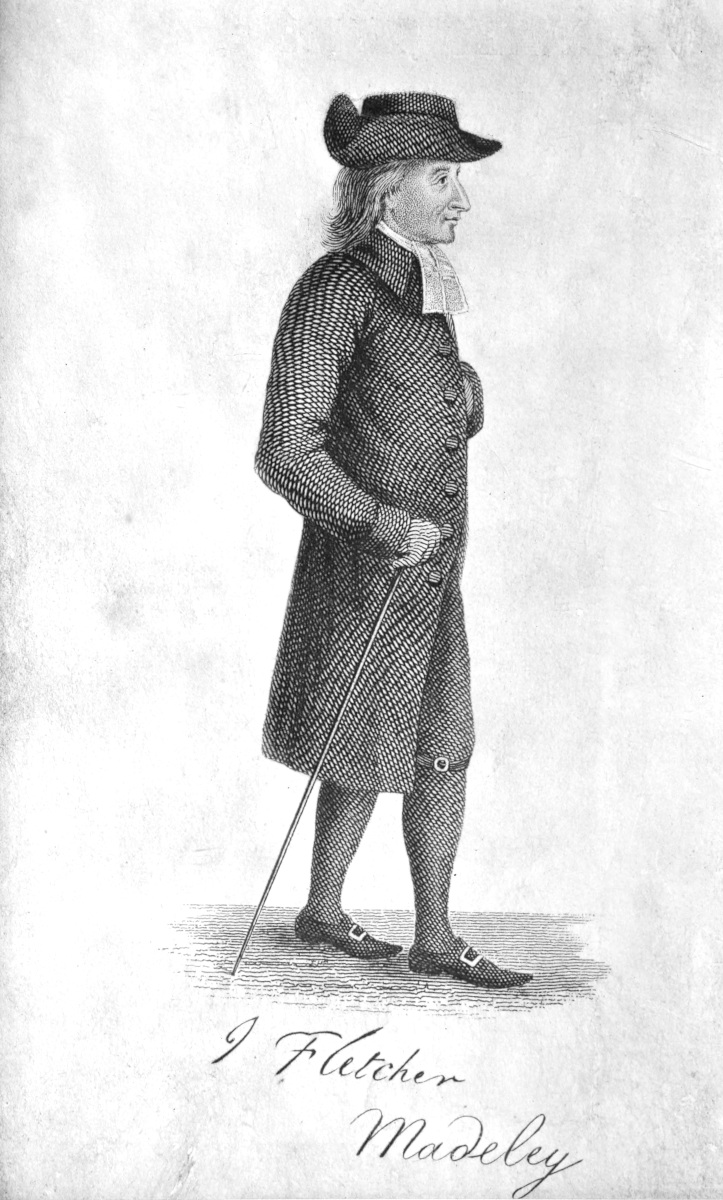
The portrait of Fletcher is taken from an exceedingly
scarce engraving, in the Methodist Museum, at Centenary
Hall, London.
I think I may say, without exposing myself to the charge
of arrogance or conceit, that, in this volume, the reader will
find all the facts of any importance that are known concerning
Fletcher, and that here, more than in any previous
publication, is illustrated the intellectual and saintly character
of one of the holiest men that ever lived.
L. TYERMAN.
Stanhope House, Clapham Park, S.W.
October 7, 1882.
GENERAL CONTENTS
xi
INTRODUCTION.
PAGE
Wesley requests Fletcher to be his successor—Others who might have been designated
From his coming to England to his Ordination, 1752–1757.
Arrives in London-Admitted to Mr. Burchell’s school—Becomes tutor to sons of Thomas Hill, Esq.—Letter to his brother Henry—Introduced to Methodists—His conversion—A millenarian—A Catechumen—Acquaintance with Mr. Vaughan—Richard Edwards, his class-leader—Letters to Wesley—His ordination
From His Ordination to his Settlement at Madeley, 1757–1760.
A favourite among the first Methodists—Preaches in Shropshire—Letter to Wesley—Thomas Walsh—Letter to his class-leader—Introduced to Lady Huntingdon—Preaching to French prisoners—Letter to Charles Wesley—Letter to Sarah Ryan—Christian Perfection—Fletcher and his foes—Proposal to go to the West Indies—Death of Thomas Walsh—Letter to Charles Wesley—A Convert—Conversion of Mr. Richard Hill—Temptation—Letters to Charles Wesley—Dorothy Furley—Visits Lady Huntingdon—Her ladyship’s proposal—Fletcher’s first published sermon—Earl Ferrars—Glorious services at Everton—Choosing a benefice—Letters to Lady Huntingdon—Commencement of ministry at Madeley
Madeley—Branded a Methodist—Increasing labours—Madeley Wood and Coalbrook Dale—Rev. Mr. Prothero’s sermon—The publicans—Fletcher’s first sermons at Madeley—Mary Matthews—Answers to an objection—“The Rock Church”—Letter to a Papist—Persecutions—Letter to Rev. Mr. Hutton—Testimony of Rev. Mr. Gilpin
Fanaticism among the London Methodists—Rules of Fletcher’s Methodist Societies—A troublesome member—A quiet year—Reasons for and against matrimony—The furious butcher—Letters to Miss Hatton—Wesley’s first visit to Madeley—Simplicity of living—Alexander Mather—Fletcher at Breedon—Fletcher’s first pastoral letter—Fletcher and his relatives
Fletcher depressed—Rejoicing on account of other men’s success—Letters to Miss Hatton and Miss Ireland—Thanks for a present—An excursion to Brighton, etc.—Pastoral letter—Miss Hatton dying—Letter to Whitefield—Lady Huntingdon at Madeley—Captain Scott—Fletcher in Yorkshire—Letter to Lady Huntingdon—Rev. Cradock Glascott—Trevecca College—Fletcher appointed chaplain of the Earl of Buchan—James Glazebrook—“Manifestations of the Son of God”
Trevecca College: Visit to Switzerland, etc. 1768–1770.
Joseph Easterbrook—Books for Trevecca College—Letter on Conversation—Expulsion of six students at Oxford—Letter to Whitefield—Opening of Trevecca College—Letters to Mr. and Miss Ireland—Rev. John Jones—Mr. John Henderson, B.A.—First anniversary of Trevecca College—Rev. Walter Sellon—Anti-Popery sermon—Joseph Benson—Letter to Mr. Ireland—Visit to Switzerland
Commencement of the Calvinian Controversy. 1770–1771.
xiiiLetter to masters and students of Trevecca College—Fletcher at Trevecca College—Letter to Rev. David Simpson—Wesley’s Doctrinal Minutes—Second anniversary of Trevecca College—Wesley’s sermon on the death of Whitefield—Letter of Lady Glenorchy—Joseph Benson dismissed from Trevecca College—Fletcher’s unpublished letter to Wesley—Fletcher resigns his office at Trevecca—Important unpublished manuscript—The storm brewing—Shirley’s Circular Letter—Fletcher’s “First Check to Antinomianism”—Shirley’s “Narrative”—Fletcher’s Letter to Shirley—Fletcher’s Vindication of Wesley’s “Minutes”
Letters in the Gospel Magazine—Unpublished letter to Joseph Benson—Prevalent Antinomianism—Richard Hill’s pamphlet respecting a conversation with a monk
Edward Elwall—Unpublished letter to Sellon—Letter to the Dublin Methodists—Richard Hill’s Five Letters—Fletcher’s reply to them—Divine Grace given to all—Good men doing the Devil’s work—Advices to Arminians
Richard Hill’s “Review of all the Doctrines taught by the Rev. J. Wesley“—Richard Hill’s “Six Letters” to Fletcher—Rowland Hill’s “Friendly Remarks”—“Logica Genevensis”—Wesley’s “Remarks on Mr. Hill’s Review”—Unpublished letter by John Pawson—Fletcher rebukes Rowland Hill—Absurdities of Calvinism—Free Will—Unpublished letter by Richard Hill to Walter Sellon
Wesley requests Fletcher to be his successor—Fletcher’s reply—Wesley respecting Fletcher and Whitefield—Samuel Bradburn visits Fletcher—Correspondence in 1773—The penitent thief—The earthquake—Fletcher’s sermon on it
“The Finishing Stroke”—“The Farrago Double Distilled”—Berridge’s “Christian World Unmasked”—Letters by Berridge—Richard Hill desiring peace—Richard Hill’s “Three Letters” to Fletcher—“Creed for Arminians and Perfectionists”
Toplady’s letter to Ambrose Serle—“Logica Genevensis continued”—Remaining differences—Fletcher answering Berridge—Wesley on Fletcher’s “Checks”—Lady Huntingdon wishes an interview with Fletcher—Fletcher’s reply—Fletcher writing and weary
“Equal Check to Pharisaism and Antinomianism”—Doleful picture—Letter to Lady Huntingdon—Saving Faith—The Athanasian Creed—Letters to J. Benson and C. Wesley
“Equal Check to Pharisaism and Antinomianism continued”—“Scripture Scales”—“The Fictitious and the Genuine Creed”—The controversy has done Fletcher good—Rev. Thomas Reader visits Fletcher—Christian perfection—Letter to J. Benson—Wesley dangerously ill—Charles Wesley writes to Fletcher—Fletcher’s reply—“Checks to Antinomianism”—Reconciliations—Dr. Coke’s Letter to Fletcher—Letter to C. Wesley
Toplady—Fletcher’s “Answer to the Vindication of the Decrees”—Toplady attacks Wesley—Fletcher answers Toplady—Review of six years’ work—Rev. Caleb Evans’ letter on Wesley’s “Calm Address”—Fletcher’s “Vindication of the Calm Address”—Mr. Evans’ “Reply” to Fletcher’s “Vindication”—Fletcher publishes “American Patriotism”—A Public Fast—“The Bible and the Sword”—The Monthly Review on Fletcher—Government desires to reward Fletcher
xvFletcher’s labours and abstinence—Again objects to become Wesley’s successor—An excursion with Wesley—Fletcher discouraged—Unpublished letter by J. Benson—Another work for the press—“Driving Methodism and StillMysticism”Mysticism”—Fletcher dangerously ill—C. Wesley’s hymn—Michael Onions—Letters—Fletcher apparently dying—An impromptu hymn—Wesley escorts Fletcher to London—Another excursion with Wesley—Second visit to Berridge—Fletcher and Venn at St. Neots—Charles Greenwood—Fletcher resides with him—Letter “to the parishioners of Madeley”
“The Doctrines of Grace and Justice equally Essential to the Pure Gospel”—Fletcher a millenarian—“Bible Arminianism and Bible Calvinism”—“The Plan of Reconciliation”—Another letter to his parishioners—Letter to W. Wase—Letters to Rev. V. Perronet and his daughter—Fletcher visited by his friends—Fletcher’s letter to his bishop—Charles Perronet dies—Fletcher’s sojourn at Stoke Newington—Removes to Mr. Ireland’s, at Brislington—Meets Henry Venn—Attends Wesley’s Conference—Rev. David Lloyd—James Rogers visits Fletcher—Letter to Rev. V. Perronet—Unpublished letter to Miss Bosanquet—Lady Mary Fitzgerald—Letters to her and to Mrs. Thornton—Preparing to leave England—Farewell letters
Journey to the south of France—Unpublished letter to Miss Bosanquet—Sermon concerning the New Birth—Letters to Rev. Mr. Greaves, W. Perronet, the Wesley Brothers, and Dr. Conyers—The Perronet estate in Switzerland—Unpublished letter to Mr. Power—Fletcher among children—Fletcher and his nephew—Messages to Madeley—Preaching at an execution—William Perronet joins Fletcher—A perilous journey—Letter to Mr. Ireland—Letters to Madeley—Other letters—Trials in Switzerland—An attack of rheumatism—Letter to his curate—National distress—Methodist meeting house at Madeley Wood—W. Perronet’s unpublished letter—In a “miserable lodging”—Loss of manuscripts—Religion in Switzerland—Letters to Madeley—House of Fletcher’s nativity—Letters to W. Wase, J. Owen, and M. Onions—Joins Mr. Ireland at Montpelier—Return to England—Thomas Rankin visits Fletcher at Brislington—Unpublished letter to Miss Bosanquet
The First Three Months after the Return to Madeley. 1781
Affairs in confusion—Letter to Wesley—Rev. Cornelius Bayley—Correspondence with Miss Loxdale—Letters to Wesley and T. Rankin—Attends Wesley’s Conference at Leeds—Joseph Pescod’s letter—Fletcher the guest of Miss Bosanquet—A remarkable meeting at Leeds—Sanctification—Visits Sheffield
Letters to Miss Perronet and to Lady Mary Fitzgerald—History of Miss Bosanquet—Her Orphanage at Leyton—Her fortune and her debts—Her removal to Yorkshire—She turns farmer and maltster—Debts and difficulties—Fletcher proposes to marry her—Fletcher on celibacy—Unpublished love-letter—Unpublished letters to Miss Bosanquet’s uncle and her brother—Further correspondence—Settling affairs in Yorkshire—The wedding and letters respecting it
How Fletcher began the year 1782—Husband and wife go to Madeley—Wesley visits them—William Tranter—Dr. Jobson and L. Tyerman at Madeley—Letter to author of “The Fool of Quality”—The Methodists of Dublin invite Fletcher and his wife to visit them—Mrs. Fletcher’s letter to Wesley—Fletcher has an accident which disables him—Letter to Charles Wesley—A new poem—Nathaniel Gilbert and Melville Horne—Letters to Mrs. Thornton and to John Valton—Fletcher and his wife visit the Dublin Methodists—Their successful labours—Unpublished letter, thanking them for their services—Unpublished pamphlet by Fletcher—Fletcher begins Sunday schools at Madeley—Rev. H. Venn visits Fletcher
Dr. Coke and his friends begin the Methodist Missionary Society—Fletcher one of the first subscribers—Unpublished letter by Dr. Coke—Fletcher’s unpublished letter to Rev. Mr. Bouverot—Dr. Priestley—Fletcher’s “Rational Vindication of the Catholic Faith”—Fletcher’s “Socinianism Unscriptural”—Fletcher’s Millenarianism—Unpublished letters to Mrs. Smyth and to Lady Mary Fitzgerald—Fletcher at Wesley’s Conference at Leeds—Sermons preached—Fletcher a peacemaker—Remarkable scene—Fletcher objected to—Enoch Wood and Fletcher’s discourse on Wesley’s bust—Fletcher in his “Sentry Box”—Letter to his god-son—Rev. Charles Simeon visits Fletcher—Modified millenarianism—Letters to Rev. Peard Dickenson and Rev. Melville Horne—Mrs. Fletcher ill of fever—Letter to Lady Mary Fitzgerald—Fletcher ill of fever—Mrs. Fletcher’s account of him—Last service in Madeley Church—Dying—Death and burial—Mrs. Fletcher’s letter to C. Wesley—Wesley preaches Fletcher’s funeral sermon—Testimonies concerning Fletcher—Inscription on his tombstone—Inscription on the tablet in City Road Chapel
EIGHTEEN years before his death, Wesley wrote the
following letter to Fletcher, Vicar of Madeley—
“January, 1773.
“Dear Sir,—What an amazing work has God wrought in these
kingdoms, in less than forty years! And it not only continues, but
increases, throughout England, Scotland, and Ireland; nay, it has lately
spread into New York, Pennsylvania, Virginia, Maryland, and Carolina.
But the wise men of the world say, ‘When Mr. Wesley drops, then all
this is at an end!’ And so it surely will, unless, before God calls him
hence, one is found to stand in his place. For, ουκ αγαθον πολυκοιρανιη.
Εις κοιρανος εστω. I see more and more, unless there be one προεστως, the
work can never be carried on. The body of the preachers are not
united: nor will any part of them submit to the rest; so that either
there must be one to preside over all, or the work will indeed come
to an end.
“But who is sufficient for these things? Qualified to preside both over
the preachers and people? He must be a man of faith and love, and
one that has a single eye to the advancement of the kingdom of God.
He must have a clear understanding; a knowledge of men and things,
particularly of the Methodist doctrine and discipline; a ready utterance;
diligence and activity, with a tolerable share of health. There must be
added to these favour with the people, with the Methodists in general.
For, unless God turns their eyes and their hearts towards him, he will be
quite incapable of the work. He must likewise have some degree of
learning, because there are many adversaries, learned as well as unlearned,
whose mouths must be stopped. But this cannot be done
unless he be able to meet them on their own ground.
“But has God provided one so qualified? Who is he? Thou art
the man! God has given you a measure of loving faith, and a single
eye to His glory. He has given you some knowledge of men and things,
particularly of the old plan of Methodism. You are blessed with some
health, activity, and diligence, together with a degree of learning. And
to these He has lately added, by a way none could have foreseen, favour
both with the preachers and the whole people. Come out in the name
2of God! Come to the help of the Lord against the mighty! Come
while I am alive and capable of labour!
‘Dum superest Lachesi quod torqueat, et pedibus me
Porto meis, nullo dextram subeunte bacillo.’
Come while I am able, God assisting, to build you up in faith, to ripen
your gifts, and to introduce you to the people. Nil tanti. What
possible employment can you have, which is of so great importance?
“But you will naturally say, ‘I am not equal to the task; I have
neither grace nor gifts for such an employment.’ You say true; it is
certain you have not. And who has? But do you not know Him who
is able to give them? perhaps not at once, but rather day by day:
as each is, so shall your strength be. ‘But this implies,’ you may say,
‘a thousand crosses, such as I feel I am not able to bear.’ You are
not able to bear them now, and they are not now come. Whenever
they do come, will He not send them in due number, weight, and
measure? And will they not all be for your profit, that you may be a
partaker of His holiness?
“Without conferring, therefore, with flesh and blood, come and
strengthen the hands, comfort the heart, and share the labour of
In all respects, Wesley’s letter is remarkable. He wished
Methodism to be perpetuated; but he was convinced that
this could not be done unless the ruling and administrative
power could be confided, not to the Conference, or to a
committee of the Conference, but to a single person. His
description of the necessary qualifications of such a ruler
is worthy of being studied. Especially ought Methodist
preachers and the Methodist people all over the world, and
in all generations, to notice the fact that Wesley’s first and
pre-eminent qualification was that he who “presided both
over the preachers and people must be a man of faith and
love, and one who had a single eye to the advancement of
the kingdom of God.” For thirty-eight years, since he left
the Oxford University, Wesley’s labours had been herculean
and incessant. His health had begun to fail; so much so,
that, only a few months before he wrote to Fletcher, his
friends in London had become alarmed by signs of age and
debility, and had contributed to provide him a carriage in
3which to pursue those extensive and laborious journeys,
which hitherto he had made on horseback. In Edinburgh,
he had undergone a medical examination by Dr. Monro,
Dr. Gregory, and Dr. Hamilton, after which he wrote: “1772,
May 18. They satisfied me what my disorder was; and
told me there was but one method of cure. Perhaps but
one natural one; but I think God has more than one method
of healing either the soul or the body.”
Under such circumstances, it is not surprising that Wesley
wished to have in training his successor; and he seems to
have had no difficulty in nominating him. His brother
Charles was living, and, among his itinerant preachers, there
was a small band of remarkable men, including Alexander
Mather, Thomas Olivers, George Shadford, John Pawson,
Thomas Hanby, William Thompson, Thomas Taylor, John
Nelson, Thomas Rankin, Christopher Hopper, Joseph Benson,
George Story, Thomas Rutherford, Richard Whatcoat, Joseph
Pilmore, Francis Asbury, and others; but all these were
passed over, and the man he desired and nominated to be
his successor was the saintly Swiss, John William de la
Flechère, Vicar of Madeley.
The character and the life of such a man must be worthy
of attention. Wesley, a keen judge of men, thought him
qualified to be the “προεστως” of the Methodists. His
reply to Wesley’s proposal need not be inserted here. The
position was the highest Wesley could offer him. Was he
worthy of it? Let the reader of the following pages form
his own opinion. Enough has been said to justify the present
attempt to delineate the man.
CHAPTER I. FROM FLETCHER’S BIRTH TO HIS COMING TO ENGLAND IN 1752.
4
JEAN GUILLAUME DE LA FLECHÈRE was a
descendant of one of the most respectable families in
Switzerland; a family, in fact, which was a branch of an
earldom of Savoy. After his marriage, Fletcher’s wife found
in his desk a seal. “Is this yours?” she asked. “Yes,”
replied the poor country parson; “but I have not used it for
many years.” “Why?” “Because it bears a coronet, nearly
such as is the insignia of your English dukes. Were I to
use that seal, it might lead to frivolous inquiries about my
family, and subject me to the censure of valuing myself on
such distinctions.”[2]
For some time the father of John Fletcher was a general
officer in the French army, but, on his marriage, he retired
from the service. Later in life, he accepted a colonelcy in
the militia of Switzerland.
John, his father’s youngest son, was born at Nyon, on
September 12th, 1729. His birthplace was a fine old
mansion, that had withstood the storms of centuries, and, like
many of the ancient houses in Switzerland, was entered by
a spiral stone staircase, which opened into a spacious hall.
“The house where I was born,” said Fletcher, “has one of
the finest prospects in the world. We have a shady wood,
near the lake, where I can ride in the cool all the day, and
enjoy the singing of a multitude of birds.” From one of the
windows of Fletcher’s ancestral home, there was a magnificent
5view of hill and dale, vineyards and pastures, stretching right
away to the distant Jura mountains. At a few paces from
the château, there was a terrace overlooking Lake Leman,
with its clear blue waters and its gracefully-curved and richly-wooded
bays. On the right hand, at a distance of fifteen
miles, was Geneva, the cradle of the Reformation; on the
left, Lausanne and the celebrated castle of Chillon. High
up in the heavens were Alpine peaks, embosoming scenes the
most beautiful; and, not far away, was Mont Blanc, robed
in perpetual and unsullied snow.
Not much is known of the early life of Fletcher. A few
anecdotes concerning him have been preserved by his biographers,
and these shall be given in as brief a form as
possible.
Wesley relates that Fletcher, “in his early childhood, had
much of the fear of God, and great tenderness of conscience.”
One day, when he was about seven years of age, his nurse,
who had occasion to reprove him, said, “You are a naughty
boy. Do you not know that the devil is to take away all
naughty children?” The maid’s remark troubled him. He
fell upon his knees and began to pray, and did not cease till
he believed God had forgiven him.
His filial obedience was exemplary, but, on one occasion,
he, undesignedly, offended his mother, whom he dearly loved.
The good lady was speaking in too warm a manner to one
of the family. Young Fletcher turned a reproving eye upon
her. She was much displeased with what she conceived to
be unfilial forwardness, and punished him. With a look of
tender affection, he meekly replied, “When I am smitten
on one cheek, and especially by a hand I love so well, I am
taught to turn the other also.” The mother’s indignation
was instantly turned into admiration of her boy.[3]
While yet a youth, he had several near escapes from an
untimely death. Once, when walking upon a high wall enclosing
his father’s garden, his foot slipped, and he must have
been killed had he not fallen into “a large quantity of fresh-made
mortar.”
At another time, when swimming by himself in deep
6water, a strong ribbon, which bound his hair, became loose,
twisted about his leg, and tied him “as it were neck and
heels.” “I strove,” said he, “with all my strength to disengage
myself, but to no purpose. No person being within
call, I gave myself up for lost; but when I had ceased
struggling, the ribbon loosed itself.”
On another occasion, he and four other young gentlemen
agreed to swim to a rocky island, five miles from the shore.
Young Fletcher and one of his adventurous friends succeeded
in reaching the island, but the cliff was so steep and smooth
that they found it impossible to scale its heights. After
swimming round the islet again and again, they concluded
that their being drowned was inevitable. Immediately after,
however, they discovered a place of safety; and, in due time,
a boat arrived and took them home. The other three, when
only half way to the island, were rescued by a boat just as
they were sinking.
A still more remarkable deliverance from a watery grave
was the following: Fletcher was a practised swimmer, and
once plunged into a river broader than the Thames at London
Bridge, and very rapid. “The water was extremely rough,
and poured along like a galloping horse.” He endeavoured
to swim against it, but in vain, and was hurried far from
home. When almost exhausted, he looked for a resting-place,
feeling he must either escape from the water or sink.
With great difficulty, he approached the shore, but found it
“so ragged and sharp that he saw, if he attempted to land
there, he would be torn to pieces.” In his direful plight, he
recommenced swimming. “At last,” says he, “despairing of
life, I was cheered by the sight of a fine smooth creek, into
which I was swiftly carried by a violent stream. A building
stood directly across it, which I then did not know to be a
powder-mill. The last thing I can remember was the striking
of my breast against one of the piles whereon it stood. I
then lost my senses, and knew nothing more till I rose on
the other side of the mill. When I came to myself, I was
in a calm, safe place, perfectly well, without any soreness or
weariness at all. Nothing was amiss but the distance of my
clothes, the stream having driven me five miles from the
place where I left them. Many persons gladly welcomed
7me on shore; one gentleman in particular, who said, ‘I
looked at my watch when you went under the mill, and
again when you rose on the other side, and the time of
your being immerged among the piles was exactly twenty
minutes.’”
Fletcher passed the early part of his life at Nyon, where
he began his education. With his two brothers, he was then
removed to the university of Geneva, where he was distinguished
equally by his superior abilities and his uncommon
diligence. The two first prizes for which he stood a candidate
he carried away from a number of competitors, several of
whom were nearly related to the professors. He allowed
himself but little time either for recreation, refreshment, or
sleep. After confining himself closely to his studies all day,
he would frequently consume the greater part of the night
in making notes of what he had found in the course of his
reading worthy of observation.
After quitting Geneva, he was sent by his father to Lentzburg,
in the canton of Berne, where, besides pursuing his
other studies, he acquired the German language. On his
return to Nyon, he studied Hebrew, and improved his knowledge
of mathematics.
From early childhood, Fletcher loved and served his Maker.
He himself relates: “I think it was when I was seven years
of age, that I first began to feel the love of God shed abroad
in my heart, and that I resolved to give myself up to Him,
and to the service of His Church, if ever I should be fit for
it; but the corruption which is in the world, and that which
was in my own heart, soon weakened, if not erased, those
first characters which grace had written upon it.”
“From a child thou hast known the holy Scriptures,”
wrote St. Paul to Timothy. The same might have been
said to Fletcher. His early acquaintance with inspired truth
guarded him, on the one hand, from the snares of infidelity,
and preserved him, on the other, from many of the vices
peculiar to youth. It also qualified and emboldened him to
reprove sin, and, with becoming modesty, to remonstrate with
sinners. To illustrate this, his biographers relate an incident
which occurred when he was only fourteen years of age. A
lady and her three sons visited his sister, Madame de Botens.
8The sons quarrelled, and the mother uttered a hasty imprecation.
Young Fletcher was shocked, and, instantly starting
from his chair, began to expound and enforce the apostolic
admonition, “Provoke not your children to wrath,” etc.; and
then reminded his astonished auditress that her imprecation
might be realized; a vaticination that soon became a fact;
for, on the same day, the lady embarked upon the lake, was
overtaken with a tremendous storm, and was brought to the
point of perishing; and, soon after, two of her sons were
drowned; and the third was crushed to death at one of the
gates of Geneva.
Fletcher had wished to be a Christian minister, and his
parents had wished the same concerning him; but, soon
after the occurrence just related, his plans of life were entirely
altered. He writes: “I went through my studies with a
design of entering into orders; but, afterwards, upon serious
reflection, feeling I was unequal to so great a burden, and
disgusted by the necessity I should be under to subscribe
the doctrine of predestination, I yielded to the desire of my
friends, who would have me go into the army.”[4]
The friends here mentioned did not include his parents,
for they were strongly opposed to his turning soldier; but
now, nearly at the age of twenty, his theological reading
gave place to the studying of the works of Cohorn and
Vauban, the great military engineers. At this time, Portugal
was sending troops to Brazil, to defend its interests there.
Against the remonstrances of his parents, Fletcher went to
Lisbon, there gathered a company of his own countrymen,
accepted a captain’s commission, and engaged to serve the
Portuguese on board a man-of-war, which was preparing with
all speed to sail to the Brazilian coasts. Meanwhile, he
wrote to his parents for a considerable sum of money, by
means of which he expected to make a small fortune in the
country he was about to visit. “They refused him roughly:
unmoved by this, he determined to go without the cash.”
Whilst waiting, however, for the ship to sail, the maid, attending
him at breakfast, let the tea-kettle fall upon his leg, and
so scalded him, that he had to keep his bed. “During that
9time,” says Wesley, “the ship sailed for Brazil; but it was
observed that the ship was heard of no more.”
Wesley continues: “How is this reconcileable with the
account which has been given of his piety when he was a
child? Very easily: it only shows that his piety declined
while he was at the university. And this is too often the
case of other youths in our own universities.”
Fletcher returned to Nyon, but his military ardour was
not abated; and, being informed that his uncle, then a
colonel in the Dutch service, had procured a commission
for him, he joyfully set out for Flanders. Here, however, he
was again defeated in his purpose to become a soldier. Peace
was concluded; his uncle died; his hopes were blasted;
and the military profession was abandoned.
This, in substance, is all that is known of Fletcher, until
he came to England, as Wesley says, in 1752.
CHAPTER II. FROM HIS COMING TO ENGLAND TO HIS ORDINATION. 1752 to 1757.
10
AFTER the frustration of his hopes in Flanders, Fletcher,
accompanied by other young gentlemen, embarked
for England, for the purpose of acquiring the English
language. At the Custom House in London they were
treated with the utmost surliness. Of course their portmanteaus
were examined,—never a pleasant operation, but
sometimes less politely done than at others. In addition to
this, their letters of recommendation were taken from them,
on the alleged ground that “all letters must be sent by
post.” They went to an inn, where they encountered another
difficulty. Unable to speak English, they were at a
loss how to exchange their foreign into English money.
Fletcher, going to the door, heard a well-dressed Jew talking
French. The difficulty was explained; and the Jew replied,
“Give me your money, and I will get it changed.” Fletcher,
without the least suspicion, handed the gentleman his purse,
containing £90. Telling his friends what he had done, they
exclaimed, “Your money’s gone.” His friends were wrong.
Before breakfast was ended the honest Jew returned, and
gave to Fletcher the full amount in English coin.
To assist him in the acquisition of the English language,
Fletcher had been recommended to a Mr. Burchell, who kept
a boarding-school at South Mimms, a village about four
miles from Hatfield, in Hertfordshire. He was admitted
into this establishment. Soon after, it was removed to
Hatfield, whither he also went. Here he remained with
Mr. Burchell about eighteen months, and pursued his studies
with great diligence. He frequently visited some of the
11first families in Hatfield; and, by his easy and genteel
behaviour, and his sweetness of temper, he gained the affectionate
esteem of all who knew him.
On leaving Mr. Burchell’s academy, Fletcher was recommended
by Mr. Dechamps, a French minister, to Thomas
Hill, Esq., of Tern Hall, in Shropshire, as tutor to his two
sons.[5] It was whilst in the service of this gentleman that
Fletcher was converted. The following is an extract from
one of his letters to his brother Henry, at Nyon:—
“The news of your promotion has given me great pleasure. I feel
a sincere satisfaction in the diligence with which you devote yourself to
the good of society, and that you prefer a life of labour to one of indolent
and useless inactivity. We may be instruments of some good in any
condition of human life, if we faithfully fulfil its duties; and the more
difficult our station may prove to be, the more of satisfaction is likely
to result from acquitting ourselves well in it. The ambition which
springs from this principle has nothing censurable in it, provided that
a view to the glory of God be its motive. I delight to think that the
advancement of the Divine glory is your principal end; in which case,
as your influence extends over the whole city, the good you do may be
very great. You will find a thousand opportunities of glorifying God
by your diligence, integrity, and disinterestedness. Endeavour to find
or make occasions of this sort; seize on them eagerly, and shrink not
from entering into the minutest details, when the object is to do good
to the bodies or souls of your neighbours. Imitate, as far as circumstances
will admit, the charity of Christ; who went about doing good,
and disdained not to converse with the most wretched. I dwell on this
the more particularly, because the vanity and pride which reign in our
native town appear to me directly opposed to the spirit of charity. If
you rise above these, you will conduct yourself as a Christian, whose
sole object is to advance the glory of God; and who thinks little of the
esteem of man, except as it may place him in a position to do more
good in the world.
“Your recreations, of which you have given me a brief sketch, are
doubtless innocent, especially if they occupy no more of your time than
a due attention to health, and the wants of our nature demand. Although
you have often reproached me with being too austere, I am far from
thinking that religion forbids the use of innocent recreations; because,
being indifferent in themselves, they become useful when they are necessary
for the relaxation of the body or the mind. I am not at all shocked
12at the tradition which informs us that St. John sometimes amused himself
with a partridge which he had tamed. Happy are they who, as far
as they are able, endeavour to turn their own recreations to the advantage
of others, which may certainly, if not always, yet sometimes, be
done. I sometimes polish shells with Mr. Hill, out of compliance with
his wishes. This used formerly to put me in a bad humour, on account
of the loss of time it occasioned. But I begin to find that pious thoughts
may sanctify an occupation as insignificant as even this, and that a
renouncing of one’s own will from compliance with that of others is not
without its utility.
“I am now going to reply to that part of your letter in which you
testify your surprise at the change which has taken place in my manner
of thinking, a change which appears to have struck you in the last
letters which I wrote to my father. You cry out against the severity of
the principles which I have laid down; and add that, without being a
prophet, you boldly predict my giving way before long to enthusiasm
and all manner of bodily austerities, led on by the principles I have
assumed.
“I am the less astonished, my dear brother, that you should thus
speak, because it is the language of ninety-nine Christians of the present
day out of every hundred, and because I myself for a long time thought
like you on this point. In a certain sense, indeed, I always thought
highly of religion, though at the bottom no one perhaps had less of
it than I. My infancy was vicious, and my youth still more so. At
eighteen I fell into what may properly be termed ‘enthusiasm;’ for
though I lived in many habitual sins, yet because I was regularly present
at public worship, not only on the Sunday, but during the week, I
imagined myself religious. I made long prayers morning and evening,
as well as frequently during the day. I devoted to the study of the
prophecies, and to books of a religious character, all the time I could
spare from my other studies.
“My feelings were easily excited, but my heart was rarely affected,
and I was destitute of a sincere love to God, and consequently to my
neighbour. All my hopes of salvation rested on my prayers, devotions,
and a certain habit of saying, ‘Lord, I am a great sinner; pardon me
for the sake of Jesus Christ.’ In the meantime I was ignorant of the
fall and ruin in which every man is involved, the necessity of a Redeemer,
and the way by which we may be rescued from the fall by receiving
Christ with a living faith. I should have been quite confounded if any
one had asked me the following questions: ‘Do you know that you are
dead in Adam? Do you live to yourself? Do you live in Christ and
for Christ? Does God rule in your heart? Do you experience that
peace of God which passeth all understanding? Is the love of God
shed abroad in your heart by the Holy Spirit?’ I repeat it, my dear
brother, these questions would have astonished and confounded me, as
they must every one who relies on the form of religion, and neglects its
power and influence.
“My religion, alas! having a different foundation from that which is
13in Christ, was built merely on the sand; and no sooner did the winds and
floods arise, than it tottered and fell to ruins. I formed an acquaintance
with some Deists, at first with the design of converting them, and afterwards
with the pretence of thoroughly examining their sentiments. But
my heart, like that of Balaam, was not right with God. He abandoned
me, and I enrolled myself in their party. A considerable change took
place in my deportment. Before I had a form of religion, and now I
lost it; but as to the state of my heart, it was precisely the same. I did
not remain many weeks in this state; the Good Shepherd sought after
me, a wandering sheep. Again I became professedly a Christian; that
is, I resumed a regular attendance at church and the communion, and
offered up frequent prayers in the name of Jesus Christ. There were
also in my heart some sparks of true love to God, and some germs of
genuine faith; but a connection with worldly characters, and an undue
anxiety to promote my secular interests, prevented the growth of these
Christian graces. Had I now been asked on what I founded my hopes
of salvation, I should have replied, that I was not without some religion;
that, so far from doing harm to any one, I wished well to all the world;
that I resisted my passions; that I abstained from pleasures in which I
had once indulged; and that if I was not so religious as some others,
it was because such a degree of religion was unnecessary; that heaven
might be obtained on easier terms; and that if I perished, the destruction
of the generality of Christians was inevitable, which I could not
believe was consistent with the mercy of God.
“I was in this state of mind when a dream, which I could not but
consider as a warning from God, aroused me from my security.”
At great length Fletcher here relates his dream respecting
the final judgment, and then continues:—
“For some days, I was so dejected and harassed in mind as to be
unable to apply myself to anything. While in this state, I attempted to
copy some music, when a servant entered my chamber. Having noticed
my employment, he said, ‘I am surprised, Sir, that you, who know so
many things, should forget what day this is, and that you should not
be aware that the Lord’s day should be sanctified in a very different
manner.’
“The sterling character of the man, his deep humility, his zeal for
the glory of God, his love to his neighbours, and especially his patience,
which enabled him to receive with joy the insults he met with from the
whole family for Christ’s sake, and, above all, the secret energy which
accompanied his words, deeply affected me, and convinced me more
than ever of my real state. I was convinced, as it had been told me in
my dream, that I was not renewed in the spirit of my mind, that I was
not conformed to the image of God, and that without this the death of
Christ would be of no avail for my salvation.”[6]
14About this period of his history, Fletcher seems to have
become acquainted with the Methodists. Wesley says:—
“I have heard two very different accounts of the manner wherein he
had the first notice of the people called Methodists; but I think it reasonable
to prefer to any other that which I received from his own mouth.
This was as follows:—
“When Mr. Hill went up to London to attend the Parliament, he
took his family and Mr. Fletcher with him. While they stopped at St.
Albans, he walked out into the town, and did not return till they were
set out for London. A horse being left for him, he rode after, and overtook
them in the evening. Mr. Hill asking him why he stayed behind,
he said, ‘As I was walking, I met with a poor old woman, who talked
so sweetly of Jesus Christ that I knew not how the time passed away.’
‘I shall wonder,’ said Mrs. Hill, ‘if our tutor does not turn Methodist
by-and-by.’ ‘Methodist, Madame!’ said he, ‘pray, what is that?’
She replied, ‘Why, the Methodists are a people that do nothing but
pray; they are praying all day and all night.’ ‘Are they?’ said he;
‘then, by the help of God, I will find them out.’ He did find them out
not long after, and was admitted into the society; and from this time,
whenever he was in town, he met in Mr. Richard Edwards’s class. This
he found so profitable to his soul that he lost no opportunity of meeting;
and he retained a peculiar regard for Mr. Edwards till the day of his
death.”[7]
It was not, however, in Mr. Edwards’s class that Fletcher
found peace with God. A few months after his decease,
a 12 mo. pamphlet of sixty-four pages was published by his
widow, entitled “A Letter to Mons. H. L. de la Fléchère,
Assessor Ballival of Nyon, in the Canton of Berne, Switzerland,
on the Death of his Brother, the Reverend John William
de la Fléchère, Twenty-five Years Vicar of Madeley, Shropshire.”
In that letter it is stated, that, “from the time he
heard the Methodists, he became more and more conscious
that some inward change was necessary to make him happy.
He now began to ‘strive with the utmost diligence according
to his light, hoping by much doing to render himself acceptable
to God.’ But, one day, hearing a sermon preached by a
clergyman, whose name was Green, he was convinced he did
15not understand the nature of saving faith. ‘Is it possible,’
said he, ‘that I who have always been accounted so religious,
who have made divinity my study, and received the premium
of piety (so called) from the university for my writings on
divine subjects,—is it possible that I am yet so ignorant as
not to know what faith is?’ But the more he examined, the
more he was convinced of the momentous truth. He now
became sensible of inbred sin, and sought, by the most
rigorous austerities, to conquer an evil nature; but the more
he strove, the more he saw and felt that all his soul was sin.”
Mrs. Fletcher continues the narrative of his conversion by
giving the following extract from his diary:—
“1755. January 12.—I received the sacrament, though my heart
was as hard as a flint. The following day, I felt the tyranny of sin more
than ever, and an uncommon coldness in my religious duties. I felt the
burden of my corruptions heavier than ever. The more I prayed for
conquest over sin, the more I was conquered. The thoughts which engrossed
my mind were generally these: I am undone. I have wandered
from God. I have trampled under foot the frequent convictions God has
been pleased to work upon my heart. Instead of going straight to
Christ, I have lost my time in fighting against sin with the dim light of
reason, and the use of the means of grace. I fear my notions of Christ
are only speculative, and do not reach the heart. I never had faith,
and without faith it is impossible to please God. Then every thought,
word, and work of mine have only been sin and wickedness before God,
though ever so specious before men. All my righteousness is as filthy
rags. I am a very devil, though of an inferior sort, and if I am not
renewed before I go hence, hell will be my portion to all eternity.
“When I saw that all my endeavours availed nothing towards my
conquering sin, I almost resolved to sin on, and to go at last to hell.
But, I remember, there was a sort of sweetness even in the midst of this
abominable thought. If I go to hell, said I, I will still love God there;
and since I cannot be an instance of His mercy in heaven, I will be an
instance of His justice among the devils; and if I put forth His glory
one way or the other, I am content.
“But I soon recovered the ground I had lost. Christ died for all,
thought I; then He died for me; and, as I sincerely desire to be His,
He will surely take me to Himself. He will surely let me know before
I die that He died for me. But then, I thought, this may only be in
my dying hour, and that is a long time to wait. But I answered thus:
My Saviour was above thirty-three years working out my salvation; let
me wait for Him as long, and then I may talk of impatience. Does
God owe me anything? Is He bound to time and place? Do I deserve
anything at His hands but damnation?
“So I went on, sinning and repenting, and sinning again; but still
16calling on God’s mercy through Christ. I was now beat out of all my
strongholds of pride. I felt my helplessness, and lay at the foot of the
throne of grace. I cried, though coldly, yet I believe sincerely, ‘Lord,
save me! Give me justifying faith in Thy blood! Cleanse me from my
sins!’ I seldom went to private prayer, but I thought, ‘Perhaps this
is the happy hour when I shall prevail with God;’ but still I was disappointed.
“On Sunday, January 19, 1755, I heard an excellent sermon on,
‘Being justified by faith, we have peace with God, through our Lord
Jesus Christ.’ I heard it attentively, but my heart was not moved. I
was only more convinced that I was an unbeliever—that I was not
justified by faith—and that I should never till then have peace with God.
The hymn after the sermon suited the subject that had been treated of,
but I could not join in singing it. I sat mourning, whilst others rejoiced
in the Lord their Saviour.
“The following day, I begged of God to show me all the wickedness
of my heart, and to fit me for His mercy. I besought Him to increase
my convictions, for I was afraid I did not mourn enough for my sins.
But I found relief in Mr. Wesley’s Journal, where I learned that we
should not build on what we feel; but that we should go to Christ with
all our sins and all our hardness of heart.
“On January 21, I began to write a confession of my sins, misery,
and helplessness, together with a resolution to seek Christ even unto
death; but, my business calling me away, I had no heart to go on with
it. In the evening, I read the Scriptures, and found a sort of pleasure
in seeing a picture of my wickedness so exactly drawn in the third
chapter of the Epistle to the Romans, and that of my condition in the
seventh; and now I felt some hope that God would finish in me the
work He had begun.
“On Thursday, January 23, my fast-day, Satan beset me hard. I
sinned grievously, and almost gave up all hope; I mourned deeply, but
with a heart as hard as ever. I was on the brink of despair, and yet
continued to fall into sin. In the evening, I went to my friend, Mr. B——,
and told him something of my state. He strove to administer comfort,
but it did not suit my light. When we parted, he gave me some advice
which suited me better. ‘God,’ said he, ‘loves you, and if He denies
you anything, it is for your good. You deserve nothing at His hands;
wait then patiently for Him, and never give up your hope.’ I went
home resolved to follow this advice, though I should stay till death.
“I had proposed to meet the Lord the following Sunday at His table,
and therefore looked out a sacramental hymn. I learned it by heart,
and prayed it over many times, and then went to bed, commending
myself to God with rather more hope and peace than I had felt for some
time. But Satan waked while I slept. I thought I committed that
night in my sleep grievous and abominable sins. I awoke amazed and
confounded, and rising with a detestation of the corruption of my senses
and imagination, I fell upon my knees, and prayed with more faith and
less wanderings than usual, and afterwards set about my business with
17an uncommon cheerfulness. It was not long before I was tempted to
fall into my besetting sin, but I found myself a new creature. My soul
was not even ruffled. Having withstood two or three temptations, and
feeling peace in my soul through the whole of them, I began to think it
was the Lord’s doing. Afterwards it was suggested to me that it was
great presumption for such a sinner to hope for such a mercy. I prayed
I might not be permitted to fall into a delusion; but the more I prayed,
the more I saw it was real; for though sin stirred all the day long, I
always overcame it in the name of the Lord.
“In the evening I read some of the experiences of God’s children,
and found my case agreed with theirs, and suited the sermon I had
heard on Justifying Faith. I called on the Lord for perseverance and
an increase of faith, for still I felt some fear lest this should be all delusion.
Having continued my supplication till near one in the morning,
I then opened my Bible, and fell on these words, ‘Cast thy burden on
the Lord, and He shall sustain thee. He will not suffer the righteous
to be moved.’ Filled with joy, I fell again on my knees to beg of God
that I might always cast my burden upon Him. I took up my Bible
again, and fell on these words, ‘I will be with thee; I will not fail thee,
neither forsake thee; fear not, neither be dismayed.’ My hope was
now greatly increased, and I thought I saw myself conqueror over sin,
hell, and all manner of affliction.
“With this beautiful promise I shut my Bible, and as I shut it I cast
my eye on the words, ‘Whatsoever ye shall ask in my name, I will do
it.’ So having asked perseverance and grace to serve God till death,
I went cheerfully to take my rest.”
Such is Fletcher’s own account of his conversion. His
widow added the following:—
“I subjoin what I have heard him speak concerning this time. He
still pleaded with the Lord to take a fuller possession of his heart, and
to give a fuller manifestation of His love, till one day, when in earnest
prayer, and lying prostrate on his face, he saw, with the eye of faith,
our Saviour on the cross, and at the same time these words were spoken
with power to his heart:—
“‘Seiz’d by the rage of sinful men,
I see Christ bound and bruis’d and slain;
’Tis done, the Martyr dies!
His life to ransom ours is given,
And lo! the fiercest fire of heaven
Consumes the sacrifice.
“‘He suffers both from men and God;
He bears the universal load
Of guilt and misery!
He suffers to reverse our doom,
And lo! my Lord is here become
The bread of life to me.’
18“Now all his bonds were broken. His freed soul began to breathe
a purer air. Sin was beneath his feet. He could triumph in the Lord.
From this time, he walked in the ways of God, and, thinking he had not
leisure enough in the day, he made it a constant rule to sit up two whole
nights in the week for reading, prayer, and meditation. At the same
time, he lived on nothing but vegetables, and on bread with milk and
water. One end of his doing this was to avoid dining in company.
Besides sitting up two entire nights every week, his custom was never
to sleep so long as he could keep awake, and he always took a candle
and book with him to bed. One night, being overcome with sleep
before he had put out his candle, he dreamed that his curtain, pillow,
and cap were on fire, but went out without doing him any harm. And
truly so it was, for in the morning his curtain was found burnt, also
a corner of his pillow, and a part of his cap, but not a hair of his head
was singed.
“Some time after this, he was favoured with a further manifestation
of the love of God, so powerful, that, he said, it appeared to him as if
his body and soul would be separated. Now all his desires centred in
one, that of devoting himself to the service of his precious Master, which
he thought he could best do by entering into holy orders.”[8]
To complete the accounts of Fletcher’s conversion, in 1755,
an extract from another letter must be added. In that
year, writing to his brother, he insisted on the vanity of
earthly pursuits, and then gave the following description of
the change that had taken place in himself:—
“I speak from experience. I have been successively deluded by all
those desires, and sometimes I have been the sport of them all at once.
This will appear incredible, except to those who have discovered that
the heart of unregenerate man is nothing more than a chaos of obscurity
and a mass of contradictions. If you have any acquaintance with yourself,
you will readily subscribe to this description of the human heart.
Every unconverted man must necessarily be either a voluptuary, a
worldly-minded person, or a pharisaical philosopher: or, perhaps, like
myself, he may be all of these at the same time; and, what is still more
extraordinary, he may be so not only without believing, but even without
once suspecting it; indeed, nothing is more common among men than
an entire blindness to their own real characters. How often have I
placed my happiness in mere chimeras! How often have I grounded
my vain hope upon imaginary foundations! I have been constantly
employed in framing designs for my own felicity; but my disappointments
have been as frequent and various as my projects.
“If, hitherto, my dear brother, you have beguiled yourself with prospects
of the same visionary nature, never expect to be more successful
in your future pursuits. One labour will only succeed another, making
19way for continual discontent and chagrin. Open your heart, and there
you will discover the source of that painful inquietude to which, by your
own confession, you have been long a prey. Examine its secret recesses,
and you will discover there sufficient proof of the following truths: ‘The
heart is deceitful above all things, and desperately wicked;’ ‘All
have sinned, and come short of the glory of God;’ ‘The thoughts of
man’s heart are only evil, and that continually;’ ‘The natural man
understandeth not the things of the Spirit of God.’ On the discovery
of these and other important truths, you will be convinced that man is
an apostate being, composed of a sensual, rebellious body, and a soul
immersed in pride, self-love, and ignorance; nay more, you will perceive
it a physical impossibility that man should ever become truly happy till
he is cast, as it were, into a new mould, and created a second time.
“For my own part, when I first began to know myself, I saw, I felt
that man is an undefinable animal, partly of a bestial and partly of an
infernal nature. The discovery shocked my self-love, and filled me with
the utmost horror. I endeavoured for some time to throw a palliating
disguise over the wretchedness of my condition, but the impression it
had already made upon my heart was too deep to be erased. It was to
no purpose that I reminded myself of the morality of my conduct; it was
in vain that I recollected the many encomiums that had been passed
upon my early piety and virtue; and it was to little avail that I sought
to cast a mist before my eyes by reasonings like these: ‘If conversion
implies a total change, who has been converted in these days? Why
dost thou imagine thyself worse than thou really art? Thou art a
believer in God and in Christ; thou art a Christian; thou hast injured
no person; thou art neither a drunkard nor an adulterer; thou hast
discharged thy duties not only in a general way, but with more than
ordinary exactness; thou art a strict attendant at church; thou art
accustomed to pray more regularly than others, and frequently with a
good degree of fervour; make thyself perfectly easy; moreover, Jesus
Christ has suffered for thy sins, and His merit will supply everything
lacking on thy part.’
“It was by reasonings of this nature that I endeavoured to concealconceal
from myself the deplorable state of my heart; and I am ashamed, my
dear brother, that I suffered myself so long to be deluded by the artifices
of Satan. God Himself has invited me; a cloud of apostles, prophets,
and martyrs have exhorted me; and my own conscience, animated by
those sparks of grace which are latent in every heart, has urged me
to enter in at the strait gate; but, notwithstanding all this, a subtle
temper, a deluding world, and a deceived heart have constantly turned
the balance, for above these twenty years, in favour of the broad way.
I have passed the most lovely part of my life in the service of these tyrannical
masters, and am ready to declare in the face of the universe that all
my reward has consisted in disquietude and remorse. Happy had I
listened to the earliest invitations of grace, and broken the iron yoke
from off my neck.”[9]
20These extracts are long, but they are important. They
contain all the known facts connected with Fletcher’s conversion.
In writing to his brother, Fletcher remarked,—“At
eighteen years of age, I devoted as much time as I could
spare to read the prophecies of the Holy Bible;” and it is
a curious fact that, in the year of his conversion, he wrote
a long letter to Wesley, in which he gave a synopsis of the
writings of “a great divine abroad,” who had “spent fifty
years in making himself perfectly master of the Oriental
languages, and in comparing and explaining the various
predictions scattered in the Old and New Testaments.”
Fletcher was well acquainted with this gentleman, and had
many times conversed with him on the subjects of his lifelong
study. Substantially, the young man had adopted the
aged man’s views; and now, in a condensed form (filling,
however, nineteen octavo printed pages), he presented them
to Wesley. At the time, terrific wars were being waged, and,
a month before the date of Fletcher’s letter, the great earthquake
at Lisbon had occurred. At such seasons, devout men
almost instinctively begin to study prophecies, and hence no
wonder that Fletcher now felt more than ordinarily interested
in what, “for some years, had often been the subject of his
meditations.” He believed that “the grand catastrophe of
God’s drama drew near apace,” and gave his reasons for such
belief by referring first to Nebuchadnezzar’s dream, “which
is a rough sketch of the world’s four universal revolutions;”
secondly, to Daniel’s vision of the four beasts; and thirdly, to
Daniel’s vision of the ram and he-goat, and the two thousand
and three hundred days, at the end of which the “sanctuary”
was to “be cleansed.” Fletcher, by elaborate calculations,
shows that this cleansing was to take place between the
years 1750 and 1770, and the following extract will indicate
what, in his opinion, the cleansing meant:—
“God is now working such a work as has not been seen since the
Apostles’ days. He has sent some chosen servants of His, both in these
kingdoms and abroad, who, by the manifest assistance of the Holy
Spirit, have removed the filthy doctrine of justification by works, and
the outward Christless performance of moral duties, which pollute the
sanctuary and make it an abomination to the Lord. The Holy Ghost
is given, and the love of God is shed abroad in the hearts of believers
21as in the days of old. I own that the cleansing is but begun; but this
revolution[10] may, in all probability, be the forerunner of a greater. God
has called; a few have obeyed His call. The generality still shut their
eyes and ears against the tender invitations of their Lord, and continue
to pollute the sanctuary and to look on the blood of the Lamb as an
unholy thing. Shall not God carry on His work? Shall the creature
still resist the Creator? and the arm of flesh be stronger than the living
God? Not so. He will not always strive with obdurate hearts. What
the gentle breathings of His Spirit cannot perform, He will do by war,
sword and fire, plague and famine, tribulation and anguish. He is
going to gird on His sword, and His right hand shall teach Him terrible
things. Nations refuse the sceptre of His mercy; what remains, then,
but to rule them with an iron sceptre, and break them in pieces like a
potter’s vessel?”
Fletcher concludes by arguing in favour of the doctrine,
that, long before the general judgment Christ will appear
on earth a second time to work out His great redeeming
purposes.
“Give me leave, Rev. Sir,” says he, “to propose to you a thing that
many will look upon as a great paradox, but has yet sufficient ground in
Scripture to raise the expectation of every Christian who sincerely looks
for the coming of our Lord; I mean the great probability that, in the
midst of this grand revolution, our Lord Jesus will suddenly come down
from heaven, and go Himself conquering and to conquer; for what but
the greatest prejudice can induce Christians to think that the coming
of our Lord, spoken of in so plain terms by three evangelists, is His last
coming before the universal judgment and the end of the world?”[11]
There cannot be a doubt that, at this period of his life,
Fletcher was what is commonly called a Millenarian. Whether
his views were right or wrong, the reader must determine for
himself.
When resident at Tern Hall, Fletcher attended the parish
church at Atcham, a small village about five miles from
Shrewsbury. Here the Rev. Mr. Cartwright was the officiating
minister,[12] and was accustomed to catechise in public
the children of his parishioners. On one occasion, he invited
the adults who needed instruction to appear in the ranks of
the catechumens, and told them that to do so would be no
disgrace to them. All, however, except Fletcher, either
thought that to stand among the young people would disgrace
22them, or that further instruction in their case was not
needed. The accomplished young scholar from Switzerland,
the tutor of the two sons of their county member, had a
lower opinion of his excellences than the village peasants
had of theirs; for, leaving his seat with an air of unaffected
modesty, he took his place among the children, and became
a catechumen of the village pastor.[13]
At Atcham, Fletcher became acquainted with Mr. Vaughan,
an excise officer, who gave to Wesley the following account
of his deeply-revered friend:—
“It was our ordinary custom, when the church service was over, to
retire into the most lonely fields or meadows, where we frequently either
kneeled down, or prostrated ourselves on the ground. At those happy
seasons, I was a witness of such pleadings and wrestlings with God, such
exercises of faith and love, as I have not known in any one ever since.
The consolations, which we then received from God, induced us to
appoint two or three nights in a week, when we duly met, after his
pupils were asleep. We met also constantly on Sunday, between four
and five in the morning. Sometimes I stepped into his study on other
days. I rarely saw any book before him, besides the Bible and the
Christian Pattern.”
“Our interviews for singing and conversation were seldom concluded
without prayer, in which we were frequently joined by her who is now
my wife (then a servant in the family), and by a poor widow in the
village, who had known the power of God unto salvation, and who died
some years ago, praising God with her latest breath. These were the
only persons in the village whom he chose for his familiar friends; but
he sometimes walked to Shrewsbury, to see Mrs. Glynne or Mr. Appleton.
He also visited the poor in the neighbourhood who were sick; and, when
no other person could be procured, performed even the meanest offices
for them.”
Besides the godly friends mentioned in this interesting
statement, Fletcher had another acquaintance at Atcham,
whom he visited to be instructed in singing. This gentleman
supplied Wesley with what follows:—
“I remember but little of that man of God, Mr. Fletcher, it being
above nine-and-twenty years since I last saw him; but this I well
remember, his conversation with me was always sweet and savoury.
He was too wise to suffer any of his precious moments to be trifled
away. When company dined at Mr. Hill’s, he frequently retired into
the garden, and contentedly dined on a piece of bread and a few bunches
of currants. Indeed, in his whole manner of living he was a pattern of
23abstemiousness. Meantime, how great was his sweetness of temper
and heavenly-mindedness! I never saw it equalled in any one. How
often, when I parted with him at Tern Hall, have his eyes and hands
been lifted up to heaven, to implore a blessing upon me, with fervour
and devoutness unequalled by any I ever witnessed. I firmly believe
he has not left in this land, or perhaps in any other, one luminary like
himself.”[14]
These glimpses of Fletcher, at this early period of his life,
are too valuable and important to be omitted.
It is impossible to determine the exact date when he
joined the Methodist Society in London, but there can be
no doubt that it was as early as the year 1756, and probably
a year or two earlier. Hence the following extract from
a letter addressed to Mr. Richard Edwards, the leader of
the London class in which Fletcher had been enrolled a
member:—
“Tern, October 19, 1756.
“Dearest Brother,—This is to let you know that I am very well
in body and pretty well in soul; but I have very few friends here, and
God has been pleased to take away the chief of those few by a most
comfortable death. My aged father also is gone the way of all flesh.
For some years, I have written to him with as much freedom as I could
have done to a son, though not with so much effect as I wished. But,
last spring, God visited him with a severe illness, which brought him to
a sense of himself; and, after a deep repentance, he died about a month
ago, in the full assurance of faith.”[15]
Fletcher, at Geneva, had refused to enter the Christian
ministry; now he entertained the most serious thoughts of
devoting himself to it; but before doing so he wrote to
Wesley, with whom he had become acquainted.
“Tern, November 24, 1756.
“Rev. Sir,—As I look on you as my spiritual guide, and cannot
doubt of your patience to hear, and your experience to answer, a serious
question proposed by any of your people, I freely lay my case before you.
“Since the first time I began to feel the love of God shed abroad in
my heart, which was, I think, when seven years of age, I resolved to
give myself up to Him and the service of His Church, if ever I was fit
for it; but the corruption which is in the world, and that which was in
my heart, soon weakened, if not erased, those first characters that grace
had wrote upon it. However, I went through my studies with a design
of going into Orders; but afterwards, upon serious reflection, feeling I
24was unequal for so great a burden, and disgusted by the necessity I
should be under to subscribe to the doctrine of predestination, I yielded to
the desire of my friends, who would have me go into the army. But just
before I was quite engaged in a military employment, I met with such
disappointments as occasioned my coming to England. Here I was
called outwardly three times to go into Orders; but, upon praying to
God that if those calls were not from Him they might come to nothing,
something always blasted the designs of my friends; and in this I have
often admired the goodness of God, who prevented me rushing into that
important employment, as the horse does into the battle. I never was
more thankful for this favour than since I heard the Gospel preached in
its purity. Before, I had been afraid; but then I trembled to meddle
with holy things, and resolved to work out my salvation privately, without
engaging in a way of life which required so much more grace and gifts
than I possessed. Yet, from time to time, I felt warm and strong desires
to cast myself and all my inability upon the Lord, if I should be called
again, knowing that He could help me, and show His strength in my
weakness; and these desires were increased by some little success that
attended my exhortations and letters to my friends.
“I think it necessary to let you know, Sir, that my patron often
desired me to take Orders, and said he would soon help me to a living;
to which I coldly answered, I was not fit, and that besides I did not
know how to get a title. The thing was in that state when, about six
weeks ago, a gentleman I hardly knew offered me a living, which, in
all probability, will be vacant very soon; and a clergyman, that I never
spoke to, gave me, of his own accord, the title of curate to one of his
livings. Now, Sir, the question which I beg you to decide is, whether
I must and can make use of that title to get into Orders? For with
respect to the living, were it vacant, I have no mind to it, because I think
I could preach with more fruit in my own country and in my own tongue.
“I am in suspense; on one side, my heart tells me I must try, and it
tells me so whenever I feel any degree of the love of God and man;
but, on the other, when I examine whether I am fit for it, I so plainly
see my want of gifts, and especially of that soul of all the labours of a
minister of the Gospel—love, continual, universal, flaming love, that
my confidence disappears; I accuse myself of pride to dare to entertain
the desire of supporting the ark of the Lord, and conclude that an
extraordinary punishment will sooner or later overtake my rashness.
As I am in both these frames successively, I must own, Sir, I do not
see plainly which of the two ways before me I can take with safety, and
I shall be glad to be ruled by you, because I trust God will direct you
in giving me the advice you think will best conduce to His glory, the
only thing I would have in view in this affair. I know how precious is
your time; I desire no long answer;—persist or forbear will satisfy
and influence, Sir, your unworthy servant,
25Wesley’s answer to this important letter has not been
preserved. Perhaps no letter was written. Wesley was
now in London. Parliament met eight days after Fletcher
wrote to him. Public affairs were in a critical condition,
and, no doubt, Mr. Hill would feel it a duty to be present
at the opening of the session. When he came to London
to fulfil his parliamentary duties, it was his custom to bring
his sons and their tutor with him. That Fletcher was now
in London is evident from the following letter, addressed to
Wesley within three weeks after the date of his former one.
Of course, he would have an interview with Wesley as early
as possible, and in all likelihood Wesley, at this interview,
not only advised him to be ordained, but likewise dissuaded
him from his purpose to return to Switzerland. There is
no reference in the letter to Fletcher’s proposed ordination,
for, doubtless, that was a matter already settled. Fletcher
had been attending sacramental services in Wesley’s London
chapels; and it had occurred to him that these services
might be much improved, and Wesley himself considerably
relieved. To say the least, the letter is full of interest, and
contains a hint which, in large societies, might be profitably
adopted.
“December 13, 1756.
“Sir,—When I have received the sacrament in your chapels, though
I admired the order and decency with which that awful part of the
divine worship was performed, I thought there was something wanting,
which might make it still more profitable and solemn.
“As the number of communicants is generally very great, the time
spent in receiving is long enough for many, I am afraid, to feel their
devotion languish, and their desires grow cold, for want of outward fuel.
In order to prevent this, you interrupt, from time to time, the service of
the table, to put up a short prayer, or to sing a verse or two of a hymn;
and I do not doubt but many have found the benefit of that method.
But, as you can spare very little time, you are obliged to be satisfied
with scattering those few drops, instead of a continual rain. Would
not that want be easily supplied, Sir, if you were to appoint the preachers
who may be present to do what you cannot possibly do yourself, to pray
and sing without interruption, as at a watchnight?
“This would have several good effects: 1. Experience, as well as
the nature of the thing itself, shows every sincere seeker that, as it is
the fittest time to ask, and the most ordinary to receive grace, every
moment ought to be improved to the best advantage. 2. Continual
praying and singing would prevent the wanderings of many, who are
26not convinced of sin deeply enough, or influenced by grace strongly
enough, to mourn and pray without interruption, if they are left to
themselves. 3. It would increase the earnestness of believers; for
though every one wrestles probably in his own heart both for himself
and the congregation, yet their prayers would certainly have more
power if united, and the general fire would increase the warmth of their
affections. 4. In praying frequently for universal love, as the remembrance
of Christ’s bleeding love naturally directs us to do, you would
add for many the benefit and comfort of a lovefeast to the advantages
that attend the Holy Eucharist. 5. If the prayers were especially calculated
for those that receive, is it not probable, Sir, that they would be
extremely encouraged to act faith, to touch the hem of Christ’s garment,
to cast their burden upon Him, and to lay hold of eternal life, if they
heard their weak petitions supported by the fervent prayers of their
brethren, at the same time that they feed, or are going to feed, on the
blessed signs of Christ’s body and blood?
“It may be objected:—1. That some may prefer to pour out their
souls before God according to their different frames, whether it be deadness,
desertion, joy, overflowings of humility, repentance, love, etc. And
so they might; but I do not see how general prayer and singing would
rob them of that liberty, if they thought it more acceptable to God and
beneficial to themselves; and their praying in private would not hinder
the bulk of the congregation from uniting with joy in the public service.
2. That this method might bring in a confusion greater than the advantages
it seems to be attended with. But could not prudence obviate
this? I am sure it could; for I have seen that, or something like it,
performed in a congregation of a thousand communicants without the
least confusion, and to the great edification and comfort of many.
“But you are the best judge, Sir; and if I take the liberty of giving
you this hint, to make of it what use you think fit, it is because you
said lately in the Society that you heard willingly the observations of
your people, and were ready to follow or improve them if they were just
and reasonable.
Within three months after this, Fletcher was ordained.
On Sunday, March 6, 1757, he received deacon’s orders from
the Bishop of Hereford; and priest’s orders on the Sunday
following from the Bishop of Bangor, in the Chapel Royal
at St. James’s.[18]
On the day he was ordained priest, he hastened to
Snowsfields Chapel, to assist Wesley in one of those heavy
27sacramental services referred to in the foregoing letter.
Wesley writes:—
“1757, Sunday, March 13. Finding myself weak at Snowsfields, I
prayed (if He saw good) that God would send me help at the chapel,
and I had it. As soon as I had done preaching, Mr. Fletcher came,
who had just been ordained priest, and hastened to the chapel on purpose
to assist me in the administration of the Lord’s supper, as he
supposed me to be alone.
“Sunday, March 20. Mr. Fletcher helped me again. How wonderful
are the ways of God! When my bodily strength failed, and
none in England were able and willing to assist me, He sent me help
from the mountains of Switzerland, and an helpmeet for me in every
respect; where could I have found such another?”[19]
Thus did Fletcher begin his remarkable ministerial life in
a Methodist meeting-house.
CHAPTER III. FROM HIS ORDINATION TO HIS SETTLEMENT AT MADELEY. 1757 TO 1760.
28
FOR three years after his ordination, Fletcher was without
a Church appointment. How did he spend this
interval? Wesley says:—
“He was now doubly diligent in preaching, not only in the chapels at
West Street and Spitalfields, but wherever the providence of God opened
a door to proclaim the everlasting Gospel. This he did frequently in
French (as well as in English), of which all judges allowed him to be a
complete master.”[20]
As might be expected, Fletcher soon became a great
favourite among the first Methodists. Almost at once, he
was the highly esteemed friend of Miss Bosanquet (his future
wife), Ann Tripp, Sarah Crosby, Sarah Ryan,[21] Thomas
Walsh, and others, whose Methodistic fame will never perish.
After his death, in 1785, Mrs. Crosby wrote:—
“It is now eight or nine and twenty years since I was first favoured
with Mr. Fletcher’s heavenly conversation, in company with Mr. Walsh
and a few other friends, most of whom are now in the world of spirits.
At these seasons, how frequently did we feel—
‘The o’erwhelming power of saving grace!’
How frequently were we silenced thereby, while tears of love our souls
o’erflowed! It affects me while I recollect the humility, fervour of
spirit, and strength of faith with which dear Mr. Fletcher so often
poured out his soul before the Great Three One, at whose feet we have
lain in holy shame and silence, till earth seemed turned to heaven. I
heard this heavenly-minded servant of the Lord preach his first sermon
29in West Street chapel. I think his text was, ‘Repent, for the kingdom
of heaven is at hand.’ His spirit appeared in his whole attitude and
action. He could not well find words in the English language to express
himself; but he supplied that defect by offering up prayers, tears, and
sighs. Nearly about this time he saw Miss Bosanquet, and began his
acquaintance with her; but, although they highly esteemed each other,
they had no correspondence for above twenty years.”[22]
Fletcher still continued to be the tutor of the sons of Mr.
Hill. During the sitting of Parliament, he was in London;
the remainder of the year was chiefly spent at Tern Hall.[23]
Whilst at the latter place, he preached, on June 19, 1757,
for the first time in the church at Atcham, taking as his
text, “Ye adulterers and adultresses, know ye not that the
friendship of the world is enmity against God?” “A very
bold beginning,” wrote his friend Mr. Vaughan. “The congregation
stood amazed, and gazed upon him as if he had been
a monster; but to me he appeared as a messenger sent from
heaven. It was not soon that he was invited again to preach
in Atcham church, but he was invited to preach in others;
first in Wroxeter, and afterwards at the Abbey Church in
Shrewsbury;[24] but I doubt whether he preached more than
six times in the six months he stayed in the country. On
my saying I wished he had more opportunities of preaching,
he answered, ‘The will of God be done; I am in His hands.
If He does not call me to so much public duty, I have the
more time for study, prayer, and praise.’”[25]
In the month of May, 1757, Wesley was in the north of
England and Fletcher was in London. The following letter
to Wesley needs no further introduction:—
“London, May 26, 1757.
“Rev. Sir,—If I did not write to you before Mrs. Wesley had asked
me, it was not that I wanted a remembrancer within, but rather an
encourager without. There is generally upon my heart such a sense of
my unworthiness, that sometimes I dare hardly open my mouth before
a child of God, and think it an unspeakable honour to stand before one
who has recovered something of the image of God, or sincerely seeks
30after it. Is it possible that such a sinful worm as I should have the
privilege to converse with one whose soul is besprinkled with the blood
of my Lord? The thought amazes, confounds me, and fills my eyes with
tears of humble joy. Judge, then, at what distance I must see myself
from you if I am so much below the least of your children; and whether
a remembrancer within suffices to make me presume to write to you,
whose shoes I am not worthy to bear.
“I rejoice that you find everywhere an increase of praying souls. I
doubt not that the prayer of the just has great power with God, but I
cannot believe that it should hinder the fulfilling of Christ’s gracious
promises to His Church. He must, and certainly will, come at the time
appointed, for He is not slack, as some men count slackness; and,
although He would have all come to repentance, He has not forgotten
to be true and just. Only He will come with more mercy, and will increase
the light that shall be at eventide, according to His promise in Zech.
xiv. 7. I should rather think that the visions are not yet plainly disclosed,
and that the day and year in which the Lord will begin to make
bare His arm openly, are still concealed from us.
“I must say concerning Mr. Walsh,[26] as he once said to me concerning
God, ‘I wish I could attend him everywhere, as Elisha attended
Elijah.’ But since the will of God calls me from him, I must submit,
and drink the cup prepared for me. I have not seen him, unless for a
few moments three or four times before divine service. We must meet
at the throne of grace, or meet but seldom. Oh when will the communion
of saints be complete? Lord, hasten the time, and let me have a place
among them who love Thee, and love one another in sincerity!
“I set out in two days for the country. Oh may I be faithful; harmless,
like a dove; wise, like a serpent; and bold, as a lion, for the
common cause! O Lord, do not forsake me! Stand by the weakest
of Thy servants, and enable Thy children to bear with me and to wrestle
with Thee on my behalf!
“Oh bear with me, dear Sir, and give me your blessing every day, and
the Lord will return to you sevenfold.
“I am, Rev. Sir, your unworthy servant, J. Fletcher.”[27]
There is no need to dwell on Fletcher’s humbleness, as
displayed in this letter, for that was one of his chief characteristics
to the end of life. It may be added, however, that the
letter furnishes fresh proof that Fletcher was one of the
godly few who were expecting the speedy appearance of the
31incarnate and glorified Redeemer. It is probable that his
letter to Wesley on prophecy had led Wesley to advert to
the same subject, and that this was Fletcher’s answer to one
of Wesley’s critiques.
Three weeks after the date of this letter, Fletcher preached
his first sermon in a church. This was at Atcham, on June 19,
as already stated. As in the case of Wesley, churches, however,
were soon closed against him. To his friend and class-leader,
Mr. Edwards, of London, he wrote:—
“I thank you for your encouraging observations. I want them, and
use them by the grace of God. When I received yours, I had not had
one opportunity of preaching; so incensed were all the clergy against
me. One, however, let me have the use of his church—the Abbey
Church at Shrewsbury. I preached in the forenoon with some degree
of the demonstration of the Spirit. The congregation was very numerous,
and I believe one half, at least, desired to hear me again. But
the minister would not let me have the pulpit any more. The next
Sunday, the minister of a neighbouring parish lying a-dying, I was sent
for to officiate for him. He died a few days after, and the chief man
in the parish offered to make interest that I might succeed him; but I
could not consent. The next Sunday I preached at Shrewsbury again,
but in another church. The next day I set out for Bristol, and was
much refreshed among the brethren. As I returned, I called at New
Kingswood, about sixteen miles from Bristol. The minister offering me
his church, I preached to a numerous congregation, gathered on half
an hour’s notice. I think the seed then sown will not be lost.”[28]
Early in the year 1758, Wesley introduced Fletcher to
the Countess of Huntingdon. Her ladyship wrote:—
“1758, March 19. I have seen Mr. Fletcher, and was both pleased
and refreshed by the interview. He was accompanied by Mr. Wesley,
who had frequently mentioned him in terms of high commendation, as
had Mr. Whitefield, Mr. Charles Wesley, and others, so that I was
anxious to become acquainted with one so devoted, and who appears
to glory in nothing, save in the cross of our Divine Lord and Master.
Hearing that he preached in French, his native language, I mentioned
the case of the French prisoners at Tunbridge. May the Lord of the
harvest bless his word, and send forth many such faithful ambassadors!”[29]
Fletcher was becoming famous. Already, in his twenty-ninth
year, he had gained the love and admiration of the
32Wesley brothers, of Whitefield, and of the Methodist great
“elect lady.” At her request, Fletcher hied away to
Tunbridge, and preached to a congregation of prisoners on
their parole, who were so deeply affected by the truth, which
many of them had not heard before, that they earnestly
requested he would preach to them every Sunday. They
proceeded even further, for they signed and sent a petition
to Sherlock, Bishop of London, begging him to allow Fletcher
to officiate as their weekly chaplain. Strangely enough,
notwithstanding Sherlock’s high repute for piety, he peremptorily
rejected the prisoners’ petition. Wesley says: “If I
had known this at the time, King George should have known
it, and I believe he would have given the Bishop little
thanks.”[30]
Fletcher, as usual, continued in London with his pupils
until the prorogation of Parliament, when Mr. Hill and his
family returned to their country home. The journey to
Shropshire was made in the family coach; but, unfortunately,
Mr. Hill commenced it on the Sabbath-day.[31] This was a
trial to Fletcher. Hence the following letter to Charles
Wesley:—
“Tern, June 6, 1758.
“Rev. and Dear Sir,—Before I took my leave of you, the Sunday
I set out, and indeed almost all the time I was at the communion table,
I felt some degree of condemnation, as if, by setting out on that day, I
profaned the Sabbath, and the Lord’s supper; whereupon those words
came strongly to my mind, ‘Therefore many among you are sick and
weak, and some are dead.’ I immediately found myself out of order,
and had much ado to reach home after the service was over. Till the
horses were at the door, I thought I should not be able to go; but found
myself then a little strengthened. The next day, I was much worse,
and they were obliged to make room for me in the coach. The day
after, I was still worse, and really thought it would be my last. About
noon, while the family was at dinner, I collected what little strength I
had left; and, falling prostrate before the Lord, I besought Him not to
cut me off among heathens, but to grant me the favour of comforting
and being comforted by some Christian at my death. This request, so
contrary to true resignation, I think reached the ear of the Lord. He
rebuked the rage of the fever, and sensibly filled my soul with all peace
33in believing; so that I saw I was yet for the land of the living. Nay,
a few hours after, I found myself as well as ever; and so I continue
now by God’s grace.
“What have I to do but to make good use of the health and leisure
I have in this retreat? I see my duty, and I form resolutions; but,
alas! I carry with me a wicked heart, which enters not into these projects;
and Satan is never more assiduous and eager to injure us than
in retirement. I feel, however, by the grace of God, determined to
sustain all the attacks of the flesh and of the devil, and to seize the
kingdom of heaven by force. The Lord has been particularly gracious
to me, in putting it into my heart to pray for the brethren. I have
experienced more power and more pleasure in this duty of intercession
than I have ever done. You will rightly judge that you are not forgotten
in these poor prayers; and I hope that you also sometimes remember
me.
“I hope you have overcome the scruple which prevented you from
giving Mr. Maxfield full liberty to labour for the Lord among us.[32] The
interest of the brethren, and no other motive, makes me desire it.
“I shall not see you in Bristol;[33] the journey of my pupils not taking
place at the time expected. May the Lord be with you more and more
in your labours and in your devotions! Farewell!
At this period, Sarah Ryan, with whom Fletcher had
become acquainted, was acting as the housekeeper in
Wesley’s “New Room” at Bristol.[35] To her Fletcher addressed
the following hitherto unpublished letter:—
“Tern, October 12, 1758.
“My Sister,—Where shall I begin the sad account I must give you
of my numberless infidelities from the time I left you? That very day,
having been called to preach in a church on our way, the freedom with
which the Lord enabled me to do it puffed me up in some measure.
The clear sight of the prize of my high calling was clouded, and so it
remained till I got home, when it pleased God to revive my hope full of
34immortality, and to enable me to hunger and thirst after the everlasting
righteousness that shall be brought into the souls of those in whom faith
shall have its perfect work. During a few days, I rejoiced because of
the power I had over the sin that most easily beset me,—I mean drowsiness;
but, alas! my triumph was but short; for, if the enemy did not
come in at this door, another, no less effectual, was opened to him.
Just as I was going to resume my daily course of business, I was called
to preach in a church at Salop, and was obliged to compose a sermon
in the moments I should have spent in prayer. Hurry and the want of
a single eye again drew a veil between the prize and my soul. In the
meantime, Sunday came, and God rejected my impure service, and
abhorred the labour of my polluted soul; and, while others imputed my
not preaching to the fear of the minister who had invited me to his
pulpit, and to the threatenings of a mob, I saw the wisdom and holiness
of God, and rejoiced in that providence which does all without the
assistance of hurrying Uzzah.
“In general, I find I am surrounded with thousands of temptations,
so much the more dangerous because they are disguised under the
appearance of duties. I find, at times, such an alienation to religious
duties as makes me almost question whether I have a grain of living
faith. I think God has, this morning, shown me, in a clearer light than
ever, that I must begin to hang upon frames no more, but learn to stand
by a naked faith.
“Your unworthy brother,
“J. Fletcher.
“P.S.—Direct to John Fletcher, under cover to Thomas Hill, Esq.,
M.P., at Tern, near Shrewsbury.
“To Mrs. Ryan,
“At the New Room in the Horse Fair,
“Bristol.”
Thus did these earnest first Methodists watch over themselves
with a godly jealousy; and thus, in addition to the
Christian fellowship in their weekly class-meetings, did they
tell their religious experience to each other in epistolary
correspondence. To this fact, pre-eminently, Methodism is
indebted for its rich biographies.
Immediately after the date of the above letter, Fletcher
must have set out for Bristol, for Wesley writes:—
“In the following week” (the third week in October), “I met Mr.
Fletcher, and the other preachers that were in the house at Bristol,
and spent a considerable time in close conversation on the head of
Christian Perfection. I afterwards wrote down the general propositions
wherein we all agreed.”[36]
35No doubt, these propositions were substantially the same
as those which Wesley, two months before, had presented
to his Annual Conference, and which were:—
1. That Christian Perfection does not “exclude all infirmities,
ignorance, and mistake.”
2. That those who think they have attained Christian
Perfection, in speaking their own experience, should “speak
with great wariness, and with the deepest humility and self-abasement
before God.”
3. That young preachers, especially, should “speak of
Perfection in public, not too minutely or circumstantially,
but rather in general and scriptural terms.”
4. That Christian Perfection “implies the loving God
with all the heart, so that every evil temper is destroyed,
and every thought, and word, and work springs from, and
is conducted to the end by, the pure love of God and our
neighbour.”[37]
At the close of the year, Fletcher, as usual, was, with the
family of Mr. Hill, in London, where he wrote the following
to Charles Wesley. There can be no doubt that the “humiliation
before he left Tern” was the imputations cast upon
him on account of his failing to preach in the church at
Salop, mentioned in the foregoing letter to Sarah Ryan.
“London, December 12, 1758.
“My Dear Sir,—Before I left Tern, the Lord gave me a medicine to
prepare me to suffer what awaited me here. This humiliation prepared
me so well that I was not surprised to learn a person in London had
spread abroad many false and scandalous things of me during my
absence; and that the minds of many were prejudiced against me. In
one sense, I took a pleasure in thinking that I was going to be rejected
by the children of God, and that my Saviour would become more dear
under the idea that, as in heaven, so now on earth, I should have none
but Him. The first time I appeared in the chapel many were so offended
that it was with difficulty they could forbear interrupting me in prayer,
to tell me, ‘Physician, heal thyself.’ I was on the point of declining
to officiate, fearing I should only give fresh offence; indeed, I should
have done so had it not been for my friend Bernon, who pressed me to
stand firm, representing the triumph my silence would give my enemies.
His reasons appeared to me so cogent, that, as your brother did not
36reject my assistance, I read prayers, and engaged to preach sometimes
of a morning; which I have accordingly continued to do.”[38]
This is an unpleasant but amusing episode, and presents
these first Methodists in a frame of heart and mind far from
commendable. Of course, Fletcher was not faultless. Perhaps
he was blameable in the sermon affair at Salop; but, as
Wesley still permitted him to read prayers and to preach in
the West Street chapel, London, it may be taken for granted
that his offence, if an offence had been committed, was a
very venial one. Some of the early Methodists had more
zeal than charity.
Fletcher continued to officiate in West Street chapel, and,
whilst doing so, a proposal was made which occasioned him
considerable anxiety. Nathaniel Gilbert inherited an estate
in Antigua. For some years, he had been the Speaker in
the House of Assembly of that island. In 1758, he was in
England, and resided at Wandsworth. Wesley, on January
17, 1758, preached in his house, and met two of his negro
servants and a mulatto, who appeared to be much awakened.
In the month of November following, Wesley baptized the
two negroes. Mr. Gilbert returned to Antigua in the autumn
of 1759, and, having become acquainted with Fletcher, was
desirous that he should go with him to the West Indian
Islands, and preach to the planters and their slaves the
“glorious Gospel of the blessed God.” Hence the following
letter to Charles Wesley:—
“London, March 22, 1759.
“My Dear Sir,—Since your departure, I have lived more than ever
like a hermit. It seems to me that I am an unprofitable weight upon
the earth. I want to hide myself from all. I tremble when the Lord
favours me with a sight of myself; I tremble to think of preaching only
to dishonour God. To-morrow, I preach at West Street, with all the
feelings of Jonah. Would to God I might be attended with his success!
“A proposal has lately been made to me to accompany Mr. Nathaniel
Gilbert to the West Indies. I have weighed the matter, but, on one
hand I feel that I have neither sufficient zeal, nor grace, nor talents to
expose myself to the temptations and labours of a mission in the West
Indies; and, on the other, I believe that if God calls me thither, the time
is not yet come. I wish to be certain that I am converted myself before
I leave my converted brethren to convert heathen. Pray let me know
37what you think of this business. If you condemn me to put the sea
between us, the command would be a hard one, but I might possibly
prevail on myself to give you that proof of the deference I pay to your
judicious advice.
“I have taken possession of my little hired chamber. There I have
outward peace, and I wait for that which is within. I was this morning
with Lady Huntingdon, who salutes you. Our conversation was deep,
and full of the energy of faith on the part of the Countess; as to me, I
sat like Saul at the feet of Gamaliel.”[39]
Charles Wesley evidently was one of Fletcher’s confidential
advisers, and had great influence over him. Fortunately,
that influence was not used to induce him to go to
the West Indies. Had he gone, in all probability his “Checks
to Antinomianism” would never have been written, and his
incalculable services to Wesley and to Methodism would not
have been rendered.
From the concluding part of Fletcher’s letter, it would
seem that he was not now resident in Mr. Hill’s London
mansion, but had “a little hired chamber” of his own. The
probability is, that, during the Easter holidays of Parliament,
Mr. Hill had returned to Shropshire, and that Fletcher had
remained in London to officiate for the two Wesleys in
West Street chapel; and, perhaps, in the Foundery, and in
the chapel at Spitalfields. Twelve months previously, the
Methodist Societies connected with these three places of
worship had been blessed with the unspeakably precious
ministry of the never-to-be-forgotten Thomas Walsh. “Lord,”
said he, when leaving them on February 19, 1758, “Lord,
Thou hast given me much favour in the eyes of this people.
They show it by words and deeds; their prayers and tears.
Reward them a thousandfold!” Seventeen days after the
date of Fletcher’s foregoing letter, Thomas Walsh departed
this life in Dublin, in the twenty-eighth year of his age.
During his last days on earth, he was pre-eminently “in
heaviness,” great, distressing “heaviness, through manifold
temptations.” At length, Satan was defeated, victory came,
Walsh rapturously exclaimed, “He is come! He is come!
My Beloved is mine, and I am His! His for ever!” And,
uttering these words, he triumphantly expired.[40] Fletcher
38had become acquainted with Walsh by attending his ministry
in Wesley’s London chapels. On hearing of his death, he
wrote the following impassioned letter to Charles Wesley:—
“London, April—, 1759.
“My Dear Sir,—With a heart bowed down with grief, and eyes
bathed with tears, occasioned by our late heavy loss—I mean the death
of Mr. Walsh—I take my pen to pray you to intercede for me. What!
that sincere, laborious, and zealous servant of God! Was he saved
only as ‘by fire,’ and his prayer not heard till the twelfth hour was just
expiring? Oh where shall I appear! I, who am an unprofitable servant!
Would to God my eyes were fountains of waters to weep for my sins!
Would to God I might pass the rest of my days in crying, ‘Lord, have
mercy upon me!’ ‘All is vanity’—grace, talents, labours,—if we
compare them with the mighty stride we have to take from time into
eternity! Lord, remember me, now that Thou art in Thy kingdom!
“I have preached and administered the sacrament at West Street
sometimes in the holidays. May God water the poor seed I have sown,
and give it fruitfulness, though it be only in one soul! But I have seen
so much weakness in my heart, both as a minister and a Christian, that
I know not which is most to be pitied—the man, the believer, or the
preacher. Could I at last be truly humbled, and continue so always,
I should esteem myself happy in making this discovery. I preach
merely to keep the chapel open until God shall send a workman after
His own heart. ‘Nos numeri sumus,’—this is almost all I can say of
myself. If I did not know myself a little better than I did formerly, I
should tell you that I had ceased altogether from placing any confidence
in my repentances; but I see my heart is so full of deceit that I cannot
depend on my knowledge of myself.
“You are not well! Are you, then, going to leave us, like poor
Walsh? Ah! stay, and permit me to go first; that, when my soul
leaves the body, you may commend it to the mercy of my Saviour. The
day Mr. Walsh died, the Lord gave our brethren the spirit of supplication;
and many unutterable groans were offered up for him at Spitalfields,
where I was. Who shall render us the same kind offices? Is
not our hour near? O, my God, when Thou comest, prepare us, and we
shall be ready! You owe your children an elegy on Mr. Walsh’s death,
and you cannot employ your poetic talents on a better subject.”[41]
In this interesting letter, Fletcher prayed for success at
West Street Chapel, even if the success was limited to “only
one soul.” His prayer was answered. At this period, there
lived, in the neighbourhood of Covent Garden, Owen and
Alice Price, natives of Dolgelly, in North Wales. One of
39their four children was named Mary, and was now fifteen
years of age. In 1750, when an earthquake alarmed all
London, little Mary was at school. The house in which
the school was kept undulated; several windows were
broken; the children were thrown down on their faces; and
a hoarse rumbling noise was heard for nearly a minute.
Mary resolved, henceforth, to serve her Maker. She read
the Bible; she prayed; but she was not happy. Some one
recommended her to attend the preaching of the Methodists;
but she hesitated to do this, because the Methodists were
despised, and her parents were opposed to enthusiasts. At
length, Mary went to the chapel in West Street, Seven Dials.
It was on a Sunday morning; and in those days Methodist
meeting-houses were crowded on Sunday mornings, at nine
o’clock. Mary made her way down the aisle; the minister,
who was reading the prayers, she had never seen before;
but his manner, his tones, and the glancing of his eyes, were
irresistibly affecting. The minister was Fletcher, and there
and then Mary resolved to be a Methodist. The preaching
and praying of Fletcher were greatly blessed to her soul’s
profit; and, after a severe struggle, she took courage to stay,
at the close of the public service, to receive the sacrament.
At that period in the history of Methodism, no one was
allowed to remain who had not a society ticket, or a note
from the officiating minister; and, accordingly, the faithful
steward told the Welsh maiden she must either go to the vestry
for a note, or quit the chapel. She went, and, with fear and
trembling, asked Fletcher’s permission to remain. “Come,”
cried he, “come, my dear young friend, come, and receive
the memorials of your dying Lord. If sin is your burden,
behold the Crucified. Partake of His broken body and shed
blood, and sink into the bottomless ocean of His love.” Of
course, Mary stayed. For three months afterwards, she
sought the Lord diligently in the means of grace; and then,
under a sermon preached by Thomas Maxfield, found peace
with God, through faith in Jesus Christ. In 1782, Mary
Price married Peter Kruse; Wesley appointed her to be the
leader of a class at City Road, where she and her husband
worshipped; and, after being a godly Methodist for fifty-nine
years, she peacefully expired, Joseph Benson preaching
40her funeral sermon, and her corpse being interred in the
burial-ground behind the City Road Chapel.[42]
Another convert may be mentioned here. Richard Hill
(afterwards Sir Richard) was the eldest son of Sir Rowland
Hill, the first baronet of a distinguished and ancient family.family.
Richard was now twenty-seven years of age. From childhood,
he had been blest with the strivings of God’s Holy
Spirit, and of late had been unutterably anxious about his
soul. He writes:—
“About October, 1757, I set myself to work with all the earnestness
of a poor perishing mariner, who is every moment in expectation of
shipwreck. I fasted, prayed, and meditated. I read the Scriptures,
communicated, and gave much alms. But these things brought no
peace to my soul; on the contrary, I saw, what I had never seen before,
that all my works were mixed with sin and imperfection. My terrors
increased, insomuch that I could neither eat nor sleep, and did not
think it possible for me to live a week. Everybody observed how ill I
looked, and I had much ado to conceal the straits I was in from all
about me. After having suffered in this manner a short time, I made
my case known to a clergyman; but all he said to me—which indeed
was not much to the purpose—had little or no effect. What to do I
knew not. Alas! I had no acquaintance with any one who seemed to
have the least experience in such a case as mine. Those about me
showed the greatest concern for my situation, and offered their remedies
for my relief, such as company, physic, and exercise, which, in order to
oblige them, I complied with; but my disorder was not to be removed
by these carnal quackeries. What I wanted was a skilful physician
for my soul; but where to find such an one I knew not.
“I recollected, however, that once, if not oftener, the Rev. Mr.
Fletcher, then tutor to two neighbouring young gentlemen, had, in my
hearing, been spoken of in a very disrespectful manner, for things which
seemed to me to savour of a truly Christian spirit. I, therefore, determined
to make my case known to him, and, accordingly, wrote him a
letter, without mentioning my name, giving him some account of my
situation, and begging him, for God’s sake, to meet me that very night
at an inn at Salop, in which place I then was. Though Mr. Fletcher
had four or five miles to walk, yet he came punctually to the appointment,
spoke to me in a very comfortable manner, and gave me to
understand that he had very different thoughts of my state from what I
had myself. After our discourse, he went to prayer with me, and,
among the other petitions that he put up in my behalf, he prayed that I
might not trust in my own righteousness; an expression the import of
which I scarcely knew.
41“After“After my conversation with Mr. Fletcher, I was rather easier; but
this decrease of my terrors was of short duration. I allowed that the
promises he would have me apply to myself belonged to the generality
of sinners, but I thought they were not intended for me. I, therefore,
wrote again to Mr. Fletcher, telling him that, however others might
take comfort from the Scripture promises, I feared none of them belonged
to me. I told him also, that I found my heart to be exceeding hard
and wicked; and that, as all my duties proceeded from a dread of
punishment, and not from the principles of faith and love, and were
withal so very defective, I thought it was impossible God should ever
accept them. In answer to this, the kind and sympathising Mr. Fletcher
immediately wrote me a sweet and comfortable letter, telling me that
the perusal of the account I had given him had caused him to shed
tears of joy, because he saw the Lord had convinced me of the insufficiency
of all my own doings to justify me before God, and of the
necessity of a saving faith in the blood of Jesus. He also sent me ‘The
Life and Death of Mr. Thomas Halyburton,’ which book I read with
greatest eagerness.”
After this, Sir Richard Hill proceeds to relate how he
found peace with God on February 18, 1758; then how he
relapsed into doubts and fears, and lost all his comfort; and
then how he wrote to Fletcher in April, 1759, and said:—
“My soul is again bowed down under the sense of the wrath of God.
The broken law, with all its thunderings and lightnings, again stares
me in the face. My hope seems to be giving up the ghost, and I see
nothing before me but blackness and darkness for ever.”
Of course Fletcher replied to this letter. Before long, Sir
Richard regained his lost faith and peace, and ever afterwards
went on his way rejoicing.[43]
Thus, to an important extent, was Fletcher used in the
conversion of the distinguished man, who, a few years later,
became one of his sturdiest opponents in the great Calvinian
controversy.
In the middle of June, 1759, Mr. Hill, M.P., and his
family left London for Shropshire, and, of course, Fletcher
went with them. Up to the time of his departure, Fletcher
continued to preach in Wesley’s London chapels; but, in
writing to Charles Wesley, under the date of June 1, he
remarks, with his characteristic humbleness: “I am“I am here
42umbra pro corpore. I preach as your substitute; come, and
fill worthily an office of which I am unworthy.”[44]
At Tern Hall, Fletcher again enjoyed his beloved retirement,
and gave himself up to study, meditation, and prayer.
Indeed, his whole life was now a life of prayer. “Wherever
we met,” says Mr. Vaughan, “if we were alone, his first
salute was, ‘Do I meet you praying?’ And, if we were
conversing on any point of Divinity, he would often break
off abruptly, and ask, ‘Where are our hearts now’”now’”[45] Solitude,
however, is often invaded by Satan. It was in the
garden, where were only two human beings, that the devil
gained his first victory on earth; and it was in “the wilderness”
that man’s Redeemer was pre-eminently tempted by
the same accursed enemy. The following, addressed to
Charles Wesley, is a strange, but honest and instructive
production.
“Tern, July 19, 1759.
“My Dear Sir,—Instead of apologizing for my silence, I will tell
you that I have twenty times endeavoured to break it, but without effect.
I will simply state the cause of it.
“This is the fourth summer that I have been brought hither, in a
peculiar manner, to be tempted of the devil in a wilderness; and I have
improved so little by my past exercises, that I have not defended myself
better than in the first year. Being arrived here, I began to spend my
time as I had determined; one part in prayer, and the other in meditation
on the Holy Scriptures. The Lord blessed my devotions, and I
advanced from conquering to conquer, leading every thought captive
to the obedience of Jesus Christ, when it pleased God to show me some
of the folds of my heart. As I looked for nothing less than such a
discovery, I was extremely surprised; so much so as to forget Christ.
You may judge what was the consequence. A spiritual languor seized
on all the powers of my soul, and I suffered myself to be carried away
quietly by a current, with the rapidity of which I was unacquainted.
“Neither doubt nor despair troubled me for a moment; my temptation
took another course. It appeared to me that God would be much more
glorified by my damnation than by my salvation. It seemed altogether
incompatible with the holiness, the justice, and the veracity of the Supreme
Being to admit so stubborn an offender into His presence. I could do
nothing but be astonished at the patience of God; and I would willingly
have sung those verses of Desbaraux if I had had strength:—
43‘Tonne, frappe, il est temps, rend moi guerre pour guerre,
J’adore, en perrissant, la raison qui t’aigrit.’[46]
“Do not imagine, however, that I was in a state of evangelical
repentance. No: a man who repents desires to be saved; but I desired
it not. I was even impatient to go to my own place; and secretly wished
that God would for a moment give me the exercise of His iron sceptre
to break myself to pieces as a vessel to dishonour. A bitter and cruel
zeal against myself, and all the sinners who were with me, filled all my
thoughts and all my desires. The devil, who well knew how to improve
the opportunity, blew, without ceasing, the sparks of some corruptions,
which I thought were extinguished, or at the point of being so, till at
last the fire began to appear without. This opened my eyes, and I felt
it was time to implore succour.
“It is now eight days since I endeavoured to pray, but almost without
success. Yesterday, however, as I sang one of your hymns, the
Lord lifted up my head, and commanded me to face my enemies. By
His grace I am already a conqueror; and I doubt not that I shall soon
be more than conqueror.
“Although I deserve it not, nevertheless hold up my hands till all
these Amalekites be put to flight.
Certainly this was strange, perhaps unparalleled experience.
Paul wrote, “I could wish that myself were accursed
from Christ for my brethren, my kinsmen according to the
flesh.” John Fletcher seemed to wish for this, that God might
be glorified. “A fit of melancholy,” says the reader; “almost
insanity.” That, however, is sooner said than proved. Fletcher
had a great work to do, and, as in the case of his Divine
Master, temptations helped to prepare him for it. Weeks
after the date of the foregoing letter, he continued to write
bitter things against himself. The following letter has not
before been published; it was addressed “to Mrs. Ryan, at
the Room in the Horse-Fair, Bristol:”—
“Tern, September 5, 1759.
“My Sister,—I have often been with you in spirit, desiring to follow
you as you follow Christ; and I trust you have put up some petitions
for me, that I may not run in vain, but may at last apprehend that for
which I am apprehended.
“I have been taught many lessons—by man, self, and Satan—since
I saw you, but doubt I am not much nearer wisdom, unless it is in this
44point—that I am more foolish in my own eyes. I groan to be so often
diverted from the pursuit of the one thing needful; but unfaithfulness,
levity, unbelief, taint those groans, and make me question their sincerity
and mine. Will you try once more to spur me out of my haltings?
Send me an account of the struggles you went through before you found
rest. What degree of joy, fear, hope, sorrow, doubting, fervency or
coldness of desire in soul and body—waking, working, and sleeping?
“Remember me to Miss Furley.[48] Were I less averse to writing, I
would have written to her, to beg her not to faint at any time, but be
a zealous follower of those who through faith and patience inherit the
promises; but I trust she does not want the advice as often as I do.
Let me know how she does in the Lord and in the flesh, and desire her
to remember me at the throne of grace. Adieu.
“John Fletcher.”
Charles Wesley proposed that, during the ensuing Parliamentary
session, Fletcher should be paid for his services in
the London chapels. In the same spirit of self-abasement
as is displayed in the foregoing letters, Fletcher replied as
follows:—
“September 14, 1759.
“My Dear Sir,—A few days ago, the Lord gave me two or three
lessons on poverty of spirit, but, alas! how have I forgotten them! I
saw, I felt, that I was entirely void of wisdom and virtue. I was ashamed
of myself; and I could say, with a degree of feeling which I cannot
describe, ‘Nil ago; nil habeo; sum nil; in pulvero serpo.’ I could
then say what Gregory Lopez was enabled to say at all times, ‘There
is no man of whom I have not a better opinion than of myself.’ I could
have placed myself under the feet of the most atrocious sinner, and have
acknowledged him for a saint in comparison of myself. If ever I am
humble and patient, if ever I enjoy solid peace of mind, it must be in
this very spirit. Ah! why do I not find these virtues? Because I am
45filled with self-sufficiency, which blinds me and hinders me from doing
justice to my own demerits. O pray that the spirit of Jesus may remove
these scales from my eyes for ever, and compel me to retire into my
own nothingness.
“To what a monstrous idea had you well-nigh given birth. What!
the labours of my ministry under you deserve a salary! I, who have
done nothing but dishonour God hitherto, and am not in a condition
to do anything else for the future! If, then, I am permitted to stand in
the courts of the Lord’s house, is it not for me to make an acknowledgment,
rather than to receive one? If I ever receive anything of the
Methodist Church, it shall be only as an indigent mendicant receives
alms, without which he would perish. Such were some of the thoughts
which passed through my mind with regard to the proposal you made
to me in London; and I doubt whether my own vanity, or your goodness,
will be able to efface the impressions they have left.
“I have great need of your advice relative to the letters which I
receive from my relations, who unite in their invitations to me to return
to my own country. One says, to settle my affairs there; another, to
preach there; a third, to assist him to die. They press me to declare
whether I renounce my family, and the demands I have upon it. My
mother, in the strongest terms, commands me at least to go and see
her. What answer shall I make? If she thought as you do, I should
write to her, ‘Ubi Christiani, ibi patria;’ ‘my mother, my brethren,
my sisters, are those who do the will of my heavenly Father;’ but she
is not in a state of mind to digest such an answer. I have no inclination
to yield to their desires, which appear to me merely natural, for I should
lose precious time and incur expense. My presence is not absolutely
necessary to my concerns; and it is more probable that my relations
will pervert me to vanity and interest, than that I shall convert them to
genuine Christianity. Lastly, I should have no opportunity to exercise
my ministry. Our Swiss ministers, who preach only once a week, would
not look upon me with a more favourable eye than the ministers here,
and would only cause me either to be laid in prison or to be immediately
banished from the country.
“Permit me to thank you for the sentence from Kempis, with which
you close your letter, by returning you another. ‘You run no risk in
considering yourself as the wickedest of men, but you are in danger if
you prefer yourself to any one.’”[49]
A fortnight later, Fletcher wrote again to Charles Wesley
as follows:—
“Tern, September 29, 1759.
“What you say about reducing a mother to despair has made me
recollect, what I have often thought, that the particular fault of the
Swiss is to be without natural affection. With respect to that preference
46which my mother shows me above her other children, I see clearly I
am indebted for almost all the affection she expresses for me in her letters
to my absence from her, which hinders her from seeing my faults.
Nevertheless, I reproach myself severely, that I cannot interest myself
in her welfare as much as I did in that of my deceased father. I am
astonished at the difference. I believe the time is not yet come when
my presence may be of service to her; and I flatter myself she will not
be shocked at my refusal, which I have softened as much as I could.
“I fear you did not rightly understand what I wrote about the proposal
you made me at London. So far from making conditions, I feel
myself unworthy of receiving them. I trouble myself with no temporal
things; my only fear is that of having too much, rather than too little,
of the necessaries of life. I am weary of abundance. I could wish
myself to be poor with my Saviour. Those whom He hath chosen to be
rich in faith, appear to me objects of envy in the midst of their wants.”[50]
Fletcher wanted no salary for preaching in Methodist
chapels; and, for the present, he refused to return to Switzerland.
His reason for the latter might have been more
filially expressed; but no one will doubt his sincerity, or
that his motives were not pure. The next letter, written
two days later, was addressed to Sarah Ryan, Wesley’s
housekeeper at Bristol, and to her friend, Dorothy Furley.
It is too full of eloquent piety to be abridged.
“October 1, 1759.
“Dear Sisters,—I have been putting off writing to you, lest the
action of writing should divert my soul from the awful and delightful
worship it is engaged in. But I now conclude I shall be no loser, if I
invite you to love Him my soul loveth; to dread Him my soul dreadeth;
to adore Him my soul adoreth.
“Sink with me before the throne of grace; and, while the cherubim
veil their faces, and cry out in tender fear and exquisite trembling,
‘Holy! Holy! Holy!’ let us put our mouths in the dust, and echo back
the solemn sound, ‘Holy! Holy! Holy!’ Let us plunge ourselves in
that ocean of purity. Let us try to fathom the depths of Divine mercy;
and, convinced of the impossibility of such an attempt, let us lose
ourselves in them. Let us be comprehended by God, if we cannot
comprehend Him. Let us be supremely happy in God. Let the intenseness
of our happiness border upon misery, because we can make Him
no return. Let our head become waters, and our eyes a fountain of
tears,—tears of humble repentance, of solemn joy, of silent admiration,
of exalted adoration, of raptured desires, of inflamed transports, of
speechless awe. My God and my all! Your God and your all! Our
God and our all! Praise Him! With our souls blended into one by
47Divine love, let us with one mouth glorify the Father of our Lord Jesus
Christ; our Father, who is over all, through all, and in us all.
“I charge you before the Lord Jesus, who giveth life and more
abundant life; I entreat you by all the actings of faith, the stretchings
of hope, the flames of love you have ever felt, sink to greater depths of
self-abasing repentance; rise to greater heights of Christ-exalting joy.
And let Him, who is able to do exceeding abundantly above all that
you can ask or think, carry on, and fulfil in you the work of faith with
power; with that power whereby He subdueth all things unto Himself.
Be steadfast in hope, immovable in patience and love, always abounding
in the outward and inward labour of love; and receive the end of your
faith, the salvation of your souls.
Mr. Benson inclines to think that it was at this period
that Fletcher first preached at Madeley. The Rev. Mr.
Chambers was the vicar, and frequently desired the tutor of
Mr. Hill’s sons to assist him in his ministerial duties. Tern
Hall was ten miles from Madeley, and one of Mr. Hill’s
grooms was ordered to have a horse ready for Fletcher’s use
every Sunday morning. So great, however, was his aversion
to giving trouble to any one, that, if the groom did not
awake at the proper time, he seldom would suffer him to be
called; but prepared the horse for himself.[52]
Parliament was opened on November 13, when, as usual,
Mr. Hill and his family repaired to London. Two days
afterwards, Fletcher wrote the following to Charles Wesley:—
“London, November 15, 1759.
“My Dear Sir,—Your letter was not put into my hands till eight
days after my arrival in London. I carried the enclosed to its address,
and passed three hours with a modern prodigy,—an humble and pious
countess. I went with trembling, and in obedience to your orders; but
I soon perceived a little of what the disciples felt when Christ said to
them, ‘It is I, be not afraid.’
“Her ladyship proposed to me something of what you hinted to me
in your garden,—namely, to celebrate the communion sometimes at her
house of a morning, and to preach when occasion offered,—in such a
manner, however, as not to restrain my liberty, nor to prevent me assisting
you, or preaching to the French refugees; and that only till Providence
should clearly point out the path in which I should go. Charity,
politeness, and reason accompanied her offer; and I confess, in spite
48of the resolution, which I had almost absolutely formed, to fly the houses
of the great, without even the exception of the Countess’s, I found
myself so greatly changed, that I should have accepted, on the spot,
her ladyship’s proposal; but my engagement with you withheld me;
and, after thanking her, I said, when I had reflected on her obliging
offer, I would do myself the honour of waiting upon her again.
“Nevertheless, two difficulties stand in my way. Will it be consistent
with the poverty of spirit, which I seek? Can I accept an office for
which I have such small talents? And shall I not dishonour the cause
of God, by stammering out the mysteries of the Gospel in a place where
the most approved ministers of the Lord have preached with so much
power, and so much success? What think you?
“I give myself up to your judicious counsels. I feel myself unworthy
of them; much more still of the appellation of friend, with which you
honour me. You are an indulgent father to me, and the name of son
suits me better than that of brother.”[53]
It hardly need be added, that the “modern prodigy,” the
“humble and pious Countess,” was Lady Huntingdon, to
whom Wesley had introduced Fletcher nearly two years
before. Her ladyship’s proposal really amounted to this, that,
without at all interfering with his preaching for the Wesley
brothers, and with his labours among the French prisoners
and refugees, Fletcher should act as one of her domestic
chaplains. Charles Wesley’s reply to Fletcher’s inquiries
has not been preserved; but there can be no doubt it was
favourable, for such was Fletcher’s profound respect for
Methodism’s poet, that, if he had, in the least, disapproved
of the Countess’s offer, it would most certainly have been
declined. “I am so assured of your salvation,” wrote
Fletcher, in the letter from which the foregoing is extracted,
“that I ask no other place in heaven, than that I may have
at your feet. I doubt even if Paradise would be Paradise
to me, unless it were shared with you.” This language was
extravagant; but it shows the high admiration in which
Fletcher, at this time, held one who might be justly called
his dearest and most confidential friend. The proposal of
the Countess of Huntingdon was accepted; and Fletcher
opened his commission to the great and honourable in her
ladyship’s drawing-room, in the lowly spirit of St. Paul,
“Unto me, who am less than the least of all saints, is this
49grace given, that I should preach the unsearchable riches of
Christ.” During the ensuing winter, he preached in Wesley’s
London chapels, as usual; and, alternately with the Wesley
brothers and other clergymen, he preached in the houses of
Lady Huntingdon, Lady Gertrude Hotham, and Lady Frances
Shirley, generally once, and frequently twice, in every week.[54]
The French prisoners and refugees have been mentioned.
Unfortunately, there are no details preserved of the extent and
success of Fletcher’s labours among those pitiable sojourners;
but there can be no doubt that it was for their instruction
and benefit, that Fletcher, in 1759, published a sermon in
the French language, entitled, “Discours sur la Regeneration.
Imprime à Londre l’an 1759.” 12mo, 48 pp. His sermon
is founded upon John iii. 3, “Jesus answered and said unto
him, Verily, verily, I say unto thee, Except a man be born
again, he cannot see the kingdom of God.” At the end of
the discourse are two short poems, in French, with the titles,
“Sentiments d’une Ame que la Grace régénère;” and “Le
Bonheur de l’homme Régénère.” The subject and substance
of the whole may be gathered from the brief preface, of
which the following is a translation:—
“Some prejudiced persons having caused it to be reported that I
preach a dangerous doctrine, you will be able to judge as to that, with
a knowledge of the case, by reading this discourse on Regeneration.
“I beg you to read, in addition, some short pamphlets which have
just appeared, and which are entitled, ‘The Nature and Design of
Christianity;’[55] ‘Salvation by Faith;’[56] and ‘Awake thou that sleepest.’[57]
I recommend these three works for your examination, because, although
I am not the author of them, they contain the sentiments which I wish
to see engraven in our hearts, as they were in the heart of St. Paul.
“If you find here the religion of Christ, give the glory to God, and
let it be found in the depths of your own souls; but, if you find anything
contrary to the Holy Scriptures and the purity of Christianity, I pray
you, in the name of the Lord, to point it out to me. Conduct so kind
will sensibly oblige your servant in Christ,
“J. De la Flechere.”
50With the exception of a tract, entitled “A Christmas Box
for Journeymen and Apprentices,” which, Wesley says, was
printed and circulated in 1758, this “Discours sur la Regeneration”
was Fletcher’s earliest publication.
During the first three months of 1760, Fletcher enjoyed
sweet intercourse with his beloved and confidential friend,
Charles Wesley. The latter relates that he forgot his birthday
till Fletcher’s prayer put him in mind of it. He and
Fletcher had conversations respecting the doctrine of assurance,
which they both held, but which they thought had
not been sufficiently guarded. In a letter, dated March 16,
1760, Charles observes,—“God has remarkably owned the
Word since Mr. Fletcher and I changed our manner of
preaching it.”[58]
At this period, the Methodists of London took a profound
interest in the fate of Earl Ferrars, brother of the
Rev. Walter Shirley, and cousin of the Countess of Huntingdon.
This profligate nobleman had murdered his steward,
and was now awaiting his trial by the Peers of England.
The unhappy culprit was executed on the 5th of May.
Many were the prayers offered for his conversion. A day
of fasting was kept at the Foundery.
“Yesterday,” wrote Charles Wesley, on April 4, “many met me in
the chapel (West-street), to join in prayer for the murderer. Till 4 p.m.
we continued looking upon Him whom we had pierced. I never remember
a more solemn season. I carried Mr. Shirley and his sister to Mrs.
Herritage’s, where Mr. Fletcher helped us to pray for poor Barabbas,
as he calls him. Again the spirit made intercession for him with groans
unutterable. Our watch-night lasted from seven to half-past ten. My
text was, ‘Is it nothing to you, all ye that pass by? Behold, and see
if there be any sorrow like unto my sorrow,’ etc. (Lamentations of
Jeremiah i. 12). The Word was sent, I believe, to many hearts. Mr.
Fletcher seconded it. We both prayed after God, particularly for the
criminal. The chapel was excessively crowded, and therefore very hot.
Miss Shirley carried me to my lodgings. It was past eleven before John
Fletcher and I got to rest.”[59]
The last words of this extract almost indicate that Charles
Wesley and Fletcher were living together, in the same house;
but, be that as it may, there cannot be a doubt of the warm
friendship that existed between them.
51Besides preaching in Wesley’s London chapels, Fletcher
occasionally preached for the Countess of Huntingdon, at
Brighton.[60] He also visited Berridge at Everton. Hence
the following, addressed to Charles Wesley:—
“Dunstable, March 1, 1760.
“My Dear Sir,—I have had a pleasant journey as to my body,
but an unhappy one for my soul. Everything required that I should
cry without ceasing, ‘Lord, be merciful to me a sinner!’ but, alas!
I have not done so. The fine weather invites me to execute a design,
I had half formed, of making a forced march to spend next Sunday at
Everton, Mr. Berridge’s parish. May the voice of the Lord there be
heard by a poor child of Adam, who, like him, is still behind the trees
of his stupidity and impenitence!
“If I do not lose myself across the fields before I get there, and if
the Lord is pleased to grant me the spirit of supplication, I will pray
for you, until I can again pray with you. Don’t forget me, I beseech
you. I would fain be with you on those solemn occasions, when a
thousand voices are raised to heaven to obtain those graces which I have
not; but God’s will be done!
“Don’t forget to present my respects to the Countess. If I continue
any time at Everton, I shall take the liberty of giving her some account
of the work of God in these parts; if not, I will give it her in person.
Adieu.
Strange scenes had recently been witnessed at Everton
and in the surrounding country; and it is not surprising
that Fletcher was desirous of seeing what the hand of God
had wrought. His visit was a memorable one. On arriving,
he introduced himself to Berridge “as a new convert, who
had taken the liberty to wait upon him for the benefit of
his instruction and advice.” Berridge, perceiving he was a
foreigner, asked what countryman he was.
“A Swiss, from the canton of Berne,” was the reply.
“From Berne! then probably you can give me some
account of a young countryman of yours, John Fletcher,
who has lately preached a few times for the Messrs. Wesley,
and of whose talents, learning, and piety, they both speak
in terms of high eulogy. Do you know him?”
“Yes, sir, I know him intimately; and did those gentlemen
know him as well they would not speak so highly of
52him. He is more obliged to their partial friendship than to
his own merits.”
“You surprise me,” said Berridge.
“I have the best reason for speaking of John Fletcher as
I do. I am John Fletcher.”
“If you be John Fletcher,” replied Berridge, “you must
take my pulpit to-morrow.”[62]
Thus began Fletcher’s acquaintance with Berridge. No
doubt he preached at Everton, for strong-willed Berridge
was wont to have his way. It is probable that Fletcher
communicated what he had seen and heard to the Countess
of Huntingdon. At all events, it is said, her ladyship,
accompanied by Martin Madan and Henry Venn, hastened
to join him there. On the morning after their arrival, at
seven o’clock, Berridge preached to an enormous congregation,
assembled in a field near his church. At eleven,
in the church, Mr. Hicks read prayers, and Venn explained
the “joy that is in heaven over one sinner that repenteth.”
In the afternoon, to an amazing multitude gathered from all
parts of the surrounding country, Martin Madan cried, in the
open air, “If any man thirst, let him come unto me and
drink.” Next day, in the morning, Fletcher read prayers,
and Madan preached from “Ye must be born again,” the
church being crowded to excess, and the windows filled
within and without. In the afternoon, the prayers were read
by Berridge, and Venn enforced the words, “This is life
eternal, to know Thee, the only true God, and Jesus Christ,
whom Thou hast sent.” Large numbers being unable to
gain admission to the church, Berridge addressed those outside
from, “Seek the Lord while He may be found; call
upon Him while He is near.” The third day’s services were
even more remarkable than the previous ones. It was calculated
that, in the small village of Everton, ten thousand
persons were assembled to hear the Word of God, and to
join in His holy services. The number is almost incredible;
and picturesque must have been the travelling tribes as they
journeyed to this “hill of Zion.” Venn preached, of course,
in the open air, from the text, “The harvest is past, the
53summer is ended, and we are not saved.” The huge congregation
was deeply affected, and several persons, both men
and women, fell to the ground and wept bitterly. The
afternoon congregation was even greater than that in the
morning. At night, Berridge was the preacher, and selected
as his text, “Behold the Lamb of God, who taketh away
the sin of the world.” Towards the close of his sermon,
five persons “sunk down as dead;” and others cried with
a loud and bitter cry, “What must we do to be saved?”
Berridge concluded his discourse; and these memorable
three days’ services were finished by the assembled thousands,
the Countess, and the five clergymen, all joining in
singing Wesley’s noble hymn,—
What pen can adequately describe this grand outburst of
scriptural faith and Christian exultation? It was a scene
54that has not oft been equalled; and, no doubt, helped to
increasingly qualify Fletcher for the great work that awaited
him.
Fletcher’s duties as a tutor were now ended. The two
sons of Mr. Hill had become undergraduates at Cambridge.
Fletcher seems to have returned to Tern Hall; but, as a
new Parliament was about to be elected, Mr. Hill objected
to the ordained tutor preaching in the neighbourhood of the
Hall, because his well-known Methodist proclivities might
raise a stumbling-block at the polling-booths. Hence the
following extract from a letter addressed to the Countess of
Huntingdon:—
“Tern, September 6, 1760.
“The fear Mr. Hill has, that I should lessen his interest at Shrewsbury
at the next election,—the shyness of the neighbouring clergy,—and the
want I feel of an ordination from the great Shepherd and Bishop of my
soul, will probably prevent my preaching at all in the country. O may
the Spirit of God preach the Gospel to my heart!
“Generous as you are, Madam, I believe you would have saved me
the shame of receiving the present you made me at Paddington, had you
foreseen the uneasy thoughts it raised in my heart. ‘Is not this making
godliness a gain? Can I in conscience receive what is devoted to the
poor when I am not in actual want?’ I am not ashamed of living upon
charity, but to receive it, without being an immediate object of charity,
gives me more uneasiness than want could possibly do. And now I am
deprived, for many months, of the unspeakable advantage of living upon
Providence, and must live upon a stock, as well as the rich of this world!
Is not this a lesson? And does not your generosity, Madam, bid me
look to Jesus for poverty of spirit, without which all outward acts are
nothing but pride, sin, misery, and lies?
“I am, with gratitude and shame, your ladyship’s unworthy servant,
Fletcher was without employment. What was the best
course to take? He might have permanently united himself to
the Wesley brothers; or he might have devoted himself to the
congregations of the Countess of Huntingdon. But another
path was marked out for him by an unerring Providence.
He had been of great service to the sons of Mr. Hill; and
Mr. Hill was desirous of promoting his preferment. The
living of Dunham, in Cheshire, was now vacant, and Mr. Hill
55informed Fletcher that it was at his service. “The parish,”
said he, “is small, the duty light, the income good (£400
per annum), and it is situated in a fine, healthy, sporting
country.” “Alas!” replied Fletcher, “alas, Sir, Dunham
will not suit me; there is too much money, and too little
labour.” “Few clergymen make such objections,” rejoined
Mr. Hill. “It is a pity to decline such a living, especially
as I know not that I can find you another. What shall we
do? Would you like Madeley?” “That, Sir,” said Fletcher,
“would be the very place for me.” “My object,” answered
Mr. Hill, “is to make you comfortable in your own way. If
you prefer Madeley, I shall find no difficulty in persuading
Mr. Chambers to exchange it for Dunham, which is worth
more than twice as much as Madeley.”[65]
An arrangement was soon made. Mr. Hill’s nephew was
the patron of the Madeley living; and Mr. Hill himself the
patron of that of Dunham. The uncle and nephew met at
Shrewsbury races, and there, on a racecourse, of all places in
the world, it was settled that the Madeley living should
be offered to Fletcher. The presentation was made; but
Fletcher, at the last moment, hesitated to accept it, and wrote
to his friend Charles Wesley as follows:—
“Tern, September 26, 1760.
“A fortnight ago, the minister of this parish, with whom I have had
no connection for these two years, sent me word (I know not why) that
his pulpit should be at my service at any time.
“Some days after, I ventured a visit of civility to the vicar of a neighbouring
parish, who fell out with me, three years ago, for preaching
faith in his church. He received me with the greatest kindness, and
said often, he would have me take the care of souls somewhere or other.
“Last Sunday, the vicar of Madeley, to whom I was formally curate,
coming to pay a visit here, expressed great regard for me; seemed to
be quite reconciled: and assured me, that he would do all he could to
serve me; of which he yesterday gave me a proof, by sending me a
testimonial unasked.
“He was no sooner gone, than news was brought that the old clergyman”
(at Dunham) “died suddenly the day before; and that same
day, before I heard it, Mr. Hill, meeting, at the races, his nephew, who
is patron of Madeley, told him, if he would present me to Madeley, he
would give the vicar of that parish the living vacated by the old clergyman’s
56death. This was immediately agreed to, as Mr. Hill himself
informed me in the evening, wishing me joy.
“You have repeatedly advised me not to resist Providence, but to
follow its leadings. I am, however, inwardly in suspense. My heart
revolts at the idea of being here alone, opposed by my superiors, hated
by my neighbours, and despised by all the world. Without piety, without
talents, without resolution, how shall I repel the assaults, and surmount
the obstacles which I foresee, if I discharge my duty at Madeley with
fidelity? On the other hand, to reject this presentation, to burn this
certificate, and to leave in the desert the sheep whom the Lord has
evidently brought me into the world to feed, appears to me nothing but
obstinacy and refined self-love. I will hold a middle course between
these extremes: I will be wholly passive in the steps I must take; and
active in praying the Lord to deliver me from the evil one, and to conduct
me in the way He would have me to go.
“If you see anything better, inform me of it speedily; and, at the
same time, remember me in all your prayers, that, if this matter be not
of the Lord, the enmity of the Bishop of Lichfield, who must countersign
my testimonials; the threats of the chaplain of the Bishop of Hereford,
who was a witness to my preaching at West Street; the objections drawn
from my not being naturalized; or some other obstacle, may prevent
the kind intentions of Mr. Hill.”[66]
Within a week after the date of this communication, several
of Fletcher’s anticipated obstacles were gone. Hence the
following, from a letter addressed to the Countess of Huntingdon,
who was visiting the Rev. Benjamin and Lady
Margaret Ingham, in Yorkshire:—
“1760, October 3.—Were I to have my choice, I would prefer waiting
at the pool under your roof, or that of those who think like you, to any
other way of life; and I will own to your ladyship, that the thought of
giving this up is one of the chief difficulties I have now to encounter.
But I seem to be a prisoner of Providence, who is going, in all probability,
to cast my lot among the colliers and forge-men of Madeley.
The two thousand souls of that parish, for whom I was called into the
ministry, are many sheep in the wilderness, which I cannot sacrifice to
my own private choice.
“When I was suffered to attend them, for a few days, some began
to return to the Shepherd of their souls, and I found it then in my heart
to spend and be spent for them. It is true, when I was sent away from
them, that zeal cooled to such a degree, that I have wished a thousand
times they might never be committed to my care; but the impression of
the tears of those who, when I left them, ran after me crying, ‘Who will
now show us the way to heaven?’ never quite wore off, and, upon second
thoughts, I always concluded that, if the Lord made my way plain to
57their church, I could not run away from it without disobeying the order
of Providence.
“That time is come. The church is vacated; the presentation to it
brought, unasked for, into my hands; the difficulty of getting proper testimonials,
which I looked upon as insurmountable, vanishes at once; the
three clergymen that had opposed me with the most bitterness, signed
them; the Bishop of Lichfield countersigns them without the least
objection; the lord of the manor, my great opposer, leaves the parish;
and the very man (the vicar), who told me I should never preach in
that church, now recommends me to it, and tells me he will induct me
himself.
“Are not these intimations of the will of God? It seems so to me.
What does your ladyship think? I long to go and consult you in Yorkshire,
but cannot do it now, without giving up the point on which I want
your advice.”[67]
There is, or, at least, there used to be, in the parish vestry
at Madeley, a book containing the following inscription:—“John
Fletcher, clerk, was inducted to the vicarage of
Madeley, the 17th of October, 1760. John Fletcher, vicar.”
The deed was done. Wesley had strongly opposed his
acceptance of the Madeley living, telling him that to take
a living was not his calling. Charles Wesley’s advice is
unknown; but, probably, it was the reverse of his brother’s.
John desired and greatly needed the help of an ordained
clergyman, not only to preach, but to administer the sacraments
to the multiplying Methodists. He tried to retain
Fletcher, a minister to his own heart’s content; but he failed.
It was well he did. In the itinerancy, Fletcher’s time for
reading and study would have been extremely limited. At
Madeley, he had abundance of leisure for both, and, during
the next ten years, acquired that theological wealth, which,
in the hour of need, enabled him to be of the greatest service
to Wesley, by the writing of his unanswerable “Checks to
Antinomianism.”
Wesley’s opposition is mentioned in the following extracts
from two letters addressed to the Countess of Huntingdon:—
”1760, October 28. All the little circumstances of my institution and
induction have taken such an easy turn, that I question whether any
clergyman ever got over them with less trouble. I preached last Sunday,
58for the first time, in my church, and shall continue to do so, though I
propose staying with Mr. Hill till he leaves the country, which will be,
I suppose, in a fortnight, partly to comply with him to the last, and
partly to avoid falling out with my predecessor, who is still at Madeley,
but who will remove about the same time.
”Among many little providences, I shall mention one to your ladyship.
The Bishop having unexpectedly sent me word to go to him
for institution without delay, if I wished not to be at the trouble of
following him to London, I set out in haste for Hereford, where I arrived
the day before his lordship’s departure. As I went along, I thought
that if my going to Madeley was from the Lord, it was providential that
I should thus be called to be instituted in the country, for were it to be
in London, Sir Peter Rivers, the Bishop’s chaplain, who examined me
for orders, and who made so much noise last summer in West Street
Chapel, where he found me preaching, would infallibly defeat the end
of my journey, according to his threatenings. Thus did worldly wisdom
work in my heart; but no divination can stand against the God of Jacob,
who is a jealous God, and does not give His glory to another. A clergyman,
named Sir Dutton Colt, came to see the Bishop just as I entered
the palace, and the secretary, coming to him, said in my hearing, ‘Sir
Peter is just come from London to take possession of a prebend, which
the Bishop has given him; he is now in the palace; how do you rank
with him?’ My surprise was great, for a moment, and my first thought
was to ride away without institution; but, having gone too far to retreat,
I had an instant strength from on high to be still and see the salvation
of the Lord. My second thought was to thank God for sending this
man from London in that point of time to defeat Mr. Hill’s design;
and, easily throwing up Madeley, I cried for strength to make a good
confession before the high priest and the scribe; and I felt I had it,
but I was not called to use it, for the Bishop was alone, the ceremony
was over in ten minutes, and Sir Peter did not come in till after. I met
him at the door of the Bishop’s room, and a wig I had on that day
prevented his recollecting who I was. Your ladyship cannot conceive
how thankful I was for this little incident, not because I was not disappointed
of a living, but because I saw and felt, that, had I been
disappointed, it would have been no disappointment to me.
”If I know anything of myself, I shall be much more ready to resign
my benefice, when I have had a fair trial of my unprofitableness to the
people committed to my care, than I was to accept it. Mr. John Wesley
bids me do it without a trial. He will have me ‘see the devil’s snare,
and fly from it at the peril of my soul.’ I answer, I cannot see it in
that light. He adds, ‘Others may do well in a living; you cannot; it
is not your calling.’ I tell him, I readily own that I am not fit to plant
or water any part of the Lord’s vineyard; but that if I am called at
all, I am called to preach at Madeley, where I was first sent into the
ministry, and where a chain of providences, I could not break, has again
fastened me; and that, though I may be as unsuccessful as Noah, yet
I am determined to try to be there a preacher of Christ’s righteousness;
59and that, notwithstanding my inability, I am not without hopes, that
He who reproved a prophet’s madness by the mouth of an ass, may
reprove a collier’s profaneness even by my mouth.
”I reserve for another letter an account of my own soul, and of what
begins to be as dear to me as my own soul—my parish.”[68]
The other letter, here promised, was written three weeks
later. The following is an extract from it:—
“Tern, November 19, 1760.
“I have hitherto written my sermons, but I am carried so far beyond
my notes when in the pulpit, that I propose preaching with only my
sermon-case in my hand next Friday, when I shall venture on an evening
lecture for the first time. I question whether I shall have above half-a-dozen
hearers; but I am resolved to try.
“The weather and the roads are so bad, that the way to the church
is almost impracticable; nevertheless all the seats were full last Sunday.
Some begin to come from adjacent parishes, and some more (as they
say) threaten to come when the season permits.
“I cannot yet discern any deep work, or indeed anything but what
will always attend the crying down of man’s righteousness, and the
insisting upon Christ’s—I mean a general liking among the poor; and
offence, ridicule, and opposition among the ‘reputable’ and ‘wise’
people. Should the Lord vouchsafe to plant the Gospel in this county,
my parish seems to be the best spot for the centre of such a work, as it
lies among the most populous, profane, and ignorant.
“But it is well if, after all, there is any work in my parish. I despair
even of this, when I look at myself, and quite fall in with Mr. John
Wesley’s opinion about me; though I sometimes hope the Lord has
not sent me here for nothing. I am, however, fully determined to resign
my living, if the Lord does not think me worthy to be His instrument. I
abhor the title of a living for a living’s sake; it is death to me.
“There are three meetings in my parish—a Papist, Quaker, and
Baptist, and they begin to call the fourth the Methodist one—I mean
the Church. But the bulk of the inhabitants are stupid heathens, who
seem past all curiosity, as well as all sense of godliness. I am ready
to run after them into their pits and forges, and I only wait for Providence
to show me the way. I am often reduced to great perplexity; but the
end of it is sweet. I am driven to the Lord, and He comforts, encourages,
and teaches me. I sometimes feel that zeal which forced Paul
to wish to be accursed for his brethren’s sake; but I want to feel it
without interruption. The devil, my friends, and my heart have pushed
at me to make me fall into worldly cares and creature snares,—first, by
the thoughts of marrying; then, by the offers of several boarders, one
of whom, a Christian youth, offered me £60 a year; but I have been
60enabled to cry, ‘Nothing but Jesus, and the service of His people;’
and I trust the Lord will keep me in the same mind.”[69]
In such a way and spirit did Fletcher begin his ministry
of twenty-five years’ duration at Madeley. Comment on his
simple and honest letters is unnecessary; it would be uninstructive
meddling, which would try the reader’s patience.
CHAPTER IV. FIRST TWO YEARS AT MADELEY. FROM OCTOBER 17, 1760, TO NOVEMBER 22, 1762.
61
ALMOST of necessity, the life of a clergyman in a small
country town is an uneventful and quiet one; and,
therefore, the first ten years that Fletcher spent at Madeley
were unmarked by stirring incidents, such as were perpetually
occurring in the lives of his friends Wesley and Whitefield.
Madeley is a market town in the county of Salop. It is
beautifully situated in a winding glen, through which the
river Severn flows. In 1800, fifteen years after Fletcher’s
death, it contained, according to the parliamentary returns,
291 houses, and 4,758 inhabitants. The church is dedicated
to St. Michael; and the parish includes Coalbrook Dale
and Madeley Wood, noted for their coal mines and their
iron-works. Colliers and iron-workers at Madeley, in the
days of Fletcher, were quite as ignorant and brutal as they
were elsewhere. His mission was a trying one; and its
burdensomeness was not lessened by the fact that there was
not a single clergyman in the county of Salop who approved
of his Methodist doctrines, or sympathized with his Methodist
endeavours. Further, he was without parochial experience.
He had preached for the Wesleys and for the Countess of
Huntingdon; and, on a few rare occasions, he had been
permitted to occupy the pulpits of the Established Church;
but, notwithstanding the temporary assistance he had rendered
to his Madeley predecessor, he had never held a
curacy. In parish work he was a novice; but he was not
dismayed. A few months before his induction, he had been
with Berridge, who, with the exception of Mr. Hicks at
62Wrestlingworth, was as much without clerical sympathy and
help in Bedfordshire, Cambridgeshire, and Huntingdonshire,
as Fletcher himself was now in Salop. Berridge had seen
marvellous results of his denounced ministry, and why should
not Fletcher see the same? Hence, on January 6, 1761, he
wrote as follows to the Countess of Huntingdon:—
“I had a secret expectation to be the instrument of a work in this
part of our Church; and I did not despair of being soon a little
Berridge. Thus warmed with sparks of my own kindling, I looked
out to see the rocks broken, and the waters flowing out; but, to the
great disappointment of my hopes, I am now forced to look within, and
see the need I have of being broken myself. If my being stationed in
this howling wilderness is to answer no public end as to the Gospel of
Christ, I will not give up the hope that it may answer a private end as
to myself, in humbling me under a sense of unprofitableness.
“As to my parish, all that I see in it, hitherto, is nothing but what
one may expect from speaking plainly, and with some degree of earnestness;
a crying out, ‘He is a Methodist—a downright Methodist!’
While some of the poorer say, ‘Nay, but he speaketh the truth!’ Some
of the best farmers, and most of the respectable tradesmen, talk about
turning me out of my living as a Methodist or a Baptist. My Friday
lecture took better than I expected, and I propose to continue it till
the congregation desert me. The number of hearers at that time is
generally larger than that which my predecessor had on Sunday. The
number of communicants is increased from thirty to above a hundred;
and a few seem to seek grace in the means. I thank your ladyship for
mentioning Mr. Jones as a curate. There is little probability of my
ever wanting one. My oath obliges me to residence, and, when I am
here, I can easily manage all the business, and only wait for opportunities
of oftener bearing witness to the truth.”[70]
Fletcher’s troubles were various. He was dissatisfied with
himself; a visionary convert caused him anxiety; and many
of his parishioners maligned him. Writing to Charles Wesley
on March 10, 1761, he remarked:—
“I feel more and more that I neither abide in Christ, nor Christ in
me; nevertheless, I do not so feel it, as to seek Him without intermission.
‘Oh wretched man that I am! who shall deliver me from’
this heart of unbelief? Blessed be God, who has promised me this
deliverance, through our Lord Jesus Christ!
“My new convert has, with great difficulty, escaped the wiles of the
devil; who, by fifty visions, had set her on the pinnacle of the temple.
Thanks be to God, she has come down without being cast headlong.
63I have had more trouble with her visions than with her unbelief. Two
other persons profess that they have received the consolations of Divine
love: I wait for their fruits.
“A few days ago, I was violently tempted to quit Madeley. The
spirit of Jonah had so seized upon my heart that I had the insolence to
murmur against the Lord; but the storm is now happily calmed, at
least for a season. Alas! what stubbornness there is in the will of
man; and with what strength does it combat the will of God under the
mask of piety, when it can no longer do so with the uncovered, shameless
face of vice! ‘If a man bridleth not his tongue,’ all his outward
‘religion is vain.’ May we not add to this, if a man bridleth not his
will, which is the language of his desires, his inward religion is vain
also? The Lord does not, however, leave me altogether; and I have
often a secret hope that He will one day touch my heart and lips with
a live coal from the altar; and that then His word shall consume the
stubble, and break to pieces the stone.
“The question, which you mean to repeat at the end of the winter,
is, I hope, whether you shall be welcome at Madeley? My answer is,
you shall be welcome; for I have already lost almost all my reputation,
and the little that remains does not deserve a competition with the
pleasure I shall have in seeing you.”[71]
Notwithstanding his dejection, and the opposition he had
to encounter, Fletcher continued to labour with unflagging
diligence. To his Friday night lecture he now added the
catechising of children on Sunday afternoons, but relieved
himself of the toil of preparing a second Sunday sermon, by
reading the sermons of other men. He also began to see a
prospect of commencing services at Madeley Wood and at
Coalbrook Dale. Hence, in another letter to Charles Wesley
he wrote as follows:—
“Madeley, April 27, 1761.
“When I first came to Madeley, I was greatly mortified and discouraged
by the smallness of my congregations; and I thought if some
of our friends in London had seen my little company they would have
triumphed in their own wisdom. But now, thank God, things are
altered in that respect. Last Sunday, I had the pleasure of seeing
some in the churchyard who could not get into the church.
“I began a few Sundays ago to preach in the afternoon, after
catechising the children; but I do not preach my own sermons. Twice
I read a sermon of Archbishop Usher’s; and last Sunday one of the
Homilies, taking the liberty of making some observations on such
passages as confirmed what I had advanced in the morning; and, by
this means, I stopped the mouths of many adversaries.
64“I have frequently had a desire to exhort in Madeley Wood and
Coalbrook Dale, two villages of my parish; but I have not dared to run
before I saw an open door. It now, I think, begins to open. Two small
Societies of about twenty persons have formed of themselves in those
places, although the devil seems determined to overturn all. A young
person, the daughter of one of my rich parishioners, has been thrown
into despair, so that everybody thought her insane, and, indeed, I
thought so too. Judge how our adversaries rejoiced; and, for my part,
I was tempted to forsake my ministry, and take to my heels; I never
suffered such affliction. Last Saturday, I humbled myself before the
Lord on her account, by fasting and prayer; and I hope the Lord
heard my prayer. Yesterday, she found herself well enough to come to
church.
“You will do well to engage your colliers at Kingswood to pray for
their poor brethren at Madeley. May those at Madeley, one day, equal
them in faith, as they now do in that wickedness, for which they (the
Kingswood colliers) were famous before you went among them.
“Mr. Hill has written me a very obliging letter, to engage me to
accompany the elder of my pupils to Switzerland; and if I had any
other country than the place where I am, I should, perhaps, have been
tempted to go. At present, however, I have no temptation that way,
and I have declined the offer as politely as I could.”[72]
The case of the young woman just mentioned was to
Fletcher a great trial. In a letter written to Lady Huntingdon[73]
on the same day as the foregoing letter to Charles
Wesley, he states, that, previous to this, reports had been
spread that he drove the people mad, and he had borne
such scandals “patiently enough,” but this “glaring instance,”
which seemed to confirm the rumours circulated against him,
had thrown him into “agonies of soul.” To a great extent,
Fletcher had yet to learn a lesson which the Wesleys and
Whitefield had long ago been taught: “If ye be reproached
for the name of Christ, happy are ye; for the spirit of glory
and of God resteth upon you” (1 Peter iv. 14).
The scandals were continued; and even the pulpit was
used in lampooning the Madeley preacher. Hence the
following, addressed to Charles Wesley:—
“Madeley, August 19, 1761.
“I know not whether I mentioned to you a sermon preached at the
Archdeacon’s Visitation. It was almost all levelled at the points which
are called the doctrines of Methodism, and, as the preacher is minister
65of a parish near mine, it is probable he had me in his eye. After the
sermon, another clergyman addressed me with an air of triumph, and
demanded what answer I could make. As several of my parishioners
were present, besides the churchwardens, I thought it my duty to take
the matter up; and I have done so by writing a long letter to the
preacher, in which I have touched the principal mistakes of his discourse,
with as much politeness and freedom as I was able; but I have had no
answer. I could have wished for your advice before I sealed my letter;
but, as I could not have it, I have been very cautious, entrenching
myself behind the ramparts of Scripture, as well as those of our
Homilies and Articles.
“I know not what to say to you of the state of my soul. I daily
struggle in the Slough of Despond, and I endeavour every day to climb
the Hill Difficulty. I need wisdom, mildness, and courage; and no man
has less of them than I.
“As to the state of my parish, the prospect is yet discouraging. New
scandals succeed those that wear away; but ‘offences must come.’
Happy shall I be if the offence cometh not by me. My churchwardens
speak of hindering strangers from coming to the church, and of repelling
them from the Lord’s table; but on these points I am determined
to make head against them. A club of eighty working men, in a
neighbouring parish, being offended at their minister, determined to
come in procession to my church, and requested me to preach a sermon
for them; but I thought proper to decline doing so, and have thereby
a little regained the good graces of the minister, at least for a time.”[74]
The preacher, at the Archdeacon’s visitation, was the
Rev. Mr. Prothero;[75] and the “long letter” to him may be
found in Fletcher’s collected works (vol. viii.), where it fills
twenty-eight octavo pages, and is entitled a “Defence of
Experimental Religion.” It is dated “Madeley, July 25,
1761.”
Mr. Prothero’s “elegant sermon,” as Fletcher terms it,
seems to have consisted of two parts: a defence of revealed
religion against Deists and Infidels; and a warning against
religious superstition and enthusiasm. The first part gave
Fletcher “exceeding great satisfaction,” and the design of
the second part was good, for, as Fletcher remarks, “It is
the duty of a preacher to keep the sacred truths committed
to him, as well from being perverted by enthusiasts, as from
being crushed by infidels. Boasting of communion with God,
66and peculiar favours from heaven, is hurtful to the cause of
Christ, when people’s lives show them to be actuated by a
spirit of delusion; and setting up impulses in the room of
repentance, faith, hope, charity, obedience, has done no small
mischief in the Church of God.”
But, while Fletcher praises Mr. Prothero for “the goodness
of his design,” he passes strictures upon the execution of it.
He condemns Mr. Prothero for “representing, in general,
that virtue, benevolence, good-nature, and morality, are the
way to salvation;” and shows, that according “to the Word
of God and the teaching of our Church,” sinners are saved
by the exercise of faith in Christ. He objected to Mr. Prothero’s
doctrine, that, by nature, and without the assistance
of Divine grace, man “has the same power to enter the paths
of virtue as to walk across a room.” He censured the way
in which the preacher discountenanced the doctrine of the
necessity of the new birth; and he maintained, at great
length, that to “set aside all feelings in religion, and to rank
them with unaccountable impulses,” is not consistent with
the teachings of the Bible, and with the Liturgy, Articles, and
Homilies of the English Church.
Soon after this, Fletcher was in another trouble. Hence
the following letter written to Charles Wesley:—
“Madeley, October 12, 1761.
“My Dear Sir,—You have always the goodness to encourage me,
and your encouragements are not unseasonable; for discouragements
follow one after another with very little intermission. Those which are
of an inward nature are sufficiently known to you; but some others are
peculiar to myself, especially those I have had for eight days past,
during Madeley wake.
“Seeing that I could not suppress these bacchanals, I did all in my
power to moderate their madness; but my endeavours have had little
or no effect. You cannot well imagine how much the animosity of my
parishioners is heightened, and with what boldness it discovers itself
against me, because I preached against drunkenness, shows, and bull-baiting.
The publicans and maltmen will not forgive me. They think
that to preach against drunkenness, and to cut their purse, is the same
thing.
“My church begins not to be so well filled as it has been, and I
account for it thus: the curiosity of some of my hearers is satisfied, and
others are offended by the word; the roads are worse; and if it shall
ever please the Lord to pour His Spirit upon us, the time is not yet come.
67The people, instead of saying, ‘Let us go up to the house of the Lord,’
exclaim, ‘Why should we go and hear a Methodist?’
“I should lose all patience with my flock if I had not more reason to
be satisfied with them than with myself. My own barrenness furnishes
me with excuses for theirs; and I wait the time when God shall give
seed to the sower and increase to the seed sown. In waiting that time,
I learn the meaning of this prayer, ‘Thy will be done.’
“Believe me your sincere, though unworthy, friend,
Fletcher’s faithful preaching offended the publicans, and,
judging of his sermons in general by the following specimens,
it is not surprising that his preaching offended others. The
extracts are taken from a sermon delivered in the month of
December 1761, and first published in the Dublin edition
of the Methodist Magazine for 1821 (pp. 249–258).[77] The
68text was, “Thou shalt speak My words to them, whether
they will hear or whether they will forbear, for they are most
rebellious” (Ezek. ii. 7). After challenging his congregation
to assert their innocence, Fletcher proceeded:—
“Supposing you never allowed yourself to dishonour the name of God
by customary swearing, or grossly to violate His Sabbaths, or commonly
to neglect the solemnities of His public worship; supposing, again, that
you have not injured your neighbours in their lives, their chastity, their
character, or their property, either by violence or by fraud; or that you
never scandalously debased your rational nature by that vile intemperance
which sinks a man below the worst kind of brutes; supposing all
this, can you pretend that you have not in smaller instances violated the
rules of piety, of temperance, and of chastity? Does not your own heart
prove you guilty of pride, of passion, of sensuality, of an excessive fondness
for the world and its enjoyments; of murmuring, or at least secretly
repining, against God under the strokes of an afflictive Providence; of
misspending a great deal of your time; of abusing the gifts of God’s
bounty to vain, and, in some instances, to pernicious purposes; of
mocking Him when you have pretended to engage in His worship,
drawing near to Him with your lips while your heart has been far from
Him? Does not your conscience condemn you of some one breach of
the law at least? and by one breach of it, does not the Holy Ghost bear
witness (James ii. 10) that you are become guilty of all, and are as incapable
of being justified before God by any obedience of your own, as
if you had committed ten thousand offences? But, in reality, there are
ten thousand and more to be charged to your account. When you come
to reflect on all your sins of negligence, as well as on your voluntary
transgressions; on all the instances in which you have failed to do good
when it was in your power to do it; on all the instances in which acts of
devotion have been omitted, especially in secret; and on all those cases
in which you have shown a stupid disregard to the honour of God, and
to the temporal and eternal happiness of your fellow-creatures; when all
these, I say, are reviewed, the number will swell beyond all possibility
of account, and force you to cry out, ‘I am rebellious, most rebellious;
mine iniquities are more than the hairs of my head!’ They will appear
69in such a light before you that your own heart will charge you with
countless multitudes; and how much more then that God, ‘who is
greater than your heart, and knoweth all things’?”
This was plain speaking, but very characteristic of the
preaching of the Church of England Methodists. Space will
permit only one other extract from this sermon.
“And now, sinner, think seriously with yourself what defence you will
make to all this? Will you fly in the face of God and that of your conscience
so openly as to deny one of the charges of rebellion, yea, of
aggravated rebellion, I have advanced against you? Have you not
lifted yourself up against the Lord of heaven? Have you not sided with
His sworn enemies—the world and the flesh? What part of your body,
what faculty of your soul, have you not employed as an instrument of
unrighteousness? When did you live one day before God with the
dependence of a creature, the gratitude of a redeemed creature, the
heavenly frame of a sanctified creature? Nay, when did you live one
hour without violating God’s known law, either in word, or thought, or
action? Have not you done it almost continually by the vanity of your
mind and the hardness of your heart, if not by the open immorality of
your life? And, what infinitely aggravates your guilt, have you not despised
and abused God’s numberless mercies? Have you not affronted
conscience, His deputy in your breast? Have you not resisted and
grieved His Spirit? Yea, have you not trifled with Him in all your pretended
submissions or solemn engagements? Thousands are, no doubt,
already in hell whose guilt never equalled yours; and yet God has spared
you to see almost the end of another year, and to hear now this plain
representation of your case. And will you not yet consider? Shall
nothing move you to shake off that amazing carelessness and stupid
disregard of your salvation? Will you never begin to ‘work it out with
fear and trembling’? Will you slumber in impenitency till eternal woes
crush you into destruction? Is death, is judgment, is the bottomless pit
so distant that you dare put off from week to week the day of your conversion?
You have read in God’s Word that there is mercy with Him
that He may be feared; but where did you read that there is mercy with
Him for those who fear Him not? Show me such a place; I shall not
say anywhere in the Bible, but in any book written by a moral heathen.
And yet you hope you can be saved in this way.
“Sinner, despise me here if thou wilt; call me here an enthusiast,
and laugh at the concern I feel for thy perishing soul; but hereafter
thou wilt do me justice, clear me before the Lord Jesus, and acknowledge
that thy blood is upon thine own head, that thou art undone because
thou wouldst be undone, because thou wouldst take neither warning nor
reproof.”
To give the reader a further idea of the faithfulness and
searching character of Fletcher’s preaching at this early
70period of his Madeley ministry, the subjoined extracts are
given from sermons preached during the first three months
of 1762.
In January, 1762,[78] he delivered a discourse upon the
words, “Ye will not come unto Me, that ye might have life;”
in which he described “four classes of sinners who will not
come to Christ that they might have life;” and proved “that
unbelief, or not coming to Christ for life, is the most abominable
and damning of all sins.” One brief extract on the
latter point must suffice:—
“Unbelief is a sin of so deep a dye that the devils in hell cannot commit
the like. Our Saviour never prayed, wept, bled, and died for devils.
He never said to them, ‘Ye will not come unto Me, that ye might have
life.’ They can never be so madly ungrateful as to slight a Saviour.
Mercy never wooed their stubborn, proud hearts as it does ours. They
have abused grace, it is true, but they never trampled mercy underfoot.
This more than diabolical sin is reserved for thee, careless sinner. Now
thou hearest Christ compassionately say in the text, ‘Ye will not come
unto Me,’ and thou remainest unmoved; but the time cometh when
Jesus, who meekly entreats, shall sternly curse; when He who in tender
patience says, ‘Ye will not come unto Me,’ shall thunder in righteous
vengeance, ‘Depart from Me, ye cursed; depart unto the second death,—the
fire prepared for the devil and his angels.’ In vain wilt thou plead
then as thou dost now, ‘Lord, I am no adulterer; I am no extortioner;
I used to eat at Thy table; I was baptized in Thy name; I was a true
churchman; there are many worse than I am.’ This will not admit thee
into the kingdom of Christ. His answer will be, ‘I know you not; you
never came to Me for life.’”
Plain preaching such as this was not likely to please the
easy-going Pharisees of the age in which Fletcher lived, any
more than it is likely to be popular among the same class of
people at the present day. To utter such truths required
courage then; and it requires courage now. Fletcher, one of
the gentlest of human beings, possessed this courage.
No doubt there were many occasions when his sermons
were full of the richest comfort to those who had truly
repented, and unfeignedly believed Christ’s holy Gospel; but
he never failed faithfully to fulfil an Old Testament commission,
binding upon the ministers of God throughout all time:
“Cry aloud, spare not, lift up thy voice like a trumpet, and
71show My people their transgression, and the house of Jacob
their sins” (Isa. lviii. 1).
At the risk of wearying the reader, further extracts must
be given, exemplifying Fletcher’s fearless fidelity.
On January 4, 1762, England declared war against Spain;
and, a few days after, proclamations were issued for a general
fast to be observed in England, Scotland, Wales, and Ireland,
in the month of March.[79] Fletcher, as a loyal Churchman,
preached on this occasion;[80] his text was Ezek. xxxiii. 7–9.
After a few preliminary remarks respecting the king’s “pious
proclamation,” he proceeds to say,—
“We must attack, unmask, and overthrow vice with holy violence,
and strike at the heart of sin with the boldness of John the Baptist, and
in the spirit of Elijah. Without any apology for my plainness, I shall
endeavour to convince the wicked man both of his wickedness and
danger.”
Fletcher begins with “practical atheists”
“Thousands there are, who, by gross ignorance, shameful neglect of
instruction, and abominable contempt of godliness, are in the front of
the battle, and next to the prince of darkness. Their heart is darkened
by the mists of pride and the clouds of presumption, and they are such
utter strangers to their want of spiritual light and divine grace, that
they seldom or never call upon God for help with any solemnity. The
unhappy heathenish families who are of that stamp meet regularly every
day to eat, drink, and make provision for the flesh; but how seldom do
they meet to read and pray. You will find almost as much godliness
among the wild Indians as among these practical atheists. But why
should I call them atheists? They have many gods. The world is
their god; pleasure is their god; vanity is their god; money is their
god; their belly is their god; to some or other of these idols, they
sacrifice their hearts and their time. As for the God of heaven, the
great and eternal Jehovah, they put Him off with a careless attendance
on His public worship on Sunday morning, if the weather suits them;
and it is well if to this they add sometimes the babbling over of the
Lord’s Prayer and the Creed, which, after all, in the manner in which
they do it, is no better than a solemn mockery of the Saviour, whom
they constantly crucify afresh. Do you belong to such a heathenish,
prayerless family? If you do, suffer me to deliver my soul by telling
you, that you are the very first person to whom I am bound to say,
‘Thou shalt surely die.’ Read your sentence in Psalm lxxix. 6. What!
shall the indignation of the Lord fall upon prayerless families among
72the heathen, and shall it pass by the nominally Christian, but prayerless
family to which you belong? No, no; the Judge of all the earth will
do right; He will repay you to your face.”
“The wicked is often known, to others and to himself, by his injustice,
oppression, cruelty, deceit, and unfair dealing. Did you ever make a
prey of the poor and helpless? Are you like the horse-leech, crying,
‘Give, give,’ still wanting more profit, and never thinking you have
enough? Do you take more care to lay up treasures on earth than in
heaven? Have you got the unhappy secret of distilling silver out of
the poor man’s brow, and gold out of the tears of helpless widows and
friendless orphans? Or, which is rather worse, do you, directly or
indirectly, live by poisoning others, by encouraging the immoderate use
of those refreshments, which, taken to excess, disorder the reason, ruin
the soul, and prove no better than slow poison to the body? If your
business calls you to buy or sell, do you use falsehood? do you equivocate?
do you exaggerate or conceal the truth, in order to impose upon
your neighbour, and make a profit of his necessity or credulity? If
any of these marks be upon you, God’s word singles you out, and drags
you to the bar of Divine justice to hear your doom in the text, ‘The
wicked shall surely die.’ O, see your danger; repent, and make restitution!
Why should you meet the unjust steward in hell, when you
may yet follow Zaccheus into heaven?”
“There is another fearful sin, which has in it no profit, no pleasure,
no, not sensual sweetness enough to bait the hook of temptation. The
only enticement to it is the diabolical disposition of the wicked man,
and the horrid pride he takes in cutting a figure among the children
of Belial. I speak of oaths and curses,—those arrows shot from the
string of a hellish heart, and the bow of a Luciferian tongue, against
heaven itself; these are some of the sparks of hell-fire, which, now and
then, come out of the throat of a wicked man. Do they ever come out
of thine? A year ago, I laid before you the horror of that sin, and
besought you to leave it to Satan and his angels, and to act no more
the part of an incarnate devil. Have you strictly complied with that
request? Has not heaven been pierced with another fiery dart? Have
not good men, or good angels (if any attend you still) shuddered at
those imprecations, which you have used, perhaps without remorse?”
“But, perhaps, your conscience bears you witness that you are not a
swearing Christian, or rather a swearing infidel. Well; but are you
clear in the point of adultery, fornication, or uncleanness? Does not
the guilt of some vile sin, which you have wickedly indulged in time
past, and perhaps are still indulging, mark you for the member of a
harlot, and not the member of Christ? Do you not kindle the wrath of
heaven against yourself and your country, as the men and women of
Gomorrah did against themselves and the other cities of the plain? If
you cherish the sparks of wantonness, as they did, how can you but be
made with them to suffer the vengeance of eternal fire? Do not flatter
yourselves with the vain hope, that your sin is not so heinous as theirs.
If it be less in degree, is it not infinitely greater in its aggravating
73circumstances? Were these poor Canaanites Christians? Had they
Bibles and ministers? Had they sermons and sacraments? Did they
ever vow, as you have done, to renounce the devil, and all the sinful
lusts of the flesh? Did they ever hear of the Son of God sweating great
drops of blood, in an agony of prayer, to quench the fire of human
corruption? O acknowledge your guilt and danger, and, by deep repentance,
prevent infallible destruction.
“I cannot pass in silence the detestable, though fashionable, sin,
which has brought down the curse of heaven, and poured desolation
and ruin upon the most flourishing kingdoms,—I mean pride in apparel.
Even in this place, where poverty, hard labour, and drudgery would,
one should think, prevent a sin which Christianity cannot tolerate even
in kings’ houses, there are not wanting foolish virgins, who draw iniquity
with cords of vanity, and betray the levity of their hearts by that of their
dress. Yea, some women, who should be mothers in Israel, and adorn
themselves with good works as holy and godly matrons, openly affect
the opposite character. You may see them offer themselves first to the
idol of vanity, and then sacrifice their children upon the same altar.
As some sons of Belial teach their little ones to curse, before they can
well speak, so these daughters of Jezebel drag their unhappy offspring,
before they can walk, to the haunts of vanity and pride. They complain
of evening lectures, but run to midnight dancings. O that such persons
would let the prophet’s words sink into their frothy minds, and fasten
upon their careless hearts: ‘Because the daughters of Sion are haughty,
and walk with stretched-forth necks and wanton eyes, the Lord will
smite with a sore the crown of their head, and discover their shame:
instead of well-set hair, there shall be baldness, and burning instead of
beauty.’”
These abbreviated extracts of Fletcher’s descriptions of
“the wicked” are followed by his directions to humble themselves
before Almighty God; to confess their sins with deep
sorrow, and to return to the Lord with prayer and fasting;
to meditate on the universality, commonness, and boldness
of the nation’s wickedness; to begin a visible and thorough
reformation; and to seek personal salvation in Christ. The
bold preacher cries:—
“From the gilded palace to the thatched cottage, our guilt calls for
vengeance. Wickedness is become so fashionable, that he who refuses
to run with others into vanity, intemperance, or profaneness, is in danger
of losing his character, on one hand; while, on the other, the son of
Belial prides himself in excesses, glories in diabolical practices, and
scoffs with impunity at religion and virtue. O England! England!
happy, yet ungrateful island! Dost thou repay fruitfulness by profaneness,—plenty
by vanity,—liberty by impiety,—and the light of
Christianity by excesses of immorality?
74“As you regard the prosperity of the king, the good of our Church,
and the welfare of our country;—as you would not bring a private curse
upon yourself, your house, and your dearest friends;—as you value the
honour of Almighty God, and dread His awakened wrath;—as you would
not force Him to make our land a field of blood, or to break the staff of
our bread, and send famine, pestilence, popery, or some other fearful
judgment among us;—I pray you, I beseech, I entreat each of you, my
dear brethren! as upon my bended knees,—in the name of our Lord
Jesus, and by those bowels of Divine mercy against which we have
madly kicked in times past, and which, nevertheless, still yearn over
us,—I entreat you not to rest in outward humiliation and reformation.
Christians must go one step beyond the Ninevites. O seek then, with
all true Christians, a righteousness superior to that of the Scribes and
Pharisees. Seek it in Christ. Never rest, till you are sure of your
interest in Him; till you feel the virtue of His blood applied to your
hearts by the power of His Spirit. Without this, all the rest will stand
you in little stead.”[81]
This, in truth, was thunder and lightning preaching,—no
doubt greatly needed then, as, indeed, it is greatly needed
now; preaching likely to give offence, but the faithfulness
of which God always honours, and crowns with marked
success. It raised up against Fletcher bitter enemies; but
it was the means of converting not a few of his godless
parishioners.
One of these was Mary Matthews, who, listening to the
reproaches cast upon Fletcher, was greatly prejudiced against
him. At length, she went to hear him. Mary thought herself
very good, but Fletcher showed she was very vile. For
two years, she was an earnest penitent, and then, by faith in
Christ, found peace with God. Mary was brought before
magistrates for opening her little house, in Madeley Wood,
for preaching, but she continued faithful; and, in 1788,
passed away to heaven, her last words being, “I am almost
at home. Farewell! God bless you! God for ever bless
you!”
Another was Mary Barnard, who lived to the age of
ninety, was very lame, but always crawled to Madeley
church when the weather would permit. Totally without
education herself, she had a son who became a Methodist
local preacher. Her death occurred in 1797, and her last
75message to Fletcher’s widow was,—“The covenant is signed
and sealed between my Lord and me. I am His by a
marriage bond; and He is mine. And now I set to my
seal, that the blood of Jesus cleanses from all sin.”[82]
Such conversions were among Fletcher’s encouragements;
and he greatly needed them. His preaching saved some,
but offended others. In one of his unpublished manuscripts,
dated “Madeley, February 28, 1762,” he notes a somewhat
remarkable occurrence:—
“Last Sunday, only one objection was made against the doctrine I
preached in this church, and that, I think, was a poor one, as it was
supported by no argument and no Scripture. The sum of it was this,
‘It is hard to say that one breach of the law brings a man under the
curse, and exposes one out of Christ to the damnation of hell.’ To this
I answer by four arguments.
“The first is taken from matters of fact in the Word of God. By one
sin, and by the offence of one, condemnation came upon all men,
namely by the one sin of Adam’s eating the forbidden fruit. And a
more awful example you have in the sudden destruction of Ananias and
Sapphira his wife for having told one single lie.
“The second argument is taken from common sense, which tells us
that one leak in a ship unstopped will sink it in time, as certainly as
a hundred; one piece broken out of a glass makes it a useless glass,
as much as if it was dashed into twenty pieces; one stab of a dagger
through the heart kills a man as much as a hundred would. And so
one sin uncancelled by Christ’s blood will as surely destroy an unconverted
man as a hundred, though his destruction will not be so terrible
as that of him who has committed a hundred.
“The third argument is taken from the exactness of human laws and
the practice of earthly judges. They all condemn a man for one single
offence. If one can be proved it is enough. Let a murderer kill one
man, he is to be hanged as well as if he had killed a hundred. Let
a highwayman take one pound from one single person, the law condemns
him for a felon, and sends him to the gallows, as well as if he
had taken a thousand pounds from a thousand different travellers. The
law of the land, to the breach of which the penalty is annexed, is as
effectually broken by one act of felony as by a hundred; and the law of
God is as much, though not so heinously, broken, by one sin as by
a hundred: consequently the law of God curses and damns for one sin
as well as for a hundred.
“The fourth argument is taken from Deuteronomy xxvii. 26, ‘Cursed
be he that confirmeth not all the words of this law to do them.’ Also,
Galatians iii. 10, ‘Cursed is every one that continueth not in all things
which are written in the book of the law, to do them.’ And James ii. 10,
76‘Whosoever shall keep the whole law, and yet offend in one point, he
is guilty of all.’ He violates the law, despises the law, incurs the
punishment threatened.”
Passing by Fletcher’s arguments and logic, this fugitive
manuscript is of some importance, as intimating not only
that objections were made to Fletcher’s doctrines, but also
that he was accustomed publicly to notice and answer them
in his parish church.
Fletcher had other troubles besides those arising from
objections to his teaching. In his Fast-day sermon, preached
on March 12, 1762, he had cried:—
“‘Because of swearing the land mourneth.’ If the prophet of old
had lived in our degenerate days, he would have added, ‘Because of
perjury the land groaneth.’ To go no farther than the place we inhabit,
how many of us, who have been entrusted with public offices, have
wilfully broken the oaths administered unto us? How many open and
notorious drunkards, fighters, sabbath-breakers, blasphemers of God’s
Word, and cursers of men, have escaped deserved censure, I shall not
say by the accidental neglect, but by the downright perjury of officers?”
This bold accusation stimulated one of Fletcher’s young
parishioners to put the law in force against one of the
culpable parish officers; by which act the young man
brought himself into trouble, and also Fletcher, who protected
him.
Further, in the small house of Mary Matthews, built upon
the rock in Madeley Wood, Fletcher had begun to hold
preaching services; the congregation assembling there had
been called “the Rock Church;” and Mary Matthews had
been fined £20 for permitting such assemblies in her humble
dwelling. Fletcher refers to these incidents in the following
letter to Charles Wesley:—
“Madeley, May 16, 1762.
“Since my last, our troubles have increased. A young man having
put in force the Act, for suppressing swearing, against a parish officer,
he stirred up all the other half gentlemen to remove him from the parish.
Here I interposed, and, to do so with effect, I took the young man into
my service. By God’s grace, I have been enabled to conduct myself, in
this matter, so as to give them no handle against me; and, in spite of
all their cabals, I have got the better of them.
“What has greatly encouraged them is the behaviour of a magistrate,
who was at the first inclined to favour me, but afterwards turned
77against me with peculiar malevolence, and proceeded so far as to
threaten me and all my flock of the Rock Church with imprisonment.
Hitherto, the Lord has stood by me, and my little difficulties are nothing
to me; but I fear I support them rather like a philosopher than a Christian.
We were to have been mobbed with a drum last Tuesday, at the
Rock Church; but their captain, a papist, behaved himself so very ill,
that they were ashamed of him, and are made peaceable for the
present.”[83]
Fletcher wrote to this persecuting papist the following
letter, which is now for the first time published:—
“Sir,—The indecent and profane manner in which you broke upon
those of my parishioners who came to me for private exhortations at
Mrs. Matthews’, lays me under an absolute obligation to present you
at Ludlow Court as a person notoriously guilty—1, Of drunkenness;
2, of cursing; 3, of disturbing me in the discharge of the private labours
of my ministry; 4, of profane disregard to the Liturgy of the Established
Church; 5, of want of respect for the Royal Family, openly intimated
in indecent interruption while I prayed for them, and obliging me to
get up from my knees and make you go out of the room before I could
conclude the collect in peace; and 6, of cursing, and making game of
the Third Person of the Holy Trinity.
“Though I told you upon the spot, that you should be informed of
for your profane behaviour, I think it my duty to acquaint you of it
more particularly, that you may prepare your answers to the above
mentioned charges.
“I assure you, Sir, that malice, or any private pique, is entirely out
of the question. I heartily wish you well, and am ready to do you any
service but that of sacrificing the interests of religion and virtue to open
profaneness and immorality.
“The following considerations weigh much with me to make me
insist on the churchwardens putting you in their presentment; and
they will, I hope, convince you that I act only according to the dictates
of Christian prudence.
“1. Most of the things laid to your charge were grown into habit
before they broke out in my presence. It is not the first time that you
have been seen in liquor, and been heard to use profane expressions, and
to make sport of the things of God, and turn my labours into ridicule.
“2. So public an offence absolutely demands a public punishment,
and the officers, whom I have informed of your behaviour, must be
perjured if they present you not, and an irreparable blow will be given
to the honour of religion and morality.
“3. The regard I have for our Church, and the peace of the parish,
obliges me to resist in you the persecuting spirit of opposition your
Church is so noted for.
78“4. Part of my business here as a clergyman of the Church of
England is to withstand the propagation of your dangerous principles,
and to oppose the increase of the blind persecuting zeal which some
seem to breathe after you. If you are suffered openly to excite that
profane zeal with impunity, how will your misled companions be confirmed
in their errors. If you, who have so many laws to curb you, can
offend with impunity, how daring will others grow in wickedness.
“5. A person of note in the parish has lately undergone the severity
of the law for part of the above-mentioned charges. What intolerable
partiality would it be in the officers and me to take no notice of you who
are guilty of the whole.
“Lastly. If I do not get you presented, I shall for ever deprive
myself of the liberty of repressing profaneness, immorality, and persecution
in my parish. Every drunkard, every swearer, every railer, etc.,
etc., will (and not without reason) say to me, ‘You could spare Mr.
Haughton, who was notoriously guilty of our errors; why should you be
stricter with Protestants than with Papists?’
“I flatter myself that these reasons will convince you that I am led
by Christian prudence and a calm resolution to oppose triumphing profaneness,
and not at all by any private views or uncharitable motives.
And, wishing that, if you are convicted, the course of human laws may
lead you to the harbour of temperance and piety,
“I remain, Sir, your humble and obedient servant,
“J. Fletcher.”
Of course, opinions differ as to the expediency of trying
to make men moral by Acts of Parliament; but there can
be no doubt of Fletcher’s Christian sincerity in the action
he took against Mr. Haughton. His effort, however, was a
failure. Writing to Charles Wesley, in the month of July,
1762, he said:—
“Your letter arrived some days too late, to prevent my taking a false
step respecting the papist in question. Three weeks ago, I went to Ludlow
to the Bishop’s visitation, and I thought the occasion favourable for my
purpose; but the churchwardens, when we were on the spot, refused to
support me, and the court has paid no regard to my presentation. Thus
I have gained some experience, though at my own cost. The sermon
did not touch the string with which I was whipped at the last visitation;
and I afterwards had the boldness to go and dine with the Bishop.
“Many of my parishioners are strangely disconcerted at my bringing
my gown back from Ludlow. With respect to the magistrate I mentioned
to you in my last, because he acted as judge of the circuit two
years ago, he now believes himself as able a lawyer as Judge Foster;
but, for the present, he contents himself with threatenings. I met him
the other day, and, after he had called me Jesuit, etc., and menaced
me with his cane, he assured me that he would soon put down our
assemblies. How ridiculous is this impotent rage!
79“I have attempted to form a Society, and, in spite of much opposition
and many difficulties, I hope to succeed. I preach, I exhort, I pray;
but, as yet, I seem to have cast the net on the wrong side of the ship.
Lord Jesus, come Thyself, and furnish me with a Divine commission!
“For some months past, I have laboured under an insuperable drowsiness:
I could sleep day and night; and the hours which I ought to
employ with Christ on the mount, I spend like Peter in the garden.”[84]
Poor Fletcher’s troubles continued and increased. A month
later, he wrote again to Charles Wesley, as follows:—
“I have still trials of all sorts. First, spiritual ones. My heart is
hard; I have not that contrition, that filial fear, that sweet, humble melting
of heart before the Lord, which I consider essential to Christianity.
“Secondly, the opposition made to my ministry increases. A young
clergyman, who lives in Madeley Wood, where he has great influence,
has openly declared war against me, by pasting on the church door a
paper, in which he charges me with rebellion, schism, and being a
disturber of the public peace. He puts himself at the head of the
gentlemen of the parish (as they term themselves), and, supported by
the Recorder of Wenlock, he is determined to put in force the Conventicle
Act against me. A few weeks ago, the widow who lives in the Rock
Church, and a young man, who read and prayed in my absence, were
taken up. I attended them before the magistrate, and the young clergyman
with his troop were present. They called me Jesuit, etc.; and
the magistrate tried to frighten me, by saying that he would put the
Act in force, though we should assemble only in my own house. I
pleaded my cause as well as I could; but, seeing he was determined
to hear no reason, I told him he must do as he pleased, and that, if the
Act in question concerned us, we were ready to suffer all its rigours.
In his rage, he went the next day to Wenlock, and proposed to grant a
warrant to have me apprehended; but, as the other magistrates were
of opinion that the business did not come under their cognizance, but
belonged to the Spiritual Court, he was obliged to swallow his spittle
alone.
“Mr. Madan,[85] whom I have consulted, tells me the Act may be
enforced against the mistress of the house, the young man, and all who
were present. The churchwardens talk of putting me in the Spiritual
Court for meeting in houses, etc.; but what is worst of all, three false
witnesses offer to prove upon oath that I am a liar; and some of my
followers (as they are called) have dishonoured their profession, to the
great joy of our adversaries.
“In the midst of these difficulties I have reason to bless the Lord,
that my heart is not troubled. Forget me not in your prayers.”[86]
80All this braggart persecution seems to have ended in
threats. Fletcher wrote again to Charles Wesley, on November
22, 1762:—
“The debates about the illegality of exhorting in houses (although
only in my own parish) grew some time ago to such a height, that I
was obliged to lay my reasons before the Bishop; but his lordship very
prudently sends me no answer. I think he knows not how to disapprove,
and yet dares not approve this methodistical way of procedure.”[87]
Such is a bird’s-eye view of Fletcher’s ministry and ministerial
trials during the first two years after his appointment
to the living of Madeley in 1760. As an earnest evangelical
clergyman of the Church of England, he almost stood alone.
Shropshire had produced one like-minded minister; but he,
the Rev. Mr. Hatton, was now in the Isle of Man. To this
gentleman, Fletcher, in his solitude, wrote as follows:—
“Madeley, August 4, 1762.
“Rev. Sir,—There are so few of our profession in this county who
are not ashamed of the cross of Christ, and of the Homilies and Articles
of our Church, that it gave me no small pleasure to hear you are not
led away with the generality into dry empty notions of morality and
formality,—the two legs on which fashionable religion stalks through
this so-called Christian land. May the Lord Jesus convince us daily
more and more, by His Spirit, of sin in ourselves, and of righteousness
in Him! May we, in the strength of our dying Samson, pull down the
buildings of self-righteousness, though the consequence should be to
see all our hopes of preferment and esteem buried in the ruins! May
we never be led to preach another Gospel than that of Christ! ‘He
that believeth shall be saved; he that believeth not shall be damned’
(Mark xvi. 16).
“I hope, Sir, you will not be discouraged. Regard not the wind,
but sow your seed early and late; and the Lord of the harvest will give
the increase, as seemeth best to His heavenly wisdom. I meet with
many trials in my parish, but our faithful Lord opens always a door
for me to escape; and so He will for you.
“I should be thankful to Providence, if your way should be made
plain into this neighbourhood. You owe yourself to Shropshire in particular;
and no county needs hands for the spiritual harvest more than
this does. I pray that the Lord of the harvest may thrust you among us.
“I bespeak a sermon when you come to Salop; trusting that you will
not be ashamed to bear witness to the truth as it is in Jesus, from so
81despised a pulpit as that of, dear Sir, your affectionate and weak fellow
servant in the Gospel,
Fletcher longed for clerical sympathy and co-operation;
but he had to wait for them. In all respects his position
was a trying one. The Rev. Mr. Gilpin, who afterwards was
well acquainted with him, writes:—
“Celebrated for the extensive ironworks carried on within its limits,
Madeley was remarkable for little else than the ignorance and profaneness
of its inhabitants, among whom respect to man was as rarely to be
observed as piety towards God. In this benighted place, the Sabbath
was openly profaned, and the most holy things contemptuously trampled
under foot; even the restraints of decency were violently broken through,
and the external form of religion held up as a subject of ridicule.
“Immediately upon his settling in this populous village, Mr. Fletcher
entered upon the duties of his vocation with an extraordinary degree of
earnestness and zeal. He saw the difficulties of his situation, and the
reproaches to which he should be exposed by a conscientious discharge
of the pastoral office; but, as a steward of the manifold grace of God,
he faithfully dispensed the word of life, according as every man had
need; instructing the ignorant, reasoning with gainsayers, exhorting
the immoral, and rebuking the obstinate. Not content with discharging
the stated duties of the Sabbath, he counted every day as lost in which
he was not actually employed in the service of the Church. As often as
a small congregation could be collected, he joyfully proclaimed to them
the acceptable year of the Lord, whether it were in the church, in a
private house, or in the open air.”
“It was a common thing, in his parish, for young persons of both
sexes to meet together for what was called recreation; and that recreation
usually continued from evening to morning, consisting chiefly in
dancing, revelling, drunkenness, and obscenity. These licentious assemblies
he considered a disgrace to the Christian name, and determined
to exert his ministerial authority for their total suppression. Frequently
he burst in upon them with a holy indignation, making war upon Satan
in places peculiarly appropriated to his service.”
“His enemies wrested his words, misrepresented his actions, and
cast out his name as evil; but whether he was insulted in his person,
or injured in his property; whether he was attacked with open abuse,
or pursued by secret calumny, he walked amid the most violent assaults
of his enemies, as a man invulnerable; and while his firmness discovered
that he was unhurt, his forbearance testified that he was unoffended.”
“Had he aimed at celebrity as a public speaker, furnished as he was
with the united powers of learning, genius, and taste, he might have
82succeeded beyond many; but his design was to convert and not to
captivate his hearers; to secure their eternal interests, and not to obtain
their momentary applause. Hence his ‘speech and his preaching were
not with enticing words of man’s wisdom, but in demonstration of the
Spirit and of power.’ He spake as in the presence of God, and taught
as one having Divine authority. There was an energy in his preaching
that was irresistible. His subjects, his language, his gestures, the tone
of his voice, and the turn of his countenance, all conspired to fix the
attention and affect the heart. Without aiming at sublimity, he was
truly sublime; and uncommonly eloquent without affecting the orator.”[89]
Such is the testimony of a gentleman who, for a season,
lived in Fletcher’s house, and for many years lived in the
neighbourhood of Fletcher’s parish. It would be worse than
foolish to add anything to it, except the remarks of Fletcher’s
friend and first biographer, John Wesley:—
“Mr. Fletcher settled at Madeley in the year 1760, and from the
beginning he was a laborious workman in his Lord’s vineyard. At his
first settling there, the hearts of several were unaccountably set against
him, insomuch that he was constrained to warn some of these that if
they did not repent God would speedily cut them off. And the truth of
these predictions was shown over and over by the signal accomplishment
of them.[90] But no opposition could hinder him from going on his Master’s
work, and suppressing vice in every possible manner. Those sinners
who endeavoured to hide themselves from him he pursued to every corner
of his parish by all sorts of means, public and private, early and late, in
season and out of season, entreating and warning them to flee from the
wrath to come. Some made it an excuse for not attending church that
they could not awake early enough to get their families ready. He provided
for this also. Taking a bell in his hand, he set out every Sunday
at five in the morning, and went round the most distant parts of the
parish, inviting all the inhabitants to the house of God.
“Yet, notwithstanding all the pains he took, he saw for some time
little fruit of his labour; insomuch that he was more than once in doubt
83whether he had not mistaken his place; whether God had indeed called
him to confine himself to one town, or to labour more at large in His
vineyard. He was not free from this doubt when a multitude of people
flocked together at a funeral. He seldom let these awful opportunities
slip without giving a solemn exhortation. At the close of the exhortation
which was then given, one man was so grievously offended that
he could not refrain from breaking out into scurrilous, yea, menacing
language. But, notwithstanding all his struggling against it, the Word
fastened upon his heart. At first, indeed, he roared like a lion; but he
soon wept like a child. Not long after, he came to Mr. Fletcher in the
most humble manner, asking pardon for his outrageous behaviour, and
begging an interest in his prayers. This was such a refreshment as he
stood in need of. In a short time, this poor broken-hearted sinner was
filled with joy unspeakable. He then spared no pains in exhorting his
fellow-sinners to flee from the wrath to come.
“It was not long after, when, one Sunday evening, Mr. Fletcher, after
performing the usual duty at Madeley, was about to set out for Madeley
Wood, to preach and catechise as usual. But just then notice was
brought (which should have been given before) that a child was to be
buried. His waiting till the child was brought prevented his going to
the wood; and herein the providence of God appeared. For at this
very time, many of the colliers, who neither feared God nor regarded
men, were baiting a bull just by the meeting-house; and, having had
plenty to drink, they had all agreed, as soon as he came, to bait the
parson. Part of them were appointed to pull him off his horse, and the
rest to set the dogs upon him. One of these very men afterwards confessed
that he was with them when this agreement was made; and that
afterwards, while they were in the most horrid manner cursing and
swearing at their disappointment, a large china punch-bowl, which held
above a gallon, without any apparent cause (for it was not touched by
any person or thing) fell all to shivers. This so alarmed him that he
forsook all his companions, and determined to save his own soul.”[91]
1. Dr. Whitehead’s “Life of Wesley,” vol. ii., p. 355.
5. The elder of these sons died on coming of age; the younger became
M.P. for Shrewsbury, and afterwards for Shropshire. In 1784, he took
his seat in the House of Lords, as Baron Berwick. The title still exists.
The old Tern Hall has long been called Attingham House.—Debrett’s
“Peerage” and Wesley’s and Benson’s “Lives” of Fletcher.
6. The long letter from which the foregoing is extracted was first
published in 1826, in a “Life of Fletcher” in the French language, and
printed at Lausanne. In the same year, Mr. Benson printed it as an
appendix to the ninth edition of his “Life of Fletcher.” In 1839, it was
inserted in the Wesleyan Methodist Magazine. The extract is partly
taken from Benson’s translation and partly from that in the magazine.
26. Thomas Walsh, one of the most remarkable of Wesley’s Itinerants.
To say nothing of his piety and usefulness, Wesley declared him to be
the best Hebrew scholar he had ever met. He died two years after the
date of Fletcher’s letter.
27. “Thirteen Original Letters, written by the Rev. J. Fletcher, 1791,”
p. 8.
28. Benson’s “Life of Fletcher,” 2nd edit., p. 38.
29. “Life and Times of the Countess of Huntingdon,” vol. i., p. 231.
31. Wesley himself not infrequently set out on his long journey to the
north on Sunday.
32. It is difficult to determine what is meant by this; most likely
Fletcher wished Thomas Maxfield to preach in the neighbourhood of
Tern Hall. Five years afterwards, Maxfield left Wesley, and became
an ordained clergyman of the Church of England.
33. Wesley’s Annual Conference was held in Bristol, in August, 1758.
35. Previous to becoming Wesley’s housekeeper, Sarah Ryan, Mary
Clarke, and Sarah Crosby lived together, in a small house in Christopher
Alley, Moorfields. It was here that Miss Bosanquet (afterwards
Fletcher’s wife) formed an acquaintance with Sarah Ryan, in 1757.
(See “Life of Mrs. Fletcher,” by Henry Moore, pp. 17–20.)
48. Dorothy Furley, the youngest daughter of John Furley, a Dutch and
Turkey merchant, was born at West Ham in 1730. She was converted
in early life, and became acquainted with the Countess of Huntingdon,
Miss Bosanquet, the Wesley brothers, Miss Johnson, Mrs. Ryan, and
many others of the first Methodists, by whom she was held in high
esteem. In 1764, she was married to Mr. Downs, one of Wesley’s local
preachers in London. After her husband’s death, she removed to Leeds,
and died July 28, 1807. The written directions respecting her funeral
concluded with these words: “Glory, glory, glory be to my gracious God
and Saviour! I live in the full assurance of faith and hope that I shall
see my Saviour’s face, and behold that glory which He had with the
Father before all worlds, but which He left for my sake. To Him I owe
all my salvation, here and to all eternity. To Him, with the Father
and the Holy Ghost, be all honour, dominion, and majesty, now and
through all ages! Amen. Hallelujah! Amen.”—Methodist Magazine,
1818, p. 222.
77. Fletcher seldom wrote his sermons, and more rarely read them. More
than one hundred and forty sermons of Wesley’s have been published,
and at least sixty of Whitefield’s; but of Fletcher’s, who had much
more leisure than either Wesley or Whitefield, only about a dozen. All
the rest are mere outlines. The following are copied from Fletcher’s
MSS., and have not before been published. They may be taken as fair
specimens of Fletcher’s pulpit preparations and pulpit helps. They are
skeletons of two sermons, preached from Matt. xxii. 36–39:—
W
“I. Why we must love God.
“II. How we must love Him.
“III. What we must do in order to love Him.
“He“He is our Creator, Preserver, Redeemer, Sanctifier. He commands
us to love Him. Out of His love there is no happiness. Love of God
contains all. He loved us first.
“With all our soul, heart, and strength. Above all things. More
than our life, wives, children, estate, honour, ourselves.
“Be convinced we do not love Him. Abhor ourselves for our rebellion.
Confess, repent, and believe. Keep a sense of our forgiveness. Pray
to Him. Praise Him. Walk with Him. Seek but Him. Refuse all
comfort unless we feel His love. Keep a constant communion with Him
by seeing His glory in the face of Jesus Christ.
“How have we fulfilled this great duty? Try yourselves. Pray an
hour by yourselves. If you do not love, you hate. What fury to hate
all that is good, great, and lovely! What madness to set our love on
creatures! It must fall with them. Love God in Christ. Look to
Christ. Believe in Christ, to love God. If you do not love Him, you are
in your lives in the devil’s state. You can no more go to heaven than
the devil. Choose which you will love. The world calls. Let us give
all for all.“
“Love thy neighbour. All men; though never so distant in place,
different in opinions, interests. Because made by the same hand; partakers
of the same nature; bought with the same blood; capable of the
same happiness.
“As ourselves. Not judging; not thinking evil; not speaking evil;
not defrauding; not coveting; doing them good; praying for them;
honouring them
“Because all made in image of God. None but in something better
than ourselves; none but is a child of God, or may become so.
“Put the best construction on words or actions, much more upon
thoughts. Relieve necessities. This is imitating God. What we give
is lent to God.
“Love universally, constantly, impartially, sincerely; from a sense
of Christ’s love.”
90. Jonathan Crowther, President of the Methodist Conference in 1819,
relates, in his unpublished autobiography, the following anecdote: “Mrs.
Fletcher told me that one Sunday, after the forenoon service, Mr. Preston,
a gentleman farmer near Madeley, very grossly insulted Mr. Fletcher in
the churchyard, and evinced great enmity against his faithful ministry.
In his sermon in the afternoon, Mr. Fletcher said, he had a powerful
impression that before the next Sabbath God would give a signal mark
of His displeasure against the enemies of His cause and truth. The
week was drawing to a close; nothing remarkable had happened; but
on Saturday night, Mr. Preston, when returning home from market in a
state of intoxication, fell from his horse and died on the spot.”
CHAPTER V. THREE QUIET, SUCCESSFUL YEARS. 1762–1765.
84
IN the autumn of 1762 Methodism in London was in
perilous confusion. Two years before, Wesley had
appointed Thomas Maxfield, one of his first preachers, to
meet a select band, who professed to be entirely sanctified.
Some of the members of this band soon had dreams, visions
and impressions, as they thought, from God; and Maxfield,
instead of repressing their whimsies, encouraged them, so
that their vagaries were soon regarded as proofs of the highest
state of grace. Some of the preachers rebuked these visionaries.
This excited resentment, and they refused to hear their
rebukers preach. They became the avowed followers of
Maxfield, who told them they were not to be taught by man,
and especially by those who had less grace than themselves.
George Bell, converted in 1758, and sanctified in 1761,
joined them, and became wilder than the wildest of them.
The result was, when Wesley returned to London in October,
1762, he found the Society there in a disgraceful uproar, and
the followers of Maxfield and Bell formed into a sort of
detached connexion.[92] They called themselves “the witnesses.”
Wesley and his brother were in great distress. The latter
wrote to Fletcher, and received the following reply:—
“Madeley, September 20, 1762.
“‘Crede quod habes, et habes,’ is not very different from those words
of Christ, ‘What things soever ye desire, when ye pray, believe that
ye receive them, and ye shall have them.’ The humble reason of the
believer, and the irrational presumption of the enthusiast, draw this
85doctrine to the right hand or the left; but to split the hair—here lies the
difficulty. I have told you that I am no party man; I am neither for
nor against the witness for Christian perfection without examination.
I complain of those who deceive themselves; I honour those who do
honour to their profession; and I wish we could find out the right way
of reconciling the most profound humility with the most lively hopes of
grace. I think you insist on the one and Maxfield on the other; and
I believe you both sincere in your views. God bless you both; and if
either of you goes too far, may the Lord bring him back!”[93]
“Madeley, November 22, 1762.
“Brother Ley[94] arrived here yesterday, and confirms the melancholy
news of many of our brethren overshooting sober and steady Christianity
in London. I feel a great deal for you and the Church in these critical
circumstances. Oh that I could stand in the gap! Oh that I could,
by sacrificing myself, shut this immense abyss of enthusiasm which opens
its mouth among us!
“The corruption of the best things is always the worst of corruptions.
Going into an extreme of this nature, or only winking at it, will give an
eternal sanction to the vile aspersions cast on all sides on the purest
doctrines of Christianity; and we shall sadly overthrow, overthrow in
the worst manner, what we have endeavoured to build for many years.
“I have a particular regard for Maxfield and Bell—both of them are
my correspondents. I am strongly prejudiced in favour of the witnesses,
and do not willingly receive what is said against them; but allowing
that what is reported is one-half mere exaggeration, the tenth part of
the rest shows that spiritual pride, presumption, arrogance, stubbornness,
party spirit, uncharitableness, prophetic mistakes, in short, every
sinew of enthusiasm is now at work in many of that body. I do not
credit any one’s bare word, but I ground my sentiments on Bell’s own
letters.
“May I presume to lay before you my mite of observation? Would
it be wrong in me calmly to sit down, with some unprejudiced friends
and lovers of both parties, and to fix with them the marks and symptoms
of enthusiasm; and then insist, at first in love, and afterwards, if necessary,
with all the weight of my authority, upon those who have them
or plead for them, either to stand to the sober rule of Christianity, or
openly to depart from us?
“Fear not, dear Sir, the Lord will take care of the ark. Have faith
in the Word, and leave the rest to Providence. ‘The Lord will provide’
is a comfortable motto for a believer.”[95]
Thus by proposing to act as mediator between the Wesleys
and their distracted followers in London did Fletcher
86end the eventful year of 1762. In the middle of the
year he told Charles Wesley that he had “attempted to
form a Society,” and hoped to succeed. He drew up rules
for this Society.[96] First of all, he described “the nature of
a Religious Society,” and quoted Malachi iii. 16, Psalm lxvi.
16; Luke viii. 1–3; Acts i. 15, ii. 42–47; Heb. iii. 12,
13, x. 25; Col. iii. 16; 1 Cor. xiv. 29–31; 1 Thess. v.
11–14; James v. 16; and Jude i. 18–21. “Encouraged
by these texts,” said he, “a few of us design to unite in a
Religious Society to support and animate each other in the
ways of godliness.” He proceeds:—
“In order to be admitted into the Society, one only condition is previously
required, namely, a sincere desire to flee from the wrath to come,
and to seek salvation from the servitude of sin according to the Gospel,
and the Thirty-nine Articles of the Church of England, especially the
ninth, tenth, eleventh, twelfth, and thirteenth, which are earnestly
recommended to the perusal of every person who would be a member.
“It is, however, expected that the sincerity of such a desire be
evinced by putting on the form of godliness, which we apprehend to
consist in three things: 1. Doing no harm, Isa. i. 16; Rom. xii. 9.
2. Doing good, Isa. i. 17; Rom. xii. 9. 3. Using the means of grace,
Luke i. 16, Isa. lv. 6.”
87Under the first of these rules Fletcher mentions “taking
the Lord’s name in vain, either by profane cursing, swearing,
or trivial exclamations;” sabbath-breaking; uncleanness;
drunkenness, or tippling, or going into a public house, or
staying without necessity; fighting; quarrelling; brawling;
railing, uncharitable conversation; filthy talking; jesting;
evil speaking; attendance at balls, plays, races, cock-fightings
and bull-baitings; gaming; song-singing; reading unprofitable
books; softness; needless indulgence; putting on gaudy and
costly apparel; smuggling; taking advantage of a neighbour,
etc.
Under the second, he includes doing good to the bodies of
men; doing good to the souls of men; discountenancing profaneness
and immorality; diligence in business; taking up the
cross daily, etc.
Under the third, he names, the public worship of God in
the church; the ministry of the Word either read or expounded;
the Lord’s Supper; family prayer; private prayer; Scripture
reading; fasting; and singing hymns and psalms.
It is needless to tell Methodist readers that Fletcher’s
rules are substantially the same as the rules which Wesley
drew up and published for the Methodists in 1743, and
which, excepting two or three trivial alterations, introduced
in 1744, are the same now as they were then. Fletcher,
however, attached an “Appendix” to his rules, to the
following effect:—
1. That any one practising the Rules “is to give in his or her name
to the Director of the Society and the major part of the members; and
they shall be joyfully admitted, be they high or low, old or young,
learned or unlearned.”
2. If any member fell into sin, he must be expelled.
3. If the expelled member wished to be re-admitted, he must acknowledge
his error, and if, after a trial of three months, he appeared to be
reformed, his re-admission should take place.
4. The members were to meet together one evening every week
between seven and eight o’clock.
5. They were to watch over each other in love.
6. They were not to be angry with those who spoke against the
Society.
The probability is that Fletcher did not print his Rules,
as Wesley had done. Indeed, there was no need for this,
88as his Societies were few in number, and existed within a
comparatively small area. It was an easy thing for Fletcher
to read the rules to each Society as occasion required, and,
perhaps, they were inscribed in the registers of attendance.
Three years after Fletcher’s death, the Rev. Melville Horne,
his successor at Madeley, printed and published them, and
stated, in a Preface, that Fletcher drew them up soon after
his settlement at Madeley, and revised and corrected them
about the year 1777.
In another production, entitled “Heads of Examination
for Adult Christians,” Fletcher set up a higher standard than
his “Rules” contained. The following is an abridgment
of the questions he wished his people to propose to
themselves:—
“Do I feel any pride? Am I dead to all desire of praise? If any
despise me, do I like them the worse for it? Or if they love and
approve me, do I love them more on that account? Is Christ the life
of all my affections and designs, as my soul is the life of my body?
Have I always the presence of God? Does no cloud come between
God and the eye of my faith? Am I saved from the fear of man? Do
I speak plainly to all, neither fearing their frowns, nor seeking their
favours? Am I always ready to confess Christ, to suffer with His
people, and to die for His sake? Do I deny myself at all times, and
take up my cross? Am I willing to give up my ease and convenience
to oblige others, or do I expect them to conform to my hours, ways, and
customs? Are my bodily senses and outward things all sanctified to
me? Am I poor in spirit? Have I no false shame in approaching
God? Do I not lean to my own understanding? Do I esteem every
one better than myself? Do I never take that glory to myself which
belongs to Christ? Does meekness bear rule over all my tempers,
affections, and desires? Do I possess resignation, seeing God does,
and will do, all for my good? Am I temperate, using the world, and
not abusing it? Am I courteous, not severe; suiting myself to all
with sweetness; striving to give no one pain, but to gain and win all
for their good? Am I vigilant, redeeming time, and taking every
opportunity of doing good? Do I perform the most servile offices, such
as require labour and humiliation, with cheerfulness? Do I love God
with all my heart? Do I constantly present myself, my time, my
substance, talents, and all I have, a living sacrifice? Is every thought
brought into subjection to Christ? Do I love my neighbour as myself?
Do I think no evil, listen to no groundless surmises, nor judge from
appearances? How am I in my sleep? If Satan presents any evil
imagination, does my will immediately resist or give way to it? Do I
bear the infirmities of age or sickness without seeking to repair the
89decays of nature by strong liquors? Or do I make Christ my sole
support, casting the burden of a feeble body into the arms of His
mercy?”[98]
This was the life Fletcher himself strove to live; and this
was the life he urged his Methodists to live.
Fletcher’s Methodist Society at Madeley was formed as
early as the year 1762; and one of its members soon involved
him in trouble. Hence the following, taken from a
letter addressed to Charles Wesley:—
“Madeley, January 5, 1763.
“As to my parish, we are just where we were. We look for our
Pentecost, but we do not pray sufficiently to obtain it. We are left in
tolerable quiet by all but the sergeant, who sent a constable to make
enquiry concerning the life of His Majesty’s subjects, upon information
that the cry of murder had been heard in my house on Christmas Day.
“This report originated in the cries of a young woman, who is of our
Society, and whom Satan has bound for some months. It seems to me
as if that old murderer proposed to ruin the success of my ministry at
Madeley, as he did in London, in the French Church, by means of
Miss A——d.
“The young woman here emaciates her body by fastings; falls into
convulsions, sometimes in the church, and sometimes in our private
assemblies; and is perpetually tempted to suicide. Her constitution
is considerably weakened, as well as her understanding. What to do
in this case I know not; for those who are tempted in this manner pay
as little regard to reason as the miserable people in Bedlam. Prayer
and fasting are our only resources. We propose to represent her case
to the Lord on Tuesday next, and on all the following Tuesdays. Aid
the weakness of our prayers with all the power of yours.”[99]
This was a greater trial to Fletcher than, at first sight,
appears. It seems to have led him to entertain the thought
of resigning his living. More than six months afterwards,
in another letter to Charles Wesley, he wrote:—
“Madeley, July 26, 1763.
“Everything here is pretty quiet now. Many of our offences die
away; though, not long ago, I had trials in abundance. One of them
might have made me quit Madeley; but the young person I mentioned
as being sorely tempted of the devil, is happily delivered.”[100]
90Fletcher’s life at Madeley, during the year 1763, seems to
have been a quiet one. Maxfield’s quarrel with Wesley still
continued, and Fletcher took an interest in it. Wesley’s
annoyance was great, and his forbearance with the London
fanatics exposed him to the censure of his friends. John
Downes, in a letter to Joseph Cownley, wrote:—
“I consider the follies and extravagance of the witnesses as the
devices of Satan, to cast a blemish upon a real work of God. The more
I converse with the solid ones, the more I long to experience what they
do. It is a state worthy of a Christian. As to the follies of the enthusiasts,
Mr. Charles hears every week less or more. He threatens,
but cannot find in his heart to put in execution. The consequence is,
the talk of all the town, and entertainment for the newspapers.”
On February 1, 1763, Charles Wesley wrote:—
“Satan has made sad havoc of the flock. Four years ago, I gave
warning of the flood of enthusiasm which has now overflowed us.”
A week later John Wesley remarked:—
“The mask is thrown off. George Bell, John Dixon, etc., have
quitted the Society. I wrote to Thomas Maxfield, but was not favoured
with an answer. This morning I wrote a second time, and received an
answer indeed! The substance is, ‘You take too much upon you.’”[101]
These brief extracts are given to indicate the great commotion
that at this time existed. The excitement was not
confined to London. It was shared by Mr. Samuel Hatton
and Miss Hatton, both of them Fletcher’s friends and correspondents,
and who seem to have resided at the ancient town
of WemWem, about twenty miles from Madeley.[102] In a letter
to Miss Hatton, Fletcher expressed his views, as follows:—
“Madeley, March 14, 1763.
“Mr. Maxfield’s reply to Mr. Wesley seems to me just in some
points, and in others too severe. Mr. Wesley is, perhaps, too tenacious
of some expressions, and too prone to credit what he wishes concerning
some mistaken witnesses of the state of fathers in Christ. Mr.
Maxfield, perhaps, esteems too little the inestimable privilege of being
perfected in that love which casts out fear. But, in general, I conceive
that it would be better for babes, or young men in Christ, to cry for a
91growth in grace, than to dispute whether fathers in Christ enjoy such
privileges.”[103]
A few weeks later, in a letter to Mr. Samuel Hatton,
Fletcher wrote:—
“Madeley, April 22, 1763.
“I am quite of your opinion about the mischief that some professors
do in the Church of Christ under the mask of sanctity; but my Master
bids me bear with the tares until the harvest, lest, in rooting them up, I
should promiscuously pull up the wheat also. As to Mr. Wesley’s
system of perfection, it tends rather to promote humility than pride, if
I may credit his description of it in the lines following:—
“‘Now let me gain perfection’s height,
Now let me into nothing fall,
Be less than nothing in Thy sight,
And feel that Christ is all in all!’
“More than this I do not desire, and I hope that, short of this,
nothing will satisfy either my dear friend or me.”[104]
The following letter, to Charles Wesley, refers to the same
disturbance; but it also mentions another matter of great
interest. Six years ago, Fletcher had become acquainted
with Miss Bosanquet. During the present year, he had commenced
a correspondence, in the highest degree religious, with
Miss Hatton. He was a lone man, living among colliers.
He had lately been with Charles Wesley. Charles was an
eminently social man, and had suggested to Fletcher that he
would do well to marry. Fletcher replied as follows:—
“Madeley, September 9, 1763.
“My Dear Sir,—I see that we ought to learn continually to cast
our burdens upon the Lord, who alone can bear them without fatigue
and pain. If Maxfield returns, the Lord may correct his errors, and
give him so to insist on the fruits of faith as to prevent antinomianism.
I believe him sincere; and, though obstinate and suspicious, I am persuaded
he has a true desire to know the will and live the life of God.
I reply in the same words you quoted to me in one of your letters,—‘Don’t
be afraid of a wreck, for Jesus is in the ship.’ After the most
violent storm, the Lord will, perhaps, all at once, bring our ship into the
desired haven.
“You ask me a very singular question with respect to women; I shall,
however, answer it with a smile, as I suppose you asked it. You might
have remarked that, for some days before I set off for Madeley, I considered
92matrimony with a different eye to what I had done; and the
person who then presented herself to my imagination was Miss Bosanquet.
Her image pursued me for some hours the last day, and that so warmly,
that I should, perhaps, have lost my peace if a suspicion of the truth of
Juvenal’s proverb, ‘Veniunt a dote sagittae,’ had not made me blush,
fight, and fly to Jesus, who delivered me at the same moment from her
image and the idea of marriage. Since that time, I have been more
than ever on my guard against admitting the idea of matrimony, sometimes
by the consideration of the love of Jesus, which ought to be my
whole felicity; and, at others, by the following reflections.
“It is true that the Scripture says that a good wife is the gift of the
Lord; and it is also true that there may be one in a thousand; but who
would put in a lottery where are nine hundred and ninety-nine blanks
to one prize? And, suppose I could find this Phœnix, this woman of a
thousand, what should I gain by it? A distressing refusal. How could
she choose such a man as I? If, notwithstanding all my self-love, I
am compelled cordially to despise myself, could I be so wanting in
generosity as to expect another to do that for me, which I cannot do
for myself—to engage to love, to esteem, and to honour me?
“I will throw on my paper some reflections which the last paragraphs
of your letter gave rise to, and I beg you will weigh them with me in
the balances of the sanctuary.
“Reasons for and against matrimony.
“1. A tender friendship is, after
the love of Christ, the greatest
felicity of life; and a happy marriage
is nothing but such a friendship
between two persons of different
sexes.
“2. A wife might deliver me
from the difficulties of housekeeping,
etc.
“3. Some objections and scandals
may be avoided by marriage.
“4. A pious and zealous wife
might be as useful as myself;
nay, she might be much more so
among my female parishioners,
who greatly want an inspectress.
“1. Death will shortly end all particular
friendships. The happier
the state of marriage, the more
afflicting is the widowhood; besides,
we may try a friend and
reject him after trial; but we cannot
know a wife till it is too late
to part with her.
“2. Marriage brings after it a
hundred cares and expenses; children,
a family, etc.
“3. If matrimony is not happy,
it is the most fertile source of
scandal.
“4. I have a thousand to one
to fear that a wife, instead of being
a help, may be indolent, and consequently
useless; or humoursome,
haughty, capricious, and consequently
a heavy curse.
93This is a curious letter. Eighteen years after the time
when it was written, Fletcher married Miss Bosanquet. Probably
the “reasons for matrimony” had been, in substance,
suggested by Charles Wesley. Fletcher’s “reasons against
matrimony” were undoubtedly sincere, but they were unintentionally
selfish, and were unworthy of him. Experience
taught him wisdom.
Before proceeding further, a remarkable occurrence must
be noted. The church at Madeley is dedicated to St. Michael,
whose feast-day is September 29. On that day, in 1763,
Fletcher preached from Dan. iii. 14, and concluded his discourse
in words like these:—
“From the dedication of our church, from days set apart to be kept
holy, Satan takes occasion to enforce the worship of his threefold image,
profit, honour, pleasure. Now remember the duty of God’s people, and
quit yourselves like men. Some petty Nebuchadnezzars have sent to
gather together, not princes, but drunken men; and have set up, not a
golden image, no, nor a golden calf, but a living bull.[106] O ye that fear
God, be not afraid of their terror; be not allured by their music; confess
the God of Shadrach, Meshach, and Abednego. ‘No other God can
deliver after this sort,’ said the heathen; and give me leave to add,
‘No other God can punish after this sort.’ The burning furnace of His
indignation is heated; and eternity is the duration of its torments.”[107]
The way in which Fletcher was led to preach this sermon
on “the Wake-Sunday” was told by himself, and the
story, after his death, was published in a small tract, entitled,
“The Furious Butcher Humbled: a true and remarkable
story, as related by the late Rev. Mr. Fletcher, Vicar of
Madeley.” The substance of it was also inserted in the
Evangelical Magazine for the year 1798. From that account,
the following is taken.
“One Sunday,” said Mr. Fletcher, “when I had done reading prayers
at Madeley, I went up into the pulpit, intending to preach a sermon,
which I had prepared for that purpose; but my mind was so confused,
that I could not recollect either my text or any part of my sermon. I
was afraid I should be obliged to come down without saying anything.
But, having recollected myself a little, I thought I would say something
on the First Lesson, which was the third chapter of the book of Daniel,
containing the account of Shadrach, Meshach, and Abednego being
94cast into the fiery furnace. I found, in doing this, such extraordinary
assistance from God, and such a peculiar enlargement of heart, that I
supposed there must be some peculiar cause of it. I therefore desired,
if any of the congregation found anything particular, they would acquaint
me with it in the ensuing week.
“In consequence of this, the Wednesday after, a woman came and
gave me the following account:—
“‘I have been for some time much concerned about my soul. I have
attended the church at all opportunities, and have spent much time in
private prayer. At this, my husband (who is a butcher) has been exceedingly
enraged, and has threatened me severely as to what he would do to
me if I did not leave off going to John Fletcher’s church; yea, if I dared
to go again to any religious meetings whatever. When I told him I
could not in conscience refrain from going, at least, to the parish church,
he became outrageous, and swore dreadfully, and said, if I went again,
he would cut my throat as soon as I came back. This made me cry to
God that He would support me; and, though I did not feel any great
degree of comfort, yet, having a sure confidence in God, I determined
to do my duty, and leave the event to Him. Last Sunday, after many
struggles with the devil and my own heart, I came downstairs ready
for church. My husband said he should not cut my throat, as he had
intended, but he would heat the oven, and throw me into it, the moment
I came home. Notwithstanding this threat, which he enforced with
many bitter oaths, I went to church, praying all the way that God would
strengthen me to suffer whatever might befall me. While you were
speaking of the three children whom Nebuchadnezzar cast into the
burning fiery furnace, I found all you said belonged to me. God applied
every word to my heart; and, when the sermon was ended, I thought,
if I had a thousand lives, I could lay them all down for Him. I felt so
filled with His love that I hastened home, fully determined to give
myself to whatsoever God pleased; nothing doubting that He either
would take me to heaven, if He suffered me to be burnt to death; or
that He would in some way deliver me, as He did His three servants
that trusted in Him. When I got to my own door, I saw flames issuing
from the oven, and I expected to be thrown into it immediately. I felt
my heart rejoice, that, if it were so, the will of the Lord would be done.
I opened the door, and, to my utter astonishment, saw my husband upon
his knees, praying for the forgiveness of his sins. He caught me in his
arms; earnestly begged my pardon; and has continued diligently seeking
God ever since.’”
Such was the poor woman’s story. After listening to it,
Fletcher cried, “Now I know why my sermon was taken
from me, namely, that God might thus magnify His mercy.”
Nothing need be added, except that to attribute these
strange occurrences to anything less than the direct interference
of Him who has supreme authority over all human
95minds and hearts would be infidelity of the most impious
kind.
Nothing is known of Fletcher’s life during the year 1764.
It is a singular fact, that only three of his letters, belonging
to this period, have been published, and these were all
addressed to his friend, at Wem, Miss Hatton. They are
entirely devoid of incident; but are full of piety. The
following are extracts:—
“Madeley, March 5, 1764. Your dulness in private prayer arises
from the want of familiar friendship with Jesus. To obviate it, go to
your closet, as if you were going to meet your dearest friend; cast yourself
at His feet; bemoan your coldness; extol His love to you; and
let your heart break with a desire to love Him. Get recollection,—a
dwelling within ourselves,—a being abstracted from the creature, and
turned towards God. For want of such a frame, our times of prayer are
frequently dry and useless; imagination prevails, and the heart wanders;
whereas we pass easily from recollection to delightful prayer.”[108]
“Madeley, September 3, 1764. With respect to the hindrances your
worldly business lays in your way, the following means, in due subordination
to faith in Jesus, may be of service to you you:—
“1. Get up early and save time, before you go to business, to put on
the whole armour of God, by close meditation and earnest prayer.
“2. Consider the temptation that most easily besets you, whether it
be hurry, or vanity, or lightness, or want of recollection to do what you
do as unto God.
“3. When your mind has been drawn aside, do not fret, or let yourself
go down the stream of nature, as if it were vain to attempt to swim
against it; but confess your fault, and calmly resume your former endeavour,
but with more humility and watchfulness.
“4. Steal from business now and then, though for two or three minutes
only, and, in the corner where you can be least observed, pour out your
soul in confession; or utter a short ejaculation for power to watch, and
to believe that Jesus can keep you watching.”[109]
“Madeley, December, 1764. I am sensible how I want advice in a
thousand particulars, and how incapable I am to direct anyone; but
the following observations came to my mind on the reading of your
letter, and I venture to send them.
“You cannot expect to attain to such a carriage as will please all
you converse with. The Son of God, the original of all human perfection,
was blamed, sometimes for His silence, and sometimes for His
speaking; and shall the handmaid be above her Master?
“There is no sin in wearing such things as you have by you, if they
are necessary for your station, and characterize your rank.
96“There is no sin in looking cheerful. ‘Rejoice evermore:’ and, if it
is our duty always to be filled with joy, it is our duty to appear what
we are in reality. I hope, however, your friends know how to distinguish
between cheerfulness and levity.
“Beware of stiff singularity in things barely indifferent: it is self in
disguise; and it is so much the more dangerous when it comes recommended
by a serious, self-denying, religious appearance.
“I hope the short-comings of some about you will not prevent you
eyeing the prize of a glorious conformity to our blessed Head. It is to
be feared that not a few of those who profess to have attained it, have
mistaken the way. They are still something; whereas I apprehend
that an important step towards that conformity is to become nothing;
or rather, with St. Paul,—to become in our own eyes the chief of
sinners, and the least of saints.”[110]
These fragmentary extracts are of some importance, because
they indicate the matters respecting which Fletcher
was consulted, and also exhibit his own habitual frame of
mind.
Before leaving the year 1764, one incident must be mentioned,
far too interesting to be omitted. So far as there
is evidence to show, there had been no interview, and, indeed,
no correspondence, between Fletcher and Wesley since the
year 1760, when Fletcher, contrary to the advice of Wesley,
accepted the living of Madeley. There is not the slightest
proof of any estrangement of affection having taken place;
but Fletcher had been too much occupied to visit Wesley in
London; and Wesley, considering the opposition Fletcher
had to encounter, had, hitherto, not deemed it expedient to
visit Fletcher at Madeley. As to epistolary correspondence,
Charles Wesley was Fletcher’s chosen adviser; and that, for
the present, was quite enough. The Madeley persecutions
had now subsided; and, hence, in the month of July, 1764,
the Arch-Methodist ventured to invade the parish of the
Madeley vicar. He wrote:—
“1764, Saturday, July 21. I rode to Bilbrook, near Wolverhampton,
and preached at between two and three. Thence we went on to Madeley,
an exceedingly pleasant village, encompassed with trees and hills. It
was a great comfort to me to converse once more with a Methodist of
the old type, denying himself, taking up his cross, and resolved to be”.bn 117.png
97“Sunday, July 22. At ten, Mr. Fletcher read prayers, and I
preached on those words in the Gospel,”The church
would nothing near contain the congregation; but a window near the
pulpit being taken down, those who could not come in stood in the
churchyard, and I believe all could hear. The congregation, they said,
used to be much smaller in the afternoon than in the morning; but
I could not discern the least difference, either in number or seriousness.
I found employment enough for the intermediate hours in praying with
various companies who hung about the house, insatiably hungering and
thirsting after the good word. Mr. Grimshaw, at his first coming to
Haworth, had not such a prospect as this. There are many adversaries
indeed; but yet they cannot shut the open and effectual door.
“Monday, July 23. The church was pretty well filled even at five,
and many stood in the churchyard. In the evening, I preached at
Shrewsbury, to a large congregation, among whom were several men
of fortune. I trust, though hitherto we seem to have been ploughing on
the sand, there will at last be some fruit.”[111]
Wesley’s first visit to Madeley was, to himself, eminently
satisfactory; and his report of it shows that, notwithstanding
the “many adversaries,” Fletcher’s labours had been crowned
with great success.
Truly might Wesley designate Fletcher “a Methodist of
the old type, denying himself, and taking up his cross.” The
following letter, addressed “to Mr. Henry Perronet, at Mr.
Wright’s, at the Boot, in Old Street, St. Luke’s Parish,
London,” will partly illustrate Wesley’s meaning.
“Madeley, November 6, 1765.
“Sir,—I have received both your letter and Mr. Charles Wesley’s,
and shall be exceeding glad of an opportunity to oblige or serve you in
anything in my power.
“As you seem to me a stranger to the situation of the country, I
would have you come down first, and choose for yourself a spot that
may suit your taste. I live here in a little market-town, three or four
miles from the foot of the Wrekin, at the south-east of that hill; so that
you may easily take a walk or ride with me to some of the spots or
villages where you may prefer to fix your abode, if this does not please
you. I live alone in my house, having neither wife, child, nor servant.
I can, therefore, without inconveniency, spare you a room in the meantime.
If you choose to provide your food, you shall have conveniences
for it; if you choose to table with a neighbour, as I do, you may.
“You seem to be cut out for contemplation and retirement, Sir;
98I hope you have made choice of Jesus for the chief subject of your meditations.
May you find much of His presence everywhere!
“If you choose to venture into Shropshire, you may take the Shrewsbury
coach at the Swan, in Lad Lane, somewhere in the city, and in
two days and a half you will be at Shiffnal, eighteen miles short of
Shrewsbury, and three from Madeley. If you send me word when you
are to set out, I will send my mare to meet you at the Red Lion, in
Shiffnal, the day that the coach passes through the town.
“That the Lord may direct and prosper you in all things is the wish
of, Sir, your affectionate servant in Christ,
As a farther illustration of Fletcher’s simplicity of living,
and of his habitual piety, an incident may be introduced,
belonging to about this period, and published in a sermon
preached on the occasion of the death of Fletcher’s widow,
in 1816, by the Rev. John Hodson. Mr. Hodson says:—
“A few days ago, I was in company with a pious female, who, for
many years, was intimately acquainted with Mr. Fletcher. She said
Mr. Fletcher sometimes visited a boarding-school at Madeley. One
morning he came in just as she and the other girls had sat down to
breakfast. He said but little while the meal lasted, but when it was
finished he spoke to each girl separately, and concluded by saying to
the whole, ‘I have waited some time on you this morning, that I might
see you eat your breakfast; and I hope you will visit me to-morrow
morning, and see how I eat mine.’ He told them his breakfast hour
was seven o’clock, and obtained a promise that they would visit him.
Next morning, they went at the time appointed, and seated themselves in
the kitchen. Mr. Fletcher came in, quite rejoiced to see them. On the
table stood a small basin of milk and sops of bread. Mr. Fletcher took
the basin across the kitchen, and sat down on an old bench. He then
took out his watch, laid it before him, and said, ‘My dear girls, yesterday
morning I waited on you a full hour, while you were at breakfast.
I shall take as much time this morning in eating my breakfast as I
usually do, if not rather more. Look at my watch!’ and he immediately
began to eat, and continued in conversation with them. When he had
finished, he asked them how long he had been at breakfast. They
said, ‘Just a minute and a half, Sir.’ ‘Now, my dear girls,’ said he,
‘we have fifty-eight minutes of the hour left;’ and he then began to
sing,—
99After this, he gave them a lecture on the value of time, and the worth
of the soul. They then all knelt down in prayer, after which he dismissed
them with impressions on the mind the narrator never ceased to
remember.”
At Wesley’s yearly Conference of 1765, Alexander Mather
was appointed to “Salop” circuit, with William Minethorpe
as his colleague. Mr. Mather was now in the thirty-third
year of his age. During the last eight years, he had been
an itinerant preacher, and had passed through strange and
painful vicissitudes. In 1760 his circuit had been “Staffordshire;”
in which circuit he had “built a preaching-house at
Darlaston, and hired a large building at Birmingham.” He
had extended his labours as far as Shrewsbury, Coventry,
Stroud, and Painswick; and, by Wesley’s directions, had
visited the “Societies” in Wales. At Birmingham, Mather
and the poor Methodists had been repeatedly in danger of
being murdered by persecuting crowds; and at Wolverhampton
the mob had pulled down the newly-built meeting-house;
and had threatened to do the same at Dudley,
Darlaston, and Wednesbury. He had also preached at several
places in Shropshire, and now, in 1765, the county was
made a Methodist circuit, in which he was appointed to act
as Wesley’s “Assistant.” Fletcher had already formed two
or three Societies, which, without being so designated, were,
ipso facto, Methodist Societies. He warmly welcomed Mather,
and was more than willing to be a Methodist co-worker.
Hence the following letter addressed to the brave itinerant:—
“My Dear Brother,—I thank you for your last favour. If I
answered not your former letter it was because I was in expectation of
seeing you—not from the least disregard. I am glad you enjoy peace at
Wellington; and I hope you will do so at the Trench when you go there.
My reasons for stopping there were not to seize upon the spot first, but
to fulfil a promise I made to the people, of visiting them. I desire you
will call there as often as you have opportunity. An occasional exhortation
from you or your companion,[113] at the Bank,[114] Dale,[115] etc., will be
esteemed a favour; and I hope that my going, as Providence directs,
to any of your places (leaving to you the management of the Societies),
100will be deemed no encroachment. In short, we need not make two
parties; I know but one heaven below, and that is Jesus’s love. Let
us both go and abide in it; and when we have gathered as many as we
can to go with us, too many will still stay behind.
“I find there are in the ministry, as in the common experience of
Christians, times which may be compared to winter. No great stir is
made in the world of grace beside that of storms and offences, and the
growth of the trees of the Lord are not showy; but when the tender buds
of brotherly and redeeming love begin to fill, spring is at hand. The
Lord give us harvest after seed time! Let us wait for fruit, as the
husbandman; and remember, that he who believes does not make haste.
The love of Christ be with us all. Pray for
Thus began Methodism in the county of Salop, which
circuit, in 1766, contained 587 members. It is only right
to say, however, that, in the Minutes of Conference, the name
of the circuit was, in that year, changed to “Staffordshire,”—a
name which it retained till 1782, though it
embraced a number of towns and villages in the county
where the Madeley vicar lived and laboured.
In 1765 Fletcher made two evangelistic visits. The first
of these was to Breedon, in Leicestershire. Walter Sellon had
been one of the first masters of Wesley’s Kingswood school,
had acted as one of Wesley’s preachers, and, by the influence
of the Countess of Huntingdon, had received episcopal ordination.
At this period, he held two curacies, one at Smisby
and the other at Breedon-on-the-Hill. His churches were
generally crowded, and his ministry was attended with uncommon
power. He lived in the house of Mr. Hall, of Tonge,
the leader of Methodist Society classes at Breedon, Worthington,
and Diseworth, and who, after living all his life in the
house where he was born, peacefully fell asleep in Jesus in
the year 1813, at the age of eighty-one.[117] Of course Fletcher’s
reputation was well known by Sellon; and now, in 1765, for
a brief season, they exchanged pulpits. Immense crowds
assembled; and exceedingly picturesque must have been the
sight of long processions of pious people climbing the lofty
hill on the top of which Breedon church was built, and
singing as they went their sweet songs of Zion. The church
101was crammed when Fletcher preached; numbers stood outside;
and as many as could clambered to the windows to
look at the seraphic minister to whom they wished to listen.[118]
Mr. Benson, in his “Life of Fletcher,” relates an incident
which must not be omitted here. Human nature is the same
all the world over, and throughout all generations.
We are told the clerk of Breedon church was offended
because the crowds attending it increased his labour in
cleaning it. Turning his worldly-wisdom to practical account,
he began to charge persons, from other parishes, a penny each
for admission, and stood at the church door to collect the
money. Whilst he was doing this, Fletcher was prayerfully
ascending the steep hill, and reverentially contemplating the
solemn service upon which he was about to enter. One of
the congregation went to meet him, and told him of the
clerk’s worldliness. Fletcher was shocked at the behaviour
of his ecclesiastical subordinate, and hastening up the steep
ascent, exclaimed, “I’ll stop his proceeding.” The clerk,
however, was more nimble than the priest. Before Fletcher
could reach the money-gate the clerk was in his desk, ready
to read responses and perform all the other duties pertaining
to his office. Perhaps he thought he had cleverly escaped
detection and reproof, but the sordid creature was mistaken.
Fletcher went through the service, and then remarked, “For
sixteen years I have not been so moved as I have been to-day.
I am told that the clerk beneath me has demanded, and has
actually received, money from strangers before he would
suffer them to enter the church. I desire all who have paid
the money to come to me, and I will return what they have
paid; and as to this iniquitous clerk, his money perish with
him!”
This interesting story is not without its use, for it exhibits
Fletcher’s almost stern fidelity, and also the spirit of parish
clerks more than a hundred years ago. It would be unfair,
however, to ostracize the Breedon official as one whose
worldly wickedness is without a parallel; for there is little
room to doubt that even at the present day largess is often
levied upon congregations, if not by responding clerks, by
102doorkeepers and other officials belonging to the ecclesiastical
edifices of an age which thinks itself greatly in advance of its
predecessors.
Fletcher made another and more important Gospel tour
during the year 1765. For the first time, he visited Bath
and Bristol. In the former city, Lady Huntingdon had
erected a chapel, and had summoned six clergymen of the
Church of England to assist at the opening; namely, Whitefield,
Romaine, Venn, Madan, Shirley, and Townsend. This
took place on October 6, 1765.[119] Fletcher came after them,
and preached to the aristocratic congregations in her ladyship’s
meeting-house with extraordinary zeal and earnestness.
The Countess wrote:—
“Deep and awful are the impressions made on every hand. Dear
Mr. Fletcher’s preaching is truly apostolic. The Divine blessing accompanies
his word in a very remarkable manner. He is ever at his work,
is amazingly followed, and is singularly owned of God.”[120]
During his stay at Bath, Fletcher wrote his first pastoral
letter, which was addressed, “To those who love the Lord
Jesus Christ in or about Madeley. Peace be multiplied to
you from God the Father, and from our Lord Jesus Christ,
through the operations of the Holy Ghost. Amen.” The
letter was dated “Bath, October 30, 1765,” and the following
is the substance of it:—
“By the help of Divine Providence, and the assistance of your prayers,
I came safe hither last Saturday se’nnight. I was and am still a good
deal weighed down under the sense of my insufficiency to preach the
unspeakable riches of Christ to poor dying souls. This place is the seat
of Satan’s gaudy throne; but the Lord hath nevertheless a few names
here that are not ashamed of Him, both among the poor and among the
rich. There are not many of the latter, but blessed be God for any one!
It is a great miracle if one camel passes through the eye of a needle; or,
in other words, if one rich person enters the kingdom of God. I thank
God that none of you are rich in the things of this world. You are freed
from a dreadful snare, even from Dives’ portion in this world. May
you know the happiness of your state! It is a mercy to be driven to the
throne of grace even by bodily want, and to live in dependence on Divine
mercy even for a morsel of bread.
103“I have been sowing the seed, that the Lord hath given, both in Bath
and Bristol; and, though I have not been able to discharge my office as
I would, the Lord has in some measure stood by me, and overruled my
foolishness and helplessness. I am much supported by the thought
that ‘you pray for me.’ With regard to the state of my soul, I find,
blessed be God! that as my day is, so is my strength to travel on, without
minding much either good or bad report.
“My absence from you answers two good ends in regard of me. I
feel more my insufficiency, and the need of being daily ordained of Christ
to preach His Gospel; and I shall value the more the worth of my privilege
with you if I return safely to you. I had yesterday a most advantageous
offer made me of going free of cost to my own country, to see
my mother, brothers, and sisters in the flesh, whom I have not seen for
near eighteen years; but I find my relations in the spirit are nearer and
dearer to me than my relations in the flesh. I have therefore refused
the kind offer, that I might return to you, and be comforted by the mutual
faith of you and me.
“I hope, my dear brethren, that you improve much under the ministry
of that faithful servant of God, Mr. Brown,[121] whom Providence blesses
you with. Make haste to gather the honey of knowledge and grace as
it drops from his lips; and may I find the hive of your heart so full of it
at my return, that I may share with you in the heavenly store!
“In order to this, entreat the Lord to stir up your hunger and thirst
after the flesh and blood of Jesus, and to increase your desire for the
sincere milk of the Word. When people are hungry they will find time
to go to their meals; and a good appetite does not think a meal a day
too much. Be not satisfied with knowing the way to heaven, but walk
in it constantly and joyfully. Be thoroughly in earnest. You may impose
upon your brethren by a formal attendance on the means of grace, but
you cannot deceive the Searcher of hearts. Let Him then see your heart
struggling towards Him; and if you fall through heaviness, sloth, or
unbelief, do not make a bad matter worse by continuing hopeless in the
ditch of sin and guilt. Up and away to the blood of Jesus! It will not
only wash away the guilt of past sins, but strengthen you to trample all
iniquity under foot in the time to come. Never forget that the soul of
the diligent shall be made fat; and that the Lord will spue the lukewarm
out of His mouth. Get, therefore, that love which makes you diligent
in business, fervent in spirit, serving the Lord.
“I beg you will not neglect the assembling of yourselves together,
and, when you meet in Society, be neither backward nor forward to speak.
Let every one esteem himself the meanest in the company, and be glad
to sit at the feet of the lowest. If you are tempted against any one,
yield not to the temptation; and pray for much of that love which hopeth
all things, and puts the best constructions even upon the worst of things.
104I beg, for Christ’s sake, I may find no division and no offence among
you at my return. ‘If there be any consolation in Christ, if any comfort
of love, if any fellowship of the Spirit, if any bowels of mercy, fulfil ye my
joy, that ye be like-minded, having the same love, being of one accord,
of one mind. Let nothing be done through strife or vainglory; but in
lowliness of mind let each esteem the others better than himself.’
“I earnestly beg the continuance of your prayers for me, that the Lord
may keep me from hurting His cause in these parts, and that when Providence
shall bring me back among you (which I hope will be this day
fortnight), I may be thoroughly furnished for every good word and work.
That the blessing of God may crown all your hearts and your meetings,
is the earnest prayer of, my very dear brethren,
“Your unworthy servant in the Gospel of our common Lord,
“John Fletcher.
“P.S.—I had not time to finish this letter yesterday, being called
upon to preach in a market town in the neighbourhood. The dragon
showed some of his spite and venom to little purpose. A gentleman
churchwarden would hinder my getting into the pulpit, and, in order to
this, cursed and swore, and took another gentleman by the collar in
the middle of the church. Notwithstanding his rage, I preached. May
the Lord raise in power what was sown in weakness!”[122]
From this interesting letter, it appears that Fletcher spent
four Sundays at Bath and Bristol. No doubt, he was the
guest of the Countess of Huntingdon; but, at the same time,
he formed an acquaintance with the excellent James Ireland,
Esq., of Brislington, with whom he commenced a correspondence
two or three months afterwards, which was continued
to the end of life. There can hardly be a doubt that
Mr. Ireland was the gentleman who offered to take Fletcher
to Switzerland, free of cost. At this time, Mr. Ireland’s
daughter was out of health, and for many years afterwards
he was accustomed to go to the south of France for the
benefit of himself and his family.
Eighteen years had elapsed since Fletcher had seen his
mother, his brothers, and his sisters, and of course he wished
to visit them; but there was his work at Madeley, and
that was enough to make him forego what, under other
circumstances, must have been an unspeakable pleasure.
Some will accuse him of the want of natural affection, and
will say he owed duties to his distant and long unseen
105relatives, as well as to his parishioners. Probably, in answer
to such a charge, he would have quoted the words of his
supreme Master: “Who is my mother? and who are my
brethren? Whosoever shall do the will of my Father which
is in heaven, the same is my brother, and sister, and mother.”
It is evident, from Fletcher’s pastoral epistle, that his
preaching in the west of England was not confined to Bath
and Bristol; but, except the disgraceful incident of the
profane churchwarden swearing and almost fighting to keep
him out of the pulpit of a church in some neighbouring
market town, no details of his tour have been preserved.
The letters and journals of Wesley and Whitefield abound
with facts and adventures, full of interest and instruction:
the letters of Fletcher were of another character. They are
rich in truth and piety; but not always in materials for
biography. His habitual self-abnegation kept in the shade
thousands of facts which the curiosity of the Christian world
would like to know.
The first two years he spent at Madeley were rough and
stormy. He worked with all his might, but with small
results. The next three years were comparatively calm and
prosperous. Opposition gradually died.died. His labours were
attended with success. He formed several Societies of converted
people; and his friend Wesley made the county of
Salop a Methodist circuit. For nearly five years he had
confined his evangelistic efforts to his own immediate neighbourhood;
after this, to a considerable extent, he became
an itinerant. Let us follow him.
92. For a fuller account of this unhappy schism, see Tyerman’s “Life
and Times of Wesley,” vol. ii., pp. 432–444.
120. “Life and Times of the Countess of Huntingdon,” vol. i., p. 469.
121. A clergyman whom James Ireland, Esq., of Brislington, near Bristol,
had obtained to supply Fletcher’s pulpit at Madeley. See a subsequent
letter, dated April 27, 1767.
122. “Thirteen Original Letters.” By the Rev. J. Fletcher. Bath:
1791, p. 10.
CHAPTER VI. TWO YEARS MORE. 1766 AND 1767.
106
FLETCHER began the year 1766 in mournfulness, and
yet full of love and loyalty to Christ. In a letter to
Miss Hatton, he wrote:—
“Madeley, January 13, 1766.
“Madam,—This evening I have buried one of the warmest opposers
of my ministry—a stout, strong young man, aged twenty-four years.
About three months ago, he came to the churchyard with a corpse, but
refused to come into the church. When the burial was over, I went to
him, and mildly expostulated with him. His constant answer was, that
he had bound himself never to come to church while I was there; adding,
that he would take the consequences. Seeing I got nothing, I left him,
saying, with uncommon warmth, though, as far as I can remember,
without the least touch of resentment, ‘I am clear of your blood; henceforth
it is upon your own head; you will not come to church upon your
legs, prepare to come upon your neighbours’ shoulders!’ He wasted
from that time, and, to my great surprise, has been buried on the spot
where we were when the conversation passed between us. When I
visited him in his sickness, he seemed tame, as a wolf in a trap. O may
God have turned him into a sheep in his last hours!
“This last year has been the worst I have had here,—barren in convictions,
fruitful in backslidings.
“I have filled my page, but not with the name of Jesus. Let your
heart contain what my letter wants,—Jesus and His precious blood,—Jesus
and His free, glorious salvation. Live to Him; breathe for
Him; buy, sell, eat, drink, read, write for Him. Receive Him as yours
altogether, and give Him your whole self. Take us, Lord, into Thy
gracious favour; stamp us with Thy glorious image, and conduct us to
Thy eternal kingdom!”[123]
Fletcher was depressed. His labours at Madeley, during
the past year, had not been fruitful; and concerning his success
107even at Bath he was doubtful. Mr. Brown, his temporary
curate, however, seems to have been useful; and so also were
Wesley’s itinerant evangelists; on account of which he thankfully
rejoiced. In another letter to Miss Hatton, he wrote:—
“Madeley, May 27, 1766.
“The coming of Mr. Wesley’s preachers into my parish gives me no
uneasiness. As I am sensible that everybody does better, and is more
acceptable than myself, I should be sorry to deprive any one of a blessing;
and I rejoice that the work of God goes on, by any instrument,
or in any place. How far it might have been expedient to have postponed
preaching regularly in my parish, till the minister of —— had
been reconciled to the invasion of his; and how far this might have
made my way smoother, I do not pretend to determine: time will show
it, and in the meanwhile I find it good to have faith in Providence.
“I fear I have left as great a stink at Bath as Mr. Brown a sweet
savour here. Everything is good to me that shows me my unprofitableness;
but I desire to grieve, that the good of my private humiliation is
so much overbalanced by the loss of many about me.”[124]
Thus did Fletcher depreciate himself. The truth is, he
was in feeble health, and hardly knew it. At this time, also,
two of his dear friends were dying—Miss Hatton, of Wem,
and Miss Ireland, the only daughter of James Ireland, Esq.,
of Brislington, Bristol. Miss Hatton had been at Madeley,
and Miss Ireland was about to migrate to the south of
France. To these ladies, he wrote as follows:—
“Madeley, June 21, 1766.
“My Dear Friend,—I am much concerned to hear, by Mrs. Tower,
that you are so weak; but my concern has greatly increased, since I
was told that the foundation of your illness was laid at Madeley; and,
I am afraid, by my imprudence in taking you to the woman with whom
we received the sacrament. I ask God’s pardon and yours for it; and
I hope it will be the means of humbling me, and of making me more
tender of my friends.
“The advice you give me about my health is seasonable. I hope to
follow it. I am not conscious of having neglected it; but I will endeavour
that there be not so much as the shadow of a call for repeating it.
“If the air at Wem does not agree with you, could you not come to
Madeley? Though I am no nurse, and though I have been the contrary
of one to you, I hope we should wait upon you with more tenderness
than when you were here last. Mrs. Power would nurse you, and I
would talk to you of the love of Jesus as well as I could. You know
108I perceived your bodily weakness when you were here, and charged you
with a neglect of your body. If I was right, I hope you will follow the
advice you give me.
“Offer yourself to God for life or death, for ease or pain, for strength
or weakness. Let Him choose or refuse for you; only do you choose
Him for your present and eternal portion.”[125]
Seven months after this, Miss Hatton peacefully expired.[126]
Miss Ireland lived more than two years longer. To her, he
wrote the following:—
“Madeley, July —, 1766.
“My very dear Friend,—The poor account your father has brought
us of your health, and his apprehensions of not seeing you any more,
before that solemn day when all people, nations, and tongues shall
stand together at the bar of God, make me venture to send you a few
lines.
“First, then, my dear friend, let me beseech you not to flatter yourself
with the hopes of living long here on earth. These hopes fill us
with worldly thoughts, and make us backward to prepare for our change.
I would not, for the world, entertain such thoughts about myself. I
have now, in my parish, a young man who has been two years under
the surgeon’s hands. Since he was given up, about two months ago,
he has fled to the Lord, and has found in Him that saving health, which
a thousand times surpasses that with which the surgeon flattered him;
and he now longs to be with Christ, which is far better.
“Secondly. Consider, my dear, how good the Lord is to call you to
be transplanted into a better world, before you have taken deeper root
in this sinful world. If it is hard to nature to die now, how much
harder would it be if you lived to be the mother of a family, and to
cleave to earth by the ties of new relations, schemes of gain, or prospects
of success!
“Thirdly. Reflect that, by your illness, the Lord, who forecasts for
us, intimates that long life would not be for His glory, nor your happiness.
I believe He takes many young people from the evil to come,
and out of the way of those temptations, or misfortunes, which would
have made them miserable in time and in eternity.
“Fourthly. Your earthly father loves you much: witness the hundreds
of miles he has gone for the benefit of your health; but your
heavenly Father loves you a thousand times better; and He is all
wisdom, as well as all goodness. Allow, then, such a loving, gracious
Father to chose for you; and, if He chooses death, acquiesce, and say,
‘Good is the will of the Lord! His choice must be best!’
“Fifthly. Weigh the sinfulness of sin, both original and actual, and
firmly believe the wages of sin is death. This will make you patiently
109accept the punishment; especially if you consider that Jesus Christ, by
dying for us, has taken away the sting of death, and turned the grave
into a passage to a blessed eternity.
“Sixthly. Try to get nearer to the dear Redeemer. He offers rest to
the heavy laden, pardon to the guilty, strength to the feeble, and life to
the dead.
“Seventhly. When you have considered your lost state, as a sinner,
together with the greatness, the freeness, and the suitableness of Christ’s
salvation, believe in Him. Be not afraid to venture upon and trust in
Him. Cast yourself on Him by frequent acts of reliance, and stay your
soul on Him by means of His promises. Pray much for faith, and be
not afraid of accepting, using, and thanking God for a little.
“Eighthly. Beware of impatience, repining, and peevishness, which
are the sins of sick people. Be gentle, easy to be pleased, and resigned
as the bleeding Lamb of God. Wrong tempers indulged, grieve, if they
do not quench, the Spirit.
“Ninthly. Do not repine at being in a strange country, far from
your friends; and, if your going to France does not answer the end
proposed for your body, it will answer a spiritual end to your soul.
“Tenthly. In praying, reading, hearing any person read, and meditating,
do not consult feeble, fainting, weary flesh and blood; for, at
this rate, death may find you idle, and supine, instead of striving to
enter in at the strait gate; and, when your strength and vigour fail,
remember that the Lord is the strength of your life and your portion
for ever.”[127]
Not many even faithful ministers of Christ would have
written in such a strain as this to a young lady, the daughter
of a wealthy merchant, leaving her native land, and apparently
dying; but Fletcher, like all the first Methodists,
was intensely in earnest, and never thought of sacrificing
fidelity for the sake of seeming courtesy.
The young lady’s father had given Fletcher a hamper of
wine, and a parcel of broadcloth to be made into a suit of
clothes, kindly requesting him not to send his coat again
to be patched. In acknowledging this generous present,
the needy and somewhat seedy Vicar wrote as follows:—
“Madeley, July —, 1766.
“My very dear Friend,—You should have a little mercy on your
friends, in not loading them with such burdens of beneficence. How
would you like to be loaded with kindnesses you could not return?
Were it not for a little of that grace which makes us not only willing,
but happy to be nothing, to be obliged and dependent, your present
110would make me quite miserable. I submit to be clothed and nourished
by you, as your servants are, without the happiness of serving you. To
yield to this is as hard to friendship as it is to submit to be saved by
free grace, without one scrap of our own righteousness. However, we
are allowed, both in religion and friendship, to ease ourselves by thanks
and prayers, till we have an opportunity of doing it by actions. I thank
you then, my dear friend, and pray to God that you may receive His
benefits as I do yours.
“Your broadcloth can lap me round two or three times; but the
mantle of Divine love, the precious fine robe of Jesus’s righteousness,
can cover your soul a thousand times. The cloth, fine and good as it
is, will not keep out a hard shower; but that garment of salvation will
keep out even a shower of brimstone and fire. Your cloth will wear
out; but that fine linen, the righteousness of saints, will appear with
a finer lustre the more it is worn. The moth may fret your present, or
the tailor may spoil it in cutting it; but the present, which Jesus has
made you, is out of the reach of the spoiler, and ready for present wear.
Let me beseech you, my dear friend, to accept of this heavenly present,
as I accept of your earthly one. I did not send you one farthing to
purchase it: it came unsought, unasked, unexpected, as the seed of
the woman came. It came just as I was sending a tailor to buy me
cloth for a new coat, and I hope when you next see me, it will be in
your present; now let Jesus see you in His. Accept it freely. Wear
no more the old rusty coat of nature and self-righteousness. Send no
more to have it patched. Make your boast of an unbought suit, and
love to wear the livery of Jesus.
“You will then love His work. It will be your meat and drink to do
it; and, that you may be vigorous in doing it, as I shall take a little
of your wine for my stomach’s sake, take you a good deal of the wine
of the kingdom for your soul’s sake. Every promise of the Gospel is
a bottle, a cask that has a spring within, and can never be exhausted.
Draw the cork of unbelief, and drink abundantly. Be not afraid of
intoxication; and if an inflammation follows, it will only be that of
Divine love. Be more free with the heavenly wine, than I have been
with the earthly, which you sent me. I have not tasted it yet, but
whose fault is it? Not yours certainly, but mine. If you do not drink
daily out of the cup of salvation, whose fault is it? Not Jesus’s, but
yours. Jesus gives you His righteousness to cover your nakedness, and
the consolations of His Spirit to cheer and invigorate your soul. Accept
and use. Wear, drink, and live to God.”[128]
Fletcher was religious in everything, and all his faculties
were sanctified. He could not even acknowledge the kindness
of his friend without introducing religion; but, to do
this gracefully, he exercises, not his manly understanding,
111but his sportive fancy. “Fancy,” said fanciful Thomas
Fuller, “can adorn whatever it touches, can invest naked
fact and dry reasoning with unlooked-for beauty, make
flowerets bloom even on the brow of a precipice, and, when
nothing better can be had, can turn the very substance of
the rock itself into moss and lichens.” Few men have possessed
a finer fancy than Fletcher did; but his was rarely
used except for religious purposes. He might have been an
accomplished allegorist; but he preferred to be a scriptural
reasoner. His creed was founded, not upon fancies, but
upon facts. Hence, in the same month that he wrote the
foregoing letter to Mr. Ireland, he wrote as follows to Miss
Hatton:—
“Madeley, July 17, 1766.
“Let your faith be rational as well as affectionate. God is good.
He does not want us to take His word without proof. What expectations
of the Messiah from the beginning of the world! What amazing
miracles and wonders were wrought in favour of that people and family,
from which He was to come! What prophecies fulfilled, that we might
rationally believe! What displays of the Godhead in that heavenly
man, Christ Jesus! In Him dwelt, of a truth, the fulness of the
Godhead bodily. You see the power of God in His miracles; the
goodness of God in His character; the justice and mercy of God in
His death; the truth, and faithfulness, and glory of God in His resurrection,
in the coming of His Spirit, and in the preaching of His
everlasting Gospel. O, my friend, we may believe rationally. We
may, with calm attention, view the emptiness of all other religions, and
the fulness of assurance that ours affords.”[129]
Soon after the date of this letter, Fletcher proceeded to
London, to Brighton, and to Oathall, where he had sweet
intercourse with the Countess of Huntingdon, Romaine,
Venn, Sir Charles Hotham, and with a gentleman and lady
from his own country, who were visiting the Countess, and
Mr. and Mrs. Powys of Berwick, in Shropshire, Mr. Powys
being a gentleman of high connections and of large fortune,
and who had, about this period, become conspicuous, in
conjunction with Sir Richard Hill and Mr. Lee, of Cotery,
for zeal in the cause of God and truth.[130]
112While staying with Lady Huntingdon at Oathall, Fletcher
wrote another pastoral letter, which could not have been
more faithful, but might, perhaps with advantage, have been
more gentle.
“Oathall, Sussex, September 23, 1766.
“To those who love or fear the Lord Jesus at Madeley, grace, peace,
and love be multiplied unto you, from our God and Saviour Jesus Christ!
“Providence, my dear brethren, called me so suddenly from among
you, that I had no time to take my leave of you, and recommend myself
to your prayers. But I hope the good Spirit of our God, who is the
Spirit of love and supplication, has brought me to your remembrance,
as the poorest and weakest of Christ’s ministers, whose hands stand
most in need of being strengthened and lifted up by your prayers. Pray
on then, for yourselves, for one another, and for him whose glory it is to
minister to you in spiritual things, and whose sorrow it is not to do it in
a manner more suitable to the majesty of the Gospel, and more profitable
to your souls. My heart is with you, nevertheless I bear patiently
this bodily separation for three reasons.
“1. The variety of more faithful and able ministers, which you have
during my absence, is more likely to be serviceable to you than my
presence among you, and I would always prefer your profit to my own
satisfaction.
“2. I hope Providence will give me those opportunities of conversing
and praying with a greater variety of experienced Christians, which will
tend to my own improvement, and, I trust, in the end, to yours.
“3. I flatter myself that, after some weeks’ absence, my ministry will
be recommended by the advantage of novelty, which (the more the
pity) goes farther with some than the Word itself. In the meantime, I
shall give you some advice, which, it may be, will prove both suitable
and serviceable to you.
“Endeavour to improve daily under the ministry that Providence
blesses you with. Be careful to attend it with diligence, faith, and
prayer. Would it not be a great shame if, when ministers come thirty
or forty miles to offer you peace and pardon, strength and comfort, in
the name of God, any of you should slight the glorious message, or
hear it as if it was nothing to you, and as if you heard it not? See
then that you never come from a sermon without being more deeply
convinced of sin and righteousness. In order to this,—
“Use much prayer before you go to church. Consider that your
next appearance there may be in a coffin, and entreat the Lord to give
you now so to hunger and thirst after righteousness that you may be
filled therewith. Hungry people never go fasting from a feast. Call
to mind the text I preached from the last Sunday but one before I left
you,—‘Wherefore, laying aside all malice, and all guile, and hypocrisies,
and envies, and all evil speakings, as new born babes desire the
sincere milk of the Word, that ye may grow thereby’ (1 Peter ii. 1, 2).
“When you are under the Word, beware of sitting as judges, and not
113like criminals. Many judge of the manner, matter, voice, or person
of the preacher. You, perhaps, judge all the congregation when you
should judge yourselves guilty of eternal death and yet worthy of
eternal life, through the worthiness of Him who stood and was condemned
at Pilate’s bar for you. The moment you have done crying to
God as guilty, or thanking Christ as reprieved, criminals, you have
reason to believe that this advice is levelled at you.
“When you have been at a means of grace and do not find yourselves
sensibly quickened, let it be matter of deep humiliation to you. For
want of repenting of their unbelief and hardness of heart, some get into
a habit of deadness and indolence, so that they come to be as insensible
and as little ashamed of themselves as stones.
“Beware of the inconsistent behaviour of those who complain that
they are full of wandering in the evening under the Word when they
have suffered their minds to wander from Christ all the day long. Oh!
get acquainted with Him, that you may walk in Him and with Him.
Whatsoever you do or say, especially in the things of God, do or say
it as if Christ was before, behind, and on each side of you. Indeed,
He is so, whether you consider it or not; for when He visibly appeared
on earth, He called Himself ‘the Son of Man which is in heaven;’
how much more then is He present on earth now that He makes
His immediate appearance in heaven? Make conscience then to
maintain a sense of His blessed presence all the day long, and all
the day long you will have a continual feast. For, can you conceive
anything more delightful than to be always at the fountain of love,
peace, beauty, and joy,—at the spring of power, wisdom, goodness, and
truth? Can there be a purer and more melting happiness than to be
with the best of fathers, the kindest of brothers, the most generous of
benefactors, and the tenderest of husbands? Now Jesus is all this and
much more to the believing soul. Oh! believe, my friends, believe in
Jesus now, through a continual now; and until you can thus believe,
mourn over your unbelieving heart; drag it to Him as you can; think
of the efficacy of His blood shed for the ungodly; and wait for the
Spirit of faith from on high.
“Some of you wonder why you cannot believe, why you cannot see
Jesus with the eye of your mind, and delight in Him with the affections
of your heart. I apprehend the reason to be one of these, or perhaps
altogether.
“1. You are not poor, lost, undone, helpless, despairing sinners in
yourselves. You indulge spiritual and refined self-righteousness; you
are not yet dead to the law, and quite slain by the commandment. Now
the kingdom of heaven belongs to none but the poor in spirit. Jesus
came to save none but the lost. What wonder then, if Jesus is little to
you, and if you do not live in His kingdom of peace, righteousness, and
joy in the Holy Ghost?
“2. Perhaps you spend your time in curious reasonings, instead of
casting yourselves as forlorn sinners at the feet of Christ, leaving it to
Him to bless you when and in the manner He pleases. Know that
114He is the wise and sovereign God, and that it is your duty to lie before
Him as clay, as fools, as sinful nothings.
“3. Perhaps, also, some of you wilfully keep idols of one kind or
another; you indulge some sin against light and knowledge, and it is
neither matter of humiliation, nor of confession to you. The love of
praise, that of the world, that of money, and that of sensual gratifications,
when not lamented, are as implacable enemies to Christ as Judas and
Herod were. How can ye believe, seeing ye seek the honour that
cometh from men? Hew then your Agags in pieces before the Lord.
Run from your Delilahs to Jesus resolutely. Cut off the right hand and
pluck out the right eye that offends you. ‘Come out from among them,
and be separate, saith the Lord, and I will receive you.’ Nevertheless,
when you strive, take care not to make yourself a righteousness of your
own striving. Remember that justifying righteousness is finished and
brought in, and that your goodness can no more add to it than your
sins diminish it. Shout then, ‘the Lord your Righteousness!’ And,
if you are undone sinners, humbly and yet boldly say, ‘In the Lord
have I righteousness and strength.’
“When I was in London, I endeavoured to make the best of my
time; that is to say, to hear, receive, and practise the Word. Accordingly,
I went to Mr. Whitefield’s Tabernacle, and heard him give his
Society a most sweet exhortation upon love. He began by observing
that when the Apostle St. John was old and past walking and preaching,
he would not forsake the assembling himself with his brethren, as the
manner of too many is, upon little or no pretence at all. On the
contrary, he got himself carried to their meeting, and, with his last
thread of voice, preached to them his final sermon made up of this one
sentence, ‘My little children, love one another.’ I wish, I pray, I
earnestly beseech you to follow that evangelical, apostolical advice;
and till God makes you all little children, little in your own eyes, and
simple as little children, give me leave to say, dear brethren, love one
another, and, of course, judge not, provoke not, be not shy of one
another, but bear one another’s burdens, and so fulfil the law of Christ.
Yea, bear with one another’s infirmities, and do not easily cast off any
one, no not for sin, except it be obstinately persisted in.
“My sheet is full, and so is my heart of good wishes for and strong
longing after you all. I have just room to tell you I hope to be with
you in three or four weeks’ time. Oh! let me have the comfort of
finding you all believing and loving. Farewell, my dear brethren!
The blessing of God be with you all! This is the earnest desire of
This is a long but valuable letter—valuable for the sentiments
and advice it contains, and also as showing Fletcher’s
115loving and faithful passion to save the souls of his parishioners.
Comment upon it would be easy, but is unnecessary.
When he wrote it, on September 23, he intended to return
to Madeley in “three or four weeks’ time,” but at the beginning
of November he was still in London. In a letter to
Mr. Powys, dated the first of that month, Whitefield remarked,
“Dear Mr. Fletcher is become a scandalous Tottenham
Court preacher.”[132] How long he continued to officiate in
Whitefield’s far-famed chapel it is impossible to tell; but at
the beginning of 1767 he was at Madeley, and wrote to
Miss Hatton as follows:—
“Madeley, January 9, 1767.
“My Dear Friend,—The dream of life will soon be over; the
morning of eternity will soon succeed. Away then with all the shadows
of time! Away from them to the Eternal Substance—to Jesus, the
First and the Last, by whom, and for whom, all things consist. If
you take Jesus to be your head, by the mystery of faith, you will be
united to the resurrection and the life. The bitterness of death is past,
my dear friend. Only look to Jesus. He died for you—died in your
place—died under the frowns of heaven, that we might die under its
smiles. Regard neither unbelief nor doubt. Fear neither sin nor hell.
Choose neither life nor death. All these are swallowed up in the immensity
of Christ, and are triumphed over in His cross. Fight the good
fight of faith. Hold fast your confidence in the atoning, sanctifying
blood of the Lamb of God. Confer no more with flesh and blood. Go,
meet the bridegroom. Behold He cometh! Trim your lamp. Quit
yourself like a soldier of Jesus. I entreat you, as a companion in tribulation;
I charge you, as a minister, go, at every breath you draw, to
Him, who says, ‘Him that cometh unto me, I will in no wise cast out:’
and ‘He that believeth in Me, though he were dead, yet shall he live.’
Joyfully sing the believer’s song, ‘O death, where is thy sting? O
grave, where is thy victory? Thanks be to God, who giveth us the
victory, through our Lord Jesus Christ!’ Let your surviving friends
triumph over you, as one faithful unto death,—as one triumphing in
death itself.”[133]
Three weeks after this, the Christian lady thus addressed
was dead.[134] Fletcher, in a letter to Mr. Ireland, wrote:—
“Poor Miss Hatton died full of serenity, faith, and love. The four
last hours of her life were better than all her sickness. When the pangs
116of death were upon her, the comforts of the Almighty bore her triumphantly
through, and some of her last words were: ‘Grieve not at my
happiness. This world is no more to me than a bit of burnt paper.
Grace! Grace! A sinner saved! I wish I could tell you half of what
I feel and see. I am going to keep an everlasting Sabbath. O death,
where is thy sting? O grave, where is thy victory? Thanks be to God,
who giveth me the victory, through my Lord Jesus Christ!’ It is very
remarkable that she had hardly any joy in her illness; but God made
her ample amends in her extremity. He keeps His strongest cordial
for the time of need. Blessed, for ever blessed, be His holy name!”[135]
As already stated, Fletcher, when in London, had preached
in Tottenham Court Road Chapel. Whitefield wrote a letter,
thanking him for his services. Fletcher’s highly characteristic
reply was as follows:—
“Rev. and Dear Sir,—I am confounded when I receive a letter
from you. Present and eternal contempt from Christ and all His members
is what I deserve. A sentence of death is my due; but, instead
of it, I am favoured with lines of love. Your mentioning my poor ministrations
among your congregation opens again a wound of shame, that
was but half healed. I feel the need of asking God, you, and your
hearers to pardon me, for weakening the glorious matter of the Gospel
by my wretched broken manner, and for spoiling the heavenly power of
it by the uncleanness of my heart and lips.
“I should be glad to be your curate some time this year; but I see
no opening, nor the least prospect of any. What between the dead and
living, a parish ties one down more than a wife. If I could go anywhere
this year, it should be to Yorkshire, to accompany Lady Huntingdon,
according to a design that I had half formed last year; but I fear I
shall be debarred even from this. I set out, God willing, to-morrow
morning for Trevecca, to meet her ladyship there, and to show her the
way to Madeley, where she proposes to stay three or four days, on her
way to Derbyshire.
“Last Sunday seven-night, Captain Scott preached to my congregation
a sermon, which was more blessed, though preached only upon my
horse-block, than a hundred of those I preach in the pulpit. I invited
him to come and treat her ladyship next Sunday with another, now the
place is consecrated. If you should ever favour Shropshire with your
presence, you shall have the captain’s, or the parson’s, pulpit at your
option. Many ask me, whether you will not come to have some fruit
here also. What must I answer them? I, and many more, complain
of a stagnation of the work. What must we do? Everything buds and
blossoms about us, yet our winter is not over.
“Present my Christian respects to Mrs. Whitefield, Mr. Hardy, Mr.
117Keen, Mr. Joyce, Mr. Croom, and Mr. Wright. Tell Mr. Keen I am
a letter in his debt, and postpone writing it till I have had such a sight
of Christ as to breathe His love through every line.
“I am, rev. and dear Sir, with sincere affection and respect, your
willing, though halting and unworthy servant,
Captain Scott, the martial evangelist, mentioned in this
letter, was a Shropshire man, and belonged to an ancient
and respectable family. He had begun his military life as
a cornet, and had been promoted to the rank of captain in
the 7th regiment of dragoons. A short time before his first
visit to Madeley, Fletcher, in a letter to the Countess of
Huntingdon, remarked:—
“I went last Monday to meet Captain Scott, one of the fruits that
have grown for the Lord at Oathall,—a captain of a truth—a bold soldier
of Christ. God has thrown down before him the middle wall of bigotry,
and he boldly launches into an irregular usefulness. For some months,
he has exhorted his dragoons daily; and, for some weeks, he has
preached publicly in the Methodist Meeting House, in his regimentals,
to numerous congregations, with good success. The stiff regular ones
pursue him with hue and cry; but, I believe, he is quite beyond their
reach. God keep him zealous and simple! I believe this red coat will
shame many a black one. I am sure he shames me.”[137]
In the year 1767, the Countess of Huntingdon was much
occupied in making preparations for the opening of her
college at Trevecca, in Wales. From the commencement of
this important project, Fletcher was one of her ladyship’s
chosen advisers. In the month of April, he met her at
Trevecca, and escorted her to Madeley, where she spent
several days on her way to Yorkshire. The visit was a
memorable one. Her ladyship was accompanied by Lady
Anne Erskine and Miss Orton. The rich Christian communion
of these three noble ladies with the poor vicar may
be imagined, but cannot be described. It was, probably, at
this period that the Countess was led to think of Fletcher as
the future president of her college. At all events, in the
following year, he was appointed to that important office.[138]
118Captain Scott also was at Madeley, and though Fletcher,
of course, could not allow him the use of the pulpit of the
parish church, he had him mounted upon the horse-block of
the parish parsonage, where he preached twice, on Sunday,
to large congregations; and on the day following, in Madeley
Wood, an immense concourse of people assembled to hear
him, many of whom were drawn thither by curiosity, to
see the famous Countess and the preaching soldier.
Up to the time of the Countess’s visit, Fletcher was in
doubt whether he would be able to attend her in Yorkshire,
but, before she left Madeley Vicarage, it was arranged that
he should follow her immediately after Whit-Sunday. Mr.
Ireland wished him to visit Bristol, and certainly he had
some claim upon him; for, to say nothing of the valuable
presents he had sent, for the use of Fletcher and the poor of
Madeley, he had secured for them a most acceptable curate,
to serve the parish during Fletcher’s absence. Fletcher, for
the present, was obliged to decline his friend’s invitation.
Hence the following letter to him:—
“Madeley, April 27, 1767.
“My Very Dear Friend,—I have just received your letter, upon
my arrival from Wales with dear Lady Huntingdon, who is, of a truth,
a tried stone, built upon the corner stone, and such as you have seen
her, such, I am persuaded, you will find her to the last,—a soul devoted
to Jesus, living by faith, going to Christ Himself by the Scriptures,
instead of resting in the letter of the Gospel promises, as too many
professors do.
“I thank you for your care to procure not only a supply for my church,
but such an agreeable, acceptable, and profitable one as Mr. Brown.
I know no one that should be more welcome than he. Tell him, with a
thousand thanks for his condescension, that I deliver my charge over to
him fully, and give him a carte blanche, to do or not to do, as the Lord
will direct him. I have settled it, that I shall endeavour to overtake
my lady at Kippax, in Yorkshire, against the Sunday after Whitsuntide.
“With regard to the Bristol journey, I must first come from the north,
before I dream of going to the south. God help us to steer immovably
to the grand point of our salvation,—Jesus, the Crucified! To Him
I recommend myself, and you, and my noble guests. Love Him,—praise
Him,—serve Him, who hath loved you, bought you, and died for
you.”[139]
119In the year 1767, Whit-Sunday occurred on June 7, and,
during the week following, Fletcher joined the Countess of
Huntingdon at Huddersfield, where her ladyship was staying,
for a few days, with Venn, at the vicarage. On Sunday,
the 14th, he preached twice in Venn’s church, to large and
deeply attentive congregations. He then accompanied the
Countess to Aberford, on a visit to Benjamin Ingham, who
had married her niece, Lady Margaret Hastings. Whilst
there, accompanied by the Rev. Joseph Townsend, Rector
of Pewsey, in Wiltshire, who had preached at the opening of
Lady Huntingdon’s chapel at Bath, in 1765, the whole
family party at Aberford made an excursion to Haworth.
Grimshaw, the brave-hearted incumbent, to whom Yorkshire
Methodism owes so much, had died four years before, and
had been succeeded by the Rev. Mr. Richardson, a good
man, and evangelical in his principles, but averse to open-air
preaching, in which his predecessor had delighted. The
intended visit to Haworth having become known, and it
being understood that Fletcher and Mr. Townsend would
preach, an immense multitude of people assembled to hear
them. Application was made for the use of what was called
“Mr. Whitefield’s pulpit,” that is, a scaffold erected by the
side of Haworth church, and from which Whitefield was
wont to thunder his overwhelming sermons. Mr. Richardson
refused the request. Lady Huntingdon remonstrated; and,
though it is not stated that the scaffold was brought out, it
is known that both Fletcher and Townsend preached in the
churchyard.
On leaving Aberford, the Countess and her friends proceeded
to Kippax, on a visit to her niece, Mrs. Medhurst.
Here, at the beginning of July, they were joined by the
Rev. Martin Madan; and now the village of Kippax became
the centre of some of the most remarkable evangelistic efforts
recorded in Methodistic annals. For some weeks, Fletcher,
of Madeley; Madan, from London; Venn, Vicar of Huddersfield;
Conyers, Rector of Helmsley; Burnet, Vicar of Elland;
Ryland, Curate of Huddersfield; Bentley, Vicar of Kippax;
and Powley, Vicar of Dewsbury, made frequent excursions
not only in the immediate neighbourhood of Kippax, but to
distant parts of the county, affectionately inviting the multitudes
120who flocked to hear them to flee from the wrath to
come.[140] Unfortunately, the details of these missionary labours
seem to be irrecoverably lost; and it can only be added that,
in consequence of being seized with a rather alarming illness,
the Countess of Huntingdon was not able to take part in
many of the services. After Fletcher’s return to Madeley, he
wrote to her ladyship as follows:—
“My Very Dear and Honoured Lady,—The God of Abraham,
Isaac, and Jacob, who tried Israel, and led them through many a
wandering to the good land—this faithful God has met with you; a rod
is in His hand, but that hand bears so deep a print of love, that the
design of His visitation cannot be mistaken. Nor does He come without
the supporting staff. He kills to make alive. He wounds to heal.
He afflicts to comfort, and to do it more deeply and effectually. My
hearty prayer for your ladyship is, that you may drink the cup the Lord
holds out to you as a new token of His unchangeable love. I call it
unchangeable, because it is really so in its nature, though the appearances
of it greatly vary for the trial of faith. ‘I am God,’ says He; ‘I
change not, therefore Israel is not consumed,’ and Shadrach is kept in
the burning fiery furnace.
“I have often heard your ladyship speak admirably upon knowing
Christ, and the power of His resurrection, and the fellowship of His
sufferings. The Lord will have you improve in that heavenly knowledge;
therefore He gives you so long a lesson at this time. The lesson
is hard, I grant; but the Master is so loving, the science so noble, and
the scholar so used to severe exercises, that it is no wonder you are
placed on the highest form. No cross—no crown! The heavier the
cross, the brighter the crown!
“Till I received Lady Anne’s letter, I often wanted to persuade myself
that your ladyship had got quite well soon after I left Kippax. I beg
my best respects and warmest thanks to Mr. and Mrs. Medhurst, Miss
Medhurst, and the dear company of your ladyship. Their kindness
and patience towards me while at Kippax have laid me under a heavy
burden of obligations, which I desire gratefully to acknowledge.
“Through a mistake of our good friend Ireland, dear Mr. Glascott
came here the day after I arrived from Yorkshire. He stayed only one
day. This stripling will throw down Goliath. I blessed that cross and
accident which brought me acquainted with a young soldier that made
me so ashamed of myself. Mr. Hill[141] is gone to Brighton, where I hope
he will be as useful as he is in Shropshire. Captain Scott set out last
Monday for York, after making a great stir for good in Shrewsbury.
121“I am loth to trouble Lady Anne with a request of a line, to know
how your ladyship does, yet I know not well how to give up the hope
that she will once more steal two minutes for it.
“I am, with peculiar thanks to Lady Anne for her letter, and to your
ladyship for numberless favours, my lady, your most indebted and obliged
servant,
No further reference to the illness of the Countess of
Huntingdon is needed; but a few lines may be added concerning
Mr. Glascott, whom Mr. Ireland had sent to Madeley
to officiate during Fletcher’s supposed absence. This young
clergyman had been ordained at Oxford in 1765. For two
years, he had served the curacy of Cheveley, in Berkshire,
and had been recently dismissed. He was now introduced
to Lady Huntingdon, became her assistant chaplain, and
laboured in her connexion till 1781. Mr. Ireland then presented
him to the vicarage of Hatherleigh, in Devonshire.
Here he prayed and preached for nearly fifty years; and
here he died, in the full triumph of the faith of Christ, on
the 18th of August, 1830.[143]
For years past, Fletcher and Whitefield had been sympathizing
and warm-hearted friends, but, up to the present,
Whitefield had not been to Madeley. After Fletcher’s
departure from Yorkshire, Whitefield succeeded him in that
county, and glorious were the seasons which Lady Huntingdon
and the great evangelist enjoyed at Kippax, Huddersfield,
Leeds, and other places. Fletcher urged Whitefield to call
at Madeley on his way to what he called his “winter quarters”
in London; but Whitefield found it impracticable to comply
with his friend’s request.[144] Thus was lost an opportunity
that did not recur. Whitefield never preached in Madeley
church. He died in 1770.
The Countess of Huntingdon spent the winter of 1767
chiefly at Bath, and was in constant correspondence with
Fletcher concerning her college at Trevecca. Her proposal
was to admit no young men except such as were truly converted
to God, and resolved to dedicate themselves to His
122service. All admitted might stay three years, and be clothed,
boarded, lodged, and educated gratuitously. Afterwards,
those who desired it might enter the Christian ministry, either
in the Church of England or among Protestants of any other
denomination. The scheme was generous, and as free from
bigotry as it could be. Her ladyship had to select first
of all a president, and her choice fell upon Fletcher. He
accepted her invitation. It was impossible that he should
be generally resident at Trevecca, much less constantly; his
duty to his Madeley parishioners would not admit of this;
but he promised to attend as often as he conveniently could;
to give advice respecting the appointment of masters and the
admission of students; to revise the studies and conduct of
the latter, and to assist their piety, and judge of their qualifications
for the work of the ministry. All this was to be
done without any fee or reward whatever.
The plan for the examination of candidates for admission
was drawn up by her ladyship. It was then submitted to
Romaine, Venn, Wesley, and others, and received their
approval. The Countess finally sent it to her president
elect, who returned the following answer:—
“Madeley, November 24, 1767.
“My Dear Lady,—I received the proposals which your ladyship has
drawn up for the examination of the young men who may appear proper
candidates for the Trevecca academy; and I gratefully acknowledge
your kindness in allowing me to propose suitable young men resident
in my parish.
“Our Israel is small, my lady, and if among six hundred thousand
only two faithful men were found of old, the Joshuas and Calebs cannot
be numerous among us. After having perused the articles, and looked
round about me, I designed to answer your ladyship, ‘Out of this Galilee
ariseth no prophet.’ With this resolution I went to bed, but, in my
sleep, was much taken up with the thought and remembrance of one of
my young colliers, who told me, some months ago, that for four years
he had been inwardly persuaded he should be called to speak for God.
I looked upon the unusual impression of my dream as a call to speak to
the young man, and at waking desired to do so at the first opportunity.
To my great surprise, he came to Madeley that very morning, and I
found upon enquiry that he had been as much drawn to come as I to
speak to him. This encouraged me to speak of your ladyship’s design,
and I was satisfied by his conversation that I might venture to propose
him to your ladyship for further examination.
“His name is James Glazebrook, collier and getter of ironstone in
123Madeley wood. He is now twenty-three—by look nineteen. He has
been awakened seven years. He has been steady from the beginning
of his profession, at least so far as to be kept outwardly unblameable,
but has seemed to me to walk mostly in heaviness. What I told him
was as oil put into a glimmering lamp, and he seems to revive upon
hearing of the little outward call. Notwithstanding his strong desire
to exhort, he has not yet attempted to do so; and his not being forward
to run of himself, makes me have the better hope his call is from God.
He has no mean gift in singing and prayer. His judgment and sense
are superior to his station, and he does not seem to be discouraged by
the severest part of your ladyship’s proposals. One difficulty stood in
the way. He maintains by his labour his aged mother; but this is made
easy by his mother’s leave, and the promise of an elder son to maintain
her if he can have his brother’s place in the pit.
“With regard to the superintendency of the college, or the examination
of the candidates, I know myself too well to dream about it; nevertheless,
so far as my present calling and poor abilities will allow, I am
ready to throw my mite into the treasury.
“Some of our conversations upon the manifestations of the Son of
Man to the heart have led me into many an hour’s consideration. The
Holy Ghost alone can clear up the points to pursue. Nevertheless, I
have found both comfort and profit in setting upon paper the reflections
I have been enabled to make upon the mysterious subject; and they
have, through mercy, set my soul more than ever against the rampant
errors of Sandemanianism. Should Providence ever favour me with an
opportunity, I would bespeak an hour of your ladyship’s time to ratify
my views of the point, under God.
“I am happily provided with a schoolmaster to my mind, and my
ministry is the last under which I would advise any one intended for a
preacher to sit. Nevertheless, if the young candidate, (Mr. Eastwood)
mentioned in the letter, wants retirement and a prophet’s room at my
house he may have it, if he can cook for himself or find a table in the
neighbourhood.”[145]
There is only one other incident, in the life of Fletcher,
deserving attention and belonging to the year 1767; and as
it can be summarily dispatched, it may be best to mention it at
once, before returning to two matters in his letter to the Countess
of Huntingdon, which will require more extended notice.
On December 1, the tenth Earl of Buchan died at Bath,
and was succeeded by his son, who appointed Fletcher, Venn,
and Berridge to be his chaplains. In a letter to Lady
Huntingdon, referring to the appointment, Fletcher wrote:—
“I have just received a letter from Lord Buchan, in which he says,
‘Pray for me, that I also may be found faithful when our Master calls
124for me, and that I may live a martyr to redeeming love, and die a trophy
and a monument of the reality of the despised influences of the Holy
Ghost.’ It is a singular honour to belong to so excellent a nobleman.
Oh! how far below his grace is his nobility! I feel a strong desire to
pray that he may be kept from the fickleness of youth[146] and the baits of
ambition. I share in the happiness of Lady Buchan and Lady Anne
Erskine upon the occasion. May God make them, together with your
ladyship, a fourfold cord to draw sinners unto Jesus.”[147]
Fletcher evidently was pleased with his appointment. The
emoluments of his new office probably were small, perhaps
nil; but, by means of it, he became associated with one of
the most pious and exemplary noblemen of the day.
To recur to Fletcher’s former letter to the Countess of
Huntingdon.
He nominated James Glazebrook as a fitting candidate to
be examined for admission into Lady Huntingdon’s intended
college. As already stated, Glazebrook was a poor, hardworking
collier. He was without money and without learning;
but he had two of the three things by which Wesley tested
the Divine call of his itinerants to preach; namely, “grace”
and “gifts;” and Fletcher had no doubt that when the
opportunity arrived, he would have the third—“fruit.”
Wesley’s own definitions of these three words were:—
“Grace: a knowledge of God as a pardoning God; the love of God
abiding in them; desiring and seeking nothing but God; and the being
holy in all manner of conversation. Gifts: in some tolerable degree a
clear, sound understanding; a right judgment in the things of God; a
just conception of salvation by faith; and a degree of utterance so as
to be able to speak justly, readily, clearly. Fruit: are any truly convinced
of sin and converted to God by their preaching? As long as
these three marks concur in any, we believe he is called of God to
preach.”
Whether Fletcher adopted Wesley’s threefold test, and
applied it to James Glazebrook, it is impossible to ascertain;
but that his opinion of the young man was correct, subsequent
events fully proved. Glazebrook was one of Fletcher’s
converts. He was one of the first students at Trevecca
college, if not the very first. There he distinguished himself
125equally by his superior abilities and his uncommon diligence.
He allowed himself but little time for refreshment, rest, or
recreation. His piety was as remarkable as his gifts and
diligence. He was soon sent forth to preach, and his labours
were attended with considerable success. For three years,
he was thus employed in various parts of England. He
then tired of the itinerant life, and desired the Countess of
Huntingdon to procure him orders in the Established Church.
With the assistance of Fletcher a title was obtained, and
Glazebrook was ordained deacon by the Bishop of Lichfield,
in December 1771. Soon after his ordination, he entered
on the curacy of Smisby, in Derbyshire; after which he
served the curacies of Rowley Regis, near Birmingham;
Shawbury, Shropshire; Ravenstone, in Derbyshire; and
Hugglescote, in Leicestershire. In 1777, he was ordained
priest by Dr. Hurd, Bishop of Worcester. Two years later, he
married the eldest daughter of Thomas Kirkland, Esq., M.D.,
of Ashby-de-la-Zouch, an intimate friend of the Countess of
Huntingdon; and, soon after his marriage, became minister
of St. James’s, Warrington. Ultimately, Lord Moira presented
him to the vicarage of Belton, a village in Leicestershire,
whose living even now is not worth more than about £180
a year. Here he continued till the time of his decease; and
here, as well as at Warrington and other places, he was made
the honoured instrument of “turning many to righteousness.”
Besides his ministerial labours, he wrote and published a
“Treatise on Extemporary Preaching,” “Letters on Infant
Baptism,” an “Answer to Gilbert Wakefield’s Treatise on
Baptism,” and, after his death, his family published a volume
of his sermons, which was well received by the public. Such,
in brief, was the history of Fletcher’s convert and protegé.
Further particulars concerning him may be found in the
Evangelical Register for 1836.
The other matter, requiring attention, in Fletcher’s letter
to Lady Huntingdon, under the date of November 24, 1767,
is his reference to the conversations he had had with her
ladyship upon the “Manifestations of the Son of Man to
the heart,” and the fact that he had devoutly studied this
mysterious subject for “many hours,” and had put his
thoughts “upon paper.” This important manuscript was
126not published until after Fletcher’s death. The editor of his
collected works, in a brief preface, says:—
“For the Letters on the Manifestation of Christ, the reader is obliged
to Mrs. Fletcher. When they were written, or to whom they are addressed,
is uncertain; but, from the beginning of the first letter, the
decayed state of the manuscript, and the extreme smallness of the
character, which could scarcely have been legible to the author in his
latter years, they are supposed to have been the first essay of a genius
afterwards so much admired. The reader is requested to remember
that the pious author wrote only for himself and his friends; that these
sheets want his perfecting hand; and that the editor thought himself
entitled to take no liberties.”
From this preface, it is evident that the editor was not
acquainted with the foregoing letter to the Countess of
Huntingdon; and it may be added, that there is no need
for the apology, that the “sheets want” Fletcher’s “perfecting
hand.”
The Letters are six in number, and fill fifty-three octavo
pages in Fletcher’s collected works.[148] It is extremely difficult
to give, in a brief form, the substance of these important
papers; and yet the task must be attempted, because the
subject is one of great interest and because the Letters
seem to have been among the earliest of his compositions,
that were afterwards published.
His object is clearly stated in his opening paragraph:—
“When I had the pleasure of seeing you last, you seemed surprised
to hear me say, that the Son of God, for purposes worthy of His wisdom,
manifests Himself, sooner or later, to all His sincere followers, in a
spiritual manner, which the world knows not of. The assertion appeared
to you unscriptural, enthusiastical, and dangerous. What I then advanced
to prove that it was scriptural, rational, and of the greatest
importance, made you desire I would write you on the mysterious subject.
I declined it, as being unequal to the task; but, having since
considered that a mistake here may endanger your soul or mine, I sit
down to comply with your request; and the end I propose by it is, either
to give you a fair opportunity of pointing out my error, if I am wrong,
or to engage you, if I am right, to seek what I esteem the most invaluable
of all blessings,—revelations of Christ to your own soul, productive
127of the experimental knowledge of Him, and the present enjoyment
of His salvation.”
“I shall not be able to establish the doctrine I maintain unless you
allow me the existence of the proper senses, to which our Lord manifests
Himself. The manifestation I contend for being of a spiritual nature,
must be made to spiritual senses; and that such senses exist, and are
opened in, and exercised by, regenerate souls, is what I design to prove
in this letter” (the first), “by the joint testimony of Scripture, our
Church, and reason.”
In his second letter, Fletcher defines what he means, and
does not mean, by the manifestations of the Son of God to
the soul of man. In the third and fourth, he dwells on the
uses of such manifestations. The fifth contains a summary
of the numerous appearances of the Son of God during the
Old Testament dispensation, and concludes with answers to
the objection that these appearances proved “only, that God
favoured the patriarchs and Jews with immediate revelations
of Himself, because they had neither the Gospel nor the
Scriptures.” Fletcher’s fourth answer to this objection is so
characteristic that it must be quoted:—
“If, because we have the letter of Scripture, we must be deprived of
all immediate manifestations of Christ and His spirit, we are great
losers by that blessed book, and we might reasonably say, ‘Lord, bring
us back to the dispensation of Moses! Thy Jewish servants could
formerly converse with Thee face to face; but now we can know nothing
of Thee, but by their writings. They viewed Thy glory in various
wonderful appearances; but we are indulged only with black lines telling
us of Thy glory. They had the bright Shekinah, and we have only
obscure descriptions of it. They were blessed with lively oracles; and
we only with a dead letter. The ark of Thy covenant went before them,
and struck terror into all their adversaries; but a book, of which our
enemies make daily sport, is the only revelation of Thy power among
us. They made their boast of Urim and Thummim, and received particular,
immediate answers from between the cherubim; but we have
only general ones, by means of Hebrew and Greek writings, which
many do not understand. They conversed familiarly with Moses their
mediator, with Aaron their high priest, and with Samuel their prophet;
these holy men gave them unerring directions in doubtful cases; but,
alas! the apostles and inspired men are all dead; and Thou, Jesus,
our Mediator, Priest, and Prophet, canst not be consulted to any purpose,
for Thou manifestest Thyself no more. As for Thy sacred book,
Thou knowest that sometimes the want of money to purchase it, the
want of learning to consult the original, the want of wisdom to understand
the translation, the want of skill or sight to read it, prevent our
128improving it to the best advantage, and keep some from reaping any
benefit from it at all. O Lord! if, because we have this blessed picture
of Thee, we must have no discovery of the glorious original, have compassion
on us, take back Thy precious book, and impart Thy more
precious Self to us, as Thou didst to Thy ancient people!”
In his sixth and last Letter, Fletcher proves “that the New
Testament, as well as the Old, abounds with accounts of
particular revelations of the Son of God;” and he concludes
thus:—
“Having thus led you from Genesis to Revelation, I conclude by two
inferences, which appear to me undeniable. The first, that it is evident
our Lord, before His incarnation, during His stay on earth, and after
His ascension into heaven, hath been pleased, in a variety of manners,
to manifest Himself to the children of men, both for the benefit of the
Church in general, and for the conversion of sinners and the establishment
of saints in particular. Secondly, that the doctrine, which I maintain,
is as old as Adam, as modern as St. John, the last of the inspired
writers, and as scriptural as the Old and New Testaments, which is what I
wanted to demonstrate.”
This is an imperfect outline of Fletcher’s production, but
want of space prevents enlargement. Some, with a scornful
jeer, will brand Fletcher as a mystic; and others, sincerely
in search of truth, but who have not experienced that of
which he speaks, will ask his meaning. Leaving the
former to their own infidel or pharisaic wisdom, it may be
said in reply to the latter, Fletcher meant nothing more than
what Christ Himself meant in His sixth beatitude, “Blessed
are the pure in heart, for they shall see God;” and again, in
one of His latest utterances, “He that hath My commandments
and keepeth them, he it is that loveth Me; and he
that loveth Me shall be loved of My Father, and I will love
him, and will manifest Myself to him.” Or, again, Fletcher
meant what St. Paul meant in texts like the following:—“The
natural man receiveth not the things of the Spirit of
God; for they are foolishness unto him; neither can he
know them, because they are spiritually discerned.” “God,
who commanded the light to shine out of darkness, hath
shined in our hearts, to give the light of the knowledge of
the glory of God in the face of Jesus Christ.” “Now faith
is the substance of things hoped for, the evidence of things
not seen.”
129If it be asked, again, what is the meaning of these and
such like texts? it may be answered, substantially,—the
meaning is the same as what is meant by stanzas like the
following, written by John or Charles Wesley, and selected
from their Hymn Book, almost at random:—
“Spirit of faith, come down,
Reveal the things of God;
And make to us the Godhead known,
And witness with the blood.
O that the world might know
The all-atoning Lamb!
Spirit of faith! descend and show
The virtue of His name.”
“Come, Holy Ghost, (for moved by Thee
The prophets wrote and spoke),
Unlock the truth, Thyself the key,
Unseal the sacred Book.
Expand Thy wings, celestial Dove,
Brood o’er our nature’s night;
Oh, our disordered spirits move,
And let there now be light.
God, through Himself, we then shall know,
If Thou within us shine;
And sound, with all Thy saints below,
The depths of love divine.”
“Author of faith, eternal word,
Whose spirit breathes the active flame;
Faith, like its finisher and Lord,
To-day, as yesterday, the same:
To Thee our humble hearts aspire,
And ask the gift unspeakable:
Increase in us the kindled fire,
In us the work of faith fulfil.
The things unknown to feeble sense,
Unseen by reason’s glimmering ray,
With strong, commanding evidence,
Their heavenly origin display.
Faith lends its realizing light,
The clouds disperse, the shadows fly;
The Invisible appears in sight,
And God is seen by mortal eye.”
“O disclose Thy lovely face,
Quicken all my drooping powers;
Gasps my fainting soul for grace,
As a thirsty land for showers;
130Haste, my Lord, no more delay!
Come, my Saviour, come away!
Dark and cheerless is the morn,
Unaccompanied by Thee;
Joyless is the day’s return,
Till Thy mercy’s beams I see;
Till Thou inward light impart,
Glad my eyes and warm my heart.
Visit, then, this soul of mine,
Pierce the gloom of sin and grief;
Fill me, Radiancy Divine,
Scatter all my unbelief;
More and more Thyself display,
Shining to the perfect day.”
If it be asked, again, what means all this? let the enquirer
carefully and devoutly read Fletcher’s Six Letters. He will
be wiser and better for his exercise; and will ascertain that
Fletcher and Wesley were not, in the vulgar sense of the
expression, bewildered and bewildering mystics, but spiritually
enlightened, sober, scriptural divines, who, with reverential
and joyous hearts, could sing:—
145. “Life and Times of the Countess of Huntingdon,” vol. ii., p. 82.
146. The new earl was only twenty-four years of age.
147. “Life and Times of the Countess of Huntingdon,” vol. ii., p. 19.
148. They were first published by the Rev. Melville Horne, in 1791, with
the title, “Six Letters on the Spiritual Manifestation of the Son of God.”
CHAPTER VII. TREVECCA COLLEGE: VISIT TO SWITZERLAND, ETC. FROM JANUARY 3, 1768, TO JULY 1770.
131
IN Fletcher’s letter to Lady Huntingdon, dated November
24, 1767, it is intimated that the Countess had
suggested to Fletcher that a certain “Mr. Eastwood” could
serve him as his village schoolmaster, and was anxious to do
so, in order to have the benefit of Fletcher’s ministry. There
can be no doubt that the name “Eastwood” is a mistake,
and that “Easterbrook” was meant.
Joseph Easterbrook was a son of the bell-man of Bristol,
and had been educated at Wesley’s Kingswood School.[149] He
was now about seventeen years of age, and came to reside
at Madeley.[150] Afterwards he obtained episcopal ordination,
and became Vicar of the Temple Church, Bristol, and Ordinary
of Newgate Prison in that city. He continued faithful
to Wesley and to Methodism; and, it is said, he preached a
sermon in every house in his large parish. He died in 1791,
in the fortieth year of his age. This is not the place to give
further details of his history; but it is hoped that those
now related will add to the interest of what Fletcher writes
concerning him in the following letter to the Countess of
Huntingdon, in reply to one she had addressed to him
132respecting suitable books for the students of her intended
college:—
“Madeley, January 3, 1768.
“My Lady,—I thank your ladyship for having recommended to me
Easterbrook. I hope he will be the captain of the school, and a great
help to the master, as well as a spur to the students. He has good
parts, a most happy memory, and a zeal that would gladden your ladyship’s
heart. He has preached no less than four times to-day; and
seems, indeed, in his own element when he is seeking after the lost
sheep of the house of Israel. He is employed every evening in the work
of the Lord; and I give him the more opportunity to exercise his talent,
as it appears he does it far better than I. I beg two things for him:
first, that it may hold; secondly, that he may be kept humble. He
would at first live upon potatoes and water; but, finding it may impair
his health, I have got him to table with me, and shall gladly pay his
board. He works for me, and the workman is worthy of his hire.
“Our young collier” (Glazebrook) “seems a little discouraged with
regard to the hope of his being admitted one of your students. He
thinks he stands no chance, if all must be qualified as he” (Easterbrook)
“is.
“With regard to books, I am in doubt what to write your ladyship.
Having studied abroad, and used rather foreign than English books
with my pupils” (Mr. Hill’s sons), “I am not well enough acquainted
with the books Great Britain affords to select the best and most concise.
Besides, a plan of studies must be fixed upon first, before proper books
can be chosen. Grammar, logic, rhetoric, ecclesiastical history, and
a little natural philosophy and geography, with a great deal of practical
divinity, will be sufficient for those who do not care to dive into languages.
Mr. Townsend and Charles Wesley might, by spending an
hour or two together, make a proper choice; and I would recommend
them not to forget Watt’s ‘Logic,’ and his ‘History of the Bible, by
Questions and Answers,’ which seem to me excellent books of the kind
for clearness and order. Mr. Wesley’s ‘Natural Philosophy’ contains
as much as is wanted, or more. Mason’s ‘Essay on Pronunciation’
will be worth their attention. ‘Henry and Gill on the Bible,’ with the
four volumes of Baxter’s ‘Practical Works,’ Keach’s ‘Metaphors,’
‘Taylor on the Types,’ Gurnal’s ‘Christian Armour,’ ‘Edwards on
Preaching,’ Johnson’s English Dictionary, and Mr. Wesley’s ‘Christian
Library,’ may make part of the little library. The book of Baxter, I
mention, I shall take care to send to Trevecca, as a mite towards the
collection, together with Usher’s ‘Body of Divinity,’ Scapula’s Greek
Lexicon, and Littleton’s Latin Dictionary.
“With regard to those who propose to learn Latin and Greek, the
master your ladyship will appoint may choose to follow his particular
method. Mr. Wesley’s books, printed for the use of Christian youths,
seem to me short and proper, and their expense less, which, I suppose,
should be consulted. Two or three dictionaries of Bailey or Dyke for
133those who learn English, with two or three Coles’s Dictionaries, Shrevelins’s,
and Pasor’s, for those who will learn Latin and Greek, may be a
sufficient stock at first.
“Mr. Edward Stillingfleet[151] is presented, by Mr. Hill, to the living of
Shawbury, eight miles from Shrewsbury, and twenty from here. I thank
the Lord for this fellow-helper.
The reader may learn two facts from Fletcher’s letter.
First, what were the books in divinity he most loved and
prized. It is to be feared that such books are no longer
popular. In the case of many theological students, they
have given place to the flimsy and even sceptical productions
of a later period. The more the pity. No wonder that so
many pulpits are spiritless, and that so many pews are
starved.
Secondly: It is also evident that Fletcher had already
formed a sort of circuit of preaching places, otherwise a
youth like Easterbrook could hardly have found the opportunity
to preach every evening in the week, and four times
on Sunday. It is now impossible to ascertain what the
places were; but Wesley’s testimony may here be appropriately
introduced.
“From the beginning, Mr. Fletcher did not confine his labours to his
own parish. For many years, he regularly preached at places, eight,
ten, or sixteen miles off, returning the same night, though he seldom
got home before one or two in the morning. At a little Society which
he had gathered about six miles from Madeley, he preached two or
three times a week, beginning at five in the morning.”[153]
Of course, all this was ecclesiastically irregular, and a
repetition of it would not be permitted now; but, fortunately
for the people who “sat in darkness,” it was, except in a
few instances, only a peccadillo a hundred years ago, at which
bishops, priests, and deacons found it a convenience to themselves
to wink.
134It was at this time that Wesley wrote to Fletcher his
unusually long and well-known letter on conversation. The
following are brief extracts from it:—
“Birmingham, March 20, 1768.
“Dear Sir,—Mr. Easterbrook told me yesterday that you are sick
of the conversation even of them who profess religion,—that you find it
quite unprofitable, if not hurtful, to converse with them three or four
hours together, and are sometimes almost determined to shut yourself
up, as the less evil of the two.
“I do not wonder at it at all, especially considering with whom you
have chiefly conversed for some time past, namely, the hearers of
Mr. Madan, or Mr. Bourian, perhaps I might add, of Mr. Whitefield.
The conversing with these I have rarely found to be profitable to my soul.
Rather it has damped my designs; it has cooled my resolutions; and
I have consciously left them with a dry, dissipated spirit.
“Again; you have, for some time, conversed a good deal with the
genteel Methodists. Now it matters not a straw what doctrine they
hear,—whether they frequent the Lock or West Street,—they are, almost
all, salt which has lost its savour, if ever they had any. They are
thoroughly conformed to the maxims, the spirit, the fashions, and
customs of the world.
“But were these or those of ever so excellent a spirit, you conversed
with them too long. One had need to be an angel, not a man, to converse
three or four hours at once, to any purpose.
“But have you not a remedy for all this in your hands? In order to
truly profitable conversation, may you not select persons clear of both
Calvinism and Antinomianism? not fond of that luscious way of talking,
but standing in awe of Him they love; who are vigorously working out
their salvation, and are athirst for full redemption, and every moment
expecting it, if not already enjoying it?”[154]
Apart from the subject of this letter, it is of importance,
as showing that the maelstrom of the Calvinian controversy
was already stirring, and that Wesley was afraid of Fletcher
being drawn into it. This would be much more apparent
could the letter be quoted here in extenso. Suffice it to
add, that Fletcher was preserved from the spreading evils,
and that it is difficult to tell how much he was indebted
to Wesley’s long warning letter for his escape from danger.
So far as Fletcher was concerned, the great event of the
year 1768 was the opening of Lady Huntingdon’s College
135at Trevecca. Wesley seemed to disapprove of her ladyship’s
design. In a letter to his brother Charles, he wrote:—
“Edinburgh, May 14, 1768.—I am glad Mr. Fletcher has been with
you. But, if the tutor fails, what will become of our College at Trevecca?
Did you ever see anything more queer than their plan of institution?
Pray, who penned it, man or woman? I am afraid the Visitor”
(Fletcher) “too will fail.”[155]
Meanwhile, however, an occurrence had taken place, which
appeared to make the opening of Trevecca College increasingly
desirable and important. On the 12th of March, six
students belonging to Edmund Hall, Oxford, were expelled
the University, really and truly on the ground that they
were charged with being Methodists. The event, as may
easily be imagined, created a national sensation. Numbers
of tracts and pamphlets, pro et con, were published; and,
among others, one by Whitefield, entitled, “A Letter to the
Reverend Dr. Durell, Vice-Chancellor of the University of
Oxford; occasioned by a late Expulsion of Six Students
from Edmund Hall.” Whitefield’s letter was dated April 12,
1768, exactly a month after the expulsions took place.
Fletcher read it with approbation, and wrote to Whitefield,
thanking him for the service he had rendered to the cause of
truth; and also referring to a recent visit to Bristol, to the
Rev. Cradock Glascott, who had supplied for him at Madeley;
and to the prospect there was of obtaining a suitable master,
from Suffolk, for the College at Trevecca. Fletcher’s letter
was as follows:—
“Madeley, May 28, 1768.
“Reverend and Dear Sir,—I thank you, though late, for the kind
leave you gave me of trying to pipe where you trumpet the name of our
dear Redeemer, in Bristol. I ask you, and my hearers there, and, above
all, our gracious Lord, to pardon me for the wretched manner in which
I performed, or rather spoiled, the glorious work.
“I thank you, also, for your letter to the Vice-Chancellor. Mr.
Talbot[156] treated us with the reading of it at our meeting of the clergy at
Birmingham; and I saw applause and satisfaction sitting upon every
brow.
“Lady Huntingdon, in a few lines I had lately, mentions that Providence
136raises a master for her school from Suffolk, who promises well.
She desires he may be secured, if approved of. Perhaps you know him;
and you are the best judge whether he is likely to answer. For my
part, I am willing to put my smoking flax to the tapers of my brethren
and fathers, when they endeavour to throw some light and order upon
her ladyship’s design; but I feel my place should be among the
scholars, rather than among the Directors.
“Mr. Glascott quitted himself as a faithful and able minister, during
his stay here. Thousands attended him in the next parish, where he
nobly took the field. Nevertheless, I see a curse of barrenness upon
this neighbourhood, which makes me groan for a day of Pentecost.
God hasten it in His time! You will please to remember that you are
a debtor to our barbarians, as well as to the Greeks in London. When
you come, my pulpit will be honoured, greatly honoured, to hold you, if
my church cannot hold your congregation.”[157]
Who “the master from Suffolk” was, has never yet been
stated. The matter is of little consequence. In the month
of July, Wesley visited Fletcher, and, no doubt, they conversed
concerning the College at Trevecca; but Wesley’s
account of his visit is so brief as to be almost significant
that there was something in their interview that he would
rather suppress than publish. He simply writes: “1768,
Sunday, July 31. I preached for Mr. Fletcher in the morning;
and in the evening at Shrewsbury.”[158] Within a month
after this, the college was opened; but, instead of being at
Trevecca, Wesley was in Cornwall.
The opening took place on Wednesday, August 24, the
anniversary of the birthday of Lady Huntingdon. In all
likelihood, Fletcher, the president, was present; but no
positive evidence of this has been published. Indeed, considering
the importance of the event, the account of it is
remarkably brief. The best, in fact, so far as I know, the
only one ever given to the public, is an extract from
Whitefield’s Memorandum Book, as follows:—
“August 24, 1768. Opened good Lady Huntingdon’s Chapel and
College, in the parish of Talgarth, Brecknockshire, South Wales.
Preached from Exodus xx. 24: ‘In all places where I record My name,
I will come unto thee, and I will bless thee.’ August 25.—Gave an
exhortation to the Students, in the College-chapel, from Luke i. 15:
137‘He shall be great in the sight of the Lord.’ Sunday, August 28.—Preached
in the court before the College (the congregation consisting
of some thousands), from 1 Cor. iii. 11: ‘Other foundation can no man
lay, than that is laid, which is Jesus Christ.’”[159]
To this must be added a single sentence, from a letter
which Whitefield wrote to Mr. Keene, on August 30:
“What we have seen and felt at the College is unspeakable.”[160]
That is all. Is there an instance of any other Methodist
Institution so important as this, the published details of
whose opening services are so pitiably meagre?
It has been said, there is no positive proof that Fletcher
was at the opening of Trevecca College; but there is incidental
evidence that he was, and that his friend James
Ireland, Esq., was with him. This will be found in the
second of the following letters addressed to Mr. Ireland and
his dying daughter.
“Madeley, July 30, 1768.
“My Dear Friend,—Uncertain as I am whether your daughter is
yet alive, I know not what to say, but this,—our Heavenly Father appoints
all things for the best. If her days of suffering are prolonged,
it is to honour her with a conformity to the crucified Jesus. If they are
shortened, she will have drunk all her cup of affliction, and found, at
the bottom of it, not the bitterness of her sins, but the consolations of
our Saviour’s Spirit.
“I had lately some views of death, and it appeared to me in the
138most brilliant colours. What is it to die, but to open our eyes after
the disagreeable dream of life? It is to break the prison of corruptible
flesh and blood, into which sin has cast us. It is to draw aside the
curtain which prevents us seeing the Supreme Beauty and Goodness
face to face. O my dear friend, how lovely is death, when we look at
it in Jesus Christ! To die is one of the greatest privileges of the
Christian.
“If Miss Ireland is still living, tell her, a thousand times, that Jesus
is the resurrection and the life; that He has vanquished and disarmed
death; that He has brought life and immortality to light; and that all
things are ours, whether life or death, eternity or time. These are
great truths upon which she ought to repose her soul with full assurance.
Everything is shadow, in comparison of the reality of the Gospel.
If your daughter be dead, believe in Jesus, and you shall find her again
in Him, who fills all in all, who encircles the material and spiritual
world in His arms—in the immense bosom of His Divinity.
“My Very Dear Friend,—I think I told you at Trevecca,[162] that
we had no farmers at Madeley who feared God and loved Jesus. This
generation among us are buried in the furrows of their ploughs, or
under the heaps of corn which fill their granaries. Now that I am on
the spot, I do not see one who makes it necessary for me to change
my opinion. Your bailiff cannot come from this Nazareth.
“If the last efforts of the physicians fail with respect to Miss Ireland,
it will be a consolation to you to know that they have been tried. Every
thing dies. Things visible are all transitory; but invisible ones abide
for ever. If Christ is our life and our resurrection, it is of little importance
whether we die now, or thirty years hence.
“Present my respects to your son, and tell him, that last week I
buried three young persons who had died of a malignant fever; and
who, on the second day of their illness, were deprived of their speech
and senses, and, on the fifth, of their lives. Of what avail are youth
and vigour when the Lord lifts His finger? And shall we sin against
the eternal power, the infinite love, the inexorable justice, and the
immense goodness of this God, who gives us, from moment to moment,
the breath which is in our nostrils? No—we will employ the precious
gift in praising and blessing this good God, who is our Father in Jesus
Christ.
“I hope you learn, as well as I, and better than I, to know Jesus in
the Spirit. I have known Him after the flesh, and after the letter;
I strive to know Him in the power of His Spirit. Under the Divine
139character of a quickening Spirit, He is everywhere. All that live, live
in Him, and they who are spiritually alive have a double life. The
Lord give us this second life more abundantly. Yours,
The next is an extract from a long letter, addressed to
dying Miss Ireland.
“Madeley, December 5, 1768.
“My Dear Afflicted Friend,—I hear you are returned from the
last journey you took in search of health. Your Heavenly Father sees
fit to deny it you, not because He hateth you (for whom the Lord
loveth He chasteneth), but because life and health might be fatal snares
to your soul, out of which you could not escape, but by tedious illness,
and an early death.
“Your father has crossed the sea for you; Jesus has done more. He
has crossed the abyss that lies between heaven and earth—between the
Creator and the creature. He has waded through the sea of His tears,
blood, and agonies, not to take you to the physician at Montpelier, but
to become your physician and Saviour Himself. Oh, my friend, delay
not cheerfully to surrender yourself to Him. Look not at your sins
without beholding His blood and righteousness. Eye not death but to
behold your gracious Saviour, saying, ‘Fear not, O thou of little faith:
wherefore dost thou doubt?’ Consider not eternity but as the palace
where you are going to enter with the Bridegroom of souls, and rest
from all your sins and miseries. View not the condemning law of God
but as made honourable by Him, who was made a curse for you. If
you have no comfort, distrust not Jesus on that account; on the contrary,
take advantage from it to give greater glory to God, by believing,
as Abraham did, ‘in hope against hope.’ In this simple, Gospel way,
wait the Lord’s leisure, and He will comfort your heart.
“I hope you take care to have little or nothing else mentioned to you
but His praises and promises. Your tongue and ears are going to be
silent in the grave. Now, or never, you must use them to hear and
speak good of His name. Comfort your weeping friends. Reprove the
backsliders. Encourage seekers. Remember the praying, believing,
preaching, though dying thief. Be not afraid to drop a word for Him
who opens a fountain of blood for you. Suffer, live, die at His feet;
and you will soon revive, sing, and reign in His bosom for evermore.
Farewell, in the Conqueror of Death and Prince of Life.
Within three months after the date of this letter, Miss
Ireland had left a world of sin and suffering, and had entered
140into that rest which remains for the people of God.[165] Hence
the following, addressed to her father:—
“Madeley, March 26, 1769.
“My Dear Friend,—The Lord is desirous of making you a true
disciple of His dear Son, the ‘Man of Sorrows,’ by sending you
affliction upon affliction. A sister and a wife who appear to hasten to
the grave in which you have so lately laid your only daughter, places
you in circumstances of uncommon sorrow. But in this see the finger
of Him who works all in all, and who commands us to forsake all to
follow Him. Believe in Him. Believe that He does all for the best;
and that all shall work for good to those who love Him. His goodness
to your daughter ought to encourage your faith and confidence for Mrs.
Ireland. Offer her upon the altar, and you shall see that, if it be best
for her and you, His grace will suspend the blow which threatens you.
“Your rich present of meal came last week, and shall be distributed
to the pious poor agreeably to your orders. We are happy to receive
your bounty, but you are more happy in bestowing it upon us. Witness
the words of Jesus, ‘It is more blessed to give than to receive.’ Nevertheless,
receive, by faith, the presents of the Lord, the gifts of His Spirit,
and reject not the bread which cometh down from heaven, because the
Lord gives it you with so much love.
“I shall be obliged to go to Switzerland this year or the next, if I
live and the Lord permits. I have there a brother, a worthy man, who
threatens to leave his wife and children to come and pay me a visit if I
do not go and see him myself. It is some time since our gracious God
convinced him of sin, and I have some of his letters which give me great
pleasure. This circumstance has more weight with me than the settlement
of my affairs.”[166]
Mr. Ireland was a frequent benefactor to Fletcher and the
poor of Madeley. Hence, in another letter to the same
friend in need, Fletcher wrote:—
“I think I wrote my last letter two days before I received your bounty—a
large hogshead of rice and two cheeses. Accept the thanks of your
poor and mine. I distributed your gifts on Shrove Tuesday; and
preached to a numerous congregation on ‘Seek ye first the kingdom of
God and His righteousness, and all other things shall be added unto
you.’ We prayed for our benefactor, that God would give him a
hundredfold in this life, and eternal life, where life eternal will be no
burden.”[167]
141Help, like Mr. Ireland’s, was always welcome. Many of
Fletcher’s parishioners were extremely poor, and to the
utmost of his ability he contributed to their necessities. One
who knew him writes:—
“The profusion of his charity toward the poor and needy is scarcely
credible. It constantly exhausted his purse; it frequently unfurnished
his home; and sometimes left him destitute of the common necessaries
of life. That he might feed the hungry, he led a life of abstinence and
self-denial; and that he might cover the naked, he clothed himself in
the most homely attire.”[168]
Fletcher was President, or, as Wesley chose to call him
more correctly, Visitor of Trevecca College. The office
brought upon him considerable anxiety and labour. In
the summer of 1769, John Jones made application to be
appointed head master. Mr. Jones, from 1746 to 1767, had
been one of Wesley’s itinerant preachers. He was one of
the first classical masters of Kingswood School, and wrote
the Latin Grammar which was used in that academy.[169] He
was highly esteemed by Wesley, and after he left Kingswood
was generally stationed in Wesley’s two most important
circuits, London and Bristol. In 1754, when there was
great excitement respecting a possible separation of the
Methodists from the Church of England, Charles Wesley
wished what he called “the sound preachers” to be “qualified
for orders,” and wrote to his brother, saying, “I know none
fitter for training up the young men in learning than yourself
or J. Jones.” Nine years after this, when Erasmus, a
bishop of the Greek Church, visited London, he, at Wesley’s
request, ordained Jones to assist the Arch-Methodist in
administering the sacraments to his Societies. Charles
Wesley would not admit the validity of this ordination, and
consequently would not allow Mr. Jones to officiate as a
clergyman. This was a severe trial to the newly-ordained
preacher, and led him to leave the Methodists. He afterwards
procured ordination from the Bishop of London, and
was presented to the living of Harwich, where he continued
142to preach for many years, and where he ended his days in
peace.[170] He never lost his love for Wesley. In 1775, when
Wesley was dangerously ill in Ireland, he wrote to him from
Harwich:—
“I cannot express what I felt when I was informed you were both
senseless and speechless; and it was like life from the dead when I
heard you were out of danger and able to sit up. Time was when you
would have taken my advice, at least in some things. Let me entreat,
let me beseech you, to preach less frequently, and that only at the
principal places,” etc.[171]
Such was John Jones, Wesley’s friend, and at one time
held in high esteem by Wesley’s brother Charles. His
ambition to be employed in Lady Huntingdon’s college at
Trevecca was not inordinate. Fifteen years before, Charles
Wesley had thought him qualified to train young men for
the ministry, and from one of his letters, written in 1777,
and published in the Wesleyan Methodist Magazine for 1837,
it is evident that Charles Wesley’s opinion was well founded.
The letter was addressed to a gentleman of Magdalene
College, Cambridge, who was about to be ordained, and
wished Mr. Jones’s advice respecting the composition of
sermons and preaching them.
“Prayer,” said he, “should always precede the composing of a discourse.
In general, the explication of the text or context, if they need
it, should not be too short. The propositions or doctrines should not be
too long nor too many, and the clearer they are the better. The illustrations
should be proper and lively; the proofs close and home; the
motives strong and cogent; the inferences and application natural, and
not laboured. For if we cannot persuade the passions, we shall go but
a little way with most of our hearers. This was George Whitefield’s
peculiar talent; but I do not mean to persuade you to bawl as loud as
he did, and yet I would advise you to raise your voice in the application
of your discourse. Eight-and-thirty years ago I thought it an easy
matter to prove most points in divinity. I have been learning the contrary
ever since, and I find it now very difficult, by Scriptures properly
understood and applied, to prove many things which I once thought
quite clear. I find it necessary to understand the Scripture I bring in
as a proof before I use it as such. I will add one thing more. You
143will find it very difficult to use such plain language as will be understood
in most congregations. Avoid long periods as much as possible.
Imitate Cæsar rather than Cicero; leave the latter to Dr. Middleton
and Samuel Furley. It is far better to be understood by our hearers
than to be admired by getting out of their depth. To do all the good
we can is our one business in life.”
Mr. Jones was a man of sense, and piety, and experience;
and yet Fletcher hesitated in recommending him to be
appointed a tutor in Trevecca College. Did Fletcher sympathize
with his friend Charles Wesley in the repugnance
which the latter felt to Mr. Jones’s ordination by Erasmus,
the bishop of the Greek Church? Perhaps so; at all events,
the following letter to the Countess of Huntingdon was
cautious, if not cold:—
“Madeley, July 1, 1769.
“My Lady,—Mr. Jones’s letter puzzled me a little. I did not know
what answer to make to it. I have, however, sat down, and, after an
introduction, I say to him—
“‘The first and grand point to be kept in view at Lady Huntingdon’s
College is to maintain and grow in the spirit of faith and power that
breathes through the Acts of the Apostles, and was exemplified in the
lives of the primitive Christians. The first and grand qualification
required in a person called to be at the head of such a college is, then,
a degree of faith and power from above, with an entire devotedness to
God and His cause.
“‘The master, who is there at present, seems, on account of his youth,
to be deficient in point of experience. Nor is he a proper master of the
Greek, nor even of the harder classics; so that he can hardly maintain
his superiority over those who read Cicero and Horace. Whether this
inconveniency, Sir, would be avoided, supposing you were appointed to
succeed him, I cannot judge by your letter. He is also unacquainted
with divinity and the sciences, of which it is proper he should give the
students some idea; and how far you may excel him in these points,
Sir, is not in my power to determine. He has twenty-five guineas a
year, with his board, room, and washing. I dare say the generous
foundress would not hesitate to raise the salary of a master of superior
merit, though she hopes none would undertake that office for the sake
of money.’
“After giving Mr. Jones a little account of the business of the College,
I add—
“‘The variety of classes in it demands great assiduity and diligence
in the master. I would not, therefore, advise anyone to engage without
a proper trial. I have begged of Lady Huntingdon not to fix upon a
master till she had allowed him to look about him, and see how he liked
the place, people, and business; and, as you very properly observe,
144Sir, it would be improper to engage, and then to repent of the undertaking.
I think that, if, upon consulting with the Lord in prayer, and
with Mr. Maxfield in conversation, you find your heart free to embrace
so peculiar an opportunity of being useful to your generation, it might
be best to come and see how you like the business, and how it agrees
with you; and should not matters prove agreeable on either side, I dare
say Lady Huntingdon will pay your travelling expenses to Talgarth,[172]
and back again.’
“In a letter to Mr. Maxfield,[173] I desired him to inform your ladyship
how Mr. Jones’s mind stands after reflecting on the contents of my
letter to him, and whether he would go to make a trial. I add, that so
much depends upon the aptness to teach, Christian experience, solidity,
liveliness, and devotedness of a master, that no one can presume to
judge of these things by a letter, or even by a day’s conversation.
“If your ladyship does not approve of this step, a line to Mr. Maxfield
will rectify what you think amiss, and will oblige, my lady, your unworthy
servant,
“J. Fletcher.
“P.S.—If your ladyship is so good as to spare a minister for three
weeks, I shall be glad to wait upon the dear young men and their
patroness at the College.”[174]
This is an important letter, not only as exhibiting the
views of Fletcher, but as containing a curious chapter in the
earliest history of Trevecca College. The College, as it was
ostentatiously called, had been opened ten months. It had
one master; and the author of the “Life and Times of the
Countess of Huntingdon” says Joseph Easterbrook was the
person who occupied this position; but adduces no proof in
support of his assertion. Another, and a far greater authority,
attests that the master of the College was a child.
Who was he?
In 1788, there was printed “A Sermon, occasioned by the
Death of the celebrated Mr. J. Henderson, B.A., of Pembroke
College, Oxford: Preached at St. George’s, Kingswood,
November 23; and at Temple Church, Bristol, November
30, 1788. By the Rev. William Agutter, M.A., of
145St. Mary Magdalen College, Oxford. Published at the
request of the Congregations. Bristol. 1788.” 8vo, pp. 32.
The text of the sermon is, “Moses was learned in all the
wisdom of the Egyptians.” Mr. Agutter’s eulogy of Henderson
cannot here be quoted at full length: the following
are brief extracts from it:—
“Mr. Henderson was born, as it were, a thinking being; and was
never known to cry, or to express any infantine peevishness. The questions
he asked, as soon as he was able to speak, astonished all who
heard him.”
“His memory was so strong that he retained all he read; and his
judgment so solid that he arranged, examined, and digested all that he
remembered, and thus made it his own.”
“At a time that other children were employed in the drudgery of
learning words, he was occupied in obtaining the knowledge of things.
While but a boy, he was engaged to teach the learned languages.
At twelve years of age, he taught Greek and Latin in the College of
Trevecca. The Governor of the College at that time was the Rev.
Mr. Fletcher, late Vicar of Madeley.”[175]
Mr. Agutter proceeds to say, that, when Fletcher was
dismissed from Trevecca, Henderson was dismissed with
him.
This, then, was the master—the only master of Trevecca
College during the first year of its existence—a child, a
wonderful child, twelve years old! A further account of
this prodigy, or, as the Monthly Review, of 1789, called him,
“a second Baratier,”[176] may interest the reader.
His father was a native of Ireland, and, from 1759 to
1771, was one of Wesley’s best itinerant preachers,—a man
of deep piety, great talent, and amiable disposition; but
naturally of a timid and melancholy mind. On relinquishing
146the itinerancy, he commenced a boarding-school at Hannam,
near Bristol; but two of his pupils having been drowned
while bathing, his mind was so affected, that he abandoned
his school, and opened, at the same place, an asylum for the
insane, which Wesley pronounced the best of the kind in the
three kingdoms.
John Henderson, his only child, was born at Bellgaran,
near Limerick, in 1757, and, as early as possible, was sent
to Wesley’s School, at Kingswood. At the age of eight, he
had made such proficiency in the Latin language, as to be
able to teach it in the school. In his twelfth year, as already
stated, he became the Master in Trevecca College. When
about fourteen years of age, he left Trevecca, and, probably,
spent the next ten years with his father at Hannam. At
twenty-four, he entered Pembroke College, Oxford; and, in
due time, took the degree of Bachelor of Arts. His thirst
after knowledge was unbounded; and his amiable temper
and remarkable talents secured him the respect of all who
knew him. His learning was deep and multifarious. He
was skilled in grammar, rhetoric, history, logic, ethics, metaphysics,
and scholastic theology. He studied medicine with
great attention, and practised it among the poor, wherever
he had a chance, gratuitously. He was well versed in
geometry, astronomy, and every branch of natural and experimental
philosophy, and also in civil and canon laws.
Besides several of the modern languages, he was master of
the Greek and Latin tongues; and was intimately acquainted
with Persic and Arabic. Scarcely a book could be mentioned,
but he could give some account of it; nor any subject started,
but he could engage in the discussion of it. His talents for
conversation were so attractive, various, and multiform, that
he was a companion equally acceptable to the philosopher
and the man of the world, to the gay, the learned, and
illiterate, the young and the old of both sexes. He attracted
the notice of Dr. Johnson, was intimate with Sir William
Jones, Miss Hannah More, and other celebrities; and Mr.
Wilberforce offered him his patronage and a living, if he
would reside in London.
Like most geniuses, John Henderson was eccentric. When
he first went to Oxford, his clothes were made in a fashion
147peculiar to himself; he had no stock or neckcloth; and he
wore his hair like that of a boy at school. His mode of life
was singular. He generally went to bed at daybreak, and
rose in the afternoon, except when he was obliged to attend
the morning service of the college chapel. Before he retired
to rest, he frequently stripped himself naked to the waist,
took his station at a pump near his rooms, sluiced his head
and the upper part of his body, pumped water over his shirt,
and then, putting it on, went to bed. This he jocularly
called “an excellent cold bath.” He became an ardent
admirer of the nonsense of Jacob Behmen’s wild philosophical
divinity; studied Lavater’s “Physiognomy;” and attained
to a considerable knowledge of magic and astrology; and
declared the possibility of holding correspondence with the
spirits of the dead, upon the strength of his own experience.
He died at Oxford, on November 2, 1788, and was buried
at St. George’s, Kingswood. His father was so painfully
affected by the loss of his affectionate and only child, that
he caused the corpse to be taken up again, several days after
the interment, to satisfy himself that his son was really dead.[177]
Wesley had great love and respect for poor Henderson’s
father, and, a few months after the young man’s untimely
death, he wrote:—
“1789, March 13.—I spent some time with poor Richard Henderson,
deeply affected with the loss of his only son; who, with as great talents
as most men in England, had lived two-and-thirty years, and done just
nothing.”[178]
This, however, was scarcely true. Henry Moore, in his
“Life of Wesley,”[179] relates an anecdote which is worth preserving,
and which must conclude this lengthened notice of
the child professor at the Countess of Huntingdon’s College
at Trevecca. In reference to Wesley’s entry in his Journal,
Mr. Moore remarks:—
“Not a vestige of Mr. Henderson’s writings remains. This is
owing to what some would call a cross providence. He used to visit
his father at Hannam, near Bristol, in the summer vacation. He
148there studied intensely, and wrote largely. His MSS. he stored in a
large trunk without a lock. Returning home, some time before his
last illness, he flew to his treasure, but found the trunk empty. He
enquired of Mrs. Henderson, who called up the servant, and asked
for the papers in the trunk. The girl, who had been hired that year,
replied with great simplicity, ‘La! ma’am, I thought they were good
for nothing, and so I lighted the fire with them during the winter.’
Mr. Henderson looked at his excellent mother-in-law for some time,
but spoke not a word. He then went into his study, and was never
known to mention the subject more.”
“Oh! Diamond, Diamond! thou little knowest the
mischief thou hast done!” said Sir Isaac Newton to his
favourite little dog, who, by upsetting a taper on his desk,
had set fire to the papers which contained the whole of
his unpublished experiments, and thus reduced to ashes
the labours of many years. Poor Henderson, in his misfortune,
“spoke not a word.” Newton lived thirty years
after his great loss, but made no important addition to
his scientific discoveries; Henderson died soon after his
sad calamity; and hence Wesley’s disparaging remark concerning
him: “With as great talents as most men in England,
he lived two-and-thirty years, and did just nothing.” Wesley
must have been ignorant of the fact related by Mr. Moore;
for, on no other ground can an apology be framed for his
unfair remark.
It is time to return to Fletcher. Wesley was not present
at the opening of Trevecca College, in 1768, but he took
part in the religious services held at the first anniversary
in 1769. Whitefield was unavoidably absent, for he was
preaching farewell sermons, and administering farewell sacraments,
to his London congregations, and, a week afterwards,
set out on his final visit to America. But, even without
him, the Methodist gathering at Trevecca was one of the
most remarkable recorded in old Methodist history. Besides
Wesley and Fletcher, there were present Howell Harris, the
founder of the Welsh Methodists; the Rev. Daniel Rowlands,
rector of Llangeitho, with a salary of £10 a year, a preacher
whose eloquence was overwhelming, and whose meetings
among the Welsh mountains can never be forgotten; the
Rev. William Williams, curate of Lanwithid, a brave-hearted
man who had met violent persecution without flinching, and
149a member of the first Conference of the Calvinistic Methodists
in Wales, in 1743; Howell Davies, rector of PrendergastPrendergast, an
intimate friend of Whitefield, a preacher whom thousands upon
thousands flocked to hear, in fields, and on commons and
mountains, and the attendance at whose monthly sacraments
was so great that his church had to be emptied several times
over to make room for the remaining communicants waiting
out of doors; the Rev. Peter Williams, another itinerant
clergyman of the Established Church, who joined the
Methodists as early as the year 1741; and the Hon. and
Rev. Walter Shirley, brother of the notorious Earl Ferrers,
first cousin of the Countess of Huntingdon, converted under
the ministry of Venn, and now an earnest minister of Christ;
to whom must be added Lady Huntingdon, the Countess of
Buchan, Lady Anne Erskine, and Miss Orton, and also the
first students of Trevecca, headed by their juvenile master,
John Henderson.
The services were held daily for a whole week, from the
19th to the 25th of August inclusive. Fletcher, Rowlands,
and William Williams arrived at the College on Friday,
the 18th, and next morning Rowlands preached in the
chapel to a crowded congregation, from the words, “Lord,
are there few that be saved?” In the afternoon, the Lord’s
Supper was administered, Fletcher addressing the communicants
and spectators, and Williams giving out a hymn,
which was sung with great enthusiasm. At night, Howell
Harris preached to a large congregation assembled in the
court from the text, “The time is come that judgment must
begin at the house of God.” During the day, Walter Shirley
and several lay preachers arrived at Trevecca.
On Sunday, August 20, at ten in the morning, Fletcher
read the Liturgy in the court, and Shirley preached on,
“Acquaint thyself now with Him, and be at peace.” At
one, the Lord’s Supper was administered in the chapel,
and Rowlands, Fletcher, and Williams gave addresses.
During the afternoon, Fletcher preached in the court to
an immense congregation, from, “I am not ashamed of the
Gospel of Christ.” When his sermon was ended, Rowlands,
in the Welsh language, addressed the crowd from, “It is
appointed unto men once to die.”
150On Monday and Tuesday the clergymen preached, and
Howell Harris and several of the lay preachers joined in
the services.
On Wednesday, August 23rd, Wesley came, accompanied
by Howell Davies and Peter Williams.[180] Wesley writes:—
“Wednesday, August 23rd. I went on to Trevecca. Here we
found a concourse of people from all parts, come to celebrate the
Countess of Huntingdon’s birthday, and the anniversary of her school,
which was opened on the twenty-fourth of August, last year. I
preached in the evening to as many as her chapel could well contain;
which is extremely neat, or rather, elegant; as is the dining-room,
the school, and all the house. About nine, Howell Harris desired
me to give a short exhortation to his family. I did so; and then went
back to my lady’s, and laid me down in peace.
“Thursday, August 24th. I administered the Lord’s Supper to
the family.[181] At ten, the public service began. Mr. Fletcher preached
an exceeding lively sermon in the court, the chapel being far too
small. After him, Mr. William Williams preached in Welsh till
between one and two o’clock. At two we dined. Meantime, a large
number of people had baskets of bread and meat carried to them in
the court. At three, I took my turn there; then Mr. Fletcher; and
about five, the congregation was dismissed. Between seven and eight,
the lovefeast began, at which, I believe, many were comforted. In
the evening, several of us retired into the neighbouring wood, which
is exceeding pleasantly laid out in walks, one of which leads to a little
mount raised in the midst of a meadow that commands a delightful
prospect. This is Howell Harris’s work, who has likewise greatly
enlarged and beautified his house; so that, with the gardens, orchards,
walks, and pieces of water that surround it, it is a kind of little
paradise.”[182]
This is not the place to enlarge upon Howell Harris’s
establishment, which adjoined Trevecca College. Suffice it
to say, that here he had gathered together a family of more
than a hundred persons, “all diligent, all constantly employed,
all fearing God and working righteousness.”[183]
151The lovefeast mentioned by Wesley was the concluding
service on the first anniversary day, strictly speaking, of
Trevecca College. At that lovefeast, Walter Shirley, Howell
Davies, and Daniel Rowlands gave short exhortations, and
Peter Williams and Howell Harris offered prayers. Lady
Huntingdon observes:—
“Truly our God was in the midst of us, and many felt Him eminently
nigh. The gracious influence of His Spirit seemed to rest on every
one. Words fail to describe the holy triumph with which the great
congregation sang—
It was a season of refreshing from the presence of the Lord—a time
never to be forgotten.”
Next morning, Wesley set off for Bristol; but the services
were continued. In the afternoon, Shirley took his stand
on the scaffold in the court, and addressed the multitude from
the words, “Wherefore He is able also to save them to the
uttermost that come unto God by Him, seeing He ever liveth
to make intercession for them.”
“From that time,” wrote Lady Huntingdon, “we had public
preaching every day at four o’clock, whilst Mr. Shirley and Mr.
Fletcher remained. Copious showers of Divine blessing have been
felt on every side. Truly God is good to Israel. Continue Thy goodness,
and in much greater abundance! O that I may be more and
more useful to the souls of my fellow-creatures! I want to be, every
moment, all life, all zeal, all activity for God, and ever on the stretch
for closer communion with Him. My soul pants to live more to Him;
and to be more holy in heart and life, that all my nature may show the
glories of the Lamb.”[184]
Alas! that these glorious scenes among the Welsh mountains
should so soon be followed by scenes of discord and
of disputes. The great storm of the Calvinian controversy
was already brewing.
Walter Sellon occupies a rather unique position in Methodistic
annals. He died in 1792, at the age of seventy-seven;
and yet of the first thirty, and the last twenty-two
152years of his life, hardly anything is known. Dr. Abel
Stevens, in his “History of Methodism,” says Sellon was
originally a baker; but I know of no authority for this,
except Toplady’s, whose hatred and abuse of Sellon were
such as to justify a hesitancy in believing a statement concerning
his stout antagonist, which he intended to be
injurious to his fame. Sellon was born in the year 1715;
but up to the year 1745 he had not been introduced to
Wesley. In a letter to Wesley, dated December 31, 1744,
he states, that, until recently, he had condemned him as “an
innovator,” and had “pitied those who followed” him. But,
having heard Wesley preach, and having read his sermon
on “Scriptural Christianity,” delivered before the Oxford
University on August 24, 1744, his opinions concerning
him and his followers were entirely changed; and he now
requested Wesley, when he had an opportunity, to preach
at Maidenhead, “where drunkenness, adultery, profaneness,
gaming, and almost every abominable vice, were not only
committed with greediness, but gloried in, and boasted of.”[185]
Whether Wesley went to Maidenhead, which seems to have
been Sellon’s place of residence, is not known; but, three
years and a half afterwards, when he opened his famous
Kingswood School, Walter Sellon was appointed the Headmaster
“for the Classics.”[186] About the year 1754, Sellon
received episcopal ordination, and became curate of the
churches of Smisby, near Ashby-de-la-Zouch, and of Breedon,
where vast multitudes flocked to hear him, “not only from
adjacent towns and villages, but frequently from places ten,
fifteen, and twenty miles distant.” “He was a real Methodist,”
wrote Jonathan Edmondson, “and hundreds were
turned to God through his instrumentality.”[187] Sellon enjoyed
the confidential friendship of Wesley, and especially of
Wesley’s brother Charles; and, about the time of his appointment
to his curacies, stood faithfully by them in their
contentions with the most able and prominent of their
itinerant preachers, concerning the separation of the Methodists
153from the Established Church. All his publications
were controversial; and all, except his first, were written
specially in defence of the anti-Calvinian doctrines Wesley
taught. This is not the place to review Walter Sellon as
an author. Suffice it to say, that he was always powerful,
rather than polite; and that, after his first publication, in
1765, which was levelled at Socinianism, he prepared a
second in 1768, which was entitled, “Arguments against the
Doctrine of General Redemption considered.” Without
noticing, at present, the subsequent writings of Sellon, it is
enough to add, that, about the year 1770, he was presented
by the Earl of Huntingdon to the Vicarage of Ledsham,
in Yorkshire, where he lived and laboured until his death,
on June 13, 1792.[188] In an unpublished manuscript, John
Pawson says:—
“I do not believe Mr. Sellon was made the instrument of awakening
a single soul after he came to Ledsham. He was tutor to young Mr.
Medhurst, of Kippax, who lately murdered his wife, and would have
murdered his mother some years ago, if my brother Tarboton had not
rescued her at the hazard of his own life. While in that family, Mr.
Sellon seemed to lose all spirit and life, and, as far as I could learn,
had very little savour of godliness about him. He took not the least
notice of the Methodists, no more than if he had never known them.”
John Pawson was one of Wesley’s most honest and hardworking
itinerants; but he sometimes was more severe in
his strictures than was desirable. His remark, however,
concerning Sellon’s abandonment of the Methodists was
probably correct; for Wesley, in a letter dated June 10,
1784, wrote to him: “You used to meet me when I came
near you; but you seem, of late, to have forgotten your old
friend and brother.”[189]
To return to Fletcher. He and Sellon were well known
to each other. Four years ago, they had exchanged pulpits
for a season, Sellon preaching at Madeley, and Fletcher at
Smisby and Breedon-on-the-Hill. Now Sellon was entering
the arena of controversy. The expulsion of the Methodist
students from Oxford University, in 1768, had been the
154means, incidentally, of bringing some of the chief doctrines
of Calvinism into public notice. Sir Richard Hill, in defending
the students, had warmly advocated Calvinistic
predestination. Dr. Nowell, in answering Sir Richard, had
clearly shown that this predestination was not the doctrine
of the Church of England. Toplady had rushed to the
rescue of his favourite dogma, and had published his translation
of “Zauchius,” and also his “Letter to Dr. Nowell.”
Sellon was the first of Wesley’s friends who entered the
lists, by preparing and publishing his “Arguments against
the Doctrine of General Redemption considered. London,
1769.” 12mo. 178 pp. Wesley encouraged him, and so
did Fletcher. The former wrote as follows:—
“Wakefield, July 9, 1768.
“My Dear Brother,—I am glad you have undertaken the ‘Redemption
Redeemed;’ but you must in no wise forget Dr. Owen’s
answer to it: otherwise you will leave a loop-hole for all the Calvinists
to creep out. The Doctor’s evasions you must needs cut in pieces,
either interweaving your answers with the body of the work, under each
head, or adding them in marginal notes.
After the book was published, Fletcher wrote to Sellon
the following letter, plainly showing that the great Calvinian
controversy, though as yet in its incipient state, was causing
considerable commotion:—
“Madeley, October 7, 1769.
“My Dear Brother,—I thank you for your letter and books. They
came safe to hand, and I shall give you the amount at the first opportunity.
I have inquired what the Calvinists think; but they choose to be
silent,—a sign that they have not any great thing to object. Mr. R——[191]
looked at your book here in my house, and objected to Ελεησω ον αν
ελεω, Rom. ix. 15. He says, ελεω is, ‘I have mercy,’ not ‘I should have
mercy.’ I observed to Mr. Glascott, ‘It is the subjunctive mood, and
may take the sign should, would, or could, according to the analogy of
faith.’
155“I long to see Coles[192] answered. My request to you is, that you
would answer him in the cool manner you have the Synod;[193] and my
prayer to God is, that you may be assisted for that important work.
“I know two strong Calvinist believers, who lately took their leave of
this world with, ‘I shall be damned.’ O, what did all their professions
of perseverance do for them? They left them in the lurch. May we
have the power of God in our souls, and we shall readily leave unknown
decrees to others.
“The“The Lord give you patience with your brethren! The best way to
confound them is, to preach that kingdom of God which they cast
away, with real righteousness, and present peace and joy in believing;
that is poison to the synodical kingdom.
“I despair of seeing you before I have seen Switzerland, which I
design to visit next winter. Mr. Ireland takes me as far as Lyons in
my way.
“There are some disputes in Lady Huntingdon’s College; but when
the power of God comes, they drop them. The Calvinists are three to
one. Your book I have sent them as a hard nut for them to crack.
“May the Lord spare you, and make you a free, joyful soldier of
the Lord Jesus; as tough against sin and unbelief as you are against
Calvin and the Synod! The Lord has overruled your leaving Smisby
for good. Let us trust in Him, and all will be well. Farewell.
This episode respecting Walter Sellon is not irrelevant,
and is of considerable importance, inasmuch as it relates, in
part, to the rise of the great Calvinian controversy of the
last century, in which Fletcher became one of the chief
actors. Sellon’s book, in favour of the doctrine of “General
Redemption,” was the first published by Wesley’s adherents,
and is exceedingly able; but this is not the place to analyse
and give an account of it.
Seventeen years had elapsed since Fletcher left his father’s
house in Switzerland. He had now decided to pay a visit
156to the place of his nativity, and to travel as far as the south
of France with his generous friend, Mr. Ireland, of Brislington,
Bristol. The following letter to Mr. Ireland refers to this
contemplated visit, and to another matter, which must be
noticed:—
“Madeley, December 30, 1769.
“My Dear Friend,—Last night, I received your obliging letter,
and am ready to accompany you to Montpelier, provided you will go
with me to Nyon. I shall raise about twenty guineas, and, with that
sum, a gracious Providence, and your purse, I hope we shall want for
nothing. If the Lord sends me, I should want nothing, though I had
nothing, and though my fellow-traveller were no richer than myself.
“I hope to be at Bristol soon, to offer you my services to pack up.
You desired to have a Swiss servant, and I offer myself to you in that
capacity; for I shall be no more ashamed of serving you, as far as I
am capable of doing, than I am of wearing your livery.
“Two reasons (to say nothing of the pleasure of your company)
engage me to go with you to Montpelier,—a desire to visit some poor
Huguenots in the south of France, and the need I have to recover a
little French before I go to converse with my compatriots.
“The priest at Madeley is going to open his mass-house, and I
declared war on that account last Sunday, and propose to strip the
whore of Babylon and expose her nakedness to-morrow. All the papists
are in a great ferment, and have held meetings to consult on the
occasion. One of their bloody bullies came ‘to pick up a quarrel’ with
me, as he said, and what would have been the consequence had I not
had company with me I know not. How far more rage may be kindled
to-morrow I don’t know; but I question whether it will be right for me
to leave the field in these circumstances. I forgot to mention that two
of our poor ignorant Churchmen are about to join the mass-house, which
also is the cause of my having taken up arms.”[195]
Fletcher preached his anti-popery sermon as he intended,
taking as his text 1 Tim. iv. 1–3: “Now the Spirit speaketh
expressly that, in the latter times, some shall depart from
the faith, giving heed to seducing spirits and doctrines of
devils; speaking lies in hypocrisy; having their conscience
seared with a hot iron; forbidding to marry, and commanding
to abstain from meats, which God hath created to be received
with thanksgiving of them which believe and know the truth.”
An outline of the sermon may be found in Fletcher’s Collected
Works, vol. vii., p. 490. As the people were leaving the
157church, a man, who acted as the spokesman of the papists
present, cried, “There was not a word of truth in the whole
sermon;” and then, turning to Fletcher, assured him that
he would shortly produce a gentleman who would refute
all that he had said. The threat was not fulfilled;[196] and
Benson, in his “Life of Fletcher,” first published in 1804,
remarks:—
“By Mr. Fletcher’s bold and prudent stand the designs of the papists
were in a great measure frustrated, and they were prevented making
any progress worth mentioning in Madeley. It is true there is even
now a mass-house and a priest at Madeley, but I find, upon inquiry,
there are not a dozen Popish families in the parish.”
Fletcher’s intended visit to Switzerland was, for a little
while, deferred; because he deemed it his duty to await the
threatened refutation of his anti-popish sermon. Hence,
early in January 1770, he went to Trevecca; probably for
the purpose of meeting Joseph Benson, who was about to
become head master of the college.
Joseph Benson was now nearly twenty-two years of age,
and for the last four years had been the classical master of
Wesley’s school at Kingswood, and was at present keeping
terms at Oxford. His acquaintance with Fletcher was slight,
but his admiration of him great. He writes:—
“I had only had two or three interviews with Mr. Fletcher, which
were, I think, in the year 1768, when I was classical master at Kingswood
school. As he occasionally made an excursion from Madeley to
Bristol and Bath, in one of these excursions we invited him to preach
at Kingswood. He came, and took as his text, ‘Him that cometh
unto Me I will in no wise cast out.’ The people were exceedingly
affected; indeed quite melted down. The tears streamed so fast from
the eyes of the poor colliers that their black faces were washed by them.
As to himself, he was carried out so far beyond his strength that, when
he concluded, he put off his shirt, which was as wet as if it had been
dipped in water. But this was nothing strange; whenever he preached
it was generally the case. From this time, I conceived a particular
esteem for him, chiefly on account of his piety; and wished much for a
further acquaintance with him, a blessing which I soon after obtained;
for through his means, and in consequence of Mr. Wesley’s recommendation
to the Countess of Huntingdon, I was made head master of the
158academy, or, as it was commonly called, the college, at Trevecca, though
I could ill be spared from Kingswood, where I had acted in that capacity
about four years. Being greatly wanted at Kingswood, and having
likewise a term to keep at Oxford, I could only pay them a short visit
for the present, which was in January 1770; but in the spring following,
I went to reside there, and for some time was well satisfied with my
situation.”[197]
No record exists of what transpired between Fletcher and
Benson at Trevecca; but the following letter, written there,
and addressed to Mr. Ireland, deserves insertion:—
“Trevecca, January 13, 1770.
“My Dear Friend,—I know not what to think of our journey. My
heart frequently recoils. I have lost all hope of being able to preach
in French, and I think if I could they would not permit me. I become
more stupid every day; my memory fails me in a surprising manner.
I am good for nothing, but to go and bury myself in my parish. I have
those touches of misanthropy which make solitude my element. Judge,
then, whether I am fit to go into the world. On the other hand, I fear
that your journey is undertaken partly from complaisance to me, and in
consequence of the engagement we made to go together. I acquit you
of your promise; and, if your business does not really demand your
presence in France, I beg you will not think of going there on my
account. The bare idea of giving you trouble would make the journey
ten times more disagreeable to me than the season of the year.
“The day after I wrote to you I preached the sermons against popery,
which I had promised to my people; and Mr. S—t—r called out several
times in the churchyard, as the people went out of church, that ‘there
was not one word of truth in the whole of my discourse, and that he
would prove it.’ He also told me that he would produce a gentleman
who should answer my sermon and the pamphlet I had distributed. I
was, therefore, obliged to declare in the church that I should not quit
England, and was only going into Wales, from whence I would return
soon to reply to the answer of Mr. S—t—r and the priest, if they should
offer any. I am thus obliged to return to Madeley by my word so
publiclypublicly pledged, as well as to raise a little money for my journey.
Were it not for these circumstances, I believe I should pay you a visit
at Bristol, notwithstanding my misanthropy.
“The hamper which you mention, and for which I thank you, provided
it be the last, arrived three days before my departure, but not
knowing what it was, nor for whom it was intended, I put it into my
cellar without opening it. I want the living water rather than cider,
and righteousness more than clothes. I fear, however, lest my unbelief
should make me set aside the fountain whence it flows, as I did your
159hamper. Be that as it may, it is high time to open the treasures of
Divine mercy, and to seek in the heart of Jesus for the springs of love,
righteousness, and life. The Lord give us grace so to seek that we may
find, and be enabled to say with the woman in the Gospel, ‘I have found
the piece of silver which I had lost.’
“If your affairs do not really call you to France I will wait until
Providence and grace shall open a way to me to the mountains of Switzerland,
if I am ever to see them again. Adieu! Give yourself wholly
to God. A divided heart, like a divided kingdom, falls naturally by its
own gravity either into darkness or into sin. My heart’s desire is that
the love of Jesus may fill your soul, and that of your unworthy and
greatly obliged servant,
The journey to Switzerland was deferred, but took place;
though no one seems to know the exact date when it was
begun or when it ended. In the month of July, however,
Fletcher was again in England. Strangely enough, there is
no letter of his that refers to the extensive tour made
by him and his friend Ireland; but the latter sent the
following account to Mr. Benson:—
“I was with Mr. Fletcher, day and night, nearly five months, travelling
all over Italy and France. At that time, a popish priest resided in his
parish, who attempted to mislead the poor people. Mr. Fletcher, therefore,
throughout this journey, attended the sermons of the Roman
Catholic clergy, visited their convents and monasteries, and conversed
with all the most serious among them whom he met with, in order that
he might know their sentiments concerning spiritual religion. He was
so very particular in making observations respecting the gross and
absurd practices of the priests and other clergy, especially while we
were in Italy, that we were frequently in no small danger of our lives.
He wished to attend the Pope’s chapel at Rome, but I would not consent
to accompany him till I had obtained a promise from him that he would
forbear to speak by way of censure or reproof of what he saw or heard.
He met with many men of science and learning, with whom he conversed
freely on Gospel truths, which most of them opposed with violence. A
few listened and were edified. His whole life, as you well know, was a
sermon; all his conversations were sermons. Even his disputations
with infidels were full of instruction. We met with a gentleman of
fortune, an excellent classical scholar, with whom we continued near
a fortnight at an hotel. He said he had travelled all over Europe,
and had passed through all the Societies in England to find a person
whose life corresponded with the Gospels and with Paul’s Epistles. He
160asked me (for it was with me he first began to converse) if I knew any
clergyman or dissenting minister in England, possessed of a stipend of
£100 a year for the cure of souls, who would not leave them all if he
were offered double that amount. I replied in the affirmative, and
pointed to my friend Fletcher; when disputations commenced, which
continued for many days.”[199]
Mr. Gilpin, in Fletcher’s “Portrait of St. Paul,” adds to
this account. He says:—
“This debate was continued, by adjournment, for the space of a
week. Whatever had been said upon the subject by the most celebrated
writers was brought forward, and thoroughly discussed. Mr. Fletcher
repeatedly overcame his antagonist, who regularly lost his temper and
his cause together. Mr. Fletcher took a view of the Christian’s enviable
life, his consolation in trouble, and his tranquillity in danger; together
with his superiority to all the evils of life and the horrors of death;
interspersing his remarks with affectionate admonitions and powerful
persuasives to a rational dependence upon the truths of the Gospel.
At the conclusion of this memorable debate, the unsuccessful disputant
conceived so exalted an idea of his opponent’s character, that he never
afterwards mentioned his name but with peculiar veneration and regard;
and when they met again, eight years later, in Provence, where the
gentleman lived in affluence, he showed Mr. Fletcher every possible
civility, entertained him at his house in the most hospitable manner,
and listened to his conversation on spiritual subjects with all imaginable
attention and respect.”
Mr. Gilpin mentions another incident of the same kind.
Fletcher, in his travels, met a young gentleman from Genoa,
who had imbibed the infidel notions of the day. They had
a debate, which lasted several days, from morning till night.
The sceptic was vanquished, and was so struck with the
masterly skill of Fletcher, and his more than parental concern,
that, before they parted, he looked up to his instructor with
reverence, listened to him with admiration, and desired to
be present at morning and evening prayer.[200]
While at Marseilles, Mr. Ireland procured for Fletcher the
use of a Protestant church in that neighbourhood; but the
engagement to preach in it caused Fletcher great anxiety,
probably because he had lost his facility in speaking the
French language. He prayed about it earnestly all the
161week; and when Sunday morning came, he entreated Mr.
Ireland to inform the minister of the church that he was
unable to fulfil his engagement. Mr. Ireland refused; and
Fletcher was compelled to ascend the pulpit, where he
preached with such effect, that the whole congregation,
among whom were many ministers, were in tears.[201]
He determined, while in the south of France, to visit the
Protestants in the Cevennes mountains, whose fathers had
suffered so severely in the cause of Christ; “the heretics of
the Cevennes, those accursed remainders of the old Albigenses,”
as the Bull of Clement XI., dated 1703, designated
them. The journey was long and difficult, but no argument
could prevail with him to abandon his resolution of attempting
it on foot. “Shall I,” said he to his friend Ireland, “make
a visit on horseback and at ease, to those poor cottagers,
whose fathers were hunted along the rocks, like partridges
upon the mountains? No: I will visit them under the
plainest appearance, with my staff in my hand.” Accordingly,
he set out alone, and, after travelling till it was nearly
dark, he entered a small house, and begged the favour of
being allowed to sit in a chair till morning. The master of
the cottage, after some hesitation, consented. Conversation
followed; the host and hostess were charmed; the best
provisions in their humble dwelling were given to the
traveller; and, before they retired to rest, prayer was proposed
and offered. Early on the morrow, the strange visitant
renewed his conversation and his prayers; father, mother,
and children were melted into tears; and the poor man
himself told his neighbours that he had nearly refused to
admit a stranger into his house, who was more an angel
than a man. The family were papists.
Continuing his journey, Fletcher reached a small town,
where he was entertained by a pious minister, to whom he
had been recommended. The Protestants received him with
open arms. He conversed with their elders; admonished
their youth; visited their sick; and preached with freedom
and success. Many among them were comforted, and many
built up in their most holy faith.
162As he travelled over the mountains, he, one day, put up
in a small dwelling, whose master could hardly speak without
uttering an oath. Of course, Fletcher, in his own peculiar
way, reproved the swearer; and, with such effect, that the
man confessed his sin; and ever afterwards, when in danger
of falling into his old habit, nothing more was necessary to
restrain him than to remember the saintly stranger who had
once obtained a lodging beneath his humble roof.[202]
Fletcher and Mr. Ireland proceeded from France to Italy,
and traversed the celebrated Appian Way. As they approached
it, Fletcher directed the driver to stop; for, said
he to Mr. Ireland, “I cannot ride over ground where the
Apostle Paul once walked, chained to a soldier.” As soon
as he set his foot upon the old Roman road, he took off his
hat; and, walking on with his eyes lifted up to heaven, he
gave God thanks for the glorious truths which Paul preached.
He rejoiced that, in England, these truths were still published;
and prayed that they might be revived in Italy. He reviewed
the life, the travels, the labours, and the sufferings of the great
Apostle, his remarks being intermixed with prayer and praise,
and the man himself resembling an incarnation of devotion.[203]
On arriving in Switzerland, he was at once solicited by
the clergy at Nyon to occupy their pulpits. He complied
with their requests; and, wherever he was announced to
preach, multitudes from all quarters flocked to hear him.
Even deists listened to him with admiration, and the crowds
seemed to think him more than human. Despisers of revelation
were overawed and confounded; formalists were roused;
and careless sinners startled. One of his converts betook
himself to sacred studies, and became a Protestant minister
at Lyons. When the time for Fletcher’s departure came, a
good old minister, of more than threescore years and ten,
besought him, with indescribable earnestness, to stay a little
longer, even were it only for a single week; and, when he
found that this was impracticable, the old gentleman burst
into tears, and, addressing Mr. Ireland, cried, “Oh, Sir, how
unfortunate for my country! During my lifetime, it has
163produced but one angel of a man, and now it is our lot to
lose him!” At length the carriage, that was to bear away
the travellers, appeared; multitudes crowded round about it,
anxious to receive a last word or look; and not a few followed
it for above two miles, before they could summon sufficient
resolution to bid farewell to their saintly compatriot whom
they had learned to love so much.[204]
Fletcher reached England about the time of midsummer
1770. His tour had done him good, and had prepared him
for the more than ordinary trials that awaited him.
150. Misled by the author of the “Life and Times of the Countess of
Huntingdon,” I have stated in my “Life and Times of Wesley,” that,
at the opening of Trevecca College, Easterbrook was appointed to the
office of master. This is a mistake. The master, as will be seen in
succeeding pages, was a wonderful child, twelve years old! Perhaps,
however, Easterbrook rendered some assistance.—L. T.
151. A great-grandson of the celebrated bishop of that name. He proved
himself to be a faithful friend to Venn, and the other evangelical clergymen
of the age.
160. Trevecca College was supported at the sole expense of the Countess
of Huntingdon till her death, on June 17, 1791. “Had her ability been
equal to her desire for its continuance, she would have endowed it, and
thereby have provided for its perpetuity.” About four years before her
decease, and with her full approval, provision was made for the future.
Seven trustees were appointed to take care of the College after her
ladyship’s death; and a subscription was begun for its maintenance.
This accumulated fund, in 1791, amounted to £585, 3 per cent.
Consols. The lease of the Trevecca property had expired, and it was
now determined to remove the college to Cheshunt, near London. Accordingly,
the Trevecca house was given up at Lady-day, 1792; the
furniture, the library, and the communion plate were taken to Cheshunt,
where the new establishment was formally opened on August 24, the
anniversary of the commencement of the abandoned one at Trevecca.
A religious service, of nearly three hours and a-half’s duration, was
held; Lady Anne Agnes Erskine, executrix of the Countess of Huntingdon,
presided; and seven or eight hundred persons were present. (“The
Order observed at the opening of the Countess of Huntingdon’s College
at Cheshunt, London, 1792,” 8vo., 86 pp.)
172. Trevecca College was in the parish of Talgarth, South Wales. It
was supposed to be part of an old castle erected in the reign of Henry
the Second. The date over the entrance was 1176.
173. Thomas Maxfield, who had seceded from Wesley’s Connexion in
1763, and had received episcopal ordination from the Bishop of Derry.
174. “Life and Times of the Countess of Huntingdon,” vol. ii., p. 98.
175. The Arminian Magazine, for 1793, confirms this statement.
176. Baratier was a German, born in 1721, and is said to have understood
the German, French, Greek, and Latin languages when he was five
years old. At the age of nine, he could not only translate the Hebrew
Scriptures into Latin or French, but also re-translate these versions into
Hebrew. Before he had completed his tenth year, he composed a
Hebrew Lexicon of rare and difficult words, with curious critical remarks.
In his thirteenth year he translated from the Hebrew “Rabbi Benjamin’s
Travels in Europe, Asia, and Africa,” and published them in two volumes,
“with historical and critical notes and dissertations.” He also, with
remarkable success, applied himself to the study of philosophy, mathematics,
ecclesiastical history, law, etc. He died in his twentieth year.
180. “Life and Times of the Countess of Huntingdon,” vol. ii.,
pp. 98, 99.
181. The author of the “Life and Times of the Countess of Huntingdon”
says, “Shirley assisted Wesley,” and adds, “The sacrament was first
administered to the clergyman, then to the students, and then to Lady
Huntingdon, the Countess of Buchan, Lady Anne Erskine, Miss Orton,
and the other members of the family.”
191. Probably Romaine, who was at Berwick, near Shrewsbury, on
September 9, 1769, and wrote a letter full of his strongest Calvinism.
(See Romaine’s Works, vol. vi., p. 330. Edition 1813.)
192. Elisha Coles, a clerk to the East India Company, who died in 1688.
His “Practical Discourse of God’s Sovereignty,” here referred to, was
answered by Sellon a year or two afterwards.
193. The Synod of Dort, held at Dort in 1618 and 1619, and consisting
of thirty-eight Dutch and Walloon divines, five professors of the Dutch
Universities, and twenty-one Lay-elders; besides twenty-eight foreign
divines, from England and other countries. At this celebrated Synod,
the five points of difference between the Calvinists and Arminians were
decided in favour of the former. Sellon, in his able book, controverts
this decision, at all events so far as the doctrine of predestination is
concerned.
CHAPTER VIII. COMMENCEMENT OF THE CALVINIAN CONTROVERSY. 1770 AND 1771.
164
DURING his absence from England, Fletcher wrote
several letters to the masters and students of the
Countess of Huntingdon’s College at Trevecca;[205] but none
of these have been published, and, probably, none of them
now exist. Immediately after his return, and before he had
an opportunity of visiting the College, he indited the following
remarkable epistle:—
“Madeley, July 23, 1770.
“To the masters and students of Lady Huntingdon’s College.
“Grace, mercy, and peace attend you, my dear brethren, from God
our Father, and from our Lord and Brother Jesus Christ!
“Brother, do I say? Should I not rather have written All? Is not
He all and in all? All to believers, for He is their God, as the λογος
(the Word), and their Friend, Brother, Father, Spouse, etc., etc., etc.,
as He is λογος γενομενος σαρξ (the Word made flesh). From Him,
through Him, and in Him, I salute you in the Spirit. I believe He is
here with me, and in me. I believe He is yonder with you, and in you;
for ‘in Him we live, move, and have,’ not only our animal, but rational
and spiritual, ‘being.’ May the powerful grain of faith remove the
mountain of remaining unbelief, that you and I may see things as God
sees them! When this is the case, we shall discover that the Creator
is All indeed, and that creatures, which we are wont to put in His place,
are mere nothings, passing clouds that our Sun of Righteousness has
thought fit to clothe Himself with, and paint some of His glories upon.
In an instant, He could scatter them into their original nothing, or
resorb them for ever, and stand without competitor, יחוה, the Being.
“But suppose that all creatures should stand for ever, little signatures
165of God, what are they even in their most glorious estate, but as tapers
kindled by His light, as well as formed by His power? Now conceive
a Sun, a spiritual Sun, whose centre is everywhere, whose circumference
can be found nowhere; a Sun whose lustre as much surpasses the
brightness of the luminary that rules the day, as the Creator surpasses
the creature; and say, What are the twinkling tapers of good men on
earth,—what is the smoking flax of wicked creatures,—what the glittering
stars of saints in heaven? Why, they are all lost in His transcendent
glory, and if any one of these would set himself up as an object of
esteem, regard, or admiration, he must indeed be mad with self and
pride. He must be, as dear Mr. Howell Harris has often told us, a
foolish apostate, a devil.
“Understand this, believe this, and you will sink to unknown depths
of self-horror, for having aspired at being somebody, self-humiliation at
seeing yourself nobody, or what is worse an evil-body.
“But I would not have you dwell even upon this evil, so as to lose
sight of your Sun, unless it be to see Him covered, on this account, with
our flesh and blood, and wrapt in the cloud of our nature. Then you
will cry out with St. Paul, ‘O the depth!’ Then, finding the manhood
is again resorbed into the Godhead, you will gladly renounce all selfish,
separate existence in Adam and from Adam. You will take Christ to
be your life; you will become His members by eating His flesh and
drinking His blood; you will consider His flesh as your flesh, His bone
as your bone, His Spirit as your spirit, His righteousness as your righteousness,
His cross as your cross, and His crown (whether of thorns or
glory) as your crown. You will reckon yourselves to be dead indeed
unto sin, but alive unto God, through this dear Redeemer. You will
renounce propriety; you will heartily and gladly say, ‘Not I, not I, but
Christ liveth; and only because He lives, I do, and shall live also.’
“When it is so with us, then we are creatures in our Creator, and
redeemed creatures in our Redeemer. Then we understand and feel
what He says, ‘Without Me the Creator, ye are nothing; without Me
the Saviour, ye can do nothing.’ ‘The moment I consider Christ and
myself as two, I am gone,’ says Luther; and I say so too. I am gone
into self, and into Antichrist; for that which will be something, will
not let Christ be all; and that which will not let Christ be all, must
certainly be Antichrist. What a poor, jejune, dry thing is doctrinal
Christianity, compared with the clear and heartfelt assent that the
believer gives to these fundamental truths! What life, what strength,
what comfort flow out from them! O my friends, let us believe, and we
shall see, taste, and handle the Word of Life. When I stand in unbelief,
I am like a drop of muddy water drying up in the sun of temptation. I
can neither comfort, nor help, nor preserve myself. When I do believe
and close in with Christ, I am like that same drop losing itself in a
boundless, bottomless sea of purity, light, life, power, and love. There
my good and my evil are equally nothing; equally swallowed up; and
grace reigns through righteousness unto eternal life.
“There I wish you all to be. There I beg you and I may meet with
166all God’s children. I long to see you that I may impart unto you (should
God make use of such a worm) some spiritual gift, and that I may be
comforted by the mutual faith of you and me, and by your growth in
grace, and in divine as well as human wisdom, during my long absence.
I hope matters will be so contrived that I may be with you, to behold
your order, before the anniversary. Meanwhile, I remain your affectionate
fellow-labourer and servant in the Gospel of Christ,
No wonder that the visits of a man breathing such a spirit
were welcomed. Mr. Benson, the head master of the College,
writes:—
“He was received as an angel of God. It is not possible for me to
describe the veneration in which we all held him. Like Elijah, in the
schools of the prophets, he was revered; he was loved; he was almost
adored; not only by every student, but by every member of the family.
“And indeed he was worthy. The reader will pardon me, if he thinks
I exceed. My heart kindles while I write. Here it was that I saw,
shall I say, an angel in human flesh? I should not far exceed the truth
if I said so. But here I saw a descendant of fallen Adam, so fully
raised above the ruins of the fall, that, though by the body he was tied
down to earth, his whole conversation was in heaven. His life, from
day to day, was hid with Christ in God. Prayer, praise, love, and
zeal, all ardent, elevated above what one would think attainable in this
state of frailty, were the element in which he continually lived. As to
others, his one employment was, to call, entreat, and urge them, to
ascend with him to the glorious source of being and blessedness. He
had leisure, comparatively, for nothing else. Languages, arts, sciences,
grammar, rhetoric, logic, even divinity itself, were all laid aside, when
he appeared in the schoolroom among the students. His full heart
would not suffer him to be silent. He must speak, and they were
readier to hearken to this servant and minister of Jesus Christ, than to
attend to Sallust, Virgil, Cicero, or any Latin or Greek historian, poet,
or philosopher they had been engaged in reading. And they seldom
hearkened long, before they were all in tears, and every heart catched
fire from the flame that burned in his soul.
“These seasons generally terminated in this. Being convinced that
to be ‘filled with the Holy Ghost’ was a better qualification for the
ministry of the Gospel than any classical learning (though that too may
be useful in its place), after speaking awhile in the schoolroom, he used
frequently to say, ‘As many of you as are athirst for the fulness of the
Spirit, follow me into my room.’ On this, many of us instantly followed
him, and there continued till noon, for two or three hours, praying for
167one another, till we could bear to kneel no longer. This was done, not
once or twice, but many times; and I have sometimes seen him, on
these occasions—once in particular—so filled with the love of God, that
he cried out, ‘O my God, withhold Thy hand, or the vessel will burst!’
But he afterwards told me, he was afraid he had grieved the Spirit of
God, and that he ought to have prayed that the Lord would have
enlarged the vessel, or have suffered it to break, that the soul might
have had no further bar to its enjoyment of the Supreme Good.
“Such was the ordinary employment of this man of God, while he
remained at Trevecca. He preached the word of life to the students
and family, and to as many of the neighbours as desired to be present.
He was always employed, either in illustrating some important truth,
or exhorting to some neglected duty, or administering some needful
comfort, or relating some useful anecdote, or making some profitable
remark. His devout soul, always burning with love and zeal, led him
to intermingle prayer with all he uttered. His manner was so solemn
and, at the same time, so mild and insinuating, that it was hardly
possible for any one to be in his company without being struck with
awe and charmed with love, as if in the presence of an angel or departed
spirit. Indeed, I frequently thought, while attending to his heavenly
discourse, that he was so different from the generality of mankind as
to look more like Moses or Elijah, or some prophet or apostle come
again from the dead, than a mortal man dwelling in a house of clay.”[207]
This, to some, may appear excessive eulogy; and, therefore,
the reader is reminded that Joseph Benson, who wrote
it, was not a weak-minded fanatic, but a man of robust
understanding, a classical scholar of no mean attainments,
an able commentator on the Old and New Testaments, one
of the most powerful and successful preachers of his times,
and twice President of the Wesleyan Methodist Conference.
Such a man was not likely to write random words. He
knew Fletcher, and, to the best of his power, described him
accurately. And, further, it must be remembered that
Benson’s testimony was endorsed by Wesley, who inserted
it verbatim in his “Life of Fletcher.“
Such was Fletcher; and yet this half-angelic man had
soon to leave Trevecca! The reasons for this must now
be given. The subject will be far from pleasant; but, in a
Life of Fletcher, it cannot be evaded. For some time past,
the storm of the Calvinian controversy had been brewing;
now the crisis came, and the storm burst with terrific
violence.
168Before proceeding, however, with the history of the controversy,
there is a letter belonging to this period too
interesting to be omitted. David Simpson, who had belonged
to Rowland Hill’s Methodist Society, at Cambridge,
had recently received episcopal ordination, and begun his
famous ministry. Like Wesley, Whitefield, Berridge, Rowland
Hill, and others, he was inclined to become, to some
extent, an itinerant preacher, and, therefore, irregular. He
was only twenty-four years of age, without experience, and
in need of counsel. Accordingly, he wrote to Fletcher, who
returned the following answer:—
“Madeley, August 4, 1770.
“Reverend and Dear Sir,—I have sometimes preached in
licensed places, but have never been censured for it. Perhaps it is
because my superiors in the Church think me not worth their notice,
and despair of shackling me with their unevangelical regularity. If the
Bishop were to take me to task about this piece of irregularity, I would
observe,—
“1. That the canons of men cannot overthrow the canons of God.
‘Preach the word. Be instant in season and out of season.’ ‘The
time cometh, and now is, when the true worshippers shall worship,’
particularly and exclusively of all other places, neither upon mount
Gerizim, nor upon mount Zion; but they shall worship everywhere in
spirit and in truth. The contrary canons are Jewish, and subversive
of the liberty wherewith Christ hath made us free; yea, contrary to
the right of Churchmen, which must, at least, include the privilege
of dissenters.
“2. Before the Bishop shackled me with canons, he charged me to
‘look for Christ’s lost sheep that are dispersed abroad, and for His
children who are in the midst of this wicked world;’ and these sheep,
etc., I will try to gather whenever I meet them. We have a general
canon:—‘While we have time, let us do good to all men, and especially
to them who are of the household of faith.’ ‘Go into all the world, and
preach the Gospel to every creature’ willing to hear it.
“A Justice of the Peace would once prosecute me upon the Conventicle
Act; but, when it came to the point, he durst not do it. Some
of my parishioners went and complained to the Bishop about my conventicles.
I wrote to the Registrar that I hoped his Lordship, who had
given me the above-mentioned charge at my ordination, would not be
against my following it; that I thought it hard the tipplers should have
twenty or thirty tippling-houses, the papists one meeting-house, and
the dissenters three or four, in my parish, undisturbed, and that I
should be disturbed, because I would not have God’s Word confined to
one house; and that, with respect to the canons, it would be absurd
to put them in force against preaching clergymen, when they were set
169aside with respect to catechising, tippling, gaming, and carding clergymen;
that I did not desire his Lordship to patronize me, in an especial
manner, in the use of my Christian liberty; but that I hoped he would
connive at it.
“Whether they received my letter or not, I do not know; but they
never attempted to molest me.
“Be modestly and steadily bold for God, and your enemies will be
more afraid of you than you of them; or if God will honour you with
the badge of persecution, He will comfort and bless you the more for it.
May the God of all grace and power be with you more and more!
Ask it, dear Sir, for your brother and servant in Christ,
Fletcher had been only a few weeks at home, when
Wesley opened the Annual Conference of his Itinerant
Preachers. This took place in London, on August 7, 1770.
The twenty-eighth question of that Conference was, “What
can be done to revive the work of God where it is decayed?”
In answering this, it was resolved, 1. That there must be
more visitation from house to house; 2. That the books
Wesley had printed should be more widely dispersed; 3.
That there should be more field-preaching; 4. That there
should be preaching at five o’clock in the morning wherever
twenty hearers could be obtained; 5. That evils in congregational
singing should be corrected; 6. That four fast-days
should be observed every year; 7. That the Methodists
must be taught to seek and expect, not only gradual, but
“instantaneous sanctification”; 8. That every Itinerant
Preacher, “in every large town, should spend an hour with
the children” of the Methodists every week; 9. That no
itinerant preacher should be so appointed to preach on
Sundays, as to keep him “from church above two Sundays
in four.”
The last answer to the question is the only one that
concerns the Life of Fletcher, and must be given verbatim.
Continuing to instruct and direct his preachers, Wesley
observed, lastly,—
“Take heed to your doctrine.
“We said, in 1744, ‘We have leaned too much toward Calvinism.’
Wherein?
“1. With regard to man’s faithfulness. Our Lord Himself taught
170us to use the expression, and we ought never to be ashamed of it. We
ought steadily to assert, on His authority, that if a man is not ‘faithful
in the unrighteous mammon,’ God will not give him ‘the true riches.’
“2. With regard to working for life. This also our Lord has
expressly commanded us. ‘Labour,’ εργαζεσθε, literally, ‘work for the
meat that endureth to everlasting life.’ And, in fact, every believer,
till he comes to glory, works for as well as from life.
“3. We have received it as a maxim, that ‘a man is to do nothing
in order to justification.’ Nothing can be more false. Whoever desires
to find favour with God should ‘cease from evil, and learn to do well.’
Whoever repents should do ‘works meet for repentance.’ And if this
is not in order to find favour, what does he do them for?
“Review the whole affair.
“1. Who of us is now accepted of God?
“He that now believes in Christ with a loving and obedient heart.
“2. But who among those who never heard of Christ?
“He that feareth God, and worketh righteousness according to the
light he has.
“3. Is this the same with ‘he that is sincere’?
“Nearly, if not quite.
“4. Is not this ‘salvation by works’?
“Not by the merit of works, but by works as a condition.
“5. What have we then been disputing about for these thirty years?
“I am afraid, about words.
“6. As to merit itself, of which we have been so dreadfully afraid:
we are rewarded ‘according to our works,’ yea, ‘because of our works.’
How does this differ from for the sake of our works? And how differs
this from secundum merita operum? As our works deserve. Can
you split this hair? I doubt I cannot.
“7. The grand objection to one of the preceding propositions is
drawn from a matter of fact. God does in fact justify those who, by
their own confession, neither feared God nor wrought righteousness.
Is this an exception to the general rule?
“It is a doubt, God makes any exception at all. But how are we
sure that the person in question never did fear God and work righteousness?
His own saying so is not proof; for we know how all that are
convinced of sin undervalue themselves in every respect.
“8. Does not talking of a justified or a sanctified state tend to
mislead men, almost naturally leading them to trust in what was
done in one moment? Whereas we are every hour and every moment
pleasing or displeasing to God, ‘according to our works.’ According
to the whole of our inward tempers, and our outward behaviour.”[209]
For the next five years (1770–1775), Fletcher made it
his duty to explain and defend these theological theses; and
171a review of this quinquennial controversy—as concise as
possible—must now be attempted.
Eight days after the close of Wesley’s Conference, Lady
Huntingdon, with the Rev. Walter Shirley and the Rev.
Henry Venn, arrived at Mr. Ireland’s residence at Brislington,
on their way to Trevecca to attend the services in connection
with the anniversary of the College. Wesley had been at
the anniversary a year ago, and had been invited to be at
the present one. Accordingly, he remained in Bristol with
the expectation of accompanying her ladyship to Wales, but,
horrified by the doctrinal minutes of his late Conference, she
wrote to him saying that, until he renounced such doctrines,
she must exclude him from all her pulpits. Wesley returned
no reply to this communication, but, next day, calmly and
quietly set out for Cornwall.[210]
The day after this, the Countess, accompanied by Shirley
and Venn, Lady Anne Erskine, Miss Orton, Mr. Ireland,
and Mr. Lloyd, started for Trevecca, where Fletcher, the
President of the College, was ready to receive them. Here,
also, were assembled three of the Methodist clergymen in
Wales, William Williams, Peter Williams, and Daniel Rowlands;
likewise Howell Harris, and several other lay preachers
and exhorters. On Wednesday, August 23, at nine in the
morning, Shirley administered the Lord’s Supper; at ten,
Fletcher preached; at two in the afternoon, Venn addressed
the students; and at four, Howell Harris addressed a large
congregation in the court of the College. On Thursday
morning, August 24, Venn administered the sacrament; at
ten, Daniel Rowlands and William Williams preached in the
court; at two, Shirley examined the students, and gave an
exhortation; at four, Peter Williams discoursed in the chapel,
and some of the lay preachers in the court. In the evening
Berridge arrived at the College.
On Friday, August 24, the anniversary day of the opening,
a public prayer-meeting was held in the chapel, at six o’clock
in the morning, when Rowlands, Williams, Harris, and Berridge
172offered prayer; after which Fletcher, as President of
the College, administered the Lord’s Supper, first to ten
clergymen, then to the students, then to Lady Huntingdon
and her household, and then to the congregation in general.
Public service began at ten. A scaffold was erected in the
court, on which sat all the clergy, dissenting ministers, lay
preachers, and students. Fletcher read the liturgy of the
Church of England, Peter Williams offered extemporary
prayer, the vast congregation sang most lustily the glorious
hymn of heretical Wesley, beginning with the line,
“Arm of the Lord, awake, awake!“
Shirley preached from the words, “For after that, in the
wisdom of God, it pleased God, by the foolishness of preaching,
to save them that believe.” Then William Williams followed
with a sermon in Welsh. At two, her ladyship’s guests all
dined, the people in the chapel and in the court continuing
to sing and pray. At three, Berridge discoursed from, “They
went forth and preached everywhere, the Lord working with
them, and confirming the word with signs following.” After
him, Daniel Rowlands, in his own eloquent and powerful
manner, addressed the multitude in Welsh, taking as his
text, “We preach Christ crucified.” In the evening, Venn
delivered a sort of charge to the ministers, students, and lay
preachers, from the text, “Preach the word; be instant in
season, out of season;” and Fletcher concluded the services
of the anniversary by offering prayer.
The next morning, however, at seven o’clock, these godly
and earnest people held another prayer-meeting in the
chapel, in which Shirley, Venn, Berridge, and Fletcher took
part. On the day following, Sunday, August 26, Venn and
Berridge preached, and then this memorable assemblage
dispersed, Lady Huntingdon proceeding, by way of Berwick
and Worcester, to Bristol, where she met Charles Wesley,
and, despite the heresy of his brother and the itinerants at
the late Conference, took him to Bath to preach several
times in her chapel in that city.[211]
173Truly, these were glorious days; but, mournful to relate,
they were soon followed by days of strife and bitterness.
Wesley was accused of having renounced the doctrines of
the Reformation. He was traduced as a Pelagian, a Pharisee,
a Papist, an Antichrist.[212] All this was unjust and untrue.
In less than four months after the memorable Conference of
1770, Wesley preached his “Sermon on the Death of
Whitefield,” in which he said:—
“The fundamental point of Mr. Whitefield was, give God all the
glory of whatever is good in man; and, in the business of salvation,
set Christ as high, and man as low as possible. With this point, he
and his friends at Oxford, the original Methodists (so-called) set out.
Their grand principle was, there is no power (by nature) and no merit
in man. They insisted, all power to think, speak, or act right, is in
and from the Spirit of Christ; and all merit is (not in man, how high
soever in grace, but merely) in the blood of Christ. So he and they
taught: There is no power in man, till it is given him from above, to
do one good work, to speak one good word, or to form one good desire.
For it is not enough to say, all are sick of sin: no, we are all dead in
trespasses and sins. It follows that all the children of men are by nature
children of wrath. We are all guilty before God, liable to death
temporal and eternal.
“And we are all helpless, both with regard to the power and to the
guilt of sin. For who can bring a clean thing out of an unclean?
None less than the Almighty. Who can raise those that are dead,
spiritually dead in sin? None but He who raised us from the dust of
the earth. But on what consideration will He do this? Not for works
of righteousness that we have done. The dead cannot praise Thee,
O Lord! nor do anything for the sake of which they should be raised
to life. Whatever therefore God does, He does it merely for the sake
of His well-beloved Son: He was wounded for our transgressions, He
was bruised for our iniquities. He Himself bore all our sin in His
own body upon the tree. He was delivered for our offences, and rose
again for our justification. Here then is the sole meritorious cause
of every blessing we do or can enjoy: in particular of our pardon and
acceptance with God, of our free and full justification. But by what
means do we become interested in what Christ has done and suffered?
Not by works, lest any man should boast; but by faith alone. We
conclude, says the Apostle, that a man is justified by faith, without
the works of the law. And to as many as thus receive Him, giveth
He power to become the sons of God: even to those that believe in His
name, who are born, not of the will of man, but of God.
“And except a man be thus born again, he cannot see the kingdom
174of God. But all who are thus born of the Spirit, have the kingdom
of God within them. Christ sets up His kingdom in their hearts—righteousness,
peace, and joy in the Holy Ghost. That mind is in
them, which was in Christ Jesus, enabling them to walk as Christ
also walked. His indwelling Spirit makes them both holy in heart,
and holy in all manner of conversation. But still, seeing all this is
a free gift, through the righteousness and blood of Christ, there is
eternally the same reason to remember, He that glorieth, let him glory
in the Lord.
“You are not ignorant, that these are the fundamental doctrines
which he (Mr. Whitefield) everywhere insisted on. And may they not
be summed up, as it were, in two words, The new birth, and justification
by faith. These let us insist upon, with all boldness, at all
times, and in all places. In public (those of us who are called thereto),
and, at all opportunities, in private. Keep close to these good old unfashionable
doctrines, how many soever contradict and blaspheme. Go
on, my brethren, in the name of the Lord, and in the power of His
might. With all care and diligence, keep that safe which is committed
to your trust: knowing that heaven and earth shall pass
away; but this truth shall not pass away.”[213]
Thus did Wesley address the crowds of Calvinists, in
Whitefield’s two London chapels, on Sunday, November 18,
1770. There can be no doubt that he meant this to be
an answer to the misrepresentations and calumnies launched
against him, on account of the doctrinal minutes of his
recent Conference. It ought to have been sufficient to
silence his adversaries, but it was not. Passion is more
easily excited than appeased. In a letter to the Countess
of Huntingdon, Lady Glenorchy[214] wrote:—
“Edinburgh, January 10, 1771.
“Your ladyship’s account of what occurred at Mr. Wesley’s last
Conference does not surprise me. I have since seen the Minutes, and
must bear my feeble testimony against the sentiments contained in
them. May the Lord God of Israel be with you, and enable you to
make a firm stand in defence of a free-grace Gospel! Lady Anne’s
letter has told me all you have been doing in this momentous affair.
When you next write to dear Mr. Shirley, give my kindest regards to
him, and also to Mr. Venn, Mr. Fletcher, and Mr. Romaine. From
what Lady Anne says, I fear very much for Mr. Fletcher that he will
175be carried off by Mr. Wesley’s influence. What will be the end of this
business I know not. I know Mr. Wesley is greatly displeased with
me, though I have always countenanced his preachers; but now I find
this cannot be done by me any longer. Nevertheless, I respect him
highly, and pray that he may be led in the way of truth.”[215]
Lady Glenorchy executed her conscientious threat. Lady
Huntingdon had already done the same. Further action
was taken. Joseph Benson was dismissed from Trevecca
College, because he adhered to the doctrines of Wesley.
The good Countess, however, gave him the following certificate:—
“This is to certify that Mr. Joseph Benson was master for the languages
in my College at Talgarth for nine months, and that, during
that time, from his capacity, sobriety, and diligence, he acquitted himself
properly in that character; and I am ready at any time to testify
this on his behalf whenever required.
Benson was unexceptionable as a classical master; but,
in her ladyship’s opinion, he was a heretic in theological
dogmas, because he did not believe the doctrine of absolute
predestination.[217] Fletcher, the president of the college, was
dissatisfied with her ladyship’s dismissal of the master, and
wrote to her as follows:—
“January 7, 1771.
“Mr. Benson made a very just defence when he said, he held with
me the possibility of salvation for all men; that mercy is offered to all;
and yet may be received or rejected. If this be what your ladyship
calls Mr. Wesley’s opinion, free-will, and Arminianism, and if ‘every
Arminian must quit the College,’ I am actually discharged also; for,
in my present view of things, I must hold that sentiment, if I believe
that the Bible is true, and that God is love.
“For my part, I am no party-man. In the Lord, I am your servant,
and that of your every student; but I cannot give up the honour of being
connected with my old friends, who, notwithstanding their failings, are
entitled to my respect, gratitude, and assistance, could I occasionally
give them any. Mr. Wesley shall always be welcome to my pulpit, and
I shall gladly bear my testimony in his, as well as in Mr. Whitefield’s.
But if your ladyship forbid your students to preach for the one, and
176offer them to preach for the other at every turn; and if a master is
discarded for believing that Christ died for all; then prejudice reigns,
charity is cruelly wounded, and party spirit shouts, prevails, and
triumphs.”
On the same day, Fletcher wrote to the dismissed Benson
the following:—
“January 7, 1771.
“Dear Sir,—The same post brought me yours, and two from my
lady, and one from Mr. Williams.[218] Their letters contained no charges,
but general ones, which with me go for nothing. If the procedure you
mention be fact, and your letter be a fair account of the transactions
and words relative to your discharge, a false step has been taken.
I write by this post to her ladyship on the affair, with all possible plainness.
If the plan of the college be overthrown, I have nothing more to
say to it. I will keep to my tent for one; the confined tool of any one
party I never was, and never will be. If the blow that should have been
struck at the dead spirit, is struck at dead Arminius, or absent Mr.
Wesley,—if a master is turned away without any fault, it is time for me
to stand up with firmness, or to withdraw.
“Take care, my dear Sir, not to make matters worse than they are;
and cast a mantle of forgiving love over the circumstances that might
injure the cause of God, so far as it is put into the hands of that
eminent lady, who has so well deserved of the Church of Christ. Rather
suffer in silence, than make a noise to cause the Philistines to triumph.
Do not let go your expectation of a baptism from above. May you be
supported in this and every other trial! Farewell!
“J. Fletcher.”
Two days later, Fletcher wrote again to Benson as
follows:—
“January 9, 1771.
“I am determined to stand or fall with the liberty of the College. As
I entered it a free place, I must quit it the moment it is a harbour for
party spirit.
“As I am resolved to clear up this matter or quit my province, I beg
you will help me to as many facts and words, truly done, and really
spoken, as you can; whereby I may show that false reports, groundless
suspicions, party spirit against Mr. Wesley, arbitrary proceedings, and
unscriptural impulses, hold the reins and manage affairs in the College;
as also that the balance of opinions is not maintained, and Mr. Wesley’s
177opinions are dreaded, and struck at, more than deadness of heart, and
a wrong conduct.
“So far as we can, let us keep this matter to ourselves. When you
speak of it to others, rather endeavour to palliate than aggravate what
has been wrong in your opposers. Remember that great lady has been
an instrument of great good, and that there are great inconsistencies
attending the greatest and best of men. Possess your soul in patience.
See the salvation of God; and believe, though against hope, that light
will spring out of darkness.
“I am, with concern for you and that poor College,
“Yours, in Jesus,
“J. Fletcher.”
On February 20, Fletcher set out for the College;[219] and,
on his return to Madeley, he wrote to Wesley the following
hitherto unpublished letter:—
“Madeley, March 18, 1771.
“Rev. and Dear Sir,—I was sorry not to have had it in my power
to meet you in Shropshire,[220] and give you, by word of mouth, an account
of what passed at Lady Huntingdon’s College respecting you, at my
last visit there.
“The hasty admitting of subjects that did not appear to me proper;
the sanguine hopes they would turn out against probability, the divisions
at Brecknock and the Hay, and some things that I did not approve in
Mr. Benson’s dismission, gave me a disgust to the College. Nevertheless,
I went to try to make the best of the matter; but I found at
my arrival that the students had been armed by Mr. Shirley against the
point I had, with some success, maintained when I was there before,
namely, internal conversion by the power of the Holy Ghost dwelling in
the heart by faith. He called it perfection, and as such baited it out
of the place.
“I saw the College was no longer my place, as I was not likely to do
or receive any good there, especially as Calvinism strongly prevailed.
Under these circumstances, and humbling views of my insufficiency, I
told my lady and all around me, I resigned the place of superintendent;
nevertheless, I would stay awhile to supply the want of a master.
“In the meantime, an extract of your last Minutes was sent to my
lady, who wept much over it, through an honest fear that you had fairly
and fully given up the grand point of the Methodists, free justification,
articulum stantis vel cadentis ecclesiæ. The heresy appeared horrible,
worth being publicly opposed, and such as a true believer ought to be
ready to burn against. I tried to soften matters, but in vain. The
students were commanded to write their sentiments upon your doctrine
178of salvation by works, working for life, the merit of works, etc.; and
whoever did not fully disavow it, was to quit the College. I wrote among
the rest, and showed the absurdity of inferring from these Minutes that
you had renounced the Protestant doctrine and the atonement. I
defended your sentiments, by explaining them as I have heard you do,
and only blamed the unguarded and not sufficiently explicit manner in
which they were worded. I concluded by saying, that, as, after Lady
Huntingdon’s declaration, I could no longer stay in the College, but as
an intruder, I absolutely resigned my place, as I must appear to all
around as great a heretic as yourself.
“This step had a better effect than I expected. My lady weighed
with candour what I had advanced, though she thought it too bad to be
laid before the students. In short, I retired in peace and as peacemaker,
the servant and no more the principal of the College. I advised Lady
Huntingdon to choose a moderate Calvinist in my place, and recommended
Mr. Rowland Hill. The College will take quite a Calvinist
turn, and an itinerant ministry will go out of it to feed the Church of
God of that sentimental denomination. I strongly recommended them
to set fire to the harvest of the Philistines, and not to that of their fellow
Israelites who cannot pronounce Shibboleth in their way. My lady
seemed quite disposed for peace last Friday;[221] and she will write to you
to beg you will explain yourself upon the Minutes, that she and the
College may see you are not an enemy to grace, and may be friends at
a distance, instead of open adversaries.
“And now, my dear Sir, I beseech you to put on all the bowels of
mercy and condescension that are in Christ, to hope the College and
its foundress mean well; and give them all the satisfaction you can. I
need not bring to your remembrance the words of the Apostle, ‘As much
as lieth in you, live peaceably with all men.’ I trust they are graven
on your heart, and that, should war ensue, your moderation will still
appear to all men. The points that will most stop the mouth of our
friend are the total fall of man, and his utter inability to do any good of
himself; the absolute necessity of the grace and Spirit of God to raise
even a good thought or desire in the heart; the Lord rewarding no
work, or accepting of none, but so far as they proceed from His preventing,
convincing, and converting grace; the blood and righteousness
of Christ being the sole meritorious cause of our salvation, and the only
spring of all acceptable works, whether we do them spontaneously from
life or for more abundant life.
“I look upon Lady Huntingdon as an eminent servant of God, an
honest, gracious person, but not above the reach of prejudice; and
where prejudice misleads her, her warm heart makes her go rather too
fast. It is in your power greatly to break, if not altogether to remove,
the prejudice she has conceived against you, and to become all things
to her, that you may not cause her to stumble in the greatness of her
179zeal for the Lord. The best way to get the Calvinists to allow us something,
is to grant them all we possibly can.
“As your enemies will particularly watch your writings and sermons,
and Satan your heart to find an occasion against you by self-righteousness
and dependence upon your great works, my prayer is that you may
fully disappoint them, by guarding the Gospel truth in your own heart
and life and doctrine, as much from the legal as the antinomian extreme,
between which it invariably lies.
“With respect to me, I am not yet a Christian in the full sense of
the word; but I follow after, if so be I may apprehend that for which I
am apprehended of Christ. Take no notice of my scrawl. Pray for,
and direct, Rev. and dear Sir, your affectionate friend and unworthy
servant in Christ,
“J. Fletcher.
“To
“The Rev. Mr. John Wesley,
“At the Octagone,
“Chester.” (Salop postmark.)
Four days after the date of this letter, Fletcher wrote to
Benson, giving him some of the particulars just recited; but
also mentioning other facts, too interesting and important to
be omitted here.
“March 22, 1771.
“My Dear Friend.—On my arrival at the College, I found all very
quiet, I fear through the enemy keeping his goods in peace. While I
preached the next day, I found myself as much shackled as ever I was
in my life; and, after private prayer, I concluded I was not in my place.
The same day[222] I resigned my office to my lady; and, on Wednesday,
to the students and the Lord. Nevertheless, I went on as usual, only I
had no heart to give little charges to the students, as before. I should
possibly have got over it as a temptation, if several circumstances had
not confirmed me in my design. Two I shall mention. When Mr.
Shirley was at the College, what you had written upon the ‘baptism of
the Holy Ghost’ was taken to pieces. Mr. Shirley maintained that the
prophecy of Joel (Acts ii.) had its complete fulfilment on the day of
Pentecost; and thus he turned the stream of living waters into imperceptible
dews, nemine contradicente, except two, who made one or two
feeble objections; so that the point was, in my judgment, turned out of
the College after you, and was abused under the name of ‘Perfection.’‘Perfection.’
This showed I was not likely to receive or do any good there.
“Some days after my arrival, however, I preached the good old
doctrine before my Lady and Mr. H——. The latter also talked of
imperceptible influences, and the former thanked me; but, in my apprehension,
180spoiled all by going to the College the next day, to give a
charge partly against Perfection, in my absence.
“Last Friday, I left them all in peace, the servant, but no more the
president of the College. My lady behaved with great candour and
condescension towards me in the affair. As for you, you are still out
of her books, and are likely so to continue. Your last letters have only
thrown oil on the fire. All was seen in the same light in which Mr.
Wesley’s letter appeared. You were accused of having alienated my
heart from the College, but I have cleared you.
“I rejoice that your desires after a larger measure of the Holy Spirit
increase. Part rather with your heart’s blood than with them. Let
me meet you at the throne of grace; and send me word how you dispose
of yourself. If you are at a loss for a prophet’s room, remember I have
one here.
To these letters must be added a verbatim copy of an
important document, altogether in Fletcher’s own handwriting,
and never published until now.
“An account of John Fletcher’s case, with the reasons that have
induced him to resign the superintendency of the Countess of
Huntingdon’s College in Wales.
“I was first connected with Mr. Wesley, under whom, for love and
gratitude’s sake, I occasionally laboured some years.
“By Mr. C. Wesley I had the honour of being presented to Lady
Huntingdon, who kindly admitted me to the office of a private chaplain,
and granted me full leave to assist my old friends as often as I would.
“By means of her ladyship I was afterwards introduced to Mr.
Whitefield, and had the honour of assisting him also both in London
and Bristol, and found myself peculiarly happy in showing, by my equal
readiness to throw my mite of assistance where it was accepted, that
though I was the Lord’s free man I delighted to be the common servant
of all. I was glad also to have from time to time an opportunity of
bearing a kind of practical testimony against the spirit of party and
division, which, to my great grief, crumbled the Church of Christ
around me.
“After taking a dangerous turn into the doctrines of election and
reprobation, my sentiments settled at last into the anti-Calvinist way,
in which Mr. Wesley was rooted. Notwithstanding this, it became a
steady, invariable point with me never to be so attached to his, or any
one party, as to be shy of, much less break with another.
“I had soon an opportunity of being closely tried in my spirit of
catholic love. Mr. Maxfield separated from his and my old friend
Mr. Wesley. I thought him rather in the wrong, and Mr. Wesley was
my oldest acquaintance. Notwithstanding, I ventured upon the loss of
181his friendship, and of my connection with him, by publicly assisting
Mr. Maxfield when the breach between them was widest, and the press
groaned under the unkind productions of their unhappy division.[224]
Though I touched Mr. Wesley’s friendship in the tenderest part, he
bore with me, and his patience increased my regard for him; nor is it
at all abated now, though I have had little opportunity to show it him,
having hardly exchanged one or two letters with him these many years.
“Soon after Lady Huntingdon founded her College, and partly by her
unmerited esteem, partly by Providence, and partly by my desire to be
a Gibeonite to God’s people and hew wood if I could not draw water,
I was brought to have a principal share in the management of it. The
free spirit that breathed in the noble foundress’s proposals, and the
general terms of admittance, suited my catholic taste, and the liberty
of sentiment granted to all that firmly maintained our total fall in Adam,
attached me no less to the institution than its excellence and the prospect
of its usefulness.
“Scruples nevertheless rose in my mind. The first was a fear lest
improper subjects, persons destitute either of grace or gifts, perhaps of
both, were admitted with the greatest readiness, and kept upon the
foundation with the most sanguine hopes that a day of Pentecost would
make them what they did not appear to me to be as yet—Christians and
preachers. Flattering myself that it would be so, after some modest
expostulations I submitted my judgment to that of the noble foundress,
whose light I think in general as superior to mine as is her rank and
grace.
“The Brecknock division[225] broke out. I suddenly tried to prevent it,
but it took place, and secretly wounded my catholic spirit. Nevertheless,
hopes that the Lord might overrule it for good soon healed the
wound. This brought on a rupture between my two dear and honoured
friends, the foundress of the college and Mr. Wesley. An unkind,
though I hope well-meant letter, was wrote on the occasion by one, and
was unkindly received, yea, looked upon as highly insulting, by the
other. I saw the advantage of the enemy. I blamed, and yet I loved
182them both. Where I could not soften matters I remained neuter.
Hence, however, arose a difficulty how I should be faithful to my lady
without being unfaithful to Mr. Wesley. Meantime, the prejudice
seemed to me to rise, and somewhat sowed the seeds of the Hay division.
Mr. Benson’s dismission followed, and though I hope it was from
the Lord, yet I could not help blaming the manner in which it was
conducted.
“Lady Huntingdon said on the occasion, nobody that held Mr.
Wesley’s opinions should stay in the College; every Arminian should
quit the place. This wounded again my catholic spirit, and appeared
to me a breach of the privilege most solemnly granted to the members
of the College at the opening of it. I thought that my lady had no
right to impose such a law—a law so contrary to her first proposals—till
it had received a proper sanction by a majority of the votes both of
masters and students, and till leave had been granted to those who
could not in conscience come into it to withdraw quietly, without the
odium of an expulsion. I observed that if this was the case, I looked
upon myself as discharged, because I for one could no more believe
that Christ did not taste death for every man, than I could believe God
was not truth and love; and because all the sentiments of Mr. Wesley
obnoxious to the Calvinist, except perfection, are inseparably connected
with general redemption.
“With regard to perfection itself, I believe that when Mr. Wesley is
altogether consistent upon that subject, he means absolutely nothing
by it but the full cluster of Gospel blessings, which Lady Huntingdon
so warmly presses the students to pursue; namely, Gospel faith, the
immediate revelation of Christ, the baptism of the Holy Ghost, the
Spirit of adoption, the kingdom that cannot be moved, the element of
forgiving love, deep and uninterrupted poverty of spirit, and, in a word, a
standing upon Mount Sion and enjoying its great and glorious privileges.
And I am fully persuaded that, in this respect, there is more misunderstanding
between my lady and Mr. Wesley about words and modes of
expression than about things and essential principles. All the difference
between them seems to me to consist in this: my lady is more for
looking to the misery and depth of the fall; Mr. Wesley more for considering
the power and effects of the recovery. My lady speaks glorious
183things of free grace; and Mr. Wesley inculcates the glorious use we
ought to make of it. Both appear to me to maintain one and the same
truth, and to guard it; my lady against the Legalists, Mr. Wesley
against the Antinomians. If, therefore, they do not understand one
another, and fall out by the way, I shall think it is a great pity, and
shall continue to be, at least in my heart, the loving servant of both;
though both will possibly think me prejudiced for not seeing just as
they do.
“I was also grieved that my lady should have received for truth so
absurd an imagination as that of Mr. Wesley being willing to give £100
a-year to a rigid Calvinist in bondage, who just read prayers with a
Welsh accent, and that wise Benson made the foolish proposal to him,
when Benson, to my certain knowledge, feared his head was at times a
little affected. And I began to fear lest my lady should, upon the most
improbable assertions, receive unfavourable impressions against me, as
she had done against her old friend Mr. Wesley, especially as my particular
regard for him was still the same.
“Be that as it will, my regard for Lady Huntingdon and the students
made me send her ladyship my sentimental creed, that, if she did not
disapprove of it, I might come to the College; and I came, to my
thinking and feeling, as free and as happy as ever, and was quite free
on the Saturday evening and the next morning till noon, when the little
commission and authority I had to exhort the students was quite taken
away from me. As I preached in the chapel, an uncommon weight
came upon me on a sudden, and it was not without much difficulty that
I struggled under it through the rest of my sermon. As soon as the
service was over, I retired to my room in very great heaviness and
distress. I saw in the clearest light that I was not in my place, and
must no longer preside in the College. From that time, I had no heart
to speak to the students on the things of God. So clear and strong was
my conviction that I mentioned it directly to Mr. Howell Harris, and
that very evening to my lady, and to all the students on the next
Wednesday; and as I concluded our morning meeting with prayer, I
was led solemnly upon my knees to resign my charge to God, and to
pray for a proper person to preside in my place.
“Nevertheless my high regard for my lady, and my love for the
students, prevented me from being faithful to my conviction, and I would
have quenched it, if I had been able. But several things happened
which gave me courage to be faithful.
“Lady Huntingdon showed me a letter to Hook, which she had read
to the students; and, though I admired the honesty and impartiality
that appeared in it, I afterwards thought hard of that expression, that
every one who held eternal justification must quit the College. This
appeared to me as severe upon consistent Calvinists, as the like expression
before upon consistent Arminians, as, I believe, every Predestinarian,
who will not contradict himself, must hold himself eternally justified in
God’s sight.
“I had reason to fear Mr. Shirley, that great minister whom I honour
much in the Lord, had said he would oppose through the world the
184doctrine of the baptism of the Holy Ghost, which I am bound in conscience
to maintain among all professors, especially in the College.
From these different views of things, I saw difficulties would perpetually
arise to her ladyship, the College, and myself.
“I was also grieved that when he tried his well-meant zeal (though
it was not, in my judgment, zeal according to knowledge) to explode
the baptism of the Holy Ghost, and laugh it out of the College, after
having dressed it in a fool’s coat and called it Perfection, most of the
students had tamely allowed him that Joel’s prophecy was entirely fulfilled
upon the hundred and twenty disciples on the day of Pentecost,
that believers are to grow in grace by imperceptible dews, and that
we can do very well without a remarkable shower of grace and Divine
effusion of power, opening in us the well of living water that is to flow
to everlasting life.
“As it appeared to me they had, in a good degree, given up their
little expectation of this Gospel blessing, and renounced the grand point
which I apprehended was to be firmly maintained and vigorously pursued
in the College, I did not feel the same liberty with them in prayer, and
found that, as matters were and appeared likely to continue, my convictions
and desires would rather be damped than cherished among
them.
“Nor, indeed, did I see, upon this new plan, any advantage this
College was to have more than the academy at Abergavenny, itinerancy
excepted; so that I feared many would get into the habit of preaching
by rote, and of talking of the power without heartily waiting for it, which
made me give up my hopes that those who have not gifts should ever
be useful preachers, as a day of Pentecost and power from on high can
alone supply the want of them.
“My lady, likewise, appeared to me so excessively afraid of Perfection,
that she seemed to take umbrage at a harmless expression I had used
in a letter hastily written to a friend, ‘The fiery baptism will burn
up self,’—an expression which I had caught from Mr. Harris, who
frequently uses it, though no one will accuse him of befriending Mr.
Wesley’s doctrine of Perfection. Whatsoever he means by it, I mean
nothing but to convey the idea of a power that enables us to say, with a
tolerable degree of propriety, as St. Paul, ‘I live not, but Christ lives in
me;’ and I saw that, if I was faithful to my light, misapprehensions of
the like kind, and well or ill grounded fears, would perpetually arise.
“But what weighed most with me, next to what passed in my heart,
the third Sunday in Lent, was the strong light in which I saw the great
difficulty arising from the difference of sentiments between the students
and myself. I had frequently observed that, if I tried to stir up those
who appeared to be carnally secure, or spiritually asleep on their soft
doctrinal pillows, they directly fancied I aimed at robbing them of one
of their jewels, the doctrine of perseverance, though the Searcher of
hearts knows I had not the least thought about it. By the same
stratagem of the enemy, when I exhorted loiterers to leave the things
that are behind, and press toward the mark for the prize of our high
calling in Christ, they imagined I wanted to drive them to the brink of
185some horrible precipice, or into the jaws of some monster called Perfection,
in which notion they were possibly confirmed not only by Mr.
Shirley’s positive assertions, but by frequent hints thrown out by her
ladyship herself upon the danger of that imaginary bugbear. Alas!
how needless it is to give charges against sinless Perfection to young
men who believe no such thing is to be attained, and who live mostly
under the power of the carnal mind. What must be the consequence if
grace does not interpose? What, but a settling upon the lees of nature
and formality, and a singing of a soft requiem to the drowsy hearts of
those who are not really alive to God? What makes me think so, is
the frequent opportunities I have had to observe that a word which may
too indirectly countenance sin, by the craft and power of Satan and the
prevalence of natural corruption, goes farther than twenty directly and
powerfully thundered against it.
“Again. The light of most Calvinists is such that they cannot believe
a man knows anything of free grace who does not enter into all their
sentiments. Of this, a moderate one gave me lately a particular instance,
by telling me point blank, I was in a damnable heresy, and never knew
anything of myself or of true grace, because I had said, sinners perish
for resisting and quenching the Spirit of grace. Hence, I conclude,
and not without a premise, that it would be as ridiculous in me to expect
the majority of students to follow my directions, as it would be to hope
that young men who have good eyes should follow a person whom they
believe almost if not altogether blind.
“Things appeared to me in this light, when the uneasiness of my lady
occasioned by Mr. Wesley’s Minutes showed itself. I admired her zeal
for the grand truths of the Gospel. Appearances were for her, and I
could not excuse Mr. Wesley’s unguarded expressions, any more than
my lady’s great warmth against them; her ladyship having mentioned
again and again that they were horrible and abominable, and that she
must burn against them, and at last added, that, whosoever in the
College did not fully and without any evasion disavow them should not
stay in her College, etc. Accordingly, an order came for the students
and masters to write their sentiments upon them. I thought I would
not lay that burden upon others without touching it myself, and, following
the light in which I could see and trace Mr. Wesley’s doctrines from a
long acquaintance with his sentiments, I blamed the unguarded and
not sufficiently explicit manner in which they were worded, but approving
the doctrines themselves as agreeable to what appears to me the analogy
of faith. All the College, I suppose, rose with one voice against them,
which must make me appear strangely heterodox, if not altogether a
heretic worse than Mr. Wesley. This consideration, together with my
lady’s repeated declaration that every student who did not disavow them
should quit the College, gave me at last courage to do absolutely what
I had done in a partial manner near a fortnight before, namely, to resign
the office of Principal of the College, which I saw I could no longer
discharge with honour, with a good conscience, or any probability of
success.
186“If I know anything of my own heart, I can truly say, I have not
taken this step from pique or chagrin, nor from any supposed unkindness
in her ladyship or the students, whose undeserved regard and peculiar
respect for me have made me feel the greatest reluctance to comply
with what I esteem the order of the Lord and the explicit dictate of my
own conscience, confirmed by the train of circumstances which I have
mentioned.
“My high esteem for her ladyship is not at all abated. My love to
the students, and regard for the College are the same. Nay, I can
truly say, my regard for them goads me away, as I see nothing but a
scene of confusion, distraction, and jealousy if I stay. The whole of
this affair appears to me to be from the Lord, and it is my sentiment,
that, as the College has naturally been filled with Calvinists, is providentially
founded near a Calvinist academy in Wales, a Calvinist country,
an itinerant ministry is to go forth from it to feed chiefly the Church of
God of that sentimental denomination. In order to this, a moderate,
lively Calvinist must superintend, under the noble foundress, and, as a
token that her ladyship is not dissatisfied with my conduct, I humbly
beg she would give me leave to recommend my successor to her.
“Mr. Whitefield is dead; some of his forlorn congregation have
already been blessed under the ministry of the students; who is more
proper to head them than he whom the religious world begins to call
the young Whitefield, Mr. Rowland Hill? His remarkable sufferings
for Christ’s sake, entitle him to the honour of presiding over this work;
and I hope the Lord will make him willing to accept an office for which
he seems to be so well fitted by his popularity and success.
“If it be objected that he is young, I reply, he is older than Mr.
Whitefield was when he set out upon his great errand, and that the
warmth of his heart, the ripeness of his zeal, and the amazing steadiness
of his conduct for years, under the greatest difficulty both at home and
abroad, together with the many seals God has already given to His
ministry in various parts of the kingdom, ought greatly to turn the scale
in his favour. And, indeed, what is an old Saul to a young David?
And who deserves most the name and honour of a father? He, or
myself? Without hesitating, I answer Mr. Rowland Hill, who has
perhaps begotten more children to God in one discourse than I have in
all my poor labour these fourteen years.”
This long document is endorsed “Letter to Lady
Huntingdon.” It would be easy to make it the text for
a long sermon; but want of space forbids the attempt to
do this. Besides, intelligent readers are quite competent to
form just opinions respecting it. Suffice it to say, that it is
of high importance, as containing, by far, the fullest account
ever published of the reasons why Fletcher took a step
which led to great events he never contemplated. Had
187he continued to be the Superintendent of the Trevecca
College, it is probable that the Calvinian controversy
would not have grown to such wide dimensions. That,
however, is not a proof of imprudence on Fletcher’s part;
for, as every one who knows the history of that controversy
is well aware, it was impossible for the great
religious movement of the last century to proceed without
the doctrines in Wesley’s Minutes being thoroughly examined,
discussed, and settled.
Wesley preached his sermon on the death of Whitefield
on November 18, 1770. Six weeks afterwards, it was respectfully
attacked in the January number of the Calvinists’
periodical, the Gospel Magazine. Two months later, the
same magazine made a furious assault on Walter Sellon’s
“Defence of God’s Sovereignty,” stigmatizing it as “A mite
of reprobate silver, cast into the Foundery, and coming out
thence, bearing the impress of that pride, self-righteousness,
and self-sufficiency, natural to men in their fallen unrenewed
state.” “This performance,” continues the reviewer, “is extolled
to the very skies by the Arminians. It is calculated
for their meridian, and well establishes the haughty system
of their own works and faithfulness, in opposition to the
grace of the Gospel, and the faithfulness of a covenant God,
in the finished salvation of sinners by Jesus Christ.”
In May, the same periodical printed Wesley’s “Minutes,”
and branded them as “the very doctrines of Popery, yea, of
Popery unmasked.” The number for the month of June
contained an article of twelve pages, entitled, “A Comment
or Paraphrase on the Extract from the Minutes of the Rev.
Mr. Wesley, etc.” The temper and the unfairness of the
article may be judged by the paraphrase on the first
Minute, “Take heed to your doctrine.” That is, remarks the
commentator,—
“Beware, in your preaching, of ascribing the whole and sole glory
of salvation, from first to last, to the free unmerited grace of God in
Christ Jesus. Be cautious how you sink man below his dignity, rob
him of his excellency, strip him of the power of His free-will and abilities
to perform his part in the work of salvation, and so deprive him of all
trust in himself, hope from himself, and boasting of himself; for hence
will be an end of self-seeking, self-righteousness, and self-soothing.
Then would he sink into self-despair. Take heed to this.”
188Meanwhile, Fletcher wrote to Wesley as follows:—
“Dear Sir,—When I left Wales, where I had stood in the gap for
peace, I thought my poor endeavours were not altogether vain. Lady
Huntingdon said she would write civilly to you, and desire you to explain
yourself about your ‘Minutes.’ I suppose you have not heard from her,
for she wrote me word, since then, that she believed she must not
meddle in the affair. At least, that is what I made of her letter. Upon
receiving yours from Chester, I cut off that part of it where you expressed
your belief of what is eminently called by us the doctrine of
free grace, and sent it to the College, with a desire it might be sent
to Lady Huntingdon. She has returned it to me, with a letter, in which
she expresses the greatest disapprobation of it. The purport of her
letter is, to charge you with tergiversation, and me with being the dupe
of your impositions. She has also written in stronger terms to her
College.
“Things I hoped would have remained there; but how am I surprised
and grieved to see zeal borrowing the horn of discord, and sounding an
alarm throughout the religious world against you. Mr. Hatton called
upon me last night, and showed me a printed circular, which, I suppose,
is, or will be, sent to the serious clergy and laity throughout the land.
I have received none, as I have lost, I suppose, my reputation of being
a ‘real Protestant,’ by what I wrote upon your ‘Minutes’ in Wales.
“This is an exact copy of the printed letter—
“‘Sir,—Whereas Mr. Wesley’s Conference is to be held at Bristol,
on Tuesday, the 6th of August next, it is proposed by Lady Huntingdon
and many other Christian friends (real Protestants), to have a meeting
at Bristol at the same time, of such principal persons, both clergy and
laity, who disapprove of the underwritten ‘Minutes;’ and, as the same
are thought injurious to the very fundamental principles of Christianity,
it is further proposed that they go in a body to the said Conference, and
insist upon a formal recantation of the said Minutes; and, in case of
a refusal, that they sign and publish their protest against them. Your
presence, Sir, on this occasion, is particularly requested; but, if it
should not suit your convenience to be there, it is desired that you will
transmit your sentiments on the subject to such persons as you think
proper to produce them. It is submitted to you, whether it would not
be right, in the opposition to be made to such a dreadful heresy, to
recommend it to as many of your Christian friends, as well of the
dissenters as of the Established Church, as you can prevail on to be
there, the cause being of so public a nature.
“‘I am, Sir, your obedient servant,—Walter Shirley.
“‘P.S.—Your answer is desired, directed to the Countess of Huntingdon;
or the Rev. Mr. Shirley; or John Lloyd, Esq., in Bath; or Mr.
189James Ireland, merchant, Bristol; or to Thomas Powis, Esq., at Berwick,
near Shrewsbury; or to Richard Hill, Esq., at Hawkstone, near
Whitchurch, Shropshire. Lodgings will be provided. Inquire at Mr.
Ireland’s, Bristol.’
“I think it my duty, dear Sir, to give you the earliest intelligence of
this bold onset, and to assure you that, upon the evangelical principles
mentioned in your last letter to me, I, for one, shall be glad to stand
by you and your doctrine to the last, hoping that you will gladly remove
stumbling-blocks out of the way of the weak, and alter such expressions
as may create prejudice in the hearts of those who are inclined to
admit it.
“I write to Mr. Shirley to expostulate with him, and to request him
to call in his circular letter. He is the last man that should attack
you. His sermons contain propositions much more heretical and anti-Calvinistical
than your ‘Minutes.’ If my letters have not the desired
effect, I shall probably, if you approve of them and correct them, make
them public for your justification.
“I find Mr. Ireland is to write to make you tamely recant without
measuring swords, or breaking a pike with our real Protestants. I
wrote to him also.
“I am, dear Sir, your unworthy servant in the Gospel,
“John Fletcher.
“To the Rev. Mr. John Wesley,
“At his Preaching House in Dublin,
“Ireland.”
Lady Huntingdon did not write to Wesley, but he wrote
a long and faithful letter to her, dated June 19, 1771, in
which he insisted that the doctrines he preached now were
the same as he had preached for above thirty years.[227]
Shirley did not “call in his circular letter.” It would
have been more to the honour of himself and his friends
had he done so; for, when Wesley’s Conference assembled
on August 6, the response to it was ridiculous. Of all “the
serious clergy and laity throughout the land,” only Shirley
himself, and the Rev. Cradock Glascott, and the Rev. Mr.
Owen, ministers officiating in the Countess of Huntingdon’s
chapels, together with Messrs. Lloyd, Ireland, and Winter,
and two students (!) from Trevecca College attended. After
what had taken place, Wesley, without arrogance, might
have disdained these insignificant self-elected deputies; but
he graciously allowed them to enter his Conference. First
190of all, Wesley prayed; then Shirley asked if the letters[228] of
himself and the Countess of Huntingdon had been read to
the Conference; and, being answered in the negative, he
asked leave to read them himself, which was granted. A
long conversation followed, and then Shirley produced a
written declaration which he wished the Conference to sign.
Wesley examined it, and made some alterations, which
Shirley says were “not very material;” and then Wesley
and fifty-three of his itinerant preachers appended to it their
signatures. The declaration was as follows:—
“Whereas the doctrinal points in the Minutes of a Conference, held
in London, August 7, 1770, have been understood to favour justification
by works; now the Rev. John Wesley and others assembled in Conference,
do declare that we had no such meaning, and that we abhor
the doctrine of Justification by Works as a most perilous and abominable
doctrine: and, as the said Minutes are not sufficiently guarded in
the way they are expressed, we hereby solemnly declare, in the sight
of God, that we have no trust or confidence but in the alone merits of
our Lord and Saviour Jesus Christ, for Justification or Salvation, either
in life, death, or the day of judgment: and, though no one is a real
Christian believer, (and consequently cannot be saved) who doth not
good works, where there is time and opportunity, yet our works have no
part in meriting or purchasing our salvation from first to last, either in
whole or in part.”
This declaration being signed by Wesley and all the
Itinerant Preachers present (except Thomas Olivers), Shirley
was required “to make some public acknowledgment that
he had mistaken the meaning of the ‘Minutes,’” At first
he hesitated, but, “a few days afterwards, sent Wesley the
following message, with which,” says Shirley, “he was very
well pleased”:—
“Mr. Shirley’s Christian respects wait on Mr. Wesley. The declaration
agreed to in Conference August 8, 1771, has convinced Mr. Shirley
he had mistaken the meaning of the doctrinal points in the Minutes of
191the Conference, held in London August 7, 1770; and he hereby wishes
to testify the full satisfaction he has in the said declaration, and his
hearty concurrence and agreement with the same.”
It might have been thought that here the fracas would
have ended; and so, perhaps, it would, had it not been for
an incident which must now be mentioned.
Fletcher had already written his “First Check to Antinomianism.”
It was finished on July 29,[229] and Wesley
immediately put it into the hands of his printer, William
Pine, of Bristol, to be printed and published; and the manuscript
was being set up in type at the very time that Shirley
and his friends were at Wesley’s Conference. The Conference
began on Tuesday, August 6. Wesley writes:—
“We had more preachers than usual at the Conference, in consequence
of Mr. Shirley’s circular letter. At ten on Thursday morning,
he came with nine or ten of his friends. We conversed freely for about
two hours, and I believe they were satisfied that we were not so ‘dreadful
heretics’ as they imagined, but were tolerably sound in the faith.”[230]
The next day, Friday, August 9, Shirley was informed
that Fletcher’s manuscript was being printed. He and his
friends appealed to Wesley to stop the press. Mr. Ireland,
in particular, who had already written to Fletcher an account
of the preceding day’s amicable proceedings, entreated Wesley
to wait till he (Ireland) could receive an answer to his letter.
He ventured to assure Wesley that if Fletcher were upon the
spot he would suppress the publication; and he himself
offered to defray all the expense that had been incurred.
Wesley answered, “I will consider it;” and, at the same
time, he told his visitors that “he had corrected all the tart
expressions in” the manuscript.[231]
192Wesley spent Saturday and Sunday in Bristol; and then,
on Monday, August 12, he “set out for Wales.” Three
days afterwards, Mr. Ireland received a letter from Fletcher,
who wrote:—
“I feel for poor dear Mr. Shirley, whom I have (considering the
present circumstances) treated too severely in my ‘Vindication of the
Minutes.’ My dear Sir, what must be done? I am ready to defray,
by selling to my last shirt, the expense of the printing of my Vindication,
and suppress it. Direct me, dear Sir. Consult with Mr. Shirley and
Mr. Wesley about the matter. Be persuaded I am ready to do everything
that will be brotherly in this unhappy affair.”[232]
Wesley having departed from Bristol, Mr. Ireland at once
went to Mr. Pine, the printer, and showed him Fletcher’s letter;
and the same evening Mr. Pine communicated its contents
to the Bristol preachers. The next morning, Friday, August 16,
Mr. Ireland sent to the preachers a copy of Fletcher’s letter;
and, in a letter from himself, told them that Fletcher “supposed
the book was out; but, even in that case, he wished it to
be suppressed.” Mr. Ireland entreated them to defer the
publication till they had further authority from Fletcher
and Wesley, “and engaged to be accountable for every
consequence.”[233]
While Mr. Ireland was making these strenuous efforts to
suppress the publication, Wesley wrote to the Countess of
Huntingdon as follows:—
“1771. August 14.—When I received your ladyship’s letter of the
2nd inst., I immediately saw that it required an answer, only I waited
till the hurry of Conference was over, that I might do nothing rashly.
I know your ladyship would not servilely ‘deny the truth;’ neither
would I; especially that great truth, justification by faith, for which I
have given up all my worldly hopes, my friends, my reputation; yea,
for which I have so often hazarded my life, and by the grace of God
will do again. The principles established in the ‘Minutes’ I apprehend
to be no way contrary to this; or to that faith which was once delivered
to the saints. I believe whoever calmly considers Mr. Fletcher’s letters
will be convinced of this. I fear, therefore, ‘zeal against those principles’
is no less than zeal against the truth, and against the honour of our Lord.
The preservation of His honour appears so sacred to me, and has done
for above these forty years, that I have counted, and do count, all things
193loss in comparison of it. But till Mr. Fletcher’s printed letters are
answered, I must think everything spoken against those ‘Minutes’ is
totally destructive of His honour, and a palpable affront to Him both
as our Prophet and Priest, but more especially as our King. Those
letters, therefore, which could not be suppressed without betraying the
honour of our Lord, largely prove that the ‘Minutes’ lay no other
foundation than that which is laid in Scripture, and which I have been
laying, and teaching others to lay, for between thirty and forty years.
Indeed, it would be amazing that God should at this day prosper my
labours, as much if not more than ever, by convincing as well as converting
sinners, if I was ‘establishing another foundation, repugnant
to the whole plan of man’s salvation under the covenant of grace, as
well as the clear meaning of our Established Church and all other
Protestant Churches.’ This is a charge indeed! But I plead, not
guilty; and till it is proved upon me, I must subscribe myself, my dear
lady, your ladyship’s affectionate but much injured servant,
Thus, by Wesley’s firmness, Fletcher’s manuscript, without
any delay, was printed and published. Its title was, “A
Vindication of the Rev. Mr. Wesley’s Last Minutes: Occasioned
by a circular printed Letter, inviting principal Persons,
both Clergy and Laity, as well of the Dissenters as of the
Established Church, who disapprove of those Minutes, to
oppose them in a Body, as a dreadful Heresy: And designed
to remove Prejudice, check Rashness, promote Forbearance,
defend the Character of an eminent Minister of Christ, and
prevent some important Scriptural Truths from being hastily
branded as heretical. In Five Letters, to the Hon.Hon. and
Rev. Author of the Circular Letter. By a Lover of Quietness
and Liberty of Conscience. Bristol: Printed by W. Pine,
in Wine Street, 1771.” 12 mo., 98 pp.
The publication roused again the Hon. and Rev. Walter
Shirley, who immediately prepared and published “A
Narrative of the principal Circumstances relative to the Rev.
Mr. Wesley’s late Conference, held in Bristol, August the 6th,
1771, at which the Rev. Mr. Shirley, and others, his Friends,
were present. With a Declaration then agreed to by Mr.
Wesley, and Fifty-three of the Preachers in Connection with
him. In a Letter to a Friend. By the Rev. Mr. Shirley.
Bath: 1771.” 12mo., 24 pp.
194Upon the whole, Mr. Shirley’s “Narrative” was truthful,
fair, and respectful.[235] It is dated “Bath, September 12, 1771.”
He apprised Fletcher of its contents, and of his intention to
publish it; and Fletcher, in reply, wrote the following letter,
which completes the history of the commencement of the
great Calvinistical controversy:—
“Madeley, September 11, 1771.
“Rev. and Dear Sir,—It is extremely proper, nay, it is highly
necessary, that the public should be informed how much like a minister
of the Prince of Peace, and a meek, humble, loving brother in the
Gospel of Christ, you behaved at the Conference. Had I been there,
I would gladly have taken upon me to proclaim these tidings of joy
to the lovers of Zion’s peace. Your conduct at that time of love is
certainly the best excuse for the hasty step you had taken; as my desire
of stopping my ‘Vindication,’ upon hearing of it, is the best apology I
can make for my severity to you.
“I am not averse at all, Sir, to your publishing the passages you
mention out of my letters to Mr. Ireland. They show my peculiar love
and respect for you, which I shall at all times think an honour; and,
at this juncture, shall feel a peculiar pleasure to see proclaimed to the
world. They apologize for my calling myself ‘a lover of quietness,’
when I unfortunately prove a son of contention; and they demonstrate
that I am not altogether void of the fear that becomes an awkward,
inexperienced surgeon, when he ventures to open a vein in the arm of
a person for whom he has the highest regard. How natural is it for him
to tremble, lest by missing the intended vein, and pricking an unseen
artery, he should have done irreparable mischief instead of an useful
operation!
“But while you do me the kindness of publishing those passages,
permit me, Sir, to do Mr. Wesley the justice of informing him, I had
also written to Mr. Ireland, that, ‘whether my Letters were suppressed
or not, the ‘Minutes’ must be vindicated,—that Mr. Wesley owed it
to the Church, to the real Protestants, to all his Societies, and to his
own aspersed character,—and that, after all, the controversy did not
seem to me to be so much whether the ‘Minutes’ should stand, as
whether the Antinomian Gospel of Dr. Crisp[236] should prevail over the
practical Gospel of Jesus Christ.
“I must also, Sir, beg leave to let my vindicated friend know, that,
195in the very letter where I so earnestly entreated Mr. Ireland to stop the
publication of my Letters to you, and offered to take the whole expense
of the impression upon myself, though I should be obliged to sell my
last shirt to defray it, I added that, ‘If they were published, I must look
upon it as a necessary evil, or misfortune.’ Which of the two words I
used I do not justly recollect: a misfortune for you and me, who must
appear inconsistent to the world;—you, Sir, with your Sermons,[237] and I with
my Title-page; and nevertheless necessary to vindicate misrepresented
truth, defend an eminent minister of Christ, and stem the torrent of
Antinomianism.
“It may not be improper, also, to observe to you, Sir, that when I
presented Mr. Wesley with my ‘Vindication,’ I begged he would correct
it, and take away whatever might be unkind or too sharp: urging that
though I meant no unkindness, I was not a proper judge of what I had
written under peculiarly delicate and trying circumstances, as well as
in a great hurry; and did not, therefore, dare to trust either my pen,
my head, or my heart. He was no sooner gone” (from Bristol) “than I
sent a letter after him to repeat and urge the same request; and he
wrote me word, that he had ‘expunged every tart expression.’ If he
has (for I have not yet seen what alterations his friendly pen has
made) I am reconciled to the publication; and that he has, I have
reason to hope from the letters of two judicious London friends, who
calmed my fears, lest I should have treated you with unkindness.
“One of them says, ’I reverence Mr. Shirley for his candid acknowledgment
of his hastiness in judging. I commend the Calvinists at
the Conference for their justice to Mr. Wesley, and their acquiescence
in the Declaration of the Preachers in connexion with him. But is
that Declaration, however dispersed, a remedy adequate to the evil
done, not only to Mr. Wesley, but to the cause and work of God?
Several Calvinists, in eagerness of malice, had dispersed their calumnies
through the three kingdoms. A truly excellent person herself,[238] in
her mistaken zeal, had represented him as a papist unmasked, a
heretic, an apostate. A clergyman of the first reputation informs me
a Poem on his Apostacy is just coming out.[239] Letters have been sent to
every serious Churchman and Dissenter through the land, together
196with the Gospel Magazine. Great are the shoutings, “And now that
he lieth let him rise up no more.” This is all the cry. His dearest
friends and children are staggered, and scarce know what to think.
You, in your corner, cannot conceive the mischief that has been done,
and is still doing. But your letters, in the hand of Providence, may
answer the good ends you proposed by writing them. You have not
been too severe to dear Mr. Shirley, moderate Calvinists themselves
being judges, but very kind and friendly to set a good mistaken man
right, and probably to preserve him from the like rashness as long as he
lives. Be not troubled, therefore, but cast your care upon the Lord.’
“My other friend says, ‘Considering what harm the Circular Letter
has done, and what a useless satisfaction Mr. Shirley has given by his
vague acknowledgment, it is no more than just and equitable that
your Letters should be published.’
“Now, Sir, as I never saw that acknowledgment, nor the softening
corrections made by Mr. Wesley in my ‘Vindication;’ as I was not
informed of some of the above-mentioned particulars when I was so
eager to prevent the publication of my Letters; and as I have reason
to think that, through the desire of an immediate peace, the festering
wound was rather skinned over than probed to the bottom,—all I can
say about this publication is, what I wrote to our common friend,
namely, that ‘I must look upon it as a necessary evil.’
“I am glad, Sir, you do not direct your letter to Mr. Olivers,[240] who
was so busy in publishing my ‘Vindication;’ for, by a letter I have just
received from Bristol, I am informed he did not hear how desirous I
was to call it in, till he had actually given out, before a whole congregation,
it would be sold. Besides, he would have pleaded with
smartness that he never approved of a patched-up peace,—that he
bore his testimony against it at the time it was made,—and that he had
a personal right to produce my arguments, since both parties refused
to hear his at the Conference.
“If your Letter is friendly, Sir, and you print it in the same size as
my ‘Vindication,’ I shall gladly buy £10 worth of the copies, and order
them to be stitched with my ‘Vindication,’ and given gratis to the purchasers
of it; as well to do you justice, as to convince the world that
we make a loving war; and also to demonstrate how much I regard
your respectable character, and honour your dear person. Mr. Wesley’s
heart is, I am persuaded, too full of brotherly love to deny me the
pleasure of thus showing you how sincerely I am, Rev. and dear Sir,
your obedient servant,
“John Fletcher.”
The reader has now as full an account as can be given of
the way in which the long and angry war between Wesleyan
Methodism and Calvinian Methodism was begun. It is
197difficult to say, decidedly, who was to blame for it. Wesley
had a perfect right—in fact, under existing circumstances, he
was almost bound by duty—to publish his theological theses;
but it was unfortunate that, to use the words of himself and
his fifty-three preachers, “they were not sufficiently guarded in
the way they were expressed.”
The Countess of Huntingdon and her nephew, the Hon.
and Rev. Walter Shirley, had a perfect right to take counsel
with their Calvinian friends respecting Wesley’s “Minutes;”
but it was offensive arrogance to propose to “go in a body
to Wesley’s Conference, and insist upon a formal recantation
of the said Minutes.” Wesley was under no obligation to
either Lady Huntingdon or Walter Shirley; and their issuing
of the “Circular Letter” was pure impertinence, though, no
doubt, they thought it a Christian duty.
Fletcher had a perfect right to explain and vindicate
Wesley’s ‘Minutes,’ and to send Wesley his manuscript to
be printed and published; and Wesley had a perfect right
to avail himself of this permission.
Mr. Ireland had a perfect right to entreat Wesley’s printer
to delay the publication till he (Ireland) received an answer
to the letter he had sent to Fletcher; and Fletcher, though,
perhaps, showing too much flexibility of purpose, displayed
Christian kindness of the highest order in his reply; but
that reply arrived in Bristol too late, for Wesley had already
left for Wales, and Wesley’s editor had publicly announced
that the “Vindication” would be published. Besides, Fletcher
himself, within five weeks after the time when Wesley’s Conference
was held, changed his opinion, told Mr. Ireland that
“the ‘Minutes’ must be vindicated,” and informed Shirley
himself that he was “reconciled to the publication” of his
manuscript.
Nothing more need be said. Indeed, all, in substance, is
said that can be said; and it only remains to notice the
12mo pamphlet of 98 pages, that gave such huge offence,
and led to such serious consequences. Fletcher presents:—
“I. A general view of the Rev. Mr. Wesley’s doctrines.
“II. An account of the commendable design of his ‘Minutes.’
“III. A vindication of the propositions which they contain, by
198arguments taken from Scripture, reason, and experience; and by
quotations from eminent Calvinist divines, who have said the same
things in different words.”
On the first of these points, he writes:—
“Mr. Wesley is accused of dreadful heresy; and may not I, an old
friend and acquaintance of his, be permitted to speak a word in his
favour? This step, I fear, will cost me my reputation (if I have any),
and involve me in the same condemnation with him, whose cause,
together with that of truth, I design to plead: but when humanity
prompts, gratitude calls, and friendship excites; when reason invites,
justice demands, truth requires, and conscience summons; he does not
deserve the name of a Christian friend, who, for any consideration,
hesitates to vindicate what he esteems truth, and to stand by an
aggrieved friend, brother, and father.
“1. For above these sixteen years, I have heard him frequently in
his chapels, and sometimes in my church; and I have familiarly conversed
and corresponded with him, and have often perused his numerous
works in verse and prose; and I can truly say, that, during all that
time, I have heard him, upon every proper occasion, steadily maintain
the total fall of man in Adam, and his utter inability to recover himself,
or take one step towards his recovery, ‘without the grace of God preventing
him, that he may have a good will, and working with him
when he has that good will.’
“2. I must likewise testify that he faithfully points out Christ as the
only way of salvation; and strongly recommends faith as the only means
of receiving Him, and all the benefits of His righteous life and meritorious
death; and truth obliges me to declare, that he frequently
expresses his detestation of the errors of modern Pharisees, who laugh
at original sin, set up the power of fallen man, cry down the operations
of God’s Spirit, deny the absolute necessity of the blood and righteousness
of Christ, and refuse Him the glory of all the good that may be
found in Jew or Gentile. You will not without difficulty find in England,
and perhaps in all the world, a minister who has borne more frequent
testimonies, either from the pulpit or the press, against those dangerous
errors.
“3. The next fundamental doctrine of Christianity is that of holiness
of heart and life; and no one can here accuse Mr. Wesley of leaning
to the Antinomian delusion, which ‘makes void the law through’ a
speculative and barren ‘faith’: on the contrary, he appears to be
peculiarly set for the defence of practical religion; for, instead of
representing Christ as the minister of sin, he sets Him forth as a complete
‘Saviour from sin.’ Not satisfied to preach holiness begun, he preaches
finished holiness, and calls believers to such a degree of heart-purifying
faith, as may enable them continually to ‘triumph in Christ,’ as being
‘made to them sanctification,’ as well as ‘righteousness.’ This he
sometimes calls ‘full sanctification,’ the state of fathers in Christ, or
199‘the glorious liberty of the children of God:’ sometimes, a being
‘strengthened, stablished, and settled;’ or ‘being rooted and grounded
in love:’ but most commonly he calls it, ‘Christian Perfection;’ a
word which, though used by the Apostles in the same sense, cannot be
used by him without raising the pity or indignation of one half of the
religious world: some make it the subject of their pious sneers and
godly lampoons; while others tell you roundly they ‘abhor it above
everything in the creation.’
“4. But this is not all: he holds also general redemption, and its
necessary consequences, which some account ‘dreadful heresies.’ He
asserts, with St. Paul, that ‘Christ, by the grace of God, tasted death
for every man;’ and this grace he calls ‘free,’ as extending itself
freely to all. Nor can he help expressing his surprise at those pious
ministers, who maintain that the Saviour keeps His grace, as they
suppose He kept His blood, from the greatest part of mankind, and yet
engross to themselves the title of ‘preachers of free grace.’
“5. As a consequence of the doctrine of general redemption, Mr.
Wesley lays down two axioms, of which he never loses sight in his
preaching. The first is, that ‘All our salvation is of God in Christ,’
and therefore of grace: all opportunities, invitations, inclination, and
power to believe being bestowed upon us of mere grace,—grace most
absolutely free. But he proceeds farther; for, secondly, he asserts,
with equal confidence, that, according to the Gospel dispensation, ‘All
our damnation is of ourselves,’ by our obstinate unbelief and avoidable
unfaithfulness. He is persuaded the most complete system of divinity
is that in which neither of those two axioms is superseded: it is bold
and unscriptural to set up the one at the expense of the other.”
These extracts from Fletcher’s first letter are important,
as showing what Fletcher conceived to be Wesley’s fundamental
doctrines; and it must be borne in mind, that,
Wesley having read and revised Fletcher’s manuscript,
Fletcher’s conception is stamped with Wesley’s own authority.
Fletcher proceeds to explain and to defend Wesley’s
“Minutes,” and to show they were greatly needed. He
says:—
“Mr. Wesley’s design was to guard his preachers and their hearers
against Antinomian principles and practices, which spread like wild-fire
in some of his Societies; where persons, who spoke in the most glorious
manner of Christ, and their interest in His complete salvation, have
been found living in the greatest immoralities, or indulging in the most
unchristian tempers. Nor need I go far for a proof of this sad assertion.
In one of his Societies, not many miles from my parish, a married man,
who professed being in a state of justification and sanctification,
growing wise above what is written, despised his brethren as legalists,
200and his teachers as persons not clear in the Gospel. He instilled his
principles into a serious young woman; and what was the consequence?
Why, they talked about ‘finished salvation in Christ,’ and ‘the absurdity
of perfection in the flesh,’ till a perfect child was conceived and born;
and, to save appearances, the woman swore it to a travelling man that
cannot be heard of. Thus, to avoid legality, they plunged into hypocrisy,
fornication, adultery, perjury, and the depth of ranterism. Is it not hard
that a minister should be traduced as guilty of dreadful heresy for trying
to put a stop to such dreadful practices? And is it not high time that
he should cry to all that regard his warnings, ‘Take heed to your
doctrine’?”
Fletcher then proceeds to give a deplorable picture of many
of the professing Christians of the age, which, it is to be
hoped, was too darkly drawn, though it is difficult to prove
it was. The following extract shows that many of the
Methodists were not better than their neighbours, and that
it was of paramount importance that Wesley’s preachers
should take heed to their doctrine:—
“Mr. Wesley has many persons in his Societies, (and would to God
there were none in ours!) who profess they were justified or sanctified
in a moment; but, instead of trusting in the living God, so trust in
what was done in that moment, as to give over taking up their cross
daily, and watching unto prayer with all perseverance. The consequences
are deplorable: they slide back into the spirit of the world;
and their tempers are no more regulated by the meek, gentle, humble
love of Jesus. Some inquire with the heathens, What shall we eat,
and what shall we drink to please ourselves? Others evidently love
the world; lay up treasures on earth; or ask, Wherewith shall we
be fashionably clothed? Therefore, the love of the Father is not in
them. And not a few are led captive by the devil at his will: influenced
by his unhappy suggestions, they harbour bitterness, malice, and revenge:
none is in the right but themselves, and ‘wisdom shall die with them.’
“Now, Sir, Mr. Wesley cannot but fear it is not well with persons
who are in any of these cases: though everybody should join to extol
them as ‘dear children of God,’ he is persuaded that Satan has beguiled
them, as he did Eve; and he addresses them, as our Lord did the angel
of the church of Sardis,—‘I know thy works, that thou hast a name,
that thou livest; and art dead,’ or dying: ‘Repent, therefore, and
strengthen the things which remain, that are ready to die; for I
have not found thy works perfect before God.’”
When it is remembered that Fletcher’s manuscript was
read and revised by Wesley, before it was printed, the foregoing
description of “many persons” in Wesley’s Societies is
possessed of more than ordinary interest. Only ten years
201had elapsed since the great revival of Christian perfection in
those Societies, and yet such was the judgment pronounced
by Fletcher, and which Wesley sanctioned!
After explaining and defending all the doctrines contained
in Wesley’s “Minutes,” Fletcher concludes his fourth letter
as follows:—
“Thus, Sir, have I looked out for the heresy, the dreadful heresy of
Mr. Wesley’s ‘Minutes,’ by bringing all the propositions they contain
to the touchstone of Scripture and common sense; but, instead of
finding it, I have found the very marrow of the Gospel of Christ. I
have showed that the ‘Minutes’ contain nothing but what is truly scriptural;
and nothing but what the best Calvinist divines have themselves,
directly or indirectly, asserted; except, perhaps, the sixth proposition concerning
the merit of works; and, with respect to this, I hope I have demonstrated,
upon rational and evangelical principles, that Mr. Wesley, far
from bringing in a damnable heresy, has done the Gospel justice, and
Protestantism service, by candidly giving up an old prejudice, equally
contrary to Scripture and good sense,—a piece of bigotry which has
long hardened the papists against the doctrine of salvation by the merit
of Christ, and has added inconceivable strength to the Antinomian
delusion among us.
“One“One difficulty remains, and that is, to account for your attacking
Mr. Wesley, though you could not wound him without stabbing yourself.
Reserving my reflections upon this amazing step for another letter,
“I remain your astonished servant in the bonds of a peaceful Gospel,
“J. Fletcher.”
As here indicated, the fifth and last letter contained that
which most offended Shirley. In his “Narrative,” Shirley
remarks:—
“Mr. Wesley assured us he had corrected all the tart expressions
in them” (that is, in Fletcher’s Letters). “Alas! Qualia verba, quæ
facta! Whether there are no tart expressions in the Letters, let every
one that hath seen them judge. But, perhaps, this learned gentleman
distinguishes between the tart and the bitter. If all the tart expressions
are corrected, I am sure there are enough of the bitter left.
“As to the Letters themselves, I shall have ‘the author’s’ pardon
for noticing two particular charges against me.
“1. I am supposed to want candour; as if I had put a forced construction
on the ‘Minutes,’ in order to bring Mr. Wesley in guilty.
Mr. Fletcher has attempted a ‘vindication’ of them; and, by breaking
them into sentences and half-sentences, and refining upon each of these
detached particles, he has done more than I could have expected, even
from his great abilities, in giving a new turn to the whole. But, after
reading his learned and elaborate ‘Vindication,’ when I cast my eye
202over the ‘Minutes,’ and consider the whole as it stands in context, I
must own, I am just where I was: nothing but the ‘Declaration’ could
ever convince me that justification by works was not maintained and
supported by the ‘Minutes.’
“2. The charge of inconsistency is supported by quotations from my
sermons. To this, I beg leave to observe, that the passages quoted are
not altogether in point; neither do they maintain justification by works
in such direct and express terms as the ‘Minutes’ appear to do. I must,
however, own that they savour too strongly of mysticism and free-will;
and all I can say, on my behalf in this respect, is, that they were
written many years ago, at a time when I had more zeal than light;
that my present ministry, as well as my present way of thinking, is very
different; and that I have frequently expressed my disapprobation of
those sermons, nay wished they had been burnt.”
Shirley was nettled; and, after the imperious arrogance displayed
in his “Circular Letter,” he deserved to be. Fletcher’s
fifth and last letter is caustical; but not more so than the
occasion justified. The following is extracted from it:—
“Hon. and Rev. Sir,—Having vindicated both some important
doctrines of the Gospel, and an eminent servant of Christ from the
charge of dreadful heresy, I will now take the liberty of a friend to
expostulate a little with you.
“When Brutus, among other senators, rushed upon Cæsar, the venerable
general said, ‘Art thou also among them? Even thou, my son?’
May not Mr. Wesley address you, Sir, in the same words, and add,
‘If a body of men must be raised to attack me, let some zealous follower
of Dr. Crisp, some hot-headed vindicator of reprobation and eternal
justification blow the trumpet, and put himself at their head; but let it
not be you, who believe with me that we are moral agents; that God is
love; that Jesus tasted death for every man; and that the Holy Spirit
shall not always strive with sinners. If you do not regard my reputation,
consider at least your own, and expose me not as a heretic for
advancing propositions, the substance of which you have avowed before
the sun.’
“But had those propositions, at length, appeared to you unsound,
yea, and had you never maintained them yourself, should you not, as a
Christian and a brother, have wrote to Mr. Wesley, acquainted him
with your objections, and desired him to solve them and explain himself,
or you should be obliged publicly to expose him?
“Was this condescension more than was due from you, Sir, and our
other friends, to a grey-headed minister of Christ, an old general in the
armies of Emmanuel, a father who has children capable of instructing
even masters in Israel, and one whom God made the first and principal
instrument of the late revival of internal religion in our Church?
“Instead of this friendly method, as if you were a Barak, commanded
by the Lord God of Israel, you call together the children of Naphthali
203and Zebulun: you convene, from England and Wales, clergy and laity,
Churchmen and Dissenters, to meet you at Bristol, where they are, it
seems, to be entertained in good and free quarters. And for what
grand expedition? Why, on a day appointed, you are to march up
in a body, not to attack Sisera and his iron chariots, but an old Caleb,
who, without meddling with you, quietly goes on to the conquest of
Canaan; not to desire, in a friendly manner, after a fair debate of every
proposition that appears dangerous, and, upon previous conviction, that
what is exceptionable may be given up; but to do what I think was
never done by nominal, much less by real Protestants. O let it not be
told in Rome, lest the sons of the Inquisition rejoice! This mixed, this
formidable body is to insist upon Mr. Wesley and the preachers in his
connexion, formally recanting their ‘Minutes,’ as appearing injurious
to the very fundamental principles of Christianity, and being dreadfully
heretical. And this, astonishing! without the least inquiry made
into their meaning and design, without a shadow of authority from our
superiors in Church or State, without an appeal to the law and to the
testimony, without form of process, without judge or jury, without so
much as allowing the poor heretics (who are condemned six weeks
before they can possibly be heard) to answer for themselves!
“How could you suppose, Sir, that Mr. Wesley and the preachers
who assemble with him are such weak men, as tamely to acknowledge
themselves heretics upon your ipse dixit? Suppose Mr. Wesley took
it in his head to convene all the divines that disapprove the extract of
Zanchius,[241] to go with him in a body to Mr. Toplady’s chapel, and
demand a formal recantation of that performance as heretical; yea, to
insist upon it, before they had ‘measured swords or broken a pike
together,’ would not the translator of Zanchius laugh at him, and ask
whether he thought to frighten him by his protests, or bully him into
orthodoxy?
“O, Sir, have we not fightings enough without, to employ all our
time and strength? Must we also declare war and promote fightings
within? Must we catch at every opportunity to stab one another, because
the livery of truth which we wear is not turned up in the same
manner? What can be more cruel than this? What can be more
cutting to an old minister of Christ, than to be traduced as a dreadful
heretic, in printed letters sent to the best men in the land, yea, through
all England and Scotland, and signed by a person of your rank and
piety? To have things that he knows not, that he never meant, laid
to his charge, and dispersed far and near? While he is gone to a
neighbouring kingdom,[242] to preach Jesus Christ, to have his friends
204prejudiced, his foes elevated, and the fruit of his extensive ministry at
the point of being blasted? Put yourself in his place, Sir, and you will
see that the wound is deep and reaches the very heart.
“Our Elijah[243] has lately been translated to heaven. Grey-headed
Elisha is yet awhile continued upon earth. And shall we make a hurry
and noise, to bring in railing accusations against him with more
success? Shall the sons of prophets, shall even children in grace and
knowledge, openly traduce the venerable seer and his abundant labours?
When they see him run upon his Lord’s errands, shall they cry, not,
‘Go up, thou bald head,’ but, ‘Go up, thou heretic’? O Jesus of
Nazareth, Thou rejected of men, Thou Who wast once called a deceiver
of the people, suffer it not; lest the raging bear of persecution come
suddenly out of the wood upon those sons of discord, and tear them in
pieces.”
Remembering the confidential and warm friendship that
had existed between Fletcher and the Countess of Huntingdon
and her nephew, Walter Shirley, it must be admitted
that these “expostulations” were pungent; but they were
provoked by the arrogance of the offenders. It is true, as
already stated, that, on the evening before Wesley’s Conference
assembled, her ladyship and Shirley wrote letters to
Wesley containing half-hearted apologies for their “arbitrary
way of proceeding” in the “Circular Letter.” “It must be
acknowledged,” said Shirley, “that, upon the whole, the
Circular Letter was too hastily drawn up and improperly
expressed; and, therefore, for the offensive expressions in it,
we desire we may be hereby understood to make every suitable
submission to you, Sir, and to the gentlemen of the
Conference.”[244] The apology was proper; but it was not
sufficient. The “Circular Letter,” branding Wesley as a
dreadful heretic, had been sent to a large number of “principal
persons, both clergy and laity,” throughout the three
kingdoms; whereas the letters of the Countess and her
nephew were private ones, addressed only to Wesley and
his preachers. Moreover, the apology was accompanied with
a threat.
“I cannot but wish,” wrote Shirley, “that the recantation of the
Circular Letter may prevail as an example for the recantation of the
‘Minutes.’ If I should be unhappily disappointed in this respect, I
205shall feel myself bound in conscience to yield my public testimony
against such doctrines as these, which appear to me subversive of the
fundamentals of Christianity.”[245]
And, once more, the apology, such as it was, was sent
too late, for Fletcher had already written his “Vindication”
of Wesley’s “Minutes;” the manuscript had been sent to
Wesley, and Wesley had revised it, and committed it to
the press.
The war was begun, and we must follow it to its termination,
so far as Fletcher is concerned; for it is impossible,
in a work like this, to notice all the pamphlets that
were published. Those who wish for further information
may turn to the “Life and Times of Wesley.”
213. Wesley’s “Sermon on the Death of Whitefield,” p. 26.
214. Lady Glenorchy opened a number of chapels, both in Scotland and
England, and did her utmost to supply them with evangelical ministers.
She was, in fact, the Lady Huntingdon of Scotland.
215. “Life and Times of the Countess of Huntingdon,” vol. i., p. 111.
218. A clergyman, who, professing to be under serious impressions, had
been permitted by her ladyship to stay a few weeks at the college; but
was neither master nor student. Fletcher termed him “a bird of
passage.”
219. “Life and Times of Wesley,” vol. iii., p. 88.
220. Wesley was at Wem only three days before this letter was written.
224. After many unhappy contentions, and much forbearance on Wesley’s
part, Thomas Maxfield seceded from Wesley in 1763. Maxfield has
been far more highly honoured in Methodist histories and biographies
than his merits warranted.
225. I have failed in my endeavour to ascertain what is meant by the
“Brecknock division.” There can be no doubt, however, that Wesley
met with great annoyance in that part of Wales. Previous to the
opening of Trevecca College, he wrote:—
“1767. September 2.—I found the work of God in Pembrokeshire had
been exceedingly hindered, chiefly by Mr. Davies’s preachers, who had
continually inveighed against ours, and thereby frightened abundance
of people from hearing or coming near them. This had sometimes
provoked them to retort, which always made a bad matter worse. The
advice, therefore, which I gave them was:—1. Let all the people sacredly
abstain from backbiting, tale-bearing, evil-speaking. 2. Let all our
preachers abstain from returning railing for railing, either in public or
in private, as well as from disputing. 3. Let them never preach controversy,
but plain, practical, and experimental religion.”
A year and a half after Fletcher left Trevecca, Wesley wrote again in
his journal:—
“1772. August 14.—About noon, at the request of my old friend
Howell Harris, I preached at Trevecca, on the strait gate, and we
found our hearts knit together as at the beginning. He said, ‘I have
borne with these pert, ignorant young men, vulgarly called students,
till I cannot in conscience bear any longer. They preach barefaced
reprobation, and so broad antinomianism, that I have been constrained
to oppose them to the face, even in the public congregation.’ It is no
wonder they should preach thus. What better can be expected from
raw lads of little understanding, little learning, and no experience?”
226. This letter is inserted in the “Life and Times of Wesley,” where it
was published for the first time. It is reproduced here, because
Fletcher’s life would not be complete without it.—L. T.
227. “Life and Times of Wesley,” vol. iii., p. 93.
228. The letter of the Countess, dated “August 2, 1771,” in substance
was an apology for the apparently presumptuous way in which she and
her friends had proposed to invade Wesley’s Conference; accompanied
with an excuse founded on the fact that they regarded Wesley’s
“Minutes,” of 1770, as “repugnant to Scripture, the whole plan of
man’s salvation under the new covenant of grace, and also to the clear
meaning of our Established Church, as well as to that of all other
Protestant Churches.” Shirley’s letter was to the same effect. (See
Shirley’s “Narrative of the Principal Circumstances relative to the Rev
Mr. Wesley’s late Conference, held in Bristol, August 6, 1771.”)
229. It is a notable fact that Wesley had spent the three previous days
with Fletcher. Hence the following from Wesley’s Journal:—
“1771. Friday, July 26. I went on to Shrewsbury, where Mr. Fletcher
met me.—Sunday, 28. I preached at Madeley, morning and afternoon.
The church would not near contain the congregation; but the window
near the pulpit being open, those without could hear as well as those
within.—Monday, 29. I went on to Worcester.”
Probably Wesley took Fletcher’s manuscript away with him.
234. Whitehead’s “Life of Wesley,” vol. ii., p. 350.
235. That there might be no misunderstanding between them, Fletcher,
on the same day, sent Wesley “the substance, and almost the very
words,” of this letter to Shirley.
236. The Rev. Tobias Crisp, D.D., a divine of the Church of England,
born in London in 1600, and who died in 1643. He was educated at
Eton, thence he removed to Cambridge, and afterwards to Oriel College,
Oxford. At the age of twenty-seven, he was appointed Rector of Brinkworth,
in Wiltshire. Early in life, he was a favourer of the doctrines of
Arminianism; afterwards, he became the champion of Antinomianism.
His sermons, in three volumes, were printed after his death. It is said
that, though the tenets he embraced seem to be a plea for licentiousness,
he himself was remarkable for the purity and modesty of his
manners.
237. A few years ago, Shirley had published “Twelve Sermons, preached
on several occasions,” 12mo., 189 pp.
239. This was published in the Gospel Magazine, in the same month as
Wesley’s Conference was held. It was signed “Cleon,” and dated
“London, June 17, 1771.” Speaking of Wesley, “Cleon” says,—
“Pride prompts him on, and Satan now has gained
A conquest o’er perverted truth retained;
At best perverted, glaring now appears,
The pride of Rome, the lie of num’rous years.”
240. Thomas Olivers, who for several years, corrected proof sheets for
Wesley.
241. In 1769, Toplady published “The Doctrine of Absolute Predestination
Stated and Asserted. Translated, in great measure, from the
Latin of Jerome Zanchius; with some Account of his Life prefixed.”
8vo. 134 pp. An impious production, in the garb of piety.
242. Wesley was in Ireland from March 24 to July 22, 1771. It was
during this period that Shirley sent forth his offensive “Circular
Letter.”
WESLEY’S “Minutes” and Shirley’s “Circular Letter”
created a commotion. The Rev. Walter Sellon had
recently published his “Church of England Vindicated from
the Charge of Absolute Predestination; as it is stated and
asserted by the Translator of Jerome Zanchius” [Toplady]
“in his Letter to the Rev. Dr. Nowell. Together with some
Animadversions on his Translation of Zanchius, his Letter
to the Rev. Mr. John Wesley, and his Sermon on 1 Tim.
i. 10.” This not over-courteous publication was reviewed
in the August number of the Gospel Magazine for 1771;
and, no doubt, the review had been read by the gentlemen
who proposed to invade Wesley’s Conference. It began as
follows:—
“A composition of low scurrility and illiberal abuse, for which this
author and his coadjutors are remarkable. Not one Calvinist who comes
in his way escapes. He is so much given up to slander and defamation,
that he can no more refrain from defaming even the dead than from
slandering the living.”
Its last paragraph was the following; and these two
citations will enable the reader to form an opinion of the
whole:—
“When we meet with erroneous systems set up in opposition to the
Word of God, we speak our mind freely of them, and aim to show the
dangerous tendency of them. But no sooner do we touch the cobweb
system of self-righteous Pharisees, but they cry out, with their brethren
of old to our Lord, ‘Thou reproachest us also.’ We cannot aim to
dissect and expose their opinions, but they cry out of slandering their
persons, and ‘Oh, you have no love to Mr. John!’ God bless Mr.
207John! But who is Mr. John? Is he the standard of truth, the pinnacle
of orthodoxy, the touchstone by which truth is to be tried and known?
What is Mr. John? What is Mr. Walter? Men, frail men, and
miserable sinners like ourselves. All that we say of them is, As men,
we love them; as miserable sinners, we wish their salvation; as fellow-creatures,
we would not hurt a hair of their heads; whatever is in our
power to do them good, we would cheerfully minister unto them.”
In the September number of the same periodical, there
was a letter, signed “Simplex,” and dated “August 3, 1771,
From the Neighbourhood of the Foundery,” as follows:—
“Sir,—I have just read your last number, and am amazed at the
Declaration in it, as made by Mr. Wesley and his friends, at the late
Conference at Bristol. I am amazed at the wisdom of that great man
that he should devise a Declaration[246] couched in terms so ambiguous as
to satisfy his opponents, whilst, in reality, it denies not one tittle clearly
asserted in the ‘Minutes;’ and I am amazed at gentlemen, who might
have been acquainted with the unfathomable policy of that dubious
divine, not being more upon their guard than to have been put off by
such an unmeaning confession.
“Since the Conference, and, of course, since the making of this
Declaration, Mr. Fletcher has published a very warm, and not ill-written
‘Vindication of the Minutes,’ which, from his intimacy with
Mr. Wesley, evidently shows that the gentleman in question never
meant to recant what he had declared in the ‘Minutes’ when he signed
the Declaration.[247]
“What can we think of this? You ask, What can we say to this?
Why, gentlemen, you may say that the fox has had sagacity enough to
elude his hunters. Or, in other words, that Mr. Wesley is, what I
always took him to be, a very wise man.
“Does this tend to clear up the affair? Yes. Taken in its connection
with Fletcher’s ‘Vindication of the Minutes,’ it very plainly clears
it up to every man; and shows that however these gentlemen may
abhor the doctrine of justification by the merit of works, as most
perilous and abominable, they are determined to abide by the doctrine
of justification by works as a condition, which is all that is clearly
expressed in the ‘Minutes.’ If Cranmer and his brethren had drunk
half as deep into the spirit of Ignatius,” [Loyala!] “they had never
been brought to the stake for their doctrine; but might even have outwitted
the eagle-eyed Bishops of London and Winchester.”
208Another communication by “Simplex” must be noticed.
Like his former letter, it was printed in the Gospel Magazine.
It was dated “From the Neighbourhood of the Foundery,
October 9, 1771,” and was addressed “To the Rev. Mr.
Wesley, Mr. Sellon, Mr. Fletcher, and Mr. Olivers.” The
following are extracts from it:—
“Mr. Wesley is now an old man, and, according to the course of
nature, must in a little time have done with a lying world. Let him,
like an honest man, a Christian, that has heaven in his eye, and a
sense of the Divine presence upon his heart, tell us plainly whether he
really thinks that his continuance in the love of God, and the exercise
of faith, is owing to his own good management, or to the sovereignty
and freeness of the love of God and agency of the Holy Ghost?”
The temper of this production is painfully displayed in its
concluding paragraph:—
“Should any reply be made to this letter, and might I be indulged
with liberty to choose my correspondent, I would most earnestly deprecate
having anything to do with the Reverend Mr. Walter Sellon, as I
am no adept in scolding, and am sorry to see the name of a Christian
minister prefaced to such foul and futile productions as those, of Mr.
Sellon’s pen. Mr. Fletcher’s pen is indeed more cleanly, but every
whit as unfair; and him I object to because he is apt to exclaim against
his opponents as enemies to Christian peace, even when he himself does
what he can to stab their reputation to the heart. He is very apt
grievously to complain of ill-usage from others, when, at the same time,
like a madman, he himself keeps flinging abroad firebrands, arrows,
and death amongst those who differ from him. Mr. Olivers should be
my man, if in future he will guard against shocking common decency,
as he has done in his letter to Mr. Toplady, where he is pleased to call
Mr. Hervey’s admirable letters to Mr. Wesley scurrilous: which indecency,
although borrowed indeed from Mr. Walter Sellon, must
needs have an influence fatal to Master Thomas Olivers’ credit as a
writer. As to the Rev. Mr. Wesley himself, I do not expect that he
can spare so much time as to give a satisfactory answer to my querulous
epistle, as it will require his being more explicit than he has hitherto
accustomed himself to be.”
Enough has been said to show the bitterness of feeling
which had already sprung up against Fletcher (to say nothing
of Wesley, Sellon, and Olivers), and that it was not surprising
he was induced to defend himself against such infamous
attacks as those of “Simplex” and his Calvinian friends.
Meanwhile, Shirley was passing through the press his
209“Narrative of the Principal Circumstances relating to the
Rev. Mr. Wesley’s late Conference, held in Bristol August the
6th, 1771” (8 vo., 24 pp.) Fletcher refers to this in the
following extract from an unpublished letter addressed to
Joseph Benson, and kindly lent by Mr. G. J. Stevenson:—
“Madeley, August 24, 1771.
“My Dear Friend,—How much water may rush out of a little
opening! What are our dear lady’s jealousies come to? Ah, poor
College! They are without a master, but not without a mistress. Their
conduct and charges of heresy stirred me up to write in defence of the
‘Minutes.’ The pamphlet is gone abroad unseasonably in its present
dress. The toga would now suit it, but it wears the chlamys. By this
means, the voice of the arguments will be lost in the cry of treachery.
“I received this morning a most kind letter from Mr. Shirley, whom
I now pity much. He will pass by me; but I fear Mr. Olivers will have
some cutting lashes. Mr. Shirley is gone to Wales, probably to consult
what to do in the present case. What a world! Methinks I dream
when I reflect that I have written on controversy; the last subject I
thought I should have meddled with. I expect to be smartly taken in
hand and soundly drubbed for it. Lord, prepare me for it, and for everything
that may make me cease from man, and above all from your
unworthy friend,
“J. Fletcher.
“P.S. My kindest love to Mr. Mather.[248] I hope you are happy in
each other’s company. May you be both blessed, as being one heart,
and one soul, and colleagues in Jesus!”
Instead of inflicting on Thomas Olivers what Fletcher
calls “some cutting lashes,” Shirley treated the sturdy Welshman
with forbearance; and if he used severity at all, not
Wesley’s itinerant, but the Vicar of Madeley was his victim.
Fletcher immediately prepared a reply to Shirley’s “Narrative;”
and, before the year was ended, published it,
with the title, “A Second Check to Antinomianism; occasioned
by a Late Narrative, in Three Letters to the Hon.
and Rev. Author. By the Vindicator of the Reverend Mr.
Wesley’s Minutes.” 12mo, 120 pp. This “Second Check,”
like the former one, was revised by Wesley,[249] and, therefore,
was issued with his approval.
210Fletcher’s first letter to Shirley begins as follows:—
“In my last private communication, I observed, Rev. Sir, that, if
your ‘Narrative’ was kind, I would buy a number of copies, and give
them gratis to the purchasers of my book, that they might see all you
can possibly produce in your own defence, and do you all the justice
your proper behaviour at the Conference deserves. But, as it appears
to me there are some important mistakes in that performance, I neither
dare recommend it absolutely to my friends, nor wish it, in the religious
world, the full success you desire.
“I do not complain of its severity; on the contrary, considering the
sharpness of my fifth letter, I gratefully acknowledge it is kinder than
I had reason to expect. But permit me to tell you, Sir, I look for justice
to the scriptural arguments I advance in defence of truth, before I look
for kindness to my insignificant person, and could be much sooner
satisfied with the former, than with the latter alone. As I do not
admire the fashionable method of advancing general charges without
supporting them by particular proofs, I shall take the liberty of pointing
out some mistakes in your ‘Narrative,’ and, by that means, endeavour
to do justice to Mr. Wesley’s ‘Declaration,’ your own ‘Sermons,’ my
‘Vindication,’ and, above all, to the cause of practical religion.”
Fletcher then proceeds to quote numerous texts of Scripture
in support of the doctrine of a second justification by
works, and argues that it “will rouse Antinomians out of their
carnal security, stir up believers to follow hard after holiness,
and reconcile fatal differences among Christians, and seeming
contradictions in the Scripture.”
In sundry passages he treats the Antinomians with deserved
severity; but, in a long foot-note, observes:—
“I beg I may not be understood to level the following paragraphs,
or any part of these letters, at my pious Calvinist brethren. God knows
how deeply I reverence many, who are immovably fixed in, what some
call, the doctrines of grace; how gladly (as conscious of their genuine
conversion and eminent usefulness) I would lie in the dust at their feet
to honour our Lord in His dear members; and how often I have thought
it a peculiar infelicity to dissent from such excellent men, with whom I
wanted both to live and die, and with whom I hope soon to reign for
ever.
“As these real children of God lament the bad use Antinomians
make of their principles, I hope they will not be offended if I bear my
testimony against a growing evil, which they have frequently opposed
themselves. While the Calvinists guard the foundation against
Pharisees, they will, I hope, allow the Remonstrants to guard the
superstructure against Antinomians. If in doing these good offices
to the Church, we find ourselves obliged to bear a little hard upon the
211peculiar sentiments of our opposite friends, let us do it in such a manner
as not to break the bonds of peace and brotherly kindness; so shall
our honest reproof become matter of useful exercise to that love which
thinketh no evil, hopeth all things, rejoiceth even in the galling
truth, and is neither quenched by many waters, nor damped by any
opposition.”
In his second letter, Fletcher protests against Shirley
recanting the doctrines contained in his published sermons,
and concludes as follows:—
“I assure you, Sir, I do not love the warlike dress of the Vindicator,
any more than David did the heavy armour of Saul. With gladness,
therefore, I cast it aside to throw myself at your feet, and protest to
you, that, though I thought it my duty to write to you with the utmost
plainness, frankness, and honesty, the design of doing it with bitterness
never entered my heart. However, for every ‘bitter expression’ that
may have dropped from my sharp, vindicating pen, I ask you pardon;
but it must be in general, for neither friends nor foes have yet particularly
pointed out to me one such expression.
“You condescend, Rev. Sir, to call me your ‘learned friend.’ Learning
is an accomplishment I never pretended to; but your friendship
is an honour I shall always highly esteem, and do at this time value
above my own brother’s love. Appearances are a little against me: I
feel I am a thorn in your flesh; but I am persuaded it is a necessary
one, and this persuasion reconciles me to the thankless and disagreeable
part I act. I can assure you, my dear Sir, I love and honour you, as
truly as I dislike the rashness of your well-meant zeal. The motto I
thought myself obliged to follow was, ‘E bello pax;’ but that which I
delight in is, ‘In bello pax.’ May we make them harmonize till we
learn war and polemic divinity no more!
“If in the meantime we offend our weak brethren, let us do something
to lessen the offence till it is removed. Let us show them we make
war without so much as shyness. Should you ever come to the next
county, as you did last summer, honour me with a line, and I shall
gladly wait upon you, and show you (if you permit me) the way to my
pulpit, where I shall think myself highly favoured to see you ‘secure
the foundation,’ and hear you enforce the doctrine of justification by
faith, which you fear we attack. And should I ever be within thirty
miles of the city where you reside, I shall go to submit myself to you,
and beg leave to assist you in reading prayers for you, or giving the
cup with you. Thus shall we convince the world how controversy may
be conscientiously carried on without interruption of brotherly love;
and I shall have the peculiar pleasure of testifying to you in person
how sincerely I am,
“Honoured and dear Sir,
“Your submissive and obedient servant, in the bond of a practical
Gospel,
“J. Fletcher.”
212The third letter, to a large extent, is historical, and shows,
with terrific faithfulness, that not a few of the so-called
evangelical ministers and churches of a hundred years ago
were far from what they should have been, and that Wesley’s
“Minutes” and Fletcher’s “Checks” were greatly needed.
Fletcher writes:—
“For some years, I have suspected there is more imaginary than
unfeigned faith in most of those who pass for believers. With a
mixture of indignation and grief, have I seen them carelessly follow the
stream of corrupt nature, against which they should have manfully
wrestled. When they should have exclaimed against their Antinomianism,
I have heard them cry out against the legality of their wicked
hearts; which, they said, still suggested they were to do something in
order to salvation. Glad was I, therefore, when I had attentively considered
Mr. Wesley’s ‘Minutes,’ to find they were levelled at the very
errors, which gave rise to an evil I had long lamented in secret, but
had wanted courage to resist and attack.”
“Do not imagine, Rev. Sir, I cry up God’s law, to drown the late
cries of heresy and apostacy. I appeal to matter of fact and to your
own observations. Consider the religious world, and say if ‘Antinomianism’
is not, in general, a motto better adapted to the state of
professing congregations, societies, families, and individuals, than
‘Holiness unto the Lord.’
“Begin with congregations, and cast your eyes upon the hearers.
In general, they have curious ‘itching ears,’ and ‘will not endure
sound doctrine.’ They say they ‘will have nothing but Christ;’ and
who could blame them if they would have Christ in all His offices?
Christ, with all His parables and sermons, cautions and precepts,
reproofs and expostulations, exhortations and threatenings? Who
would find fault with them, if they would have Christ with His poverty
and self-denial, His reproach and cross, His spirit and graces, His
prophets and apostles, His plain apparel and mean followers? But,
alas! it is not so. They will have what they please of Christ, and
that too as they please. They admire Him in one chapter, and
know not what to make of Him in another. If He asserts His
authority as a Lawgiver, they are ready to treat Him with as little
ceremony as they do Moses. If He says, ‘Keep my commandments,
I am a King;’ like the Jews of old, they rise against the awful
declaration; or they crown Him as a surety, the better to ‘set Him
at nought’ as a monarch. If He adds to His ministers, ‘Go, and
teach all nations to observe all things whatsoever I have commanded
you;’ they complain, ‘This is the law; give us the gospel, we can
relish nothing but the gospel.’”
“Hence it is that some preachers must choose comfortable subjects
to please their hearers; just as those, who make an entertainment for
nice persons, are obliged to study what will suit their difficult taste. A
213multitude of important Scriptures can be produced, on which no minister,
who is unwilling to lose his reputation as an evangelical preacher, must
dare to speak in some pulpits, unless it is to explain away or enervate
their meaning.”
“Whence springs this almost general Antinomianism of our congregations?
Shall I conceal the sore because it festers in my own
breast? Shall I be partial? No! In the name of Him who is no
respecter of persons, I will confess my sin, and that of many of my
brethren. Though I am the least and the most unworthy of them all, I
will follow the dictates of my conscience, and use the authority of a
minister of Christ.
“Is not the Antinomianism of hearers fomented by that of preachers?
Does it not become us to take the greatest part of the blame upon
ourselves, according to the old adage, ‘Like priest, like people’? Is
it surprising that some of us should have an Antinomian audience? Do
we not make or keep it so? When did we preach such a practical
sermon as that of our Lord on the mount, or write such close letters as
the epistles of St. John? Alas! I doubt it is but seldom. Not living
so near to God ourselves as we should, we are afraid to come near the
consciences of our people. Some prefer popularity to plain-dealing.
We love to see a crowd of worldly-minded hearers, rather than a
‘little flock,’ ‘a peculiar people, zealous of good works.’ Luther’s
advice to Melancthon, ‘So preach that those who do not fall out of love
with their sins, may fall out with thee,’ is more and more unfashionable.
Under pretence of drawing our hearers by love, some of us softly
rock the cradle of carnal security in which they sleep. The old
Puritans strongly insisted upon personal holiness, and the first
Methodists upon the new birth; but these doctrines seem to grow out
of date. The Gospel is cast into another mould. People, it seems, may
now be ‘in Christ’ without being ‘new creatures,’ or new creatures
without casting ‘old things’ away. They may be God’s children
without God’s image; and be ‘born of the Spirit’ without ‘the fruits
of the Spirit.’ If our unregenerate hearers get orthodox ideas about
the way of salvation in their heads, evangelical phrases concerning
Jesus’ love in their mouths, and a warm zeal for our party and favourite
forms in their hearts, without any more ado, we help them to rank
themselves among the children of God. But, alas! this self-adoption
into the family of Christ will no more pass in heaven, than self-imputation
of Christ’s righteousness.”
“How few of our celebrated pulpits are there where more has not
been said, at times, for sin than against it! With what an air of
positiveness and assurance has that Barabbas, that murderer of Christ
and souls, been pleaded for! ‘It will humble us, make us watchful,
stir up our diligence, quicken our graces, endear Christ.’ That is,
in plain English, pride will beget humility, sloth will spur us on to
diligence, rust will brighten our armour, and unbelief, the very soul of
every sinful temper, is to do the work of faith! Jesus, who cleansed
the lepers with a word or a touch, cannot, with all the force of His
214Spirit, and virtue of His blood, expel the leprosy of sin; it is too
inveterate. Death, that foul monster, the offspring of sin, shall have
the important honour of killing his father. This is confidently asserted
by those who cry, ‘Nothing but Christ!’ They allow Him to lop off
the branches; but Death, the great Saviour Death, is to destroy the
root of sin. In the meantime, the temple of God shall have agreement
with idols, and Christ concord with Belial: the Lamb of God shall
lie down with the roaring Lion in our heart.”
“To speak the melancholy truth, how few individuals are free from
practical Antinomianism! Setting aside their attendance on the
ministry of the Word, where is the material difference between several
of our genteel believers and other people? Do not we see the sumptuous
furniture in their apartments, and fashionable elegance in their dress?
What sums of money do they frequently lay out in costly superfluities
to adorn their persons, houses, and gardens! In our fashionable
churches and chapels, you may find people professing to believe the
Bible, who so conform to this present world as to wear gold, pearls, and
precious stones, when no distinction of office or state obliges them to it,
in direct opposition to the words of two Apostles, St. Peter and St.
Paul. Multitudes of professors, far from being convinced of their sin
in this respect, ridicule Mr. Wesley for bearing his testimony against
it. The opposition he dares to make to that growing branch of vanity
affords matter of pious mirth to a thousand Antinomians. Isaiah could
openly reprove the haughty daughters of Zion, who walked with
stretched forth necks, wanton eyes, and tinkling feet: he could
expose the bravery of their fashionable ornaments, their round
tires like the moon, their chains, bracelets, head-bands, rings and
ear-rings; but some of our humble Christian ladies will not bear a
reproof from Mr. Wesley on the head of dress. They even laugh at
him as a pitiful legalist, and yet, oh, the inconsistency of the Antinomian
spirit! they call Isaiah the evangelical prophet!
“Finery is often attended with an expensive table, at least with such
delicacies as our purse can reach. St. Paul kept his body under, and
was in fastings often; and our Lord gives us directions about the
proper manner of fasting. But the apostle did not know the easy
way to heaven taught by Dr. Crisp; and our Lord did not approve of
it, or He would have saved Himself the trouble of His directions. In
general, we look upon fasting much as we do upon penitential flagellation.
Both equally raise our pity; we leave them both to popish devotees.
Some of our good old Church people will yet fast on Good Friday: but
our fashionable believers begin to cast away that last scrap of self-denial.
Their faith, which should produce, animate, and regulate
works of mortification, goes a shorter way to work; it explodes them
all.”
Fletcher continues to write in the same strain, through
many succeeding pages; but one more extract must suffice.
“If these shall go into eternal punishment; if such will be the end
215of all the impenitent Nicolaitans; if our churches and chapels swarm
with them; if they crowd our communion tables; if they are found in
most of our houses, and too many of our pulpits; if the seeds of their
fatal disorder are in all our breasts; if they produce Antinomianism
around us in all its forms; if we see bold Antinomians in principle,
bare-faced Antinomians in practice, and sly pharisaical Antinomians,[250]
who speak well of the law, to break it with greater advantage,—should
not every one examine himself whether he is in the faith, and whether
he has a holy Christ in his heart, as well as a sweet Jesus upon his
tongue; lest he should one day swell the tribe of Antinomian reprobates?
Does it not become every minister of Christ to drop his prejudices,
and consider whether he ought not to imitate the old watchman,
who, fifteen months ago, gave a legal alarm to all the watchmen that
are in connexion with him? And should we not do the Church excellent
service, if, agreeing to lift up our voices against the common enemy,
we gave God no rest in prayer, and our hearers in preaching, till we all
did our first works, and our latter end, like Job’s, exceeded our
beginning?
“Near forty years ago, some of the ministers of Christ, in our Church,
were called out of the extreme of self-righteousness. Flying from it,
we have run into the opposite, with equal violence. Now that we have
learned wisdom by what we have suffered in going beyond the limits of
truth both ways, let us return to a just scriptural medium. Let us equally
maintain the two evangelical axioms on which the Gospel is founded:
1. ‘All our salvation is of God, by free grace, through the alone merits
of Christ.’ And, 2. ‘All our damnation is of ourselves, through our
avoidable unfaithfulness.’”
Fletcher’s pictures are dark: I incline to think a little too
dark, though I cannot prove they are. At all events, were
existing facts such as he states them to have been, it was
high time to sound an alarm in Zion.
In a postscript to his “Three Letters,” Fletcher refers to
a pamphlet published by Richard Hill, Esq., respecting a
conversation which he and others had held with a monk in
Paris.[251] Having quoted Mr. Hill’s remark, that, according to
216the monk, “Popery is about the mid-way between Protestantism
and Mr. J. Wesley,” Fletcher proceeds to say:—
“We desire to be confronted with all the pious Protestant divines.
But, who would believe it? the suffrage of a papist is brought against
us! Astonishing! that our opposers should think it worth their while
to raise one recruit against us in the immense city of Paris, where fifty
thousand might be raised against the Bible itself!
“So long as Christ, the prophets, and apostles are for us, together
with the multitude of the Puritan divines of the last century, we shall
smile at an army of Popish friars. The knotted whips, that hang by
their side, will no more frighten us from our Bibles, than the ipse dixit
of a Benedictine monk will make us explode, as heretical, propositions
which are demonstrated to be scriptural.
“I hope the gentlemen concerned in the ‘Conversation,’ lately published,
will excuse the liberty of this postscript. I reverence their piety,
rejoice in their labours, and honour their warm zeal for the Protestant
cause; but that very zeal, if not accompanied with a close attention to
every part of the Gospel truth, may betray them into mistakes, which
may spread as far as their respectable names. I think it therefore my
duty to publish these strictures, lest any of my readers should pay more
regard to the good-natured friar, who has been pressed into the service
of Dr. Crisp, than to St. John, St. Paul, St. James, and Jesus Christ,
on whose plain declarations I have shown that the ‘Minutes’” (of
Mr. Wesley) “are founded.”
So ends all that need be said here concerning Fletcher’s
“Second Check to Antinomianism.” To appreciate its style,
its temper, and its arguments, the reader must peruse it for
himself; and, by doing so, his mind will be enriched, and
his soul profited.
An extract from one of Fletcher’s letters may fitly close
this section of his biography. The letter was addressed to
the Rev. Joseph Benson, and was dated “December 5, 1771.”
“There is undoubtedly such a thing as the full assurance of faith.
Be not discouraged on account of thousands, who stop short of it. It
is our own fault if we do not attain it. God would give us ample satisfaction
if we did but deeply feel our wants. Both you and I want a
217deeper awakening, which will produce a death to outward things and
speculative knowledge. Let us shut our eyes to the gilded clouds without
us: let us draw inward, and search after God, if haply we may find
Him. Let us hold fast our confidence, though we are often constrained
against hope, to believe in hope. But let us not rest in our confidence,
as thousands do; let it help us to struggle and wait, till He come. Let
us habituate ourselves to live inwardly. This will solemnize us, and
prevent our trifling with the things of God. We may be thankful for
what we have without resting in it. We may strive, and yet not trust
in our striving; but expect all from Divine grace.”[252]
In such a frame of mind and heart Fletcher carried on his
polemic warfare.
246. This is a calumny. The Declaration was not drawn up by Wesley,
but by Shirley. “Wesley,” says Shirley, “made some, not very
material, alterations in it.”
247. Another misrepresentation; for Fletcher’s manuscript was committed
to the press before the Declaration was signed.
248. Mr. Mather and Mr. Benson were now stationed in Wesley’s London
Circuit.
249. See “The Second Part of the Fifth Check to Antinomianism,” p. 11,
First Edition.
250. It may be well to say, once for all, that all these quotations, with
their differences of type, are taken from the first editions of Fletcher’s
publications. The differences are not preserved in recent editions.
251. Its title was “A Conversation between Richard Hill, Esq., the Rev.
Mr. Madan, and Father Walsh, Superior of a Convent of Benedictine
Monks at Paris, held at the same Convent, July 13, 1771, in the presence
of Thomas Powis, Esq., and others, relative to some Doctrinal Minutes
advanced by the Rev. Mr. John Wesley and others, at a Conference
held in London, August 7, 1770. To which are added some Remarks
by the Editor.” Fletcher’s name is not mentioned in the pamphlet;
but because he chose to refer to it in his “Second Check to Antinomianism,”
it is here introduced to the reader’s notice. Hereafter, in
order to avoid, as far as possible, a repetition of the history of the
Calvinian controversy, as published in the “Life and Times of Wesley,”
no publications on the subject will be discussed, except those in which
Fletcher was attacked, or which he answered.—L. T.
CHAPTER X. “ THIRD CHECK TO ANTINOMIANISM. ” 1772.
218
WHEN Fletcher finished his “Second Check to Antinomianism,”
in “Three Letters” to Walter Shirley,
he began a “Vindication of the Doctrine of Christian Perfection.”
This, however, for a time, was laid aside; but was
afterwards completed, and embodied in his “Last Check to
Antinomianism.” The reason for this postponement was a
somewhat sudden determination to write upon the Unitarian
Controversy, which was now as prominent as the Calvinian
one. A brief biographical episode will explain the matter
more fully.
Edward Elwall was born at Sedgley, in Staffordshire.
He settled in business at Wolverhampton, where he acquired
the reputation of great integrity in his dealings. He had
not enjoyed the advantages of a learned education, but he
possessed a serious and inquisitive turn of mind, and had
good natural abilities. One of his first publications was
intended to prove that the fourth commandment, appointing
the seventh day of the week to be observed as the Sabbath,
was binding on all generations. As long as he continued
in business, he constantly shut up his shop on that day, and
as regularly opened it on the succeeding one. For this he
was called a Jew. About the year 1714, he became distinguished
as an Unitarian, and published, “A true Testimony
for God and His sacred Law, being a Defence of the
first Commandment of God, against all Trinitarians under
Heaven.” This drew on him the resentment of the neighbouring
219clergy, who procured an indictment against him for
heresy and blasphemy, on which he was tried at Stafford
Assizes. He pleaded his own cause, and was acquitted.
After this, he removed to London, and became a member of
the Seventh-day Baptist Church at Mill-yard, Goodman’s
Fields. Towards the end of life, he attended the meetings
of the Quakers, and was sometimes permitted to speak at
them. He died in London, at an advanced age, about the
year 1745.
Elwall’s work “against all Trinitarians under Heaven”
had recently been re-published, and Fletcher was requested
to answer it. Hence the following, hitherto unpublished,
letter, addressed to “the Rev. Walter Sellon, at Ledsham,
near Ferry-Bridge, Yorkshire.”
“Madeley, January 7, 1772.
“My Dear Friend,—I thank you for yours. I hope Glazebrook[253]
will be more moderate, on account of some rubs which his new Calvinistic
zeal has procured him.
“My reason for troubling you soon with an answer is to make a
request. I have laid by my Third ——[254], which is a vindication of the
doctrine of Christian perfection. A pamphlet (the third edition) has
lately been published at Birmingham, and meets with great success.
The author is E. Elwall, a Socinian Quaker, who was tried for blasphemy
at Stafford, and came off with flying colours, after fully denying
the Godhead of Christ, and His atonement.
“Some serious people have desired me to answer the book. As I
suppose your Dr. Preese[255]” (sic) “is one of his stamp, I want to see by
your candle as well as my own. Could you send me, by the post, what
you have published against him? By cutting the margin close, you
might bring it to a tolerable size for a packet; and I should not grudge
paying the postage. If you cannot do this, send me, at least, your
best answer to the objection taken from John xvii. 3, and to the words
‘only God,’ which seem to exclude Jesus Christ.
“We must fight the Antinomians while the Calvinists put weapons
into their hands against the truth. Mr. Hill has taken Mr. Wesley in
hand very roughly. I have been with him. His answer to my ‘Vindication’
is expected every day, and is out, I suppose, in London. God
220give us wisdom! Set your razor against Mason, for what we mean as
keenness (which is allowable) is directly construed as bitterness.
“When you send the packet, put upon the direction, ‘Not by London,
but by + Post Bag, Manchester and Salop,’ or else they will make me
pay double.
“I preach much, and see little fruit. The Holy Ghost is not given
among us. These are hard times. God help us to more gospel and
life, but not my lady’s gospel!
“I am yours in a hurry,
“J. Fletcher.”
Not to mention other matters referred to in this letter,
there can be no doubt that Fletcher now began to write his
Anti-Socinian Treatises; but, as will be seen hereafter, he
never finished them. Other things, even more pressing,
claimed his attention, and he was obliged to postpone his
attack on the citadel of religious infidelity.
“I long to be out of controversy,” said Fletcher to Joseph
Benson, in a letter dated February 1772,[256] and yet he continued
it. He could not help himself. To say nothing of
the duty he owed to Christ and Gospel truth, it was impossible,
at present, to retire from the field of conflict without
exposing himself to the taunt of recreant timidity.
Besides, though his opponents had been vanquished, they
would, in that case, have appeared victorious. No doubt,
also, he was encouraged to proceed by his bespattered but
beloved friend Wesley. In a letter to Lady Maxwell,
Wesley wrote:—
“London, February 8, 1772.
“My Dear Lady,—I commend you for meddling with points of controversy
as little as possible. It is abundantly easier to lose our love in
that rough field, than to find truth. This consideration has made me
exceedingly thankful to God for giving me a respite from polemical
labours. I am glad He has given to others both the power and the will
to answer them that trouble me; so that I may not always be forced to
hold my weapons in one hand, while I am building with the other. I
rejoice, likewise, not only in the abilities, but in the temper, of Mr.
Fletcher. He writes as he lives. I cannot say that I know such
another clergyman in England or Ireland. He is all fire, but it is the
fire of love. His writings, like his constant conversation, breathe
nothing else, to those who read him with an impartial eye. And,
221although Mr. Shirley scruples not to charge him with using subtilty and
metaphysical distinctions, yet he abundantly clears himself of this
charge, in the ‘Second Check to Antinomianism.’ Such the last letters
are styled, and with great propriety; for such they have really been.
They have given a considerable check to those who were everywhere
making void the law through faith; setting ‘the righteousness of Christ’
in opposition to the law of Christ, and teaching that without holiness
any man may see the Lord.”[257]
All, however, were not of Wesley’s opinion. In Ireland,
Walter Shirley was a great favourite among the Methodists,
for there he had preached with much success. Fletcher’s
first and second “Checks” were addressed to Shirley; and
the Irish Methodists, who, as yet, had neither heard nor seen
their author, were divided in their sentiments respecting
them. The Dublin Society wrote two letters to him, in
answer to which he sent them the following:—
“To the Methodist Society at Dublin.
“Madeley, March, 1772.
“My Dear Brethren,—Mercy and love be multiplied unto you,
from Him who was and is to come, the Almighty!
“I should have acknowledged before now the favour of the two letters
with which you honoured me, if I had not conveyed my thanks to you
immediately by means of brother Morgan.[258] But thanks at second-hand
do not satisfy my gratitude; permit me, therefore, to present them, if
not in person, at least by some grateful lines personally written.
“I am much obliged to those of you who approve my little attempt
to vindicate practical religion and the character of an eminent servant
of Christ, who ministered unto you in holy things, and whom some of
our mistaken friends in England exposed as the author of dreadful
heresy. The thanks which some of you unexpectedly bestowed upon
me on that occasion, I have laid at the feet of Jesus, to whom all praise
belongs, who is the author of every good gift, and from whom comes all
the help done upon the earth.
“When I took up my pen, I aimed at discharging my duty towards
God and His misapprehended truth; towards my honoured father in
Christ, Mr. Wesley, and his misunderstood ‘Minutes’; and though all
the world should have blamed me, they would never have robbed me of
the satisfaction of having at least attempted to clear my conscience.
“The manner in which part of you have refused me their thanks, is
too civil and brotherly not to deserve mine. I wish many of our English
222brethren had been as moderate as you in their disapprobation of my
letters to the Rev. Mr. Shirley. You will see in a ‘Second Check to
Antinomianism’ some things that may reconcile you to the first; and
I have just sent to the press a ‘Third Check,’ to what appears to me
the favourite delusion of the Church; which I trust will cast more light
on the delicate subject about which we divide.
“If we cannot see things in the same light, I hope we never shall, I
beg we never may, disagree in love.
“I am glad you agreed to disagree about the giving or refusing me
your undeserved thanks. Let every little rub of opposition heighten
our love; every little clashing of sentiment make the heavenly spark
show itself, and kindle our souls into that charity which hopeth all things,
endureth all things, thinketh no evil, and is not provoked.
“If I have been obliged to bear a little hardly upon my dear honoured
brother, Mr. Shirley, I beg that nothing I have written to him on account
of his precipitancy, rashness, or hurry, may prevent you from looking
upon him with the love and respect due to a minister of Christ. Recommending
him and myself to your prayers, and taking the liberty to
recommend to you mutual forbearance, a daily increase of brotherly
love, and a continual growth in the genuine liberty of the Gospel, I
remain, my dear brethren, your obliged, affectionate, and obedient
brother and servant,
It has been already stated that at the commencement of
the year 1772, Fletcher was writing his “Vindication of the
Doctrine of Christian Perfection;” and that this was laid
aside for the purpose of writing against Socinianism. Very
soon, however, he had to devote his attention to another
subject. In the foregoing letter, dated “March, 1772,” he
tells the Methodist Society at Dublin that he had sent his
“Third Check to Antinomianism” to the press; and this
is confirmed by the following extract from a letter by
Wesley to his brother Charles:—
“Birmingham, March 17, 1772.
“I am to-day to meet Mr. Fletcher at Billbrook. Part of the ‘Third
Check’ is printing; the rest I have ready. In this he draws the sword
and throws away the scabbard. Yet, I doubt not, they will forgive him
all, if he will but promise to write no more.”[260]
Fletcher’s parochial duties were heavy, and yet he seems
223to have written his “Third Check to Antinomianism” in
about a month. It must have been a strain to accomplish
this. The work is no flimsy production, but is full of
Scriptural arguments, which could not be framed, arranged,
and adequately expressed without a vast amount of labour;
and the book itself was of no mean size, consisting, as it did,
of one hundred and fourteen small typed and closely printed
pages. The following was its title: “A Third Check to
Antinomianism; in a Letter to the Author of “Pietas
Oxoniensis:” By the Vindicator of the Rev. Mr. Wesley’s
Minutes. ‘Reprove, rebuke, exhort, with all long-suffering
and Scriptural doctrine; for the time will come when they
will not endure sound doctrine,’ 2 Tim. iv. 2, 3. ‘Wherefore
rebuke them sharply, that they may be sound in the faith;
but let brotherly love continue,’ Tit. i. 13, Heb. xiii. 1. Bristol:
Printed by W. Pine in Wine Street, 1772.”
Why was it written and published? Fletcher had replied
to the “Circular Letter” and the “Narrative” of Shirley,
and in doing so had vindicated Wesley’s “Minutes.” Shirley
was now silent, but other antagonists started up. A small
8vo. pamphlet was published, with the title “A Letter to
the Rev. Mr. Fletcher, of Madeley, on the Differences subsisting
between him and the Hon. and Rev. Mr. Shirley.”
The author subscribed himself “An enemy to no man, but a
friend to religion;” and his letter was dated “Bath, February
3, 1772.” This religious gentleman alleged that, under the
existing circumstances, the publication of Fletcher’s answer
to Shirley’s “Circular Letter” “was highly censurable, yea,
criminal.” He accused Fletcher of “wantonly scattering
firebrands, arrows, and death;” his defence of Wesley’s
“Minutes” was “flimsy;” and he was actuated by “personal
envy or enmity more than by a love to Christ and a godly
zeal to promote truth.” Fletcher, properly enough, declined
to notice the virulent and frothy pamphlet of this Bath
religionist; but another publication, issued about the same
time, demanded his attention. Its author was his friend and
neighbour, Richard Hill, Esq., and its title as follows: “Five
Letters to the Reverend Mr. F——r, relative to his Vindication
of the Minutes of the Reverend Mr. John Wesley.
Intended chiefly for the comfort of mourning backsliders,
224and such as may have been distressed and perplexed by
reading Mr. Wesley’s Minutes, or the Vindication of them.
By a Friend. London: 1772.” 8vo., 40 pp.[261]
Mr. Hill’s first letter is dated “December 2, 1771.”[262] His
pamphlet is remarkable for two things—only two:—First,
the highest Christian urbanity towards Fletcher; and secondlysecondly,
the writer’s curious theology. A few extracts from Mr. Hill’s
letters will suffice to show that Fletcher’s task of answering
his courteous opponent was not a difficult undertaking.
“God alone knows the sorrow of heart wherewith I address you; and
how much the fear of casting stumbling-blocks before some who are
really sincere, and the apprehensions of giving malicious joy to others
who desire no greater satisfaction than to see the children of the Prince
of Peace divided among themselves, had well-nigh prevailed upon me
to pour out my soul in silence instead of publicly taking up the pen
against you. But when I perceived the solicitude with which Mr.
Wesley’s preachers recommended your letters to Mr. Shirley in their
respective congregations, and, above all, how many of God’s people
had been perplexed and distressed by reading them,—I say, when I
perceived this to be the case, and had prayed to the Giver of all wisdom
for direction, I could not but esteem it my indispensable duty to send
out a few observations on your book, especially as no other person, that
I know of, had made any reply to the doctrinal parts of it from the time
of its publication. With regard to the ‘Circular Letter,’ I shall
studiously avoid the very mention of it; as whether the sending of it
were in itself a wrong step or a right one, is of no consequence in the
matter of salvation. Neither shall I follow you page by page, but
taking the ’Minutes’ in the order they stand, shall dwell upon them,
more or less, as appears necessary.”
The plan here propounded is carried out, but want of
space renders it impossible to give an outline of Mr. Hill’s
theology. The following quotations must be taken as
specimens of others which might be given:—
225
“Your argument is this; that, ‘believing is previous to justification.’
But, dear Sir, this is begging the question; and, permit me to say, that
I deny the assertion. Waving all disputes concerning eternal justification,
or justification in the mind and purpose of God, I maintain, that,
believing cannot possibly be previous to justification; and you must
yourself maintain the same, unless you will adopt the phrase of an
unjustified believer; whereas the Holy Ghost teaches that all who
believe are justified. We may as well suppose that a man eats before
he takes any food, and that he sees before he receives the light of the
sun, as that he believes before he is justified: for believing, and feeding
upon Christ, are not more inseparably connected than eating and taking
bodily food, or than seeing and receiving light are inseparably connected.
Yea, true faith can no more subsist without its object Christ,
than there can be a marriage without a husband. From hence, I conclude,
that the doctrine of believing before justification, and thereby
making the grace of faith a conditional work, is not less contrary to
reason than it is to Scripture itself.”
“I most sincerely abhor the Minute, ‘that we are every hour and
every moment pleasing or displeasing to God, according to our works;
according to the whole of our inward tempers, and our outward behaviour;’
and, yet, I equally abhor the assertion, ‘that David did not
displease God more when he committed adultery with Bathsheba, and
imbrued his hands in her husband’s blood, than when he danced before
the ark.’ I know, from Scripture authority, that when David committed
the sin you allude to, the thing which he had done displeased the Lord.
But, though I believe that David’s sin displeased the Lord, must I
therefore believe that David’s person came under the curse of the law?
and that, because he was ungrateful, God, whose gifts and callings are
without repentance, was unfaithful? Surely no. David was still a son,
though a perverse one. Like backsliding Ephraim, he was still a pleasant
child, though he went on frowardly.”
“Either Christ has fulfilled the whole law, and borne the curse, or
He has not. If He has not, no soul can ever be saved; if He has, then
all debts and claims against His people, be they more or be they less,
be they small or be they great, be they before or be they after conversion,
are for ever and for ever cancelled. All trespasses are forgiven them.
They are justified from all things. They already have everlasting life.
They are now (virtually) sat down in heavenly places with Christ their
Forerunner; and as soon shall Satan pluck His crown from His head,
as His purchase from His hand.”
Such were some of the absurd and pernicious doctrines
propounded by Mr. Hill, and which Fletcher felt it his duty
to refute. Towards Wesley, there is, in Mr. Hill’s pamphlet,
an occasional stroke of bitterness, as, for instance, where he
asserts that “there is a much nearer resemblance between
the doctrines of Mr. John Wesley and mother Church”Church”,
226(Popery) “than the popish Superior chose to acknowledge;”[263]
but towards Fletcher, Mr. Hill, throughout, displays the most
respectful kindness, and concludes his fifth and last letter
thus:—
“And now, dear Sir, I cannot conclude these letters without expressing
my earnest desire that the contents of them may never cause any
decrease of love and Christian fellowship between us. Pardon then,
my dear Sir, I ardently beseech you, O pardon all that you have found
amiss in the unworthy author of these epistles; and much, I am sure,
your charity will have to overlook. If we cannot see things alike now,
I hope the time is not far off when we shall be thoroughly united in
sentiment, as well as in heart, and each of us, casting our crowns before
the throne, shall join our voices in that one harmonious song of praise,
with which the regions of bliss shall echo without intermission, and
without end, ‘Worthy is the Lamb that was slain to receive power, and
riches, and wisdom, and strength, and honour, and glory, and blessing.’
‘Blessing, and honour, and glory, and power, be unto Him that sitteth
upon the throne, and unto the Lamb, for ever and ever.’
“In the meanwhile, let me acknowledge before the world that there
is not a man living to whom I am more indebted for repeated instances
of affection, and labours of love, than I am to dear Mr. Fletcher; and,
therefore, notwithstanding all differences of judgment between us, I
trust he will always give me leave to subscribe myself his most affectionate
friend and brother, in the bonds of the Gospel of peace,
“The Author of Pietas Oxoniensis.”
This was worthy of Mr. Hill, who, eleven years afterwards,
succeeded to the title and estates of his father, and became
Sir Richard Hill, Bart.
Though Mr. Hill’s first letter to Fletcher was dated as
recently as December 2, 1771, the whole five were published,
and Fletcher’s answer to them committed to the press as
early as the month of March,[264] 1772. Fletcher begins his
“Third Check to Antinomianism” as follows:—
“Honoured and Dear Sir,—Accept my sincere thanks for the
Christian courtesy with which you treat me in your five letters.
“Some of our friends will undoubtedly blame us for not yet dropping
the contest; but others will candidly consider that controversy, though
227not desirable in itself, yet properly managed, has, a hundred times,
rescued truth, groaning under the lash of triumphant error. We are
indebted to our Lord’s controversies with the Pharisees and Scribes for
a considerable part of the four Gospels; and, to the end of the world,
the Church will bless God for the spirited manner in which St. Paul, in
his Epistles to the Romans and Galatians, defended the controverted
point of a believer’s present justification by faith; as well as for the steadiness
with which St. James, St. John, St. Peter, and St. Jude carried on
their important controversy with the Nicolaitans, who abased St. Paul’s
doctrine to Antinomian purposes.
“Had it not been for controversy, Romish priests would, to this day,
feed us with Latin masses and a wafer-god. Some bold propositions,
advanced by Luther against the doctrine of indulgences, unexpectedly
brought on the Reformation. They were so irrationally attacked by the
infatuated papists, and so scripturally defended by the resolute Protestants,
that these kingdoms opened their eyes, and saw thousands of
images and errors fall before the ark of evangelical truth.
“From what I have advanced in my Second Check, it appears, if I
am not mistaken, that we stand now as much in need of a reformation
from Antinomianism, as our ancestors did of a reformation from Popery;
and I am not without hope that the extraordinary attack which has
been made upon Mr. Wesley’s anti-Crispian propositions, and the
manner in which they are defended, will open the eyes of many, and
check the rapid progress of so enchanting and pernicious an evil. This
hope inspires me with fresh courage; and, turning from the Hon. and
Rev. Mr. Shirley, I presume to face (I trust in the spirit of love and
meekness) my new respectable opponent.”
Fletcher’s first purpose, in this important controversy,
was to attack Antinomianism; now he was obliged to attack
Calvinism, which, though the parent of Antinomianism, did
not in the present instance approve of it. It is needless
to recapitulate Fletcher’s arguments in favour of the two
doctrines, that all mankind are redeemed by the infinite
sacrifice of the incarnate Son of God, and that, through the
same sacrifice, “the manifestation of the Spirit is given to
every man to profit withal” (1 Cor. xii. 7). A few brief
extracts, however, will help to illustrate his spirit, and his
style of writing.
“The grace of God is as the wind, which bloweth where it listeth;
and it listeth to blow, with more or less force successively, all over the
earth. You can as soon meet with a man that never felt the wind, or
heard the sound thereof, as with one that never felt the Divine breathings,
or heard the still small voice, which we call the grace of God.
To suppose the Lord gives us a thousand tokens of His eternal power
228and Godhead, without giving us a capacity to consider, and grace to
improve them, is not less absurd than to imagine that when He bestowed
upon Adam all the trees of paradise for food, He gave him no eyes to
see, no hands to gather, and no mouth to eat their delicious fruits.”
“Waiving the case of infants, idiots, and those who have sinned the
sin unto death, was there ever a sinner under no obligation to repent
and to believe in a merciful God? Oh, ye opposers of free grace,
search the universe with Calvin’s candle, and among your reprobated
millions, find out the person who never had a merciful God; and show
us the unfortunate creature, whom a sovereign God bound over to
absolute despair of His mercy from the womb. If there is no such
person in the world; if all men are bound to repent and to believe in
a merciful God, there is an end of Calvinism. An unprejudiced man
can require no stronger proof that all are redeemed from the curse of
the Adamic law, which admitted of no repentance; and that the
covenant of grace, which admits of, and makes provision for it, freely
extends to all mankind.
“Out of Christ’s fulness all have received grace, a little leaven of
saving power, an inward monitor, a divine reprover, a ray of true
heavenly light, which manifests first moral, and then spiritual good
and evil. St. John bears witness of that light, and declares it was
the spiritual life of man, the true light which enlighteneth not only
every man that comes into the Church, but every man that comes into
the world—without excepting those who are yet in darkness. For the
light shineth in darkness, even when the darkness comprehends it
not. The Baptist also bore witness of that light, that all men through
it, not through him, might believe; φως, light, being the last antecedent,
and agreeing perfectly with δι’ αυτου.”
The reader has already seen Mr. Hill’s strange and pernicious
doctrine respecting eternal justification. Fletcher
treats this Calvinistic dream with terrible though polite
severity. Without attempting to condense his arguments,
the following extract will serve to show his perfect victory
over his respected opponent:—
“You go on, ‘If Christ fulfilled the whole law and bore the curse, then
all debts and claims against His people, be they more or be they less, be
they small or be they great, be they before or be they after conversion,
are for ever and for ever cancelled.’
“Your doctrine drags after it all the absurdities of eternal, absolute
justification. It sets aside the use of repentance and faith, in order to
pardon and acceptance. It represents the sins of the elect as forgiven
not only before they are confessed, but even before they are committed.
It supposes that all the penitents who have believed that they were
once children of wrath, and that God was displeased at them when
they lived in sin, have believed a lie. It makes the preaching of the
229Gospel one of the most absurd, wicked, and barbarous things in the
world. For what can be more absurd than to say, ‘Repent ye, and
believe the Gospel;’ ‘He that believeth not shall be damned;’ if a
certain number can never repent or believe, and a certain number can
never be damned?”
In concluding his Treatise, Fletcher remarks:—
“If I have addressed my Three Checks to the Rev. Mr. Shirley and
yourself” (Mr. Richard Hill), “God is my witness it was not to reflect
upon two of the most eminent characters in the circle of my religious
acquaintance. Forcible circumstances have over-ruled my inclinations.
Decipimur specie recti. Thinking to attack error, you have attacked
the very truth which Providence calls me to defend: and the attack
appears to me so much the more dangerous as your laborious zeal and
eminent piety are more worthy of public regard, than the boisterous
rant and loose insinuations of twenty practical Antinomians. The
tempter is not so great a novice in anti-Christian politics as to engage
only such to plead for doctrinal Antinomianism. This would soon
spoil the trade. It is his masterpiece of wisdom to get good men
to do him that eminent service. He knows that their good lives will
make way for their bad principles. Nor does he ever deceive with
more decency and success than under the respectable cloak of their
genuine piety.
“If a wicked man pleads for sin, foenun habet in cornu, he carries
the mark on his forehead; we stand upon our guard. But when a
good man gives us to understand that there are no lengths God’s
people may not run, nor any depths they may not fall into, without
losing the character of men after God’s own heart, that many will
praise God for our denial of Christ, that sin and corruption work
for good, that a fall into adultery will drive us nearer to Christ,
and make us sing louder to the praise of free grace; when he quotes
Scripture too, in order to support these assertions, calling them the
pure Gospel, and representing the opposite doctrine as the Pelagian
heresy, worse than popery itself,—he casts the Antinomian net on the
right side of the ship, and is likely to enclose a great multitude of
unwary men; especially if some of the best hands in the kingdom drive
the frighted shoal into the net, and help to drag it to shore.
“This is, honoured Sir, what you have done, not designedly, but
thinking to do God service. Hence the steadiness with which I have
looked in the face a man of God, whose feet I should be glad to wash
at any time, under a lively sense of my great inferiority. I beg you
not to consider the unceremonious plainness of a Swiss mountaineer as
the sarcastic insolence of an incorrigible Arminian.
“By a mistake, fashionable among religious people, you have
unhappily paid more regard to Dr. Crisp than to St. James. And,
as you have pleaded the dangerous cause of the impenitent monarch,
I have addressed you with the honest boldness of the expostulating
prophet. I have said to my honoured opponent, ‘Thou art the man!’
230“I owe much respect to you, but more to truth, to conscience, and to
God. If, in trying to discharge my duty towards them, I have inadvertently
betrayed any want of respect to you, I humbly ask your
pardon; and I can assure you, in the face of the whole world, that
notwithstanding your strong attachment to the peculiarities of Dr.
Crisp, as there is no family in the world to which I am under greater
obligations than yours, so there are few gentlemen for whom I have so
peculiar an esteem, as for the respectable author of Pietas Oxoniensis.”
“Before I lay down my pen,” says Fletcher, in a “Postscript,” “I
beg leave to address, a moment, the true believers who espouse
Calvin’s sentiments. Think not, honoured brethren, that I have no
eyes to see the eminent services which many of you render to the
Church of Christ; no heart to bless God for the Christian graces which
shine in your exemplary conduct; no pen to testify, that, by letting
your light shine before men, you adorn the Gospel of God our Saviour,
as many of your predecessors have done before you. I am not only
persuaded that your opinions are consistent with a genuine conversion
but I take heaven to witness how much I prefer a Calvinist who loves
God to a Remonstrant who does not. If I have, therefore, taken the
liberty of exposing your favourite mistakes, do me the justice to believe
that it was not to pour contempt upon your respectable persons; but to
set your peculiarities in such a light as might either engage you to
renounce them, or check the forwardness with which some have lately
recommended them as the only doctrines of grace, and the pure Gospel
of Jesus Christ; unkindly representing their remonstrant brethren as
enemies to free grace, and abettors of a dreadful heresy.
“And you, my remonstrant brethren, permit me to offer you some
seasonable advices. 1. More than ever, let us confirm our love to our
Calvinist brethren. If our arguments gall them, let us not envenom
the sore by maliciously triumphing over them. Nothing is more likely
to provoke their displeasure, and drive them from what we believe to
be the truth. 2. Do not rejoice in the mistakes of our opponents, but
in the detection of error. Desire not that we, but that truth may
prevail. Let us not only be willing that our brethren should win the
day if they have truth on their side; but let us make it matter of
solemn, earnest, and constant prayer. 3. Let us strictly observe the
rules of decency and kindness, taking care not to treat any of our
opponents in the same manner that they have treated Mr. Wesley.
The men of the world sometimes hint that he is a papist, and a Jesuit;
but good, mistaken men have gone much farther in the present controversy.
They have published to the world, that they verily believe his
principles are too rotten for even a papist to rest upon; that he
wades through the quagmires of Pelagianism, deals in inconsistencies,
manifest contradictions, and strange prevarications; that if a contrast
were drawn from his various assertions upon the doctrine of
sinless perfection, a little piece might extend into a folio volume;
and that they are more than ever convinced of his prevaricating disposition.
Not satisfied with going to a Benedictine monk, in Paris,
231for help against his dreadful heresy, they have wittily extracted an
argument, ad hominem, from the comfortable dish of tea he drinks
with Mrs. Wesley; and, to complete the demonstration of their
respect for that grey-headed, laborious minister of Christ, they have
brought him upon the stage of controversy in a dress of their own contriving,
and made him declare to the world, that, whenever he and fifty-three
of his fellow-labourers say one thing, they mean quite another.
And what has he done to deserve this usage at their hands? Which
of them has he treated unjustly or unkindly? Even in the course of
this controversy, has he injured any man? May he not say to this
hour, Tu pugnas; ego vapulo tantum? Let us avoid this warmth,
my brethren; remembering that personal reflections will never pass for
convincing arguments with the judicious and humane.
“I have endeavoured to follow this advice with regard to Dr. Crisp;
nevertheless, lest you should rank him with practical Antinomians, I
once more gladly protest my belief that he was a good man; and
desire that none of you would condemn all his sermons, much less his
character, on account of his unguarded antinomian propositions.
“4. If you would help us to remove the prejudices of our brethren,
not only grant with a good grace, but strongly insist upon the great truths
for which they make so noble a stand. Steadily assert, with them, that
the scraps of morality and formality, by which Pharisees and deists
pretend to merit the Divine favour, are only filthy rags in the sight of
a holy God; and that no righteousness is current in heaven but the
righteousness which is of God by faith. If they have set their hearts
upon calling it the imputed righteousness of Christ, though the expression
is not strictly scriptural, let it pass; but give them to understand,
that as Divine imputation of righteousness is a most glorious reality,
so human imputation is a most delusive dream; and that of this sort
is undoubtedly the Calvinian imputation of righteousness to a man,
who actually defiles his neighbour’s bed, and betrays innocent blood.
A dangerous contrivance this! not less subversive of common heathenish
morality, than of St. James’s pure and undefiled religion.
“Again, our Calvinist brethren excel in setting forth a part of Christ’s
priestly office; I mean the immaculate purity of His most holy life, and
the all-atoning, all-meritorious sacrifice of His bloody death. Here
imitate, and, if possible, surpass them. Shout a finished atonement
louder than they. If they call this complete atonement finished salvation,
or the finished work of Christ, indulge them still: for peace’s
sake, let those expressions pass; nevertheless, at proper times, give
them to understand that it is absolutely contrary to reason, Scripture,
and Christian experience to think that all Christ’s mediatorial work is
finished. Insinuate you should be very miserable if He had nothing
more to do for you and in you. Tell them, as they can bear it, that
He works daily as a Prophet to enlighten you; as a Priest to make
intercession for you; as a King to subdue your enemies; as a Redeemer
to deliver you out of all your troubles; and as a Saviour to help you
to work out your own salvation; and hint that, in all these respects,
232Christ’s work is no more finished than the working of our own salvation
is completed.
“The judicious will understand you; as for bigots, they are proof
against Scripture and good sense. Nevertheless, mild irony, sharply
pointing a scriptural argument, may yet pass between the joints of their
impenetrable armour, and make them feel either some shame, or some
weariness of contention. But this is a dangerous method, which I would
recommend to very few. None should dip his pen in the wine of irony,
till he has dipped it in the oil of love; and even then, he should not use
it without constant prayer, and as much caution as a surgeon lances an
impostume. If he goes too deep, he does mischief; if not deep enough,
he loses his time; the virulent humour is not discharged, but irritated
by the skin-deep operation. And ‘who is sufficient for these things?’
Gracious God of wisdom and love! if Thou callest us to this difficult
and thankless office, let all our sufficiency be of Thee! and should the
operation succeed, Thine and Thine alone shall be all the glory.”
Such advices were Christian and opportune. No doubt,
they were meant for men like Thomas Olivers and Walter
Sellon. Wesley, in a tract of twelve pages, had, in 1770,
attacked Toplady’s “Abridgement of Zanchius on Predestination.”
Toplady, in the same year, had replied to this, in
a most bitter and scurrilous “Letter to the Rev. Mr. John
Wesley.” Not having leisure for this kind of work, Wesley
had requested Olivers to answer Toplady. Olivers, in 1771,
had published his “Letter to the Reverend Mr. Toplady”
(12mo, 60 pp.), and had treated Toplady with an amount
of well-deserved tartness, which quite justified Fletcher in
giving the above advice.
Then, again, Walter Sellon, in the same year, 1771, had
published his “Church of England Vindicated from the
Charge of Absolute Predestination, as is stated and asserted
by the Translator of Jerome Zanchius, in his Letter to the
Rev. Dr. Nowell. Together with Some Animadversions on
his Translation of Zanchius, his Letter to the Rev. Mr. John
Wesley, and his Sermon on 1 Tim. i. 10.” 12mo, 129 pp.
In his small country parish, Ledsham, in Yorkshire, Sellon
had dealt Toplady’s predestination theory heavy blows; and,
it must be added, he had not been sparing in virulence. He
began with telling the abusive vicar of Broad Hembury, “I
shall deal plainly with you; more plainly, perhaps, than you
might desire; yet not so plainly as you might justly expect.
I would not say a word barely to enrage you; and yet, I
233doubt not, but I shall enrage you, because there is no coping
with such writers as you, without speaking a little in your
own manner; and I have always observed, those that are
most prone to give offence are also most prone to take it.”
Sellon fulfilled his threatening promise, and concluded:
“Excuse my plainness, Sir, if I tell you farther, you seem
much to stand in need of learning the lesson dictated by
Solon of Athens, ‘Know thyself;’ and of praying heartily that
prayer prescribed by our Church, ‘From all blindness of heart;
from pride, vainglory, and hypocrisy; from envy, hatred, and
malice, and all uncharitableness,—Good Lord, deliver us!’”
Fletcher, in this irritating controversy, never lost his temper.
Some of his coadjutors and opponents did; and hence the
Christian and needed cautions and advices at the end of his
“Third Check to Antinomianism.”
253. The poor collier whom Fletcher so greatly befriended at Madeley,
and who was one of the first students at Trevecca, in 1768.
254. The words are illegible, but, no doubt, his “Third Check to Antinomianism”
is meant.
255. Probably meant for the celebrated Dr. Price, of whom more will
have to be said anon.
261. A second edition, “revised and much enlarged,” was published
about the same time as Fletcher’s “Third Check.” The first edition
consisted of forty pages, the second of fifty-two. There is nothing of
importance, however, in the second issue which is not in the first,
except a few acrid references to Wesley. The following may be taken
as a specimen: “I shall make no remarks upon the poor, loose, flimsy
manner in which the ‘Minutes’ are worded; but I cannot help observing
that it seems almost impossible for Mr. Wesley to write a page without
contradicting himself” (p. 50).
262. In the second edition it is dated “Feb., 1772.”
263. The reference here is to Father Walsh, the Benedictine monk at
Paris; and, it may be added, that, in a foot-note, Mr. Hill acknowledges
himself to have been the author of the “Conversation” with that gentleman,
recently published.
264. The date, at the end of the Third Check, is “Madeley, February 3,
1772.”
CHAPTER XI. “ FOURTH CHECK TO ANTINOMIANISM. ” 1772.
234
THE issue of Fletcher’s “Third Check” was immediately
followed by “A Review of all the Doctrines taught by
the Rev. Mr. John Wesley; containing a full and particular
Answer to a Book entitled, ‘A Second Check to Antinomianism.
In Six Letters, to the Author of that Book.
Wherein the Doctrines of a Twofold Justification, Free-Will,
Man’s Merit, Sinless Perfection, Finished Salvation, and Real
Antinomianism are particularly discussed; and the Puritan
Divines vindicated from the Charges brought against them
of holding Mr. Wesley’s Doctrines.’ To which is added ‘A
Farrago.’ London, 1772.” 8vo, 151 pp. The letters are
all signed “The Author of P.O.,” meaning, of course, Richard
Hill.
Almost at the same time that the book, with this ponderous
title, was published, Mr. Richard Hill committed to the press
an 8vo tract of sixteen pages, entitled, “Some Remarks on
a Pamphlet, entitled, A Third Check to Antinomianism. By
the Author of ‘Pietas Oxoniensis.’”
Of the second of these publications nothing need be said.
Considerable bitterness towards Wesley is displayed, and a
modicum of severity towards Fletcher; but, perhaps, not
more than might be naturally expected; for men dislike
to be vanquished.
His first and much larger pamphlet, containing, besides
the “Farrago,” “Six Letters” addressed to Fletcher, must
have more attention. The “Letters” relate, not to the
“Third,” but the “Second Check” of Fletcher, and were
published only a few days before the appearance of the
235“Remarks” just noticed. Mr. Hill thus commences his first
letter:—
“Reverend Sir,—After many debates with myself, and much solicitation
from my friends, you now hear from me again on your Second
Check to Antinomianism. I make no other apology for writing, than
that I think there is an absolute necessity an answer should be given
to it. But, whilst I make my animadversions on your letters, may the
Divine Author of love and meekness preserve me from the unhappy spirit
in which they are written! Oh, my dear Sir, I never could have supposed
that sneer, banter, and sarcasm, yea notorious falsehood, calumny, and
gross perversions, would have appeared before the world under the
sanction of your venerable name.”
In making such accusations, Mr. Hill ought to have known
he was himself guilty of “notorious falsehood and calumny;”
but he was angry, and anger is always blindfolding.
Mr. Hill next proceeds to denounce Wesley’s “doctrine
of a second justification by works;” and asserts that “it has
no existence in the Word of God, nor in any Protestant
Church under heaven;” but that, in this matter, “Mr. Wesley
and Mr. Fletcher have the whole Council of Trent on their
side.”
With considerable ability, but with great bitterness and
even reviling, especially so far as Wesley is concerned, Mr.
Hill endeavours to refute Fletcher’s arguments in support of
the doctrine just named, and then remarks:—
“I intended to have made several other extracts from your first letter;
but as I really cannot find many lines together free from gross misrepresentations
and perversions, and hardly one single paragraph exempt
from cutting sneers and low sarcasms, I confess I have not patience to
transcribe them; especially when I consider that they are addressed
to one” (Walter Shirley) “who, notwithstanding your former unkind
behaviour, hath treated you with all the politeness of a gentleman, and
the humility of a Christian.”
This was an ebullition of bad temper. The charges are
untrue, and the spirit is unchristian. Fletcher employed
irony, but, as all candid readers of his Checks must acknowledge,
it was always polite and decorous. None but irritated
men, like Mr. Hill, can find “low sarcasms;” and as for “gross
misrepresentations and perversions,” they have no existence.
In his Second Letter, Mr. Hill takes up the doctrine of
236free-will, and pronounces Fletcher’s statements, in support
of the free agency of man, to be “as totally void of solid
scriptural argument, as they are replete with calumny, gross
perversions, and equivocations.”
In his Third Letter, Mr. Hill discusses what he is pleased
to call Sinless Perfection,—a doctrine which neither Wesley
nor Fletcher ever taught. Christian Perfection[265] they enforced
and defended; but Sinless Perfection, using the word in its
strict and literal sense, was not a dogma of theirs, but a
verbal invention, adopted from Whitefield and others, by
Mr. Hill and his angry friends, who desired to make their
opponents the target of ridicule and scorn.
Mr. Hill begins with several revolting anecdotes respecting
people who professed themselves to be perfect Christians,—stories
which probably were true; but stories concerning
perfect fanatics whom Wesley and Fletcher would have condemned
as strongly as Mr. Hill. His Letter terminates with
a series of the same sort of nauseous anecdotes. In a certain
sense, it is smart, and Mr. Hill thought it so; for, in concluding
it, he remarks:—
“Now, my dear Sir, I have given you a little in your own way; but,
notwithstanding you have set me the example in this manner of writing,
I shall be glad to set you the example of mutual forgiveness. By cutting
and slashing, we shall never convince each other of our errors; and the
end of our controversy will be, that the world will laugh at you for
taking the sword of banter, the shield of perversion, the helmet of
prejudice, and the breastplate of acrimony, in order to fight for the
doctrine of sinless perfection; and I myself shall be laughed at, in my
turn, for losing so much precious time in answering you.”
Mr. Hill’s fourth letter is a brief one, and is devoted to
what he calls Fletcher’s “heavy bombs of bitter sneer and
cutting sarcasm,” hurled at the doctrine of “the finished
salvation of Christ.”
The fifth and sixth letters, and also the postscript, are
not theological, but simply abusive. Fletcher is said to
237“have traduced all the most celebrated ministers of the
Gospel” of that day; and to have “thrown stumbling-blocks
into the way of thousands.” A “wretched spirit of low
sarcasm and slanderous banter runs throughout” his whole
writings. Wesley and Fletcher had “adopted a scheme of
religion gathered out of Pelagianism, Semi-Pelagianism, Arminianism,
Popery, Mysticism, and Quakerism.”
The “Farrago of Hot and Cold Medicines, by the Rev.
Mr. John Wesley, extracted from his own Publications,” is,
of course, principally levelled against Wesley. The spirit of
it may be gathered from an extract from Bishop Hall, on
the title-page of Mr. Hill’s ill-natured pamphlet:—
“I would I knew where to find you; then I could take a direct aim.
Whereas now I must rove and conjecture. To-day you are in the tents
of the Romanists; to-morrow, in ours; next day, between both, against
both. Our adversaries think you ours, we theirs; your conscience finds
you with both and neither. I flatter you not; this of yours is the worst
of all tempers. Will you be a church alone? Alas! how full are you
of contradictions to yourself! How full of contrary purposes! How
oft do you chide with yourself? How oft do you fight with yourself?”
Of course, all this was provoking. Had Fletcher been of
a much less combative disposition than he really was, it
would have been impossible for him, as a man of honesty
and honour, to lay aside his pen. Mr. Hill’s accusations
were serious ones, involving Fletcher’s moral character; and
a reply to them was imperative. But, before Fletcher’s
“Fourth Check to Antinomianism” is introduced to the reader’s
notice, another publication, which preceded it, must be mentioned.
This was entitled “Friendly Remarks occasioned by
the Spirit and Doctrines contained in the Rev. Mr. Fletcher’s
Vindication, and more particularly in his Second Check to
Antinomianism, to which is added a postscript, occasioned by
his Third Check. In a letter to the Author, by ***********.
A.M. London: 1772.” 8vo. 71 pp. The letter
is dated, “London, July 4, 1772,” and the asterisks stand
for the name of Rowland Hill, Mr. Richard Hill’s impulsive
and eccentric brother, who had taken his degree at Cambridge,
had been refused orders by half-a-dozen bishops, and
was now nearly twenty-seven years of age. Berridge and
Whitefield had been his friends, and even Wesley had approved
238of his preaching among his Societies.[266] At present,
he was in London, discoursing to immense congregations in
Whitefield’s two Metropolitan Chapels, and was resident in
the Tabernacle House, in Moorfields.[267] There, no doubt,
the pamphlet was written, which must now be noticed.
He begins with a reference to his extensive preaching
tours; and states that he was frequently invited to preach
in the meeting-houses of Wesley’s Societies, and that this
occasioned him considerable perplexity, for to preach against
Wesley’s “sentiments in his own congregations would be
unfair.” He continues:—
“And yet, when I consider how many excellent Christians are contained
in Mr. Wesley’s Societies, whom I love as my own soul, and to
whom I have frequently given promises of my assistance and labours,
how will it grieve me to be constrained to withdraw from them, whom
I so much honour and respect.”
Rowland Hill proceeds to say, that “hitherto he had declined
having the least share in the late contentions.” He
was at Bristol in 1771, when Mr. Shirley and his friends
invaded Wesley’s Conference, but he refused to join them,
and left the city, for, he remarks, “Peace I love, but controversy
I hate.” He continues:—
“Upon my return to Bristol, I saw your first publication.[268] As I
dearly loved your character, I read it with great prejudice in your
favour; but still, the tartness of the style, as well as the bad doctrine
it contained, concerned me; but, as I plainly perceived your intention
was to make the ‘Minutes’ speak as much Gospel as possible, though
I was sorry for the performance, I felt a loving pity for the author.
About the same time, I called upon Mr. Wesley, then in Bristol, and,
in strong terms, expressed to him my concern about his ‘Minutes.’
He told me that he looked upon the whole of them as truth, and that he
should vindicate them as such.
“Still my determination was to appear in no open separation from
Mr. Wesley; hoping that time would soften the edge of the dispute,
and restore calmness and composure among contending parties; but
your second publication[269] compels me to believe that to be neutral any
239longer will be criminal. You have now done sufficient to darken every
gleam of hope of future tranquillity, by publishing such doctrine, and in
such a spirit, as has kindled no small flame in the religious world.”
No doubt Rowland Hill was perfectly sincere when he
said he hated controversy, and loved peace; and yet, such
is the tendency of polemical writing, Rowland Hill and his
brother Richard became the principal fomentors of this
controversial warfare.
Having given what he calls “a simple narration of facts,”
Mr. Rowland Hill proceeds to say:—
“I will now make some strictures principally upon your last performance.
This I pray God I may be enabled to do with meekness and
judgment. I know there is no argument in banter, nor conclusion in
sarcasm, nor divinity in a sneer: such weapons I wish totally to
discard; they are pitiful even for the world, but they are scandalous
when used by a Christian. I hate such feeble aids, and will scorn to
use them; they would defile my soul, and stab the cause I mean to
maintain. The meek and dove-like disposition of Christ, I humbly hope
will teach me, while I write, to pity, not to abuse, the mistaken; and
meekly to deliver my sentiments, without having recourse to the low
arts of slander and reflection.”
Rowland Hill had good intentions; but whether he fulfilled
them will be seen in the succeeding extracts.
“After having first dressed up Mr. Shirley according to your own
fancy, and branded him with the opprobrious name of Antinomian, you
place him at the head of a set of monsters invented by yourself; and,
after having thus raised a hideous and unthought-of ghost, you remand
it to the shades by your own spells and incantations of banter and
contempt.”
“After having said so much as to place us in a manner even amongst
murderers, on account of our principles of grace, it really shocks and
almost disheartens me from following you any further. I will, therefore,
now omit reminding you of the numberless sneers, taunts, and sarcasms,
which so dreadfully decorate the whole of your performance; they are
nothing better than the infernal terms of darkness; it is hateful to
transcribe them; let darkness be their doom.”
“Consider in what detestable colours you have pictured us before the
world. There is scarce an abomination but what we are charged with;
and our enemies triumph at the supposed discovery. You are the man,
they say, that has been among the Calvinists, has found out their
hypocrisy, and are now publishing against them. Numbers of them,
to my knowledge, carry about your book in ill-natured triumph, and
cast in our teeth, as certain truth, the dreadful slanders you have
240invented. In short, Sir, you have brought over us such a day of blasphemy
and rebuke as we never felt before.”
“Our characters now lie bleeding before you; we smart severely
under the cruelty of your pen; and complain loudly against your great
injustice. You have given us up to be trampled upon by the world,
who, from your pretended discoveries, looks upon us all as hypocrites
detected under the mask of religion. If you think us in error, for
Christ’s sake, sneer at us no more; though it may be sport to you,
it is, in a manner, death to us. Learn the more Christian lesson to
pity us, and pray for us, and try to set us right in love.”
Rowland Hill, no doubt, intended to avoid in his pamphlet
“the low art of slander;” but he failed in carrying
out his purpose. Any one who has read, with candour,
Fletcher’s first and second Checks to Antinomianism, must
admit that Mr. Hill’s accusations are unfounded. Where
had Fletcher slandered Rowland Hill, or any of his Calvinistic
friends? It is true that he had treated some of the
doctrines of the Calvinists with “banter” and with “sarcasm;”
but his Calvinian friends, against whose tenets he had written,
had, uniformly, been treated with respectful affection. Impetuous
Rowland improperly applied Fletcher’s “banter” and
“sarcasm,” not to doctrines, as Fletcher had intended, but to
the men who held them, himself and his godly friends included;
a thing from which Fletcher’s loving soul revolted.
The remainder of Rowland Hill’s “Friendly Remarks”
chiefly consists of animadversions, intended to show “the
glaring inconsistencies and palpable mistakes” of Fletcher,
in the doctrines he had defended and enforced. It would
be an almost endless task to dwell upon the theological
criticisms of Fletcher and his opponents. As might be
expected, Rowland Hill, in attacking Fletcher’s tenets, is
often smart; and, it must be added, often bitter.
A reply to the pamphlets of Richard Hill and his brother
Rowland became a necessity. Fletcher could not remain
silent under such unfounded and undeserved imputations.
Hence, though weary of the warfare, he at once resumed his
pen, and began to prepare his “Fourth Check to Antinomianism.”
The postscript of Rowland Hill’s “Friendly
Remarks,” dated “July 4, 1772,” states that the “Third
Check” had just “made its appearance.” The fourth was
published before the year was ended, and bore the title of
241“Logica Genevensis; or, a Fourth Check to Antinomianism,
in which St. James’s Pure Religion is defended against
the Charges, and established upon the Concessions of Mr.
Richard and Mr. Rowland Hill. In a Series of Letters to
those Gentlemen, by the Vindicator of the Minutes. Bristol:
Printed by William Pine, 1772.” 12mo. 245 pp. The
letters are thirteen in number, and all of them are addressed
to Mr. Richard Hill, except the ninth, which is addressed
“to Mr. Rowland Hill,” and the tenth and eleventh written
to the two brothers conjointly. The thirteenth, and last, is
dated, “Madeley, Nov. 15, 1772.”[270]
Meanwhile, Wesley published “Some Remarks on Mr.
Hill’s Review of all the Doctrines taught by Mr. John
Wesley.” This is not the place to analyse Wesley’s 12mo.
pamphlet of 54 pages, but the following extract from it may
be acceptable:—
“With regard to Mr. Hill’s objections to Mr. Fletcher, I refer all
candid men to his own writings—his letters, entitled a ‘First, Second,
and Third Check to Antinomianism;’ the rather, because there are
very few of his arguments which Mr. Hill even attempts to answer.
’Tis true he promises ‘a full and particular answer to Mr. Fletcher’s
“Second Check to Antinomianism”;’ but it will puzzle any one to find
where that answer is except in the title-page. And if anything more is
needful to be done, Mr. Fletcher is still able to answer for himself.
But if he does, I would recommend to his consideration the advice
formerly given by a wise man to his friend, ‘See that you humble not
yourself to that man; it would hurt both him and the cause of God.’
’Tis pity but he had considered it sooner, and he might have escaped
some keen reflections. But he did not. He imagined when he spoke
or wrote in the simplicity of his heart, that his opponents would have
received his words in the same spirit wherein they were spoken; but
they turn them all into poison. He not only loses his sweet words, but
they are turned into bitterness—are interpreted as mere sneer and
sarcasm! A good lesson for me. I had designed to have transcribed
Mr. Fletcher’s character of Mr. Hill, and to have added a little thereto,
242in hope of softening his spirit. But I see it is in vain; as well might
one hope to soften
‘Inexorable Pluto, king of shades.’
Since he is capable of putting such a construction even upon Mr.
Fletcher’s gentleness and mildness; since he ascribes even to him ‘a
pen dipped in gall,’ what will he not ascribe to me? I have done
therefore with humbling myself to these men—to Mr. Hill and his
associates. I have humbled myself to them for these thirty years, but
will do it no more. I have done with attempting to soften their spirits;
it is all lost labour” (pp. 3, 4).
Having come to such a determination, it need not be
added that Wesley’s pamphlet was one of the most trenchant
he ever published.
Wesley was in Shropshire in the month of August, and
probably had an interview with Fletcher. It is not unlikely
that Fletcher accompanied Wesley in his journey to Bristol;
but if this were not the case, it is certain that he soon after
followed him. Hence the following hitherto unpublished
letter, written by John Pawson, an itinerant preacher of ten
years’ standing:—
“Bristol, September 29, 1772.
“My Very Dear Friend,—Mr. Wesley came here on Saturday,
August 29, and has been with us ever since, but intends to leave Bristol
next Monday” [October 5]. “He seems to be as zealous and active
in his Master’s service as ever, and quite in good health. We have
also had the great Mr. Fletcher here, but he is now returned to Madeley.
He seems to be an eminent saint indeed. I had the satisfaction to
hear him twice. He is a lively, zealous preacher; the power of God
seems to attend his word; yet I admire him much more as a writer
than as a preacher. Being a foreigner, there is a kind of roughness
attends his language that is not grateful to an English hearer; and the
English not being his mother-tongue, he sometimes seems to be at a
loss for words. Yet he certainly is a great and blessed man.
“We have had very large congregations to hear both Mr. Wesley
and Mr. Fletcher, especially the latter; and I hope we shall see the
fruit of their preaching in a little time. I trust that our gracious Lord
will be with us, and that we shall have a prosperous year; though I
apprehend it will be attended with greater difficulties than ever to keep
the people together in Bristol. We have the Tabernacle[273] on one hand,
and Mr. Janes,[274] who has a meeting in Tucker Street, on the other.
243Mr. Roquet[271] also is disaffected towards us. He has been in London
for some time with his dear friend Mr. Hill. One night he preached in
the Foundery, where he gave universal offence by using many Calvinistical
phrases, and by telling the whole congregation that he knew
there were whores and bawds even in the Bands[272] in Bristol. He said,
‘These eyes have seen it, and this heart has groaned on account of it.’
How he will be when he returns I know not; but these are the accounts
we hear from London. Were it not that so many of our people are so
exceedingly unstable, we need not fear any of these things; but you
well know that many of them have got itching ears, and will run about,
say or do what we will.
“Mr. Wesley has just published his answer to Mr. Hill. I suppose
it will make the Calvinists exceeding angry; but I think Mr. Fletcher’s
‘Fourth Check,’ which is now in the press, will make them much more
so, as he does not spare them at all, but endeavours to show, in the
clearest manner, the horrible consequences of their beloved opinions.
He is writing something upon Perfection, the former part of which I
have seen; and I think he will set that doctrine in so Scriptural a light,
as to stop the mouths of gainsayers.”
Fletcher dedicated his “Fourth Check to Antinomianism”
“to all candid Calvinists in the Church of England.” An
extract from this dedication may be useful, as giving, in a
brief form, some of the doctrines which Fletcher had defended
and enforced, and which had so hugely offended his Calvinistic
friends.
“They” [his opponents] “will try to frighten you from reading this
book, by protesting that I throw down the foundation of Christianity
and help Mr. Wesley to place works and merit on the Redeemer’s
throne. To this dreadful charge I answer:—1. That I had rather
my right hand should lose its cunning to all eternity, than use it a
moment to detract from the Saviour’s real glory. 2. That the strongest
pleas I produce for holiness and good works are quotations from the
Homilies of our own Church as well as from the Puritan divines, whom
I cite preferably to others, because they held what you are taught to
call the doctrines of grace. 3. That what I have said of those doctrines
recommends itself to every unprejudiced person’s reason and conscience.
4. That my capital arguments in favour of practical Christianity are
244founded upon our second justification by the evidence of good works in
the great day; a doctrine which my opponent himself cannot help
assenting to. 5. That from first to last, when the meritorious cause of
our justification is considered, we set works aside; praying God not to
enter into judgment with us, or weigh our merits, but to pardon our
offences for Christ’s sake; and gladly ascribing the whole of our salvation
to His alone merits, as much as Calvin or Dr. Crisp does. 6. That
when the word meriting, deserving, or worthy, which our Lord uses
again and again, is applied to good works or good men, we mean
absolutely nothing but rewardable, or qualified for the reception of a
gracious reward. And 7. That even this improper merit or rewardableness
of good works is entirely derived from Christ’s proper merit,
who works what is good in us; and from the gracious promise of God,
who has freely engaged Himself to recompense the fruits of righteousness,
which His own free grace enables us to produce.”
In the first eight of his letters, Fletcher quotes copiously
from the Liturgy, Articles, and Homilies of the Church of
England, and from the writings of Puritan divines. He also
minutely examines Mr. Richard Hill’s objections to his
doctrines and to his Scriptural expositions. Up to this
point there is a comparative absence of his cutting irony;
but there is a great amount of powerful and triumphant
writing.
In his ninth letter, addressed to Rowland Hill, he naturally
enough lays aside the restraint he had put upon himself.
Richard Hill was now a man of matured life, forty years of
age; his brother Rowland was a young man of only twenty-seven.
The former had not been sparing in the use of
acrimonious epithets; the latter had been lavish. No wonder
that Fletcher spared not his youthful opponent. He
wrote:—
“What reason have you to assert, as you do, that I ‘have grossly
misrepresented the Scriptures,’ and ‘made universal havoc of every
truth of the Gospel’? The first of these charges is heavy, the second
dreadful. Let us see by what arguments they are supported. After
throwing away a good part of your book in passing a long, Calvinian,
juvenile sentence upon my spirit as a writer, you come at last to the
point, and attempt to explain some of the Scriptures which you suppose
I have ‘misrepresented.’”
Fletcher proceeds to examine what he calls “the arguments”
of Rowland Hill; and then concludes, as follows:—
“Having answered your objections to what you justly call ‘the principal
245cause of the controversy among us,’ I may make one or two observations
upon the friendliness of your ‘Friendly Remarks.’
“Candid reader, if thou hast read my Checks without prejudice, and
attentively compared them with the Word of God, wouldest thou ever
think that the following lines contain an extract from the friendly
sentence, which my young opponent passes upon them?—‘Hard names,
banter, sarcasm, sneer, abuse, bravado, low arts of slander, slanderous
accusation, opprobrious name, ill-natured satire, odious, deformed,
detestable colours, unfair and ungenerous treatment, terms void of truth,
unmerciful condemnations, false humility, irritating spirit, provoking,
uncharitable style, continual sneers, most odious appellations, abusive
words, notorious scandalizing, lines too dreadful to be transcribed,
unworthy of an answer, beneath contempt, most indecent ridicule, a
wretched conclusion, as bitter as gall, and slanders which ought even
to make a Turk blush.’
“If thou canst not yet see, gentle reader, into the nature of Mr.
Rowland Hill’s ‘Remarks,’ peruse the following friendly sentences.
‘In regard to the fopperies of religion, you certainly differ from the
Popish priest of Madeley. You have made universal havoc of every
truth of the Gospel. You have invented dreadful slanders. You plentifully
stigmatize many with the most unkindly language. You have
blackened our principles, and scandalized our practice. You place us
in a manner among murderers. It shocks me to follow you. Our
characters lie bleeding under the cruelty of your pen, and complain
loudly against your great injustice. Blush for the characters you have
injured by the rashness and bitterness of your pen. You have invented
a set of monsters, and raised a hideous ghost, by your own spells and
incantations of banter and contempt. Numberless sneers, taunts, and
sarcasms dreadfully decorate the whole of your performance: they are
nothing better than infernal terms of darkness, which it is hateful to
transcribe.’
“When I cast my eyes upon this extract, I cannot help crying out,
‘If this is my antagonist’s friendliness, alas! what will be his displeasure?
And what have I done to deserve these tokens of Calvinian
benevolence? Why are these flowers of Geneva rhetoric so plentifully
heaped upon my head?’head?’
“Sir, I do not intimate that I have done nothing displeasing to you.
Far from insinuating it, I shall present my readers with a list of the
manifold, but well-meant provocations, which have procured me your
public correspondence. I say, well-meant provocations; for all I want
to provoke any one to is love and good works.
“1. I have written my Checks with the confidence with which the
clear dictates of reason, and the full testimonies of Scripture, usually
inspire those who love what they esteem truth more than they do their
dearest friends.
“2. After speaking most honourably of many Calvinists, even of all
that are pious, I have taken the liberty to insinuate, that the schemes
of finished salvation, and imputed righteousness, will no more save a
246Calvinist guilty of practical Antinomianism, than the doctrine of general
redemption will save an ungodly remonstrant. Thus I have made no
difference between the backsliding elect of the Lock,[275] and the apostates
of the Foundery, when death overtakes them in their sins, and in their
blood.
“3. I have maintained that our Lord did not speak an untruth when
He said, In the day of judgment, by thy words shalt thou be justified;
and that St. Paul did not propagate heresy when he wrote, Work out
your own salvation.
“4. I have sprinkled with the salt of irony your favourite doctrine
(‘Friendly Remarks,’ p. 39), ‘Salvation wholly depends upon the purpose
of God according to election, without any respect to what may be in
them,’ i.e.the elect. Now, Sir, as by the doctrine of undeniable consequences,
he who receives a guinea with the king’s head on the one side
cannot but receive the lions on the other side; so he that admits the
preceding proposition, cannot but admit the inseparable counterpart,
namely, the following proposition, which every attentive and unprejudiced
person sees written in blood upon that side of Calvin’s standard which
is generally kept out of sight, ‘Damnation wholly depends upon the
purpose of God according to reprobation, without respect to what may
be in the reprobates.’ Here is no ‘inventing a monstrous creed,’ but
merely turning the leaf of your own, and reading what is written there,
namely, damnation finished, evidently answering to finished salvation.”
Fletcher admits that he had used irony in his Checks, not,
however, because he liked it, but because he found it needful.
He writes:—
“If I make use of irony in my Checks, it is not from ‘spleen,’ but
reason. It appears to me that the subject requires it, and that ridiculous
error is to be turned out of the temple of truth, not only with
scriptural argument, which is the sword of the Spirit, but also with
mild irony, which is a proper scourge for a glaring and obstinate
mistake.”
Holding such a view, he introduces, in one of the two
letters addressed to Richard and Rowland Hill unitedly, an
illustration of the absurdities involved in Calvinism, which,
perhaps, is as severe as anything that his Checks contain.
The extract is long, but must be given unabridged.
“You decry ‘illustrations,’ and I do not wonder at it; for they carry
light into Babel, where it is not desired. The father of error begets
darkness and confusion. From darkness and confusion springs Calvinism,
who, wrapping himself up in some garments he has stolen from
247the truth, deceives the nations, and gets himself reverenced in a dark
temple, as if he were the pure and free Gospel.
“To bring him to a shameful end, we need not stab him with the
dagger of ‘calumny,’ or put him upon the rack of persecution. Let
him only be dragged out of his obscurity, and brought unmasked to
open light. The silent beams of truth will pierce him through! Light
alone will torture him to death, as the meridian sun does a bird of night
that cannot fly from the gentle operation of its beams.
“May the following illustration dart at least one luminous beam
into the profound darkness in which your venerable Diana delights to
dwell! And may it show the Christian world that we do not ‘slander
you,’ when we assert, you inadvertently destroy God’s law, and cast
the Redeemer’s crown to the ground: and that when you say, ‘In
point of justification’ (and consequently of condemnation) ‘we have
nothing to do with the law: we are under the law as a rule of life,’
but not as a rule of judgment, you might as well say, ‘We are under
no law, and consequently no longer accountable for our actions.’
“The King, whom I suppose in love with your doctrines of free grace
and free wrath, by the advice of a predestinarian council and parliament,
issues out a Gospel proclamation, directed, ‘To all his dear subjects,
and elect people, the English.’ By this evangelical manifesto they are
informed, ‘That in consideration of the Prince of Wales’s meritorious
intercession, and perfect obedience to the laws of England, all the
penalties annexed to the breaking of those laws are now abolished with
respect to Englishmen: That His Majesty freely pardons all his subjects,
who have been, are, or shall be guilty of adultery, murder, or treason:
That all their crimes, “past, present, and to come, are for ever and
for ever cancelled:”’ That, nevertheless, his loving subjects, who remain
strangers to their privileges, shall still be served with sham warrants
according to law, and frightened out of their wits, till they have learned
to plead they are Englishmen (i.e. elect): And then they shall set at
defiance all legalists, that is, all those who shall dare to deal with them
according to law: And that, excepting the case of the above-mentioned
false prosecution of his chosen people, none of them shall ever be
molested for the breach of any law.’
“By the same supreme authority, it is likewise enacted, that all the
laws shall continue in force against foreigners, (i.e. reprobates) whom
the King and the Prince hate with everlasting hatred, and to whom
they have agreed never to show mercy: That, accordingly, they shall
be prosecuted to the utmost rigour of every statute, till they are all
hanged or burned out of the way: And that, supposing no personal
offence can be proved against them, it shall be lawful to hang them in
chains for the crime of one of their forefathers, to set forth the King’s
wonderful justice, display his glorious sovereignty, and make his
chosen people relish the better their sweet, distinguishing privileges as
Englishmen.
“Moreover, His Majesty, who loves order and harmony, charges his
loving subjects to consider still the statutes of England, which are in
248force against foreigners, as very good rules of life for the English,
which they will do well to follow, but BETTER to break; because every
breach of those rules will work for their good, and make them sing
louder the faithfulness of the King, the goodness of the Prince, and the
sweetness of this Gospel proclamation.
“Again, as nothing is so displeasing to the King as legality, which
he hates even more than extortion and whoredom; lest any of his dear
people, who have acted the part of a strumpet, robber, murderer, or
traitor, should, through the remains of their inbred corruption, and
ridiculous legality, mourn too deeply for breaking some of their rules
of life, our gracious Monarch solemnly assures them, that, though he
highly disapproves of adultery and murder, yet these breaches of rules
are not worse, in his sight, than a wandering thought in speaking to
him, or a moment’s dulness in his service: That robbers, therefore,
and traitors, adulterers and murderers, who are free-born Englishmen,
need not be at all uneasy about losing his royal favour; this being
utterly impossible, because they always stand complete in the honesty,
loyalty, chastity, and charity of the Prince.
“Moreover, because the King changes not, whatever lengths the
English go in immorality, he will always look upon them as his pleasant
children, his dear people, and men after his own heart; and that, on
the other hand, whatsoever lengths foreigners go in pious morality, his
gracious Majesty is determined still to consider them as hypocrites,
vessels of wrath, and cursed children, for whom is reserved the blackness
of darkness for ever; because he always views them completely
guilty, and absolutely condemned in a certain robe of unrighteousness,
woven thousands of years ago by one of their ancestors. This dreadfuldreadfulsanbenito[276] His Majesty has thought fit to put upon them by imputation;
and in it, it is his good pleasure that they should hang in adamantine
chains, or burn in fire unquenchable.
“Finally, as foreigners are dangerous people, and may stir up His
Majesty’s subjects to rebellion, the English are informed that if any
one of them, were he to come over from Geneva itself, shall dare to
insinuate that this most gracious gospel proclamation is not according
to equity, morality, and godliness, the first Englishman that meets him
shall have full leave to brand him as a papist, without judge or jury, in
the forehead or on the back, as he thinks best; and that, till he is
farther proceeded with according to the utmost severity of the law, the
chosen nation shall be informed, in the Gospel Magazine, to beware of
him as a man who ‘scatters firebrands, arrows, and deaths,’ and makes
universal havoc of every article of this sweet gospel proclamation.
“Given at Geneva, and signed by four of His Majesty’s principal
secretaries of state for the predestination department.
249To those not acquainted with the Calvinian controversy,
this “illustration” may appear ungenerous and unfair; but
in reality, the doctrines it burlesques had all been asserted
by Calvinists, and the theological points involved in them
had all been exposed and controverted by Fletcher, in his
“Checks to Antinomianism.” No doubt the exposure was
unpleasant, but the author of the Checks was not to be
blamed for this. His work was done with an aching heart
in the defence of truth and righteousness.
Fletcher’s twelfth Letter, addressed to Richard Hill alone,
dwells altogether on the doctrine of Imputed Righteousness,
which Fletcher describes as follows:—
“Consistent Calvinists believe that if a man is elected, God absolutely
imputes to him Christ’s personal righteousness, i.e., the perfect obedience
unto death which Christ performed upon earth. This is reckoned
to him for obedience and righteousness, even while he is actually disobedient,
and before he has a grain of inherent righteousness. They
consider this imputation, as an unconditional and eternal act of grace,
by which, not only a sinner’s past sins, but his crimes present and to
come, be they more or be they less, be they small or be they great, are
for ever and for ever covered. He is eternally justified from all things.
And, therefore, under this imputation, he is perfectly righteous before
God, even while he commits adultery or murder. Or, to use your own
expression, whatever lengths he runs, whatever depths he falls into,
‘he always stands absolved, always complete in the everlasting
righteousness of the Redeemer.’”
This, to many Calvinists of the present day, will seem to
be an extravagant caricature of one of their favourite dogmas,
but it must not be overlooked that a great part of Fletcher’s
descriptive definition is actually taken from the published
writings of Richard Hill. No wonder, therefore, that Fletcher,
with stinging irony, proceeds to say:—
“In point of justification, it matters not how unrighteous a believer
actually is in himself; because the robe of Christ’s personal righteousness,
which, at his peril, he must not attempt to patch up with any
personal righteousness of his own, is more than sufficient to adorn him
from head to foot; and he must be sure to appear before God in no
other. In this rich garment of finished salvation, the greatest apostates
shine brighter than angels, though they are ‘in themselves black’ as
the old murderer, and filthy as the brute that wallows in the mire. This
‘best robe,’ as it is called, is full-trimmed with such phylacteries as
these,—‘Once in grace, always in grace;’ ‘Once justified, eternally
250justified;’ ‘Once washed, always fair, undefiled, and without spot.’
And so great are the privileges of those who have it on, that they can
range through all the bogs of sin, wade through all the puddles of
iniquity, and roll themselves in the thickest mire of wickedness, without
contracting the least spot of guilt, or speck of defilement.”
Of course, Fletcher found no difficulty in demolishing such
luscious and pernicious nonsense as this.
“If this doctrine is true,” says he, “the Divine perfections suffer a
general eclipse; one half of the Bible is erased; St. James’s Epistle
is made void; defiled religion justly passes for ‘pure gospel;’ the
Calvinian doctrine of perseverance is true; and barefaced Antinomianism
is properly recommended as ‘the doctrines of grace.’”
Fletcher’s last letter, also addressed to “Richard Hill, Esq.”
alone, deals with the doctrine of Free-will. His definition
of the Methodist doctrine deserves quotation.
“We never supposed that the natural will of fallen man is free to
good, before it is more or less touched and rectified by grace. All we
assert is, that, whether a man chooses good or evil, his will is free, or
it does not deserve the name of will. It is as far from us to think that
man, unassisted by Divine grace, is sufficient to will spiritual good; as
to suppose that when he wills it by grace he does not will it freely.
And, therefore, agreeably to our Tenth Article, which you quote against
us without the least reason, we steadily assert that we have no power
to do good works, without the grace of God preventing us, not that
we may have a free will, for this we always had in the above-mentioned
sense, but that we may have a good will; believing that, as confirmed
saints and angels have a free will, though they have no evil will, so
abandoned reprobates and devils have a free will, though they have no
good will.”
These may appear to the cursory reader metaphysical
niceties of no practical importance; but, a hundred years
ago, they were considered doctrines of vital interest. The
difference between Fletcher and his Calvinian friends is well
stated by himself:—
“From our mutual concessions, it is evident we agree, 1. That the
will is always free; 2. That the will of man, considered as fallen in
Adam, and unassisted by the grace of God, is only free to evil; and,
3. That when he is free to good, free to choose life, he has this from
redeeming grace.
“But, although we agree in those material points, the difference
between us is still very considerable; for, we assert, that through the
251Mediator promised to all mankind in Adam, God, by His free grace,
restores to ALLmankind a talent of free will to good, by which they
are put in a capacity of choosing life or death, that is, of acquitting
themselves well or ill, at their option, in their present state of trial.
“This you utterly deny, maintaining that man is not in a state of
probation; and that as Christ died for none but the elect, none but they
can ever have any degree of saving grace, that is, any free will to
good. Hence, you conclude that all the elect are in a state of finished
salvation; and necessarily, infallibly, and irresistibly choose life;
while all the reprobates are shut up in a state of finished damnation;
and necessarily, infallibly, and irresistibly choose death.
“We are obliged to oppose this doctrine, because it appears to us a
doctrine of wrath, rather than a doctrine of grace. If we are not
mistaken, it is opposite to the general tenor of the Scriptures, injurious
to all the Divine perfections, and subversive of this fundamental truth of
natural and revealed religion, God shall judge the world in righteousness.
It is calculated to strengthen the carnal security of Laodicean
professors, raise horrid anxieties in the minds of doubting Christians,
and give damned spirits just ground to blaspheme to all eternity.
Again, it withdraws from thinking sinners and judicious saints the
helps which God has given them, by multitudes of conditional promises
and threatenings, designed to work upon their hopes and fears. And,
while it unnecessarily stumbles men of sense and hardens infidels, it
affords wicked men rational excuses to continue in their sins, and gives
desperate offenders full room to charge not only Adam, but God Himself,
with all their enormities.”
In this piteous way did the evangelical revivalists of the
last century become divided. It was a mournful scene; but,
in the long run, it was over-ruled for good. Error was
crushed, and truth rose triumphant. Meanwhile, on one
side at least, great bitterness was engendered, and lamentable
epithets were used. In the hottest of the fray, however,
Fletcher, the chief combatant, never lost his temper. Hence,
in concluding his “Fourth Check to Antinomianism,” he
wrote:—
“Although we severely expose the mistakes of godly Calvinists, we
sincerely love their persons, truly reverence their piety, and cordially
rejoice in the success which attends their evangelical labours. And,
although we cannot admit their logic, while they defend a bad cause
with bad arguments, we should do them great injustice if we did not
acknowledge that there have been, and are still among them, men
eminent for good sense and good learning—men as remarkable for
their skill in the art of logic, as for their deep acquaintance with the
oracles of God. We thank them for their pious labours; we ask the
continuance, or the renewal, of their valuable love. We invite them to
252our pulpits; and assure them that, if they admit us into theirs, we
shall do by them as we would be done by,—avoiding to touch there,
or among their own people occasionally committed to our charge, upon
the points of doctrine debated between us; and reserving to ourselves
the liberty of bearing our full testimony in our own pulpits, and
from the press, against Antinomianism and Pharisaism in all their
shapes.”
There were other combatants in the field whose power
over themselves was not so great and so praiseworthy. Walter
Sellon was one of them, to whom Richard Hill addressed
the following, hitherto unpublished, letter, just about the
time when the Fourth Check of Fletcher first appeared:—
“Hawkstone, December 24, 1772.
“Dear Sir,—It will answer no end for you and me to continue our
disputes, except that of stirring up the old man in us both. I believe
you have the grace of God, and I am sure you are blest with a good
understanding, which is well cultivated by acquired knowledge. With
these endowments and qualifications, I trust it will please God to make
you abundantly useful in the cause of Christ. I heartily forgive whatever
has savoured more of Walter Sellon than of Jesus Christ in your
two letters to me; and I beg the same on behalf of poor Richard Hill.
Come, my dear Sir, let us pray for each other. If ever I have the
pleasure of seeing you in the flesh, be assured that I shall embrace you
in the bonds of brotherly love; if not, I trust we shall one day meet in
a better place, where there will be no other contention between us than
who shall sing loudest, ‘Grace, grace unto it!’ Without undervaluing
myself in any respect, this will certainly be the privilege of that amazing
monument of mercy who desires always to subscribe himself,
“Very dear Sir, your sincere and affectionate friend, in the best of
bonds,
Richard Hill.”
“To the Rev. Mr. Sellon,
Ledsham, near Ferry Bridge,
Yorkshire.”
This polemical chapter cannot be more fitly concluded
than with these breathings of Christian love, to which may
be added an extract from a letter which Fletcher wrote to
Mr. Charles Perronet, who was suffering great affliction of
body and mind:—
“1772, September 7.—My Very Dear Friend,—No cross, no crown;
the heavier the cross, the brighter the crown.
“‘O for a firm and lasting faith,
To credit all the Almighty saith!’
253“Faith, I mean the evidence of things not seen, is a powerful cordial
to support and exhilarate us under the heaviest pressures of pain and
temptation. By faith, we live upon the invisible, eternal God; we
believe that in Him we live, move, and have our being; insensibly we
slide from self into God, from the visible into the invisible, from the
carnal into the spiritual, from time into eternity. Here our spirits are
ever young; they live in and upon the very fountain of strength,
sprightliness, and joy. Oh! my dear friend, let us rest more upon
the truth as it is in Jesus. Of late, I have been brought to feed more
upon Jesus as the truth. I see more in Him in that character than I
ever did. I see Christ the truth of my life, friends, relations, sense,
food, raiment, light, fire, resting-place. All out of Him are but shadows.
All in Him are blessed sacraments; I mean visible signs of the fountain,
or vehicles to convey the streams of inward grace.”[278]
265. The reader who wishes to know what is meant by this is strongly
recommended to read Wesley’s invaluable treatise, entitled, “A Plain
Account of Christian Perfection;” his equally important and scriptural
sermon on “Christian Perfection,” and his other irrefutable sermons on
the same subject.
269. “Second Check to Antinomianism, in Three Letters,” to Mr.
Shirley.
270. The semi-infidel Monthly Review, which could hardly exist without
sneering at evangelical religion, remarked concerning this Fourth Check
to Antinomianism:—
“Mr. Fletcher continues to push the Calvinists with unremitting
vigour. He here encounters two formidable adversaries at once. The
veteran Wesley, who now, perhaps, thinks it time to retire from the
well-fought field, is fortunate in having so zealous an auxiliary.”
(Monthly Review, 1773, p. 240.)
271. Whitefield had a Tabernacle at Kingswood; and Lady Huntingdon,
in 1753, built one in Bristol, which Whitefield opened.
272. Thomas Janes, who from 1767 to 1770 was one of Wesley’s itinerants.
His health not being equal to the rough work of a Methodist preacher
he settled as the pastor of a dissenting congregation in Bristol. He
died in 1773. He was a man of considerable abilities, and compiled
and published a volume which he entitled “The Beauties of the Poets.”
273. One of the first masters of Wesley’s Kingswood School, but now an
ordained clergyman of the Church of England, and curate of St. Werburgh
in Bristol. He was an intimate friend of Lady Huntingdon.
274. The Band-meetings of the Methodists, consisting of persons selected
from the Methodist classes.
275. The Lock Hospital, where Martin Madan was Chaplain.
276. A frock, painted with flames and devils, in which heretics were
burnt by the Inquisition.
277. Richard Hill, the author of Pietas Oxoniensis.
CHAPTER XII. “APPEAL “APPEAL TO MATTER OF FACT AND COMMON SENSE.” 1772.
254
THE present chapter is a somewhat inconvenient break
in the history of the Calvinian controversy; but in
maintaining chronological order, the inconvenience cannot
be avoided.
Fletcher’s “Fourth Check to Antinomianism” was finished
on November 15, 1772, and was published before the year
was terminated. On a fly-leaf at the end of the first edition
the following advertisement was printed:—
“In a few days will be published, price two shillings, by the same
author, ‘An Appeal to Matter of Fact and Common Sense; Or, A
Rational Demonstration of Man’s corrupt and lost Estate.’”
In some respects, this is Fletcher’s ablest publication, and
certainly it has been his most popular. A “second edition,
revised and enlarged,” was printed a few months after the
first, and, since then, it has been scores of times re-issued.
As early as the year 1804, Joseph Benson, Fletcher’s biographer,
remarked concerning it, “I hardly know a treatise that
has been so universally read, or made so eminently useful.”
Even the Monthly Review had nought to say against it. In
the number for March, 1773, the editor’s notice of it was
the following:—
“Although we cannot subscribe to all Mr. Fletcher’s religious opinions,
we think there are abundance of good things in his writings; and we
have no doubt that he is warmly animated by a sincere and pious regard
for the salvation of the souls that are committed to his charge, as well
as for the spiritual welfare of mankind in general.”
255It is worthy of remark that besides being vended at
Wesley’s Foundery in London, the first edition was also “sold
at the workhouse in Madeley Wood, Shropshire, for the benefit
of the poor.” When the second edition was published, the
workhouse, for some unknown reason, was not advertised.
Probably parochial officials had interdicted the sale.
Fletcher seems to have spent more time upon his “Appeal
to Matter of Fact and Common Sense” than he did upon
any of his “Checks to Antinomianism.” Joseph Benson saw
it in manuscript, and read most of it, a year before its publication.
Fletcher took it to Bristol and left it there; but,
before it was committed to the press, he requested that it
might be returned to him at Madeley, to be further revised and
improved. For many weeks, the manuscript was unheard of,
“but,” says Benson, “he was quite easy under the apprehended
loss, which certainly would not have been a small
one, as any person will judge who considers how much
thought and time such a work must have cost him. It was
found, however, by-and-by, had the finishing hand put to
it, and was published to the conviction and edification of
thousands.”[279]
Fletcher’s dedication of his book, highly characteristic,
and embodying biographical facts, deserves attention.
“To the principal inhabitants of the parish of Madeley, in the county
of Salop.
“Gentlemen,—You are no less entitled to my private labours than
the inferior class of my parishioners. As you do not choose to partake
with them of my evening instructions, I take the liberty to present you
with some of my morning meditations. May these well-meant endeavours
of my pen be more acceptable to you than those of my tongue! And
may you carefully read in your closets what you have perhaps inattentively
heard in the church! I appeal to the Searcher of hearts that I
had rather impart truths than receive tithes. You kindly bestow the
latter upon me; grant me, I pray, the satisfaction of seeing you favourably
receive the former, from, gentlemen, your affectionate minister and
obedient servant,
“Madeley, 1772.
“J. Fletcher.”
Fletcher’s principal tithe payers would not attend his
evening services, and yet he was more anxious to teach them
256“the truth as it is in Jesus,” than to receive their pelf.
He loved their souls, though they were too high and
mighty—that is, too worldly and ignorant—to appreciate
his ministry.
Fletcher rightly regarded the doctrine which he irrefutably
establishes as of the highest importance. By large numbers
of men, who considered themselves good Christians, it was
treated with indifference, and in many instances it was flatly
denied. With the exception of his “Notes on the Old and
New Testaments,” the largest as well as the ablest book
Wesley ever wrote was on the same subject. His “Doctrine
of Original Sin according to Scripture, Reason, and Experience,”
was first published in 1757; and now, fifteen years
later, his friend Fletcher, doubtless with his approval, used
his great talents to the utmost in defending the same dogma.
In both books, to some extent, the same line of argumentation
is followed; but, of course, Fletcher’s style is very different
from that of Wesley. Both of them insisted that the doctrine
is essential to the Christian religion, and that if it is not true,
the Christian religion is not needed. In his preface Wesley
wrote:—
“If we take away this foundation, that man is by nature foolish and
sinful, ‘fallen short of the glorious image of God,’ the Christian system
falls at once; nor will it deserve so honourable an appellation as that of
a ‘cunningly devised fable.’”
Fletcher began his book with the same assertion. His
first paragraph is as follows:—
“In every religion, there is a principal truth or error, which, like the
first link of a chain, necessarily draws after it all the parts with which
it is essentially connected. This leading principle in Christianity, distinguished
from Deism, is the doctrine of our corrupt and lost estate;
for if man is not at variance with his Creator, what need of a Mediator
between God and him? If he is not a depraved, undone creature, what
necessity of so wonderful a Restorer and Saviour as the Son of God?
If he is not enslaved to sin, why is he redeemed by Jesus Christ? If he
is not polluted, why must he be washed in the blood of that immaculate
Lamb? If his soul is not disordered, what occasion is there for such
a divine Physician? If he is not helpless and miserable, why is he
perpetually invited to secure the assistance and consolations of the
Holy Spirit? And, in a word, if he is not born in sin, why is a new
257birth so absolutely necessary, that Christ declares, with the most solemn
asseverations, without it no man can see the kingdom of God?
“This doctrine then being of such importance that genuine Christianity
stands or falls with it, it may be proper to state it at large; and
as this cannot be done in stronger and plainer words than those of the
sacred writers and our pious Reformers, I beg leave to collect them and
present the reader with a picture of our natural estate, drawn at full
length by those ancient and masterly hands.”
Fletcher proceeds to do this, and with irrefutable arguments
establishes his doctrine; but in this part of his work
there is no need to follow him. Indeed, his summary of
Scripture proofs and his quotations from the Articles, Homilies,
and Liturgy of the Church of England, do not fill more
than about a dozen pages. His “second part” he begins
as follows:—
“As no man is bound to believe what is contrary to common sense,
if the above-stated doctrine appears irrational, Scriptures, Articles,
Homilies, and Liturgy are quoted in vain. When men of parts are
pressed with their authority, they start from it as an imposition on their
reason, and make as honourable a retreat as they possibly can.
“Some, to extricate themselves at once, set the Bible aside as full
of incredible assertions. Others, with more modesty, plead that the
Scriptures have been frequently misunderstood, and are so in the present
case. They put grammar, criticism, and common sense to the rack,
to show that when the inspired writers say the human heart is desperately
wicked, they mean that it is extremely good; or at least like blank
paper, ready to receive either the characters of virtue or of vice. With
respect to the testimony of our Reformers, they would have you to
understand that in this enlightened age we must leave their harsh,
uncharitable sentiments to the old Puritans and the present Methodists.
“That such objectors may subscribe as a solemn truth what they
have hitherto rejected as a dangerous error, and that humbled sinners
may see the propriety of a heart-felt repentance, and the absolute need
of an Almighty Redeemer, they are here presented with some proofs of
our depravity, taken from the astonishing severity of God’s dispensations
towards mankind.”
Limited space renders it impossible to give an outline of
Fletcher’s thirty-six arguments, all founded upon the following
axiom:—
“If we consider the Supreme Being as creating a world for the manifestation
of His glory, the display of His perfections, and the communication
of His happiness to an intelligent creature, whom He would
258attach to Himself by the strongest ties of gratitude and love, we at
once perceive that He never could form this earth and man in their
present disordered, deplorable condition.”
An extract from the ninth argument will not be out of
place, furnishing, as it does, a doleful picture of a large
number of Fletcher’s parishioners—the colliers, the bargemen,
and the iron-workers.
“To go no farther than this populous parish; with what hardships
and dangers do our indigent neighbours earn their bread! See those
who ransack the bowels of the earth to get the black mineral we burn;
how little is their lot preferable to the Spanish felons who work the
golden mines?
“They take their leave of the light of the sun, and, suspended by a
rope, are let down many fathoms perpendicularly towards the centre of
the globe; they traverse the rocks through which they have dug their
horizontal ways. The murderer’s cell is a palace in comparison of the
black spot to which they repair; the vagrant’s posture in the stocks is
preferable to that in which they labour.
“Form, if you can, an idea of the misery of men kneeling, stooping,
or lying on one side, to toil all day in a confined place, where a child
could hardly stand; whilst a younger company, with their hands and
feet on the black dusty ground, and a chain about their body, creep,
and drag along, like four-footed beasts, heavy loads of the dirty mineral,
through ways almost impassable to the curious observer.
“In these low and dreary vaults, all the elements seem combined
against them. Destructive damps, and clouds of noxious dust, infect
the air they breathe. Sometimes water incessantly distils on their
naked bodies; or, bursting upon them in streams, drowns them, and
deluges their work. At other times, pieces of detached rocks crush
them to death; or the earth, breaking in upon them, buries them alive.
And frequently sulphureous vapours, kindled in an instant by the light
of their candles, form subterraneous thunder and lightning. What a
dreadful phenomenon! How impetuous is the blast! How fierce the
rolling flames! How intolerable the noisome smell! How dreadful
the continued roar! How violent and fatal the explosion!
“Wonderful providence! Some of the unhappy men have time to
prostrate themselves; the fiery scourge grazes their backs; the ground
shields their breasts; they escape. See them wound up out of the
blazing dungeon, and say if these are not brands plucked out of the
fire. A pestiferous steam and clouds of suffocating smoke pursue
them. Half dead themselves, they hold their dead or dying companions
in their trembling arms. Merciful God of Shadrach! Kind Protector
of Meshach! Mighty Deliverer of Abednego! Patient Preserver
of rebellious Jonah! Will not these utter a song—a song of praise to
Thee? praise ardent as the flames they escape—lasting as the life Thou
prolongest? Alas, they refuse! And some—O tell it not among the
259heathens, lest they for ever abhor the name of Christian—some return
to the very pits where they have been branded with sulphureous fire by
the warning hand of Providence, and there, sporting themselves again
with the most infernal wishes, call aloud for a fire that cannot be
quenched, and challenge the Almighty to cast them into hell, that
bottomless pit whence there is no return.
“Leave these black men at their perilous work, and see yonder barge-men
haling that loaded vessel against wind and stream. Since the
dawn of day, they have wrestled with the impetuous current; and now
that it almost overpowers them, how do they exert all their remaining
strength, and strain their every nerve? How are they bathed in sweat
and rain? Fastened to their lines as horses to their traces, wherein do
they differ from the laborious brutes? Not in an erect posture of the
body, for, in the intenseness of their toil, they bend forward, their head
is foremost, and their hands upon the ground. If there is any difference,
it consists in this: horses are indulged with a collar to save their
breasts; and these, as if theirs were not worth saving, draw without
one; the beasts tug in patient silence and mutual harmony; but the
men with loud contention and horrible imprecations. O sin, what hast
thou done? Is it not enough that these drudges should toil like brutes?
must they also curse one another like devils?
“If you have gone beyond the hearing of their impious oaths, stop
to consider the sons of Vulcan confined to these forges and furnaces.
Is their lot much preferable? A sultry air and clouds of smoke and
dust are the elements in which they labour. The confused noise of
water falling, steam hissing, fire-engines working, wheels turning, files
creaking, hammers beating, ore bursting, and bellows roaring, form the
dismal concert that strikes the ears; while a continual eruption of
flames, ascending from the mouth of their artificial volcanoes, dazzle
their eyes with a horrible glare. Massy bars of hot iron are the heavy
tools they handle, cylinders of the first magnitude the enormous weights
they heave, vessels full of melted metal the dangerous loads they carry,
streams of the same burning fluid the fiery rivers which they conduct
into the deep cavities of their subterraneous moulds, and millions of
flying sparks with a thousand drops of liquid, hissing iron, the horrible
showers to which they are exposed. See them cast: you would think
them in a bath and not in a furnace; they bedew the burning sand with
their streaming sweat; nor are their wet garments dried up, either by the
fierce fires they attend, or the fiery streams which they manage. Certainly,
of all men, these have best reason to remember the just sentence
of an offended God: ‘In the sweat of thy face shalt thou eat thy bread
all the days of thy life.’”
This long extract is given, not as a specimen of Fletcher’s
style of writing, for it is hardly that, but as a truthful description
of a large number of the poor creatures of whom
he had the pastoral oversight. Many a passage of the
highest kind of eloquence might be cited; but the reader
260is recommended to buy and peruse the book himself. The
following is presented, solely because it refers to growing
evils, alarmingly prevalent among people who think themselves
religious:—
“But all are not employed in sin and wickedness, for many go through
a constant round of innocent diversions; and these, at least, must be
innocent and happy. Let us then consider the amusements of mankind,
and see how far our own pleasures demonstrate our innocence
and happiness.
“How excessively foolish are the plays of children! How full of
mischief and cruelty the sports of boys! How vain, foppish, and frothy
the joys of young people! And how much below the dignity of upright,
pure creatures, the snares that persons of different sexes lay for each
other! When they are together, is not this their favourite amusement,
till they are deservedly caught in the net which they imprudently
spread? But see them asunder.
“Here a circle of idle women, supping a decoction of Indian herbs,
talk or laugh all together, like so many chirping birds, or chattering
monkeys, and, scandal excepted, every way to as good a purpose. And
there, a club of graver men blow, by the hour, clouds of stinking smoke
out of their mouths, or wash it down their throats with repeated draughts
of intoxicating liquors. The strong fumes have already reached their
heads, and, while some stagger home, others triumphantly keep the
field of excess; though one is already stamped with the heaviness of
the ox, another worked up to the fierceness and roar of the lion, and
a third brought down to the filthiness of the vomiting dog.
“Leave them at their manly sport, to follow those musical sounds,
mixed with a noise of stamping, and you will find others profusely perspiring,
and violently fatiguing themselves, in skipping up and down a
room for a whole night, and ridiculously turning their backs and faces
to each other a hundred different ways. Would not a man of sense
prefer running ten miles upon an useful errand, to this useless manner
of losing his rest, heating his blood, exhausting his spirits, unfitting
himself for the duties of the following day, and laying the foundation of
a putrid fever or a consumption, by breathing the midnight air corrupted
by clouds of dust, by the unwholesome fumes of candles, and by
the more pernicious steam that issues from the bodies of many persons,
who use the strong exercise in a confined place.
“In the next room they are more quiet, but are they more rationally
employed? Why do they so earnestly rattle those ivory cubes; and so
anxiously study those packs of loose and spotted leaves? Is happiness
graven upon the one, or stamped upon the other? Answer, ye gamesters,
who curse your stars, as ye go home with an empty purse and
a heart full of rage.
“‘We hope there is no harm in taking an innocent game at cards,’
reply a ridiculous party of superannuated ladies; ‘gain is not our aim;
261we only play to kill time.’ You are not then so well employed as the
foolish heathen emperor, who amused himself in killing troublesome
flies and wearisome time together. The delight of rational creatures,
much more of Christians on the brink of the grave, is to redeem, improve,
and solidly enjoy time; but yours, alas! consists in the bare
irreparable loss of that invaluable treasure. Oh! what account will
you give of the souls you neglect, and the talents you bury?
“And are public diversions better evidence of our innocence and
happiness?”
Fletcher then proceeds to descant, in the same style, on
theatrical performances, annual wakes, horse-racing, cock-fighting,
man-fighting, and dog-fighting; and then concludes
his “Twenty-third Argument,” as follows:—
“These are thy favourite amusements, O England, thou centre of the
civilized world, where reformed Christianity, deep-thinking wisdom, and
polite learning, with all its refinements, have fixed their abode! But,
in the name of common sense, how can we clear them from the imputation
of absurdity, folly, and madness? And by what means can they
be reconciled, I will not say to the religion of the meek Jesus, but to
the philosophy of a Plato, or the calm reason of any thinking man?
How perverted must be the taste, how irrational and cruel the diversions
of barbarians, in other parts of the globe! And how applicable to all
the wise man’s observation: ‘Foolishness is bound up in the heart of
a child, and madness in the breasts of the sons of men!’”
Further extensive extracts from Fletcher’s invaluable book
need not be given here. What he calls his “Short Defence
of the Oracles of God” cannot be perused by any candid
reader without the conviction being produced that infidelity,
in all its phases, is the most unreasonable theory in existence.
From his thirty-six arguments,—unanswerable arguments,—he
deduces ten inferences, namely:—
“1. If we are by nature in a corrupt and lost estate, the grand business
of ministers is to warn us of our imminent danger. 2. If we are
naturally depraved and condemned creatures, self-righteousness and
pride are the most absurd and monstrous of all our sins. 3. If the
corruption of mankind is universal and inveterate, no mere creature can
deliver them from it. 4. If our guilt is immense, it cannot be expiated
without a sacrifice of an infinite dignity. 5. If our spiritual maladies
are both numerous and mortal, we cannot recover the spiritual health
that we enjoyed in our first parents, but by the powerful help of our
heavenly Physician, the second Adam. 6. If our nature is so completely
fallen and totally helpless, that, in spiritual things, ‘we are not sufficient
of ourselves to think any thing’ truly good ‘as of ourselves,’ it is plain
262we stand in absolute need of the Spirit’s assistance to enable us to pray,
repent, believe, love, and obey aright. 7. If we are really and truly
born in sin, our regeneration cannot be a mere metaphor, or a vain
ceremony, but real and positive. 8. If the fall of mankind in Adam
does not consist in a capricious imputation of his personal guilt, but in
a real, present participation of his depravity, impotence, and misery,
the salvation that believers have in Christ is not a capricious imputation
of His personal righteousness, but a real, present participation of His
purity, power, and blessedness, together with pardon and acceptance.
9. If the corrupt nature, which sinners derive from Adam, spontaneously
produces all the wickedness that overspreads the earth, the holy nature
which believers receive from Christ is spontaneously productive of all
the fruits of righteousness described in the oracles of God. 10. If
corruption and sin work so powerfully and sensibly in the hearts of the
unregenerate, we may, without deserving the name of enthusiasts, affirm
that the regenerate are sensible of the powerful effects of Divine grace
in their souls; or, to use the words of our Seventeenth Article, we may
say, ‘They feel in themselves the workings of the Spirit of Christ.’”
When it is added that the doctrines, from which these
inferences are drawn, are plainly stated, and fully proved, a
good general idea of Fletcher’s book will be given. His
“Concluding Address to the Serious Reader, who inquires,
What must I do to be saved?” has been read by myriads,
and cannot be read too much. The last two paragraphs of
his treatise must be quoted:—
“This book is chiefly recommended to disbelieving moralists, who
deride the doctrine of salvation by grace through faith in the day of
conversion, merely because they are not properly acquainted with our
fallen and lost estate. And the Checks are chiefly designed for disbelieving
Antinomians, who rise against the doctrine of a believer’s
salvation by grace through the works of faith in the great day, merely
because they do not consider the indispensable necessity of evangelical
obedience, and the nature of the day of judgment.
“In the Appeal, the careless, self-conceited sinner is awakened and
humbled. In the Address, the serious, humbled sinner is raised up
and comforted. And in the Checks, the foolish virgin is re-awakened,
the Laodicean believer reproved, the prodigal son lashed back to his
father’s house, and the upright believer animated to mend his pace in
the way of faith working by love, and to perfect holiness in the fear
of God.”
Such is Fletcher’s own accurate account of the important
works he had hitherto committed to the press.
CHAPTER XIII. WESLEY’S DESIGNATED SUCCESSOR: THE PENITENT THIEF: A DREADFUL PHENOMENON, ETC., ETC. 1773.
263
TO preserve chronological order, another chapter must be
interjected before the history of the Calvinian controversy
is resumed.
In the month of January, 1773, Wesley sent to Fletcher
the remarkable letter with which the present work commences.
He wished Fletcher to relinquish his vicarage, and to put
himself into training to become, after Wesley’s death, the
“ωροεστως” of the Methodists. Wesley’s health, apparently,
was failing. He was full of anxiety. “The body of the
preachers,” he wrote, “are not united: nor will any part of
them submit to the rest; so that either there must be one
to preside over all, or the work will indeed come to an end.”
Subsequent events proved Wesley’s fears to be unfounded;
but, for the time being, they were real, and disquieted him.
He wished to train his successor, and to introduce him to
the people. He specified what he considered to be the
necessary qualifications of such a man, and regarded Fletcher
as the only one of his wide acquaintance as possessing them.
“Without conferring, therefore, with flesh and blood,” said
he, “come and strengthen the hands, comfort the heart, and
share the labour of your affectionate friend and brother,
John Wesley.”
Fletcher’s reply to Wesley’s most important proposal was
as follows:—
“Madeley, February 6, 1773.
“Rev. and Dear Sir,—I hope the Lord, who has so wonderfully
stood by you hitherto, will preserve you to see many of your sheep, and
me among them, enter into rest. Should Providence call you first, I
264shall do my best, by the Lord’s assistance, to help your brother to gather
the wreck, and keep together those who are not absolutely bent to throw
away the Methodist doctrines and discipline, as soon as he that now
letteth is removed out of the way. Every help will then be necessary,
and I shall not be backward to throw in my mite.
“In the meantime, you sometimes need an assistant to serve tables,
and occasionally to fill up a gap. Providence visibly appointed me to
that office many years ago. And though it no less evidently called me
hither, yet I have not been without doubt, especially for some years
past, whether it would not be expedient that I should resume my office
as your deacon; not with any view of presiding over the Methodists
after you; but to ease you in your old age, and to be in the way of
recovering, and, perhaps, doing more good. I have sometimes thought
how shameful it was that no clergyman should join you, to keep in the
Church the work God has enabled you to carry on therein. And, as
the little estate I have in my own country is sufficient for my maintenance,
I have thought I would, one day or other, offer you and the Methodists
my free service. While my love of retirement made me linger, I was
providentially led to do something in Lady Huntingdon’s plan; but,
being shut out there, it appears to me I am again called to my first
work.
“Nevertheless, I would not leave this place, without a fuller persuasion
that the time is quite come. Not that God uses me much here, but I
have not yet sufficiently cleared my conscience from the blood of all
men. Meantime, I beg the Lord to guide me by His counsel, and make
me willing to go anywhere, or nowhere, to be anything, or nothing.
“Help by your prayers, till you can bless by word of mouth, Rev. and
dear Sir, your willing, though unprofitable servant in the Gospel,
Fletcher did not decline Wesley’s proposal; but he deferred
coming to a decision until “the time was quite
come.” Whether the proposal was afterwards formally
renewed, it is difficult to determine; but Dr. Whitehead,
who, from 1764 to 1769, had been one of the itinerant
preachers, and who was well acquainted with both Wesley and
his friend Fletcher, remarks concerning Wesley’s request:—
“This warm and sincere invitation to a situation not only respected
but even reverenced by so large a body of people, must have been highly
flattering to Mr. Fletcher; especially as it came from a person he most
sincerely loved; whose superior abilities, learning, and labours he
admired; and to whose success in the ministry he wished to give every
assistance in his power. But he well knew the embarrassments Mr.
Wesley met with in the government of the preachers, though he alone,
265under the providence of God, had given existence to their present
character, influence, and usefulness. He was also well acquainted
with the mutual jealousies the preachers had of each other, and with
their jarring interests: and, above all, with the general determination
which prevailed among them not to be under the control of any one
man after the death of Mr. Wesley. Under these circumstances, he
saw nothing before him but darkness, storms, and tempests, with the
most threatening dangers, especially if he should live to be alone in the
office. He therefore determined not to launch his little bark on so
tempestuous an ocean.
“I cannot, however, but lament that he did not accept Mr. Wesley’s
invitation, as he would have done much good while he lived, and have
prevented many of the evils which have since taken place.”[281]
The evils which Dr. Whitehead deprecated were the
resolutions enacted by the Methodist Conferences, held after
Wesley’s decease, respecting the preachers being allowed
to administer the sacraments to their Societies, to hold
services in Methodist chapels “in church hours,” and other
kindred matters. Of all this, Dr. Whitehead, an able and
honest man, strongly disapproved, and hence his regret that
Fletcher, by declining Wesley’s invitation, had not helped
to, at least, postpone such serious changes.
Wesley foresaw the probability, and indeed the certainty,
of such changes being made, and he also lamented Fletcher’s
decision. Thirteen years afterwards, in commenting upon
Fletcher’s letter to himself, he wrote:—
“‘Providence,’ says he, ‘visibly appointed me to that office’ [Wesley’s
assistant] ‘many years ago.’ Is it any wonder then that he should now
be in doubt whether he did right in confining himself to one spot? The
more I reflect upon it, the more I am convinced he had great reason to
doubt this. I can never believe it was the will of God that such a
burning and shining light should be hid under a bushel. No; instead
of being confined to a country village, it ought to have shone in every
corner of our land. He was full as much called to sound an alarm
through all the nation as Mr. Whitefield himself. Nay, abundantly
more so; seeing he was far better qualified for that important work.
He had a more striking person, equally good breeding, an equally
winning address, together with a richer flow of fancy, a stronger understanding;
a far greater treasure of learning, both in languages, philosophy,
philology, and divinity; and, above all (which I can speak with
fuller assurance, because I had a thorough knowledge both of one and
the other), a more deep and constant communion with the Father, and
with the Son, Jesus Christ.
266“And yet let not any one imagine that I depreciate Mr. Whitefield,
or undervalue the grace of God and the extraordinary gifts which his
great Master vouchsafed unto him. I believe he was highly favoured
of God; yea, that he was one of the most eminent ministers that has
appeared in England, or perhaps in the world, during the present
century. Yet I must own I have known many fully equal to Mr. Whitefield,
both in holy tempers and holiness of conversation; but one equal
herein to Mr. Fletcher I have not known; no, not in a life of fourscore
years.”[282]
No wonder that Wesley lamented the course taken by his
wished-for successor; but it is rather difficult to say why
Wesley should cast upon him loving blame for confining his
light “to a country village.” Fletcher’s hands were full of
literary works, by means of which he had defended, and
continued to defend, the doctrines which it was the object
of Wesley’s life to propagate. Besides, in about a year
after Wesley made his proposal, Fletcher’s health began to
fail, and never after that was his physical vigour such as
to enable him to undertake the laborious itinerancy which
Wesley contemplated and desired. Upon the whole, it is
an open question whether Fletcher did not render greater
service to Wesley and the Methodists by continuing his
literary defence of their great and glorious doctrines than
he would have done if he had accepted Wesley’s invitation
to go into training to become his successor.
In other ways, however, besides his writings, he rendered
great assistance to his friend. It was just after the time
when Wesley wrote his important letter that an incident
occurred which is worth relating.
Samuel Bradburn, a soldier’s son, was born at Gibraltar
in 1751. At twelve years of age he was brought to England;
at nineteen became a Methodist; and at twenty-one began
to preach. During his residence at Gibraltar, he was sent
to school at a penny a week; but, on the terms being raised
to three-halfpence, his mother took him away, finding it
inconvenient to be at such an expense for her son’s education.
This was all the schooling that he had; but he was taught
to read at home, and before he was eight years old had
committed the histories of Joseph and Samson to memory.
267On coming to England, his parents settled at Chester, and
he himself was apprenticed to a shoemaker. In the week
preceding Easter, in 1773, he set off to Madeley to have an
interview with Fletcher, whose “Checks” he had been
reading. On approaching the vicarage, he saw a man working
in the garden, who, addressing the young shoemaker, said,
“You see, my brother, a fulfilment of the curse, ‘In the
sweat of thy face shalt thou eat bread.’” Bradburn, stating
who he was, said he had not been at Madeley before, and
wished to be introduced to Mr. Fletcher. “I am John
Fletcher,” replied the amateur gardener. Bradburn, for the
moment, was embarrassed; but on saying that he had come
to consult the vicar of Madeley respecting his being called
to engage in the Christian ministry, Fletcher, with his characteristic
generosity, led him into his house, and requested
him to become his guest. The invitation was gratefully
accepted, and during his stay the young shoemaker was
treated with paternal kindness. Bradburn, like his host,
was an early riser, and every morning was employed in
finding the texts of Scripture which Fletcher wished to use
in the “Check” he was then writing, and in listening to
Fletcher’s exposition of them. When two or three hours
had thus been spent, the students went into the garden of
the vicarage and had a spell at any kind of work that needed
attention. After this followed the plain gruel breakfast and
domestic devotion. Then several more hours were employed
in the vicar’s study; after which the master and the pupil
set out to visit the parishioners. Every night in the week
young Bradburn preached in colliers’ cottages, or in the
Methodist meeting-house, Fletcher standing by his side, and
generally supplementing the sermon with additional remarks,
delivered with delicate tenderness, and always concluded by
a prayer. To the end of life, Bradburn thankfully acknowledged
that he greatly owed his subsequent eminence to this
Madeley visit. When he was leaving, the kind-hearted vicar
said, “My little David, go! and if you preach forty years,
and save only a single soul, don’t think your time and labour
have been lost.” Bradburn always spoke of his early friend
as “Saint Fletcher;” and often said, that when he looked
at the vicar of Madeley he was almost ready to think the
268Lord Jesus Christ stood before him in the person of His
servant; and in hours of depression, when he found it difficult
to pray, he was wont to sigh and cry, “God of Mr. Fletcher,
bless me!”[283]
The Methodist reader need not be told that Fletcher’s
humble pupil rose to great eminence. Unquestionably he
was the greatest pulpit orator that Wesley ever had. Dr.
Adam Clarke, who knew him well, once said to a young
preacher, who wished his opinion concerning Bradburn, “I
have never heard his equal; I can furnish you with no
adequate idea of his powers as an orator; we have not a
man among us that will support anything like a comparison
with him. Another Bradburn must be created, and you
must hear him for yourself, before you can receive a satisfactory
answer to your inquiry.”
In 1817, all the sermons that Bradburn had published,
whether separately or in the Methodist Magazine, were collected,
and published in a 12 mo. volume of 332 pages;
but, as Dr. Abel Stevens well observes, “The eloquence of
Bradburn, like that of Whitefield, could not be printed.”
John Fletcher rendered no small service to John Wesley
and the Methodists by his brief training of the young shoemaker
in 1773.
While writing his “Checks,” Fletcher seems to have been
obliged to curtail his correspondence with his friends. At
all events, his published letters belonging to this period are
few in number. The following were written in 1773. The
first was addressed to his friend Mr. Vaughan, the officer of
Excise at Atcham, with whom he became acquainted while
he had the charge of the sons of Mr. Hill:—
“Madeley, February 11, 1773.
“My Very Dear Friend,—At the beginning of the week I received
your kind letter, and your kind present at the end of it. For both I
heartily thank you. Nevertheless, I could wish it were your last present,
for I find it more blessed to give than to receive; and in point of the
good things of this life my body does not want much, and I can do with
what is more common, and cheaper, than the rarities you ply me with.
“Your bounty upon bounty reminds me of the repeated mercies of
our God. They follow one another as wave does wave at sea; and all
269to waft us to the pleasing shore of confidence and gratitude, where we
can not only cast anchor near, but calmly stand on the Rock of Ages,
and defy the rage of tempests. But you complain, you are not there;
billows of temptation drive you from the haven where you would be, and
you cry out still, ‘Oh wretched man! who shall deliver me?’
“Here I would ask, Are you willing, really willing, to be delivered?
Is your sin, is the prevalence of temptation, a burden too heavy for you
to bear? If it is, if your complaint is not a kind of religious compliment,
be of good cheer—only believe. Look up! for your redemption draweth
near. He is near that delivers, that justifies, that sanctifies you. Cast
your soul upon Him. An act of faith will help you to a lift; but one act
of faith will not do. Faith must be our life; I mean in conjunction
with its grand object. You cannot live by one breath; you must breathe
on, and draw the electric, vital fire into your lungs together with the
air. So you must believe, and draw the Divine power, the fire of Jesu’s
love, together with the truth of the Gospel, which is the blessed element
in which believers live.
“My kind Christian love to Mrs. Vaughan. Tell her I am filled with
joy in thinking that, though we no more serve the same earthly master,[284]
yet we still serve the same heavenly one; who will, ere long, admit us
to sit with Abraham himself, if we hold fast our confidence to the end.
“Beware of the world. If you have losses, be not cast down, nor
root in the earth with more might and main to repair them. If prosperity
smiles upon you, you are in double danger. Think, my friend,
that earthly prosperity is like a coloured cloud, which passes away and
is soon lost in the shades of night and death. Beware of hurry.
Martha, Martha, one thing is needful! Choose it, stand to your choice,
and the good part shall not be taken from you by sickness or death.
God bless you and yours with all that makes for His glory and your
peace.
The following extracts are taken from a letter addressed
to James Ireland, Esq., of Brislington, who had suggested to
Fletcher the expediency of publishing in the French language
his “Appeal to Matter of Fact and Common Sense.”
“Madeley, September 21, 1773.
“My Very Dear Friend,—I have considered what you say about
the translation of my ‘Appeal;’ and I think I might do it some day;
nay, I tried to turn a paragraph or two the day after I received your
letter, but found it would be a difficult, if not an impossible work for me.
270I am sure I could not do it abroad. On a journey, I am just like a cask
of wine—I am good for nothing till I have some time to settle.
“What you say about Mr. Wesley adds weight to your kind arguments.
My spiritual circumstances are what I must look at. I tremble
lest outward things should hurt me. The multiplicity of objects and
avocations, which attend travelling, is not suited to my case. I think,
all things considered, I should sin against my conscience in going,
unless I had a call from necessity, or from clearer providences.
“My last ‘Check’ will be as much in behalf of free grace as of
holiness; so I hope, upon that plan, all the candid and moderate will
be able to shake hands. It will be of a reconciling nature; and I call
it an ‘Equal Check to Pharisaism and Antinomianism.’
“I see life so short, and time passes away with such rapidity, that I
should be very glad to spend it in solemn prayer; but it is necessary
that a man should have some exterior occupation. The chief thing is to
employ ourselves profitably. My throat is not formed for the labours
of preaching. When I have preached three or four times together, it
inflames and fills up; and the efforts, which I am then obliged to
make, heat my blood. Thus, I am, by nature, as well as by the circumstances
I am in, obliged to employ my time in writing a little.
O that I may be enabled to do it to the glory of God!
“Let us love this good God, who hath ‘so loved the world, that He
gave His Only-begotten Son that we might not perish, but have everlasting
life.’ How sweet is it, on our knees, to receive this Jesus, this
heavenly gift, and to offer our praises and thanks to our heavenly
Father! The Lord teaches me four lessons; the first is to be thankful
that I am not in hell; the second, to become nothing before Him;
the third, to receive the gift of God; and the fourth is to feel my want
of the Spirit of Jesus, and to wait for it. These four lessons are very
deep. O when shall I have learned them! Let us go together to the
school of Jesus, and learn to be meek and lowly in heart. Adieu!
The above is the first time that Fletcher complains of his
throat. This affection, in itself, apart from the other reason
he mentions, was quite sufficient to justify his hesitancy in
complying with Wesley’s request to devote himself to the
itinerancy, and to train himself to become Wesley’s successor.
Before returning to the Calvinian controversy, two other
incidents, belonging to the year 1773, must be mentioned.
“John Wilkes,” says Fletcher, “was born at Darlaston. His father
dying when he was a child, his mother bound him an apprentice to a
collier, who delighted in cock-fighting, and who was killed by a quantity
of coals falling upon him in the pit. The collier’s widow, being
271unable to manage Wilkes, released him from his apprenticeship for a
trifling sum of money. He began to steal fowls, that he might have the
pleasure of fighting those that would fight, and eating those that would
not. Two or three years ago he was committed to Stafford jail, and
soon after publicly whipped for that offence. From breaking into hen-roosts,
he proceeded to break into and to rob the dwelling-house of a
widow at Darlaston; and, going upon the highway, he robbed a man
of his watch and some money. He was taken, and recommitted to
Stafford jail. He took his trial at the last assizes; and, being found
guilty of the above-mentioned robberies, received sentence of death,
with another young man, who had set fire to some barns, and a stack
of hay.”
John Wilkes’ eldest sister was Fletcher’s servant, and to
her the convict wrote the following:—
“Stafford Jail, March 17, 1773.
“This informs you of my being a convict under sentence of death.
I beg you will endeavour to prevail on Mr. Fletcher to grant me his
interest for a reprieve, by getting me recommended to his majesty’s
mercy. And I tenderly beg you will come over and see me here in
a few days, who am your poor unfortunate brother,
“John Wilkes.”
Fletcher declined to interfere, but wrote a long letter to
the convict, dated “Madeley, March 23, 1773.” He says:—
“John Wilkes,—Your sister desiring me to make application to
some person in power, to get you reprieved for transportation, I take
this first opportunity of informing you that I was once concerned in
saving a young man from the gallows, because he was condemned for
his first offence, which was robbing his master of money, and that I
had no thanks, but many upbraidings for my pains; the poor creature
having turned out very bad, done much mischief before he left England,
and being spared, I fear, only to hurt his fellow-creatures, and fill up
the measure of his iniquities.
“Besides, you know, John, that your crimes are of the most capital
nature. You are not only a housebreaker, but a highwayman, and a
very notorious offender. You know you have committed crimes enough
to hang two or three men, perhaps half-a-dozen. And so far as I can
gather from a variety of circumstances, you are the very person that
broke open my house over the way, and robbed the poor widow who
lives in it. If you committed that robbery, I desire you to confess it
before you leave this world; for ‘he that confesseth and forsaketh his
sins shall obtain mercy;’ while he that tells lies to conceal them, pulls
down double vengeance upon his guilty head.
“But whether you committed that robbery or not, I earnestly desire
that you will submit to your sentence. I neither can nor will meddle
in that affair; nor have I any probability of success if I did. Apply
272then yourself, night and day, to the King of heaven for grace and
mercy. If you cry to Him from the bottom of your heart, as a condemned
dying man, who deserves hell as well as the gallows; if you
sincerely confess your crimes, and beg the Son of God, the Lord Jesus
Christ, to intercede for you, it is not too late to get your soul reprieved.
He will speak for you to God Almighty; He will pardon all your sins;
He will wash you in His most precious blood; He will stand by you in
your extremity; He will deliver you out of the hands of the hellish
executioner; and, though you have lived the life of the wicked, He will
help you to die the death of the penitent. He can feel for poor condemned
thieves; for He himself was condemned to be hanged on a
tree; not indeed for His own sins, for He never transgressed, but for
your crimes and mine.”
“On Saturday, March 27,” continues Fletcher in his narrative, “I
gave a few lines for the keeper of Stafford jail, to Sarah Wilkes, the
malefactor’s sister, and to Elizabeth Childs, a serious woman, whom
she had got to bear her company; and, when I had recommended in
prayer the condemned criminals to the Redeemer’s compassion, and
their feeble visitors to the protection of Him Who can give wisdom to
the simple, they set out to see John Wilkes, and administer some spiritual
comfort to him before he launched into eternity.”
The poor women met with a rough reception at Stafford
prison. The jailer, a fair specimen of officials in other
prisons, at that period, said, “What do you want with John
Wilkes? to preach him a sermon, and sing psalms? I know
very well what you are, a parcel of canting hypocrites.”
Sarah Wilkes and Elizabeth Childs showed themselves
to be apt pupils of the Vicar of Madeley. In the Journal of
their nine days’ visit they wrote:—
“We were much discouraged at the jailer’s behaviour. So we agreed
to lay the matter before God in prayer, and beg of Him that He would
touch the jailer’s heart, and cause him to let us in. The next morning,
which was Sunday, after begging hard for grace, wisdom, and courage,
we went to the prison; and, to our great surprise, the turnkey opened
the door, and, without speaking a word, took us straight to the condemned
men, and let us be with them as long as we thought proper;
a liberty which we were allowed twice a day till they suffered.”
John Wilkes confessed to the two women that he had
robbed the house at Madeley, in which the poor widow
lived. He became a penitent. The nine days’ Journal of
his sister and Elizabeth Childs concludes thus:—
“Saturday, April 3, the day of his execution, John Wilkes was exceeding
happy, and employed in breathing out prayers and praises to
273God. In the morning, we spent about two hours with him and his
fellow-prisoner, praying and praising together in their dungeon, with
much brokenness of heart, and many tears of joy and sorrow; for we
were both persuaded that John Wilkes had saving faith, and an unshaken
well-grounded confidence that God would take him to glory.
“About two hours before the execution, which was between four and
five in the afternoon, his sister asked, ‘Dost thou find thyself happy in
the Lord?’ To which he answered, ‘Yes, I do, I do, more and more.’
“When they were come to the place of execution, John Wilkes’s
companion desired the spectators, especially young people, to take
warning by them; which was the more affecting, as he was supposed
to be only about twenty years old, and John Wilkes was not above
nineteen. They sang and prayed some time under the gallows; and
the last words John Wilkes was heard to speak were, ‘Lord, from this
place receive me into Thy heavenly kingdom!’”
Some will condemn Fletcher’s action, or rather inaction,
in the case of John Wilkes; but, a hundred years ago, public
opinion respecting crimes, criminals, and criminal punishment
was widely different from the public opinion of the present
day. It certainly seems to be a savage thing to hang a
youth of nineteen years of age for thieving; but the law of
the land authorized this; and Fletcher evidently had but
little hope of any good arising from reprievement in a case
like that of Wilkes. Perhaps he was right, or perhaps he
was wrong. At all events, Wilkes became a penitent thief,
and, as such, his sister and his sister’s master had reason to
rejoice and to give thanks. Fletcher immediately published
a pamphlet on the occasion with the title, “The Penitent
Thief; or, a Narrative of Two Women, fearing God, who
Visited in Prison a Highwayman, executed at Stafford,
April 3, 1773. With a Letter to a Condemned Malefactor.
And a Penitential Office, for either a true Churchman, or a
dying Criminal, extracted from the Scriptures and the Established
Liturgy.”
Nothing more need be said, except that the “Penitential
Office” was compiled “entirely from the Scriptures and the
Liturgy of the Church of England;” that it was suitable for
either a living sinner or a dying thief; and that, to excite,
exercise, and increase his own repentance, Fletcher himself
was accustomed to use it in his private devotions.
A few weeks after the execution of John Wilkes another
274event occurred, which must be noticed. The following is
taken from Lloyd’s Evening Post, of June 11, 1773:—
“An authentic account of the earthquake at the Birches, about a mile above the bottom of Coalbrookdale, Shropshire.
“In the dead of the night, between Tuesday the 25th and Wednesday
the 26th ult., Samuel Wilcocks’s wife, who lived in a small house at the
Birches, was sitting up in bed, to take care of one of her children, who
was ill, when she perceived the bed shake under her, and observed some
balm tea in a cup to be so agitated that it was spilled.
“On Thursday morning, the 27th, Samuel Wilcocks and John Roberts
(who likewise lived in the house at the Birches) got up about four o’clock,
and, opening their window to see what the weather was, observed a crack
in the ground four or five inches wide, and a field sown with oats heaving
and rolling like waves of water. The trees moved as if blown with wind,
though the air was calm and serene. The Severn (in which at that
time was a considerable flood) was much agitated, and seemed to run
upwards. The house shook; and, in a great fright, Wilcocks and
Roberts roused the rest of the family, and ran out of doors. Immediately,
about thirty acres of land, with the hedges and trees standing, moved
with great force and swiftness towards the Severn. Near the river was
a small wood, in which grew twenty large oaks. The wood was pushed
with such velocity into the channel of the Severn, that it drove the bed
of the river on the opposite shore many feet above the surface of the
water, where it lodged, as did one side of the wood. The current of
the river was instantly stopped. This occasioned a great inundation
above, and so sudden a fall below, that many fish were left on dry land.
The river took its course over a large meadow, and in three days wore
a navigable channel. A turnpike road was moved more than thirty
yards. A barn was carried about the same distance, and was left as a
heap of rubbish in a large chasm. The house” (in which Wilcocks lived)
“received but little damage; but the garden hedge was removed about
fifty yards. Several long and deep chasms are formed in the upper
part of the land from fourteen to upwards of thirty yards wide, in which
are many pyramids of earth standing, with the green turf remaining on
the tops of some of them. The land on both sides the river is the
property of Walter Acton Moseley, Esq., who, we hear, has sustained
a damage of six or seven hundred pounds.
“On Friday, the 28th, the Rev. Mr. Fletcher, Vicar of Madeley,
preached a sermon upon the ground, to an audience of more than one
thousand people. In a most pathetic discourse, he expatiated on the
works of Divine Providence; recommended his hearers to prepare for
the last great and awful day; and expressed the hope that the present
dreadful scene would prove a sufficient warning to them.
“T. Addenbrooke.
“Coalbrooke Dale,
June 4, 1773.”
275So long an extract from a newspaper would hardly have
been proper in a “Life of Fletcher,” but for the fact that
Fletcher himself immediately published a bulky pamphlet of
104 pages, on the same event. Its long title was the following:
“A Dreadful Phenomenon described and improved.
Being a Particular Account of the Sudden Stoppage of the
River Severn, and of the Terrible Desolation that happened
at the Birches, between Coalbrook Dale and Buildwas Bridge,
in Shropshire, on Thursday morning, May 27, 1773. And
the Substance of a Sermon, preached the next day, on the
ruins, to a vast concourse of spectators. By John Fletcher,
Vicar of Madeley, in Shropshire, and Chaplain to the Right
Hon. the Earl of Buchan. Shrewsbury, 1773. Price, One
Shilling.”
Thirty-three pages of Fletcher’s publication are filled with
a description of the “Dreadful Phenomenon.” This is dated
“Madeley, July 6, 1773.” No useful purpose would be
served by quoting Fletcher’s account of what he heard and
saw; but the following extract will show how he was led to
preach his sermon:—
“Should the reader desire to know why I preached upon the ruins, I
will ingenuously tell him. The day the earth opened at the Birches, as
I considered one of the chasms, several of my parishioners gathered
around me. I observed to them, that, the sight before us was a remarkable
confirmation of the first argument of a book called, ‘An Appeal to
Matter of Fact, or a Rational Demonstration of Man’s Fallen and Lost
Estate,’ which I had just published, as a last effort to awaken to a sense
of the fear of God the careless gentlemen of my parish, to whom it is
dedicated. Having a few copies about me, which I was going to present
to some of them, I begged leave to read that argument.
“I concluded my reading and remarks by thanksgiving and prayer;
and, perceiving that seriousness sat upon all faces, I told the people,
that, if they would come again the next evening to the same place, I
would endeavour to improve the loud call to repentance, which God had
given us that day.
“They readily consented; and when I came, at the time appointed,
to my great surprise, I found a vast concourse of people, and among
them several of my parishioners, who had never been at church in all
their life. After a prayer and thanksgiving suitable to the uncommon
circumstances, I preached a sermon, of which, so far as I can recollect,
the reader may find the substance, with some additions, in the following
pages. May it have a better effect upon him than it had upon some
of the gentlemen who heard it! Instead of a prayer-book, they pulled
276out their favourite companion, a bottle; and imparted the strong contents
to each other, as heartily as I did the awful contents of my text to the
decent part of the congregation. Gentle reader, receive them as cordially
as they did their stupifying antidote, and I ask no more.”
This, certainly, was a disgraceful scene, but not so disgraceful
as that which occurred a few days afterwards, and
which Fletcher, in a foot-note, relates. Among the many
thousands, who came to view the results of the earthquake,
were a company from Bridgnorth, headed by a young
clergyman, who “brought music along with them, and set a-dancing
upon the very place where the awful earthquake
had happened.”
The text of Fletcher’s almost impromptu sermon was
Numb. xvi. 30—34. The sermon itself occupies seventy
pages. Addressing the irreverent “gentlemen” before him,
the bold preacher cried:—
“O ye Christian Dathans, ye lofty Abirams, ye, who, like those proud
Israelites, are in your respective parishes ‘princes of the assembly,
famous in the congregation, men of renown,’ the eyes of this populous
neighbourhood are upon you, especially the eyes of poor illiterate colliers,
waggoners, and watermen. Do you not consider that they mind your
examples, rather than God’s precepts? Are you not aware that they
follow you as a bleating flock follows the first wandering sheep? Because
they cannot read the sacred pages, or even tell the first letters of the
alphabet, think you they cannot read secret contempt of Almighty God
on the sleeves, in which they sometimes see you laugh at godliness?
And suppose ye, they cannot make out open pollution of His Sabbaths
when they see the remarkable seats, which you so frequently leave empty
at church? Do you not know that the lessons of practical atheism,
which you thus give them in the free school of bad example, they learn
without delay, practise without remorse, and teach others with unwearied
diligence? Alas! the pattern of indevotion, which you set in the house
of God, carries, before you are aware, its baneful influence through a
hundred private houses. Oh! how many are now numbered among the
dead, who have taken to the ways of destruction by following you!
How many are yet unborn, upon whom a curse will be entailed, in consequence
of the spreading plague of irreligion, which their parents have
caught from you! And shall not their blood be, more or less, required
at your hands? ‘Shall not I visit for these things, saith the Lord?
Shall not my soul be avenged on such a nation as this?’”
This was fearless speaking, and not likely to increase
Fletcher’s popularity among his rich, dissolute parishioners.
The following extract is struck upon another key:—
277
“Although we cannot all ‘sing the song of the Lamb,’ yet, glory be
to God! we all consider the patience of our offended Creator, who,
upon these ruins, invites us to repent and live. The earth, in the days
of Moses, opened her mouth, and dreadfully swallowed up two families.
The earth yesterday opened her mouth, probably far wider, and yet
the only two families that lived here were suffered to make their escape.
Allelujah! Praise the Lord! Multitudes of fishes have perished on
dry ground, and myriads of land insects in the waters; and yet we,
sinful insects before God, have neither been drowned in yesterday’s
flood, nor buried in these chasms: Allelujah! God’s tremendous axe
has been lifted up; some of yonder green trees have been struck; and
we, who are dry trees, we, cumberers of the ground, are graciously
spared; Allelujah! The house of Dathan and Abiram, with all that
appertained unto them, descended into the pit of destruction; and we,
who are loaded with mountains of sins, stand yet upon firm ground,
with all our friends. Allelujah! God, who might have commanded
the earth to swallow up a thronged play-house, the royal exchange, a
crowded cathedral, the parliament house, or the king’s palace, has
graciously commanded an empty barn to sink, and give us the alarm.
Allelujah! He might have ordered such a tract of land as this, to
heave, move, and open in the centre of our populous cities; but mercy
has inclined Him to fix upon this solitary place. Allelujah! He might
have suffered the road and the river to be overthrown, when cursing
drivers passed with their horses, and blaspheming watermen with their
barges; but His compassion made Him strike the warning blow with
all possible tenderness. ‘O that men would therefore praise the Lord
for His goodness, and declare the wonders that He does for the children
of men!’”
These two extracts from the sermon preached on this
remarkable occasion must suffice; but one of Fletcher’s
foot-notes may be added:—
“A woman, thirty-five years of age, passing before a looking-glass
the day after she heard this sermon, was surprised to see an unusual
paleness upon her face. She called her husband, told him she was
a dying woman, and actually died in a quarter of an hour. She heard
me on the Friday, and I buried her the Monday following. Another
middle-aged person, who was also among my hearers, was buried the
next day in the next parish. How soon may we be called to give an
account of what we speak or hear, write or read!”
The anti-evangelical Monthly Review of November, 1773,
in noticing Fletcher’s publication, remarked:—
“Mr. Fletcher, who is a man of learning and considerable abilities,
has given us a curious account of this phenomenon, which has been so
278frequently mentioned in our newspapers. He has minutely, but in very
flowery language, described the awful appearances left by this extraordinary
convulsion of the earth; and he fairly states the different
opinions which were formed in regard to the cause of so wonderful an
event. Mr. Fletcher tells us that he piously chose to take advantage
of the seriousness stamped, by this alarming occurrence, on the minds of
the country people, in order to press upon them a proper sense of the
first or moral cause of so tremendous a dispensation; and this he has
done in a manner as rational as could be well expected from the peculiarity
of the occasion and the known enthusiastic spirit of the preacher.”
CHAPTER XIV. “THE FINISHING STROKE,” “THE CHRISTIAN WORLD UNMASKED,” “MR. RICHARD HILL’S THREE LETTERS.” 1773.
279
AFTER this long and awkward interruption, there must
now be a return to the wearisome Calvinian controversy.
Early in the year 1773, Mr. Richard Hill published an
8vo. pamphlet of 57 pages, with the title, “The Finishing
Stroke: containing some Strictures on the Rev. Mr. Fletcher’s
Pamphlet, entitled Logica Genevensis, or a Fourth Check to
Antinomianism.”
“The Finishing Stroke!” remarked the Monthly Review for March,
1773. “No—we are afraid not! We shall certainly have more last
words from Shropshire. Here is a fresh attack on the Vicar of Madeley.
Mr. Hill does not seem at all inclined to let Mr. Fletcher remain master
of the field, for want of an opponent, ‘notwithstanding the resolution he
had formed of being silent.’—Vide advert. prefixed to the ‘Finishing
Stroke.’”
Mr. Hill’s pamphlet is dated January 2, 1773, and
addressed to Fletcher. He begins by saying:—
“Last Saturday, and not before, I received your Logica Genevensis,
or Fourth Check to Antinomianism; and am truly sorry to find that
neither the spirit of the piece, nor the doctrine it contains, is a jot better
than what appeared in the former Checks.”
Mr. Richard Hill was angrier than ever. Want of space
renders it impossible to examine his theology; and to quote
his calumnious accusations is unsavoury work; and yet the
latter must be done, for the employment of these slanders was,
280at least, one of the reasons why the controversy was continued.
Perhaps, Fletcher was not averse to fighting. He
liked an honourable contest, especially if it was likely to
repress evil, or to promote good. To do this had been his
chief, almost his only object during the last two years; but
now his own reputation was at stake, and he was bound to
defend himself, as well as to defend the doctrines he had
expounded and enforced.
“The purest treasure mortal times afford,
Is spotless reputation; that away,
Men are but gilded loam, or painted clay.”
On the ninth page of his pamphlet, Richard Hill politely
asks poor Fletcher, “Can you wonder, Sir, that we look
upon you as a spiritual calumniator, and that we accuse you
of vile falsehood and gross perversion?”
On the next page, Mr. Hill remarks:—
“I know, Sir, that it was a warm attachment to your friend, which
occasioned you to run the lengths you have done. But dear as that
friend is to you, truth ought to be dearer still; yet the maxim, which
you seem all along to pursue, is, that Mr. Wesley must be vindicated;
yea, though all the ministers in the kingdom, yourself not excepted,
should fall to the ground. But what makes us still more sensibly feel
the power of your pen is that our tenets are most shamefully (would I
could say unintentionally) misrepresented, in order to prejudice the
world against us, and to make them believe we hold sentiments which
from our inmost souls we most cordially detest; particularly with regard
to the doctrines of election and perseverance, which you have made to
stand upon a pillory as high as Haman’s gallows, dressed up in a
frightful garb of your own invention, and then pelted them till all your
mud and dirt was exhausted.
“Mr. Wesley has nothing to do but hold up his finger in order to
prevent thousands of his followers from ever looking into anything that
is written against his own faction, and to make them believe that the
Four Checks (as they are called) contain the medulla of the Christian
religion. Be this as it will, the unfair quotations you have made, and
the shocking misrepresentations and calumnies you have been guilty of,
will, for the future, prevent me from looking into any of your books, if
you should write a thousand volumes. So here the controversy must
end; at least it shall end for me.”
“I cannot, however, conclude without again acknowledging that, in the
sight of men, your life is exemplary, and your walk outwardly blameless”
(p. 41).
Mr. Richard Hill added a “Postscript” of ten pages to his
281long letter, the postscript chiefly consisting of extracts from
one of Fletcher’s sermons, preached in Madeley Church,
eleven years before, and of which Mr. Hill happened to
possess a manuscript copy. The text was Rom. xi. 5, 6.
Mr. Hill says he regards this sermon as “the best confutation”
of Wesley’s “Minutes,” and of Fletcher’s “Checks;” and
that, because he so regarded it, he had actually sent it to
press; but, doubting the fairness and uprightness of such a
proceeding without obtaining the preacher’s permission, he
had “stopped the publication.” Mr. Hill, however, now
published extracts from the sermon, without Fletcher’s permission;
and this induced Fletcher to re-preach his sermon
with additions and explanations. This was done in Madeley
Church, on May 23, 1773, and the sermon, thus revised,
was published in the First Part of Fletcher’s “Equal Check to
Pharisaism and Antinomianism,” in 1774.
It would be easy to pick out of Mr. Hill’s “Finishing
Stroke” not a few most shameful opprobriums. Fletcher is
accused of “descending to the poor illiberal arts of forgery
and defamation, in order to blacken his opponents, and to
establish his own pernicious principles.” “He had used
high-flown sarcastic declamation, base forgeries, and gross
misrepresentations.”
Such were some of the acerbities of Richard Hill. He
was the slanderer; not Fletcher. The latter was too much
a gentleman, to say nothing of his being a Christian, to
indulge in such scurrilous vituperation. The two men had
been engaged in a theological combat; Hill had been utterly
vanquished; and, instead of meekly acknowledging his defeat,
he dishonourably abused his victorious opponent. With
respect to his conversion, he was more indebted to Fletcher
than to any other man; but this was now forgotten. The
Vicar of Madeley, whom he had so greatly loved, had become
the object of his scorn.
Immediately after the publication of his “Finishing Stroke,”
Mr. Richard Hill committed to the press another 8vo pamphlet,
of 63 pages, entitled, “Logica Wesleiensis; or, The
Farrago Double Distilled. With an Heroic Poem in Praise
of Mr. John Wesley.” Mr. Hill, in addressing Wesley, says:—
“I have never seen you above four or five times in my whole life;
282once in the pulpit at West Street Chapel; once at a friend’s house;
and once or twice, at my request, you were so kind as to drink a forbidden
dish of tea with me, when I lodged in Vine Street, St. James’s,
as I wanted to speak to you concerning a poor man in your connections.“
By his own confession, it is evident that Mr. Hill’s personal
knowledge of Wesley was very slight, and yet, in his “Logica
Wesleiensis,” he abuses him more ferociously than he had
abused Fletcher in his “Finishing Stroke.” Of the contumely
hurled at Wesley, nothing will be said here, but two or three
extracts concerning Fletcher must be introduced:—
“Mr. Fletcher affirms that all the Protestant Churches, the old Calvinist
ministers, and Puritan divines, are on the side of the ‘Minutes.’
Mr. Hill makes it appear, as clear as the sun, that this is a point-blank
falsehood as ever was written” (p. 7).
“Mr. Wesley revised, corrected, and gave his own imprimatur to
all Mr. Fletcher’s Checks, throughout which, Mr. John is the Alpha
and the Omega” (p. 53).[287]
“Since the foregoing pages were finished in manuscript, I have seen
Mr. Fletcher’s ‘Logica Genevensis, or Fourth Check to Antinomianism.’
Though I fully intended to have been silent, the many perversions
and misrepresentations which I have detected under the cover of much
professed candour, will oblige me once more to enter the lists with my
able antagonist; but, despairing of my own skill, I must beg leave to
call in the Vicar of Madeley, to be my second; and happily for this
purpose I have preserved a sermon of his, which was preached by him
only a few years ago, in his own parish church, from Rom. xi. 5, 6. I think
it is by far the best refutation of the unscriptural doctrine contained in
the ‘Minutes,’ and in all the ‘Checks,’ which I have yet seen. As this
sermon was publicly delivered before a very numerous congregation,
and copies of it handed about, by the preacher’s own permission; and
as he tells us that he is determined, God being his helper, to preach
the doctrine therein contained, till his tongue cleave to the roof of his
mouth,—no reasonable person can think that there is the least unfairness
in my availing myself of so powerful an ally; and I solemnly declare,
upon the word of a Christian, that, in the few extracts I may make from
it, I will not alter the least jot or tittle from the manuscript, and only
make some marginal notes and observations upon it” (p. 59).
Mr. Richard Hill might think there was nothing unfair
in publishing another man’s manuscript without his permission;
but men of honour will disagree with him. Even
283if the manuscript had contained doctrines at variance with
some propounded in Fletcher’s “Checks,” what then? Eleven
years had elapsed since the sermon was composed and
preached; and surely Fletcher was not to be blamed and
lashed if, during such a lengthened period, he had modified
some of his theological opinions. Fletcher had no choice
left to him but to re-examine his old sermon, and ascertain
if it contained anything contrary to the doctrines advocated
in his “Checks.”
Meanwhile, another opponent had entered the battle-field.
Just at this juncture, honest, and good, though eccentric,
John Berridge, Vicar of Everton, published his well-known
book, entitled, “The Christian World Unmasked. Pray
Come and Peep.” 12mo, 229 pp. The doctrines so quaintly
taught by Berridge were the doctrines of Richard Hill and
his Calvinistic friends; but Berridge was too loving a Christian
to display Richard Hill’s acrimonious spirit. The names
of Wesley and Fletcher were not once mentioned in the
whole of his performance; though, of course, their tenets
were attacked. No one could find fault with this; but
Fletcher felt it his duty to answer his dear old friend at
Everton. Writing to John Thornton, Esq., on August 18,
1773, Berridge remarked:—
“In a letter, just received from Mr. Fletcher, he says, ‘What you
have said about sincere obedience has touched the apple of God’s eye,
and is the very core of Antinomianism.[288] You have done your best to
disparage sincere obedience, and, in a pamphlet ready for the press, I
have freely exposed what you have written.’ Then he cries out, in a
declamatory style, ‘For God’s sake, let us only speak against insincere
and Pharisaical obedience.’ Indeed, I thought I had been writing
against insincere obedience throughout the pamphlet; and that every
one, who has eyes, must see it clearly; but I suppose Mr. Fletcher’s
spectacles invert objects, and make people walk with their heads
downwards.”[289]
284In another letter to the same gentleman, dated thirteen
days afterwards, Berridge observed:—
”I thank you for the friendly admonition you gave me respecting
Mr. Fletcher. It made me look into my heart, and I found some resentment
there. What a lurking devil this pride is! How soon he takes
fire, and yet hides his head so demurely in the embers, that we do not
easily discover him! I think it is advisable to write to Mr. Fletcher,
though despairing of success. His pamphlet will certainly be published
now it is finished. Indeed, I have written to him aforetime more than
once, and besought him to drop all controversy; but he seems to regard
such entreaties as flowing rather from a fear of his pen than a desire of
peace. His heart is somewhat exalted by his writings, and no wonder.
He is also endowed with great acuteness, which, though much admired
by the world, is a great obstacle to a quiet childlike spirit. And he is
at present eagerly seeking after legal perfection, which naturally produceth
controversial heat. As Gospel and peace, so law and controversy
go hand in hand together. How can lawyers live without strife? In
such a situation, I know, from my own former sad experience, he will
take the Scotch thistle for his motto, Noli me tangere. But his heart
seemeth very upright, and his labours are abundant; and I trust the
Master will serve him, by-and-by, as he has served me,—put him into a
pickling tub, and drench him there soundly. When he comes out,
dripping all over, he will be glad to cry, ‘Grace, grace,’ and ‘a little
child may lead him.’ We learn nothing truly of ourselves, or of grace,
but in a furnace.
“Whatever Mr. Fletcher may write against my pamphlet, I am determined
to make no reply. I dare not trust my own wicked heart in a
controversy. If my pamphlet is faulty, let it be overthrown; if sound,
it will rise above any learned rubbish that is cast upon it. Indeed, what
signifies my pamphlet, or its author? While it was publishing, I was
heartily weary of it; and have really been sick of it since, and concluded
it had done no good because it had met with no opposition.”[290]
Berridge did write to Fletcher. Hence, in another letter
to Mr. Thornton, he said:—
“Everton, September 25, 1773. I have written to Mr. Fletcher, and
told him what was my intention in speaking against sincere obedience,
and that my intention was manifest enough from the whole drift of my
pamphlet. I have also acquainted him that I am an enemy to controversy,
and that if his tract is published, I shall not rise up to fight with
him, but will be a dead man before he kills me. I further told him I
was afraid that Mr. Toplady[291] and himself were setting the Christian
285world on fire, and the carnal world in laughter, and wished they could
both desist from controversy. A letter seemed needful, yet I wrote to
him without any hope of success, and it appears there is not any. Mr.
Jones, an expelled Oxonian, has just been with him, and called upon
me last Saturday. Mr. Fletcher showed him what he had written against
my pamphlet. It has been revised by Mr. Wesley, and is to be published
shortly.”[292]
Strangely enough, while Berridge was requesting peace
from Everton, Richard Hill was doing the same from Hawkstone.
Berridge’s three letters to Mr. Thornton cover the
space between August 13, 1773, and September 25, 1773;
and Richard Hill’s three letters to Fletcher, now to be
introduced, cover the space between July 31, 1773, and
December 23, 1773. Fletcher answered them privately;
but his answers have never been published. Mr. Hill’s letters,
too important to be omitted, were as follows:—
“Hawkstone, July 31, 1773.
“Rev. and Dear Sir,—I am credibly informed that you wish to
have done with controversy, and that you are resolved to publish nothing
more on the subject of the late disputes. Upon the strength of this
information, as well as to maintain my own desire of promoting peace,
I shall write to my bookseller in London, to sell no more of any of my
pamphlets which relate to the ‘Minutes;’ and for whatever may have
savoured too much of my own spirit, either in my answers to you, or to
Mr. Wesley, I sincerely crave the forgiveness of you both, and should
be most heartily glad if no person whatever were to add another word
to what has been already said on either side.
”And permit me to hint, that if some restraint could be laid upon
several of Mr. Wesley’s preachers, particularly upon one Perronet (of
whose superlatively abusive and insolent little piece,[293] I believe, Mr. Charles
Wesley testified his abhorrence from the pulpit), I think, under God, it
might be a salutary means of preventing the poison of vain janglings
from spreading any further. But, though it is the desire of my soul to
live in harmony, love, and friendship with you, dear Sir, yet, if God has
ever shown me anything of my own heart, or of the truths of His Word,
I must, and still do think that your principles are exceedingly erroneous;
and of this, I ever cherish a secret hope that God will convince you, in
the course of His dealings with your soul.
286“Wishing you abundance of grace, mercy, and peace, I beg leave to
subscribe myself, Rev. and dear Sir, your sincere friend in the Gospel
of Immanuel,
“R. Hill.
“P.S.—I wish, dear Sir, you would make Mr. Wesley acquainted
with the contents of this letter; and, if I stop the sale of my books,
I hope that of the four ‘Checks’ will be stopped also.”
This letter of Mr. Richard Hill, at the first reading, seems
to be peaceable and friendly; but there is reason to fear
that the principle that prompted it was cowardice rather
than courtesy. Mr. Hill had been vanquished more than
once; and, naturally enough, he now wished to retire from
the arena. This, however, his opponents could not permit,
without sending a shaft after him. In his publications just
issued, the “Finishing Stroke,” and the “Farrago Double-Distilled,”
to say nothing of his previous ones, he had most
uncharitably accused Fletcher and Wesley not only of ignorances
and mistakes, but of sins. He had called Fletcher a
“calumniator;” he had charged him with practising “forgery
and defamation,” and “gross misrepresentations,” and
“slander.” In the “Farrago Double Distilled,” he had accused
Wesley of using “quirks, quibbles, evasions, and false
quotations;” and had designated him “a chameleon.” His
“Heroic Poem in Praise of Mr. John Wesley” was a disgraceful
production, too coarse and vulgar to be quoted.
Was it reasonable to wish or expect that no answer should
be made to such imputations? Reputation was as dear in
the case of John Fletcher and John Wesley as in that of
Richard Hill; and, so far as the work of God and the
interests of the Church of Christ were concerned, vastly more
important. Besides, when Mr. Hill says he was “credibly
informed” that Fletcher was “resolved to publish nothing
more on the subject of the late disputes,” he was the victim
of a delusion, for Fletcher was already preparing his “Fifth
Check to Antinomianism.”
Fletcher’s reply to Mr. Hill’s first letter has never been
published, but its import may be gathered from Mr. Hill’s
second letter to Fletcher, which was as follows:—
“August, 1773.
“Rev. and Dear Sir,—Attendance at the assizes, and multiplicity
of business in my office as a Justice of the Peace, have prevented my
287returning a more speedy answer to your letter, in which I find you complain
of my having treated you with severity.
”This obliges me to request you to call to mind the four ‘Checks,’ and
then to say what right the author of them has to complain of severity.
Read the sneering mock proclamation given by the four secretaries of
state of the predestinarian department; read the charges brought
against our celebrated pulpits; and, if you can still justify what you
have advanced, you may then with better reason accuse me of severity.
It pains me to bring these things to your remembrance, as I was determined,
when I wrote last, to avoid every shadow of any accusation
against you for what had passed; and I think you must acknowledge
that my letter was friendly; but your introduction of the subject obliges
me to say what I have. I wish I had any grounds to recall what I have
said concerning your having laid very great misrepresentations before
the public, in your quotations from Mr. Wesley’s ‘Minutes,’‘Minutes,’ and in
the harmony you would make your readers believe there is between the
Reformers and Puritans, and Mr. Wesley and yourself; for it is most
sure that your principles and theirs are as wide as east from west.
”How far it may be fair to alter the title of your sermon[294] from what it
stands in the manuscript, must be left to yourself; I have no objection
to it as you propose to print it. As to your explanatory notes and
additions in brackets, you know, Sir, that by these you may easily make
the sermon itself speak what language you see proper. Clarke and
Priestly, by explanatory notes and additions in brackets, can explain
away the divinity of Christ; Socinus, His atonement; and Taylor, the
corruption of human nature.
”As you intend to introduce my worthless name into your next publication,
I must beg to decline the obliging offer you make of my
perusing your MSS. I am, Rev. and dear Sir,
“Your sincere friend for Christ’s sake,
“Richard Hill.”
Mr. Hill’s last letter is the best of the three. It was
written soon after his mother’s death, and a short time
before Fletcher’s “First Part of the Fifth Check to Antinomianism”
was published. Fletcher offered to allow Mr.
Hill to read the work in manuscript, but, as Mr. Hill himself
states, the offer was declined.
“Hawkstone, December 23, 1773.
“Rev. and Dear Sir,—I take the liberty of requesting you to distribute
among the poor of Madeley the enclosed two guineas, in such
way and manner as you shall judge fit and proper.
“I sent your last letter to my brother Rowland, who is now at Tottenham
288Court chapel, and suppose he received it. However, I waive saying
anything of the subject of it, as it is my design to have totally done with
the controversy, which I am firmly persuaded has not done me any
good. Excuse me if I say, I wish you to examine closely whether it
has done you any. For my own part, I desire to be humbled before
God, as well as to ask your forgiveness and Mr. Wesley’s (to whom
I purpose making a visit of peace and love when I go to London), for
everything that has savoured of wrong or of my own spirit, in what
I have written relative to his ‘Minutes;’ and, though I believe your
sentiments to be erroneous, yet I esteem and honour you for all you
have said against sin; and for the stand you have made for practical
religion in this Laodicean, Antinomian age; and truly concerned should
I be, if any expressions have dropped from my pen, which might make
the readers think lightly of sin, under the notion of honouring the
Saviour from sin. But as God can bear me witness that I had no intentions
of this sort, so I am certain that whosoever makes Christ all his
salvation, can never at the same time make Him a minister of sin; and
I trust the hour will come when, under a deep sense of your own sinfulness
and nothingness, you will be glad to lay hold of some of those
comfortable Gospel truths, which now you look upon as dangerous
poison.
“In consequence of my former letter to you, I wrote to my bookseller
in London, and told Mr. Eddowes in Shrewsbury, to stop the sale of all
my publications concerning the controversy between us; and, unless
God shows me that it is a matter of duty so to do, I shall not revoke
this order; it being my earnest desire for the time to come, if it be
possible, to live peaceably with all men; and, though I cannot approve
some of Mr. Wesley’s doctrines, because I believe them to be contrary
to Scripture, and am sure they are contrary to my own experience, yet, as
I am persuaded that many who are the excellent of the earth are in his
connexion, I wish to confirm my love towards them on account of the
grace that is in them; and, whilst I reject their errors, still to esteem
their persons; and never to say or do anything that may hurt that
common cause for which we all ought to be contending, or which may
grieve the weakest or meanest of Christ’s people.
“These, dear Sir, are my present sentiments and intentions, and you
have my free permission to declare them upon the house-top.
“An afflictive breach, which God has lately been pleased to make in
our family, by depriving me of a most tender and affectionate mother,
calls upon me to beg your prayers, that the sudden stroke may be
sanctified to me and to us all. It loudly bids me remember that I am
but a stranger and pilgrim here below. May the Lord give me a
pilgrim’s spirit! and may He give us both a right judgment in all
things!
“Permit me to subscribe myself, Rev. and dear Sir, your sincere
friend and servant in Christ,
“Richard Hill.”
The Christian spirit of this letter cannot be excelled.
289What a contrast to that of the “Finishing Stroke,” published
at the beginning of the year! Mr. Hill gave Fletcher
full permission to make known the facts that the controversy
had done him no good; that he desired to be humbled
before God, and to ask forgiveness of Fletcher and Wesley
for everything that had “savoured of wrong,” or of his “own
spirit,” in his writings; that he had stopped the sale of his
publications; and that he regarded many of Wesley’s people
as “the excellent of the earth.”
There can be no doubt that Fletcher availed himself of
Mr. Hill’s permission. The facts did honour to Mr. Hill;
but, as is often the case, in the course of circulation, the
facts were perverted. By no fault of Fletcher, it was reported
that Mr. Hill had recanted the doctrines he had so
stoutly maintained. This was utterly untrue; and led Mr.
Hill to send his three letters to the press.[295] No one could
have found fault with this; but, unfortunately, Mr. Hill prefixed
a preface to his letters, and appended an appendix.
In his preface, he remarks, that when Wesley heard from
Fletcher that he (Mr. Hill) had suppressed the sale of his
publications, he wrote Mr. Hill “a short and civil letter,” in
which he said, he himself intended to write nothing more on
the controversy between them, and expressed the hope that
all, in the future, would be love and peace. This communication
gratified Mr. Hill, and soon afterwards, when he went
to London, he had an interview with Wesley at West-street
chapel, and assured him of his intentions to retire from the
warfare, and said he wished that nothing more should be
said on the subject by any one. Wesley took him by the
hand; showed a loving, pacific disposition; and, says Mr.
Hill, “we parted very good friends.”
Besides this personal narrative, however, the preface renewed
the slanderous attacks on Fletcher, accusing him of
misrepresenting facts, of using “artifices in his manner of
making quotations;” and “declamation, chicanery, evasion,
false glosses, and pious frauds, to throw dust into the eyes
290of his readers.” Not content with this, he made an onslaught
on Thomas Olivers, Wesley’s trenchant Itinerant,
who (in 1774) had just published a 12mo book of 168
pages, entitled “A Scourge to Calumny. In Two Parts. Inscribed
to Richard Hill, Esq.” He sneeringly calls him
“one Thomas Oliver, alias Olivers, a journeyman cordwainer,
who had written a pamphlet against him (Mr. Hill), which,
though in itself black in the grain, was afterwards lacquered
up, new soled, and heel-tapped by his master before it was
exposed for sale.”
“I shall not,” continues Mr. Hill, “take the least notice of him, or
read a line of his composition,[296] any more than, if I was travelling on the
road, I would stop to lash, or even order my footman to lash, every
impertinent little quadruped in a village, that should come out and bark
at me; but would willingly let the contemptible animal have the satisfaction
of thinking he had driven me out of sight.”
This was despicable bombast; for the Welsh shoemaker,
as a controversial writer, was quite equal to him who, in
due time, became a Shropshire baronet. Mr. Hill proceeds
to say that he cannot read any more of Fletcher’s books,
and, therefore, cannot write any more answers to them;
but, because it was now currently reported that he had
recanted the doctrines which he had defended, he had revoked
his orders to stop the sale of his publications, and
that his “Five Letters to Fletcher,” his “Review of Wesley’s
Doctrines,” his “Farrago Double Distilled,” his “Paris Conversation,”
and his “Finishing Stroke,” might now be bought
as heretofore.
The Appendix to Mr. Hill’s Three Letters suggests a
proposed title to Fletcher’s works, and sets forth “A Creed
for Arminians and Perfectionists,” as follows:—
“Article I.
“I believe that Jesus Christ died for the whole human race, and that
He had no more love towards those who now are, or hereafter shall be,
in glory, than for those who now are, or hereafter shall be, lifting up
their eyes in torments; and that the one are no more indebted to His
grace than the other.
291“Article II.
“I believe that Divine grace is indiscriminately given to all men;
and that God, foreseeing that by far the greater part of the world would
reject this grace, doth, nevertheless, bestow it upon them in order to
heighten their torments and to increase their damnation in hell.
“Article III.
“I believe it depends wholly on the will of the creature whether he
shall or shall not receive any benefit from Divine grace.
“Article IV.
“Though the Scripture tells me that the carnal mind is enmity
against God, yet I believe there is something in the heart of every
natural man that can nourish and cherish the grace of God; and that
the sole reason why this grace is effectual in some and not in others, is
entirely owing to themselves and to their own faithfulness, and not to
the distinguishing love and favour of God.
“Article V.
“I believe that God sincerely wishes for the salvation of many who
never will be saved; consequently, that it is entirely owing to want of
ability in God that what He so earnestly willeth is not accomplished.
“Article VI.
“I believe that the Redeemer not only shed His precious blood, but
prayed for the salvation of many souls who are now in hell; consequently,
that His blood was shed in vain, and His prayer rejected of
His Father; and that, therefore, He told a great untruth when He
said, ‘I know that Thou hearest me always.’
“Article VII.
“I believe that God, foreseeing some men’s nature will improve the
grace which is given them, and that they will repent, believe, and be
very good, elects them unto salvation.
“Article VIII.
“I believe that the love and favour of Him with whom is no variableness
and shadow of turning, and whose gifts and callings are without
repentance, may vary, change, and turn every hour and every moment,
according to the behaviour of the creature.
“Article IX.
“I believe that the seed of the Word, by which God’s children are
born again, is a corruptible seed; and that, so far from enduring for
ever (as that mistaken apostle Peter rashly affirms), it is frequently
rooted out of the hearts of those in whom it was sown.
“Article X.
“I believe that Christ does not always give unto His sheep eternal
life; but that they often perish, and are, by the power of Satan, frequently
plucked out of His hand.
292“Article XI.
“Though I have solemnly subscribed to the Thirty-Nine Articles of
the Church of England, and have affirmed that I believe them from my
heart, yet I think our Reformers were profoundly ignorant of true
Christianity, when they declared, in the Ninth Article, that ‘the infection
of nature doth remain in them which are regenerate;’ and, in
the Fifteenth, that ‘all we, the rest (Christ only excepted), although
baptized and born again in Christ, yet offend in many things; and if
we say we have no sin, we deceive ourselves, and the truth is not in
us.’ This I totally deny, because it cuts up, root and branch, my
favourite doctrine of Perfection; and, therefore, let Peter, Paul, James,
or John, say what they will; and let reformers and martyrs join their
syren song, their eyes were at best but half opened, for want of a little
Foundery eye-salve; therefore, I cannot look upon them as adult
believers, and fathers in Christ.”
The Eleven Articles were subscribed, “J. F.,” “J. W.,”
and “W. S.;” which may be taken as the initial letters of the
names of John Fletcher, John Wesley, and Walter Sellon.
“What! more finishing strokes!” remarked the Monthly Review
of January, 1775, in its notice of Mr. Hill’s new pamphlet. “This
retiring champion, however, like the Parthians of old, is not less formidable
in his retreat than in a direct attack. He here lets fly at the
Arminians and Perfectionists one of his sharpest pointed arrows.
He styles it ‘their creed.’ He says he has ‘composed it from their
sentiments;’ and he adds that he ‘can scarcely read it without horror.’
Yet he thinks himself justified in publishing it, as Mr. Fletcher still
continued the controversy with so much warmth.”
All this is deeply to be regretted. Mr. Hill had declared
his determination to abandon this painful warfare, and yet
here he provokes a continuance of it. It is true that, meanwhile,
Fletcher had published his “Answer to the Finishing
Stroke” of Mr. Hill; but Fletcher had done this, not because
he desired the controversy to be prolonged, but because
“The Finishing Stroke” contained so many grave attacks
on Fletcher’s moral character, that Fletcher’s honour could
not be maintained without an “Answer” being written. At
this point the war might have ended; but, by appending
the “Creed for Arminians and Perfectionists” to his Three
Letters, Mr. Hill re-opened the sluice, and “the waters of
strife” flowed as fiercely as ever.
From a Calvinian point of view, the “Creed” is drawn up
293with great ability; but Mr. Hill was well aware that it was
a misrepresentation of the sentiments of Fletcher and Wesley.
Besides, the thing itself was in bad taste. It must be
acknowledged that Fletcher had published his “Gospel
Proclamation: Given at Geneva, and signed by four of his
Majesty’s principal Secretaries of State for the Predestinarian
Department!” but there was no need that Mr. Richard Hill
should copy Fletcher’s objectionable example.
It is now time, however, to turn to Fletcher’s masterly
replies.
287. This was not true, at all events, so far as the “Fourth Check” was
concerned. See Wesley’s Works, vol. x., p. 400.
288. In a letter to the Rev. John Newton, of Olney, dated September 20,
1773, Berridge said, in his own quaint style, “The Vicar of Madeley
has sent me word that my prattle, in my pamphlet of ‘Sincere Obedience,’
‘is the core of Antinomianism, has exposed St. James, and touched the
apple of God’s eye,’ and that he intends to put my head in the pillory,
and my nose in the barnacles for so doing.” (“Works of Berridge;
and Life by Whittingham,” p. 386.)
289. “Works of Berridge; and Life by Whittingham,” p. 382.
290. “Works of Berridge; and Life by Whittingham,” p. 384.
291. In the preceding year, Toplady had published his scurrilous pamphlet,
with the title, “More Work for Mr. John Wesley; or, A Vindication
of the Decrees and Providence of God from the Defamations of a late
printed paper, entitled, ‘The Consequence Proved.’”
292. “Works of Berridge; and Life by Whittingham,” p. 387.
293. Probably Edward Perronet’s “Small Collection in Verse: containing
a Hymn to the Holy Ghost; an Epigram from the Italian,” etc. Printed
in 1772. 12mo, 16 pp.
294. The sermon preached in Madeley Church, on May 23, 1773, and
afterwards published in the “Fifth Check to Antinomianism.”
295. The title was, “Three Letters, written by Richard Hill, Esq., to the
Rev. J. Fletcher, Vicar of Madeley, in the year 1773; setting forth
Mr. Hill’s Reasons for declining any further controversy relative to Mr.
Wesley’s Principles. Shrewsbury.” 8vo., 30 pp.
296. If Mr. Hill had not read Thomas Oliver’s little book, how is it that
he can so graphically describe it?
CHAPTER XV. “ FIFTH CHECK TO ANTINOMIANISM. ” 1774.
294
IN a characteristic letter addressed to Ambrose Serle, Esq.,
and dated “January 11, 1774,” Augustus Toplady observed:—
“Mr. Fletcher may fire off as soon as he pleases. The weapons of
his warfare can never wound the truths of God, any more than a handful
of feathers can batter down my church tower. I shall, however, be
glad to see his performance when it appears. Mr. Shirley told me,
when I was last at Bath, that Fletcher is to succeed Pope Wesley, as
commander-in-chief of the Societies, if he should survive his holiness.
No wonder, therefore, that the Cardinal of Madeley is such a zealous
stickler for the cause. One would think that the Swiss were universally
fated to fight for pay.”[297]
Toplady’s mendacious sneer that Fletcher was fighting
“for pay” may be scornfully passed over. This letter might
refer to Fletcher’s “Answer to the Rev. Mr. Toplady’s Vindication
of the Decrees,” which Fletcher finished in the month
of October, 1775; or it might refer to the expected publication
of the “Fifth Check to Antinomianism.” The “First
Part” of this was completed at Madeley, September 13,
1773; but was not published until the beginning of 1774.
The following was its title: “Logica Genevensis continued:
or the First Part of the Fifth Check to Antinomianism, containing
an Answer to ‘The Finishing Stroke’ of Richard Hill,
Esq. In which some remarks upon Mr. Fulsome’s Antinomian
Creed, published by the Rev. Mr. Berridge, are
occasionally introduced. With an Appendix upon the
295remaining difference between the Calvinists and the Anti-Calvinists,
with respect to our Lord’s doctrine of Justification
by words, and St. James’s doctrine of Justification by works,
and not by faith only. London: 1774.” 12mo., 48 pp.
Fletcher’s “Answer” to Richard Hill’s “Finishing Stroke,”
and his “Remarks upon Mr. Fulsome’s Antinomian Creed,”
are able, and characteristic of the writer; but contain no
biographical facts worth mentioning. Two extracts, however,
from the “Appendix,” upon the remaining differences
between the Calvinists and the anti-Calvinists, may be useful;
inasmuch as, in a condensed form, they exhibit the point to
which, in Fletcher’s opinion, the controversy had brought
both parties with respect to the principal of Wesley’s
“Minutes” of 1770. Fletcher writes:—
“On both sides, we agree to maintain, in opposition to Socinians and
Deists, that the grand, the primary, and properly meritorious cause of
our justification, from first to last, both in the day of conversion and in
the day of judgment, is only the precious atonement and the infinite
merits of our Lord Jesus Christ. We all agree likewise that in the day
of conversion faith is the instrumental cause of our justification before
God. Nay, if I mistake not, we come one step nearer each other, for
we equally hold that, after conversion, the works of faith are in this
world, and will be in the day of judgment, the evidencing cause of our
justification; that is, the works of faith (under the above-mentioned
primary cause of our salvation, and in subordination to the faith that
gives them birth), are now, and will be in the great day, the evidence
that shall instrumentally cause our justification as believers. Thus Mr.
Hill says [Review, p. 149], ‘Neither Mr. Shirley, nor I, nor any Calvinist
that I ever heard of, denies that, though a sinner be justified in the sight
of God by Christ alone, he is declaratively justified by works, both
here and at the day of judgment.’ And the Rev. Mr. Madan, in his
sermon on ‘justification by works stated, explained, and reconciled
with justification by faith,’ says [p. 29], ‘By Christ only are we meritoriously
justified, and by faith only are we instrumentally justified in
the sight of God; but by works, and not by faith only, are we declaratively
justified before men and angels.’ From these two quotations,
which could easily be multiplied to twenty, it is evident that pious
Calvinists hold the doctrine of a justification by the works of faith; or,
as Mr. Madan expresses it, after St. James, by works, and not by faith
only.
“It remains now to show wherein we disagree. At first sight, the
difference seems trifling; but, upon close examination, it appears that
the whole antinomian gulf still remains fixed between us. Read the
preceding quotations, weigh the clauses which I have put in capitals,
compare them with what the Rev. Mr. Berridge says in his ‘Christian
296World Unmasked’ (p. 26), of ‘an absolute impossibility of being
justified in any manner by our works,’ namely, before God; and you
will see that though pious Calvinists allow we are justified by works
before men and angels, yet they deny our being ever justified by works
before God, in whose sight they suppose we are for ever justified by
Christ alone,’ i.e., only by Christ’s good works and sufferings, absolutely
imputed to us from the very first moment in which we make a
single act of true faith, if not from all eternity. Thus works are entirely
excluded from having any hand either in our intermediate or final justification
before God; and thus they are still represented as totally
needless to our eternal salvation. Now, in direct opposition to the
above-mentioned distinction, we anti-Calvinists believe that adult persons
cannot be saved without being justified by faith as sinners, according
to the light of their dispensation; and by works as believers, according
to the time and opportunities they have of working. We assert that the
works of faith are not less necessary to our justification before God as
believers, than faith itself is necessary to our justification before Him
as sinners. And we maintain that when faith does not produce good
works (much more when it produces the worst works, such as adultery,
hypocrisy, treachery, murder, etc.), it dies, and justifies no more; seeing
it is a living and not a dead faith that justifies us as sinners; even as
they are living and not dead works that justify us as believers.”
Thus did these good men quarrel. Berridge was a man
of eminent piety and of great wit, but he could scarcely
be considered a great theologian; and it may be fairly doubted
whether he ever held the doctrines which Fletcher, perhaps
somewhat hardly, deduces from a few of his unguarded
words.
In his next pamphlet, which was published March 1, 1774,[298]
Fletcher treats poor Berridge with yet greater severity. The
whole work was devoted to an exposure of the objectionable
and the weak points in Berridge’s “Christian World Unmasked.”
Its title was “Logica Genevensis continued. Or
the Second Part of the Fifth Check to Antinomianism; containing
a Defence of ‘Jack o’ lanthorn,’ and ‘the Paper-kite,’
i.e., Sincere Obedience;—of the ‘Cobweb,’ i.e., The evangelical
law of liberty; and of the ‘Valiant Sergeant I. F.,’ i.e., The
conditionality of Perseverance, attacked by the Rev. Mr.
Berridge, M.A., Vicar of Everton, and late Fellow of Clare-hall,
Cambridge, in his book called ‘The Christian World
Unmasked.’ London: 1774.” 12 mo., 44 pp.
297Berridge was well aware of Fletcher’s intention to attack
his book, for Fletcher himself, seven months before, had told
him that what he had “said about sincere obedience was the
very core of Antinomianism,” and that he must freely expose
what he had written. Berridge, in letters to John Thornton,
Esq., and the Rev. John Newton, complained of this, and said
Fletcher had misapprehended his meaning. He also wrote
to Fletcher to the same effect, and told him that, if he
published his attack, he (Berridge) would not answer it.
There can be no doubt that Berridge never intended to “disparage
sincere obedience” to the law of God; but his similes,
allegories, figures, and loose language, might be construed
by Antinomian readers in such a sense. Fletcher believed
Berridge to be a sincere, earnest, obedient Christian; but he
also believed that Berridge’s well-meant book might be turned
to a bad account by men with whose Antinomian sentiments
Berridge had no sympathy. In the introduction to his
pamphlet, Fletcher writes:—
“Before I mention Mr. Berridge’s mistakes, I must do justice to his
person. It is by no means my design to represent him as a divine, who
either leads a loose life, or intends to hurt the Redeemer’s interest.
His conduct as a Christian is exemplary; his labours as a minister are
great; and I am persuaded that the wrong touches which he gives to
the ark of godliness are not only undesigned, but intended to do God
service.
“There are so many things commendable in the pious vicar of
Everton, and so much truth in his ‘Christian World Unmasked,’ that I
find it a hardship to expose the unguarded parts of that performance.
But the cause of this hardship is the ground of my apology. Mr.
Berridge is a good, an excellent man; therefore the Antinomian errors
which go abroad into the world with his letters of recommendation, speak
in his evangelical strain, and are armed with the poignancy of his wit,
cannot be too soon pointed out and too carefully guarded against. I
flatter myself that this consideration will procure me his pardon for
taking the liberty of dispatching his ‘valiant sergeant’ with some doses
of rational and Scriptural antidote for those who have drunk into the
pleasing mistakes of his book, and want his piety to hinder them from
carrying speculative into practical Antinomianism.”
It would weary the reader to follow Fletcher in his minute,
sometimes pungent, and always irrefutable criticisms on
Berridge’s well-known book. There is often plain speaking,
but there is no acidity. Berridge is routed, but he is
298invariably treated as a Christian and a gentleman. Fletcher’s
“Conclusion” is as follows:—
“Were I to conclude these strictures upon the dangerous tenets,
inadvertently advanced and happily contradicted, in ‘The Christian
World Unmasked,’ without professing my brotherly love and sincere
respect for the ingenious and pious author, I should wrong him, myself,
and the cause which I defend. I only do him justice when I say that
few, very few, of our elders equal him in devotedness to Christ, zeal,
diligence, and ministerial success. His indefatigable labours in the
word and doctrine entitle him to a double share of honour; and I
invite all my readers to esteem him highly in love for his Master’s and
his work’s sake; entreating them not to undervalue his vital piety on
account of his Antinomian opinions; and beseeching them to consider
that his errors are so much the more excusable as they do not influence
his moral conduct, and that he refutes them himself far more than his
favourite scheme of doctrine allows him to do. Add to this that those
very errors spring, in a great degree, from the idea that he honours
Christ by receiving, and does God service by propagating them.
“The desire of catching the attention of his readers has made him
choose a witty, facetious manner of writing, for which he has a peculiar
turn; and the necessity I am under of standing his indirect attack[299]
obliges me to meet him upon his own ground, and to encounter him with
his own weapons. I beg that what passes for evangelical humour in
him may not be called indecent levity in me. A sharp pen may be
guided by a kind heart; and such, I am persuaded, is that of my much-esteemed
antagonist, whom I publicly invite to my pulpit; protesting
that I should be edified and overjoyed to hear him enforce there the
guarded substance of his book, which, notwithstanding the vein of
solifidianism I have taken the liberty to open, contains many great and
glorious truths.”
In all his publications, Fletcher had not only Wesley’s
approval, but his high commendation. In three several
letters, written during the present year, 1774, Wesley thus
expressed his opinion of Fletcher:—
“March 1, 1774.—He” [James Perfect], “preaches salvation by
faith in the same manner that my brother and I have done; and as Mr.
Fletcher (one of the finest writers of the age) has beautifully explained
it. None of us talk of being accepted for our works; that is the Calvinist
slander. But we all maintain we are not saved without works;
299that works are a condition (though not the meritorious cause) of final
salvation. It is by faith in the righteousness and blood of Christ that
we are enabled to do all good works; and it is for the sake of these
that all who fear God and work righteousness are accepted of Him.”[300]
“May 2, 1774. Until Mr.” (Richard) “Hill and his associates puzzled
the cause, it was as plain as plain could be. The Methodists always
held, and have declared a thousand times, that the death of Christ is
the meritorious cause of our salvation, that is, of pardon, holiness, and
glory; loving, obedient faith is the condition of glory. This Mr.
Fletcher has so illustrated and confirmed, as, I think, scarcely any one
has done before since the Apostles.”[301]
“December 28, 1774. If we could once bring all our preachers,
itinerant and local, uniformly and steadily to insist on those two points,
‘Christ dying for us,’ and ‘Christ reigning in us,’ we should shake the
trembling gates of hell. I think most of them are now exceeding clear
herein, and the rest come nearer and nearer; especially since they have
read Mr. Fletcher’s ‘Checks,’ which have removed many difficulties out
of the way.”[302]
Such was one of the services which Fletcher, “one of the
finest writers of the age,” had rendered to Wesley’s preachers
and people as early as the year 1774. They had been in
danger of departing from the truth, or, at least, stumbling
at it: by Fletcher’s help, they were confirmed in the Christian
faith, and henceforth earnestly contended for it.
As already seen, in 1773 Mr. Richard Hill had extended
to Fletcher the olive branch of peace; and now the Countess
of Huntingdon seems to have done the same. Three years
before, she had virtually dismissed him from her Calvinistic
College at Trevecca, because he would not renounce what
were called the “horrible and abominable” doctrinal “Minutes”
of Wesley’s Conference in 1770. Since then, he had been
incessantly employed in explaining and defending these
“Minutes;” and, in every instance, had vanquished his
opponents. Her ladyship, with her strong-mindedness, seemed
to perceive this, and wished to have an interview with her
disbanded president. She was staying at Bath, and through
James Ireland, Esq., of Bristol, the intimate friend of both,
her wish appears to have been conveyed to Fletcher; who,
in reply, wrote to Mr. Ireland as follows:—
300
“Madeley, February 6, 1774.
“My Dear Friend,—In the present circumstances, it was a great
piece of condescension in dear Lady Huntingdon to be willing to see
me privately: but for her to permit me to wait upon her openly denotes
such generosity, such courage, and a mind so much superior to the
narrowness that clogs the charity of most professors, that it would have
amazed me, if everything that is noble and magnanimous were not to be
expected from her ladyship. It is well for her that spirits are imprisoned
in flesh and blood, or I might by this time (and it is but an hour since I
received your letter) have troubled her ten times with my apparition, to
wish her joy of being above the dangerous snare of professors—the
smiles and frowns of the religious world; and to thank her a thousand
times for not being ashamed of her old servant, and for cordially forgiving
him all that is past, upon the score of the Lord’s love, and of my honest
meaning.
“But though, on reading your letter, my mind has travelled so fast
to Bath, yet an embargo is laid upon my body—‘I must not go yet.’ I
am the more inclined to take the hint, for two reasons. I will tell you
all my heart about it. The more I see her ladyship’s generosity, and
admire the faithfulness of the friendship that she has for many years
honoured me with, the more I ought to take care not to bring burdens
upon her. It might lessen her influence with those she is connected
with; and might grieve some of her friends, who possibly would look
upon her condescension as an affront to them. This is the first reason.
“The second respects myself. I must follow my light. A necessity
is laid upon me to clear my conscience with respect to the Antinomian
world, and to point out the stumbling-block that keeps many serious
people from embracing the real doctrines of free grace. I cannot do
this without advancing some truths, which I know her ladyship receives
as well as myself, but which, by my manner of unfolding them, will, at
first sight, appear dreadful touches to the Gospel of the day. I am just
sending to the press ‘A Scriptural Essay upon the Astonishing Rewardableness
of the Works of Faith.’ Though it consists only of plain
Scriptures, and plain arguments, without anything personal, I think it
will raise more dust of prejudice against me than my preceding publications.
With respect to myself, I do not mind it; but I am bound
in love to mind it with respect to her ladyship. My respect for her
ladyship, therefore, together with the preceding reason, determine me
to defer paying my respects personally to her, till after the publication
of my ‘Essay,’ and ‘Scripture Scales;’ and, if she does not then revoke
the kind leave she gives me, I shall most gladly make the best of my
way to assure her in person, as I do now by this indirect means, that I
am, and shall for ever be her dutiful servant in what appears to me the
plain Gospel of our common Lord.
“With love to yourself, and dutiful love to our noble friend, I am,
etc.,
301Nothing need be said respecting Fletcher’s considerate
kindness in declining, for the present, an interview with the
Countess of Huntingdon, lest he should become the means
of bringing upon her undeserved reproach from some of her
bigoted and narrow-hearted friends. It was like the man,
and worthy of him.
In another letter to Mr. Ireland, Fletcher further refers
to the returning friendliness of the Countess, and to his
controversial and exhausting labours, of which he was becoming
weary:—
“Madeley, March 27, 1774.
“My Dear Sir,—I think I wrote my last two days before I received
your bounty—a large hogshead of rice and two cheeses. Accept the
thanks of myself and of my poor flock. I distributed it on Shrove-Tuesday,
and preached to a numerous congregation on ‘Seek ye first
the kingdom of God and His righteousness, and all other things shall
be added unto you.’ We prayed for our benefactor, that God would
give him a hundredfold in this life, and eternal life, where life eternal
will be no burden. I saw then, what I have not often seen on such
occasions, gladness without the appearance of envying or grudging.
“I get very slowly out of the mire of my controversy, and yet I hope
to get over it, if God spares my life, in two or three pieces more. Since
I wrote last, I have added to my ‘Equal Check’ a piece which I call
‘An Essay on Truth; or, a Rational Vindication of the Doctrine of
Salvation by Faith,’ which I have taken the liberty to dedicate to Lady
Huntingdon, to have an opportunity of clearing her ladyship from the
charge of Antinomianism. I have taken this step in the simplicity of
my heart, and as due from me, in my circumstances, to the character of
her ladyship.
“I have just spirit enough to enjoy my solitude, and to bless God
that I am out of the hurry of the world—even the spiritual world. I
tarry gladly in my Jerusalem, till the kingdom of God comes with power.
Till then, it matters not where I am: only as my chief call is here, here
I gladly stay, till God fits me for the pulpit or the grave. I still spend
my mornings in scribbling. Though I grudge so much time in writing,
yet a man must do something; and I may as well investigate truth as
do anything else, except solemn praying and visiting my flock. I shall
be glad to have done with my present avocation, that I may give myself
up more to those two things.
“O how life goes! I walked, now I gallop into eternity. The bowl
of life goes rapidly down the steep hill of time. Let us be wise: embrace
we Jesus and the resurrection. Let us trim our lamps, and give ourselves
afresh to Him that bought us, till we can do it without reserve. Adieu!
299. As previously stated, Fletcher’s name was not mentioned in
Berridge’s book, but the book was intended to ridicule and denounce
the doctrines which Fletcher, in his “Checks,” had defended.
CHAPTER XVI. FURTHER PUBLICATIONS IN THE YEAR 1774.
302
IN Lloyd’s Evening Post for March 2, 1774, there appeared
the following advertisement:—
“In the Press. An Equal Check to Pharisaism and Antinomianism;
and the Scripture Scales to weigh Gospel Truth; both by the Rev. Mr.
John Fletcher, Vicar of Madeley, Shropshire.”
“The Scripture Scales,” however, were published separately,
and not until the year was ending. First of all, Fletcher
issued a 12mo. volume of 264 pages, entitled, “The First
Part of an Equal Check to Pharisaism and Antinomianism,
containing, I. An Historical Essay on the Danger of parting
Faith and Works. II. Salvation by the Covenant of Grace,
A Discourse preached in the Parish Church of Madeley,
April 18, and May 9, 1773. III. A Scriptural Essay on
the astonishing Rewardableness of Works, according to the
Covenant of Grace. IV. An Essay on Truth, or, A rational
Vindication of the Doctrine of Salvation by Faith, with a
dedicatory Epistle to the Right Hon. the Countess of
Huntingdon. By the Author of the Checks to Antinomianism.
Shrewsbury: Printed by J. Eddowes: and sold
at the Foundery; and by J. Buckland, in Paternoster Row,
London; by T. Mills in Bath; and S. Aris in Birmingham.
1774.”
Fletcher’s Preface is dated, Madeley, May 21, 1774.
The following extracts from it convey an idea of the scope
of his book:—
“I. The first piece of this Check was designed for a preface to the
Discourse that follows it; but as it swelled far beyond my intention, I
303present it to the reader under the name of An Historical Essay, which
makes way for the tracts that follow.
“II. With respect to the Discourse, I must mention what engages
me to publish it. In 1771, I saw the propositions called the ‘Minutes.’
Their author invited me to ‘review the whole affair.’ I did so; and
soon found that I had ‘leaned too much toward Calvinism,’ which, after
mature consideration, appeared to me exactly to coincide with speculative
Antinomianism; and the same year I publicly acknowledged my
error.[305]
“When I had thus openly confessed that I was involved in the guilt
of many of my brethren, and that I had so leaned towards speculative
as not to have made a proper stand against practical Antinomianism,
who could have thought that one of my most formidable opponents[306]
would have attempted to screen his mistakes behind some passages of
a manuscript sermon which I preached twelve years ago, and of which,
by some means or other, he has got a copy?
“I am very far from recanting that old discourse. I still think the
doctrine it contains excellent, in the main, and very proper to be enforced,
though in a more guarded manner, in a congregation of hearers
violently prejudiced against the first gospel axiom.[307] Therefore, out of
regard for the grand, leading truth of Christianity, and in compliance
with Mr. Hill’s earnest entreaty (‘Finishing Stroke,’ p. 45), I send
my sermon into the world upon the following reasonable conditions:
1. That I shall be allowed to publish it, as I preached it a year ago in
my church, namely, with additions in brackets, to make it at once a
fuller Check to Pharisaism, and a finishing Check to Antinomianism.
2. That the largest addition shall be in favour of free grace. 3. That
nobody shall accuse me of forgery, for thus adding my present light
to that which I had formerly; and for thus bringing out of my little
treasure of experience things new and old. 4. That the press shall
not groan with the charge of disingenuity, if I throw into Notes some
unguarded expressions, which I formerly used without scruple, and
which my more enlightened conscience does not suffer me to use at
304present. 5. That my opponent’s call to print my sermon will procure
me the pardon of the public, for presenting them with a plain, blunt,
discourse, composed for an audience chiefly made up of colliers and
rustics. And, lastly, that, as I understand English a little better than
I did twelve years ago, I shall be permitted to rectify a few French
idioms, which I find in my old manuscript; and to connect my thoughts
a little more like an Englishman, where I can do it without the least
misrepresentation of the sense.
“III. With regard to the ‘Scriptural Essay’ upon the rewardableness
or evangelical worthiness of works, I shall just observe that it
attacks the grand mistake of Solifidians countenanced by three or four
words of my old sermon. I pour a flood of Scriptures upon it; and,
after receiving the fire of my objector, I return it in a variety of scriptural
and rational answers, about the solidity of which the public must
decide.
“IV. The ‘Essay on Truth’ will, I hope, reconcile judicious
moralists to the doctrine of salvation by faith, and considerate Solifidians
to the doctrine of salvation by the works of faith; reason and
Scripture concurring to show the constant dependence of works upon
faith; and the wonderful agreement of the doctrine of present salvation
by TRUEfaith, with the doctrine of eternal salvation by GOODworks.
“I hope that I do not dissent, in my observations upon faith, either
from our Church, or approved Gospel ministers. In their highest
definitions of that grace, they consider it only according to the fulness
of the Christian dispensation; but my subject has obliged me to
consider it also according to the dispensations of John the Baptist,
Moses, and Noah. Believers under these inferior dispensations have
not always assurance, nor is the assurance they sometimes have so
bright as that of adult Christians, Matt. xi. 11. But, undoubtedly,
assurance is inseparably connected with the faith of the Christian
dispensation, which was not fully opened till Christ opened His glorious
baptism on the Day of Pentecost, and till His spiritual kingdom was
set up with power in the hearts of His people. Nobody, therefore, can
truly believe, according to this dispensation, without being immediately
conscious both of the forgiveness of sins, and of peace and joy in the
Holy Ghost. This is a most important truth, derided indeed by fallen
Churchmen, and denied by Laodicean Dissenters; but, of late years
gloriously revived by Mr. Wesley and the Ministers connected with
him.”
From these extracts, the reader may gather the difficult
and important doctrines discussed by Fletcher in his book of
pamphlets. In a work like this it is impossible to follow
him in his careful statements of truth, in the arguments by
which he proves them, and in his answers to objections
raised against them; but a few remarks respecting some of
these publications must be attempted.
305In a prelude to his sermon first delivered in 1762, and now
amended, Fletcher gives a doleful picture of what he himself
had witnessed during the interval. He says:—
“The substance of the following Discourse was committed to paper
many years ago, to convince the Pharisees and papists of my parish
that there is no salvation by the faithless works of the law, but by a
living faith in Jesus Christ. With shame I confess that I did not then
see the need of guarding the doctrine of faith against the despisers of
works. I was chiefly bent upon pulling up the tares of Pharisaism:
those of Antinomianism were not yet sprung up in the field, which I
began to cultivate: or my want of experience hindered me from discerning
them. But since, what a crop of them have I perceived and
bewailed!
“Alas! they have, in a great degree, ruined the success of my
ministry. I have seen numbers of lazy seekers, enjoying the dull
pleasure of sloth on the couch of wilful unbelief, under pretence that
God was to do all in them without them. I have seen some lie flat
in the mire of sin, absurdly boasting that they could not fall; and
others make the means of grace means of idle gossiping or sly courtship.
I have seen some turn their religious profession into a way of
gratifying covetousness or indolence; and others, their skill in church
music, their knowledge, and their zeal, into various nets to catch
esteem, admiration, and praise. Some I have seen making yesterday’s
faith a reason to laugh at the cross to-day; and others drawing, from
their misapprehensions of the atonement, arguments to be less importunate
in secret prayer, and more conformable to this evil world
than once they were. Nay, I have seen some professing believers
backward to do those works of mercy, which I have sometimes found
persons, who made no profession of godliness, quite ready to perform.
And—oh! tell it in Sion, that watchfulness may not be neglected
by believers, that fearfulness may seize upon backsliders, and that
trembling may break the bones of hypocrites and apostates—I have
seen those who had equally shined by their gifts and graces strike the
moral world with horror by the grossest Antinomianism, and disgrace
the doctrine of salvation through faith by the deepest plunges into
scandalous sins.”
As already stated, Fletcher’s “Essay on Truth; or,
Rational Vindication of the Doctrine of Salvation by Faith,”
was dedicated to his quondam friend and patroness, the
Countess of Huntingdon, who again desired his friendship,
his counsel, and his prayers. In his “Dedicatory Epistle”
he says:—
“My Lady,—Because I think it my duty to defend the works of
faith against the triumphant errors of the Solifidians, some of your
306ladyship’s friends conclude that I am an enemy to the doctrine of
salvation by faith, and their conclusion amounts to such exclamations
as these: ‘How could a lady, so zealous for God’s glory and the Redeemer’s
grace, commit the superintendency of a seminary of pious
learning to a man that opposes the fundamental doctrine of Protestantism!
How could she put her sheep under the care of such a wolf
in sheep’s clothing!’ This conclusion, my lady, has grieved me for
your sake; and, to remove the blot that it indirectly fixes upon you,
as well as to balance my ‘Scriptural Essay on the Rewardableness’ of
the works of faith, I publish, and humbly dedicate to your ladyship, this
last piece of my ’Equal Check to Pharisaism and Antinomianism.’
May the kindness which enabled you to bear for years with the coarseness
of my ministrations incline you favourably to receive this little
token of my unfeigned attachment to Protestantism, and of my lasting
respect for your ladyship!
“Your aversion to all that looks like controversy can never make you
think that an Equal Check to the two grand delusions, which have
crept into the Church, is needless in our days. I flatter myself, therefore,
that though you may blame my performance, you will approve of
my design. And indeed what true Christian can be absolutely neuter
in this controversy? If God has a controversy with all Pharisees and
Antinomians, have not all God’s children a controversy with Pharisaism
and Antinomianism? Have you not, for one, my lady? Do
you not check in private what I attempt to check in public? Does not
the religious world know that you abhor, attack, and pursue Pharisaism
in its most artful disguises? And have I not frequently heard you
express, in the strongest terms, your detestation of Antinomianism,
and lament the number of sleeping professors, whom that Delilah robs
of their strength? Nor would you, I am persuaded, my lady, have
countenanced the opposition which was made against the ‘Minutes,’
if your commendable, though (as it appears to me) at that time, too
precipitate zeal against Pharisaism had not prevented your seeing that
they contain the Scripture truths, which are fittest to stop the rapid
progress of Antinomianism.
“However, if you still think, my lady, that I mistake with respect to
the importance of those propositions, you know I am not mistaken when
I declare, before the world, that a powerful, practical, actually saving
faith is the only faith I ever heard your ladyship recommend, as worthy
to be contended for. And so long as you plead only for such a faith,
so long as you abhor the winter-faith that saves the Solifidians, in their
own conceit, while they commit adultery, murder, and incest, if they
choose to carry Antinomianism to such a dreadful length; so long as
you are afraid to maintain, either directly or indirectly, that the evidence
and comfort of justifying faith may be suspended by sin, but that the
righteousness of faith, and the justification which it instrumentally
procures, can never be lost, no, not by the most enormous and complicated
crimes,—whatever diversity there may be between your ladyship’s
sentiments and mine, it can never be fundamental. I preach salvation
307by a faith that actually works by obedient love, and your ladyship
witnesses salvation by an actually operative faith; nor can I, to this
day, see any material difference between those phrases in the present
controversy. I remain, with my former respect and devotedness, my
lady, your ladyship’s most obliged and obedient servant in the Gospel,
“J. Fletcher.
“Madeley, March 12, 1774.”
Fletcher’s “Essay on Truth” is one of his ablest and
most important works. It is full of his own peculiar genius,
and—what cannot be said concerning all his writings—it
is very readable. The following brief extracts from it may
be acceptable and useful:—
Saving faith. “What is saving faith?[308] I dare not say that it is
‘believing heartily’ my sins are forgiven me for Christ’s sake; for,
if I live in sin, that belief is a destructive conceit, and not saving faith.
Neither dare I say, that ‘saving faith is only a sure trust and confidence
that Christ loved me, and gave Himself for me;’[309] for, if I did,
I should almost damn all mankind for four thousand years. Such definitions
of saving faith are, I fear, too narrow to be just, and too
unguarded to keep out Solifidianism.[310] To avoid such mistakes; to
contradict no Scriptures; to put no black mark of damnation upon any
man, that in any nation fears God and works of righteousness; to leave
no room for Solifidianism, and to present the reader with a definition of
faith adequate to the everlasting Gospel, I would choose to say, that
justifying or saving faith is believing the saving truth with the heart
unto internal, and (as we have opportunity) unto external righteousness,
according to our light and dispensation. To St. Paul’s words,
Rom. x. 10, I add the epithets internal and external, in order to
exclude, according to 1 John iii. 7, 8, the filthy imputation, under which
fallen believers may, if we credit the Antinomians, commit internal and
external adultery, mental and bodily murder, without the least reasonable
fear of endangering their faith, their interest in God’s favour, and
their inamissableinamissable title to a throne of glory.”
308Faith the gift of God, and the act of man. “How is faith the gift
of God? Some persons think that faith is as much out of our power as
the lightning that shoots from a distant cloud; they suppose that God
drives sinners to the fountain of Christ’s blood, as irresistibly as the
infernal legion drove the herd of swine into the sea of Galilee.”
After amply refuting this “absurd” idea, Fletcher proceeds:—
“Having thus exposed the erroneous sense in which some people
suppose that faith is the gift of God, I beg leave to mention in what
sense it appears to me to be so. Believing is the gift of the God of
Grace, as breathing, moving, and eating are the gifts of the God of
Nature. He gives me lungs and air, that I may breathe; He gives me
life and muscles, that I may move; He bestows upon me food and a
mouth, that I may eat; but He neither breathes, moves, nor eats for me.
Nay, when I think proper, I can accelerate my breathing, motion, and
eating: and, if I please, I may fast, lie down, or hang myself, and,
by that means, put an end to my eating, moving, and breathing.
Faith is the gift of God to believers, as sight is to you. The parent of
good freely gives you the light of the sun, and organs proper to receive
it. Everything around you bids you use your eyes and see; nevertheless,
you may not only drop your curtains, but close your eyes also.
This is exactly the case with regard to faith. Free grace removes, in
part, the total blindness which Adam’s fall brought upon us; free grace
gently sends us some beams of truth, which is the light of the sun of
righteousness; it disposes the eye of our understanding to see those
beams; it excites us, in various ways, to welcome them; it blesses us
with many, perhaps with all the means of faith, such as opportunities
to hear, read, enquire, and power to consider, assent, consent, resolve,
and re-resolve to believe the truth. But, after all, believing is as much
our own act as seeing. We may in general do, suspend, or omit the
act of faith. Nay, we may do by the eye of our faith, what some report
Democritus did by his bodily eyes. Being tired of seeing the follies of
mankind, to rid himself of that disagreeable sight, he put his eyes out.
We may be so averse from the light, which enlightens every man that
comes into the world; we may so dread it because our works are evil,
as to exemplify, like the Pharisees, such awful declarations as these:
Their eyes have they closed, lest they should see: wherefore God gave
them up to a reprobate mind, and, they were blinded.”
It need not be added, that Fletcher abundantly sustains
these figurative arguments by scriptural quotations.
Two extracts more. In his description of “saving faith,”
Fletcher refuses to put the “black mark of damnation upon
any man, that in any nation fears God and works righteousness.”
In his “Appendix to Prevent Objections,” he explains
his meaning, as follows:—
309
“I make no more difference between the faith of a righteous heathen,
and the faith of a father in Christ, than I do between daybreak and
meridian light:—That the light of a sincere Jew is as much one with
the light of a sincere Christian, as the light of the sun in a cold, cloudy
day in March is one with the light of the sun in a fine day in May:—And
that the difference between the saving faith peculiar to the sincere
disciples of Noah, Moses, John the Baptist, and Jesus Christ, consists
in a variety of degrees, and not in a diversity of species; saving faith,
under all the dispensations, agreeing in the following essentials: 1. It
is begotten by the revelation of some saving truth presented by free
grace, impressed by the Spirit, and received by the believer’s prevented
free agency. 2. It has the same original cause in all, that is, the mercy
of God in Jesus Christ. 3. It actually saves all, though in various
degrees. 4. It sets all upon working righteousness; some bearing
fruit thirty, some sixty, and some a hundredfold. And 5. Through
Christ, it will bring all that do not make shipwreck of it to one or
another of the ‘many mansions,’ which our Lord is gone to prepare in
heaven for His believing, obedient people.
“And here honesty obliges me to lay before the public an objection,
which I had for some time against the appendages of the Athanasian
Creed. I admire the scriptural manner in which it sets forth the Divine
Unity in Trinity, and the Divine Trinity in Unity; but I can no longer
use its damnatory clauses. It abruptly takes us to the very top of the
Christian dispensation, considered in a doctrinal light. This dispensation
it calls the Catholic faith; and, without mentioning the faith of
the inferior dispensations, as our other Creeds do, it makes us declare,
that ‘except everyone keep that faith’ (the faith of the highest dispensation)
‘whole and undefiled, he cannot be saved; without doubt, he
shall perish everlastingly.’ This dreadful denunciation is true with
regard to proud, ungodly infidels, who, in the midst of all the means of
Christian faith, obstinately, maliciously, and finally set their hearts
against the doctrine of Father, Son, and Holy Ghost; equally despising
the Son’s atonement, and the Spirit’s inspiration. But I will no more
invade Christ’s tribunal, and pronounce that the fearful punishment of
damnation shall ‘without doubt’ be inflicted upon ‘every’ Unitarian,
Arian, Jew, Turk, and heathen, that fears God and works righteousness,
though he does not hold the faith of the Athanasian Creed whole.
For, if you except the last Article, thousands, yea, millions, are never
called to hold it at all; and therefore shall never perish for not holding
it whole. At all hazards, then, I hope I shall never use again those
damnatory clauses, without taking the liberty of guarding them agreeably
to the doctrine of the dispensations. And if Zelotes presses me
with my subscriptions, I reply beforehand, that the same Church, who
required me to subscribe to St. Athanasius’s Creed, enjoins me also to
believe this clause of St. Peter’s Creed, ‘In every nation, he that feareth
God and worketh righteousness is accepted of Him.’ And, if those
two creeds are irreconcilable, I think it more reasonable that Athanasius
should bow to Peter, warmed by the Spirit of love, than that Peter should
bow to Athanasius, heated by controversial opposition.”
310Some will object to Fletcher’s teaching. Be it so: the
writer’s business is neither to defend nor to condemn; but
simply to show, as far as possible, what Fletcher’s opinions
were. John Wesley approved them. “Mr. Fletcher,” says
he, in a letter dated January 17, 1775, “has given us a
wonderful view of the different dispensations. I believe that
difficult subject was never placed in so clear a light before.
It seems God has raised him up for this very thing—
Fletcher himself, evidently, felt great interest in his “Essay
on Truth.” In a letter, dated March 20, 1774, and addressed
to the Rev. Joseph Benson, he observed:—
“I do not repent having engaged in the present controversy, for,
though I think my little publications cannot reclaim those who are given
up to believe the lie of the day, yet, they may here and there stop one
from swallowing it at all, or from swallowing it so deeply as otherwise
he might have done. In preaching, I do not meddle with the points
discussed, unless my text leads me to it, and then I think them important
enough not to be ashamed of them before my people.
“I am just finishing an ‘Essay on Truth,’ which I dedicate to Lady
Huntingdon, wherein you will see my latest views of that important
subject. My apprehensions of things have not changed since I saw
you last; save that in one thing I have seen my error. An over-eager
attention to the doctrine of the Spirit has made me, in some degree,
overlook the medium by which the Spirit works—I mean the Word of
Truth, which is the word by which the heavenly fire warms us. I rather
expected lightning, than a steady fire by means of fuel. I mention my
error to you lest you should be involved therein.
“My controversy weighs upon my hands; but I must go through with
it; which I hope will be done in two or three pieces more: one of which,
‘Scripture Scales to Weigh the Gold of Gospel Truth,’ may be more
useful than the Checks, as being more literally scriptural.
“I have exchanged a couple of friendly letters with Lady Huntingdon,
who gives me leave to see her publicly; but I think it best to postpone
that honour till I have cleared my mind.”[312]
Charles Wesley read and criticized the “Essay on Truth,”
upon which Fletcher wrote him as follows:—
“I am glad you did not altogether disapprove my ‘Essay on Truth.’
The letter, I grant, profiteth little, until the Spirit animate it. I had,
311some weeks ago, one of those touches which realize, or rather spiritualize
the letter; and it convinced me more than ever that what I say in that
tract, of the Spirit and of faith, is truth. I am also persuaded that
the faith and Spirit, which belong to perfect Christianity, are at a
very low ebb, even among believers. When the Son of Man cometh to
set up His kingdom, shall He find Christian faith upon the earth?
Yes; but, I fear, as little as He found of Jewish faith, when He came
in the flesh. I believe you cannot rest with the easy Antinomian, or
the busy Pharisee. You and I have nothing to do but to die to all that
is of a sinful nature, and to pray for the power of an endless life. God
make us faithful to our convictions, and keep us from the snares of
outward things. You are in danger from music, children, poetry; and
I from speculation, controversy, sloth, etc. Let us watch against the
deceitfulness of self and sin in all their appearances.
“What power of the Spirit do you find among the believers in London?
What openings of the kingdom? Is the well springing up in many hearts?
Are many souls dissatisfied, and looking for the kingdom of God in
power? Watchman! what of the night? What of the day? What
of the dawn?
“I feel the force of what you say about the danger of so encouraging
the inferior dispensations, as to make people rest short of the faith which
belongs to perfect Christianity. I have tried to obviate it in some parts
of the ‘Equal Check,’ and hope to do it more effectually in my reply
to Mr. Hill’s Creed for Perfectionists. Probably, I shall get nothing
by my polemic labours, but loss of friends, and charges of ‘novel
chimeras’ on both sides. I expect a letter from you on the subject.
Write with openness, and do not fear to discourage me by speaking
your disapprobation of what you dislike. My aim is to be found at the
feet of all, bearing and forbearing until truth and love bring better days.
“I am, rev. and dear Sir, your most affectionate brother and son in
the Gospel,
307. Thus defined by Fletcher in his “Doctrines of Grace and Justice:”
“Our salvation is of God; or, There is free grace in God; which,
through Christ, freely places all men in a state of temporary redemption,
justification, or salvation, according to the various Gospel dispensations,
and crowns those who are faithful unto death with an eternal redemption,
justification, or salvation.”
His definition of the second Gospel axiom is, “Our damnation is of
ourselves: or, There is a free-will in man; by which he may, through
the grace freely imparted to him in the day of temporary salvation,
work out his own eternal salvation; or he may, through the natural
power which angels had to sin in heaven, and our first parents in
paradise, choose to sin away the day of temporary salvation. And by
thus working out his damnation, he may provoke just wrath, which is
the same as despised free grace, to punish him with eternal destruction.”
308. As usual, these extracts are made from the original edition, and
the italics are Fletcher’s own.
309. In a foot-note, Fletcher remarks, “When the Church of England
and Mr. Wesley give us particular definitions of faith, it is plain that
they consider it according to the Christian dispensation; the privileges
of which must be principally insisted upon among Christians.”
310. Solifidianism, now a favourite word with Fletcher, is thus defined
by him, in his “Fifth Check to Antinomianism:”—“Solifidianism is the
doctrine of Solifidians; and the Solifidians are men who, because sinners
are justified sola fide, ‘by sole faith,’ in the day of conversion,
infer, as Mr. Berridge, that ‘believing is the total term of all salvation,’
and conclude, as Mr. Hill, that the doctrine of final justification by the
works of faith in the great day is ‘full of rottenness and deadly poison.’
It is a softer word for Antinomianism.”
“The author of the ‘Checks’ has promised to his readers an
answer to the Rev. Mr. Toplady’s piece, entitled, ‘More Work for
Mr. Wesley.’[314] His reason for postponing the finishing of that part
of his ‘Logica Genevensis’ was the importance of the ‘Equal Check,’
which closes the controversy with Mr. Hill. He saw life so uncertain,
that, of two things which he was obliged to do, he thought it his duty
to set about that which appeared to him the more useful. He considered
also that it was proper to have quite done with Mr. Hill, before he faced
so able a writer as Mr. Toplady. And he hoped, that, to lay before the
judicious a complete system of truth, which, like the sun, recommends
itself by its own lustre, was perhaps the best method to prove that error,
which shines only as a meteor, is nothing but a mock-sun. However,
he fully designs to perform his engagement in a short time, if his life is
spared.”
This was prefixed to the first edition of the following
work, which, at that time, was in the press: “Zelotes and
Honestus[315] Reconciled; or, an Equal Check to Pharisaism
and Antinomianism Continued: Being the First Part of the
Scripture Scales to weigh the Gold of Gospel Truth,—to
balance a multitude of opposite Scriptures,—to prove the
Gospel-Marriage of Free-Grace and Free-will,—and to restore
primitive harmony to the Gospel of the day. With a Preface,
containing some Strictures upon the Three Letters of Richard
Hill, Esq.; which have been lately published.”
313This was Fletcher’s largest work. It was published in
two parts, but it was continuously paged, the whole making
a 12 mo. vol. of 444 pages.
Mr. Hill’s “Three Letters” were published in 1773, just
after the publication of his “Finishing Stroke.” The letters
have been given in a previous chapter. Fletcher had answered
them privately; and now, in a preface to his present work,
he replied publicly. After stating that Mr. Hill’s pamphlet
“had been hawked about the parish of Madeley” by the
newsman, he proceeds to say:—
“Mr. Hill quits the field; but it is like a brave Parthian. He not
only shoots his own arrows as he retires, but borrows those also of two
persons, whom he calls ‘a very eminent minister in the Church of
England’ and ‘a lay gentleman of great learning and abilities.’ As
I see neither argument nor Scripture in the performances of those two
new auxiliaries, I shall take no notice of their ingrafted productions.
“With respect to Mr. Hill’s arguments, they are the same which he
advanced in his ‘Finishing Stroke;’ nor need we wonder at his not
scrupling to produce them over again, just as if they had been overlooked
by his opponent, for in the first page of his book he says, ‘I have
not read a single page which treats on the subject since I wrote my
Finishing Stroke.’
“As Mr. Hill’s arguments are the same, so are also his personal
charges. After passing some compliments upon me as an ‘able defender
of Mr. Wesley’s principles,’ he continues to represent me as ‘prostituting
noble endowments to the advancing of a party.’ He affirms,
without shadow of proof, that he has ‘detected many misrepresentations
of facts throughout’ my ‘publications.’ He accuses me of
using ‘unbecoming artifices, much declamation, chicanery, and
evasion;’ and says, ‘upon these accounts I really cannot, with any
degree of satisfaction, read the works of one who, I am in continual
suspicion, is endeavouring to mislead me by false glosses and pious
frauds.’
“I cannot but still love and honour Mr. Hill on many, very many,
accounts. Though his warm attachment to what he calls ‘the doctrines
of grace,’ and what we call ‘the doctrines of limited grace and free
wrath,’ robs him from time to time of part of the moderation, patience,
and meekness of wisdom which adorn the complete Christian character,
I cannot but consider him as a very valuable person. I do not doubt
but when the paroxysm of his Calvinistic zeal shall be over, he will be
as great an ornament to the Church of England in the capacity of a
gentleman, as he is to civil society in the capacity of a magistrate.
And justice, as well as love, obliges me to say that in the mean time
he is, in several respects, a pattern for all gentlemen of fortune; few
equalling him in devoting a large fortune to the relief of the poor, and
314their leisure hours to the support of what they esteem the truth. Happy
would it be for him, and for the peace of the Church, if to all his good
qualities he always added the ornament of a meek and quiet spirit;
and if he so far suspected his orthodoxy as to condescend to weigh himself
in the ‘Scripture Scales.’”
Fletcher’s preface to his “Scripture Scales” is “humbly
addressed to the true Protestants in Great Britain and
Ireland.”
“The Reformers,” says he, “protested three things in general:—1.
That right reason has an important place in matters of faith. 2.
That all matters of faith may and must be decided by Scripture, understood
reasonably and consistently with the context. 3. That antiquity
and fathers, traditions and councils, canons and the Church, lose their
authority when they depart from sober reason and plain Scripture. These
three general protests are the very ground of our religion when it is
contradistinguished from Popery. They who stand to them deserve, in
my humble opinion, the title of true Protestants.
“If the preceding account is just, true Protestants are all candid;
Christian candour being nothing but a readiness to hear right reason
and plain Scripture. Of all the tempers which true Protestants abhor,
none seems to them more detestable than that of those gnostics, those
pretenders to superior illumination, who, under the common pretence of
orthodoxy or infallibility, shut their eyes against the light, think plain
Scripture beneath their notice, enter their protest against reason, and
steel their breasts against conviction. Alas! how many professors
there are who, like St. Stephen’s opponents, judges, and executioners,
are neither able to resist nor willing to admit the truth; who make their
defence by stopping their ears, and crying out, ‘The temple of the Lord,
the temple of the Lord are we!’ who thrust the supposed heretic out of
their sanhedrim; who, from the press, the pulpit, or the doctor’s chair,
send volleys of hard insinuations or soft assertions, in hope that they will
pass for solid arguments; and who, when they have no more stones or
snowballs to throw at the supposed Philistine, prudently avoid drawing
‘the sword of the Spirit,’ retire behind the walls of their fancied orthodoxy,
raise a rampart of slanderous contempt against the truth that
besieges them, and obstinately refuse either candidly to give up, or
manfully contend for, the unscriptural tenets which they will impose upon
others as pure Gospel.
“Whether some of my opponents, good men as they are, have not a
little inclined to the error of those sons of prejudice, I leave the candid
reader to decide. They have neither answered nor yielded to the arguments
of my ‘Checks.’ They are shut up in their own city. Strong
and high are thy walls, O mystical Jericho! Thy battlements reach
into the clouds, but truth, the spiritual ark of God, is stronger, and
shall prevail. The bearing of it patiently around thy ramparts, and the
blowing of rams’ horns in the name of the Lord, will yet shake the very
315foundations of thy towers. Oh that I had the honour of successfully
mixing my feeble voice with the blasts of the champions who encompass
the devoted city! Oh that the irresistible shout, Reason and Scripture—Christ
and the Truth—were universal! If this were the case, how
soon would Jericho and Babylon—Antinomianism and Pharisaism—fall
together.
“These two anti-Christian fortresses are equally attacked in the
following pages.
“The controversy is one of the most important which was ever set on
foot. The GRAND inquiry, ‘What shall I do to be saved?’ is entirely
suspended on this GREATER question, ‘Have I anythingTO DOto be
eternally saved?’ A question this which admits of three answers:—1.
That of the mere Solifidian, who says, If we are elect, we have
nothing to do in order to eternal salvation, unless it be to believe that
Christ has done all for us, and then to sing finished salvation; and if
we are not elect, whether we do nothing, little, or much, eternal ruin is
our inevitable portion. 2. That of the mere moralist, who is as great
a stranger to the doctrine of free grace as to that of free wrath; and
tells you that there is no free, initial salvation for us, and that we must
work ourselves into a state of initial salvation by dint of care, diligence,
and faithfulness. And 3. That of their reconciler, whom I consider as
a rational Bible Christian, and who asserts (1) that Christ has done the
part of a Sacrificing Priest and teaching Prophet upon earth, and does
still that of an Interceding and Royal Priest in heaven, whence He
sends His Holy Spirit to act as an enlightener, sanctifier, comforter,
and helper in our hearts; (2) that the free gift of initial salvation, and
of one or more talents of saving grace, ‘is come upon all’ through the
God-man Christ, who ‘is the Saviour of all men, especially of them
that believe;’ and (3) that our free will, assisted by that saving grace
imparted to us in the free gift, is enabled to work with God in a subordinate
manner, so that we may freely (without necessity) do the part
of penitent, obedient, and persevering believers, according to the
Gospel dispensation we are under.
“This is the plan of this work, in which I equally fight for faith and
works, for gratuitous mercy and impartial justice; reconciling all along
Christ our Saviour with Christ our Judge, heated Augustin with heated
Pelagius, free grace with free will, Divine goodness with human obedience,
the faithfulness of God’s promises with the veracity of His threatenings,
first with second causes, the original merits of Christ with the
derived worthiness of His members, and God’s foreknowledge with our
free agency.
“The plan, I think, is generous; standing at the utmost distance
from the extremes of bigots. It is deep and extensive; taking in the
most interesting subjects, such as the origin of evil, liberty, and necessity,
the law of Moses and the Gospel of Christ, general and particular
redemption, the apostacy and perseverance of the saints, and the
election and reprobation maintained by St. Paul. I entirely rest the
cause upon Protestant ground; that is, upon Reason and Scripture.
316Nevertheless, to show our antagonists that we are not afraid to meet
them upon any ground, I prove, by sufficient testimonies from the
fathers and the Reformers, that the most eminent divines in the primitive
Church and our own, have passed the straits which I point out;
especially when they weighed the heavy anchor of prejudice, had a
good gale of Divine wisdom, and steered by the Christian mariner’s
compass, ‘the Word of God,’ more than by the false lights hung out
by party men.”
It is hoped that these quotations from the preface of
Fletcher’s book will induce the reader to peruse and study
the book itself. To analyse it here is impracticable; and if
one extract were given, hundreds ought to follow. In this
frothy age, the book to many will seem dry and tedious;
but to a man sincerely and earnestly in search of sacred
truth it will prove a mine full of invaluable treasures.
At the end of the first edition, the following was printed:—
“Advertisement.
“The key to the controversy, which is designed to be ended by the
‘Scripture Scales,’ proving too long for this place, the publication of
it is postponed. It may one day open the way for An Essay on the
XVIIth Article, under the following title: ‘The Doctrines of Grace
Reconciled to the Doctrines of Justice. Being an Essay on Election
and Reprobation, in which the defects of Pelagianism, Calvinism,
and Arminianism are impartially pointed out, and primitive, scriptural
harmony is more fully restored to the Gospel of the day.’”
This was not published until the year 1777; but it is
mentioned here to show that, in substance, it was already
written, and, thereby, to show the activity of Fletcher’s mind,
and the accumulated labours which soon broke down his
health.
No sooner was the publication of his “Scripture Scales,”
or “Equal Check to Pharisaism and Antinomianism,” completed,
than he committed to the press the following: “The
Fictitious and the Genuine Creed: Being ‘A Creed for
Arminians,’ composed by Richard Hill, Esq.; to which is
opposed ‘A Creed for those who believe that Christ tasted
death for every man.’ By the author of the ‘Checks to
Antinomianism.’ London, 1775.” 12mo, 52 pp.
The reader will remember that, in bad taste, Fletcher, in
1772, had published, in his “Fourth Check to Antinomianism,”
a “sweet gospel proclamation: Given at Geneva, and
317signed by four of His Majesty’s principal Secretaries of
State for the Predestination Department—John Calvin, Dr.
Crisp, The Author of P.O.” (Richard Hill), “and Rowland
Hill.” This provoked Richard Hill; and, when he published
his “Three Letters written to the Rev. J. Fletcher, in the
year 1773,” he, in equally bad taste, attached an “Appendix”
to his Letters, entitled, “A Creed for Arminians and Perfectionists.”
Now, in 1775, Fletcher felt it his duty to
examine the Creed so ingeniously drawn up by Mr. Hill,
and to expose its fallacies. The following is an extract
from Fletcher’s preface:—
“With regard to our extensive views of Christ’s redemption by price,
Mr. Hill calls us Arminians: and with respect to our believing that
there is no perfect faith, no perfect repentance in the grave; that the
Christian graces of repentance, faith, hope, patience, etc., must be
perfected here or never; and with respect to our confidence that Christ’s
blood, fully applied by His Spirit, and apprehended by faith, can cleanse
our hearts from all unrighteousness before we go into the purgatory of
the Calvinists, or into that of the papists, that is, before we go into
the valley of the shadow of death, or into the suburbs of hell—with
respect to this belief and confidence, I say, Mr. Hill calls us Perfectionists;
and, appearing once more upon the stage of our controversy,
he has lately presented the public with what he calls, ‘A Creed for
Arminians and Perfectionists’, which he introduces in these words:
‘The following confession of faith, however shocking, not to say
blasphemous, it may appear to the humble Christian, must inevitably
be adopted, if not in express words, yet, in substance, by every
Arminian and Perfectionist whatsoever; though the last article of
it chiefly concerns such as are ordained ministers in the Church of
England.’ And, as among such ministers, Mr. J. Wesley, Mr. W.
Sellon, and myself peculiarly oppose Mr. Hill’s Calvinian doctrines of
absolute election and reprobation, and of a death-purgatory, he has
put the initial letters of our names to his Creed; hoping, no doubt, to
make us peculiarly ashamed of our principles. And, indeed, so should
we be, if any ‘blasphemous’ or ‘shocking’ consequence ‘inevitably’
flowed from them.”
Probably, by this time, the reader is tired of Creeds. He
has had Fletcher’s Creed for an Antinomian; Mr. Richard
Hill’s Creed for Arminians and Perfectionists; and now he
has, in “The Fictitious and the Genuine Creed,” Fletcher’s
Creed for Methodists. The last may be dry reading, but it
contains truths of the utmost importance,—truths which
Fletcher spent the greatest part of his literary life in endeavouring
318to explain and to defend; and, speaking generally,
truths which Wesley himself endorsed, embraced, and taught.
Fletcher concludes his pamphlet with the following scrap of
autobiography:—
“I shall close this answer to the Creed, which Mr. Hill has composed
for Arminians, by an observation which is not foreign to our controversy.
In one of the ‘Three Letters’ which introduce the Fictitious
Creed, Mr. Hill says, ‘Controversy, I am persuaded, has not done me
any good;’ and he exhorts me to examine myself closely whether I
cannot make the same confession. I own that it would have done me
harm, if I had blindly contended for my opinions. Nay, if I had shut
my eyes against the light of truth;—if I had set the plainest Scriptures
aside, as if they were not worth my notice;—if I had overlooked the
strongest arguments of my opponents;—if I had advanced groundless
charges against them;—if I had refused to do justice to their good
meaning or piety;—and, above all, if I had taken my leave of them by
injuring their moral character, by publishing over and over again arguments,
which they have properly answered, without taking the least
notice of their answers;—if I had made a solemn promise not to read
one of their books, though they should publish a thousand volumes;—if,
continuing to write against them, I had fixed upon them (as ‘unavoidable’
consequences) absurd tenets, which have no more necessary connexion
with their principles than the doctrine of general redemption has
with Calvinian reprobation. If I had done this, I say, controversy would
have wounded my conscience or my reason; and, without adding anything
to my light, it would have immovably fixed me in my prejudices,
and perhaps branded me before the world for an Arminian bigot. But,
as matters are, I hope I may make the following acknowledgments
without betraying the impertinence of proud boasting.
“Although I have often been sorry that controversy should take up
so much of the time which I might, with much more satisfaction to
myself, have employed in devotional exercises; and although I have
lamented, and do still lament, my low attainments in the meekness of
wisdom, which should constantly guide the pen of every controversial
writer; yet, I rejoice that I have been enabled to persist in my resolution,
either to wipe off, or to share the reproach of those who have
hazarded their reputation in defence of pure and undefiled religion.
And, if I am not mistaken, my repeated attempts have been attended
with these happy effects:—
“In vindicating the moral doctrines of grace, I hope that, as a man,
I have learned to think more closely, and to investigate truth more
ardently, than I did before.
“As a divine, I see more clearly the gaps and stiles, at which mistaken
good men have turned out of the narrow way of truth, to the right
hand and to the left.
“As a Protestant, I hope I have much more esteem for the Scriptures
in general, and in particular for those practical parts of them, which
319the Calvinists had insensibly taught me to overlook, or despise. And
this increasing esteem is, I trust, accompanied with a deeper conviction
of the truth of Christianity, and with a greater readiness to defend the
Gospel against infidels, Pharisees, and Antinomians.
“As a Preacher, I hope I can now do more justice to a text by
reconciling it with seemingly contrary Scriptures.
“As an Anti-Calvinist, I have learned to do the Calvinists justice,
in granting that there is an election of distinguishing grace for God’s
peculiar people, and a particular redemption for all believers who are
faithful unto death. I can more easily excuse pious Calvinists, who,
through prejudice, mistake that Scriptural election for their Antinomian
election; and who consider that particular redemption as the
only redemption mentioned in the Scriptures. Nay, I can, without
scruple, allow Mr. Hill that his doctrines of finished salvation and
irresistible grace are true with respect to all those who die in their
infancy.
“As one who is called an Arminian, I have found out some flaws in
Arminianism, and evidenced my impartiality in pointing them out, as
well as the flaws of Calvinism.
“As a Witness for the truth of the Gospel, I hope I have learned to
bear reproach from all sorts of people with more undaunted courage.
And I humbly trust, that, were I called to seal with my blood the truth
of the doctrines of grace and of justice, against the Pharisees and
Antinomians, I could (Divine grace supporting me to the last) do it
more rationally, and of consequence with greater steadiness.
“As a Follower of Christ, I hope I have learned to disregard my
dearest friends for my Heavenly Prophet; or, to speak the language of
our Lord, I hope I have learned to forsake father, mother, and brothers
for Christ’s sake, and the Gospel’s.
“As a Disputant, I have learned that solid arguments, and plain
Scriptures, make no more impression upon bigotry, than the charmer’s
voice does upon the deaf adder; and, by that means, I hope, I depend
less upon the powers of reason, the letter of the Scriptures, and the
candour of professors, than I formerly did.
“As a Believer, I have been brought to see and feel that the power
of the Spirit of truth, which teaches men to be of one heart, and of one
mind, and makes them think and speak the same, is at a very low ebb
in the religious world.
“As a Member of the Church of England, I have learned to be
pleased with our holy Mother, for giving us floods of pure morality to
wash away the few remaining Calvinian freckles that remain upon her
face.
“As a Christian, I hope I have learned, in some degree, to exercise
that charity, which teaches us boldly to oppose a dangerous error
without ceasing to honour and love its abettors, so far as they resemble
our Lord.
“And, lastly, as a Writer, I have learned to feel the truth of
Solomon’s observation, ‘Of making many books there is no end, and
320much study is a weariness of the flesh: Let us hear the conclusion
of the whole matter: Fear God and keep His commandments; for
this is the whole duty of man;’ and the sum of the Anti-Solifidian
truth, which I endeavour to vindicate.
“I do not say that I have learned any of these lessons as I should
have done; but I hope I have learned so much of them as to say that,
in these respects, my controversial toil has not been altogether in vain
in the Lord.”
The reader must excuse these long extracts; for there
seems to be no better way of giving a correct and full idea
of Fletcher’s views and character.
At the end of the first edition of his pamphlet, Fletcher
inserted the following “Advertisement”:—
“Mr. Hill’s ‘Creed for Arminians’ is followed by his plea for the
inbred man of sin. This indirect and witty plea he calls, ‘A Creed
for Perfectionists.’ But, as that part of his performance has no immediate
connection with the doctrines vindicated in the preceding
pages, I design to make my remarks upon it in a separate Tract.”
This “Tract,” as Fletcher calls it, seems to have been
already written, for it was forthwith published, and entitled,
“The Last Check to Antinomianism. A Polemical Essay
on the Twin Doctrines of Christian Imperfection and a Death
Purgatory,”Purgatory,” By the Author of the Checks. London: 1775.
12mo., 328 pp.
At this time, the Rev. Thomas Reader, a Dissenting
Minister, at Taunton, held a position similar to that which
had been held by Doddridge, at Northampton. He was the
President of a College for training Independent Ministers,
and was a zealous Calvinist. When Fletcher’s new book
was published, Mr. Reader read it, and was so angry with
its contents that he started off to Madeley, a long journey,
to rebuke the author for his heresy. Arriving at his destination,
he hastened to the vicarage, knocked loudly at the
door, told the servant who he was, and requested an interview
with the Vicar. Fletcher, knowing him by name, ran
from his study to receive his visitor, and spreading out his
hands, exclaimed, “Come in, come in, thou blessed of the
Lord! Am I so honoured as to receive a visit from so esteemed
a servant of my Master? Let us have a little prayer, while
refreshments are getting ready.” Mr. Reader was puzzled.
321He remained three days, but was utterly unable to muster
sufficient courage to even intimate the object of his visit.
Afterwards he stated that he never enjoyed three days of
such spiritual and profitable intercourse in all his life.[316]
Fletcher’s books, prayers, conversations, and tempers were
a glorious manifestation of the truths he taught in his
elaborate and able treatise on Christian Perfection,—a treatise
never equalled, except by the treatise and the sermons of
Wesley on the same subject. Wesley and Fletcher are
easily understood; modern writers on this all-important
doctrine are too often mystics, or, rather, mystifiers. The
former expounded Scripture, the latter disastrously obscure
Scripture by what they consider to be philosophy. The
Methodists need no new exposition of this old Methodist
truth. Never can it be more plainly stated and more indisputably
proved, than it is in the “Plain Account” of
Wesley, and the “Polemical Essay” of his friend Fletcher.
Well would it be if the present race of Methodists would read
these, in preference to the bewildering trash so injuriously
read in the stead of them. Truth never changes! and
changes of society can never justify the new settings forth of
truth, nowadays so ignorantly demanded.
A brief analysis of Fletcher’s invaluable book, and a few
extracts from it, must be given.
In reference to the word “Perfection,” which occasioned
so much offence, Fletcher writes:—
“Christian Perfection! Why should the harmless phrase offend
us? Perfection! Why should that lovely word frighten us? The word
predestinate occurs but four times in all the Scriptures; and the word
predestination not once; and yet Mr. Hill would justly exclaim against
us, if we showed our wit, by calling out for ‘a little Foundery’ (or
Tabernacle) ‘eye-salve’ to help us to see the word predestination once
in all the Bible. Not so the word perfection. It occurs, with its
derivatives, as frequently as most words in the Scripture; and not
seldom in the very same sense in which we take it; nevertheless, we do
not lay an undue stress upon the expression; and, if we thought that
our condescension would answer any good end, we would give up that
harmless and significant word.”
In reply to the unfair and untrue taunt that Wesley and
322Fletcher taught the doctrine of sinless perfection, Fletcher
makes an admirable quotation from Wesley:—
“To explain myself a little farther on this head: 1. Not only SIN,
properly so called, that is, a voluntary transgression of a known law,
but sinIMPROPERLY so called, that is, an involuntary transgression
of a divine law, known or unknown, needs the atoning blood. 2. I
believe there is no such perfection in this life, as excludes these involuntary
transgressions, which I apprehend to be naturally consequent
on the ignorance and mistakes inseparable from mortality.
3. Therefore, SINLESSperfection is a phrase I never use, lest I should
seem to contradict myself. 4. I believe a person filled with the love of
God is still liable to these involuntary transgressions. 5. Such transgressions
you may call sins if you please; I do not, for the reasons
above-mentioned.”
Fletcher then proceeds to prove that “Pious Calvinists
have had, at times, nearly the same views of Christian Perfection”
that he and Wesley had.
“They dissent from us,” says he, “because they confound the anti-evangelical
law of innocence and the evangelical law of liberty—peccability
and sin—Adamic and Christian Perfection; and because
they do not consider that Christian Perfection, falling infinitely short of
God’s absolute perfection, admits of a daily growth.”
The third section of Fletcher’s work is occupied with
answers to popular objections; and the fourth amply proves
that the doctrine for which he is contending is a doctrine
taught in the formularies of the Church of England.
Mr. Hill, in the Eleventh Article of his “Fictitious Creed,”
had made Fletcher, Wesley, and Walter Sellon, not only
deny “The Thirty-nine Articles of the Church of England,”
which they had “solemnly subscribed,” but also the truthful
teaching of four Apostolical writers in the New Testament.
With excessively bad taste, he had represented them as
saying, “Let Peter, Paul, James, and John say what they
will, and let the Reformers and Martyrs join their syren-song,
their eyes were at best but half opened, for want of a
little Foundery eye-salve.” Accordingly, the fifth and five
following sections of Fletcher’s book are devoted to a refutation
of this scandalous and almost profane slander. A
large number of texts, from the Epistles of these four inspired
writers, are most ably examined and explained,—texts
323incontestably proving that the doctrine of Christian Perfection
was a doctrine taught by “Peter, Paul, James, and
John.”
In the eleventh section of his book, Fletcher triumphantly
answers the objections, founded upon certain texts in the
writings of Solomon, Isaiah, and Job; and in the twelfth he
adduces “a variety of arguments to prove the absurdity of
the twin doctrines of Christian Imperfection and a Death-Purgatory.”
In this, he furnishes a definition of Christian
Perfection worthy of being quoted, namely:—
“Christian Perfection is nothing but the depth of evangelical repentance,
the full assurance of faith, and the pure love of God and
man shed abroad in a faithful believer’s heart, by the Holy Ghost
given unto him, to cleanse him, and to keep him clean, from all filthiness
of the flesh and Spirit; and to enable him to fulfil the law of
Christ according to the talents he is entrusted with, and the circumstances
in which he is placed in this world.”
In the next section (the thirteenth) Fletcher dwells upon
“the mischievousness of the doctrines of Christian Imperfection,
and a Death Purgatory.” He concludes his scathing
arguments on this subject as follows:—
“The modish doctrine of Christian imperfection and death-purgatory
is so contrived that carnal men will always prefer the purgatory of the
Calvinists to that of the Papists. For the Papists prescribe I know not
how many cups of divine wrath and dire vengeance, which are to be
drunk by the souls of believers who die half-purged, or three parts
cleansed. These half-damned, or a quarter-damned creatures must
go through a severe discipline, and fiery salvation in the very suburbs
of hell, before they can be perfectly purified. But our opponents have
found out a way to deliver half-hearted believers out of all fear in this
respect. Such believers need not utterly abolish the body of sin in
this world. The inbred man of sin not only may, but he shall live as
long as we do. You will possibly ask: ‘What is to become of this
sinful guest? Shall he take us to hell, or shall we take him to heaven?
If he cannot die in this world, will Christ destroy him in the next?’
No: here Christ is almost left out of the question. Our indwelling
adversary is not to be destroyed by the brightness of the Redeemer’s
spiritual appearing, but by the gloom of the appearance of death. The
king of terrors comes to the assistance of Jesus’s sanctifying grace, and
instantaneously delivers the carnal believer from indwelling pride, unbelief,
covetousness, peevishness, uncharitableness, love of the world,
and inordinate affection. The dying sinner’s breath does the capital
work of the Spirit of holiness. By the most astonishing of all miracles,
324the faint, infectious, last gasp of a sinful believer blows away, in the
twinkling of an eye, the great mountain of inward corruption, which all
the means of grace, all the faith, prayers, and sacraments of twenty,
perhaps of forty years, were never able to remove. If this doctrine is
true, how greatly was St. Paul mistaken when he said, ‘The sting of
death is sin.’ Should he not have said, Death is the cure of sin,
instead of saying, ‘Sin is the sting of death’? And should not his
praises flow thus,—‘Thanks be to God who gives us the victory through
death; our great and only deliverer from our greatest and fiercest
enemy, indwelling sin’?”
The fourteenth section of Fletcher’s book is employed in
answering the false and pernicious statements contained in
Toplady’s “Caveat against Unsound Doctrine,” and Martin
Madan’s “Essay on Galatians v. 17.” In the two following
sections, Fletcher proves that his doctrine of Christian perfection
“cannot be justly reproached as Popish, and Pelagian;
and shows the distinction which exists” between sins and
innocent infirmities. Then he concludes his invaluable book
with four Addresses: 1. “To perfect Christian Pharisees;
2. To prejudiced Imperfectionists; 3. To imperfect Perfectionists;
and 4. To perfect Christians.” These addresses
will always rank among the most powerful productions of
Fletcher’s pen; but, for want of space, only one extract
from them can be given here; and even that is, to a large
extent, an extract from Wesley’s Sermon on “The Scripture
Way of Salvation.” It is, however, of the highest importance,
as containing an answer to the question, How are we
to be “sanctified, saved from sin, and perfected in love?”
Fletcher writes:—
“I have already pointed out the close connexion there is between an
act of faith which fully apprehends the sanctifying promise of the
Father, and the power of the Spirit of Christ which makes an end of
moral corruption by forcing the lingering man of sin instantaneously
to breathe out his last. Mr. Wesley, in the above quoted sermon,
touches upon this delicate subject in so clear and concise a manner,
that, while his discourse is before me, for the sake of those who have it
not in hand, I shall transcribe the whole passage, and, by this means,
put the seal of that eminent divine to what I have advanced, in the
preceding pages, about sanctifying faith, and the quick destruction
of sin.
“‘Does God work this great work in the soul gradually or instantaneously?
Perhaps it may be gradually wrought in some, I mean in
325this sense: They do not advert to the particular moment, wherein sin
ceases to be. But it is infinitely desirable, were it the will of God,
that it should be done instantaneously; that the Lord should destroy
sin by the breath of His mouth, in a moment, in the twinkling of an
eye. And so He generally does,—a plain fact, of which there is evidence
enough to satisfy any unprejudiced person. Thou therefore look for it
every moment. Look for it in the way above described;[317] in all those
good worksworks, whereunto thou art created anew in Christ Jesus. There is
then no danger; you can be no worse, if you are no better for that
expectation. For were you to be disappointed of your hope, still you
lose nothing. But you shall not be disappointed of your hope; it will
come, and will not tarry. Look for it then every day, every hour, every
moment. Why not this hour, this moment? Certainly you may look
for it now, if you believe it is by faith. And by this token you may
surely know whether you seek it by faith or works. If by works, you
want something to be done first, before you are sanctified. You think,
‘I must first be or do thus or thus.’ Then you are seeking it by works
unto this day. If you seek it by faith, you may expect it as you are;
and, if as you are, then expect it now. It is of importance to observe
that there is an inseparable connexion between these three points,
expect it by faith, expect it as you are, and expect it now. To deny
one of them is to deny them all; to allow one is to allow them all. Do
you believe we are sanctified by faith? Be true then to your principle;
and look for this blessing just as you are, neither better, nor worse;
as a poor sinner, that has still nothing to pay, nothing to plead, but—Christ
died. And if you look for it as you are, then expect it now.
Stay for nothing, why should you? Christ is ready, and He is all you
want. He is waiting for you; He is at the door! Let your inmost
soul cry out,—
“‘Come in, come in, Thou heavenly guest!
Nor hence again remove:
But sup with me, and let the feast
Be everlasting love.’” (p. 288).
Well would it be, for the Church and the world, if these
326views of Wesley and his friend Fletcher were held by all
the Methodists of the present age, or even by a thousandth
part of them. How often are they preached in Methodist
pulpits? Not so often as they ought to be! “Where
Christian perfection is not strongly and explicitly preached,”
said Wesley, “there is seldom any remarkable blessing from
God; and, consequently, little addition to the Society, and
little life in the members of it.”[318]
The year 1775 was to Fletcher one of the busiest in his
life. He was steeped in controversy; but he rose in piety.
In a letter to his friend Joseph Benson, he wrote:—
“I have had two printers at my heels, besides my common business,
and this is enough to make me trespass upon the patience of my friends.
I have published the first part of my ‘Scales,’ which has gone through
a second edition in London, before I could get the second part printed
in Salop, where it will be published in about six weeks. I have also
published a creed for the Arminians, where you will see that, if I have
not answered your critical remarks upon my Essay on Truth, I have
improved by them, yea publicly recanted the two expressions you mentioned
as improper.
“I am so tied up here, both by my parish duty and controversial
writings, that I cannot hope to see you unless you come into these
parts.[319] In the meantime, let us meet at the throne of grace. In Jesus,
time and distance are lost. He is an universal, eternal life of righteousness,
peace, and joy. I am glad you have some encouragement in
Scotland. The Lord grant you more and more! Use yourself, however,
to go against wind and tide, as I do; and take care that our wise
dogmatical friends in the north do not rob you of your childlike simplicity.
Remember that the mysteries of the kingdom of heaven are
revealed to babes. You may be afraid of being a fool, without being
afraid of being a babe. You may be childlike without being childish.
Simplicity of intention and purity of affection will go through the world,
through hell itself. In the meantime, let us see that we do not so look
at our little publications, or to other people, as to forget that Christ is
our Object, our Sun, our Shield. To His inspiration, comfort, and
protection, I earnestly recommend your soul; and the labours of your
heart, tongue, and pen to His blessing.”[320]
At this period, Wesley was dangerously ill in Ireland.
327Charles Wesley had no hope of his brother’s recovery. The
Methodists throughout the kingdom were in consternation.
In a letter to Joseph Bradford, Wesley’s faithful companion,
Charles Wesley wrote:—
“Bristol, June 29, 1775. Your letter has cut off all hope of my
brother’s recovery. The people here, and in London, and every place,
are swallowed up in sorrow. But sorrow and death will soon be swallowed
up in life everlasting. You will be careful of my brother’s
papers, etc., till you see his executors. God shall reward your fidelity
and love. I seem scarce separated from him whom I shall so very soon
overtake. We were united in our lives, and in our death not divided.”[321]
In his deep distress, Charles Wesley wrote to Fletcher,
who replied as follows:—
“Madeley, July 2, 1775.
“My Very Dear Brother,—The same post which brought me
yours, brought me a letter from Ireland, informing me of the danger of
your dear brother, my dear father, and of his being very happy in, and
resigned to, the will of God. What can you and I do? What, but
stand still, and see the salvation of God? The nations are before Him
but as the dust that cleaves to a balance; and the greatest instruments
have been removed. Abraham is dead; the fathers are dead; and if
John come first to the sepulchre, you and I will soon descend into it.
The brightest, the most burning and shining lights, like the Baptist,
Mr. Whitefield, and your brother, were kindled to make the people
rejoice in them, ‘for a season,’ says our Lord. ‘For a season.’ The
expression is worth our notice. It is just as if our Lord had said,
‘I give you inferior lights, that ye may rejoice in them for a season.
But I reserve to myself the glory of shining for ever. The most burning
lights shall fail on earth; but I, your Sun, will shine to all eternity.’
“Come, my dear brother, let the danger of our lights make us look
to our Sun more steadily; and should God quench the light of our
Jerusalem below, let us rejoice that it is to make it burn brighter in the
Jerusalem which is above; and let us triumph in the inextinguishable
light of our Sun, in the impenetrable strength of our Shield, and in the
immovableness of our Rock.
“Amidst my concern for the Church in general, and for Mr. Wesley’s
Societies in particular, I cannot but acknowledge the goodness of God
in so wonderfully keeping him for so many years, and in preserving him
to undergo such labours as would have killed you and me ten times over.
The Lord may yet hear prayer and add a span to his useful life. But
forasmuch as the immortality of the body does not belong to this state,
and he has fulfilled the ordinary term of human life, in hoping the best,
328we must prepare ourselves for the worst. The God of all grace and
power will strengthen you on the occasion.
“Should your brother fail on earth, you are called not only to bear up
under the loss of so near a relative, but, for the sake of your common
children in the Lord, you should endeavour to fill up the gap according
to your strength. The Methodists will not expect from you your brother’s
labours; but they have, I think, a right to expect that you will preside
over them while God spares you in the land of the living. A committee
of the oldest and steadiest preachers may help you to bear the burden
and to keep up a proper discipline both among the people and the rest
of the preachers; and if at any time you should want my mite of assistance,
I hope I shall throw it into the treasury with the simplicity and
readiness of the poor widow, who cheerfully offered her next to nothing.
Do not faint. The Lord God of Israel will give you additional strength
for the day; and His angels, yea, His praying people, will bear you up
in their hands, that you hurt not your foot against a stone; yea, that if
need be, you may leap over a wall.
“I am by this time grey-headed as well as you, and some of my parishioners
tell me that the inroads of time are uncommonly visible upon
my face. Indeed, I feel as well as see it myself, and learn what only
time, trials, and experience can teach. Should your brother be called
to his reward, I would not be free to go to London till you and the
preachers had settled all matters. My going just at such a time” [as
this] “would carry the appearance of vanity, which I abhor. It would
seem as if I wanted to be somebody among the Methodists.
“We here heartily join the prayers of the brethren for your brother,
for you, and the Societies. Paper fails, not love. Be careful for nothing.
Cast your burden upon the Lord, and He will sustain you. Farewell in
Christ.”[322]
Two and a half years before this dangerous illness, Wesley
had requested Fletcher to be his successor in presiding over
the Methodists. Perhaps Charles Wesley was aware of this.
At all events, he appears to have wished Fletcher to come to
London in the great crisis which had now occurred. Fletcher
modestly declined; and, fortunately for both, no successor
of Wesley was needed until several years after both were
dead.
Fletcher’s “Checks to Antinomianism” were ended. For
four years, he had taxed his energies to the utmost; but the
work he undertook in 1771 was now nearly concluded. The
doctrines of Wesley’s “Minutes” had been carefully explained,
minutely defended, and lovingly enforced.
329
“In his ‘Checks to Antinomianism,’” wrote Wesley, “one knows
not which to admire most—the purity of the language, the strength
and clearness of the argument, or the mildness and sweetness of the
spirit that breathes throughout the whole. Insomuch that I nothing
wonder at a serious clergyman, who being resolved to live and die in
his own opinion, when he was pressed to read them replied, ‘No, I will
never read Mr. Fletcher’s “Checks,” for if I did, I should be of his
mind.’”[323]
Of course, contrary opinions have been expressed. The
author of “The Life and Times of the Countess of Huntingdon”
tells his readers that,—
“Fletcher dazzled with eloquence instead of reasoning, and substituted
tropes for arguments. He was too loquacious for a deep
reasoner, and too impassioned to investigate duly the most profound
and awful themes which can occupy the human understanding.”
Isaac Taylor, also, in his “Wesley and Methodism,” takes
the same position. He acknowledges that,—
“In a genuine sense, Fletcher was a saint; a saint such as the Church
of every age has produced a few samples. Sanctity and purity of manners
were his distinctive characteristics. He was as unearthly a being as
could tread the earth at all; and his Methodism was Christianity as little
lowered by admixture of human infirmity as we may hope to find it anywhere
on earth.” But while “as a theologian he possessed acquaintance
enough with doctrinal literature and with the Scriptures to give him
always a point or two of advantage in relation to his antagonists, he
was no such reasoner, he was no such master of Biblical criticism,
as might have made it possible for him to overstep the limits of his
appointed task, or, as a theological writer, to survive his day.”[324]
The first of these critics was too much of a Calvinist to
do justice to Fletcher, an Arminian; and it is not rash to
say respecting the second, that it is extremely doubtful
whether he had carefully perused the writings he condemns.
At all events, his assertion that “as a theological writer”
Fletcher did not “survive his day,” is utterly untrue. Fletcher’s
“Checks” are as much read today as they were a hundred
years ago. The demand for them increases almost every
330year, both in England and in America; and they are found
in every land where Methodism has been founded. At the
time when they were first published, they occasioned exasperation
among the Calvinian Methodists, but that was not
the fault of their distinguished author. What was called
“bitterness” in Fletcher was not bitterness of temper, but
“of unwelcome doctrine, set forth with all the advantages of
language, confidence, and argument.” Soon after they were
completed, a Dissenting minister at Bristol called upon
Fletcher, when, to all human appearance, he was dying, and
rudely said, “You had better have been confined to your
bed by palsy than have written so many bitter things against
the dear children of God.” “My brother,” replied the invalid,
“I hope I have not been bitter. Certainly I did not mean
to be so; but I wanted more love then, and I feel I want
more now.”[325] Fletcher’s soft answer silenced his sour assailant,
and sent him away, it is to be hoped, a wiser and better man.
It is a pleasant fact to put on record that Fletcher and
his opponents in the Calvinian controversy lived long enough
to be affectionately reconciled to each other. Shirley, the
first in the field, had, at least, one brotherly interview with
Fletcher, in Ireland.[326] In the Methodist Museum at the
Centenary Hall, London, there is an unpublished letter, which
Mr. Richard Hill wrote to Fletcher in 1784, full of Christian
affection. Rowland Hill, with admirable candour, said of
his own writings, “A softer style and spirit would better
have become me;” and he also suppressed the sale of one
of his severest publications.[327] Then as it respects dear old
Berridge at Everton, it will be seen, in a succeeding chapter,
that he and Fletcher were more than reconciled to each other.
Their meeting at Everton, in the month of December, 1776,
is one of the most charming incidents recorded in Methodistic
annals.
Another name must be introduced. Dr. Thomas Coke
was now twenty-eight years of age. He had taken his
degrees at Oxford, had received episcopal ordination, and
was now curate at South Petherton. As yet, he had not
331been introduced to Wesley; but he had read his sermons
and journals, and also the “Checks” of Fletcher,—all kindly
lent to him by the Rev. Mr. Brown, a clergyman residing in
the neighbourhood of Taunton. A year elapsed before
Wesley met him, but in the meantime, the young curate
wrote the following letter[328] to Fletcher:—
“South Petherton, near Crewkerne, Somerset,
“August 28, 1775.
“Rev. Sir,—I take the liberty, though unknown to you, but not
unacquainted with your admirable publications, of writing you a letter
of sincerest thanks for the spiritual instruction, as well as entertainment,
they have afforded me; and for the spirit of candour and Christian
charity which breathes throughout your writings. The charming character
which my best of earthly friends (the Rev. Mr. Brown, of Kingston,
near Taunton), has given me of you, emboldens me to hope that, though
my situation in life be only that of a poor curate of a parish, you will
excuse this liberty I have taken of addressing you in the fulness of my
heart.
“You are indubitably, Sir, a sincere friend of the Gospel of Jesus
Christ. I also am an humble admirer of the blessed Jesus, and it is on
that foundation only I would wish, and it is on that only I am sure I
can recommend myself to you.
“Your excellent ‘Checks to Antinomianism’ have riveted me in an
abhorrence and detestation of the peculiar tenets of Calvin, and the
monstrous errors into which those great and good men, Bishops Hopkins
and Beveridge, have run, have frequently filled me with wonder.
“Your ‘Essay on Truth’ has been more particularly blessed to me.
Your ‘Scripture Scales’ I am just going to read with great attention.
Many thanks to you for your treatise on the ‘Fallen State of Man.’ It
has been of service to me, and of much more, I have reason to think, to
many of my congregation.
“O, Sir, I have frequently prayed to my God that He will make you
a great pillar of His Church. In return, I do humbly beg that you will
pray for me. I am sure you will grant me the favour when I inform you
that (as nearly as I can guess) a thousand or more immortal souls come
to me on every Lord’s Day, in the afternoon, to receive their portion of
the manna of the Word, the bread of everlasting life.
“I will so far transgress against the public and your dear flock as to
request an answer. I am almost afraid to hope for more. May the God
who loves you, and whom you love, make you a great instrument of His
glory in this life, and grant you the height of your ambition in the next.
“I am, Rev. Sir, with great respect, your much obliged and very
humble servant,
“Thomas Coke.”
332Little, at this time, did the obscure Dr. Coke imagine
that, eight years afterwards, Fletcher would be one of the
first twenty-six subscribers to the Methodist “Society for
the Establishment of Missions among the Heathen,” which
Coke and a few of his friends then instituted.
One more fact respecting the “Checks to Antinomianism”
must be added. The Rev. Thomas Jackson, a good authority,
remarks:—
“Mr. Charles Wesley took a lively interest in the rise and progress
of this” [the Calvinian] “controversy, though his name has rarely been
connected with it. He corresponded with his friend, the Vicar of Madeley,
and encouraged him in his arduous undertaking. Mr. Fletcher transmitted
his manuscripts to him for revision, begging of him to expunge
every expression that was calculated to give unnecessary pain, and to
pay especial attention to the grammar and theology of the whole. He
also confided to Mr. Charles Wesley the task of conducting them
through the press, the correction of which was inconvenient to himself,
because of his distance from London. The fact is, that nearly everything
that Mr. Fletcher published, not even excepting his political
tracts and his treatise on original sin, passed under the eye and hand
of Mr. Charles Wesley before it was given to the world. Not that the
compositions of his friend needed much emendation, but his criticisms
gave Mr. Fletcher confidence, and were highly valued. In 1775, Mr.
Fletcher said to him, ‘Nobody helps me but you; and you know how
little you do it. Deprive me not of that little. Your every hint is a
blessing to me.’”[329]
A letter to Charles Wesley will fitly close the present
chapter.
“Madeley, December 4, 1775.
“My Very Dear Brother,—I see the end of my controversial race,
and I have such courage to finish it, that I think it my bounden duty to
run and strike my blow, and fire my gun, before the water of discouragement
has quite wetted the powder of my activity. This makes me seem
to neglect my dearest correspondents.
“Old age comes faster upon me than upon you. I am already so
grey-headed, that I wrote to my brother to know if I am not fifty-six
instead of forty-six. The wheel of time moves so rapidly, that I seem
to be in a new element; and yet, praised be God! my strength is preserved
far better than I could expect. I came home last night at eleven
o’clock tolerably well, after reading prayers and preaching twice and
333giving the sacrament in my own church, and preaching again and
meeting a few people in Society at the next market-town.
“The Lord is wonderfully gracious to me, and, what is more to me
than many favours, He helps me to see His mercies in a clearer light.
In years past, I did not dare to be thankful for mercies, which now make
me shout for joy. I had been taught to call them common mercies,
and I made as little of them as apostates do of the blood of Christ, when
they call it a common thing. But now the veil begins to rend, and I
invite you and all the world to praise God for His patience, truth, and
lovingkindness, which have followed me all my days. O how I hate
the delusion, which has robbed me of so many comforts!
314. This was published in 1772, and will be noticed shortly.
315. “Zelotes,” says Fletcher, “represents any zealous Solifidian, who
looks upon the doctrine of free-will as heretical: Honestus, any zealous
moralist, who looks upon the doctrine of free grace as enthusiastical.”
317. After most ably arguing the matter, Wesley, in the sermon here
referred to, concludes “that faith is the only condition which is immediately
and proximately necessary to sanctification;” and that the
“faith whereby we are sanctified—saved from sin, and perfected in
love, is a divine evidence and conviction, first, that God hath promised
it in the Holy Scripture; secondly, that what God hath promised, He is
able to perform; thirdly, that He is able and willing to do it now; and,
fourthly, a divine evidence and conviction that He doeth it. In that
hour,” continues Wesley, “it is done; God says to the inmost soul,
‘According to thy faith, be it unto thee!’ Then the soul is pure from
every spot of sin; it is clean ‘from all unrighteousness.’ The believer
then experiences the deep meaning of those solemn words, ‘If we walk
in the light as He is in the light, we have fellowship one with another,
and the blood of Jesus Christ His Son cleanseth us from all sin.’”
324. Robert Southey wrote, “Mr. Fletcher’s manner is diffuse, and the
florid parts and the unction betray their French origin; but the reasoning
is acute and clear, the spirit of his writings is beautiful, and he was
a master of the subject in all its bearings.”
EXCEPT his posthumous works, the remainder of
Fletcher’s writings were issued during the next two
years, 1776 and 1777. These will be briefly noticed in the
present chapter. During the last four years, his antagonists
had been Walter Shirley, Richard Hill, Rowland Hill, and
John Berridge. Now he encountered three others—Augustus
Montague Toplady, the well-known Vicar of Broad Hembury,
in Devonshire; Caleb Evans, an eminent Baptist minister
at Bristol; and, in connection with Mr. Evans, the celebrated
Rev. Richard Price, D.D., an Arian minister, at Hackney,
London.
Methodist readers are so familiar with the life and character
of Toplady, as to render it unnecessary to refer to them in
the present pages. Suffice it to say, that this remarkable
and strangely constituted man seems to have been almost as
much prejudiced against Fletcher as he was against Wesley.
“I was lately asked,” said he, “what my opinion is of
Mr. John Fletcher’s writings. My answer was, that, in the
very few pages I had perused, the serious passages were
dulness double condensed; and the lighter passages, impudence
double distilled.”[331]
In 1770, Wesley published his tract, entitled, “The Doctrine
of Absolute Predestination Stated and Asserted.” This was
a faithful abridgment of Toplady’s translation of Zanchius’s
once famous book,[332] and concluded with the well-known
paragraph:—
335
“The sum of all is this: one in twenty (suppose) of mankind are
elected; nineteen in twenty are reprobated. The elect shall be saved,
do what they will; the reprobate shall be damned, do what they can.
Reader, believe this, or be damned. Witness my hand,
“A—— T——.”
Toplady was terribly enraged, and immediately published
“A Letter to the Rev. Mr. John Wesley: relative to his
pretended Abridgment of Zanchius on Predestination.” In
1771, Wesley replied to this, in his tract entitled, “The
Consequence Proved,”—the object of which was to establish
the paragraph which had occasioned Toplady such huge
offence. A year later, Toplady published his “More Work
for Mr. John Wesley; or, A Vindication of the Decrees and
Providence of God from the Defamation of a late printed
paper, entitled, ‘The Consequence Proved.’” Wesley had
no time and no inclination to continue the controversy;
but handed over the angry Vicar of Broad Hembury to the
tender mercies of Thomas Olivers and Fletcher. Olivers’
tart pamphlet need not be further mentioned; but, in reference
to Fletcher, it may be added, that, in a letter to Mr.
Richard Hill, dated “March 12, 1773,” Toplady wrote:—
“I am told that Mr. Fletcher has it in contemplation to make an
attack on me too. He is welcome. I am ready for him. Nor shall
I, in that case, altogether imitate the examples of yourself and your
brother; unless Mr. Fletcher should treat me with more decency than
he has, hitherto, observed towards others. Tenderness, ’tis very evident,
has no effect on Mr. Wesley and his pretended family of love. Witness
the rancour with which Mr. Hervey’s[333] memory and works are treated
by that lovely family. For my own part, I shall never attempt to hew
such millstones with a feather. They must be served as nettles; press
them close, and they cannot sting. Yet have they my prayers and my
best wishes for their present and future salvation. But not one hair’s
breadth of the Gospel will I ever offer at their shrine, or sacrifice to
their idol.”[334]
Toplady’s information that Fletcher intended to “attack”
him was quite correct; but, for the present, Fletcher was
so occupied with his “Checks to Antinomianism,” that two
years elapsed before he could devote attention to his new
antagonist.
336Toplady had no need to tell Mr. Richard Hill, in 1773,
that, in any future replies he might make to the attacks of
Wesley, Fletcher, or their friends, he would not be sparing
in the language that he used; for, in his “Letter” to Wesley
in 1770, and his “More Work for Wesley” in 1772, he had
employed abuse which is, perhaps, unparalleled in religious
literature, and for which it is difficult to account. Wesley
was charged, by this young man of thirty years, with using
“all the sophistry of a Jesuit, and the dictatorial authority
of a pope.” He had descended to his “customary resource
of false quotations, despicable invective, and unsupported
dogmatisms.” His “phraseology” was “as pregnant with
craft as his conduct” was “destitute of honour.” “By his
deep-laid, but soon detected, cunning,—by his avowed vacuity
of candour, truth, and shame, he has, in the general estimation
of all unprejudiced people, gotten a wound and dishonour
and reproach which all his whining and winding sophistry
will never be able to wipe away.” “Perversion and falsification
are essential figures in this man’s rhetoric.” “Unless
God give Mr. Wesley repentance to the acknowledging of
the truth, the unparalleled perverseness with which he
labours to blacken some doctrines of Christianity will be
the burden of his soul in the hour of death and in the
day of judgment.”
These are really mild—very mild—specimens of Toplady’s
unaccountable abuse of Wesley. How the same man could
write, “Rock of ages, cleft for me,” and other hymns quite
as exquisite, it is difficult to conceive.
Fletcher’s long-expected reply was published in 1776,
with the following title-page, “An Answer to the Rev. Mr.
Toplady’s ‘Vindication of the Decrees,’ etc. By the Author
of the Checks. London: Printed in the year 1776.”
12mo, 133 pp.
Fletcher disposes of Toplady’s abusive language in his
“Introduction.” He writes:—
“If Mr. Toplady, in his controversial heat, has forgotten what he
owed to Mr. Wesley and to himself, this is no reason why I should
forget the title of my book, which calls me to point out the bad arguments
of our opponents, and not their ill humour. If I absurdly spent
my time in passing a censure upon Mr. Toplady’s spirit, he would, with
337reason, say, as he does in the introduction to his ‘Historical Proof,’[335]
page 35, ‘What has my pride or my humility to do with the argument
in hand? Whether I am haughty or meek, is of no more consequence
either to that, or to the public, than whether I am tall or short.’ Besides,
having, again and again, myself requested our opponents not to wiredraw
the controversy by personal reflections, but to weigh with candour the
arguments which are offered, I should be inexcusable if I did not set
them the example. Should it be said that Mr. Wesley’s character,
which Mr. Toplady has so severely attacked, is at stake, and that I
ought purposely to stand up in his defence; I reply, that the personal
charges which Mr. Toplady interweaves with his arguments have been
already fully answered by Mr. Olivers;[336] and that these charges being
chiefly founded upon Mr. Toplady’s logical mistakes, they will, of their
own accord, fall to the ground, as soon as the mistakes on which they
rest shall be exposed. May the God of truth and love grant, that, if
Mr. Toplady has the honour of producing the best arguments, I, for one,
may have the advantage of yielding to them! To be conquered by truth
and love, is to prove conqueror over our two greatest enemies,—error
and sin.”
What a contrast between Fletcher and Toplady! Both
were men of genius; both were scholars; both were clergymen
of the Church of England; both were polemics; but
one was meek in heart—the other just the opposite; one
was a gentleman—the other, notwithstanding his ability and
eloquence, was a traducer.
As already stated, the short paragraph which Wesley
appended to his abridgment of Toplady’s translation of
Zanchius’s “Doctrine of Absolute Predestination Stated and
Asserted” infuriated the Vicar of Broad Hembury to an
almost incredible degree. Toplady employed, what Fletcher
calls, seventy-three “arguments,” but which might more correctly
be called dogmatisms, in replying to Wesley’s exposure
of Calvinian predestination. Fletcher, in his “Answer,” deals
with these, one by one, seriatim. Toplady was overmatched,
and his “arguments” were shown to be fallacies. Throughout
his able book, Fletcher never loses his temper, and
never indulges in vituperation. The strongest language he
uses is found in his concluding paragraphs, as follows:—
338
“I humbly hope that I have, in the preceding pages, contended for
the truth of the Gospel, and the honour of God’s perfections. My conscience
bears me witness, that I have endeavoured to do it with the
sincerity of a candid inquirer after truth; and that I have not, knowingly,
leaped over one material difficulty which Mr. Toplady has thrown in
the way of the laborious divine whose evangelical principles I vindicate.
And now, judicious reader, if I have done my part as a detecter of the
fallacies by which the modern doctrines of grace are ‘kept upon their
legs,’ let me prevail upon thee to do thy part as a judge, and to say if
the right leg of Calvinism, that is, the lawless election of an unscriptural
grace, so draws thy admiration as to make thee overlook the deformity
of the left leg, that is, the absurd, unholy, sin-ensuring, hell-procuring,
merciless, and unjust reprobation which Mr. Toplady has attempted to
vindicate. Shall thy reason, thy conscience, thy feelings, thy Bible,
and, what is more than this, shall all the perfections of thy God, and
the veracity of thy Saviour, be sacrificed on the altar of a reprobation
which none of the prophets, apostles, and early fathers ever heard of?—a
barbarous reprobation which heated Augustine drew from the horrible
error of Manichean necessity, and clothed with some Scripture expressions
detached from the context, and wrested from their original meaning?—a
Pharisaic reprobation, which the Church of Rome took from him, and
which some of our reformers unhappily brought from that corrupted
Society into the Protestant Churches?—in a word, a reprobation which
disgraces Christianity, when that holy religion is considered as a system
of evangelical doctrine, as much as our most enormous crimes disgrace
it, when it is considered as a system of pure morality? Shall such a
reprobation, I say, find a place in thy creed? yea, among thy doctrines
of grace? God forbid!
“I hope better things of thy candour, good sense, and piety. If
prejudice, human authority, and voluntary humility, seduce many good
men into a profound reverence for that stupendous dogma, be not carried
away by their number, or biassed by their shouts. Be not afraid to ‘be
pilloried in a preface, flogged at a pamphlet’s tail,’ and treated as a
knave, a felon, or a blasphemer through the whole of the next vindication
of the deified[337] decrees, which are commonly called ‘Calvinism.’ This
may be thy lot, if thou darest to bear thy plain testimony against the
Antinomian idol of the day.”
Fletcher’s conflict with Toplady was continued. Hence
the following “Advertisement,” affixed to the first edition of
the book just dismissed:—
“Since these sheets have been prepared for the press, I have seen a
new performance of Mr. Toplady, in defence of the doctrine which is
exposed in the preceding pages. As there are, in that piece, some new339arguments, the plausibility of which may puzzle many readers; and as
I think it my duty fully to vindicate the truth, and completely to detect
error; I design to answer that book also, in a little tract, which will be
a supplement to this, and which will probably see the light under the
following title, ‘A Reply to the Principal Arguments by which the
Calvinists and the Fatalists Support the Spreading Doctrine of Absolute
Necessity. In some Remarks on the Rev. Mr. Toplady’s ‘Scheme of
Philosophical Necessity.’”
To understand this, it must be stated, that, in 1774,
Wesley published a 12mo pamphlet of 33 pages, entitled,
“Thoughts upon Necessity.” This was one of Wesley’s
ablest publications, and, to use Wesley’s own words, in his
address “to the Reader,” it was meant to rebut the teaching
of an “Essay on Liberty and Necessity,”[338] which he had
lately read. “I would fain,” says he, “place mankind in a
fairer point of view than that writer” (the author) “has done:
as I cannot believe the noblest creature in the visible world
to be only a fine piece of clock-work.” Toplady was not
once mentioned in Wesley’s tract; but he immediately set
to work to answer it, and, in the following year, his strange
production was issued with the following title: “The Scheme
of Christian and Philosophical Necessity Asserted. In Opposition
to Mr. John Wesley’s Tract on that Subject. With a
Dissertation concerning the Sensible Qualitys of Matter:
and the Doctrine of Color in particular. By Augustus
Toplady, Vicar of Broad Hembury. London, 1775.” 8vo,
216 pp.
Wesley, as already stated, had not even named Toplady
in his publication, much less abused him; but the opportunity
of again reviling Wesley was too tempting to be neglected.
In his preface, he gives an extract from a letter, written by
a London clergyman, who had sent him Wesley’s tract:—
“I went last night to the Foundery, expecting to hear Pope John;
but was disappointed. After hearing a Welshman,[339] for an hour and
twenty minutes, on Psalm lxxxiv. 11, preach up all the heresies (sic) of
the place, a man, who sat in the pulpit, told him to ‘Give over:’ for
he seemed to bid fair for another half hour, at least. But he came to
a conclusion, as desired. Then this man, who seemed to be a local
340preacher,[340] stood up with a pamphlet in his hand, and addressed the
auditory in the following manner:—
“‘I am desired to publish a pamphlet upon Necessity and Free-Will,—the
best I know of in the English tongue,—by Mr. John Wesley,
price threepence. I had purposed to say a good deal upon it; but the
time is elapsed. But, in this threepenny pamphlet, you have all the
disputes that have been bandy’d about so lately; and you will get your
minds more established by this threepenny pamphlet, than by reading
all the books that have been written for and against. It is to be had
at both doors, as you go out.’”
It is not unlikely that this narration is true; for, in those
days, Methodist preachers preached long sermons, and, from
the pulpit, recommended the people to purchase Methodist
publications. Toplady takes occasion to call the occurrence
“a droll sort of mountebank scene,” and pretends to bewail
“the unreasonable and unseasonable prolixity of the long-winded
holder-forth, which cruelly, injudiciously, and despitefully
prevented poor Zany from puffing off, with the amplitude
he intended, the multiplex virtues of the doctor’s threepenny
free-will powder.” He continues:—
“‘Never do that by delegation,’ says an old proverb, ‘which you
can as well do in propria persona. Had Doctor John himself got
upon the stage, and sung—
‘Come,‘Come, buy my fine powders; come buy dem of me;
Hare be de best powders dat ever you see:’
who knows, but the threepenny doses might have gone off at both
doors,’ as rapidly as peas from a pop-gun?”
Toplady, in a bantering tone, proceeds to give the “chief
ingredients of the famous Moorfields powder,” namely:—
“An equal portion of gross Heathenism, Mahometism, Popery,
Manichaeism, Ranterism, and Antinomianism; cull’d, dry’d, and pulveriz’d,
secundem artem: and, above all, mingled with as much palpable
Atheism as you can possibly scrape together from every quarter.”
(Preface.)
In Chapter I., Toplady continues this unworthy, dishonourable
abuse. He writes:—
“Aliquis in omnibus, nullus in singulis. The man, who concerns
himself in everything, bids fair not to make a figure in anything. Mr.
341John Wesley is, precisely, this aliquis in omnibus; for, is there a single
subject in which he has not endeavoured to shine? He is also, as
precisely, a nullus in singulis; for, has he shone in any one subject
which he ever attempted to handle? Upon what principle can these
two circumstances be accounted for? Only upon that very principle, at
which he so dolefully shakes his head, viz., the principle of necessity.
The poor gentleman is, necessarily, an universal meddler; and, as
necessarily, an universal miscarryer. Can he avoid being either the
one or the other? No.” (p. 10.)
In a subsequent page, Toplady asserts:—
“Mr. Wesley, in one respect, is as much, and, in another respect,
abundantly more a Manichae, than either Scythian, Budda, or Manes.
By a very singular mixture of Manichaeism, Pelagianism, Popery,
Socinianism, Ranterism, and Atheism, he has, I believe, now got to
his ultimatum. Probably, he would go still further, if he could. But,
I really think, he has no farther to go. Happy settlement, after forty
years’ infinity of shiftings and flittings hither and thither!
“‘Thus weathercocks, which, for awhile,
Have turn’d about with every blast,—
Grown old, and destitute of oil,
Rust to a point, and fix at last!’” (p. 131.)
Again, on page 168, Toplady’s reader is told that—
“Mr. Wesley is the lamest, the blindest, and the most self-contradictory
waster of ink and paper, that ever pretended to the name of
reasoner. ’Tis almost a disgrace to refute him.”
Again, on p. 172, Toplady writes:—
“Mr. Wesley’s heat and prophaneness are such, that he dares to scold
his Maker with as little ceremony, and with as much scurrility, as an
enraged fish-woman would be-din the ears of a ’prentice wench.”
Was Toplady a Christian? It is difficult to answer that
question. A more monstrous combination of opposing qualities
has seldom figured on the stage of human life. He was
now thirty-four years of age.[341] Three years and a-half later
he was dead.
It is needless to furnish an outline of Toplady’s bold book.
What he attempted to expound and prove will be found in
the following extracts:—
342
“I own myself very fond of definitions. I therefore præmise[342]what
the necessity is, whose cause I have undertaken to plead. I would
define necessity to be that, by which, whatever comes to pass cannot
but come to pass (all circumstances taken into the account); and can
come to pass in no other way or manner than it does” (p. 12).
Again, on page 157, he writes:—
“For my own part, I solemnly profess, before God, angels, and men,
that I am not conscious of my being endued with that self-determining
power, which Arminianism ascribes to me as an individual of the human
species. Nay, I am clearly certain that I have it not. I am also
equally certain that I do not wish to have it; and that, were it possible
for my Creator to make me an offer of transferring the determination of
any one event, from His own will to mine, it would be both my duty and
my wisdom to entreat that the sceptre might still remain with Himself,
and that I might have nothing to do in the direction of a single incident,
or of so much as a single circumstance.”
The principles wrapped up in the definition and the confession
of Toplady are what he tries to vindicate; and to
refute them was the task Fletcher undertook. Fletcher’s
pamphlet was published in 1777, with the following title:
“A Reply to the Principal Arguments by which the Calvinists
and Fatalists support the Doctrine of Absolute
Necessity: being Remarks on the Rev. Mr. Toplady’s
‘Scheme of Christian and Philosophical Necessity.’ By
John Fletcher, Vicar of Madeley, Salop. London, 1777.”
12mo, 80 pp.
Fletcher, with his talent of quiet cutting irony, might
have rebuked the slang of Toplady; but, like a Christian
and a gentleman, he, with indignant silence, allows it to
pass unnoticed. The task of vanquishing Toplady was not
difficult, for seldom has a more absurd theological work than
“The Scheme of Christian and Philosophical Necessity” been
committed to the press. Fletcher’s “reply” was perfectly
unanswerable: poor Toplady was silenced.
It would tire the reader to analyse Fletcher’s work; and
two extracts from it must suffice, the first showing with
what ease Fletcher dealt with the absurdities of Toplady’s
343philosophy; and the second exhibiting his desire to live in
peace and love with even the rabid Calvinists.
In Chapter III. of his book, Toplady wrote as follows:—
“It seems most agreeable to the radical simplicity, which God has
observed in all His works, to suppose, that, in themselves, all human
souls are equal. I can easily believe, that the soul of an oyster-woman
has, naturally, the unexpanded powers of Grotius, or of Sir Isaac
Newton; and that what conduces to raise the philosopher, the poet,
the politician, or the linguist, so much above the ignorant and stupid
of mankind, is, not only the circumstance of intellectual cultivation,
but, still more than that, his having the happiness to occupy a better
house, i.e. a body more commodiously organized than they. The soul
of a Monthly Reviewer, if imprisoned within the same mud walls which
are tenanted by the soul of Mr. John Wesley, would, similarly circumstanced,
reason and act, I verily think, exactly like the Bishop of Moorfields.
And I know some very sensible people, who even go so far as to
suppose, that, were a human soul shut up in the skull of a cat, puss
would, notwithstanding, move prone on all fours, purr when stroked,
spit when pinched, and birds and mice would be her darling objects of
pursuit. Though I cannot carry matters to so extreme a length as this,
yet, I repeat my opinion, very much depends on corporeal organization.
“I just now hinted the conjecture of some that a human spirit, incarcerated
in the brain of a cat, would, probably, both think and behave as
that animal now does. But how would the soul of a cat acquit itself, if
enclosed in the brain of a man? We cannot resolve this question with
certainty, any more than the other. We may, however, even on this
occasion, address every one of our human brethren in the words of that
great philosophic necessitarian, St. Paul, and ask, Who maketh thee
to differ from the lowest of the brute creation? Thy Maker’s free will,
not thine. And what pre-eminence hast thou, which thou didst not
receive from Him? Not the least, nor the shadow of any.”
“Admirable divinity!” wrote Fletcher. “So Mr. Toplady leaves the
orthodox in doubt,—1. Whether, when their souls and the souls of cats
shall be let out of their respective brains or prisons, the souls of cats
will not be equal to the souls of men. 2. Whether, supposing the soul
of a cat had been put in the brain of St. Paul, or of a Monthly Reviewer,
the soul of puss would not have made as great an Apostle as
the soul of Saul of Tarsus; as good a critic as the soul of the most
sensible Reviewer. And, 3. Whether, in case the ‘human spirit’ of
Isaiah ‘was shut up in the skull of a cat, puss would not, notwithstanding,
move prone on all fours, purr when stroked, spit when pinched, and
birds and mice be her darling objects of pursuit.’ Is not this a pretty
large stride, for the first, towards the doctrine of the sameness of the
souls of men with the souls of cats and frogs? Wretched Calvinism,
new-fangled doctrines of grace, where are you leading your deluded
admirers, your principal vindicators? Is it not enough, that you have
344spoiled the fountain of living waters, by turning into it the muddy
streams of Zeno’s errors? Are ye also going to poison it by the absurdities
of Pythagoras’s philosophy? What a side-stroke is here inadvertently
given to these capital doctrines, ‘God breathed into’ Adam
‘the breath of life, and he became a living soul;’ a soul made ‘in the
image of God,’ and not in the image of a cat! ‘The spirit of the beast
goeth downward to the earth; but the spirit of man goeth upward; it
returns to God who gave it,’ with an intention to judge and reward it
according to its moral works.
“But I must do Mr. Toplady justice; he does not yet recommend
this doctrine as absolutely certain. However, from his capital doctrine,
that human souls have no free-will, no inward principle of self-determination;
and from his avowed opinion, that the soul of one man,
placed in the body of another man, ‘would, similarly circumstanced,
reason and act exactly like’ the man in whose mud walls it is lodged;
it evidently follows, 1. That, had the human soul of Christ been placed
in the body and circumstances of Nero, it would have been exactly as
wicked and atrocious as the soul of that bloody monster was. And 2.
That if Nero’s soul had been placed in Christ’s body, and in His trying
circumstances, it would have been exactly as virtuous and immaculate
as that of the Redeemer; the consequence is undeniable. Thus, the
merit of the man Christ did not, in the least, spring from His righteous
soul, but from His ‘mud walls’ and from the happiness which His soul
had of being lodged in a ‘brain peculiarly modified.’ Nor did the
demerit of Nero flow from his free agency and self-perversion, but only
from his ‘mud walls,’ and from the infelicity which his necessitated
soul had of being lodged in ‘an ill-constructed vehicle,’ and placed on
that throne on which Titus soon after deserved to be called ‘the darling
of mankind.’ See, O ye engrossers of orthodoxy, to what absurd lengths
your aversion to the liberty of the will, and to evangelical worthiness,
leads your unwary souls! And yet, if we believe Mr. Toplady, your
scheme, which is big with these inevitable consequences, is ‘Christian
philosophy,’ and our doctrine of free will is ‘philosophy run mad,’ p. 30.”
Did cat ever play with mouse more perfectly and amusingly
than did the Vicar of Madeley with the Vicar of
Broad Hembury?
The next extract, which is the conclusion of Fletcher’s
triumphant “Reply” to Toplady, shows his intense desire to
live in love and peace with his opponents:—
“Mr. Wesley and I are ready to testify upon oath, that we humbly
submit to God’s sovereignty, and joyfully glory in the freeness of Gospel
grace, which has mercifully distinguished us from countless myriads of
our fellow-creatures, by gratuitously bestowing upon us numberless
favours, of a spiritual and temporal nature, which he has thought proper
absolutely to withhold from our fellow-creatures. To meet the Calvinists
on their own ground, we go so far as to allow there is a partial,
345gratuitous election and reprobation. By this election, Christians are
admitted to the enjoyment of privileges far superior to those of the
Jews; and, according to this reprobation, myriads of heathen are absolutely
cut off from all the prerogatives which accompany God’s covenants
of peculiar grace. In a word, we grant to the Calvinists everything
they contend for, except the doctrine of absolute necessity; nay, we
even grant the necessary, unavoidable salvation of all that die in their
infancy. And our love of peace would make us go farther to meet
Mr. Toplady, if we could do it without giving up the justice, mercy,
truth, and wisdom of God, together with the truth of the Scriptures, the
equity of God’s paradisaical and mediatorial laws, the propriety of the
day of judgment, and the reasonableness of the sentences of absolution
and condemnation, which the Righteous Judge will then pronounce.
We hope, therefore, that the prejudices of our Calvinian brethren will
subside; and that, instead of accounting us inveterate enemies to
truth, they will do us the justice to say, that we have done our best to
hinder them from inadvertently betraying some of the greatest truths of
Christianity into the hands of the Manichees, Materialists, Infidels, and
Antinomians of the age. May the Lord hasten the happy day in which
we shall no more waste our precious time in attacking or defending the
truths of our holy religion; but bestow every moment in the sweet
exercises of Divine and brotherly love!”
During the last six years, Fletcher had most laboriously
devoted the whole of the time he could conscientiously spare
from the faithful discharge of his parochial duties, to an
earnest and elaborate explanation and defence of the Anti-Calvinian
doctrines, formally announced by his friend Wesley,
at the Conference of 1770. Wesley was without leisure for
this. If he had attempted it, he would have been obliged
to content himself with the publication of brief, sententious
tracts; and this would have been insufficient. Most of the
Methodist clergymen of the day, including Whitefield, Hervey,
Romaine, Berridge, Shirley, Toplady, and many others,
had become sincere and laborious Calvinists. Their publications
were widely spread, and their views extensively
embraced. Wesley saw and felt that an antidote was needed;
and especially as the Countess of Huntingdon had recently
opened her college at Trevecca to multiply the number of
such ministers. Hence, the declaration of his “Minutes,”
and hence, the fierce controversial war that immediately
followed. Fletcher had been educated at Geneva, where
Calvin had propounded his creed, and his form of Church
government. Fletcher was not, professedly, a theological
346student at Geneva; but he was a regular attendant at Divine
services, as well as a diligent reader of the Holy Scriptures,
and there can be no doubt that he was, to a considerable
extent, even in his youth, acquainted with the Calvinian
theology. At all events, when the controversy commenced,
in 1770, there was no one, among Wesley’s helpers, so
competent to enter the arena, on his behalf, as his friend
Fletcher. Hitherto, Fletcher had been accustomed to make
little evangelistic tours, to London, to Wales, and to other
places; but now, for six years, he confined himself within
his own parish, that he might have time to defend Wesley.
Up to the present, his letters to his friends had been somewhat
numerous; now, to write a letter was one of his rare
exercises. He was committed to a great work; and everything,
excepting the pastoral duties of his parish, must give
way to it. Of the style of his writings, the reader has had
numerous specimens. It is always perspicuous, lively, chaste,
though occasionally prolix. Many of his figures are apt,
striking, convincing; but others would have been more impressive
had they been less elaborate. His arguments are
fair, legitimate, and generally unanswerable. His spirit, without
exception, is saintly. He never becomes personal; never
deals in invective; never assails character; never impugns
motives. Among the Wesleyan Methodists, he settled for
ever all the questions of the Calvinian controversy. For
many a long year, Methodist preachers—itinerant and local—drew
their arguments and illustrations from his invaluable
“Checks;” and, perhaps, it is not too much to say, that not
a few of the Calvinists themselves were led by his immortal
productions to explain, and modify, and, to some extent, to
change their unwarrantable doctrines. To his memory, the
Methodist Churches owe undying veneration; for he did for
Wesley’s theology what no other man than himself, at that
period, could have done. John Wesley travelled, formed
Societies, and governed them. Charles Wesley composed
unequalled hymns for the Methodists to sing; and John
Fletcher, a native of Calvinian Switzerland, explained, elaborated,
and defended the doctrines they heartily believed.
Hitherto, his opponents had been Walter Shirley, Richard
Hill and his brother Rowland, honest Berridge, and clever
347but censorious Toplady. The last, for invective, was the
worst. Twenty years before, he had heard James Morris,
one of Wesley’s itinerants, preach in a barn at Codymain,
and soon afterwards was converted. Two years later, while
a student in Trinity College, Dublin, he wrote an admirable
letter to Wesley, thanking him for his “kind” cautions and
advices. When and why he became the bitter foe of Wesley
it is difficult to determine. He died on August 11, 1778,
in the thirty-eighth year of his age, and was buried in a grave,
thirteen feet deep, under the gallery of Whitefield’s chapel,
in Tottenham Court Road.
Fletcher’s next antagonist was the Rev. Caleb Evans, a
Baptist minister at Bristol; a man of good sense, a diligent
student, a faithful pastor, and now thirty-seven years of age.
At this period, the English colonists in America were in
rebellion. On May 10, 1775, a Congress of the thirteen
States met at Philadelphia, and appointed George Washington
as their Commander-in-Chief. He took command of the
army before Boston, where the English had ten thousand
men. A few days after his arrival, the terrible battle at
Bunker’s Hill was fought; and a bloody war soon spread
over the whole seaboard, and even into Canada, where the
American colonists besieged Quebec. In the year 1775,
Wesley abridged Dr. Johnson’s famous pamphlet, entitled,
“Taxation no Tyranny,” and published it as his own,
without the least reference as to its origin. Mr. Evans
warmly sympathized with the colonists, and published “A
Letter to the Rev. John Wesley, occasioned by his ‘Calm
Address.’” Wesley’s reply to this was the republication of
his pirated pamphlet, with a preface prefixed, in which he
said, “All the arguments” [of Evans] “might be contained
in a nutshell.” Political as well as theological controversy
is always irritating. Angry tracts and pamphlets, almost
without number, were committed to the press; but all of
them, except those in which Fletcher was concerned, must
here be passed in silence. Fletcher now, strangely enough,
turned politician. Early in the year 1776, he published the
following: “A Vindication of the Rev. Mr. Wesley’s ‘Calm
Address to our American Colonists:’ In some Letters to
Mr. Caleb Evans: By John Fletcher, Vicar of Madeley,
348Salop. London: Printed and sold at the Foundery.”
12mo, 70 pp.[343]
In a letter to Joseph Benson, he said:—
“I have unaccountably launched into Christian politics; a branch of
divinity too much neglected by some and too much attended to by others.
If you have seen my ‘Vindication of Mr. Wesley’s Calm Address,’ and
can make sense of that badly printed piece, I shall be thankful for your
very dispraise.”
To James Ireland, Esq., he wrote on February 3, 1776:—
“My little political piece is published in London. You thank me for
it beforehand; I believe they are the only thanks I shall have. It is
well you sent them before you read the book; and yet, whatever contempt
it brings upon me, I still think I have written the truth. If I have
been wrong in writing, I hope I shall not be so excessively wrong as
not to be thankful for any reproof candidly levelled at what I have
written. I prepare myself to be like my Lord in my little measure; I
mean, to be ‘Despised and rejected of men; a man of sorrows, and
acquainted with griefs,’—most reviled for what I mean best.”
Evidence will soon be adduced that Fletcher’s apprehensions
of coming reproach were realized.
It may fairly be doubted whether Wesley and Fletcher
acted wisely in rushing into the fierce political strife that
then existed. Their motives were pure; and, perhaps, Mr.
Benson, living at the time, and a competent observer of men
and things, was correct when he said,—
“Mr. Fletcher’s publications upon the question which divided Great
Britain and her Colonies, as well as Mr. Wesley’s ‘Calm Address,’
certainly were of great use; not indeed to prevent the continuation and
further progress of the war, and stop the effusion of blood abroad, but
to allay the spirits of disloyalty and insurrection which were beginning
to show themselves at home.”
Still, it must be admitted, that the high and holy vocation of
Wesley and Fletcher was not to rebuke and correct political
errors, but to revive, spread, and defend the great Gospel
truths which had been so long neglected and forgotten.
No useful end would be answered by giving an outline
of Fletcher’s arguments in his “Vindication of Wesley’s ‘Calm
349Address.’” Many of them may be more easily sneered at
than answered. They show the versatility of Fletcher’s
genius; and, remembering the fewness of the newspapers
then published, they create surprise at the extent of Fletcher’s
political information. He often uses strong language, but
he is never ungentlemanly or abusive. He was loyal to the
throne and government of England, but he was not a blind
opponent of civil liberty, or that exemption from the arbitrary
will of others which is secured by equitable and established
laws. In concluding his first letter to Mr. Evans he wrote:—
“I declare that I am as much in love with liberty as with loyalty;
and that I write a heartfelt truth when I subscribe myself, Rev. Sir,
your affectionate fellow-labourer in the Gospel, a republican by birth and
education, and a subject of Great Britain by love of liberty and free
choice.”
As soon as Fletcher’s pamphlet appeared, Mr. Evans
hastened to answer it, and employed Wesley’s old friend,
William Pine, of Bristol, as his printer and publisher. The
title of his new production was “A Reply to the Rev. Mr.
Fletcher’s ‘Vindication’ of Mr. Wesley’s ‘Calm Address to our
American Colonists.’ By Caleb Evans, M.A.” 12mo, 103 pp.
Mr. Evans’s reply was full of bad temper. The first
twenty-three pages were devoted to abusive remarks on the
change which had taken place in Wesley’s political opinions,
and to a mistake which Wesley honestly confessed he had
made in denying that he had seen a book on “the exclusive
right of the Colonies to tax themselves.” He acknowledges
that he had seen the book, but adds: “I had so entirely
forgotten it, that even when I saw it again I recollected
nothing of it till I had read several pages.” Mr. Evans, in
an angry spirit, uses this lapse of memory to the utmost in
an endeavour to brand Wesley as a liar, and concludes his
first letter to Fletcher thus:—
“Having thus given you, Sir, a faithful narrative of the rise, progress,
and conclusion of the dispute betwixt me and Mr. Wesley, you are
welcome to re-enter on the vindication of your friend, as you style him,
as soon as you please. And should you find yourself unequal to the
Herculean task, you may call in the assistance of the amazing Mr.
Thomas Olivers, that mirror of Christian meekness and modesty, and
350with his logic and your oratory, aided by scraps of mutilated letters,
you will perform wonders.”
Mr. Evans begins his second letter by politely telling
Fletcher that in reading his “Vindication of Wesley’s ‘Calm
Address’” he had been greatly disappointed.
“For,” says he, “instead of argument, I met with nothing but declamation;
instead of precision, artful colouring; instead of proof, presumption;
instead of consistency, contradiction; instead of reasoning,
a string of sophistries. Your letters abound, Sir, as every intelligent
reader will easily discover, with the petitio principii, the fallacia accidentis,
the non causa pro causa, and those many other pretty inventions
by which, as the Schoolmen very well know, a question may be
embarrassed when it cannot be answered.”
In succeeding pages, Mr. Evans charges Fletcher with
using “loose, inconsistent, vague declamation;” and adds:—
“This may confound the ignorant and superficial; but you cannot
yourself suppose it ever can convince the intelligent and impartial.
Your chief aim seems to be spargere voces in vulgam ambiguas, and
thereby artfully to persuade them that all those who are enemies to the
measures of the ministry respecting America are Republicans, king-haters,
Calvinists, Anabaptists, Antinomians, and everything that
is bad.”
Poor Fletcher! He was indeed realizing the reproach
he had apprehended; and yet he was not satisfied. Hence his
publication of the following: “American Patriotism: Farther
confronted with Reason, Scripture, and the Constitution:
Being Observations on the Dangerous Politicks taught by the
Rev. Mr. Evans, M.A., and the Rev. Dr. Price.[344] With a
Scriptural Plea for the Revolted Colonies. By J. Fletcher,
Vicar of Madeley.” 1776. 12mo, 138 pp.
“The author,” writes Fletcher in his preface, “dares not flatter himself
to have the knowledge of logic and divinity, which are requisite to
do his subject the justice it deserves; but, having for some years opposed
false orthodoxy, he may have acquired a little skill to oppose false
patriotism; and, having defended evangelical obedience to God against
the indirect attacks of some ministers of the Church of England, he
humbly hopes that he may step forth a second time and defend constiutional
351obedience to the king against some ministers who dissent from
the Established Church. Those whom he encounters in these sheets are
the leading ecclesiastical patriots of the two greatest cities in the kingdom;
Mr. Evans being the champion of the minority in Bristol, as Dr.
Price is in London.”
Of course, Fletcher’s book is able; but, excepting so far as
it teaches that loyalty is a Christian duty, it is, to a great
extent, out of date.
On October 30, 1776, a royal proclamation was issued,
ordering “a public fast and humiliation to be observed
throughout England and the kingdom of Ireland, upon
Friday the 13th of December next, for the purpose of
imploring the Almighty speedily to deliver the King’s loyal
subjects within his colonies and provinces in North America,
from the violence, injustice, and tyranny of those daring
rebels who had assumed to themselves the exercise of arbitrary
power; to open the eyes of those who had been
deluded, by specious falsehoods, into acts of treason and
rebellion; to turn the hearts of the authors of these
calamities; and to restore his people in those distracted
provinces and colonies to the happy condition of being free
subjects in a free state, under which heretofore they had
flourished so long, and prospered so much.”[345]
This had Fletcher’s hearty approbation, and he at once
wrote and published a 12mo pamphlet of 22 pages, dated
“London, December 6, 1776,” with the title, “The Bible
and the Sword; or, The Appointment of the General Fast
Vindicated: In an Address to the Common People, concerning
the Propriety of Repressing obstinate Licentiousness
with the Sword, and of Fasting when the Sword is drawn
for that Purpose. London: Printed by R. Hawes, and sold
at the Foundery, in Moorfields, and at the Rev. Mr. Wesley’s
Preaching Houses in Town and Country. 1776.”[346] One
half of this pamphlet, however, was simply a reprint of
extracts from his “American Patriotism;” the other half is
352devoted to the task of proving, from Scripture, that, under
certain circumstances, war is lawful.
As he expected, Fletcher, by his political publications,
brought upon himself political wrath and censure, of which
the following extracts, taken from the Monthly Review, are
specimens:—
“Mr. Fletcher has been distinguished in the late theological controversies
between Mr. Wesley and his followers, on the one part, and
the Antinomians, or Calvinists, on the other. In these disputes, the
Shropshire vicar made no inconsiderable figure; and we have freely
and impartially done justice to his abilities. In politics, however, we
have nothing to say in his favour. We are, indeed, sorry to observe
that he is a mere Sacheverell; a preacher of those slavish and justly
exploded Jacobitical doctrines, for which the memory of Sacheverell
and his abettors will ever be held in equal contempt and abhorrence by
every true friend to the liberties of mankind.”[347]
“Mr. Fletcher’s present performance” (American Patriotism) “is,
like his former piece on this subject, wordy, specious, and artful. He
alternately attacks the champions on the other side of the question,
Dr. Price and Mr. Evans; and he evidently thinks himself a match
for them both. We are almost tired of the fruitless contest; but one
word with Mr. Fletcher before we part. He is a little chagrined at our
styling him a mere Sacheverell; and he takes pains, in this publication,
to show his equal abhorrence of regal or of mobbish tyranny.
We are glad to find this rev. gentleman thus disclaiming those
principles, to which many of his positions and arguments obviously
lead; and we charitably hope that he was not aware of the full extent
and tendency of their operation. Mr. Fletcher is, by all report, a good
man; but he will never, we suspect, obtain a good report merely for
his politics, except with those who have already embraced the same
system; for mankind are too much guided by Swift’s rule of pronouncing
those right who think as we do, and every one wrong who differs from
us. Poor encouragement, by the way, for our author to expend his ink,
and wear out his pens, in order to convert those political heretics, the
advocates for America.”[348]
The sneers of the Monthly Reviewers were unjust. Fletcher,
in reply to their unmerited taunt, remarked:—
“I am no more ‘a mere Sacheverell’ than I am a mere Price. Dr.
Sacheverell ran as fiercely into the high monarchical extreme as Dr.
Price does into the high republican extreme. I have endeavoured to
keep at an equal distance from their opposite mistakes, by contending
only for the just medium, which the Holy Scriptures and our excellent
353constitution point out. If Dr. Sacheverell were alive, and his erroneous,
enthusiastical, mobbing politics endangered the public tranquillity, as
the patriotism of Mr. Evans and Dr. Price does at present, I would
oppose the high churchman as much as I now do the two high
dissenters.”[349]
Notwithstanding the depreciatory opinions of Mr. Evans,
Dr. Price, and the Monthly Reviewers, the government of
King George III. desired to reward Fletcher for the service he
had rendered them. His old friend, Mr. Vaughan, informed
Wesley that he took one of Fletcher’s political pamphlets to
the Earl of Dartmouth, at that time Secretary of State for
the Colonies. Lord Dartmouth carried it to the Lord Chancellor,
who handed it to King George. The result was
an official was immediately commissioned to ask Fletcher
whether any preferment in the Church would be acceptable
to him? or whether the Lord Chancellor could do him any
service? Fletcher replied, no doubt to the amazement of all
concerned, “I want nothing, but more grace.”[350]
This was characteristic of the man. “The love of money,
the root of all evil,” was a sin from which Fletcher was
entirely exempt.
“On the 10th of May, 1774,” says Mr. Vaughan, “Mr. Fletcher
wrote me thus: ‘My brother has sent me the rent of the little place
I have abroad, £80, which I was to receive from Mr. Chauvet and Co.,
in London. But, instead of sending the draught for the money, I have
sent it back to Switzerland, with orders to distribute it among the poor.
As money is rather higher there than here, that mite will go farther
abroad than it would in my parish.’”[351]
Mr. Vaughan continues:—
“In 1776, he deposited with me a bill of £105, being, as I understood,
the yearly produce of his estate in Switzerland. This was his fund for
charitable uses; but it lasted only a few months, when he drew upon
me for the balance, which was £24, to complete the preaching-house in
Madeley Wood.”[352]
Men, said Cicero, resemble the gods in nothing so much
as in doing good to their fellow-creatures.
342. In this, and in all the foregoing extracts, the spelling of words is
literally given.—L. T.
343. In the same year, another edition was published in “Dublin: Printed
for W. Whitestone, No. 33, Skinner Row.”
344. Mr. Evans, in his “Reply,” had made several quotations from what
he calls “Dr. Price’s most excellent pamphlet, just published,” and
entitled, “Observations on the Nature of Civil Liberty.”
346. Almost without exception, all Fletcher’s publications had on their
title-pages the advertisement, “Sold at the Foundery, in Moorfields,
and at the Rev. Mr. Wesley’s preaching-houses in town and country.”
FLETCHER’S health was failing; and no wonder.
Wesley writes:—
“He was more and more abundant in his ministerial labours, both in
public and private; not contenting himself with preaching, but visiting
his flock in every corner of his parish. And this work he attended to
early and late, whether the weather was fair or foul; regarding neither
heat nor cold, rain nor snow, whether he was on horseback or on foot.
But this further weakened his constitution; which was still more
effectually done by his intense and uninterrupted studies, in which he
frequently continued, without scarce any intermission, fourteen, fifteen,
or sixteen hours a day. But still he did not allow himself such food as
was necessary to sustain nature. He seldom took any regular meals
except he had company; otherwise, twice or thrice in four-and-twenty
hours he ate some bread and cheese, or fruit. Instead of this, he sometimes
took a draught of milk, and then wrote on again. When one
reproved him for not affording himself a sufficiency of necessary food,
he replied, ‘Not allow myself food! Why our food seldom costs my
housekeeper and me less than two shillings a week.’week.’”[353]
During the Calvinian controversy, Fletcher’s letters to his
friends seem to have been comparatively few. At all events,
few have been preserved. Now he resumed his epistolary
correspondence; and the present chapter will mainly consist
of these outpourings of his heart to those whom he dearly
loved.
In a letter, dated January 9, 1776, and published in the
“Life and Times of Wesley,” Fletcher refers to a renewed
proposal to become Wesley’s successor. To prepare him for
this, Wesley requested that he would accompany him in his
evangelistic tours, so that he might be commended to the
Methodist Societies they visited. Fletcher replied that he
355was willing to accompany Wesley as a travelling assistant;
but he strongly objected to being nominated Wesley’s
successor. Besides other reasons, which he adduced, he remarked,
that such a nomination would lead people to suspect,
and say, that what he had written, “for truth and conscience’
sake,” in defence of Wesley’s doctrines, had all been done
for the purpose of becoming, what Toplady had called, “the
Bishop of Moorfields.” There is no need to quote this letter
at full length; but it is an important one, as showing that
the proposal which Wesley had made to Fletcher, three
years before, was not a passing whim, but a fixed idea, on
the realization of which he had set his heart.[354]
It may be added, that Fletcher, in the same letter, informs
Wesley, that, by the last post, he had sent him a manuscript,
entitled, “A Second Check to Civil Antinomianism;” being
an extract from the Church of England Homily on Rebellion;
and he expresses the opinion that it might be well to print
and circulate it, not only for the general good, but, also, “to
shame Mr. Roquet,” one of the first masters of Wesley’s school,
at Kingswood, but now a clergyman of the Church of England,
who, in the controversy respecting the American rebellion,
had turned against his old friend Wesley, and had rendered
assistance to Wesley’s dissenting opponent, Caleb Evans.
Wesley seems to have had more regard for Mr. Roquet’s
reputation, than even gentle-minded Fletcher had, for
Fletcher’s manuscript was not published.
Fletcher refused to be commended as Wesley’s successor;
but he evidently thought of travelling. Hence, in a letter
to his friend James Ireland, Esq., he wrote:—
“Madeley, February 3, 1776. Upon the news of your illness, I and
many more prayed that you might be supported under your pressures,
356and that they might yield the peaceable fruit of righteousness. We
shall now turn our prayers into praises for your happy recovery, and for
the support the Lord has granted you under your trial. There are
lessons which we can never learn but under the cross: we must suffer
with Christ if we will be glorified with Him. I hope you will take care
that it may not be said of you, as it was of Hezekiah, ‘He rendered not
unto the Lord, according to the benefit’ of his recovery. May we see
the propriety and profit of rendering Him our bodies and our souls,—the
sacrifices of humble, praising, obedient love,—and warm, active,
cheerful thanksgiving!
“A young clergyman offers to assist me: if he does, I may make an
excursion somewhere this spring; where it will be, I don’t know. It
may be into eternity, for I dare not depend upon to-morrow; but should
it be your way, I shall inform you of a variety of family trials, which
the Lord has sent me—all for good, to break my will in every possible
respect.”[355]
In reference to this excursion, Wesley writes:—
“His health being more than ever impaired by a violent cough, accompanied
with spitting of blood, I told him, nothing was so likely to restore
his health as a long journey. I, therefore, proposed his taking a journey
of some months with me, through various parts of England and Scotland;
telling him, ‘When you are tired, or like it best, you may come into my
carriage; but, remember, that riding on horseback is the best of all
exercises for you, so far as your strength will permit.’ He looked upon
this as a call from Providence, and very willingly accepted of the proposal.
We set out, as I am accustomed to do, early in the spring, and
travelled by moderate journeys, suited to his strength, eleven or twelve
hundred miles.[356] When we returned to London, in the latter end of the
year, he was considerably better; and I verily believe, if he had travelled
with me, partly in the chaise and partly on horseback, only a few months
longer, he would have quite recovered his health.”[357]
At this period, the end of 1775, or the beginning of 1776,
Joseph Benson was stationed in the circuit of Newcastle-on-Tyne,
and to him Fletcher wrote as follows:—
“Though I am pretty well in body, I break fast. I have been put
into such pinching, grinding circumstances for near a year, by a series
of providential and domestic trials, as have given me some deadly blows.
Mr. Wesley kindly invited me some weeks ago to travel with him and
visit some of his Societies. The controversy is partly over, and I feel
an inclination to break one of my chains,—parochial retirement,—which
may be a nest for self. A young minister, in deacon’s orders, has
357offered to be my curate; and, if he can live in this wilderness, I shall
have some liberty to leave it. I commit the matter entirely to the Lord.
“The few professors I see in these parts are so far from what I could
wish them and myself to be, that I cannot but cry out, ‘Lord, how long
wilt Thou give Thine heritage to desolation or barrenness? How long
shall the heathen say, where is now their indwelling God?’ I hope it
is better with you in the north. What are your heart, your pen, your
tongue doing? Are they receiving, sealing, spreading the truth everywhere
within your sphere? Are you dead to praise or dispraise? Could
you quietly pass for a mere fool, and have gross nonsense fathered upon
you without any uneasy reflection of self? The Lord bless you! Beware
of your grand enemy, earthly wisdom, and unbelieving reasonings. You
will never overcome but by childlike, loving simplicity.”[358]
Wesley set out, on his “long journey,” from London, on
Sunday evening, March 3, 1776, and reached Bristol two
days afterwards. On Wednesday, March 6, he went to
Taunton, and “opened the new preaching-house.” On
Thursday, he returned to Bristol; and, on the Monday following,
started for the north, visiting his Societies at Stroud,
Painswick, Tewkesbury, Worcester, and other places, until,
on March 25, he arrived at Birmingham.[359] Mr. Benson says
Fletcher joined Wesley “at London, or more probably at
Bristol, and accompanied him on his journeys through
Gloucestershire, and Worcestershire, and a part of Warwickshire,
Staffordshire, and Shropshire. He did not, however,
proceed further north with Mr. Wesley, at that time, but
stopped at Madeley, for reasons which he mentioned to me
in the following letter, written soon after:—
“‘My Dear Brother,—I would have answered your letter before
now, had I not been overdone with writing. I have just concluded an
answer to Mr. Evans and Dr. Price; a work which I have undertaken
with a desire to serve the cause of religion, as well as that of loyalty.
This work has prevented me from following Mr. Wesley. Besides, as
the clergyman who is here with me (a student from Edmund Hall[360]),
has just accepted a place near Manchester, I shall still be without a
curate.
“‘I see so little fruit in these parts that I am almost disheartened,
both with respect to the power of the Word, and the experience of the
358professors I converse with. I am closely followed with the thought that
the kingdom in the Holy Ghost is almost lost; and that faith in the
dispensation of the Spirit is at a very low ebb. But it may be, I think
so on account of my little experience, and the weakness of the faith of
those whom I meet. It may be better in all other places. I shall be
glad to travel a little to see the goodness of the land. God deliver us
from all extremes, and make and keep us humble, loving, disinterested,
and zealous! I preached, before Mr. Greaves came, as much as my
strength could well admit, although to little purpose; but I must not
complain. If one person receive a good desire in ten years, by my
instrumentality, it is a greater honour than I deserve—an honour for
which I could not be too thankful. Let us bless the Lord for all things.
We have reasons innumerable to do it. Bless Him on my account, as
well as your own; and the God of peace be with you.’”[361]
Before proceeding further, it may be added, that Joseph
Benson doubted the propriety of Wesley and Fletcher turning
their attention to politics. In an unpublished letter, dated
“Newcastle, May 21, 1776,” he wrote:—
“These are ‘perilous times’ indeed, and threaten to be more perilous
still. You see what a famous politician our friend Fletcher is become.
Though I exceedingly approve both of the ‘Calm Address’ and its
‘Vindication,’ I fear these subjects only detain the authors from more
valuable and important work. We expected Mr. Fletcher here along
with Mr. Wesley; but I understand, by a letter from him yesterday,
that he has been prevented, by his having to answer Dr. Price and
Mr. Evans. And there is more work for him still. A friend of ours, in
London, has sent Mr. Cownley and me a pamphlet, which, in some
important points, takes Mr. Fletcher’s ‘Vindication’ thoroughly to
pieces. I fear he will find it no easy thing to reply to some of its
arguments. As for Price, his ideas of liberty are beyond measure
extravagant; and Mr. Fletcher and Mr. Wesley will find it no very
difficult matter to reply to him. But, the principal thing to be thought,
talked, and wrote about, is the baptism of the Spirit, or the inward
kingdom of God. Oh! my friend, this is but little known among us!”
To his old friend, Mr. Vaughan, Fletcher wrote:—
“Madeley, March 21, 1776.
“Dear Sir,—Your barrel of cider came safe to hand. How could
you think to make me such a present? But I must rather thank you
for your love and generosity, than scold you for your excessive profusion.
You should have stayed till cider was ten shillings a hogshead, but in
such a year as this—! However, the Lord reward you, and return it to
you, in streams of living water, and plenty of the wine of His kingdom!
359“I thought I should soon have done with controversy; but now I
give up the hope of having done with it before I die. There are three
sorts of people I must continually attack, or defend myself against—Gallios,
Pharisees, and Antinomians. I hope I shall die in harness
fighting against some of them. I do not, however, forget, that the
Gallio, the Simon, and the Nicholas within, are far more dangerous to
me than those without. In my own heart, that immense field, I must
first fight the Lord’s battles and my own. Help me here; join me in
this field. All Christians are here militia-men, if they are not professed
soldiers. O, my friend, I need wisdom—meekness of wisdom! A
heart full of it is better than all your cider vault full of the most generous
liquors; and it is in Christ for us. O! go and ask for you and me;
and I shall ask for me and you. May we not be ashamed, nor afraid
to come, and beg every moment for wine and milk—grace and wisdom!
“Beware, my friend, of the world. Let not its cares, nor the deceitfulness
of its riches, keep or draw you from Jesus. Before you handle
the birdlime, be sure you dip your heart and hand in the oil of grace.
Time flies. Years of plenty and of scarcity, of peace and war, disappear
before the eternity to which we are all hastening.
“Remember me kindly to Mrs. Vaughan. That the Lord would
abundantly bless you both, in your souls, bodies, concerns, and children,
is the sincere wish of your affectionate friend,
The following letter, to Charles Wesley, refers, among
other things, to another of Fletcher’s publications, which has
yet to be noticed:—
“Madeley, May 11, 1776.
“My Dear Brother,—What are you doing in London? Are you
ripening as fast for the grave as I am? How should we lay out every
moment for God! For some days, I have had the symptoms of an inward
consumptive decay—spitting of blood, etc. Thank God! I look at
our last enemy with great calmness. I hope, however, that the Lord
will spare me to publish my end of the controversy, which is A Double
Dissertation upon the Doctrines of Grace and Justice. This piece
will, I flatter myself, reconcile all the candid Calvinists and candid
Arminians, and be a means of pointing out the way in which peace and
harmony may be restored to the Church.
“I still look for an outpouring of the Spirit, inwardly and outwardly.
Should I die before that great day, I shall have the consolation to see
it from afar. Thank God! I enjoy uninterrupted peace in the midst of
my trials, which are, sometimes, not a few. Joy also I possess; but I
look for joy of a superior nature. I feel myself, in a good degree, dead
to praise and dispraise: I hope, at least, that it is so; because I do
not feel that the one lifts me up, or that the other dejects me. I want
360to see a Pentecost Christian Church; and, if it is not to be seen at this
time upon earth, I am willing to go and see that glorious wonder in
heaven. How is it with you? Are you ready to seize the crown in the
name of the Redeemer reigning in your heart? We run a race towards
the grave. John is likely to outrun you, unless you have a swift foot.
“I had lately a letter from one of the preachers, who finds great fault
with me, for having published, in my book on Perfection, your hymn
called The Last Wish. He calls it dangerous mysticism. My private
thoughts are, that the truth lies between driving Methodism and still
mysticism. What think you? Read the addresses which I have added
to that piece, and tell me your thoughts.
“Let us pray that God would renew our youth, as that of the eagle,
that we may bear fruit in our old age. I hope I shall see you before
my death: if not, let us rejoice at the thought of meeting in heaven.”[363]
The censured hymn was the following—
“To do, or not to do; to have,
Or not to have, I leave to Thee:
To be, or not to be, I leave:
Thy only will be done in me.
All my requests are lost in one:
Father, Thy only will be done.
“Suffice that, for the season past,
Myself in things Divine I sought,
For comforts cried with eager haste,
And murmur’d that I found them not:
I leave it now to Thee alone,
Father, Thy only will be done.
“Thy gifts I clamour for no more,
Or selfishly Thy grace require,
An evil heart to varnish o’er;
Jesus, the Giver, I desire;
After the flesh no longer known:
Father, Thy only will be done.
“Welcome alike the crown or cross;
Trouble I cannot ask, nor peace,
Nor toil, nor rest, nor gain, nor loss,
Nor joy, nor grief, nor pain, nor ease,
Nor life, nor death; but ever groan,
Father, Thy only will be done.”
This was what Wesley’s Itinerant Preacher called “dangerous
mysticism,” and Fletcher, “still mysticism.” Whether Fletcher
361himself experienced this “destruction of self-will,” and
“absolute resignation, which characterises a perfect believer,”
it is difficult to determine; but it may safely be affirmed
that he was struggling to attain to such a state of holiness.
“This hymn,” said he, “suits all the believers who are at the
bottom of Mount Sion, and begin to join the spirits of just
men made perfect.” And then, as a specimen of what he
calls “driving Methodism,” he adds:—
“But when the triumphal chariot of perfect love gloriously carries you
to the top of perfection’s hill;—when you are raised far above the common
heights of the perfect,—when you are almost translated into glory like
Elijah, then you may sing another hymn of the same Christian poet”
(Charles Wesley) “with the Rev. Mr. Madan, and the numerous body
of imperfectionists who use his collection of Psalms, etc.”
This, of course, was a quiet satire on Martin Madan and
his Calvinistic congregation; but, passing that, the “driving
hymn was as follows:—
362Why these long quotations? Simply to show that real
Christian Perfection is, according to the “private thoughts”
of Fletcher, one of the holiest of the old Methodists, a something
that “lies between” the “driving Methodism and still
mysticism” embodied in the two remarkable hymns just
cited.
Soon after the date of the last letter (May 11, 1776)
Fletcher’s health so entirely failed, that he was compelled
to leave his parish and repair to the hot wells at Bristol.
His friend, Charles Wesley, on June 30, embodied the
feelings of his full heart in the following touching hymn:—
363Fifteen years ago (soon after he came to Madeley), at
Christmas time, in a dark night, Fletcher, on the top of
Lincoln-hill woods, was at a loss which way to take to reach
his vicarage at Madeley. Providentially, he met a working
man of Coalbrookdale, Michael Onions by name, who was
on his way to Broseley to fetch a fiddler for a dancing party
in Michael’s house. Fletcher told him he had lost his road
to Madeley, and asked him to put him right. Good-tempered
Michael went half-a-mile out of his way to render the
muffled stranger the necessary guidance. Conversation
ensued; Michael explained the object of his journey to
Broseley; Fletcher warned him of his sin and danger;
Michael became alarmed, and, instead of proceeding to
Broseley to secure the services of the fiddler, returned to his
dwelling at Coalbrookdale. On his entering, the assembled
dancers asked, “Have you brought the fiddler?” “No,”
said Michael. “Is he not at home?” “I don’t know.”
“Have you not been to Broseley?” “No.” “Why?
What’s the matter? You look ill, and are all of a tremble.”
Michael then stated that he had met some one on the top
of Lincoln-hill woods; but whether man or angel he knew
not; and, after relating the conversation between them,
added, “I dare not go to Broseley—I would not for the
world.” Next Sunday morning, Michael and some of his
dancing friends went to Madeley church; and there, in the
voice of Fletcher, he recognized the mysterious traveller
he had met with on Lincoln-hill. Michael was converted,
and became one of the first Methodists in Coalbrookdale.[366]
To this humble, but faithful Christian friend, and to his
fellow Methodists, Fletcher now wrote as follows:—
“Bristol, July 11, 1776.
“My Dear Brother,—Having just seen, at the Wells, Mr. Darby,
who is going back to the Dale, I gladly seize the opportunity of letting
you know what the Lord is doing for my soul and body.
“With respect to my soul, I feel a degree of righteousness, peace,
and joy, and wait for the establishment of His internal kingdom in the
Holy Ghost. The hope of my being rooted and grounded in the love,
that casts out slavish fear, grows more lively every day. I am not
364afraid of any evil tidings, and my heart stands calm, believing in the
Lord, and desiring Him to do with me whatsoever He pleaseth.
“With respect to my body, I know not what to say; but the physician
says he hopes I shall do well; and so I hope, and believe too, whether
I recover my strength or not. Health and sickness, life and death, are
best when the Lord sends them. All things work together for good to
those that love God.
“I am forbid preaching; but, blessed be God! I am not forbid, by
my heavenly Physician, to pray, believe, and love. This is a sweet
work, which heals, delights, and strengthens.
“I hope you bear me on your hearts, as I do you on mine. My wish
for you is that you may be possessors of an inward kingdom of grace;
that you may so hunger and thirst after righteousness as to be filled.
Oh! be hearty in the cause of religion. Be humbly zealous for your
own salvation, and for God’s glory; nor forget to care for the salvation
of each other. Keep yourselves in the love of God; and keep one
another by example, reproof, exhortation, encouragement, social
prayer, and a faithful use of all the means of grace. Use yourselves
to bow at the feet of Christ. Go to Him continually for the holy
anointing of His Spirit, who will be a Teacher always near, always with
you and in you. If you have that inward Instructor, you will suffer no
material loss when your outward teachers are removed. Make the most
of dear Mr. Greaves[367] while you have him. While you have the light of
God’s word, believe in the light, that you may be children of the light,
fitted for the kingdom of eternal light, where I charge you to meet your
affectionate brother and minister,
To Charles Perronet, son of the venerable Vicar of Shoreham,
Fletcher wrote:—
“Bristol, July 12, 1776.
“My Very Dear Brother,—I gladly thank you for your last
favour. The Lord keeps me hanging by a thread. He weighs me in
the balance for life and death; I trust Him for the choice. He knows,
far better than I, what is best; and I leave all to His unerring wisdom.
I am calm, and wait, with submission, for what the Lord will say
concerning me. I wait to be baptized into all His fulness, and trust
the word—the word of His grace.”[369]
Exactly a month after the date of this letter, holy Charles
Perronet himself fell asleep in Jesus. “My dear Charles,”
wrote his venerable father, “after wearing out a weakly constitution
in the most unwearied endeavours to bring many to
365Christ, breathed out his pious soul in the remarkable words
of his dear Lord, ‘Father, into Thy hands I commend my
spirit.’” “I have uninterrupted fellowship with God,” cried
the dying saint; “and Christ is all in all to me.”[370] As soon
as Fletcher heard of the death of this godly man, he wrote
to the bereaved father as follows:—
“Methinks I see you, right honoured Sir, mounted, as another Moses,
on the top of Pisgah, and through the telescope of faith descrying the
promised land; or, rather, in the present instance, I observe you, like
another Joshua, on the banks of Jordan, viewing all Israel, with your
son among them, passing over the river to their great possessions.
Permit me, therefore, in consideration of your years and office, to
exclaim, in the language of young Elisha to his ancient seer, ‘My
father! My father! The chariots of Israel and the horsemen thereof.’
On the day Charles Perronet died, Wesley was in Bristol,
and wrote:—
“1776. August 12.—I found Mr. Fletcher a little better, and proposed
his taking a journey with me to Cornwall; nothing being so likely to
restore his health as a journey of four or five hundred miles. But his
physician would in no wise consent, so I gave up the point.”[372]
Instead of going to Cornwall Fletcher returned to Madeley,
where he wrote two letters to his friend, James Ireland, Esq.,
from which the following are extracts:—
“Madeley, August 18, 1776. My breast is very weak, but, if it please
God, it will in time recover strength. Mr. Greaves will take all the
duty upon himself, and I shall continue to take rest, exercise, and the
food which was recommended to me. The Lord grant me to rest myself
on Christ, to exercise myself in charity, and to feed upon the bread of
life, which God has given us in Jesus Christ.
“I thank you, my dear friend, for all your favours and all your attention
to me. What returns shall I make? I will drink the cup of thanksgiving,
and I will bless the name of the Lord. I will thank my dear
friend and wish him all the temporal blessings he conferred upon me,
366and all those spiritual ones which were not in his power to bestow. Live
in health; live piously; live content; live in Christ; live for eternity;
live to make your wife, your children, your servants, your neighbours
happy. And may the God of all grace give back a hundredfold to you
and your dear wife all the kindnesses with which you have loaded me.”[373]
“Madeley, August 24, 1776. My dear friend, I have received the
news of your loss, and of the gain of your younger daughter. She has
entered into port, and has left you on a tempestuous sea. I recommend
to Mrs. Ireland the resignation of David when he lost his son; and do
you give her the example. The day of death is preferable to that of our
birth; with respect to infants, the maxim of Solomon is indubitable.
0 what an honour is it to be the father and mother of a little cherub
who hovers round the throne of God in heavenly glory!
“Roquet[374] dead and buried! The jolly man who last summer shook
his head at me as at a dying man! How frail are we! God help us to
live to-day! to-morrow is the fool’s day.
“I have not, at present, the least idea that I am called to quit my
post here. I see no probability of being useful in Switzerland. My call
is here; I am sure of it. If I undertook the journey, it would be merely
to accompany you. I dare not gratify friendship by taking such a step.
I have no faith in the prescriptions of your physician; and I think if
health be better for us than sickness, we may enjoy it as well here as in
France or Italy. If sickness be best for us, why shun it? Everything
is good when it comes from God. Nothing but a baptism of fire and
the most evident openings of Providence can engage me in such a
journey. If I reject your obliging offer to procure me a substitute,
attribute it to my fear of taking a false step, of quitting my post without
command, and of engaging in a warfare to which the Lord does not
call me.”[375]
A fortnight later, Fletcher wrote again to Mr. Ireland:—
“Madeley, September 7, 1776. My dear friend, my health is better
than when I wrote last. I have not yet preached; rather from a sense
of duty to my friends, and high thoughts of the labours of Mr. Greaves
(who does the work of an evangelist to better purpose than I), than to
spare myself; for, if I am not mistaken, I am as able to do my work
now as I was a year ago.
“A fortnight ago, I paid a visit to West Bromwich. I ran away
from the kindness of my parishioners, who oppressed me with tokens of
their love. To me there is nothing so extremely trying as excessive
kindness. I am of the king’s mind when the people showed their love
to him on his journey to Portsmouth: ‘I can bear,’ he said, ‘the hissings
367of a London mob, but these shouts of joy are too much for me.’ You,
my dear friend, Mrs. Ireland, Mrs. Norman, and all your family, have
put me to that severe trial, to which all trials caused by the hard words
that have been spoken against me are nothing.
“At our age, a recovery can be but a short reprieve. Let us then
give up ourselves daily to the Lord, as people who have no confidence
in the flesh, and do not trust to to-morrow. I find my weakness, unprofitableness,
and wretchedness daily more and more; and the more
I find them, the more help I have to sink into self-abhorrence. Nor do
I despair to sink so in it as to die to self and revive in my God.”[376]
Fletcher began to hope that he would soon be able to
resume his work. To Charles Wesley he wrote as follows:—
“Madeley, September 15, 1776.
“My Very Dear Brother,—I lately consulted a pious gentleman,
near Lichfield, famous for his skill in the disorders of the breast. He
assured me I am in no immediate danger of a consumption of the lungs;
and that my disorder is upon the nerves, in consequence of too close
thinking. He permitted me to write and preach in moderation; and
gave me medicines, which, I think, are of service in taking off my
feverish heats. My spitting of blood is stopped, and I may yet be
spared to travel with you as an invalid.
“If God adds one inch to my span I see my calling. I desire to
know nothing but Christ, and Him crucified, revealed in the Spirit. I
long to feel the utmost power of the Spirit’s dispensation, and I will
endeavour to bear my testimony to the glory of that dispensation both
with my pen and tongue. Some of our injudicious or inattentive friends
will probably charge me with novelty for it; but, be that as it will, let
us meekly stand for the truth as it is in Jesus, and trust the Lord for
everything. I thank God I feel so dead to popular applause that, I
trust, I should not be afraid to maintain a truth against all the world;
and yet I dread to dissent from any child of God, and feel ready to condescend
to every one. O what depths of humble love, and what heights
of Gospel truth, do I sometimes see! I want to sink into the former and
rise into the latter. Help me by your example, letters, and prayers.”[377]
At the same period of time, Fletcher wrote to Joseph
Benson, giving him an account of the state of his health and
of his literary projects.
“My Very Dear Brother,—Your kind letter has followed me
from Bristol to Madeley, where I have been for some weeks. My health
is better than it was in August, but it is far from being established.
Close thinking and writing had brought upon me a slow fever, with a
368cough and spitting of blood, which a physician took for symptoms of a
consumption of the lungs; whereas they were only symptoms of a consumption
of the nerves and solids. He put me accordingly upon the
lowest diet, and had me blooded four times, which made much against
me. I am, however, greatly recovered since I have begun to eat meat
again. My cough and spitting of blood have left me, but want of sleep
and a slow fever keep me still very low. If the Lord pleases, He can
in a moment restore my strength; but He needs not a worm. I thank
Him for having kept me perfectly resigned to His will, and calm in the
awful scene which I have passed through.
“I design to conclude my last controversial piece as I shall be able,
and hope it will give my friends some satisfaction; because it will show
the cause of all our doctrinal errors, and will place the doctrine of
election and reprobation upon its proper basis. I finish also my essay
on the ‘Dispensation of the Spirit,’[378] which is the thing I want most to
see your thoughts upon. Pray for light and power, truth and love; and
impart to me a share of your experiences, to quicken my dulness of
apprehension and feeling. If God spare me a little, it will be to bear
my testimony to the doctrine of perfect spiritual Christianity. May we
be personal witnesses of this glorious dispensation, and be so inflamed
with love as to kindle all around us.
“Give my kind love and thanks to all enquiring friends. If I live
over the winter, I shall, should Providence open the way, visit you all”
[at Newcastle-on-Tyne], “and assure you that I am in Christ your
affectionate brother and servant.”[379]
Three weeks after the date of these letters, poor Fletcher’s
hope of recovery was terribly shaken. On October 5, 1776,
his disorder unexpectedly and violently returned, and his
friends around him thought he was about to die. Some one,
perhaps his curate, Mr. Greaves, immediately improvised a
beautiful hymn, which was sung, by a distressed congregation,
in Madeley church, on the following day, Friday, October 6.
The hymn is too full of affection and piety to be omitted.
It was as follows:—
As soon as possible, Wesley made his way to Madeley,
and escorted Fletcher to London. On November 13, they
set out for Norwich, and nine days afterwards Wesley
wrote, “I brought Mr. Fletcher back to London considerably
better than when he set out.” Among other places,
they visited Lowestoft, where Wesley opened the new
Preaching-house, and where Fletcher preached on Wednesday
370morning, November 20.[381] Whilst here, he wrote the
following to Mr. Benson:—
“Lowestoft, November 21, 1776.
“My Dear Friend,—Mr. Wesley having invited me to travel with
him, to see if change of air and motion will be a means of restoring me
to a share of my former health, I have accompanied him through
Oxfordshire, Northamptonshire, and Norfolk; and I hope I am rather
better than worse. I find it good to be with this extraordinary servant
of God. I think his diligence and wisdom are matchless. It is a good
school for me, only I am too old a scholar to make proficiency. However,
let us live to God to-day, and trust Him for to-morrow; so that,
whether we are laid up in a sick bed or a damp grave, or whether we
are yet able to act, we may be able to say,
Another characteristic letter must be introduced. Certain
good Methodists at Hull and York having invited him, when
able, to visit the great Methodist county, Fletcher wrote to
them as follows:—
“To Messrs. Hare, Terry, Fox, and Good, at Hull;—and Messrs.
Preston, Simpson, and Ramsden, at York.
“London, November 12, 1776.
“My Dear Brethren,—I thank you for your kind letters and invitations
to visit you, and the brethren about you. I have often found an
attraction in Yorkshire. My desire was indeed a little selfish; I wanted
to improve by the conversation of my unknown brethren. If God bids
me be strong again, I shall be glad to try if He will be pleased to
comfort us by the mutual faith both of you and me. My desire is, that
Christ may be glorified both in my life and death. If I have any desire
to live at any time, it is principally to be a witness, in word and deed,
of the dispensation of power from on high; and to point out that kingdom
which does not consist in word, but in power, even in righteousness,
peace, and joy in the Holy Ghost, the Spirit of power. I am
writing an Essay upon that important part of the Christian doctrine.
“Should I be spared to visit you, the keep of a horse, and the poor
rider, will be all the burden I should lay on you; and that will be more
than my Heavenly Master indulged Himself in. I am just setting out
for Norwich with Mr. Wesley, whose renewed strength and immense
371labours astonish me. What a pattern for preachers! His redeeming
the time is, if I mistake not, matchless.
“Should I never have the pleasure of thanking you in person for
your brotherly regard, I beg you will endeavour to meet me in the
kingdom of our Father, where distance of time and place is lost in the
fulness of Him who is all in all. The way ye know,—the penitential
way of a heart-felt faith working by obedient love.”[383]
Early in the month of December, Fletcher visited Mr.
Gorham, at St. Neots. One of his inducements to undertake
this journey was to have an opportunity of conversing
with Berridge, Vicar of Everton, and with Henry Venn, who,
a few years before, had left Huddersfield, and settled in a
small country village, as Rector of Yelling. Mr. Gorham’s
son accompanied Fletcher to Everton. Sixteen years had
elapsed since Fletcher’s former visit there; and, during that
interval, Berridge had published his “Christian World Unmasked;”
and Fletcher had severely handled its Calvinian
doctrines in his “Fifth Check to Antinomianism;” but there
was no room for malice in Christian hearts like theirs. The
instant Fletcher entered the parsonage at Everton, Berridge
rose up, ran to meet him, embraced him with folded arms,
and cried, “My dear brother, how could we write against
each other, when we both aim at the same thing—the glory
of God, and the good of souls! My book lies quietly on
the shelf,—and there let it lie.” For two hours, the loving
polemics had an unbroken conversation; when Berridge
said, “We must not part without praying.” Down they fell
upon their knees. Full of the great truth then occupying
his mind, and which probably had been the chief subject of
conversation with his friend, Fletcher began to pray for an
effusion of the Spirit, and for greater degrees of sanctification
and usefulness. Berridge followed, with a prayer full
of love and faith. The two seemed as if it were impossible
to separate; and Fletcher had to be torn away, to keep an
appointment, at St. Neots, with the Rector of Yelling. Venn
was charmed with Fletcher, and became so absorbed in the
conversation, that Fletcher had to remind him, playfully, of
the meal before him. A year afterwards, they met again, at
Bristol, lodged together for six weeks in the same house,
372and Venn, on his return to Yelling, declared, from his pulpit,
that Fletcher was “like an angel on earth.”
Notwithstanding considerable opposition, Fletcher was
permitted to preach once in St. Neots Church, and took,
as his text, “We love Him, because He first loved us.” Many
hung upon the lips of the preacher; but three or four of
his hearers, in great dudgeon, left before his sermon was
ended. “I will not be tedious,” cried Fletcher, as the discontented
were retreating, “but oh that I might persuade
you to love Him, who first loved us!” About thirty of his
congregation followed him to his lodgings, where, at their
request, he preached again, most of those that were present
being powerfully affected.
Considering the state of his health, this preaching exercise
was hardly prudent; but Fletcher had less regard for his
health than for what he conceived to be his duty. The
season was the depth of winter; but he maintained his
accustomed early rising. One morning, before four o’clock,
Mr. Gorham stole gently into his chamber, and kindled his
fire. The crackling of the wood awoke him; and, instantly,
showing the frame of mind in which he habitually lived,
whether awake or asleep, he cried, “Is it you, my kind host,
with your candle and fire? May the Lord light the candle
of faith and the fire of love in our hearts!” When nearly
fifty years had elapsed, Mr. Gorham said, “I have never
forgotten this salutation; and often do I step into the room,
and look at the spot where I received the dear saint’s thanks,
and heard his prayer.”[384]
At this time, there resided at the suburban village of
Stoke Newington a gentleman who must have a brief notice.
His father, James Greenwood, was one of the earliest members
of the Methodist Society, at the Foundery, London; and
he himself was one of the first trustees of Wesley’s chapel,
in City Road. He had a lucrative business, as an upholsterer,
in Rood Lane and Fenchurch Street; and died, at
the age of fifty-six, in 1783, his remains being put into one
of the early-dug graves in the burial ground of City Road
Chapel.[385] Wesley’s mention of his death is worth quoting:—
373
“1783, February 21.—To-day Charles Greenwood went to rest. He
had been a melancholy man all his days, full of doubts and fears, and
continually writing bitter things against himself. When he was first
taken ill, he said he should die, and was miserable through fear of
death; but, two days before he died, the clouds dispersed, and he was
unspeakably happy, telling his friends, ‘God has revealed to me things
which it is impossible for man to utter.’ Just when he died, such glory
filled the room, that it seemed to be a little heaven; none could grieve
or shed a tear, but all present appeared to be partakers of his joy.”[386]
In the necrology of the Methodists, there are but few
brighter death-bed scenes than that of Charles Greenwood,
of Stoke Newington.[387]
On his return from St. Neots, on December 16, Fletcher
took up his residence in the house of this worthy man.
Wesley disapproved of this, and wrote:—
“I verily believe, if Mr. Fletcher had travelled with me, partly in the
chaise, and partly on horseback, only a few months longer, he would
quite have recovered his health. But this those about him would not
permit: so being detained in London by his kind but injudicious friends,
while I pursued my journeys, his spitting of blood, with all the other
symptoms, returned, and rapidly increased, till the physicians pronounced
him to be far advanced in a true, pulmonary consumption.”[388]
Fletcher continued to reside with Mr. Greenwood till about
the beginning of the month of May, 1777; but, before
proceeding to that year, extracts must be given from a
remarkable letter, which he wrote “to the parishioners of
Madeley.” This was one of his last efforts in the year
1776:—
“Newington, December 28, 1776.
“My Dear Parishioners,—I hoped to have spent the Christmas
holidays with you, and to have ministered to you in holy things; but
the weakness of my body confining me here, I humbly submit to the
Divine dispensation. I ease the trouble of my absence by reflecting on
the pleasure I have felt, in years past, while singing with you, ‘Unto us
a child is born, unto us a Son is given.’ This truth is as true now as it
was then. Let us receive it with all readiness, and it will unite us.
“In order to this, may the eye of your understanding be more and
more opened to see your need of a Redeemer; and to behold the suitableness,
freeness, and fulness of the redemption, which was wrought
374out by the Son of God, and which is applied by the Spirit through faith!
The wish which glows in my soul is so ardent and powerful, that it brings
me down on my knees, while I write, and, in that supplicating posture,
I entreat you all to consider and improve the day of your visitation, and
to prepare, in good earnest, to meet, with joy, your God and your
unworthy pastor in another world. I beseech you, by all the ministerial
and providential calls you have had for these seventeen years, harden
not your hearts. Let the longsuffering of God towards us, who survive
the hundreds I have buried, lead us all to repentance. Dismiss your
sins, and embrace Jesus Christ, who wept for you in the manger, bled
for you in Gethsemane, hung for you on the cross, and now pleads for
you on His mediatorial throne. By all that is dear to you, meet me not
on the great day in your sins, enemies to Christ by unbelief, and to God
by wicked works.
“The sum of all I have preached to you is contained in four propositions.
First, heartily repent of your sins, original and actual.
Secondly, believe the Gospel of Christ in sincerity and truth. Thirdly,
in the power which true faith gives, run the way of God’s commandments
before God and men. Fourthly, by continuing to take up your cross,
and to receive the pure milk of God’s word, grow in grace, and in the
knowledge of Jesus Christ.
“Should God bid me stay on earth a little longer, and should He
renew my strength to do among you the work of a pastor, I hope I shall
prove a more humble, zealous, and diligent minister than I have hitherto
been. Some of you have supposed that I made more ado about eternity
and your precious souls than they were worth; but how great was your
mistake. Alas! it is my grief and shame that I have not been, both in
public and private, a thousand times more earnest and importunate with
you about your spiritual concerns. Pardon me, my dear friends,—pardon
me my ignorances and negligences in this respect. And as I most
humbly ask your forgiveness, so I most heartily forgive any of you, who
may, at any time, have made no account of my little labours.
“The more nearly I consider death and the grave, judgment and
eternity, the more I feel that I have preached to you the truth, and that
the truth is solid as the rock of ages. Although I hope to see much
more of the goodness of the Lord in the land of the living than I do see,
yet, blessed be the Divine mercy! I see enough to keep my mind at all
times unruffled, and to make me willing calmly to resign my soul into
the hands of my faithful Creator, my loving Redeemer, and my sanctifying
Comforter, this moment, or the next, if He calls for it. I desire your
public thanks for all the favours He showeth me continually, with respect
to both my soul and body. Help me to be thankful; for it is a pleasant
thing to be thankful. Permit me also to bespeak an interest in your
prayers. Ask that my faith may be willing to receive all that God’s
grace is willing to bestow. Ask that I may meekly suffer, and zealously
do all the will of God; and that, living or dying, I may say, with
the witness of God’s Spirit, ‘For me to live is Christ, and to die is
gain.’
“If God calls me from earth, I beg He may appoint a more faithful
375shepherd over you. You need not fear that He will not: you see that,
for these many months, you have not only had no famine of the word,
but the richest plenty; and what God has done for months, He can do
for years; yea, for all the years of your life. Only pray; ‘ask and you
shall receive.’ Meet me at the throne of grace, and you shall meet at
the throne of glory your affectionate, obliged, and unworthy minister,
354. Others, besides Wesley, had fixed upon Fletcher as Wesley’s successor.
Joseph Benson, in 1775, shortly after Wesley’s dangerous
illness in Ireland, wrote to him, saying, “In case of Mr. Wesley’s death,
your help would be wanted, in the government of the Societies, and in
conducting the work of God.” To this, Fletcher replied, “God has
lately shaken Mr. Wesley over the grave; but, I believe, from the
strength of his constitution and the weakness of mine, he will survive
me; so that I do not scheme about helping to make up the gap, when
that great tree shall fall. Sufficient for the day will that trouble be;
nor will the Divine power be then insufficient to help the people in time
of need.” (Benson’s “Life of Fletcher.”)
360. The College, at Oxford, to which the Countess of Huntingdon had
been accustomed to send godly young men, to prepare them for Orders,
and from which six of her students had been expelled, in 1768.
CHAPTER XX. PUBLICATIONS AND CORRESPONDENCE IN 1777.
376
IN the year 1777, Fletcher terminated his controversy with
the Calvinists. He wrote:—
“To the best of my knowledge, I have not fixed one consequence upon
the principles of my opponents, which does not fairly and necessarily
flow from their doctrine. And I have endeavoured to do justice to their
piety, declaring, again and again, my full persuasion that they abhor
such consequences.”
His publications, in 1777, were the following:—
1. “The Doctrines of Grace and Justice equally essential
to the pure Gospel: Being some Remarks on the mischievous
divisions caused among Christians, by parting those doctrines.
Being an Introduction to a Plan of Reconciliation between
the Defenders of the Doctrines of Partial Grace, commonly
called Calvinists; and the Defenders of the Doctrines of
Impartial Justice, commonly called Arminians. By John
Fletcher, Vicar of Madeley, Salop. London: Printed by
R. Hawes, 1777.” 12mo, 39 pp.
It is needless to furnish an outline of this able pamphlet,
inasmuch as the doctrines it enforces and the doctrines it
condemns are substantially the same as have been repeatedly
introduced to the reader’s notice. There is one statement,
however, which Fletcher’s admirers have generally overlooked,
but which proves, beyond controversy, that Fletcher was,
what is now-a-days called, a Millenarian. After dwelling
on what he designates the “four dispensations,” namely,
“Gentilism,” “Judaism,” “the Gospel of John the Baptist,”
and “the perfect Gospel of Christ,” which “is Gentilism,
Judaism, and the Baptism of John, arrived at their full
377maturity,” he proceeds to argue that “another Gospel dispensation”
is yet to come. Hence the following:—
“In the Psalms, Prophets, Acts, Epistles, and especially in the Revelation,
we have a variety of promises, that, ‘in the day of His’ displayed
‘power,’ Christ will ‘come in His glory, to judge among the heathen,
to wound even kings in the day of His wrath, to root up the wicked, to
fill the places with their dead bodies, to smite in sunder’ antichrist, and
‘the heads over divers countries,’ and to ‘lift up His’ triumphant ‘head’
on this very earth, where He once ‘bowed His’ wounded ‘head, and
gave up the ghost.’ Compare Psalm cx. with Acts i. 11, 2 Thess. i. 10,
Rev. xix., etc. In that great day, another Gospel dispensation shall
take place. We have it now in prophecy, as the Jews had the Gospel
of Christ’s first advent; but when Christ shall ‘come to destroy the
wicked, to be’ actually ‘glorified in His saints, and admired in all them
that believe,—in that day,’ ministers of the Gospel shall no more prophesy,
but, speaking a plain historical truth, they shall lift up their
voices as ‘the voice of many waters and mighty thunderings, saying,
Allelujah! for the Lord God Omnipotent reigneth; the marriage of the
Lamb is come; His wife,wife, the church of the first-born, has made herself
ready; blessed and holy is he that hath part in the first resurrection;
he reigns with Christ a thousand years’ (Rev. xix. 20). ‘Blessed are
the meek, for they do inherit the earth’ (Matt. x. 5). ‘The times of
refreshing are come; and He has sent Jesus Christ, who before was
preached unto you, whom the heavens did receive’ till this solemn season;
but now are come ‘the times of restitution of all things, which God hath
spoken by the mouth of all His holy prophets since the world began’
(Acts iii. 19, etc.) May the Lord hasten this Gospel dispensation!
and, till it take place, may, ‘the Spirit and the bride say, Come!’”
It must be granted that this is but remotely related to the
Calvinian controversy; but, in a Life of Fletcher, it is too
interesting to be omitted.
2. Fletcher’s second publication, in 1777, was a composite
one, and embraced, First, “Bible Arminianism and Bible
Calvinism: A two-fold Essay,—Part the First displaying
the doctrines of Partial Grace, Part the Second, those of
Impartial Justice.” 12mo., 84 pp. Secondly, “The Reconciliation;
or, an Easy Method to unite the professing
People of God, by placing the Doctrines of Grace and Justice
in such a light as to make candid Arminians Bible-Calvinists;
and the candid Calvinists, Bible-Arminians.” 12mo, 85 pp.
Thirdly, to these was appended, “The Plan of Reconciliation,”
the whole making a small 12mo volume of 187 pages. The
378pamphlets were dedicated to his friend “James Ireland, Esq.,
of Brislington, near Bristol,” as follows:—
“Dear Sir,—To whom could a plan of reconciliation between the
Calvinists and Arminians be more properly dedicated, than to a son of
peace, whose heart, hand, and house are open to Calvinists, Arminians,
and neuters? You kindly receive the divines who contend for the
doctrines of grace; and I want words to describe the Christian courtesy
which you show me and other ministers who make a stand for the
doctrines of justice. To you I am indebted for the honour of a friendly
interview with the author[390] of the ‘Circular Letter,’ which I thought
myself obliged to oppose; and, as you succeeded in that labour of love,
it is natural for me to hope that by your influence, and by the patronage
of such candid, generous peacemakers as the gentleman” (John
Thornton, Esq.) “to whom I have often compared you, these reconciling
sheets will be perused by some with more attention than if they had no
name prefixed to them but that of your most obliged, affectionate friend
and servant,
J. Fletcher.
“Newington, April 16, 1777.”
It is a well-known fact that men like Romaine were often
the guests of Mr. Ireland; and that Berridge, Venn, and
others of the same way of thinking were always welcome
guests in the mansion of Mr. Thornton. Both, however,
were large-hearted men, and wherever they met with undoubted
piety, whether in a Calvinist or an Arminian brother,
they were thankful and glad.
No record of the “friendly interview” between Fletcher
and Walter Shirley now exists; but, bearing in mind the
position which Mr. Shirley occupied, there cannot be a doubt
that the result of their “interview” would be considerable,
and in harmony with the object at which Fletcher was now
strenuously aiming.
The task which Fletcher undertook was arduous, and he
knew it. He writes:—
“Some persons will urge that truth should never be sacrificed to love
and peace; that the Calvinists and the Arminians holding doctrines
diametrically opposite, one party, at least, must be totally in the wrong;
and, as the other party ought not to be reconciled to error, the agreement,
I propose, is impossible: it will never take place, unless the Calvinists
can be prevailed upon to give up unconditional election, and their
favourite doctrines of partial grace; or the Arminians can be persuaded
to part with conditional election, and their favourite doctrines of impartial
379justice; and as this is too great a sacrifice to be expected from
either party, it is in vain to attempt bringing about a reconciliation
between them.
“This objection is weighty; but, far from discouraging me, it affords
me an opportunity of laying before my readers the ground of the hope
I entertain, to reconcile the Calvinists and the Arminians. I should,
indeed, utterly despair of effecting it, were I obliged to prove that
either party is entirely in the wrong; but I expect some success, because
my grand design is to demonstrate that both parties have an important
truth on their side.”
Fletcher proceeds to give his own view on the Calvinian
side of the question, as follows:—
“The partial election and reprobation of free grace is the gracious
and wise choice which God, as a sovereign and arbitrary Benefactor,
makes or refuses to make of some persons, churches, cities, and nations,
to bestow upon them, for His own mercy’s sake, more favours than He
does upon others. It is the partiality with which He imparts His
talents of nature, providence, and grace, to His creatures or servants;
giving five talents to some, two to others, and one to others; not only
without respect to their works, or acquired worthiness of any sort, but
frequently in opposition to all personal demerit.”
This admirable definition of a sound doctrine is sustained
by references to Abraham, Isaac, Jacob, Moses, and other
Old Testament personages; also to the cities of Jerusalem,
Chorazin, and Bethsaida; to the countries of Egypt, Judea,
Syria, and England, etc.
Then, turning to the Arminian side of the controversy,
Fletcher gives the following equally correct definition:—
“The impartial election and reprobation of justice is the righteous
and wise choice which God, as an equitable and unbribed Judge, makes,
or refuses to make, of some persons, churches, cities, and nations,
judicially to bestow upon them, for Christ’s sake, gracious rewards,
according to His evangelical promises; or judicially to inflict upon
them, for righteousness’ sake, condign punishments, according to His
reasonable threatenings.”
This definition is also supported by a large number of
Scripture examples, showing Fletcher’s perfect knowledge of
the holy books. He then writes:—
“Rigid Calvinists and rigid Arminians are both in the wrong; the
former in obscuring the doctrines of impartial justice, and the latter
in clouding the doctrines of partial grace. But moderate Calvinists
and candid Arminians are very near each other, and very near the
380truth; the difference there is between them being more owing to confusion,
want of proper explanation, and misapprehension of each other’s
sentiments, than to any real, inimical opposition to the truth, or to one
another.”
Fletcher next propounds his “Plan of Reconciliation.”
First of all, he adduces the well-known plan of union,
which Wesley, thirteen years before, had ineffectually proposed
to the evangelical clergymen of the Church of England,
including Romaine, Shirley, Newton, Venn, and Berridge;
after which he proceeds to observe:—
“I do not see why such a plan might not be, in some degree, admitted
by all the ministers of the Gospel, whether they belong to or dissent
from the Establishment. I would extend my brotherly love to all
Christians in general, but more particularly to all Protestants, and
most particularly to all the Protestants of the Established Church; but
God forbid that I should exclude from my brotherly affection, and
occasional assistance, any true minister of Christ, because he casts the
Gospel net among the Presbyterians, the Independents, the Quakers,
or the Baptists! So far as they cordially aim at the conversion of
sinners, I will offer them the right hand of fellowship, and communicate
with them in spirit. Might not good men and sincere ministers form
themselves into a Society of reconcilers, whatever be their denomination
and mode of worship? There is a Society for promoting religious
knowledge among the poor; some of its members are Churchmen and
others Dissenters; some are Calvinists and others Arminians; and yet
it flourishes, and the design of it is happily answered. Might not such
a Society be formed for promoting peace and love among professors?
Is not charity preferable to knowledge? There is another respectable
Society for promoting the Christian faith among the heathen; and why
should there not be a Society for promoting unanimity and toleration
among Christians? Ought not the welfare of our fellow-Christians to
lie as near our hearts as that of the heathen?
“Many gentlemen, some laymen and others clergymen, some Churchmen
and others Dissenters, wanted lately to procure the repeal of our
articles of religion. Notwithstanding the diversity of their employments,
principles, and denominations, they united, wrote circular letters, drew
up petitions, and used all their interest with men in power to bring about
their design. Again, some warm men thought it proper to blow up the
fire of discontent in the breasts of our American fellow-subjects. How
did they go about the dangerous work? With what ardour did they speak
and write, preach and print, fast and pray, publish manifestoes and make
them circulate, associate and strengthen their associations, and at last
venture their fortunes, reputations, and lives, in the execution of their
warlike project! Go, ye men of peace, and do at least half as much to
381carry on your friendly design. Associate, pray, preach, and print for
the furtherance of peace.
“Might not moderate Calvinists send, with success, circular letters
to their rigid Calvinian brethren; and moderate Arminians to their
rigid Arminian brethren, to check rashness and recommend meekness,
moderation, and love? Might not the Calvinist ministers who patronise
the doctrines of grace display also the doctrines of justice, and open
their pulpits to those Arminian ministers who do it with caution? And
might not the Arminian ministers, who patronise the doctrines of justice,
make more of the doctrines of grace, preach as nearly as they can like
the judicious Calvinists, admit them into their pulpits, and rejoice at
every opportunity of showing them their esteem and confidence? Might
not such moderate Calvinists and Arminians as live in the same towns,
have from time to time a general sacrament, and invite one another to
it, to cement brotherly love by publicly confessing the same Christ, by
jointly taking Him for their common head, and by acknowledging one
another as fellow-members of His mystical body?
“The sin of the want of union with our pious Calvinian or Arminian
brethren is attended with peculiar aggravations. We are not only
fellow-creatures, but fellow-subjects, fellow-Christians, fellow-Protestants,
and fellow-sufferers, in reputation at least, for maintaining the
capital doctrines of salvation by faith in Christ, and of regeneration by
the Spirit of God. How absurd is it for persons, who thus share in the
reproach, patience, and kingdom of Christ, to embitter each other’s
comforts, and add to the load of contempt, which the men of the world
cast upon them! Let Pagans, Mahometans, Jews, Papists, and Deists
do this work. We may reasonably expect it from them. But for such
Calvinists and Arminians as the world lumps together under the name
of Methodists, on account of their peculiar profession of godliness,—for
such companions in tribulation to ‘bite and devour’ each other is
highly unreasonable and peculiarly scandalous.”
In such a spirit did the Arminian polemic address his
Calvinian opponents. The following is extracted from his
concluding remarks:—
“God is my record how greatly I long after you all in the bowels of
Jesus Christ, in whom there is neither Greek nor Jew, neither bond nor
free, neither Calvinist nor Arminian, but Christ is all in all. Grant me
my humble, perhaps my dying request, reject not my plea for peace.
If it be not strong, it is earnest; for, considering my bodily weakness,
I write it at the hazard of my life: animamque in vulnere pono.
“But why should I drop a hint about so insignificant a life, when I
can move you to accept of terms of reconciliation by the life and death,
by the resurrection and ascension, of our Lord Jesus Christ. I recall
the frivolous hint; and, by the unknown agonies of Him whom you love,
by His second coming, and by our gathering together unto Him, I beseech
you, put on, as the Protestant ‘elect of God, bowels of mercies, kindness,
382humbleness of mind, meekness, longsuffering, forbearing one another,
and forgiving one another; even as Christ loved and forgave you, so do
ye.’ Instead of absurdly charging one another with heresy, embrace
one another, and triumph together in Christ. Bless God, ye Arminians,
for raising such men as the pious Calvinists, to make a firm stand
against Pharisaic delusions, and to maintain, with you, the doctrine of
man’s fallen state, and of God’s partial grace, which the Pelagians
attack with all their might. And, ye Calvinists, rejoice that heaven
has raised you such allies as the godly Arminians, to oppose Manichean
delusions, and to contend for the doctrines of holiness and justice, which
the Antinomians seem sworn to destroy. Pharisaism will never yield
but to the power of Bible-Calvinism and the doctrines of grace. Nor
can Antinomianism be conquered without the help of Bible-Arminianism
and the doctrines of justice. When Pharisaism and Antinomianism
shall be destroyed, the Church will be sanctified, and ready to be presented
to Christ a glorious Church, ‘not having spot, or wrinkle, or any
such thing.’ Then shall we sing with truth what we now sing without
propriety,—
“‘Love, like death, has all destroy’d,
Render’d all distinctions void;
Names, and sects, and parties fall,
Thou, O Christ, art all in all.’”
Nothing more need be said respecting Fletcher’s praiseworthy
effort to put an end to the contentions then so
rampant. No doubt, his object, to some extent, was realized;
but, for many a long year afterwards, not a few of the Calvinists
and Arminians bore a striking resemblance to the
ancient Jews and Samaritans. They worshipped the same
God, but did not love each other.
Fletcher spent four months, from December 16, 1776, to
April 16, 1777, in the hospitable home of his Methodist
friends, Mr. and Mrs. Charles Greenwood, at Stoke Newington;
and never did he forget their remarkable kindness to
him. Here he wrote a long pastoral letter to his parishioners
on December 28, 1776; and, sixteen days afterwards,
another, from which the following extracts are taken:—
“Newington, January 13, 1777.
“My Dear Companions in Tribulation,—All the children of God
I love; but, of all the children of God, none have so great a right to my
love as you. Your stated or occasional attendance on my poor ministry,
as well as the bonds of neighbourhood, and the many happy hours I
have spent with you before the throne of grace, endear you peculiarly
to me.
383“With tears of grateful joy, I recollect the awful moments when we
have bound ourselves to stand to our baptismal vow: to renounce all
sin, to believe all the articles of the Christian faith, and to keep God’s
commandments to the end of our life. Asking pardon of God for not
keeping that vow better, I determine, with new courage and delight, to
love our Covenant God,[391] Father, Son, and Holy Ghost, with all my
mind, heart, and strength; with all the powers of my understanding,
will, and affections.
“In my weak state of health, I find much comfort from my relation to
my Covenant God: I mean (1) My clear, explicit knowledge of the
Father as my Creator and Father; who so loved the world, you and me,
as to give His only-begotten Son, that we should not perish, but have
everlasting life. (2) I mean my relation to the adorable Person, who,
with the strength of His Godhead, and the strength of His pure manhood,
took away my sin. O how my soul exults in that dear Mediator! O the
comfort of cleaving to Christ by faith, and of finding Christ is our all
in all!
“I sometimes feel a desire of being buried where you are buried, and
of having my bones lie in a common earthen bed with yours; but I soon
resign that wish, and exult in thinking that, whatever distance there
may be between our graves, we can now bury our sins, cares, doubts,
and fears, in the one grave of our divine Saviour. If I, your poor unworthy
shepherd, am smitten, be not scattered; but rather be more
closely gathered unto Christ, and keep near each other in faith and
love, till you all receive our second Comforter and Advocate, the Holy
Ghost, the third Person in our Covenant God. He is with you; but, if
you plead the promise of the Father, ‘which,’ says Christ, ‘you have
heard of me, He will be in you.’ He will fill your souls with His light,
love, and glory, according to that verse, which we have so often sung
together,—
“‘Refining fire, go through my heart,
Illuminate my soul,
Scatter thy life through every part,
And sanctify the whole.’
“This indwelling of the Comforter perfects the mystery of sanctification
in the believer’s soul. This is the highest blessing of the Christian
covenant on earth. Rejoicing in God our Creator, in God our
Redeemer, let us look for the full comfort of God our Sanctifier. So
shall we live and die in the faith, going on from faith to faith, from
strength to strength, from comfort to comfort, till Christ is all in all
to us all.
“I earnestly recommend to you my dear brother Greaves. Show him
all the love you have shown to me, and, if possible, show him more,
who is so much more deserving.”[392]
384The letter from which these extracts are taken was forwarded
to the care of Mr. Wase, who, probably, was a
Methodist Local Preacher. Mr. Wase wished to be employed
by the Church of England in America. Fletcher
disapproved of this. Hence the following to Mr. Wase,
written on the same day as the pastoral letter to the parishioners
of Madeley. In fact, the pastoral letter was appended
to it.
“Newington, January 13, 1777.
“My Dear Brother,—I am two letters in your debt. I would have
answered them before now, but, venturing to ride out in the frost, the
air was too sharp for my weak lungs, and opened my wounds, which
has thrown me back again.
“I am glad to see, by your last, that you take up your shield again.
You will never prove a gainer by casting it away. Voluntary humility,
despondency, or even a defeat, should never make you give up your
confidence.
“Take no hasty steps about removing. Your family and estate seem
to me to tie you where you are, unless you have a very striking call to
remove. You must not be above being employed in a little way. The
great Mr. Grimshaw” (of Haworth) “was not above walking some miles
to preach to seven or eight persons; and what are we when compared
to him? Our neighbours will want you more when Mr. Greaves and
I are gone. In the meantime, grow in meek, humble, patient, and
resigned love; and your temper, person, and labours will be more
acceptable to all around you. I saw last week a gentleman from
America, who said, all the church-livings there are in the gift of the
Governor; and those who get them are brought up at the American
Colleges, and come over for ordination to the Bishop of London. Supposing
the peace were made, and missionaries were wanted, you might
be employed in America; but of the latter I see little prospect; and
you need not seek trials beyond the seas, seeing yours at home are as
much as you can stand under.
“I have many things to say to you about your soul; but you will find
the substance of them in two of Mr. Wesley’s sermons, the one entitled,
‘The Devices of Satan,’ and the other, ‘The Repentance of Believers.’
I wish you would read one of them every day, till you have reaped all
the benefit that can be got from them. Nor eat your morsel alone, but
let all be benefited by the contents.
“When you meet with our serious friends at Broseley, Madeley,
Madeley Wood, the Dale, Dawley-Green, Wheater, Aston, Sheriff-Hales,
and the two Banks, give my kindest love to them, and read
them the following scrawl.[393]
385“My kind love to Mrs. Wase, and all your and my friends by name.
Thank Michael Onions, and I. Owen; I shall answer their letters when
I can, if God spare me.
The good “Archbishop of Methodism,” the Rev. Vincent
Perronet, Vicar of Shoreham, Kent, and his noble daughter,
invited Fletcher to visit them; to whom Fletcher replied in
the two following letters:—
“Newington, January 19, 1777.
“Dear Father in Christ,—I beg you to accept my multiplied
thanks for your repeated favours. You have twice entertained me, a
worthless stranger; and, not yet tired of the burden, you again kindly
invite me to share in the comforts of your house and family. Kind Providence
leaves me no room, at present, to hang a third burden upon
you. The good air and accommodations here, and the nearness to a
variety of helps, joined to the kindness of my friends and the weakness
of my body, forbid me to remove at present. God reward your labour
of love and fatherly offers! Should the Lord raise me up, I shall be
better able to reap the benefit of your instructions, a pleasure which
I promise myself some time, if the Lord pleases.
“I have of late thought much upon a method of reconciling the
Calvinists and Arminians. I have seen some Calvinian ministers, who
seem inclined to a plan of pacification. I wish I had strength enough
to draw the sketch of it for you. I think the thing is by no means
impracticable, if we would but look one another in the face, and pull
together at the feet of Him ‘who makes men to be of one mind in a
house,’ and who once made all believers to be of one soul in the Church.
Let us pray, hope, wait, and be ready to promote the blessing of reconciliation;
in which none could be more glad to second you, than,
honoured and dear Sir, your affectionate, obliged son in the Gospel,
In another letter, soon to be introduced, it will be seen
that, among the “Calvinian ministers,” whom Fletcher had
seen, were the Rev. Walter Shirley, the Rev. Rowland Hill,
and the Rev. Dr. Peckwell.
In his letter to Miss Perronet, Fletcher dwells upon the
great truth which then filled his mind and heart, and which
was the chief topic of his conversation with his friends,—the
386mission of the Spirit, and His sanctifying work. It was
written on the same day as the letter to her father:—
“Newington, January 19, 1777.
“Dear Madam,—I thank you for your care and kind nursing of me
when at Shoreham; and, especially, for the few lines with which you
have favoured me. They are so much the more agreeable to me, as
they treat of the one thing needful for the recovery of our souls,—‘the
spirit of power, of love, and of a sound mind;’ together with our need of
it, and the grand promise that this need shall be abundantly supplied,—supplied
by an outpouring of that ‘Spirit of life in Christ Jesus, which
makes us free from the law of sin and death.’ May we hunger and
thirst after righteousness in the Holy Ghost, and we shall be filled!
May we so come to our first Paraclete, Advocate, and Comforter, as to
receive the Second, as an indwelling and overflowing fountain of light,
life, and love!
“I trust my view of this mystery is scriptural. The Father so loved
the world as to give us the first Advocate, Paraclete, and Comforter,
whom we love and receive as our Redeemer. The first Advocate has
told us, it was expedient that He should leave us, because, in that case,
He would send another Advocate, Paraclete, or Comforter, to abide with
us, and be in us for ever, as our Sanctifier, our Urim and Thummim,
our lights and perfections, our oracle and guide. This is the grand
promise to Christians,—called the promise of the Father, and brought
by the Son. O may it be sealed on our hearts by the Spirit of promise!
May we ever cry—
“‘Seal thou our breasts, and let us wear
That pledge of love for ever there!’
“Then shall we be filled with pure, perfect love; for the love of the
Spirit perfects that of the Father and Son, and accomplishes the mystery
of God in the believing soul.
“Come then, let us look for it; this great salvation draws nigh. Let
us thank God more thankfully, more joyfully, more humbly, more penitently,
for Christ our first Comforter; and, hanging on His word, let us
ardently pray for the fulness of His Spirit,—for the indwelling of our
second Comforter, who will lead us into all truth, all love, all power.
Let us join the few who besiege the throne of grace, and not cease putting
the Lord in remembrance, till He has again raised Himself a Pentecostal
Church in the earth,—I mean a church of such believers as are all of
one heart and one soul.”[396]
Fletcher’s friends were most ardently attached to him;
and no wonder that they were. The man seemed to be an
incarnation of humble, loving piety. All, in his serious
387illness, were eager to help him. Ten days after the date of
his letters to Mr. and Miss Perronet, he wrote, as follows, to
Mr. Ireland:—
“Newington, January 29, 1777.
“Thanks be to God, and to my dear friend, for favours upon favours,
for undeserved love and the most endearing tokens of it!
“I have received your obliging letters, full of kind offers; and your
jar, full of excellent grapes. May God open to you the book of life, and
seal upon your heart all the offers and promises it contains! May the
treasures of Christ’s love, and all the fruits of the Spirit, be open to my
dear friend, and unwearied benefactor!
“Last Sunday, Providence sent me Dr. Turner, who, under God, saved
my life, twenty-three years ago, in a dangerous illness; and I am inclined
to try what his method will do. He orders me asses’ milk, chicken,
etc.; forbids me riding, and recommends the greatest quietness. He
prohibits the use of Bristol water; advises some water of a purgative
nature; and tries to promote expectoration by a method that so far
answers, though I spit by it more blood than before.
“With respect to my soul, I find it good to be in the balance,—awfully
weighed every day for life or death. I thank God, the latter has lost
its sting, and endears to me the Prince of Life. But O! I want Christ,
my resurrection, to be a thousand times more dear to me; and I doubt
not He will be so, when I am filled with the Spirit of wisdom and revelation
in the knowledge of Him. Let us wait for that glory, praising
God for all we have received, and trusting Him for all we have not yet
received. Let our faith do justice to His veracity; our hope to His
goodness; and our love to all His perfections. It is good to trust in
the Lord; and His saints like well to hope in Him.
“I am provided here with every necessary and convenient blessing
for my state. The great have done me the honour of calling,—Mr.
Shirley, Mr. Rowland Hill, Mr. Peckwell, etc.[397] I exhort them to promote
peace in the Church, which they take kindly. Lady Huntingdon
also has written me a kind letter. This world to me is now become a
world of love.”[398]
Madeley was the centre of a kind of Methodist circuit,
which, however, had no Methodist meeting-house. Services
388were held in cottages; chapels did not exist. In the midst
of his affliction, Fletcher and his friends projected the building
of one in Madeley Wood.[399] As will be seen in subsequent
letters, the execution of the scheme brought upon him considerable
anxiety. Robert Palmer was the builder, and the
entire cost was £296 17s. 5d., including £1 4s. 2d. “paid
for drink for the men with the teams,” and £3 12s. paid for
“sixteen stones of malt, for drink for the workmen.”[400] The
following letter, addressed to Mr. Wase, refers to this humble
edifice:—
“Newington, February 18, 1777.
“My Dear Brother,—My dear friend Ireland brought me, last
week, Sir John Elliott, who is esteemed the greatest physician in London,
in consumptive cases. He gave hopes of my recovery, upon using proper
diet and means. I was bled yesterday for the third time. I calmly
leave all to God, and use the means without trusting in them. Death
has lost its sting. I know not what hurry of spirit is, or unbelieving
fears, under my most terrifying symptoms. Glory be to God, for this
unspeakable mercy! Help me to praise Him for it.
“With respect to our intended room, I beg Mr. Palmer, Mr. Lloyd,
and yourself to consult about it, and that Mr. Palmer would contract
for the whole. I shall contribute £100, including £10 I have had for it
from Mr. Ireland, and £10 from Mr. Thornton.”[401]
In other ways, Fletcher evinced his profound interest in
the welfare of his Madeley friends. Mr. Greaves occupied
his pulpit, and preached, with great acceptance, to his parishioners;
but Mr. Greaves was not a priest, and, therefore,
was not qualified to administer the holy sacraments. To
meet the case, Fletcher wrote as follows to the Bishop of
Hereford:—
“Stoke Newington, March 22, 1777.
“My Lord,—It is near a year since I was taken ill with a cough,
spitting of blood, and hectic fever. This complication of disorders
obliged me to go to Bristol last summer, for the benefit of the waters;
389and it now detains me here, where I stay on account of the greater
mildness of the climate, and the help I can have from the London
physicians, who, as well as those of Bristol, absolutely forbid me doing
duty.
“It is with great difficulty that I have got my church properly served.
My chief assistant has been Mr. Greaves, a young clergyman of the
next diocese, who is only in deacon’s orders, and who, considering my
weak state of health, has kindly left his curacy to oblige and help me.
I give him a title, and do humbly recommend him to your lordship,
begging you would admit him to the holy order of priest; without which
he cannot properly supply my church, my parishioners having always
been used to a monthly sacrament, and dying people, in so populous a
part of the diocese, frequently wanting to have the ordinance administered
to them.
“I am sorry to be obliged to trouble your lordship on this occasion;
but hope, my lord, you will not deny me a favour which few clergymen
in your lordship’s diocese can want as much as your lordship’s dutiful
son and obedient servant,
With this letter, Fletcher sent the following certificate:—
“To the Right Reverend Father in God, James Lord Bishop of Hereford.
“These are to certify to your lordship that I, John Fletcher, Vicar of
Madeley, in the county of Salop and your lordship’s diocese of Hereford,
do hereby nominate and appoint Alexander Benjamin Greaves, late
Curate of Glossop, in Derbyshire, to perform the office of a Curate in
my church of Madeley aforesaid; and do promise to allow him the
yearly sum of £42 for his maintenance in the same; and to continue
him to officiate in my said church until he shall be otherwise provided
of some ecclesiastical preferment, unless, by fault by him committed,
he shall be lawfully removed from the same. And I hereby solemnly
declare that I do not fraudulently give this certificate to entitle the said
Alexander Benjamin Greaves to receive Holy Orders, but with a real
intention to employ him in my said church, according to what is before
expressed.
“Witness my hand this twenty-second day of March, in the year of
our Lord 1777,
The Perronet family at Shoreham dearly loved poor
Fletcher. He had been their guest, and they had seen his
spirit. Damaris Perronet was occasionally one of his correspondents;
and William Perronet was now his loving medical
390attendant. The saintly Charles Perronet had died in the
month of August, 1776, but was most tenderly remembered
by all who knew him. To Miss Perronet, Fletcher now
wrote as follows:—
“Newington, April 21, 1777.
“My Dear Friend,—A thousand thanks to you for your kind,
comfortable lines. The prospect of going to see Jesus and His glorified
members, and among them your dear departed brother, my now everliving
friend, is enough to make me quietly and joyfully submit to
leave all my Shoreham friends, and all the excellent ones of the earth.
But why do I talk of leaving any of Christ’s members by going to be
more intimately united to the Head?
“‘We all are one who Him receive,
And each with each agree;
In Him the One, the truth we live,
Blest point of unity!’
“A point this which fills heaven and earth, which runs through time
and eternity. In it sickness is lost in health, and death in life. There
let us ever meet.
“I cannot tell you how much I am obliged to your dear brother for
all his kind brotherly attendance as a physician. He has given me his
time, his long walks, his remedies. He has brought me Dr. Turner
several times, and will not allow me to reimburse his expenses. Help
me to thank him for all his profusion of love, for I cannot sufficiently do
it myself.
“My duty to your father; I throw myself in spirit at his feet and ask
his blessing, and an interest in his prayers. Tell him that the Lord is
gracious to me; does not suffer the enemy to disturb my peace; and
gives me, in prospect, the victory over death. Absolute resignation to
the Divine will baffles a thousand temptations, and confidence in our
Saviour carries us sweetly through a thousand trials.”[404]
The time of Fletcher’s happy sojourn with Mr. and Mrs.
Greenwood at Stoke Newington was now ended. One of
the family wrote:—
“When he first came, he was, by Dr. Fothergill’s advice, under the
strictest observance of two things—rest and silence. These, together
with a milk diet, were supposed to be the only probable means of his
recovery. In consequence of these directions, he spoke exceeding little.
If ever he spoke more than usual, it did not fail to increase his spitting
of blood, of which indeed he was seldom quite clear, although it was
not violent. Therefore, a great part of his time was spent in being read
to; but it was not possible to restrain him altogether from speaking.
391His natural vivacity, with his intense love of Jesus, impelled him to
speak; but on being reminded of his rule, with a cheerful smile he was
all submission, consenting by signs only to stir up those about him to
pray and praise. Those who had the privilege of observing his spirit
and conduct, will not scruple to say that he was a living comment on
his own account of Christian perfection. When he was able to converse,
his favourite subject was, the promise of the Father, the gift of the
Holy Ghost, including the rich peculiar blessing of union with the
Father and the Son, mentioned in the prayer of our Lord, recorded in
John xvii. ‘We must not be content,’ said he, ‘to be only cleansed
from sin; we must be filled with the Spirit.’ One asking him, What
was to be experienced in the full accomplishment of the promise of the
Father? ‘O,’ said he, ‘what shall I say? All the sweetness of the
drawings of the Father, all the love of the Son, all the rich effusions of
peace and joy in the Holy Ghost, more than ever can be expressed are
comprehended here! To attain it, the Spirit maketh intercession in the
soul, like a God wrestling with a God.’
“In some of these favoured moments of converse, he mentioned several
circumstances, which, as none knew them but himself, would otherwise
have been buried in oblivion. ‘In the beginning,’ said he, ‘of my
spiritual course, I heard the voice of God in an articulate, but inexpressibly
awful sound, go through my soul in those words, If any man will
be My disciple, let him deny himself. At a later date, I was favoured,
like Moses, with a supernatural discovery of the glory of God, in an
ineffable converse with Him, face to face; so that whether I was then
in the body, or out of the body, I cannot tell.’
“On another occasion he said, ‘About the time of my entering into
the ministry, I one evening wandered into a wood, musing on the
importance of the office I was going to undertake. I then began to
pour out my soul in prayer; when such a sense of the justice of God
fell upon me, and such a sense of His displeasure at sin, as absorbed
all my powers, and filled me with the agony of prayer for poor lost
sinners. I continued therein till the dawn of day; and I considered
this as designed of God, to impress upon me more deeply the meaning
of those solemn words, Therefore, knowing the terrors of the Lord,
we persuade men.’
“One end of his retiring to Newington was that he might hide himself
from company; but this design was in nowise answered, for company
came from every side. He was continually visited by high and low,
and by persons of various denominations; one of whom being asked,
when he went away, what he thought of Mr. Fletcher, said, ‘I went to
see a man who had one foot in the grave; but I found a man who had
one foot in heaven.’ Among them who now visited him were several
of his beloved and honoured opponents, to whom he confirmed his love
by the most respectful and affectionate behaviour; but he did not give
up any part of the truth for which he had publicly contended; although
some, from whom one would have expected better things, did not scruple
to affirm the contrary.
392“It was not without some difficulty that Mr. Ireland prevailed upon
him to sit for his picture. While the limner was drawing the outlines
of it he was exhorting both him and all that were in the room not only
to get the outlines drawn, but the colourings also of the image of Jesus
on their hearts. He had a very remarkable facility in making allusions
of this kind. To give an instance. Being ordered to be let blood,
while his blood was running into the cup he took occasion to expatiate
on the precious blood-shedding of the Lamb of God. And even when
he did not speak at all, the seraphic spirit which beamed from his
languid face, during those months of pain and weakness, was—
“‘A lecture silent, yet of sovereign use.’”
To this interesting account, probably written by Mr.
Greenwood himself, Wesley adds:—
“It is necessary to be observed that this facility of raising useful
observations from the most trifling incidents, was one of those peculiarities
in Mr. Fletcher which cannot be proposed to our imitation.
In him, it partly resulted from nature, and was partly a supernatural
gift. But what was becoming and graceful in Mr. Fletcher, would be
disgustful almost in any other.”[405]
In the month of May, 1777, Fletcher left the hospitable
home of Mr. Greenwood, at Stoke Newington, and went to
his kind friend Mr. Ireland, at Brislington, near Bristol. In
a letter dated “May 28, 1777,” and addressed to his “very
dear friends and benefactors Charles and Mary Greenwood,”
he wrote:—
“I thought myself a little better last Sunday, but I have since spit
more blood than I had done for weeks before. Glory be to God for
every providence! His will be done in me by health or sickness, by
life or death! All from Him is, and I trust will always be, welcome to
your obliged pensioner,
To Michael Onions, one of the poor Methodists at Coalbrookdale,
Fletcher wrote:—
“Bath, July 8, 1777.
“My Dear Brother,—I heartily thank you for your kind letter;
and, by you, I desire to give my best thanks to the dear companions in
tribulation whom you meet, and who so kindly remember me. If I
should be spared to minister to you again, my desire is to do it with
393more humility, zeal, diligence, and love. I hope to see you before the
summer is ended, if it please God to give me strength for the journey.
I am, in some respects, better than when I came here, and was enabled
to bury a corpse last Sunday to oblige the minister of the parish; but,
whether occasioned by that little exertion or something else, bad symptoms
have returned since. Be that as it may, all is well; for He, who
does all things well, rules and over-rules all.
“I have stood the heats we have had these two days better than I
expected. I desire you will help me to bless the Author of all good for
this and every other blessing of this life; but above all for the lively
hope of the next, and for Christ, our common hope, peace, joy, wisdom,
righteousness, salvation, and all. Don’t let me want the reviving
cordial of hearing that you stand together firm in the faith. Look much
at Jesus. Be much in private prayer. Forsake not the assembling of
yourselves together in little companies, as well as in public. Walk in
the sight of death and eternity, and ever pray for your affectionate, but
unworthy minister,
“P.S.—Let none of your little companies want. If any do, you are
welcome to my house. Take any part of the furniture there, and make
use of it for their relief. And this shall be your full title for so doing,
At this time, the Rev. Henry Venn was preaching in the
chapel of the Countess of Huntingdon at Bath; and Fletcher
attended his ministry. Her ladyship wrote:—
“Dear Mr. Venn has been preaching most successfully at Bath to
overflowing congregations. Captain Scott and Mr. Fletcher have been
there, and heard him preach in the chapel. The latter is far gone in a
consumptive disorder, but is alive to God, and ripening fast for glory.
We have exchanged several letters lately. As a last resource, he is to
accompany Mr. Ireland to the south of France.”[409]
When Mr. Venn had completed his services at Bath, he
removed to the house of Mr. Ireland, at Brislington, where
Fletcher was an honoured guest. Speaking of this visit, after
Fletcher’s death, to a brother clergyman, Venn remarked:—
“Sir, Mr. Fletcher was a luminary—a luminary did I say? He was
a sun! I have known all the great men for these fifty years, but I have
known none like him. I was intimately acquainted with him, and was
under the same roof with him once for six weeks; during which time I
394never heard him say a single word which was not proper to be spoken,
and which had not a tendency to minister grace to the hearers. One
time, meeting him when he was very ill, I said, ‘I am sorry to find you
so ill.’ Mr. Fletcher answered, with the greatest sweetness, ‘Sorry,
Sir, why are you sorry? It is the chastisement of our heavenly Father,
and I rejoice in it. I love the rod of my God, and rejoice therein as
an expression of His love towards me.’ Never,” continued Mr. Venn,
“did I hear Mr. Fletcher speak ill of any one. He would pray for those
who walked disorderly, but he would not publish their faults.”[410]
In a letter to the Rev. J. Stillingfleet, Mr. Venn remarked:—
“I have been six weeks with the extraordinary and very excellent
Mr. Fletcher. Oh that I might be like him! I strictly observed him,
but, I assure you, I never heard him speak anything but what was
becoming a pastor of Christ’s Church;—not a single unbecoming word
of himself, or of his antagonists, or of his friends. All his conversation
tended to excite to greater love and thankfulness, for the benefits of
redemption; whilst his whole deportment breathed humility and love.
We had many conversations. I told him, most freely, that I was shocked
at many things in his ‘Checks;’ and pointed them out to him. We
widely differ about the efficacy of Christ’s death, the nature of justification,
and the perfection of the saints; but I believe we could live years
together, as we did, in great love. He heard me twice; and I was
chaplain both morning and evening in the family, as his lungs would
not suffer him to speak long or loud. He desired his love, by me, to
all his Calvinistic brethren; and begged their pardon for the asperity
with which he had written. I am persuaded, as I told him, that, if he
were to live with some of those whom he has been taught to conceive of
as Antinomians, and hear them preach, he would be much more reconciled
to them.”[411]
Mr. Venn’s last remarks were quite unneeded, for Fletcher
always readily allowed that the hearts and lives of his opponents
were far better than their creed.
At the close of the month of July, Wesley came to Bristol,
to hold his annual conference with his preachers, and wrote:—
“Wednesday, July 30. I spent an hour or two with Mr. Fletcher,
restored to life in answer to many prayers. How many providential
ends have been answered by his illness! And perhaps still greater will
be answered by his recovery.”[412]
The “providential ends” meant by Wesley were, probably,
395the steps taken by Fletcher to bring to an end the Calvinian
controversy, which had so greatly disturbed the Methodist
movement during the last six years.
Wesley’s conference began on Tuesday, August 5, and
ended on Friday, August 8.[413] It was short, but important.
Its most interesting event, however, was the attendance of
Fletcher. Thomas Taylor remarked, in his unpublished
diary,—
“On August 7, that great and good man Mr. Fletcher came into the
conference. My eyes flowed with tears at the sight of him. He spoke
to us in a very respectful manner, and took a solemn farewell. Dear,
good man! I never saw so many tears shed in my life.”
Fletcher’s valued friend, Joseph Benson, wrote:—
“August 8. We have had an edifying conference. Mr. Fletcher’s
visit to-day and yesterday has been attended with a blessing. His
appearance, his exhortations, and his prayers, broke most of our hearts,
and filled us with shame and self-abasement, for our little improvement.”[414]
In his “Life of Fletcher,” Benson says:—
“Mr. Fletcher happened to be passing by the door of the stable,
belonging to our chapel in Broadmead, when I was lighting from my
horse, ‘on my arrival in Bristol.’ I shall never forget with what a
heavenly air, and sweet countenance, he instantly came to me in the
stable, and, in a most solemn manner, put his hands upon my head, as
if he had been ordaining me for the sacred office of the ministry, and
prayed most fervently for and blessed me in the name of the Lord.”
By far the best account, however, of Fletcher in connection
with the Bristol Conference, was written, not by one of
Wesley’s sturdy Itinerants, but by a young Welshman, who
was present, for the purpose of offering himself for the
Itinerant work. On account of his delicate health and feeble
voice, the offer of David Lloyd was not accepted; but, some
years afterwards, he was ordained by Bishop Horsley, who
gave him the living of Llanbister, which, even now, is not
worth more than £150 a year. The parsonage was a plain
stone building, the door of which opened into the main room
of the house,—its floor consisting of stone slabs, its fireplace
wide, with benches in the corners, and the fire on the hearth
396made principally of turf. On the same floor was another
apartment, which served as kitchen, and above were two
humble bed-rooms. “Such,” wrote the late Rev. James Dixon,
D.D., who, at the commencement of his ministry, was often
the delighted guest of Mr. Lloyd,—“Such was the residence
of a philosopher, a poet, and a divine, who seemed to enjoy,
with unmixed contentment, the inheritance given him by
Providence.” Mr. Lloyd’s wife was a good old Methodist;
their house was the home of Methodist itinerant preachers;
out of his small income, Mr. Lloyd subscribed £10 a year
to the Methodist and Church Missionary Societies; presented
to each a donation of £500; by his will, directed that the
residue of his property should be equally divided between
these two Societies; and built a Methodist chapel in his
parish, secured it to the Connexion by deed, and gave to it
an endowment, “that Methodist preaching,” as he said,
“might continue in the parish as long as water should run.”[415]
This remarkable man, for whom Dr. Dixon had the highest
admiration, wrote as follows to the Rev. Dr. Adam Clarke:—
“Llanbister, near Knighton, Radnorshire,
“November 7, 1821.
“Rev. and Dear Sir,—At the conference of the Methodist preachers,
held at Bristol in the year 1777, an interview took place between the
Rev. Mr. Wesley and the Rev. John Fletcher, of Madeley. I was both
an eye- and ear-witness to the facts I here relate. The Rev. Mr. Fletcher
had for a long time laboured under the effects of a deep-rooted consumption,
which was then adjudged to be rapidly advancing to its final
crisis. He was advised by the faculty to make the tour of the Continent,
and to breathe his native air. He resided, at that time, with Mr. Ireland,
a gentleman of known celebrity for the exercise of catholic love towards
all such as possessed the essential attributes of great and good men.
On the forenoon of a day, when the sitting of the Conference was drawing
to a close, tidings announced the approach of Mr. Fletcher. As he
entered the vestibule of the New Room, supported by Mr. Ireland, I
can never forget the visible impulse of esteem which his venerable presence
excited in the house. The whole assembly stood up, as if moved
by an electric shock. Mr. Wesley rose, ex cathedrâ, and advanced a
few paces to receive his highly respected friend and reverend brother,
whose visage seemed strongly to bode that he stood on the verge of the
grave; while his eyes, sparkling with seraphic love, indicated that he
dwelt in the suburbs of heaven. In this his languid but happy state,
397he addressed the Conference, on their work and his own views, in a
strain of holy and pathetic eloquence, which no language of mine can
adequately express. The influence of his spirit and pathos seemed to
bear down all before it. I never saw such an instantaneous effect produced
in a religious assembly, either before or since. He had scarcely
pronounced a dozen sentences before a hundred preachers, to speak in
round numbers, were immersed in tears. Time can never efface from
my mind the recollection and image of what I then felt and saw. Such
a scene I never expect to witness again on this side eternity. Mr.
Wesley, in order to relieve his languid friend from the fatigue and injury
which might arise from a too long and arduous exertion of the lungs
through much speaking, abruptly kneeled down at his side, the whole
congress of preachers doing the same, while, in a concise and energetic
manner, he prayed for Mr. Fletcher’s restoration to health and a longer
exercise of his ministerial labours. Mr. Wesley closed his prayer with
the following prophetic promise, pronounced in his peculiar manner,
and with a confidence and emphasis which seemed to thrill through
every heart, ‘He shall not die, but live, and declare the works
of the Lord.’ The event verified the prediction. Mr. Fletcher lived
for eight succeeding years, exerting all the zeal of a primitive missionary,
and enjoying all the esteem of a holy patriarch.
“I am, dear Sir, with high regard and esteem, your sincere friend
and humble servant,
Remembering the position which Fletcher had occupied,
during the last six years, as the valiant and greatly abused
expounder and defender of Wesley’s Anti-Calvinian doctrines,
and also bearing in mind the heavenly-mindedness in which
Fletcher was now living, and, apparently, dying, there is no
room to wonder at Mr. Lloyd’s account, or to doubt of its
being strictly accurate. Who can adequately conceive the
influence of Fletcher’s visit on the piety and usefulness of
Wesley’s conclave of Itinerant Preachers? This is one of
the secrets to be revealed hereafter.
Another incident, belonging to this period, must be introduced.
James Rogers was now a young Itinerant of five
years’ standing, but already possessed the confidence and
esteem of Wesley, and afterwards had the honour of seeing
Wesley die. No doubt, all of Wesley’s Preachers, at this
time assembled in Bristol, would have been delighted to be
introduced to poor Fletcher at Brislington; but, on account
of his state of health, this was a privilege not many were
398permitted to enjoy. James Rogers was one of the favoured
few, and he shall be allowed, in his own artless way, to tell
the story of his interview, and of an open-air sacramental
service. During the previous year, he had been stationed
in Edinburgh; now he was appointed to Cornwall. He
writes:—
“In the year 1777, I was appointed to labour in the east of Cornwall.
A journey of between four and five hundred miles was no small fatigue,
in my then weak state of body; but the Lord was with me. I took my
appointment as from God, and set out in His name, and found sweet
communion with Him in the way.
“I had long desired to see that most eminently pious man of God,
Mr. Fletcher; and now an opportunity offered. Stopping at Bristol a
few days, to rest myself and horse, I heard of his being at Mr. Ireland’s,
about three miles off, and, with two of my brethren, took a ride to see
him. When we came there, he was returning from a ride, which he
was advised by his physician to take every day. Dismounting from his
horse, he came to us with arms spread open, and eyes lifted up to heaven.
His apostolic appearance, with the whole of his deportment, greatly
affected me. The first words he spoke, while yet standing in the stable
by his horse, were a part of the sixteenth chapter of St. John’s Gospel.
He pointed out from thence the descent of the Holy Ghost, as the great
promise of the Father, and the privilege of all New Testament believers,
in a manner I had never heard before. My soul was dissolved into
tenderness, and became as melting wax before the fire.
“As an invidious report had been spread, that he had renounced what
he had lately written against Calvinism, I took the liberty to mention
the report, and asked him what he thought had given rise to it? He
replied, he could not tell, except that he had refrained from speaking
on controverted points since he came to Mr. Ireland’s: partly, by reason
of the poor state of his health; and partly, because he did not wish to
grieve his kind friend, by making his house a field of controversy; but
he assured us, he had not seen cause to repent of what he had written
in defence of the Rev. Mr. Wesley’s ‘Minutes.’ And, though he
believed his close application to study had been the means of reducing
his body to the state in which we then saw it, yet, he said, if he fell a
victim, it was in a good cause.
“After a little conversation upon his darling topic, the universal love
of God in Christ Jesus, we were about to take our leave, when Mr.
Ireland sent his footman into the yard with a bottle of red wine, and
some slices of bread upon a waiter. We all uncovered our heads, while
Mr. Fletcher craved a blessing upon the same; which he had no sooner
done, than he handed first the bread to each, and, lifting up his eyes
to heaven, pronounced these words, ‘The body of our Lord Jesus Christ,
which was given for thee, preserve thy body and soul unto everlasting
life.’ Afterwards, handing the wine, he repeated in like manner, ‘The
399blood of our Lord Jesus Christ,’ etc. Such a sacrament I never had
before. A sense of the Divine presence rested upon us all; and we
were melted into floods of tears. His worthy friend, Mr. Ireland, grieved
to see him exhaust his little strength by so much speaking, took him
by the arm, and almost forced him into the house; while he kept looking
wistfully, and speaking to us, as long as we could see him. We then
mounted our horses, and rode away. That hour more than repaid me
for my whole journey from Edinburgh to Cornwall.”[417]
The scene so simply described is worthy of being painted
by an artistic Methodist.
About the same time, Fletcher wrote as follows to the
venerable Vicar of Shoreham, the Rev. Vincent Perronet.
“1777, September 6. My very dear father,—I humbly thank you for
the honour and consolation of your two kind letters. Your vouchsafing
to remember a poor, unprofitable worm, is to me a sure token that my
heavenly Father remembers me. He is God, and therefore I am not
consumed. He is a merciful, all-gracious God, and therefore I am
blessed with sympathizing friends and gracious helpers on all sides.
O Sir! if in this disordered, imperfect state of the Church, I meet with
so much kindness, what shall I not meet with, when the millennium
you pray for shall begin? O that the happy thought, the glorious hope
may animate me to perfect holiness in the fear of God; that I may be
accounted worthy to escape the terrible judgments, which will make
way for that happy state of things, and that I may have a part in the
first resurrection, if I am numbered among the dead before that happy
period begin!
“‘Oh! for a firm and lasting faith,
To credit all the Almighty saith!
To embrace the promise of His Son,
And call that glorious rest our own!’
“We are saved by hope at this time; but hope that is seen is not
hope. Let us abound, then, in hope through the power of the Holy
Ghost: so shall we antedate the millennium, take the kingdom, and
enjoy beforehand the rest, which remains for the people of God.
“One of my parishioners brought a horse, last week, to carry me home;
and desired to walk by my side all the way. By the advice of your dear
son, Mr. William Perronet, who still continues to bestow upon me all
the help I could expect from the most loving brother, I sent the man
back. I thank God, I am a little stronger than when I came here. I
kiss the rod, lean on the staff, and wait the end. I yesterday saw a
physician, who told me my case is not yet an absolutely lost case. But
the prospect of languishing two or three years longer, a burden to everybody,
400a help to none, would be very painful, if the will of God and the
covenant of life in Christ Jesus did not sanctify all circumstances, and
dispel every gloom. I remember, with grateful joy, the happy days I
spent at Shoreham: Tecum vivere amem; tecum obeam lubens. But,
what is better still, I shall live with the Lord and with you for ever and
ever.
The next letter has not before been published. It was
addressed to the lady who afterwards became his wife:—
“Bristol, October 20, 1777.
“Dear Madam,—The hope of thanking you in person for the favour
of your friendly directions, as well as bodily weakness, has prevented
me sending you a letter full of grateful acknowledgments. But, as
Providence may postpone your intended journey to Bath, and hasten
mine into Spain, or into eternity, I trouble you with these lines to testify
how indebted I am to you for thinking of admitting me into the number
of your patients. I have not tried your remedy yet, because the gentlemen
of the faculty, who have attended me here, say, that, though it
might be very good for persons of a cold, phlegmatic habit of body, it
is improper for those who are, like myself, of a dry, bilious habit. I
have taken the bark and rhubarb for some days, and I thought yesterday
that the former medicine had removed the spitting of blood; but to-night
it has again made its appearance. However, I think I can speak a
little better, though I cannot bear the motion of a horse so well as I
could two months ago.
“All is well that comes from our heavenly Friend and Physician.
Shall we receive the sweet at His hands, and not the bitter? Is not
His every dispensation of providence and grace to be received with
thankfulness? I would not get well against His will for all the world,
and for what I esteem more than all the world,—the pleasure of seeing
those whom He has chosen out of the world. If Providence parts us on
earth, we shall meet in heaven.
“I have had it, however, in my thoughts to antedate that pleasure
with respect to you and your devoted family:[419] I was once going to take
the pen to ask your leave to enter and die under your friendly roof; but
the fear of troubling you and taking a step contrary to the leadings of
Providence, made me decline. If you have not a poor Lazarus at your
door to trouble you, you have Lazarus’s Friend in your sight and heart,
to comfort and save you. May He, every day, appear more glorious in
your sight, and may you, every hour, drink deeper into His Spirit!
“My Christian love waits upon Mrs. Crosby, Miss Hurrel, and Miss
Ritchie.[420] I hope the Lord binds you each day closer to Himself and to
401each other, and enables you to see and experience the glory of the
promise made to the daughters and handmaids, as well as to the sons
and servants of the Lord. Oh, what a day when we shall all be so
filled with power from on high, as to go forth and prophesy, and water
the Lord’s drooping plants and barren parched garden with rivers of
living water flowing from our own souls; and when an ardent fire of
Divine love will make us put our candle to the chaff of sin, and fire all
the harvests and tents of the Laodiceans! As Abraham saw the day
of Christ, our first Comforter, and was glad, so I see the day of the
Spirit, our other Comforter, and rejoice. May you live to enjoy it!
May you and yours hasten it by the pleadings of mighty prayer! To
thank the Father for the unspeakable gift of His Son; and to look to
both for the fulness of that other gift of God, for that well of living
water which Christ offered to the woman of Samaria, is a blessed work,
in which I beg you would assist your obliged brother,
“J. Fletcher.
“Miss Bosanquet,
“At Cross Hall,
“Near Leads,
“Yorkshire, by Manchester.”
Bristol postmark.
In another letter to Miss Bosanquet, written about the
same time, he remarked:—
“I calmly wait, in unshaken resignation, for the full salvation of God:
ready to trust Him, to venture on His faithful love and on the sure
mercies of David, either at midnight, noonday, or cock-crowing: for
my time is in His hand, and His time is best, and shall be my time.
Death has lost his sting; and I know not what hurry of spirits is, or
what are unbelieving fears, under the most trying circumstances. Thanks
be to God for His unspeakable gift.”[421]
At the same period, Fletcher commenced a correspondence
with another distinguished lady, the Right Hon. Lady
Mary Fitzgerald, daughter of the Earl of Bristol, and aunt
of Lord Liverpool. She had been married to George
Fitzgerald, Esq., and, for about twelve years past, had been
an exemplary member of the Methodist Society. The friendship
between her and Wesley was great, and Wesley visited
her only nine days before his death. In 1815, at the age of
ninety, her clothing caught fire, and she died, her last words
being, “Come, Lord Jesus, my blessed Redeemer, come and
receive my spirit!” In conformity with a clause in her will,
402her remains were interred in the burial ground at the front
of City Road Chapel; and, in memory of her, there is a
plain white marble tablet in that sacred edifice.[422] The following
is an extract from Fletcher’s letter to this Methodist
lady:—
“October 21, 1777.
“Honoured and Dear Madam,—The honour of your Christian
letter humbles me; and the idea of your taking half-a-dozen steps,
much more that of your taking a journey, to consult so mean a creature
as myself, lays me in the dust. My brothers and sisters invite me once
more to breathe my native air, and the physicians recommend to me a
journey to the continent. If I go, I shall probably pass through London,
and, in that case, I could have the honour of waiting upon you. I say,
probably, because I shall have to accompany my friend and a serious
family, who intend to spend the winter in the south of France, or in
Spain; and I do not yet know whether they design to embark at Dover,
or at some port in the west of England.
“You have been afflicted as well as myself. May our maladies yield
the peaceable fruits of righteousness, complete deadness to the world,
and increased faith in the mercy, love, and power of Him, who supports
under the greatest trials, and can make our extremity of weakness an
opportunity of displaying the greatness of His power!
“I have taken the bark for some days, and it seems to have been
blessed to the removal of my spitting of blood. Time will decide whether
it be a real removal, or only a suspension of that symptom. Either will
prove a blessing, as His will is our health. To live singly to God, the
best method is to desire it in meekness; to spread the desire in quietness
before Him who inspires it; to offer Him now all we have and are,
as we can; and to open our mouth of expectation wide, that He may
fill it with all His fulness, or that He may try our patience, and teach
us to know our total helplessness. With respect to the weeping frame
of repentance, and the joyous one of faith, they are both good alternately;
but the latter is the better of the two, because it enables us to
do, and suffer, and praise, which honours Christ more. Both are
happily mixed. May they be so in you, Madam, and in your unworthy
and obliged servant,
“I spend more time in giving my friends an account of my health,
than the matter is worth. You will see by the enclosed, which I beg
you to send to the post, when you have shown it to Mr. John and
Charles Wesley, how their poor servant does. I am kept in sweet
403peace, and am looking for the triumphant joy of my Lord, and for the
fulness expressed in these words, which sweetly filled the sleepless hours
of last night,—
“‘Drawn—and redeem’d—and seal’d,
I bless the One and Three;
With Father, Son, and Spirit fill’d
To all eternity.’
“With respect to my body, I sleep less, and spit more blood than
I did when you were here, nor can I bear the least trot of an easy horse.
If this continues many days, instead of thinking to go and see my
friends on the continent, I shall turn my steps to my earthly home, to
be ready to lay my bones in my churchyard. Two of my parishioners
came to convey me safe home, and had persuaded me to go with them
in a post-chaise; but I had so bad a night before the day that I was to
set out, that I gave it up. I have nothing to look at but Jesus and the
grave. May I so look at them, as to live in my Resurrection and my
life; and die in all the meekness and holiness of my Lord and my all.”[424]
Fletcher having decided to go to the continent, it became
necessary to arrange monetary and other matters before he
started. To two of his friends at Madeley, Mr. Thomas
York and Mr. Daniel Edmunds, he wrote as follows:—
“Bristol, November, 1777.
“My Dear Friends,—The debt of gratitude I owe to a dying sister,
who once took a long journey to see me, when I was ill in Germany,
and whom I just stopped from coming, last winter, to Newington to
nurse me,—the unanimous advice of the physicians whom I have consulted,—and
the opportunity of travelling with serious friends,—have at
last determined me to remove to a warmer climate. As it is very doubtful
whether I shall be able to stand the journey; and, if I do, whether
I shall be able to come back to England; and, if I come back, whether
I shall be able to serve my church, it is right to make what provision
I can to have it properly served while I live, and to secure some spiritual
assistance to my serious parishioners when I shall die.
“I have attempted to build a house in Madeley Wood, about the
centre of my parish, where I should be glad the children might be taught
to read and write in the day, and the grown-up people might hear the
Word of God in the evening, when they can get an Evangelist to
preach it to them; and where the serious people might assemble for
social worship when they have no teacher. The expense of that building,
and paying for the ground it stands upon, have involved me in
some difficulties; especially as my ill health has put on me the additional
expense of an assistant.
404“If I had strength, I would serve my church alone, board as cheaply
as I could, and save what I was able to do from the produce of the
living to clear the debt, and leave that little token of my love, free from
encumbrances, to my parishioners.
“But, as Providence orders things otherwise, I have another object,
which is to secure a faithful minister to serve the church while I live.
Providence has sent me dear Mr. Greaves, who loves the people, and is
loved by them. I should be glad to make him comfortable; and, as all
the care of my flock, by my illness, devolves upon him, I would not
hesitate for a moment to let him have all the profit of the living, if it
were not for the debt contracted about the room. My difficulty lies,
then, between what I owe to my fellow-labourer, and what I owe to my
parishioners, whom I should be sorry to have burdened with a debt
contracted for the room.
“My agreement with Mr. Greaves was to allow him forty guineas a
year, out of which I was to deduct twelve for his board; but, as I
cannot board him when I go abroad, I design to allow him, during my
absence, £50 a-year, together with the use of my house, furniture,
garden, and my horse, if he chooses to keep one; reserving the use of
a room, and a stall in the stable, to entertain the preachers who help us
in their Round: not doubting but that the serious people will gladly
find them and their horses proper necessaries.
“But I know so little what my income may be, that I am not sure it
will yield Mr. Greaves £50, after paying all the expenses of the living.
Now I beg you will consult together, and see whether the Vicar’s
income, i.e., tithes, etc., etc., will discharge all the expenses of the living,
and leave a residue sufficient to pay a stipend of £50. I except the
royalty, which I have appropriated to the expense of the Room. If it
be, well; if there be any surplus, let it be applied to the Room; if there
be anything short, then Mr. Greaves may have the whole, and take his
chance in that respect, as it will be only taking the Vicar’s chance;
for I doubt if sometimes, after necessary charges defrayed, the Vicars
have had a clear £50.
“I beg you will let me know how the balance of my account stands,
that, some way or other, I may order it to be paid immediately; for, if
the balance is against me, I could not leave England comfortably
without having settled the payment. A letter will settle this business
as well as if twenty friends were at the trouble of taking a journey; and
talking is far worse for me than reading or writing.
“Ten thousand pardons, my dear friends, for troubling you with this
scrawl about worldly matters. I am quite tired with writing, but I
cannot lay by my pen without desiring my best Christian love to all my
dear companions in tribulation, and neighbours in Shropshire; especially
to Mrs. York, Miss Simpson, Mrs. Harper, Mr. Scott, Winny
Edmunds, and all enquiring friends. Thank Molly for her good management,
and tell her I recommend her to our common Heavenly Master.
If she wants to go to London, or to come to Bristol, I shall give her
such a character as will help her to some good place. I heartily thank
405Daniel, both as churchwarden and as receiver and house-steward; and
I beg Mr. York to pay him a proper salary.
“I am, in the best bonds, your affectionate neighbour, friend, and
minister,
A letter on small matters, so far as the reader is concerned;
but a letter unveiling Fletcher’s heart, and exhibiting
his perfect unworldliness. The following, extracted from
a letter to Mr. William Wase, reveals other characteristics:—
“Bristol, November, 1777.
“My Dear Brother,—Go to Mrs. Cound, and tell her, I charge
her, in the name of God, to give up the world, to set out with all speed
for heaven, and to join the few about her who fear God. If she refuses,
call again; call weekly, if not daily, and warn her from me till she is
ripe for glory. Tell the brethren at Broseley that I did my body an
injury the last time I preached to them on the Green; but, if they took
the warning, I do not repine. Give my love to George Crannage; tell
him to make haste to Christ, and not to doze away his last days.
“The physician has not yet given me up; but, I bless God, I do not
wait for his farewell, to give myself up to my God and Saviour. I write
by stealth, as my friends here would have me forbear writing, and even
talking; but I will never part with my privilege of writing and shouting,
‘Thanks be to God who giveth us the victory’ over sin, death, and the
grave ‘through Jesus Christ.’ To Him be glory for ever and ever!
Amen!”[426]
To his congregation in Madeley Church, Fletcher wrote as
follows:—
“Bristol, November 26, 1777.
“To the Brethren who hear the Word of God in the parish church of Madeley.
“My Dear Brethren,—I thank you for the declaration of your
affectionate remembrance, which you sent me by John Owen, the
messenger of your brotherly love.
“As various reasons prevent my coming to take leave of you in
“erson, permit me to do it by letter. The hope of recovering a little
strength, to serve you again in the Gospel, makes me take the advice of
the physicians, who say that removing to a drier air and warmer climate
may be of great service to my health.
“I am more and more persuaded that I have not declared unto you
cunningly devised fables, and that the Gospel I have had the honour
of preaching, though feebly, among you, is the power of God to
salvation, to every one who believes it.
406“Want of time does not permit me to give you more than the following
directions. Have, every day, lower thoughts of yourselves, higher
thoughts of Christ, kinder thoughts of your brethren, and more hopeful
thoughts of all around you. Love to assemble in the great congregation;
but, above all, love to pray to your Father in secret; consider your
Saviour; and listen for your Sanctifier. Wait all day long for His
glorious appearing within you; and, when you are together, by suitable
prayers, proper hymns, and enlivening exhortations, keep up your
earnest expectation of His pardoning and sanctifying love. Let not a
drop satisfy you; desire an ocean. Do not eat your morsel by yourselves,
like selfish, niggardly people, but be ready to share it with all.
Let every one with whom you converse be the better for your conversation.
Be burning and shining lights wherever you are. Set the
fire of divine love to the hellish stubble of sin. Be valiant for the truth.
Be champions for love. Be sons of thunder against sin; and sons of
consolation towards humbled sinners. Be faithful to your God, your
king, and your masters. Let not the good ways of God be blasphemed
through any of you.
“You have need of patience, as well as of faith and power. You
must learn to suffer, as well as do the will of God. Think it not strange
to pass through fiery trials. Let your faith be firm in a tempest. Let
your hope in Christ be as a sure anchor cast within the veil; and your
patient love will soon outride the storm. God is the same merciful and
faithful God, ‘yesterday, to-day, and for ever.’ Believe in His threefold
name. Rejoice in every degree of His great salvation. Triumph
in hope of the glory which shall be revealed. Do not forget to be thankful
for a cup of water; much less for being out of hell, for the means of
grace, the forgiveness of sins, the blood of Jesus, the communion of
saints on earth, and the future glorification of saints in heaven. Strongly,
heartily believe every Gospel truth, especially the latter part of the
Apostles’ Creed. Believe it till your faith becomes the substance of the
eternal life you hope for; and then, come life, come death, either or
both will be welcome to you, as, through grace, I find they are
to me.
“If I am no more permitted to minister to you in the land of the
living, I rejoice at the thought that I shall, perhaps, be allowed to
accompany the angels, who, if you continue in the faith, will be commissioned
to carry your souls into Abraham’s bosom. If our bodies do
not moulder away in the same grave, our spirits shall be sweetly lost in
the same sea of divine and brotherly love. I hope to see you again in
the flesh; but my sweetest and firmest hope is to meet you where there
are no parting seas, no interposing mountains, no sickness, no death,
no fear of loving too much, no shame for loving too little.
“I earnestly recommend you to the pastoral care of the great
Shepherd and Bishop of souls, to the brotherly care of one another, and
to the ministerial care of my substitute. Should I be spared to come
back, let me have the joy of finding you all of one heart and one soul;
continuing steadfast in the Apostles’ doctrine, in fellowship one with
407another, and in communion with our sin-pardoning and sin-abhorring
God.”[427]
Immediately after the date of this pastoral epistle, in
company with Mr. Ireland, two of his daughters, and another
family, Fletcher left Brislington for the south of France.
During a halt at Reading, he wrote the following to the
Rev. Vincent Perronet, the venerable vicar of Shoreham:—
“Reading, December 2, 1777.
“Honoured and Dear Sir,—I acknowledge, though late, the
favour of your letter. I have given up the thought of going to my
parish, and am now on the road to a warmer climate. The Lord may
bless as much the change of air, as He has blessed the last remedy your
son prescribed for me—I mean the bark. If I should mend a little, I
would begin to have faith in your prophecy. In the meantime, let us
have faith in Christ, more faith day by day, till all the sayings of Christ
are verified to us and in us. Should I go to Geneva, I shall enquire
after the Swiss friends of my dear benefactors at Shoreham, to whose
prayers I humbly recommend myself and my dear fellow-travellers, one
of whom, my little god-daughter, is but eight weeks old.”[428]
At the same time, and on the same sheet, he wrote as
follows to Miss Damaris Perronet:—
“My Dear Friend,—I snatch a moment upon the road to acknowledge
the favour of your letter, and to wish you joy in seeing the Lord
is faithful in rewarding as well as punishing. I once met a gentleman,
an infidel, abroad, who said, ‘Men have no faith: if they believed that
by forsaking houses, lands, and friends, they should receive a hundredfold,
they would instantly renounce all: for who would not carry all
his money to the bank of heaven, to receive a hundredfold interest?’
The Papists have made so bad a use of the doctrine of the rewardableness
of works, that we dare neither preach it, nor hold it in a scriptural
manner. For my part, I think that if it were properly received, it would
make a great alteration in the professing world. You dare receive it;
try the mighty use of it; and when you have fully experienced it, do
not keep your light to yourself, but impart it to all within the reach
of your tongue and pen. I am glad you see that every reward, bestowed
upon a reprieved sinner, has free-grace for its foundation, and
the blood of Christ for its mark. May the richest rewards of Divine
grace be yours in consequence of the most exalted faithfulness; and
let me beseech you to pray that I may follow you, as you follow Christ,
till our reward be full.”[429]
408Thus did Fletcher leave England, reiterating one of the
great truths that he had been explaining and defending
during the last six years. On the next day after the date
of his letter, he arrived at Stoke Newington. Wesley
writes:—
“Wednesday, December 3, 1777. I visited as many of the sick as I
could in the north-east part of the town; and spent the evening at
Newington, with Mr. Fletcher, almost miraculously recovering from his
consumption. On Thursday, December 4, he set out, with Mr. Ireland,
for the south of France.”[430]
391. Wesley had held, in London, the usual “Covenant Service,” on
Wednesday, January 1st. Probably, Fletcher had attended it, and,
perhaps, taken part in it.
393. The Pastoral letter already mentioned. The places here named
were, probably, Fletcher’s Methodist Circuit, in each of which Methodist
Societies had been formed.
394. Letters, 1791, p. 23; and Wesleyan Methodist Magazine, 1846,
p. 141.
397. Berridge, of Everton, also came to Fletcher at Stoke Newington.
“They“They met and parted in the spirit of Christian love; and I believe saw
each other no more in the body.” (The Works of the Rev. John
Berridge, A.M.; with a Memoir of his Life, by Rev. R. Whittingham,
p. 63.)
Another, who visited him, was Dr. Price, who, afterwards, said, “I
was introduced to the company of a man, whose air and countenance
bespoke him fitted rather for the society of angels, than for the conversation
of men.” (Cox’s “Life of Fletcher,” p. 114.)
399. The chapel was enlarged a short time before Fletcher’s death in
1785. On the morning of the day when his friends began to hew the
stones for the enlargement, he went to the quarry, and said, “First of
all, let us pray.” The workers knelt upon the rock; Fletcher prayed
in a way that few besides himself could pray; and then, till duty called
him elsewhere, assisted in shaping the stones for the extension of the
building. (Crowther’s “Portraiture of Methodism,” p. 96.)
WHEN the travellers arrived at Dover, Fletcher wrote as
follows to his hospitable friends at Stoke Newington:—
“Ten thousand blessings light upon the heads and hearts of my dear
benefactors, Charles and Mary Greenwood! May their quiet retreat at
Newington become a Bethel to them! Their poor pensioner travels on,
though slowly, towards the grave. His journey to the sea seems to him
to have hastened, rather than retarded, his progress to his old mother—Earth.
May every Providential blast blow him nearer to the heavenly
haven of his Saviour’s breast; where he hopes to meet all his benefactors!
O, my dear friends, what shall I render? What to Jesus? what
to you? May He, who invites the heavy-laden, take upon Him all the
burdens of kindness you have heaped on your Lazarus! And may
angels, when you die, find me in Abraham’s bosom, and bring you into
mine, that by all the kindness which may be shown in heaven, I may
try to requite that you have shown to your obliged brother,
Leaving Calais on December 12, 1777, the travellers
pursued their way to the South of France. Mr. Ireland thus
described the journey:—
“When we departed from Calais, the north wind was very high, and
penetrated us even in the chaise. We put up at Bretuil, and the next
day got to Abbeville, whence we were forced, by the miserable accommodation
we met with, to set out, though it was Sunday. Hitherto Mr.
Fletcher and I had led the way, but now the other chaises got before
us. Nine miles from Abbeville our axletree gave way through the hard
frost, and we were left to the piercing cold on the side of a hill, without
shelter. After waiting an hour and a half, we sent the axletree and
wheels back to be repaired; and, leaving the body of the chaise under
410a guard, procured another to carry us to the next town. On the 15th,
our chaise arrived in good repair. The country was covered with snow,
but travelling steadily forward, we reached Dijon on the 27th. During
the whole journey, Mr. Fletcher showed marks of recovery. He bore
both the fatigue and cold as well as the best of us. On the 31st, we put
up at Lyons, and solemnly closed the year, bowing our knees before the
throne, which indeed we did all together every day. January 4, 1778,
we left Lyons, and came on the 9th to Aix. Here we rest, the weather
being exceedingly fine and warm. Mr. Fletcher walks out daily. He
is now able to read and pray with us every morning and evening. He
has no remains of his cough nor of the weakness in his breast. His
natural colour is restored, and the sallowness quite gone. His appetite
is good, and he takes a little wine.”
In another letter Mr. Ireland wrote:—
“Soon after our arrival here, I rode out most days with my dear and
valued friend. Now and then he complained of the uneasiness of the
horse, and there were some remains of soreness in his breast; but this
soon went off. The beginning of February was warm, and the warmth,
when he walked in the fields, relaxed him; but when the wind got north
or east, he was braced again. His appetite is good; his complexion as
healthy as it was eleven years ago. As his strength increases, he
increases the length of his rides. Last Tuesday, he set out on a journey
of a hundred and twelve miles. The first day he travelled forty miles
without feeling any fatigue; and the third day fifty-five. He bore the
journey as well as I did; and was as well and as active at the end of it
as at the beginning. During the day, he cried out, ‘Help me to praise
the Lord for His goodness; I never expected to see this day.’ He
accepted a pressing invitation to preach to the Protestants here; and
he fulfilled his engagement on Sunday morning, taking as his text,
‘Examine yourselves, whether ye be in the faith.’ Both the French
and English were greatly affected; the word went to the hearts of both
saints and sinners. His voice is now as good as ever it was; and he
has an earnest invitation to preach near Montpelier, where we are going.
You would be astonished at the entreaties of pastors as well as people.
He has received a letter from a minister in the Levine Mountains, who
intends to come to Montpelier, sixty miles, to press him to go and
preach to his flock. He purposes to spend the next summer in his own
country, and the following winter in these parts.”[432]
It was probably at this time that Fletcher and Mr. Ireland
made a tour through Italy, and visited Rome, concerning
which visit Wesley writes:—
“While he was at Rome, as Mr. Ireland and he were one day going
411through the streets in a coach, they were informed the Pope was coming,
and it would be required of them to kneel while he went by, as all the
people did; if they did not, in all probability the mob would knock them
on the head. But this they flatly refused to do; judging the paying
such honour to a man was idolatry. The coachman was terrified, but
turned aside into a narrow way. The Pope was in an open landau,
waved his hands, and frequently repeated, ‘God bless you all!’ Mr.
Fletcher’s spirit was greatly stirred, and he longed to bear a public
testimony against anti-Christ; and he would have done it had he been
able to speak Italian. He could hardly refrain from doing it in Latin,
till he considered that only the priests could understand him.”[433]
While in the south of France, Fletcher wrote to Miss
Bosanquet the following letter, which is now for the first time
published:—
“Marseilles, March 7, 1778.
“Dear Madam,—Your letter did not reach me till after it had lain
here, at the post office, several days.
“I cannot be answerable for what the person you mention thinks of
Mr. Wesley or me, or our sentiments. Nothing is more common than
to see people drawing rash inferences from premises which are partly
false and partly true. I can only answer for myself, and for what I deem
to be the truth.
“If you ask me what I think to be the truth with respect to Christian
perfection, I reply, my sentiments are exposed to the world in my essay
on ‘Christian Perfection,’ and in my essay on ‘Truth,’ where I lay the
stress of the doctrine on the great promise of the Father, and on the
Christian fulness of the Spirit. This I have done more particularly
in a treatise on the ‘Birth of the Spirit;’ which treatise is not yet
published. I do not rest the doctrine of Christian perfection on the
absence of sin,—that is the perfection of a dove or a lamb; nor on the
loving God with all one’s power, for I believe all perfect Gentiles and
Jews have done so; but on the fulness of that superior, nobler, warmer,
and more powerful love, which the Apostle calls the love of the Spirit,
or the love of God shed abroad by the Holy Ghost, given to the Christian
believers, who, since the Day of Pentecost, go on to the perfection
of the Christian dispensation.
“You will find my views of this matter in Mr. Wesley’s sermons on
Christian Perfection and on Spiritual Christianity; with this difference,
that I would distinguish more exactly between the believers baptized
with the Pentecostal power of the Holy Ghost, and the believer who,
like the Apostles after our Lord’s ascension, is not yet filled with that
power.
“I own to you, Madam, that I have been much surprised to see the
gross inattention to, and unbelief of, the promise of the Father among
412believers of various classes. It is the sun among the stars, and yet
some can hardly distinguish it. When I preached it to the Calvinists
in Wales, they called it Mr. Wesley’s whim. When I have spoken of
it to our brethren, some have called it Lady Huntingdon’s whim; and
others have looked upon it as a new thing; which to me is the strongest
proof that this capital Gospel doctrine is as much under a cloud now as
the doctrine of justification by faith was at the time of the Reformation.
“Should you go back by way of London, my essay on the Birth by
which we enter into the Kingdom in the Holy Ghost is in the hands
of Miss Thornton, Mrs. Greenwood’s sister, who will give it you if you
think worth while to look into it. I build my faith not on my experience,
though this increases it, but upon the revealed truth of God. Go,
Madam, and do the same, and pray for your affectionate brother and
servant,
“J. Fletcher.
“Miss Bosanquet,
“at Mrs. Southcot’s,
“Broad Mead,
“Bristol.”
The “treatise,” or rather sermon, referred to in this letter,
was written in French, and was not published during the
lifetime of Fletcher; but in 1794, Henry Moore, one of
Wesley’s first biographers, translated and printed it, with the
title, “The New Birth. A Discourse written in French, by
the Rev. John Fletcher, late Vicar of Madeley, Salop.” 8vo,
39 pp. This was one of the most remarkable productions
of Fletcher’s pen; and great would be the service rendered
to the cause of Christ if, in this day of loose thinking and
carnal living, it were reprinted in a separate form, and read
by the myriads who call themselves Methodists. Though
mere quotations from it cannot do justice to it, yet two or
three may be acceptable.
Regeneration.—“What is the state of a soul that is born again; and
in what does regeneration consist? In general, we may say, it is that
great change by which man passes from a state of nature to a state of
grace. He was an animal man; in being born again he becomes a
spiritual man. His natural birth had made him like to fallen Adam—to
the old man, against whom God had pronounced the sentence of
death, seeing it is the wages of sin; but his spiritual birth makes him
like to Jesus Christ—to the new man—which is created according to
God in righteousness and true holiness. He was before born a child of
wrath—proud, sensual, and unbelieving, full of the love of the world and
of self-love, a lover of money and of earthly glory and pleasure, rather
than a lover of God; but, by regeneration, he is become a child and an
413heir of God, and a joint heir with Christ. The humility, the purity, the
love of Jesus, is shed abroad in his heart by the Holy Spirit which is
given to him, making him bear the image of the Second Adam. He is
in Christ a new creature; old things are passed away, all things are
become new. All the powers and faculties of his soul are renovated.
His understanding, heretofore covered with darkness, is illuminated by
the experimental knowledge which he has of God and of His Son Jesus
Christ. His conscience, asleep and insensible, awakes and speaks with
a fidelity irreproachable. His hard heart is softened and broken. His
will, stubborn and perverse, yields, and becomes conformable to the
will of God. His passions, unruly, and earthly, and sensual, submit to
the conduct of grace, and turn of themselves to objects invisible and
heavenly. And the members of his body, servants more or less to
iniquity, are now employed in the service of righteousness unto holiness.”
Why regeneration is necessary.—“To rejoice in the pleasures that
are at God’s right hand, it is needful to have senses and a taste that
correspond thereto. The swine trample pearls under their feet. The
elevated discourse of a philosopher is insupportable to a stupid mechanic;
and an ignorant peasant, introduced into a circle of men of learning
and taste, is disgusted, sighs after his village, and declares no hour
ever appeared to him so long. It would be the same to a man who is
not regenerated, if we could suppose that God would so far forget His
truth as to open to him the gate of heaven. He would be incapable of
those transports of love which make the happiness of the glorified saints.
It would be insupportable for him now to meditate one hour on the
perfections of God; what then shall He do among the cherubim and
seraphim, and the spirits of just men made perfect, who draw from
thence their ravishing delights? He loves the pleasures and comforts
of an animal life; but are these the same with the exercises of the
spiritual life? His conversations, his readings, his amusements, as
void of edification as of usefulness, rarely fatigue him; but an hour of
meditation or prayer is insufferable. If he be not born again, not only
he cannot be in a state to rejoice in the pleasures of Paradise, any more
than a deaf man to receive with transport the most exquisite music;
but the ravishing delights of angels would cause in him an insupportable
distaste. Yes, he would banish himself from the presence of God, rather
than pass an eternity in prostrating himself before the throne, and crying
day and night, Holy, holy, holy, is the Lord of hosts, who is, and who
was, and who is to come! We conclude that the gate of heaven must
be opened upon earth by regeneration, and by the love of God, or that
it will remain shut for ever; and that a local paradise would be only a
sorrowful prison, to a man not regenerated, because, carrying nothing
thither but depraved and earthly appetites and passions, and finding
nothing there but spiritual and celestial objects, disgust and dissatisfaction
would be the consequence; and, like Satan, his own mind would
be his hell.”
Perorations are too often rhetorical flourishes, and nothing
414more; but, in the case of Fletcher, they were the outpourings
of a heart overcharged with feeling. The following is the
last paragraph in the remarkable “Treatise” from which the
foregoing extracts are taken:—
“I conjure you by the majesty of that God before whom angels rejoice
with trembling;—by the terror of the Lord, who may speak to you in
thunder, and this instant require your soul of you;—by the tender mercies,
the bowels of compassion of your heavenly Father, which are moved in
your favour, all ungrateful as you are!—I conjure you by the incarnation
of the Eternal Word, by whom you were created;—by the humiliation,
the pains, the temptations, the tears, the bloody sweat, the agony, the
cries of our great God and Saviour Jesus Christ!—I conjure you by the
bonds, the insults, the scourgings, the robes of derision, the crown of
thorns, the ponderous cross, the nails, the instruments of death which
pierced His torn body; by the arrows of the Almighty, the poison of
which drank up His spirit; by that mysterious stroke of Divine wrath,
and by those unknown terrors which forced Him to exclaim, ‘My God,
my God, why hast Thou forsaken Me!’—I conjure you by the interests
of your immortal soul, and by the unseen accidents which may precipitate
you into eternity;—by the bed of death, upon which you will
soon be stretched, and by the useless sighs which you will then pour
out, if your peace be not made with God!—I conjure you by the sword
of Divine justice, and by the sceptre of grace;—by the sound of the last
trumpet, and by the sudden appearance of the Lord Jesus Christ, with
ten thousand of His holy angels;—by that august tribunal, at which
you will appear with me, and which shall decide our lot for ever;—by
the vain despair of hardened sinners, and by the unknown transports of
regenerate souls!—I conjure you from this instant work out your salvation
with fear and trembling! Enter by the door into the sheepfold. Sell
all to purchase the pearl of great price. Count all things dung and
dross in comparison of the excellency of the knowledge of Jesus Christ.
Let Him not go till He blesses you with that faith which justifies, and
that sanctification without which no man shall see the Lord. And,
soon transported from this vale of tears into the mansions of the just
made perfect, you shall cast your crown of immortal glory at the feet of
Him that sitteth upon the throne, and before the Lamb who has redeemed
us by His blood: to whom be the blessing, and the honour, and the
glory, and the power for ever and ever! Amen.”
It is time to return to Fletcher in the south of France.
At the close of his sojourn here, he wrote as follows to his
curate, Mr. Greaves:—
“My Very Dear Brother,—I received a letter yesterday from my
second brother, who acquaints me, that he was to set out the 23rd of
last month, to come hither” (Montpelier), “and take me to my native
country, where my sick sister wants greatly to see me; so that, if it
415please God, I shall, next week, leave this place. The winter has been
uncommonly rainy and windy; and even last week we had half an inch
of snow. The climate has, nevertheless, agreed with me better than
England, and, as a proof of it, I need only tell you, that I rode last
Friday, from Hieres, the orange gardens of France, hither, which is
nearly fifty miles, and was well enough to preach last Sunday in French
at the Protestant Church. Two English clergymen came to hear me,
and one of them takes these lines to England, where I hope they will
find you in health of body and soul, growing in strength of faith, in firmness
of hope, and in fervency of love to God and man, and especially
to those whom you are tempted to think hardly of, if any such there be.
O my dear brother, no religion will do us or our people any good, but
that which ‘works by love,’—humble, childlike, obedient love. May
that religion fill our souls, and influence all our tempers, words, and
actions, and may the leaven leaven the whole lump! May St. James’s
peaceable religion spread through all our parish!
“I hope you are settled to your satisfaction; and I shall be glad to
do what is in my power to make your stay at Madeley agreeable. I
wish you may have as much success as we desire; but, whatever success
we have, we must cast our bread upon the waters, though we should see
as little fruit as he that said of old, ‘I have laboured in vain:’ for our
reward will be with the Lord, if not with men.”[434]
In company with his brother, Fletcher left Montpelier,
and arrived at Nyon, the place of his nativity, where, in the
house once occupied by his father, he received the utmost
attention from his affectionate relatives, and had medical
advice equal to any to be obtained in Europe. One of
his first acts was to write “to the Societies in and about
Madeley.” He addressed them as “My dear, very dear
brethren;” charged them all to meet him in heaven, “with
all the mind that was in Christ;” and sent his “love and
thanks to Mr. Murlin and Mr. Roberts,” the two Methodist
preachers stationed at Chester, showing that Madeley, at
this period, was a part of the Chester circuit.[435]
Soon afterwards, he wrote to his beloved medical adviser,
in England, Mr. William Perronet, as follows:—
“Nyon, May 15, 1778.
“The climate, and prospect, and fine roads, and pure air I enjoy
here, had contributed to strengthen me a little; when, about a month
ago, something I was chewing got into my windpipe, and caused a fit
416of coughing which lasted half-an-hour. I then began to spit blood again,
and ever since I have had a bad cough, which has sometimes exercised
me violently for an hour after my first sleep. My cough, however, has
been better the last two days, and I hope it will go off. I have bought
a quiet horse, whose easy pace I can bear; and I ride much. I have
not ventured upon preaching since I came hither: it would be impossible
for me now to go through it. If the weather should grow hot, I may,
at any time, go to the hills, the foot of which is five or six miles distant.
I drink goats’ milk, and have left off meat since the cough came on,
but design eating a little again at dinner.”[436]
Two days after the date of this letter, Fletcher was at
Macon, whither he had gone to meet his friend Mr. Ireland,
on his return from Montpelier to England. Whilst he was
here, he wrote two letters, which must be quoted. The first,
addressed to “The Rev. Messrs. John and Charles Wesley,”
was as follows:—
“Macon, in Burgundy, May 17, 1778.
“Rev. and Dear Sirs,—I hope while I lie by, the Lord continues
to renew your vigour, and sends you to water His vineyard, and to stand
in the gap against error and vice.
“I preached twice at Marseilles, but was not permitted to follow the
blow. There are few noble, inquisitive Bereans in these parts. The
ministers in the town of my nativity have been very civil. They have
offered me the pulpit; but, I fear, if I could accept the offer, it would
soon be recalled. I am loath to quit this part of the field without casting
a stone at that giant, sin, who stalks about with uncommon boldness.
I shall, therefore, stay some months longer, to see if the Lord will give
me strength to venture an attack.
“Gambling and dress, sinful pleasure and love of money, unbelief
and false philosophy, lightness of spirit, fear of man, and love of the
world, are the principal sins by which Satan binds his captives in these
parts. Materialism is not rare; Deism and Socinianism are very common;
and a set of Free-thinkers, great admirers of Voltaire[437] and
Rosseau, Bayle and Mirabeau, seem bent upon destroying Christianity
and government. If we believe them, the world is the dupe of kings
and priests. Religion is fanaticism and superstition. Subordination is
slavery. Christian morality is absurd, unnatural, and impracticable;
and Christianity the most bloody religion that ever was. And here it is
certain, that, by the example of Christians so called, and by our continual
disputes, they have a great advantage, and do the truth immense
mischief. Popery will certainly fall in France, in this or the next
417century; and I have no doubt God will use those vain men to bring
about a reformation here, as he used Henry the Eighth to do that work
in England; so the madness of His enemies shall, at last, turn to His
praise, and to the futherance of His kingdom.
“In the meantime, it becomes all lovers of the truth to make their
heavenly tempers, and humble, peaceful love to shine before all men,
that those mighty adversaries, seeing the good works of professors,
may glorify their Father who is in heaven, and no more blaspheme that
worthy name, by which we are all called Christians.
“If you ask, what system these men adopt? I answer, some build
on Deism a morality founded on self-preservation, self-interest, and
self-honour. Others laugh at all morality, except that which being
neglected violently disturbs society. And external order is the decentdecent
covering of Fatalism, while Materialism is their system.
“Oh, dear Sirs, let me entreat you, in these dangerous days, to use
your wide influence, with unabated zeal, against the scheme of these
modern Celsuses, Porphyries, and Julians, by calling all professors to
think and speak the same things, to love and embrace one another, and
to firmly resist those daring men; many of whom are already in England,
headed by the admirers of Mr. Hume and Mr. Hobbes. But it is needless
to say this to those who have made, and continue to make, such a
stand for vital Christianity; so that I have nothing to do but pray that
the Lord may abundantly support and strengthen you, and make you
a continued comfort to His enlightened people, loving reprovers of those
who mix light with darkness, and a terror to the perverse.
“I need not tell you, Sirs, that the hour in which Providence shall
make my way plain to return to England, to unite with those who feel
or seek the power of Christian godliness, will be welcome to me. O
favoured Britons! Happy would it be for them, if they knew their
Gospel privileges!
“My relations in Adam are all very kind to me; but the spiritual
relations, whom God has raised me in England, exceed them yet.
Thanks be to Christ, and to His blasphemed religion!
“I am, Rev. Sirs, your affectionate son, and obliged servant in the
Gospel,
On the day after the date of this letter, Fletcher wrote
the following to the Rev. Dr. Conyers, another Methodist
Clergyman, to whom he had sent his “Reconciliation; or, an
easy Method to unite the people of God,” published in 1777:—
“Macon, in Burgundy, May 18, 1778.
“Hon. and Dear Sir,—I left orders, with a friend, to send you a
little book called ‘The Reconciliation,’ in which I endeavour to bring
nearer the children of God, who are divided about their partial views
418of divine truths. I know not whether that tract has, in any degree,
answered its design; but I believe truth can be reconciled with itself,
and the candid children of God one with another. O that some abler
hand, and more loving heart, would undertake to mend my plan, or
draw one more agreeable to the Word of God! My eyes are upon you,
dear Sir, and those who are like-minded with you, for this work. Disappoint
not my hope. Stand forth, and make way for reconciling love,
by removing, so far as lies in you, what is in the way of brotherly union.
“O Sir! the work is worthy of you. If you saw with what boldness
the false philosophers of the continent, who are the apostles of the age,
attack Christianity, and represent it as one of the worst religions in the
world, and fit only to make the professors of it murder one another, or
at least to contend among themselves, and how they urge our disputes
to make the Gospel of Christ the jest of nations, and the abhorrence of
all flesh, you would break through your natural timidity, and invite all
our brethren in the ministry to unite and form a close battalion, and
face the common enemy.
“O dear Sir! take courage. Be bold for reconciling truth. Be bold
for peace. You can do all things through Christ strengthening you;
and, as Doctor Conyers, you can do many things, a great many more
than you think. What if you go, Sir, in Christ’s name, to all the Gospel
ministers of your acquaintance, exhort them as a father, entreat them
as a brother, and bring them, or as many of them as you can, together?
Think you that your labour would be in vain in the Lord? Impossible,
Sir! O despair not. If you want a coach, or a friend to accompany
you, when you go upon this errand of love, remember there is a Thornton
in London, and an Ireland in Bristol, who will wish you God speed;
and God will raise many more to concur in the peaceful work.
“Let me humbly entreat you to go to work, and to persevere in it.
I wish I had strength to be, at least, your postilion when you go. I
would drive, if not like Jehu, at least with some degree of cheerful
swiftness, while Christ smiled on the Christian attempt. But I am confident
you can do all in the absence of him, who is, with brotherly love,
and dutiful respect, Hon. and dear Sir, your obedient servant in the
Gospel,
Dr. Conyers, to whom this letter was addressed, was a
notable man. Born at Helmsley, Yorkshire, in 1725, he, in
due time, became the Vicar of that extensive parish. His
conversion there, and his labours, were remarkable. In 1765,
he married Mrs. Knipe, a rich and pious widow, the sister of
the well-known John Thornton, Esq., of Clapham. Three
years before the foregoing letter was written, Mr. Thornton
presented him to the living of St. Paul’s, Deptford; and
419here he died in 1786, eight months after the death of
Fletcher.[440] At the beginning of his evangelical career, he
was warmly attached to Wesley, and a firm believer in the
doctrines of the Arminians. Afterwards, he was, to some
extent, influenced by certain of the Calvinian Ministers, with
whom he held converse; but, like his brother-in-law, John
Thornton, he was a lover of all good men; and, occupying
a kind of neutral position between the contending parties,
Fletcher deemed him well qualified to bring about the reconciliation
of the two.
At this period, the venerable Vicar of Shoreham had been
recently informed that he was entitled to a valuable estate
in Switzerland, and William Perronet, Fletcher’s medical
adviser in England, had undertaken to visit Switzerland to
enforce his father’s rights. Before doing so, however, he
wrote to Fletcher, requesting his advice; and Fletcher’s
reply was as follows:—
“Nyon, June 2, 1778.
“My Dear Friend,—When I wrote to you last, I mentioned two
ladies of your family who have married two brothers, Messrs. Monod.
Since then, they have requested me to send your father the enclosed
memorial, which I hope will prove of use to your family. As the bad
writing and the language may make the understanding of it difficult, I
forward you the substance of it, and of the letter of the ladies’ lawyer.
“While I invite you to make your title clear to a precarious estate on
earth, permit me, my dear Sir, to remind you of the heavenly inheritance
entailed on believers. The will, the New Testament by which we can
recover it, is proved. The Court is just and equitable; the Judge is
gracious and loving. To enter into possession of a part of the estate
here, and of the whole hereafter, we need only believe and prove
evangelically that we are believers. Let us then set about it now,
with earnestness, with perseverance, and with a full assurance that,
through grace, we shall carry our cause. Alas! what are estates and
crowns to grace and glory?
“I have had a pull back since I wrote last. After I left Mr. Ireland
at Macon, to shorten my journey and enjoy new prospects, I ventured
to cross the mountains which separate France from this country. On
the third day of the journey, I found a large hill, whose winding roads
were so steep that, though we fed the horses with bread and wine, they
could scarcely draw the chaise, and I was obliged to walk in all the
steepest places. The climbing lasted several hours; the sun was hot;
I perspired violently; and the next day I spit blood again. I have
420chiefly kept to goat’s milk ever since; I find myself better; and my
cough is neither frequent nor violent.
“This is a delightful country. If you come to see it, and to claim
the estate, bring all the papers and memorials you can collect; and
share a pleasant apartment, and one of the finest prospects in the
world, in the house where I was born. I design to try this fine air some
months longer. We have a fine shady wood near the lake, where I
can ride in the cool all the day, and enjoy the singing of a multitude of
birds. But this, though sweet, does not come up to the singing of my
dear friends in England. There I meet them in spirit several hours in
the day.”[441]
The ensuing letter, kindly lent by the Rev. Dr. Knowles,
of Tunbridge Wells, has not before been published. It was
addressed to “Mr. Power, Druggist, in Broadmead, Bristol,
Angleterre.”
“Nyon, June 20, 1778.
“Dear Sir,—A journey and my constant rides have hindered me
acknowledging sooner the favour of your observations and criticisms,
which I received some time ago. If I had my little publications here, to
turn to the pages you quote, I would immediately make notes, and alter
or rectify what you object to, as a preparation for a more correct edition,
should the work be ever reprinted. I wish all my friends had taken as
much pains about my works as you have, Sir; they would by this time
be more correct. Accept my sincere thanks for the favour; and, if I
live to see England again, we shall (please God) talk the matter over
fully.
“I am obliged to you for your caution about preaching. I have
followed it, and have not yet preached in this country, though I believe
I shall soon venture again upon it, but with care and in a sparing
manner. I hope at least the Lord will give me grace so to do.
“I heartily rejoice that Mrs. Power has been carried safely, a second
time, through the danger of child-bearing. May she and the two
fruits of her body live to the glory of God, and to your comfort! Remember
me kindly to her; and give my blessing to my god-son, whose
will, I hope, you continue to break with the wisdom, patience, and
steadiness which become a parent.
“I sent your mother a few lines by Mr. Ireland. I hope she received
them; but I shall never get an answer, if what he writes me is true. Is
she dead indeed? Sometimes I hope it is a rumour without foundation;
and yet his account that she died at Bath, where your letter mentions
she was gone, makes me fear he was well-informed. If she is no more,
you have lost a tender mother, and I a kind friend; but the Lord will
make up all our losses, and has already made them up by giving us
His Son. May we receive Him, and with Him all that is excellent
421among the living and the dead! As she has been for many years a
woman of sorrow,—a true Hannah—wading almost constantly through
a sea of temptations, they may have followed her to the last, and she
may have escaped out of many tribulations, as the saints mentioned in
the Revelation. A line about it, and about your welfare, and that of my
god-son, will greatly oblige, dear Sir, your obedient and already obliged
servant,
J. Fletcher.
“My love to your brother, when you see him.”
The next letter, written to Mr. Ireland, contains a sylvan
scene worthy of being painted:—
“Nyon, July 15, 1778.
“My Dear Friend,—I have ventured to preach once, and to expound
once in the church. Our ministers are very kind, and preach to the
purpose. A young one of this town gave us lately a very excellent
gospel sermon.
“Grown-up people stand fast in their stupidity, or in their self-righteousness.
The day I preached, I met some children in my wood
gathering strawberries. I spoke to them about our common Father.
We felt a touch of brotherly affection. They said they would sing to
their Father, as well as the birds; and followed me, attempting to
make such melody as you know is commonly made in these parts. I
outrode them, but some of them had the patience to follow me home;
and said they would speak with me. The people of the house stopped
them, saying, I would not be troubled with children. They cried, and
said, they were sure I would not say so, for I was their good brother.
The next day, when I heard this, I enquired after them, and invited
them to come and see me; which they have done every day since. I
make them little hymns, which they sing. Some of them are unde,
sweet drawings. Yesterday, I wept for joy on hearing one of them
speak, as an experienced believer in Bristol would have done, of conviction
of sin, and of the joy unspeakable in Christ that followed. Last
Sunday, I met them in the wood; there were a hundred of them, and as
many adults. Our first pastor has since desired me to desist from
preaching in the wood (for I had exhorted), for fear of giving umbrage;
and I have complied, from a concurrence of circumstances which are
not worth mentioning; I therefore now meet them in my father’s
yard.”[442]
What a contrast to this scene of gentleness among children
is the following!
Fletcher had a nephew, who had been in the Sardinian
army, where his ungentlemanly and profligate conduct had
given such general offence to his brother officers that they
422determined to compel him to leave their corps, or to fight
them all in succession. After engaging in two or three
duels, with various success, the young bravo left the service,
and now, during Fletcher’s present visit, he returned to
Switzerland. His resources were soon spent in profligacy;
and, gaining access to his uncle, General De Gons, he presented
a loaded pistol, and said, “Uncle De Gons, if you do
not give me a draft on your banker for five hundred crowns,
I will shoot you.” The General was a brave man, but,
seeing himself in the power of a desperado capable of any
mischief, he wrote the draft. “Uncle,” said the young
fellow, “you must do another thing; you must promise me,
on your honour, to use no means to recover the draft, or
to bring me to justice.” The General promised, and the
bandit rode away triumphantly. Passing the door of his uncle
Fletcher, he called upon him, and told him General De Gons
had generously given him five hundred crowns. Fletcher
doubted the truthfulness of this statement. The draft was
produced. “Let me see it,” said Fletcher. It was handed
to him. Fletcher examined it, and remarked, “It is indeed my
brother’s writing, and it astonishes me; because my brother is
not wealthy, and I know that he justly disapproves your conduct,
and that you are the last in the family to whom he would
make such a present.” Then, folding the draft and putting
it into his pocket, Fletcher added, “It strikes me, young
man, that you have obtained this draft improperly; and, in
honesty, I cannot return it without my brother’s approbation.”
Out came the pistol, and was levelled at Fletcher’s breast.
“Return it,” cried the young scoundrel, “or I will take your
life.” “My life,” calmly replied Fletcher, “is secure in the
protection of the Almighty Power who guards it; nor will
He suffer it to be the forfeit of your rashness, or my integrity.
Do you think that I, who have been a minister of
God for five-and-twenty years, am afraid of death? It is
for you to fear death, who have every reason to fear it.
You are a gamester and a cheat, yet call yourself a gentleman!
You are the seducer of female innocence, and still
you say that you are a gentleman! You are a duellist and
your hand is red with blood, and for this you call yourself a
man of honour! Look there, Sir! look there! See, the broad
423eye of heaven is upon us. Tremble in the presence of your
Maker, who can in a moment kill your body, and for ever
damn your soul!” The culprit turned pale; then he argued,
threatened, and entreated. Sometimes, taking out his pistol,
he fixed himself against the door to prevent egress; and, at
other times, closed on frail Fletcher, menacing him with
instantaneous death. All was of no avail. The poor
country parson was as valorous as the most heroic soldier.
He gave no alarm to the family; he sought no weapon;
he attempted no escape; he simply conversed with the
calmness of a hero and a saint. At length, the young fellow
began to be affected; and now, having gained the victory,
Fletcher addressed him in another strain: “I cannot return
my brother’s draft,” said he; “yet I feel for your distress,
and will endeavour to relieve it. My brother Gons, at my
request, I am sure will give you a hundred crowns; I will
do the same; perhaps my brother Henry will do as much;
and I hope your own family will make up the five hundred
crowns among them.” Fletcher then fell upon his knees,
and began to pray; uncle and nephew parted, and the
family, by Fletcher’s mediation, furnished the young scapegrace
with the five hundred crowns he had feloniously
attempted to extort.[443]
Amidst such scenes, Fletcher did not forget his friends at
Madeley. On July 18, he wrote three messages:—
To his curate, the Rev. Mr. Greaves.—“I trust you lay yourself out
for the good of the flock committed to your care. I shall be glad to
hear that they grow in grace, and humble love.”
To the congregation in Madeley church.—“John Fletcher begs a
farther interest in the prayers of the congregation of Madeley; and
desires those, who assemble to serve God in the church, to help him
to return public thanks to Almighty God for many mercies received;
especially, for being able to do a little ministerial duty. He humbly
beseeches them to serve God as Christians, and to love one another as
brethren; neglecting no means of grace, and rejoicing in all the hopes
of glory.”
To the Methodist Societies “in Madeley, Dawley, and the Banks.”—“We“We
are all called to grow in grace, and, consequently, in love, which
424is the greatest of all Christian graces. Your prayers for my soul and
my body have not been without answer. Blessed be God! Glory be
to His rich mercy in Christ, I live yet the life of faith; as to my body,
I recover some strength. God bless you all, with all the blessings
brought to the Church by Christ Jesus, and by the other Comforter!
My love to the preachers” (John Murlin and Robert Roberts), “whom
I beg you will thank in my name.”[444]
Two months later (September 15), he wrote to his friend
Thomas York:—
“Blessed be the God of all consolation, though I have still very trying
and feverish nights, I am kept in peace of mind; resigned to His will,
who afflicts me for my good, and justly sets me aside for my unprofitableness.
His grace within, and His people without, turn my trying
circumstances into matter of praise. Give my love to all your dear
family; to the two or three who may yet remember me at Shiffnal; and,
also, to Daniel, and desire him, when he gathers the Easter dues, to
give my love and thanks to all my parishioners.“[445]
No doubt Fletcher’s statement to Mr. York, respecting
himself, was strictly true; but, still, there must have been
a considerable improvement in his health since he left
England. Hence the following interesting letter, written to
Mr. Ireland only ten days later:—
“Nyon, September 25, 1778.
“My Dear Friend,—I am just returned from an excursion I have
made with my brother, through the fine vale in the midst of the high
hills which divide France from this country. In that vale we found
three lakes, one on French ground, and two on Swiss: the largest is
six miles long and two wide. It is the part of the country where industry
is most apparent, and where population thrives best. The inhabitants
are chiefly woodmen, coopers, watchmakers, and jewellers. They told
me, they had the best singing, and the best preacher, in the country. I
asked, if any sinners were converted under his ministry? They stared,
and asked, what I meant by conversion? When I had explained myself,
they said, ‘We do not live in the time of miracles.’
“I was better satisfied in passing through a part of the vale which
belongs to the King of France. I saw a prodigious concourse of people,
and supposed they kept a fair, but was agreeably surprised to find three
missionaries in the midst of them, who went about as itinerant preachers
to help the regular clergy. They had been there some days, and were
three brothers, and preached morning and evening. The evening service
opened with what they called a conference. One of the missionaries
425took the pulpit, and the parish priest proposed questions to him, which
he answered at full length and in a very edifying manner. The subject
was the unlawfulness and the mischief of those methods by which persons
of different sexes lay snares for each other, and corrupt each other’s
morals. The subject was treated with delicacy, propriety, and truth.
The method was admirably well calculated to draw and fix the attention
of a mixed multitude. This conference being ended, another missionary
took the pulpit. His text was our Lord’s description of the day of judgment.
Before the sermon, all those who, for the press, could kneel,
did, and sang a French hymn to beg a blessing on the word; and indeed
it was blessed. An awful attention was visible upon most, and, during
a good part of the discourse, the voice of the preacher was almost lost
in the cries and bitter wailings of the audience. When the outcry
began, the preacher was describing the departure of the wicked into
eternal fire. They urged that God was merciful, and that Jesus Christ
had shed His blood for them. ‘But that mercy you have slighted, and
now is the time of justice. That blood you have trodden under foot,
and now it cries for vengeance. Know your day. Slight the Father’s
mercy and the Son’s blood no longer.’ I have seen but once or twice
congregations as much affected in England.
“One of our ministers being ill, I ventured, a second time, into the
pulpit last Sunday; and, the Sunday before, I preached, six miles off,
to two thousand people in the yard of a jail, where they were come to
see a murderer before his execution. I was a little abused by the bailiff
on the occasion, and was refused the liberty of attending the poor man
to the scaffold, where he was to be broken on the wheel. I hope he
died penitent. The day before he suffered, he said he had broken his
irons, and that, as he deserved to die, he desired new ones to be put
on, lest he should be tempted to make his escape.
“You ask, what I design to do? I propose, if it be the Lord’s will,
to spend the winter here. In the spring, I shall, if nothing prevents,
return to England with you, or with Mr. Perronet, if his affairs are
settled, or alone, if other ways fail. In the meanwhile, I rejoice with
you in Jesus, and in the glorious hope of that complete salvation His
faithfulness has promised, and His power can never be at a loss to
bestow. We must be saved by faith and hope till we are saved by
perfect love, and made partakers of heavenly glory. I am truly a
stranger here. As strangers let us go where we shall meet the assembly
of the righteous gathered in Jesus.“[446]
Mr. William Perronet arrived at Nyon in the month of
December, and, in letters to his father, related:—
“However engaged Mr. Fletcher is the greater part of the day, he is
generally so kind as to spend a little time with me in the evening in
prayer and conversation. His chief delight seems to be in meeting his
426little society of children. He is exceedingly fond of them, and they
appear to be as fond of him. He seldom walks abroad or rides out,
but some of them follow him, singing the hymns they have learned, and
conversing with him by the way. But you must not suppose that he is
permitted to enjoy this happiness unmolested. Not only do the drunkards
make songs on him and his little companions, but many of the clergy
loudly complain of such irregular proceedings. However, he is upon
good terms with three ministers of the place; all of whom are serious
men, and desirous of promoting true religion.
“He is better, I think, than when he left England; but he frequently
puts his strength to too severe a trial, by meeting his Society of children,
and some grown persons; and other exercises of a like nature. When
he ventures to preach, his spitting of blood returns; and whenever this
happens, his strength and spirits decay surprisingly.”[447]
Fletcher and his brother translated all the papers of
William Perronet into French, and, in other ways, assisted
him, in reference to the estate which he had gone to Switzerland
to obtain. Notwithstanding the delicate state of
Fletcher’s health, the three set out, in the wintry weather of
that December month, to visit Chateau d’Oex, where the
property was situated. The distance from Nyon was fifty-seven
miles. When they had made about a quarter of the
journey, “the horses were tired out, the coachman refused
to proceed further,” and they were obliged to return home
again.[448] A few days later, they made another attempt, and
arrived at their destination on January 10, 1779. Five days
afterwards, they were again at Nyon.
In Fletcher’s state of health, such a journey was perilous;
but his love to the Perronet family was such that, to him,
no labour and risk, on their behalf, were too great. In
letters to his venerable father, at Shoreham, William Perronet
states, that none of them having been to Chateau d’Oex
before, they were obliged to employ a guide, and that “on
account of the badness of the ways,” they had “to go some
leagues about,” which made their journey about eighty miles.
Their coach had to pass “over mountains of snow and rocks
of ice.” When nine miles from Chateau d’Oex, they were
obliged to exchange their coach for “an open sledge;” and
now they “travelled through narrow passes, cut through the
427snow, which, on both sides, was many feet above their heads;
on the sides of mountains, whose summits the eye could
scarcely reach; and frequently on the brink of precipices, at
the bottoms of which they could hear the waters roar like
thunder.” In one place, Fletcher and William Perronet,
being obliged to walk, their feet slipped: Fletcher “received
a violent blow on the back part of the head;” and William
Perronet “sprained” his “wrist.” In crossing the Alps, they
had to lie “two nights in beds that were not only damp,
but musty and without curtains;” and, “being in a Popish
canton, and Friday and Saturday being meagre days,” they
“were almost starved with hunger as well as cold.” “The
weather was extremely severe, and it was scarce in the power
of clothes, or even of fire, to keep” them “warm.” William
Perronet concludes his narrative of their adventures as
follows:—
“Whether I succeed in my temporal business or not, I shall ever
remember, with pleasure and thankfulness, the opportunities I have
been blessed with in spending so much time in company with our
inestimable friend; who, wherever he goes, preaches the Gospel, both
by his words and example; nay, by his very looks, not only to his
friends, but to all whom he meets: so that, on the top of the frozen
Alps, and in the dreary vale of Chateau d’Oex, good seed has been
sown. At Chateau d’Oex, he was visited by some of the principal
inhabitants, who stood around him, in deep attention, for almost an
hour, while he exhorted and prayed.”[449]
In a postscript to this letter, Fletcher wrote:—
“I have had the pleasure of accompanying your son to your father’s
birthplace. It is a charming country for those who have a taste for
highland prospects; but what is it to our heavenly Father’s Hill of
Sion? Thither may we all travel, summer and winter, and there may
we all have a happy meeting, and find an eternal inheritance!”
Three weeks later, Fletcher wrote the following to Mr.
Ireland:—
“Nyon, February 2, 1779.
“My Dear Friend,—I am sorry to hear that you are still tried by
illness; but our good, heavenly Father is wise; His will be done; His
name be praised!
“I am better, thank God! and ride out every day, when the slippery
428roads will permit me to venture without the risk of breaking my horse’s
legs and my own neck. You will ask me how I spend my time? I
pray, have patience, rejoice, and write, when I can; I saw wood in the
house when I cannot go out; and eat grapes, of which I have always
a basket by me.
“Our little Lord-Lieutenant has forbidden the ministers to let me exhort
in the parsonage, because it is the sovereign’s house. My second
brother has addressed a memorial to him, in which he informs him that
he will give up neither his religious nor civil liberty, and will open his
house for the Word of God. According, we have since met at his house.
“On Sunday, we met at the young clergyman’s who writes against
the conduct of the clergy; but I fear we fence against a wall of brass.
However, I am quite persuaded that Providence calls me to leave a
testimony to my French brethren, and it may be of some use when I
shall be no more. I have been comforted by the apology of a minister
at Yverdon, who was persecuted at the beginning of this century under
the name of Pietist; and I have become acquainted with a faithful
minister of Geneva, but he dares no more offer me his pulpit than my
brother-in-law at Lausanne.
“Several young women seem to have received the Word in the love
of it, and four or five grown-up ones; but not one man, except the young
hopeful clergyman I mention, who helps me at my little meetings, and
begins to preach extempore. The truths I chiefly insist upon, when I
talk to the people who will hear me, are those which I feed upon myself
as my daily bread. ‘God, our Maker and Preserver, though invisible,
is here and everywhere. He is our chief good, because all beauty and
all goodness centre in and flow from Him. He is especially love;
and love in us, being His image, is the sum and substance of all moral
and spiritual excellence—of all true and lasting bliss. In Adam we are
all estranged from love and from God; but the Second Adam—Jesus,
Emanuel, God with us,—is come to make us know and enjoy again our
God as the God of love and the chief good. All who receive Jesus
receive power to become the sons of God,’ etc., etc.
“I hope I shall be able to set out for England with Mr. Perronet, in
April or May. O that I may find that dear island in peace within and
without![450] Well, I hope you make peace in the Church if you cannot
make peace with the patriots.
“The coats and shoes you gave me have lasted all this while, and
are yet good; so that I need not draw upon your banker. Thank God,
and you, for a thousand favours! God bless and comfort you, my dear
friend! We are poor creatures, but we have a good God to cast all our
burdens upon, and who often burdens us that we may have constant and
free recourse to His bounty, power, and faithfulness. Stand fast in the
faith. Believe lovingly, and all will be well.”[451]
429To his friend and Methodist helper among the Madeley
Societies, William Wase, Fletcher wrote as follows:—
“Nyon, February 11, 1779.
“My Dear Friend,—I have just received yours of January 24, and
rejoice to hear of the welfare of your friends, whom I long much to see;
but there is no blessing here without some alloy of grief, and such was
to me the account of the poor state of health of dear Mrs. Wase. Tell
her I should be glad to hold up her hands in her fight of affliction; but,
if the poor, unprofitable, weak servant is afar off, the Master, who is
rich in mercy, who fills the whole world with His goodness and patience,
is near to her and to all His afflicted ones. I recommend to her two
remedies. One is a cheerful resignation to the will of God, whereby her
animal spirits will be greatly raised or sweetly refreshed. The other is,
four lumps of heavenly sugar, to be taken every half hour, day and night,
when she does not sleep. I make a constant use of them, to my great
comfort. They have quickened my soul when I was dying, and I doubt
not they will have the same effect upon hers. They are: ‘God so loved
the world,’ etc. ‘If any man sin,’ etc. ‘It is a faithful saying,’ etc.
‘Come unto Me, all ye that are weary,’ etc.
“Tell my little god-daughter, Patty Cartwright, she is big enough
and bad enough to take these heavenly pills. Tell her mother to take
them regularly with her. What a shame it is to have such a remedy
and not to make more use of it!
“Remember me in much love to dear Mr. Hatton. Thank brother
Costerdine and his fellow-labourer[452] for their occasional help. May the
Lord vouchsafe to consecrate our little Zoar[453] by calling one sinner and
establishing another saint! How abundantly shall we be repaid for our
little expense and trouble! Thank the brethren you have mentioned;
salute them kindly from me, not forgetting John Tranter and our friends
at the Fore Bank—Thomas Pool and Thomas Banks, and our friends
at Dawley Green. You may see in the enclosed that I am not without
hopes of telling you in May how much I am yours,
“The enclosed” communication bore the same date as
this letter to William Wase, of Broseley, and was addressed
“To the Brethren in and about Madeley;” i.e., the Methodists:—
“My Dear Companions in Tribulation,—Peace and mercy,
faith, hope, and love be multiplied to you all from the Father of mercies
430through the Lord Jesus Christ, by the Spirit of grace! I thank you for
your kind remembrance of me in your prayers. I am yet spared to pray
for you. O that I had more power with God! I would bring down
heaven into all your hearts. Strive together in love for the living faith,
the glorious hope, the sanctifying love once delivered to the saints.
Look to Jesus. Move on; run yourselves in the heavenly race, and let
each sweetly draw his brother along, till the whole company appears
before the redeeming God in Sion.
“I hope God will, in His mercy, spare me to see you in the flesh; and
if I cannot labour for you, I shall gladly suffer with you. If you will
put health into my flesh, joy into my heart, and life into my whole frame,
be of one heart and of one soul. Count nothing your own but your
sin and shame; and bury that dreadful property in the grave of our
Saviour. Let all you are and have be His who bought you. Dig hard
in the Gospel mines for hidden treasure. Blow hard the furnace of
prayer with the bellows of faith until you are melted into love, and the
dross of sin is purged out of every heart. Get together into Jesus, the
heavenly ark, and sweetly sail into the ocean of eternity; so shall you
be true miners, furnacemen, and bargemen. Farewell, in Jesus! Tell
Mrs. Cound I shall greatly rejoice if she remembers Lot’s wife.”[455]
Six weeks after the date of this letter to the Madeley
Methodists, Wesley visited them, and wrote:—
“1779. March 25, Thursday. I preached in the new house which
Mr. Fletcher has built in Madeley Wood. The people here exactly
resemble those at Kingswood, only they are more simple and teachable.
But, for want of discipline, the immense pains which he has taken with
them has not done them the good which might have been expected.
I preached at Shrewsbury in the evening, and next day, about noon, in
the assembly-room at Broseley. It was well we were in the shade, for
the sun shone as hot as it usually does at midsummer. We walked
from thence to Coalbrook Dale, and took a view of the bridge which is
shortly to be thrown over the Severn. It is one arch, a hundred feet
long, fifty-two high, and eighteen wide; all of cast-iron, weighing many
hundred tons. I doubt whether the Colossus at Rhodes weighed much
more.”[456]
Fletcher’s health was still feeble, but he longed to be back
to his parishioners and to the Methodists surrounding Madeley.
Hence the following to the Vicar of Shoreham:—
“1779, March 29. I am still weak in body, but able to ride out and
exhort some children. Well, the time shall come when, in a better
state, we shall be able to glorify our heavenly Father. In the meantime,
431let us do it either in the stocks of weakness or in the fires of tribulation;
and on our death-bed may we sing, with hearts overflowing with
humble love, ‘The Resurrection and the Life, the Friend and Saviour
of sinners, loved me and gave Himself for me; and I am going to see
Him and to thank Him, face to face, for His matchless love!’
“I hope the prospect respecting the inheritance of your fathers in
this country clears up a little, and I trust the matter will be decided
without a lawsuit. As soon as the affair is brought to some conclusion,
we design to set out for England. The will of the Lord be done in all
things!”[457]
This was written in the week before Easter. The Puritanical
Calvinists of Switzerland of course denounced the
observance of holy days, and hence, at Nyon, there was no
service on Good Friday, April 2; but Fletcher and William
Perronet, who all their life had been accustomed to commemorate
the death of the incarnate Son of God, crossed
the lake into Savoy, to hear a celebrated Capuchin.
“He made,” says Mr. Perronet, “a very good discourse, and he and
his brethren invited us to dine with them. This we declined; but, after
dinner, we paid our respects to them, when Mr. Fletcher spent two or
three hours with them in serious and friendly conversation.”[458]
Fletcher had expressed a hope that he would be able to
return to his flock at Madeley in April or May, but his hope
was not realized. The reasons for this will be found in the
following extracts from his letters. To his curate, the Rev.
Mr. Greaves, he said:—
“Nyon, May 18, 1779. My dear fellow-labourer,—My departure
being delayed some weeks gives me much concern, although, from the
confidence I have in your pastoral diligence, I am easy about the flock
you feed. Last week, a Visitation was held here, and the clergy of the
town took my part against the Visitor and others, who said I was of a
sect everywhere spoken against. The conversation about it held so
long, and was so trying to my grain of humility, that I went out. The
matter, however, ended peaceably by a vote that they should invite me
to dinner. God ever save us from jealous and persecuting zeal.
“I hope, my dear friend, you go on comfortably, doing more and
more the work of an evangelist. Remember my love to as many of my
parishioners as you meet with, and especially to all our good neighbours
and to the Society.”[459]
432On the same day, he wrote to Michael Onions as follows:—
“I have complied with the request of my friends to stay a little longer
among them, as it was backed by a small Society of pious people
gathered here. Three weeks ago, they got about me, and on their
knees, with many tears, besought me to stay till they were a little
stronger and able to stand alone; nor would they rise till they had got
me to comply. However, yesterday, I spoke with a carrier, from Geneva,
to take me to London, who said he would take us at a fortnight’s
notice.
“My love to your fellow-leaders, and, by them, to the companies you
meet in prayer; also to the preachers who help in the Round[460].”[461]
On May 22, William Perronet, in a letter to his father,
observed:—
“On the 9th of this month, Mr. Fletcher preached in the church, on
2 Cor. v. 20—‘We are ambassadors for Christ,’ etc. He spoke with
a strong and clear voice for more than three-quarters of an hour, and did
not find himself hurt by it. He has preached four times in the church
since I have been here, and might have preached much oftener if his
health would have allowed him; for, by his friendly and prudent conduct
towards the three ministers of the place, he is upon good terms with
them now, although, at his first coming hither, they were afraid to own
him, on account of his irregular conduct; for such they deemed his
exhorting the children, and holding meetings in private houses.”[462]
On the same day, Fletcher remarked to the same venerable
minister:—
“My Very Dear Brother, and Honoured Father,—I rejoice
that you are yet preserved to be a witness of the grace and saving
health of Jesus. Let us rejoice that when our strength shall decay,
His will remain entire for ever, and, in His strength, we, who take Him
for our life, shall be strong. Our Redeemer liveth; and, when sickness
and death shall have brought down our flesh to the earth, we shall, by
His resurrection’s power, rise and live for ever with Him in heavenly
places; for the new earth will be a heaven, or a glorious province in
the kingdom of heaven. The meek shall inherit it; and that inheritance
will be fairer than yours at Chateau d’Oex, and surer too.
“I hope to accompany your son soon to England.”[463]
The following, also, was written at the same time, and
was addressed to his honoured host and friend, Mr. Charles
Greenwood, of Stoke Newington:—
433
“Nyon, May 22, 1779.
“My Dear Friend,—“I am yet alive, able to ride out, and now
and then to instruct a few children. I hope Mr. Perronet will soon have
settled his affairs, and then, please God, I shall inform you, by word of
mouth, how much I am indebted to you, Mrs. Greenwood and Mrs.
Thornton. Thank and salute, on my behalf, Mr. John and Mr. Charles
Wesley, Dr. Coke, and Mr. Atlay.[464] Thanks be to God for His unspeakable
gifts,—His Son, His Spirit, and His Word! And thanks be
to His people, for their kindness towards the poor, the sick, the stranger,
and especially towards me! But, at this time, a sleepless night and a
constant toothache unfit me for almost everything but lying down
under the cross, kissing the rod, and rejoicing in hope of a better state,
in this world or in the next. Perhaps weakness and pain are the best
for me in this world. Well, the Lord will choose for me, and I fully set
my heart and seal to His choice. Let us not faint in the day of adversity.
The Lord tries us, that our faith may be purged of all the
dross of self-will, and may work by that love, which beareth all things,
and thinketh evil of nothing. Our calling is to follow the crucified, and
we must be crucified with Him, until body and soul know the power of
His resurrection, and pain and death are done away.
“I hope my dear friend will make, with me, a constant choice of the
following mottoes of St. Paul,—Christ is gain in life and death—Our
life is hid with Christ in God—If we suffer with Him, we shall also
reign with Him—We glory in tribulation—God will give us rest
with Christ in that day—We are saved by hope. To the Lord our
God, Creator, Redeemer, and Sanctifier, let us give glory in the fires.
Amen.”[465]
Besides his own physical weakness and suffering, Fletcher
had other trials in Switzerland. In a letter, written about
the same time as the foregoing, he remarked:—
“Let us bear with patience the decays of nature; let us see, without
fear, the approach of death. We must put off this sickly, corruptible
body, in order to put on the immortal and glorious one. I have some
hopes that my poor sister will yet be my sister in Christ. Her self-righteousness,
I hope, breaks as fast as her body. I am come hither
to see death make havoc among my friends. I wear mourning for my
father’s brother, and for my brother’s son. The same mourning will
serve for my dying sister, if I do not go before her. She lies on the
same bed where my father and mother died, and where she and I were
born. How near is life to death! But, blessed be God, Christ, the
Resurrection, is nearer to the weak, dying believer!”[466]
434Fletcher, notwithstanding his longing to get back to his
flock at Madeley, was still detained in Switzerland. Hence
the following, addressed to Mr. Thomas York:—
“Nyon, Ibid..
“My Dear Sir,—Providence is still gracious to me, and raises me
friends on all sides. May God reward them all, and may you have a
double reward for all your kindness! I hope I am getting a little
strength. The Lord has blessed to me a species of black cherry, which
I have eaten in large quantities. I have had a return of my spitting
blood; but, for a fortnight past, I have catechized the children of the
town every day; and I do not find much inconvenience from that exercise.
Some of them seem to be under sweet drawings of the Father,
and a few of their mothers begin to come, and desire me with tears in
their eyes to stay in this country. They urge much my being born here,
and I reply, that I was born again in England; that is, of course, the
country which, to me, is the dearer of the two.
“My friends have prevailed on me to publish ‘A Poem on the Praises
of God,’ which I wrote many years ago. The revising it for the press
is at once a business and a pleasure, which I go through on horseback.
Help me, by your prayers, to ask a blessing on this little attempt.
“I wish I could procure you an estate in this fine country, as I hope
to do Mr. Perronet, one of the physicians who showed me so much love
when I lay sick at Newington. His grandfather was a Swiss, who was
naturalized in the reign of Queen Anne. By calling upon some of his
relations, I have found that he is entitled to an estate of some £1000, of
which he is come to take possession. So Providence prepares for me a
friend, a kind physician, and a fellow-traveller, to accompany me back
to England; where one of my chief pleasures will be to embrace you,
and to assure you, how much I am, my dear friend, your obliged
servant,
Alas! little did Fletcher think that William Perronet
would not return to England.
“Providence,” said Fletcher, in the letter just quoted,
“raises me friends on all sides.” He soon had need of
them. In the month of September, William Perronet
wrote:—
“Mr. Fletcher has been wont to preach, now and then, in the church
here (Nyon), at the request of one or other of the ministers; but, some
time ago, he was summoned before the Seigneur Bailiff, who sharply
reprehended him for preaching against Sabbath-breaking and stage
plays. The former, he said, implied a censure on the magistrates in
435general, as if they neglected their duty. And the latter he considered
as a personal reflection on himself, he having just then sent for a company
of French Comedians to come to Nyon. Accordingly, he forbade
Mr. Fletcher to exercise, any more, any of the functions of a minister in
this country. However, one of the Ministers here has given him a room
in his own house to preach in; and here Mr. Fletcher meets a few serious
persons, particularly a number of children, two or three times a week.
Hitherto, his lordship has not interfered with respect to this mode of
exhortation; and both the number and the seriousness of the congregation
increase daily.”[468]
Referring to the same incident, Fletcher wrote:—
“Our Lord Lieutenant, being stirred up by some of the clergy, and
believing firmly that I am banished from England, took the alarm, and
forbade the ministers to let me exhort in their houses; threatening
them with the power of the Senate if they did. They all yielded, but
are now ashamed of it. A young clergyman, a true Timothy, has opened
me his house, where I exhort twice a week; and the other clergymen,
encouraged by his boldness, come to our meetings.”
William Perronet completes this story by relating that
the minister, who began this discreditable opposition, died
suddenly, as he was dressing to go to church; and that
his successor continued the same intolerant behaviour towards
poor, well-meaning Fletcher. Mr. Perronet adds:—
“Mr. Fletcher now thinks himself obliged, before he leaves his native
country, to bear a public testimony to the truth. When his writing will
be finished, I cannot say, for it multiplies under his fertile pen; so that,
I fear, we shall be obliged to spend another winter in this severe
climate.”[469]
There can be little doubt that the “public testimony,”
which Fletcher was now composing was his “Portrait of
St. Paul,” to be noticed anon.
Soon after this, Fletcher had an attack of rheumatism,
and wrote as follows to William Perronet, who had gone to
Lausanne. After relating that the pain in his left shoulder
had deprived him of sleep, and almost crippled him, he
added:—
“I have partly recovered the use of my shoulder; but it is still very
weak. I drink a decoction of pine-apple, which is as warm as guaiacum.
My writing does not go on; but the will of the Lord is done, and
436that is enough. I would press you to come back soon, if I were not
persuaded you are better where you are. I have been afraid that our
bad meat here would make you lose your flesh; and, for the honour of
Switzerland, I should be glad you had some to carry back to England,
if we live to go and see our friends there. I had last Sunday (December
19), a great trial in my family. I see the Lord will not use me
in this country for good, and, when we shall have finished our little
matters, I shall be glad to go to my spiritual friends, and to my flock;
so much the more, as Mr. Ireland mentions my curate’s danger of being
in a consumption. My compliments and thanks wait on Miss Perronet.
She was very obliging to share her drops with me. May we all share
the springs of grace and glory together! If you will come a few leagues
southward, and try the weather here, your room waits for you, and I shall
be glad to see you. In the meantime, keep yourself warm by the Word
of God within, and a good fire without. The Lord direct us in all
things! Oh for quietness and English friends!”[470]
Two days after writing this, Fletcher addressed his curate,
Mr. Greaves, as follows:—
“Nyon, December 25, 1779.
“My Dear Brother,—Glory be to God for His unspeakable gift!
May that Jesus, that eternal, all-creating, all-supporting, all-atoning,
all-comforting Word, which was with God, and is God, and came, in the
likeness of sinful flesh, to dwell among men, and to be our Emmanuel,
God with us,—may He, by a lively faith, be formed in our hearts; and,
by a warm love, lie and grow in the manger of our emptiness, filling it
always with the bread that comes down from heaven!
“Though absent in body, I am with you and the flock in spirit. You
are now at the Lord’s table. O may all the dear people, you have just
now preached to, receive Jesus in the pledge of His dying love, and go
home with this lively conviction, ‘God has given me eternal life, and this
life is in His Son!’
“Glory be to God in heaven! Peace on earth! Love and good-will
everywhere! Especially in the place where Providence has called us to
cry, ‘Behold! what manner of love the Father has testified to us,
in Jesus, that we, children of wrath, should be made children of
God, by that only-begotten Son of the Most High, who was born for our
regeneration, crucified for our atonement, raised for our justification,
and who now triumphs in heaven for our sanctification, for our full
redemption, and for our eternal glorification. To Him be glory for ever
and ever;’ and may all, who fear and love Him about you, say, for
ever, Amen! Hallelujah!
“Out of the fulness of my heart, I invite them to do so; but how
shallow is my fulness to His! What a drop, compared to an ocean
without bottom or shore! Let us, then, receive continually from Him,
437who is the overflowing and ever-present source of pardoning, sanctifying,
and exhilarating grace; and, from the foot of the Wrekin, where you
are, to the foot of the Alps, where I am, let us echo back to each other
the joyful, thankful cry of the primitive Christians, which was the text
here this morning, ‘Out of His fulness, we have all received grace
for grace.’
“I long to hear from you and the flock. How do you go on? Let
me know that you cast joyfully all your burdens on the Lord. Mr.
Ireland sends me word, that Mr. Romaine told him you are not very
well. Take care of yourself. Lay nothing to heart. Should your breast
be weak, preach but once on Sundays; for you know the evening sermon
is not a part of our stated duty. I say this, that you may not over-do,
and lie by, as I do. God direct, sustain, and comfort you in all things!
“Give my pastoral love to all my flock. May all see, and see more
abundantly, the salvation of God! May national distress be sanctified
unto them; and may they all be loyal subjects of the King of kings,
and of His Anointed, our King! May the approaching new year be to
them a year of peace and Gospel grace! I hope Molly takes good care
of you. God bless her!”[471]
Fletcher refers to the “national distress.” This was great.
Parliament was excited. Ireland was in a state of veiled
rebellion. England rang with reports of threatened invasion.
The war with the American colonists had already added
sixty-three millions to the national debt. Trade was paralysed,
and taxes were intolerable. Popery had been established
in Canada, and had received encouragement in
England. The Protestant Association had sprung into
existence, and the Gordon riots were at hand. In the midst
of this state of things, Fletcher wrote to a nobleman, whose
name is not given, but who, probably, was Lord North, as
follows:—
“Nyon, December 15, 1779.
“My Lord,—If the American Colonies and the West India Islands
are rent from the Crown, there will not grow one ear of corn the less in
Great Britain. We shall still have the necessaries of life, and, what is
more, the Gospel, and liberty to hear it. If the great springs of trade
and wealth are cut off, good men will bear that loss without much sorrow;
for springs of wealth are always springs of luxury, which, sooner or
later, destroy the empires corrupted by wealth. Moral good may come
out of our losses. I wish you may see it in England. People on the
Continent imagine they see it already in the English on their travels,
438who are said to behave with more wisdom and less haughtiness than
they used to do.”[472]
Lord North, King George the Third’s Prime Minister, was,
at this time, harassed by the American rebellion, incessantly
assailed by the Opposition, and frequently threatened with
impeachment. Probably, Fletcher’s letter, of which the above
is only a part, was intended to help him in his troubles.
Though a foreigner by birth, John de la Flechere was a most
loyal and devoted subject of King George. Hence, also, the
following, taken from a letter to his curate, Mr. Greaves:—
“March 7, 1780. I long to hear from you. I hope you are well, and
grow in the love of Christ, and of the souls bought with His blood, and
committed to your care. I recommend to you the most helpless of the
flock,—I mean the children and the sick. They most want your help,
and they are the most likely to benefit by it; for affliction softens the
heart, and children are not yet quite hardened through the deceitfulness
of sin.
“I beg you will not fail, when you have opportunity, to recommend
to our flock, to honour the King, to study to be quiet, and to hold up
the hands of the Government by which we are protected.”[473]
On the same day, Fletcher wrote to his friend and helper,
Mr. William Wase, on another matter which was causing
him considerable anxiety. His Methodist meeting-house in
Madeley Wood had cost much more than he expected. The
letter to Mr. Wase needs no further explanation, except
that the work, ready to be printed, was, probably, his poem,
in French, entitled, “La Louange.”
“Nyon, March 7, 1780.
“My Dear Brother,—I am sorry the building has cost so much
more than I intended; but, as the mischief is done, it is a matter to
exercise patience, resignation, and self-denial; and it will be a caution
in the future. I am going to sell part of my little estate here to discharge
the debt. I had laid by £50, to print a small work, which I wanted to
distribute here; but, as I must be just, before I presume to offer that
mite to the God of truth, I abandon the design, and send that sum to
Mr. York.
“Money is so scarce here, at this time, that I shall sell at a very
great loss; but necessity and justice are two great laws, which must be
439obeyed. As I design, on my return to England, to pinch until I have
got rid of this debt, I may go and live in one of the cottages belonging
to the vicar, if we could let the vicarage for a few pounds; and, in that
case, I dare say Mr. Greaves would be so good as to take the other
little house.
“My dear friend, let us die to sin. Hold fast Jesus, the way, the
truth, and the life. Walk by faith in Him; and not by the sight and
passions of the old Adam. I hope the sun of affliction, which burns
poor England and us, will ripen us all for glory. Give my best love to
all our friends in Christ, and tell them that the hope of seeing them
does me good.”[474]
Fletcher was hard at work; the weather was cold; and,
for the present, exercise out of doors was impracticable.
The following, taken from an unpublished letter written by
William Perronet, contains an amusing scene:—
“Nyon, March 1, 1780. As this is Mr. Fletcher’s native village, no
wonder that it agrees with him; otherwise, it must be very trying to so
tender a constitution as his; for the weather here is much hotter in
summer, and much colder in winter, than in England; and the transitions
from intense heat to extreme cold are often very sudden.
“Mr. Fletcher was once told by two physicians (somewhere), that the
benefit of exercise, for consumptive persons, must be estimated by the
violence of it; consequently, that riding on horseback was better than
going in a carriage, that walking was better than riding, running than
walking, and jumping better than all of them put together. Our worthy
friend has scrupulously followed this maxim; so that, whenever he does
not take his little hasty rides (which by-the-bye frequently occurs), he
allows himself, for exercise, not more than three minutes, from his studies,
just as dinner is being served, and then, like harlequin, he takes about
half a score such violent leaps and plunges across the room, that I am
sometimes in pain for the floor, and always for his bones.”
During the year 1779, Fletcher and William Perronet had
lodged in the same house in Nyon; now, as might be expected
from the foregoing extract, William Perronet’s state of health
obliged him to seek a more salubrious situation. He went
to Lausanne; Fletcher remained at Nyon; and was thus
pictured by his friend in the month of July next ensuing:—
“About half a year ago, we broke up housekeeping at Nyon. Poor
dear Mr. Fletcher, with difficulty, procured a miserable lodging in the
440neighbourhood; and I was obliged to go to Lausanne, which is seven
leagues from Nyon. I submitted the more willingly to this, because he
talked of spending some time at Lausanne. I have been disappointed
in this respect; but, once or twice, I have had the pleasure of seeing
him at Nyon. I found him to-day sitting in his small apartment, surrounded
with books and papers, writing, or, as he expressed it, ‘finishing
the first part’ of one of his pieces. When the whole is likely to be
finished, one cannot pretend to say.”[475]
Fletcher intended to return to England in the month of
September, but two occurrences prevented him. First of all,
he mislaid a portion of the manuscript which he wished to
publish before he left Switzerland, and had to re-write what
was missing.
“The misfortune I hinted at,” said he to William Perronet, “was the
mislaying of a considerable part of my manuscript. After giving it up
as lost, I fell to work again; went through the double toil; and, when
I had done, last night, I accidentally found what I had mislaid. This
has thrown me back a great deal. The Lord’s will be done in all things!
I thank God, I have been kept from fretting on the occasion; though I
would not for a great deal have such another trial.”[476]
Added to this, and, perhaps, partly in consequence of it,
his health relapsed. These, and other matters, are referred
to in the following letter, addressed to his curate, Mr.
Greaves:—
“Nyon, September 15, 1780.
“My Dear Fellow-labourer,—I had fixed the time of my
departure for this month; but now two hindrances stand in my way.
When I came to collect the parts of my manuscript, I found the most
considerable part wanting; and, after a thousand searches, I was
obliged to write it over again. This accident compelled me to put off
my journey; and now the change of weather has brought back some
symptoms of my disorder. I speak, or rather whisper, with difficulty;
but I hope the quantity of grapes I begin to eat will have as good an
effect upon me as in the last two autumns.
“Have patience then a little while. If things are not as you could
wish, you can do but as I have done for many years,—learn patience
by the things which you suffer. Crossing our will, getting the better
of our inclinations, and growing in experience, are no mean advantages,
and they may all be yours.
“Mr. Ireland writes me word that if I return to England now, the
441winter will undo all I have been doing for my health for many years.
However, I have not quite laid aside the design of spending the winter
with you; but don’t expect me till you see me. I am, nevertheless,
firmly purposed that, if I do not set out this autumn, I shall do so next
spring, as early as I can.
“Till I had this relapse, I was able to exhort, in a private room,
three times a week; but the Lord Lieutenant will not allow me to get
into a pulpit, though they permit the schoolmasters, who are laymen,
to put on a band and read the Church prayers; so high runs the prejudice.
The clergy, however, tell me that if I will renounce my
ordination, and get Presbyterian Orders among them, they will allow
me to preach, and on these terms one of the ministers of this town
offers me his curacy. A young clergyman of Geneva, tutor to my
nephew, appears to me a truly converted man; and he is so pleased
when I tell him there are converted souls in England, that he will go
with me to learn English, and converse with the British Christians. He
wrote last summer, with such force, to some of the clergy, who are
stirring up the fire of persecution, that he made them ashamed, and we
have since had peace from that quarter.
“There is little genuine piety in these parts; nevertheless, there is
yet some of the form of it; so far as to go to the Lord’s table regularly
four times a year. There meet the adulterers, the drunkards, the
swearers, the infidels, and even the materialists. They have no idea
of the double damnation that awaits hypocrites. They look upon the
partaking of that sacrament as a ceremony enjoined by the magistrate.
At Zurich, the first town of this country, they have lately beheaded a
clergyman who wanted to betray his country to the Emperor, to whom
it chiefly belonged. It is the town of the great reformer, Zuinglius;
yet there they poisoned the sacramental wine a few years ago. I mention
this to show you there is great need to bear a testimony against the
faults of the clergy here; and, if I cannot do it from the pulpit, I must
try to do it from the press. Their canons, which were composed by two
hundred and thirty pastors, at the time of the Reformation, are so
spiritual and apostolic that I design to translate them into English, if
I am spared.
“Farewell, my dear brother. Take care, good, constant, care of
the flock committed to your charge; especially the sick and the young.
Salute all our dear parishioners. Let me still have a part in your
prayers, public and private; and rejoice in the Lord, as, through grace,
I am enabled to do in all my little tribulations.”[477]
On the same day, Fletcher wrote to Mr. Thomas York:—
“I have been so well, that my friends here thought of giving me a
wife; but what should I do with a Swiss wife at Madeley? I want rather
an English nurse; but more still a mighty Saviour, and, thanks be to
442God! that I have. Help me to rejoice in that never-dying, never-moving
Friend.
“Having heard that my dear friend Ireland has discharged the
greatest part of my debt, I have not sent the money; but I hope to
bring with me £100, to reimburse my friends in part, till I can do it
altogether. But I shall never be able to pay you the debt of kindness
I have contracted with you. I look to Jesus, my Surety, for that. May
He repay you a thousand-fold!”[478]
To William Wase, the good old Methodist, Fletcher
wrote, at the same time:—
“Give my love and thanks to the preachers” (William Boothby and
Jonathan Hern) “who come to help us. Enforce my exhortation to the
Societies in much love. Go and comfort, from me, Mrs. Palmer and
Mrs. Cartwright; and, since God has placed you all in a widowed
state, agree to take Jesus for a never-dying Friend and Bridegroom.
Your Maker is your husband. He is all in all. What, then, have you
lost? Christ is yours and all things with Him. The resurrection day
will soon come. Prepare yourselves for the marriage feast of the Lamb;
and till then, rejoice in the expectation of that day. I sympathize with
our sickly friends, widow Matthews, M. Blummer, E. Whittaker, I. York,
and S. Aston. Salute them kindly from me. Help them to trim
their lamps, and to wait for the Bridegroom. Thank Thomas and
Nelly Fennel for their love to the” (Methodist) “preachers, and give
them mine, and also give it to the little companies they meet with, to
call for strength, comfort, and help, in time of need. Fare ye all well
in Jesus! I say, again, farewell!”[479]
Fletcher’s “Exhortation” to the Methodist Societies was
as follows:—
“To the Societies in and about Madeley.
“Grace and peace, truth and love, be multiplied to you all. Stand
fast in the Lord, my dear brethren. Stand fast in Jesus; stand fast to
one another; stand fast to the vow we have so often renewed together,
upon our knees, and at the Lord’s table. Don’t be so unloving, so
cowardly, as to let one of your little company fall into the hands of the
world and the devil; and agree to crucify the body of sin altogether.
“I am still in a strait between the work which Providence cuts out
for me here, and the love which draws me to you. When I shall have
the pleasure of seeing you, let it not be embittered by the sorrow of
finding any of you half-hearted and lukewarm. Let me find you all
strong in the Lord, and increased in humble love. Salute from me all
who followed with us fifteen years ago. Care still for your old brethren.
443Let there be no Cain among you, no Esau, no Lot’s wife. Let the love
of David and Jonathan, heightened by that of Martha, Mary, Lazarus,
and our Lord, shine in all your thoughts, your tempers, your words,
your looks, and your actions. If you love one another, your little meetings
will be a renewed feast; and the God of love, who is peculiarly
present where two or three are gathered together in the name of Jesus,
will abundantly bless you. Bear me still upon your breasts in prayer,
as I do you upon mine; and rejoice with me that the Lord, who made,
redeemed, and comforts us, bears us all upon His. I am yours in
Him,
For some time after his arrival in Switzerland, Fletcher
lived in the house where he was born, a respectable old
building, erected on an elevated site at the extremity of the
town. Close at hand was the shady wood, where he used to
read, meditate, and pray, and meet his flock of little children.
Near the house was a terrace, from which the whole of the
glorious lake of Geneva was visible; and, in the distance,
might be seen the city itself. Towering above all, there was
the unutterably grand Mont Blanc. No wonder Fletcher
spoke of the “pleasant apartment” where he was born, as
having “one of the finest prospects in the world.” For some
reason, however, he now exchanged the house of his nativity
for another not so enchanting. Hence the following letter
to William Perronet, who was residing at Lausanne:—
“Nyon, October 3, 1780.
“My Very Dear Friend,—I thank you for your letters. They
have given me much pleasure, as I see that you will at last end your
business, and get ready to set out in the spring with Mr. Ireland, who
comes with his family, I know not where; but I think he will spend the
winter at or about Avignon. If you will go and join him, I shall be
glad to go also, for the stream under this house does not make it very
wholesome.
“My brother thinks, as well as myself, that you may conclude upon
the terms you mention. ‘Better a dinner of herbs with peace, than a
stalled ox and noise therewith.’
“I hope to go to Lausanne, directly after vintage, to offer a manuscript
to the censors, to see if they will allow its being published; so I
do not invite you to share my damp bed. My sister was so kind as to
look for another house, but we find none to let under a year. We are
here travellers, so we must expect some difficulties and a good many
inconveniences.
444“If Mr. Ireland goes to Marseilles, you might go and see your cousin
there. Lift up your heart, and see by faith our Lord and Saviour, our
heavenly Kinsman and Brother; and when you rise there, take by the
hand of prayer your affectionate friend,
Soon after this, William Perronet was seized with mortal
illness. In a letter to the Vicar of Shoreham, Fletcher
wrote:—
“December 5, 1780. Our wise and good God sees fit to try my dear
friend, your son, with a want of appetite and uneasiness in his bowels.
He also often returns the little food he takes. Some time ago, he came
to Nyon, from Lausanne, and we went together to Geneva, where we
settled your affair with three of the Geneva co-heirs, upon the same
footing as he had settled with those of Chateau d’Oex. He bears his
weakness with much patience and resignation.”[482]
Fletcher was now employed in finishing the poem, which
he wished to publish before he left Switzerland; but he
delighted in spending as much time with his dying friend as
possible.
“Every night,” says William Perronet, in a letter dated January 22,
1781, “after praying with me, he sings this verse at parting:—
Within three weeks after this, Fletcher’s book was finished,
and the business of William Perronet was ended. Fletcher
wished to set out for England, but was still detained in
Switzerland. Hence the following, addressed to Mr. Wase:—
“Nyon, February 14, 1781.
“My Dear Friend,—I thank you for your kind remembrance of
me. I need not be urged to return; brotherly love draws me to
Madeley, and circumstances drive me hence.
“I am exceeding glad that there is a revival on your side the water”
[the river Severn], “and that you are obliged to enlarge your Room.[484]
I wish I could contribute to shake the dry bones in my parish, but I
445have no confidence in the flesh. What I could not do when I was in
my strength, I have little prospect of doing now that my strength is
broken. However, I don’t despair, for the work is not mine but the
Lord’s. If the few who love the Gospel would be simple and zealous,
God would again hear their prayers for those who are content to go on
in the broad way. I thank you for your view of the iron bridge.[485]
“My friend Ireland invites me to join him in the South of France;
and I long to see whether I could not have more liberty to preach the
Word among Papists than among Protestants. But it is so little that
I can do, that I doubt much whether it is worth while going so far upon
so little a chance. If I were stronger, and had more time, the fear of
being hanged should not detain me. I trust to set out next month, and
to be in England in May; it won’t be my fault if it is not in April.
“I am here in the midst of rumours of war. The burghers of Geneva
have disarmed the garrison, and taken possession of one of the gates.
I had, however, the luck to get in, and to bring away my nephew, who
is a student there. Troops are preparing to block them up. The Lord
may, at this time, punish the repeated backslidings of those Laodicean
Christians, most of whom have become infidels. This event may a little
retard my journey, as I must pass through Geneva. It also puts off the
printing of my manuscript, for there is nothing going on in that unhappy
town but disputes, and fights, and mounting of guards.
“Remember me in much love to Mr. Greaves, Mr. Gilpin, and the”
[Methodist] “preachers who labour with us.”[486]
At the same date, Fletcher wrote to Mr. John Owen, his
schoolmaster at Madeley, as follows:—
“Nyon, February 14, 1781. I thank you, my dear brother, for your
kind lines. I hope you help both Mr. Greaves and the” [Methodist]
“preachers to stir up the people in my parish. Be much in prayer.
Take counsel with Michael Onions, Mrs. Palmer, and Molly Cartwright
about the most effectual means to recover the backsliders, and to keep
together to Christ and to each other those who still hold their shield.
Salute them kindly from me, and tell them that I hope they will give
me a good account of their little companies” [Methodist classes] “and
of themselves.
“If I were not a minister, I would be a schoolmaster, to have the
pleasure of bringing up children in the fear of the Lord. That pleasure
is yours; relish it, and it will comfort and strengthen you in your work.
The joy of the Lord and of charity is our strength. Salute the children
from me, and tell them I long to show them the way to happiness and
heaven. Have you mastered the stiffness and shyness of your temper?
446Charity gives a meekness, an affability, a child-like simplicity and
openness, which nature has denied you. Let me find you shining by
these virtues, and you will revive me much. God bless your labour
about the sheep and the lambs!
“Read the following note to all who fear God and love Jesus and
each other, assembling in Madeley church:—
“My Dear Brethren,—My heart leaps with joy at the thought of
coming to see you and bless the Lord with you. Let us not stay to
praise Him till we see each other. Let us see Him in His Son, in His
works, and in all the members of Christ. How slow will post-horses
go in comparison of love! Meet me, as I do you, in spirit; and we
shall not stay till April or May to bless God together. Now will be the
time of union and love.”[487]
For another month Fletcher was detained at Nyon, when
he wrote to Michael Onions the following:—
“Nyon, March 1781.
“I thank you, my dear brother, for your kind remembrance of me,
and for your letters. I hope to bring my fuller thanks to you in person.
“Hold up your hands. Confirm the feeble knees. Set up an Ebenezer
every hour of the day. In everything give thanks; and, in order to
this, pray without ceasing, and rejoice evermore. My heart sympathizes
with poor Molly Cartwright. Tell her, from me, that her husband lives
in Him who is the Resurrection. In Christ there is no death, but the
victory over death. O! let us live in Him, to Him, for Him, who more
than repairs all our losses. My love to your wife. Tell her she promised
me to be Jesus’s, as well as yours. My love to John Owen and all our
other” [Methodist] “leaders, and by them to the few who do not tire
by the way. With regard to the others, despair of none. Charity
hopeth all things, and brings many things to pass. All things are
possible to him that believeth; all things are easy to him that loveth.
God be with you, and make you faithful unto death! This is my prayer
for you, and all the Society, and all my dear parishioners, to whom I
beg to be remembered. I have no place to write their names, but I
pray they may all be written in the book of life. God is merciful,
gracious, and faithful. I set my seal to His lovingkindness. Witness
my heart and hand,
Fletcher had promised to join Mr. Ireland at Montpelier;
but, meanwhile, William Perronet, who had returned to
Lausanne, was so much worse in health, that it was impossible
for him to accompany his friend. Two days before leaving
Switzerland, Fletcher visited him, and, in a letter to the
aged Vicar of Shoreham, wrote:—
447
“Miss Perronet and her mother[489] are as kind to him as my dear
friends at Stoke Newington were to me when I lay sick there. His
mind is quite easy; he is sweetly resigned to the will of God.”[490]
At Montpelier, Fletcher overtaxed his strength; and at
Lyons, on his way to England, wrote as follows to his sick
and dying friend, whom he had been obliged to leave behind
him:—
“Lyons, April 6, 1781.
“My Dear Friend,—We are both weak, both afflicted; but Jesus
careth for us. He is everywhere, and here He has all power to deliver
us; and He may do it by ways we little think of: ‘As Thou wilt, when
Thou wilt, and where Thou wilt,’ said Baxter: let us say the same. It
was of the Lord you did not come with me: you would have been sick
as I am. I am overdone with riding and preaching. I preached twice
in the fields. I carry home with me much weakness and a pain in the
back, which I fear will end in the gravel. The Lord’s will be done! I
know I am called to suffer and die. The journey tires me; but, through
mercy, I bear it. Let us believe and rejoice in the Lord Jesus.”[491]
Three weeks after this, Fletcher preached in City Road
Chapel, London, and, the next day (April 28), set out to the
hospitable home of his friend, Mr. Ireland, at Brislington.
At this time, one of the Methodist preachers, stationed in
the Bristol circuit, was Thomas Rankin, who had spent nearly
five years in America, and who, in 1778, had been driven
home by the American rebellion. Hearing of Fletcher’s
arrival at Brislington, Rankin went to visit him, and wrote:—
“I had such an interview with him as I shall never forget. I had
not seen him for upwards of ten years. His looks, his salutation, and
his address, struck me with wonder, solemnity, and joy. We retired
into Mr. Ireland’s garden; and he began to inquire concerning the
work of God in America. I gave him a full account of everything that
he wished to know. During this relation, he stopped me six times, and,
in the shadow of the trees, poured out his soul to God, for the prosperity
of the work, and for our brethren there. He several times called upon
me, also, to commend them to God in prayer. This was an hour never
to be forgotten. Before we parted, I engaged him to come to Bristol,
on the Monday following, to meet the select band in the forenoon, and
448to preach in the evening. During the hour he spent with the select
band, the room appeared as ‘the house of God, and the gate of heaven.’
At night, he preached from, ‘We are bound to give thanks alway to
God for you, brethren beloved of the Lord, because God hath from the
beginning chosen you to salvation, through sanctification of the Spirit
and belief of the truth.’ The whole congregation was in tears. He
spoke like one who had but just left the converse of God and angels.
The different conversations I had with him, and his prayers and preaching,
during the few days he stayed at Bristol and Brislington, were
attended with such effects upon me, that, for some months afterwards,
not a cloud intervened between God and my soul, no, not for one hour.
Of all the men I ever knew, I never saw such love to God and man,
such deadness to the world, such entire consecratedness to Jesus, as in
him. It often appeared to me that his every breath was prayer and
praise. He lived more like a disembodied spirit than a human being.”[492]
When at Marseilles, on his way to Switzerland, in March,
1778, Fletcher wrote a long letter,[493] to Miss Bosanquet, on
Christian Perfection, and respecting his unpublished Essay on
the New Birth. Miss Bosanquet replied to that, in a letter
dated August 30, 1778. Strange to say, this letter was not
put into Fletcher’s hands until nearly three years afterwards.
During this interval, there seems to have been no correspondence
between him and the lady who was speedily to
become his wife. On his return from Switzerland, he
wrote her the following, which is now for the first time
published:—
“Brislington, near Bristol, May 1, 1781.
“Dear Madam,—Your kind favour dated August 30, 1778, having
been mislaid in a drawer and forgotten, did not come into my hands
till this morning. I hope my speedy taking of the pen, to acknowledge
so unexpected a favour, will atone for the forgetfulness of my friend.
“You speak, Madam, of a letter from Bath; I do not recollect, at
present, your having favoured me with one from that place. Is it my
lot to be tried, or disappointed in this respect? Well, the hairs of our
heads, and the letters of our friends, are all numbered: not one of the
former falls, not one of the latter miscarries, without the will of Him, to
whose orders we have long since fully and cheerfully subscribed.
“I have sincerely aimed at truth in writing the Essay you have been
so kind as to peruse.[494] If I am not mistaken, Dr. Coke told me, when
I passed through London, that he had it; but I went out of town in
449such a hurry that I had not time to take it with me. I feel the propriety
of your remarks, and shall make the alterations you mention, as soon
as I shall have the manuscript.
“I had thought of what you name, respecting a less plan of the
doctrine of the New Birth,—a plan calculated to make way for the larger
essay, and to guide into the truth those who have never taken one step
without the leading strings of prejudice, and who cannot judge of a
doctrine if it be not brought within the narrow compass and focus of
their understanding. I shall be glad of an opportunity of consulting
you about that sketch, if I live to make it. I love truth, because I love
Jesus; but I am, every way, too feeble an instrument to defend and
hold it forth with success. Your thought about it makes me pray with
earnestness that I may, in some degree, answer your too favourable
opinion of the importance of my little attempts to vindicate, or clear up,
some part of the Gospel truths.
“Alas! what am I? A cracked voice crying in the wilderness;—a
blunted pen scribbling in a village. Thanks be to grace, however, I
sincerely desire to be a living shadow of the Divine Man, who is truth
and love incarnate. I sincerely desire to embrace those great and
precious promises given unto us, whereby we may become partakers of
the Divine nature. I will not rest in the first Comforter, so as to slight
that other Comforter, who is to abide with us for ever. I want not
only to see Jesus altogether lovely, but to feel Him altogether powerful
and wise, both in myself and in all my fellow-Christians. Restless,
resigned for this, I wait for this. My vehement soul is on the stretch.
Some tell me I carry my views too high; but how can that be, if God
can do in us exceeding abundantly above all we can ask or think? Is
not the soul joined completely to the Lord, one spirit with Him? Are
we not called to come to the measure of the stature of the fulness of
Christ? Is a dwarf’s state of grace the full prize of our high calling?
If this hope preys upon my feeble frame, I dare not cast it off: let me
rather die a martyr to it than lose it. Why should there not be true
martyrs for the hope, as well as for the faith of the Gospel? At all
events, let us wait for the great salvation of God the Spirit. Against
hope, let us believe in hope that we shall see the royal priesthood
clothed with Divine righteousness, and all God’s saints rejoice and
sing.
“The openness with which you mention what some might call your
enthusiasm, makes me reveal to you, Madam, what some call mine.
I own I do not believe that Scripture repealed, ‘Your young men shall
see visions; your old men shall dream dreams.’ ‘These signs shall
follow them that believe,’ etc. (See Mark xvi. 17, 18). ‘My sons and
my daughters shall prophesy.’ ‘Desire spiritual gifts, but rather that
ye may prophesy’ (1 Cor. xiv. 2). Shall I offend you, if I ask you in
simplicity the following questions? Do you know any soul filled with
all the fulness of God? Anyone walking as Christ also walked, and
able to say, in truth, ‘As He was, so are we in this world?’ Do you
know any knit together in love, sharing all the riches of the full assurance
450of understanding, to the acknowledgment of the mystery of God,
and of Christ in us the hope of glory (Col. i. 27; ii. 2)? Or, are the
professors about you (far from having the full assurance of understanding
with respect to this mystery) ready to say, when one speaks of this
mystery, ‘Thou bringest strange things to our ears’?
“If you condescend to favour me with an answer, please to direct it
to me at Madeley, Salop. There I hope to be next week. In the
meantime, I pray the Lord to give us an understanding, that we may
know more of Him, and be completely in His Son Jesus Christ, that is,
in the true, Divine, and eternal life. May the living unction be and
abide with you! I ask it ardently for you; condescend to ask it also
for, dear Madam, your obliged friend and servant in the Gospel,
“J. Fletcher.
“P.S.—The third part, which I designed to add[495] to the ‘Essay on
the New Birth,’ was an application to the disciples of Moses, of John,
and of Jesus glorified; to those who have the fear of God, the faith of
the Son, and the love of the Spirit. My health is mended, thanks be to
God! but my lungs remain weak. Please to remember me in Christian
love to Sister Crosby.
“Miss Bosanquet,
“At Cross Hall,
“Near Leads (sic),
“Yorkshire.”
A few days after the date of this letter, Fletcher, accompanied
by Mr. Ireland, returned to Madeley, having been
absent from his flock since November 1776,—four years and
a-half.
452. James Barry and Robert Costerdine, the two Methodist itinerant
preachers stationed in the Chester circuit, of which Madeley and its
neighbourhood were a part.
453. The meeting-house Fletcher had recently erected in Madeley Wood,
and which is now a part of the Wesleyan Chapel there.
454. Letters, 1791, p. 47, and the Christian Miscellany, 1877, p. 333.
FLETCHER’S long seclusion from public life is well
described in two lines of the poet Thompson:
“Retirement, rural quiet, friendship, books,
Progressive virtue, and approving Heaven.”
The four and a-half years, during which he was away
from Madeley, were spent in great weakness, but not in
idleness. To say nothing of the works he published, while
he remained in England, namely, his “Answer to the Rev.
Mr. Toplady’s ‘Vindication of the Divine Decrees;’” his
“Vindication of the Rev. Mr. Wesley’s ‘Calm Address
to our American Colonies;’” his “American Patriotism;”
his “Doctrines of Grace and Justice;” and his “Plan of
Reconciliation;” he was employed, whilst in Switzerland,
upon two of the most remarkable productions of his fertile
genius.
The first was a poem, in the French language, and was
published in Geneva, with the title “La Louange;”—a
paraphrastic expansion of Psalm cxlviii. The work was
conceived in England, but was written in Switzerland.
Fletcher says he “was favoured with the critical remarks of
many persons distinguished for their learning, taste, and the
works with which they had enriched the Church, and the
Republic of Letters. At the end of certain Cantos, are
Notes, or small Dissertations, serving to explain, or illustrate,
some of the truths inserted in the body of the work.” According
to the custom of the country and the age, before the
book could be published, it had to be submitted to an
official appointed to read manuscripts, previous to their
452being printed; and the following was the approbation given
to Fletcher’s Poem:—
“I have read this work, which, in my judgment, everywhere breathes
Piety, Faith, and Christian Charity.
“De Bons, Censeur.”
After his return to England, Fletcher enlarged the work,
and, in 1785, published an edition, still in the French language,
with the title:—“La Grace et la Nature, Poëme—Seconde
Edition plus compléte. A Londre. De l’Imprimerie
de R. Hindmarsh, Clerkenwell Close; Chez T. Longman,
dans Paternoster Row; à Dublin Chez J. Charrnier, dans
Kapel Street; et près du Pont de fer, in Shropshire, 1785,”
8vo 442 pp. By permission, the book was dedicated, “A
la Reine de la Grande Bretagne.” The dedication, dated
“à Madeley près de Coalbrook-dale, dans la Comté de Salop,
le 6 de Sept. 1784,” was characteristic, and as follows:—
“Madam,—The parish, which, in the centre of your kingdom, produced
an iron bridge,[496] being always fruitful in singularities, has now
produced a French poem: His Majesty gave a favourable reception to
the model of our bridge, and will Your Majesty refuse the dedication of
our poem? The solidity of an iron bridge sustained by two rocks
renders useless the support of a Royal hand; but a work on devotion
has not the same solidity.
“A French Poem in England will always require support; but, if the
subject be religious, a powerful protection becomes doubly necessary;
and where can I find, among mortals, a more firm security than your
august name? Your court, Madam, admits the French language;
your generous heart cherishes moral virtues; your exalted mind is
pleased to encourage the cultivation of the fine Arts, among which
poetry occupies the first rank. And, if a Queen of England permitted
Voltaire to dedicate to her the praises of a French Monarch,[497] your
piety, Madam, will not refuse those of the King of kings, celebrated in
a poem, which has for its argument the divine song of a Sovereign, and
the third Canto of which regards Kings and Princes.
“May your Majesty, constantly surrounded with the most precious
benedictions, never stand in need of the consolations offered to the
afflicted in the ninth Canto! And, when you have long beheld that
happy and sweet peace flourish, which is celebrated in this poem,[498] may
453you, without sorrow, exchange your heavy crown for one of those brilliant
diamonds reserved for princes, who serve God, and cause righteousness
to flourish in the earth! These are the ardent prayers of him
who has the honour to be, with that profound respect, which virtue truly
merits when united to greatness,
“Madam, your majesty’s most humble and devoted servant,
“J. W. Fletcher.”
In his preface, Fletcher says:—
“A former edition of this poem was entitled ‘Praise,’[499] because the
writer’s principal design was to impress his readers with the force of
these words, ‘Offer to the Lord the sacrifice of praise.’ It is now
presented to the public with alterations, and the addition of ten new
Cantos, under the title of ‘Grace and Nature;’ or a descant on creation,
as productive of the praise due to the great Creator.”
The book is a remarkable one. Every creature of God,
animate and inanimate, except devils and damned men in
hell, seems to be called upon to unite in offering praise to
God. That Fletcher throbbed with the poetic fire cannot,
in fairness, be denied. Perhaps some of his thoughts are
fanciful; and his work, in other respects, may be imperfect;
but many of his conceptions and utterances are worthy not
only of being read, but of being remembered. The following
quotations, taken from a translation of it by the Rev. Miles
Martindale, may furnish a faint idea of its style and merits.
Like other poets, Fletcher begins with prayer for supernatural
inspiration:—
It has been already stated that a wood adjoined the house
where Fletcher resided at Nyon, and that this was one of
his favourite resorts for prayer, reading, and meditation, and
that here he was accustomed to instruct his congregation of
454little children. There can be no doubt that the ensuing
lines are descriptive of Fletcher’s enjoyments in this sylvan
cathedral:—
“Ye solemn woods, where music loves to dwell,
Whose zephyrs breathe the sweet balsamic smell;
Here kindles piety divinely bright,
The heart replete with love and joyous light.
To crown the lay, the feather’d nations raise
Their notes with mine, to sound the Eternal’s praise;
While innocence inspires the sacred song,
Ten thousand throats the swelling theme prolong.
Amid these happy groves, see Eden shine,
Than Bourbons’ pompous gardens, more divine.
Fly the vile orchestra, where impious tongues
Soft warble vice in loose lascivious songs.
’Tis here, ’mid zephyrs’ mild and melting strains,
Lost Paradise her pristine bliss regains.”
One more quotation must suffice. It is taken from a long
description of the Lake of Geneva. After apostrophizing the
divine Creator, who has “in heaven” His “dwelling-place,”
Fletcher proceeds:—
“Thy bless’d serenity, Thy palace fair,
The sleeping waters of this lake declare.
To give mankind an emblem of Thy might,
An image of Thy skill supremely bright,
Thy plastic hand drew the rough rocks around,
And scoop’d the wondrous vale, a gulf profound;
Where winding Rhone his active force resigns,
And, in wild fields of ice, resplendent shines.
To shadow heaven, and the fair scene unfold,
This lake with azure glows, and burnished gold;
What brilliant rays, what awful glories stand,
To show the wonders of Thy mighty hand!”
To several of the cantos of his poem, Fletcher attaches
lengthened notes, in prose; most of them levelled against
the infidelity of Voltaire, Rosseau, and the Unitarians.
Leaving the poem, “La Grace et la Nature,” another of
Fletcher’s works in Switzerland must be briefly noticed. This
also was written in the French language; and after Fletcher’s
death was translated, and published with the following title:
“The Portrait of St. Paul; or, the true Model for Christians
and Pastors: translated from the French Manuscript of the
455late Rev. John William de la Flechere, Vicar of Madeley.
To which is added, Some Account of the Author, by the
Rev. Joshua Gilpin, Vicar of Rockwardine, in the County of
Salop. In two volumes. Shrewsbury. 1790.” 12mo, pp.
377 and 330.
Mr. Gilpin was an ardent admirer of Fletcher, as his
biographical “Notes” amply show. He had been a resident
in Fletcher’s vicarage, and had enjoyed the unspeakable
benefit of his example, prayers, and instruction. He writes:—
“Before I was of sufficient age to take holy orders, I thankfully
embraced the offered privilege of spending a few months beneath the
roof of this exemplary man; and I well remember how solemn an
impression was made upon my heart by the manner in which he received
me. He met me at his door with a look of inexpressible benignity;
and, conducting me by the hand into his house, intimated a desire of
leading me immediately into the presence of that God to whom the
government of his little family was ultimately submitted. Instantly he
fell upon his knees and poured out an earnest prayer that my present
visit might be rendered both advantageous and comfortable, and that
our society might be crowned by an intimate fellowship with Christ.
This may serve as a specimen of the manner in which he was accustomed
to receive his guests.
“In his social prayers, he paid but little attention to those rules which
have been laid down with respect to the composition and order of such
devotional exercises. His words flowed spontaneously, and without
premeditation, though always wonderfully adapted to the occasion.
Nothing impertinent, artificial, or superfluous appeared in his addresses
to the Deity. His prayers were the prayers of faith; always fervent,
often effectual, and invariably a mingled flow of supplication and gratitude,
humility and confidence, resignation and fervour, adoration and
love.
“Of his secret supplications, He alone can judge ‘who seeth in
secret.’ His closet was his favourite retirement, to which he constantly
retreated whenever his public duties allowed him a season of leisure.
Here, in times of uncommon distress, he continued during whole nights
in prayer before God; and that part of the wall, against which he was
accustomed to kneel, appeared deeply stained with the breath he had
spent in fervent worship.”
In the preface to his translation, Mr. Gilpin remarks:—
“The following work was begun, and nearly completed, in the course
of Mr. Fletcher’s last residence at Nyon; where it formed a valuable
part of his private labours during a long and painful confinement from
456public duty.[500] On his return to England, he suffered the manuscript to
lie by him, intending, at his leisure, to translate and prepare it for the
press. After his decease, Mrs. Fletcher discovered it, and the translator,
finding it a work of no common importance, was readily induced
to render it into English. The Portrait of St. Paul was originally
intended for publication in the author’s native country, to which its
arguments and quotations apply with peculiar propriety. It contains
Mr. Fletcher’s last and best thoughts upon some of the most important
subjects that can occupy the human mind.”
Unfortunately, Fletcher’s “Portrait of St. Paul” has, at
the present day, but few readers. At the beginning of the
century, it was one of the text-books of the Methodist itinerant
preachers; and, even within the last forty years, the
Methodist Magazine spoke of it as an “admirable work” and
an “inestimable volume.”[501] Methodists, now-a-days, too
often prefer ornament to truth.
The traits of St. Paul upon which Fletcher descants are
the following: his early piety; his Christian piety; his
intimate union with Christ by faith; his extraordinary
vocation to the holy ministry, and in what that ministry
chiefly consists; his entire devotion to Jesus Christ; his
strength and his arms; his power to bind, to loose, and to
bless in the name of the Lord; the earnestness with which
he began and continued to fill up the duties of his vocation;
the manner in which he divided his time between prayer,
preaching, and thanksgiving; the fidelity with which he
announced the severe threatenings and consolatory promises
of the Gospel; his profound humility; the ingenuous manner
in which he acknowledged and repaired his errors; his
detestation of party spirit and divisions; his rejection of
praise; his universal love; his particular love to the faithful;
his love to those whose faith was wavering; his love to
his countrymen and his enemies; his love to those whom he
knew only by report; his charity towards the poor; his
charity towards sinners; the condescension of his humble
charity; his courage in defence of truth; his prudence in
457frustrating the designs of his enemies; his tenderness toward
others, and his severity toward himself; his love never degenerated
into cowardice; his perfect disinterestedness; his
condescension in labouring with his own hands; his respect
for the holy estate of matrimony; the ardour of his love;
his generous fears and succeeding consolation; the grand
subject of his glorying; his patience and fortitude; his
firmness before magistrates; his courage in consoling his
persecuted brethren; his humble confidence in producing
the seals of his ministry; his readiness to seal with his blood
the truths of the Gospel; the sweet suspense of his choice
between life and death; the constancy of his zeal and
diligence to the end of his course; his triumphs over the
evils of life and the terrors of death.
After this follows “The Portrait of Lukewarm Ministers
and False Apostles;” then Fletcher answers “Objections”
to the “Portrait of St. Paul;” and next, with consummate
ability, states “The Doctrines of an Evangelical Pastor;”
and concludes with “An Essay on the Connexion of Doctrines
with Morality,” in answer to the infidel philosophy of Voltaire
and Rosseau, recently deceased. The last two sections are
invaluable, and exhibit Fletcher in all the strength of his
sanctified genius.
To make selections from so comprehensive a work as this
is difficult, but the following specimens may be acceptable
and useful:—
The faithful pastor.—“The disposition of a faithful pastor is, in
every respect, diametrically opposed to that of a worldly minister. If
you observe the conversation of an ecclesiastic who is influenced by the
spirit of the world, you will hear him intimating either that he has, or
that he would not be sorry to have, the precedency among his brethren;
to live in a state of affluence and splendour, and to secure to himself
such distinguished appointments as would increase both his dignity and
his income, without making any extraordinary addition to his pastoral
labours. You will find him anxious to be admitted into the best companies,
and occasionally forming parties for the chase, or some other
vain amusement. While the true pastor cries out, in the self-renouncing
language of the great Apostle, ‘God forbid that I should glory, save in
the cross of our Lord Jesus Christ, by whom the world is crucified unto
me, and I unto the world.’ Oh! ye, who preside over the household of
God, learn of the Apostle Paul to manifest your real superiority. Surpass
your inferiors in humility, in charity, in zeal, in your painful labours for
458the salvation of sinners, in your invincible courage to encounter those
dangers which threaten your brethren, and by your unwearied patience
in bearing those persecutions which the faithful disciples of Christ are
perpetually called to endure from a corrupt world. Thus shall you
honourably replace the first Christian prelates, and happily restore the
Church to its primitive dignity.”
Writing sermons, and reading or delivering them.—“He, who
spake as never man spake, rejected the arts of our modern orators,
delivering His discourses in a style of easy simplicity, and unaffected
zeal. We do not find that St. Paul and the other Apostles imposed
upon themselves the troublesome servitude of penning down their discourses.
And we are well assured that, when the Seventy and the
Twelve were commissioned to publish the Gospel, no directions of this
nature were given in either case.”
“What advantage has accrued to the Church, by renouncing the
apostolic method of publishing the Gospel? We have indolence and
artifice, in the place of sincerity and vigilance. Those public discourses,
which were anciently the effects of conviction and zeal, are now become
the weakly exercises of learning and art. ‘We believe, and therefore
speak,’ is an expression, that has grown entirely obsolete among modern
pastors. Nothing is more common among us than to say, ‘As we have
sermons prepared upon a variety of subjects, we are ready to deliver
them, as opportunity offers.’
“Many inconveniences arise from this method of preaching. While
the physician of souls is labouring to compose a learned dissertation
upon some plain passage of Scripture, he has but little leisure to visit
those languishing patients, who need his immediate assistance. He
thinks it sufficient to attend upon them every Sabbath-day, in the place
appointed for public duty: but he recollects not, that those, to whom
his counsel is peculiarly necessary, are the very persons who refuse to
meet him there. His unprofitable employments at home leave him no
opportunity to go in pursuit of his wandering sheep. He meets them,
it is true, at stated periods, in the common fold; but it is equally true
that, during every successive interval, he discovers the coldest indifference
with respect to their spiritual welfare. From this unbecoming
conduct of many a minister, one would naturally imagine, that the flock
were rather called to seek out their indolent pastor, than that he was
purposely hired to pursue every straying sheep.
“Since the orator’s art has taken the place of the energy of faith,
what happy effects has it produced upon the minds of men? Have we
discovered more frequent conversions among us? Are formal professors
more generally seized with a religious fear? Do the wicked depart
from the Church, to bewail their transgressions in private; and believers
to visit the mourners in their affliction? Is it not rather to be lamented
that we are, at this day, equally distant from Christian charity, and
primitive simplicity?
“Reading approved sermons is generally supposed to be preaching
the Gospel. If this were really so, we need but look out some schoolboy
459of tolerable capacity; and, after instructing him to read, with proper
emphasis and gesture, the sermons of Tillotson, Sherlock, or Saurin,
we shall have made him an excellent minister of the Word of God.
But, if preaching the Gospel is to publish among sinners that repentance
and salvation, which we have experienced in ourselves, it is evident that
experience and sympathy are more necessary to the due performance of
this work, than all the accuracy and elocution that can possibly be
acquired.
“When this sacred experience and this generous sympathy began
to lose their prevalence in the Church, their place was gradually supplied
by the trifling substitutes of study and affectation. Carnal prudence
has now for many ages solicitously endeavoured to adapt itself to the
taste of the wise and the learned. But, while ‘the offence of the cross’
is avoided, neither the wise nor the ignorant are effectually converted.
“In consequence of the same error, the ornaments of theatrical eloquence
have been sought after, with a shameful solicitude. And what
has been the fruit of so much useless toil? Preachers, after all, have
played their part with much less applause than comedians; and their
curious auditories are still running from the pulpit to the stage, for the
purpose of hearing fables repeated with a degree of sensibility, which
the messengers of truth can neither feel, nor feign.”
For want of space, further extracts from Fletcher’s invaluable,
but neglected, book cannot be given here. Those,
however, already presented deserve attention. Though written
a hundred years ago, they are sadly appropriate to the state
of things at the present day.
As already stated, both “La Grace et la Nature,” and the
“Portrait of St. Paul,” were written in the French language,
a strong presumptive proof that he intended to publish both
of them in his native country. So far as the “Portrait of
St. Paul” is concerned, that intention was not fulfilled.
496. The bridge across the Severn, at Coalbrook Dale, regarded as one
of the wonders of the age.
497. Voltaire’s “Henriade,” printed in London in 1726, was dedicated
to the Queen of George I.
498. “An Essay on the Peace of 1783,” also written in French, and now
incorporated with “La Grace et la Nature.”
500. Mrs. Fletcher says, her husband told her the manuscript “was a
rough draft, written in his illness when abroad, and which he intended
to re-write and to improve.” (“Mrs. Fletcher’s Life,” by H. Moore,
p. 395.)
CHAPTER XXIII. THE FIRST THREE MONTHS AFTER FLETCHER’S RETURN TO MADELEY. 1781.
460
FLETCHER recommenced his ministry at Madeley on
Sunday, May 27, 1781.[502] During his absence of four
years and a-half, religion, in his parish, had not prospered.
In a letter to his hospitable friend, Charles Greenwood, at
Stoke Newington, he wrote:—
“Madeley, June 12, 1781. I stayed longer at Brislington than I
designed. Mr. Ireland was ill, and would nevertheless come hither with
me; so that I was obliged to stay till he was better. And, indeed, it
was well I did not come without him; for he has helped me to regulate
my outward affairs, which were in great confusion. Mr. Greaves leaves
me; and I will either leave Madeley, or have an assistant able to stir
among the people: for I had much rather be gone than stay here, to
see the dead bury their dead. A cloud is over my poor parish; but,
alas! it is not the luminous cloud by day, nor the pillar of fire by night.
Even the few remaining professors stared at me the other day, when I
preached to them on these words, ‘Ye shall receive the Holy Ghost;
for the promise is unto you.’ Well, the promise is unto us: if others
despise it, still let us believe and hope. Nothing enlarges the heart
and awakens the soul more than that believing, loving expectation.”[503]
The following, addressed to Wesley, refers to the same
subject, and also to other matters:—
“Madeley, June 6, 1781.
“Rev. and Dear Sir,—I rejoice to hear that your spiritual bow
abides in strength. I would have wished you joy about it since my
arrival, if I knew where a letter could overtake you.[504] I heartily thank
461you for the directions you give me to hinder my bow, so far split, from
breaking quite. Now I must imitate your prudence, or the opportunity
of doing it will soon be lost for good.
“I would do something in the Lord’s vineyard, but I have not strength.
I can hardly, without over-doing myself, visit the sick of my parish. I
was better when I left Switzerland than I am now. I had a great pull
back, in venturing to preach in the fields, in the Cevennes, to about two
thousand French Protestants. I rode thirty miles to that place, from
Montpelier, on horseback, but was obliged to be brought back in a
carriage. And now that I am here, I can neither serve my church, nor
get it properly served. Mr. Greaves owns, the place is not fit for him,
nor he for it. He will go when I can get somebody to help me. Could
you spare me Brother Bayley?[507] It would be a charity. Unless I can
get a curate zealous enough to stir among the people, I will give up
the place: it would be little comfort to me to stay here to see the dead
bury the dead. I thank God, however, for resignation to His will. As
soon as I shall discern it clearly, I shall follow it; for, I trust, I have
learned in what state soever I am, therewith to be content.
“What a blessing is Christ to the soul, and health to the body! When
you go to, or come from the Conference, be so good as to remember
that you have now a pilgrim’s house in the way from Shrewsbury to
Broseley; and do not climb our hills without baiting. At our first
interview, I shall ask your thoughts about a French work or two I have
upon the anvil; but which I fear I shall not have time to finish. Be
that as it will, God needs not the hand of Uzzah, nor my finger, to keep
up His ark.
“I read, with pleasure and edification, your Arminian Magazine.[506]
Your storehouse is inexhaustible. The Lord strengthen you to Nestor’s462years, or rather to the useful length of St. John’s life! It is worth living
to serve the Church, and to teach Christians to love one another.
“I am, rev. and dear Sir, your affectionate, though unprofitable
servant,
Wesley’s approaching Conference was to be held at Leeds,
and to Joseph Benson, who had recently been married,
Fletcher wrote as follows:—
“I am, at present, without an assistant here, but hope soon to have
Mr. Bayley, one of the masters of Kingswood School. If he come,
I shall be at liberty to go to Leeds, and I hope God will strengthen me
for the journey. A godly wife is a peculiar blessing from the Lord.
I wish you joy for such a loan. Possess it with godly fear and holy
joy; and the God who gave her you help you both to see your doubled
piety take root in the heart of the child that crowns your union. So
prays, my dear brother, your affectionate friend,
Meanwhile, Fletcher had begun a correspondence with a
lady hitherto unknown to him; or rather she had begun a
correspondence with him. Miss Ann Loxdale, daughter of
Joseph Loxdale, Esq., of Shrewsbury, was now about twenty-six
years of age. Two years before the date of her letter to
Fletcher, she had been converted. In reply to her communication,
he said:—
“Madeley, May 24, 1781.
“Dear Madam,—I embrace the first opportunity of thanking my
unknown friend for her kind Christian letter. As I believe you are
sincere, and mean what your pen has traced upon paper, I may rejoice
over a greater treasure than that of the Indies—I mean, the treasure of
a Christian friend; for nothing but Christianity could give you courage
to express any degree of friendship for so contemptible a neighbour.
I shall preach here next Sunday, please God. If you can, and if you
are not afraid of dining upon a bit of cold meat, come and dine with
your new and yet old friend, who, though he cannot converse long with
his friends, on account of his weakness, will find a quarter of an hour
to assure you, that, in the faith, hope, and love of the Gospel, he is,
There cannot be a doubt respecting Miss Loxdale’s ardent
piety; but she was in danger of falling into some of the
463errors of the mystics. She had written to Wesley, asking
his advice respecting the works of Madam Bourignon, which
she had been reading. Wesley, in his reply, dated “June 10,
1781,” told her that Madam Bourignon’s “new and peculiar
expressions” were “only shadows,” not “an excellence, but
a capital defect.” Wesley continued,—
“As I apprehend your mind must be a little confused by reading
those uncommon treatises, I wish you would give another deliberate
reading to the ‘Plain Account of Christian Perfection.’ You may be
assured there is no religion under heaven higher or deeper than that
which is there described. I desire nothing, I will accept of nothing,
but the common faith and common salvation; and I want you to be
only just such a common Christian as Jenny Cooper was.”[510]
Meantime, Miss Loxdale and Fletcher had met and conversed
with each other; for, in a long letter to her, dated
twelve days after Wesley’s, he gave her what he considered
suitable advice, and said, “I never doubted your sincerity,
my dear friend; and can, without wavering, confess you a
member of my Lord, a child of my heavenly Father, and a
fellow-heir of the kingdom of heaven, purchased for penitent
believers.”[511]
This epistolary and vivâ voce intercourse grew into a
sincere friendship, but nothing more than that. Miss Loxdale
became one of the most holy and devoted Methodists
of the last century; and, in 1811, at the age of fifty-six,
married the Rev. Dr. Coke. A year afterwards, she died
at York, and was buried in Dr. Coke’s family vault at
Brecon.[512]
Just at the time when Fletcher was writing his letters to
Miss Loxdale, and giving her, most sincerely, the best
advice he could, his heart was full of Miss Bosanquet, and,
as will soon be seen, at the beginning of the month of June,
he proposed to marry her. The reply was not unfavourable,
and Fletcher at once decided to attend Wesley’s Conference
at Leeds, in the neighbourhood of which Miss Bosanquet
resided. The following letter, addressed to Wesley, announces
464this decision, and refers to the case of Miss Loxdale,
and to an interesting incident in Switzerland:—
“Rev. and Dear Sir,—As to Miss Loxdale, I believe her to be a
simple, holy follower of the Lord. Nothing throws unscriptural mysticism
down like holding out the promise of the Father, and the fulness
of the Spirit, to be received now, by faith in the two Promisers, the
Father and the Son. Ah! what is the penal fire of the mystics, to
the burning love of the Spirit, revealing the glorious power of the
Father and the Son, according to John xiv. 26, and filling us with all
the fulness of God? Plain Scripture is better than all mystic refinements.
“When I was at Nyon, near Geneva, three ministers received the
Word, and preached the Truth. When persecution arose because of
the Word, the two pastors were afraid; but the curate of the first
pastor, a burgess of the town, stood by me. This Timothy opened his
house, when the pastors shut both their pulpits and houses; and I
heard him preach a discourse before I came away, worthy of you, Sir,
upon the heights and depths of holiness. He wrote an apology for me,
which I sent to the head of the persecuting Clergy, and so stopped the
torrent of wrath. He made observations upon the mischief done to
Christianity by bad Clergy, such as George Fox and you, Sir, would
not disown. When I told him of you and the Methodists, he expressed
a great desire to come to England, to hear you, to see the English
brethren, and to learn the English language, that he might read your
works, and, perhaps, translate some of them. He can have no living
in his own country, because he will not swear to prosecute all who
propagate Arminian tenets; which is more honest than many of the
Clergy, many of whom are Arians, Socinians, or Deists, and do not
scruple to take the Calvinian Oaths.
“I shall endeavour to wait upon you at Leeds, at the time of the
Conference: in the meantime, I am, Rev. and dear Sir, your obedient
Servant, and affectionate Son in the Gospel,Gospel,
Another of Fletcher’s letters, belonging to this period, is
too valuable to be omitted. His interview with Thomas
Rankin, at Brislington, has been related. He now wrote to
Rankin, as follows:—
“Madeley, June 25, 1781.
“My Dear Brother,—I thank you for your kind letter to me. I
found myself of one heart with you, both as a preacher and believer,
before I left Bristol, and I am glad you find freedom to speak to me
as your friend in Christ.
465“By what you mention of your experience, I am confirmed in the
thought, 1. That it is often harder to keep in the way of faith and light
than to get into it. 2. That speculation and reasoning hinder us to get
into that way, and lead us out of it when we are in it. 3. The only
business of those who come to God, as a Redeemer or Sanctifier, must
be to feel their want of redemption and sanctifying ‘power from on
high,’ and to come for it by simple, cordial, working faith. Easily, the
heart gets into a false rest before our last enemy is overcome. Hence
arises a relapsing, in an imperceptible degree, into indolence and
carnal security; hence a dreaming that we are rich and increased in
goods.
“This is one of the causes of the declension you perceive among
some of the Methodists. Another is the outward rest they have.
Another may be the judging of the greatness of the work by the numbers
in Society. Be the consequence what it will, those who see the
evil should honestly bear their testimony against it, first in their own
souls, next by their life, and thirdly by their plain and constant reproofs
and exhortations.
“The work of justification seems stopped, in some degree, because
the glory and necessity of the pardon of sins, to be received and enjoyed
now by faith, is not pressed enough upon sinners; and the need of
retaining it upon believers. The work of sanctification is hindered, if
I am not mistaken, by the same reason, and by holding out the being
delivered from sin as the mark to be aimed at, instead of being rooted
in Christ, and filled with the fulness of God, and with power from
on high. The dispensation of the Spirit is confounded with that of the
Son, and the former not being held forth clearly enough, formal and
lukewarm believers in Jesus Christ suppose they have the gift of the
Holy Ghost. Hence the increase of carnal professors, see Acts viii.
16. And hence so few spiritual men.
“Let us pray, hope, love, believe for ourselves, and call for the
display of the Lord’s arm. My love to your dear fellow-labourer, Mr.
Pawson. Pray for your affectionate brother,
The sentiments expressed in this valuable letter were
important a hundred years ago; and are far more important
now. Methodists, and especially Methodist Preachers, ought
to lay them seriously to heart. Holding them, Fletcher
proceeded to the Methodist Conference of 1781, which
began at Leeds on Tuesday, August 7, and concerning which
Wesley writes as follows:—
“1781. Sunday, August 5. At the old church in Leeds, we had
eighteen clergymen, and about eleven hundred communicants. I
466preached there at three; the church was thoroughly filled; and I believe
most could hear, while I explained the ‘new covenant’ which God
has now made with the Israel of God.
“Monday, 6th. I desired Mr. Fletcher, Dr. Coke, and four more of
our brethren, to meet every evening, that we might consult together on
any difficulty that occurred. On Tuesday our Conference began, at
which were present about seventy preachers, whom I had severally
invited to come and assist me with their advice, in carrying on the
great work of God. Wednesday, 8th. I desired Mr. Fletcher to
preach. I do not wonder he should be so popular; not only because
he preaches with all his might, but because the power of God attends
both his preaching and prayer. On Monday and Tuesday (August
13 and 14) we finished the remaining business of the Conference, and
ended it with solemn prayer and thanksgiving.”[515]
Notwithstanding the evils even then existing, and which
were lamented by Fletcher in the foregoing letter, these were
glorious days, and their conferences memorable “times of
refreshing from the presence of the Lord.” Mr. Gorham, of
St. Neots, was at the Conference of 1781, and wrote:—
“Mr. Fletcher preached at five in the morning, from 2 Peter i. 4.
Notwithstanding the earliness of the hour, at least two thousand
persons were present, who appeared to listen to him with the deepest
attention.”
Joseph Pescod, one of Wesley’s itinerant preachers, in a
letter to his wife, remarked:—
“I arrived at Leeds on Saturday evening; and on Sunday morning,
at five o’clock, I had the happiness to hear that venerable servant of
God, Mr. Fletcher. Never did I see any man more like what I suppose
the ancient Apostles to have been. His text was 2 Peter i. 4: ‘Whereby
are given unto us exceeding great and precious promises.’ He spoke
particularly of the three great promises of God to man. The leading
promise of the Old Testament, he remarked, was, ‘The seed of the
woman shall bruise the serpent’s head.’ On this promise, he observed,
the saints lived four thousand years, and were saved through the Messiah
to come. The other two, he said, were New Testament promises.
First, the promise of the Holy Ghost, whom our Lord told His disciples
He would send after His ascension. The dispensation of the Spirit is
to renew us after the image of God; which implies light, and power,
and love. The third promise, on which he dwelt, was that of the resurrection
of the body. I think I never heard a sermon to be compared
with it. I wish I could tell you every word. I had, also, the happiness
to receive from his hand the bread in the sacrament of the Lord’s
467Supper. The ordinance was administered in the old church, by Mr.
Wesley, Mr. Fletcher, and nine other clergymen. Mr. Wesley preached
in the afternoon, in the church, from Hebrews viii. 10–12.”[516]
Wesley’s Conference finished its business on August 14;
but Fletcher, the happy guest of Miss Bosanquet, at Cross
Hall, continued in the neighbourhood about three weeks
longer, “preaching,” says his delighted hostess, “in different
places, with much power.”[517] A record of one of the
meetings that Fletcher attended fortunately exists, and is
herehere given almost without abridgment.
James Rogers was, at this time, stationed at Sheffield;
but, no doubt, both he and his far-famed wife, “Hester Ann,”
attended the Conference at Leeds. After its sittings were
ended, she, like Fletcher, still remained. On August 24,
Fletcher came with Miss Bosanquet, and Mrs. Crosby, to
dine at Mr. Smith’s, in Park Row, and to meet the Select
Society. Mrs. Rogers writes:—
“When I entered the room, where they were assembled, the heavenly
man was giving out the following verses, with such animation as I have
seldom witnessed—
“‘Near us, assisting Jesus, stand;
Give us the op’ning heavens to see;
Thee to behold at God’s right hand,
And yield our parting souls to Thee.
“‘My Father, O my Father, hear,
And send the fiery chariot down;
Let Israel’s flaming steeds appear,
And whirl us to the starry crown.
“‘We, we would die for Jesus too;
Through tortures, fires, and seas of blood,
All triumphantly break through,
And plunge into the depths of God.’
“After this, Mr. Fletcher poured out his full soul in prayer to God.
Indeed, his every breath seemed to be prayer, or praise, or spiritual
instruction; and every word that fell from his lips appeared to be
accompanied by unction from above.
“After dinner, I took an opportunity to beg him to explain an expression
468he had used in a letter to Miss Loxdale;[518] namely, that, on all who
are renewed in love, God bestows the gift of prophecy. He called for
the Bible; then read and explained Acts ii.; observing, that, to prophesy
in the sense he meant, was, to magnify God with the new heart
of love, and the new tongue of praise, as they did, who, on the day of
Pentecost, were filled with the Holy Ghost. He insisted that believers
now are called upon to prove the same baptismal fire; that the day of
Pentecost was the opening of the dispensation of the Spirit,—the great
promise of the Father; and that the latter day glory, which he believed
was near at hand, should far exceed the first effusion of the Spirit.
Seeing then that they, on the day of Pentecost, bore witness to the grace
of our Lord, so should we; and, like them, spread the flame of love.
“After singing a hymn, he cried, ‘O to be filled with the Holy Ghost!
I want to be filled! O, my friends, let us wrestle for a more abundant
outpouring of the Spirit!’ To me, he said, ‘Come, my sister, will you
covenant with me this day, to pray for the fulness of the Spirit? Will
you be a witness for Jesus?’ I answered, with flowing tears, ‘In the
strength of Jesus I will.’ He cried, ‘Glory, glory be to God! Lord,
strengthen Thy handmaid to keep this covenant, even unto death!’
“He then said, ‘My dear brethren and sisters, God is here! I feel
Him in this place; but I would hide my face in the dust, because I have
been ashamed to declare what He has done for me. For many years,
I have grieved His Spirit; I am deeply humbled; and He has again
restored my soul.’ Last Wednesday evening, He spoke to me by these
words, ‘Reckon yourselves, therefore, to be dead indeed unto sin; but
alive unto God through Jesus Christ our Lord.’ I obeyed the voice
of God: I now obey it; and tell you all, to the praise of His love,—I
am freed from sin. Yes, I rejoice to declare it, and to be a witness
to the glory of His grace, that I am dead unto sin, and alive unto
God, through Jesus Christ, who is my Lord and King! I received
this blessing four or five times before; but I lost it, by not observing
the order of God; who has told us, With the heart man believeth unto
righteousness, and with the mouth confession is made unto salvation.
But the enemy offered his bait, under various colours, to keep me from
a public declaration of what God had wrought.’
“‘When I first received this grace, Satan bid me wait awhile, till I
saw more of the fruits: I resolved to do so; but I soon began to doubt
of the witness, which, before, I had felt in my heart; and, in a little
time, I was sensible I had lost both. A second time, after receiving
this salvation, I was kept from being a witness for my Lord, by the
suggestion, ‘Thou art a public character—the eyes of all are upon
thee—and if, as before, by any means thou lose the blessing, it will be
a dishonour to the doctrine of heart-holiness.’ I held my peace, and
again forfeited the gift of God. At another time, I was prevailed upon
to hide it, by reasoning, ‘How few, even of the children of God, will
469receive this testimony; many of them supposing every transgression of
the Adamic law is sin; and, therefore, if I profess to be free from sin,
all these will give my profession the lie; because I am not free in their
sense: I am not free from ignorance, mistakes, and various infirmities;
I will, therefore, enjoy what God has wrought in me; but I will not say,
I am perfect in love. Alas! I soon found again, He that hideth his
Lord’s talent, and improveth it not, from that unprofitable servant
shall be taken away even that he hath.
“‘Now, my brethren, you see my folly. I have confessed it in your
presence; and now I resolve before you all to confess my Master. I
will confess Him to all the world. And I declare unto you, in the presence
of God, the Holy Trinity, I am now dead indeed unto sin. I do
not say, I am crucified with Christ, because some of our well-meaning
brethren say, by this can only be meant a gradual dying; but I
profess unto you, I am dead unto sin, and alive unto God: and,
remember, all this is through Jesus Christ our Lord. He is my
Prophet, Priest, and King—my indwelling Holiness—my all in all. I
wait for the fulfilment of that prayer, That they all may be one, as Thou,
Father, art in me, and I in Thee, that they also may be one in us:
and that they may be one, even as we are one. O for that pure
baptismal flame! O for the fulness of the dispensation of the Holy
Ghost! Pray, pray, pray for this! This shall make us all of one heart,
and of one soul. Pray for gifts—for the gift of utterance; and confess
your royal Master. A man without gifts is like a king in disguise: he
appears as a subject only. You are kings and priests unto God!
Put on, therefore, your robes, and wear on your garter, holiness to the
Lord.’
“A few days after this, I heard Mr. Fletcher preach upon the same
subject; inviting all, who felt their need of full redemption, to believe
now for this great salvation. He observed, ‘As when you reckon with
your creditor, or with your host, and, as when you have paid all, you
reckon yourselves free, so now reckon with God. Jesus has paid all:
He has paid for thee!—has purchased thy pardon and holiness; therefore,
it is now God’s command, Reckon thyself dead indeed unto sin;
and thou art alive unto God from this hour! O, begin, begin to reckon
now! Fear not: believe, believe, believe! and continue to believe every
moment! So shalt thou continue free; for it is retained, as it is
received, by faith alone. And, whosoever thou art that perseveringly
believeth, it will be as fire in thy bosom, and constrain thee to confess
with thy mouth thy Lord and King, Jesus. And, in spreading the
sacred flame of love, thou shalt be saved to the uttermost.’
“He also dwelt largely on those words, ‘Where sin abounded, grace
did much more abound.’ He asked, ‘How did sin abound? Had it
not overpowered your whole soul? Were not all your passions, tempers,
propensities, and affections, inordinate and evil? Did not pride, anger,
self-will, and unbelief, all reign over you? And, when the Spirit of
God strove with you, did you not repel all His convictions, and put Him
far from you? Well, my brethren, ye were then the servants of sin,
470and were free from righteousness; but now, being made free from sin,
ye become servants to God; and holiness shall overspread your whole
soul, so that all your tempers and passions shall be henceforth regulated
and governed by Him who now sitteth upon the throne of your heart,
making all things new. As you once resisted the Holy Spirit, so now
you shall have power to resist all the subtle frauds or fierce attacks of
Satan.’
“Mr. Fletcher then, with lifted hands, cried, ‘Who will thus be
saved? Who will believe the report? You are only in an improper
sense called believers who reject this. Who is a believer? One who
believes a few things which his God has spoken? Nay, but one who
believes all that ever proceeded out of His mouth. Here then is the
word of the Lord: As sin abounded, grace shall much more abound!
As no good thing was in you by nature, so now no evil thing shall
remain. Do you believe this? Or are you a half believer only? Come!
Jesus is offered to thee as a perfect Saviour. Take Him, and He will
make thee a perfect saint. O ye half believers, will you still plead for
the murderers of your Lord? Which of these will you hide as a serpent
in your bosom? Shall it be anger, pride, self-will, or accursed unbelief?
O be no longer befooled! Bring these enemies to thy Lord, and let
Him slay them.’”[519]
Mrs. Rogers was not a shorthand writer. She wrote from
memory; and though what she relates in the foregoing
extracts is, no doubt, substantially correct, yet Fletcher
must not be held accountable for every word she uses. The
narrative, however, is very valuable, because it exhibits
Fletcher at a most important epoch of his life, and exhibits
him in his free-and-easy religious dishabille among his
friends. Wesley says:—
“There is a peculiar difficulty in giving a full account of either the
life or character of Mr. Fletcher, because we have scarce any light from
himself. He was upon all occasions very uncommonly reserved in speaking
of himself, whether in writing or conversation. He hardly ever
said anything concerning himself, unless it slipped from him unawares.
And, among the great number of papers which he has left, there is
scarce a page (except the account of his conversion to God), relative
either to his own inward experience, or the transactions of his life. So
that the most of the information we have is gathered up, either from short
hints scattered up and down in his letters, from what he had occasionally
dropped among his friends, or from what one and another remembered
concerning him.
“This defect was indeed, in some measure, supplied by the entire
471intimacy which subsisted between him and Mrs. Fletcher. He did not
willingly, much less designedly, conceal anything from her. They had
no secrets with regard to each other, but had indeed one house, one
purse, and one heart. Before her, it was his invariable rule to think
aloud; always to open the window in his breast. And to this we are
indebted for the knowledge of many particulars which must otherwise
have been buried in oblivion.”[520]
No doubt this statement is perfectly accurate. Fletcher,
like Wesley himself, was never a talkative religious professor;
and the outpourings of his heart, related by Hester
Ann Rogers, may be regarded as exceptional.
Nothing more need be added to the present chapter
except the incident that, both in going to Leeds and returning
to Madeley, Fletcher preached at Sheffield, where the husband
of Hester Ann Rogers was at that time Wesley’s “Assistant.”
He was the guest of Mr. Thomas Holy. The following is
taken from an unpublished memoir of Mr. Holy, written by
the late Rev. James Everett:—
“The sainted Fletcher was twice an inmate of Mr. Holy’s house.
This extraordinary man preached twice in Norfolk Street chapel, on
going to and returning from the Conference at Leeds, in 1781. One of
of his texts was, ‘The kingdom of God is within you;’ and the other,
‘Behold, now is the accepted time; behold, now is the day of salvation.’
On both occasions, the chapel was crowded, and several clergymen
were present. When he was introduced to Mr. Holy, his salutation
was, ‘Peace be to thee, my brother;’ and, on crossing Mr. Holy’s
threshold, he said, ‘Peace be to this house.’ Mrs. Brammah, the
widow of an old itinerant preacher, and one of Mr. Holy’s pensioners,
was present, and observed that Mr. Fletcher frequently repeated the
latter text, as if desirous to impress the company with its importance
and its blessedness. ‘Mr. Fletcher’s conversation,’ remarked Mr.
Holy, ‘was always instructive and impressive; and I felt while I was
with him as if I were in the presence of a superior being.’ During his
stay in Sheffield, Mr. Fletcher bathed every morning in a river, about
half a mile distant from Mr. Holy’s residence. His host always accompanied
him, and was much struck with his excellent swimming.”
This is a trivial matter, but trifles concerning “mighty
men, men of renown,” are worth preserving.
A journey from Madeley to Leeds, a hundred years ago,
was a somewhat serious affair. In an unpublished letter,
472addressed to Mr. Ireland, Fletcher tells his friend that the
journey occupied two days and a half, and that his new
saddle was so hard that, to save himself from suffering, he
was obliged to put the hair-skins, used for the protection of
his chest, into his “breeches.” In the same letter, he gives
an account of the suicide of his “atheistical nephew;” and
concludes as follows:—
“If Mr. Romaine be still with you, please to remember me in much
love to him. I went yesterday to Salop, saw Mr. De Courcy,[521] and
invited Mr. Rowland Hill to preach here to cement love.”
504. The veteran evangelist was now visiting the Isle of Man, “east,
south, north, and west,” and said, “I was thoroughly convinced that
we have no such circuit as this, either in England, Scotland, or Ireland.”
(Wesley’s Journal.)
505. The Rev. Cornelius Bayley, at this time one of the Masters of
Wesley’s School at Kingswood. Cornelius Bailey was born near Whitchurch,
in Shropshire, about the year 1752. He was an excellent Hebrew
scholar, and published a Hebrew grammar, which procured him a
doctor’s degree from a foreign university. Afterwards, when he took
the same degree, D.D., at Cambridge, he delivered a Latin sermon,
which was much applauded. As will soon be seen, he became Fletcher’s
curate. On leaving Madeley, he went to Manchester, where he became
the founder and the minister of St. James’s Church. This is not the
place to give a detailed account of this remarkable man. Suffice it to
say, he died, in Manchester, on April 2, 1812, his last words being,
“O my Saviour! The Lord is with me!” His remains were interred
in a vault of his own church; more than forty clergymen attended his
funeral; the church was crowded, and more than a thousand of his
friends had to stand outside. The Rev. John Crosse, afterwards so
well-known in Bradford, preached the funeral sermon. (Christian
Observer, 1812, p. 477.)
506. Wesley began to publish this magazine during Fletcher’s absence
on the continent.
521. At that time the incumbent of the parish of St. Alkmond, Shrewsbury.
(“Life of Rev. R. Hill,” by Sidney, p. 137.)
CHAPTER XXIV. FLETCHER’S MARRIAGE. 1781.
473
FLETCHER spent a happy month among the “elect”
ladies of Methodism in the North of England; to wit,
Miss Bosanquet, Hester Ann Rogers, Sarah Crosby, and their
friends; and, on his return to Madeley, he had to correspond
with two others in the south, Miss Perronet and Lady Mary
Fitzgerald. To the former he wrote as follows:—
“Madeley, September 4, 1781.
“My Dear Friend,—You want ‘some thoughts on the love of God;’
and I want the warmest feelings of it. Let us believe His creating,
feel His preserving, admire His redeeming, and triumph in His sanctifying
love. Loving is the best way to grow in love. Let us then look at
the love of our heavenly Father, shining in the face of our elder Brother,
and we shall be changed into love—His image and nature—from one
glorious and glorifying degree of love to another. Love always delights
in the object loved. ‘Delight thou in the Lord,’ then, and ‘thou shalt
have thy heart’s desire;’ for we can desire nothing more than the
supreme good and infinite bliss; both are in God. When, therefore,
we love God truly, we delight in what He is; we share in His infinite
happiness; and, by divine sympathy, His throne of glory becomes ours;
for true love rejoices in all the joy of the object to which it cleaves.
“Add to this, that when we love God we have always our hearts’
desire; for we love His will, His desires become ours, and ours are
always perfectly resigned to His. Now as God does whatsoever He
pleases, both in heaven and earth, His lovers have always their hearts’
desire, forasmuch as they always have His will, which is theirs. Submitting
our private will to His is only preferring a greater good to a
less, and we are called to do it in afflictions.
“Farewell, my dear friend, and excuse these reflections, which you
could make much better than your humble servant,
474An excellent love-letter, from one who was now the
declared lover of Mary Bosanquet.
Lady Mary Fitzgerald wished to visit Fletcher at Madeley,
and to her he wrote the following:—
“Madeley, September 3, 1781.
“My Much-honoured Lady,—Two days ago I came here, after
an absence of above a month; and yesterday I received your letter,
without date, which has been, I am told, waiting here some time.
“What a pity I did not rejoice sooner in the good news you send me,—that
you desire to be entirely devoted to God. Indeed, complaints
follow; but heaven is in that holy desire. If you cultivate it, it will
produce all that conformity to a holy God, which love can bring to a
human soul. As for your complaints, they are the natural expressions
of that repentance which precedes the coming of the Comforter, who is
to abide with us for ever. I am ready to rejoice, or to mourn with my
honoured friend; and I have abundant cause to do both with respect to
myself, my ministrations, the Church, and my people.
“And will you, indeed, find it in your heart to honour my house with
your presence, and perfume also with your prayers the plain apartment
occupied by your friend Johnson?[523] I wonder at nothing on earth, when
I consider the condescension with which Emmanuel came down from
heaven and filled a stable with His glory. Your time, my condescending
friend, will suit me best. You will be queen in my hermitage; the
Lord will rule in our hearts; and you will command, under Him, within
our walls. You smile, perhaps, at the vastness of your new empire;
but if you can be content and happy in God in my homely solitude, you
will make greater advances towards bliss than if you obtained the Principality
of Wales. But if you cannot be happy with Jesus, prayer,
praise, godly conversation, and retirement, expect a disappointment.
However, my honoured friend, if you come, come as the serious Catholics
go on a pilgrimage, as French noblemen go to the Carthusian Convent
at La Trappe, as the French king’s aunts went to the Carmelites,—come
and do evangelical penance. Our good friend Johnson will tell
you of an upper room where we crucify our old man, and have had many
a visit from the new. If you do not bring her with you, bring her faith,
which brought Him down, and then you shall not pine for the company
of earthly princes. The Prince of Peace Himself will keep His court in
our cottage, and your heart shall be one of His favourite thrones.”[524]
From these Christian ladies, the reader’s attention must
now be directed to another.
475Mary Bosanquet, oddly enough, was born in the same
month, and on the same day of the month, as Fletcher; but
there was this difference—she was ten years younger than he.
Her birth took place in 1739, the year in which Methodism
was cradled. Her father was “one of the chief merchants in
London,”[525] and “lord of the manor of Leytonstone, in Essex.”[526]
The place of her nativity was Forest House, a fine old mansion,
three stories high, still standing in its own beautiful and
spacious grounds, about a mile from Leyton, and still owned
by a member of the Bosanquet family (S. R. Bosanquet, Esq.),
who has recently given a plot of ground in the main street
of the town on which to build the “Mary Fletcher Memorial
Chapel.”
By means of a Methodist servant, Mary Bosanquet found
peace with God, through faith in Jesus Christ, when she was
only eight years old. At the age of thirteen, she became
acquainted with Mrs. Lefevre, whose admirable “Letters on
Religious Subjects” used to be one of the favourite books
of the early Methodists; and concerning which Wesley himself
testified: “The ‘Letters’ are patterns of truly polite
epistolary correspondence; expressing the noblest sentiments
in the most elegant manner, in the purest, yea, and finest
language.”[527] At the house of Mrs. Lefevre, Miss Bosanquet
was introduced to a number of godly people, many of them
Methodists. When fourteen years of age, she was confirmed
in St. Paul’s Cathedral, and began to receive the sacrament
of the Lord’s Supper.
Soon after this, her father and mother thought her
“righteous over much,” and great uneasiness, on both sides,
followed. The parents were members of the Church of
England; but, like many other professedly Christian people,
they loved gaiety and worldly pleasure. Their daughter
grieved them, because she attired herself plainly, and objected
to go to balls and theatres. In the midst of this unpleasantness,
she became acquainted with Sarah Ryan and Sarah
Crosby, and, at their humble dwelling, in Christopher Alley,
476Moorfields, was accustomed to meet companies of the Old
Foundery Methodists. Meanwhile, the unhappiness at home
increased.
At the age of twenty-one, Miss Bosanquet came into
possession of “a small fortune;” and, for her own comfort
and that of her family, she left the parental home, and rented
two unfurnished rooms in the house of Mrs. Gold, in Hoxton
Square. She “hired a sober girl;” her mother gave her two
beds; and she was driven to her lodgings in her father’s
coach. She reached her new home about eight o’clock at
night. She had no candle. The people of the house she
had never seen. She borrowed a table; and the window
seat served her as a chair. Her supper consisted of bread,
“rank salt butter, and water;” but she says, she “could truly
say, ‘I eat my meat with gladness and singleness of heart.’
The bedstead was not, as yet, put up, and, therefore, she
laid upon the floor; “and the windows” of the bedless bedroom
“having no shutters, and it being a bright moonlight
night,” she remarks, “the sweet solemnity thereof well agreed
with the tranquillity of my spirit.”spirit.”
Her “maid was dull and ignorant, though good;” and
she herself “knew little more of the world than” did her
maid, “having been used to so different a way of life.”
Just at this juncture, ill-health obliged Sarah Ryan to leave
Wesley’s meeting-house in Bristol, and to return to London,
where she lodged with her sister. Here her illness became
serious; and Miss Bosanquet served, as her nurse, “night and
day.” “After a time,” writes Miss Bosanquet, “the Lord was
pleased to restore her to health; and, having one heart, one
mind, and one purse, we agreed that one habitation also
would be most profitable;” and, accordingly, the two now
resided together at Hoxton.
On March 24, 1763, Miss Bosanquet and Sarah Ryan
removed from Hoxton to Leytonstone, and occupied a
house belonging to the former. Miss Bosanquet told her
father that she intended to have Methodist preaching in her
house; her father made no objection, but remarked, “If a
mob should pull your house about your ears, I cannot hinder
them.” She and Sarah Ryan began to hold meetings, on
Thursday nights, at which they “read a chapter, and sometimes
477spoke from it.” They also gathered a Methodist class,
of twenty-five members; and, in due time, Wesley sent his
Itinerant, John Murlin, to preach to them. Thus began
Methodism at Leytonstone. “Sometimes on Sundays,
when the nights were dark, a mob would collect at the gate”
of Miss Bosanquet’s domestic cathedral, “and throw dirt at
the people as they went out; after which, they used to come
into the yard, and, putting their faces to a window, which
was without shutters, would roar and howl like wild beasts.”
At the first, Miss Bosanquet’s family at Leytonstone
consisted of herself, her maid, Sarah Ryan, and “Sally
Lawrence,[528] a child about four years old, whom” she had
“taken from the side of her mother’s coffin.” In a little
while, five other orphans were admitted; and it became
necessary to employ Ann Tripp[529] to serve as their governess.
Miss Bosanquet writes: “Some serious women also were
added to our household, and each had their duties and
employments assigned them. In the whole, we received
thirty-five children, and thirty-four grown persons, but not
all at one time.” Thus did Miss Bosanquet turn her dwelling
into a chapel, an orphanage, and a poor-house. All in the
house, herself included, wore the same kind of dress, made
of “a dark purple cotton;” and all dined at the same table,
which was “five yards long,” and stood in the hall. Here
also they all assembled “for morning and evening devotion,
and on several other occasions.”
Miss Bosanquet soon found that her family was larger
than her income could maintain; but even this did not
discourage her, as she was at perfect liberty to spend her
capital.
Most of the children when admitted to her house “were
naked, full of vermin, and some of them were afflicted with
478disagreeable distempers. The first thing was to clean and
clothe them, and attend to their health; which usually was
followed with much success.”
“The eldest of the children arose between four and five; the younger
not much later. At half-an-hour after six,” says Miss Bosanquet, “we
had family prayer; at seven, we breakfasted together on herb tea, or
milk porridge. The small children then went into the garden till eight.
At eight, the bell rang for school, which continued till twelve. Then,
after a few minutes spent in prayer, the children came down to us, when
we either walked out with them, or, if the weather did not permit, we
found them some employment in the house, endeavouring, at the same
time, to give them both instruction and recreation. At one, we dined;
about two, the bell rang again for school; and, at five, they returned
to us, and were employed as before till supper time. Then, after family
prayer, they were washed, and were put to bed at eight. Four or five
of the bigger girls were each week kept out of the school, by turns, and
employed in house-work, cooking, etc., that they might be accustomed
to every sort of business; and there was work enough in so large a
family. Several of the children were very young, though I do not
remember we had any under two years, except one of about a month
old, which was laid, very neatly dressed, one night late at our door;
but it lived only a fortnight, being full of humours, probably derived
from its parents.
“We had, I think, never more than ten grown persons in the family
at one time, who were not invalids; nor do I remember above five or
six altogether in health. The children also, for the first few years, suffered
under various disorders; for we did not refuse either old or young, on
account of their being sick or helpless.”
Miss Bosanquet, as might be expected, was soon involved
in pecuniary embarrassments. Just about this period, a young
lady of fortune, Miss Lewen, came to board and lodge with
her, and also brought two children of whom she had taken
charge. After residing about half a year in this unique
retreat at Leytonstone,—chapel, orphanage, school, poor-house,
and infirmary all combined in one,—Miss Lewen
wished to make a new will, and to bequeath her hostess “a
large sum of money.” Miss Bosanquet objected, because
Miss Lewen had already “left the bulk of her estate (which
was large) to charitable uses.” In 1766, Miss Lewen became
suddenly very ill; and, one night, while some of the inmates
of the house were watching at her side, she cried, “Give me
pen and paper; I cannot die easy, unless I write something
of my mind concerning Sister Bosanquet having £2,000.”£2,000.”479Pen and paper were supplied, and the writing was written;
but, of course, it was illegal and worthless. Miss Lewen
died; but Miss Bosanquet, instead of receiving the £2,000,
which Miss Lewen wished her to have, received not a farthing,
and was considerably out of pocket on her dead friend’s
account.
About the beginning of 1765, Miss Bosanquet’s father
died; and nine months afterwards her mother. By his will,
her father bequeathed her £4,500, to be invested by her
trustees for her benefit; and, when she married with their
approval and consent, this amount of money was to be transferred
to herself, and to be absolutely at her own disposal.[530]
From a letter, written by S. Bosanquet, Esq., and dated
“Forest House, October 15, 1781,” it appears that Miss
Bosanquet had altogether a fortune of not less than £10,500,—a
large sum, when it is remembered that money then was
about three or four times the value of money now. Mr.
Bosanquet’s letter was addressed to his sister, and in it he
says:—
£
“You had Leytonstone estate, valued at
3,000
You had from my grandmother
2,500
You had the savings of Leyton estate till you came of age
With the exception of her father’s bequest, the whole of
this money was at her own disposal, and, at the time of her
marriage, was entirely spent, not on herself, but solely on
behalf of others. Added to this, she was also, to a serious
amount, in debt; but more of this anon.
About three years after the death of Miss Bosanquet’s
father, Richard Taylor, a good and well-meaning man, “left
his wife and young family” in Yorkshire, “and came to London
in hope of settling with his creditors.” Sarah Crosby, who
was now resident in Miss Bosanquet’s house, and John Murlin,
one of the itinerant preachers stationed in the London Circuit,
480recommended Taylor, the improvident debtor, to Miss Bosanquet’s
notice, and, for some time, he also became a member
of her motley household. This unfortunate event created a
world of trouble. By her father’s bequest, Miss Bosanquet’s
income was increased; but her income was not equal to
her expenses. Added to this, Sarah Ryan’s health entirely
failed; and, partly on her account, and also for other reasons,
Miss Bosanquet entertained the thought of removing her
family to Yorkshire. Accordingly, on June 7, 1768, she
and her two friends, Sarah Ryan and Sarah Crosby, set out,
in a chaise, on this long and tiresome journey, Richard Taylor
accompanying them on horseback. For seven weeks, they
lived in the house of Taylor’s father-in-law, when they procured
a house for themselves at Gildersome, a village in the
parish of Batley, and about four miles and a half from Leeds.
At the same time (on August 17, 1768), Sarah Ryan died;
and this event augmented Miss Bosanquet’s anxieties, and
affected her health. She writes:—
“My health began to fail. For three years, I had had much fatigue
in nursing my dear friend. I grew large, and had dropsical symptoms.
My soul, also, was in a low and cold state. My path was strewed with
many perplexities. My family consisted of thirty persons, some of whom
were rather unruly. I saw the need of taking the reins into my own
hands, and supplying the place of my friend Ryan. But this determination
was very difficult to execute; and I daily and hourly felt my
insufficiency. While she was alive, I considered her as a mother, and
desired her to allot me my employments, as she did in the case of the
young women. These were, 1. An attention to the spiritual affairs of
the family. 2. Taking care for their sustenance. 3. Instructing the
children. 4. Meeting each member of the family, one by one, at fixed
times. 5. Superintending, by turns, the more public meetings of the
Society. 6. Attending my friend in her frequent illnesses; with the
direction and management of the sick. But the care of the kitchen,
buying stores, managing the needlework, and many other things belonging
to housekeeping, I was quite unaccustomed to. While I lived
in my father’s house, I saw very little of domestic affairs, because we
lived rather high.
“Beside, the manner of life in Yorkshire was entirely different from
what I had been used to about London. Here wheat was to be bought
to be made into flour; bread to be made; cows to be managed; and
men-servants to be directed. And when I had provided as well as I
could, some persons in my family would despisingly say, my victuals
were not worth eating, and that I knew not how to order anything.
The house was large, and there was land to it; but, one day, Richard
481Taylor, whom I had employed in ordering the out-door affairs, brought
me word of a farm very cheap, on which were malt-kilns, a small house,
and many out-buildings. The farm was large, and he thought if,
besides the farm-house, we were to build one big enough for our family,
it would be cheaper than to rent a house. I went to Leeds to consult
the most judicious of my friends; in particular Mr. R——, a man well
acquainted with business, and the most intimate friend I had in Yorkshire.
He replied, ‘Had you waited a dozen years, you might not have
met with such an opportunity. Richard Taylor knows well how to
manage, if you do not; and I have no doubt the farm will clear you
£150 a year, which will be good interest for your money.
“I prayed for light, bought the estate, formed the plan for the house,
and set about it. But I found building no cheaper in Yorkshire than in
the south, or but little so. It cost a good deal more than was at first
proposed. The farm took much money to stock it, and to bring it into
order; and, as I had not sufficient for all the expenses, I was obliged
to take up money on interest, which I hoped to pay off at the rate of
£50 a year. The malt-kilns seemed to answer well, and cleared the
first year £50, above all expenses.
“I found my mind much united to Brother and Sister Taylor. I strove
to remove their burdens, and went in person to their creditors. After
meeting with some opposition, I got their affairs settled, at the expense
of between two and three hundred pounds.
“My perplexities increased. The farm had sunk a very large sum
to bring it into order, and the kilns took much money to work them,
a great deal of which lay scattered up and down in debts, owing to me
from lesser maltsters. I also saw that Richard Taylor went too far;
that he was inclined to venture much; that he kept too many men; and
that he gave a great deal too much credit.
“I lessened my family all I could, by putting out some of the bigger
children to trades, or servants’ places; but much expense attended it.
Richard Taylor also had several children, while with me, so that the
family still consisted of twenty-five persons; the majority of whom were
grown persons. Losses continually occurred. I consulted Mr. ——,
and other friends about my situation; but most of them were for some
further exertion in trade. That I knew would not do. Some said,
‘Turn away all the members of your family: you have enough to live on
alone with a servant or two;’ but I could not see how that could be
done, for several of them were old, sickly, or helpless. Mr. —— said,
‘There is but one way for you; put the farm into the hands of Richard
Taylor, entirely separate from yourself; let him have the stock just as
it is, and work the kilns as he can raise the money. Let him pay you
£60 a year, and take his family to the end of the house. I agreed to
this, and Richard Taylor paid his rent regularly: but, as he was to
have the farm free of debt, I found a good deal to pay which he had not
brought to account; so that, before all was settled, I had again to take
up money on interest, which was no small affliction to me. Could I
have sold the place, I would have chosen it rather.
482“We went on tolerably for three years. Mr. —— thought the farm
increased in heart; the stock also improved, and all was cheerful,
except in my own mind, which foreboded deep waters. This was soon
realized. In the beginning of the fourth year, Taylor was £600 in debt.
I thought, I am not obliged to pay his debt; let him break, and bear
his own burden; but I soon saw that I must either give up the stock,
which would be sold for half itsits value, or I must pay the money. Besides,
I was now informed, that, when he ceased to act as my agent, I ought
to have advertised it, that no one might trust him through confidence
in me.”
Thus, through wretched Richard Taylor, Miss Bosanquet
found herself in a most serious entanglement. At the first,
she felt she was not bound to pay Taylor’s debt; but Taylor’s
wife, big with child, came to her wringing her hands, and
entreating her to save her husband from being sent to prison.
The result was, Miss Bosanquet paid the debt, by accepting
the offer of a loan of £600 from Mr. ——, who became a
partner with her in the farm and malt-kilns, and took the
management of the whole. This, however, did not end her
anxieties. She writes:—
“In my deep troubles, a thought occurred to my mind. ‘Perhaps
Mr. Fletcher is to be my deliverer;’ but I started from the idea, lest it
should be a stratagem of Satan. We had not seen or heard from each
other for more than fifteen years. Besides, I was now (in August, 1777),
told that Mr. Fletcher was dying. As I was, one day, in prayer, offering
him up to the Lord, these words occurred to me,—‘The prayer of
faith shall save the sick, and the Lord shall raise him up.’ I thought
if the Lord should raise him up, and should bring him back from
Switzerland to England, and he should propose to marry me, could
I doubt its being of God? I felt an unaccountable liberty to ask,—1.
That Mr. Fletcher might be raised up. 2. That he might be brought
back to England. 3. That he might write to me on the subject before
he saw me, though we had been so many years asunder, without so
much as a message passing on any subject. 4. That he might tell me,
in his letter, that (marrying me) had been the subject of his thoughts
and prayers for years. It also occurred to me, that, should this take
place in the end of 1781, it would be a still greater confirmation, as
Providence seemed to point me to that season as a time of hope.”
Miss Bosanquet’s troubles were continued. Her new partnership
was disastrous, and Mr. ——’s management a failure.
He had told her she would receive £100 a-year towards
paying off the debts she owed to himself and others; but
the farm, instead of yielding a profit, was worked at a loss.
483The interest she had to pay so reduced her income, that it
became impossible to keep more than half her family with
what remained. She writes:—
“As to the kilns, I had neither money nor courage to work them.
I strove, I worked hard, I prayed; and, at length, I proposed to the
members of my family to disperse, and learn some little business; and
I would allow to each of them what I could. It was a most painful
thing; but I saw there was no way but first to sell the place, and then
disperse.
“Just at this time, a gentleman proposed to buy the place, stock,
lease, and everything. He was a man both of fortune and of honour,
and really wished to help me out of my difficulties; and the price he
offered would bring me through all, and leave me a good income. The
bargain was in part made; but, alas! he took a fever, and, in a few
days, died. I now saw but one way—to advertise Cross Hall, and sell
it for what I could; and, paying the purchase money away as far as it
would go, strive yearly to lessen the remaining part of the debt by my
income, reserving only £50 per year to live on, and to help my friends.
But I recollected that I might not live long enough thus to pay the
debt by my income. I then proposed to myself to keep only £20 per
year; nay, I thought, how can I have a right even to twenty? Justice
is before mercy. One day, as I was standing at a window, musing on
this subject, I saw a poor man driving asses laden with sand, by which
he gained his bread. As I looked on him, I thought, I am perfectly
willing to take up the business of that man. If I can preserve unsold
one of the freehold cottages, the asses might graze on the common,
and I could follow them with something to sell. There were but few
trades which my conscience would suffer me to follow; and my abilities
were equal to still fewer; but to anything in the world would I turn,
that was not sinful, rather than remain in debt.”
“The 7th of June, 1781, was the day that began my fourteenth year
in Yorkshire. I saw difficulties, as mountains, rise all around me; but
the very next day, June the 8th, I received a letter from Mr. Fletcher,
in which he told me, that he had, for twenty-five years, found a regard
for me, which was still as sincere as ever; and, though it might appear
odd that he should write on such a subject, when but just returned from
abroad, and more so without seeing me first, he could only say, that
his mind was so strongly drawn to do it, he believed it to be the order
of Providence.”[532]
Thus began Fletcher’s courtship, which ended five months
afterwards in his marrying Mary Bosanquet.
The foregoing is a strange story. Of set purpose, nothing
484has been said of Miss Bosanquet’s earnest piety, gospel
labours, and spiritual successes, both in the south of England
and in Yorkshire. The object has been to show to what
straits a young lady of fortune was brought, by injudicious
generosity, by foolish advisers, and, perhaps, it may be
added, by crafty mendicants. Eighteen years before this,
in a letter to Charles Wesley, Fletcher confessed that he
regarded Miss Bosanquet with admiration;[533] and that Miss
Bosanquet regarded Fletcher with equal admiration the foregoing
extracts amply prove; as does also a letter, which she
addressed to Wesley, nearly six years before her marriage,
and from which the following is taken:—
“Cross Hall, February 7, 1776.
“Rev. Sir,—I thank you for your kind favour of January 27. It
yielded us much satisfaction; for never before could we get any account
to be depended on.
“I am exceedingly thankful Mr. Fletcher is with Mrs. Greenwood.
She will tenderly care for him: and, having a spiritual mind, will be
sensible of the honour God does her, in giving her such an opportunity.
“How wise are all the ways of God, in keeping His faithful servant
in that retired spot” (Stoke Newington), “while those precious works
are completed, by which he will yet speak to us, though in glory: and
now to enable him to bring them out, while his exemplary life and
conversation add a lustre to the truths he has so powerfully defended.
“We could have liked to have seen him once more; but the will of
the Lord be done! Should it happen that this sickness is not unto
death, we shall rejoice in having an opportunity of assisting him in anything
which lies in our power. Should this favour be denied us, we
must be content; and beseech God to reward those who may supply
our lack of service.
“The blessed account you give of the state of his mind filled my soul
with sacred joy, as also those of my friends. While I was reading it,
it was a solemn season of faith and love, and we could not help saying,
‘Ah, Lord! Let not this shining light be so soon extinguished!’
“A few weeks agoago, I once more read the ‘Equal Check’ and felt an
unction in it above all I had ever found before. The ‘Essay on Truth,’
with the Appendix, is as marrow and fatness to my soul. O may all
the height and depth of every Gospel promise be written on his heart!”[534]
Did Fletcher ever see this loving, admiring letter? Perhaps
he did. At all events, Wesley’s most intimate and confidential
485friendship with both Fletcher and Miss Bosanquet
was such as to justify utterances, which, under other circumstances,
would have been almost impertinent. In his sermon
on the death of Fletcher, Wesley remarked, “Miss Bosanquet
was the only person in England whom I judged to be
worthy of Mr. Fletcher;” and again, in a letter to Hester
Ann Rogers, written a month after the marriage took place,
he observed, “I should not have been willing that Miss
Bosanquet should have been joined to any other person
than Mr. Fletcher.”[535] To some, such language may seem
unusual, but, in reality, it was natural; for Wesley had long
been regarded as their father in Christ, both by Fletcher
and his wife; and, no doubt, both of them had consulted
him with respect to the step they proposed to take.
After all, Fletcher’s matrimonial offer was a curious incident.
He was now fifty-two years of age. For the last
four years and a-half, he had been absent from his parish,
and so seriously ill, that, again and again, his friends expected
him to die. Some of his views, also, of ministers marrying
at all were rather peculiar, though rational and sound. In
his “Portrait of St. Paul,” composed in Switzerland, and
revised and finished after his return to Madeley, Fletcher
wrote:—
“When a man is perpetually called to travel from place to place,
prudence requires that he should not encumber himself with those
domestic cares, which must occasion many unavoidable delays in the
prosecution of his business: or, if he derives his maintenance from the
generosity of the poor, charity should constrain him to burden them as
little as possible. St. Paul could not prevail upon himself to expose a
woman and children to those innumerable dangers, which he was constantly
obliged to encounter. The first peril, from which he made his
escape, was that which compelled him to descend from the wall of
Damascus in a basket: now if a family had shared with him in the same
danger, what an addition would they have made to his affliction and
his care! Is it not evident, that, in such circumstances, every man,
who is not obliged to marry from reasons either physical or moral, is
called to imitate the example of this disinterested Apostle, from the
same motives of prudence and charity. This indefatigable preacher,
always on a mission, judged it advisable to continue in a single state
to the end of his days: but, had he been fixed in a particular church;
486had he there felt how much it concerns a minister neither to tempt others,
nor to be tempted himself; and had he known how much assistance a
modest, provident, and pious woman is capable of affording a pastor,
by inspecting the women of his flock, he would then probably have
advised every resident pastor to enter into the marriage state, provided
they should fix upon regenerate persons, capable of edifying the Church.”
Probably, while writing this, Fletcher was thinking of
Wesley and his itinerant preachers, and also of the difference
between them and himself, as the Vicar of Madeley. Be
that as it may, from the doctrine he has laid down, he
deduces the following principles:—
“1. In times of great trouble and grievous persecutions, the followers
of Christ should abstain from marriage, unless obliged thereto by particular
and powerful reasons. 2. The faithful, who mean to embrace
the nuptial state, should be careful, on no account, to connect themselves
with any persons, except such as are remarkable for their seriousness
and piety. 3. Missionaries ought not to marry, unless there is an absolute
necessity. 4. A bishop, or resident pastor, is usually called to the
marriage state. 5. A minister of the Gospel, who is able to live in a
state of celibacy for the kingdom of heaven’s sake, that he may have
no other care except that of preaching the Gospel and attending upon
the members of Christ’s mystical body,—such a one is undoubtedly
called to continue in a single state.”
Many will disapprove of some of Fletcher’s deductions;
but it is easier to disapprove than to refute.
On the 8th of June, 1781, Miss Bosanquet received
Fletcher’s offer of marriage. They had long admired each
other, but, when they first became acquainted, Fletcher
regarded Miss Bosanquet’s fortune as an insuperable barrier
to their union; and Miss Bosanquet was too much occupied
with her philanthropic schemes to think of being married.
Now, Fletcher, to a great extent, was an invalid, and, as
much as any man alive, needed a pious and loving nurse.
Miss Bosanquet, also, was in a quagmire of financial embarrassments,
and greatly needed a tender, judicious friend.
Fletcher’s letter, despatched early in the month of June,
led to a correspondence which lasted till August 1, when
Fletcher arrived in Yorkshire to attend Wesley’s Conference
at Leeds. Miss Bosanquet writes:—
“Mr. Fletcher came to Cross Hall, and abode there a month; preaching
in different places with much power. Having opened our whole
487hearts to each other, both on temporals and spirituals, we believed it to
be the order of God that we should become one, when He should make
our way plain.”[536]
Properly enough, Fletcher wished, before marrying Miss
Bosanquet, to consult her family, and to obtain their approval.
To this she consented; and, three weeks after his return to
Madeley, Fletcher wrote the following, hitherto unpublished,
letters. Some will condemn the printing of this private
correspondence; but as it contains nothing but what is
honourable to all the parties concerned, and as it exhibits
the Vicar of Madeley in a new position, most readers will
be thankful for it.
The first letter was addressed to Miss Bosanquet, and
shows the ardour of her wooer:—
“Madeley, September 22, 1781.
“My Dearest Friend,—I have received thy dear letter, with the
one enclosed from thy brother. I shall send it back to thee by Mr.
Brisco,[537] who will call here on his way to Birstal.
“O Polly! generous, faithful Polly! dost thou indeed permit me to
write to thy friends, and to ask the invaluable gift of thy hand? That
hand, that is half mine, shall be wholly mine. I have, to-day, written
two letters,—one to thy uncle, the other to thy elder brother. Correct
them, and, when thou hast, forward them with much prayer and love.
Back them with some of thy sweet arguments. Thou knowest how to
come at thy friends. I don’t: I have only followed my instinct for thee
in this new business.
“Polly! I read thy letter, and wondered at the expression in it,—‘If
you think me worth writing for.’ Ah! my holy, my loving, my
lovely, my precious friend, I think thee worth writing for with my vital
blood: I am only sorry that I had not thee beside me to write with thy
wisdom. However, I write by the first post: direct the letters properly;
and excuse my sending them by thee, as I don’t remember the
names and streets.
“‘Difficulties!’ If thou hast any, I shall gladly share them with
thee, and think myself well repaid with the pleasure of praying and
praising with thee, and for thee. Therefore, do not talk of struggling
through alone. I charge thee, by thy faithfulness, let me be alone as
little time as thou canst.
“‘Three thousand pounds’ with thee! My dear, if thou art mine,
and canst live in our cottage here, praising and blessing God, I shall
488rejoice more than Mephibosheth, when, through joy, he said, ‘Let Ziba
take all, forasmuch as my lord the king is come back in peace’ (2 Sam.
xix. 30). Let not thy wisdom, Polly, make thee suspect and surmise
evil. Let thy charity make thee hope all things for thy friends.
“I thank thee for that believing sentence,—‘But, all shall be right.’
The worst thy friends can do is to keep thy money, which I look upon
as dung and dross in comparison of thee. Ah Polly! with the treasure
of thy friendship, and the unsearchable riches of Christ, how rich
thinkest thou I am? Count—cast up—but thou wilt never make out
the amazing sum.
“So thou wilt keep ‘two years’ from me to bring me some money!
Oh, Polly! that is a saying more worthy of Change Alley than of the
paradise of love. Let me comfort thee a little. If thou lovest me half
as much as I do thee, thou wilt think thyself rich. Thou art worth to
me a million; and cannot I be worth thy £5,000?
“I embrace thee in spirit, and more than mix my soul with thine.
Farewell!
“J. Fletcher.”
The two letters referred to in this sweethearting epistle,
and addressed to Miss Bosanquet’s uncle, Claudius Bosanquet,
Esq., and to her brother, S. Bosanquet, Esq., were the
following:—
“To Claudius Bosanquet, Esq.
“Madeley, September 22, 1781.
“Sir,—Permit a stranger to claim some moments of the time you
consecrate to your neighbours’ happiness and the welfare of your own
family.
“I was born in the Pays de Vaud at Nyon, a town about fifteen miles
north of Geneva, on the borders of the lake. My father, in his youth,
was an officer in the French service, which he left to marry. He was
afterwards a colonel in the militia of his country, and a judge or assessor
to the lord-lieutenant of the town where he lived. I am the youngest
of his eight children. Having some desires to be a clergyman, I was,
for seven years, sent to Geneva to pursue my studies. But after I had
stayed there seven years, a fear of being unfit for the Christian ministry,
and the enticing offers of my father’s brother, who was a lieutenant-colonel
in the Dutch service, made me for a time prefer the sword to the
gown. I left the academy” [at Geneva] “and went to Flanders to
join my eldest brother, who was an officer in the Dutch service; but,
before I could enter the army, the peace was made, and my uncle, on
whom my hopes depended, left the service.
“Seeing my way to military preferment blocked up by these two
events, I came to England, to get more perfect in the English tongue,
which I had begun to learn at Geneva. Some months after I was come
over, Mr. Des Champs, a French minister, to whom I had been recommended,
procured me the place of tutor to the son of Mr. Hill, member
of Parliament for Shrewsbury. In his family I lived some years, and
489applied myself to the study of divinity; and, at his request, and by his
interest, I got into Orders; a calling which now suited my more serious
turn of mind.
“It was soon after my ordination that I saw Miss Mary Bosanquet,
your pious niece. I had resolved not to marry, but the sweetness of her
temper, and her devotedness to God, made me think that if ever I
broke through my resolution, it would be to cast my lot with one like
her.
“Not long after, at Mr. Hill’s request, his nephew, Mr. Kinaston,
member for Montgomery, presented me to the living of Madeley, a
little market-town in the county of Salop, worth about £100 per annum;
and here I have chiefly lived, sequestered from the world, as your
amiable niece has done at Leyton and at Cross Hall.
“After having corresponded some years with her on various subjects,
last spring, on my return from a journey to the continent, I ventured to
mention to her my first thoughts about a closer union with her,—thoughts
which I had kept to myself for nearly twenty-five years. After maturely
discussing the point, your pious niece has given me room to hope she
will give me her hand, if you, Sir, whom she honours as a father, give
your consent to our union. I earnestly ask it, Sir; and beg you will
share the pleasure of uniting two persons who, from a remarkable agreement
of taste, sentiments, and pursuits, as well as from a particular
sympathy, seem formed for each other by the God of nature and of
grace.
“I wish, Sir, I had a fortune equal to Miss Bosanquet’s deserts; but
I hope I have one suitable to her piety, and to the moderate wishes of
that godliness which, together with contentment, is a great gain. I
have only about £1,500 worth of property in my native country, and
about £400 or £500 more in my parish, besides the income of my
living, and a house much better than those with which most country
clergymen are obliged to put up.
“Whatever be your pious niece’s fortune, I assure you, Sir, I seek
her person, not her property; and to convince you of it, I request that
before she gives me her hand, her whole fortune may be secured to her
by a proper settlement.
“With respect to my character, and the truth of what I have here
advanced, I beg leave to refer you, Sir, to four creditable persons. With
regard to my conduct, and what I affirm of myself as Vicar of Madeley,
you may get proper informations from Thomas Hill, Esq., now in Salop,
the old gentleman in whose house or neighbourhood I have lived very
near thirty years; and from his son, Noel Hill, Esq., member for Shropshire,
the gentleman to whom I was tutor. With respect to what I
have mentioned of myself as a native of Switzerland, you may, Sir,
procure proper informations from two clergymen now in that country,
Mr. De Bons and Mr. Tavan, whom I saw last Christmas at Lausanne,
and whom you have probably seen in London, when they served French
churches there.
“I would, Sir, have waited upon you in person, in London, if some
490journeys which my curate must take did not oblige me to stay here to
serve my own church.
“I shall have the honour to write upon the same subject to Miss
Bosanquet’s brothers, and shall take the liberty of referring them to
this letter, for some account of him who aspires to the hand of their
pious sister; and who, with respect to temporal happiness, desires
nothing so ardently as to have your leave to add the name of nephew
to that of, Sir, your most humble and obedient servant,
“John Delaflechere.
“P.S.—Soon after I came to England, my English friends, complaining
of the length of my Swiss name, began to contract it by dropping
the French syllables of it. So they called me Fletcher; and by
that name I have been known among the English ever since. If you
favour me with an answer, Sir, it will find me if it is directed thus:—
“Mr. Fletcher,
“Vicar of Madeley,
“Near Shiffnal,
“Shropshire.”
The letter addressed to Miss Bosanquet’s brother was as
follows:—
“Madeley, near Shiffnal, Shropshire,
“September 22, 1781.
“Sir,—Aspiring to the happiness of being united to your pious sister,
Miss Bosanquet, and to the honour of being, by her means, connected
with your family, I should be wanting both to my duty and my inclination
if I proceeded in my addresses to her without informing you of my
design, and asking your approbation of it.
“By this post I send to Claudius Bosanquet, Esq., some account of
myself, which I hope he will communicate to you, Sir, and to your
brother. I shall only add two things.
“Among the reasons which hindered me from making my addresses
to your amiable sister, when first I felt that sympathy which binds my
soul to hers, the superiority of her fortune was not the least. Since that
time, debts, which unforeseen circumstances led her to contract, have
considerably lessened that difficulty; and the prudent fear of contracting
new ones seems to make it expedient for her to get into a state
where she may, without difficulty and with propriety, bring her expensive
housekeeping within narrower bounds. That end will at once be attained
if she favours me with her hand.
“Further, in extricating herself from some difficulties, she will crown
the wishes of the oldest and warmest of her friends; and contribute not
to my happiness only, but to that of my numerous flock. You are too
well acquainted with your pious sister’s turn of mind not to know that
Providence designed her for a clergyman’s partner and fellow-helper.
Her instructions, her employment, her very pleasures from her childhood,
491have led her to assist her neighbours in temporal as well as in
spiritual matters. She has even been blamed for the warmth of her
zeal. But what seemed rather awkward and improper in a single woman,
will become highly expedient and highly commendable in a clergyman’s
wife. The secondary inspection and care of the children and women
of a flock of two thousand souls will then naturally devolve to her share,
and in some sense become her duty.
“I hope that if you, Sir, your worthy uncle, your brother, and Mrs.
Gassen[538] weigh these particulars you will consent to our union, and by
that means contribute more than I can express to the happiness, Sir,
of your most humble and most obedient servant,
“J. Fletcher.”
In due time, in a letter, dated “Forest House, October 2,
1781,” S. Bosanquet, Esq., informed Fletcher that he approved
of the proposed marriage; but added:—
“My sister’s fortune is so encumbered, that nothing but the sale of
all her landed estate can free her from her difficulties; and, if that
portion of her fortune, which came to her by my father’s will, had not
been tied up, she would have been ruined.”[539]
A fortnight later, Mr. S. Bosanquet wrote to his sister,
and gave her an account of her fortune, amounting in the
aggregate to £10,500. He then told her that she had
already squandered the whole of this amount, with the
exception of £4,500 settled on trustees, for her benefit, by
her father’s will. He continued:—
“One reason why my father secured this money, by leaving it on
trust, was, lest, by your placing too great confidence in those with whom
you were connected, and by your endeavouring to do more good than
your circumstances would afford, you might be left destitute.”
He then added:—
“I cannot conclude without remarking that, although you are encumbered
with debts, you must be, at least, an equal match for Mr. Fletcher.
Your two estates[540] have always been considered as fully equal to your
debts; but, suppose they should not turn out to be so, the difference
cannot be very great; and, as the remainder of your income exceeds
£200 a year, it at least equals Mr. Fletcher’s income, such as it has
492been stated to me; besides the consideration that the greater part of
his income dies with him, and the capital of yours survives in case there
should be children, for their benefit.”[541]
At the same time, Miss Bosanquet’s brother William, in
a letter dated “Lime Street, London, October 16, 1781,”
replied to her wail that she could “carry Mr. Fletcher nothing
but debts,” and stated that he was in favour of her marrying
Fletcher.[542]
Before taking leave of the Bosanquet family, it may be
added, that Mr. S. Bosanquet sent his sister, as his wedding
present, a pair of silver candlesticks;[543] and that her brother
William, in a letter dated “November 27, 1781,” and
addressed “Mrs. Fletcher, Cross Hall, Morley Common, near
Leeds,” wrote:—
“I cannot but hope the greatest happiness will attend your union
with a gentleman to whom, by general report, the highest praise is due.
Permit me to wish you joy on this occasion, and to add my best respects
to Mr. Fletcher, assuring him that I shall be happy to cultivate his
acquaintance, and to show him every attention in my power.”[544]
With this loving letter, Mr. William Bosanquet forwarded
to his sister a nuptial present of £100.
Another fact must be mentioned. William Bosanquet loved
his sister, and, not only now, but in aftertime, he showed the
genuineness of his affection by his deeds. The uncle, Claudius
Bosanquet, in his last will and testament, bequeathed to Miss
Bosanquet’s two brothers £18,000 each; but Miss Bosanquet
and her sister Gassen were unnamed. At the uncle’s death,
their brother William, ever generous and open-handed, gave
them £500 each; when Fletcher died, he presented to the
widow £40 a year to relieve the wants of the poor of
Madeley; and when he himself died, in 1813, he bequeathed
her the sum of £2,000.
These details have not been given without a reason.
Some ill-informed Methodists have a sort of floating idea that
Fletcher’s marriage was an unequal one—that is, they seem
to think that the Bosanquet family was much more respectable
493than that of Fletcher; and that Miss Bosanquet’s fortune
was much greater than the fortune of the man who became
her loving and devoted husband. Enough has been said to
show the inaccuracy of this. Fletcher’s family was quite
equal, in point of respectability, to the Bosanquet family,
and, perhaps, superior; and his yearly income was not less
than that of the lady who rejoiced to become his wife.
Never was there a marriage more free from mercenariness
than that of John Fletcher, of Madeley, and Mary Bosanquet,
of Cross Hall, Yorkshire. It was, in the highest and purest
sense, a love-match. The letters, just given, exhibit
Fletcher’s affection, disinterestedness, honour, and respect for
others. Miss Bosanquet had still a remnant of her fortune;
but he wished the whole of this to be settled upon herself.
He wished to marry her, but, before carrying out his wish,
as a courteous gentleman, he asked for the approbation of
her family, thereby setting a good example to his inferiors
and juniors. She wished to marry him; but, shrinking from
the idea of involving him in her pecuniary embarrassments,
she proposed to postpone the marriage till her affairs were
in a more settled state. Her family were consulted by
Fletcher; and they responded in the most kind and straightforward
manner. In genius, talent, and learning, Fletcher
was immensely Miss Bosanquet’s superior; but, for pure,
ardent, disinterested, unselfish love, it is impossible to decide
which of the two was entitled to bear the palm.
Consent to the marriage having been obtained from the
Bosanquet family, Fletcher made an arrangement to spend
the remainder of the year with his affianced in Yorkshire.
The well-known Rev. John Crosse,[545] Vicar of Bradford, took
Fletcher’s pulpit at Madeley, and Fletcher took Mr. Crosse’s
at Bradford.[546] To some, this may seem somewhat strange;
but it must be borne in mind that Miss Bosanquet’s temporal
affairs were in a most entangled state, and that it was of
great importance that her Cross Hall property should be
sold, and all her business assets and debts in Yorkshire
494satisfactorily settled before her removal to Madeley. Fletcher
went to help his intended bride, and did help her; for her
brother William, in a letter, written to her a fortnight after
her marriage, observed, “You have done very well in disposing
of your place.”[547] For months past, she had been longing
and trying to turn her troublesome property into money:
now she succeeded in doing so. A week after Fletcher’s
arrival, “a gentleman came quite unexpectedly, and bought”
the Cross Hall[548] estate “for £1,620; and, three days afterwards,
another took the stock, etc.” Arrangements were also
made for the locating of her domestic dependants; and she
was enabled to write:—
“All was now so far settled, that I did not need to sell Leytonstone
estate. My income would afford to allow my dispersed family £55 per
year; pay the interest of the money still owing; and yet leave me such
an annual sum as was about equal to my dear Mr. Fletcher’s; and, in
case of my death, there was in Leytonstone more than would pay all.
So, on Monday, the 12th of November, 1781, in Batley Church, we covenanted
in the name of the Father, and of the Son, and of the Holy Ghost,
to bear each other’s burdens, and to become one for ever.”[549]
Fletcher reached Cross Hall towards the end of October,
1781, and continued there till January 2, 1782, when he
and his bride set out for Madeley. A glimpse of this brief
interval, and of his unique wedding, may interest the reader.
Of course, Fletcher had to preach every Sunday in Mr.
Crosse’s church; but, in addition to this, he also preached
in Methodist chapels. Samuel Bradburn, at that time
Wesley’s “Assistant” in the Bradford Circuit, wrote:—
“Mr. Fletcher is married to Miss Bosanquet. Such a pair! I am
inclined to think there never was a holier, or a happier, couple, since
Adam ate the forbidden fruit. At all events, I can say, such a man
and woman I never knew married before. He has preached in two of
our houses at Halifax and Bradford; and I think that there never were
two better sermons preached in England.”[550]
495This, from one of the greatest of Methodism’s pulpit orators,
was no ordinary praise.
Mrs. Crosby was one of the members of Miss Bosanquet’s
family, and wrote:—
“Mr. Fletcher’s general conversation, while at Cross Hall, was praising
God, and speaking of the love of our dear Redeemer. He took opportunities
of speaking to every one in the family, concerning the state of
their souls, and of giving them suitable directions. At other times, he
met us all together, and exhorted us. Our daily meals were like sacraments.
When he drank to any one, it was, ‘Heavenly health!’ or
‘The cup of salvation!’ At, or after each meal, he generally began, or
called upon us to begin, to sing—
“‘Still, O my soul, prolong
The never-ceasing song!
Christ my theme, my hope, my joy!
His be all my happy days!
Praise my every hour employ:
Every breath be spent in praise!’
“Thus did he walk with God, filled with the Spirit: confirming his
love to all the family, and caring for both their spiritual and temporal
concerns. He preached in many places while in Yorkshire, and to
numerous congregations. Many were blest thereby; some convinced
of sin; others comforted. Whenever he either preached or conversed,
the comforts of the Holy Ghost were multiplied.
“Monday, November 12, was the day appointed for the marriage.
On the morning of this day, several friends met together. They reached
Cross Hall before family prayers. Mr. Fletcher was dressed in his
canonicals. After giving out one of Mr. Wesley’s marriage hymns, he
read Rev. xix. 7, 8, 9, ‘Let us be glad, and rejoice, and give honour
to Him; for the marriage of the Lamb is come, and his wife hath made
herself ready. And to her was granted that she should be arrayed in
fine linen, clean and white; for the fine linen is the righteousness of
saints. And he saith unto me, Write, Blessed are they which are
called unto the marriage supper of the Lamb. And he saith unto me,
These are the true sayings of God.’ Mr. Fletcher then spoke from
these verses, in such a manner as greatly tended to spiritualize the
solemnities of the day. He said, ‘We invite you to our wedding; but
the Holy Ghost invites you to the marriage of the Lamb. The bride,
the Lamb’s wife, represents the whole Church, triumphant and militant
united together. You may all be the Bride, and Jesus will condescend
to be the Bridegroom. Make yourselves ready by being filled with the
Spirit.’ He then engaged in prayer, and said, ‘Lord, thou knowest
we would not take this step, if we had not eternity in view, and if we
were not as willing to be carried into the churchyard, as to go into the
church.’ At breakfast, he remarked, ‘The postilions are now ready to
496carry us to the church; but death will soon be here to carry us to the
marriage supper of the Lamb.’
“On the way to Batley Church, which was nearly two miles distant,
he spoke much of the mystery represented by marriage, namely the
union between Christ and His Church. They were married in the face
of the congregation: the doors were opened, and everyone came in that
would. We then returned home, and spent a considerable time in singing
and prayer. There were nearly twenty of us. I then presented
Mrs. Fletcher with some wedding hymns. She looked over them, and
gave them to Mr. Fletcher. He read the Scripture text at the top,
namely, ‘Husbands, love your wives, as Christ loved the Church.’ Then
turning to the company, he said, ‘My God, what a task! Help me, my
friends, by your prayers, to fulfil it. As Christ loved the Church! He
laid aside His glory for the Church; He submitted to be born into our
world; to be clothed with a human body, subject to all our sinless
infirmities; He endured shame, contempt, pain, yea, death itself for
His Church! O my God, none is able to fulfil this task, without Thine
Almighty aid! Help me, O my God! Pray for me, O my friends!’friends!’
“He next read, ‘Wives, submit yourselves to your own husbands.’
Mrs. Fletcher added, ‘As unto the Lord.’ ‘Well, my dear,’ returned
Mr. Fletcher, ‘only in the Lord. And if ever I wish you to do anything
otherwise, resist me with all your might.’
“From dinner, which was a spiritual meal as well as a natural one,
until tea-time, our time was chiefly spent in prayer or singing. After
singing the covenant hymn, Mr. Fletcher went to Mrs. Fletcher, and
said to her, ‘Well, my dearest friend, will you unite with me in joining
ourselves in a perpetual covenant to the Lord? Will you with me serve
Him in His members? Will you help me to bring souls to the Blessed
Redeemer? And, in every possible way, this day lay yourself under
the strongest ties you can, to help me to glorify my gracious Lord?
She answered, ‘May my God help me so to do!’
“In the evening, Mr. Valton[551] preached in the hall, from, ‘What shall
I render unto the Lord for all His benefits? I will take the cup of salvation,
and call upon the name of the Lord.’ His words did not fall to
the ground; many were greatly refreshed. After the preaching, there
was a sweet contest among us: every one thought, ‘I, in particular, owe
the greatest debt of praise;’ at length we agreed to sing,—
Is there on record another wedding day such as this?
To criticise the account would spoil it. It may, however,
interest the reader to give a verbatim copy of the marriage
certificate:—
“No. 112. John William Fletcher, of the parish of Madeley, in the
county of Salop, Clerk, and Mary Bosanquet, of this parish, were married
in this church (Batley) by license, this twelfth day of November, in
the year 1781, by me, John Deighton, Curate.
“This marriage was solemnized between us, John William Fletcher,
or De la Flechere, and Mary Bosanquet, in the presence of William
Smith and Ann Tripp.”
Twelve days after the marriage, Wesley wrote to Fletcher
the following characteristic letter:—
“London, November 24, 1781.
“Dear Sir,—There is not a person to whom I would have wished
Miss Bosanquet joined besides you. But this union, I am thoroughly
persuaded, is of God; and so are all the children of God with whom
I have spoken. Mr. Bosanquet’s being so agreeable to it, I look upon
as a token for good; and so was the ready disposing of the house and
stock, which otherwise would have been a great encumbrance.
“From the first day which you spend together at Madeley, I hope
you will lay down an exactly regular plan of living; something like that
of the happy family at Leytonstone. Let your light shine to all that
are round about you. And let Sister Fletcher do as much as she can
for God, and no more. To His care I commit you both, and am, my
dear friends,
A curious letter to be written to a man on his being
married; but Wesley and Fletcher were far too earnest,
and were engaged in far too great a work, to permit them
to write commonplace and empty congratulations.
One of the first acts of Fletcher, after his marriage, was
498to make a settlement of his own monetary matters. The
following is an exact copy of his will, written by himself:—
“This is the last Will and Testament of John William Fletcher,
Vicar of Madeley, in the County of Salop, whereby I give and bequeath
to my dear wife, Mary Fletcher, all my personal estate, of what nature
or kind soever, in the kingdom of Great Britain, for her own use and
benefit.
“With regard to my personal estate in Switzerland, I give and
bequeath it all to my second brother, Henry de la Fletcher, assessor
to the Lord Bailie, at Nyon, in the Canton of Berne, on condition that
he or his heirs will take care to pay to my said dear wife, Mary Fletcher,
or order, the income or produce of that personal estate during the term
of her natural life; and, in case my said brother or his heirs do not
fulfil this condition, according to the tenour of this Will, then my said
wife shall sell, or cause to be sold, that my said personal estate in
Switzerland, for her own use and benefit; and get the money over to
England, on condition that she shall pay one hundred crowns to the
poor of Nyon, in the said Canton of Berne.[554]
“And I do hereby appoint my said dear wife sole executrix of this my
last Will and Testament. In witness whereof I have hereunto set my
hand and seal this 24th of December, 1781.
“John William Fletcher, or De la Flechere.
“Signed and sealed by the Testator, and by him declared to be his
last Will and Testament, in the presence of us,
Fletcher’s marriage was, in all respects, a happy one. He
was thankful for his wife, and proud of her. Hence the
following letter to “The Hon. Mrs. C——:”
“Cross Hall, Yorkshire, December 26, 1781.
“My Very Dear Friend,—Your favour of the 4th instant did not
reach me until a considerable time after date, through my being still
absent from Madeley; a clergyman of this neighbourhood having made
499an exchange with me, to facilitate my settling some temporal affairs in
this county.
“The kind part you take in my happiness demands my warmest
thanks; and I beg you will accept them, multiplied by those which my
dear partner presents to you. Yes, my dear friend, I am married in my
old age, and have a new opportunity of considering a great mystery, in
the most perfect type of our Lord’s mystical union with His Church.
I have now a new call to pray for a fulness of Christ’s holy, gentle,
meek, loving Spirit, that I may love my wife, as He loved His spouse,
the Church. But the emblem is greatly deficient: the Lamb is worthy
of His spouse, and more than worthy; whereas I must acknowledge
myself unworthy of the yoke-fellow, whom heaven has reserved for me.
She is a person after my own heart; and, I make no doubt, we shall
increase the number of the happy marriages in the Church militant.
“Indeed, they are not so many, but it may be worth a Christian’s
while to add one more to the number. God declared it was not good
that man, a social being, should live alone, and, therefore, He gave
him a help-meet for him. For the same reason, our Lord sent forth His
disciples two and two. Had I searched the three kingdoms, I could
not have found one brother willing to share gratis my weal, woe, and
labours, and complaisant enough to unite his fortunes to mine; but
God has found me a partner, a sister, a wife, to use St. Paul’s language,
who is not afraid to face with me the colliers and bargemen of
my parish, until death part us.
“Buried together in our country village, we shall help one another to
trim our lamps, and wait for the coming of the heavenly Bridegroom.”[556]
Before leaving this memorable year, 1781, it must be
added that, twenty days after Fletcher’s marriage, his beloved
friend and travelling companion, William Perronet,
died, on his way to England, at Douay. Three months
before this event took place, Fletcher remarked, in a letter
to William Perronet’s venerable father:—
“Madeley, September 4, 1781. I have been for some weeks in Yorkshire,
chiefly at the house of an old friend of mine, Miss Bosanquet,
whose happy family put me in mind of yours. At my return home, I
have found a letter from my brother, who informs me that my dear
friend, your son, continues very weak. He is now at Gimel, a fine
village between Lausanne and Geneva, where Miss Perronet’s sister is
settled. There he rides, and drinks ass’s milk, and breathes the purest
air. Mrs. Perronet is there with her two daughters, so that if the illness
of my dear friend should grow more grievous, he will not want for good
attendance and the most tender nursing.”[557]
500Now, in another letter to the father of William Perronet,
Fletcher wrote:—
“I condole with you, Rev. and dear Sir, about the death of my dear
friend and your dear son. We shall one day see why our heavenly
Father made your sons go before you, and my kind physician before
me. About the time he died, so far as I can find by your kind letter, a
strong concern about him fell upon me by day and by night, insomuch
that I could not help waking my wife to join me in praying for him;
and at once that concern ceased, nor have I since had any such spiritual
feeling, whence I concluded that the conflict I supposed my friend to be
in was ended. But how surprised was I to find it was by death! Well,
whether Paul or Apollos, or life or death, all things are ours through
Jesus, who knows how to bring good out of evil, and how to blow us into
the harbour by a cross wind, or even by a dreadful storm.”[558]
523. Probably Ann Johnson, who was a member of the Methodist Society
in London sixty years; a class-leader, thirty-seven; who died at the
age of eighty in 1828, and whose remains were interred in the burial-ground
of City Road Chapel. See Stevenson’s “City Road Chapel,”
p. 458.
528. Sarah Lawrence was the niece of Sarah Ryan. She lived with her
benefactress until her death, which occurred at Madeley, on December 3,
1800. Like Mrs. Fletcher, for several years, she was a preacheress,
and very useful.
529. Ann Tripp was converted under the ministry of Wesley and Thomas
Maxfield. After the marriage of Miss Bosanquet and her removal to
Madeley, she settled at Leeds, and, at the time of her death, in 1823,
was one of the oldest leaders of the Leeds Society. (Wesleyan Methodist
Magazine, 1823, p. 706.)
532. These statements are partly taken from “A Letter to the Rev. Mr.
John Wesley. By a Gentlewoman, 1764” (Miss Bosanquet); and partly
from the “Life of Mrs. Mary Fletcher. By Henry Moore, 1818.”
545. Mr. Crosse had been acquainted with Miss Bosanquet when she
resided at Leytonstone, and, from that time to this, a warm friendship
had existed between them. (“Life of Crosse,” by Morgan, p. 8.)
548. Cross Hall still exists; at all events, it did a few years ago, when
the present writer visited it—a square, substantial, two-story edifice,
built of stone, shaded with trees, and having a good garden behind it.
551. John Valton, one of Wesley’s Preachers, then in the seventh year
of his itinerancy, and labouring in the Birstal Circuit. He wrote: “On
the 12th of November, 1781, Mr. Fletcher stole hallowed fire from my
people, by taking away Miss Bosanquet. I and a few friends accompanied
them to Batley Church. Surely, such a blessed wedding I never
knew before. By request, I improved the occasion in the evening, from
these words, ‘What shall we render to the Lord for all His benefits?
I will take the cup of salvation, and call upon His name.’ It was a
refreshing time; and many prayers were offered that eternal blessings
might crown the devoted pair.” (“Life of the Rev. John Valton,”
p. 104.)
554. Fletcher’s relatives in Switzerland most faithfully fulfilled this part
of Fletcher’s Will. In an unpublished letter to Mrs. Crosby, dated
June 20, 1786, his widow wrote:—
“My brother Henry possesses so much of the spirit of my dear
husband, that his care of me exceeds all imagination. The family
have sent me a bond, laying in their own estates as security to forward
me the whole produce every year. I do not yet know exactly what it
will be; but it is far better than I thought; and so is everything in
which my dearest Mr. Fletcher has been concerned.”
CHAPTER XXV. TWO YEARS OF MARRIED LIFE AT MADELEY. 1782 AND 1783.
501
IN a letter to an aristocratic friend in London, Fletcher
began the year 1782 as follows:—
“January 1, 1782. I live, blessed be God, to devote myself again to
His blessed service in this world or in the next, and to wish my dear
friends all the blessings of a year of jubilee. Whatever this year brings
forth, may it bring us the fullest measures of salvation attainable on
earth, and the most complete preparation for heaven.
“I have a solemn call to gird my loins and keep my lamp burning.
Strangely restored to health and strength (considering my years), I
have ventured to preach of late as often as I did formerly; and after
having read prayers and preached twice on Christmas-day, I did, last
Sunday, what I had never done,—I continued doing duty from ten
o’clock in the morning till after four in the afternoon. This was owing
to christenings, churchings, and the sacrament, which I administered
to a church full of people,[559] so that I was obliged to go from the communion
table to begin the evening service, and then to visit some sick.
This has brought back upon me one of my old, dangerous symptoms;
so I have flattered myself in vain that I should be able to do the whole
duty of my own parish. My dear wife is nursing me with the tenderest
care; gives me up to God with the greatest resignation; and helps me
to rejoice that life and death, health and sickness, work for our good,
and are all ours, as blessed means to forward us in our journey to
heaven.
“We intend to set out for Madeley to-morrow. The prospect of a
winter’s journey is not sweet; but the prospect of meeting you, and
your dear sister, and Lady Mary Fitzgerald, and all our other companions
in tribulation in heaven, is delightful. If Lady Huntingdon is
in London, I beg you to present my duty to her, with my best wishes.”[560]
502Fletcher and his bride left Cross Hall on Wednesday,
January 2, 1782. Mrs. Fletcher wrote:—
“1782, January 2. We set out for Madeley. Where shall I begin
my song of praise? What a turn is there in all my affairs! From
what a depth of sorrow, distress, and perplexity am I delivered! How
shall I find language to express the goodness of the Lord! I know no
want but that of more grace. I have a husband, in everything suited
to me. He bears with all my faults and failings in a manner that continually
reminds me of the text, ‘Love your wives, as Christ loved the
Church.’ His constant endeavour is to make me happy; his strongest
desire is for my spiritual growth. He is, in every sense of the word,
the man my highest reason chooses to obey. I am also happy in a
servant[561] whom I took from the side of her mother’s coffin when she was
four years old. She loves us as if we were her parents, and is also truly
devoted to God.”[562]
On January 6, Fletcher and his wife spent their first
Sunday at Madeley. Seventeen years afterwards, Mrs.
Fletcher remarked:—
“The first Sabbath after I came to Madeley my dear husband took
me into the kitchen, where his people were assembled to partake of
refreshment between the times of worship. He introduced me to them,
saying, ‘I have not married this wife for myself only, but for your sakes
also.’”
And then the happy throng sang the hymn beginning with
the verse—
“Blow ye the trumpet, blow
The gladly solemn sound;
Let all the nations know,
To earth’s remotest bound;
The year of jubilee is come!
Return, ye ransomed sinners, home.”
A few weeks after this, Wesley paid his friends a visit of
one day and two nights. He says:—
“1782. Saturday, March 23. It was with a good deal of difficulty
that we got” [from Kidderminster] “to Bridgenorth, much of the road
being blocked up with snow. In the afternoon, we had another kind of
difficulty; the roads were so rough and so deep that we were in danger,
every now and then, of leaving our wheels behind us. But, by adding
two horses to my own, at length we got safe to Madeley.
503“Both Mr. and Mrs. Fletcher complained that, after all the pains
they had taken they could not prevail on the people to join in Society;
no, nor even to meet in class. Resolved to try, I preached to a crowded
audience on ‘I am not ashamed of the Gospel of Christ.’ I followed
the blow in the afternoon by strongly applying those words, ‘Awake,
thou that sleepest;’ and then enforcing the necessity of Christian fellowship
on all who desired either to awake or keep awake. I then desired
those that were willing to join together for this purpose to call upon me
and Mr. Fletcher after service. Ninety-four or ninety-five persons did
so—about as many men as women. We explained to them the nature
of a Christian Society, and they willingly joined therein.”[563]
Methodist preachers, for some time past, had preached in
Madeley Wood, Coalbrookdale, and other adjacent places,
and here Society Classes seem to have been formed; but, up
to the present, the Methodist people at Madeley had refused
to meet in class. Henceforth, it was different. This altered
state of things was owing partly to Wesley and to Fletcher,
but chiefly to Fletcher’s devoted wife.
At the time of Wesley’s visit, there was living at Little
Dawley, near Madeley, a child nearly four years old, who,
nineteen years afterwards, became a Methodist Itinerant
Preacher, and who, in 1879, died in the one hundred and
first year of his age—the tall, stalwart, grand old William
Tranter. Naturally, Mr. Tranter loved Madeley, and affectionately
cherished the memory of Fletcher and his wife. In
an article published forty-five years ago, he wrote:—
“When Mr. Wesley’s preachers came to the neighbourhood of Madeley,
Mr. Fletcher hospitably received those laborious servants of God
into his house; the vicarage kitchen, before consecrated by his prayers,
was now further consecrated by their earnest and faithful preaching;
the Vicar of Madeley himself being one of their humblest and most
prayerful hearers. The kitchen becoming too small, a barn on the
premises was neatly fitted up for a preaching room. In this place, the
Methodist travelling preachers, and the curate of the parish, regularly
preached the Word of God. Here, also, Mrs. Fletcher, after the removal
of her holy husband to his heavenly rest, held her meetings for exposition
of the Scriptures, religious experience, and prayer. Surviving her
husband many years” (thirty), “she lived a widow indeed, doing good
to all around her, and winning the veneration and love of rich and poor,
not only in the village and parish of Madeley, and in the adjoining
parishes, but in all places where she was known, and to which the fame
of her piety and charity had extended. The rector not only allowed her
504to remain in the vicarage-house, undisturbed during life, but allowed
her to choose the curate by whom the duties of the living were to be
performed; assigning as his reason, that she knew better than himself
what would suit and benefit the parishioners. Besides exercising publicly,
at stated times, in the vicarage room, she occasionally visited
Madeley Wood, Coalbrookdale, Coalport, and other places more distant,
at which times the chapels were usually crowded with delighted and
profited hearers. To her house, the Itinerant Preachers continued to
come to the end of her earthly sojourn. Here they always found a hearty
welcome, and a delightful home. Several lovely Societies were formed,
others were augmented, hundreds of souls were converted, Christian
believers were edified and blessed, the fruit of Mr. Fletcher’s ministry
was preserved, and Madeley became the rendezvous for religious persons
and purposes—a privileged, honoured place,—a sort of Christian Jerusalem.
It was not uncommon to see two, three, or more clergymen,
pious and able men, from neighbouring and even distant parishes, among
the congregation at her week-night lectures. On the Sabbath, the
pious people, living at the distance of from one to four miles from
Madeley, usually arrived in time for her morning meeting, at nine o’clock;
and, from there, they went to the parish church close at hand. At noon,
respectable strangers, visiting Madeley for religious purposes, were
usually invited to dine with her at the vicarage; the poor, living too
far off to allow them to return from their own houses for the after
services of the day, partook, if so disposed, of her hospitalities in the
vicarage-kitchen; others, having brought their provisions with them,
were seen, in fine weather, in little companies in the fields, engaged in
heavenly conversation and prayer; and others of the respectable portion
of these pious people, had, in an apartment to themselves, a cheap
family dinner provided at the village inn. On the ringing of a bell, at
one o’clock, all assembled at Mrs. Fletcher’s meeting, when she was
accustomed to read the life of some eminently holy man, and make
remarks upon it; then they adjourned to the church, for the afternoon
service there, and sermon; after which they repaired to their respective
homes, and attended their own meeting-houses, at one or other of which
the Curate of Madeley officiated every Sabbath evening, as well as
occasionally on the week-days, always announcing at the close of the
afternoon service in the church, the chapel in which he would preach
that evening. This plan was adopted by Mr. Fletcher, and was followed
by his evangelical and pious successors, for upwards of forty years.”[564]
The godly reader will easily forgive this rich digression,
and will be inclined to sing, with Charles Wesley:—
Madeley will long continue to be a kind of Mecca to the
Methodists. Many years ago, the present writer, in company
with the late Rev. Dr. Jobson, visited it. They met with
the utmost courtesy, the lady of the Vicar showing them
everything likely to interest a Methodist. She had a lock
of Fletcher’s silky hair, which she greatly prized. They were
taken into Fletcher’s study, about nine feet by twelve in size,
and had pointed out to them a portion of the wall, still
stained with Fletcher’s breathings while engaged in prayer.
The old barn-chapel was no longer in existence, but, near to
its site, there was a small building, containing its pulpit,
brass lamps, and prayer-book, together with the small oaken
communion table at which Fletcher celebrated his last sacrament.
The vicarage, a respectable old edifice, had beautiful
gardens and grounds attached to it; and the parish church,
built upon the site of the small old church, in which Fletcher
ministered to crowded congregations, contained several mementoes
to remind visitors of its memorable vicar. The steps
leading both to the reading-desk and pulpit were those which
Fletcher used to tread; and, in a small vestry, was preserved
the register of all the baptisms, marriages, and deaths during
his incumbency, and showing that his last baptism was on
July 29, 1785, six weeks before his death. The old church,
in which Fletcher preached, would hold five hundred; the
present one, built in 1794, will seat about a thousand; and,
since its erection, two others have been built in other parts of
the parish. Besides these, the following Wesleyan Methodist
chapels have been built: one in Court Street, Madeley, holding
eight hundred; another, of the same size, in Madeley Wood;
506another, half the size, in Coalbrookdale; and a fourth at
Coalport, capable of containing two hundred. And to these
may be added two chapels, at Madeley and Madeley Wood,
belonging to the Methodist New Connexion; and another
belonging to the Primitive Methodists.
It is time to return to Fletcher. Among the first Methodists
in Ireland were Henry and Robert Brooke, who, up to
the year 1758, resided in the neighbourhood of Rantavan.
Henry became the far-famed author of “The Fool of Quality;
or, The History of Henry, Earl of Moreland;” published, in
five volumes, 1766–1770; and of other ably-written books,
which gained him the friendship of Pope, Swift, and several
more of the literati of his age. He married a young lady, to
whom he was guardian, when she was thirteen years of age,
by whom he had seventeen children, only two of whom
survived him, when he died in 1783. His brother Robert
had three children: Henry, the eldest, who, for about forty
years, was one of the leading Methodists in Dublin; Robert,
the second, a colonel in the army; and Thomas Digby, the
youngest, also connected with the Dublin Methodist Society.
In the year 1772, Henry wrote to Fletcher; Fletcher mistook
the nephew for the uncle, whose “Fool of Quality” had
recently been completed; and this amusing mistake led
Fletcher to address to the famous author the following
valuable epistle:—
“Madeley, September 6, 1772.
“Dear Sir,—I cannot tell you how often I have thought of thanking
you for your kind letter. My controversy made me put it off some
time, and, when I was going one day to answer you, a clergyman called
upon me, read your letter, said you were a sensible author, and, if I
would let him have it, he would let me have your ‘Fool of Quality,’ of
which I had never heard. I forgot to take your address; but, after
some months, my friend has sent me back your unexpected and welcome
favour; and I now know in what street you live. A thousand thanks
for your letter. May this sheet convey them from my heart to yours;
and thence may they fall, like a thousand drops, into that immense
ocean of goodness, truth, and love, whence come all the streams, which
gladden the universe of God!
“I thankfully accept the pleasure, profit, and honour of your correspondence.
But I must not deceive you; I have not yet learned the
blessed precept of our Lord in respect of writing and receiving letters.
I still find it more blessed to receive, than to give; and, till I have got
507out of this selfishness, never depend on a letter from me till you see it,
and be persuaded, nevertheless, that one from you will always be welcome.
“I see, by your works, that you love truth, and that you will force
your way, through all the barriers of prejudice, to embrace it in its
meanest dress. That makes me love you. I hope to improve by your
example and your lessons. One thing I want truly to learn, that is,
that creatures and visible things are but shadows, and that God is God,
Jehovah, the true, eternal Substance. To live practically in this truth
is to live in the suburbs of heaven. Really to believe that in God we
live, move, and have our being, is to find and enjoy the root of our
existence: it is to slide from self into our original principle; from the
carnal into the spiritual; from the visible into the invisible; from time
into eternity. Give me, at your leisure, some directions, how to cease
from busying myself about the husks of things, and how to break through
the shell, so that I may come to the kernel of resurrection, life, and
power, that lies hidden from the unbeliever’s sight.
“About feelings. Pray, my dear Sir, are you possessed of all the
feelings of your Clinton, Clement, and Harry? Are they natural to you,
I mean, previous to what we generally call conversion? I have often
thought that some of the feelings you describe depend a good deal upon
the fineness of the nerves, and bodily organs; and, as I am rather of a
Stoic turn, I have, sometimes, comforted myself in thinking, that my
want of feelings might, in a degree, proceed from the dulness of Swiss
nerves. If I am not mistaken, Providence directs me to you to have
this important question solved. May not some persons have as much
true faith, love, humanity, and pity, as others who are ten times more
affected, at least for a season? And what directions would you give
to a Christian Stoic, if these two ideas are not absolutely incompatible?
“My Stoicism helps me, I think, to weather out a storm of displeasure,
which my little pamphlets have raised against me. You see, I at once
consult you as an old friend and spiritual casuist; nor know I how to
testify better to you how unreservedly I begin to be, my very dear friend,
Probably “The Fool of Quality” was the only novel
Fletcher ever read; but it taught him to respect its author.
It is more than doubtful, however, whether Fletcher’s letter
ever reached the gentleman for whom it was intended. At
all events, there is no evidence whatever that any correspondence
took place between Henry Brooke, senior, and
the Vicar of Madeley. Of course, Fletcher’s communication
reached the nephew of Brooke, and, nearly ten years afterwards,
he and others wrote to Fletcher, requesting him and
508his newly-wedded wife to visit the Methodists in Dublin.
Fletcher replied:—
“Madeley, April 20, 1782.
“Dear Sir,—Last Saturday, I received your kind invitation to take
a journey to Dublin, with my wife; and we join in sincere thanks for
the kind and generous offer which accompanies that invitation.
“Two reasons, at this time, concur to make me postpone the accepting
of it. Not to mention my state of health, I have been so long
absent from my parish, that my parishioners have a just claim to my
stated labours for some time; and Mr. Bayley, my curate, being wanted
at Kingswood School, I must serve my own church myself, and the duty
is so continual that I dare not go twenty miles from home, much less to
a neighbouring kingdom. Providence may, if it be for the glory of God,
make a way for me to go, and return my thanks in person. In the
meantime, I beg you, Sir, to present them to all our brethren, who set
their hands to your kind letter.
“If I took you, Sir, for the author of ‘The Fool of Quality,’[567] I thought
I saw his style in the style of your letter; however, I was not much
mistaken. Your pen is nearly allied to his, as your blood is to his.
May one Spirit, the humble, loving Spirit of Jesus, make us all of one
heart and soul! May we, notwithstanding the channel which separates
our bodies, rejoice that one truth unites our souls, and that the common
faith and love make us join daily in Christ our Head! So prays, dear
Sir, your affectionate and obliged brother and servant,
Fletcher and his wife remained at Madeley, and the latter
wrote:—
“May 30, 1782. I have the kindest and tenderest of husbands; of
so spiritual a man, and so spiritual a union, I had no adequate conception.
He is every way suited to me, all I could wish. The work
among souls increases.”[569]
A few weeks later, in a letter to Wesley, she said:—
“Madeley, July 7, 1782.
“Very Dear Sir,—I find a desire of informing you how we go on.
The people you joined, when here, are, I trust, coming forward. I have
not conversed with the men; but the women are more in number than
at that time. Some have been clearly justified, I think five; and three
or four are restored to that communion with God, which they had for
some years lost. A few are athirst for a clean heart; and, on the
509whole, there is a good increase of freedom and liberty in our class-meetings.
We have now also a band,[570] into which I gather the most
lively; all that are newly blest, or that have any light into sanctification;
and we have much of the presence of God with us.
“My dear Mr. Fletcher spares no pains. I know not which is greater,
his earnest desire for souls, or his patience in bearing with their infirmities
and dulness. His preaching is exceeding lively; and our sacraments
are more like those in the chapels of London than any I have
seen since I left it. Yet, I find a great difference between the people
here and those in Yorkshire: however, the Lord has little ones here
also.
“Last Friday, after riding two hours in the rain, we came to a good
congregation, where there was neither house nor church to cover us;
but I have not seen more of the Yorkshire attention since I left that
county, nor had a more solemn time; though we were under a wet
cloud all the while, and our poor servant waiting for us, who brought
us safe home by ten o’clock the same night. This is one of the old
congregations which my husband has visited for years; and where he
joined (in Society) sixty persons. Next Friday, we are to see them
again, and he purposes to enquire into the state of those which remain.
There are, in many parts about here, some serious hearers, and we wish
them all to be brought into a regular discipline. My husband has been
at near £500 expense in building a small Preaching-house, that, if he
should be removed, they may have a fold to prevent them from being
scattered. But were they joined (in Society) now, it would be far more
likely to answer the end. On this subject we wish to have a little conversation
with you.
Two months after this, Fletcher was temporarily disabled
by an accident, mentioned in a long letter to Lady Mary
Fitzgerald, from which the following is extracted:—
“Madeley, August 28, 1782.
“My Honoured Friend,—The Lord has peculiar favours in store
for your ladyship, and for me; the proof is, that we are afflicted. Have
you been in a weak state of health? I have had the honour to drink of
your cup. The influenza laid me down; and, when I was partly well,
I broke my shin against a bench, in consequence of which I am confined
by a bad leg to my bed, where I write this.
“You still complain of vile self. Let vile self be reduced to order,
and, though he be a bad master, he will become an excellent servant.
Do this, by letting the Lord, the Maker, the Preserver, the Redeemer,
510the Lover of your soul, ascend upon the throne of your thoughts, will,
and affections. Who deserves to engross them better than He does?
Is not He your first Lord, your best Husband, your most faithful Friend,
and your greatest Benefactor? Oh! allow Jehovah, the Supreme Being,
to be to you what He deserves to be, All in all. One lively act of
faith, one assent and consent to this delightful truth, that your Father,
who is in heaven, loves you a thousand times more than you love your
idol (for God’s love is, like Himself, infinite and boundless), will set
your heart at liberty, and even make it dance for joy. What, if to this
ravishing consideration, you add the transporting truth, that the Son of
God, fairer than the sons of men and brighter than the angels, has
loved you unto death, to the death of the cross, and loves you still more
than all your friends do, were their love collected into one heart, could
you help thinking, with a degree of joyous gratitude, of such an instance
of Divine condescension? No, your vile self would be ennobled, raised,
expanded, and set at liberty by this evangelical thought. Self would
be nobody; Emmanuel would be all in all. You would be so employed
in praising your Father’s mercy, and your Saviour’s love and tenderness,
that you would have but little time to speak either of good or bad self.
When self is forgotten, as nothing before God, you put self in its proper
place; and you make room for the heavenly Being, whose holy and
happy existence you are to shadow out. If you have left off attending
on the Princess,[572] attend on the Prince of Peace with double diligence.
“Shall we ever have the honour of seeing you, my lady? My wife,
who joins in respectful love and thanks to your ladyship, for your remembrance
of her, says, she will do her best to render our cold house
safe for you, if not convenient. You would have had a repeated invitation
from us, if a concern for your health, heightened by the bad
weather, had not checked our desires to have an opportunity of assuring
you how much we are devoted to your service. But the roads and
weather beginning to mend, we venture to offer you the best apartment
in our hermitage. I wish it were large enough to take in dear Mrs.
G——,[573] and our dear friends in St. James’s Place; but we have only
two small rooms; to which, however, you would be received with two
enlarged hearts,—I mean those of your ladyship’s obedient, devoted
servants,
How long Fletcher was laid aside from his public work
there is no evidence to show. His position was somewhat
trying, for the work was heavy, and Mr. Bayley, his curate,
511had been obliged to return to Wesley’s school at Kingswood.
This and other matters are referred to in the following
letter to Charles Wesley:—
“Madeley, December 19, 1782.
“Rev. and Dear Sir,—I thank you for your hint about exemplifying
the love of Christ and His Church. I hope we do. I was afraid,
at first, to say much of the matter; but, having lived thirteen months
in my new state, I can tell you, Providence has reserved a prize for me,
and that my wife is far better to me than the Church to Christ, so that
if the parallel fails, it will be on my side.
“Be so good as to peruse the enclosed sheets. Mr. De Luc, to whom
they are addressed, is reader to the Queen, and the author of some
volumes of Letters to her: he is a true philosopher. I flatter myself,
he will present my letter to the Queen. Do you find anything improper
in the addition I have made to my poem? I wish I were near you for
your criticisms; you would direct me, both as a poet and a Frenchman.
“I have yet strength enough to do my parish duty without the help
of a curate. O that the Lord would help me to do it acceptably and
profitably! The colliers began to rise in this neighbourhood: happily
the cockatrice’s egg was crushed, before the serpent came out. However,
I got many a hearty curse from the colliers, for the plain words I
spoke on that occasion. I want to see days of power both within and
without; but, meantime, I would follow closely my light in the narrow
path.
“My wife joins me in respectful love to Mrs. Wesley and yourself;
and, requesting an interest in your prayers for us, I remain, my dear
Sir, your affectionate, obliged brother, servant, and son in the Gospel,
The “poem,” mentioned in this letter, was “La Grace et
la Nature,” which Fletcher had composed in Switzerland,
and published in Geneva. He had now enlarged it, and
wished to publish a second edition of it, and to dedicate the
book to the Queen of King George the Third. This was
done a few months before he died; but, previous to committing
his sheets to the press, he submitted them to the
criticism of Charles Wesley, Methodism’s unequalled hymnologist.
This, however, was not the only poem on which Fletcher
was now engaged. On November 30, 1782, the preliminaries
of the peace with America were signed; and, on January 20,
1783, peace was concluded with France and Spain. The
512termination of the long and disastrous war gave no one
greater joy than it did Fletcher. He celebrated it in
another poem, written also in French, and dedicated to the
Archbishop of Paris.[576] This was published, but is now
extremely scarce. Fletcher enlarged it; and, in 1785, Mr.
Gilpin translated it into English, and intended to dedicate
his translation to the author; but, just as this English edition
was being printed, Fletcher died, and the dedication, dated
exactly a fortnight after Fletcher’s death, was, “To the
Honoured Mrs. Mary de la Flechere, of Madeley, in Shropshire.”
The title of the poem was, “An Essay upon the
Peace of 1783. Dedicated to the Archbishop of Paris.
Translated from the French of the Rev. J. Fletcher, late
Vicar of Madeley. By the Rev. J. Gilpin, Vicar of Wrockwardine,
Salop. London: Printed by R. Hindmarsh, 1785.”
4to, 79 pp.
Want of space renders it impossible to furnish extracts
from this poetical production. In rhyme and rhythm,
Fletcher, or, more probably, his translator, was far from
perfect; but that the Vicar, bred among the inspiring
scenery of Switzerland, was possessed of real poetic genius,
there cannot be a doubt. His descriptions of a naval battle,
and of a fight on land, and of the bombarding of Gibraltar,
are very graphic. So also are his definitions of the passions
which war too frequently evokes.
Though hardly worth mentioning, it may be stated, that
the only thing published by Fletcher, in the year 1782, was
the following: “A Race for Eternal Life: being an Extract
from the Heavenly Footman. A Sermon on 1 Cor. ix. 24:
written by the Author of the ‘Pilgrim’s Progress.’ By the
Rev. Mr. Fletcher. London: printed by R. Hindmarsh.”
12mo, 16 pp. Fletcher says:—
“This extract is published,—1. To stir up lazy and inconsistent
Arminian professors, who assert that we should work out our own salvation
with all diligence, and yet neglect doing it. And, 2. To convince
of partiality the contentious Calvinists, who quarrel with their brethren
for preaching consistently the very same doctrine, which is inconsistently
maintained by their orthodox teachers, among whom pious John
Bunyan stands in the first rank.”
513About this time, two young men were introduced to
Fletcher, whom he helped to the utmost of his power, and
who, soon afterwards, attained distinction, as clergymen of
the Church of England.
One of these was Nathaniel Gilbert, the eldest son of
Nathaniel Gilbert, Esq., Speaker of the House of Assembly
in Antigua, and who formed the first Methodist Society in
the West Indies. In 1759, he had requested Fletcher to
accompany him to the Western Archipelago; but Fletcher
had declined, on the ground that he had neither “sufficient
zeal, nor grace, nor talents” for such missionary work. His
son, Nathaniel, was sent to England at the age of seven
(about the year 1761), and, three years later, was placed
under the care of the Rev. Mr. Hatton, of Water’s Upton, in
Shropshire, where he acquired a knowledge of the Latin and
Greek languages. On returning to Antigua, he found that
the estate of his father was overwhelmed with debt, and that
the subsistence of the family depended on a small jointure
belonging to his mother. He came back to England; settled
in the parish of Madeley; enjoyed the advantages of Fletcher’s
ministry and counsels; and devoted himself to God. On
receiving episcopal ordination, the places of his ministerial
labours were Bristol, London, Budworth, Sierra Leone, Aveley,
and Bledlow. He was an eminently good and useful man;
and peacefully fell asleep in Jesus, in 1807, in the forty-sixth
year of his age.[577]
The other youth, who greatly benefited by Fletcher’s
example and advice, was Melville Horne, who, for a few
years, was one of Wesley’s Itinerant Preachers, and then was
ordained for the ministry of the Church of England. Melville
Horne was a remarkable man, of whom it would be an easy
and pleasant task to write a more than ordinary biography.
Suffice it to say here, that, a year after Fletcher’s death, he
became the officiating minister in Fletcher’s church; that, in
1792, he and his friend Gilbert went as missionaries to Sierra
Leone; that, on his return in 1794, he was appointed Chaplain
of Magdalen Chapel, Bristol; and then became Vicar
of Olney.[578] This is not the place to record his subsequent
514career of distinguished usefulness; but the testimony of such
a man, concerning Fletcher, is worthy of being quoted. Many
years after his first introduction to Fletcher, he wrote:—
“On all my visits to Mr. Fletcher, I derived the highest pleasure and
edification. I not only had the opportunity of hearing many excellent
sermons, but of seeing him in the privacies of life; and I know not which
most to venerate,—his public or his private character. Grave and dignified
in his deportment and manners, he yet excelled in all the courtesies
of the accomplished gentleman. In every company, he appeared as the
least, the last, and the servant of all. From head to foot, he was clothed
with humility; while the heavenly-mindedness of an angel shone from
his countenance, and sparkled in his eyes. His religion was without
labour, and without effort; for Christianity was not only his great business,
but his very element and nature. As a mortal man, he doubtless
had his errors and failings; but what they were, they who knew him
best would find it difficult to say; for he appeared as an instrument of
heavenly minstrelsy always attuned to the Master’s touch.
“In every view, he was a great man, and entitled to rank in the very
first class of ministers; but it was his goodness that raised him above
all the ministers of his day.
“On my occasional visits to Madeley, I was struck with several things.
Once, when preaching on Noah as a type of Christ, he was in the
midst of a most animated description of the terrible day of the Lord,
when he suddenly paused. Every feature of his expressive countenance
was marked with painful feeling; and, striking his forehead with the
palm of his hand, he exclaimed, ‘Wretched man that I am! Beloved
brethren, it often cuts me to the soul, as it does at this moment, to
reflect, that, while I have been endeavouring, by the force of truth, by
the beauty of holiness, and even by the terrors of the Lord, to bring you
to walk in the peaceable paths of righteousness, I am, with respect to
many of you who reject the Gospel, only tying millstones round your
necks, to sink you deeper in perdition!’ The whole congregation was
electrified, and it was some time before he could resume his subject.
“On another occasion, after the morning service, he asked if any of
the congregation could give him the address of a sick man whom he
was desired to visit. He was answered, ‘He is dead, Sir.’ ‘Dead!
dead!’ he exclaimed; ‘another soul launched into eternity! What
can I do for him now? Why, my friends, will you so frequently serve
me in this manner? I am not informed you are ill till I find you dying,
or hear that you are dead.’ Then sitting down, he covered his head
with his gown, and, when the congregation had retired, walked home
crushed with sorrow.
“One New Year’s Day, Gilbert and myself dined with him, as did
also a pious young man and his wife. After he had entertained us with
much pious and instructive conversation, as we all stood around the fire
and were ready to separate, he took Gilbert’s hand and mine and joined
them together, and said, ‘You two young men are united by blood, by
515friendship, and by your destination to the blessed service of the sanctuary.’
Then, turning to the young man and his wife, he remarked,
‘Do you also, whom God has joined in the tenderest of earthly bonds,
join hands, and I will take that of my beloved wife.’ This being done,
he continued, ‘And now what shall we render unto the Lord for all His
benefits? What blessings have we received! What mercies have
followed us the last year! This is the first day of a new year. Let us
give our whole soul to God. Let us start afresh on the road to immortality.
Forgetting the things that are behind, let us press toward the
mark for the prize of the high calling of God in Christ Jesus.’ And
then, lifting his eyes to heaven, he prayed for the whole of us most
fervently and affectionately.”[579]
After this account of the covenant service in Fletcher’s
vicarage, Mr. Horne proceeds to relate other anecdotes which
came within his own personal knowledge. He writes:—
“In the contests of humility, kindness, and affection, it was impossible
to surpass Mr. Fletcher. On one occasion, the Rev. Moseley Cheek
had been preaching in his parish; and, on their way home to Madeley,
in a dark night, and along a deep, dirty road, Mr. Fletcher carefully
held the lantern to Mr. Cheek, while he himself walked through the
mire. Mr. Cheek made fruitless attempts to take the lantern from him;
Mr. Fletcher replying to his protests, ‘What, my brother, have you
been holding up the glorious light of the Gospel, and will you not
permit me to hold this dim taper to your feet?’
“At another time, the Rev. Mr. Gilpin perceiving a funeral waiting
at the church gate, took the surplice and commenced the service; but
he had hardly got into the desk when Mr. Fletcher, who had been
visiting a sick person, came into the church, and gently drawing away
a lad who was officiating in the absence of the clerk, took his place.
After the service was ended, he observed that he could not bear to see
the place of an inferior servant of the Church improperly filled up without
attempting to supply it himself with a greater degree of decorum
and reverence.
“Once, when my coat was dusty with riding, he insisted on brushing
it, but objected to let me perform the same office for himself. Mrs.
Fletcher, who perceived our contest, said, with a smile, ‘Then suffer
me to do it; for I assure you, my dear, you need it as much as Mr.
Horne.’ ‘If you please, my love,’ was the reply, ‘you shall do it, for
you are a part of myself.’”[580]
“Some of these anecdotes,” says Mr. Cox, “may, at first sight,
appear too trivial for publication; but they are highly descriptive of
Mr. Fletcher’s general demeanour; and, as Rosseau observes, ‘The
516physiognomy does not show itself in great features, nor the character
of a man in great actions. It is in trifles that the natural disposition
discovers itself.’”[581]
While Fletcher was forming new friendships with young
Nathaniel Gilbert and Melville Horne, his old friends were
rapidly dying. His generous host, Mr. Charles Greenwood,
of Stoke Newington, triumphantly exchanged mortality for
eternal life on February 21, 1783, on which occasion Fletcher
wrote the following to Mrs. Thornton:—
“Madeley, March 3, 1783.
“My Dear Friend,—Yesterday, I received your melancholy joyful
letter as I came from the sacrament, where the grace of God had armed
me to meet the news. And is my merciful host gone to reap the fruit of
his mercy to me? I thought I should have been permitted to go first,
and welcome him into everlasting habitations; but Providence has
ordered it otherwise, and I am left behind to say, with you and dear
Mrs. Greenwood, ‘The Lord gave and has taken away; blessed be the
name of the Lord.’ The glory with which Mr. Greenwood’s setting sun
was gilded, is the greatest comfort by which heaven could alleviate his
loss. Let me die as he died, and let my last end be like his! I was so
affected by your account that I could not help reading part of your letter
at church in the afternoon, and desiring all the congregation to join
me in thanksgiving for the late mercies God has vouchsafed to my
generous benefactor. On such occasions, let sighs be lost in praise,
and repining in humble submission and thankful acquiescence. I hope
dear Mrs. Greenwood mixes tears of joy with tears of sorrow. Who
would not be landed on the other side of the stream of time if he were
sure of such a passage? Who would wish his best friend back on the
shores of sorrow so triumphantly left by Mr. Greenwood?
“So Mr. and Mrs. Perronet are no more; and Lazarus is still alive!
What scenes does this world afford! But the most amazing is that of
Emmanuel crucified, and offering us pardons and crowns of glory!”[582]
Another letter, written three months after this, was
addressed to John Valton, the Methodist itinerant, who
preached at Cross Hall to the wedding party on the evening
of Fletcher’s marriage.
“Madeley, July, 1783.
“Our dear friend’s acceptable favour gave us much pleasure, though
we have been so long in thanking him for it.
“Never did we imagine till lately how great your trial has been about
517the house at Birstal.[583] But how gracious is the Lord! How has He
here paid you by the refreshing shower which has since distilled as the
dew on the grass. O what comfortable accounts have reached us of the
wonderful revival in your circuit.[584] In this my heart does indeed rejoice.
“God is good unto us also. He has not left us without encouragement.
For some time past, we have scarcely had a week in which one
or more has not been set at liberty. But we are called, I believe, to
leave them for a little while, and to spend a few weeks in Dublin. They
complain of this, but the will of the Lord must be done. When He
calls, even life itself must not be esteemed too dear.
“You will be thankful to hear that my best earthly friend continues
in tolerable health, though neither of us is strong. We are more and
more sensible of the loving kindness of the Lord in casting our lot
together. Every day helps us to praise Him more and more for His
condescension and goodness to such unworthy worms. I speak thus
freely to you because you were a witness of the beginning of our pilgrimage
together. I see many professors, and many really in earnest; but,
alas! very seldom any who can warm one’s heart with the deep things
of God. O for a deeper baptism of the Spirit! I want that promise
more fully accomplished, ‘I and my Father will come, and will make
our abode with you.’
“Praying that the Lord may be with you all at the ensuing Conference,
we remain, dear brother, your affectionate friends,
The foregoing letter mentions an intended visit to Dublin.
It has been already stated that Fletcher received an invitation
from the Dublin Methodists to visit them in 1782; and
that he was then obliged to decline their invitation. Now
his way to Ireland seemed open. Mrs. Fletcher writes:—
“1783, August 5. Since May 22” [the date of the last entry in her
journal], “a fever has been in the parish, which took off many whom
518we saw it our duty to attend. It brought eternity very near, and that
always does me good. It came into our family, and Sally” [Lawrence]
“was attacked with it; but God raised her up again in a wonderful
manner. Soon after her recovery, Dr. Coke came, on his way from
Dublin, and brought letters to each of us. We went to church, where
the doctor preached. When we returned home, I followed my dear to
his study, and told him if he saw it his call to go to Dublin, I saw it
mine to go with him. Since that day, we have been preparing for our
journey. My dear husband’s health is not very good. What the Lord
will do with us I know not. We are, however, ready for setting off.”
Five weeks after this, Mrs. Fletcher wrote again in her
journal as follows:—
“1783, September 12, William Street, Dublin. This day of our birth
calls for solemn praise. I say OUR birth, because, as far as we can
learn, my dear Mr. Fletcher was born on the same day ten years
before me.
“With the prayers and blessings of many of our friends, we set off
from Madeley on Tuesday, August 12. At night, we were affectionately
received by Mrs. Glynne, of Shrewsbury, whose love to the children of
God does not grow cold. My dear husband preached on the danger of
being ashamed of the Gospel.
“The next day, we pursued our journey as far as Llangollen, in Wales,
where we abode all night. Enquiring, as we walked about the town,
whether they had any praying people among them, the poor things
answered us in the best manner they could, and said, ‘Yes, Sir, there
are some people who pray in houses at the other end of the town, but
we know not what they be. This very night a man is to preach in their
chapel.’ We went to the place, and found a few poor people gathered
in a building which, I believe, was part of an old house. The preacher
seemed very earnest, but we could not understand a word he said, except
ogoniant and gwaed—glory and blood; which, with much emphasis, he
often repeated. After we were returned to our inn, a few, who could
understand English, came to us, and desired my dear to give them a
sermon in the morning, which he did, on these words, ‘This is His commandment,
that we should believe on the name of His Son, Jesus Christ,
and love one another, as He hath given us commandment.’ It was a
good time, and several were present who understood English.
“We then sent off for Conway, and, on Friday afternoon, reached
Holyhead. Mr. Fletcher was very poorly, and a swelling on his face
now broke, which gave him much inconvenience; but, on Saturday
morning, we embarked. Mr. Fletcher was not affected by the sea, but
I was very ill. About one o’clock on Sunday morning, we cast anchor
three miles from Dublin; and, at five, reached the Hotel on Dublin
Quay.
“We now abide with our hospitable friends, Mr. and Mrs. Smyth, in
William Street, and have seen much of the Lord’s hand in bringing us
519hither. My dear husband has been favoured with much unction in
preaching the word. The present (Methodist) preachers in Dublin,
brothers Rutherford and Jackson, are simple, pious men, and respect
that command, ‘In honour preferring one another.’ They heartily
rejoice in the message my dear husband delivers among them. I feel
much liberty in meeting the classes. Here are a few truly athirst for
full salvation. Our kind and generous host and hostess allow us all
freedom in their house, for the glory of God, and the good of His
people; and, as their servants also are pious, upright persons, we can
here worship with them in calm and brotherly love.”
Before referring to the testimonies of other persons, it
may be best to complete what Mrs. Fletcher has to say
concerning this evangelistic visit to the sister island. She
writes:—
“Madeley, October 30. On the 7th of this month, we left Dublin,
and embarked for Holyhead. In the night, the wind grew high. My
husband, myself, and also Sally, were so ill, we could scarce speak, or
look towards each other. Since our return, I have closely examined
what I have lost or got in these last three months. I praise the Lord
that we went to Dublin, and that for various reasons. There are some
there with whom I found much fellowship; at whose feet I sat, and,
I trust, learned many useful lessons. My dear Mr. Fletcher preached
in several places besides the (Methodist) Preaching-house in White-Friars-street,
both to the French and English, and we had some remarkable
proofs that he was called there by God.
“Since our return, my dear husband has taken another journey of
about two hundred miles,[587] from which he has suffered a good deal.
His face is not yet well; but the unwearied patience, wherewith he
goes through all, is to me a continual lesson.
“November 12. We see another anniversary of our blessed union,
and are yet more happy, and more tender towards each other; and,
what is better, our souls get nearer God. We are more spiritual, and
live more for eternity.”[588]
Henry Moore, Wesley’s sturdy Itinerant, was appointed to
the Dublin Circuit, three years after Fletcher’s visit, and, in
1818, wrote:—
“Never did I see such deep impressions made on the people of
Dublin as by the truly evangelical labours of Mr. and Mrs. Fletcher,
520except, perhaps, in the very short visits of Mr. Wesley. A great revival
of pure religion followed in the Dublin Society. That Society had
usually consisted of about 500 persons, but it soon increased to upwards
of 1000, and has never since fallen below that number. Such longing
after entire conformity to the Son of God I never beheld. How wide
this sacred influence might have extended, who can tell, if a poor
sectarian spirit had not limited Mr. Fletcher’s labours. On his arrival
in Dublin, his host, Mr. Smyth, a distinguished and most respectable
gentleman, applied to the rector of St. Andrew’s Parish, in which he
lived, to allow Mr. Fletcher to preach in his church, and this was
immediately granted. The church was crowded to excess. Mr. Fletcher’s
text was, ‘Almost thou persuadest me to be a Christian.’ His earnestness
and power astonished the congregation, some of whom seemed to
doubt if he were not more than human. But, alas! it was soon known
that he preached on the evening of that same day at the Methodist
Preaching-house; and the pulpits of the churches were immediately
closed against him, with the exception of that of the French Church.
The first time he preached there, his text was Hebrews x. 32, when he
brought before the congregation the faith of their ancestors. When
some of them were asked, ‘Why did you go to hear Mr. Fletcher, when
you could not understand a word he said?’ they answered, ‘We went
to look at him, for heaven seemed to beam from his countenance.’”[589]
Mr. Henry Brooke,[590] who took a leading part in inviting
Fletcher to visit Dublin, wrote:—
“1783, September 6. The same grace and power which attend Mr.
Fletcher’s pulpit lectures, and gather innumerable crowds of hungering,
thirsting souls to flock to his ministry, also attend his conversation in
private. He seems never—no, never—for a moment, to turn his eye
from the one great object of our faith and love; and he continually stirs
up all around him to love and praise. He appears to live and breathe
nothing else.”
In another letter, to his father, Mr. Brooke observed:—
“I wish it were in my power to convey to you the substance and
energy of those precious and excellent discourses, with which we are
frequently favoured from Mr. Fletcher. His words are living sparks,
rushing from the furnace of divine love glowing in his heart.”
Mr. Brooke, in a letter to the Rev. J. Gilpin, the translator
of Fletcher’s “Portrait of St. Paul,” remarked:—
“When Mr. Fletcher was about to leave us, knowing the scanty
pittance he received from his parish, we thought it but an act of
521common honesty to refund him the expense he had been at in coming
to Dublin, and to bear his charges back again to Madeley. Accordingly,
after he had preached on the last evening of his stay among us,
the stewards and trustees united to press his acceptance of a small
purse, not as a present, but as a debt justly due to him. But he firmly
and absolutely refused it. At length, being very urgent with him and
importunate to an excess, he took the purse in his hand, and said, ‘Do
you really force it upon me? Must I accept it? Is it entirely mine?
and may I do what I please with it?’ ‘Yes, yes,’ we all replied. ‘God
be praised then! God be praised!’ cried he, raising his eyes towards
heaven. ‘What a mercy is here! I heard some of you complaining
that your Poor’s Fund was never so low before; take this purse; God
has sent it to you; raised it among yourselves; and bestowed it upon
your poor. You cannot deny me; it is sacred to them. God be praised!
I thank you, I heartily thank you, my dear kind brethren.’”[591]
A number of other anecdotes respecting this memorable
visit, all more or less authentic, might be inserted; but
enough has been said to show that it must always be one of
the great events in the history of Methodism in Dublin.
Soon after the return to Madeley of Fletcher and his wife,
they received the following, hitherto unpublished letter, signed
by one hundred and fifty-one members of the Dublin Methodist
Society, the signature of “Henry Brooke” standing
first.
“1783, October.
“Rev. and Very Dear Sir and Madam,—Your kindness in
accepting our united invitation, your labour of love in crossing the
sea to visit us, and your spending body and soul for our profit while
among us, demand a return of acknowledgment and gratitude, which
we find ourselves, jointly and severally, as unable to express as to
repay.
“Confession of our debt is the utmost extent of our ability. As for
reward, we must call upon Him to answer for us, who has already paid
the mighty debt due by the whole world. May He, then, even that
Master, the sound of whose feet was heard behind you, and the power
of whose Spirit clothed your word in private and in public,—may He
abundantly reward both your bodies and souls, and, according to the
measure you have meted out, measure to you again a hundred-fold,
pressed down, shaken together, and running over into your own bosoms
in time and eternity.
“Your liberality to the sick poor, in the generous donation of twenty-five
guineas, has gladdened the hearts of numbers, besides those who
522are partakers of your alms; for you have nobly honoured the Lord by
your free ministry, and set your seal to His Word with your substance.
May you be watered again and again abundantly for it!
“We can only pray for the prosperity of your labours where the
adorable providence of God has cast your lot in His vineyard; and
hope that the Lord may give the people to see and know (in mercy and
not in judgment) that a prophet has been among them.
“Lastly, we entreat that, after the example of St. Paul, you will
remember us all in your daily and nightly addresses to the throne of
grace, that the precious seed, which has been sown, may bring forth
its hundred-fold increase, to our joint happiness in the kingdom of God.”
In the month of November, a reply was sent to this, from
which the following extract is taken:—
“Madeley, November, 1783.
“To the Society in Dublin.
“To all the dear Brethren, who, after kindly inviting John and Mary
Fletcher, patiently bearing with them and their infirmities, and entertaining
them in the most hospitable manner, have added, to all their
former favours, that of thanking them for their most pleasant and profitable
journey.
“We had felt shame enough under the sense of your kindness and
patience towards us, and of our unprofitableness towards you, when at
Dublin. We owed you the letter of thanks you have gratuitously sent
to us. But in all things, you will have the pre-eminence, and we are
glad to drink the cup of humility at your feet.feet. If your profuse liberality
toward us abounded to the comfort of our poor brethren, we doubly
rejoice on your account, and on theirs.
“When we see so many of your dear names, we rejoice in hope that
they are enrolled on the list of the dear people, whom our great High
Priest bears, not on the breastplate as Aaron, but on His bleeding
hands, and in His very heart, which is the overflowing and ever-flowing
fountain of divine and brotherly love. Let our worthless names still
find a place in your memory, when you remember your brethren distant
in the flesh, but near in the Spirit. Among such, vouchsafe to reckon
your very affectionate and truly obliged servants in Christ,
“John and Mary Fletcher.”
To their Irish host, William Smyth, Esq., Fletcher wrote
as follows:—
“Madeley, November, 1783.
“Dear Sir,—The many and great favours with which you loaded
us, during our long stay under your hospitable roof, have been, are now,
and, we trust, ever shall be deeply engraven on our hearts. You united,
for us, Irish hospitality, English cordiality, and French politeness. And
now, Sir, what shall we say?
523“You are our generous benefactor, and we are your affectionate,
though unprofitable servants. In one sense, we are on a level with
those to whom you show charity in the streets: we can do nothing but
pray for you and yours. You kindly received us for Christ’s sake; may
God receive you freely for His sake also! You bore with our infirmities;
the Lord bear with yours! You let your servant serve us; the Lord give
all His servants and His angels charge concerning you! You gave us
a most comfortable apartment, next your own chamber; the Lord grant
you eternal rest with Himself in His heavenly mansions! You fed us
with the richest food; may the Giver of every perfect gift fit you for a
place at His table, and may you rank there with Abraham, Isaac, and
Jacob! You gave us wines; may you drink, with Christ Himself, the
fruit of the vine, new in your Father’s kingdom!”[592]
It has been asserted, that, “towards the close of his life,”
Fletcher “abstained entirely from wine and strong drink;”[593]
but the evidence in favour of this is dubious, and, certainly,
the last sentence of the foregoing letter seems to disprove it.
Throughout the whole of his life, he was exceedingly temperate
in eating and drinking; but it may fairly be doubted
whether Fletcher was ever a “teetotaler.”[594] It is a curious
fact, however, that in this very year, 1783, he wrote a pamphlet
bearing upon the subject of drunkenness and other
matters, which he intended to be published, but which,
I believe, never was. It was sent to “Mr. Hindmarsh,
printer, in Baker’s Court, Holborn Bars, London,” together
with a letter of instructions as to the printing of it, dated,
“Madeley, November 20, 1783.” When printed, Mr. Hindmarsh
was requested to send, as soon as possible, a copy to
every member of Parliament. The title was, “Three National
Grievances,—the Increase of Taxes, the Hardships of Unequal
Taxation, and the Continual Rise of the Poor’s Rates: with
the Causes and Remedies of these Evils: Humbly Submitted
to the Consideration of the Legislature, in a Letter to the
Right Honorable Lord John Cavendish, Chancellor of the
524Exchequer, and one of the Lords of the Treasury. London:
November, 1783.”
The temptation is strong to insert this remarkable production
in extenso; but to do so, in a chapter like the present,
would be an inconvenient excrescence; besides, want of space
makes it impossible. Suffice it to say, that, under the heading
of the first “Grievance,” Fletcher argues, that, the decrease
of the national revenue, and consequent increase of the national
taxation, were occasioned by “the amazing progress of smuggling.”
He says, “No one can deny that vast quantities of
foreign brandy, rum, gin, tobacco, snuff, tea, wines of all sorts,
and a variety of other articles, are fraudulently imported
and that these, on the sea-coast, are sold at “half the price
which they cost the conscientious merchant.” “Many thousands
of lawless men are perpetually forming or executing
schemes, to defraud the Government, and reduce us to
beggary.” Fletcher says, it was once his opinion that “smuggling
might be prevented, by the combined services of the
army and navy; but,” he adds, “as most of the inferior
Custom House officers on the coast, with £50 a year, live
in splendour, and as the evil is deeply rooted, I am now
convinced that the only way to check it is to take off the
duties, to lessen the number of officers in both Customs and
Excise, and to advance the salaries of those who are retained.
If I prove that, by lessening the duties, the revenue will be
increased and smuggling suppressed, there can be no objection
to the adoption of the plan proposed.” Fletcher enters into
many details to establish his theory; and thus, long before
the days of Peel and Gladstone, took the part of free-traders.
His chapter on unequal taxation must be passed; but some
of his statements, in the third, deserve notice. He insists
that—
“The continual increase of the Poor Rates is occasioned by the corrupted
morals of the lower classes of the people, who are seduced into
idleness and neglect of their families, in the public-houses to be met
with at every turn. There are also multitudes of private retailers of
smuggled spirits, who, by enticing their neighbours into drunkenness,
entail ruin on them and their families. In some parishes, the number
of these lawless retailers far exceeds that of the publicans. But to speak
only of licensed houses, what multitudes of these are found all over
525England! In some places, almost every fifth house is one of those
nurseries of vice.”
Terrible is the picture which Fletcher draws, respecting
the ruinous consequences of drunkenness; and his arguments
would help Sir Wilfrid Lawson to make a most effective
speech on “Local Option” in the House of Commons.
“If,” continues Fletcher, “these paltry public-houses are the bane
of the nation, let the legislative power interfere in England, as it has
done in Holland. Let two-thirds of these nuisances be suppressed;
and by raising the licenses of the others, so as to indemnify the revenue,
let the law put it out of the power of the idle poor to set up these petty
schools of idleness and vice. Then people of character will no longer
be afraid to become publicans.”
In a “postscript,” Fletcher refers to a pamphlet which
states that—
“Sixty thousand of the ablest young men in the kingdom, and one
hundred thousand horses, are employed in smuggling, whilst one hundred
thousand women and children make it their business to hawk about the
country the articles which the men have smuggled. If these one hundred
and sixty thousand people were employed in fishing, agriculture, spinning,
etc., their labour would amount annually to £2,464,000, to which must
be added the sum of £1,820,000, the cost of keeping the one hundred
thousand horses usedused by smugglers.... The Dutch catch fish, on our
coasts, to the yearly amount of one million sterling.... Fishing and
smuggling never flourish together.... In Scotland, there are upwards
of ten thousand private stills,” etc., etc.
Thus Fletcher, the polemical divine, turned social reformer;
and his efforts to correct the crying evils of the age were not
confined to the employment of his pen. In his own parish,
there were eighteen public houses,—all of them “nurseries
for sin, particularly on Sunday evenings.” He had long
desired to correct these abuses; but had seldom been favoured
with the services of a churchwarden willing to second his
endeavours. Now he had one, who was resolved to act
according to the oath he had taken. Fletcher visited several
of these dens of iniquity every Sunday, and all of them in
their turn. In every one of them, he bore a faithful testimony
against their wickedness; and, in some instances, his efforts
were attended with much success.[595]
526At this period, trade was bad, taxes were crushing, and
corn was dear. King George the Third, in his speech to
“My Lords and Gentlemen,” the members of the two Houses
of Parliament, remarked, “The scarcity, and consequent high
price of corn, requires your instant interposition.” Corn was
scarce, and, in many instances, it was bought and hoarded
by execrable speculators, for the purpose of raising the price
of it, and increasing their own blood-soaked profits. Fletcher
was indignant, and proposed the formation of an association
of persons of unblemished character:—
“1. To prosecute legally all engrossers and forestallers of the necessaries
of life.
“2. If there be any laws against those who cause an artificial scarcity,
by monopolizing the necessaries of life,—to apply to the magistrates to
put such laws in force against the offenders,—and, if, through fear or
favour, the magistrates refuse, to apply for redress to Quarter Sessions,
or to the Court of King’s Bench.
“3. That the members of the Association subscribe, according to
their ability, towards defraying the expense of detecting, and legally
prosecuting the offenders.”
Fletcher added:—
“If such a plan is entered upon, and carried on in this county”
(Salop), “I will gladly become a subscriber of a guinea, provided no
illegal steps be taken by the associates.”
This is copied from an unpublished manuscript in Fletcher’s
own handwriting. The following also is taken from another
original manuscript, written by Fletcher:—
“It is proposed—
“1. That Sunday Schools be set up in this parish, for such children
as are employed all the week, and for those whose education has been
neglected.
“2. That, in those schools, children shall be taught to read and write,
and shall be instructed in the principles of morality and piety.
“3. That, in the Dale, in Madeley, and in Madeley Wood, there shall
be a school for boys, and another for girls,—six schools in all.
“4. That £20 be raised, by subscription, for this charity; namely,
£14 for the salaries of six teachers; which, at the rate of one shilling,
per time, for fifty-two Sunday afternoons, excepting Easter-Day and
Whit-Sunday, will amount to fifty shillings each teacher. The remaining
£6 shall be laid out in tables, benches, books, paper, pens, and ink.
“5. That, if the expenses incurred should run higher than is here
527supposed, the subscribers shall be acquainted with it, and their charity
shall be again solicited.
“6. That, whosoever shall subscribe a guinea towards this charity
shall be a director of it.
“7. That, at a parish meeting, two treasurers shall be appointed to
ask and to receive the contributions of those who shall be willing to
encourage this charity.
“8. That, three or four inspectors shall be appointed to visit these
schools, to see that the children attend regularly, and that the masters
do their duty by the children, and to make their report to the directors.
“9. That, a book shall be provided by the treasurers, in which they,
or a secretary whom they shall appoint, shall yearly enter the sums
subscribed, and the manner in which they are laid out; and that such
book shall be laid before the subscribers when they shall desire it.
“10. That, another book shall be provided, in which the names of
the masters and the scholars, belonging to each school, shall be entered.
“11. And lastly, that, to encourage emulation, at a solemn visitation
of these schools, once or twice a year, some premium shall be given
to the children who distinguish themselves by their assiduity and
improvement.”
This was rather elaborate legislation for the administration
of a charity fund of £20 a year; but money, in 1783, was
scarce, and the Sunday School institution was then in its
infancy.
For some years, Fletcher had had a school at Madeley,
which he himself taught every day; and he had also established
a similar school in Madeley Wood. Now he commenced
his Sunday Schools, being, in this respect, almost
contemporaneous with Raikes at Gloucester.
“Three hundred children were soon gathered, whom he took every
opportunity of instructing, by regular meetings, for some time before
the schools were opened; and these meetings he attended to the very
last Thursday before his fatal illness. He gave the children little hymn-books;
and pointed them to some friend or neighbour, who would teach
them the hymns, and instruct them to sing. Many of the little creatures
would scarcely allow themselves time to eat or sleep, for the desire they
had of learning their lessons. In every meeting, after inquiring who
had made the greatest proficiency, he never forgot to distinguish it by
a little reward.”
“His proposals to the parish were received with the greatest unanimity.
Many, both of the rich and trading people, lent their helping
hand, not only to defray the expense of teachers, but to raise a very
convenient school-house in Coalbrookdale.”[596]
528The “Proposals” were prefaced with a statement of “the
advantages likely to arise from Sunday Schools,” which was
as follows:—
“Our parochial and national depravity turns upon two hinges,—the
profanation of the Lord’s day, and the immorality which flows from
neglecting the education of children. Till these two great inlets of
wickedness are stopped, we must expect to see our workhouses full of
aged parents forsaken by their prodigal children; of wives deserted
by their faithless husbands; or of the wretched offspring of lewd women,
and idle and drunken men. Nay, we may expect to see the jails, and
even the gallows, stocked with unhappy wretches, ready to fall a sacrifice
to the safety of their neighbours, and the penal laws of their country.
“Persons concerned for the welfare of the next generation, and well-wishers
to the Church and State, have already set us a fine example in
Stroud, Gloucester, Leeds, Manchester, Birmingham, Bristol, and in
several country parishes. They have attempted to remedy these evils
by setting up Sunday Schools, which, by keeping children from corrupting
one another, by promoting their attendance on Divine worship, and by
laying the first principles of useful knowledge in their minds, and of
true piety in their hearts,—bid fair for a public reformation of manners;
and seem well calculated to nip in the bud the vices of ignorance and
impiety, so common among the lower and more numerous classes of the
people.”[597]
It may be added, that the last productions of Fletcher’s
pen were an unfinished catechism, to be used in his Sunday
Schools; prayers to be read by the children; and “Hints” to
the teachers. Among the last mentioned, were instructions
respecting the correction of any child “guilty of lying, swearing,
Sabbath-breaking, stealing, fighting, or disobedience;”
and recommendations that the teachers should “attend the
scholars to Divine worship”; that they should “not break
up too early in the evening, that being the time in which
children are most likely to run into temptation;” and that
“pious persons” should be induced to “visit and interrogate
the children, in order that the whole might be carried on as
a business sanctified by the Word of God, by prayer, and by
Christian admonition.”[598]
It would not be difficult to enlarge on facts and principles
such as these; but the intelligent reader can do this
himself.
529Before leaving the year 1783, one more incident must be
introduced. At the close of the year, the celebrated Rev.
Henry Venn visited Fletcher, at Madeley, and wrote:—
“Mr. Fletcher is a genius, and a man of fire—all on the stretch to do
good—to lose not a day, not an hour. He is married to a lady worthy
of him, Miss Bosanquet, a lady with whom I was acquainted twenty-nine
years ago. She was then sixteen, and bred up in all the pride of
life; her father being one of the chief merchants of London. By the
grace of God, she, at that time, renounced the world, and gave up
herself to the Lord. Since then, she has bred up seventy-four destitute
young girls for service, and seen them placed out to her satisfaction;
and, instead of dressing, visiting, and conforming to all the vain and
expensive customs of the world, she has been wholly employed in doing
good. I left this happy house as Cecil, Secretary to Queen Elizabeth,
left Bernard Gilpin’s, saying, ‘There dwells as much happiness as can
be known on earth.’”[599]
559. No doubt this six hours’ continuous service took place in the parish
church, Bradford.
565. Deep indentations in the stone pillars of the vicarage gate still
exist, occasioned by the Sunday visitors to Madeley sharpening their
knives to eat their dinners. (Randall’s “Lives and Usefulness of the
Rev. J. and Mary Fletcher,” p. 33.)
572. Probably, Princess Elizabeth Caroline, the third daughter of George
the Second, one of the most excellent of women. She died, in St.
James’s Palace, in 1787.
573. Probably Mrs. Grinfield, “one of Cæsar’s household,” as Whitefield
called her, an attendant at St. James’s Palace.
583. The Methodist meeting-house, erected, under the auspices of John
Nelson, about the year 1751. The trouble, at this time, arose out of
the demand of the trustees to elect, after Wesley’s death, their own
preachers, and to order them to preach in Birstal chapel twice every
Sunday, every Christmas Day, New Year’s Day, and Good Friday, and
also every Thursday night. (See “Life and Times of Wesley,” vol. iii.,
pp. 373–383.)
584. See an account of this remarkable work of God in the “Life and
Labours of the Rev. John Valton, edited by Joseph Sutcliffe, A.M.,
1830,” pp. 104–114.
586. It is said that, after his marriage, Fletcher, when writing to his
friends, always subscribed his letters “John and Mary Fletcher.”
(See “Six Letters of the late Rev. J. Fletcher. Bath, 1788.” 12mo,
20 pp.)
587. This was a journey to Bristol, whither he escorted his hostess, Mrs.
Smyth, Lady Mary Fitzgerald, and the eldest daughter of the Rev.
Edward Smyth. (“Life and Times of the Countess of Huntingdon,” vol.
ii., p. 195.)
594. Jonathan Crowther, President of the Methodist Conference in 1819,
says, in his unpublished autobiography:—
“Mr. Yates, of Madeley, told me that, one cold, snowy, frosty day,
when Mr. Fletcher called at his house, as he was sallying out to visit
his parishioners, he asked him to take a little punch, which was then
upon the table, after dinner. Mr. Fletcher consented, but said, ‘First,
let us ask a blessing: it makes it twice as good.’”
595. “Letter to Mons. H. L. De la Flechere,” 1786, p. 16.
596. “Letter to Mons. H. L. De la Flechere, 1786, pp. 17 and 18.
597. “Letter to Mons. H. L. De la Flechere,” 1786, p. 20.
FLETCHER took a profound interest, not only in Sunday
Schools, which were being opened in various places,
but in an institution which has long been the greatest of
which the Methodists can boast. In 1783, Dr. Coke and a
few of his friends drew up “A Plan of the Society for the
Establishment of Missions among the Heathen.” This
curious and most interesting document is too long to be
inserted here. Suffice it to say, there is reason to believe
that Fletcher was one of Coke’s counsellors. It has been
already stated that, in the summer of 1783, the Doctor, on
his way from Dublin, called at Madeley, and preached in
Fletcher’s church. Soon after this, Fletcher and his wife
went to Dublin; and now, at the beginning of the year
1784, Coke forwarded to Fletcher the aforesaid “Plan,”
and a list of his missionary subscribers, twenty-six in number,
seven of whom resided in Dublin. Is it chimerical to suppose
that the formation of this Missionary Society was a subject
of conversation between Coke and Fletcher, when the former
was at Madeley, and that it was mainly through Fletcher’s
influence that so many of its first subscribers were Dublin
Methodists? It is a curious fact that neither of the Wesleys
appeared in the list of contributors, the reason perhaps of
which might be that they had not been consulted in drawing
up the “Plan.” Fletcher, however, subscribed £2 2s. 0d. of
the first year’s income, which amounted to £66 3s. 0d., and
to him Coke sent the “Plan” and the report, and also the
following letter appended:—
531
“Near Plymouth, January 6, 1784.
“My Very Dear Sir,—Lest Mr. Parker should neglect to send
you one of our Plans for the establishing of foreign Missions, I take the
liberty of doing it. Ten subscribers more, of two guineas per annum,
have favoured me with their names. If you can get a few subscribers
more, we shall be obliged to you.
“We have now a very wonderful outpouring of the Spirit in the West
of Cornwall. I have been obliged to make a winter campaign of it, and
preach here and there out of doors.
“I beg my affectionate respects to Mrs. Fletcher. I entreat you to
pray for
“Your most affectionate Friend and Brother,
“Thomas Coke.”
At this period, Fletcher was engaged in the last of his
literary works. The following, hitherto unpublished letter,
may serve as an introduction to the essays Fletcher was
now writing. It was addressed to the “Rev. Mr. Bouverot,
Geneva;” and, though without date, was evidently written a
few days before Fletcher’s memorable visit to Dublin:—
“The Society of Christian Philosophers, which you mention, seems,
in this day, to be a useful Institution. The most redoubtable attacks
upon religion come from our modern Sadducees, who say there is neither
angel nor spirit; and the famous Dr. Priestly openly maintains that we
have no soul, or, at least, that it is no other than the animal spirits. It
may be, therefore, that God, who never leaves Himself without witnesses,
has permitted this Society for the maintenance of a metaphysical doctrine
so opposite to that of materialism. ‘Prove all things; hold fast
that which is good.’
“A Swedish gentleman, called Baron Swedenborg,[600] published many
pieces in England, and declared he had conversed with angels and
spirits for more than forty years, and that with as much familiarity as
with men. Some of his works have been translated into English. There
is one, of which I have the original Latin by me, entitled, ‘Mirabilia
Coeli et Inferni,’ and which I mean to send you as soon as I shall find
a convenient opportunity. It is certain, if believers were more detached
from earthly things, and more concentred in Christ by faith, they
would converse with angels and with the spirits of the departed saints,
as the Patriarchs and first Christians were accustomed to do. There
would, indeed, in this, be some danger of following after piety, with a
view to such an advantage, through a species of curiosity, which, if it
ought not to be called the back door, yet would not deserve to be
entitled the front, which consists in an humble faith disengaged from
sense and from all self-seeking,” etc., etc.
532“I have not yet had leisure to cast my eyes over mys’ Next week, at the invitation of many who love the Word of God,
I mean to make a tour into Ireland, from whence I propose returning
before winter. Mr. Wesley, who is eighty years of age, is now on a
tour in the Low Countries, where he preaches, even at Amsterdam.
“Assist me to bless God, who has sustained me hitherto, and who is
my light and my salvation in Jesus Christ, to whom be glory for ever
and ever! Remember me before God in your prayers, as I have a continual
remembrance of you in mine.”
Fletcher’s bold speculation, respecting the possibility of
conversing with angels and the spirits of departed saints,
may be passed in silence. The reader’s attention must now
be asked to the famous Dr. Priestley.
This remarkable man was born at Fieldhead, near Leeds,
in 1733. While a student at the Dissenting Academy, kept
by Dr. Ashworth, at Daventry, he became an Arian. His
subsequent career need not here be traced. It is enough to
say, that, about the year 1767, while he was the minister of
a large congregation of Dissenters at Leeds, he embraced
Socinianism; and that, about 1781, he wrote and published
his “History of the Corruptions of Christianity,”—some of
the teachings of which work Fletcher felt it his duty to
refute. Dr. Priestley died at Philadelphia, in the United
States of America, in 1804.
It has been already stated, that, early in the year 1785,
Fletcher published a second and enlarged edition of his poem,
entitled, “La Grace et la Nature.” At the end of that work,
the following advertisement was inserted: “Prêt à être publié
en Anglois: A Rational Vindication of the Catholic Faith,
respecting the Father, the Son, and the Holy Ghost: being
the First Part of a Scriptural Vindication of Christ’s Divinity.
Inscribed to the Rev. Dr. Priestley.”
The Rev. Joseph Benson, the quondam tutor of Lady
Huntingdon’s Trevecca College, when Fletcher was its president,
says this “Rational Vindication” was left by Fletcher
“not quite finished;” which assertion seems to clash with
Fletcher’s own advertisement just given. There can be no
doubt it was as finished as Fletcher meant it to be; though
not as complete as Mr. Benson thought it ought to be, and
as he himself tried to make it. In addition to this, however,
Fletcher began a second essay, entitled, “Socinianism
533Unscriptural; or, the Prophets and Apostles vindicated from
the Charge of holding the Doctrine of Christ’s mere Humanity:
being the Second Part of a Vindication of His Divinity.
Inscribed to the Rev. Dr. Priestley.” The first of these was
intended to be an answer to Priestley’s assertion that “the
doctrine of the Trinity is irrational;” and the second to refute
his equally unfounded dogma, that, the doctrine of Christ’s
“divinity has no proper foundation in the Old Testament,—the
prophets speaking of the Messiah only as a man like
themselves;” nor in the “New Testament,—the Apostles
never giving our Lord any higher title than that of a man
approved of God.” In Mr. Benson’s opinion, both of the
essays were left unfinished; and it is certain that neither
of them was published in Fletcher’s lifetime. Rightly or
wrongly, Mr. Benson—a very able theologian—undertook,
after Fletcher’s death, to write supplements to both, and then
published them; and these irrefutable productions of Mr.
Benson’s pen have, ever since 1818, when he was the
Methodist Connexional Editor, been improperly incorporated
in Fletcher’s “Collected Works.” Mr. Benson’s additions to
Fletcher’s essays are invaluable; but they ought, in fairness
to both authors, to be published separately. On this subject,
however, nothing more need be added. Fletcher’s replies to
Priestley, which were printed a few years subsequent to his
death,[601] were revised by Wesley, who writes, in his Journal:—
“1784, Saturday, March 27. I went to Madeley; and, at Mr. Fletcher’s
desire, revised his letters to Dr. Priestley. I think there is hardly another
534man in England so fit to encounter him.—Sunday, 28. Notwithstanding
the severe weather, the church was more than filled. I preached on
part of the Epistle (Heb. ix. 13, etc.); in the afternoon, ons’ and I believe God applied it to many
hearts.”
Never has there been a time when there was more need
of essays like those of Fletcher than that which is now
passing. Socinianism, in various shapes, even among many
who think themselves orthodox, is rampant; and the Methodist
Book Committee would render incalculable service to
the cause of Christian truth, by publishing in a separate form,
and at as cheap a price as possible, Fletcher’s two unanswerable
replies to the redoubtable Dr. Priestley.
In his “Expostulatory Letter,” Fletcher writes:—
“While you invite archdeacons and bishops to defend their church
and the divinity of their Saviour, may the voice of a poor country vicar
be heard amidst the groans of the press which repeats your challenges?
Will not your sense of honour feel too great a disappointment in seeing
so mean a person step forth to present you with an expostulatory letter,
and to break a spear with you, on the very ground where you think
yourself invincible,—philosophy, reason, and common sense?
“Conscious of the variety of your learning, and the greatness of your
reputation, I apologize for my boldness, by observing, that the Church
is my mother; that the feeblest child has a right to cry out when his
mother is stabbed to the heart; and that, when the Divine crown of our
Lord is publicly struck at, the least of believers may show his astonishment
at the antichristian deed.
“When the Socinians of the last century said that it was impossible
to believe God and man were united in the person of our Lord, the
Catholics replied, it was as easy to believe that God and man make one
Christ, as to believe that the immortal soul and the mortal body are one
man. And Dr. Sherlock added, that the best way for the Socinians to
set aside this argument against the mystery of our Lord’s incarnation,
was to deny the union of soul and body, because they could not understand
it; and openly to maintain, that man is a body without a soul, a
compound of mere matter.
“When that judicious divine dropped this hint, he little thought that
some philosophers of our day would be so desperately bent upon divesting
Christ of His Divine glory, that they would be content to die like dogs,
without leaving any surviving part of themselves, so that they might win
the day against the Catholic Church, and the divinity of our Lord.
“I am sorry to observe that you have the dangerous honour to be at
the head of these bold philosophers. Dr. Berkeley was so singular as
to deny the existence of matter. According to his doctrine, there is
nothing but spirit in the world, and matter exists only in our ideas. As
535a rival of his singularity, you run into the opposite extreme; you annihilate
our souls; you turn us into mere machines; we are nothing but
matter; and if you allow us any spirit, it is only such as can be distilled
like spirits of wine. Thus, if we believe you both, being ground not
only to atoms but to absolute nonentity between the two millstones of
your preposterous and contrary mistakes, we have neither form nor
substance, neither body nor soul!
“Glad am I, Sir, that when you made so free with the souls of men
you did not pass your philosophical sponge over the existence of the
Father of spirits, the great Soul which gives life and motion to the
universe. But, though you spare the Father’s dignity, you attack the
Son’s divinity; you deny the sanctifying influences of the Holy Ghost;
and, by hasty strides, you carry us back to a dwarf, mongrel Christianity,
made up of materialism, Judaism, and the baptism of John.
“To gain this inglorious end, in yours’ you collect the capital errors invented by fallen Christians
in the corrupt ages of Christianity; then, taking some of the most
precious Gospel truths, you blend them with these errors, and rendering
them all equally odious, you turn them promiscuously out of the Church
as the ‘Corruptions of Christianity.’ Thus you cleanse the temple of
truth as our Lord would have cleansed that of Jerusalem, if he had
thrown down the tables of show-bread as well as the tables of the money
changers, and if He had turned out the cherubim of glory as He did the
beasts which defiled that holy place. In short, you treat our Lord’s
divinity as the Jews treated His humanity when they numbered Him
with felons, that the mob might cry with a show of piety, ‘Away with
Him! Crucify Him!’ with the thieves, His accursed companions!”
On the mysterious and holy doctrine of the Trinity in
unity, Fletcher writes:—
“That there is a Supreme, Infinite, and Eternal Mind by which the
world was made, is evident from the works of creation and providence.
Every leaf of the trees which cover a thousand hills, every spire of the
grass which clothes a thousand vales, echoes, ‘There is a God.’ But
the peculiar mode of His existence is far above our reach. Of this we
only know what He plainly reveals to us, and what we may infer from
what He hath plainly revealed; for sooner shall the vilest insect find
out the nature of man, than the brightest man shall of himself discover
the nature of God.
“It is agreed on all hands that the Supreme Being, compared with
all other beings, is One,—one Creator over numberless creatures, one
Infinite Being over myriads of finite beings, one Eternal Intelligence
over millions of temporary intelligences. The distance between the
things made and Him that made them being boundless, the living God
must stand for ever far higher above all that lives, than the sun stands
superior to all the beams it emits, and to all the tapers lighted at its fire.
In this sense, true Christians are all Unitarians: God having plainly
536revealed His unity by the prophets, by the Apostles, and by our Lord
Himself, there is no doubt about this point. And may the hand which
writes these sheets wither a thousand times over rather than it should
designedly write one word against this glorious and ever-adorable unity!
“But although the Supreme Being is One when He is compared to
all created beings, shall we quarrel with Him when He informs us that
notwithstanding he has no second in the universe of creatures, yet, in
Himself, He exists in a wonderful manner, insomuch that His own
eternal and perfect essence subsists, without division or separation,
under three adorable distinctions, which are called sometimes ‘the
Father, the Son, and the Holy Ghost;’ and sometimes ‘the Father,
the Word, and the Spirit’? ‘Shall the thing formed say to Him that
formed it, Why hast Thou made me thus?’ or, Why dost Thou exist after
such a manner?”
Fletcher then proceeds to describe the different opponents
of his doctrine; namely,—
“Tritheists, who so unscripturally distinguish the Divine Persons
as to divide and separate them into three deities; and who, by this
means, run into polytheism, or the belief of many gods. Ditheists,
generally called Arians, who worship two gods, a great god and a little
god; the former uncreate, the latter created; the former God by
nature, and the latter only by courtesy. Deists, who so unscripturally
maintain the unity of the Divine essence as to admit but one Divine
subsistence;” and who include Jews, Mahometans, Infidels, and
Socinians.
Fletcher next undertakes to show and prove that God the
Father has a proper Son, by whom He made the world;
that our Lord Jesus Christ claimed the divine honour of being
this Son; that He is the Redeemer and Saviour of lost mankind;
that He is to be the final and universal Judge; and
that divine worship was paid to Him by patriarchs, prophets,
and Apostles, and is His undoubted right.
Fletcher’s second pamphlet, entitled “Socinianism Unscriptural,”
consists of eight letters, addressed to Dr.
Priestley, in which he shows that Socinians err when they
assert that the prophets always spoke of the Messiah as of a
mere man like themselves. He proves that our first parents
expected a Divine Messiah, and that the Divine Person who
appeared to the patriarchs, and to Moses, was Jehovah, the
Son, or Christ in His pre-existent state; that the foundation
of the proofs of Christ’s divinity, in the writings of the
prophets, is laid in the three original prophecies (Gen. iii. 15,
537xxii. 16, etc., and xlix. 8–10), recorded by Moses concerning
the Messiah; that all the prophets bear witness to His Godhead,
as do also the Evangelists and Apostles.
This is a meagre outline of Fletcher’s exceedingly able
pamphlet, but nothing more can be here attempted. Two
brief extracts, however, may be added, illustrative of his
style:—
“I have proved that the king of Israel who brought his people out of
Egypt was Christ, in His pre-existent nature. Moses was the prime
minister of this great King; Joshua, the general of His armies; the
tabernacle, His palace; the mercy-seat, His throne; the ark, His royal
standard; the priests, His officers; the Levites, His guards; and the
shekinah, the visible display of His presence.”
“Read, dear Sir, the Scriptures without the veil of your system, and
you will see that the Messiah, the wonderful Person whom you so constantly
endeavour to degrade, was to be a mediating Prophet, like
Moses; an atoning Priest, like Aaron; a pacific King, like Solomon;
a royal Prophet, like David; a kingly Priest, like Melchisedec; the
Everlasting Father, as the Logos by whom all things were created; and
the Mighty God, as the proper Son of Him with whom He shares, in the
unity of the Divine Spirit, the supreme title of ‘Jehovah, Lord of hosts.’”
It has been already shown in a letter which Fletcher
addressed to Wesley in 1755, the year of his conversion,
that he was what is commonly called a Millenarian. Twenty-nine
years had elapsed since then. During this long interval,
no man had been a more diligent and devout student of the
Holy Scriptures than himself, and yet his Millenarian belief
remained unchanged. Hence the following remarkable passage
in his “Socinianism Unscriptural.” After quoting and
paraphrasing Isa. lxvi. 15–24, Fletcher proceeds to say:—
“Here ends Isaiah’s account of that glorious reign of Jehovah-Shiloh,
which the fathers called the ‘Millennium,’ as being to last a thousand
years, and during which it is probable our Lord will use these extraordinary
means to keep all the nations in the way of obedience:—1. A
constant display of His goodness over all the earth, but particularly in
and about Jerusalem, where the Lord will manifest His glory, and bless
His happy subjects with new manifestations of His presence every
Lord’s day and every new moon. 2. A distinguishing interposition of
Providence which will withhold the Messiah’s wonted blessings from the
disobedient (Zech. xiv. 17). 3. The constant endeavours of the saints,
martyrs, patriarchs, prophets, and Apostles, raised from the dead and
conversing with men, as Moses and Elijah did with our Lord’s disciples
538upon the mount, where they were indulged with a view of His glorified
person, and of His ‘kingdom come with power.’ These glorified high
priests and kings, as ministers and lieutenants of the Messiah, will rule
all churches and states with unerring wisdom and unwarped fidelity.
4. The care that the Lord Himself will take to set apart for the ministry,
under His glorified saints, those who in every nation shall distinguish
themselves by their virtue and piety. This seems to be the meaning of
His own words: ‘And when they shall come out of all nations to My
holy mountain, I will take of them for priests and Levites, saith the
Lord,’ Isaiah lxvi. 20, 21. 5. A standing display of the ministration
of condemnation, as appears from Isaiah lxvi. 24, and from other parallel
Scriptures. 6. At the same time that the ministration of condemnation
will powerfully work upon the fears of mankind to keep men in the way
of duty, an occasional display of the ministration of righteous mercy will
work upon their hopes. How will those hopes be fired when they shall
‘see the Lamb’ of God ‘standing on the Mount Sion, and with Him’
His ‘hundred and forty-four thousand’ worthies, ‘having His Father’s
name,’ Divine Majesty, Irresistible Power, Ineffable Love, and Bliss
Inexpressible, ‘written on their foreheads!’ (Rev. xiv). But, 7. What
will peculiarly tend to keep men from lapsing into rebellion against God
will be the long life of the godly, and the untimely death of those who
shall offer to tread the paths of iniquity. The godly shall attain to the
years of antediluvian patriarchs, and the wicked shall not live out half
their days; they shall not live above a hundred years; or, to speak
after our manner, they shall die in their childhood. This seems to be
Isaiah’s meaning in Isaiah lxv. 17–25.”
Leaving it to others to advocate or to attack these interpretations
of Scripture, the present writer will only add, that
thus full of firm unwavering faith in the Divine majesty and
glorious kingship of his Lord and Saviour Jesus Christ, the
devout and reverent Fletcher drew near to the mysterious
spirit-world.
In harmony with all this, Fletcher wrote to his friend,
Mr. Henry Brooke, of Dublin, as follows:—
“Madeley, April 27, 1784.
“My Dear Brother,—Mercy, peace, and perfect love attend you,
and your dear partner, and the dear friends who live under your roof;
and with whom I beg you may abide under the cross, till, with John,
Mary, and Salome, you all can say, ‘We are crucified with Him, and
the life we now live, we live by the faith of the Son of God, who loved
us, and gave Himself for us.’
“With respect to the glory of the Lord, it is at hand; whatever false
wisdom and unbelief may whisper to our hearts. It can be no farther
off than the presence of Him, who fills all in all.
“With respect to what you say of the kingdom not coming with the
539outward pomp, which is observable by the men of the world, it is strictly
true; but that there is an inward display of power and glory under
Pentecostal Christianity is undeniable, both from our Lord’s promises
to His imperfect disciples, and from their experiences after the kingdom
of God was come to them with power. To wait in deep resignation, and
with a constant attention to what the Lord will please to do or say
concerning us and His Church; and to leave to Him the times and
seasons, is what I am chiefly called to do; taking care to avoid falling
into either speculation careless of action, or into the activity which is
devoid of spirituality. I would not have a lamp without oil; and I
could not have oil without a lamp, and a vessel to hold it in for myself,
and to communicate it to others.
On the day that Fletcher penned the foregoing, his wife
wrote as follows to Mrs. Smyth, their hostess in Dublin.
The letter, however, was signed, “John and Mary Fletcher,”
and has not before been published. It furnishes a glimpse
of the Madeley Methodists:—
“April 27, 1784.
“My Very Dear Madam,—If anything I said in my last was attended
with a blessing, I give glory to my adorable Father. I am ready to
wonder that He ever works by so poor a worm.
“I wish you had been with us yesterday morning, in our upper chamber,
to hear the simple tales of our dear women. Do you remember a little
woman, who sat in the window of the room when you met the class, and
who expressed great desire for more of the life of God? It was she who
lived on horse-beans so many weeks, while suckling twins, for fear of
running into debt for bread. She has, since then, been greatly exercised
by poverty, temptation, and illness; but, in all, her desire for the pure
image of God seemed to rise above every other wish; and, about a fortnight
ago, the Lord poured out upon her such an abundance of His
Spirit, that nature almost sank beneath it. She told us yesterday, that
every moment she seems to be so surrounded with God, and so penetrated
with His love, that, said she, ‘I cannot help, many times in the day,
stopping in the midst of my work, when alone, to shout aloud, Glory!
Glory! Glory! My very heart is glad. Yes, my heart is so glad, I
could shout from morning till night; but, oh! I can think of no words
to tell what I see and feel of Jesus. I can choose nothing: I know no
will—no choice: the will of God is my all.’ Had you heard her speak,
and also two others who have just found the Lord, you would have wept
tears of love and joy.
540“Our love to Dr. Coke; and thank him for his two letters, which we
have received.
“Begging our tender regards to all our dear Christian friends, we
remain, with kindest remembrance and grateful acknowledgment to our
dear Mr. and Mrs. Smyth, their sincere though unworthy friends,
“John and Mary Fletcher.”
The next is a letter which, I believe, has not before been
published. It was addressed to a sister of Lady Mary
Fitzgerald, and is full of faith in Christ:—
“Christ Jesus is alone the desirable, the everlasting distinction and
honour of men. All other advantages are like the down on the thistle,
blown away in a moment. Riches are incapable of satisfying; friends
are changeable; dear relations are taken away with a stroke; but,
amid all the changes of life, Christ is a Rock. To see Him by faith, to
lay hold on Him, to rely on Him, to live upon Him, this—this is the
refuge from the storm, the shadow from the heat.
“In order that you may obtain it, nothing more or less is required,
on your part, than a full and frequent confession of your own abominable
heart; and kneeling, as a true beggar, at the door of mercy, declaring
you come there only expecting notice and relief because God our Saviour
came to redeem incarnate devils and to convert them into saints.
“I think you take a sure method to perplex yourself if you look at
yourself for proof of faith. Others must see it in your works; but you
must feel it in your heart. The glory of Jesus is, by faith, realized to
the mind in some such manner as an infinitely grand and beauteous
object in the firmament of heaven arrests the spectator on itself. It
captivates him; and, by the pleasure it imparts, he is led on to view it.
So it is with Jesus, our peace, strength, righteousness, salvation.
“For my own part, I am often tempted to suspect whether I am not
speaking great swelling words of Christ, and yet am myself nothing
more than sounding brass, or a tinkling cymbal; and I find that the
only successful way of answering this doubt is an immediate address to
Jesus Christ, and prayer to Him, to this effect: ‘Whosoever cometh
unto Thee, Thou wilt in no wise cast out. Lord, have I not come unto
Thee? Am I not depending on Thee for life, as a brand plucked out
of the fire? See if there be any way of wickedness in me, and lead me
in the way everlasting!’
“My eyes look to the blessed Jesus; my heart longs to be more in
His service; I mourn my corruptions; they are many and great. When
I look at Him, and contemplate His finished salvation, I admire, I adore,
in some measure I love. When I look at myself, my heart rises at the
sight,—black and selfish, proud and carnal, covetous and unclean. I
want all things that are good; but, oh! I have a blessed Lord Christ,
in whom all fulness dwells for me, and for my dear friend to whom I am
writing,—a fulness of pardon, wisdom, holiness, strength, peace, salvation,
righteousness,—a fulness of mercy, goodness, truth,—all this, and
541ten thousand times more, without condition, without qualification, without
workings, without servings, only for receiving. O blessed free grace of
God! What a gift! And for whom? My dear friend, for you. What
says the everlasting God? ‘Believe He gave His Son for sinners.’ Can
God lie? Impossible! Can we have a better foundation to build upon
than the promise and the oath of God?
“My very dear friend, I know you will not be angry at my preachment.
I aim all I say at my own heart. I stand more in need of it
than you; and I always feel my heart refreshed when I am talking or
thinking of the blessed Jesus. But oh! how little I know of Him!
O Thou light of the world, enlighten me! Teach me to know more of
Thy infinite, unsearchable riches, that I may love Thee with an increasing
love, and serve Thee with an increasing zeal till Thou bring me to
glory!”
Gratitude was one of Fletcher’s characteristics. Hence,
when the son of his dead friend, Mr. Charles Greenwood, of
Stoke Newington, visited him at Madeley, he wrote to the
loving widow:—
“Madeley, June 20, 1784. The sight of Mr. Greenwood, in his son,
has brought some of my Newington scenes to my remembrance, and
I beg leave to convey my tribute of thanks by his hands. Thanks!
Thanks! What, nothing but words? There is my humbling case.
I wish to requite your manifold kindnesses, but I cannot. I must be
satisfied to be ever your insolvent debtor. Nature and grace do not love
it. Proud nature lies uneasy under great obligations; and thankful
grace would be glad to put something in the scale opposite to that
which you have filled with so many favours. But what shall I put?
I wish I could send you all the Bank of England, and all the Gospel of
Christ; but the first is not mine, and the second is already yours.”[603]
Wesley’s annual Conference, in 1784, was held at Leeds.
He writes, in his Journal:—
“1784, Tuesday, July 27. Our Conference began; at which four of
our brethren, after long debate (in which Mr. Fletcher[604] took much
pains), acknowledged their fault, and all that was past was forgotten.
Thursday, July 29, being the public Thanksgiving Day, as there was
not room for us in the old church, I read prayers, as well as preached,
at our Room. I admired the whole service for the day. The prayers,
Scriptures, and every part of it, pointed at one thing: ‘Beloved, if God
so loved us, we ought also to love one another.’ Having five clergymen
542to assist me, we administered the Lord’s Supper, as was supposed, to
sixteen or seventeen hundred persons. Sunday, August 1. We were
fifteen clergymen at the old church. Tuesday, August 3. Our Conference
concluded in much love, to the great disappointment of all.”
Such is Wesley’s brief account of one of the most important
Conferences he ever held, and the last which Fletcher
had the opportunity of attending. During the year, Dr. Coke
had begun the Methodist Foreign Missionary Society; and
Wesley had signed and sealed his famous “Deed of Declaration,”
constituting, for all time to come, the Legal Conference
of the Methodists, and defining the powers and duties
of its members. Charles Atmore, who was present, relates,[605]
that, on the Sunday evening before the Conference opened,
the congregation, assembled to hear Wesley, was four times
greater than the chapel could contain, and, therefore, Wesley
“preached in a field adjoining, on the judgment of the great
day.” On Monday morning, Fletcher “preached an excellent
sermon from Matt. v. 13–16, ‘Ye are the salt of the earth,’”
etc. At night, Wesley took for his text, “Give the king Thy
judgments, O God, and Thy righteousness unto the king’s
son.” On Tuesday morning, at five o’clock, Henry Moore
delivered a sermon founded upon “Casting all your care
upon Him; for He careth for you.” At the conclusion of
the service, Wesley “opened the Conference;” and, in the
evening of the day, preached from, “Even the very hairs of
your head are all numbered,” etc. Next morning, July 28,
at five o’clock, the text of Thomas Taylor was, “What
then? notwithstanding, every way, whether in pretence, or
in truth, Christ is preached; and I therein do rejoice, yea,
and will rejoice.” At night, Wesley preached from, “Thou
shalt love the Lord thy God with all thy heart, and with all
thy soul, and with all thy mind.” Thursday, July 29, “was
a high day indeed.” At five a.m. Thomas Hanby discoursed
on “My grace is sufficient for thee,” etc. In the forenoon,
Wesley expounded and enforced 1 Cor. xiii. 1–4, “Though
I speak with the tongues of men and of angels, and have
not charity,” etc. Then followed the sacramental service, in
which Wesley was assisted by Fletcher, Coke, Cornelius
543Bayley, who had been Fletcher’s curate, Mr. Dillon, an
ordained clergyman from Ireland, and the well-known David
Simpson, of Macclesfield, the services of the day being concluded
with another sermon from Wesley, on the text, “This
is the first and great commandment.” At five a.m. on Friday,
July 30, Joseph Pilmoor preached from “I have set the
Lord always before me; because he is at my right hand,
I shall not be moved”moved”; and, at night, Fletcher, from, “These
all having obtained a good report through faith, received not
the promise: God having provided some better thing for us,
that they without us should not be made perfect.”[606] At
seven o’clock on Sunday morning, August 1, Fletcher
preached again, taking as his text 1 Kings xiii. 26, selected
from the first lesson for the day: “It is the man of God,
who was disobedient unto the word of the Lord: therefore
the Lord hath delivered him unto the lion, which hath torn
him, and slain him, according to the word of the Lord,
which he spake unto him.” Joseph Benson, who was present,
writes:—
“Mr. Fletcher drew such a picture of the degradation and misery of
a backsliding minister, and of the corruption and injury he introduced
into the Church of Christ, as produced a general and deep sensation,
not easily to be forgotten.”
And Henry Moore, another of Fletcher’s auditors, remarks:—
“I was extremely impressed with the whole service: the shadow of
the Divine presence was seen among us, and His going forth was in
our sanctuary.”
Next morning, Mr. Moore himself had to preach. He
writes:—
“I went to the chapel at the hour appointed, and, to my dismay, found
the venerable Mr. Fletcher in the pulpit, leaning upon his staff. My
first impression was to run away; but a moment’s reflection changed
544my purpose. I ascended the pulpit and gave out the hymn; while I
did so, my knees smote one against the other: I knelt down to pray,
and indeed lifted my heart with my voice, that I might be endued with
power and wisdom from on high: my soul was calmed, and I took my
text, and continued the service, fully set free from fear, and strengthened
in my resolution ever to obey the voice of duty.”[607]
At five o’clock on the following morning, Wesley, eighty-one
years of age, again preached, selecting a text admirably
adapted to be a sequel to that chosen by Fletcher on the
previous Sunday; and also peculiarly suited to what had taken
place in the Conference: “And Jeremiah said unto the house
of the Rechabites, Thus saith the Lord of hosts, the God
of Israel: Because ye have obeyed the commandment of
Jonadab your father, and kept all his precepts, and done
according unto all that he hath commanded you; therefore,
thus saith the Lord of hosts, the God of Israel; Jonadab
the son of Rechab shall not want a man to stand before me
for ever” (Jer. xxxv. 18, 19). The Conference was concluded
on Tuesday, August 3; and next morning, at five
o’clock, Wesley delivered another sermon, and immediately
afterwards took the coach for Wales. His last text, at this
remarkable Conference, was, “Take heed unto thyself, and
unto the doctrine; continue in them: for in doing this thou
shalt both save thyself, and them that hear thee.”[608]
A purpose is intended to be served by these minute
statements, namely, to convey an idea of what Methodist
Conferences were in the olden times, and to indicate the
chief preachers, and the kind of texts they took.
It is a well-known fact that the great event of the Conference
of 1784 was the rebellion raised in Wesley’s camp
of preachers. In his “Deed of Declaration,” he had appointed
his brother Charles, Dr. Coke, James Creighton, and
ninety-seven of his itinerants to be, after his decease, his
legalized successors, and to exercise the powers he had exercised
from the beginning. By confining the number of the
members of the legal Conference to a hundred, he necessarily
excluded not fewer than ninety-two, whom he had employed
545in circuit work; and, among these, there were several who
had claims quite equal to many of the elected ones, as, to
wit, Thomas Lee, John Atlay, John Pritchard, John Pool,
John Hampson, sen., John Hampson, jun., William Eells,
and Joseph Pillmoor. Previous to the Conference being
held, certain of the non-elected preachers published a protest
against Wesley’s partiality. The crisis was a serious one.
Fletcher was not included in the hundred, probably because
he desired to be left out; but he was intensely anxious
respecting apprehended results. Mrs. Fletcher wrote:—
“O how deeply was he affected for the welfare of his brethren, when
we were at Leeds, in the year 1784! When disputes arose among them,
his soul groaned beneath the burden. By two or three o’clock in the
morning, I was sure to hear him breathing out prayers for the peace
and prosperity of Sion; and when I said to him, I was afraid this would
hurt his health, and that I wished him to sleep more, he would answer,
‘O Polly, the cause of God lies near my heart.’”
At the opening of the Conference, on July 27, Wesley
mentioned the “Deed of Declaration,” and the “Appeal”
which had been published against it:—
“He showed that, from the commencement of Methodism, the annual
Conferences had always consisted of persons whom he had desired to
meet for the purpose of conferring with him. He insisted, that he had
a right to name the members of the Legal Conference, and to fix their
number. The ‘Appeal,’” he said, “represented him as unjust, oppressive,
and tyrannical, which he was not; the authors of it had betrayed
him; and, by doing so, had hurt the minds of many, and kindled a
flame throughout the kingdom. Hence, he required that they should
acknowledge their fault, and be sorry for it, or he could have no further
connection with them.”[609]
For seven days, the dispute remained unsettled. Fletcher
acted as mediator.
“Never,” says Charles Atmore, “shall I forget the ardour and earnestness
with which Mr. Fletcher expostulated, even on his knees, both with
Mr. Wesley and the preachers. To the former, he said, ‘My father!
my father! they have offended, but they are your children!’ To the
latterlatter, he exclaimed, ‘My brethren! my brethren! he is your father!’
546and then, portraying the work in which they were unitedly engaged, he
fell again on his knees, and with fervour and devotion engaged in
prayer. The Conference was bathed in tears; many sobbed aloud.”[610]
This appears to have been on the last day but one that
the Conference sat. Hence Joseph Benson writes:—
“August 2. Our brethren, who had been concerned in the ‘Appeal,’
rejoiced our hearts, by acknowledging their fault, and making submission.
In consequence of their doing so, they were admitted among their
brethren, and appointed to Circuits.”[611]
It may be added, that, the principal appellants—John
Hampson, sen., and John Hampson, jun., Joseph Pillmoor,
John Atlay, and William EellsEells—soon afterwards left the
Connexion.
Two other incidents, concerning the Conference, must be
mentioned.
It is a well-known fact, that, one of the most important
questions asked at Wesley’s Conferences was, “Are there
any objections to any of our preachers?” Upon the question
being put, the names of all (Wesley’s name included), were
read seriatim. When this part of the business of the Conference,
in 1784, was reached, Fletcher rose from his seat,
to withdraw from the chapel.
“He was eagerly recalled, and asked why he would leave them?
‘Because,’ said he, ‘it is improper, and painful to my feelings, for me
to hear the minute failings of my brethren canvassed, unless my own
character be submitted to the same scrutiny.’ They promised, if he
would stay, that his character should be investigated. On these terms,
he consented to remain; and, when his name was read, an aged preacher
rose, bowed to him, and said, ‘I have but one thing to object to Mr.
Fletcher; God has given him a richer talent than his humility will suffer
him duly to appreciate. In confining himself to Madeley, he puts his
light, comparatively, under a bushel; whereas, if he would come out
more among us, he would draw immense congregations, and would do
much more good.’ In answer to this, Mr. Fletcher stated the tender
and sacred ties which bound him to his parish; its numerous population;
the daily calls for his services; the difficulty of finding a proper
substitute; his increasing infirmities, which disqualified him for horse
exercise; his unwillingness to leave Mrs. Fletcher at home; and the
expense of travelling in carriages. In reply to his last argument, another
547preacher arose, and observed that the expense of his journeys would be
cheerfully paid; and that, though he knew and highly approved Mr.
Fletcher’s disinterestedness and delicacy in pecuniary transactions, yet
he feared there was a mixture of pride in his objection; for that by no
importunity could he be prevailed on to accept a present to defray his
expenses on his late visit to Ireland. ‘A little explanation,’ replied
Mr. Fletcher, ‘will set that matter right. When I was invited to visit
my friends at Dublin, I had every desire to accept their invitation; but
I wanted money for the journey, and knew not how to obtain it. In this
situation, I laid the matter before the Lord, humbly requesting that, if
the journey were a providential opening to do good, I might have the
means of performing it. Shortly afterwards, I received an unexpected
sum of money, and took my journey. While in Dublin, I heard our
friends commiserating the distresses of the poor, and lamenting the
inadequate means they had to relieve them. When, therefore, they
offered me a handsome present, what could I do? The necessary
expenses of my journey had already been supplied; my general income
was quite sufficient; I needed nothing. Had I received the money, I
should have given it away. The poor of Dublin most needed, and were
most worthy of, the money of their generous countrymen. How then
could I hesitate to beg that it might be applied to their relief? You
see, brethren, I could not in conscience do otherwise than I did.’”[612]
After these explanations, the honest old Methodist preachers,
of course, recorded no objection to the “character” of John
Fletcher; but Wesley, nearly a year afterwards, wrote to his
brother Charles:—
“1785, June 2. About once a quarter, I hear from Mr. and Mrs.
Fletcher. I grudge his sitting still; but who can help it? I love ease
as well as he does; but I dare not take it while I believe there is another
world.”[613]
Fletcher’s examination, on this occasion, took place by
special arrangement: if he had lived, perhaps, it would afterwards
have been a matter of course; for, about the middle
of the Conference, he rose, and, addressing Wesley, said:—
“I fear my successor will not be interested in the work of God, and
my flock may suffer. I have done what I could. I have built a chapel
in Madeley Wood, and I hope, Sir, you will continue to supply it, and
that Madeley may still be part of a Methodist Circuit. If you please, I
should be glad to be put down in the ‘Minutes’ as a supernumerary.”
548Wesley was not easily moved, but even he could hardly
bear this, and the preachers burst into tears.[614]
The other incident, to be mentioned, was of a different
kind, and is a good illustration of the remarkable allegorical
talent which Fletcher possessed, and often exercised, not only
in his published works, but in his correspondence, and in
conversation among his friends.
On March 31, 1784, Wesley visited Burslem, where Mr.
Enoch Wood resided, a Methodist, and an artist of great
ability. Mr. Wood prevailed on Wesley to permit him to
model a bust from his person; and a considerable number
of copies were executed. The likeness was so striking, that,
when Wesley looked at the bust, he said to Mr. Wood, “If
you touch it again, you will mar it.” Every wrinkle, dimple,
and vein of the face and forehead were marked with perfect
accuracy. Four months afterwards, Mr. Wood went to the
Conference at Leeds, and soon became one of the most
popular men there. Samuel Bardsley hoisted the artist on
his shoulder; at the moment, Fletcher was passing through
the grave-yard, and was told, by the applauding preachers,
the name of the hero, so ludicrously exhibited. Fletcher
paused a moment, and then said, “Are you the young man
who made that beautiful likeness of Mr. Wesley?” Being
answered in the affirmative, and having been made acquainted
with the whole process of making the bust, he stood on a
grave, and, putting his hand on the artist’s shoulder, he began
to spiritualize what he had heard, by using it to illustrate
the work of God, in the new creation of the human soul, by
the power of the Holy Ghost. He spoke of the rough and
unpromising materials,—the corrupt nature derived from
fallen Adam; he showed how this, by the energy of the Holy
Spirit, is softened and melted down into godly sorrow; how
it becomes plastic in the hands of the Divine Artist; how it
is cast into a new mould: and how it is formed after the
likeness of Christ. His extemporaneous address lasted twenty
minutes, and was never forgotten by those who heard it.[615]
It may be added that, some years afterwards, Dr. Adam
549Clarke obtained from Mr. Wood the loan of the original
mould, and had a bust cast in solid brass, which is now in
the possession of Mr. G. J. Stevenson. This was lent to the
sculptor who chiselled the marble effigy of Wesley, now
placed in the entrance-hall of the Wesleyan Theological
Institution, Richmond. The face and head of the effigy
were obtained from it.[616]
On his return to Madeley, Fletcher wrote to his friend,
Mr. Ireland, as follows:—
“Madeley, September 13, 1784.
“My Dear Friend,—I keep in my sentry-box till Providence
removes me. My situation is quite suited to my little strength. I may
do as much or as little as I please, according to my weakness; and I
have an advantage, which I can have nowhere else in such a degree,—my
little field of action is just at my own door, so that if I happen to
overdo myself, I have but to step from my pulpit to my bed, and from
my bed to my grave. If I had a body full of vigour, and a purse full of
money, I should like well enough to travel about as Mr. Wesley does;
but as Providence does not call me to it, I readily submit. The snail
does best in its shell; were it to aim at galloping, like the racehorse,
it would be ridiculous indeed. My wife is quite of my mind with respect
to the call we have to a sedentary life. We are two poor invalids, who
between us make half a labourer.
“We shall have tea cheap and light very dear;[617] I don’t admire the
change. Twenty thousand chambers walled up, and filled with foul air,
are converted into so many dungeons for the industrious artizan, who,
being compelled by this murderous tax, denies himself the benefit of
light and air. Blessed be God! the light of heaven and the air of the
spiritual world are still free.
“My dear partner sweetly helps me to drink the dregs of life, and to
carry with ease the daily cross. We are not long for this world—we
see it, we feel it; and, by looking at death and his conqueror, we fight
beforehand our last battle with that last enemy whom our dear Lord
has overcome for us. That we may triumph over him with an humble,
Christian courage is the prayer of, my dear friend, yours,
Fletcher’s apprehension of the nearness of death, so far as
he was concerned, was realized; but his wife did not die until
550thirty-one years after this, not a year of which passed without
her keeping the anniversary of their wedding-day. In
the present year she wrote:—
“1784, November 12. We have been married three years this day.
A good day it has been to me! While reflecting on the wonderful
goodness of God in my providential union with my dear husband (so
far, so very far, beyond my warmest wishes), my heart was enlarged
with desire to render to my God a suitable return for all His mercies!”[619]
On her birthday, two months previously, she had written
in her journal:—
“September 12. This day I am forty-five years old. I have had
such a sense of the goodness of God toward me as I cannot express. I
am filled with favours. I have the best of husbands, who daily grows
more and more spiritual, and I think more healthful, being far better
than when we first married. My call also is so clear, and I have such
liberty in the work, and such sweet encouragement among the people.
My servant, too, is much improved, and as faithful as if she were my own
child. An income quite comfortable, and a good deal to help the poor
with! O what shall I render to the Lord for all the mercies He hath
shown unto me!”
In this happy home, Fletcher wrote the following happy
letter to a youth, his godson, by name John Fennel:—
“Madeley, November 28, 1784.
“Dear John,—I rejoice to hear that you think of a better world;
and of that better part which Mary, and your mother—another Mary—chose
before you. May all her prayers, and, above all, may the dew of
heaven, come down upon your soul in solemn thoughts, heavenly desires,
and strong resolutions to be the Lord’s, cost what it will. Let the
language of your heart and lips be, ‘I will be a follower of Christ, a
child of God, an inheritor of the kingdom of heaven.’ A noble promise
this! of which I have so peculiar a right to put you in mind. In order
to be this happy and holy soul, you must not forget that your Christian
name, your Christian vow, and ten thousand reasons beside, bind you
to turn your back upon the world, the flesh, and the devil; and to set
yourself to look steadfastly to the Father, Son, and Holy Ghost, your
Creator, Redeemer, and Sanctifier.
“Dear John, you have no time to lose. We have calls here to the
young without end. I lately buried, in our churchyard, two brothers
and sisters in the same grave. Be you also ready! I was praying for
you some nights ago on my bed, in my sleepless hours; and I asked
for you the faith of righteous Abel, the chastity of Joseph, the early
551piety of Samuel, the right choice of young Solomon, the self-denial and
abstinence of Daniel, together with the early zeal and undaunted courage
of his three friends; but, above all, I asked that you might follow John
the Baptist and John the Apostle as they followed our Lord. Back,
earnestly back my prayers. So shall you be faithful, diligent, godly;
a blessing to all around you, and a comfort to your affectionate old
friend and minister,
At this period, the Rev. Charles Simeon, a young man of
twenty-five, and full of faith and zeal, was rising into great
popularity among the Methodist clergymen of the day. He
was an intimate friend of Berridge and of Henry Venn;
and had recently visited Riland at Birmingham, Cadogan
at Reading, Pentycross at Wallingford, and Robinson at
Leicester;[621] and now, toward the end of 1784, he came to
Fletcher at Madeley. As soon as he entered the vicarage,
Fletcher took him by the hand and brought him into the
parlour, where the two engaged in prayer. That being
ended, Fletcher asked Simeon to preach in the church.
After some hesitation, Simeon consented; and away went
Fletcher, bell in hand, through the village, and, ringing as
loudly as he could, told the people they must attend church,
for a young clergyman from Cambridge had come to preach
to them.
After the service in the church, Fletcher and his visitor
went for a walk, in the course of which they entered the
ironworks. Simeon was surprised at the aptitude of Fletcher
to turn everything he saw to spiritual profit. To one of the
ironworkers, hammering on an anvil, he remarked, “O, pray
to God that He may hammer that hard heart of yours.” To
another, who was heating a bar of iron, “Ah! thus it is that
God tries His children in the furnace of affliction.” And to
a third, who was drawing a furnace, “See, Thomas! if you
can make such a furnace as that, think what a furnace God
can make for sinners.”[622]
Soon after this, Wesley wrote:—
“1784, Monday, December 20. I went to Hinxworth, where I had
552the satisfaction of meeting Mr. Simeon, Fellow of King’s College in
Cambridge. He has spent some time with Mr. Fletcher, at Madeley:
two kindred souls; much resembling each other both in fervour of
spirit and in the earnestness of their address. He gave me the pleasing
information that there are three parishes in Cambridge wherein true
Scriptural religion is preached, and several young gentlemen who are
happy partakers of it.”[623]
Fletcher, the Madeley revivalist, was closing his last year
on earth; Simeon, the Cambridge one, lived and laboured
for more than half a century afterwards; and who can say
that in Simeon’s life and labours the influence of Fletcher’s
spirit and example was not an element?
A few more extracts from Fletcher’s letters, and then the
end will come. Already he seemed to be waiting to “gather
up his feet,” and die. In a letter to Mrs. Thornton, a friend
of the Greenwood family, at Stoke Newington, he wrote:—
“Madeley, January 21, 1785. I make just shift to fill up my little
sentry box, by the help of my dear partner. Had we more strength,
we should have opportunity enough to exert it. O that we were but
truly faithful in our little place! Your great stage of London is too
high for people of little ability and little strength; and, therefore, we
are afraid of venturing upon it. We should be glad to rise high in
usefulness; but God, who needs us not, calls us to sink in deep resignation
and humility. His will be done!”[624]
Three weeks later, he wrote to the Right Hon. Lady
Mary Fitzgerald, as follows:—
“Madeley, February 11, 1785. Who are we, my lady, that we should
not be swallowed up by the holy, loving, living Spirit, who fills heaven
and earth? Whether we consider it or not, there He is, a true, holy,
loving, merciful God. Assent to it, my lady, believe it; rejoice in it.
Let Him be God, all in all; your God in Christ Jesus. What an
ocean of love to swim in—to dive into!”[625]
From Fletcher’s letter to Wesley in 1755, and his “Socinianism
Unscriptural,” written during the last years of his
life, it is undeniably evident that Fletcher was a Millenarian.
The following letter, to Mr. Henry Brooke, of Dublin, refers
553to the same subject, but shows that he was not so confident
with respect to some of his views as he had been heretofore—
“My Dear Brother,—We are all shadows. Your mortal parent
has passed away; and we must pass away after him. A lesson I learn
daily, is to see things and persons in their invisible root, and in their
eternal principle; where they are not subject to change, decay, and
death; but where they blossom and shine in the primæval excellence
allotted them by their gracious Creator. By this means, I learn to
walk by faith, and not by sight. Tracing His image, in all the footsteps
of nature, and finding out that which is of God in ourselves, is the
true wisdom, genuine godliness. I hope you will never be afraid, nor
ashamed of it. I see no danger in these studies and meditations, provided
we still keep the end in view—the all of God, and the shadowy
nothingness of all that is visible.
“With respect to the great Pentecostal display of the Spirit’s glory,
I still look for it within and without; and to look for it aright is the
lesson I am learning. I am now led to be afraid of that in my nature,
which would be for pomp, show, and visible glory. I am afraid of
falling, by such an expectation, into what I call a spiritual Judaizing;
into a looking for Christ’s coming in my own pompous conceit, which
might make me reject Him, if His wisdom, to crucify mine, chose to
come in a meaner way: if, instead of coming in His Father’s glory, He
chose to come meek, riding, not on the cherubim, but on the foal of an
ass. Our Saviour said, with respect to His going to the feast, ‘My time
is not yet come:’ whether His time to come and turn the thieves and
buyers out of the outward church is yet come, I know not. I doubt
Jerusalem, and the holy place, are yet given to be trodden under foot
by the Gentiles. But my Jerusalem! why it is not swallowed up of
that which comes down from heaven, is a question which I wait to be
solved by the teaching of the great Prophet, who is alone possessed of
Urim and Thummim. The mighty power to wrestle with Him is all
divine: and I often pray,—
“‘That mighty faith on me bestow,
Which cannot ask in vain,
Which holds and will not let Thee go,
Till I my suit obtain:
“‘Till Thou into my soul inspire
That perfect love unknown,
And tell my infinite desire,
Whate’er Thou wilt be done.’
554“In short, the Lord crucifies my wisdom and my will every way;
but I must be crucified as the thieves. All my bones must be broken;
for there is still in me that impatience of wisdom, which would stir,
when the tempter says, ‘Come down from the cross.’ It is not for us
to know the times and seasons, the manner and mystical means of God’s
working; but only to hunger and thirst, and lie passive before the great
Potter. I begin to be content to be a vessel of clay or of wood, so that
I may be emptied of self, and filled with my God, my all.
“I am exceeding glad that your dear partner goes on simply and
believingly. Such a companion is a great blessing; for when two shall
agree touching one thing in prayer, it shall be done. My wife and I
endeavour to fathom the meaning of that deep promise. Join us, and
let us search after that which exceeds knowledge—I mean the wisdom,
and the power, the love, and the faithfulness of God.
“Adieu! Be God’s, as the French say, and see God is yours in
Christ, for you,[627] for brothers Dugdale, Shannon, Pickering, Mrs. Blashford,
etc.
It must be confessed that there is a little mysticism in
Fletcher’s letter; but let it pass. The next was written a
month later. The Rev. Peard Dickenson was now in the
twenty-sixth year of his age. He had been ordained a
deacon, on June 16, 1783, and, a few months afterwards, had
been ordained a priest by the Archbishop of Canterbury. He
was now the Curate of the venerable Vicar of Shoreham, the
Rev. Vincent Perronet, and wrote to Fletcher, asking his
advice respecting pastoral visitation. Fletcher replied, as
follows:—
“Madeley, March 29, 1785.
“Dear Sir,—I did not answer your obliging letter, because I thought
it would be presumption in me to advise you, when you have my reverend
father, Mr. Perronet, to advise with. To send a line, in those circumstances,
appeared to me like ‘sending coals to Newcastle.’
“However, having now an opportunity to forward a letter to London,
I shall say what I have thought on the subject. It is exceeding well to
visit from house to house, even the Infidels, to feel their pulse, and to
see whether they do not begin to entertain more favourable thoughts of
‘the pearl of great price’ than grunting ‘swine’ or snarling ‘dogs’
generally do. Such visits, half upon the footing of Christian love, and
half upon the footing of human civility, may tend to remove prejudices.
555In some cases, writing a letter with tenderness, or giving a little tract
suited to the circumstances of the person, may clear our own conscience,
though it should do him no good.
“My love, respects, and duty, to your venerable Vicar, who, I am
told, is now your grandfather.[629] I hope the report is well grounded;
and, if it is, I wish you joy on entering into so respectable a family;
and I wish you and your partner all the help and comfort I find in mine;
who, as well as myself, desires to be kindly remembered to all the dear
family at Shoreham.
“I am, dear Sir, your affectionate brother and servant in Christ,
The Rev. Melville Horne was one of Fletcher’s protegees.
At Wesley’s Conference, in 1784, he had been “admitted on
trial,” as a Methodist Itinerant Preacher, and appointed to
the Liverpool circuit. It is well known that, after this, he
obtained episcopal ordination, became curate at Madeley,
published a collection of Fletcher’s letters in 1791, went as
a missionary to Western Africa, and, on his return to
England, rose to considerable distinction. Fletcher had lent
the young itinerant certain books, and now wrote to him the
following letter, which refers to a practice which must have
been of recent adoption. Romaine made it a rule to read
nothing but the Bible; wisely or unwisely, Fletcher had
begun, to some extent, to copy his example:—
“Madeley, May 10, 1785.
“Dear Brother,—I am sorry you should have been uneasy about
the books. I received them safely, after they had lain for some days
at Salop. I seldom look into any book but my Bible; not out of contempt,
as if I thought they cannot teach me what I do not know; but
because, ‘Vita brevis, ars longa,’ I may never look into them again.
“Go on improving yourself by reading, but above all by meditation
and prayer: and allow our Lord to refine you in the fire of temptation.
Where you see a want, at home or abroad, within or without, look upon
that want as a warning to avoid the cause of the leanness you perceive,
and a call to secure the blessings which are ready to take their flight;
for sometimes ‘the true riches,’ like those of this world, make themselves
wings and flee away. The heavenly dove may be grieved, and
take its flight to humbler and more peaceful roofs. I am glad you do
not want hard or violent measures: I hope you will never countenance
them, no, not against what you dislike. I believe things will turn out
556very well at the Conference, and I shall be a witness of it, if the Lord
gives me a commission to be a spectator of the order and quietness of
those who shall be there. If not, I shall help you by prayer to draw
the blessing of love upon our friends.[631]
“In being moderate, humble, and truly desirous to be a Christian,—that
is, to be the least, the last, and the servant of all, we avoid running
ourselves into difficulties; we escape many temptations, and many
mortifying disappointments. For my part, as I expect nothing from
men, they cannot disappoint me; and, as I expect all good things from
God, in the time, way, measure, and manner it pleaseth Him to bestow,
here I cannot be disappointed; because He does, and will do, all things
well.
“I trust you labour for God and souls, not for praise and self. When
the latter are our aim, God, in mercy, blesses us with barrenness, that
we may give up Barabbas, and release the humble Jesus, whom we
crucify afresh by setting the thief on the throne, and the Lord of glory
as our footstool: for so do those who preach Christ out of contention,
or that they may have the praise of men.
“That God may bless you and your labours is the prayer of your old
brother,
A capital letter for a young Methodist preacher, like
Melville Horne, who, six years afterwards, published it for
the benefit of all Methodist probationers.
At this time, fever was raging at Madeley. Mr. W. Bosanquet,
in an unpublished letter, addressed to his sister, Mrs.
Fletcher, and dated “Bishopsgate Street, May 16, 1785,”
observed:—
“I am very happy to hear that both you and Mr. Fletcher have escaped
the fevers, having been so much among them. The poor must feel
themselves greatly obliged for this; for it is of much more use to visit
them when sick than even to give them money.”
The revered Vicar of Shoreham, the Rev. Vincent Perronet,
died exactly a week before the date of this letter, and was
buried on May 14, by Charles Wesley, who wrote to Mrs.
Fletcher, as follows:—
“Marylebone, May 24, 1785.
“My Dear Sister,—If you love Mr. Fletcher, you ought to love the
poor Methodists; for to their prayers you owe him, and he you. I found
557words, and the people faith, while we heard, at Bristol” (in 1776), “that
our friend was just departing.[633] You have been the instrument of adding
some years to his valuable life. Remember, for the short time that I
shall want your prayers, my dear friend, your old faithful servant,
“C. Wesley.”
And then, on the same sheet, the poet of Methodism wrote
to Fletcher himself the following:—
“My Very Dear Brother,—You ought to have paid the last office,
instead of me, to our most venerable Archbishop at Shoreham. On
Sunday, I deposited the sacred ashes in his partner’s grave, and preached
twice. His death was such as his life promised. For many years, he
breathed the pure spirit of love. The survivor who follows him nearest
is longo proximus intervallo.
“A fortnight ago, I preached the condemned sermon to above twenty
criminals. Every one of them, I have good grounds to believe, died
penitent. Twenty more must die next week.
“Sally presents her duty and love: the rest join. Direct to me in
Marylebone, and help me to depart in peace.”[634]
This, probably, was the last letter which Fletcher received
from his old and loving friend. Within three years afterwards,
Charles Wesley did “depart in peace.” Fletcher’s
last letters, written eight weeks after the date of the foregoing,
were addressed to James Ireland, Esq., and to Lady
Mary Fitzgerald. It has been already stated that fever was
fatally prevalent at Madeley in the summer of 1785, and an
extract from a letter written by William Bosanquet, Esq.,
expressing his happiness that Fletcher and his wife had
escaped the pestilence, has been already given. Soon after
that, the sister of Mr. Bosanquet caught the infection; and
Fletcher wrote as follows to Mr. Ireland:—
“Madeley, July 19, 1785.
“My Dear Friend,—Blessed be God, we are still alive, and, in
the midst of many infirmities, we enjoy a degree of health, spiritually
and bodily. O how good was the Lord, to come as Son of man to live
here for us, and to come in His Spirit to live in us for ever! This is a
mystery of godliness. The Lord make us full witnesses of it!
“A week ago, I was tried to the quick by a fever with which my dear
wife was afflicted. Two persons, whom she had visited, having been
carried off, within a pistol-shot of our house, I dreaded her being the
558third. But the Lord has heard prayer, and she is spared. Oh, what is
life! ‘On what a slender thread hang everlasting things!’ My comfort,
however, is, that this thread is as strong as the will of God, and the
word of His grace, which cannot be broken.
“That grace and peace, love and thankful joy, may ever attend you
is the wish of your most obliged friends,
The day after this, he wrote the following to the Right
Honorable Lady Mary Fitzgerald:—
“Madeley, July 20, 1785.
“Hon. and Dear Lady,—We have received your kind letter, and
have mournfully acquiesced in the will of our heavenly Father, who, by
various infirmities and providences, weans us from ourselves and our
friends, that we may be His without reserve. It was, perhaps, a peculiar
mercy that Providence blocked up your way to this place this summer.
A bad putrid fever carries off several people in these parts. Two of our
neighbours died of it last week; and my wife, who had visited them,
was taken in so violent a manner, that I was obliged to offer her up to
God in good earnest, as an oblation worthy a son of Abraham. I hope
the worst is over; but her weakness will long preach to me, as well as
my own.
“Dying people, we live in the midst of dying people. O let us live
in sight of a dying, rising Saviour; and the prospect of death will become
first tolerable, and then joyous! Or, if we weep, as our Lord, at the
grave of our friends, or at the side of their deathbeds, we shall triumph
in hope that all will be for the glory of God, and the good of our souls.
Twenty-five days after writing this, his last letter, Fletcher
himself was dead. His wife, who had so narrowly escaped
becoming a victim to the prevailing fever, shall tell the
remainder of his earthly story. The day after the funeral,
she wrote a letter to Wesley, a copy of which she immediately
gave to Fletcher’s “old friend, Winifred Edmunds, whose
son,” says she, “prints it for the satisfaction of many who
have made applications for some account of God’s dealings
with my beloved husband. I consider this a debt I owe to
his dear orphans at Madeley; and, as it is probable I may
be called away by the same fever, perhaps this may be the
559last office of love I can yield them.” The title of the publication
was, “A Letter to the Rev. Mr. Wesley, on the
Death of the Rev. Mr. Fletcher, Vicar of Madeley, in Shropshire.
Madeley: Printed by J. Edmunds.” 16mo, 16 pp.
About the same time, however, Mrs. Fletcher wrote a much
longer account, which was printed with the following title:
“A Letter to Mons. H. L. de la Flechere, Assessor Ballival
of Nyon, in the Canton of Berne, Switzerland, on the Death
of his Brother, the Reverend John William De la Flechere,
Twenty-five Years Vicar of Madeley, Shropshire. London,
1786.” 12mo, 64 pp. From these two publications, the
following account is taken. Writing to Fletcher’s brother,
the mourning widow said:—
“As there is no one to whom my dearest husband was more closely
united than yourself, so there is no one who can more tenderly sympathize
with me in a loss so mutual. You have expressed a desire to
receive from my own pen some account of a life the most angelic I
have ever known; and I will endeavour to comply with your request
as far as my weak state of body and torn nerves will permit.
“From the beginning, he was a laborious workman in his Lord’s
vineyard, till he had spent himself in the best of services and was
ripening fast for glory. Those sinners who fled from him he pursued
to every corner of his parish by all sorts of ways, public and private,
early and late, in season and out of season, entreating and warning
them to flee from the wrath to come. Some made it an excuse for not
attending the service on Sunday mornings that they did not awake
early enough to get their families ready. He promised to be their
watchman; and, taking a bell in his hand, was accustomed, at five in the
morning, to go round the more distant parts of the parish, reminding
the inhabitants of their invitation to the house of God.
“But he did not confine his labours to this parish. For many years,
he regularly preached at places eight, ten, or sixteen miles distant,
returning home the same night, though he seldom reached it before one
or two in the morning. At a little Society, which he had gathered
about six miles from Madeley, he preached two or three times in a week
at five in the morning. As to visiting the sick, this was a duty for
which he was ever ready. If he heard the knocker in the middle of the
coldest winter night, his window was instantly thrown up, and the
uniform answer was, ‘I will attend you immediately.’
“His frequent journeys to Trevecca, where he superintended a college
of young men designed for the ministry, added much to his other
fatigues,—riding on bad roads and wading through waters. Very often,
in travelling through Wales, he was obliged to lie in damp and unsuitable
lodgings; which, I have heard him observe, gave a deep stroke to
his constitution.
560“With regard to the success of his labours, it is a subject on which he
has so often stopped my mouth that I will only say, besides the great
reformation that has taken place in this parish, as to outward behaviour,
he has left behind him a goodly company of upright, earnest people,
whom he had gathered into little Societies, and who now mourn, as
sheep bereaved of their dear shepherd.
“Never did I behold any one more dead to the things of the world.
I have heard him say he was never happier than when he had given
away the last penny he had in the house. If at any time I had gold in
the drawer, it seemed to afford him no comfort; but if he could find a
handful of small silver when going out to visit the sick, he would express
as much pleasure over it as a miser would in discovering a bag of
hidden treasure. He was never better pleased with my employment
than when he had set me to prepare food or physic for the poor. He
could hardly relish his dinner if some sick neighbour had not a part;
nor could I sometimes keep the linen in his drawers for the same reason.
On Sabbath days, he provided refreshments for numbers of people who
came from a distance to hear the Word, and his house was devoted to
their convenience. Once a poor widow, who feared God, being brought
into difficulties, he immediately took all his pewter from the kitchen
shelves, saying, ‘This I can do without; it will relieve your want, and
a wooden trencher serves me better.’ Sometimes, in epidemic disorders,
when the neighbours were afraid to nurse the sick, he has gone from
house to house seeking help for them; and, when none could be found,
has offered to sit up with the sick himself. In his younger years, he was
ready to weep when five or six letters were brought, at threepence or
fourpence a-piece, and he, perhaps, had only a shilling in the house to
distribute among the poor to whom he was going. Frequently would
he say to me, ‘O Mary, cannot we do without beer? Let us drink
water, and buy less meat, that our necessities may give way to the
extremities of the poor.’ But with all his charity, he was careful to
avoid debts. While he gave all he could, he made it a rule to pay
ready money for everything, believing this was the only way to keep the
mind free from cares.
“He always had a steady, firm reliance upon the love and faithfulness
of God. Sometimes, when I have expressed a fear of trials, he would
answer, ‘The Lord orders all, and I leave everything to Him. I always
seem conscious He gives His angels charge concerning us, and therefore
think we are equally safe everywhere.’ He had many remarkable
deliverances. Sometimes, both himself and his horse, in dark nights,
have fallen down steep places, and yet both have been preserved. Once,
I believe in Wales, in passing over a wooden bridge it broke asunder,
and he and his mare sank into the river, but both got safe to land.
“A little before his last illness, being on his knees in prayer for light
whether he should go to London or not,[637] the answer seemed to him, ‘No,
not to London, but to your grave.’ Acquainting me with this, he said,
561with a heavenly smile, ‘Satan would represent this as something awful,
the cold grave, the cold grave!’ On the following Sabbath (which I
think was the next day), the anthem sung in the church was the Twenty-third
Psalm. On his return home, he observed how the words of the
Psalm had been blest to him; and from that time he seemed to be without
the least temptation.
“Still, there was scarce a night but some part of it was spent in groans
for the souls and bodies of those committed to his care. I really dreaded
his hearing either of the sins or sufferings of any of his people before he
went to bed, knowing how strong the impression would be upon his
mind.
“In the last years of his life, he never, except once, travelled far from
home without being in danger of a relapse into his consumption; and
after his return, he would be weeks before he recovered his usual strength.
He also sometimes said to me that, though he had been engaged in the
work of the Lord in various places and situations, the seasons of his
closest communion with God were always in his own house and church.
“With regard to his communion with God, he constantly endeavoured
to maintain an uninterrupted sense of the Divine presence. In order
to this, he was slow of speech, and had the greatest government of
his words. He acted, he spake, he thought, as under the immediate
eye of God. Thus setting God always before him, he remained unmoved,
at all times possessing internal recollection. I never saw him diverted
therefrom on any occasion whatever. I travelled with him above a
thousand miles, during which journeys neither change of company,
place, nor circumstances ever seemed to make the least difference in his
fixed attention to the presence of God. He was always striving to raise
his own and every other spirit into close and immediate intercourse
with God; and I can say, with truth, that all his union with me was so
mingled with prayer and praise, that every employment and every meal
were perfumed therewith.
“Some time ago, when the fever began to rage among us, he preached
a sermon on visiting the sick; in which he seemed to be carried out of
himself, observing, ‘What do you fear? You are afraid of catching
the distemper, and of dying with those who have it. O fear no more!
What an honour to die in your Master’s service! If this were permitted
to me, I should esteem it a singular favour.’
“During the last few months, though his health and strength sensibly
increased, he was constantly crying out for dying grace. Often would
he say, ‘O Mary, I am afraid lest we should have our good things here.
Let us look up. Let us live above all. We have one foot in the grave.’
He scarcely ever lay down or rose up without repeating—
“I nothing have, I nothing am;
My treasure’s in the bleeding Lamb,
Both now and evermore.
“There was scarce an hour in which he was not calling upon me to
drop every thought and every care, that we might attend to nothing
562but drinking deeper into God. We spent much time in prayer for the
fulness of the Spirit, and were led to an act of abandonment (as we
called it) of our whole selves into the hands of God, to do or to suffer
whatever was pleasing to Him.
“On Thursday, August 4, he was occupied in the work of God
from three in the afternoon till nine at night; when he came home, and
said, ‘I have taken cold.’ On Friday and Saturday, he was poorly;
but went out part of each day, and seemed uncommonly drawn out in
prayer.
“On Saturday night, his fever first appeared very strong. I begged
him not to go to the church in the morning; but to let a pious brother,[638]
who was with us, preach in the yard; but he told me, it was the will of
the Lord that he should go. When I met a little company of our pious
women, on Sunday morning, I begged they would pray that he might
be strengthened. In reading the prayers, he almost fainted. I got
through the crowd, with a friend, and entreated him to come out of the
desk, as did some others; but, in his sweet manner, he let us know we
were not to interrupt the order of God. I then retired to my pew. All
around me were in tears. When he was a little refreshed, by the windows
being opened and a nosegay thrown into the desk by a friend, he proceeded
with the service. Going into the pulpit, he preached with a
strength and recollection which surprised us all. In his first prayer, he
said, ‘Lord, Thou wilt manifest Thy strength in weakness. We confer
not with flesh and blood; but put our trust under the shadow of Thy
wings.’
“His text was, ‘O Lord, Thou preservest man and beast. How excellent
is Thy lovingkindness, O God! therefore the children of men put their
trust under the shadow of Thy wings.’ After sermon, he went up the
aisle to the communion-table, with these words, ‘I am going to throw
myself under the wings of the cherubim, before the mercy-seat.’ The
congregation was large, and the service lasted till nearly two o’clock.
Sometimes he could scarcely stand, and was often obliged to stop for
want of power to speak. The people were deeply affected. Weeping
was on every side. Notwithstanding his extreme weakness, he gave
out several verses of hymns, and uttered various lively sentences of
exhortation.
“As soon as the service was over, we hurried him away to bed, where
he immediately fainted. He then dropped into a sleep for some time;
and, when he awoke, he cried out, with a pleasant smile, ‘Now, my
dear, thou seest I am no worse for doing the Lord’s work. He never
fails me when I trust in Him.’ He dozed most of the evening, now and
then awaking full of the praises of God. At night, his fever returned,
and his strength decreased amazingly.
“On Monday and Tuesday, he lay on a couch in the study, was at
times very restless, but often slept. When awake, he was delighted in
hearing me read hymns, and tracts on faith and love. His words were
563animating, and his patience beyond expression. I asked, ‘Hast thou
any conviction that the Lord is about to take thee?’ He answered,
‘No, not in particular; only I always see death so near, that we both
seem to stand on the verge of eternity.’ Sometimes he would say, ‘O
Polly! shall I ever see the day when thou must be carried out to be
buried? I shrink at giving my dear Polly to the worms.’ Awaking on
one occasion, he said, ‘It was Israel’s fault that they asked for signs.
We will not do so; but, abandoning our whole selves into the hands of
God, we will there lie patiently, assured that He will do all things
well.’
“On Wednesday, August 10, he told me, he had received such a
manifestation of the full meaning of the words, ‘God is love,’ as he
could not tell. ‘It fills me,’ he said, ‘it fills me every moment. O
Polly! my dear Polly! God is love! Shout! Shout aloud! Oh! it so
fills me, that I want a gust of praise to go to the ends of the earth. But
it seems as if I could not speak much longer. Let us fix upon a sign
between ourselves’ (tapping me twice with his finger). ‘By this I mean
God is love, and we will draw each other into God. Observe! by this
we will draw each other into God.’ Sally coming in, he cried, ‘O
Sally! God is love! Shout, both of you! I want to hear you shout His
praise!’ All this time, his medical attendant hoped he was in no danger.
He knew his disease to be the fever; but, as he had no bad headache,
slept much without the least delirium, and had an almost regular pulse,
the symptoms were thought to be favourable.
“On Thursday, August 11, his speech began to fail; but to his friendly
doctor he would not be silent while he had any power to speak, often
saying, ‘O Sir, you take much thought for my body; give me leave to
take thought for your soul.’ When I could scarcely understand anything
he said, I spoke the words, ‘God is love!’ Instantly he caught them,
and broke out in a rapture, ‘God is love, love, love! O for the gust of
praise I want to sound!’ Here his voice again failed. If I named his
sufferings, he would smile, and make the sign.
“On Friday, August 12, finding his body covered with spots, I so far
understood them as to feel a sword pierce through my soul. As I knelt
by his bed, with my hand in his, intreating the Lord to be with us in
this tremendous hour, he strove to say many things, but could not. At
length, pressing my hand, and often repeating the sign, he breathed
out, ‘Head of the Church, be head to my wife!’ Sally said to him,
‘My dear master, do you know me?’ He replied, ‘Sally, God will put
His right hand under you.’ She added, ‘O my dear master, should
you be taken away, what a disconsolate creature will my poor mistress
be!’ He answered, ‘God will be her all in all.’ He had always
delighted in the lines—
“‘Jesu’s blood, through earth and skies,
Mercy, free, boundless mercy cries.’
“When I repeated them to him, he cried, ‘Boundless, boundless!’
and added, though with great difficulty—
564“‘Mercy’s full power I soon shall prove,
Lov’d with an everlasting love.’
“On the afternoon of Saturday, August 13, while a few Christian
friends were standing near his bed, he stretched out his hand to each of
them, and, to a minister, remarked, ‘Are you ready to assist to-morrow?’
One asked, ‘Do you think the Lord will raise you up?’ He strove to
answer, ‘Raise in resur... raise in resur....’ To another, who
put the same question, he replied, ‘I leave it all to God.’ I said, ‘My
dear creature, I ask not for myself, but for the sake of others. If Jesus
is very present with thee, lift thy right hand.’ He did so. I added,
‘If the prospect of glory opens before thee, repeat the sign.’ He raised
his hand again; and, in half a minute, a second time. After this, his
dear hands moved no more; but, on my asking, ‘Art thou in much
pain?’ he answered, ‘No.’
“From this time, he entered into a kind of sleep, though with his
eyes open and fixed. Twenty-four hours, my dearly beloved breathed
like a person in common sleep; and then, at thirty-five minutes past
ten on Sunday night, August 14, his precious soul entered into the joy
of his Lord, in the fifty-sixth year of his age. I was scarce a minute at
a time from him, night or day, during his illness, and I can truly say—
“‘No cloud did arise, to darken the skies,
Or hide for one moment his Lord from his eyes.’
“And here I break off my mournful story. On my bleeding heart, his
fair picture of heavenly excellence will be for ever drawn. When I call
to mind his ardent zeal, his laborious endeavours to seek and save the
lost, his diligence in the employment of his time, his Christlike condescension
towards me, and his uninterrupted converse with heaven,
I may well be allowed to add, my loss is beyond the power of words to
paint.
“On August 17, his dear remains were deposited in Madeley churchyard;
amid the tears and lamentations of thousands, who flocked about
the bier of their dead pastor. Between the house and the church, they
sung these verses:—
“‘With heavenly weapons he hath fought
The battles of the Lord:
Finish’d his course, and kept the faith,
And gain’d the great reward.
“‘God hath laid up in heaven for him
A crown which cannot fade;
The righteous Judge, at that great day,
Shall place it on his head.’
“The service was performed by the Rev. Mr. Hatton, Rector of
565Waters-Upton, whom the Lord moved, in a pathetic manner, to speak
to the weeping flock. At my request, he read the following paper:—[639]
“‘It was the desire of my beloved husband to be buried in this plain
manner, and, out of tenderness, he begged that I might not be present.
In all things I would obey him.
“‘Permit me, by the mouth of a friend, to bear my testimony, to the
glory of God, that I never knew anyone walk so closely with God as he
did. The Lord gave him a conscience tender as the apple of an eye.
He literally preferred the interest of every one to his own. He shared
his all with the poor, who lay so close his heart, that, when his speech
was so gone that he could utter nothing without difficulty, he cried out,
“O my Poor! What will become of my Poor?” He was blessed with
so great a degree of humility as is scarcely to be found. I am witness,
how often he has taken real pleasure in being treated with contempt.
It seemed the very food of his soul, to be little and unknown. When he
said to me, “Thou wilt write a line or two to my brother in Switzerland,
if I die,” I replied, “My dear, dear love, I will write him all the Lord’s
dealings with thee.” “No, no,” said he, “write nothing about me.
I only desire to be forgotten. God is all.”
“‘His diligent visitation of the sick laid the foundation of the spotted
fever of which he died; and his vehement desire to take his last leave
of you, with dying lips and hands, gave (it is supposed) the finishing
stroke, by preparing his blood for putrefaction. Thus did he live and
die your servant.
“‘He walked with death always in sight. About two months ago, he
came to me and said, “My dear love, I know not how it is, but I have
a strange impression death is very near us, as if it would be a sudden
stroke upon one of us; and it draws out my soul in prayer that we may
be ready.” He then broke out, “Lord, prepare the soul Thou wilt call;
and, O stand by the poor disconsolate one who shall be left behind!”
“‘Three years, nine months, and two days, I have possessed my
heavenly-minded husband; but now the sun of my earthly joy is set
for ever.’”
This is a very artless story; but it is not less valuable
because of that. Mrs. Fletcher sent a copy to Charles
Wesley, together with the following note:—
“Madeley, August 24, 1785.
“Dear Sir,—Enclosed you have an account of my feelings when I
thought myself dying, as did most about me. I prayed for strength to
do justice to my dearest, dearest love. I wrote it in one day, but could
not go over it a second time. Take it, then, as it flowed from my full
566heart, without a second thought, and pray for your deeply distressed
friend. I cannot find your brother. I wrote to him at first, but have
got no answer.”[640]
Wesley, in his eighty-third year, was in the west of
England, travelling and preaching with surprising energy.
On the day of Fletcher’s death, he preached twice at Salisbury;
then hastened to Shaftesbury, Castle-Carey, Shepton-Mallet,
Taunton, Collumpton, Exeter, and Plymouth; then
went right through Cornwall; and, on September 3, got to
Bristol, in the neighbourhood of which city he spent a month.
On October 3, he came to London; then made what he
calls “a little excursion” into Hertfordshire, another into
Oxfordshire, and a third into Norfolk. Here, at Norwich,
on October 24, he found time to write a sermon on
the death of Fletcher, which he delivered in London on
November 6. The sermon was published immediately, with
the following address “To the reader” prefixed[641]:—
“A consciousness of my own inability to describe, in a manner worthy
of the subject, such a person as Mr. Fletcher, was one great reason of
my not writing this sooner. I judged, only an Apelles was proper to
paint an Alexander. But I, at length, submitted to importunity, and
hastily put together some memorials of this great man: intending, if
God permit, when I have more leisure and more materials, to write a
fuller account of his life.
“John Wesley.
“London, November 9, 1785.”
The concluding paragraph of Wesley’s sermon must be
quoted:—
“For many years, I despaired of finding any inhabitant of Great
Britain that could stand in any degree of comparison with Gregory
Lopez, or Monsieur de Renty. But let any impartial person judge, if
Mr. Fletcher was at all inferior to them? Did he not experience as
deep communion with God, and as high a measure of inward holiness,
as was experienced either by one or the other of those burning and
shining lights? And it is certain his outward holiness shone before
567men, with full as bright a lustre as theirs. But if any should attempt
to draw a parallel between them, there are two circumstances that
deserve consideration. One is, we are not assured that the writers of
their Lives did not extenuate, if not suppress, what was amiss in them.
And some things amiss we are assured there were, namely, many
touches of superstition, and some of idolatry, in worshipping Saints,
the Virgin Mary in particular. But I have not suppressed or extenuated
anything in Mr. Fletcher’s character. For indeed I knew nothing that
was amiss, nothing that needed to be extenuated, much less suppressed.
A second circumstance is, that the Writers of their Lives could not
have so full a knowledge of them, as both Mrs. Fletcher and I had of
Mr. Fletcher, being both eye and ear-witnesses of his whole conduct.
Consequently, we know that his life was not sullied with any mixture of
either idolatry or superstition. I was intimately acquainted with him
for above thirty years. I conversed with him morning, noon, and night,
without the least reserve, during a journey of many hundred miles.
And, in all that time, I never heard him speak one improper word, nor
saw him do an improper action.—To conclude. Many exemplary men
have I known, holy in heart and life, within fourscore years. But one
equal to him I have not known: one so inwardly and outwardly devoted
to God. So unblameable a character in every respect, I have not found
either in Europe or America. And I scarce expect to find another such,
on this side eternity.”
Human praise could not be higher than this; and yet
even the Monthly Review, which had so often and so unjustly
denounced the Methodists, in its notice of Wesley’s
sermon, remarked:—
“Mr. Fletcher was one of the most considerable among the Methodist
ministers of the Wesleyan division. We have long been acquainted
with his good character; and we firmly believe that the high encomiums
here passed on him were justly merited in their fullest extent.”[642]
Scores of other eulogies have been written, but only four
shall be added here, and these by persons who were well
acquainted with the man of whom they speak.
The Rev. Joshua Gilpin’s elaborate biographical “Notes,”
interspersed in Fletcher’s “Portrait of St. Paul,” are too
numerous and lengthened to be introduced, but an extract
from the last of them (the twenty-ninth) must be given:—
“On the day of Mr. Fletcher’s departure, as I was preparing to
568attend my own church, which was at the distance of nine miles from
Madeley, I received a message from Mrs. Fletcher, requesting my immediate
attendance at the vicarage. I instantly followed the messenger, and
found Mr. Fletcher with every symptom of approaching dissolution upon
him. I had ever looked up to this man of God with an extraordinary
degree of affection and reverence; and, on this afflicting occasion, my
heart was uncommonly affected and depressed. It was now in vain to
recollect that public duty required my presence in another place. Unfitted
for every duty, except that of silently watching the bed of death,
I found it impossible to withdraw from the solemn scene. I had received
from this evangelical teacher, in days that were past, many excellent
precepts with respect to holy living; and now I desired to receive from
him the last important lesson with respect to holy dying. And truly
this concluding lesson was of inestimable worth, since so much patience
and resignation, so much peace and composure, were scarcely ever discovered
in the same circumstances before.
“While their pastor was breathing out his soul into the hands of a
faithful Creator, his people were offering up their joint supplications on
his behalf in the house of God. Little, however, was seen among them
but affliction and tears.[643] The whole village wore an air of consternation
and sadness, and not one joyful song was heard among its inhabitants.
Hasty messengers were passing to and fro with anxious enquiries and
confused reports; and the members of every family sat together in
silence that day, awaiting, with trembling expectation, the issue of every
hour. After the conclusion of the evening service, several of the poor,
who came from distant parts, and who were usually entertained under
Mr. Fletcher’s roof, still lingered about the house, and seemed unable
to tear themselves away from the place without a sight of their expiring
pastor. Secretly informed of their desire, I obtained them the permission
they wished; and the door of the chamber being set open,
immediately before which Mr. Fletcher was sitting upright in his bed,
with the curtains undrawn, they slowly moved, one by one, along the
gallery, severally pausing as they passed by the door, and casting in a
look of mingled supplication and anguish. It was, indeed, an affecting
sight.
“And now the hour speedily approached that was to put a solemn
termination to our hopes and fears. His weakness very perceptibly
increased, but his countenance continued unaltered to the last. Mrs.
569Fletcher was kneeling by the side other departing husband, the medical
attendant sat at his head, while I sorrowfully waited near his feet. Uncertain
whether or not he was totally separated from us, we pressed
nearer; but his warfare was accomplished, and the happy spirit had
taken its everlasting flight.”
James Ireland, Esq., was one of Fletcher’s most loving
and well-beloved friends. In an unpublished letter, addressed
to Mrs. Fletcher, and dated “Brislington, November 6, 1785,”
he says, Wesley had informed him he was about to write the
“Life of Fletcher,” and had asked him to supply materials.
In his reply, he had said, “I cannot assist you to write the
life of my dear friend, though I have ever respected and
honoured you.” Mr. Ireland adds, that whatever information
he can furnish he will send to Mrs. Fletcher, and leave it to
her to use as she thinks best. He then proceeds:—
“I have often felt that I would have divided my last shilling with Mr.
Fletcher. We were once for months together, day and night; and
when we parted, we both wept. Such a soul I never knew; such a
great man, in every sense of the word. He was too great to bear the
name of any sect. Mr. Townsend, with whom I lately parted, speaks of
him as the greatest man that has lived in this century, and begs his
life may not be penned in haste.”
In another unpublished letter, also addressed to Mrs.
Fletcher, and dated “October 6, 1786,” Mr. Ireland wrote:—
“I never saw Mr. Fletcher’s equal. On him great grace was bestowed.
What deadness to the world! What spiritual mindedness!
What zeal for souls! What communion with God! What intercourse
with heaven! What humility at the feet of Jesus! What moderation
towards all men! What love for the poor! In short, he possessed the
mind which was in Christ Jesus.”
“The Rev. Henry Venn, after reading Wesley’s “Life of
Fletcher,” wrote as follows to Lady Mary Fitzgerald:—
“Yelling, March 3, 1787. Mr. Fletcher’s humility was so unfeigned
and so deep, that when I thanked him for two sermons he had one day
preached to my people at Huddersfield, he answered as no man ever
did to me. With eyes and hands uplifted, he exclaimed, ‘Pardon,
pardon, pardon, O my God!’ The words went to my very soul. Great
grace was upon this blessed servant of Christ.
“Love to man and bowels of mercies displayed in him a noble imitation
570of his Incarnate God. He indeed thought a day lost, and could
find no rest in his soul, unless he was doing good to the bodies and
souls of men.
“Love to the Lord.—How did it govern and flourish in dear Mr.
Fletcher! His admirable consort tells us, he scarcely was awake in
the night a moment without lifting up his soul to God in holy aspirations.
“I have seen Mr. Fletcher, for six weeks together, under a hectic
fever, sometimes spitting blood, when night after night he could rest
very little—well pleased to suffer—never complaining, never but cheerful.
Once, when I asked him how he did, ‘Oh!’ said he, ‘how light
is the chastisement I suffer! How heavy the strokes I deserve! I love
the rod of my heavenly Father!’ Like his Saviour, he could continue
in prayer, in the wood, all night long; and, like Him, lie prostrate on
the ground, pleading for grace to fulfil his ministry.”[644]
Between Fletcher and Joseph Benson there was a most
intimate and confidential friendship. Benson, in a letter to
Wesley, wrote:—
“As to drawing the character of that great and good man, Mr.
Fletcher, it is what I will not attempt. I have been looking over many
of his letters, and observe in them all, what I have a thousand times
observed in his conversation and behaviour, the plainest marks of every
Christian grace and virtue.
“Perhaps, if he followed his Master more closely in one thing than
another, it was in humility. He was constantly upon his guard lest
any expression should drop, either from his lips or pen, which tended
to make anyone think well of him; either on account of his family, or
learning, or parts, or usefulness. He took as much pains to conceal
his excellences, as others do to show theirs.
“He was a man of a serious spirit, one that stood at the utmost
distance from levity of every kind. Though he was constantly cheerful,
as rejoicing in hope of his heavenly inheritance, yet he had too deep a
sense of his own wants, and the wants of the Church of God, as also of
the sins and miseries of mankind, to be at any time light or trifling.
“In hungering and thirsting after righteousness, he was peculiarly
worthy of our imitation. He never rested in anything he had
either experienced or done in spiritual matters. He was a true Christian
racer, always on the stretch for higher and better things. Though his
attainments, both in experience and usefulness, were far above the
common standard, yet the language of his conversation and behaviour
always was, ‘Not as though I had already attained, either were already
perfected; but I follow after, if by any means I may apprehend that for
which I am apprehended of Christ Jesus.’ He had his eye upon a full
571conformity to the Son of God; or what the Apostle terms, ‘the measure
of the stature of the fulness of Christ.’ Nor could he be satisfied with
anything less.
“He was meek, like his Master, as well as lowly in heart. Not that
he was so by nature, but of a fiery, passionate spirit; insomuch that he
has frequently thrown himself on the floor, and lain there most of the
night bathed in tears, imploring victory over his own temper. And he
did obtain the victory, in a very eminent degree. For twenty years and
upwards before his death, no one ever saw him out of temper, or heard
him utter a rash expression, on any provocation whatever.[645] And he did
not want provocation, and that sometimes in a high degree; especially
from those whose religious sentiments he thought it his duty to oppose.
But none of these things moved him: no, not in the least degree. The
keenest word he used was, ‘What a world, what a religious world we
live in!’ I have often thought the testimony, that Bishop Burnet bears
of Archbishop Leighton, might be borne of him with equal propriety:
‘After an intimate acquaintance of many years, and after being with
him by night and by day, at home and abroad, in public and in private,
on sundry occasions and in various affairs,—I must say, I never heard
an idle word drop from his lips, nor any conversation which was not to
the use of edifying. I never saw him in any temper, in which I myself
would not have wished to be found at death.’ Any one, who has been
intimately acquainted with Mr. Fletcher, will say the same of him: and
they who knew him best will say it with the most assurance.
“Hence arose his readiness to bear with the weaknesses, and forgive
the faults of others: which was the more remarkable, considering his
flaming zeal against sin, and his concern for the glory of God. Such
hatred to sin, and such love to the sinner, I never saw joined together
before.
“He never mentioned the faults of an absent person, unless absolute
duty required it. And then he spoke with the utmost tenderness,
extenuating, rather than aggravating. None could draw his picture
more exactly than St. Paul has done, in the thirteenth chapter of the
first Epistle to the Corinthians. ‘He suffered long and was kind; he
envied not; acted not rashly; was not puffed up; did not behave himself
unseemly; sought not his own; was not easily provoked; he thought
no evil; rejoiced not in iniquity, but rejoiced in the truth; he covered
all things; believed all things; hoped all things; and endured all
things.’ It would be easy to enlarge on all these particulars, and show
how they were exemplified in him; but, waiving this, I would only
observe, that, with regard to two of them, kindness to others, and not
seeking his own, he had few equals.
“His kindness to others was such, that he bestowed his all upon
them: his time, his talents, his substance. His knowledge, his eloquence,
his health, his money, were employed, day by day, for the good
572of mankind. He prayed, he wrote, he preached, he visited the sick
and well, he conversed, he gave, he laboured, he suffered, winter and
summer, night and day: he endangered, nay, destroyed his health,
and in the end gave his life also for the profit of his neighbours, that
they might be saved from everlasting death. He denied himself even
of such food as was necessary for him, that he might have to give to
them that had none. And when he was constrained to change his
manner of living, still his diet was plain and simple. And so were his
clothing and furniture, that he might save all that was possible for his
poor neighbours.
“He sought not his own in any sense: not his own honour, but the
honour of God, in all he said or did. He sought not his own interest,
but the interest of his Lord, spreading knowledge, holiness, and happiness,
as far as he possibly could. He sought not his own pleasure, but
studied to ‘please all men, for their good to edification;’ and to please
Him that had called him to His kingdom and glory.
“But I do not attempt his full character. I will only add, ‘He was
blameless and harmless, a son of God, without rebuke, in the midst
of a crooked and perverse generation: shining among them as a
light in the world.’”
Both Wesley and Benson insert this eulogium in their
lives of Fletcher; but Wesley adds:—
“I think one talent wherewith God had endued Mr. Fletcher has not
been sufficiently noted yet. I mean his courtesy; in which there was
not the least touch either of art or affectation. It was pure and genuine,
and sweetly constrained him to behave to everyone (although particularly
to inferiors), in a manner not to be described: with so inexpressible a
mixture of humility, love, and respect. This directed his words, the
tone of his voice, his looks, his whole attitude, his every motion.
“‘Grace was in all his steps, heaven in his eye,
In all his gestures sanctity and love.’”
The entry of Fletcher’s death, in the register of Madeley
parish church, is a brief obituary:—
“Memorandum.
“John Fletcher, Clerk, died on Sunday evening, August 14, 1785.
He was one of the most apostolic men of the age in which he lived.
His abilities were extraordinary, and his labours were unparalleled.
He was a burning and shining light; and as his life had been a common
blessing to the inhabitants of this parish, so the death of this great
man was lamented by them as a common and irreparable loss.
“This little testimony was inserted by one who sincerely loved and
honoured him.
“Joshua Gilpin, Vicar of Rockwardine.”
573The inscription on his tombstone was written by his widow,
and is as follows[646]:—
“Here lies the Body of
THE REV. JOHN WILLIAM DE LA FLECHERE,
Vicar of Madeley,
Who was born at Nyon, in Switzerland,
September the 12th, 1729,
And finished his course, August the 14th, 1785,
In this Village;
where his unexampled labours
will long be remembered.
He exercised his Ministry for the space of
Twenty-five Years,
In this Parish,
with uncommon zeal and ability.
MANY BELIEVED HIS REPORT, AND BECAME
HIS JOY AND CROWN OF REJOICING;
WHILE OTHERS CONSTRAINED HIM TO TAKE UP
THE LAMENTATION OF THE PROPHET,
‘ALL THE DAY LONG HAVE I STRETCHED OUT MY HANDS
UNTO A DISOBEDIENT AND GAINSAYING PEOPLE:
YET SURELY MY JUDGMENT IS WITH THE LORD,
AND MY WORK WITH MY GOD.’
“‘He being dead, yet speaketh.’”
Another monument of Fletcher must be mentioned, erected
in Methodism’s “Westminster Abbey”—the sacred old chapel
in City Road, London. It is placed on the right-hand side of the
communion table, immediately under a monument of Wesley.
The sculpture at the top of it is a representation of the Ark
of the Covenant. At one side are volumes, inscribed with the
words, “Checks,” and “Portrait of St. Paul.” At the other side
574is an expanded scroll, with the motto, “With the meekness
of wisdom.” At the bottom is a dove, hovering over pens
and a roll of paper. The inscription on the tablet, composed
by the Rev. Richard Watson,[647] is as follows:—
“Sacred to the Memory of
THE REV. JOHN WILLIAM DE LA FLECHERE,
Vicar of Madeley in Shropshire;
Born at Nyon, in Switzerland, the xii. of September,
A.D. MDCCXXIX; Died theXIV.of August, MDCCLXXXV.
A MAN EMINENT FOR GENIUS, ELOQUENCE, AND THEOLOGICAL LEARNING;
STILL MORE DISTINGUISHED FOR SANCTITY OF MANNERS, AND THE VIRTUES OF PRIMITIVE
CHRISTIANITY.
ADORNED WITH ‘WHATSOEVER THINGS ARE PURE, WHATSOEVER THINGS ARE LOVELY,’
AND BRINGING FORTH ‘THE FRUITS OF THE SPIRIT,’ IN SINGULAR RICHNESS AND MATURITY.
THE MEASURE OF EVERY OTHER GRACE IN HIM WAS EXCEEDED BY HIS DEEP AND UNAFFECTED
HUMILITY.
OF ENLARGED VIEWS AS TO THE MERIT OF THE ATONEMENT,
AND OF THOSE GRACIOUS RIGHTS WITH WHICH IT INVESTS ALL WHO BELIEVE,
HE HAD ‘BOLDNESS TO ENTER INTO THE HOLIEST BY THE BLOOD OF JESUS,’
AND IN REVERENT AND TRANSPORTING CONTEMPLATIONS,—THE HABIT OF HIS DEVOUT AND
HALLOWED SPIRIT,—
THERE DWELT AS BENEATH THE WINGS OF THE CHERUBIM,
BEHOLDING ‘THE GLORY OF GOD IN THE FACE OF JESUS CHRIST,’ AND WAS ‘CHANGED INTO
THE SAME IMAGE;’
TEACHING BY HIS OWN ATTAINMENTS, MORE THAN EVEN BY HIS WRITINGS, THE FULNESS OF
EVANGELICAL PROMISES,
AND WITH WHAT INTIMACY OF COMMUNION MAN MAY WALK WITH GOD.
HE WAS THE FRIEND AND COADJUTOR OF THE REV. JOHN WESLEY,
WHOSE APOSTOLIC VIEWS OF THE DOCTRINES OF GENERAL REDEMPTION, JUSTIFICATION BY
FAITH, AND CHRISTIAN PERFECTION, HE SUCCESSFULLY DEFENDED,
LEAVING TO FUTURE AGES AN ABLE EXPOSITION OF ‘THE TRUTH WHICH IS ACCORDING TO
GODLINESS,’
AND ERECTING AN IMPREGNABLE RAMPART AGAINST PHARISAIC AND ANTINOMIAN ERROR,
IN A SERIES OF WORKS, DISTINGUISHED BY THE BEAUTY OF THEIR STYLE, BY FORCE OF
ARGUMENT,
AND BY A GENTLE AND CATHOLIC SPIRIT; AFFORDING AN EDIFYING EXAMPLE OF ‘SPEAKING
THE TRUTH IN LOVE,’
IN A LONG AND ARDENT CONTROVERSY.
FOR TWENTY-FIVE YEARS, THE PARISH OF MADELEY WAS THE SCENE OF HIS UNEXAMPLED
PASTORAL LABOURS;
AND HE WAS THERE INTERRED, AMIDST THE TEARS AND LAMENTATIONS OF THOUSANDS,
THE TESTIMONY OF THEIR HEARTS TO HIS EXALTED PIETY, AND TO HIS UNWEARIED EXERTIONS
FOR THEIR SALVATION:
BUT HIS MEMORY TRIUMPHED OVER DEATH;
AND HIS SAINTLY EXAMPLE EXERTS INCREASING INFLUENCE IN THE CHURCHES OF CHRIST,
THROUGH THE STUDY OF HIS WRITINGS, AND THE PUBLICATION OF HIS BIOGRAPHY.
IN TOKEN OF THEIR VENERATION FOR HIS CHARACTER,
AND IN GRATITUDE FOR THE SERVICES RENDERED BY HIM TO THE CAUSE OF TRUTH,
THIS MONUMENT WAS ERECTED BY THE TRUSTEES OF THIS CHAPEL, A.D. MDCCCXXII.”
575No wonder that Wesley desired and requested Fletcher to
be his successor; and no wonder that, while among his
numerous publications there is only one biography written by
himself, that conspicuous exception is “A Short Account
of the Life and Death of the Rev. John Fletcher.“
Fletcher was distinguished for his genius; his learning;
and his biblical and theological knowledge; but let all
Methodists, throughout the world and as long as Methodism
lasts, remember, in all their church-meetings and church-appointments,
that “Wesley’s Designated Successor” was
pre-eminently,—“A Good Man, and Full of the Holy
Ghost and of Faith.”
THE END
Hazell, Watson, and Viney, Printers, London and Aylesbury.
601. The titles were:—1. “A Rational Vindication of the Catholic Faith:
being the First Part of a Vindication of Christ’s Divinity; inscribed to
the Rev. Dr. Priestley, by J. Fletcher, Vicar of Madeley, Salop. Left
imperfect by the Author, and now revised and finished, at Mrs. Fletcher’s
request, by Joseph Benson, Hull.” 12mo, 223 pp. No date, but published
in 1788 or 1789. The work consists of fourteen chapters, only
four of which were written by Fletcher. The remaining ten were Mr.
Benson’s productions.
2. “Socinianism Unscriptural; or, the Prophets and Apostles vindicated
from the Charge of holding the Doctrine of Christ’s mere
Humanity: being the Second Part of a Vindication of His Divinity:
inscribed to the Rev. Dr. Priestley, by the late Rev. John Fletcher,
Vicar of Madeley, Salop. To which is added, a Demonstration of the
want of Common Sense in the New Testament Writers, etc., etc., in a
Series of Letters to the Rev. Mr. Wesley, by Joseph Benson. Birmingham:
1791.” 12mo, 239 pp. Fletcher’s part of the volume occupies
118 pages.
602. “Thirteen Original Letters of the Rev. John Fletcher.” Bath, 1791,
p. 36.
604. Before attending the Conference, Fletcher visited Miss Ritchie,
who wrote: “1784, July 16. Mr. and Mrs. Fletcher visited Otley. I
was truly blessed and edified by their society. Our house was full of
company.” (“Memoir of Mrs. Mortimer,” by Agnes Bulmer, p. 97.)
606. Respecting this sermon, John Beaumont, father of the celebrated
Rev. Dr. Joseph Beaumont, wrote: “Mr. Fletcher dwelt much on the
context, which speaks of the faith and works of the ancient worthies,
and strongly enforced what he termed a working faith. I was blessed
beyond description, and thought him certainly the most angelic man
I had ever heard.” (“The Experience and Travels of John Beaumont.”)
607. “Life of Henry Moore,” by Mrs. Smith, p. 321.
616. Stevenson’s “Memorials of the Wesley Family,” p. 349.
617. On June 21, Pitt moved several resolutions to put an end to smuggling
by reducing the duty upon tea from 50 to 12½ per cent.; and to
increase the window tax in proportion. These resolutions were passed,
though not without much debate.
626. In an unpublished letter, dated, “Sunday Evening, February 27,
1785,” and signed “John and Mary Fletcher,” but evidently written by
the latter, it is said:—“My dear Mr. Fletcher has had a bad cold; but
is better. He is all alive, and living for eternity.”
639. Mr. Hatton also preached a funeral sermon, founded on Hebrews
xiii. 7.
640. Jackson’s “Life of C. Wesley,” vol. ii., p. 432.
641. The title was, “A Sermon preached on the Occasion of the Death
of the Rev. Mr. John Fletcher, Vicar of Madeley, Shropshire. By John
Wesley, A.M.” 12mo. 32 pp.
643. Another writer, who was present, relates that the congregation sang,
or tried to sing, the affecting hymn which was composed and used
at the time of Fletcher’s dangerous illness in 1776 (see pp. 362 and 368).
He further says, “I never was witness to a scene so impressive and
pathetic. Every breast felt, every countenance expressed, one common
sentiment. Tears, sobs, and suppressed groans showed how sincerely
the people esteemed their venerable pastor. When the hymn was sung,
there was a general burst of sorrow. Even those who had spurned his
instructions, deprecated his death as a public loss, and expressed their
grief with uncommon agitation.” (Methodist Magazine, 1802, p. 572.)
646. The inscription, given at the end of Wesley’s “Life of Fletcher,”
is slightly different. In an unpublished letter, to Mrs. Crosby, dated
August 16, 1788, Mrs. Fletcher wrote: “What was written on my dear’s
tomb was different from my directions, though done with a good design
to mend my language. I saw it not to be as good as my own, and had
it altered” (then follows the inscription). “Compare this with that in
Mr. Wesley’s ‘Life,’ and give Mr. Downes a copy of the right one. Every
one was much pleased with the change; and, indeed, I was never at
ease till it was done; but there were so many anxious to have it right
that they spoiled it.”
The footnotes references in the text were erratic, frequently misaligning
with the notes on each page, or missing altogether. The latter’s placement
in the text is done here on a best-guess basis.
Footnotes have been re-sequenced numerically to be unique across the
entire text.
The third full paragraph on p. 246 has a confusion of quotation near its
end. It is unclear, by the context, where the last nested quotation should
end, and so the confusion remains.
A similar confusion appears at the top of p. 296. A closing single
quote appears at “we are for ever justified by Christ alone,[’]”.
Either it is itself spurious, or the opening of that nested quotation
is missing.
Near the bottom of p. 467, an extra space precedes the words ‘here given’
at the beginning of a line. The lengthy quotation that follows is assumed
to be the description referenced, and the extra space has been removed.
In the Index, the entries for Bouverot and Downes have been placed in
their proper alphabetic order.
Errors deemed most likely to be the printer’s have been corrected, and
are noted here. The references are to the page and line in the original.