THE SPACE ANNIHILATOR.[3]
ON the afternoon of Saturday,
August 18, 1900, as I was
looking over the daily paper
after my return from the Blendheim
Electric Works, where I
am employed, I noticed in the
advertising department the
following:
IMPORTANT NOTICE TO ENGINEERS AND
SCIENTIFIC MEN.
Ten thousand dollars will be paid to the man or woman
duplicating an instrument now in the possession of this
company——
That was as far as I read. Some cheap advertising
scheme, I thought, and immediately forgot
all about the paragraph.
When, however, towards the last of the month,
I received the regular issue of my pet scientific
paper, I saw on the first page the same glaring
announcement. The fact of the notice being in
that paper was guarantee that the offer was bona
fide, and I looked the article over carefully.
In addition to the foregoing, the advertisement
went on to state that one of a pair of seismaphones,
an invention with patent pending and
not yet in the market, had been lost. The inventor
was dead, and no one had as yet been
able to construct an instrument similar to the
one now in the company’s possession.
Further particulars would be sent to any one
satisfying the company that his request for the
same was not prompted by idle curiosity, but
by a desire to aid science in replacing the lost
instrument.
Then came the greatest surprise of all; for,
signed at the bottom of this interesting statement,
as the man representing the company,
was the name of Randolph R. Churchill, Patent
Office, Washington, D. C.
Now Ranny Churchill and I had been roommates
at college, and I had had many a pleasant
visit in his comfortable home on Fourteenth
Street. He had graduated from a technical
school, taken a course in patent law, and soon
after secured a position as one of the governmental
inspectors of patents in Washington.
My annual vacation was to begin the next
week, so I planned a brief trip to Washington
to see the wonderful invention which no one had
apparently been able to duplicate. I did not
write to Churchill, but dropped in on him unexpectedly
Saturday night, September 1.
I had seen him two years before down on the
Cape; and I could scarcely believe that the tired,
careworn man who greeted me on my arrival at
the Fourteenth Street house was the same merry,
light-hearted Randolph Churchill I had hunted
and fished with only a couple of summers ago.
He seemed like a man living in constant expectation
of something terrible about to happen,
and, even before our first greetings were over, I
noticed that he paused two or three times and
listened intently.
“I think I can guess to what I owe this visit,”
he said as he went up-stairs with me to my room,
“and I would to God I thought you would be
able to accomplish what has so far proved impossible.”
I told him that it was owing to his advertisement
that my present trip had been undertaken,
and begged him to tell me more about
the wonderful invention.
“Wait till after dinner,” he said, “for it is
a long story. We will go to my room, and I
will tell you then a tale as strange as it is true.”
That dinner was the most dismal affair I ever
attended. Churchill sat like a man in a trance,
completely absorbed in his meditations; and
twice, after listening as I had seen him on my
first arrival, he excused himself and left the
table abruptly.
“You and Rannie are such old friends, you
mustn’t mind him to-night,” Mrs. Churchill said
to me apologetically, while he was out of the
room; “this terrible affair of the seismaphone
has upset us both completely.”
That was the only mention of the subject
during dinner; but after we had sat in the library
a little while discussing trivial topics, such as
Robert’s progress in school and the new furnishings
of the house since my last visit, Churchill
and I excused ourselves and went to his private
room.
“I may as well start at the very beginning,”
he said as he threw himself down languidly in
an easy chair, after drawing out from under the
table a long, narrow box, which he placed in his
lap.
“On the night of the tenth of last June the
maid brought me the card of a man who was
waiting down-stairs, and who said he wanted to
see me on very important private business. I
glanced at the name scrawled in red ink on the
bit of card-board,‘Martin M. Bradley,’ and wondered
vaguely who the man could be, as I did
not remember ever having heard of him before.
“I told the maid to show him up here to the
den, and a few minutes later she ushered into
this room the man who has been the cause of
these gray hairs.
“He was short and sallow, about thirty-five
years of age, as I afterwards found out, though
care and privations had marked him so harshly
that he looked to be nearly fifty. He carried in
his hand this black, leather-covered box which
you see in my lap; and, after seating himself at
my invitation, began:
“‘You are no doubt surprised, Mr. Churchill,
to have a visit from me, for you probably don’t
remember ever having heard of me before; but
I’ve come to you because I know you are in the
patent office, and used to be a friend of mine
back in the seventies, and because, too, I’ve got
something so valuable here that I don’t dare to
send it up to the office in the usual way.’
“He unstrapped, as he spoke, the box, which
he had not let out of his hands since he entered,
and took from it two black, galvanized rubber
instruments, one of which you see here.”
Churchill lifted from the case a thing which
resembled more than anything else the receiver
of a telephone, except that both ends were
turned out like the one you put to the ear. He
unscrewed this outer cap and handed both parts
to me to examine.
About two inches in from the bell-shaped
end of the cylinder was a diaphragm of peculiar
looking metal, which from appearance I judged
to be an alloy of copper and zinc, with something
else included. Immediately over this, and tightly
stretched across at unequal distances apart,
were some twenty fine German silver wires.
“Bradley opened one of the instruments, as
I have just done,” continued Churchill, “and
proceeded to explain to me its construction.
“‘These two instruments,’ said he, ‘which
together I call the Martin Bradley Seismaphone,
are to the telephone what telegraphy without
wires is to the ordinary method of sending messages.
Both light and sound, as you know,
travel by waves which produce sensation; one
by striking against the retina of the eye, the
other by striking on the drum of the ear.
“‘The light wave travels with a velocity of
something over 185,000 miles a second, while
the sound wave moves much slower. This
difference, however, is overcome by the mechanical
device in the tube-like section in the middle
part of the instrument.
“‘As you have seen the sun’s rays collected
and focused to one small spot by a reading
glass, and the power intensified so that combustion
takes place, so in a similar way does the
seismaphone collect the sound waves, intensify
and bring them to a focus here,’ and he indicated
with his finger a point back of the metal
diaphragm.
“‘By speaking into one of these instruments
the sound passes through the wires, and strikes
against the metal disk. This sets in motion
a series of waves, which, traveling with the
enormous velocity of which I have spoken,
produce such rapid vibrations that the ear,
unaided, cannot perceive the sound, but by
means of the other half of the seismaphone
these sound waves are collected and so transformed
by the corresponding wires and diaphragm
that the voice is reproduced by one
instrument in exactly the tone spoken.
“‘By means of the seismaphones, you and I,
though separated by thousands of miles, can
converse as easily as though we were in the
same city, connected by an ordinary metallic
current.’
“In a fifteen years’ experience with patent
seekers, I have met many inventive freaks, and
probably something of what I was thinking of
his seismaphone showed in my face, for he
stopped describing it abruptly, and handing me
one of the instruments, said,—
“‘I see you don’t believe a word I’ve told
you, and you probably think I’m crazy; so,
before I tell you anything more about the
construction or possibilities of my invention,
I want to ask you to take this half of the seismaphone,
and go up to the top of your house.
When you are ready to make the test, put the
end marked “voice” to your mouth, and say in
a distinct tone, “Ready, Bradley.” Then, when
you see this little hammer striking against the
bell, and hear a sharp tinkling inside the cylinder,
put the other end to your ear and listen.
Oh, you may lock me in as you go out, if you
are afraid I may remove any of the bric-à-brac,’
he added, as I seemed to hesitate.
“I don’t know why it was, for I am not over
credulous, but something told me the man was
speaking the truth. And when you stop to
think of it, what was there so very improbable
about it?
“Who would have believed one hundred years
ago that we would ever be able to communicate
instantaneously with the inhabitants of another
continent by any means whatever? Or, to
come nearer to our own time, twenty years ago
we would have scoffed at the idea of telegraphing
without wires. Why, then, was it so impossible
to transmit the tones of the human
voice without them? It would be only another
step in the march of progress.
“I took the instrument and climbed to the
garret without a word. Placing the end he had
indicated to my lips, I said loudly, ‘Ready,
Bradley.’ Without any special expectation I
then put the other end to my ear, and at the
result nearly fell over backwards; for, as distinctly
as if the man I had left down-stairs had
been standing beside me, I heard him say,—
“‘Don’t speak so loud. I can hear you at
this distance if you merely whisper. Now press
the little button at the end marked “ear,” and
wait for the megaphone attachment.’ I did as
he said, and again I jumped and nearly dropped
the instrument, for the room was filled with a
voice which sounded louder than a peal of
thunder.
“‘By pressing that button you do for the
seismaphone what by putting on the horns you
do for the phonograph or graphophone,’ the stentorian
voice said. ‘You had better press the
button in the other end, for my voice with this
attachment is probably too loud for pleasure.’
“I pressed the button obediently as directed,
and walked back down-stairs filled with wonder.
“We shall not get to bed any earlier than
Martin Bradley and I did that night, if I stop to
tell you all of our conversation. I found that he
was a man I had known slightly some years ago
when I was trying for the patent office position.
“He had in his youth been through a technical
school and received a good education; but
had been unable to settle down to any steady
employment, preferring to devote himself to
some great invention. Eight years ago he began
working on this instrument, and had been
developing and perfecting it ever since.
“The proposition he made me was that I
should go into partnership with him to get the
seismaphone patented and before the public, he
furnishing the device, and I the money and
backing.
“We sat and talked for hours, and the morning
sun found us still in our chairs discussing
the immense possibilities of the invention.
“It would supersede the mails. Speaking-tubes,
telephones, telegraphs, and cables would
give way to it. In short, the inventor of such
an instrument would win for himself a name
greater than a Morse or an Edison, and the
fortune he could amass would exceed that of all
the Vanderbilts, Goulds, and Rockefellers in the
country.
“Martin Bradley remained at my house all
that week, and had the best of everything that
money could buy. I secured a two weeks’
vacation from the patent office, and he and I
worked together every hour of that time.
“One day as a test he took one-half of the
seismaphone and went down the Potomac a
hundred and forty miles to Point Lookout,
while I stayed at home with the other instrument.
He had by use of the long-distance
telephone hired a man down there to keep
watch for the arrival of the boat he was coming
on, and given him instructions to telephone me
when it first hove in sight.
“I sent Nellie and the children out to Chevy
Chase for the day, and sat all the afternoon in
front of the telephone, with the seismaphone on
my knee. Several times I called to Bradley,
but he did not answer.
“About three o’clock, however, the ’phone
rang; and, just as I had got connection, and
began talking with the man down at the Point,
I saw the little hammer of the seismaphone
vibrating, and, putting the instrument to my
ear, heard Martin Bradley say distinctly: ‘Have
just sighted the lighthouse, so get down to the
telephone for a message.’
“I turned to the telephone, and, sure enough,
the man at the other end of the wire was telling
me that the Petrel was in sight. As the boat
neared the shore, Bradley kept up a running
comment on events that took place.
“‘We’re just pulling up the flag and firing a
salute,’ he called; and scarcely did I catch his
words when from the telephone at my ear, as if
in echo, came the message, ‘They have just
run up a flag and are firing a salute.’
“During the next week we tried every kind
of test imaginable with the seismaphone, and
there was not a flaw in its workings.
“I was perfectly satisfied, and had started
proceedings to secure a patent, when the first
news of the recent trouble in China came; and
then, for two weeks, as you know, the various
legations were regularly slaughtered one day
and reported safe on the following.
“Martin Bradley was so excited that he
nearly forgot his seismaphone. In the course
of his wanderings he had lived for two years in
Northern China, and could talk the lingo like a
native, and was wild to go out there as a newspaper
correspondent.
“One day he came rushing to my room with
a copy of a morning paper in his hand.
“‘See that,’ he cried excitedly, ‘this paper
says that Minister Conger was butchered in
cold blood June 24, and all the others of the
legation tortured to death by those yellow
devils. To-morrow if you buy a paper you will
read that they are safe and well. I tell you, I
am going to China to find out for myself the
truth of this matter, and when I do the world
shall know what is true and what is false.
They can put restrictions on the press, the telegraph,
and the cables, but they can’t restrict
Martin Bradley’s seismaphone.
“‘Just think of the advertisement for the
invention, too,’ he continued, getting more and
more excited. ‘Every reading person in the
world will know that the truth was finally obtained
through Martin Bradley, by means of
his greatest of all inventions, the seismaphone.’
“I tried to dissuade him, telling him of the
terrible risk he would run, but he would not
listen. He had lived in Peking for two years,
he said, and knew the city perfectly and the
customs and language of the people.
“He scraped together three hundred dollars
some way, the Lord only knows how, engaged a
berth for San Francisco, and inside three days
had made all preparations for the trip. When
I found that nothing I could say or do made
any difference, I gave up arguing and helped
him all I could.
“He knew what he wanted, though, so much
better than I that the only practical assistance
I gave him was of the financial kind. I arranged
credit for him at the British bank of
Hong Kong and Shanghai, and furnished all
the money needed for his traveling expenses.
“He purchased a complete Chinese disguise
from a Washington costumer, and when one
night, before leaving, he appeared before me, a
long black cue hanging down his back, his
face stained, and chattering the disjointed dialect
he had learned during his two years’ stay
in Peking, I felt a little hope that his scheme,
daring as it was, might succeed.
“I heard from him several times each day,
all along the journey to San Francisco. Every
time he grew tired or lonesome he called me up
and told me of the country he was passing
through, while I kept him informed of what
was going on back here in Washington.
“For a whole week after he left San Francisco
I didn’t hear a word from him, though I
kept the seismaphone with me all the time, and
I was growing terribly worried, when one night
he signaled and I heard a weak voice saying,
‘Oh, Lord, I’ve been so seasick, I didn’t care
for one while whether there was any such place
as China or not, and the thought of the seismaphone
never entered my head.’
“After landing at Hong Kong he had to wait
two days before starting for Shanghai, but he
had to be resigned, and I never spent a pleasanter
afternoon in my life than that day when
I sat in the patent office and heard him describing
his trip about Victoria, that beautiful possession
of the British crown.
“He put on the megaphone attachment while
he was being wheeled about in a little jinrikisha,
and I could hear him talking to the coolie who
pulled it, and the squeaking of the wheels, as
plainly as the scratching of the pens over where
the clerks sat writing in my office.
“All the men at the office thought me crazy,
and I don’t know as I blame them, for of course
I hadn’t taken any of them into my confidence,
and it is rather an unusual sight to see a man
stop in the midst of a conversation with you,
put an unconnected receiver up to his ear,
then start talking apparently with the empty
air.
“I had to take Nellie into the secret after a
while, though, for she, too, thought I must be
insane, and smuggled a couple of doctors up to
the house to dinner one night to watch me. I
told Bradley, and he submitted to the necessary
evil, as he called it.
“So, while he was in Shanghai, describing
one of the Chinese pagodas to me (at twelve
o’clock at night, mind you) I awakened her
and let her take the seismaphone, and you never
saw a more excited woman. She sat up all the
rest of the night, listening to Bradley and asking
him questions.
“Towards morning I told her to throw in the
megaphone attachment, and the instrument was
laid up for four days, for she was so frightened
at the loudness of the voice that she dropped
the seismaphone, and two of the German silver
wires snapped. I was nearly crazy in fact for
the next few days, for I thought that the instrument
was ruined.
“I couldn’t tell whether Bradley was getting
my messages all right or not, and not a word
did I hear from him during all that time.
“After working all one night, however, I
succeeded in getting the wires fixed in the right
position and signaled to Bradley. Almost immediately
he answered and I heard him shouting:—
“‘What the devil has happened to you?
Have you been seasick too? I haven’t heard a
word from you for four days, and here I’ve
been sending you the most exciting kind of
messages. The disguise is working fine, and I
shall soon be in the city of Peking.’
“That day I received a note from the head of
my department, telling me I was granted an indefinite
leave of absence, and I haven’t been in
the office since. They think me a lunatic, and
God knows I’ve been through enough to make
a maniac of any man.
“For three days more I didn’t get a message
from Bradley, and I had begun to fear that the
wires I had fixed weren’t right, when the bell
started to tinkle and I heard him signaling
faintly.
“‘This is the last time you will ever hear from
me,’ he said, and I noticed that he spoke as if
in great pain. ‘I worked my way into the city
last night, but got mixed up in a street fight
between the imperial troops and a crowd of
ruffians and was captured by the latter, who
found out my disguise.
“‘Don’t interrupt me,’ he called faintly, for
I had uttered an exclamation of horror, and he,
seeing the hammer striking, thought I was trying
to speak to him, ‘for I can’t hear if you do.
They cut my ears off this morning, and filled
up the holes with hot wax.
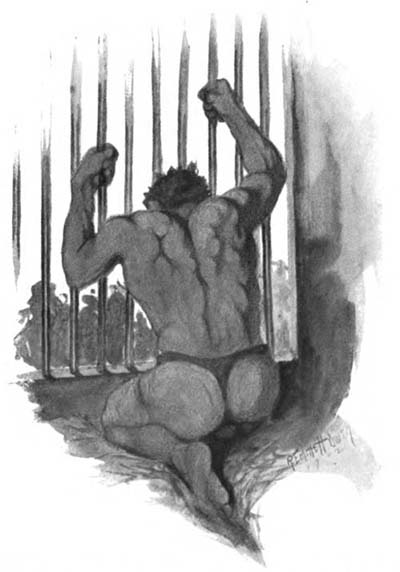
“‘There are three Englishmen and a Russian
here also, all of whom were captured and
brought in to-day.’
“He stopped for a few minutes, and I stood
cursing the helplessness of the whole thing.
There he was, thousands of miles away, being
tortured to death in some filthy Chinese den,
and I had to stand and listen calmly to his
voice, not able to raise a hand to aid him.
“‘I give you my share in the seismaphone,’
he continued after a while, ‘and I pray you may
be able to duplicate the half you now have, for
you will never see this one again. The two
instruments are exactly alike, except for the
wiring, and that you will have to get by experiment,
for all my data have been destroyed.’
“Then he must have fainted, for he stopped
suddenly, and I heard a voice, probably that of
one of the Englishmen, saying, ‘Poor devil, I
wish I could get to him; but they’ve tied me to
this ring in the wall, and I can’t move a foot.’
“I didn’t hear another word till late that
night, when I woke up to find Nellie by my bed,
pale and trembling.
“‘Don’t you hear him calling you?’ she
gasped.
“I seized the seismaphone, pressed the button,
and, in the silence of the night, I heard
Martin Bradley wailing, ‘Churchill—Churchill.’
“I spoke into the thing, so that his bell
would ring, and he would know that I was
listening.
“‘Good-by,’ he called. ‘They are killing us
off one by one. The Russian, and two of the
Englishmen are dead now, and it’s my turn
next. They’ve just brought in an American,
and he told me on his fingers that the legations——’
“That was as far as he got. I heard a terrible
screeching, which drowned out his voice;
and suddenly all was quiet.
“Three times since that some of those heathen
have got hold of the thing; but that death
message of Bradley’s is the last English word
that has come over the seismaphone.
“The third time I heard them at it, I threw
in the megaphone attachment, and shouted as
loud as I could. Since then not a sound has
come from the instrument.
“I put the advertisement you saw in the
papers; but though hundreds of men have tried,
no one has been able to duplicate the part of
the seismaphone I now have. Some have refused
even to try, when I explained what was
wanted, for they thought me either crazy or
a fool.
“I hoped at first that some one might be able
to replace the loss, but now I know it cannot
be done. Bradley told me that it took him
three years to determine the distances at which
the wires had to be placed, and he alone knew
the principle on which the whole mechanism
depends.
“No one has ever been able to duplicate the
diaphragm. It is a curious alloy of copper,
zinc, and some other metal; but what that third
metal is, no one can determine.”
Churchill had finished his strange story; and
now he leaned back in his chair, his face gray
and set. Outside the noise of a great city
waking to another day’s life could be heard,
and somewhere in the house I heard a clock
slowly strike five.
I picked up the seismaphone from the table
and brought it over to the light. Then, even
as I held it in my hand, I saw the little hammer
begin vibrating rapidly, and heard the
tinkling of the bell.
But Randolph Churchill had heard that signal
too, and starting from his chair, he snatched
the instrument from my hands, and held it to
his ear.
“It’s only those damned heathen at it again,”
he groaned, and threw the thing on the table.
In falling it must have pressed the tiny button,
which threw on the megaphone attachment.
The little bell began ringing again, and I started
back, trembling with a strange mixture of fear
and awe.
For, above the clatter of the wagons, and the
grinding of the cars as they climbed Fourteenth
Street hill, there, in that little room, fifteen
thousand miles from the Celestial Empire, I
heard a confused bable of many voices, howling
and cursing in the Chinese tongue.