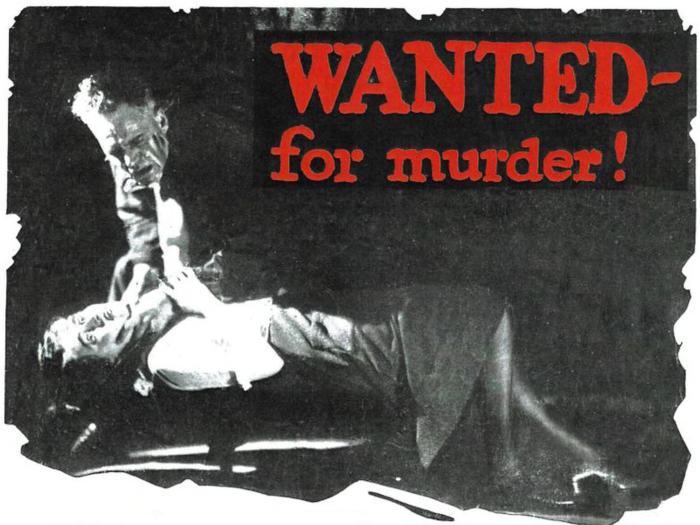
Transcriber’s Note: Stories that were originally split over pages, with
adverts and/or other stories in between, have been recombined.
FREE
$80 Drafting Course
There is such an urgent demand for practical, trained Draftsman that I
am making this special offer in order to enable deserving, ambitious and
bright men to get into this line of work. I will teach you to become a
Draftsman and Designer, until you are drawing a salary up to $250.00
a month. You need not pay me for my personal instruction or for the
complete set of instruments.
To every person of 16 years or older sending a sketch I am going to mail
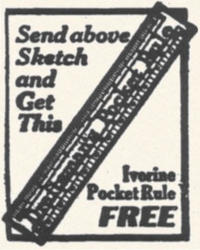
free and prepaid the Draftsman’s Ivorine Pocket Rule shown here. This
will come entirely with my compliments. With it I will send a 6 × 9
book on “Successful Draftsmanship”. If you are interested in becoming a
draftsman, if you think you have or may attain drafting ability, sit down
and copy this drawing, mailing it to me today, writing your name, and
your address and your age plainly on the sheet of paper containing the
drawing. There are no conditions requiring you to buy anything. You are
under no obligations in sending in your sketch. What I want to know is
how much you are interested in drawing and your sketch will tell me that.
Positions Paying Up to
$250 and $300 per Month
I am Chief Draftsman of the Engineers’ Equipment Co. and I know that
there are thousands of ambitious men who would like to better themselves,
make more money and secure faster advancement. Positions paying up to
$250 and $300 per month, which ought to be filled by skilled draftsmen,
are vacant. I want to find the men who with practical training and
personal assistance will be qualified to fill these positions. No man
can hope to share in the great coming prosperity in manufacturing and
building unless he is properly trained and is able to do first class
practical work.
I know that this is the time to get ready. That is why I am making the
above offer. I can now take and train a limited number of students
personally and I will give to those students a guarantee to give them by
mail practical drawing room training until they are placed in a permanent
position with a salary up to $250 and $300 per month. You should act
promptly on this offer because it is my belief that even though you start
now the great boom will be well on by the time you are ready to accept a
position as a skilled draftsman. So write to me at once. Enclose sketch
or not, as you choose, but find out about the opportunities ahead of you.
Let me send you the book “Successful Draftsmanship” telling how you may
take advantage of these opportunities by learning drafting at home.
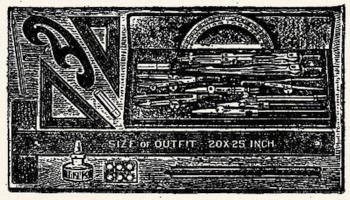
FREE this $25 Draftsman’s
Working Outfit
These are regular working instruments—the kind I use myself. I give them
free to you if you enroll at once. Don’t delay. Send for full information
today.
Mail Your
Drawing at Once—and Get Ivorine
Pocket Rule AbsolutelyFree!
Ambitious men interested in drafting hurry! Don’t wait! This is your
opportunity to get into this great profession. Accept the offer which
I am making now. Send in your sketch or request for free book and free
Ivorine Pocket Rule.
Chief Draftsman, Engineers’ Equipment Co.,
1951 Lawrence Av.
Div. 13-95 Chicago
The Unique Magazine
EDWIN BAIRD, Editor
Published monthly by THE RURAL PUBLISHING CORPORATION, 325 N. Capitol Ave., Indianapolis, Ind. Application
made for entry as second-class matter at the postoffice at Indianapolis, Indiana. Single copies, 25 cents. Subscription, $3.00
a year in the United States; $3.50 in Canada. The publishers are not responsible for manuscripts lost in transit. Address all
manuscripts and other editorial matters to WEIRD TALES, 854 N. Clark St., Chicago, Ill. The contents of this magazine
are fully protected by copyright and publishers are cautioned against using the same, either wholly or in part.
Copyright, 1923, by The Rural Publishing Corporation.
VOLUME 1 25 Cents NUMBER 4
Sixteen Thrilling Short Stories Two Complete Novelettes Two Two-Part Stories Interesting, Odd and Weird Happenings
For Advertising Rates in WEIRD TALES apply to YOUNG & WARD, Advertising Managers, 168 North Michigan Blvd., Chicago, Ill.
Finding “The Fountain of Youth”
A Long-Sought Secret, Vital to Happiness, Has Been Discovered.
By H. M. Stunz
Alas! that spring should vanish with the rose!
That youth’s sweet-scented manuscript should close!
—OMAR KHAYYAM.
A secret vital to human happiness has been discovered. An ancient problem
which, sooner or later, affects the welfare of virtually every man and
woman, has been solved. As this problem undoubtedly will come to you
eventually, if it has not come already, I urge you to read this article
carefully. It may give you information of a value beyond all price.
This newly-revealed secret is not a new “philosophy” of financial
success. It is not a political panacea. It has to do with something of
far greater moment to the individual—success and happiness in love and
marriage—and there is nothing theoretical, imaginative or fantastic
about it, because it comes from the coldly exact realms of science and
its value has been proved. It “works.” And because it does work—surely,
speedily and most delightfully—it is one of the most important
discoveries made in many years. Thousands already bless it for having
rescued them from lives of disappointment and misery. Millions will
rejoice because of it in years to come.
The peculiar value of this discovery is that it removes physical
handicaps which, in the past, have been considered inevitable and
irremediable. I refer to the loss of youthful animation and a
waning of the vital forces. These difficulties have caused untold
unhappiness—failures, shattered romances, mysterious divorces. True
happiness does not depend on wealth, position or fame. Primarily, it is
a matter of health. Not the inefficient, “half-alive” condition which
ordinarily passes as “health,” but the abundant, vibrant, magnetic
vitality of superb manhood and womanhood.
Unfortunately, this kind of health is rare. Our civilization, with its
wear and tear, rapidly depletes the organism and, in a physical sense,
old age comes on when life should be at its prime.
But this is not a tragedy of our era alone. Ages ago a Persian poet,
in the world’s most melodious epic of pessimism, voiced humanity’s
immemorial complaint that “spring should vanish with the rose” and the
song of youth too soon come to an end. And for centuries before Omar
Khayyam wrote his immortal verses, science had searched—and in the
centuries that have passed since then has continued to search—without
halt, for the fabled “fountain of youth,” an infallible method of
renewing energy lost or depleted by disease, overwork, worry, excesses or
advancing age.
Now the long search has been rewarded. A “fountain of youth” has been
found! Science announces unconditionally that youthful vigor can be
restored quickly and safely. Lives clouded by weakness can be illumined
by the sunlight of health and joy. Old age, in a sense, can be kept at
bay and youth made more glorious than ever. And the discovery which makes
these amazing results possible is something any man or woman, young or
old, can easily use in the privacy of the home, unknown to relative,
friend or acquaintance.
The discovery had its origin in famous European laboratories. Brought to
America, it was developed into a product that has given most remarkable
results in thousands of cases, many of which had defied all other
treatments. In scientific circles the discovery has been known and used
for several years and has caused unbounded amazement by its quick,
harmless, gratifying action. Now in convenient tablet form, under the
name of Korex compound, it is available to the general public.
Any one who finds the youthful stamina ebbing, life losing its charm
and color or the feebleness of old age coming on too soon, can obtain
a double-strength treatment of this compound, sufficient for ordinary
cases, under a positive guarantee that it costs nothing if it fails and
only $2 if it produces prompt and gratifying results. In average cases,
the compound often brings about amazing benefits in from twenty-four to
forty-eight hours.
Simply write in confidence to the Melton Laboratories, 833 Massachusetts
Bldg., Kansas City, Mo., and this wonder restorative will be mailed to
you in a plain wrapper. You may enclose $2 or, if you prefer, just send
your name without money and pay the postman $2 and postage when the
parcel is delivered. In either case, if you report after a week that the
Korex compound has not given satisfactory results, your money will be
refunded immediately. The Melton Laboratories are nationally known and
thoroughly reliable. Moreover, their offer is fully guaranteed, so no
one need hesitate to accept it. If you need this remarkable scientific
rejuvenator, write for it today.
The Cleanest, Yet Most Outspoken, Book Published
There is not a man or woman married or unmarried, who does not need to
know every word contained in “Sex Conduct in Marriage.” The very numerous
tragedies which occur every day, show the necessity for plain-spokenness
and honest discussion of the most vital part of married life.
It is impossible to conceive of the value of the book; it must
undoubtedly be read to be appreciated, and it is obviously impossible
to give here a complete summary of its contents. The knowledge is not
obtainable elsewhere; there is a conspiracy of silence on the essential
matters concerning sex conduct, and the object of the author has been
to break the barriers of convention in this respect, recognizing as he
does that no marriage can be a truly happy one unless both partners are
free to express the deepest feelings they have for each other without
degrading themselves or bringing into the world undesired children.
The author is an idealist who recognizes the sacredness of the sex
function and the right of children to be loved and desired before they
are born. Very, very few of us can say truly that we were the outcome of
the conscious desire of our parents to beget us. They, however, were not
to blame because they had not the knowledge which would have enabled them
to control conception.
Let us, then, see that our own marriage conduct brings us happiness and
enjoyment in itself and for our children.
A Book for Idealists by an Idealist
The greatest necessity to insure happiness in the married condition is to
know its obligations and privileges, and to have a sound understanding
of sex conduct. This great book gives this information and is absolutely
reliable throughout.
Dr. P. L. Clark, B. S., M. D., writing of this book says: “As regards
sound principles and frank discussion I know no better book on this
subject than Bernard Bernard’s ‘Sex Conduct in Marriage.’ I strongly
advise all members of the Health School in need of reliable information
to read this book.”
“I feel grateful but cheated,” writes one man. “Grateful for the new
understanding and joy in living that has come to us, cheated that we have
lived five years without it.”
SEX CONDUCT IN MARRIAGE
By BERNARD BERNARD
Editor-in-Chief of “Health and Life”
Answers simply and directly, those intimate questions which Mr. Bernard
has been called upon to answer innumerable times before, both personally
and by correspondence. It is a simple, straightforward explanation,
unclouded by ancient fetish or superstition.
A few of the many headings are:—
When the Sex Function Should Be Used.
Sex Tragedies in Childhood.
The Consummation of Marriage.
The Art of a Beautiful Conception.
Sex Communion.
The Scientific Control of Conception.
Sex Fear Destroyed.
The Frequency of the Sex Act.
The Initiation to Matrimony.
Anatomy and Physiology of the Sex Organs.
The Spontaneous Expression of Love.
Why Women Have Been Subjected.
Men Who Marry in Ignorance.
Hereditary Passion.
Marriage a Joy to the End.
Send your check or money order today for only $1.75 and this remarkable
book will be sent postpaid immediately in a plain wrapper.
Health and Life Publications
Room 46-333 South Dearborn Street
CHICAGO
HEALTH AND LIFE PUBLICATIONS
Room 46-333 S. Dearborn St.,
Chicago, Illinois.
Please send me, in plain wrapper, postpaid, your book. “Sex
Conduct in Marriage.” Enclosed $1.75.
Name
Address
City
State
The Unique Magazine
WEIRD TALES
Edited by Edwin Baird
VOLUME ONE NUMBER FOUR
25c a Copy
JUNE, 1923
Subscription
$3.00 A YEAR $3.50 IN CANADA
The Evening Wolves — CHAPTER ONE AH WING RECEIVES A CLIENT — CHAPTER TWO UNDER CHINATOWN — CHAPTER THREE THE EVENING WOLVES — CHAPTER FOUR THE MAN IN THE LIGHTED ROOM — CHAPTER FIVE ONE OF AH WING’S DOOR KEEPERS — CHAPTER SIX LOUIE MARTIN LEARNS THE SECRET OF THE WINDOW — CHAPTER SEVEN THE DEAD MAN SPEAKS — CHAPTER EIGHT AH WING LISTENS IN
Paul Ellsworth Triem’s Latest Novel
An Exciting Tale of Weird Events
A taxicab stopped on the corner,
and two people got out.
They formed a decidedly incongruous
pair; for the first to alight was a
diminutive Chinese boy, scantily dressed,
while his companion appeared to be a
portly white man.
It was impossible to be sure of this
fact, however, as this second passenger
wore a long overcoat, with its ulster
collar turned up around his face, and
a dark cloth cap with the visor drawn
down over his forehead and eyes.
Evidently the cab driver had been
paid in advance, for he swung out from
the curb as soon as his fares had dismounted,
and was soon out of sight. The
Chinese boy glanced at his companion,
then set off silently up a street whose
central portion was paved with cobblestones.
He seemed to know just where he was
going. He paused only once, to cast a
fleeting glance over his shoulder. Then
he resumed his journey.
He had seen that the man in the ulster
was following; and now, after traversing
half a block of squalid, deserted
street, the youngster turned abruptly
into a pestilential-looking alley. This
alley lay close to the top of a hill, and
for a moment the man and the boy, who
appeared to be his guide, could look
down over the roofs to where the gay
lights of Chinatown twinkled alluringly.
Presently the diminutive Oriental
paused just outside a doorway. The man
who had been following him came up,
with a curious suggestion of eagerness
and suspicion. Looking over the
shoulder of the figure before him, he was
able to make out the entrance to a narrow
flight of unlighted stairs, which
plunged steeply into the earth beneath
a dilapidated building.
“Do we have to go down there, boy?”
the man demanded.
“All a-same down here, master,” the
youngster replied. “You come close—I
show you!”
He began to descend as he spoke; and
the man, after a moment of hesitation,
plunged through the doorway after him.
His manner was that of one who is taking
a horribly unpleasant remedy, hoping
to cure a still more horrible disease.
The diminutive Chinaman reached the
bottom of the stairs and waited for his
companion. When he felt the man’s
heavy hand on his shoulder, he turned
to his right, advancing cautiously
through an almost impenetrable darkness.
There was a smell of dry rot in this
basement, and around their feet rats
scampered and squeaked. The man’s
hand shook, and his breath came with a
hissing sound through his clenched teeth.
“Now we go down again, master,”
the boy announced presently. He had
paused and turned again to the right.
“You keep close—I show you!”
A step at a time, they descended a
second flight of stairs. On either side
were rough stone walls, powdery with
mildew. The man discovered this with
his free left hand. Strange odors came
to him. Abruptly a bell rang, somewhere
in the bowels of the darkness below them.
The boy stopped in his tracks.
“Now you go down, master,” he commanded.
“Ah Wing waiting for you—you
go slow. Goo’-by!”
He slipped out from under the heavy
hand that would have detained him, and
the man heard him go scampering like
one of the rats up the stairs and away
through the upper corridors.
Terror gripped the man left alone
there on the stairs. He felt that he was
in a trap—and he had been evading
traps so long now that they had become
an obsession with him.
He cried out, hoarsely, and as he did so
a door opened below and a flood of light
shone out.
“Pray continue your descent, Colonel
Knight,” a cultured voice commanded
from somewhere within the lighted room
whose door had just opened. “The stairs
are quite secure, and I am awaiting
you!”
With a plunge that hinted at desperation,
the man addressed as “Colonel
Knight” reached the bottom of the stairs
and crossed to the door. He paused
there for a moment, till his eyes adjusted
themselves to the change in illumination.
Then he stepped inside, and
heard the heavy door close behind him.
The room he had entered was of considerable
extent, but was almost destitute
of furniture. There were bare walls,
dusty with green mildew; and bare
floors, covered with layers of dust and
litter. There were two chairs, one of
which was already occupied.
And as the newcomer’s eyes rested on
the occupant of that chair, all his doubts
and fears returned to him. He had come
to this unearthly spot to get away from
almost certain death. Now he was not
certain that the remedy would not prove
worse than the disease.
The man sitting there, facing him, was
dressed like a Chinaman, in silk trousers
and coat, satin slippers, and black silk
cap; but his eyes were of a metallic gray,
and his high, thin-bridged nose spoke of
Nordic blood. He would have been tall
had he been standing. His hands were
lying passive in his lap, but they were
the hands of a man of great physical
power.
And above all these details and beyond
them was something the man in the
ulster could not quite define—a radiation
of power, as if the intellect and will
of this strange being seated before him
saturated the atmosphere of the empty
room.
“Pray be seated, Colonel Knight!”
the man in the chair said courteously.
“I am glad to meet you. You have been
recommended to me by a former student
of mine—you know that I take only a
few cases. It will be best for you to tell
me your story, fully and accurately.”
Colonel Knight lowered himself into
the empty chair. His eyes still peered
out through the gap in his collar, and
seemed to be fastened on the face of the
man before him.
Then, slowly and grudgingly he removed
his cap and turned down his
collar, disclosing the pouchy face of a
man well advanced into middle age. It
was a face suggesting daring and resourcefulness,
this face of Colonel
Knight; and for a few moments the two
sat staring curiously at each other.
“I think I can condense that statement
I have to make,” the white man said
finally. “I am a man of wealth. Five
years ago, while traveling in Europe, I
had the misfortune to attract the attention
of the greatest gang of international
thieves ever organized. Perhaps you
have heard of them? They were called
‘The Evening Wolves,’ and were led by
a man who called himself ‘Count von
Hondon’.”
He paused for an instant to regard
his companion curiously, but the Oriental
merely bowed and sat impassively
waiting.
“These men must have followed me
about for some time before they struck.
Finally they saw their chance. I was
packed to leave Paris for Belgium, and
they undoubtedly figured that I would
have much of wealth with me.
“I did—but I had other things they
had overlooked. I had my pistols, and
I am a dead shot. I killed two of the
robbers, and the rest fled. I supposed
that would settle the matter, but I was
mistaken. Five members of the gang
were left alive, and they swore to be
revenged upon me. They have followed
me—”
A bell rang shrilly somewhere close at
hand, and Colonel Knight leaped from
his chair and looked wildly at his companion.
“What was that?” he cried. “That
bell rang when I was descending the
stairs—”
“Someone followed you here,” the
other replied, “and is now trying to
reach us. Pray continue!”
“But that man upon the stairs—”
“We will come to him presently. Let
me ask you to finish!”
“There is nothing more! I have been
followed for years, and now a physical
trouble is added—my physician tells me
I am going blind. I can’t see to run—”
The Chinaman eyed his companion
deliberately.
“Why lie to me, my friend?” he demanded
presently. “You come to me
for help, and you wish to steal my ammunition!
Now let me reconstruct your
story for you. You yourself are ‘Count
von Hondon.’ You were the leader of
the master crooks called ‘The Evening
Wolves.’ Five years ago you and your
men made a rich haul, and you decided
that a time had come to retire, or perhaps
to go in by yourself. You departed,
taking with you the loot; and ever since
it has been a running fight.
“Your old comrades could have shot
you outright, but that would not restore
to them the booty you stole. And you
have not dared dispose of it, because it
was the only thing that stood between
you and death! You see, you can’t lie
to me. Every lie carries its trade-mark
with it, to those who have eyes to see.
Now I shall ask you but one question,
and let me warn you—if you lie now,
you will never leave this place alive!”
He stood up and thrust an accusing
finger toward the cowering thief.
“Tell me,” said the Chinaman, “the
name of the person whom you and your
men robbed!”
The beady eyes of Colonel Knight, or
“Count von Hondon” as he had once
been known in every capital in Europe,
glittered with suspicion and fear. His
breath caught in his throat, and he unfastened
his collar with trembling
fingers.
“The name,” he said hoarsely, “was—was—”
Ah Wing crossed toward the heavy
door and laid his hand upon the knob.
His metallic eyes blazed, and he looked
down with fierce contempt upon the man
trembling before him.
“Will you answer?” he cried. “Or
shall I open this door?”
“It was a woman!” Knight whimpered.
“Her name was—Madame
Celia—”
He broke off and stared at the Chinaman,
towering there before the door. Ah
Wing had neither spoken nor moved; but
there was in the room a disturbance as if
a great voice had shouted out a curse.
Slowly the Chinaman came back
toward his visitor. His face now was
the impassive face of a carved Buddha.
“Colonel Knight,” he said gently,
“the high gods have undoubtedly
brought you to me. I am the only person
in the world who can save you, for I
work outside of the laws of men. And
I will take your case, now that I fully
understand it. But first I will ask you
to show me the Resurrection Pendant
which you stole from Madame Celia!”
The white man got slowly to his feet,
his hands groping at his throat, his eyes
protruding, his face the color of dough.
“The pendant!” he whispered
through ashen lips. “The Resurrection
Pendant! You know—you have heard?”
“Show me the Pendant,” repeated Ah
Wing inexorably. “I know that you
brought it with you tonight, just as I
know that you intended, in case I refused
to take your case, to try to disappear
without returning to your hotel.
Show me the Pendant!”
With faltering hands and without removing
his fearful eyes from the face
of his companion, the crook reached inside
his ulster and drew forth a package
wrapped in brown paper. This he slowly
unfastened, disclosing a jewel case. More
and more slowly his fingers fumbled with
the catch.
There came a sound from the door—a
voice that seemed to have difficulty in
filtering through the heavy panels.
“Come out of that, Count! We got
you over a barrel! Come out—”
The massive door shook under a terrific
blow, as from a sledge. The man in
the ulster seemed about to crumple to
the floor.
Ah Wing spoke coldly.
“Show me the Pendant!” he repeated.
“They cannot break down that door, but
if you trifle with me I will open it!”
With hurried fingers the terror-stricken
crook threw back the cover of
the jewel case, disclosing a mass of diamonds,
intricately and skilfully assembled
into a great pendant.
Ah Wing took a long stride, which
brought him close to the man who
held the jewel case.
The Oriental’s steely eyes were fastened
unwaveringly upon the pendant,
whose history for half a century had
been transcribed in suffering and death.
Misfortune had followed this unique assemblage
of perfect stones: death and
insanity; the breaking of friendships;
the treachery of children toward parents;
the murder of lover by lover. And
now the mysterious Chinaman seemed to
have fallen under the spell of the gems,
for he was taking in every detail of their
perfection.
For a moment the assault upon the
door had ceased, but now it was continued.
Heavy blows fell, and the walls
of the subterranean apartment shook.
“It will not take your friends long to
discover that they cannot reach us by
that route,” commented Ah Wing
tranquilly, turning at last from his inspection
of the Resurrection Pendant.
“The door has a middle sheeting of
boiler iron. It is bullet proof.”
He reseated himself, motioning for
Colonel Knight to do the same. Absently
he watched the white man close the
jewel case, wrap it carefully in brown
paper, and return it to his ulster pocket.
“And now,” continued the Chinaman,
“I will ask you to tell me about these
men. You say there are five of them?
Please describe them to me, one at a
time. Tell me all that you can remember
as to physical and mental characteristics—I
want every detail you can give
me.”
Colonel Knight sat down heavily. It
was obvious that the assault upon the
door was shaking his nerves so that he
could hardly command his voice. His
eyes were the eyes of some hunted thing,
which sees itself at the end of a blind
alley.
With an evident effort, he tore his
glance from the quivering panels and
fastened it on his companion.
“Yes,” he said hollowly, “there are
five of these men, and they have been
chosen from the elite of the criminal
world. I myself selected them and
trained them. Each has his special
ability. I will begin with the man whom
I considered the brainiest of them all—the
one who was almost my equal in
planning and executing a really big
robbery. His name is Monte Jerome.”
Suddenly the blows on the door
ceased; and the room was so still, after
the ferocious assault, that it seemed to
press on the ear drums of the speaker.
He winced and for a moment was silent.
Then, resolutely he continued:
“Monte is thirty-five years old. He is
less than five feet six, but is broad
shouldered and powerful. He grew up
in the alleys of a large city. He fought
his way to the leadership of gang after
gang, and at the time I picked him up
was looking for new worlds to conquer.
I chose him because of four qualities: his
physical strength; his native cunning;
his lack of sentiment—or, as it is usually
called, ‘mercy’—and his absolute freedom
from superstition. Monte believes
in neither God, man, nor the devil. He
was my right-hand man—and it is to
his merciless pursuit that I owe my condition!”
Ah Wing had drawn a note-book from
his pocket and was jotting down data.
He glanced placidly toward the door,
which was again shaking under a rain
of heavy blows.
“Pray continue!” said he.
Something of the Chinaman’s imperturbability
was beginning to influence
the white man. He went on with greater
assurance:
“Next to Monte Jerome in total
ability, I always placed the man we
called ‘Doc.’ I never knew his real
name. That was not important, as he
went under many aliases. Doc was my
means of approach to the wealthy men
and women—and particularly the latter—upon
whom I specialized. He is a
university man, and has lived among
people of wealth and refinement much
of his life.
“He has brains, but lacks the quality
of ruthlessness so important in really
successful commercial crime. He is utterly
selfish, I believe, but certain necessary
factors in his profession are revolting to
him—and he has never made the effort
to put down this weakness. Physically
he is prepossessing: an inch or two over
six feet in height, blue eyes, light brown
hair, splendid carriage; and possessed
of the manners of a Chesterfield.”
A thin, faint voice came through the
door, upon which the tattoo had momentarily
ceased:
“We’ve got you, Count! Open that
door, or we’ll gouge your eyes out when
we break in!”
Ah Wing waved his hand affably
toward the source of this ominous
promise.
“And our friend out there?” said he.
“Is he one of those whom you have described?”
“I was just coming to him,” replied
Colonel Knight, raising a shaking hand
to his forehead and mopping off the
beaded perspiration. “That is ‘Billy
the Strangler,’ and I think the ‘Kid’ is
with him. Those were my Apaches—my
gun men—my killers. They are much
alike. Both have cunning of a low order;
and persistence—they are like bloodhounds,
once they are put on the trail.
“They have been Monte’s most useful
tools in his pursuit of me. But both
are superstitious, and their native bloodthirstiness
has grown on them till they
are little better than homicidal maniacs.
The Strangler is tall and slim, with high
cheek bones and lean arms which seem
to be threaded with steel wires. The Kid
is of medium height, with grey eyes and
sandy hair.”
The assault on the door had again been
discontinued. Suddenly there came from
directly overhead a sound of splintering
boards, accompanied by a rain of dust
and bits of plaster. Knight sprang up
and retreated, snarling, toward a corner
of the empty room.
“Ah, I have been waiting to see if
your old comrades would think of that,”
he commented. “It gives us a line on
their resourcefulness.”
Colonel Knight regarded him with
drawn lips, which exposed his yellow
teeth.
“For God’s sake, what are we to do?”
he cried. “Are you armed? You sit
there like a statue—”
“Pray continue your very interesting
description,” suggested Ah Wing.
“There remains one of your band whom
you have not described. I must know
about him—and then I will deal with
this other matter!”
For an instant the thief glared into
the face of the man seated across from
him. What he read there steadied him a
little, although the crash of splintering
boards from above told him that the men
he had such good reason to fear were
meeting with less resistance in this direction
than they had encountered in their
assault upon the door.
“There remains but one,” he said
hoarsely. “That is Louie Martin, my
gem expert. Martin is one of the best
judges of diamonds and pearls in the
world. He is an expert in recutting
and remounting stolen jewelry. And he
has a wide acquaintance among the
crooked dealers of this country and
Europe—”
An extensive area of plaster broke
away suddenly and crashed down,
tumbling about the heads and shoulders
of the two occupants of the room. At
the same instant the end of a heavy gas-pipe
crashed through the laths, and the
voices of the men on the floor above
were raised in a shout of ferocious
triumph.
Ah Wing stood up deliberately and
looked toward the ceiling. He seemed
to be measuring the progress of the men
opposed to him. Then, without hurrying
he crossed the room toward a dimly
lighted corner, where he stooped and
opened a small door in the wall. This
door was built in segments, like that of
a safe; and was hinged with metal plates
of enormous strength.
Colonel Knight, who cowered directly
behind the Chinaman, felt a breath of
cool, moist air, smelling strongly of
earthy decay, blowing up from this
diminutive doorway.
“Kindly precede me, Colonel,” commanded
Ah Wing. “Watch your step—the
going is rather precipitous!”
Knight stooped and made his way
through the opening. He found himself
on a stairway which went steeply down
into utter darkness.
A cloud of white dust filtered up into
the light of the electric bulb; and, as Ah
Wing stood watching, a lithe human
figure landed with a crash on top of the
heap of plaster and splintered boards
and laths.
In the same instant the Chinaman
passed silently through the small doorway,
and his companion heard him slipping
the bolts into place.
The darkness which had suddenly
clutched them was so intense that it
seemed to have physical substance. A
squeaking sound from above brought
Knight’s face swiftly up. Something cold
and reptilian flapped into his eyes and,
with another squeak, was gone.
“Only a bat!” said Ah Wing softly.
“Rest your hand on my shoulder and
feel your way a step at a time. I will
turn on my flashlight!”
A conical beam of light drilled
through the darkness below them, and
Ah Wing’s companion saw that they
were descending a narrow flight of stone
steps that seemed to terminate in a panel
of utter blackness. The walls on each
side were damp; and pallid fungi had
taken the place of the mildew of the
cellars above.
“For God’s sake, where are we?” the
white man demanded through chattering
teeth. “This looks like the shaft of a
mine!”
“This is part of the underground
system which made Chinatown famous,
before the disaster of 1906,” replied the
Oriental. “Few white men have ever
been down here—particularly of late
years!”
He paused. They had reached a narrow
landing, from which passages
branched in half a dozen directions.
Another descending stairway yawned
ahead.
“If I were to leave you here,” smiled
Ah Wing, “you would never find your
way out! You could not go back the
way you have come, for there are acute-angled
branches which would confuse
you. Most of them end in masses of
rubbish, easily dislodged by the unwary!
But with me you are safe!”
His voice had an ominous softness.
Knight followed down along the second
flight of stairs. His heart was pounding.
Suppose these crumbling walls
should collapse! Suppose this unearthly
being, in whose hands his safety lay, decided
to rob him!
Ah Wing spoke abruptly:
“We have been following down the
face of a hill. Now we reach the level,
and here we leave these catacombs!”
He turned sharply to the left and led
the way along a short passage which
terminated in a second diminutive door.
Ah Wing shot back the bolts and motioned
for his companion to proceed him
into the room beyond.
Knight obeyed. Daylight was there—white,
blazing daylight! He blinked as
he crept through the opening.
Next moment he tried to cry out. An
arm had passed in front of his body,
pinioning him. In the same instant a
sinewy hand came close to his face, and
there was a little tinkle of broken glass—a
diminutive globule had been broken
under his nose.
The thief struggled to turn his head
aside, fought to keep from breathing in
the stupefying fumes; but with a smothering
gasp he surrendered.
He breathed deeply, and as he did so
a sudden feeling of lightness and of expansion
came upon him. In the act of
wondering stupidly what this substance
was that the Chinaman had forced upon
him, his mind went blank.
Ah Wing continued for a moment to
hold his hand over the mouth and nostrils
of his victim. Then he carried
Knight across the room and laid him on
a divan. Turning deliberately, he
pressed an electric button.
Somewhere in the brooding silence of
the building, beyond this room, a deep
throated bell rang clamorously.
High in an apartment house, overlooking
a street and something of
the city, Monte Jerome, leader of the
Evening Wolves, sat at his ease, a
cigarette in the corner of his thin, merciless
mouth, a telephone within reach.
From the back rooms of the apartment
came the sound of heavy breathing,
intermingled with an energetic and
unmusical snore. Louie Martin, gem expert
for the gang, and “Doc,” their
society specialist, were sleeping.
Monte listened critically to the heavy
breathing. He was an expert in such
matters, and his seasoned judgment told
him that neither of his comrades was
faking sleep.
With a nod of satisfaction, he stood
up and walked soundlessly into the corridor
connecting the rooms, stopping first
in that occupied by “Doc,” and then
in the back room where Louie Martin was
sleeping. In each room he paused long
enough to make a thorough search of the
clothing of the sleeping robber.
Monte went expeditiously through all
the pockets, and even examined the linings.
Just a little exhibition of the
honor that obtains among thieves: Monte
Jerome knew that his leadership depended
on his ability to command his
companions’ unwilling respect, and he
was taking no chances.
“I got a hunch Doc is thinking of
ditching the gang, and going it for himself,”
Monte murmured as he returned
toward the front room. “If he
thinks—”
The ’phone bell rang suddenly, and
the man on duty crossed to the instrument.
“Yes?” he said.... “Oh, hello,
Billy.... What’s that—Hell’s bells!
Got away! Get busy and find him—”
The voice of the Strangler came to him
over the wire.
“Keep your shirt on, Chief!” it commanded.
“You better come down here
and see for yourself what we was up
against!”
Two minutes later Monte was shaking
Louie Martin awake.
“Come to life!” Monte grated. “The
Count has made his getaway! You get
into your clothes and tend ’phone! This
is one hell of a mess!”
Martin climbed sluggishly and unwillingly
out of bed.
“You’ve been running things,” he
snarled. “If you’ve got ’em in a mess,
it’s no one’s fault but your own!”
At a corner on the outskirts of
Chinatown, Monte alighted from his
taxi. This was a special machine, owned
and operated by a crook who dealt indiscriminately
in transportation, dope
and bootleg whisky.
Monte commanded this worthy citizen
to await his return, and plunged into a
labyrinth of narrow streets and alleys.
A shrill whistle sounded presently,
and he saw the Strangler beckoning him
from a doorway. Crossing over, Monte
followed his henchman into an alley,
down a flight of narrow stairs, and into
an unlighted basement. Here they were
joined by the “Kid,” who carried an
electric torch.
“Come on, Chief,” the “Kid” commanded.
“We’ll show you first what we
was up against—watch your step! If
you stub your toe you’ll land in hell!”
They turned and went down another
stairway, narrower and steeper than the
first. At the bottom their way was barred
by a heavy door, studded with great iron
bolts. In one place the wood had been
battered away, disclosing the gleaming
surface of a steel panel.
“We followed the Count here, and
thought we had him cornered,” the
“Kid” drawled, rolling his cigarette
from one corner of his mouth to the other
and regarding Monte through lazy, sardonic
eyes. “When we saw we couldn’t
get through this way, we went up to the
floor above and come at him through the
ceiling. Come along—we’ll show you!”
They went back up one flight of stairs
and entered a room which evidently had
long been unused. Its walls were crumbling,
and in the middle a great hole had
been torn in the floor. The Strangler,
who was leading the way, crossed over
to this opening and unhesitatingly disappeared
through it. Next moment a
yellow light filtered up through the opening.
“Down you go, Chief,” commanded
the “Kid.” “This was the door we
made!”
Monte made his way down through the
opening, landing on the upper of two
chairs which had been piled precariously
together to assist in the descent. He was
followed by the “Kid,” and the three
crooks stood examining the room in
which Ah Wing and Colonel Knight had
held their conference.
Monte spoke with a snarl.
“All right, you two!” he cried, “Here
is where he was! Where is he now?
Come across with your alibi!”
His two companions exchanged significant
glances and the “Kid” took a
slouching step closer to Monte.
“Look here, Chief,” said he, “it ain’t
gonna be healthy for you to talk that
way to me! I’m not spielin’ no alibi.
What I’m givin’ you is straight goods,
and you better get that twist out of your
mush and act like a gentleman!”
He paused; and his two crumpled
ears, which spoke of vicissitudes in the
prize ring, grew red as a rooster’s comb.
His glassy gray eyes glared unblinkingly
at Monte.
The latter was not afraid of either of
these men, or of both of them together.
Monte had the unflinching courage of
the perfect animal. But he had no notion
of breaking up a gang which might prove
useful to him.
“All right, boys,” he agreed, more
pacifically, although his dark eyes continued
to glow like coals. “If you can
afford to take it easy, you got nothing on
me! Tell me what happened.”
“That’s more like it,” the “Kid”
growled. “Now you’re talking like a
gentleman, Chief! Well, we follows the
Count here, and thinks we has him
holed up. We can’t bust down that door—this
is an old Chink gambling hell,
and everything is stacked against a fellow
that wants to get in. But we comes
down through the roof—”
Suddenly the “Kid” paused. From
somewhere behind there had come a
sound as of the opening of a door. The
eyes of his two companions followed his
and together they stood, rigid and alert.
Slowly the back wall of the room
opened out toward them. Unconsciously,
the crooks shrank closer together.
Their faces were drawn, their figures
rigid.
The panel swung fully open, and a
figure appeared in it. It was the form
of a tall man, clad in black silk.
The three crooks stood staring at him
silently. So unexpected had been his appearance
that it had affected them with
a sort of paralysis. Their mouths gaped
open and their eyes bulged.
Serenely, the intruder stood looking
down upon them; and then, with a
courteous wave of his hand, he spoke.
“Pardon my intrusion, gentlemen!”
said he. “My little affairs can wait—I
will return later!”
He turned, and next moment the panel
had swung silently shut behind him.
Monte Jerome was the first of the
three to recover.
“Come on—we’ve got to get him!”
he cried.
“That was the Chink we saw spieling
with the Count,” the “Kid” cried
hoarsely. “But, for the love of cripe,
how did he get here?”
Monte snarled wolfishly:
“Ask him that! We’ve got to bust
through here—”
His compact body landed against the
panel. It shook, but refused to yield.
“Come back here! Now, all together!”
bellowed Monte.
The three leaped forward and struck
the partition.
This time it swung inward, slowly and
without a sound. The crooks leaped
through the opening, and the “Kid”
flashed his torch. They were standing
just inside a vast, windowless room, at
whose farther side they had a glimpse of
sagging timbers and ruined walls. Nowhere
was there a sign of the man who
had eluded them.
“Get a move on!” Monte growled
throatily. His lip drew up and he
snarled at his companions. “A hell of
a bunch of crooks, we are! Why didn’t
you take a shot at him, when you saw he
was going to make a getaway?”
The “Kid” glared back.
“Cut out that kind of talk, Chief! You
got a gat, and two hands! He buffaloed
you just like he did us! Be a sport and
take your medicine!”
A determined search of the ruined
chamber yielded no results. The “Kid”
dropped to his stomach and wormed his
way under the mass of timbers at the
farther side. He found the beginning
of a stone-lined tunnel, which dipped
abruptly into the earth.
Damp, mouldy air fanned his cheeks;
and as he crouched, motionless, listening,
a distant reverberation came to him from
the bowels of the earth. It sounded like
the clanking of a great iron door.
“Let me out of this!” he growled, as
he backed toward his companions. “We
got a fat chance of following that yellow
devil into his hole. You go, if you want
to!”
Monte shook his head. He had regained
his poise, and he had been
thinking.
“No use trying to follow,” he admitted.
“We got to comb Chinatown for
the two of them. They can’t live down in
that burrow forever. But why did this
duck show himself? He must have known
we were here—he could hear us talking!”
The “Kid” smiled craftily.
“Maybe him and the Count left something,”
he suggested. “We better have a
look!”
“No, they didn’t leave nothing. I
would have seen it if they had. I got an
idea the Chink wanted us to see him! He
stood there with his face turned into the
light. Well, we got to find him! That’s
flat!”
The wolves shifted their quarters
that night to a rooming-house on the
edge of Chinatown, and the search for
Colonel Knight and his mysterious companion,
the tall Chinaman, began.
For three days they worked feverishly.
Monte Jerome seemed never to sleep, and
his temper was not at all improved by
the ordeal. He drove his companions
fiercely, and only the fact that they were
playing for big stakes prevented open
rebellion.
On the fourth day Monte and the
“Kid,” who were loitering, alert but
almost hopeless, in the entrance to a
building in one of the narrow streets of
the Oriental quarter, caught sight of a
figure disappearing through a doorway.
It was a tall figure, partly concealed by
a light overcoat; but both of them
leaped forward at the same instant.
“That was the Chink, sure as God
made little red apples!” the “Kid”
snapped.
They crossed the street. Several automobiles
were drawn up close to the curb,
among them a big blue limousine from
which the Chinaman had stepped a moment
before they identified him. Monte
approached a well-dressed gentleman,
who had just come out of the building,
and asked him what was going on inside.
“This is the fall exhibition of the
Iconoclasts,” the stranger explained
good-naturedly.
He seemed to be sizing up the two
crooks.
“I think you boys would enjoy it,”
he added mischievously. “The admission
is only fifty cents.”
Monte and the “Kid” bought tickets,
and presently they entered a big room
with a high ceiling, upon whose walls
were hung a number of gaudy paintings.
The newcomers stared round at the fifty
or more spectators who were making the
rounds of the gallery.
“Hell!” growled the “Kid,” “this
ain’t no place for an honest strongarm
man—Let’s beat it and send for Doc!”
Monte gripped his arm.
“Look!” he said under his breath.
“Over there near the corner!”
The “Kid” looked stealthily as directed,
and perceived the tall man in the
gray topcoat. He was standing with his
back to them, examining a red and yellow
daub that looked like an omelette
liberally seasoned with paprika.
“That’s him!” Monte whispered. “All
right, Kid! You have Mike bring the
cab down to the corner where we was
waiting. Then, when this duck beats
it out of here, I’ll hop in and we’ll
follow him!”
Half an hour later the tall man in the
gray coat—who in American garb looked
more like an Oriental than he had when
dressed as a Chinaman—paused to look
deliberately at his watch, and then
turned to the outer door.
By the time he stepped into the blue
limousine, Monte had reached the corner
and was climbing in beside the driver of
the taxi. The “Kid” had the window
down, and was kneeling with his head
close to the driver’s.
“How ’bout it, Mike!” Monte demanded.
“Can you keep ’em in sight?”
“Watch me!” snorted the driver.
“There ain’t no Chink going can leave
me behind. Did you see that chauffeur?
Got a face like a monkey!”
There was no difficulty, for the present,
in keeping the blue limousine in
sight, however. It went sedately down a
side street and took the turn toward the
ferry. Five minutes later Monte and the
Kid saw the cab in which they were
seated draw in behind the larger car, and
roll over the landing platform. The
limousine was stationed on the right,
and the cab on the left, of the big boat.
Monte scrambled down, and with a
curt command to the other two made his
way around to where he could see the
enclosed car. The man in the gray overcoat
was sealed inside, with a coffee-brown
Chinaman in livery at the wheel.
Monte kept them in sight till the ferry
was approaching the slip. Then he hurried
back and climbed in again beside
the driver.
“Here’s where they’ll try to leave us
behind, if they have any idea we’re following!”
he predicted.
“Let ’em,” growled Mike. “If we
don’t get took in by a speed cop, I won’t
never let no Chink drive away from me!
You boys just hang onto your bonnets,
and watch us!”
The big blue car seemed to have accepted
this challenge. The little man at
the wheel swung out and passed half a
dozen slower machines, then took the
center of the road and held it.
With the coming of evening, a powdery
fog swooped down over the ridges
to the west, and suddenly the tail lights
of the limousine shot up in the gloom
ahead. Notch by notch, the Chinese
chauffeur was adding to his speed. The
lighter car behind bounced and swayed,
and Mike spat through his teeth.
“Say, that bird must be clear nuts!”
he growled. “If we get took in, they’ll
sentence us to about five life-times!
What say, gents? Want to let him go?”
“You keep going!” snarled Monte,
staring hardeyed into the fog. “If we
get pinched, I pay for it, see? But don’t
you let that bird get away, if you want
to sleep in your little bed tonight!”
Mike glanced sideways at the man
whose elbow touched his. Something he
saw in the stony face of Monte Jerome
caused him to turn all his attention to
the task in hand.
The tail lights had been growing dim,
but now, slowly, the cab began to gain.
Other cars, headed for the ferry, shot
out of the fog and into it, honking warning
horns at the crazily lurching
machine that burned the road in pursuit
of the blue limousine. The stony faces
of the three men in the cab never deviated
from their straight glare into the
gloom ahead.
The speed of the big car was slackening.
The driver of the cab grinned
wryly.
“He knows the ropes. Speed cop in
this burg ahead lies awake nights thinking
up new ways of raising hell for
speedy drivers,” he explained. “Now
we’ll creep up on ’em a little more!”
They passed through the little town
and again were in the open country. The
limousine continued its more leisurely
progress, however, and presently turned
to the right into a dirt road. The cab
dropped farther behind, at Monte’s
command.
“They can’t get away from us on
this road. Probably aren’t going far,
and we don’t want them to spot us. Take
it easy!”
The road seemed to be leading gently
down, and presently they caught the
gleam of water on each side. Rushes
grew up close to the track; and from
somewhere in the dusk the cry of a gull
sounded like the wailing of a lost soul.
Involuntarily, the “Kid” shivered.
“Hell of a country!” he mumbled.
“Where you reckon he’s headed for?”
“Wait and see!” snapped Monte.
“Hello!—he’s turning in! That must
be a private road! Stop here!”
He slid from the seat and stood swinging
his feet alternately, to restore the
circulation in them. Then he jerked his
head into the darkness.
“Come on, Kid! We got to see what
he’s up to!”
The “Kid” clambered out, and the
two crooks struck silently up the road.
They reached the turn and found, as
they had guessed, that they were at the
entrance to a private road.
Instinctively, the two men paused and
stared in through the trees. Night
pressed thick and damp about them. A
wind from the southeast brought to them
the smell of the marshes, and once the
booming whistle of a steamer sounded.
In a lull of the wind, the gulls were
screaming.
“This ain’t in my line, Chief!”
snarled the “Kid,” glaring into the
darkness. “I can bump a guy off under
the city lights as nifty as the next one,
but this nature stuff never did set right
on my stomach. Let’s go back!”
“You go back if you want to!” Monte
said menacingly. “But if you do, don’t
come sniveling around me later on. I’m
going in there!”
He struck off along the winding road,
and in a moment the “Kid” fell into
step at his side.
Without a word, the two advanced till
suddenly the lights of a building shone
upon them. They paused for a moment,
then began to creep nearer, keeping in
the shelter of clumps of bushes. In this
way they came close enough to discern
the outlines of a large and well-built
house, with a broad frontage and two
wings extending from the rear.
“For the love of cripe!” whispered
the “Kid,” “would you look at them
windows! Barred, every damn one of
them!”
Monte nodded.
“Looks like a private foolish house to
me,” he replied in the same cautious
tone. “Come on—we’ll get around behind
and see what we can make out!”
The musty darkness of the night,
which had settled down around them,
was now an advantage, as it made it
easier for the two Wolves to get close to
the house without being seen. They
crept past the massive front, with its
broad steps and wide porch, and continued
till they came opposite the west
wing. Most of the windows in this wing
were dark, but toward the back they saw
several lighted panels.
“Come on!” commanded Monte. “I
hope that Chink doesn’t keep a dog, but
plug him if one comes at you!”
On they crept till they were close to
the windows. Massive and sinister
against the light, stood the iron bars
which had first caught their attention.
They crept closer, and finally Monte
hauled himself up into a gnarly pepper
tree whose lacy branches almost touched
the nearest of the lighted windows.
Next moment he reached down and
grasped his companion’s shoulder.
“Come up here!” he grated, speaking
half aloud in his excitement. “Don’t slip—catch
that limb! There you are!”
He assisted the “Kid” to a foothold
beside himself, and together they stared
through the foliage and into the lighted
room beyond.
The curtains were drawn aside and
the shade rolled up. Seated in full view
of the two crooks was the man they had
been following for five years. He wore
a dressing-gown, and beside his easy
chair was a low table on which rested
a leather covered box.
Suddenly he turned, raised the cover
of the box—and Monte and the “Kid”
held their breath and stared hungrily.
The light was caught and split up into
a cascade of vivid colors. The man in
the dressing-gown seemed to have in his
clutching hands a fountain of fire.
“The Resurrection Pendant!” snarled
the “Kid,” reaching for his pistol.
“Damn him!”
Monte gripped his companion by the
wrist.
“None of that, you fool!” he hissed.
“We’ve got to play safe—but the Count
is caught in a trap! That Chink must
have kidnapped him!”
Colonel Knight awoke and lay
staring at the ceiling. It seemed a
surprisingly long distance from him—and
then his glance narrowed.
He turned his head, and suddenly sat
up in bed. He had just remembered the
events preceding his loss of consciousness.
Ponderingly, he examined his surroundings.
He was in a big room, with a
high ceiling. There were two windows
at his right and one straight ahead, the
latter partly open. Several easy chairs,
a handsome mahogany house desk, and a
row of bookcases flanking a fireplace
came to him as successive details of his
environment. A bar of yellow sunlight
streamed through the end window.
A door behind him opened, and he
turned to see a grinning, brown-faced
Chinese boy approaching his bedside,
bearing a breakfast tray.
“Ah Wing say he coming to see you
by-m-by,” the newcomer commented
placidly. “You hab breakfast now.”
He drew up a table and placed the
tray in position, then skillfully arranged
napkin and silverware—which were of
the best quality—convenient to Colonel
Knight’s hand. Afterward he withdrew.
Knight’s head felt clear enough, but,
mentally and physically, he was relaxed
to the point of incoherence. He wanted
to think, but couldn’t.
Mechanically, he lifted to his lips the
cup of steaming coffee that the servant
had poured for him. The taste of the
hot, bitter fluid—he drank it without
cream or sugar—helped him pull himself
together. He remembered everything
now: his visit to the mysterious
Chinaman; the coming of his enemies,
and their attack on the basement room;
his flight with Ah Wing; and the latter’s
ruse for bringing Knight fully within
his power.
Sharply he turned his head and looked
again at the end window; it was barred
with heavy iron rods, and so were the
two windows at the side. This room in
which he lay was a luxurious prison!
The door opened again, softly, and
Colonel Knight turned his head to find
Ah Wing advancing toward him, dressed
in white flannel trousers, silk shirt, and
serge coat. In such a rig the newcomer
looked every inch a Chinaman.
“Good morning, Colonel,” Ah Wing
greeted his guest courteously. “I am
glad to see you looking so fresh and
rested this morning!”
Knight began to tremble.
“You yellow crook!” he croaked, his
hands drawing up into knots. “So that
was your scheme—to rob me, and then
kidnap me? But don’t think you can
get away with it—”
Ah Wing approached the bed and
deftly reached under the nearer of the
two pillows. From this place of concealment
he drew two things: the morocco
jewel case, and a revolver that Knight
remembered having carried in his inside
coat pocket.
“Here are the principle articles of
your property, Colonel Knight,” said
the master of the house. “The other
things you will find after you are
dressed.”
He paused to watch the man in the
bed open the leather box and stare
hungrily at the flashing jewels. Then
he continued.
“There was an ordeal ahead of you,
my friend, and you were in no condition
to go through with it. You needed rest,
but your nerves were screwed up to the
snapping point. There was only one
way to get you safely out of the city, and
I used it.”
“You mean that the Wolves don’t
know where I am?” Knight demanded.
“Not yet. I shall remedy that presently.”
Colonel Knight’s voice rose into a
snarl:
“Remedy it? You mean you want
them to know?”
“Of course I want them to know. I
want them here, where I can deal with
them. But never fear, my friend. Your
old enemies will never be able to hurt
you!”
He paused and looked around the
apartment, then turned again to the man
in the bed.
“These are your quarters. Adjoining
your bedroom is the bath. This door
opens into your sitting-room, and adjoining
that is my conservatory, which
you are at liberty to visit when you
choose. There are no conditions placed
upon your residence here except that you
are not to try to leave the house without
my permission—and you are to leave the
end window exactly as it is. Don’t even
lay your hand upon it, or upon the sill!
This is important!”
Knight stared again at the single end
window through which the sun was
shining. He stared from it to the face
of the strange being who continued to
regard him with the impersonal interest
of a Buddha. A sense of baffled curiosity
arose within him, and he made a
nervous, protesting movement with one
of his puffy hands.
“Who the devil are you, anyway?”
he broke out. “Ah Wing! That doesn’t
mean anything to me—as well say ‘Mr.
X!’ You are not a Chinaman. What
and who are you?”
Ah Wing continued to stare imperturbably
down at his guest, but the
ghost of a smile showed at the corners
of his usually expressionless mouth.
“No,” he agreed, “I am not a Chinaman.
And I am not a Caucasian. You
see that, dressed as I am today, I look
unmistakably Oriental. Dressed like a
man of Hong Kong, on the other hand, I
look American or English. That has been
my curse, and perhaps my blessing: the
mixing of two irreconcilable blood lines
has made me an outcast. I have no place
in the government of any country, and
therefore I have organized a government
of my own.
“I am the emperor, the president, the
king, of an invisible empire. I rule by
right of intellect and will, and my first
failure will be my death warrant; for,
judged even by the standards of a thief
like you, Colonel Knight, I am an outlaw—one
who is outside the protection of
the laws of men!”
He laughed, a short, mirthless laugh.
As he crossed toward the door he said
over his shoulder, “Remember about the
window. I shall be going out from time
to time, but if you carry out my instructions
to the letter, no harm can come to
you even in this house of hidden
dangers.”
Try as he would, Colonel Knight could
find nothing wrong with his situation as
it had been outlined to him by Ah Wing.
He spent most of the first day in the
room in which he had awakened. From
the windows in one direction he could see
a landscaped lawn and hillside, dotted
with shrubbery and intersected by winding
gravel paths.
From the rear window concerning
which he had been so curiously warned
by the master of the house, he looked
out over a bit of lawn bordering a
kitchen garden. Beyond the garden lay
a marshy field, and in the distance he
made out a canal along which an occasional
motor boat chugged industriously.
No, there was nothing wrong here—he
could hardly have hoped for a more
peaceful place in which to rest and grow
strong.
But—there was an air of brooding
watchfulness over the silent house. He
heard an occasional padded footstep
passing the door of his sitting-room.
Once he looked out. At the farther side
of an extensive conservatory the brown-faced
servant who had brought him his
breakfast was spraying some snaky-looking
vines bearing huge orange-colored
flowers. Colonel Knight closed
the door. Something about the place—the
quiet and the isolation, perhaps, were
getting on his nerves.
The second day passed as the first, but
toward noon of the third day Ah Wing
knocked at his door and entered noiselessly.
He was dressed in his Oriental
garb, and again looked like a poorly-disguised
white man.
“I will be going out for a few hours
this afternoon, Colonel,” he explained,
regarding the man before him with his
habitual unwinking stare. “I am taking
Lim with me, and I think it will be best
for you to remain in your quarters.”
Although his words had taken the
form of a request, there was back of
them the force of a command. The white
man eyed him suspiciously, but presently
nodded.
Some time later he heard the whir of
a starting motor. Lim had brought him
his luncheon, and now Knight figured
the house would be deserted. He smiled.
This would be his opportunity to look
around a bit. The instincts of the crook
were strong within him, and he was immensely
curious with regard to the house
of Ah Wing.
He waited an hour after he had heard
the car leave the garage—from the back
window he had caught a glimpse of it:
a gray roadster of moderate size and
power. Now he felt sure that he would
not be interrupted.
Crossing to the door of the conservatory,
he passed into it. Along one side
were orchids, Colonel Knight realized
vaguely that the collection must be priceless.
Many of them were growing in
diminutive glass rooms, upon whose
walls he saw heavy drops of moisture.
One pale green blossom near him had
weird markings in white and yellow,
which gave it a disturbing resemblance
to a grinning human face. The man
thrust out a curious finger and touched
it: the blossom drew itself together like
a conscious thing, and he became aware
of a sickening perfume which in an instant
turned him dizzy.
He shrank back and continued his
journey. The concrete floor narrowed,
and at his left he saw a lily pond, upon
whose surface great white blossoms
showed their buttery yellow centers. Between
the pads and blossoms of the lilies
the water showed, deep and dark.
Colonel Knight leaned forward to peer
into the pool; then, with a choking cry
he staggered back, his face drained of
blood: an ugly black snout had shot up
out of the murky depths, and a huge
lizard, with short, powerful forelegs
armed with long claws, stared hungrily
up at him.
He found his appetite for exploration
losing its edge. He was tempted to turn
back, but he wanted to settle one point:
in case he should want to leave this
house, how could he best do it? The
windows were securely barred, but there
must be plenty of doors.
A hall opened out from the conservatory,
and on either side were rooms,
variously furnished. He hurried on.
Ahead, he saw a door which seemed to
give upon the outer world. He grasped
the knob. The door was locked, and the
lock was one which a glance told him
could be neither picked nor smashed.
Turning, he explored the rear of the
house. In the east wing he found the
kitchens and servants’ quarters, but a
door which probably communicated with
the kitchen gardens was locked.
Suddenly his wandering eyes caught
the handle of a door in an angle of the
pantry. He approached it and found
that it opened upon a stair leading down.
A gust of warm, damp air came up
through the stairway, and for a moment
Knight paused, sniffing curiously.
He found himself thinking of a certain
sultry afternoon in India, when he had
gone out into the simmering jungle.
There was the same wild smell here—
He had his revolver in his hip pocket.
That gave him confidence, and he must
know if it would be possible for him to
escape in this direction.
A phrase spoken by Ah Wing came to
him—“Even in this house of hidden
dangers!” But what dangers could
there be?
Colonel Knight felt his way down into
the basement. He found that it lay
almost entirely below the level of the
grounds, but presently his eyes became
accustomed to the dusk and he could
discern his surroundings.
He was in a broad and deep room,
filled with a litter of packing cases, discarded
articles of furniture, and a few
garden tools. At its farther side was a
door. Slowly and cautiously, the investigator
made his way toward this.
It opened into a dark and narrow
passage. He made his way along this,
trying the handles of two locked doors,
one on the right and the other on the
left. Then he came to the end of the
passage and to another door.
Cautiously, he opened it and looked
inside: before him lay a room somewhat
better lighted than the passage, but absolutely
destitute of furniture. He
crossed the threshold and stood for a
long moment looking about him. The
smell which he had associated with that
hot afternoon in the jungle came to him
almost overpoweringly now, but beyond
he saw a door with an iron-barred transom.
He wanted to try that door.
He had crossed halfway toward it
when some subtle sense of danger
brought him to a stop. He looked back.
Nothing.
Then, with a start, he looked up, into
the dusky ceiling. Something was moving
there—he stepped back, drawing in
his breath with a sharp hissing intake of
terror. He backed toward the door. It
was taking shape, up there among some
uncovered beams and pipes—a huge
column that seemed to have come alive!
Slowly it swung down in a great curve.
Colonel Knight stood frozen in his
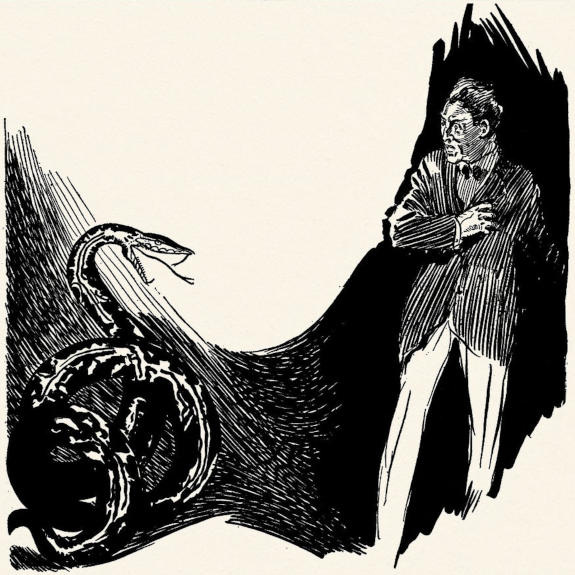
tracks. It was a snake—but such a
snake! He knew that this was no waking
vision, but a horrible reality—
With a choking cry, he turned and ran
as he had never run before in his life.
Behind him he heard a hissing as of sand
being poured from an elevation into a
tin pail. A box was overturned. The
thing was gaining on him—he turned,
and with bulging eyes he saw the python
strung out along the floor, its great body
undulating, its flat head raised, its unblinking
eyes burning through the dusk.
He could never make the stairs. At
the left was a small door. He threw
himself upon it and clutched the handle—it
came open and, without looking before
him, he threw himself forward.
Something struck against the door as he
jerked it shut, and he could hear that
uncanny sand blast louder than before.
Groping about him in the utter darkness
of this refuge, he found a metal contrivance—a
wheel, with a metal stem
connecting it with a large iron pipe. He
was in the closet which housed the intake
of the water system.
Then he remembered his revolver. It
would be of little use to him against
the horrible thing coiled outside.
When Ah Wing returned to the
house, several hours later, he went
quietly through the hall and conservatory
to the door of Colonel Knight’s
apartment.
Satisfied by a brief inspection that his
“guest” was not in his rooms, the Chinaman
turned and made his way to the
basement door. His face was as serene
as usual, but his eyes shone with a
metallic gleam. He opened the door and
for a moment stood listening.
An angry and prolonged hiss, which
sounded like a great jet of steam, came
plainly to him. He stepped into the
hallway and deliberately closed the door
behind him. Then he felt his way down
the stairs, pausing within a few steps of
the bottom to look unwinkingly about.
Something was moving in the dim
shadows at the farther side of the room.
It came slowly toward him, and he could
make out the undulating length of the
python. Ah Wing’s glowing eyes
rested unwaveringly on the flat, evil head
of the great snake, which came toward
him more and more slowly.
With a final prolonged hiss, the python
drew itself up into a huge coil. It was
a tremendous creature, as large as a
man’s body at its greatest diameter: but
now it seemed to be turning slowly to
stone. Its beady eyes grew dull, and its
swaying head became rigid.
A muffled cry reached the ears of the
motionless Chinaman. Without the
flicker of an eyelid, he continued to stare
down at the python.
Presently he descended to the foot of
the stairs. The snake was still.
Ah Wing crossed to the closet door and
threw it open.
“You can leave your retreat now,
Colonel Knight,” he said. “My little
playmate is temporarily in a condition
of catalepsy—but I would not advise you
to repeat this visit!”
Monte and the “Kid” went
back to the city that same evening,
but early next morning the leader
of the Wolves returned to the neighborhood
where they had picked up the trail
of Colonel Knight.
Monte had caught sight of a “For
Rent” sign in the upper window of a
cottage half a mile from the big house,
and he wasted no time in hunting up the
rental agent and signing a lease. By
evening he had his men with him, and
the battle lines were established for the
final conflict.
“We got to get all the dope on this
Chink and his layout we can,” Monte
explained to his companions, as they sat
smoking in the parlor of their new home.
“We might try to rush the house, but I
don’t like the looks of it. Chances are
that Chink’s got a machine gun or a
bunch of sawed-off pump guns there.
We’ll have to size things up.”
He paused to stare at his men.
“Any kicks on that? All right, it’s
settled. Louie, it’s your turn for sentry
duty, and you better get over to the
Chink’s castle now. At two o’clock I’ll
send Doc over to relieve you. You might
take a look at the windows, and see if
any of them can be handled without a
saw—there may be some loose bars!”
Louie Martin, the gem expert, was a
little tallow-faced man with a straggling,
peaked beard and shifty eyes. He had
no real appetite for this sort of thing,
but for personal reasons he was more
willing than usual to go on duty tonight.
Slipping his automatic into the holster
under his arm, he struck off along the
road toward the house of Ah Wing,
whose gables were visible from the cottage.
A light wind was blowing from
the southeast, and he could see the mist
rising over the marshes. Somewhere
from the steamy air above a night heron
screamed raucously. Involuntarily, Louie
shivered.
He was glad to turn his thoughts to
his own immediate affairs. Louie Martin
had made up his mind to strike out for
himself. He had always admired Colonel
Knight—or “Count von Hondon”—for
the shrewd stroke of business he had
done; and Louie was keen enough to
perceive that Monte Jerome was not
equal to the task of holding the Wolves
together. At the present time there
was open dissension among them. One
of these days one of them would squeal
on the others—that was the way this
mob stuff usually ended.
No, Louie had made up his mind to
watch his chance for a crack at the
jewels—and then a clean getaway.
He reached the private road leading to
the Chinaman’s house, paused for a moment
to listen and reconnoiter, then
stealthily struck into the grounds. Five
minutes later he had skirted the west
wing and was peering up through the
shrubbery at the lighted windows of
Colonel Knight’s apartment. Their
location had been sketched for him by
Monte.
“So that’s where the old devil is!”
thought Louie. “Let’s just have a look-see!”
He climbed into a pepper tree—the
same from which Monte and the “Kid”
had seen Knight—and stared into the
room. It was lighted, but there was no
one in sight. Then, through a vista of
open doors, he saw the man whom he had
been sent to watch, walking slowly about
with his hands clasped behind him, a
cigar between his lips.
“Had a good supper, and now he’s
enjoying a smoke!” Louie mumbled enviously.
“Well, that’s good enough for
me, too! Let’s have a look at that
window!”
He slipped down from the tree and
glanced about. At the corner of the
house was a galvanized iron can, evidently
used for lawn clippings. Louie
lifted this cautiously and carried it over
under the end window. Then he climbed
upon it, raising his head cautiously till
he was standing just beside the half-open
window.
A silent inspection of the bars showed
him that they were all securely fastened,
with one possible exception: the bottom
bar seemed to be loose in its niche. Louie
climbed down, changed the can over to
the opposite side, and examined the opposite
end. Sure enough, it showed a
crumble of concrete around the bolt
which was supposed to hold it in place.
With the utmost caution, fearing that
the loose bar might be connected with an
alarm system, the crook tested it.
A smile twisted his thin lips. It could
be moved in and out of its niche.
A sound came from somewhere close
at hand; and with the speed and silence
of a wolf Louie Martin leaped to the
ground, caught up the can, and replaced
it where he had found it. Next instant
he was hidden in a clump of flowering
shrubs.
From this position he could see the
top of a flight of steps leading down to
the basement of the house of Ah Wing.
He stood listening and watching, and
presently he heard a door open and close,
followed by steps ascending the stairs.
Then some one came up out of the basement,
and he saw the figure of a tall
Chinaman walking deliberately toward
the bush in which he was hiding. Louie
reached under his coat for his pistol—
Ah Wing turned, and Louie saw that
he was following a graveled path. And
he was carrying something in one hand—a
contrivance of twisted wires, like an
iron basket.
As Ah Wing disappeared into the
mist, Louie made up his mind. Tonight,
after Knight had gone to bed, he would
strike: he was not to be relieved till
two o’clock, and that would give him
time to put through his coup. But now
he meant to follow Ah Wing. He needed
all the information he could secure about
the master of this silent house.
The Chinaman had disappeared into
the eddying mist, but Louie struck into
the path and soon came within hearing
of the crisp footsteps. Ah Wing reached
the edge of the grounds and crossed over
into a marshy field.
Instinctively, the crook worked closer
to the man he was shadowing. There
was something oddly menacing about
this night, with its mist and its fitful,
salt-laden wind.
Suddenly through the swirling fog
there appeared a light, which seemed to
be suspended ten feet or so above the
ground. It was moving slowly along in
front of them—a murky light, like a
blood-red mist.
Then Louie saw that it was the light
suspended from the mast of a boat, and
that the boat itself was moving slowly
along before them, almost hidden by the
banks of the canal. The tide must be
out, he thought.
Ah Wing swung on through the night,
and presently the man following him
made out the silhouette of a building,
perched above the canal. Louie slunk
cautiously forward and saw that the
boat, whose lantern he had previously
observed, was making fast at that
wharf.
Ah Wing leaped lightly to the sunken
deck and disappeared down the companionway.
Before Louie could decide
what he was to do, the Chinaman reappeared
and climbed back to the wharf.
Louie had just time to slip into the
shelter of a group of piling when the
Chinaman passed the corner of the building.
And in his hand was another of the
wire contrivances, filled with squirming,
squeaking rats!
The white man felt his stomach doing
queer antics. He had heard of Chinamen
eating rats. Was that what this
fellow was up to? What else could he
want with them?
Ah Wing walked swiftly, and the man
behind kept as close as he dared. Again
they entered the grounds surrounding
the big house, and the Oriental crossed
to the basement stairs and went down.
Louie paused in the bushes.
“I’m going to gamble,” he whispered
suddenly to himself. “I’ll just sneak
down those steps, and if he tries to come
out before I can duck, I’ll bean him! I
want to know what he’s up to!”
Stealthily, he approached the steps.
All that he could see was a murky hole,
into which the cement stairs disappeared.
A step at a time he made his way down—
And then he paused, holding himself
bent forward, rigid as a man of stone.
From beyond the door which opened out
of this pit came a strange sound, the like
of which he had never before heard. It
was like a jet of steam, or like sand
sifting into a tin pail from a considerable
height.
Then came another sound—the sing-song
voice of the Chinaman, crooning
something in a rhythmic chant. Louie
could not understand the words, but
there was a swing and lilt to the thing
that had a curious effect on him: he felt
as if he were being rocked to sleep.
He threw off this mood with a start.
There had come another sound—the
squealing of many rats. And there was
a grating noise, as if a heavy body were
dragging itself about the floor. The rat
chorus swelled. The creatures evidently
had been turned loose, and were racing
about the floor in an agony of terror.
The chorus thinned. Something was
happening to them. Presently the last of
the rats emitted one long, agonized
squeal, and was still.
Louie Martin made his way out of
the cellarway and hurried dizzily back to
the shelter of the bushes. He didn’t
know what had been happening behind
that horrible door, but he knew that it
was something which turned his flesh to
ice. A strange smell had come to him
from under the door—
Louie noted with relief that the
lights in Colonel Knight’s rooms had
been snapped off. That meant that the
Colonel had gone to bed. Soon he would
be sleeping, and then Louie could put
his plan into execution—that would enable
him to forget this baffling but
vaguely horrible experience.
Somehow, he felt as if great unseen
creatures were flying about him, striking
at him with black, featherless wings. The
air seemed to be in motion.
He caught himself firmly.
“Got to cut it out!” he mumbled
under his breath. “Getting dippy!
Likely to bite somebody! Got to think
about something else!”
He began to think about the jewels;
and then his mind shifted, and he was
thinking of the woman from whom he
and his companions had stolen the pendant.
She had been called “Mother of
the Friendless.” The jewels had been
given to her by a rich patron, to assist
in the work of providing for the many
who were dependent on her for charity.
The wolves had done a clever bit of
work that time. They had caught the
jewels while they were in process of
transfer from the original owner to the
old woman—
Another tangent. Louie was thinking
with cold amusement of the fate of
Madam Celia, the “Mother of the
Friendless.” Luck had turned against
her, with the loss of the jewels. Others
who had helped her in her earlier years
had turned away after that—as if the
old woman had suffered contamination
by accepting this gift, bequeathed by a
certain rather notorious beauty whose
affairs had upset thrones and dynasties.
Yes, a very good joke on the old
woman. And she had died in abject
poverty. That was the way that sort of
thing went, Louie realized. One was
really a fool to do anything for anyone
but one’s self.
A sound came through the half-open
window of Colonel Knight’s suite—and
again Louie Martin grinned. The master
crook, who had stolen the jewels from
the “Mother of the Friendless,” was
now about to pass them on—only he
didn’t know it!
Louie brought the metal barrel over
under the window and set it, bottom up,
so as to form a secure means of approach
to the room beyond. He had thrown off
his depression now. But he must work
fast.
Cautiously, he stepped upon the barrel
and raised his hands to the bottom bar.
Twisting it slowly and at the same time
pulling, he drew both bar and bolts
from their sockets and tossed them to
the ground. He wanted to laugh! So
this was the wisdom of a Chinaman? He
might have known!
There was a stone coping a couple of
feet above the top of the thing on which
he stood. Louie rested his foot on this
coping and laid his hands on the sill.
Lightly he drew himself up against the
face of the wall.
He paused to listen. The man within
was breathing heavily and regularly.
Louie thrust his head through the
opening—nothing in sight to alarm him.
Then, with a quick spring, he threw his
weight upon the sill and was halfway
through the window—
Half-way, but no farther; for as his
weight descended fully upon the sill,
the upper sash crashed down like the
lever of a great engine. The thief cried
out once, a hideous, choking cry that
echoed through the room and on into the
house of Ah Wing.
Then he was silent, drooping there
like one who has been broken on the
wheel. Blood dripped from his mouth
and nostrils, and he had ceased to
breathe. He was caught like a huge rat
in a trap!
Somewhere beyond the mist-enshrouded
marshes the whistle of a
grain ship boomed, to be answered a
moment later by the metallic scream of a
siren. Vague and mysterious filaments
of sound drifted in with the eddying
night wind.
“Damn such a country!” the “Kid”
snarled, as he turned from the door and
tramped back into the house. “How
long you going to keep us rusticating out
here, Chief? I’m fed up on nature!”
Monte Jerome scowled at his assistant.
“We’re going to stay here till we get
what we came for!” he replied. “If
Martin doesn’t show up by morning, we
got to decide what he’s up to!”
An uncanny silence gripped the four
Wolves. Nearly twenty-four hours had
passed since Louie Martin went on duty,
and nothing had been heard from him.
An uncomfortable idea was developing
in the minds of the various members of
the “mob.”
Suddenly the “Kid” voiced this general
suspicion. With a snarl, he pointed
accusingly at Monte.
“Fact is, Louie ain’t coming back,
Chief, and you know it! He’s grabbed
something—maybe the sparklers—and
he’s beat it. Don’t blame him a damn
bit, neither. We’re going to set around
here with our mouths open till the dicks
get after us. But Louie ain’t coming
back, and you just put that down in your
note-book!”
Monte turned toward the speaker.
“Is that your opinion, you lump-head?
Well, keep it till I ask you for it. The
trouble with you is you’ve been thinking
of cutting loose, yourself. Louie will
show up all right. Don’t you worry
about him.”
“Hell of a lot you know about it!”
mumbled the “Kid” angrily.
Monte walked slowly toward him, his
eyes blazing.
“Trying to start something?” he demanded.
“If you are—”
The Strangler intervened at this
critical moment. He and the “Kid” had
had a disagreement earlier in the evening
when the latter moved into the
room left vacant by Louie Martin’s unexplained
absence. This was a ground-floor
room with an abundance of light
and sun, and the “Kid,” with a loose-lipped
grin, announced that his doctor
had told him he ought to have it. The
Strangler had protested; but the “Kid”
had possession, and made it plain that he
meant to hang on.
Now the Strangler sided maliciously
with Monte.
“You’re always belly-aching about
something, Kid,” he declared. “You
better lay off and give us a rest. The
Chief knows what he is doing!”
Monte paused, thankful for this opportune
intervention. He had made up
his mind to square account with the
“Kid” just as soon as the real business
which held them together was finished,
but a show-down now would be dangerous
to the success of the larger affair.
“Let’s cut it all out, boys!” he suggested
pacifically. “I’ll go on duty up
to two o’clock. Doc, you set the alarm.
You’ll relieve me. I’ll try to find out
something—that Chink may have
grabbed Louie. We ought to know what
has happened before we pull anything!”
He nodded to the others and left the
house. The three crooks settled down to
their usual evening: the “Kid” got out
a deck of cards and began to play a one-handed
game of his own devising; Billy
the Strangler drew his chair over in
front of the fireplace and adjusted his
feet on the mantle—in this position he
would smoke and stare into the coals
till he grew sleepy—and “Doc” took
from the table an illustrated magazine
and turned to the serial he was reading.
Occasionally he glanced covertly at one
of his companions: “Doc” sensed the
coming battle between these two gunmen,
and had no intention of being
caught within the firing lines.
The wind freshened, and they could
hear it wailing around the house and
through the upper windows. The window
in the “Kid’s” room rattled and
banged, and he looked abstractedly up.
“Hell of a night!” he mumbled.
“Sounds like all the dead men in this
neck of the woods was hanging around
outside, wheezing to be took in by the
fire! Listen to that window rattle!”
The Strangler smoked on imperturbably.
From somewhere in the house above
there came a sound—low and uncertain
at first, then rising to a sort of scream.
The “Kid” threw down his cards and
staggered to his feet. The Strangler
hauled his long legs down from the
mantle and reached under his coat for
the handle of his automatic. “Doc”
turned pale—he was too sophisticated to
be superstitious, but this unearthly cry
was a fact rather than a theory.
“What the devil was that?” the
“Kid” demanded hoarsely. “Say, if
that was one of them birds—”
“That must have been it!” “Doc”
decided aloud. “A night heron, blown
against the chimney! What a night to
be out in!”
He shivered and picked up his magazine,
but the zest had gone out of his
reading. From the corners of his eyes
he observed that the “Kid” was gathering
up his cards, and that Billy had not
again elevated his feet to the mantle.
“Well, I guess I’ll be going to my
room,” the “Kid” drawled presently,
emphasizing the possessive pronoun to
tantalize the Strangler. “Kind of feel
like a little snooze would take the
wrinkles out of my brains. This place
sure does give me the willies!”
He slouched into the hall communicating
with the back rooms—a kitchen and
his bedroom—and they heard him shuffling
through the darkness. Following a
moment of silence, his voice sounded in
a steady mumble. Then it was raised in
expostulation.
“Who the hell has been fooling with
my light? It won’t turn on!”
Another brief interval of silence, then
a bellow of rage and fear from the man
in the back bedroom.
“Who’s there? Go way from me!
Damn—”
They leaped up at the sound of the
“Kid’s” stumbling gallop. He burst into
the room, and they saw that his face was
the color of ashes.
“For God’s sake, who’s in that room—my
room?” he cried, staring at them
through straining, glassy eyes. “Come
on, you fellows! Here, I’ll take a
flashlight—the globe must be burned
out!”
He snatched up an electric torch and
led the way back through the hall, the
Strangler at his shoulder, “Doc” some
distance behind.
“Someone let out a groan when I went
inside the door,” the “Kid” was explaining.
“And then he says right in
my ear, ‘This ain’t your room, Kid!’
Listen!”
They were within five feet of the bedroom
door when the “Kid” paused and
held up a trembling hand. He was directing
the light of the torch upon the
doorway. And at that moment there
came from it a groan, followed by a
muttered protest.
“My room!” a voice within the room
said distinctly.
“Holy Mother!” whispered the
Strangler. “That sounds like Louie! He
must be hurt!”
“How in hell would he get in there?”
protested the “Kid.” “Come on—let’s
see!”
They stepped inside the room, and the
ray of the flashlight began to circle it.
Suddenly the circling beam came to a
stop.
“In the bed!” gasped the “Kid.”
“He’s there, covered up!”
Slowly and unwillingly, an inch at a
time as if drawn by some irresistible
force, the three Wolves crossed the room
and approached the bed. They could all
see the huddled form lying there, covered
even to the face. There was something
about it—an utter absence of
motion—that terrified them. But they
could not turn back.
The “Kid” reached the bedside and
for a long moment stood glaring down.
Then, with shaking fingers, he caught
the edge of the bedding and threw it
back.
In the concentrated light of the lantern,
there stared up at them the livid
face of Louie Martin. His glazed eyes
protruded, and there was a trickle of
blood running from his nostril to the left
corner of his mouth. And in his face
was an expression of frozen horror
which stopped the hearts even of the
hardened crooks who looked down in
momentary paralysis.
With a scream, the “Kid” dropped
the lantern and turned, treading upon
the toes of the Strangler. Another
scream sounded, high and shrill—it came
from the direction of the bed.
“Why can’t you let me rest?” a
quavering voice protested. “This is my
room—”
They heard no more. The three swore
and sobbed as they raced for the front
room. They slammed doors behind
them, and brought up, shaking as if in
ague, directly under the big, brilliantly
lighted chandelier.
“Somebody bumped him off—and he
came back to tell us about it!” the
“Kid” whispered.
“He’s certainly good and
dead!” Monte said, as he stood
looking down at the body of Louie
Martin. “Whatever they did to him, it
was a plenty! But you boys must be a
little bilious—you can see for yourselves
that he hasn’t been doing any talking for
some time. What you heard was the
wind, blowing around the corners of the
house!”
The “Kid” drew the back of his hand
across his glistening forehead. He was
standing near the door.
“Don’t kid yourself, Chief!” he
snarled. “We heard him talk—all of
us did! And there’s another thing: us
being bilious wouldn’t account for Louie
Martin walking in on us here, and climbing
into that bed!”
Monte was staring down at the dead
man.
“You say you heard the windows back
here rattling earlier in the evening?”
he demanded.
“Sure. Why wouldn’t they? The
whole house was rattling!”
Monte nodded. He had his own ideas
on this subject, but he didn’t intend to
spread them before his already demoralized
followers.
“Well, the thing we’ve got to decide
is what we’re going to do with him,”
he commented. “We’ve got to handle
the whole business ourselves, and say
nothing. We can’t afford to have the
dicks asking questions around here just
now!”
Tacitly, Monte’s three companions
agreed, but there was in their pale faces
a question which none of them had the
courage to voice. Monte continued, apparently
unconscious of their emotions.
“Billy,” he said, “you get the spade
and dig a grave over close to the fence.
After we get him planted, we’ll move
that pile of old bean poles over the
place. It’s kind of tough, but Louie is
dead—and we got to look out for ourselves!”
The Strangler went silently out into
the dark. They heard him rummaging
for a spade, and presently the clink of
the latter implement came industriously
to them. The grave was finished by the
time the first gray light of dawn began
to filter down around the cottage, and
presently the body of the dead crook,
wrapped in a blanket, was lowered into
it. Then the dirt was shoveled back till
the cavity would hold no more, and the
superfluous earth was scattered over the
surface of the garden. The shifting of
a pile of bean poles finished the ceremony.
“I’ll trade rooms with you, Kid,”
Monte said to the saturnine strong-arm
man—who for once looked rather cowed.
“I never was afraid of a dead man—just
so that he was really dead. I guess
you’re kind of soured on that part of
the house!”
“Soured is right,” mumbled the
“Kid.” “Say, I wouldn’t sleep in
there if you was to give me all the
sparklers in New York! Just let me get
my stuff out!”
As he went back toward the room from
which the body had recently been removed,
the “Kid” saw the mocking
glance of the Strangler fastened upon
him. Billy was enjoying his discomfiture.
He went into the room and turned
on the light—the burned-out bulb had
been replaced, so that now he was able
to see into all the corners. He began to
gather up his property, staring nervously
about him the while.
Cautiously, he approached the closet,
where he had stored his bathrobe and an
extra suit, a couple of pairs of shoes and
a pearl gray hat. He opened the door
wide and stepped back. Nothing inside.
Hastily he carted the clothing out. Then
he crossed over to the bureau and opened
the left-hand upper drawer, in which he
had placed his jewelry—some rings and
tie pins.
The “Kid” drew the drawer fully
open and stood looking down into it.
Then a startled exclamation escaped him,
and he bent nearer, staring wide-eyed.
All of his possessions were there; but
in addition he saw, close to the back of
the drawer, a morocco covered box of
peculiar design. The “Kid” had seen
that box once before!
With trembling fingers he undid the
clasp and opened the lid. He could feel
his heart pounding in the top of his head,
and his throat seemed to contract, so that
he fought for breath. The Resurrection
Pendant! A single glance convinced
him of that. But how had it come into
this drawer?
The “Kid’s” mind deviated from the
line of this natural inquiry. He could
forget that for the moment—the fact
was that here it was. But there was no
reason why he should share this discovery
with the other Wolves. This
supreme good fortune had come to him,
not to them! He quickly shut the lid
of the case and slid the box into an
inside pocket.
He removed his property to Monte’s
room, hiding the jewel case under the
mattress. His blood had turned to
liquid fire. He had that for which they
had all been searching—and it was his
alone!...
Monte went on guard that evening,
taking “Doc” with him: not that Monte
was afraid, but he realized that the battle
had now entered its final and decisive
phase. And it was real war. Monte
Jerome had no doubt that Martin had, in
some mysterious way, been done to death
in the house of Ah Wing.
“You boys better get to bed early,”
he said. “Billy, you take the clock and
set it for half past one. You wake the
Kid as soon as you get up—we’ll stand
double guard from now on!”
The “Kid” hardly heard Monte
speaking. He wanted to examine the
jewels again, wanted to figure out just
how he was going to make the break
which would free him from his comrades.
For a time, after the other two had
departed, he sat around smoking and
cleaning out the barrel of his pistol,
which the fogs of this marshy neighborhood
were corroding. He cleaned barrel
and chamber and oiled the action, then
replaced the clip of cartridges and
slipped the gun into a side pocket.
“Well,” he mumbled, half aloud, “I
guess I’ll be getting to bed. An’ I hope
to God there won’t be no voices around
here tonight!”
The Strangler grunted, and the “Kid”
slouched off up the stairs and into the
room that had been Monte’s. He closed
the door carefully, crossed over to the
light, and then stood listening.
The night wind was stirring around
the house, whistling and moaning down
the chimney; but the “Kid” had an
antidote for fear tonight: he went over
to his bed and fumbled for the jewels.
The touch of the smooth leather-covered
box started his heart to pounding.
He laid the box on the bed and opened
it. The light was reflected into his eyes
from a thousand sharp facets, crimson
and blue and white—but perhaps the
charm was wearing off: the stones did
not look as wonderful to him tonight
as they had in that momentary view he
had caught during the afternoon.
“And that’s the bunch of sparklers
men go dippy about!” the “Kid” mumbled.
“Hell, I wouldn’t give two bits
for the whole bunch, if I couldn’t sell
’em! There’s too many of ’em, and they
don’t shine so terrible much! I saw a
big buck nigger on State Street once
with a solitaire on that would have made
them look phoney—and it was glass!
Oh, well, I should worry. I ain’t going
to wear ’em—I’m going to sell ’em! I’ll
have to play safe—”
At the ghost of a sound from behind,
the “Kid” whirled. He had left the
door closed, but now it was open—and
the Strangler stood inside the room,
grinning.
“So, that was the game!” he cried.
“You’re a slick one, Kid, but you ain’t
slick enough. I been watching you all
evening. You ain’t yourself, old timer.
You’re getting nervous. But I don’t
wonder! You grabbed the sparklers, but
how you done it I don’t know. And you
was going to hold ’em out, was you?
Well, well—”
The “Kid’s” lips jerked up into a
wolfish smile, but he forced himself to go
slow. He needed to think this thing out.
He knew the Wolves well enough to be
sure they would hold this affair against
him, and sooner or later would try to
play even. No use to try to explain—they
wouldn’t understand.
The Strangler was watching him
through chilly eyes. Casually, the Kid’s
hand stole toward his side pocket. Instantly
the man standing before him
acted: with a bellow of rage he jerked
out his own hand, which he had been
holding under his coat: swinging it up
he fired, then struck at the light globe
with the smoking barrel.
To the “Kid” there came the sensation
of suffocation and of darkness. His
own gun was out, but his enemy had
disappeared—and he himself was
sprawled across the bed. That instant
of falling had not registered in his consciousness:
he had been standing, and
now he was down; that was all he knew.
And he was fighting for breath—a
great weight seemed to be crushing in
his chest. He raised his left hand and
gropingly explored the front of his
shirt: it was already saturated, and from
a hole to the left of his breast bone more
blood was coming in a pulsing current.
“The dirty dog!” muttered the
“Kid” thickly, pulling himself erect by
grasping the foot of the bed. “He’s
croaked me—”
Then suddenly the “Kid’s” whirling
senses cleared. Billy the Strangler had
done for him; but he would send Billy
on ahead, to tell St. Peter he was coming!
His yellow teeth came together.
He felt something welling up in his
throat and spat out a mouthful of blood.
“Not—much—time—left!” he muttered.
He dropped to his knees and for a
moment everything went blank. Then
he mastered himself, by a superhuman
effort: and began to crawl stealthily
along toward the dimly-lighted panel of
the door. The Strangler had run out
there after firing—now, undoubtedly, he
was waiting till it should be safe for him
to come back for his booty!
Slowly, the dying crook dragged himself
across to the door and out into the
hall. The training of a lifetime stood
him in good stead now: he was as soundless
as a shadow. He reached the top
of the stairs and paused, leaning for a
moment against the banisters—everything
was going black before him. Then
he pulled himself together with a disregard
for his own suffering that in a
better cause would have been heroic.
Inch by inch, he drew himself forward
till he was sitting on the top step of the
stair. He peered down into the lighted
rooms below. Ah! There he was! The
Strangler stood beyond the big chandelier
in the front room, the “Kid” could
see him plainly through an open door.
His face was smiling, the crooked smile
of a shark.
Resting his automatic across his bent
knees, the “Kid” took steady aim at the
man who had done for him.
“A little higher than the pockets!”
he told himself, repeating the old gunman’s
formula for a killing shot.
Next moment the pistol roared; and
the man standing down there in the
light jerked up his hands and staggered
backward. Greedily, the “Kid’s” fast
glazing eyes drank in every detail of
the Strangler’s agony. He knew what
that look meant—
Billy the Strangler began to pivot on
his heels, staring with blind eyes into
space.
“Where is he?” he cried. “Damn
your soul and body—you—”
He pitched forward to his face. And
the “Kid,” leaning peacefully back, felt
himself snatched up into a great red
cloud that has descended out of the roof
upon him.
In an upper room in the house of Ah
Wing, the Chinaman sat at an instrument
that resembled a telephone
switchboard. There were on its surface
eight little globes, each with a plug
socket beneath.
Ah Wing had an operator’s head-piece
in position, and he seemed to be listening
attentively to something that came to
him over the wires.
There had been voices, loud and angry.
He heard the Strangler denouncing the
“Kid.” Then came the shot—and
silence.
Ah Wing waited an appreciable time,
then shifted the plug from socket to
socket. Not a sound from any of the
rooms in the distant cottage. He returned
the plug to its central position
and waited.
Presently another shot sounded, and a
scream. He heard the Strangler curse
his enemy.
Without a word, Ah Wing removed
the head-piece and glanced up at a chart
fastened to the wall before him. It contained
the names of five men, against one
of which a black cross had been inscribed.
Now he picked up a pencil and filled
in two additional crosses.
There were but two of the Wolves left!
This Fascinating Story Has An Amazing Climax. It Will Be Concluded in the Next
Issue of WEIRD TALES. Tell Your Newsdealer To Reserve Your Copy.
Snatched from the Grave, Woman Tells of Death
A weird adventure befell Mrs. Rafaela Mercurio, an
Omaha woman who, after apparently dying, awoke in
the land of the living instead of the spirit world. After her
physician had pronounced her dead, her life was restored by
an injection of adrenalin, administered by Dr. W. A. Gerrie.
To all outward appearance, she was quite dead. There
was no indication of breathing or heart action. Prayers for
the dead were started in the bed chamber where her body
lay.
Then Dr. Gerrie injected the gland extract in her heart,
and after several days she showed signs of returning life.
Upon regaining consciousness, she was confused and puzzled,
uncertain, it seemed, whether she was alive or dead.
Later she described her strange experience.
“I could feel death pulling me,” she said. “I was slipping.
I tried to find something to hold to, but could not. I felt far
away and alone, yet it seemed there was something I must
do before I slipped entirely away.
“I had just a few minutes. I must straighten out in bed.
I must cross my hands on my breast. I must smile. My
children must know that I died in peace. From far away
there seemed to be people around me. But their voices grew
more distant.
“Then there seemed to come to me the comforting words
of a priest. They added to my peace and content. I was
ready for death. I smiled, I think. I know I wanted to. It
was the last thing I remember.”
And then, days after the first injection of adrenalin, the
“dead” woman regained consciousness. It was four o’clock
in the afternoon.
“I shall never forget that hour,” she said. “I heard the
clock strike four times—and I realized I was a living person
in a living world.”
DESERT MADNESS — CHAPTER ONE THE GIRL AND THE HANDCUFFS — CHAPTER TWO BROKEN SHACKLES AND A MYSTERY — CHAPTER THREE ADVENTURE WITH A VENGEANCE — CHAPTER FOUR ROSS IS INVITED TO DINE — CHAPTER FIVE A STRANGE DINNER — CHAPTER SIX A FORLORN HOPE — CHAPTER SEVEN WONG INTERVENES — CHAPTER EIGHT “YOU’LL SETTLE WITH ME” — CHAPTER NINE VIRGINIA EXPLAINS — CHAPTER TEN A NEW DANGER — CHAPTER ELEVEN WONG HAS AN IDEA — CHAPTER TWELVE AN ENDING AND A BEGINNING — THE END.
A Fanciful Novel of the Red Desert
Complete In This Issue
By HAROLD FREEMAN MINERS
For a long moment the man
surveyed with tired eyes the queer
cleft in the canon wall and the
beaten trail that led into it.
Finally he addressed the nearest of his
two burros in a listless, half humorous
voice:
“Well, Archibald, it looks interesting—what
say we try it?”
Archibald made no reply. Archibald
was asleep. Immediately upon the halting
of the little cavalcade the burro had
sunk into a state of dejection more
apathetic than usual and had promptly
gone to sleep. In fact, it is doubtful if
Archibald had not been asleep the
greater part of the afternoon.
“You don’t care, eh, Archibald?
Well, for that matter, neither do I. But
let’s consider this matter, old timer. For
the last hundred years, more or less,
we’ve been strolling around this accursed
desert, and we have made the acquaintance
of a few cottontail rabbits, one or
two coyotes, and a rattlesnake. The rabbits
showed their distaste for our society
by running away; the coyotes did nothing
but deride us with mournful voices;
the rattlesnake certainly showed no desire
to be friendly. We’ve met no human
being; we’ve discovered no fabulously
rich gold mine; we’ve had our fill of
scenery.
“There lies a well-beaten trail, disappearing
into the face of solid rock. At
its end lies mystery, adventure. Possibly
romance. Also, possibly, cattle rustlers,
who may greet us with anything but
enthusiasm. In which case we’ll throw
in our lot with them, and I’ll ride you
across the desert to eternal glory. The
idea intrigues me, Archibald. I think
we shall investigate.”
At this moment an over-industrious
flea must have launched a determined
attack on one of the few vulnerable parts
of Archibald’s anatomy, for he suddenly
nodded his head vigorously.
“Ah, you agree with me? I knew you
would. We will now follow the trail to
adventure—or a sheep herder’s camp.
Let’s go!”
Percy, the second burro, was with difficulty
herded into the narrow trail.
Archibald followed him with great reluctance,
but finally the man succeeded
in driving his tiny pack train into concerted
action, and they slowly trudged
up the narrow defile.
Stanley Ross had been exiled to the
desert country because certain eminent
New York doctors had come to the conclusion
that he had contracted a disease
which yields itself to treatment most
readily in the dry desert uplands.
Ross had not been breathing the dry
air of the desert for a month before he
was as healthy as a prize fighter. The
fact was that Stanley Ross had over-indulged
in a certain pastime known as
“reading the tape,” and Nature had
gone on a strike. The New York doctors
had provided the first step toward
recovery; the desert had done the rest.
But there had been another hurt that
had not healed so readily—or at least
Ross had so convinced himself. Stanley
Ross fondly believed that he was heart-broken.
The cause was a blonde bit of
New York femininity who had fancied
Ross for a while, but in the end had fancied
the millions of an oil man more.
So he had stayed on in the West. A
healthy restlessness had driven him out
to explore the uncharted wastes of the
vast Red Desert, and the ever changing
wonders of rock, and sand, and sky, of
sagebrush and cactus, of sparkling night-heavens
had beckoned him on. For
months now he had been wandering up
and down this immeasurable wonderland,
obeying every vagary of mind, exploring
every nook and cranny that
caught his itinerant fancy, his only companions
the two burros which he had so
whimsically named.
Mirages had beckoned. Colors so bizarre
that no artist had dared to give
them to canvas had soothed his soul.
Grotesqueries of rock and sand and
canon had intrigued him.
Ross still believed that the old hurt
was still present in his bosom. Actually
he had been having a capital time for
months, and the girl no longer mattered.
However, he had allowed himself gradually
to fall into a state of whimsical
melancholy. What he needed was adventure.
He was bored, but had he
known what lay at the end of the thin
twisting trail before him his boredom
might not have been so acute.
The rock defile, through which the
trail led, was narrow, and the walls were
nearly perpendicular. The passage was
twisting, but a tiny trickle of water gave
promise of a broader canon farther up.
The trail, while very narrow, was well-defined
and worn deep. It looked as
though it had been in constant use for
years.
Ross had progressed along this strange
passage for about a quarter mile when
his attention was suddenly arrested by
something on the canon wall. Involuntarily,
he stopped. Instantly the burros
halted as though their motive power was
automatically turned off whenever their
master stopped walking.
“Great Horned Toads!” ejaculated
Ross in a low voice. “Archibald, do you
see what I see, or has the sun gone to my
head? Has the world slipped back three
centuries, or is it actually nineteen-twenty-three?
’Tain’t possible, Archibald,
but nevertheless I see what I see!”
There, not thirty feet distant, was a
girl—a pretty girl—and she was shackled
to four great iron rings, fastened in the
canon wall, by means of handcuffs, ankle
fetters, and four heavy chains!
Ross stood spellbound. He could
not believe his own eyes.
That he should meet a human being in
this vast waste of rock and sand and
cactus was possible. That he should find
a girl chained to a rock, like a felon of
the black ages, was nothing short of incredible.
There was no denying the girl’s existence,
however. She was there, and she
was in need of help.
His incredulity shattered, Ross was
beside the girl in a bound. Even a cursory
glance showed her to be undeniably
pretty, and it also showed her to be quite
as undeniably in a state of total exhaustion.
At Ross’s approach, the girl raised her
head with difficulty. Her eyes opened
and she smiled slowly. Then her whole
body suddenly fell forward against the
chains that held her. She had fainted.
No stranger situation could be imagined
than the finding of a beautiful girl
chained to a rock in the midst of the
great Red Desert. This, however, was
a matter for future consideration. The
girl needed immediate attention, and
Ross’s first thought was to release her.
When he examined her shackles Ross
realized that release was not going to be
easy. The four rings to which the chains
were fastened were secured to the canon
wall by means of heavy iron staples
driven deep into fissures in the rock. A
test of strength showed that nothing
short of a charge of dynamite would
ever loosen them.
The chains were comparatively heavy
and well forged. A file was the only solution—and
Ross did not possess a file.
Not till he examined the handcuffs did
he see any hope of releasing the girl.
These were not of the ordinary type.
They were not the steel manacles of the
sort used today, but were about two
inches wide, heavy in construction and
made of cast iron. The locking device
was old-fashioned. They were a type of
handcuff that had been obsolete for
nearly three quarters of a century.
Having satisfied himself that they were
really made of cast iron, Ross at once
realized that it would be a comparatively
easy task to free the girl. Securing a
small rock for a hammer, he braced the
girl back against the canon wall and
held her wrist against the rock. A few
well directed blows with the improvised
hammer easily cracked the rusty cast
iron and the handcuff fell away in two
pieces.
The girl’s wrist had been freed without
more than slightly bruising the skin.
The second handcuff was broken quite as
easily. Ross gently lowered the girl to
the ground.
Releasing her ankles was more difficult.
The anklets were of heavier construction
and harder to break without
injuring the girl. However, by placing
a rock under the anklet and being careful,
Ross finally managed to shatter the
cast iron without more than bruising the
girl’s slender ankles.
In an instant he had jerked the pack
from one of the burros and spread his
blanket roll out on the ground. Picking
up the unconscious girl, he placed her on
the blankets and improvised a pillow
from his coat.
Almost opposite where the girl had
been chained the tiny trickle of water
had formed a miniature pool in the
rocks. Seizing a tin cup from his camp
outfit, Ross hurried to this pool, scooped
up a cup of water, and in an instant was
kneeling at the girl’s side.
Dipping his fingers in the water, he
flicked it across her face, then carefully
bathed her forehead, and then set to
chafing her wrists.
It was fully ten minutes before the
girl showed any evidence of returning
consciousness. Then her eyelids began
to flutter. Finally she sighed deeply,
and her eyes slowly opened.
Stanley Ross thought he had never
seen such a look of abject terror as now
appeared in the girl’s eyes. It was as
though she had just awakened from a
terrible dream and was still laboring under
its terrorizing influence. Such a look
might have appeared in the eyes of a
slave girl when Nero ruled in Rome.
For a moment, consciousness battled
with that nightmare that had been seething
through the girl’s brain and finally
won. Her eyes opened wide. A half
smile slowly crossed her face. Whatever
might have inspired her terror, the girl
evidently recognized in Ross a friend.
Her lips, dry and parched, moved with
difficulty, but Ross saw that they framed
the word “Water!”
Lifting her head, he dampened the
girl’s lips from the cup and then allowed
her to drink her fill. But weakness
still held sway over her body, and
she sank back on the blankets, exhausted.
Her eyes closed again.
“Don’t try to talk,” advised Ross.
“You just lie there and rest until I fix
something for you. Then you can tell
me about this thing.”
For once in his life, Ross was glad that
he had taken another man’s advice.
When he had started his desert pilgrimage
an old prospector had advised him
to include a few cans of soup in his outfit.
Ross had demurred, seeing no use
in packing superfluous weight, but the
old desert rat had insisted.
Ross had included the soup. So far,
he had had no use for it, but now it was
to show its worth.
Collecting a few dry sticks from the
stubby willows that grew around the
pool, Ross soon had a tiny fire going.
Opening a can of soup, he heated it over
the fire and carried a cup of it to the
girl.
“Oh, that’s so good!” she murmured
after she had drained the cup. “Thank
you.”
“Do you feel like talking?” asked
Ross.
For a moment the girl regarded him
with frank eyes. Then she shook her
head wearily.
“Not—not just yet—please. I’m—so—tired.”
She sank back onto the
blankets.
Realizing that, for the present, rest
was the most important thing for her,
Ross covered the girl with a blanket and
set about his camp duties.
He finished unpacking his burros and
turned them loose to pick at the scanty
tufts of grass that grew along the seeping
stream. This done, he set about preparing
his own meal.
It was already dusk, and by the time
he had cooked and eaten his supper darkness
had settled down over the little
canon. Washing his few dishes in the
pool, Ross set them aside and turned his
attention to finding enough firewood to
keep the fire going.
In the darkness this was somewhat of
a task, and Ross was absent from the
camp for some little time. When he returned
he saw that his strange guest had
evidently fallen asleep.
Ross threw some wood on the fire and
sat down with his back against a rock.
Filling his pipe, he lighted it and leaned
back to contemplate the events of the
afternoon and evening.
His first mental reaction on finding the
girl had been one of intense rage that
any one, no matter what the cause or conditions,
could be so utterly inhuman as
to perpetrate such an act. He was still
angry now, but he had cooled off to the
extent that he could consider the affair
calmly.
There seemed to be no off-hand explanation
whatever. As far as Ross
knew, there was no human habitation in
all this desert waste, yet this trail up the
little canon had been used frequently and
recently, so somewhere up the winding
trail must lie a solution to the mystery.
But what it could be, or whether he
could ever solve it, Ross could not imagine.
The whole affair was grotesque, bizarre.
Why any one should chain a
young girl to a rock wall in the midst of
a heat-scorched desert was utterly incomprehensible.
The girl was not gross or
criminal-looking. On the contrary, she
was pretty, delicate, and obviously refined.
Her clothes bespoke a far different
environment. How any one could be
so inhuman as to subject her to such
treatment was unfathomable.
Sitting there, smoking and watching
the girl, mulling the strangeness of the
affair over in his mind, Ross could offer
himself no explanation. The only thing
to do, apparently, was to wait for the
girl to awaken and then wait for her to
talk.
At any rate, the adventure which he
had craved seemed to be at hand. Where
it would lead him he had no idea.
The fire gradually burned low. The
girl slept on. Ross removed the pipe
from his mouth. His head nodded. In
half an hour the campfire had wasted
to an ember.
The man’s head had sunk forward
onto his breast; his body had relaxed
comfortably against its support. He,
too, was asleep.
Hours crept by....
With a start, Ross awoke. The first
faint glow of dawn was creeping down
into the little canon. It was morning.
Sheepishly, Ross rubbed his eyes,
aware that he had allowed the healthy
fatigue of a day in the desert to conquer
his senses and bring sleep when he
had intended to watch throughout the
night.
Gradually the events of the evening
before came back to him, and he looked
across to where he had wrapped the girl
in his blankets. The bed was empty!
The girl was gone!
In an instant Ross was on his feet,
the sleep fog automatically cleared
from his brain.
One glance was enough. The dawn
was far enough advanced so that he
could see both up and down the canon.
It was patent that the girl had vanished
during the darkness.
The whole affair was so utterly impossible,
so unreal, so like an Arabian
Nights adventure, that Ross was almost
prone to believe that it had been merely
a dream, a desert hallucination. Not
until his eyes again sought the canon
wall did he convince himself that he had
not been laboring under some mental
aberration.
There could be no denying his eyes,
though. There were the four heavy
chains fastened to the canon wall, and
there were the four broken shackles,
mute evidence that he had stumbled onto
a situation as exotic as one of the desert’s
own mirages.
No, there could be no question that the
girl had actually existed. Nor could
there be any question that she had disappeared.
The only living thing in sight
was Archibald, who stood with head
bowed over the dead embers of last
night’s fire in his usual state of ignoble
dejection.
At first thought it seemed impossible
that the girl could have left camp, unaided,
and it seemed quite as certain that
no one could have taken her away by
force, without rousing Ross.
As he considered it, however, Ross
realized that exhaustion would come
quickly to one chained to the rock and
exposed to the sun without food or water.
Recuperation would probably come quite
as quickly. The girl had had both water
and nourishment the evening before, and
it would have been quite possible for her
to have gained sufficient strength to
leave, had she so chosen. There seemed
to be no other explanation.
“Well, Archibald,” said Ross, falling
into his whimsical habit of addressing
the burro, “when I started this trip I
thought that you and Percy were the
only asses in the party. Now I am convinced
there are three of us. Here I
have just been craving adventure for
months. Yesterday I blundered right
onto the craziest kind of a mystery, and
then I go to sleep and let the whole thing
get away from me! Fools can’t think,
but I suppose they’ve got to eat,” he
finished to himself.
He set about preparing his breakfast,
meanwhile pondering the affair. The
more he pondered the more mysterious
it became.
Breakfast finished, he washed his
dishes and then stepped over to gather
up his bed-roll. Instantly he stopped
short. There before him, scratched in
the level sand of the canon floor, was a
message:
“Please go away. There is only
great danger if you investigate
further.”
There could be no denying the sincerity
of that message. Coupled with the
silent testimony of the inhuman shackles,
it meant that the girl, whoever she might
be, was in real peril.
Regaining her strength, she had quietly
slipped away in the night, but before
going she had left behind a warning to
the man who had released her. It was
evident that she did not wish to draw
a stranger into a danger which she considered
hers alone.
The warning, however, reacted on Ross
like a red rag on a bull. It was a challenge
to his manhood, to his thirst for
adventure. Somewhere up that narrow
canon was mystery; and somewhere, too,
was a girl in unknown danger, a girl
who patently enough needed assistance
and a friend.
It took but a few minutes to round up
the burros and rope on the packs.
“We will now proceed to rescue the
fair maiden.”
“Stick ’em up, an’ do it quick!”
Ross whirled at the sound of the
gruff voice—and found himself looking
squarely into the muzzle of an ugly six-shooter.
Behind it, was the most villainous-looking
countenance Ross had ever
seen.
“Come on! H’ist ’em up!” again
jerked out the owner of the gun.
The situation was too unreal to be
taken seriously.
“Ah, Archibald, the plot thickens!
First we meet Beauty; now we meet the
Beast. Point that gun the other way,
my friend. It might go off and frighten
my long-eared friend here. He’s delicate,
and I don’t like to have his nerves
shocked.”
“H’ist them mits before I drill ya!”
Ross felt the muzzle of the gun
jammed into his ribs, and a practised
hand quickly searched his body. His
automatic, carried for the sole purpose
of exterminating rattlesnakes, was transferred
to the other’s pocket.
The vicious attitude of the gunman
was far too real to be taken lightly.
There was no doubt that he meant business.
“Ya can let ’em down now,” said
the gunman, stopping back.
Ross turned and surveyed his captor.
“If you don’t mind telling me,” he
asked coldly, “to whom am I indebted
for this early morning call?”
“Stow the flip gab. All I know is tha
big boss said to bring ya in, an’ I’m
bringin’ ya.”
“Then I’m to understand that I’m a
captive?”
“Understan’ anythin’ ya please. Now
git travelin’.”
Resistance was hopeless. His air of
reckless bravado gone, boiling inwardly
at the indignity forced upon him, Ross
swung and trudged off up the canon
trail.
For perhaps a quarter of a mile the
narrow canon cleaved straight through
the rock. Then it suddenly began a
series of intricate turns, as though it had
attempted a passage and had been baffled
and forced to take a new direction about
every fifty feet.
For a while, Ross stalked on without
speaking. Suddenly he turned his head
and spoke.
“Just where are you taking me, and
who is the ‘big boss’?”
“Never mind askin’ dam’ fool questions.
Keep movin’!”
After another quarter mile of sharp
turns, the canon suddenly broadened,
and Ross found himself looking out into
a basin bounded on all sides by high,
perpendicular rock walls, smooth and
straight.
The basin was oval in shape, and near
the center was a group of ’dobe buildings,
five in number. Toward these the
captor directed their progress.
As he advanced, Ross looked keenly
for signs of life, but though he sought
every possible nook and cranny with his
gaze, he could see neither man nor beast.
The place seemed to be absolutely
deserted.
At the first building, a small ’dobe
structure that stood somewhat apart
from the others, Ross was ordered to
halt. Opening a heavy door, the man
motioned with his gun for him to enter.
Ross stepped over the threshold, and instantly
the door clanged shut behind him.
He heard the heavy bolt drop into
place. Then he heard his captor walking
away.
Then, for the first time, it dawned on
Ross that he was actually a prisoner, and
that he had been captured with some
definite object in view.
The room in which he found himself
was about twelve feet square. The walls
were of ’dobe; the floor was of the same
material, hard packed and smooth. There
were two small windows, but both were
heavily protected with thick iron bars,
set deep in the hard-packed ’dobe. The
furniture consisted of a crude table and
chair.
A single test of strength showed Ross
that he could never hope to open the
door. A crowbar or an axe would be
necessary for that, and there was no
implement of any kind in the room. The
walls were fully eighteen inches thick.
Under the fierce heat of the desert the
’dobe had grown as hard as cement.
Unless he received help from outside,
there seemed to be no possibility of
escape.
Time passed. Finally he ceased his
idle wandering about the room and sank
into the chair.
His pipe and tobacco still remained in
his pocket. He took out his pipe, lighted
it, and fell to considering his strange
predicament.
It seemed that ages had passed before
he detected approaching footsteps. The
bolt was raised. The heavy door swung
on its hinges. His captor stood outside,
gun in hand. Behind him was a Chinaman,
carrying a tray on which was food.
The Chinese entered the room, placed
the tray on the table and arranged the
food. As he was performing this service,
he said in a low whisper, so low that his
companion could not hear, “Missee say
Wong flix good dlinner.”’
“Come on, Chink, make it snappy!”
snapped the man with the gun.
The door slammed. The bolt fell into
place. Ross was alone again.
Dubiously, he surveyed the food. The
words of the Chinese came back to him,
“Missee say Wong flix good dlinner.”
So the girl knew that he was a captive.
Well, all he could do was wait. But who
was she? And what did his imprisonment
mean?
In the meantime there was no reason
for wasting a good dinner. Ross was
hungry, and in twenty minutes the last
scrap of food had disappeared.
Settling back in his chair, he again
filled his pipe and prepared to await
developments with as good grace as possible.
It was hours later that he heard footsteps
nearing his prison.
Ross heard a key in the lock, and a
moment later the heavy door swung
open. It was the gunman again. He was
evidently not mindful to take any
chances with his prisoner, for he again
was holding his revolver ready.
“Come on out!” he barked, motioning
with the gun for Ross to step out of the
room. “Tha big boss wants ya.”
“Oh, he does?” returned Ross. “Maybe
I’ll find out now what all this is
about.”
“You’ll find out all right. Mebbe find
out more’n ya want.”
“You know, I don’t think I’m going
to like you at all. I shouldn’t be surprised
if I had serious trouble with you
yet. But lead on!”
Ross’s persiflage was far from pleasing
to the gunman. He glared malevolently
at Ross for a moment, as if half
minded to inflict physical punishment,
finally thought better of it, and then
jerked out, “I ain’t leadin’; I’m followin’.
Git movin’!”
Ross was conducted to the largest of
the group of ’dobe buildings, evidently
used as a dwelling, and was ushered directly
into a bedroom.
He had expected anything except what
he now saw. The room was such as might
have been found in a brown-stone mansion
on Fifth Avenue. The floor was
covered with a deep soft rug. There
was a mahogany bed, with a spotless
white spread, and a dressing-table of
the same wood. To one side of the latter
stood a full-length plate mirror.
“The big boss said ya was to shave,
an’ then ya was ta dress fer dinner.
Yo’ll find all tha togs there on that bed.”
The gunman directed Ross’s attention to
the bed with a flourish of his gun.
Ross looked. The garments on the bed
comprised a complete evening outfit,
from studded shirt to patent-leather
pumps.
He was surprised to find that the
clothes fit him well. The pumps were a
trifle tight and the suit was a bit snug,
but a half hour later, when he surveyed
himself in the long pier glass, he was
well satisfied.
“All right, keeper, let’s be on our way.
I’m curious,” he said.
His captor conducted him down the
long veranda, and a moment later he was
ushered into a large room where a table
was laid for dinner.
By this time Ross was prepared
for almost anything, yet the room
that he now stepped into was even more
astounding than the bedroom.
In the center stood a table arranged
for four. It fairly sparkled with glassware,
silver and spotless linen. At one
side of the room stood a huge buffet. Its
top was well covered with glasses, liquor
shakers and sundry bottles, the contents
of which were obvious.
The occupants of the room chiefly
held his attention, though. They were
three, two men and a woman. Here, at
last, he was to know the meaning of the
strange events of the preceding twenty-four
hours.
The two men were standing close together
and had evidently been conversing.
Both were in faultless evening
dress. The girl stood apart; aloof, so it
seemed. Despite her evening dress, Ross
instantly recognized her as the girl he
had found in the canon.
One of the men was young and exceedingly
well built. His wide, heavily
muscled shoulders suggested out-of-the-ordinary
strength. His hair was wiry
and red; its color was amply reflected in
his ruddy complexion. The face was
strong and would have been attractive
but for one feature—the eyes. The eyes
were small, deep-set, and far too close
together. They might have been said to
be piggish. The dull glint in them was
not reassuring. Ross knew at once that
he did not like this man.
It was the second of the two men, however,
who was really striking. He was,
in fact, an amazing figure. His stature
was above the average height, over six
feet, and he was thin to emaciation. Ross
thought he had never seen so tall and
yet so slender a man. He was so thin
as to be ludicrous, yet there seemed to
be a remarkable whipcord strength about
him.
His face was narrow and as lean as
his body. A thin, high nose divided a
pair of piercing black eyes. It was the
eyes that struck instant attention. Their
everchanging lights fairly gleamed. They
seemed to be alive with a thousand fires.
The impression was instantly registered
with Ross that here was a man who
was possessed of unusual personal power,
or who was stark mad. Those eyes could
allow of no other conclusion.
As Ross was ushered into the room it
was this strange individual who instantly
stepped forward.
“Ah, our guest has arrived,” he said.
His voice was soft as velvet, yet it carried
an irritating quality that was thin-edged
and biting, and scarcely concealed.
“Step right up, Mr. Waring; dinner will
be served at once. Wong, the wine.”
From somewhere the Chinese, Wong,
had glided forth and, drawing out a
chair, indicated Ross’s place at the table.
Immediately he had filled the glasses
with a sparkling liquid. Ross recognized
it as champagne.
There was no chance to reply. In fact,
Ross was too bewildered to think of anything
adequate to say. In a moment he
would be himself again, but just now
his wits were all at cross purposes.
As the elderly man greeted Ross, the
girl and younger man took their places
at the table as if they had only been
waiting his arrival to proceed with the
meal. As Ross stepped forward, at the
servant’s indication, his host reached out
and lifted the wine glass at his plate.
“We will drink to the health of our
guest,” he said evenly.
Automatically, Ross lifted his glass.
The others did likewise. For an instant
the four glasses were held aloft, the
lights playing on their sparkling depths.
Then the elderly man turned to Ross
with a rather elaborate low bow and said
in a voice that was like gray steel:
“Mr. Waring, allow us to drink to
your most excellent good health——for
tomorrow you hang!”
The words were like an icy blast. Up
to that moment the whole affair had been
rather ludicrous to Ross. He had realized
that he was in danger at times, but
that this danger would involve the loss
of his life he had not for a moment
imagined.
Now he realized that his very life was
at stake; more than that, unless he could
find some way to extract himself from
his predicament, that he was sure to
forfeit it. There could be no denying
the import of the toast. Ross did not
know why, but he did know that this tall,
lean stranger with the mad eyes meant
to kill him as sure as he stood there.
For a moment, the young New Yorker
lost his complacency. He stood with the
glass poised in his hand, his brain whirling.
But this was only for a moment.
In a second he had regained his poise.
Raising the glass to his lips, he drained it
to the bottom and turned to his host.
“Thank you, sir,” he said carelessly,
“for your kind wishes for my good
health. I hate to dispute you, but I don’t
believe you will hang me in the morning.
And my name is not Waring, either. It
happens to be Ross.”
“As you will, Mr. Waring, as you
will. Any name would do as well. And
I assure you I shall have the pleasure of
hanging you in the morning. Let me
warn you, too, Mr. Waring, not to attempt
anything. I want this dinner
peaceful. It is an engagement dinner,”
turning with an exaggerated bow to the
girl, “the occasion of the betrothal of
my dear niece to Mr. Beebe here. I know
you will be interested in that, Mr. Waring.
But just to forestall any idea you
might have of providing any unnecessary
entertainment I have stationed my
friends, Mr. Garfin and Mr. Poole, at the
door with instructions to shoot if you
get unruly. Now, let us eat.”
Ross glanced over his shoulder to find
Garfin lounging in the door by which he
had entered, a malignant smile wrinkling
his face. In an opposite doorway
lounged another individual fully as ugly
looking as Garfin. This was evidently
Poole. Both had guns. It was obvious
that for the present no break for liberty
was possible.
For the most part, that dinner was a
nightmare to Ross. Afterward he wondered
how he had managed to get
through it.
After the first effusion, the elderly
man made no effort to include Ross in
the conversation. Glad of this respite,
Ross attempted to collect his wits and to
form some estimate of his predicament
and of the people with whom he had to
deal.
The elderly man carried on a continuous
animated conversation, mostly with
the man whom he had designated as
Beebe. Several times he addressed himself
to Ross, but always in such a manner
that it was obvious no answer was
expected. A number of times he included
the girl in his conversation, but
the only time she made reply was to
answer a question, and then it was merely
to say, “No, Uncle Arthur.”
Once or twice Beebe addressed the
elderly man as “Mr. Ward,” so Ross
concluded that his name was Arthur
Ward. The girl’s identity he was not
able to learn, except that her first name
was Virginia.
Beebe ignored Ross and by his attitude
seemed to be currying favor with Ward.
As for the girl, she remained silent, her
eyes downcast, palpably holding herself
aloof. Once or twice Ross caught a
fleeting message from her eyes. It seemed
to him that she was in utter terror, yet
in perfect control of her nerves.
In those flashing telegrams from her
eyes Ross was sure he caught a mute
appeal for help. If this was a betrothal
dinner Ross felt sure that the betrothal
was without the consent of one of the
parties concerned, and he was determined
then and there not only to effect
his own escape but to aid the girl as
well.
The food was excellent and perfectly
served by the Chinese, yet Ross could
not have told a single item, and he
thought the dinner never would end. The
presence of Garfin and Poole was mute
evidence that for the present he could
do nothing. When the meal finally came
to an end and Ward pushed back his
chair, it brought a feeling of distinct
relief to the young man. Now at least
was the beginning of the end.
“Now, Mr. Waring,” said Ward
suavely, “we will repair to my study,
where I have a few things to say to you
before we break up this very pleasant
little party. I hardly think my niece
will care to accompany us.”
They rose from the table, and Ross
was ushered into an adjoining room
which was even more striking in its way
than either of the others he had been
in that evening.
A brisk fire burned on a wide hearth
from above which looked down a magnificent
ram’s head. Other trophies of
a similar nature adorned the other walls.
Interspersed with these were guns, Indian
weapons, horsehair lariats—in fact,
every accoutrement and trophy of the
old-time West. It was a rather remarkable
collection, one which under different
circumstances would have deeply interested
Stanley Ross.
Instantly he knew where those curious
antiquated shackles, which had bound
the girl, had come from. Here were
several similar pairs.
Ross was directed to a chair in front
of the fire. Ward took another, facing
him, while Beebe sat down on a wide
bench on the far side of the fire. Ross
waited expectantly.
Ward offered his guest a cigar. Selecting
one for himself, he clipped its end
very deliberately and lit it with aggravating
leisure. Finally he leaned back
in his chair and gazed steadily at Ross
with his mad eyes. A tiny smile, cynical
and cruel, crooked around his thin-lipped
mouth.
“I could have had you killed at once,
Mr. Waring,” he said deliberately, his
voice soft and well-modulated, yet biting,
burning, “but I did not choose to do
that. Instead, I wanted to bring you
here this evening so that you could fully
realize just what a serious thing it is,
and how useless it is to buck Arthur
Ward. And then, too, I wanted my
niece to know that I am to be obeyed
absolutely.”
“I suppose, Mr. Ward,” asked Ross,
“that it would be quite useless to tell
you that my name is not Waring at all;
that I do not even know any one of that
name, or that I have never seen your
niece, until last evening?”
“Quite useless, I can assure you, Mr.
Waring. I am absolutely certain of your
identity. I do not make mistakes.
“Mr. Waring, I never forget an injury.
I remember forever, and my one
bad trait is the fact that I always have
revenge. I would have got you in the
end, Waring, anyway, but your fool
stunt of following my niece here saved
me a lot of trouble. Waring, you should
have known that of all people on earth
you would have the least chance of
marrying my niece.
“Tonight you can have the extreme
pleasure of reflecting that you will
hardly be dead before Virginia will be
the wife of Beebe.”
“And suppose she refuses?” asked
Ross.
“We are a hundred miles from anywhere,
Waring. Things could happen
that would make Virginia glad to marry
Beebe—or any one.
“One more thing, Waring, and then
we will terminate this interview,” Ward
went on dispassionately. “I want you to
know that this is only the beginning. I
shall not be satisfied until I have exterminated
your entire family. It may take
me years, but I shall certainly have the
pleasure of killing your brother and
your father. It does not pay to do injury
to Arthur Ward.
“You will have tonight to reflect on
what might have been. In the morning
I shall hang you.
“That is all I have to say, and since
it will be quite useless for you to say
anything you may as well return to your
room. Mr. Garfin and Mr. Poole will
see that you have safe conduct.”
Ross knew that for the present he
would have to submit. Resistance would
be useless just now. He was one against
four. The odds were too great. He
could only wait, hoping that the night
would bring opportunity.
However, before he went he could
not resist a last display of bravado—bravado
which he did not by any means
feel.
Rising from his seat, Ross bowed low
to Ward.
“Good-night, Mr. Ward. Thank you
for a most excellent dinner and a most
entertaining evening. And let me assure
you that you will not hang me in the
morning.”
Turning on his heel, Ross passed out
of the room.
When Ross stepped out into the
darkness his first thought was that
he would make a dash for liberty. This
hope died almost before it was born,
though, for he felt the muzzle of a revolver
pressed close to his ribs and Garfin’s
rasping voice growled into his ear:
“Make just one move fer a break an’
I’ll plug ya. The boss says he’s goin’
to hang ya in the morning, but I’d like
to save him tha trouble.”
Ross knew that Garfin was not indulging
in idle words. The gunman would
gladly kill him. Then, too, out in the
shadows another form kept them close
company. He knew this was Poole and
that should he succeed in worsting Garfin
his chance of escaping the second
gunman’s bullets was very remote. No,
the time was not yet.
The three trudged back to Ross’s one-room
prison, and it was only a minute or
two until the door had slammed on him,
the bolt had fallen into place and the
lock snapped its vicious message.
He was once more a prisoner.
Ross sought in the darkness for the
crude chair and threw himself down into
it. He knew that for the time being
there was no chance of escape, so he
gave himself up momentarily to a contemplation
of his plight.
Who was this strange girl whom he
had rescued, only to have her vanish
into the night? Why had she not spoken
tonight? Why had she given him no
hint of action? Who was Beebe, that
he would accept a betrothal which was
obviously odious to the girl? And, lastly,
who was Ward with his mad eyes?
Who was Waring, and what had he
done to merit such malicious vengeance
on the part of Ward?
These and many other questions Ross
asked himself, but he had no satisfactory
answer to any one of them. Only a
jumble of baffling mystery presented itself.
His brain seethed with impossible
solutions, but he had to admit that actually
he was completely at sea.
Only a few facts stood out which could
be accepted as a basis on which to work.
He, Ross, had been taken for another
man, Waring by name. Ward evidently
hated Waring intensely and was determined
to put him to death for a wrong,
either fancied or real. There could be
no doubt, too, that Ward was, in a degree,
insane.
What part Beebe was playing Ross
could not determine, beyond the facts
that he was in favor with Ward and
that he wanted the girl and would take
her on whatever terms he could get her.
The girl was obviously in great peril.
It could be seen that she hated Beebe,
but at the same time was powerless to
resist any order of her uncle. Ross could
readily see that she was in a position
where death might well be preferable to
what she was facing.
And, undeniably, there was the fact
that he, Ross, was sure to meet death in
the morning unless he could devise some
way out of his dilemma.
The night was far gone when he had
finished considering these things. It was
then that a plan of action first suggested
itself to him. As it matured in his mind
he realized that it was a forlorn hope;
but his circumstances were so utterly
desperate that there seemed nothing to
do but give it a trial. He knew that its
success would depend entirely on the
element of surprise.
Having once settled in his mind what
he should do, Ross threw himself down
on the crude table and was soon sound
asleep.
It was hardly daylight when he awoke,
but he did not allow himself to drop back
to sleep again. He was going to be
ready.
It was fully three hours later that he
heard approaching footsteps. Slipping
quietly across the room, Ross flattened
himself against the wall beside the door
and waited.
The footsteps drew nearer and nearer.
A key grated in the lock. It clicked.
The bolt was raised. Slowly the door
swung on its hinges.
Like a flash, Ross slipped from his
hiding-place and darted through the
doorway. The only human within sight
was Garfin. Like a mad thunderbolt
Ross bore down upon him.
Taken by surprise, Garfin barely had
time to fire before Ross was upon
him. Too startled to take definite aim,
his bullet went wild. With a force that
was terrific Ross struck him with the
full impact of his body. The two went
down in a tangled heap. Garfin’s gun
was knocked from his grasp and went
spinning a dozen feet away.
Garfin was not without courage of a
kind, but all his life he had depended
on a gun to enforce his arguments.
Physical combat had not been one of his
long suits, and now he found himself no
match for his younger antagonist.
Stan Ross was far from a weakling
physically. Long months afoot in the
desert had made him as hard as nails.
Not so long ago he had been known as a
football player of some note. Now he
used that knowledge of rough-and-tumble
combat to the fullest extent.
Taking Garfin by surprise, Ross had
the initial advantage, and when the two
went down he was on top. Striking, kicking,
using the crushing force of his body,
he went at the gunman in a demoniacal
storm. For an instant it looked as
though he would beat his enemy into
insensibility before he could offer any
material resistance.
But Garfin was fighting for his life
and he knew it. He was not to be vanquished
so easily. In a moment the two
men were threshing and rolling on the
ground in a fierce struggle.
Youth, however, was not to be denied.
Those sledge-hammer blows were having
a telling effect. Garfin was weakening.
Gradually Ross was wearing him down.
Ross sought the throat of his enemy.
Garfin’s breath came in gasps. His eyes
were bulging. Gradually Ross brought
his knee up until it pressed into Garfin’s
stomach. A final effort would end the
struggle. Slowly Garfin’s head bent
backward. Then—
A crashing, blinding blow caught Ross
on his head. For a brief instant a million
fires flamed before his eyes. Then
utter blackness.
He slumped forward across the body
of his antagonist.
When Ross returned to consciousness
it was with a sense of bewilderment.
His head seemed alive with
shooting pains: his eyes burned intensely;
his body was sore and stiff.
Gradually he fought the fog from his
brain and opened his eyes. He was
dimly aware that he was back in his
prison room, stretched out on the table.
Painfully he sat up.
And then he saw that he was not alone.
There was another person in the room.
As his eyes pierced the semi-gloom he
was aware that the man before him was
Arthur Ward.
Instantly his brain cleared, and he
swung himself around to face his jailor.
Ward was standing in the center of
the room, his feet wide apart, his hands
behind his back. A sardonic smile disfigured
his face.
“Well,” he inquired, “so you decided
not to die?”
“Yes, I decided not to die,” said Ross.
“I might remind you, too, that it is no
longer morning and I have not been
hung.”
“No, and you’re not going to be,
either. I have prepared a much more
pleasant death for you.”
“Thanks!”
“Don’t waste your thanks,” replied
Ward. “Before you’re through you’ll
be far from thanking me. You see, Waring,
your little outbreak this morning
set me to thinking. If you had taken
things quietly I would have hung you,
and it would all be over now. But you
had to try to escape and that set me to
thinking that hanging was too pleasant
for you. It would be over too quickly.
There would be no time for reflection.
So I devised something really fitting for
your case.”
While Ward was speaking the man
Poole had entered, carrying a wooden
box which he deposited gingerly in one
corner and then quickly withdrew. He
seemed afraid.
“Yes, Waring,” Ward went on, “I’ve
planned a death for you that I like much
better than hanging. And, damn your
rotten soul to eternity,” he snarled,
“you’ll know what real torture is before
you go out!”
With a sudden movement, he whirled,
kicked the lid from the box, darted
through the doorway, and had crashed
the door shut before Ross fairly realized
what he was doing.
Half bewildered, it was a moment before
he could attach any meaning to
Ward’s action. Then it dawned on him
that there was a deep significance to the
box which Poole had brought in. Some
sinister portent lay in that box of wood.
Fascinated, Ross sat watching the box,
realizing that it held his fate, scarce
knowing what to expect, and certainly
not expecting what developed.
For a long minute nothing happened.
Ross grew nervous with the strain. Then
a faint buzzing came from the box.
Silence. Again came that strange sound.
And again. A slithering rustle as of
stiff silk rubbed together.
And then Ross’s scalp prickled with
horror and his blood fairly froze in his
veins, for over the edge of the box appeared
a hideous, swaying head! There
came a second! A third! And then a
fourth!
They were huge diamond-back rattlesnakes!
As Ross recognized the big diamond-backs
he knew instantly that he was
trapped. To step down onto the floor
meant death, a horrible, grewsome death.
To remain on the table—
Instinctively, he drew his feet up onto
the table as the big reptiles left the box,
one by one. He counted eight in all.
Ross gave himself up to black despair.
Down there on the floor awaited a fate
too hideous for words....
It must have been fully two hours
later, and dusk was already settling
down and darkening the room, when
Ross heard footsteps.
They approached his prison. For a
moment his heart leaped within him at
the possibility of rescue. But the door
did not open. Instead, he heard the
taunting voice of Ward from outside:
“Oh, you’re safe enough so far, Waring.
They can’t get you as long as you
stay on that table. I planned that. Wasn’t
it kind of me to be so thoughtful?
But there won’t be any food and there
won’t be any water, and all the time
you’ll be going through hell. I planned
that, too. And then there’ll come a
time when you can’t stand it any longer.
You’ll either fall from the table from
weakness, or you’ll go mad and step
down onto the floor. They’ll always be
waiting, Waring. And then they’ll get
you, damn you!” The voice, rising to a
shrill crescendo of passion, ended in a
burst of wild maniacal laughter.
Receding footsteps told him that
Ward had gone away.
As the gloom deepened into utter darkness
it seemed to Ross that he would go
mad. His brain seethed with wild impulses.
A hundred times he pictured
himself lying there on the floor, a
bloated, blackened thing. A hundred
times he went through death. Only that
hope which “springs eternal” kept him
from stepping down onto the floor and
making an end of it.
Gradually Ross quieted. He finally
settled back against the wall in a state
of apathy, little knowing or little caring
when the end would come.
An hour passed.
Suddenly Ross became aware of an
unusual sound. From somewhere in back
of him came a low “Hist!” so low as
hardly to be heard. Stealthily, he raised
himself to the height of the barred window
and peered into the darkness.
Dimly he could make out a head outlined
against the sky. A low, whispered
voice spoke:
“You take!”
Unmistakably it was the voice of
Wong. There was a grating sound as of
something being passed between the bars.
Ross reached out his hand and it
closed over cold steel.
An automatic!
“You take!” again came the whispered
voice.
This time Ross found his hand closing
over a cartridge belt.
“Me bring Ga’fin. You shoot!”
Like a ghost, the form at the window
was gone without a sound.
With the feel of that cold steel in his
hand Ross’s spirits rose like a tide. All
his waning confidence returned. He was
instantly his own man again, confident,
cool, without fear.
Quickly he buckled the belt around
his waist. With sure fingers, he made
certain that the gun was loaded. Slipping
off the safety, he knelt on the table, facing
the door, and waited.
Ross did not know whether he would
ever leave that room alive, but he did
know that the first men to open the door
would die.
Arthur Ward stood with his back
to the big living-room fire, his feet
wide apart, hands crossed behind his
back, head lowered, eyes peering from
beneath shaggy brows. It was a characteristic
attitude and one which peculiarly
expressed the man’s calculated cruelty.
Beebe was seated on the wide fireplace
bench, his feet stretched far in front of
him. He was slowly smoking, his whole
sprawling attitude one of indolent approval.
Things were shaping themselves
quite to the liking of Larson
Beebe.
The girl, Virginia, was seated in a
chair somewhat in front of her uncle.
The wild look of her eyes and her agitated
face told that she was going
through an ordeal that was breaking her
bit by bit.
“But, Uncle Arthur,” she burst out,
“surely you can’t mean to do this terrible
thing. Why, I don’t love Mr. Beebe
at all. I scarcely know him, and I don’t
want to marry anyone.”
“My dear niece,” replied Ward evenly,
“love has no part in my scheme of
things. Hate rules the world, and hate
is my creed. Love makes people soft and
indolent. Hate is the great inspirator.
Hate makes the world go ’round.
“Sentiment has no place whatever in
this marriage. It is entirely a marriage
of convenience. Your personal inclinations
have no weight whatever. I wish
you to marry Beebe; therefore you will
do it.”
The girl’s color had heightened as she
listened to her uncle’s ultimatum. As he
finished, a grim expression of defiance
settled on his face.
“Well, I won’t!” she answered
crisply.
“As you will, Virginia, but if you do
not consent to marry Beebe within
twenty-four hours I shall leave you here
alone with him. I imagine after a couple
of weeks of that you’ll be quite willing
to marry him.”
“Oh, you beast!” For an instant, as
Ward’s full meaning became clear to
her, it looked as though the girl would
faint.
Then, like a wild beast at bay, she
turned on Beebe in a burst of blazing
fury.
“And you, Larson Beebe, what have
you to say? Are you going to be a
party to this? Are you as much a beast
as my uncle?”
Beebe regarded her tolerantly for a
moment out of his piggish eyes before he
spoke. A catlike smile of satisfaction
curved his lips. He answered slowly,
indolently:
“Virginia, I am wild about you. I
want you, and I am going to have you.
As long as you refuse to love me I’m not
at all particular how I get you. One
way suits me as well as another.”
The girl turned back to her uncle. Her
hands went out in an imploring gesture.
For an instant she seemed about to plead.
Then she evidently thought better of it.
“I suppose you understand, Uncle
Arthur,” she asked in a low cold voice,
“that I will kill myself before I will let
this happen?”
“My dear Virginia, you do not seem to
understand the situation at all. You are
absolutely in my power. You cannot
kill yourself because I will not permit it.
I will not give you the chance. You will
do exactly as I say.”
“Not yet, Ward! First, you’ll settle
with me!”
Stanley Ross stood in the doorway.
But it was not the Stanley Ross, urbane,
bored, carefree, who, a few days before,
had whimsically sought adventure up an
unknown canon trail. He had found
adventure now, and it had used him
roughly. His face and hands were grimy.
His clothes were dirty and torn. One
sleeve had been almost rent from his
shoulder. His hair was riotously disheveled
and clotted with blood. Down
one side of his face extended a great
splash of dirty dried blood.
In his right hand was an ugly-looking
automatic, and in his face and eyes was
a look of savage fury.
At the sound of Ross’s voice, Ward
whirled and whipped out a gun. But he
was too late, for Ross, with a steadiness
and coldness belied by the savagery of
his face and figure, had fired. A look
of unutterable amazement overspread
the face of Arthur Ward. He wavered
on his feet for a moment, and then, when
a spot of red began to widen on his
shirt front, he toppled backward, lifeless.
Almost at the same instant a hatchet
hurtled through the room and buried its
blade deep in the wall beside Larson
Beebe, missing his head by the merest
fraction of an inch. Wong was going
into action. Beebe slid forward from his
seat and ducked to temporary safety behind
the table.
Ward had not had time to aim, but he
had instinctively pulled the trigger. The
bullet caught Ross on the head and cut a
long shallow furrow just above his left
temple. The wound itself was not serious,
but for a moment it blinded Ross.
That moment was fatal, for as he roused
himself from the shock he knew that he
had forgotten Poole.
Instantly Ross whirled to face the
other doorway, but was too late. The
heavy bullet spun him half around. For
an instant he fought to retain his balance.
Then he pitched forward onto the
floor.
Painfully, with almost a superhuman
effort, Ross raised himself with one hand
and deliberately shot Poole through the
chest.
Then, mercifully, consciousness was
blotted out.
When Ross returned to consciousness
it was to a blurred, feverish,
pain-wracked world.
He did not know where he was or
what had happened. He only knew that
his head was bandaged and splitting
with pain; that his shoulder was stiff
and sore, incapable of being moved even
the fraction of an inch, and that it
pained with a dull, throbbing hurt; that
his eyes burned and blurred; and that
his entire body burned with ten thousand
fires.
Of one thing more was Ross conscious.
That was the girl. When she saw that
Ross had temporarily come out of the fog
she hurried to his side and answered the
unasked question on his lips by holding
a cup of cold water to them. She seemed
to have been waiting for ages to do just
that.
Ross drank gratefully, but when he
would have questioned her she laid her
finger across his lips and said;
“Sh-h-h-ush! Not now. We’ll talk
when you feel better. Just now you
need sleep more than anything else.”
And Stanley Ross obeyed. In an instant
he was asleep, a wild, feverish sleep
that brought no rest.
There followed days of half consciousness,
half nightmare; days when Ross
neither knew nor cared what happened,
when wild delirium alternated with painful
reality.
He was far too ill to make any inquiries
about anything that had happened.
In fact, he was only conscious
of the fact that whenever the fog lifted
the girl always seemed to be present—a
ministering angel who brought cooling
draughts, and soothing applications for
his head and shoulders.
Finally there came a day when Ross
awoke to a sane world. The fever fog
had departed from his brain. His head
no longer throbbed and beat like a
thousand devils. His shoulder was sore
and stiff, but it no longer was filled with
maddening pain. He was weak, very
weak, but the world was once more interesting
and he was acutely aware of a
most prodigious appetite.
Ross was aware that he was in the
room to which he had been conducted by
Garfin on the night of the strange dinner.
Beyond that, he was not interested.
He was aware that the girl was still
acting as his nurse.
At meal time the Chinese, Wong, came
in with a tray. He was still too weak to
care as to the whereabouts of the others,
or what had happened on the night of
the fight.
He did learn that the girl’s name was
Virginia Carver, but that was all.
In less than a week he was sitting out
on the long veranda every afternoon.
With returning strength came returning
curiosity. He wanted to know the story
of this strange habitation in the desert
and to learn just what had happened on
the night Wong had aided him to escape.
Several times he broached the subject
to the girl, but each time she put him
off with the statement that he was not
yet strong enough to talk. The excuse
was obviously becoming threadbare, however,
as his health improved.
One afternoon, while Ross was sitting
on the veranda, the girl came out and
took a seat opposite him. It was patent
that the time for explanations had come.
“I suppose, Mr. Ross,” began Virginia
Carver, “that you have been wondering
just what this whole thing is about, and
you certainly are entitled to an explanation.
I don’t know how I am ever going
to thank you for what you have done for
me. You were very brave.”
“Well, suppose you forget about the
thanks, Miss Carver,” said Ross, visibly
embarrassed. “I would like to know all
about this queer affair, though. I
thought Arabian Nights were ancient
history, but I’m about ready to believe
anything.”
“In order for you to understand I’ll
have to take you back about seven
years,” explained the girl. “At that
time my uncle, Arthur Ward, was one
of the biggest operators in Wall Street.
All his life he has been a very peculiar
man; eccentric; always doing queer
things for which there seemed no explanation,
and never taking any one into
his confidence.
“In the Street he was known as a
plunger. He made a great deal of
money. Just how much I have no idea
beyond the fact that he was always very
generous with my mother, his sister. But
at one time he must have been very
wealthy indeed.
“Seven years ago it seems that he
plunged too heavily and got caught. His
fortune was practically wiped out. When
everything was settled up he was still
a wealthy man—that is, he was probably
worth a half million dollars—but the
great bulk of his fortune was gone.
“He fought fiercely to keep from going
under. There were days and nights
at a time when I don’t think he slept at
all. He was like a wild man, but the
combination against him was too great
and he went under.
“At first we thought he was going to
lose his mind. For weeks he acted very
queer. Finally he seemed to get a hold
on himself and he appeared rational.
“He settled up his business, and then
suddenly disappeared. He left no word
where he was going—just dropped out
of sight. That was seven years ago, and
for two years we heard nothing from
him. Five years ago I got a letter from
him asking me to visit him here. I came
and found things just about as you see
them now.
“He seemed perfectly rational and
contented. Of course, he was queer and
erratic, but he had always been that. He
seemed to have forgotten Wall Street entirely
and spent most of his time making
a collection of the accoutrements of
horse and man of the old-time West. I
doubt if there is a finer collection in
existence.
“He did a lot of entertaining, too, for
his old friends, inviting them out for
long visits. Here his eccentricity
cropped out, for he insisted on going to
great lengths to have everything just
as it would be in New York. There must
be fifteen dress suits in the house, and
he always asked every one to dress for
dinner. He imported wines and foods.
Wong has been with him ever since he
has been here and he is an excellent cook.
“I came out every year. He was always
very kind to me and has made
every effort to entertain me. I thought
he acted a little more queer each year,
and I often wondered if he was not a
little unbalanced mentally.
“When I came out this year there was
a great change. I saw at once that he
was quite mad. He imagined that he was
being persecuted by the Warings, and
kept Poole and Garfin, New York gunmen,
to protect him. The Warings were
the people who engineered his defeat in
Wall Street, and Uncle Arthur hated
them intensely. He not only imagined
they were persecuting him, but he also
imagined that the younger Waring,
whom I have never seen, was trying to
marry me. This seemed to be an obsession
with him.
“When I got here I found that Larson
Beebe was Uncle Arthur’s guest. I had
met Mr. Beebe in New York several
times, and I detested him. I had good
reason to. He—well, I have always despised
him.
“Just what his hold or influence on
Uncle Arthur was I haven’t the slightest
idea, but I had hardly arrived before
Uncle Arthur began to insist that I
marry him.
“Of course, I refused, and it was then
that Uncle Arthur’s insanity came to the
surface. He had always been kindness
itself, but now he suddenly became the
very incarnation of cruelty. While there
was no question but that he was entirely
mad, yet in his madness his brain was
as shrewd and cunning as ever.
“When I refused to marry Beebe he
began to practice his cruelties on me in
an effort to break my will. I was utterly
at his mercy, for there was no way
that I could escape. All I could do was
submit.
“The culmination of his indignities
was to chain me to the rocks where you
found me. Whether he would have left
me there till I was dead I hardly know,
but I think not. His brain was so unbalanced
that it would be hard to tell.
“I ran away that night because I knew
he would kill you if he found you with
me. Evidently he had Garfin watching
me, or he would not have learned that
you had released me. He was obsessed
with the idea that you were the younger
Waring.
“The rest of the story you know. I
dare not think of what would have
happened to me if you had not come to
my rescue, Mr. Ross.”
“But what really happened the night
I escaped?” asked Ross.
“Well—you shot both Uncle Arthur
and Poole,” she replied hesitatingly.
“Did I—did I—” he floundered helplessly.
“Yes,” she replied evenly. “Providence
helped your aim that night. Wong
buried them both. No, Mr. Ross,” she
finished, as she noted the look on his
face, “don’t feel that way about it. If
you hadn’t killed them they would have
killed you, and I would have suffered a
fate worse than death. Under the circumstances
I cannot feel sorry.”
“What happened to Beebe?” asked
Ross, curious as to the fate of that dubious
individual.
“That’s a mystery. He simply disappeared
that night and we have not seen
him since. Wong just barely missed him
that night with a hatchet. I think he
is deathly afraid of Wong. At any rate,
he is gone. And now, Mr. Ross, I want
to ask you a question: How did you
manage to escape from your prison that
night? Wong won’t tell me a thing. He
just grins when I ask him, and I suspect
I owe a great deal to Wong.”
“You surely do, Miss Carver,” answered
Ross fervently. “That Chinaman
is a wonder. In some way he got hold
of my automatic and cartridge belt. He
passed them to me through the window,
and then, under some pretense, got Garfin
to come and open the door. Then—well,
Garfin won’t ever bother us again.”
With the passing days, Ross found
new strength and new interest. His
head was already healed and his
shoulder, beyond being stiff, no longer
bothered him. While still somewhat
weak, he was able to walk about as he
pleased.
He found it very pleasant to pass the
afternoons away on the long veranda.
Here he was often joined by Virginia
Carver, and the two spent hours together
that were very pleasant. In fact, Ross
suddenly became acutely aware that he
was taking more than a passing interest
in this girl.
Virginia Carver was exceedingly lovely.
Moreover, she was of a type and
personality that particularly appealed
to Stanley Ross. While she was nursing
him through his illness he had found her
presence very pleasing. Now that he was
nearly well, her companionship was becoming
even more delightful, and he
realized that, as far as he was concerned,
friendship was ripening into something
more definite. As he continued to improve
he knew that the time was fast
approaching when they would have to
leave this desert oasis.
He found his mind continually recurring
to Larson Beebe. How had he managed
to disappear so completely that
night? Where had he gone? What was
he doing now? Ross could not dismiss
the idea that they would hear from Beebe
again, and that when they did it would
mean trouble.
This conviction was the more firmly
fixed in his mind by the actions of
Virginia Carver. Ross felt sure that the
girl was deeply worried over something;
she seemed anxious and nervous; she appeared
to be continually watching and
listening for something. Intuition told
Ross that the cause of her perturbation
was Beebe.
Intuition again told him that perhaps
Wong could throw some light on the
situation. The next time that the Chinese
appeared on the veranda Ross stopped
him.
“Wong,” he said, “Miss Carver seems
to be worried about something. Do you
know what it is? Is it about Beebe? Do
you know where he is?”
Wong’s face betrayed not a single
glimmer of comprehension.
“No savvy,” he said.
“Yes, you do savvy, too. What’s
wrong here? Where’s Beebe?”
Wong glanced hurriedly up and down
the veranda as though he feared some
one would overhear him. Then he jerked
a meaning finger toward the mouth of
the little canon.
“Him there,” he said in a low voice.
“What do you mean?”
“Him hide in canon. Kill all we go
out.”
“We don’t have to go out that way.”
“No other way can go,” explained
Wong.
“What! You mean to tell me that’s
the only way out of this place? Why
can’t we go out over the cliffs?”
“No can do,” replied the Chinese, and
was gone before Ross could question him
further.
So that was it! The canon was the
only way out of the basin, and Beebe was
hiding down there, waiting to pot them
as they came out. Quite a neat little idea!
So that was why Virginia Carver was
carrying that worried look.
Ross went straight to the girl. He
found her in the dining-room.
“Miss Carver,” he asked, “why
didn’t you tell me that Beebe was down
in that canon?”
“Well, I couldn’t see any use worrying
you with that while you were so ill,”
she replied, smiling. “And then, too,
Mr. Ross, I think you are a little inclined
to do impulsive things, and it seems to
me you have ran risks enough on my
account.”
Ross ignored this last.
“Then he really is there?” he asked.
“Yes, Mr. Ross, he is, and I am afraid
that we are in rather a bad way. He has
all the advantage.”
“But isn’t there any way out of this
place except through that canon?”
“None at all. Uncle Arthur selected
this place for that very reason. There
was a trail up the cliff, but he dynamited
that away. Unless we develop wings
we’ll go out through that canon or not
at all.”
Ross pondered for a moment. Finally
he asked, “I wonder why he hasn’t tried
to kill Wong and me at night?”
“There are at least two reasons, I
think,” answered the girl. “The first is
that Larson Beebe is a very cautious
man. He will not risk a single hair of
his head if it is not necessary. If he came
up here he might get hurt. If he stays
there he is perfectly safe and we haven’t
a single chance of getting by.
“Another thing, I think he is deathly
afraid of Wong. He came up in the
night twice and stole provisions. Since
then Wong has been watching. I don’t
think he ever sleeps.”
“Well, we can outlast him anyway,
Miss Carver.”
“But that’s just what we can’t do, Mr.
Ross. Our provisions are very low.” The
girl was gravely serious now. “Unless
we can find some solution, I’m afraid he
is going to starve us out very soon. It
looks like we were trapped.”
Ross woke the next morning keenly
aware of the seriousness of their
predicament. As soon as breakfast was
over he set out to examine the walls of
the basin.
If he had any hope that there was a
means of escape over the cliffs he was
soon disillusioned. Nowhere was there
a break in the walls. They were as perpendicular
as a plumb-line and as
smooth as basalt. Nothing but a fly
could have scaled those cliffs.
The only way out led through the narrow
twisting canon below. And there
Larson Beebe lay in wait like a cat at a
rat-hole. Ross realized that there was
little or no chance for him or Wong to
get through the canon alive. Beebe had
all the advantage.
Ross returned to the house and sat
down on the veranda. He ran over a
dozen possible schemes for escape, and
in the end he had to conclude that they
were all impossible.
In fact, his only conclusion was that
he would give what fortune he possessed
to have Larson Beebe’s neck within the
grasp of his two hands. That, however,
seemed to be a remote possibility. If
anything, the situation would be reversed.
Ross had about exhausted his whole
range of impossible schemes when Wong
appeared on the veranda. The Chinese
wore an enigmatical smile on his usually
inscrutable face. It was patent that he
was well pleased with something.
“You come,” he addressed Ross. “Got
something show.”
Ross rose and followed Wong, who led
the way to one of the ’dobe outbuildings.
Opening the door, he motioned Ross to
enter.
The room was a work-shop of sorts,
but what instantly attracted attention
were two enormous kites leaning against
the wall.
“You see?” inquired Wong.
“Yes, I see,” said Ross, “only I don’t.
What’s the idea, Wong?”
“Mlisha Beebe kill everybody we go
down canon. No can climb out. Wong
make klite. Klite climb out.”
“Guess I’m pretty thick, Wong. I
don’t get it yet.”
“When Wong little bloy China he fly
many klites. Not forget how. Fly klite
now. Klite lift lope top cliff. We climb
lope. Go ’way.”
“By George, Wong, I believe you’ve
got it,” cried Ross in admiration. “But
will it work?”
“Can do” nodded Wong.
“But how will you fasten the rope at
the top of the cliff, Wong?”
“Wong good klite flyer. Two klites
lift big loop. Drop loop over tree top
side cliff. Two ends hang dlown. Mlake
slip knot. Pull one lope. All done.”
“Wong, you’re a wonder! I believe
it’ll work. Worth trying anyway.”
“Can do. Try tomollow if wind
come.”
Ross hurried away to find Virginia
Carver.
“Miss Carver,” he hailed her joyously,
“Wong has got a scheme to get us
out of here, and I believe it will work.
He has constructed two enormous kites
down there in the workshop. He claims
they will lift a rope, and he says he can
drop it over one of those stunted pines
at the top of the cliff. We climb the
rope and leave friend Beebe down in the
canon to hold the bag. Are you game?”
“Of course I am,” replied the girl,
surprised that he should even question
her gameness.
“I knew you would be. We’re going
to try it tomorrow. You had better
make two packs of food.”
“Two packs? Don’t I carry anything?”
asked the girl.
“Miss Carver,” said Ross gravely,
“it’s a long way to civilization, and it is
going to be a big tax on your strength
to make it without carrying anything.”
“I’ll make it,” said Virginia Carver,
as she turned away.
The following morning Ross was eager
for the experiment, but it was nearly
noon before a breeze came up strong
enough to lift the kites.
Virginia Carver came out, clad in
flannel shirt, whipcord breeches and high
laced boots. It was a costume well suited
to the work ahead, but it accentuated the
girl’s slimness, made her appear almost
frail. There was no frailty there, though.
Rather was she supple with the suppleness
of a braided cable, and the girl had
the grace of a fine Toledo blade. Once
again Stanley Ross became acutely
aware that Virginia Carver had become
an exceedingly important interest in his
life.
Wong had instructed Ross in his
scheme for escape. Ross saw at once that
he had not intended to lift a rope heavy
enough to hold a human being. Instead
Wong had unearthed from one of the
storehouses a very stout light line.
The plan was to lift the bight of the
line with the two kites and drop it over
a stunted pine growing out at an angle
near the top of the north cliff. A
heavier rope could then be attached to
one end of this and drawn up and over
the tree, making it possible to climb out.
Ross saw instantly that the plan was
all right if the kites could be manipulated.
That was Wong’s job, and he
seemed quite confident.
All three knew that they must work
quickly. If Larson Beebe discovered
their scheme there was no telling what
desperate action he might attempt.
Wong and Ross quickly got the first
big kite into action. It rose readily, but
on attaining a height of fifty feet
flopped drunkenly. It did not fall, however—merely
dipped and darted. This
did not appear to bother Wong at all.
He simply gave the kite string to Virginia
Carver to hold while he quickly
flew the second kite with Ross’s help.
Wong and Ross each took command of
a kite now. Slowly paying out cord, they
allowed the kites to rise. When the
kites had risen to a height of about
seventy-five feet the cords attached to
the bight of the line suddenly became
taut and the line began to rise from the
ground.
It was then that Ross saw that as a
designer of kites Wong most emphatically
knew his business, for the instant
the weight of the line was borne by the
kites in that instant they ceased their
drunken plungings and flew steadily.
Ross’s heart leaped within him, for he
knew now that Wong’s scheme would
work and that they were going to circumvent
Larson Beebe. Up, up, the kites
rose. A hundred feet! Two hundred!
Five! A thousand!
The two kites were about thirty feet
apart, and when it was obvious that the
line was higher than the cliff wall Wong
and Ross began to walk slowly forward.
Their objective was a single low pine
growing at an outward angle near the
top of the cliff. Aiming carefully at this,
Wong and Ross brought the kites to a
position where an end of the line dangled
on each side of the tree and against
the cliff. The bight of the line was
slightly above the tree, and the kites
were pulling it forward.
“Missee, you grab ropes,” shouted
Wong.
Quickly divining what was wanted of
her, Virginia Carver grasped the ends
of the dangling lines.
“Let glo!” shouted Wong again.
Instantly he and Ross released the
kite cords. The kites plunged drunkenly
down out of sight over the top
of the cliff. The bight of the line
dropped neatly over the pine tree and
slid down its trunk to the roots. The
thing was done!
Ross wanted to shout for pure joy.
Elation showed in Virginia Carver’s
every feature. As for Wong, the author
of this daring scheme, he merely
grinned, and went swiftly to work.
Somewhere in one of the buildings
Wong had discovered a coil of light
rope. It had undoubtedly been brought
in to be made up into lariats, for it was
very pliable and exceedingly strong—strong
enough to support the weight of a
heavy man.
One end of this was fastened to a free
end of the line over the tree. When
Wong pulled sharply on the opposite
end of the smaller line it slipped readily
over the tree trunk. In a minute or two
the end of the rope had been pulled up
over the tree trunk and back to the
canon floor. Thus was the light line replaced
by the heavier one.
There was no place to anchor one of
the rope ends so Wong simply tied a
loop in one end of the rope, passed the
other end through it, making a running
noose, and quickly ran it up to the tree.
Wong’s kites had proved their worth.
The means of escape was provided and
ready.
“Wong go first,” said the Chinese.
Without argument or permission, the intrepid
Wong was assuming the risk of
proving the safety of the rope. By way
of explanation he added to Ross, “You
shoulda no stlong. No can pull Missee
up, Wong can do.”
Wong grasped the rope in his hands,
and with the agility of a cat, feet on the
canon wall, passed himself, hand over
hand, up the face of the cliff. It seemed
hardly a minute before he was at the
top and had scrambled over the edge.
In a moment his head reappeared and
he called down to Ross to send up the
food packs, canteens, and blankets. This
was but the work of a moment, and
Wong quickly drew them to the top.
So far everything had gone well, and
there was no sign of Beebe. It looked
as though they were going to make good
their escape.
When Wong let the rope down again
Ross fashioned a loop in the end of it,
which he passed over Virginia Carver’s
head and secured it under her arms.
“Now, Miss Carver, if you will take
hold of the rope with both hands I think
Wong can pull you up safely,” he said.
“If you hit against the cliff push yourself
away with your feet.”
The girl did not answer him, but she
smiled confidently. She accepted her
part in the escape with what appealed to
Stanley Ross as being splendid courage.
Slowly but very steadily, Wong began
to raise the girl. The little Chinese
seemed to be made of steel, for, without
stopping once or increasing or decreasing
the speed, he drew Virginia Carver
to the top of the cliff and helped her
over the edge. It was a feat of which a
man twice his size might have been justly
proud.
When the rope came down again Ross
lost no time. A hasty glance toward the
mouth of the tiny canon revealed no
sight of Beebe. Grasping the rope, Ross
began his ascent.
His shoulder bothered him somewhat,
but it was not more than two or three
minutes before he, too, was at the cliff
top.
They were free!
Stanley Ross drew himself over
the edge of the cliff, where Virginia
Carver and Wong were waiting, and
scrambled to his feet. He was exuberant.
“Well, Miss Carver, I guess we’re
safe all right, thanks to Wong here,” he
exulted. “All that remains now is to
make tracks away from this accursed
place.”
“So you think you’re safe, eh?”
snarled a cold voice.
Ross whirled to find himself facing
Larson Beebe. Beebe was covering him
steadily with a big automatic, and his
deep set, piggish eyes had an insane
light in them.
Ross’s heart sank within him. He had
expected an attack from Beebe from below,
but that he might be waiting for
them on the cliff top never entered his
head. He was utterly helpless now. Beebe
had the drop on him and could kill
him twice over before he could draw his
own gun. Moreover, it was certain Beebe
intended doing that very thing.
Ross was filled with a sense of futility,
impotency. That he was about to die he
did not consider. He was merely disgusted
with himself for allowing himself
to be checkmated when the game
was practically won.
“So you thought you could get
away?” Beebe was going on. It was
obvious that he, too, was nearly insane.
“Thought I was asleep, eh? I knew
what was up as soon as I saw the kites.
I could have got you then, but I figured
the easiest and safest way would be to
slip up here and wait behind a rock till
you were all up. You wouldn’t be looking
for me and I could pot you easily.
Well, I’m here and you’re due for a
long journey.
“Thought you could outwit Larson
Beebe, eh? I’m just going to shoot you
and your precious Chink friend here
now and kick you over the cliff. Then
I’m going to take Virginia and——.”
Ross was conscious that Wong’s right
hand whipped to the base of his skull
just above the collar of his blouse. In the
same instant it came away again and
now it held a long, thin, slender glittering
blade!
There was another movement of
Wong’s hand so swift that he could not
follow it. Ross only knew that a look
of utterably blank amazement had overspread
Larson Beebe’s face. It was as
though Beebe had seen a miracle performed
before his eyes and could not
fathom it.
Then, suddenly, Ross saw what had
happened. The hilt of the knife that
Wong had held was protruding from
Larson Beebe’s ribs!
For an instant Beebe wavered on his
feet. His fingers relaxed and his gun
clattered to the rocks. He pitched forward
onto his face.
“Can do,” muttered Wong. “One day
kick Wong. Not kick again.”
That night the three camped beside
a little water-hole several miles
down the main canon. Around the tiny
campfire they made their plans for getting
out of the desert.
Ross knew the general direction to
take, and he felt confident that by taking
it easy the girl would be able to make
the journey on foot. Virginia Carver
was confident.
The following morning Ross was
awakened by footsteps on the rocks. He
raised up to see two long-eared animals
making their way down the trail to the
water-hole. It was Archibald and
Percy!
Ross let out a shout that instantly
roused his companions.
“There’s your ship of the desert
that’s going to carry you back to civilization,”
he called, as Virginia raised up
from her blankets.
The girl did not comprehend. She
gazed at the two animals in astonishment
for a moment.
“But they’re wild, aren’t they?” she
asked.
“Just as wild as two snails,” said
Ross. “Those two estimable gentlemen
brought me into this desert, and they’re
going to take us out.”
When breakfast had been finished
Ross noticed that Wong was busily engaged
in rearranging the weight of the
packs.
“Never mind the packs, Wong. Friend
Archibald here can carry Miss Carver
and Percy can handle the supplies. You
and I will go light, Wong,” Ross explained.
“No can do,” replied Wong. “Me no
go you.”
“What do you mean, Wong?”
“Wong go that way,” answered the
Chinese, pointing to the south.
“You go that way,” asked Ross, perplexed.
“Why? You’re going with Miss
Carver and me.”
Wong shook his head. “Wong kill
man. Think not stay in ’Nited States.
Go Mexiclo.”
“Nonsense, Wong,” said Ross. “Miss
Carver and I can easily fix that.”
“Think not. Wong go Mexiclo. Got
blother there. Buy li’le res’rant.”
Ross saw that there was no use in trying
to dissuade Wong. There was no
combating such a nature. After a few
moments Ross asked:
“Wong, where you going in Mexico?”
“Go Wa’lz.”
“Going to Juarez, eh? What’s your
full name?”
“Name? Wong Chen Chek.”
“All right, Wong. In about two
months you go to the postoffice and inquire
for a registered package. You’ll
find enough money in it to buy the best
little restaurant in Juarez.”
Wong grinned. “Thlank you.”
Swinging his pack to his shoulder, he
swung down the trail without more ado.
“Goo’ bye. Goo’ bye, Missee,” came
back to Ross and Virginia Carver.
A half hour later the Chinese disappeared
from view far down the canon.
Ross turned to the girl.
Virginia Carver was gazing far out
over the jumble of rocks and sand that
is the Red Desert to where the mists of
the morning were dissolving into the
shifting haze of the rising sun.
For a moment Ross watched her without
speaking. Fresh and vibrant with
youth, she was lovely beyond words.
“I guess we had best be going now,”
he said. Then his voice stumbled, “Miss
Carver—Virginia—when we get out of
here—I’ve—I’ve something to say to
you.”
For a long moment the girl continued
to look far into the colorful haze of the
desert. Then she turned toward Ross.
A peculiarly tender little smile wreathed
her mouth. Her eyes were swimming
pools of unshed tears.
Her voice faltered, “Would—would
you mind—saying it now—Stanley?”
Chicago Man Attacked by Fighting Owl
John Casey, night watchman for the Chicago Protective
Agency, while “walking his beat” one night recently,
entered a dark passageway in West Madison Street; and
then, all at once—
“Something flew at me from the darkness,” he said later,
“and knocked my cap off and began scratching my face and
clawing out my hair by the roots. I made a pass at it, but
found I was fanning the air. Then I saw two blazing eyes,
and struck at them. Before I could get out my gun the monster
jumped on me again. I managed to swing on it with
my night-stick—and that ended the fight.”
To substantiate his story, Watchman Casey exhibited a
dead owl measuring thirty-six inches from tip to tip, also
numerous cuts and bruises on his hands and face.
The Jailer of Souls — CHAPTER ONE SOUTHWEST OF THE LAW — CHAPTER TWO THE HAND IN THE DARK — CHAPTER THREE BEHIND THE ARRAS — CHAPTER FOUR THE FACE IN THE MOONLIGHT — CHAPTER FIVE PARTNERS OF THE NIGHT — CHAPTER SIX THE LIVING GHOST — CHAPTER SEVEN THROUGH THE DOOR — CHAPTER EIGHT ODDS—AND THE MAN — CHAPTER NINE THE BATTLE IN THE “CLUB” — CHAPTER TEN “IN THE NAME OF THE LAW!” — CHAPTER ELEVEN THE HOUSE OF FEAR — CHAPTER TWELVE CASTLE DANGEROUS — CHAPTER THIRTEEN THE JAILER OF SOULS — THE END.
A Powerful Novel of Sinister Madmen That
Mounts To An Astounding Climax
Complete In This Issue
By HAMILTON CRAIGIE
All the way Westward in the
smoker the man in the high-crowned,
black Stetson had
taken no part in the conversation. He
had appeared to doze, slumping in the
high-backed seat as the train rushed onward
into the golden afternoon.
The three men at his back had been
busy with an interminable round of
poker: draw, jack-pot, and stud; deuces
wild, and seven-card peak. They moved
across the aisle now, as the long train
slowed for the brief stop at Two-Horse
Canyon, facing him obliquely and a little
to his left.
Twice or thrice they had essayed to
draw him into the talk, but the man in
the black Stetson had been oblivious; he
had continued taciturn—morose, almost,
one might have said. But he had not
been asleep; rather, he had listened with
all his ears as their voices had reached
him between hands:
“... Yes—Dry Bone—been there
myself—they run things pretty much to
suit themselves.... Wide-open....
Sure.... You might call it a dead
open-and-shut proposition, I’ll tell a
man!”
The laugh that followed had come to
the man in the black Stetson with a
curious, grating note:
“Sure-thing gamblers; con-men—it’s
a regular crook’s paradise.... And
there’s that fellow, Rook....”
The eyes of the man in the black Stetson
narrowed abruptly at the corners;
for a moment, as a curtain is drawn
swiftly from right to left, something
arose to peer out of those eyes, glowing,
deep-down, like a still, festering flame.
But it was gone upon the instant—
“... And there’s that fellow, Rook....”
the man had said.
Of a sudden he had stopped short as
if he had been muzzled; presently his
voice had come again, dry, matter-of-fact:
“I’ll see that raise, Carpenter, and
it’ll cost you just twenty iron men to
call....”
Plainly, that name, “Rook,” had been
taboo; the speaker had been silently reminded
of it.
The man in the black Stetson—he had
been known as Black Steve Annister in
the back blocks at Wooloomooloof before
he had made of that name a by-word in
the honkatonks and the gambling-hells
from San Francisco northward to the
Wind River country, and beyond it—Black
Steve Annister was sitting upright
now, but he had retired behind a
wide-spread copy of the Durango County
Gazette. He was not reading it, however,
although he was looking through
it—at the three men just across the
aisle, studying them through the pin-pricks
he had made in it, himself unseen.
Annister had arrived in New York
only the week previous from Sourabaya,
Java, and he had not waited even overnight
before he had begun the long
journey, broken at Washington for half
a day, which had taken him now half
way southwestward across the State of
Texas. Presently the long train would
cross the Pecos, beyond it the serrated
ramparts of the Guadalupes; Dry Bone
was just between.
Annister, studying the men, frowned
abruptly, yawning behind his hand. Two
of the men he put down for ranchers—sheep
men, probably; there was about
them none of the glamor of that West
which lingers even now in the person of
a cattleman; and these men were negligible.
But the third man would have been
noticeable anywhere. He was a bull’s
bulk of a man, hard-featured, mouth a
straight gash above a heavy chin barbered
to the blood; the observer across
the aisle would have said “cowman,”
and registered a bull’s eye with it, point-blank.
The two who were with him, evidently
with interests in common, were scarcely
friendly with the cowman, if such he
was; it was evident in their attitude,
the constraint which had fallen upon
them following that mention of “Rook.”
But the man in the black Stetson continued
to study the big fellow through
the holes in his newspaper: the hard
face, tanned a rich saddle color; the
nose, flattened to a smudge of flaring
nostril; the cauliflower ear.
He had heard the name, “Ellison”
once or twice; somewhere, deep down, it
had set vibrating a chord of memory
that brought with it, incongruously
enough, an altogether different setting:
a padded ring under twin, blazing arcs;
the thud and shuffle of sliding feet; a
man, huge, brutish, broad, fists like
stone mauls, yet, for all his bulk, a very
cat for quickness....
He put down his paper now—to find
those hard eyes boring into his. Ellison,
or whatever the man’s name was, had
shifted in his seat; the glance that he
turned now upon the stranger in the
black Stetson was searching, probing.
There was a truculence in it, a fierce,
bright, avid staring, like an animal’s,
savage in its very directness, like a challenge—which
in effect it was.
Annister returned the look, eye for
eye, with a bitter, brooding insolence in
which there was apparent a certain
mockery, his eyes in a veiled gleaming,
like the sun on water. For a long moment
their glances engaged, in a silent
duel, like rapier points; then the giant
with the cauliflower ear vented a sound
between a grunt and a snort, turning to
the window, his gaze outward across the
flat levels of the adjacent prairie in a
kind of sightless stare.
There had been no reason in it—no
logic—that Annister could see, but for
the moment he had owned to a sudden
sense of crisis; it had seemed to him for
a moment that in the giant’s eyes there
had been almost a knowing, an understanding
look. But the man could have
no business with him—of that he was
certain.
The fellow was just a bully, probably,
a big, hulking lump of beef who resented,
as it might chance, Annister’s undeniably
cosmopolitan air; the sardonic
flicker in the gray-green eyes; the cool,
contemptuous appraisal. But, after all,
it had been the giant who had begun it.
And yet, somehow, Annister was
thinking that he had seen him before,
and, oddly, illogically enough, he found
himself liking the man—why, he could
not have told.
Black Steve Annister, “with the heart
of a cougar and the conscience of a
wolf,” as a disgruntled enemy had at
one time phrased it, could have sat into
that game had he been so minded, with
profit to himself, pecuniary and otherwise,
but he had preferred to play the
hand that had been dealt him. Later,
at Dry Bone, that would be another
matter.
Now, his lean, strong, hawklike face
darkened abruptly with the thought behind
his eyes, and then—for Annister
had eyes in the back of his head—he was
suddenly aware that the conductor was
advancing along the aisle.
The three men opposite had ceased
their conversation as if at an order.
Two or three of the remaining passengers
stared curiously, after the manner
of their kind (they were small tradesmen,
merchants, going on beyond the
border to Tucson), as the conductor
halted at Annister’s elbow.
“Excuse me, Mister—Mister—” he
began.
“—Annister!” The answer was low,
even, controlled, but beneath the silken
tone there ran a hint of iron.
“Mister Annister,” repeated the conductor.
“Will you—just a moment,
please?”
Annister rose, following the official
outward toward the vestibule. And as
he went he could feel those eyes, avid,
curious, boring into his back. He permitted
himself the ghost of a cold grin
as the conductor, turning in the entry,
laid a respectful hand upon his sleeve.
“I’m—sorry, sir,” he said, low. “You
getting off at Dry Bone, aren’t you?”
The words were less a question than
a statement of fact. Annister nodded.
The conductor, a tall, bronzed man who
might have been an old-time line rider,
shot a quick glance over his shoulder.
Then he said, his tone even, matter-of-fact:
“I—wouldn’t—if I was you.”
Annister stared. Then, producing his
cigar-case, lighting a long, black invincible,
the twin to which the conductor
had selected, he remarked casually:
“They’re good cigars.... In the
trenches we smoked ‘Woodbines’—a
cross between tar-heel and alfalfa; you
have a lot of alfalfa out here, eh? And
the ‘third light,’ as we used to call it,
most always got his—three men lighting
up from the same match, you know.”
His tone abruptly hardened; the
glance that he turned upon the conductor
now was like a lance of flame.
“Well—I’m not superstitious—but—will
you tell me why?”
It is significant that the conductor was
breaking a rigid Company rule by
joining Annister in a surreptitious cigar.
Now he turned guiltily as a voice sounded
from the corridor at his back:
“Ex-cuse me—but could I trouble
you for a light?”
The third man, as Annister could see,
was tall and heavily built, with broad
shoulders and a curiously small head.
He had a sharp, acquisitive nose, and a
mouth tight-lipped and thin. Annister,
versed in reading men, was abruptly
conscious of an instinctive and overmastering
repugnance. For the man’s eyes
were cold and cruel, sleepy-lidded, like
a snake’s, roving between Annister and
the conductor in a furtive scrutiny.
The match was still alight. Annister,
his hand steady as a rock, extended it to
the newcomer, who, with an inarticulate
grunt, lighted his cigarette, turning,
without further speech, backward along
the corridor.
Annister waited a moment until he
was certain that the man was out of
earshot. Then:
“The ‘third light,’ eh?” he murmured,
his tone abruptly hardened.
“Well—and why shouldn’t I get off?”
he asked, grimly.
The conductor for a moment seemed
at a loss.
“It’s like this, Mr. Annister,” he said
slowly. “I’m a new man on the S. P.,
but I’ve been hearing a lot—no gossip,
you understand—but a conductor hears
a good deal, by and large.... And this
is a cow country, or it used to be—pretty
wild, in spots. Dry Bone, now—they
run things pretty much to suit themselves—”
He paused, in a visible embarrassment.
“There’s a party of four back there
in the diner—I couldn’t help overhearing
what they were saying, and—well—I’m
just repeating what they said, and
no offense—”
“That’s all right,” interrupted Annister,
evenly. “Go on.”
“Why—they said,” continued the
conductor, “that you were an Eastern
gambler—a—confidence-man—that you
were not wanted here in Dry Bone; that
it wouldn’t be exactly healthy for you
if you stopped off—that’s all. I thought
you’d be wanting to know. And if
you’ll take my advice, even if you
haven’t asked it, I’d say: go on to
Tombstone—you can figure it out from
there.”
“Thanks,” answered Annister shortly.
“I’m getting off—at Dry Bone. How
soon are we due?”
“Fifteen minutes,” replied the conductor,
glancing at his watch. “But if
I was you, sir, I’d stay aboard; it’s a
bad crowd there, as I happen to know,
and they’ve got a branch of the S. S. S.
there, only they work it to suit themselves:
tar-and-feathers is just a picnic
with that gang; they’re a stemwinding
bunch of assassins, I’ll say! So far
they’ve operated under cover, mostly,
and down here in the Southwest—well—it
ain’t a lot different, in some ways,
than it was thirty years ago. You’ll see—because
they’re—”
“—Southwest of the Law—is that
it?” Annister laughed shortly. “Well—much
obliged, old-timer,” he said. “I
won’t forget it. But I’m getting off.”
The long train was slowing for the
station stop. Annister, striding to his
seat, got down his heavy bag. For a
moment he stood, considering, his gaze,
under lowered lids, upon the long coach
and its passengers in a swift, squinting
appraisal.
The three men were gone.
Somehow, they had found out who he
was. Well—that made little difference,
he reflected, grimly, except to force matters
to a show-down, and the sooner the
better.
For there was a man in Dry Bone;
Annister had known him in the old time;
and it was with this man, unless he was
greatly mistaken, that his business had
to do.
He would put it to the touch, then; he
would sit into the game, and would come
heeled, and they could rib up the deck
on him, and welcome.
He was turning to the door when, of
a sudden, there came to him a second
warning: there was a swish of skirts, a
sudden odor of violets. Annister had a
glimpse of a blonde head beneath a
close-fitting toque, as the girl passed
him, disappearing in the doorway.
And there, on the flooring at his feet,
was a square of white.
Annister, stooping, retrieved it, holding
the card upward to the light:
“Stay on board. Dry Bone is not
safe—for you. Be warned—in
time.”
There was no signature. Annister
made a little clucking sound with his
tongue, his face set like flint. He was
alone in the car.
The train had stopped now as, bag in
hand, he shouldered through the doorway.
And then, abruptly, as if materialized
out of the air, a face grinned
into his, lips drawn backward from the
teeth in a soundless snarl. It was the
big man with the cauliflower ear.
“Hombre,” he said, without preamble,
in a hoarse, carrying whisper, “take
an old-timer’s advice: go back—an’ set
down—you savvy? This place—it ain’t
exactly healthy for a young fellow like
you, I’m tellin’ yu! For if you don’t—”
Annister’s cold stare was followed by
his voice, low, incisive:
“You’re blocking the doorway,” he
said, with a sort of freezing quiet.
The giant’s hard mouth twisted in a
sneer; his great paw reaching upward
with a clawing motion, blunt fingers
upon Annister’s shoulder. Then—what
followed happened with the speed of
light.
“You can’t get off here, Mister—”
the giant was continuing, when the
words were blotted out. Annister’s
right fist, behind it the full weight of
his two hundred pounds of iron-hard
muscle, curved in a short arc; there was
a spanking thud. The big man, lifted
from his feet, crashed into the front
door-frame, slumping face downward in
an aimless huddle of sprawling limbs.
“The hell you say!” grinned Black
Steve Annister, leaping lightly to the
platform, with never a backward glance.
Such was the manner of his coming.
The one hotel in Dry Bone was
the Mansion House.
Annister, crossing the lobby, was
aware of a veiled hostility in the stares
directed at him from the group of loungers
in the doorway; they gave ground
grudgingly, as he came in, with a sort of
covert truculence.
Here, as he could see, there was a
curious mingling of the Old West and
the New: men, whose attire would have
created no remark, say, even in New
York; others, booted and spurred, cartridge-belted
and pistolled—but all, as he
noticed, with, for headgear, the inevitable
Stetson.
Once in his room, and the door locked
and bolted, he busied himself for a moment
with a sheaf of papers, several of
them adorned with a huge, official seal;
they crackled as he put them in an inner
pocket. Then, dressed as he was, he lay
down upon the bed, but not to sleep.
It was late—hard upon midnight—when
the sound for which he had waited
came with the soft whirring of the window-weights.
The sound was not loud;
it would not have awakened him had he
been asleep; but Annister could hear it
plainly enough.
He had removed his shoes upon retiring.
Now, in his stocking-feet, he approached
the window, a black, glimmering
oblong against the windy night without.
As he watched, the faint whirring
ceased; a pair of hands appeared suddenly
out of the darkness, fingers hooked
into the window-sill.
Annister drew a faint, hissing breath.
In the star-shine, for there was no moon,
the fingers showed in a luminous grayness
against the sill, clawlike, malformed,
like the talons of a beast, which
in effect they were.
Annister knew them upon the instant,
for, in far-off Java, for instance, he had
seen those hands, or, rather, the same
and yet not the same. And in that instant
he had acted.
Both hands upon the window-sash, he
brought it down with a crash upon those
fingers; there followed a yelp of pain,
inhuman, doglike—a groaning curse—the
slam of a falling ladder—a heavy
thud—silence.
Annister smiled grimly in the darkness.
Whoever it was, the intruder
would never be certain as to whether
that window had crashed downward of
its own accord, or not. And leaning in
the window, Annister raised it cautiously
again after a moment. He heard presently
the slow drag of retreating footsteps;
after all, it had not been much of
a drop.
Closing and bolting the window, he
undressed in the darkness, and with the
facility of an old campaigner was asleep
and snoring beneath the blankets between
two ticks of the watch.
But in the morning a surprise awaited
him.
Always an early riser, he was breakfasting
alone in the empty dining-room
when the waitress brought him a note.
Beyond noting that she was pretty, and
that she did not look like a waitress, Annister,
somewhat engrossed in the business
in hand, for a moment stared at
the envelope with unseeing eyes.
Then, ripping it open, he took in its
contents in one swift, flashing glance:
“My dear Mr. Annister:
“I would be very glad to see you
at my office at ten this morning—if
you are able to be there.”
It was signed simply: “Hamilton
Rook.”
Annister grinned fleetingly in answer.
“Well—it’s not another warning, at
any rate,” he said, half aloud, turning
to the consideration of his breakfast bacon.
Then, at a low voice at his back, he
turned:
“Did you—say your coffee needed
warming, sir?”
It was the waitress.
Annister had turned the note, face
downward, on the table, with a quick
flirt of his thumb. How long she had
been there behind him he could not tell,
for he had heard no sound.
“Thanks—no,” he said shortly, his
hard eyes boring into hers with an almost
insolent appraisal.
Yes—she was pretty, and more than
that, her violet eyes darkening now under
his abrupt, almost savage scrutiny.
And her voice—it was like a bell just
trembling out of silence. Annister
spoke:
“Have you been here long—in Dry
Bone, I mean?” he asked.
The waitress smiled, and it was not
the smile of a waitress, Annister was
convinced. Now, with a girl like that
for a partner—was his unspoken
thought—he could—well....
“N-no, sir,” the girl made answer,
with a sudden affectation of primness.
“I came in yesterday, sir—on the same
train with you, sir. I—I’ve just been—engaged.”
Annister repressed an absurd prompting
to ask her how many times she had
been engaged before, and to whom and
at what. Her eyes were assuredly hypnotic,
with lashes long and delicately
fine.
“Umm,” he rumbled in answer.
Was it possible, after all, that she had
been the girl in the crimson toque? And,
with the card in his pocket, for a moment
he was tempted to show it to her.
Instead:
“Well—I hope you like it here,” he
said. “You’ll know me—the next
time?”
And for a moment he could have
sworn that in the face of the girl there
had come all at once a curious, almost
a baffling look, at once enigmatic and
self-revealing. But the entrance of the
vanguard of breakfasters interrupted.
He watched her for a little as with a
swaying, lilting step she moved off to
minister to the late-comers, his eyes
speculative. Then, turning once more to
the letter, he re-read it as a man reading
a cipher:
“If you are able to be there.” Could
there be a double meaning in that? For
if Rook had sent that midnight visitor,
then there were no lengths indeed to
which he might go—for the hand, like
a beast’s paw, upon the window-sill, had
been, as Annister had known upon the
instant, the hand of the Thug, the Dacoit,
the Strangler.
Warnings, thrice repeated; a hand in
the dark; a waitress who was not all she
seemed; an invitation, suave, and, as
Annister conceived it, ironic—it was a
situation not without its possibilities for
action.
And Black Steve Annister loved action.
Perhaps, after all, he was to have
it now, whether he would or no.
Rook he had known aforetime, but he
was convinced that the latter would not
recognize him save as Black Steve Annister,
wastrel of the wide world, gentleman
adventurer-in-waiting to the
High Gods of Adventure and Derring-do,
knight-errant of the highways and
byways of Criminopolis, scarce a black
sheep, indeed, but a wolf of the long
trail and of the night.
Rook had known him as such in the
days when, as jackal for certain vested
interests, the black-bearded lawyer had
run foul of young Annister, just then
beginning a hectic career of spending
which, but three years in the past, had
abruptly terminated with Annister’s
complete disappearance from joyous
jazz-palace and discreetly gilded temple
of high hazard.
For he had dropped out of sight, lost,
as a stone is lost, in the sea-green waters
of oblivion, save for an occasional
ripple thereafter which proclaimed him
blacksander, beachcomber, chevalier
d’industrie, until one memorable evening
a twelve-month gone ... but Rook
would be knowing nothing of that.
Annister had come home from the
South Seas to find his father gone, and
a note: “Do not look for me, for you
are not my son.” And an exhaustive inquiry
had failed even to suggest the
slightest clue.
The elder Annister could have written
his check for seven figures, and it
appeared, following his disappearance,
that he had done so; they had come in
from North and South and East and
West, steadily, and, as it seemed, with
purpose. But as a clue to his whereabouts
they had been unavailing.
But, from the moment of his discovery
of that note, Black Steve Annister,
visiting a certain office in a certain side-street
not far distant from the Capitol,
had surprised its guardian with a terse:
“That offer of yours, Childers—I’ve
come to take it up.”
The man called Childers had bent a
keen look upon his visitor; another
might have described it as unpleasant,
stern.
“Well, you know just what that
means, eh?” he had said. “You’ll be
merely a cog, a link—remember that!”
“Yes,” Annister had answered, and
there the interview had ended.
And so Black Steve Annister, serving
two masters, had come to Dry Bone, and
the end, as it might chance, of the long
trail leading Westward into the setting
sun.
He rose from the table now, going out
into the pale Spring sunshine on his way
to the office of Hamilton Rook. He
found the building presently; it was
the court-house; there was a figure of
Blind Justice with her scales just over
the entrance. Annister reflected sardonically
that, here, in Carter County, distant
from a civilization at present as remote
as the moon, she was probably also
deaf—and dumb. And presently, at the
head of a dark flight, there was the office,
with the legend:
HAMILTON ROOK
ATTORNEY AND
COUNSELLOR-AT-LAW
There was a small sign at the corner
of the door; in obedience to its invitation
to “Walk In,” Annister, his hand
upon the knob in a noiseless pressure,
abruptly flung it wide.
A split second before the opening of
that door, and while his hand was on the
knob, Annister had seen, or thought that
he had seen, a swift shadow pass suddenly
across the ground-glass panel;
there was the grating sound of a chair
being moved backward.
Then, standing in the doorway, Annister’s
eyes narrowed; he stood rigid,
tense.
For the man facing him across the
stained and battered desk, lean head
like a vulture’s set upon wide shoulders;
mouth like a straight gash with its thin,
bloodless lips; cold eyes fixed upon him
in a silent, ophidian brightness—was—the
“third light,” as he had called him—the
man whom he had met for a moment
back there in the smoker of the
Transcontinental.
“Mister Annister,” greeted the
man at the desk. “You didn’t
know me, eh? Well—it’s a long time—three
years—and my beard—” he
passed a bony hand across his chin—“I
sacrificed that long ago; it is scarcely
the fashion. Now—” he waved a hand,
indicating a chair at his left—“sit down,
won’t you? We can—talk better so.”
Annister seated himself, his eyes upon
the cold eyes just across. That the man
who sat there had inspired those warnings
he had little doubt; that he had
sent that midnight assassin against him,
he was convinced. And yet—he was at
a loss to find the reason.
Rook was not aware, could not be
aware, of a certain fact known only to
himself, Annister, and a certain man
just then twenty-five hundred miles distant
in that dim office hard by the Capitol;
it was beyond the bounds of possibility.
No—it could scarcely be that, he
told himself.
And of a sudden a cold rage shook
him so that he trembled; his hands, flat
upon the desk-top, balled suddenly into
fists. This man—this suave, secret
knave with the eyes of ice, and the implacable,
grim mouth—sat there now,
removed from him merely by the width
of the narrow desk. And if it were true,
that which he suspected, then this man,
this jackal, this Prince of Plunder with
the heart of a hyena and the conscience
of a wolf—why, he had earned his quittance
a hundred times over.
The flat black shape of the automatic
hung in a sling under his left arm-pit—Annister
had forgotten that. He knew
merely that he was face to face with the
man whom he had come twenty-five hundred
long miles to meet; he saw him
now as through a crimson mist. And
for the moment the careful plan that he
had made—that, too, was forgotten, lost
in the almost overmastering impulse to
drive his fist into that face so close to
his, the cold eyes, the pallid, sneering
mouth....
Something of this must have showed
in his face, plainly visible to the man
who faced him across the desk.
There was a semi-twilight in the room
even by day. Now the lean head thrust
forward like a striking snake; there
came a sudden, brief explosion of movement,
a darkening flash, as the hand,
holding the heavy automatic, swung upward
level with his visitor, point-blank.
At such a distance it would be impossible
to miss.
There was a curtain just behind him;
Annister had noticed it upon entering.
Now at his back it rippled suddenly
along its length as if at the passage of
a heavy body just behind. The lawyer
smiled thinly.
“Ah, my friend,” he said, “it is so
easy to be indiscreet! And one must
meet force with force. This—it is theatrical,
if you like—but—it is just a little
demonstration of my—preparedness.
I thought—you see....”
There came a sardonic flicker in the
nearset eyes; the voice purred now in
the semi-darkness like a cat’s:
“I must protect myself.... There
are—reasons.... You see, I thought,
for a moment, that you—ah—meditated
a resort to—violence. And violence is
something that I deplore, my friend;
and here I am surrounded by violent
men, ‘sudden and quick in quarrel,’ as
the poet has it; sometimes they are difficult
to control.”
Annister had himself in hand. The
veiled threat with which the lawyer had
ended bothered him not at all. Now,
casually as it seemed, but with the lightning
riposte of a duellist, his hand
reached out; there came a sudden
wrench, a twist, a snarling oath from
Rook; and Annister, pocketing the pistol,
smiled grimly now in answer.
“Now—‘we can talk better so’!” he
mocked. “The balance of power, ha?
Now, let me tell you something: You
left the big town—for your health; that
was three years ago, wasn’t it? I didn’t
recognize you, but it was a pretty close
shave, at that!”
He laughed, but there was a ring of
menace in it. His hard eyes held the
pale ones of the lawyer with a chill malevolence.
“Rook,” he said, low, “you’re as
crooked as a ram’s-horn; you’re a bent
twig; I wouldn’t trust you this side of
hell further than I could see you, and
not even then. Now—” his voice
cracked suddenly in the thick silence like
the cracking of a whip—“you had the
infernal gall to send me—here—after
you’d have accounted for me—by the
left hand, ha?
“I left that window open, because, if
you want to know, I was expecting something
of the sort. And now—”
The hand holding the pistol became
rigid as a rock.
“—I want the reason why—in a holy
minute, Mister Hamilton Rook—or
else—”
For a heart-beat the face of the lawyer
seemed swollen to a poisonous whiteness;
the veins in his neck and temples
stood out in ridges. Then—the long,
spatulate fingers spread wide with a
curious, flicking motion, thumbs downward;
the curtain bellied outward suddenly
as if in answer.
Abruptly Annister felt for a heart-beat
a something that was like a cold
wind blowing upon the back of his neck,
and it was a wind of death. Something
slid past his shoulder with the speed of
light; talons of steel, thumbs downward,
pressing at the base of his brain. He
heard a hoarse, whistling croak—a sound
that was nothing human. Then—
There is but one answer to that strangler’s
grip, and it is a secret known only
to a few. Annister had learned it, no
matter where, and in the learning he had
paid....
Now, an infinitesimal split second before
the beast paws had encircled his
throat, his forefinger and thumb had
flashed upward, hooked, as steel gaff is
hooked, between those fingers and his
throat.
There followed a straining heave; a
cry, inhuman, beastlike, like the mewing
of a cat. Annister, rising to his feet,
leaned abruptly to the left—straightened,
with one quick, explosive heave of
his powerful shoulder-muscles—and the
body of his antagonist catapulted over
his head.
Flung clear of the desk, he landed,
heavily, on one shoulder-point, twitched
a moment, lay still. It was the “flying-mare,”
and none but a master could
have summoned it.
Annister turned the unconscious man
over with his foot.
“Jivero!” he muttered, between set
teeth.
He shivered slightly in the humid air
of the warm room. For the man was an
Ecuadorian savage—a jungle-beast;
once, in Quito, Annister had seen two or
three: flat-faced, rather handsome savages;
how or where Rook had acquired
the fellow only the lawyer could have
said.
According to his savage code, he had
been faithful—as a tiger is faithful to
his trainer, his keeper. Annister, brave
as he was, would have preferred a rattler,
a fer-de-lance, for company. He
turned now with an abrupt movement
to Rook, who, slumped in his chair, sat
staring at the huddled figure of the Indian
where he had fallen.
“Now,” said Annister, “I’ve a notion,
Mister Hamilton Rook, to shoot
first, and ask questions afterward....
However, I confess I’m still a trifle curious
as to your motive—more so, since
this second pleasant little interlude with
your man Friday here. Now—may I
ask you—why?”
The lawyer’s lips were moving, fumbling
together, without sound. Fingers
trembling, like a man in a fit, at length
he lifted dull eyes to his interrogator:
“This,” he enunciated thickly, gesturing
toward the huddled figure on the
carpet. “It was to save my—life—that
is the truth, Annister—you must—believe.
The reason—for the others....
I did not know it was you there in the
smoker; I thought—that is—” he appeared
to breathe of a sudden like a
man who had been running—“we had a
report—that you were quite another
man—one who was—ah—would be antagonistic,
in fact, to certain operations—and
so—”
He spread his hands wide with a little,
flicking gesture.
“—That is why—but now, of course,
you will understand—?”
“Yes,” answered Annister, bluntly.
“I understand. You thought I was—an
operative, ha? Well—I’m not—that
kind of an operative. But—” his manner
became all at once sharp, incisive;
the gaze that he bent upon Rook was the
shrewd look of a man who sees his opportunity
ready to his hand. Cunning
was in that look, and an infinite guile;
the lawyer did not miss it.
Here was something that he could deal
with. He had known of Annister’s reputation
as of old; it had been none of
the best, certainly, and with that
knowledge now there came a measure of
reassurance. And if he was any judge
of men, here was one whom he could
use: the acquisitive gleaming in the
eyes; the hard, incisive mouth, the predatory,
forward-thrusting tilt of the
head—if he, Rook, was any judge of
men, here was a man whom he could use.
Old Travis Annister had disinherited
him: the son who had been a waster in
the far places of the earth—that was an
added reason. And at the thought there
came a pale gleaming in the lawyer’s
close-set eyes, like the sun on water.
Travis Annister ... and Travis Annister
had disappeared ... well, of course,
he had heard of it. His voice reached
the younger man in a purring whisper:
“As I have hinted, Mr. Annister, I
am interested in—certain operations;
shall we call them—speculative? For
some time now I have been in need of
a sort of silent partner, or, rather, the
Doctor—”
He caught himself with a click of his
strong, white, even teeth. Annister’s
face continued impassive, save for the
keen eyes, veiled now under lowered lids.
Rook continued:
“Annister,” he said suddenly, as if
he had abruptly come to a decision, “I’ll
lay my cards on the table with you: I
need a man, and he can not afford to be
too—scrupulous, do you understand?
The—the doctor tells me I have been
overdoing it.” He gave a faint, wintry
smile. “We are—out of the beaten
track here—southwest of the law, as you
might call it....”
He lowered his voice to a faint, hissing
sibilance:
“I will expect you to ask no questions.
You have been a cow-man; there
are certain interests to the north and the
north-east of us; I am naming no names,
understand? There is a good deal of
range left, as you know, and—now,
listen to me....”
His voice went on. For perhaps five
minutes Annister listened in a heavy silence.
And all that time, although the
lawyer had not once called a spade a
spade, the thing that he had unfolded
was clear enough:
It was the old story; with something
of a novel twist. First, there were the
outfits scattered north and north-east, as
Rook had said. The running off of a few
cows, for instance, re-branding, and the
rest of it—it was an old story to
Annister—but there was something more.
Annister, as he listened, realized that
the thing was big, worthy, indeed, of
the keen, devising brain that had
evolved it.
A good many of the ranches had, for
some time past, been owned and operated
by the packers themselves; three of
these: the Bar T, the Cross Circle L, the
Flying U, were northward from Dry
Bone scarce a hundred miles. But there
were still other outfits. And, as Annister
listened, he was hearing again a
name, or, rather, a symbol, the name and
the symbol of masked and hooded violence,
and it was “S. S. S.”
Rook, it appeared, was the moving
spirit of it, in Dry Bone, at any rate,
but as the tale unfolded Annister, putting
two and two together, supplied for
that cryptic symbol a name, nation-wide
and respected: the name of a great Company,
an Octopus indeed, which, with
Hamilton Rook as its agent, planned
nothing less than the ruthless despoiling
of those independent cattle men who,
out of a desert of sand and sage, had
won a living for their stock and for
themselves, the rear guard of the order,
now, as it seemed, indeed, caught in the
far-flung tentacles of a monster, unscrupulous
and without soul.
Annister’s part in it was to be simple.
He was to do nothing as yet until the
lawyer should give the word. But a man
was wanted: a gun-fighter; a man bred
to violence who would not consider too
closely the method or the means. For,
as Rook had said, his eyes upon Annister
in a sudden, biting scrutiny:
“If, as a first step, say, the owners of
these outfits should—ah—disappear....”
There was to be no outright violence,
it appeared; murder—that was an ugly
word; but it was of course possible that
there might be—resistance. But—there
would be a fortune in it.
Annister’s part would be comparatively
simple. He would merely carry out
his orders. Rook, eying him now in a
close-lipped silence, watched as a spider
watches from his ambush. Annister
would be needing money; if the lawyer
knew his man, and he thought that he
did, here was something that would be
a lever, and a powerful one.
Annister lifted his head, then he
brought his hand, palm downward, to the
desk-top. It was a movement, slow, even,
controlled.
“I’m with you,” he said.
“Good!” exclaimed the lawyer. “Now—I
want you to go over to the club;
there are a few men there I’d like you
to meet. Ha!”
At his exclamation Annister, turning,
followed his rigid, pointing finger.
The huddled figure on the carpet had
disappeared. There had been no sound,
no sign. The Indian had vanished.
Annister had thrown in with Rook,
but he trusted him no further than
he would have trusted a cougar, a mountain
cat.
At the club, as the afternoon wore on
to evening, he had met four or five
men: Beaton, the county judge, a
red-faced tippler with, on the surface, a
heartiness that was repellant; Lunn, the
hotel proprietor, a vast, asthmatic man
with a small, porcine eye; Daventry, the
Land Commissioner, whose British
accent, Annister noticed, would on occasion
flatten to a high, nasal whining that
was reminiscent of Sag Harbor or Buzzards
Bay.
The rest, hard-faced, typical of their
environment, Annister put down for the
usual lesser fry; hangers-on, jackals, as
it might chance, “house-men,” in the
parlance of the “poker-room”—Annister
knew the type well enough.
They seemed hospitable, but once or
twice Annister had thought to detect in
their glances a grimly curious look: of
appraisal, and of something more.
There had been a game going, but he
had not sat in, nor had the lawyer invited
him. The visit had been meant,
plainly enough, as a sort of introduction.
“We’re all here,” Rook had said.
But it was apparent, too, that there
were one or two others who were absent;
Annister heard several references to
“Bull”; but for the most part there was
a silence, beneath which Annister could
feel the tension; it was like a fine wire,
vibrating, deep-down; almost, he might
have said, a certain grimly quiet anticipation
of that which was to come.
Presently the telephone tinkled, loud
in the sudden stillness; Annister could
hear the voice at the other end: harsh,
strident, with a bestial growl that
penetrated outward into the close room.
“He can’t come,” came from the man
at the telephone. “Bull—yeah—an’ I
reckon he seems some disappointed.”
Annister noticed that the tension had
all at once relaxed, and with it, as he
could see, there was plainly visible in the
faces about him a certain disappointment.
It was as if they had been waiting
for something—something, well, that
had not materialized. There was a laugh
or two; a word stifled in utterance; one
or two of the men, glancing at Annister
and away, gave an almost imperceptible
head-shake. Even Rook, as Annister
could tell, appeared relieved as the newcomer
rose, turning to the company with
a conventional good-night.
For just a split second it seemed to
Annister that something was about to
happen; for a moment he saw, or fancied
that he saw, a quick, silent signal flash,
then, from eye to eye; Lunn, the hotel
man, had half risen in his chair; out of
the tail of his eye, as he was turning
toward the door, Annister was aware of
a quick ripple, a movement, the shadow
of a sound, like the movement of a conjuror
manipulating his cards, white
hands flashing in a bewildering passade.
But nothing happened.
Leaving, he had walked slowly toward
the hotel, turning over in his mind the
story that had been told him by the
lawyer. And there was one more question
he wanted to ask him: a question
that had to do with a square of paper
that he had come upon among his
father’s papers in New York, for it had
been this chance discovery that had sent
him, post-haste, to Dry Bone, and the
lawyer’s office.
Thinking these things, he was turning
the corner to the hotel when, out of nowhere
as it seemed, a man had passed
him, walking with a peculiar, dragging
shuffle. Seen under the moon for a moment,
this man’s face had impressed itself
upon Annister: it was dark and
foreign, with high cheek-bones, and—what
seemed curiously out of place in
Dry Bone—a black moustache and professional
Van Dyke.
Annister, watching the man, saw him
turn into the doorway he had just
quitted; it was the entrance to the
“club”—two rooms above a saddler’s
shop at the corner of the street.
Halting a moment to look after the
man, Annister was wondering idly who
he might be—certainly not the man
called “Bull,” if there was anything in
a name. And then, abruptly, he was
remembering what the lawyer had let
fall about the “doctor”; perhaps that
was who he was; he had had a distinctly
professional air.
The man’s eyes had lingered upon
Annister for a moment, and for a moment
the latter had been conscious of a
curious shock. For it had been as if the
man had looked through rather than at
him; those eyes had glowed suddenly in
the darkness, gray-green like a cat’s, in
an abrupt, ferocious, basilisk stare.
Annister, in his day, had seen some
queer corners and some tight places; in
Rangoon, for example, he had penetrated
to a certain dark house in a dim backwater
stinking and dark with the darkness
of midnight even at high noon.
And it was there, in that dark house,
with shuttered windows like blind eyes
to the night, that he had seen that which
it is not good for any white man to have
seen: the rite of the Suttee; the blood-stone
of Siva, the Destroyer, reeking
with the sacrifice—ay—and more.
And something now, at that time half-perceived
and dimly understood, came
again with the sight of the dark face
with its high cheek-bones, and black,
forking beard; for he had seen a creature
with a face and yet without a face, mewling
and mowing like a cat, now come
from horrors, and the practitioner had
been—
The man who but just now passed him
at the corner of the street, the man with
the dark, foreign visage, and the eyes
of death.
Annister, pausing a moment at the
corner of the street, was conscious
of a feeling of coldness, like a bleak wind
of the spirit, as if death, in passing, had
touched him, and gone on.
For the face of the man whom he had
seen had been like the face of a damned
soul, unhuman, Satanic in its sheer,
visible malevolence. So might Satan
himself have looked, after the Fall.
Somehow, although the man had
looked straight ahead, seeming to see
merely with the glazed, indwelling stare
of a sleepwalker, Annister had felt those
eyes upon him; he was certain that he
had been seen—and known. But now he
had other things to think about.
He had intended going to the hotel.
Now, on an impulse he bent his steps
away from it, turning to the building in
which were the offices of Rook.
But he did not enter by the main doorway.
There was an alley further along;
into this he melted with the stealth and
caution of an Indian, feeling his way
forward in the thick darkness to where,
as he had marked it earlier in the day,
there was a rusty fire-escape; its rungs
ran upward in the darkness; they
creaked now under his hand as he went
slowly up.
Rook’s office was on the second floor.
Annister, reaching the window, found it
locked, but in a matter of seconds had it
open, with the soft snick of a steel blade
between sash and bolt; the thing was
done with a professional deftness, as if,
say, the man who had opened that window
had done that same thing many
times before.
Now, crouched in the darkness by that
dim square of window, the intruder stood
silent, listening, holding his breath. A
sound had come to him, faint and thin,
as if muffled by many thicknesses of
walls; it penetrated outward from the
private office, with the snick and slither
of rasping steel on steel.
And at the instant that Annister, with
a grim smile in the darkness, recognized
it for what it was, he knew, too, that
someone had been beforehand with him;
someone interested, also, in Hamilton
Rook; for the sound that he heard now,
loud in the singing silence, was the sound
of a steel drill upon a safe.
Annister had seen that safe; it was
scarcely more than a strong-box, a sheet
steel, but thin; a “can-opener” could
have ripped it from end to end, easily,
in no time at all. Rook must feel secure
indeed, he thought, to put his trust in so
flimsy a repository unless, perhaps, he
had other means. The Indian, for instance;
the savage who, but a few hours
ago, had missed with his long talons for
Annister’s throat by inches.
But somehow Annister did not think
that the Jivero would be on guard. There
was no burglar-alarm protection; he had
made certain of that; but the man who
was now busy with that safe must have
come up by the stairway; doubtless he
was on familiar ground. Perhaps he
might be some disgruntled confederate
of the lawyer’s; well, he’d have a look-see,
at any rate.
Advancing silently, on the balls of his
feet, Annister traversed the length of the
outer office, peering around the doorway
to where, under the dim glow of a single
drop-light, a figure, back toward Annister,
knelt before the safe.
The drop-light, carefully shaded,
would not be visible from without; under
its cone-shaped radiance Annister could
see merely that the man was wearing a
cap, pulled low over his forehead; but
something in the attitude of that kneeling
figure: the turn of the head, the
deft, darting movement of the hand, was
strangely familiar.
Annister grinned in the darkness at
the same moment that he was aware of
a curious contraction of the heart. This
lone-hand cracksman worked evidently
without confederates, unless, possibly, he
might have a lookout posted on the sidewalk
below. He spoke, barely above a
whisper:
“Hello!” he said. “Pretty careless,
aren’t you? Now, do you think it’s—safe?”
The figure whirled; the hand, holding
an automatic, came upward with the
speed of light; then dropped limply at
her side as the girl surveyed him with a
stony look.
It was the waitress of the Mansion
House.
“Well,” she said, “you’ve caught me,
but it looks to me as if I beat you to it,
Black Steve Annister.... Oh, I’ve heard
of you, Mister Black Steve.... Well,
now you’ve caught me, what are you
going to do about it?”
The darkly beautiful face was scornful;
the violet eyes, under the light,
stormy with a something that Annister
could not all define.
Annister bit his lip. To find her like
this! And, all at once, realization came
to him with a sudden tightening of the
heart.
This girl, waitress or not, crook or
not—he had to confess that, in all his
wanderings up and down the earth, he
had never met her like. A girl in a thousand,
he had decided, back there in the
dining-room of the Mansion House. What
a partner she would make! Now, with a
girl like that for a partner...!
On a sudden impulse he leaned forward,
his eyes upon the safe door; it
swung outward now; somehow she had
opened it.
“Pretty smooth,” he commented.
“The combination, after all, ha? You
worked it. Now, before we have a look,
I want to tell you something. I—I’m
looking for a partner, Miss—ah—Miss—”
“—Allerton,” she told him, in her
eyes a sudden, leaping spark, the brief,
baffling, enigmatic look that he had seen
back there in the hotel dining-room. But
it was gone again even as she spoke:
“All right—partner!” she said, low.
“When do we start?”
“Right now!” answered Annister, his
gaze upon the girl frankly admiring. He
had expected the usual feminine evasions,
a play for time, hesitation—anything
but this ready acquiescence in his
abrupt proposal.
He was not entirely sure of her; his
admiration for her beauty, her poise,
had nothing to do with the cold judgment
whispering now that the whole
affair might, after all, be a blind, a trap,
devious and crooked as the devious and
crooked turnings of Hamilton Rook.
But with Annister to decide was to
act.
Bending, he swung wide the safe door,
groping forward with exploring hand.
His back was toward the girl; consequently
he did not see the sudden, revealing
gleam in the violet eyes, the
quick hardening of the mouth. Swinging
forward his pocket flash, the light
danced, glimmering, upon a packet of
papers, a sheaf of documents. Annister,
running over them swiftly, gave a quick
exclamation, his hand, in a lightning
movement, palming something which he
secreted in an inner pocket.
He turned sidewise to the girl.
“Lord!” he exclaimed disgustedly.
“Nothing but papers! Partner, we’re
out of luck!”
Evidently the girl had been oblivious.
Now, however, her quick, flashing fingers
sorted the contents of that safe as with
a practiced hand, to leave them, as had
Annister, inviolate, save for that oblong
of paper reposing now in the pocket of
his coat.
In the shadow of the entrance it was
black dark as they parted. The girl did
not live in the hotel, she told him; that
had been a part of her plan. They would
meet again, of course. But once in his
room, and with the shades drawn and
the door locked and bolted, Annister,
taking the paper from his pocket,
smoothed it out under the light.
He looked; then looked again, breath
indrawn sharply through clenched teeth.
For that paper was a canceled check;
it had been drawn to “Cash”; and the
signature, in a hand that he knew upon
the instant, was the signature of his
father, Travis Annister.
Annister had heard nothing from
Rook other than that he had been
again invited to a further session of the
“Club” for that evening.
Alone in his room on the morning following
his adventure in Rook’s office, his
eye had been caught and held by a news
item printed on an inside page of the
Durango County Gazette: he had nearly
passed it over; but now the lines leaped
out at him as if they had been blazoned
across the paper in a double-column
spread:
Travis Annister Still Strangely
Missing—Retired Capitalist Gone
Since January—Foul Play
Feared
And, separated from it by the width
of a single column, he read:
Retired Banker Disappears—Newbold
Humiston a Suicide?—Friends
Fear for Safety
But it was at a third item, tucked
away in an obscure corner that Annister
stifled a quick word in his throat. Newbold
Humiston had been a friend of his
father’s; it was an odd coincidence, to
say the least of it. And the story went on
to say that three other men, all nationally
known, had, so to speak, between
suns, disappeared as completely as if the
earth had opened and swallowed them.
And that third news item, irrelevant
as it might have been, told of an incident,
odd and unusual enough; it had happened
in Palos Verde, distant from Dry
Bone a long twenty miles of hazardous
mountain trail:
A man had come in, in rags and
tatters; at first they had thought him a
desert rat, a prospector, light-headed
from starvation, for his incoherent
babble had proclaimed him no less a
personage than Rodman Axworthy,
prominent banker of Mojave. The
sheriff of Palos Verde, on the off chance,
had wired Mojave, and the word had
come back that Axworthy had been missing;
they were sending a man.
With the arrival of this man, however,
the mystery deepened, for it appeared
that the derelict was indeed Axworthy,
and yet not Axworthy at all, for whereas
the true Axworthy had had a high,
aquiline nose and a wide, generous
mouth, the derelict was snub-nosed,
swarthy, where the banker had been
fair; he was, simply, another man.
But there had been this about it: on
the banker’s left forearm, underneath,
there had been a curious birth-mark; the
derelict had spoken of it, but upon examination
the arm showed smooth and
bare. The investigator from Mojave had
been obviously skeptical until, abruptly,
the ragged claimant had taken from his
pocket a curious, removable bridge; a
dentist in Mojave who had made it, he
said, could identify it. It fitted perfectly.
This looked like proof, but the thing
was obviously impossible. And then, as
“Axworthy” was being taken back to
Mojave, he went suddenly stark, staring
crazy, repeating over and over, with
reference to the bridge:
“It’s the one thing they didn’t get—the
one thing....”
And there the matter rested, save that,
upon arrival in Mojave, the bridge was
found to be missing. The emissary from
Mojave seemed to remember a dark-faced
stranger who had been seated opposite
them in the train, but that was all;
the man had jostled against his charge
upon alighting; the last proof, if indeed
it might be called a proof, was gone.
Annister frowned thoughtfully, his
mind upon that canceled check in his
pocket. And he was remembering one
other thing, and that was the square of
paper which he had found among his
father’s effects, for on it had been a
name, or, rather, two: the name of
Hamilton Rook, and of another, unknown
to Annister. And as to that Axworthy
case, it was common knowledge
that lunatics, for instance, entertained
frequently the delusion that they were
people of importance. There was nothing
new in that.
Somehow, it seemed to him that he
held in his hands the pieces of a jig-saw
puzzle that, even if put together, made
but a patchwork of motives and design,
which yet, if he could but find the key,
would be as clear as crystal.
That paper found in his father’s office;
the interview with Childers, at Washington;
the long trip westward; the
warning message on the train; the big
man with the ice-blue eye and the square
jaw of a fighter; the attack in the hotel;
the meeting with Rook, and the meeting
with the girl; the finding of that canceled
check—and, last, the matter of those
queerly related news items just under
his hand—these made a pattern to be
unraveled only by the warp and woof of
Fate.
And the chance meeting with the
bearded stranger at the corner of the
street: consider how he would, Annister’s
mind kept turning backward to
that meeting and those eyes that were
like the eyes of a damned soul, malignant,
cold, in their abysmal, cold cruelty
of discarnate Evil.
Discarnate! That was it; that would
express it; for the man, as he recalled
him, seemed somehow less than human;
there had been about him an aura, an
emanation, that was like a tide rising
from the depths, from darkness unto
darkness....
Annister was scarcely superstitious,
but he was again conscious of that icy
chill; he shivered, as a man is said to
shiver when, according to an ancient
superstition, someone is said to be walking
over his grave.
He rose, walking to the window, to
peer outward into the sunwashed street.
The coil was tightening; he felt it; and
he was but one man against many. And
knowing what he knew, or suspecting
what he suspected, it seemed to him all
at once that the sunlight had flattened to
a heatless flaming of pale radiance; there
seemed a menace in it, even as there
seemed a menace in the very air, a waiting,
a tension, like a fine wire drawn and
singing at a pitch too low for sound.
Abruptly he heard a sound; it was
like the scratching of a rat in the wainscot,
faint and thin. His door was
locked.
Now, looking at it, the knob turned,
slowly, stealthily. He could see it turning.
Then, faint but unmistakable, came a
knock.
The knocking was not loud; it
was merely a discreet tap; but there
was a quality of hurry in it.
Annister, moving without sound on
the thick pile of the rug, almost with the
same motion turned the key and flung
wide the door.
At first he could see nothing. The
corridor, thick-piled with shadows even
at high noon, showed merely as a darkling
glimmer out of which there sprang
suddenly a face, like a white, glimmering
oval; a voice came, with a quick, hissing
sibilance:
“Ssh! Quiet! I must not be seen!
Or else he.... Close the door!”
The girl stepped inward swiftly, her
white face turned to the man before her
in a sort of frozen calm. Annister had
a vague impression of having seen her
somewhere before: that golden head
beneath its close-fitting toque; the faint,
remembered odor of fresh violets; the
face, with a piquant loveliness just now,
however, white and drawn; it was like
a strain of music, heard and then forgotten.
Closing the heavy door and locking it,
he turned swiftly to the girl.
“Well—?” he said, his gaze upon her
in a cold, searching scrutiny. “Isn’t
this a trifle—sudden?”
But the girl lifted a stony face.
“I have little time,” she said, with a
curious, spent breathlessness, as if she
had been running. “I am Cleo Ridgley,
secretary to Hamilton Rook—that is, I
was; I am his secretary no longer, but
he does not know about it—yet.”
She paused, again with that hard-held
breathing, moistening her stiff lips.
“I warned you that day on the train;
do you remember? I warned you because
I knew Hamilton Rook.... I know him
even better now. He meant to kill you,
Mr. Annister, and now he schemes—”
“—To use me—is that it?” interrupted
Annister dryly; then, at her slow
head-shake, he stiffened.
“He would have finished you even
after your—agreement—but that is not
his way. But he will not make use of
you in the way that you think. That
careful plan of which he told you—that
was just a blind; there are no ranches
near enough. The S. S. S.—that, too,
was just a part of the story. You see,
he wants to keep you here, that is all,
until such time as he thinks it necessary
to—remove you. But his real motive,
his actual plan I know nothing about. I
may suspect, but I do not think about
it.”
She paused again, her expression rigid,
as there sounded a faint, half-audible
footfall from the corridor without. It
passed.
“He would—kill me—if he knew,”
she continued tonelessly. “That warning
on the train—I did that at his order. If
he could have frightened you off, he
would have been satisfied with that, but
now, it will be—different, I tell you
this on my own account. And now—”she
laid a slim hand on his arm—“don’t
go to that rendezvous tonight, Mr.
Annister. Ellison will be there; you remember
him? He was the man who tried
to keep you on that train.”
She smiled faintly with her lips, but
her eyes were sombre.
“Ellison is Rook’s jackal, just as Rook
is—”
The sentence was never completed.
There came a coughing grunt from just
outside the door, a streak of flame from
the half-open transom just above; the
girl stiffened, her face went blank; she
slid downward to the rug, even as Annister,
snapping back the lock, had flung
wide the door.
Gun out, he burst into the corridor,
as, from the shadows at a far corner,
he fancied that he heard the faint echo
of a taunting laugh.
But there was no one there.
Rushing to the stair-head, he found
nothing, nobody. The man who had fired
that shot had used a silencer; he had
disappeared, either into one of the bed-chambers
to right and left, or down the
stair. But it was no time for speculation.
The girl would be needing attention, if,
indeed, she was not already past all aid.
Annister had wasted no time. But,
for a heart-beat, as he raced backward
along the hall, his eye was caught and
held by the quick glint of metal from
the carpet at his feet. Stooping as he
ran, he swept up the object, possibly
an empty shell; then, on the threshold of
his room, recoiled with a gasping oath.
For the girl had vanished!
Stunned, Annister stood silent, mechanically
unclosing his stiff fingers
upon the object which they held. He
stared at it now, rigid with remembrance,
and a growing fear.
Oddly twisted and distorted, its dull
gold surface glinting dully under the
light, the thing that he had found lay on
his open palm.
It was a dentist’s bridge.
Annister had been absent from that
room not longer than ten racing
seconds. It was unthinkable that the
girl had vanished of her own volition,
even had it been physically possible.
Glancing around the room, he saw that
the windows were closed and bolted; the
flooring was solid, substantial; there
could be no ingress save by the door
through which he had just come.
There was another door; it led to the
next room; but Annister, with a habit
of inbred caution, had tried it, and found
it locked. Now, in two swift strides, he
had covered the space between, had tried
that door, setting his weight against it
as he turned the knob.
Under his weight it gave outward with
a sudden slatting clatter. They, whoever
they might be, had unlocked it; it
had been through this adjoining room
that they had taken the girl.
Annister, glancing swiftly around this
room, saw that it was obviously unoccupied;
the bed had been made up;
there was no sort of clue that he could
see. The invisible assassin had had a
key; that was it, of course.
But as to the rest of it, Annister could
only speculate. It was an impasse, and
a mystery.
Going downward to the dining-room, as
it was now past noon, he glanced toward
the desk, but if he had had any thought
of reporting the attack upon the girl,
or her disappearance, he thought better
of it; he would keep his own counsel; a
decision helped by a sight of Lunn, the
hotel proprietor, who, lounging at the
desk, raised his sleepy-lidded, vulture
gaze at Annister as the latter was turning
toward the dining-room.
Annister, in that brief glance, thought
to detect in those eyes, milky-pale, a
veiled, sardonic flicker. If, behind this
latest happening, there was the fine,
Italian hand of Hamilton Rook, Lunn
was in cahoots with the lawyer, of that
there could be little doubt. For, as
Annister was convinced, there had been
a menace in those eyes half turned to
his, an insolence, a bright, burning
truculence, that, as he turned into the
long dining-hall, brought the swift blood
to his cheek in a dark tide.
But at his table another surprise
awaited him. Mary Allerton was gone.
The heavy-handed Swede who served
him told him that she had left, suddenly,
that morning; a message had come for
her, it appeared, but the substitute could
tell him nothing further. Annister let
it go at that.
Rising from the table, he went outward
to the long bar, a cool, pleasant
oasis, indeed, in the fierce heat of the
drowsy afternoon. He greeted the bartender,
a tall man with the wide shoulders
of a cowman, with a smile.
The man had been friendly; in fact,
he had been the sole friend that Annister
appeared to have made since his arrival
in Dry Bone. Now the bartender
leaned forward, speaking in a whisper
behind his hand:
“Watch your step, Mr. Annister,” he
said.
Annister gave an almost imperceptible
nod. Then, his drink before him upon the
stained and battered mahogany, he
glanced sidewise along the rail, to where,
at the far end, two men stood together,
eying him under lowered brows.
To Annister it seemed that there had
fallen a sudden quiet. Just prior to his
entrance he had heard talk and laughter,
the clink of glasses, a thick, turgid oath.
Now there appeared to rise and grow a
tension, as of something electric in the
air; Annister felt it in the white face
of the knight of the apron, the sudden
silence, the rigid figures of the two men
at the end of the long bar.
Behind him, and a little to his left,
three men were seated at a table: Bristow,
sheriff of Dry Bone, a big man with
a bleak, pale eye, and a mouth like a
straight gash above a heavy chin barbered
to the blood. With him were two
others whom he did not know.
Lunn was nowhere in sight.
The taller of the two men standing at
the bar turned, and Annister recognized
him as Tucson Charlie Westervelt, a gunman
with a dangerous record. Westervelt
was wearing a high-crowned, white
Stetson; Annister marked it at the distance,
beneath it the fierce, hawklike
face, turned now in his direction, the
thin lips set stiffly in a sullen pout.
The old West had passed with the
passing of the remuda, the trail herd, the
mining camps; the wide, free range of
the long-horned cattle was no more; but
Dry Bone had not changed save that the
loading-pens had gone; a cow would be
a curiosity. But the lawless spirit of
the ancient West remained. “Southwest
of the Law,” indeed, Dry Bone was
a law unto itself, and now about him
Annister felt the menace; it appeared
that he had walked into a trap.
The judge, the sheriff—what mockery
of law there was—Annister knew that it
would be against him, either way, attacking
or attacked. He was certain of it as
Westervelt, moving slowly along the bar,
halted when perhaps three paces distant,
elbow raised, right hand extended, clawlike,
in a stiff, thrusting gesture above
his guns.
It was the gesture of the killer, the
preliminary for the lightning down-thrust
of the stiff fingers; Annister knew
that well enough. Now the gunman’s
gaze, sleepy-lidded like a falcon’s,
bored into his; his voice came with a
snarling violence:
“Mister Black Steve Annister,” he
said, without preamble. “I understand
you’re some wizard with a canister, ha?
A bad hombre! Musta been a little bird
done told me, an’ that bird was sure
loco, I’ll tell a man! But me—” his
tone hardened to a steely rasp—“I’m
not thinkin’ you’re such-a-much!”
It was a trap; Annister knew that now,
just as behind the gunman he could almost
see the dark face of Rook, with its
sneering grin; the lawyer had inspired
it.
His automatic hung in a sling under
his left arm-pit, but even if he could
beat Westervelt to the draw, he knew
well enough what the result would be:
a shot in the back, say, from the men
sitting just behind, or—arrest, and the
mockery of a trial to follow it. Either
way, he was done.
His own eyes held the gunman’s now,
glancing neither to the right nor to the
left. He was conscious of a movement
from the three men at the table; Westervelt’s
companion, a short, bowlegged
man, with the pale eyes of an Albino,
had stepped backward from the bar;
Annister felt rather than saw his hand
move even as his own hand came up and
outward with lightning speed; flame
streaked from his pistol with the motion.
Once in a generation, perhaps, a man
arises from the ruck who, by an uncanny
dexterity of hand and eye, confounds
and dazzles the common run of men. As
a conjurer throws his glass balls in air,
swifter than eye can follow, so Annister,
crouching sidewise from the bar, threw
his bullets at Westervelt.
The gunman, bending forward at the
hips, crashed to the sawdust in a slumping
fall, as the Albino, firing from the
hip, whirled sidewise as Annister’s
second bullet drilled him through the
middle. For the tenth of a second, like
the sudden stoppage of a cinematograph,
the tableau endured; then Annister,
whirling, had covered Bristow where he
sat; the two men with him, white-faced,
hands pressed flat upon the table-top,
stared, silent, as Annister spoke:
“You saw, Bristow,” he said, low and
even, his eyes upon the cold eyes of the
sheriff in a bright, steady, inquiring
stare. “Now—what about it?”
For a moment a little silence held;
then Bristow, moistening his stiff lips,
nodded, his gaze upon Annister in a
sudden, dazed, uncomprehending look.
“All right, Mr. Annister,” he said
heavily. “They came lookin’ f’r it, I
reckon.... Well, you were that quick!”
Annister smiled grimly, pocketing his
pistol. Westervelt lay where he had
fallen, a dead man even as he had gone
for his gun, lips still twisted in a sullen
pout. The bowlegged man, stiff fingers
clutching his heavy pistol, lay, face
downward, in the sawdust. The bartender,
with an admiring glance at Annister,
leaned forward as Bristow and the
two men with him went slowly out.
“They may try to get me for it, Mr.
Annister,” he said, “but I’m no man’s
man; well, not Rook’s, and you can lay
to that! Bristow and his friends kept out
of it, you noticed? Bristow’ll do nothing,
now; not yet a while, at any rate,
but—mebbe they sort of savvied me
a-watchin’ t’ see they didn’t run no
whizzer on you!”
He lifted the heavy Colt, where it had
lain hidden by the bar-rail, thrusting it
in its scabbard with a grin.
“Well, sir, I aimed t’ see that they
was sittin’ close, an’ quiet, Mr. Annister,”
he said.
“Thanks, old timer,” said Annister.
“I’ll not forget.”
But as he went outward into the waning
afternoon he was thinking of that
rendezvous of the night. For Rook would
be there, and it had been Rook, he was
certain, who had engineered that ambush
in the Mansion House bar.
The time was nearly ripe. The clue
of those newspaper items; the canceled
check; the somewhat repellant evidence
of the battered piece of goldwork
picked up in the corridor of the Mansion
House—Annister had been able to put
two and two together, to find a sum as
strange, as odd, say, as five, or seven, or
even one.
But that name that had trembled on
the lips of Rook’s secretary remained a
secret; with it, Annister was convinced,
he would be able to pull those threads
together with a single jerk, to find them—one.
He had had news from Mojave: the
dentist had identified the insane man as
his patient by means of his chart, but,
with that face, the man could not be
Banker Axworthy—it simply could not
be. And yet he was!
It was something of a riddle, and more,
even, than that, for the thing savored of
the supernatural, of necromancy, of a
black art that might, say, have had for
its practitioner a certain personage with
the eyes of a damned soul and a black,
forking beard, curled, like Mephisto’s;
Annister thought that it might.
Further, the conductor of that train
had been able to describe, somewhat in
detail, the man who had jostled the derelict
and his companion; the man had
been a stranger to the conductor; he
had been tall and thin, with a small,
sandy moustache, and a high-arched,
broken nose, and he had been wearing
the conventional Stetson. The fellow
might have been disguised, of course, but
if Annister could find the black-bearded
man, discover his identity, he was reasonably
certain that he would not draw
blank.
It was no certainty, of course, but it
was worth the risk, he told himself. It
would be a desperate hazard that he was
about to face, he knew. Thinking of his
father, together with the remembrance of
that unholy and unspeakable horror that
he had witnessed, born of the stinking
shadows of that dark street in a city foul
and old, its people furtive worshipers of
strange gods, Annister felt again that
crawling chill which had assailed him
with the passing of the tall man with the
eyes of death.
With Annister, to decide was to act.
Dispatching a brief telegram in code to
a certain office in a certain building in
Washington, he went now to keep his
rendezvous with Rook and the rest. It
was yet early, scarce eight in the evening,
and the street was full of life and
movement, before him, and behind.
And before him and behind, as he
went onward, he was conscious that
those who walked there walked with him,
stride for stride; they kept their distance,
moving without speech, as he
turned the corner of the dusty street.
If he had had any doubt about it, the
doubt became certainty as, wheeling
sharply to the left, they kept him company
now, still with that grim, daunting
silence: a bodyguard, indeed, but a bodyguard
that held him prisoner as certainly
as if the manacles were on his wrists.
It was not yet dark, but with a rising
wind there had come a sky overcast and
lowering; low down, upon the horizon’s
rim to the eastward, the violet blaze of
the lightning came and went, with, after
a little, the heavy salvos of the thunder,
like the marching of an armed host.
But Annister, his gaze set straight
ahead, turned inward at the entrance of
the saddler’s shop, mounting the stairs,
as, behind him he heard the heavy door
slam shut.
Perhaps it had been the wind, but as
Annister went upward he heard, just
beyond that door, the murmur of voices;
they reached him in a sing-song mutter
against the rising of the wind, in a quick,
growling chorus.
There had been something in that
snarling speech to daunt a man less
brave than the man on that narrow stair,
but Annister went upward, lightly now,
to meet whatever waited behind the door
set with its narrow panel that he could
see merely as a dark smudge of shadow
in the encircling gloom.
He rapped, twice, and the door fell
open silently, disclosing the long room
in which, as he remembered, he had sat,
but a few nights in the past, to listen
as the lawyer and his crowd had waited
for the man called “Bull.”
The room was brightly lighted. At a
long table, midway between door and
windows, five men were seated: Lunn,
his fat face gray with a sort of eager
pallor, was chewing nervously at an unlighted
cigar; he glanced up now at
Annister’s entrance, turning to a big
man on his right. At the head of the
table, his veiled glance like the stare of
a falcon, sat Rook, but it was upon the
big man next to Lunn that Annister’s
glance rested with an abrupt interest
as the lawyer spoke:
“Welcome to our city, Mr. Annister!”
he said, in a voice that reminded Annister
of molasses dripping from a barrel.
“I want you to meet—Mr. Bull Ellison;
he’s been right anxious to meet you,
haven’t you, Bull?”
Annister, in the passage of an eye-flash,
understood. This was the man
whom he had encountered in the vestibule
of the smoker, and, of a sudden,
memory rose up out of the past, and,
with it, a picture: a padded ring under
twin, blazing arcs; the thud and shuffle
of sliding feet; a man, huge, brutish,
broad, fists like stone mauls, yet, for all
his bulk, a very cat for quickness.
“Bruiser” Ellison, they had called
him then; a heavyweight whose very
brute strength had kept him from the
championship; that, and a certain easy
good nature which was not apparent now
in the bleak staring of the eyes turned
now upon Annister, remorseless, under
lowered brows.
Now, as if at a signal, the men about
the table rose; the table was hauled
backward to the wall, leaving a wide,
sanded space under the lights.
And then, even as Rook spoke, Annister
abruptly understood: this gang of
thieves, as he knew now—“Plunder,
Limited,” as Cleo Ridgley had called
them—Annister knew them now, under
the leadership of Rook, for an outfit
which would stop short of nothing to
attain its ends. His eyes, roving the
long room up and down, searched now
for that dark face, with its black, forking
beard, but he was not really expecting
to see it, but that, if Rook was the
actual leader, Black Beard was “the
man higher up,” Annister was, somehow,
convinced.
They had failed with Westervelt and
his segundo; now, as the man called
“Bull” came forward across the floor,
Rook spoke:
“Ellison hasn’t forgotten his meeting
with you, Annister; he says you played
him a dirty trick; hit him when he
wasn’t looking; that right, Bull?” he
asked, with a certain sly malice directed
at the giant with the cauliflower ear.
For a moment, as Annister’s eyes
bored into his, the lawyer’s face showed,
like an animal’s, in a Rembrandtesque
shading of high light and shadow beneath
the lights. Stripped of its mask, it was
like the face of a devil; now the mouth
grinned, but without mirth, the lips
drawn backward from the teeth in a
soundless snarl. He laughed suddenly,
and there was nothing human in it, as
Annister, his back to the wall, smiled
grimly now in answer.
He had been somewhat less than discreet,
he reflected; Rook’s purpose had
shown in his eyes; he, Annister, had
walked into a trap from which, this time,
there could be no escape. He had meant
to beard them to their faces, wring from
Rook an admission as to his father, perhaps
more; then shoot his way out, if
need be.
But now—he would have to fight this
giant, a ring veteran of a hundred
battles, with bare fists, surrounded by an
encircling, hostile cordon, who, if by any
chance he might prove the victor, would
see to it that he paid for that victory
with his life.
Annister knew that it was on the cards
that Rook, for instance, would shoot him
down as remorselessly as a man would
squeeze a mosquito, say, out of life between
thumb and finger. But it was
the lawyer’s humor, doubtless, to see him
manhandled, perhaps killed beneath the
drumming impact of those iron fists.
Calmly, he removed his coat, bestowing
his automatic in the pocket of his
trousers. He did it openly, turning to
face Ellison, who, stripped to an athletic
undershirt and trousers, regarded Annister
with a grinning assurance.
He was big; perhaps twenty pounds
heavier than Annister, with wide shoulders
and a deep arching chest; with his
forward-thrusting jaw and bullet head,
with its stiff fell of pig’s-bristles, the
long arms like a gorilla’s, he towered
over his antagonist like a cave bear, a
grizzly waiting for the kill, and like a
cave bear, at Rook’s snarling call of
“Time!” he was upon the lesser man
like a thunderbolt, fists going like flails.
Annister, in his day and generation,
had absorbed the science of hit, stop, and
getaway under masters of the art who
pronounced him, as an amateur, the
equal of many a professional performer
of the squared circle; he was lean and
hard, whereas Ellison’s waistline showed,
under the thin shirt, in folds of fat.
If the onlookers expected to see Annister
annihilated by that first, furious
rush, they were mistaken. Crouching,
lightly, on the balls of his feet, he drove
forward a lightning straight left, full
on the point. Ellison, coming in, took it,
grunting; the blow had traveled a scant
six inches, but there had been power
in it.
It set him back upon his heels, from
which, as he rose, raging, he dove in with
a ripping one-two punch, which, partly
blocked by his antagonist, yet crashing
through the latter’s guard, landed high
upon his cheek-bone with a spanking
thud.
It had been a grazing blow; otherwise,
the fight might have ended then and
there. Annister, backing nimbly before
the giant’s rush, realized that he must
avoid a clinch; at in-fighting the giant
would have the edge: those mast-like
arms and massive shoulders, the huge
bulk—they would, at close quarters, with
the drumming impact of the great fists,
have spelled a quick ending with the
sheer, slugging power of the attack.
He heard Rook snarl as, side-stepping
like a sliding ghost, he countered with
a long, curving left.
So far, he had been holding his own.
If he could keep the giant at his distance,
he might wear him out. For this
was not a fight by rounds; a professional
pugilist, fighting in the pink, would have
had bellows to mend at the end, say, of
five minutes of a give-and-take encounter
moving at high speed.
Circling, feinting, ducking, Annister
kept that long left in his adversary’s
face, forcing the pace, yet keeping out
of harm’s way save for an overhand
swing, which, landing high up upon his
cheek-bone, turned him half round with
the impact, throwing him off balance to
a slumping fall.
Up like a flash, however, he ducked,
dodged, evading those mighty arms that
strove desperately to reach him through
that impenetrable guard.
A fight with four-ounce gloves can be
a bloody affair enough, but with nature’s
weapons, under London Prize Ring rules,
it can be a shambles. Armed with the
cestus or the mailed fist, Ellison might
have wreaked havoc as a gladiator of old
Rome punished his adversary to the
death. As it was, Annister, his face a
bloody mask, where that socking punch
had landed, gave Rook and his supporters
heart of grace.
“Take him, Bull!”
The screaming advice was in the high
voice of Lunn; the others echoed it. But
if Annister was in desperate case, the
giant, sobbing now with the fury of his
spent strength, was weaving on his feet.
Legs like iron columns upbore that
mighty strength, but a pile-driving right,
behind it the full weight of Annister’s
two hundred pounds of iron-hard muscle,
sinking with an audible “plop!” in his
adversary’s midriff, brought from the
giant a quick, gasping grunt.
Ellison’s endurance was almost done.
He could “take it,” but, hog-fat from a
protracted period of easy living, professional
fighter as he had been, this amateur,
with the arching chest of a greyhound
and the stamina of a lucivee of the
long trail, was wearing him down.
Trading punch for punch now, Annister
abruptly cut loose with pile-driving
right and lefts; they volleyed in from
every angle; there was a cold grin on
his lips now as he went round the giant
like a cooper round a barrel, bombarding
him with a bewildering crossfire of
hooks and swings, jabs and uppercuts.
Annister, at the beginning of the fight,
had expected the usual tricks of the professional:
holding in the clinches; butting;
the elbow; the heel of the hand
against the face; but Ellison had fought
fair.
Now, as the giant, boring in against
that relentless attack, faltered, mouth
open, labored breath sucked inward
through clenched teeth, Annister stepped
backward, hands dropping at his sides.
Ellison, almost out, stood, weaving on
his feet, fronting his adversary, a queer
look of surprise in his face, and a something
more. Annister, strangely enough,
as has been mentioned, had, in spite of
his encounter with Ellison in the smoker,
conceived something for the man that
had been close to liking. Somehow, rough
as the man was; crooked, by all the
signs; the tool of Rook and of his minions,
he had the blue eye of a fighter—the
straight, level look of a man who,
though an enemy, would yet fight fair.
Annister, breathing heavily, thrust
out his hand.
“A draw, ha?” he said. “Well—suppose
we let it go at that.”
For a moment Ellison appeared to
hesitate; there came again the queer look
in his eyes, as of surprise, wonder, and
a something more. There came a grating
curse from Lunn; a sudden movement
from the onlookers roundabout.
Ellison’s great paw closed on the extended
hand with a grip of iron, as
Rook’s voice rose, strident, under the
lights:
“Bull—are you crazy? This man—he’s
just—a dam’ dick!”
It was out. Rook, his hand in a
lightning stab for Annister’s coat,
turned over the lapel, holding it forward
for all to see.
On it was a small gold badge—the
symbol of the Secret Service. The
secret was a secret no longer.
How long Rook had known of it
Annister could not be certain, but now,
at the growling chorus of swift hate, he
whirled. His pistol came up and out,
as there came a startling interruption,
or rather, two.
He heard Ellison’s voice, roaring in
the narrow room:
“Hell’s bells, young fellow, I’m with
you, and you can lay to that! For this
once, anyway! You sure can handle
yourself!”
He turned to Rook and the rest.
“Now—you bums, get goin’! Dick or
no dick, I’ll play this hand as she lays.
Get goin’!”
The great hand, holding a heavy Colt,
swung upward on a line with Annister’s
as the door burst inward with a crash;
and, framed in the opening, there
showed on a sudden the flaming thatch
of the bartender, Del Kane.
His cowboy yell echoed throughout
the room, eyes blazing upon the hotel
man where he sat.
In two strides, he had joined Annister
and Bull; guns on a line, the three
fronted the five who faced them, silent,
tense. Kane’s voice came clear:
“I followed you, Mr. Annister;
thought they’d try t’ run a whizzer on
yuh; I’m pullin’ m’ freight after today,
anyway; Mister Lunn can have his job,
an’ welcome! Now—I ben keepin’ cases
on Mister Rook, he’s a curly wolf, ain’t
you, Rook? A real bad hombre, an’ you
can lay to that! But he ain’t goin’
northwest of nothin’, he ain’t.... Now,
you dam’ short-horns, show some
speed!”
But there was no fight in Rook, Lunn
and Company. Glowering, their hands
in plain sight, weaponless, they sat in a
sullen silence, as Annister, backing to
the doorway, was followed by Ellison
and Kane. Outside, under pale stars,
the giant spoke:
“I don’t aim to be too all-fired honest,
Mister Annister,” he said. “I throwed
in with Mister Rook, that’s so, but he’s
played it both ends against the middle
with me, I guess.... I reckon I’ll be
movin’ out o’ Dry Bone in two—three
hours.”
He grinned, wryly, out of the corner
of his mouth.
“You sure pack a hefty wallop, young
fellow! I wish I could tell you somethin’,
but that man Rook, he’s as close-mouthed
as an Indian, and that’s whatever! His
game—nobody knows what it is—Lunn,
maybe—but they sure got a strangle-hold
on th’ county; it won’t be healthy
for me here after tonight.”
The three men separated at the hotel,
Annister entering the lobby with a curious
depression that abruptly deepened to
a sudden, crawling fear as a call-boy
brought him a note. The fear was not
for himself, but for another, for, although
he had never seen the handwriting
before, he knew it upon the instant.
Ripping open the envelope with fingers
that trembled, he read, and at what he
saw his face paled slowly to a mottled,
unhealthy gray:
“Partner:
“If you get this in time, please
hurry. I’m in the toils, at Dr. Elphinstone’s—it’s
the stone house at
the right of the road leading north
from Dry Bone—twenty miles, I
think. I’ve bribed a man to take
this to you, and if he fails me, God
help me!—God help us all! If you
fail me, you’ll never see me again—as
Mary Allerton, because the
Devil’s in charge here, and they
call him the Jailer of Souls. I’ll be
watching for you, at the south window—you’ll
know it by the red ribbon
on the bars. And now—be
careful. If you get here at night
beware of the guards—there are
three. And if it’s night there’ll be
a rope hanging from the window—you
can feel for it in the dark. Now
hurry.
“MARY ALLERTON (No. 33).”
“You’ll never see me again—as Mary
Allerton.” Annister was aware again of
that crawling fear. “The red ribbon on
the bars.” The place was in effect a
prison, then.
But—“No. 33”! Annister’s heart
leaped up. He knew the meaning of
those numerals well enough; he had been
blind not to have suspected it. But
“Dr. Elphinstone,” and “The Jailer of
Souls!”
Who could be the jailer of souls but
the Devil? And Annister fancied that
he had seen the Devil at the corner of
that street under the moon, with his
black, forking beard, and the cold eyes
of death.
The trail was warm now, as he
thought, but—if he were too late? He
put the thought from him, turning to
the perusal of a telegram in code which
he had found waiting for him at the
desk; translated, it read:
“With you Thursday with four,
six, twenty-one, and the others.
Look for thirty-three.
“CHILDERS.”
But there was no time to be lost.
Thursday was tomorrow. He would
have to take his chance of their finding
him, for there was nobody whom he
could trust. Ellison had gone, even if
he might have chanced the giant in so
delicate a matter; Del Kane, likewise.
He must take his chance. Striding to
the door, he stiffened abruptly at a
drumming rap, and a hoarse voice in the
corridor without:
“Open up in there; open up!”
Annister, a pulse in his temple beating
to his hard-held breath, jerked back the
door, to face—
Bristow, behind him three men whom
he recognized as hangers-on at the hotel
bar. They had something of the look of
long-riders, villainous, hard-bitten; as
one man, they grinned now, but without
mirth, as the sheriff spoke:
“Annister—I arrest you for the murder
of Tucson Charlie Westervelt and
Bartley Pattison. In th’ name of th’
Law!”
Annister knew that if he resisted they
would shoot him down; in fact, he knew,
too, that was what they wanted; it
would be the easiest way. Under the
menace of the guns, he spread his hands,
palms downward, preceding the four
men down the stairs outward to the jail.
But as the heavy door clanged shut
behind him, Annister, his gaze in a
sightless staring into the north, groaned,
in bitterness of spirit.
Mary was needing him: she was in
peril, the greater because it was unknown—and—he
would not be there.
A house of silence, broken at
times by a weird wailing as from the
Pit; a house of dreams, gray in the
moonlight, under the leprous-silvered
finger of the moon, brooding now, a
grim, gray fortress of the damned: the
stronghold of the Beast.
Dense pines grew about it, so that
when the wind wailed among them, like
the wailing of a lost soul, it met and
mingled with an eerie ululation rising as
if muffled by many thicknesses of walls,
to end, after a little, with a quick shriek
and a sudden hush, with, after a moment,
the faint echo of a taunting
laugh.
That laugh would have struck terror
to the swart soul of a lucivee, if lucivees
have souls, for it was like an eldritch
howling, faint and thin; like the thin,
tinkling laughter of a fiend, without pity
and without ruth.
Here, in the sanitarium of Doctor Elphinstone,
there were secrets within secrets,
walls within walls, downward, as
in Dante’s Seventh Hell, and from this
monastery of the hopeless there penetrated,
on occasion, outward from its
battlemented walls, wild, frantic laughter,
but there was nothing demoniac
about it, because it was the laughter of
the insane.
But that other laughter, like a sound
heard in dreams—passers-by, if there
were any such, hearing it, would shudder,
and pass on. For the secret of that
house of doom was a secret, terrible and
grim; a secret, for him who might have
guessed at it, to be whispered behind
locked doors and with bated breath. And
there had been those who had whispered
of the lost souls within those walls, and
the whisper ran that they were, indeed,
madmen who had not been always mad,
because—they had become such after
their commitment to the bleak house
within the wood.
These were but whispers, merely, for
the power upon that house was not alone
the power of Evil, rising like a dark
tide among the pines; for in Dry Bone,
and beyond it, in Palos Verde and Mojave,
it was rumored that the strong arm
of the Law upheld it, or such law, say,
as might have issued from the devious
hand of Hamilton Rook.
Once—and it was never repeated—a
man had come there from the capital; he
had demanded to see the doctor’s patients;
that had been a long time in the
past.
And as the investigator had stood
there, viewing with a faint, creeping
horror the nondescripts paraded before
him, gibbering, mouthing, in an inarticulate,
furious babble, a man had burst
suddenly from the line with a strangled
cry:
“Jerry—don’t you know me? I’m
Humiston—Newbold....”
The voice had been the voice of Humiston,
but the face—it had been the face
of another, totally unlike; there had been
no possible resemblance. But the man
had been—sane. The investigator was
persuaded of that; suffering under a peculiar
delusion, indeed, but sane.
The man had rushed forward then,
baring his arm; and there, on that thin,
pitiful flesh that had once been healthy
and hard, there ran a curious design in
red; the investigator sucked in his
breath as that tell-tale birth-mark
sprang, livid, under his gaze. For he
had seen it before.
The doctor’s eyes had narrowed to
slits; somehow, the man from the capital
had gained the impression that it was
the first time that he had seen that mark.
But the investigator could do nothing.
Birth-marks can be duplicated. He had
waited then, in a curious indecision as
the bearded doctor had interposed a
suave:
“Well, of course, Commissioner, you’re
quite aware, or you should be, how it is:
these paranoiacs are noted for their delusions—ah—megalocephalic
tendencies,
I should say.... They believe themselves
to be—someone else, and always
a bank president, say, a famous actor, an
author, a great general.... Now—Mr.
Humiston—you knew him, I believe?”
Beneath the silken tone there ran suddenly
a hint of iron, of menace, veiled
but actual; the investigator felt it.
“This patient knew your name, of
course,” the suave voice had continued.
“Poor fellow—we must be gentle with
him.”
And there the matter had ended.
Curiously enough, the man who had
claimed to be Banker Humiston had, after
that first burst of frenzied speech, kept
silent. Perhaps that mordant gleaming
in the doctor’s eyes had telegraphed a
warning, a message, a command.
But the investigator went home, oddly
shaken, to dream, like Pilate’s wife, of
a white face with staring eyes which
changed, even as he gazed, into the face
of his friend, Newbold Humiston; to
hear, even in his dream, a voice, and it
was the voice of the living, and of the
dead.
In a bare cell, six feet by six—a
cubicle in which there was barely
sufficient head room for a tall man to
stand upright—a figure stood with its
hands clenched upon the bars, staring
outward at the grim wood visible to the
south.
Travis Annister had abode here in this
living tomb three weeks now, three centuries,
in which, as in a nightmare of
cold horror, he had been aware merely
of a face, three-pointed, bearded, the
eyes active with a malign intelligence,
the lips smiling always with the cold
smile of death.
Twice a day the small panel in his
cell door had slid backward without
sound, to frame, in the opening, the face
of Dr. Elphinstone, like a face without
a body, and without a soul.
The father of Black Steve Annister
knew that it was not a dream that would
pass, because, on the second day, the
head had spoken. Travis Annister was
scarcely a coward; he had fought like a
baited grizzly when surprised in his
Summer camp by the men who had
brought him, under cover of the night, to
this prison-house beyond the pale.
Now, at the voice, like the slow drip
of an acid, Annister stared straight before
him, with the gaze of a man who has
abandoned hope.
“My dear Mr. Annister,” the voice
had whispered, “the little matter of that
check, if you please.... You will make
it out to ‘Cash’.... Ah, that is good; I
perceive you are—wise.”
It had not been the pistol in the lean,
clawlike hand; nor the eyes, even, brooding
upon him with the impersonal, cold
staring of a cobra; Travis Annister
might have refused if it had not been
for those sounds that he had heard, the
sights that he had seen when, taken at
midnight from his cubicle, he had beheld
the administration of the Cone.
And, like Macbeth, with that one sight,
and the sight of that which came after,
he had “supped full of horrors,” until
now, at the bidding of that toneless
voice, he had obeyed. Three times thereafter,
at the command of his dark jailer,
he had paid tribute, nor had he been, of
all that lost battalion, the single victim;
there had been others....
Now, separated from him scarce a
dozen feet, a girl with golden hair sat,
huddled, eyes in a sightless staring upon
the stone floor of her cell. Cleo Ridgley
had not been killed; she had been
saved for a fate—beside which death
would be a little thing—a fate unspeakable,
even as had—Number Thirty-three.
Mary Allerton, removed from the others
by a narrow corridor running cross-wise
in the cell-block, watched and waited
now for the signal of the man to
whom she had dispatched that message,
it seemed, a century in the past.
That morning they had found the
rope; they had removed it without comment,
while the ophidian gaze of the
dark Doctor had been bent upon her with
what she fancied had been a queer, speculative
look: a look of anticipation, and
of something more. So far she had been
treated decently enough; her cell was
wide and airy, plainly but comfortably
furnished; but as to that look in the
gray-green eyes of the Master of Black
Magic—she was not so sure.
There came a sudden movement in the
corridor without; a panting, a snuffling,
and the quick pad-pad of marching feet.
Mary, her eye to the keyhole of that
door, could see but dimly; she made
out merely the sheeted figures, like grim,
gliding ghosts; the figure, rigid, on the
stretcher, moving, silent, on its rubber-tired
wheels. Then, at an odor stealing
inward through the key-hole, she recoiled.
That perfume had been sickish-sweet,
overpowering, dense and yet sharp with
a faint, acrid sweetness; the odor of
ether. And then, although she could not
see it, a man in the next cell had risen,
white-faced, from his cot, to sink back
limply as the dark hand, holding that
inverted cone, had swept downward to
his face.
A choked gurgle, a strangled, sharp
cry, penetrating outward in a vague
shadow of clamor—and then silence,
with the faint whisper of the wind
among the pines, the brool of the rushing
river, the faint, half-audible footfalls
passing and repassing in that corridor
of the dead.
Travis Annister sprang to his
feet as the narrow door swung open
to press backward against the window-bars
as the High-Priest of Horror, followed
by his familiars, cowled and hooded,
entered with a slow, silent step. The
Doctor spoke, and his voice was like a
chill wind:
“My friend, I bring you—forgetfulness....
A brief Lethe of hours....
And then—ah, then, you will be a new
man, a man re-born, my friend....
Now....”
Annister, his face gray with a sort of
hideous strain, stared silent, white-lipped,
as, at a low-voiced order, the attendants
came forward.
The lean hand reached forward; it
poised, darted, swooped; and in it was
the Cone.
Alone in his cell beneath the
court-house, Black Steve Annister
sat in silence, gazing northward through
the barred window to where, invisible in
the thick darkness just across the street,
the road ran, straight as an arrow from
the bow, to that dark forest brooding in
a changeless silence where lay the House
of Fear.
Childers would have had his wire long
since; but by the time that help could
come it would be—too late. Annister,
fatalistic after a fashion, felt this to be
the fact even as he hoped against hope.
But they were many, and he was but
one. Tomorrow—it would be too late.
Head bowed in his hands, oblivious,
at first he had heard it as a thin whisper,
like a knife blade against the silence; it
penetrated inward now, with the dull
rasp of metal upon metal from without:
“Sit tight, old-timer; I’m comin’
through!”
There came a muffled thud, a twist;
Annister, reaching forth a hand, found
it clasped in thick groping fingers. Then,
as he thrust head and shoulders through
the sundered bars, a Shadow uprose,
gigantic, against the stars; the voice
came again, in a quick, rumbling whisper:
“It’s me, old-timer—Bull.”
Annister, crawling through the opening,
alighted upon soft turf. He heard
Ellison’s low chuckle as, following the
giant, he passed along the lee of the
building to where, showing merely as a
black blot against the night, there stood
an automobile, its engine just turning
over, with the low, even purr of harnessed
power; at twenty paces it was
scarcely audible above the rising of the
wind.
“Tank’s full,” said Ellison. “Now—”
He turned abruptly as a dim figure
rose upward just beyond. For a moment
Annister set himself for the onslaught;
then his hand went out; it
gripped the hard hand of Del Kane.
“Ellison done told me, Mr. Annister,”
he said. “An’ so I come a-fannin’
an’ a-foggin’ thisaway from Mojave;
certain-sure I don’t aim to leave no
friend of mine hog-tied in no calaboose!”
Annister, his heart warming to these
friends, debated with himself; then
turned to Ellison with a sudden movement.
“Bull,” he said. “I’m putting my cards
on the table with you and Del, here.”
He told them briefly of the message
from Mary, the need of haste; then, of
his mission, and of the help that was
even now due, or would be, with the
morning. If they were coming with him,
northward along that road of peril,
word must be left behind.
Kane thought a moment; then, wheeling
swiftly, with muttered word, he disappeared
in the darkness, to return
presently with the good news that he had
fixed it with the station-agent. The latter
had just come on; he was a friend
of Kane’s, and no friend of Rook and
Company; he would see to it, Kane said,
that the reinforcements would be
warned.
Boarding the car, they swung out cautiously
along the silent street, under the
pale stars, northward along that shadowy
road. Presently there would be a
moon, but just now they went onward
in a thick darkness, with, just ahead,
the dim loom of the road, flowing backward
under the wheels, which presently
ran like a ribbon of pale flame under
the bright beam of the lights.
A half mile from the town, and Bull,
who was driving, opened up, and the
car leaped forward with the rising drone
of the powerful motor, thirty, forty, fifty
miles an hour; the wind of their passage
drove backward like a wall as the
giant’s voice came now in a rumbling
laugh:
“Some little speed-wagon, Mr. Annister,
ha?” he said. “An’ that’s whatever!
It ought to be. The man who owns it—who
did own it half an hour ago—he’s
some particular, I’ll say! Because—it’s
Mister Hamilton Rook’s!”
Annister laughed grimly in answer,
speaking a low word of caution as, after
perhaps a half hour of their racing onrush
the lights glimmered on dark trees
to right and left.
“Somewhere about here, I think,” he
said, low. “Three outside guards, I
understand. We’d better stop a little
way this side, Bull ... that’s it.
Now, look!”
As the big car slid slowly to a halt,
the moon, rising above the trees, showed
them, perhaps a hundred yards just
ahead, a low, rambling, stone house, its
windows like blind eyes to the night.
Upon its roof the moonlight lay like
snow, and even at that distance it was
sinister, forbidding, as if the evil that
was within had seeped through those
stones, outward, in a creeping tide.
“Looks like a morgue,” offered Ellison,
with a shrug of his great shoulders,
as the three, alighting, pushed the car
before them into the wood.
Then, guns out, they went forward
slowly among the trees.
Annister had formed no definite plan
of attack. The red ribbon at that window-bar
might or might not be visible
under the moon, but, the guards eliminated,
it seemed to him that, after all,
they would have to make it an assault
in force. Pondering this matter, of a
sudden he leaped sidewise as a dim figure
rose upward almost in his face.
Spread-eagled like a bat against the
dimness, the figure bulked, huge, against
the moon as Annister, bending to one
side, brought up his fist in a lifting
punch, from his shoe-tops.
It was a savage blow; it landed with
the sound of a butcher’s cleaver on the
chopping-block; there came a gasping
grunt; the thud of a heavy body, as the
guard went downward without a sound.
“One!” breathed Ellison, as, trussing
their victim with a length of stout line
brought from the car, they left him,
going forward carefully, keeping together,
circling the house.
But it was not until they were half
way round it, with, so far, no sign of
that signal for which he looked, that
they encountered the second guard.
He came upon them with a swift, silent
onrush, leaping among the trees, a
great, dun shape, spectral under the
moon, fangs bared, as, without a sound,
the hound drove straight for the giant’s
throat.
A shot would bring discovery; they
dared not risk it. Annister could see the
great head, the wide ruff at the neck,
the grinning jaws.... Then, the giant’s
hands had gone up and out; there came
a straining heave, a wrench, a queer,
whistling croak; Ellison, rising from his
knees, looked downward a moment to
where the beast, its jaw broken by that
mighty strength, lay stretched, lifeless,
at his feet.
By now they had come full circle,
when, all at once, Annister, peering under
his hand, sucked in his breath with
a whispered oath.
Fair against the bars of a window,
low down at their right, there was a dark
smudge; the ribbon, black under the
moon. Annister’s heart leaped up in
answer, as, with a quick word, he halted
his companions in the shadow of a tree.
A moment they conferred; then Ellison—and
Annister could almost see his grin
in the darkness—spoke beneath his hand:
“Why, that’ll be easy! I’ve got m’
tools; they’re right here in my pocket,
Mr. Annister! Those bars ought to be
easy! For a fair journeyman sledge-swinger,
it’ll be easy an’ you can lay to
that!”
“Good!” whispered Annister in answer.
“But—hurry!”
The moonlight lay in a molten flood
between them and the house. But it was
no time now for deliberation. Crossing
that bright strip at a crouching run, the
three were at the window; Annister’s
harsh whisper hissed in the silence,
through those iron bars:
“Mary!”
For a heart-beat silence answered him;
then, faint and thin, in a faint, tremulous,
sobbing breath, there came the
answer:
“Steve—thank God!”
Annister had spoken the girl’s name
without thought. At that high moment
forms had been futile; that whisper had
been wrung from him, deep-down, as
had her answer. And then the soft rasp
of steel on steel told that Ellison was at
work.
But the giant was working against
time. At any moment now might come
the alarm; they had no means of knowing
the number of those within those
walls; perhaps even now peril, just behind,
might be stalking them, out of the
dark.
And still that soft rasp went on, until,
at a low word from the girl, the giant,
laying down his file, bent, heaved, putting
his shoulder into it; and the bars
sprang outward, bent and twisted in
that iron grasp.
Annister, his hand reaching for the
hand of the girl, went inward silently,
to stand a moment, without speech, in
the thick darkness of the little cell. But
it was no time for dalliance.
Kane and Ellison behind him now, he
set his shoulder against the door, as,
Ellison aiding, it splintered outward
with a soft, carrying crash. Ahead of
them, along a dark, narrow corridor,
there had come on a sudden sound of
voices, murmurs; Annister, going toward
that sound, saw suddenly an open
door; light streamed from it as the murmur
of voices rose:
“My friend, I bring you—forgetfulness....”
The words came in a sort of hissing
sibilance as Annister, reaching that
doorway, halted a moment as the tableau
was burned into his brain:
He saw his father, helpless, his face
gray with the hideous terror of that
which was upon him, in the grasp of two
cloaked and hooded figures, their dark
faces grinning with a bestial mirth.
And before him, hand upraised and
holding a curious, funnel-shaped object
at which the man in the corner shrank
backward even as he looked, he saw a
tall man with a black, forking beard—the
same that he had seen that evening
at the corner of the street; the same that
he had seen in that dim backwater of
Rangoon, the Unspeakable—the man
with the dark, foreign visage, and the
eyes of death.
Annister’s gun went up and out
as the black-bearded man, turning,
saw him where he stood.
Travis Annister, parchment-pale, took
two forward, lurching steps, as the doctor,
backing stiffly against the wall,
hands upraised, called something in a
high sing-song, savage, inarticulate.
Then—everything seemed to happen
at once. A snarling, animal outcry
echoed from the passage just without; it
rose, as there came a far, gobbling mutter
of voices, and the pad-pad of running
feet.
The hooded Familiars, as one man,
turned, and the long knives flashed, luminous,
under the lights, as Kane and
Ellison, meeting them half way, raised
their heavy guns.
Annister, covering the Doctor, froze
suddenly in motion as that gobbling horror
mounted, and then, filling that narrow
way like figures in a dream, they
came: the outcasts, the lost battalion,
the Men Who Had no Right to Live.
In their van, but running rather as
if pursued than as if in answer to that
snarling call, there came three men,
guards by their dress, their faces contorted,
agonized, upon them the impress
of a crawling fear. They streamed past
that door, pursuers and pursued, as
Black Steve Annister, finger upon the
trigger of his pistol, saw that lean hand
sweep upward; it flicked the thin lips;
the dark face grayed, went blank; the
Dark Doctor, his gaze in a queer, frozen
look upon Eternity, pitched forward
upon his face.
In some way, as Annister could understand,
the madmen had won free,
but—how?
Turning, he saw a white face at his
elbow as there sounded from without the
staccato explosions of a motor, and a
swift, hammering thunder upon the
great door.
“I am—Newbold Humiston,” said the
face, “and I am not mad, or, rather, I
am but mad north-north-west when the
wind is southerly,” he quoted, with a
ghastly smile. “This devil—” he pointed
to the body of Elphinstone—“has gone
to his own place, but the evil that he did
lives after him—in us.”
His voice rose to a shriek as there came
a rush of feet along the corridor: a compact
body of men, at their head a tall
man at sight of whom Stephen Annister
flung up a hand.
“Well, Childers,” he said. “I’m
glad!”
Childers spoke pantingly, in quick
gasps:
“We just made it, old man,” he said.
“A day ahead at that. The station agent
put us on the track. We got ’em all—Lunn,
and the rest; all but Rook—”
He paused, at Annister’s inquiring
look, turning his thumb down with an expressive
gesture.
“We found him—strangled—in his
office ... a queer business....”
Annister gave an exclamation.
“The Indian!” he said. “Well, Rook
was the ‘Third Light,’ sure enough!”
Again he was seeing the lean, avid
face in the vestibule of the smoker, the
lighted match; himself, and the conductor,
and Rook, the lawyer’s pale eyes
brooding above the glowing end of his
cigarette.... And again, as the picture
passed, he was aware of the white face
at his elbow as Mary Allerton, her hand
in his, behind her the golden hair and
the wide eyes of Cleo Ridgley, turned
to Childers with a smile that yet had in
it a hint of tears.
He that had been Newbold Humiston
continued:
“The others—they’re quiet now. The
guards have gone—to follow him—the
others saw to that.”
He gestured toward the silent figure on
the floor.
“His plan was worthy of his master,
the Devil, because it was diabolically
simple: Rook was his procurer and his
clearing-house; you see, Rook found the
victims, and cashed the checks that Elphinstone
wrung from them; and then,
when they had cleaned up, or when they
deemed the time was ripe, the victims—disappeared.
Rook’s secretary they kidnapped
for revenge; Miss Allerton because
she knew much; they suspected
that she was in the Secret Service. And
so—these others disappeared.”
He laughed; the laugh of a dead man
risen from the tomb.
“They disappeared—yes—but—they
remained, as you see—myself—a living
ghost!”
“But how?” asked the younger Annister,
in the sudden quiet, the realization
of what his father and Mary had
escaped burning like a quick fire in his
veins. The toneless voice went on:
“Elphinstone was a surgeon, a master....
You’ve heard of Dermatology?
Well, it’s been done in India, I believe;
practiced there to an extent unknown
here, of course. An anesthetic, and
then an operation: new faces for old,
forged faces; the thing was diabolically
simple. And so when they, the victims,
saw themselves in a mirror, sometimes
they went mad, for who could prove it?
Who would be believed?”
His voice rose, died, gathered
strength, as a candle flames at the last
with a brief spark of life:
“It’s done,” he muttered. “He’s
gone—but his work lives after him, even
as he called himself—the Jailer of
Souls!”
Editor Baffled by Weird Seance
Sir Arthur Conan Doyle’s lecture tours in the
United States have created wide discussion and considerable
difference of opinion, some persons contending that
he is really in communication with the spirit world, while
others declare that he is the victim of tricksters. In order
to conduct an impartial investigation, J. Malcolm Bird, associate
editor of The Scientific American, attended several of
Sir Arthur’s seances, and afterward declared that he had
observed psychic phenomena that could hardly be explained
by any known natural cause. He could discover no physical
connection between the medium or the spectators and the
phenomena, and he saw mysterious self-luminous lights,
attributed by Sir Arthur to ectoplasm, and heard strange
noises that defied his efforts to establish a natural cause.
“My best judgment would be that both in direction and
subject matter much of the ‘communicated’ material of the
seance would be quite beyond the normal ability of the medium,”
he said. “The seance entered a phase which seems
to me to prove, without question, that telepathy or some
other force with intelligence behind it was at work.
“The trumpet began to talk, loudly and distinctly and
coherently, in a voice that had not yet been heard....
It was not ordinary ventriloquism, because the ventriloquist
cannot work in the dark. He doesn’t deceive your ears, but
rather your eyes, by directing your attention to the point
whence he wishes you to infer that the sound came. The
voice really came from the center of the circle.”
JACK O’ MYSTERY
A Modern Ghost Story
By EDWIN MacLAREN
The limousine came to a
glistening stop before an office
building in Monroe Street, and a
handsome woman of thirty, expensively
and stylishly gowned, emerged from the
car and entered the building, her mien
bespeaking nervousness.
Furtively, as one who fears pursuit,
she hastened across the marble rotunda,
edged hurriedly into an elevator and
ascended to the ninth floor, where she
approached a door bearing upon its
opaque glass panel the gilt lettering:
BARRY DETECTIVE AGENCY
She paused here for a moment, in an
effort to recover her equanimity; and
then, with a brave assumption of self-assurance,
she opened the door and entered
the room and closed the door behind
her.
The room was quite deserted; but
promptly from an adjoining chamber
there came a lean-faced young man of
inquiring blue eyes, who courteously
greeted her.
“Is Mr. Barry in?” she asked. “Mr.
Herbert Barry?”
“I am Herbert Barry,” he said.
“Oh!” Surprised, she eyed the slim
young man half incredulously. He
seemed scarcely more than a boy. “Mrs.
Franklin Parker told me about you—recommended
you very highly. Perhaps
that is why,” she added, with a smile,
“I expected to find an older man....
I suppose most of the people who come
to see you are in trouble of some sort.
I am not in trouble, exactly, but—”
She glanced around the office. “May I
have a word with you in privacy?”
He held open the door to the adjoining
room. “Suppose we step in here? My
stenographer is at lunch. There’s no
danger of our being disturbed.”
Preceding him into the inner office, she
bade him lock the door; and, thus assured
of their safety from interruption,
she sat nervously on the edge of a chair
and faced him across the flat-top desk.
There clung to her, somehow, a subtle
suggestion of wealth and luxury, and her
well-chiseled features denoted good
breeding. Subtle, too, was the delicate
odor of violets that fragrantly touched
his nostrils as she leaned toward him
across the desk. Then he noticed she
wore a rich cluster of the flowers upon
her mauve silk waist.
He observed, also, the purplish shadows
beneath her large brown eyes, her
half-frightened, half-worried demeanor
and her air of suppressed excitement, as
though she were struggling to control
some inner perturbation.
“Perhaps I’ve made a mistake,” she
began, “in coming here. I don’t know.
But I’ve been so perplexed, so utterly
mystified, by some strange things that
have happened lately—Did you ever
hear of Willard Clayberg?” she broke
off suddenly to ask.
Barry knitted his brows. The name
had a familiar sound.
“Yes,” he said, after a pause, “I
seem to remember him. Wasn’t he the
North Shore millionaire who went insane
last winter and killed his wife and
himself?”
She nodded. Her elbows were resting
on the desk and her slender fingers,
interlaced beneath her small white chin,
were twitching.
“Exactly. They lived, as you probably
recall, in a quaint old-fashioned
home near Hubbard Woods—just the
two of them; no children. Following
the tragedy, the house was closed up and
for a long while remained unoccupied.
Despite the scarcity of dwelling places,
nobody apparently cared to live there.
For one thing, it is not a modern residence,
and for another—and this really
seemed the most serious objection—it
had acquired a reputation of being
‘haunted.’
“Of course,” she went on, with a
nervous little laugh, “you will say—just
as I said—that such a thing is perfectly
absurd. You’d think that no normal
person would take it seriously. And yet
there were so many strange things told
about the house—creepy stories of weird
sounds in the dead of night and unearthly
things seen through the windows—that
people, ordinarily level-headed, began
to shun the place.
“I have never believed in ghosts, Mr.
Barry, and I’ve always ridiculed people
who did; but now—Do you know my
husband, Scott Peyton?”
“I’ve heard of him,” said Barry.
“Architect, isn’t he?”
“A very successful one. He has designed
some of the finest buildings in
Chicago. But he’s the most superstitious
man alive! He’s a Southerner, born
in Georgia, and at childhood his negro
‘mammy’ filled his mind with all manner
of silly superstitions, including a deathly
fear of ‘ha’nts.’ He has never been
able to overcome this, although both of
us have tried.
“About three weeks ago,” Mrs. Peyton
continued, her voice betraying her
agitation, “he and I were motoring
along the North Shore when we espied
this old Clayberg estate. The quaint
charm of the old-fashioned place at once
enchanted me; and when we alighted
and strolled through the grounds my enchantment
grew. It seemed as if Nature
had outdone herself in lavishing picturesque
beauty there. Mr. Peyton was as
fascinated as I.
“We were planning, at that time, to
give up our town apartment and buy a
suburban home; and this seemed to be
just the thing we were looking for. We
inquired of the neighbors concerning it,
and it was then we discovered its tragic
history. When my husband was told of
the hideous thing that had happened
there last winter, and of its evil reputation
since, his enthusiasm vanished, and
I immediately saw he would never consider
buying it.
“But I had set my heart on having
that place; and later—after I had
pleaded and argued with him in vain—I
decided to buy it myself and, by compelling
him to live there, perhaps cure
him permanently of his superstitious
fear. I saw the agent next day, learned
the old home could be bought at a bargain,
and had my father buy it and deed
it to me.
“My husband was furious when I told
him what I had done. He declared he
would never enter the house and urged
me to sell it forthwith. But I was as
firm as he; and finally, after a rather
violent argument and by taunting him
with being a coward, I contrived to get
his reluctant consent to make our home
in the ‘haunted house’.”
“We moved in last Thursday,”
said Mrs. Peyton sitting nearer
the desk and lowering her voice, “and on
Thursday night, and every night since
then—” She exhaled audibly, her lip
quivering.
“What happened?” asked Barry.
“It’s been a nightmare!” she exclaimed
with sudden vehemence. “Ever
since that first night the most peculiar
things have happened. I don’t know
what to make of it, or what to think, or
do. It’s baffling! I’m not in the least
superstitious; and yet—”
“Start at the beginning,” suggested
Barry, “and tell me exactly what happened.”
“Well, the first night we slept in the
master’s bedroom—a large front room
on the second floor—and about midnight
I was awakened by my husband, who
was sitting up in bed, gasping and trembling
with terror. Before I could speak,
he sprang from bed and switched on the
light and began frantically searching the
room, looking into the closets and under
the bed and peering into the hall.
“‘For heaven’s sake!’ I cried.
‘What’s the matter?’
“He pointed to the corridor door. His
hand was trembling and his face was as
white as paper. For a moment he seemed
unable to speak.
“‘It came right through that door!’
he said at last. ‘I woke up just as it
came in the room—a ghastly-looking old
man with white hair and a long beard.
It didn’t open the door, but came right
through it!’
“‘Nonsense!’ I laughed. ‘You’ve
been thinking about ghosts until you
imagine you’re seeing them. Now come
back to bed and go to sleep.’
“But he indignantly insisted he had
actually seen the thing.
“‘I saw it cross the room,’ he declared,
‘and stop at the bed and stand
there looking down at me. When I sat
up it disappeared—vanished into air.’
“I couldn’t believe such a preposterous
thing, of course, but, to humor him,
I offered to get up and help him search
the house.
“‘What good would that do?’ he objected.
‘I tell you the thing was a
spirit!’
“Finally he went back to bed. But
he slept no more that night. At breakfast
next morning I could see he hadn’t
closed his eyes.
“On the following night I again was
awakened by my husband, who seemed
even more frightened than before.
“‘It came back again!’ he whispered
hoarsely. ‘It was puttering around
your desk over there.’
“Then he jumped out of bed and ran
to the desk and lit the lamp there. A
moment later he uttered a sharp cry
and came hurrying back to my bed, with
a sheet of writing paper in his hand.
“‘Look at that!’ he exclaimed, and
thrust the paper before my eyes.
“I saw written on the paper, in a
sprawling hand, the words, ‘Leave this
House!’ and I knew then that somebody
had been in the room.
“I got up and tried the door. It was
still locked and the key was in the hole,
just as I had left it. The windows
hadn’t been touched, apparently. How,
then, had the person entered our room?
“My husband, of course, insisted it
was not a living being, but a ghost, who
could pass through a locked door as
though it didn’t exist. And, as before,
he refused to look for it.
“Next day, however, with our cook
and houseman, I thoroughly searched
the house from top to bottom—and
found nothing. No trace of anybody
having entered the house. Nothing
wrong anywhere.
“On Saturday night I was awakened
again—this time by a frantic knocking
on our bedroom door. I sat up, startled.
My husband was sleeping soundly, exhausted
after two sleepless nights.
“I slipped quietly from bed, without
disturbing him, and tiptoed to the door
and whispered through the panel:
“‘Who’s there?’
“The cook’s voice answered, and I
could tell by her tone she was terribly
frightened:
“‘It’s me, ma’am. I’m leavin’ this
house tonight. I won’t stay here another
minute!’
“I opened the door and stepped out
in the hall—taking care not to awake Mr.
Peyton—and found Clara fully dressed
and holding her traveling-bag. It was
evident she had dressed in considerable
haste, and it was equally plain that she
was almost paralyzed with fear.
“‘I just seen a spook!’ she gasped.
‘An old man with white hair and
whiskers. He come right in my room
while I was asleep. I woke up and seen
’im. And he writ somethin’ on my
dresser. You c’n see for yerself, ma’am,
what he writ there.’
“Fearful of awakening my husband,
I had drawn her away from
the bedroom door; and now, with some
difficulty, I persuaded her to follow me
to her room, where I found, written in
white chalk across the bureau mirror,
the command: ‘Leave here at once!’
“Clara was determined to obey this
‘message from the dead’ by leaving instantly.
I couldn’t induce her even to
stay until morning. Despite my protests
and entreaties, she fled from the house
and passed the remainder of the night,
as I later discovered, in the Hubbard
Woods railroad station, taking an early
train for Chicago.
“I tried to keep the occurrence from
my husband, inventing an excuse for
Clara’s hasty departure, but he wormed
the truth from me, and of course that
further harassed his already overwrought
nerves. Also, it gave him the
right to say, ‘I told you so!’
“He renewed his pleading to abandon
the house; but I still refused to give it
up—still refused to admit that it was
‘haunted,’ or that there was anything
supernatural in what he and Clara had
seen.
“It didn’t end there, unhappily. On
the very next night—that was night before
last—the houseman was visited by
the mysterious ‘thing.’ He said he saw
it in his room, after midnight, stooping
over his table, that he shouted at it and
it disappeared. Then, so he told us, he
got up and struck a light and discovered
the ‘ghost’ had been trying to send a
message to him by arranging some
matches on the table.
“He showed us these matches, saying
he had left them just as they were found.
They were so placed as to spell the word,
‘LEAVE,’ in capital letters. Evidently
the ‘ghost’ was frightened away before
he could finish his sentence. Needless
to say, the houseman left us.
“Well, in spite of all these things, I
simply couldn’t bring myself to believe
that the mysterious visitations were supernatural.
I was sure there must be
some logical explanation. But last
night—!”
“What happened last night?” asked
Barry, as Mrs. Peyton paused.
Mrs. Peyton, still sitting forward in
her chair, was searching in her reticule.
Barry noticed her fingers were unsteady
and that her underlip was caught between
her teeth to still its quivering.
“Last night,” she went on, with a
transparent effort at lightness, “I saw
the ‘ghost’! Please don’t smile! I was
quite wide awake when I saw it—as wide
awake as I am this moment—and in full
possession of all my wits. And I can’t
understand yet how it got in my room,
or how it got out, or even what it was.
“I was alone in the house, too,” she
continued, taking a photograph from the
reticule and placing it, face down, on
the desk. “Yesterday afternoon Mr.
Peyton telephoned from his office that
he must stay downtown rather late to
attend a meeting of building contractors
and suggested that I come in to the city
for dinner, and bring a friend and ‘take
in a show,’ and meet him afterward. But
I wasn’t in the mood and told him I’d
prefer to stay at home.
“‘But I won’t be home before twelve
o’clock,’ he said, ‘and I don’t like the
idea of your being all alone in that house
at night, without even a servant on the
place.’
“I reminded him that the chauffeur
and gardener were still with us (they
sleep in the garage and hadn’t been
alarmed by the ‘spook’), and with these
two and Mitch, our Scotch collie, to
guard me I felt perfectly safe. As for
the ‘ghost,’ I laughingly told him, I
really would enjoy meeting it and having
a chat on its astral adventures.
“He declined to unbend from his
seriousness and became irritated when I
refused to leave the house. We had
quite a tiff, but I finally had my way,
and the best he could get was a promise
from me to lock myself in before going
to bed. He said he would sleep in one
of the guest chambers.
“After a pick-up meal in the kitchen,
I went upstairs to our room and wrote
letters until ten o’clock. Then I prepared
for bed.
“For a moment I regretted not having
done as my husband asked. The
house did seem eerie; no denying that—big
and dark and silent, and not a
living creature in it except myself.
“But I quickly shook off this feeling,
assuring myself there was no such thing
as a ghost, and, even if there was, that
it couldn’t possibly harm me. However,
remembering my promise, I locked the
door and put the key under my pillow,
and bolted all the windows, and, as an
additional precaution, I looked under
the bed and inspected both closets. And
I knew absolutely, when I put out the
light and got into bed, that I was the
only person in that room.
“I was soon asleep,” said Mrs. Peyton,
again feeling in her handbag, “and
it seemed only a few minutes later—though
I know now it was several hours—when
I found myself wide awake. I
suppose it was the lack of fresh air that
awoke me. I’m accustomed to sleeping
with the windows open.
“I was on the point of getting up to
open a window when, all at once, my
blood seemed to freeze. I discovered,
quite suddenly, I was not alone in the
room!”
Mrs. Peyton paused and drew
from the handbag a sheet of blue
linen notepaper. Nervously creasing the
paper in her slender white fingers, she
continued, with heightening agitation,
her large brown eyes earnestly watching
the detective’s face: “I won’t deny,
Mr. Berry, that I was frightened. In
fact, I confess that I was so terrified I
seemed utterly powerless to move or
speak. I had always supposed if I ever
should see a ghost I would feel no fear
whatever. But now that I found myself
actually looking at one—or at least
looking at what, in that frightful moment,
I potently believed to be one—I
was petrified with terror.
“It was sitting at my desk, right
where I’d been sitting all evening, and
its back was toward me. The moon had
risen and was shining through the
windows, brightening the room with a
pale half-light.
“The figure at the desk appeared to
be writing. In fact, I could hear the
scratching of the pen. I could also hear
the ticking of a small clock on the desk.
That’s how still everything was.
“Well, it sat there writing—a blurred,
shapeless object in the silvery moonlight—for
I don’t know how long. It seemed
an age! And all the time I was conscious—terrifyingly
so—that I was alone in that great house with it!”
Mrs. Peyton paused and took the photograph
from the desk.
“Instinctively, I tried to scream,” she
went on, “but my throat was parched
and I seemed unable to utter a sound.
However, I must have made some sort
of noise, for the thing suddenly turned
and looked at me over its shoulder. And
for the first time, I saw its face.”
“What was the face like?” asked
Barry.
She handed him the photograph.
“That’s a picture of it,” she said.
It was a kodak “snapshot” of an aged
man with flowing white hair and a patriarchal
beard. Turning it over, Barry
saw written on the back, “Willard Clayberg,
December, 1922.”
“It’s Mr. Clayberg’s last picture,”
said Mrs. Peyton. “I obtained it this
morning from one of his grandsons. It
was taken last winter, shortly before the
dreadful tragedy at our house.”
“Getting back to last night?” reminded
Barry.
“Oh, yes! Well, the thing sat there,
quite silent and motionless, staring at
me through the moonlight. Its face was
the same as the one in that picture,
only, somehow, it didn’t seem real. It
was peculiarly pallid and lifeless—like
the face of a dead person.
“Finally I found my voice and cried
out: ‘Who are you? What are you doing
here?’
“Instantly the thing rose from the
desk, without making a particle of
sound, and glided swiftly and silently
across the room—and disappeared!
“That seemed to revive my courage—the
thought that I had frightened it
away—and I sprang from bed and ran
to the door.
“The door was still locked! I tried
the windows. They were still bolted.
Neither the door nor the windows had
been touched. Everything in the room, in
fact, was just as I had left it upon going
to bed.
“Then I crossed to my desk and lit
the lamp there and found—this!” Mrs.
Peyton offered the sheet of note paper,
which she had been nervously fingering.
Barry unfolded it and read the words
scrawled upon its blue surface:
“Again I warn you to leave this
house. This is the last—”
“When I interrupted him,” explained
Mrs. Peyton, “he apparently had just
written the word, ‘last.’”
Barry nodded and narrowly examined
the handwriting. It was old-style
script, angular and shaky, indicative of
a very aged and infirm person.
“Have you the notes received by Mr.
Peyton and the cook?”
“No; but I saw them. Both were
written in the same hand as that,” indicating
the sheet of blue paper.
Barry again looked at the photograph,
holding it to the light and inspecting it
closely. Suddenly he asked:
“What sort of clothing did your visitor
wear?”
“Why, as I remember, he wore a sort
of long gray robe and a queer little cap—a
skullcap, maybe. But it was all very
blurred and indistinct. He seemed to
be enveloped in a kind of gray mist.
With his white hair and beard, the effect
was quite ‘creepy.’”
“Anything else happen last night?”
“Nothing—except that I passed the
rest of the night trying to solve the riddle.
The first thing I did, after finding
the note, was to try the door and windows
again—and I again made sure
they hadn’t been touched. I knew positively
that nobody could get in the
room except through the door or windows,
so how had the old man entered?
“I was still hunting an answer to that
question, and growing more perplexed
than ever, when I heard a heavy footfall
on the front porch; then the front
door opened and closed with a bang, and
my husband came bounding noisily upstairs.
I knew from this he had seen
the light at my window, even before he
called to me reprovingly through the
bedroom door: ‘Haven’t you turned in
yet? It’s ’way after one o’clock.’
“It was then I decided to say nothing
to him about what happened. And I
haven’t.
“But this morning, as soon as he’d
left for the office, I called on Mrs.
Parker and told her everything. She
suggested that I see you. I hesitated
at first to do this, because only
yesterday I spoke to Mr. Peyton about
calling in the police or employing a detective
to investigate the mystery, and
he vigorously objected. He really believed
the thing was supernatural and
declared that no living person could
overcome it. The only thing to do, he
said, was to leave the house as the
‘spirit’ commanded.
“I finally decided, however, to follow
Mrs. Parker’s suggestion, particularly
as she recommended you so highly—and
so, quite unknown to my husband, here
I am!
“And now, Mr. Barry,” said Mrs.
Peyton, sitting back in her chair for the
first time and moving her white hands in
a pretty gesture of relief, “what do you
make of it all?”
Barry, examining the feeble handwriting
beneath a reading-glass,
discerned what appeared to be a startling
solution of the mystery; but, deeming
it best for the moment to say nothing
of this, he offered an obvious answer
to her question:
“From what you have told me, Mrs.
Peyton, it would seem that an unknown
person, concealed in your house, is bent
on frightening you away.”
“But I’ve thoroughly searched the
house,” she protested, “not once, but
several times; and I know positively
that nobody is hidden there—and that
nobody has broken in. Besides, even if
the old man was in the house, or had
broken in, how did he enter my room
last night?”
“Perhaps, after I’ve inspected the
room—”
“Can you do it, without Mr. Peyton
knowing?”
“Quite easily, I think, with our help.
Since you are in need of servants, my
presence can readily be explained—”
“Why, of course!” she eagerly interrupted.
“Our new houseman! It will
seem quite plausible, too,” she added,
rising and glancing at her watch, “particularly
since I’ve just engaged a new
cook—who is waiting for me now, by
the way, in my car. We had best start
at once, Mr. Barry. It’s nearly one, and
my husband is usually home before six.”
... A little later, as the Peyton
limousine smartly threaded its way
through the downtown streets, Barry,
sitting on the front seat beside the chauffeur,
planned a procedure that would
either substantiate, or explode, his tentative
explanation of the white-bearded
“ghost.”
His first step was taken immediately:
At a State Street department store he
secretly bought a pad of cheap writing
paper, a package of ungummed envelopes,
ten two-cent stamps, a thick lead
pencil, a jar of mucilage and an oblong
carton of sterilized gauze.
Later still, upon reaching the “haunted
house,” he saw no cause to revise his
plan, and no reason to doubt that the
solution he already had formed, although
amazing, was essentially correct.
With the new cook installed in the
kitchen, Mrs. Peyton conducted him to
the second-floor front bedroom—a commodious
south chamber—where she had
seen the “ghost” last night. Barry
looked at the small mahogany desk, surveyed
the white-enameled twin beds,
measured their distance from the corridor
door and carefully examined the
lock thereon.
Then, swiftly though systematically,
he searched the rest of the house and
afterward strolled outdoors. Sauntering
across the velvety lawns, beneath
the aged trees, he casually approached
the garage some two hundred feet from
the house. He had found nothing in the
house, and now saw nothing in the surrounding
grounds, to suggest the weird
things he had heard. Here, to all appearance,
was only an old-fashioned suburban
home dozing peacefully in the
mellow sunshine of a midsummer afternoon.
At the garage, which aforetime had
been a stable, he engaged in back-stairs
gossip with Frank Dominick, the chauffeur—in
the presence of the gardener,
John Hart, an uncommunicative person—and
learned that both were preparing
to “give notice.”
“We ain’t actually seen old Clayberg’s
ghost—at least not yet,” said
Dominick, “but we’ve heard enough
about ’im and I guess he’ll be callin’ on
us next. I guess the only reason we
ain’t seen ’im before is because we sleep
up there,” pointing to the upper floor
of the garage. “Take my advice, friend,
and don’t stay here over night. Am I
right, John?”
John Hart, a senile man, shifted his
cud of tobacco and expectorated lavishly,
thus contributing a fresh stain to his
ragged white beard.
“You’re right,” said he, and spoke
no more.
Returning to the house, Barry was
given a white jacket and a pair of blue
trousers by Mrs. Peyton; and at six
o’clock, wearing these garments and a
servile mien, he was laying the dinner
table when the master of the house arrived.
Barry, with a plate and napkin
in his hands, observed him through the
doorway—a trim-looking man of thirty-five—and
remarked the harrowing fear
that sat upon his countenance.
His haggard eyes, like those of his
wife, denoted loss of sleep; and he
evinced no interest in her “luck in finding
two perfect servants.” In the same
troubled preoccupation, he acknowledged
the introduction of Barry, who
was presented as Thomas Field. Clearly,
he was too frightened and worried to
be conscious of his environment.
Dinner over, Barry went to his room.
It was a tiny chamber tucked under the
eaves at the rear of the top floor, and
it was here that his predecessor had beheld
the “apparition” night before last.
Upon the small table, where the word,
“LEAVE” had been spelled with
matches, Barry spread the articles which
he had bought this afternoon.
Then he drew the table to the window,
and lighted the lamp, and sat down and
began writing letters to mythical persons
in Iowa. His door stood open, and
so did the window, and anybody passing
in the hall, or standing north of the
house, could have watched him at his employment.
For upward of two hours he sat
steadily writing, his back to the door, his
face silhouetted against the window;
and when he had written five letters,
and had stamped and directed them to
his imaginary correspondents, he uncorked
the mucilage pot and sealed the
flaps of the envelops.
And then, somehow, he awkwardly upset
the bottle of mucilage, and the stuff
oozed stickily over his pencil and paper.
It was at this moment, or perhaps a
little earlier, that he heard a slight
rustle in the hall behind him, as of somebody
moving away from his door, but,
apparently intent only upon cleaning
the mucilage from the table, he never
looked round or gave any sign that he
heard.
Presently he extinguished the light
and, disrobing in the darkness, looked
from his window. The old Clayberg
stable, now Peyton’s garage, loomed like
a great dusky shadow in the starlit
night; and at a small upper window, almost
on a direct line with his, a yellow
light glowed.
Feeling through the dark, Barry removed
the sterilized gauze from the carton,
snipped off a ten-inch length, and
returned the gauze and box to his
pocket. Then he stretched his length on
the narrow iron bed, his face to the window,
his door ajar.
Wide awake, he lay staring into the
darkness, his mind alert, sharpened by
expectancy.
The moon rose in the southeast,
bathing the outdoors in a silvery
sheen and mitigating, somewhat, the
darkness of his room. The minutes
lengthened into hours; and as the hours
dragged slowly by Barry fought off the
desire to sleep.
The fight became increasingly difficult;
and finally—he judged it was long
past midnight—it seemed as though he
could no longer force himself to
stay awake. His eyelids drooped. He
dozed....
And then, all at once, he was wide
awake again, his pulse tingling. Somebody
had entered his room and was
standing now at the table, between the
bed and window, so near that Barry
could have touched him by reaching
forth his hand.
Barry, however, remained motionless,
simulating sleep; and beneath lowered
lids he watched the intruder—a blurred
gray figure—take up the pencil and
start writing on the pad of paper. The
moon had climbed to the zenith, and by
its pale reflection Barry distinguished
the salient marks of his visitor; the long
gray robe, the flowing white hair and
beard, the white skullcap.
Then the figure put down the pencil
and vanished—gliding to the hall as
swiftly and noiselessly, it seemed, as a
shadow leaving the room.
Still Barry did not move. Silence
ensued. Then, from some point down the
hall, came a woman’s piercing scream.
Barry rose, wrapped the lead pencil
in the strip of gauze, and enclosed it
in the cardboard box and replaced the
box in his pocket.
Then, wearing coat and trousers, he
stepped into the hall and lit a gas jet
there—just as the new cook, screaming
with terror, emerged from her room.
Hysterical with fright, she frantically
flourished a scrap of wrapping paper.
And when she could speak coherently:
“I just seen a spook in my room—an
old man wid white whiskers. I won’t
stay in this house! He writ somethin’
here—”
She broke off to examine the bit of
paper by the fluttering gas flame; and
when she saw the words written on her
paper she uttered another terrified
shriek and, heedless of her scant attire,
fled toward the front staircase. She
was met at the head of the stairs by Mr.
and Mrs. Peyton—he in pajamas and
bathrobe, she in a peignoir, and both
visibly alarmed—and to them she told,
or tried to tell, the reason for her mad
flight.
“Now lemme get outa here!” she ended,
attempting to brush past them. “He
told me to leave tonight—and I’m
goin’!”
Barry, following sleepily in her wake,
rubbing his eyes as one newly awakened
from slumber, heard Peyton saying:
“This is dreadful, dreadful!” and Mrs.
Peyton entreating the cook to “stay at
least till morning.”
Unable to persuade the cook to remain,
Mrs. Peyton turned appealingly
to Barry. “Did you see anything in
your room, Field?”
“No, mem,” said Barry, hiding a
yawn. “I was fast asleep when she woke
me up, mem.”
This, however, exerted no influence on
the cook. Like Clara who went before
her, she departed immediately for the
railroad station, there to pass the rest of
the night.
Peace at last returned to the house—and
Barry returned to his room, locked
the door and observed on his pad the
same angular scrawl, “Leave this house
tonight!” which had frightened her
away. Then he went to bed and slept
soundly until after sunrise.
He was up and dressed at seven
o’clock; and when the Peytons came
downstairs about eight he had an appetizing
breakfast awaiting them. As soon
as her husband had left for his office,
Mrs. Peyton, returning from the front
door, looked at the detective with anxious
inquiry in her large brown eyes.
“Have you discovered anything at
all, Mr. Barry?”
Barry took a crumpled napkin from
the breakfast table and folded it thoughtfully
between his long fingers. He was
thinking: “Yes, Mrs. Peyton; I’ve discovered
the identity of your ‘ghost,’ and
you alone have the power to ‘kill’ it.”
Aloud, however:
“I’ll make a report today,” he
promised, and left the room with a stack
of dishes and the folded napkin.
He deposited the dishes in the kitchen
sink. The napkin went into his hip
pocket. Then he started upstairs for
his other clothes. At her bedroom door
he paused, listening. The door stood
open. Mrs. Peyton, downstairs, was sitting
at the breakfast table, absently
crumbling a bit of toast in her fingers,
a faraway look in her eyes. Barry, at
her bedroom door, was remarking the
small mahogany desk, where, two nights
ago, the “ghost” had written his warning
to her.
In three swift strides he crossed to the
desk, searched hurriedly among the
papers there and neatly pocketed one of
these. Then he continued to his room.
Mrs. Peyton still sat at the breakfast
table in a pensive reverie, her wistful
brown gaze lost in the morning sunshine
beyond the leaded casements.
An hour later Barry alighted from
a train in Chicago and forthwith
called on a colleague, whose skill in analyzing
handwriting and identifying
finger prints had earned him the title of
“expert.” He spent considerable time
with this man; and then he went to his
office and wrote his report for Mrs. Peyton.
And when the report was finished he
sat gazing at it musingly—somewhat as
Mrs. Peyton had gazed from her breakfast-room
window this morning.
With an energetic shrug, as if to shake
off his odd mood, he sealed the report
in an envelope, and put it in his pocket
and started for an office building in
lower Michigan Avenue.
Presently he entered a room in this
building, luxuriously furnished and unoccupied,
and abruptly halted. In the
adjoining room he could hear the voices
of Scott Peyton and his wife; and since
the door between the two offices stood
partly open, he could also see their
faces. Himself unobserved, Barry stood
silently watching and listening.
“I suppose you’re right, Scott,” she
said, standing beside her husband’s
desk and looking down at him. “After
what happened last night, I’m just
about ready to do as you say—give the
house up and move back to town. But
I do so hate to leave that old place. I
wish—”
“Why should you?” he interrupted,
scowling at his desk and avoiding her
eyes.
Mrs. Peyton looked down, biting a
corner of her lip and twisting the wedding
ring of her finger.
“It’s not so much what I want,” she
faltered, her voice tremulously low,
“but—the city is no place—not the best
place for our—Oh, Scott!” she cried
passionately, and flung out her hands to
him in appeal. “Can’t you see?”
Scott Peyton looked up and met his
wife’s eyes; and the thing he saw in
their liquid brown depths instantly
chased the frown from his face and took
him to his feet in a swift rush of remorse
and gladness.
In the next instant she was sobbing in
his arms; and he was tenderly patting
her shoulders and saying soothingly:
“It’s all right, honey. We won’t give
the place up. I don’t think—the ghost—will
bother us again....”
At this juncture Barry quietly departed.
A little later he again sat at
his desk, gazing again at the report
he had written. And he now knew that
this report would never be seen by any
eye save his.
But while he is sitting here suppose
we look over his shoulder and glance at
the thing before he tears it up:
“In Re Peyton ‘ghost’: ...
Using a King Lear costume, which
he put on and off with lightning
agility, the ‘ghost’ hoped, by his
nocturnal prowling, to frighten
Mrs. Peyton into abandoning the
house as her husband desired....
Following his nightly appearances,
he quickly removed and concealed
his costume, and returned to his
bed, careful to make no sound. He
varied this procedure, however,
night before last, when he visited
Mrs. Peyton’s room. Had she left
her key in the lock that night, instead
of hiding it under her pillow,
he would have been unable to call
upon her. As it was, he readily
unlocked the door and entered.
Leaving silently, he hid his costume,
then left the house and returned,
making considerable noise....
The finger prints he left in
glue last night and those he left on
his napkin this morning, as well as
his real and disguised handwriting
positively identify the ‘ghost’ as
Mrs. Peyton’s husband, Scott Peyton.”
OSIRIS
Have You Been Reading About King Tut?
If so, You’ll be Interested in
The Weird Tale of an Egyptian Mummy
By ADAM HULL SHIRK
“Mandrake”
By
ADAM HULL SHIRK
Will appear in the July
WEIRD TALES
It’s a Strange Yarn of
Superstitious Fear
Don’t Miss It!
The recent and lamentable death
of Sir Richard Parmenter, F. R.
G. S., is too fresh in the public’s
mind to warrant further reference, and
were it not that I feel myself capable
of throwing light upon the incidents contributing
to the sudden and apparently
unnecessary snuffing out of a valuable
life, I should refrain from again alluding
to it.
It is well known that the physicians
at the time decided that valvular weakness
of the heart must have been responsible
for the death of the noted Egyptologist,
but the statement of his own
doctor that Sir Richard had never theretofore
exhibited indications of such
weakness, and that he was, to all appearances,
in the best of health just
prior to his death, caused considerable
wonder.
I had thought to let the facts remain
buried, but, for certain reasons, I shall
reconsider my determination and tell
what I know.
I shall always remember the night on
which Sir Richard summoned me, as
his counselor, to attend him at his apartments
in the Albermarle. It was a night
of storm, and the London streets were a
mass of slime and slush. A beastly wind
had sprung up, and as I left my chambers
at the Temple it almost took me off
my feet. Therefore, it was with no little
satisfaction that I found a cheery log
fire awaiting me in the library of my
distinguished client’s home, and the nip
of brandy he provided was a life saver.
I noted, however, that for all his
assumption of cheerfulness, something
was preying upon his mind, and I determined
to get at the root of the matter
without delay:
“How can I serve you, Sir Richard?”
I asked, briskly. “I see there is something
troubling you.”
“Is it as apparent as that?” he asked,
trying to appear unconcerned: but his
strong, homely features belied his effort
at calmness.
Before I could reply, he went on:
“But never mind that: I want you to
write my will—now.”
“Your will?” My expression of surprise
and incredulity was natural, for
since I had been retained by him I had
marked it as one of his few idiosyncrasies
that he had never made his will. When
I had mentioned to him the advisability
of doing so, he had put it by with a
whimsical remark about being superstitious.
“I am in earnest,” he declared, “and
it will be very simple—just a brief form,
and I’ll sign it with my man as witness.”
“But why the haste?” I said. “Why
not wait till I can have the document
properly drawn up at my office tomorrow—”
“No; now!” he said, and there was
such finality in his tone I had no choice.
My concern for my client, whom I
really liked and respected immensely,
prompted me to ask:
“You’re not ill, Sir Richard?”
He shook his head, with the ghost of
a smile on his rugged face.
“Physically—no. But—”
He paused, and after a moment he
again urged me to proceed with the
making of the will.
I drew up the document, which was
a simple one, leaving the bulk of his
large properties to his sister in Surrey,
with numerous small bequests to friends
and distant relatives, and a handsome
sum and his private collection to the
British Museum and the Imperial
Museum of Egyptology. We had in his
man, and the document was duly signed,
after which he drew a long breath of
relief and, with a return of something
like his natural manner, passed me his
cigar-case and leaned back in his chair,
smoking comfortably.
“I’ve a story to tell you, Madden,”
he said between puffs, “and it’s a queer
yarn, too. You’ll think—but never
mind. Listen first, and say what you
like afterward. Only—” he glanced
about him with an apprehensive expression
that fairly set my nerves atingle.
“I hope we have time.”
“Time for what?” I asked.
He relaxed again and smiled:
“It’s all right,” he declared. “I’m a
bit nervous, I guess, but it’s all right.
Have another brandy.”
We drank solemnly together. Then he
settled back once more and I prepared
to listen.
“Madden,” said he, “perhaps you’ll
smile at what has seemed to me serious
enough to warrant the steps I have just
taken—making my will, I mean—but,
however you look at it, I want you to
know it’s true—every word of it.
“My last trip to Egypt—from which
I just returned a fortnight ago—was to
have been my final one, anyway. I’ve
made six trips out there in my life, and
I’ve collected enough information to fill
a dozen volumes. Also, I’ve contributed
many fine specimens to the museum and
corrected many misapprehensions concerning
the interpretation of some of the
hieroglyphs. So, all in all, I think I’ve
done pretty well.
“This last visit was in many respects
the most satisfactory, and indeed it witnessed
a triumph in my career as an
Egyptologist that would be a crowning
achievement, were it not for—but we
won’t speak of that—yet.
“I wonder, Madden, if you know anything
about the ancient Egyptian religious
ceremonies and forms of worship?
Anyway, I may tell you that the Nile
dwellers, as they were called, recognized
as their supreme deity, Osiris, lord of the
underworld. By some he has been
identified with the Sun and, with the
forty assessors of the dead, he was supposed
to have judged the souls brought
before him by Horus in the double halls
of truth, after their good and evil deeds
had been weighed by Anubis.
“The Egyptians reverenced Osiris
with as devout worship as the Chinese
give to Buddha, and the high priests of
Osiris were regarded with almost as
much awe as the deity himself.
“In all our studies and investigations,
however, we have never been able actually
to identify Osiris, but it is now generally
conceded that he was believed to
have lived on earth at one time and that
it was only after his death that he assumed
deific prerogatives. In this respect
the modern Christian theology
may be said to resemble the more ancient
form to some extent.
“Osiris was pictured on many of the
tablets as a creature with the head of a
bull, though there is some disagreement
on this score. In any event, his tomb
was said to exist near Heliopolis, and it
was to investigate this tradition that I
made my last trip to Egypt.”
Sir Richard paused to relight his cigar
and listened to the storm which raged
without. Again he gave that hasty, apprehensive
glance about him, then proceeded:
“It would be impossible for me to explain
to you, a layman, my inordinate
joy at finding—by what means and after
what tedious labor, I won’t stop to tell
now—a deserted tomb which I knew,
from certain hieroglyphic markings I
found, was the very one of which I had
been in search for the best part of half
a year.
“Understand that this whole tradition
of the tomb of Osiris was regarded by
my fellow scientists as a myth, and if it
had been publicly known that I was
giving it sufficient credence to spend a
lot of time and money searching for it
I should have been looked upon as a
madman and laughed out of the societies.
This may enable you to appreciate more
fully my sensations on actually locating
at least the tomb. What I should find
within, I hardly dared conjecture!
“The tomb of a God! Can you imagine
it, Madden?
“And yet, if I had only stopped there!
If only I had been content to pause with
the knowledge I already possessed, without
proceeding further and desecrating
with sacrilegious hands that lonely
sarcophagus in the desert!
“How I succeeded in penetrating this
tomb, of the horrors of bats and crawling
things that failed to stop me—of the
almost supernatural awe that came upon
me—I can not pause to tell. It is
enough to say that I stood at last beside
the tremendous coffin of stone, trembling
from an unknown dread. And, as I
stood there, something white fluttered by
me and up through the opening into the
outer air. A sacred Ibis—but how it
had penetrated there and how it had
lived, I can not say.
“Pour out another brandy, Madden—and
throw that other log on the fire, too,
if you don’t mind. My, how the wind
blows! Did you speak?... Pardon
me—I’m nervous tonight as I said before,
very nervous.... Where was I?
Oh, yes—
“That great sarcophagus stood before
me, and on it I saw inscribed the sacred
scarabæus and the feather of truth, while
in the center was the word—the one,
wonderful name—‘Heseri’—which is
the Egyptian for Osiris!
“Insatiable curiosity now took the
place of the reverential awe that should
have possessed me, and with vandal
hands I forced the stone lid from the
casket. One glance I had of a great,
bovine face, a living face, whose eyes
looked into the depths of my soul—and
then I fled as though all the devils of
Amenti were at my heels....
“That is all Madden, except that I
am nervous—fearfully so. It is so unlike
me. You know how small a part fear
has played in my life. I have faced the
dreaded simoon; I have been lost among
savage tribes, I have confronted death
in a hundred forms—but never have I
felt as I do now. I tremble at a sound;
my ears trick me into believing that I
am always hearing some unusual noise;
my appetite is failing, and I am feeling
my age as I have never felt it until....
Good God! Madden! What was that
sound?... Oh! look behind you, Madden!
Look!...”
And now I come to that portion of my
statement that will probably be refused
credence by those who read; but,
as I live, it is the truth.
As Sir Richard uttered his last words,
he felt forward to his full length upon
the hearth rug, even as I turned in obedience
to his command. The shadows
were heavy in the far corner of the
spacious room, but I could see a great,
bulky something that swayed there,
something that was a part, and yet,
seemingly, was independent, of the
shadows.
I had a vision of two burning eyes
and a black shining muzzle—a heavy,
misshapen head. A strange, animal-like,
fetid odor was in my nostrils.
I shrieked, and, turning, ran madly
from the room, stumbled to the stairs
and fled into the wind-swept night.
Failure to Keep Tab on Quitting Time Kills Two
Troy Hocker and Hugh Simpson, linemen for the Oklahoma
Gas and Electric Company, were repairing wires on
top of a pole in Oklahoma one afternoon recently. As they
worked, they engaged in banter. It was nearly five o’clock—their
quitting time—but neither looked at his watch. The
engineer down at the power house saw it was ten minutes
past five, time to turn on the city’s arc lights. He pulled
down the switch and sent 2,300 volts out to light the city.
The men up on the pole ceased their banter. Their bodies
became stiff. Those on the ground laughed. This must be
some new prank of the boys. Then someone noticed smoke
issuing from Hocker’s shoes. Back at the power plant the
amperage was fluctuating back and forth, and the engineer
knew something was amiss. He threw off the current—but
the men were already dead.
THE WELL
A New Story by Julian Kilman,
Master of Weird Fiction
Jeremiah Hubbard toiled with
a team of horses in a piece of
ground some distance down the
road from his dwelling. When it neared
five o’clock in the autumn afternoon, he
unwound the lines from his waist, unhooked
the traces and started home with
his horses.
He was a heavy man, a bit under middle
age, with a dish-shaped face and
narrow-set eyes. He walked with vigor.
One of the horses lagged a trifle, and he
struck it savagely with a short whip.
They came presently to the Eldridge
dwelling, abandoned and tumbled down,
on the opposite side of the road. The
farm was being worked on shares by a
man named Simpson, who lived five
miles away and drove a “tin Lizzie.”
An ancient oak tree, the tremendous circumference
of its trunk marred by signs
of decay, reared splendid gnarled
branches skyward.
These branches shaded a disused
well—a well that had been the first one
in Nicholas County, having been dug in
the early fifties by the pioneering Eldridge
family. It went forty feet straight
down into the residual soil characteristic
of the locale, but, owing to improved
drainage, it had become dry. Nothing
remained of the old pump-house, save
the crumbling circle of stonework
around the mouth, to give evidence of
its one-time majesty.
A child of eight ran from the rear of
the premises. Hubbard frowned and
stopped his team.
“You better keep away from there,”
he growled, “or you’ll fall into the
well.”
The girl glanced at him impishly.
“You an’ Missus Hubbard don’t
speak to each other, do you?”
Hubbard’s face went black. His whip
sprang out and caught the girl about the
legs. She yelped and ran.
An eighth of a mile farther along the
road Hubbard turned in and drove his
team to a big barn. He fed his stock.
It was after six when he entered the
house. This was a structure that, by
comparison with the gigantic barn in the
rear, seemed pigmy-like.
A sallow, flat-chested woman, with a
wisp of hair twisted into a knot, took
from Hubbard the two pails of milk he
carried. She set them in the kitchen.
The two exchanged no words.
Hubbard strode to the washstand, his
boots thumping the floor, and performed
his ablutions. He rumpled his hair and
beard, using much soap and water and
blowing stertorously. In the dining-room
a girl of twelve sat with a book.
As her father came in she glanced at him
timorously.
He gave no heed to her as he slumped
down into a chair standing before a
desk. The desk was littered with papers,
among which were typewritten sheets of
the sort referred to as “pleadings”;
there was a title-search much bethumbed
and black along the edges,
where the “set-outs” had been scanned
with obvious care.
The man adjusted a pair of antiquated
spectacles to his dish-face. To do this
he was compelled to pull the ends of the
bows tight back over the ears as his
nose afforded practically no bridge to
support the glasses.
Presently he spoke to the girl:
“Tell your mother to bring on the
supper.”
The girl hastened out, and shortly
thereafter the mother appeared carrying
dishes. Food was disposed about the
table in silence. The farmer ate gustily
and in ten minutes finished his meal.
Then he addressed his daughter, keeping
his eyes averted from his wife. “Tell
your mother,” he said, “that I’ll want
breakfast at five o’clock tomorrow morning.”
“Where you goin’, Pa?” asked the
girl.
“I’m goin’ to drive to the county seat
to see Lawyer Simmons.”
Hubbard’s gaze followed the girl as
she helped clear the table.
“Look-a here,” he said. “You been
a-talkin’ to that Harper child?”
“No,” returned the daughter, with a
trace of spirit. “But I jest saw her father
over by the fence.”
“What was he a-doin’ there?”
“I didn’t stay. I was afeard he’d
catch me watchin’ him.”
Hubbard glowered and reached for
his hat.
“I’ll find out,” he snarled.
Walking rapidly, he crossed a field of
wheat stubble, keeping his eyes fixed
sharply ahead. It was dusk, but presently,
at the northern extremity of his
premises, he made out the figure of a
man.
“Hey, Harper!” he shouted. “You
let that fence be.”
He ran forward swiftly.
The men were now separated by two
wire-strand fences that paralleled each
other only three feet apart. These fences,
matching one another for a distance of
about two hundred yards—each farmer
claiming title to the fence on the side
farthest from his own—represented the
basis of the litigation over the boundary
claim that had gone on between them for
four years.
The odd spectacle of the twin fences
had come to be one of the show places in
the county. It had been photographed
and shown in agricultural journals.
“I don’t trust ye, Harper,” announced
Hubbard, breathing hard.
“You got the inside track with Jedge
Bissell, an’ the two of you are a-schemin’
to beat me.”
A laugh broke from the other.
“I’ll beat you, all right,” he said coolly.
“But it won’t be because Judge
Bissell is unfair.”
His manner enraged Hubbard, who
rushed swiftly at the first fence and
threw himself over. With equal celerity,
he clambered over the second fence.
Startled at the sudden outburst of
temper, Harper had drawn back. He
held aloft a spade. Hubbard leaped at
him. The spade descended.
Harper was slightly-built, however,
and the force of the blow did not halt
the infuriated man, now swinging at him
with all his might. They clinched. Hubbard’s
fingers caught at the throat of
the smaller man, and the two stumbled
to the ground, Hubbard atop. The fall
broke his grip. With his huge fists he
began to hammer the body. He continued
until it was limp.
Then, his rage suddenly appeased, he
drew back and stared at the inert figure
lying strangely quiet.
“So!” he gasped.
There came the sound of someone
singing, the voice floating distinctly
through the night air. Hubbard recognized
it for that of an itinerant Free
Methodist minister, whose church in
Ovid he and his family occasionally attended.
The song rolling forth, as the
Man of God drove along the highway
in his rig, was Jesus, Lover of My Soul.
For the moment Hubbard shielded
his face with an arm as if to ward off
an invisible thing.
Then, bending over the prostrate
form, he ran his hand inside the clothing
to test the action of the heart. He
performed the act mechanically, because
he knew he had killed his man.
He discovered the handbag. Evidently
Harper was on his way to Ovid to
catch the train to the county seat for
the trial on the morrow. This meant
that he would not be missed by his wife
for at least twenty-four hours.
The murderer studied his next move.
Where to secrete the body? A piece of
wood lay back of him, but he was aware
that it was constantly combed by
squirrel hunters. He thought of the
railroad. Why not an accident? Killed
by the very train he was bound for?
He started to lug the body toward the
track which passed half a mile to the
north. Realizing, however, that for the
time at hand the distance was too great,
he let the body slide to the ground. Next
he stole along the twin fences to the
highway and peered both ways. No one
seemed abroad.
He came back on the dead run, and
in twenty minutes he had carried the
body to the Eldridge premises and flung
it down the ancient well.
When he returned he found his wife
and daughter together in the parlor,
where with the itinerant preacher, all
three were kneeling on the floor in
prayer. Hubbard unceremoniously
nudged the clergymen.
“That’ll do,” he said.
The minister rose, his tall, lanky figure
towering over Hubbard.
“Brother,” he began, in an orotund
voice, “come with the Lord—”
“Yes. I know,” returned Hubbard,
with a patience that surprised his wife.
“But I’ve got something to talk over
with my family.” He paused. “Here,”
he added, feeling in his pocket and producing
a small coin, “take this and go
along.”
When the preacher had left, Hubbard
called to his daughter.
“Harper was gone when I got over
to the fence.”
“What kept you so long?”
“I walked over to the woods. There’s
a nest of coons. They’re a-goin’ to play
havoc with the corn.” He smiled unnaturally.
“Look-a here! If we can
catch ’em, I’ll give you the money their
pelts bring.”
Hubbard divined that his acting was
poor. Both the girl and his wife were
frankly regarding him.
“Well!” he shouted. “What’s the
matter with ye?”
“Oh, nuthin’, Pa, nuthin’,” whimpered
the girl.
“Then go to bed, the two of ye.”
Next morning Hubbard started for
the county seat, a ten mile drive. He returned
that evening and complained
that the case had been adjourned because
Harper had failed to appear in
court.
The following day he went back to his
field far down the road for more ploughing.
Twice he was called to the roadside
by passersby to discuss the disappearance
of Harper.
One morning a week later, when he
came along the road with his team, he
discovered the Harper child on the Eldridge
premises. She was sitting at the
edge of the well.
With a suppressed oath, he dropped
the lines and half-walked, half-ran, to
where the little girl sat.
“Didn’t I tell you to stay away from
there!” he exploded.
The girl stared at him, but made no
move, though her lips quivered. Hubbard
glanced back to observe the road.
Then he caught her arm.
“Go home!” he shouted.
He spun her roughly. She continued
to stare at him as she retreated homeward.
All that morning Hubbard worked
his horses hard. He realized that he
was eager to go back by the Eldridge
dwelling. Promptly at twelve o’clock,
therefore, he tied his team and started
up the road. A flash of relief came to
him when he did not observe the little
girl. It left him cold, however.
“Eatin’ dinner,” he mumbled.
He moved off, without looking into
the well. Until four o’clock that afternoon
he labored. On his way home he
discovered the girl again seated by the
well. She was bending over and acting
queerly.
Hurrying his horses to the roadside,
he looped the lines over one of the posts
in the old “snake” fence. As he approached,
he saw her toss a piece of
stone down the hole.
Hubbard waited until he was sure of
his voice.
“Come with me,” he said.
Gripping the girl he started with her
toward her home but a short distance
away. When they arrived the front
door was ajar. A woman, with eyes red
from weeping, looked at Hubbard in silence.
“Here!” he said gruffly. “This child
ought to be kept to home. She’ll fall
into the well.”
Mrs. Harper merely reached out her
arms for her daughter. Hubbard remained
standing awkwardly.
“Have you heard anything of Harper
yet?” he asked.
“I don’t want to talk to you,” replied
the woman.
Hubbard turned on his heel. Waiting
for him by his horses, was the deputy
sheriff. The two further discussed the
disappearance.
“If you yourself wasn’t so well
known, Jeremiah,” finally declared the
official, “they’d sure be thinkin’ you
was in it some way.”
“Why?” grunted the farmer, as he
untied the lines.
“Well, everybody knows you an’ Harper
been lawin’ it for years over that
boundary line.”
Hubbard achieved a laugh.
“I’ll tell ye where Harper is. He’s
cleared out, that’s what I think—deserted
his family.”
That night, and many following
nights, Hubbard did not sleep. Some
weeks later a tremendous electric storm
broke in the night. One particularly
heavy clap so startled the wakeful Hubbard
that he leaped from his bed and
dressed. In the pouring rain he started
out.
Inevitably his steps took him toward
the well. It was black, and he could not
see at first. But another flash came, and
he observed a strange thing:
The huge oak, standing at the side of
the well, had been split in two by lightning,
and one portion of the tree had
fallen over the mouth of the hole.
Next morning Simpson, the man
with the “tin Lizzie,” stopped at
Hubbard’s place. He was a blunt-spoken,
red-faced man whom Hubbard
hated.
“That was a bad storm last night,”
he said. “The lightning struck the big
oak tree by the well.”
“What of it?” snapped Hubbard.
“There was a skeleton in the center
of that tree,” explained Simpson. “I
was talking this morning with the
sheriff over the telephone. He said
seventy-five years ago a man was murdered
in Ovid, and they never found his
body. This skeleton must be his.”
Hubbard cleared his throat sharply.
“What did you do with it?”
“The skull and one of the leg bones
fell down into the well when I tried to
gather them up. I want to borrow some
rope so I can get down in there.”
For a bare second Hubbard was silent.
“What you ought to do,” he said,
gathering himself, “is to fill up that
hole. It’s dangerous.”
“Yes. That’s so. But I’m goin’ to
get that skull first. It’ll be a good exhibit.
I’m wonderin’ whether we’ll
ever find Harper’s skeleton.”
“Wait a moment,” said Hubbard
huskily, starting for the barn. “I’ll get
some rope and help you.”
The two returned to the Eldridge
farm. They found there the dead man’s
child. She had perched herself on the
fallen tree.
“Damn fool!” muttered Hubbard.
“Her mother lettin’ her play around
here!”
A pulley was rigged over the branch
and the rope inserted with a board for
a rest.
“I’ll go down,” vouchsafed Hubbard.
Simpson looked his surprise as he assented.
It took Hubbard five minutes or so
to retrieve the missing skeleton parts.
He brought them up, the leg bone and
the grinning skull. He was pale when
he hauled himself over the edge.
“I’m a-goin’ to fill up that hole myself,”
he said.
“All right,” retorted Simpson, handling
the skull curiously. “Go to it.”
Word traveled of the finding of the
ancient skeleton, and the inhabitants began
driving thither to see the sight.
Simpson, a man of some ingenuity, had
wired the bleached white bones together
and suspended them from one of the
branches of the fallen tree. The skeleton
dangled and swung in the wind.
Hubbard, maddened by the delay and
publicity, felt himself wearing away. He
had become obsessed with conviction that
if the hole were filled his mind would
be at rest.
The nights of continued sleeplessness
were ragging his nerves, and he was by
this time unable to remain in bed. He
would throw himself down, fully
dressed, waiting until the others were
asleep. Then he would steal out.
At first he had merely walked the
roads, swinging his arms and mumbling.
But as the night progressed his stride
would quicken, and frequently he would
take to running. He would run until his
lungs were bursting and a slaver fed
from his mouth. Late travelers began
to catch glimpses of the fleeting figure,
and the rumor grew that a ghost was
haunting the locality of the well—that
the skeleton walked.
Hubbard grew haggard. But he
found himself unable to discontinue his
nocturnal prowls, some of which took
him miles, but all of which invariably
wound up at one place—the well.
Here, fagged and exhausted, he would
sit until the approach of dawn, staring
at the swinging skeleton, mouthing incoherencies,
praying, singing hymns beneath
his breath, laughing. At the approach
of dawn he would steal home.
At last, after interest in the skeleton
had subsided and Simpson had consented
to its removal, Hubbard loaded his
wagon with stones and small boulders
and started for the well. That first forenoon
he made three trips, dumping each
time a considerable quantity of stones.
Next morning he worked in an additional
trip. He began to experience surcease.
But on the afternoon of the second
day, when he made another trip,
Simpson came over from his work in an
adjoining field.
“I wanted to see you yesterday,” he
said, quizzically regarding Hubbard.
“Mrs. Harper was here. She said her
little girl was playin’ around here and
dropped a pair of andirons down the
well.”
“What of it?” Hubbard jerked out.
“You got to get ’em out.”
“Why?”
“Because them andirons is relics.”
“But you gave me permission to fill
the hole.”
“I was kiddin’ you,” laughed Simpson.
“I’m only rentin’ the farm. I ain’t
got nothin’ to do with the house and
yard.”
Without a word Hubbard turned to
his wagon. He got onto the seat and
drove off. In an hour he came back
with the same rope that had been used
to recover the missing portions of the
skeleton. Also, he brought with him a
farm laborer who did occasional work
for him.
Simpson regarded Hubbard amusedly
as the latter adjusted once more the pulley,
arranged a bucket and then hitched
his team to the end of the rope.
Patiently, bucketful by bucketful, the
stones were elevated and dumped. Down
below in the black interior, Hubbard
labored for an hour. At six o’clock he
had not found the andirons. Twice he
had been compelled to come up for fresh
air.
His last trip up left him so white-faced
and weak that he was forced to
go home.
That night he resorted to sleeping
powders. But he lay and tossed, wide-eyed,
through the dark hours. Sometime
after midnight he got up. A light
was still burning in his wife’s room,
and, tiptoeing down the hall, he paused
at her door. In low voices the mother
and daughter were conversing. To his
heated imagination it seemed certain
they were talking of Harper’s disappearance.
Mumbling to himself he left the house.
He ran down the lane to the highway
and along this until he came to the Eldridge
place. He determined not to stop,
and succeeded in running by, like a
frightened animal.
His gait accelerated. It was one best
described as scurrying, as he ran
crouched and low. He thought he saw
some one approaching. This turned
him. Back he fled with the speed of the
wind.
Drawn by an irresistible force, he
made straight for the Eldridge pathway.
He came to the well, the entrance of
which gaped at him. For a moment he
stood, with eyes wide open, staring into
the black depths.
Then, screaming, he plunged in head-first.
His cry, long-drawn and eerie, hung
quivering on the night air.
In the Hubbard home, a quarter of a
mile away, the mother and daughter
heard it. The two listened with palpitating
hearts. They caught one another’s
hands.
In a hoarse whisper the mother exclaimed:
“What’s that?”
The Phantom Wolfhound — II. — III. — IV.
Otis Adelbert Kline, Author of “The Thing of a Thousand Shapes,” Spins
Another “Spooky” Yarn for the Readers of WEIRD TALES
Doctor Dorp reluctantly laid
aside the manuscript on which
he had been working, capped
and pocketed his fountain pen, and rose
to meet his callers.
He was visibly annoyed by this, the
third interruption of the afternoon, but
his look of irritation changed to a welcoming
smile when he saw the bulky
form that was framed in the doorway.
He recognized Harry Hoyne of the
Hoyne Detective Agency, a heavy-set,
florid-faced man whose iron
gray hair and moustache proclaimed
him well past middle
age.
The slender, stoop-shouldered individual
who accompanied him was a total
stranger. He had pale, hawklike features,
small snaky eyes that glittered
oddly from cavernous sockets, and long,
bony fingers that suggested the claws of
a bird.
“Hello, Doc,” boomed the detective
genially, crushing the hand of his host
in his great, muscular paw. “Meet Mr.
Ritsky.”
The doctor was conscious of a cold,
clammy sensation as he took the hand of
the stranger and acknowledged the introduction.
Was it the contrast between
those chill fingers and the strong warm
ones of the detective that had caused this
feeling? He did not know; but somehow,
instinctively, he disliked Mr.
Ritsky.
“I’ve got a queer case for you, Doc,”
said Hoyne, taking a proffered cigar and
inserting it far back in his cheek, unlighted.
“Just your specialty—ghosts
and all that. I told Mr. Ritsky you’d be
the only man to unravel the mystery for
him. Was over to his house last night
and the thing got me—too unsubstantial—too
damned elusively unreal. And yet
I’ll swear there was something there. I
heard it; but it got away and didn’t
leave a trace. When it comes to finger
prints and things like that you know I
ain’t exactly a dumb-bell, but I gotta
admit this thing, whatever it is, had me
hopelessly horn-swoggled.”
Ritsky declined a cigar, saying he
didn’t dare smoke because of heart
trouble. The doctor selected one with
care, lighted it slowly, puffed it with a
relish, and settled back with a look of
eager anticipation in his eyes.
“What happened last night?” he
asked.
“Maybe we better begin at the beginning,”
said Hoyne. “You see, there’s
quite a story goes along with this case,
and Mr. Ritsky can tell it better than I.
Don’t be afraid to give him all the dope,
Mr. Ritsky. The doctor knows all about
such things—wrote a book about ’em, in
fact. Let’s see. What was the name
of that book, Doc?”
“‘Investigations of Materialization
Phenomena.’”
“Righto! I never can remember it.
Anyhow, Mr. Ritsky, tell him your story
and ask him all the questions you want
to. He’s headquarters on this stuff.”
Ritsky studied his clawlike hands for a
moment, clasping and unclasping the
bony fingers. Suddenly he looked up.
“Do animals have immortal souls?”
he asked, anxiously.
“I’m afraid you have sadly overrated
my ability as a recorder of scientific
facts,” replied the doctor, smiling
slightly. “Frankly, I do not know. I
don’t believe anyone knows. Most people
think they haven’t, and I incline toward
that belief.”
“Then such a thing as a ghost of a—a
hound could not be?”
“I would not say that. Nothing is
impossible. There are undoubtedly more
things in heaven and earth, as Shakespeare
said, than we have dreamed of in
our philosophy. However, I would consider
a materialization of the disembodied
spirit of a canine, or any of the
other lower animals, as highly improbable.”
“But if you saw one with your own
eyes—”
“I should probably be inclined to
doubt the evidence of my senses. Have
you seen one?”
“Have I seen one?” groaned Ritsky.
“Good Lord, man, I’d give every cent I
own to be rid of that thing! For two
years it’s turned my nights into hell!
From a perfectly healthy, normal human
being I’ve been reduced to a physical
wreck. Sometimes I think my reason is
slipping. The thing will either kill me
or drive me mad if it is not stopped.”
He buried his face in his hands.
“This is most strange,” said the
doctor. “You say the apparition first
troubled you two years ago?”
“Not in its present form. But it was
there, nevertheless. The first time I saw
it was shortly after I killed that cursed
dog. A month, to be exact. I shot him
on the twenty-first of August, and he, or
it, or something, came back to haunt me
on the twenty-first of September.
“How vividly I remember the impressions
of that first night of terror!
How I tried, the next day, to make myself
believe it was only a dream—that
such a thing could not be. I had retired
at eleven o’clock, and was awakened
from a sound sleep some time between
one and two in the morning by
the whining, yapping cry of a dog. As
there were no dogs on the premises, you
can imagine my surprise.
“I was about to get up when something
directly over the foot of my bed
riveted my attention. In the dim light
it appeared a grayish white in color, and
closely resembled the head and pendant
ears of a hound. I noticed, with horror,
that it was moving slowly toward me,
and I was temporarily paralyzed with
fright when it emitted a low, cavernous
growl.
“Driving my muscles by a supreme
effort of will, I leaped from the bed and
switched on the light. In the air where
I had seen the thing hanging there was
nothing. The door was bolted and the
windows were screened. There was nothing
unusual in the room, as I found after
a thorough search. Mystified, I hunted
through the entire house from top to
bottom, but without finding a trace of
the thing, whatever if was, that had
made the sounds.
“From that day to this I have never
laid my head on a pillow with a feeling
of security. At first it visited me at intervals
of about a week. These intervals
were gradually shortened until it came
every night. As its visits became more
frequent the apparition seemed to grow.
First it sprouted a small body like that
of a terrier, all out of proportion to
the huge head. Each night that body
grew a little larger until it assumed the
full proportions of a Russian wolfhound.
Recently it has attempted to attack me,
but I have always frustrated it by
switching on the light.”
“Are you positive that you have not
been dreaming all this?” asked the
doctor.
“Would it be possible for some one
else to hear a dream of mine?” countered
Ritsky. “We have only been able
to retain one servant on account of
those noises. All, with the exception of
our housekeeper, who is quite deaf,
heard the noises and left us as a result.”
“Who are the members of your household?”
“Other than the housekeeper and myself,
there is only my niece and ward, a
girl of twelve.”
“Has she heard the noises?”
“She has never mentioned them.”
“Why not move to another apartment?”
“That would do no good. We have
moved five times in the last two years.
When the thing first started we were
living on the estate of my niece near
Lake Forest. We left the place in
charge of care-takers and moved to
Evanston. The apparition followed us.
We moved to Englewood. The thing
moved with us. We have had three
different apartments in Chicago since. It
came to all of them with equal regularity.”
“Would you mind writing for me the
various addresses at which you have
lived?”
“Not at all, if they will assist in solving
this mystery.”
The doctor procured a pencil and a
sheet of note paper, and Ritsky put down
the addresses.
Doctor Dorp scanned them carefully.
“Villa Rogers,” he said. “Then your
niece is Olga Rogers, daughter of millionaire
James Rogers and his beautiful
wife, the former Russian dancer, both
of whom were lost with the Titanic?”
“Olga’s mother was my sister. After
the sudden death of her parents, the
court appointed me her guardian and
trustee of the estate.”
“I believe that is all the information
we need for the present, Mr. Ritsky. If
you have no objection I will call on you
after dinner this evening, and if Mr.
Hoyne cares to accompany me we will
see what we can do toward solving this
mystery. Please take care that no one
in your home is apprised of the object
of our visit. Say, if you wish, that we
are going to install some electrical equipment.”
“I’ll be there with bells,” said Hoyne
as they rose to go.
Shortly after his guests’ departure,
Doctor Dorp was speeding out
Sheridan Road toward Villa Rogers.
The drive took nearly an hour, and he
spent another half-hour in questioning
the care-takers, man and wife. He returned
home with a well-filled notebook,
and on his arrival he began immediately
assembling paraphernalia for the evening’s
work. This consisted of three
cameras with specially constructed shutters,
several small electrical mechanisms,
a coil of insulated wire, a flash-gun, and
a kit of tools.
After dinner he picked up Hoyne at
his home, and they started for the
“haunted house.”
“You say you investigated this case
last night, Hoyne?” asked the doctor.
“I tried to, but there was nothing to
it, so far as I could see, except the whining
of that dog.”
“Where were you when you heard the
noises?”
“Ritsky had retired. I slept in a
chair in his room. About two o’clock I
was awakened by a whining noise, not
loud, yet distinctly audible. Then I
heard a yell from Ritsky. He switched
on the light a moment later, then sat
down on the bed, trembling from head to
foot, while beads of perspiration stood
out on his forehead.
“‘Did you see it?’ he asked me.
“‘See what?’ I said.
“‘The hound.’
“I told him I hadn’t seen a thing, but
I heard the noise all right. Between you
and me, though, I did think I saw a
white flash for a second beside his bed,
but I can’t swear to it.”
“We won’t trust our eyes tonight,”
said the doctor. “I have three eyes in
that case that will not be affected by
hysteria or register hallucinations.”
“Three eyes? What are you talking
about?”
“Cameras, of course.”
“But how—”
“Wait until we get there. I’ll show
you.”
A few moments later they were admitted
to the apartment by the housekeeper,
a stolid woman of sixty or thereabout.
Ritsky presented them to his
niece, a dreamy-eyed, delicately pretty
school girl with silky golden curls that
glistened against the pale whiteness of
her skin.
“If you don’t mind,” said the doctor,
“we will look things over now. It will
take some time to install the wiring and
make other necessary preparations.”
Ritsky showed them through the
apartment, which was roomy, furnished
in good taste and artistically decorated.
The floor plan was quite simple and ordinary.
First came the large living-room
that extended across the front of the
house. This opened at the right into the
dining-room and at the center into a
hallway which led through to the back
of the building. Behind the dining-room
was the kitchen, and behind that
the servant’s room. Ritsky’s bedroom
was directly across the hall from the
dining-room. Then came his niece’s bedroom,
a spare bedroom and a bathroom.
Each of the three front bedrooms was
equipped with a private bath and large
clothes-closet.
The doctor began by installing the
three cameras in Ritsky’s room, fastening
them on the wall in such a manner
that they faced the bed from three directions.
After focusing them properly,
he set the flash-gun on a collapsible
tripod and pointed it toward the bed.
The room was lighted by an alabaster
bowl that depended from the ceiling and
could be turned on or off by a switch at
the bedside. There were, in addition,
two wall lights, one on each side of the
dresser, and a small reading lamp on a
table in one corner. These last three
lights were operated by individual pull-cords.
Ritsky procured a step-ladder for him,
and, after switching off the drop light,
he removed one of the bulbs from the
cluster and inserted a four-way socket.
From this socket he ran wires along the
ceiling and down the wall to the three
cameras and the flash-gun. By the time
these preparations were completed Miss
Rogers and the housekeeper had retired.
Hoyne surveyed the finished job with
frank admiration.
“If there’s anything in this room
when Ritsky turns the switch those three
mechanical eyes will sure spot it,” he
said enthusiastically.
“Now, Mr. Ritsky,” began the doctor,
“I want you to place yourself entirely
in our hands for the night. Keep cool,
fear nothing, and carry out my instructions
to the letter. I suggest that you
go to bed now and endeavor to get some
sleep. If the apparition troubles you,
do just as you have done in the past—turn
on the light. Do not, however,
touch the light switch unless the thing
appears. The photographic plates, when
developed, will tell whether you have
been suffering from a mere hallucination
induced by auto-suggestion or if
genuine materialization phenomena have
occurred.”
After closing and bolting the windows
they placed the step-ladder in the hallway
beside Ritsky’s door. Then they
obtained a duplicate key from him and
asked him to lock himself in, removing
his key so they might gain entrance at
any time.
When everything was ready they
quietly brought two chairs into the hall
from the spare bedroom and began their
silent vigil.
Both men sat in silence for nearly
three hours. The doctor seemed lost
in thought, and Hoyne nervously masticated
his inevitable unlighted cigar. The
house was quiet, except for the ticking
of the hall clock and its hourly chiming
announcements of the flight of time.
Shortly after the clock struck two they
heard a low, scarcely audible moan.
“What was that?” whispered the detective,
hoarsely.
“Wait!” the doctor replied.
Presently it was repeated, followed by
prolonged sobbing.
“It’s Miss Rogers,” said Hoyne, excitedly.
Doctor Dorp rose and softly tiptoed
to the door of the child’s bed chamber.
After listening there for a moment he
noiselessly opened the door and entered.
Presently he returned, leaving the door
ajar. The sobbing and moaning continued.
“Just as I expected,” he said. “I
want you to go in the child’s room, keep
quiet, and make a mental note of everything
you see and hear. Stay there
until I call you, and be prepared for
a startling sight.”
“Wh—what is it?” asked Hoyne,
nervously.
“Nothing that will hurt you. What’s
the matter? Are you afraid?”
“Afraid, hell!” growled Hoyne.
“Can’t a man ask you a question—”
“No time to answer questions now.
Get in there and do as I say if you want
to be of any assistance.”
“All right, Doc. It’s your party.”
The big detective entered the room of
the sobbing child and squeezed his great
bulk into a dainty rocking chair from
which he could view her bed. She
tossed from side to side, moaning as if in
pain, and Hoyne, pitying her, wondered
why the doctor did not awaken her.
Presently she ceased her convulsive
movements, clenched her hands, and
uttered a low, gurgling cry, as a white,
filmy mass slowly emerged from between
her lips. The amazed detective stared
with open mouth, so frightened that he
forgot to chew his cigar. The filmy
material continued to pour forth for
several minutes that seemed like hours to
the tense watcher. Then it formed a
nebulous, wispy cloud above the bed,
completely detached itself from the girl,
and floated out through the half-opened
door.
Doctor Dorp, standing in the hallway,
saw a white, misty thing of indefinite
outline emerge from the bedroom. It
floated through the hall and paused directly
in front of Ritsky’s door. He approached
it cautiously and noiselessly,
and noticed that it grew rapidly smaller.
Then he discovered the reason. It was
flowing through the keyhole!
In a short time it had totally disappeared.
He waited breathlessly.
What was that? The whining cry of
a hound broke the stillness! He mounted
the step-ladder in order to view the interior
of the room through the glass
transom. He had scarcely placed his
foot on the second step when the whining
noise changed to a gurgling growl
that was followed by a shriek of mortal
terror and the dull report of the flash-gun.
Leaping down from the ladder, the
doctor called Hoyne, and they entered
the “haunted” bed chamber. The room
was brilliantly lighted by the alabaster
bowl and filled with the sickening fumes
of flash-powder.
Hoyne opened the windows and returned
to where the doctor was thoughtfully
viewing Ritsky, who had apparently
fainted. He had fallen half out of
bed, and hung there with one bony arm
trailing and his emaciated face a picture
of abject fear.
“My God!” exclaimed Hoyne. “Look
there on his throat and chest. The
frothy slaver of a hound!”
The doctor took a small porcelain dish
from his pocket, removed the lid, and
with the blade of his pocket knife,
scraped part of the slimy deposit into
the receptacle.
“Hadn’t we better try to bring him
to?” inquired Hoyne.
After they had lifted him back in bed
the doctor leaned over and held his ear
to the breast of the recumbent man. He
took his stethoscope from his case and
listened again. Then he straightened
gravely.
“No earthly power can bring him to,”
he said, softly, “Ritsky is dead!”
The detective remained in the
house, pending the arrival of the
coroner and undertaker, while Doctor
Dorp hurried home with his paraphernalia
and the sample of slime he had
scraped from the corpse. Hoyne was
puzzled by the fact that the doctor
searched the house and the clothing of
the dead man before departing.
The detective was kept busy at the
Ritsky apartment until nearly ten
o’clock. After stopping at a restaurant
for a bit of breakfast and a cup of coffee,
he went directly to the doctor’s home.
He found the psychologist in his laboratory,
engrossed in a complicated
chemical experiment. He shook a test
tube, which he had been heating over a
small alcohol lamp, held it up to the
light, stood it in a small rack in which
were a number of others partly filled
with liquid, and nodded cordially to his
friend.
“Morning, Doc.,” greeted Hoyne.
“Have you doped out what we are going
to tell the coroner yet?”
“I knew the direct cause of Ritsky’s
death long ago. It was fear. The indirect
cause, the thing that induced the
fear, required careful examination and
considerable chemical research.”
“And it was—”
“Psychoplasm.”
“I don’t get you, Doc. What is
psychoplasm?”
“No doubt you have heard of the substance
called ectoplasm, regarding which
Sir Arthur Conan Doyle has delivered
numerous lectures, or an identical substance
called teleplasm, discovered by
Baron Von Schrenck Notzing while attending
materialization seances with the
medium known as Eva.
“While the baron was observing and
photographing this substance in Europe,
my friend and colleague, Professor
James Braddock, was conducting similar
investigations in this country. He
named the substance psychoplasm, and I
like the name better than either of the
other two, as it is undoubtedly created
or generated from invisible particles of
matter through the power of the subjective
mind.
“I have examined and analyzed many
samples of this substance in the past.
The plate I now have under the compound
microscope, and the different
chemical determinations I have just
completed, show conclusively that this
is psychoplasm.”
“But how—where did it come from?”
“I learned something of the history
of Ritsky and his ward yesterday. Let
me enlighten you on that score first:
“The man told the truth when he said
he was appointed guardian of his niece,
and also when he said that he had shot
a dog. The dog, in question, was a
Russian wolfhound, a present sent to
the girl by her parents while they were
touring Russia. He was only half grown
when he arrived, and the two soon became
boon companions, frolicking and
playing about the grounds together or
romping through the big house.
“Some time after the death of Olga’s
parents, Ritsky, then editor of a radical
newspaper in New York, took up his
abode at Villa Rogers. The dog, by that
time full grown, took a violent dislike to
him and, on one occasion, bit him quite
severely. When he announced his intention
of having the animal shot the girl
wept violently and swore that she would
kill herself if Shag, as she had named
him, were killed. It seemed that she
regarded him as a token of the love of
her parents who had sailed away, never
to return.”
“Shag! That’s the name!” broke in
Hoyne, excitedly. “After that white
thing floated out of the room she made
noises like a dog and then answered
them, saying ‘Good old Shag,’ and patting
an imaginary head. She sure gave
me the creeps, though, when she let out
that growl.”
“The vengeful Ritsky,” continued the
doctor, “was determined that Shag
should die, and found an opportunity to
shoot him with a pistol when the girl
was in the house. Shortly after, the
faithful creature dragged himself to the
feet of his mistress and died in her arms.
He could not tell her who had taken his
life, but she must have known subjectively,
and as a result entertained a hatred
for her uncle of which she objectively
knew nothing.
“Most people have potential mediumistic
power. How this power is developed
in certain individuals and remains
practically dormant in others is a question
that has never been satisfactorily
explained. I personally believe that it
is often developed because of intense
emotional repressions which, unable to
find an outlet in a normal manner
through the objective mind, find expression
in abnormal psychic manifestations.
“This seemed to be the case with Olga
Rogers. She developed the power subjectively
without objective knowledge
that it existed. One of the most striking
of psychic powers is that of creating
or assembling the substance called
psychoplasm, causing it to assume various
forms, and to move as if endowed
with a mind of its own.
“Olga developed this peculiar power
to a remarkable degree. Acting under
the direction of her subjective intelligence,
the substance assumed the form
of her beloved animal companion and
sought revenge on its slayer. We arrived
a day too late to save the object
of her unconscious hatred.”
“Too bad you were not there the night
before,” said Hoyne. “The poor devil
would be alive today if you had been on
hand with me the first night to dope the
thing out.”
“We might have saved him for a
prison term or the gallows,” replied the
doctor, a bit sardonically. “You haven’t
seen this, of course.”
He took a small silver pencil from the
table and handed it to the detective.
“What’s that got to do with—”
“Open it! Unscrew the top. Careful!”
Hoyne unscrewed it gingerly and saw
that the chamber, which was made to
hold extra leads, was filled with a white
powder.
“Arsenic,” said the doctor, briefly.
“Did you notice the sickly pallor of that
girl—the dark rings under her eyes?
Her loving uncle and guardian was
slowly poisoning her, increasing the
doses from time to time. In another
month or six weeks she would have been
dead, and Ritsky, her nearest living relative,
would have inherited her immense
fortune.”
“Well I’ll be damned!” exploded
Hoyne.
Doctor Dorp’s laboratory assistant entered
and handed a package of prints
to his employer.
“Here are the proofs of last night’s
photographs,” said the doctor. “Care
to see them?”
Hoyne took them to the window and
scrutinized them carefully.
All showed Ritsky leaning out of bed,
his hand on the light switch, his face
contorted in an expression of intense
horror—and, gripping his throat in its
ugly jaws, was the white, misshapen
phantasm of a huge Russian wolfhound!
No. 2—The Murders in the Rue Morgue
MASTERPIECES OF WEIRD FICTION
By EDGAR ALLAN POE
What song the Syrens sang, or what name
Achilles assumed when he hid himself among women,
although puzzling questions are not beyond all conjecture.—Sir
Thomas Browne, Urn-Burial.
The mental features discoursed of as
the analytical, are, in themselves, but
little susceptible of analysis. We appreciate
them only in their effects. We
know of them, among other things, that they
are always to their possessor, when inordinately
possessed, a source of the liveliest enjoyment.
As the strong man exults in his physical ability,
delighting in such exercises as call his
muscles into action, so glories the analyst in
that moral activity which disentangles. He derives
pleasure from even the most trivial occupations
bringing his talents into play. He is
fond of enigmas, of conundrums, of hieroglyphics;
exhibiting in his solutions of each a
degree of acumen which appears to the ordinary
apprehension preternatural. His results,
brought about by the very soul and essence of
method have, in truth, the whole air of intuition.
The faculty of resolution is possibly much
invigorated by mathematical study, and especially
by the highest branch of it which, unjustly,
and merely on account of its retrograde
operations, has been called, as if par excellence,
analysis. Yet to calculate is not in itself to
analyze. A chess-player, for example, does the
one without effort at the other. It follows
that the game of chess, in its effects upon
mental character, is greatly misunderstood. I
am not now writing a treatise, but simply
prefacing a somewhat peculiar narrative by
observations very much at random; I will
therefore, take occasion to assert that the
higher powers of the reflective intellect are
more decidedly and more usefully tasked by
the unostentatious game of draughts than by
all the elaborate frivolity of chess. In this
latter, where the pieces have different and
bizarre motions, the various and variable
values, what is only complex is mistaken (a
not unusual error) for what is profound. The
attention is here called powerfully into play.
If it flag for an instant, an oversight is committed,
resulting in injury or defeat. The possible
moves being not only manifold but involute,
the chances of such oversights are
multiplied; and in nine cases out of ten it is
the more concentrative rather than the more
acute player who conquers. In draughts, on
the contrary, where the moves are unique and
have but little variation, the probabilities of
inadvertence are diminished, and the mere
attention being left comparatively unemployed,
what advantages are obtained by either party
are obtained by superior acumen. To be less
abstract—Let us suppose a game of draughts
where the pieces are reduced to four kings, and
where, of course, no oversight is to be expected.
It is obvious that here the victory can be decided
(the players being at all equal) only by
some recherche movement, the result of some
strong exertion of intellect. Deprived of ordinary
resources, the analyst throws himself into
the spirit of his opponent, identifies himself
therewith, and not unfrequently sees thus, at
a glance, the sole methods (sometimes indeed
absurdly simple ones) by which he may seduce
into error or hurry into miscalculation.
Whist has long been noted for its influence
upon what is termed the calculating power;
and men of the highest order of intellect have
been known to take an apparently unaccountable
delight in it, while eschewing chess as
frivolous. Beyond doubt there is nothing of
a similar nature so greatly tasking the faculty
of analysis. The best chess-player in Christendom
may be little more than the best player
of chess; but proficiency in whist implies
capacity for success in all these more important
undertakings where mind struggles with mind.
When I say proficiency, I mean that perfection
in the game which includes a comprehension
of all the sources whence legitimate advantage
may be derived. These are not only
manifold but multiform, and lie frequently
among recesses of thought altogether inaccessible
to the ordinary understanding. To observe
attentively is to remember distinctly; and, so
far, the concentrative chess-player will do very
well at whist; while the rules of Hoyle (themselves
based upon the mere mechanism of the
game) are sufficiently and generally comprehensible.
Thus to have a retentive memory,
and to proceed by “the book,” are points commonly
regarded as the sum total of good playing.
But it is in matters beyond the limits
of mere rule that the skill of the analyst is
evinced. He makes, in silence, a host of observations
and inferences. So, perhaps, do his
companions; and the difference in the extent of
the information obtained, lies not so much in
the validity of the inference as in the quality
of the observation. The necessary knowledge
is that of what to observe. Our player confines
himself not at all; nor, because the game
is the object, does he reject deductions from
things external to the game. He examines the
countenance of his partner, comparing it carefully
with that of each of his opponents. He
considers the mode of assorting the cards in
each hand; often counting trump by trump and
honor by honor, through the glances bestowed
by their holders upon each. He notes every
variation of face as the play progresses, gathering
a fund of thought from the differences in
the expression of certainty, of surprise, of
triumph, or chagrin. From the manner of
gathering up a trick he judges whether the
person taking it can make another in the suit.
He recognizes what is played through feint,
by the air with which it is thrown upon the
table. A casual or inadvertent word; the accidental
dropping or turning of a card, with the
accompanying anxiety or carelessness in regard
to its concealment; the counting of the tricks,
with the order of their arrangement; embarrassment,
hesitation, eagerness or trepidation—all
afford, to his apparently intuitive perception,
indications of the true state of affairs.
The first two or three rounds having been
played, he is in full possession of the contents
of each hand, and thenceforward puts down
his card with as absolute a precision of purpose
as if the rest of the party had turned
outward the faces of their own.
The analytical power should not be confounded
with simple ingenuity; for while the
analyst is necessarily ingenious, the ingenious
man is often remarkably incapable of analysis.
The constructive or combining power, by which
ingenuity is usually manifested, and to which
the phrenologists (I believe erroneously) have
assigned a separate organ, supposing it a primitive
faculty, has been so frequently seen in
those whose intellect bordered otherwise upon
idiocy, as to have attracted general observation
among writers on morals. Between ingenuity
and the analytic ability there exists a difference
far greater, indeed, than that between the
fancy and the imagination, but of a character
very strictly analogous. It will be found, in
fact, that the ingenious are always fanciful,
and the truly imaginative never otherwise than
analytic.
The narrative which follows will appear to
the reader somewhat in the light of a commentary
upon the propositions just advanced.
Residing in Paris during the spring and part
of the summer of 18—, I there became acquainted
with a Monsieur C. Auguste Dupin.
This young gentleman was of an excellent—indeed
of an illustrious family, but, by a
variety of untoward events, had been reduced
to such poverty that the energy of his character
succumbed beneath it, and he ceased to
bestir himself in the world, or to care for
the retrieval of his fortunes. By courtesy of
his creditors, there still remained in his possession
a small remnant of his patrimony; and
upon the income arising from this, he managed,
by means of a rigorous economy, to procure the
necessaries of life, without troubling himself
about its superfluities. Books, indeed, were his
sole luxuries, and in Paris these are easily obtained.
Our first meeting was at an obscure library
in the Rue Montmartre, where the accident of
our both being in search of the same very
rare and very remarkable volume, brought us
into closer communion. We saw each other
again and again. I was deeply interested in
the little family history which he detailed to
me with all that candor which a Frenchman
indulges whenever mere self is the theme. I
was astonished, too, at the vast extent of his
reading; and above all, I felt my soul enkindled
within me by the wild fervor, and the
vivid freshness of his imagination. Seeking in
Paris the objects I then sought, I felt that
the society of such a man would be to me a
treasure beyond price; and this feeling I
frankly confided to him. It was at length
arranged that we should live together during
my stay in the city; and as my worldly circumstances
were somewhat less embarrassed
than his own, I was permitted to be at the
expense of renting, and furnishing in a style
which suited the rather fantastic gloom of our
common temper, a time-eaten and grotesque
mansion, long deserted through superstitions
into which we did not enquire, and tottering
to its fall in a retired and desolate portion of
the Faubourg St. Germain.
Had the routine of our life at this place
been known to the world, we should have been
regarded as madmen—although, perhaps, as
madmen of a harmless nature. Our seclusion
was perfect. We admitted no visitors. Indeed
the locality of our retirement had been carefully
kept a secret from my own former associates;
and it had been many years since
Dupin had ceased to know or be known in
Paris. We existed within ourselves alone.
It was a freak of fancy in my friend (for
what else shall I call it?) to be enamored of
the Night for her own sake; and into this
bizarrerie, as into all his others, I quietly fell;
giving myself up to his wild whims with a
perfect abandon. The sable divinity would
not herself dwell with us always; but we
could counterfeit her presence. At the first
dawn of the morning we closed all the massy
shutters of our old building; lighted a couple
of tapers which, strongly perfumed, threw out
only the ghastliest and feeblest of rays. By
the aid of these we then busied our souls in
dreams—reading, writing, or conversing, until
warned by the clock of the advent of the
true Darkness. Then we sallied forth into
the street, arm and arm, continuing the topics
of the day, or roaming far and wide until a late
hour, seeking, amid the wild lights and shadows
of the populous city, that infinity of mental
excitement which quiet observation can
afford.
At such times I could not help remarking
and admiring (although from his rich ideality
I had been prepared to expect it) a peculiar
analytic ability in Dupin. He seemed, too, to
take an eager delight in its exercise—if not
exactly in its display—and did not hesitate to
confess the pleasure thus derived. He boasted
to me, with a low chuckling laugh, that most
men, in respect to himself, wore windows in
their bosoms, and was wont to follow up such
assertions by direct and very startling proofs
of his intimate knowledge of my own. His
manner at these movements was frigid and
abstract; his eyes were vacant in expression;
while his voice, usually a rich tenor, rose into
a treble which would have sounded petulantly
but for the deliberateness and entire distinctness
of the enunciation. Observing him in
these moods, I often dwelt meditatively upon
the old philosophy of the Bi-Part Soul, and
amused myself with the fancy of a double
Dupin—the creative and the resolvent.
Let it not be supposed, from what I have just
said, that I am detailing any mystery, or
penning any romance. What I have described
in the Frenchman, was merely the result of an
excited, or perhaps of a diseased intelligence.
But of the character of his remarks at the
periods in question an example will best convey
the idea.
We were strolling one night down a long
dirty street, in the vicinity of the Palais Royal.
Being both, apparently, occupied with thought,
neither of us had spoken a syllable for fifteen
minutes at least. All at once Dupin broke
forth with these words:—
“He is a very little fellow, that’s true, and
would do better for the Theatre des Varietes.”
“There can be no doubt of that,” I replied
unwittingly, and not at first observing (so
much had I been absorbed in reflection) the
extraordinary manner in which the speaker
had chimed in with my meditations. In an
instant afterward I recollected myself, and
my astonishment was profound.
“Dupin,” said I gravely, “this is beyond my
comprehension. I do not hesitate to say that
I am amazed, and can scarcely credit my senses.
How was it possible you should know I was
thinking of——?” Here I paused, to ascertain
beyond a doubt whether he really knew
of whom I thought.
——“of Chantilly,” said he, “why do you
pause? You were remarking to yourself that
his diminutive figure unfitted him for tragedy.”
This was precisely what had formed the
subject of my reflections. Chantilly was a
quondam cobbler of the Rue St. Denis, who,
becoming stage-mad, had attempted the role
of Xerxes, in Crebillon’s tragedy so called, and
been notoriously Pasquinaded for his pains.
“Tell me, for Heaven’s sake,” I exclaimed,
“the method—if method there is—by which
you have been enabled to fathom my soul in
this matter.” In fact, I was even more startled
than I would have been willing to express.
“It was the fruiterer,” replied my friend,
“who brought you to the conclusion that the
mender of soles was not of sufficient height
for Xerxes et id genus omne.”
“The fruiterer!—you astonish me—I know
no fruiterer whomsoever.”
“The man who ran up against you as we
entered the street—it may have been fifteen
minutes ago.”
I now remembered that, in fact, a fruiterer,
carrying upon his head a large basket of
apples, had nearly thrown me down, by accident,
as we passed from the Rue C⸺ into
the thoroughfare where we stood; but what
this had to do with Chantilly I could not
possibly understand.
There was not a particle of charlatanerie
about Dupin. “I will explain,” he said, “and
that you may comprehend all clearly, we will
first retrace the course of meditations, from the
moment in which I spoke to you until that of
the rencontre with the fruiterer in question.
The larger links of the chain run thus—Chantilly,
Orion, Dr. Nichols, Epicurus, Stereotomy,
the street stones, the fruiterer.”
There are few persons who have not, at
some period of their lives, amused themselves
in retracing the steps by which particular conclusions
of their own minds have been attained.
The occupation is often full of interest;
and he who attempts it for the first
time is astonished by the apparently illimitable
distance and incoherence between the starting-point
and the goal. What, then, must
have been my amazement when I heard the
Frenchman speak what he had just spoken, and
when I could not help acknowledging that he
had spoken the truth. He continued:
“We had been talking of horses, if I remember
aright, just before leaving the Rue C⸺.
This was the last subject we discussed. As
we crossed into this street, a fruiterer, with
a large basket upon his head, brushing quickly
past us, thrust you upon a pile of paving-stones
collected at a spot where the causeway
is undergoing repair. You stepped upon one
of the loose fragments, slipped, slightly strained
your ankle, appeared vexed or sulky, muttered
a few words, turned to look at the pile,
and then proceeded in silence. I was not
particularly attentive to what you did; but
observation has become with me, of late, a
species of necessity.
“You kept your eyes upon the ground—glancing,
with a petulant expression, at the
holes and ruts in the pavement, (so that I saw
you were still thinking of the stones,) until
we reached the little alley called Lamartine,
which had been paved, by way of experiment,
with the overlapping and riveted blocks. Here
your countenance brightened up, and perceiving
your lips move, I could not doubt that you
murmured the word ‘stereotomy,’ a term very
affectedly applied to this species of pavement.
I knew that you could not say to yourself
‘stereotomy’ without being brought to think of
atomies, and thus of the theories of Epicurus;
and since, when we discussed this subject not
very long ago, I mentioned to you how singularly,
yet with how little notice, the vague
guesses of that noble Greek had met with confirmation
in the late nebular cosmogony, I
felt that you could not avoid casting your eyes
upward to the great nebula in Orion, and I
certainly expected that you would do so. You
did look up; and I was now assured that I had
correctly followed your steps. But in that
bitter tirade upon Chantilly, which appeared
in yesterday’s ‘Musee,’ the satirist, making
some disgraceful allusions to the cobbler’s
change of name upon assuming the buskin,
quoted a Latin line about which we have
often conversed. I mean the line
Perdidit antiquum litera prima sonum.
I had told you that this was in reference to
Orion, formerly written Urion; and, from certain
pungencies connected with this explanation,
I was aware that you could not have
forgotten it. It was clear, therefore, that you
would not fail to combine the two ideas of
Orion and Chantilly. That you did combine
them I saw by the character of the smile
which passed over your lips. You thought of
the poor cobbler’s immolation. So far, you had
been stooping in your gait; but now I saw
you draw yourself up to your full height. I
was then sure that you reflected upon the
diminutive figure of Chantilly. At this point
I interrupted your meditation to remark that
as, in fact, he was a very little fellow—that
Chantilly—he would do better at the Theatre
des Varietes.”
Not long after this we were looking over
an evening edition of the “Gazette des Tribunaux,”
when the following paragraphs arrested
our attention.
“EXTRAORDINARY MURDERS.—This
morning, about three o’clock, the inhabitants of
the Quartier St. Roch were aroused from sleep
by a succession of terrific shrieks, issuing, apparently,
from the fourth story of a house in
the Rue Morgue, known to be in the sole occupancy
of one Madame L’Espanaye, and her
daughter, Mademoiselle Camille L’Espanaye.
After some delay, occasioned by a fruitless
attempt to produce admission in the usual
manner, the gateway was broken in with a
crowbar, and eight or ten of the neighbors
entered, accompanied by two gendarmes. By
this time the cries had ceased; but, as the
party rushed up the first flight of stairs, two
or more rough voices, in angry contention,
were distinguished, and seemed to proceed from
the upper part of the house. As the second
landing was reached, these sounds, also, had
ceased, and everything remained perfectly
quiet. The party spread themselves and hurried
from room to room. Upon arriving at a
large back chamber in the fourth story, (the
door of which, being found locked, with key
inside, was forced open,) a spectacle presented
itself which struck every one present not less
with horror than with astonishment.
“The apartment was in the wildest disorder—the
furniture broken and thrown about in
all directions. There was only one bedstead;
and from this the bed had been removed, and
thrown into the middle of the floor. On a chair
lay a razor, besmeared with blood. On the
hearth were two or three long and thick
tresses of grey human hair, also dabbled in
blood, and seeming to have been pulled out by
the roots. Upon the floor were found four
Napoleons, an ear-ring of topaz, three large
silver spoons, three smaller of metal d’ Alger,
and two bags, containing nearly four thousand
francs in gold. The drawers of a bureau,
which stood in one corner, were open, and had
been, apparently, rifled, although many articles
still remained in them. A small iron safe was
discovered under the bed (not under the bedstead).
It was open, with the key still in
the door. It had no contents beyond a few
old letters, and other papers of little consequence.
“Of Madame L’Espanaye no traces were here
seen; but an unusual quantity of soot being
observed in the fire-place, a search was made
in the chimney, and (horrible to relate!) the
corpse of the daughter, head downward, was
dragged therefrom; it having been thus forced
up the narrow aperture for a considerable distance.
The body was quite warm. Upon examining
it, many excoriations were perceived,
no doubt occasioned by the violence with which
it had been thrust up and disengaged. Upon
the face were many severe scratches, and, upon
the throat, dark bruises, and deep indentations
of finger nails, as if the deceased had been
throttled to death.
“After a thorough investigation of every
portion of the house, without farther discovery,
the party made its way into a small paved
yard in the rear of the building, where lay the
corpse of the old lady, with her throat so
entirely cut that, upon an attempt to raise
her, the head fell off. The body, as well as
the head, was fearfully mutilated—the former
so much so as scarcely to retain any semblance
of humanity.
“To this horrible mystery there is not as yet,
we believe, the slightest clew.”
The next day’s paper had these additional
particulars.
“The Tragedy in the Rue Morgue. Many
individuals have been examined in relation to
this most extraordinary and frightful affair.”
[The word ‘affaire’ has not yet, in France, that
levity of import which it conveys with us,]
“but nothing whatever has transpired to throw
light upon it. We give below all the material
testimony elicited.
“Pauline Dubourg, laundress, deposes that
she has known both the deceased for three
years, having washed for them during that
period. The old lady and her daughter seemed
on good terms—very affectionate towards each
other. They were excellent pay. Could not
speak in regard to their mode or means of
living. Believed that Madame D. told fortunes
for a living. Was reputed to have money put
by. Never met any persons in the house when
she called for the clothes or took them home.
Was sure that they had no servant in employ.
There appeared to be no furniture in any part
of the building except in the fourth story.
“Pierre Moreau, tobacconist, deposes that he
has been in the habit of selling small quantities
of tobacco and snuff to Madame L’Espanaye
for nearly four years. Was born in the neighborhood,
and has always resided there. The
deceased and her daughter had occupied the
house in which the corpses were found, for
more than six years. It was formerly occupied
by a jeweller, who under-let the upper
rooms to various persons. The house was the
property of Madame L. She became dissatisfied
with the abuse of the premises by her
tenant, and moved into them herself, refusing
to let any portion. The old lady was childish.
Witness had seen the daughter some five or six
times during the six years. The two lived an
exceedingly retired life—were reputed to have
money. Had heard it said among the neighbors
that Madame L. told fortunes—did not believe
it. Had never seen any person enter the door
except the old lady and her daughter, a porter
once or twice, and a physician some eight or
ten times.
“Many other persons, neighbors, gave evidence
to the same effect. No one was spoken
of as frequenting the house. It was not known
whether there were any living connections of
Madame L. and her daughter. The shutters
of the front windows were seldom opened.
Those in the rear were always closed, with
the exception of the large back room, fourth
story. The house was a good house—not very
old.
“Isidore Muset, gendarme, deposes that he
was called to the house about three o’clock
in the morning, and found some twenty or
thirty persons at the gateway, endeavoring to
gain admittance. Forced it open, at length,
with a bayonet—not with a crowbar. Had
but little difficulty in getting it open, on
account of its being a double or folding gate,
and bolted neither at bottom nor top. The
shrieks were continued until the gate was
forced—and then suddenly ceased. They
seemed to be screams of some person (or persons)
in great agony—were loud and drawn
out, not short and quick. Witness led the way
upstairs. Upon reaching the first landing,
heard two voices in loud and angry contention—the
one a gruff voice, the other much shriller—a
very strange voice. Could distinguish
some words of the former, which was that of
a Frenchman. Was positive that it was not
a woman’s voice. Could distinguish the words,
‘sacre’ and ‘diable.’ The shrill voice was that
of a foreigner. Could not be sure whether it
was the voice of a man or of a woman. Could
not make out what was said, but believed the
language to be Spanish. The state of the
room and of the bodies was described by this
witness as we described them yesterday.
“Henri Duval, a neighbor, and by trade a
silversmith, deposes that he was one of the
party who first entered the house. Corroborates
the testimony of Muset in general. As
soon as they forced an entrance, they reclosed
the door, to keep out the crowd, which collected
very fast, notwithstanding the lateness of the
hour. The shrill voice, the witness thinks, was
that of an Italian. Was certain it was not
French. Could not be sure that it was a man’s
voice. It might have been a woman’s. Was
not acquainted with the Italian language.
Could not distinguish the words, but was convinced
by the intonation that the speaker
was an Italian. Knew Madame L. and her
daughter. Had conversed with both frequently.
Was sure that the shrill voice was not that
of either of the deceased.
“⸺ Odenheimer, restaurateur. The witness
volunteered his testimony. Not speaking
French, was examined through an interpreter.
Is a native of Amsterdam. Was passing the
house at the time of the shrieks. They lasted
for several minutes—probably ten. They were
long and loud—very awful and distressing.
Was one of those who entered the building.
Corroborated the previous evidence in every
respect but one. Was sure that the shrill
voice was that of a man—of a Frenchman.
Could not distinguish the words uttered. They
were loud and quick—unequal—spoken apparently
in fear as well as in anger. The
voice was harsh—not so much shrill as harsh.
Could not call it a shrill voice. The gruff voice
said repeatedly ‘sacre,’ ‘diable’ and once ‘mon
Dieu.’
“Jules Mignaud, banker of the firm of
Mignaud et Fils, Rue Deloraine. Is the elder
Mignaud. Madame L’Espanaye had some property.
Had opened an account with his banking
house in the spring of the year ⸺ (eight
years previously). Made frequent deposits in
small sums. Had checked for nothing until
the third day before her death, when she took
out in person the sum of 4000 francs. This sum
was paid in gold, and a clerk sent home with
the money.
“Adolphe Le Bon, clerk to Mignaud et Fils,
deposes that on the day in question, about
noon, he accompanied Madame L’Espanaye to
her residence with the 4000 francs, put up in
two bags. Upon the door being opened,
Mademoiselle L. appeared and took from his
hands one of the bags, while the old lady
relieved him of the other. He then bowed and
departed. Did not see any person in the street
at the time. It is a bye-street—very lonely.
“William Bird, tailor, deposes that he was
one of the party who entered the house. Is
an Englishman. Has lived in Paris two years.
Was one of the first to ascend the stairs.
Heard the voices in contention. The gruff
voice was that of a Frenchman. Could make
out several words, but cannot now remember
all. Heard distinctly ‘sacre’ and ‘mon Dieu.’
There was a sound at the moment as if of
several persons struggling—a scraping and
scuffling sound. The shrill voice was very loud—louder
than the gruff one. Is sure that it
was not the voice of an Englishman. Appeared
to be that of a German. Might have been
a woman’s voice. Does not understand German.
“Four of the above-named witnesses, being
recalled, deposed that the door of the chamber
in which was found the body of Mademoiselle
L. was locked on the inside when the party
reached it. Everything was perfectly silent—no
groans or noises of any kind. Upon forcing
the door no person was seen. The windows,
both of the back and front room, were down
and firmly fastened from within. A door between
the two rooms was closed, but not
locked. The door leading from the front room
into the passage was locked, with the key on
the inside. A small room in the front of the
house, on the fourth story, at the head of the
passage, was open, the door being ajar. This
room was crowded with old beds, boxes, and
so forth. These were carefully removed and
searched. There was not an inch of any portion
of the house which was not carefully
searched. Sweeps were sent up and down the
chimneys. The house was a four story one,
with garrets (mansardes). A trap-door on the
roof was nailed down very securely—did not
appear to have been opened for years. The
time elapsing between the hearing of the
voices in contention and the breaking open
of the room door, was variously stated by the
witnesses. Some made it as short as three
minutes—some as long as five. The door was
opened with difficulty.
“Alfonso Garcio, undertaker, deposes that
he resides in the Rue Morgue. Is a native of
Spain. Was one of the party who entered
the house. Did not proceed upstairs. Is
nervous, and was apprehensive of the consequences
of agitation. Heard the voices in
contention. The gruff voice was that of a
Frenchman. Could not distinguish what was
said. The shrill voice was that of an Englishman—is
sure of this. Does not understand
the English language, but judges by the intonation.
“Alberto Montani, confectioner, deposes
that he was among the first to ascend the
stairs. Heard the voices in question. The
gruff voice was that of a Frenchman. Distinguished
several words. The speaker appeared
to be expostulating. Could not make
out the words of the shrill voice. Spoke
quick and unevenly. Thinks it the voice of a
Russian. Corroborates the general testimony.
Is an Italian. Never conversed with a native
of Russia.
“Several witnesses, recalled, here testified
that the chimneys of all the rooms on the fourth
story were too narrow to admit the passage
of a human being. By ‘sweeps’ were meant
cylindrical sweeping-brushes, such as are employed
by those who clean chimneys. These
brushes were passed up end down every flue
in the house. There is no back passage by
which any one could have descended while
the party proceeded up stairs. The body of
Mademoiselle L’Espanaye was so firmly
wedged in the chimney that it could not be
got down until four or five of the party united
their strength.
“Paul Dumas, physician, deposes that he
was called to view the bodies about day-break.
They were both then lying on the
sacking of the bedstead in the chamber where
Mademoiselle L. was found. The corpse of the
young lady was much bruised and excoriated.
The fact that it had been thrust up the chimney
would sufficiently account for these appearances.
The throat was greatly chafed.
There were several deep scratches just below
the chin, together with a series of livid spots
which were evidently the impression of fingers.
The face was fearfully discolored, and
the eye-balls protruded. The tongue had been
partially bitten through. A large bruise was
discovered upon the pit of the stomach, produced
apparently, by the pressure of a knee. In
the opinion of M. Dumas, Mademoiselle L’Espanaye
had been throttled to death by some person
or persons unknown. The corpse of the
mother was horribly mutilated. All the bones
of the right leg and arm were more or less
shattered. The left tibia much splintered, as
well as all the ribs of the left side. Whole
body dreadfully bruised and discolored. It was
not possible to say how the injuries had been
inflicted. A heavy club of wood, or a broad
bar of iron—a chair—any large, heavy, and
obtuse weapon would have produced such results,
if wielded by the hands of a very powerful
man. No woman could have inflicted the
blows with any weapon. The head of the deceased,
when seen by witness, was entirely
separated from the body, and was also greatly
shattered. The throat had evidently been cut
with some very sharp instrument—probably
with a razor.
“Alexandre Etienne, surgeon, was called with
M. Dumas to view the bodies. Corroborated
the testimony, and the opinions of M. Dumas.
“Nothing farther of importance was elicited,
although several other persons were examined.
A murder so mysterious, and so perplexing in
all its particulars, was never before committed
in Paris—if indeed a murder had been committed
at all. The police are entirely at fault—an
unusual occurrence in affairs of this nature.
There is not, however, the shadow of a
clue apparent.”
The evening edition of the paper stated that
the greatest excitement still continued in the
Quartier St. Roch—that the premises in question
had been carefully re-searched, and fresh
examinations of witnesses instituted, but all
to no purpose. A postscript, however, mentioned
that Adolphe Le Bon had been arrested
and imprisoned—although nothing appeared to
criminate him, beyond the facts already detailed.
Dupin seemed singularly interested in the
progress of this affair—at least so I judged
from his manner, for he made no comments.
It was only after the announcement that Le
Bon had been imprisoned, that he asked me
my opinion respecting the murders.
I could merely agree with all Paris in considering
them an insoluble mystery. I saw no
means by which it would be possible to trace
the murderer.
“We must not judge of the means,” said Dupin,
“by this shell of an examination. The
Parisian police, so much extolled for acumen,
are cunning, but no more. There is no method
in their proceedings, beyond the method of the
moment. They make a vast parade of measures;
but, not unfrequently, these are so ill
adapted to the object proposed, as to put us
in mind of Monsieur Jourdain’s calling for his
robe-de-chambre—pour mieux entendre la musique.
The results attained by them are not unfrequently
surprising, but, for the most part,
are brought about by simple diligence and activity.
When these qualities are unavailing,
their schemes fail. Vidocq, for example, was
a good guesser, and a persevering man. But,
without educated thought, he erred continually
by the very intensity of his investigations. He
impaired his vision by holding the object too
close. He might see, perhaps, one or two
points with unusual clearness, but in so doing
he, necessarily, lost sight of the matter as a
whole. Thus there is such a thing as being
too profound. Truth is not always in a well.
In fact, as regards the more important knowledge,
I do believe that she is invariably superficial.
The depth lies in the valleys where
we seek her, and not upon the mountain tops
where she is found. The modes and sources of
this kind of error are well typified in the contemplation
of the heavenly bodies. To look at a
star by glances—to view it in a side-long way,
by turning toward it the exterior portions of
the retina (more susceptible of feeble impressions
of light than the interior), is to behold
the star distinctly—is to have the best appreciation
of its lustre—a lustre which grows dim
just in proportion as we turn our vision fully
upon it. A greater number of rays actually
fall upon the eye in the latter case, but, in
the former, there is the more refined capacity
for comprehension. By undue profundity we
perplex and enfeeble thought; and it is very
possible to make even Venus herself vanish
from the firmament by a scrutiny too sustained,
too concentrated, or too direct.
“As for these murders, let us enter into
some examinations for ourselves, before we
make up an opinion respecting them. An inquiry
will afford us amusement,” [I thought
this an odd term, so applied, but said nothing]
“and, besides, Le Bon once rendered me a service
for which I am not ungrateful. We will
go and see the premises with our own eyes.
I know G⸺, the Prefect of Police, and
shall have no difficulty in obtaining the necessary
permission.”
The permission was obtained, and we proceeded
at once to the Rue Morgue. This is
one of those miserable thoroughfares which
intervene between the Rue Richelieu and the
Rue St. Roch. It was late in the afternoon
when we reached it; as this quarter is at a
great distance from that in which we resided.
The house was readily found; for there were
still many persons gazing up at the closed
shutters, with an objectless curiosity, from
the opposite side of the way. It was an ordinary
Parisian house, with a gateway, on one
side of which was a glazed watch-box, with a
sliding panel in the window, indicating a loge
de concierge. Before going in we walked up
the street, turned down an alley, and then,
again turning, passed in the rear of the building—Dupin,
meanwhile, examining the whole
neighborhood, as well as the house, with a
minuteness of attention for which I could see
no possible object.
Retracing our steps, we came again to the
front of the dwelling, rang, and, having shown
our credentials, were admitted by the agents
in charge. We went up stairs—into the chamber
where the body of Mademoiselle L’Espanaye
had been found, and where both the
deceased still lay. The disorders of the room
had, as usual, been suffered to exist. I saw
nothing beyond what had been stated in the
“Gazette des Tribunaux.” Dupin scrutinised
every thing—not excepting the bodies of the
victims. We then went into the other rooms,
and into the yard; a gendarme accompanying
us throughout. The examination occupied us
until dark, when we took our departure. On
our way home my companion stopped in for a
moment at the office of one of the daily
papers.
I have said that the whims of my friend
were manifold, and that Je les menageais—for
this phrase there is no English equivalent. It
was his humor, now, to decline all conversation
on the subject of the murder, until about
noon the next day. He then asked me, suddenly,
if I had observed anything peculiar at
the scene of the atrocity.
There was something in his manner of emphasizing
the word “peculiar,” which caused
me to shudder, without knowing why.
“No, nothing peculiar,” I said; “nothing
more, at least, than we both saw stated in the
paper.”
“The ‘Gazette,’” he replied, “has not entered,
I fear, into the unusual horror of the
thing. But dismiss the idle opinions of this
print. It appears to me that this mystery
is considered insoluble, for the very reason
which should cause it to be regarded as easy
of solution—I mean for the outre character of
its features. The police are confounded by
the seeming absence of motive—not for the
murder itself—but for the atrocity of the murder.
They are puzzled, too, by the seeming
impossibility of reconciling the voices heard in
contention, with the facts that no one was
discovered up stairs but the assassinated Mademoiselle
L’Espanaye, and that there were no
means of egress without notice of the party
ascending. The wild disorder of the room;
the corpse thrust, with the head downward,
up the chimney; the frightful mutilation of
the body of the old lady; these considerations,
with those just mentioned, and others
which I need not mention, have sufficed to
paralyze the powers, by putting completely at
fault the boasted acumen, of the government
agents. They have fallen into the gross but
common error of confounding the unusual with
the abstruse. But it is by these deviations
from the plane of the ordinary, that reason
feels its way, if at all, in its search for the
true. In investigations such as we are now
pursuing, it should not be so much asked
‘what has occurred,’ as ‘what has occurred that
has never occurred before.’ In fact, the facility
with which I shall arrive, or have arrived,
at the solution of this mystery, is in the direct
ratio of its apparent insolubility in the
eyes of the police.”
I stared at the speaker in mute astonishment.
“I am now awaiting,” continued he, looking
toward the door of our apartment—“I am now
awaiting a person who, although perhaps not
the perpetrator of these butcheries, must have
been in some measure implicated in their perpetration.
Of the worst portion of the crimes
committed, it is probable that he is innocent.
I hope that I am right in the supposition;
for upon it I build my expectation of
reading the entire riddle. I look for the man
here—in this room—every moment. It is true
that he may not arrive; but the probability
is that he will. Should he come, it will be
necessary to detain him. Here are pistols;
and we both know how to use them when occasion
demands their use.”
I took the pistols, scarcely knowing what I
did, or believing what I heard, while Dupin
went on, very much as if in a soliloquy. I
have already spoken of his abstract manner
at such times. His discourse was addressed to
myself; but his voice, although by no means
loud, had that intonation which is commonly
employed in speaking to some one at a great
distance. His eyes, vacant in expression, regarded
only the wall.
“That the voices heard in contention,” he
said, “by the party upon the stairs, were not
the voices of the women themselves, was fully
proved by the evidence. This relieves us of all
doubt upon the question whether the old lady
could have first destroyed the daughter, and
afterwards have committed suicide. I speak
of this point chiefly for the sake of method;
for the strength of Madame L’Espanaye would
have been utterly unequal to the task of
thrusting her daughter’s corpse up the chimney
as it was found; and the nature of the wounds
upon her own person entirely preclude the
idea of self-destruction. Murder, then, has
been committed by some third party; and the
voices of this third party were those heard in
contention. Let me now advert—not to the
whole testimony respecting these voices—but
to what was peculiar in that testimony. Did
you observe anything peculiar about it?”
I remarked that, while all the witnesses
agreed in supposing the gruff voice to be that
of a Frenchman, there was much disagreement
in regard to the shrill, or, as one individual
termed it, the harsh voice.
“That was the evidence itself,” said Dupin,
“but it was not the peculiarity of the evidence.
You have observed nothing distinctive. Yet
there was something to be observed. The witnesses,
as you remark, agreed about the gruff
voice; they were here unanimous. But in
regard to the shrill voice, the peculiarity is—not
that they disagreed—but that, while an
Italian, an Englishman, a Spaniard, a Hollander,
and a Frenchman attempted to describe
it, each one spoke of it as that of a foreigner.
Each is sure that it was not the voice of one
of his own countrymen. Each likens it—not
to the voice of an individual of any nation
with whose language he is conversant—but the
converse. The Frenchman supposes it the
voice of a Spaniard, and ‘might have distinguished
some words had he been acquainted
with the Spanish.’ The Dutchman maintains
it to have been that of a Frenchman; but we
find it stated that ‘not understanding French
this witness was examined through an interpreter.’
The Englishman thinks it the voice of
a German, and ‘does not understand German.’
The Spaniard ‘is sure’ that it was that of an
Englishman, but ‘judges by the intonation’
altogether, ‘as he has no knowledge of the
English.’ The Italian believes it the voice of a
Russian, but ‘has never conversed with a native
of Russia.’ A second Frenchman differs,
moreover, with the first, and is positive that
the voice was that of an Italian; but, ‘not being
cognizant of that tongue,’ is, like the
Spaniard, ‘convinced by the intonation.’ Now,
how strangely unusual must that voice have
really been, about which such testimony as this
could have been elicited!—in whose tones, even,
denizens of the five great divisions of Europe
could recognize nothing familiar! You will
say that it might have been the voice of an
Asiatic—of an African. Neither Asiatics nor
Africans abound in Paris; but, without denying
the inference, I will now merely call your
attention to three points. The voice is termed
by one witness ‘harsh rather than shrill.’ It
is represented by two others to have been
‘quick and unequal.’ No words—no sounds resembling
words—were by any witnesses mentioned
as distinguishable.
“I know not,” continued Dupin, “what impression
I may have made, so far, upon your
own understanding; but I do not hesitate to
say that legitimate deductions even from this
portion of the testimony—the portion respecting
the gruff and shrill voices—are in themselves
sufficient to engender a suspicion which
should give direction to all farther progress in
the investigation of the mystery. I said ‘legitimate
deductions;’ but my meaning is not
thus fully expressed. I designed to imply that
the deductions are the sole proper ones, and
that the suspicion arises inevitably from them
as the single result. What the suspicion is
however, I will not say just yet. I merely wish
you to bear in mind that, with myself, it was
sufficiently forcible to give a definite form—a
certain tendency—to my inquiries in the
chamber.
“Let us now transport ourselves, in fancy,
to this chamber. What shall we first seek
here? The means of egress employed by the
murderers. It is not too much to say that
neither of us believe in praeternatural events,
Madame and Mademoiselle L’Espanaye were
not destroyed by spirits. The doers of the
deed were material, and escaped materially.
Then how? Fortunately, there is but one mode
of reasoning upon the point, and that mode
must lead us to a definite decision. Let us
examine, each by each, the possible means of
egress. It is clear that the assassins were in
the room where Mademoiselle L’Espanaye was
found, or at least in the room adjoining, when
the party ascended the stairs. It is then only
from these two apartments that we have to
seek issues. The police have laid bare the
floors, the ceilings, and the masonry of the
walls, in every direction. No secret issues
could have escaped their vigilance. But, not
trusting to their eyes, I examined with my
own. There were, then, no secret issues. Both
doors leading from the rooms into the passage
were securely locked, with keys inside. Let us
turn to the chimneys. These, although of ordinary
width for some eight or ten feet above
the hearths, will not admit, throughout their
extent, the body of a large cat. The impossibility
of egress by means already stated, being
thus absolute, we are reduced to the windows.
Through those of the front room no
one could have escaped without notice from
the crowd in the street. The murderers must
have passed, then, through those of the back
room. Now, brought to this conclusion in so
unequivocal a manner as we are, it is not our
part, as reasoners, to reject it on account of
apparent impossibilities. It is only left for us
to prove that these apparent ‘impossibilities’
are, in reality, not such.
“There are two windows in the chamber.
One of them is unobstructed by furniture, and
is wholly visible. The lower portion of the
other is hidden from view by the head of the
unwieldy bedstead which is thrust close up
against it. The former was found securely
fastened from within. It resisted the utmost
force of those who endeavored to raise it. A
large gimlet-hole had been pierced in its frame
to the left, and a very stout nail was found
fitted therein, nearly to the head. Upon examining
the other window, a similar nail was
seen similarly fitted into it; and a vigorous
attempt to raise this sash, failed also. The
police are now entirely satisfied that egress
had not been in these directions. And, therefore,
it was thought a matter of superogation
to withdraw the nails and open the windows.
“My own examination was somewhat more
particular, and was so for the reason I have
just given—because here it was, I knew, that
all apparent impossibilities must be proved to
be not such in reality.
“I proceeded to think thus—a posteriori.
The murderers did escape from one of these windows.
This being so, they could not have re-fastened
the sashes from the inside, as they
were found fastened—the consideration which
put a stop, through its obviousness, to the
scrutiny of the police in this quarter. Yet
the sashes were fastened. They must, then,
have the power of fastening themselves. There
was no escape from this conclusion. I stepped
to the unobstructed casement, withdrew the
nail with some difficulty, and attempted to
raise the sash. It resisted all my efforts, as
I had anticipated. A concealed spring must, I
now knew, exist; and this corroboration of my
idea convinced me that my premises, at least,
were correct, however mysterious still appeared
the circumstances attending the nails.
A careful search soon brought to light the
hidden spring. I pressed it, and, satisfied with
the discovery, forebore to upraise the sash.
“I now replaced the nail and regulated it
attentively. A person passing out through
this window might have reclosed it, and the
spring would have caught—but the nail could
not have been replaced. The conclusion was
plain, and again narrowed in the field of my
investigations. The assassins must have escaped
through the other window. Supposing,
then, the springs upon each sash to be the
same, as was probable, there must be found
a difference between the nails, or at least between
the modes of their fixture. Getting upon
the sacking of the bedstead, I looked over the
headboard minutely at the second casement.
Passing my hand down behind the board, I
readily discovered and pressed the spring,
which was, as I had supposed, identical in
character with its neighbor. I now looked at
the nail. It was as stout as the other, and
apparently fitted in the same manner—driven
in nearly up to the head.
“You will say that I was puzzled; but, if
you think so, you must have misunderstood
the nature of the inductions. To use a sporting
phrase, I had not been once ‘at fault.’ The
scent had never for an instant been lost. There
was no flaw in any link of the chain. I had
traced the secret to its ultimate result—and
that result was the nail. It had, I say, in
every respect the appearance of its fellow in
the other window; but this fact was an absolute
nullity (conclusive as it might seem to
be) when compared with the consideration
that here, at this point, terminated the clew,
‘There must be something wrong,’ I said,
‘about the nail.’ I touched it; and the head,
with about a quarter of an inch of the shank,
came off in my fingers. The rest of the shank
was in the gimlet-hole, where it had been
broken off. The fracture was an old one (for
its edges were incrusted with rust), and had
apparently been accomplished by the blow of a
hammer, which had partially imbedded, in the
top of the bottom sash, the head portion of
the nail. I now carefully replaced this head
portion in the indentation whence I had taken
it, and the resemblance to a perfect nail was
complete—the fissure was invisible. Pressing
the spring, I gently raised the sash for a few
inches; the head went up with it, remaining
firm in its bed. I closed the window, and
the semblance of the whole nail was again
perfect.
“The riddle, so far, was now unriddled. The
assassin had escaped through the window
which looked upon the bed. Dropping of its
own accord upon his exit (or perhaps purposely
closed), it had become fastened by the
spring and it was the retention of this spring
which had been mistaken by the police for
that of the nail—farther inquiry being thus
considered unnecessary.
“The next question is that of the mode of
descent. Upon this point I had been satisfied
in my walk with you around the building.
About five feet and a half from the casement
in question there runs a lightning rod. From
this rod it would have been impossible for
anyone to reach the window itself, to say
nothing of entering it. I observed, however,
that the shutters of the fourth story were
of the peculiar kind called by Parisian carpenters
ferrades—a kind rarely employed at
the present day, but frequently seen upon
very old mansions at Lyons and Bordeaux.
They are in the form of an ordinary door, (a
single, not a folding door) except that the
upper half is latticed or worked in open trellis—thus
affording an excellent hold for the
hands. In the present instance these shutters
are fully three feet and a half broad. When
we saw them from the rear of the house, they
were both about half open—that is to say,
they stood off at right angles from the wall.
It is probable that the police, as well as myself,
examined the back of the tenement; but,
if so, in looking at these ferrades in the line of
their breadth (as they must have done), they
did not perceive this great breadth itself, or,
at all events, failed to take it into due consideration.
In fact, having once satisfied
themselves that no egress could have been
made in this quarter, they would naturally bestow
here a very cursory examination. It was
clear to me, however, that the shutter belonging
to the window at the head of the bed,
would, if swung fully back to the wall, reach
to within two feet of the lightning-rod. It
was also evident that, by exertion of a very
unusual degree of activity and courage, an entrance
into the window, from the rod, might
have been thus effected. By reaching to the
distance of two feet and a half (we now suppose
the shutter open to its whole extent) a
robber might have taken a firm grasp upon
the trellis-work. Letting go, then, his hold
upon the rod, placing his feet securely against
the wall, and springing boldly from it, he
might have swung the shutter so as to close
it, and, if we imagine the window open at the
time, might even have swung himself into the
room.
“I wish you to bear especially in mind that
I have spoken of a very unusual degree of
activity as requisite to success in so hazardous
and so difficult a feat. It is my design to
show you, first, that the thing might possibly
have been accomplished—but, secondly and
chiefly, I wish to impress upon your understanding
the very extraordinary—the almost
praeternatural character of the agility which
could have accomplished it.
“You will say, no doubt, using the language
of the law, that ‘to make out my case’ I
should rather undervalue than insist upon a
full estimation of the activity required in this
matter. This may be the practice in law, but
it is not the usage of reason. My ultimate object
is only the truth. My immediate purpose
is to lead you to place in juxta-position that
very unusual activity of which I have just
spoken, with that very peculiar shrill (or
harsh) and unequal voice, about whose nationality
no two persons could be found to
agree, and in whose utterance no syllabification
could be detected.”
At these words a vague and half-formed
conception of the meaning of Dupin flitted
over my mind. I seemed to be upon the verge
of comprehension, without power to comprehend—as
men, at times, find themselves upon
the brink of remembrance, without being able,
in the end, to remember. My friend went on
with his discourse.
“You will see,” he said, “that I have shifted
the question from the mode of egress to that
of ingress. It was my design to suggest that
both were effected in the same manner, at
the same point. Let us now revert to the
interior of the room. Let us survey the appearances
here. The drawers of the bureau, it
is said, had been rifled, although many articles
of apparel still remained within them.
The conclusion here is absurd. It is a mere
guess—a very silly one—and no more. How
are we to know that the articles found in the
drawers were not all these drawers had originally
contained? Madame L’Espanaye and her
daughter lived an exceedingly retired life—saw
no company—seldom went out—had little use
for numerous change of habiliment. Those
found were at least of as good quality as any
likely to be possessed by these ladies. If a
thief had taken any, why did he not take the
best—why did he not take all? In a word,
why did he abandon four thousand francs in
gold to encumber himself with a bundle of
linen? The gold was abandoned. Nearly the
whole sum mentioned by Monsieur Mignaud,
the banker, was discovered, in bags, upon the
floor. I wish you, therefore, to discard from
your thoughts the blundering idea of motive,
engendered in the brains of the police by that
portion of the evidence which speaks of money
delivered at the door of the house. Coincidences
ten times as remarkable as this (the
delivery of the money, and murder committed
within three days upon the party receiving it),
happen to all of us every hour of our lives,
without attracting even momentary notice.
Coincidences, in general, are great stumbling-blocks
in the way of that class of thinkers who
have been educated to know nothing of the
theory of probabilities—that theory to which
the most glorious objects of human research
are indebted for the most glorious of illustration.
In the present instance, had the gold
been gone, the fact of its delivery three days
before would have formed something more
than a coincidence. It would have been corroborative
of this idea of motive. But, under
the real circumstances of the case, if we are
to suppose gold the motive of this outrage,
we must also imagine the perpetrator so vacillating
an idiot as to have abandoned his gold
and his motive together.
“Keeping now steadily in mind the points
to which I have drawn your attention—that
peculiar voice, that unusual agility, and that
startling absence of motive in a murder so
singularly atrocious as this—let us glance at
the butchery itself. Here is a woman strangled
to death by manual strength, and thrust
up a chimney, head downward. Ordinarily
assassins employ no such modes of murder as
this. Least of all, do they thus dispose of
the murdered. In the manner of thrusting the
corpse up the chimney, you will admit that
there was something excessively outre—something
altogether irreconcilable with our common
notions of human action, even when we
suppose the actors the most depraved of men.
Think, too, how great must have been that
strength which could have thrust the body up
such an aperture so forcibly that the united
vigor of several persons was found barely sufficient
to drag it down!
“Turn now to other indications of the employment
of a vigor most marvelous. On the
hearth were thick tresses—very thick tresses—of
grey human hair. These had been torn out
by the roots. You are aware of the great
force necessary in tearing thus from the head
even twenty or thirty hairs together. You saw
the locks in question as well as myself. Their
roots (a hideous sight!) were clotted with
fragments of the flesh of the scalp—sure token
of the prodigious power which had been exerted
in uprooting perhaps half a million hairs
at a time. The throat of the old lady was
not merely cut, but the head absolutely severed
from the body—the instrument was a
mere razor. I wish you also to look at the
brutal ferocity of these deeds. Of the bruises
upon the body of Madame L’Espanaye I do not speak.
Monsieur Dumas, and his worthy coadjutor
Monsieur Etienne, have pronounced
that they were inflicted by some obtuse instrument;
and so far these gentlemen are
very correct. The obtuse instrument was
clearly the stone pavement in the yard, upon
which the victim had fallen from the window
which looked in upon the bed. This idea, however
simple it may now seem, escaped the
police for the same reason that the breadth
of the shutters escaped them—because, by the
affair of the nails, their perceptions have been
hermetically sealed against the possibility of
the windows having ever been opened at all.
“If now, in addition to all these things, you
have properly reflected upon the odd disorder
of the chamber, we have gone so far as to
combine the ideas of an agility astounding, a
strength superhuman, a ferocity brutal, a
butchery without motive, a grotesquerie in
horror absolutely alien from humanity, and a
voice foreign in tone to the ears of men of
many nations, and devoid of all distinct or intelligible
syllabification. What result, then,
has ensued? What impression have I made
upon your fancy?”
I felt a creeping of the flesh as Dupin asked
me the question. “A madman,” I said, “has
done this deed—some raving maniac, escaped
from a neighboring Maison de Sante.”
“In some respects,” he replied, “your idea is
not irrelevant. But the voices of madmen,
even in their wildest paroxysms, are never
found to tally with that peculiar voice heard
upon the stairs. Madmen are of some nation,
and their language, however incoherent in its
words, has always the coherence of syllabification.
Besides, the hair of a madman is not
such as I now hold in my hand. I disentangled
this little tuft from the rigidly clutched fingers
of Madame L’Espanaye. Tell me what
you can make of it.”
“Dupin!” I said, completely unnerved; “this
hair is most unusual—this is no human hair.”
“I have not asserted that it is,” said he;
“but before we decide this point, I wish you
to glance at the little sketch I have here
traced upon this paper. It is a fac-simile drawing
of what has been described in one portion
of the testimony as ‘dark bruises, and deep
indentations of finger nails,’ upon the throat
of Mademoiselle L’Espanaye, and in another,
(by Messrs. Dumas and Etienne,) as a ‘series
of livid spots, evidently the impression of
fingers.’
“You will perceive,” continued my friend,
spreading out the paper upon the table before
us, “that this drawing gives the idea
of a firm and fixed hold. There is no slipping
apparent. Each finger has retained—possibly
until the death of the victim—the fearful
grasp by which it originally imbedded itself.
Attempt, now, to place all your fingers, at
the same time, in the respective impressions as
you see them.”
I made the attempt in vain.
“We are possibly not giving this matter a
fair trial,” he said. “The paper is spread out
upon a plane surface; but the human throat
is cylindrical. Here is a billet of wood, the
circumference of which is about that of the
throat. Wrap the drawing around it, and
try the experiment again.”
I did so; but the difficulty was even more
obvious than before.
“This,” I said, “is the mark of no human hand.”
“Read now,” replied Dupin, “this passage from Cuvier.”
It was a minute anatomical and generally
descriptive account of the large fulvous
Ourang-Outang of the East Indian Islands.
The gigantic stature, the prodigious strength
and activity, the wild ferocity, and the imitative
propensities of these mammalia are sufficiently
well known to all. I understood the
full horrors of the murder at once.
“The description of the digits,” said I, as I
made an end of reading, “is in exact accordance
with this drawing. I see that no animal
but an Ourang-Outang, of the species here mentioned,
could have impressed the indentations as
you have traced them. This tuft of tawny
hair, too, is identical in character with that
of the beast of Cuvier. But I cannot possibly
comprehend the particulars of this frightful
mystery. Besides, there were two voices heard
in contention, and one of them was unquestionably
the voice of a Frenchman.”
“True; and you will remember an expression
attributed almost unanimously, by the
evidence, to this voice—the expression, ‘mon
Dieu!’ This, under the circumstances, has
been justly characterized by one of the witnesses
(Montani, the confectioner) as an expression
of remonstrance or expostulation. Upon
these two words, therefore, I have mainly built
my hopes of a full solution of the riddle. A
Frenchman was cognizant of the murder. It
is possible—indeed it is far more than probable—that
he was innocent of all participation
in the bloody transactions which took place.
The Ourang-Outang may have escaped from
him. He may have traced it to the chamber;
but, under the agitating circumstances which
ensued, he could never have re-captured it.
It is still at large. I will not pursue these
guesses—for I have no right to call them
more—since the shades of reflection upon
which they are based are scarcely of sufficient
depth to be appreciable by my own intellect,
and since I could not pretend to make them
intelligible to the understanding of another.
We will call them guesses then, and speak of
them as such. If the Frenchman in question
is indeed, as I suppose, innocent, of this
atrocity, this advertisement, which I left last
night, upon our return home, at the office of
‘Le Monde,’ (a paper devoted to the shipping
interest, and much sought by sailors,) will
bring him to our residence.”
He handed me a paper, and I read thus:
CAUGHT—In the Bois de Boulogne,
early in the morning of the ⸺ inst.,
(the morning of the murder), a very
large, tawny Ourang-Outang of the Bornese
species. The owner, who is ascertained
to be a sailor, belonging to a Maltese
vessel, may have the animal again,
upon identifying it satisfactorily and paying
a few charges arising from its capture
and keeping. Call at No. ⸺, Rue ⸺,
Faubourg St. Germain—au troisieme.
“How was it possible,” I asked, “that you
should know the man to be a sailor, and belonging
to a Maltese vessel?”
“I do not know it,” said Dupin. “I am not
sure of it. Here, however, is a small piece of
ribbon, which from its form, and from its
greasy appearance, has evidently been used in
tying the hair in one of those long queues of
which sailors are so fond. Moreover, this
knot is one which few besides sailors can tie,
and is peculiar to the Maltese. I picked the
ribbon up at the foot of the lightning-rod. It
could not have belonged to either of the deceased.
Now if, after all, I am wrong in my
induction from this ribbon, that the Frenchman
was a sailor belonging to a Maltese vessel,
still I can have done no harm in saying
what I did in the advertisement. If I am in
error, he will merely suppose that I have been
misled by some circumstance into which he
will not take the trouble to inquire. But if
I am right, a great point is gained. Cognizant
although innocent of the murder, the Frenchman
will naturally hesitate about replying to
the advertisement—about demanding the
Ourang-Outang. He will reason thus:—‘I am
innocent; I am poor; my Ourang-Outang is of
great value—to one in my circumstances a
fortune of itself—why should I lose it through
idle apprehensions of danger? Here it is, within
my grasp. It was found in the Bois de Boulogne—at
a vast distance from the scene of
that butchery. How can it ever be suspected
that a brute beast should have done the deed?
The police are at fault—they have failed to
procure the slightest clew. Should they even
trace the animal, it would be impossible to
prove me cognizant of the murder, or to implicate
me in guilt on account of that cognizance.
Above all, I am known. The advertiser
designates me as the possessor of the
beast. I am not sure to what limit his knowledge
may extend. Should I avoid claiming a
property of so great value, which it is known
that I possess, I will render the animal, at
least, liable to suspicion. It is not my policy
to attract attention either to myself or to the
beast. I will answer the advertisement, get
the Ourang-Outang; and keep it close until this
matter has blown over.’”
At this moment we heard a step upon the
stairs.
“Be ready,” said Dupin, “with your pistols,
but neither use them nor show them until at
a signal from myself.”
The front door of the house had been left
open, and the visitor had entered, without
ringing, and advanced several steps upon the
staircase. Now, however, he seemed to hesitate.
Presently we heard him descending.
Dupin was moving quickly to the door, when
we again heard him coming up. He did not
turn back a second time, but stepped up with
decision and rapped at the door of our
chamber.
“Come in,” said Dupin, in a cheerful and
hearty tone.
A man entered. He was a sailor, evidently,—a
tall, stout, and muscular-looking person,
with a certain dare-devil expression of countenance,
not altogether unprepossessing. His
face, greatly sunburnt, was more than half
hidden by whisker and mustachio. He had
with him a huge oaken cudgel, but appeared
to be otherwise unarmed. He bowed awkwardly,
and bade us “good evening,” in French accents,
which, although somewhat Neufchatelish,
were still sufficiently indicative of a Parisian
origin.
“Sit down, my friend,” said Dupin. “I suppose
you have called about the Ourang-Outang.
Upon my word, I almost envy you the
possession of him; a remarkably fine, and no
doubt a very valuable animal. How old do
you suppose him to be?”
The sailor drew a long breath, with the air
of a man relieved of some intolerable burden,
and then replied, in an assured tone:
“I have no way of telling—but he can’t be
more than four or five years old. Have you
got him here?”
“Oh no; we had no conveniences for keeping
him here. He is at a livery stable in the Rue
Dubourg, just by. You can get him in the
morning. Of course you are prepared to identify
the property?”
“To be sure I am, sir.”
“I shall be sorry to part with him,” said
Dupin.
“I don’t mean that you should be at all
this trouble for nothing, sir,” said the man.
“Couldn’t expect it. Am very willing to pay a
reward for the finding of the animal—that is
to say, anything in reason.”
“Well,” replied my friend, “that is all very
fair, to be sure. Let me think!—what should
I have? Oh! I will tell you. My reward shall
be this. You shall give me all the information
in your power about these murders in the Rue
Morgue.”
Dupin said the last words in a very low
tone, and very quietly. Just as quietly, too,
he walked toward the door, locked it, and put
the key in his pocket. He then drew a pistol
from his bosom and placed it, without the
least flurry, upon the table.
The sailor’s face flushed up as if he were
struggling with suffocation. He started to his
feet and grasped his cudgel; but the next
moment he fell back into his seat, trembling
violently, and with the countenance of death
itself. He spoke not a word. I pitied him
from the bottom of my heart.
“My friend,” said Dupin, in a kind tone,
“you are alarming yourself unnecessarily—you
are indeed. We mean you no harm whatever.
I pledge you the honor of a gentleman, and of
a Frenchman, that we intend you no injury.
I perfectly well know that you are innocent
of the atrocities in the Rue Morgue. It will
not do, however, to deny that you are in some
measure implicated in them. From what I
have already said, you must know that I have
had means of information about this matter—means
of which you could never have
dreamed. Now the thing stands thus. You
have done nothing which you could have
avoided—nothing, certainly, which renders you
culpable. You were not even guilty of robbery,
when you might have robbed with impunity.
You have nothing to conceal. You
have no reason for concealment. On the other
hand, you are bound by every principle of honor
to confess all you know. An innocent man is
now imprisoned, charged with that crime of
which you can point out the perpetrator.”
The sailor had recovered his presence of mind,
in a great measure, while Dupin uttered these
words; but his original boldness of bearing
was all gone.
“So help me God,” said he, after a brief
pause, “I will tell you all I know about this
affair;—but I do not expect you to believe one
half I say—I would be a fool indeed if I did.
Still, I am innocent, and I will make a clean
breast if I die for it.”
What he stated was, in substance, this. He
had lately made a voyage to the Indian
Archipelago. A party, of which he formed
one, landed at Borneo, and passed into the interior
on an excursion of pleasure. Himself
and a companion had captured the Ourang-Outang.
This companion dying, the animal
fell into his own exclusive possession. After
great trouble, occasioned by the intractable
ferocity of his captive during the home voyage,
he at length succeeded in lodging it safely at
his own residence in Paris, where, not to attract
toward himself the unpleasant curiosity of his
neighbors, he kept it carefully secluded, until
such time as it should recover from a wound
in the foot, received from a splinter on board
ship. His ultimate design was to sell it.
Returning home from some sailor’s frolic on
the night, or rather in the morning of the
murder, he found the beast occupying his own
bed-room, into which it had broken from a
closet adjoining, where it had been, as was
thought, securely confined. Razor in hand, and
fully lathered, it was sitting before a looking-glass,
attempting the operation of shaving, in
which it had no doubt previously watched its
master through the key-hole of the closet.
Terrified at the sight of so dangerous a
weapon in the possession of an animal so
ferocious, and so well able to use it, the man,
for some moments, was at a loss what to do.
He had been accustomed, however, to quiet
the creature, even in its fiercest moods, by the
use of a whip, and to this he now resorted.
Upon sight of it, the Ourang-Outang sprang at
once through the door of the chamber, down
the stairs, and thence, through a window, unfortunately
open, into the street.
The Frenchman followed in despair; the ape,
razor still in hand, occasionally stopping to
look back and gesticulate at its pursuer, until
the latter had nearly come up with it. It
then again made off. In this manner the chase
continued for a long time. The streets were
profoundly quiet, as it was nearly three
o’clock in the morning. In passing down an
alley in the rear of the Rue Morgue, the
fugitive’s attention was arrested by a light
gleaming from the open window of Madame
L’Espanaye’s chamber, in the fourth story of
her house. Rushing to the building, it perceived
the lightning-rod, clambered up with inconceivable
agility, grasped the shutter, which
was thrown fully back against the wall, and,
by its means, swung itself directly upon the
headboard of the bed. The whole feat did not
occupy a minute. The shutter was kicked
open again by the Ourang-Outang as it entered
the room.
The sailor, in the meantime, was both rejoiced
and perplexed. He had strong hopes of
now recapturing the brute, as it could scarcely
escape from the trap into which it had ventured,
except by the rod, where it might be intercepted
as it came down. On the other hand,
there was much cause for anxiety as to what
it might do in the house. This latter reflection
urged the man still to follow the fugitive. A
lightning-rod is ascended without difficulty,
especially by a sailor; but, when he had
arrived as high as the window, which lay far
to his left, his career was stopped; the most
that he could accomplish was to reach over so
as to obtain a glimpse of the interior of the
room. At this glimpse he nearly fell from his
hold through excess of horror. Now it was
that those hideous shrieks arose upon the night,
which had startled from slumber the inmates
of the Rue Morgue. Madame L’Espanaye and
her daughter, habited in their night clothes,
had apparently been arranging some papers in
the iron chest already mentioned, which had
been wheeled into the middle of the room. It
was open, and its contents lay beside it on the
floor. The victims must have been sitting with
their backs toward the window; and, from the
time elapsing between the ingress of the beast
and the screams, it seems probable that it was
not immediately perceived. The flapping-to of
the shutter would naturally have been attributed
to the wind.
As the sailor looked in, the gigantic animal
had seized Madame L’Espanaye by the hair,
(which was loose, as she had been combing it,)
and was flourishing the razor about her face,
in imitation of the motions of a barber. The
daughter lay prostrate and motionless; she
had swooned. The screams and struggles of
the old lady (during which the hair was torn
from her head) had the effect of changing
the probably pacific purposes of the Ourang-Outang
into those of wrath. With one determined
sweep of its muscular arm it nearly
severed her head from her body. The sight of
blood inflamed its anger into frenzy. Gnashing
its teeth, and flashing fire from its eyes,
it flew upon the body of the girl, and imbedded
its fearful talons in her throat, retaining
its grasp until she expired. Its wandering
and wild glances fell at this moment upon
the head of the bed, over which the face of
its master, rigid with horror, was just discernible.
The fury of the beast, who no doubt
bore still in mind the dreaded whip, was instantly
converted into fear. Conscious of having
deserved punishment, it seemed desirous
of concealing its bloody deeds, and skipped
about the chamber in an agony of nervous
agitation; throwing down and breaking the
furniture as it moved, and dragging the bed
from the bedstead. In conclusion, it seized
first the corpse of the daughter, and thrust
it up the chimney, as it was found; then that
of the old lady, which it immediately hurled
through the window headlong.
As the ape approached the casement with its
mutilated burden, the sailor shrank aghast
to the rod, and, rather gliding than clambering
down it, hurried at once home—dreading the
consequences of the butchery, and gladly
abandoning, in his terror, all solicitude about
the fate of the Ourang-Outang. The words
heard by the party upon the staircase were
the Frenchman’s exclamations of horror and
affright, commingled with the fiendish jabberings
of the brute.
I have scarcely anything to add. The
Ourang-Outang must have escaped from the
chamber, by the rod, just before the breaking
of the door. It must have closed the window
as it passed through it. It was subsequently
caught by the owner himself, who obtained
for it a very large sum at the Jardin des
Plantes. Le Bon was instantly released, upon
our narration of the circumstances (with some
comments from Dupin) at the bureau of the
Prefect of Police. This functionary, however
well disposed to my friend, could not altogether
conceal his chagrin at the turn which
affairs had taken, and was fain to indulge in
a sarcasm or two, about the propriety of every
person minding his own business.
“Let them talk,” said Dupin, who had not
thought it necessary to reply. “Let him discourse;
it will ease his conscience. I am satisfied
with having defeated him in his own
castle. Nevertheless, that he failed in the
solution of this mystery, is by no means that
matter for wonder which he supposes it; for,
in truth, our friend the Prefect is somewhat
too cunning to be profound. In his wisdom
is no stamen. It is all head and no body, like
the picture of the Goddess Laverna,—or, at
best, all head and shoulders, like a codfish.
But he is a good creature, after all. I like
him especially for one master stroke of cant,
by which he has attained his reputation for
ingenuity. I mean the way he has ‘de nier ce
qui est, et d’expliquer ce qui n’est pas.’”[A]
Kilted Wraith and Bagpipe Spook Communicate With Spiritualists
A most colorful procession of spirits passed before the
recent convention of the Illinois Spiritualist Association.
There was a Highland gentleman with kilts of Stewart
tartan who came to give a message to “Mary,” and who
was accompanied by an uncle who played the bagpipe.
“Eleanor Ives,” a little girl of four, returned to tell her
mother that all was well in the world beyond. At first, she
said, she had hated to go, but now she is happy and often
visits her mother. Lastly, a colored “mammy” was materialized
by Mrs. Waite, the medium. She was seen sitting
before a cabin door smoking an old corncob pipe. She said
she had a message for her granddaughter.
THE MOON TERROR — CHAPTER IX IN THE SORCERERS’ POWER — CHAPTER X WE TAKE DESPERATE CHANCES — CHAPTER XI A WILD NIGHT’S WORK — CHAPTER XII THE VOICE OF SCIENCE — CHAPTER XIII PLAYING OUR FINAL CARD — THE END
Here’s the Final, Thrilling Installment of
By A. G. BIRCH
The first half of this story was published
in the May issue of WEIRD TALES. A copy
will be mailed by the publishers for twenty-five
cents.
SUMMARY OF THE FIRST INSTALLMENT
The earth is rocked to its foundation, and the end of the world is
threatened, by a mysterious, unseen power known only as “KWO.” At
regular intervals, gigantic earthquakes and tidal waves visit the earth,
destroying great cities and spreading terror. Dr. Ferdinand Gresham,
American astronomer, attributes all this to the Seuen-H’Sin, a Chinese
sect with which he is familiar. Finally, when the life of the world seems
doomed, he gains permission from the U. S. Navy Department to proceed in
the destroyer, Albatross, to the lair of “KWO” and do everything possible
to stop the world-wide havoc. Accompanied by his friend, Arthur (who
tells the story), the astronomer sails to a lonely spot in the frozen
North, where they discover the diabolical power plant of “KWO.” It has
developed, meanwhile, that “KWO” and his sorcerers are moon worshipers
and are endeavoring to create a second moon by splitting the earth in
two. In the Moon God’s Temple Dr. Gresham and his friend, disguised as
Chinese, witness the weird rites of the sect, in which a human being is
sacrificed, and then their identity is discovered. Attacked, they flee
back toward their ship, but the earth seems suddenly to open, and Arthur
is swallowed in a black pit.
CHAPTER NINE STARTS FROM THIS POINT
What happened immediately
after that first drop into the
abyss I do not know. My only
recollection is of hurtling down a steep
incline amid a smothering avalanche of
dirt, of striking heavily upon a rocky
ledge, and of bounding off again into the
inky void as my senses left me.
The next thing I knew was the slow
dawn of a sensation of cold; and then
my eyes fluttered open and I beheld the
moon shining upon me through a rent
in the surrounding blackness. At first
I was too dazed to comprehend anything
that had occurred, but soon, with considerable
pain, I raised myself upon one
elbow and looked about, whereupon understanding
gradually returned.
The place where I lay was a mud-covered
ledge upon one of the steep,
sloping walls of a huge chasm that had
opened in the earth. The gash was probably
seventy-five feet across at this
point, and above me the walls soared
perhaps a hundred feet. Within arm’s
reach the shelf that supported me broke
off in a precipice. I was half imbedded
in soft mud, and was soaked to the skin
and nearly frozen.
How long I had lain there I could not
tell, but I judged it had not been more
that two or three hours, for the moon
still was high in the heavens.
All at once, as I gazed upon the weird
scene, my heart leaped with anguish at
remembrance of my vanished comrade,
Dr. Ferdinand Gresham. He had
dropped before me into the chasm, and
therefore must have fallen clear of the
ledge and plunged into the depths!
Thrusting myself to the edge of the
precipice, I peered below. Nothing rewarded
my gaze except horrifying silence
and vapory gloom. The pain of
the movement was so intense that I fell
back almost in a swoon.
Before long, however, I saw that the
moon was drawing near the rim of the
gorge and that I would soon be engulfed
in utter darkness, so I turned my eyes
up the jagged wall in search of some
means of escape. After considerable
study, I thought I could discern a way
to the summit.
But just then another surprise caught
my gaze: the strip of sky above the
chasm appeared narrower than when I
had first turned my eyes upward. For
a few moments I attributed this to an
optical illusion produced by some swiftly-moving
clouds overhead; but all at
once the hideous truth burst upon me—the
crack in the earth was drawing shut!
Heedless of the pain, I flung myself
against the cliff—climbing in utter
panic, for fear the chasm would close
completely before I could get out.
The ascent was difficult and perilous
in the extreme. Often rocks loosened
beneath my fingers, starting miniature
avalanches, and I flattened myself
against the wall in a paroxysm of terror
and clung there until the danger passed.
For a space that seemed hours long
I continued to claw my way upward—with
the prodigious trap closing steadily
upon me. At times I found myself below
unscalable surfaces, and was obliged to
descend a bit and start over again in a
new direction; and often it seemed as if
the pain of my injuries would cause me
to faint.
When I had come within thirty feet
of the top, the climb developed into a
veritable race with death, for the opposite
wall was now almost upon me.
And then, suddenly, I found the way
blocked by a sheer, unscalable wall, upon
which only a fly could have found a
foothold! Simultaneously I saw that the
moon was right at the rim of the chasm,
and that in a minute the light would
vanish.
With the realization of my plight,
panic seized me, and I beat my head
against the wall and shrieked aloud.
And, though I could not guess it then,
that very outcry of despair was to save
my life.
Hardly had my first shriek gone forth
before a head appeared directly above
me, and a voice rang out:
“Here he is, fellows! Quick with that
rope!”
With leaping heart, I recognized the
voice as Dr. Gresham’s!
An instant later a rope with a loop
in the end of it dangled beside me, and
a number of hands reached out to pull
me to safety. Another moment, and I
was drawn over the brink—not one
second too soon, for as I made the last
dozen feet the closing walls of the pit
brushed my body.
Exhausted and trembling, I sank upon
the ground, while a number of figures
crowded about me. These proved to be
twenty-five men from the Albatross,
under command of Ensign Wiles Hallock.
They were all dressed in the dark
blue garments of the sorcerers. How
they came to be there was briefly related
by Dr. Gresham.
When the ground had opened beneath
us earlier in the evening, the astronomer
had clutched the roots of a tree, and
within a few seconds after I had dropped
from sight he was back on firm ground.
The Chinamen who had been pursuing
us had either fallen into the gash or had
fled in terror.
Considerable vapor was rising from
the pit, but the scientist noticed that
this was clearing rapidly, so he decided
to linger at the spot awhile, with the
forlorn hope that I might be found. Soon
the vapor vanished and, as the moonlight
was shining directly into the crack, the
doctor began a search.
After a time he discerned a figure lying
upon a ledge below. Close scrutiny
revealed that the dark costume characteristic
of the Seuen-H’sin was torn, displaying
an orange garment beneath.
Confident that none of the sorcerers
would be wearing two suits at once in
this fashion, the scientist concluded the
figure was mine. For a time he doubted
whether I lived, but eventually he
thought he saw me stir feebly, whereupon
he began frantic efforts to reach
me.
Repeated attempts to descend the precipice
failed. Then he tried dropping
pebbles to arouse me. Again unsuccessful,
he risked attracting the sorcerers
back to the spot by shouting into the
chasm.
All his efforts proved futile, so he
finally returned to the destroyer and obtained
this rescue party.
In grateful silence I gripped his hand.
“Now,” the astronomer concluded,
“if you are able to walk, we will get
back to the ship. It is only 1 o’clock,
and if we hurry there still is time to attack
the Seuen-H’sin before daylight.
Conditions throughout the world are so
alarming that we must put this power
plant out of business without delay!”
“Go ahead!” I assented. “I’m able
to hobble along!”
It was less than two miles to the destroyer’s
anchorage, they said. During
the march none of the sorcerers was
sighted, with which we began to conclude
that the cracking of the earth had
affected the village on the other side of
the mountain so that all their lookouts
had been called in.
But suddenly, when we were less than
half a mile from the vessel, the stillness
of the night was shattered by the
shrill blast of a whistle. A series of
other wild shrieks from the steam chant
came in quick succession.
“The Albatross!” exclaimed Ensign
Hallock. “Something’s happening?”
We burst into a run—the whistle still
screaming through the night.
All at once the sound ceased, and as
the echoes died out among the hills we
heard the rattle of firearms.
“An attack!” cried Hallock. “The
sorcerers have attacked the ship!”
Then, abruptly, the firing, too, died
out.
A few moments later we emerged
from the ravine onto the bank of the
fiord and into full view of the destroyer.
The passing of the moon into the west
had brought the vessel within its rays—and
the sight that greeted us almost
froze our blood!
Swarming about the deck were dozens
of Chinamen—some with rifles, some
with knives. They appeared to be completely
in control of the ship. Numerous
pairs of them were coming up from below
decks, carrying the bodies of the
vessel’s crew, which they carelessly
tossed overboard. Evidently they had
taken our companions by surprise and
wiped them out!
At this sight Ensign Hallock and his
men became frenzied with rage.
“Ready, men!” the officer announced
to his followers. “We’re going down
there and give those murderers something
to remember!”
Eagerly the seamen prepared to
charge the ship. But Dr. Gresham
stopped them.
“It’s no use,” he said. “There are
hundreds of the sorcerers down there—and
only a handful of us. You would
only be throwing away your lives and
defeating the whole purpose of this expedition.
We must find a better way.”
The astronomer’s counsel prevailed.
Whereupon we debated what should be
done. The situation was desperate.
Here we were, completely isolated in a
grim wilderness, hundreds of miles from
help, and surrounded by hordes of savage
fanatics. Soon, no doubt, the sorcerers’
spies would find us. And, meanwhile,
we were helpless to put an end
to the terrors that were engulfing the
planet and its inhabitants.
So despair gradually took possession
of us. Not even the customary resourcefulness
of Dr. Gresham rose to the
emergency.
Suddenly Ensign Hallock gave an exclamation
of excitement.
“The Nippon!” he burst out. “Let’s
turn the tables on the Chinese, and seize
the Nippon! She’s probably got a guard
on board, but maybe we can take it by
surprise!”
“What could we do with her?” I objected.
“She needs a large crew—and
there are only twenty-seven of us!”
“We’ll sail her away, of course!” replied
the young naval officer with enthusiasm.
“There must be fuel on
board, for her fires are going. Three of
the boys here are apprentice engineers.
I can do the navigating. And the rest
of you can take turns stoking the boilers!”
“But how could we slip past the Albatross?”
asked Dr. Gresham.
Ensign Hallock seemed to have
thought of that, too, for he promptly
answered:
“The Albatross is an oil-burning
craft, with the new type of burners that
came into use since these Chinks have
been stowed away here in the wilderness.
The mechanism for using the oil
is quite complicated, and the sorcerers
are likely to have trouble operating her
until they figure out the system. If we
reach them before they have time to
master the thing, they will be helpless
to stop us!”
The young man’s enthusiasm was contagious.
Dr. Gresham begun to give
heed.
“Even if we fail to get away in the
Nippon,” the scientist admitted, “she
has a powerful wireless outfit: Kwo-Sung-tao
has been using it to communicate
with Washington. With that radio
in our hands for ten minutes, we can
summon help sufficient to annihilate
these yellow devils!”
The plan was adopted without further
question. And, believing that the sorcerers’
easy victory over the Albatross
had made them careless, perhaps, we
struck out in as direct a course as possible
for the spot at which the Nippon
was docked.
In twenty minutes, without sighting
any of the enemy, we arrived at the edge
of the timber behind the wharf.
The great liner lay silent in
the moonlight, with no lights visible
about her, but thin columns of
smoke rose lazily from her funnels. A
gangplank was down.
It was decided that our number
should divide into three equal parts.
One was to go to the bow and board the
craft there by climbing up the line
fastening the ship to the pier; this line
was in the shadow except at its far end,
where the men would emerge upon the
deck. The second group was to get
aboard at the stern by the same means.
And the third detachment was to advance
by the gangplank.
The plan worked without a hitch, and
soon we were assembled upon the vessel’s
main deck. No guard was in sight.
Hurriedly, we explored the upper decks
and all the chambers off them. They
were empty.
Then, descending simultaneously by
companionways forward, aft and amidship,
we began to search the body of the
vessel. Still no one could be found.
And this deserted condition of the
ship continued until only the stokehold
remained to be entered. Here, however,
we were certain of finding people.
Leaving three men on deck to guard
against surprise, the rest of us crept into
the boiler room.
Only two Chinamen were in the place,
leisurely engaged in stoking the furnaces.
We had them covered with our
revolvers before they had any warning
of our approach.
In spite of the odds against them, one
of the Mongolians leaped forward and
had almost struck one of our men with
his shovel before a shot killed him in
his tracks. The other Chinaman submitted,
and he at once was securely
bound and dumped into a corner.
Dr. Gresham tried to question the
prisoner in Chinese, but all the information
he could get regarding the keeping
up of steam on the Nippon was: “Maybe
leave here soon!”
While the astronomer had been thus
engaged, Ensign Hallock and some of
his men were examining the coal bunkers,
and they now reported that the vessel
was stocked with fuel for a long
voyage.
At this juncture, one of the deck
watch came to announce that the moon
was sinking near the mountaintops, and
that if we hoped to get far down the
channel before the light failed we would
have to start promptly.
Detailing eighteen men to do the firing—with
orders to get more steam as
rapidly as possible—Ensign Hallock and
the rest rushed to the engine room,
where the three apprentice engineers already
were at work. Finding everything
all right there, the officer proceeded
to the steering room, while some of
us pulled in the gangplank.
The astronomer and myself next started
to find the radio plant, to get into
communication with the Mare Island
navy yard. But here we encountered a
set-back: The wireless plant had been
removed! Kwo-Sung-tao, we could only
surmise, had moved the set to a spot
more convenient to the village. So, for
the present, communication with the
outside world was impossible.
During this brief period of putting
the ship in sailing order, none of the
sorcerers made an appearance; probably
all the men they could spare were exploring
the captured destroyer.
Soon steam was up; whereupon Ensign
Hallock sent Dr. Gresham to the
bow and myself to the stern to keep a
close lookout, and himself ascended to
the bridge and gave the order to start the
engines and cast off. Before many moments
the leviathan was moving away
from the wharf.
The officer had found from the charts
that there was a place only half a mile
or so upstream where the fiord opened
into a bay, or amphitheater. There, from
all indications, room might be had to
turn the ship around and head her down
the channel. For this opening he now
set his course.
Although we maintained a very slow
speed, it was not long before we nosed
our way into the bay. Here the walls of
the fiord retreated far enough to form
a considerable body of water; nevertheless,
it was plain we would have close
work turning the Nippon in such a
space. It would be necessary to steam
well over against the north bank, where
there no longer was any moonlight and
the shore line was swallowed up in inky
blackness.
Redoubling the vigilance of our lookout,
we began the maneuver. Slowly,
Ensign Hallock swung the huge ship
around. Twice it was necessary to stop
and reverse the engines, accomplishing
part of the turn by backing. In doing
so, we had a narrow escape from running
into a rocky promontory in the
dark.
But at last the liner’s head was fairly
about and the way seemed clear for our
dash down the channel past the Albatross.
As the officer signaled for more
speed, all of us unconsciously steeled
ourselves for the climax of our adventure.
But at that instant a deep-toned bell,
sounding like the tocsin upon the Temple
of the Moon God, began tolling in
the distance. This was followed almost
immediately by a series of sharp blasts
from the whistle of the destroyer.
Now that we had completed the dangerous
turn, my duties in the stern were
finished, so I ran forward, joining Dr.
Gresham, and together we climbed to the
bridge.
“The Chinks must have discovered
that their ship is gone!” was the greeting
the young officer gave us.
He was hardly able to restrain his excitement;
the prospect of a brush with
the sorcerers seemed to give him great
joy.
The steam chant and the tolling of
the bell continued, as if intended for a
general alarm.
“Must be getting their gang together!”
the ensign remarked. “They’ll
be laying for us now, but we’ll give
them a run for their money!”
The liner now was beginning to get
under considerable headway.
“We’re in dangerous quarters until
we get out of this stretch of darkness!”
the officer announced. “Here—you fellows
each take a pair of glasses! You,
doctor, keep watch from the starboard
end of the bridge! You”—indicating
myself—“go to the port side! Watch
like hawks!”
We started, but—the command had
come too late!
With a dull, long-drawn ripping
sound from her interior, the great liner
suddenly staggered and listed heavily to
port! We were thrown off our feet.
“Struck a rock!” Ensign Hallock
shouted, as he leaped up. And instantly
he began signaling frantically to stop
the engines. Almost in the same breath
he yelled: “Go below—both of you—quick!
See what damage has been
done!”
As we rushed down from the bridge
we could tell from the feel of things that
the vessel’s progress had come to a stop:
the Nippon was stuck fast!
At the head of the stairs leading to
the boiler room we met the seamen, who
had been doing stoker duty, rushing up.
“You can’t go down there!” they
shouted. “The whole bottom’s torn
out!”
Nevertheless, we leaped past them and
continued below. But near the bottom
of the stairs we were brought up short.
A few lights still were burning, and in
their feeble rays we could see huge
foaming torrents pouring into the place.
Already the floor was awash to a depth
of two or three feet, and before we could
take our eyes from the sight the flood
seemed to rise several inches! Any moment
the boilers might explode!
Up the steps we dashed madly.
As we reached the deck everyone was
hurrying aft. We joined in the rush.
The tolling of the temple bell and the
shrieking of the destroyer’s whistle continued
in the distance: the Seuen-H’sin
was preparing to take up our pursuit!
Then, before we could make another
move, the vessel suddenly lurched backward
and listed heavily to starboard,
with her stern rising high out of the
water. Then she began to nose forward
under the waves.
The Nippon was sinking!
“Lower the boats!” yelled
Ensign Hallock.
The coolness, readiness and energy of
this young man in any emergency were
an inspiration.
All of us flew to obey the command,
our number dividing between the two
boats nearest the stern. The liner was
sinking so fast that in a few moments
the boats would be afloat, anyway;
nevertheless, we soon had our craft in
the water.
“Take that canvas covering!” bawled
the ensign. “We may need it for a sail!”
A sailor dragged the canvas into the
boat, and we pushed off from the vessel.
The other party had encountered
trouble with the davit-blocks, which occasioned
a slight delay, and Hallock was
just getting his boat into the water
when—
With a terrific crash, the Nippon’s
boilers burst!
The huge craft broke in two amidship,
the central portion of her decks
leaping out of the water. The force of
the explosion hurled Ensign Hallock and
his men—lifeboat and all—over the stern
amid a hurricane of débris, while our
own craft was flung bottom-up with
great violence, scattering us all about in
the water.
In an incredibly brief time the Nippon
slipped from view under the waves,
the swiftness of her sinking causing a
violent suction that swept us into a
whirlpool filled with timbers, broken
boats and wreckage of all sorts.
Something heavy struck me on the
head and knocked me almost senseless,
but I clutched a floating object and hung
on in a daze. Presently I heard voices
calling not far away and, swimming toward
them, I found a couple of men
clinging to the life-boat. Others quickly
began to join us—among them Dr.
Gresham. Soon we had the boat righted
and found it undamaged. Someone
picked up some oars.
Then we began rowing about the scene
of the wreck, shouting and keeping a
lookout for other survivors. In this way
we rescued seven more men—one of the
last of these being Ensign Hallock, who
was dazed from a bad cut on the head.
After a time, believing further search
to be futile, we made our way to the
north bank of the fiord.
There now were only fifteen of us left—twelve
men having perished in the explosion.
While we were roughly dressing
the wounds of the injured, we began
to hear excited shouts in Chinese from
the other side of the water, but the
width of the fiord here was such as to
make the cries indistinct. As the voices
did not draw nearer, we began to believe
that the sorcerers possessed no small
boats in which to cross to the scene of
the wreck. This gave us a greater feeling
of safety, since the only way the
sorcerers could get at us for the present
was by swimming; and not enough of
them were likely to try to constitute a
serious menace.
In the distance the whistling and bell-ringing
had now died out.
Hastily conferring upon what should
be done, we decided to stick to the lifeboat
and drop down the channel, hoping
to get out of the country of the Seuen-H’sin
before daylight. This course
seemed feasible, since the whole north
bank of the fiord—the side opposite the
village—was now in shadow.
We started at once, rowing along silently,
close to the shore. Occasionally
we heard voices on the south bank, but
we made no closer acquaintance with the
Chinese.
As we drew near the Albatross, we
muffled our oarlocks with bits of cloth
torn from our clothing, and took every
precaution against making a sound.
A few lights were burning upon the
destroyer’s deck, but otherwise she
seemed deserted; possibly the Seuen-H’sin
believed we had perished in the
blowing up of the Nippon, and that they
had nothing more to fear from intruders.
All at once, as we began to drop below
the vessel, Ensign Hallock gave an
order to cease rowing. Drawing us close
together so we could hear his whispered
words, he announced:
“Boys, let’s try to recapture the Albatross!”
Then, with repressed excitement, he
unfolded a plan.
To our ears the ensign’s words sounded
like a proposal of suicide; but the
situation was appallingly desperate, and
the upshot of the matter was that we
decided to make the attempt.
“Who is to go with you?” I asked
Hallock.
Several of the men promptly volunteered,
and the ensign selected a muscular
seaman named Jim Burns.
Agreeing upon a signal that should inform
us when to follow them, the officer
and his partner slipped off most of their
clothing and, arming themselves only
with knives, swam away. In a few seconds
they were lost from sight.
From Hallock himself, afterward, I
learned the story of their daring undertaking—although
I am certain he greatly
minimized the dangers they ran.
Reaching the deep shadows beside the
destroyer, Hallock and Burns swam forward
to the anchor chain hanging from
the bow. There they waited a time, but,
hearing not a sound from above, the officer
climbed up the chain and looked
over the edge of the deck. No one was
in sight.
He signaled Burns to come after him.
Then, clinging to the edge of the deck,
with their bodies dangling down the side
of the hull, out of sight of anyone above,
they worked their way, hand-over-hand,
back to a point opposite the after companionway.
Still none of the Chinamen
was in evidence.
The deck was lighted at this point and
the rays of other electric lamps poured
out of the open companionway; nevertheless,
the men swung themselves up,
climbed the rail, and darted to the side
of the deck house. Leaving Burns here,
Hallock crept alone around the corner to
the companionway.
Just as he reached the open door he
almost collided with a Chinaman coming
up the stairs!
Both were taken completely by surprise,
but the ensign recovered quickest,
and before there was time for an
outcry he had the Mongolian by the
throat and was choking the life out of
him.
Soon the fellow crumpled limply upon
the deck. Hallock drew his knife to
finish the business—but at that instant
there came the sound of voices approaching
along the deck.
Seizing the unconscious Chinaman by
the arms, Hallock dragged him swiftly
around the corner of the deck house to
where Burns was waiting.
Would the approaching men enter the
companionway and go below, or come on
back to the stern? In the latter case
they were bound to discover the intruders.
With drawn knives, the two Americans
stood ready; the success or failure
of their whole enterprise depended upon
the next few seconds.
But the Chinamen turned down the
steps, and their voices soon died out in
the interior of the vessel.
Thus assured of safety again for the
moment, Ensign Hallock ended the
career of the Mongolian and dragged
the body into the deeper shadows in the
stern. Then the two men advanced together
to the companionway. Everything
appeared quiet below.
Down the stairs they noiselessly crept.
At the bottom they could faintly hear
voices—seemingly many of them—somewhere
forward, or else on the next
lower level. But they did not hesitate.
The officer indicated the door of a compartment
only a dozen feet away. They
reached it and got inside.
The room had been converted, during
this voyage, into a storeroom. Among
its miscellaneous contents was a quantity
of tear bombs—grenades that discharge
a gas which makes the victim’s
eyes water until he is temporarily blinded
and helpless. To obtain all these
missiles they could carry was the work
of but a few seconds, after which the
Americans dashed for the steps and
started to the deck.
Just as they got halfway up, a couple
of Chinamen appeared suddenly in the
passage below and caught sight of them.
The Celestials uttered loud warning
cries and darted after the visitors.
Instantly Seaman Burns, who was behind,
hurled one of the bombs to the
floor at the foot of the ladder—and then
another and another.
The sorcerers halted a moment, surprised
by the missiles—and before they
could resume their rush they were blinded
by tears. Screaming in rage and dismay,
they retreated down the passage toward
the other voices that were beginning
to respond to their cries.
With this, Burns ran on up to the deck.
“Stay here and hold this stairway!”
ordered Hallock. “I’ll go forward to
the other ladder! Don’t let any of
them reach the deck!”
And the officer ran off.
He reached the forward companionway
just as half a dozen of the Chinamen
were crowding toward the foot of
the stairs. A couple of the bombs hurled
among them drove them back. Two more
missiles followed; then Hallock slammed
the door shut and fastened it.
Running to the rail, he signaled us to
advance. In two or three minutes our
rowboat was alongside and we were
scrambling up the anchor chain.
On the main deck, under the bridge,
formerly had been stored a number of
rifles, and Hallock now ran to see if
these were still there. Luckily the
Chinamen had not disturbed them, and
the officer soon was back with a loaded
weapon for each man.
“The effect of the tear gas must be
wearing off below,” he announced, “so
we can go down now and clean up those
devils! But confine all your shooting
under decks, where it’s not so likely to
be heard on shore!”
“And,” interposed Dr. Gresham,
“don’t show a spark of mercy, or we
will be certain to pay dearly for it
later!”
Leaving six men on deck to keep
watch, the rest of us divided and went
down fore and aft. The gas still was
strong, but no longer overpowering. The
Chinese, we found, had groped their way
into the engine room. Here we came
upon them—forty-eight in all.
Upon the scene of slaughter that followed
I will draw the veil. Thus the
Seuen-H’sin had slain our comrades—and
we knew that, were our positions
now reversed, we would meet the same
bloody end. Suffice it to say that within
fifteen minutes the last of the sorcerers’
bodies had been disposed of overboard.
Once more we were masters of the
Albatross!
Our first move, we decided, would be
to steam down the channel a few miles,
where the Mongolians could not immediately
get at us. Fortunately, two of
the apprentice engineers were among the
survivors, and they undertook to handle
the machinery.
At the same time, Hallock and most
of the crew went to work setting up
rapid fire guns in convenient places to
repel invasion, and storing ammunition
and hand grenades on deck. A couple
of the larger guns likewise were unlimbered,
ready for action.
By the time these tasks were completed,
steam had been gotten up, and the
vessel began its retreat down the channel.
Meanwhile, Dr. Gresham and myself
hastened to the radio room to summon
aid from the Mare Island navy
yard at San Francisco.
But barely had the astronomer placed
the receivers to his ears and reached
forward to adjust the apparatus, before
a startling event forestalled his call.
At the precise instant when Dr.
Gresham seated himself at the radio
of the Albatross, the great Consolidated
News Syndicate, which dealt with newspapers
all over the world, was broadcasting
a “flash” of terrible import:
An hour ago New York had been
wiped out by a stupendous tidal wave!
Details of the disaster still were lacking.
And then, before the astronomer could
lift a hand to send his call, some instantaneous
and terrific disturbance of the
atmosphere blotted out all wireless communication!
What this disturbance might be, or
what it might portend, seemed to arouse
in my companion the gravest alarm. His
face looked ashen as he sat there at the
key. Over and over he sought to get
Mare Island, but without success: the
ether was as unresponsive as if his instruments
were dead.
Presently he rose without a word and,
motioning me to follow, sought Ensign
Hallock on the bridge. Briefly he told
the young officer about the destruction
of Manhattan, adding:
“Something serious has happened
somewhere in the world, since then,
completely to disorder the atmosphere.
It may be the earth’s final struggle for
existence. Unless the Seuen-H’sin’s power
is broken at once, the end is near! It
is too late to wait for reinforcements.
We must tackle the job ourselves—at
any cost! The question is: how are we
going to do it?”
Hallock thought a few moments, and
then replied:
“We can’t bomb the place from an
airplane, because we brought no airplane
bombs. And we can’t shell it with
the ship’s guns without knowing its exact
location. Our planes aren’t equipped
with range finders, either—so it would
do no good to try to locate it from the
air.
“That,” he added with decision,
“leaves us no choice but a direct attack!”
“Well,” responded Dr. Gresham, “at
any cost, we’ve got to try!”
At once we consulted the ship’s charts—and
made a discovery.
Not far below our present location, a
tributary fiord entered Dean Channel
from the left, and with sudden hope we
saw that this waterway twisted back
among the mountains for several miles—reaching
a point in one of its windings
where it was not more than six or seven
miles directly south of the region in
which the power plant was hidden.
“There’s our chance!” Hallock announced.
“If the sorcerers have missed
the Albatross, they’ll think we are on our
way out of the country as fast as we
can travel. They won’t be expecting us
to come back so soon—in broad daylight.
We can steam up this side channel to
the proper spot and then march across
the mountains until we find the plant.”
“Good!” assented the scientist. “They
are less likely to be on guard against
an attack from that side, anyway!”
Day was now beginning to break,
which made further navigation easy. In
a few minutes we came to the tributary
inlet, and swung the vessel in between
its high, constricted walls.
The ensign was now imbued with
marvelous activity. Orders flew thick
and fast. A couple of the machine guns
were made ready for land transport.
Two light mountain mortars and a
quantity of ammunition were brought
up on deck. A supply of shrapnel hand
grenades was distributed among the men.
Our progress through this tortuous
waterway necessarily was slow; nevertheless,
at the end of an hour and a half,
the destroyer was stopped and we made
ready for the final adventure.
It was decided that all fifteen of us
should go, because less than that number
could not carry our equipment up and
down the steep mountainsides, and three
or four men left to guard the ship would
be utterly useless in the event of an
attack.
So, with every nerve alert, we struck
out through the trackless wilderness.
Three hours later we came upon six
large steel conduits which we knew must
convey the water power to the plant, and
in a few minutes we had followed these
to our goal.
Here we found ourselves upon the
brow of a promontory directly behind
and fully 300 feet above the Seuen-H’sin’s
workshop. The promontory ended
in a sheer precipice, from the outermost
curve of which the conduits dropped
straight down into the powerhouse.
This tremendous fall of the six streams
of water supplied the enormous energy
to the turbines. The summit of this projecting
ridge was fairly level, and for
a distance of perhaps seventy-five yards
at the end the timber had been entirely
cleared away.
Extending out from the brow of the
precipice, and resting upon the tops of
the conduits where they plunged downward,
was a narrow bridge of iron
lattice-work which connected all six of
the pipes and gave access to the bolts
which tightened the steel elbows.
Through holes in this grating, iron ladders
fastened between the pipes and the
granite cliff back of them descended
clear to the bottom of the precipice.
A slight rail only three feet high protected
the outer edge of this grid—a
little hand-hold for the workmen in case
of a misstep. From this dizzy balcony
it would be possible to drop a stone almost
upon the roof of the powerhouse.
After a quick look around, Ensign
Hallock chose a spot a little back from
the cliff to set up the mortars that were
to throw explosives upon the building.
He also prepared to place mines under
the conduits. But first the machine guns
were planted to command the surrounding
timber, in case of an attack.
There still was no indication that the
sorcerers suspected our presence in their
vicinity; so, inasmuch as Hallock said
his preparations would take some little
time, Dr. Gresham determined to employ
the interval in getting a closer look at
the power plant.
One of the ladders down the precipice,
he had noticed, was in such a position
behind its water main that it could not
be seen from the building; and he decided
to attempt the approach by this
means. To my delight, he made no objection
to my accompanying him.
As we slipped through an opening in
the iron bridge and started our dizzy
descent of the ladder—which seemed to
sway beneath our weight—I felt a thrill
of exultation, in spite of our peril, at
the thought that at last we were to solve
the mystery of the Seuen-H’sin’s terrible
power over our planet!
The trip was slow and risky, but finally
we came abreast of a window in the
rear wall of the building, and by
stretching around the side of the thick
water main we could see into the place.
The workshop of the sorcerers was a
long, low, narrow structure directly beside
the river. Like the houses back in
the Chinese village, it was a mere shell
of corrugated iron, its steel framework
so bolted together that it could sway with
the earth tremors.
In a row down the centre of the structure
were six huge turbines, operating
electric generators.
Along one side of the room was the
largest switchboard I had ever seen,
while the whole of the other lengthwise
wall was flanked with a series of massive
induction coils, elaborately insulated
from each other and from the ground.
Although I knew little about electricity,
I was certain that if the combined
electrical output of those dynamos were
directed through that maze of coils, the
resulting voltage could only be measured
in the millions—perhaps hundreds of
millions!
From one large, enclosed object, supported
on steel uprights over the row of
induction coils, two electric cables, more
than two inches in diameter, ran off
through the north end of the building.
One of these ended in a tiny structure
about eighty yards from the powerhouse.
The other ran on up the valley.
But, most curious of all, in the center
of the switchboards was an apparatus
surmounted by a large clock, before
which a Chinese attendant sat constantly.
Precisely every eleven minutes and
six seconds a bell on this clock clanged
sharply, and there was a bright flash
in a long glass tube, followed by an
earth shock.
For some time we clung there in the
shadows, while Dr. Gresham studied
every detail of the amazing workshop.
Then, calling my attention to the fact
that the place outside the powerhouse,
where one of the cables ended, was
hidden from view of the attendants inside
by a thick clump of trees, the astronomer
said he wanted a closer look at this
place.
Creeping through the timber, we
reached the tiny structure over the
cable’s end. Not the slightest watch
seemed to be kept anywhere about the
plant. The door to the house was not
fastened, so we entered and looked hurriedly
about.
The room was absolutely empty except
for the heavy cable, which came to the
center of the floor and there connected
with a copper post about four inches in
diameter that ran straight down into the
ground.
Without lingering further, we crawled
back to the ladder and commenced our
long climb up the cliff.
Upon reaching the top again, we
found the ensign and his men still busy
with their preparations for the bombardment.
Withdrawing far enough to be
out of their hearing, the astronomer
turned to me and remarked:
“Well, what do you think of the
scientific achievements of the sorcerers
now?”
“I don’t know what to think!” I replied.
“It’s utterly beyond my comprehension!”
The doctor chuckled at my dismay.
“Forgive me,” he said, “for having
kept you so long in the dark. Until today
I could never prove my theories—certain
as I was of their correctness—and I did
not wish to attempt any explanations
until I was sure of my ground. But now
you have seen enough to understand the
solution of the puzzle.”
To my delight, the scientist was dropping
into one of his most communicative
moods. After a moment he went on:
“To comprehend, even in a general
way, what the Seuen-H’sin has done, you
must understand the principle of resonance.
“Let us start with the swinging pendulum
of a clock. What keeps it in
motion? Nothing but a slight push, delivered
at exactly the right time. Any
swinging object can be kept swinging,
even though it weigh many tons, if it
is given a touch by the finger of a baby
at just the right moment. By the same
principle, the amount of swing can be
increased enormously if the successive
pushes are correctly timed.
“But we need not limit our illustration
to swinging objects. Everything in
the word has a natural period of vibration,
whether it be a violin string, or
a battleship, or a forty-story skyscraper.
“Fifty men can capsize a twenty-thousand-ton
battleship merely by running
back and forth from one side of the
deck to the other and carefully timing
their trips to the vessel’s rolling. A
child with a tack hammer can shake
down a forty-story skyscraper if he can
discover the natural period of the building’s
vibration and then tap persistently
upon the steel framework at the correct
interval.
“Even the earth itself has its natural
period of vibration.
“If you exploded a ton of dynamite on
top of the ground it would blow quite
a hole and jar the earth for several miles
around it; and that would be all. But
if you set off another ton of dynamite,
and then another and another, and kept
it up continuously—always timing the
explosions to the period of the earth’s
vibration—eventually the jar would be
felt clear through the globe. And if you
still persisted, in time you would wreck
the world.
“Such is the accumulative power of
many little blows correctly timed. The
principle of timing small impulses to
produce large effects is the principle of
resonance.
“But there are other forces in nature
which can produce vibration—electricity,
for instance, Nikola Tesla demonstrated
a number of years ago that the
globe is resonant to electric waves.
“Now, suppose some person constructed
an apparatus that could suddenly
turn a tremendous flood of electric
waves into the earth. That energy would
go clear through the globe, imparting a
tiny impulse to every atom of matter
of which the sphere is composed—like a
push upon the pendulum of a clock.
“And suppose that person knew the
exact period of the earth’s vibration, and
sent another bolt, and another and
another, into the globe—all exactly
timed to impart a fresh impulse at the
correct moment—to give the pendulum
another push, so to speak. Then let him
pile electric impulse upon electric impulse,
each at just the right second, until
the accumulation of them all represented
millions of horsepower in electric oscillations.
In time, the world would be
shaken to pieces!
“And—impossible as it sounds—that
is the very principle the Seuen-H’sin is
using there beneath your eyes! The
dynamos furnish the power, and that
great battery of induction coils magnifies
it to an almost inconceivable voltage.
By those cables attached to copper plugs,
the impulses are conveyed to the earth.
“Every blow of that tremendous electric
hammer is heavier than the preceding
one because it has the accumulated
power of all the others behind it. With
every blow the earth grows weaker—less
able to stand the shock. Continued, the
planet’s doom would be inevitable—if it
is not already so!”
I had been listening to this recital
with amazement too profound to admit
of interruption. When Dr. Gresham
finished I sat silent, turning it all over
in my mind, and reflecting how simple
the explanation seemed. Finally—
“Was it those electric waves being
discharged into the ground,” I asked,
“that Professor Howard Whiteman in
Washington mistook for wireless signals
from Mars?”
“Precisely!” was the answer.
“And how,” I inquired, “was it possible
for the sorcerers to discover the
exact period of the earth’s vibration?
That seems little short of superhuman.”
“Doubtless you remember the newspaper
accounts published that night
when we returned from Labrador,” replied
the doctor. “They told how the
electric whispers, when first noticed, occurred
exactly two minutes apart; then
the interval increased one minute each
night until the signals were separated
by more than thirty minutes; afterward
the lulls altered erratically for some
time, until they became fixed at eleven
minutes and six seconds.”
“Yes,” I assented.
“Well,” continued the scientist, “those
variations simply denoted the experiment
of the Seuen-H’sin to ascertain the
period of the globe’s vibration. If, after
continuing their discharges all one night,
their seismographs showed no response
from the earth, they knew their bolts
were wrongly timed, and they experimented
with another period.
“Eventually they found that their impulses
penetrated the earth with a speed
of approximately 709 miles a minute—in
other words, in precisely eleven minutes
and six seconds the waves passed clear
through the plant. This, then, was
demonstrated to be the length of time
that must elapse before the pendulum—figuratively
speaking—could be given
another electrical push. You saw just
now, on the switchboard down there, the
clockwork apparatus which times those
bolts.”
After a moment’s consideration I remarked:
“Your own electrical equipment on
board the Albatross—those big induction
coils and the rest of it—what did you
plan to do with that?”
“I had meant to fight the Seuen-H’sin
with its own methods,” the doctor replied.
“I was going to throw a high-power
electric current into the earth at
intervals between those of the sorcerers’—say
five minutes apart. That would
have interfered with the acceleration of
the vibrations—like setting a second
group of men to run across the ship’s
deck between the trips of the first group.
One set of vibrations would have
neutralized the other.
“But,” Dr. Gresham added, “the
time for such methods is past. We must
end the whole thing immediately—at one
stroke!”
Receiving a signal from Ensign Hallock
that he was ready, we started to
rejoin the ship’s party. But before we
had gone a dozen steps we were rooted
to the spot by a new terror!
Off in the east, where the snow-covered
peaks lifted into the sky, suddenly burst
forth an awful crashing sound, as of a
colossal cannonade—a ponderous and unbroken
thunder-roll, terrible as the enormous
tumult of the day of doom. As
our gaze followed the nightmare sounds
to the edge of the world we beheld the
lofty mountains oscillate, crack, disjoint,
and crumble into seething ruin.
The noise that accompanied this destruction
came roaring and booming
across the intervening miles—a stupendous
and unearthly commotion, shattering
the very atmosphere to fragments.
For a minute Dr. Gresham stood
petrified. But as the enormity of the
cataclysm became evident, an unconscious
cry, almost a groan, escaped him:
“Too late! Too late! The beginning
of the end!”
Suddenly he wheeled—almost livid
with excitement—to the naval officer and
screamed at the lop of his voice:
“Fire! For God’s sake destroy that
power plant! Fire! FIRE!”
In their astonishment at the
terrible upheaval, Ensign Hallock
and his men had left their posts and
crowded toward the end of the promontory,
a few feet away from the mortars.
At Dr. Gresham’s command to fire, most
of them leaped to obey the order.
Instantly the woods behind us sprang
into life as a horde of Chinamen dashed
from cover, charging straight at us!
From the size of the attacking force,
it was evident our presence had been
known for some time and our capture
delayed until a sufficient number of the
sorcerers could be assembled to insure
our defeat: there seemed to be scores of
the blue-clad figures. Most of them were
armed with rifles, although some had
only knives and a few iron bars which
they wielded as clubs.
The distance across the clearing was
not much more than 200 feet, and the
Chinamen advanced at a run—without
any outcry.
But before they had traversed a
quarter of the space Ensign Hallock recovered
from his surprise and, with a
few terse commands, led his crew into
action. Dashing to the machine guns,
the seamen threw themselves flat on the
ground; and while some manned these
weapons, the rest resorted to their revolvers.
In two or three seconds the booming
of the distant cataclysm was augmented
by a steady volley of firing.
With deadly effect the machine guns
raked the advancing semi-circle of Mongolians.
As the foremost line began suddenly
to melt away, the rest of the sorcerers
wavered and presently came to a
halt. They now were not more than a
hundred feet from us. At a command,
they all dropped down upon the ground,
the ones with rifles in front, and began
to return our fire.
I had drawn my revolver and joined
in the fight—and so had Dr. Gresham
beside me. But in our excitement we
had remained on our feet, and I now
heard the astronomer shouting at me:
“Lie down! Lie down!”
Even as I dropped, my hat was
knocked off by a bullet; but, unharmed,
I stretched out and continued shooting.
Pausing to slip a fresh magazine of
cartridges into my automatic, I suddenly
became aware that a vast wind was
starting to blow out of the east; the very
air seemed alive and quivering.
The Chinamen still outnumbered us
heavily, and all at once I realized—chiefly
from the lessening of our fire—that
their rifle attack was beginning to
take effect. Glancing about, I saw five or
six of the seamen lying motionless.
At this juncture one of the machine
guns jammed, and while its crew was
trying to fix it the yellow devils took
toll of several more of our men. I now
saw that only six of us were left to
fight.
Simultaneously I became half conscious
of a strange, mysterious something
going on about us—a subtle, ghostly
change, not on the earth itself, but in the
air above—some throbbing, indefinable
suggestion of impending doom—of the
end of things.
Snatching a glance over my shoulder,
I saw arising upon the eastern horizon
a black, monstrous cloud of appalling
aspect—a spuming billow of sable mist—twisting,
flying, lifting into the heavens
with tremendous speed. And each moment
the wind was growing mere
violent.
Was this, after all, to be the finish?
Was the world—the white man’s world,
which we had fought so hard to save—to
go to smash through these yellow
devils’ fiendishness? Having come within
actual sight of the machinery that was
the cause of it all, was our task to remain
unfinished?
With a terrible cold fury clutching
at my heart, I crawled quickly forward,
discharging my revolver steadily as I
went, to lend a hand with the disabled
machine gun.
But as I reached it Ensign Hallock
dropped the weapon, with a gesture of
uselessness, and moved quickly back to
the mortars. Out of the corner of my
eye I saw him trying to fire the things,
and a wave of fierce joy seized me.
But the task caused the naval officer
to half raise himself from the ground,
and as he did so I saw him clutch at a
bleeding gash on his head and fall forward,
where he lay still.
An instant later the Chinamen leaped
to their feet with a loud cry and charged
upon us. They, too, were greatly reduced
in numbers, but there were only four of
us now, so nothing remained but an
attempt at retreat. As we did so we
began hurling our hand grenades, all
the while moving slowly in the only
direction we could go—toward the brink
of the precipice.
Suddenly, above the crack of the rifles
and the exploding of the grenades, an
enormous roaring burst forth in the east—a
sinister screaming of immeasurable
forces, moaning, hooting, shrieking
across the world—the weird, awful voice
of the wounded planet’s stupendous
agony.
This new terror attracted so much attention
that there was a momentary
pause in the sorcerers’ onslaught, and
in that brief lull I noted that our grenades
had wrought terrible havoc among
the Chinamen, reducing their number to
a mere handful. Dr. Gresham saw this
at the same time, and shouted to us to
let them have it again with the missiles.
Apparently sensing the purport of
this command, the Chinamen sprang
forward, seeking to engage us at too
close range for the grenades to be used.
But several of the missiles met them
almost at their first leap, and when the
hurricane of shrapnel abated, there remained
only three of the yellow fiends to
continue the attack.
But at the same time I made the grim
discovery that on our side Dr. Gresham
and myself alone survived!
With the realization that it had now
come to a hand-to-hand encounter, I
braced myself to meet the shock as the
trio darted forward. I somehow felt
that nothing mattered any longer, anyway,
for so tremendous had become the
earth-tumult that it seemed impossible
the planet could resist disruption many
minutes more.
Nevertheless, the passions of a wild
animal surged within me; a sort of madness
steeled my muscles.
One powerful, thick-set Chinaman
leaped upon Dr. Gresham and the two
went down in a striking, clawing test of
strength. A second later the remaining
pair hurled themselves upon me.
I whipped out my revolver just as one
fellow seized me from the front, and,
pressing the weapon against his body, I
fired. In a moment he relaxed his hold
and crumpled down at my feet. The
other chap now had me around the neck
from the rear and was shutting off my
wind. Round and round we staggered, as
I vainly sought to loosen his hold. Before
long everything went black in front
of me and I thought I was done for—when
I heard faintly, in a daze, the
crack of a revolver. Quickly the grip
about my neck fell away.
When I began to come to myself again
I saw Ensign Hallock sitting up on the
ground, his face covered with blood, but
wielding the revolver that had ended the
career of my last adversary.
At the same time I saw that the officer
was trying desperately to train his
weapon upon something behind me.
Looking about, I saw Dr. Gresham and
his opponent rolling over and over on
the ground, almost at the edge of the
precipice, struggling frantically for possession
of a knife. Because of their rapid
changes of position, Hallock dared
not shoot, for fear of hitting the
scientist.
Just then the Chinaman came on top
for an instant, and I leaped forward,
aiming my revolver at him. The trigger
snapped, but there was no report. The
weapon was empty.
Less than a dozen feet now separated
me from the wrestlers, when the Celestial
suddenly jerked the knife free and
raised it for a swift stroke.
With all my strength I hurled the
empty revolver at the yellow devil. It
struck him squarely between the eyes.
The knife dropped and he clutched at
his face, at the same time struggling to
his feet to meet the new attack.
Freed from the struggle, Dr. Gresham’s
figure relaxed as in a swoon.
Instantly I was after the Chinaman—without
a thought of his bull-like
strength. I was seeing red. The furious
joy of the primeval man hunter—the
lust for blood—turned my head. My
one idea was to kill.
Leaping over the prostrate scientist, I
flung myself at the last of the sorcerers.
He had retreated three or four feet, and
now stood at bay upon the iron bridge
that ran along the top of the water
mains, overhanging the precipice. As
I dashed at him he stepped quickly aside.
I missed him—and my heart leaped into
my throat as I stumbled across the
perilous eyrie and brought up against
the outer rail, which seemed to sway.
I staggered, seized the rod, and saved
myself. Far, far below, jagged rocks
and the roof of the Seuen-H’sin’s powerhouse
greeted my gaze.
And at the same time—although I was
not conscious of paying attention to it—I
became sensible of the fact that the
monstrous cloud above the horizon was
soaring swiftly, beating its black wings
close to the sun—and that a weird twilight,
a ghostly gloom, was settling over
everything. From the distance, too, still
came that appalling uproar.
As I recovered my balance the Chinaman
bounded at me. But his foot caught
in the grating and he stumbled to his
knees. Instantly I threw myself upon
him. My knee bored into the small of
his back; my fingers sank into his throat.
I had him! If I could keep my hold a
little while the life would be strangled
from his body.
In spite of his disadvantage, the fellow
staggered to his feet. And there above
the void—upon that narrow steel framework,
protected only by its leg-high rail—we
began a life-and-death struggle.
I hung on, like a mountain lion upon
the back of its prey, while the Chinaman
lurched and twisted this way and that.
Once he staggered against the railing,
lost his footing, swung around—and I
hung out over empty space, a drop of
fully 300 feet. I thought the end had
come—that we would topple off into the
void. But his mighty strength pulled
us back upon the grating—the whole
slight structure seeming to sway and
creak as he did so.
I tightened my grip upon his throat,
digging my fingers into his windpipe,
until I felt the life ebbing out of him in
a steady flow. My own strength was
almost gone, but the primitive desire to
kill kept me clinging there tenaciously.
At last he began to weaken. In his
death throes he lurched about in a circle—until
his foot slipped through a man-hole
above one of the ladders, and he
fell across the rail with a choking moan.
With me hanging upon his back he began
to slip outward and downward, inch by
inch.
I knew the end had come. He was
falling—and I was falling with him. But
thoughts of my own death were smothered
in a wild rejoicing. I had conquered
this yellow fiend! Everything
grew blurred before my eyes as we
sagged toward the final plunge into the
gorge.
Suddenly my ankles were seized in a
stout grip, and I felt myself being
dragged back from the sickening void.
With this, I loosened my hold upon the
Chinaman’s throat, and his body went
hurtling past me to its doom.
Another instant and I was off the rocking
bridge, upon solid ground, and Dr.
Ferdinand Gresham was shaking me in
an effort to restore my senses.
He had recovered from his own fainting
spell just in time to save me from
being dragged over the cliff.
Swiftly I drew myself together. The
weird twilight was deepening. But a
few feet away I beheld Ensign Hallock
busy at the mortars and mines, preparing
to touch them off.
He motioned to us to run. We did so.
In a moment his work was finished and
he took after us.
Back along the ridge we fled, away
from the danger of the coming blast.
A couple of hundred yards distant,
and about fifty feet below us, a bare
promontory jutted out from the hillside,
affording an unobstructed view of the
whole region—the crumbling mountains
upon the horizon, the power plant at the
base of the cliff, and the bare space
behind us where the mines were about to
end the career of the sorcerers’ workshop.
We started to descend to this plateau—when
suddenly I dragged my companions
back and pointed excitedly below,
exclaiming:
“Look! Look!”
There in the center of the promontory,
seemingly all alone, stood the arch fiend
of all this havoc—the high priest of the
sorcerers, Kwo-Sung-tao!
Apparently the old fellow had chosen
this spot whence he could view in safety
his followers’ attack upon our party. He
had not heard my outcry behind him,
and remained absorbed in the Titanic
upheaval of the distant mountains.
As I looked down upon his shriveled
figure, a wave of savage joy swept over
me! At last fate was strangely playing
into our hands! Quite unsuspecting, the
most menacing figure of the ages—the
master mind of diabolical achievement,
the would-be “dictator of human destiny”—had
been cast into our net for
final vengeance!
Just then the mortars boomed, and
two charges of high explosives went
hurtling toward the roof of the powerhouse.
Kwo-Sung-tao wheeled and stared off
toward the opposite promontory. Seeing
nothing, he hesitated in alarm. He did
not look around in our direction.
Another instant and the explosives fell
squarely upon the roof of the building,
and with two frightful detonations—so
close together that they seemed almost
as one—the whole structure burst asunder
vanished in a flying tornado of
débris. For a few moments nothing was
visible save a tremendous geyser of dirt,
steel, concrete and bits of machinery.
While the air was filled with this gust
of wreckage, my gaze sped back to the
leader of the Seuen-H’sin.
The old man stood stock still, petrified
by this sudden destruction of all his
hopes and work. What agony of soul
he was enduring in that moment I could
only guess. His mummified figure suddenly
to have shriveled unbelievably—to
be actually withering before our eyes!
Just then the mines under the water
mains went off, ripping the conduits to
tatters—and the immense hydraulic
force, suddenly released, roared down
the precipice, tearing the ground at the
bottom of the gorge away to the foundation
rock and obliterating the last scrap
of wreckage!
Almost at the same moment Dr. Gresham
left us and plunged down the slope
toward the high priest, as if to settle the
score with him alone. Recovering from
our surprise, we followed rapidly.
Apparently sensing the danger, Kwo-Sung-tao
suddenly glanced around. As
he beheld Dr. Gresham he pulled himself
together and I saw a look of malignity
come over his face such as I never
before nor since have seen upon a human
countenance! It was as if he sought to
blast his enemy with a glance!
The demoniacal fury of that gaze actually
caused the astronomer to slacken
his rush.
Promptly the old sorcerer’s hand
darted beneath his robe and came out
with a revolver. But before the weapon
could be aimed I had snatched a hand
grenade and hurled at the Chinaman.
The missile flew over him, exploding
some feet away; but a bit of its metal
must have hit the old fellow, inflicting a
serious wound, for he dropped the revolver
and clutched at his side.
As he did so he turned his eyes upon
me—and the blood seemed to freeze within
my veins! Not to my dying day shall
I forget the awful power of that look!
But only for a second did this last—for
I had already drawn another grenade
and was in the act of hurling it. This
time the bomb fell directly at the feet of
the high priest and burst with deadly
force.
Even while the old man’s eyes were
boring through me with that unearthly
fury, Kwo-Sung-tao was blown to fragments!
An instant later the sun vanished, and
a ghostly semi-night fell like a thunderbolt!
It was several days later when Dr.
Ferdinand Gresham, Ensign Hallock
and myself returned to the Mare Island
navy yard at San Francisco.
And there, for the first time, we
learned that the world remained intact
and was out of danger.
When we had ascertained that we
three were the only survivors of our expedition,
we had started wandering over
the mountains through the semi-darkness
until we found the destroyer. Unable
to navigate the vessel, we had taken the
hydroplane, which Hallock knew how to
handle, and started south. Engine
trouble had prolonged our trip.
Back from the grave, as it seemed, we
listened with tremendous elation to the
story of the wounded planet’s convalescence.
That last terrible upheaval, just before
the destruction of the sorcerers’
power plant, had seemed for a time to be
the actual beginning of the end. But,
instead, it had proved to be the climax—after
which the earthquakes had begun
rapidly to die out. Scientists now declared
that before long the earth would
regain its normal stability.
With our return, the story of the
Seuen-H’sin was given to the public. So
universal became the horror with which
that sect was regarded that an international
expedition proceeded into China
and dealt vigorously with the sorcerers.
The tremendous changes that had been
wrought in the surface of the planet
presently lost their novelty.
And New York and other cities that
had been destroyed, or partially so,
speedily were rebuilt.
Here I must not omit one other
strange incident connected with these
events.
One evening, nearly two years after
our encounter with the sorcerers, Dr.
Gresham and I were sitting at the window
of his New York apartment, idly
watching the moon rise above the range
of housetops to the east of Central Park.
Suddenly I began to stare at the disk
with rapt interest. Clutching the astronomer
by the sleeve, I exclaimed excitedly:
“Look there! Odd I never noticed it
before! The face of the Man in the
Moon is the living image of that Chinese
devil, Kwo-Sung-tao!”
“Yes!” agreed Dr. Gresham with a
shudder. “And it makes my flesh creep
even to look at it!”
Men Sing Hymn As They Go To Death
Marooned on a floating ice cake
in the Missouri River, with all
hope of rescue gone, Harvey McIntosh
and his brother, Tom, of Mondamin,
Iowa, bravely sang, “Nearer My God
to Thee,” while the ice floe carried
them to a swift and certain death. Their
friends lined either side of the river,
but were unable to reach them. Night
came on, and from the darkness came
the strains of the old hymn, which
gradually grew fainter and then ended
in silence.
The Man the Law Forgot — II. — III. — IV. — V. — VI. — VII.
In All the World There Was No
Man Quite Like This One
By WALTER NOBLE BURNS
The jail was silent. Boisterous
incoherencies that in the day
made the vast gloomy pile of
stone and iron a bedlam—talk, curses,
laughter—were stilled.
The prisoners were asleep in their
cells. Dusty electric bulbs at sparse intervals
made a dusky twilight in the
long, hushed corridors. Moonlight,
shimmering through the tall, narrow
windows, laid barred, luminous lozenges
on the stone floors.
From the death cell in “Murderers’
Row,” the voice of Guisseppi rose in
the still night watches in the Miserere.
Its first mellow notes broke the slumberous
silence with dulcet crashes like the
breaking of ice crystals beneath a silver
hammer. Vibrating through the cavernous
spaces of the sleeping prison, the
clear boyish voice lifting the burden of
the solemn hymn was by turns a tender
caress, a flight of white wings up into
sunny skies, a silver whisper stealing
through the glimmering aisles, a swift
stream of plashing melody, a flaming
rush of music.
“A broken and a contrite heart, O
God, thou wilt not despise.” The prayer
in its draperies of melody filled the
cells like a shining presence and laid
its blessing of hope upon hopeless hearts.
From the shadow of the gallows,
Guisseppi poured forth his soul in music
that was benediction and farewell.
Bitter memories, like sneering ghosts
that elbow one another, crowd the road
to Gallows Hill. In swift retrospect,
Guisseppi reviewed his life’s last tragic
phase. Young, with healthy blood dancing
gay dances through his veins, sunny-spirited,
spilling over with the happiness
and hopefulness of irresponsibility, he
had not despaired when the death sentence
was pronounced.
The court’s denial of his lawyer’s motion
for a new trial left him with undiminished
optimism. Yet a while longer
hope sustained him when his old father
and mother kissed him good-by through
the bars and set off for the state capital
to intercede with the governor.
Bowed with years and broken with
sorrow, they had pleaded in tears and
on their knees. The venerable father,
lost for words, helplessly inarticulate,
the mother with her black shawl over her
head, white-faced, hysterical, both praying
for the life of their only son, were
a picture to melt a heart of stone.
The pathos of it stirred the governor
to the depths, but could not make him
forget that for the moment he stood as
the incarnation of the law and the inexorable
justice that is the theory of
the law. With heavy heart and misty
eyes, he turned away.
So hope at last had died. And between
the death of hope and the death
that awaited him, Guisseppi brooded in
the death-cell, bitterly counting his
numbered days as they slipped one by
one into the past, each day bringing him
that much nearer to certain annihilation.
Round and round the dial, the hands of
the clock on the prison wall went in a
never-ending funeral march; the tick-tock,
tick-tock of the pendulum, measuring
off the fateful seconds, echoed in his
heart like a death knell.
Times without number he repeated to
himself that he was not afraid to die.
Nevertheless the inevitability of death
tortured him. At times, in sheer terror,
he seized the rigid bars of his cell,
pounded his fists against the iron walls,
till the blood spurted from his knuckles.
He was like a sparrow charmed by a
serpent, fluttering vainly to escape, but
drawing ever nearer to certain death.
Black walls of death kept closing in upon
him inexorably, like a mediaeval torture
chamber.
Some men, the experts say, are born
criminals; other are made criminals by
some fortuity or crisis of circumstances.
Guisseppi had been a happy, healthy,
careless boy. His father was a small
shopkeeper of the Italian quarter who
had achieved a certain prosperity. His
mother was a typical Italian mother,
meek, long-suffering, tender, her whole
life wrapped up in her boy, her husband
and her home.
Guisseppi had received a good common
school education. He had been a choir
boy in Santa Michaela Church, and the
range and beauty of his voice had won
him fame even beyond the borders of the
colony; musicians for whom he had sung
had grown enthusiastic over his promise
and had encouraged him to study for
the operatic stage.
The exuberance of youth, and love of
gayety and adventure, had been responsible
for his first misstep. His companions
of the streets had enticed him into
Cardello’s pool room. Cardello, known
to the police as “The Devil,” had noted
with a crafty eye the lively youth’s possibilities
as a useful member of his gang.
His approaches were subtle—genial
patronage, the pretense of goodfellowship,
an intimate glass across a table.
The descent to Avernus was facile.
Almost before he knew it, Guisseppi
was a sworn member of Cardello’s gang
of reckless young daredevils and a
participant in their thrilling nightly
adventures. Home lessons were forgotten.
His mother lost her influence
over the boy. Even Rosina Stefano, the
little beauty of the quarter, who had
claimed all his boyish devotion since
school days, had no power to turn him
from his downward course.
He had been taken by the police after
a robbery in which a citizen had been
killed. He was condemned to death.
“I forgive everybody,” Guisseppi
told his death-watch. “Everybody but
‘Devil’ Cardello. If it had not been
for him, I would be free and happy
today. He made me a thief. That is his
business—teaching young fools to rob
for him. He did the planning; we did
the jobs. We took the chances, he took
the money. I was in the hold-up when
the gang committed murder, but I myself
killed no man.
“And now the gallows is waiting for
me, while Cardello sits in his pool room,
immune, prosperous, still planning
crimes for other young fools. If I could
sink my fingers in his throat and choke
his life out, I could die happy. One
thing I promise him—if my ghost can
come back, I will haunt him to his dying
day.”
Morning dawned. Father and mother
arrived for a final embrace. Rosina gave
him a last kiss. A priest administered
consolation. The sheriff came and read
the death warrant.
Light, flooding through the barred
windows from the newly-risen sun, filled
the jail with golden radiance as, through
the iron corridors, feet shuffling drearily,
the death march moved in solemn silence
toward the gallows....
Doctors with stethoscopes watched
the final pulsations of ebbing life.
They pronounced him dead.
The body was wheeled off on a tumbril
into the jail morgue and turned over to
assistants of an undertaker employed by
the family. Placing it on a stretcher
and covering it with a mantle, these
hurried it to a motor ambulance waiting
in the alley. They slid the stretcher into
the vehicle and slammed the doors. The
machine got quickly under way, gathered
speed, began to fly through the
streets.
No sooner had the doors of the ambulance
slammed shut than strange
things began to happen inside. A physician
and a nurse who had been
secreted in the car, fell upon the body
with feverish haste, stripped it of clothing,
dashed alcohol over it from head to
foot, began to massage the still warm
flesh, chafing the wrists, slapping limbs
and torso with smart, stinging thumps.
Then, to conserve what little heat remained,
they bundled the body in heavy
blankets kept warm in a fireless contrivance.
And all the while the ambulance,
its gong clanging madly, was
plunging at wild speed across the city,
swaying from side to side, turning corners
on two wheels.
It drew up at last in front of a small
undertaking shop on a back street, and
the body was hurried inside. Laid upon
a table, it looked as if carved from ivory.
The coal-black hair curled about the
white brow in glossy abandon. The long
black lashes of the nearly-shut eyes left
deep shadows on the cold pallor of the
cheeks. No tint of blood, no sign of life
appeared.
Quickly a pulmotor was applied.
Oxygen was pumped into the lungs while
the body was again vigorously rubbed
with alcohol. Guisseppi’s father and
mother and close relatives stood about in
an excited group, eyes wide with feverish
interest, their hearts in their mouths.
Doctors and nurses worked with dynamic
energy.
No sign of rekindled life rewarded
them. Their drastic efforts seemed lost
labor. The boy’s soul, apparently, had
journeyed far into the dark places beyond
life’s pale and was not to be lured
back to its fleshly habitation.
Still they persisted, hoping against
hope.
“Per dio!” suddenly exclaimed a
physician. “Do you see that?”
A faint flush appeared in Guisseppi’s
cheek.
“He lives again!” burst in a tense
whisper from the bloodless lips of the
father.
The tiny stain spread, tinging the
marble flesh.
“My boy, my darling boy!” cried the
mother, wringing her hands in delirious
joy.
Guisseppi’s chest began to rise and
fall slowly, with an almost imperceptible
movement of respiration. The suspicion
of a smile hovered for a moment at the
corners of his mouth.
He opened his eyes. He lived!
“Devil” Cardello sat at his
desk in a corner of his pool room.
The morning was young; no customers
had yet arrived to play pool or billiards.
Basco, the porter, pail and mop in hand,
stood for a moment gossiping.
“They say he died game,” remarked
Basco.
“They all do,” sneered Cardello.
“And kept his mouth shut.”
“No; he spilled everything. But the
police didn’t believe him. That’s all
that saved me.”
“I heard he said his ghost would come
back to haunt you.”
“Ho! That’s a good one,” laughed
Cardello. “The devil has got him on a
spit over the fire and will keep him
turning. I should worry about the little
fool’s ghost!”
A whisper of sound from the direction
of the billiard tables caused both men
to glance up.
There stood Guisseppi a few paces
away, surveying them in silence, a blue-steel
revolver in his hand!
“Mother of God!” screamed Basco,
dropping his pail and mop, and dashing
into the street.
Cardello’s eyes bulged from their
sockets. His face went as white as paper.
Panic, terror, pulled his lips back in a
ghastly grin from his chattering teeth.
He rose heavily to his feet and stood
swaying.
“Guisseppi!” he breathed scarcely
above a whisper. “Guisseppi!”
Guisseppi’s lips curled.
“Yes,” he replied. “The boy you
ruined, betrayed, sent to death on the
gallows.”
“No, no, Guisseppi. The police got
you. I was your friend.”
“Liar! But for you, I would be
happy; my father and mother would not
bear the black disgrace of a son hanged
on the gallows.”
“Why have you come back from the
dead, Guisseppi? Why should you
haunt your old pal?”
“I have a score to settle with you.”
“In the name of God the Father, go
back to the grave! Leave me in peace.”
Guisseppi raised his weapon.
“I have come to kill you,” he said.
Cardello fell upon his knees.
“Spare me, Guisseppi!” he screamed,
stretching out imploring arms. “Mercy,
Guisseppi, mercy! Don’t—”
There was a crash—a leap of fire.
A wisp of blue smoke drifted above a
billiard table.
The police dragnet for the
slayer of Cardello was far flung,
and zest was added to the man hunt by
the offer of $1,000 reward. Throughout
the Italian quarter, Basco spread the
story of Guisseppi’s recrudescence and
his ghostly revenge.
The superstitious residents accepted
the weird tale with simple faith. Fear
of the phantom became rife. Children
remained indoors after dark. Pedestrians
quickened their pace when passing
lonely spots at night. Turning a corner
suddenly, they half-expected to come
face to face with Guisseppi’s ghost, wry-necked
from the hangman’s noose.
Policeman Rafferty, traveling beat in
the neighborhood of Death Corners, was
told time and again that Guisseppi’s
ghost had murdered Cardello. Yes, it
was true. Basco had seen the phantom.
Others in the colony had seen it slipping
like a shadow through some deserted
street at night. There was no doubt that
Guisseppi had come back from the dead.
Policeman Rafferty laughed. When
had ghosts started in bumping off live
folks? That was what he would like to
know. How could the poor simpletons
believe such stuff? Funny lot of jobbies,
these dagoes!
But when Policeman Rafferty had
heard the story of Guisseppi’s ghost for
the thousandth time, he scratched his
head and did a little thinking, not forgetting
the $1,000 reward. Guisseppi
was dead. Of course. He had been
hanged, and the newspapers had been
full of the stories of his execution. So
Guisseppi couldn’t have killed Cardello.
That was out of the question. But could
it be possible that dead Guisseppi had
a living double? Hah!
Policeman Rafferty got in touch with
his favorite stool-pigeon without delay.
Shortly thereafter, that worthy laid before
him a piece of information which
Policeman Rafferty was welcome to for
just what it was worth and no more.
Guisseppi’s ghost had been seen oftenest
in the immediate neighborhood of
Guisseppi’s father’s residence. If the
fool copper thought he could put a pinch
over on a ghost, he might do well to
search Guisseppi’s old home.
So Policeman Rafferty eased himself
one day through a narrow passageway,
burst in suddenly at the kitchen door
and started to search the premises.
He found Guisseppi whiffing a cigaret
in a front room.
“Yes, I killed Cardello,” said Guisseppi
quietly. “I’ll go with you.”
“But who are you?” asked the policeman.
“You can’t be Guisseppi. They
topped that boy on the gallows.”
“I’m Guisseppi, all right. They
brought me back to life with a pulmotor.”
Policeman Rafferty’s jaw dropped.
“Back to life?”
“Yes. I was as dead as stone. I
was gone absolutely for an hour.”
“Gone? Gone where?”
“I don’t know. Somewhere. I remember
standing on the trap. Then it
seemed I was falling for a long time,
falling—from a star—or a high mountain
top—through miles of emptiness
into midnight blackness. There wasn’t
any pain. I seemed to land on a deep
soft cushion of feathers. I could feel
the darkness. It seemed to whirl and
billow round me. I couldn’t see myself—or
feel myself. But I knew, somehow,
I was there in the heart of the darkness.
I suddenly found myself on a broad road
stretching away into night.”
“Must ha’ been the road to hell,” remarked
Policeman Rafferty.
“Maybe so. Along this road, I glided
with the swiftness of a bird on the wing.
I didn’t know where I was going—”
“You were bound for hell,” said
Rafferty.
“I heard music away off in the dark;
wonderful orchestra music, violins,
’cellos, wind pipes. It grew louder. I
never heard such beautiful music.
Through the solid blackness ahead, I saw
a great mountain peak standing up, red
and shining, against the sky.
“Around me came a glare of bright
lights. I was blinded by streaks and
splashes of color, darting, rolling, weaving
into each other, changing all the
time. Reds, purples, greens, blues,
rolled over me in great, flashing waves.
Flaring colors swirled around me in
blazing whirlwinds. I was drowned in
gorgeousness. It was as if a cyclone
had wrecked a thousand rainbows and
buried me beneath their ruins.”
“What were these lights?”
“Search me. I don’t know. I heard
a loud, clear call out of the distance. I
pushed through the storm of colors.
Across a dark plain, I reached the shining,
red mountain. I climbed up until I
stood on the peak. I felt fine. Something
struck me as a joke. I began
laughing. Then, bending close above
me, I saw the faces of my mother and
father and the doctors.”
“Well, Guisseppi,” said Policeman
Rafferty, “gettin’ hung once would ha’
been an elegant sufficiency for most men.
They’d be leery about takin’ a second
chance. You must be stuck on dropping
through a trap—eh?”
“Yes, they’ll hang me again, all right.
That’s a cinch. You might think me a
fool for walking with my eyes open right
into this second scrape—”
“A hog,” corrected Rafferty.
“I don’t know. I came back from
the dead to kill Cardello. And I killed
him. I hated that fellow. I’d like to
have tortured the life out of him, killed
him by inches. His cries of agony would
have been wine to me. It’s hell to be
hanged. I ought to know. But I can
go back to the gallows now with a light
heart. I got Cardello, and I’m ready to
take my medicine.”
Policeman Rafferty bit a generous
chew from his plug of tobacco.
“You Eye-talians,” he remarked reflectively,
“are a nutty bunch.”
The court room was crowded.
Guisseppi’s strange story had been
spread to the four winds by the newspapers,
and everybody was eager to see
this man who had passed through the
mystic portals of death.
“My client will plead guilty to the
Cardello murder,” said Guisseppi’s
lawyer. “I take it your honor will agree
with me that having paid the penalty of
the law for his former crime, he can not
again be hanged for that old offense.”
“I do agree with you,” replied the
judge. “The sentence was that on a
certain day at a certain hour, he be
hanged by the neck until dead. This
sentence was carried out. He was
hanged. He was officially pronounced
dead. It is not for me to say whether
death was absolute. Perhaps a spark of
life remained which was fanned back to
full flame. Possibly his soul actually
left the body and was recalled by some
cryptic means we do not fully understand.
“But, whatever the truth, his return
to life creates a unique situation. I
know of no precedent of which the law
ever has taken cognizance. So far as I
know, this case is the first of its kind in
history. Since the sentence pronounced
upon this man has been carried out
legally in every detail, it is my decision
that he can not again be hanged for the
crime for which he already has paid the
penalty.”
“There is one other point which your
honor failed to consider,” said Guisseppi’s
lawyer. “It is an axiom of law
that a man can not, for the same crime,
be placed in jeopardy twice. A man can
be placed in no greater jeopardy than
when, with a hangman’s noose around
his neck, he is dropped through the trap-door
of a gallows. So, whether Guisseppi
was actually dead or whether a
faint flicker of life remained, he is forever
immune from further punishment
for the crime for which he was placed
in this great jeopardy.”
“Your point may be well taken,” replied
the judge.
“Now, your honor, we come to the
Cardello murder charge. It is at the
prisoner’s own desire and against my
better judgment that I enter a plea of
guilty and throw him upon the mercy of
the court. There are perhaps some extenuating
circumstances. But he is willing
to take whatever punishment the
court may see fit to inflict. In view of
all the circumstances of this extraordinary
case, I make a special plea for
mercy.”
“I will answer your plea,” returned
the judge, “by ordering the case stricken
from the docket and the prisoner discharged
from custody.”
A murmur of amazement broke the
tense hush of the crowded chamber.
Guisseppi’s lawyer gasped.
“Am I to understand, your honor—”
“This is not mercy but law,” the
judge continued. “This man is legally
dead. He is without the pale of all law.
A dead man can commit no crime. No
provision in the whole range of jurisprudence
recognizes the possibility of a
dead man’s committing a crime. No man,
in the purview of the law, can return
from the dead. If we assume that this
man was dead, he will remain dead forever
in the eyes of the law. If by a
miracle he has returned to life and committed
murder, there is no punishment
within the scope of the statutes that can
be decreed against him.
“He is the super-outlaw of all history.
Forever beyond the reach of law, the
statutes are powerless to deal with him
or punish him in any way. If he should
shoot down every member of the jury
that convicted him, if he should walk
into court and kill the judge before
whom his case was tried, the law could
do nothing to him. He could spend his
days as a bandit, robbing, plundering,
murdering, and the law could not touch
him. Legally he is a ghost, a shadow,
an apparition, with no more reality than
the beings in a dream. So far as the
law is concerned, he does not exist. He
can no more be imprisoned, hanged,
punished or restricted in his actions than
a phantom that exists only in the imagination.”
“A most wonderful construction of
the law,” declared Guisseppi’s attorney
in happy bewilderment at the turn of
events.
“It is less a construction of law as it
exists than an admission there is no law
applicable to a man legally dead yet
actually alive, a man who under the law
does not exist. This boy, physically alive
but legally dead, has murdered a man
with deliberate purpose and malice
aforethought. There is no doubt about
that. If the law recognized his existence,
he should be hanged. Justice demands
that he be executed. But he is in some
fourth-dimensional legal state beyond
the reach of justice. The law is powerless
to deal with him. As the administrator
of the law, my hands are tied.
There is nothing left for me but to set
him at liberty.”
Despite the decision of the court that
under the law he had no existence,
Guisseppi left the chamber smiling and
happy, acutely conscious of joyous life
in every fibre of his being.
Policeman Rafferty was filled
with righteous anger when he
learned that he could not collect the
$1,000 reward. In answer to his indignant
questions, he was told the reward
was offered for the arrest of “the person
or persons guilty of the murder of
Cardello,” and since Guisseppi was
neither a person or anything else that
the law recognized as existing, he was
not guilty of the crime.
Moreover, it was hinted to him that in
capturing Guisseppi, he had arrested
nobody. In the end, Policeman Rafferty
had to laugh in spite of himself.
“The money’s mine, all right,” he said
philosophically. “Only I don’t get it.”
Rosina Stefano sat alone in the
little parlor of her home in one of
the quaint side-streets of the Italian
quarters, picturesque with its jumble of
weather-stained frame dwellings and
exotic little shops.
It was a chill, dreary night outside.
A piping wind made fantastic noises
about eaves and gables, and shook the
windows as with ghostly hands. A lamp,
burning under a blue shade, filled the
chamber with eerie shadows. A coal fire
was dying to embers in the open grate.
There was a knock at the door.
“Entre!”
Guisseppi threw open the door and
stood upon the threshold smiling.
“Rosina!”
The girl rose from her chair and
stared fixedly at him out of frightened
eyes. With a quick gesture, as if for
protection against some supernatural
menace, she made the sign of the cross.
“I have come back to you, Rosina.”
Guisseppi took a step toward her and
threw open his arms.
Rosina shrank back.
“Do you not still love me?”
Her lips framed a “No” for answer in
a terror-stricken whisper.
“Come, my little sweetheart, embrace
me.”
“No, no, Guisseppi!” Her voice was
a tremulous cry. “You are dead!”
“Dead? Certainly I am not dead. I
am alive and well, and I love you just
as I always loved you.”
“You are only a ghost.”
“Don’t be foolish, little one. Do I
look like a ghost? Me? Come into my
arms and see how strong they are. Lay
your head on my breast and feel the
beating of my heart. And every beat of
my heart is for you.”
Rosina stood motionless. There
flashed through her mind old grewsome
stories of vampires that lured their
victims into their power with love traps
and sucked their blood. Momentary
horror froze her blood.
“O Guisseppi,” she exclaimed, “why
have you risen from the dead? Why do
you come back to haunt me?”
“Poor girl, do not talk like that. I
tell you I am alive—tingling to my
finger tips with life and love for you.
If I were dead, I should still love you.
Death could not kill my love for you.
Have you forgotten everything? I
thought you loved me. You have often
told me so. I believed you would always
love me, be true to me forever. Now I
find you changed and cold.”
“I did love you, Guisseppi. To the
depths of my being I loved you.” Her
words came in a passionate torrent in
her liquid native tongue. “You were
my earth and heaven, my life, my soul’s
salvation. All day my thoughts were of
you. I dreamed of you at night. There
was nothing I would not have done for
you. There was nothing I would not
have given you. I could have lived for
you always. I could have died for you.
Did I not come to see you every day in
jail? Did I not bring you constantly
dishes I had cooked myself with utmost
care? Was not I close beside you in the
court room every day of the long trial?
“I did everything to soothe and comfort
you through all those terrible days.
Was it nothing that I remained constant
when you were locked in a cell condemned
to death? I was true to the
very trap-door of the hangman. What
greater proof could a woman give of her
love than to remain true to a man sentenced
as a felon to the eternal disgrace
of the gallows?”
She paused for a moment, erect, motionless,
her face aflame, seemingly transfigured
like the wonder woman of a
vision.
“Ah, yes,” she went on; “then there
was no one like my Guisseppi; no eyes
so bright, no lips so tender, no face so
dear. You were my god. Can I ever
forget the songs you used to sing to me
in the happy days before ‘Devil’ Cardello
crossed your life. Your voice was divine.
Every note thrilled me. I loved it. To
me it was the music of the stars. Nothing
in all the world was so beautiful as
your voice. But now your voice has
changed. There is no longer any music
in it. As you speak to me, it seems a
voice from the sepulchre.”
Guisseppi raised an arresting hand.
He threw back his head. He smiled
again.
“My voice has changed? Listen, cara
mia.”
Slowly he began to sing an old Italian
serenade. The ballad told of a knight
of old who had bade a lily-white maid
farewell and gone off to the wars and
who, wounded and left for dead on the
battlefield, was nursed back to life and
returned to find his lady unchanged in
her devotion against rivals and temptations.
Soft in the opening cadences, Guisseppi’s
voice grew in volume and power.
It brought out in shades and nuances
of wonderful beauty all the charm and
romance of the ancient tale—the sadness
of farewell, the clash of battle, the
wounded soldier’s dreams of his sweetheart
as life seemed ebbing, the gladness
of his homecoming, his happiness in reunited
love.
Into the music, Guisseppi threw all
the ardor and passion of his own love.
There were notes like tears in his voice
when, in minor strain, he sang the sorrows
and dreams of the soldier; and the
final crescendo passage, vivid with renewed
love, was a burst of joyous melody
straight from his heart.
“And you loved me still the same!”
The words rose like incense from an
altar. They fluttered about Rosina’s ears
like a shower of rose leaves.
The girl listened, spellbound. Never
in happier days had she heard Guisseppi
sing with such compelling sweetness.
There seemed a new and wonderful
quality in his voice. With his magical
music, he was like a conjurer bending
her spirit to his subtle enchantments.
On a golden cloud, she was transported
to the sunny shores of Italy. A
cavalier sang the serenade in the moonlight
to his mandolin and, leaning from
her latticed balcony, she dropped a rose
to him. The bay of Naples spread its
crinkled azure before her. Against the
dark, star-spangled crystal of the night,
sculptured Vesuvius upheld its canopy
of smoke.
As the music steeped her senses, she
fancied she could feel its golden filaments
being drawn about her, binding
her more and more closely in a fairy
chain. As if under the charm of melodious
hypnotism, her old love returned.
All the tenderness and passion of her
heart went out again to Guisseppi. The
siren influence of his voice was transforming
her. Her strength of will was
crumbling. She stood swaying, helpless,
her eyes glowing with rekindled love.
Suddenly the song ended. The spell
was broken. Rosina passed a languid
hand over her eyes as if to brush away
a film of sleep. She seemed to wake from
a trance. Guisseppi stood before her
radiant, smiling.
“Now will you believe I am alive?
Could a dead man sing like that?”
A look of awe overspread Rosina’s
face.
“You never sang like that before.”
“This is the first time my life and
happiness were ever at stake on a song.”
“The Guisseppi I used to know could
not sing like that. You are not Guisseppi.
You are a spirit. Some demon
has taught you how to sing so beautifully.
You have come back with this
new devil’s voice of yours to lure my
soul to hell.”
“Ah, Rosina, how can you delude
yourself with such foolish fancies. Do
you not see me here solid in flesh and
blood?”
“I see you, but I know you are only
a shadow from the grave.”
“If your eyes deceive you, your ears
can not. You have heard me sing.”
“That was some devil’s necromancy.”
Guisseppi fell on his knees before her
and stretched out his arms in supplication.
“I love you, Rosina. That is all I
can say. The hangman’s noose was not
able to strangle my love for you. Your
love is more to me now than it ever was
before. The world has turned cold to
me. You are my only hope, my refuge.
I need you. I want you with all my
soul.”
The girl shook her head sorrowfully.
Her eyes rested upon him with sadness
that was touched with renunciation.
“It can never be,” she said firmly.
“How you are here, I do not know. You
are dead; of that I am sure. My love
for you was buried in the grave that
was dug for you. You are not the boy
I once loved. You are something strange
and different. I am afraid of you. It
is only with horror that I could fancy
the kisses of a dead man on my lips. The
thought of a ghost’s endearments fills
me with loathing. Go back to the dead.
I can love and reverence those who are
gone, but there is no love anywhere in
all the world for the dead returned from
the grave.”
She turned away and stood with her
head bowed in her hands.
Slowly Guisseppi struggled to his feet.
He staggered weakly against the wall
and buried his face in his arms.
“And you, Rosina!” he sobbed.
This was the final, crushing blow. He
felt now that he was indeed dead—dead
at the grave of his lost love.
A taxicab stood in the narrow
street near Rosina’s home, its driver
ready at the wheel, its engine purring.
Behind the drawn blinds, sat Guisseppi,
aflame with excitement, peering eagerly
through the curtains from time to time.
Guisseppi was desperate. There was
no place for the dead among the living.
He had learned that clearly. As a “living
dead man,” all his experiences had
been tragic. He regretted his resuscitation.
He longed for the peace of the
grave.
His old friends had fallen away from
him. Many believed him a spirit
damned, who, by some strange dispensation,
was spared to life for yet a little
while to make more exquisite the final
agony reserved for him. Others were
intelligent enough to know the truth, but
even these were repelled by a certain
unwholesomeness, a savor of the sepulchre,
that seemed to cling about him.
The girls he had known in his old, gay
days would have nothing to do with him.
As handsome as ever, as romantic, with
a voice as musical and appealing, he was
in their imagination enveloped in an atmosphere
of the charnel-house, and the
curse of hell was branded on his brow.
His relatives held aloof. Between him
and even his mother and father he was
conscious that a thin shadow had gradually
crept, and the tenderness of their
love had been cooled by a ghostly fear of
this eerie son who had been down among
the dead and read with dead eyes the
mysteries beyond the tomb.
He had been unable to find employment.
It was as if every business house
had up a sign, “No dead men need
apply.”
In despair and desperation, he fell
into his old ways of banditry. He soon
had placed to his record a long series of
bold robberies. For several of his first
lawless exploits, the police arrested him.
But invariably the judges before whom
he was arraigned set him at liberty.
So after a while the police refused to
arrest him. What was the use? This
ghost-man would only be set free again.
... While Guisseppi sat hidden from
view behind the curtains of his taxicab,
ruminating upon the bitterness of his
fate, Rosina emerged from her home.
Trim and dainty with pink cheeks and
sparkling eyes, the young beauty was
subtly suggestive of flowers and fragrance
as she tripped along the street in
the warm sunshine.
As she came abreast of the taxicab,
Guisseppi stepped out, caught her in his
arms, and swung her into the car. The
girl’s wild screams shrilled through the
slumberous stillness of the quarter and
filled the streets with excited throngs as
the cab plunged madly forward, dashed
around a corner and was soon lost to
sight. In a distant part of the city, the
car halted before a weather-stained
building. Within the dingy doorway
Guisseppi disappeared, bearing the kidnapped
maiden in his arms.
A little later, Guisseppi appeared before
the marriage license clerk in the
city hall.
“I’m sorry,” said the clerk, “but I
can not give you a marriage license.”
“Why not?”
“You are dead. You can not marry.”
“But I’m going to marry!” shouted
Guisseppi defiantly.
“Impossible. If I went through the
formality of filling out a license for you,
no minister or priest would perform the
wedding service. The marriage altar,
orange blossoms, the happiness of
domestic love are not for the dead.”
“But I’m alive! I am only legally
dead.”
The clerk smiled tolerantly. With a
pencil he drew a circle on a sheet of
paper.
“Here,” said he, “is a cipher. It is
the symbol of nothing, but, as a circular
pencil mark, it is still something.”
He erased every trace of the pencil
and exhibited the blank piece of paper.
“This,” he explained, “illustrates
your status. In human affairs, you are
a cipher with the rim rubbed out. A
man legally dead is less than nothing.”
Luigi Romano, who had succeeded
Guisseppi in Rosina’s affections,
was among the first to hear of the abduction.
Blazing with passion, he laid his plans
with quick decision and took the trail.
Without great difficulty, he traced the
route of the taxicab, block by block, to
its destination.
Depressed by his fruitless mission in
search of a marriage license, Guisseppi
was hurrying toward the building in
which Rosina was imprisoned. His eyes
were bent upon the ground in deep
thought. His face was white and drawn.
Luigi stepped from the shelter of a
doorway with a sawed-off shotgun in his
hands....
When the police arrived, a little
crowd of Italians had gathered.
They shrugged their shoulders and
spread their palms. Nobody had seen
anything; nobody had heard anything;
nobody knew anything. But one thing
was plain—the dead man, sprawled on
the sidewalk, was dead this time to stay
dead.
“O yes,” said Attorney Malato, who
had looked after Luigi’s case, “they
arrested Luigi all right. But they
turned him loose. Why not? This boy
Guisseppi could not be punished by the
law, but neither could he claim in the
slightest degree the protection of the
law. Since he had no legal life, it was
no crime to kill him. He was a legal
problem, and Luigi solved it in about
the only way it could be solved—with a
sawed-off shotgun.”’
It is often wondered why the earth is
round instead of being some other
shape. This is because of the attraction
of gravity, which tends to pull everything
toward the center of the world.
It can be seen that even if the earth was
originally some other shape, in the
course of a few years this influence
would have pulled it into its present
shape.
The Blade of Vengeance
A Gripping, Powerful Story by a Man Who
Always Tells a Good Tale
By George Warburton Lewis
The outcome was all the more
regrettable because Henry Fayne
had staked so much on the success
of his great venture. He had renounced
innumerable bachelor friendships for
Leanor, only to discover within a year
of the celebrated social event, which had
been their wedding, that he was linked
for life to a captivating adventuress.
It was a hard blow. Only by desperate
efforts, long sustained, had he been able
to take himself in hand and force out
of his thoughts the ugly images that
obsessed him.
Leanor’s perfidy was a thing of which
even his best friends never could have
convinced him; yet now he knew it to
be true—aye, knew it because she herself
had boasted of it!
Fayne had striven hard to shut so
hideous a specter out of his vision, partly
because of a haunting fear that the
thing which the discovery had set
throbbing in his brain would get the
better of him, that he would hurt somebody,
or himself.
He had been an unusually well-balanced
man, but it was only after many
a stern struggle with the pulsating thing
that hammered in his head that he surrendered
the corpse of his outraged love
to the divorce court and the gossip-mongers,
and went sadly back to his bachelor
haunts in the hope of forgetting. But he
was appalled to find that he no longer
fitted in.
The friends of the free and easy days
of his celibacy were sincere enough in
their pity for him, though in no way disposed
to put themselves out seeking
reclamation. In short, they might as
well have said in chorus:
“You couldn’t have expected us to
forewarn you; you’d have quit us cold.
You had to discover it for yourself, and
the operation of finding out has simply
rendered you impossible as one of the
old crowd. Sorry, old man, but, after
all, it’s better that you should know.”
So Henry Fayne brooded, lost his
nerve, and then, all of a sudden—disappeared.
The old circle knew his set and
cynical face no more. There were
rumors of mental breakdown and
suicide, and there was one report (little
credited, however) that the unfortunate
fellow had drifted down into the wilds of
South America and become an eccentric
and a recluse.
Leanor tired, in time, of the murderous
velocity of her social chariot,
dumped the winged vehicle on the trash-heap
and went abroad, accompanied by
a less rich and more ambitious retinue
of high livers.
Like vari-colored butterflies, five years
winged overhead, years by no means
lacking in color and variety for Leanor.
Exacting as were her tastes, she could
scarcely have desired a more changeful,
a more exquisitely exhilarating life.
Only once in a blue moon did she
think of Henry. Thoughts of him, like
all other memories of her meteoric past,
had been crowded into oblivion by the
inrush of the more intimate and actual.
Henry had been very good to her,
she had to admit, but he had been none
the less impossible. The outcome had
been inevitable from the beginning. He
was fifteen years her senior. She knew
that she could never have held her volatile
self down to a life of self-sacrifice
and suffering with Henry. The idea was
no less absurd than the mating of an
esthetic humming-bird with some sedate
old owl.
When she consented to marry Henry
she had entertained no such preposterous
thought as exacting of him a compliance
with the ridiculously restricted
code of ethics he subsequently set for
her. Indeed, she would have grown old
and ugly with nothing accomplished,
unseeking and unsought. Too, there
would have been lamentably fewer
notches on her ivory fan than the half-decade
last past had yielded.
As the wretched venture had turned
out, however, she was still under thirty
and was, to employ the homely simile of
her latest masculine objective, “as
pretty as a peach.”
At the Pacific entrance of the
Grand Canal, where the town of
Bandora drowses like a sprawling lizard
on the sun-baked clay, word went round
that the millionaire adventuress was
yachting down the west coast, homeward
bound.
Everybody who read the public prints
knew about Leanor, so at least one element
at Bandora awaited her arrival
with curious interest. And the curious
were to be gratified, for since pretty
Leanor habitually did the unexpected,
she only proved her consistency when,
upon her arrival, she capriciously decided
to tarry a fortnight, with the two-fold
object of having a look at the great
waterway and exploring historic Batoga
Island, only a couple of hours distant.
Should the mighty monument to engineering
skill prove uninteresting,
there remained the secret caves of Batoga,
among them La Guaca de San Pedro,
by allegation the identical haunted, bat-inhabited
cavern in which buccaneering
old Henry Morgan had once stored all
of his ill-gotten gains and maybe imprisoned
the unfortunate nuns captured
at Porto Bello! And then, too, there
was the celebrated Devil’s Channel,
which, according to widely circulated
and much-believed stories, sucked small
craft down into its omnivorous maw like
some insatiable demon lying in wait.
Leanor devoted but little time to the
prodigious engineering feat. After all,
it was man-made, and what was man if
not a purveyor to feminine caprices?
Mere men were cheap. The adventuress
knew, because she had bought and sold
many of them. She had bartered the
very souls of some.
She had bought them all with make-believe
affection and disposed of them at
a hundred per cent discount. She treated
them much as one treats cast-off garments,
experiencing only minor difficulties
in disengaging herself from some of
the more persistent.
A genuine Sybarite, Leanor’s appetite
for entities masculine had at last cloyed,
and she now turned impatiently to inscrutable
old Nature to make up the deficiency.
She went to Batoga, a verdant, mighty
mountain, greenly shaggy, as yet unshorn
by advancing civilization. It
might have been a little separate world,
set down by nature in a sleeping sea of
sapphire. Here, indeed, was something
different.
She was wild with delight as soon as
her dainty feet touched the shell-paved
beach. Really, this wonderland was too
splendidly perfect to share with her unpoetic
company of paid buffoons! She
sent the whole lot of them bagging back
to Bandora, decided to employ a guide,
a boatman, or a native maid, contingent
upon her special needs, right on the
ground.
It was due to this whim of Leanor’s
that I myself wandered into the cast,
came to know Leanor and likewise the
story I am telling you here. I had just
come through a notably obstinate case of
dengue in the sanitarium. My thin
knees, in fact, were still somewhat wobbly,
and I was urging them back to
normal by means of a leisurely stroll
across the rolling pasture-land. On a
grassy, wind-swept hillside I came all
unexpectedly upon Leanor.
Evidently she had thought to refresh
her jaded wits by a revel in wild flowers.
She was seated on a shelf of rock that
rimmed the hill-crown, culling unworthy
floral specimens. A single upward
glance, and then her eyes dropped back
to her flowers in a world-bored manner
which I somehow felt a quick impulse to
resent. At least I could annoy her. That
was any fool’s privilege.
“Gathering flowers?” I interrogated,
just as though that fact were not as obvious
as the blue sky itself.
For answer, my front-line fortifications
were instantly swept by an ocular
onslaught well calculated to obliterate. I
smiled back engagingly at the source of
the tempest.
“Some hill, this,” I suggested, emitting
a windy sigh after the exertion of
its ascent.
And then I saw that my second drive
had broken through her first-line trench
on a front of about a quarter of an inch.
Disdain died slowly out of her face—a
face still unaccountably fresh and girlish—and
something like pity at my apparent
lack of sophistication took its
place.
“You really think it a high hill?” she
asked, faintly smiling and gazing at me
steadily as though she doubted my
sanity.
I noted that her hazel eyes seemed to
swim in seas of a wonderfully sparkling
liquid.
“Well,” I qualified, affecting funereal
gravity, “it’s higher than some hills.”
Her amused smile expanded perceptibly.
“Really, now, have you ever seen
very many hills?”
“N-no,” I reluctantly confessed,
“not so very many.”
“What induced you to measure this
one?”
“Well, I was shadowing somebody,”
I said quietly. At last she had given me
an opening.
“Whom, pray?” she demanded, her
smile brightening expectantly.
“You—if you don’t mind,” I announced.
“Me!” She laughed deliriously for a
moment.
“It’s hardly a laughing matter,” I
said, with forced seriousness when she
was still. “I’ve been working on this
case for years.”
She sobered with a suddenness that
suggested ugly thoughts, perchance remembering
something of her kaleidoscopic
past. The hazel eyes saddened a
little. It was evident that she was rummaging
among happenings which it gave
her small pleasure to review. I waited.
Maybe I was not quite the yokel she had
thought me.
“Do you mean you’re a detective?”
she presently asked.
“I mean just that, madam,” I said
evenly.
“By whom are you employed?” she
questioned tentatively.
“By Henry Fayne,” I casually replied.
“That is the lie of an impostor,”
quickly asserted the woman; “Henry
Fayne is dead.”
She rose from the stone shelf and prepared
to desert me. Anyhow, I had won
my point. I had succeeded in annoying
her.
But I concluded I could hardly let
the matter so end, even as affecting a
woman like Leanor. Nobody can afford
to be openly rude.
“Wait,” I said; “let’s be good
sportsmen. You tilted at me and I retaliated.
Honors are even. Why not
forget it?”
She was greatly relieved; and besides,
forgetfulness, of all things, was what
she sought. After a moment, deep wells
of laughter again glistened in her splendid
eyes. These and the smiling young
mouth somehow seemed to give the lie to
the fiasco she had made of life. What
a pity, I thought, that she had chosen
to fritter away her life in this fatuous,
futile fashion.
I had thought that I should feel only
contempt for such a woman as Leanor,
but as we walked down the hill she told
me something that penetrated a hitherto
unknown weak spot in my armor. So
I all but pitied the woman I had prepared
to despise.
As if to take strength from them, she
kept her eyes on the wild flowers she
had gathered, as she pronounced the
well-nigh unbelievable words I now set
down.
The craze for the blinding white
lights, and the delusion of equally white
wines, were surfeited. The gilt and tinsel
of the truly tawdry had palled. The
mask of allurement had fallen from the
forbidding face of the artificial and
empty. Life itself had become for Leanor
a vacant and meaningless thing.
She had seen too much of it in too brief
a space.
She concluded with a seeming contradiction,
a veiled regret that her frenzied
explorations had exhausted all too
soon the world’s meager store of things
worth while, and there was a bitterness
in her voice which contrasted unpleasantly
with her youth and beauty as
she said plainly, though with little visible
emotion, that she had reached a
point where life itself often repelled and
nauseated her.
We had reached the sanitarium by
this time, an interruption not unwelcome
in the circumstances, and I left the
strange woman alone with her tardy regrets
and sought my own quarters, sympathetic
and depressed, yet thanking my
lucky stars for the happy dispensation
that had made me an adventurer instead
of an “adventuress.”
That evening, Leanor and I planned
a trip to Devil’s Channel, and I strolled
down to the beach in search of such a
shallow-draught cayuco as could maneuver
its way over the reefs that barred
larger craft. Boteros of divers nationalities
abounded, and among the many my
questioning gaze finally met that of a
vagabondish-looking fellow countryman
in a frayed sailor garb. In odd contrast
to his raiment, and swinging from his
belt in a sheath which his short coat for
an instant did not quite conceal, I
caught a single glimpse of a heavy hunting
knife with an ornamented stag-horn
handle.
His name was Sisson, he told me, but
he spoke Spanish like a native. His
uncarded beard was a thing long forgotten
of razors. He was unmistakably
another of those easily identified tramps
of the tropics who, in an unguarded moment,
unaccountably lose their grip on
themselves and thenceforward go sliding
unresistingly down to a not unwelcome
oblivion.
Sisson did not importune me, as did
all the other boatmen; he did not even
offer me his services; and it was because
of this evidence of some lingering
vestige of pride, coupled with the fact
that he had an eminently suitable
cayuco, that I decided to employ him.
At the narrow gateway of Devil’s
Channel the water is so shallow,
and there so frequently occur tiny submerged
sand-bars, that only the minutest
of sea craft can skim over the gleaming
rifts and gain entrance. This was
confirmed for the nth time when I felt
the specially made keel of our tiny
cayuco scrape the shiny sand in warning
that we were at last entering the canyon-like
waterway.
Leanor and I were both playing our
splendid oarsman with well-nigh every
imaginable question about the gloomy,
spooky-looking channel before us.
“Aren’t we nearing the place yet?”
Leanor presently asked.
“Farther in,” drawled Sisson, the
bearded giant of a boatman, glancing
carelessly at the ascending cliffs on either
side.
Twisting my body round in the wee
native cayuco, I noted that the perpendicular
walls of the shadowy strait that
lay before us seemed drawing together
with every pull of Sisson’s great arms.
Leanor’s pretty face was radiant with
expectation. Though bored of the world,
there was at least one more thrill for her
ahead.
Five minutes slipped by. Sisson
rowed on steadily.
“There she is!” the boatman said
suddenly, for the first time evincing
something like a normal human interest
in life. One of his huge, hairy hands was
indicating an alkali spot on the face of
the right-hand wall a stone’s throw
ahead. “Just opposite that white spot
is where it always happens.”
He released his oars and let them trail
in the still water. It looked peculiarly
lifeless. Our small shell gradually
slowed.
“Seems to be all smooth sailing here
today, though,” I ventured.
“Overrated, for the benefit of tourists,”
opined Sisson. “The water’s
eaten out a little tunnel under the west
wall, but there’s no real danger if you
know the chart.”
“How many did you say were
drowned when that launch went down?”
again asked Leanor. Her great dark
eyes were sparkling again now with a
keen new interest in life—or was it the
nearness to potential death?
“Eleven,” drawled Sisson. “The engineer
jumped for it and made a landing
on that bench of slate over there,
and right there”—he smiled reminiscently—“he
sat for seventy-two hours,
with ‘water, water everywhere, nor any
drop’—”
“And is it true that none of the life-preservers
they were putting on when
the launch sank was ever found?” Leanor
also wanted to know.
“True enough,” said Sisson, “but
that’s not unnatural. Drowning men
lay hold of whatever they can and never,
never turn loose. Why, I’ve seen the
clawlike fingers of skeletons locked
around sticks that wouldn’t bear up a
cockroach!”
“Did you say it was a relatively calm
day?” I questioned the boatman idly.
“Sure. Calm as it is right now,”
he answered.
I observed casually that the oarsman
was gazing fixedly at Leanor. Even on
him, perhaps, beauty was not entirely
lost. Doubtless, too, he had heard the
gossip her arrival had set going along
the wharves at Batoga. Meanwhile Leanor
had made a discovery.
“Why, we’re still making headway!”
she broke out suddenly. “I—I thought
we had stopped.”
Sisson glanced down at the water, and
his tanned brow broke up in vertical
wrinkles of consternation. The look in
his deepset eyes, though, did not, oddly
enough, seem to match the perplexity
written on his corrugated brow.
Our craft was sliding rapidly forward
as though propelled by the oars.
The phenomenon was due to a current;
that much was certain, for we were
moving with a flotsam of dead leaves
and seaweed.
Again I screwed my body half round
in the cramped bow and shot a glance
ahead. God! we were shooting toward
the dread spot on the alkali cliff as
though drawn to it by an unseen magnet.
I could see, too, that our speed was
rapidly increasing.
Sisson snatched up the trailing oars
and put his giant’s strength against the
invisible something that seemed dragging
us by the keel, but all he did was
to plough two futile furrows in the
strange whirlpool. Our cayuco glided
on.
The blasé adventuress was never more
beautiful. For the time, at least, life,
warm and pulsating, had come back and
clasped her in a joyous embrace. Her
lips were parted in a smile of seemingly
inexpressible delight. There was not the
remotest suggestion of surprise or fear
in her girlish face.
She put her helm over only when I
shouted to her in wide-eyed alarm, but
the keen, finlike keel of our specially
built cayuco obviously did not respond.
Oblique in the channel, we slithered
over, ever nearer to the west wall, the
unseen agent of destruction towing us
with awful certainty toward the vortex.
Still the surface of the water, moving
with us, looked as motionless as a mill-pond!
It was uncanny, nothing less.
I peered into the bluishly transparent
depths, fascinated with wonder, and
then, of a sudden, I saw that which
alone might prove our salvation. Apparently
we were in a writhing, powerful
current, racing atop the seemingly
placid undersea or sub-surface waters
of the channel. I could make out many
small objects spinning merrily about as
they flew, submerging, toward the whirlpool.
We carried six life-belts. Two of
these I snatched from their fastenings,
slipped one about Leanor, and with the
other but partly adjusted—for there remained
no time—myself plunged out of
our—as it were—bewitched craft in the
direction of the west wall.
To my surprise I swam easily. When
I made a deep stroke, however, I could
feel strange suctorial forces tugging at
my finger-tips. But for the moment I
was safe.
I glanced about to see if Leanor had
followed my lead. She was not in the
water. I turned on my back and saw, to
my utter amazement, that neither she
nor Sisson had left the cayuco.
This was unaccountable indeed. And
it was now clear that it was too late for
them to jump, for the light boat had already
begun to spin round in a circle at
a point exactly opposite the alkali spot!
Faster and faster it flew, the diameter
of the ring in which it raced swiftly
narrowing.
As I swam, my shoulder collided with
some obstruction. It was the west wall.
I clambered up a couple of feet and sat
dripping on a slime-covered shelf of
slate, the identical slab on which the engineer
of the sunken launch had
thirsted.
I was powerless to help my companions.
I could only sit and stare in
near unbelief. Why—Why had they
not abandoned the tiny craft with me?
I saw now that neither had even so much
as got hold of a life-belt. Why—?
My God! What was this I beheld?
Sisson had advanced to the stern of the
flying cockleshell where Leanor still sat
motionless, unexcited, smiling. The
charmed look of expectancy was still in
her perfect face.
Sisson’s voice, suddenly risen high,
chilled me to the marrow. It might have
been the voice of some martyr on the
scaffold. He did not reveal his identity
to Leanor. It was not necessary. Something—I
dare not say what—enabled
her in that awful moment of tragedy to
know her divorced husband.
The exquisite torture of recollection
had shriveled Henry
Fayne’s mentality and left him a semi-maniac,
yet here, after all the cynical,
embittering years was the physical, the
carnate Henry Fayne, the long-discarded
plaything of feminine caprice. His
suffering was fearfully recorded in the
seamed and bearded mask of his altered
features.
The smile did not leave Leanor’s face.
The madman’s voice rose in a shrill,
terrible cry. He babbled and sputtered
in consuming rage, but I caught the
current of his wild harangue. He had
waited all the years for this opportunity;
he had followed her from Bandora,
had laid all his plans with infinite nicety
to avenge the wreck which Leanor had
made of his life.
But the woman laughed defiantly,
tensely; laughed derisively, full in the
bearded face.
“You have waited too long, Henry,”
she said, evenly yet with a note of triumph
in her tone; “I’ve worn threadbare
every allurement of life. Today I
came here seeking my last adventure—a
sensation at once new and ultimate—death!”
It was here that the miracle supervened.
Chagrin, fierce and awful, distorted
the hairy vagabond’s face, and, balancing
himself precariously in the crazily
whirling dugout, he raised a great
clenched fist. I once had seen a laughing
man struck by lightning. As the
rending voltage shot through him the
muscles of his face had relaxed slowly,
queerly, as if from incredulity, just as
the furious, drawn face of Henry Fayne
relaxed now. The menacing fist unclinched
and fell limply at his side.
Of all the examples of thwarted vengeance
I had ever seen on the stage, or
off, this episode from real life was the
most dramatic.
The boat had circled swiftly in to the
center of the vortex and now spun crazily
for a moment as though on a fixed pivot,
like a weather-vane. Then it capriciously
resumed its first tactics, only it
now raced inversely in a rapidly widening
circle, running well down in the water,
as though from some powerful submarine
attraction.
That the spurious boatman was a victim
of some hopeless form of insanity I
was certain when I saw him drop to his
knees and extend both his great hands
in evident entreaty to the woman who
had stripped him of his honor and,
driven him, a driveling idio-maniac, into
exile. Leanor sat impassive, but the
madman continued to supplicate.
Never did my credulity undergo so
mighty a strain as when, after a moment,
the woman reached out and locked her
slim hands in his. It was a strange
picture, believe me! From my uncertain
perch on the slimy ledge of slate, I
stared, thrilling deep in my being at
this futile truce on the brink of eternity.
Its revolutions greatly widened and
its speed diminished, the tiny boat suddenly
swerved from its circular course,
bobbed upward as though a great weight
had been detached from its keel and then
drifted like some spent thing of life toward
the west wall, where I crouched
dumbfounded, my breath hissing in my
nostrils, my lungs heaving.
Only now am I coming to the crux
of this story of which the foregoing
forms a necessary prelude.
Back at Batoga that same night, in an
obscure corner of the wide cool porch of
the palm-environed sanitarium, Henry
Fayne and Leanor, after a long heart-to-heart
talk alone, agreed to forgive and
forget. Later in the evening Fayne
went down to the contiguous village to
assemble his meager belongings. They
would be interesting souvenirs with
which to decorate the walls of the rehabilitated
home. I found Leanor sitting
where he had left her on the porch,
smiling enigmatically.
“Can I act, or not?” she asked me
rather abruptly as I came up.
“Act?” I groped; “what do you
mean?”
She sat there, smiling mysteriously in
the white moonlight, until I at length
prevailed upon her to pour into my incredulous
ears how it had flashed upon
her, in the crucial moment at the whirlpool,
that she must convince Fayne that
to destroy one who seeks death would
give no satisfaction to a seeker after
vengeance. She had made him see that
the most effective way of wreaking his
revenge would be to prevent her taking
her own life and force her to live with
him again as in the old days. What, indeed,
could be greater punishment than
that?
So once again the wily adventuress
had tricked poor Henry Fayne. It had
been a close thing, but her lightning
wits had saved her to look forward enchantedly
to the prospect of other adventures.
Though she had, in fact, tired
of life, she had weakened before death;
yet the fortitude of skillful artifice
underlying that physical fear bespoke
such a resourcefulness as I had never before
seen in any woman.
She had spoken more truth than she
knew when she said that Henry Fayne
was dead, for, mentally, he no longer
existed.
But Leanor had one more card to
play. When she had outlined her campaign,
I sat aghast at the frank inhumanity
of her plans for the morrow. She
had already made arrangements with
the native officials of the nearby village.
She was to appear in court and testify,
and I was to be summoned to give evidence
before the committing judge.
Henry Fayne was to be ruthlessly
chucked into the Acorn Insane Asylum!
After Leanor had retired to her apartment
I lingered a while in the fragrant
night to smoke a cigar and meditate, for
I was badly upset by her pitiless resolve.
As I sat reviewing the strange events of
the day, the dark figure of a man, half
bent and retreating rapidly among the
dappled shadows of the palms, startled
me unpleasantly.
At my first glimpse of the skulker,
some sixth sense told me that he had
been eavesdropping Leanor and me from
under the elevated porch on which I
sat. As soon as the flitting shadow had
melted into the gloom I slipped off the
porch and investigated.
My half-formed suspicion was confirmed.
The eavesdropper’s footprints
were quite distinct. He had crouched directly
under the chairs which the adventuress
and I had occupied.
I did not retire until an hour later.
An indescribable feeling of dread had,
though for no adequate reason, begun
to weigh upon my spirits and to nag my
nerves.
The first faint glimmer of dawn was
in the east when something touched me
softly on the shoulder. I remembered
that I had left my porch window open,
and sprang up in a sudden flurry of
alarm, but my nerves slackened quickly
when the intruder, a black Jamaican,
showed me his watchman’s badge.
The old negro was afraid something
had happened. He had heard stealthy
footfalls upstairs, and somebody’s bedroom
door was wide open. On looking
into the room he had seen—!
But at this point in his story he
choked, overcome. He was an excitable
and superstitious old black at best, but
now he was fairly beside himself with a
terror for which he had no explanation.
The occupant of the room, I surmised,
had gone out on the porch, properly
enough, to smoke an early morning
cigar. But the old watchman would not
be reassured until I consented to accompany
him up to the second floor.
I noted, as we advanced along the
corridor, that a door stood ajar. I tapped
tentatively. No answer. I repeated the
summons, louder. Still no answer. I
walked in.
The moonlight that flooded the porch
outside filtered in, subdued, through the
lace-curtained windows. It revealed a
bed. In the center of the bed was
the figure of a woman—all in snow white
save a single dark-hued covering of some
sort which sprawled across the full
bosom.
A nameless something made me fumble
rather hurriedly for the electric
switch. The bright light showed what
I had dreaded, almost expected. The
dark-colored garment was not a garment
at all. It was blood.
It dyed the white bosom repellently
and, still welling from its fountain, was
fast forming a ragged little pool on the
bedcovering. Fair over the victim’s
heart, the ornamented stag-horn handle
of a heavy hunting-knife, none of the
blade visible, stood up like a sinister
monument, somehow increasingly familiar
to my gaze; and after an instant’s
reflection I could have sworn—so plainly
did my eyes visualize the motive for this
horror—that I beheld a single word
scrawled in crimson along the mottled
staghorn handle:
“VENGEANCE!”
Air Transportation Between Chicago and New York To Be Established
Chicagoans will soon be able to run down to New York
on business early one morning and be back home in
time for breakfast the next day, if the plans for dirigible
service between the two cities carry through. A number of
prominent Americans are members of a corporation that is
building several huge, helium-filled balloons in the Schutte-Lanz
Company’s plant in Germany, according to Benedict
Crowell, former secretary of war, who is the president of
the new corporation. The airships will carry passengers and
freight, it was announced.
THE GRAY DEATH
It Was a Frightful, Incredible Thing,
Found in the Amazon Valley
By LOUAL B. SUGARMAN
Unwaveringly, my guest sustained
my perplexed and angry
stare. Silently, he withstood the
battering words I launched at him.
He appeared quite unmoved by my
reproaches, save for a dull red flush that
crept up and flooded his face, as now and
then I grew particularly bitter and biting
in my tirade.
At length I ceased. It was like hitting
into a mass of feathers—there was no
resistance to my blows. He had made
no attempt to justify himself. After a
momentous silence, he spoke his first
word since we had entered the room.
“I’m sorry, my friend; more sorry
than you can imagine, but—I couldn’t
help it. I simply could not touch her
hand. The shock—so suddenly to come
upon her—to see her as she was—I tell
you, I forgot myself. Please convey to
your wife my most abject apologies, will
you? I am sorry, for I know I should
have liked her very much. But—now I
must go.”
“You can’t go out in this storm,” I
answered. “It’s out of the question.
I’m sorry, too; sorry that you acted as
you did—and more than sorry that I
spoke to you as I did, just now. But I
was angry. Can you blame me? I’d
been waiting for this moment ever since
I heard from you that you had come
back from the Amazon—the moment
when you, my best friend, and my wife
were to meet. And then—why, damn
it, man, I can’t understand it! To pull
back, to shrink away as you did; even
to refuse to take her hand or acknowledge
the introduction! It was unbelievably
rude. It hurt her, and it hurt
me.”
“I know it, and that is why I am so
very sorry about it all. I can’t excuse
myself, but I can tell you a story that
may explain.”
I saw, however, that for some reason
he was reluctant to talk.
“You need not,” I said. “Let’s drop
the whole matter, and in the morning
you can make your amends to Laura.”
Anthony shook his head.
“It’s not pleasant to talk about, but
that was not my reason for hesitating.
I was afraid you would not believe me
if I did tell you. Sometimes truth
strains one’s credulity too much. But
I will tell you. It may do me good to
talk about it, and, anyhow, it will explain
why I acted as I did.
“Your wife came in just after we entered.
She had not yet removed her veil
or gloves. They were gray. So was
her dress. Her shoes—everything was
gray. And she stood there, her hand
outstretched—all in that color—a body
covered with gray. I can’t help shuddering.
I can’t stand gray! It’s the
color of death. Can your nerves stand
the dark?”
I rose and switched off the lights. The
room was plunged into darkness, save
for the flicker of the flames in the fireplace
and the intermittent flashes of
lightning. The rain beat through the
leafless branches outside with a monotonous,
slithering swish and rattled like
ghostly fingers against the windows.
“The light makes it hard to talk—of
unbelievable things. One needs the
darkness to hear of hell.”
He paused. The swir-r-r of the rain
crept into the stillness of the room. My
companion sighed. The firelight shone
on his face, which floated in the darkness—a
disembodied face, grown suddenly
haggard.
“A good night for this story, with the
wind crying like a lost soul in the night.
How I hate that sound! Ah, well!”
There was a moment of silence.
“It was not like this, though, that
night when we started up the Amazon.
No. Then it was warm and soft, and
the stars seemed so near. The air was
filled with scent of a thousand tropical
blossoms. They grew rank on the shore.
“There were four of us—two natives,
myself and Von Housmann. It is of
him I am going to tell you. He was a
German—and a good man. A great
naturalist, and a true friend. He sucked
the poison from my leg once, when a
snake had bitten me. I thanked him
and said I’d repay him some day. I
did—sooner than I had thought—with
a bullet! I could not bear to see him
suffer.”
The man sat there, gazing into the
flames—and I listened to the dripping
rain fingering the bare boughs and tap-tap-tapping
on the roof above.
My friend looked up.
“I was seeing his face in the flames.
God help him!... We had traveled for
days—weeks—how long does not matter.
We had camped and moved on; we had
stopped to gather specimens—always
deeper into that evil undergrowth. And
as we moved on, Von Housmann and I
grew close; one either grows to love or
hate in such circumstances, and Sigmund
was not the sort of man one would
hate. I tell you, I loved that man!
“One day we struck into a new place.
We had long before left the tracks of
other expeditions. We trekked along,
unmindful of the exotic beauty of our
surroundings, when I saw our native,
who was up ahead, stop short and sniff
the air.
“We stopped, too, and then I noticed
what the keener, more primitive sense of
our guide had detected first.”
“It was an odor. A strange odor, indefinable
and sickening. It was
filled with foreboding—evil. It smelt—gray!
I can not describe it any other
way. It smelt dead. It made me think
of decay—decay, and mould and—ugly
things. I shuddered. I looked at Von
Housmann, and I saw that he, too, had
noticed it.
“‘What is that smell?’ I asked.
“He shook his head.
“‘Ach, dot iss new. I haf not smelled
it before. But—I do not lige it. It iss
not goot. Smells is goot or bat—und
dot is not goot. I say, I do not lige dot
smell.’
“Neither did I. We went ahead,
cautiously now. A curious sense pervaded
the air. It puzzled me. Then it
struck me: silence. Silence, as though
the music of the spheres had suddenly
been snuffed out. It was the utter cessation
of the interminable chirping and
chattering of the birds and monkeys and
other small animals.
“We had become so accustomed to
that multitudinous babel that its absence
was disturbing. It was—eerie. Yes,
that’s the word. It made that first impression
of lifelessness more intense. Not
death, you understand. Even death has
in it a thought of life, an element of being.
But this was just—lifelessness.
“The gray odor had become so strong
it was wellnigh unbearable. Then we
saw our guides running back to us. They
rebelled. They refused to go beyond
the line of trees ahead. They said it
was tabu.
“That ended it. No promise, no
threat, nothing would move them. Do
you know what a savage’s tabu is? It
is stronger than death. And this place
was tabu. So we left them there with
our stuff, and Sigmund and I went on
alone. We reached the farthest line of
trees and stopped on the edge of a
clearing.
“I can’t describe that sight to you.
But I can see it—good God, how I can
still see it! Sometimes I wake up in the
night with that nightmarish picture in
my eyes, and my nostrils filled with that
ghoulish stench.
“It was a field of gray; almost, I
might have said, a field of living gray.
And yet, it did not give the impression
of life. It moved, although there was
not a breath of wind; not a leaf on the
trees quivered, but that mass of gray
wiggled and crawled and undulated as
though it were a huge gray shroud that
was thrown over some monstrous jelly-like
Thing.
“And that Thing was writhing and
twisting. The gray mass extended as far
as I could see ahead; to the right the
sandy shore of the river stopped it; and
to the left and in front of us it terminated
at a distance of a few yards away
from the trees where a belt of sand
intervened.
“I don’t know how long we stood
there, my friend Von Housmann and I.
It fascinated us. At last he spoke.
“‘Heilige Mütter. Was kommt da?
Vat in der name off all dot iss holy do
you call dot? Nefer haf I seen such before.
Eferyvere I haf traffeled, but
nefer haf I seen a sight lige dot. I tell
you, it makes my flesh crawl!’
“‘It makes me sick to look at it,’ I
answered. ‘It looks like—like living corruption.’
“The old German shook his head. He
was baffled. We knew we were looking
upon something that no living mortal
had ever gazed upon before. And our
flesh crawled, as we watched that Thing
writhing beneath its blanket of gray.
“We walked slowly and cautiously
across the strip of sand to the edge of the
gray patch. As I bent over, the pungency
of the odor bit into the membrane
of my nostrils like an acid, and my eyes
smarted.
“And then I saw something that
drove all other thoughts from my
mind. The mass was a mosslike growth
of tiny gray fungi. They were shaped
like miniature mushrooms, but out of
the top of each grew a countless number
of antennae that twisted and writhed
around ceaselessly in the air.
“They seemed to be feeling and
groping around for something, and it
was this incessant movement that gave
to the patch that quivering undulation
which I had noticed before. I stared
until my eyes ached.
“‘What do you make of it?’ I asked
my friend.
“‘Ach, I do not know. It iss incompbrehensible.
I haf nefer seen such a—a
t’ing in my whole, long life. It iss, I
should say, some sort off a fungoid
growt’. Ya, it iss clearly dot. But der
species—um, dot iss not so clear. Und
dose liddle feelers; on a fungus dot iss
new. It iss unheard off. See, der veddammte
t’ings iss lige lifting fingers;
dey svay und tvist lige dey vas feeling
for somet’ings, not? I am egseedingly
curious. Und, I am baffled—und, my
frient, I do not lige dot.’
“Impatiently, he reached out a stick
he was carrying: a newlycut, stout cudgel
of dried wood. He stirred around with
it in the growth at his feet. And then a
cry broke from his lips.
“‘Ach, du lieber Gott—gnadig Gott
im Himmel! Sieh’ da!’
“I looked where he was pointing. His
hand trembled violently. And little
wonder! The stick, for about twelve
inches up, was a mass of gray!
“And as I watched, I saw, steadily
growing before my eyes, that awful gray
creep up and surround the wood. I’m
not exaggerating; I tell you, in less time
than it takes to tell, it had almost
reached Von Housmann’s hand. He
threw it from him with an exclamation
of horror.
“It fell in the gray growth and instantly
vanished. It seemed to melt
away.”
“Sigmund looked at me. He was
pale. At last he sighed.
“‘So-o-o! Ve learn. On vood it
grows. I might haf guessed. Dot iss
der reason dot no trees are here. It destroys
dem. But so schnell; ach, lige
fire it growed. My frendt, I lige dot
stuff lesser als before. It is not healt’y.
But vat vill it not eat?’
“I handed him my rifle. He took it,
and with the muzzle poked the growth.
Man, my hair fairly stood on end! Do
you know anything about fungi? No?
Well, I have never known or heard of
any vegetable growth that would attack
blue steel. But that stuff, I tell you,
that rifle barrel sprouted a crop of that
gray moss as readily and as quickly as
had the wood!
“I grabbed the gun and lifted it out of
the patch. Already several inches of
steel had been eaten—literally eaten—off.
I held it up and watched that damnable
gray crawl along the barrel. It
just seemed to melt the metal. It melted
like sealing wax, and great gray flakes
dropped off to the ground.
“Nearer and near it came; to the rear
sight, the trigger-guard, the hammer. It
was uncanny—like a dream. I stood
there, paralyzed. I could not believe
what my eyes told me was true. I looked
at Sigmund. His mouth was open and
his face was white as death. I laughed
at his face. That seemed to tear away
the mist. He yelled and pointed, and
I looked down.
“Not two inches from my hand was
that mass. I could see those feelers
reaching out toward my hand and I
was sick. Instinctively, I threw the gun
from me; aimlessly, blindly. It fell on
the sand belt outside the gray mass.
“Hardly had it struck the sand before
the growth had reached the butt, and
then there was nothing to be seen but a
tiny patch of that gray, poisonous
Thing. And as we looked, it began to
melt. Gradually, steadily, it was disappearing.
“‘Quick, quick,’ shouted Von Housmann,
and we ran over to the spot. By
bending over, we could see what was
happening.
“The feelers, or antennae, which we
had noticed before, had vanished, but instead,
at the bases of each individual
plant, were similar tendrils. But more
of them—thousands and thousands of
them all feeling and groping frantically
about. And as they swayed and twisted
and brushed the sand, one by one
they shriveled up and seemed to withdraw
into the parent body.
“And gradually this nucleus itself
shrank and withered, until it was no
more than a tiny gray speck on the sand.
Soon that was all that was left; a lot of
tiny whitish particles, much lighter in
color than the original plant, scattered
around on the sand.
“I looked at Von Housmann, and he
looked at me. After a long interval, he
spoke. He spoke slowly, almost as
though it were a painful effort.
“‘Ant’ony, ve haf seen a—miracle.
From vat, or how, or ven, dot hell-growt’
sprang, I do not know. I do not
know how many, many years it has stood
here; may be it has been for centuries.
But I do know this: if dot sand was not
here—vell, I shudder to t’ink off vat
vould be today.’
“I stared.
“‘You do not understand? Ach, so!
You haf vat happened to dot stick? Und
to dot gun of steel? So! Look, now.’
“He took off his hat and went over to
the border of the patch. He touched—just
barely touched the brim of the hat
to the gray matter and held it up. Already
a growth was moving up the
linen. He nodded, then threw it away,
onto the sand. Speechless, we watched
it fade away under the merciless attack
of that horrible stuff, and then, in turn,
the gray fungoid growth wither and disappear.
“‘Now do you understand? Do you
see vat I meant? Vood, steel, linen—eferyt’ing
vat it touches it eats. It
grows fast—like flame in dry sticks. All-consuming.
Aber—siest du—dot sand—ven
it touched dot, it died. It starved.
Und see! Look close—more closer still at
dot sand. Do you see anything odd
about it?’
“I shook my head. It looked very
fine and light, but I could not see anything
unusual.
“‘No? Iss it not glass, dot sand?
Look at it und at der sand vere dot
T’ing has not been, and see if it is not
so different.’
“I picked up some sand from under
my foot. And then I saw what he had
seen at once. The sand in my hand was
coarser, dirtier—in short, like any fine-grained
sand you may have seen. But
the sand where the Grey had fallen was
clear, glasslike. It was almost transparent,
and I saw that what was there
was a mass of silicon particles. I
nodded.
“‘Yes,’ I said, ‘I see now. That
stuff has eaten out every particle of mineral,
of dirt and dust, but not the
silicon!’
“‘Egsactly! Und dot iss vat has
safed us from—Gott only knows vot! I
do not know what dot stuff vill eat, but
I do know it vill not eat silicon. Vy? I
do not know. Dot iss yet a mystery.
So—it starts,—ach, dot too, I do not
know—but it starts somewhere. Und it
eats und grows, und grows and eats, and
eferyt’ing vot it touches it consumes—egcept
sand. Sand stops it.
“‘It eats out der stuff in der sand,
but not der silica, und starves and dies.
It is a miracle. If der sand vas not here—ach,
Gott!—it vould keep on going
until—vell—I do not know! I haf nefer
seen dot before. I am intrigued, und
I am going to take dot stuff—oh, only
a liddle bit—und I shall not rest until
I haf learned something about it. Und,
because I haf seen it does not lige sand,
I vill make for it a cage—a liddle box
of glass, und study it lige it vas a bug.
Not?’
“We returned to where our natives
still stood with our packs. We quickly
fitted together some microscopic slides
into a rough box and bound it about
with string. With it, we returned to the
edge of the gray patch. Von Housmann
knelt down and carefully scooped up a
bit of the fungus with a glass spatula he
had brought along. He dumped this
into his box and waited. In five minutes
it had disappeared. He looked up
blankly.
“‘You forget, Sigmund,’ I said,
smiling at his woeful expression. ‘It
starves on silicon. It won’t live in glass.’
“‘Ach. Dumkopf! Of course! I
haf forgot dot. But, ve vill fool dot hell-plant.
He goes yet on hunger-strike—no?
Ve try now dot forcible feeding.’
“He took out his knife and cut from
a near-by tree several small splinters.
“Ve vill feed him, so. Dot vood, it
vill be for him a greadt feast, und he
shall eat und eat, und we vill study him
und see vot we vill see.’
“Laughing, he bent over and shook
out the tiny gray residue which was in
the box. He dropped in a sliver of
wood and was bending over to refill his
box when I felt a sting on my foot. I
looked down, and my heart stood still.
“On my shoe, just in between the
laces, was a spot of gray. I could not
move. I was cold. I can not describe
how I felt, but I seemed turned to stone.
My flesh quivered and shrank and I was
sick—very sick. Sigmund looked up,
startled, and then he looked at my feet.
“The next thing I knew I was on my
back, my foot in his hand. One slash of
his knife across the thongs which laced
my boot, and he jerked it off.
“The biting grew worse. I heard him
gasp, and then I felt a sharp pain. My
head swam and I must have fainted. I
regained consciousness—I don’t know
how soon after—and I found myself
back under the trees. I looked at my
foot, which was throbbing and burning
like fire. It was swathed in a bandage
that Von Housmann had taken from his
emergency kit and was wrapping around
the instep. It was deeply stained with
blood. I moved, and he looked up. He
smiled when he saw I was conscious.
“‘Dot was a close shave—yes? It had
just eaten into der shoe as I pulled it
off und one spot—lige a bencil dot—on
your skin vas gray. So I cut it out and
all around it, und so you haf a hole in
your foot, but—you haf your foot. Now
so! You lie here, und I get der niggers
and ve take you to bed.’
“A tent was soon erected and I was
carried into it. For two days I lay
there, delirious half the time. Sigmund
never left my side. He even slept there.
He was insistent that it was his fault.
He said one of the apparently dead fungi
had dropped on my shoe and had revived
there. That is, the plant, instead
of dying, had shriveled up, but the life-nucleus
was still strong. I shudder even
now when I think of what might have
been.
“At the end of the third day I was
able to hobble about a little with the aid
of a cane. That afternoon Sigmund
came to me and asked if I would care
to go with him to fill his little glass box.
I refused, and he laughed. It was the
last time I ever heard him laugh. I begged
him to leave that stuff alone.
“Still laughing, he made some light
reply and left me. I lay in my cot. I
was filled with forebodings. The heat
was intense, and I must have dropped
off to sleep. I dreamed horrible, troublesome,
weird dreams. I awoke, bathed
in a cold sweat. I felt sure something
was wrong, that some one was calling
for me. I got to my feet and left my
tent. No one was in sight. I tried to
laugh at my premonition. I bitterly regretted
that I had allowed my friend to
override my persuasions.
“Hurrying as much as was possible,
I started toward the clearing. My wound
throbbed and ached. It tortured me. I
seemed weighed down. Once I stumbled
in my eagerness. It was horrible. Like
a nightmare.
“I must have covered half the distance
when I heard a scream. What a
shriek it was! I wake up nights even
now hearing it. It was unrecognizable.
Like some unearthly animal. Just that
one scream. My stick hindered me. I
threw it away and ran.
“My blood was cold in my veins, but
I felt not one twinge of pain in my
foot. At last I came to the edge of the
clearing. And there—God, it makes me
sick even now to think of it.”
The speaker paused; his face was
chalky, and he shuddered and
buried his face in his hands. I think he
was crying.
Outside, the wind still howled, dully,
monotonously, eerily. Sometimes it
would shriek and scream. Then my
friend’s voice again—level, dead, cold.
“I looked out; I saw Sigmund standing
on the sand. I can see him as plainly
as though he were here now. His
face was ashen. He was looking down.
At his feet were the fragments of the
glass box he had made.
“He was holding out his hands, looking
at them. They were gray. And they
writhed and twisted, but his arms were
still. He was not even trembling. My
tongue clove to the roof of my mouth,
and my throat was dry—but at last I
called to him.
“‘Sigmund—Sigmund!’ I cried. ‘For
God’s sake—’
“He looked up, and, I tell you, I
never want to see such a face again! I
can never forget it. The face of a soul
in torture. He looked at me and held
out his arms. His hands were gone—flaked
off in large, gray, writhing drops
to the sand at his feet!
“He tried to smile, but couldn’t.
“Another gray—Thing—dropped off.
I was dizzy with sickness. It was unbelievable.
And then he spoke. His
voice was well-nigh unrecognizable. It
croaked and broke:
“‘Done for, my friendt. I feel it
eating to my heart. Be merciful and
help me. Shoot—quick, through the
foreheadt!’
“His words beat through the stupor
clouding my brain, I started toward
him—hands out-stretched. I could not
speak.
“‘Um Gottes Willen, bleibt da!
Stop! Stop!’
“The words brought me up to a stop.
“‘Sigmund! My friend! What—?’
“‘Do not come near me! Vould you
also be so tormented? Vat dot Gray
touches it consumes. Do not argue, I
say, but shoot!Heilige Mütter! Vy do
you not shoot?’
“His voice rose into a shriek of agony.
What was left of one arm had sloughed
off—the other was almost gone. A little
mound of gray grew larger at his feet.
His flesh was consumed; skin, blood and
bone, absorbed by that vile gray Thing,
and he shrieked in agony and prayer.
Both arms were gone, and the stuff at
his feet had already begun to cut
through his boots.
“I shot him—between his eyes. I saw
him fall, and I fainted. When I came to,
there was only a mound of tiny gray
fungi, greedily reaching their hellish
tentacles for sustenance and slowly
shriveling up into tiny light gray specks
of dust on a glossy patch of sand.”
Savants No Longer Know All Things
“Men in the business of knowing things have taken a
tip from the plumbers, carpenters and plasterers,”
announced Friar McCollister, one of the University of Chicago
literati. “No longer is it possible to go to a hoary old
gentleman with a pile of books and a skull on his desk and
ask him any question, from the date of the birth of Copernicus
to the conjugations of the verb ‘to know’ in Sanscrit,
and get an answer. The scholar nowadays has learned to
say what the plumber says when you ask him to fix the hole
he has made in the wall: ‘That is not in my department.’ I
found this out the other day when I tried to get some information
on the discovery of a human skull three million
years old.
“First, I went to the information office of the University.
There I encountered a sprightly young man who turned out
to be a professor of sociology. But he didn’t know anything
about men three million years old. He only studied
living men, he said. ‘Better go over to Haskell Museum,’ he
told me. ‘They have some skulls and mummies over there.’
“I ran up three flights of stairs and into a dusty old room
where I saw a Dr. Edgerton. He was copying strange characters
out of a book yellow with age. When I put my question
he replied that the only ancients he knew were Egyptian
mummies. He said I should see an anthropologist. Back to
the information office to see where they kept the anthropologists.
“They sent me up to Walker Museum, where a bland
young man said, ‘Freddie Starr is not in, but you don’t want
an anthropologist, anyway. You want to see an ethnologist.’
“When I found one, after dogging him all over the campus,
he told me that the matter really belonged in the department
of geology. From there they sent me to see the
department of paleontology. At last I located it in a cubby-hole
of a museum which I didn’t even know was there, although
I have been on the campus three years.
“‘But, my dear sir,’ replied the head of the department to
my question, ‘that is not in my department. What you want
is a vertebrate paleontologist, and I am only a plain paleontologist.
At present we have no vertebrate paleontologist
at the University. The last one died a few years ago.’
“Well, I gave up my search,” said Mr. McCollister. “This
age of specialization is too much for me.”
Ancient Legend Recalled When Misfortune Attends Tut’s Discoverers
There is an old legend to the effect that whoever molests
the final resting-place of a Pharaoh will be afflicted with
the curse of the ancient rulers; and recent events have revived
this superstition.
After thirty-three years of patient, ceaseless toil, Howard
Carter, the now famous Egyptologist, discovered the tomb of
a powerful Pharaoh. He was a very sincere man, and devoted
to his life work all of his energy. Just when success
and reward for his labor was within his grasp, he was
stricken down with a baffling disease. His condition became
very serious and physicians said that if he lived he would
probably be an invalid for a long time. Shortly before
Carter’s illness, Lord Carnarvon, who was financing the expedition,
and who was personally supervising the work,
suddenly died.
Nobody seems to know just what killed him. Some attribute
his death to the effects of an insect bite, some say that
he was poisoned by some ancient death-potion with which he
came in contact while in the tomb, and others declare that
his death was the vengeance of King Tut-Ankh-Amen.
If such a legend could be credited anywhere, the Theban
valley would be that place. By day nothing disturbs the
place except the sound of the pick-axes and shovels of the
native workmen. By night the stillness is broken only by
the hooting of owls and the cries of jackals and wild-cats.
The spectator is awed by the solemnity of the great, precipitous
sandstone cliffs that stand sentinel on either side of
the valley. In the midst of the silence and solitude one
feels himself standing on the brink of two worlds, gazing
into a vista of the unknown.
The Voice in the Fog
The Author of “Whispering Wires” Offers Another
Thriller to WEIRD TALES Readers—
By HENRY LEVERAGE
The Seriphus was a ten thousand
ton, straight bow ocean
tanker, and her history was the
common one of Clyde-built ships—a voyage
here and a passage there, charters
by strange oil companies, petrol for Brazil,
crude petroleum that went to Asia
(for anointment purposes among the
heathen) and once there was a hurried
call to some unpronounceable Aegean
port where the Seriphus acted against
the Turks in their flare-up after the
Great War.
The ordinary and usual—the up and
down the trade routes—passed away
from the Seriphus when Ezra Morgan,
senior captain in the service of William
Henningay and Son, took over the
tanker and drove her bow into strange
Eastern seas, loading with oil at California
and discharging cargo in a hundred
unknown ports.
Of Ezra Morgan it was said that he
had the daring of a Norseman and the
thrift of a Maine Yankee; he worked the
Seriphus for everything the tanker
could give William Henningay and Son;
he ranted against the outlandish people
of the Orient and traded with them, on
the side, for all that he could gain for
his own personal benefit.
Trading skippers and engineers with
an inclination toward increasing wage
by rum-running and smuggling were
common in the Eastern service. Ezra
Morgan’s rival in that direction aboard
the Seriphus ruled the engine-room and
took pride in declaring that every passage
was a gold mine for the skipper and
himself.
The chief engineer of the Seriphus
saw no glory in steam, save dollars; he
mopped up oil to save money. His name
was Paul Richter—a brutal-featured
man given to boasting about his daughter,
ashore, and what a lady he was
making of her.
Paul Richter—whom Morgan hated
and watched—was far too skilled in anything
pertaining to steam and its ramifications
to be removed from his position
aboard the Seriphus. Henningay, Senior,
believed in opposing forces on his many
tankers—it led to rivalry and efficiency,
instead of closeheadedness and scheming
against owners.
The Seriphus, after a round passage
to Laichau Bay, which is in the Gulf of
Pechili, returned to San Francisco and
was dry-docked near Oakland, for general
overhauling.
Richter, after making an exact and
detailed report to Henningay, Jr., visited
the opera, banked certain money he
had made on the round-passage, then
went south to his daughter’s home. He
found trouble in the house; Hylda, his
daughter, had a heart affair with a marine
electrician, Gathright by name, a
young man with a meager wage and unbounded
ambition.
Through the Seven Seas, from the
time of his Bavarian wife’s death, from
cancer of the breast, Richter, chief engineer
of the Seriphus, had sweated,
slaved, saved and smuggled contraband
from port in order to say:
“This is my daughter! Look at her!”
Now, as Richter discovered, Hylda,
twenty-seven years of age, somewhat
prim and musical, had given her promise
to an electrician whom the engineer believed
was not fit to dust her shoes.
Richter, used to breaking and thrashing
coolie oilers, ordered Gathright from the
house and locked up his daughter.
She cried for seven days. Gathright
was seen in town. Richter’s rage gave
way to an engineer’s calculation.
“What for I study in University
and college? Why do I hold certificates?
I fix Gathright!”
No oil was smoother than Richter’s
well-laid plan; he sent Hylda away and
met Gathright.
“All right about my daughter,” he
told the electrician. “You go one voyage
with me—we’ll see Henningay—I’ll
fix you up so that you can draw one
hundred and fifty dollars in wage, with
a rating as electrician aboard the Seriphus.”
Gathright went with Richter to San
Francisco. They recrossed the Bay, without
seeing Henningay, Jr., and, at
dusk, climbed over the shoring timbers
and went aboard the Seriphus. Richter’s
voice awoke echoes in the deserted ship
and dry-dock:
“Come, I show you my dynamo and
motors. We go to the boiler-room first,
where the pumps are.”
The boiler-room, forward the engine-room
of the tanker, was a place of many
snakelike pipes, valves, sea-plates and
oily seepage from the feedtanks. The
Seriphus was a converted oil-burner,
having been built before crude petroleum
was used for steaming purposes.
Three double-end Scotch boilers made
the steam that drove the tanker’s triple-expansion
engine.
Richter knew the way down to the
boiler-room, blindfolded. He struck
matches, however, to guide Gathright,
and remarked that the newer ships of
Henningay’s fleet had a storage-battery
reserve for lighting purposes when
the dynamo ceased running.
Gathright, somewhat suspicious of
Hylda’s father, took care to keep two
steps behind the chief-engineer. They
reached and ducked under the bulkhead
beam where the door connected the engine-room
with the boiler-room. Richter
found a flashlamp, snapped it on, swung
its rays around and about as if showing
Gathright his new duties.
“There’s a motor-driven feed-pump,”
he said. “Something’s the matter with
the motor’s commutator. It sparks under
load—can you fix it up?”
There was a professional challenge in
the chief engineer’s voice; Gathright
forgot caution, got down on his knees,
leaned toward the motor and ran one
finger over the commutator bars. They
seemed polished and free from carbon.
Richter reversed his grip on the flashlamp,
swung once, twice, and smashed
the battery-end of the lamp down on
Gathright’s head, just over the top of
the electrician’s right ear.
Gathright fell as if pole-axed and
dropped with his hands twitching on a
metal plate.
Striking a match, Richter surveyed
the electrical engineer.
“Good!” he grunted. “Now I put
you where nobody’ll ever look—unless
I give the order.”
A stump of candle, stuck by wax to
a feed-pipe, allowed Richter illumination
sufficient to work by. Swearing,
sweating, listening once, he fitted
a spanner to bolt-heads on a man-plate
in the spare boiler and removed the
stubborn bolts until the plate clanged
at his feet.
Gathright was a slender man, easy to
insert through the man-hole; Richter
had no trouble at all lifting the electrician
and thrusting him out of sight.
It seemed to the engineer, as he hesitated,
that Hylda’s lover moaned once
and filled the boiler with a hollow sound.
Hesitation passed; and Richter swallowed
his superstitious fears, put back
the man-hole plate, bolted it tighter than
it ever was before, almost stripping the
threads, and stepped back, mopping his
brow with the sleeve of a shore-coat.
There was nothing very unusual in
Richter’s further actions that evening.
The ship-keeper, who came aboard at
daylight, long before the dry-dock men
began work, noticed a wet shore-hose, a
thin plume of steam aft the tanker’s
squat funnel, and there was a trailing
line of smoke drifting aslant the Seriphus’
littered deck.
“Been testing that spare boiler,” explained
Richter, when the ship-keeper
ducked through the bulkhead door. “I
think it’s tight an’ unscaled, but th’
starboard one will need new tubes and
general cleaning. Get me some soap—I
want to wash up.”
Richter dried his hands on a towel,
tossed it toward the motor-driven feed-pump,
then, when he left the boiler-room,
his glance ranged from the tightly-bolted
man-hole cover up to a gauge on
a steam-pipe. The gauge read seventy-pounds—sufficient
to parboil a heavier
man than Hylda’s lover.
“I think that was a good job,” concluded
the first engineer of the Seriphus.
The second engineer of the tanker, a
Scot with a burr on his voice like a file
rasping the edge of a plate, stood watching
Richter balance himself as the stout
chief came along a shoring-beam.
“I mark ye ha’ steam up,” commented
the Scotchman, when Richter climbed
over the dry dock’s wall.
“Yes, in the spareboiler.”
Mr. S. V. Fergerson tapped a pipe on
his heel.
“I made an inspection, myself, of
that, not later than yesterday forenoon.
She was tight as a drum an’ free from
scale. I left th’ man-hole—”
“Damn badly gasketed!” growled
Richter.
Fergerson started to explain something;
but the chief was in a hurry to
get away from sight of the Seriphus.
There was a memory on the tanker that
required a drink or two in order to
bring forgetfulness. Richter gave the
Scot an order that admitted of no answering back.
“Go aboard an’ blow off steam! That
boiler’s all right!”
A roar, when Richter strode past the
dry-dock’s sheds, caused him to wheel
around and listen. Fergerson, according
to orders, was blowing off the steam from
the spare boiler.
Something, perhaps water or waste,
clogged the pipe; and the escaping vapor
whistled, sputtered, and rose to a
high piercing note that sounded to the
chief’s irritated nerves like the cry of
a soul in agony. The note died, resumed
its piercing screeching. Richter’s arm
and hand shook when he mopped his
brow and drew a wet sleeve down with
an angry motion.
In fancy the noise that came from the
Seriphus’ starboard side, echoed and deflated
by the hollow dock, was Gathright
calling for Hylda. Richter covered his
ears and staggered away.
Ezra Morgan hastened such repairs
as were required for making
the Seriphus ready for sea; the tanker
left the dry-dock, steamed out the
Golden Gate, and took aboard oil at a
Southern California port.
All tanks, a well-lashed deck load of
cased-lubricant—consigned to a railroad
in Manchuri—petroleum for the furnaces,
brought the Seriphus down to the
Plimsoll Mark; she drove from shore
and crossed the Pacific where, at three
God-forsaken Eastern roadsteads, she
unloaded and made agents for the oil-purchasers
happy with shipments delivered
on time.
The romance of caravan routes, and
pale kerosene lamps burning in Tartar
tents, escaped both Ezra Morgan and
Richter; they went about their business
of changing American and English
minted gold for certain contrabands
much wanted in the States. The chief
engineer favored gum-opium as a road
to riches; Ezra dealt in liquors and silks,
uncut gems and rare laces.
Fortunately for the chief engineer’s
peace of mind, the spare, double-end
Scotch boiler was not used on the Russian
voyage. Gathright was forgotten
and Hylda, safe in an eastern music
school, was not likely to take up with
another objectionable lover. Richter,
relieved of a weight, went about the engine-room
and boiler-room humming a
score of tunes, all set to purring dynamos,
clanking pumps, and musical cross-heads.
At mid-Pacific, on a second voyage—this
time to an oilless country, if ever
there were one, Mindanao—a frightened
water-tender came through the bulkhead
door propelled by scalding steam, and
there was much to do aboard the Seriphus.
The port boiler had blown out a
tube; the spare, midship boiler was filled
with fresh water and the oil-jets started.
Richter, stripped to the waist, it being
one hundred and seventeen degrees
hot on deck, drove his force to superhuman
effort. Ezra Morgan, seven hours
after the accident, had the steam and
speed he ordered, in no uncertain tones,
through the bridge speaking-tube.
Fergerson, a quiet man always, had
occasion, the next day, to enter the
chief’s cabin, where Richter sat writing
a letter to Hylda, which he expected to
post via a homeward bound ship. Richter
glared at the second engineer.
“That spare boiler—” began Fergerson.
“What of it?”
“Well, mon, it’s been foamin’ an’ a
gauge-glass broke, an’ there’s something
wrong wi’ it.”
“We can’t repair th’ port boiler until
we reach Mindanao.”
Fergerson turned to go.
“Ye have m’ report,” he said acidly.
“That boiler’s bewitched, or somethin’.”
“Go aft!” snarled Richter, who resumed
writing his letter.
He hesitated once, chewed on the end
of the pen, tried to frame the words he
wanted to say to Hylda. Then he
went on:
“—expect to return to San Francisco
within thirty-five days. Keep
up your music—forget Gathright—I’ll
get you a good man, with
straight shoulders and a big fortune,
when I come back and have
time to look around.”
Richter succeeded in posting the letter,
along with the Captain’s mail, when
the Seriphus spoke a Government collier
that afternoon and sheered close
enough to toss a package aboard. Ezra
Morgan leaned over the bridge-rail and
eyed the smudge of smoke and plume of
steam that came from the tanker’s
squat funnel. He called for Richter,
who climbed the bridge-ladder to the
captain’s side.
“We’re only logging nine, point five
knots,” said Ezra Morgan. “Your steam
is low—it’s getting lower. What’s th’
matter? Saving oil?”
“That spare boiler is foaming,” the
chief explained.
“Damn you and your spare boiler!
What business had you leaving San
Francisco with a defective boiler? Your
report to Mr. Henningay stated that
everything was all right in engine-room
and boiler-room.”
“Foam comes from soap or—something
else in the water.”
“Something else—”
Richter got away from Ezra Morgan
on a pretense of going below to the
boiler-room. Instead of going below,
however, he went aft and leaned over
the taffrail. Somehow or other, he
feared that spare boiler and the consequence
of conscience.
Limping, with three-quarters of the
necessary steam pressure, the Seriphus
reached Mindanao and was forced to return
to California without repairs to
the port boiler. While repairs, new
tubes and tube-sheet were put in place
by boilersmiths, Richter saw his daughter,
who had come west from music
school.
The change in her was pronounced;
she spoke not at all of Gathright, whose
disappearance she could not understand;
and Richter, keen where his daughter
was concerned, realized that her thinness
and preoccupation was on account
of the missing electrician.
“I get you a fine fellow,” he promised
Hylda.
He brought several eligible marine
engineers to the house. Hylda snubbed
them and cried in secret.
An urgent telegram called Richter
back to the Seriphus. He made two long
voyages, one down Chili-way, the other
half around the world, before the tanker’s
bow was turned toward California.
Much time had elapsed from the night
he had thrust Gathright into the spare
boiler and turned on the oil-jets beneath
its many tubes. Once, in Valparaiso,
an under engineer pointed out
red rust leaking from the gauge-glass of
the spare boiler.
“Looks like blood,” commented this
engineer.
Richter scoffed, but that afternoon he
drank himself stupid on kummel, obtained
from an engineer’s club ashore.
Another time, just after the tanker left
the port of Aden on her homebound passage,
a stowaway crawled out from beneath
the cold boiler and gave Richter
the fright of his life.
“Why, mon,” said Fergerson, who
was present in the boiler-room, “that’s
only a poor wisp o’ an Arab.”
“I thought it was a ghost,” blabbered
Richter.
Barometer pressure rose when the
Seriphus neared mid-Pacific. Ezra Morgan
predicted a typhoon before the
tanker was on the longitude of Guam.
Long rollers came slicing across the
Seriphus’ bow, drenched the forecastle,
filled the ventilators and flooded the
boiler-room.
Richter went below, braced himself in
the rolling engine-room, listened to his
engines clanking their sturdy song, then
waddled over the gratings and ducked
below the beam that marked the bulkhead
door. An oiler in high rubber-boots
lunged toward the chief engineer.
Richter waded toward a frightened
group all of whom were staring at the
spare boiler. A hollow rattling sounded
when the tanker heaved and pitched—as
if some one were knocking bony
knuckles against the stubborn iron
plates.
“A loose bolt,” whispered Richter.
“Keep th’ steam to th’ mark, or I’ll
wipe a Stillson across th’ backs of all
of you,” he added in a voice that they
could hear and understand.
Superstition, due to the menacing
storm and high barometer, the uncanny
noises in the racked boiler-room, Richter’s
bullying manner, put fear in the
hearts of the deck crew. Oil-pipes clogged,
pumps refused to work, valves stuck
and could scarcely be moved.
“I’ve noo doot,” Fergerson told his
Chief, “there’s a ghost taken up its
abode wi’ us.”
Richter drank quart after quart of
trade-gin.
The barometer became unsteady,
the sky hazy, the air melting
hot, and a low, rugged cloud bank
appeared over the Seriphus’ port bow.
Down fell the barometer, a half-inch,
almost, and the avalanche of rain and
wind that struck the freighter was as if
Thor was hammering her iron plates.
Ezra Morgan, unable to escape from
the typhoon’s center, prepared to ride
out the storm by bringing the Seriphus
up until she had the sea on the bow, and
he had held her there by going half
speed ahead. A night of terror ruled
the tanker; the decks were awash, stays
snapped, spume rose and dashed over
the squat funnel aft the bridge.
Morning, red-hued, with greenish
patches, revealed a harrowed ocean,
waves of tidal height, and astern lay a
battered hulk—a freighter, dismasted,
smashed, going down slowly by the bow.
“A Japanese tramp,” said Ezra Morgan.
“Some Marau or other, out of the
Carolines bound for Yokohama.”
Richter, stupid from trade-gin, was
on the bridge with the Yankee skipper.
“We can’t help her,” the engineer
said heavily. “I think we got all we
can do to save ourselves.”
Ezra Morgan entertained another
opinion. The storm had somewhat subsided,
and the wind was lighter, but the
waves were higher than ever he had
known them. They broke over the
doomed freighter like surf on a reef.
“Yon’s a distress signal flying,” said
Ezra Morgan. “There’s a few seamen
aft that look like drowned rats. We’ll
go before th’ sea—I’ll put th’ sea abart
th’ beam, an’ we’ll outboard oil enough
to lower a small-boat an’ take those men
off that freighter.”
The maneuver was executed, the screw
turned slowly, oil was poured through
the waste-pipes and spread magically
down the wind until the freighter’s deck,
from aft the forehouse, could be seen
above the waves.
Over the patch of comparative calm
oars dipped, and a mate, in charge of
the small boat lowered from the Seriphus,
succeeded in getting off the survivors
who were clinging to the freighter’s
taffrail.
The small boat lived in a sea that had
foundered big ships. It returned to the
tanker’s bow; and the four men, bruised,
broken, all half-dead from immersion,
were hoisted to the forepeak and taken
aft. Two were Japanese sailors and two
were Americans—a wireless operator
and an engineer. The engineer had a
broken leg which required setting, and
the wireless operator was in a bad fix;
wreckage had stove in his features,
and twisted his limbs.
Ezra Morgan was a rough and ready
surgeon-doctor; he turned the Seriphus
over to the first-mate and made a sick
room out of Richter’s cabin. The chief
protested.
“Get below to your damn steam!”
roared Ezra Morgan. “You hated to
see me bring aboard these poor seamen;
you said I wasted fuel oil; your breath
smells like a gin-mill. Below with you,
sir!”
The engine-room and boiler-room of
the tanker, she being in water ballast,
was not unlike an inferno; the first-mate,
acting on Ezra Morgan’s instructions,
drove the Seriphus at three-quarter
speed into a series of head-on waves;
the ship rolled and yawed, tossed, settled
down astern, then her screw raced
in mingled foam and brine.
Richter’s stomach belched gas; he became
sea-sick, climbed into a foul-smelling
“ditty-box” of a cabin, aft the engine-room,
and attempted to sleep off
the effect of the gin. Picture-post-cards,
mostly of actresses, a glaring electric
over the bunk, oil and water swishing
the metal deck below, and the irritating
clank of irregular-running engines drove
sleep away from him.
Fergerson, the silent second-engineer,
came into the “ditty-box” at eight bells,
or four o’clock. Fergerson’s thumb
jerked forward.
“I’ll have t’ use that spare boiler,”
said he.
“What’s th’ matter, now?”
“Feed-pipes clogged in starb’ard one,
sir.”
“Use it,” said Richter.
Steam was gotten up on the spare,
double-end Scotch boiler; the starboard
boiler was allowed to cool; Fergerson,
despite the tanker’s rolling motion, succeeded
in satisfying Ezra Morgan by
keeping up the three-quarter speed set
by the skipper.
Richter sobered when the last of the
trade-gin was gone; the Seriphus was
between Guam and ’Frisco; the heavy
seas encountered were the afterkick of
the simoon.
Rolling drunkenly, from habit, the
chief went on the bridge and asked
about getting back his comfortable cabin
aft. Ezra Morgan gave him no satisfaction.
“Better stay near your boilers,” advised
the captain. “Everything’s gone
to hell, sir, since you changed from
kummel to gin!”
“Are not th’ injured seamen well
yet?”
“Th’ wireless chap’s doing all right—but
th’ engineer of that Japanese
freighter is hurt internally. You can’t
have that cabin, this side of San Francisco.”
“What were two Americans doing in
that cheap service?”
Ezra Morgan glanced sharply at
Richter.
“Everybody isn’t money mad—like
you. There’s many a good engineer,
and mate, too, in th’ Japanese Merchant
Marine. Nippon can teach us a thing
or two—particularly about keeping
Scotch boilers up to th’ steaming point.”
This cut direct sent Richter off the
bridge; he encountered a bandaged and
goggled survivor of the freighter’s
wreck at the head of the engine-room
ladder. The wireless operator, leaning
on a crutch whittled by a bo’sain, avoided
Richter, who pushed him roughly
aside and descended the ladder, backward.
White steam, lurid oaths, Scotch anathema
from the direction of the boiler-room,
indicated more trouble. Fergerson
came from forward and bumped into
Richter, so thick was the escaping vapor.
“Out o’ my way, mon,” the second
engineer started to say, then clamped
his teeth on his tongue.
“What’s happened, now!” queried
Richter.
“It’s that wicked spare boiler—she’s
aleak an’ foamin’, an’ there’s water in
th’ fire-boxes.”
Richter inclined his bullet shaped
head; he heard steam hissing and oilers
cursing the day they had signed on the
Seriphus. A blast when a gasket gave
way, hurtled scorched men between
Richter and Fergerson; a whine sounded
from the direction of the boiler-room,
the whine rose to an unearthly roar:
Richter saw a blanket of white vapor
floating about the engine’s cylinders.
This vapor, to his muddled fancy, seemed
to contain the figure of a man wrapped
in a winding shroud.
He clapped both hands over his eyes,
hearing above the noise of escaping
steam a call so distinct it chilled his
blood.
“Hylda!”
Now there was that in the ghostly
voice that brought Richter’s gin-swollen
brain to the realization of the
thing he had done in disposing of Gathright
by bolting him in the spare boiler.
No good luck had followed that action;
Hylda was still disconsolate; trade
and smuggling was at a low ebb; there
was talk, aboard and ashore, of reducing
engineers’ and skippers’ wage to the
bone.
Richter had a Teutonic stubbornness;
Ezra Morgan had certainly turned
against his chief engineer; the thing to
do was to lay the ghostly voice, make
what repairs were necessary in the
boiler-room, and give the tanker’s engines
the steam they needed in order to
make a quick return passage to San
Francisco and please the Henningays.
An insane rage mastered Richter—the
same red-vision he had experienced
when he threw Gathright out of his
daughter’s house. He lowered his bullet
head, brushed the curling vapors
from his eyes, and plunged through the
bulkhead door, bringing up in scalding
steam before the after end of the midship,
or spare boiler.
Grotesquely loomed all three boilers.
They resembled humped-camels kneeling
in a narrow shed by some misty river.
Steam in quantity came hissing from the
central camel; out of the furnace-doors,
from a feed-pipe’s packing, around a
flange where the gauge-glass was riveted.
The Seriphus climbed a long Pacific
roller, steadied, then rocked in the
trough between seas; iron plates, gratings,
flue-cleaners, scrapers, clattered
around Richter who felt the flesh on
neck and wrist rising into water blisters.
No one had thought to close the globe-valve
in the oil supply line, or to extinguish
the fires beneath the spare and
leaking boiler. Richter groped through
a steam cloud, searching for the hand-wheel
on the pipe line. All the metal
he touched was simmering hot.
A breath of sea air came down a ventilator;
Richter gulped this air and tried
to locate the globe-valve with the iron
wheel. Vision cleared, he saw the red
and open mouth of the central camel—the
flannel-like flames and he heard
through toothed-bars a voice calling,
“Hylda!”
Fergerson and a water tender dragged
their chief from the boiler room by
the heels; blistered, with the skin peeled
from his features, Richter’s eyes resembled
hot coals in their madness. Blabbering
nonsense, the engineer gave one
understandable order:
Ezra Morgan came below, while the
spare boiler was cooling, and entered
Richter’s temporary cabin—the “ditty-box”
with the play actresses’ pictures
glued everywhere. Fergerson had applied
rude doctoring—gauze bandages
soaked in petroleum—on face and arms.
“It’s gone! Th’ voice was there inside
th’ spare boiler. Did Fergerson
look; did he find a skeleton, or—”
Ezra Morgan pinched Richter’s left
arm, jabbed home a hypodermic containing
morphine, and left the chief engineer
to sleep out his delusions. Fergerson
came to the “ditty-box” some
watches later. Richter sat up.
“What was in th’ spare boiler?”
asked the chief.
“Scale, soda, a soapy substance.”
“Nothing else?”
“Why, mon, that’s enough to make
her foam.”
Richter dropped back on the bunk
and closed his lashless eyes.
“Suppose a man, a stowaway, had
crawled through th’ aft man-hole, an’
died inside th’ boiler? Would that make
it foam—make th’ soapy substance?”
“When could any stowaway do
that?”
Richter framed his answer craftily:
“Say it was done when th’ Seriphus was
at Oakland that time th’ boilers were
repaired in dry-dock.”
Fergerson drew on his memory. “Th’
time, mon, ye went aboard an’ tested th’
spare boiler? Th’ occasion when ye took
th’ trouble to rig up a shore-hose in
order to fill th’ boiler wi’ water?”
“Yes.”
“Did ye ha’ a man-hole plate off th’
boiler?”
“I removed th’ after-end plate, then
went for th’ hose. We had no steam up,
you remember, and our feed-pumps are
motor-driven.”
“Ye think a mon might ha’ crawled
through to th’ boiler during your absence?”
“Yes!”
“Ye may b’ right—but if one did he
could ha’ escaped by th’ fore man-hole
plate. I had that off, an’ wondered who
put it back again so carelessly. Ye know
th’ boiler is a double-ender—wi’ twa
man-holes.”
Richter was too numbed to show surprise.
Fergerson left the “ditty-box”
and pulled shut the door. The tanker,
under reduced steam, made slow headway
toward San Francisco.
One morning, a day out from soundings,
the chief engineer awoke, felt
around in the gloom, and attempted to
switch on the electric light.
He got up and threw his legs over the
edge of the bunk. A man sat leaning
against the after plate. Richter blinked;
the man, from the goggles on him and
the crutch that lay across his knees, was
the wireless operator who had been rescued
from a sea grave.
“No need for light,” said the visitor
in a familiar voice. “You can guess
who I am, Richter.”
“A ghost!” said the chief. “Gathright’s
ghost! Come to haunt me!”
“Not exactly to haunt you. I assure
you I am living flesh—somewhat twisted,
but living. I got out of that midship
boiler, while you were bolting me
in so securely. I waited until you went
on deck for a hose, and replaced the
after man-hole cover. I was stunned
and lay hidden aboard for two days.
Then I looked for Hylda. She was gone.
I shipped as electrician for a port in
Japan. I knocked around a bit—at radio
work for the Japanese. It was
chance that the Seriphus should have
picked me up from the Nippon Maru.”
“That voice calling for Hylda,” cried
Richter.
“Was a little reminder that I sent
through the boiler-room ventilator; I
knew you were down there, Richter.”
The marine engineer switched on the
electric light.
“What do you want?” he whined to
Gathright.
“Hylda—your daughter!”
Paul Richter covered his eyes.
“If she will atone for the harm I have
done you, Gathright, she is yours with
her father’s blessing.”
The Invisible Terror
An Uncanny Tale of the Jungle
By HUGH THOMASON
Old man Jess Benson, cattleman
and mine owner, rode across the
high plateau, which divided the
rich grazing lands between Rock Valley
and Slater Canyon, and let his horse
pick its way down the steep slope to
Slater Creek. Here, as the sorrel slaked
its thirst, the big man in the saddle
filled and lighted his pipe, while his eyes
roved slowly through the sprinkle of cottonwoods
which fringed the creek.
About fifty feet upstream, close to a
large bowlder and partly behind a clump
of stunted plum bushes, half a dozen
magpies were quarreling over something
that the rider could not clearly distinguish.
He could merely see a dark blotch
behind the bushes—the carcass of a cow
or steer probably—and he watched the
beautiful black-and-white birds speculatively
as they uttered their shrill, raucous
cries, and fluttered about the
thicket.
Since there was a possibility, however,
that the dead animal might be carrying
his own brand, Benson finally turned his
horse in the direction of the birds. Half
a minute later, having reached a spot
from which he could command a clear
view of the thing that lay behind the
bushes, his tanned cheeks went ashen,
and he swung himself to the ground with
an exclamation of horrified surprise.
Close to the thicket, and five or six feet
from the rock, the body of a man was
huddled in the horrible posture of one
who has met a violent end.
He was lying partly on his side, one
leg drawn up, the other outstretched,
while both arms were bent under him.
His face and neck were terribly torn and
mangled, and his flannel shirt had been
ripped half off his body, which was
bruised and covered with wounds.
Several paces away was a trampled felt
hat, and the muzzle of a revolver peeped
from beneath the body, its butt evidently
clutched in the stiffened fingers of one
hand. For a dozen feet the ground was
torn and trampled, as though a terrible
struggle had taken place.
For several minutes Benson stood still
and eyed the ghastly thing in horrified
fascination. Long experience as a range
rider told him that the body and the
signs of conflict about it could not be
more than forty-eight hours old—the
thing had happened since a heavy rain
of two days before—and it slowly
dawned on the cattleman that the dead
man was Nathan Smith, a neighbor of
his, who owned a small farm some five or
six miles away.
For some time he studied the body
and the surrounding soil very carefully,
noting especially that the soft earth was
covered with large, doglike tracks; then
he went to his horse and untied his
slicker from the back of the saddle. With
this garment he managed to cover the
body so that the magpies could no longer
reach it. Then he mounted his horse
and rode off toward Elktooth, ten miles
away.
Sheriff Parker and Doctor Morse, the
coroner, happened to be together in the
latter’s office when Benson entered and
told his story. Both men listened without
any particular comment, and at the
end the sheriff got to his feet.
“I’ll run you out in the car, Horace,”
he informed the coroner. “We can
reach the spot easily enough by following
the old road up the creek. From
what Benson says, the thing does not
look like a crime exactly—it seems more
like the work of wolves, though I never
heard of any attacking a man in this
region; but you can never tell. At any
rate, we’d better look into it as soon
as we can.”
It was about an hour later when the
three men got out of the machine and
walked the few feet which separated
them from the scene of the tragedy.
Lifting the slicker, Doctor Morse stooped
over the gruesome object beneath it,
while Sheriff Parker gazed at the trodden
ground with interest. While the coroner
made his examination, the little officer
paced around the thicket, eying the
tracks thoughtfully; more than once he
stooped to apply a pocket rule to some
especially distinct impression, and twice
he whistled softly to himself. By the
time the doctor’s examination had ended,
he was turning a speculative eye toward
a dim trail which led off at right angles
through the cottonwoods.
Returning from washing his hands at
the edge of the stream, Doctor Morse
looked at his friend in contemplative
silence, as he lighted a cigar and puffed
at it nervously.
“Well?” the sheriff questioned, at
length. “What was it? What killed
him, Horace?”
“Bless me if I know, Bert. I never
saw anything like this before in all my
experience. It was an animal of some
kind, I should say; a wolf, perhaps, although,
as you said, the few wolves we
have hereabouts have never been known
to attack humans. But the man is
frightfully mangled, his jugular vein
is quite torn out of him. Had his gun
in his hand, too. It’s empty. He must
have fought the thing hard, whatever it
was. I wonder—could it have been the
‘plague’?”
Sheriff Parker nodded in an absent
way, his eyes still fixed on the faint
trail through the trees and weeds.
“I think it was,” he said. “This spot
is only a little way removed from where
the creature has been in the habit of
roaming, and poor Smith, I suppose, was
caught here after dark. These tracks
match those we found near Moore, and
they look pretty fresh. How long should
you say he has been dead?”
“Killed early last night, I should
judge,” was the doctor’s answer. “He
died hard, too, poor chap. Look at that
ground.”
Jess Benson, with horror written all
over his honest features, had been staring
at the two men as they talked. Big,
burly, outdoor giant that he was, he
seemed to be in the grip of a kind of
terror—or was it awe?—that made him
incapable of speech.
“Heavens, what an end!” he burst
out at length. “What are we going to
do, sheriff? How’ll we ever get the
thing that killed him?”
Sheriff Parker made no answer. He
merely continued to search the ground
around the body for a few minutes
longer, as though he wished to make
doubly sure that his suspicions were correct;
then he helped the others wrap the
body in a blanket and stow it in the car.
Five minutes later, save for the trampled
ground and some dull-brown, ominous
stains on the grass, there was no sign of
the tragedy apparent.
Two hours later, seated at his own
desk with a cigar between his teeth,
Sheriff Parker squinted through his
glasses at Doctor Morse, who sat opposite.
“I tell you, Horace,” the sheriff was
saying, “it is such a thing as never has
been known before. If I had not been
studying the results of this creature’s
work for the past six weeks, I could not
believe that such a thing could be. Still,
it must be so! Poor Jack Moore, he was
the first victim; we were morally certain
that the thing got him; then that strange
waving of the alfalfa in Pollard’s meadow,
and now this. I tell you, it’s
awful, Horace!”
“It is; it’s more than that, Bert; it’s
unnatural.” Doctor Morse puffed jerkily
at his cigar. “And yet, science
tells us that there are sounds the ear
cannot detect, why not colors the eye
cannot see? Take the only time the
beast, or the ‘plague,’ as we have begun
to call it, appeared in daylight. I mean
that uncanny agitation in Pollard’s
hayfield that afternoon, when some
heavy creature thrashed about there. It
could be heard, and the alfalfa moved,
but the thing itself could not be seen,
though three different people stood
watching.”
“You are quite right, Horace; and I
have already spent a great many sleepless
nights milling over that ‘neutral
color’ theory. Recently I have read
that at the end of the solar spectrum
there are things known as actinic rays.
They represent colors—integral colors in
the composition of light—which we are
unable to discern with the naked eye.
The human eye is, after all, an imperfect
instrument. Undoubtedly there are
colors which we cannot see, and this
beast, this scourge of the neighborhood,
is of some such color.”
“Aside from its color,” the coroner
mused, “the creature is tangible enough.
It leaves a track in the ground larger
by far than that of a full-grown timber
wolf, and it certainly can fight. Benson
says his hounds were soundly thrashed
by it last week, you know, and there is
Smith. He was a very powerful man,
and armed, but, so far as we know, the
thing killed him and got away unscathed.
The man’s body looked as if
it had been struck by a train. The chest
and sides might have been beaten in with
a sledge, his clothes were torn to shreds,
and as for his throat—well, the less said
about that the better.”
Sheriff Parker said nothing for several
minutes. Getting to his feet, he began
to pace slowly back and forth across the
room, fingers interlaced behind his back
and head bowed in the way he sometimes
affected when in deep thought.
He was struggling with a problem the
like of which he had never before
tackled; and as he watched him, the coroner,
in his turn, strove to devise some
method of wiping out the creature which
was terrorizing the entire valley.
Almost six weeks before, Jack
Moore, a stock inspector, whose
duties often carried him far out into the
thinly settled portions of the country,
had been found dead under circumstances
similar in every way to those
surrounding Smith’s end.
At first, the authorities and general
public had attributed the death to timber
wolves, for the sole reason that they
could attribute it to nothing else. The
tracks about the body, though exceedingly
large, were shaped like a wolf’s, and
the body itself had been torn and
mangled as by some carniverous animal.
Soon after Moore’s death came the
killing of a dozen sheep in their pasture,
and, on the heels of this, Judson Pollard,
a prosperous farmer whose word was
beyond dispute, with two of his hired
men, had seen something rush through
an alfalfa meadow—something that they
could not make out, though it was broad
daylight, and they could see the tall hay
wave and shake, and could even hear the
creature as it thrashed about there.
Then Jess Benson’s hounds, a pack of
fourteen, which had never met its match
in numerous encounters with wolves and
coyotes, had been soundly whipped, and
three of its number killed outright in a
fight with some animal which their
owner could not see, although he had
witnessed the fight from a distance.
Now, as a climax to the whole business,
had come Nathan Smith’s horrible
death; and no man could say who or
what would be the next victim. No
wonder the entire county could talk of
little else, and that the creature, whatever
it was, had been named the
“plague”!
As he thought over all these things for
the hundredth time, Sheriff Parker
cudgeled his brain in an effort to form
some plan for trapping and killing the
beast. He knew that there must be a
way, somehow, to make an end of the
terror, even though the most skillful
trappers and hunters in the district had
failed to discover it. The animal’s range
was known. It seemed, for the most
part, to frequent the country between
Slater Creek and White Horse Mountain,
probably because this region contained
plenty of timber and natural
shelter; and it was in this region that
it must be cornered. For many years
the little sheriff had studied the crimes
of men, and few criminals had ever had
just cause to boast of outwitting him;
but this was a different task.
“Horace,” the sheriff burst out finally,
coming to an abrupt halt in front
of his friend, “this butchery has gone
far enough. We must put an end to it.
What do you say to trying this very
night? The beast seems to roam mostly
at night, and tonight will be moonlight.
We’ll try to trap it at the Black Pool.”
Doctor Morse stared at the speaker in
surprise.
“The Black Pool?” he repeated. “Are
you crazy, Bert? To be sure, we have
discovered, so far as possible at any rate,
that the beast seems to frequent the pool
more than any other one spot; but how
can we trap it? That has already been
tried more than once.”
“True, Horace; but we shall try in a
different way. This thing, whatever it
is, though it can’t be seen, can be felt
and heard; therefore it must have a solid
body, so to speak. It leaves a distinct
trail, you know, and its victims are proof
enough that it is a creature of flesh and
blood. My scheme is to make it visible—then,
if we are lucky, we can shoot it.”
The coroner jumped to his feet in his
excitement.
“I see what you mean!” he cried.
“Why haven’t we thought of that before?
But how, Bert—how will you do
it?”
“That remains to be seen.” Sheriff
Parker smiled oddly as he looked at his
companion. “If you are willing to risk
the thing with me, I think I have a
plan that will work. We’ll leave here
in the car about four this afternoon; that
will get us to the pool in plenty of time
to set our trap before dark. Bring along
your repeating shotgun—a heavy charge
of buckshot is far more certain after
dark than a rifle ball, and we can’t
afford to miss.”
Doctor Morse nodded understandingly.
“I shall not fail you, Bert,” he said.
Early dusk found the two men in
the sheriff’s car slowly picking their
way over the stony trail which led to
the Black Pool. In the bottom of the
tonneau was a ten-gallon keg, three or
four short boards, and something
wrapped in burlap, while the back seat
held a pair of repeating shot guns and a
box of cartridges. A hundred yards
from the pool, at the foot of a little
hill, Sheriff Parker killed his engine and
stepped out onto the ground.
“We’d better leave the car here,” he
remarked. “It is best not to make any
more disturbance in the immediate vicinity
of the pool than we can help, and we
can easily carry what we need from here.
But let’s look around a bit first.”
Together, carrying their loaded guns
in the manner of men who wish to be
prepared against any sudden emergency,
they made their way through a fringe of
trees to the edge of the black, still water,
which gave the pool its name. Even by
daylight the place was far from cheerful.
The pool, about seventy feet in diameter,
was entirely surrounded by trees which
grew to within a few feet of its oily
surface.
There was no sign of life about the
place, not even a frog croaked, and the
muddy banks bore mute testimony that
none of the many cattle which roamed
that region had been there to drink for
many days. In one place only was the
mud broken by fresh tracks; and when
his eyes fell on this spot, the sheriff
smiled grimly.
“You see them, Horace,” he said,
pointing. “The thing has been here recently—its
trail is as plain as day; this
must be its drinking place. Now for our
little trap.”
Returning to the car, the two men first
carried the keg to the foot of a large
tree which stood only a few yards from
where the “plague” had approached the
pool; then they got the boards and the
other articles, which, on being unwrapped,
proved to be a brass hand
pump, with a long spray nozzle, and
about a dozen feet of hose.
Doctor Morse regarded this contrivance
with considerable perplexity. He
could not see of what use it could be in
the task that lay ahead of them; but
when he expressed his puzzlement, his
companion laughed softly.
“It’s really very simple,” he explained,
“although it is merely an experiment
of my own, and may not work
as I hope it will. The keg is full of
whitewash, and this pump will throw a
steady stream for over thirty feet. If
we can get the brute within range, my
idea is to spray him with whitewash
until we can see enough of him to shoot
at. White always shows up fairly well
in the dark. Catch the idea?”
Doctor Morse gazed at his friend in
surprised admiration for an instant;
then he impulsively caught his hand in a
hard grip.
“You’re a wonder, Bert!” he exclaimed.
“I don’t see how you ever
thought of it, but the scheme looks good
to me. I am honestly beginning to think
we have a chance. But what are those
boards for?”
“For a platform on the tree yonder,”
replied the sheriff, nodding toward a
cotton wood. “For obvious reasons I
thought it would be safer to do our
watching from above ground, and with
these boards we can construct a support
that will enable us to stay in the tree
with some degree of safety. Of course,
the thing may be able to climb, for all
we know, but we must chance that. The
tree is within easy range of the water,
and those tall ferns and weeds, if we
watch them closely, should give us warning
of the beast’s approach. Now let’s
get busy, for it will be dark before we
know it.”
At the end of half an hour, just
as it was actually growing dark within
the shadows of the trees, the two men
had built a substantial platform in a
fork of the cottonwood, some ten feet
from the ground, and established themselves
upon it. Sheriff Parker’s gun lay
beside him, while he grasped the nozzle
of the high-pressure pump in his hands;
but the coroner’s weapon was ready for
instant use.
Swiftly the day turned into night, and
for an hour it was as dark as pitch at
the edge of the pool; then the moon,
surrounded by myriads of stars, slowly
climbed up over the hill-tops beyond the
water. With eyes riveted upon the
ferns, from the movements of which they
expected to be warned of the beast’s
approach, the two men waited tensely.
For a long time nothing happened.
From the blank darkness around them
came merely the familiar noises of night
in the wilderness—the long, wailing
howl of a distant coyote; the chirping
drone of the tireless insects in the trees;
strange cries of night birds, so different
from those of the birds of the day; the
“plop” of muskrats diving in the still
water, and all the mysterious chorus of
small sounds that one never notices until
after night has fallen.
Seated on their narrow platform, the
watchers were soon very uncomfortable,
for the mosquitoes were numerous and
hungry, and the men dared not smoke
for fear the smell of tobacco would give
warning to the thing they sought. Doctor
Morse, eyes fixed on the top of a ridge
which could be seen through a break in
the trees, and beyond which the stars
and the moon seemed to be grouped, was
half dozing, when suddenly he straightened
up with a little start.
A curious thing had taken place! The
stars, rising above the crest of the ridge,
had successively disappeared from right
to left!
Each was blotted out for but an instant,
and not more than two or three
at the same time, but along half the
length of the ridge, all that were within
a few degrees of the crest were
eclipsed. Something had passed along
between them and the coroner’s line of
vision; but he could not see it, and the
stars were not close enough together to
define its shape. After a second of
tense watching, Doctor Morse reached
out and gripped the sheriff by the arm.
“Did you see it?” he whispered. “It’s
coming, I think.”
“Yes; but be quiet, for your life!”
Sheriff Parker leaned forward and
shifted his grip on the hose nozzle.
For several minutes all was silent,
then came a faint patter of stealthy feet,
and something like the sniffing of a
hound sounded below them, while the
ferns waved violently, although there
was no breeze. Almost immediately came
the sounds of lapping in the water—sounds
exactly like those made by a
thirsty dog when drinking.
Taking careful aim with the nozzle,
Sheriff Parker suddenly pumped out a
steady stream of whitewash which began
to splash and spatter on the edge of the
pool and surface of the water. And, as
the milky liquid began to fall, the two
watchers saw a strange and wonderful
thing. In a spot, which ten seconds before
had been merely opaque darkness,
an outline grew up and took shape out
of the ground; a strange, monstrous,
misshapen thing, squat and hairy, not
unlike a huge wolf in general appearance,
but broader and more powerful
than any wolf either man had ever seen.
For an instant after the whitewash
began to fall upon it, the thing turned a
big-jawed, hairy face in the direction of
the tree; then, with a horrible snarl of
fury, which both men plainly heard, it
charged toward them.
“Shoot! Shoot, Horace!” Sheriff
Parker yelled, dropping the useless
nozzle and grabbing his gun.
The two heavy guns, charged with
double loads of buckshot, roared out almost
together. There was a coughing
snarl from the thing on the ground,
which save for a white patch or two, was
almost invisible again, and the sound of
convulsive struggling; then the sheriff
fired a second time. Almost immediately
there was a heavy splash in the water;
then absolute silence.
Doctor Morse wiped the cold sweat
from his forehead with a shaking hand.
“Did we get it?” he asked in a low
tone.
“Yes, I’m almost sure of it.” Sheriff
Parker, though tremendously excited,
began to lower himself to the ground.
“No animal of the wolf type could stand
up against three charges of buckshot
at less than a dozen yards,” he declared.
“I believe it is dead, Horace.”
When they warily approached the
edge of the pool, however, the two men
could find no sign of the thing they had
shot at, beyond a number of footprints
in the soft ground, and, in one spot, very
close to the water, a large splotch of
crimson, which made the little sheriff
chuckle exultantly.
“He was hard hit, and he’s sunk in
the pool,” he declared positively, “sunk
in water that no man has ever yet found
the bottom of—a fitting end for such a
beast, although I won’t deny that I
should have enjoyed a close look at the
body. But it’s too late now, and, at
any rate, the brute is dead. Let’s be
getting home, Horace.”
Seek Solution To Sahara Desert Mystery
An attempt is being made this Spring
to penetrate the heart of the great
Sahara Desert and solve the mystery
that envelops the savage Tribe of
Tauregx, a band of wild Arabs who
have never recognized any civilized authority.
Both men and women members
of the tribe always keep their faces
veiled in black. The region where they
dwell is known as the Land of Terror.
The Chicago Tribune organized the expedition,
which is making the 2,000-mile
journey across the hot sands on
camels.
Light is the fastest-moving thing in
the universe. It travels at the speed of
186,326 miles a second. This tremendous
speed would carry a person
around the earth seven times in one
second!
THE ESCAPE
HELEN ROWE HENZE Spins a Compelling Yarn
“Are you sure?”
The doctor nodded briefly.
“Very sure, and the quicker
the better!”
Donaldson gripped the back of the
chair beside him till his knuckles showed
white.
“There’s nothing to be afraid of,”
the doctor spoke a trifle contemptuously.
“Appendicitis is quite commonplace. We
operate for it as many as a hundred
times a year at the hospital.”
Donaldson rose slowly to his feet.
“I’ll let you know sometime soon,” he
said, staring about him vaguely.
“All right. But I’d advise you to
have it done quickly.”
Donaldson shuffled toward the door.
“I’ll let you know,” he murmured,
and went out.
He descended to the street. He was a
man of average height, and rather thin.
He was dressed respectably in clothes of
a few years back, but still good. One
felt that he was careful of them, timidly
careful. His blue eyes wandered in odd
moments from one object to another, and
his thin lips tried to maintain a firm
line, but drooped weakly, if, perchance,
he forgot. Then he twitched them up,
reining them hard, trying to appear
casual, indifferent. But his step would
drop into its habitual short uncertainty,
his shoulders slump down a bit, his eyes
begin their covert roving, his whole figure
expressing a desire to occupy as
small a space as possible, as though his
soul and body were squeezed in with a
wish to be inconspicuous.
As he emerged from the doctor’s office,
his pale eyes shifted as he gazed at
the moving throng on the street. Why
couldn’t it have been some one else?
Here they were, all so gay, so unconscious
of him and the shadow that hung
over him. Unconscious! That was the
word which had so terrified his mind for
ten long years. And that was what the
anesthetic meant—unconsciousness!
Donaldson threaded his way along and
turned into a little side street until he
came to his house. He let himself in
with his key. The bare hall resounded
dismally to his footsteps. The gaunt,
shadowy room gave him only a chilly
welcome. When Mrs. Saunders had kept
house for him, it had been more cheerful.
There was not that deathlike stillness
when he came in. That had been several
years ago, and since then his fear
had increased through long keeping,
like some great, lank brute, gnawing in
the darkness. It was a sly, suspicious
fear that shunned companionship. He
had lived for ten years all alone, except
for Mrs. Saunders, the housekeeper, but
finally even her presence had become too
much, and he had sent her away.
He began stupidly preparing dinner.
There was some ham, cheese, a half loaf
of bread, and a few potatoes which he
peeled, standing by the sink. There was
also a small pie that one of the neighbors
had sent him a few days ago.
Kindly people they were, unable to understand
Donaldson’s solitary life, and
who took pity on him and occasionally
sent him little bits of pastry or jelly to
freshen his meal.
Once, when he was sick with a cold,
the husband had brought him over half
a tumbler of whisky, but Donaldson had
shuddered and held up his arms as if to
ward off the other, crying, “None of
that! Go away! Let me alone!”
And the neighbor had withdrawn, attributing
this strange behavior to the
sickness. But no, Donaldson’s fear of
whisky was almost equal to that of the
beastlike fear that dogged his footsteps
or lurked in the shadows ahead of him.
Ever since that terrible, unforgettable
night when he had drunk it for the first
and last time, he had had a wild terror
of it. Even the sight of it recalled more
vividly the white, strained face of his
wife as she fell to the floor, and the red
mark of the fender across her temple.
He remembered how he had gone away
and brought Jack Dingler home with him
a few hours later, and they had found
her. The neighbors had been so sympathetic
toward him in his calamity. Even
the same neighbors that brought him
the whisky and went home saying sorrowfully,
“Poor Mr. Donaldson. He’s
never been quite himself since the missus
was murdered. It seems to have turned
his mind.”
They were right. His mind was
turned. John Donaldson knew what it
was to be afraid. For ten terrible years,
fear had skulked behind him. His composure
and his self-reliance vanished.
He had become a coward with the ever-present
fear that in some way, by some
word or action, he would reveal his secret.
He had kept ever alert. Fear,
the driving power that would not let
him slumber. He always kept his door
bolted at night, and the room next to
his empty, for fear that he might talk
in his sleep.
That was his greatest dread, that
sometime, in an unconscious state, he
would talk. He learned to take the
greatest precautions in regard to his personal
safety. He never went on long
journeys, nor took an unnecessary risk.
And now—appendicitis!
One night, a week later, Donaldson
woke up with a start, his body
wet with perspiration. He had been
dreaming a terrible dream. It seemed
as though he saw the white face of his
wife with the red mark across the temple,
only she was standing up and looking
at him with an unfamiliar, ghastly
expression in her eyes, and behind her,
looking over her shoulder, was a satyr’s
face, long and yellow.
Then this figure stepped out and came
toward him, holding chains in its hands.
Chains for him, Donaldson! He had had
dreams like this before, varying slightly
in detail sometimes, but always with the
same terrible suggestion. And always he
had waked up as he did now, wet and
cold, with the same monstrous fear
clutching him, pricking him like a thousand
needles, drawing up his flesh, paralyzing
him with a queer, uncanny thrill.
He wondered if he had talked in his
sleep. Of course, there was no one to
hear, still he wondered. It was something
he could never know, an awful,
threatening uncertainty that hung over
him, that would always hang over him.
And those chains! He had a mental
vision of himself in the penal stone quarries,
chained to an iron ball.
He looked at his watch. It was later
than he had thought—six o’clock. He
got out of bed and dressed quickly. He
knew from experience the only way to
work off the stultifying effect of his
dreams. It was physical action, to walk
and walk until he tired himself out.
Then his mind would be loosed from this
crazy, nervous terror, and he would relapse
into the steady, dogged fear from
which he knew no respite.
He opened the door and stepped into
the street. The morning sun was beginning
to lighten the grey, deserted court.
Some one across the way closed a window.
Donaldson straightened up,
tightening his lips. Even this early they
might see him. He must appear casual,
like a man of leisure out for a morning
stroll.
But it was an effort, for an unreasoning
fear possessed him. He wanted to
run. Something behind him seemed to
urge his footsteps faster. It seemed to
him that his feet actually were going
faster than the rest of his body, as
though they obeyed the will of that
something behind him, while he himself
was really moving only at a moderate
gait.
He had a detached sense of two
entities. One was John Donaldson as he
appeared to the world, a slender, inconspicuous
man, walking somewhat timidly
along the street, and the other was the
coward, the terrified being, running
from the thing that followed him;
alert, cunning to outwit his pursuer.
Once, from an irresistible impulse, he
dodged into an alley-way. Then, suddenly
ashamed and realizing, he came
out again, walking boldly, his eyes fixed
on a passing horse, trying to appear unconcerned.
Toward noon he returned, and, remembering
he had had no breakfast and
that there was nothing to eat in the
house, stopped at the corner grocery
store. The grocer was waiting on another
customer when Donaldson came in, but
he looked up and nodded.
“Be with you in a minute, Mr. Donaldson.”
And then, “Why, what’s the
matter? Are you sick?”
Donaldson had sat down suddenly on
a flour-barrel, clutching his side, his
face gone grey with pain. The grocer
ran to get a glass of water.
“Here, better drink this! What’s the
matter? Can I help you?”
But Donaldson only shook his head
over his knees, unable to speak. They
got him home a little later, when the
pain had eased a little, and sent a doctor
in to see him. Donaldson did not
want a doctor, but the grocer was frightened
by his pale face and paid no attention
to his protests.
The verdict was what Donaldson had
anticipated, appendicitis and the necessity
of an immediate operation. He
heard it, lying on the bed, from a
strange doctor, with a feeling, in spite
of the pain in his side, that it must be
another man under sentence. He could
not take that anesthetic! The pain might
kill him; then let him die! It would be
better than those awful chains. For he
knew that once unconscious, the truth
would come out, that all the poison
which had been maddening him for
years would flow from his lips in self-exposure,
once he was placed under an
anesthetic. How many times had he already
related it in the stillness of the
night? What of his secret could the
walls of his room not tell? They must
have heard it over and over.
The doctor repeated his statement and
Donaldson nodded.
“Yes,” he said mechanically. He
must appease this man, lest a refusal
make him too insistent. When the doctor
was gone, he was safe again. He would
get well. Everybody had these attacks;
they meant nothing.
“I’ll be back to see you tonight,”
said the doctor, as he prepared to leave.
“No,” said Donaldson, “don’t come.
I’ll be all right.”
“I’ll be here,” answered the doctor,
and went out.
Suddenly a great fatigue came over
the sick man, an overwhelming drowsiness,
a desire for sleep, one of the primal,
insistent, compelling things that
would not be denied.
When he awoke it was quite dark. He
did not know the time. Lights shone in
the houses across the street. The ticking
of the clock was the only noise to be
heard. The darkness of the room seemed
palpable, as though it floated over and
around him, breathing. Then the clock
struck eight. Donaldson remembered.
The doctor was coming back. He might
return any minute. Only he must not!
There were footsteps on the walk. It
was he, and the door was unlocked!
Donaldson rose and started toward it.
He had forgotten his side. He was only
conscious of a difficulty in moving, like
in a nightmare, as though weights were
dragging on his feet. The doctor was
on the porch. Donaldson struggled.
What was holding his feet?
“Don’t come in,” he gasped. “I’m
all right!”
Then came the pain, like a sudden
knife-blade, piercing him. He screamed,
one awful, uncontrollable yell, and
pitched forward.
There was a queer, unfamiliar
smell, and stillness. Not the empty
stillness of his own house, but the stillness
of human beings and hushed movements.
Nausea possessed him. He opened his
eyes for a moment and then closed them.
He was in a white-walled room, darkened.
Against the drawn blind he could
feel the sunlight beating. A ray of it
came in between the shade and the window-jamb
and struck the opposite wall.
It was broad day. Suddenly, quick and
clear as an arrow released from a taut
bow-string, Donaldson’s mind leaped up
into consciousness.
He was in a hospital, and it was over—the
operation. It was the anesthetic
which had nauseated him. What had he
said? Had he betrayed himself? Yet
here he was, lying quietly in this room.
However, they couldn’t take him away
while he was sick.
They were waiting—waiting till he
got well to put the chains on him! He
knew it. That was why they were so
quiet, not to make him suspicious. He
would ask the nurse. She could tell him
whether he had talked.
But the nurse was not there. She did
not know he was awake. Well, he would
wait and ask her. Maybe he hadn’t
talked. People didn’t always. The sun
streamed against the blind. Light,
hope! It might be that he would see it
again, free! That he would walk along
the streets in the open day.
The door opened and the nurse entered.
She came to his bedside. He
would smile at her easily, indifferently.
She would think his question a casual
one.
“Nurse,” he began. His voice sounded
far away, weaker than it should
have.
The nurse smiled. “How is my patient?
Feeling better?”
“Nurse,” he strove valiantly to make
his voice strong, casual. He even smiled
weakly. “Did I—er—talk under the
ether?”
“No, not a word. Now rest quietly
and I’ll come back after a while.” And
she went out.
Donaldson sighed. He was still safe.
She had told him so. She would not deceive
a sick man. And yet—wouldn’t
she? He remembered reading somewhere
that patients were always told
they had not talked, lest the knowledge
excite them and hinder their recovery.
That was why she had said it. They
wanted him to get well, so they could
put the chains on him. Hadn’t she hesitated
a bit before she answered? He
had thought she looked at him a bit
suspiciously. Now he was sure of it. And
that was why. They didn’t want him
to know they knew. They wanted to be
sure they’d get him.
Just then Donaldson’s thoughts were
interrupted by a noise on the street.
Some vehicle clattering over the pavement
and the sound of a bell. The door
was standing slightly ajar. Two nurses
were passing in the hall, and Donaldson’s
straining ear caught their voices:
“What is all the noise about?” asked
one.
“I don’t know,” replied the other.
“It sounds like a police patrol.”
They were after him! What should
he do? He threw back the bedclothes.
His mind was working like lightning.
They would never get him. He slipped
to the floor. How he got to the door he
never knew. Fear lends strength. He
closed it and stumbled back across the
floor, half-falling against the bed.
He knew what he was going to do.
He pulled up the bed-clothes from the
foot of the bed with feverish haste. The
sheet—that was what he wanted! He
ripped open the hem a few inches, turning
it back so that he could get the raw
edge of the material. Then he tore off
a strip the whole length of the sheet. He
laughed excitedly. They’d never get
him!
By this time, the cut in his side had
re-opened, but he did not notice it. He
knew nothing but his one mad purpose.
His senses seemed to have deserted him.
It was as though he were in a dream.
He felt as though his mind were standing
off, directing his body to do these
things, and as though he were putting
a senseless and inanimate other half of
him through certain prescribed motions.
He tied one end of the strip to one
of the iron bed-posts, then he climbed
into bed and lay down. He circled the
other end of the strip around his neck.
The head of the bed was looped between
the posts with scrolls of white iron-work.
He lifted his knees and pushed with his
feet till his head was through one of
these openings, hanging down in the
space between the bed and the corner
of the room. His neck was now in a
straight line between the bed-posts, bent
backward, and as he breathed, he emitted
from his lips little hoarse noises that
seemed to struggle out protestingly from
his strained throat. He knew that he
could not strangle himself to death, for
as soon as unconsciousness came, he
would relax his hold. If he could tie the
other end! That was sure and safe.
The blood rushed to his head. He
pulled the knot tight, very tight, and
gasped. He felt as though he were
drowning. His temples throbbed, and
his ears beat as though the waves were
knocking against the inside of his head,
now roaring, now singing with queer,
unearthly hum. He relaxed his hand,
and the noose slackened.
There! That was not so bad, but the
blood rushed back from his brain, and
the waves swirled around him now and
made him fearfully dizzy. He felt like
a little brig, tossed in the valley of a
tempestuous sea, beaten, dazed, apathetic.
He recovered somewhat. The police!
They must be on their way up! The
waves were calling. Their restless surging
hammered upon his brain, dulling
its sensibility. There was peace beneath
those waves. Unchanging peace!
But he must hurry. A cloud rose before
his eyes, grey and inviting. He
seemed to forget. What was he going to
do? Where was that peace? Peace,
something he had not known for aeons,
aching, endless aeons of time. Where
was it? Ah, yes! Beneath the waves,
those heaving, restless, insistent waves.
“I’m coming,” he murmured thickly.
His tongue seemed swollen. There was
need of haste. He shook himself to clear
his mind for the final effort. Then he
pulled the noose tight with all his
strength, and tied it quickly to the right-hand
bedpost.
The waves seemed to open and he was
going down. He saw a faint, opalescent
light beneath him. There was something
precious down there. It was peace.
“I’m coming,” he muttered, struggling,
his arms stretched out toward it.
“I’m coming!”
THE SIREN
A Storiette That Is “Different”
By TARLETON COLLIER
With an abrupt jerk, Joe
Wilson, from lying on a cot in
the little tent, lifted himself on
his elbow in an attitude of intent listening.
There was no sound except the
hum of a sleepy breeze through the
pines, the sleepier contralto of a mocking
bird, and the purring undertone of rippling
water.
“That’s her!” he whispered. With an
effort he sat erect, and again told himself:
“That’s her!”
All at once there came the crackle of
voices without, the sound of thudding
footsteps. Joe flung himself back on the
cot and closed his eyes with furious energy
as the flap of the tent was lifted
and the engineer and the doctor peered
within.
“He’s asleep,” said the engineer in
a low voice.
“Hm!” said the doctor. He was a
wizened little man with spectacles. Then
he let the flap drop, and his voice came
to Joe brusquely through the canvas.
“Well, we’ll come back. I want to talk
to him. He’s probably not very sick,
but—by God, man, you’ve got to keep
your men from the water around here,
or you’ll never finish your railroad!”
They were walking away as he spoke,
and to Joe the voice seemed to fade.
“I tell you ... polluted ... fever....”
Then they were gone, the sound of
them swallowed up in the ripple of the
little creek over the rocks. With a start,
Joe again was erect, his eyes furtive,
glancing about the little canvas chamber.
He tiptoed to the flap, and lifted it a
bare inch, peering out upon the receding
figures of the two men as they passed
beneath a water-oak.
With no less caution he crept to the
other end of the tent, and stepped
through the flap into the open. For a
moment he stood irresolute, his eyes
closed, as if he were dizzy.
“Keep away from the water, you
fool!” he whispered.
There was no other sound of life in
the woods now; the breeze had died and
the mocking bird was silent. Only the
prattle of a nearby stream over its
rocky bed....
With a stumbling, nervous stride that
was almost a run, Joe Wilson went toward
the sound of the water, and at
last he plunged through a thick clump
of willows and stood stiff, half-crouching,
at the top of a bank of damp green
moss that sloped steeply to a little
stream with pools like black wells, still
and silent. Only the silver shallows between
pools rippled with life.
At the foot of the bank was a shelf
of rock, splotched green with moss,
reaching into the stream barely an inch
above the water. Upon it Joe’s glance
rested, as if held by a power outside
himself. He drew back into the willows,
his sunken eyes closed in his pale face;
then, with a sudden spring, he was over
the bank and perched upon the rock.
Something like a smile lighted his
face, as if with the leap he had settled a
troublesome matter. He sat down as
easily and comfortably as he might, his
legs doubled, his hands clasped about his
knees; and stared intently into the black
pool at his feet.
And then, between a closing and an
opening of his eyes, a woman was there
where he had looked for her.
There was no sense of suddenness
about the apparition; only, when he
closed his eyes against a dizziness, there
was the water and nothing else; when
he opened them, an instant later, she was
standing in the midst of the pool, almost
where he could touch her. And it was
as if she had been there all the while.
The water reached a little above her
ankles. Her legs were bare to the
knees, clothed above that, and her body
as well, in a soft clinging garment of
white that seemed a part of her; white
throat and arms were bare. Her face
was alive with a pleasant smile; her
eyes, of green and gray together, were
alive and pleasant, too.
“You are late,” she said. There was
something of the stream’s bright ripple
in her voice.
Joe Wilson could only smile, in answer;
then his smile faded and his face
was scornful and somewhat stubborn.
“Yes,” he said, “and I came near not
coming at all. I swore I wouldn’t.”
“But you came,” she said, still smiling.
“Only to tell you that this is the last
time.”
Her smile, merrier now, was accompanied
by a sound that might have
been the gurgle of a little whirlpool in
the rapids, or it might have been a low
note of laughter.
“You didn’t mean it, then, that you
love me,” she chided, coming nearer. It
was not by a step that she moved, or by
any perceptible effort. The space between
them all at once was lessened,
nothing else.
Joe had lost his careless air and posture.
He was on his knees, a fury in
his words.
“I didn’t mean it? You can’t say
that. I have become less than a man, I
love you so. You bring me here every
day to do as you will, and I would die
if I didn’t come, I love you so. For
you I have broken my word to my
friends back there in camp. And I don’t
know who you are or what you are.”
Again that gentle sound that might
have been a sudden swirl of the water,
or her laughter. Then she was nearer,
and her pleasant eyes looked into his,
mockery in them.
“You don’t know who I am?” she
asked softly. “And yet I am yours.”
The stubborn lines in Joe’s face vanished.
A quick throb of blood choked
into a gulp the word he would have
spoken, and he stretched out his arms.
She was suddenly beyond his reach.
“Yours,” she said again, and that she
laughed there was no doubt this time.
Joe’s eyes were hungry. Joe leaned
forward upon his stiffened arms, and
stared at her like a wistful dog.
“I don’t know who you are,” he
whispered. “I don’t know who you are.”
“I am whoever you want me to be,”
she said.
“I’ll call you Sadie,” he said.
“Sadie?” Her lids drooped, veiling
her eyes, but their narrow glimmer was
keenly alive.
“Yes, there is a girl—”
Between two words she was close before
him at the edge of the rock.
“I am yours,” she said in a fierce, low
voice. “What do you care for any girl?
I am all woman, and you have me. What
do you care for the world? You have
me.”
He felt her breath on his face. There
was warmth and fragrance in it. Her
white beauty was greater than that of
the dogwood blossoms showering there
through the gloom under a sudden
breeze; and a dizziness struck him, so
that the trees swam before his eyes.
“I have you,” he repeated thickly,
rising to his feet.
“And the girl ... Sadie?” she
asked.
“You are Sadie. Only you. I have
forgotten....” He put out his arms,
but she was beyond his reach again, her
eyes mysterious.
With outstretched arms, he begged her
to return.
“I love you,” he said.
For a full breath she looked at him
gravely. Then, “We shall see,” she
said, plunging her hands into the stream.
As she arose, her hands were cupped
and brimming with water. She moved
toward him, smiling.
Terror gathered in Joe’s white face.
“Drink,” she tempted him.
He whispered “No,” and the refusal
seemed to strengthen him, for when she
said again, “Drink,” he shouted it:
“No!”
She dropped her hands, and the water
went splashing back into the stream;
and, smiling still, she came nearer until
she was beside him upon the rock, her
wet feet glistening silver upon its greenish-brown
surface. Her eyes held fast
his wide, frightened stare.
“Why?” she asked him, when she
was so close that he was aware of the
warmth and fragrance of her person.
He answered her steadily:
“I will not, that’s why. I must not.
I have told you I must not, every day
that I have come here, and yet I have
always drunk this water. It has made
me less than a man. It has made me
break my word and my own rules.”
Once more her eyes were grave. “You
must not?” she asked. Her voice might
have been that of the purring shallows.
There was no escaping her gaze, and before
it his eyes wavered and shifted.
His shoulders drooped.
“You will not?” the purring voice
went on. “Not for me, and you say
you love me? It is so little that I ask.”
There was pain in his voice as he
cried, “Don’t ... Sadie! I have
promised ... the rule....”
It was she whose figure drooped now,
and her face that was mournful. “But
you have broken the rules before this for
me,” she murmured.
“I came today to say that I would no
more.”
“But it is so little I ask. And I—am—yours.”
He pleaded: “Don’t!”
With sudden abandon, she flung herself
against him, and for the first time
his arms closed about her. She yielded
to his fierce embrace, her head against
his breast.
“You do not love me,” she whispered.
“Sadie...!” His arms tightened
with his cry, and a red mist blinded him
as he felt her warm, vital body closer
against him.
She lifted her face and looked at him.
“You will?” she asked, smiling.
“No,” he said, almost with a moan.
She kissed him. “To drink, only to
drink,” she said softly. “It is so little.
I have given you myself ... isn’t that
something?”
With one arm she clung to him as
tightly as he held her; the other arm
was free, and with her hand she stroked
his face. Her kisses were hot upon his
lips. His eyes were closed, and he
swayed with a dizziness that was
mightier than any other he had known.
“Only to drink,” she said. “Do you
not care for me, and I have given you
myself? What are those men in the camp
to you, they and their rules? You will
not drink ... yet I give you ...
this....”
Her lips met his in an eternity of
giving and taking.
“No!” he said again, but his voice
quivered and broke, with the plain
message of surrender.
With a little cry, she knelt at the edge
of the pool, her arms still about him so
that he was forced to kneel with her.
She plunged her hands into the water,
and lifted them to him with their silver
freight.
With an eager, moaning sound, he
drank the cool water; and as he did so
the red mist before his eyes thickened,
and his ears roared with the thunder of
blood within. To drink became then his
passion, and he cupped his own hands,
filled them with water, and drank.
For a moment the mist cleared and
the roaring ceased, and he saw that he
was alone on the rock.
“Sadie!” he called.
The answering sound might have been
only the prattle of the stream, or it
might have been low laughter.
The thought came to him that perhaps
she had fled to the bank, and with
prodigious labor he clambered up the
tiny slope. She was not there. He
parted the soft-flowing curtain of the
willows, and though the fronds were so
light a bird might have flown through
them, he gasped with the effort it cost
him.
Staggering into the sunlight beyond
the fringe of trees, he found that she was
not there, either. He tried to run, but
only stumbled, lifting himself painfully
to stagger onward. Then the mist of
his delirium closed upon him, and the
blood at his ear drums pounded and a
tumult came out of earth and sky to
overwhelm him.
The doctor and engineer, going
fishing, stumbled upon his crumpled
form an hour later. The former, a
wizened, spectacled little man, bent over
him and studied him with eyes that
seemed to see everything. He studied
the young fellow’s pulse, loosened his
shirt, stared into the pupils of his eyes.
At last he turned to the other, frowning,
and said:
“Fever, and maybe that damn’ typhoid.
He’s the sickest man I ever
saw.”
Then his voice rose with a flare of
anger.
“Say, can’t you keep these fools away
from this water?” he asked. “There’s
death in it.”
Men, Lost at Sea, Live Through Week of Horror
A harrowing adventure that probably will never leave
their minds befell two fishermen of Freeport, L. I., who
passed a week in the open sea in a small motor boat, without
water or provisions. Caught in a blizzard off the Long Island
coast, something went wrong with their compass and they
headed out to sea, where they drifted for nearly a week before
the schooner, Catherine M., saw their signals of distress
and picked them up. The two men—Capt. Bergen Smith and
Harry Matthews—had only a small supply of water and a
few raw potatoes. On this they lived for the first two days.
Then Matthews lost control of himself, drank sea water and
became delirious. Raving in delirium, he urged Smith to
split a bottle of iodine in a suicide pact. Their boat began to
leak, and they ripped the lining from their overcoats to calk
the seams. Finally, after a number of ships had passed without
seeing them, they were rescued, more dead than alive,
by the schooner.
THE MADMAN
A Night of Horror in the Mortuary
By HERBERT HIPWELL
Peter Stubbs has snow-white
hair, and he is only twenty-eight.
He mutters to himself as he pursues
his lowly task of sweeping the
streets in our little university town.
Children gibe at him and goad him to
rage and tears.
Peter once had raven black hair and
was as fine and strong a young fellow as
ever led the town forces in their frequent
battles with our students. That was before
the one night he spent as caretaker
of our medical school. Only two of us
know the real story of that night and
why Peter was taken from the building
next morning, a gibbering and white-haired
idiot.
We have remained silent for various
and selfish reasons, but I can no longer
keep to myself the story of that awful
night.
Our medical college is a lonely, ramshackle
old building. The town has
grown away from it. It is surrounded
by musty old junk yards and infrequently
used railway sidings, and it is
miles from the fine old group of buildings
which form the rest of the university.
There has always been difficulty in
getting a suitable caretaker for it. None
of the many engaged could be relied on
to come early enough to get the fires
going properly and to keep the walks
clear of snow. Our new dean, Dr.
Towney, thought he had solved the problem
by deciding to have a caretaker live
permanently on the premises.
Peter Stubbs, on learning of this, applied
for the post and had no difficulty
in obtaining it. The dean showed him
around the building and explained the
duties required of him. A more imaginative
man might have been a little
chilled by the gaunt skeletons arranged
in the cases of some of our classrooms.
Certainly he would not have been
pleased with the sleeping quarters
picked out for him. The only room
available was a closetlike place directly
connected with our mortuary.
Frequently, bodies would be there
overnight, awaiting the purposes of the
college. Most persons would not welcome
these as night-time neighbors, but
Peter scoffed and said he would as soon
sleep there as in a brightly lighted hotel.
Chic Channing and I heard his foolish
boast, and Chic and I had old scores to
pay with Peter.
His sturdy fist had left a blue circle
around my eye for a week, and Chic was
minus a tooth as a result of a hot encounter
between Peter’s followers and us
freshmen.
Chic jumped at this brilliant opening
for reprisal.
“Are you game for a little ghost-walking?”
he whispered to me, as Peter and
the Dean passed to another part of the
building.
I asked for details.
“It’s the chance of a lifetime if we
have the nerve,” he declared. “Let’s
sneak back into the building tonight,
crawl on to a couple of slabs in the
mortuary and cover ourselves with
sheets. We’ll look enough like corpses
to fool Peter if he looks in. Then, when
Peter goes to bed and it gets good and
lonely, we can come to life with a few
gentle moans, get Peter aroused, and
then do a little ghost dance for his
benefit. After we have him frightened
stiff we can take off the sheets and give
him the laugh. The story will get
around quick enough, and poor old
Peter won’t be troubling us freshies any
more.”
I could scent trouble in the wild
scheme, and I hastily began to offer
objections.
“Peter knows there aren’t any bodies
in there now,” I said.
“That’s all right,” Chic replied. “I
heard the dean tell him that a couple
might arrive late today. In fact, I know
there will be one there for certain. One
of the inmates at the government hospital
for the insane died today, a poor
beggar who was so wild they had to keep
him locked up tight all the time. He
had no friends, so the body is to come
here and the undertaker has already
gone for it.”
I was still unconvinced, but I had no
plausible excuses. I felt my eye, which
was still sore from Peter’s bruising, and
I assented to the crazy plan.
Chic was right about the body. The
undertaker’s car drew up to the
college just as we were leaving. We were
the last students to go, and the dean
was the only other person there.
He asked our aid in bringing the body
to the mortuary, and we laid it on a
cold marble slab. Peter arrived from
supper, to begin his first night’s stay,
just as the dean and we were leaving.
True to my promise, I met Chic near
the college about ten o’clock and we prepared
to carry out our plan. My courage
was oozing already. One of those
wan yellow moons was the only light
around the dreary building, and every
rustle of a leaf or a disturbed pebble
began to send shivers up my spine. But
I couldn’t turn back.
Silently, we pried open one of the
loosely locked basement windows. Then
we crept up dark stairs and through the
classrooms, where I imagined I could
see the skeletons standing out like white
patches in the murky darkness.
We reached the mortuary room and
groped our way in. I almost cried out
as my hand suddenly came in contact
with the dead maniac, but I recovered
myself. Chic groped in the corners
until he found two immense white sheets.
We climbed upon adjacent slabs, and
stretched out on our backs and pulled the
coverings over us. I managed to keep
a small corner raised so that I had a
partial view of the room as my eyes
grew accustomed to the darkness.
The stillness grew intense. We heard
the long, dreary hoot of a freight engine.
I shivered involuntarily and
thought of the real corpse a few feet
away.
Footsteps echoed in the building.
Peter was making a round of inspection
before retiring. He switched on the
lights in the mortuary and gave a little
whistle of surprise at the three still,
white figures lying there.
Then he began to whistle again, a little
tremulously. Evidently he was not feeling
as bold as when he accepted his post.
He went to his little room, but was soon
back again.
In his hand he held a small coil of
rope, apparently a clothesline. He unwound
it, and then, very gingerly, he
approached the slab on which I lay.
I felt a light blow as one end of the
rope fell across me. Peter was going
to take no chances on midnight ghosts.
He was going to tie us all firmly to the
slabs!
Whistling to keep up his courage, he
proceeded with his task. In a few
minutes I was firmly bound. I could
not have moved if I dared.
Then he cut away the remaining piece
of rope and proceeded to truss up Chic
in the same way. He had to struggle to
make the two ends of the cord meet.
There was none left for the real
corpse, and, though he hunted diligently
in all parts of the room, he could find
no more.
He surveyed the two of us, bound
firmly to the slabs, and evidently felt
reassured. He decided to take a chance
on the third body remaining still and
retired to his room, closing the door and
leaving us alone in the creepy, moonlit
mortuary.
How I cursed Chic as I lay there unable
to move, listening to the gradually
deepening breathing of Peter as he
dropped into a sound sleep. What if
he should leave us bound until the professors
arrived in the morning? What
a fine row there would be!
These, and other unpleasant thoughts
running through my mind, were suddenly
checked by a slight sound which
turned me cold from head to foot. Horrified,
I gazed through the small chink in
my covering. I could not believe my
eyes.
The corpse of the maniac had moved!
There came a faint rustle of his
covering shroud, and the body
moved again ever so slightly. I wanted
to shriek in terror, but I was paralyzed.
The shroud moved again, this time
more noticeably. My scalp tightened,
and I could feel the gooseflesh rising all
over my body.
Then, with one sudden motion, the
maniac sat bolt upright and threw the
shroud from him.
He was clothed only in a long, hospital
nightgown. His thin hair stood up
in tangled wisps, and his eyes blazed like
those of a cat in a dark room.
Slowly he surveyed his surroundings,
and then burst into the most hideous
laughter I have ever heard. His big,
yellow teeth seemed like the fangs of a
wild animal. I could imagine them rending
my flesh.
The echo of his hideous mirth had
hardly died away when Peter burst from
his room, clad in his night clothes. His
knees almost gave way as he took in the
dreadful scene. Horror was apparent
in every line of his body, and I had an
inexplicable desire to laugh. But by a
supreme effort I fought off this hysteria.
Quite calmly the madman swung his
legs down from the slab and sat there
on its edge, transfixing poor Peter with
his terrible gaze. He chuckled.
Peter commenced to back toward his
room. In an instant the madman was
at him.
Then commenced a wild chase around
the room, of which I could only catch
fleeting glimpses as they passed on one
side of my slab. Once the maniac rested
bony hands on my body as he prepared
for a new rush at Peter, whom I could
hear breathing near by.
Bound hand and foot, Chic and I were
unable to make a move, even if terror
had not prevented us.
Untiringly, cunningly, the madman
pursued his prey. Peter dodged and
squirmed in terror. Perspiration poured
from his face. But his efforts were
futile. He was penned in a corner, at
last, where a door led directly to a stairway
in the corridor.
Step by step, the madman approached
him, his long fingers outstretched like
talons, and a low, gleeful laugh came
from his lips. Peter backed desperately
away from him, as though he hoped to
press through the great oaken door. The
maniac’s fingers were almost at his
throat, when the door swung back suddenly
and Peter tumbled from the room,
his body bumping and thudding on the
stairs outside.
Startled by the sudden disappearance
of his victim, the madman halted a
moment. The door automatically swung
shut again, firmly this time. Apparently,
it had not been tightly closed before.
The insane creature flung himself at
it. It repelled him. He shrieked and
tore at it, but to no avail, and he finally
turned away.
His eyes, now wilder than ever, swept
the room. They rested on our bound
figures. Swiftly, he passed over to
where I lay. The rope puzzled him, and
he was still for a moment.
Suddenly he grasped it and snapped
it as though it had been thread. I was
free, but I did not move. I waited for
him to seize me, but his footsteps
shuffled away. He was beside Chic now.
I heard the rope which bound him snap.
In desperation, I rolled from the slab
and rose trembling to my feet. The
noise attracted the crazed being. He
turned and faced me.
His features were distorted into a
horrible grin. His sharp, cruel teeth
gnashed as if in expectation of a bloody
feast. He leaped at me, clearing the
slab, on which I had lain, at one bound.
I was too weak to dodge, but I tried
grimly to clinch with him, as I had seen
groggy boxers do when they were sparring
for time. I was in his arms. His
eyes blazed not a foot from mine. Foam
flecked his mouth. His weight pressed
against me. It grew heavier and
heavier.
Then my overwrought nerves gave
way, and I became unconscious.
When I awoke I was outside in the
cool night air. Chic was bathing
my brow with muddy water from a roadside
pool. The madman had collapsed at
the same moment as I had. In a daze,
Chic had laid him again on the slab and
had dragged me from the building.
Poor Peter we forgot, until he was
found the next morning, haggard, white-haired
and unable to utter an intelligible
word.
Too vivid an imagination, wrought
into a frenzy by the uncanny surroundings,
was the way the doctors diagnosed
his strange case. Chic and I were too
dazed to shatter the theory.
As for the madman, he had really
died, after the short spell of suspended
animation and temporary revival. I
know this because his gaunt skeleton
was one of the principal decorations at
our graduation dance.
But, even with this assurance, I sometimes
wake at night in a cold sweat, and
feel for the butt of the revolver under
my pillow.
Arrest Woman Accused of Witchcraft
Popular rumors of a sorceress in the Logan Square
district of Chicago led to the arrest of Mrs. Emily
Elhert for practising medicine without a license. The
woman styled herself a spiritualist and claimed the ability
to heal any disease. She would make mysterious passes
over her patients, and applied an evil-smelling salve,
the composition of which is not known. Each visit cost
the patient two dollars, and Mrs. Elhert is said to have
made very good money until the police interfered with
her career.
THE CHAIR
An Electrocution, Vividly Described
By An Eye Witness
By DR. HARRY E. MERENESS
Former Physician at Sing Sing Prison
Dr. Harry E. Mereness, who wrote this realistic description of an electrocution, was attending physician
at Sing Sing Prison for six years, and during that period he attended, in his official capacity, sixty-seven executions
in the Electric Chair—a record that has never been equaled. Among the many noted executions he witnessed
were those of Lieut. Becker of the New York Police Department and the four gunmen in the Rosenthal case. Prior
to their death, he attended the prisoners in the condemned cells.
“The average prisoner, approaching the moment of execution,” says Dr. Mereness, “is in a mental haze or wild
delirium produced by the fear of death. In two instances, however, this was lacking. Both men, after being strapped
in the chair, said: ‘Good-by, Doc!’”
The minute hand on my watch
indicates 5:44 a. m. I am standing
in a direct line with the chair.
My gaze is directed to the left side of
the room and down a short, narrow,
heavily-walled corridor that forms the
communication between the condemned
cells and the execution chamber. There
are a number of guards standing quietly
about, and on my right, back of a rope
stretched across the room, sit the witnesses.
There is a tension in the very air of
the chamber. Absolute quiet prevails.
A few seconds pass, eternally long they
are.
Then comes a sound—a muffled
“Good-by, all.” The sound reaches the
ears of the witnesses, and involuntarily
they straighten up on their stools; there
is some scuffling of feet, and one witness,
possibly a trifle more nervous than the
rest, clears his throat. Everyone is now
keenly alert.
I hear the chant of the priest—the
response of the condemned man—the
low, quavering and broken response,
“Have mercy on me.”
The little procession now enters the
corridor. I see the condemned man—stocking-footed,
and with his right trouser
leg flapping, grimly ludicrous, for it
has been slit up to the knee in order to
facilitate the application of the leg electrode.
He is between the deputy warden
and his assistant, each supporting an
arm as they slowly enter the death
chamber.
At the sight of the fateful and fatal
chair, the condemned man involuntarily
shrinks back, but the guards are prepared
for this, and their hold becomes
a little firmer. There is no halt in their
step, and but five paces away, inanimate,
portentous and ominous—the chair!
Copyright 1910 by Harry Hirschfeld.
After the first sight—after that sharp,
quivering intake of breath—the gaze of
the condemned man shifts about the
room. His expression haunts one. You
feel that it is both all-seeing and unseeing.
The fear of death—a definite emotion—is
here portrayed in a fashion that
but few have beheld. There is utter
finality in that look.
His eyes rest upon you. You feel that
he sees you, but that you are simply one
of the images in the general make-up of
the last picture that is conveyed to his
brain. There is no recognition in the
glance—just a vague, hopeless and apparently
vacant stare, but one which you
feel discerns the sharp outlines of the
persons and objects in the room, without
recognizing features or details.
To me, that quick survey of his surroundings,
that final glance of the unfortunate
being on the very threshold of
his meeting with his God, is the most
harrowing of all the gruesome details
connected with the administration of
man-made Law’s decree.
My watch indicates 5:45 a. m. The
condemned man is seated in the Chair.
The guards work quickly, two at either
side and one at the head of the Chair.
The arm straps are buckled fast, the leg
straps next, then the face strap, which
has an opening for the chin, and the upper
part of which mercifully blindfolds
the eyes.
The cap, a soft, pliable thing made of
a fine copper mesh and lined with
sponge, which has been moistened in
salt water, is placed upon the head and
moulded to fit its contour. To a binding-post
on the cap is adjusted the
heavy wire that conveys the terrific current
from the dynamo in a distant part
of the prison. To the bare right leg, another
electrode is applied and connected
up.
A full minute has elapsed since I
heard the “Good-by, all.” The guards
have completed their task. My notes now
read: “Entered 5:44:10. Chair and
strapped 5:45:00.”
“Lamb of God who taketh away the
sins of the world have mercy on me,”
chants the priest. And: “Have mercy
on me,” comes the broken, almost inaudible
and inarticulate response.
I retain my position, note-book and
watch in my left hand. I am standing
on the right side of, and in the same
direct line with, the Chair. The Chair
and its occupant, the electrician and myself,
form a right angle. I occupy the
angle, for at the ends of the lines, which
make up that angle, are the two things
that demand my undivided attention—the
electrician and the condemned. From
my point of vantage I can see them both.
My eyes are on the condemned man.
I feel the eyes of the electrician upon
me. I have a new, bright yellow pencil—freshly
sharpened. It is quite necessary
for my notes. I hold it vertically on my
note-book, and watch the occupant of the
Chair. The overwhelming mental tension,
coupled with the knowledge of the
proximity of death, has a fearsome reaction
upon the Chair’s victim. With
each rapid inspiration, there is a slight
elevation of the shoulders, and as expiration
takes place the shoulders sag.
This is the very instant I have awaited—the
lungs are practically free from air.
I dip my pencil quickly from the vertical
toward the horizontal.
There is a sudden click, the body in
the Chair straightens, and from the
mouth comes a low, sibilant hiss; the
straps creak, and you feel that if the
straps should break the body would be
catapulted over the rope and amidst
the witnesses.
For ten seconds the high current of
eighteen hundred and fifty volts and
eight to nine amperes is on; then, for
forty seconds, the voltage is dropped to
two hundred.
During this period the body sags perceptibly;
at the end of forty seconds the
current is again increased, and the body
again straightens and strains against the
straps. After the final ten seconds of the
fatal minute, the current is switched off.
The body in the Chair actually shrinks
before your very eyes! I step up to the
Chair; a guard tears open the shirt and
bares the chest. As I place my stethoscope
over the heart I am conscious that
the body is intensely hot. I know from
experience that the heat generated by
the rapidity of the passage of the current
has raised the temperature from
sub-normal to between 120 and 130
degrees.
I hear a racing, tumultuous rat-a-tat-tat—possibly
I can count the heart beats.
I lift the face strap, and with thumb and
forefinger separate the lids. The eyes
are glazed, but the pupils are small. I
feel the great arteries in the neck. I continue
to get a pulsation that tells me that
the vital forces have not yet ceased.
My notes now read: “First contact—one
minute—5:45:10—5:46:10.”
I step off the rubber mat and nod to
the electrician; the current is again
thrown on, this time for five seconds.
When I now listen over the heart, I am
reminded of a clock that is running
down; the heart beats are fainter—they
become slower—they commence to skip—I
fail to feel the pulsation in the neck—there
is a heavier glaze over the eyes—the
pupils, small and contracted a moment
before, are now widely dilated. The
head rests on the shoulders, and the face
is directed toward the chandelier with
its many lights, but there is no reaction
of the pupil as the bright light strikes
the eye—it remains wide and big. The
muscles of the face are set, and saliva
drools from the angles of the mouth.
I again place my stethoscope upon the
chest, but no sound reaches my ear. I
listen for five—for ten—for twenty
seconds. There is nothing; all the vital
reactions have disappeared.
Physicians among the witnesses are invited
to listen; they take their time, for
there is no reason for hurry now. After
the last one finishes I make a final examination.
It is as before—nothing.
My notes now state: “Second contact—5
seconds—5:47:00. Pronounced dead
at 5:52:00.”
I turn toward the Warden and say, “I
pronounce this man dead.”
The law has been obeyed.
The general attitude of tenseness is
relieved. The guards quickly unbuckle
the straps and carry the body to the
autopsy room, and after placing it upon
the stone-topped table begin to remove
the clothes. The hum of conversation
becomes general. The witnesses are departing.
I commence the autopsy, feeling that
my report will be, “Autopsy upon the
body of ⸺ No. ⸺, convicted of
murder, first degree and today executed
at this prison, showed all organs and
tissues to be normal.”
As I begin my long sweeping incision,
the thought always strikes me: “This
must also be done because it is the Law,”
and the invariable question comes, “Is it
really the Law, or is it to insure the
carrying out of the Law?”
In other words, if the Chair fails, the
post mortem succeeds.
There is little left to tell. The
evening papers will state that “So-and-so,
convicted of first degree murder
and sentenced to death, was electrocuted
at Sing Sing Prison early this morning.”
They will rehearse the grewsome history
of the crime and will tell how the murderer,
with firm step, entered the execution
chamber at 5:44:10 a. m., and was
strapped in the chair at 5:45:00 a. m.
These details are quite correct. I can
vouch for them, for I let the reporters
take my notes, which are official, and
they copy the data and embody it in
their stories.
They invariably dress up the “first
contact,” however, so their stories read
about like this, “At 5:45:10 Warden
Blank threw the switch, pressed the
button, or dropped his handkerchief, as
a signal” (it is always one of these
three).
Well, I’m rather glad that they credit
it to the Warden, and I really feel better
that I and my new, bright yellow pencil,
freshly sharpened, have been overlooked.
Rare Music Disappears Mysteriously — The Cauldron — THE GHOST OF DEATH — THE DEATH PLUNGE — THE EYRIE
Caslav Albrecht, a Chicago violinist, recently made
a trip to Europe and brought back about thirty-five
rare pieces of violin manuscript, which cannot be duplicated.
Many of the compositions were original copies
and the whole is valued at $5,000. The music disappeared
at a party given by Frank Steiner, another musician,
which Albrecht attended. He says he had the music with him
when he came, and left it in the cloak-room during the
festivities, and that it was gone when he was ready to
leave for home. Although Albrecht was sure the manuscripts
were merely mislaid, no trace of them could be
found.
True Adventures of Terror
CONDUCTED BY
PRESTON LANGLEY HICKEY
While most of the material in WEIRD TALES is, of course, fiction, we are of the belief that there are innumerable
persons who have lived through experiences as weird, terrible and horrifying as anything ever chronicled
by a fictionist. This belief, and the fact that WEIRD TALES deals exclusively with the bizarre and unusual, has
resulted in the establishment of THE CAULDRON.
Readers who have had a hand in strange adventures, or who have been victims of experiences of a startling and
terrifying nature, are cordially invited to send accounts of them to THE CAULDRON. A concrete idea of what is
desired may be ascertained by reading this month’s contributions. Manuscripts may be as horrible and hair-raising
as it is in the power of the author to make them, but they must be clean from a moral standpoint. Those accepted
will be paid for at our usual rate. Tell your story clearly and briefly. Double-spaced, typewritten manuscripts are
preferred, but those in long hand will be considered if legibly written. No manuscript will be returned unless
accompanied by a stamped and self addressed envelope.
Editor of The Cauldron: There are those
who are as firmly convinced in the existence
of ghosts as they are that day follows night.
I have heard intelligent men and women discuss
ghosts seriously and tell of this and that
spiritualistic seance that they attended where,
before their very eyes, misty forms of long departed
dead have been materialized before their
very eyes. To me all this appears more or
less ridiculous. During the past fifteen years
I have made a very thorough study of the
“phenomena” of spiritualism, and my findings
have resulted in my becoming skeptical on this
subject. It is because of my emphatic disbelief
in the supernatural, as far as its direct
relation to human man is concerned, that I
submit the following as one of the most inexplicable
and terrifying things that has ever
occurred to me:
During the summer of 1906, my wife and I
were residing in the township of North Lamoine,
Maine, a fishing village situated on
Frenchman’s Bay, an arm of the Atlantic which
extends some miles inland. Our first born,
then twenty months old, had not been well for
some time, and we thought perhaps a summer
in the open country close to the sea would be
beneficial.
For a time the little one appeared to rally,
but failed to put on the weight or to assume
the healthy look that a normal baby of her
age should. Then came a day when my wife
struck terror to my heart by telling me that
she had a premonition that something would
happen—that the child would not live.
I scoffed at the notion and cheered her as
best I could, but there was a great weight
on my heart. I had begun to feel the same
way, and the fact that my wife mentioned it
only intensified my grief.
Just two days after this conversation there
occurred the manifestation of which I write.
My work kept me up later than usual, and
it was not until after midnight that I finally
retired. Worn out as I was from the activities
of the day, and though late the hour, it
was some time before I could compose myself
to sleep.
The baby, who slept with my wife at the
other end of the room, moaned. A heavy electrical
storm raged outside—the wind lashing
the rain against the window panes in unabating
fury—and my thoughts were in a turmoil.
Finally I began to doze and, I believe, was
about to fall asleep when, with a start, I
found myself staring wide eyed at the ceiling.
No one had spoken, and, save for the baby’s
moans and the storm, there had been no sound,
but something had impelled me to open my eyes.
A moment later a cold perspiration broke out
over my body.
At first, nothing was visible and then, even
in the almost pitch darkness of the room, a
filmy though strangely luminous grayish white
object began to take form close to the ceiling
just above my wife’s bed. It became clearer
and clearer until finally it moved.
As rigid as a marble statue I lay. Though
not exactly afraid, to have saved my life I
don’t believe I could have moved at that
moment. Gradually this indescribable object
began to settle over the other bed. Just as it
seemed to merge itself with the faint whiteness
of the covers, the baby cried out, to be
followed an instant later by a piercing scream
from my wife.
“Back! back!” she gasped. “No! no! you
shall not! For God’s sake back!”
I remained motionless but an instant, long
enough, however, to see the specter gather
itself into a compact form, flash upward and
disappear. Then, with a mighty effort, I
pulled myself together and bounded out of bed.
“Oh,” my wife cried, sitting up, “did you
see it?”
“See what, dear?” I asked.
“Just now something white seemed to come
down, with arms outstretched, as if to take
little Helen away. I am sure I was not
asleep.”
“You must have been,” I answered. “I was
wide awake all along and did not see anything.
The room is quite empty.”
“Ugh,” she shuddered, “what a terrible
dream!”
There was no sleep for me the rest of that
night. For hours I sat in the living-room,
trying to fathom the mystery that I had beheld.
I knew it could not have been imagination,
for my wife had seen it also. There was
no accounting for it.
And I am just as much in the dark now as
I was then. God only knows what it was that
my wife and I saw that night! Perhaps it was
a matriculated spirit from the Valley of Death,
after all.
In any event, Baby Helen died the next
day.
OWEN KING.
Editor of The Cauldron: During the street
car strike in Denver in 1919, I was a reporter
on the Times. On the night when the
strikers and “Black Jack” Jerome’s “breakers”
met in deadly conflict, I was assigned to the
East Denver barns, in which Jerome’s men
were fortified.
Toward midnight, the strikers stormed en
masse and, during the melée, I dropped with
a bullet in my chest. Regaining consciousness,
I found myself in the City Hospital. Kneeling
beside my bed was my wife—Estelle. I
tried to move.
“Lie still, dear,” she said, rising. “You
must keep very quiet. They are going to
probe for the bullet.”
Upon reaching the operating room, the ether
instantly choked me into unconsciousness. Then
occurred the strangest thing I have ever experienced.
I seemed suddenly transported into
a great hall, with tall, shining pillars. All
around me were people clothed in white. From
afar came the sound of soft music.
But what attracted me was a raised section
at one end on which sat a benevolent-looking
old gentleman. In his eyes there seemed to be
all the sorrow and suffering of a wicked world’s
countless centuries. He beckoned to me.
When I had come before him he spoke, and in
his voice there was the golden ring of perfectly
tuned chimes.
“My son,” he said, “you have been brought
to judgment. At present you are no longer
a part of the earth’s sphere. Back there science
is fighting for your life. Whether science
succeeds is determined by this court of justice.
What have you to say for yourself?”
I trembled and became afraid. Where was
I? Was I dead and in some spiritual sphere
far removed from the earth?
Then I spoke. I recall, distinctly, that I
rambled on at great length, attempting to make
a good impression. As I spoke he listened
intently, occasionally nodding his head slowly
and sadly.
When I finished, he resumed:
“Words and actions mean nothing here,” he
said. “In passing judgment we consider only
motives. They are everything. Remember that.
It is the motives behind all actions that are
important.”
So saying, he turned to an aged man, who
was writing in a book, and asked: “Any
prayers?”
“Yes, a young woman kneels at his bed.”
“You shall return to earthly existence for
a time then,” the judge said, raising his hands.
“Heed well my words.”
Then I saw a great light swell from some
invisible source, and, as I looked, there seemed
to be ragged scars in his palms that ran red.
When finally I opened my eyes I was again
in my little bed, with Estelle and the doctor
standing by. Eventually I recovered from my
serious wound.
The weird vision that I had while on the
operating table, though, has always been a
great mystery to me. Dreams are nothing unusual
for me, but this was so entirely different
from anything that I have ever experienced
before! I have spoken of it many times and
to many people. They have not laughed, but
have listened in astonishment.
What was it, I wonder? Was it the effect
of the anesthetic upon my weakened system?
Was it the wild distortion of my brain or, when
life is flickering on the brink of eternity, are
we actually brought face to face with our
Creator? Will this question ever be answered
in life? I wonder!
OTIS TREVOR.
Editor of The Cauldron: I am an expert
riveter. When beams are hoisted into place on
buildings I hang suspended in space on a
swinglike seat and rivet the sections together.
Had I followed any other pursuit I probably
would never have had the distinction of being
the only man to fall twelve stories and live.
It was during the construction of an eighteen
story bank building that I experienced this
extraordinary adventure.
I was working in front on the twelfth story.
At this particular time I was directly under
the crane which hoisted the great girders.
Happening to glance down, I saw an exceptionally
large load coming up. There were
five. It is seldom that more than three are
hoisted at once. I watched them ascend, interested
in the process of landing so many.
When they had almost reached the level of
the fifteenth story, the roof-man gave the
signal to slow down. Mistaking his motions,
the crane operator pulled his reverse and the
great beams swung inward.
Seeing that collision between the front of
the structure and the beams was unavoidable,
I attempted to get out of the way in the
event anything happened. I was not quick
enough. With a crash, the girders smashed
into the building right over the heavy rope
from which I hung, cutting it as though it were
string.
Things happened so fast then that my memory
of them is confused. Instantly I was precipitated
downward. I do not know what
sensations a drowning man experiences, but
have heard that a whole life time is flashed
across the victim’s mind. That is just what
happened in my case. Everything I ever did
came before me in those terrifying moments.
Though stricken with horror, I tried to keep
my mind clear. Far below me I could see clusters
of people gazing at me, horror stricken,
as I fell, turning over and over.
In a moment’s time I was within four stories
of the pavement. My breath was almost gone.
Insane with the thought of the terrible fate
that awaited me, I shut my eyes. Then, with a
great roaring in my ears, I struck, and, though
almost dead, knew that it wasn’t the street.
For an instant I was aware of great pain and
then ... nothingness.
Within an hour I had regained consciousness.
Fate was with me that day. Just as I fell a
big open truck, piled high with cardboard
boxes, had stopped beneath me. In this I
landed; my fall was broken by these boxes, and
I escaped a most horrible death.
Upon examination, it was found that I suffered
four fractured ribs, a compound fracture
of the left leg, two breaks in my right arm and
a break in my left wrist in addition to severe
cuts about the body and head. That is my
story. I call it a narrow escape.
JOHN BURKHOLZ.
The time has come to talk of cats and Chinamen,
and rattlesnakes and skulls—and why it is these
things abound in yarns for WEIRD TALES.
Particularly cats and Chinamen. Believe it or
not, every second manuscript we open (and
that’s placing the average rather low) is concerned with one
or the other, or both, of these.
Why is this? Is it because a cat and a Chinaman suggest
the mysticism of the Orient, and thus seem excellent
“props” for weird fiction? Or is it merely because both
mind their own business, imperturbably pursue their destinies,
and thereby create the impression that there’s some
deep-laid mystery here? We ask you that.
Whatever the reason, it’s an odd and curious fact that
when an author sets out to tell a weird tale his mind turns,
as if instinctively, to cats and Chinamen. And then, for good
measure, he not infrequently throws in a few rattlesnakes
and a skull or two.
Sometimes the result is interesting. And sometimes it is
awful! And again, sometimes, it is a ludicrous thing, unconsciously
funny.
We have no prejudices against Chinese characters in fiction,
and we have none whatever against cats. For that
matter, we haven’t any prejudices of any sort. We’ve published
a good many stories about Chinese, and quite a large
number about cats, and not a few that featured skulls and
rattlesnakes. You’ll find some in this June issue.
But we didn’t accept those stories because of the aforementioned
features, nor yet in spite of them. We accepted
them solely because they were GOOD stories. We observe
one rule, and one rule only, in selecting stories for your
entertainment. We think we’ve mentioned this before, but
we’ll say again that our only requirement is: The thing
MUST be interesting!
If a story interests us it will likewise interest others, or
so we believe. And if it doesn’t—Thumbs Down! And it
doesn’t matter a good gosh darn whether the hero, or villain,
has yellow skin and oblique eyelids, or flaxen hair and sky-blue
eyes, or whether or not a green-eyed cat howls atop a
grinning skull. The story’s the thing!
All the same, though, we would like to know why all these
cats and Chinamen are slinking mysteriously through our
manuscripts. We read eight before breakfast this morning
(chosen quite at random), and we hope to die if there wasn’t
a Chinaman in every last one of them!
And still the letters pour in from delighted readers—plenty
of them! Manifestly, it is quite impossible to
print more than a fractional part of them here, but we can’t
refrain from quoting at least three that concern Paul Suter’s
story, “Beyond the Door,” which appeared in the April
WEIRD TALES.
We take it you remember this story and will therefore be
interested in these comments. The first letter comes from
R. E. Lambert, secretary of the Washington Square College
of New York University, New York, and reads as follows:
“Dear sir: Just as Woodrow Wilson used to say during
his most trying days in the presidency that when he wanted
to get his mind completely off his work he would turn to a
detective story, so I turn for my own relaxation to the horror
story.
“I suppose it would take exhaustive questioning by a
psychoanalyst to discover why this sort of literature appeals
to me, but the fact is it does so appeal. While there are
hundreds of others like me in this respect, I doubt whether
the number is great enough to make such a venture as yours
a considerable financial success—therefore, the more praise
to you for your courage in launching WEIRD TALES.
“What particularly impelled me to write this letter is the
story in the current issue, entitled ‘Beyond the Door.’ One
reason why I single this one from such a congeries of thrilling,
weird tales is that, with all its mystery and suggestion
of the supernatural, the dénouement and everything that
leads up to it are discovered at the end to be logically and
physically ‘possible.’ So often, in mystery stories, we are
called upon to accept much that simply is not naturally possible,
and we turn from them, duly horrified, but unpersuaded
that the tale is more than a figment of a morbid
imagination.
“From the standpoint of construction, I have read few
stories that so faithfully adhere to the trinity of short story
tradition—unity, coherence and mass. Especially on the
score of unity, the most important of the trinity, do I find
this tale worthy of much praise. Not a situation, not a paragraph,
nor a sentence, but which has a direct bearing on the
unfoldment of the plot. And I find no single instance where
the choice of words seems to have resulted from a straining
for effect. Of how many stories, whether horrific or any
other kind, can this truly be said?
“Then, too, very few tales are really brought home to the
reader’s own intimate experience of life. Yet here we
shudder at the terrors created by a guilty conscience, and
approve, while we shudder, of the terrible punishment that
is meted out for the wrong-doing. How very real it thus
becomes to all of us!
“Finally, the author dares to do, and admirably succeeds
in doing, what so few writers of fiction attempt—and mostly
bungle when they do attempt. I refer to the linking of his
story in the closing paragraphs to man’s inevitable, age-old
uncertainty as to what is to come in the hereafter. This
alone elevates ‘Beyond the Door’ out of the ordinary run
of fiction.
“Here’s wishing you a well-merited success!”
The next one was written by Rev. Andrew Wallace MacNeill,
minister of the Bethlehem Congregational Church,
International Falls, Minnesota:
“Gentlemen: I have read with much interest and pleasure
the April number of your new magazine, which I believe
will make a distinctive and acceptable place for itself in
magazine literature.
“I am particularly interested in the story by a new writer,
Paul Suter, ‘Beyond the Door’ proving exceptionally appealing
and gripping. I hope you will publish more work by
this writer, as I believe if he maintains the standard of this
story your readers will make quite a popular response.”
And the third letter, which arrived in the same mail that
brought the first two, came from the author himself:
“Dear Mr. Baird: I take it that even editors enjoy an
occasional pat on the back, in the midst of the many black
looks they receive, so I am presuming to express my appreciation
of the way in which you printed my story, ‘Beyond
the Door,’ in your April issue.
“There is a story which might easily have been rendered
monotonous by unintelligent press work—because the effect
of slowly undermining horror, which I had to attain, is akin
to monotony. You avoided that pitfall by change of type—and
(this to me is the remarkable thing) I can tell by the
way in which you ran in those changes that you got absolutely
every subtle suggestion which I concealed in that
story—and I buried quite a lot of them there. You must
have read my manuscript with a microscope. May I take the
liberty of expressing my opinion that as an editor you are
emphatically THERE?
“Cordially yours,
“J. Paul Suter.”
We almost dislike to print this last one—it’s too much
like pinning a medal on our coat—but we can plead, in extenuation,
that the excellence of Mr. Suter’s story was not
due to our editing, or printer’s directions, or anything of
the sort, but solely to his splendid craftsmanship. He wrote
a good story and we published it, and no amount of editing
could have made it any better.
If you failed to read “Beyond the Door” we earnestly
recommend that you do so now. In either case, don’t miss
his next story. It is called “The Guard of Honor,” and is
fully as “creepy” as the first—and you will find it in the
next issue of WEIRD TALES.
Suter is a coming writer. No doubt of that. And since
he tells us, “I would rather write horror stories than anything
else,” we hope to publish the best of his work.
We’ve ransacked a bale of Letters to the Editor in an
effort to find some not sweet with praise! and we’ve
found only two, and here they are:
“Dear sir: I have purchased two copies of your new
magazine, have read the stories, and also the praise liberally
supplied by friends and readers. I think it is time to offer
a few words of criticism, since applause and praise of this
kind does not mean much. The public lauds any new effort;
it applauds anything, even moving pictures.
“The stories you have printed so far can be grouped under
three general headings: Ghost Stories, Snake Stories, Insanity
Stories. In your first issue you printed a story called
‘Ooze’ which approached the type of semi-scientific stories
that are liked intensely by all those who are fond of the
unusual, and if you would publish at least one story of this
type in each issue of your magazine I am sure that your
efforts would register larger sales.”—Conrad A. Brandt, 563
West 150th Street New York City.
“My dear Mr. Baird: At last it arrived—that second
volume. If you play that slow trick again on us we shall
send one of our aviators to Chicago to get the so strenuously
desired copy.
“Allow me to tell you which story in the April number
I liked best and which I hate best. ‘The Scar’ by Dr. Carl
Ramus was a gem. Plausible, scientifically correct, well
told, no words wasted. ‘The Whispering Thing’ is the acme
of foolish, silly, nonsensical, high-school girl, bucket-of-blood
story. If you waste more paper on such rotten stuff
I predict failure in caps.”—Adeline Jugol, Covina Apartments,
Los Angeles.
Ouch!
Luckily, though, not all our readers disrelished “The
Whispering Thing.” For instance:
“Dear sir: Having recently read the second issue of
WEIRD TALES, I cannot refrain from expressing my congratulations
on your rare fiction taste as an editor. I enjoyed
reading the novelette by Harold Ward, but the authors
who wrote ‘The Whispering Thing’ have an imagination
which is extraordinary. I happened to read this story late
at night, and I began to look for ‘spooks.’ Talk about horror
and terror combined! This story is nothing short of a
marvel.
“I sincerely believe that you have an innate tendency
for selecting stories of this type, and if you keep this class
of stories running you will, without the least doubt, be a
success.”—O. R. Hamilton, 4002 Avenue F, Austin, Texas.
With regard to the poetic effusion that follows, we’re not
sure whether “Witch Hazel” is spoofing us or having a
spasm of ecstasy. At any rate, we’ll take a chance and
print the thing just as she wrote it:
“Dear Editor: No words can express how much I enjoy
your magazine. Here is what I think of it:
“Oh, what is more pleasure than a show,
A party, bon bons, or even a beau?
Well, here’s the answer (all readers take heed);
WEIRD TALES and a nice quiet place to read!
“It’s my favorite magazine, and I can hardly wait for
each number to come out. I think it is the most wonderful
magazine in the world, as it is so different, so extremely
interesting—but there! I can never say enough in its praise.
As my little verse says, ‘I like it better than anything,’ and
I’ve often said I wished some editor would publish just such
a magazine, and thank you, Mr. Baird (you Good Fairy) for
doing so. I can hardly wait for the next issue. Thank you
for filling a long felt need, and good luck!”—Witch Hazel
of St. Louis.
We’ve scores of flattering letters here, but we’re not
going to print them all [prolonged and loud applause],
because, for one thing, we haven’t space, and, for another,
we have a sneaking suspicion that our delight in reading
them is not always shared by others. So we’ll run only five
or six more, and call it a day.
“My dear Mr. Baird: I don’t mind admitting that I was
a little leary about WEIRD TALES when I first heard of it.
The fact of the matter is, I picked up the first copy with
a good deal of prejudice against it. The reason for this prejudice
is clear enough. I have always had a healthy respect
for mystery stories and believe they are the hardest kind to
write—and to judge.
“For this reason I am moved to write you and tell you
how very much my view point has changed. You have not
only sold me, you have enthused me. There is no question
about your future. I’ve talked to many friends who have
read the March issue, and I know.”—A. M. Oliver, 148 North
Portage Path, Akron, Ohio.
“Dear sir: I asked my newsdealer for something different
in the magazine line today, and he handed me a copy of the
April WEIRD TALES. I’ve read many so-called mystery
stories, but none can compare with those I found in your
magazine. It is something altogether new and most fascinating.
I especially enjoyed ‘The Snake Fiend’ and ‘The
Conquering Will.’ Those sort of stories appeal to me. For
anybody that is looking for something different I heartily
advise your magazine. May you prosper!”—P. W. Burrows,
Kearney, Nebraska.
“Dear sirs: ... I was in the business section of Des
Moines one evening recently when my eye fell upon a copy
of WEIRD TALES. Struck by its unusual appearance, I
bought one. When I arrived home it was rather early, and I
sat down to read. Well, I had not finished a half dozen pages
before I knew I had found a marvelous book—in fact, my
ideal magazine. Before I had finished the second story I was
as much in its power as our detective friend seems to be in
the power of ‘The Whispering Thing.’...
“But here I have been taking up your time with praise of
the Wonder Magazine and haven’t spoken of the most vital
thing—the thing which makes such mighty entertainment
possible. Please find enclosed three dollars for which please
enter me for a year’s subscription to WEIRD TALES, beginning
with your third issue.”—J. C. Wolquist, 1544 Walker
Street, Des Moines, Iowa.
“Dear Mr. Baird: Three weeks ago I bought a copy of
WEIRD TALES, and I am shaking yet, as you probably can
tell by my scribbling!... The first story I read was
‘The Thing of a Thousand Shapes.’ It happened to be eleven-thirty
when I finished the first installment, and I went to bed
quaking in every limb, firmly resolved never to lay eyes on
another copy of WEIRD TALES.
“A few days later I passed a news stand. There, glaring
into my eyes, was the interesting cover of WEIRD TALES.
I was about to turn away when curiosity whispered in my
ear, ‘What happened to Billy?’
“Being a woman, curiosity, of course, won, and home I
went, with the copy tucked snugly under my arm....
And now I look on WEIRD TALES as a friend indeed. I
daren’t let my little brother get the magazine before he does
his lessons, or they would never get done, while such an absorbing
magazine is around.”—Miss Marguerite Nicholson,
635 North Frazier Street, Philadelphia, Pennsylvania.
“Dear Mr. Baird: Congratulations! Your new magazine
is simply splendid. I have often wondered just when I
would be able to go to a news stand and buy a real magazine.
Now all my worry has ceased.... There is one
trouble with it, and that is that it doesn’t come weekly or
semi-monthly.”—M. Nawrocki, 854 Robinson Avenue, Milwaukee,
Wisconsin.
“Dear Mr. Baird: ... I have thoroughly enjoyed
DETECTIVE TALES, every issue of it, and believe that
there is more good reading matter in it than in any other
magazine published, and when I saw a copy of WEIRD
TALES at the news stand, with your name or it, I could not
resist getting it. And it has lived up to my expectations.
I could not put the magazine down until I had finished every
story, and that was about three o’clock the next morning.”...—Mary
Sharon, 1912 Main Street, Galena, Kansas.
And it’s now three o’clock in the afternoon, and the
printer is calling for copy, and—
That’ll be all.
THE EDITOR.
Margaret Sanger dares to tell
the truth about Birth Control
Margaret Sanger
For centuries the world has played a game
of “hush” about the one most important
fact of marriage. Even today tens of thousands
of women are doomed to a life of hopeless,
helpless drudgery—and their children are
doomed to privation and neglect because
the mother simply can not give
so many of them the proper care or
support.
Words alone can not tell the terrible
sacrifice in wasted bodies and blasted
lives that has been exacted from women
every year. Words alone can not
express the untold suffering tens of
thousands of women—and children—must
endure every year. That is why
Margaret Sanger, herself a mother,
and President of the American Birth
Control League, dares to tell the
truth about this important subject.
Will you ever write a letter like this?
Only these agony-laden letters can tell the story
of woman’s sacrifice in all its anguish. These are
but a few of thousands sent every day to Margaret
Sanger by unhappy mothers who have turned to
her for help in their greatest need, revealing to her
the nameless fears and terrors that clutch at their
hearts. Read these letters, and know for yourself
what women still suffer:
“It is terrible to think of bringing these little
bodies and souls into the world, without means
or strength to care for them. I know that this
must be the last one, for it would be better for
me to go than to bring more neglected babies
into the world.”
“My baby is only 10 months old, and the oldest
of my four children is 7. I am so discouraged
I want to die. Ignorance on this all-important
subject has put me where I am.”
“Why is it,” Mrs. Sanger asks, “that the women
of Australia, New Zealand, Holland, France, and
many other nations are permitted to know the
truths that can save them from this terrible suffering,
while the women of America must still endure
the agonies to which they are needlessly condemned?”
Margaret Sanger considers it a slur
upon the intelligence of American womankind to
deny to them the knowledge which has brought
freedom, health, happiness, and life itself, to the
women of other nations. That is why she has
braved the storms of denunciation, why she has
fought through every court in the land for her
right to arouse woman-kind.
In her revolutionary book, Margaret Sanger, internationally
famous for her ceaseless activities in
behalf of women and hailed as the liberator of her
sex, shows the way out for tired, struggling womankind.
With utter frankness she tears down the veil
of silence that has always surrounded the subject
of birth control. It is a startling revelation of a
new truth that will open the eyes of women everywhere.
Is the Husband or
Wife to Blame?
Whose is the blame for
the tragedy of too many
children—husband or
wife?
Margaret Sanger,
the great Birth
Control advocate,
comes with a
message vital to
every married
man and woman.
In her wonderful book Mrs. Sanger shows how
women can and will rise above the forces that have
ruined their beauty—that drag them
down—that wreck their mental and
physical strength—that make them an
easy prey for death—that disqualify
them for society, for self-improvement—and
finally shut them out from the thing
they cherish most, their husband’s love.
In blazing this revolutionary trail to
the new freedom of women, this daring
and heroic author points out that women
who can not afford to have more than
one or two children, should not do so.
It is a crime to herself, a crime to her
children, a crime to society.
A Priceless Possession
Now Margaret Sanger’s message to all
women, contained in “Woman and the
New Race,” is made available to the public. A
special edition of this vital book has been published
in response to the overwhelming demand. Order
your copy of this wonderful book at once, at the
special edition price of only $2. Then, if after
reading it you do not
treasure it as a priceless
possession, return
it to us and your
money will be refunded.
It is not even necessary
to send a penny
now. Just the coupon
will bring your copy
of “Woman and the
New Race.” It is
bound in handsome,
durable gray cloth,
printed in clear readable
type, on good
quality book paper
and contains 234
pages, sent to you in
a plain wrapper. When
the book is delivered
at your home, pay the
postman the special
low price of $2 plus
the few cents postage.
But mail the coupon
at once. Tear it off before
you turn this page.
PARTIAL LIST OF
CONTENTS
* Woman’s Error and Her Debt.
Cries of Despair
* When Should a Woman Avoid Having Children?
Two Classes of Women.
Birth Control—a Parent’s Problem or Woman’s.
* Continence—Is it Practicable or Desirable?
Woman and the New Morality.
* Are Preventive Means Certain?
Legislating Women’s Morals.
* Contraceptives or Abortion.
Progress We Have Made.
* Any one of these chapters
is alone worth
many times the price of
the book.
TRUTH PUBLISHING COMPANY
Dept. T-506 1658 Broadway
New York City
Truth Publishing Company
Dept. T-506, 1658 Broadway
New York City
Please send me in plain wrapper, Margaret
Sanger’s new book, “Woman and the New
Race.” I am enclosing no money, but will give
the postman who delivers the book to me $2
plus postage.
Name
Address
City
State
(Orders from countries outside the United
States, must be accompanied by money order.)
WANTED! U.S. RAILWAY MAIL CLERKS
Get $1600 to $2300 a Year
MEN—BOYS 18 OR OVER SHOULD
MAIL COUPON IMMEDIATELY
STEADY WORK PAID VACATIONS NO LAYOFFS
Common Education Sufficient
Travel—See the Country
FRANKLIN INSTITUTE,
Dept. T257, Rochester, N. Y.
Sirs: Send me, without charge, (1) sample
Railway Postal Clerk Examination questions;
(2) tell me how to get a U. S. Government
job; (3) send list of Government jobs obtainable.
Name
Address
BE SURE AND GET YOUR COPY OF WEIRD TALES EVERY MONTH
I Will Give You a Chance
To Earn $200 a Week
Right now, today, I offer you an opportunity
to be your own boss—to work just
as many hours a day as you please—to start
when you want to and quit when you want to—and
earn $200 a week.
These Are Facts
Does that sound too good to be
true? If it does, then let me tell you
what J. R. Head did in a small town
in Kansas. Head lives in a town of
631 people. He was sick, broke, out
of a job. He accepted my offer. I
gave him the same chance I am now
offering you. At this new work he
has made as high as $69.50 for one
day’s work.
J. R. HEAD
You can do every bit as well as he
did. If that isn’t enough, then let me
tell you about E. A. Sweet of Michigan.
He was an electrical engineer
and didn’t know anything about selling.
In his first month’s spare time he
earned $243. Inside of six months he
was making between $600 and $1,200 a month.
W. J. McCrary is another I want to tell
you about. His regular job paid him $2.00 a
day, but this wonderful new work has enabled
him to make $9,000 a year.
Yes, and right this very minute you are being
offered the same proposition that has made
these men so successful. Do you want it? Do
you want to earn $40.00 a day?
A Clean, High-Grade
Dignified Business
Have you ever heard of Comer All-Weather
Coats? They are advertised in all the leading
magazines. A good-looking, stylish coat that’s
good for summer or winter—that keeps out
wind, rain or snow, a coat that everybody
should have, made of fine materials for men,
women and children, and sells for less than the
price of an ordinary coat.
Now, Comer Coats are not sold in stores.
All our orders come through our own representatives.
Within the next few months we will pay
representatives more than three hundred thousand
dollars for sending us orders.
And now I am offering you the chance to become
our representative in your territory and
get your share of that three hundred thousand
dollars. All you do is to take orders. We do
the rest. We deliver. We collect and you get
your money the same day you take the order.
You can see how simple it is. We furnish
you with a complete outfit and tell you how to
get the business in your territory. We help
you to get started. If you send us
only six average orders a day, which
you can easily get, you will make $100
a week.
Maybe You Are Worth $1,000 a Month
Well, here is your chance to find out,
for this is the same proposition that
enabled George Garon to make a clear
profit of $40.00 in his first day’s work—the
same proposition that gave R.
W. Krieger $20.00 net profit in a half
hour. It is the same opportunity that
gave A. B. Spencer $625 cash for one
month’s spare time.
If you mail the coupon at the bottom
of this ad I will show you the
easiest, quickest, simplest plan for making
money that you ever heard of. If you are interested
in a chance to earn $200 a week and
can devote all your time or only an hour or so
a day to my proposition, write your name down
below, cut out the coupon and mail it to me at
once. You take no risk, and this may be the
one outstanding opportunity of your life to earn
more money than you ever thought possible.
Find Out Now!
Remember, it doesn’t cost you a penny. You
don’t agree to anything and you will have a
chance to go right out and make big money.
Do it. Don’t wait. Get full details. Mail the
coupon now.
C. E. COMER, THE COMER MFG. CO.
Dept. 11-C, Dayton, Ohio
JUST MAIL THIS NOW!
THE COMER MFG. CO., Dept. 11-C, Dayton, Ohio
Please tell me how I can make $200 a week as your
representative. Send me complete details of your
offer without any obligation to me whatsoever.
Name
Address
For Boys and Girls Also
Do You Need This Help?
Check off at the right the use that most interests you and
I will send you my booklet and personal advice.
The Natural Body Brace
overcomes WEAKNESS and ORGANIC ailments of men
and women. Develops erect, graceful figure. Brings
restful relief, comfort, health, strength and ability to do
things. IT HAS HELPED NEARLY 200,000.
Read what users say: “Helped relieve strocious
pains and overcame permanently
a spinal curvature.” “Lifted me physically out of darkest
depths of suffering after everything else had failed.”
“Gives one an upright, perfect form.” “I wore it for strengthening
a weak back—it certainly accomplished its purpose.”
“Comfortable as a dream.” “Worth all the money in the world.”
Wear It 30 Days Free at my expense. Write me in confidence for
my booklet. Check chart at right. I will at once write you
my personal advice and give you our liberal proposition.
HOWARD C. RASH, President, Natural Body Brace Co.
400 Rash Building, Salina, Kansas
□ Weak back
□ Better figure
□ Pregnancy
□ Round shoulders
□ Rupture
□ Constipation
□ Nervousness
□ Enlarged abdomen
□ Weak lungs
□ Stomach trouble
□ Misplaced organs
Agents
YE GODS! Some Summer
Seller! Made $215
today—Writes Bentley
The big opportunity of a generation—the one big chance
for quick big profits to agents. Wonderful OLIVER
Oil-Gas Burner turns any range into a Real Gas Stove—does
away with dirty coal and wood. Burns 95% air, 5% oil.
On and off at turn of valve. Every woman wants the Oliver for freedom
from drudgery of roasting Summer Kitchens. Season starting.
FREE FORDS J. Carnegey is making $1,000 profit a month—W. M. Russell. $650 a month—Berger.
$250 a week! During the past two months we paid out over
$135,000 in salesmen’s commissions! Oliver Burners sell themselves.
Every demonstration a sale. Get your Free Territory and
Free Sample Offer quick. Clean up big this Summer. Spare or full
time. Free Fords to producers. Write or telegraph for full details.
Address me personally.
B. M. Oliver, President
OLIVER OIL-GAS BURNER & MACHINE CO.
2416-R Oliver Bldg., St. Louis, Mo.
LEARN RADIO
Here’s your opportunity. Radio needs
you. Win success in this fascinating field.
Trained men in demand at highest salaries.
Learn at home, in your spare time.
Be a Radio Expert
I will train you, quickly and easily to design,
construct, install, operate, repair, maintain, and
sell all forms of Radio apparatus. My new methods
are the most successful in existence. Learn to earn
$1,800 to $10,000 a Year
FREE Wonderful, home-construction, tube
receiving set, of latest design.
Write for “Radio Facts” free. Engineer Mohaupt.
American Electrical Association
Dept. 176 4513 Ravenswood Ave., Chicago
How You Can Make Money
In Your Spare Time
By Learning to Play Your Favorite Musical
Instrument this New Easy Way
“I bought a house and a lot, and paid
$1,100 toward it; all earned through teaching
piano,” writes Mrs. Mary A. Olsen, 3715
Wadsworth St., Los Angeles, Cal. “I would
not take $1,000 for my financial and social
gain through your lessons. I don’t know how
you can give so much for so little. I think
your method is just wonderful.”
Mrs. Olsen is only one of more than three
hundred thousand men, women and young people
who have become accomplished musicians
through this wonderful new method. All the
intricate “mysteries” of music have been
reduced to a system of amazing simplicity.
Every step is made as clear as A. B. C. You
don’t have to know anything whatever about
music. You learn to play your favorite instrument
right in your own home, quickly,
easily and without endless study and practice.
Long before you now think it could ever be
possible, you will actually play well enough to
be in demand as a well-paid entertainer, teacher
or musician.
A delighted 17-year-old girl, Miss Jessie
Theall of North Houston, Tex. writes, “My
first six entertainments that I played the violin
for, paid me $39.25 besides all the pleasure of
playing for my friends.”
$10 to $40 in Two Hours
A busy mother, Mrs. Anna M. Lewis of
Northfield, Ohio, recently learned to play the
violin in just the few odd moments she could
spare from her household duties, and now earns
many welcome dollars to help clothe and educate
her four children. “At weddings and
church socials I get from $10
to $40 for a couple of hours
playing,” she writes. “I am
invited everywhere, and my
home is so much happier.”
The new way is fun—not
drudgery. You’ll begin to play
melodies almost from the start.
You don’t have to pin yourself
down to regular hours and
regular classes. You practice
whenever you can, and learn as
quickly as you please.
Save Months of
Time
“I have learned to play
better than many a conservatory
student in easily one-eighth the time,”
writes Miss Kitty Breany, 154 Warren St.,
Paterson, N. J. “The lessons are so interesting
that they seem like play. A lady I know spent
$400 for a private teacher, but her playing cannot
begin to compare with mine.”
You can do what Miss Breany has
done. Youngsters of from 10 to 12
years have done it, and people as
old as sixty have found new interest
and enjoyment in learning to play
a musical instrument. You don’t have to
listen while others entertain. You can be the
talented person who is the center of attraction;
who holds the audience fascinated; who wins
the applause—and the dollars.
Plays in Orchestra
and Band
“I am solo clarinet in a
twenty-piece band, (mostly old
players),” writes Gerald O.
Cairus, 20 High St., Walton,
N. Y. “Also am member of
an eighteen-piece orchestra,
whose director has studied in
all the large conservatories of
America and Germany. He
was astonished when I told him
how I learned to play.”
“In three months I was
playing saxophone in the High
School orchestra. The fourth
month I organized a profitable
dance orchestra,” writes George
Johnson, 402 Newton St., Salisbury, Md.
“And now, at college, I play in concerts of
the Musical Club in New York, Philadelphia,
Atlantic City, etc.”
Three Months From Today
You, Too, Can Play
Is it the piano that you
wish to play, or the organ,
violin, guitar, harp or cello?
Do you want to learn to sing
from notes? Are you eager to
play “jazz” on the banjo,
clarinet, Saxophone, trombone,
or the drum and traps? Does
the cornet call to you, or the
flute or piccolo? Would you
love to learn the ukulele (the
Hawaiian steel guitar)? Choose
your favorite—and play it
three months from today.
You will learn by notes—the
only practical way for you to learn. There are
no “numbers” and no “tricks” in this marvelous
method. You learn to read your notes
just as you are able to read the letters that
make a word, and you will be able to recognize
and play them so that they
will make a melody. You learn
harmonies like you learn
phrases and expressions of
speech and you learn time like
you learn pronunciation.
Learn to Play
Any
Instrument
Piano
Organ
Violin
Drums and Traps
Banjo
Tenor Banjo
Mandolin
Clarinet
Flute
Saxophone
’Cello
Harmony and Composition
Sight Singing
Guitar
Ukulele
Hawaiian Steel Guitar
Harp
Cornet
Piccolo
Trombone
Voice and Speech Culture
Automatic Finger Control
Free Book Explains
All About This New
Method
Send for this free, valuable
book, “Music Lessons in Your
Own Home.” It costs you
nothing. You obligate yourself
in no way whatever. Everyone
interested in music ought to
read the story of this wonderful
new simplified method.
It will tell you how you can make music a
delightful hobby or a money-maker for your
spare hours; how you can take the first steps to
a profitable musical career if you are dissatisfied
with your present life work; how you can
be a social favorite, and go everywhere or have
fun at home; how you can do these delightful
things quickly, easily and at a cost so low
that it will surprise you.
Special Short-Time Offer
This Free Book also tells about a Special
Short-time Offer now being made to music-lovers.
Mail the coupon at once for your copy.
Remember, it obligates you in no way whatever.
It is FREE! Act now before the supply
is exhausted!
U.S. SCHOOL OF MUSIC
406 Brunswick Building
New York City
Please write Name and Address plainly so that
there will be no difficulty in booklet reaching you.
U. S. SCHOOL OF MUSIC
406 Brunswick Bldg., New York City
Please send me your free book, “Music
Lessons in Your Own Home,” and particulars
of your special offer. I am interested
in the following course:
Name of Instrument or Course
Name
(Please Write Plainly)
Address
City
State
Every Music Lover Should Have
this Amazing FREE Book
Hundreds of happy musicians all over America have helped
to write this absorbing, inspiring book. You will read the fact-stories
of dozens of people situated just as you are today.
Their actual personal experiences are wonderful proofs to you
that your success can be equally great. You will be amazed
and delighted to see how marvelously the New Method has
reduced the intricacies of music to such astonishing ease and
simplicity. The book is FREE—but you should send for it right
away before all copies may be gone!
Cook and Bake
With Amazing
New Invention
No More Sweltering Kitchens in
Summer—No More Fires to Build—No
More Dirty Heavy Coal—No
More Ashes—No more unsightly
Scuttles—No More Smelly, Sooty Oil
Stoves to Clutter Kitchens. No More
Slavery to a Hot Kitchen Stove.
Makes Your Range A Gas Stove
Here is the amazing new invention. The Oliver Oil-Gas
Burner—that in one minute, makes your present coal or
wood range into a real gas stove that turns on and off
with a valve. Gives much or little heat—only when you
want it—at a twist of your wrist. Just like using city gas.
Wonderful Baking
Bake right in your
good old oven—better
and quicker than ever before. Don’t waste fuel and get yourself
all out of sorts by nursing a hot fire all day just for
cooking and baking. With this wonderful invention you
simply turn a valve, strike a match, and light your fire.
In a jiffy the oven is at a fine even temperature—any degree
you want. Put in your roast or baking—put on your stew
or vegetables. Go away and forget them. Come back when
they are done, turn the valve—fire is out instantly—and
you leave your kitchen cool and sweet all day long.
Burns 95% Air, 5% Oil Fits Any Stove
Mr. Oliver’s wonderful invention is made in sixteen models—fits
any kind of cook stove or range without changes or
drilling. You set it in your firebox in one minute. Presto!
You have a gas stove. Absolutely
safe, it lasts a lifetime. 150,000 in use.
30 Days Free Trial
You don’t have to be satisfied with
reading about the Oliver. You can
test it for 30 days—bake with it in
your own oven—on Mr. Oliver’s Free
Trial Offer. Write at once—don’t delay—and
you will be in time to receive
Mr. Oliver’s Special Low Introductory
Price and 30 Day Free Trial Offer,
together with his attractive Free
Booklet, “New Kind of Heat.” No obligation,
send a postcard, now, before
you turn the page. Know the blessing
of this amazing invention.
AGENTS
Earn $40 to $50 a
week spare time,
$250 a week full
time. Territory managers
making $5,000
to $15,000 a year.
I give Fords to my
producers. Big Summer
season is just
starting. Address me
personally, Mr. B. M.
Oliver, Pres., at address
shown below
for sales plan and
Exclusive Territory.
OLIVER OIL-GAS BURNER & MACHINE CO.,
2416-F Oliver Building. St. Louis, Mo.
Canadian Offices: 2416-F Webster Building, Toronto
2 TIRES FOR $9.95
(SIZE 28 × 3)
FREE TUBE WITH
EACH TIRE
Standard Tire Prices Smashed Again!—and
some sensational cut, too! Think of it—two
tires for almost the price of one and a FREE inner
tube with each tire. No double treads or sewed
tires. Thousands of customers are getting maximum
mileage out of these tires, and you, too, can get up to
10,000 MILES
Here’s your opportunity—if you act at once. This is
a special lot selected for this record-breaking sale.
Order today—right now. They’re going fast.
Compare These Amazing Reductions
on Two Tires of Same Size
SIZE
1 TIRE
2 TIRES
28 × 3
$6.75
$9.95
30 × 3
7.25
11.95
30 × 3½
8.25
13.95
32 × 3½
9.45
15.95
31 × 4
10.65
17.45
32 × 4
11.85
19.75
33 × 4
12.45
20.90
34 × 4
13.25
21.95
Prices on larger sizes quoted on request. Prices f. o. b. Chicago.
SEND NO MONEY!
We ship subject to examination, by
Express before payment of C. O. D.
charge, or by Parcel Post after payment of C. O. D. charge.
Examine tires on arrival, and if not absolutely satisfied,
return same unused and your money will be promptly refunded.
Specify straight side or clincher. ACT NOW.
ROCKWELL TIRE COMPANY
1506 S. Michigan Ave., Dept. 40-F Chicago, Ill.
10 shot 1 Year Guarantee
32 Cal.
Military
Automatic
$9.75
Send No Money
Your opportunity to get
a $25.00 regular brand
new military blue steel Automatic for only $9.75.
Never before sold near this price. Shoots 10 shots.
Has double safety. Extra magazine free if you
order at once. Shoots standard cartridges. Send
no money. Order by number. Pay your postman
prices plus postage on arrival.
Free Catalog
on request
No. M120x—32 Cal. Military Model. Extra Magazine Free. $9.75
No. M110x—25 Cal. 7 shot Automatic 7.95
ONE YEAR GUARANTEE
Each automatic is sold with an ironclad guarantee of perfect service
for one year or money back after examination if not satisfied.
PARAMOUNT TRADING CO., 34 W. 28th St., Dept. M, N.Y.C.
25 Song Parodies 25c
Be a parlor entertainer. Make a hit
with the crowd. 25 parodies including
“Georgette,” “Hot Lips,” “The Sheik,”
“Three O’clock In The Morning,” “Tomorrow,”
and all the big hits mailed on
receipt of 25c in stamps, special get-acquainted
price. TRUMAN BROWN, 6283
Delmar, St. Louis, Mo.
No. 77 X1 No. 77 X2 No. 77 X3
Dazzling Kimberlites
Cannot be told from genuine diamonds. A new
discovery makes Kimberlites the brightest, snappiest,
most beautiful stones on the market. Full
of rainbow fire and will stand any test. Ladies’
Square Top and Basket Tiffany are set in pure
Sterling Silver. Gents’ engraved Belcher in 14k
shell, engraved green gold. State size and order by
number. Exceptionally low prices to introduce.
Ladies’ Square Top
$2.85
Ladies’ Basket Tiffany
2.60
Gents’ Heavy Belcher
2.70
SEND NO MONEY
Just pay the postman when your ring arrives, our
special price, plus a few cents postage. Your money
back at once if you are not highly pleased after
examination. ORDER NOW. Novelty catalog free.
AMERICAN NOVELTY CO.
2455-57 Archer Avenue CHICAGO
SEXUAL KNOWLEDGE
320 PAGES, ILLUSTRATED, CLOTH
By Winfield Scott Hall, M. D., Ph. D.
SEX FACTS MADE PLAIN
What every young man and Every young woman should know;
What every young husband and Every young wife should know;
What every parent should know.
$1.00
POSTPAID
Mailed in
plain wrapper.
Table contents and commendations on request
AMERICAN PUB. CO., 677 Winston Bldg., Philadelphia
Free Proof
You Can Learn to Dance
In One Evening at Home!
Why be a wallflower? Why miss most of the real
fun when you can so easily learn to dance in a
single evening right in the privacy of your own home?
Aren’t they foolish to envy wonderful dancing
ability when they could so easily and quickly learn to dance in their
own home?
Week end parties—little social affairs—formal
and informal occasions—regular
dances—the phonograph
or orchestra going with toe-tickling
music—couples whirling around, dancing
the very latest steps—everybody happy,
carefree, and having a fine time!
It’s a shame for you not to know how to
dance, when it is so easy to learn. Arthur
Murray, America’s greatest dancing teacher,
has perfected a wonderful new method that
enables you to learn any of the very latest
dances in a few minutes—and to learn all of
them in a few hours.
Even if you don’t know one step from
another, you can very quickly learn to dance
in a single evening through this method.
You don’t need to leave your home to learn—you
can master any dance in your own
room after a few practice steps. And you
can now prove it—at Arthur Murray’s expense.
He will teach you to dance in one
evening or your lessons won’t cost you a
cent. Then, at the very next affair when
dancing begins, you can step right out with
absolute confidence that every movement
you make is perfectly correct, whether you
are dancing the Fox Trot, One
Step, Waltz, or any of the
newer steps.
Here’s What a Few Say:
I am well satisfied that your way of teaching
is best. I have taken lessons from dancing
teachers in Huntington, W. Va., Chattanooga,
Tenn., and Birmingham, Ala. Your instructions
are better than the personal teachers, and thru
your methods I am becoming a good dancer. I
will do all in my power to get new pupils for
you.
J. T. BERRY,
Anniston, Ala.
I want to tell you how wonderful your course
is. I was taught by other dancing teachers, but
I prefer your lessons because I accomplished
more and learned more quickly thru your lessons
than by other teachers. I am now enjoying
myself very much, and advise all those who
want to know the correct way of dancing to
take your lessons. I am enjoying many pleasant
hours.
E. P. MORRIS,
3497 Elgin Ave.,
Winnipeg, Manitoba, Can.
I am delighted with the lessons. People are
amazed at the ease with which one grasps the
idea from your directions. I feel grateful to
you.
GRACE THREFALL
Guler, Wash.
I have made use of all the instructions sent
me and am well pleased with the course.
BEULAH ROGERS,
4471 Monroe Street, Chicago, Ill.
Your course has given me a good knowledge
of dancing. I am getting along fine.
WILLIAM KOLICH,
Elizabeth, N. J.
I know your lessons pretty well. I attended
a dance Thursday and got a compliment on my
dancing. You know I never danced before and
when I got into the ballroom I was the equal
of them all. They sure were surprised.
ARMOND MAROHL,
Mayville, Wis.
I must say that your dancing course is just
simply great! Last night was the first time I
danced. I even danced with the best dancers
around here, and they all marveled at how well
I danced.
HILDA WERTH,
Hampton, Neb.
Learn Without Partner
or Music
This is Arthur Murray, Dancing instructor to the Vanderbilts and
many other fashionable people. He has taught more than 90,000
people how to dance, through his learn-at-home methods.
With Arthur Murray’s
remarkable
correspondence
method, you don’t
need any one to explain
the simple instructions—neither
do you actually require
music. After
you have learned the
steps alone in your
own room, you can
dance perfectly with
any one. It will also
be quite easy for you
to dance in correct
time on any floor to
any orchestra or
phonograph music.
Arthur Murray is
recognized as America’s
foremost authority
on social
dancing. Such people
as the Vanderbilts,
Ex-Governor
Locke Craig, of
North Carolina, as
well as scores of
other socially prominent
people, chose Mr. Murray as their
dancing instructor. In fact, dancing teachers
the world over take lessons from him.
And more than 90,000 people have successfully
learned to become wonderful dancers
through his learn-at-home system.
Special Free Proof Offer
Private instruction in Mr. Murray’s studio
would cost you $10 for each lesson. But
through his new method of teaching dancing
in your own home, you get the same high-class
instruction at a ridiculously low price.
And if you aren’t delighted, it doesn’t cost
you a penny.
Here is Mr. Murray’s special offer—made
for a limited time and the right is reserved
to withdraw it at any time without notice.
He will send you the following sixteen lessons
for five days’ free trial.
The Correct Dancing Position—How to
Gain Confidence—How to Follow Successfully—The
Art of Making Your Feet Look
Attractive—The Correct Walk in the Fox
Trot—The Basic Principles in Waltzing—How
to Waltz Backward—The Secret of
Leading—The Chasse in the Fox Trot—The
Forward Waltz Step—How to Leave One
Partner to Dance with Another—How to
Learn and Also Teach Your Child to Dance—What
the Advanced Dancer Should Know—How
to Develop Your Sense of Rhythm—Etiquette
of the Ballroom.
Send No Money—Not One Cent
All you need to do to get these
sixteen lessons is to simply fill in
and mail the coupon and the complete
sixteen lessons will be promptly
sent. When the postman hands
them to you, just deposit $1.00 with
him, plus a few cents postage, in full
payment. Then examine the system
carefully for five days, follow the
easy instructions and prove to yourself
that you have found the quickest,
easiest, most delightful method
to learn to dance. If, within 5 days
you desire to do so, return the course and
your dollar will be promptly refunded to
you. But if you decide to keep the course—as
you surely will—it is yours without any
further payment.
You positively can not fail to become a
perfect dancer if you follow the few easy
instructions. In fact your satisfaction is
guaranteed. Remember, you send no money
in advance, just sign and mail the coupon
and the complete sixteen-lesson course will
come to you by return mail. But mail the
coupon now—you may never see this offer
again.
ARTHUR MURRAY
Studio 766 290 Broadway New York
ARTHUR MURRAY, Studio 766
290 Broadway, New York
To prove that you can teach me to dance in one
evening at home you may send the sixteen-lesson
course and when the postman hands it to me I will
deposit $1.00 with him (plus a few cents postage)
in full payment. If within five days I decide to
return the course I may do so and you will refund
my money promptly and without question.
Name
Address
City
State
Would You Like to Teach Dancing?
If apt to be out when postman calls you may send
one dollar with coupon.
GET THIS WONDERFUL RING. If You
Can Tell It From a Genuine Diamond Send It Back
These amazing, beautiful CORODITE diamonds positively match
genuine diamonds in every way—same blazing flash and dazzling
play of living rainbow fire. They, alone, stand the diamond tests,
including terrific acid test of direct comparison. Life time experts
need all their experience to see any difference. Prove this yourself.
Wear a Corodite Diamond 7 Days Free
Make this test. You risk nothing. Wear a genuine Corodite and
a diamond side by side on the same finger for 7 days. If you
or your friends can tell the difference, send it back; you won’t
be out a single penny. That’s fair enough. If you keep the ring,
the price printed here is all you pay. No installments. Remember,
Corodites alone have the same cutting as genuine stones.
Carat size gems. Beautiful mountings of most modern design.
Chains of gold or latest white platinum finish. Unqualified 20-year
guarantee. Handsome art-leather case free with each ring.
SEND NO MONEY
Keep your money right at home. Just
send name, address and number of ring
wanted and size as shown by slip of paper, fitting end to end
around finger joint. Your ring will come by return mail. When
ring arrives deposit amount shown above with postman. If
you decide not to keep ring after 7 days’ wear, send it back
and your money will be immediately returned. Send today.
E. RICHWINE CO.
19 W. Jackson Blvd., Dept. 516 Chicago. Ill. Sole Importers Genuine Corodite Diamonds
SEND NO MONEY
THE WESTERNER
Regular Swing Out Hand
Ejecting Left-Hand
Wheeler Revolver
32.20 Cal.
7 Shot
38 Cal.
6 Shot
$14.50
A powerful seven-shot gun; made specially
for Rangers, mountaineers and men
working in unprotected places, requiring a safe and
efficient weapon. Quick as a flash, with great penetrating
power and true marksmanship. Carry this
gun with you, and you will feel fully protected.
Made of best blue steel, rifled barrel. Hammer
with safety. Fires regular 32.20 or 38 caliber ammunition.
SEND NO MONEY: Simply send us your name
and address, stating caliber desired. We mail immediately.
You pay postman on arrival, our low
price plus few cents postage.
THE UNWIN TRADING CO.
55 Broadway New York
SEX
From “Where Knowledge Means Happiness” Copyright 1921
Facts other sex books don’t
dare discuss are plainly told in
“Where Knowledge Means
Happiness.” Creates a new kind
of married love. One reader says:
It contains more real information
than all other sex books put together.
Sent in plain cover, by return
mail, for $1.00 cash, money order,
check or stamps.
DEPT. 228, COUNSEL SERVICE, 257 W. 71st St., New York
Pimples
Your skin can be quickly cleared of Pimples, Blackheads,
Acne Eruptions on the face or body, Barbers
Itch, Eczema, Enlarged Pores, Oily or Shiny Skin.
FREE
Write today for my FREE Booklet, “A
Clear-Tone Skin,” telling how I cured
myself after being afflicted for 15 years.
$1000 cash says I can clear your skin of the above blemishes.
E. S. GIVENS, 137 Chemical Bldg., Kansas City. Mo.
MEN over 18, willing to travel. Make secret investigations.
Reports. Salary and expenses. Experience unnecessary.
Write J. Ganor, Former Govt. Detective, St. Louis.
Health-Vigor
SUCCESS
FREE
BOOK
By means of Marvelous
VIOLET RAYS
Use it Yourself at Home
This wonderful FREE book describes the marvelous strange
new force, simply tells how Violet Rays revitalizes every
cell and works apparent miracles in overcoming pain
and sickness. Pleasant to use in your home.
Physicians and plain home folks explain how Violet Rays
has made them well, strong and happy. 60 pages, illustrated,
actual photographs, scientific charts and diagrams. It’s FREE
QUICK RESULTS—No Medicine
Violet Rays work quickly, you feel results at once, it’s scientific,
goes after the cause. That’s why results are quick and
permanent. Dr. Duncan, Kewanee, Ill. writes, “Violet Rays
is the finest thing I ever used ... to relieve pain, treatments
are so pleasant all my patients like it.” Use it yourself at
home, save Doctor’s bills. See list of ailments Violet Rays
treats successfully, and many others, not space to list. Success
depends on health, this book shows the way.
Beauty Aid
Brings natural, magnetic beauty of
health, no dieting, exercise or drugs.
Earn Cash
Men, women, without experience
earn liberal profits in spare time
showing Violet Rays to neighbors.
Proves results first demonstration,
sells on sight. Get attractive offer
and wholesale prices now.
Send For FREE BOOK
Explains how Nikola Tesla discovered
Violet Rays, how it works,
why it heals. Tells what doctors
and plain folks accomplish in conquering
pain, disease and nervous
troubles with Violet Rays.
REVEALS MARVELOUS
SCIENTIFIC DISCOVERY
Shows charts of human body, explains
where pains start, how to
banish them. Offered FREE for a
limited time only, to introduce
Violet Rays. Send for FREE copy.
Check Your Ailment Below for Free Advice
Here is a partial list of ailments successfully treated with Violet Ray:
Catarrh
Chilblains
Colds
Constipation
Deafness
Earaches
Eczema
Eye Disease
Falling Hair
Hay Fever
Headache
Goitre
Insomnia
Lumbago
Nervousness
Neuralgia
Neuritis
Paralysis
Piles
Rheumatism
Skin Diseases
Sore Throat
Sprains
Tonsilitis
Whooping Cough
Asthma
VI-REX ELECTRIC CO., 326 WEST MADISON ST.
DEPT. 846 CHICAGO
Please send me without cost or obligation your free book describing
your VI-REX Violet Ray outfits, and details of your free trial offer.
Name
Address
City
State
SEND NO MONEY
Save 50%
20 YR 14KT GOLD-FILLED CASE
$6.80
KNIFE AND CHAIN FREE
For limited time only, you have rare opportunity
to buy this high grade watch 50% below
market price. 12 size, latest thin model, 20 yr.
14kt gold-filled case. Beautiful dial. Handsomely
chased border, fancy engraved back.
Full jewel, well known ALERT movement. Perfectly
regulated and adjusted. Guaranteed to
keep excellent time.
Order today. Send no money. Pay only $6.80
on arrival. Satisfaction guaranteed or money
refunded promptly.
FOR A LIMITED TIME ONLY
FREE: 14kt gold-filled Waldemar chain and
knife free if you order now.
SUPREME JEWELRY MFG. CO.
Dept. 739, 434 Broadway, New York
WANTED—for murder!
$1,000 Reward
In a dirty, forlorn shack by the river’s edge they found the mutilated body of Genevieve Martin. Her pretty face
was swollen and distorted. Marks on the slender throat showed that the girl had been brutally choked to death.
Who had committed this ghastly crime? No one had seen the girl and her assailant enter the cottage. No one
had seen the murderer depart. How could he be brought to justice.
Crimes like this have been solved—are being solved every day by Finger Print Experts. Every day we read in
the papers of their exploits, hear of the mysteries they solve, the criminals they identify, the rewards they win.
Finger Print Experts are always in the thick of the excitement, the heroes of the hour.
Not Experienced Detectives
Just Ordinary Men
Within the past few years, scores of men, men with no police experience,
men with just ordinary grade school educations, have become
Finger Print Experts. You can become a Finger Print Expert,
too. Can you imagine a more fascinating line of work than this?
More trained men are needed. Here is a real opportunity for you.
Learn the Secrets of Identification—
More and more the detection of crime resolves itself into a problem
of identification. You can learn the methods of famous identification
experts. You can learn the science of finger print identification—right
at home in your spare time. Send for the free book which tells
how famous Finger Print Experts got their start in this fascinating
work. Tells the stories of thirteen actual cases solved by Finger
Print Experts. Tells how you can become a Finger Print Expert
in an amazingly short time.
For a limited time, we are making a special offer of a
PROFESSIONAL FINGER PRINT OUTFIT absolutely
free and FREE Course in Secret Service Intelligence.
Mastery of these two kindred professions will open up
a brilliant career for you.
This coupon will bring you FREE BOOK and details
of this great offer. Don’t wait until the offer has expired.
Fill in the coupon now. Mail it today.
University of Applied Science
1920 Sunnyside Ave., Dept. A-139, Chicago, Ill.
Course in Secret Service FREE
University of Applied Science, Dept. A-139,
1920 Sunnyside Avenue, Chicago, Illinois
Please send me full information on your course in Finger Print
Identification and about FREE Course in Secret Service Intelligence.
I understand that there is no obligation of any sort.