Transcriber’s Note: Stories that were originally split over pages,
with adverts and/or other stories in between, have been recombined.
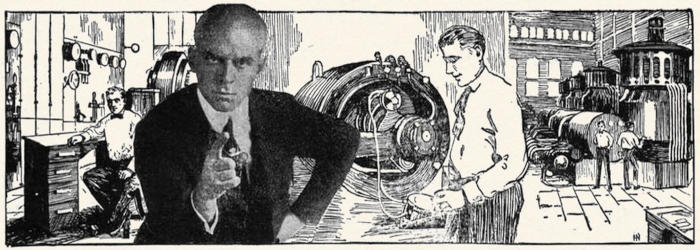
Electricity Needs You
I WILL TRAIN YOU AT HOME
Stop right here. This is YOUR opportunity! Electricity is calling you, and the Electrical
Business is in for a tremendous increase. But it needs more trained men—at big pay. By
my Home Study Course in Practical Electricity I can train you for these positions.
Earn $70 to $200 a Week
You’ve always had a liking for Electricity and a hankering to do electrical jobs.
Now is the time to develop that talent; there’s big money in it. Even if you
don’t know anything at all about Electricity you can quickly grasp it by my
up-to-date, practical method of teaching. You will find it intensely interesting
and highly profitable. I’ve trained and started hundreds of men in the
Electrical Business, men who have made big successes. YOU CAN ALSO
Be a Big Paid
ELECTRICAL EXPERT
What are you doing to prepare yourself for a real success? At the rate you are
going where will you be in ten years from now? Have you the specialized training
that will put you on the road to success? Have you ambition enough to
prepare for success, and get it?
You have the ambition and I will give you the training, so get busy. I am
offering you success and all that goes with it. Will you take it? I’ll make
you an ELECTRICAL EXPERT. I will train you as you should be trained.
I will give you the benefit of my advice and 20 years of engineering experience
and help you in every way to the biggest, possible success.
Valuable Book Free
My book,
“How to
Become an Electrical Expert,” has started many a
man on the way to fortune. I will send a
copy, free and prepaid, to every person answering
this advertisement.
Act Now!
Good intentions never
get you anywhere.
It is action, alone, that counts. NOW IS
THE TIME TO ACT.
L. L. COOKE, Chief Engineer
CHICAGO
ENGINEERING
WORKS 2150 LAWRENCE AVENUE
Dept. 43-b, Chicago, U. S. A.
FREE!
BIG
ELECTRICAL
OUTFIT
A fine outfit of Electrical
Tools, Instruments, Materials,
etc., absolutely FREE to
every student. I will also send
you FREE and fully prepaid—Proof
Lessons to show you
how easily you can learn
Electricity and enter this
splendid profession by my
new, revised and original system
of Training by Mail.
RADIO
COURSE
FREE
Special newly-written wireless
course worth $45.00 given
away free. Full particulars
when you mail coupon below.
Earn Money
While Learning
I give you something you can
use now. Early in my Home
Study Course I show you
how to begin making money
in Electricity, and help you
get started. No need to wait
until the whole course is completed.
Hundreds of students
have made several times the
cost of their course in spare
time work while learning.
CHIEF ENGINEER COOKE
Chicago Engineering Works
Dept. 43-b. 2150 Lawrence Av.
CHICAGO, ILL.
Dear Sir: You may send me
entirely free and fully prepaid, a
copy of your book, “How to Become
an Electrical Expert,” and particulars
about your Home Study Course
in Electricity,
Name
Address
City
State
THE UNIQUE MAGAZINE
EDWIN BAIRD, Editor
Published monthly by THE RURAL PUBLISHING CORPORATION, 325
N. Capitol Ave., Indianapolis, Ind. Application made for entry as second-class
matter at the postoffice at Indianapolis, Indiana. Single copies, 25 cents.
Subscription, $3.00 a year in the United States; $3.50 in Canada. The publishers
are not responsible for manuscripts lost in transit. Address all manuscripts
and other editorial matters to WEIRD TALES, 354 N. Clark St., Chicago,
Ill. The contents of this magazine are fully protected by copyright and publishers
are cautioned against using the same, either wholly or in part.
Copyright, 1923, by The Rural Publishing Corporation.
VOLUME 1 25 Cents NUMBER 2
SIXTEEN THRILLING SHORT STORIES
TWO COMPLETE NOVELETTES
TWO TWO-PART STORIES
INTERESTING, ODD AND WEIRD HAPPENINGS
YOUNG & WARD, 168 N. Michigan Boulevard, Chicago,
Advertising Agents for WEIRD TALES
FREE
$80 Drafting Course
There is such an urgent demand for practical, trained
Draftsman that I am making this special offer in order to enable deserving,
ambitious and bright men to get into this line of work. I will teach you
to become a Draftsmen and Designer, until you are drawing a salary up
to $250.00 a month. You need not pay me for my personal instruction
or for the complete set of instruments.
To every person of 16 years or older sending a sketch I am going to mail free and
prepaid the Draftsman’s Ivorine Pocket rule shown here. This will come entirely
with my compliments. With it I will send a 6x9 book on “Successful Draftsmanship.”
If you are interested in becoming a draftsman, if you think you have or may attain
drafting ability, sit down and copy this drawing, mailing it to me today, writing
your name, and your address and your age plainly on the sheet of paper containing
the drawing. There are no conditions requiring you to buy anything.
You are under no obligation in sending in your sketch. What I want to know
is how much you are interested in drawing and your sketch will tell me that.
Positions Paying Up to
$250 and $300 per Month
I am Chief Draftsman of the Engineers’ Equipment Co.
and I know that there are thousands of ambitious men
who would like to better themselves, make more money
and secure faster advancement. Positions paying up to
$250 and $300 per month, which ought to be filled by
skilled draftsmen, are vacant. I want to find the men
who with practical training and personal assistance will
be qualified to fill these positions. No man can hope to
share in the great coming prosperity in manufacturing
and building unless he is properly trained and is able
to do first class practical work.
I know that this is the time to get ready. That is why I
am making the above offer. I can now take and train a
limited number of students personally and I will give
those students a guarantee to give them by mail
practical drawing room training until they are placed
in a permanent position with a salary up to $250 and
$300 per month. You should act promptly on this offer
because it is my belief that even though you start now
the great boom will be well on by the time you are
ready to accept a position as a skilled draftsman. So
write to me at once. Enclose sketch or not, as you
choose, but find out about the opportunities ahead of
you. Let me send you the book “Successful Draftsmanship”
telling how you may take advantage of these
opportunities by learning drafting at home.
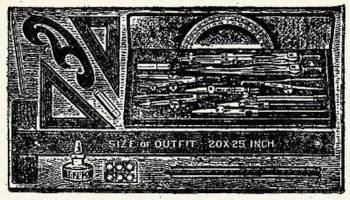
FREE this $25 Draftsman’s
Working Outfit
These are regular working instruments—the kind I use
myself. I give them free to you if you enroll at once.
Don’t delay. Send for full information today.
Mail Your Drawing at Once—and Get an Ivorine
Pocket Rule AbsolutelyFree!
Ambitious men interested in drafting hurry! Don’t
wait! This is your opportunity to get into this great
profession. Accept the offer which I am making now.
Send in your sketch or request for free book and free
Ivorine Pocket Rule,
Chief Draftsman, Engineers’ Equipment Co.,
1951 Lawrence Av.
Div. 13-94, Chicago
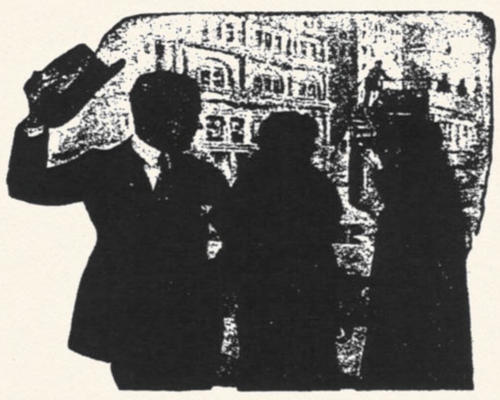
“Good-Bye—I’m
Very Glad to
Have Met You”
But he isn’t glad. He is smiling
to hide his confusion. He would
have given anything to avoid the
embarrassment, the discomfort he
has just experienced. Every day
people who are not used to good
society make the mistake that he
is making. Do you know what it
is? Can you point it out?
He couldn’t know, of course, that he was going
to meet his sister’s best chum—and that she
was going to introduce him to one of the
most charming young women he had ever seen.
If he had known, he could have been prepared.
Instead of being ill at ease and embarrassed, he
could have been entirely calm and well poised.
Instead of blustering and blundering for all the
world as though he had never spoken to a woman
before, he could have had a delightful little chat.
And now, while they are turning to go, he realizes
what a clumsy boor he must seem to be—how
ill-bred they must think him. How annoying
these little unexpected problems can be! How
aggravating to be taken off one’s guard! It must
be a wonderful feeling to know exactly what to
do and say at all times, under all circumstances.
“Goodbye, I’m very glad to have met you.” he
says in an effort to cover up his other blunders.
Another blunder, though he doesn’t realize it!
Any well-bred person knows that he made a mistake,
that he committed a social error. It is just
such little blunders as these that rob us of our
poise and dignity—and at moments when we need
this poise and dignity more than ever.
What Was His Blunder?
Do you know what his blunder was? Do you
know why it was incorrect for him to say “Goodbye,
I’m very glad to have met you”?
What would you say if you had been introduced
to a woman and were leaving her? What
would you do if you encountered her again the
next day? Would you offer your hand in greeting,
or would you wait until she gave the first
sign of recognition?
Are You Sure of Yourself?
If you received an invitation to a very important
formal function today, what would you do?
Would you sit right down and acknowledge it
with thanks or regrets, or would you wait a few
days? Would you know exactly what is correct
to wear to a formal evening function? Would
you be absolutely sure of avoiding embarrassment
in the dining-room, the drawing-room, when arriving
and when leaving?
Everyone knows that good manners make
“good mixers.” If you always know the right
thing to do and say, no social door will be barred
to you, you will never feel out of place no matter
where or with whom you happen to be.
Do you feel “alone” at a social gathering, or
do you know how to make yourself an integral
part of the function—how to create conversation
and keep it flowing smoothly, how to make and
acknowledge introductions, how to ask for a
dance if you are a man, how to accept it if you
are a woman?
Famous Book of Etiquette in Two Volumes,
Sent Free for Five Days’
Examination
Here is your opportunity to read, study and
examine the complete, two-volume set of the
Book of Etiquette absolutely without cost. For 5
days you may keep the set and examine it at our
expense. Read the chapter on wedding etiquette,
on the bride’s trousseau, on speech, on dancing.
Don’t miss the chapter called “Games and
Sports” and be sure to read about the origin of
our social customs—why rice is thrown after the
bride, why black is the color of mourning, why
a tea-cup is given to the engaged girl.
You be the judge. If you are not thoroughly
delighted with the Book of Etiquette, if you do
now feel that a set should be in your home—in
every home—just return it to us and the examination
will not have cost you anything. But if
you are delighted, as we know you will be, just
send us $3.50 in full payment—and the books
are yours.
Surely you are not going to miss this opportunity
to examine the Book of Etiquette free?
We know you are going to clip and mail the
coupon at once.
NELSON DOUBLEDAY, Inc.
Dept. 1504 Garden City, New York
FREE EXAMINATION COUPON
NELSON DOUBLEDAY, Inc.,
Dept. 1504, Garden City, New York.
Without money in advance, or obligation on
my part, send me the Two-Volume set of the
Book of Etiquette. Within 5 days I will either
return the books or send you $3.50 in full payment.
It is understood that I am not obligated
to keep the books if I am not delighted with
them.
Name
(Please write plainly)
Address
□ Check this square if you want these books
with the beautiful full-leather binding at $5.00
with 5 days’ examination privilege.
Orders outside U. S. are payable $3.50 cash
with order.
What Every Criminal Fears
It’s easy enough to make a “getaway”—But
What will he leave behind him?
What will tell the police he has been there?
Just one tiny finger print—and his game is up!
He might as well leave his name, address and
photograph as leave a finger print at the scene
of the crime.
He can change his name, he can change his
appearance, but he can’t fool the finger print
expert. The tiny patterns on the tips of his
fingers are just the same now as on the day he
was born. They cannot be changed. There are
no other prints like his in the world.
That is why finger print identification has become
one of the most important phases of detective
work. That is why its uses are being increased
every day. That is why ambitious men looking
for jobs that offer real opportunity prepare themselves
to take up this fascinating work.
There are more jobs now than trained men to fill
them. And with the rapid growth of this science,
new positions and offices are being created every
day.
Be a Finger Print Expert
Learn at Home—30 Minutes a Day
30 minutes a day for a short time. That’s all that is necessary. You need not give up your present
occupation while studying this fascinating profession. I am a finger print expert myself and I give
you just the kind of training that prepares you to be a finger print expert—that assures you of a
position. The finger print expert is always in demand. More men are needed right now. Get into
this big paying profession.
FREE
FINGER PRINT OUTFIT
To those who enroll right now I am going to give
absolutely free a professional finger-print outfit—the
kind that is used by all finger-print experts.
Besides, a valuable course in Secret Service intelligence
is given Free to all my students. This information
in itself is worth many times the cost
of the complete course. But you get it Free.
WRITE
Write to me today. I will send you full information
about this fascinating big-paying profession.
30 minutes a day is all the time necessary
to master this profession. You get free the finger-print
outfit—Secret Service course is also free
and you are guaranteed a position as soon as
you have finished this course. Send in the coupon.
Hurry.
U. S. SCHOOL OF FINGER PRINTS
7003 No. Clark St. Dept. 13-94 Chicago, Ill.
Positions Guaranteed
In what other line of work can you always be
assured of a position? Here is my offer to
you. I GUARANTEE YOU A POSITION. As
soon as you have finished my course you have
a position waiting for you. Get started right
now. Send in the coupon today.
U. S. SCHOOL OF FINGER PRINTS,
Dept. 13-94, 7003 No. Clark St., Chicago, Ill.
Without any obligations whatsoever please send
me full information about your “Guaranteed
Position Offer—Free Finger Print Outfit.” Also
tell me how I can become a Finger Print Expert.
Name
Age
Address
City
State
THE SCAR — II — III — IV — V — VI
A Thrilling Novelette
By CARL RAMUS, M. D.
“Thanks for the lift, Edwards.
Come in for a minute, won’t you?”
“No. I was up nearly
all last night, and must get some
sleep.”
“To be sure! But you’ve time for
a nip before you go.”
“Well—since you put it that way,
and in these arid times——”
“Good! Come along.”
Dr. Herbert Carlson opened the
door of his office on the first floor
with his latch key, snapped on the
lights, and entered with his colleague,
Dr. Clark Edwards. Carlson hung
up his overcoat and hat, and Edwards
threw his own over a chair,
and then Carlson produced from an
inner room a bottle, two glasses, and
a siphon of carbonic.
“Like the good old days,” smiled
Edwards, sipping his glass. “How
do you get it?”
“A voluntary donation from a
grateful patient, a second steward on
board the—but that would be telling.”
Edwards took another sip. “I wish
I had one or two patients like that!”
“You’re not likely to get them as
long as you stick to your specialty.”
“I suppose not—Hello! What’s
all that shouting for?”
Both men listened. Newsboys
were yelling an “Extra.” Carlson
opened a window, leaned far out, and
drew up a paper.
“Just another bank robbery.
They’re so common now as to be
hardly worth mentioning.”
“Exactly. Anything new in the
Holden case?”
“Let’s see.... O yes! Here it
is: ‘Father of Ina Holden gets another
threatening letter.’”
Edwards’ jaw set. “If I had my
way,” he said, “every kidnapper
would go to the chair!”
“I’ll go you one better. If I had
my way, they’d get the Georgia
treatment!”
“What’s that?”
“Lynching!”
Edwards was silent.
“The trouble is,” Carlson went on,
“that we have too much legal red
tape, too much politics, too many lawyers,
and too little real law.”
“I suppose so,” said Edwards.
“When we haven’t children of our
own, it takes some special circumstance
to bring home to us the meaning
of a damnable crime like kidnapping.
This Holden case brings it
home to me.”
“Indeed!”
“Very much so. It has to do with
an unusual surgical case, which I believe
was reported in the International
Journal of Surgery or The London
Lancet by Professor Meyerovitch.”
“I don’t remember reading it.
Please tell me about it.”
“I will. It was when I was house
surgeon at the Presbyterian Hospital
in Chicago. One night a child of
seven was brought in with all the signs
of fulminating appendicitis. That
child was Ina Holden.”
“Ah!”
“It was a private case of old Meyerovitch’s,
and he decided on immediate
operation. Now Meyerovitch
was one of the few really good surgeons
who wouldn’t use either the
McBurney or Kamerer incision for
appendicitis. He just cut down over
the trouble and through everything
in one line.”
“Fool!”
“Most of us thought so then, but
somehow Meyerovitch always got
good results—always.”
“Pure accident.”
“Perhaps so. But, anyhow, when
little Ina was under the anaesthetic,
and Meyerovitch had his knife in one
hand—his left, by the way—and was
testing the tension of the abdomen
with the other hand, he said, ‘I will
need plenty of room here.’ And then
he surprised us all by making a
reversed Senn incision.”
“I don’t seem to remember that incision,”
said Carlson, after a slight
pause. “What is it?”
“An S-shaped incision devised by
Nicholas Senn when he was Professor
of Surgery at Rush Medical College.
You young fellows in New York don’t
as a rule know about that incision.”
“But, Edwards, as I remember,
Senn recommended the McBurney
method in his book.”
“Yes, for appendicitis. He only
used the S in neck operations. And
so when Meyerovitch used it on Ina
Holden, it was the first time on
record for appendicitis, and probably
the last.”
“Most likely. And how did the
case get along?”
“Better than any of us expected.
It was a drainage case, of course, and
took some time to dry up. But the
wound finally healed perfectly, with
no suggestion of weakness, and left a
large scar like a reversed S.”
“Meyerovitch’s bull luck.”
“Yes. I saw the child every day
for more than a month and got much
attached to her. She wouldn’t let
anyone else dress the wound, and
after she went home, the family often
invited me to the house.”
“They’re very rich, aren’t they?”
“They are, now, but they weren’t
then. Mr. Holden owned some manganese
land in California, and when
the Western Pacific laid its tracks over
a corner of his property, he was a
rich man.”
The colleagues silently finished
their illegal glasses. Then Edwards
looked at his watch and rose from his
chair.
“Good night, Herbert, and many
thanks for the drink.”
Carlson, alone, looked at a memorandum
that his sister had left on his
desk.
“Nothing more for tonight, thank
God,” he thought with relief.
He closed and fastened the windows,
bolted the door, and was passing
into his bedroom, when the telephone
rang.
“Damn! Why didn’t I muffle it?”
He put the receiver to his ear.
“Well?” he said abruptly.
“Doctor Carlson speaking?”
“Yes.”
“Can you come at once to a very
sick case?”
“I’m sorry, but I can’t. My car is
out of order, and I’m not very well
myself tonight.”
“But this case is extremely urgent,
sir, and we don’t want anyone else
but you.”
“Thank you, but——”
“Please listen, Doctor. I’ll have a
car for you in five minutes, and take
you home afterwards, if you’ll only
come.”
“Try another doctor first.”
“We have tried, but can’t find one
of the only other two we have confidence
in. Money is no object.
Please do reconsider, Doctor.”
“Who recommended me to you?
Do I know you?”
“I do not know you personally.
But you are highly recommended by
the Brooklyn Hospital. Once more
let me say that your fee can be as
large as you like.”
Carlson did not answer for a while.
“All right, I’ll go,” he said at last.
“What is it—a medical or surgical
case?”
After a short silence, the voice replied:
“Medical, I think. But you
had better come prepared to do whatever
is necessary.”
“Very well. I’ll be ready when
you call for me.”
Carlson placed his medical and
surgical bags on the table, put on his
overcoat and hat, and sat down to
wait.
In less than five minutes he heard
the honk-honk of an automobile under
the window, and he picked up his
two bags, snapped off the lights, and
went down to the waiting car, a large
limousine.
As Carlson emerged from the
house, the chauffeur got out of his seat
and opened the car door. He wore
a wide slouch hat, the brim of which
hung down and so shaded his face
from the corner electric light that
Carlson could not make out his features.
All he was sure of was a long
heavy moustache. The lower part of
the man’s face was concealed in a
muffler. He opened the door and
stood as if at attention.
When Carlson was inside with his
bags the man closed the door silently,
got into the driver’s seat, and the car
was soon rushing up the street. It
turned at the second corner, and after
that made so many sharp turns
among small and narrow and dark
streets that Carlson began to feel uncomfortable.
At last they came to a long stretch
of vacant lots, and went faster for
half a minute or so, and then slowed
down again. The chauffeur sounded
three honks—one long and two short.
Carlson bent forward and peered
ahead, but could see nothing.
He did not like it at all, and he regretted
that he had not brought his
revolver. He was wondering what he
had got into, when, suddenly, the car
slowed down with a loud grinding of
the brakes, and stopped with a jerk
that threw Carlson violently forward.
A moment later both doors opened
together, and he realized that masked
men stood on either side of the car,
covering him with revolvers or magazine
pistols.
Then came a few moments of the
most eloquent silence that Carlson
had ever experienced. He said nothing
and waited.
“Don’t be afraid, Doc,” said a
thick voice, obviously disguised.
“Just do as you are told and you’ll
be O. K. But if you try any stunts—T.
N. T. for you. Do you get me?”
“Yes. What do you want me to
do?”
“You’ll be told later. My partner’ll
sit by you now, and I’ll sit facing
you. So——”
They got inside and shut the doors,
and the car started forward at high
speed.
“Sorry, Doc, but we’ll have to
blindfold you,” said the masked man.
And then a heavy muffler was
wound about his face.
As the car rushed on, Carlson sat
still with his captors in a kind of
stupefied silence. Only that morning
he had been wishing that his life was
more eventful, less commonplace.
Well, here was adventure with a
vengeance.
He was only twenty-seven and he
had been two years in the city. The
first year and a half had been slow
and discouraging, as often happens
with young doctors. But in the last
six months patients had begun to
come, in steadily increasing numbers,
until now he had about all he could
handle. He was five-feet-eleven, well-built
and athletic. He had clear hazel
eyes with a very direct look, and
thick and wavy brown hair, which
was much admired by his women patients.
All this, with good and strong
features and a pleasant expression,
made an ensemble which expressed
health, confidence and efficiency.
And now what was he in for? It
was hardly reassuring, especially
when blindfolded, to know that at
least one gun was probably pointed
at him all the time, and that any involuntary
move of his might bring a
bullet into his brain.
Yet, for all that, he did not feel
exactly fear; it was more like strained
interest, a burning curiosity to
know where the adventure was to
lead.
For a long time—or so it seemed—the
car sped on what might have been
an isolated suburban road. Occasionally
another car passed, going in
the opposite direction, but otherwise
there were no other sounds than the
rolling of the limousine.
At last they slowed down and turned
off to the right, and from then on,
for perhaps five minutes, the car
went slowly over rough ground, turning
so frequently that Carlson lost all
idea of direction.
Presently they were on a good road
again, and once more traveled very
fast. More and more automobiles
passed them, and they went slower
and slower, until Carlson knew they
were in a town again. Once they had
to stop for a minute or two, as it
seemed, at a crossing, and he distinctly
heard a policeman’s voice allowing
them to make a turn to the left on a
side street. After that interruption
they moved for the most part rapidly
for another five minutes or so, making
several turns and passing many
machines, until they slowed down and
came to a full stop.
Carlson could hear people passing
to and fro on the sidewalk, talking
and laughing. He sat still, careful
not to make any movement that might
alarm his captors, feeling that their
weapons were leveled at him.
When at last the voices and footsteps
had become almost inaudible,
the voice spoke again.
“Now, Doc—no fooling.”
He put his own slouch hat on Carlson’s
head and drew the brim far
down over his face. Then he opened
the door toward the curb stone and
got out.
“Come along, Doc, give me your
hand.”
Carlson took the hand and got out
of the car. The man put his hand
within his arm and drew him across
the sidewalk. Carlson heard the other
man open an iron gate, and close
it again after they had passed
through. A few steps more, and another
stop.
He heard a key turning in a lock,
and a door open, and he was led into
a warm room. The door clicked after
them. A woman’s harsh voice impatiently
exclaimed:
“I thought you’d never come.”
“Shut up!” said Carlson’s guide.
“Here’s the Doctor. Take him upstairs.
Step lively, will you! Keep
right hold of my arm, Doc.”
Carlson counted three flights of
stairs, then he heard a key turned
just beyond the head of the stairway,
and he was led into a room.
“Shut the door!”
It was done.
“Now take off the blinder!”
Carlson’s eyes blinked as the muffler
was removed. But as soon as his
eyes got accustomed to the light, he
realized that the room was only dimly
lighted.
Two men and one woman, all
masked, stood nearby. One of the
men had come with him in the car.
The other was a huge man, a giant.
The woman was short and rather
scrawny-looking, to judge from her
hands and neck.
“Now, Doc, a word with you
alone,” said one of the men. “Come
here!”
He stepped into a small dressing
room and Carlson followed.
“Shut the door!”
Carlson obeyed.
“Now, here’s the proposition.
We’ve got a sick woman on our hands—damned
sick! But she’s got in
trouble with the law and the police
are after her. Get me?”
“Yes. Go on.”
“Well, that’s why she dasn’t go
to a hospital, and that’s why we had
to get you. Get me?”
“Go on.”
“Very good! Now your job is just
this: Look at her and find out what
in Hell is the matter with her, and
write out a prescription—No! That
won’t do, either. Somebody might
get on to it. You’ve got your medicines
with you, have you?”
“I have some medicines in my
bag.”
“Good! You’ll give me the dope
she needs, and then get out and away
from here as fast as you can and
keep your mouth shut. You’ll be
taken home safe, and you’ll get your
money all right. Do you get me?”
“I understand.”
“Good! Just one other thing. You
can’t see her face, and there can’t be
any talking, not one word. You understand?”
Carlson felt that the time had come
for him to say something, and he said
it:
“You damned fool! What kind of
an examination do you think a doctor
can make if he can’t see his patient
or hear her talk? Have you never
been to a doctor yourself?”
The man hesitated, fingering his
automatic.
“Open that door!” he commanded,
after a pause. Carlson did as he was
told.
“Teresa!”
She appeared so quickly that Carlson
was sure that she had been
listening behind the door.
“The doctor will have to ask her a
few questions, and she will have to
answer. Go and tell her. And tell
her from me—that if she says anything
she doesn’t have to say—T. N.
T. for her! Do you get me?”
“All right, Boss, I’ll tell her.”
She spoke with a cruel chuckle that
all but made Carlson shudder. While
he waited for further orders from his
captor, he tried to get a line on the
mystery he was involved in. But
nothing came to him. Was the sick
woman he was about to visit a fugitive
or a captive? Probably the latter; and
if so, why?
He furtively inspected the dressing-room
and its contents. It was richly
and beautifully furnished—like the
large bedroom it adjoined, as far as
his very brief glance had discovered.
It was on a corner and had two windows,
with curtains tightly drawn. At
the end, farthest from the door of entrance,
was another door, standing
half open and showing a glimpse of a
lavatory and bathtub. Nothing hopeful
thus far.
Then he noticed a small black box
on the wall nearest the corner, with a
green cord leading from it and disappearing
behind a screen. Not until
his anxious glance had shifted elsewhere
did Carlson realize the possible
significance of that green cord. Surely,
what else could it mean but a telephone
behind that screen! A telephone.
The masked woman suddenly appeared
at the door.
“She’s ready for the doctor,” she
snapped out viciously.
Carlson looked at his masked companion
for orders.
“Go with her,” he said. “And
don’t ask her no questions that are
none of your damned business! If
you do, you’ll go out of this house in
two or three suit cases! Get me?”
Carlson did not answer, and followed
the woman to a darkened bedside.
The man also followed, and
stood at the foot of the bed.
In the dim light of a shaded table-lamp
Carlson saw a large double
bed of massive and antique construction.
At the head was a high and projecting
portion of carved woodwork
which overhung like a canopy. On the
bed he saw the outline of a human
body through the coverings.
The head showed a mass of thick
dark-brown hair, unbound and falling
about the shoulders. The upper part
of the face was hidden by a wide
bandage wound several times around
the head. The arms were bare and
lay outside the coverlet. They were
well rounded, and the hands were
small and beautiful.
Carlson stood silently beside the bed
at first, watching the patient’s deep
and rapid breathing, and assembling
his professional manner. The hand
nearest him was trembling slightly.
As he took it up, to feel the pulse, the
arm jerked and the whole body shook,
as if under profound nervous tension.
A thrill of compassion and pity ran
through him as he held the trembling
little hand.
“Don’t be afraid, Madam,” he said
rather huskily. “I’m the doctor. I
want to feel your pulse.”
Instantly the trembling stopped and
her fingers tightened about his. He
noted the pulse rate with his other
hand, and found it rapid, about 120.
The hand and wrist were burning hot.
He let go of the hand and took a
thermometer from his vest pocket.
After shaking it down several times
he placed it in her mouth and closed
her lips with his fingers, saying:
“Hold it that way for five minutes,
please.”
Again he took her hand, pretending
to count the pulse beats by his wrist
watch, but in reality thinking as hard
as he could. The thermometer was
actually a one-minute thermometer,
but he wished to gain as much time
as possible. When at last he took it
from her mouth and held it to the
light it registered 105. Involuntarily
he whistled. Here was a very sick
woman, indeed!
“How long have you been sick?”
“Three days.” The voice was soft,
but deep and sweet.
“Is your throat sore?”
“No.”
“Do you cough?”
“No.”
“Have you pain anywhere?”
“I hardly know. I feel sick all
over.”
Carlson thought for a minute. Three
days sick, and now a temperature of
105! About time for a skin eruption
to begin to show, if it was one of
those diseases. He turned to the
masked virago who stood beside him.
“I must have more light,” he said
abruptly.
The woman hesitated and looked
toward the man.
“What about it?” she jerked out.
“What’s the matter with this light?”
the man snapped angrily.
“Just that it isn’t enough for me,
that’s all! She may have typhus or
smallpox—”
“Hell!” The man jumped backward
so quickly that he upset a small
table and chair.
“Damn her!” screamed the woman,
retreating to the wall.
Carlson, being a doctor and often
in contact with contagious and loathsome
diseases, had not counted on the
terrifying effect of the word “smallpox”
on the criminals he was for the
moment associated with. But he instantly
realized the advantage it gave
him, and decided to capitalize it to
the limit in the mysterious woman’s
interests.
After a short but tense silence he
said impressively:
“Yes, it may be smallpox. But I
cannot say for certain in this light.”
The masked man waited a few uneasy
seconds, then went to the chandelier
and raised a hand to the light
key.
“Teresa. See that the bandage is
tight over her face before I turn on
more light.” His voice was surly.
“I won’t touch her again if she has
smallpox!” Teresa’s strident voice
shook.
“Yes, you will, or I’ll brain you.”
He took a step toward her.
The woman muttered, but obeyed,
though her hands shook as she fumbled
with the bandage. Crossing herself,
she said with shaking voice:
“All safe,” and stepped back
again to the wall. The light was
turned on, and Carlson bent down to
look more closely at his mysterious
patient.
A deep, feverish flush was over the
arms, neck and the strip of forehead
above the bandage. But Carlson’s
trained fingers could not feel even a
suggestion of the “shotty” feeling
which goes with the first rash of
smallpox.
“What do you make of it, Doc?”
asked the man impatiently.
“Highly suspicious, but I cannot
tell certainly until I have finished my
examination. Madam, may I listen to
your lungs and heart with my stethoscope?”
“Yes,” she faintly murmured.
Carlson looked around at the man.
“I am not in the habit of examining
women in the presence of strange
men,” he said sharply.
The man mumbled a curse and
turned his back. Carlson then looked
at the masked woman.
“Turn down the bedclothes and open
her nightgown!”
“Do it yourself! I won’t touch her
again!”
Carlson took his stethoscope from
his pocket and bared the patient’s
chest. The nightgown was coarse and
cheap, but the form within it was
rounded and beautiful. The sleeves
of the garment had apparently been
roughly hacked off with scissors.
Carlson’s examination of lungs and
heart found absolutely nothing to account
for the very high fever. Then
he thought of appendicitis or peritonitis.
“Now, please let me examine the
abdomen for a moment.”
She lay still while he delicately arranged
the clothing. The light from
the chandelier showed obliquely, so
that the lower part of the abdomen
was in the shadow cast by the rolled-down
bedclothes. Carlson felt and
carefully sounded, but she gave no
sign of pain or involuntary resistance.
As his sensitive fingers passed over
the place under which the appendix
is located, he felt something that
broke the smoothness of the perfect
skin. It was a surgical scar. That
fact alone should almost certainly
rule out a present attack of appendicitis!
“So you have had appendicitis?”
“Yes.”
“It must have been a bad case—to
judge from the size of the scar.”
She did not answer, and he drew
the covering a little lower and
brought the scar out of the shadow into
full view. Then he started, and,
involuntarily, a gasp escaped him.
The large surgical scar was in the
form of a perfect reversed letter S.
So much had happened to Carlson
that night that his mental receiving
instrument was somewhat
dulled, and did not immediately register
the momentous significance of
what his eyes now saw. That curious
scar—that reversed S—symbol of the
great Senn. Great God! Now he remembered.
The only case on record
in which that Senn S-incision had
been made for appendicitis was the
case of Ina Holden.
He heard the masked man muttering
in angry impatience, and then his
brain began to work again. The
Holden child. Edwards had spoken
of her as “little Ina.”
Though the papers had been full
of accounts of the Holden kidnapping
case for the last five days, he, Carlson,
had read nothing but the headings,
and his impression from them
and from Edwards’ talk was that Ina
was a small girl, quite a child. And
yet this was a woman, or a well-grown
girl of 16 or 17 at the least.
He looked up at her bandaged face.
“How long ago did you have this
operation?”
“I—when I was a child.”
“How long ago was that?”
“About eight or nine years ago.”
“Ah——”
“You’re takin’ a hell of a long
time, doc. Has she got smallpox?”
The man still stood with his back to
the foot of the bed, but Carlson realized
that he could not temporize much
longer.
“Just about a minute more and I
can tell you,” he said, as nonchalantly
as he could say the words.
How could he get rid of the kidnappers
and telephone for the police?
Then came an idea—a wild, forlorn
hope; but he would try it.
“I will have to examine her
throat,” he said, with professional
voice.
He walked to the table where his
medical bags were and took out a circular
mirror with an aperture in the
center, a small electric bulb, and a
black elastic band with a buckle in it.
Next, he detached a connecting-plug
from a cell battery in the bottom of
the bag, being careful to conceal the
battery from the gimletlike eyes of
the two men and the woman. With
the plug hidden in his hand he
crushed the two contactors together.
Then he adjusted the elastic band
and mirror to his forehead, connected
the two wires with the small bulb on
the head mirror and deliberately unscrewed
the bulb from the table lamp.
He drew a deep breath; then quickly
inserted the crushed battery plug into
the lamp socket.
Flash! The room was in complete
darkness. Carlson had short-circuited
the current and fulminated the
fuse, probably for the whole house.
“Damn it!” he exclaimed, ostentatiously.
“What am I going to do
now?”
Almost instantly the beam of a
pocket flashlight came from the hand
of the “boss.”
“Take this, doc,” he said, holding
it toward Carlson.
He took it, asked the girl to open
her mouth, and looked within.
“No good at all. I must have the
electric light. Where is the fuse
box?”
The “boss” looked at Teresa.
“It’s in the cellar with the meter,”
she said.
“Go down and put in a new fuse.”
“I don’t know how. You’ll have
to come with me.”
The man hesitated. He glared at
Carlson through his mask, and at the
sick girl on the bed, and then at the
giant near the door.
“Tony!”
“Huh?”
“Come here!”
The giant slouched nearer.
“Where’s your flash-light?”
He produced it.
“Good! Now stay right here till
we come back. If the doctor tries to
leave this room, or if he talks to the
girl—you know what to do.”
Tony grunted, and showed a magazine
pistol in his other hand. The
other man and Teresa left the room.
The man slammed the door and locked
it on the outside.
Carlson felt almost overcome by a
feeling of powerlessness and despair.
He and the girl were alone with the
giant Tony, who sat stolidly by a table
in the center of the room, flash-light
in one hand, the automatic pistol
in the other. His narrow, piglike
eyes gleamed through the mask and
seemed never to relax their sinister
gaze.
Carlson’s plan was completely
frustrated by the baleful presence of
this Frankenstein Monster.
Suddenly he heard the blindfolded
girl give a sob, and he saw her shoulders
trembling. At the sound of that
despairing sob a new impulse to action
surged through him. Her only
hope lay in him. He would not fail
her. He would save her or die in the
trying.
He took her nearest and burning
hand in both of his.
“There, there. Everything will
be all right.”
As her fingers gripped his convulsively,
a horrible snarling sound,
as from an angry hippopotamus, came
from Tony. Carlson disengaged the
girl’s hand and faced the giant.
“Tony!” he said commandingly.
“Huh?”
“Help me to fix up this head light
of mine. Bend those points out
straight—so!”
Carlson had seen some remarkable
demonstrations in hypnotism in Zurich,
and he had been told by Professor
Jung that he had exceptional personal
power in that line, if he chose
to develop it. He remembered that
advice now, and he was trying it on
Tony.
The giant hesitated, but at last
obeyed the imperative and hypnotic
voice of the young doctor. He laid
the pistol and flash-light on the table,
but just within reach of his hand,
and then held out one hand for the
electric plug.
“There—twist them out again,
right there,” said Carlson in a slow,
monotonous voice. As he spoke, his
other hand closed over a heavy glass
paper weight that lay at the farther
end of the table. Tony put the plug
on the table and bent his face over
it.
Carlson felt that he could soon
have Tony completely under his own
hypnotic power. But time was too
precious to wait for that. The
“boss” might return any minute.
There was only one thing to do, and
Carlson did it.
He raised the paper weight slowly,
and just beyond Tony’s field of vision
and then—he brought it down on the
giant’s head with all the force he
could put into the blow.
Tony dropped the electric plug and
swayed to one side, only slightly stunned
by a blow that would have fractured
the skull of another man. But
before he could recover, Carlson dealt
him a second, and then a third blow,
the last on the angle of the jaw.
Tony crumpled up and fell face
downward across the table. But Carlson,
to make sure, gave him a final
and terrible blow, which seemed to
give back a crushing sound.
He rushed to the door and bolted
it; then back to the bedside.
“Are you Ina Holden?”
“Yes!”
“Then get out of bed instantly.
I’m going to save you.”
As she started up, he seized her in
his arms, lifted her out bodily, and
plumped her into the nearest upholstered
chair.
“Take off that bandage as quickly
as you can!”
He flew back to the huge bed and
began dragging it toward the door. It
was heavy as a safe, and incredibly
hard to move. Suddenly it became
easier, and to his amazement he saw
that the girl was helping him. When
they had placed it so that the head
completely blocked the door, Carlson
ran to Tony.
“Help me drag this carcass against
the foot of the bed. Take the feet—so!
That will brace the bed better.
Now take this pistol. You know how
to use it?”
“O, yes!”
“Fine! Watch that beast while I
telephone the police. If he moves,
shoot him.”
Carlson rushed into the smaller
room, kicking two small chairs out of
his way and looked behind the screen.
Praise be to God! It was a telephone.
He jerked the receiver to his ear and
began jiggling the instrument frantically.
After a few interminable seconds
came the blessed words:
“Number, please?”
“Listen, operator—this is a case of
life and death. First take down this
number—Cartwright 872.... Yes....
No! No!!—for God’s sake
don’t call it. This is it. Now listen.
Have you got this number written
down?”
“Yes, sir, but—”
“Listen, I tell you!”
“I am listening!”
“Ina Holden is a prisoner in this
house, with telephone Cartwright 872.
Do you know who Ina Holden is?”
“You mean the kidnapped girl?”
“Yes. Now get me police headquarters
at once. Then, while I am
talking with them, you look up Cartwright
872 and phone the police station
nearest this place. Quick, for
God’s sake!”
Another agonizing wait; then—
“Police headquarters speaking.”
“Ina Holden is in a house with
phone number Cartwright 872. Mark
it down.”
He heard the voice of the officer
dictating “Cartwright 872. Ina Holden.”
Then, “What else, sir?”
“There are at least four armed men
in the house, and one woman.”
“Where is the house?”
“I don’t know. I’m a prisoner
with her myself. Send enough men
at once to surround the house. Look
it up in the numerical index.”
Carlson could hear the officer giving
rapid orders, and, more faintly,
their repetition being shouted out
through the station.
“All right, sir. We’ve located the
house, and it will take us about
twenty minutes to get to you. I’m
sending out a general alarm, and
maybe some of our men out there can
arrive sooner. How are you fixed?”
“I knocked out one of the men. I
and the girl are barricaded in a third
floor back room, and we’ll try to hold
out until your men come.”
“Good! Stay at the ’phone as long
as you can and keep me informed to
the last possible moment. Good luck
to you!”
“I’ll put the girl at the ’phone,
and stand guard myself. Ina!”
“Yes, doctor.” She came in quickly,
the pistol in her hand.
“Please sit down here and hold the
’phone. The police are on the wire.
I’ll call out to you how things go, and
you report to them. Has Tony
moved?”
“No. He doesn’t seem to breathe.”
Carlson left Ina at the ’phone and
went to Tony. He lay absolutely
still, just as they had placed him at
the foot of the bed. Carlson tore off
the mask and turned the face around
and listened with his ear to the
month. Not a sound! Then he used
his stethoscope over the heart. Silence!
Tony was dead!
Carlson picked up Tony’s automatic,
turned off the light plug in
the large bed room, and went back to
Ina. She was at her post, her elbows
on the little table, the receiver at her
ear. She looked up at him with a
grave smile.
“The police have been asking me a
lot of questions. How about the man
in the next room?”
“Dead. I’m sorry I killed him, but
there was nothing else to do. Anyway,”
said Carlson, “it makes our
work easier. We won’t have to watch
him, and his body will help hold the
door a little longer.”
He looked quickly around the room.
“And now for our plan of defense
until the police come. The
barricade in the bedroom may hold
till then. But, if it doesn’t then we
will have to barricade ourselves again
in here. We ought to be able to hold
out easily.”
And then Carlson began dragging
furniture from the bedroom into the
dressing room until the latter was
nearly full.
“I guess that’ll be enough,” he
said. “They’re taking a long time fixing
that fuse, but they can’t be too
long for us.” He stood beside Ina
once more, having done all that could
be done for the present.
“Yes,” she said slowly, “and their
bungling delay probably means our
salvation. Anyhow, there’s nothing
for it but to wait—for what is to
come.”
Carlson had been looking at Ina
Holden while they were talking, and
he thought he had never seen a more
charming girl. Her thick dark hair
was unloosed and uncombed and fell
over her shoulders. She was clad only
in the coarse, sleeveless, night garment,
which showed beautifully
rounded arms to the shoulders. Her
feet were bare. Her eyes were a pure
and brilliant blue, shining under
heavy but well arched brows. Her
features were almost faultless, but the
strong jaw and firm though adorable
lips expressed unusual force and will
power for a woman. A woman worth
going through hell for—Carlson
thought grimly.
Her face, neck and arms were
deeply suffused as with the flush of
high fever. But her manner and
movements were not those of a very
sick person. Carlson was puzzled.
“I confess I don’t know what to
make of your fever,” he said frankly.
She half smiled as she replied:
“Of course. I should have thought
of that before. It isn’t a real fever,
but what the Italians call an impressione.”
“What’s that?”
“An effect of a shock.”
“But no mere shock can cause actual
fever!”
“That’s what many doctors have
said. But the fact is that it does
with me. I was always that way.
There’s something abnormal in my
constitution. I can even bring on a
fever by willing it. I’m ashamed to
say that when I was a child I would
sometimes play sick in that way in
order to get what I wanted. But I
hadn’t done it for so long that I’d
almost forgotten about it—until this
horrible thing happened, and then I
remembered and tried it. But they
wouldn’t call a doctor for three days,
not until they got badly scared and
thought I might die on their hands.
And that is why they brought you
here.”
“I never heard of such a case before,”
said Carlson. “Never! To be
sure, there are a few cases on record
where the heart and pulse rate were
under the control of the will to some
extent; but certainly not the temperature.”
He then asked: “How does it happen
that the kidnappers have a house
like this?”
“This house belongs to a wealthy
family named Carriello. They are
traveling in Europe, and have left
the house in charge of an Italian and
his wife.”
“The woman Teresa?”
“Yes. The two are black-handers,
and their gang figured that the police
would never suspect that I might be
hidden in such a place.”
Suddenly the lights flashed out. The
fuse was repaired at last. The kidnappers
would be at the door in a few
moments!
Carlson gripped Tony’s automatic
a little harder, and his left hand fell
almost involuntarily on the girl’s
shoulder. They waited thus, tensely,
hardly breathing, and with quickened
heart-beats, until they heard footsteps
hurrying up the stairs. Then Carlson
drew a deep breath, and whispered:
“They are coming now—but don’t
be afraid.”
She said nothing, but raised both
her hands and clasped them over his
for a moment.
He stepped softly into the darkened
bedroom, just as a key turned in
the lock. The knob was turned, the
door tried—then shaken. There was
a short silence. Then, from the
“boss:”
“Open the door, you fool!”
Carlson was silent.
“Tony!”
Silence.
“Tony! What the hell’s the matter
with you?”
Silence.
A whispered consultation outside
the door. Then:
“Tony! Doctor! Open that door
or, by God! I’ll——”
More whispering, then a short
silence.
“Doctor!”
Silence.
Whispering again; then footsteps
running down the stairs; then another
and longer silence. Carlson put his
ear as near as he could to the door.
Soon he heard the footsteps returning,
but they stopped at the second
floor. A voice called faintly from
below:
“I can’t find anything but a
hatchet.”
Smothered cursing told that the
“boss” was still on the other side of
the door. Then he also seemed to run
down stairs. Presently Carlson heard
hammering or pounding, far below,
and at last a crushing and crumbling
sound, as if something heavy had
given way. What were the scoundrels
doing?
Then footsteps again, coming up
the stairs, but more slowly this time.
And as they came, there was an occasional
bumping sound, as if they
were carrying some bulky object
which now and then struck the walls
or stairs.
When they were opposite the door,
something heavy hit the floor. Then,
once more, the sullen voice of the
“boss.”
“Listen, Doc! I don’t know what
you’ve done to Tony, and what’s more
I don’t give a damn, if you open the
door now.”
Silence. Carlson thought he could
hear their heavy breathing. As a
psychologist he knew that his own
silence, and that of Tony, had a horror
about it that was telling severely,
even on their hardened nerves.
“This is your last chance, Doc! If
you open the door now, you can go,
and take your fee, and be damned.
But if you won’t open, I’m going to
break down the door, and then—you’ll
leave here in a coupla suit
cases. Do you get me?”
Silence! After about a quarter of
a minute, the “boss” said:
“Now then! All together!”
Carlson braced himself. But suddenly
the woman screamed, “Stop!”
“Shut up! You—”
“I won’t. Listen!” And though
she spoke lower, Carlson could hear
her say something about the doctor
and Tony’s pistol!
“I know that,” muttered the man,
“but we’ve got to risk it!”
Another voice, Carlson thought that
of the man who sat beside him in the
auto, half whispered:
“Wait, Boss! I don’t like this!
What did the doc do to big Tony? I
wouldn’t go into that room again if
you killed me! I’ve lost my nerve,
let’s chuck this job and make a getaway!”
“No, I won’t! and none of you
won’t by God! We’ve gone too far to
go back. We’ll win together, or go
to the Chair together! I’ll shoot the
first—”
“But—”
“Take that, will you, and shut up!”
a blow, a fall, and a groan, as if from
the level of the floor.
A few seconds of dead silence, then
the voice of the “boss”:
“Now, get together and smash that
door!”
More shuffling of feet and the dragging
of something heavy, then the
muffled voice of the woman:
“Maybe he found the phone—”
“Quick! Bust in that door!”
Carlson held his breath.
CRASH!
A terrific blow, as of from a battering
ram, shook and shivered the strong
oak door. But door and bolt still held.
Carlson knew from the impact of the
blow that some ponderous solid object
had been driven against the door. And
he know also that a few more such
blows would shatter it, leaving only
the bed and an overturned chiffonier
and Tony’s body as a barricade.
So he quickly began dragging more
chairs, tables and what not into the
small dressing-room.
CRASH! The door fell inward
against the head of the massive bed.
Carlson dragged a davenport into
the little room, and then closed its
door, locking and bolting it.
CRASH!
The devastating sound that followed
told that the heavy overhanging
canopy of the bed had fallen inward.
Carlson kept steadily working
away barricading the second door.
“Thank God this door opens outward!”
he said to Ina. She was still
at her post at the telephone.
“Hello!” she said calmly. “They
have just smashed in the outer door
and are climbing in over the ruins of
the bed and furniture. We have retreated
into a smaller room, and the
doctor is piling furniture against
it—” She looked at Carlson.
“The police want to know how
long we can hold out!”
“Perhaps another five minutes.”
“Five minutes more—what?...
O, I hope so!”
CRASH! This time on the inner
door. It held perfectly!
“They are attacking our inner
door, Inspector—you heard it?”
CRASH! A panel cracked, all the
way down.
CRASH! The panel flew in
splinters. One splinter struck the
girl in the face, making a small wound
on the forehead, and blood trickled
down into her eyes, but she did nothing
more than to wipe it off with the
back of her right hand.
Carlson readjusted the shifting barricade,
and glanced at Ina.
“You are hurt!”
“It’s nothing.”
“Into the bathroom, quickly!”
CRASH! Another panel cracked!
She got up calmly, and wiped the
blood out of her eyes again with the
handkerchief Carlson pressed against
her face; then, his arm around her,
she walked into the bathroom.
Carlson forced Ina into a chair and
knelt beside her, indifferent to everything
now but the bleeding cut on
her face.
“Let me look at it!”
“It’s nothing at all, I tell you! Go
back and attend to the door. We
must barricade ourselves in here in
another minute.”
CRASH! The center of the door
fell inward against the barricade. As
Carlson ran to pick up a heavy chair
for the bathroom defense, a hand and
pistol came through the breach in the
door and a shot rang out. He felt
a stinging pain in his side, but kept
on with his work. Before he realized
it, Ina was in the room again, dragging
another chair into the bathroom.
The barricade crumbled still more,
and another shot was aimed at Carlson,
but did not hit him. Ina deliberately
crossed the little room to
the telephone and turned off the light.
“They won’t shoot me—not yet,
anyway,” she said.
The barricade fell to pieces. There
was not a moment to lose. Carlson
and Ina rushed into the bathroom and
locked and bolted the door and began
stacking the chairs and tables and one
small chiffonier against the door.
Carlson felt blood soaking his
clothing. He and Ina crouched together
in one corner. He held Tony’s
pistol in his right hand, and both of
Ina’s hands in his left.
“Listen, Ina! When they force
this door, I will try to pick them off
one by one. If I fall, be ready to
snatch the pistol and shoot carefully.
Don’t waste a shot! The police should
be here any moment.”
CRASH! The lock and bolt snapped,
and the door itself was pressed
inward several inches, but rebounded
by the pressure of the barricade.
CRASH! This time the door
yielded more than a foot, and in the
opening Carlson could see a man’s
form. He fired, and a shriek followed.
Four or five shots were aimed at Carlson,
but did not reach him in his
protected corner angle. Suddenly a
voice yelled from the outer room:
“The Cops! They’re around the
house!”
“Damnation! Get the Girl, at all
costs!”
When the next rush brought a man
into view Carlson fired, and he knew
by the scream that he had hit once
more. The pistol dropped from his
hand, and his body swayed. But the
girl realized everything in an instant.
Quick as thought she snatched up the
pistol with her right hand as she knelt
beside him, and her other arm went
around him.
At that instant a perfect fusillade
of shooting sounded from the outer
room, followed by screams, yelling
and groaning. Then a masked man
with a pistol in his hand bounded
wildly into the half-opened door of
the bathroom. But Ina fired from
their darkened corner before he saw
them, and he fell backward among the
debris.
Carlson felt everything growing
dark.
“Ina?”
“Yes, dear; we’ve won the fight!”
His head sank against her breast,
just as two policemen appeared in the
doorway.
She dropped the pistol and put both
arms about him.
“Miss Holden?” asked one of
the officers, turning his bull’s-eye
lantern on them.
She did not answer, but looked
long and tensely at Carlson’s white
unconscious face. Then she pressed a
kiss on his forehead.
“He saved me!” she said, looking
up at the officers. “I owe everything
to him. Please send for a surgeon and
have him taken to my home immediately.”
“The police surgeon will be here in
a moment, Miss Holden. Let us take
him into another room.”
As they took him from her arms
they saw that her garment was soaked
with his blood.
“Who is he?” asked the lieutenant.
“I don’t know. He was brought
here by the kidnappers when I seemed
to be very sick. We had no time for
anything but defense.”
The lieutenant took off his overcoat
and placed it over Ina’s shoulders,
and then they both followed the two
officers who carried the unconscious
Carlson out through the wreck of the
dressing-room and larger bedroom.
And what a scene of ruin and
blood! They had to pick their way
through masses of broken furniture.
One masked dead man lay just outside
the bathroom—the man Ina had
shot. Another man, his mask torn
off, sat propped up against an overturned
chiffonier on the floor of the
large bedroom. He was groaning and
trying to wring his manacled hands,
as two officers knelt beside him and
searched his pockets.
The mammoth carcass of Tony lay
where Carlson and Ina had first dragged
it, but it was now half covered
by the mattress and debris of the
bed. At least a dozen policemen in
the rooms. The woman Teresa stood
sniveling in a corner, unmasked and
handcuffed.
But there was a sudden silence as
Ina Holden appeared, her face bloody,
her feet bare, and her form covered
by the officer’s overcoat. All eyes
were fixed on the girl, whose name and
picture had been in every newspaper
from Maine to California for the last
five days.
They carried Carlson through the
devastated rooms, into another room
and laid him on a bed. The police
surgeon arrived at almost the same
moment. After a glance at the unconscious
man on the bed, the surgeon
said:
“But where is the girl?”
“I am Ina Holden,” she said
quickly, “but never mind me. Look at
him!”
“Who is he?”
“The man who saved me. They
shot him just before the police came.”
The surgeon quickly tore open the
blood-soaked shirt and found the
bullet wound in the right side. He
listened a moment to his heart; then
looked up gravely.
“Very serious! There seems to be
severe hemorrhage into the pleura. He
must be rushed to the nearest hospital
for immediate operation.”
“Doctor,” asked Ina, with shaking
voice. “Is he—will he recover?”
“I am sorry to say, Miss Holden,
the chances are against him. Quick,
boys! The stretcher. One of you
telephone Mercy Hospital to have the
operating-room ready.”
And then another man burst like
a whirlwind into the room—a large,
bearded man of about fifty—a man
of commanding presence, before
whom everyone made way.
“Ina!—my Girl!—”
Slowly Ina turned her eyes from
Carlson and looked at her father.
Then she stood up and held out her
arms, and was gathered into his embrace.
“Father, dear!” she panted, as
soon as his joyful greetings would
allow; “Listen! I am all right. But
that man lying there saved my life.
If he had not come—”
“Yes, my girl! Go on!”
“He was shot defending me before
the police could get here. And now—he
may be—dying!—” Her voice
broke.
Two men entered with a stretcher,
just as the surgeon gave Carlson a
hypodermic of some powerful heart
stimulant. Deftly they moved him
from bed to stretcher. Mr. Holden
drew the surgeon aside and they exchanged
a few earnest words.
“We’ll do our best, sir, that’s all
I can say. Good night, sir! Good
night, Miss Holden!” He hurried
down stairs after the stretcher.
“Where’s the telephone?” said
Holden.
Ina took him to it, and then he
called the hospital and several famous
surgeons, telling them that the
man who had saved his daughter
must be saved! Must be saved!
“What is it, Lieutenant?”
“I have found his name, sir. It’s
on his surgical bag. He is Dr. Herbert
Carlson of New York.”
“Thank you very much! Please
find his ’phone number and I will
call his wife and tell her what we
are doing for him.”
As her father was calling Carlson’s
telephone number, Ina listened with
strained attention. His wife! Somehow,
it had never occurred to her
that he might be married!
“Hello! Is this Dr. Carlson’s
residence?... Yes, yes, I know
he’s not there now. May I speak
with his wife?... What’s that?...
Not married?... O, I beg
your pardon! His sister?—yourself?
Thank you! Now listen to me,
please!...”
Ina did not try to analyze her feelings
when her father’s words at the
telephone seemed to prove that Carlson
was unmarried. But then she
suddenly remembered, as with a stab
at her heart, what the police surgeon
had said! Yes: As her father had
ordered, He must be saved! Nothing
else mattered!
At 2:53 A. M. the telephone at the
Holden residence rang for at least the
hundredth time that fateful night.
The butler had instructions not to call
Mr. Holden except for communications
from the police or the hospital.
Ina and her mother, in Ina’s bedroom,
heard the muffled buzzer in the study
below, and looked at each other
anxiously. Ina snatched up the extension
receiver at her bedside and
listened.
“Hospital speaking. I have a message
for Mr. Holden.”
It was the second message from the
hospital. The first had told the hopeful
news that Dr. Carlson had been
successfully operated on, that hemorrhage
had been checked, and that his
heart had responded to stimulants.
Mr. Holden, at his desk, lifted the receiver.
“Mr. Holden speaking. Quick!
What’s your message?”
“Dr. Carlson slept until five minutes
ago. Then he woke up suddenly
and asked: ‘Is Ina all right?’ We
told him that Miss Holden was safe
at home, and he said: ‘Thank God!’
and went to sleep again.”
Thrillers Make Audiences Warm
It has been discovered that thrilling mystery or “spook” plays, of which
there have been an unusual number lately, have a tendency to increase the
temperature of those who witness them. Prof. Edward F. Miller of the
Massachusetts Institute of Technology conducted a number of tests among
various audiences and found this to be true. His assertions were substantiated
by Chicago theatre managers, one of whom said:
“The excitement created by mystery plays starts the blood to circulating
so quickly that heightened temperature is the result. I notice that the
theatre warms up at the end of the first act, when the play is an exciting
one. We have to watch the temperature of our theatres more closely when
a play, that is exciting or has a great emotional appeal is being given.”
The owner of a motion picture theatre disagreed with this, but said that
a comedy film always means a rising temperature.
“Five minutes of laughing,” he said, “will send the thermometer up,
unless provision is made to keep the temperature the same. The reactions
of each audience are identical, and we know when an audience is going to
laugh more than usual, and so I push the button on the thermostat that
throws in more cool, washed air, and the audience does not feel the effect of
the heat-producing laughter. Normally, there is a complete change of air
every three minutes, but when the piece is particularly funny it is changed
oftener. There is real activity when the theatre patron laughs, but when
other emotions are aroused he sits quietly, and no excess energy is created.”
Beyond the Door
Creeping Horror Lurked
An Unusual Story
By PAUL SUTER
“You haven’t told me yet how
it happened,” I said to Mrs.
Malkin.
She set her lips and eyed
me, sharply.
“Didn’t you talk with the coroner,
sir?”
“Yes, of course,” I admitted;
“but as I understand you found my
uncle, I thought——”
“Well, I wouldn’t care to say anything
about it,” she interrupted,
with decision.
This housekeeper of my uncle’s
was somewhat taller than I, and
much heavier—two physical preponderances
which afford any woman
possessing them an advantage over
the inferior male. She appeared a
subject for diplomacy rather than
argument.
Noting her ample jaw, her breadth
of cheek, the unsentimental glint of
her eye, I decided on conciliation. I
placed a chair for her, there in my
Uncle Godfrey’s study, and dropped
into another, myself.
“At least, before we go over the
other parts of the house, suppose we
rest a little,” I suggested, in my most
unctuous manner. “The place rather
gets on one’s nerves—don’t you
think so?”
It was sheer luck—I claim no
credit for it. My chance reflection
found the weak spot in her fortifications.
She replied to it with an undoubted
smack of satisfaction:
“It’s more than seven years that
I’ve been doing for Mr. Sarston, sir:
Bringing him his meals regular as
clockwork, keeping the house clean—as
clean as he’d let me—and sleeping
at my own home, o’ nights; and
in all that time I’ve said, over and
over, there ain’t a house in New
York the equal of this for queerness.”
“Nor anywhere else,” I encouraged
her, with a laugh; and her confidences
opened another notch:
“You’re likely right in that, too,
sir. As I’ve said to poor Mr. Sarston,
many a time, ‘It’s all well enough,’
says I, ‘to have bugs for a hobby.
You can afford it; and being a bachelor
and by yourself, you don’t have
to consider other people’s likes and
dislikes. And it’s all well enough if
you want to,’ says I, ‘to keep thousands
and thousands o’ them in cabinets,
all over the place, the way you
do. But when it comes to pinnin’
them on the walls in regular armies,’
I says, ‘and on the ceiling of your
own study; and even on different
parts of the furniture, so that a body
don’t know what awful thing she’s
agoin’ to find under her hand of a
sudden when she does the dusting;
why, then,’ I says to him, ‘it’s drivin’
a decent woman too far.’”
“And did he never try to reform
his ways when you told him that?”
I asked, smiling.
“To be frank with you, Mr. Robinson,
when I talked like that to
him, he generally raised my pay.
And what was a body to do then?”
“I can’t see how Lucy Lawton
stood the place as long as she did,”
I observed, watching Mrs. Malkin’s
red face very closely.
She swallowed the bait, and leaned
forward, hands on knees.
“Poor girl, it got on her nerves.
But she was the quiet kind. You
never saw her, sir?”
I shook my head.
“One of them slim, faded girls,
with light hair, and hardly a word to
say for herself. I don’t believe she
got to know the next-door neighbor
in the whole year she lived with your
uncle. She was an orphan, wasn’t
she, sir?”
“Yes,” I said. “Godfrey Sarston
and I were her only living relatives.
That was why she came from Australia
to stay with him, after her
father’s death.”
Mrs. Malkin nodded. I was hoping
that, by putting a check on my
eagerness, I could lead her on to a
number of things I greatly desired
to know. Up to the time I had induced
the housekeeper to show me
through this strange house of my
Uncle Godfrey’s, the whole affair had
been a mystery of lips which closed
and faces which were averted at my
approach. Even the coroner seemed
unwilling to tell me just how my
uncle had died.
“Did you understand she was
going to live with him, sir?”
asked Mrs. Malkin, looking hard
at me.
I confined myself to a nod.
“Well, so did I. Yet, after a year,
back she went.”
“She went suddenly?” I suggested.
“So suddenly that I never knew
a thing about it till after she was
gone. I came to do my chores one
day, and she was here. I came the
next, and she had started back to
Australia. That’s how sudden she
went.”
“They must have had a falling-out,”
I conjectured. “I suppose it
was because of the house.”
“Maybe it was and maybe it
wasn’t.”
“You know of other reasons?”
“I have eyes in my head,” she
said. “But I’m not going to talk
about it. Shall we be getting on
now, sir?”
I tried another lead:
“I hadn’t seen my uncle in five
years, you know. He seemed terribly
changed. He was not an old
man, by any means, yet when I saw
him at the funeral—” I paused, expectantly.
To my relief, she responded readily:
“He looked that way for the last
few months, especially the last week.
I spoke to him about it, two days
before—before it happened, sir—and
told him he’d do well to see the
doctor again. But he cut me off
short. My sister took sick the same
day, and I was called out of town.
The next time I saw him, he was—”
She paused, and then went on,
sobbing:
“To think of him lyin’ there in
that awful place, and callin’ and
callin’ for me, as I know he must,
and me not around to hear him!”
As she stopped again, suddenly,
and threw a suspicious glance at me,
I hastened to insert a matter-of-fact
question:
“Did he appear ill on that last
day?”
“Not so much ill, as——”
“Yes?” I prompted.
She was silent a long time, while
I waited, afraid that some word of
mine had brought back her former
attitude of hostility. Then she
seemed to make up her mind.
“I oughtn’t to say another word.
I’ve said too much, already. But
you’ve been liberal with me, sir, and
I know somethin’ you’ve a right to
be told, which I’m thinkin’ no one
else is agoin’ to tell you. Look at
the bottom of his study door a minute,
sir.”
I followed her direction. What I
saw led me to drop to my hands and
knees, the better to examine it.
“Why should he put a rubber
strip on the bottom of his door?” I
asked, getting up.
She replied with another enigmatical
suggestion:
“Look at these, if you will, sir.
You’ll remember that he slept in this
study. That was his bed, over there
in the alcove.”
“Bolts!” I exclaimed. And I reinforced
sight with touch by shooting
one of them back and forth a few
times. “Double bolts on the inside
of his bedroom door! An upstairs
room, at that. What was the idea?”
Mrs. Malkin portentously shook
her head and sighed, as one unburdening
her mind.
“Only this can I say, sir: He was
afraid of something—terribly afraid,
sir. Something that came in the
night.”
“What was it?” I demanded.
“I don’t know, sir.”
“It was in the night that—it happened?”
I asked.
She nodded; then, as if the prologue
were over, as if she had prepared
my mind sufficiently, she produced
something from under her
apron. She must have been holding
it there all the time.
“It’s his diary, sir. It was lying
here on the floor. I saved it for you,
before the police could get their
hands on it.”
I opened the little book. One of
the sheets near the back was crumpled,
and I glanced at it, idly. What
I read there impelled me to slap the
covers shut again.
“Did you read this?” I demanded.
She met my gaze, frankly.
“I looked into it, sir, just as you
did—only just looked into it. Not
for worlds would I do even that
again!”
“I noticed some reference here to
a slab in the cellar. What slab is
that?”
“It covers an old, dried-up well,
sir.”
“Will you show it to me?”
“You can find it for yourself, sir,
if you wish. I’m not goin’ down
there,” she said, decidedly.
“Ah, well, I’ve seen enough for
today,” I told her. “I’ll take the
diary back to my hotel and read it.”
I did not return to my hotel, however.
In my one brief glance into
the little book, I had seen something
which had bitten into my soul; only
a few words, but they had brought
me very near to that queer, solitary
man who had been my uncle.
I dismissed Mrs. Malkin, and remained
in the study. There was the
fitting place to read the diary he had
left behind him.
His personality lingered like a
vapor in that study. I settled into
his deep morris chair, and turned it
to catch the light from the single,
narrow window—the light, doubtless,
by which he had written much
of his work on entomology.
That same struggling illumination
played shadowy tricks with hosts of
wall-crucified insects, which seemed
engaged in a united effort to crawl
upward in sinuous lines. Some of
their number, impaled to the ceiling
itself, peered quiveringly down on
the aspiring multitude. The whole
house, with its crisp dead, rustling
in any vagrant breeze, brought back
to my mind the hand that had pinned
them, one by one, on wall and ceiling
and furniture. A kindly hand, I reflected,
though eccentric; one not to
be turned aside from its single
hobby.
When quiet, peering Uncle Godfrey
went, there passed out another
of those scientific enthusiasts, whose
passion for exact truth in some one
direction has extended the bounds
of human knowledge. Could not his
unquestioned merits have been balanced
against his sin? Was it necessary
to even-handed justice that he
die face-to-face with Horror, struggling
with the thing he most feared?
I ponder the question still, though
his body—strangely bruised—has
been long at rest.
The entries in the little book began
with the fifteenth of June. Everything
before that date had been
torn out. There, in the room where
it had been written, I read my Uncle
Godfrey’s diary.
“It is done. I am trembling
so that the words will hardly
form under my pen, but my
mind is collected. My course
was for the best. Suppose I had
married her? She would have
been unwilling to live in this
house. At the outset, her wishes
would have come between me
and my work, and that would
have been only the beginning.
“As a married man, I could
not have concentrated properly,
I could not have surrounded myself
with the atmosphere indispensable
to the writing of my
book. My scientific message
would never have been delivered.
As it is, though my heart
is sore, I shall stifle these memories
in work.
“I wish I had been more gentle
with her, especially when she
sank to her knees before me,
tonight. She kissed my hand.
I should not have repulsed her
so roughly. In particular, my
words could have been better
chosen. I said to her, bitterly:
‘Get up, and don’t nuzzle my
hand like a dog.’ She rose, without
a word, and left me. How
was I to know that, within an
hour——
“I am largely to blame. Yet,
had I taken any other course
afterward than the one I did, the
authorities would have misunderstood.”
Again, there followed a space
from which the sheets had been
torn; but from the sixteenth of July,
all the pages were intact. Something
had come over the writing, too.
It was still precise and clear—my
Uncle Godfrey’s characteristic hand—but
the letters were less firm. As
the entries approached the end, this
difference became still more marked.
Here follows, then, the whole of
his story; or as much of it as will
ever be known. I shall let his words
speak for him, without further interruption:
“My nerves are becoming
more seriously affected. If certain
annoyances do not shortly
cease, I shall be obliged to procure
medical advice. To be more
specific, I find myself, at times,
obsessed by an almost uncontrollable
desire to descend to the
cellar and lift the slab over the
old well.
“I never have yielded to the
impulse, but it has persisted for
minutes together with such intensity
that I have had to put
work aside, and literally hold
myself down in my chair. This
insane desire comes only in the
dead of night, when its disquieting
effect is heightened by the
various noises peculiar to
house.
“For instance, there often is
a draft of air along the hallways,
which causes a rustling among
the specimens impaled on the
walls. Lately, too, there have
been other nocturnal sounds,
strongly suggestive of the busy
clamor of rats and mice. This
calls for investigation. I have
been at considerable expense to
make the house proof against
rodents, which might destroy
some of my best specimens. If
some structural defect has
opened a way for them, the situation
must be corrected at
once.”
“July 17th. The foundations
and cellar were examined today
by a workman. He states positively
that there is no place of
ingress for rodents. He contented
himself with looking at
the slab over the old well, without
lifting it.”
“July 19th. While I was sitting
in this chair, late last night,
writing, the impulse to descend
to the cellar suddenly came upon
me with tremendous insistence.
I yielded—which, perhaps, was
as well. For at least I satisfied
myself that the disquiet which
possesses me has no external
cause.
“The long journey through
the hallways was difficult. Several
times, I was keenly aware
of the same sounds (perhaps I
should say, the same IMPRESSIONS
of sounds) that I had
erroneously laid to rats. I am
convinced now that they are
mere symptoms of my nervous
condition. Further indications
of this came in the fact that, as
I opened the cellar door, the
small noises abruptly ceased.
There was no final scamper of
tiny footfalls to suggest rats disturbed
at their occupations.
“Indeed, I was conscious of a
certain impression of expectant
silence—as if the thing behind
the noises, whatever it was, had
paused to watch me enter its
domain. Throughout my time in
the cellar, I seemed surrounded
by this same atmosphere. Sheer
‘nerves,’ of course.
“In the main, I held myself
well under control. As I was
about to leave the cellar, however,
I unguardedly glanced
back over my shoulder at the
stone slab covering the old well.
At that, a violent tremor came
over me, and, losing all command,
I rushed back up the
cellar stairs, thence to this study.
My nerves are playing me sorry
tricks.”
“July 30th. For more than a
week, all has been well. The
tone of my nerves seems distinctly
better. Mrs. Malkin, who has
remarked several times lately
upon my paleness, expressed the
conviction this afternoon that I
am nearly my old self again.
This is encouraging. I was beginning
to fear that the severe
strain of the past few months
had left an indelible mark upon
me. With continued health, I
shall be able to finish my book
by spring.”
“July 31st. Mrs. Malkin remained
rather late tonight in
connection with some item of
housework, and it was quite
dark when I returned to my
study from bolting the street
door after her. The blackness
of the upper hall, which the
former owner of the house inexplicably
failed to wire for electricity,
was profound. As I
came to the top of the second
flight of stairs, something
clutched at my foot, and, for an
instant, almost pulled me back.
I freed myself and ran to the
study.”
“August 3rd. Again the awful
insistence. I sit here, with
this diary upon my knee, and it
seems that fingers of iron are
tearing at me. I WILL NOT
go! My nerves may be utterly
unstrung again (I fear they
are), but I am still their master.”
“August 4th. I did not yield,
last night. After a bitter struggle,
which must have lasted
nearly an hour, the desire to go
to the cellar suddenly departed.
I must not give in at any time.”
“August 5th. Tonight, the
rat noises (I shall call them that
for want of a more appropriate
term) are very noticeable. I
went to the length of unbolting
my door and stepping into the
hallway to listen. After a few
minutes, I seemed to be aware of
something large and gray watching
me from the darkness at the
end of the passage. This is a
bizarre statement, of course, but
it exactly describes my impression.
I withdrew hastily into
the study, and bolted the door.
“Now that my nervous condition
is so palpably affecting the
optic nerve, I must not much
longer delay seeing a specialist.
But—how much shall I tell
him?”
“August 8th. Several times,
tonight, while sitting here at my
work, I have seemed to hear soft
footsteps in the passage.
‘Nerves’ again, of course, or else
some new trick of the wind
among the specimens on the
walls.”
“August 9th. By my watch
it is four o’clock in the morning.
My mind is made up to record
the experience I have passed
through. Calmness may come
that way.
“Feeling rather fatigued last
night, from the strain of a weary
day of research, I retired early.
My sleep was more refreshing
than usual, as it is likely to be
when one is genuinely tired. I
awakened, however (it must
have been about an hour ago),
with a start of tremendous violence.
“There was moonlight in the
room. My nerves were ‘on
edge’, but, for a moment, I saw
nothing unusual. Then, glancing
toward the door, I perceived
what appeared to be thin, white
fingers, thrust under it—exactly
as if some one outside the door
were trying to attract my attention
in that manner. I rose and
turned on the light, but the fingers
were gone.
“Needless to say, I did not
open the door. I write the occurrence
down, just as it took place,
or as it seemed; but I can not
trust myself to comment upon
it.”
“August 10th. Have fastened
heavy rubber strips on the bottom
of my bedroom door.”
“August 15th. All quiet, for
several nights. I am hoping that
the rubber strips, being something
definite and tangible, have
had a salutary effect upon my
nerves. Perhaps I shall not need
to see a doctor.”
“August 17th. Once more, I
have been aroused from sleep.
The interruptions seem to come
always at the same hour—about
three o’clock in the morning. I
had been dreaming of the well
in the cellar—the same dream,
over and over—everything black
except the slab, and a figure
with bowed head and averted
face sitting there. Also, I had
vague dreams about a dog. Can
it be that my last words to her
have impressed that on my
mind? I must pull myself together.
In particular, I must
not, under any pressure, yield,
and visit the cellar after nightfall.”
“August 18th. Am feeling
much more hopeful. Mrs. Malkin
remarked on it, while serving
dinner. This improvement
is due largely to a consultation
I have had with Dr. Sartwell,
the distinguished specialist in
nervous diseases. I went into
full details with him, excepting
certain reservations. He scouted
the idea that my experiences
could be other than purely
mental.
“When he recommended a
change of scene (which I had
been expecting), I told him positively
that it was out of the
question. He said then that,
with the aid of a tonic and an
occasional sleeping draft, I am
likely to progress well enough at
home. This is distinctly encouraging.
I erred in not going to
him at the start. Without doubt,
most, if not all, of my hallucinations
could have been averted.
“I have been suffering a needless
penalty from my nerves for
an action I took solely in the interests
of science. I have no disposition
to tolerate it further.
From today, I shall report regularly
to Dr. Sartwell.”
“August 19th. Used the
sleeping draft last night, with
gratifying results. The doctor
says I must repeat the dose for
several nights, until my nerves
are well under control again.”
“August 21st. All well. It
seems that I have found the way
out—a very simple and prosaic
way. I might have avoided
much needless annoyance by
seeking expert advice at the
beginning. Before retiring, last
night, I unbolted my study door
and took a turn up and down
the passage. I felt no trepidation.
The place was as it used
to be, before these fancies assailed
me. A visit to the cellar
after nightfall will be the test
for my complete recovery, but I
am not yet quite ready for that.
Patience!”
“August 22nd. I have just
read yesterday’s entry, thinking
to steady myself. It is cheerful—almost
gay; and there are
other entries like it in preceding
pages. I am a mouse, in the
grip of a cat. Let me have
freedom for ever so short a time,
and I begin to rejoice at my escape.
Then the paw descends
again.
“It is four in the morning—the
usual hour. I retired rather
late, last night, after administering
the draft. Instead of the
dreamless sleep, which heretofore
has followed the use of the
drug, the slumber into which I
fell was punctuated by recurrent
visions of the slab, with the
bowed figure upon it. Also, I
had one poignant dream in
which the dog was involved.
“At length, I awakened, and
reached mechanically for the
light switch beside my bed.
When my hand encountered
nothing, I suddenly realized the
truth. I was standing in my
study, with my other hand upon
the doorknob. It required only
a moment, of course, to find the
light and switch it on. I saw
then that the bolt had been
drawn back.
“The door was quite unlocked.
My awakening must have interrupted
me in the very act of
opening it. I could hear something
moving restlessly in the
passage outside the door.”
“August 23rd. I must beware
of sleeping at night. Without
confiding the fact to Dr. Sartwell,
I have begun to take the
drug in the daytime. At first,
Mrs. Malkin’s views on the subject
were pronounced, but my
explanation of ‘doctor’s orders’
has silenced her. I am awake
for breakfast and supper, and
sleep in the hours between. She
is leaving me, each evening, a
cold lunch to be eaten at midnight.”
“August 26th. Several times,
I have caught myself nodding in
my chair. The last time, I am
sure that, on arousing, I perceived
the rubber strip under
the door bend inward, as if
something were pushing it from
the other side. I must not, under
any circumstances, permit
myself to fall asleep.”
“September 2nd. Mrs. Malkin
is to be away, because of her
sister’s illness. I can not help
dreading her absence. Though
she is here only in the daytime,
even that companionship is very
welcome.”
“September 3rd. Let me put
this into writing. The mere
labor of composition has a soothing
influence upon me. God
knows, I need such an influence
now, as never before!
“In spite of all my watchfulness,
I feel asleep, tonight—across
my bed. I must have
been utterly exhausted. The
dream I had was the one about
the dog. I was patting the
creature’s head, over and over.
“I awoke, at least, to find myself
in darkness, and in a standing
position. There was a suggestion
of chill and earthiness in
the air. While I was drowsily
trying to get my bearings, I became
aware that something was
nuzzling my hand, as a dog
might do.
“Still saturated with my
dream, I was not greatly astonished.
I extended my hand, to
pat the dog’s head. That
brought me to my senses. I was
standing in the cellar.
“THE THING BEFORE ME
WAS NOT A DOG!
“I can not tell how I fled back
up the cellar stairs. I know,
however, that, as I turned, the
slab was visible, in spite of the
darkness, with something sitting
upon it. All the way up the
stairs, hands snatched at my
feet.”
This entry seemed to finish the
diary, for blank pages followed it;
but I remembered the crumpled
sheet, near the back of the book. It
was partly torn out, as if a hand had
clutched it, convulsively. The writing
on it, too, was markedly in contrast
to the precise, albeit nervous
penmanship of even the last entry
I had perused. I was forced to hold
the scrawl up to the light to decipher
it. This is what I read:
“My hand keeps on writing,
in spite of myself. What is this?
I do not wish to write, but it
compels me. Yes, yes, I will tell
the truth, I will tell the truth.”
A heavy blot followed, partly covering
the writing. With difficulty,
I made it out:
“The guilt is mine—mine,
only. I loved her too well, yet
I was unwilling to marry,
though she entreated me on her
knees—though she kissed my
hand. I told her my scientific
work came first. She did it, herself.
I was not expecting that—I
swear I was not expecting it.
But I was afraid the authorities
would misunderstand. So I took
what seemed the best course.
She had no friends here who
would inquire.
“It is waiting outside me
door. I FEEL it. It compels
me, through my thoughts. My
hand keeps on writing. I must
not fall asleep. I must think
only of what I am writing. I
must——”
Then came the words I had seen
when Mrs. Malkin had handed me
the book. They were written very
large. In places, the pen had dug
through the paper. Though they
were scrawled, I read them at a
glance:
“Not the slab in the cellar!
Not that! Oh, my God, anything
but that! Anything——”
By what strange compulsion was
the hand forced to write down what
was in the brain; even to the ultimate
thoughts; even to those final
words?
The gray light from outside,
slanting down through two dull
little windows, sank into the sodden
hole near the inner wall. The coroner
and I stood in the cellar, but not
too near the hole.
A small, demonstrative, dark man—the
chief of detectives—stood a
little apart from us, his eyes intent,
his natural animation suppressed.
We were watching the stooped
shoulders of a police constable, who
was angling in the well.
“See anything, Walters?” inquired
the detective, raspingly.
The policeman shook his head.
The little man turned his questioning
to me.
“You’re quite sure?” he demanded.
“Ask the coroner. He saw the
diary,” I told him.
“I’m afraid there can be no
doubt,” the coroner confirmed, in
his heavy, tired voice.
He was an old man, with lack-lustre
eyes. It had seemed best to
me, on the whole, that he should read
my uncle’s diary. His position entitled
him to all the available facts.
What we were seeking in the well
might especially concern him.
He looked at me opaquely now,
while the policeman bent double
again. Then he spoke—like one who
reluctantly and at last does his duty.
He nodded toward the slab of gray
stone, which lay in the shadow to the
left of the well.
“It doesn’t seem very heavy, does
it?” he suggested, in an undertone.
I shook my head. “Still, it’s
stone,” I demurred. “A man would
have to be rather strong to lift it.”
“To lift it—yes.” He glanced
about the cellar. “Ah, I forgot,” he
said, abruptly. “It is in my office,
as part of the evidence.” He went
on, half to himself: “A man—even
though not very strong—could take
a stick—for instance, the stick that
is now in my office—and prop up the
slab. If he wished to look into the
well,” he whispered.
The policeman interrupted,
straightening again with a groan,
and laying his electric torch beside
the well.
“It’s breaking my back,” he complained.
“There’s dirt down there.
It seems loose, but I can’t get
through it. Somebody’ll have to go
down.”
The detective cut in:
“I’m lighter than you, Walters.”
“I’m not afraid, sir.”
“I didn’t say you were,” the little
man snapped. “There’s nothing
down there, anyway—though we’ll
have to prove that, I suppose.” He
glanced truculently at me, but went
on talking to the constable: “Rig
the rope around me, and don’t bungle
the knot. I’ve no intention of
falling into the place.”
“There is something there,” whispered
the coroner, slowly, to me.
His eyes left the little detective and
the policeman, carefully tying and
testing knots, and turned again to
the square slab of stone.
“Suppose—while a man was looking
into that hole—with the stone
propped up—he should accidentally
knock the prop away?” He was
still whispering.
“A stone so light that he could
prop it up wouldn’t be heavy enough
to kill him,” I objected.
“No.” He laid a hand on my
shoulder. “Not to kill him—to paralyze
him—if it struck the spine in
a certain way. To render him helpless,
but not unconscious. The post
mortem would disclose that, through
the bruises on the body.”
The policeman and the detective
had adjusted the knots to their satisfaction.
They were bickering now
as to the details of the descent.
“Would that cause death?” I
whispered.
“You must remember that the
housekeeper was absent for two
days. In two days, even that pressure——” He
stared at me hard,
to make sure that I understood——“with
the head down——”
Again the policeman interrupted:
“I’ll stand at the well, if you gentlemen
will grab the rope behind me.
It won’t be much of a pull. I’ll
take the brunt of it.”
We let the little man down, with
the electric torch strapped to his
waist, and some sort of implement—a
trowel or a small spade—in his
hand. It seemed a long time before
his voice, curiously hollow, directed
us to stop. The hole must have been
deep.
We braced ourselves. I was second,
the coroner, last. The policeman
relieved his strain somewhat by
snagging the rope against the edge
of the well, but I marveled, nevertheless,
at the ease with which he held
the weight. Very little of it came
to me.
A noise like muffled scratching
reached us from below. Occasionally,
the rope shook and shifted slightly
at the edge of the hole. At last, the
detective’s hollow voice spoke.
“What does he say?” the coroner
demanded.
The policeman turned his square,
dogged face toward us.
“I think he’s found something,”
he explained.
The rope jerked and shifted again.
Some sort of struggle seemed to be
going on below. The weight suddenly
increased, and as suddenly
lessened, as if something had been
grasped, then had managed to elude
the grasp and slip away. I could
catch the detective’s rapid breathing
now; also the sound of inarticulate
speech in his hollow voice.
The next words I caught came
more clearly. They were a command
to pull up. At the same moment, the
weight on the rope grew heavier, and
remained so.
The policeman’s big shoulders began
straining, rhythmically.
“All together,” he directed.
“Take it easy. Pull when I do.”
Slowly, the rope passed through
our hands. With each fresh grip
that we took, a small section of it
dropped to the floor behind us. I
began to feel the strain. I could tell
from the coroner’s labored breathing
that he felt it more, being an old
man. The policeman, however,
seemed untiring.
The rope tightened, suddenly, and
there was an ejaculation from below—just
below. Still holding fast, the
policeman contrived to stoop over
and look. He translated the ejaculation
for us.
“Let down a little. He’s stuck
with it against the side.”
We slackened the rope, until the
detective’s voice gave us the word
again.
The rhythmic tugging continued.
Something dark appeared, quite
abruptly, at the top of the hole. My
nerves leapt in spite of me, but it
was merely the top of the detective’s
head—his dark hair. Something
white came next—his pale face, with
staring eyes. Then his shoulders,
bowed forward, the better to support
what was in his arms. Then——
I looked away; but, as he laid his
burden down at the side of the well,
the detective whispered to us:
“He had her covered up with dirt—covered
up....”
He began to laugh—a little, high
cackle, like a child’s—until the coroner
took him by the shoulders and
deliberately shook him. Then the
policeman led him out of the cellar.
It was not then, but afterward,
that I put my question to the coroner.
“Tell me,” I demanded. “People
pass there at all hours. Why didn’t
my uncle call for help?”
“I have thought of that,” he replied.
“I believe he did call. I
think, probably, he screamed. But
his head was down, and he couldn’t
raise it. His screams must have
been swallowed up in the well.”
“You are sure he didn’t murder
her?” He had given me that assurance
before, but I wished it again.
“Almost sure,” he declared.
“Though it was on his account, undoubtedly,
that she killed herself.
Few of us are punished as accurately
for our sins as he was.”
One should be thankful, even for
crumbs of comfort. I am
thankful.
But there are times when my
uncle’s face rises before me. After
all, we were the same blood; our
sympathies had much in common;
under any given circumstances, our
thoughts and feelings must have
been largely the same. I seem to
see him in that final death march
along the unlighted passageway—obeying
an imperative summons—going
on, step by step—down the
stairway to the first floor, down the
cellar stairs—at last, lifting the slab.
I try not to think of the final expiation.
Yet was it final? I wonder.
Did the last Door of all, when
it opened, find him willing to pass
through? Or was Something waiting
beyond that Door?
Murderous Sheik Flees to Forest
After attempting to kill a woman who scorned his attentions, Mohammed
Ben Asmen, a Moroccan sheik, fled to the Argenteuil Forest near Paris
and there defied the efforts of the police to capture him. When the sheik
first saw the beautiful Mme. Sophie Bolle he was smitten, and he followed
her to her home and demanded that she leave her husband and flee with him.
She ordered him away, whereon he attempted to kill her. He was frightened
away, but returned and again tried to slay her. Then the police were called,
but he eluded them in the forest.
The Tortoise Shell Comb
The Fantasy of a Mad Brain
By ROYLSTON MARKHAM
“Well, the ghosts of the men
hung at Is-Sur-Tille have
company. For myself, I
wouldn’t even want a photograph
of the place. No, sir, not me.
I can remember it without that.
That’s why they’ve put me in this
hospital with all these crazy people.
Yet a tortoise shell comb is as good
an alibi as any....
“What? Ghosts? No sir, of
course not; I don’t believe in ’em, not
on this side of the Atlantic ...
who ever told you I believed in
ghosts.
“The hospital intern?... If
they’d kept me ’round that chateau
in the woods at Is-Sur-Tille, it might
’a’ been different. It had a queer
story about it, that chateau. That’s
what set me off; that and the fact
that I never did like Captain Bott.
“He was hardboiled, that guy was.
No, sir; he didn’t own that French
chateau, although at one time he acted
as though he thought he did....
I’m coming to that.
“Over there the frogs said the original
owner of the place, in his
youth, had fallen madly in love with
a young girl and married her. He
must ’a’ been crazy about her all
right because, according to their
story, he often was seen combing her
hair—yes, sir, the French folks are
like that; that’s romance—combing
her long red hair as it hung over the
back of her chair, touching the floor.
“I particularly remember that
they said her hair was long, very
long, and red, like copper is red in
candle light. After a year, she died,
suddenly, of heart disease—‘killed by
love itself,’ one of the frogs said;
that’s romance, and he, her husband,
the owner of that chateau there in
the woods at Is-Sur-Tille, left that
part of the country on the very day
of her funeral. The place, probably,
is there yet, like it was when I saw
it, late in the summer of 1918.
“The house was set back from the
road among the trees. It looked,
then, as though it had been deserted
for a long time. Most of the furniture
had been removed from it, except
in one room—I’m coming to that—and
the gate leading into the yard
had fallen open on one rusty hinge.
Grass filled the paths; and you
couldn’t tell the flowerbeds from the
lawns except by the weeds.
“Nobody had used the place, even
in wartime, until our outfit was billeted
at Is-Sur-Tille. That ghost story
of a dead bride begging some one to
comb her hair had kept the Frenchies
off the place. But Captain Bott was
a hard-boiled guy.
“We went into the house late one
afternoon, Captain Bott and me. He
led the way into the kitchen and
through the first floor into a large
hall, where the stairs went up to the
floor above. Dust was over everything.
The only room in the house
that looked at all as though it had
been occupied in years was that bedroom
upstairs where, they had told
us, the bride had slept and died. We
recognized it because it was the only
room in the house where the door
was shut.
“We opened it—that is, Captain
Bott did—and went in. I stood in
the doorway until he swore at me and
ordered me to follow him in. The
room smelled moldy. It smelled
dead. It was a fine room for a ghost.
It was dark in there, but gradually
my eyes got accustomed to the gloom
enough to make out that there was a
bed in it. On the captain’s orders, I
went to the window to open it for
light, but I had to break the rusty
hinges of the outside shutters before
I could loosen them.
“At the court martial inquiry they
wouldn’t believe me when I said that
was the only reason I went into the
room, and on the captain’s orders.
“The room was on the north side
of the house and the sun was setting,
so opening the window didn’t
help much. There was pillows and a
mattress and sheets—yellow sheets,
yellow with age—on the bed. The
chairs seemed all in confusion. There
was another door in the room, probably
leading to a closet. It was closed.
“Captain Bott went over and felt
of the mattress and patted the pillows—the
pillows on which they had
said the bride’s head, nestled in its
mass of copper-colored hair, had rested
when she died. Captain Bott was
hard-boiled, like I just said. He
didn’t believe in ghosts.
“He said it was the best shakedown
he’d seen in weeks.
“‘I’ll damned soon get a good
night’s rest,’ he said.
“And he ordered me to go for some
candles and his stuff; and, when I
got back, I was to clear the place up.
I went. I was glad to go. But I
hated like hell to return.”
“When I did get back into the
house, it was twilight and, inside,
as dark as a black cat’s belly.
Downstairs, in the kitchen, I lighted
one of the candles and held it before
me in one hand, the other being occupied
with the captain’s luggage.
Then I went through the first floor
into the large hall where the stairs
went up to the floor above.
“In the light of my candle at the
landing I saw that the door into the
bedroom was closed again, as it had
been the only room in the house where
the door was shut when we first went
up there together—the captain who
didn’t believe in ghosts and I, who
did, over there.... No sir, of
course not; I don’t believe in ’em, not
on this side of the Atlantic. But,
in the woods, at Is-Sur-Tille at night,
that’s different.
“And it must be worse, since they
hung those men there ... and
with Captain Bott who thought the
bed of a dead bride was a handsome
billet. He was sure hard-boiled, that
guy. I hated him for it.
“When I left him to go for the
candles, that door had been open.
When I returned, it was closed. I
didn’t like to open it again. But he
was alone there in the dark in that
bedroom. I knew that if I waited for
him to come to open the door, stumbling
across chairs and things, he sure
would cuss me out—that’s the hell of
being a private and a servant to an
officer; no white man likes it—so,
finally, I opened the door, with the
hand which held the candle.
“Everything seemed as before, but
so quiet. My ears were straining for
sound like they used to do at the sudden
cessation of barrage-firing. But
I heard nothing, nothing at all. And
the place smelled moldy. It smelled
dead. It was a fine room for a ghost.
I thought of it then.
“And, as I stepped across the
threshold, I noticed that that other
door in the room, probably that of a
closet, was open. It had been closed.
I thought perhaps that the captain
had opened it while I was gone. It
wasn’t so dark when I left him as
when I returned, and maybe he would
’a’ been snooping around a bit, out
of curiosity, perhaps. I’m not curious
like that. But Captain Bott was
hard-boiled. And he didn’t believe in
ghosts....
“All these things I’m telling you
about what I saw and thought and
felt, they wouldn’t hardly listen to at
the court martial inquiry....
“I don’t know how long it was
from the time I lighted the candle in
the kitchen downstairs until I stood
with it in the doorway of the bedroom
of the dead bride. Not very long,
probably, because the melting candle
grease was just beginning to run hot
onto my fingers when I turned to
glance toward the bed, wondering
why the captain had kept so damned
quiet. It wasn’t like him.
“And there he was, lying across the
bed on his back, the tips of his shoes
just touching the floor. Asleep? No.
I don’t know how I knew he wasn’t
asleep ... the court martial inquiry
kept asking me that....
“But I saw he had something
wound round his neck, something that
glinted in the candle light like the
braid of a woman’s copper-red hair.
And his hands were above his head.
One of them clutched a tortoise-shell
comb. I knew he wasn’t asleep. I
knew he was dead!...
“How I knew, I couldn’t tell you
nor any damned court martial inquiry
on earth. God knows they drove me
crazy enough asking me that and
what else I saw....
“Didn’t I see nothing else? No,
but I thought I heard or felt something
move near that black hole
where that other door opened yawning
into a closet. My candle went out—maybe
it was only the night wind
from the window—and I dropped it.
I dropped the bundle of things belonging
to Captain Bott. I crossed
the threshold. I went down the
stairs in the dark, running.
“I fell at the bottom. I remember
that.... And I told the court martial
inquiry so; ’twas about the only
thing those smug guys believed that I
told them.... But I was on my
feet and out of that house before I
knew I had fallen....”
“Ha! I can see it! You, too, think
I’m soft-boiled.... So did the
court martial inquiry. That’s why
they sent me here, among these crazy
people. But say, Buddy, don’t believe
what the hospital interne tells
you. He’s crazy, like the rest of ’em.
He’s as hard-boiled, too, as Captain
Bott was. And that guy was so hard-boiled
he didn’t believe in French
ghost stories.”
“That nut you just talked with
tells his story to anyone who will
listen,” the interne remarked casually,
as we returned to the office of the
commandant of the Army and Navy
Insane Asylum. “Probably you
think you’ve heard a crackin’ good
ghost story, but what you really
heard was the confession of a crazy
murderer who ought to have been the
third on the gallows at Is-Sur-Tille.”
“Isn’t there a haunted chateau at
Is-Sur-Tille, and didn’t the officer he
tells about die in the bedroom there?”
“Oui, mais certainement! as the
frogs have it. If that chateau isn’t
haunted, it ought to be. There’s a
story in the village of the bride’s
death there. And Captain Bott died
there all right enough. But that
thing they found twined around his
neck ‘like the braid of a woman’s
copper-red hair’ was, in fact, real
copper—copper wire stolen from a
lineman’s kit. It might look like
hair to a crazy man.”
“But that comb?” I persisted.
“What about that tortoise-shell
comb?”
“That? Oh, the nut stole that, too.
It belonged to one of the girls of the
town whom the private knew before
the captain beat his time with her.”
A Photographic Phantasm
By Paul Crumpler, M. D.
I have always believed that there is a simple and natural explanation
for all seemingly supernatural happenings; but I recently had occasion
to question this belief.
I cannot doubt my own personal knowledge, nor can I deny what my
own eyes have seen, therefore, I cannot dismiss it as a figment of imagination.
The facts are as follows:
There is a rural section near me into which I frequently make visits in the
practice of my profession as a physician. The people are a quaint, simple
and kindly sort, honest, unsophisticated.
I was called, not long ago, to see a little girl in this neighborhood and
found her very ill and with a poor chance for recovery. She was the
younger of two children of a very intelligent farmer and his wife, the
latter, however, having a rather nervous temperament. I had treated the
woman before the little girl was born, and, although she, too, was above
the average in intelligence in her neighborhood, she was a person who would
be classed medically as a neurasthenic.
Realizing the seriousness of her child’s sickness, she was becoming very
nervous, so much so that I found it necessary to leave her some sedatives.
She was worrying a great deal because she did not have a picture of the
little girl. It seemed that the family had planned on several occasions to
have a group picture made in the village, but each time something had
prevented their doing so. This, she informed me, was preying on her mind
and accentuating her grief.
The child died and I heard nothing more from the family until about
two months later. This time my call was to the mother. I found her in a
state of hysteria bordering almost on insanity. She was holding a number
of photographs to her breast, and alternately laughing and crying; it was
impossible to get any coherency into her actions.
Her husband, however, told me that just before he sent for me, the Rural
Mail Carrier had delivered the photographs which had been taken of himself,
his wife and the remaining little girl about six weeks after the death
of their child.
After much persuasion we were able to get the photographs from her
and after glancing at them we saw the cause of her hysteria. THE DEAD
CHILD WAS PHOTOGRAPHED IN THE GROUP ALMOST AS PLAINLY
AS THE OTHERS.
She was sitting on her mother’s lap, and on her feet were the little white
shoes which had been bought after her death to satisfy the mother, who did
not want to bury the child in the old and ragged pair which were all she had.
She was dressed exactly as when she was buried, wearing the dress that
the mother had made for her to wear when the family group was to be
photographed.
Did this phenomenon happen by mental telepathy from the mother to the
camera? The mother had grieved unusually and her mind was entirely
filled with thoughts of her child. If the explanation is not to be had from
this line of reasoning, I am unable to solve it.
The picture is there, and also the photographer to verify the truth of this.
The picture shows two children and the mother and father. The photographer
is ready to swear that only one child was visible to his eye when he
made the negative.
The Living Nightmare
One “Creepy” Night in a
House of Death
By ANTON M. OLIVER
“You mean to tell me,” demanded
Jim Brown, “that
those people left town and expect
you to stay in that house
alone tonight?”
“Why, yes,” said MacMillen, preparing
to leave. “They’ve gone to
Virginia and will be back Thursday,
when the funeral will take place.”
“And they left the body lying in
the living-room?”
“Of course. Where did you expect
them to leave it—on the porch?”
“And you are going to sleep in that
house alone—with the corpse?”
“Yes. What of it? There’s nothing
to be afraid of.”
Taking his hat and coat, MacMillen
departed.
“Pleasant dreams!” called Brown,
as the door slammed behind him.
The night was cold and the atmosphere
was clear and “hard.” The
snow crackled under his feet as he
walked.
“Silly idea,” he muttered; but he
couldn’t help wondering why the
Mitchells, with whom he made his
home, had left the house on the same
day that Mrs. Mitchell’s grandmother
had passed away.
In his mind he went over Mrs.
Mitchell’s explanation. She had told
him that they were going to Wheeling,
the deceased lady’s old home, where
a sister lived, and would remain there
until the funeral. And she had asked,
“You are not afraid to stay here
alone, are you?”
No, of course, he was not afraid;
but it was strange that they should
leave the corpse in his charge and
depart.
Then it came to him. Funny he
hadn’t thought of it before. The
Mitchells must be superstitious. They
probably had some silly notion about
a house being haunted while a corpse
was in it, or something of that sort.
That must be it. But how ridiculous!
Still, the Mitchells were a little
queer anyway, reflected Mac, as he
turned up the ice-covered path of the
Mitchell residence.
It stood, surrounded by high buildings
and stores, in a section of town
which in days gone by had been the
very heart of the city’s social life. It
was one of the largest and oldest
homes in the city. And now it was
an outcast, so to say, among the monuments
to industry and progress. Built
years ago by the husband of the
woman who now lay dead within its
walls, it was in a style of architecture
long since abandoned. Everything
about it was high and narrow—the
building itself, the windows and doors,
the porch columns, and the roof high
up among the tree branches.
Mac walked unhesitatingly toward
the big dark house. But, somehow,
the formidable brick walls that always
looked so inviting seemed cold and
inhospitable tonight. Strange shadows
were playing in the windows.
He looked up at his own window.
He didn’t exactly fancy the idea of
going past the room where lay the
dead woman, he admitted to himself,
but he certainly was not afraid. Not
he!
With grim resolution, he thrust the
key, which he had taken from his
pocket while coming up the walk, into
the lock of the front door. The huge,
glass-paneled door squeaked as he did
so, and he was almost startled by his
own reflection in the shining glass.
He turned the key in its lock and
threw the door wide open with unnecessary
vigor.
A hot wave of air greeted him. The
house was warm, surprisingly so, considering
that it had been unoccupied
all day. His heart, for some unexplainable
reason, was beating rather
fast as he entered the dark hall.
He turned sharply to the left and
reached for the electric light switch.
His hand had often turned that
switch, had often found it instantly
in the dark; but tonight he had to feel
for it. He turned it once, twice—three
times—but the hall remained
dark.
The dark suddenly seemed to give
him almost physical pain. Listening
acutely, he tried to account for this.
Why were the lights out? The street
lights were on, and there was light
in several of the homes he had passed.
He stood motionless. There was no
sound. The dark house was buried
in deathlike silence.
Then, with nerve-shattering suddenness,
came a sound as real as that
of his heart, which was beating so
that the blood was throbbing in his
ears. He whirled to face it, but, as
suddenly as it had started, it stopped.
With clenched teeth and damp forehead,
Mac stood motionless. Then it
came again—a sound like the distant
scream of a siren.
Gradually he collected his senses,
and reason took the place of bewilderment.
He reached for his matches,
and, striking one, he stepped over to
the gas chandelier, turned the valve,
and presently a blue flame leaped high
from the lamp, which had not been
adjusted for months.
With somewhat trembling hands, he
turned the air adjustment, then the
gas, until finally the familiar yellow
light illuminated the hallway. Then
he again heard the noise—this time a
little louder and nearer.
His decision to investigate suddenly
left him. He stood motionless, unable
to move, for he not only heard—he
also felt! Then, with a sudden resolve,
he stepped swiftly to his room,
which was on the same floor and adjoined
the library.
The light from the hall cast a long,
distorted shadow on the floor before
him. It was so still now that the
silence surged in his ears. Lighting
his own gas lamp, he locked and bolted
his door. His pipe lay on the dresser,
and he lit it nervously. Then he
looked at himself in the mirror.
“How ridiculous!” he said, half
aloud, with a forced laugh. Then he
began slowly to undress.
All was quiet and peaceful here in
his own room. How foolish to let himself
get so excited. The lights had
probably gone out all over the city
since he had entered the house, and,
as for that noise, it was probably outdoors
somewhere and in his mind he
had associated it with the perfectly
harmless corpse lying in the next
room.
“Darn Brown!” he murmured.
“He got me all wrought up over nothing
with his kidding.”
And, having finished undressing he
retired, leaving his light on full, however.
In spite of the fact that his
own explanation of the origin of the
strange sounds had, in a measure,
satisfied him, he lay awake for a considerable
length of time.
He was drifting off on the first soft
currents of sleep when he suddenly
sat up with a jerk. He had heard a
noise!
His lamp was flickering weirdly and
he could hear its faint singing—barely
audible—yet it seemed to his
ears like the mighty rush of steam
from a boiler, for his ears were
strained to hear a different sound, a
sound he must hear again, the source
of which he must locate.
His body began to ache from sitting
rigidly in one position. Still all was
silent.
Suddenly, with a sense of being
jerked to consciousness, he again
heard the noise, like the shriek of a
siren. It seemed distant, yet close.
His heart labored so hard that he
could feel its beat all through his
body. The shriek continued for several
moments, and then all was silent
again.
He wanted to rise, but he could not.
He was not afraid, he told himself,—and
yet....
Suddenly he heard the sound of
footsteps—steps that seemed to come
from the interior of the wall, pass
through his room and die away gradually.
Holding his breath, he listened.
The big clock in the front room
struck the hour of midnight. He
counted each beat as it rang through
the house. He was wide awake now.
The white curtains seemed to glimmer
like sunlit snow, and the clock chimes,
in the deathly silence, sounded like
those of a mighty tower clock.
As the last note died away, Mac
suddenly remembered that the clock
had been stopped by Mrs. Mitchell as
a mark of respect to her, who, in the
adjoining room, was awaiting burial.
A sudden feeling of relief came
over Mac. It was clear now;
somebody had come back, Mr. Mitchell
perhaps. That explained everything.
Confidently, Mac got out of bed
and, unlocking his door, stepped into
the hall. How different everything
looked, how natural and homelike!
The light that had had such a ghost-like
appearance, a short time ago,
seemed friendly and quite natural
now. At the foot of the stair Mac
stopped and called. He called louder
and louder, but all remained silent.
Suddenly, for some inexplicable reason,
he approached the door of the
room next to his, seized the doorknob
resolutely and, with a sudden push,
swung the door open. The rays of the
gas light in the hall fell directly into
the room, and what they revealed sent
a cold shudder of horror through him.
Before him stood two empty pedestals.
The body had disappeared!
Turning violently, he almost ran to
the front door and pulled it open.
An icy gust of wind hit his thinly
clad body. For several moments he
stood breathing the cold night air,
then, with a sudden determination, he
slammed the big oak door shut.
As the door slammed, there came a
sharp report, like the snapping of a
wire, followed by a thunder and
crashing and wailing. The electric
light came on, and the same footsteps
that had sounded through the house
before came closer and closer. He felt
a sharp pain, like the thrust of a
knife, between his shoulder blades....
And then he fell in a swoon.
Weeks passed before Mac was
well again. Excessive exposure
had brought on pneumonia. As soon
as he recovered he summoned me to
the hospital and begged me to find a
new lodging for him and remove his
belongings from the Mitchell home.
I tried in vain to explain that he
had misunderstood Mrs. Mitchell regarding
the disposal of the corpse, for
they had taken the body with them for
burial in Wheeling, and it was not in
the house at any time after their departure.
But Mac was resolute. He
listened indulgently, patiently, then,
laying his white, hot hand upon my
shoulder, he looked earnestly into my
eyes, and with a voice that carried
conviction he said:
“I know what I felt in that room
that night. It had a hold on me, and
it is waiting for me, and I am not
going back!”
Mac is well again now, and one can
see him at the club most any night.
But whenever anybody starts to speak
of the Hereafter he rises and hurriedly
leaves the room.
Has “Tut’s” Tomb Really Been Found?
The opening of King Tutankhamen’s tomb, with its attendant world-wide
publicity, has brought upon the head of Lord Carnarvon and his brother
Egyptologists a good deal of sharp censure. Prof. W. A. Hammond, dean
of Cornell University, deeply deplores the motive “that leads men like Lord
Carnarvon to show such utter irreverence for dead men’s bones.” Other
critics declare that the Englishman and his party waxed over-enthusiastic,
and that their discovery, after all, wasn’t as important as they thought
it was.
“The Twentieth century,” said Prof. Hammond, addressing his class in
philosophy, “shows too little reverence. How would you like it if, 3,000
years from now, the Saracens had superseded our civilization and had broken
into George Washington’s tomb at Mount Vernon? How would you like it
if Abraham Lincoln’s bones were carried off to Constantinople and placed on
display in a Saracen museum? Yet that is precisely what Lord Carnarvon
now is doing, while the scientific world applauds. What we need is more
conservative scientific investigation, coupled with more reverence for
departed human life.”
Meanwhile, Senor Schiaparelli of Turin, Italy’s greatest Egyptologist,
makes the assertion that the tomb is not really Tutankhamen’s, but is merely
a storehouse of precious objects, placed there either by the jealous successor
of the dead king or saved from destruction by his partisans. This Italian
archaeologist—and he is supported by Réne Ple of the Louvre and Georges
Benedite of the University of Paris—believes that “Tut’s” tomb was
destroyed by his successor, Armais; and he points out that the tombs of
Rameses III and Rameses IX, when opened, disclosed vastly more wealth
and luxury, although “Tut’s” reign is known to have been of greater
splendor.
Prof. Roger W. Rogers of Drew Theological Seminary, an authority on
archaeology, says that the jewels and ornaments found in the tomb are stolen
goods, hidden there by native priests, who took them from some wealthy
corpse. It was the custom of the priests in ancient times to remove valuable
articles from a tomb they feared would be looted and hide them elsewhere.
The INCUBUS
A Man’s Frightful Adventure
in an Ancient Tomb
By HAMILTON CRAIGIE
Fear beset Gerald Marston at
the very moment of his entry
into the chamber—an intense,
gripping horror which laid an
icy hand upon his forehead and
fingers of a damp coldness about his
heart.
It was as if one invisible from within
had reached forth to make him
prisoner to its atmosphere, which,
heightened physically by the slimy
walls, the velvet darkness, and the
ceaseless, slow dripping of liquid upon
stone, chilled his soul with a nameless
foreboding, a daunting menace
of unutterable dread.
And yet that Something, as he told
himself, was behind him—his victim,
the man whom he had killed.
Even now It walked, rather, upon
the surface of the oily night, felt, but
unseen, driving him forward inexorably,
pitilessly—so that now he stood
in the entrance to this lesser blackness,
his huge bulk shaking in an anguish
of uncertainty but one degree removed
from the panic which had ridden
him until, at length, distraught
and near to madness, he had stumbled
into this subterranean oubliette in his
frantic flight.
It seemed a week since he, together
with Professor Pillsbury, had descended
into this whispering labyrinth
of tombs—long galleries of Aztec construction
vying in completeness with
the catacombs of early Rome—sinuous
corridors crossing and re-crossing in
a maze of underground warrens of
apparently interminable extent.
It had been the Professor himself,
an archaeologist whose devotion to his
calling amounted almost to an obsession,
who had suggested the exploration—nay,
insisted on it—nor had he,
in his singleness of purpose, remembered
that it had been Marston, his
friend, who had, as it were, with a
very triumph of casualness, implanted
in his mind the first tiny seed of suggestion.
Scarcely a month before Marston
had felicitated his friend upon the
latter’s engagement to Lucille Westley,
beautiful and imperious, but
there had been death in his heart.
Perhaps, however, he had fancied,
with the perverted hope which had
grown in his heart like a green and
pallid flame of lust, that, given his
chance, he might have possessed this
incomparable creature for his own.
And so, like a destroying fire, his
obsession had mounted until, with the
cunning of his twisted brain, he had
evolved a plan, or, rather, deep within
his consciousness, had spawned a
thought: foul, slimy, furtive—even to
himself half-born—an abortion, in
truth, and yet....
As they had passed from the
clean sunlight into the Stygian
darkness of the cavern, somehow, unbidden,
there had arisen in Marston’s
mind an echo of the classroom—a fugitive
whisper which, he could have
sworn, took on suddenly the form and
substance of mocking speech: “Facilis
decensus Averni,” it whispered in his
ear, as in a dim current of the whispering
wind.
Marston had brought with him a
ball of stout twine as a necessary precaution
in threading the uncharted
deeps of the underground corridors.
This he had knotted firmly in a clove
hitch (for Marston had been a sailor).
There could have been no fear of its
working loose, and less danger of its
fraying out against the rough walls
of the passageways, since at all times
it would be loosely held. Like a thin
snake, it spread itself behind them,
and like a snake....
The accident had been impossible to
foresee. He had known that it could
not happen; and yet....
The Professor, leading the way with
lantern held well aloft, had exclaimed
aloud at the vivid beauty of a stalactite
in his path, adjacent to a broad,
deep ledge some three feet in height.
“Ah, Gerald!” he had cried. “It is
alive—it writhes with motion—observe
how it has grown, layer upon
layer of smooth perfection! And the
ledge—a perfect replica of an ancient
sarcophagus! Look—”
But he was destined never to complete
the speech.
For with the words he stumbled—a
bight of the line snaked out to coil
around his ankle—tottered, even as
from behind him something moved,
flashed, descended upon his head—something
cold and hard. He fell,
with a sodden crash, face downward
in the mold.
And with his fall the lantern
crashed to the floor of the cavern,
sputtered a moment feebly in a brief
spark of life, and then died abruptly.
And at the feet of Marston that which
had been sentient, alive, now lay still
and motionless in the dust.
Marston stood for a moment, with
groping fingers extended into the void
about him; his head sang, his eyes
blurred. The velvet black became suddenly,
as it were, endowed with life
and movement, mysterious, whispering.
Near at hand there sounded
abruptly a horrible, fetid panting—a
gross intake of whistling breath which,
in a sudden, overmastering panic, he
did not recognize as his own labored
breathing.
“God!” he cried, insanely, and
then, in panic-struck terror at the
sound of his voice, fell silent and
stood shivering like a frightened
horse.
With fumbling fingers he felt in
his pockets and produced a box of
matches, finally, after many attempts,
lighting one which he held tremblingly
above his head. He did not glance
at the figure at his feet, but over and
beyond it, where his shadow, monstrous
and grotesque, seemed flung
headforemost into a shallow niche,
within which there rested a flat slab
of rock perhaps three feet in height.
To his distorted imagination the
sudden suggestion seemed filled with
a vague menace—as if the brooding
shadow of death had reached forth to
touch, to summon, to beckon with an
imperious, chill finger there in that
stifling abode of changeless dark.
Abruptly, as the quick flame ate
downward to his finger-tips, he made
a short, backward step—stumbled—and
the box fell from his nerveless
hand, the match winked out, and at
one stride the dominion of the dark
enveloped him.
He bent swiftly, with frantic fingers
searching in the mold, scratching,
clawing in a fever of anxiety.
He found—nothing. Then, as if
impelled from behind by an inexorable
Force, he began to ran, stumbling,
falling, bruising himself against
the sharp, unseen angles of the passageway
along which he fled....
Time had merged into an eternity
of physical pain and mental torture,
of corroding fear which left him in
a sweat of agony as he fared onward
in his blundering flight. The sense
of direction which in the pitch blackness
renders the familiar outlines of
one’s very bed-chamber strangely distorted—this
had become confused in
his first headlong rush away from the
scene of that which was branded upon
his heart in letters of fire.
Now, in his warped and twisted
brain the germ of a thought grew, expanded,
flowered abruptly in an insane
cacophony of sound.
A laugh, reedy, discordant, cackling
echoed in his ears, beginning in a low
chuckle, then rising all about him in
a furious stridor of sound. It was as
if the demons of the place were welcoming
him to their midst as one
worthy of their company.
Again he fell prone, groveling in
the mold in an ecstasy of terror at
the unrecognizable mouthings which
issued from his throat. But even as
his insanity peopled the void about
him with shapes of terror, in especial
the hideous Shape which he knew even
now followed him, he got somehow to
his feet, arose, and lurched headlong
into a recess in the rocky corridor,
which would have been familiar could
he have but beheld it even in the brief
flaring of a match.
It was then that he heard the ceaseless,
slow dripping that smote him
afresh with an indescribable, crawling
fear, beside which his previous insane
panic had been as nothing. For a
moment he heard also a gibbering—a
squeaking, a rustle which with his
coming ceased abruptly in a faint
shadow of sound. For the moment,
he could have sworn that a slinking,
furtive, Something, unbelievably
swift, had brushed past his leg,
touched him lightly as with the faint,
fugitive contact of a dead, wind-blown
leaf.
That slow, continuous dripping—too
well he knew its meaning, or
thought that he did. And in the same
breath he became aware of the place
in which he stood—recognized it for
what it was even in the enveloping
blackness.
At any other time he would have
known that measured dripping for
what it was: the curiously suggestive
rhythm of the stalactite’s slow drip-drip,
like the sluggish dripping of
blood.
In his headlong flight, cleaving an
unimagined depth of Cimmerian darkness,
through which it seemed he was
breathing the oily tide of a dim nightmare
of viscid flood, all sense of direction
had been completely lost.
Now, as he stood, within this fearsome
catacomb, of a sudden he stumbled,
knelt, put forward a groping
hand, and then recoiled with a windy
shriek—as his shaking fingers encountered
the clammy surface of a
human face!
He had returned, willy nilly, as
it seemed, to the body of his victim.
It was the face of Pillsbury,
cold, clammy, silent, unresponsive.
Doomed! He was doomed, then, to
kneel there, in that groping blackness
of this frightful charnel—alone, yet
prisoner to that silent figure—forever
to hear that ceaseless dripping, regular
as the beating of a heart, of a
heart that was stilled forever, yet
strangely pulsing in its slow drip-drip—inexorable,
insistent, ever louder, as
it seemed—rising in a veritable
thunder against the low-hung curtain
of the dark.
Trembling, urging his will by the
severest effort he had ever known, in
a sudden lucid interval he passed an
exploring hand over the rigid outlines
of the body, which lay, as upon
a bier, on a sort of rocky shelf, perhaps
three feet in height, just level
with his shoulders as he bent before it.
But it had not been there before!
When he had left it in his overmastering
panic it had been lying, face downward
in the mold!
But it did not occur to him to question
its position; the strange significance
of the fact affected him not at
all, for, curiously enough, with the
contact there came a measure of reassurance:
the Thing which had been
Pillsbury, his friend—the Thing
which he had left behind—had not
been following him; it had existed
merely in his coward imagination. Or,
if it had hunted him through the maze
of corridors, it was now returned to
its chosen resting-place. There it was,
under his hand!
It was absurd to think that he had
been followed, for dead men did not
walk, save in dreams, and he had returned
to prove that it lay where he
had left it, silent, cold, incapable of
movement without volition.
On his hands and knees, his questing
fingers, tracing the rigid outline
of the limbs, came suddenly upon a
length of line, knotted about the
ankle. Ah!
Feverishly he felt about him in the
blackness, clawing forward on hands
and knees. Yes, the line ran clear,
unbroken, away from the niche. He
was saved!
In his sudden revulsion, he gave
way to primitive emotion—he chuckled,
moaned, cried, wept, laughed in a
horrible travesty of mirth.
Like a drowning man, he seized
upon it with clutching fingers as if
by some sudden magic he might be
drawn, on the instant, out of this
labyrinth of black terror which was
eating into his soul with the corroding
bite of an acid. For at the other
end of that thin thread lay sunlight
and life and liberty. He held that
within his shaking grasp which was
in truth a life-line, a tenuous yet certain
means of safety, of escape from
a death, the grisly face of which had
but a moment before leered at him
out of the tomblike depths.
In his eagerness to be gone, he
straightened from his kneeling posture
with a convulsive movement, his
fingers holding the line, jerked it
violently, and, before he could rise,
there came a rustle, a thud, and a
suffocating weight descended upon his
back. As he fell, face downward in
the mold, he squeaked like a rat as,
out of the dark, two hands went round
his neck and clawlike talons encircled
his throat.
Curiously alive they seemed, and
yet—with his own hand he had accounted
for that life. It was not possible—no,
it could not be!—it was unthinkable....
For a space he lay, inert, passive,
but, notwithstanding his terror, his
fingers still clutching the line, spread
out before him in the blackness. Presently,
when his panic had somewhat
abated, when he found that he was
still alive, unharmed, by slow stages
of tremendous effort he rose to his
knees, tottering under the Incubus
upon his back.
Now that he knew what it was, after
an interval he attempted to disengage
the fingers about his neck, but he
could not. He found that grip rigid,
unyielding. Like a bar of iron, it
resisted his utmost efforts.
It was as if a Will, implacable, inexorable,
had informed those stiffened
talons with purpose; it was as if the
last sentient effort of an Intelligence
had, by some supernatural quality,
bequeathed to those fingers a message,
a command to be performed. Rigor
mortis—that was it—the unbreakable
hold of those implacable fingers: Pillsbury’s
vengeful fingers, reaching out,
even after death, in a dreadful cincture
of doom!
But Marston rose slowly to his feet,
staggering, swaying beneath that
frightful burden whose fingers
wrenched by a superhuman effort
from his neck, bit into his shoulders
like hooks of steel.
“God!” he mumbled, again, in an
unconscious travesty—a hideous burlesque
of supplication.
It was the end, then. Weakened as
he was, his nerves a jangle of discordant
wires, his mind a chaos of
bemused and frantic thought, he
stood, helpless, swaying, foredone,
beaten, trapped by the insensate clay
of his own making.
No longer a man but a beast, his
brain wiped free of every thought
but the blind, unreasoning impulse
to live, like an animal he drew, from
some unsuspected physical reservoir
within him, the strength to proceed.
Tottering, swaying, he reverted to
the brute, and, with the dumb, inhuman
impulsion of the brute, roweling
even his apelike strength to superhuman
effort, he continued to advance,
falling at times, and rising as
with the last spent effort of a runner
at the tape, yet somehow going on
and on, feeling his way along that
thin thread whose other end, miles
distant, centuries away, stretched into
the ether of Heaven!
In a nightmare of suffocating blackness,
shot through at times with the
red fires of the Pit, he fared onward,
and now he saw, with a sudden, agonized
return to the perception of the
human, that those fires were all about
him. They were Eyes, venomous,
hateful, red with the lust of unholy
anticipation....
He heard about him the slither of
gaunt bodies, the patter of innumerable
feet—rats they were, but of an
unconscionable size, huge and voracious,
such as infested this underground
kingdom of the dead.
While he moved he knew that they
would not attack him. While he lived,
even without movement, he believed
that he was safe.
But why had they refrained from
that which he had given them to feast
upon, the Thing which even now
flapped about him, the inanimate yet
strangely animate shell which he had
transformed at a stroke from life to
death, its legs striking against his as
he moved, as if to urge him onward,
rowel him forward as in a race with
death?
The sounds that he had heard, the
squeaks, the gibbers—as of ghouls disturbed
at a ghastly rendezvous—could
there have been any significance
in these? Somewhere he had heard
of drunken miners, asleep in the deep
levels of coal, brought to a sudden,
horrid awakening by cold lips nuzzling
cheek or neck, but his brain considered
this dully, if at all.
An odd hallucination began to possess
him; dimly he dreamed that his
dreadful burden was alive, but unconscious,
insentient. But he knew that
it was an hallucination.
He would make no immediate effort
to rid himself of the Thing he carried—not
now, at any rate. When he
became stronger he would bury it,
hide it. Years might pass—perhaps
a chance party might discover in one
of the innumerable corridors a moldering
skeleton—but the body of his
guilt would be a corpus delicti—there
could be no conviction without evidence,
and no murder without a victim
produced as of due process of
law.
But in a moment it seemed this
thought gave place to the overmastering
panic terror of escape. Instinct
alone held him to his course. If there
had been light one might have seen the
foam which gathered on his lips, the
glassy stare of his eyes.
Again he fell, and this time he
fancied that the narrowing circle had
drawn nearer. Even to his dulled
brain he was aware of an intelligent
rapacity in those burning eyes, an
anticipation which sprang from
knowledge.
Somehow, once more, he rose upright,
after a multiplied agony of
straining effort, but he felt, deep within
his consciousness, that he was but
a puppet in the hands of a ruthless
fate, doomed to wander forever under
his detestable load.
Of a sudden, also, an illumination,
like a fiery sword, cut through the
dulled functioning of his intelligence:
the beast that was Marston reeled with
the suggestion that penetrated the surface
of his physical coma.
What if the line he followed led,
not into the clean brightness of the
outer air, but, by some frightful mischance,
still farther into the womb of
the hills, deeper and deeper into oblivion,
down and down into the uttermost
hell of one’s imagining?
In the flux and reflux of images
which had taken the place of coherent
thought he saw all this, he felt it to
be a possibility, and with the terror
of the brute he strove once more to
rid himself of this insensate tyrant,
this incubus which rode him, roweling
his sides with grotesquely dangling
feet, spurring him on in a mad welter
of fear and pain from which he could
not escape.
But it was useless. Try as he would,
he could not disengage that grip of
steel, and thewed mightily as he was,
he found that every last ounce of his
great strength was needed to go on.
He was just weak enough to render
futile any effort to dislodge those
clinging fingers, and just strong
enough to continue his progress, like
a mole in the dark—and that was
all.
He must go on and on until flesh
and blood could endure no more, the
victim of his own contriving, the veritable
bond-slave of his passionate soul.
And when at length he should fall,
no more to rise, then would come, not
swift oblivion, but death, indeed,
lingering, horrible, unthinkable, even
for a beast....
Time had ceased, feeling had
ceased; thought remained only in
the faint spark which glowed somewhere
within him, flickering now,
glowing at the core of his being even
as about him there narrowed the fell
circle of the blazing eyes.
Slap—slap—shuffle—slap.... With
the infinite slowness of exhaustion, his
feet moved, dragged, went forward,
while ever at his back those other lifeless
feet rose and fell in a grotesque
travesty of life, of movement, spurring
forward his all but fainting soul.
Dimly he perceived that the floor
upon which he moved had taken an
upward trend; he felt the line go suddenly
taut; then, abruptly, before
him, for a single instant, a pale glimmer
flickered and died as from dim
leagues of distance.
Summoning the last remnant of his
strength, he began to run, or thought
that he did, but in reality he moved
by inches, and by inches the faint
glimmer grew, expanded, broadened
to a luminous grayness.
Stumbling, slipping, swaying from
side to side, the sight of that pale
shadow of the day intoxicated him
with a feverish exultation, despite
the weakness which seemed to dissolve
his being to water. He was saved.
By a last, titanic effort, a tremendous
wrenching of the will, he fell
rather than staggered into the outer
air—beheld, with lack-lustre eyes, the
ring of faces about him, all staring
eyes and white lips and working
faces.
Then he sank abruptly to his knees
as eager hands relieved him of his
burden. He heard voices, meaningless,
yet filled with meaning....
He fell instantaneously down a long
stairway to the deep, enveloping
mercy of unconsciousness.
Presently, after a timeless interval,
he opened his eyes, and then
closed them again, blinking owlishly
at the strong sunlight. He heard a
voice, incoherent, babbling, which,
after a moment, he recognized as his
own:
“The stalactite—it was the stalactite
that killed him, I tell you....
It was an accident—an accident....”
He rolled his eyes wildly from right
to left; and at what he saw a strangled,
mad cry of sudden comprehension—of
understanding—issued from his
throat ere the thick veil of a retributive
insanity descended upon him
forever:
“The rats ... knew....”
Before him, his face death-white,
his hands scarred from the rough
stone up which he had clawed to the
rocky shelf, a clean bandage about his
forehead, was the face of Pillsbury. In
that brief instant, like a lightning
flash, illumination seared into the
brain of Marston, and, by its very
white-hot intensity, shriveled it to the
dust of a gibbering madness:
The drunken sleep of the miners....
The nibbling of the rats....
Pillsbury’s awakening to consciousness....
His instinctive, upward effort
to escape to the ledge from which,
with the half-conscious, and then
wholly conscious grip that would not
be denied, he had fallen upon Marston....
Potential murderer that he was,
Marston himself, by a poetic irony
of justice, had been the unwitting
savior of his intended victim!
More About the Egyptians
The recent discovery of King Tutankhamen’s tomb has created a very
general interest in that most fascinating science, Egyptology. The authorities
tell us that there is in existence a drawing which shows the Princess
Sedel and Prince Nereb of the Fourth Dynasty, which began about 4748 B. C.
The laws of the ancient Egyptians were codified, and while most of these
are lost, yet it is known that the administration of justice was well organized.
Efforts were made to discover the offenders, the case set forth in
writing, the defendant permitted to state his case, witnesses were called and
judges considered the matter. No pleading was allowed, as the Egyptians
considered that eloquence, by affecting the emotions, might be detrimental
to justice.
Murder was punishable by death; so also was perjury. For treachery the
punishment was loss of the tongue; for forgery, the right hand was cut off.
Noblemen and high officials found guilty of a crime were bound as a matter
of honor to commit suicide. One document, relating to a court of special
inquiry, states: “They found him guilty. They sent him back to his own
house. He took his own life.”
All citizens were registered, the name, address and occupation being
duly reported. A full description of the person was added for identification
when deeds were drawn up: “Panouthes, aged about forty-five, of middle
size, dark complexion and handsome figure, bald, round-faced and straight
nosed.”
Perhaps one of the strangest details of the Egyptian penal law was their
method of dealing with robbers. All professional thieves sent in their names
to the Arch-thief, and always informed him of the goods stolen, giving
details. If, therefore, a robbery took place, the victim at once lodged a
complaint with this chief of the thieves, stating the nature and value of the
missing objects, and the time of the theft. The articles could thus be identified,
and after paying one-quarter the value the owner received them back
uninjured.
J. K.
The BODYMASTER — Foreword — CHAPTER I. — CHAPTER II. — CHAPTER III. — THE DIARY. — ANOTHER ENTRY IN THE DIARY. — ANOTHER ENTRY. — CHAPTER IV. — FROM THE DIARY. — CHAPTER V. — MORE FROM THE DIARY. — ANOTHER ENTRY. — CHAPTER VI. — THE DIARY CONTINUES. — CHAPTER VII. — ANOTHER EXTRACT FROM THE DIARY. — CHAPTER VIII. — CHAPTER IX. — CHAPTER X. — CHAPTER XI. — ANOTHER ENTRY IN THE DIARY. — CHAPTER XII. — MORE REMARKABLE THINGS FROM THE DIARY. — ANOTHER EXTRACT. — A FURTHER ENTRY. — CHAPTER XIII. — FROM THE DIARY. — ANOTHER ENTRY. — A SUBSEQUENT EXTRACT. — CHAPTER XIV. — THE END.
An Amazing Novelette
Filled With Weird Happenings
By Harold Ward
Perhaps I have been suffering from an hallucination. Possibly
during the weary months that I was lost to family and friends I
was wandering about the country, my brain in the ferment which
afterward developed into the attack of brain fever from which I have
just recovered.
Yet the maggots of madness inside my skull could not have created
all that I have seen. The proof of my sincerity lies in the fact that
within these pages I have confessed complicity in crimes for which
the law can hang me if it so desires. I am willing to admit that to
the man of science my tale bristles with errors—errors of interpretation,
but not of fact—for I am a detective, not a scientist.
Did such a man as The Bodymaster really exist? Or was it only
the writhing of my tortured imagination which transformed Doctor
Darius Lessman, theologist and philanthropist, into a fiend incarnate?
His lair is gone. A pile of charred ruins now occupies the
place where it stood. Its inmates died with it. The Bodymaster is
no more. But is he really dead?
Time alone will tell. The records of the police department of the
City of New York will bear out my story up to a certain point. From
there on the affair is a puzzle to me. It is from this that the reader
must draw his own deductions. I can give only the facts.
Through the thick tangle of
underbrush and trees, which
surrounded Doctor Darius
Lessman’s private sanitarium
just outside the city of New York,
dashed a young man, coatless, hatless,
his shirt and trousers torn to shreds
by the thorns and brambles.
With blood streaming from a hundred
scratches on his face and hands,
he presented a savage, almost inhuman,
aspect as he leaped before the
automobile rapidly coming down the
smooth asphalt pavement.
His face was drawn, haggard, contorted;
and the snow-white hair,
which crowned his youthful face, was
matted and unkempt. His eyes
bulged from their sockets like those
of a maniac as he glared at the oncoming
machine.
The afternoon, which was just
drawing to a close, had been unusually
hot; the storm, hovering over the
countryside, filled the air with a
strange foreboding—an unusual degree
of sultriness. The sky was dull
save when an occasional flash of lightning
tore through the lowering
heavens. Not a breath of wind. Not
the rustle of a leaf. Yet the teeth of
the man in the roadway rattled like
castanets, and upon his clammy
brow the cold sweat of terror stood
out in beads.
The driver of the big machine
brought it to a stop with a sharp
grinding of brakes. As he caught a
glimpse of the ghastly face of the
man before him he involuntarily
hunched his body back further into
his seat.
“What the hell!” he exclaimed.
The other leaped to the side of the
machine and fumbled clumsily—his
fingers shaking like those of a man
with the palsy—at the catch of the
door.
“Quick!” he exclaimed hoarsely.
“He—the Bodymaster—is after me!
Get me to the police station. I must—Oh,
my God! I must tell my story
before he seizes me again!”
He managed to open the door and
stumble into the machine. The
driver turned to him.
“All right, old man,” he said in
the soothing tone that one uses in
addressing a lunatic. “We’ll get you
there in a jiffy. Are you from the
big house up yonder?” He jerked
his thumb in the direction of the
sanitarium.
An involuntary shudder ran
through the young man. His eyes
dilated. He shrank away from the
motorist.
“My God! Not there! Not there
again!” he implored. “Please don’t
take me back to that den! You think
that I’m a madman. I can see that
you do. I’m sane—as sane as you.
But heavens knows why—after the
hell I’ve been through!”
He turned to the driver and
grasped him by the arm.
“Give her the gas!” he exclaimed.
“Can’t you see that I’m doomed?
But no. You know nothing of the
Bodymaster and the strange hold he
has over his subjects. He is after me—he,
the Bodymaster! It is to save
others from the same fate that I must
tell what I know!”
With a sudden bound he leaped
forward, his eyes wild, his hair in a
tousled mass, his hands stretched out,
the fingers clawing wildly, his whole
body quivering. Then he dropped to
the floor of the machine as if hurled
by unseen hands.
“He is here! The Bodymaster is
here!” he shrieked. “Drive—for the
love of God, dr——”
The words ended in a dull, throaty
gurgle as he writhed upon the floor
of the machine at the other’s feet.
The driver, bewildered by the strange
scene, threw in the clutch, and the
machine dashed madly down the
pavement.
The young man was on his back
now, his knees drawn up, his face
ghastly and twisted, his eyes bulging,
his fingers clawing as if unseen hands
were gripping at his throat. His
mouth was open—gaping as he fought
for breath.
With a wild yell of terror, the
driver leaped from the machine. The
automobile swerved, skidded—then
hurled its weight against a nearby
tree.
Summoning his courage, he rose to
his feet from the side of the road,
where his fall had thrown him among
the brush and brambles, and approached
the wreck.
In the bottom of the car the
stranger lay dead!
And upon his white throat were the
black marks of fingers!
John Duncan was arrested,
charged with the murder of the
unknown young man.
He had no defense. The evidence
was all against him. The body of the
stranger had been found in his damaged
car. Death was the result of
strangulation. The marks of fingers
were upon the dead man’s throat.
The defendant admitted that the
deceased had been alive when he entered
the machine. And the story he
told was so strange, so unbelievable,
that even his own attorney scoffed at
it. How, then, could a judge believe
his tale?
Doctor Darius Lessman was called
upon to testify at the preliminary
hearing. Tall, gaunt, saturnine, his
raven hair, slightly tinged with gray,
brushed back from his high forehead,
he looked the student, the man of
research, and as such he impressed
the jury.
Carefully, painstakingly, he made
an examination of the body. To the
best of his knowledge and belief, he
testified, he had never seen the man
in life. How he chanced to be wandering
about the grounds of the
Lessman sanitarium he did not
know. He added to the already
favorable opinion formed of him by
the judge and jury by asking that
he be allowed to pay the funeral
expenses of the ragged stranger.
One man alone believed the tale
told by John Duncan. He was Patrick
Casey, captain in command of
the homicide squad of the Metropolitan
Police Department.
The alleged murder had happened
outside of Casey’s jurisdiction; but
the captain chanced to be present at
the hearing. Immediately afterward
he sought an interview with the defendant.
For a second time he heard the
story, questioned Duncan closely and,
at the close of his visit, advised the
accused to retain the private inquiry
agency of which I am the head. He
even interested himself to the extent
of calling me up, telling me of what
he had done and asking that I take
the case as a personal favor to him.
John Duncan, being a wealthy man,
accepted the policeman’s advice. And
thus I became a figure in what I am
forced to believe was the strangest
series of happenings that ever fell
to mortal man.
I admit that I am ashamed of the
part fate forced me to play. The
reader will probably term me either
a fool or a lunatic. I am certain that
I am not a fool. As for being a lunatic—as
I have stated in my foreword,
I do not know. But I digress.
Three days later, armed with letters
of introduction from some of the
most celebrated alienists in the city,
all vouching for my character and
ability, I applied to Doctor Darius
Lessman for a position as attendant.
I secured the position.
An uncanny, eerie, ghost-like place,
this sanitarium of Doctor Lessman’s.
My first glimpse of it recalled to
mind a description I had read somewhere
of a ruined castle “from whose
tall black windows came no ray of
light and whose broken battlements
showed a jagged line against the
moonlit sky.” It had been built—some
half century before—for a mad-house.
Its owner, a better physician
than a business man, had lost his all
before its completion, and it had fallen
badly into decay when Lessman
purchased it.
It stood in the midst of an arid
thicket of oaks, cedars and stunted
pines. Lessman, evidently, had done
little to improve the place or its surroundings
save to finish that part
that had been left uncompleted by the
former owner, and year after year it
had grown more gloomy and less
habitable. The state highway ran a
scant half mile away, crowded on
both sides by the stunted forest, a
macadamized driveway which wound
about through the trees, leading to
the house. The nearest habitation
was several miles away.
How such a place could be approved
by the state as a hospital for
the cure of nervous disorders has always
been a question to me. Yet investigation
proved that Lessman had
a state license, although to the best
of my knowledge his institution had
no patients, nor did it seek them. It
was a sanitarium in name only.
In my character of a man seeking
employment, I thought it best to walk
the last lap of the journey. Dismissing
my chauffeur at the edge of the
forest, lest some one from the house
discover my means of transportation,
I sent him home and trudged down
the pathway toward the ancient pile.
I must digress long enough to
state that this was the last time
I was seen until I made my reappearance
months afterward, to
all appearances a raving maniac.
Naturally, after several weeks
had passed and nothing was
heard from me, my family and
friends commenced an investigation.
Doctor Lessman was able
to prove to them that I had never
reached his place, in spite of the
statement made by Hopkins, the
chauffeur. The latter was arrested
and would probably have
been held for my murder had it
not been for my timely reappearance.
But more of this later.
I approached the great door, studded
with iron nails and set in a
doorway of massive brick and stone.
There was no sign of a bell, and I
was finally forced to resort to my
knuckles to hammer a tattoo on the
weather-beaten panel.
I had almost decided to try the
door in the rear, when I heard the
approach of a heavy step. There
came a sound of rattling chains and
the clanking of massive bolts. Then
a key was turned with a grating
noise, and the big door swung back.
Something told me to flee; but I
shook off the feeling as unworthy a
man of my profession and stood my
ground. Had I but obeyed that impulse
Had I but obeyed that impulse
I would have been a happier
man today!
Doctor Lessman, clad in a faded
bathrobe, his forefinger between the
pages of the volume he had been reading,
greeted me. For an instant his
gaze traveled over me from head to
foot, then went past me as if seeking
my means of approach. Apparently
satisfied with his inspection, he took
my letters of introduction and read
them carefully, questioning me on
several points.
With a gesture of his slender hand
he invited me to enter—the lair of
the Bodymaster!
What better proof that I was
not insane during those horrible
months than that during my rational
periods I kept a diary? Fragmentary
though it is, showing as it does
the awful strain under which I was
placed, the detective instinct must
have been uppermost at all times.
I remember nothing of writing it.
Yet here it is in my own handwriting.
Evidently so deeply impressed upon
my subconscious mind must have been
my mission—the fact that I was there
to save an innocent man from the gallows—that,
like a man in his sleep, I
wrote, not knowing that I did, obsessed
with the one idea—to preserve
the evidence which I was accumulating
against Darius Lessman. Why
he did not destroy the diary I do not
know. Possibly I had it too well hidden.
Or he may not have thought it
worth while, believing that I would
never escape.
“The ragged stranger was right.
Lessman is a Bodymaster. Already
he holds me in his power. My
body is his to do with as he wills.
Those into whose hands this writing
may fall will probably think me demented,
for the human mind declines
to believe that which it can not understand.
And while I am under his
uncanny power I may do some act—commit
some deed—which, under
happier circumstances, would fill me
with loathing. Do not judge me too
harshly. Remember that Lessman’s
is the will which forces me.”
“Last night I killed a man. Of
this I am almost certain. I, a
man sworn to avenge crime and to
track down criminals, have the brand
of Cain upon my brow. My hands
are dripping with blood. I should
be in a cell in murderers’ row, waiting
for an avenging law to hang me,
instead of breathing the air of freedom.
But am I free? No! A thousand
times no! I am as much a prisoner
as I would be behind the bars
of a felon’s cage.
“As one watches a motion picture
thrown upon the silver screen, I see
myself with Meta by my side....
We cross a darkened thoroughfare....
The details are fragmentary—occasional.
I know that we are near
a house. A window is open. We
enter. At her command, I approach
the safe placed in the wall. It seems
to open to my touch.... Meta is
holding a flashlight—And yet it is not
Meta! It is another—a girl, fair-haired,
sweet of face—yet her will is
the will of Meta. Meta’s is the driving
force behind her actions, just as
my body is driven onward by the iron
will of the Bodymaster....
“Some one is approaching. We
step behind the curtain. He enters
and snaps on the light. At sight of
the open safe, he turns. He is about
to give the alarm.... There is a
knife in my hand.... I strike!
God in Heaven! I have killed him!...
We seize the jewels from the
safe and escape....”
“There was the stain of blood on
my hand when I awoke this morning.
I am a murderer! Oh God! I pray
that it was all a dream. Yet it was
so realistic that I am forced to believe
that it is true.
“I have discovered the evidence
which I set out to find. But what a
terrific price I have paid for what I
have learned. Under his will, my
brain is a vacuum, rattling around
within its pan like a pebble in a tin
bucket, functioning only when he so
commands. But wait! This can not
be entirely so. I must still have some
reasoning power left, else I would not
be writing these lines. Thank God
for that!
“Yet even as I write I know that
The Bodymaster is planning my
death. He has it within his power
to drive my soul from out my body—to
usurp this tenement of clay with
his own polluted brain. How he
works his wonders I will describe
later if I am able. It is hard for me
to think consecutively.
“Lessman’s is the greatest brain,
his the most wonderful intellect, the
world has ever known. His is the
accumulated wisdom of the centuries—since
Jesus of Nazareth trod this
earth there has been none who could
accomplish the wonders he has performed.
Think what a power for
good he might have been!
“I must publish his devilishness to
the world. John Duncan lies festering
in a felon’s cell, perhaps to
stretch a hempen rope for a crime
that Lessman committed. I must
save him if I can. Yet who will believe
me? Wise judges and learned
counsel scoffed and jeered at what
Duncan had to tell. What, then, will
they say when they read these lines?
I see them smile derisively and tap
their bulging brows in token of my
madness.
“Meta is the lure he used to hold
me in his power. My instinct told me
to flee the minute I crossed the threshold.
Would to heaven I had! Lessman
must have read my thoughts, for
he pressed the bell which summoned
her to his side.
“One glimpse of Meta Vinetta and
I was lost.
“Lessman introduced me to her as
his sister. I know now that she is
more to him than that—that she is
his soul mate, his affinity. She is his
accomplice in all the devilish schemes
which incubate within his wondrous
brain.
“Together they can rule the world.
Lessman holds that the body is a
shell, a house built only to hold the
soul, deriving its power from the
spirit, the will. To him there is no
crime in murder, for his theology
holds that the snapping of the thread
of life is merely the release of the
soul which soars away to realms on
high. His is the belief that might is
right. He needs the bodies of his victims
in order to practice his devilish
arts. He has the power to take them,
and he uses it to the utmost. He holds
that the body is not a prison house,
but a slave to will. In his philosophy,
it is simply a useful tool over which
the spirit possesses absolute control.
He is neither a spiritualist nor a
theosophist. His is a theory all by
itself and of itself.
“Lessman has elected to live forever!
Of that I am certain. He and
Meta—the woman he loves.”
“There are other poor dupes
here—at least a dozen of them.
Some of them are maniacs; and Lessman
is holding them, I think, with
the hope that he can cure their awful
malady. For, as I understand it, he
has no power over a diseased brain.
It is only those that are normal that
bow to his bidding.
“We have compared notes. Collins,
of Chicago, has rational streaks during
which he is able to talk freely.
He, like myself, was a detective. I
remember reading of his strange disappearance
over a year ago. He was
on a robbery case, and certain clews
led him to New York. Instead of
reporting to the police, he thought to
take all the credit and capture the
criminals himself. He trailed them
to Doctor Lessman’s place. He, like
myself, fell a victim to the wiles of
Meta. Now he is at intervals a jibbering
idiot.
“Several of the poor devils, Collins
tells me, were placed here by distant
relatives. Lessman, wearing the garb
of sanctity, talks of his desire to cure
them of their nervous disorder, and
their relatives, poor fools, glad to rid
themselves of the millstones around
their necks, turn the wretched creatures
over to him. He charges a low
rate for their board and medical
treatment.
“To one and all he is known as
‘The Bodymaster.’ He teaches them
to call him that. They fear him like
the very devil. They talk occasionally
of a revolt. But when he is near
they tremble at his frown. His hold
over them is absolute—complete.”
Evidently several weeks
elapsed between the last entry
in the diary and what follows.
This is to be inferred from
the fact that several things are
mentioned as having happened
of which there is no record. In
all probability, I was in a semi-somnambulic
state during the interval,
as a result of Lessman’s
strange power over me. During
my entire incarceration there
were times when everything was
a blank; at other times, I remember,
there were dim, hazy vistas
of things into which I peered.
They seem like dreams. Yet, if
they were dreams, of what was
their substance? A dream must
have some foundation.
“The unforeseen has come to pass.
That which I have just witnessed
God never intended that mortal
eyes should see. At the very
thought of it my body trembles and
every nerve tingles as if from electric
shock.
“Where is Lessman? Did the
Bodymaster and his female accomplice
perish in the ruins of their own
diabolical art? I hope so. It is better
that I—that all of us—die of
starvation, locked as we are in this
horrible den, than that others should
share the fate which has been meted
out to us.
“Last night I am almost certain
that we exchanged bodies—the Bodymaster
and I!
“At least, my waking consciousness
tells me that we did. Yet it is all so
hazy that I can remember only fragments
of what happened. Perhaps
I only dreamed. I tell only what I
can remember.
“At his command, I slunk from
my narrow cell like a mangy, half-starved,
dope-filled circus lion from
its cage. And, like the king of
beasts, beaten into servitude in the
arena, I fawned at my master’s feet,
ready to do his bidding. Such is the
state that I have reached. For my
body is not my own. It is his—his
to do with as he wills. Fight as I
may, an unseen force compels me to
do his bidding.
“They were together, he and Meta.
From another door entered a girl—young,
beautiful, fair-haired. She
is, I am certain, the woman who accompanied
me on that other occasion
of which I have a recollection—the
night I found the blood upon my
hand and knew that I had killed a
man. I dream of her nightly. She
is Meta’s dupe. Like me, her mind
is not yet a blank. She entered
slowly, reluctantly, as if every fiber
in her body rebelled against the awful
crime in which she was to take a part,
her great blue eyes staring straight
ahead.
“Like a woman who walks in her
sleep, she approached Meta’s side.
For an instant they stood there—the
fair-haired girl and the beautiful,
raven-tressed woman. Lessman’s
hands hovered over them.
“She screamed! God in heaven,
how she shrieked! Then the body of
Meta staggered to a nearby chair and
dropped into its recesses.
“And from the throat of the fair-haired
girl with the angel’s face came
the voice of Meta!
“‘It is done!’
“He, the Bodymaster, turned to
me. My whole being fought within
me against the sacrilege which was
being committed. As well attempt to
stem the oncoming tide. I felt my
body in a convulsion. Something
seemed to be tearing at my very
vitals. My mind reeled. My brain
was filled with fire. The face—the
devilish, diabolical, mocking face of
the Bodymaster appeared before me.
I could see nothing else. His baleful,
gleaming eyes seemed to burn into my
very core. My body seemed to be
hurled through space.... Then
came oblivion.
“I must have been unconscious but
an instant. I stood leaning against
the table, my fingers pressed against
my aching brow. Dazed, I passed my
hand across my face. I was bearded.
It was the face of Lessman, the Bodymaster!
“The clothes were his. I was inhabiting
his body!
“My startled gaze turned across
the room. To all intents and purposes
it was I who stood there, my
arm about the waist of the golden-haired
girl.
“I knew that it was not I—that it
was Lessman, the Bodymaster, who
offered his foul caresses to the beautiful
face upraised to his. I knew
that the rich red lips were not those
of the girl whose slender body he had
defiled. It was Meta—Meta and
Lessman, not the girl and I....
“A burst of rage swelled up within
me. Something snapped. For an instant
a flood of red appeared before
my eyes. I leaped forward, the lust
for killing within my brain.
“Lessman’s body is fat with nourishment,
his muscles fed by good living,
while mine is half famished, ill-nourished,
weak as a result of worry
and nerve strain.
“It was my own body I was punishing.
Yet Lessman’s was the soul
that inhabited it. As a man sees his
face in a mirror, so did I see my face
before me. I hurled my stolen body
to the floor. Screaming with rage, I
showered blow after blow upon it. It
writhed with pain.
“And all the time, within me, there
was being waged a terrible struggle
for mastery. I felt the will of Lessman
commanding me to desist. Yet
the love of a woman was stronger
than his power. I gouged at the
gleaming eyes which stared up into
mine, the while I choked at the
throat—my throat—which lay beneath
my fingers.
“The woman was screaming. I
knew that it was Meta who was
cursing me, who sought to pull me
from my victim. Yet it was the body
of the unnamed girl I loved, her face
contorted into a frenzy of malignancy,
who showered blow after blow
upon my bared head....
“I awoke to find myself here in my
cell again. My head aches. My face
is covered with bruises. My hair is
matted with blood. Lessman must
have conquered. I wonder how fared
the girl with the mass of shimmering,
golden hair. Surely, with all these
bruises, it could not have been a
dream.”
“She loves me! We met today for
the first time, unfettered by the
insidious chains the Bodymaster has
woven about us. Her name is Avis—Avis
Rohmer. She has told me all.
“Perhaps it is a part of his diabolical
plan to allow us to see each other.
He knows that I will never seek to
escape until I can take her with me.
Since my rebellion of the other night—I
know not how long ago it was, for
time is as nothing in a brain that is
partly dead—he has been more careful.
“She, Avis and I, alone of all those
who have fallen under his supernatural
power, still retain our minds. The
others are mental wrecks, their skulls
mere empty shells in which their addled
brains sizzle and froth like half-worked
wine in kegs. She has begged
me to protect her. And I have sworn
to take her from this den of iniquity,
although God alone knows how I can
ever keep my promise. For I am as
completely under his power as she.
“Victory makes him careless, while
failure makes him redouble his efforts.
That is why this narrative appears
piecemeal. I am like a man
sleeping the sleep of the exhausted,
waking up occasionally for food, then
dropping off again. What he is doing
during the intervals when I am
not myself I can only imagine.”
“I must work fast if I am to save
Avis. I care not for myself now—since
I have felt love. She is an
orphan. She came here from a western
state, determined to make her fortune
on the stage. Like thousands of
others, she found that her talent was
mediocre. She sought to make a living
in other ways when she found
that all that was open to her was the
downward path. Meta—again it was
Meta who served as the lure—read
her advertisement. Meta appeared
before her as the Good Samaritan—a
woman, wealthy, refined, seeking a
companion. She brought her here.
“Lessman allows me to see her
every day now. What devilish plan
has he in view that he should torture
me with her sufferings?”
Occasionally through the
clouds of obscurity there appears
some incident which I remember
distinctly. Strange as
it may appear, there is no record
of these occasions in my diary.
I can explain this only by the
supposition that at such times
Lessman withdrew his power
over me, while on all other occasions
I was, as I have said before,
in a semi-somnambulic state.
“I awoke as one awakens from a
horrible nightmare. My brain
was as clear as a crystal. For an instant
I imagined that I was in my
own apartment—that the suffering I
had gone through were but the conjurings
of my own mind.
“A single glance at the barred
window brought me back to a sudden
realization of my condition. But my
mind was my own. I was freed from
the horrible thing that had obsessed
me.
“On the table in one corner of the
room was food. I ate ravenously. I
do not remember how long it had
been since I had eaten. My meal
completed, I looked about me for
some means of escape. Once I could
find a way out of the accursed place—some
weapon with which to defend
myself—I would return, free Avis
and flee.
“It must have been midnight. Outside,
the rain was falling in torrents.
It beat a regular tattoo upon the window.
Cautiously, lest I be heard, I
tiptoed to the door and tried the knob.
“The door was unlocked!
“In an exultation of excitement, I
peered out. There was no one in
sight. My mood was detached,
strange, vague—marked by an indescribable
something I could not explain.
Save for the single kerosene
lamp, which burned low in its bracket
at the end of the long hallway, the
place was in darkness.
“Removing my shoes, I tiptoed my
way across the floor. Avis’ room
was the fourth door from mine. That
much she had told me. Reaching it,
I tried the knob. It was locked. I
tapped softly against the panel. Receiving
no answer, I rapped more
loudly. I dared not raise my voice.
Failing to arouse her, I was forced
to leave her for a moment to continue
my exploration.
“In one corner of the hallway
stood a huge stick—evidently a cane
that had been carried by one of the
keepers in the days when the place
was used as an asylum for maniacs.
With this in my hand, I felt more
secure.
“Where was Lessman? Had he
made his escape while I slept, leaving
my door open? Had he forced Avis
and the other poor creatures who
were under his command to accompany
him? The thought startled me.
Grasping the cudgel more firmly, I
took the lamp from its bracket and
started on a tour of investigation. All
of the doors opening into the hallway,
with the exception of my own, were
locked. The silence was tomblike,
uncanny.
“At the end of the long corridor a
pair of stairs wound upward. Mounting
them, I found myself in a long
passage similar to that which I had
just quitted. One or two of the
rooms near the end were open. There
was nothing in them except old furniture,
moth-eaten and dusty with
age. The entire floor seemed deserted.
“Continuing onward, I came to a
door which, though it seemed to be
locked, seemed to give a little under
the pressure of my knee. Setting my
lamp upon the floor, I put my shoulder
against it and gave a long, steady
shove. Under this force it opened
quite readily.
“My stockinged feet made no noise,
while the ease with which I was able
to force the door showed that the
hinges had been recently oiled. Inside,
a lamp was burning.
“I hesitated in the doorway. Then
my startled gaze made out a second
room, partitioned from the first by
curtains, pushed partly back.
“Across my field of vision moved
the gaunt figure of The Bodymaster.
He was clad in the faded bathrobe in
which I had first seen him, and he
held a lamp in his hand. The light
shone upon his thin, cruel face. He
approached the side of the bed and
stood gazing down upon its occupant.
“Something seemed to draw me
closer. Upon the bed lay a corpse—a
blond-haired giant—stripped to the
waist. As Lessman, his evil gaze still
upon the mammoth figure, held the
lamp a trifle aloft, the dead man
writhed and twisted as if in mortal
agony!
“The Bodymaster stretched forth
one thin hand. The man upon the
bed stiffened—then sat bolt upright,
his bloodshot eyes glaring!
“Involuntarily I took a step backward.
“As God is my judge, the eyes were
those of a corpse—glassy, unseeing!
And while I still looked, the body
slipped backward, the curious writhing
movements ceased, and that which
lay upon the bed was only insensate
clay.
“Now or never was the time to
strike. Grasping my cudgel more
firmly, I raised it over my head. The
back of the Bodymaster was turned
toward me. I had him off his guard.
I was about to bring the club down
across his head when, without turning
his gaze, he spoke:
“‘Sit down, my friend, and throw
your cane aside. You can not strike.
Your arm is palsied.’
“The cane dropped from my fingers.
I attempted to lower my arm
to recover it. Impossible. I was unable
to move. My arm was held aloft
as by an unseen hand.
“The Bodymaster turned toward
me with a smile.
“‘Sit down!’ he commanded.
“My arm dropped to my side. Like
a drunken man I staggered to a
chair.”
“Seating himself opposite me,
Lessman pushed a box of cigars
across the table.
“‘Help yourself,’ he smiled, selecting
one for himself. ‘You are some
sixty seconds ahead of time. I hardly
expected you to be so prompt.’
“‘Expected me!’ I ejaculated.
“He nodded. ‘Naturally,’ he responded.
‘How else do you suppose
you got here? You certainly did not
expect that I would make so great an
oversight as to leave your door unlocked?
I wanted you—wanted to
have a talk with you. My mind
willed that you should come, and you
are here.’
“He waved his hand with a slight
gesture as if dismissing the entire
subject. For a second there was silence.
Then he resumed:
“‘Our little fracas of the other
night taught me that you are a man
of more than ordinary mental ability;
in fact, you are the first who has ever
disobeyed my unspoken commands.
And, more than that, you showed me
that you are the man I have been
seeking all these years.’
“His eyes burned with enthusiasm
as he continued.
“‘Man,’ he went on, ‘my experiments
have been a success. True,
lives have been destroyed. But what
is life! Your man-made theology
teaches you that life is but a span of
a few years in eternity; you snap the
cord which binds you to this earth,
and immediately you enter the paradise
which your God has prepared for
you. Why, then, prolong matters?
I, rather than being the monster you
think me to be, am a benefactor to the
human race. Every man who dies in
my hands before his allotted time has
that much longer to spend in heaven.’
“He leaned back in his chair and
laughed mirthlessly for an instant.
“‘I am not here to argue the right
or wrong of the thing, however,’ he
continued. ‘I am a man born to
rule; I would rather be a big devil in
hell than a little angel in heaven—if
there be such places as heaven and
hell, which I greatly doubt.
“‘I need help in my work—my experiments.
True, I have Meta—but
she is only a weak woman. I need
others—men whom I can teach—men
whom I can trust—men with the will
to conquer. You have proved to me
that you are such a man. The world
is yours—the world and all that it
contains—if you accept.’
“He stopped suddenly and gazed
into my eyes as if trying to read my
very soul. In fact, I believe that he
did read my mind, for he answered
my unspoken thoughts before I had
voiced them:
“‘Yes, the devil took Christ upon
the mountain and offered him everything,’
he exclaimed, his eyes blazing.
‘Call me the devil if you like—I care
not a rap what you term me—I offer
you the same. I said before, and I
say again, the world is yours—money,
power, pleasure and——’
“As he spoke, as if in obedience to
some rehearsed cue, the door opened.
A vague perfume assailed my nostrils—a
faint, elusive scent—a zephyr
from the East. Through the opening
Meta stepped. She wore a kimona—a
soft, silken, figured affair reminiscent
of the Orient. I can only remember
that beneath its folds protruded
a glimpse of tiny, bare feet
clad in the smallest of sandals.
“There are silences more eloquent
than words. For an instant my eyes
sought hers—deep, dark, lustrous,
glowing like great pools of liquid fire.
“She smiled. Then, suddenly, she
sprang forward, her arms from which
the folds of the kimona had slipped,
bared—outstretched toward me, her
rich red lips upraised to mine.
“I leaped to my feet. My mind
was filled with wild, insane thoughts.
I took a half step toward her. Like
a frightened bird, she darted backward.
Then, as if filled with a wild
abandon, she tore open the neck of
her kimona, revealing to my startled
gaze a glimpse of transparent white
skin.
“Stretching forth one rounded
arm, she displaced the curtain, discovering
to my view a room opposite
that in which lay the body of the man
from the grave.
“My God! Crouched in a corner
like a frightened animal was Avis!
Her dress was torn, her golden hair
matted and unkempt. She shrunk
away from the light as one who fears
its rays. Her big blue eyes gazed
into mine. They were wide with fear.
Yet her lips moved. It seemed to me
that they were trying to form some
message—to convey something to me.
“She held up her hands appealingly.
They were fastened together
with chains.
“From behind me came the voice of
Lessman:
“‘Choose!’ he commanded. ‘On
one hand wealth, luxury, power, beautiful
women; on the other—this!
“‘Choose!’”
“I awoke in my own bed. I have
the word of Avis for what happened.
She says that when Lessman
made his terrible offer to me that I
stood for an instant like a man too
astounded for utterance. Suddenly
I turned and struck him squarely in
the face. Meta screamed. Lessman,
however, merely dropped back a step
and stretched forth his hand. I had
my arm drawn back to strike him
again. I wavered, staggered for a
second like a drunken man, then my
knees gave way under me and I fell
forward on my face.
“That is all she knows. She was
hurried back to her own room by
Meta, where she fell in a swoon.”
A man suffering from amnesia
has, upon his return to
normal, no recollection of what
happened while he was in that
condition. While I do not say
that I was amnestic in every
sense of the word, yet my condition
must have resembled that peculiar
malady to a certain degree.
I can positively state that I have
absolutely no remembrance of the
events which are described below.
Yet they are in my own
handwriting in my diary. My
own idea of the subject is that I
was in a sort of twilight sleep,
as it were—not completely under
Lessman’s influence, yet partly
so. I give the contents of my
diary just as they were written,
venturing the assertion, however,
that they must have been put
down several days after the
events of the previous chapter:
“A strange thing has come to pass.
The Bodymaster evidently bears me
no ill will, for last night Avis and
I dined with him. Ordinarily, we
are fed like animals, the food served
out to us by a deaf and dumb mulatto
who shoves the edibles through the
bars to those who are too dangerous
to be allowed outside their cells, while
such of us as Lessman evidently considers
harmless are occasionally permitted
to dine at a long, bare table
in the hallway. Here we sit and wolf
our food like swine, our only thought
being to fill our bellies quickly, lest
the others get more than their share
of the meal.
“Imagine, then, my surprise last
night when, an hour before time for
eating the mulatto brought to my
room—for I am not yet confined to a
cell, probably because I am not yet
stark mad—a dress suit. Everything
was there—even down to the studs.
With it was a shaving outfit. Laying
the things carefully upon my cot, he
handed me a note. It read:
“‘Let us forget our troubles
for tonight. Dine with me. I
have a surprise in store for you.
“‘Lessman’.”
“I was shaved and cleaned and
feeling like a new man by the time
the dumb servant called for me. Following
him down the stairs, I was
ushered into the large parlor. Lessman,
in full dress, seized me by the
hand and greeted me warmly, while
an instant later Meta, looking truly
regal in an elaborate décolleté, stood
before me. But the real surprise
came a minute later.
“Avis was ushered in!
“Attired in some fancy gown—what
man can describe a woman’s
dress?—she looked like an angel from
heaven. I pinched myself to see
whether I was awake or dreaming.
What object had the Bodymaster in
this masquerade?
“How can I describe the dinner
which followed? For weeks we had
been on a diet of little more than
bread and soup. And now we sat
down to a feast. Lessman was the
perfect host; Meta the perfect hostess.
Under their deft manipulations we
forgot ourselves—forgot that they
were monsters—remembered only
that we were honored guests. Never
have I met as charming a conversationalist
as he. The man is a veritable
storehouse of knowledge, with
the added ability of imparting it to
others. He has been everywhere,
seen everything.
“He is far too subtle for me, for I
have fallen a victim to his insidious
wiles. Yet it is for another that I
have sold myself, body and soul, to
this monster.
“He knows that I love Avis. My
every look shows it. And he is wise
enough to seize the golden opportunity.
That is the reason for all these
courtesies, the dinner, the clothes, the
brilliant conversation.
“Meta and Avis left the room,
leaving Lessman and myself to our
cigars. For weeks I have been without
the solace of nicotine. Under the
soothing influence of the weed and
the charm of his conversation, I settled
back in my chair, at peace with
all the world. Lessman sensed my
mood. He turned to me, his black
eyes dancing with energy.
“‘You are the first who has ever
been able to combat my power,’ he
said slowly. ‘And instead of being
angered, I think the more of you for
it. I need you—need you badly.
Without a man of your caliber my
work—my experiments—must temporarily
halt.
“‘You love the golden-haired girl
in yonder—and if I am not greatly
mistaken, she loves you. She is yours—yours
if you agree to my demands.
Otherwise——’
“At a gesture the door opened.
Into the room came the mulatto dragging
a woman—a mere slip of a girl.
In her eyes shone the light of insanity.
Her hair was matted, her
clothes in tatters and covered with
vermin. Her talonlike fingers worked
spasmodically as she babbled meaninglessly.
I shrank back from her in
horror.
“The Bodymaster stepped across
the room and with a sweeping movement
of his hand, drew back the curtain.
In the further corner of the
adjoining room sat Avis—a veritable
queen among women, in conversation
with Meta. He withdrew his hand
and the curtain fell again. He
stepped back to his chair and reseated
himself. The mute withdrew, dragging
the poor insane creature with
him.
“For a moment there was silence.
Then Lessman turned to me again.
“‘Within a fortnight,’ he said,
‘she—the girl in yonder—the girl you
love—will be like that! I know the
symptoms. Her mind is on the verge.
It is for you to say whether she goes
over the abyss.
“‘Obey my commands, give me the
assistance I demand, and the girl you
love stays as she is now—the companion
of Meta. Luxury, clothes, good
food—everything that a woman cares
for—will be hers. Refuse, and she
goes back to her cell—to the squalor
and dirt and vermin from which
came the poor wretch you have just
seen.
“‘You and you alone can save
her!’
“He stopped dramatically. There
was but one answer. May God in
Heaven have mercy on my soul! I
have become Lessman’s partner in
crime—an accomplice of that foul
thing, the Bodymaster—I who have
sworn to bring him to justice!
“But I have saved Avis.”
I judge that several weeks
must have elapsed between
the time the foregoing was written
and what follows:
“What does mankind know about
psychic phenomena? I remember
reading the attempts of various novelists
to exploit the subject. Combining
a smattering of psychology with
a vivid imagination, they succeed in
knocking together a readable, though
unreliable, story, trusting to the general
lack of knowledge to cover their
untruthfulness. And who can blame
them? Secure behind the ramparts
of the grave’s grim silence, they can
defy the world to prove them wrong.
Their weird hypotheses bring them
gold, power and position in the world
of letters. And I—I, the only man
who ever sent his soul hurtling
through the realms of space to explore
the mysteries of the great unknown—I
must keep silent.
“The human mind refuses to believe
what it does not understand.
Were I to make public what I know—even
if it were possible—I would
be derided, held up to ridicule by
press and public. For, despite our
vaunted civilization, we are still
slaves to superstition and ignorance,
ever ready like those of old, to
strike down one who dares utter the
truth.
“Who among the millions on this
globe would believe that I have spent
days—weeks—months—in the dim
past? As a man looks upon a motion
picture of himself thrown upon the
screen, so I have seen myself in the
ages gone by. In shining armor, a
plumed lance in my hand, I have ridden
with the crusaders, or fought
with the devil-may-care gallantry of
the times for the favor of a damsel’s
smile. I have been the head of as
bloody a gang of cutthroats as ever
slit a weasand or scuttled a craft.
“I smile when I think of the things
that I have been—I who am now the
head of a modern detective agency,
hired to run down the man whose gigantic
brain has made these things all
possible. I have been among the best
and the worst of them in days gone
by. Yet who would believe such a
story? Lessman is too far in advance
of his time. Yet there is a possibility
that a few centuries hence some eye
may read these lines and wonder how
the men of today could be so dense.
“I am no longer afraid of death. I
know now that such fear is only a
superstitious idea. There is no such
thing as death. That which we term
death is but a step from one life to
another. Lessman has taught me
that life is a cycle and that when we
leave it we enter into another existence,
better or worse than the one
we are quitting in accordance with
our own actions.
“Lessman! Ah, there is the intellect!
It is he who has made it possible
for me to view wonders which
no man ever looked upon before. I
wonder how I could have doubted
him.
“Lessman is a scientist—a thinker
ahead of his time. Now that he has
shown me that there is no death I feel
no compunction about taking life, for
by taking life we merely assist nature
by a few years, leaving the body for
us to experiment on. He has promised
me that some day he will publish
the results of his conclusions in order
that the world may know and study.
When he does, I will occupy a star
part on the pages. For it is I who,
at the command of Lessman, have explored
the realms unknown, bringing
back to him the fruits of my knowledge.
“And I have met Avis again and
again. I have found that she has
been with me through the ages—my
loved one, my affinity. In every
period of the past she has accompanied
me—just as she will in the
future, until the time comes where
Divine Intelligence brings all things
to an end.
“Let me start at the beginning.
No more do I live in a cell-like room,
eating like an animal with the cattle
whose brain power is not as great as
mine. With Avis by my side, I dine
in state with Lessman and Meta.
“The next evening, immediately
after dinner, The Bodymaster summoned
me to his library. He was
anxious to commence his experiments.
At the beginning I was nervous,
keyed up to the highest pitch, regretting
the bargain I had made with him.
But within five minutes he had
wrought a change in my mind, and
under the mastery of his words I soon
reached a point where I was as enthusiastic
as he.
“Remember, I have dabbled in
philosophy to a certain extent myself.
I took a degree at Princeton before
I took up the business of crime detection.
But my knowledge is elementary
compared with that of Lessman.
But I am getting away from
my subject.
“Under the spell of his eloquence,
I forgot that I was the servant and
he the master—that I was merely a
prisoner, subservient to my jailor’s
will. For an hour we discussed the
subject; I was as interested as he.
There is, he claims, no heights to
which man can not climb, providing
he so wills. To him man is—or
should be—absolutely the master of
his own body and soul.
“His is a mind that has reached on
where others stopped. Hypnotism,
to him, is child’s play. Soul transference,
the exchange of bodies—these
are the things that this man dabbles
with. But he has his limit. He can
go so far and no farther.
“However, with my will submissive
to his—with my mind attuned to his—he
believed that he could send me
hurling through space. In other
words, he was to be the power station
which would furnish me the energy to
make the voyages of exploration.
“I was like wet clay in his hands.
With the enthusiasm of a youngster,
I gave myself over to him. Leaning
back in my chair, at his command I
made my mind as nearly as possible
an absolute vacuum. It was probably
but for an instant—but enough.
There was none of the pain that I
felt before on that never-to-be-forgotten
occasion when my soul was divorced
from my body. Instead, I
felt my soul—my mental being—leave
my body. I stood beside myself sitting
there in the chair. There was
no fear—nothing except a feeling of
buoyancy....”
I must digress from my diary
again.
As I have stated elsewhere, I have
a recollection of certain things which
transpired while I was in Lessman’s
power, although the greater part of
the time that I passed with him is but
a blank.
There is nothing in my diary which
touches upon my trips into the unknown
under his strange influence,
aside from an occasional vague mention.
I am certain that the greater
part of the time I was in a sort of
daze, imagining myself in a perfectly
normal condition, yet held by The
Bodymaster in a state where I would
respond immediately to his will.
Yet even now I can recall, vaguely,
incidents which happened to me on
these trips. I remember meeting
Avis on numerous occasions and under
many names. Had my adventures
happened consecutively, and could I
remember them, they would be interesting
food for thought for the men
of science. But, unfortunately, they
jump here and there, the story, oft-times,
remaining unfinished.
There are so many, many adventures,
the details of which I can not
recall, that I will make no attempt to
set them down. Suffice to say that all
the time my brain was steadily growing
weaker while I, poor dupe that
I was, imagined that I was again
normal.
During my lucid intervals I was
constantly troubled by a gnawing conscience.
Here was I, an officer of the
law, lending myself to the worst form
of outlawry. I attempted to reconcile
myself with the thought that I was a
prisoner, yet I was ever obsessed with
the idea that I had proved a traitor
to myself and to my oath. My only
recompense was the feeling that by
becoming a traitor I was saving the
life and reason of the woman I loved.
I wonder now why I did not kill
Avis and then commit suicide. So
great was Lessman’s influence over
me that I sincerely believed that
death was a myth. My own adventures
beyond the pale had proved to
me the correctness of his theory. Why,
then, I did not end it all is something
that can not be explained, especially
when one recollects that from my
warped viewpoint death would have
been the easiest solution of the dilemma.
My only explanation is that my
mind was not functioning properly.
As I have remarked again and again
the reader must form his own conclusions,
draw his own deductions, for I
am dealing in facts, not surmises.
Lessman allowed me the freedom,
to a certain extent, of the house. With
Avis by my side, I wandered up and
down the long, dusty corridors, exploring,
searching. I told myself
that I was looking for evidence—that
sooner or later I would make my escape
and bring The Bodymaster to
justice. And I found none—nothing
but the poor wretches locked in their
cells, mad—all of them. And who
would believe a maniac? No, there
was absolutely nothing that could be
used against the monster. It would
be my word and that of Avis against
that of Lessman and Meta. Such a
case as that would be laughed out of
court.
Why did I not make my escape?
I could not. I only know that with
the door wide open an invisible hand
seemed to keep me from crossing the
threshold.
Again I must resort to my
diary:
“I know now how the stranger was
killed—the man for whose death John
Duncan is being held. Who the medium
was through whom Lessman
worked I do not know. I imagine
that it was Collins, the Chicago detective.
I have questioned him, and he
does not remember anything about
the affair, so far gone is his mind.
Yet he has a hazy recollection of having
at one time done Lessman’s bidding.
Nor have I learned the name
of the poor fellow who met death in
the heroic attempt to unmask The
Bodymaster.
“The dean of Daggett College is
dead—murdered! Another professor
has been arrested as the murderer.
Lessman showed me the paper this
morning, chuckling over the gruesome
details. There is absolutely no hope
for the poor wretch who has been
seized by the police, for the evidence
is all against him. They will hang
him, and the law will consider itself
satisfied. I laughed with Lessman at
the newspaper account. Is he not
right when he states that both of them
are merely being ushered into paradise
ahead of their time?
“I am certain that I killed Professor
Ormsby!
“Years before he and Professor
Jacobs had been teachers in the same
college where Lessman held a chair.
To them Lessman, then a young man,
presented some of his astonishing
theories. They turned upon him with
ridicule, rebuked him, and then reported
him as a heretic to the head of
the university. It was their testimony
which caused Lessman’s dismissal
in disgrace. He swore to get revenge.
“Two nights ago Lessman hurled
my ego—my spirit—through space.
I am certain of it, although my memory
is indistinct and is growing weaker
every hour. At his command I
went to Ormsby’s apartments. Jacobs
was seated with his old friend engaged
in a heated discussion, for both
were argumentative men.
“Before the eyes of Professor
Jacobs, Dean Ormsby shrieked as an
invisible hand struck him down—then
fell writhing to the floor, the purple
marks of fingers upon his throat.
“They arrested Jacobs for the murder.
Others had heard them arguing.
Vainly he tried to tell them the truth—that
the argument had been a
friendly one and that his friend had
been killed by some unseen force.
“They scoffed at his story—for the
marks of fingers showed too plainly
upon the dead man’s neck.”
“I wonder if my mind is weakening?
I seem to do Lessman’s
bidding too easily. I fall in with
his every suggestion. I know that he
is using me in his crimes—that he
is getting rich as a result of my efforts—and
I do not seem to recollect
what transpires, as I used to. Everything
is hazy, with here and there
some specially vivid remembrance
standing out amidst the chaos.
“Occasionally he reads me the
papers, or hands them to me after
calling my attention to some mysterious
crime of which there is an account.
Often he tells me, with a
sneer, that he is the author and I the
perpetrator of these horrible affairs.
Innocent men are being made to suffer
for things that I have done.
“The police are on the lookout for
a mysterious woman who has been
seen often where strange crimes have
been committed. Can it be that they—Lessman
and Meta—are using Avis
as they are using me? They both
deny it. And Avis tells me that she
has no recollection of such things.... I
wonder....”
“They hanged John Duncan today
for the murder of the unknown
young man. And I, the man
who swore to save him from the gallows,
could do nothing.
“I am an accomplice—an accessory
after the fact. Lessman is a fiend,
and if Meta is any better it is only
because she lacks his scientific ability.
I am beginning to hate them both.
“I have been tricked. I am but a
dupe. My brain is steadily growing
weaker. When they have sucked me
dry they will cast me aside, as they
have Collins and the others. I realize
this when I am alone, but when I
am with Lessman I do his bidding
gladly, happily.
“The papers are often filled with
accounts of his work among the
poorer classes. They say that he
gives thousands of dollars away
yearly. Little do they suspect that
it is money that he has secured
through crime—that he interests himself
among the poor only because he
occasionally is able to secure some
new type of human brain upon whom
he can work his nefarious experiments.”
“Damn the Bodymaster! I hate
him! His hold over me is absolute—supreme.
“Vile as I have become, degraded
as he has made me, my very being
revolts at the thought of what he has
forced me to do. It were better that
I were dead—a thousand times better.
But I can not even die. For he,
curse him, will not let me. He owns
my body and my soul.
“Yesterday I am certain that I
killed another man. It was Johnston,
the broker—a man I knew well
in my other days—as kind-hearted an
old fellow as ever lived. Many is the
favor that he has done for me. Yet,
at the dictation of Lessman, I took
the poor old fellow’s life.
“God in Heaven! What a mixup
it was! Lessman planned it all. He
might have made it different—easier
for those left behind to bear. But
no—that is not his way. He loves
the dramatic, the theatrical. But let
me tell it just as it happened:
“Together, we went to Johnston’s
house—Lessman and I. The poor old
fellow has been under the weather for
several days, but he has not allowed
his illness to interfere with his philanthropic
work. Lessman, in his guise
of a worker among the poor and afflicted,
had no trouble in gaining entrance.
He introduced me as another
laborer in the vineyard. I have
changed so much as a result of what
I have been through that Johnston
failed to recognize me.
“Alone in the room with the old
man, Lessman commanded me to do
his bidding. I swear that I tried to
withhold my hand, but I was powerless.
It was not I, but another, who
seized the scrawny neck in my muscular
fingers and pressed—pressed—pressed
against the windpipe until
the haggard white face turned black
and the gray eyes bulged forth under
their shaggy white brows like glass
beads.
“He tried to fight back—to defend
himself—but what was his puny
strength compared to mine? His efforts
only incensed me the more. I
shook him as a terrier roughs a rat.
And the agonized expression on his
face! It was awful. He tried to
shriek for help, but so firm was my
hold upon him that he could only
splutter and gurgle.
“Lessman watched it all. He
chuckled with glee at the feeble old
man’s weak gasps and urged me to
further efforts. Then, when I had
laid the old fellow down upon his
couch, it was The Bodymaster who,
with a tremendous show of hypocrisy,
shouted for help and jerked frantically
at the bell which summoned family
and servants.
“Never shall I forget the look of
pathetic grief upon the face of the
dead man’s aged helpmate. Liar that
he is, Lessman told her a story of the
old fellow’s sudden choking and of
his death before we could summon
help. The servants carried her
swooning from the room.”
“Mrs. Johnston is dying,
they say, from grief. Lessman
chuckles over it, thinking it a
huge joke. When I am with him, I
laugh, too. Away from him, I can
see the horror—the devilish horror of
it all.
“Lessman is richer by thousands of
dollars. Mrs. Johnston, if she lives,
will be almost a pauper. The sum of
which she was filched represented
practically their all—the savings of
a lifetime. For Lessman presented
a forged will in which almost everything,
except a small amount for the
widow, was left to charity with Lessman
as the administrator.”
Following the above, my
diary is filled for several
pages with meaningless, childlike
scrawls. I seem to have tried to
write, but evidently my brain
and hand failed to co-ordinate.
Here and there I can make out a
curse against The Bodymaster,
but nothing else can be read.
From this I take it that several
weeks passed between the time
the last entry was written and
that which now follows. During
that time I was probably in one
of my trancelike states, so deeply
under Lessman’s influence that I
had no control over my actions.
At the same time the fact that I
even attempted to write shows
that, deep within my subconscious
brain, there was ever that
desire to give the horrible truth
to the world.
“I have denied the truth. I have
betrayed those in whose pay I
am, and now I know the remorse of
Judas.
“Can it be that The Bodymaster
seeks my Avis? Are those glances
which he darts at her from beneath
his half-closed lids intended to be
messages of love?
“Of late she has appeared distracted
and filled with a vague melancholy
when I am around. Does she
wish to tell me something, yet fears
to open her lips?
“She knows my cataclysmic temper.
She has seen me throw off the
baleful influence of The Bodymaster
when a wild fit of passion seized me.
She probably fears that I will again
rise against him and that he will blast
me where I stand.
“My hands are tied. In turning
myself over to The Bodymaster I
have betrayed the woman I love. May
Heaven have mercy on my soul!”
“In prowling about the ruins
of the old building today I found
the remains of an ancient chapel. In
one end was an altar, tumbling to
ruin. In a little niche, dust covered,
was a bottle of Holy Water. I have
seized upon it and have hidden it in
my room. Perhaps it will save us
both.
“I wonder if The Bodymaster has
sold himself to the devil? I have
heard of such things. No one would
believe that such a thing is possible.
Yet who would believe that the happenings
which I have recorded in my
diary could have taken place? They
sound like witchcraft, so strange, so
diabolical are they. I never believed
in such things, but now I am
ready to believe anything.”
“My mind is made up. I talked
with Avis again today. She
practically admitted that Lessman
has been annoying her with his attentions.
Who knows to what steps he
will go while she is under his devilish
influence?
“Meta, too, is showing her teeth at
poor Avis. Heretofore she has shielded
the innocent girl to a certain extent.
Of that I am certain, and Avis
also believes it. But of late she has
acted strangely, even showing her
temper on several occasions. Lessman
treats her at such times with amused
contempt. He knows the absolute
hold that he has over her.
“But she may injure my loved one.
How, I do not know. She is a woman
capable of anything. And the ‘green-eyed
monster’ has neither brains nor
conscience.
“I am going to be a man at last. I
am summoning all of my will power
for the battle which is sure to come
within a few days. I must—I will—break
the bonds which he has placed
about me. Just as I arose in rebellion
against him on those other occasions,
so will I rise against him again for
the sake of the woman I love. But
this time there will be no surrender.
I will conquer him and save her, or
die in the attempt.
“To die for Avis may mitigate my
sin in the eyes of God.
“I feel The Bodymaster summoning
me.... My every nerve tingles....
These may be the last lines I
will ever write.... I wonder if
these pages will ever be read by other
eyes than mine?... I go now to
answer to his call.... God help
me....”
The remainder of my tale is
from memory, for the preceding
lines are the final entry in
my diary. As I have stated elsewhere,
I can recall certain things
which occasionally happened during
my trance-like periods. Remember
your dreams—vague, indistinct,
hazy—leaping here and
there? So are my recollections
of that last hour with The Bodymaster.
Probably many things
happened of which I have no
memory. In my desire to stick
to facts, I give only that which I
remember, leaving the blank
places to the reader’s imagination.
It must have been immediately
after making the final entry in my
diary that Lessman summoned me,
for the book was in my pocket when
I eventually found myself.
Of this, however, I have no memory.
My first recollection is of floating
through space on one of those
strange exploring expeditions in the
Great Beyond on which The Bodymaster
so often sent me, several of
which are described in my diary.
Whether I was just returning, or was
on my way, I do not know. I only
recall that something seemed to be
dragging me back—that my whole
thought—if thought I could be said to
have had—was to get back to my own
body as soon as possible.
My next recollection is of being in
the room with Lessman. My body
lay back in an easy chair, cold, stark
and deathlike. I attempted to enter
it. But the will of Lessman held me
back.
I could see, I could hear, yet I had
no visibility. I was but a wraith—an
ego as it were—a thought—a spirit—a
vapor!
And I was controlled wholly by the
brain of Lessman. Just as the invisible
current sent out by a central station
causes the tiny submarine miles
away to hurl itself here and there, so
was his magnetic brain master of my
actions.
I knew then—or felt rather than
knew, for I do not believe that a
wraith is able to think—I felt that it
was Lessman’s will that I should
never return to my body shell. Something—it
was his thought—seemed to
hurl me back into space. And at the
same time another—an even stronger
thought—seemed to hold me transfixed.
It was the will power that I had
concentrated for weeks past, aided by
the desire for help from Avis. Her
whole being was calling out for me.
She was in the beast’s arms. For
once in his career his terrible will had
no effect upon his victim. Her golden
hair was torn from its coils and
lay in a shimmering cloud about her
shoulders. Her tiny fists beat a tattoo
upon his face; his black, lustful
eyes gazed, snakelike, into hers, seeking
to charm her with their power.
It was awful! I knew that she was
calling me—calling me with every bit
of her being. And I was helpless,
chained to the floor, unable to regain
the cold form which was myself.
Suddenly, she tore herself from his
grasp. Her clothing was hanging in
shreds; across her cheek was an ugly
scratch; upon one white, rounded arm
stood a livid red welt where his cruel
fingers had seized her. She was
screaming madly. The furniture was
overturned.
Now he had her cornered. But she
fought herself away from him, striking
him across the head with the leg
of a chair that had been broken in
the fray.
He pursued her across the room....
Once more she was in his
grasp. I could hear her breath come
gaspingly as she put every ounce of
her strength into a final effort to free
herself....
The door opened. Meta entered.
Her black eyes were blazing. Her
mouth worked convulsively. She was
a raging demon—a woman scorned—cast
aside for another. Like a devil
from hell, she threw herself into the
fray. Lessman swept her aside with
a single motion of his muscular arm.
For an instant she lay there
stunned.... She dragged herself
to her knees, her lips mouthing curses....
She half rose to her feet and
staggered toward them as Lessman
dragged his shrieking victim toward
the door which led to the other room.
He turned toward her, his fiery eyes
snapping with uncontrolled anger.
For the moment I was forgotten....
Something snapped. I found
myself again within my own body,
the lust for battle raging within me....
Lessman, surrounded by his
enemies, turned like a stag at bay....
I felt the currents of his powerful
mind surge around me again like
great waves beating against a rock-bound
coast.
Every bit of energy I possessed was
necessary to hold myself together. He
caught me within the power of his
will! I felt myself slipping—slipping—slipping!
Everything grew
black before me. I could see nothing
save his eyes—burning—burning into
my very soul.
Like a man who is fighting an overdose
of chloral, I strove to free myself
from the web which his mind was
weaving about me. It was of no
avail. Again I felt a wave of fire
shoot through my veins.
I lurched against the table. Seizing
the lamp, with a final effort, I
hurled it straight at the face of the
mocking demon before me.
I knew no more until I awoke in
the hospital.
They say that the place Lessman
called his sanitarium was burned to
the ground the night before they
found me wandering, almost a maniac,
several miles away.
As I stated in the beginning, I am
unable to distinguish between the
truth and the wanderings of my diseased
brain. The reader must draw
his own conclusions.
What happened? Did I kill Lessman?
Did he and Meta and Avis
perish in the fire with the other poor
unfortunates? Nobody knows.
I have just learned that a woman—a
golden-haired woman—was
found a week ago in a demented condition
in a far distant town. The reports
say that she mumbles something
about “The Bodymaster!” Can it be
Avis? I leave tonight for the hospital
where she is confined. If it be
she, perhaps my presence will recall
her to herself.
Jungle Death
Crocodiles and Voodooism Play
Important Parts in
By Artemus Calloway
The very atmosphere seemed
surcharged with mystery—danger—death.
Even the clear blue sky
above seemed to shrink away from
The Tropical Gem Plantation as from
a thing accursed. Out in the muddy
waters of the Ulua, apparently as
lifeless as a water-soaked log, a
sleepy-eyed crocodile waited—waited
as if he, too, sensed impending calamity
for the creatures on shore and
intended being at hand to assert his
rights should the threatened catastrophe
bring food for his kind.
All this impressed Bart Condon,
standing in the protecting shade of
the softly rustling banana jungle,
eyes focused on the busy scene across
the river, brain busy with the disquieting
events of the past few weeks.
Bart Condon was troubled. Here
was something he knew not how to
fight, because it was something he
could not see. Until recently, he had
thought himself fairly familiar with
Honduras and the trials of a plantation
manager there, but this was something
new—something which hid in
the shadows and struck when one was
not looking.
First there had been the matter of
the cistern water in the laborers’
quarters. Some one had poisoned it—not
in a manner to cause death, but
illness. Condon had been mystified
by the epidemic which descended
upon the place until the plantation
physician made an examination of
the water. Then he was the more at
sea. Who could have done this—and
why?
Close upon this trouble came whispers—rumors
that the place was bewitched.
More than a dozen of the
more superstitious blacks and half
blacks slipped away. And their places
had been hard to fill.
Then had come the fires, starting
no one knew when or how. Once a
manacca shack, in which a sick man
lived, burned; and he was brought out
half-stifled, scorched and raving
about the devils that infested the
place.
Other things occurred. And there
was more whispering, more dissatisfaction.
And then had come death. A
partly devoured body had been found
lodged against a mud bar in the river.
The work of crocodiles, Condon had
thought, until examination disclosed
the fact that there was a bullet in the
man’s brain. And then he knew that
the crocodiles had profited from the
work of a murderer.
And now all the plantation laborers
threatened to leave. Somehow Condon
felt that he could not blame them,
though he knew that their desertion
meant his ruin.
The activity along the river bank
increased. The crocodile moved slowly
downstream. Simultaneously with
the arrival of a noisy fruit train on
Condon’s side of the river, another
chugged into view on the opposite
shore.
As soon as the trains came to a stop
natives commenced transferring bananas
from the cars to the fruit racks
at the water’s edge; here they would
later be picked up by the river boat
of the big fruit company which purchased
the output of many Ulua River
plantations, afterward shipping the
bananas to the States on its own
steamers.
Condon saw George Armstrong
standing to the right of the train
across the river, and, for some unknown
reason he disliked the man
more than ever. There was no real
reason why he should dislike and distrust
Armstrong. Yet he did dislike
him, and never, from the first moment
his eyes rested upon the man,
had he trusted him. For two years
now Condon had known the manager
of the Royal Palm Plantation Company,
and for that length of time
some instinct had whispered that the
other would be a dangerous foe.
True, Armstrong had always
evinced the greatest friendliness, frequently
coming across the river, which
separated the plantations, to visit
Condon. And occasionally—when
common courtesy demanded—Condon
had returned the visits.
Bart Condon had been in Honduras
one year longer than Armstrong, and
this year’s experience as manager of
the plantation of which he was majority
stockholder had taught him
many things of value, which he had
passed on to the newcomer. But
Armstrong’s company was stronger
financially than Condon’s, and was
desirous of expanding. So, for three
months now, Armstrong had been
trying to buy the Tropical Gem. And
for nearly that length of time the
Tropical Gem had been having
trouble.
But it was only this morning that
Condon had first commenced wondering
what connection, if any, there
might be between Armstrong’s desire
for the Tropical Gem and the trouble
which had come to that plantation.
Of course such thoughts were silly.
Unworthy. He should be ashamed of
himself.... And yet....
Standing where he was, in the
shelter of the tall banana plants
which at a distance resembled a forest
of green trees, Condon knew Armstrong
had not seen him. And for
some reason, which he himself did not
understand, he did not want the
other man to see him this morning.
Bart Condon turned and slowly
made his way from the river to a
trail about two hundred yards away.
There he paused to watch some men
cutting fruit which would be carried
by mule cart to the river, the railroad
being employed only for the
longer hauls.
Finally he turned to his pony, fastened
to a young avacado tree,
mounted and rode away. Twenty
minutes later he was at plantation
headquarters.
An hour after reaching headquarters
Condon was sitting at his office
desk, a slender young native opposite
him. This man—Juan Hernandez—one
of Condon’s foremen, possessed
intelligence above the average.
He was one of the very few natives
of that section of Honduras who
boasted pure Spanish blood, but at
the same time he understood thoroughly
the mixed breeds in whose
veins there flowed the blood of African,
Indian, Chinese and others, to
say nothing of the full-blood negroes
from Jamaica, Barbadoes, and elsewhere.
Once facing Hernandez, Condon
lost no time in getting to the subject:
“The men—they are very much upset?”
Hernandez nodded.
“They are, Mr. Condon,” he replied
in perfect English, thanks to a
States education. “They are whispering
that there is a curse upon the
plantation; that you are the cause of
it; that the spirits are displeased with
you, and I don’t know what else.
They——”
Hernandez hesitated. Then:
“Why, they are even beginning to
blame you for the death of that man
found in the river, although they
don’t know, as we do, that someone
shot him.”
Condon frowned. “Somehow I suspect
as much. But you are sure your
information—what you tell me is
correct?”
Hernandez nodded. “I am positive
of it. Further than that I feel that I
have discovered what is behind it all.
You know you told me a week ago to
look into it——”
“Yes?”
“It is voodooism. A witch doctor
who lives in the jungle is behind the
trouble here. And a white man is
behind the witch doctor!”
Condon started. “You mean—?”
For a moment Hernandez said
nothing, staring at the desk before
him. Then:
“Armstrong!”
Condon’s hands twitched nervously.
“How do you know—or suspect—this,
Hernandez?”
“I am positive, Mr. Condon. I
have a man working under me whom
I trust implicitly. He is an Indian—one
of those commonly known as a
Mosquito Indian—they live down on
the Mosquito Coast, you know——”
“Yes. Go on. What about him?”
“Well, he is a very intelligent fellow.
Not a drop of black blood in his
veins. Of course, many of the Indians
in this country have their own
superstitious beliefs, but not so this
man. For years he has worked
around foreigners—those ideas, if he
ever had them, have been supplanted
by those of civilization.
“This man told me that the witch
doctor—an old dried-up black fellow,
no telling how old he is—has been
coming to the plantation. He was
here the night before the water was
poisoned. He has been here since.
And lately the laborers have been going
to see him—holding ceremonies
and that sort of thing.
“And tonight——” Hernandez
lowered his voice—“they go again!
They are to be there at ten o’clock.
The witch doctor is going to tell them
that their lives are not safe on this
plantation as long as you have anything
to do with it. Tomorrow they
will leave. And no other laborers
will come here. Then—Armstrong
thinks he can buy you out. You see,
with Armstrong in charge, the curse
will be removed.”
Condon secured a box of cigars
from his desk, handed it to Hernandez,
found a box of matches, lighted
a cigar himself.
“Hmm! Pretty clever scheme. But—Oh!
hang it, Hernandez, do you
suppose this can be correct?”
Hernandez regarded his cigar
thoughtfully. “I know it is!”
“Well——”
“Just a moment, please, Mr. Condon.
There is one chance for us—only
one. That is to discredit the
witch doctor. Once the superstitious
mixed breeds and blacks find
that he is not infallible, that there is
something more powerful than he,
they will lose confidence in him. They
will believe nothing he has told them.
But until that is done the case is
hopeless. You see, many of the men
working here were raised on superstition—on
voodooism. The blacks
brought it from Africa, and their
descendants in this and the other
nearby countries cling to it. And, as
I have said, we have them here from
many places.”
“How are we to discredit the witch
doctor?”
Hernandez smiled. “Armstrong visits
him at eight o’clock this evening,
to pay half the price for running the
laborers away from here. He is to
pay the other half when they are
gone. Of course, he has paid something
all along for the various little
jobs, but this is the big one—the big
money job.”
“What on earth would that old
fellow want with money?”
Hernandez laughed. “Square-faced
gin. He stays soaked all the time.
But I have a plan——”
“But how,” interrupted Condon,
“did your man learn all this?”
“By pretending to believe in voodooism—and
by watching. He has
attended the ceremonies with the others.
And he has followed Armstrong
there when the witch doctor was
alone. That is how he learned of the
poisoned water. He has heard nothing
there about the murder of the
native, but I am sure there is a connection
there somewhere if we can
find it.”
Hernandez made a significant
gesture.
“You don’t know the confidence
those people have in that old fellow.
He has a pond there in front of his
cave. A natural sort of pond. Been
there for centuries, I suppose, and it
is full of crocodiles. Sacrifices to
these crocodiles have been hinted at—but
of course I couldn’t swear to that.
I do know, however, that the laborers
here are blind enough in their belief
of him to do anything he might tell
them.”
Condon’s face was wrinkled in
thought. “But your plan?” Hernandez
leaned nearer. “Listen....”
Seven-thirty o’clock that evening
found Bart Condon, Juan
Hernandez and the Indian of whom
Condon had been told concealed on
the side of the little jungle hill above
the witch doctor’s cave. Almost at
his doorway was the pond of which
Hernandez had spoken. An occasional
swish of the water told of life in
it. Just in front of the cave, squatted
on the ground beside a faint
brush fire, was the witch doctor, an
old, shriveled, dried-up, gray-headed
black.
“We can hear from this place?”
Condon whispered.
“Yes,” replied Hernandez, “but
be quiet. He might hear you.”
Back in the jungle, monkeys chattered.
Baboons howled nearby. A
macaw set up a shrill shrieking. Once
Condon heard the helpless, hopeless
cry of some small animal as it met
the death of the jungle. Some beast
of the tropics slipped past them. Bart
Condon gripped his revolver.
And then they heard somebody approaching.
Down a little trail—the
same trail which Condon had traveled
part of the way—a man was coming.
A few moments later Armstrong was
standing before the witch doctor’s
fire.
With every nerve on edge, Condon
watched. Armstrong and the witch
doctor, both now seated before the
blaze, wasted no time on inconsequential
talk.
Armstrong was speaking in Spanish:
“You understand exactly what
you are to tell those people when they
come here tonight.”
“I do.”
“Very well. Here is half the
money. You will receive as much more—provided
you get Condon’s laborers
away tomorrow—and keep them and
all others away.”
The witch doctor nodded. “They
will be away before tomorrow. When
they leave here they will be afraid to
return to the man Condon’s plantation.”
“They won’t even return for their
things?”
The old man laughed shrilly.
“They will believe everything on that
plantation accursed when I have finished
with them and will never desire
to see their things again. I intended
telling them that they must leave tomorrow.
Now I have decided to have
them leave tonight. It is better so.”
Again the witch doctor laughed.
“But——” and now there was
something in his voice Condon had
not detected there before—“there is
more money to come to me, Senor.”
Armstrong’s tone was impatient.
“You get that when the laborers
have quit the plantation.”
The old man chuckled. “But I
mean other money.”
“What other money?”
“The money for keeping your secret
about the man you shot!”
George Armstrong jumped to his
feet. “You’re crazy! I shot no
man.”
The witch doctor also was on his
feet. “But you did, Senor, I saw
you! I don’t blame you for what you
did. The fellow saw you coming
from here and he might have been
suspicious. I, also, would have killed
him, but you did the job for me. And
now you will pay me for keeping the
secret.”
The witch doctor’s words seemed
to madden the manager of the Royal
Palm Plantation. Straight at the old
man’s throat he sprang. They fought
like wild animals. The witch doctor,
for all his frailness, possessed enormous
strength.
Suddenly Hernandez caught Condon’s
arm: “Look! Down the
trail!” he whispered.
Condon looked. Then he gasped in
amazement. The trail was filled, as
far as he could see, with men.
Suddenly Condon’s attention
was brought back to the struggle
by a scream of terror, which burst
from Armstrong’s lips. And then,
locked in embrace, the plantation
manager and the witch doctor disappeared
in the crocodile pool.
There was a sudden rush—horrid
grunts—the crushing of bones—and
Condon imagined he could see the
water redden. Armstrong and the
witch doctor were no more.
Then, from Condon’s laborers in
the trail, came cries of denunciation.
“He is no witch doctor! He fought
with the white man and was eaten by
crocodiles—he who told us that he
could destroy white men by pointing
his finger at them. He told us that
the crocodiles could not harm him.”
Unafraid of that which was now no
mystery, some of the bolder ones advanced
to the fire. One picked up
some gold pieces, which the witch doctor
had dropped. Another found
Armstrong’s purse.
They turned and rejoined their
companions. Five minutes later the
entire party had passed out of hearing.
Hernandez touched Condon on the
shoulder. “We can go now. And
our troubles are over. The men will
remain on the plantation perfectly
satisfied.”
“But I don’t understand,” said
Condon slowly, rising to his feet and
rubbing his cramped legs, “why they
came so early. I thought they were
to get here at ten o’clock.”
“So Armstrong and the witch doctor
thought,” laughed Hernandez.
“But the message was carried by our
friend here—and he asked my advice
before delivering it. And he made
the hour earlier so they would find
Armstrong here. That alone would
have destroyed their confidence in the
witch doctor, for he is supposed to
have nothing to do with white men.”
Hernandez smiled.
“They were told, although this man
professed not to believe it, that there
was a report to the effect that Armstrong
had bought the witch doctor—had
paid him to betray them. That
is why they understood everything so
readily when they saw the end of the
fight.”
“Voodooism,” said Condon
thoughtfully, “loses its strength
when it mixes up with white men.”
The SNAKE FIEND
Farnsworth Wright Offers Another
Tale of Diabolic Terror
Even as a child, Jack Crimi delighted
in collecting reptiles,
and he seemed to absorb much
of their venomous nature.
His best-loved pet was a large
blacksnake; but when it caused him a
whipping by crawling into his father’s
bedroom, he roasted it over a slow
fire in a large pot, listening with glee
to its agonized hissing and pushing it
back with a stick when it strove to
crawl out of the searing container. It
is no cause for wonder, then, that his
burning love for the girl of his
dreams turned to fierce hate when
she became the bride of another.
Crimi’s sentiment for Marjorie
Bressi was aroused by her fine Italian
beauty, which reminded him of his
mother. He could have fallen in love
with any other girl as easily, if he had
set his mind to it in the same way. By
dint of comparing her with his mother’s
picture, he conceived a great
admiration for her: then he wished to
possess her, to be her lord and master,
to marry her. Gazing on her every
day with this thought in his mind, his
admiration grew to a burning passion.
Of all this he said nothing to
Marjorie, and then it was too late.
Marjorie loved, and was loved by,
Allen Jimerson, a young civil engineer.
Crimi neither threatened nor
cajoled. He simply accepted the fact,
and meditated revenge. He was all
smiles at their wedding, and he gave
them a wedding present beyond what
he could reasonably afford, while he
planned to tumble their happiness in
ruins about their ears.
After a short honeymoon, Jimerson
departed with his wife to take up his
duties as resident engineer of some
construction work on a western railroad.
Crimi, his face glowing with
friendship and good will, was the last
to clasp Marjorie’s hand in farewell,
as the train pulled out of the station.
“Write to me often, Marjorie,”
was his parting injunction. “Send
me a letter as soon as you get settled,
and let me know how you are getting
along. I don’t want to lose touch
with either of you.”
And he meant it.
Marjorie was fond of the
handsome, manly-looking Italian
youth, and liked him immensely
as a friend, although she had never
been in love with him. No sooner was
she settled in her new home than she
wrote him a long letter, telling of her
husband’s work, the bleakness of the
desert country, and the strange newness
of her life. She and her husband
occupied a cabin together, apart from
the bunk-houses of the construction
camp, in the sagebrush region of
northern California, not far from the
Nevada border.
A fierce joy and exultation leapt
in Crimi’s heart as he read Marjorie’s
letter.
“You would like the country
better than I do.” she wrote.
“for it is infested with rattlesnakes.
The bare desert rocks on
the ridge four miles from our
cabin are swarming with them.
Ugh! They sun themselves in
tangled masses, Allen says, but
truly I can’t bring myself to go
near the place. I get quite too
much of snakes without that, for
we are constantly killing them in
the sagebrush. This country has
never been settled, and except for
an occasional prospector, there
was nobody to kill them before
the surveyors came. The Indians
never bother the snakes, but pass
by on the other side of a sagebrush
and leave them in peace.”
Crimi scored these lines in red
ink, word by word, as if to blazon
them on his memory, and he drew little
pictures of snakes on the margin.
He burned out Marjorie’s signature
with acid, spitefully watching with
minute care as the letters faded, and
gleaning a savage satisfaction from
seeing the paper rot away under the
venomous bite of the poison. Then he
fed the letter to the flames, as he had
roasted his blacksnake, years before,
and watched the missive burn into
black ashes and crumble slowly away,
page by page, into gray dust.
Followed Crimi’s pursuit of the
pair. His arrival was not expected
by either Jimerson or Marjorie, but
it was none the less welcome, for both
of them liked the genial, companionable
Italian. Life on the edge of
the desert had few distractions at
best. Crimi’s eyes lit with genuine
pleasure at sight of his prospective
victims. The joy on both sides was
sincere.
“No, this isn’t a pleasure trip,” he
explained to them, “although I expect
to have pleasure enough out of
it before I get through. I have turned
from collecting reptiles to studying
their lives and habits. I intend
to write a monograph on rattlesnakes.
When I got your letter, Marjorie, I
knew that I could do no better than
to come here. I expect to become very
well acquainted with that ridge you
wrote about, where the snakes sun
themselves in tangled masses.”
Marjorie shuddered, and Crimi
laughed.
“Well, don’t bring any of your
snakes around here,” she said. “I
turn cold and something grips at my
insides every time I hear one rattle.”
Crimi built himself a small cabin
about a mile from the Jimersons, in
the direction of the rattlesnake ridge.
He adorned the shack tastefully,
and Marjorie’s deft hand gave a distinctly
feminine neatness and charm
to its appearance.
He became a frequent visitor at the
Jimerson cabin, and evening after
evening he read to them in his melodious,
well modulated voice. Sometimes
the draughtsman or transitman
would come in, and Crimi would join
in playing cards until late at night.
He seemed to take keen pleasure in
the company of Marjorie and her husband,
and his face always lit up at
sight of them, especially when they
were together. But it was the joy of
a boy who sees the apples ripening
for him on his neighbor’s tree, and
knows that they will soon be ready
for him to pluck. He was most happy
when he was meditating his frightful
revenge. As his preparations
drew near their end, he often spent
whole hours gloating over the fate in
store for the couple. For Marjorie,
in loving Jimerson, had aroused him
to insane jealousy, and Jimerson, having
robbed him of his heart’s desire,
was included in Crimi’s fierce hate
for the girl who had crossed him.
When, one evening, Marjorie and
her husband happened in at Crimi’s
cabin, Marjorie expressed her horror
at the thought of Crimi wandering
among the snake-infested rocks of the
rattlesnake ridge. The snake-hunter
seated her on a box that contained a
twisting knot of the venomous reptiles.
Marjorie, serenely unaware, talked
on blithely, and Crimi’s merry laugh
pealed out at regular intervals. He
was in right jovial mood that evening,
for he was ready to spring the
death-trap prepared for his two
friends. He only awaited a favorable
opportunity to strike.
The opportunity came when the
surveyors’ cook, crazed by bad
whisky, smashed up the kitchen. Jimerson
discharged him, and the cook
muttered threats of a horrible vengeance.
“Shut up,” Jimerson ordered.
“This is the third time you’ve been
seeing snakes, and now you’ve wrecked
the cook shack. You ought to be
sent to jail—or a lunatic asylum.”
“It’s you that will be seeing
snakes,” the cook spluttered. “You
an’ that Italian wife of yours’ll see
plenty of ’em—red, an’ green, an’——”
Jimerson struck him across the
mouth and sent him on his way. This
was in the evening. The draughtsman
and rodman went to town the
next day to hire a new cook, while
Jimerson and Marjorie went on an
outing up the headwaters of Feather
Creek. It was Sunday, and they intended
to spend the day there.
Crimi declined their invitation to
accompany them. It was the moulting
season, he explained, when the
snakes were casting their skins. He
could ill afford to lose a day of observation
at this time, for he had several
perplexing points to clear up before
writing his monograph.
Crimi walked fearlessly from rock
to rock of the rattlesnake ridge,
chuckling to himself. The tangled
masses of snakes, of which he had
been told, existed only in rumor, although
there were snakes in plenty
if one but looked for them. Tangled
masses would serve his purpose later,
but he had gathered them here and
there, one or two at a time.
By noon the little cluster of cabins
occupied by the engineers was deserted.
Marjorie and her husband
had been gone since sun-up, and the
surveyors were all in town. Not a
soul was stirring in the neighborhood
of the shacks, and the men at the construction
camp were mostly lying
around in their bunks, or playing
cards.
Crimi nailed fast the windows of
Jimerson’s cabin. Then he entered
and secured the bed to the floor so
that it could not be moved. He laboriously
carried his boxes of snakes a
mile or more, from his room to the
little gully behind the surveyors’ cabins,
and hid them in the sagebrush.
Marjorie and her husband came
back from their tramp after dark that
evening, dog-tired. Marjorie cooked
a little supper, and by 10 o’clock the
two were asleep. Crimi entered their
cabin about midnight. They were
fast in the chains of slumber,
and he did not even find it necessary
to muffle his tread. He removed the
chairs, shoes, clothes, and even the
hand mirror and toilet articles. Everything
that might serve as a weapon,
no matter how slight, he took
away.
Then he brought his snakes from
the gully, and collected them in front
of the cabin. When he had assembled
them all, he knocked the top
from the largest box, carried it into
the room, and, in the audacity of his
certain triumph, he dumped the
twisting mass of rattlesnakes on the
bed where Marjorie and her husband
lay asleep.
The other boxes he emptied quickly
just inside of the door, and withdrew,
for he had no wish to set foot among
the venomous serpents. Revenge is
never satisfied if retribution overtakes
the avenger, and Crimi had no
wish to share the fate of his victims.
He locked the door from the outside,
and battened it. Then he removed the
boxes that had contained the snakes,
and returned to his cabin and peacefully
went to sleep.
Marjorie awoke with the first
rays of the sun, and lazily opened
her eyes.
Her heart leapt suddenly into her
throat, and she was wide awake in an
instant. The flat, squat head of a
rattlesnake was creeping along her
breast. Its beady eyes were fixed on
her face, and its red tongue flickered
before her like a forked flame. For a
moment she thought she was still
dreaming, but the familiar outlines
of the room limned themselves in her
consciousness, and she knew that
what she saw was real.
Her shriek rent the air, as she
threw back the bed clothes and
sprang to the floor. She stepped on a
coiled serpent, which sounded an ominous
warning as it struck out
blindly.
She quickly climbed back on the
bed, and stood on the pillow, screaming.
Her husband was beside her at
once, hazily trying to understand the
import of the hysterical torrent of
words she was sobbing into his ears.
For an instant he thought she must be
in the clutch of some horrible nightmare.
Then a quick, startled glance
around the room turned his blood to
ice.
There was now a continuous rattling,
as of dry leaves blowing against
a stone wall, for Marjorie’s screams
had galvanized the snakes into activity.
The room was filled with their
angry din. It sounded in Jimerson’s
ears like the crack of doom. The floor
seemed covered with the creeping reptiles.
Some were coiled, the whirring
tips of their tails making an indistinct
blur as they rattled, and their heads
swaying slowly back and forth. Others
writhed along the floor, their venomous
squat heads thrusting forward
and withdrawing, and their tongues
darting out like red flames.
On the bed itself there was motion
underneath the thrown-back coverlet,
and the ugly, gray head of a thick,
four-foot snake protruded from under
it, its evil eyes shining dully, as
if through a film of dust. It extricated
itself, and coiled as if to strike,
while Marjorie shrank fearfully
against the wall, wide-eyed with horror.
Jimerson attacked the reptile with
a pillow, sweeping it from the bed onto
the floor. He quickly looked about
him for a weapon, and saw at once
that he was trapped. There was not
even a shoe or a pincushion with
which to fight the crawling, rattling
creatures.
He tried to rock the bed toward the
window, as boys move saw-horses forward
while sitting on them. But the
bed was firmly fastened to the floor,
and in his efforts to release it he was
bitten on the wrist by the strike of a
large snake coiled near the foot of the
bed.
Jimerson flung the reptile across
the room, and sprang to the floor with
an oath, crushing a large rattler with
his heel as he jumped. He raced to
the door, and wrestled with it for a
full minute before he discovered that
he and Marjorie were locked in that
serpent-hole.
He sprang to the window, and felt
a sharp stab of pain in the flesh of his
calf as the open jaws of another reptile
found their mark, and the poison
fangs were imbedded deep in the
flesh. The window, like the door,
was nailed fast, but he broke out the
glass with his bare fists.
Unmindful of the blood on his lacerated
hands, he was back at the bedside,
treading over reptiles with his
bare feet. Marjorie lay on the bed,
unconscious.
He lifted her in his bleeding arms
and hurled her through the window to
safety. He struggled out after her,
tearing open his bitten leg on the jagged
pieces of glass still left in the
window frame. The spurting blood
drenched him, and he leaned, faint
and dizzy, against the cabin as three
of his surveyors came running up,
having been attracted by Marjorie’s
screams.
In almost incoherent words he told
them what had happened. He asked
them to make immediate search for
the discharged cook, for there was no
doubt in Jimerson’s mind that it was
the cook who had placed the snakes
in the room.
Then the sky went suddenly black
before his eyes, and he lost consciousness.
At that minute Crimi was waking
from peaceful dreams. He recalled
what he had done the night before,
and blissfully mused on what
must be taking place in the Jimerson
cabin.
A phantasmagoric succession of
pictures weltered in his mind—Marjorie
and her husband fighting with
bare hands against the serpents—bitten
a score of times by the angry
fangs of the rattlesnakes—clinging to
each other in terror—sinking to the
floor in agony as the poison swelled
their tortured limbs and overcame
them—lying green and blue in death,
with rattlesnakes crawling and hissing
over their dead bodies.
It is remarkable how few people die
from rattlesnake bites even when as
badly bitten as Jimerson was. Probably
not one adult victim in a hundred
succumbs to the venom, although
mistaken popular belief considers
rattlesnake poison as fatal as
the death-potion of the Borgias.
Jimerson had known too many
cases of snake bite to believe his case
hopeless. He did not give up and die,
nor did he try to poison his system
with whisky. He knew that his condition
was serious but he let rest and
permanganate of potash, rubbed into
his wounds, effect a cure. The bleeding
from the lacerated leg had almost
entirely washed out the poison, and
there was little swelling. The pain
of his swollen wrist, however, distended
almost to bursting, kept him from
sleeping, and the sickly green hue of
the bite distressed him. But it did
not kill him.
Crimi, careful observer of reptiles
though he was, had never known an
actual case of snake bite, and he
shared the popular illusion that the
bite of the rattlesnake dooms its victim
to death. Hence he was certain
of the complete success of his revenge,
and his gloating glee was unclouded
by even the shadow of a doubt that
Marjorie and her husband had been
killed in his death-trap. He awaited
only the supreme joy of drinking in
the details of his success, to feel the
exultant thrill of complete victory.
As Crimi sat alone, two days after
that horrible morning, Jimerson was
limping slowly toward his cabin. His
swollen hand still pained him badly,
and there was a dull ache in his ankle
when he put too much weight on it,
but he thought the fresh air would
benefit him.
Supporting himself with a cane,
and leaning heavily on Marjorie at
times, he went painfully toward the
young Italian’s desert home. Not
once had his suspicion pointed toward
Crimi as author of the crime,
for the guilt of the lunatic cook seemed
all too clear. Besides, he liked
Crimi for his genial camaraderie, his
joviality and good humor, and his
frank interest in everything that concerned
either him or Marjorie.
So intent was the snake fiend on
passing the torments of his victims
before his fancy, that he did not hear
the knock on his cabin door. His brain
was too busy to heed the message sent
by his ears, for he was feasting on
the mental and physical tortures that
Jimerson and Marjorie must have
endured before they lay cold in death
on the floor of the cabin, hideously
discolored by the venom of the rattlesnakes.
By degrees he became conscious
that he was not alone. Two persons
stood before him, and he raised his
eyes in eager anticipation, to feed his
revengeful spirit on the story he had
waited two days to hear.
Even when he gazed on those whom
he had consigned to a horrible death,
the thought that they were alive did
not penetrate his consciousness. The
idea of failure had never entered his
mind for even an instant. They were
dead, beyond the peradventure of a
doubt, and now—their avenging
ghosts stood before him!
Crimi dropped to his knees in
white terror and crawled behind
his chair. He clasped and unclasped
his hands in agony of fear. Sweat
poured from his face and bathed his
body. He implored mercy. He
screamed for forgiveness. He gibbered
like a frightened ape. Half
forgotten words of Italian, learned at
his mother’s knee, fell from his lips.
He pleaded and begged for his life,
crawling on his face toward the
amazed couple in an endeavor to
clasp their knees.
As the meaning of his broken ejaculations
was borne in on them, a tremendous
loathing and disgust overcame
them. Marjorie clung to her
husband, unnerved at the repulsive
sight of the malicious coward groveling
on the floor and trying to kiss
their feet.
Crimi shrieked and gnawed his
hands as he saw the avenging angels
of his victims leave the cabin.
It was impossible for the stern hand
of the law to inflict a greater punishment
on Jack Crimi than his own
malice had wrought for him. Today
he occupies a padded cell in a hospital
for the incurably insane.
Find Skull of Man Million Years Old
The fossilized skull of a man, who lived more than a million years ago,
was recently unearthed in Patagonia, and it antedates by hundreds of
thousands of years any human relic previously discovered. Dr. J. G. Wolfe,
who brought news of the remarkable discovery to Buenos Aires, says the
fossilization was that of Tertiary sandstone, and this means the man lived
in the Tertiary Era, which ended before the Glacial Era began, which in
turn means the skull is considerably more than a million years old. Except
for the lower jaw, which is missing, the skull is almost perfect. The eye
sockets and the teeth sockets in the upper jaw are well defined. The
cranium is long and oval-shaped, the forehead extremely low and sloping.
Ruins of an ancient fortified town were also discovered by the scientist
in the wild region north of Lake Cardiel, in the territory of Santa Cruz. This
he regards as the remnants of a civilization that was perhaps even earlier
than that of the Peruvian Incas. On one of the walls he found a carving
of an animal that resembled the extinct glyptodon.
A SQUARE of CANVAS
Anthony M. Rud’s Remarkable Story
of an Insane Artist
“No, Madame, I am not insane!
I see you hide a smile.
Never mind attempting to
mask the expression. You
are a newcomer here and have learned
nothing of my story. I do not blame
any visitor—the burden of proof
rests upon us, n’est-ce-pas?
“In this same ward you have met
several peculiar characters, have you
not? We have a motley assemblage
of conquerors, diplomats, courtesans
and divinities—if you’ll take their
words for it. There is Alexander the
Great, Richelieu, Julius Caesar, Spartacus,
Cleopatra—but no matter. I
have no delusion. I am Hal Pemberton.
“You start? You believe this my
delusion? Look closely at me! I have
aged, it is true, yet if you have
glimpsed the Metropolitan gallery
portrait that Paul Gauguin did of me
when I visited Tahiti...?”
I gasped, and fell back a pace. This
silver-haired, kindly old soul the mad
genius, Pemberton? The temptation
was strong to flee when I realized
that he told the truth! I knew the
portrait, indeed, and for an art student
like myself there could be no
mistaking the resemblance. I stopped,
half-turned. After all, they allowed
him freedom of the grounds. He
could be no worse surely, than the
malignant Cleopatra whom I just had
left playing with her “asp”—a five-inch
garter snake she had found
crossing the gravel path.
“I—I believe you,” came my stammered
reply.
What I meant, of course, was that
no doubt could exist that he was, certainly,
Hal Pemberton. His seamed
face lighted up; it was plain he believed
that establishment of identity
made the matter of his detention absurd.
“They have me registered as Chase—John
Chase,” he confided. “Come!
Would a true story of an artist’s persecution
interest you? It is a recital
of misunderstanding, bigotry....”
He left the sentence incomplete,
and beckoned with a curl of his tapered,
spatulate index finger toward
a bench set fair in the sunshine just
beyond range of blowing mists from
the fountain.
I was tempted. A guard was stationed
less than two hundred feet distant.
Notwithstanding the horrid
and distorted legends which shrouded
our memories of this man—supposed
to have died in far-off Polynesia—he
could not harm me easily before assistance
was available. Beside, I am
an active, bony woman of the grenadier
type. I waited until he sat down,
then placed myself gingerly upon the
opposite end of the bench.
“You are the first person who has
not laughed in my face when learning
my true identity,” he continued then,
making no attempt to close the six-foot
gap between us—much to my
comfort. “Ignorance placed me here.
Ignorance keeps me. I shall give you
every detail, Madame. Then you may
inform others and procure my release.
The cognoscenti will demand it, once
they know of the cruel intolerance
which has stolen nine years from my
career and from my life. You know——”
and here Pemberton glanced
guardedly about before he added in
a whisper, “they won’t let me paint!
“My youth and training are known
in part. Alden Sefferich’s brochure
dealt with the externals, at least. You
have read it? Ah, yes! Dear Alden
knew nothing, really. When I look at
his etchings of buildings—at his word
sketch of myself—I see behind the
lines and letters to a great void.
“At best, he was an admirable
camera equipped with focal-plane
shutter and finest anastigmatic lenses
depicting three dimensions faithfully
in two, yet ignoring the most important
fourth dimension of temperament
and soul as though it were as mythical
as that fourth dimension played
with by mathematicians.
“It is not. Artistic inspiration—what
the underworld calls yen—has
been my whole life. Beyond the technique
and inspiration furnished by
Guarneresi, one might scrap the
whole of tutelage and still have left—myself,
and the divine spark!
“I was one of the Long Island
Pembertons. Two sisters still are living.
They are staid, respectable ladies
who married well. To hell with
them! They really believed that Hal
Pemberton disgraced them, the nauseating
prigs!
“Our mother was Sheila Varro, the
singer. Father was an unimaginative
sort, president of the Everest Life
and Casualty Company for many
years. I mention these facts merely
to show you there was no hereditary
taint, no connate reason for warped
mentality such as they attribute to
me. That I inherited the whole of my
poor mother’s artistic predilection
there is possibility for doubt, for she
was brilliant always. I was a dullard
in my youth. It was only with education
and inspiration that even a
spark of her divine creative fury
came to me—but the story of that I
shall reach later.”
“As a boy, I hated school. Before
the age of ten I had been expelled
from three academies, always on
account of the way I treated my associates.
I was cruel to other boys, because
lessons did not capture my attention.
Nothing quiet, static, like
the pursuit of facts, ever has done so.
“When I tired of sticking pins into
younger lads, or pulling their hair,
I sought out one or another of my
own size and fought with him. Often—usually—I
was trounced, but this
never bothered. Hurt, blood and heat
of combat always were curiosities to
me—impersonal somehow. As long
as I could stand on my feet I would
punch for the nose or eyes of my antagonist,
for nothing delighted me
like seeing the involuntary pain flood
his countenance, and red blood stream
from his mashed nostrils.
“Father sent me to the New York
public schools, but there I lasted only
six or seven weeks. I was not popular
either with my playmates or with
the teachers, who complained of what
they took to be abnormality. I had
done nothing except arrange a pin
taken from the hat of one of the
women teachers where I thought it
would do the most good. This was in
the sleeve of the principal’s greatcoat.
“When he slid in his right hand
the long pin pierced his palm, causing
him to cry out loudly with pain.
I did not see him at the moment, but
I was waiting outside his office at
the time, and I gloated in my mind
at the picture of his stabbed hand, ebbing
drops of blood where the blue
steel entered.
“I longed to rush in and view my
work, but did not dare. Later, when
by some shrewd deduction they fastened
the blame on me, Mr. Mortenson
had his right hand bandaged.
“Father gave up the idea of public
school after this, and procured me a
tutor. He thought me a trifle deficient,
and I suppose my attitude lent
color to such a theory. I tormented
the three men who took me in hand,
one after the other, until each one resigned.
I malingered. I shirked. I
prepared ‘accidents’ in which all
were injured.
“It was not that I could not learn—I
realized all along that simple
tasks assigned me by these men could
be accomplished without great effort—but
that I had no desire to study
algebra, geography and language, or
other dull things of the kind. Only
zoology tempted in the least, and
none of the men I had before Jackson
came was competent to do much of
anything with this absorbing subject.
“Jackson was the fourth, and last.
He proved himself an earnest soul,
and something of a scientist. He tried
patiently for a fortnight to teach me
all that Dad desired, but found his
pupil responsive only when he gave
me animals to study. These, while
alive, interested me.
“One day, after a discouraging
session with my other studies, he left
me with some small beetles which he
intended to classify on his return. It
was a hot day, and the little sheath-winged
insects were stimulated out of
dormance to lively movement. I had
them under a glass cover to prevent
their escape.
“Just to see how they acted, I took
them out, one by one, and performed
slight operations upon parts of their
anatomy with the point of my pen-knife.
One I deprived of wings, another
lost two legs of many, a third
was deprived of antennae, and so on.
Then I squatted close with a hand-lens
and eyed their desperate struggles.
“Here was life, pain, struggle—death
close by, leering at the tiny
creatures. It fascinated me. I
watched eagerly, and then, when one
of the beetles grew slower in moving,
I stimulated it with the heated point
of a pin.
“At the time—I was then only sixteen
years of age—I had no analytical
explanation of interest, but now I
know that the artist in me was swept
through a haze of adolescence by sight
of that most sincere of all the struggles
of life, the struggle against
death!
“A fever raced in my blood. I
knew the beetles could not last. An
instinct made me wish to preserve
some form of record of their supreme
moment. I seized my pencil. I wrote
a paragraph, telling how I would feel
in case some huge, omnipotent force
should put me under glass, remove my
legs, stab me with the point of a great
knife, a red-hot dagger, and watch my
writhings.
“The description was pale, colorless,
of course. It did not satisfy, even
while I scribbled. As you may
readily understand, I possessed no
power of literary expression; crude
sentences selected at random only emphasized
the need of expression of a
better sort. Without reasoning—indeed,
many a person would have considered
me quite mad at the time—I
tore a clean sheet of paper from a
thick tablet and fell to sketching rapidly,
furiously!
“As with writing, I knew nothing
of technique—I never had drawn a
line before—but the impelling force
was great. Before my eyes I saw the
picture I wished to portray—the play
of protest against death I drew the
death struggle....”
“By the time Jackson returned
the fire had died out of me.
“The horrid sketch was finished,
and all but one of the beetles lay, legs
upturned, under the glass. That one
had managed to escape somehow, and
was dragging itself hopelessly across
the table, leaving a wet streak of colorless
blood to mark its passing. Exhausted
in body and mind. I had collapsed
in the nearest chair, not caring
whether I, myself, lived or died.
“Poor Jackson was horrified when
he saw what I had done to the Coleptera,
and he began reproaching me
for my needless cruelty. Just as he
was waxing eloquent, however, his eye
caught sight of my crude sketch. He
stopped speaking.
“I saw him tremble, adjust his
pince-nez and stare long at the poor
picture I had made, and then at the
dead beetles. Finally, seeming in a
torment of anger, he read the paragraph
of description, turning to examine
me with horror and amazement
in his glance.
“Then, suddenly, he sprang to his
feet, gripping the two sheets of paper
in his hands, swung about, and made
off before I could rouse from my lassitude
sufficiently to question him. I
never saw Jackson again. The poor
fool.
“An hour later father sent for me.
I knew that the tutor had been to see
him, and I expected another of the
terrible lectures I had been in habit of
receiving each time a new lack or iniquity
made itself apparent to others.
On several occasions in the past
father had flogged me, and driven
himself close to the verge of apoplexy
because of his extreme anger at what
he deemed deliberate obstinacy. I
feared whippings; they sickened me.
My knees were quaking as I went to
his study.
“This time, however, it was plain
that father had given up. He was
pale, weighed down with what must
have been the great disappointment
of his life; but he neither stormed nor
offered to chastise me. Instead he
told me quietly that Jackson had resigned,
finding me impossible to instruct.
“In a few sentences father reviewed
the efforts he had made for my
education, then stated that all the tutors
had been convinced that my lack
of progress had been due more to a
chronic disinclination for work rather
than to any innate defect of body
or mind.
“‘So far,’ he told me, ‘you have
refused steadfastly to accept opportunity.
Now we come to the end. Mr.
Jackson has showed me a sketch made
by you in which he professes to see
real talent. He advises that you be
sent abroad to study drawing or
painting. Would you care for this
last chance? Otherwise I must place
you in an institution of some kind,
where you no longer can bring disgrace
and pain upon me—a reform
school, in short. I tell you frankly,
Hal, that I am ready to wash my
hands of you.’
“What could I do? I chose, of
course, to go to Paris. Father made
the necessary arrangements for me to
enter Guarneresi’s big studios as a beginner,
paying for a year in advance,
and making me a liberal allowance in
addition.
“‘I shall not attempt to conceal
from you, Hal,’ he told me at parting,
‘that I do not wish you to return.
Your allowance will continue just as
long as you remain abroad. If, in
time, a moderate success in some line
of endeavor comes to you I shall be
glad to see you again, but not before.
The Pembertons never were failures
or parasites.’
“Thus I left him. He died while I
was in my third year at the studio,
and by his express wish I was not notified
until after the funeral was over.
I wept over the letter that came,
but only because of the knowledge
that now I never could make up in
any way for the great sorrow I had
caused my father. Had he lived only
ten years longer—and this would not
have been extraordinary, as he died
at the age of fifty-two—I could have
restored some of that lost pride to
him.”
“Is it necessary to tell of my years
with Guarneresi? No; you confessed
some slight knowledge of me. Very
well, I shall pass over them lightly.
Suffice it to say that here at last I
found my forte. I could paint. The
maestro never valued my efforts very
highly, but he taught with conscientious
diligence nevertheless. In the
use of sweeping line and chiaroscuro
I excelled the majority of his pupils,
but in color I exhibited no talent—in
his estimation, at least.
“It was strange, too, for through
my mind at odd intervals swept riots
of crimson, orange and purple, which
never could be mixed satisfactorily
upon my palette for any given picture.
I told myself that the fault lay
as much in the subjects of my pictures
as in myself—the excuse of a
liar, of course.
“There was some excuse there, however.
For instance, when we painted
nudes Guarneresi would assemble a
half-dozen old hags with yellowed
skin, bony torsos and shriveled
breasts, asking us to portray youth
and beauty. Instead of attempting
to pin a fabric of imagination upon
such skeletons, I used to search out
the more beautiful of the cocottes of
the night cafés, and bring with me to
the studio the next day memories and
hurried sketches of poses in which I
had seen them. This was more interesting,
but unsatisfactory withal.
“I had been five years in the studio,
and had traveled three winters
to Sicily, Sardinia and Italy, before
the first hint of a resolution of my
problem came to me. It was in the
month of July, when north-loving
students take their vacations.
“I was alone in the vast studio one
afternoon. Guarneresi himself was absent,
which accounted for the holiday
taken by the faithful who remained
during the hot days. On one side of
the room were the cages, where the
maestro kept small live animals, used
for models with beginners. There
were a few rabbits, a dozen white mice
and a red fox.
“Wandering about, near to my
wits’ end for inspiration to further
work, I chanced to see one of the rabbits
looking in my direction. Rays of
sunlight, falling through the open
skylight, caught the beast’s eyes in
such a manner that they showed to
me as round discs of glowing scarlet.
“Never had I witnessed this phenomenon
before, which I since have
learned is common. It had an extraordinary
effect upon me. In that
second I thought of my delinquent
boyhood, of dozens of cruel impulses
since practically forgotten—of the
mutilated, dying beetles which had
been instrumental in embarking me
upon an art career.
“Blood rose in torrents to my own
temples. A fever consumed me.
There was life and there could be
death. I could renew the inspiration
of those tortured beetles.”
“With agitated stealth, I glanced
out into the empty hallway,
locked the door of the studio, drew
four shades over windows through
which I might be seen, and crept to
the rabbit cage.
“Opening it, I seized by the long
ears the white-furred animal which
had stared at me. The warm softness
of its palpitating body raised my
artistic desire to a frenzy. I pulled a
table from the wall, and holding
down the animal upon it I drew my
knife. Overcoming the mad, futile
struggles of the rabbit, I slit long incisions
in the white back and belly.
The blood welled out....
“Perfect fury of delight sent me to
my canvas. My fingers trembled as
I mixed the colors, but there was no
indecision now, and no hint of muddiness in the result.
I painted....
“You perhaps have seen a reproduction
of that picture? It was called
“THE LUSTS OF THE MAGI,”
and now hangs in one of the Paris
galleries. Some day it will grace the
Louvre. And all because our white
rabbit had sacrificed its heart’s
blood.
“At eleven next morning Guarneresi
himself, coming to the studio,
found me exhausted and asleep upon
the floor. When he demanded explanations,
I pointed in silence to the
finished picture upon my easel.
“I thought the man would go frantic.
He regarded it for an instant,
with intolerance fading from his
bearded face. Then his mouth gaped
open, and a succession of low exclamations
in his native tongue came
forth. His raised hands opened and
shut in the gesture I knew to mean
unrestrained delight.
“Suddenly he dashed to the easel,
and, before I could offer resistance,
he snatched down my picture and ran
with it out of the studio and down
the stairs into the narrow street. I
followed, but I was not swift enough.
He had disappeared.
“In half an hour he returned with
four brother artists who had studios
nearby. The others were more than
lavish in their praise, terming my picture
the greatest masterpiece turned
out in the Quarter for years. Guarneresi
himself was less demonstrative
now, but I detected tears in his eyes
when he turned to me.
“‘The pupil has become the master,’
he said simply. ‘Go! I did
not teach you this, and I cannot teach
you more. Always I shall boast, however,
that Signor Pemberton painted
his first great picture in my studio.’
“The next day I rented a studio of
my own and moved out my effects immediately.
I started to paint in
earnest. There is little to relate of
the next few months. A wraith of
the inspiration which had given birth
to my great picture still lingered, but
I was no better than mediocre in my
work. True the experience and accomplishment
had improved me somewhat
in use of color, but I learned the
galling truth soon enough that never
could I attain that same fervor of
artistry again—unless....
“After four months of ineffectual
striving—during which time I completed
two unsatisfactory canvases—I
yielded, and bought myself a second
white rabbit. What was my horror
now to discover, when I treated the
beast as I had treated its predecessor,
that no wild thrill of inspiration assaulted
me.
“I could mix and apply colors a
trifle more gaudily, yet the suffering
and blood of this animal had lost its
potent effect upon me. After a day
or two the solution occurred. Lusts
of The Magi had exhausted the stimulus
which rabbits could furnish.
“Disconsolate now, I allowed my
work to flag. Though I knew in my
heart that the one picture I had done
was splendid in its way, I hated to
believe that in it I had reached the
peak of artistic production. Yet I
could arouse in myself no more than
the puerile enthusiasm for methodical
slapping on of oils I so ridiculed
in other mediocre painters. Finally
I stopped altogether, and gave myself
over to a fit of depression, absinthe
and cigarettes.
“Guarneresi visited me one day,
and finding me so badly in the dumps
prescribed fresh air and sunshine. As
I refused flatly to travel, knowing my
ailment to be of the subjective sort,
not cured by glimpses of pastures
new, he lent me his saddle mare, a
fine black animal with white fetlocks
and a star upon her forehead. I
agreed listlessly to ride her each day.
“Three weeks slipped by. I had
kept my promise—actually enjoying
the exercise—but without any of the
beneficent results appearing. I was
in fair physical health—only a trifle
listless—it is true, yet whenever I set
myself to paint a greater inhibition
of spiritual and mental weariness
seemed to hold me back. Little by little,
the ghastly conviction forced itself
upon me that as an artist I had
shot my bolt.
“One day, when I was riding a
league or two beyond Passy, I had occasion
to dismount and slake my
thirst at a spring on which it was necessary
to break a thin crust of ice.
Drinking my fill I led the mare to the
spot, and she drank also. In raising
her head, however, a sharp edge of ice
cut her tender skin the distance of a
quarter inch. There, as I watched,
I saw red drops of blood gather on
her cheek.
“I cannot describe adequately the
sensations that gripped me! In that
second I remembered the beetles and
the rabbit; and I knew that this
splendid animal had been given to me
for no purpose other than to renew
the wasted inspiration within me. It
was the hand of Providence.”
“Preparations soon were
made. I obtained the use of a spacious
well-lighted barn in the vicinity,
and put the mare therein while I returned
to Paris for canvases and materials.
Then, when I was all ready
for work, I hobbled the mare with
strong ropes, and tied her so she could
not budge. Then I treated her as I
had treated the rabbit.
“Deep down I hated to inflict this
pain, for I had grown to care for that
mare almost as one cares for a dear
friend; but the fury of artistic desire
would not be denied.
“Next day, when all was over, I
took the canvas in to Paris and showed
it to Guarneresi. He went into
ecstasies, proclaiming that I had reawakened,
indeed. Yet when I told
him of the mare and offered to pay
his own price, he became very white
of countenance and drew himself up,
shuddering.
“‘Any but as great a man as yourself,
Signor,’ he shrilled, his cracked
old voice breaking with emotion, ‘I
should kill for that. Yourself are
without the law which would damn
another, but not outside the sphere of
undying hatred. You are great, but
awful. Go!’
“I found, then, that no one wished
to look at my picture. Guarneresi had
told the story to sympathetic friends,
and it had spread like a fire in spruce
throughout the Quarter. I was ostracized,
deserted by all who had called
me their friend.
“A month later, nearly broken in
spirit, I came to New York. I was
done with Paris. Here in America
none knew the story of my last painting,
and when it was put on exhibition
the critics heralded it as greater far
than the finest production of any previous
or contemporary American artist.
I sold it for twenty thousand dollars,
which was a good price in those
days.
“I was swept up on a tide of popularity.
As you know, in this country
even the poorest works of a popular
man are snatched up avidly. Criticism
seems to die when once a reputation
is attained. I got rid of all the
canvases I had painted in Paris, and
was besieged for portrait sittings by
society women of the city.
“Because I had no particular idea
in mind for my next painting I did
allow myself to drift into this work.
It was easy and paid immensely well.
Also I was called upon to exercise no
ingenuity or imagination. All I did
was paint them as they came, two a
week, and get rich, wasting five years
in the process.
“Then I fell in love. Beatrice was
much younger than myself, just turned
nineteen at the time. I was first
attracted to her because my eye always
seeks out the beautiful in face
and form as if I were choosing models
among all the women I meet.
“She was slim of waist and of
ankle, though with the soft curve of
neck and shoulder which intrigues an
artist instantly. She was more mature
in some ways than one might
have expected of her years—but the
more delightful for that reason.
“Her eyes were dark pools rippled
by the breeze of each passing fancy.
The moment I looked into them I
knew that wrench of the heart which
bespeaks the advent of the one great
emotion. Many times before I had
thought myself in love, yet in company
of Beatrice I wondered at my
self-deception. In the evening, as
she sat beside me in a nook of Sebastian’s
Spice Gardens—you know, the
great indoor reproduction of the famous
gardens of Kandy, Ceylon—I
gloried in her beauty, and in the way
soft silk clung to her person. The desire
for possession was intolerable
within me. Before parting I asked
her, and for answer she lifted her
soft, white arms to my neck and met
my lips with a caress in which I felt
the whole fervor of love. That was
the sweetest and happiest moment of
my life.
“We married, and built ourselves a
home upon Long Island. After three
months of honeymoon we settled
there, more than ever in love with
each other if that were possible.
“A year sped by. Ten months of
this I spent without lifting a brush to
canvas. It was idyllic, yet toward the
last a sense of shame began to pervade
my mind. Was I of such weak
fibre that the love of one woman must
stamp out all ambition, all desire for
accomplishment?
“At the end of the year I was
painting again, making portraits. The
long rest and happiness had made me
impatient with such piffle, however.
I had all the money that either of us
could need in our lifetime, so I could
not take the portraiture seriously. I
dabbled with it another full year,
without once endeavoring to start a
serious piece of work.
“Then, after Beatrice bore me a
daughter, I began to lay plans for
continuing serious endeavor. It is
useless to repeat the story of those
struggles. It was the same experience
I had had after that first successful
picture.
“My technique now was as near
perfection as I could hope to attain,
and the mere matter of color mixing
I had learned from those two wild
flights of frenzy. I found myself,
however, psychologically unable to attack
a subject smacking in the least of
the gruesome—and that, of course,
always had been my talent and interest.”
“I rebelled against the instinct
which urged me to try the experiment
of the mare again. In cold blood
I hated the thought of it, and also I
feared, with a great sinking of the
heart, that I should find no more inspiration
there even if I did repeat.
“I turned to landscape painting,
choosing sordid, dirty or powerful
scenes. I painted the fish-and-milk
carts on Hester Street, showing the
hordes of dirty urchins in the background
playing on the pavement.
Somehow, the picture fell short of being
really good, although I had no
difficulty in selling it.
“I portrayed, then, a street in the
Ghetto on a rainy night, with greasy
mud shining on the cobblestones and
the shapeless figure of a man slouched
in a doorway. This was called
powerful—the ‘awakening of an American
Franz Hals’ one critic termed
it—but I knew better. Beside the
work I could do under powerful stimulus
and inspiration, this was slush,
slime. I hated it!
“Even waterscapes did not satisfy.
I painted half of one picture depicting
two sooty, straining tugs bringing
a great leviathan of a steamer into
harbor, but this I never finished. I
felt as if I drooled at the mouth while
I was working.
“Thus two more years went by,
happy enough when I was with Beatrice,
but sad and savage when I was
by myself in the studio. My wife had
blossomed early into the full beauty
of womanhood, and yet she retained
enough of modesty and reticence of
self that I never wearied of her. Because
up to this time, when I turned
thirty-three years of age, the powers
of both of us, physical and mental,
had been on the increase, we still were
exploring the delights of love and
true affection.
“There was an impelling force
within me, however, which would not
be denied. I had been born to accomplish
great things. Weak compromise,
or weaker yielding to delights
of the mind and body, could
but heap fresh fuel on the flame
which consumed me when I got off by
myself. I fought against it months
longer, but in the end I had to yield.
With fear and trepidation struggling
with ambition and lust within me, I
took a trip to a distant town of New
York State, procured a fine, blooded
mare, and repeated the experiment
which had lost me the friendship of
Guarneresi and my Parisian contemporaries.
“All in vain. Out of the hideous
slaughter of the animal I obtained only
a single grim picture—a canvas
which I painted weeks later, when the
shudder of revulsion in my frame had
died down somewhat. I called the
picture ‘CANNIBALISM,’ for it
showed African savages gorging
themselves on human flesh. It never
sold, for the instant I placed it on exhibition
the art censors of New York
threw it under ban—and, I believe,
no one really wanted the thing in his
house.
“I did not like it myself, and
finally, after much urging by my
wife, I burned it. This sacrifice,
however, merely accentuated the fury
in my heart. I must do better than
that!
“Since I have told you of my other
periods of frenzy and self-hatred, I
may pass over the ensuing month.
One day the inspiration for my last
great picture came, and as with the
second, through pure accident. Beatrice
was cutting weeds in the garden
with a sickle, while I sat cross-legged
beside her, watching. I always could
find surcease from discontent in being
near her, and watching the fine play
of animal forces in her supple body.
“The sickle slipped. Beatrice cried
out, and I jumped to place a handkerchief
over the wound that lay open
on her wrist, but not before my eyes
had caught the sight of the red blood
bubbling out upon her satiny skin.
“A madness leaped into my soul.
My fingers trembled and a throbbing
made itself felt in my temples as I
laved on antiseptic and bound a bandage
over the wound. This was the
logical, the inevitable conclusion! She
was my mate; she was in duty bound
to furnish inspiration for the picture
I must paint, my masterpiece.
“I of course, told Beatrice
nothing of what was passing in
my mind, but went immediately about
my preparations.
“I placed a cot in the studio, fastening
strong straps to it. Then I
made ready a gag, and sharpened a
keen Weiss knife I possessed until its
edge would cut a hair at a touch. Last
I made ready my canvas.
“She came at my call. At first,
when I seized her and tore off her
clothing she thought me joking, and
protested, laughing. When I came to
placing the gag, and bound her arms
and legs with strong straps, however,
the terror of death began to steal into
her dark eyes.
“To show her that I loved her still,
no matter what duty impelled me to
do, I kissed her hair, her eyes, her
breast. Then I set to work....
“In a few minutes I was away and
painting as I never had painted before.
A red stream dripped from the
steel cot, down to the floor, and ran
slowly toward where I stood. It
elated me. I felt the fire of a fervor
of inspiration greater than ever had
beset me. I painted. I painted!
This was my masterpiece.
“Drunk with the fury of creation,
I threw myself on the floor in the
midst of the red puddle time and time
again. I even dipped my brushes in
it. Mad with the delight of unstinted
accomplishment, I kept on and on,
until late in the evening I heard my
little daughter crying in her room for
the dinner she had not received. Then
I went downstairs, laughing at the
horror I saw in the faces of the servants.
“They found Beatrice, of course.
The servants ’phoned immediately for
the police. I fooled them all, however.
I knew that they might do
something to me, such is the lack of
understanding against which true
artists always must labor, so I took
the canvas of my masterpiece and hid
it in a secret cupboard in the wall
known only to myself. I did not care
what they did to me, but this picture,
for which Beatrice had offered up
her love and life, was sacred.
“They came and took me away.
Then ensued a terrible scandal, and
some foolish examinations of me in
which I took not the slightest interest.
And then they put me here.
“I have not been in duress all the
time, though. Oh, no! Three years
later some of my old friends contrived
at escape, and secreted me away to
the South Seas. There they gave me
a studio, meaning to allow me to
paint. I was guarded, though. They
would not allow me full freedom.
“I painted, but I have not the
slightest idea what was done with
those canvases. I had no interest in
them personally. All I could think of
now was the one great masterpiece
hidden in the cupboard of my old
studio. I wanted to see it, to glory in
the flame of color and in the tremendous
conception itself.
“At last I gave my guards the
slip, and after long wandering
about in native proas, made my way to
this country again, to New York. I
found the canvas, and, rolling it,
secreted it upon my person. Then I
went out and gave myself up to them.
I was brought here again.
“Imprisonment was not important
to me any more. I was getting old.
Though I would like to be released
now it is a matter of less urgency
than before, because I have with me
always my masterpiece. See!”
The old man tugged at something
inside his blouse, and brought forth
a dirtied roll which he unsnapped
with fingers that trembled in eagerness.
“See, Madame!” he repeated triumphantly.
And, before my horrified eyes, he
unrolled a blank square of white canvas!
THE AFFAIR of the MAN in SCARLET
Do You Want a Slice of Life from the
Thirteenth Century? If so,
Don’t Fail to Read
By JULIAN KILMAN
Two French peasants, the one
young, the other old and hale
and toothless, both carrying
baskets and garbed in ragged
breeches and tunics, gaped at the pair
of horses struggling to haul the closed
coach up the steep incline in Angoulème
Wood.
At the instant it seemed as if the
animals were about to fail. The
driver, a sober youth in drab livery
with undecipherable shoulder insignia,
used his whip mercilessly. The
lash cracked, the horses plunged frantically,
while a stream of invective
sped from the driver’s lips.
“You pair of oafs!” he cried, finally.
“Lend a hand.”
The peasants willingly put shoulder
to wheel. The coach gained way
and topped the rise. As it did so,
the two peasants set out at a run,
their baskets bobbing, but a shout
came from behind.
“’Ware the road, ye clodhoppers!”
The clatter of horse hoofs was upon
them, they were just able to fling
themselves to the side as three horsemen,
presumably outriders of the
equipage ahead, swept by.
The peasants gazed in admiration
after the flashing figures.
“That’ll be good King Philippe’s
riders,” announced André, the
younger. “Mark ye the emblems on
their jackets?”
“I do that,” returned Jacques, the
light of understanding in his ancient
eyes. “Methinks I know what brings
them to the village of Peptonneau.”
“And, pray, what is it that brings
them to the village of Peptonneau?”
“They come to the Man in Scarlet.”
At mention of the official headsman,
who years before had come from
near Fontainebleau to reside in Peptonneau,
Jacques’ companion fell silent.
The old man chuckled.
“Ah! They were gay days when
your old Jacques was a gardener at
the royal palace. And be it known to
you, lout of Peptonneau,” Jacques’
voice rose, “that my best friend then
was old Capeluche, the very father of
our neighbor headsman, who to be
sure is a man of ugly temper, and
hence giving easy understanding as
to why he lost favor at Fontainebleau.
“Ah me!” sighed Jacques. “You,
André, should have heard the rare
stories told by old Capeluche, the son
of the son of the son of the son of a
headsman, unto four generations. A
proper man with the sword, forsooth!
There was the Duc de la Trémouille
whom old Capeluche led to the block
and permitted to begin the Lord’s
prayer, but when the noble duke got
as far as ‘et nos inducas intentationem’
he had drawled it so slowly that
the good Capeluche, losing patience,
swung his blade and made such
a clean stroke of it that the head,
though severed, remained in exact
place while from the lips the prayer
continued—‘Sed libera nos a malo’—until
the faithful Capeluche nudged
the body and the head toppled off.
“A wonderful arm, one may say,”
continued Jacques, “but a wonderful
weapon, too, and the same one now
resting with the Capeluche in Peptonneau.
Old Capeluche told me that
on one occasion, when Madam Bonacieux,
a famous lady-in-waiting—now
dead, may the Saints preserve
her!—brought her baby to his house,
the sword rattled furiously in its
closet, which was an omen that the
child would some day die by the self-same
sword wielded by the right arm
of a Capeluche unless then and there
Madam Bonacieux allowed her baby’s
neck to be pricked by the point of the
sword until blood showed.”
“And did Madam Bonacieux permit
it?” asked André, curiously.
“That she did not,” replied Jacques.
“She laughed in old Capeluche’s
face and ran out of his house,
and thereat the old man was furious,
vowing that the child would some day
have its neck severed by the famous
sword.”
While thus engaged in conversation,
old Jacques had steadily
led the way by a short cut through
the wood, which presently brought
them out of breath to the village,
ahead of the coach and horses.
The village of Peptonneau was
small, having less than a thousand inhabitants,
its houses being of stone,
and built close together in the manner
of the gregarious Latin. Most
striking of these structures in their
uniformity was one near the center
square painted a brilliant red.
In the clear sunshine of that Thirteenth
Century July day, the dwelling
stood out like a veritable lighthouse,
and thither, giving no heed to
the leper who passed in the opposite
direction, fingerless, noseless, the bell
at his neck ringing dolefully, the two
peasants complacently padded their
barefoot way.
A tall, lean, but well-thewed individual
in leather jerkin and girdle,
lounged in front of the house of red.
With cynical eyes he viewed the approach
of the peasants.
“In five minutes, M. Capeluche,”
announced Jacques, a trifle breathlessly,
“a coach and riders will arrive.”
“And you, old cock, trot hither
from your berry-picking to tell me
that bit of famous gossip?”
“Ay! I’m an old cock, and many
years have passed o’er my head, Monsieur,
but it is a head not destined to
be removed by a Capeluche, nor yet
by the son of a Capeluche.”
“Sirrah! Daily I give thanks to
the Holy Virgin,” retorted the headsman,
“that the delicate skill of a Capeluche
is not for the hairy necks of
such canaille as you.”
“Who knows,” sturdily replied
Jacques, “as to the quality or quantity
of hair on the neck of one who
draws near in yonder coach?”
The grunt that left the headsman
betrayed his interest. He peered
down the road.
“What do you mean by that?”
Old Jacques permitted himself a
toothless grin. It was not often that
a Peptonneau villager could stir the
equanimity of the great one, whose
prerogatives of office entitled him to
tithes exacted from towns and monasteries
as ruthlessly as those of
prince or baron.
“The coach, Monsieur,” the loquacious
Jacques continued with satisfaction,
“is accompanied by three
outriders; they are men of the Divine
Philippe’s, Monsieur, recently
returned from ‘The Foolish Wars’,
and wearing on the shoulders of their
tunics the sign of the cross, together
with——”
“A falcon in full flight?” quickly
broke in the headsman.
“Even so, M. Capeluche. A falcon
in full— Now, regardez vous, the
great man is himself in full flight!”
If the headsman had in truth
rather precipitately taken himself
into his dwelling, his absence was of
short duration, for he returned in a
moment, clad in a scarlet cloak that
reached to his knees.
At the instant there sounded the
call of a bugle, and into sight swung
three horsemen, followed by the coach
driven at breakneck speed.
M. Capeluche took a position midway
of the road and presently caught
the heads of the horses drawing the
coach. His black eyes snapped fire
as he noted the quivering flanks of
the hard-driven animals.
“High honor you do me, M. le
Headsman,” cried the driver, leaping
to the ground and clapping the palms
of his hands against his breeches to
relieve them of perspiration.
“No honor to you, you puling son
of an ass,” retorted Capeluche,
crossly.
“Hear the Man in Scarlet!”
The tallest of the horsemen, a devil-may-care
appearing young man
whose finely-chiseled features and delicate
raiment proclaimed him of noble
blood, now stepped to the side of
the coach and unlocked the door and
opened it.
A surpassingly beautiful woman of
perhaps twenty-two years, sat within.
She had the totally unexpected air of
pretty surprise. As she descended,
accepting with dainty grace the proffer
of the gallant’s arm, her wide-set
blue eyes were dazzled by the brilliance
of the midday light.
“Thank you, Comte de Mousqueton,”
she murmured.
With his charge, the Comte then
approached the headsman, who stood
with arms akimbo, his sharp eyes on
the newcomers.
“M. Capeluche,” said the Comte,
graciously. “The Royal Master sends
this day the body of Mlle. Bonacieux.
These papers, sir, are your warrant.
Please to scan them at once.”
“The portent! The portent!” cried
a voice from the crowd of rustics.
“Who shouts?” demanded Capeluche,
looking about him fiercely,
while a silence fell.
With a nod that gave scant heed to
the etiquette of the occasion, the
headsman accepted the beribboned
parchment and ripped open the cover.
The writ was of interminable length
and inscribed in Latin. A glance,
however, at the familiar “Now, therefore,”
clause at the end quickly apprised
Capeluche of his commission,
and without a word he turned to enter
his house.
“One moment,” said the Comte.
The headsman paused, scowling.
“Where, M. Capeluche, are we to
lodge the prisoner in the interim?”
A sardonic smile suddenly played
on the features of Capeluche.
“In Peptonneau, Comte de Mousqueton,”
he said, “you will please to
understand that since the days of the
plague there has been no inn.”
The glance of the Man in Scarlet
now shifted to the dilapidated, unoccupied
structures on either side of
his own dwelling.
“These are the only vacant houses
in Peptonneau, their emptiness, of a
truth, due to the fact that they stand
next the dwelling of red. Of these
two you may choose freely, sir.”
The crowd dispersed.
“Ho! Ho!” broke in a familiar
voice. “There’ll be no hair on the
neck of Mlle. Bonacieux to dull the
edge of M. Capeluche’s good sword.”
It was near dark before the
youthful Comte, after his discourteous
reception by the headsman, was
able to arrange suitable quarters in
one of the deserted houses for his
charge. As he was leaving her for
the night, he seemed to reach a decision
and was about to speak when she
anticipated him.
“You are kind, indeed, M. le
Comte,” she exclaimed, “to one in
such misfortune.”
“Kindness, Mlle. Bonacieux, comes
easily when one views beauty in distress.”
Mlle. Bonacieux shook her head reprovingly.
“Ah, Comte, to one whose tenure
of existence is limited by a bit of
parchment to ten hours the occasion
does not seem fitting for mere compliment.”
“The occasion, Mademoiselle, is not
entirely unpropitious if one considers
all the possibilities.”
The woman gave him a quick look.
“To just what, pray, does the
Comte de Mousqueton refer?”
The young Frenchman paced the
room, giving signs of a state of tension.
Then he began to speak rapidly:
“The Mlle. Bonacieux, some of us
feel at the court, has been ill treated
both by the King and the Dauphin.
The King, by his gratuitous harshness,
and the Dauphin, by his, his—”
The Comte hesitated. The keenly
intelligent gaze of the woman interrogated
him.
“Proceed, M. le Comte,” she encouraged.
“Will it be permitted a mere Comte
to speak frankly of the prince?”
“By all means.”
“Then I shall dare to say, by the
lack of knowledge and perspicacity of
the Dauphin.”
In spite of herself, a flush stole into
the face of the woman.
“Ah! You are naïve!” she exclaimed,
in pain. “Cruelly so.”
“Nay, Mademoiselle. It is not
naïveté in the circumstances, for I
have a definite plan to defeat the
machinations of the Cardinal.”
In amazement the woman stared at
her companion.
“But how—?” she began.
“Listen, Mademoiselle. Everyone,
it seems, including both the King and
the Dauphin, have forgotten the ancient
Merovingian statute, which provides
that a woman sentenced to
death may, if the headsman is ‘able
and willing’ to marry her, be saved.
Now, M. le headsman, if a boor, has
at least the temporarily strategic advantage
of being a celibate. It remains
merely for you to captivate the
gentleman’s fancy, and—who
knows?”
The Comte now glanced with interest
at his beautiful prisoner. She
was smiling.
“Very prettily thought M. le
Comte,” she said, “and your interest
in my cause is flattering. But is not
death itself preferable to life with
yon crimson-handed churl as a wife
whose only contact with her neighbors
would be in the night-time, when
they came stealing to buy from her
horrid amulets with which to curse
their enemies?”
“Ah, but who said that Mlle. Bonacieux
would be compelled to endure
life with a headsman?”
“Surely it is not to be expected,”
remarked the woman, “that the
headsman would be gallant enough
to release me immediately after the
ceremony?”
A short laugh broke from the
Comte.
“No fear of that. My purpose is
to relieve him of his bridegroom embarrassment
within ten minutes after
he has a wife.”
“Ah! A rescue! You, a King’s
Messenger, would dare that for me?”
“And why not?”
“But why should you?”
The Comte’s face flushed slightly.
“One who loves would not regard
such an enterprise as a peril.”
The eyes of the woman kindled.
She approached the Comte. He
caught her hand and kissed it.
“Trust in the Comte de Mousqueton,”
he breathed.
It was late when the Comte came
from the prison house. The village
seemed asleep, but another than
himself was abroad. The figure of a
man in a cloak was issuing from the
neighboring house.
“You walk late, M. Capeluche,”
said the Comte. “But it is well, for
Mlle. Bonacieux wishes to speak with
you.”
The headsman stopped abruptly to
peer into the eyes of the young nobleman.
The act was insolent.
“Is M. le Comte,” he inquired,
coldly, “sufficiently in the confidence
of his fair prisoner to advise
me what it is she desires?”
“The man is steel,” thought the
Comte, hotly. “I’ll kill him yet.”
Aloud, he said: “I have some idea,
M. Capeluche. But I may not allude
to it.”
The headsman fell silent.
“Closer examination of the writ,”
he went on, finally, “shows that it is
curiously indefinite in its recital as
to the offense of which Mlle. Bonacieux
has been guilty.”
The Comte laughed easily.
“M. de Briseout will be pleased to
hear that the discriminating Capeluche
has so found it.”
“And who is de Briseout?”
“The ingenious special pleader employed
by the Cardinal to prepare the
document. It is a work of art.”
“Then I can not be mistaken in
assuming that one as clever as the
Comte de Mousqueton and so recently
come from Fontainebleau will be able
to tell me the real nature of the case.”
The young nobleman was able to
smile in the dark at the discernment
of this strange man of blood.
“’Tis a proper question, M. Capeluche,”
he returned. “Be it known to
you, therefore, that no less a person
that the Dauphin himself entertains
the liveliest of sentiments toward
Mlle. Bonacieux. The Cardinal, however,
through his spies, early learned
of the infatuation of the prince and
privately remonstrated with him on
the score that the mesalliance would
definitely imperil the consummation
of his proposed nuptials with Katharine
of Austria, which, in turn, might
embroil the two nations in war.
“But the Dauphin resented ecclesiastical
interference. This aroused
the ire of His Eminence, who
straightway went to King Philippe.
The net result is that the Dauphin
has been dispatched on a tedious expedition
to Sicilia, and I am ordered
to convey the pretty person of Mlle.
Bonacieux to you for decapitation.”
The two men resumed their walking.
“And this, then, you think,” came
from the headsman, “accounts both
for the ambiguity of the writ’s
phraseology as well as the fact that
Mlle. Bonacieux is spirited hither instead
of being left to the hand of the
headsman at Fontainebleau?”
“Undoubtedly, M. Capeluche.”
The headsman started away abruptly,
in the manner of a man whose
mind is suddenly made up. A light
still burned in Mlle. Bonacieux’s
quarters and he tapped at the door.
“Who is it?” called the woman.
“One whom you wished to see.”
“Please come in, M. Capeluche.”
Mlle. Bonacieux was in truth chilled
by the grim expression of the man
who now stood composedly studying
her; but she gave no sign. Instead,
her eyes were sparkling and she was
a vision of loveliness as she reclined
on the couch that had been provided
for her by the Comte.
“An unpleasant business—for both
of us, M. le Headsman,” she commented.
“There are many persons in your
position who would so regard it,”
bluntly agreed the headsman.
“I shall not dissemble, M. le Headsman.
I do not desire to die tomorrow.”
“Is it for this that you have sent
for me?”
The woman laughed.
“Yes, and no, Monsieur,” she returned.
“It has but recently been
mentioned to me that an ancient law
is still in effect and has a certain
bearing——”
She paused, glancing with studied
carelessness at the headsman.
“The Comte de Mousqueton is a
very clever fellow,” remarked Capeluche,
dryly. “What is it he has to
say of this old law?”
“That it seems a pity to miss a perfectly
legitimate opportunity both to
accomplish a humanitarian act and so
defeat the machinations of an interfering
Italian Cardinal.”
Capeluche’s features for the first
time relaxed into a smile.
“And Mlle. Bonacieux, therefore,
of the two evils—death or a headsman—is
willing to choose the latter?”
“You put it so bluntly, M. le
Headsman,” she sighed. “There can
be compensations on either hand. If,
for instance, the headsman surrenders
his celibacy to a pretty woman, it is
not inconceivable that she may reciprocate
by surrendering her jewels to
him.”
“On condition?”
In sincere surprise, Mlle. Bonacieux
glanced up.
“Your perspicacity is gratifying,
Monsieur,” she exclaimed. “The
condition, suggested by you, is that
immediately after the ceremony
Madam Capeluche be released and
permitted to journey back to Fontainebleau
with the Comte de Mousqueton.”
The gleaming eyes of the man told
much—or little. He approached the
reclining beauty.
“Mlle. Bonacieux,” he said. “The
Merovingian statute is still law, being,
in fact, the very writ that directs
my hand in your case.”
For an instant he stood over her.
“The Abbé Kérouec,” he added
harshly, “will wed us two tomorrow,
five minutes before seven in the evening,
the hour fixed by the writ for
your death.”
Shortly after six o’clock next
evening old Jacques stole from the
Angoulème wood and fell in step immediately
behind a man garbed in a
long close-fitting black coat with
skirts that fell to his feet. This individual
was making his way with painful
slowness along the road to Peptonneau.
For the space of a minute Jacques
followed in silence, his old nut-cracker
face full of preliminary guile.
Then he pushed forward.
“It is a fine day, good father,” he
shouted.
In surprise the old man surveyed
him.
“Ay, a fine day, Jacques, you godless
one,” he replied in the toneless
voice of the deaf.
“But the clemency of the weather
is not for the delectation of the
young beauty from Fontainebleau
now lodged in Peptonneau.”
The Abbé Kérouec inclined his
head. He was exceedingly deaf and
had not heard.
Jacques swore heartily. At the top
of his lungs he shouted:
“Bad weather for her who dies at
seven this evening by the hand of M.
Capeluche.”
The light of comprehension came
into the features of the ancient Abbé.
“Ah, my good fellow, you mistake.
I come to M. Capeluche’s dwelling on
a more gracious mission than to
shrive the soul of one condemned by
the King’s Writ.”
It was Jacques’ turn to be surprised.
“Ha! Say you that Mlle. Bonacieux
is not to die this eve?”
The Abbé’s eyes showed that he
understood.
“That I say, indeed, Jacques. You
and I be old men and we have seen
much, but never before has anyone in
our generation in all France and her
possessions witnessed that which is
about to occur in modest little Peptonneau.”
“And what is that?” sharply demanded
Jacques.
“The wedding of M. Capeluche, the
headsman, to Mlle. Bonacieux, the
condemned.”
Jacques threw back his head and
laughed till the tears rolled down his
cheeks.
“That indeed is droll!” he shouted.
“M. le Headsman weds a woman and
then immediately cuts off her head.”
The owl-like eyes of the Abbé regarded
Jacques solemnly.
“You do not know the full import
of what I have told you, Jacques.”
The old peasant sobered instantly.
“What’s that?”
“Then you have never heard of the
Merovingian statute which provides
that the headsman may marry a condemned
woman, if he is able and willing,
and thereby save her life?”
“Ah! Ah! Ah!” came from Jacques,
his small eyes opening and
shutting with lightning rapidity.
“Thus it proceeds, eh? M. le Headsman
surrenders to the charms of the
beautiful Mlle. Bonacieux. He plans
to take her to wife. Is not the situation
amusing?”
Suddenly he shook the arm of the
old Abbé.
“But it can not be, Abbé Kérouec,”
he exclaimed vociferously. “I
knew the worthy M. Capeluche at
Fontainebleau. He was a friend of
mine, and the father of the headsman
in Peptonneau, and he confided
in me that on a certain occasion a
lady-in-waiting one day brought her
child to the dwelling in red, whereupon
the Capeluche sword rattled
furiously in its closet, which meant,
of an absolute surety, that the child,
unless its neck was pricked by the
point of the sword, would some day
die by that sword. That woman bore
the name of Bonacieux, and now, after
eighteen years, old Jacques lives
to see Mlle. Bonacieux, the child
grown to womanhood, awaiting her
death under the famous sword in the
hands of a Capeluche.”
Jacques paused for breath. The
old Abbé had endeavored to follow
the harangue of the peasant.
“Understand? A portent!” shouted
Jacques, in desperation. “Mlle.
Bonacieux is to die tonight by the
sword of the headsman, Capeluche.”
“Nay! Nay! Jacques,” in turn
exclaimed the Abbé. “I know not of
what you prate, save that it be Godless.
But there will be a wedding in
Peptonneau this eve, and no woman
will die by the hand of Capeluche.”
A throng had gathered before
the house in red by the time the
Abbé and his companion Jacques
made their way along the village
street. The Comte met them. He was
in doublet and hose of violet color
with aiguillettes of same, having the
customary slashes through which the
shirt appeared. The dress was handsome,
albeit it gave evidence of having
been but recently taken from a
traveler’s box, which had left it in
creases.
“We have little time,” he said.
He left them, but returned presently
with Mlle. Bonacieux, and at
sight of her unusual beauty, accompanied
by so graceful a figure as the
Comte, a murmur of appreciation
stirred the rustic spectators.
With the Abbé preceding them, the
little party passed into the red dwelling.
M. Capeluche, in the cloak of
his office, stood awaiting them. The
Abbé he treated with marked deference,
a manner that sat oddly on him.
As a man beyond the pale of both
church and society, because of his
calling, Capeluche had experienced
some doubt as to whether the worthy
churchman would perform the ceremony.
As affairs went forward, his face
retained its customary grim composure;
but his eyes, resting on the entrancing
creature who stood demurely
at his side, held a light that fully
signified his reaction to the potentialities
of the occasion.
An hour passed, and old Jacques
lay on his bed. He was fully dressed
and wakeful and alert, despite the
fact that his retiring-time had long
since gone by. Presently there came
to him the sound of approaching hoofbeats.
With the restless activity of a jack-in-the-box,
he ran from his house and
was in time to see the horseman dash
up to the dwelling of Capeluche. The
riders, of whom there were seven,
wore masks. They pounded for admittance.
A light showed within, and old
Jacques could see, through an open
window, the headsman. He was making
all secure against the attack.
However, a window to the right—one
that had just been closed—was reopened
unexpectedly, and a woman’s
hand extended. From it there fluttered
a handkerchief.
Two of the horsemen started toward
the open window. But the hand
was withdrawn swiftly, and a terrible
shriek followed.
A moment later the door gave way.
The attacking party hurtled into the
dwelling stumbling over one another.
An appalling sight was before
them. In the center of the room stood
Capeluche, a scarlet Mephisto. His
hands held the cleanly severed head
of Mlle. Bonacieux, her beautiful
tresses of hair depending almost to
the floor. At his feet lay the long
weapon of his office.
He extended the head before him.
“Perhaps,” he said grimly, “the
Comte de Mousqueton would relish a
kiss from the lips of Madame Capeluche,
the wife of a headsman. She
was very choice of those same lips—a
Dauphin has felt them. And see!
See how deliciously cupid they are!”
Suddenly Jacques’ voice broke in.
“Before God!” exclaimed the old
peasant, with tremendous satisfaction.
“The portent!”
The HIDEOUS FACE
A Grim Tale of Frightful Revenge
By VICTOR JOHNS
Marseilles, one hears while
traveling through Europe, is
the most vicious town in
France.
Whether or not this ancient seaport,
whose history reaches deep into the
shadows of antiquity, is deserving of
a criticism so sweeping and so condemnatory,
I do not know. Such, at
any rate, is the reputation it suffers
among travelers.
All roads in Marseilles lead to La
Cannebière, a street of splendid cafés.
Being a sort of hyphen that connects
the waterfront with the fashionable
hotels and shops of the Rue Noailles,
it swarms with a curious blend of
dregs and pickings. Up from the
Quai de la Fraternité come sailors
hungry for the pleasures a few hours’
shore leave will offer; Algerian
troops, on their way to Africa, jostle
English soldiers back from India;
adventurers and le monde élégant,
pausing in flight to or from the
Riviera, and the inevitable Magdalens,
spatter its length with color and
charge it with restlessness.
Late one afternoon last winter I
drifted through this famous thoroughfare,
looking for a place among the
tables that edge its pavements. It had
become my habit to sit for half an
hour before dinner somewhere along
the street, drink an appetizer, and expect
the crowd to entertain me. The
rows of iron chairs were filled with
earlier comers, who sat contentedly
behind their apéritifs or cups of
chocolate, but at last, in front of the
Café de l’Univers, I found a vacant
back row table, which I quickly possessed.
With a glass of vermouth
cassis on the table beside me, I yielded
to the lure of seaport excitement.
My thoughts were soon interrupted,
however, by an American voice asking
in French if the other chair at my
table was taken. I turned to assure
the gentleman it was not, that he was
in no way intruding—and I looked
into the face of Lawrence Bainridge.
“Hello, Bayard,” was his casual
greeting. A bit too casual, I thought,
considering the fact we had not seen
each other for nearly two years.
I, contrariwise, must fairly have
gasped, “Good Lord! What are you
doing here?” for, as he swung the
unoccupied chair about and sat down,
he said,
“Well, what’s so strange about
meeting me on La Cannebière?”
There was nothing strange about it;
and I wondered at the amazement
which so energetically had voiced itself.
A rich, itinerant artist, Lawrence
had zig-zagged several times
around the world to paint unknown
by-ways and hidden corners. Astonishment
at meeting him in Marseilles
was therefore absurd. Also, I
felt he might construe my lack of
savoir faire as a blunt refusal to play
up to his well-known and fondly-cherished
reputation as a globe trotter.
He was childish in certain respects—artists
are.
The waiter quickly fetched a champagne
cocktail and a package of English
cigarettes. The cocktail Lawrence
downed in a gulp and called for more.
The second he drank with more
restraint.
Though I had not seen him since
two summers before—at Land’s End,
an isolated village in Massachusetts—our
conversation was rambling and
disjointed, like that of incompatible
strangers who find no ease in silence.
This annoyed me, for our similarity
of tastes, I felt, should more than outweigh
the separation.
As the late afternoon merged into
early evening, the mistral blew its
cold and sinister breath out to the
Mediterranean. We drank steadily,
Lawrence all the while jibing at me
for clinging to so impotent a mixture
as vermouth, currant juice and seltzer.
He had reached his fifth cocktail, but
through the exercise of will, apparently,
was still sober. Nevertheless, he
worried me.
Furtively, almost defensively, Lawrence
sat in his chair. I reacted to
his attitude by bracing myself against
an intangible, though imminent,
danger which thickened the atmosphere.
He breathed jerkily, emitting
from time to time a sharp clicking
sound, as though part of his breathing
mechanism had suddenly refused to
function. Quivers ran through his
body and ended in a twitch.
But he spoke with a crisp enunciation,
and so precisely that each word
seemed to have been scoured and
weighed before utterance. On not a
syllable was the checkrein loosened.
I sensed a splendid effort at self-control.
I suddenly recalled the wild absurdity
of Lawrence’s recent work. In
Paris, three months before, I had gone
to his exhibition at the Vendome Galleries
and left the place convinced
that Lawrence Bainridge had gone
stark mad.
“Flowers, Messieurs?” A flower
girl, her wicker tray heaped with
heavy-scented blossoms, paused before
us. “No? Ah, Messieurs, but one little
rose apiece—for luck!” she said.
Then she picked up a red rose bud
and pinned it to the lapel of Lawrence’s
coat.
“Ugh! Take it away!” he screamed.
“I can’t stand it!” He tore the flower
from his coat and hurled it into the
gutter.
“Lawrence!” I reproved, “You’re
drunk.”
“No, I’m not drunk,” he protested.
Contrition had subdued his voice.
“But—I can’t stand—the smell—of
roses.”
Thinking to avoid a scene, I suggested
we take a walk. He said it
might be a good idea, first, though,
he would fill his cigarette case. A
subterfuge, I told myself, to regain
composure, and an obvious one. Lawrence
had never been obvious.
At that moment there passed before
us on the sidewalk such a ghastly
thing that my scalp tingled and the
flesh on my legs seemed to shrivel and
fall away.
It was a man whose face was like
a hideous mask; the left side—young
and unblemished; but the right half—so
mutilated that description would
nauseate. Fair was divided from foul
by a line running down the exact
center of forehead, nose and chin.
My exclamation of horror drew
Lawrence’s attention to the repellent
sight. At that moment the
gruesome thing turned full upon us.
Lawrence fumbled with his cigarettes;
the case fell from his trembling
hands and clattered to the pavement.
Quickly he reached down, but did not
straighten up again until after the
man—a sailor, to judge from his rolling
gait, though he wore no uniform—had
gone.
“Poor soul,” I said. “How his
fingers must ache to choke the life
from the Boche responsible for that.”
Lawrence made no reply. He was
drained of blood. He sat rigid, petrified.
“In Paris and London,” I continued,
“one sees hundreds of mutilés—the
war’s driftwood—and I have
trained myself to look unflinchingly
into their eyes. But”—I glanced in
the direction the sailor had disappeared—“my
histronic ability would
fail me there.”
Still Lawrence made no move or
sound. That he was profoundly
touched I knew, for a sensitiveness,
abnormal in its refinement, had been
his lifelong curse. It had prevented
his marriage to a young woman in
whom were combined, he thought at
one time, all the qualities that appeal
to a man of esthetic temperament.
In his studio, one afternoon, they
were planning for the wedding. Lawrence
recalled a newly-acquired object
d’art and took it from a cabinet. The
treasure was an exquisite bit of ancient
Egyptian glass, a spherulate
bowl, so delicate of line and so ethereally
opalescent of color that it always
made me think of a bubble poised to
float away.
I can imagine how he carried it
across the room—with that caressing
touch of velvet-tipped fingers peculiar
to artists. The young woman, in
order to examine it closely, grabbed
the bowl and proceeded to paw it as
a prospector might a bit of rock. Lawrence
said afterward that had she
struck him he could not have been
more shocked. He broke the engagement
that afternoon.
“Come, drink up, man!” I urged.
“Stop looking as though you’d seen
a ghost.”
“Things other than ghosts can
haunt one,” he answered in a pinched
tone.
We ordered drinks again, with misgivings
on my part, for I felt the
trembling man opposite me already
had had too much. He sat slumped
in his chair, shoulders hunched forward,
and stared straight before him.
Reminiscent or speculative, I could
not tell.
Then he began to tell me a story
that explained many things. His
words were no longer crisp; he now
spoke in a heavy, monotonous way,
with many pauses, pressing his hands
together in a gesture of anguish.
“The odor of that rose,” he said,
“and the sight—I can’t stand the
smell of roses! Not since two summers
ago. I met a Portuguese sailor on
the Wharf one day—you know—in
that damn place—Land’s End. Had
planned a canvas, and all summer had
been looking for a model—a type.
“A Portuguese Apollo he was—but
a Portuguese devil, too. Didn’t find
that out till later. I stopped him and
asked would he pose. Conceited
swine! From his smile I knew it was
vanity, not industry, that made him
accept.”
A venomous hate wove its way
through Lawrence’s phrases. He continued:
“Well—he called at my studio—the
next afternoon—and I started the
picture. He was a find. Dramatic.
An inspiration.
“During the rest periods Pedro—that
was his name—would lie on the
floor and talk about himself while I
made tea. God! How vain he was!
Boasted of his success with women—his
affairs. They were many. Quite
plausible. He spurned the Bay and
its fishing, and shipped on merchant-men.
The ports of the world were his
haunting ground, he said. Swashbuckling
bully!”
To hear Lawrence speak so bitterly
of Land’s End and one of its people
was puzzling, for the extraordinary
note sounded in that small New England
town by its so-called foreign settlement,
descendants of Portuguese
fishermen who came over some seventy
years ago and settled along the New
England coast, had appealed strongly
to his artistic appreciation two years
before. He had looked upon these
natives as gentle, lovable folk, but to
me their black eyes, heavy-lidded and
drowsy, had always suggested smoldering
fires, not dreams; their excessive
tranquillity I thought crafty, hinting
of vendettas.
Lawrence picked up the thread of
his story:
“One afternoon Pedro began talking
about a Portuguese funeral in
town that day. A friend of his had
died. I dislike funerals—corpses and
such—even the mention of them. Always
have. Told him to shut up. Instead,
he began to tell of an interrupted
funeral in Singapore he once
had seen. Spared no details. Losing
patience and temper, I flung a tube
of paint which struck him on the head.
He was furious. I told him I was
sorry.
“‘Pedro,’ I explained, ‘ever since
I can remember, things connected with
death have been the only things I’ve
feared. I have never in my life been
in a cemetery—and I have never seen
a dead body. Just to hear of them
brings out a cold sweat.’ Pedro
laughed and said cemeteries—or dead
bodies—couldn’t hurt one.”
This phase of Lawrence’s susceptibility
I had not known. And then
his pictures in Paris danced before
me. What had Pedro to do with
them? What had Pedro to do with
the change in my friend? But I asked
no questions lest I rouse Lawrence
to a stubborn silence.
I found myself fidgeting about,
peering suddenly into the crowd as if
to catch the gaze of hypnotic eyes.
Once I saw the mutilé standing across
the street beside a kiosk, watching
Lawrence, or so I imagined, with
ferocious intensity. My vis-a-vis and
his emotional recoils had by that time
become agitating companions.
Yet, in truth, there was much in
his surroundings to breed thoughts
of adventure, even crime. Wharf
loungers and apaches were slinking
among the well-dressed shoppers who
drifted down from the region above.
Fringing the port, only a hundred
meters distant, were the dark, twisting
streets of a district noted for its
nefarious habits and avoided by the
wary; rumors of tourists who had
wandered alone at night into that
abyss of lawlessness, reappearing days
later on the tide, skulls crushed and
pockets empty, were far too numerous
to pass unheeded. Out beyond the harbor
the Château d’If clung to its
rocks, guarding well grim secrets of
a tragic past.
But to return to Lawrence.
“To blot out the Singapore funeral,”
he said, “I painted quickly.
Makes me concentrate. Got so interested
I stopped only on account of
bad light. Put on my hat and left the
studio—with Pedro—for a walk.
Fresh air clears the brain. Must have
been exhausted, for I walked along
without seeing. Just followed Pedro,
I suppose. A bend in the road—and
I woke up—galvanized with terror.
“Before me stood the entrance to a
graveyard. The stones bristled ghostly
in the twilight. I halted—alert.”
The stem of the glass, which Lawrence
nervously had been twirling,
broke, and his unfinished cocktail
spilled upon the table.
“I couldn’t go on—on through that
forest of spectral marble. Pedro continued
to walk. Was some distance
ahead before he noticed I had stopped.
He turned and told me to come along.
I refused. He laughed—a derisive
laugh—then spit out a single word—‘Coward!’
“I’ve been through jungles in India.
Gone deep into China where no
white man had ever been. Know Calcutta—Port
Said—explored the worst
slums of the world—and I had never
been called a coward before.
“‘You don’t understand, Pedro—I
can’t, I can’t go on!’ He laughed
again—like a hyena.
“‘Yes,’ Pedro said, a coward.
How they will laugh—when I tell!’
“Had never been called that before—you
know. I began walking forward—slowly.
My legs trembled, but I
walked. Passed through the gate.
“‘That’s right,’ Pedro said.
‘There’s nothing to be afraid of.’
“‘No—nothing,’ I answered, my
jaws chattering.
“Then Pedro said, ‘I’m going to
the grave of my friend who was
buried today and say a prayer, take
a rose from his grave and dry it—to
carry in a little bag—always—for
good luck. No harm comes then.
You’ll take a rose, too.’
“I saw a large mound of flowers.
The air was strong with perfume.
Roses.... We reached the grave.
Pedro stopped, knelt down and said a
prayer. Shadows under the trees
were black and the leaves rattled like
bones. I wanted to run—but I stood
beside Pedro—and shivered. Pedro
took a rose from the grave and put it
in his pocket. Then he took another,
got up and offered it to me.
“‘No!’ I cried, drawing away. ‘I
won’t touch it!’
“Pedro said, ‘You’ve got to be
cured.’ He pointed to a large flat
stone lying flat on the ground beside
him, and explained:
“‘Over a hundred years ago—you
can see the date when it’s light—a
funny man had this grave made.
Built it like a cistern. Brick walls.
Look!’ and he slid the stone to one
side. Pedro was strong.
“I refused to look. Kept my eyes
on the path. A gust of wind blew
my hat against Pedro, and it fell to
the ground.
“As I stooped to pick it up, he
pushed me—into the grave!”
The horror of this piece of perversity
got me.
“Lawrence!” I exclaimed. “You
don’t mean it!”
“Yes,” he answered, in that new
tone, so flat and spiritless. “I sank
into something—soft.... Pedro’s
laugh sounded far away, and he
closed up the grave—with the stone.
“My throat was in a vice. Couldn’t
make a sound. Tried to gather
strength for one big scream—then
something somewhere in me snapped.
‘Tsing!’ it went, soft and little.
“Don’t know how long I was there.
It seemed an eternity. I lived on—with
the dead man—and crawling
things. I don’t know. There may
have been nothing at all. At last I
saw a rift above—the night sky—and
Pedro reached down to pull me out.
“When he came the next afternoon
I told him I must rest for several
days. My nerves were bad. All night
I lay awake—and thought—and
planned. At daybreak I fell asleep.
In the afternoon I went to Boston.
“Three days later, back in Land’s
End, I settled my accounts. All but
one. Told the neighbors I was leaving
for New York next day. Gave
instructions to have my things packed
and shipped to me there.
“Pedro came as usual in the afternoon.
I worked as though nothing
had happened. He got tired and lay
on the floor. I boiled some water for
tea. Very, very carefully I made that
tea.
“‘What kind of tea is this?’ Pedro
asked. ‘It tastes so queer.’
“‘A new kind,’ I told him.
“He drank, then lay back—asleep.
“From a shelf of etching materials
I took a bottle. The liquid inside
was clear. So harmless it looked!
Poured some into a cup. Filled the
cup with water, then knelt down beside
the sleeping Pedro—dipped a
feather into the liquid—and painted
half his handsome face. Nitric acid—bites
deep....
“Pedro’s groans were silenced with
a gag. More tea for rest and sleep.
“The streets that night were empty
as I half carried, half dragged Pedro
to the shanty where he lived alone.
I threw him on the bed and looked
without pity on his face.
“No—there was nothing—to be
afraid of, I told him. But Pedro
didn’t hear.
“Don Juan’s career was finished.
Apollo had become repulsive. My
last debt was paid.
“I packed two bags and caught the
early train. That afternoon I said
‘Good-bye’ to the islands of Boston
Harbor as I steamed out for England.”
Several minutes dragged past before
either of us moved.
“Come, let’s go,” was all I could
find to say.
I took Lawrence to his hotel and
left him at the entrance with a
promise to call the following morning.
Unable to keep the appointment, I
went around during the afternoon. He
was not in his room and could not be
located.
Deciding to take one last look about
the Old Port before leaving for Paris
that night, I strolled down the Rue
Noailles, through La Cannebière and
the Quai de la Fraternité, into the
Quai de Rive Neuve, where a group of
excited men were gathered at the
water’s edge. As I reached the crowd
two sailors with grappling hooks were
laying a dripping corpse on the pavement.
It was the body of Lawrence
Bainridge.
The right side of his face was
slashed and crushed into a shapeless
mass—but the left half was untouched
and fair.
Did Solomon Give Queen of Sheba an Airship?
He certainly did, according to an ancient Abyssinian manuscript, entitled
“The Glory of the Kings,” and recently translated by Sir E. Wallis
Budge, director of Egyptian antiquities in the British Museum. The manuscript
states that Solomon gave to the Queen of Sheba “a vessel wherein one
could traverse the air (or wind), which Solomon had made by the wisdom
that God had given unto him.”
“This ancient manuscript has, of course, been translated many times,”
said Col. Lockwood Marsh, secretary of the Royal Aeronautical Society,
“but the statement about Solomon’s airship apparently escaped the notice
of the reviewers, and it has been left to a flying enthusiast like myself to
discover and proclaim it. Solomon lived in the Tenth century, B. C., so it
is quite the earliest reference to flying extant, and as such will be added to
our records.”
Theosophists, however, believe there were airships a million years ago in
lost Atlantis.
The FORTY JARS
Secrets of the Ages Were
Sealed in
A Strange Story of the Orient
By Ray McGillivray
The sands of Bo-hai never
quite are dark.
It matters not that a blood-red,
maniacal sun deserts this
waste; that sullen cloud banks close
in with freezing chill of midnight. A
misty, spectral light yet emanates
from the sand—quite as if stored-up
heat and light were retained by the
layers of baked, anhydrous surface. At
any time sharp eyes may discern the
ghostly shadow of a man who walks,
even fifty yards distant.
Mad creatures people Bo-hai, creatures
that burrow deep beneath the
Wall, from Ninghia to Langchau,
coming out only for orgies of the
night. Any Mongol knows that venturing
alone to the salt shores of Gileshtai
means joining forever the flitting
horde of Nameless Ones—for
lepers, and the shades of lepers centuries
dead, owe no allegiance either
to living law or to the kindly teachings
of Tao, the All-Wise.
They gibber in tongues ranging
from the twanging patois of Jesaktu
to the dry gutturals of Yunnan, and
take to themselves either for screaming
torture or for the slower, more
horrid death of the White Dissolution,
all whom their distorted, clawing
fingers may clutch.
Driven on and on before food robbers
the roving, famished mountain
bands of Nan-Shan—Selwyn
Roberts had come to Bo-hai. He had
not wished to come, for the excavations
made by his expedition, which
had proved most absorbing, lay in
the neighborhood of Kulang, forty
miles to the southwest.
Persistent attacks by the brigands
of Nan-Shan—starving men who coveted
the long train of food supplies
with such frenzy of desire that even
automatic rifles could not dismay
them utterly—had necessitated retreat.
Roberts, heading the expedition,
saw that rich (in the Chinese
conception), well-fed white men,
bringing with them provisions for
eight months’ travel, could be naught
save the most juicy, irresistible bait.
He decided to return to headquarters
in Taiyuen, thence shipping back
what remained of his provisions as
the greatest contribution to charity
his purse could afford.
On the edge of the desert this altruistic
plan met defeat. The flitting,
fantastic shadows of Bo-hai accomplished
by stealth and thievery
what had balked the bolder spirits of
Nan-Shan. Christensen and Porterfield,
acting as sentinels, disappeared
soundlessly—and with them all save
a small remnant of provisions.
There were many tracks of bare
feet in the desert—bare feet that
rarely left marks of toes.... No
clues pointed to the direction the captives
had been taken, unless scurrying
footprints, criss-crossing the sands in
every direction, might be considered
clues.
These always ended in bare stretches
of shifting sand. Their story was
for the reading of a moment; next
night wind and sand wiped the record
clean. Though Roberts, alone now
with his diggers and coolie bearers,
attempted to trail the party which
had come to his camp, the end of a
day found him withdrawing to a position
in the foothills which might be
defended. The coolies, terrified into
spineless, crawling things, clung to
him because he represented their only
protection. His diggers, strong, black-browed
mountaineers of Shensi, gave
no sign of fear. He could depend upon
their loyalty, but not upon their
shooting.
For them the half-light of midnight
desert was peopled with strange,
sacred shapes—suan yi, the giant
horse, eighth of the nine offspring of
the Dragon; kuei she t’u, the mammoth
serpent which struggles continuously
with a tortoise; these and
countless others from Chinese legend.
The diggers might defend camp valiantly
in daylight combat; at night
they were inclined to commend themselves
to Maitreya (Buddha), and
await his dispensation with fatalistic
calm.
Roberts watched, his own rifle and
revolvers loaded and ready, and a
second rifle reposing before him in
the midst of a dozen loaded clips of
cartridges. Sunk in a grim, terrible
fit of depression at knowledge of his
comrades’ fate and his own impotence,
Roberts repeated over and over
a defiance that was near a prayer.
“Let them come! Let them come!
Only let me see them...!” fell
soundlessly from his stiffened lips.
Without cessation, his eyes swept
the semi-circle of open desert. At his
back, a curious, overhanging basalt
cliff denied attack. In front of him,
and to the sides, black figures of the
Chinese lay or squatted.
Christensen and Roberts, experienced
delvers in Oriental antiquity,
had planned the journey. At the time
they came to Kulang the crisis of
Chinese famine had not arrived. They
had taken with them Porterfield, an
enthusiastic youth from the consulate
at Shanghai. It was his first trip to
the interior, Roberts, secure in his
own reputation, had thought the trip—an
investigation of certain definite
clues regarding the old palaces of the
Yüan dynasty, and particularly dealing
with the possible identification of
Kublai Khan, first emperor of the
Yüans, with the semi-mythical Prester
John of mediaeval history—an excellent
chance to give a youngster
whom he liked a toe-hold on fame.
To be balked by famine, and then
to lose his comrade and protegé in the
leper caves of Bo-hai! Strong teeth
bit into his lower lip until the blood
flowed unnoticed. Silently, Selwyn
Roberts swore to himself with immovable
earnestness that he would remain.
Either the three white men
would return together, or all would
perish. Roberts, not in the least
sleepy, though his body was fatigued,
waited with restless grimness for the
dawn of another day.
Bo-hai, the capricious and terrible,
is not a silent waste after sundown.
With the descent of cold air from
the heavens come buckling squalls of
wind, plucking pillars of sand and
dust from the surface and flinging
them broadcast with a singing be-e-e-e
of flying particles. Far out behind,
carried on a wind from nowhere, reverberates
at times the faint, unrhythmic
banging of boutangs, the
wailing of jins and nakra.
And there are voices. At times a
rising squeal of Chinese chant makes
itself distinct for a second but most
often a low, formless murmur, as of
howling monkeys heard from a distance
of miles, is the constant undertone.
Roberts heard all these, but it was
sight, not sound which absorbed him.
Flitting scarecrows from the caves
might approach soundlessly over the
sand, but he did not believe they
could reach him unseen.
He had not calculated upon the
sand and dust. A squall came up,
beating upon the watchers with a fusillade
of fine, choking particles, and
raising a screen before Roberts’ eyes.
In the midst of this he heard dry
coughs. Someone was out there, approaching
with the shielding sand!
Still the watcher, alternately
brushing grains of sand from his nostrils
and eyes and peering along the
barrel of his rifle, found no target.
A sudden notion came to him that the
marauders now were inside his camp,
about to leap upon him.
He dropped the rifle, and seized
two revolvers, shaking the sand and
dust out of their muzzles.
As suddenly as it had risen, the
veil lifted. Roberts, peering out eagerly,
saw only a single bent, stumbling
figure—a man who fell to his
knees, head almost in the sand, and
tried to arise.... A snap shot from
the ready revolver stretched him flat,
his breath leaving in a sharp exhalation
like air drawn from a pneumatic
tire.
In that instant Roberts stiffened.
From out there ten paces had come a
gasping sound. It was the wounded
man, the desert rat.
“G’bye!” he wheezed. “G’bye ...
never come ... back ... now....”
The words were English!
Selwyn Roberts, waiting only
to draw on heavy gloves of Llama
hide, ran, crouching, to his fallen adversary.
Catching the shrunken, bowed figure
beneath the arms—arms which at
biceps gave only a pinch of flesh and
bone into his grasp—he scurried
back. Then, stationing the Chinese in
a semi-circle further out, so that no
marauders might enter without encountering
opposition, he turned to
the fainting figure of his victim.
Screening electric torch by flaps of
jacket, he looked down at the man.
He saw a yellowed, meager face, with
eyes that had become long and narrow
from much squinting in the desert.
The man, unconscious now, had
his head shaved except for the circle
and queue usual among natives of
Inner Mongolia. Except that no sign
of leprosy showed, he looked the part
of a desert exile. Tearing away his
black cotton shirt, however, Roberts
saw, with a sinking heart, that the
intruder’s skin was as white as his
own!
Desperately, casting aside all caution
in use of the flash-lamp, Roberts
worked. He found the wound, a
gaping hole from soft-nosed bullet,
which lay just beneath the stretched
ridge of the left clavicle. Probably
the bullet had punctured the top of
the man’s lung. This was rendered
plausible by flecks of reddish foam
gathering in his mouth corners.
Roberts stanched the external
bleeding, and fetched whisky from
his personal pack. Forcing three
tablespoonfuls of the potent fluid between
the man’s lips, he held forward
the lolling tongue which would have
shut off respiration. Ten seconds
later the patient squirmed, trying to
sit up. Roberts, a solicitous tyrant,
held him fast.
“Not dead yet?” queried the man,
ending his sentence in a ghastly
cough. “What the hell...!” He
choked, spitting sidewise to the sand.
“No, you’re not dead, and you’re
not going to die!” replied Roberts
with forced calmness. “Take it easy.
You’re among friends.”
“Oh yes, I’ll die,” stated the man
with conviction. “Where am I?
Who are you? I Ch’ueh shih hsiang....”
His speech trailed off into
a Buddhist prayer unintelligible to
Roberts.
“Never mind that now. The first
thing is to make you comfortable.
You are safe. Don’t forget that.
Later we can talk. I have many
questions to ask you, but the night is
long.”
The slight frame shook.
“Something over six—maybe ten
years. What year is this?...”
His voice seemed to fail. He lay
back, occasionally coughing, but for
the most part silent.
A half hour dragged by. Roberts
did nothing save inspect the wound
he had made, and occasionally give a
spoonful of stimulant to the prostrate
man. The latter’s heart action was
faint, but constant. Roberts knew he
would live till morning, at least.
“I have talked to myself, to the
lepers’ priests, to the sands—in English,”
he said suddenly. “That’s
why I remember. My name’s Bowen—Wade
Hilton Bowen. Calligraphist
for the Central Historical Society.
My home was on Perry street, Montgomery,
Alabama. A nice house,
with barn for six horses. Box stalls ...
I have said this many times....”
“Montgomery has changed since
you were there,” put in Roberts
quietly. “I’ll tell you more about it
tomorrow.”
“Tomorrow ... tomorrow in
hell!” he coughed, and then was
silent again.
Roberts, bringing all his mental
cohorts to bear upon the possible relation
between this queer derelict of the
desert and his two companions, made
no attempt to string on the conversation.
One hour before dawn the man
tried to sit up, strangled in a fit of
terrible coughing, and then fell sidewise.
“Can’t—can’t lie on my back,” he
gasped. “Spine bowed. Hurts.
How—how long have I got?”
“You’ll get well,” Roberts assured
him. “I’ll take care of you. Here,
try a little more whisky. I want to
ask you a lot of questions when you’re
able to stand the strain.”
“Um-m. Good whisky. Used to
like it. Forgot there was such a
thing. You’ve no notion how a man
forgets....” His voice was low,
rambling, jerky. “Won’t get well,
though. Hope not. They fixed me.
Found out I was immune ... you
know, leprosy. They all have it.
Want everybody in the world to get
it. But there are worse things....”
Coughing cut short his speech for
a moment.
“Not many,” said Roberts with a
shudder. “I thought you were one
of them, and so I put on gloves.
They’ve captured my two comrades.
What I want to know as quickly as
possible is whether you can help me
rescue them. Can you?”
“Captured two men?” repeated
the other vaguely. “Shouldn’t allow
it. Better die with a nice, clean bullet.
That’s the way I’m going to finish
it. You’ve got a gun. You’ll
lend me just one bullet? I’m not
dying fast enough.”
His skinny hand made a weak grab
for Roberts’ revolver, but the latter
shifted his holsters out of reach.
“No! I’ve got to have your help.”
“Help!” sniveled the prostrate
man in bitter impotence. “Don’t
you see what I am? I’m sorry about
those men. They’ll wish for quick
death, but it won’t come. Like as not
they’ll be put in the leper chambers.
I was there for two years. There
were six of us. All of them got it
but me. They were Chinkies and
played me dirt, or I’d have made
them immune, too.
“But maybe it would have been
better if I’d caught it. Then they’d
have let me alone. They got jealous.
Just seeing a healthy man makes ’em
crazy. Most people wouldn’t understand
how mad they get. They want
to kill, but not all at once. Oh, no!
Death like that is quick and sweet.
I used to be a coward about it, but
not now. Just give me that gun a
minute, and I’ll show you.... Why
don’t you let me?” His quaver sank
in sobs and coughing.
“Mainly because I can’t stand by
and see a white man kill himself.
Then, as I said, you must help me.
If you haven’t got leprosy, though,
I can’t imagine why you stay here—or
why you want to die. Why is it?”
A light of wild derision gleamed in
Bowen’s eyes, upturned to the flash.
Seizing Roberts’ hand he drew the
fingers along his bowed ridge of
backbone.
“Algae,” he gritted. “Algae from
Gileshtai the Accursed. Puncture,
you know. Scum grows in the spinal
fluid. Every month I stoop more
and more. The pain, you know.
Now when I run I am bent like a
question mark. Oh, I tried to escape
a dozen times. Always they caught
me. Couldn’t travel far or fast, you
see. And no food to take. They—they
did this. They are clever.
Damned clever!”
Roberts had no answer for this.
He was chilled with horror. Such
practices had come to his ears as
whispered rumors, yet he had not believed.
That his big, silent comrade
Christensen, and the youth Porterfield,
were this minute in the hands
of the devils of the caves, perhaps
suffering as Bowen had suffered, and
certainly absorbing the awful, infectious
dampness of the subterranean
passages, undermined his nerve as no
certainty of instant destruction could
have done. He shuddered.
“See here, Bowen!” he cried. “We
must get them out! You know the
way. It will be terrible suffering for
you, but you are a man—a white
man! Even if it costs the life you
do not value you must give these men
their chance. I will have two of the
diggers support you....”
Some of his intense earnestness
caught hold in Bowen’s dulled
brain.
“You’re right,” he mumbled.
“White men ... like you and me.
Yes, we can get them out, I think,
but not yet. Wait till the sun rises.
Then all the Yengi are below ground.
They have no firearms. By quick attack
through the Wall corridor ...
yes, we should succeed. But then?
Do you know your peril in venturing,
even for a moment, below ground?”
“My peril matters not!”
Bowen nodded slowly.
“You are brave,” he mumbled.
“But perhaps you have not seen
them ... the Yengi?”
“I can imagine,” cut in Roberts
shortly. “How many of them are
there?”
“Hundreds. One never knows exactly.
They are sent each week.
Some die, of course, but most live on
and on....”
“Can you shoot?”
Bowen grimaced.
“I used to,” he answered. “I’ll
have to, now. Each of us will take as
many guns as he can stow away. And
plenty of ammunition. Enough so we
can give arms to your friends. Merely
reaching them will be simple enough.
That will not finish it, though. We
must go on.”
“Fight our way out, you mean?”
“Oh yes, that of course. But first
fight our way further in! It would
not do simply to escape.”
“Why not?”
Bowen grinned wryly. He fumbled
in a hidden pocket, coming out with
a flat bit of green stone oddly carved
with interlaced dragons—a jade
pendant.
“Know anything about this?” he
asked.
The light of dawn was not yet sufficient.
Roberts turned on the flash
again. Then he nodded shortly.
“Interesting,” he said. “A jade,
probably of the fourteenth century,
the Yüan dynasty. A week ago I was
searching for things like that, but
now....”
Bowen leaned forward, raising
himself to a sitting position.
“Look!” he cried, his voice squeaking
into a cough. A touch of his tapered
finger nail had caused the pendant
to fall into two halves. There
before Roberts lay a tiny roll of tinted
silk upon which vertical rows of
black ideographs were revealed.
Roberts removed the silk carefully,
spreading it across his knee.
“The key to one of the treasure
caches of Kublai Khan!” shrilled
Bowen. “It’s mine. I found it. By
using it, I managed to keep clean of
body. It is the only hope for your
friends—and you, if you venture
in!”
Silently, and with a growing intensity
of interest, Roberts deciphered
the characters. The colophon furnished
simple, straightforward directions,
yet the tale it told was unbelievable.
“A—a cure?” he stammered
shakily.
“Yes—or at least a preventive. I
can answer for that.”
“And is there plenty?”
Bowen cackled, raucous froth appearing
on his lips.
“Forty jars!” he retorted. “Each
jar with eight panels, and holding
about a peck. Treasure, indeed! On
those panels is carved the history of
the reign of Kublai Khan!”
Roberts was on his feet.
“Let’s start!” he commanded, his
voice shaking with anticipation of
high, terrible adventure. “There is
the rim of the sun! Take one last
drink of the whisky, Bowen....”
All of the Chinese save two were
left behind. This pair, stolid, fat,
over-muscled giants who had been
with Roberts for years, made a chair
of their hands, and carried Bowen
back across the rim of desert toward
the Great Wall. All four of the men
bristled with weapons, and had their
pockets crammed with loaded clips.
To Roberts’ surprise, Bowen directed
the course of the journey back to
the east, in the direction of Dadchin.
“Three corridors run the length of
the wall in this section,” he explained.
“One corridor is not known to
the Yengi.... It is how I got
among them first....”
Over tumbled ruins of wall climbed
the four. At a black aperture, scarcely
wide enough to permit the passing
of a heavy man, Bowen signaled.
“Hang and drop,” he commanded,
speaking in a whisper. “The corridor
floor is eight feet down. I know
a better way to climb, but, going in,
it is simpler to drop....”
From the black slit an odor rose
which made Roberts stiffen. He had
caught a faint suggestion of it from
Bowen’s clothes, but now it came to
him, fetid and strong—a scent of
rank, damp decay.
He snatched one last breath of desert
air, knelt, swung himself down into
space, and let go. As Bowen had
said, the drop was short, but Roberts,
in the dark, fell sidewise to the slimy
bricks of the passage.
In a second he was up, shrinking
involuntarily from the contact. When
Bowen was lowered from the slit of
light, Roberts caught him and set him
down carefully. The Chinese did not
follow.
“I told them to wait there,” Bowen
whispered. “They’d be useless down
here. There’s no sense in spoiling two
brave boys.”
“But can you make it?”
“Yes, if I don’t have to cough.
When we get in the third passage it
won’t matter. No one is there. Come
on. Hold to this rag....” He placed
a shred of his tattered blouse in Roberts’
palm, plunging immediately into
the blackness.
Roberts, stumbling blindly after—recoiling
from each touch of the horrid,
oozing walls—ran on tip-toe in
order to match the silence of his barefooted
guide.
They passed spots of light. These
showed openings to right or left—openings
to chambers lighted with flickering
flames of green or yellow. Once
Roberts looked, his flesh acrawl with
morbid curiosity. He saw within the
place three sprawling things of rags
and decay, things which did not—perhaps
could not—move. Thereafter he
kept his eyes averted, and clenched
one fist about the solid butt of his
revolver.
After perhaps ten minutes of
travel, Bowen, wheezing audibly now,
bent forward in a silent convulsion
which brought blood to his lips. Only
at the last did he make a noise. Then
a gasping inhalation was not to be
controlled.
A second later he crowded back
against Roberts, crouching at the side
of the passage. A leap ... a dulled
groan.... Bowen had brought
down the butt of one of his borrowed
revolvers upon the skull of a newcomer
whom Roberts had neither seen
nor heard!
A moment later they squeezed
through another narrow opening, descended
a flight of block stairs, and
were in another corridor—one much
more populous than the upper, to
judge from the sounds. Roberts heard
the subdued chattering of many
voices. Here faint light showed.
Bowen led on hurriedly. At a point
indistinguishable from the rest of the
wall, so far as Roberts was concerned,
he pushed inward a block of stone,
which went to the horizontal, immediately
swinging back when they had
passed.
“Now we’re all right for a minute....”
began Bowen. His long-repressed
coughing attacked him then
and he surrendered to it for the time.
“Lungs ... filling up ... won’t
last long....” he gasped then.
“This corridor ... no way out
... get back in the other, if I am
not ... with ... you....”
“We’ll manage that; don’t you
worry!” answered Roberts. “Lead
me first to those two men. After
that, the Buddha.... I feel unclean
already!”
Bowen incomprehensibly laughed
at that—a shrill giggle, half-hysterical.
But he led on, of a sudden turning,
squeezing through to the second
corridor again, and then, without
warning bringing up two automatics.
Two streams of fire ... four
shots....
“Got ’em all!” he shrilled, laughing.
“Come quick now!”
Roberts found himself dragged
forward at a half-run.
Again Bowen’s two guns spoke.
This time, in the light of flashes,
Roberts saw two crouching things
succumb. Through a black doorway
they plunged. Then a faint light
from a single insufficient wick lighted
a chamber perhaps twenty by ten
feet in size. Chained, backs outward,
Porterfield and Christensen were
spread-eagled against the fetid, oozing
wall!
They were stripped to the waist.
Across their white backs, greenish
now in the light of the floating wick,
were the red criss-crosses of flagellations.
“Thank God you’ve come!” cried
the usually silent Christensen, as
Roberts shot away the rusted chains
binding his arms and ankles to the
wall. “This place ... do you
know what it is?”
“All about it!” answered Roberts,
succinctly. “Here, take these!” He
handed a brace of revolvers and a
handful of clips to his Norwegian
comrade.
Then he turned to Porterfield.
Four explosions, and a series of
wrenches set free the boy, who did
not wait to have the dangling shackles
shot off his wrists and ankles.
Bowen, stationed at the entrance,
was shooting now. A gathering
handful of Yengi crowded in the
passage. These threw lances, or cut
at the defending figure with knives
that were long, keen and curved.
Bowen was unharmed, however, except
for scratches. His revolvers had
kept him out of serious danger. He
seemed to take an inhuman delight in
snapping away at every figure of a
Chinaman that showed itself. When
all had fallen between him and the
turn of corridor, he still fired away.
Before the four left, he had to reload
all four of his revolvers.
Bowen and Roberts left in the van,
Christensen and Porterfield were
given the job of protecting the rear.
The four hurried down the corridor,
occasionally stopping for a second to
pump out a shot or two at some unsuspecting,
hurrying figure.
Throughout the underground corridors
weird shouts resounded. Cries
in a tongue that even Roberts could
not translate called for reinforcements
from the chambers. Somewhere
an eerie gong clanged its resonance.
The four pushed on, led forward by
Bowen, who seemed to have reached
an exhilaration which thought nothing
of wounds. His bent figure now
was wracked by continual coughing,
but he paid no attention, gasping in
sufficient breath somehow. Each five
or six yards Christensen and Porterfield
paused, to throw backward a fusillade
at the gathering throng of
maniacs.
They reached a triple fork in the
passage. Without hesitation, Bowen
chose the center one, which led on a
gradual slant downward. Fifty paces
further a brocaded curtain shut the
passage. Here the light was bright
from many swimming wicks set in the
side wall.
“Straight in!” cried Bowen, and
flung himself upon the curtain. As
his fingers clutched the cloth to pull
it aside, a long keen blade reached
out, puncturing his side in a swift
flash.
“Ah-h!” he cried. “The priests!
Kill them!”
He stumbled, and in falling,
brought down the heavy weight of the
curtain across his body. Through the
aperture eight wizened specimens,
flourishing drawn swords, charged
the invaders.
Roberts backed away, firing.
From the floor, however, came
the streams of fire which dropped
three of the priests.
“They’re the ones who fixed me!”
shrilled Bowen, firing as fast as his
fingers could pull triggers.
The last toppled. The doorway
was clear.
“You’ll—you’ll have to drag me....
I’m done....” Bowen continued,
his voice suddenly weakening.
“I’ll show you....”
Roberts stooped, picking up the
slight figure as he might have lifted
a tumbled chair, and darted inside
the last chamber.
Here he stopped a split second in
open-mouthed amazement. He had
expected a statue of Buddha. The
colophon was explicit. Yet what a
statue! From the wide base to the
top of the broad forehead was at least
fifty feet! The altar, surrounded by
fire at the base, though itself the
height of a man, seemed a puny
thing.
“Hold the doorway!” cried Roberts
to his two rescued companions.
“Now, Bowen....”
But there was no need to ask the
derelict. Reeling forward out of
Roberts’ arms, he pointed to a knob
seven feet from the floor. “Turn
... turn that ... and press
here ... and here!” he gasped,
choking.
Roberts obeyed. A second later he
was scrambling up to force further
open a slab which swung creakingly.
Perched there on the slab to hold it
open—it was weighted, and after the
initial swing of opening, began to
close—he glanced inward. There,
stacked before him, were tiers and
tiers of the eight-paneled jars that
Bowen had mentioned. One, as if it
had been opened, stood on the floor
of the storage chamber. He seized it,
finding it heavy in his hands, and
leaped down.
Bowen clawed off the cover, reached
in, and came forth with three
greenish, soft masses clutched in his
skinny fingers.
“The eggs!” he cried. “Seven
hundred years old! Make ...
make each of them eat one right
away! We’ll have a hard time....”
He choked, flinging a thin, trembling
arm in the direction of Christensen
and Porterfield, who were having
their hands full at the doorway.
Roberts seized his own weapons,
ran up, and in terse sentences explained
the situation.
“A ... a cure?” cried Porterfield,
incredulously.
“Bowen says so. Try them, anyway.
Eat one apiece. I’ll hold the
door. Hm!”
The last was an exclamation of
pain. A thrown knife had sliced a
six-inch cut just above his knee. He
fired, conserving bullets now, for
down the corridor as far as he could
see the Yengi had banked themselves.
Already a breastwork of Chinese bodies
was growing in front of the chamber
entrance.
Behind him, Porterfield sputtered
over swallowing his portion.
“Awful taste!” he cried, grimacing.
“They’re treated with something,”
answered Christensen, wiping his lips
and leaping to Roberts’ side with one
of the ancient eggs.
Roberts stuffed half of the greenish
mass into his mouth, swallowing
it whole. The taste was not altogether
unpleasant, yet acrid. As he
fired on and on, emptying one after
another of the revolvers, he caught
himself wondering how long it had
taken for the shells of those eggs to
become resorbed.... He ate the
rest.
The fight was hopeless from the
first. Though few bullets missed a
human target—the narrow corridor
was jammed with yammering, horrid
humanity—and little damage could
be accomplished by any of the Yengi
at first, the inexorable pressure began
to tell. Christensen, cursing in
Scandinavian, plucked a lance from
his shoulder. Later he dropped like
a stone. The thin hilt of a knife
quivered in the socket of his right
eye.
Bowen, dragging himself to the
entrance, diagnosed the reason.
“We’re desecrating their shrine!”
he yelled. “In a way, I don’t blame
them.... They’re.... They’re....”
Coughs ended his sentence.
And then, catching up the eight-paneled
jar, and begging from Roberts
the silk colophon, he threw his
mangled body out before the breastwork
of dead Chinese. High and shrill
rose his voice, a fast, excited jabber
which Roberts could not decipher. It
continued....
“Stop shooting!” Bowen flung
back over his shoulder. The white
men were glad to obey. Their ammunition
almost was spent. Strangely
enough, the Yengi of the front rank
lowered their weapons. They turned,
jabbering excitedly to others. Bowen
flung out to them the square of ideographed
silk.
“It—it’s your only hope, my brothers!”
gasped Bowen. “Take one
jar—if you will....”
At this he pitched forward, clawing
with his hands at the body of one
of the Yengi. Roberts saw that the
dead Chinese had leather pads in
place of hands at the end of his
wrists....
With the melting away of the
horde of Yengi, Roberts—bearing
Bowen, who was unconscious part
of the time—and Porterfield found a
way out. At the surface they saw
full two hundred of the lepers, yet
none of the latter moved to attack.
The instant the white men left the
opening, the Yengi fought in swarms
to return.
“I told them ... cure....
Maybe it is ... maybe not ...”
gasped Bowen. He shuddered and
lay still. Roberts held a dead man in
his arms.
Nevertheless he stalked on to the
place where the two Chinese had been
left. Then he relinquished his burden.
Porterfield gave over to him the
eight-paneled jar which represented
the whole of their achievement.
“On the way back each of us will
eat a dozen of these eggs,” stated
Roberts. “Bowen may be wrong, but
I believe what he said. Those old emperors
knew....”
At the camp Porterfield collapsed,
sobbing. The full horror of what he
had experienced had begun to seep
down to his consciousness. Roberts
cared for him.
“Then I take it you won’t be with
me—when I go back?”
Porterfield roused himself. “Go
back?” he cried. “I would not go
back for all the wealth of the Indies!
You don’t mean to say...?”
“I do,” answered Roberts grimly.
“Within six months. Men may live
or die, but history must be written.
The Yengi may not have smashed all
of those forty jars....”
THE WISH
An Odd Fragment of Fiction
By MYRTLE LEVY GAYLORD
Burned and scarred by the
hot breath of passion and the
deep wounds of life, the
mother took the newborn girl-child,
Leonore, to her breast for the
first time. She trembled with joy
and pain at the touch of the greedy
little lips.
Presently the woman and the child
at her breast slept. The mother
dreamed that out of a black sky a
silver fairy appeared in a cloud of
light.
“One wish, one wish only, for the
newborn,” the fairy offered.
The mother, clutching the child
closer to her, trembled and choked,
and it seemed that she would not be
able to answer. Finally words came,
as if involuntarily:
“That she may not feel, that she
may not suffer, that passion, love that
scorches and does not warm, may
never touch her!”
The fairy smiled a faint, far smile
and inscribed a circle with her star-tipped
wand.
“It is well,” said she.
The cloud of light faded into a
black sky. The child stirred, and the
mother awoke, her heart aching, she
knew not why.
Leonore, the woman, was tall,
pale and exceptionally beautiful.
She gazed out of clear, gray eyes that
had lost the wonder of childhood
without ever gaining the warmth of
womanhood.
She passed through life as one in
a dream. She saw much, she understood
much, but when, in those intense
moments that sometimes come,
the quick tears of sympathy and love
sprang to the eyes of those about her,
her heart would seem a thing of stone.
She knew that she should weep, but
she could not. Then she would whisper
to herself:
“Tears are not real. No one really
feels. They just pretend.”
Donald, the young poet, loved her
suddenly, burningly, gloriously. He
looked into her cool gray eyes and
swore to himself that in their depths
slumbered the answer to all life.
He wooed her passionately, beseechingly,
and in vain. He laid bare
to her all that aching beauty that was
his soul. She smiled vaguely, detached
as a pine tree outlined against
the evening sky....
They dragged him from the little
pond behind the house. He lay
among the flowers, still and beautiful,
with the fire that had burned so painfully
forever extinguished.
There were tears in the eyes of
those who had gathered around him
in the great, gray room, tears in the
eyes of all save Leonore. Leonore
looked at the waxen face and thought
only that it was beautiful. She did
not weep.
“How cruel,” she heard them whisper.
“It was for love of Leonore,
and she is a stone. She does not
feel.”
For many days she struggled with
this thought. She did not feel. How
could she feel? She began to look
for misery that she might weep. She
went to the funeral of a child who
had died at its mother’s breast. But
neither the child in the little white
casket, nor the mother, with her
streaming hair and wild eyes, could
bring tears to Leonore.
One night she sat before the fireplace
in her bedroom, staring at the
flames. The flickering light fascinated
her. For a long time she sat
motionless, watching it.
Then, out of the glowing heart of
the fire, Donald spoke to her:
“Leonore, you can feel, but you
will not.”
She shook her head sadly. “I can
not—I can not.”
“The fire—feel!” he cried. “Surely
you can feel the fire. Try!”
Obediently, she placed her slim,
white hand into the flames.
“You feel? Now you do feel?”
he begged her.
“No,” she whispered. “No!”
“You are not a woman,” he
gasped. “Ice water, not blood, flows
in your veins. See,” he pointed to
a keen-edged paper knife that lay
gleaming on the table.
Obediently, she reached for the
knife, and with steady fingers she cut
the artery at her wrist. Donald
faded back into the flames....
When they found her in the morning
they knew that she had sought
death, but they could not understand
why she had burned her left hand so
cruelly.
The WHISPERING THING — CHAPTER I. THE THING STRIKES. — CHAPTER II. THE MYSTERY DEEPENS. — CHAPTER III. ALINGTON FINDS A CLUE. — CHAPTER IV. THE TERRIBLE FROG TAKES THE TRAIL. — CHAPTER V. THE HOUSE OF THE WOLF. — CHAPTER VI. THE WHISPERING THING.
Death and Terror Are Spread Broadcast
by the Icy Breath of
By Laurie McClintock and Culpeper Chunn
Jules Peret, known to the
underworld as The Terrible Frog,
hated the foul air in crowded
street cars and the “stuffiness”
of a taxicab, and, whenever possible,
he avoided both.
Hence, having nothing in view that
demanded haste, after leaving police
headquarters, he had, in spite of the
lateness of the hour, elected to make
the journey home on foot. He had not
gone very far, however, before he began
to wish that he had chosen some
other mode of traveling, for he had
scarcely ever seen such a gloomy
night. It was January, and the atmosphere
was of that uncertain temperature
that is best described as raw.
The darkness was Stygian. A fine
mist was falling from the starless
skies, and a thick grayish-yellow fog
enwrapped the city like a wet blanket.
The chimes in a church steeple, two
blocks farther on, had just struck the
hour of ten, and except for Peret and
one other wayfarer, who had paused in
the sickly glare of the corner lamp to
light a cigarette, the street was deserted.
“A fine night for a murder!” muttered
Peret to himself, as, with head
lowered, he plowed his way through
the fog. “Diable! I must find a taxi.”
With this thought in mind, he was
about to quicken his pace when, instead,
he jerked himself to an abrupt
halt and stood in an attitude of listening,
as the tomblike silence was suddenly
broken by a hoarse scream, and,
almost immediately afterward, a cry
of agony and terror:
“Help! help! I’m dying!”
The cry, though muffled, was loud
enough to reach the alert ears of
Peret. It appeared to come from a
tall, gloomy-looking building on the
right side of the street. By no means
certain of this, however, Peret
crouched behind a tree and strained
his ears to catch the sound should it
be repeated.
But no cry came. Instead, there
was a terrific crash of breaking glass,
and Peret twisted his head around
just in time to see a man hurl himself
through the leaded sash of one of the
lower windows of the house and fall
to the pavement with a thud and a
groan.
A moment later Peret was by his
side. Whipping out a small flashlight,
he directed the little disc of
light on the man’s face.
“Nom d’un nom!” he cried. “It is
M. Max Berjet. What is the matter,
my friend? Are you drunk? Ill?
Sacre nom! Speak quickly, while you
can. What ails you?”
The man rolled from side to side,
convulsively, and tore at the air with
clawlike hands. To Peret, he seemed
to be grappling with an invisible antagonist
that was slowly crushing his
life out. His face was blue and horribly
distorted: his breath was coming
in short, jerky gasps.
Suddenly his tensed muscles relaxed
and he lay still. Unable to speak,
he could only lift his eyes to Peret’s
in desperate appeal.
“Dame! You are a sick man, my
friend,” observed Peret, feeling the
man’s pulse. “I will run for a physician.
But tell me quickly what happened
to you, Monsieur.”
There was an almost imperceptible
movement of the dying man’s froth-rimmed
lips, and Peret held his head
nearer.
“Now, speak, my friend,” he entreated.
“I am Jules Peret. You
know me, eh? Tell me what is the
matter with you. Were you attacked?”
“As-sas-sins,” gasped the stricken
man faintly.
“What?” cried Peret, excitedly.
“Assassins?”
The look in Berjet’s eyes was eloquent.
“Who are they?” pleaded the detective.
“Tell me their names, Monsieur,
before it is too late. I will
avenge you. I promise you. I swear
it. Quickly, Monsieur, their names—”
Berjet murmured something in a
voice almost too faint to be audible.
“Dix?” questioned Peret, straining
to catch the man’s words. “You
mean ten, eh?”
With his glazing eyes fixed on the
detective, Berjet made a desperate
effort to reply, but the effort was in
vain. The ghost of a sigh escaped
from his lips, a slight tremor shook
his frame, and, with a gurgling sound
in his throat, he died.
“Peste! What did he mean by
that?” muttered Peret, getting to his
feet. (Dix is the French word for
“ten”.) “Did he mean he was attacked
by ten assassins? The devil!
It does not take an army to kill a
single man.”
“What’s the matter, old chap?” It
was the pedestrian whom Peret had
observed lighting a cigarette near the
corner lamp a few minutes previously.
“The old boy looks as if he had had
a shot of bootlegger’s private stock.”
“He has been murdered,” returned
Peret shortly, after giving the man a
keen scrutiny. Then: “Be so kind
as to run to the drug store across the
street and ask the druggist to send
for a physician. Also request him to
notify police headquarters that a
murder has been committed. Have the
notification sent in the name of Jules
Peret. Hurry, my friend!”
Without waiting to reply, the man
spun on his heel and dashed across the
street. Dropping to his knees again,
Peret made a hasty but thorough
search of the dead man’s clothing,
but beyond a few stray coins in the
pockets of his trousers, found nothing.
As he was finishing his examination,
the stranger returned, accompanied by
the druggist and a physician who had
chanced to be in the drug store.
Peret rose to his feet and stepped
back to make room for the doctor.
“What’s the trouble?” asked Dr.
Sprague, a large, swarthy-faced man
with a gray Vandyke beard.
“Murder, I’m afraid,” replied
Peret, pointing at Berjet’s motionless
body.
Dr. Sprague bent over the inert
form of the scientist and made a brief
examination.
“Yes,” he said gravely, “he is beyond
human aid.”
“He is dead?”
“Quite.”
“Can you tell me what caused his
death?”
“I cannot be positive,” replied the
physician, “but he bears all the outward
symptoms of asphyxiation.”
“Asphyxiation?” repeated Peret
incredulously.
“Yes.”
Peret’s skepticism was written
plainly on his face.
“But that is at variance with the
dead man’s last words. I was with M.
Berjet when he died and there was
certainly nothing in his actions to
suggest asphyxiation. However—”
He exhibited his card. “I am Jules
Peret, a detective. The man that you
have just pronounced dead is Max
Berjet, the eminent French scientist.
If he was murdered—and I have reason
to believe that he was—the murderer
has not yet had time to escape,
as M. Berjet has been dead less than
two minutes. It is possible, therefore,
that I can apprehend the assassin if
I act at once. Can you stay here with
the body pending the arrival of the
police?”
Dr. Sprague glanced at the detective’s
card and nodded, whereupon
Peret, with a single bound, cleared
the iron fence that inclosed the little
yard in front of Berjet’s house. As
he landed, feet first, on the lawn, he
heard Dr. Sprague give a piercing
scream.
So startled was he by the unexpectedness
of it that he lost his footing
and fell forward on his face. Leaping
to his feet, he whirled around and
directed the beam from his flashlight
on the physician.
Dr. Sprague, with his hands clawing
the air in front of him, appeared
to be grappling with an invisible
something that was rapidly getting the
best of him. His lips were drawn back
in a snarl: his eyes seemed as if they
were about to pop from his head, and
bloody froth had begun to ooze between
his clenched teeth and run from
the corners of his mouth.
As Peret was preparing to leap back
over the fence, he heard a terrible
scream issue from the throat of the
unknown pedestrian, and saw him
throw up his arms as if to ward off
a blow. Then the man reeled back
against the fence and began to struggle
desperately with something that
Peret could not see.
Whipping out his automatic, the detective
again vaulted the fence, but
before he could reach either of them,
both Dr. Sprague and the pedestrian
crashed to the pavement, the first
dead, the second still fighting for his
life.
Although the moment was obviously
one that demanded caution,
Jules Peret was never the man
to hesitate in the face of an unknown
danger.
He realized that he was in the presence
of some terrible invisible thing
that might strike him down at any
moment, but, as he had no idea what
that thing was and could not hope to
cope with it until it attacked him or
in some manner made itself manifest,
he dismissed it from his mind for the
moment and turned his attention to
the two men who had gone down before
its onslaught.
Kneeling beside Dr. Sprague’s
prostrate form, he bent over and
peered in the physician’s face. One
look at the horribly distorted features
and the glassy eyes that stared into
his own told him that the man was
dead.
Turning now from the dead to the
living, Peret jumped to his feet and
ran to help the pedestrian who, with
the help of the terrified little druggist,
was in the act of staggering to his feet.
Although the druggist’s teeth were
chattering with fear, his first thought
seemed to be for the sufferer, and
he helped Peret support the man, too
weak to stand unaided, when he reeled
back against the fence.
Choking, gasping, spitting, the pedestrian
fought manfully to regain his
breath. His face was purple with
congested blood, and his glazed eyes
were bulging. Great beads of sweat
poured from his forehead and mingling
with the froth that oozed from
between his lips, flecked his face as he
twisted his head from side to side in
agony.
“What is the matter with you?”
shouted Peret. “Speak! I want to
help you.”
The stricken man made a violent
effort to throw off the invisible horror
that had him in its clutches. Then
the muscles of his body relaxed, and
he ceased to struggle. Drawing in a
deep breath of air, he expelled it with
a sharp whistling sound. Then, exhausted,
he shook off Peret’s hand,
and sank down on the pavement in
a sitting posture.
“Sacrebleu!” yelled Peret. “Speak
to me, my friend, so I can avenge
you! One little word is all I ask.
What attacked you?”
“I—I don’t know,” the man
gasped. “It—It was something I could
not see! It was a monster—an invisible
monster. It whispered in my
ear, and then it began to choke me.
Oh, God—.”
His head fell forward; he began to
sob weakly.
“An invisible monster,” repeated
Peret, staring at the man curiously.
“What do you mean by that?”
Before the man could reply, the
police patrol-wagon swung around
the corner and, with a clang of the
bell, drew up to the curb. Detective
Sergeant Strange of the homicide
squad and two subordinates leaped
to the sidewalk and approached the
Frenchman.
“Well?” demanded Strange, with
characteristic brevity.
“Murder,” returned Peret, with
equal conciseness, and nodded at the
two bodies on the pavement.
“How?” Strange shot out.
“I don’t know,” replied Peret.
“As I was passing the house ten
minutes ago, Max Berjet, the man on
your left, hurled himself through the
window, cried out that he had been
attacked by ten assassins, and died
immediately afterward. After summoning
a physician, I started to enter
the house to investigate, and
heard the doctor scream. When I
turned I saw Dr. Sprague and this
man”—pointing to the pedestrian—“struggling
in the grasp of something
I could not see. Before I could
reach them, the two men fell to the
pavement. Dr. Sprague died almost
instantly; this other man, as you see,
is recovering. He has just informed
me that he was attacked by an invisible
monster.”
Strange’s bellicose features twisted
into a grin.
“An invisible monster, eh? Well,
it had better stay invisible if it’s
still sticking around.” He whirled
about, and to the patrolman: “I
want all available men here on the
jump, Bill. Call the coroner at the
same time. O’Shane”—to one of the
plainclothes men who accompanied
him—“watch the front of that house
and keep an eye on these bodies until
the coroner comes. Mike, take care
of the back of the house, and,” he
added with a grim humor, “keep
your eye peeled for an ‘invisible
monster’.”
Strange turned once more to the
Frenchman.
“You’re sure these two men are
dead, Peret?”
“They will never be any deader,”
replied Peret shortly.
“All right—Who is that man?”—pointing
over his shoulder at the
druggist.
“I am the proprietor of the drug
store across the street,” spoke up the
druggist. “I ran over with Dr.
Sprague, who happened to be in the
store when this gentleman summoned
assistance.”
Strange nodded.
“I may have to hold you as a
witness,” was his curt reply. “Stick
around until I can find time to question
you. Now Peret, before we enter
the house, spill the details. What do
you know about this ‘invisible monster’?”
“Little more than I have already
told you,” answered Peret, and
launched into a detailed recital of his
harrowing experience.
Although Detective Strange was a
man difficult to surprise, he made no
effort to conceal his astonishment
when Peret brought his story to an
end.
“You say Dr. Sprague and this
other man were seized by the Thing
when your back was turned?” he
questioned.
“Oui; as I was leaping over the
fence,” nodded Peret, “I heard Dr.
Sprague scream just as I landed on
the ground. When I turned to see
what was the matter, both he and the
other man appeared to be struggling
with some invisible antagonist. Before
I could reach them, both men fell
to the ground. Sprague was apparently
dead before he fell. The other
man, after a struggle, threw off the
Thing—whatever it was or is.”
“Didn’t you see anything at all?”
demanded Strange.
“Absolutely nothing.”
“Hear anything?”
“No. But that man”—jerking his
thumb at the pedestrian—“said he
heard the Thing whisper.”
“I also heard the Thing whisper,”
interposed the druggist, a small, bald-headed
individual with a cataract
over one of his eyes. Still in a state
of nervous apprehension, he had
edged up close to the two detectives
as if seeking their protection. “I was
talking to Dr. Sprague when he was
attacked,” he continued, darting furtive
glances over his shoulder from
time to time. “An instant before he
screamed I heard a—a whispering
sound.”
Peret’s eyes shone with interest.
“It’s strange that I did not hear
this sound,” he muttered, half to himself.
“Just what, exactly, do you
mean by a whispering sound, Monsieur?”
“I scarcely know,” replied the
druggist, after a moment’s thought.
“It was a whisper—nothing that I
could understand. Just an inarticulate
whisper. I had hardly heard it
when Sprague screamed and began to
struggle.”
“Whence did the whisper emanate,
Monsieur?” queried Peret eagerly.
“I do not know.”
“You saw nothing?”
“Nothing.”
“’S damn funny,” growled
Strange, scratching his ear. “An ‘invisible
monster’ that whispers is a
new one on me.” He looked at the
Frenchman, perplexedly. “Queer business,
Peret.”
“It is,” agreed Peret; then whirled
around to confront the pedestrian.
“Ah, Monsieur, perhaps you can help
us a little, eh? How are you feeling
now?”
“Considerably better,” returned
the other in a hoarse voice, and then
added, “But I don’t believe I’ll ever
recover from the shock. What in
God’s name was it, anyway?”
He was a tall, heavy-set man with
glittering black eyes, a close-cropped
mustache and, though his features
were irregular, had rather a handsome
countenance. Although deathly pale
and still a little shaken, he seemed to
have himself pretty well in hand.
Strange looked at him shrewdly.
“What’s your name?” he asked,
taking out his notebook.
“Albert Deweese,” replied the man.
“I am an artist and have a studio in
the next block. I was on my way
home when I heard the crash of breaking
glass as Mr. Berjet jumped
through the window-sash. Naturally,
I ran back to find out what the
trouble was.”
Strange made a note and nodded.
“What attacked you?” he suddenly
shot out.
“I don’t know,” replied Deweese.
“The Thing, whatever it was, was
invisible. I felt it, God knows, but
did not see it.”
“But you must have some idea of
what the Thing was,” Strange insisted.
“Was it a man, or an animal,
or—?”
Deweese shook his head slowly.
“I have said that I do not know,”
was his emphatic reply, “and I do
not. How could I, when I did not see
it? It was large, powerful and
ferocious, but whether it was an
animal of some kind, or a demon out
of hell, I do not know.”
“Perhaps your ears served you better
than your eyes?” said Strange.
“Did you hear the Thing when it
leaped upon you?”
“I did,” replied Deweese, with a
shudder. “At almost the very instant
that it attacked me I heard it
whisper.”
“Eh, bien, Monsieur,” cried Peret,
“and what did it say to you?”
“It did not say anything intelligible,”
was Deweese’s disappointing
reply. “It just whispered.”
Strange and Peret looked at each
other in silence. The Frenchman
shrugged his shoulders, and exhaled
a cloud of cigarette smoke. Strange
took a hitch in his trousers, and his
face became stern.
“All right,” he said curtly to
Deweese. “Stick around till the
coroner comes. I want to question you
and this other man further, a little
later on.”
He gave an order to O’Shane, who
was standing a little distance away
with his eyes glued on the front of
Berjet’s house, then turned to Peret.
“I’m going in,” he growled, and
drew his revolver.
The Frenchman threw his cigarette
on the pavement, drew his own automatic,
and, opening the front gate,
ran across the little yard. Followed
by Strange and Deweese, who asked
and obtained permission to accompany
them, Peret buttoned his coat
around his frail body, got a firm grip
on the window ledge and, with the
agility of a monkey, climbed through
the broken sash of the window
through which Berjet had projected
himself.
The room in which the detectives
found themselves had evidently been
the scientist’s sitting room. It was
simply but comfortably furnished and
was quite masculine in character. The
walls were lined with well-filled book
shelves, and in the center of the room
was a large table, littered with a
miscellany of papers, pamphlets,
pipes, burnt matches and tobacco
ashes. On the carpeted floor near the
table lay an open book, the leaves of
which were rumpled and torn. Except
for this, the room was in perfect
order.
“No signs of gas anywhere,” said
Strange, audibly sniffing the air. “The
asphyxiation theory of Dr. Sprague’s
is a dud, in my opinion.”
Peret, who had begun to make an
inspection of the room, did not reply.
Strange continued his investigation,
while Deweese stood near the window
looking on.
The result of Peret’s examination,
which, while brief, was more or less
thorough, annoyed and confounded
him. The detective sergeant also appeared
to be puzzled. The Frenchman
was the first to give expression
to his thoughts.
“The three doors and the four
windows in this room, sergeant, are
locked on the inside,” he remarked,
as Strange paused for a moment to
look at him with questioning eyes.
“The key to that door on the far side
of the room, and which I am sure is
the door of a closet, is missing, but
the other keys are in the locks. The
windows, moreover, are, as you have
no doubt observed, fastened with a
form of mechanism that could not
possibly have been sprung from the
outside. Yet Berjet said he was attacked
by ten assassins!”
“The point that you are trying to
make, I take it,” Strange grunted,
“is that the broken window is the only
means of egress from the room.”
“Your penetration is remarkable,”
snapped Peret, who always became
irritated when baffled.
“It’s the devil’s own work,” commented
Deweese, who had been watching
the movements of the two detectives
with keen interest. “Certainly
there was nothing human about the
Thing that attacked me, and I imagine
that Berjet’s death can be laid at the
door of the same agency.”
Peret flung himself into a chair and
lit a cigarette.
“Any way you look at the thing, it
seems preposterous,” he said reflectively.
“The ‘invisible monster’
theory is too absurd for serious consideration,
and the other theories that
have been advanced do not stand up
in the presence of the facts. However,
let us consider. We will assume that
Berjet was, as he said, attacked by ten
men. Eh! bien! How did they get out
of the room? All of the exits are
locked on the inside, as you see.
“There is a small transom over that
door opening onto the hall, it is true,
but it is not large enough for a child
to crawl through, much less a man.
Dr. Sprague seemed to think that
Berjet was asphyxiated. Yet this
room, as you yourself observed when
we entered it, sergeant, contained not
the slightest trace of any kind of gas.
As a matter of fact, the room is
lighted by electricity. What are we
to conclude from these premises? That
the poison fumes, assuming that poison
fumes were the cause of Berjet’s
death, were administered by human
hands? If so, oblige me, my friend,
by telling me how the owner of those
hands got out of the room?”
“Well, if the murderers were invisible,
and they were, if the testimony
of you and Deweese counts for
anything,” rejoined Strange, “they
might have followed Berjet through
the window without having been observed
by you.”
“Invisible murderers!” snorted
Peret, with a contemptuous shrug of
his shoulders. “You are growing
feeble-minded, my friend. Didn’t
Berjet say he saw his murderers?”
“So you say,” returned Strange
rudely. “But you didn’t see Sprague’s
murderer, although you claim to have
been looking at him when he was attacked.
Maybe your eyesight is failing
you,” he added.
Peret glared at the detective sergeant,
but said nothing.
“Perhaps Berjet was subject to a
hallucination,” ventured Strange,
after a moment’s thought. “He may
just have imagined he saw the murderers.”
“Perhaps he just imagined he was
murdered, too,” retorted the Frenchman,
and returned to his examination
of the room.
At this juncture someone rapped on
the door opening into the hall. Strange
crossed the room, turned the key in
the lock and, opening the door, admitted
Central Bureau Detectives
Frank and O’Shane.
“Well?” demanded Strange.
“Major Dobson sent us four men
from headquarters, and we’ve
searched the house as you ordered,”
answered O’Shane. “We drew an
absolute blank. The house is empty.”
“Hasn’t Berjet got a family?” inquired
Strange.
“The people next door say that
Berjet’s wife and daughter are spending
the winter at Palm Beach.”
“Ain’t they any servants?”
“All of the servants go home at
night except Adolphe, the murdered
man’s valet.”
“Did you find him?”
“No.”
“Was the front door, and the rest
of the doors and windows in the
house, locked?”
“The front door was not only unlocked
but slightly ajar. The rest of
the house was secured.”
“Do you not think it possible that
the murderer might have slipped out
of the front door while you were
watching without being seen by you?”
“Absolutely not,” said O’Shane,
emphatically. “I didn’t take my eye
off the front of the house after you
entered it until the men the major
sent arrived. Mike watched the back
of the house with equal care. Nobody
could a-got out without one of us
knowin’ it. If a murder’s been committed
the murderer’s still in the
house somewhere.”
The burly sergeant nodded his satisfaction.
“Well, if he’s here, we’ll get him,”
he declared. As an after-thought:
“Got the house surrounded?”
“I’ve thrown a cordon around the
whole block,” replied O’Shane. “A
mouse couldn’t get through it without
getting its neck broke.”
“Good.” Strange drew his revolver,
which he had returned to his pocket
after entering the room, and tried the
handle of the closet door. “Now, men,
before we go any farther, let’s get
this closet open. It may contain a
secret exit, for all we know. Take a
chair and burst it in, one of you.”
“Wait, my friend, I know an easier
way,” said Peret.
He drew a jimmy from his inside
coat pocket, inserted the flattened end
in the crack between the door and the
jamb, and bore down on the handle.
Yielding to the powerful leverage, the
door creaked, splintered around the
lock and flew open.
“Ten thousand devils!” cried
Peret, leaping back.
The body of a dead man rolled out
on the floor!
Violent death means nothing to
the average police official; he
comes in almost daily contact with the
most brutal and horrible form of it.
Therefore, while the utter unexpectedness
of the corpse’s arrival in
their midst had a very noticeable effect
on the excitable French sleuth,
and more especially on Deweese, with
his wracked nerves, the others, though
momentarily startled, seemed to consider
it all in the day’s work.
Strange flashed a brief glance at
Peret, and then finding him glaring
blankly at the cadaver, shifted his
gaze to encompass the gruesome object
of the Frenchman’s regard.
The dead man, like Peret, it was
easy to see, was—or, rather had been—a
native of France. The cast of
his features was unmistakable. He
was of medium height and build, was
slightly bald, and his upper lip was
adorned with a small, black, tightly-waxed
mustache. The dagger that
was buried to the hilt in his breast
gave silent though ample testimony to
the manner in which he had met his
death.
His clothing was badly torn, and
there was other evidence to show that
he had put up a desperate fight with
his murderer before the fatal blow
was struck. In his present state he
made a ghastly spectacle, for his face
was badly discolored and smeared
over with dried blood, and his eyes,
one of which was nearly torn from its
socket, were wide open and fixed on
the ceiling in a glassy stare.
“Who is he?” asked O’Shane, after
a brief silence.
“Adolphe,” replied Peret, bending
over the body. “Berjet’s valet.”
“You knew him,” Strange stated
rather than questioned.
“Yes, yes,” said Peret. “I have
seen him. He was le bon valet. See,
sergeant, his limbs are cold and stiff.
He was assassinated at least two hours
before his master was. Mon dieu!
What does it all mean?”
He rose to his feet, ran his fingers
through his hair in a distracted manner
and stared at the corpse as if he
hoped to find an answer to the baffling
mystery in the glassy eyes.
“Well, for one thing, it means that
we got to get busy,” was Strange’s
energetic response.
Whereupon O’Shane began to explore
the closet. Strange, however,
seemed to be in no hurry to follow
the example set by his subordinate. He
made several entries in his notebook,
leisurely scratched his ear and looked
at Peret from the corner of his eye.
Though he would have died rather
than admit it, the detective sergeant
was one of the little Frenchman’s
staunchest admirers.
He had been associated with Peret
almost daily for several years, and
had given up a good many hours to
the study of the other’s methods in
the hope that some day he would be
able to emulate his friend’s success.
He knew that, mentally at least, Peret
was his superior, and he was ever
ready to place himself under the
other’s guidance when he could veil
his real intentions sufficiently to make
it appear that he himself was the
leader.
“This case, at first glance, is the
cat’s meow,” he said, tentatively.
“It’s the most complicated murder
mystery I ever had anything to do
with. What do you make of it,
Peret?”
As Peret was about to reply, the
door opened and three men entered
the room. The first of these, a tall,
middle-aged man, with a gray mustache
and a fine, upright carriage, was
Major and Superintendent of Police
Dobson. Immediately behind him
came Coroner Rane, an elderly man
with penetrating gray eyes, and
Police Sergeant Alington, small,
stoop-shouldered and addicted to big-rimmed
spectacles.
“What’s all the trouble about,
sergeant?” was Dobson’s greeting. He
nodded to Peret, and continued: “I
happened to be in my office when your
call came, so I hurried over.”
“I’m mighty glad you came,” said
Strange. “I’m afraid this case is going
to prove troublesome. Did you
view the bodies on the pavement.”
“Yes,” said the major. “I helped
Rane examine them.”
“Well, here’s another one for you
to examine,” said the detective grimly,
and, stepping aside, he exposed to
the view of the newcomers the body of
the dead valet.
“This is not murder, it’s a massacre!”
exclaimed the coroner.
He knelt beside the body, and
scrutinized the valet’s face.
“This man has been dead for several
hours, major,” he continued.
“Death was probably instantaneous,
as this dagger is buried to the hilt in
his heart.” He tapped the hilt of the
weapon with one of his fingers, and
looked up at Strange. “Is this man
supposed to have been murdered by
the ‘invisible monster’ also?” he
asked sarcastically.
“So you’ve heard about the ‘invisible
monster’,” returned Strange,
non-committally.
“Detective Frank, who was guarding
the bodies on the pavement, told
us some wild tale about an invisible
murderer,” remarked Dobson, with a
quizzical uplift of his brows. Then,
failing to draw an explanation from
the sergeant, he asked: “Have you
made any arrests?”
“I have not,” replied Strange, then
gave a rapid account of the measures
he had taken to prevent the murderer’s
escape.
Dobson nodded his approval.
“Now, tell me all you know about
these mysterious deaths,” he suggested,
and Strange, nothing loath,
gave a brief though vivid recital of
all the known facts in the case.
“This third murder,” he said in
conclusion, “instead of complicating
matters, seems to make the going a
little easier. In the dagger, with
which this man was killed, we have
something tangible, anyway. But as
for Max Berjet and Dr. Sprague—.”
“Dr. Rane,” interrupted Peret
from the depths of a morris chair into
which he had dropped, “will you
venture an opinion as to how Berjet
and Sprague met their deaths?”
“It is impossible to reply with any
degree of certainty until after the
autopsy,” answered the coroner: “but
offhand I should say that they were
either asphyxiated or poisoned.”
Peret scowled at the coroner and
relapsed into silence.
Strange, however, seemed to find
comfort in the coroner’s words. With
a determined look on his hard-bitten
face, he wheeled.
“Deweese,” he rasped, in a tone
calculated to impress on the hearer
the absolute certainty of his words,
“the coroner declares that you were
poisoned.” He shook a finger at the
artist, as if daring him to deny it.
“The poison was probably administered
several hours before you felt
the effects of it. Now think! Who
gave it to you? Who had the opportunity
to give it to you? Who had a
motive?”
“I was not poisoned,” rejoined
Deweese, quietly but emphatically. “I
was choked—choked by an unseen
thing that whispered in my ear. Not
only did I hear it whisper, but I felt
it breathing in my face as well.”
Peret half rose to his feet, opened
his lips as if to speak, then grunted
and sat down in his chair again.
Nevertheless, this new bit of evidence,
if such it might be called, seemed to
impress him, and he continued to eye
the artist eagerly.
“Who is this man,” asked Dobson.
Strange, with a gesture of helplessness,
explained.
“You see what we are up against,
Chief,” he said. “I know how to trace
a flesh and blood murderer, but, if
you’ll pardon me for saying so, I’ll
be damned if I know how to run down
a spook, with no more substantial
clues than a breath and a whisper.”
“Mr. Deweese, you are positive, are
you, that you were not attacked by a
human being?” questioned the major.
“I am as certain of it as I am that
I am alive,” answered the artist.
“Nor an animal?”
“Yes.”
“Nor something inside of you?”
“If you mean poison, or something
like that, yes.”
“Do you not think you might have
been overcome by poisonous fumes of
some sort?”
“Absolutely not. It was not that
sort of sensation that I experienced
at all.”
“Have you any idea what it was
that attacked you?”
“Not the remotest idea.”
“You did not see it?”
“I did not.”
“Could you have seen it if it had
had substantial form?”
“Yes, because it was between me
and the street lamp.”
“Have you ever had any similar
experience in the past—any experience
that resembles it in the slightest
way?”
“Never!”
Dobson threw a puzzled look at the
coroner.
“Well,” he began, and was interrupted
by a blinding flash of light
that suddenly illuminated the room.
With a cry of terror, Deweese
whirled and, darting across the room,
was about to hurl himself through the
window, when Strange caught him by
the arm and dragged him back.
“S’nothing but a flash-light,” he said
reassuringly. “Sergeant Alington is
photographing the finger-prints on
the dagger. S’no wonder it scared
you. Made me jump myself.”
Deweese shook off the sergeant’s
hand and glared at the little finger-print
expert.
“For God’s sake, let me know before
you set that thing off again,” he
cried in a shaking voice. “I’ve come
through an experience that has shot
my nerves to pieces and I can’t stand
any more shocks tonight.”
“Sorry,” apologized Alington, and
then, like the little human bloodhound
he was, turned once more to the
business of nosing out and developing
the finger-prints on the dagger.
“Now,” resumed the major, after
ordering O’Shane to have the house
and vicinity toothcombed, “let us take
up these murders and this assault in
logical order and see if we cannot get
to the bottom of this mystery.
Granted that the evidence may at first
appear to point that way, to contend
that they were committed by a supernatural
agency is absurd. Even if the
murderers had some way of making it
impossible for their victims to see
them, we know that they were either
human or animal, or, at least, directed
or controlled by human intelligence.
“First of all, we have the death of
Max Berjet. This man, it appears,
died in the presence of our friend
Peret. He hurled himself through
that window, had a convulsion, and
died. Before he died, however, he
told Peret that he had been attacked
by ten men. By the way, Peret, what
were Berjet’s last words?”
Peret sat hunched in his chair in
an abstracted manner, staring into
vacancy with knitted brow. He was
evidently not pleased by the interruption,
and showed his displeasure
by scowling at the major.
“Just before Berjet hurled himself
through the window,” he explained,
ungraciously, “I heard him cry,
‘Help! help! I’m dying!’ As he lay
dying on the pavement he gasped,
‘Assassins ... dix!’ just like that.
Dix, in the French language, means
‘ten,’ and Berjet was a Frenchman.
Figure it out for yourself.”
The major nodded, thoughtfully.
“The words scarcely need any
figuring out,” he observed drily.
“They seem to figure themselves out.
However, in view of the fact that all
of the exits were fastened on the inside,
and also because there is no evidence
to show that any considerable
number of men have recently been in
this room, I think that we may leave
the number of the scientist’s murderers
open to question.
“Turning now to the second death,
Dr. Sprague appears to have been
attacked in the sight of at least two
men, our amiable friend Peret and
the druggist. Mr. Deweese was attacked
at or about the same time that
Sprague was, and the attack was also
witnessed by the two persons named.
Sprague and Deweese struggled with
their antagonists, who, from all testimony,
appear to have been of immense
strength and ferocity.
“Sprague was killed almost instantly,
and our friend the artist, after a
desperate struggle, was fortunate
enough to overcome, or at least to
throw off the Thing that had him in
its grasp. Deweese, the druggist and
Peret declare that they did not see
the Thing—that, in short, it was invisible;
but both of the former gentlemen
testify to the fact that they
heard it whisper, and Deweese informs
us further that he felt it
breathing in his face.
“It seems safe to assume, therefore,
that the Thing had substantial form,
for even if we have to admit in the
face of the facts that the Thing was
invisible, we know that it could not
have been a supernatural being, since
supernatural beings are not supposed
to whisper and breathe.”
He paused, looked at the coroner as
if inviting speech, and then, when
only silence answered, continued:
“Let us turn now to the murder of
the valet. There is certainly no doubt
as to the manner in which he died.
He was stabbed to death, and Dr.
Rane has expressed the opinion that
he has been dead for several hours.
Yet, in spite of this, and in spite of
the fact that the form of his murder
is entirely different from that of Berjet
and Sprague, it seems clear that
the three murders, as well as the attack
on the artist, are closely related
to each other.
“Whether or not they are correlated
is a matter which only the future can
determine: but that they all bear some
connection with each other and were
committed by the same agency, there
seems to be no doubt. The circumstances
that surround the several
murders speak for themselves. Therefore,
in view of the fact that Berjet’s
valet was the first of the three men to
meet his death, it is my opinion that
if you find his murderer you will have
found the man or Thing responsible
for the other two murders, and for
the attack on our friend, Deweese.”
Strange heaved a sigh of profound
satisfaction. He was now on familiar
ground. Unseen and unknown forces
that struck men down, forces that
were apparently of some other world,
were beyond his depth; but human
knife-wielders were his meat. Given
something tangible, a clue, or a motive,
or even a theory that was not
beyond his comprehension, there was
no man on the force who could obtain
quicker or more satisfactory results
than he.
Therefore, while in his own mind,
he had already settled on the dagger
as the one key to the mystery in sight,
it flattered him, in spite of the obviousness
of the clue, to have the
major’s opinion coincide with his
own.
“I agree with you, major,” he cried
heartily. “The man that we want
most is the man that murdered the
valet; and,” he added with a tightening
of his jaws, “I’m gonna get
him!”
“Wait,” said Sergeant Alington,
who had been an interested listener
to the major’s summing up of the case.
“I have some information to reveal
which I think will be of interest to
you.”
He cleared his throat, set his glasses
more firmly on the bridge of his nose,
and glanced at several slips of paper
he held in his hand.
“Before the bodies of Sprague and
Berjet were taken to the morgue, I
secured the finger-prints of both of
them. I have since photographed a
number of prints found on various
objects in this room. Among the
latter are a set of well-defined prints
on the handle of the dagger that killed
the valet. The photographs of these
prints will not be available for purposes
of comparison, of course, until
I develop them; but the impressions
on the daggerhandle are so clean-cut
that they stand out clearly under the
developing powder, when a magnifying
glass is applied to them. While I
cannot speak positively, therefore, I
think that I have succeeded in identifying
them.”
“Well?” growled Strange, straining
forward.
“Well,” replied Alington, “instead
of clearing up the mystery surrounding
the murders of Sprague and
Berjet, the finger-prints on the dagger
tend to complicate it—that is, if we
are to assume that the prints were
made by the valet’s murderer, and
this, I am sure, all of you will agree
with me in doing.”
“Well?” repeated Strange, who
saw his last glimmer of hope growing
dimmer and dimmer. “Who murdered
the valet?”
“If the prints were made by the
man I think they were,” said Alington
slowly, as if to prolong the taste
of his words, “the valet was murdered
by Max Berjet.”
Strange, at once perceiving the
blank wall into which his inquiry
had led him, sat down on the arm of
a chair and sought to hide his discomfiture
by biting a liberal sized chew
from the plug of tarlike tobacco that
he fished out of his trousers pocket.
He had, very naturally, believed
that the solution of the mystery was
to be found in the finger-prints on the
dagger, and his sudden disillusionment
annoyed and angered him. He
felt himself baffled and, having a profound
dislike for the little finger-print
expert anyway, it incensed him
to have to admit even momentary defeat
at the latter’s hands, especially in
the presence of his superior.
The major, however, accepted the
exploding of his theory with equanimity.
“It is obviously impossible for the
scientist to have had any direct hand
in Sprague’s murder,” he observed,
“if he himself was murdered at least
ten or fifteen minutes before the
doctor was. And even if we assume
that he had an indirect hand in it, and
the circumstances surrounding the
several murders would seem to disprove
this, there is his own death still
to be accounted for.” He turned to
the artist. “Mr. Deweese, did you
know Max Berjet?”
Deweese shook his head.
“Never heard of him until tonight,”
he declared.
The major sighed.
“I thought as much,” he asserted.
“It seems a waste of time to try to
fasten Sprague’s murder and the attack
on you on Berjet.” He thought
for a moment; then: “Sergeant
Alington, you are sure, are you, that
you have not been over-hasty in the
conclusions you have drawn from
your cursory examination of the
prints? If there is any doubt in
your mind, I suggest that you return
to headquarters and develop the
plates at once.”
“You can judge for yourself,
major,” returned Alington, a little
nettled. Like most experts, so-called
and otherwise, it annoyed him to have
a carefully-formed opinion of his disputed
or even questioned. He could
countenance such a thing in court,
under the baleful eye of His Honor;
but it was quite another thing at the
scene of a crime, where he felt himself
to be upon his own ground.
Strange, sensing his annoyance,
paused long enough in his exploration
of the table drawer to look at him and
grin. Catching the latter’s eye he
winked, which exasperated the expert
to such an extent that he dropped his
magnifying glass. Strange, feeling
fully repaid for any fancied injury,
grinned again and dumped the contents
of the drawer on the table.
With an injured air, Alington retrieved
his magnifying glass and offered
it to the major. He then held
out for Dobson’s inspection a set of
finger-prints on a regulation blank
and the dagger that the coroner had
withdrawn from the breast of the
dead valet. The dagger was an ordinary
white bone-handled hunting
knife, with a six-inch, double-edged
blade. Dobson held it gingerly by
the blood-smeared blade, in order not
to disturb the thin coating of black
powder that had been sprinkled over
the handle.
Like most efficient police officials,
Dobson had some knowledge of dactyloscopy,
and the detectives awaited
his verdict with eagerness. Applying
the magnifying glass to the handle of
the knife, the major leisurely examined
the series of whorls and ridges
that showed through the black coating.
He then compared them with
the finger-prints of the dead scientist,
and, when he had concluded his examination,
slowly nodded his head.
“You are right, sergeant,” he was
forced to acknowledge. “The two
sets of prints are undoubtedly identical.”
He handed the dagger and
glass to the expert. “Your evidence
can not be combated, sergeant,” he
added.
Alington inclined his head slightly
and retired to his place beside the
table.
“Well,” grumbled Strange, disappointed
by the expert’s vindication,
“that at least clears up the first murder.
As for the murder of Berjet, as
clues are wholly lacking, in my opinion
the only way we will make any
headway is to motivate the crime.”
“Has the ownership of the dagger
been established?” asked the coroner.
“It has,” replied Strange, without
enthusiasm.
He held up to view the sheath of
the hunting-knife, which he had found
in the table drawer. A large “M. B.”
had been cut on the front of the
leather covering by an unskilled hand.
The letters were crude and the edges
worn, and they had evidently been cut
in the leather a long while ago.
The coroner examined the letters
closely and returned the sheath to
Strange.
“There can scarcely be any doubt
as to the ownership of the knife,” he
agreed.
“What progress are your men making
with their search?” demanded the
major.
“The men have gone over the house
twice without success,” declared
Strange. “O’Brill and Muldoon are
now on the roof and the other men
are searching the adjoining houses.”
“And have they found no evidence
of any person having been in this
house?”
“No one except Berjet and the
valet.”
“Dr. Rane, what do you think of
this affair?” questioned Dobson impatiently.
“We are progressing too
slowly to please me. Have you any
suggestions to offer?”
“I think it might help us if Mr.
Deweese would describe in the most
minute detail exactly what happened
to him,” returned Rane. “There is
much of his story that has yet to be
cleared up.”
“Mr. Deweese,” said Dobson, turning
to the artist, “suppose you recount
the details of your attack in
your own way, and then, if necessary,
we will question you.”
Deweese had entirely recovered
from his shock by this time and
seemed eager to be of aid.
“On my way home from the theater,”
he began, “I stopped near the
corner lamp, less than half a block
away, to light a cigarette. As I was
striking a match I heard a terrific
crash of breaking glass behind me,
and at once ran back to see what had
happened. I found this gentleman”—nodding
at Peret—“bending
over the body of a man on the pavement.
The body has since been identified
as that of Max Berjet. Mr.
Peret declared that the scientist had
been murdered, and, at his bidding, I
went to the drug store on the other
side of the street to summon aid.
“While a clerk was ’phoning for
the police I returned to the scene of
the tragedy accompanied by the druggist
and Dr. Sprague, who happened
to be in the store at the time. Dr.
Sprague examined and pronounced
Berjet dead. Mr. Peret then informed
the doctor that he was a detective
and requested him to remain
with the body until the police arrived,
so he could make a preliminary investigation
in the house. This Dr.
Sprague agreed to do, and Mr. Peret
ran across the pavement and jumped
the fence in front of Berjet’s house.
“I was standing a few feet away,
talking with the druggist, and saw
everything that followed. At the
very instant that Mr. Peret leaped
over the fence, I heard Dr. Sprague
scream and saw him throw out his
hands as if to grapple with something.
He was standing by Berjet’s body at
the time. He appeared to have been
attacked by some powerful and ferocious
Thing, which I could not see,
and I sprang forward to go to his
assistance. It was then that I heard
the whispering sound and felt the
Thing hurl itself upon me.
“I could see nothing, but I felt my
throat caught in a viselike grip and
my chest crushed between two opposing
forces. I cried out once, and then
my breath was shut off. I threw out
my hands to grapple with the unseen
Thing, but there appeared to be nothing
to grapple with. My hands came
in contact with nothing but air.
“Yet all of this while I could feel
the monster crushing my life out.
The terrible grip on my throat kept
pressing my head back, inch by inch,
and the pressure around my body
seemed on the point of caving my ribs
in. Everything went black before
me, and I could feel myself losing
consciousness. Calling to my aid
every ounce of strength I possessed, I
made a last desperate effort to free
myself of the Thing, and just as I
felt life slipping from my grasp, the
pressure on my throat and chest relaxed
and, too exhausted to stand, I
fell to the pavement.”
“Unconscious?” asked the coroner.
“No, never for a single instant did
I lose consciousness. Every terrible
second of that eternity is indelibly
stamped on my mind.”
The recollection of his frightful experience
made the artist tremble.
Drawing a handkerchief from his pocket,
he mopped his face.
“Was Dr. Sprague still struggling
with his—ah—antagonist when you
were attacked?” questioned the major.
“I cannot say,” replied Deweese.
“After I was attacked I had little
thought to give to anything but my
own defense.”
“The testimony of both Peret and
the druggist show that Deweese and
Sprague were attacked at practically
the same time,” observed Strange,
shifting his quid from east to west.
“Both men struggled for a few seconds—about
half a minute, according
to Peret—and fell to the pavement
at the same instant.”
“Then it appears that we have
more than one thing to contend
with,” interposed the major a little
grimly. “Mr. Deweese, you are positive,
are you, that you did not see
the Thing? Think before you reply.”
“It is not necessary for me to
think,” retorted the artist, “God
knows, if I had seen the Thing I
should not have been able to forget
it this quickly!”
“When did you hear the Thing
whisper—before or after it attacked
you?”
“Before. After it hurled itself
upon me I heard nothing.”
“But you felt it breathing in your
face?”
“Not after the attack: no. It
was immediately after I heard the
whispering sound that I felt the
Thing’s breath on my face. After
that terrible grip became fastened on
my throat, everything else became
negligible.”
“You mean that even if the Thing
had been breathing in your face it is
doubtful if you would have known
it?”
“Yes.”
“Did this breathing sound or feel
like the breathing of a man?”
“No; the Thing’s breath was
quick and jerky and as cold as ice.”
“Cold?” cried Peret, leaping to
his feet.
He had been sitting back in his
chair in an attitude of dejection,
staring at a blank space on the wall.
He had, with one ear, however, been
drinking in every word of the conversation,
and now he rose from his
chair with such suddenness that he
all but upset the little finger-print expert
standing in front of him.
“Yes, cold,” repeated Deweese, the
perspiration dripping from his brow,
“cold and clammy.”
“Dame!” cried the Frenchman,
breathing on his hand as if to test
the temperature of his breath.
“Think well, my friend, of what you
are saying. The breath of living
things is warm. Perhaps it was not
the breathing of a monster that you
heard. It may have been—.” He
hesitated, and then, at a loss, stopped.
“There was no mistaking the—the
thing I felt on my face,” rejoined the
artist grimly. “Except for the fact
that it was cold and spasmodic it was
like the breathing of a man.”
“Like the breathing of a man choking
on a piece of ice?” suggested the
coroner.
“Exactly.”
“Eh, bien!” called the Frenchman,
and smote himself on the forehead
with his clenched fist. “Why
did you not tell us this before?”
The Frenchman was transformed.
Heretofore, in appearance at least,
he had been an insignificant little
man with no special capacity for the
intricacies of unsolved crime mysteries.
But now that the germ of an
elusive idea had taken root in his
mind he seemed to grow in stature as
well as in intellect. His eyes became
animated, his nostrils distended, his
foolish little mustache took on an air
of dignity, and his narrow shoulders
seemed to grow straighter and to
broaden.
Twisting the starboard point of his
mustache fiercely between his fingers,
he began to pace rapidly up and down
the room. Dobson, who was acquainted
with these symptoms, threw a
significant look at the coroner. The
look, however, failed to register, for
Rane was staring at the floor, with
knitted brow. He appeared to be
thinking deeply.
Strange scratched his ear reflectively
and stole a glance at the Frenchman.
He, also was familiar with the
latter’s eccentricities and, like the
major, was always a little awed by an
outburst of his friend’s temperament.
Experience had taught him that this
was a moment for silence, and he was
determined to maintain it at all costs.
But even while he was rolling this
thought around in his mind, and glaring
threateningly at O’Shane, who
was moistening his lips as if about to
speak, the Frenchman put an end to
it in a manner peculiarly his own.
“Triomphe!” he cried, with such
suddenness and vigor that the iron-nerved
detective sergeant jumped.
“I’ve got it! At last I see the light!”
In his excitement he danced up and
down in front of the major, to the
secret amusement of the coroner and
the astonishment of Deweese.
Strange, however, knowing what this
overflow of energy denoted, leaned
forward eagerly and strained his
ears to catch what would follow.
“Well, what have you got?” asked
the major calmly, though the coroner
thought he could detect a note of vast
relief in his voice.
“The answer to the riddle, major,”
yelled Peret too excited to contain
himself. “I’ve got it! I’ve found it!
The mystery is solved. Nom de diable!
The Thing is—”
“Stop,” said the major, truculently.
“We must use some discretion
here. Are you sure you know what
you are talking about, Peret, or are
you simply making a wild guess?”
“I know it,” shouted Peret, making
a heroic though futile effort to
lower his voice. “Ah, it was too simple!
Like taking the candy from the
mouth of the little one! Oui, m’sieu;
The mystery is solved! I stake my
reputation on it. I will show you—Stay!”
To the horror of the central office
men, he grasped the dignified major
by the lapel of his coat and dragged
him (not unwillingly) out of his
chair and half across the room. When
they were well out of earshot of the
others, he drew the major’s head
down and poured a perfect torrent of
whispers in his ear.
Dobson heard the Frenchman out
without interruption, but, while
evincing the deepest interest, he did
not appear to be altogether convinced.
However, Peret had once
been under his command, and there
was no one who had more respect for
his ability. It was he himself who,
a year or so previously, had characterized
the Frenchman as “an accomplished
linguist, a master of disguise
and one of the most astute
criminologists on this side of the Atlantic.”
In his present extremity, moreover,
he was like a drowning man
clutching at a straw. He was not in
a position to reject a possible solution
of the mystery advanced by a
man of Peret’s ability, no matter how
unsound it might appear to him.
“What you say seems plausible
enough,” he remarked, when Peret
paused for want of breath; “but it
is, after all, only a theory. There is
not a shred of evidence to give weight
to your words.”
“Evidence is sometimes the biggest
liar in the world,” said Peret, a little
dashed by Dobson’s lack of enthusiasm.
“In this case, however,
there is, as you say, no evidence of
any kind—yet. We must therefore
look for it, before it sneaks up on us
and bites us. Ah, my dear friend.
Think! Consider! Reflect! Why, the
thing is as clear as a piece of crystal.”
“What suggestions have you to
make!” asked the major, visibly impressed.
“I suppose you have in mind
some plan—.”
“Oui!” cried Peret, with fierce enthusiasm.
“Except for one little
thing, I ask that you give me a free
hand. I will either prove or disprove
my theory within twenty-four hours.
Your men in the meantime, can make
an independent investigation.”
He made several hieroglyphics on
a page torn from his memorandum
book and handed it to the major.
Dobson studied the characters for a
moment, and then nodded.
“All right,” he said briskly. “I
give you a free hand. Call headquarters
when you want, and in the meantime
let me know at the earliest possible
moment, if you learn anything
of importance. Allez-vous-en.”
“Remember—no arrests!” hissed
Peret, and, clapping his hat on the
back of his head, he fled from the
house as if pursued by the devil himself.
Jules Peret was a man of
parts. Born in the slums of
Paris, he had migrated to America at
an early age and, following the vicissitudes
of a dissipated youth, had, by
the sheer power of will and ability,
forced himself to the top of the ladder
of success in his chosen profession.
Eccentric, high-strung and affected,
he was nevertheless something of
a genius in his particular line. As a
plainclothes man under the command
of Major Dobson, his success had been
outstanding. This was largely due
to his love of the dramatic, and his
knack of making the most unpretentious
case assume huge proportions
in the eyes of the public.
His methods were simple, apparently
infallible, always spectacular.
For which reason the newspapers
gave him much space on their front
pages and delighted in referring to
him as the Terrible Frog and the
Devil’s Sister—appellations, by the
way, that had their origin in the
dives of the underworld.
Three months ago Peret had severed
his connections with police headquarters
and established himself as a
“consulting detective.” And because
of the enviable record he had made
while serving his apprenticeship on
the “force,” he had at once found
his services in great demand.
At this time Peret was about thirty-four
years of age. A small effeminate
man, with delicate features,
small hands and feet, rosy cheeks
and thick eye-brows, one would have
taken him for almost anything in the
world but a detective. In manner
and dress, he was typical of the boulevardiers
of Paris. He affected a
slender black mustache about the
same general size and shape of a
pointed match-stick, and he had a
weakness for pearl-striped trousers
and lavender spats.
Exteriors, however, are sometimes
deceiving, and this was true in the
case of the little Frenchman. When
aroused, Peret was like a tiger. It
was not for nothing that he had
earned his terrible noms de guerre in
the world of crime.
Erratic in manner as in dress, his
departure—or, rather, his flight—from
the home of the murdered scientist,
was as distinctive of the man
as was his mustache. The mirth of
the coroner and the astonishment of
Deweese meant nothing to him. He
was too wrapped up in his own
thoughts for the moment to consider
the effect of his behavior on the others.
He had simply felt the impulse
to action and had obeyed it with
characteristic promptness, energy
and enthusiasm.
On the sidewalk he paused for a
moment.
The night was pitch-black. Not a
star was visible. The fog still hung
over the city in heavy folds and at a
distance of fifteen or twenty feet almost
obliterated the street lights. A
little crowd of morbidly curious sensation-seekers
had gathered in front
of the house and, much to their dislike,
were now being herded away
from the immediate scene of the crime
by two uniformed policemen.
Turning up the collar of his coat,
Peret wiggled his way through the
crowd and sped across the street to
the drug store. Entering a telephone
booth, he ordered a taxi. He then
called up his office, and when the
connection was made, poured a volley
of instructions into the receiver
in language that must have burnt the
wires.
Replacing the receiver on the hook,
he left the store and, when his taxi
arrived a few minutes later, started
out on a feverish round of inquiries.
His first call was at the Army and
Navy Building. Evidently luck was
against him, for after a moment’s
stay he emerged from the building,
with a scowl on his face. Hopping
into the taxi, he ordered the chauffeur
to drive to the Treasury Department.
Owing to the lateness of the hour,
he had, as expected, some difficulty in
gaining admittance. A cabalistic message
sent to some mysterious personage
within, however, had a magical
effect on the watchman, who swung
wide the doors for him.
His stay within was brief, and
after the portals had again been
opened to let him out, he sped down
the flight of steps in front of the
building and crossed the street on a
dead run. From the corner drug
store he fired a message over the wire
to police headquarters, then, quitting
the store, once more boarded the taxi
and instructed the chauffeur to drive
him to a certain street corner.
After a short run, the cab came to
a stop at the corner of a dark street
in one of the residential sections of
the city. Instructing the chauffeur
to wait for him, Peret left the car
and, wrapping his coat around him,
glided off in the darkness.
Half way down the block, at the
intersection of an alley, the Frenchman
paused. Though the fog had
lifted somewhat, the mist had turned
into a heavy sleet and, if such a
thing were possible, it was even
darker than it had been an hour previously.
Except for the taxi waiting
at the corner, the street, so far as
Peret could see, was deserted.
Stepping behind a tree-box, Peret
surveyed the row of houses on the opposite
side of the street. A dim light
burned in several of the vestibules;
otherwise the houses were wrapped in
darkness. Satisfied that he was not observed,
Peret stepped from behind
the tree-box and gave a peculiar,
birdlike whistle.
In answer to the signal, the eye of
a flash-light blinked near the front
door of one of the houses in the middle
of the block, and Peret, clinging
to the shadows, crossed the street.
Drawing his automatic, he traversed
the lawn to the house.
“Bendlow?”
“H’luva night to be abroad,
Chief,” came a hoarse whisper.
“What’s the row, anyway?”
Although it was too dark to distinguish
the speaker’s features, or,
as a matter of fact, even to see the
outline of his form, there was no mistaking
the foghorn voice of Harvey
Bendlow, former Secret Service
agent and, at the present time, night
manager of Peret’s Detective Agency.
Restoring his automatic to his pocket,
the Frenchman gripped the other’s
hand.
“Haven’t time to explain now,” he
said in an undertone. “We’ve got a
big job ahead of us. How long have
you been here?”
“’Bout an hour,” croaked Bendlow.
“I came on the jump just as
soon as your message was received at
the office. I’ve been prowling around
taking a look-see.”
“Seen anything of the occupant of
the house?”
“Nope. I guess the Wolf is in the
hay,” was Bendlow’s enigmatic reply.
“What’s that?” asked Peret sharply.
“Who is this that you call the
‘Wolf’?”
“Say, don’t you know whose house
you sent me to watch?” demanded
Bendlow in surprise.
“No; I have a suspicion that the
man living in this house is a foreign
agent, but I’m not sure that I know
who he is.”
“Well, your suspicion does you
credit. This house at the present
time is occupied by Count Vincent di
Dalfonzo, better known to the Secret
Service as the Wolf.”
“Tiens!” exclaimed Peret, with
rising excitement. “You are sure?”
“None surer! Known him for a
long time.”
“Tell me what you know about
him, quickly, my friend.”
“Take too long now. He’s got a
record. Had a coupla run-ins with
him when I was attached to the Secret
Service. He’s a clever and dangerous
guy. International agent. Famous
spy during the war. Plays only
for big stakes, and the harder the
game the better he likes it. Renegade
Italian nobleman. His mother
was an American. Takes after her in
looks, I reckon. Never know he was
a wop to look at him. He’s been a
thorn in the side of the foreign Secret
Service for years. Too clever for
them. They know he’s the milk in
the cocoanut, but they can’t crack his
shell, so to speak. He’s bad medicine,
and no mistake. He kills at the
drop of a hat.”
“But how do you know he is living
in this house, eh? Have you seen
him?”
“Nope. You ordered me to watch
the house, and, not knowing what
your game is, I haven’t made any effort
to see him. He’s here, though,
and its damn funny, too. Last time
I heard of him, two months ago, he
was in Petrograd.”
“If you have not seen him, how do
you know he is living in this house?”
asked Peret impatiently.
In a subdued voice, Bendlow rapidly
related all he knew about the
man he called the Wolf, and gave
his reasons for believing him to be
the present occupant of the house.
When he concluded, Peret could
scarcely control his elation.
“Voila,” he exclaimed softly.
“You have done your work better
than you know, my friend. Everything
fits together beautifully. Now,
let’s to work. I wonder if there is
any one in the house now?”
“Can’t say for sure, but I doubt
it.”
“Well, we’re going in, regardless.
It’s dangerous business, but necessary.
I must clear up the mystery of
the whispering Thing.”
“The Whispering Thing?” questioned
Bendlow.
“Oui,” whispered Peret tersely.
“I cannot tell you what it is, for I
do not know. But it’s a demon, my
friend, be sure of that! Keep close to
me and be prepared for any eventuality.
Ready?”
“Yep,” laconically. “Lead on.”
Peret tried the door behind him
and found it locked. After several
unsuccessful attempts, he opened it
with a master key and, followed by
Bendlow, entered the cellar. Closing
the door, Peret brought his flashlight
into play, and then, like a phantom,
he passed over the concrete floor and
ascended a flight of steps in the rear.
Unlocking the door at the head of
the steps, the two detectives stepped
out into the carpeted hall and paused
for a moment to listen.
No sound greeted their ears. The
house was as dark and silent as a
grave. Even the light in the vestibule
had been extinguished.
“Where next?” whispered Bendlow.
“The first floor, then upstairs,”
breathed Peret in his ear.
Guided by frequent flashes from
Peret’s flashlight, the two detectives
explored the parlor, dining-room and
kitchen, and found them empty, cold
and silent. When they returned to
the hall, Peret leaned over and put
his lips to his companion’s ear.
“Wait at the bottom of the front
stairs and watch,” was his whispered
order. “I’m going up. Warn me if
any one enters the house, and if you
hear me cry out, turn on the lights
and come to my help as rapidly as
you can. The Whispering Thing
strikes quickly, and, having struck,
moves on. Comprendez-vous?”
“Yep,” croaked Bendlow, and
took up his stand at the place designated.
Flashing his light around the hall
once more, so as not to lose his sense
of direction, Peret began his slow and
cautious ascent to the second floor.
Placing his feet carefully on that
part of the steps nearest to the wall
so they would not creak, he worked
his way up to the top of the steps.
There he paused to listen.
No one knew better than he how
fatal it would prove to be caught
prowling around the house of a man
as desperate as the Wolf was reputed
to be, in the dead of night. There
was not only the man himself to be
feared; there was the Whispering
Thing, for if Dalfonzo was, as he
suspected, implicated in the murders
he was investigating, it was certain
that the invisible assassin, be it man,
beast or devil was in league with
the renegade Italian.
Yet a search of the man’s house
during his absence, or at least without
his knowledge, seemed necessary,
since Peret not only had no evidence
against the Count, but had as yet to
learn the exact nature of the Thing;
and it would be useless to make an arrest
until he could fasten the crimes
on their perpetrator.
Having assured himself that no one
was stirring, therefore, Peret began
to explore the second floor. The house
was a small one, and it did not take
him long to go through the four rooms
that comprised the second floor, especially
as two of them were unfurnished.
The other two rooms, which
contained only the necessary articles
of bedroom furniture, bore signs of
recent occupation, but Peret was unable
to find in them anything of an
incriminating or even of an enlightening
character.
Rendered moody by his failure to
find the evidence he sought, the
Frenchman returned to the hall and
was about to retrace his steps to the
first floor when he felt a pressure on
his arm and heard Bendlow’s hoarse,
low-pitched warning in his ear.
“Something’s in the vestibule.”
Peret’s muscles grew tense.
“Somebody coming in?” he asked
quickly.
“Nope,” came the reply. “It’s
something in the vestibule between
the two doors. It musta been there
all the time we’ve been here, as the
front door hasn’t been opened since
I’ve been on guard.”
“How do you know something’s
there?” whispered Peret.
“Heard it moving around, and
when I put my ear to the keyhole I
heard it breathing.” was Bendlow’s
startling reply.
Peret’s jaws closed with a snap,
and his grasp on his automatic tightened.
“Eh, bien,” he hissed. “Follow me
down stairs. Keep hold of my coat
so we won’t get separated. If anything
approaches you from the rear,
shoot first and ask questions afterwards.
It begins to look as if we had
tracked the Whispering Thing to its
lair. En avant!”
Cautiously and noiselessly, the two
men made their way down the dark
steps to the first floor. Followed
closely by Bendlow, who had an automatic
in his hand, Peret tip-toed
across the hall and applied his ear
to the keyhole in the front door. He
heard a slight movement on the other
side of the door, and his spine stiffened.
Peret waited, with his ear glued to
the keyhole. He could plainly hear
something moving around restlessly
in the vestibule, but, for the moment,
he could not determine what it was.
Suddenly, however, he heard a
thump on the door and a scratching
sound on the floor. This was followed
by a loud whining yawn.
Peret caught Bendlow by the arm
and drew him away from the door.
“It’s a dog,” he whispered disgustedly.
“Dalfonzo doubtless placed
him there to guard the entrance during
his absence. Lucky for us we entered
by way of the cellar, eh?”
“I thought it might be a dog when
I first hear it,” muttered Bendlow;
“but after what you said about the
Whispering Thing I thought I better
not investigate alone. Maybe the
dog’ll convince you that the Wolf is
a tough customer. He’s a hard man
to catch napping. Going back upstairs?”
“No. I am through. There is no
one in the house, and I can find no
trace of the Whispering Thing.
Sapristi! what a blind trail it is that
I follow. Are you sure, my friend,
that you have not made a mistake in
thinking that Dalfonzo—”
“Not a chance,” was Bendlow’s
emphatic reply. “This house, however,
may be a blind. The Wolf may
be laying low and working through
his confederate. He may not even be
in the city. However, as I am working
in the dark, I will not hazard any
more guesses. But you can bet your
bottom dollar that the Wolf—”
“Hist!”
But Peret’s warning came too late.
Engrossed as they were in their whispered
conversation, neither of them
had heard the outer front door open,
or the whine with which the dog welcomed
the man who entered the vestibule.
Peret’s alert ear had caught
the sound made by a key being turned
in the lock of the inner door, and he
hissed his warning just as the door
was opened to admit the man and the
dog. At the same instant a match
flared in the hand of the new-comer,
and the two detectives, as if on pivots,
whirled.
“The Wolf,” croaked Bendlow
hoarsely, and, with Peret following
darted down the hall.
“Halt!” commanded the Wolf,
and the dog, with an angry growl,
shot between his legs and hurled itself
after the detectives.
Reaching the door at the head of
the cellar steps, Bendlow grasped the
knob and wrenched it open. A
streak of flame stabbed the darkness
and a bullet zummed by Peret’s ear
and buried itself in the wall.
“Get him, Sultan,” cried the Wolf,
and fired another shot.
Sultan tore down the dark hall, his
lower jaw hung low in readiness,
but when he reached the end of the
hall he found the two prowlers had
disappeared and the cellar door was
closed.
If Sultan was doomed to disappointment,
so, too, were Peret and
his husky companion, for they were
not to make their escape as easily
as they had at first believed they
would. As they climbed from the
basement window a dark form
loomed up in front of them and a
harsh voice commanded:
“Hands up!”
At the same instant the cold muzzle
of a revolver came in violent contact
with the Frenchman’s nose.
“Diable!” swore Peret softly, and,
realizing that he was at the other’s
mercy, elevated his hands with alacrity
and, with a backward swing of
his foot, kicked Bendlow on the shin.
Bendlow, however, needed no such
urging. At the first spoken word,
he had raised his automatic and taken
deadly aim at the dark form in front
of Peret. Something in the speaker’s
voice, however, made him hesitate to
shoot.
“Climb out of there, you!” ordered
the voice harshly. “No funny business
if you’re fond of life. C’mon
out.”
“Dick Cromwell!” spoke up Bendlow
suddenly. “Drop your gat. It’s
Bendlow and Peret.”
“Well, for the luva Mike!” exclaimed
the central bureau detective,
and lowered his revolver. Then, to
someone behind him. “It’s the Terrible
Frog, Sarge.”
With a sigh of relief that was not
unlike a snort, Peret scrambled out
of the basement, and, without loss
of time, tersely explained the situation
to the three city detectives who
crowded around him and his companion.
His explanation, however, did
not altogether satisfy Sergeant
O’Brien, who was in charge of the
party. Although he and the other
two detectives had been set to watch
the house at the Frenchman’s suggestion,
he had not been informed of
this and had no knowledge of Peret’s
connection with the cause, and further,
while the two private detectives
were both well and favorably known
to him, he had been ordered to arrest
any one who attempted to leave
the house, and orders were orders.
The only thing he could do, therefore,
was to hold the two men until
he could telephone for instructions.
Having explained this to Peret, he
went to the patrol box in the next
block to get in communication with
headquarters, while the others retired
to a safe distance from the
house to await his return. When he
rejoined them, a few minutes later,
the two prisoners, after being subjected
to much good-natured badinage,
were released.
At the corner, where he found the
taxi still waiting for him, Peret gave
Bendlow his orders for the night, then
climbed in the cab and left his lieutenant
to shift for himself. His only
desire now was to get home and crawl
into bed. The past hour’s work had
disgusted and depressed him. The
only thing he had accomplished had
been to put Dalfonzo on his guard,
and that was the last thing in the
world he desired to do. Nevertheless,
he felt that he had the case pretty
well in hand and that within the next
twenty-four hours he would be able
to act decisively. And in this he
found consolation.
Reaching his apartment house, he
descended to the sidewalk, paid and
dismissed the chauffeur without doing
him bodily harm—which, considering
the size of the fare, was little
less than remarkable—and even
wished the bandit good-night.
Peret entered the apartment house
with a sprightly step. Had he been
attending his own funeral he would
have done no less. His vast supply
of nervous energy had to have some
outlet, and even in moments of depression
he walked as if he had
springs in his heels.
It was long after midnight, and
the front hall was deserted. Rather
than awaken the elevator boy, who
was dozing in his cage, Peret mounted
the stairs to the second floor. At
the front end of the dimly-lighted
hall, he came to a stop and tried the
door of his sitting-room. As he expected,
he found it locked.
Inserting the key in the lock, he
opened the door and entered the dark
room. As he replaced the key in his
pocket with one hand, he pushed the
door shut with the other.
He heard the spring of the night-latch
close with a loud click. He
was about to reach out his hand to
find the push-button that operated
the electric lights, when, suddenly,
his head flew back with a snap and
his body became tense.
The silence in the room was suddenly
broken by a loud though inarticulate
whisper—a loud, jerky, sibilant
sound, that departed as abruptly
as it had come.
The blood in the Frenchman’s
veins congealed. He could see nothing.
The darkness was so intense
that he could almost feel it press
against his eye-balls.
Moistening his lips, he waited, with
every sense alert, half believing that
his ears had deceived him. But no.
Almost immediately the silence was
once more broken by a blood-curdling
hiss, and, at the same instant Peret
felt an ice-cold breath on his cheek.
He shuddered, too paralyzed with
fear to move. The hiss, or whisper,
seemed to come from in front of him,
and in his mind’s eye he could see
the invisible Thing gathering itself
for attack. He shuddered again as It
moved around in back of him and,
after chilling his fevered cheek with
its icy breath, whispered in his ear.
There was nothing human about
the whisper: it had an unnatural and
ominous sound, and the breath of the
unseen Thing, which now fanned his
face, was as cold and clammy as the
respirations of an animated corpse.
Peret was undoubtedly a brave
man. He had the heart of a lion and
the strength of many men twice his
size. But for once in his life he knew
fear—real fear—a terrible, overpowering
apprehension of impending
danger.
The tragic happenings in the vicinity
of Berjet’s house were still so
fresh in his mind that even his lively
imagination could scarcely have lent
color to the deadly peril in which he
knew he stood. In a flash he recalled
everything that Deweese had said
about the whispers and the breathing
that had preceded the attack of the
monstrous Thing, and he remembered
the death struggles of the scientist
and Dr. Sprague, and their horribly
distorted features as they lay
stretched out on the pavement at his
feet.
Again he heard the agonized
scream of the physician and saw his
bulging eyes as he battled for his
life with the invisible monster.
He wanted to move, to scream, to
strike out, to do anything but remain
inactive, but, for the moment, he was
helpless, for his soul was gripped by
the icy fingers of terror. The hair of
his head bristled and beads of cold
perspiration burst from his brow.
That he stood in the presence of the
Whispering Thing—the whispering
and respiring supernatural horror
that had, but a few short hours before,
crushed the life out of the two men
whose death he had sworn to avenge—he
could not, and did not, for a
moment doubt.
This story will be concluded in the next issue of WEIRD TALES.
Tell your news dealer to reserve a copy for you.
The Thing of a Thousand Shapes — CHAPTER IV. — CHAPTER V. — THE END.
The Last Thrilling Chapters of
A Weird Novel
By OTIS ADELBERT KLINE
The first half of this story appeared in the March issue of WEIRD TALES. A copy
will be mailed by the publishers for 25c.
HERE’S WHAT HAPPENED IN THE EARLY
CHAPTERS:
William Ansley, who tells the story, receives word that his
Uncle Jim is dead in Peoria and goes at once to his uncle’s home.
Later, while gazing upon the body in a gray casket, he hears himself
say, as if against his own reason, “He is not dead—only sleeping.”
Subsequent events indicate that this is true. William, watching beside
the body in the lonely house at night, is visited by a number of terrifying
apparitions. At midnight he fears that the worst is yet to come.
THE STORY CONTINUES FROM THIS POINT
The storm slowly abated, and
finally died down altogether,
succeeded by a dead calm.
An hour passed without incident,
to my inestimable relief. I
believed that the phenomena had
passed with the storm. The thought
soothed me. I became drowsy, and
was soon asleep.
Fitful dreams disturbed my slumber.
It seemed that I was walking
in a great primeval forest. The trees
and vegetation about me were new
and strange. Huge ferns, some of
them fifty feet in height, grew all
about in rank profusion. Under foot
was a soft carpet of moss. Giant
fungi, colossal toadstools, and mushrooms
of varying shades and forms
were everywhere.
In my hand I carried a huge knotted
club, and my sole article of clothing
seemed to be a tiger skin, girded
about my waist and falling half way
to my knees.
A queer-looking creature, half rhinoceros,
half horse, ran across my
pathway. Following closely behind
it, in hot pursuit, was a huge reptilian
monster, in outline something like
a kangaroo, in size larger than the
largest elephant. Its monstrous, serpentlike
head towered more than
twenty-five feet in the air as it suddenly
stopped and stood erect on its
hind feet and tail, apparently giving
up the chase.
Then it espied me. Quick as a flash,
I turned and ran, dodging hither and
thither, floundering in the soft moss,
stumbling over tangled vines and occasionally
overturning a mammoth
toadstool. I could hear the horrible
beast crashing through the fern
brakes, only a short distance behind
me.
At last I came to a rocky hillside,
and saw an opening about two feet in
diameter. Into this I plunged headlong,
barely in time to escape the
frightful jaws which closed behind
me with a terrifying snap. I lay on
the ground, panting for breath, in
the far corner of the cave and just
out of reach of the ferocious monster.
It appeared to be trying to
widen the opening with its huge front
feet....
Someone had laid a hand on my
arm and was gently trying to awaken
me. The cave and the horrible reptile
disappeared, and I was again in
my uncle’s living-room. I turned, expecting
to see Mrs. Rhodes, but saw
no one.
There was, however, a hand on my
arm. It ended at the wrist in a sort
of indescribable, filmy mass. I was
now fully awake, and somewhat startled,
as may be imagined. The hand
withdrew and seemed to float through
the air to the other side of the room.
I now observed in the room a sort
of white vapor, from which other
hands were forming. Soon there
were hands of all descriptions and
sizes. They were constantly in motion,
some of them flexing the fingers
as if to try the newly-formed muscles,
others beckoning, and still others
clasped in pairs, as if in greeting.
There were large, horny masculine
hands, daintily-formed womanly
hands, and active, chubby little hands
like those of children. Some of them
were perfectly modeled. Others, apparently
in the process of formation,
looked like floating bits of chiffon,
while still others had the appearance
of flat, empty gloves.
Two well-developed hands now emerged
from the mass and moved a few
feet toward me. They waved as if attempting
to attract my attention, and
then I could see they were forming
letters of the deaf and dumb alphabet.
They spelled my name:
“B-I-L-L-Y.”
Then:
“S-A-V-E M-E B-I-L-L-Y.”
I managed to ask, “Who are you?”
The hands spelled:
“I A-M—”
Then they were withdrawn, with a
jerk, into the group.
I could now see a new transformation
taking place. The hands were
drawn together, dissolving into a
white, irregular fluted column, surmounted
by a dark, hairy-looking
mass. A bearded face seemed to be
forming at the top of the column,
which was now widening out considerably,
taking on the semblance of a
human form. In a moment a white-robed
figure stood there, the eyes
turned upward and inward as if in
fear and supplication, the arms extended
toward me.
The apparition began slowly to advance
in my direction. It seemed to
glide along as if suspended in the
air. There was no movement of walking,
just a slow, floating motion.
The phantom, when at the other
end of the room, had seemed frightful
enough, but to see it coming toward
me was unnerving—terrifying.
The nearer it approached, the more
horrible it seemed, and the more firmly
I appeared rooted to the spot.
Soon it was towering above me.
The eyes rolled downward and seemed
to look through mine into my very
brain. The arms were extended to
encircle me, when the instinct of
self-preservation came to my rescue.
I acted quickly, and apparently
without volition. Overturning my
chair and rushing from the room, I
ran out the front door and down the
pathway. I did not dare look back,
but rushed blindly forth into the
night.
Suddenly there was a brilliant
glare of light. Something struck me
with considerable force, and I lost
consciousness.
When I regained my senses I was
lying in a bedroom, the room I had
occupied in my uncle’s house.
A beautiful girl was bending over
me, bathing my fevered forehead
from time to time with cold water.
Sunlight was streaming in at the window.
Outside, a robin was singing
his morning song, his farewell to the
Northland, no doubt, as the stinging
snow-laden winds of winter must
soon drive him southward.
I attempted to sit up, but sank
back with a groan, as a sharp pain
shot through my right side.
My fair attendant laid a soft hand
on my brow.
“You mustn’t do that again,” she
said. “The telephone wires are down,
so father has driven to town for the
doctor.”
Memories of the night returned.
The apparition—my rush down the
pathway—the blinding light—the
sudden shock—and then oblivion.
“Do you mind telling me,” I asked,
“what it was that knocked me out,
and how you came so suddenly to my
rescue?”
“It was our car that knocked you
out,” she replied, “and it was no
more than right that I should do what
I could to make you comfortable until
the doctor arrives.”
“Please tell me your name—won’t
you?—and how it all happened.”
“My name is Ruth Randall. My
father is Albert Randall, dean of the
local college. We had motored to Indianapolis,
intending to spend the
week-end with friends, when we were
notified of your uncle’s death. He
and my father were bosom friends,
and together conducted many experiments
in psychical research. Naturally
we hurried home at once, in order
to attend the funeral.
“We expected to make Peoria by
midnight, but the storm came, and
the roads soon were almost impassable.
It was only by putting on chains
and running at low speed most of the
time that we were able to make any
progress. Just as we were passing
this house, you rushed in front of the
car.
“Father says it is fortunate that
we were compelled to run at low
speed, otherwise you would have been
instantly killed. We brought you to
the door and aroused the housekeeper,
who helped us get you to your room.
Father tried to phone for a doctor,
but it was no use, as the lines were
torn down by the storm, so he drove
to town for one. I think that is he
coming now. I hear a motor in the
driveway.”
A few moments later two men entered—Professor
Randall, tall, thin,
slightly stooped, and pale of face,
and Doctor Rush, of medium height
and rather portly. The doctor wore
glasses with very thick lenses,
through which he seemed almost to
glare at me. He lost no time in taking
my pulse and temperature, pushing
the pocket thermometer into my
mouth with one hand, and seizing my
wrist with the other.
He removed the thermometer from
my mouth, then, holding it up to the
light and squinting for a moment said
“Humph,” and proceeded to paw me
over in search of broken bones. When
he started manhandling my right
side I winced considerably. He presently
located a couple of fractured
ribs.
After a painful half-hour, during
which the injured ribs were set, he
left me with instructions to keep as
still as possible, and let nature do the
rest.
The professor lingered for a moment,
and I asked him to have Doctor
Rush examine my uncle’s body for
signs of decomposition, as it was now
more than three days since his death.
Miss Randall, who had left the
room during the examination, came
in just as her father was leaving, and
said nice, sweet, sympathetic things,
and fluffed up my pillow for me and
smoothed back my hair; and if the
doctor had taken my pulse at that
moment he would have sworn my
auricles and ventricles were racing
each other for the world’s championship.
“After all,” I thought, “having
one’s ribs broken is not such an unpleasant
experience.”
Then her father entered—and my
thoughts were turned into new channels.
“Doctor Rush has made a thorough
examination,” he said, “and can find
absolutely no sign of decomposition
on your uncle’s body. He frankly
admits that he is puzzled by this condition,
and that it is a case entirely
outside his previous experience. He
states that, from the condition of the
corpse, he would have been led to believe
that death took place only a few
hours ago.”
“If you can spare the time,” I
said, “and if it is not asking too
much, I should like to have you spend
the day with me. I have much to tell
you, and many strange things have
happened on which I sorely need
your advice and assistance. Joe Severs
can take the doctor home.”
The professor kindly consented to
stay, and his daughter went downstairs
to locate Joe and his flivver.
“The things of which I am about
to tell you,” I began, “may seem like
the visions of an opium eater, or the
hallucinations of a deranged mind. In
fact, they have even made me doubt
by own sanity. However, I must tell
someone, and as you are an old and
valued friend of my uncle’s, I feel
that whether or not you accept my
story as a verity you will be a sympathetic
listener, and can offer some
explanation—if, indeed, it be possible
to explain such singular happenings.”
I then related in detail everything
that had happened since my arrival
at the farm, up to the moment when
I rushed headlong in front of his automobile.
He listened attentively, but
whether he believed my narrative or
not I could not tell. When I had finished,
he asked many questions about
the various phenomena I had witnessed,
and seemed particularly interested
when I told him about the
disappearance of the bat. He asked
me where the book, which had been
used to dispatch the creature, might
be found, and immediately went
downstairs, bringing it up a moment
later.
A dry, white smudge was still faintly
discernible on the cover. This he
examined carefully with a pocket
microscope, then said:
“I will have to put this substance
under a compound microscope, and
also test it chemically in my laboratory.
It may be the means of explaining
all of the phenomena you have
witnessed. I will drive home this afternoon
and make a thorough examination
of this sample.”
“I should be very glad indeed,” I
replied, “to have even some slight
explanation of these mysteries.”
“You are undoubtedly aware,” he
said, “that there are no vampires or
similar bats indigenous to this part
of the world. The only true vampire
bat is found in South America, although
there is a type of frugivorous
bat slightly resembling it, which inhabits
the southeast coast of Asia and
the Maylayan Archipelago, and is
sometimes erroneously called a vampire
or spectre bat. You have described
in detail a creature greatly
resembling the true vampire bat, but
it is probable that what you saw was
no bat at all. What it really was, I
hesitate to say until I have examined
the substance on this book cover.”
“Well, whatever it was, I am positive
it was no real vampire, as
Glitch says,” I replied.
“I don’t like this vampire story
that is being circulated by Glitch,”
said the professor. “It may lead to
trouble. It is most surprising to find
such crude superstition prevailing in
these modern times.”
At this juncture there was a rap
at my door. I called, “come in,” and
Joe Severs entered.
“Well, Joe, did you get the doctor
home without shaking any of his teeth
loose?” I asked.
“Yes, sir, I got him home all right,
but that ain’t what I come to tell you
about,” he replied. “There’s a heap
of trouble brewin’ around these parts
an’ I thought I better let you know.
Somebody’s sick in nearly every family
in the neighborhood, an’ they’re
sayin’ Mr. Braddock is the cause of
it. They’re holdin’ an indignation
meetin’ up to the school house now.”
“This is indeed serious,” said the
professor. “Do you know what they
propose to do about it?”
“Can’t say as to that, but they’re
sure some riled up about it,” replied
Joe.
Mrs. Rhodes came in with my
luncheon, and announced to the professor
that Miss Ruth awaited him in
the dining-room below, whereupon he
begged to be excused. Joe went out
murmuring something about having
to feed the horses, and I was left
alone to enjoy a very tasty meal.
A half hour later the housekeeper
came in to remove the dishes,
and Miss Randall brought me a huge
bouquet of autumn daisies.
“Father has driven to town to analyze
a sample of something or other
that he has found,” she said, “and in
the meantime I will do my best to
make the hours pass pleasantly for
you. What do you want me to do?
Shall I read to you?”
“By all means,” I replied. “Read,
or talk, or do anything you like. I
assure you I am not hard to amuse.”
“I think I shall read,” she decided.
“What do you prefer? Fiction, history,
mythology, philosophy? Or perhaps,”
she added, “you prefer
poetry.”
“I will leave the selection entirely
to you,” I said. “Read what interests
you, and I will be interested.”
“Don’t be too sure of that,” she
answered, and went down to my
uncle’s library.
She returned a few moments later
with several volumes. From a book
of Scott’s poems, she chose “Rokeby”
and soon we were conveyed, as if by
a Magic carpet, to medieval Yorkshire
with its moated castles, dense forests,
sparkling streams, jutting crags
and enchanted dells.
She had finished the poem, and
we were chatting gaily, when Mrs.
Rhodes entered.
“A small boy brought this note for
you, sir,” she said, handing me a
sealed envelope.
I tore it open carelessly, then read:
“Mr. William Ansley.
Dear Sir:
“Owing to the fact that at
least one member of nearly every
family in this community has
been smitten with a peculiar malady,
in some instances fatal,
since the death of James Braddock,
and in view of the undeniable
evidence that the corpse
of the aforesaid has become a
vampire, proven by certain
things which you, in company
with two respected and veracious
neighbors witnessed, an indignation
meeting was held today,
attended by more than one
hundred residents, for the purpose
of discussing ways and
means of combating this terrible
menace to the community.
“Tradition tells us that there
are two effective ways for disposing
of a vampire. One is by
burning the corpse of the offender,
the other is by burial with a
stake driven through the heart.
We have decided on the latter as
the more simple and easily carried
out.
“You are therefore directed to
convey the corpse to the pine
grove which is situated a half
mile back from the road on your
uncle’s farm, where you will find
a grave ready dug, and six men
who will see that the body is
properly interred. You have until
eight o’clock this evening to
carry out these instructions.
“To refuse to do as directed
will avail you nothing.If you do
not bring the body we will
come and get it.If you offer
resistance, you do so at your
peril, as we are armed, and we
mean business.
“THE COMMITTEE.
P. S. No use to try to telephone
or send a messenger for
help. Your wires are out of commission
and the house is surrounded
by armed sentinels.”
As the professor had predicted,
this was indeed a most serious turn
of events. I turned to Mrs. Rhodes.
“Where is the bearer of this letter?”
I asked. “Did he wait for a
reply?”
“It was given to me by a small
boy,” she answered. “He said that
if you wished to reply, to put your
letter in the mail-box, and it would
be given to the right party. There
was a closed automobile waiting for
him in front of the house, and he
ran back to it and was driven away
at high speed.”
“I must dress and go downstairs
at once,” I said.
“You must do no such thing,” replied
Miss Randall. “The doctor’s
orders are that you must keep perfectly
quiet until your ribs heal.”
I heard a swift footfall on the
stairs, and a moment later the professor
entered the room, very much
excited.
“Two farmers,” he said, “poked
shotguns in my face and searched me
on the public highway. That’s what
just happened to me!”
“What do you suppose they were
after?” I asked.
“They did not make themselves
clear on that point, and they didn’t
take anything, so I am at a loss to
explain their conduct. They merely
stopped me, felt through my pockets
and searched the car; then told me
to drive on.”
“Perhaps this will throw some
light on their motive,” I said, handing
him the letter.
As he read it a look of surprise
came over his face.
“Ah! It is quite plain, now.
These were the armed guards mentioned
in the postscript. It seems incredible
that such superstition should
prevail in this enlightened age; however,
the evidence is quite too plain
to be questioned. What is to be
done?”
“Frankly, I don’t know,” I replied.
“We are evidently so well
watched that it would be impossible
for anyone to go for help. Of course,
they cannot harm my deceased uncle
by driving a stake through the corpse,
but to permit these barbarians to carry
out their purpose would be to desecrate
the memory of the best friend
I ever had.”
“What are they going to do?”
asked Miss Randall in alarm. I handed
her the letter. She read it hastily,
then ran downstairs to see if the telephone
was working.
“What would you say if I were to
tell you there is a strong possibility
that your uncle’s body is not a
corpse; or, in other words, that he is
not really dead?” asked the professor.
“I would say that if there is the
slightest possibility of that, they will
make a corpse of me before they stage
this vampire funeral,” I replied,
starting to dress.
“I am with you in that,” said he,
extending his hand, “and now let us
examine the evidence.”
“By all means,” I answered.
“According to the belief of most
modern psychologists,” he began,
“every human being is endowed with
two minds. One is usually termed
the objective, or conscious mind, the
other the subjective, or subconscious
mind. Some call it the subliminal
consciousness. The former controls
our waking hours, the latter is dominant
when we are asleep.
“You are, no doubt, familiar with
the functions and powers of the objective
mind, so we will not discuss
them. The powers of the subjective
mind, which are not generally known
or recognized, are what chiefly concern
us in this instance.
“My belief that your uncle is not
really dead started when I first heard
your story. It was later substantiated
by two significant facts. I will
take up the various points in their
logical order, and you may judge for
yourself as to whether or not my hypothesis
is fully justified.
“First, upon seeing him lying in
the casket, you involuntarily exclaimed,
‘He is not dead—only sleeping.’
This apparently absurd statement,
unsubstantiated by objective evidence,
was undoubtedly prompted by
your subjective mind. One of the
best known powers of the subjective
mind is that of telepathy, the communication
of thoughts or ideas from
mind to mind, without the employment
of physical means. This message
was apparently impressed so
strongly on your subjective mind that
you spoke it aloud, automatically, almost
without the subjective knowledge
that you were talking. Assuming
that it was a telepathic message,
it must necessarily have been projected
by some other mind. May we
not, therefore, reasonably suppose
that the message came from the subjective
mind of your uncle?
“Then the second message. Was it
not plainly from someone who knew
you intimately, someone in dire need?
You will recall that, just before you
fell asleep, you seemed to hear the
words, ‘Billy! Save me, Billy.’
“And now, as to the phenomena:
I must confess that I was somewhat
in doubt, at first, regarding these.
Not that I questioned your veracity
in the least, for no man rushes blindly
in front of a moving automobile
without sufficient cause, but the
sights which you witnessed were so
striking and unusual that I felt sure
they must have been hallucinations.
On second thought, however, I decided
it would be quite out of the ordinary
for you and two other men to
have the same hallucinations. It was,
therefore, apparent that you had witnessed
genuine materialization phenomena.
“The key to the whole situation,
however, lay in the seemingly insignificant
smudge on the book cover.
Two years ago your uncle advanced
a theory that materialization phenomena
were produced by a substance
which he termed ‘psychoplasm.’
After listening to his argument,
I was convinced that he was
right. Since then, we have attended
numerous materialization seances,
with the object of securing a sample
of this elusive material for examination.
It always disappears instantly
when a bright light is flashed upon it,
or when the medium is startled or
alarmed, and our efforts in this direction
have always been fruitless.
“Needless to say, when you described
the deposit left on the book
by the phantasmic bat, I was intensely
interested. Microscopic examination
and analysis show that this substance
is something quite different
from anything I have ever encountered.
While it is undoubtedly organic,
it is nevertheless remarkably
different, in structure and composition,
from anything heretofore classified,
either by biologists or chemists.
In short, I am convinced it is that
substance which has eluded us for so
long, namely, psychoplasm.
“No doubt you will wonder what
bearing this has on the question under
discussion—that is, whether or
not your uncle still lives. As far as
we are able to learn, psychoplasm is
produced only by, or through, living
persons, and in nearly every instance
it occurs only when the person acting
as medium is in a state of catalepsy,
or suspended animation. As most of
the manifestations took place in the
room where your uncle’s body lay,
and as he is the only one in the house
likely to be in that state, I assume
that your uncle’s soul still inhabits
his body.
“The final point, and by no means
the least important, is that in spite
of the time which has elapsed since
his alleged death—in spite of that
fact that it lay in a warm room without
refrigeration or embalming fluid—your
uncle’s body shows absolutely
no sign of decomposition.”
“But how is it possible,” I asked,
“for a person in a cataleptic state to
simulate death so completely as to deceive
the most competent physicians?”
“How such a thing is possible, I
cannot explain, any more than I can
tell you how psychoplasm is generated.
The wonderful powers of the subjective
entity are truly amazing. We
can only deal with the facts as we
find them. Statistics show that no
less than one case a week of suspended
animation is discovered in the
United States. There are, no doubt,
hundreds of other cases which are
never brought to light. As a usual
thing, nowadays, the doctor no sooner
pronounces the patient dead than
the undertaker is summoned. Needless
to say, when the arteries have
been drained and the embalming
fluid injected, there is absolutely no
chance of the patient coming to life.”
Together, we walked downstairs
and entered the room where Uncle
Jim lay. We looked carefully, minutely,
for some sign of life, but none
was apparent.
“It is useless,” said the professor,
“to employ physical means at this
time. However, I have an experiment
to propose, which, if successful, may
prove my theory. As I stated previously,
you are, no doubt, subjectively
in mental enrapport with your uncle.
Your subjective mind constantly
communicates with his, but you lack
the power to elevate the messages to
your objective consciousness. My
daughter has cultivated to some extent
the power of automatic writing.
You can, no doubt, establish rapport
with her by touch. I will put the
questions.”
Miss Randall was called, and upon
our explaining to her that we wished
to conduct an experiment in automatic
writing, she readily consented.
Her father seated her at the library
table, with pencil and paper near her
right hand. He then held a small
hand mirror before her, slightly above
the level of her eyes, on which she
fixed her gaze.
When she had looked steadily at
the mirror for a short time he made
a few hypnotic passes with his hands,
whereupon she closed her eyes and
apparently fell into a light sleep.
Then, placing the pencil in her right
hand, he told me to be seated beside
her, and place my right hand over
her left. We sat thus for perhaps
ten minutes, when she began to write,
very slowly at first, then gradually
increasing in speed until the pencil
fairly flew over the paper. When
the bottom of the sheet had been
reached, a new one was supplied, and
this was half covered with writing
before she stopped.
The professor and I examined the
resulting manuscript. Something
about it seemed strangely familiar to
me. I remembered seeing those words
in a book I had picked up in that
same room. On making a comparison,
we found that she had written,
word for word, the introduction to
my uncle’s book, “The Reality of
Materialization Phenomena.”
“We will now ask some questions,”
said the professor.
He took a pencil and paper and
made a record of his questions the
answers to which were written by his
daughter. I have copied them verbatim,
and present them below.
Q: “Who are you that
writes?”
A: “Ruth.”
Q: “By whose direction do
you write?”
A: “Billy.”
Q: “Who directs Billy to direct
you to write as you do?”
A: “Uncle Jim.”
Q: “How are we to know
that it is Uncle Jim?”
A: “Uncle Jim will give
proof.”
Q: “If Uncle Jim will tell us
something which he knows and
we do not know, but which we
can find out, he will have furnished
sufficient proof. What
can Uncle Jim tell us?”
A: “Remove third book from
left top shelf of book case. Shake
book and pressed maple leaf will
fall out.”
(The professor removed and
shook it as directed, and a pressed
maple leaf fell to the floor.)
Q: “What further proof can
Uncle Jim give?”
A: “Get key from small urn
on mantle. Open desk in corner
and take out small ledger. Turn
to page sixty and find account of
Peoria Grain Company. Account
balanced October first by
check for one thousand two hundred
forty-eight dollars and sixty-three
cents.”
(Again the professor did as directed,
and again the written
statement was corroborated.)
Q: “The proof is ample and
convincing. Will Uncle Jim tell
us where he is at the present
time?”
A: “Here in the room.”
Q: “What means shall we
use to awaken him?”
A: “Uncle Jim is recuperating.
Does not wish to be awakened.”
Q: “But we want Uncle Jim
to waken some time. What shall
we do?”
A: “Let Uncle Jim alone,
and he will waken naturally
when the time comes.”
The professor propounded several
more queries, to which there were no
answers, so we discontinued the sitting.
Miss Randall was awakened by
suggestion.
“We now have conclusive proof
that your uncle is alive, and in a cataleptic
state,” said the professor.
“Is there no way to arouse him?”
I asked.
“The best thing to do is to let him
waken himself, as he directed us to do
in the telepathic message. He is, as
he says, recuperating from his illness
and should not be disturbed. You
are, perhaps, unaware that catalepsy,
although believed by many people to
be a disease, is really no disease at
all. While it is known as a symptom
of certain nervous disorders, it may
accompany any form of sickness, or
may even be caused by a mental or
physical shock of some sort.
“It can also be induced in hypnotization
by suggestion. Do not think of
it as a form of sickness, but, rather,
as a very deep sleep, which permits
the patient much needed rest for an
overburdened body and mind; for it
is a well-known fact that when catalepsy
intervenes in any form of sickness,
death is usually cheated.”
“Would it be dangerous to my
uncle’s health if we were to remove
him to his bedroom?” I asked. “It
seems to me that a coffin is rather a
gruesome thing for him to convalesce
in.”
“Agreed,” said the professor,
“and I can see no particular harm
in moving him, provided he is handled
very gently. Ruth, will you
please have Mrs. Rhodes make the
room ready? Mr. Ansley and I will
then carry his uncle upstairs.”
While Miss Randall was doing her
father’s bidding we tried to contrive
a way to outwit the superstitious
farmers, who would arrive in a few
minutes if they made good their
threat.
My eye fell upon two large oak
logs, which young Severs had brought
for the fireplace, and I said:
“Why not weight the casket with
these logs and screw the lid down?
No doubt they will carry it out without
opening it, and when they are
well on their way we can place my
uncle in your car and be out of
reach before they discover the substitution.”
“A capital idea,” said the professor.
“We will wrap the logs well so
they will not rattle, and, as the casket
is an especially heavy one, they
will be none the wiser until it is
opened at the grave.”
I ran upstairs and tore two heavy
comforters from my bed, and with
these we soon had the logs well padded.
Miss Randall called that the
room was ready. The professor and I
carefully lifted my uncle from the
casket and were about to take him
from the room, when a gruff voice
commanded:
“Schtop!”
A dozen masked men, armed indiscriminately
with shotguns, rifles
and revolvers, were standing in the
hall. We could hear the stamping
of many more on the porch. I recognized
the voice and figure of the
leader as those of Glitch.
“Back in der coffin,” he said,
pointing a double-barreled shotgun
at me. “Poot him back, or I
blow your tam head off.”
Then several other men came in
and menaced us with their weapons.
I dropped my uncle’s feet and
rushed furiously at Glitch, but
was quickly seized and overpowered
by two stalwart farmers.
The professor, however, was more
calm. He laid my uncle gently on
the floor and faced the men.
“Gentlemen,” he said, “may I
ask the reason for this sudden and
unwarranted intrusion in a peaceful
home?”
“Ve are going to bury dot vampire
corpse mit a stake t’rough its
heart. Dot’s vot,” replied Glitch.
“What would you do if I were to
tell you that this man is not dead,
but alive?” asked the professor.
“Alive or dead, he’s gonna be
buried tonight,” said a burly ruffian,
stepping up to my uncle. “One
o’ you guys help me get this in the
coffin.”
A tall, lean farmer stepped up and
leaned his gun against the casket.
Then the two of them roughly lifted
my uncle into it and screwed down
the lid.
In the meantime, another had discovered
the wrapped logs, to which
he called the attention of his companions.
“Well, I’ll be blowed!” he said.
“Thought yuh was pretty slick, didn’t
yuh? Thought yuh could fool
us with a coupla logs? Just for that
we’ll take yuh along to the party so
yuh don’t try no more fancy capers.”
“Gentlemen,” said the professor,
“do you realize that you will be committing
a murder if you bury this
man’s body?”
“Murder, hell!” exclaimed one.
“He killed my boy.”
“He sucked my daughter’s blood,”
cried another.
“An’ my brother is lyin’ in his
death bed on account of him,”
shouted a third.
“Come on, let’s go,” said the burly
ruffian. “Some o’ you boys grab
hold o’ them handles, an’ we’ll
change shifts goin’ out.”
“Yah. Ve vill proceed,” said
Glitch. “Vorwarts!”
“If you will permit me, I will go
and reassure my daughter before accompanying
you,” said the professor.
“She is very nervous and may be
prostrated with fear if I do not calm
her.”
“Go ahead and be quick about it,”
said the ruffian. “Don’t try no funny
stunts, though, or we’ll use the stake
on you, too.”
The professor hurried upstairs and,
on his return a moment later, the
funeral cortege proceeded.
It was pitch dark outside, and
therefore necessary for some of the
men to carry lanterns. One of these
led the way. Immediately after him
walked six men bearing the casket,
behind which the professor and I
walked with an armed guard on
either side of us.
Following, were the remainder of
the men, some twenty-five all told.
There was no talking, except at intervals
when the pall-bearers were
relieved by others. This occurred a
number of times, as the burden was
heavy and the way none too smooth.
I walked as one in a trance. It
seemed that my feet moved automatically,
as if directed by a power outside
myself. Sometimes I thought it
all a horrible nightmare from which
I should presently awaken. Then the
realization of the terrible truth would
come to me, engendering a grief that
seemed unbearable.
I mentally reviewed the many
kindnesses of my uncle. I thought
of his generous self-sacrifice, that I
might be educated to cope with the
world; and now that the time had
come when I should be of service to
him—when his very life was to be
taken—I was failing him, failing
miserably.
I cudgeled my numb brain for some
way of outwitting the superstitious
farmers. Once I thought of wresting
the gun from my guard and fighting
the mob alone, but I knew this would
be useless. I would merely delay,
not defeat, the grisly plans of these
men, and would be almost sure to lose
my own life in the attempt. I was
faint and weak, and my broken ribs
pained incessantly.
All too soon, we arrived at the pine
grove, and moved toward a point
from which the rays of a lantern
glimmered faintly through the trees.
A few moments more, and we were
beside a shallow grave at which the
six grim sextons, masked like their
companions, waited.
The casket was placed in the grave
and the lid removed. Then a long,
stout stake, sharply pointed with
iron, was brought forward, and two
men with heavy sledges moved, one
to each side of the grave.
Here a discussion arose as to
whether it would be better to drive
the stake through the body and then
replace the lid, or to put the lid on
first and then drive the stake through
the entire coffin. The latter plan
was finally decided upon, and the lid
replaced, when we were all startled
by a terrible screaming coming from
a thicket, perhaps a hundred yards
distant. It was the voice of a woman
in mortal terror.
“Help! Save me—save me!” she
cried. “Oh, my God, will nobody
save me?”
In a moment, all was confusion.
Stake and mauls were dropped, and
everyone rushed toward the thicket.
The cries redoubled as we approached.
Presently we saw a woman
running through the underbrush,
and after a chase of several minutes,
overtook her. My heart leaped to my
throat as I recognized Ruth Randall.
She was crouching low, as if in
deadly fear of something which she
seemed to be trying to push away
from her—something invisible, imperceptible,
to us. Her beautiful
hair hung below her waist, and her
clothing was bedraggled and torn.
I was first to reach her side.
“Ruth! What is the matter?”
“Oh, that huge bat—that terrible
bat with the fiery eyes! Drive him
away from me! Don’t let him get me!
Please! Please!”
I tried to soothe her in my arms.
She looked up, her eyes distended
with terror.
“There he is—right behind you!
Oh, don’t let him get me! Please
don’t let him get me!”
I looked back, but could see nothing
resembling a bat. The armed
men stood around us in a circle.
“There is no bat behind me,” I
said. “You are overwrought. Don’t
be frightened.”
“But there is a bat. I can see
him. He is flying around us in a
circle now. Don’t you see him flying
there?” and she described an arc
with her hand. “You men have guns.
Shoot him. Drive him away.”
Glitch spoke. “It’s der vampire
again. Ve’ll put a schtop to dis
business right now. Come on, men.”
We started back to the grove. I
was nonplussed—mystified. Perhaps
there was such a thing as a vampire,
after all. But no, that could not be.
She was only the victim of overwrought
nerves.
Once more we stood beside the
grave. Two men were screwing
down the coffin lid. The three with
the stake and sledges stood ready. I
saw that Miss Randall was trembling
with the cold, for she had come out
without a wrap, and, removing my
coat, I placed it around her.
The professor stood at the foot of
the grave, looking down calmly at the
men. He appeared almost unconcerned.
The stake was placed on the spot
calculated to be directly above the
left breast of my uncle, and the man
nearest me raised his sledge to strike.
I leaped toward him.
“Don’t strike! For God’s sake,
don’t strike!” I cried, seizing his arm.
Someone hit me on the back of
the head, and strong arms dragged
me back. My senses reeled, as I saw
first one heavy sledge descend, then
another. The stake crashed through
the coffin and deep into the ground
beneath, driven by the relentless
blows.
Suddenly, apparently from the
bottom of the grave, came a muffled,
wailing cry, increasing to a horrible,
blood-curdling shriek.
The mob stood for a moment as if
paralyzed, then, to a man, fled precipitately,
stopping for neither weapons
nor tools. I found temporary relief
in unconsciousness....
My senses returned to me gradually.
I was walking, or, rather, reeling,
as one intoxicated, between Miss Randall
and her father, who were helping
me toward the house. The professor
was carrying a lantern which
one of the men had dropped, and
fantastic, swaying, bobbing shadows
stretched wherever its rays
penetrated.
After what seemed an age of painful
travel we reached the house, and
Miss Randall helped me into the front
room, the professor following. Sam
and Joe Severs were there, and someone
reclined in the large morris chair
facing the fire. Mrs. Rhodes came
bustling in with a steaming tea
wagon.
I moved toward the fire, for I was
chilled through. As I did so, I
glanced toward the occupant of the
morris chair, then gave a startled cry.
The man in the chair was Uncle
Jim!
“Hello, Billy,” he said. “How are
you, my boy?”
For a moment I was speechless.
“Uncle Jim!” I managed to stammer.
“Is it really you, or am I
dreaming again?”
Ruth squeezed my arm reassuringly.
“Don’t be afraid. It is really
your uncle.”
I knelt by the chair and felt Uncle
Jim’s arm about my shoulders. “Yes,
it is really I, Billy. A bit weak and
shaken, perhaps, but I’ll soon be as
sound as a new dollar.”
“But how—when—how did you
get out of that horrible grave?”
“First, I will ask Miss Ruth if she
will be so kind as to preside over the
tea wagon. Then I believe my friend
Randall can recount the events of the
evening much more clearly and satisfactorily
than I.”
“Being, perhaps, more familiar
with the evening’s deep-laid plot
than some of those present, I accept
the nomination,” replied the professor,
smiling, “although, in doing so,
I do not want to detract one iota
from the honor due my fellow plotters
for their most efficient assistance,
without which my plan would
have been a complete failure.”
Tea was served, cigars were lighted,
and the professor began:
“In the first place, I am sure you
will all be interested in knowing the
cause of the epidemic on account of
which some of our neighbors have reverted
to the superstition of the dark
ages. It is explained by an article in
The Peoria Times, which I brought
with me this afternoon, but did not
have time to read until a moment
ago, which states that the countryside
is being swept by a new and
strange malady known as ‘sleeping
sickness,’ and that physicians have
not, as yet, found any efficient means
of combating the disease.
“Now for this evening’s little
drama. You will, no doubt, recall,
Mr. Ansley, that before we joined the
funeral procession, I requested a moment’s
conversation with my daughter.
The events which followed were
the result of that conversation.
“In order that the plan might be
carried out, it was necessary for her
first to gain the help of Joe and Sam
here, and then make a quick detour
around the procession. I know that
there are few men who will not rush
to the rescue of a woman in distress,
and I asked her to call for help in
order to divert the mob from the
grave. She thought of the bat idea
herself, and I must say it worked
most excellently.
“While everyone was gone, Joe
and Sam, who had stationed themselves
nearby, came and helped me
remove your uncle from the casket.
As we did so, I noticed signs of returning
consciousness, brought about
in some measure, no doubt, by the
rude jolting of the casket. Then the
boys carried him to the house, while
I replaced the lid. You are all familiar
with what followed.”
“But that unearthly shriek from
the grave,” I said. “It sounded like
the cry of a dying man.”
“Ventriloquism,” said the professor,
“nothing more. A simple little
trick I learned in my high school
days. It was I who shrieked.”
Uncle Jim and I convalesced together.
When my ribs were knitted and
his strength was restored, it was decided
that he should go to Florida for
the winter, and that I should have
charge of the farm. He said that my
education and training should make
me a far more capable manager than
he, and that the position should be
mine as long as I desired it.
He delayed his trip, however, until
a certain girl, who had made me a
certain promise, exchanged the name
of Randall for that of Ansley. Then
he left us to our happiness.
The Conquering Will
Can the Dead Return to Life?
Before You Answer, Read
By TED OLSON
Gordon Paige is dead now, and surely there can be no harm in
giving to the world this mad story, contained in the manuscript
he left behind. Many will think that the man WAS mad; many will
believe that he was attempting to perpetrate an immense and grotesque
hoax. I do not know. I do know that Gordon always impressed
me as the sanest of men, and surely he never seemed a man
to father so strange and horrible a practical joke. But it is not for
me to tell you what I believe, or attempt to force upon you my own
opinion. Rather I shall offer the story as he left it, and let you
interpret it as a joke or a madman’s dream, or a remarkable document
from that mysterious border realm of which we know so little.
What is Soul? Who can define
it? What is that intangible
quality that makes me
what I am, that brands me as
a creature distinct, individual, with
an entity that is my own and none
other’s?
Who can answer? I do not know.
I can only tell you my story—the
story of Malcolm Rae—and ask that
you give it what credence you can.
It was two years ago that I bade
Jane Cavanaugh good-by at the railway
station in our little home town of
Radford. She was weeping, and
clumsily I tried to comfort her.
“I sha’n’t be gone long, dearest,”
I said. “A year isn’t long. I’ll be
back in June, when my work is done.
Then—we’ll be married, and we’ll
never be separated again.”
“I know,” she answered. “I’m
foolish.” She smiled up at me bravely,
an April smile, with the tears still
glistening in her brown eyes. “But—I’ve
been frightened, somehow. It
seems so far, up in that cold wilderness,
and I’ve had you such a short
time. I won’t be foolish again.”
The northbound train began to
move, and for the last time I caught
her in my arms and pressed my lips
to hers.
“In June, dear. I’ll be back. I
promise. Don’t worry,” I said again,
as I swung upon the step of the Pullman.
She was smiling—that brave, April
smile—and I watched her until the
train carried me beyond sight of her.
Northward we went, Dan Murdock
and I. Somewhere in those
barren mountains in the untrammeled
Northwest of Canada, a grizzled old
prospector had unearthed a store of
that precious stuff, tungsten. Murdock
and I had been sent by our government
to investigate it, determine its
value, its quantity, and report.
It was a long task that awaited us.
August was already upon us. The
road inland was long and hard. It
would be winter when we reached the
prospect, spring before we could hope
to complete our data and return.
Four days took us to the end of
the railroad—a station tumbled in the
midst of scarce-broken prairie and
timberland. There we met the prospector,
a shriveled, wiry, hairy old
man, marked indelibly with the brand
that men bear who have lived much
in solitude.
From there our trail led northwest.
Up waterways we pressed, across
silent, silver lakes, hemmed in to the
very brim with an untouched growth
of pine and spruce; across portages,
where streams thundered down precipitous
canyons while we laboriously
transported canoe and duffel through
the timber, following faint paths that
told plainly how rarely they had
known human foot prints.
August passed—a series of long
days filled only with the toil of paddle
and portage. September was on us,
and the days grew shorter, and sharp
at either end. We were in a veritable
untrodden land now. The mountains
were close upon us. The portages
grew more frequent, the way more
rough and toilsome. Norton, the
leathery-skinned old prospector, informed
us curtly one morning, “Four
more days, and we’re there.”
That day we abandoned the canoe,
cacheing it safely in shrubbery and
underbush. For two days we pressed
upward, packing across a ridge that
tested our strength to the utmost.
The morning of the third day found
us once more on water. We had
reached a deep, swift river, a stream
that flowed to the north. We had
crossed the divide and were on a tributary
of the Mackenzie. From a
cunning cache Norton drew forth
another canoe, and we sped at ease
down the stream.
And then—came the tragedy. It
was noon of the fourth day. From
round the bend in the river we heard
the unmistakable roar of rapids.
“Portage?” queried Dan of our
guide.
Norton shook his head. “Shoot ’er,”
he answered curtly.
A moment later we swung round
the bend. Before us the banks drew
suddenly closer together, and the river
narrowed and shot down between
granite walls. The channel was
checkered with boulders, around them
the tortured waters spat and hissed,
flung themselves high in unavailing
anger, yelled their rage in deafening
uproar.
Dan and I glanced questioningly.
One narrow channel we could see—perilously
narrow, perilously swift.
But it was too late to reconsider. Already
the waters quickened beneath
us, bore us on with an insidious
smoothness that was belied by the
speed with which the canyon walls
shot by. Norton sat poised at the
bow, alert, ready. Murdock and I
gripped our paddles. In a moment we
were in it.
With sickening speed we shot into
the turmoil. The roar rang in our
ears terrifyingly. Spray shot over
and drenched us. We battled furiously,
plunging our paddles deep as
Norton signaled us. The light craft
seemed to leap and bound, like a runner
at the hurdles, gathering impetus
at each new thrust.
Then—a rock seemed to leap up in
our very path. Dan, kneeling amidships,
gave a cry of terror, and
plunged wildly with his paddle. The
delicately-balanced boat swayed, lost
for a moment its poise, slued sideways.
A splintering crash, and I found
myself in the seething water.
How I lived I do not know. I was
a strong swimmer, but in that blind
turmoil, skill availed little. I was
borne headlong. I was conscious of
boulders bludgeoning me cruelly. But
suddenly the waters grew quieter. I
was swept into an eddy at the foot
of the canyon. Somehow, I struck
out weakly, and, blind, breathless, and
beaten, drew myself on a gravelly bar.
How long I lay there I can only
guess. Bit by bit my strength returned.
I sat up. I was on the edge
of a mountain meadow, through which
the stream swept, still foaming and
boisterous. The thunder of the canyon
came to me noisily.
The sound of it called me suddenly
to a realization of my position. I
strove to rise. A sickening, terrible
pain shot through me, and as I dropped
back to the sand I knew that my
left leg was shattered.
It was not long before I knew the
worst. Murdock and Norton were
dead. I could not doubt the truth.
Dan, as I knew, could not swim; and
even had he been an expert swimmer
it would be but through blind good
fortune that any man could live in
that seething torrent.
By such blind luck I had been
saved. For what? Crippled, alone,
with neither food nor shelter, in a
wilderness hundreds of miles from human
aid, with winter hanging imminent,
what chance did I have?
Saved? Yes—for death by slow torture!
For a moment, as the realization
sent a sick despair through me, I was
tempted to plunge once more into the
river, and let the waters finish their
work. But I dismissed the cowardly
impulse. I would not despair. I
would not die!
I took a more careful review of my
surroundings. For the first time I
saw, on the bank not a hundred yards
away, a cabin—a mere pen of mud-plastered
logs, but still a cabin. On
the hillside above it was a scar in
the earth. It was Norton’s cabin,
Norton’s mine. But Norton was dead.
The sight gave me new courage.
There was yet hope. I dragged myself
to a kneeling position, gritting
my teeth until the pain cleared a bit,
and then began to creep toward the
cabin.
It was torture, every inch of the
way. Twice I fainted with the
sheer agony. But I kept on. It had
been noon when we neared the canyon.
The sun was setting when I drew my
body across the cabin door and fell in
a stupor on the floor. There I lay
until morning.
The pale dawn found me tossing
in a high fever. I must have been
delirious for days. But after a time I
woke, very weak, but rational. I began
to take stock of my surroundings.
I had hoped to find the cabin well
stocked with provisions. A hasty
survey proved that my hopes were
vain. The tiny room was almost barren.
A hand made cupboard stood in
one corner, but it was all but empty.
A driblet of flour, a strip of moldy
bacon, a few shreds of jerked venison.
Again despair shook me nauseatingly,
again I banished it with grim resolve.
With the scant supply of wood I
built a fire, dragging myself somehow
around the room to get what I needed.
There was water in a pail by the fireplace.
I brewed the jerked meat for
an hour. The resultant mixture was
a weak, tasteless broth. Yet it was
food—the first I had tasted for days.
I drank some of it, and felt stronger.
My shattered leg had begun to knit.
I had set it as best I could before
the fever took me. Now it pained
greatly, but with the aid of an old
broom that I found I made shift to
move around. And again hope flared
warm in my heart. I built the fire
high, and crawled under the robes in
Norton’s bunk.
In the night I woke uneasily. First
I was conscious of the throbbing in
my leg; then I realized that what had
aroused me was the sound of the wind
roaring and shrieking past the walls,
yelling like a horde of demons without.
Above my head was a window, made
of caribou skin scraped parchment-thin,
and against this I could hear
the spit and rattle of snow. The fire
had died to embers, and a bitter chill
crept through the cabin. Winter had
come.
At dawn it was still storming. For
three days the blizzard kept up. I
huddled in my robes, fed the fire from
the diminishing pile of wood, ate sparingly
of the scanty food. And again
the fear began to play upon my heart
with chill fingers; again I strove to
banish it with grim resolve.
On the fourth day the snow ceased,
but the wind remained unabated. It
grew terribly cold. And on that day
my woodpile dwindled to nothing, my
last scrap of food vanished.
It grew colder. I kept the fire
burning charily, feeding it, bit by bit,
the scanty furniture that Norton had
made with axe and hammer. I
husbanded every bit, crouching over
the merest spark of a flame, wrapping
my thin body in robe and fur to conserve
the precious warmth.
And still the storm raved around
the cabin. Still the screaming wind
drove the snowflakes against the windows,
through badly-chinked crevices—a
malicious, devilish wind, that
seemed, to my disordered brain, to be
an embodied spirit of evil bent on my
destruction. And still the cold penetrated,
mocking my efforts to stave it
off.
Hunger and cold and pain combined
to sap my strength. I grew delirious.
For hours I forgot where I was, lived
again the hours I had spent with Jane,
saw her as I remembered her, a slim,
exquisite thing, dark of hair, luminous
of face, a spirit thing, too fine for
man’s possession. And again I pressed
her in my arms, and swore that I
would return.
Waking from such visions, the will
to live burned very strong in me. I
would live; I would return. I swore
it. Death could not conquer me; could
not conquer love. Yet all the time I
grew weaker; the flame of life flickered
lower in my emaciated body.
The body was dying. I knew it. It
scarce had strength now to cast more
wood on the dying fire. Within it
the pulse of existence flickered feebly.
But never was the real me more alive.
I burned fiercely with the desire to
live. I swore I should not die.
Then one morning I awoke. The
fire was out. Yet I was not cold. I
attempted to rise; my body did not
answer. I attempted to speak; no
words came. Then I knew.
In the night the body had died. It
lay there now, stiff, still. It had
ceased to live.
But I was not dead. I could see
my body lying there, a cast-off thing.
But I was here.
The entity that was I had not perished
with the flesh. The will to live
was still mine. And I was alive! I
was infinitely alive.
My perceptions were a hundred
times clearer. I saw, I heard, I felt,
as I never had before. And it seemed
as if my whole being were concentrated
in the one desire—to see Jane,
to tell her I still lived.
And then there shot through my
brain a terrible, sickening thought. To
all the world’s knowledge I was dead.
I was no longer flesh, but spirit. I
could see Jane, no doubt, but I could
never make myself known to her. I
had lost her.
The most exquisite torture of soul
racked me as the realization came.
I was not dead. There was no death;
my will had conquered it. But I was
hopelessly and forever exiled from the
world I had known. That warm familiar
world that held love and so
many other things, was forever taken
away from me.
Hopelessly exiled! Again my will
revolted at the thought. Why was
I forever condemned to such exile?
There lay the body. It had ceased to
live, in truth. I had shed it as one
does a garment. But why could I not
don it again?
The body had stopped because of
external, physical reasons. The soul
had fled because living soul could not
inhabit dead flesh. But if the physical
conditions that had ended life
were removed, could not the soul again
restore it to life? If aid, food, warmth
were to come, could I not live again
in the body?
And so I waited. Soul kept vigil
over body in that room—the two that
had been linked so inextricably for
thirty-one years, now divorced so irrevocably.
You call it bizarre? That
is because I tell it to you thus. How
do you know but that it has happened
times without number? You have
watched by dead bodies, perhaps. How
do you know that strange, invisible
guest may not have shared the vigil
with you?
And so I waited. Night came. The
wind had died a little outside, and
through the cold I heard the distant
howl of wolves.
Again the howls came, and closer
this time. It was a pack in full cry,
spurred on by hunger, questing
through the frozen solitudes for food.
And now I could hear them in the
clearing, and suddenly I realized what
they sought.
Forgetting my impotence, I strove
with desperate hands to bar the door
more tightly. I seized my rifle—or
tried to seize it. It was vain. Spirit
has no fear from dangers of this
world; equally it has no means of
defense.
Round the cabin the wolves circled
cautiously. I could hear them sniffing
at the door.
Then one brute dashed himself
against the panels. The stout frame
quivered, but held. A long-drawn
howl came; it thrilled me with terror.
Then another clawed at the caribou-skin
of the window.
A gleaming claw shot through, a
pair of slavering jaws followed. In a
minute they were in.
Can you dream of a thing so horrible
as to watch your own body being
torn apart by wild beasts?
They snarled, they fought. Their
fangs clipped and tore. I grew sick
with despair. The night was hideous
with their snarls and yowling.
Unable to endure it, I fled. And
horror tore at my heart. For now I
knew I was indeed exile. The fleshly
cloak that I had forsaken, that I had
hoped to resume, was torn, destroyed.
I had only one wish now. To see
Jane again, even though I could not
speak to her, could not hold her in my
arms. To see her at least, bitter as
it would be, were still consolation.
There are no bounds of time or
space to the unfettered soul. And so
I found myself, without knowing how,
in that long, homelike room where we
had sat so often, with the fire flaming
cheerily on the great hearth, the
friendly books and pictures, everything
that was so good a setting for
the girl I loved. In the quiet peace
of it I forgot that desolate solitude,
that cabin with its howling, fighting
inmates.
Jane was seated reading by the
window, but as I watched she laid
aside the book, and sat looking out of
the window across the silent, moonlit
fields. And I saw two tears glide from
her eyelashes, and glisten on her
cheeks. She spoke my name.
That evidence of her love was more
than I could bear. I knelt beside her,
strove to take her in my arms, whispered
a thousand broken endearments.
And she sat pensive, unresponsive,
utterly unconscious of me. The
tragedy smote me again. I was spirit;
she spirit in flesh. I was exiled.
And, with the ecstasy of despair,
there flamed once more in me that
dogged, unreasoning will to live—to
live again, I must say.
And, with it, I fled the room, guided
somehow, blindly, by a new hope.
I found myself in another house—in
a bedroom that was very quiet, with
an unnatural silence. In the bed lay
a man. I knew him. It was my old
friend, Gordon Paige.
There were others, too. Gordon’s
mother sat with her face in her hands,
his sister, her eyes dry and
bright, knelt beside her and
pressed her in comforting arms.
Then I saw the white-haired
doctor turn mutely away. And
I knew why I had come.
The body of Gordon Paige
lay there, inert, lifeless. With
all the power I knew I willed
myself toward it.
The body of Gordon Paige
stirred. He spoke. The light
of sanity came back into his
dead eyes. The doctor turned
to him in amazement. A minute
later he turned again.
“He lives! God knows how,
but he lives. The crisis is past.
He will recover.”
And he did recover. The
body of Gordon Paige won back
to life and health.
But the soul within his body
was the soul of Malcolm Rae!
What is soul? What is
self? I speak to you with
the voice of Gordon Paige. I
write, and the handwriting is
that of Gordon Paige.
But I—the entity that dwells
in the body of Paige—I am Malcolm
Rae.
In the spring they brought
the news of Malcolm Rae’s death
to Jane Cavanaugh. She loved
him—she was heart-broken. But
she found comfort in the presence
of her old friend Gordon
Paige.
We were married last week, Jane
and I. It was in June, just a year
after the June in which Rae had
promised to return. When I told
Jane I loved her, she said:
“I do love you, Gordon. But sometimes
it seems wrong—after poor
Malcolm dying. But—you’re like
him, Gordon. You’re so like Malcolm
that I can’t blame myself for
caring.”
I wish I could tell her—that I am
Malcolm.
But the world is too incredulous. I
do not dare.
Six Feet of Willow-Green
The Strange Tale of a Yellow Man
and His Beloved Reptile
By Carroll F. Michener
It was for no love of the Chinese
that Allister risked his life in the
shark-plagued waters off Samoa.
The motive was largely a rigid
sense of fair play, which had led him
into more than one hazard. Also, he
hated the second mate, who was so
ridiculously afraid of Ssu Yin’s serpent.
Therefore the Chinese need have
nourished no great feeling of obligation.
Scales for weighing honor and
indebtedness, however, are not the
same in the East as in the West,
where motives are perhaps more closely
scanned; and it would have been
difficult to persuade Ssu Yin that he
did not owe more than life to Allister.
He felt that he owed two lives;
that of his own leather-yellowed body
and that of the woman whose soul, so
he believed, now sojourned on its vast
pilgrimage along the Nirvana-road of
incarnations, within his snake’s scaly
longitude.
To the Chinese, an obligation clearly
understood is a collectible asset.
Death or the devil—or dishonor that
is worse than either—claims him who
escapes payment of a just debt.
Therefore it need not be surprising
that the magnitude of his fancied obligation
to Allister discomfited Ssu
Yin, and left him more than melancholy
for the remainder of the voyage.
On the other hand, his devotion to
the serpent, a poisonous six feet of
willow-green relieved by the satin-white
ribbon of its belly, was greater
than before, and the venom of his regard
for the second mate, who had
dared toss the reptile’s basket overboard,
was disquieting to observe.
The thing had happened in a flash
that gave Allister no more than a moment
for reflection before the action
that had bound him with inseverable
fetters to the destinies of Ssu Yin.
The second mate, who was Irish, with
a soul fed upon belief in banshees and
leprechauns and the traditions of St.
Patrick, had chafed bitterly at the
captain’s indifference toward the Chinaman’s
obnoxious galley-pet.
His irritation had grown steadily
since the third day out from Panama,
when the reptile’s presence on board
had been discovered. The captain
was one of those rare humans in
whom a snake breeds no particular
revulsion; he merely winked at Ssu
Yin’s vagary, stipulating, as an afterthought,
that the serpent should be
tied by the neck and at all times safely
confined to its bamboo cage.
The mate’s displeasure grew into
agitation, and then into a saturnine
fear. Ssu Yin’s notion that the serpent
was animated by the spirit of
his dead wife, a creature of frail
morals whose fate it had been to be
slain in an act of infidelity, reduced
the mate to paroxysms of superstitious
rage. A suggestion of insanity
blazed from his eyes, and he vented
his irritation upon the crew in a variety
of diabolical mistreatment.
Stealthily he plotted the serpent’s destruction.
He had long to wait, for Ssu Yin
was rarely beyond sight of his somnolent
pet. But one day, growing reckless
from the excess of his somewhat
alcoholic fear, the mate seized the
bamboo cage, well beyond reach of its
occupant’s fangs, lifted it brusquely
through the window of the cook’s galley—from
under the very eyes of Ssu
Yin—and gave it a triumphant heave
overboard.
With a yell that seemed to supply
added impulse to his flying heels and
to stiffen his queue into a rigid horizontal,
Ssu Yin darted from the galley
and flung himself after his ophidian
treasure.
Allister turned automatically toward
a life boat, but the mate thrust
him back. A fanatical cruelty colored
the leer in the man’s face as he
watched Ssu Yin bobbing helplessly
some yards from the bamboo cage,
quite evidently unable to swim.
“Aren’t you going to launch that
lifeboat?” Allister bawled at him.
The mate spat over the rail, with a
sullen negation.
“The hell you won’t,” snarled Allister,
poising swiftly to plunge after
the Chinaman. “Let’s see if you’ll
do it for a white man, then.”
The mate lowered the boat, not so
much because Allister was white
as because he was a brother of the
captain.
There was a calm sea, and no difficulty
in the rescue. The crew fished
up the three of them, Allister supporting
the exhausted Ssu Yin, who
in turn held aloft, out of the wash
of the sea, his most unhappy dry-land
reptile.
The mate shut himself up in his
cabin and drank Jamaica rum with
such proficiency that it became necessary
to lodge him in the brig. He wallowed
there for the remainder of the
voyage into Penang, where Ssu Yin,
with the serpent clasped to his meager
bosom, scuttled ashore and vanished
from the mate’s bleary ken.
Allister, for whom the world was in
its opening chapters, lost himself in
bizarre and dizzy pages of Oriental
life. At the end of three years he
was “on the beach,” tossed up with
other human jetsam from the slime of
the Orient’s undertow.
He had brawled with sailors from
many seas in the dives of Hongkong,
tasted the wickedness of native inland
cities, and squandered himself in a
thousand negligible pursuits between
Bangkok and Peking. He was the
eternal parable of West meeting East,
a conjunction perpetually fatal to the
insecure soul. For it is only the
strong who can sip safely at the
pleasant vices of a mellower civilization.
On a day squally with the pestilent
dust of an obscure Chinese outport,
Allister sat gazing at a wooden door
in a wall. He was oblivious to outward
discomfort, although his clothes
were remnants through which the
wind drove chill misery. He felt only
one need, and his mind had room
for but one thought, and that was the
gratification of an unholy lust. It
was three days since opium had caressed
his shrieking nerves.
Beggars, exhibiting their unspeakable
sores, the ghastly souvenirs of
real or simulated disease, jostled him
in their crawling search for charity;
it was the plaza of a temple where he
had taken up his watch.
Curses, and the muttered insults
that are flung to foreigners, came to
him from the crowd, but he appeared
not to hear; his senses were subject
only to one diversion, and that was
the wall before him, with its wooden
door, and the peephole that for an
hour of eternities had remained blind.
If he could not gain the attention of
Ssu Yin, he would be doomed to another
night of drugless terror.
To knock on the door would be useless;
he had tried that. Only a certain
alarum would gain admittance,
and no amount of cunning had been
capable of revealing this to him. To
shout was equally futile, for Ssu Yin
had become almost wholly deaf, the
result of his barber’s unskillful wax-scraping—an
accident with an equally
unfortunate sequel, the barber
having been bitten to death shortly
afterward by Ssu Yin’s serpent.
It was necessary, Allister well
knew, to wait for the soya-brown eye
that glistened intently through the
peephole at a certain hour of the day—the
eye of Ssu Yin, focused expectantly
upon some indeterminate object
within the temple grounds.
The impatient accents of a woman,
half-concealed behind the discolored
marble flank of a stone lion with the
head of a dog, roused Allister. He had
been long enough in the Orient to absorb
an understanding of many dialects.
“The serpent-eared grandfather of
a skillet is late,” complained the
voice, and there was an answering
murmur from another woman at her
side.
Allister stole a glance at them, and
saw that they, like himself, were interested
in the wooden door. One was
young, and probably, though not definitely,
a courtesan; she may have
been merely an adventurous and discontented
second-wife. Her companion
was an older woman, evidently a
servant.
His eyes returned to the hole in the
door, but his ears continued to listen
for the words of the women. The
servant was speaking:
“How long, Tai-tai, must my Crimson
Lotus submit to the vile attentions
of this opium hawker? Surely
it should not be difficult——”
“It is more difficult than thou
thinkest, mother of no sons.”
“Will he not take my Peach Blossom—my
Lotus—into his stinking
hovel? Will he look upon your beauty
in no place other than the teahouse?”
“He fears the serpent.”
“The serpent?”
“Have I not told thee, daughter of
an addled egg? He cherishes a
creeping creature that he swears was
once his wife in a former life. He
fears the fangs of her jealousy.”
“A serpent may be crushed by the
heel——”
“That shall be thy task, then. Nay,
find the way, and it shall be my heel,
and mine the silver sycee that lies under
the bricks of his kang.”
“Find the way?”
“The secret of the knocks that gain
admittance, O Half Moon of Wisdom—buy
it from one of the slaves of the
pipe that come here each day.”
Allister heard no more, for there
was of a sudden a deeper shadow, a
more animate void, within the aperture
of the door. He shook himself
together, and arose, for he was conscious
of the eye of Ssu Yin.
After a moment the door opened,
and the opium seller stood forth. He
was imperceptibly startled when Allister
touched his sleeve, for his attention
had been directed to the vanishing
glint of embroidery that beckoned
him toward the tea pavilion of
a Thousand and Three Beatitudes.
There was no greeting from either,
and there was no need of word or
gesture. Allister’s drug-lust uttered
its own argument, and Ssu Yin
bowed with the air both of acquiescence
and of acknowledged obligation.
He shouted backward into the passage
behind the open door, and shuffling
feet responded.
The door closed behind Allister’s
starved figure, and Ssu Yin, conscious
of the street-crowd admiration
that followed the unwonted gayety of
his attire, crossed a miasmatic lotus
pool and entered the teahouse.
Allister was able to think more
clearly when the stupor wore
away, though mind and body were
torn by a devastating revulsion. He
lifted himself abruptly from the
filthy bunk in which he lay, and the
feeble, awkward movement upset a
stand upon which was his chandoo
pipe, still nauseous with burnt opium.
The effort left him suddenly faint,
and with alarm he shuddered back
into the bunk, closing fiery-lidded
eyes.
“Can’t be far from the end,” he
murmured to himself. “If I could
only get away—if I could only get
back to the States!”
This was the usual burst of remorse;
it was like all the rest, a feeble
protest against ill-directed destiny.
He knew that, of his own effort, he
never would get back to the States,
away from the insidious East. He had
tried that; he had worked until the
money was in his hands, only to dive
more steeply for a time toward the
poppy fields of oblivion.
The consul-general had shipped
him out on a transport, but he had
gone only as far as Manila. The call
of the drug had been too insistent. If
the vessel only had been going
straight East, without a stop, to the
California coast, he might have made
it.
He would make it! He would get
the money once more—earn it, perhaps,
but somehow he would get it,
and go Home.
After a second effort, he succeeded
in struggling to his feet, then in staggering
out of the room into a larger
one where there was the light of a
horn lantern, and the comforting
aroma of tea.
Ssu Yin sat gurgling contemplatively
at his water-pipe, his eyes fixed
upon two brilliant points of light in
the half-shadows over the kang. He
did not stir at Allister’s approach,
though he muttered an acknowledgment
of the other’s presence. Slowly
Allister’s bleared sight, following the
direction of Ssu Yin’s comprehended
the significance of those cold-blue
darts of phosphorescence. They were
set in a rigid, cylindrical, limblike
standard, projecting motionless from
a pyramid of symmetrical coils. Often
as he had beheld the serpent of Ssu
Yin, on the poppy excursions that
brought him so frequently to the sea
cook’s illicit den, he had never conquered
a subtle fear, a rage for
crushing, stamping out, obliterating.
He had tried to explain this as an expression
of man’s traditional enmity
toward the creeping creatures of the
earth. Curiously, to witness the same
fear in another was his sole antidote.
In the presence of one who was more
afraid than himself he could laugh
down his own feeling, as had happened
in the case of the second mate.
He sat down beside the brazier and
helped himself to a gulp of tea. Ssu
Yin, removing his eyes from their fixed
stare, with a gesture that suggested
the snapping of an invisible thread
binding them to the eyes of the serpent,
regarded Allister with an attentive
but unfathomable look.
Though his countenance expressed
nothing, he was, Allister observed, in
an unwonted mood. It was as if
there had been a misunderstanding
between himself and his reptilian
familiar.
“Was there sweetness in the Elder
Brother’s honorable pipe of August
Beginnings?” inquired Ssu Yin,
bringing forth the foreign ear-trumpet
that looked incongruous against
its oriental setting.
A grimace of pain was Allister’s
only answer.
“And was the sleep of this poor
worm’s wise and illustrious benefactor
filled with the jassmine-incense of
celestial happiness?”
“May your flesh be jellied and
your bones splintered,” was Allister’s
discourteous shot into the trumpet.
“May your ancestors——”
“Harmless is the bluster of the paper
tiger,” interrupted Ssu Yin, with
a playful malice. He went on in a
more kindly vein: “A gem cannot
be polished without friction, or a man
perfected without adversity. The
friction has been thine, Elder Brother,
even as it is written; also the
adversity; but a wise man also has
said that the gods cannot help him
who loses opportunities.”
“Oh, drop the classics, Ssu Yin,
and tell me what you’re driving at!”
“The Elder Brother must set his
feet unto new paths, or he will learn
to walk soon in the Eternal Shades.”
“I’m through, Ssu Yin. No more
chandoo for me. Tomorrow——”
“The man who overestimates himself
is like a rat falling into a scale
and weighing himself.”
Allister was stung by the contempt
of his host’s words, but he feared to
retort. His sense of need came more
fully upon him. His head swam,
leadenly, and his tongue was thick.
“The pipe, Ssu Yin—only once
more. And tomorrow——”
“Spawn of frog begets but frog;
the wise man does not give his cloak
to the stealer of his coat; and to cure
a habit by indulging it is to push a
stone with an egg.”
“No, Ssu Yin, I mean it this
time——”
“Dragging the lake for the moon
in the water, adding fuel to put out
a fire,” ran the relentless river of Ssu
Yin’s scornful proverbs.
Nevertheless, Ssu Yin arose and led
the way to the sleeping-room. He set
forth within Allister’s reach a bamboo
pipe with black tassels and a
mouthpiece of jade, lighted the lamp,
and from a receptacle within his
capacious sleeve jealously produced
three miniature cylinders of amber-hued
opium.
Cynically, Ssu Yin observed the
trembling hands of the white man as
he held one of the precious morsels
over the flame, watched it sizzle, dissolve,
evaporate. He waited until the
operation thrice had been performed,
each puff sending Allister nearer to
the paradise of drugs, and stood gazing
at the young man’s emaciated features
long after the squalid room had
been translated, for Allister, into a
pearly grotto through which he stepped
forth on the winged feet of inexhaustible
youth into a world of unimaginable
color, transcendent beauty
and unspeakable delight.
“A just debt—a just debt is
mine,” muttered Ssu Yin, solemnly,
“and it is thus that I have paid. For
this have I merited no less than the
reproach of the gods.”
When Allister returned again
from the lotus fields of Elysium,
his eyes were more fevered, his
yellowed skin closer drawn over cadaverous
cheeks, and his weakness even
greater than before.
This was the tomorrow of which he
had spoken to Ssu Yin.
But what had any Oriental tomorrow
to do with him? Here there
were promises only of more lethal
hours that did not relieve so much as
they accented the deepening miseries
leading toward an indubitable end.
Tomorrow——
He sprang up suddenly, the effort
startling his heart into wild uncertainties.
The recurrence of a feeling
of resentment, long nourished, supported
him.
“Ssu Yin, the superstitious dog—rich—preaching
to me in nasty proverbs
and feeding me this spawn of
hell when he might be sending me
home!”
The thought took possession of him,
made him stealthy and steel-nerved.
He would take the money—Ssu Yin
owed it to him, the heathen ingrate;
this time he would have a share in
that hoard of sycee beneath the
bricks of the kang.
He crept into the other room, fearing
to find Ssu Yin there, a delay to
his plot. But Ssu Yin was not in the
room; the house seemed empty even
of servants. The seller of opium
probably was at his daily tryst, Allister
thought, in the teahouse of the
Beatitudes.
For the moment Allister had forgotten
the serpent, and it was only in
the act of turning his darting steps
toward the kang that he remembered.
In that instant a ray of sunlight revealed
the still creature, eternally
somnolent, as immobile as the stones
against which its gelid coils were
ranged.
The old fear seized him, and with
it the rage to kill; but his weakness
returned, and he was incapable of
that. He remained as motionless as
the snake, thinking of its reputed iniquities.
The opium den of Ssu Yin
was not without a reputation for
crime. It had had its murders,
strange deaths that baffled the native
doctors of both “inside” and “outside”
anatomy.
The serpent, he knew, was master
of man in a duel of eyes, and Allister
felt relief at a sound of interruption.
Someone had entered the house. The
shock loosened his limbs, and he crept
back to his foul bunk, waiting for the
philosophical gibes of Ssu Yin, sick
with revulsion at thought of his intended
theft.
His ears told him in a moment,
however, that the wary step and the
listening caution of the one who had
entered, were not Ssu Yin’s. Presently
there were hurried movements, unwonted
sounds, a breathless intenseness
that took audible form, in the
outer room. Stealthily, Allister moved
nearer to see.
The figure of a woman was beneath
the ray of sunlight now, cutting off
its warning of the coiled spectre of
dissolution. She stooped over the
kang, lifting the bricks, laying them
aside with a careless impatience. A
cavity grew, and from it presently,
with a sigh of gratification, she
plucked a silver ingot—followed it
with others, until a mound of them,
too heavy for her own strength, lay
at her feet.
Allister watched her in amazement.
Was she unaware of the snake? Or
was she, like Ssu Yin, its master, immune
to ophidian fear?
She stood up, turned toward Allister,
as if at some psychic warning of
his presence, and he recognized her
as the woman of the temple yard—the
Crimson Lotus, Ssu Yin’s teahouse
siren.
Doubtless her apprehensions
heightened her error, but in the half-light
it must have been easy to mistake
Allister’s immobile figure for the
darkly vengeful one of Ssu Yin.
She cried out, took an involuntary
step backward, tripped upon a sycee
ingot, and a bared arm, thrust outward
to break her fall, met the serpent’s
fangs.
In the nine-toned sing-song of a
Cantonese who is at peace with
himself, Ssu Yin entered his hovel incanting
a bar of that old song of
Cathay, “The Millet’s in Flower.”
He paused at the door of his inner
room, in the middle of a note, and allowed
the details of the tableau to
etch themselves upon his brain.
Across the kang lay his woman—his
Crimson Lotus—inert, lifeless.
Upon her still breast, its viridescence
blending strangely with the soft tints
of her silk tunic, was piled the deadly
pyramid of the coiled serpent—flat,
arrowy head drawn back awaiting the
impulse to strike, glistening red
tongue stirring with forked vibrations,
and phosphorescent eyes blazing
with a sinister fury.
Within reach of its fangs was
crouched Allister, one hand touching,
with a suggestion of pity, the face of
the woman, the other, clasping a silver
ingot, poised cataleptically in the
midst of an intended blow. His was
the arrested animation of carved marble,
the impotent fascination of a bird
obeying the hypnosis of the serpent’s
eye.
Slow rage filled Ssu Yin—a calm
cruelty. Here lay his broken Lotus
Bud; a thief, an accomplice, a wanton,
or a viperous traitor to his
heart’s homage—what did it matter?
And here was his “Elder Brother,”
his benefactor, the white man—dog,
despoiler—who would have robbed
him of all.
Well, a simple solution—the fangs
of his serpent, slavering for their
prey....
But the poise of a hundred philosophical
generations began to quiet his
thick pulses—the restraints of a race
that has schooled itself to play the
game of life by meticulous rule. A
debt was his—he must pay it.
Ssu Yin realized, suddenly, that an
abrupt movement, the slightest translation
of Allister’s rigid pose into
activity, would bring to him the darting
caress of oblivion.
Cautiously, Ssu Yin approached,
uttering a curious sound that always,
until now, had brought an answering
acquiescence into the eyes of the serpent.
He came closer, at last laying
his parchment-skinned hand upon
the vibrant coil, seeking a grip that
would keep him safe from a scratch
of fangs.
But something was amiss with Ssu
Yin’s mastery over the snake. He
recognized this in a thrill of terror at
the moment when he knew it was forever
too late. He would have explained,
had there been time for such
inquiry, that it was jealousy in the
soul of the transmigrated woman who
had been his wife—jealousy of the
Crimson Lotus. This it was, he
would have said, that animated the
serpent’s yellow needles of death.
The poison gripped him, but a
sense of unfinished justice gave him
strength while he battered the cringing
reptile into an amorphous, hideous
mass.
With Allister, dazed, half understanding,
he still had the business of
words. A courteous smile crackled
the parchment of his face as he took
from his sleeve an envelope and held
it out to Allister.
“Three lives for two,” he murmured,
“and the debt is more than
paid. May the August Elder Brother’s
voyage into the friendly bosom
of the West be as pleasant as the repose
of Buddha.”
Allister’s wondering fingers disclosed
within the envelope a steamer
ticket to Seattle. He put out a protesting
hand, began self-accusing
phrases, but the seller of opium was
beyond argument. Ssu Yin was on his
knees murmuring before the shelf of
the gods:
“Unabashed, Great Ancestors—into
the Vale of Longevity Ssu Yin
walks without shame.”
The Hall of the Dead
The Occultism of Ancient
Egypt Permeates
A Strange Tale
By FRANCIS D. GRIERSON
“You have good nerves?”
asked Professor Julius
March, with a somewhat
cynical smile.
Annette Grey shrugged her shoulders.
“People who work for their living,”
she replied, “cannot afford
nerves.”
The Professor nodded.
“There is something in that,” he
answered, thoughtfully. “At the
same time, I must make the position
clear to you. As you are aware, I am
an Egyptologist, and in my house
here I have many queer things. Some
people dislike the idea of working
among mummies and——”
Annette interrupted him with a
deprecating gesture.
“Believe me,” she said, “that sort
of thing does not affect me in the
least. As your secretary, I am prepared
to work where and when you
like.”
“My former secretary—” the professor
began, and paused.
“Your former secretary disappeared,”
said the girl. “Of course I
know that; you will remember that I
applied for the vacancy after reading
about her in the paper. I do not propose
to disappear; the terms you offer
are too good.”
She smiled faintly, and the Egyptologist
shrewdly eyed her.
“Well,” he said at last, “your
qualifications and education appear
to recommend you for the work I
should want you to do. It is secretarial
work in the broadest sense of
the term—from typing my notes
(when you have learned to decipher
my abominably bad handwriting) to
looking up references in the British
Museum, or—should occasion arise—accompanying
me on a flying visit to
Egypt. I give you fair warning that
I shall work you hard, but, apart
from the salary and board, which I
have already named, you will not
find me ungenerous if you prove
yourself valuable.”
“Then I may consider myself engaged?”
March bowed.
“Certainly,” he replied. “You
will probably learn presently,” he
added, in his cynical way, “that I am
regarded as an eccentric person, and
somewhat of a hard taskmaster—”
“I prefer to form my own opinion,”
said Annette quietly.
Again he smiled. It was not a
pleasant smile.
So Annette Grey took up her
residence in the rambling old
house on the outskirts of London in
which Professor Julius March had
gradually accumulated relics of ancient
Egypt that were regarded with
respect by the curators of some of the
greatest museums in the world.
There were those who hinted that
the Professor had not always been
scrupulous in the methods he adopted
to secure his rarer curios; but March
laughed at such stories when anyone
had the hardihood to repeat them to
him, openly attributing them to the
jealousy of less fortunate rivals.
Wealthy and profoundly learned, he
had become known as one of the
greatest Egyptologists of his day.
Annette studied her new employer
with the patience characteristic of her
nature, and she found the study an
interesting as well as a useful one.
March, for the most part, was reserved
and silent, but he was capable of
bursts of extraordinary excitement.
He devoted himself, with an almost
religious fervor, to the pursuit which
he had made his life study, and the
few friends he possessed—for he was
not a popular man—were almost all
brother archeologists.
Tall and thin, with black eyes peering
through large tortoise-shell-rimmed
spectacles, his gray hair tumbled
in a shaggy mass over his broad forehead,
he had a habit of thrusting his
square chin aggressively forward
when he spoke. His long, graceful
fingers moved in nervous sympathy
with what he was saying, and he
would spring from his chair and walk
rapidly up and down with catlike
steps that reminded Annette of a
panther ceaselessly pacing to and fro
behind the bars of its cage.
Possessed of great endurance, he
would sit for hours at a stretch poring
over an ancient papyrus, disdaining
food and sleep. Then, plunging
into a cold bath, he would emerge
glowing, eat an enormous meal and
set off for a long walk, indifferent as
to whether it happened to be day or
the middle of the night.
When March first asked her whether
or not she had good nerves, Annette
had supposed him to be referring
to the disappearance of Beatrice
Vane, his former assistant. Beatrice,
a beautiful girl just budding into the
maturity of womanhood, had vanished
utterly, leaving her clothes and
other possessions behind her, but no
clue as to where she had gone. March,
with his lawyer, Henry Sturges, had
sought the assistance of the police,
and every effort had been made to
trace the missing girl, but without
success.
Attorney Sturges, who had recommended
Beatrice Vane to Professor
March, had been the girl’s guardian.
An orphan, she had been left a small
annual income, the capital of which
was under Sturges’ control as trustee.
She had received a good education,
and the lawyer had procured her
employment with Julius March in order
that she might occupy her time
and at the same time supplement the
scanty income which declining financial
conditions had left her.
March spoke highly of her work,
and was more affected by her disappearance
than many, who saw only
the cynicism of the man, would have
believed. He feared, Annette supposed,
that his new secretary would
think it unlucky to step into the
shoes of the girl who had vanished so
mysteriously, and she hastened to
disabuse his mind of any such idea.
But Annette soon found that there
existed an additional reason for his
question. The old house, she found,
was divided into two parts. In one,
the smaller of the two, lived March
and his staff. A bachelor, he was
looked after by an elderly housekeeper,
one or two maids, a chauffeur
and a confidential valet, who had been
with him for years. These people attended
to what he called the “domesticities”
of the place.
The larger part of the house was
consecrated to his hobby, and had
been, indeed, altered and partially
reconstructed to suit his unusual requirements.
Into this Egypt in miniature
the servants were sternly forbidden
to penetrate. There March
would bury himself amid his mummies
and papyri, and sometimes, in
his morose moods, even his secretary
was forbidden access.
Annette had a comfortably-furnished
sitting-room of her own, and a little
room furnished as an office, but a
great part of her work, she found,
was to be done in the room which
March grimly called the “Hall of
the Dead.”
It was, indeed, an apartment in
which only a girl of strong nerves
could have worked without glancing
fearfully over her shoulder. Floored
with black-and-white marble, alternated
in a curious pattern, it was
dimly lit by a lamp swung from the
roof by bronze chains. To afford the
stronger light necessary for the study
of ancient inscriptions, a smaller
lamp stood on each of two small tables,
the incongruous effect of their
electric wiring being mitigated by
their antique shape. These lamps,
however, illuminated only their immediate
neighborhood, leaving the
greater part of the huge room in
semi-obscurity.
Round the room were placed at
regular intervals mummies and mummy-cases,
whose grave immobility
seemed but a mask which they could
tear off at will, descending to move
about the hall with measured steps
and to converse on topics that had
been of living importance to a long-dead
civilization.
In the center of the hall stood a
great stone table, curiously grooved
and hollowed, and between the mummies
were placed objects of metal
and earthenware, the uses of which
Annette could only guess.
In this strange room March would
pass hour after hour. Annette soon
learned to understand and accommodate
herself to his methods. The
sharp sound of an electric bell in her
room would bring her to the Hall of
the Dead, notebook and pencil in
hand. The heavy door, controlled by
an automatic mechanism, would roll
back as she approached, closing silently
behind her as she entered and
took her seat, without a word, at one
of the smaller tables.
Acknowledging her presence only
by a gesture, March would stride
up and down the room with
his quick tread, pausing now and
again to examine a document or to
apply a magnifying glass to the inscription
on a mummy-case, muttering
to himself as he resumed his rapid
pacing. Suddenly, without warning,
he would commence to dictate, in
sharp, staccato sentences, admirably
lucid and without a superfluous word.
He would cease as suddenly as he
had begun, and for perhaps half an
hour, or longer, he would remain
buried in thought, resuming his dictation
as unexpectedly as he had
ceased, but without ever losing the
sequence of his ideas.
Sometimes this would go on for
hours. On such occasions he would
recollect himself suddenly, glance at
the ancient water-clock on its carved
pedestal, and dismiss Annette with a
word of apology for his forgetfulness.
Once an incident occurred which
revealed yet another side of this
man’s complex character.
Annette had received a lengthy
piece of dictation, and had been at
work in her office for nearly an hour,
transcribing her notes. She was a
competent writer of shorthand, but
some of the technical expressions
which March used were quite unfamiliar,
and she did not care to interrupt
him, preferring to wait until he
had finished before asking him any
questions. On this occasion it had
seemed fairly plain sailing, but toward
the end of her notes she came
across a sign the significance of which
completely baffled her.
Finding that the context was of no
assistance, and not wishing to delay
the work, which she knew the Professor
required as quickly as possible,
she resolved to consult him.
It was the first time she had visited
the Hall of the Dead unbidden, and
she was uncertain how to attract his
attention from outside, for there was
no knocker or bell on the great door.
The mechanism which controlled it,
however, either did not depend on the
person inside, or could be so set as
to work independently, for as she
reached the threshold some concealed
spring was put into operation and the
door opened before her as usual.
Still standing on the threshold, she
was about to enter, when she stopped
as though turned into stone.
Inside the hall she saw Julius
March kneeling before one of the
mummy-cases—the mummy-case of a
woman. His head rested against the
knees of the image, and his body was
shaken by great sobs.
Amazed, moved by the strange
sight, Annette turned and fled to her
own room. Behind her the door of
the Hall of the Dead swung noiselessly
into its frame.
A week later, Annette entered
the little-used drawing-room of
Professor March’s house shortly before
seven o’clock in the evening, and
sat down near the bright fire ready to
receive his guests. For March was
giving one of his rare dinner-parties.
A few moments later the door
opened, and the servant ushered in
Attorney Sturges and a friend of his,
a pleasant, rather simple-looking man
named Sims.
“I fear we are a little early, Miss
Grey,” said Sturges, when he had
presented his friend.
“Not at all,” Annette replied
easily. “Professor March asked me to
make his excuses to you; he was detained
at the British Museum and only
arrived a few minutes ago. He is
dressing, and will be down in a few
minutes. Meanwhile, I must play
hostess.”
“And most adequately,” murmured
Sturges, with old-fashioned
courtesy.
Then, as the door closed behind the
servant, he spoke rapidly:
“We came a little early on purpose,”
he explained. “You are prepared,
Miss Vane?”
“Quite,” said the girl calmly.
“Good. Inspector Sims agrees
with me that if we are ever to discover
the mystery of your sister’s
disappearance, it will be tonight.
Sims has been practising his part, and
does it admirably.”
The Scotland Yard man smiled.
“I think I can play it,” he said.
“And I congratulate you, Miss Vane,
on the way you have handled the matter.
This idea is an excellent one,
and I admit I should never have
thought of it myself. I hope, too,” he
went on, without the slightest alteration
in his tone, as a step sounded
outside and the door opened, “that
Professor March will not deny me a
peep at the wonderful treasures be
keeps here.”
“Why, of course not,” cried March
heartily, as he entered the room. “I
caught your last words, Mr. Sims,”
he went on, “—for I am sure you are
Sturges’ psychic friend—and I
shall be delighted to show you round
my little museum. Well, Sturges, I
must apologize to you both for keeping
you waiting like this; but you
have been in good hands.”
He bowed courteously to Annette.
“It is very good of you, Mr.
Sims,” he went on, “to come and
visit a recluse like this. Sturges has
told me of your powers of necromancy,
and I confess I am hoping to
see something very wonderful.”
The words were polite and were uttered
with perfect civility, but the old
lawyer laughed gently.
“It’s no good, March,” he said;
“you cannot quite get the true ring.
You scientific fellows always scoff at
the unseen, and decline to believe
anything that cannot be set down in
writing, like an algebraic equation.”
“Not at all,” replied the Professor,
with sudden gravity. “On the
contrary, my researches have convinced
me that there are mysteries to
which, if we only had the clue—but
we’ll talk of that later,” he added,
with a sudden change of tone. “My
first duty, as your host, is to feed
you; come and help me perform the
sacred rite of hospitality.”
Laughing, he opened the door and
bowed Annette to the head of the
little procession to the dining-room,
where they were presently seated
round a candle-lit table of richly-polished
mahogany.
It was a strange dinner-party, at
which two, at least, of the diners
found it difficult to appreciate the
sallies of the host. Mr. Sims, however,
expanded under the influence of
the Professor’s geniality. March was
in unusually high spirits, for he had
just succeeded in translating a hieroglyphic
inscription which had defeated
the Museum authorities, and he devoted
himself to the sport of drawing
out his psychic guest with a delicate
irony which, to do him justice,
never passed the bounds of good
taste.
The innocent Mr. Sims responded
to this subtle flattery with a readiness
which delighted the Professor,
and even Annette and the lawyer
could not refrain from smiling at the
naïveté with which Sims played his
part.
At last the dinner drew to a close,
and March rose.
“I am not going to let you off, Mr.
Sims,” he said. “I am eager to learn
something of the methods of the modern
spiritualists, for I admit I am
more familiar with those of the past.
But I think we ought to have a more
suitable atmosphere for the seance,”
he added, chuckling. “Miss Grey, I
hope you will not leave us? I think
my Egyptian room would form an
admirable background for Mr. Sims’
experiments.”
Annette smiled, with something of
an effort, and led the way to the Hall
of the Dead.
Despite himself, Sims could not repress
an exclamation of awe at the
sight of the great, gloomy room, with
its solemn figures and mysterious
shadows.
The Professor rubbed his hands,
well pleased at the effect he had produced.
“Now, Mr. Sims,” he said, “here
is a carved chair on which a Pharaoh
once sat. Enthrone yourself there.
We will sit, metaphorically, at your
feet, and listen to what you are
pleased to tell us.”
Sims bowed, but did not return the
Professor’s smile. Gravely he seated
himself in the heavy wooden chair,
rested his elbow on one of the quaintly-carved
arms, and let his head sink
onto his hand. The others grouped
themselves near and waited, in a
heavy silence.
Sensitive to impressions, the Professor’s
gay mood faded gradually
into a tense expectancy that made his
long fingers work nervously. He
startled as Sims’ voice broke the silence
sharply.
“I am aware, Professor March,”
said Sims in a hard, level tone that
startled his hearers, “that you are a
skeptic.”
The Professor murmured something,
but Sims went on, without
heeding him.
“I feel tonight that I am going to
prove to you that I can see things
that are hidden....”
He paused, and again the silence
was broken only by the sound of
heavy breathing. As suddenly as before,
Sims spoke again:
“Listen!” he said. “I see a great
room, half lit by a lamp in the roof.
There is a brighter light near a table
in the center of the room. It is a
stone table, such as was used in ancient
Egypt by the embalmers.”
The Professor drew in his breath
with a sharp gasp, but the voice went
steadily on:
“Beside the table I see a man. He
is bending over something—something
white. It is the body of a
woman—”
“Stop, damn you!” screamed the
Professor; and Sims, springing from
his chair, took something from the
pocket of his dinner-jacket.
The Professor laughed discordantly—the
laugh of a madman.
“Put up your pistol,” he cried.
“You will not need it. I don’t know
who you are, and, damn you, I don’t
care! Do you hear that? I don’t
care! Listen, all of you; listen, I
say! Today I have completed my
task; I have learned the secret which
I have sought so patiently. I am going
to join my Princess, my Hora.”
He ceased, and threw his arms out
in a great gesture to the mummy-case
in front of which he had been
standing. Huge drops of sweat stood
out on his forehead, and he tore open
his linen collar with a madman’s
strength. But it was in a controlled,
almost tender voice that he went on:
“Listen to me, and I will tell you
a wonderful thing. Countless years
ago I—I who speak to you here tonight—was
a priest in Egypt. I was
vowed to the service of Isis. But one
day there came to the temple, where
I ministered, a woman. A woman?
Nay, a goddess! A being of such beauty
that my heart leaped within me at
the sight of her loveliness.
“She was the Princess Hora. We
loved. Ten thousand words could
say no more. But an evil fate tore
her from me; the Pharaoh had seen
her, and coveted her. Sooner than
lie in his foul embrace she plunged a
dagger into her white bosom....”
He paused, and for a few moments
covered his face with his hands, his
shoulders quivering. Then he tore
his hands away and stretched them
once more toward the painted image
that looked so calmly down at him.
“Hora, my Hora!” he cried passionately.
“I have sought thee for
centuries, through age after age.
And now, at last thou hast come to
me—and gone again. But only for
a little while, a few brief moments,
for I follow thee tonight.”
Again he paused, and again he resumed,
mastering his emotion:
“She came to me here, here in this
house, where I have labored so long,
striving to regain my knowledge of
that past which is sometimes so clear,
and sometimes, O Isis, so terribly
dark! She came to me, my beautiful
Hora; came clad in the garb of
today, bearing the name of Beatrice.”
A low sob broke from Annette, but
he went on, unheeding:
“I told you, Hora, I tried to tell
you—but your eyes were filmed by
the gods. You could not understand....
You spurned me. Then it was
that I understood that for us there
could be only one way. One touch of
this little knife, steeped in a poison
so deadly that your soul had flown
ere your body had fallen into my
arms.
“Tenderly I bathed you and
poured into your veins the secret essences
that keep the flesh firm and
fair as in life, and bore you to the
tomb where you sit, waiting for me.
But in another world, Hora, you wait
for me, a thousand times more beautiful,
and knowing that I, your lover,
have sought you and found you at
last. Hora, I come!”
With a wild cry, he raised the little
dagger which he had drawn from
his pocket. Sims sprang forward,
but before he could reach him Professor
Julius March had buried it in
his heart. Hardly had the blade
touched his flesh than he swayed,
stumbled and crashed down at the
feet of the mummy-case.
For a moment the others gazed at
the prostrate form. Then Inspector
Sims sprang forward and fumbled
with trembling fingers at the fastenings
of the mummy-case. Suddenly the
front fell forward, and Annette uttered a
terrible cry.
In the case, thus revealed, sat the girl
who had been Beatrice Vane. She was
nude, the chaste beauty of her lovely form
standing out against the dark interior of
the case. So wonderfully had the madman
done his work that no scar marred the
grace of the firm bosom, the long, rounded
limbs, the head set proudly on the ivory
neck. She sat as might have sat the Princess
Hora, had she so wished, beside the
Pharaoh himself on his Egyptian throne.
Sims drew back and bowed his head reverently
as Annette, stumbling forward, laid
her head on her dead sister’s knees in a
grief too terrible for tears.
The Parlor Cemetery
A Grisly Satire
By C. E. Howard
“Good morning! I’m getting
the information for the
new city directory. May I
step in and rest a moment
while I’m asking you a few questions?”
“Well, ye—es, I reckon yuh kin
come in and set,” conceded the old
lady who had answered my knock,
“but I won’t give yuh no order, Mister.
I haint much of a booker.”
“Oh, I don’t sell the books,” I hastened
to assure her, as I laid my sample
volume on the floor by my chair
and placed my hat on it. “I just go
around from house to house gathering
the names for it. The company
publishes and sells the book. I don’t
have anything to do with that part of
it.”
“Oh, you jes’ do th’ authorin’? It
must take yuh consid’ble time to
write as big a book as that! Do yuh
do it all ’lone?”
“No; we have fifty-four men working
on it now, and it will take about
two months to get it all. Now may I
ask—?”
“How much does it cost?”
“This year they will sell for fifteen
dollars—”
“Apiece!” she shrilled. “My land
o’ livin’! Whoever buys th’ things?”
“All the big stores keep them,
especially the drug stores, for the benefit
of the public, you know. Now
your name is—?”
“Well, what’s it all ’bout, anyhow?”
she insisted. “An’ what’s it
fur? Is it a tillyphone dickshanary?”
“Something like that. It contains
the names and addresses of everybody
living in this city, and all the big
establishments keep one so that if
anybody wishes to find out where
anyone else lives they just go in some
store and look in this directory and
there it is. Now, will you give me
your name for the new book, please?”
“My name? W’y, my name is—Now,
is this a-goin’ to cost me anything?
Yuh know I said I wouldn’t
take none afore I let yuh in.”
“It will not cost you a cent,” I
told her earnestly, “and it may do
you some good. See”—running
through the leaves of the book in
which I entered the statistics—“how
many people I have interviewed this
morning, and all of them gave me the
information I asked for. Now you
will see all there is to it; right down
here on this top line I write your
name—what did you say it was?”
“I never said yit; but it was
Cook.”
“Ah!” We were off at last!
“Cook”—I paused at the “k” and
asked, “Do you spell it the short way
or with an ‘e’?”
“Which?”
“How do you spell it? ‘C-double-o-k,’
or ‘C-double-o-k-e’?”
“No; not with no ‘e’ on to it!
That would be cooky! It was jes’
plain Cook—C-o-o-k.”
I was willing to let it go at that
and wrote it down. “And your first
name now?”
“My fust name? I don’t tell my
fust name to no strangers—’specially
men!”
“I beg your pardon, but I am not
asking that from impertinence, Mrs.
Cook,” I explained carefully. “We
do not mean to pry into people’s personal
affairs—such things are of no
concern to us—but you see there are
probably a hundred or more Cooks
in this city and if we didn’t have
their first names there would be no
telling them apart. All the ladies so
far have told me their first names,” I
declared, holding my book toward her
with the evidence.
After peering at it intently for
some time she relaxed in her chair,
reassured. “Well, ’tain’t no name to
be ’shamed of, if ’tis old-fashioned.
It’s Ann.”
“Ann—‘A-n-n’.” I spelled aloud,
to give her the chance to correct me
if necessary. Thinking of the famous
query connected with that name
and thankful I didn’t have to ask
that, too, I continued:
“You have a husband?”
“No, not now. I’ve had ’em,
though.”
“Ah, a widow, then—that is, I
presume your husband is not alive,
Mrs. Cook?” I essayed gently,
avoiding, as always, the direct interrogation
as to grass-widowship.
“No; they’re all on ’em dead now;
but, Mister, my name ain’t Cook—it’s
Hay!”
“What!” I exclaimed. “Why, I
understood you to say it was Cook?”
“Well, yuh understood right. It
was Cook—that what’s yuh asked
me, what it was—but it’s Hay now.
’Bout two years after Cook went up
in smoke I married a feller named
Hay, see?”
“Oh yes,” I smiled cheerfully,
and, reversing my pencil I endeavored
to rub off the former husband’s
name.
Of course the flimsy paper tore. I
yanked out the sheet and began
again.
“‘H-a-y,’ Hay,” I put down,
writing lightly with an eye to more
erasures or corrections. “Just the
plain, short Hay, I presume?”
“Yes, jes’ th’ plain Hay—not timothy
ner alfalfy ner none o’ them
fancy hoss brekfus foods. My lan’!”
she broke out in astonishment, “I
sh’uld think the’ comp’ny’d git men
to do this work that c’uld spell!”
“That is one of the things we are
told to be most careful about, Mrs.—ah—Hay.
We must always ask everybody’s
name and just how they
spell it, even if we think we know.
Often people having the same sounding
name spell it differently, and if
it goes in the directory wrong they
generally blame us. And now, may I
ask,” I said sympathetically, recalling
the peculiar way in which she had
spoken of the late Mr. Cook’s decease,
“if your former husband lost
his life in a fire?”
“Who, Cook? Oh, yuh mean
what’d I mean when I spoke o’ ’im
goin’ up in smoke? No, he was
plumb dead—I was sattyfied o’ that,
afore he was burned. That’s th’ way
I’ve had ’em all done; kin’ of a habit
I got into, I reckon, but seems to me
’twas a pretty good habit. That’s
Cook, second from th’ right-hand
end,” she said calmly, pointing to an
object on the humble mantel as
though she were indicating a specimen
in a museum.
“How! What?” I gasped, as every
separate hair on my head arose
and tried to spring from its root-cell.
“W’y, I had all my husban’s’ bodies
consoomed by fire—what d’yuh
call it, cremated?—w’en they up an
lef’ me, an’ that’s the’ ashes of all on
’em in them dishes there! Seems t’
me that’s th’ bes’ way t’ do with
dead folks—have your own cem’terry
right in your house where it’s handy.
It’s ’specially nice when one moves
’round a good deal like I’ve done. I
never c’uld a-forded t’ gone visitin’
here an’ there t’ that many graves
scattered ’bout in dif’rent states. Besides,
it saves tumstones an’ th’
’spense o’ takin’ care o’ the lots.”
Gradually, I grasped the woman’s
meaning as she continued to rock
back and forth and utter her placid
Mrs. Jarley explanation. The men
who had been so unfeelingly abrupt
as to “up an’ leave” this poor creature
had evidently, each in his turn,
been cremated, and now their ashes,
side by side, served to adorn the
mantel and comfort the heart of the
faithful widow. “Imperial Caesar,
dead and turned to clay....” I
gazed at the row of assorted receptacles
with awe and back at the woman
with feelings still more curious.
“Some folks thinks them’s odd kin’
o’ coffins,” she continued, “but I
d’know what c’uld be more ’propriate.
Yuh see, I’ve tried t’ have each
one sort o’ repasent either th’ man
hisself or his trade. Now, for instance,
this here one,” she explained,
rising and placing her hand on a
small stone jar at the left end of the
line—there were five of these unique
memorials altogether—“this was my
fust husban’, John Marmyduke. Th’
label on th’ crock, yuh’ll notice, is
‘Marmylade’, an’ that’s purt’ near
his name, an’ then it almose d’scribes
his dispazishun, too. Th’ grocer tol’
me that marmylade was a kin’ o’
English jam, an’ John was sort o’
sweet-tempered, fer a man, so I
thought one o’ them stun things ’ud
do fine to keep him in.
“This is William Thompson here,”
she continued, tapping a small tea
caddy with her thimble. “He was a
teacher, an’ I always called ’im Mr.
T. so w’en he departed I thinks to
myself, thinks I, ‘One o’ them little
chests that Chinymens packs tea in is
jes’ th’ ticket fer yuh’—tea standin’
for both his name an’ his callin’, do
you see?”
I expressed my admiration for this
delightful idea, and she proceeded
with her cataloguing:
“This third cuhlection, in th’ fruit
jar, is Mason. That was his name an’
his trade, an’ he belonged to that
lodge an’ that’s the make o’ th’ jar,
so, considerin’ all them facks, I
d’know what c’uld be a fitter tum fer
’im. Mason fell off a roof one day
an’ broke his back, an’ though he
lived six months, somehow, he was
never much ’count arter that. He
was a big man—weighed 225 afore
breakfus—an’ he made such a pile o’
ashes, spite o’ their keepin’ him in
the oven double time, that it took a
gallon jar to hol’ his leavin’s. I had
some quart jars on hand already an’
’spected to put ’im in one of ’em,
but I never begrudged buyin’ a bigger
one fer he was always, or purt
near always gen’rous with me, an’
then I knew I was savin’ an undertaker’s
bill, anyhow.
“Now, I wa’n’t altogether sattyfied
with th’ coffin I fin-ly chose fer
Cook,” she said, looking at me
doubtfully, as she motioned toward
the small japanned tin bread-box that
was the next mortuary souvenir on
the shelf. “I worried over th’ matter
th’ hull time he was sick, but I
never got a mite o’ help from ’im.
Ev’ry time I tried to git that man to
suggest what he thought he’d rest
cumft-ble in he’d go on frightful.
Doctor said his temper prob’bly
shortened his life.
“Well, at last I dee-cided on the
bread box as comin’ as near to repasentin’
him as anything I c’uld think
on—his name bein’ Cook an’ him havin’
occupated as a baker as long’s he
was ’live. What’s your ’pinion ’bout
it, Mister?”
I declared that if Mr. Cook did not
now rest in peace and content he was
certainly a hard man to please.
“Th’ las’ one there, as I tole
yuh,” she went on, with something
like animation, “is Mr. Hay,
an’ I do feel consid’able proud over
his casket—it sure was a happy
thought o’ mine. See?” She took
down the object and held it in the
sunlight where I could get a plainer
view. “He died jes’ las’ year.”
Mr. Hay’s ashes reposed in one of
the large square glass perfume bottles
such as most druggists carry, and
the ornate label thereon had become
the painfully true epitaph, “New
Mown Hay”!
When I could trust my voice, I inquired,
“was he ill long?”
“No; he wa’n’t ill a-tall. He left
me kinda on’spectedly. However, he
always was a great man fer doin’
things on th’ impulse o’ th’ moment.
We was livin’ out on a farm then, an’
one day Mr. Hay was cutting grass
in th’ orchard an’ I ’spose he must
’a’ struck a nest o’ bees. Anyhow,
somethin’ started th’ team an’ they
run ’way an’ throwed him off in
front o’ th’ knives, an’ th’ horses
stepped on him a few times an’ th’
machine finished it up. He cert’inly
was most completely dead when we
reached him. Hired man tole me he
had to gether him up with a rake an’
wheelbarrer. Only forty-six years ol’,
too, he was—mowed down in his
prime!
“Well, this is a funny world, ain’t
it? Some women kin take one man
an’ keep him ’live an’ whole fer fifty
or sixty years, but I sure had bad
luck with my batch o’ husban’s. It’s
a comfort to me, though, that I kin
have ’em with me in death, at least.
I take down their monnyments ev’ry
mornin’ an’ dust ’em off, an’ w’enever
I go on th’ keers vis’tin’ anywheres
I pack one in my valeese an’
carry it along. When I git it out an’
put it up in my room, w’erever I be,
I feel right to hum.”
I succeeded in getting answers to
the rest of my questions in another
half hour, and I went on my way,
dazed. And though, when my day’s
work was over, I had no rarebit for
supper, yet a vision came to me sometime
between the dark and the daylight.
I thought I saw myself fall ill
and die, and my body was prepared
for cremation.
I struggled to escape, to call out,
but in vain. They slid me into a kiln
and the inexorable heat dissolved
flesh, blood and bone. Then some
brutal, careless wretch came and
swept me up on a dustpan, and put
me in a sack and delivered me over
to an eager old woman, whose face
seemed strangely familiar.
This ghoulish woman bore me away
to her home and went to work trying
to pack me down in a catsup bottle.
It was too small. It seemed to press
on my throat. I was choking. I
struggled. I shrieked.
And I awoke—to find, thank
Heaven, that a large crayon portrait
above my bed had fallen down and
was now around my neck, and the
man in the next room was hammering
on the wall with his shoe and shouting
and swearing at me.
Send Photographs by Radio
That pictures can be broadcast by radio was proved recently when
photographs of President Harding, Vice President Coolidge and Governor
Pinchot of Pennsylvania were sent from the Naval Radio Station in
Washington, D. C., to a radio receiving station in Philadelphia.
Golden Glow
A “Haunted House” Story
with a Touch of Humor
By Harry Irving Shumway
When you’re rolling along
through the country at forty
miles an hour, and have been
so doing for several hours,
any excuse to stop and stretch is a
welcome excuse. It gives you an opportunity
to light a longed-for pipe
and takes the kinks out of your
back. I lighted mine.
My friend, Doctor Wilbur Hunneker,
whom I have never called anything
but Hunky, vaulted from the
driver’s seat without the formality of
opening the door.
“Judas Iscariot!” he grunted,
slapping the dust from his shoulders
and digging at his eyes. “Some dust
and some breeze!”
“What you stop here for?” I asked
him, propping my feet up on the
windshield. “Not that I don’t welcome
any hesitation in the fierce procedure
which you call touring. But
why here?”
He grinned and pointed toward a
tumbled-down, decrepit-looking cottage,
almost entirely covered with
woodbine. In front of it grew the
most magnificent clusters of Golden
Glow I have ever seen. There were
hundreds of these beautiful yellow
heads swaying in the sunlight, and
they were in strange contrast to the
drab and weather-beaten background
of the house.
“Going to pick you a nosegay,” he
said. “You haven’t energy enough
to gather wild flowers for yourself, so
I’ll do it for you.”
“Go to it,” I said, relieved, and
sank back on the deep cushions in a
cloud of my own smoke. “But look
out for the pooch. Also day-time
ghosts. That old shack may have
both.”
“I’m not afraid of either,” he replied,
and moved through the high
grass toward the house.
Lazily, I watched him selecting the
choicest blooms. Then my gaze wandered
over the old squatty-looking
house.
It was indeed a derelict, a perfect
example of the abandoned home. I
couldn’t imagine anyone having been
near it or in it for a score of years.
The small window-panes were covered
with cobwebs and the marks of
falling leaves and pelting rains of
many years. The door in the center
was innocent of paint, and great
seams ran down and across its sections,
witnesses of the battles it had
put up against the roaring storms.
The stone slabs, slanted and sunken,
which served as steps to the door
were moss-covered and almost hidden
from sight by the luxuriantly growing
grass. Not a sound came from
the place, or indeed from anywhere
else.
Hunky returned to the car, grinning
at me with a huge bunch of the
golden flowers. He presented them
with a sweeping gesture. Not to be
outdone in courtesy, I rose and made
him a mocking bow.
“Accept these tokens of my esteem,
I prithee.”
“I do, Sir Knight, and go to hell,”
I replied. “If you’re through with
this horticultural business what d’you
say we get to the fishing? That’s
what we started out for—trout, not
yellow bellies.”
He held up his hand in protest.
“There is no element of romance
in your sordid make-up. You’re as
flat in the head as the fish you catch.
Take a look at that old house. What
stories it might tell! What ghosts
may have prowled about in its sombre
interior! I see a broken pane in
the quaint side window of the door.
Adventure calls. Watch me.”
The nut! He noiselessly moved
toward the door. Then he gingerly
thrust his hand through the jagged
opening in the side window and felt
for the key. I saw by the smile on
his face that he had found it. He removed
his hand, turned the outside
knob—and the door opened. He peered
around, and then went inside.
It wasn’t premonition or an unknown
feeling of anything that
prompted me to leap over the side of
that car and beat it for the inside of
that house. It was a glimpse of one
corking fine mantle that I caught
through the open door. Old mantles,
newel-posts and corner china-closets
exert an influence over my artistic
soul that brooks no laziness. I’ll
walk ten miles through a bog any day
to get a peep at something rare and
fine in old woodwork. This one called
to me, and I went.
I had on rubber-soled shoes, as did
my companion, and hence made little
noise. Hunky was nowhere in sight,
but there was a side door beyond the
fire-place and I knew he must be
prowling about on the other side of it.
“Say, Hunky, did you see this old
mantle?” I called, moving toward the
door.
I went through it—and found myself
looking at two most unexpected
things—Hunky, with his hands raised
above his head, and a nice, blue-black
automatic held in the unwavering
hand of an old woman who was
sitting in a chair.
“You, too!” she snapped at me,
“Up with ’em! Now what the
hell are you two crooks breaking into
an old woman’s home for?”
“Good heavens, ma’am,” stammered
Hunky. “We—that is—I
thought it was a deserted farm
house. No intention of annoying anybody.
We are simply touring—just a
lark to break in here.”
“‘Lark’, hey?” said the old woman,
a most unpleasant glare in her
eyes. “D’you call it a lark to bust
into my home and maybe rob me?
How do I know you mightn’t have
murdered me?”
“I assure you, madame,” I interrupted,
“my friend here had no intention
of doing the slightest harm.
It was, as he says, a lark—just to
show off to me. I followed him because
I was interested in the old
woodwork—and not your modern
hardware,” I added.
She lowered the gun slowly.
“Hum. Well, you don’t look like
desperate characters now I take a
good look at you. I was frightened,
I guess.”
“Sorry,” said Hunky. “No intention
of frightening anybody, and it
was silly of me to break in. I apologize.”
“Well, I guess that’s all right. I’ll
let you go. But don’t come around
here scarin’ me again,” replied the
evil-looking old woman. “Now you
get!”
We got. Hunky stepped on the
gas and we traveled. I hope I am
not a saffron member of the coward
league, but just the same I own there
are many views I prefer infinitely
more than the muzzle of a dog that
both barks and bites. Hunky was not
much upset. He’s familiar with guns.
I prefer fishing rods.
“A quaint old party,” he mused,
as we got under way. “Old house,
everything all dust-covered, old woman—and
an up-to-date automatic in
her fist. How many old farm ladies
pack new guns?”
Now I was awake. “Yes, and how
many old ladies up in this section of
the hinterland speak with an unbucolic
accent. I know the local dialect,
and she doesn’t belong.”
“We’ll stop here for gas,” said
Hunky, guiding the car around another
which was filling from a tank
by a country store.
A thick-set young man was turning
the gasoline pump-handle and another
man, athletic in build and in his
early thirties, was watching the flow
into the tank of his car.
Nobody up in that section of the
world ever hurries, and the conversation
between the two was easy and
unruffled.
“Sure you won’t disappoint us?”
asked the store-keeper.
“No fear,” answered the other.
“Cases all taken care of and I can
get away with no trouble. Better give
me two quarts of oil, Ed, medium.”
The one called Ed went inside,
and Hunky and I followed him in
search of tobacco. He obliged me
with a package and also some conversation
which he seemed anxious to
spill.
“That feller out there is our district
attorney,” he said. “Wouldn’t
think it, would you? Young and all
that. Fact, he’s the youngest district
attorney in our state. He plays short
field on our baseball team—The
Hunterville Tigers.”
“So he’s district attorney?” inquired
Hunky.
“Sure is, and smart as they make
’em.”
Hunky wandered out to the cars in
front. I followed. He approached
the young official, who was putting up
the hood of his car in readiness for
the oil.
“Sir,” said Hunky to him. “Are
you District Attorney for this
county?”
“Yes, sir,” answered the man,
straightening up and gazing back at
Hunky with a pair of very frank and
fearless gray eyes.
“In that case I want to tell you
something,” said Hunky. “I just
broke into an old house about three
miles down this road. It looked
to be a deserted house, all covered
with woodbine and a lot of golden
glow in the front of it.”
“That’s the Old Collishaw House.
It is deserted. No one has lived there
for fifteen years.”
“I thought so, too—consequently
when I ventured through a door and
looked smack into the barrel of an
unprepossessing revolver you can
realize I was surprised some.”
The young District Attorney pushed
his hat up from his forehead.
There seemed nothing at all that
could be hidden from his eyes, and
now he bent their gaze on Hunky.
“Hum,” he said finally. “If that
had happened at night I’d say that
you were seeing things.”
Hunky laughed.
“My friend had the same pleasure
and also assisted me in reaching for
the sky. It was an old lady who was
on the other end of that gun.”
“Old lady?”
“Yes. She searched us mentally
and told us to get out. We did. That
wasn’t more than fifteen minutes
ago. Here’s the strange thing about
it to my mind. Old house, old lady,
everything moss-covered and dusty—and
a brand new up-to-date automatic
in the old dame’s hand.”
The other man mused over this
without comment. Finally he shot a
question at us.
“Where are you two going?”
“Fishing in Cold Stream Pond.
Come up here every year. My name
is Doctor Wilbur Hunneker and my
friend’s is Edward Triteham.”
“You wait here for me,” said the
District Attorney, quickly making a
decision. “I’m going to run down
there. If some one is hanging around
that house I want to know who it is
and what they want. Will you wait
here until I return?”
“Certainly,” Hunky replied. “Or
I’ll go with you if you like.”
“No,” the other quickly answered,
getting into his roadster. “I’ll go it
alone. See you later.”
He shot off down the road in a
cloud of powdery dust.
Hunky and I went into the cool interior
of the country store and regaled
ourselves with root beer and
the store-keeper’s conversation, which
for the moment was wholly of the
young District Attorney. He was a
most remarkable county official, we
were told.
It seemed but a moment when the
subject of the talk was back in another
swirl of dust. He jumped out
of his car. We went out to meet him.
“Gone,” he said laconically to our
inquiring look. “But somebody was
there all right. What the devil they
wanted is more than I can fathom.
Nothing disturbed—isn’t much to disturb.
But it bothers me. You’re
sure about that gun?” His eyes
bored us.
Hunky faced him.
“Quite,” he said quietly. “I know
guns. Also, I know the look in eyes
behind them. I’m a physician and I
have to know people. This old woman
had some good reason for wanting to
scare us away.”
“I know that,” replied the young
man, with his mouth set in a line.
“Guns and deserted houses don’t
make a very reassuring picture.”
“Did you look all around the
house?” inquired my friend.
“Sure. Probably those old eyes
were on me while I was doing it. She
couldn’t have gone far; possibly she
was in the woods nearby. I made
only a cursory examination so as not
to excite suspicion if she or anybody
else had been watching. Now let’s
see, what’s back of that house. The
old wood lot—a pasture——”
“That’s all,” spoke up the store-keeper.
“Then the railroad cuts
through beyond that.”
“Railroad!” said the District Attorney
sharply. “Why, that’s about
the point where that wreck was yesterday
afternoon.”
“Yes,” replied the store-keeper.
“The pasture lot runs right down to
the bend, and it was on that bend that
the cars left the track.”
“By George! you’re right,” exclaimed
the District Attorney.
He seemed to ponder the situation
for a few moments. Then he made
a movement as if to be off.
“I won’t detain you gentlemen,”
he said quickly. “If you want to
fish you’d better be on your way.
Just about time to make it before
sundown.”
Hunky smiled.
“I’m not so keen on fishing as my
friend Triteham here,” he said quietly.
“I’d much rather go along with
you to see that wreck.”
The District Attorney eyed him
carefully. Then:
“All right. I’d be glad of your
company if you feel that way about
it.”
“Something tells me I had better
leave the fish to their watery beds today,”
said I.
“All right,” answered our new
acquaintance.
And the three of us started on a
brisk walk in what seemed a circuitous
direction. The District Attorney
knew the lay of the land, and after
about twenty minutes we came upon
the railroad tracks. Here we turned
back in the direction of the deserted
house.
In about three-quarters of an hour
we came upon a distant view of the
wreck around a bend. A railroad gang
was at work, straightening the tangled
mess caused by three freight cars
which had left the rails.
The District Attorney approached
the foreman of the gang and made
himself known.
“Anybody hurt?” he asked.
“Nope. Not going very fast. We
hope to get the tracks cleared by tomorrow.”
“Do you mind if I look around—over
the cars?” asked the District
Attorney.
“Go ahead,” replied the foreman.
The three of us began inspecting the
whole train from engine to caboose.
The District Attorney scrutinized
everything.
After the examination, which
seemed to offer up nothing of special
interest, our new friend suggested we
retrace our steps. We straggled along
the ties, each to himself, nobody having
much to say.
“Something tells me,” finally spoke
the District Attorney, “that your old
woman with the gun and this wreck
are connected in some way. Certainly
there is nothing either mysterious or
valuable about that old house. Why
should someone become suddenly interested
in it enough to go around
armed and to warn away intruders?
The only thing significant is that
wreck. If it is that—then developments
will take place quickly and in
darkness.”
“It is getting dark now,” I suggested.
“Yes. I’m going to stick around
here and see what I shall see. You
boys can find your way back to the
store. Just follow the tracks and turn
into the path at the bridge.”
Hunky smiled. “If it’s all the same
to you, we’d like to stick.”
The District Attorney hesitated a
moment, then said: “All right. It
will be a lonely vigil, and maybe you
can help if anything does happen.”
We stopped about half a mile from
the wreck, and sat down to wait for
darkness. In the woods twilight is
short, and we hadn’t long to wait.
Back we turned and worked cautiously
toward the wreck.
The gang was still at work, and in
the distance we could see their grotesque
shapes by the light of their
lanterns. The operations were up
ahead and we kept just in the rear
and about a hundred feet to one side
of the caboose. This vantage point
enabled us to command a view of the
wreck and the approach to it from the
pasture and woods. Our own position
was well concealed.
Four hours went by, slowly because
of the damp and cold of the night.
The illuminated hands of my wrist
watch told me it was between eleven
and midnight. Banks of fleecy fog
clung here and there to the low trees
and the ground. The night sounds
of the woods mingled eerily with the
sharp noises made by the wrecking
crew. It was cold and damp.
Suddenly the sharp eyes and ears
of the District Attorney must have
told him something, for his hand went
out in warning. Whatever the warning
was, it proved correct because we
became aware, almost at once, of five
dark figures stealing up the slight incline
toward that part of the train
which remained on the rails. Then we
noticed two more figures edging their
way toward the front end of the wreck
where the operations were being conducted.
“Let ’em start whatever they intend
doing,” whispered the District
Attorney. “We are outnumbered,
two to one, unless the crew
backs us up. You’re both set?”
“We’re both armed and we’re both
good shots,” answered Hunky.
The five figures showed no hesitation
in their movements, but made for
the fourth car from the caboose. We
could see two of them hold a third
man upon their shoulders while he
worked at the door.
Beyond, the other two had surprised
the work gang and we could see
their hands go up in the flickering
light.
“Let’s get nearer,” whispered the
District Attorney.
Slowly, we began to move forward.
We were about one hundred and fifty
feet from the larger group when an
unexpected shot rang out. The men
working on the door became alert in a
second.
We could see the five men dragging
boxes from the car, the door of which
they had slid back. They weren’t any
too quiet about it, so our footsteps
were not heard.
The District Attorney ran quickly
forward in a crouching position. We
followed and spread out so as not to
be in his line. When he was within
twenty feet one of the robbers turned—and
he never turned again in this
world. The District Attorney dropped
him with one shot.
Both our guns barked at the same
time. So sudden and unexpected had
been our onslaught that we had a
bully jump on them. The resistance,
while spirited and desperate for a
few seconds, was quickly overcome.
Three of them were laid out, either
wounded badly or dead. One tried to
get into the car, and Hunky dropped
him right in the doorway. He came
down with a thud on the ground. The
one remaining man surrendered, and
we disarmed him.
Shots were coming from the head of
the train, and, leaving the scene of our
first encounter, we rushed down there.
The two on guard had turned for a
minute, and the boss of the wrecking
crew had drawn his gun and opened
up on them. They were caught between
two fires and couldn’t get away.
In a matter of minutes we had them
all trussed up. The others we carried
into the caboose for the time being.
The District Attorney wasted little
time on them. He turned his attention
to the car which had been opened
by the robbers. When Hunky and I
came up he was a puzzled man.
“Turnips!” he exploded. “A whole
carload of ’em! Must be something
else in here.”
The three of us tugged and hauled
for a quarter of an hour, while a
brakeman held a lantern for us to see
by. Our efforts were finally rewarded
by something which we were not surprised
to find by that time.
Yes, indeed. Case after case of
whisky! That was the cargo those
birds were after.
It was plain enough now. The gang
was part of an organized whisky-ring
engaged in smuggling whisky
from Canada into the United States.
They had, through the connivance of
confederates, secreted the liquor at
the point of embarkation beneath a
larger load of turnips. The car would
have reached its destination and been
secretly unloaded by members of the
gang waiting for it, possibly in the
big train yards at night.
Then had come the wreck. Perhaps
someone in the employ of the road
had wired the gang. Anyway, they
had learned of it and hustled to the
scene desperate on getting the liquor.
The connection must have been between
the old deserted house, which
we had stumbled on by mistake, and
the wreck. Evidently they had
planned to carry the stuff in cases to
the deserted house and thence over
the road by automobiles. Undoubtedly,
we would find several big high-powered
cars when we got to the
house.
The District Attorney, Hunky and
I went into the caboose after checking
up the loot which proved to be over
one hundred cases. Some of the
crooks were stretched out and some
sitting up. Two of them would never
do any more robbing in this sprightly
existence.
One was sitting hunched upon a
stool and a mighty evil-looking bird
he was. His black eyes scowled all
kinds of malevolence at us. He looked
vaguely familiar and when I caught
his eye I recognized him.
“Hum. Changed your sex, I see,”
I snapped at him.
He didn’t favor me with a reply—just
glared at me.
“Recognize our old pal, Hunky?”
I said to my friend. “This is the old
lady who gave us the scare in the farm
house.”
“By George, you’re right,” said Hunky.
“What was the idea of the masquerade?”
But the fellow wouldn’t tell. And he
never did say, as far as we ever could learn,
why he had chosen to play the part of an
old woman. Perhaps he had figured that
in that role he would be better able to avert
suspicion if he had been seen around the
deserted farm house. Perhaps it would
have worked, too, had he not made the mistake
of holding us up with that suspiciously
new and modern gun.
America’s Greatest Magazine of Detective Fiction — The Eyrie
Detective Tales has leaped to a foremost place
among the all-fiction magazines, and in its field
it now ranks as the greatest of them all. In size
and quality, no other publication of detective
stories can compare with it. No other magazine
offers such a quantity of high-grade detective
fiction. Thrills, mystery, suspense, excitement—there’s
not a dull line in the entire magazine.
In the April Issue
The April issue of DETECTIVE TALES contains
192 pages of thrilling stories—novelettes,
two-part tales and a tremendous number of
shorter yarns—also special articles by experienced
detectives and Secret Service agents, finger-print
advice, a department of cryptography,
and other live features. You will enjoy the
April DETECTIVE TALES. It’s amazingly
good. Ask any news-dealer for a copy of
DETECTIVE TALES
Here we are with the second issue of WEIRD TALES—and we’re
going strong! Or at least—judging by the number of congratulatory
letters that the postman drops on our desk every morning—we’re
making lots of friends.
But, says the boss, are we also making money? A fair question!
As we remarked before, WEIRD TALES is an experiment. There has
never been another magazine quite like this, hence nobody knows whether
or not such a magazine will pay. And, of course, if a magazine doesn’t pay
it promptly ceases to exist.
We do believe, though, that WEIRD TALES has entered upon a long
and flourishing journey. We know there are multitudes of readers who like
this kind of magazine and are willing to buy it. Are these readers numerous
enough to support WEIRD TALES? The answer is up to you.
But we’ll never get anywhere unless we all work together. It’s our
job to publish the right sort of magazine. It’s yours to buy it. If we
both do these things as we should—why, then, of course, WEIRD TALES is
sure to succeed. Nothing can stop it.
And if anybody thinks that ours is the easiest task he should sit at our
desk for a day or so and wade through the rivers of manuscripts that are
flooding us like the waters of spring. From this great welter of material
we must select such stories as we think you’d like to read. And since it is
manifestly impossible to know the likes and dislikes of some ten of thousands
of readers, we are often uncertain what to put in and what to leave
out. Generally, we try to solve this perplexing problem by choosing only
those stories in which we ourselves can become genuinely interested, assuming
that anything that interests us will likewise interest others. Maybe
we’re wrong about this; but—what would YOU do if you were editor of
WEIRD TALES?
Although most of the manuscripts we receive are obviously hopeless,
all must be read. Of the thousands of manuscripts sent to our office not one
has been returned, or ever will be returned, unread. We cannot afford to
take a chance on missing something really good.
Too many authors place too much stress upon atmospheric conditions
when they take their trusty typewriters in hand to turn out a goose-flesh
thriller. Seven in ten, when opening their stories, employ a variant of
the well-worn dictum: “’Twas a dark and stormy night.” Why is this?
Must the heavens weep and the thunder growl to make a weird tale? We
think not. Weird, indeed, is “The Forty Jars,” published in this issue, and
yet the story takes place on a red-hot desert beneath a blazing sun.
But let’s look through some of these letters on our desk. Here’s something
short and snappy from H. W. of Sterling, Illinois:
“My dear Mr. Baird: I have just notified my attorney to start suit
against you and your new magazine for personal injury. My eyes are
rather poor, and the first number was so interesting that I sat up nearly all
night reading it—and as a result I’ve been wearing smoked glasses ever
since. WEIRD TALES seems to me to fill a long felt want in magazine
circles. I have always delighted in stories of the ‘Dracula’ type and that
Sax Rohmer stuff, and I never could understand why the editors didn’t
wake up. You, as a pioneer in the field, are giving them something to think
about. Meanwhile, if you make the next number as interesting as the first,
I’ll likely go blind.”
Despite the danger to H. W.’s eyesight, we tried to make this number
even more interesting than the first. And we’re going to make the next
number more interesting than this.
We have here a letter from C. L. Austin, 328 Locust Avenue, Amsterdam,
N. Y., that simply must be printed if for no other reason than as
an answer to the last ten words of it:
“Gentlemen: Having read the first issue of your magazine, WEIRD
TALES, I must admit that I like the stories very much. They are entirely
out of the ordinary. There is no question but what this magazine will be a
big success, providing the editor is not hedged in by a multitude of ‘don’t’s’
from the managing department. It is a well-known fact that many times an
editor would like to accept material that in many ways would conflict with
the policy of the magazine, and there is a loss of what no doubt would be
valuable material. In fact, I have known for some time that adverse
criticism of half a dozen people in different sections of the country have
power to change the entire editorial policy of a magazine.
“And unless the editor is the kind of man who is brave enough to stick
for his ideals, regardless of his job, there must be much vacillation, with a
consequent loss of valuable material and a depreciation in the reading value
of the magazine. I notice that you say you will publish all letters received,
providing there is no objection by the writers. Well, really now, old chap,
I’ve no possible objection, but I doubt that you have the nerve to do it.”
With no desire to engage in a controversy with Mr. Austin, we must
say to him emphatically that the editorial policy of WEIRD TALES is not
dictated by the business office. We will stand or fall on our platform of
“something new in magazine fiction.” If you support us, we shall be able
to give you what you want. If you turn thumbs down, we’ll blow out the
gas and go home in the dark. In any event, there will be no compromise.
WEIRD TALES, as long as it lives, will always be “The Unique Magazine.”
Here’s another:
“Dear sir: I have just read your new magazine, WEIRD TALES, also
The Eyrie by yourself. SOME magazine, I’ll say! There is a real kick to
these stories—something that is pitifully lacking in the stories of most
magazines. Why editors shy at ‘weird’ and ‘horror’ stories has always been
a mystery to me. I like meat in my literature the same as I do in my menu.
This willy-nilly stuff of would-be cowboys (when there aren’t any such
animals nowadays) is sickening. So is sugar when eaten to excess. Keep
this magazine going. There is a demand for such literature. We all love
mystery and stories that give us cold spine (we of the public), whether
the editors think so or not. This magazine of yours will prove it, I’m sure.
Believe me, I’m for it! For the same reason I have always read Poe. And
to prove this, I am enclosing a check for a year’s subscription. Money talks.
We are always willing to pay for what we like.”
That letter came from Dr. Vance J. Hoyt, suite 818, Baker Detwiler
Building, Los Angeles, California, and that’s the sort of letter we particularly
like to read. As the doctor says, money talks,—and it speaks with
an eloquent tongue!
So, also, do letters of frank criticism such as the following:
“I’m glad to say that I think the first issue of WEIRD TALES very
good. I read ‘Ooze,’ ‘The Ghoul and the Corpse,’ ‘Fear,’ ‘The Place of
Madness,’ ‘The Unknown Beast,’ ‘The Sequel,’ ‘The Young Man Who
Wanted to Die.’ Of these I was mightily taken with ‘The Ghoul and the
Corpse,’ which, to my mind, ran a close race with ‘Ooze’—in fact, as to
handling, I think the best written, by far, of any that I read. Taylor’s story
was good—my wife read it, and liked it—and so did I, as to theme. The
handling left something to be desired in the way of smoothness, but, as a
story, it was the cat’s whiskers. ‘The Unknown Beast’ was about the
poorest, pressed for this honor by Story’s ‘Sequel.’ But, all in all, I am
heartily in accord with your editorial dictum that people DO like and want
grim stories. I know that I’m one who does. And I read ‘The Grim
Thirteen,’ with some amazement that none of these stories had sold previously.
“I think some of our editors are so hide-bound, so cribbed, cabined
and confined within the narrow limits of an increasingly myopic purview
that, for the life of them, they can see nothing but stereotypes. Or else
they’re not really editors, but just hired men who have to pass the stuff up
to a ‘business’ boss who doesn’t know a single thing about fiction, or life,
either, for that matter. All in all, I congratulate you on something really
good—AND new.—H. C., Summit, N. J.”
We have received a considerable number of letters like the following
from S. O. B. of Beulah, New Mexico:
“Your enterprise hits me in the right spot. I am a lover of Poe’s stuff,
and have often felt that the general editorial prejudice against weird stories
today isn’t, after all, a true reflection of the people’s taste. I hope my
opinion is correct and that WEIRD TALES may receive a hearty welcome.”
Also like this:
“Congratulations on your new magazine, WEIRD TALES! The first
edition was a veritable ghastly, ghostly knockout! Most every one enjoys
an occasional ghost story, and a thrilling novelette like ‘Ooze’ is a better
tonic than Tanlac.—D. L. C., Denver, Colorado.”
Victor Wilson of Hazen, Pa., writes us:
“I have just finished reading the first installment of ‘The Thing of a
Thousand Shapes.’ It is fine, and one who has a good imagination should
not ‘start it late at night.’ I wish to congratulate you on your fine fiction
magazine. I am a reader of several other magazines of up-to-date fiction, but
yours is the first of its kind. I have not read all of the stories, but I like
‘The Place of Madness,’ ‘The Grave,’ and ‘Hark! The Rattle!’”
And here’s a line o’ type or two from our star contrib, Anthony M. Rud:
“WEIRD TALES seems to have hit your mark excellently well. It
possesses glamor for me in every yarn but two—which I won’t attempt to
criticize as both well may suit other readers exactly.”
We wish Rud had told us the names of those two yarns. Strange as
it may seem, we’re always more interested in adverse criticism than in
praise.
Still, we can’t deny that we like to get letters like this one from C. P. O.
of Gainesville, Texas:
“Dear Mr. Baird: Allow me to number myself among the first subscribers
to the new venture. Check enclosed. The sub-title, ‘unique,’ really
describes the magazine, even in these days of specialization in the magazine
field.... WEIRD TALES appears at a time when the public is interested
in this type of story, I believe, as I notice in the monthly bulletins of
Brentano’s, McClurg’s and Baker & Taylor that quite a collection of ghost,
psychic and weird tales are appearing in book form. Most famous authors
wrote one or more weird tales; to mention a few: Dickens, Thackeray, Poe,
Bierce, O’Brien, F. Marion Crawford and De Maupassant. I fear you will
find greater trouble in securing good material for WEIRD TALES than for
DETECTIVE TALES, for, after all, the detective story is a matter of craftsmanship
while the really first-class ghost or weird tale is a matter of art.”
It is hard to get good material for WEIRD TALES; but we’re glad to
work hard for it—to go almost to any length for it—if, by so doing, we can
offer something distinctive and worthwhile and UNIQUE in magazines.
Here’s another letter from Texas:
“Dear sir: I just bought a copy of WEIRD TALES, and I have read
most of the stories and consider them very good. I believe that a magazine
of this type will be very popular. In fact, I am sure it will be, and I trust
nothing will happen to change your policy in regard to the type of material
you are now using and expect to use in the future.—J. H. C., Houston,
Texas.”
William S. Waudby of Washington, D. C., wrote to us, “You have
struck the right key with WEIRD TALES, and congratulations are in order
for Vol. 1, No. 1,” while E. E. L. of Chicago wrote to us, in part, as follows:
“Gentlemen: ... You will probably be deluged with a lot of stuff, for
everybody who writes is sometimes compelled to commit to paper some
seductive phantasm of his brain for the sheer pleasure of doing it....
Poe took more than 5,000 words to develop his supreme story of horror,
and those who have an ambition to imitate the Master will often require a
larger canvas. Your story lengths—1,000 to 20,000 words—will give everybody
a chance to show what he can do. May I not express the hope that your
magazine will prove a success, and that you will publish therein stories
that otherwise would molder in filing-cases, and which will be lifted from
your pages to become a permanent part of our literature?... If the contributions
can maintain a sufficiently high level you can count on me as one
of your permanent subscribers, for I dearly love to read stories of this
character.”
With regard to WEIRD TALES for May: We meant to say a good
deal about it in this month’s Eyrie, but we’ve consumed so much space with
our correspondence that we’ve precious little room left. All we can tell you
now is that if you are seeking the “usual type” of fiction you will not find
it in the May issue of WEIRD TALES. But if you are looking for “something
different”—something that you’ve never expected to see in any magazine—then
the place to find it is in the May WEIRD TALES. Need we say
more?—THE EDITOR.
THE SKELETON IN YOUR CLOSET!
Open the door and tell
us the weird event of your
family history. It may
sound terrible to you after
reading it but to others
would prove only ordinary
reading matter.
The similarity of these
“skeletons” cannot be other
than remarkable and interesting
to our readers.
Your “skeleton” should
not exceed 1000 words or
run less than 500. If possible
have them typewritten.
Your name and address
will not be published with
the story if accepted. For
each “skeleton” published
we will pay $5.00.
No unpublished stories returned unless requested
and accompanied by return stamped envelope.
THE EDITOR
WEIRD TALES 854 N. Clark St. CHICAGO
21 Jewel Burlington
Adjusted to the Second
Adjusted to Temperature
Adjusted to Isochronism
Adjusted to Positions
21 Ruby and Sapphire Jewels
25 Year Gold Strata Case
Your choice of Dials
(Including Montgomery R. R. Dial)
New Ideas in Thin Cases
Only $1.00 Down
Only One Dollar Down, will buy this masterpiece
of watch manufacture. The balance you are allowed
to pay in small, easy monthly payments. A 21 Jewel
Watch—is sold to you at a price much lower than
that of other high-grade watches. Besides, you have
the selection of the finest thin model designs and
latest styles in watch cases. Write for FREE Watch
Book and our SPECIAL OFFER today.
The Burlington “Petite”
This exquisite little 17-jewel ladies’ wrist watch.
A perfect timepiece. Beautiful. 14K Solid
Green Gold case. Illustration is exact size of
Burlington “Petite”.
Send for this wonderful little bracelet watch.
See how beautiful the dainty green gold case
looks on your own wrist.
Write While This Special Offer Lasts
Get the Burlington Watch Book—write today. Find out about
this great special offer which is being made for only a limited time.
You will know a great deal more about watch buying when you
read this book. You will be able to “steer clear” of the over-priced
watches which are no better. Write for Watch Book and
our special offer TODAY!
Burlington Watch Company
Dept. 13-96, 19th St. & Marshall Blvd. Chicago
Canadian Address 62 Albert St., Winnipeg, Manitoba
Please send me (without obligations and prepaid) your free
book on watches with full explanation of your $1.00 down
offer on the Burlington Watch.
Name
Address
SEND NO MONEY
$4.98
Startling WATCH Offer!
This beautiful high grade ladies’ small
size, octagon watch, with choice of gold
finished link or ribbon bracelet guaranteed
gold finish ($15 value). Special advertising
price $4.98. Stem wind and set, beautiful
case, attractive gold dial, splendid movement,
good timekeeper. Sent in Morocco
finish, silk lined gift case.
Beautiful Gift
Don’t Send a Penny
Just Write!
Just send name and address. Pay postman
on delivery our Special advertising
Price $4.98. Satisfaction guaranteed.
Write TODAY.
THE CHARLES CO.
1440 S. Mich. Ave. Dept. 219, Chicago
CATARRH
TREATED FREE 10 DAYS to
prove quick relief. Dr. Coffee had
catarrh, deafness, head noises. He
found a treatment that gave complete
relief. Thousands used it successfully.
Want you to try it free. Write
Dr. W. O. COFFEE
Dept. 1726 Davenport, Iowa.
Are You Reading
FRANCIS D. GRIERSON’S
New Series of
Short Detective
Stories?
They Are Published in DETECTIVE TALES
A Complete Story in Every Issue
IF YOU CAN TELL IT FROM A DIAMOND
SEND IT BACK
LADIES GENTS
A genuine full carat
size sparkling gem full of
life and fire. Set in Ladies’ and
Gent’s handsome Platinoid finish mounting
as pictured. Startle your friends and relatives! You will
be proud to own a DIAMOGEM. Buy direct from Importers.
Do not be misled by offers of similar appearing gems. Buy a
genuine DIAMOGEM. Others ask twice and five times as
much for inferior gems. We are the sole and only importers
of DIAMOGEMS. We offer Radiant Rings within the reach of
everyone! BECAUSE—WE DEFY THE DIAMOND TRUST!
THE CASTE WALL OF THE DIM AGES IS BROKEN DOWN—AT
LAST—YOU can wear a ring glittering with the prismatic
fury and white blinding light shot forth from a flawless
DIAMOGEM INDISTINGUISHABLE from the radiant Kimberley
Cut Diamonds so costly that they graced the arms and
fingers of only the Queens of the past and the Great Wealthy
of today. YOU are the one benefited! The fight
is for you! SPECIAL ADVERTISING OFFER.
For a short time only, as an advertising offer you
can get the ring without sending one penny!
Send paper strip around finger for size. Pay postman
$1.97 when ring is delivered. We pay postage.
$1.97 C. O. D.
GENERAL PRODUCTS CO.
1333 Fulton Street Dept. 12 CHICAGO
Pay Cash—Save 50% 10 Jewel 20 Year Case
$7.45
BRACELET FREE
SEND NO
MONEY
We are offering our
finest ladies’ watches below wholesale cost.
20-yr. guarantee. 10-jewels, 14k, gold-filled
watch, silk grosgrain ribbon and clasp.
ALL for $7.45 prepaid. $15 value. Stem wind and set. Stylish octagon
surround case. Gold dial. Splendid time-keeper. Sent in velvet gift case.
Order today and get gold bracelet FREE. Send no money, just name and
address. Satisfaction guaranteed or money refunded. Write today.
SUPREME JEWELRY MFG. CO.
Dept. 318 434 Broadway New York
“The Devil’s Fingerprint”
By LAURIE McCLINTOCK
and CULPEPER CHUNN
Is a Story of Thrills and Mystery
YOU’LL FIND IT IN
DETECTIVE TALES
$1.00 BRINGS YOU THIS FINE GUN!
ORDER No. 3713
WESTERN SPECIAL
32 or 38 CALIBER
A real man’s gun. A hard hitting, straight
shooter, 6 in. barrel top-break style with automatic shell
ejector. American made, double action and special
grips. Handsomely finished in fine blue steel. Protect
yourself and home. Just mail a dollar bill and we will
send you one at our low bargain price. Order NOW.
Balance only
$10.95
C. O. D. plus postage
FREE GUN AND NOVELTY CATALOG
AMERICAN NOVELTY CO. 2455-57 Archer Ave., CHICAGO
DIAMONDS
WATCHES on CREDIT
LOFTIS
BROS & CO. EST 1858
Genuine Diamonds GUARANTEED
SEND FOR
CATALOG
Over 2,000 bargains.
Select as many articles
as you wish and
have all charged in
one account. Sent
prepaid for your
Free Examination.
Catalog
explains
everything.
LIBERTY
BONDS
ACCEPTED
JEANETTE
Diamond Ring
Blue white, radiant, perfect
cut Diamond. The ring
is 18-K Solid White Gold,
curved and pierced.
Extra special at.... $100
We import Diamonds direct
from Europe and sell direct
to you. Our immense
buying power is a great
saving to you. Customers
testify to
Loftis values.
Diamonds
Win Hearts
17-JEWEL
ELGIN
No. 15—Green Gold,
engraved,
guaranteed
25 years, 12
size, gilt
dial. Assorted
patterns,
$35
No. 16—Wrist Watch, 18-K Solid White Gold, 17 Jewels,
$30;
14-K, 15 Jewels
$32
CREDIT TERMS on all articles: One-fifth
down, balance divided into equal payments
within eight months. Send for Catalog.
LOFTIS
Bros. & Co. 1858
THE OLD RELIABLE ORIGINAL
CREDIT JEWELERS
DEPT. M-376
106 N. State St., Chicago, Ill.
Stores in Leading Cities
MYSTIC EGYPTIAN LUCK RING
Good Luck, Long Life,
Health and Prosperity are
said to come to those who wear
the Egyptian Luck Ring. Cleopatra is said to
have worn one of these rings to protect her from
misfortune. Many people wearing them today claim
they bring power and success to men—charm,
admiration, and love to women. This guaranteed
Sterling Silver Egyptian Luck Ring
is of unique design and beauty. Send
strip of paper for size. Say whether ladies’
or gents’. Cash $1.45; C. O. D. $1.55.
Order today. Money back if not pleased.
EGYPTIAN GEM IMPORTERS
651 Maxwell St., Dept. 163, Chicago
Tailoring Agents Wanted
Make $75.00 per week and up selling our
fine, made-to-measure, all-wool suits at
$39.50 retail, direct to wearer; biggest value
ever offered; positively sell on sight; liberal
profits paid in advance. We attend to delivery
and collections. Write at once giving
full particulars as to your past experience.
Full line of samples and everything to work
with will be sent with the least possible delay.
W. Z. GIBSON, Inc.
Dept. P-1001, 161 W. Harrison St., Chicago, Ill.
Great New
Invention for seekers of
Health
Power
Beauty
Elco Health Generators at last are
ready for you! If you want more health—greater
power to enjoy the pleasures
and delights about you, or if more beauty
is your desire—write! Ask for the
book on these inventions which has just
been prepared. It will be sent to you
without cost. It tells you how Elco
Health Generators aid you in leaving
the lethargy and hopelessness of bad
health and weakness behind forever.
Re-vitalize yourself. Bring back energy.
Be wholly alive. Write today!
10 Days Free Trial—Write for Free Book!
Elco
Electric Health
Generators
These great new inventions generate
Violet Ray, Vibration, Electricity and
Ozone—combined or separate.
Free Trial
They operate on the electric light in your house or on their
own motive power at less than 50 cents
per year. Elco Health Generators are
positively the only instruments which
can give you in one Electricity,
Violet Ray—Vibration and Ozone—the
four greatest curative agents.
Send the coupon below. Get the
Free Book NOW!
For All These:
Paralysis
Pimples
Pulling Hair
Headache
Lumbago
Nervousness
Rheumatism
Sore Throat
Asthma
Black Heads
Catarrh
Insomnia
Skin Diseases
Hay Fever
Neuralgia
Deafness
Pain
Development
Neuritis
Obesity
Mail Coupon
for FREE Book!
Do not put this paper down without sending
the coupon. Don’t go on as you are with pains and
with almost no life and energy. You owe it to yourself
to be a better man or woman. You were put here to
enjoy life—not just to drag through it. So do not
rest another day until you have put your name on
the coupon here. That will bring the whole story of
these great new inventions. Do it today—now.
Lindstrom & Company
438-448 N. Wells Street, Dept. 13-94 Chicago, Ill.
Please send me your fine book, “Health—Power—Beauty”
and full information on your 10-day Free Trial Offer.
Name
Address
SERGE DRESS
Fringed PANELS
Elaborately
Embroidered
Lace Collar FREE!
Write
for
this
stunning
dress today
and we’ll give
you FREE the exquisite
lace collar! We
guarantee you will say
this is the most becoming
dress you ever wore and
the biggest bargain you
ever saw. Money back
quick if you can match
the style and quality
anywhere for less
than $3.98. Save $$—prove
it at our risk!
SALE
$3.98
Material guaranteed!
Ever-Wear Serge, soft
and fine quality. Two
panels, elaborately embroidered
with wool
French Knot medallions
and gold-stitched black
silk scroll design, are finished
with black silk
fringe. Silk braid pipes
panels and sleeves. Long
bolt of silk material forms tie
and streamers. Elegant workmanship
and full cut!
Don’t Send a Penny!
Next Season’s prime style and
worlds’s biggest money’s worth—this
surprise bargain will bring
us 100,000 permanent customers.
Rush name, size: Women’s
28 to 40 inch bust. Misses’ 16
to 20 years. Deposit $3.98
and postage and try it on!
Remember beautiful lace
collar FREE if you order right away!
Pay on arrival!
Your money back if you aren’t delighted!
Navy Blue or Brown
State Color
INTERNATIONAL MAIL ORDER CO.
Dept. E201B CHICAGO
Complete Shaving Set
$8 VALUE for
ONLY $2.88
CHOICE of Latest Style Safety Razor
or Straight Razor, together with 16-in.
highly polished nickel plated stand,
plate glass adjustable mirror, porcelain
cup and rubber-set brush, all for ONLY
$2.88—postage paid.
FREE! With safety razor, 1 doz. blades.
In ordering state style razor wanted.
Send No Money. Order now.
PEOPLES MAIL ORDER HOUSE, Dep. M-178
1145 Blue Island Ave. Chicago, Illinois
Berton Braley’s
New Story In
DETECTIVE TALES
Will Keep You Laughing
From Start to Finish
DON’T MISS IT!
2 TIRES FOR $9.95
(SIZE 28 × 3)
FREE TUBE WITH
EACH TIRE
Standard Tire Prices Smashed Again!—and
some sensational cut, too! Think of it—two
tires for almost the price of one and a FREE inner
tube with each tire. No double treads or sewed
tires. Thousands of customers are getting maximum
mileage out of these tires, and you, too, can get up to
10,000 MILES
Here’s your opportunity—if you act at once. This is
a special lot selected for this record-breaking sale.
Order today—right now. They’re going fast.
Compare These Amazing Reductions
on Two Tires of Same Size
SIZE
1 TIRE
2 TIRES
28 × 3
$6.75
$9.95
30 × 3
7.25
11.95
30 × 3½
8.25
13.95
32 × 3½
9.45
15.95
31 × 4
10.65
17.45
32 × 4
11.85
19.75
33 × 4
12.45
20.90
34 × 4
13.25
21.95
Prices on larger sizes quoted on request. Prices f.o.b. Chicago.
SEND NO MONEY!
We ship subject to examination by
Express before payment of C. O. D.
charges, or by Parcel Post after payment of C. O. D. charges.
Examine tires on arrival, and if not completely satisfied,
return same unused and your money will be promptly refunded.
Specify straight side or clincher. ACT NOW.
ROCKWELL TIRE COMPANY
1506 S. Michigan Ave., Dept. 40-D, Chicago, Ill.
Beautiful Guaranteed Watch
$3.30
Here’s your only opportunity to get this elegant
high grade thin model watch with choice of
gold, silver, radium, or fancy engraved dial
for only $3.30 C. O. D. Open face, stem wind
and set. Adjusted. Fully tested. Guaranteed
perfect timekeeper. A watch you’ll be proud to own.
FREE
If you write at once—beautiful waldemar knife
and chain with your order. Send No Money.
Pay postman on arrival only $3.30 and the watch,
knife, and chain are yours. Satisfaction Guaranteed.
Order today sure.
First National Watch Co., 651 Maxwell St., Dept. 116, Chicago
HENRY LEVERAGE
Author of “Whispering Wires”
Has Another Exciting Story in this Month’s
DETECTIVE TALES
WANTED! U.S. RAILWAY MAIL CLERKS
Get $1600 to $2300 a Year
STEADY WORK PAID VACATIONS NO LAYOFFS
Common Education Sufficient
Travel—See the Country
MEN 18 OR OVER SHOULD
MAIL COUPON IMMEDIATELY
Franklin Institute, Dept. R253.
Rochester, N. Y.
Sirs: Send me, without charge (1)
specimen Railway Mail Clerk Examination
questions; (2) list of
Government jobs obtainable, (3)
tell me how I can get a position.
Name
Address
What Would You Give to Become
A Really Good Dancer?
How much would it be worth to you to
make yourself so popular through your
ability to dance all of the very latest
steps, that everyone would be anxious
to have you attend their social affairs?
Good dancers always have the best time. The
best dancers and the prettiest girls always
want a good partner. From the business as
well as the social standpoint, it is really time and
money profitably spent to add
dancing to your other accomplishments.
Especially so, since it now
costs so little—and a fine dancing
ability can be mastered in only a
few hours.
Arthur Murray has perfected a
method by which you can learn in
the privacy of your own home, to
dance any of the
latest dances in a
few minutes—and all
of them in a short
time. Instructions
are so simple that
even a child can
quickly learn. In one
evening you can master the steps of
any single dance. Partner or music
are not necessary. After learning
you can dance with the best dancer
in your town and not make a single
misstep.
Arthur Murray
Dancing Instructor to the Vanderbilts
Learn Without Partner or Music
Arthur Murray’s remarkable
method is so clearly explained and
lucidly written that you don’t need
any one to explain the instructions.
The diagrams show every movement—just
how to make each step
of every dance, and the written instructions
are concise and easily remembered.
After you have quickly
learned the steps by yourself in
your own room, you can dance perfectly
with any one. It will also
be quite easy for you to dance in
correct time on any floor to any
orchestra or phonograph music.
Arthur Murray is recognized as
America’s foremost authority on social
dancing. Such people as the
Vanderbilts, Ex-Gov. Locke Craig of
North Carolina and scores of other
socially prominent people chose Mr.
Murray as their dancing instructor.
Dancing teachers the world over take lessons
from him—and it is a fact that more than 50,000
people have learned to become popular dancers
through his Learn-at-home methods.
Free Proof You Can Learn the Latest Steps in
an Evening
Private instructions in Mr. Murray’s studio
would cost you $10 per lesson. But through his
new method of teaching dancing at home, you
get the same high-class instructions at a ridiculously
low price. And if you aren’t delighted, the
instruction doesn’t cost you one cent.
To prove that he can teach you, Mr. Murray
will send you his full sixteen-lesson course for
five days’ free trial. Through these sixteen lessons
you will learn, The Correct Dancing Position—How
to Gain Confidence—How to Follow Successfully—The
Art of Making Your Feet Look
Attractive—The Correct Walk in the Fox Trot—The
Basic Principles in Waltzing—How to Waltz
Backward—The Secret of Leading—The Chasse in
the Fox Trot—The Forward Waltz Step—How to
Leave One Partner to Dance with Another—How
to Learn and Also Teach Your Child to Dance—What
the Advanced Dancer Should Know—How
to Develop Your Sense of Rhythm—Etiquette of
the Ballroom.
Here’s What a Few Say
I practiced yesterday
and learned the Fox
Trot through the night.
Tonight I danced a
number of times with
a good dancer to the
music of a phonograph
and had no trouble in
leading or balance.
J. M. Mealy,
Flatwood, W. Va.
I am getting along
very nicely with the instructions.
I have so
many pupils I have to
have a larger place.
Albert J. Delaney,
Bay City, Mich.
Before I got your lessons
I couldn’t dance a
step, but now I go to
dances and have a good
time, like the rest of
them. I’ll always be
thankful, that I have
taken your course.
Beggi Thorgerison, Ethridge, Mont.
Special Proof
Offer
Satisfy yourself
that the
new course
can quickly
teach you all
of the new dances and latest steps. See for yourself
how easily you can master all of the newest
dances and be able to enjoy yourself at the very
next affair to which you are invited. Just fill
in and mail the coupon—or a postcard or letter
will do, enclosing $1.00 in full payment—and
the special course will be
promptly sent to you. Keep the
course for five full days—practice
all the steps—learn everything the
lessons teach, because that is the
only way you can prove to your full
satisfaction that Arthur Murray’s
method is the quickest, easiest and
most delightful way to learn how to
dance correctly and expertly. Then,
within five days, if you desire to do
so, you may return the course and
your deposit will be promptly refunded
without any questions. But
should you decide to keep the
course, as you surely will, it becomes
your property without further
payments of any kind.
Your Satisfaction Guaranteed
Several times Arthur Murray has
been asked how one can learn by
mail to dance? The answer and the
proof that you can learn is found in
these special lessons. After reading
them over and practicing the steps
as shown in the diagrams, no one
can help but feel convinced that
Arthur Murray’s course does teach
everything promised. And so positive
is Mr. Murray that he can
teach you that he absolutely guarantees
your complete satisfaction or
your money will be fully refunded.
You have always wanted to learn
to dance—you have always promised
yourself that some day you
would learn. Here is your best opportunity. And
remember, you now receive the 16 lessons for
only $1.00.
ARTHUR MURRAY
Studio 653 801 Madison Ave. New York
Arthur Murray, Studio 653,
801 Madison Avenue, New York
To prove that you can teach me to dance in one
evening at home you may send the sixteen-lesson
course in plain cover. I am enclosing $1.00 in
full payment, but it is understood that this is not
to be considered a purchase unless the course in
every way comes up to my expectations. If,
within 5 days, I decide to return the course I may
do so and you will refund my money promptly
and without question.
Name
Address
City
State
(Price outside U. S. $1.10 cash with order.)
$1000 REWARD
For the Capture of This Man
Convict 6138, escaped from the State Penitentiary;
Name, Charles Condray; Age, 37; Height, 5 ft. 8 in.
Weight, 141 pounds; Hair, light brown; Eyes, gray.
Easy enough to identify him from his photograph and
this description, you may say—but, Condray took the
name of “Brown”, dyed his hair, darkened his skin,
grew a mustache, put on weight and walked with a stoop.
Yet, he was captured and identified so positively that
he knew the game was up and returned to the penitentiary
without extradition.
How was it accomplished? Easy
enough for the Finger Print Expert.
They are the specialists,
the leaders, the cream of detectives.
Every day’s paper tells
their wonderful exploits in solving
mysterious crimes and convicting
dangerous criminals.
More Trained Men Needed
The demand for trained men by governments, states,
cities, detective agencies, corporations, and private
bureaus is becoming greater every day. Here is a real
opportunity for YOU. Can you imagine a more fascinating
line of work than this? Often life and death
depend upon finger print evidence—and big rewards
go to the expert. Many experts earn regularly from
$3,000 to $10,000 per year.
Learn at Home in Spare Time
And now you can learn the secrets of this science at
home in your spare time. Any man with common
school education and average ability can become a
Finger Print Detective in surprisingly short time.
Why don’t You be a Finger Print Expert?
Free Course in Secret Service
For a limited time we are making a special offer of
a Professional Finger Print Outfit, absolutely Free,
and Free Course in Secret Service Intelligence.
Mastery of these two kindred professions will open
a brilliant career for you.
Write quickly for fully illustrated free book on Finger
Prints which explains this
wonderful training in detail.
Don’t wait until this offer
has expired—mail the coupon
now. You may never
see this announcement again!
You assume no obligation—you
have everything to
gain and nothing to lose. Write at once—address
University of Applied Science
Dept. 13-94 1920 Sunnyside Ave. Chicago, Illinois
UNIVERSITY OF APPLIED SCIENCE
Dept. 13-94, 1920 Sunnyside Avenue, Chicago, Illinois
Gentlemen:—Without any obligation whatever, send me your
new, fully illustrated, FREE book on Finger Prints and your
offer of a FREE course in Secret Service Intelligence and the
Free Professional Finger Print Outfit.