The DEAD MAN’S TALE — II. — III. — IV. — V. — VI. — VII. — VIII. — IX.
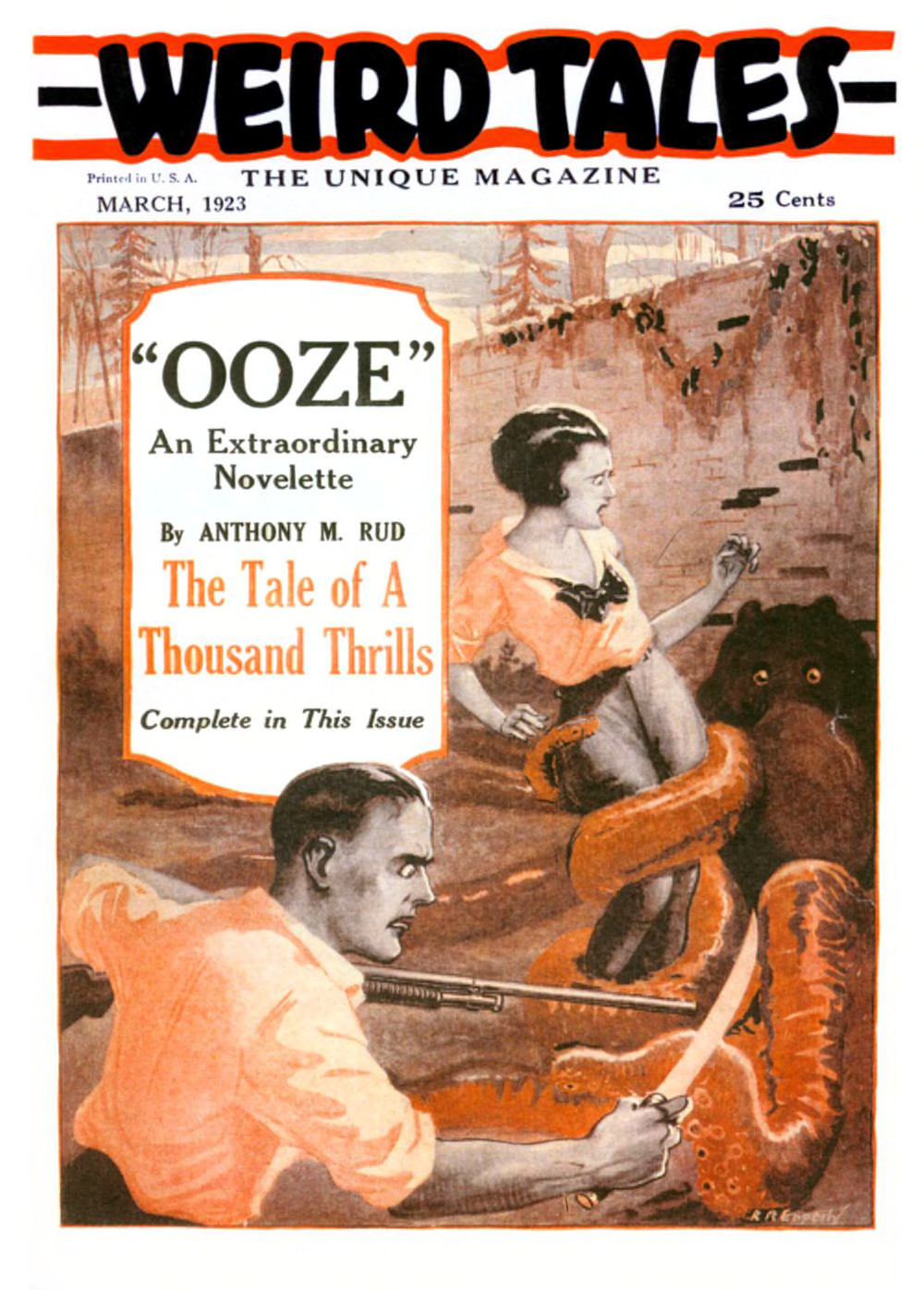
THE UNIQUE MAGAZINE
Edited by Edwin Baird
VOLUME ONE 25c A COPY
MARCH, 1923
SUBSCRIPTION $3.00 A YEAR
NUMBER ONE
$3.50 IN CANADA
For Scalp-prickling Thrills and
Stark Terror, Read
By Willard E. Hawkins
THE curious narrative that follows was found among the papers of
the late Dr. John Pedric, psychical investigator and author of
occult works. It bears evidences of having been received through
automatic writing, as were several of his publications. Unfortunately,
there are no records to confirm this assumption, and none of the
mediums or assistants employed by him in his research work admits
knowledge of it. Possibly—for the Doctor was reputed to possess
some psychic powers—it may have been received by him. At any rate,
the lack of data renders the recital useless as a document for the Society
for Psychical Research. It is published for whatever intrinsic interest
or significance it may possess. With reference to the names mentioned,
it may be added that they are not confirmed by the records of the War
Department. It could be maintained, however, that purposely fictitious
names were substituted, either by the Doctor or the communicating
entity.
THEY called me—when I walked
the earth in a body of dense matter—Richard
Devaney. Though
my story has little to do with the
war, I was killed in the second battle
of the Marne, on July 24, 1918.
Many times, as men were wont to do
who felt the daily, hourly imminence of
death in the trenches, I had pictured
that event in my mind and wondered
what it would be like. Mainly I had
inclined toward a belief in total extinction.
That, when the vigorous, full-blooded
body I possessed should lie bereft
of its faculties, I, as a creature apart
from it, should go on, was beyond credence.
The play of life through the human
machine, I reasoned, was like the
flow of gasoline into the motor of an
automobile. Shut off that flow, and the
motor became inert, dead, while the
fluid which had given it power was in
itself nothing.
And so, I confess, it was a surprise
to discover that I was dead and yet not
dead.
I did not make the discovery at once.
There had been a blinding concussion,
a moment of darkness, a sensation of
falling—falling—into a deep abyss. An
indefinite time afterward, I found myself
standing dazedly on the hillside,
toward the crest of which we had been
pressing against the enemy. The
thought came that I must have momentarily
lost consciousness. Yet now
I felt strangely free from physical discomfort.
What had I been doing when that
moment of blackness blotted everything
out? I had been dominated by a purpose,
a flaming desire——
Like a flash, recollection burst upon
me, and, with it, a blaze of hatred—not
toward the Boche gunners, ensconced
in the woods above us, but toward the
private enemy I had been about to kill.
It had been the opportunity for
which I had waited interminable days
and nights. In the open formation, he
kept a few paces ahead of me. As we
alternately ran forward, then dropped
on our bellies and fired, I had watched
my chance. No one would suspect, with
the dozens who were falling every moment
under the merciless fire from the
trees beyond, that the bullet which
ended Louis Winston’s career came
from a comrade’s rifle.
Twice I had taken aim, but withheld
my fire—not from indecision, but lest,
in my vengeful heat, I might fail to
reach a vital spot. When I raised my
rifle the third time, he offered a fair
target.
God! how I hated him. With fingers
itching to speed the steel toward his
heart, I forced myself to remain calm—to
hold fire for that fragment of a second
that would insure careful aim.
Then, as the pressure of my finger
tightened against the trigger, came the
blinding flash—the moment of blackness.
I HAD evidently remained unconscious
longer than I realized.
Save for a few figures that lay motionless
or squirming in agony on the
field, the regiment had passed on, to be
lost in the trees at the crest of the hill.
With a pang of disappointment, I realized
that Louis would be among them.
Involuntarily I started onward,
driven still by that impulse of burning
hatred, when I heard my name called.
Turning in surprise, I saw a helmeted
figure crouching beside something
huddled in the tall grass. No
second glance was needed to tell me
that the huddled something was the
body of a soldier. I had eyes only for
the man who was bending over him.
Fate had been kind to me. It was
Louis.
Apparently, in his preoccupation, he
had not noticed me. Coolly I raised my
rifle and fired.
The result was startling. Louis
neither dropped headlong nor looked
up at the report. Vaguely I questioned
whether there had been a report.
Thwarted, I felt the lust to kill
mounting in me with redoubled fury.
With rifle upraised, I ran toward him.
A terrific swing, and I crashed the stock
against his head.
It passed clear through! Louis remained
unmoved.
Uncomprehending, snarling, I flung
the useless weapon away and fell upon
him with bare hands—with fingers that
strained to rend and tear and strangle.
Instead of encountering solid flesh
and bone, they too passed through him.
Was it a mirage? A dream? Had I
gone crazy? Sobered—for a moment
forgetful of my fury—I drew back and
tried to reduce the thing to reason. Was
Louis but a figment of the imagination—a
phantom?
My glance fell upon the figure beside
which he was sobbing incoherent
words of entreaty.
I gave a start, then looked more
closely.
The dead man—for there was no
question about his condition, with a
bloody shrapnel wound in the side of
his head—was myself!
Gradually the import of this penetrated
my consciousness. Then I realized
that it was Louis who had called
my name—that even now he was sobbing
it over and over.
The irony of it struck me at the moment
of realization. I was dead—I was
the phantom—who had meant to kill
Louis!
I looked at my hands, my uniform—I
touched my body. Apparently I was
as substantial as before the shrapnel
buried itself in my head. Yet, when I
had tried to grasp Louis, my hand
seemed to encompass only space.
Louis lived, and I was dead!
The discovery for a time benumbed
my feeling toward him. With impersonal
curiosity, I saw him close the
eyes of the dead man—the man who,
somehow or other, had been me. I saw
him search the pockets and draw forth
a letter I had written only that morning,
a letter addressed to——
With a sudden surge of dismay, I
darted forward to snatch it from his
hands. He should not read that letter!
Again I was reminded of my impalpability.
But Louis did not open the envelope,
although it was unsealed. He read the
superscription, kissed it, as sobs rent
his frame, and thrust the letter inside
his khaki jacket.
“Dick! Buddie!” he cried brokenly.
“Best pal man ever had—how can I
take this news back to her!”
My lips curled. To Louis, I was his
pal, his buddie. Not a suspicion of the
hate I bore him—had borne him ever
since I discovered in him a rival for
Velma Roth.
Oh, I had been clever! It was our
“unselfish friendship” that endeared us
both to her. A sign of jealousy, of ill
nature, and I would have forfeited the
paradise of her regard that apparently
I shared with Louis.
I had never felt secure of my place
in that paradise. True, I could always
awaken a response in her, but I must
put forth effort in order to do so. He
held her interest, it seemed, without
trying. They were happy with each
other and in each other.
Our relations might be expressed by
likening her to the water of a placid
pool, Louis to the basin that held her,
me to the wind that swept over it. By
exerting myself, I could agitate the surface
of her nature into ripples of pleasurable
excitement—could even lash her
emotion into a tempest. She responded
to the stimulation of my mood, yet, in
my absence, settled contentedly into
the peaceful comfort of Louis’ steadfast
love.
I felt vaguely then—and am certain
now, with a broader perspective toward
realities—that Velma intuitively recognized
Louis as her mate, yet feared to
yield herself to him because of my sway
over her emotional nature.
When the great war came, we all, I
am convinced, felt that it would absolve
Velma from the task of choosing
between us.
Whether the agony that spoke from
the violet depths of her eyes when we
said good-by was chiefly for Louis or
for me, I could not tell. I doubt if
she could have done so. But in my
mind was the determination that only
one of us should return, and—Louis
would not be that one.
Did I feel no repugnance at thought
of murdering the man who stood in my
way? Very little. I was a savage at
heart—a savage in whom desire outweighed
anything that might stand in
the way of gaining its object. From my
point of view, I would have been a fool
to pass the opportunity.
Why I should have so hated him—a
mere obstacle in my path—I do not
know. It may have been due to a
prescience of the intangible barrier his
blood would always raise between Velma
and me—or to a slumbering sense of
remorse.
But, speculation aside, here I was, in
a state of being that the world calls
death, while Louis lived—was free to
return home—to claim Velma—to
flaunt his possession of all that I held
precious.
It was maddening! Must I stand
idly by, helpless to prevent this?
I HAVE wondered, since, how I could
remain so long in touch with the objective
world—why I did not at once,
or very soon, find myself shut off from
earthly sights and sounds as those in
physical form are shut off from the
things beyond.
The matter seems to have been determined
by my will. Like weights of
lead, envy of Louis and passionate
longing for Velma held my feet to the
sphere of dense matter.
Vengeful, despairing, I watched beside
Louis. When at last he turned
away from my body and, with tears
streaming from his eyes, began to drag
a useless leg toward the trenches we had
left, I realized why he had not gone on
with the others to the crest of the hill.
He, too, was a victim of Boche gunnery.
I walked beside the stretcher-bearers
when they had picked him up and were
conveying him toward the base hospital.
Throughout the weeks that followed I
hovered near his cot, watching the doctors
as they bound up the lacerated
tendons in his thigh, and missing no
detail of his battle with the fever.
Over his shoulder I read the first letter
he wrote home to Velma, in which
he gave a belated account of my death,
dwelling upon the glory of my sacrifice.
“I have often thought that you
two were meant for each other” [he
wrote] “and that if it had not been
for fear of hurting me, you would
have been his wife long ago. He
was the best buddie a man ever
had. If only I could have been
the one to die!”
Had I known it, I could have followed
this letter across seas—could, in
fact, have passed it and, by an exercise
of the will, have been at Velma’s side
in the twinkling of an eye. But my
ignorance of the laws of the new plane
was total. All my thoughts were centered
upon a problem of entirely different
character.
Never was hold upon earthly treasure
more reluctantly relinquished than was
my hope of possessing Velma. Surely,
death could not erect so absolute a barrier.
There must be a way—some loophole
of communication—some chance
for a disembodied man to contend with
his corporeal rival for a woman’s love.
Slowly, very slowly, dawned the light
of a plan. So feeble was the glimmer
that it would scarcely have comforted
one in less desperate straits, but to me
it appeared to offer a possible hope. I
set about methodically, with infinite patience,
evolving it into something tangible,
even though I had but the most
indefinite idea of what the outcome
might be.
The first suggestion came when Louis
had so far recovered that but little trace
of the fever remained. One afternoon,
as he lay sleeping, the mail-distributor
handed a letter to the nurse who happened
to be standing beside his cot.
She glanced at it, then tucked it under
his pillow.
The letter was from Velma, and I
was hungry for the contents. I did not
then know that I could have read it
easily, sealed though it was. In a frenzy
of impatience, I exclaimed:
“Wake up, confound it, and read
your letter!”
With a start, he opened his eyes. He
looked around with a bewildered expression.
“Under your pillow!” I fumed.
“Look under your pillow!”
In a dazed manner, he put his hand
under the pillow and drew forth the
letter.
A few hours later, I heard him commenting
on the experience to the nurse.
“Something seemed to wake me up,”
he said, “and I had a peculiar impulse
to feel under the pillow. It was just
as if I knew I would find the letter
there.”
The circumstances seemed as remarkable
to me as it did to him. It might be
coincidence, but I determined to make
a further test.
A series of experiments convinced
me that I could, to a very slight degree,
impress my thoughts and will upon
Louis, especially when he was tired or
on the borderland of sleep. Occasionally
I was able to control the direction
of his thoughts as he wrote home to
Velma.
On one occasion, he was describing
for her a funny little French woman
who visited the hospital with a basket
that always was filled with cigarettes
and candy.
“Last time” [he wrote], “she brought
with her a boy whom she called....”
He paused, with pencil upraised, trying
to recall the name.
A moment later, he looked down at
the page and stared with astonishment.
The words, “She called him Maurice,”
had been added below the unfinished
line.
“I must be going daffy,” he muttered.
“I’d swear I didn’t write that.”
Behind him, I stood rubbing my
hands in triumph. It was my first successful
effort to guide the pencil while
his thoughts strayed elsewhere.
Another time, he wrote to Velma:
“I’ve a strange feeling, lately,
that dear old Dick is near. Sometimes,
as I wake up, I seem to remember
vaguely having seen him
in my dreams. It’s as if his features
were just fading from view.”
He paused here so long that I made
another attempt to take advantage of
his abstraction.
By an effort of the will that it is
difficult to explain, I guided his hand
into the formation of the words:
“With a jugful of kisses for
Winkie, as ever her....”
Just then, Louis looked down.
“Good God!” he exclaimed, as if he
had seen a ghost.
“WINKIE” was a pet name I had
given Velma when we were
children together.
Louis always maintained there was
no sense in it, and refused to adopt it,
though I frequently called her by the
name in later years. And of his own
volition, Louis would never have mentioned
anything so convivial as a jugful
of kisses.
So, through the weary months before
he was invalided home, I worked.
When he left France at the debarkation
point, he still walked on crutches, but
with the promise of regaining the unassisted
use of his leg before very long.
Throughout the voyage, I hovered near
him, sharing his impatience, his longing
for the one we both held dearest.
Over the exquisite pain of the reunion—at
which I was present, yet not
present—I shall pass briefly. More
beautiful than ever, more appealing
with her vivid, deep coloring, Velma in
the flesh was a vision that stirred my
longing into an intense flame.
Louis limped painfully down the
gangplank. When they met, she rested
her head silently on his shoulder for a
moment, then—her eyes brimming
with tears—assisted him, with the tender
solicitude of a mother, to the machine
she had in waiting.
Two months later they were married.
I felt the pain of this less deeply than
I would have done had it not been
essential to my designs.
Whatever vague hope I may have
had, however, of vicariously enjoying
the delights of love were disappointed.
I could not have explained why—I
only knew that something barred me
from intruding upon the sacred intimacies
of their life, as if a defensive
wall were interposed. It was baffling,
but a very present fact, against which
I found it useless to rebel. I have since
learned—but no matter. * * *
This had no bearing on my purpose,
which hinged upon the ability I was
acquiring of influencing Louis’
thoughts and actions—of taking partial
control of his faculties.
The occupation into which he drifted,
restricted in choice as he was by the
stiffened leg, helped me materially.
Often, after an interminable shift at
the bank, he would plod home at night
with brain so weary and benumbed that
it was a simple matter to impress my
will upon him. Each successful attempt,
too, made the next one easier.
The inevitable consequence was that
in time Velma should notice his aberrations
and betray concern.
“Why did you say to me, when you
came in last night, ‘There’s a blue Billy-goat
on the stairs—I wish they’d drive
him out’?” she demanded one morning.
He looked down shamefacedly at the
tablecloth.
“I don’t know what made me say it.
I seemed to want to say it, and that was
the only way to get it off my mind. I
thought you’d take it as a joke.” He
shifted his shoulders, as if trying to
dislodge an unpleasant burden.
“And was that what made you wear
a necktie to bed?” she asked, ironically.
He nodded an affirmative. “I knew
it was idiotic—but the idea kept running
in my mind. It seemed as if the
only way I could go to sleep was to
give in to it. I don’t have these freaks
unless I’m very tired.”
She said nothing more at the time,
but that evening she broached the subject
of his looking for an opening in
some less sedentary occupation—a subject
to which she thereafter constantly
recurred.
Then came a development that surprised
and excited me with its possibilities.
Exhausted, drained to the last drop
of his nerve-force, Louis was returning
late one night from the bank, following
the usual month-end overtime
grind. As he walked from the car-line,
I hovered over him, subduing his
personality, forcing it under control,
with the effort of will I had gradually
learned to direct upon him. The process
can only be explained in a crude
way: It was as if I contended with him,
sometimes successfully, for possession
of the steering-wheel of the human car
that he drove.
Velma was waiting when we arrived.
As Louis’ feet sounded on the threshold
of their apartment, she opened the
door, caught his hands, and drew him
inside.
At the action, I felt inexplicably
thrilled. It was as if some marvelous
change had come over me. And then,
as I met her gaze, I knew what that
change was.
I held her hands in real flesh-and-blood
contact. I was looking at her
with Louis’ sight!
THE shock of it cost me what I had
gained. Shaken from my poise, I
felt the personality I had subdued regain
its sway.
The next moment, Louis was staring
at Velma in bewilderment. Her eyes
were filled with alarm.
“You—you frightened me!” she
gasped, withdrawing her hands, which
I had all but crushed. “Louis, dear—don’t
ever look at me again like that!”
I can imagine the devouring intensity
of gaze that had blazed forth from
the features in that brief moment when
they were mine.
From this time, my plans quickly
took form. Two modes of action presented
themselves. The first and more
alluring, however, I was forced to abandon.
It was none other than the wild
dream of acquiring exclusive possession
of Louis’ body—of forcing him down,
out, and into the secondary place I had
occupied.
Despite the progress I had made, this
proved inexpressibly difficult. For one
thing, there seemed an affinity between
Louis’ body and his personality, which
forced me out when he was moderately
rested. This bond I might have weakened,
but there were other factors.
One was the growing conviction on
his part that something was radically
wrong. With a faculty I had discovered
of putting myself en rapport with
him and reading his thoughts, I knew
that at times he feared that he was
going insane.
I once had the experience of accompanying
him to an alienist and there,
like the proverbial fly on the wall, overhearing
learned scientific names applied
to my efforts. The alienist spoke
of “dual personality,” “amnesia,” and
“the subconscious mind,” while I
laughed in my (shall I say?) ghostly
sleeve.
But he advised Louis to seek a complete
rest and, if possible, to go into
the country to build up physically—which
was what I desired most to prevent.
I could not play the Mr. Hyde to his
Dr. Jekyll if Louis maintained his normal
virility.
Velma’s fears, too, I knew were growing
more acute. As insistently as she
could, without betraying too openly her
alarm, she pressed him to give up the
bank position and seek work in the
open air—work that would prove less
devitalizing to a person of his peculiar
temperament.
One of the results of debility from
overwork is, apparently, that it deprives
the victim of his initiative—makes him
fearful of giving up his hold upon the
meager means of sustenance that he
has, lest he shall be unable to grasp another.
Louis was in debt, earning
scarcely enough for their living expenses,
too proud to let Velma help as
she longed to do, his game leg putting
him at a disadvantage in the industrial
field. In fact, he was in just the predicament
I desired, but I knew that in
time her wishes would prevail.
The circumstances, however, that deprived
me of all hope of completely
usurping his place was this: I could
not, for any length of time, face the
gaze of Velma’s eyes. The personified
truth, the purity that dwelt in them,
seemed to dissolve my power, to beat
me back into the secondary relationship
I had come to occupy toward Louis.
He was sometimes tempted to tell
her: “You give me my one grip on
sanity.”
I have witnessed his panic at the
thought of losing her, at the thought
that some day she might give him up
in disgust at his aberrations, and abandon
him to the formless “thing” that
haunted him.
Curious—to be of the world and yet
not of it—to enjoy a perspective that
reveals the hidden side of effects, which
seem so mysterious from the material
side of the veil. But I would gladly
have given all the advantages of my
disembodied state for one hour of flesh-and-blood
companionship with Velma.
My alternative plan was this:
If I could not enter her world, what
was to prevent me from bringing
Velma into mine?
DARING? To be sure.
Unversed as I was in the laws that
govern this mystery of passing from
the physical into another state of existence,
I could only hope that the plan
would work. It might—and that was
enough for me. I took a gambler’s
chance. By risking all, I might gain
all—might gain—
The thought of what I might gain
transported me to a heaven of pain and
ecstasy.
Velma and I—in a world apart—a
world of our own—free from the sordid
trammels that mar the perfection of
the rosiest earth-existence. Velma and
I—together through all eternity!
This much reason I had for hoping!
I observed that other persons passed
through the change called death, and
that some entered a state of being in
which I was conscious of them and
they of me. Uninteresting creatures
they were, almost wholly preoccupied
with their former earth-interests; but
they were as much in the world as I had
been in the world of Velma and Louis
before that fragment of shrapnel ruled
me out of the game.
A few, it was true, on passing from
their physical habitations, seemed to
emerge into a sphere to which I could
not follow. This troubled me. Velma
might do likewise. Yet I refused to
admit the probability—refused to consider
the possible failure of my plan.
The very intensity of my longing
would draw her to me.
The gulf that separated us was
spanned by the grave. Once Velma
had crossed to my side of the abyss,
there would be no going back to Louis.
Yet I was cunning. She must not
come to me with overpowering regrets
that would cause her to hover about
Louis as I now hovered about her. If
I could inspire her with horror and
loathing for him—ah! if I only could!
As a preliminary step, I must induce
Louis to buy the instrument with which
my purpose was to be accomplished.
This was not easy, for on nights when
he left the bank during shopping hours
he was sufficiently vigorous to resist my
will. I could work only through suggestion.
In a pawnshop window that he
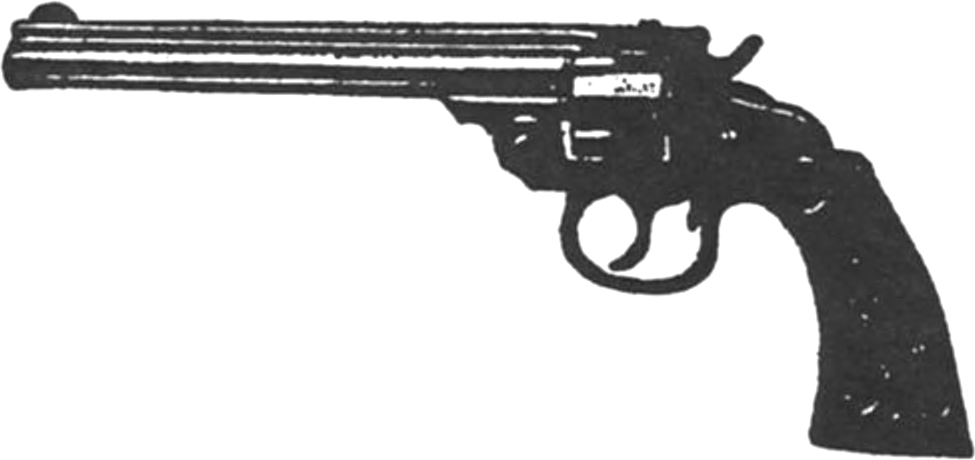
passed daily I had noticed a revolver
prominently displayed. My whole effort
was concentrated upon bringing
this to his attention.
The second night, he glanced at the
revolver, but did not stop. Three nights
later, drawn by a fascination for which
he could not have accounted, he paused
and looked at it for several minutes,
fighting an urge that seemed to command:
“Step in and buy! Buy! Buy!”
When, a few evenings later, he arrived
home with the revolver and a
box of cartridges that the pawnbroker
had included in the sale, he put them
hastily out of sight in a drawer of his
desk.
He said nothing about his purchase,
but the next day Velma came across
the weapon and questioned him regarding
it.
Visibly confused, he replied: “Oh,
I thought we might need something of
the sort. Saw it in a window, and the
notion of having it sort of took hold of
me. There’s been a lot of housebreaking
lately, and it’s just as well to be
prepared.”
And now with impatience I waited
for the opportunity to stage my dénouement.
It came, naturally, at the end of the
month, when Louis, after a prolonged
day’s work, returned home, soon after
midnight, his brain benumbed with
poring over interminable columns of
figures. When his feet ascended the
stairs to his apartment it was not his
faculties that directed them, but mine—cunning,
alert, aflame with deadly
purpose.
Never was more weird preliminary
to a murder—the entering, in guise of a
dear, familiar form, of a fiend incarnate,
intent upon destroying the flower
of the home.
I speak of a fiend incarnate, even
though I was that fiend, for I did not
enter Louis’s body in full expression of
my faculties. Taking up physical life,
my recollection of existence as a spirit
entity was always shadowy. I carried
through the dominating impulses that
had actuated me on entering the body,
but scarcely more.
And the impulse I had carried
through that night was the impulse to
kill.
WITH utmost caution, I entered the
bedroom.
My control of Louis’s body was complete.
I felt, for perhaps the first time,
so corporeally secure that the vague
dread of being driven out did not oppress
me.
The room was dark, but the soft,
regular breathing of Velma, asleep,
reached my ears. It was like the invitation
that rises in the scent of old wine
which the lips are about to quaff—quickening
my eagerness and setting
my brain on fire.
I did not think of love. I lusted—but
my lust was to destroy that beautiful
body—to kill!
However, I was cunning—cunning.
With caution, I felt my way toward the
desk and secured the revolver, filling its
chambers with leaden emissaries of
death.
When all was in readiness, I switched
on the light.
She wakened almost instantly. As
the radiance flooded the room, a startled
cry rose to her lips. It froze, unuttered,
as—half rising—she met my gaze.
Her beauty—the raven blackness of
her hair falling over her bare shoulders
and full, heaving bosom, fanned the
flame of my gory passion into fury. In
an ecstasy of triumph, I stood drinking
in the picture.
While I temporized with the lust to
kill—prolonging the exquisite sensation—she
was battling for self-control.
“Louis!” The name was gasped
through bloodless lips.
Involuntarily, I shrank, reeling a
little under her gaze. A dormant something
seemed to rise in feeble protest at
what I sought to do. The leveled revolver
wavered in my hand.
But the note of panic in her voice
revived my purpose. I laughed—mockingly.
“Louis!” her tone was sharp, but
edged with terror. “Louis—put down
that pistol! You don’t know what you
are doing.”
She struggled to her feet and now
stood before me. God! how beautiful—how
tempting that bare white bosom!
“Put down that pistol!” she ordered
hysterically.
She was frantic with fear. And her
fear was like the blast of a forge upon
the white heat of my passion.
I mocked her. A shrill, maniacal
laugh burst from my throat. She had
said I didn’t know what I was doing!
Oh, yes, I did.
“I’m going to kill you!—kill you!”
I shrieked, and laughed again.
She swayed forward like a wraith, as
I fired. Or perhaps that was the trick
played by my eyes as darkness overwhelmed
me.
A FEW fragmentary pictures stand
out in my recollection like clear-etched
cameos on the scroll of the past.
One is of Louis, standing dazedly—slightly
swaying as with vertigo—looking
down at the smoking revolver in his
hand. On the floor before him a
crumpled figure in ebony and white and
vivid crimson.
Then a confusion of frightened men
and women in oddly assorted nondescript
attire—uniformed officers bursting
into the room and taking the revolver
from Louis’s unresisting hand—clumsy
efforts at lifting the white-robed
body to the bed—a crimson stain
spreading over the sheet—a doctor, attired
in collarless shirt and wearing slippers,
bending over her * * *
Finally, after a lapse of hours, a
hushed atmosphere—efficient nurses—the
beginning of delirium.
And one other picture—of Louis,
cringing behind the bars of his cell,
denied the privilege of visiting his
wife’s bedside—crushed, dreading the
hourly announcement of her death—filled
with unspeakable horror of himself.
Velma still lived. The bullet had
pierced her left lung and life hung by
a tenuous thread. Hovering near I
watched with dispassionate interest the
battle for life. For the time I seemed
emotionally spent. I had made a supreme
effort—events would now take
their inevitable course and show whether
I had accomplished my purpose. I felt
neither anxious nor overjoyed, neither
regretful nor triumphant—merely impersonally
curious.
A fever set in lessening Velma’s
slender chances of recovery. In her
delirium, her thoughts seemed always
of Louis. Sometimes she breathed his
name pleadingly, tenderly, then cried
out in terror at some fleeting rehearsal
of the scene in which he stood before
her, the glitter of insanity in his eyes,
the leveled revolver in his hand. Again
she pleaded with him to give up his
work at the bank; and at other times
she seemed to think of him as over on
the battlefields of Europe.
Only once did she apparently think
of me—when she whispered the name
by which I had called her, “Winkie!”
and added, “Dick!” But, save for this
exception, it was always “Louis!
Louis!”
Her constant reiteration of his name
finally dispelled the apathy of my
spirit.
Louis! All the vengeful fury toward
him I had experienced when my soul
went hurtling into the region of the
disembodied returned with thwarted
intensity.
When Velma’s fever subsided, when
the long fight for recovery began and
she fluttered from the borderland back
into the realm of the physical, when
I knew I had failed—balked of my
prey, I had at least this satisfaction:
Never again would these two—the
man I hated and the woman for whom
I hungered—never again would they
be to each other as they had been in
the past. The perfection of their love
had been irretrievably marred. Never
would she meet his gaze without an inward
shrinking. Always on his part—on
both their parts—there would be an
undercurrent of fear that the incident
might recur—a grizzly menace, poisoning
each moment of their lives together.
I had not schemed and contrived—and
dared—in vain.
This was the thought I hugged when
Louis was released from jail, upon her
refusal to prosecute. It caused me
sardonic amusement when, in their
first embrace, the tears of despair
rained down their cheeks. It recurred
when they began their pitiful attempt
to build anew on the shattered foundation
of love.
And then—creepingly, slyly, like a
bird of ill omen casting the shadow of
its silent wings over the landscape—came
retribution.
Many times, in retrospect, I lived
over that brief hour of my return to
physical expression—my hour of realization.
Wraithlike, arose a vision of
Velma—Velma as she had stood before
me that night, staring at me with horror.
I saw the horror deepen—deepen
to abject despair.
How beautiful she had looked! But
when I tried to picture that beauty, I
could recall only her eyes. It mattered
not whether I wished to see them—they
filled my vision.
They seemed to haunt me. From
being vaguely conscious of them, I became
acutely so. Disconcertingly, they
looked out at me from everywhere—eyes
brimming with fear—eyes fixed
and staring—filled with horrified accusation.
The beauty I had once coveted became
a thing forbidden, even in memory.
If I sought to peer through the
veil as formerly—to witness her pathetic
attempts to resume the old life
with Louis—again those eyes!
It may perhaps sound strange for a
disembodied creature—one whom you
would call a ghost—to wail of being
haunted. Yet haunting is of the spirit,
and we of the spirit world are immeasurably
more subject to its conditions
than those whose consciousness is centered
in the material sphere.
God! Those eyes. There is a refinement
of physical torture which consists
of allowing water to fall, drop by
drop, for an eternity of hours, upon the
forehead of the victim. Conceive of
this torture increased a thousandfold,
and a faint idea may be gained of the
torture that was mine—from seeing
everywhere, constantly, interminably,
two orbs ever filled with the same expression
of horror and reproach.
Much have I learned since entering
the Land of the Shades. At that time
I did not know, as I know now, that
my punishment was no affliction from
without, but the simple result of natural
law. Causes set in motion must
work out their full reaction. The
pebble, cast into a quiet pool, makes
ripples which in time return to the
place of their origin. I had cast more
than a pebble of disturbance into the
harmony of human life, and through
my intense preoccupation in a single
aim had delayed longer than usual the
reaction, I created for myself a
hell. Inevitably I was drawn into it.
Gone was every desire I had known
to hover near the two who had so long
engrossed my attention. Haunted, harried,
scourged by those dreadful accusers,
I sought to fly from them to the
ends of the earth. There was no escape,
yet, driven frantic, I still
struggled to escape, because that is the
blind impulse of suffering creatures.
The emotions that had so swayed
me when I tried to blast the lives of
two who held me dear now seemed
puny and insignificant in comparison
with my suffering. No physical torment
can be likened to that which engulfed
me until my very being was but
a seething mass of agony. Through it,
I hurled maledictions upon the world,
upon myself, upon the creator. Horrible
blasphemies I uttered.
And, at last—I prayed.
It was but a cry for mercy—the inarticulate
appeal of a tortured soul
for surcease of pain—but suddenly a
peace seemed to have come upon
the universe.
Bereft of suffering, I felt like one
who has ceased to exist.
Out of the silence came a wordless
response. It beat upon my consciousness
like the buffeting of the waves.
Words known to human ears would
not convey the meaning of the message
that was borne upon me—whether
from outside source or welling up
from within, I do not know. All I
know is that it filled me with a strange
hope.
A thousand years or a single instant—for
time is a relative thing—the respite
lasted. Then, I sank, as it seemed,
to the old level of consciousness, and
the torment was renewed.
Endure it now I knew that I must—and
why. A strange new purpose
filled my being. The light of understanding
had dawned upon my soul.
And so I came to resume my vigil in
the home of Velma and Louis.
A BRAVE heart was Velma’s—dauntless
and true.
With the effects of the tragedy still
apparent in her pallor and weakness,
and in the shaken demeanor and furtive,
self-distrustful attitude of Louis,
she yet succeeded in finding a place for
him as overseer of a small country estate.
I have said that I ceased to feel the
torment of passion for Velma in the
greater torment of her reproach. Ah!
but I had never ceased to love her. As
I now realized, I had desecrated that
love, had transmuted it into a horrible
travesty, had, in my abysmal ignorance,
sought to obtain what I desired
by destroying it; yet, beneath all, I had
loved.
Well I know, now, that had I succeeded
in my intention toward her,
Velma would have ascended to a sphere
utterly beyond my comprehension.
Merciful fate had diverted my aim—had
made possible some faint restitution.
I returned to Velma, loving her with
a love that had come into its own, a
love unselfish, untainted by thought of
possession.
But, to help her, I must again hurt
her cruelly.
Out of the chaos of her life she had
slowly restored a semblance of harmony.
Almost she succeeded in convincing
Louis that their old peaceful
companionship had returned; but to
one who could read her thoughts, the
nightmare thing that hovered between
them weighed cruelly upon her soul.
She was never quite able to look into
her husband’s eyes without a lurking
suspicion of what might lie in their
depths; never able to compose herself
for sleep without a tremor lest she
should wake to find herself confronted
by a fiend in his form. I had done
my work only too well!
Now, slowly and inexorably, I began
again undermining Louis’ mental control.
The old ground must be traversed
anew, because he had gained in
strength from the respite I had allowed
him, and his outdoor life gave him a
mental vigor with which I had not
been obliged to contend before. On
the other hand, I was equipped with
new knowledge of the power I intended
to wield.
I shall not relate again the successive
stages by which I succeeded, first in
influencing his will, then in partially
subduing it, and, finally, in driving his
personality into the background for
indefinite periods. The terror that
overwhelmed him when he realized
that he was becoming a prey to his
former aberrations may be imagined.
To shield Velma, I performed my
experiments, when possible, while he
was away from her. But she could not
long be unaware of the moodiness, the
haggard droop of his shoulders which
accompanied his realization that the
old malady had returned. The deepening
terror in her expression was like
a scourge upon my spirit—but I must
wound her in order to cure.
More than once, I was forced to
exert my power over Louis to prevent
him from taking violent measures
against himself. As I gained the ascendancy,
a determination to end it
all grew upon him. He feared that
unless he took himself out of Velma’s
life, the insanity would return and force
him again to commit a frenzied assault
upon the one he held most dear.
Nor could he avoid seeing the apprehension
in her manner that told him
she knew—the shrinking that she
bravely tried to conceal.
Though my power over him was
greater than before, it was intermittent.
I could not always exercise it.
I could not, for example, prevent his
borrowing a revolver one day from a
neighboring farmer, on pretense of
using it against a marauding dog that
had lately visited the poultry yard.
Though I knew his true intention,
the utmost that I could do—for his
personality was strong at the time—was
to influence him to postpone the
deed he contemplated.
That night, I took possession of his
body while he slept. Velma lay, breathing
quietly, in the next room—for as
this dreaded thing came upon him
they had, through tacit understanding,
come to occupy separate bedrooms.
Partially dressing, I stole downstairs
and out to the tool-shed where Louis—fearing
to trust it near him in the house—had
hidden the revolver. As I returned,
my whole being rebelled at
the task before me—yet it was unavoidable,
if I would restore to Velma what
I had wrenched from her.
Quietly though I entered her room,
a gasp—or rather a quick, hysterical
intake of breath—warned me that she
had wakened.
I flashed on the light.
She made no sound. Her face
went white as marble. The expression
in her eyes was that which had tortured
me into the depths of a hell more
frightful than any conceived by human
imagination.
A moment I stood swaying before
her, with leveled revolver—as I had
stood on that other occasion, months
before.
Slowly, I lowered the revolver, and
smiled—not as Louis would have
smiled but as a maniac, formed in his
likeness, would have smiled.
Her lips framed the word “Louis,”
but, in the grip of despair, she made
no sound. It was the despair not merely
of a woman who felt herself doomed
to death, but of a woman who consigned
her loved one to a fate worse
than death.
Still I smiled—with growing difficulty,
for Louis’ personality was restive
and my time in the usurped body was
short.
In that moment, I was not anxious
to give up his body. At this new
glimpse of her beauty through physical
sight, my love for Velma flamed into
hitherto unrealized intensity. For an
instant my purpose in returning was
forgotten. Forgotten was the knowledge
of the ages which I had sipped
since last I occupied the body in which
I faced her. Forgotten was everything
save—Velma.
As I took a step forward, my arms
outstretched, my eyes expressing God
knows what depth of yearning, she
uttered a scream.
Blackness surged over me. I stumbled.
I was being forced out—out—— That
cry of terror had vibrated
through the soul of Louis and he was
struggling to answer it.
Instinctively, I battled against the
darkness, clung to my hard-won ascendancy.
A moment of conflict, and
again I prevailed.
Once more I smiled. The effect of
it must have been weird, for I was
growing weaker and Louis had returned
to the attack with overwhelming
persistence. My tongue strove for
expression:
“Sorry—Winkie—it won’t happen
again—I’m not—coming—back——”
WHEN I recovered from the momentary
unconsciousness that accompanies
transition from the physical
to spiritual, Louis was looking in affright
at the huddled figure of Velma,
who had fainted away. The next instant,
he had gathered her in his arms.
Though I had come near failing in
the attempt to deliver my message, I
had no fear that my visit would prove
in vain. With clear prescience, I knew
that my utterance of that old familiar
nickname, “Winkie,” would carry untold
meaning to Velma—that hereafter
she would fear no more what she
might see in the depths of her husband’s
eyes—that with a return of her
old confidence in him, the specter of
apprehension would be banished forever
from their lives.
OOZE — II. — III. — IV. — V. — VI. — VII. — VIII. — IX. — The Thing of a Thousand Shapes — II. — The MYSTERY of BLACK JEAN — THE GRAVE — Hark! The Rattle! — II. — III. — IV. — V. — The GHOST GUARD — The Ghoul and the Corpse
A Novelette of a Thousand Thrills
By ANTHONY M. RUD
IN THE heart of a second-growth
piney-woods jungle of southern
Alabama, a region sparsely settled
save by backwoods blacks and
Cajans—that queer, half-wild people
descended from Acadian exiles of the
middle eighteenth century—stands a
strange, enormous ruin.
Interminable trailers of Cherokee
rose, white-laden during a single month
of spring, have climbed the heights of
its three remaining walls. Palmetto
fans rise knee high above the base. A
dozen scattered live oaks, now belying
their nomenclature because of choking
tufts of gray, Spanish moss and two-foot
circlets of mistletoe parasite which
have stripped bare of foliage the
gnarled, knotted limbs, lean fantastic
beards against the crumbling brick.
Immediately beyond, where the
ground becomes soggier and lower—dropping
away hopelessly into the
tangle of dogwood, holly, poison sumac
and pitcher plants that is Moccasin
Swamp—undergrowth of titi and
annis has formed a protecting wall impenetrable
to all save the furtive ones.
Some few outcasts utilize the stinking
depths of that sinister swamp,
distilling “shinny” or “pure cawn”
liquor for illicit trade.
Tradition states that this is the case,
at least—a tradition which antedates
that of the premature ruin by many
decades. I believe it, for during evenings
intervening between investigations
of the awesome spot I often was approached
as a possible customer by
wood-billies who could not fathom how
anyone dared venture near without
plenteous fortification of liquid courage.
I knew “shinny,” therefore I did not
purchase it for personal consumption.
A dozen times I bought a quart or two,
merely to establish credit among the
Cajans, pouring away the vile stuff immediately
into the sodden ground. It
seemed then that only through filtration
and condensation of their dozens
of weird tales regarding “Daid House”
could I arrive at understanding of the
mystery and weight of horror hanging
about the place.
Certain it is that out of all the
superstitious cautioning, head-wagging
and whispered nonsensities I obtained
only two indisputable facts. The
first was that no money, and no supporting
battery of ten-gauge shotguns
loaded with chilled shot, could induce
either Cajan or darky of the region to
approach within five hundred yards
of that flowering wall! The second fact
I shall dwell upon later.
Perhaps it would be as well, as I am
only a mouthpiece in this chronicle, to
relate in brief why I came to Alabama
on this mission.
I am a scribbler of general fact
articles, no fiction writer as was Lee
Cranmer—though doubtless the confession
is superfluous. Lee was my
roommate during college days. I knew
his family well, admiring John Corliss
Cranmer even more than I admired
the son and friend—and almost as
much as Peggy Breede whom Lee married.
Peggy liked me, but that was all.
I cherish sanctified memory of her for
just that much, as no other woman before
or since has granted this gangling
dyspeptic even a hint of joyous and
sorrowful intimacy.
Work kept me to the city. Lee, on
the other hand, coming of wealthy
family—and, from the first, earning
from his short-stories and novel royalties
more than I wrested from editorial
coffers—needed no anchorage. He and
Peggy honeymooned a four-month trip
to Alaska, visited Honolulu next winter,
fished for salmon on Cain’s River, New
Brunswick, and generally enjoyed the
outdoors at all seasons.
They kept an apartment in Wilmette,
near Chicago, yet, during the few spring
and fall seasons they were “home,” both
preferred to rent a
suite at one of the
country clubs to
which Lee belonged.
I suppose they spent
thrice or five times
the amount Lee actually
earned, yet
for my part I only
honored that the
two should find
such great happiness
in life and still
accomplish artistic
triumph.
They were honest,
zestful young
Americans, the type—and
pretty nearly the only type—two
million dollars cannot spoil. John Corliss
Cranmer, father of Lee, though as
different from his boy as a microscope is
different from a painting by Remington,
was even further from being dollar
conscious. He lived in a world bounded
only by the widening horizon of biological
science—and his love for the two
who would carry on that Cranmer name.
Many a time I used to wonder how
it could be that as gentle, clean-souled
and lovable a gentleman as John Corliss
Cranmer could have ventured so far into
scientific research without attaining
small-caliber atheism. Few do. He believed
both in God and human kind.
To accuse him of murdering his boy and
the girl wife who had come to be loved
as the mother of baby Elsie—as well as
blood and flesh of his own family—was
a gruesome, terrible absurdity! Yes,
even when John Corliss Cranmer was
declared unmistakably insane!
Lacking a relative in the world, baby
Elsie was given to me—and the middle-aged
couple who had accompanied the
three as servants about half of the
known world. Elsie would be Peggy
over again. I worshiped her, knowing
that if my stewardship of her interests
could make of her a woman of Peggy’s
loveliness and worth I should not have
lived in vain. And at four Elsie
stretched out her arms to me after a
vain attempt to jerk out the bobbed tail
of Lord Dick, my tolerant old Airedale—and
called me
“papa.”
I felt a deep
down choking ...
yes, those strangely
long black lashes
some day might
droop in fun or
coquetry, but now
baby Elsie held a
wistful, trusting seriousness
in depths
of ultramarine eyes—that
same seriousness
which only Lee
had brought to
Peggy.
Responsibility in
one instant became double. That she
might come to love me as more than
foster parent was my dearest wish.
Still, through selfishness I could not
rob her of rightful heritage; she must
know in after years. And the tale that
I would tell her must not be the horrible
suspicion which had been bandied about
in common talk!
I went to Alabama, leaving Elsie in
the competent hands of Mrs. Daniels
and her husband, who had helped care
for her since birth.
In my possession, prior to the trip,
were the scant facts known to authorities
at the time of John Corliss Cranmer’s
escape and disappearance. They
were incredible enough.
For conducting biological research
upon forms of protozoan life, John Corliss
Cranmer had hit upon this region
of Alabama. Near a great swamp teeming
with microscopic organisms, and
situated in a semi-tropical belt where
freezing weather rarely intruded to
harden the bogs, the spot seemed ideal
for his purpose.
Through Mobile he could secure supplies
daily by truck. The isolation
suited. With only an octoroon man to
act as chef, houseman and valet for the
times he entertained no visitors, he
brought down scientific apparatus, occupying
temporary quarters in the
village of Burdett’s Corners while his
woods house was in process of construction.
By all accounts the Lodge, as he
termed it, was a substantial affair of
eight or nine rooms, built of logs and
planed lumber bought at Oak Grove.
Lee and Peggy were expected to spend
a portion of each year with him; quail,
wild turkey and deer abounded, which
fact made such a vacation certain to
please the pair. At other times all save
four rooms was closed.
This was in 1907, the year of Lee’s
marriage. Six years later when I came
down, no sign of a house remained except
certain mangled and rotting timbers
projecting from viscid soil—or what
seemed like soil. And a twelve-foot wall
of brick had been built to enclose the
house completely! One portion of this
had fallen inward!
I WASTED weeks of time at first,
interviewing officials of the police
department at Mobile, the town marshals
and county sheriffs of Washington
and Mobile counties, and officials
of the psychopathic hospital from which
Cranmer made his escape.
In substance the story was one of
baseless homicidal mania. Cranmer the
elder had been away until late fall, attending
two scientific conferences in the
North, and then going abroad to compare
certain of his findings with those
of a Dr. Gemmler of Prague University.
Unfortunately, Gemmler was assassinated
by a religious fanatic shortly afterward.
The fanatic voiced virulent objection
to all Mendelian research as
blasphemous. This was his only defense.
He was hanged.
Search of Gemmler’s notes and effects
revealed nothing save an immense
amount of laboratory data on karyokinesis—the
process of chromosome arrangement
occurring in first growing
cells of higher animal embryos. Apparently
Cranmer had hoped to develop
some similarities, or point out differences
between hereditary factors occurring
in lower forms of life and those
half-demonstrated in the cat and monkey.
The authorities had found nothing
that helped me. Cranmer had gone
crazy; was that not sufficient explanation?
Perhaps it was for them, but not for
me—and Elsie.
But to the slim basis of fact I was
able to unearth:
No one wondered when a fortnight
passed without appearance of any person
from the Lodge. Why should anyone
worry? A provision salesman in
Mobile called up twice, but failed to
complete a connection. He merely
shrugged. The Cranmers had gone
away somewhere on a trip. In a week,
a month, a year they would be back.
Meanwhile he lost commissions, but
what of it? He had no responsibility
for these queer nuts up there in the
piney-woods. Crazy? Of course! Why
should any guy with millions to spend
shut himself up among the Cajans and
draw microscope-enlarged notebook pictures
of—what the salesman called—“germs?”
A stir was aroused at the end of the
fortnight, but the commotion confined
itself to building circles. Twenty carloads
of building brick, fifty bricklayers,
and a quarter-acre of fine-meshed wire—the
sort used for screening off pens
of rodents and small marsupials in a
zoological garden—were ordered, damn
expense, hurry! by an unshaved, tattered
man who identified himself with
difficulty as John Corliss Cranmer.
He looked strange, even then. A certified
check for the total amount, given
in advance, and another check of absurd
size slung toward a labor entrepreneur,
silenced objection, however.
These millionaires were apt to be flighty.
When they wanted something they
wanted it at tap of the bell. Well, why
not drag down the big profits? A poorer
man would have been jacked up in a
day. Cranmer’s fluid gold bathed him
in immunity to criticism.
The encircling wall was built, and
roofed with wire netting which drooped
about the squat-pitch of the Lodge.
Curious inquiries of workmen went unanswered
until the final day.
Then Cranmer, a strange, intense
apparition who showed himself more
shabby than a quay derelict, assembled
every man jack of the workmen. In
one hand he grasped a wad of blue slips—fifty-six
of them. In the other he
held a Luger automatic.
“I offer each man a thousand dollars
for silence!” he announced. “As an
alternative—death! You know little.
Will all of you consent to swear upon
your honor that nothing which has occurred
here will be mentioned elsewhere?
By this I mean absolute silence!
You will not come back here to investigate
anything. You will not tell
your wives. You will not open your
mouths even upon the witness stand in
case you are called! My price is one
thousand apiece.
“In case one of you betrays me I give
you my word that this man shall die! I
am rich. I can hire men to do murder.
Well, what do you say?”
The men glanced apprehensively
about. The threatening Luger decided
them. To a man they accepted the blue
slips—and, save for one witness who
lost all sense of fear and morality in
drink, none of the fifty-six has broken
his pledge, as far as I know. That one
bricklayer died later in delirium
tremens.
It might have been different had not
John Corliss Cranmer escaped.
THEY found him the first time,
mouthing meaningless phrases concerning
an amœba—one of the tiny
forms of protoplasmic life he was
known to have studied. Also he leaped
into a hysteria of self-accusation. He
had murdered two innocent people!
The tragedy was his crime. He had
drowned them in ooze! Ah, God!
Unfortunately for all concerned,
Cranmer, dazed and indubitably stark
insane, chose to perform a strange
travesty on fishing four miles to the west
of his lodge—on the further border of
Moccasin Swamp. His clothing had
been torn to shreds, his hat was gone,
and he was coated from head to foot
with gluey mire. It was far from
strange that the good folk of Shanksville,
who never had glimpsed the eccentric
millionaire, failed to associate
him with Cranmer.
They took him in, searched his
pockets—finding no sign save an inordinate
sum of money—and then put
him under medical care. Two precious
weeks elapsed before Dr. Quirk reluctantly
acknowledged that he could
do nothing more for this patient, and
notified the proper authorities.
Then much more time was wasted.
Hot April and half of still hotter May
passed by before the loose ends were
connected. Then it did little good to
know that this raving unfortunate was
Cranmer, or that the two persons of
whom he shouted in disconnected delirium
actually had disappeared. Alienists
absolved him of responsibility. He
was confined in a cell reserved for the
violent.
Meanwhile, strange things occurred
back at the Lodge—which now, for
good and sufficient reason, was becoming
known to dwellers of the woods as
Dead House. Until one of the walls
fell in, however, there had been no
chance to see—unless one possessed the
temerity to climb either one of the tall
live oaks, or mount the barrier itself.
No doors or opening of any sort had
been placed in that hastily-constructed
wall!
By the time the western side of the
wall fell, not a native for miles around
but feared the spot far more than even
the bottomless, snake-infested bogs
which lay to west and north.
The single statement was all John
Corliss Cranmer ever gave to the world.
It proved sufficient. An immediate
search was instituted. It showed that
less than three weeks before the day of
initial reckoning, his son and Peggy
had come to visit him for the second
time that winter—leaving Elsie behind
in company of the Daniels pair. They
had rented a pair of Gordons for quail
hunting, and had gone out. That was
the last anyone had seen of them.
The backwoods negro who glimpsed
them stalking a covey behind their two
pointing dogs had known no more—even
when sweated through twelve hours
of third degree. Certain suspicious
circumstances (having to do only
with his regular pursuit of “shinny”
transportation) had caused him to fall
under suspicious at first. He was dropped.
Two days later the scientist himself
was apprehended—a gibbering idiot
who sloughed his pole—holding on to
the baited hook—into a marsh where
nothing save moccasins, an errant alligator,
or amphibian life could have
been snared.
His mind was three-quarters dead.
Cranmer then was in the state of the
dope fiend who rouses to a sitting position
to ask seriously how many Bolshevists
were killed by Julius Caesar before
he was stabbed by Brutus, or why
it was that Roller canaries sang only on
Wednesday evenings. He knew that
tragedy of the most sinister sort had
stalked through his life—but little more,
at first.
Later the police obtained that one
statement that he had murdered two
human beings, but never could means
or motive be established. Official guess
as to the means was no more than wild
conjecture; it mentioned enticing the
victims to the noisome depths of Moccasin
Swamp, there to let them flounder
and sink.
The two were his son and daughter-in-law,
Lee and Peggy!
BY FEIGNING coma—then awakening
with suddenness to assault three
attendants with incredible ferocity and
strength—John Corliss Cranmer escaped
from Elizabeth Ritter Hospital.
How he hid, how he managed to
traverse sixty-odd intervening miles
and still balk detection, remains a
minor mystery to be explained only by
the assumption that maniacal cunning
sufficed to outwit saner intellects.
Traverse these miles he did, though
until I was fortunate enough to uncover
evidence to this effect, it was supposed
generally that he had made his escape
as stowaway on one of the banana boats,
or had buried himself in some portion
of the nearer woods where he was unknown.
The truth ought to be welcome
to householders of Shanksville, Burdett’s
Corners and vicinage—those excusably
prudent ones who to this day
keep loaded shotguns handy and barricade
their doors at nightfall.
The first ten days of my investigation
may be touched upon in brief. I made
headquarters in Burdett’s Corners, and
drove out each morning, carrying lunch
and returning for my grits and piney-woods
pork or mutton before nightfall.
My first plan had been to camp out at
the edge of the swamp, for opportunity
to enjoy the outdoors comes rarely in
my direction. Yet after one cursory examination
of the premises I abandoned
the idea. I did not want to camp alone
there. And I am less superstitious than
a real estate agent.
It was, perhaps, psychic warning;
more probably the queer, faint, salty
odor as of fish left to decay, which hung
about the ruin, made too unpleasant an
impression upon my olfactory sense. I
experienced a distinct chill every time
the lengthening shadows caught me
near Dead House.
The smell impressed me. In newspaper
reports of the case one ingenious
explanation had been worked out. To
the rear of the spot where Dead House
had stood—inside the wall—was a
swampy hollow circular in shape. Only
a little real mud lay in the bottom of the
bowllike depression now, but one reporter
on the staff of The Mobile Register
guessed that during the tenancy
of the lodge it had been a fishpool. Drying
up of the water had killed the fish,
who now permeated the remnant of
mud with this foul odor.
The possibility that Cranmer had
needed to keep fresh fish at hand for
some of his experiments silenced the
natural objection that in a country
where every stream holds gar pike, bass,
catfish and many other edible varieties,
no one would dream of stocking a stagnant
puddle.
After tramping about the enclosure,
testing the queerly brittle, desiccated top
stratum of earth within and speculating
concerning the possible purpose of the
wall, I cut off a long limb of chinaberry
and probed the mud. One fragment of
fish spine would confirm the guess of
that imaginative reporter.
I found nothing resembling a piscal
skeleton, but established several facts.
First, this mud crater had definite bottom
only three or four feet below the
surface of remaining ooze. Second, the
fishy stench became stronger as I stirred.
Third, at one time the mud, water,
or whatever had comprised the balance
of content, had reached the rim of the
bowl. The last showed by certain marks
plain enough when the crusty, two-inch
stratum of upper coating was broken
away. It was puzzling.
The nature of that thin, desiccated
effluvium which seemed to cover everything
even to the lower foot or two of
brick, came in for next inspection. It
was strange stuff, unlike any earth I
ever had seen, though undoubtedly some
form of scum drained in from the
swamp at the time of river floods or
cloudbursts (which in this section are
common enough in spring and fall).
It crumbled beneath the fingers. When
I walked over it, the stuff crunched hollowly.
In fainter degree it possessed the
fishy odor also.
I took some samples where it lay
thickest upon the ground, and also a
few where there seemed to be no more
than a depth of a sheet of paper. Later
I would have a laboratory analysis
made.
Apart from any possible bearing the
stuff might have upon the disappearance
of my three friends, I felt the tug
of article interest—that wonder over
anything strange or seemingly inexplicable
which lends the hunt for fact
a certain glamor and romance all its
own. To myself I was going to have
to explain sooner or later just why this
layer covered the entire space within
the walls and was not perceptible anywhere
outside! The enigma could wait,
however—or so I decided.
Far more interesting were the traces
of violence apparent on wall and what
once had been a house. The latter
seemed to have been ripped from its
foundations by a giant hand, crushed
out of semblance to a dwelling, and
then cast in fragments about the base
of wall—mainly on the south side,
where heaps of twisted, broken timbers
lay in profusion. On the opposite side
there had been such heaps once, but
now only charred sticks, coated with
that gray-black, omnipresent coat of desiccation,
remained. These piles of charcoal
had been sifted and examined most
carefully by the authorities, as one
theory had been advanced that Cranmer
had burned the bodies of his victims.
Yet no sign whatever of human
remains was discovered.
The fire, however, pointed out one
odd fact which controverted the reconstructions
made by detectives months
before. The latter, suggesting the dried
scum to have drained in from the
swamp, believed that the house timbers
had floated out to the sides of the wall—there
to arrange themselves in a
series of piles! The absurdity of such
a theory showed even more plainly in
the fact that if the scum had filtered
through in such a flood, the timbers
most certainly had been dragged into
piles previously! Some had burned—and
the scum coated their charred surfaces!
What had been the force which had
torn the lodge to bits as if in spiteful
fury? Why had the parts of the wreckage
been burned, the rest to escape?
Right here I felt was the keynote to
the mystery, yet I could imagine no explanation.
That John Corliss Cranmer
himself—physically sound, yet a man
who for decades had led a sedentary life—could
have accomplished such destruction,
unaided, was difficult to believe.
I TURNED my attention to the wall,
hoping for evidence which might
suggest another theory.
That wall had been an example of
the worst snide construction. Though
little more than a year old, the parts
left standing showed evidence that they
had begun to decay the day the last
brick was laid. The mortar had fallen
from the interstices. Here and there a
brick had cracked and dropped out.
Fibrils of the climbing vines had penetrated
crevices, working for early destruction.
And one side already had fallen.
It was here that the first glimmering
suspicion of the terrible truth was
forced upon me. The scattered bricks,
even those which had rolled inward toward
the gaping foundation lodge, had
not been coated with scum! This was
curious, yet it could be explained by
surmise that the flood itself undermined
this weakest portion of the wall.
I cleared away a mass of brick from
the spot on which the structure had
stood; to my surprise I found it exceptionally
firm! Hard red clay lay
beneath! The flood conception was
faulty; only some great force, exerted
from inside or outside, could have
wreaked such destruction.
When careful measurement, analysis
and deduction convinced me—mainly
from the fact that the lowermost layers
of brick all had fallen outward, while
the upper portions toppled in—I began
to link up this mysterious and horrific
force with the one which had rent the
Lodge asunder. It looked as though a
typhoon or gigantic centrifuge had
needed elbow room in ripping down the
wooden structure.
But I got nowhere with the theory,
though in ordinary affairs I am called
a man of too great imaginative tendencies.
No less than three editors have
cautioned me on this point. Perhaps it
was the narrowing influence of great
personal sympathy—yes, and love. I
make no excuses, though beyond a dim
understanding that some terrific, implacable
force must have made this spot
his playground, I ended my ninth day
of note-taking and investigation almost
as much in the dark as I had been while
a thousand miles away in Chicago.
Then I started among the darkies and
Cajans. A whole day I listened to yarns
of the days which preceded Cranmer’s
escape from Elizabeth Ritter Hospital—days
in which furtive men sniffed
poisoned air for miles around Dead
House, finding the odor intolerable.
Days in which it seemed none possessed
nerve enough to approach close. Days
when the most fanciful tales of mediaeval
superstitions were spun. These tales
I shall not give; the truth is incredible
enough.
At noon upon the eleventh day I
chanced upon Rori Pailleron, a Cajan—and
one of the least prepossessing of
all with whom I had come in contact.
“Chanced” perhaps is a bad word. I had
listed every dweller of the woods within
a five mile radius. Rori was sixteenth
on my list. I went to him only after
interviewing all four of the Crabiers and
two whole families of Pichons. And
Rori regarded me with the utmost suspicion
until I made him a present of
the two quarts of “shinny” purchased
of the Pichons.
Because long practice has perfected
me in the technique of seeming to drink
another man’s awful liquor—no, I’m
not an absolute prohibitionist; fine wine
or twelve-year-in-cask Bourbon whisky
arouses my definite interest—I fooled
Pailleron from the start. I shall omit
preliminaries, and leap to the first admission
from him that he knew more
concerning Dead House and its former
inmates than any of the other darkies
or Cajans roundabout.
“...But I ain’t talkin’. Sacre! If
I should open my gab, what might fly
out? It is for keeping silent, y’r damn’
right!...”
I agreed. He was a wise man—educated
to some extent in the queer schools
and churches maintained exclusively by
Cajans in the depths of the woods, yet
naive withal.
We drank. And I never had to ask
another leading question. The liquor
made him want to interest me; and the
only extraordinary topic in this whole
neck of the woods was the Dead House.
Three-quarters of a pint of acrid,
nauseous fluid, and he hinted darkly.
A pint, and he told me something I
scarcely could believe. Another half-pint....
But I shall give his confession
in condensed form.
He had known Joe Sibley, the octoroon
chef, houseman and valet who
served Cranmer. Through Joe, Rori
had furnished certain indispensables in
way of food to the Cranmer household.
At first, these salable articles had been
exclusively vegetable—white and yellow
turnip, sweet potatoes, corn and beans—but
later, meat!
Yes, meat especially—whole lambs,
slaughtered and quartered, the coarsest
variety of piney-woods pork and beef,
all in immense quantity!
IN DECEMBER of the fatal winter
Lee and his wife stopped down at the
Lodge for ten days or thereabouts.
They were enroute to Cuba at the
time, intending to be away five or six
weeks. Their original plan had been
only to wait over a day or so in the
piney-woods, but something caused an
amendment to the scheme.
The two dallied. Lee seemed to have
become vastly absorbed in something—so
much absorbed that it was only
when Peggy insisted upon continuing
their trip, that he could tear himself
away.
It was during those ten days that he
began buying meat. Meager bits of it
at first—a rabbit, a pair of squirrels, or
perhaps a few quail beyond the number
he and Peggy shot. Rori furnished the
game, thinking nothing of it except that
Lee paid double prices—and insisted
upon keeping the purchases secret from
other members of the household.
“I’m putting it across on the Governor,
Rori!” he said once with a wink.
“Going to give him the shock of his life.
So you mustn’t let on, even to Joe about
what I want you to do. Maybe it won’t
work out, but if it does ...! Dad’ll
have the scientific world at his feet!
He doesn’t blow his own horn anywhere
near enough, you know.”
Rori didn’t know. Hadn’t a suspicion
what Lee was talking about.
Still, if this rich, young idiot wanted to
pay him a half dollar in good silver
coin for a quail that anyone—himself
included—could knock down with a
five-cent shell, Rori was well satisfied to
keep his mouth shut. Each evening he
brought some of the small game. And
each day Lee Cranmer seemed to have
use for an additional quail or so....
When he was ready to leave for Cuba,
Lee came forward with the strangest of
propositions. He fairly whispered his
vehemence and desire for secrecy! He
would tell Rori, and would pay the
Cajan five hundred dollars—half in advance,
and half at the end of five weeks
when Lee himself would return from
Cuba—provided Rori agreed to adhere
absolutely to a certain secret program!
The money was more than a fortune to
Rori; it was undreamt-of affluence. The
Cajan acceded.
“He wuz tellin’ me then how the ol’
man had raised some kind of pet,” Rori
confided, “an’ wanted to get shet of it.
So he give it to Lee, tellin’ him to kill
it, but Lee was sot on foolin’ him. W’at
I ask yer is, w’at kind of a pet is it
w’at lives down in a mud sink an’ eats
a couple hawgs every night?”
I couldn’t imagine, so I pressed him
for further details. Here at last was
something which sounded like a clue!
He really knew too little. The agreement
with Lee provided that if Rori
carried out the provisions exactly, he
should be paid extra and at his exorbitant
scale of all additional outlay, when
Lee returned.
The young man gave him a daily
schedule which Rori showed. Each
evening he was to procure, slaughter
and cut up a definite—and growing—amount
of meat. Every item was
checked, and I saw that they ran from
five pounds up to forty!
“What in heaven’s name did you do
with it?” I demanded, excited now and
pouring him an additional drink for
fear caution might return to him.
“Took it through the bushes in back
an’ slung it in the mud sink there! An’
suthin’ come up an’ drug it down!”
“A ’gator?”
“Diable! How should I know? It
was dark. I wouldn’t go close.” He
shuddered, and the fingers which lifted
his glass shook as with sudden chill.
“Mebbe you’d of done it, huh? Not me,
though! The young fellah tole me to
sling it in, an’ I slung it.
“A couple times I come around in
the light, but there wasn’t nuthin’
there you could see. Jes’ mud, an’ some
water. Mebbe the thing didn’t come
out in daytimes....”
“Perhaps not,” I agreed, straining
every mental resource to imagine what
Lee’s sinister pet could have been. “But
you said something about two hogs a
day? What did you mean by that?
This paper, proof enough that you’re
telling the truth so far, states that on
the thirty-fifth day you were to throw
forty pounds of meat—any kind—into
the sink. Two hogs, even the piney-woods
variety, weigh a lot more than
forty pounds!”
“Them was after—after he come
back!”
From this point onward, Rori’s tale
became more and more enmeshed in
the vagaries induced by bad liquor. His
tongue thickened. I shall give his story
without attempt to reproduce further
verbal barbarities, or the occasional
prodding I had to give in order to keep
him from maundering into foolish
jargon.
Lee had paid munificently. His only
objection to the manner in which Rori
had carried out his orders was that the
orders themselves had been deficient.
The pet, he said had grown enormously.
It was hungry, ravenous. Lee himself
had supplemented the fare with huge
pails of scraps from the kitchen.
From that day Lee purchased from
Rori whole sheep and hogs! The Cajan
continued to bring the carcasses at
nightfall, but no longer did Lee permit
him to approach the pool. The young
man appeared chronically excited now.
He had a tremendous secret—one the
extent of which even his father did not
guess, and one which would astonish the
world! Only a week or two more and
he would spring it. First he would have
to arrange certain data.
Then came the day when everyone
disappeared from Dead House. Rori
came around several times, but concluded
that all of the occupants had
folded tents and departed—doubtless
taking their mysterious “pet” along.
Only when he saw from a distance Joe,
the octoroon servant, returning along
the road on foot toward the Lodge, did
his slow mental processes begin to ferment.
That afternoon Rori visited the
strange place for the next to last time.
He did not go to the Lodge itself—and
there were reasons. While still some
hundreds of yards away from the place
a terrible, sustained screaming reached
his ears! It was faint, yet unmistakably
the voice of Joe! Throwing a pair of
number two shells into the breech of
his shotgun, Rori hurried on, taking
his usual path through the brush at the
back.
He saw—and as he told me even
“shinny” drunkenness fled his chattering
tones—Joe, the octoroon. Aye, he
stood in the yard, far from the pool into
which Rori had thrown the carcasses—and
Joe could not move!
Rori failed to explain in full, but
something, a slimy, amorphous something,
which glistened in the sunlight,
already had engulfed the man to his
shoulders! Breath was cut off. Joe’s
contorted face writhed with horror and
beginning suffocation. One hand—all
that was free of the rest of him!—beat
feebly upon the rubbery, translucent
thing that was engulfing his body!
Then Joe sank from sight....
FIVE days of liquored indulgence
passed before Rori, alone in his
shaky cabin, convinced himself that he
had seen a phantasy born of alcohol. He
came back the last time—to find a high
wall of brick surrounding the Lodge,
and including the pool of mud into
which he had thrown the meat!
While he hesitated, circling the place
without discovering an opening—which
he would not have dared to use, even
had he found it—a crashing, tearing of
timbers, and persistent sound of awesome
destruction came from within. He
swung himself into one of the oaks near
the wall. And he was just in time to
see the last supporting stanchions of the
Lodge give way outward!
The whole structure came apart. The
roof fell in—yet seemed to move after
it had fallen! Logs of wall deserted
retaining grasp of their spikes like
layers of plywood in the grasp of the
shearing machine!
That was all. Soddenly intoxicated
now, Rori mumbled more phrases, giving
me the idea that on another day
when he became sober once more, he
might add to his statements, but I—numbed
to the soul—scarcely cared. If
that which he related was true, what
nightmare of madness must have been
consummated here!
I could vision some things now which
concerned Lee and Peggy, horrible
things. Only remembrance of Elsie
kept me faced forward in the search—for
now it seemed almost that the handiwork
of a madman must be preferred to
what Rori claimed to have seen! What
had been that sinister, translucent
thing? That glistening thing which
jumped upward about a man, smothering,
engulfing?
Queerly enough, though such a
theory as came most easily to mind now
would have outraged reason in me if
suggested concerning total strangers, I
asked myself only what details of Rori’s
revelation had been exaggerated by
fright and fumes of liquor. And as
I sat on the creaking bench in his cabin,
staring unseeing as he lurched down to
the floor, fumbling with a lock box of
green tin which lay under his cot, and
muttering, the answer to all my questions
lay within reach!
IT WAS not until next day, however,
that I made the discovery. Heavy of
heart I had reexamined the spot where
the Lodge had stood, then made my
way to the Cajan’s cabin again, seeking
sober confirmation of what he had told
me during intoxication.
In imagining that such a spree for
Rori would be ended by a single night,
however, I was mistaken. He lay
sprawled almost as I had left him. Only
two factors were changed. No “shinny”
was left—and lying open, with its miscellaneous
contents strewed about, was
the tin box. Rori somehow had managed
to open it with the tiny key still
clutched in his hand.
Concern for his safety alone was what
made me notice the box. It was a receptacle
for small fishing tackle of the
sort carried here and there by any
sportsman. Tangles of Dowagiac minnows,
spoon hooks ranging in size to
silver-backed number eights; three reels
still carrying line of different weights,
spinners, casting plugs, wobblers, floating
baits, were spilled out upon the
rough plank flooring where they might
snag Rori badly if he rolled. I gathered
them, intending to save him an accident.
With the miscellaneous assortment
in my hands, however, I stopped dead.
Something had caught my eye—something
lying flush with the bottom of the
lock box! I stared, and then swiftly
tossed the hooks and other impedimenta
upon the table. What I had
glimpsed there in the box was a loose-leaf
notebook of the sort used for recording
laboratory data! And Rori
scarcely could read, let alone write!
Feverishly, a riot of recognition, surmise,
hope and fear bubbling in my
brain, I grabbed the book and threw
it open. At once I knew that this was
the end. The pages were scribbled in
pencil, but the handwriting was that
precise chirography I knew as belonging
to John Corliss Cranmer, the scientist!
“ ... Could he not have
obeyed my instructions! Oh, God!
This....”
These were the words at top of the
first page which met my eye.
Because knowledge of the circumstances,
the relation of which I pried
out of the reluctant Rori only some days
later when I had him in Mobile as a
police witness for the sake of my
friend’s vindication, is necessary to understanding,
I shall interpolate.
Rori had not told me everything.
On his late visit to the vicinage of Dead
House he saw more. A crouching
figure, seated Turk fashion on top of
the wall, appeared to be writing industriously.
Rori recognized the man as
Cranmer, yet did not hail him. He
had no opportunity.
Just as the Cajan came near, Cranmer
rose, thrust the notebook, which
had rested across his knees, into the box.
Then he turned, tossed outside the wall
both the locked box and a ribbon to
which was attached the key.
Then his arms raised toward heaven.
For five seconds he seemed to invoke
the mercy of Power beyond all of man’s
scientific prying. And finally he
leaped, inside ...!
Rori did not climb to investigate.
He knew that directly below this portion
of wall lay the mud sink into
which he had thrown the chunks of
meat!
THIS is a true transcription of the
statement I inscribed, telling the sequence
of actual events at Dead House.
The original of the statement now lies
in the archives of the detective department.
Cranmer’s notebook, though written
in a precise hand, yet betrayed the
man’s insanity by incoherence and frequent
repetitions. My statement has
been accepted now, both by alienists
and by detectives who had entertained
different theories in respect to the case.
It quashes the noisome hints and suspicions
regarding three of the finest
Americans who ever lived—and also
one queer supposition dealing with supposed
criminal tendencies in poor Joe,
the octoroon.
John Corliss Cranmer went insane
for sufficient cause!
AS READERS of popular fiction
know well, Lee Cranmer’s forte was
the writing of what is called—among
fellows in the craft—the pseudo-scientific
story. In plain words, this means a
yarn, based upon solid fact in the field
of astronomy, chemistry, anthropology
or whatnot, which carries to logical conclusion
unproved theories of men who
devote their lives to searching out
further nadirs of fact.
In certain fashion these men are
allies of science. Often they visualize
something which has not been imagined
even by the best of men from
whom they secure data, thus opening
new horizons of possibility. In a
large way Jules Verne was one of these
men in his day; Lee Cranmer bade fair
to carry on the work in worthy fashion—work
taken up for a period by an
Englishman named Wells, but abandoned
for stories of a different—and,
in my humble opinion, less absorbing—type.
Lee wrote three novels, all published,
which dealt with such subjects—two of
the three secured from his own father’s
labors, and the other speculating upon
the discovery and possible uses of interatomic
energy. Upon John Corliss
Cranmer’s return from Prague that
fatal winter, the father informed Lee
that a greater subject than any with
which the young man had dealt, now
could be tapped.
Cranmer, senior, had devised a way
in which the limiting factors in protozoic
life and growth, could be nullified;
in time, and with cooperation of biologists
who specialized upon karyokinesis
and embryology of higher forms, he
hoped—to put the theory in pragmatic
terms—to be able to grow swine the size
of elephants, quail or woodcock with
breasts from which a hundredweight of
white meat could be cut away, and
steers whose dehorned heads might butt
at the third story of a skyscraper!
Such result would revolutionize the
methods of food supply, of course. It
also would hold out hope for all undersized
specimens of humanity—provided
only that if factors inhibiting growth
could be deleted, some method of stopping
gianthood also could be developed.
Cranmer the elder, through use of an
undescribed (in the notebook) growth
medium of which one constituent was
agar-agar, and the use of radium emanations,
had succeeded in bringing
about apparently unrestricted growth in
the paramœcium protozoan, certain of
the vegetable growths (among which
were bacteria), and in the amorphous
cell of protoplasm known as the amœba—the
last a single cell containing only
neucleolus, neucleus, and a space known
as the contractile vacuole which somehow
aided in throwing off particles impossible
to assimilate directly. This
point may be remembered in respect to
the piles of lumber left near the outside
walls surrounding Dead House!
When Lee Cranmer and his wife
came south to visit, John Corliss Cranmer
showed his son an amœba—normally
an organism visible under low-power
microscope—which he had absolved
from natural growth inhibitions.
This amœba, a rubbery, amorphous
mass of protoplasm, was of the size then
of a large beef liver. It could have
been held in two cupped hands, placed
side by side.
“How large could it grow?” asked
Lee, wide-eyed and interested.
“So far as I know,” answered the
father, “there is no limit—now! It
might, if it got food enough, grow to
be as big as the Masonic Temple!
“But take it out and kill it. Destroy
the organism utterly—burning the
fragment—else there is no telling what
might happen. The amœba, as I have
explained, reproduces by simple division.
Any fragment remaining might
be dangerous.”
Lee took the rubbery, translucent
giant cell—but he did not obey orders.
Instead of destroying it as his father
had directed, Lee thought out a plan.
Suppose he should grow this organism
to tremendous size? Suppose, when the
tale of his father’s accomplishment were
spread, an amœba of many tons weight
could be shown in evidence? Lee, of
somewhat sensational cast of mind, determined
instantly to keep secret the
fact that he was not destroying the organism,
but encouraging its further
growth. Thought of possible peril
never crossed his mind.
He arranged to have the thing fed—allowing
for normal increase of size in
an abnormal thing. It fooled him only
in growing much more rapidly. When
he came back from Cuba the amœba
practically filled the whole of the mud
sink hollow. He had to give it much
greater supplies....
The giant cell came to absorb as
much as two hogs in a single day. During
daylight, while hunger still was appeased,
it never emerged, however.
That remained for the time that it could
secure no more food near at hand to
satisfy its ravenous and increasing appetite.
Only instinct for the sensational kept
Lee from telling Peggy, his wife, all
about the matter. Lee hoped to spring
a coup which would immortalize his
father, and surprise his wife terrifically.
Therefore, he kept his own counsel—and
made bargains with the Cajan,
Rori, who supplied food daily for the
shapeless monster of the pool.
The tragedy itself came suddenly
and unexpectedly. Peggy, feeding the
two Gordon setters that Lee and she
used for quail hunting, was in the
Lodge yard before sunset. She romped
alone, as Lee himself was dressing.
Of a sudden her screams cut the still
air! Without her knowledge, ten-foot
pseudopods—those flowing tentacles of
protoplasm sent forth by the sinister
occupant of the pool—slid out and
around her putteed ankles.
For a moment she did not understand.
Then, at first suspicion of the
horrid truth, her cries rent the air.
Lee, at that time struggling to lace a
pair of high shoes, straightened, paled,
and grabbed a revolver as he dashed
out.
In another room a scientist, absorbed
in his note-taking, glanced up, frowned,
and then—recognizing the voice—shed
his white gown and came out. He was
too late to do aught but gasp with
horror.
In the yard Peggy was half engulfed
in a squamous, rubbery something
which at first glance he could not analyze.
Lee, his boy, was fighting with the
sticky folds, and slowly, surely, losing
his own grip upon the earth!
JOHN CORLISS CRANMER was by
no means a coward. He stared,
cried aloud, then ran indoors, seizing
the first two weapons which came to
hand—a shotgun and hunting knife
which lay in sheath in a cartridged belt
across a hook of the hall-tree. The knife
was ten inches in length and razor keen.
Cranmer rushed out again. He saw
an indecent fluid something—which as
yet he had not had time to classify—lumping
itself into a six-foot-high center
before his very eyes! It looked like
one of the micro-organisms he had
studied! One grown to frightful dimensions.
An amœba!
There, some minutes suffocated in
the rubbery folds—yet still apparent
beneath the glistening ooze of this monster—were
two bodies.
They were dead. He knew it.
Nevertheless he attacked the flowing,
senseless monster with his knife. Shot
would do no good. And he found that
even the deep, terrific slashes made by
his knife closed together in a moment
and healed. The monster was invulnerable
to ordinary attack!
A pair of pseudopods sought out his
ankles, attempting to bring him low.
Both of these he severed—and escaped.
Why did he try? He did not know.
The two whom he had sought to rescue
were dead, buried under folds of this
horrid thing he knew to be his own discovery
and fabrication.
Then it was that revulsion and insanity
came upon him.
There ended the story of John Corliss
Cranmer, save for one hastily scribbled
paragraph—evidently written at the
time Rori had seen him atop the wall.
May we not supply with assurance
the intervening steps?
Cranmer was known to have purchased
a whole pen of hogs a day or
two following the tragedy. These animals
never were seen again. During
the time the wall was being constructed
is it not reasonable to assume that he
fed the giant organism within—to keep
it quiet? His scientist brain must have
visualized clearly the havoc and horror
which could be wrought by the loathsome
thing if it ever were driven by
hunger to flow away from the Lodge
and prey upon the countryside!
With the wall once in place, he evidently
figured that starvation or some
other means which he could supply
would kill the thing. One of the means
had been made by setting fire to several
piles of the disgorged timbers; probably
this had no effect whatever.
The amœba was to accomplish still
more destruction. In the throes of hunger
it threw its gigantic, formless
strength against the house walls from
the inside; then every edible morsel
within was assimilated, the logs, rafters
and other fragments being worked out
through the contractile vacuole.
During some of its last struggles, undoubtedly,
the side wall of brick was
weakened—not to collapse, however,
until the giant amœba no longer could
take advantage of the breach.
In final death lassitude, the amœba
stretched itself out in a thin layer over
the ground. There it succumbed,
though there is no means of estimating
how long a time intervened.
The last paragraph in Cranmer’s
notebook, scrawled so badly that it is
possible some words I have not deciphered
correctly, read as follows:
“In my work I have found the
means of creating a monster. The
unnatural thing, in turn, has destroyed
my work and those whom
I held dear. It is in vain that I
assure myself of innocence of
spirit. Mine is the crime of presumption.
Now, as expiation—worthless
though that may be—I
give myself....”
It is better not to think of that last
leap, and the struggle of an insane man
in the grip of the dying monster.
Extraordinary, Unearthly Things
Will Thrill and Amaze You
In This Strange Story
By OTIS ADELBERT KLINE
UNCLE JIM was dead.
I could scarcely believe it, but
the little yellow missive, which
had just been handed to me by
the Western Union messenger boy, left
no room for doubt. It was short and
convincing:
“Come to Peoria at once. James
Braddock dead of heart failure.
Corbin & His. Attorneys.”
I should explain here that Uncle Jim,
my mother’s brother, was my only living
near relative. Having lost both father
and mother in the Iroquois Theatre
Fire at the age of twelve years, I should
have been forced to abandon my plans
for a high school and commercial education
but for his noble generosity. In
his home town he was believed to be
comfortably well off, but I had learned
not long since that it had meant a considerable
sacrifice for him to furnish
the fifteen hundred dollars a year to
put me through high school and business
college, and I was glad when the
time came for me to find employment,
and thus become independent of his
bounty.
My position as bookkeeper for a commission
firm in South Water Street,
while not particularly remunerative, at
least provided a comfortable living, and
I was happy in it—until the message of
his death came.
I took the telegram to my employer,
obtained a week’s leave-of-absence, and
was soon on the way to the Union Depot.
All the way to Peoria I thought about
Uncle Jim. He was not old—only forty-five—and
when I had last seen him he
had seemed particularly hale and
hearty. This sudden loss of my nearest
and dearest friend was, therefore, almost
unbelievable. I carried a leaden
weight in my heart, and it seemed that
the lump in my throat would choke me.
Uncle Jim had lived on a three-hundred-and-twenty
acre farm near
Peoria. Being a bachelor, he had employed
a housekeeper. The farm work
was looked after by a family named
Severs—man, wife and two sons—who
lived in the tenant house, perhaps a
thousand feet to the rear of the owner’s
residence, in convenient proximity to
the barn, silos and other farm buildings.
As I have said, my uncle’s neighbors
believed him to be comfortably well off,
but I knew the place was mortgaged to
the limit, so that the income from the
fertile acres was practically absorbed by
overhead expenses and interest.
Had my uncle been a business man
in the true sense of the term, no doubt
he could have been wealthy. But he
was a scientist and dreamer, inclined to
let the farm run itself while he devoted
his time to study and research. His
hobby was psychic phenomena. His
thirst for more facts regarding the
human mind was insatiable. In the pursuit
of his favorite study, he had attended
seances in this country and
abroad with the leading spiritualists of
the world.
He was a member of the London
Society for Psychical Research, as well
as the American Society, and corresponded
regularly with noted scientists,
psychologists and spiritualists. As an
authority on psychic phenomena, he
had contributed articles to the leading
scientific publications from time to
time, and was the author of a dozen
well-known books on the subject.
Thus, grief-filled though I was, my
mind kept presenting to me memory
after memory of Uncle Jim’s scientific
attainments and scholarly life, while the
rumbling car wheels left the miles behind;
and the thought that such a
man had been lost to me and to the
world was almost unbearable.
I arrived in Peoria shortly before
midnight, and was glad to find Joe
Severs, son of my uncle’s tenant, waiting
for me with a flivver. After a five-mile
ride in inky darkness over a rough
road, we came to the farm.
I was greeted at the door by the
housekeeper, Mrs. Rhodes, and one of
two men, nearby neighbors, who had
kindly volunteered to “set up” with
the corpse. The woman’s eyes were red
with weeping, and her tears flowed
afresh as she led me to the room where
my uncle’s body lay in a gray casket.
A dim kerosene lamp burned in one
corner of the room, and after the silent
watcher had greeted me with a handclasp
and a sad shake of the head, I
walked up to view the remains of my
dearest friend on earth.
As I looked down on that noble,
kindly face, the old lump, which had
for a time subsided, came back in my
throat. I expected tears, heartrending
sobs, but they did not come. I seemed
dazed—bewildered.
Suddenly, and apparently against my
own reason, I heard myself saying
aloud, “He is not dead—only sleeping.”
When the watchers looked at me in
amazement I repeated, “Uncle Jim is
not dead! He is only sleeping.”
Mrs. Rhodes looked compassionately
at me, and by a meaning glance at the
others said as plainly as if she had
spoken, “His mind is affected.”
She and Mr. Newberry, the neighbor
whom I had first met, gently led me
from the room. I was, myself dumfounded
at the words I had uttered, nor
could I find a reason for them.
My uncle was undoubtedly dead, at
least as far as this physical world was
concerned. There was nothing about
the appearance of the pale, rigid corpse
to indicate life, and he had, without
doubt, been pronounced dead by a
physician. Why, then, had I made this
unusual, uncalled for—in fact, ridiculous—statement?
I did not know. I
concluded that I must have been crazed
with grief—beside myself for the
moment.
I had announced my intention to
keep watch with Mr. Newberry and the
other neighbor, Mr. Glitch, but was
finally prevailed upon to go to my room,
on the ground that my nerves were overwrought
and I must have rest. It was
decided, therefore, that the housekeeper,
who had scarcely slept a wink the night
before, and I should retire, while the
two neighbors alternately kept two-hour
watches, one sitting up while the
other slept on a davenport near the
fireplace.
Mrs. Rhodes conducted me to my
room. I quickly undressed, blew out
the kerosene light and got into bed. It
was some time before I could compose
myself for sleep, and I remember that
just as I was dozing off I seemed to
hear my name pronounced as if someone
were calling me from a great
distance:
“Billy!” and then, in the same far-away
voice: “Save me, Billy!”
I had slept for perhaps fifteen minutes
when I awoke with a start. Either
I was dreaming, or something about the
size and shape of a half-grown conger
eel was creeping across my bed.
For the moment I was frozen with
horror, as I perceived the white, nameless
thing, in the dim light from my
window. With a convulsive movement
I threw the bedclothes from me, leaped
to the floor, struck a match, and quickly
lit the lamp. Then, taking my heavy
walking-stick in hand, I advanced on
the bed.
Moving the bedclothing cautiously
with the stick and prodding here and
there, I at length discovered that the
thing was gone. The door was closed,
there was no transom, and the window
was screened. I therefore concluded
that it must still be in the room.
With this thought in mind, I carefully
searched every inch of space, looking
under and behind the furniture,
with the lamp in one hand and stick in
the other. I then removed all the bedding
and opened the dresser drawers,
and found—nothing!
After completely satisfying myself
that the animal I had seen, or perhaps
seemed to see, could not possibly be in
the room, I decided that I had been
suffering from a nightmare, and again
retired. Because of my nervousness
from the experience, I did not again
blow out the light, but instead turned it
low.
After a half hour of restless turning
and tossing, I succeeded in going to
sleep; this time for possibly twenty
minutes, when I was once more aroused.
The same feeling of horror came over
me, as I distinctly heard a rolling,
scraping sound beneath my bed. I kept
perfectly still and waited while the
sound went on. Something was apparently
creeping underneath my bed,
and it seemed to be moving toward the
foot, slowly and laboriously.
Stealthily I sat up, leaned forward
and peered over the foot-board. The
sounds grew more distinct, and a white,
round mass, which looked like a porcupine
rolled into a ball with bristles projecting,
emerged from under my bed.
I uttered a choking cry of fright, and
the thing disappeared before my eyes!
Without waiting to search the room
further, I leaped from the bed to the
spot nearest the door, wrenched it open,
and started on a run for the living-room,
attired only in pajamas. As I
neared the room, however, part of my
lost courage came back to me, and I
slowed down to a walk. I reasoned that
a precipitate entrance into the room
would arouse the household, and that
possibly, after all, I was only the victim
of a second nightmare. I resolved,
therefore, to say nothing to the watchers
about my experience, but to tell them
only that I was unable to sleep and had
come down for company.
Newberry met me at the door.
“Why what’s the matter?” he asked.
“You look pale. Anything wrong?”
“Nothing but a slight attack of indigestion.
Couldn’t sleep, so I came
down for company.”
“You should have brought a dressing-gown
or something. You may take
cold.”
“Oh, I feel quite comfortable
enough,” I said.
Newberry stirred the logs in the fireplace
to a blaze, and we moved our
chairs close to the flickering circle of
warmth. The dim light was still burning
in the corner of the room, and
Glitch was snoring on the davenport.
“Funny thing,” said Newberry, “the
instructions your uncle left.”
“Instructions? What instructions?”
I asked.
“Why, didn’t you know? But of
course you didn’t. He left written instructions
with Mrs. Rhodes that in case
of his sudden death his body was not
to be embalmed, packed in ice, or preserved
in any way, and that it was not
to be buried under any consideration,
until decomposition had set in. He also
ordered that no autopsy should be held
until it had been definitely decided that
putrefaction had taken place.”
“Have these instructions been carried
out?” I asked.
“To the letter,” he replied.
“And how long will it take for putrefaction
to set in?”
“The doctors say it will probably be
noticed in twenty-four hours.”
I reflected on this strange order of
my uncle’s. It seemed to me that he
must have feared being buried alive, or
something of the sort, and I recalled
several instances, of which I had heard,
where bodies, upon being exhumed,
were found turned over in their coffins,
while others had apparently torn their
hair and clawed the lid in their efforts
to escape from a living tomb.
I was beginning to feel sleepy again
and had just started to doze, when Newberry
grasped my arm.
“Look!” he exclaimed, pointing toward
the body.
I looked quickly and seemed to see
something white for an instant, near
the nostrils.
“Did you see it?” he asked breathlessly.
“See what?” I replied, wishing to
learn if he had seen the same thing I
had.
“I saw something white, like a thick
vapor or filmy veil, come out of his
nose. When I spoke to you it seemed
to jerk back. Didn’t you see it?”
“Thought I saw a white flash there
when you spoke, but it must have been
imagination.”
The time had now arrived for Glitch
to watch, so my companion wakened
him, and they exchanged places. Newberry
was soon asleep, and Glitch, being
a stoical German, said little. I presently
became drowsy, and was asleep in
my chair in a short time.
A cry from Glitch brought me to
my feet. “Vake up and help catch der
cat!”
“What cat?” demanded Newberry,
also awakening.
“Der big vite cat,” said Glitch, visibly
excited. “Chust now he came der
door through and yumped der coffin
in.”
The three of us rushed to the coffin,
but there was no sign of a cat, and
everything seemed undisturbed.
“Dot’s funny,” said Glitch. “Maybe
it’s hiding someveres in der room.”
We searched the room, without result.
“You’ve been seeing things,” said
Newberry.
“What did the animal look like?”
I asked.
“Vite, und big as a dog. It kommt
der door in, so, und galloped across der
floor, so, und yumped in der casket
chust like dot. Ach! It vos a fierce-looking
beast.”
Glitch was very much in earnest and
gesticulated rapidly as he described the
appearance and movements of the
feline. Perhaps I should have felt inclined
to laugh, had it not been for my
own experience that night. I noticed,
too, that Newberry’s expression was
anything but jocular.
It was now nearly four o’clock, time
for Newberry to watch, but Glitch protested
that he could not sleep another
wink, so the three of us drew chairs up
close to the fire. On each side of the
fireplace was a large window. The
shades were completely drawn and the
windows were draped with heavy lace
curtains. Happening to look up at the
window to the left, I noticed something
of a mouse-gray color hanging near the
top of one of the curtains. As I looked,
I fancied I saw a slight movement as
of a wing being stretched a bit and
then folded, and the thing took on the
appearance of a large vampire bat,
hanging upside down.
I called the attention of my companions
to our singular visitor, and
both saw it as plainly as I.
“How do you suppose he got in?”
asked Newberry.
“Funny ve didn’t see him before,”
said Glitch.
I picked up the fire tongs and Newberry
seized the poker. Creeping softly
up to the curtain, I stood on tiptoe and
reached up to seize the animal with the
tongs. It was too quick for me, however,
and fluttered out of my reach.
There followed a chase around the
room, which lasted several minutes.
Seeing that it would be impossible for
us to capture the creature by this
method, we gave up the chase, whereupon
it calmed down and suspended itself
from the picture molding, upside
down.
On seeing this, Glitch, who had taken
a heavy book from the table, hurled
it at our unwelcome visitor. His aim
was good, and the thing uttered a
squeak as it was crushed against the
wall.
At this moment I thought I heard a
moan from the direction of the casket,
but could not be certain.
Newberry and I rushed over to where
the book had fallen, intent on dispatching
the thing with poker and tongs, but
only the book lay on the floor. The
creature had completely disappeared.
I picked up the book, and noticed, as
I did so, a grayish smear on the back
cover. Taking this over to the light,
we saw that it had a soapy appearance.
As we looked, the substance apparently
became absorbed, either by the atmosphere
or into the cloth cover of the
book. There remained, however, a dry,
white, faintly-defined splotch on the
book cover.
“What do you make of it?” I asked
them.
“Strange!” said Newberry.
I turned to Glitch, and noticed for
the first time that his eyes were wide
with fear. He shook his head and cast
furtive glances toward the casket.
“What do you think it is?” I asked.
“A vampire, maybe. A real vampire.”
“What do you mean by a real
vampire?”
Glitch then described how, in the
folk lore of his native land, there were
stories current of corpses which lived on
in the grave. It was believed that the
spirits of these corpses assumed the
form of huge vampire bats at night,
and went about sucking the blood of
living persons, with which they would
return to the grave from time to time
and nourish the corpse. This proceeding
was kept up indefinitely, unless the
corpse were exhumed and a stake driven
through the heart.
He related, in particular, the story of
a Hungarian named Arnold Paul,
whose body was dug up after it had
been buried forty days. It was found
that his cheeks were flushed with blood,
and that his hair, beard and nails had
grown in the grave. When the stake
was driven through his heart, he had
uttered a frightful shriek and a torrent
of blood gushed from his mouth.
This vampire story seized on my
imagination in a peculiar way. I
thought again of my uncle’s strange
request regarding the disposition of his
body, and of the strange apparitions I
had seen. For the moment I was a
convert to the vampire theory.
My better judgment, however, soon
convinced me that there could not be
such a thing as a vampire, and, even
if there were, a man whose character
had been so noble as that of my deceased
uncle would most certainly never
resort to such hideous and revolting
practices.
We sat together in silence as the first
faint streaks of dawn showed in the
east. A few minutes later the welcome
aroma of coffee and frying bacon
greeted our nostrils, and Mrs. Rhodes
came in to announce that breakfast was
ready.
After breakfast, my newly-made
friends departed for their homes, both
assuring me that they would be glad to
come and watch with me again that
night.
However, I read something in the
uneasy manner of Glitch which led
me to believe that I could not count on
him, and I was, therefore, not greatly
surprised when he telephoned me an
hour later, stating that his wife was ill,
and that he would not be able to come.
I STROLLED outdoors to enjoy a
cigar, comforted by the rays of the
morning sun after my night’s experience.
It was pleasant, I reflected, to be once
more in the realm of the natural, to
see the trees attired in the autumn foliage,
to feel the rustle of fallen leaves
underfoot, to fill my lungs with the
spicy, invigorating October air.
A gray squirrel scampered across my
pathway, his cheek pouches bulging
with acorns. A flock of blackbirds,
migrating southward, stopped for a few
moments in the trees above my head,
chattering vociferously; then resumed
their journey with a sudden whirr of
wings and a few hoarse notes of farewell.
“It is but a step,” I reflected, “from
the natural to the supernatural.”
This observation started a new line
of thought. After all, could anything
be supernatural—above nature? Nature,
according to my belief, was only
another name for God, eternal mind,
omnipotent, omnipresent, omniscient
ruler of the universe. If He were omnipotent,
could anything take place
contrary to His laws? Obviously not.
The word “supernatural” was, after
all, only an expression invented by man
in his finite ignorance, to define those
things which he did not understand.
Telegraphy, telephony, the phonograph,
the moving picture—all would
have been regarded with superstition
by an age less advanced than ours.
Man had only to become familiar with
the laws governing them, in order to
discard the word “supernatural” as applied
to their manifestations.
What right, then, had I to term
the phenomena, which I had just witnessed,
supernatural? I might call
them supernormal, but to think of them
as supernatural would be to believe the
impossible; namely, that that which is
all-powerful had been overpowered.
I resolved, then and there, that if
further phenomena manifested themselves
that night, I would, as far as it
were possible, curb my superstition and
fear, regard them with the eye of a
philosopher, and endeavor to learn
their cause, which must necessarily be
governed by natural law.
A gray cloud of dust and the whirring
of a motor announced the coming
of an automobile. The next minute an
ancient flivver, with whose bumps of
eccentricity I had gained some acquaintance,
turned into the driveway
and stopped opposite me. Joe Severs,
older son of my uncle’s tenant, stepped
out and came running toward me.
“Glitch’s wife died this morning,”
he panted, “and he swears Mr. Braddock
is a vampire and sucked her
blood.”
“What rot!” I replied. “Nobody believes
him, of course?”
“I ain’t so sure of that,” said Joe.
“Some of the farmers are takin’ it
mighty serious. One of the Langdon
boys, first farm north of here, was took
sick this mornin’. Doctor don’t know
what’s the matter of him. Folks say it
looks mighty queer.”
Mrs. Rhodes appeared on the front
porch.
“A telephone call for you, sir,” she
said.
I hastened to the ’phone. A woman
was speaking.
“This is Mrs. Newberry,” she said.
“My husband is dreadfully ill, and
asked me to tell you that he cannot
come to sit up with you tonight.”
I thanked the lady, offered my condolences,
and tendered my sincere
wishes for her husband’s speedy recovery.
This done, I wrote a note of sympathy
to Mr. Glitch, and dispatched
Joe with it.
Here, indeed, was a pretty situation.
Glitch’s wife dead, Newberry seriously
ill, and the whole countryside frightened
by this impossible vampire story!
I knew it would be useless to ask any
of the other neighbors to keep watch
with me. Obviously, I was destined to
face the terrors of the coming night
alone. Was I equal to the task? Could
my nerves, already unstrung by the previous
night’s experience, withstand the
ordeal?
I must confess, and not without a
feeling of shame, that at this juncture
I felt impelled to flee, anywhere, and
leave my deceased uncle’s affairs to
shape themselves as they would.
With this idea in mind, I repaired
to my room and started to pack my
grip. Something fell to the floor. It
was my uncle’s last letter, received only
the day before the telegram arrived announcing
his death. I hesitated—then
picked it up and opened it. The last
paragraph held my attention:
“And, Billy, my boy, don’t
worry any more about the money I
advanced you. It was, as you say,
a considerable drain on my resources,
but I gave it willingly,
gladly, for the education of my
sister’s son. My only regret is that
I could not have done more.
Affectionately,
Uncle Jim.”
A flush of guilt came over me. The
reproach of my conscience was keen
and painful. I had been about to commit
a cowardly, dishonorable deed.
“Thank God, for the accidental intervention
of that letter,” I said fervently.
My resolution was firmly made now.
I would see the thing through at all
costs. The noble love, the generous
self-sacrifice of my uncle, should not go
unrequited.
I quickly unpacked my bag and
walked downstairs. The rest of the day
was uneventful, but the night—how I
dreaded the coming of the night! As
I stood on the porch and watched the
last faint glow of sunset slowly fading,
I wished that I, like Joshua, might
cause the sun and moon to stand still.
Twilight came on all too quickly,
accelerated by a bank of heavy clouds
which appeared on the western horizon;
and darkness succeeded twilight with
unwonted rapidity.
I entered the house and trod the hallway
leading to the living-room, with
much the same feeling, no doubt, that
a convict experiences when entering the
death cell.
The housekeeper was just placing the
lamp, freshly cleaned and filled, in the
room. Joe Severs’ younger brother,
Sam, had placed logs in the fireplace,
with kindling and paper beneath them,
ready for lighting. Mrs. Rhodes bade
me a kindly “Good-night, sir,” and departed
noiselessly.
At last the dreaded moment had arrived.
I was alone with the nameless
powers of darkness.
I shuddered involuntarily. A damp
chill pervaded the air, and I ignited the
kindling beneath the logs in the fireplace.
Then, drawing the shades to
shut out the pitchy blackness of the
night, I lighted my pipe and stood in
the warm glow.
Under the genial influence of pipe
and warmth, my feeling of fear was
temporarily dissipated. Taking a book
from the library table, I settled down
to read. It was called “The Reality of
Materialization Phenomena,” and had
been written by my uncle. The publishers
were Bulwer & Sons, New York
and London.
It was apparently a record of the
observations made by my uncle at materialization
seances in this country and
Europe. Contrary to my usual custom
on starting a book, I read the author’s
introduction. He began by expressing
the wish that those who might read the
work should first lay aside all prejudice
and all preconceived ideas regarding the
subject, which were not based on positive
knowledge; then weigh the facts
as he had found them before drawing
a definite conclusion.
The following passage, in particular,
held my attention:
“While it is to be admitted, with
regret, that there are many people
calling themselves mediums, who
deceive their sitters nightly and
whose productions are consequently
mere optical illusions, produced
by chicanery and legerdemain,
the writer has nevertheless
gathered, at the sittings recorded
in this book, where all possibility
of fraud was excluded by rigorous
examination and control, undeniable
evidence that genuine materializations
are, and can be, produced.
“The source and physical composition—if
indeed it be physical—of
a phantasm materialized by a
true medium, remains, up to the
present time, inexplicable. That
such manifestations are not hallucinations,
has been proved time and
again by taking photographs. One
would indeed be compelled to
strain his credulity to the utmost,
were he to believe that a mere hallucination
could be photographed.
“As I have stated, the exact
nature and source of the phenomena
are apparently inscrutable;
however, it is a notable fact that
the strongest manifestations take
place when the medium is in a
state of catalepsy, or suspended
animation. Her hands are cold—her
body becomes rigid—her eyes,
if open, appear to be fixed on
space—”
A roll of thunder, quickly followed
by a rush of wind, rudely interrupted
my reading. The housekeeper appeared
in the doorway, lamp in hand.
“Would you mind helping me close
the windows, sir?” she asked. “There
is a big rainstorm coming, and they
must be closed quickly, or the furnishings
and wall paper will be soaked.”
Together we ascended the stairs. I
rushed from window to window, while
she lighted the way with the dim lamp.
This duty attended to, she again bade
me “Good-night,” and I returned to
the living-room.
As I entered, I glanced at the casket;
then looked again while a feeling of
horror crept over me. Either I was
dreaming, or it had been completely
draped with a white sheet during my
absence.
I rubbed my eyes, pinched myself,
and advanced to confirm the evidence
of my eyesight by the sense of touch.
As I extended my hand, the center of
the sheet rose in a sharp peak, as if
lifted by some invisible presence, and
the entire fabric traveled upward toward
the ceiling. I drew back with a cry of
dread, watching it with perhaps the
same fascination that is experienced by
a doomed bird or animal looking into
the eyes of a serpent that is about to
devour it.
The point touched the ceiling. There
was a crash of thunder, accompanied
by a blinding flash of lightning which
illuminated the room through the sides
of the ill-fitting window shades, and
I found myself staring at the bare ceiling.
Walking dazedly to the fireplace,
I poked the logs until they blazed, and
then sat down to collect my thoughts.
Torrents of rain were beating against
the window panes. Thunder roared and
lightning flashed incessantly.
I took up my pipe and was about to
light it when a strange sight interrupted
me. Something round and flat, about
six inches in diameter, and of a grayish
color, was moving along the floor from
the casket toward the center of the
room. I watched it, fascinated, while
the blood seemed to congeal in my
veins. It did not roll or slide along
the floor, but seemed rather to flow forward.
It reminded me, more than anything
else, of an amœba, one of those microscopic,
unicellular animalcule which
I had examined in the study of zoology:
an amœba magnified, perhaps, several
million diameters. I could plainly see
it put forth projections, resembling
pseudopods, from time to time, and
again withdraw them quickly into the
body mass.
The lighted match burned my fingers,
and I dropped it on the hearth.
In the meantime the creature had
reached the center of the room and
stopped. A metamorphosis was now
taking place before my eyes. To my
surprise, I beheld, in place of a magnified
amœba, a gigantic trilobite, larger,
it is true, than any specimen which has
ever been found, but, nevertheless, true
to form in every detail.
The trilobite, in turn, changed to a
brilliantly-hued star-fish with active,
wriggling tentacles. The star-fish became
a crab, and the crab, a porpoise
swimming about in the air as if it had
been water. The porpoise then became
a huge green lizard that crawled about
the floor.
Soon the lizard grew large webbed
wings, its tail shortened, its jaws lengthened
out with a pelicanlike pouch beneath
them, and its body seemed partially
covered with scales of a rusty
black color. I afterward learned that
this was a phantasmic representation of
a pterodactyl, or prehistoric flying reptile.
To me, in my terrified condition,
it looked like a creature from hell.
The thing stood erect, stretched its
wings and beat the air as if to try them;
then rose and circled twice about the
room, flapping lazily like a heron, and
once more alighted in the middle of the
floor.
It folded its wings carefully, and I
noticed many new changes taking place.
The scales were becoming feathers—the
legs lengthened out and were encased
in a thick, scaly skin. The claws thickened
into two-toed feet, like those of
an ostrich. The head also looked ostrich-like,
while the wings were shortened
and feathered, but not plumed.
The bird was much larger than any ostrich
or emu I have ever seen, and
stalked about majestically, its head
nearly touching the ceiling.
Soon it, too, stopped in the center of
the room—the neck grew shorter and
shorter—the feathers became fur—the
wings lengthened into arms which
reached below the knees, and I was face
to face with a huge, gorilla-like creature.
It roared horribly, casting quick glances
about the room, its deep-set eyes glowing
like coals of fire.
I felt that my end had come, but
could make no move to escape. I
wanted to get up and leap through the
window, but my nerveless limbs would
not function. As I looked, the fur on
the creature turned to a thin covering
of hair, and it began to assume a manlike
form. I closed my eyes and shuddered.
When I opened them a moment later,
I beheld what might have been the
“missing link,” half man, half beast.
The face, with its receding forehead
and beetling brows, was apelike and yet
manlike. Wrapped about its loins was
a large tiger skin. In its right hand it
brandished a huge, knotted club.
Gradually it became more manlike
and less apelike. The club changed to
a spear, the spear to a sword, and I beheld
a Roman soldier, fully accoutered
for battle, with helmet, armor, target
and sandals.
The Roman soldier became a knight,
and the knight a musketeer. The musketeer
became a colonial soldier.
At that instant there was a crash of
glass, and the branch of a tree projected
through the window on the right
of the fireplace. The shade flew up with
a snap, and the soldier disappeared, as
a brilliant flash of lightning illuminated
the room.
I rushed to the window, and saw that
the overhanging limb of an elm had
been broken off by the wind and hurled
through the glass. The rain was coming
in in torrents.
The housekeeper, who had heard the
noise, appeared in the doorway. Seeing
the rain blowing in at the window,
she left and returned a moment later
with a hammer, tacks and a folded
sheet. I tacked the sheet to the window
frame with difficulty, on account of the
strong wind, and again pulled down the
shade.
Mrs. Rhodes retired.
I consulted my watch. It lacked just
one minute of midnight.
Only half of the night gone! Would
I be strong enough to endure the other
half?
This Story Will be Concluded in the Next Issue of WEIRD
TALES. Tell Your Newsdealer to Reserve a Copy for You.
You Will Find Blood-Curdling
Realism and a Smashing
Surprise in
By JULIAN KILMAN
AYE, SIR, since you have asked,
there has been many a guess
about where Black Jean finally
disappeared to.
He was a French-Canadian and a
weed of a man—six-feet-five in his
socks; his eyes were little and close together
and black; he wore a long thin
mustache that drooped; and he was as
hairy as his two bears.
He just drifted up here to the North,
I guess, picking up what scanty living
he could by wrestling with the bears
and making them wrestle each other.
’Twas in the King William hotel that
many’s the time I’ve seen Black Jean
drink whisky by the cupful and feed it
to the bears. Yes, he was interesting,
especially to us boys.
Along about the time the French-Canadian
and his trick animals were
getting to be an old story, there comes—begging
your pardon—a Yankee,
who said he would put up a windmill at
Morgan’s Cove if he could get the quicklime
to make the mortar with.
Black Jean said he knew how to make
lime and if they would give him time he
would put up a kiln. So the French-Canadian
went to work and built that
limekiln you see standing there.
I was a youngster then, and I know
how Black Jean, a little later, built his
cabin. I used to hide and watch him
and his bears. They worked like men
together, with an ugly-looking woman
that had joined them. They put up the
cabin, the bears doing most of the heavy
lifting work.
The place he picked for the cabin—over
there where that clump of trees....
No, not that way—more to the right,
half a mile about—that place is called
“Split Hill,” because there is a deep
crack in the rock made by some earthquake.
The French-Canadian built his
cabin across the crack, and as the woman
quarreled with him about the bears
sleeping in the cabin he made a trap-door
in the floor of the building and
stuck a small log down it, so the bears
could climb up and down from their
den below.
The kiln, you can see for yourself, is
a pit-kiln, so called because it is in the
side of a hill and the limestone is fed
from the top and the fuel from the bottom.
Like a big chimney it works, and
when Black Jean got the fire started and
going good it would roar up through
the stone and cook it. You could see
the blaze for a mile.
One day Black Jean came to the
King William looking for that Yankee.
Seems that individual hadn’t paid for
his lime. When Black Jean didn’t find
him at the tavern he started for the
Cove.
I have never known who struck first;
but they say the Yankee called Black
Jean a damn frog-eater and there was
a fight; and that afternoon the French-Canadian
came to the tavern with his
bears and all three of them got drunk.
Black Jean used to keep a muzzle on
the larger of the bears, but by tilting the
brute’s head he
could pour whisky
down its throat.
They got pretty
drunk, and then
someone dared
Black Jean to wrestle
the muzzled bear.
There was a big
tree standing in
front of the tavern,
and close by was a
worn-out pump having
a big iron handle.
Black Jean and
the bear went at it
under the tree, the
two of them clinching
and hugging and swearing until
they both gasped for air. This day the
big bear was rougher than usual, and
Black Jean lost his temper. It was his
custom when he got in too tight a place
to kick the bear in the stomach; and
this time he began using his feet.
Suddenly we heard a rip of clothing.
The bear had unsheathed his claws;
they were sharp as razors and tore Black
Jean’s clothing into shreds and brought
blood. Black Jean broke loose, his eyes
flashing, his teeth gritting. Like lightning,
he grabbed his dirk and leaped at
the brute and jabbed the knife into its
eye and gave a quick twist. The eyeball
popped out and hung down by
shreds alongside the bear’s jaw.
Never can I forget the human-sounding
shriek that bear gave, and how my
father caught me up and scrambled behind
the tree as the bear started for
Black Jean. But the animal was near
blinded, and Black Jean had time to
jerk the iron handle out of the pump;
and then, using it as if it didn’t weigh
any more than a spider’s thought, he
beat the bear over the head. He
knocked it cold.
Then my father said: “That bear will
kill you some day, Jean.”
Black Jean stuck the iron pump handle
back into its place.
“Bagosh! you t’ink dat true?” he
sneered. “Mebbe I keel her, eh?”
Our place was next to the piece
where Black Jean
lived, and it was
only next morning
we heard a loud
yelling over at Split
Hill. I was a little
fellow but spry, and
when I reached
Black Jean’s cabin
I was ahead of my
father. I saw the
French-Canadian
leaning against a
stump all alone, the
blood streaming
from his face.
“By God, M’sieu!”
he blurted, when
my father came up. “She scrat’ my
eye out.”
My father thought he meant the
woman.
“Who did?” he asked.
“Dat dam’ bear,” said Black Jean.
“She just walk up an’ steeck her foots in
my eye.”
Father caught hold of Black Jean and
helped him to the cabin.
“Which bear was it?” he asked.
Black Jean slumped forward without
answering. He had fainted.
I helped father get him into the house—he
was more than one man could
carry—and just as we went inside there
was a growling and snarling, and the
big muzzled bear went sliding down that
pole to her nest.
Well, we looked all around for the
woman, expecting to get her help; but
we couldn’t find her, which was the first
we knew that she had left Black Jean.
It took the French-Canadian’s eye
two or three months to heal, and then he
came to our place to get something to
wear over the empty socket. So father
hammered out a circular piece of copper
about twice the size of a silver dollar and
bored a hole in opposite sides for a
leather thong to hold it in place. Black
Jean always wore it after that. He
seemed vain of that piece of copper, for
he used to keep it polished and shined
until it glowed on a bright day like a
bit of fire.
THAT fall the settlers opened up the
first school in the district and imported
a woman teacher from “The
States.”
I must tell you about that teacher.
She was a thin, little mite of a thing
that you would think the wind would
blow away. Some said she was pretty
and some that she wasn’t. I could have
called her pretty if her eyes hadn’t been
so black—hereabouts you don’t see
many eyes that are black—brown, maybe,
and blue and gray, but not black.
Fact is, there were just two people in
these parts having those black eyes:
Black Jean and the little mite of a
school teacher.
Well she came. And she hadn’t been
here a month before it was noticed that
Black Jean was coming to town more
regular. And, what is more, he was
coming down by the school and waiting
around there with his bears.
This went on. They say that at first
she didn’t pay any attention to him, but
I can’t speak for that as I was too
young. But in time there was talk and
it came to me: then I watched. And I
remember one afternoon after the
teacher let us out we all went over to
where the bears were. The teacher followed.
Black Jean was grinning and showing
his white teeth.
“Beautiful ladee,” says he. “Sooch
eyes, mooch black like the back of a
water-bug.”
Teacher smiled and said something
I couldn’t understand. It must have
been French. I had never seen a
Frenchman around women before, and
Black Jean’s manners were new to me.
Here was a big weed of a man bowing
and scraping and standing with his cap
in his hand. We boys laughed at that—holding
his cap in his hand.
The long and short of it was the
French-Canadian was sparking the
school teacher. And everybody talked
about it, of course; they said it was a
shame; they said if she didn’t have
sense enough to see what kind of a man
he was, someone should tell her.
I have often wondered since what
would have happened if anybody had
gone to that woman with stories of
Black Jean. I know I’d never dared to,
because, without knowing why, I was
afraid of her. I guess maybe that is
why the others didn’t, either.
There was no mistaking she was encouraging
to Black Jean. She didn’t
seem to object in the slightest to his attentions,
and I can see them yet: her,
little and pretty and in a white dress,
and Black Jean lingering there with his
bears, dirty, and towering head and
shoulders above her.
BLACK JEAN kept coming and people
went on talking, and finally somebody
said she had been to Split Hill.
And one day I began to understand
it, too. It was the time she was punishing
some pupils. Three of them were
lined up before her, and she started
along whacking the outstretched hands
with a stout ruler. Right in front of
where I was sitting stood Ben Anger.
He was the smallest of the lot and was
trembling like a leaf.
Her first clip at him must have raised
a welt on his hands, because he whimpered.
She hit him again, and he closed
his fingers. At that she caught up the
jackknife he’d been whittling at his
desk with and pried at his fingers until
the blood came.
Sitting where I was, I saw her face
while she was at it. It had the expression
of a female devil. I didn’t say anything
to my folks about that; but I
wasn’t surprised when word came next
week that we were to have a new teacher—the
little one had gone to live with
Black Jean.
Well, there was more talk—talk of
rail-riding the pair of them out of the
district. But nothing was done, and one
evening, a month later, there was a rap
at our door and the French-Canadian
staggered in. He was carrying the
school teacher in his arms.
“What has happened?” my father demanded.
“Dat dam’ leetle bear,” snarled Black
Jean—“She try to keel Madam.”
He laid the woman on the bed. She
looked pretty badly cut up, and we sent
for the doctor. Mother would only let
her stay in the house that night, being
shocked at the way she was living with
the French-Canadian.
It turned out she wasn’t much hurt,
and father kept trying to find out just
what had happened. But he couldn’t.
I knew, however. Most of my time,
when I wasn’t in school or running errands
for the folks, I was spending
watching that couple, and only that
afternoon I had seen her stick a hot
poker into the side of the smaller bear
and wind it up into his fur until he
screamed. And the bear must have
bided his time and gone for her—those
brutes were just like folks.
Next morning Black Jean came and
got his woman, and I stole out and
followed. I knew there would be more
to it. I was right. The two of them
went into the cabin, and pretty soon I
heard a rumpus and out comes Black
Jean with the smaller bear and behind
them the woman. She was carrying a
cowhide whip.
The French-Canadian had a chain
looped about each forepaw of the animal,
and, pulling it under a tree, he
tossed the free end of the chain over a
stout branch and yanked the bear off
his feet. Then he wound the end of the
chain about the trunk of the tree and
sat down. So the bear hung, his feet
trussed, and squirming and helpless.
And there in that clear day and warm
sunshine, the woman started at the bear
with the whip. She lashed it until it
cried like a child. Black Jean watched
the proceedings and grinned.
“Bah!” he shouted, after the woman
had begun to tire. “She t’ink you foolin’.
Heet harder. Heet the eyes!”
Again the woman went at it and kept
it up until the bear quit moaning, and
its head drooped and its body got limp.
I was feeling sick at the sight, and I stole
away.
But next morning, when I crawled
back, there was the bear still hanging.
It was dead.
THAT woman was a fair mate for
Black Jean.
She kept him working steady over
here to this kiln—most any night you
could see the reflection of the blaze—and
it was something to watch Black
Jean when he was feeding his fire with
the light playing on that copper piece
and making it look like a big red eye
flashing in the night. I saw it many
times.
And it was noticed that Black Jean
wasn’t getting drunk any more, and he
wasn’t wrestling the one-eyed bear any
more. He had good reason for that. I
began to believe Black Jean was afraid
of that brute.
But he made it work for him in the
kiln, using the whip, and it was a curious
animal, growling and snarling most
of the time, as it pulled and lifted big
sticks of wood and lugged them to the
kiln.
When Black Jean wasn’t working he
was over at the cabin where he would
follow the woman around like a dog.
She could make him do anything. She
was getting thinner and crosser, and I
was more afraid of her than ever I was
of Black Jean.
Once she caught me watching her
from my spying-place in a tree. She
had been petting the one-eyed bear, rubbing
his snout and feeding him sugar.
She ran to the house and got a rifle and,
my friends, I came down out of that
tree lickety split.
When I reached the ground she didn’t
say a word—just let her eyes rest on
mine. After that I was more careful.
THEN something happened.
I was hoeing corn one afternoon
in a field next the road when I spied a
woman coming along from the village.
She was big and blowsy and was wearing
a shawl. I knew she was headed
for Black Jean’s, because she climbed
through the fence on his side of the
road.
Keeping her in sight, I followed along
my side and crossed over when I came
to a place where she couldn’t see me. I
followed her because I knew she was
the woman who had come to Black Jean
when he first landed in the district. She
walked up to the cabin, and I was wondering
who she would find home, when
out comes Black Jean.
“Sacre!” he exclaimed, putting one
hand to his eye. “Spik queeck! Ees it
Marie?”
“Yes,” the woman said. “I have
come back.”
Black Jean looked around fearfully.
“Wat you want?” he demanded.
“I’d like to know who knocked your
eye out,” she laughed.
Black Jean did not laugh.
“You steal hunder’ dollar from me
an’ run ’way,” he snarled. “Bagosh!
You give me dat monee.”
“You fool!” said the woman. “You
think I don’t know where you got that
money? You killed—”
A sound of rustling leaves in the wood
nearby interrupted.
“Ssh!” hissed Black Jean, his face
blanching. “For de love o’ God, nod
so loud.”
He listened a moment; then his
expression grew crafty. His teeth
showed, and he went close to the woman
and said something and started into the
cabin.
The next instant I knew someone else
had seen them. It was no other than
the little ex-school teacher—and she was
running away! I lay still a moment,
scared out of my wits. Then I went
home.
“Did you see Black Jean’s wife?” my
mother asked.
“You mean the school teacher
woman?” I said.
“Yes,” my mother said. “Who else?”
“I did,” I said, “a while ago.”
“I mean just now,” said my mother,
breathing quick. “She rushed in here,
right into the house, and before I could
stop her she snatched your father’s rifle
from the wall and ran out.”
I DIDN’T wait to hear more.
I set off through the fields for
Black Jean’s. Before I had run half the
distance, I heard shooting, and it was
father’s rifle—I knew the sound of her
only too well.
When I got to my spying-place it was
all quiet at Black Jean’s. I could not
see a thing stirring about the cabin.
Then I thought of mother and started
home. Father had gone over to the
Cove that morning, with a load of wheat
for the Yankee’s mill, and wasn’t to get
back until late. So mother and I waited.
It was nearly one o’clock in the morning
when we heard father’s wagon, and
I rushed outside.
“Hello, son,” he exclaimed. “You’re
up late. And here’s mother, too.”
Father listened to what we told him,
without saying a word.
“Well,” he said, when we had
finished. “I don’t really see anything
to worry about. Black Jean can take
care of himself. Look there!”
He was pointing over here to this
limekiln.
“Jean’s had her loaded for a week,”
said father, “waiting for better weather.”
Later, in the house, my father said:
“It is none of our business, anyway.”
And in a little he added, as if worried
some: “But I am going over there after
my rifle.”
THE following Sunday—three days
later—father and I went to Black
Jean’s to get the rifle.
The door of the cabin opened, and
the little woman came out. She was
carrying the rifle. Somehow, she looked
thin and old and her hands were like
claws. But her eyes were bright and as
sharp as the teeth of a weazel trap.
“I suppose,” she said, as cool as a
cucumber and as sweet as honey, “you
have come after the rifle.”
“That is what,” said my father,
sternly.
She handed it over.
“Please apologize to your wife for
me,” she said, “for the sudden way I
took it. I was in a hurry. I saw a deer
down by the marsh.”
“Did you get the deer?” I piped in.
“No,” she said. “I missed it.”
Father and I started away. But he
stopped and called: “Where is Black
Jean this morning?”
“Black Jean!” she laughed. “Oh,
he’s got another sweetheart. He has
gone away with her.”
“Good-day,” said father.
“Good-day,” said she.
And that was the end of that.
Neither Black Jean nor the big blowsy
woman was ever seen again, nor hide
nor hair of them. But there was lots
of talk. You see, there hadn’t been any
deer in these parts for many years; and
besides it just was not possible for so
well known a character as Black Jean
to vanish so completely, without leaving
a single trace.
Well, finally someone laid information
in the county seat and over comes
a smart young chap. He questioned
father and mother and made me tell
him all I knew, and took it all down
in writing; then he gets a constable and
goes over and they arrest the little black-eyed
woman.
There was no trouble about it. They
say she just smiled and asked what she
was being arrested for—and they told
her for the murder of Black Jean. She
didn’t say anything to that; only asked
that someone feed the big one-eyed bear
during the time she was locked up.
Then the people started coming. They
came on horseback, they came afoot,
they came in canoes, they came in lumber
wagons—no matter how far away
they lived—and brought their own food
along. I calculate near every soul in
the district turned out and made it a
sort of general holiday and lay-off, for
certain it is that no one cared anything
about Black Jean himself.
Every inch of the land hereabouts
was searched; they poked along the
entire length of that earthquake crack,
and in the clearings, and in the bush,
looking for fresh-turned earth. But
they could not find a thing—not a
thing!
Now you gentlemen know that you can’t
convict a person for murder unless you
have got positive proof that murder’s
been done—the dead body itself. Which
was the case here, and that smart youth
from the county seat had to let the little
woman go free. So she came back to
the cabin, living there as quiet as you
please and minding her own precise
business.
HERE is a pocket-piece I have had
for some time. You can see for
yourself that it is copper.
It is the thing my father made for
Black Jean to wear over his bad eye. I
found that piece of copper two years
after the little woman died—near
twelve years after Black Jean disappeared.
And I found it in the ashes
and stone at the bottom of the limekiln
standing there, half-tumbled down.
A lot of people hereabouts say it
doesn’t follow that Black Jean’s body
was burned in the kiln—cremated, I
guess you city chaps would call it. They
can’t figure out how the mischief a little
ninety-pound woman could have lugged
those two bodies after she shot them
with my father’s rifle, the distance from
the cabin to the kiln—a good half mile
and more.
They point out that the body of Black
Jean must have weighed over two hundred
pounds, not to mention that the
other woman was big and fat. But they
make me weary.
It is as simple as the nose on your
face: The big one-eyed bear did the job
for her!
A Story of Stark Terror
By Orville R. Emerson
THE END of this story was first
brought to my attention when
Fromwiller returned from his trip
to Mount Kemmel, with a very
strange tale indeed and one extremely
hard to believe.
But I believed it enough to go back
to the Mount with “From” to see if we
could discover anything more. And
after digging for awhile at the place
where “From’s” story began, we made
our way into an old dugout that had
been caved in, or at least where all the
entrances had been filled with dirt, and
there we found, written on German correspondence
paper, a terrible story.
We found the story on Christmas day,
1918, while making the trip in the
colonel’s machine from Watou, in Flanders,
where our regiment was stationed.
Of course, you have heard of Mount
Kemmel in Flanders: more than once
it figured in newspaper reports as it
changed hands during some of the fiercest
fighting of the war. And when the
Germans were finally driven from this
point of vantage, in October, 1918, a retreat
was started which did not end until
it became a race to see who could get
into Germany first.
The advance was so fast that the victorious
British and French forces had
no time to bury their dead, and, terrible
as it may seem to those who have
not seen it, in December of that year
one could see the rotting corpses of the
unburied dead scattered here and there
over the top of Mount Kemmel. It was
a place of ghastly sights and sickening
odors. And it was there that we found
this tale.
With the chaplain’s help, we translated
the story, which follows:
“FOR two weeks I have been buried
alive! For two weeks I have not
seen daylight, nor heard the sound of
another person’s voice. Unless I can
find something to do, besides this everlasting
digging, I shall go mad. So I
shall write. As long as my candles last,
I will pass part of the time each day in
setting down on paper my experiences.
“Not that I need to do this in order
to remember them. God knows that
when I get out the first thing I shall
do will be to try to forget them! But if
I should not get out!...
“I am an Ober-lieutenant in the Imperial
German Army. Two weeks ago
my regiment was holding Mount Kemmel
in Flanders. We were surrounded
on three sides and subjected to a terrific
artillery fire, but on account of the commanding
position we were ordered to
hold the Mount to the last man. Our
engineers, however, had made things
very comfortable. Numerous deep dugouts
had been constructed, and in them
we were comparatively safe from shell-fire.
“Many of these had been connected
by passageways so that there was a regular
little underground city, and the
majority of the garrison never left the
protection of the dugouts. But even
under these conditions our casualties
were heavy. Lookouts had to be maintained
above ground, and once in a
while a direct hit by one of the huge
railway guns would even destroy some
of the dugouts.
“A little over two weeks ago—I can’t
be sure, because I have lost track of the
exact number of days—the usual shelling
was increased a hundred fold. With
about twenty others, I was sleeping in
one of the shallower dugouts. The tremendous
increase in shelling awakened
me with a start, and my first impulse
was to go at once into a deeper dugout,
which was connected to the one I was in
by an underground passageway.
“It was a smaller dugout, built a few
feet lower than the one I was in. It
had been used as a sort of a storeroom
and no one was supposed to sleep there.
But it seemed safer to me, and, alone, I
crept into it. A thousand times since
I have wished I had taken another man
with me. But my chances for doing it
were soon gone.
“I had hardly entered the smaller
dugout when there was a tremendous explosion
behind me. The ground shook
as if a mine had exploded below us.
Whether that was indeed the case, or
whether some extra large caliber explosive
shell had struck the dugout behind
me, I never knew.
“After the shock of the explosion had
passed I went back to the passageway.
When about half-way along it, I found
the timbers above had fallen, allowing
the earth to settle, and my way was
effectually blocked.
“So I returned to the dugout and
waited alone through several hours of
terrific shelling. The only other entrance
to the dugout I was in was the
main entrance from the trench above,
and all those who had been above
ground had gone into dugouts long before
this. So I could not expect anyone
to enter while the shelling continued;
and when it ceased there would
surely be an attack.
“As I did not want to be killed by a
grenade thrown down the entrance; I
remained awake in order to rush out at
the first signs of cessation of the bombardment
and join what comrades there
might be left on the hill.
“After about six hours of the heavy
bombardment, all sound above ground
seemed to cease. Five minutes went by,
then ten; surely the attack was coming.
I rushed to the stairway leading out to
the air. I took a couple of strides up
the stairs. There was a blinding flash
and a deafening explosion.
“I felt myself falling. Then darkness
swallowed everything.”
“HOW long I lay unconscious in the
dugout I never knew.
“But after what seemed like a long
time, I practically grew conscious of a
dull ache in my left arm. I could
not move it. I opened my eyes and
found only darkness. I felt pain and
a stiffness all over my body.
“Slowly I rose, struck a match, found
a candle and lit it and looked at my
watch. It had stopped. I did not know
how long I had remained there unconscious.
All noise of bombardment had
ceased. I stood and listened for some
time, but could hear no sound of any
kind.
“My gaze fell on the stairway entrance.
I started in alarm. The end of
the dugout, where the entrance was,
was half filled with dirt.
“I went over and looked closer. The
entrance was completely filled with dirt
at the bottom, and no light of any kind
could be seen from above. I went to
the passageway to the other dugout, although
I remembered it had caved in.
I examined the fallen timbers closely.
Between two of them I could feel a
slight movement of air. Here was an
opening to the outside world.
“I tried to move the timbers, as well
as I could with one arm, only to precipitate
a small avalanche of dirt which
filled the crack. Quickly I dug at the
dirt until again I could feel the movement
of air. This might be the only
place where I could obtain fresh air.
“I was convinced that it would take
some little work to open up either of
the passageways, and I began to feel
hungry. Luckily, there was a good supply
of canned foods and hard bread, for
the officers had kept their rations stored
in this dugout. I also found a keg of
water and about a dozen bottles of wine,
which I discovered to be very good.
After I had relieved my appetite and
finished one of the bottles of wine, I
felt sleepy and, although my left arm
pained me considerably, I soon dropped
off to sleep.
“The time I have allowed myself for
writing is up, so I will stop for today.
After I have performed my daily task
of digging tomorrow, I shall again
write. Already my mind feels easier.
Surely help will come soon. At any
rate, within two more weeks I shall have
liberated myself. Already I am half
way up the stairs. And my rations will
last that long. I have divided them so
they will.”
“YESTERDAY I did not feel like
writing after I finished my digging.
My arm pained me considerably.
I guess I used it too much.
“But today I was more careful with
it, and it feels better. And I am worried
again. Twice today big piles of
earth caved in, where the timbers above
were loose, and each time as much dirt
fell into the passageway as I can remove
in a day. Two days more before
I can count on getting out by myself.
“The rations will have to be stretched
out some more. The daily amount is
already pretty small. But I shall go on
with my account.
“From the time I became conscious
I started my watch, and since then I
have kept track of the days. On the
second day I took stock of the food, water,
wood, matches, candles, etc., and
found a plentiful supply for two weeks
at least. At that time I did not look
forward to a stay of more than a few
days in my prison.
“Either the enemy or ourselves will
occupy the hill I told myself, because
it is such an important position. And
whoever now holds the hill will be compelled
to dig in deeply in order to
hold it.
“So to my mind it was only a matter
of a few days until either the entrance
or the passageway would be cleared,
and my only doubts were as to whether
it would be friends or enemies that
would discover me. My arm felt better,
although I could not use it much, and
so I spent the day in reading an old
newspaper which I found among the
food supplies, and in waiting for help
to come. What fool I was! If I had
only worked from the start, I would be
just that many days nearer deliverance.
“On the third day I was annoyed by
water, which began dripping from the
roof and seeping in at the sides of the
dugout. I cursed that muddy water,
then, as I have often cursed such dugout
nuisances before, but it may be that
I shall yet bless that water and it shall
save my life.
“But it certainly made things uncomfortable;
so I spent the day in moving
my bunk, food and water supplies, candles,
etc., up into the passageway. For
a space of about ten feet it was unobstructed,
and, being slightly higher
than the dugout, was dryer and more
comfortable. Besides, the air was much
better here, as I had found that practically
all my supply of fresh air came
in through the crack between the timbers,
and I thought maybe the rats
wouldn’t bother me so much at night.
Again I spent the balance of the day
simply in waiting for help.
“It was not until well into the fourth
day that I really began to feel uneasy.
It suddenly became impressed on my
consciousness that I had not heard the
sound of a gun, or felt the earth shake
from the force of a concussion, since the
fatal shell that had filled the entrance.
What was the meaning of the silence?
Why did I hear no sounds of fighting?
It was as still as the grave.
“What a horrible death to die!
Buried Alive! A panic of fear swept
over me. But my will and reason reasserted
itself. In time, I should be able
to dig myself out by my own efforts.
It would take time but it could be done.
“So, although I could not use my left
arm as yet, I spent the rest of that day
and all of the two following days in
digging dirt from the entrance and carrying
it back into the far corner of the
dugout.
“On the seventh day after regaining
consciousness I was tired and stiff from
my unwanted exertions of the three previous
days. I could see by this time
that it was a matter of weeks—two or
three, at least—before I could hope to
liberate myself. I might be rescued at
an earlier date, but, without outside aid,
it would take probably three more weeks
of labor before I could dig my way out.
“Already dirt had caved in from the
top, where the timbers had sprung
apart, and I could repair the damage to
the roof of the stairway only in a crude
way with one arm. But my left arm
was much better. With a day’s rest, I
would be able to use it pretty well. Besides,
I must conserve my energy. So
I spent the seventh day in rest and
prayer for my speedy release from a
living grave.
“I also reapportioned my food on the
basis of three more weeks. It made the
daily portions pretty small, especially
as the digging was strenuous work.
There was a large supply of candles, so
that I had plenty of light for my work.
But the supply of water bothered me.
Almost half of the small keg was gone
in the first week. I decided to drink
only once a day.
“The following six days were all days
of feverish labor, light eating and even
lighter drinking. But, despite all my
efforts, only a quarter of the keg was left
at the end of two weeks. And the horror
of the situation grew on me. My
imagination would not be quiet. I
would picture to myself the agonies to
come, when I would have even less food
and water than at present. My mind
would run on and on—to death by
starvation—to the finding of my emaciated
body by those who would eventually
open up the dugout—even to
their attempts to reconstruct the story
of my end.
“And, adding to my physical discomfort,
were the swarming vermin infesting
the dugout and my person. A
month had gone by since I had had a
bath, and I could not now spare a drop
of water even to wash my face. The
rats had become so bold that I had to
leave a candle burning all night in order
to protect myself in my sleep.
“Partly to relieve my mind, I started
to write this tale of my experiences. It
did act as a relief at first, but now, as I
read it over, the growing terror of this
awful place grips me. I would cease
writing, but some impulse urges me to
write each day.”
“THREE weeks have passed since I
was buried in this living tomb.
“Today I drank the last drop of water
in the keg. There is a pool of stagnant
water on the dugout floor—dirty,
slimy and alive with vermin—always
standing there, fed by drippings from
the roof. As yet I cannot bring myself
to touch it.
“Today I divided up my food supply
for another week. God knows the portions
were already small enough! But
there have been so many cave-ins recently
that I can never finish clearing
the entrance in another week.
“Sometimes I feel that I shall never
clear it. But I must! I can never bear
to die here. I must will myself to escape,
and I shall escape!
“Did not the captain often say that
the will to win was half the victory? I
shall rest no more. Every waking hour
must be spent in removing the treacherous
dirt.
“Even my writing must cease.”
“OH, GOD! I am afraid, afraid!
“I must write to relieve my
mind. Last night I went to sleep at
nine by my watch. At twelve I woke to
find myself in the dark, frantically digging
with my bare hands at the hard
sides of the dugout. After some trouble
I found a candle and lit it.
“The whole dugout was upset. My
food supplies were lying in the mud.
The box of candles had been spilled.
My finger nails were broken and bloody
from clawing at the ground.
“The realization dawned upon me
that I had been out of my head. And
then came the fear—dark, raging fear—fear
of insanity. I have been drinking
the stagnant water from the floor
for days. I do not know how many.
“I have only about one meal left, but
I must save it.”
“I HAD a meal today. For three
days I have been without food.
“But today I caught one of the rats
that infest the place. He was a big
one, too. Gave me a bad bite, but I
killed him. I feel lots better today.
Have had some bad dreams lately, but
they don’t bother me now.
“That rat was tough, though. Think
I’ll finish this digging and go back to
my regiment in a day or two.”
“HEAVEN have mercy! I must be
out of my head half the time
now.
“I have absolutely no recollection of
having written that last entry. And I
feel feverish and weak.
“If I had my strength, I think I
could finish clearing the entrance in a
day or two. But I can only work a
short time at a stretch.
“I am beginning to give up hope.”
“WILD spells come on me oftener
now. I awake tired out from exertions,
which I cannot remember.
“Bones of rats, picked clean, are scattered
about, yet I do not remember eating
them. In my lucid moments I don’t
seem to be able to catch them, for they
are too wary and I am too weak.
“I get some relief by chewing the candles,
but I dare not eat them all. I am
afraid of the dark, I am afraid of the
rats, but worst of all is the hideous fear
of myself.
“My mind is breaking down. I must
escape soon, or I will be little better
than a wild animal. Oh, God, send
help! I am going mad!”
“Terror, desperation, despair—is this
the end?”
“FOR a long time I have been resting.
“I have had a brilliant idea.
Rest brings back strength. The longer
a person rests the stronger they should
get. I have been resting a long time
now. Weeks or months, I don’t know
which. So I must be very strong. I
feel strong. My fever has left me. So
listen! There is only a little dirt left
in the entrance way. I am going out
and crawl through it. Just like a mole.
Right out into the sunlight. I feel
much stronger than a mole. So this is
the end of my little tale. A sad tale,
but one with a happy ending. Sunlight!
A very happy ending.”
AND that was the end of the manuscript.
There only remains to tell
Fromwiller’s tale.
At first, I didn’t believe it. But now
I do. I put it down, though, just
as Fromwiller told it to me, and you
can take it or leave it as you choose.
“Soon after we were billeted at
Watou,” said Fromwiller, “I decided to
go out and see Mount Kemmel. I had
heard that things were rather gruesome
out there, but I was really not prepared
for the conditions that I found. I had
seen unburied dead around Roulers and
in the Argonne, but it had been almost
two months since the fighting on Mount
Kemmel and there were still many unburied
dead. But there was another
thing that I had never seen, and that
was the buried living!
“As I came up to the highest point
of the Mount, I was attracted by a movement
of loose dirt on the edge of a huge
shell hole. The dirt seemed to be falling
in to a common center, as if the
dirt below was being removed. As I
watched, suddenly I was horrified to see
a long, skinny human arm emerge from
the ground.
“It disappeared, drawing back some
of the earth with it. There was a movement
of dirt over a larger area, and the
arm reappeared, together with a man’s
head and shoulders. He pulled himself
up out of the very ground, as it
seemed, shook the dirt from his body
like a huge, gaunt dog, and stood erect.
I never want to see such another creature!
“Hardly a strip of clothing was visible,
and, what little there was, was so
torn and dirty that it was impossible to
tell what kind it had been. The skin
was drawn tightly over the bones, and
there was a vacant stare in the protruding
eyes. It looked like a corpse that
had lain in the grave a long time.
“This apparition looked directly at
me, and yet did not appear to see me.
He looked as if the light bothered him.
I spoke, and a look of fear came over his
face. He seemed filled with terror.
“I stepped toward him, shaking loose
a piece of barbed wire which had caught
in my puttees. Quick as a flash, he
turned and started to run from me.
“For a second I was too astonished to
move. Then I started to follow him.
In a straight line he ran, looking
neither to the right or left. Directly
ahead of him was a deep and wide
trench. He was running straight toward
it. Suddenly it dawned on me
that he did not see it.
“I called out, but it seemed to terrify
him all the more, and with one last
lunge he stepped into the trench and
fell. I heard his body strike the other
side of the trench and fell with a splash
into the water at the bottom.
“I followed and looked down into
the trench. There he lay, with his head
bent back in such a position that I was
sure his neck was broken. He was half
in and half out of the water, and as I
looked at him I could scarcely believe
what I had seen. Surely he looked as
if he had been dead as long as some of
the other corpses, scattered over the hillside.
I turned and left him as he was.
“Buried while living, I left him unburied
when dead.”
A Fantastic Story
With An Odd Twist
At The End
By Joel Townsley Rogers
WE SAT in the Purple Lily—Tain
Dirk, that far too handsome
young man, with me.
I drank coffee; Tain Dirk
drank liquor—secretly and alone. The
night was drenched with sweating summer
heat, but I felt cold as ice. Presently
we went up to the Palm Grove Roof,
where Bimi Tal was to dance.
“Who is this Bimi Tal, Hammer?”
Dirk asked me, drumming his fingers.
“A woman.”
“You’re a queer one, Jerry Hammer!”
said Dirk, narrowing his cold
yellow eyes.
Still he drummed his blunt fingers.
Sharp—tat! tat! tat! Something deep
inside me—my liver, perhaps—shivered
and grew white at hearing that klirring
sound.
I didn’t answer him right away.
Slowly I sent up smoke rings to circle
the huge stars. We sat in a cave of
potted palms close by the dancing floor.
Over us lay blue-black night, strange
and deep. Yellow as roses were the
splotches of stars swimming down the
sky.
“It shows you’ve been away from
New York, Dirk, if you don’t know
Bimi Tal. She’s made herself more
famous as a dancer than ever was
Ynecita. Some mystery is supposed to
hang about her; and these simple children
of New York love mysteries.”
“I’ve been away three years,” said
Dirk sulkily, his eyes contracting....
“That long? It was three years ago
that Ynecita was killed.”
“Well?” asked Dirk. His finger-drumming
droned away.
“I thought you might have known
her, Dirk.”
“I?” His wide, thin lips twitched.
“Why, Ynecita was common to half
New York!”
“But once,” I said, “once, it may be
assumed, she was true to one man only,
Tain Dirk.”
“I’m not interested in women,” said
Dirk.
That was like him. He drank liquor
only—secretly and alone.
“I was interested in Ynecita, Dirk.
We used to talk together—”
“She talked to you?” repeated Dirk.
“Strange how she died! No trace, no
one arrested. Yet she’d had her lovers.
Sometimes I think, Dirk, we’ll find the
beast who killed Ynecita.”
Tain Dirk touched my wrist. His
blunt fingers were cold and clammy.
Incomprehensible that women had loved
his hands! Yet they were artist’s hands,
and could mold and chisel. Wet clay,
his hands!
“What makes you say that, Hammer?”
I looked up at the stars. “It was a
beast who killed Ynecita, Dirk. Some
vile snake with blood as cold as this
lemon ice. Those marks of teeth on her
upper arm! Deep in, bringing blood!
What madman killed that girl? Mad,
I say!”
Dirk twisted. He wiped his brown
forehead, on which sweat glistened in
little beads like scales. “Too hot a night
to talk about such things, Hammer.
Let’s talk of something else. Tell me
about this Bimi Tal.”
“You’ll see her soon enough,” I said,
watching him. “A girl of about your
own age; you’re not more than twenty-four,
are you?”
“Born first of January, ’99.”
“And famous already!”
“Yes,” said Tain Dirk. “I guess you’ve
heard of me.”
“Oh, I’ve heard lots of you,” I said;
and saw he didn’t like it.
“You’ve heard I’m fast with women,
eh?” asked Dirk, after a pause.
“But Ynecita—”
“Why do you talk of her?” asked
Dirk, irritably. “I never knew her.”
“Those marks of teeth on Ynecita’s
arm—two sharp canines, sharp and
hooked; barely scratching the skin—like
fangs of a snake, Dirk—”
Tain Dirk’s hand crept to his lips,
which were thin, red, and dry. The
light in his eyes darkened from yellow
to purple. Softly his blunt fingers began
to drum his lips. Tat! tat! tat! But
silent as a snake in grass.
“A curious thing about teeth, Dirk—you’re
a sculptor; maybe you’ve observed
it—a curious thing that no two
are quite alike. We took prints, Dirk,
of those marks in the arm of Ynecita—”
Dirk’s thin lips opened. His coarsely-formed,
but marvelously sensitive, fingers
felt the hardness of his teeth. That
gesture was sly. At once he knew I’d
seen him. He crouched back in his
chair, his strong, broad head drawn in
between his shoulders.
“Who are you?” he hissed.
Again the klirring of his fingertips—a
dusty drumming.
“Why, I am only Jerry Hammer—a
wanderer, and a soldier of bad
fortune.”
“Who are you!”
“Brother of Stella Hammer, who was
known as Ynecita, the dancer.”
Upon the Palm Grove Roof, beneath
those gigantic stars the orchestra began
to play. A brass and cymbal tune. The
air was hot. From far in the pit of
streets rose up the noises of the city.
Loud! Discord shot with flames. I
trembled.
Tain Dirk’s fingers drummed. His
head commenced to sway.
BIMI TAL danced barefooted on the
glazed umber tiles of the Roof.
Her dark red hair was free on her
naked shoulders. Stamp! stamp! stamp!
her feet struck flatly on the tiles. Her
head was bent back almost to the level
of her waist. Bracelets jangled on her
wrists and ankles.
“I am the daughter of the morning!
I shout, I dance, I laugh away....”
Shaking her clump of red hair; her
strong muscled limbs weaving; laughing
at me with all her eyes. How like
she looked to a man dead long years
before! How like her glances to the
glances of Red Roane! On her breasts
two glittering shields of spangles. About
her waist a kirtle seemingly woven of
long strands of marsh grass, rustling,
shivering with whispers. The sinews of
her trunk and limbs rippled beneath
her clear brown skin.
The head of Tain Dirk swayed sideways,
slowly. The drumming of his
fingers on the table was a reiterative
rattle. His eyes—liquid, subtle—dulled
with a look near to stupidity, then
blazed to golden fire. Thin and wide
were his unsmiling lips. His tongue
flicked them. Tat! tat! tat!
“She’s a beauty!” whispered Dirk.
His terrible eyes seemed to call Bimi
Tal as they had called other women.
Mesmerism—what was it? Singing, she
pranced toward the den of potted palms
where we were sitting. Her skirt rustled
like the marshes. Wind of summer.
Little searchlights, playing colored
lights on Bimi Tal, grew darker. Red
and violet deepened to brown and green.
Still the hot stars above us. In that
artificial paper Palm Grove, with the
silky puffy women and the beefsteak-guzzling
men looking stupidly, was born
the mystery of the great savannahs.
Dirk’s head nodding. Dirk’s thin lips
slowly opening. Dirk’s golden eyes
glimmering. Tat! tat! tat! Dirk’s steady
fingers.
The great savannahs and the tropic
marshes. Bimi Tal dancing. Stealthily,
the music softened from that brass and
cymbal tune. It rustled. It crawled. It
reared fanged heads.
For a little while I did not see Bimi
Tal nor Dirk, but the steamy Everglades.
Winter noon. Grass leaves silvered
by sea-wind; puddles stirring at
the roots of the grasses. Silence booming
like the loud silence of death.
Bimi Tal was dancing her snake
dance. Dirk’s lips quivered.
The marsh wind makes a little stir
(it is the whispering flute.) The marsh
waters make a little moan (it is the
violin).
WHERE was the soul of Bimi Tal
dwelling that tropic winter so
many years ago? On her mother’s
breast, a little bud of love, crooned over
with the song of sleep? Or meshed in
bleeding poinsettia or rose? Or a soul
yet unborn?
I close my eyes. The vision does not
fade. Florida; the marshlands; winter
noon. January’s first day, 1899. Where
was lovely Bimi Tal on that stifling day
we saw the fanged thing coil, and death
struck us there by Okechobee?
Your eyes, Bimi Tal, are the laughing
eyes of Red Roane!...
Now the snake dance. The piccolo
screams.
Life immortal in your glistening lips,
Bimi Tal; in your deep bosom promise
of everlasting fecundity. Passion and
power of the earth! Life is immortal.
Your laughing eyes, Bimi Tal, will
never dull. Yet I saw Red Roane
die....
Beneath the shifting lights, Bimi Tal
leaped and spun, scarcely treading the
floor. Her eyes sparkled at me. She
did not see Tain Dirk. Stamp! Stamp!
Stamp! Her bare feet struck the tiles,
tightening the muscles of her calves.
Her bangles rang.
I could not keep my eyes from Dirk.
His broad brown-and-golden head
swayed continually. His thin lips
worked, and I caught the flash of his
teeth. His eyes drowsed, then flashed
open with sudden flame. Tat! tat! tat!
The rattling of his fingers was never
still.
That swaying head! It was loaded
with the wisdom of the serpent that
harkens to the wind, swaying with the
marsh grass, winding its golden coils,
curving its neck to the sun—Hark! The
rattle!
... Red is the sun. Two men plow
through the marshes. O endless pain
(the harsh viol quivers), a life struggles
in the womb. Who will die, and what
will die, that this new life may be born?
Whimpering agony. And an old crone
singing a song....
All people who sat within the Palm
Grove were hushed, watching Bimi Tal.
Fat hands fanning powdered breasts;
silk handkerchiefs wiping ox necks;
sweat beneath armpits. Still heat. Far
away thunder. The stars going by.
Music swelled. Beneath its discord
sounded a steady drumming rhythm.
The arms of Bimi Tal waved about her
head. She shouted for joy of life.
The pale eyes of Dirk, basking in
mystery, gleamed into fire, blazed up in
fury and hate undying! His dry lips
opened. I saw his teeth.
... Through the breast-high grasses
surge on the two marching men. Their
boots sough in the muck. (Softly strums
the bass viol.) Something waiting in
the marshes! Something with golden
eyes and swaying head. Hark! The
rattle! Beware, for death is in the
path!...
Bimi Tal was close to Dirk, not seeing
him. She laughed and waved her
jangling arms at me. Dirk’s eyes
sparkled with madness, his lips were
tightened terribly. Bimi Tal was almost
over him. His fingers drummed. Louder
played the music.
... Hark! The rattle! Gaily the
two men plow through the bladed
grasses. The coiled thing waits, hate
within its eyes. They are nearer—nearer!
(Drums begin to beat)....
In an avalanche of sound, crashed
viol and violin, and stammering drum.
Dirk’s drawn head lunged upward with
his shoulders, his lips opened and lifted.
Venomous his look. Deathly his intensity.
STRONG and young, fresh from the
Cuban wars, Red Roane and I went
north from the keys through the Everglades
of Florida.
Through the fens as in God’s first
day. Through the reptile age, alive yet
and crawling. Through strangling vegetation,
which steams and rots beneath
eternal suns. Through the everlasting
Everglades, with their fern and frond
and sorrowful, hoary cypress, Red
Roane and I went north. Onward with
laughter. What joy lay in our hearts!
We sang many songs.
Fern and flower embracing in fecundity.
Grasses thick with sap. Blossoms
wilting at a touch. Mire teeming with
creeping life. Above all, the gay sun.
Beneath all, the coiling serpent eyes
and the opened fangs. Hark! The rattle!
We sailed lagoons in crazy craft;
dreamt on shady shores through sultry
noons; shouted to the dead logs on river
banks till they took fear, and dived
and splashed away. We pitched our
tents by black waters. We beat brave
trails through the fens.
“I’d like to stay here forever,” said
Red Roane.
By what way I go, with what drinks
I drink, in what bed I lie down, I remember
you who got your prayer, Red
Roane—you who are in the swamp
grass and swamp water forever.
Beating our way slow and heavily,
at high noon, of the new year’s first day
in 1899, near Okechobee in the marshes,
came we two on a hidden hut. It was
fashioned of the raff of the slough—dead
fronds, rotting branches, withered
marsh grasses. Its sad gray-green were
in the living wilderness like a monument
to death. Better the naked swamp.
Better the clean quagmire for bed.
An old crone, moaning within that
dreary hut, drowned out the sharp,
short gasps of another woman. Red
Roane came up singing, slapping his
deep chest, swinging his muscular arms.
Sunlight on his brown face, and sunlight
in his red hair. At the hut’s door,
facing us, lounged a man with yellow
eyes. Poor white trash. A gun was in
his arm’s crook. He spat tobacco juice
at the earth. There was loathing, murder
venom in his face!
Red Roane faltered back from that
stare. He stopped short, and laughter
left him. His brave eyes were troubled
by that madman’s hate. Yellow eyes
staring—eyes of a rattlesnake!
An old Indian crone peered out beneath
the crooked elbow of the ruffian
in the doorway, she who had been
dolorously singing. With a scream, she
thrust out her skinny old arm, pointing
it at Red Roane.
“He dies!” she screamed. “We want
his soul!”
Another woman, hidden, moaning
within the hut; a woman in her travail.
New life from the womb—a life must
die! I grasped the arm of Red Roane.
“Come away!” I said, “Come away
from these mad witches!”
In three steps that gray-green hovel
was hidden in the cypresses. A dream
it seemed. But we could yet hear the
old witch woman singing. Something
dragged at our heels, and it was not suction
of the muck.
Toe to heel, Red Roane paced me,
and we sang a song together. A crimson
flower, short-stemmed, yellow-hearted,
was almost beneath my boot. I stooped—who
will not stoop to pick a crimson
wild flower? A rattling, like the shaking
of peas. A klirring like the drumming
of a man’s fingertips. Hark! The
rattle!
A yawning head flashed beneath my
hand, striking too low. Heavy as a
hard-flung stone, the snake’s head
struck my ankle; yawning gullet, white-hooked
fangs of the deathly rattlesnake.
Out of the crimson flower that beast of
gold and brown. Its yellow eyes flickered.
Its thin lips were dry. How near
I had touched to death!
“Thank God for those heavy boots,
Jerry!”
With blazing eyes the snake writhed,
coiling for another strike. Its sharp
tail, pointed upward, vibrated continuously
with dusty laughter. Its golden
rippling body was thick as my arm.
Red Roane swung down his heavy
marching stock. Crash! Its leaden end
struck that lunging mottled head.
Halted in mid-strike, that evil wisdom
splattered like an egg, brain pan ripped
wide.
The rattler lashed in its last agony,
its tremendously muscular tail beating
the ground with thumping blows, its
yellow eyes still blazing with hate, but
closing fast in doom.
I tried to say “Thanks, Red!”
Some mesmerism in those yellow,
dying eyes! Shaking with disgust, Red
Roane bent above that foul fen watcher,
put down his hand to pick up that
stricken skin, over whose eyes thin eye-membrane
already lowered in death.
“Don’t touch it, Red! Wait till the
sun goes down.”
Hark! The rattle! Those opaque eyes
shuttered back. Those yellow glances,
though in mortal pain, were still furious
and glistening. Those horny tail-bells
clattered. Fangs in that shattered, insensate
head yawned, closing in Red
Roane’s arm above the wrist.
I see him. Sweat upon his broad
brown forehead; his laughing eyes
astounded; his thick strong body shivering;
wind stirring up his dark red hair.
Behind him the brown-green marshes,
grasses rippling, a stir going through
their depths. His cheeks had never been
so red.
Before I could move, he unlocked
those jaws and hollow fangs, gripped
hard in his arm with mortal rigor. He
shivered now from the knees. His face
went white.
“Cut!” he whispered. “I’ll sit down.”
With hunting knife I slashed his
arm, deep driving four crossed cuts.
He laughed, and tried to shout. Howling
would have been more pleasant.
I sucked those wounds, out of which
slow blood was spouting from an artery.
We panted now, both of us. He leaned
heavily on my shoulder—he, the strong.
I bound his arm, my own fingers so
numb I fumbled at the work. Sweat
on Red Roane’s face was cold, and cold
his wrists.
My arms clung about him. He
swayed, almost toppling, clutching at
grass stems with fading laughter. I
picked up his marching stock and beat
that golden, gory thing within the mire.
Beat it till clay-white flesh, and bone
and skin were one with the mucky mire
of the swamp. But still its heart ebbed
with deep purple pulsing. A smashing
blow, and that, too, died.
“It’s over!” Grimly I flung the
bloody stave into the swaying grass.
“Yes, Jerry,” whispered Red Roane,
“it’s nearly over.”
I could not believe it. Red Roane,
the strong man, the shouter, the singer,
the gay-hearted lover! Is death then, so
much stronger than life?
“A woman, Jerry,” he whispered,
“in Havana—Dolores! She dances—”
“For God’s sake, Red, wake up!”
“Dances at the—”
“Red! Red Roane! I’m here, boy!”
Out from the way, whence we had
come, faintly I heard a cry. Who wept
thus for the soul departing, sang paean
for the dead? Was it wind over the
stagnant grasses? Frail in the solitude,
rose that wail again. The whimper of
new-born life! In the squatter’s hut the
child had found its soul!
“Dolores!” whispered Red Roane.
Beneath that brazen sky he whispered
the name of love. “Dolores!”
Past a hundred miles of swamp, past
a hundred miles of sea, did Dolores,
the dancer, hear him calling her?
“Dolores!”
I hope she heard, for he was a
lad, though wild.
With a throat strangling in sobs, I
sang to Red Roane. His eyes were
closed, yet he heard me. Old campaign
songs, songs of the march and the
bivouac. Marchers’ tunes.
Then he whispered for a lullaby, and,
last of all, for a drinking song.
BIMI TAL had danced up to us—Bimi
Tal, daughter of Red Roane
and of Dolores, the dancer.
She laughed and tossed her dark red
hair. Her broad nostrils sucked in the
hot night wind.
“I am the daughter of the morning!
I shout, I dance. I laugh away.
Follow, lover! Hear my warnings.
I, the laugher, do not stay....”
Stamp! Stamp! Stamp! Her body
rippled. She cast her eyes at me.
Tain Dirk’s head was rising. His
thin, dry, red lips opened wide. His
golden eyes burned with undying hate.
Tat! tat! tat! his fingers drummed.
“In a minute, Jerry,” whispered
Bimi Tal, not pausing from her dance.
Her lovely eyes looked downward,
seeing Dirk. She screamed. The music
silenced. She struck her arm at him,
not knowing what she did.
Mad! the Man was mad! His jaw
was opened wide. He bit her arm above
the wrist.
Before the rush of frantic people had
fallen over us, I struck his venomous
face. With both fists, blow on blow.
Blood came from his damned lips.
What madness had seized him I don’t
know. Likely it was memory surging
back through dead life—the venom of
the rattler, hate undying. But of that,
who can say? A strange thing is
memory.
Yet I knew for sure that to him,
the mad sculptor, born in that hut in
the hot savannahs, had passed the soul
of the dying rattlesnake.
Hands dragged me back from him.
I shouted and tore. He quivered,
wounded heavily. His nervous fingers
faintly clattered on the table, drumming
with dreadful music. Police came
in.
“Look!” I shouted to them. “Look
at those marks of teeth on Bimi Tal’s
wrist. Two deep fangs. There’s the man
who killed Ynecita, the dancer!”
A “Spooky” Tale With a
Grim Background
By BRYAN IRVINE
IF EVERY one of the sixty guards
and officials at Granite River
Prison had been asked for the
name of the most popular guard
on the force, there would have been
sixty answers—“Asa Shores.” If each
of the fifteen hundred convicts in the
prison had been asked which guard was
most disliked by the convicts, fifteen
hundred answers would have been the
same—“Asa Shores!”
If some curious person had asked of
each convict and each guard, “Who is
considered the most desperate, the
hardest, the shrewdest criminal in the
prison?” the answer would have been
unanimous, “Malcolm Hulsey, the
‘lifer.’”
True, it does not seem reasonable that
Asa Shores should be liked by every
guard and official and disliked by every
convict. To those not familiar with the
duties of prison guards it would seem
that Asa Shores’ method of handling
the convicts, if disapproved of by fifteen
hundred convicts, would surely be
disapproved of by at least one of the
sixty guards. But the explanation is
simple.
Asa Shores’ great great-grandfather
had followed the prisons as mariners
follow the seas. Then Asa’s grandfather
took up the work and followed it, with
an iron hand and an inflexible will,
until one day a cell-made knife in the
hands of a long-time “con” entered his
back at a point where his suspenders
crossed, deviating enough to the left to
pierce his heart. Came next Asa Shores’
father, who went down in attempting
to quell the famous Stromberg break
of 1895.
Asa, therefore, his prison methods
impelled perhaps by heredity, looked
upon every wearer of gray behind the
walls as a convict, nothing more, nothing
less. He neither abused or favored
any convict. A one-year man was to
Asa a convict and no better than the
man who was serving a life sentence.
The crime for which any convict
was sent up was of little moment to
Asa; neither did he bother about who
among the inmates were considered
desperate. The fact that a man wore
prison gray was sufficient, whether he
be a six-months sneak-thief or a ninety-nine-year
murderer.
When Asa shot and killed Richard
(“Mutt”) Allison, when the latter attempted
to escape, the warden had said:
“There was really no need of killing
that half-witted short-termer, Asa. He
was doing only a year and was perfectly
harmless. A shot in the leg or foot
would have been better.”
And Asa’s reply had been:
“I had no idea who the man was,
though I have seen him dozens of
times, and I did not know how long he
was doing. But I would have made no
difference if I had known. He was a
convict, sir, and he was attempting to
escape. If he was only half-witted, as
you say, he should have been in the
insane asylum, not in the penitentiary.”
So that was that.
If Asa ever gave a convict a smile it
had never been recorded. It is a known
fact that he was never seen to frown
upon a convict. He was, in short, the
smileless, unyielding personification of
“duty,” and every convict hated him
for what he was. When Asa shot he
shot to kill—and he never missed. Four
little white crosses on the bleak hillside
near the prison proclaimed his
flawless marksmanship.
Why was this big sandy-haired,
steel-blue-eyed, middle-aged Asa Shores
liked by his brother guards? There
were many reasons why. It was as if
Asa’s unnatural, cold, vigilant, unfeeling
attitude toward the convicts was
offset each day when he came off duty
by a healthy, wholesome desire to drop
duty as a work-horse sheds an irritating
harness. He was the life of the guards’
quarters; a big good-natured, playful
fellow, who thoroughly enjoyed a practical
joke, whether he be the victim of
the joke or the instigator. If he had a
temper he had never allowed it to come
to the surface. He excelled in all sports
in the gymnasium, and somewhere,
somehow, he found more funny stories
than any other man on the force. The
trite old saying that “he would give
a friend the shirt off his back” fitted
him like a new kid glove. He gave
freely to his friends, and, in giving,
seemed to find real joy.
After twelve years’ service on the
guardline, Asa was still an ordinary
wall guard. This would seem discouraging
to many; but not so to Asa. It was
not generally known that he drew a
larger salary than did the other wall
guards. He was an excellent wall guard.
Hence, he was kept on the wall, while
newer men on the force were promoted
to better positions. But Asa drew the
salary of a shift captain and was therefore
content.
He did not even seem to mind when
he was taken from comfortable Tower
Number One, morning shift, and detailed
permanently to Tower Number
Three on the “graveyard” shift at
night from eight P. M. to four A. M.
This change was deemed necessary for
several reasons. First, because Asa
positively refused to discriminate between
short-termers and long-termers,
or desperate men and harmless “nuts,”
when using his rifle to stop a “break”
or the attempt of a single convict to
escape.
The men being locked in their cells
at night, Asa, as a night guard, would
have little opportunity to practice rifle
shooting with a running convict as the
target. Another reason for detailing
him to Tower Number Three was because
trouble was expected some night
at that point in the yard, and with
sure-fire Asa on the job the officials felt
that any attempt of the convicts to
escape would be promptly frustrated.
One of Asa’s wholesome habits, when
no convicts were near him, was singing.
It was not singing, really, but Asa
thought it was and he shortened the
long, lonesome hours at night on Tower
Number Three with songs—song, rather,
because he knew and sang but one. It
was not a late or popular song, and, as
Asa sang it, it sounded like the frogs
that croak in the marshes at night:
“When I die and am buried deep,
“I’ll return at night to take a peep
“At those who hated me.
“I’ll ha’nt their homes and spoil their sleep,
“Chill their blood; the skin will creep
“On those who hated me.”
Not a pretty song; nor did it make
cheerful those guards who passed near
Tower Number Three while making
the night rounds. But Asa loved that
song.
IT WAS while the wall was being extended
another two hundred feet to
make room within the inclosure for a
new cell house that Asa shot the “lifer,”
Malcolm Hulsey.
The end wall, extending from Tower
Number Three to Tower Number Four,
had been torn down and the stones
moved two hundred feet farther south
to be used on the new wall. A temporary
barbed-wire fence had been erected
about the area in which the convicts
worked on the new wall. Extra armed
guards were stationed at intervals of
fifty feet outside the inclosure to guard
the working convicts.
Malcolm Hulsey had successfully
feigned illness one day and was allowed
to remain in his cell. Cell house guards
had seen him lying in his bunk, only
the top of his head showing above the
blankets. At lock-up time the cell house
guards making the count, saw a foot
protruding from under the blankets in
Hulsey’s bunk and what they believed
to be the top of his head showing at the
head of the bed.
At ten-fifteen that night the eagle-eyed
Asa Shores, on Tower Number
Three, saw a dark figure slip under the
lower wire of the temporary fence and
run. Asa fired once and saw the man
fall.
Then Asa, to comply with the prison
rules, yelled “halt!” The command, of
course, was needless, Hulsey having
halted abruptly when a thirty-thirty
rifle ball plowed through his shoulder.
After the convict had been carried
to the hospital, his cell was opened by
the curious guards. A cleverly carved
wooden foot protruded from under the
blankets at the foot of the bed, several
bags of old clothing reposed under the
blankets and a thatch of black horse-hair
showed at the head of the bed.
Before Hulsey left the hospital the
new wall was completed. Tower Number
Four, across from Tower Number
Three, had been torn down and a new
Tower Number Four built on the new
corner of the wall, two hundred feet
farther south. On the other corner,
across from New Tower Number Four,
was New Tower Number Three. Old
Tower Number Three was left standing
until further orders. Asa Shores remained
on the graveyard shift on Old
Tower Number Three.
While off duty one day Asa, prowling
about inside the walls, met Malcolm
Hulsey. The “lifer” was still a bit
pale and weak from the gunshot wound.
“One thing I’d like to have you explain,
Mr. Shores,” said Hulsey. “You
plugged me in the shoulder, then yelled
‘halt!’ Why didn’t you command
me to stop before firing?”
“Well, it was this way, Hulsey,” Asa
replied, unsmiling and looking the convict
squarely in the eye. “I aimed at
the spot where I calculated your heart
ought to be, but the light was poor
and I had to shoot quick. I naturally
supposed you were dead when I commanded
you to halt, and, believing you
dead, I could see no reason for being in
a hurry with the command. Sorry I
bungled the job that way, but my intentions
were good.”
“But,” the scowling “lifer” persisted,
“you haven’t told me yet why you shot
before commanding me to halt.”
“Oh, that?” Asa drawled with a deprecatory
shrug of his massive shoulders.
“That is merely a matter of form
with me. I very often, after shooting
a convict, yell ‘halt’ some time the next
day—or week. Besides, if you had a
nice chance to bump me off, you
wouldn’t say, ‘Beware, Mr. Shores, I’m
about to kill you.’”
For a half minute convict and keeper
gazed into each others eyes.
“I get yuh,” Hulsey finally said.
“And I guess you’re right. I have an
idear though that my turn comes next,
Mr. Shores; and there’ll be no preliminary
command or argument.”
“Fair enough, Hulsey,” Asa replied
as he turned away.
AT LAST the big new cell house was
completed.
Asa wondered whether he would be
left on Old Tower Number Three. It
had been decided, he knew, that the old
tower would be left on the wall but perhaps
not used.
To celebrate the completion of the
new building, the warden declared a
holiday and issued orders that all the
inmates be given the privilege of the
yard that day. There was to be wrestling,
boxing, foot-racing and other
sports.
Asa Shores’ sleeping quarters was a
low-ceilinged room on the ground floor
in one of the towers of the old cell
house. Asa had been warned a number
of times that his room was not a safe
place to sleep in the day time. Convicts
in the yard could enter the room at
any time during the day, without being
seen by the yard guards or wall guards.
Though the one door to the room was
thick and heavy, Asa seldom if ever
locked it.
Asa had risen in the afternoon, complaining
to himself about the noise
being made by the convicts in the yard.
His peevishness vanished, however,
after a cold wash, and he sang as he
stood looking out at one of the windows
and brushing his hair:
“When I die and am buried deep,
“I’ll return at night to take a peep
“At those who hated me.
“I’ll ha’nt their homes and spoil their sleep,
“Chill their blood, the skin will creep,
“On those who—”
Asa’s song ended there—ended in a
horrible gurgle. A “trusty” found him
an hour later lying in a pool of blood
near the open window.
His throat had been cut by a sharp
instrument in the hand of a person unknown.
Hulsey the “lifer” was questioned,
of course, but there was absolutely nothing
to indicate that it was he who committed
the murder.
The guards looked sadly upon all
that remained of Asa Shores and said
to each other in hushed voices:
“It had to come. Asa was too good a
convict guard not to be murdered.”
And though the prison stool pigeons
kept their ears and eyes opened, though
each guard became a detective, the
murder of Asa Shores remained a
mystery.
Old Tower Number Three was closed
and the doors locked. There was no
immediate use for it; but the warden
was contemplating the advisability of
having another guards’ entrance gate
cut through the wall under the tower.
In this case, of course, the tower would
be used again.
NIGHT Captain Jesse Dunlap sat
alone in the guards’ lookout, inside
the walls, at one o’clock on the
morning following the murder of Asa
Shores. Bill Wilton, the night yard
guard, was making his round about the
buildings in the yard.
Captain Dunlap lazily watched the
brass indicators on the report board before
him. The indicator for Tower
Number One made a half turn to the
left and a small bell on the board rang.
The captain lifted the receiver from the
telephone at his elbow and received the
report, “Tower Number One. Anderson
on duty. All O. K.”
Dunlap merely grunted a response
and replaced the receiver on the hook.
Presently the indicator for Tower Number
Two turned to the left, the bell
tinkled, and Dunlap again took the receiver
from the hook.
“Tower Number Two. Briggs on
duty. All O. K.” came the report over
the wire.
Then came New Tower Number
Three; next Tower Number Four. From
the three outside guard-posts came the
reports, and one from the cell house,
each guard turning in his post number,
his name and the usual “O. K.”
All the indicators on the board, except
that for Old Tower Number Three,
were now turned. Captain Dunlap relaxed
in his chair, sighed heavily and
lit his pipe. Lazily his eyes wandered
back to the indicator board.
The unturned indicator for Old
Tower Number Three held his gaze and
utter sadness gripped him for a moment.
Night after night, promptly on the
hour, he had seen the indicator for Old
Tower Number Three flip jauntily to
the left and had heard the tinkle of
the little bell on the board. It had always
seemed to him that the indicator
for Asa Shores’ tower turned with more
pep than the other indicators, that the
bell had tinkled more cheerily, that
good old Asa Shores’ report carried a
note of cheerfulness that lightened the
lonesome watches of the night.
Now the old tower was cold, even as
poor old Asa was cold; the doors were
locked and barred. Never again,
thought Dunlap, would be heard Asa
Shores’ familiar song on the quiet night
air. What were the words to that song?
“When I am dead and buried deep,
“I’ll return at night to take a peep
“At those who hated—”
Captain Dunlap suddenly sat erect
in his chair. The pipe fell from his
lips and clattered on the floor, as his
lower jaw dropped and his eyes opened
wide to stare at the indicator board;
for—
The indicator for Old Tower Number
Three was moving—moving, not with
a quick turn to the left, but in a hesitant,
jerky way that caused the root of
every hair on Captain Dunlap’s head
to tingle. Never before had the captain
seen an indicator behave like that. In
fact, the indicator system was designed
and constructed in such a way that,
being controlled by electric contacts,
the various indicators would snap into
position when a push button in each
tower was pressed by the guard on duty
in that tower.
In short, an indicator, in accordance
with all the rules of electricity as applied
to the system, must remain
stationary or jerk to the left when the
button in the tower was pressed. But
here was indicator for Old Tower Number
Three wavering, trembling to the
left, only to fall back repeatedly to a
vertical position. Then again, jerkily,
hesitantly to the left, as if a vagrant
soul strove to brush aside the veil that
banished it from the living.
Captain Dunlap sat rigid and
watched the uncanny movements of
the bright brass indicator. Vague,
fleeting, chaotic thoughts of crossed
wires, practical jokers, wandering souls
tumbled one after another through his
brain.
If only the bell would not tinkle! If
it did ring? Well, death then, though
it had taken away what was mortal of
Asa Shores, had not conquered his eternal
vigilance and strict attention to
duty.
Farther to the left wavered the indicator,
hesitatingly, uncertainly, then—the
bell rang!
A weak, slow ring, it was, that
sounded strange and unnatural in the
deathlike silence of the dimly lighted
lookout.
CAPTAIN DUNLAP was a brave
man. He had smilingly faced
death a dozen times in Granite River
Prison.
But always his danger was known to
be from living, breathing men. Abject
terror gripped him now; a nameless
terror that seemed to freeze the blood
in his veins, contract every muscle and
nerve of his body, smother his heart.
But even then reasoning struggled
for recognition in his mind. What if
it were a part of Asa Shores, a part of
him that remained on earth to defy
death and carry on? Hasn’t Asa always
been Captain Dunlap’s friend?
Why should he fear the spirit of a
friend?
Dunlap reached forth a trembling
hand, took the receiver from the hook
and slowly, reluctantly, placed it to his
ear. How he wished, hoped, prayed
that no voice would come over the wire!
But it did come, preceded by a faint
whispering sound:
“Old t-t-t-tow—” a long pause, then
weakly, almost inaudibly, as if the
message came from a million miles
away—“Old t-t-tower n-n-n—three.
S-S-Sho—”
Another pause, a jumble of meaningless
words, then a chuckle. God!
Asa’s familiar chuckle!
“On duty. All O-O—all O—”
A light laugh, a sharp buzzing sound,
a sigh, the faint tinkle of a bell, then
silence!
Dunlap heard no click of a receiver
being replaced on a hook. The line
was apparently still open.
Still holding the receiver to his ear,
the captain moistened his dry lips with
the tip of his tongue. His free hand
went involuntarily to his forehead in
a vague uncertain gesture and came
away damp with perspiration. Must
he answer that ghost call? Must he
speak to the thing that held the line.
When he at last spoke his voice was
husky, a strange voice even to him:
“Who—who did it, Asa? Who—who—if
you are dead—if this is you,
Asa, tell me—who did it.”
Again that queer, unfamiliar buzzing
sound. Then, from Old Tower
Number Three, or from beyond the
grave perhaps, came a faint, whispering,
uncertain voice:
“He—he—it was....”
The voice ended in a gurgle.
Dunlap replaced the receiver on the
hook, and as he did so his eyes rested
on the indicator board and he gasped
sharply; for the indicator for Old Tower
Number Three went wavering, trembling
back to a vertical position on the
time dial!
This unheard-of behavior of the indicator
was the deepest mystery of all.
The indicators, each controlled independent
of the others by push buttons in
each tower, were constructed mechanically
to turn only from right to left.
The indicator for Old Tower Number
Three had turned back from left to
right!
CAPTAIN DUNLAP made no effort to
solve the mystery.
Old Tower Number Three was securely
locked and could not be approached
except by crossing over the wall from
New Tower Number Three on the Southeast
corner of the wall, or from Tower
Number Two on the Northeast corner
of the wall. Dunlap himself had closed
and locked the doors and windows of
the tower. There was but one key to
the tower doors, and that key was in
Dunlap’s pocket.
Unlike the other towers, Old Tower
Number Three could not be entered
from the ground outside the wall. It
was built solidly of stone from the
ground up, and the only entrances were
the two doors communicating with the
top of the wall on either side of the
tower.
Besides, strict orders had been given
that no one enter the tower unless
ordered there by a shift captain. And,
too, in the glare of the arc lights near
the wall, it would be impossible for anyone
to cross the wall to the tower, without
being seen by other wall guards.
Could the mysterious report have
come from one of the other wall towers?
Impossible for this reason: When the
push button in one of the wall towers—say,
that in Old Tower Number Three—was
pressed by the man on duty there,
the indicator on the board in the captain’s
lookout turned to the left a quarter-turn
on the time dial, the small bell on
the board rang and all telephone connections
with the other wall towers were
automatically cut off until the captain
had replaced the telephone receiver on
the hook after receiving the report from
Old Tower Number Three.
Dunlap said nothing to Bill Wilton
when the latter returned to the yard
lookout, after making his round in the
yard. It would be best, he reasoned, to
say nothing to anybody about the mysterious
call. They would only laugh
at him if he told them about it. If the
indicator had not returned to a vertical
position on the time dial he would have
some proof on which to base his wild
story of the ghost call. But the indicator
had, before his own eyes, returned
to its former position after the call.
An hour later, at two A.M., Dunlap
fearfully watched the indicator for Old
Tower Number Three. Reports from all
other posts had been received. Then,
just once, the indicator trembled uncertainly,
made almost a quarter turn to
the left and snapped back to a vertical
position. At three o’clock it did not
move. Nor did it move at four o’clock.
A week passed. Not a tremor disturbed
the “ghost tower” indicator.
Then, one morning at one-thirty
o’clock, an unearthly, piercing scream
in the cell house awaked half the men
in the building and sent the cell house
guard scurrying down to cell twenty-one
on the corridor; for it was from this cell
that the blood-chilling scream had come.
The bloodless, perspiration-dampened
face of Malcolm Hulsey, the “lifer,” was
pressed against the bars of the cell door
when the guard arrived. The convict’s
great hands grasped the bars and his
two-hundred-and-fifty-pound bulk, clad
in only a regulation undershirt,
twitched, started and trembled from
head to foot. A horrible fear distended
his eyes, his teeth clicked together and
the muscles of his face worked spasmodically.
“Sick, Hulsey?” the guard demanded,
hardened to such nerve-shattering
outbursts in a building full of
tortured souls.
“I saw—I saw—” Hulsey began, his
teeth chattering and rendering speech
well-nigh impossible. “I saw—Oh, Mr.
Hill, please give me a cellmate—now,
tonight! I—I’m a sick man, Mr. Hill.
Nerves all shot to pieces, I guess. Can’t
I have a cellmate to talk to, Mr. Hill?”
“What did you see?” the guard asked.
“He was standing right where you are
now,” Hulsey whispered hoarsely.
“Pointing his finger at me, he was, when
I opened my eyes and saw him. Smiling,
too. I—I”—a violent shudder—“I
could see through him, Mr. Hill; could
see the bars on that window beyond him.
I—”
“Who? See who?” the guard interrupted.
Hulsey seemed to realize, then, that
he was talking too much; that he was not
conducting himself as the hardest convict
in the prison should.
“Why,” he stammered. “I saw—I
thought I saw—an old pal o’ mine. He’s
been dead a long time. Nerves, I guess.
Thinking too much about my old pal
and the good old days. Nightmare, I
guess.”
“Yeah—nightmare is right!” the unsympathetic
guard growled. “But don’t
let another blat like that out of you, or
we’ll throw you into a padded cell. Got
the whole wing stirred up. Get to bed
now and forget that good old pal of
yours.”
“If I only could!” Hulsey whispered
huskily to himself, as he got back into
the bunk.
TWO WEEKS passed.
There were no more outbursts from
cell twenty-one. The “ghost tower” on
the wall was silent, cold.
Then, at two o’clock one morning,
Captain Dunlap saw the indicator move.
It sickened him, made him wish ardently
that he was a thousand miles from
Granite River Prison.
The indicator moved slowly, hesitantly,
to the left and the bell tinkled
weakly. The captain placed the receiver
to his ear, but no sound came; the line
was dead. The indicator fell back to its
original position as the captain replaced
the receiver on the crotch.
A few minutes later the yard guard
entered the lookout. Bill Wilton, the
regular yard guard on the graveyard
shift, was away on leave and the substitute
guard was new at the prison.
“Didn’t I understand you to say, Mr.
Dunlap,” the new guard said, “that
there was no one on Old Tower Number
Three?”
“You sure did,” Dunlap answered.
The guard pulled his left ear and
looked puzzled.
“Funny,” he finally remarked. “Was
sure I heard somebody in that tower,
singing soft and low like, when I passed
under it a few minutes ago.”
“What was he singing?” the captain
asked, bending forward and fixing a
penetrating gaze on the recent arrival
at the prison.
“Let me see now,” said the guard
meditatively. “Couldn’t make out much
of the song. Something about ‘when I
die in the ocean deep,’—No, that wasn’t
it. ‘When I die and am buried deep’—that’s
it. Then there was something in
it about this dead guy coming back to
ha’nt people, and a lot of bunk like
that.”
“I see,” said Dunlap, as he eased himself
out of the chair. “I’m going up
and have a look around in that tower.
You stay in here until I return.”
Dunlap went outside the walls and up
through New Tower Number Three,
where he questioned Guard Jim Humphrey.
Humphrey had not seen or
heard anything unusual in or about Old
Tower Number Three.
Captain Dunlap, as he walked over
the wall toward the ghost tower, admitted
frankly to himself that he was
“scared stiff.” Pausing at the door, he
glanced nervously through the window.
The yard lights lit up the interior of
the tower sufficiently to assure him that
no one—or “thing”—was inside. He
unlocked the door and entered.
With a flashlight, he thoroughly examined
the telephone. Dust had settled
on the instrument. The receiver and
the transmitter had apparently not been
touched since Asa Shores left the tower.
Dust had settled on the doorknobs inside.
That the knobs had not been
touched since Shores’ death was obvious.
The one chair, the window-sills, the
small washstand and wash basin, all
were covered with a thin, undisturbed
film of fine dust.
There on the telephone battery box
reposed Asa’s old corncob pipe and, near
it, a small box of matches. The window
latches were just as Dunlap had left
them when he closed and securely locked
the tower a month before.
It was a puzzled and nervous prison
official that left the tower, relocked the
doors and returned to the inside lookout.
Next day Malcolm Hulsey, the “lifer”
was admitted to the hospital. The doctor’s
diagnosis was “nervous breakdown.”
BUT HULSEY, though his nerves
were all shot to pieces, was still capable
of shrewd plotting.
His admittance to the hospital had
been hastened by a diet of soap. Hulsey
was so anxious to get far away from
Granite River Prison, and was so certain
of his ability to do so if he could
only be admitted to the hospital, that
he had resorted to the old but effective
expedient of soap eating.
Soap, taken internally in small doses,
will produce various baffling and apparently
serious physiological changes in
the body. Hulsey looked sick and felt
sick, but he was not dangerously ill.
For many months Malcolm Hulsey
had been watching closely the movements
of the night guards. During his
stay in the hospital, while recovering
from the gunshot wound in his shoulder
he had “doped out” a possible means of
escape, and he was on the point of making
the attempt when the doctor pronounced
him sufficiently recovered to be
returned to the cell house.
The “lifer’s” plan of escape was simply
this: At midnight, while Captain Dunlap
and his crew were on duty, the yard
guard made his round, counted the patients
in the hospital and left the yard
through the guards’ gate to eat his lunch
in the guards’ dining-room outside the
walls. When the yard guard returned
to the inside lookout he carried with
him a hot lunch for Captain Dunlap.
In counting the men in the hospital,
the yard guard did not as a rule enter
the building. He merely turned on the
lights in the one large ward and looked
through the window. The convict hospital
nurse on night duty stood ready,
and when the lights were turned on,
proceeded from bed to bed and partly
uncovered each patient so that the yard
guard outside could see and count them.
There were several factors in Hulsey’s
favor now, one being that a new
substitute guard was on duty over the
guards’ entrance gate during the absence
of the regular guard who was
away on vacation. There was only one
patient in the hospital besides Hulsey.
The yard guard must be lured into the
hospital, overpowered, his uniform
stripped from him, then Hulsey, garbed
in the uniform, would attempt to deceive
the guard at the gate and be given
the keys.
At fifteen minutes to midnight, on
Hulsey’s first day in the hospital, the
“lifer” quietly rose from his bed while
the white-clad convict nurse’s back was
turned. Three minutes later the unsuspecting
nurse had been neatly laid out
from a well-directed blow behind the
ear, bound with sheets, gagged, stripped
of his white suit and tenderly
tucked in the bed recently occupied by
Mr. Malcolm Hulsey.
The other patient, a feeble old convict,
was gagged and tied down in his
bed with sheets. Hulsey then donned
the nurse’s white suit and, after arranging
the nurse and the old convict in
their beds so that they appeared to be
sleeping peacefully, the “lifer” lay face
down on the floor and awaited developments.
At twelve o’clock the new guard appeared
at the hospital window and
switched on the lights. Having counted
the men in the hospital every hour since
eight o’clock, the guard intended now
to give the patients a hasty glance and
proceed to the gate. There were his two
patients, apparently sleeping peacefully.
But where was the nurse?
Hulsey’s heart pounded like a riveting
hammer as he lay sprawled on the
floor. Would the ruse work? Would
the guard enter the hospital to investigate,
or would he report to Captain Dunlap
when he saw the white-clad figure on
the floor?
The guard’s eyes then rested on the
man on the floor.
“Huh!” he ejaculated. “Funny place
for nursie to be sleeping!”
But the nurse’s sprawled form did not
indicate slumber. The guard was puzzled.
Perhaps the nurse had fainted, or
fallen and hurt himself. The guard
tapped on the window with a key. No
answer, no movement of nurse or patients.
Then the unsuspecting “screw”
unlocked the door and entered. An older
guard would have reported to the Captain.
He was in the act of bending over
to turn the pseudo-nurse upon his back
when his ankles were suddenly seized
and his feet perked from under him.
The guard’s head struck an iron bedstead
as he fell, thus relieving Hulsey
of the unpleasant job of beating him
into unconsciousness.
Several minutes later the “lifer,”
wearing the guard’s uniform, boldly approached
the gate.
“What’s on the menu tonight,
Frank?” Hulsey casually asked, pulling
his hat further down over his eyes.
“Same old thing—hash,” the gate
guard answered, as he lowered the keys.
Though the suspense, anxiety and
uncertainty were terrible, Hulsey whistled
calmly as he unlocked the first gate.
The large bull lock on the outside gate
was not so easily unlocked. Hulsey
fumbled, his hands shook, his whistling,
in spite of all he could do to keep
it up, wheezed, went off key, then died
in a discordant wail.
“Say!” the gate guard suddenly
blurted. “Look up here! By cracky,
your actions don’t look good to me.”
HULSEY did not look up. He gave
the key another frantic twist, and
the lock opened.
In that short space of time the wall
guard had raced into the lookout and
seized a shotgun. As he stepped to the
door of the lookout, a dark figure disappeared
around the corner of a building
twenty feet from the gate.
A moment later the alarm in the
guards’ quarters rang frantically, and a
dozen sleepy-eyed men tumbled from
their beds, slipped on shoes and trousers
and ran out into the yard.
The gate guard could only tell where
he last saw the escaping convict. To
capture the man on such a dark night
seemed hopeless, considering, too, that
the fleeing man had a seven-minute
start. However, the half-dressed guards
scattered and made for a heavy willow
thicket several hundred yards beyond
the spot where the convict was last seen.
For five minutes after the pursuing
guards disappeared in the darkness, silence
reigned over the prison. Then—
From a distant point in the dark
thicket a hair-raising, half-animal, half-human
shriek of mortal terror shattered
the stillness of the night and
echoed and re-echoed about the high
prison walls.
White faced guards, temporarily unnerved
by that fearful wail, crashed
through the brush, their flashlights
playing about like the eyes of spending
demons. Then they found Malcolm
Hulsey the “lifer.”
Groveling face down in the mud of a
little creek bank, hands clutching at
empty air, great spasms of maniacal
terror passing through his body, the
one time terror of the prison muttered
insane, incoherent things.
Two guards pulled him to his knees.
Others turned flashlights on his face—a
face such as is seen in horrible nightmares;
a ghastly face, partly covered
with black mud; an avid face where it
shown through the grime. The eyes
were wide, protruding, glassy.
“See! See!” the convict rasped
hoarsely, pointing a mud-smeared hand
at a dense black nook in the thicket.
“See! He stands there and points at
me—and laughs! It’s Asa Shores!
He’s been in my cell every night for
weeks—laughing at me! He sang a
death song to me—always sang—always
laughed! Wouldn’t let me sleep!
He’s coming toward me! Stop him!
Please—”
Then another horrible shriek, a shudder,
a gasp, and the guards dropped the
lifeless form of Malcolm Hulsey in the
mud.
By some queer whim of fate, the
speechless guards involuntarily switched
off their flashlights. Utter darkness,
utter silence enveloped them. Then a
faint sound was heard.
“Listen!” came the hoarse voice of
Guard Jerry Clark. “Do you hear it?”
Very little of it could be heard. It
was a faint sound and growing fainter.
“When I die and am buried deep,
I’ll return at night to ...”
Then it was gone, and all was still
again.
Here’s An Extraordinary Yarn—
By G. A. WELLS
THIS is Chris Bonner’s tale, not
mine. Please remember that.
I positively will not stand
sponsor for it. I used to have
a deal of faith in Chris Bonner’s veracity,
but that is a thing of the past. He
is a liar; a liar without conscience. I
as good as told him so to his face. I
wonder what kind of fool he thinks I
am!
Attend, now, and you shall hear that
remarkable tale he told me. It was,
and is, a lie. I shall always think so.
He came marching into my igloo up
there at Aurora Bay. That is in Alaska,
you know, on the Arctic sea. I had
been in the back-country trading for
pelts for a New York concern, and due
to bad luck I didn’t reach the coast until
the third day after the last steamer out
had gone. And there I was marooned
for the winter, without chance of getting
out until spring, with a few dozen
ignorant Indians for companions.
Thank heaven I had plenty of white
man’s grub in tins!
As I said, here came Chris Bonner
marching in on me the same as you
would go down the block a few doors
to call on a neighbor.
“And where the devil did you drop
in from?” I demanded, helping him off
with his stiff parka.
“Down there,” he answered, jerking
an elbow toward the south. “Let’s have
something to eat, MacNeal. I’m hungry
as hell. Look at the pack, will
you!”
I had already looked at the pack he
had cast off his shoulders to the fur-covered
floor of the igloo. It was as
lean as a starved hound. I heated a can
of beef bouillon and some beans, and
made a pot of coffee over the blubber-fat
fire that served for both heat and
light, and put these and some crackers
before my guest. He tore into his meal
wolfishly.
“Now a pipe and some tobac, MacNeal,”
he ordered, pushing the empty
dishes aside.
I gave him one of my pipes and my
tobacco-pouch. He filled and lighted
up. He seemed to relish the smoke;
I imagined he hadn’t had one for some
time. He sat silent for a while staring
into the flickering flame.
“Say, MacNeal,” he spoke at length;
“what do you know about a theory that
says once on a time this old world of
ours revolved on its axis in a different
plane? I’ve heard it said the earth tipped
up about seventy degrees. What
d’you know about it?”
That was a queer thing for Chris Bonner
to ask. He was simon-pure prospector
and I had never known him to
get far away from the subject of mining
and prospecting. He had been hunting
gold from Panama to the Arctic Circle
for the past thirty years.
“No more than you do, probably,” I
answered his question. “I’ve heard of
that theory, too. I’d say it is any man’s
guess.”
“This theory holds that the North
Pole used to be where the Equator is
now,” he said. “Do you believe that?”
“I don’t know anything about it,
Chris,” I replied. “But I do know that
they have found things up this way
that are now generally recognized as
being peculiarly tropical in nature.”
“What, for instance?”
“Palms and ferns, a species of parrot,
saber-tooth tigers; and also mastodons,
members of the elephant family. All
fossils and parts of skeletons, you understand.”
“No human beings, MacNeal? Any
skeletons or fossils of those up this
way?”
“Never heard of it. Prehistoric
people are being found in England and
France, however.”
“Huh,” he said.
He pondered, puffing at his pipe, his
eyes on the fire. He looked perplexed
about something.
“Look here, MacNeal,” he said suddenly.
“Say a man dies. He’s dead,
ain’t he?”
“No doubt of it,” I laughed, wondering.
“Couldn’t come to life again, eh?”
“Hardly. Not if he were really dead.
I’ve heard of cases of suspended animation.
The heart, apparently, quits beating
for one, two or possibly ten minutes.
It doesn’t in fact, though; it’s simply
that its beating can’t be detected. When
a man’s heart stops beating he’s dead.”
Bonner nodded.
“‘Suspended animation,’” he muttered,
more to himself than to me. “That
must be it. That’s the only thing that’ll
explain it; nothing else will. If it could
cover a period of ten minutes, why not
a period of twenty or even a hundred
thousand years—”
“If you’d like to turn in and get some
rest, Chris, I’ll fix you up,” I broke in.
He caught the significance of my tone
and grinned.
“You think I’m crazy, eh?” he said.
“I’m not. It’s a wonder, though, considering
what I’ve seen and what I—here,
let me show you something!”
HE THRUST a hand into his lean
pack and brought forth an object
that at first glance I thought to be a
butcher’s knife.
He handed it to me and I at once saw
that it was not a butcher’s knife as I
knew such knives. It was a curious sort
of knife, and one for which a collector
of the antique would have paid good
money.
It was a very dark color, almost black;
corroded, it seemed to me, as if it had
lain for a long time in a damp cellar.
It was in one piece, the handle about
five inches long and the blade perhaps
ten inches. Both edges of the blade
were sharp and the end was pointed
like a dagger. And it certainly wasn’t
steel. I scratched one side of the blade
with my thumb nail and exposed a
creamy yellow under the veneer of
black.
“Part of that’s blood you scraped
away, MacNeal,” Bonner said. “Now
what’s that knife made of?”
I examined the yellow spot closely.
The knife was made of ivory. Not the
kind of ivory I was acquainted with,
however; it was a very much coarser
grain than any ivory I had ever seen.
“That came out of a mastodon’s tusk,
MacNeal,” Bonner said.
I looked at him. He was nodding,
seriously. He apparently believed
what he said, at any rate.
“Nice curio, Chris,” I commented,
handing the thing back to him. “Heirloom,
no doubt. Picked it up in one
of the Indian villages, eh?”
He did not speak at once. He sat
puffing, looking at the fire. Once he
puckered his brows in a deep frown.
I waited.
“I’ve been prospecting, as usual,” he
said at length. “Down there around
the headquarters of the Tukuvuk. It’s
an awful place; nobody ever goes there.
The Indians tell me the spirits of the
dead live there. I can believe it; it’s an
ideal place for imps and devils. And
I was right through the heart of it. I
believe I’m the first. No matter how I
got there; I came up from the south
last summer. You see, I had an idea
there was gold in that country.
“The place where I finally settled
down was in a little valley on one of
the branches of the Tukuvuk between
two ranges of hills running from five
hundred to maybe three thousand feet
high. Messy-looking place, it was; all
littered up, as if the Lord had a few
sizable chunks of stuff left over and just
threw ’em down there to be out of the
way.
“But the gold was there; I could almost
smell it. I’d been getting some
mighty nice color in my pan; that’s
what made me decide to stay there. I
got there about the middle of July, and
I spent the rest of the summer sinking
holes in the edge of the creek and along
the benches above. What I found indicated
that there was a mighty rich vein
of the yellow metal thereabouts, with
one end of it laying in a pocket of the
stuff. If I could locate that pocket, I
thought, I’d have the United States
treasury backed off the map. But I
wasn’t able to run the pocket down by
taking bearings from my holes, because
the holes didn’t line up in any particular
direction.
“What with my interest in trying to
get a line on that pocket, I didn’t notice
that the season was getting late. But
I’d brought in enough grub to last the
winter through, so that didn’t matter.
Just the same it was up to me to get
some sort of shelter over my head, so I
hustled up a one-room shack about
twelve by twelve I cut from the timber
on the slopes with my hand-ax. Nothing
fancy, but tight enough. I put in a
fireplace and cut and stacked a lot of
wood outside.
“That done, winter was on me; I
simply couldn’t resist the temptation
to have one more try at finding the
pocket that spewed the yellow metal
all around there. As I said, I got no
information from the holes sunk, and
it was pure guesswork. I guessed I’d
find my pocket on the side of a certain
hill, about two hundred feet above creek
level. A glacier flowed down the side
of that hill through a little gulley, and
my idea was that the ice ground away
at the pocket and brought the metal
down to the creek, and the creek scattered
it. This theory was borne out
to some extent by the fact that my best
showings of color always came from
a point a little below the conjunction
of the creek and glacier.
“It was snowing the morning I took
my pan and shovel and started up the
side of the hill, keeping to the edge of
the glacier. It wasn’t much of a glacier
for size; say, about fifteen feet wide.
I could see it winding up the side of
the hill until it went out of sight
through a cleft about a thousand feet
up. Fed by a lake up there, probably.
“I had climbed the hill maybe a hundred
feet, following the edge of the
glacier, when I caught sight of a dark
blotch in the edge of the ice. It was
about two feet under the surface. I
brushed away the film of snow to have
a look. The ice was as clear as a crystal,
of a blue color. And what d’you think,
MacNeal? It was a man’s body!”
He paused and gave me a quick
glance. He wanted to see how I took
that, I presume.
“The body of a man,” he went on.
“And the queerest-looking man I ever
saw in my life. He was lying on his
belly and I didn’t get a look at the front
of him just then, but I knew it was
a man all right. He was covered all
over with long hair like a—well, like
a bear, say. Not a stitch of clothes.”
“What did you do?” I asked.
“Why, I was that surprised I let my
pan and shovel drop and stared at the
damn thing with the eyes near popping
out of my head. What would anybody
do, finding a hair-covered thing like
that frozen in a glacier? I won’t deny
I was a bit scared, MacNeal.
“Well, I stood there staring at the
thing for I don’t know how long. It
didn’t occur to me, then, to ask myself
how the thing got there. Certainly the
idea of fossils or prehistoric men didn’t
enter my head. I didn’t think much
about anything; I just stood there gaping.
“You know me, MacNeal; I guess
I’m pretty soft-hearted in some respects.
I’d stop to bury a dead dog I found in
the road. I knew I wouldn’t rest easy
until I’d cut that thing out of the glacier
and given it decent burial. Moreover,
I didn’t want it where I’d be seeing it
when I went to work on that hillside
in the spring; and it would surely be
there in the spring, because I imagine
that glacier didn’t move an inch a year.
“So I went back to the shack and got
my ax, and with none too good a heart
for the job turned to and made the chips
fly. It took me about three hours to get
the thing out of the glacier. You see,
as I came down to it I went slow; I don’t
care to hack even a dead man.
“Say, MacNeal, can you imagine what
it meant to me, digging a corpse out
of a glacier down there on the side of
a hill in that devil-ridden country? No,
you can’t, and that’s the truth. You’d
have to go through it to know. It was
hell. I don’t want any more of it in
mine. Nor what followed, either.”
“What was that?” I asked when he
deliberated.
“You’ll hear,” he answered, and went
on: “I got the thing out at last, little
chunks of ice clinging to it, and dragged
it ashore, if a glacier has a shore.
It froze me to look at the thing with
those little chunks of ice sticking to the
long hair. Once, at Dawson, I’d seen
a man pulled out of the Yukon, ice
clinging to him. That was different,
though; at Dawson there was a crowd
to sort of buck a man up. I turned the
thing over on its back to see what it
looked like in front.”
“Well?” said I.
“You’ve seen apes, MacNeal?”
“This thing looked like that?” I
countered, beginning to connect up his
first queer questions with what he was
telling me. “You don’t mean it, Chris!”
“I’m telling you,” he nodded solemnly.
“An ape man, that’s what it was.
More man than ape, if you ask me.
For instance, the face was flatter than
an ape’s, and the forehead and chin
were more pronounced. The nose was
flat, but it wasn’t an ape’s nose. And
the hands and feet were like those of
a man. Oh, it was a man, all right. The
thing that convinced me, I think, was
the knife gripped in its hand.”
“The knife you have there?” I
inquired.
“This very knife,” he answered.
“What then, Chris?” I urged him to
go on.
“I had a good look at that thing and
started for my shack. Yes, MacNeal,
I ran, and I’m not ashamed to say so.
It scared me. Ugliest thing I ever saw.
Eyes wide open, glaring and glinting,
and the thick lips parted to show the
nastiest set of fangs I ever saw in the
mouth of man or beast. Why, I tell
you the damned thing looked alive!
No wonder I scooted. You would have
done the same. Anybody would.
“Back in the shack, I sat down on my
bunk to think it over. And it was while
I sat there trying to puzzle it out that
I remembered that theory about the
earth tipping over. That gave me a
hint of what I had run up against. Of
course, I’d heard about fossils and parts
of the skeletons of prehistoric men being
found. Had I found, not a fossil or
part of a skeleton, but the prehistoric
man himself? That knocked the wind
out of me. If that were the case my
name would go down in history and I
would be asked to give lectures before
scientific societies and such. Consider
it, MacNeal.
“I tell you, I couldn’t quite grasp
the thing. It was incredible. There
I was in this year of our Lord, with the
intact corpse of a man who had lived
God only knows how many centuries
ago. That body, understand, could well
be the key to the mystery of the origin
of mankind. It might possibly settle
the Darwinian theory forever, one way
or the other. It was a pretty serious
business for me, don’t you see?
“Well, I decided to preserve the thing
until I could get out and make a report
of the find. But how to preserve it?
Of course if I had left it in the glacier
it would have kept indefinitely, like
a side of beef in cold storage. I was
afraid to put it back in the hole in the
glacier and freeze it in again with water
I carried from the creek; the creek
water might exert some chemical action
that would ruin the thing. And if I
let it lay where it was the snow would
cover it, form a warm blanket, and
probably cause it to decompose, then
I’d have nothing left but the skeleton.
I wanted to save the thing just as I’d
found it; maybe the scientists would
find a way to embalm it.
“I finally hit on the plan of keeping
it in an ice pack. That would turn the
trick until the weather took on the job.
It hadn’t turned bitter cold yet. I tell
you, it was a nasty job keeping that
thing iced with chunks I chopped from
the glacier, and to make it worse the
weather stayed moderate for a couple
of weeks. Then, suddenly, the mercury
in my little thermometer went down
with a rush and it got stinging cold. I
carried the thing to the shack and stood
it up against the wall outside where it
couldn’t be covered with snow, and
lashed it there.
“Can you imagine me going to sleep
in my bunk in the shack every night
after that, with that thing standing
against the wall outside not two feet
away? Of course you can’t. It frazzled
my nerves, and more than once
I was tempted to cut a hole in the ice
on the creek and chuck the damn thing
in where I’d never see it again. But no,
I had to save it for the scientists and get
my name in history; that idea got to be
an obsession with me. I knew well
enough that if ever I told people the tale
I’m telling you now, without some proof
of it, I’d get laughed at.”
“No doubt of it,” I sneered.
“The days went by,” he continued,
ignoring my sneer, “and more and more
that thing outside kept getting on my
nerves. The sun went south, and from
one day to another I never saw it. The
never-ending night was bad enough, but
when you add the northern lights and
the howling of the wolves you’ve got
a condition that breaks a man if he’s
not careful. Furthermore, there was
that ugly-looking devil outside to think
about.
“I was thinking about that thing constantly,
and got so I couldn’t sleep. If
I shut my eyes I’d see it, anyhow, and
if I went to sleep I’d have a nightmare
over it. Now and then I’d go out and
stand there in the starlight or the aurora
looking at it. It fascinated me, yet the
sight of the thing gave me the creeps.
Finally I began taking a club or my
rifle along when I went to look at it;
got afraid the thing would come alive
and try to murder me with that knife.
“And that’s the way of things for
maybe three months and more. My
thoughts all the time on that thing outside.
“Well, that couldn’t go on, you know.
One morning I woke up with the worst
headache a man ever had. I thought
my head would split wide open. My
blood was like molten iron flowing
through my veins. I knew what it was.
Fever. I had thought and worried
about that thing outside until it got me,
and I was in for a brain-storm. I was
as weak as a cat, but managed to build
up a good fire and pack my bunk with
all the blankets and furs I had and crawl
in. I only hoped I wouldn’t freeze to
death when the fire went out.
“I no sooner got all set in the bunk
than things let go; I went completely
off. I can’t say positively what happened
for a few days after that. Seems
like I remember, though, periods when
I was semi-rational. I think once I got
up to put more wood on the fire.
Another time I saw that thing standing
in the doorway grinning at me like the
devil it was. I shot at it with my rifle
and later found a bullet in the door.
My shooting couldn’t have been a delusion,
at any rate. But the door was
still fastened against the wolves and
there were no tracks in the snow outside.”
Bonner paused to light his pipe, and
then went on:
“I don’t know exactly how long I was
out of my head. I’d wound my watch
before I crawled into the bunk the first
time, and I half remember I wound it
again when I got up to put wood on the
fire, and it was pretty well run down. It
goes forty hours without winding, yet
when my head cleared it had stopped.
I must have been off my nut about four
days.
“Well, you can lay your bottom dollar
I’d had enough of prehistoric men
hanging around the shack by that time.
Let the scientists be damned; I was
determined to get rid of that thing the
quickest way possible. The quickest
way, I thought, would be to get the
corpse warm so it would decompose
rapidly, then I’d put it outside where
the wolves and ravens would pick the
bones clean. The scientists would have
to be satisfied with the skeleton.
“So I made a big fire in the fireplace
and got the shack good and hot, then
went out and brought in the corpse. I
got sick at the stomach on that job, but
that was the only way. I didn’t have
the heart to leave the thing outside and
build a fire over it out there. I try to
respect the dead, even if the corpse is
that of a man who had been dead several
thousand years and looked more
like an animal than a human being.
“I laid the thing on the floor before
the fireplace, then sat down on the bunk
to wait. I watched it pretty close,
because, being dead so long, I thought
when it got warm and started to decompose
it would go like butter; I didn’t
want the shack to be all smelled up
with the stink of it. Probably half an
hour went by, then all of a sudden I
saw the thing quiver—”
“Your brain-storm returning,” I interposed.
“Wait,” said Bonner sharply. “It
quivered; not much, but enough to
notice. That sort of got me, then I
reasoned that anything thawing out like
that would naturally quiver a little.
Maybe another fifteen or twenty minutes
passed, then one of the legs moved.
Jerked, sort of. It startled me. Remember,
there I was down there in those
hills alone with that thing. I was pretty
susceptible to weird influences, understand.
Anyhow, the leg moved, and—”
“It sat up and asked for a drink of
water.” I could not help putting in.
Bonner continued, paying no attention
to my sarcasm. He seemed to be talking
aloud to himself:
“I watched it like a hawk for some
time after that, then as I didn’t see it
move any more I stepped outside to get
some more wood for the fire and to pull
a few good breaths of cold air into my
lungs. That shack was like the inside
of an oven.
“When I went in again I saw that the
damned thing had turned over on its
back.
“Turned over on its back, I say. And
there was a change in the eyes, too; they
had a half-awake sort of look in them;
a more alive look, understand. And
breathing! Yes, sir, breathing! Why the
thing didn’t see me when I came in and
shut the door I don’t know, but apparently
it didn’t. And, believe me or not,
the hand that had held the knife was
open and the knife was lying on the
floor apart from the body.
“Crazy? I tell you no! I was as sane
as I am now. I tell you I saw these
things with my own two eyes; saw them
just as plain as I see you now. I see you
don’t believe me, MacNeal. Oh, well,
I don’t blame you; I hardly believe it
myself sometimes.”
He uttered a little laugh.
“But there it was, just as I’m telling
you. And I was that gone when I saw
that the thing had turned over on its
back that I dropped the wood I had in
my arm. The crash of it on the floor
brought the thing to its feet on the
jump. You needn’t look at me like
that; I tell you it did. I take my oath
it did! There it was, crouched like a
panther ready for the spring, the eyes
of it flashing like fire, its lips pulled
back tight across the gums and the yellow
fangs showing. Can you see that?
No, you can’t.”
Bonner made an expressive gesture
with one hand.
“Remarkable, but the thing hadn’t
seen me yet. It was looking at the fire;
it was half turned toward me so I could
see that. Suddenly it screamed in an
outlandish gibberish and leaped to the
fireplace and tried to gather in an armful
of flames. I take it the thing had
never seen fire before; didn’t know
what it was; probably imagined it some
kind of wild animal. Naturally the
only thing it got out of that play was
burned arms and hands, and the long
hair sizzled and curled. It leaped back
with a snarl, spitting that funny gibberish.
Talk, I guess it was; it came
from way down in the belly and sounded
like pigs grunting.
“I tell you, MacNeal, I was fair dazed.
But I had the sense left to try to help
myself. My rifle was leaning against
the bunk and I made a quick dive for
it. Then, apparently, the thing saw me
for the first time. The way it glared
at me with those glittering eyes was a
caution. I didn’t stop to argue; I
snatched up the rifle, cocked it and
made a snap shot. The bullet caught
the thing in the left breast and the
blood gushed. Of course you don’t believe
it. But blood, I tell you, gushed
from the breast of a thing that had been
frozen in a glacier for thousands of
years!
“Well, here it came like a cyclone. I
didn’t have time to shoot again. Smell?
That thing smelled like carrion; almost
strangled me. Maybe you know how
the cage of a wild animal stinks if it
ain’t cleaned out for a week or two. This
thing smelled like that, only worse. I
can smell it yet. Lord!”
Bonner wrinkled his nose and shivered.
“But there we were at grips, the thing
making those belly noises and smelling
like a thousand garbage piles. It had
the strength of ten men; I sensed that.
It jerked the rifle from me and bent the
barrel of it double with a twist of the
wrists. The barrel of a thirty-eight caliber
Winchester rifle—bent it as easy
as you or I would bend a piece of copper
wire.
“Then we were at it, fighting like a
couple of wild cats all over the shack.
I’m no slouch of a man myself, MacNeal,
when it comes to a rough-and-tumble;
but that thing handled me like
a baby. I could see my finish. We
threshed about the floor, me fighting
like a devil, it fighting like forty devils.
We kicked into the fire and out again
and scattered live coals all over the
place, and the shack took fire.
“I was just about gone when my hand
accidentally fell on the handle of the
knife the thing had dropped on the
floor. I hung on to it and poked away
at that thing for all I was worth, driving
the blade clean up to the hilt with
every punch.”
“That knife?” I broke in.
“This knife,” answered Bonner.
“There’s the dried blood on it yet. But
I think it was really the bullet that did
the work. It must have cut an artery.
Anyhow, the blood kept gushing out of
the thing’s breast; it got on my hands
and made ’em slippery. I knew the
thing couldn’t pour out blood like that
and keep going; that’s what put the
heart in me to keep on fighting. And,
as I say, I think it was the bullet that
did the work in the long run. A lucky
shot, otherwise I wouldn’t be here now.
“I felt the thing sagging and going
limp in my hands, and its grip began
to relax. I saw my chance and put up
a knee and broke the grip and kicked
it away. It staggered around a moment
or two, clutching its breast with its
bloody paws, gnashing its fangs and
glaring murder at me; then it crashed
down to the floor and fell smack into
the flames.
“I saw plain enough there was no
chance of saving the shack, so I
snatched up what I could lay my hands
on in the way of food and clothing and
blankets, and tore out. I don’t remember
putting the knife in my pocket,
but that’s where I found it later. The
shack burned down to nothing, and
that thing burned with it; probably not
a bone of it left. The scientists were
out of luck and the mystery of mankind
would remain unsolved.
“I didn’t stop to investigate, of
course; my job was to make tracks. I
knew about this village and came on.
How I got here I don’t know; this is a
terrible country to cross afoot in the
winter. I’d turned my ten huskies
adrift to shift for themselves when I
reached the valley where all this happened;
I didn’t have the grub to keep
them going. I had to walk here.
“And that’s all, MacNeal. You can
say what you please; I know what I
saw with my own eyes and you can’t
change my mind about it. Suspended
animation? Yes, for a period covering
many centuries. It would be a mighty
fine thing if we could picture what happened
away back there when this old
earth tipped over.
“Perhaps we’d see a man, a man that
was half ape, crossing a creek with a
knife in his hand on the way to murder
an enemy sleeping on the opposite bank.
Then suddenly the earth tipped over—climatic
conditions in those days were
such as to freeze things up in a flash—things
are held in the grip of the ice
just as the dust and lava held ’em in
the days of Pompeii, and—
“Well, who’s to say what happened?
Anything was possible. We don’t know
the conditions of those days. Anyhow,
here I come thousands of years later and
dig a man, with a knife in his hand,
out of a glacier. I heat his body in
order to decompose the flesh. Instead
of decomposing; he comes to life and I
have to kill him. He’s been hibernating
in a glacier for centuries. I don’t
know what to think about it.”
Bonner refilled and lighted his pipe,
then looked at me questioningly.
“Chris,” I said, “I tell you frankly
that I don’t believe a word you have
said. You tell me you were out of your
head for a few days. That accounts for
it. You had the jim-jams and imagined
all that, then try to spring it on
me as actual fact.”
He looked hurt. He looked at the
knife in his hand steadily for several
long moments, then thrust it toward me,
his eyes boring into mine.
“Then where in hell,” he demanded,
“did I get this knife?”
FEAR — The Chain — I. TROUBLE. — II. Hangman’s Hold. — III. The Shape Invisible. — IV. The Silent Witness. — V. Through The Keyhole. — VI. Chain of Circumstance.
By David R. Solomon
THERE were only five words.
They neither affirmed nor denied
what had gone before. But
they changed the whole trend of
the argument.
The men of the engineering gang
were lying around the camp-fire, preparatory
to going out on the job. It
was cool in the shade of the thick trees,
with the damp feel of early morning
hanging over everything. Further out,
over the river, the sun gave promise
of better weather later in the day.
Smoking, waiting for the laggards to
clean up their plates, the engineering
gang—according to invariable man-custom—had
begun experiences, jokes,
arguments. Over all hung the pungent
smell of strong, fresh coffee, and much
frying bacon.
Baldy Jenkins, the eighteen-year-old
had started it.
“Wish I had a million dollars,” he
remarked.
Red Flannel Mike gave the ball a
roll.
“You do not,” he denied stoutly.
“Be givin’ you a million—and the Lord
hisself only knows what you’d be a-doing
wid it.”
“Hell I don’t,” said Baldy. “Bet I
could tell you right now how I’d spend
every penny of it.”
“Bet you don’t,” broke in another of
the gang. “Fellow never does know
what he’s goin’ to do till it hits him,
square between the eyes.”
“Offer me a million,” insisted Baldy
Jenkins.
“Aw, not that way. Take somep’n
where two men might act different. You
don’t know what you’d do. I don’t.
No man does—no more’n that kid over
there does.”
His lazy gesture indicated a small,
khaki-trousered figure. The eyes of the
rest of the gang followed.
At first glance she might have been
a lad of ten or eleven years. Closer inspection,
however, showed the mop of
flaxen hair, bobbed off at the level of
her ears, and the tender, little-girl face.
She was marching around the camp
like an inspector-general of an army,
into this, that, everything.
“’Cert she wouldn’t,” affirmed Red
Flannel Mike. “Coulter’s kid’s just like
you or me. She’d have to be up against
it to know—an’ maybe not then.”
“Huh! Even that kid....”
Baldy snatched up the gauntlet.
They were off. Hot and royally
raged the battle.
The advocates of the unexpected
gained ascendancy. Louder and more
extravagant grew their claims. No man
could predict anything. No man knew
what he would do. Put him face to
face with any situation, any danger,
and he would act differently from the
way he thought he would.
It was then that Coulter spoke.
He did not raise his voice. If anything,
it was lowered. Hitherto, he
had sat, silent, listening to the battle
of words, his bandaged left arm swung
tightly at his side.
“I don’t know about that,” was all
he said.
Sudden quiet fell. There came a
restless stirring, then tacit agreement.
These men of rougher employment—axmen,
chainmen, engineers—centered
their gaze upon Coulter’s bandaged left
arm.
They knew what he was thinking
about. They, too, had seen. They
agreed with him that he could have but
one possible reaction to one set of circumstances.
All of them were employees, of one
branch or the other, of the Consolidated
Lumber Company. Coulter was in the
legal department. There had arisen a
nice question as to the exact ownership
of a certain tract. Rather than take
chances with the heavy statutory penalties
for cutting trees upon another’s
land, they had sent a lawyer upon the
ground. His work was finished. He
was ready—more than ready—to return.
City-bred, city born, Coulter had welcomed
the chance to see a Southern
swamp. He had read, all his life, of
Dixie, the land of the magnolia and cotton,
of the mockingbird and the honeysuckle.
He had welcomed his mission.
He had even brought his daughter,
Ruth, along.
That was not at all unnatural, however.
Wherever Coulter had gone for
the last ten years, there, too, had gone
Ruth. They had not been separated
longer than a day since the gray dawn
that the other Ruth had placed the tiny
bundle in his arms and turned her face
to the wall.
The child was all that was left of
their love save memories. She was
Coulter’s sole interest in life.
Coming to this camp, Coulter had
clad her in khaki, and turned her loose
in the open. It had done her good.
The eyes of the stained figures
around the camp-fire followed his gaze.
They knew something of what he was
thinking. They had heard him, in the
midst of his pain, setting his teeth,
gasp: “Get—Ruth away—where she—can’t
hear!”
That, from a man whom they had to
restrain from killing himself to get
freedom from the torture, was enough.
Coulter’s ignorance of the South and
of the woods had been, perhaps, to
blame. He did not know. All that he
could remember was that he had been
bending over the spring, his left arm
resting upon the brink. He had not
seen the moccasin until it was too late.
Vividly, even yet, he saw the darkish
head and body, the supple, writhing,
the swift dart and the flash of pain—and
then agony; much agony, deep,
soul-biting torture.
THERE was no doctor at the camp.
There had been a delay before,
stupefied, he thought to let them know
he had been bit. And then—more
agony; agony piled upon agony.
Not concealing their doubts as to
their chances of saving his arm or him,
they had slapped the rough tourniquet
upon his arm, and had twisted down
upon the stick until he moaned, unwillingly,
in pain. Then they had dipped
one of the big hunting knives into
boiling water, and had cut his arm at
the bite marks—gashing it across, with
great, free-handed strokes, then back
again at right angles; squeezing the cuts
to make him lose the poisoned blood.
Then they had cauterized the wound.
Sick, half afaint, to Coulter it seemed
that they were deliberately thinking up
additional tortures. The white-hot iron
that seared his flesh, tormenting the
agonized ends of nerves that already
had borne past the breaking point, was
the final, exquisite touch of agony.
Coulter was one of those men who
bear pain—even a slight pain—with
difficulty. Even the sight of blood made
him faint. This was horrible beyond
anything he had ever dreamed. The
physical racking; the feel of the steel
blade cutting through his own flesh and
sinew, down to the bone, made him bite
his lips till they spurted blood, in the
effort to keep from screaming aloud.
He had not known they were through.
He thought they were preparing additional
crucifixion for him.
Red Flannel Mike had slapped the
gun from his hands and made him understand,
somehow, that it was all over;
that they were through. But they
watched him the rest of the night.
That was why, as the argument rose
around the morning camp-fire, Coulter
was very sure that he knew what he
would do under one set of circumstances.
He knew one experience that
nothing on earth could send him
through again. All that, and more,
was in his tone, as he spoke.
At his words there came a restless
stirring around the fire. Those men of
the engineering gang had seen something
of his experience. They knew
what he was thinking. The abrupt
ending of their argument showed that
they agreed with Coulter.
He saw, and understood; and, seeing,
smiled bitterly. They knew only a part
of it.
To every man there is his one fear.
The bravest man that ever trod the
earth had his one especial dread. To
some, it is fire; to others, cold steel;
others still, the clash of physical contact.
But, probe deep enough beneath
the skin of any man alive, and you find
it.
Snakes were Coulter’s fear.
He could not explain it. He did not
know why he, a man city-bred and born,
had this obsession. It had been with
him since he could remember. As a
child, once he had gone into a convulsion
of fear over some pictures of snakes
in a book.
The old women of the family nodded
their heads wisely, and muttered things
about a fright to his mother before his
birth. Coulter did not know. All that
he was certain about was that the
thought, even, of the writhing, slippery
squirming bodies, made his whole
being shudder with revulsion, made
tingles of absolute horror go up and
down his back.
Yes, the gang agreed with him. Yet
they had seen only a part of what he
had gone through. They had seen and
appreciated only his physical suffering—and
that was the least part.
Coulter’s nerves were in ragged
shreds. He started and jumped at the
slightest sound. His experience had
intensified a thousandfold his nervous
horror of reptiles.
The woods, the swamp, were full of
them. He ran upon them constantly.
All the time he was longing for his
hour of liberation, when he could return
to the city and to freedom.
The unexpected flutter of a thrush,
as he walked through the woods, would
send his heart into his throat and his
pulse to pounding in fear. Night after
night he woke, chained hand and foot
with dread that a snake had crawled
up, in the dark, beside him. All the
stories he had ever read of their crawling
up into camps and getting into the
bedding, came to him, lingered with
him, tortured him. He was no more
asleep before he would awake, bathed in
a cold sweat, afraid to move, afraid to
lie still.
All that, subconsciously, was in his
words, in his manner, in his whole expression,
as he said:
“I don’t know about that.”
THERE came the silence of conviction.
Even Red Flannel Mike,
most zealous exponent of man’s lack of
knowledge of himself, was silenced.
“Somebody said something about the
kid.” Baldy, the eighteen-year-old,
seized his advantage. “I’ll bet that even
she—”
Baldy stopped abruptly. His whole
frame stiffened. His eyes were riveted
upon little Ruth. One by one, the rest
of the gang turned to follow his gaze.
Each followed his example.
Ruth’s scream cut the air a moment
before Baldy’s gasp of horror:
“My God! The kid’s got a moccasin
on her!”
The child was close enough for the
group to see clearly. Her head was bent
back, straining away from the writhing
horror. The sleek head slithered to and
fro, darting, threatening, winding here
and there about her. She seemed frozen
with fear.
Baldy had started forward. He stopped.
“I—get me a gun!” he barked. “Get
a gun! Quick!”
The reptile drew back its head. There
came an interruption:
White to his lips, staggering upon his
feet, Coulter came forward. His face
was ghastly pale. His unwilling feet
buckled under him, threatening, each
moment, to give way and pitch him
forward upon his face.
Slowly he edged closer. The slender
head poised, watchful. Coulter’s movements
were scarcely discernible. Suddenly
his well arm shot out, seizing,
snatching at that loathsome body.
There was a quick movement of the
snake, far too rapid to be anticipated or
avoided. The head drove forward. He
felt the white hot flash of pain.
The rest was a haze of horror to him.
It was rather as if he were a spectator
at something concerning someone else.
He did not command his body. He
knew only, vaguely, what was happening.
There came the feel of a sleek body
in his hands, the lash and writhing
against his arms of something that
fought to break away; then the grinding
of his heel upon a head, and the
flinging, against him, in death agony.
Everything faded out, then.
HIS RETURN to consciousness was
marked by a hazy lightness of
memory.
In the bitten arm he could feel,
mounting higher and higher, the
numbness that had marked the other
experience. His heart, too, seemed to
be acting queerly—just as it had done
before.
Red Flannel Mike’s broad back was
bent from him as he mixed at something
in a basin. They had carried him
to his own tent.
Coulter’s holster was hanging from
the tent pole. The numbness crept
higher in his arm. Soon would begin
the cutting of his flesh, the darting
flames of pain....
He could not go through with that
again! He could not bear it. Better far
to finish with the gun what Mike had
stopped before.
Softly he slid the gun from the
holster, and raised it for action. His
finger pressed upon the trigger.
The weapon was dashed suddenly
from his hand.
“What the hell!” roared Mike. “You
fool, what’s the matter with you?”
“Give—give me that gun!”
“You’re as bad as Baldy Jenkins.
Been in the woods all his life—and mistakes
a coach whip for a moccasin, just
because both of ’em are darkish.
“That wasn’t any more moccasin
than a polar bear.... Yes, ’course he
struck you. Any snake ’ll do that—but
it ain’t always poison. Your arm
ain’t even go’ner be sore.
“Never mind about this gun. I’ll
give it back to you—later on.”
You’ll Be Thrilled and Mystified
By Hamilton Craigie’s New Novelette
QUARRIER entered the taxi with
an uneasy sense of crisis.
He was not imaginative; his
digestion was excellent; even at
forty, an age when most men nowadays
have begun to feel the strain of fierce
business competition, Quarrier was almost
the man that he had been ten
years in the past.
Nerves and Quarrier were strangers;
he smoked his after-dinner cigar in a
rigorous self-denial that made it his sole
dissipation; he was in bed and asleep
when other men were comfortably faring
forth in search of such diversion as
the metropolis had to offer.
But the face of that taxi-driver—he
had seen it somewhere before. It was
a dark, Italian face, with high cheekbones,
and a straight, cruel mouth, like
a wedge, between lean cheeks scarred
and scabbed with late-healed cicatrices
and pocked blue with powder burns.
Not an inviting face. And the taxi
was old. Glancing at the cushions, as
they had roared past an arc-light at the
street corner, Quarrier had thought to
see the dingy leather sown thick with
stains, broad patches, as if—as if....
But pshaw! As he told himself, he
was getting fanciful; perhaps his liver,
at last, had played him false. A migraine,
doubtless—he’d have a look in
on old Peterby in the morning. Peterby
was a good, plain old-fashioned practitioner—no
nonsense about him....
He had gone to the offices of the Intervale
Steel Company on a mission, an
important one. As a matter of fact, it
was vital—almost a matter of life and
death. But he smiled grimly now in
the dark recesses of the cab as he reflected
that, as it chanced, his last-minute
decision had left those documents
where they would be beyond the reach
of—Hubert Marston, for instance.
He had nothing on his person of any
special value; he would be poor picking,
indeed, if, as it chanced, that taxi-driver
with the face of a bravo might, behind
the sinister mask that was his face, be
the thug he seemed, hired, perhaps, by
the Panther of Peacock Alley.
An extravagant appellation, doubtless,
but that was Marston: Suave, sinister,
debonair—the social roturier
equally with the manipulator. He had
acquired the name naturally enough,
for most of his operations were carried
on in the hotels and clubs.
He had an office hard by the “Alley”
and it was from its ornate splendor that
he issued, on occasion, gardenia in buttonhole,
cane hooked over his arm,
dark face with its inscrutable smile
flashing upon the habitués with what
meaning only he could say. And he
did not choose to tell.
And Marston had wanted those documents;
they spelled the difference to
him between durance and liberty—aye,
between life and death....
For Hubert Marston had made the
one slip that, soon or late, the most
careful criminal makes: He had, yielding
on a sudden to his one rare impulse
of hate, commissioned the murder of a
man who stood in his way, and—he had
paid for it, as he had thought, in good
crisp treasury notes, honest as the day,
certainly! But the payment had been
made at second—or third-hand—that
was Marston’s way. And for once it
had betrayed him.
For those documents—as he had
found out, too late—were counterfeit
treasury notes. The go-between had
seen to that, paying the hired killer
with them, and pocketing the genuine.
And Quarrier, himself the watch-dog of
those interests that
Marston would have
despoiled, (he had
been retained by
them for some time
now as their private
investigator) had
found, first, the disgruntled
bravo himself,
obtained the
spurious notes, together
with the
man’s confession,
traced them backward
to the go-between—and
now,
hard upon the arch-criminal’s
heels, he
waited only for the morning, and that
which would follow.
Quarrier had given the driver a number
in the West Eighties, but now,
glancing from the window, his eyes narrowed
with a sudden, swift concern.
“The devil!” he ejaculated, under his
breath. “Now, if I thought—”
But the sentence was never completed.
They were in a narrow, unfamiliar
street; a street silent, tenantless,
as it seemed, save for dark doorways,
and here and there a furtive,
drifting shadow-shape—the tall fronts
of warehouses, with blind eyes to the
night, silent, grim.
The echoing roar of the engine beat
in a swift clamor against those iron
walls—and suddenly, with a sort of
click, he remembered where it was he
had seen that lupine countenance—the
dark face of the driver separated from
him by the width of a single pane of
glass.
It had been behind glass that he had
seen it. A month or so previous, at the
invitation of his friend, Gregory Vinson,
captain of detectives (with whom
he had formerly been associated, prior
to his present connection), he had visited
headquarters; and it had been
there, in the gallery which is given over
to rogues, that he had marked that face,
its features, even among the many
crooks, thugs, strong-arm men, yeggs,
hoisters, pennyweighters, housemen,
and scratchers. And now he remembered
it when it was
too late!
His right hand
falling upon the
butt of a blunt-nosed
automatic, with
which he was never
without, with his
left he jerked
strongly at the handle
of the door. But
the door was locked;
he could not open
it.
Quarrier had
been in a tight
place more than
once; danger he was
not unacquainted with; it had been
with him in broad daylight, in darkness,
grinning at his elbow with dirk or
pistol in the highways and byways of
Criminopolis. He was a fighter—or he
would not have won to the possession of
those documents—the documents so
greatly desired by Hubert Marston—the
evidence of the one false step made by
the Master of Chicane, the one slip that
was to put him, ere the setting of another
sun, where he would be safe.
Now Quarrier, his mouth a grim line,
was reaching with the butt of his automatic
to break that glass when, with a
grinding of brakes the taxi whirled
suddenly to a groaning halt.
The door swung open—to the windy
night without, and the glimmer of a
dark face at the curb.
“Here you are, sir,” Quarrier heard
the voice, with, he was certain, a mocking
quality in the quasi-deferential
cadence. But he could see merely the
face, behind it a black well of darkness,
velvet black, save for the dim loom of a
lofty building just across.
Quarrier did not know how many
there might be, lurking there in the
blackness, nor did he greatly care. The
locked door; the face of the man at the
wheel; the unfamiliar street—shanghaied
by a land pirate, at the very least!
There could be no doubt of it.
But it was no time for hesitation. If
he were in the wrong, and it was all a
mistake—well, he could afford to pay.
But—the face of Marston arose before
him, suave, sinister, smiling....
What was it the man had said, on the
occasion of their last meeting at the Intervale
offices:
“Possession, my dear Quarrier—possession
is ten points of the lawless. Remember
that!”
Quarrier remembered, and with the
remembrance came a swift, sudden
anger. But it was an anger that was
controlled, as a flame is controlled—though
it was none the less deadly.
“Here you are, sir,” repeated the
voice, and now there was in it a something
more than mockery. There was
an edge, a rasp; almost it sounded like
a command, an order.
Quarrier grinned then—a mere facial
contraction of the lips. Then, muscle
and mind and body, in one furious
projectile, he launched himself outward
through the doorway in a diving tackle.
The white face with its sneering grin
was blotted out; there came the spank
of a clean-cut blow; a turgid oath.
Quarrier, rising from his knees, surveyed
the limp figure on the cobbles
with a twisted smile; then he turned,
peering under his hand down a long
tunnel of gloom, where, at the far end,
a light showed, like a will-o-the-wisp
beckoning him on.
He could not tell where he was.
Somewhere in the Forties, he judged—Hell’s
Kitchen, probably—although
there was a curious lack of the life and
movement boiling to full tide in that
grim neighborhood of battle, murder,
and sudden death.
But as his eyes became accustomed to
the stifling dark he found the reason.
It was a street of warehouses, public
stores; and further on, as he looked,
like a ribbon of pale flame against the
violet sky, he saw the river.
He bent his steps away from it, walking
carefully, picking his way on the
uneven flagging. Twice, as he went forward,
it seemed to him that he was
watched—that eyes gazed at him out of
the blackness; and twice he turned his
head, swiftly to face the silence and the
emptiness of the long, lonely way.
And it seemed, too, that as he went,
the whispering echo of his hasty steps
went on before him, and behind; he
fell to counting them—and suddenly he
knew. They were before him—and behind.
He was in a trap.
There came a leaping, thunderous
rush at his back, and a voice, screaming
between the high walls:
“There he is! Now—go get ’im!”
And it was then that Quarrier, reaching
for his pistol, discovered that it was
gone; lost, doubtless, in that encounter
with the taxi-driver. But he braced,
spreading his arms wide as a grizzly
meets the onslaught of wolves. But the
wolves were many, and they came on
now, a ravening pack; one, before the
rest, looming as a black blot against the
starshine, lunged forward with a growling
oath.
The rest were yet some little distance
away. Quarrier saw the man, or, rather,
he sensed the nearness of that leaning
shadow, spread-eagled like a bat against
the dimness.... Then there came the
sudden impact of fist on flesh—a straining
heave—and Quarrier, diving under
the hurtling figure, straightened, and
hurled him outward and away.
The flying figure struck among the
rest, head on, to a growling chorus of
oaths, imprecations. But still they
came on, thrusting, lunging; a gun
crashed almost in Quarrier’s face....
There came a voice:
“No shooting, you fool! Th’ Big Gun
says—”
The rest was lost as the pistol clattered
to the cobbles. The center of a
whirling tangle of fist and foot, to Quarrier
it seemed that he fought in a nightmare
that would have no end. He had
gone to one knee under the impact of a
swinging blow, when, from the far
distance, there sounded the rolling rattle
of a night-stick, with the clangor of
the patrol.
Something gripped his ankle—something
at once soft and hard. He lunged,
full length, as a football player at the
last desperate urge of his spent strength.
Then he was on his feet, running, side-stepping,
circling with the skill and
desperate effort of a plunging half-back,
stiff-arming the opposition to right and
left.
Just ahead, the black maw of an alley,
a deeper blot of blackness, loomed.
In its heart, like a witch-fire, there swam
upward a nebulous, faint glow as from
the pit; out of the tail of his eye he
saw it: The dim loom of a house, and an
open door.
He reached the turn—and a figure
uprose before him, even in that darkness
brutish, broad, thewed like a
grizzly. The great arm rose, once; it
fell, like the hammer of Thor.
Quarrier lurched, stiffened, buckling
inward at the knees in a loose-jointed,
slumping fall.
QUARRIER came to himself, all his
faculties at full tide.
It was smothering dark—a darkness
not merely of the night but of a prison-house,
silent, musty with the stale odor
of decay and death. Near at hand, after
a moment, he heard a slow, ceaseless
dripping, like the beating of a heart, or
the slow drip-drip of a life that was
running out, drop by single drop.
The fancy seemed logical enough;
there seemed nothing of the fantastic in
it; Quarrier waited, there in the smothering
dark, for the quick knife-thrust
that would mean the end—or the deadening
impact of the slung-shot.
But, unimaginative as he was, like a
man who has but lately undergone the
surgeon’s scalpel he feared to move, to
feel, even while he assured himself that
he was unhurt save for the throbbing in
his temples, and the very bruises that
he felt upon him, but would not touch.
But there was something else. After
a little his hesitant, exploring fingers
found it. The length of line bent in a
sort of running bowline about his
shoulders and arms. And behind him,
from a staple in the wall, it hung, sliding
like a snake in the thick darkness.
He moved his head, slowly, carefully,
like a man testing himself for an invisible
hurt. And then—
“Ha!” he breathed, deep in his
throat, the shadow of a cry. For, moving
an inch further to the right, it
would have been a noose, tightening as
he moved, strangling him there, choking
him out of sound and sense.
Brave as he was, Quarrier shivered,
his shoulders twitching with the
thought. And it was not cold. Moving
with an infinite caution, he ran his exploring
fingers along the hempen
strands.
Whoever had devised that noose had
been a sailor. And only a sailor could
undo it.
And there in the dark, trussed as he
was, at the mercy of what other peril he
knew not. Quarrier permitted himself
the ghost of a grin. His hand went up,
slowly, carefully, the fingers busy with
the rope; there came a tug, and, coiling
at his feet like a snake, the noose
slid slithering along the stones.
Quarrier was not a praying man, in
the ordinary sense, but now he sent
heavenward a silent aspiration of
gratitude for the impulse which, years
previous, had prompted his signing on
as a foremast hand in the China seas.
And the long hours in the doldrums, below
the line, had, as it proved, been anything
but wasted.
Now, easing his cramped muscles in
a preliminary stretching, he rose gingerly
to his feet, moving with the
stealth and caution of an Indian. He
was free of that constricting rope, but
as he moved forward, groping, just
ahead there came to him a sudden murmur
of voices, low, like the growling
of savage beasts. There was that sort
of note in it: A fierce, avid mutter, and
presently, as he advanced, he made out
here and there a word.
“Th’ Big Gun.... You better watch
your step.... Mar—”
Quarrier found himself in a sort of
corridor, at the far end of which
proceeded the voices. It had all been
done in the dark, so to speak. The taxi,
that driver with the face familiar and
yet unfamiliar, the attack, and now
this. But time pressed. Why they had
not murdered him out of hand he did
not pause to consider; he knew only
that Marston—and he was certain that
it was Marston’s hand that had been in
it—would, with a clear field, be at the
hiding-place of those documents. Even
now, doubtless, he was there.
Quarrier felt mechanically for his
pistol; and then his hand dropped hopelessly
as he remembered that he was
weaponless.
He listened tensely, holding his
breath, as the voices receded—or, rather,
one of them; he could hear the other
following the departing man with his
complaints.
Evidently they had left a guard of
two. One of them was going; the other
left behind, and not especially delighted
with his job.
An abrupt turn of the long hallway
brought this man suddenly into plain
view.
Quarrier blinked in the glare from
the single incandescent, flattening himself
against the wall; then, with a pantherish
pace, he had covered the intervening
space in three lunging strides.
The man, a broad fellow with
a seamed, lead-colored countenance,
turned his head; his mouth opened, his
hand going to his pocket with a lightning
stab of the blunt, hairy fingers.
But Quarrier had wasted no time.
Even as the giant reached for his gun
Quarrier’s fist swung in a short arc, and
there was power in it. The blow, traveling
a scant six inches, crashed full on
the point; the thick-set man, his eyes
glazing, swayed, slipped, fell in an aimless
huddle.
“Well—a knockout!” panted Quarrier,
reaching for the pistol.
Marston was the “Big Gun”, of
course. Quarrier had never doubted it;
but hitherto the President of Intervale
Steel had conducted his brokerage business,
on the surface at any rate, without
resort to open violence. And Intervale
Steel—You knew really nothing about
it until you took a flyer in it; then, as
it might chance, you knew enough and
more than enough.
Quarrier, glancing at the unconscious
man and pocketing the pistol, departed
without more ado; proceeding along the
hall, he found, with no further adventure,
a narrow door, and the pale stars,
winking at him from, he judged, a
midnight horizon.
But a glance at his watch told him
that it was but nine-thirty; there was
yet time to get to the hiding-place of
those documents ahead of Marston, if,
as he was now convinced, it had been
Marston’s thugs who had ambushed
him.
Plunging along the shadowy alley,
after five minutes’ walk, made at a racing
gait, he found a main-traveled avenue
and an owl taxi, whose driver, leaning
outward, crooked a finger in invitation
to this obvious fare, appearing out
of the dark.
Quarrier did not hesitate. The fellow
might be a gunman or worse; he must
take his chance of that.
“Twenty-three Jones!” he called
crisply, with the words diving into the
cab’s interior; then, his head out of the
window, as the taxi turned outward from
the curb:
“And drive as if all hell were after
you!”
QUARRIER reached his destination
without incident, but as he went
up the winding stairway of the office
building to his private sanctum he was
oppressed by an uneasy sense that all
was not as it should be. Those elevators—they
were seldom out of order.
Perhaps....
But, panting a little from his climb,
he found his floor, and the door of his
private office.
For just a split second he hesitated;
then, unlocking the door, he flung it
wide and went in.
And then, for the third time that
evening, he had another shock: for,
almost from the moment of his entry
into that sound-proof chamber, he knew
that he was not alone.
For a moment, there in the blaze from
the electrolier, lighted by the opening
of the door, he stood rigid, listening,
holding his breath; crouched, bent forward
like a sprinter upon his mark.
Quarrier was a big man, and well
muscled; in his day he had been an
amateur boxer of repute. For a big
man, he was quick, well-poised, supple
and controlled.
A brain of ice and nerves of steel—that
was Quarrier. And at that moment
he stood in need of them.
He had heard nothing, felt nothing,
seen nobody—and yet he knew, beyond
any possibility of doubt, that someone
or something was with him there in
that sound-proof chamber, thirty stories
above the street. And the knowledge—as
certain as the fact that he, Quarrier,
as yet lived and breathed—the knowledge
that he was not alone was not
reassuring. It was fantastic, it was incredible—but
it was true!
Everything in that private office was
in plain sight; shelter there was none
for any possible intruder; and yet, by
the very positive evidence of his eyes
he knew, and his pulses quickened at
the thought, that he was not alone.
It had been Quarrier’s fancy to rent
the small suite on the top floor of the
out-of-the-way office building. He liked
the view; the rooms were remote; they
suited his purpose; they were private.
Anything could happen here, and no
one be the wiser: the crash of a heavy
.45, for instance, would not penetrate
an inch outward beyond those sound-proof
walls. And a cry, a shout would
be lost there just as a stone is lost, dropped
downward into a deep well of silence—and
of oblivion.
Now, if Quarrier’s man, Harrison, a
soft-footed, super-efficient body-servant,
had not kept on his hat; or if, say, he
had not had a particularly abundant
shock of hair, added to the fact that
although an excellent servant, he was
somewhat deaf; and if, too, he had not,
for once, walked and worked in deviousness—this
chronicle would have had
a very different ending—for Quarrier,
at any rate.
His hand in the pocket of his coat,
the fingers curled about the butt of the
automatic that he had taken from the
guard back there in the cellar, Quarrier,
frowning, surveyed the room in a slow,
searching appraisal. Those documents—he
had to make certain of them.
From left to right, as his gaze went
round the chamber, he saw a book-case,
a full-length canvas, done in oils, the
double windows, a door, locked with a
huge, old-fashioned key, leading into
a lumber-room just beyond, a small wall
safe, his desk—which completed the
circle.
The room was in itself a safe. It was
like a fort: The windows were protected
by sheet-steel aprons similar to
the burglar-guards used by bank tellers;
the main entrance door, through which
Quarrier had entered, and which opened
upon the corridor and the elevators, was
of steel, with a patent spring combination
lock; the other door, leading to
the lumber-room, was also of steel,
locked, however, with a huge, old-fashioned
key, but this latter door had never
been in use since Quarrier’s occupancy.
Nothing short of an acetylene blowpipe
could have penetrated the walls,
the ceiling, the floor, but they were
smooth, unmarred by scratch or tell-tale
stain.
Now, to understand events as they
occurred:
Quarrier was in his private sanctum,
his office; it adjoined the lumber-room
at the right. And a simple diagram
may serve perhaps better than a page
of explanation:
The electrolier, blazing from its four
nitro lamps, illumined every nook and
cranny of that office; shed its blazing
effulgence upon Quarrier, standing like
a graven image before that wall safe.
And as he stood there, for the first time
in his well-ordered existence a prey to
fear, a face rose out of his consciousness;
he heard again the voice of Marston,
President of Intervale Steel:
“You have them, my dear Quarrier;
keep them—safe.”
Quarrier had never liked Marston;
the man was elusive, like an eel; you
never saw his hand: it was impossible
to guess what moved behind the mask-like
marble of his face, expressionless
always, cold, contained.
But Quarrier had the “documents,”
or, rather, they were there, in that wall
safe, in itself a small fort of chrome-nickel
steel and manganese against
which no mere “can-opener” could have
prevailed—no torch, even.
Now, as he operated the combination,
he was abruptly sensible of a curious sensation
of strain; a shock; the short
hairs at the back of his neck prickled
suddenly as if at the touch of an invisible,
icy finger. And for a moment he
could have sworn to a Presence just behind
him—a something in ambush
grinning at his back—a danger, a real
and daunting peril, the greater that it
was unmeasured and unknown.
But with his fingers upon that dial,
Quarrier half turned as if to depart.
He was getting jumpy, his nerves out
of hand—too much coffee and too many
strong cigars, perhaps. That was it.
That kidnapping; it might, after all,
have had nothing to do with Marston. The
documents were safe—they simply had
to be. Unless Marston had been there,
and gone; but he would scarcely have
had time.
Perhaps, too, Quarrier might have
obeyed the impulsion of that turning
movement, and in that case, also, this
story would never have been written.
Quarrier might have done this, but for
the moment, practical and sanely balanced
as he was, for a split second he
had the fancy that if he turned his head
he would see—something that was not
good, that was not—well—normal.
It was instinctive, elemental, rather
than rational, and, getting himself in
hand, he would, doubtless, have turned
abruptly, leaving the room, if, at that
moment, out of the tail of his eye, he
had not seen the inescapable evidence
of a presence other than his own.
QUARRIER was a large man, and
hard-muscled, a dangerous adversary
in a rough-and-tumble, a “good
man with his hands,” as we have seen;
young, and a quick thinker.
In the half of a second it came to
him that Marston might have delegated
his authority (at second- or third-hand,
certainly) to some peterman, some yegg,
say, to obtain possession of those documents.
But the fellow would have to
be a boxman par excellence; that strong-box
was the last word in safes, and,
Quarrier was certain, the final one.
No ordinary houseman could hope to
break into it, and the marauder would
have to depend upon a finger sandpapered
to the quick, hearing microscopically
sensitive, to catch, through
that barrier of steel and bronze, the
whispering fall of those super-tumblers.
And abruptly following this suggestion,
a second and a more daunting
thought obtruded: Suppose—just suppose,
that their design held no intention
of an assault upon the safe; suppose
that their plan, the purpose of
that nameless, invisible Presence, had
included, in the first place, him—Quarrier?
In case, after all, he had managed
to escape the trap back there in the cellar?
Why—they would use him; that
was it! They would force him to open
the safe. The thing was simple; there
was about it, even, a suggestion of sardonic
humor, but it was a humor that
did not appeal to Quarrier.
Upon the instant he swung round,
crouching, his hand reaching for his
pocket in a lightning stab, and coming
up, level, holding the short-barrelled
automatic.
Then his mouth twisted in a mirthless
grin as his straining gaze beheld the
square room empty under the lights.
A moment he stood, his keen, strong,
thoughtful face etched deep with new
lines of worry, ears strained against the
singing silence, eyes turning from door
to door, and from wall to window, a
pulse in his temple throbbing jerkily
to his hard-held breath. He began the
circuit of the room. Walking on tiptoe,
he approached the door by which
he had entered, thrust into its socket the
great bolt. The bolt seemed really unnecessary;
the lock in itself, a spring-latch
affair, was devised so that it held
the stronger for pressure from without.
The snick of steel against steel rang
startlingly loud in the speaking stillness;
for a moment Quarrier had a curious
fancy, a premonition almost, that
it was a wasted precaution—that, in
effect, he was locking and double locking
that door upon an empty room—an
empty strong-box. Pistol in hand, however,
and starting from the door, he
began his round.
The book-case he passed with a cursory
examination; nothing there. Next
the painting; a portrait of his great-uncle;
it held him for a moment; those
eyes had always held him; they were
“following” eyes; and now for a moment
it seemed to Quarrier that they
held a warning, a message, a command.
But he passed on....
A heavy leather settle was next in
order. With a sheepish grimace he
stooped, peering under it, straightened,
going on to the double windows. That
settle had been innocent of guile, but
as to the windows—he paused an interval
while he thumbed the patent steel
catches. These were shut tight, the
windows black, glimmering squares
against the windy night without.
Throwing off the locks, one after the
other, he pushed up the first window,
released the steel outer apron, and then,
in the very act of leaning outward into
the black well beneath, he drew back,
with a quick, darting glance over his
shoulder as his spine prickled at a sudden,
daunting thought.
What was that?
For a heartbeat at his back he thought
to hear a rustle, a movement, like the
shuffle of a swift, stealthy footfall, on
the heavy pile of the Kermanshah rug.
But once more there was nothing—no
one.
It was thirty stories to the street
beneath, and as he leaned there in the
window his imagination upon the instant
had swayed out down to the dreadful
peril of the sheer, sickening fall.
How simple it would have been for
someone behind him—how easy....
He shivered, the sweat beading his
forehead in a fine mist of fear. A hand
on his ankle—a quick heave—and then
a formless blur against the night—the
plunge—into nothingness....
Turning to the right, he surveyed the
heavy door leading to the lumber-room.
He tried the great key, rattling the
knob. The door was locked; it was
heavy, solid, substantial. A quick frown
wrinkled his forehead.
“Absurd!” he muttered, but there was
an odd lack of conviction in the word.
“Impossible!” he said again. “There’s
nobody in the room except myself;
there couldn’t be.”
But even as he spoke he knew, beyond
the shadow of a doubt, that someone or
something had occupied that room but
a matter of seconds prior to his entry,
and if he, or whatever it was, was not
there now, where was this invisible
presence?
The presence in the room of another
than himself was a physical impossibility
unless, indeed, there was, after
all, a fourth dimension, into which as
a man passes from sunlight into shadow,
the intruder had stepped, perhaps now
regarding him sardonically from that
invisible plane: A living ghost!
Absurd! And yet, there was that
other fact—he had seen it: the silent,
the voiceless, yet moving witness—the
positive and irrefutable proof of a
presence other than his own.
THERE, in a locked, bolted, impregnable
chamber, unmarked by the
least sign of entry—a main door which
did not have a key, responding only
to a combination known only to himself—a
secondary door most obviously
locked, and from the inside; windows
of thick glass, triple locked with the
latest in patent catches—someone or
something had entered, passing, as it
seemed, through bolts and bars, through
walls, through steel and stone and concrete,
like a djinn, or a wraith—through
the keyhole?
Matter-of-fact as he was, hard-headed
and practical, Quarrier was aware for
an instant of a flicker of almost superstitious
fear. But—rot! In all the
space confined by those four walls and
ceiling and floor there was not room
for concealment even for a—cat, for
instance—for nothing human, at any
rate. It was beyond him, even as the
Thing that had entered was beyond him,
though at hand.
Quarrier did not believe in the supernatural
with his mind; but, brave as
he was by nature and training, in that
moment he knew fear. But he preferred,
with his intelligence, to credit
Marston with it; Marston, so far as
morals were considered, might have
been almost anything: you saw it in his
curious eyes, with their pale irises, the
flat, dead color of his skin, like the belly
of a snake; in the grim, traplike mouth.
Quarrier had never deceived himself as
to the President of Intervale Steel. The
thing was fantastic, unreal—and yet.
It might easily be a trap, and worse.
Peril, the more subtile because unknown,
was all about him; he felt it,
like an emanation. What was it that
the psychological sharps would call it?
An aura, as of some invisible and deadly
presence, seeing, although unseen.
THE ROOM, or office, as has been
written, was impregnable to any
but an assault in force, the doors invincible
save by the shattering crash of
high explosive, the windows almost
equally so.
Quarrier’s man, Harrison, even,
would be unable to enter the room in
his employer’s absence; so that, knowing
the combination of the safe, he
could take nothing from it, or bring
anything into it. He left, in the rare
intervals that Quarrier suffered his
ministrations, always with his master,
returning likewise, if he returned at
all, in Quarrier’s company.
The recluse had hedged himself about
with care. Marston, with his keen, devising
brain, would face a pretty problem
in the recovery of those documents.
But it was when, on an abrupt
inspiration, Quarrier removed the telephone
receiver from its hook, that he
became certain that it was a trap.
“Give me Schuyler 9000,” he had
whispered, his voice hoarse in the
blanketing silence. But even with
the words he knew that the line was
dead, yet it was characteristic of Quarrier
that, once satisfied that this was so,
he resumed his inventory of the office
where he had left off.
He had completed the circuit of the
chamber with the exception of the wall
safe and the small, flat-topped writing-desk
by the door. From his position he
could see the desk quite easily; there
was nothing and nobody either on or
under it. And now, before he twirled
the combination, he laid his hand upon
the doors, pulling at the handles in a
perfunctory testing. And then—
He recoiled, stumbling backward, as
the doors swung wide with a jarring
clang. Fingers trembling, he jerked
forward a drawer—put in his hand. He
withdrew it—empty. Confronted with
the incredible truth—the thing which
he had feared and yet had not believed—he
stood, stunned. For the documents
had vanished!
Even in the midst of his excitement
and dismay, Quarrier permitted himself
the ghost of a faint, wintry grin. But
a few hours before he had himself
bestowed those papers in their particular
resting-place, and, observing a precaution
to make assurance doubly sure,
he had stationed a guard at the street
level, men whom he could trust. For,
in the morning he had meant to transfer
those documents to that repository
in the West Eighties from which Marston
would never be able to retrieve
them, for with their receipt would come
the final quietus of the President of
Intervale Steel. And that was why
Quarrier had called that number, which
had not answered.
Now the documents were gone and
Marston was safe. But there remained
a final thin thread of hope, and it was
this:
The building, a new one, stood alone;
Quarrier owned it; his enemies had
in some obscure fashion obtained that
which they sought. And—this being
so—they were in the building.
Quarrier’s orders to that guard had
not included the stoppage or detention
of any seeking ingress. On entering,
he had been informed merely that perhaps
half a dozen, all told, had possibly
preceded him. They had trapped him—perhaps
they might even succeed in
expunging him from the record together
with the evidence, but they—Marston
and the rest—some or all of
them were in the building; they had
to be.
He grinned again, a swift, tigerish
grin, as he considered the trifling clue
which had betrayed them. But for that
he would never have discovered the looting
of the safe.
And it was then, as he stood, turned
a little from the safe and facing the
heavy door giving on the lumber-room,
that he straightened, tense, bending to
the keyhole.
The door was sound-proof, as were the
walls, but abruptly, as a sound heard in
dreams, he had heard it: At the keyhole,
a sound, or the shadow of a sound,
faint and thin, but unmistakable, like
the beating of a heart.
And that sound had gone on, faint
and thin, as though muffled through
layers of cotton wool, persistent, regular—the
faint, scarce-audible ticking
of a watch.
For a moment, even while he considered
and dismissed the thought that
they might have planted a time-bomb
against that door, Quarrier hesitated.
And then, abruptly, he knew: They
were in the lumber-room; he had surprised
them; doubtless they waited, hidden,
for his exit. He had been too
quick for them; they had not counted
on his escape from that cellar, and if
that were so, he, Quarrier, would have
something to say as to their getaway.
Silent, his automatic ready, he had
opened the door into the corridor with
a slow, stealthy caution. Then he was in
the corridor, searching the thick-piled
shadows, where, at the far end, a light
hung between floor and ceiling like a
star. A silence held, thick, heavy,
mournful, daunting, as he began his advance—a
silence burdened with a tide
of threat, sinister, whispering, alive.
Just ahead of him was the first of
the great batteries of elevators. A pressure
upon the call-bell, and in a moment
he would have with him men upon
whom he could rely, men who would
execute his least order without question.
And then, remembering, he desisted.
For he found it easy to believe that
the same agency which had silenced his
telephone might have cut him off here
also from communication, but his finger,
reaching for the signal, jerked backward,
as, out of the corner of his eye,
he beheld a lance of light spring suddenly
from the crusted transom of the
lumber-room door.
Were they coming out?
“Ha!” he breathed, deep in his
throat.
He did not pause to consider how
many of them there might be, or that
his faithful guardians of the gate,
thirty stories below, were probably silenced
by the same sinister hand.
Silently, his gun held rigid as a rock,
he approached the lumber-room door;
then, a step away, he paused, with a
sharp intake of his breath.
Here, six paces at his left, a narrow
corridor led to a fire-alarm box and a
window directly overlooking the main
entrance and the street. Quarrier,
back to the wall, thrust up a groping
hand to where, just above his head, a
light cluster hung. Three of the bulbs
he unscrewed; then, going to the window,
opened it, leaned outward, and,
with intervals between, dropped them
downward into the dark.
Then, pistol in hand, his feet silent
upon the concrete flooring of the corridor,
he approached the lumber-room
door.
On hands and knees, he listened a
moment at the keyhole; then, still on
his knees, his fingers, reaching, turned
the knob, slowly, with an infinite caution,
in his face new creases, grim lines.
His face bitter, bleak, mouth hard, he
straightened, got to his feet, thrust inward
the heavy door with one lightning
movement; stepped into the lumber-room,
his gun, swung in a short arc,
covering the two who faced him across
the intervening space.
“Those documents, Marston,” he
commanded bruskly, “I can—use
them.”
His gaze, for a fleeting instant,
turned to the other man, who, hands
clenched at his sides, his eyes wide with
sudden terror and unbelief, stared
dumbly at the apparition in the doorway.
But Marston, his face gray, his hand
hidden in his pocket, shrugged, sneered
wryly, his hand thrust out and upward
with the speed of light.
But, for the difference between time
and eternity, he was not quick enough.
There came a double report, roaring
almost as one: Marston’s sneer blurred
to a stiff, frozen grimace; he swayed,
leaning forward, his face abruptly
blank; then, in a slumping fall, he
crashed downward to the floor.
Quarrier stooped, swept up the papers
where they had fallen from the
dead man’s pocket; then he turned
curtly upon his body-servant.
“You may go, Harrison,” he said, as
if dismissing the man casually at the
end of his day’s service.
But if Harrison felt any gratitude for
the implied reprieve, he turned now to
Quarrier with an eager gesture, his
speech broken, agonized:
“He—you must listen, sir—Mr.
Quarrier,” he begged. “He—Mr. Marston—he
knew me when—he knew
about....”
His voice broke, faltered.
“Well—?” asked Quarrier, coldly,
his face expressionless.
“Mr. Marston,” continued the man—“he
knew—my record—I was afraid to
tell you, sir. He—he found out, somehow,
that I’d—been—done time,
sir.... He scared me, I’ll admit—he
threatened me—threatened to tell
you.... You didn’t know, of course....”
“Yes—I knew,” explained Quarrier,
simply, and at the expression in his
master’s face the valet’s own glowed
suddenly as if lighted from within.
“You—knew—” he murmured.
“BUT there is one thing you can tell
me,” Quarrier was saying. “You
had the combination of the safe, of
course; we’ll say nothing more about
that—but—how did you get in?”
Harrison bent his head.
“Well, sir,” he explained, after a moment,
“it was simple, but I’d never have
thought of it but for—him.” He
pointed to the silent figure on the floor.
“Well—there are just three doors, sir,
as you know,” he resumed. “The entrance
door of your office, with the combination
lock; the entrance door of the
lumber-room here, both giving on the
corridor; and the inside door between
the lumber-room and your office. We
couldn’t get into the office by the entrance
door from the hall on account of
the combination lock, but we could and
did get into the lumber-room easily
enough from the corridor—the door’s
not even locked, as you know, sir. And
that’s how we got into the private office—from
the lumber-room, here, through
the door between.”
“But how—?” began Quarrier. “That
door is a steel one; it was locked—I’ll
swear to that. You didn’t jimmy it;
you didn’t have a Fourth Dimension
handy, did you, Harrison? But—go
on; it’s beyond me, I’ll confess.”
Harrison permitted himself the ghost
of a grin.
“Why—just a newspaper, and a bit
of wire, sir—that was how it was done.
I didn’t dare unlock the connecting
door—beforehand, sir—from the office
side; I never had the chance. I was
never alone in the office, sir, even for a
second, as you know; but there’s a clearance
of nearly half an inch, sir, beneath
that connecting door—just
enough for the newspaper. From the
lumber-room here I pushed the paper
under the door, into the office, and then,
with the wire, it wasn’t so difficult to
push the key out of the lock; the door
was locked from the office side, of
course.
“The key fell on the paper; we pulled
the paper with the key on it back under
the door, sir, into the lumber-room
here, and—we just unlocked the connecting
door there, and walked into the
office. Afterwards I locked the door
again, from the office side, and I just
did make it out the front door of the office,
when I heard your step on the
stair. He was waiting for me in the
lumber-room; he said it was safer. Anyway,
I just did make it along the hall
and into the lumber-room by the hall
entrance before you came.”
He paused, a queer expression in his
face.
“But I don’t understand how you
knew, if you’ll excuse me, sir—how you
suspected. Afterward, from the corridor,
you saw our light when we were
ready to come out; we thought you’d
gone for good, of course.... But nothing
was touched, sir, except—that is—of
course—” He stumbled.
Quarrier silenced him with upraised
hand.
“I didn’t suspect, Harrison—I knew,”
he said. “And I heard, through the
keyhole of that connecting door, the
ticking of that watch of yours; it’s big
enough. That helped, of course. But
that was afterward. There was one little
thing you overlooked, and, for the
matter of that, so did I—nearly.”
There came the sound of heavy footsteps
on the concrete flooring of the
corridor, voices: His guards, summoned
by Quarrier’s “light-bombs.”
Quarrier continued, as if he had not
heard:
“Well—it was right under my eyes,
but I almost missed it, at that. I saw
it moving, and I knew that something
must have made it move.”
He paused, with a faint grimace of
recollection.
“You see—you had your hat on in
the office, didn’t you?... Yes, I
thought so. You’re a bit deaf, too....
Well, you should have been—to Marston.
But that’s past. And you have a
good, thick crop of hair—so far.”
Quarrier smiled frostily. “Well, you
struck against it and set it moving—that
was all. You never noticed it.
Because it was—the chain from the
electrolier, Harrison, and that was
how—”
“You caught us, sir! I—I’m glad.
You might call it a—”
“—Chain of circumstance,” finished
Quarrier, his eyes outward, gazing into
the new dawn.
The Place of Madness
By Merlin Moore Taylor
“NONSENSE. A penitentiary is
not intended to be a place for
coddling and pampering those
who have broken the law.”
Stevenson, chairman of the Prison
Commission, waved a fat hand in the
direction of the convict standing at the
foot of the table.
“This man,” he went on, “has learned
in some way that the newspapers are
‘gunning’ for the warden and he is seizing
the opportunity to make a play for
sympathy in his own behalf. I’ll admit
that these tales he tells of brutality
toward the prisoners are well told, but
I believe that he is stretching the facts.
They can’t be true. Discipline must be
maintained in a place like this even if
it requires harsh measures to do it at
times.”
“There is no call for brutality, however,”
exclaimed the convict, breaking
the rule that prisoners must not speak
unless they are spoken to.
Then, ignoring the chairman’s upraised
hand, he went on: “We are
treated like beasts here! If a man so
much as opens his mouth to ask a civil
and necessary question, the reply is a
blow. Dropping a knife or a fork or a
spoon at the table is punished by going
without the next meal. Men too ill to
work are driven to the shops with the
butts of guns. Petty infractions of the
most trivial rules mean the dark cell
and a diet of bread and water.
“Do you know what the dark cell is?
‘Solitary’ they call it here. ‘Hell’ would
be a better name. Steel all around you,
steel walls, steel door, steel ceiling, steel
floor. Not a cot to lie upon, not even a
stool to sit upon. Nothing but the bare
floor. And darkness! Not a ray of light
ever penetrates the dark cell once the
door is closed upon you. No air comes
to you except through a small ventilator
in the roof. And even that has an
elbow to keep the light away from you.
“Is it any wonder that even the most
refractory prisoner comes out of there
broken—broken in mind, in body, in
spirit? And some of them go insane—stark,
staring mad—after only a few
hours of it. And for what? I spent two
days in ‘solitary’ because I collapsed
from weakness at my bench in the shoe
factory.
“See this scar?” He pointed to a
livid mark over one eye. “A guard did
that with the barrel of his rifle because
I was unable to get up and go back to
work when he told me. He knocked
me senseless, and when I came to I was
in ‘solitary.’ Insubordination, they
called it. Two days they kept me in
there when I ought to have been in a
hospital. Two days of hell and torture
because I was ill. People prate of reforming
men in prison. It’s the other
way around. It makes confirmed criminals
of them—if they don’t go mad
first.”
The chairman wriggled in his seat
and cleared his throat impatiently.
“We have listened to you for quite
a while, my man,” he said pompously,
“but I, for one, have enough. A dozen
or more prisoners have testified here today,
and none of them has made a
statement to back up the charges you
have made.”
“And why?” demanded the prisoner.
“Because they are afraid to tell the
truth. They know that they would be
beaten and starved and deprived of
their ‘good time’ on one excuse or another
if they even hinted at what they
know. You wouldn’t believe them,
anyhow. You don’t believe me, yet I
probably shall suffer for what I have
said here. But that doesn’t matter.
They can’t take any ‘good time’ away
from me. I’m in for life.”
His voice grew bitter.
“And that is one reason I have gone
into this thing in detail—for my sake
and the sake of others who cannot look
forward to ever leaving this place. The
law has decreed that we shall live and
die here, but the law said nothing about
torturing us.”
“This board guaranteed its protection
to all who were called upon to testify
here,” answered the chairman. “It has
no desire to whitewash any person in
connection with the investigation which
is being made, and in order that there
might be no reflection upon the manner
in which this hearing is conducted
neither the warden, his deputies nor
guards have been permitted to attend.
Unless you have tangible evidence to
offer us and can give the names of
those who can back up your charges,
you may go.”
“Just a minute.” It was the board
member nearest the prisoner who interrupted.
Then, to the convict, “You
said, I believe, that only a few hours in
the dark cell often will drive a man insane.
Yet you spent two days there.
You are not insane, are you?”
“No, sir.” The convict spoke respectfully.
“My conscience was clear and
I was able to serve my time there without
breaking. But another day or so
would have finished me. You testified
against me at my trial, didn’t you? I
hold no grudge against you for that,
sir. I give you credit for doing only
what you thought was your duty. Your
testimony clinched the case against me.
Yet I am innocent—”
The chairman rapped sharply upon
the table.
“I utterly fail to see what all this has
to do with the matter under investigation,”
he protested irritably. “We are
not trying this man’s case. The courts
have passed upon that. He is just like
all the rest. Any one of them is ready
to swear on a stack of Bibles that he is
innocent. Let’s get on with this investigation.”
The convict bowed silently and
turned toward the door beyond which
the guards were waiting to conduct him
back to his cell. A hand upon his arm
detained him.
“Mr. Chairman,” said Blalock, the
member who had questioned the prisoner,
“I request that this man be permitted
to go on with what he was saying.
I shall have no more questions to
ask. You were saying”—he prompted
the man beside him.
“I was saying that I was innocent,”
resumed the convict. “I was about to
add that not even a man who is guiltless
of wrongdoing would be able to
withstand the terrors of solitary for any
length of time. You, for instance, are
a physician, a man of sterling reputation
against whom no one ever has
breathed a word. Yet I doubt that you
could endure several hours in the dark
cell. If you would only try it, you
would know for yourself that I have
spoken the truth. Gentlemen, I beg of
you to do all in your power to abolish
the dark cell. Men can stand just so
much without cracking, and if you will
dig into the facts you will find that nine
times out of ten it is men broken in
‘solitary’ who are responsible for the
outbreaks in prison. That is all.”
He bowed respectfully and was gone.
“CLEVER TALKER, that fellow,”
commented the secretary of the
commission, breaking the silence. “He
almost had me believing him. Who is
he, Blalock? You had him summoned,
I believe.”
The physician nodded.
“I confess it was as much from personal
interest in the man as from any
hope that he might give valuable evidence
here,” he said. “He surprised
me with his outburst. He is a clever
talker. Ellis is his name—Martin Ellis—and
he comes of a splendid and well-to-do
family. University graduate and
quite capable of having carved out a
wonderful career. But he was idolized
at home and given more money than
was good for him. It made him an
idler and a young ne’er-do-well. But
whatever he did he did openly, and I
never heard of anything seriously
wrong until he was convicted of the
crime which brought him here.”
“Murder, I suppose?” Stevenson, the
chairman, was interested in spite of
himself. “He spoke of being in for
life.”
“Yes; killing a girl. Agnes Keller
was her name. Poor, but well thought
of. Church worker, member of the
choir and so on. It was brought out at
the trial—in fact, Ellis told it himself—that
he was infatuated with her and
they were together a great deal. Not
openly, of course, because old man Ellis,
his father, would have pawed up the
earth. The affair ended like all these
clandestine affairs, specially if the girl
is young and pretty and poor. It was
the theory of the prosecution that when
she discovered her condition she became
frantic and demanded that Ellis marry
her, the alternative being that she would
go to his father with the story. It was
charged that he killed her to avoid making
a choice. The evidence against him
was purely circumstantial, but the jury
held it was conclusive.
“Ellis admitted on the stand that they
often went riding in his motor-car at
night. One damning fact against him
was that he was seen driving, alone and
rapidly, along the country lane near
where her body was found. He had
nothing to back up his claim that he
felt ill and went for a drive in an effort
to relieve a sick headache. Of course he
denied absolutely that he was responsible
for her condition, or that he even
knew of it, but the jury was out less
than an hour. The only hitch, I
learned later, was whether to affix the
death penalty or not.”
“He said you were a witness against
him. What part did you play?” asked
Stevenson.
“An unwilling one,” answered Blalock,
quickly. “I did not believe that
Ellis was guilty then. I am not convinced
of it now. But as the girl’s
physician, and presumably one of those
to whom she would go in her trouble,
I was questioned as soon as the coroner
had held an autopsy. I admitted that
she had confided in me and that I had
agreed that the man responsible should
marry her. She did not tell me his
name, but my evidence added weight to
the theory that Ellis killed her to avoid
marrying her.”
The door to the room swung open
and the warden stood on the threshold.
“May I come in?” he asked. “Dinner
is almost ready and I thought I
had better give you warning.”
He crossed to an empty chair and sat
down.
“We concluded the taking of evidence
quite a little while ago,” said the
chairman. “Since then Dr. Blalock has
been entertaining us with the story of
the crime of that fellow Martin Ellis
who was one of the witnesses. Quite unusual.”
“Yes, the sheriff who brought him
here told me all about it,” answered the
warden. “He’s hard to handle. Had
trouble with one of the guards a while
back and we had to discipline him.”
“Two days in the solitary cell on
bread and water, wasn’t it?” asked Blalock.
“He didn’t have any good words
for it.”
The warden flushed.
“Few of those who taste of it do,” he
admitted. “Too much a matter of being
left alone with your thoughts and
your conscience. They’ll punish you
as much as anything can do. Well, suppose
you take an adjournment and come
on to dinner? Will you want to make
the regular inspection tour of the
prison?”
“Oh, sure,” yawned the chairman.
“Undoubtedly, everything is all right,
as usual, but if we omitted it the newspapers
would have something to howl
about.”
He rose, and, with the rest of the commission
trailing them, followed the
warden to the dining-room.
“Well, let’s make the inspection and
have it over with,” Stevenson suggested,
when the meal was finished. “Where
do we go first, warden?”
“Through the shops and smaller
buildings first, then the cells. That
way you’ll end up closest to the administration
building and you can go back
into conference with the least delay.”
Uniformed guards stood smartly at
attention as the warden piloted the commission
through. “Trusties” ingratiatingly
hovered about the party, eager
to be of service. Great steel-barred
doors swung open at the approach of
the commission and clanged to noisily
behind it. The afternoon sunlight,
slanting through the bars, relieved the
somberness of the cell blocks and revealed
them in their spick-and-spanness,
made ready for the occasion.
“Well, everything seems to be O. K.,”
said the chairman, as the party again
drew near to the offices. “Anyone else
got any suggestions?”
“Yes, I’d like to see the dark cell,”
answered the secretary. “I don’t recall
ever visiting it, and that fellow Ellis
interested me. He said it was a pocket
edition of Hades. Where is it,
warden?”
The warden assumed a jocular air.
“You’ll be disappointed,” he warned.
“It’s down in the basement, where prisoners
who want to do so can yell and
scream to their hearts’ content without
disturbing anyone. A trifle dark, of
course, but if to some it is hell it is because
they choose to make it so. If
you really want to see it, come ahead.
It’s not occupied, however.”
He did not mention that he had seen
to that. With all this uproar about the
management of the prison, it wasn’t
safe to take chances. The commission,
he had foreseen, might decide to make a
real investigation, and you never could
tell in just what condition a man would
be after several hours in “solitary.”
“THERE you are gentlemen?” he
said, with a flourish of the hand
when a “trusty” had switched on the
lights in the basement. “Not one dark
cell, but half a dozen.”
He stood back as the members of the
commission crowded forward and
peered into the dark recesses. Over
each doorway a single electric bulb
shone weakly, far too weakly for the
rays to penetrate into the corners. The
solid, bolt-studded doors stood open,
formidable and forbidding.
“Any of you want to try it?” asked the
warden from the background.
“Sure, let Blalock take a whirl at one
of them,” suggested the secretary. “His
conscience ought to be clear enough
not to trouble him. Go on, doctor; try
it and let us know how it feels. I’d do
it myself, but I don’t dare risk my
conscience.”
Blalock, standing just inside the doorway
of one of the cells, turned and for
a moment surveyed them in silence.
“Your suggestion, of course, was
made in jest,” he said. “But,” a sudden
ring came into his voice, “I am going to
take you up on it! No,” as a chorus of
exclamations came from the others, “my
mind is quite made up. Warden, I
want this as realistic as possible. You
will please provide me with a suit of the
regulation convict clothing.”
“Well, of all the blamed fools,” ejaculated
the chairman. Then he gave his
shoulders a shrug. “Go on and get a
zebra suit, warden. I only hope this
doesn’t get into the papers.”
A “trusty” was dispatched for the
striped suit. When it had been brought
Blalock already had removed his outer
garments, amid the bantering of the
others. He did not deign to answer
them until he had buttoned about him
the prison jacket and jammed upon
his head the little striped cap.
“I guess I’m ready,” he said then.
“You gentlemen have seen fit to ridicule
the experiment I am about to make.
But I say to you that I am doing this in
all seriousness. I do not believe that
‘solitary’ is as bad as Ellis pictured it to
us. I am going to find out. Warden,
you will please see that conditions here
are made exactly like those which surround
a prisoner in this place.”
He whirled upon his heel and strode
into a cell.
“How long do you want to be left in
there?” asked the warden. “Fifteen
minutes or so?”
“Ellis declared his belief that I could
not stand it for an hour or two,” came
the reply from the depths of the cell.
“Suppose that we make it two hours.
At the end of that time you may return
and release me. But not a minute before.”
“Very well, Number 9982,” replied
the warden. “You now are alone with
your conscience.”
The heavy door clanged shut, and a
faint click told Blalock that the light
above the door had been snapped off.
Then the sound of footsteps, growing
fainter and fainter, the clang of the
door leading to the basement—then silence.
Blalock was alone.
Feeling with his hands, he made his
way to a corner of the cell and sat down
upon the bare, hard floor.
HE SHUT his eyes and set about concentrating
his mind upon some
subject other than the fact that he was
a prisoner, of his own free will to be
sure, but a prisoner nevertheless.
He always had prided himself upon
the fact that he had the ability to drive
from his thoughts at will all topics but
the one which he desired. Now, he
chose, at random, to begin preparing an
outline of a lecture which he was scheduled
to deliver within two weeks before
a convention of medical men.
Back home in his study, Blalock was
accustomed to stretching out at length
in an easy chair, his feet upon a stool, a
pillow beneath his head. Here his legs
were stretched out upon the floor at
night angles to his body, held bolt upright
by the steel wall at his back. He
sought to relieve the strain by keeping
his knees in the air, but the floor offered
no firm foothold and his heels slipped.
Irritated, Blalock slid away from the
corner and tried lying upon his back,
his eyes staring up into the darkness
above him. Immediately that position,
too, grew irksome and he turned over
upon first one side, then the other, and
finally he got upon his feet and leaned
against the wall. Thus another fifteen
or twenty minutes passed, he judged.
He found that it was impossible to concentrate
his thoughts, so he resolved to
let them wander.
Leaning against the wall speedily
proved uncomfortable, and Blalock began
to pace around and around the narrow
confines of the cell. Four paces one
way, two at right angles, then four,
then two. It reminded him of a big
bear he once had watched in a zoo,
striding back and forth behind the bars,
but never very far from the door which
shut him off from the outside world and
freedom.
Suddenly Blalock discovered that he
had made the circuit so many times in
the darkness that he was turned around,
that he did not know at which end lay
the door to the cell. He began to hunt
for it, feeling with his sensitive
surgeon’s fingers for the place where the
door fitted into the wall of the cell.
It annoyed him, after making two
trips around, that he had failed to locate
the door. He could tell by counting the
corners as he came to them. The door
fitted into its casing so well that he
could not distinguish it from the
grooves where the plates of the cell were
joined together.
Immediately it became to him the
most important thing in the world to
know where lay that door. He thought
of sounding the walls to see if at some
point they would not give back a different
sound and thus tell him what he
felt he must know.
It was becoming a mania with him
now. So, gently, he began rapping
with his knuckles against the steel, here,
there, in one place, then in another.
Then he tried it all over with his ear,
trained to detect, even without the aid
of a stethoscope, the variations in the
beating of a human heart, pressed close
against the walls.
But again he was foiled. Every spot
gave forth the same hollow sound.
Angered, Blalock kicked viciously
against the insensate steel. Shooting
pains in his maltreated toes rewarded
him and, with a growl of anguish, he
dropped to the floor to nurse the injured
members.
Then he became aware that his hands
were stickily saturated, and he knew,
when he discovered that his knuckles
were skinned and raw, that it was his
own blood. Desperately he fought to
regain his self-control in an effort to
force himself to be bland and unruffled
when the warden should come to release
him, as Blalock felt sure would
be the case in only a few minutes at
most.
He caught himself listening intently
for the footsteps of the warden, or some
“trusty” or guard sent to release him.
He strained his ears to catch the far-away
clang which would indicate that
someone was coming into the basement.
But only the hissing sound of his own
breath broke the tense silence. Funny
he thought, how very still things could
be. It required no very big stretch of
the imagination to picture himself as
really a recalcitrant prisoner, slapped in
‘solitary’ to ponder upon his misdeeds.
Going further, he recalled a story,
which he had read long ago, of a man
who found himself to be the only living
human being, the others having been
wiped out in the flicker of an eyelash by
some mysterious force.
Why didn’t the warden come on and
let him out of here? Surely the two
hours were up, and he was getting tired
of it!
It would never do, however, to be
caught in this frame of mind when he
was released. He must emerge smiling
and ready to give the lie to that clever
talker, Ellis.
Once more he got up and began his
circuit of the walls. He felt that he was
master of himself again, and it would
do no harm to try to solve the puzzle of
the door that would not be found.
Perhaps the warden had been delayed
by some unexpected happening. Oh,
well, a few minutes longer wouldn’t
make any difference. Suppose that he
were in Ellis’ place! In for life! He
didn’t want to think of Ellis. But
somehow the face of the “lifer” kept
obtruding itself—his face and his
words.
What was it that Ellis had said?
“You, for instance, are a physician, a
man of sterling reputation, against
whom no one ever breathed a word.
Yet I doubt if you could endure several
hours in the dark cell.”
And the warden had added that in
the dark cell a man was alone with his
conscience. Damn that warden! Where
was he, anyhow? Blalock began to dislike
him. Perhaps there was something
in those stories of brutality which the
newspapers had printed, after all.
Dislike for the warden began to give
way to hate. Blalock wondered if the
warden and that fat, pompous little
Stevenson, chairman of the commission,
hadn’t got their heads together and decided
it would be a good joke to let him
stay in there a great deal longer than he
had ordered. He would show them,
once he got out, that he didn’t relish
that kind of a joke, that he wasn’t a
man to be trifled with.
Thus another hour passed, as he reckoned
it, and his anger and passion got
the best of him. He kicked the walls
and hammered upon them with his
clenched fists, insensible to the fact that
he was injuring himself.
Then came fear—fear that he had
been forgotten!
Suppose that there had been an outbreak
in the prison, that the convicts
were in control! Would they release
him? Might they not wreak their vengeance
upon him in the absence of another
victim?
HE BEGAN to call, moderately at first
and pausing often to listen for
some response; then louder and louder,
until he was screaming without cessation.
He cursed and swore, pleaded and
cajoled, threatened and sought to bribe
by turns, demanding only that he be
taken from this terrible place. He was
dead to the fact that it was impossible
for anyone to hear him, that only the
reverberation of his own voice, thunderous
in that narrow place, answered him.
Beating down from the ceiling, thrown
up from the floor, cast back into his
teeth by the walls, the noise of his own
making overwhelmed him, crushed
him.
Stark terror held him in its icy grip
now. His thoughts pounded through
his brain like water in a mill race. The
perspiration fell from him in rivulets as
he hammered and smashed at the walls.
His brain was afire. He began to realize
that what Ellis had said very easily
could be true. Men did go mad in this
place! Why, he was going mad himself—mad
from the torture his body was
undergoing, mad from being alone with
his own thoughts.
There were more lucid moments
when reason desperately sought to assert
itself. Blalock’s cries became less
violent and, moaning and sobbing
softly, he began all over again that endless
circuit of the cell in search of the
door. Failing, he raved again and staggered
from wall to wall or leaped madly
toward the ceiling as if, by some
miracle, escape might lie in that direction.
Exhausted at last, he sank to the
floor, poignantly conscious that interminable
nights and days were passing
over his head and that thirst and hunger,
keen and excruciating, held him in
their grasp.
At intervals, strength would come
back to him, strength, backed by indomitable
will power that sent him
lunging to his feet to renew his battering
at the walls, his frenzied shouts and
screeches, in just one more effort to
make himself heard.
His knuckles were broken and bleeding,
his lips cracked and swollen; his
voice came out shrilly from his dry and
wracked throat, his body and legs were
succumbing to a great weariness that
would not be denied.
Came the time at last when his own
voice no longer dinned into his ears,
when his legs refused to obey the will
that commanded them to hoist him
upon his feet, when he no longer could
lift his hands. His spirit was broken at
last, and he gave up the struggle and
sank back upon the floor. And all
around him the darkness shut down—the
darkness and the silence.
Then the door was thrown open, and,
framed in silhouette against the light
beyond, stood the warden.
“Got enough, doctor?” he called out
cheerily. “Your two hours are up....
Why don’t you answer me? Dr. Blalock!
What’s wrong, man?”
He peered into the cell in a vain endeavor
to force his eyes to penetrate the
darkness. Failing, he fumbled in his
clothes for a match and, with hands
that shook, scratched it against the
door.
Then his face went white as a sheet,
he staggered where he stood and the
match burned down to the flesh of his
hands and scorched it. For in the far
corner he had perceived, flat upon its
back, a haggard, bloodstained, white-haired
thing that winked and blinked at
him with vacant eyes and muttered and
gibbered incoherently.
REASON came back to Blalock one
day many weeks later.
He opened his eyes with the light of
understanding in them, and they told
him from his surrounding that he was
in a hospital. Outside, the sun was
shining brightly, and in a little park,
just beyond, birds were singing and the
breeze brought him the sound of children
at play.
“Awake at last, are you?” asked the
white-capped nurse who came into the
room just then.
“Yes,” said Blalock, in a rasping
whisper. He did not know it then, but
the calm, soothing voice he once had
boasted was his best asset in a sick room,
was gone forever. The terrific strain to
which he had put his vocal cords in his
paroxysms in the dark cell had shattered
them.
“You are doing splendidly,” the
nurse assured him brightly. “You have
been seriously ill, but you are recovering
rapidly now.”
“No,” said Blalock positively, as one
who knows. “I shall never get well.
Give me a mirror, please.”
“I don’t believe there is one handy,”
she evaded, loath to let him see the
havoc in his face.
But he insisted.
“Please,” he begged, “I am prepared
and I do not think I will be overcome.
I will be brave.”
Reluctantly, then, she started to place
the silvered glass in his hand. As he
reached out to take it, he stopped, his
hand half-way. The hand he was accustomed
to see, with its tapering fingers
and well-kept nails, the hand that
so deftly had performed delicate operations,
was gone. Instead was a slim,
clawlike thing, with distorted knuckles
and joints.
Blalock finally extended it, took the
mirror and, slowly but steadily, brought
it into line with his eyes. He had expected
some changes, but not the sight
that greeted him. The black, wavy hair
had given place to locks of snowy white.
His face was drawn and wrinkled, and
lack-luster eyes stared back at him from
cavernous sockets. Long he gazed at
this apparition, then silently he let the
mirror fall upon the cover and closed his
eyes.
“Don’t take it so hard, doctor,” begged
the nurse. “You have been through
a harrowing experience and your face
shows it now. But in a short time—”
The lie did not come easily, and her
tongue faltered.
“Never mind that,” whispered Blalock.
“It doesn’t matter now. Send for
Stevenson, please.”
The chairman of the Prison Commission
came without delay. Compelling
himself to conceal the repulsion
he felt at sight of the broken man upon
the bed, he bustled in with forced pleasantries.
“Stevenson,” said Blalock when finally
the other had taken a chair and the
nurse had withdrawn. “I have something
to tell you. That day I went
into the dark cell—”
“Now, now, old man,” soothed Stevenson,
laying a restraining hand upon
the other’s arm. “Don’t let’s talk about
that. We abolished it that very day.
Why bring up that awful experience of
yours? No one knows about it but the
commission, the warden and your doctor
and nurse here. We all are pledged
not to talk about it, and the newspapers
didn’t have a line except that you were
taken ill. Let the past take care of itself,
Blalock, old man, and let us talk
of other things.”
A flash of the old will power shone in
the sick man’s eyes.
“No,” he said firmly. “No, Stevenson,
the past cannot take care of itself.
Bend closer, Stevenson, I must tell you
something, and it seems I’m not strong
enough yet to talk out loud.
“That day I so boastfully demanded
that I be locked up in ‘solitary.’ I
thought I knew myself and my will
power. I believed that I had such control
over my mind and my body that
I could defy any torture man might
devise, without quailing—despite the
knowledge that my conscience was not
the lily-white thing I had led others to
believe it was. For, Stevenson, my conscience
was black—as black as hell!
It held the knowledge of a great sin on
my part, a huge wrong that had been
done another.
“But I had stifled it by my will power
until I believed it a thing that was dead,
that could never throw off the bondage
to which I had doomed it, and arise
and accuse me. It was to prove that I
was superior to it that I deliberately
chose to be locked up with it where,
alone with my thoughts, I could prove
myself the master, once for all.
“For Martin Ellis had shaken my
confidence. Where before I had been
certain I was doubtful, I wanted to
prove him a liar and at the same time
satisfy myself that I was a free man
and not the galley slave of that thing
which we call a guilty conscience.
“In that cell, that conscience which
I believed I had killed rose up to show
me it had been but sleeping. Under
other conditions it might have slept on
indefinitely. In there it overwhelmed
me with a sense of its power and made
me feel that I was about to meet my
God without even so much as a veil
behind which to hide my guilty
thoughts. No matter which way I
turned I saw an accusing finger pointing
at me out of the darkness and the
solitude was shattered by a voice which
cried out that those who sin must pay
and pay and pay until the slate is wiped
clean. And I had sinned, but I had not
paid.
“Conscience is a terrible thing once
it is aroused, Stevenson. It is living,
vibrant, and it lashes and scourges until
it has exacted its toll. That was what
it did to me there in the darkness, alone
and at its mercy, and with no chance
to escape. And in my agony and fear
I cursed the God who had created me
and saddled me with this thing. I
learned my lesson, though, before I was
through. I who had presumed to place
my own puny will above the Great
Eternal Will; I who had dared to believe
that the great order of things, the
plan by which we all must live and die,
must make an exception of me, learned
that I was wrong.
“Martin Ellis is innocent, Stevenson,
and I trust to you to see that justice is
done. He did not kill Agnes Keller
and I knew it. And I stood by and let
him be convicted. More, I took the
stand against him and helped to make
that conviction certain. I told only the
truth in my testimony, but I did not
tell all I knew and what I omitted would
have saved Ellis. I did not want to
testify at all, but the prosecution refused
to let me take advantage of the confidential
relation which is supposed to
exist between physician and patient.
“The state was right in its theory that
the man who strangled Agnes Keller
did so because he was responsible for
her condition and did not wish to marry
her. She came to me in my study on
the night she met her death and told
me she had discovered she was about
to become a mother.
“She refused to take any steps I suggested
and she said that her child, when
it was born, must have the legal right
to bear the name of its father. And that
very night she was lured into an automobile
with the promise that the man
who was to blame would take her to a
nearby town and make her his wife.
But on that lonely country road he
turned upon her and killed her with
his bare hands.
“And how do I know these things?
Because, Stevenson, I was the man responsible
for her condition, and it was
I who killed her!”
The Closing Hand — The UNKNOWN BEAST
A Powerful Short Story
by Farnsworth Wright
SOLITARY and forbidding, the
house stared specterlike through
scraggly trees that seemed to
shrink from its touch.
The green moss of decay lay on its
dank roofs, and the windows, set in
deep cavities, peered blindly at the
world as if through eyeless sockets. So
forbidding was its aspect that boys, on
approaching its cheerless gables,
stopped their whistling and passed on
the opposite side of the street.
Across the fields, a few huddled cottages
gazed through the falling rain, as
if wondering what family could be so
bold as to take up its abode within the
gloomy walls of that old mansion,
whose carpetless floors for two years had
not felt the tread of human feet.
In an attic room of the house two sisters
lay in bed, but not asleep. The
younger sister cringed under the dread
inspired by the bleak place. The elder
laughed at her childish fears, but the
younger felt the spell of the old building
and was afraid.
“I suppose there is really nothing to
frighten me in this dreary old house,”
she admitted, without conviction in her
voice, “but the very feel of the place is
horrible. Mother shouldn’t have left
us alone in this gruesome place.”
“Stupid,” her sister scolded, “with all
the silverware downstairs, somebody
has to be here, for fear of burglars.”
“Oh, don’t talk about burglars!”
pleaded the younger girl. “I am afraid.
I keep imagining I hear ghostly footsteps.”
Her sister laughed.
“Go to sleep, Goosie,” she said.
“‘Haunted’ houses are nothing but superstition.
They exist only in imagination.”
“Why has nobody lived here for two
years, then? They tell me that for five
years every family moved out after being
here just a short time. The whole
atmosphere of the house is ghastly. And
I can’t forget how the older Berkheim
girl was found stabbed to death in her
bed, and nobody ever knew how it happened.
Why, she may have been murdered
in this very room!”
“Go to sleep and don’t scare yourself
with such silly talk. Mother will be
with us tomorrow night, and Dad will
be back next day. Now go to sleep.”
The elder sister soon dropped into
slumber, but the younger lay open-eyed,
staring into the black room and shuddering
at every stifled scream of the
wind or distant growl of thunder. She
began to count, hoping to hypnotize
herself into drowsiness, but at every
slight noise she started, and lost her
count.
Suddenly she turned and shook her
sister by the shoulder.
“Edith, somebody is prowling around
downstairs!” she whispered. “Listen!
Oh, what shall we do?”
The elder sister struck a match and lit
the candle. Then she slipped on her
dressing-gown, and drew on her slippers.
“You’re not going down there?
Edith, tell me you’re not going downstairs!
It might be that murdered
Berkheim girl! Edith, don’t—”
Edith shot a glance of withering
scorn at her sister, who lay on the bed
with blanched face and wide, terrified
eyes.
“There is something moving around
downstairs, and I’m going to find out
what it is,” she said.
Taking the candle, she left the room.
Her younger sister lay in the darkness,
listening to the pattering of rain on the
roof and straining her ears to catch the
slightest sound. The noise downstairs
ceased, but the wind rose and the rain
beat upon the roof in sudden furious
blasts that made her heart jump
wildly....
Ten minutes passed—twenty minutes—and
Edith had not returned.
A door slammed, and the younger
sister thought she heard something
moving again, but
the wind began to
sob and drowned
out all other noises.
Between gusts, she
heard the portentous
sound, and each
time it seemed
nearer.
Then—she started
as she realized that
something was coming
up the stairs.
Once she thought
she heard a cry, to
which the wind
joined its plaintive
voice in a weird duet.
Nearer and nearer the strange noise
came. It mounted the stairs, step by
step, heard only when the wind and
rain softened their voices. It passed the
first landing, and moved slowly up the
second flight, while the girl fearfully
awaited its coming.
The wind howled until the house
quaked; it shrilled past the eaves and
fled across the fields like a hunted ghost.
And now the girl’s pounding pulses
drowned out the screaming of the wind,
for the presence had invaded her bedroom!
She cowered under the covers, a cold
perspiration chilling her body until her
teeth chattered. Her imagination conjured
up frightful things—a disembodied
spirit come to destroy her—a
corpse from the grave, gibbering in
terror because it could not tear the
cerements from its face—the murdered
Berkheim girl, with the knife still
sheathed in her heart—or some escaped
beast, licking its lips in greedy anticipation
of the feast her tremulous body
would provide. Or was it a murderer,
who, having killed her sister, was now
bent on completing his bloody work?
A flash of lightning split the sky, and
the thunder bellowed its terrifying
warning. The girl threw back the bedclothes
and shrank to the wall, her eyes
starting from their sockets, fearful lest
another flash reveal some sight too
ghastly to contemplate.
Slowly the being dragged itself across
the floor, lifted itself
onto the bed,
and uttered a choking
sound of agony.
The girl sat petrified.
Then, timorously,
she extended
a shaky hand, but
quickly withdrew it
in dread of some
hideous contact.
Again she thrust
her trembling hand
into the gloom, farther,
farther, until
it touched something
shaggy and
wet.
A clammy hand closed over hers, and
she started to her feet, with a horrified
scream.
The icy hand tightened with a sickening
tremor, and dragged her down.
Then her tortured senses gave way, and
she fell back unconscious upon the
bed....
WHEN she awoke, it was day. Beside
her, on the bed, lay the bleeding
body of her sister, Edith, stabbed in the
breast by the burglar she had tried to
frighten away.
The younger girl was clutching the
clotted wisps of hair that had fallen
across the breast of her sister, whose cold
hand had closed over hers in the last
convulsive shudder of death.
Howard Ellis Davis Relates
Some Extraordinary
Adventures With
AT THE EDGE of the little settlement
of Bayou le Tor lapped
the slack waters from which the
village had been named. A mile
to the south, they lost themselves in the
Mississippi Sound. Northward, they
wound among somber swamps, to disappear
at last into the marshes above.
Giant cypress trees crowded down to
the very edge of the settlement, as if
jealous of the small space of cleared
land it occupied beside the bayou, and
to one not accustomed to the place it
seemed that an evil boding lurked forever
within the depths of those overhanging,
gloomy swamps.
But until the unknown Beast first
made its mysterious presence felt, no
harm for the people of Bayou le Tor
ever had come out of those swamps, except
the deadly malaria, which clutched
its victims in shaking agues and burning
fevers that consumed life as a woods
fire might consume a strip of dried
sedge grass.
Before this strange death that had
come to haunt the night swamps, they
shrank in helpless terror. Cows were
driven in from their pastures while the
sun was yet high. Mothers called in
their sallow-faced children from play as
soon as the shadows began to lengthen.
The first victim had been Swan Davis,
an old fisherman who lived by himself
on the edge of the bayou above the
settlement. He had been found in the
swamp, dead. At first it was thought
that he had been beaten to death, he
was so broken about the body.
Finally, however, it was decided he
had been crushed by some mysterious,
unknown force. Something had caught
him and squeezed him until his bones
had cracked like dry reeds.
Then the three Buntly boys, driving
in a bunch of steers from the marshes,
were overtaken by night on the swamp
road. The cattle had been going peacefully
enough, when suddenly they had
become frightened and lumbered off
ahead, bellowing madly. Themselves
frightened at the queer behavior of the
animals, the boys followed, as fast as
they could on foot.
That is, two of them did; for when
Jard and Peter Buntly emerged from
the shadows of the swamp road, they
found that their brother, Sims, was not
with them.
Terror-stricken though they were,
they had returned into the swamp, calling
his name. When they saw nothing
of him, and he did not answer their
calls, they went quickly home and reported
what had happened. All night
long, bearing flaming torches, the men
of the settlement beat up and down the
swamp. Toward morning, they found
the young man’s body, bruised and
broken, but no trace of what had killed
him.
When the people of Bayou le Tor
gathered to discuss the circumstances
surrounding these two mysterious
deaths, the negroes, and some others,
declared that an evil spirit haunted the
gloomy fastness to the north of the
settlement, while the more conservative
agreed that some creature strange to
those parts, some unknown beast, was
ranging the night swamps, a creature
that killed for the love of killing.
Armed with shotgun and rifle, they
hunted him. They set bear-traps, baited
with an entire quarter of beef hung
above. But no one ventured into the
swamps after dark, until, one night, ten
of the best men in the settlement formed
a party and rode out on horseback
through the swamp road.
Armed with pistol and sheath-knife,
they rode, two by two, knee to knee,
their horses following each other nose
to tail, so that if any one of the party
were attacked they all could turn and
fight in a body.
Nothing happened until they were
on their way back; then Walter Brandon—who,
because he was one of their
bravest, brought up the rear—grew
careless and lagged behind. Suddenly,
his horse came charging in among the
others, riderless.
They could find no trace of Walter,
and the other nine could only ride in
and break the news to his young wife,
who carried a baby at her breast.
The next day, the girl’s father, old
Arner Horn, secured the services of a
small, battered automobile and crossed
two counties to see Ed Hardin and beg
that he come and deliver them from
this unknown beast that, one by one,
was killing the men-folk of Bayou le
Tor.
IN HIS own county Ed Hardin was a
deputy sheriff, and the reputation
of his prowess had traveled far. Each
summer, when the fishing was best on
the Sound, he came to Bayou le Tor.
Each winter, he came to hunt wild turkeys
in the swamps that surrounded the
settlement. The people had grown to
know him well, and they knew that he
feared neither man, beast, nor the devil.
He returned in the automobile with
Arner, bringing with him his young
friend, Alex Rowe. When they reached
Bayou le Tor, the news awaited them
that Walter’s body, which bore on it the
same marks as those others who had
been killed, had been found floating on
the waters of the bayou, and that it was
being held at the water’s edge so that
Ed Hardin might see for himself the
nature of death which this creature inflicted
upon its victims.
After he had seen, Ed Hardin came
away alone, grim-mouthed. When he
entered Arner’s yard, it already was
growing dark, the night breeze rustling
in the liveoaks overhead. He went to
the barn and saddled Arner’s bay mare.
Having led her to the front fence, he
tied her there and went into the house.
In the hallway, which divided the
house through the middle, he paused
as he heard in the room beside him the
low sobbing of a woman. Then he
passed on to the room that had been
assigned to him and Alex Rowe. A
small kerosene lamp had been lighted
and set upon the dresser, and in the
light of this he was buckling on a belt
holding a broad hunting-knife and a
pistol when Alex burst in upon him.
“Ed Hardin,” cried the young man,
“what is that mare doin’ at the front
fence? Where be you goin’?”
“I’m goin’ ter hunt that beast, Alex.”
“Yer ain’t goin’ ter do that thing,
Ed! Yer don’t know what hit is.
How—”
“I’m goin’, Alex.”
“But, Ed, hit’s night. Wait till daylight.
The last two times folks went out
on the swamp road at night they was
er man killed.”
Broad-shouldered, sparely-made, the
big deputy drew himself up to his full
height and turned to gaze for a moment
at his young friend.
“I’m goin’ now,” he said calmly.
“But, Ed, you heerd what they said
’bout the schooner up in the bayou.
Hit’s been layin’ there fer two weeks,
’thout dealin’s with nobody. You heerd
what Rensie Bucker, the ole nigger
what uster be er sailor, said. He said
he paddled up in his dugout by that
schooner an’ them folks on board is
India folks. He says that in their lan’
they’s strange beasts an’ reptiles, an’
that mebbe they’ve sot one of ’em loose
in the swamp, mebbe put hit ter watch
the swamp road.”
“Ef hit’s been sot ter watch the
swamp road at night,” said Ed, “that’s
jes wher I want ter go. I want ter meet
it.”
“Wait, Ed. Wait till I git holt of er
hoss. I’m goin’ with yer.”
A soft smile played for a moment
about Ed Hardin’s grim mouth.
“No, Alex,” he said: “I reckon I’ll
go by myse’f.”
As he was untying the mare, those
who had returned to the house gathered
about him and, as Alex had done, tried
to prevent his going off alone into the
swamp at night.
But he swung lightly to the saddle
and galloped out through the settlement,
into the shadows of the giant
cypress trees.
THE MARE was a spirited and nervous
animal, and she leaped and
shied as she danced among the stagnant
pools that lay black in the swamp
road.
In thus going out deliberately to use
himself as a bait for the Unknown
Beast, Ed felt that he could depend
largely upon her agility and quickness
to prevent being taken unawares by a
sudden rush from the darkness. He
drew from its holster his heavy Colt’s
revolver and thrust it through his belt
in front, within convenient reach.
So dark was the black tunnel of the
road that he could see no space in front
of him, and he let the reins lie slack
on the mare’s neck, so that she might
be undisturbed in picking her footing.
And as he plunged deeper into the
swamp, he experienced a lonely boding
that was new to him.
Time and again, he had gone fearlessly
out alone in the pursuit and capture
of desperate men. Now, however, he
did not know what nature of creature it
was he sought, and he had to invite
an attack from the darkness in order
to get in touch with it.
The night was murky, almost sticky
in its heaviness, and the swamp seemed
strangely silent. Only the occasional
call of some night bird pierced the stillness.
He was familiar with the road,
having traveled it frequently, and the
places where violence had occurred had
been described to him in detail.
A few hundred yards to the left of
the road, where he now was riding, the
fisherman had met his death. He passed
the place where Brandon last had been
seen, and, soon after, entered the deeper
recess of the swamp where the herder
had been snatched into the darkness of
death. Plainly, this neighborhood of
violence was the creature’s lurking-place.
Suddenly, the mare shied, snorted,
and stood quivering, her head turned
as though she saw or smelled something
at the side of the road. He raised his
pistol, which he now held ready cocked
in his hand, and fired quickly into the
darkness. As he had only one hand on
the reins, it was some moments after the
report before he could calm the startled
animal sufficiently to proceed on his
way.
Twice more, at indications of terror
from his horse, guided by her forward-pointed
ears, Ed Hardin fired into the
black shadows at the side of the road,
the discharges making lurid flashes in
the darkness.
The Unknown Beast evidently was
near, following him through the brush—or
over the treetops. If it were on the
ground, he hoped for the slender chance
of killing or wounding it before it had
an opportunity to attack.
After each shot, as well as he could
for the plunging of the mare, he listened
intently for some cry of pain, some
movement of the bushes; but the silence
of the shadows was unbroken. The
strain was nervewracking, and he had
a wild desire to whirl the mare about
and speed away in mad flight. He could
not urge her out of a slow, hesitating
walk, and she frequently shied from one
side of the road to the other, with those
periodic halts of trembling fear.
Then the road ran from beneath the
arches of the swamp and passed over
a corduroy crossing, bordered on each
side by a dense growth of titi. The mare
went more quietly now, and Ed began
to hope that some of his shots had taken
effect. He breathed more freely, now
that the branches no longer drooped
overhead.
Presently, however, he found himself
beneath spreading liveoaks. These,
flanking the road on either side, sent
their giant limbs horizontally across.
He peered from side to side, his eyes
straining to penetrate the gloom, each
indistinct tree trunk assuming a sinister
outline.
Overhead, the trees towered in
cavernous depths, and suddenly, with
a swish of leaves and branches, out of
them dropped a great, dark object!
THE frightened mare leaped forward;
but the nameless creature
alighted behind the saddle.
Hardin snatched out his pistol, only
to find that he was unable to use it. For
he had been caught in a giant embrace
that pinioned his arms to his sides, an
embrace against which his own great
strength was powerless.
The mare ran desperately, her supple
body close to the ground, her graceful
neck outstretched. Out from the swamp
she sped, crossing a reach of flat
country, once heavily covered with
pines. The timber long since had been
cut, only the stumps remaining, charred
by forest fires—hordes of black ghosts
crowding down to the edge of the road
on both sides.
It was a wild ride for the man, with
death perched there behind. The great
arms, wound about him, were slowly
squeezing the breath from his body, and
beneath that embrace he felt his ribs
bend inward to the point of cracking.
Desperately, he maintained his grip on
the saddle with his knees.
Then, just before consciousness would
have left him, he raised his legs and
flung himself sideways. The saddle
slipped under the mare’s belly. Carried
by the momentum, but with that crushing
grip never relaxing, the man and
the terrible creature which held him
hurtled through the air.
They struck with a thud against a
shattered stump at the side of the road,
while the frightened mare sped on. The
murderous creature was next the stump
and at the impact its hold on Ed Hardin
loosened. Having slipped from the
great arms, Ed flung himself over and
rolled for several feet to one side.
The pistol long since had dropped
from his nerveless fingers; but he now
quickly drew his hunting-knife. Expecting
an immediate attack with fang
and claw, he lay on his back, his feet
drawn up, very much in the position a
cat assumes when defending itself. He
knew it would be useless to pit his
strength against that of the enormous
creature, and the best he could hope for
was to ward off an attack with his feet
and watch for an opportunity to reach
and drive home the knife.
And suddenly it was looming there
above him. For an instant it seemed
to hesitate, then it backed slowly away.
With a quick, halting motion, walking
upright like a man, it began to circle
about him. Its long arms swung below
its knees. A round head was set on a
neck so thick and short that it seemed
to spring from the shoulders themselves.
As it circled about him, Ed turned also,
keeping his feet always presented.
Again the creature backed off, up the
road. Then it turned and walked
slowly away.
For a moment Ed Hardin lay watching
it, unwilling to change his position.
Then, tentatively, he raised himself
to a sitting position.
Suddenly, as if, without looking, the
creature divined his movement, it
turned about, at a distance of perhaps
fifty feet.
And then, with a strangely human
shriek of rage, it rushed toward him.
AS IT came through the gloom, this
maddened creature, with its uncouth,
hopping run, swinging its long
arms from side to side.
The man dropped back into his
former position, feet raised, arm held
ready to strike with the knife.
Before it reached him, it dropped forward,
without in the least pausing, and,
propelled by both arms and legs, shot
in a great, froglike leap through the
air.
The shock, as it landed upon him,
drove Ed Hardin’s knees back against
his chest. His right arm, held ready to
strike with the knife, was pinned and
twisted painfully.
The knife slipped from his hand. A
long arm shot forward and talon-like
fingers clutched his hair. With his legs
doubled back as they were, once more
he was seized in that giant embrace,
and he felt that his knees were being
pressed into his chest until it soon must
crush in like a shattered eggshell.
Then consciousness left him.
... When his senses slowly returned,
he became aware of lights flashing
and horses stamping, and the sound
of men’s voices.
Jonas Keil was speaking, and Ed had
the rare experience of hearing himself
discussed after he was thought to be
dead.
“—’Most on my bended knees ter git
’im not ter do it. But he said he
wouldn’t feel right ter let Death run
loose unhindered, long as he was livin’
an’ with strength ter fight. An’ when
he rid out single-handed an’ alone, the
bravest man what ever drawed breath
was kilt.”
From his position, he judged that he
had been placed on the grass at the side
of the road. Near him was someone
who, from an occasional quivering intake
of breath, seemed to have been sobbing.
He tried to turn and see who it was,
and he found that he could not so much
as twitch a finger.
He heard three new arrivals come up
the road, a man on horseback and two
runners, the two evidently holding by
the rider’s stirrup leathers. The rider, as
soon as he drew up, said:
“We come soon’s we heerd you-all
was gone ter foller Ed. Arn’s bringin’
the waggin. Hit’ll be here terreckly;
we passed hit er piece back. But Arn
didn’ git the straights from Cy when he
come atter the waggin what hit was kilt
Ed. Po’ ole Ed!”
Old Rensie Bucker, the negro who
once had been a sailor, speaking with
the patois of foreign birth, replied to
him:
“Hit ees Jonas, de chile-minded
neegar who was shanghaed from his
mammy’s shack down on de point ten
year back. He had de mind of er chile
an’ de strength ob five men, wid his beeg
wide shoulders an’ short neck; wid de
hump on his back an’ his arms hangin’
mos’ ter his ankles. He was gentle in
dem days; but de East Indee folks tuck
heem off an’ dey brought heem back er
beast. He’s frum de schooner, by his
clothes, an’ dey must have sot heem on
de swamp road at night ter watch an’
keel.
“Dere he lies, dead. De stump ’gin
which he struck when he pull Meester
Ed Hardin frum his hoss had er sliver
which stuck mos’ through heem. Den
when he fit wid Meester Ed de hurt
must have killed heem, because there
is no other wound.”
The man beside Ed Hardin spoke,
and Ed recognized him.
“Alex,” he said huskily.
There was a cry of amazement. Alex
called for a light. Someone else, evidently
startled by the voice coming from
what all had thought to be a dead man,
started to run, kicked over a lantern,
and was cursed roundly by the others,
who were crowding up.
When the wagon arrived, he was so
far recovered that, with the assistance
of the others, he was able to clamber
painfully in and sink to the blankets
on the bottom, every joint in his body
aching.
The two Buntlys had called the
younger men to one side and they were
whispering excitedly together. Presently
the riding-horses all were tied at the
side of the road, and when the wagon
creaked its way homeward, Ed was accompanied
only by Alex, who had refused
to leave him, and by old Arner.
Rensie had gone with the others.
Two days later, he was able to creep
out to the front porch of Arner’s little
home and sit in the cool of a breeze that
swept up from the bayou. After a space
of silence, he asked:
“Arn, what’d them fellers do the
yuther night? I can’t git er peep outen
’em.”
“They foun’ right smart of stuff in
boxes, what Rensie said was some sorter
dope, bein’ unloaded from the schooner.
But they th’owed hit in the water.”
“I ain’t intrusted in no dope, Arn.
I say what’d they do?”
“The leader of the gang confessed,
after he’d been questioned by Rensie,
an’ when he saw the jig was up, anyhow.
They had sot Jonas ter keep folks
skeerd off the swamp road at night,
by killin’ whosomever come there. They
was goin’ ter git er truck an’ haul that
stuff off somewheres.”
“Well, what’d the boys do?”
Reflectively, Arner stroked his short,
heavy beard. He spat into the yard.
Then he turned to the deputy:
“Ed,” he said slowly, “yo’ comin’
down here, an’, single-handed an’ alone,
huntin’ out the critter what was killin’
us off will be remembered an’ talked
about in generations ter come—when
these here swamps is cleared off an’
drained an’ producin’ corn an’ taters.
But sich er little matter as er schooner
lyin’ at the bottom of the bayou
gatherin’ barnacles is soon forgot, an’
let’s you an’ me fergit that part of hit,
too.”
The Basket — The ACCUSING VOICE — II. — III. — IV. — The Sequel — The Weaving Shadows — Nimba, the Cave Girl
An Odd Little Tale
By HERBERT J. MANGHAM
MRS. BUHLER told him at first
that she had no vacancies, but
as he started away she thought
of the little room in the basement.
He turned back at her call.
“I have got a room, too,” she said,
“but it’s a very small one and in the
basement. I can make you a reasonable
price, though, if you’d care to look
at it.”
The room was a problem. She always
hesitated to show it to people, because
so often they seemed insulted at her
suggestion that they would be satisfied
with such humble surroundings. If she
gave it to the first applicant, he would
likely be a disreputable character who
might detract from the respectability
of her house, and she would have to face
the embarrassment of getting rid of
him. So she was content for weeks at a
time to do without the pittance the room
brought her.
“How much is it?” asked the man.
“Seven dollars a month.”
“Let me see it.”
She called her husband to take her
place at the desk, picked up a bunch
of keys and led the way to the rear
of the basement. The room was a narrow
cell, whose one window was slightly
below the level of a tiny, bare back yard,
closed in by a board fence.
A tottering oak dresser was pushed
up close to the window, and a small
square table, holding a pitcher and
washbowl, was standing beside it. An
iron single-bed against the opposite wall
left barely enough space for one straight-backed
chair and a narrow path from
the door to the window. A curtain,
hanging across one corner, and a couple
of hooks in the wall provided a substitute
for a closet.
“You can have the use of the bathroom
on the first floor,” said Mrs.
Buhler. “There is no steam heat in the
basement, but I will give you an oil
stove to use if you want it. The oil
won’t cost you very much. Of course, it
never gets real cold in San Francisco,
but when the fogs come in off the bay
you ought to have something to take the
chill off the room.”
“I’ll take it.”
The man pulled out a small roll of
money and counted off seven one-dollar
bills.
“You must be from the East,” remarked
Mrs. Buhler, smiling at the
paper money.
“Yes.”
Mrs. Buhler, looking at his pale hair
and eyes and wan mustache, never
thought of asking for references. He
seemed as incapable of mischief as a
retired fire horse, munching his grass
and dreaming of past adventures.
He told her that his name was Dave
Scannon.
And that was all the information he
ever volunteered to anybody in the
rooming-house.
AN HOUR later he moved in. By
carrying in one suitcase and transferring
its contents to the dresser drawers
he was installed.
The other roomers scarcely noticed
his advent. He always walked straight
across the little lobby without looking
directly at anyone, never stopping except
to pay his rent, which he did promptly
on the fifth of every month.
He did not leave his key at the desk
when he went out, as was the custom
of the house, but carried it in his pocket.
The chambermaid never touched his
room. At his request she gave him a
broom, and every Sunday morning she
left towels, sheets and a pillowcase hanging
on his doorknob. When she returned,
she would find his soiled towels
and linen lying in a neat pile beside
his door.
Impelled by curiosity, Mrs. Buhler
once entered the room with her master
key. There was not so much as a hair
to mar the bare tidiness. A comb and
brush on the dresser and a pile of newspapers
were the only visible evidences
of occupancy. The oil stove was gathering
dust in the corner: it had never been
used. She carried it out with her: it
would be just the thing for that old lady
in the north room who always complained
of the cold in the afternoons,
when the rest of the hotel was not uncomfortable
enough to justify turning
on the steam.
The old lady was sitting in the lobby
one afternoon when he came home from
work.
“Is that your basement roomer?” she
asked.
She watched him until he disappeared
at the end of the hall.
“Oh. I couldn’t think where I’d seen
him. But I remember now—he’s a
sort of porter and general helper at that
large bakery on lower Market Street.”
“I really didn’t know where he
worked,” admitted Mrs. Buhler. “I had
thought of asking him several times,
but he’s an awfully hard man to carry
on a conversation with.”
He had been at the rooming-house
four months when he received his first
letter. Its envelope proclaimed it a
hay-fever cure advertisement.
As he was not in the habit of leaving
his key at the desk, the letter remained
in his box for three days. Finally Mr.
Buhler handed it to him as he was passing
the desk on the way to his room.
He paused to read the inscription.
“You never receive any mail,” remarked
Mr. Buhler. “Haven’t you any
family?”
“No.”
“Where is your home?”
“Catawissa, Pennsylvania.”
“That’s a funny name. How do you
spell it?”
Scannon spelled it, and went on down
the hall.
“C-a-t-a-w-i-double-s-a,” repeated Mr.
Buhler to his wife. “Ain’t that a funny
name?”
IN HIS room, Scannon removed the
advertisement from its envelope and
read it soberly from beginning to end.
Finished, he folded it and placed it
on his pile of newspapers. Then he
brushed his hair and went out again.
He ate supper at one of the little
lunch counters near the Civic Center.
The rest of the evening he spent in the
newspaper room at the public library.
He picked up eastern and western papers
with impartial interest, reading the
whole of each page, religiously and
without a change of expression, until
the closing bell sounded.
He never ascended to the reference,
circulation or magazine rooms. Sometimes
he would take the local papers
home with him and read stretched out
on his bed, not seeming to notice that
his hands were blue with the penetrating
chill that nightly drifts in from the
ocean.
On Sundays he would put on a red-striped
silk shirt and a blue serge suit
and take a car to Golden Gate Park.
There he would sit for hours in the sun,
impassively watching the hundreds of
picnic parties, the squirrels, or a piece
of paper retreating before the breeze.
Or perhaps he would walk west to the
ocean, stopping for a few minutes at
each of the animal pens, and take a car
home from the Cliff House.
For two years the days came and
passed on in monotonous reduplication,
the casual hay-fever cure circulars supplying
the only touches of novelty.
Then one afternoon as he was brushing
his hair, he gasped and put his hand
to his throat. A sharp nausea pitched
him to the floor.
Inch by inch, he dragged himself to
the little table and upset it, crashing
the bowl and pitcher into a dozen pieces.
His energy was spent in the effort,
and he lay inert.
MRS. BUHLER consented to accompany
her friend to the spiritualist’s
only after repeated urging, and
she repented her decision as soon as she
arrived there.
The fusty parlor was a north room
to which the sun never penetrated, and
in consequence was cold and damp.
The medium, a fat, untidy woman
whose movements were murmurous with
the rustle of silk and the tinkle of tawdry
ornaments, sat facing her with one
hand pressed to forehead, and delivered
mysteriously-acquired information
about relatives and friends.
“Who is Dave?” she asked finally.
Mrs. Buhler hastily recalled all of
her husband’s and her own living relatives.
“I don’t know any Dave,” she said.
“Yes, yes, you know him,” insisted
the medium. “He’s in the spirit land
now. There’s death right at your very
door!”
She put her hand to her throat and
coughed in gruesome simulation of
internal strangulation.
“But I don’t know any Dave,” reiterated
Mrs. Buhler.
She regained the street with a feeling
of vast relief.
“I’ll never go to one of those places
again!” she asserted, as she said good-by
to her friend. “It’s too creepy!”
A great fog bank was rolling in majestically
from the west, blotting out
the sun and dripping a fine drizzle on
the pavements. Drawing her coat collar
closer about her neck, Mrs. Buhler
plunged into the enveloping dampness
and started to climb the long hill that
led to her rooming-house.
Her husband’s distended eyes and
pale face warned her of bad news.
“Dave Scannon’s dead!” he whispered
hoarsely.
Dave Scannon! So that was “Dave!”
“He’s been dead two or three days,”
continued Mr. Buhler. “I was beating
a rug in the back yard a while ago when
I noticed a swarm of big blue flies buzzing
about his window. It flashed over
me right away that I hadn’t seen him
for several days. I couldn’t unlock
his door, because his key was on the
inside, so I called the coroner and a
policeman, and we broke it in. He was
lying between the bed and the dresser,
and the bowl and pitcher lay broken
on the floor, where he had knocked it
over when he fell. They’re taking him
out now.”
Mrs. Buhler hurried to the back stairway
and descended to the lower hall.
Two men were carrying a long wicker
basket up the little flight of steps between
the back entrance and the yard.
She remained straining over the banister
until the basket had disappeared.
The coroner had found nothing in
his room but clothing, about five dollars
in change, and a faded picture in a
tarnished silver frame of an anemic
looking woman who might have been
a mother, wife or sister.
Mrs. Buhler answered his questions
nervously. Yes, the dead man had been
with them about two years. They knew
little of him, for he was very peculiar
and never talked, and wouldn’t even
allow the maid to come in and clean
up his room. He had said though that
he had no family and that his home
was in Catawissa, Pennsylvania. She
remembered the town because it had
such an odd name.
The coroner wrote to authorities in
Catawissa, who replied that they could
find no traces of anyone by the name
of Scannon. No more mail ever came
for the man except the occasional hay-fever
cure circulars.
The manager of the bakery telephoned
to ask if the death notice in
the paper referred to the same Dave
Scannon who had been working for
him. He knew nothing of the man
except that he had been very punctual
in his duties until that final day when
he did not appear.
SEVERAL weeks later, little Mrs.
Varnes, who occupied a room at the
rear of the second floor, stopped at the
desk to leave her key. She hovered
there for a few minutes of indecision,
then impulsively leaned forward.
“Mrs. Buhler, I just want to ask you
something,” she said, lowering her
voice. “One afternoon several weeks
ago I saw some men carrying a long
basket out of the back door, and I’ve
been wondering what it was.”
“Probably laundry,” hazarded Mrs.
Buhler.
“No, it was one of those long baskets
such as the undertakers use to carry
the dead in. I’ve often thought about
it, but I couldn’t figure out who could
have died in this house, so I decided
I would ask you. I told my husband
about it, and he said I was dreaming.”
“You must have been,” said Mrs.
Buhler.
A Strange Tale
By MEREDITH DAVIS
“WE, THE JURY, find the defendant,
Richard Bland,
guilty of murder in the
first degree, in manner and
form as charged.”
Allen Defoe, foreman of the twelve
men, listened with impassive face as the
judge read away the life of the prisoner
in the dock—the man whose death warrant
Defoe had signed only a few minutes
before. As the judge finished, Defoe
glanced warily toward the prisoner.
Somehow, he preferred to avoid catching
his eye.
Bland, a slight, rather uninteresting
type of man, stood with bowed head;
Defoe now turned his gaze full upon
him.
“Has the prisoner anything to say
why judgment should not be pronounced?”
The judge’s voice, coming after the
short pause, sent a strange chill into the
heart of Allen Defoe, juror. He hoped
the prisoner’s counsel would make the
customary motions for a new trial or for
time in which to file an appeal. He did
neither: evidently Bland believed the
verdict inescapable—or else he was out
of funds.
Now the judge arose in his place, donning
with nervous gesture the black cap
that accompanies the most tragic moment
in the performance of a court’s
duties. The judge seemed ill at ease in
the cap. It was the first time he had
worn it. The grotesque thought flitted
through Defoe’s mind that perhaps the
judge had borrowed the cap from one
of his fellow jurists for the occasion.
The almost level rays of the western
sun diffused a sombre, aureate glow
athwart the judge’s bench, so that the
dark figure of the standing man was in
mystic indistinctness beyond the shaft
of light from the window. A fly now
and then craved the spotlight for a moment
and lazily floated from the growing
dusk of the room to the avenue of
ebbing day, streaming in from the west.
And always there was a constant turmoil
of dust particles, visible only when
they moved into the bright relief of the
sun-shaft.
The handful of spectators stirred restlessly
while the judge was making his
preparations. The droning noises of
approaching summer evening in a rural
county-seat were smothered by the buzz
of ill-hushed voices. Perhaps that was
why the judge, in the midst of adjusting
his headgear, rapped sharply thrice
with his gavel—or, it may have been
only his excess of nervousness.
Defoe thought the judge never would
stop fumbling with his cap. And finally
the judge lost track of the jury’s verdict
and had to mess through the scattered
papers before him until he found it.
He didn’t really require it to pronounce
sentence of death upon the man in the
dock. Hunting it, though, delayed the
inevitable a few seconds; and Defoe
wondered, since he himself was near to
screaming out with impatience, how the
prisoner could stand it without going
suddenly mad.
“For God’s sake, read the death
sentence!” exclaimed Defoe under his
breath, but loud enough to arouse a nod
of approval from the two jurors nearest
him.
A moment later the judge found his
voice:
“The prisoner will face the court.”
Slowly, deliberately, the prisoner
stepped forward in the dock, leaning
slightly against the railing and letting
one hand rest upon it. He looked
squarely at the judge now, although he
barely could distinguish his features in
the dimness.
Again the judge spoke, and this time
his voice was hurried and strained:
“The sentence of the court is that
the prisoner be taken, between the hours
of seven a.m. and six p.m. on Tuesday,
in the week beginning October 22 next,
from the place of confinement to the
place of execution, and there be hanged
by the neck until he is dead—dead—dead!...
And may God, in His infinite
wisdom, have mercy on your
soul!”
The judge sank back heavily into the
safety of his chair. His hand swept up
to brush his forehead and with the same
motion it whisked off the detestable
little black cap.
The prisoner remained staring at the
judge as one who is puzzled at a strange
sight. Perhaps he would have stood
there untold minutes if a woman’s hysterical
laugh, half-choked by a sudden
upraised hand, had not broken the tension
of the entire room. A bailiff tiptoed
to the woman, and, as if revived to
duty by the same cause, a prison guard
strode forward to lead the condemned
man away.
Defoe could have reached out and
touched Bland as he passed the jury on
his way to the cell across the street. But
Defoe had no desire even to look at
Bland; indeed, he did not, until Bland’s
back was passing out of sight through
the door on the other side of the jury
box. Mechanically, then, Defoe filed
out with the other jurors as the judge
announced adjournment.
And the black cap lay forgotten on
the rim of the judge’s wastebasket,
where the janitor found it that evening
and crossed himself fervently as he
timidly salvaged it from ignoble
oblivion.
DEFOE awoke with a shudder.
There was a moment or two, as
is always the case when one arouses
from heavy, dream-burdened slumber,
during which Defoe could not tell where
his dream ended and realities began.
He blinked experimentally into the
smouldering fire in the open grate before
him; yes, he was conscious. For
further verification of this he drew forth
his watch and noted the hour. The
glow from the fire was scarcely sufficient
for reading the dial and Defoe leaned
forward the better to see. He was still
too drowsy even to reach around and
turn on the electric lamp on the table
behind him.
Still he was not certain whether he
was yet dreaming, until—
“Don’t budge, Defoe! I’ve got you
covered!”
The Voice was close to his left ear. Its
commanding acerbity quelled Defoe’s
impulse to spring to his feet; and as he
gripped the arms of the chair tensely he
managed to challenge his unseen intruder:
“Who are you? What do you want
here?”
The Voice moved a little upward and
back before it answered:
“You’ve just had a nasty dream, Defoe.
Perhaps I—”
“How do you know I did!” interrupted
Defoe.
“You did, though, didn’t you?” the
Voice insisted.
“Yes, but how did you know?” repeated
Defoe.
“Never mind how,” said the Voice.
“I’ll wager you’ve had the same dream
pretty often in the last dozen years, too.
It must be hell to have a scene like that
forever before your mind, so that you’re
always in dread of dreaming about it—”
“What scene?” demanded Defoe.
“Are you a mind reader—a wizard—what
are you?”
The Voice chuckled.
“None of those,” it said. “As I was
saying, you must be afraid, almost, to
go to bed at night. I would be, if I
thought I might dream of sending an
innocent man to the gallows—”
“Stop!” Defoe fairly shouted. “Damn
it all, come around here where I can see
you!” and he made an instinctive move
to turn about and confront his tormentor.
The firm pressure of an automatic barrel
against his temple halted him.
“Don’t make the mistake of turning
around!” again warned the Voice incisively.
Then, in a lighter tone, it went on:
“If I were in your place, Mr. Defoe,
do you know what I’d do?”
A pause. Defoe mumbled a faint
“No.”
“Well, I either would confess my
whole knowledge of the affair—or—I’d
commit suicide!”
Defoe started. It was uncanny, eerie,
the way this mysterious Voice put into
words the one gnawing thought that
had plagued him the last dozen years of
his life.
“Of course, you probably have contemplated
those alternatives very often,”
the Voice continued. “But have you
ever considered doing both? That
is, did you ever think that you might
confess first, thereby clearing an innocent
man’s name of murder, and then
cheat the law yourself by committing
sui—”
“For God’s sake, stop that infernal
suicide talk!” Defoe snapped. “In the
first place, I don’t know what ‘affair’
or what ‘innocent man’ you’re talking
about.”
The Voice chuckled again. Defoe
was beginning to hate that chuckle
more than the feel of the automatic
against his head. If the Voice kept on
chuckling it might drive him to desperation
to grapple with his armed
inquisitor, even though he would court
certain death in doing it.
“Why, there’s no need to explain the
obvious,” the Voice replied, its chuckle
rippling through the words. “Your
dream ought to tell you that. Speaking
of your dream again, Mr. Defoe, reminds
me of a question I often wished
to ask you: Did you see Bland at all
after his conviction?”
“No, of course—” Defoe’s guard had
been down. He was fairly tricked, so
he tried to run to cover again. “What—who
is this Bland you’re talking
about?”
“Come, come, Mr. Defoe,” said the
Voice. “Think over your dream a moment.
Surely you remember the man
in the prisoner’s dock—the man who
took his sentence with head up, facing
the judge like a Spartan! Surely you
remember Richard Bland. But did you
happen to see him again after that
day?”
“No,” Defoe said. “Why should I
have seen him after my connection with
his case ended?”
“But didn’t you even write him a
note expressing your regret at having
had to perform the duty of—”
“Certainly not!” interrupted Defoe.
“Who ever heard of a foreman of a jury
doing such a thing? Besides, he deserved
his punishment.”
The Voice was silent a moment or
two before it replied:
“We’ll discuss the merits of the case
later.... And you didn’t even go to
see him hanged?”
“What manner of man do you think
I am?” exclaimed Defoe. “Of course I
didn’t! I wasn’t even in Chicago where
he was hanged.”
“No?” said the Voice. “Where were
you?”
“A few weeks after the trial I had to
go to Europe on a long business trip. I
was gone a year or so. When I returned
to this country I made my home here in
New York City.”
“So you never even read in the newspapers
about Bland—” the Voice persisted.
“I don’t suppose the European
papers would bother with a piece of
American news like that, though.”
“No. I never read anything about the
case after I left this country,” said Defoe.
“That’s odd. I’d have thought you
would have followed the case through
to the end,” the Voice said, half-musingly.
“But still, if you had, perhaps
you would not be here tonight.”
“Why not? What difference would
it have made?”
“I don’t know. That’s merely my
surmise,” said the Voice.
A faint footstep padded through the
hall outside the living-room.
“Is that you, Manuel?” Defoe asked,
wondering what would happen when
his Cuban valet encountered the intruder
behind the chair.
The footstep halted.
“Si, senor,” answered the man-servant,
at a respectful distance from his
master’s chair. “I come to see why you
sit up so late, senor.”
Defoe laughed mirthlessly. “Well,
truth to tell, Manuel, I am detained on
business,” and he wondered again how
Manuel had escaped noticing the other
presence in the room.
“You mean you fell asleep, senor?”
asked the valet.
“I did, but some friendly caller has
kept me pretty well awake the last ten
minutes.”
“But he has gone? And you come to
bed now?” inquired the Cuban.
Defoe, after a pause, said, “Yes; I
might as well go to bed, I guess.”
The Voice behind the chair broke in:
“Tell your valet you will smoke another
cigar before you retire.”
Defoe settled down again in the chair.
“You heard, Manuel?” he asked.
“You see, my visitor says he wishes me
to smoke another cigar.”
“But I see no visitor, senor,” said the
Cuban.
“You heard what he said, though,”
Defoe insisted.
“No, senor. I only hear you say he
wish you to smoke another cigar,” explained
the valet.
“Well, you ought to have your ears
examined, Manuel. Get my box from
the table and hand it to my visitor.”
Manuel fumbled in the darkness
until he found the box, then handed it
to Defoe. The latter waved it toward
the Voice behind him.
“My guest first, Manuel,” he corrected.
The Cuban stood motionless. “I see
no one else,” he insisted.
The Voice interrupted:
“Tell him I don’t care to smoke, Mr.
Defoe.”
“I can see no one, senor,” the Cuban
repeated.
“But didn’t you just hear him?” Defoe
cried, leaning forward nervously.
“No, senor, I hear no one speak but
you.”
Defoe stared up at his valet, then half
rose from his chair.
“Sit down, Defoe!” commanded the
Voice sharply.
Defoe sank back once more.
“There!” he exclaimed to his valet.
“Now tell me you didn’t hear any one
order me to sit down just then!”
The Cuban shook his head. “No,
senor, I hear no one talk but you since
I come in.”
His master swore helplessly. “Are
you trying to make a fool of me,
Manuel? Do you dare stand there and
tell me no one spoke to me?”
“I don’t know, senor. I only know
I hear no one speak—”
Again the Voice intruded:
“It may be that Manuel thinks you
are trying to make a fool of him,” it
suggested.
“Do you?” Defoe asked the Cuban.
“Do I what, senor?” the valet asked,
placidly.
“Do you think I’m trying to make a
fool of you?”
“I do not say so, do I, senor?” the
servant replied, deprecatingly.
“No, but you heard—or did you
hear?—this visitor say it!”
The Cuban, almost tearfully, denied
it, becoming verbose in his protestation.
Defoe flapped his arms on the wings
of his easy chair and bade his valet
hush.
“Get out of here, you brown-skinned
dumbbell! One of us has gone crazy
tonight!”
The Cuban moved off, keeping a
suspicious eye upon his master. His retreating
footstep presently was heard
dying away in the hall outside.
“Well, what do you think of that
damned little Cuban?” Defoe asked
the Voice. “I wonder what made him
lie so brazenly?”
There was no response. Defoe repeated
his second question.
Still silence answered him.
“Have you gone, my friend?” Defoe
asked, turning part way in his chair to
test the other’s watchfulness. This time
no automatic punched his head and no
command wilted him into the depths
of his chair again.
Still doubtful of his good luck, Defoe
called out once more:
“I say, stranger, have you gone?”
The only sound that greeted his ears
was the faint creaking of a window in
the adjoining dining-room. Defoe rose
and darted to the connecting door,
snapping on the electric light at the entrance
to the dining-room.
The room was vacant of any soul but
himself.
All he could see was the slight movement
of the lace curtain at the dining-room
window—and when he examined
the window he found it latched.
THE NEXT day Defoe went to his
doctor. He wished to take stock of
himself; perhaps he had been applying
himself too closely to his business.
“You are badly run down, Allen,”
the physician said, almost before he had
sat down with his patient. “You look
mentally distressed.”
“I am,” admitted Defoe. “Working
too hard, I guess.”
The doctor eyed him keenly.
“Anything else troubling you?” he
asked.
Defoe insisted there really was nothing
at all beside his work that was affecting
him. So the doctor gave the
usual diagnosis: Too much nerve tension,
not enough sleep, not the proper
kinds of food. He ended by advising
more rest and quiet.
“And avoid excitement, too,” he
warned. “That old heart palpitation
might crop up again, you know.”
It was all very well for the doctor to
advise more rest and more sleep, but
how was a man to sleep beneath a
Damocles sword of mystery, of weird
forebodings?
It was three weeks before Defoe felt
that he was succeeding in obeying the
doctor’s instructions, partly, at least.
Then—.
It happened late one night. Defoe
lay in bed, his back to the lighted electric
lamp on the table: he had fallen
asleep, reading. Suddenly he stirred at
a touch on his shoulder.
“That you, Manuel?” he asked,
drowsily. “All right, put out the li—”
“No, it is not Manuel—and don’t
bother to turn around, Defoe!” this last
sharply, as Defoe made a movement to
arise in bed.
“You again!” Defoe exclaimed.
“What—how did you get in?”
“That’s my problem, not yours,” said
the Voice. “I merely dropped in again
to inquire if you had thought any more
of doing what I suggested.”
Defoe checked an insane desire to
leap out of bed and make a break for
the door—anything, to escape this tormentor
at his back! But he remembered
the automatic....
He got himself under a semblance of
control before he answered:
“Your suggestions were ridiculous.
Why should I have anything to confess
about the Bland trial, or why should I
commit suicide over it?” He even essayed
a laugh meant to be derisive.
But the intruder chose to ignore Defoe’s
evasions. His next remark was as
startling as it was illuminating:
“Did you know,” said the Voice,
“that of the other eleven jurors who
convicted Bland, only seven are living—still?”
“No; I haven’t kept track of the other
eleven men,” replied Defoe, annoyed
subconsciously by the detachment that
the Voice gave to the word “still.”
“Well, I have,” said the Voice. “Two
of the surviving seven are in insane
asylums; two of the four dead committed
sui—.”
Defoe could brook it no longer. He
wrenched around in bed to grapple with
his antagonist, forgetful, in his madness,
of the automatic. But before he
could free himself from the bedclothes
the lamp was snapped out, and Defoe
was left ignominiously tumbled in the
darkness on the floor.
A chuckle from the vicinity of the
bedroom door told him of his guest’s
departure....
When morning came, after the nerve-racking
night, Defoe found it hard to
realize that his two experiences with the
Voice really had taken place. None the
less, he knew they were preying on his
vitality, on his brain-functions.
Repeatedly the thought came to him
that it was all a dream like his recollection
of the murder trial out of which he
had awakened the night of the Voice’s
first visit. But always against the
theory of the dream he placed his remembrance
of the feel of the automatic
revolver; and, too, the fact that he had
talked with Manuel and with the Voice
at the same time argued against the
dream explanation.
Left, then, was conscience—that is,
if the visits of the Voice were simply
hallucinations of a distracted mind.
But why should conscience wait for
twelve years to haunt and harass him?
The more he pondered it all, the
greater became the dread of another
visit from the Voice. The greater grew
his fear, too, of losing his reason, as he
sought to analyze the situation from
every conceivable standpoint. With
every new bit of theorizing, Defoe felt
himself giving way more and more to
melancholia such as he knew is frequently
but the prelude to insanity.
Was it possible, he wondered, for a
man’s conscience to drive him to imbecility?
Defoe finally accepted the inevitable.
“Manuel,” he ordered, the second
morning after the bedroom encounter
with the Voice, “pack my things.
We’re going away.”
“Away, senor? Where?”
Defoe’s brain groped vainly for an instant,
then seized upon the only chance.
“The sea—a sea voyage. My nerves....”
Manuel busied himself among Defoe’s
clothes. “Do you need many
things, senor? Do you go far away—Europe,
perhaps?”
“No, no. Just down the coast—Old
Point Comfort, I guess. Yes, that’s it.
A week or so of rest. Just my steamer
trunk and a suitcase will do.”
The day of the trip down the coast
was as perfect as he could have wanted
for his own satisfaction. All during the
forenoon the Old Dominion steamer
skirted the Jersey shore line, and Defoe
sat out on deck basking in the sun and
already feeling better for the salt-laden
air that he breathed in deeply. In the
afternoon he napped most of the time
and when nightfall chilled the deck
promenaders he descended with the rest
to the dining-saloon.
It was while sitting in the smoking-saloon,
after dinner, that Defoe first had
the impression that he was being
watched. A poker game was going on,
lackadaisically, in one corner of the
saloon; scattered in chairs and cushioned
seats along the windows were perhaps
a dozen or fifteen men. But, for
the life of him, Defoe could not pick
out any one in the room who might be
watching him, now he gave his fleeting
impression indulgence long enough to
look about him.
Finishing a cigar, Defoe decided on a
deck stroll before retiring. It was too
cold and damp, with a fog beginning
to gather, to permit of sitting on deck,
so he paced to and fro briskly up near
the fore deck beneath the pilot’s tower.
The nervousness of the few moments in
the smoking-saloon, when he imagined
himself being watched, transmuted itself
into a shiver as the foggy dampness
penetrated to his marrow. He lit a
fresh cigar and puffed at it jerkily as if
to generate bodily warmth. Presently
the shiver developed into a veritable
shudder such as precedes chills or certain
forms of ague.
Defoe, thoroughly miserable and
alarmed now at the fear of sickness on
board ship, chafed his cheeks with his
hands and, on his way to the entrance
to the stateroom, he flailed his arms
about himself to stem the onrush of the
chill. Once inside the passageway of
the staterooms, however, he felt warmer,
and by the time he reached his stateroom
door the chill had subsided almost
completely.
He was still uncomfortably cold,
though, as he opened the door. With
one hand he unbuttoned his overcoat
and with the other he reached gropingly
for the electric light button on the wall.
He fumbled around for it a few seconds,
then swore softly in vexation because
he had not noticed by daylight just
where it was located.
Groping with both hands, now, he
stumbled around the none-too-commodious
room, feeling for the push button
on the wall. He paused once and took
inventory of his pockets and cursed his
luck for lack of another match.
Then he went to hunting in the dark
again—until his hand came full against
a living body....
THE BODY stirred, eluding Defoe’s
contact.
Defoe fell to quaking once more, but
it was not the trembling of the chill this
time. He opened his mouth to challenge
the intruder, and all he could do
was swallow and gag at the words that
stuck in his throat.
A pressure against the pit of his stomach—a
firm shove of hand upon his
shoulder—and Defoe found himself
stepping backward until it seemed he
must have walked the length of the
ship. But of course he hadn’t—he
hadn’t even left the stateroom—and
suddenly he was tumbled on to the edge
of the berth, the pressure against his
abdomen increasing.
A vague nausea gripped him. He
clutched at his abdomen and his fingers
wrapped themselves around the barrel
of an automatic pistol. The pressure
against his body became unbearable,
piercing.... Defoe crumpled back
into the berth and the convulsive effort
restored his speech.
“What the hell are you doing?” he
exploded. “Get out of here! What are
you trying to do—stab me with a pistol?”
The incongruity of his question
aroused a titter of amusement from
the invisible presence.
“No, I only wished to make sure you
weren’t trying to get away.”
That Voice again!—here! Defoe
cringed in a sort of abject fear.
“What are you—who are you?” Defoe
struggled to keep his voice steady,
struggled, indeed, to keep his reason
from flying out of balance and shattering
into a thousand pieces of driveling
idiocy.
“Call me anything you care to,” replied
the Voice in the dark.
“I don’t believe you are—anything
at all! I think you are all a dream, a
nightmare, a damnable hallucination
that I can’t get rid of! To hell with
you! I’m going to go down to the smoking-room
and—smoke you out of my
mind! I’m going to stay in the light
from now on, day and night, until I get
over this morbid dreaming!”
Defoe really thought he meant it all,
until the pressure against his stomach
made him doubt his courage and defiance.
Perhaps it was the nausea—maybe
seasickness; he never had thought of
that!—that was griping at his vitals like
the insistent pressure of a steel-barreled
weapon.
“Sit down, Mr. Defoe!” commanded
the Voice. “I’ve got something to say
to you.”
“To hell with you!” Defoe repeated,
almost hysterically now. His hands
clutched at the pressure again—and
once more the pistol barrel sent him
squirming back into the recesses of the
berth.
“I want to talk to you some more
about the Bland case,” went on the
Voice, unperturbed by the other’s outburst.
“When are you going to confess?”
“Confess?” Defoe parried. “Confess
what?”
“Confess that you knew Bland was
innocent when you convicted him,”
said the Voice.
“But I didn’t.” It was like wrestling
with one’s conscience, Defoe thought,
this interminable denying of Bland’s innocence.
He was wearying of it all; his
mind was revolting at the repeated
“third degree” of this mysterious Voice.
Soon, he feared, his brain would refuse
to function.
“But you’ve said you did,” the Voice
insisted.
“When? It’s a lie!” exclaimed Defoe.
The Voice chuckled, sending a shudder
through the man crouching in the
corner of the berth.
“You probably don’t know, Mr. Defoe,
that for a number of years you have
had the treacherous habit of talking in
your sleep—talking volubly, excitedly,
sometimes almost reconstructing entire
incidents in your talk for the benefit
of anyone who might happen to be
listening.”
“Well?” asked Defoe.
“Simply this: Manuel has overheard
enough to—”
“Manuel?” broke in Defoe. “What’s
he got to do with it!”
“I forgot to tell you,” the Voice apologized.
“The Cuban is my confederate—former
member of the Secret Police
of Havana, you know. I saved his life
during the Spanish war and—well, he’s
paying back an old debt, as he calls it.
He let me in and out of your house, and
tipped me off about this trip. You see,
Manuel had overheard you say, in your
sleep, that you convicted an innocent
man of murder. So I knew your conscience—”
“Are you trying to be my conscience?
Are you trying to plague me into confessing?
Are you—”
“No,” answered the Voice, “unless
you choose to call me your conscience.
I’m willing. You seem to be in need of
one. Do you know, Mr. Defoe,” and
the Voice took on a more affable tone,
“you have been fearfully distracted the
last few weeks or months. You need a
rest—a long rest!”
Defoe was silent, hunched in the retreat
of the berth. He had no fight left
in him. Presently he fell to whimpering
quietly, as a child does when it is
punished beyond endurance and is too
frightened to cry. The Voice, it seemed,
missed the old combativeness, gone so
quickly after Defoe’s late outburst, so
it prodded the hunted man with its
chief weapon—not its pistol, but its
chuckle. This time it chuckled devilishly,
aggravatingly, and it rasped
against the tender sensibilities of the
sniveling Defoe like salt in an open
wound.
Then something broke what little
bonds of restraint remained in Defoe.
He sprang, catlike, to the outer edge of
the berth and lunged for the arm that
held the pistol. In the darkness his
head struck the cross-support of the
berth above and he slumped forward,
half dazed by the blow.
Again the chuckle sounded in his
ears, now ringing with the stunning impact;
and again Defoe lurched forward,
only to fall dizzily to the floor. He
clambered clumsily to his feet, gripping
the berth for a momentary prop.
Soon his head began to clear. He was
assembling out of the maze of ache and
buzzing in his ears and brain some sort
of coherent idea of where he was and
what had been happening.
“Now I know what it all means!” he
burst forth presently. “You—you
sneaking, cackling little conscience, get
out of here! I’m going to cheat you if
I have to become a drunkard or a dope
fiend the rest of my life! I’m not going
to let a conscience, or a voice or a
chuckle, drive me to insanity—or to
confessing—or to suicide!”
Defoe was steady enough now, supporting
himself against the upper berth.
His voice grew more strident.
“No, I’m not going to let my conscience
get the best of me! You thought
you could keep after me endlessly, but
I’ll get rid of you. I’m never going to
be bothered with you or your voice
again! Never! Now get out of here!
Get out of here, I say!”
The chuckle—a croaking, sepulchral
chuckle it was now—answered him out
of the darkness.
“You might tell me, before I go, if
you know who really did kill the man
Bland was convicted of murdering,”
said the Voice. “I’m curious enough to
wish to know his name.” And the
Voice chuckled once more.
“Damn that cackle! I’ll tell you, if
you choke off that infernal cackling!
I’ll tell you—yes! I can tell you, because
I did it! I committed that murder,
you understand? I did it! Now
cackle all you want to! And I convicted
Bland of it! Cackle, you damned
little shriveled conscience! Ho, ho, ho-ho-ho!
I think it’s my turn—to—cackle—now!”
The words of the hysterical man rose
to a maudlin scream that reverberated
piercingly in the little stateroom.
“Now get out of here for good!”
the raving Defoe shouted, recovering
coherence of speech after a time. “Get
out—before—I—”
A blinding glare of light came as Defoe
reached for the door. The intruder
had found the push button.
Defoe stared—then toppled to the
floor.
“Bland! Bland! You! It’s
you....”
And before the stranger that was
Bland passed from the room he felt
again of the heart of the craven hulk at
his feet. The doctor had been right:
The tumult in the breast of the twelfth
juror had been too much.
If only Defoe had known that the
Governor had pardoned Bland, his
secret might have been safe forever.
Walter Scott Story offers
a new conclusion to
Edgar Allen Poe’s
“Cask of Amontillado”
SOBERED on the instant—the padlock
had clicked when Montresor
passed the chain about my waist
and thus fastened me to the
wall—I stood upright in the little
dungeon, the blood running cold in my
veins.
With maniacal laughter, he withdrew
from the niche, whipped a trowel
from under his robe and began to wall
up the narrow opening. I knew it was
not a joke, a drunken jest. I saw that
his drunkenness had fallen from him.
The dying flambeau fell from my
nerveless hand and cast a fitful bloody
glow upon the whitened, dripping walls.
I shook the chain frenziedly.
“For God’s sake, Montresor!” I cried.
He replied with a horrible, mocking
laugh, and, like a devil from hell, lifted
his voice with mine to show that it was
idle to call for help.
I had always distrusted Montresor. I
knew him to be a serpent. He feared
me and was jealous of my person and
attainments. In spite of all his fawning
and his smiles, I knew he hated me
deeply for the injuries I had heaped
upon him and for the open insults I had
added to them. And yet I swear he had
never in the slightest suspected that it
was not Giovanna, the tenor, who was
successful with his wife, but I!
“Fortunato!” he called, and his
hoarse tone echoed in a ghastly way
through the gloomy catacombs of his
ancestors and re-echoed along the winding
crypt.
I made no reply. Cold beads of fear
started from my brow as I strained
against the chain and listened to the
soft thud of the stones he was building
into the opening to make my tomb and
the accompanying tinkle of his trowel.
Even then, I admired, perforce, the
cleverness with which he had secured
his revenge.
It was the night of the carnival. He
had found me in the streets, dazed with
wine, and, pretending that he wanted
my judgment on a cask of sherry, had
lured my staggering feet into the
gloomy passages under his palazzo. And
he had brought me into this narrow
niche in the castle walls to entomb me
alive where no one would ever find me.
It was clever!
My memory fails me now, but I
doubt not I cried out many times for
pity and mercy; and I take no shame in
thinking this may have been so. I recall
his words and his horrible mouthings
as he worked with more haste and
zeal than skill.
But I was a brave man always. I
did not yield myself to fate. It was unthinkable.
I, Fortunato, to die walled
in by Montresor! I cursed him and
his line. I wrenched at the chain with
ferocious strength, more eager to have
him by the throat than to be free to
live. I called upon all the saints and
particularly to my patron saint. You
shall see that I was not unheard.
The wall grew high—to his breast—and
in the light of his flambeau set
somewhere in the wall outside I could
see Montresor’s sweating face as he labored
with the stones.
Suddenly he thrust his torch through
the opening, now no larger than his
head—and to deceive him I prostrated
myself upon the floor and laughed the
laugh of a dying man.
I heard the thud of another stone, and
looked up quickly. My flambeau had
died out: Montresor’s had disappeared.
And there was no opening! I was in a
tomb of stone!
Absolute darkness surrounded me,
and the walls seemed to press in upon
me like icy blankets. And silence as
absolute as the darkness reigned.
I leaped to my feet. Silence! Silence,
absolute silence, save for my own
labored breathing. Maria! Suppose
the mortar hardened ere I could throw
my weight against the poor wall he had
built. Then I were lost!
I called out aloud to my holy saint.
Lucky it was that I had the bodily
strength of two. I strained upon the
chain wildly; I seized it in my hands
and tore at it with savage determination.
I would not die thus! In desperation,
frantic with rage and fear, I
made one last violent, prodigious effort
to free myself, with strength
enough to make the palazzo tremble,
and in that last great effort the staples
of the chain tore loose from the half-rotten
stone in which they were fastened.
Hot tears of joy welled in my eyes.
I vowed a hundred candles to the Virgin:
but I could not then take time to
give thanks.
Throwing myself upon the wall Montresor
had just reared, my feet desperately
braced on the rough floor, I fought
for liberty like a tiger. Heavens! It
gave!—the wall gave!
It yielded like a stiff canvas against
the push of a hand, gave slowly, but
surely—bulged outward, then went
rumbling down! I thrust myself
through the jagged opening into the
catacombs. I was free!
What joy if Montresor had been
there, even though he wore his rapier
and I had but my poinard!
It was very dark, and yet I could see
a gleam of light in the direction from
which we had come, Montresor crazed
with the thought of sweet revenge, I
drunk with wine. I paused and thought.
Should I find him in the streets in this
gay time and slay him. No! I laughed
insanely, yet clearly. No! There was
a better thing to do.
With haste and no mean skill, I
built up the wall anew, closing the
opening of what might have been my
tomb—had I been a weak man—and
against this new wall erected a rampart
of old bones; then, thrusting the
dangling ends of the chain within my
doublet, began to retrace my feet toward
freedom.
I struck my foot against some small,
soft object, and halted with a start. I
leaned over. I had kicked against
Montresor’s mask, and I put it over my
face.
I knew that all of his servants were
away to enjoy the carnival, but it would
do no harm to wear this mask—and it
served my purpose. I passed through
the crypt and walked back swiftly and
steadily through the range of low arches
through which I had come staggering
to an awful doom.
Soon I was above in my false friend’s
rich suites in the cheerful glow of many
lights. But all was quiet. No one
stirred. I was alone—safe!
I went light-footed through the deserted
house—I could hear the shouts
and laughter of the merry people in the
street—until I came to the passage leading
to the plaza.
There I stopped, with the blood jumping
through my veins like wildfire.
In this hall, in the corner upon a low
settee, lay Montresor, sprawling in a
heavy stupor, as drunk with wine as I
had been when I had trustfully entered
within his doors. I paused over his
body. Within my bosom was the dagger
with which I never part. And yet
I let him lie there unharmed.
When I elbowed my way, masked,
through the square, it was twelve
o’clock. I was in time to keep my appointment
with his wife! I laughed.
What a jest!
And Montresor’s wife was awaiting
me in the usual place. Such a beautiful
woman! I really loved her—and I
hoped he did.
I was as clever as I was brave—I was,
indeed, an exceedingly clever man. I
had seen my creditors pressing and all
things turning toward ruin, and that
was why I had converted everything
possible into gold and precious stones.
That night I crept unseen into my
own house, from which my servants,
like Montresor’s, had stolen away to enjoy
the carnival, and, securing all the
wealth I had secreted, was up and away,
my chain stricken off by an obscure
armorer. I have no doubt that my body-servant
was executed for the theft of my
fortune—as indeed he should have been
for watching my belongings so poorly.
But I know not.
Then we left the city while the streets
were still crowded and gay—Montresor’s
wife and I—and went to England,
where we have lived a long life
very happily.
Years ago I heard a vague rumor that
Montresor believed his beautiful wife
had gone away with Giovanna, the
tenor, who disappeared at about that
time. But it was not so. As for Lady
Fortunato—she may have guessed the
truth.
And Montresor will believe until he
dies that my bones lie crumbling in the
little walled-in dungeon below his palazzo.
By W. H. HOLMES
CHET BURKE was lazily reclining
in his favorite easy chair,
absorbed in a rare book on alchemy
and black magic, when
his sister answered a summons at the
door.
In addition to managing the household
affairs of the apartment in which
she and Burke lived alone, her duties
also consisted in scrutinizing the many
visitors. Most of them could be persuaded
to call at the book stall, which
Burke conducted when not devoted to
some criminal mystery that held him
until it was solved. Others, whose cases
were urgent, were admitted to the apartment,
thus infringing on Burke’s only
recreation, reading and study.
The visitors were Chief Rhyne, a
friend of Burke’s, of the Rhyne Detective
Agency, and a stranger.
Burke laid aside his book and greeted
the callers with a friendly nod. Rhyne,
a portly, flushed man, settled his sturdy
body into a convenient chair. The
stranger, an intelligent-looking man, appeared
ill at ease. He stood self-consciously
beside Rhyne, absently running
the brim of his soft hat through
browned, muscular-looking fingers.
“Burke,” grunted Rhyne heavily,
“meet Mr. Hayden. He is bothered
about a very mysterious affair. It has
worked on his nerves until he has decided
to consult an expert. It’s beyond
me, so I brought him around to you.”
Rhyne sighed with relief, and eased
back in his chair.
Hayden stuck out a rough, calloused
hand to Burke. His bronzed face flushed
slightly at Rhyne’s statement.
“I am more concerned,” he said, in
a surprisingly agreeable voice, “about
how you will receive what I have to
relate. I can hardly believe yet that
the things exist, although I have seen
them three nights in succession.”
He shook his head in doubt, and sat
down mechanically in the chair that
Burke drew up.
While Hayden was gathering his
thoughts, Burke quietly sized him up.
Hayden appeared to be a man of about
forty-five. His face was deeply tanned,
and his appearance suggested many
hours spent out of doors. Burke noted
at once his trait of eying one direct
from warm brown eyes. He was garbed
quietly, and evidently in his best. His
dark suit was set off by square-toed
shoes, above which glared white socks.
A low, soft, white collar, with a black
string tie, completed his obviously habitual
concession to dress. On the whole,
Hayden struck the detective as a wholesome
type of the practical mechanic.
“Now, Mr. Hayden,” said Burke musingly,
his eyes half closed and vacant,
“state your case fully. We will try not
to interrupt you.”
The detective lounged down in his
chair, his heavy lips slightly drooping,
and his long legs crossed indolently in
front of him. His eyes had their customary
vague stare through the tortoise-shell
glasses that veiled them.
Hayden drew a long breath, then exhaled
it in a long sigh. With a brisk
straightening of his shoulders he said:
“I am a carpenter. Until recently,
or, to be exact, until four days ago,
I lived in New Orleans. I am a bachelor,
and it doesn’t make much difference
to me where I live, so long as I can find
work at my trade. Therefore I came
up here, to Sunken Mine, in the Highlands
of the Hudson, to live with a
widowed sister and her daughter.”
He paused, and his eyes grew reflective.
For a moment he was evidently
measuring his words. With a quick
intake of his breath, he resumed:
“My sister lives in an aged, pre-Revolutionary
house, deep in the mountains.
It is a lonely place, and a secluded
dwelling. At one time it was probably
a restful appearing country farmhouse.
Today it is a weathered frame building,
set in a grove of dead and whitened
chestnut trees.
“The house is a one-story-and-attic
affair, with rough stone fireplaces at the
side, and a long sloping roof that pitches
low at the rear. Owing to its age and
the condition of the place, it is a dreary
spot for one used to the city. My sister
affects ancient, antique furnishings,
which does not lessen the impression of
living in the past. As soon as I crossed
the door-sill I was affected by this vague,
misty remembrance of being there
before.
“It may strike you as strange that
my sister picked out a place of this type
to spend the remainder of her days. But
she had, to her and her daughter, good
reasons. Both she and my niece are
earnest spiritualists. Both receive messages,
and are, in truth, sincere mediums.
For some reason, my sister claims
that the atmosphere of the old dwelling
helps them to materialize those that have
gone before. I myself have considerable
faith in those things, although I
treat it in a practical manner. I only
believe what I actually see. What I
am about to relate, I have both seen
and felt.”
Hayden paused for an instant to stare
earnestly at Burke. The detective nodded
to him to continue.
“I have read deeply,” went on Hayden,
“and in my spare time I could be
called a bookworm. I work at my trade,
but live much in the past, especially in
books. For this reason, I could be sympathetic
to my sister’s idea of living
close to her life’s hobby, or her ‘mission,’
as she calls it.
“There is one more reason why my
sister purchased the place, six weeks
ago. It was the original settling place
of the family, before the Revolution.
As the result of a family tragedy, some
hundred years or more ago, the place
passed into other hands. Few new
buildings are constructed in that sparsely
settled, unfertile section, and most
of the houses have stood for generations.
Consequently, the old Hayden house
was never disturbed. At the time it
came back into the family it was vacant
and for sale.
“They had been living there about
two months when I came there to live
with them. The room I occupied
Sunday night is on the second floor. It
is a semi-attic room, lit by one window.
Before I came, the room was occupied
by my niece. On my arrival it was
arranged for me, and the girl and her
mother occupied a bedroom downstairs.
“It was around eleven-thirty Sunday
night when I went to bed, and was
soon asleep. I awoke with the feeling
that something was stifling me. It was
as if I had a heavy cold and found
difficulty in breathing. This peculiar
sensation of suffocation finally caused
me to rouse into complete wakefulness.
The strange smothering seemed to ease
as I got more fully awake. Unable to
fall asleep again, I lay looking out of
the window at the stars. The bed is at
the end of the room, and the window
was in direct sight.
“The house was intensely still. I
noticed this in particular, as I remarked
the absence of the city noises I had been
used to. I can’t recollect that there
was so much as an insect stirring. My
own breathing, as in imagination I still
struggled for breath, was the only
sound. It appeared to fill the room with
a hoarse, rasping murmur. I likened
myself to a dying man, gasping his last
breath. This fancy, to one of my usual
practical trend, was perplexing to myself.
Still, in the few moments before
the things appeared, my thoughts apparently
dwelt on uncanny ideas. At
the same time I was conscious of a
queer tingling of my body.
“As I lay staring at the faint light
of the sky, I slowly became conscious
of a singular illusion, or, as I am at
times led to believe, a startling visitation.
The dark shadows of the room
appeared to be dancing rapidly before
my eyes. They were streaming in long
wreaths, coiling in fantastic spirals, and
wafting through the room in wide, level
films of blackness.
“I don’t know how I could see this,
but it was plainly visible. Yet the room,
except for the faint light that came
from the clear, moonless sky, was in
fairly deep darkness. It seemed that the
moving shadows that formed before my
eyes were only discernible because of
their greater density. I can only liken
this uncanny movement of the shadows
to swaying and floating clouds of tobacco
smoke, when one is smoking slowly
and freely.
“For some moments I watched the
movements of the shadows. Then I
observed that they were forming in a
more stable order. They were now lying
in long, round coils of blackness,
horizontally across the room, and twisting
rapidly. For several moments they
lay motionless, except for their rapid
turning, then, as if stirred by a firm
direct breeze, they undulated toward
the head of the stairs. This drift brought
several horizontal layers into contact.
At the moment of their touching, the
shadows seemed to weave into huge
rolls, which streamed from sight rapidly
down the stairs. The room now appeared
to grow lighter, and the air
clearer. Also, all sensation of smothering
had left me.
“I lay there quietly after the disappearance
of the shadows, pondering
over the strange affair. So far, I was
fairly calm, except for the wonderment
of the thing. The return of the shadows
was cause of my fears and
suspense as to the final outcome.
“My eyes were gazing absently out
of the window, as I had not turned my
eyes from the stairs after the black rolls
had streamed down them. Slowly, so
slowly that it scarcely seemed to move,
I saw a black, humanlike form rise
above the sill of the window. I could
just see the top of it as it mounted the
stairs. I watched it with a keen realization
that it had something to do with
the shadows.
“Very slowly, almost imperceptibly,
the round, headlike shape continued to
rise. I could now see it plainly, outlined
against the lighter sky. The shape
now rose to its full height. It had the
form of a shapeless human figure. That
is, I could distinguish the smaller head
shadow above, and what would answer
for a body, if one were at all imaginative.
The thing passed beyond the window
and drifted into the darkness at
the end of the room. Yet, I could still
make out its vague form by its greater
blackness.
“My eyes went back to the window.
Another figure was slowly blocking the
cheerful light of the sky. Again a black
form emerged to its full height. It
joined the first. I am not a coward. I
lay quiet, wondering what the thing
presaged.
“The two figures advanced to the
center of the room. They were now
fairly discernible. One of them walked
to an old-fashioned dresser at one side
of the room, stood there a moment, then
joined the other figure. With this, both
shapes turned and passed down the
stairs.
“As they were disappearing, I called.
The forms were so clear, and I was by
this time so far from sleep, that my
mind hit on a logical reason to explain
the thing. It was evidently my sister
and my niece. They had wanted something
from the dresser, and, not wishing
to disturb me, had come up quietly,
got what they wanted, and then returned
to their room.
“Getting no answer to my call, I
sprang out of bed to convince myself
of the truth of my belief. I went downstairs,
and to their room. Both were
in bed and fast asleep. I awoke them.
Neither one had been up since retiring.
I did not tell them of the black forms,
but made some excuse for awakening
them. The remainder of the night I
spent in the kitchen, sleeping in a large
rocking chair.”
Hayden paused and stared at Burke.
“GO ON,” said Burke shortly. “This
would not have brought you to
me.” Hayden shook his head.
“No,” he said, “it was what came
after. This same night, as I arose from
the bed, following the disappearance of
the two forms down the stairway, I had
reached the center of the room when
I became conscious of standing in something
that was wet to my feet. I was
barefooted, and when I looked at my
feet I found them soiled with blood.
“Naturally I thought that I had cut
myself; but a close examination revealed
no cut or bruise of any sort. I lit a
lamp and went back upstairs. My first
glance was at the spot where I had first
felt the wetness. A glance revealed the
cause. Directly in the center of the
bare board floor was a large pool of fresh
blood. It was slowly spreading out over
the floor, and sinking into the dry wood.
I cleaned it up as much as possible, and
then searched the room thoroughly.
There was absolutely nothing that I
could find that would explain the blood.
“The next morning, both my sister
and my niece complained of feeling
languid and fagged. My niece, a very
white, frail girl, was even more colorless
than usual, and her mother, noticeable
for her deep intense eyes and the black
rings that encircle them, seemed listless
and indifferent to everything. Noting
this, I scrubbed up the bloodstains before
they made up the room, and said
nothing of what I had seen.
“Things were normal until Monday
night. Again, about the same hour, I
was awakened by a smothering sensation.
Once more I heard my own
breathing as I gasped for air. As I got
more fully awake, I found that the
smothering sensation grew more intense.
I sat up in bed, crouched over like one
suffering with the asthma, and striving
to fill my lungs with air. But this did
not relieve my distress.
“Unconsciously, my eyes were fixed
across the dark room. Again occurred
the weaving of the shadows. Panting,
stifling, and seemingly unable to arouse
myself enough to get out of bed, I
watched the repetition of the scene of
the previous night. Once the horizontal
streams of shadows were formed, my
breathing became more normal, and I
seemed to regain the power to move and
think clearly.
“I then deliberately waited to see the
finish of the affair. The banks of twisting
shadows disappeared down the stairway,
and the two figures repeated their
previous trip. As soon as they had descended
past the window, I sprang
from bed and lit my lamp. My eyes
went at once to the floor. The pool of
fresh blood was there for the second
time. I let it lay and tiptoed down
stairs, and to the women’s room. Both
were in a sound sleep, but I was struck
at once by the haggardness of their
features.
“I did not awake them. Getting a
basin and water, I returned upstairs.
I again scrubbed up the floor, this time
with much care, as the stain had now
gone deep into the aged boards. Leaving
the lamp lit, I went back to bed.
Finally I fell asleep. Nothing occurred
during the remainder of the night.
“The morning after this second visitation,”
resumed Hayden, “I again remarked
the extreme pallor of my niece
and the haggard, gaunt face of her
mother. Still, I remained silent, determined
to solve the riddle for myself.
“Last night I retired early, and I took
several precautions. First, I secured an
electric flashlight. Next, I powdered
the stairs with flour. I also sprinkled
the floor on the attic room. I now had a
trap that no human being, or any
mechanical figure, could tread over without
leaving a trace. This done, I blew
out the lamp and went to bed.
“I lay awake for a matter of two or
three hours. I was determined to stay
awake until the shadows commenced
to form, or until I began to feel the
smothering sensation. In this way, I
would have a grasp on it from beginning
to end. But in spite of my resolution,
I fell asleep.
“I was again awakened by an uncanny
feeling. Firm hands, or, rather,
some peculiar force, seemed to hold my
arms down on the bed. I sought to
draw up my legs in order to slip out of
bed, but found them held by an unyielding
power. Finally, I discovered
that I was unable to move any part of
my body. I was certainly awake, yet I
was as helpless as a person in a nightmare,
who fancies that his body is totally
paralyzed.
“Forced to lay motionless, I saw the
black shadows stream from various parts
of the room. This time they formed
over my bed. I could feel them drift
across my face, spinning, waving, and
twisting and contorting. It was an unearthly
feeling, lying there helpless to
avert anything that might happen.
There is nothing I can describe that
would be similar to the feeling of those
black forms, ceaselessly in motion. It
might be likened to some invisible force
that presses on one, or to a heavy fog
that a person seems to feel in a material
manner, with a strong impression of its
dampness and chill.
“This helplessness and the weaving
of the shadows went on for perhaps five
minutes. Then, as the twisting rolls
started to stream down the stairs, I could
feel my body regaining its power. With
the disappearance of the materializing
forms, I became physically and mentally
myself again.
“I then got the electric torch in my
hand, ready to flash it at the proper
moment. The figures rose above the
stair, and I directed the bulb of the light
toward them. I waited until they advanced
to the center of the room, then I
threw on the light.”
HAYDEN wiped his mouth with a
trembling hand. His lips were dry,
and his face flushed.
Then, with a slight shudder, he went
on:
“At the instant of the flash, the darkness
of the figures was gone. Instead,
I saw two faces. They were inhuman,
horrible, and impossible to describe.
They leered at me with their shadowy,
devilish faces, scarcely discernible in the
glow of the torch. They seemed to be
mocking me. They were corpse-looking
and repulsive, but the eyes were terrible.
They were full and real, and
glowing, with a hellish, vengeful fire.
But with all the horribleness of the
faces, it was not they that held me motionless.
“It was at that moment that I discovered
the source of the blood. It was
dripping out of the air, and falling in
a steady patter. I glanced up at the
ceiling, but it was firm and unbroken.
While I watched—it was scarcely a
second—the drops seemed to form in
the air above the floor. They were
rapidly ceasing when my nerves gave
way for the moment, and I let out an
involuntary yell. With the cry, the
dripping blood suddenly ceased and the
faces vanished.
“This brought me to my senses. I
sprang from bed, determined to see the
thing through. My first act was to scan
my trap. I followed the flour down the
stairs, but it lay in a white, unbroken
dust, as I had scattered it. That night,
also, I looked in on the women. Both
were sound asleep. But I was deeply
shocked by their distorted faces. Shaken
both mentally and bodily, I once more
spent the rest of the night in the kitchen
rocker.
“And now I want some one to go up
there with me, examine the house, and
spend the night in the room. I am
troubled, nervous, and frightened: both
for myself and for those with whom I
live.”
“I will go there with you,” replied
Burke evenly, “and I think the two of
us should accomplish something. We
can probably handle two shadowy
forms.”
Hayden smiled dolefully.
“They handled me last night,” he
said ruefully. “I’m a pretty strong
man, but something held me as helpless
as a baby.”
BURKE alighted at a lonely way-station,
standing on a strip of land between
a wide marsh and the Hudson.
The marsh ran to the foot of the
mountains, and lay sear and rippling
in the September breeze. Hayden had
stated that the dwelling stood back in
the hills, a distance of some five miles.
On Burke’s suggestion, they started to
walk. Burke wanted to study the country,
and, incidentally, study his companion.
The country he found to be sparsely
settled. The road wound up through
forest-clad rocky hills. The dwelling
stood beside a wide stretch of woods,
with cleared fields to the north.
Burke scanned the dwelling as he approached
it, and found it to be the
usual type of farm house of a century
ago, buried among dead trees.
The interior of the house was in keeping
with the exterior. Oval frames held
old prints, horse-hair upholstered, massive
dark furniture contrasted with tables
and stands covered with white marble
tops, the chairs squatted grimly in
the quiet rooms and rested on dull rag
carpets. The woman and her daughter
struck Burke like beings transported
from the misty past.
The mother was a tall, sparse woman,
with heavy black rings about the eyes.
The eyes, black and dreamy, held
Burke with a steady, unwinking stare.
The daughter was the opposite of her
dark, sallow mother. She seemed a
lifeless, colorless sprite, seemingly alive
by the power and vigor of her more intense
mother. She was about twenty
years of age, although her chalky face,
and thin, bloodless hands, together with
her slight frame and indolent movements,
seemed to signify an elder age,
or some wasting disease. Both were of
the dreaming, musing type, speaking
softly and briefly, and moving silently
about the quiet house, and both were
garbed in dresses of white material.
Burke’s first act was to visit the room
upstairs. There was nothing to warrant
his attention except the stained floor.
He ripped up several splinters and put
them in his pocket. He then announced
his intention of visiting the nearest
town, several miles to the south.
Hayden asked no questions, evidently
placing the affair entirely in Burke’s
hands. He remarked that he would
“walk down a ways” with the detective,
and await his return.
The two women were still unaware of
Burke’s vocation, and accepted without
comment Hayden’s statement that
Burke was a friend that was to remain
over night.
AS SOON as Burke arrived in town, he
went at once to the Chief of Police.
Here he inquired for some one qualified
to make an examination of the bloodstained
splinters. He was directed to a
doctor who maintained a laboratory.
The latter, after a lengthy analysis, confessed
himself puzzled. Something was
missing in the composition. He could
not account for the peculiar results he
obtained. It was human blood—and
yet it was not.
Burke returned to the Chief of Police
and inquired about the Haydens. The
Chief was unable to give Burke any
satisfaction, but directed him to an old
settler in the vicinity who could probably
furnish the desired information.
Burke found the family without trouble.
They were willing to talk, but
they knew very little about the Haydens—though
a good deal about the house.
Over a hundred years before, they
said, a widow and her niece had lived
in the then new dwelling. The place, a
flourishing farm, which had since been
cut up and sold off, was managed by the
woman’s step-brother. The family were
more or less secluded, and seldom seen.
In the course of weeks it was noticed
that no one had seen the two women.
The brother was at the house alone, and
refused to talk. This led to an investigation.
No trace of the women was
found. The brother was never brought
to trial, continued to live on the place
until he died of old age, and had
prospered. His heirs had taken over the
place, and it had been gradually dissipated,
until only the house and an
acre or so of land remained.
Burke listened politely, then, thanking
the old couple, returned to the
Hayden house. Hayden was awaiting
him.
That evening, Burke sat beside the
open fireplace, listening to the low,
earnest conversation of the others. The
woman and her daughter he observed
closely. They seemed to be possessed of
some restless emotion that caused them
to wander aimlessly around. On the
contrary, Hayden appeared to be sluggish
and incapable of extended speech.
This struck Burke as queer, as he had
remarked the vivid description Hayden
had given of the attic room.
At ten o’clock the women announced
their intention of retiring. Bidding the
two men good-night, they withdrew to
their rooms. Burke and Hayden, the
latter almost stupid and listless in his
movements, went up the narrow stairs
to the room above.
Both lay on the bed fully robed.
Burke saw Hayden take a revolver from
his pocket and shove it under his pillow.
“What shall we do?” asked Hayden
heavily, seemingly unconscious of anything
around him and staring vacantly
at the ceiling.
“Well,” replied Burke quietly, “first,
we will blow out the lamp.”
He got out of bed and put out the
light. Returning, he crawled on the
further side of Hayden, leaving Hayden
on the outside. Burke had no desire
to be on the firing side of the revolver
in the event that Hayden should
start shooting.
The detective lay for an hour, pondering
over the strange case. Finally
he spoke to Hayden. The latter did
not reply. He was apparently fast
asleep. Yet, as Burke listened closely,
he could discern no signs of the latter’s
breathing.
Burke now experienced a singular
emotion aroused by the intense silence
of the room. The longer he lay the
more impressive it became. Downstairs
he heard the low chime of a clock.
It struck eleven. The minutes lagged
along in the forbidding silence.
The clock chimed the half hour. Fifteen
more minutes passed. Hayden,
breathing heavily now, commenced to
move. Burke half arose on his elbow
and listened. Hayden was muttering
in his sleep.
Burke eyed the dark shadows of the
room with keen eyes. Nothing met his
gaze. He glanced to the window.
Nothing there. Hayden was suffering
tortures in his struggle for breath.
The detective was on the point of
shaking him, when, with a heavy, prolonged
gasp, Hayden sat up. Burke
sensed the horror of the man, yet he
remained motionless. His eyes were
fixed on the dark, silent room, wandering
frequently to the window.
Nothing unusual was to be seen, and
he watched the vague form of his bed-mate.
The latter was now rigid, struggling
with the weight that oppressed his
lungs, and apparently staring off into
the room. Then, to Burke’s amazement,
Hayden started to breathe normally.
“Burke,” he whispered hoarsely, “did
you see it? Did you see them pass
down the stairs?”
“Eh?” grunted Burke sleepily.
“My God!” muttered Hayden, “you
were to watch, and you fall asleep. They
have gone down the stairs. They’ll
come back again in four or five minutes.
Watch!”
Burke made no reply. He, with his
wide-awake companion, was staring intently
at the window. Suddenly he
felt Hayden stiffen.
“The head is just coming up the
stairs!” whispered Hayden.
Burke felt the movement of Hayden’s
arm as it slid under the pillow. Then
came the blinding flash of the revolver
and its roar. Twice Hayden pulled the
trigger. By that time Burke had
flashed on his electric torch. The room
was empty. Burke glanced at the floor.
No blood was visible.
Hayden was panting and rocking
back and forth.
“I feel awful queer,” he groaned.
“Something is dragging me.”
Mechanically he arose from the bed
and stumbled onto the floor.
“It tells me to kill, kill!” he mumbled.
“Kill with my revolver. Kill—who
shall I kill?”
Burke silently followed the plodding
form of the other. With measured steps
Hayden stalked to the stairs and passed
down, with Burke close behind.
Hayden led the way directly to the
room of his sister and niece. Without
hesitating, his fingers grasping a loaded
“Billy,” Burke trailed close and waited
for the moment when he should be
needed.
Hayden appeared unconscious of the
light furnished by Burke’s torch, nor
did he once turn on the short journey.
Reaching the side of the bed in which
the women were sleeping, he paused and
stared rigidly down.
Burke joined him. His light was
now on the two women. He was struck
by the horrible contortions of the faces,
seemingly drawn in agony.
With a sudden premonition, he bent
down and felt the motionless forms.
The girl’s hand was limp and lifeless.
He felt the pulse of the older woman.
Both were dead!
THE detective turned to Hayden.
He was staring down, dry-eyed.
“I see,” he said stupidly, “both dead.
Kill, kill—who was I to kill? Not
them. They’re dead. Something still
tells me to kill!” He sank into a chair
and buried his face in his hands.
Burke lit a lamp that stood on a
heavy dresser and put out the torch.
He stood looking down at the two
women. He then noted that the room
was growing shadowy. He glanced at
the lamp. It was full of oil and the
wick seemed to be burning freely, yet
the light continued to lower.
Burke again glanced at the two
women. Slowly, almost invisibly, he
fancied that the agonized features were
changing to the repose of death.
Hayden arose and came to the detective’s
side. He was muttering and
softly moaning. Burke watched him.
Hayden, with a sudden start, looked
across the room.
“They’re coming back!” he mumbled,
“weaving and twisting.”
His eyes moved slowly from the opposite
side of the room as if he were
following some moving object. They
came to rest on the women’s faces.
“Streaming down their mouths!” he
muttered. “They’re sucking in the
twisting rolls. They’re coming to life!”
Burke glanced at the women. In the
dim light he could have sworn that he
saw traces of returning life. At that moment
there came a crashing report at
his side and a blinding flash.
With that, the light flared up bright,
and the dead faces were revealed. Burke
whirled around.
Hayden was sinking to the floor, a
bullet hole in his head, from which the
blood was slowly starting to emerge.
Burke sank beside the man and lifted
his head.
Slowly the heavy form relaxed. Hayden
opened his eyes to stare with bewilderment
at the detective.
In another moment he was dead.
Burke placed the body on the floor
and went to the bed. Once again he endeavored
to find a trace of pulse in the
still forms. Both were lifeless. He fancied
that both dead faces bore a peaceful
look, and on the elder woman’s
slightly-opened lips there seemed to
hover an exultant smile.
Closing the room, Burke got his coat
and belongings, then locked up the
house. Some hours later he was sitting
with the Chief of Police, relating the
tragedy. The Chief drove with Burke
to the Sheriff of the county, and together
they went to the house. The
Sheriff had called up the coroner, and
they found him waiting for them.
A brief examination of the women
revealed that both had died of heart
failure, probably induced by some unexplainable
shock. Burke took the
Sheriff aside. On the detective’s suggestion,
they wrecked the attic room in
a thorough search. Burke wanted to
locate the source of the dropping blood.
At the conclusion of their quest the
mystery was finished, for Burke. But
it was to Rhyne that he confessed his
failure.
Returning to his apartment in New
York, he found Rhyne there.
“Well,” cried the latter, as soon as he
appeared, “did you solve the mystery?”
“No,” replied Burke. “I did not.”
Rhyne’s eyes opened. “Well—what
did you find?”
“Over the attic room,” said Burke
musingly, “we found a small, cryptlike
space between the ceiling of the attic
room and the roof of the house. It was
encased in plaster. As we broke through
the ceiling, a mass of human bones
came tumbling down. The coroner pronounced
them the skeletons of a woman
and a girl. Both had been dead for
generations.
“Through the shoulder blade of the
girl’s skeleton was a jagged hole. When
the bones fell, the elder woman’s skull
rolled to my feet. I picked it up.
Something rattled inside and I worked
it out through the eye socket. It was
a slug of lead.
“Both the woman and the girl had
been murdered.”
Queer Tribe of Savages
Found in Africa
ONE of the strangest tribes in Africa is that of the El Molo. Ruled by a
blind chief, they live on an island near the east shore of Lake Rudolf in
East Africa, their shelter being crude huts fashioned from palm leaves. They
live entirely on fish, which they spear and eat raw, and they drink nothing
except the water in the lake, which the white man considers unfit to drink. It
is said they cannot live for more than an hour without water, their lips swelling
and bleeding if they try to go longer. They use a language of their own,
different from that of the other African tribes.
African Brides Must
Be Plump
THE wild tribes of Africa consider no girl beautiful unless she is abnormally
fat. Hence their young girls are fed on milk and fattening foods,
and are not permitted to exercise. This forced fattening is not only a necessary
preparation for marriage—it is also good business for a girl’s parents. When
a girl marries, the bridegroom pays her parents for her, and the amount he pays
is based on the degree of plumpness of the bride whom they have fattened for
him.
An Odd, Fantastic Little Story
of the Stone Age
By R. T. M. Scott
MANY thousands of years ago,
when the poles of the earth
were its pleasant spots and
when the tropics were too hot
for human life, Nimba grew to her full
height and was still a maid.
Many had been her suitors, but, from
the time she had pulled down her first
wild animal, she had lived much apart
from others of her kind and had become
known as a mighty traveler and hunter.
She could run a hundred miles in one
day over the worst kind of country, and
she had matched her brains successfully
against the most wonderful of animal
cunning. Unaided, she could support
herself, and she did not want a mate—at
least, not yet.
Somewhere, not far south of what is
now called James Bay, is a beautiful
lake lying between steep-sloping, wood-covered
hills. At one end of this lake
a great boulder once stood, heaving its
huge mass a full hundred feet above the
water. At its back the steep hillside
gave access to its summit. At its front
the water rippled or dashed against one
hundred feet of straight wall.
Yet not quite perfect was this wall.
In its very center, and slightly overhanging
the lake, was a tiny cave, an
irregular cavity large enough to shelter
two or three people. Fifty feet above
the water and fifty feet below the top
of the great rock, this natural shelter
against rain or enemy seemed inaccessible
to anything without wings. But
the skin of a long-haired animal was
stretched to dry against the back of this
little cave—pegged to the cracks and
crannies by means of great thorns.
Scattered here and there were bleached
bones—relics of past meals eaten by
Nimba.
IT WAS a hot afternoon, and the sun
was beating the earth in its usual relentless
fury. To the south the great
cloud-masses of steam were rising and
tumbling upon themselves in rain, only
to revaporize and rise again.
The air was still with a breathless
quiet, which presaged continued fine
weather and little danger of the hot
humidity of the south being blown
northward. On the eastern horizon a
mighty mountain belched its head off
and sent a column of fire into the sky
that rivaled the glare of the sun.
Suddenly the bushes parted behind
the great rock-sentinel of the lake.
Nimba sprang out and ran to the highest
vantage point. There she stood, motionless,
gazing at the burning mountain.
Fire did not frighten her as it
did the creatures which ran on four
legs; rather it attracted her.
She stood long, viewing the new magnificence
of the eastern horizon, her
coppery-tanned skin glistening in the
sun and her firm young breasts rising
and falling as if they, too, saw and wondered
in dreamy contemplation. Lithe
were her legs and arms, and slender
her waist, with hips full big but boy-like
in their taper. Her hair was bound
with little tendrils into a cue that
reached below her waist and then was
doubled to keep it off the ground. Sunburned,
its hue was a golden glory. A
deep scar marked her face, but this
only added to its barbaric beauty.
Of a sudden, she bent as in the act of
listening and then leaped back into the
bushes, only to return with a small animal
she had killed, and dragging behind
her a stout creeper of great length.
Fastening one end of the creeper to a
jutting rock, she threw the other end
over the face of the great boulder and,
holding with one hand the animal’s leg,
lowered herself to the cave in the wall
with all the agility of a monkey.
Scarcely had she entered her tiny
abode before she noticed that her
creeper ladder was being violently agitated
from above. She leaned far out
from her cave in a perilous manner and
saw descending toward her a long pair
of hairy legs followed by the rest of a
man.
Picking up a stout club from the
back of her cave, Nimba waited until
the legs came within reach and then
caught the man a blow on his thigh
that caused him to yell lustily and to
ascend a few feet with great rapidity.
He did not entirely retreat, however,
but, turning around like a caterpillar
on a thread, again descended, this time
head first in order to keep a bright outlook.
NIMBA now saw the man’s face, and
she disliked it more than his legs.
Her small features convulsed with rage,
and she spat at him and beat the wall
with her club in a frenzy. She knew
him well.
He was Oomba, one of the strong and
cruel men of her tribe. When he was
fifteen he had killed his grandfather for
a stoneheaded club. He had caught
the old man unawares, which act of
caution had been construed as timidity
so that he had few friends until he
became too strong to withstand.
When Oomba had descended until
his face was within twelve inches beyond
the reach of the girl’s club, he
hung there, gloating over her with
greedy, lustful eyes. For half an hour
he hung, face downward, sensuously
intoning to the infuriated girl.
“With me hunt! With me eat! With
me sleep!”
At the end of half an hour Nimba
was still spitting at him and still clubbing
the wall with unabated energy.
“Oomba go! Oomba go! Me you will
not touch!” she screamed at intervals.
Finally Oomba climbed back to the
top of the rock—but he did not give
up. He pulled the great creeper up
after him. He would trap the little spit-cat,
he thought, and so tame her.
But he did not know Nimba.
As soon as the object of her hatred
became lost to sight Nimba calmed herself.
When she saw her rope of escape
withdrawn she waited for some time in
silence. Then she stepped to the edge
of her cave home—and her body flashed
forward through the sunlit air like a
gleam of gold. For fifty feet the gleam
curved, then struck the water silently
like a knife. Fifteen yards from where
she struck, Nimba’s face appeared above
the surface glancing upward toward the
top of the rock.
Oomba peering over the rock, witnessed
Nimba’s mighty dive. For a
moment he scowled at her before dashing
into the bushes just as Nimba swam
into shallow water.
NIMBA rose near the shore, her club
dripping in her hand. She bounded
along the rough shore line, keeping at
least ankle deep in the water. Rounding
a small, wooded point, she came to an
overhanging bough upon which she
climbed.
Here she broke two or three small
branches and sped on into the next tree
and the next, throwing herself from
limb to limb and breaking small
branches in her flight. Finally she
broke a very small branch and leaped
into a densely foliaged tree without so
much as crushing a leaf. And here she
ensconced herself from sight.
Her trap was laid. She clung to a
limb as silent and watchful as any animal
of prey, her long club between her
young body and the bark on which she
lay.
The minutes passed while Nimba’s
dark eyes kept constant watch through
the green leaves that formed her mask.
Abruptly, as she watched, a young man
stepped out and stood beneath her tree.
Strong and straight was he. His eyes
were bright and the hair on his face
was short and soft. Not a leaf rustled
as Nimba watched with growing interest.
Below her the man stood quietly
scenting the air.
Suddenly a twig snapped, and the
young man turned like a flash, only to
receive Oomba’s mighty club full on
the head. So silently had Oomba approached
that the listening Nimba had
not detected the slightest sound. Now
he stood looking down at his victim and
contemptuously turning the bleeding
head from side to side with his foot,
quite unconscious of any lurking danger.
Clinging only by her feet from the
bough upon which she had been lying,
Nimba reached down and swung her
club with vicious force upon the side
of Oomba’s head. Beside his own victim
he fell, while Nimba dropped
lightly to the ground, turning in the
air like a cat and landing upon her feet.
Quickly she dragged Oomba to one
side, where two rocks abutted, and
wedged his head vicelike between them.
Then she beat it with her club until
it had no shape at all and the leaves
and little green things nearby were
spattered with blood. There was no
doubt about it: Oomba was dead.
GREAT satisfaction showed on Nimba’s
face when her bloody task was
done.
She washed the blood from her body
in the lake and returned to examine the
young man who had first been struck
down. Apparently satisfied with his
condition, she picked him up and, trailing
her bloody club, returned to her
great rock at the head of the lake.
Here she found the creeper where
Oomba had left it and experienced little
difficulty in climbing down to the privacy
of her cave with the senseless man
under one arm.
Two trips she made for water, which
was carried in a gourd and stored in
a hollow in the cave floor. This done,
Nimba washed the young man’s face,
wet his hair and propped him in a corner
to recover his senses.
Her work of mercy finished, Nimba
turned her attention to the animal
which she had killed earlier in the day.
Dragging it from its corner, she placed
both feet upon the body while she tore
off a leg with one furious wrench. As
the sun was setting and the deep purple
of the hills became bordered with gold,
Nimba commenced the one meal of the
day to which she was accustomed. It
would soon be time to sleep.
Almost as the last shaft of sunlight
shot over the distant hills consciousness
returned to the young man as he sat
propped in the corner of the cave.
Slowly he looked about him. He rose
to his feet and walked to the edge of
the cave, where he gazed down at the
lake and examined the dangling creeper
down which he had been carried.
Finally the young man approached
Nimba, who had stopped eating and was
silently watching him, her mouth
bloody from her raw repast. He
dragged the animal from her side and
shoved her into a corner, where a jagged
stone cut her shoulder, causing the
blood to flow. Having eaten his fill, the
man lay down to sleep.
The great moon rose and silvered the
sleeping lake. A night-bird screeched
as it swept by the entrance to the cave
and Nimba crept from her corner. Still
bleeding, she stretched herself beside
the sleeping man. Her body touched
his and some blood from her shoulder
mingled with his in a tiny pool.
Below them, in the water, a reptile
splashed its way among the reeds. Nimba
and her master slept.
Nimba had taken her mate.
The YOUNG MAN who WANTED TO DIE — FIRST EPISODE. — SECOND EPISODE. — THIRD EPISODE. — FOURTH EPISODE. — LAST EPISODE. — The Scarlet Night — The Extraordinary Experiment of Dr. Calgroni — II. — III. — The Return of Paul Slavsky — The HOUSE of DEATH — The Gallows — The SKULL — II. — III. — IV. — The Ape-Man — II. — III. — IV. — V. — VI. — The Eyrie
What Comes After Death?
An Anonymous Author Gives a
Startling Answer in
By ? ? ?
IN A MEAN, miserable, two-dollar-a-week
bedroom in a Chicago lodging-house
a young man was calmly
and deliberately preparing to kill
himself.
He possessed youth, health, affluence
and comeliness—and yet he was preparing
to kill himself. Calmly and deliberately.
In the shabby room of a
shabby hovel.
With a penknife, he was ripping the
bedclothes to ribbons and wedging them
into chinks and crannies. At last satisfied
that the room was as near gas-tight
as he could make it, he stripped to his
underclothing and sat down at the battered
bureau and began to write:
“As soon as my dead body is
found the newspapers will want to
know why I did it. I’ll tell them.
And they may scarehead it as much
as they like. I don’t care. I’ve
destroyed every clue to my identity,
and though I am wealthy
enough to be pointed to and stared
at, there is not one in this vast city
whom I know, not one who cares
whether I am alive tomorrow
morning, or dead.
“A love motive? Yes. But there
is also something else—something
equally potent to me, however
weak and flimsy it may appear to
others. I loved and do still love a
girl whom I have known from
childhood, but always there has
been this thing that stood between
us, and which is chiefly accountable
for what I am about to do. It
is not drink—nor gambling, nor
hereditary disease.
“It is a Curiosity. An awful,
overwhelming, unconquerable Curiosity.
As far back as I can remember,
I’ve had a terrible desire
to know what follows death. As I
grew up, this craving increased until
it was a positive mania. I
devoured every book on theosophy
and kindred subjects I could lay
hands on; I attended meetings of
psychic societies; at college my avidity
for psychology was remarked
by everybody. At length I had
reached the point where I yearned
to tear aside the black veil of death
and discover her secret. Why wait?
I asked myself. Since you are
bound to go some day, why not go
now?
“One day I half-playfully voiced
some such sentiment to her. It led
to a dispute, which led to a violent
quarrel; and that night she left
the town where we both lived.
“I traced her as far as Chicago,
and here I have lost her. For
three years now I have searched the
city for her, but not a trace have I
found. And so I have given it up.
It is hopeless. I shall never see her
again.
“Like myself, she is alone in the
world, but, unlike me, she is very
poor. And somewhere in this
great, monstrous city she is living
even as I write these words—perhaps
miles away—perhaps in the
next block—perhaps ... God
alone knows, and God protect her!”
He stopped, put down his pencil, and
placed his hand before his eyes. Thus
he sat for several minutes. The yellow
gas flames flickered weirdly at either
side of the shoddy bureau; the clangor
of a distant street car reached him faintly;
a motor-truck rumbled heavily in
the street below; a bickering couple
jawed and wrangled ceaselessly in the
next room.
After awhile he picked up the pencil
and went on:
“Well anyway, I’m going to
gratify that Curiosity. In a few
hours I shall be in an unknown
country I have always longed to explore.
I’ve an idea I’ll find a happiness
there I have never known on
this earth.
“In any event, I shall leave some
good front page stuff for the newspapers.
It ought to make an interesting
story: ‘Rich young man,
seeking his lost sweetheart in the
great city, gives way to despair and
kills himself.’ If the girl is found
next door, without money to buy
food or pay her room rent—”
He arose abruptly with a sharp curse,
and tore up what he had written. Then
he turned off both gas jets, then turned
them on full, and then lay down upon
the cot in a corner of the room....
It was perhaps some twenty minutes
before his body began to twitch convulsively.
“Lily May!” he murmured huskily.
Then more hoarsely still, “Lily May—forgive—Lily
May!”
... His body was writhing and
twisting horribly now. His hands were
clutching at the air, at his clothing, at
the mattress; his legs were contracting
and relaxing spasmodically. His face
turned purple; he choked and gasped.
“Lily May!” he cried in a stifling
whisper, and attempted to lift his arms.
But he could not, and his lips ceased
moving and his head fell back, and he
lay very still.
WHEN the deadly gas fumes reached
the youth on the cot he turned
over on his back, threw his arms out,
and breathed long and deeply of the
poisoned air.
His head throbbed and pounded; his
heart pumped madly; his eyes started
from their sockets. Yet still he lay with
outstretched arms, inhaling evenly and
steadily.
Then everything within him seemed
to warp and become distorted and
askew. His veins tied themselves in
knots. His blood choked and clogged.
An awful weight crushed and crunched
his breast.
But he set his teeth and clenched his
fists, and continued to gulp in the murderous
air.
Then he felt himself dropping,
gently, gently—down, down, down—as
though invisible hands were lowering
him into some bottomless, pitch black
cavern.
But suddenly there burst upon his
vision a dazzling golden light, and far
above him he saw a blazing throne,
sparkling and flashing with a strange
brilliancy, and on the throne a girl,
her hair undone, her body clothed in
a virginal robe. And she gazed down
upon him with eyes full of sadness and
reproach. And he tried to call out to
her, and tried to lift his arms to
her....
And the fiendish darkness swept all
away and closed in upon him and
crushed him, and he knew no more.
EONS of time had passed.
All was impenetrable blackness.
With incredible velocity, he was whizzing
through infinite space. Nothing
supported him; nothing touched him.
Some unseen, unfelt, unthinkable
Force was hurling him outward into a
Stygian, unbounded void.
Then, so gradually that it was scarcely
perceptible, the blackness was dyed
a pallid, ghastly hue. And with a
shocking suddenness it became alive
with a horrible larvae. Bloodless and
transparent things, they seemed, filling
the air with a swarming, wriggling
magnitude of loathsome life. And he
was a part of this!
He put out his hand; and though he
felt no touch, he saw the squirming
mass of worms pass through his flesh as
though nothing were there. And he
knew his body swarmed with them as
though it were decayed cheese, and an
unspeakable, revolting nausea surged
through him.
Then the paleness vanished, and the
larvae with it, and he was still shooting
through the horrible darkness.
ANOTHER eon had passed.
Nor had his terrible flight abated.
Outward, through unlighted infinitude,
he swept untiringly. Unearthly sounds
now filled the air—voices screaming in
agony, cries and moans as of tortured
souls, insane laughter and maniacal
shrieks. Anon, with a howl and a hiss,
some shrieking air dragon would roar
past him. And, all around, he could
hear the bellow and screech of monsters
of the air in terrible conflict.
Then all turned to an ocean of living
blood; and great crimson bellows
belched over him, wave upon horrid
wave. And the frightful aerial mammals,
invisible a moment before, were
now seen leaping and plunging through
that scarlet sea.
Under him and over him they
ducked and bounded—gigantic, green-hued
monsters extravagantly hideous.
Now and again one would dart for him,
mouth distended. But the next second
he would be far away, with the ghastly
creature in hopeless pursuit.
Slowly the liquid redness merged into
a shimmering rainbow of vivid colors.
Yellow and green, and purple and blue
and orange, streaked the air with a
prismatic glory, glittering and scintillating
with a marvelous beauty.
Then, with a terrific suddenness, like
a noiseless thunderclap, the blackness
rushed in and blotted out the dazzling
iridescence, and cloaked all in Cimmerian
darkness.
ANOTHER eon.
So far away it seemed a distant
star, the lone traveler through the infinite
Void discerned a dull red glow.
Larger and larger it grew as he soared
toward it with lightning velocity.
And now it seemed a great mass of
flameless fire, shedding its cold rays for
millions of miles. With every second it
grew in size until it was come to inconceivable
proportion. And then it
seemed to shrivel up, and turn ashen
and wrinkled, and become as a dead and
crumbling sun.
But suddenly the husk burst open,
and the wayfarer described, dimly at
first, what seemed the outermost rim of
some gorgeous, primeval world.
Awhile it was as though he were
watching it from afar off; but he traversed
thousands of leagues in as many
seconds, and swiftly it took definite
shape as he flew nearer and yet nearer.
And then his journey through illimitable
space was at an end, and he had
alighted upon this unknown world, and
was wandering through a dense jungle
of some marvelous fungus that attained
a wondrous height.
Seemingly without his own volition,
he at length found himself lying on a
verdant mound overlooking a vast tropical
morass that reached off on all sides
into endless vista.
And while he lay there he witnessed
in that untracked wilderness a diabolical
spectacle appalling as hell itself!
Grisly, indescribable Things—satyrs
and ogres and demons and fiends—appeared
in countless numbers, and held
orgies that were Madness intensified.
Now they were reveling and cavorting
in wanton abandon; anon battling
among themselves in murderous ferocity.
After a time he viewed a sight still
more horrible. Off to the right, he saw
a monstrous snake’s head, as huge as the
body of a hippopotamus, rise up from
the swamp and gaze on ravenously at
the riotous revel.
An instant later the licentious carousal
was become wildest terror. The
forest was alive with frightful reptiles—gigantic,
stupendous things that
passed the extent of all imagination.
Down they swooped upon their terrified
prey, their enormous, slippery
bodies undulating in great writhing
leaps.
The horde of unearthly Things, disporting
in hellish debauchery a moment
before, were swiftly swallowed up
by the serpents. Left in possession of
the swamp, they flopped about
venomously for a time, demolishing and
laying waste all about them.
They then fell upon one another in
unspeakable combat, wriggling and
squirming slimily together, their repulsive,
green-black lengths intertwined
like enormous angle worms. And they
killed and devoured each other, until
at last there was left but one hideous,
swollen monster.
It leaped and dashed about, lashing
its great tail furiously, tearing down
giant trees as though they were weeds.
And as the young man watched, the incredible
thing seemed to swell larger
and larger. And then he saw it stop
suddenly in its Brobdingnagian gambol
and rigidly poise its hideous head. And
he looked straight into its horrifying
eyes!
They were fixed steadily upon him.
But a moment it staid thus; then its
head dropped, and he saw its mammoth
body undulating swiftly toward him
through the swamp.
He strove to cry out, but could utter
no sound. He tried to move, but his
body was as lead.
On came the thing with frightful
rapidity; parts of its writhing length
now sinking in the quagmire, now towering
high above it. Now he could see
that massive head swinging from side
to side. Now only a dark, slimy greenish
mass, describing an arch above the
swamp, showed its location.
Now it was close upon him. Its vast
head swooped up a scant distance away.
Its fulsome eyes blazed upon him with
a furious fire. Its great drooping jaws
swung open. They bristled with venomous
fangs.
The monster gathered itself in a
dozen gigantic coils and lept through
the air—
“GOD!” he shrieked.
“There, there,” soothed a tender
voice. “Don’t excite yourself. You’ll
be all right presently. Just remain
quiet, that’s all.”
A cool hand was laid gently upon his
brow. He looked up at the young nurse
who sat beside his cot.
Without saying a word, he stared for
quite a long time at her face, until her
cheeks were as crimson as the ribbon at
her throat. When at length he spoke,
he was half laughing, half sobbing, and
the syntax of his utterance would
scarcely have delighted a professor of
English at Harvard University.
“Well, I’ve been, girl,” said he. “Got
a round trip ticket. But never, never
again. What’d you run away for? Yep,
I’ve had my fill; no more metaphysics.
Phew! Such reptiles! Big as this room,
some of ’em. I looked three years,
and it ran me crazy. Ugh! those snakes
and lizards. Hired detectives, too, but
it was no use. And I thought it was
all sunshine and flowers and sweet
music. You won’t run away again, will
you? Could you get me a little brandy,
Lily May? I’m feeling a bit faint.”
THE YOUNG man made a mistake
about the newspapers. One inch
was all he got, tucked snugly between
a patent medicine advertisement and
the notice of a sheriff’s sale. It read:
“An unidentified youth attempted to
take his life in a North Side rooming-house
last night by inhaling gas. The
landlady smelled the odor of gas and
called the police. Miss Lily May Kettering,
a nurse at the National Emergency
Hospital, who seems to know the
young man, although refusing to divulge
his identity, reports that he is on the
road to recovery.”
There’s an Eerie Thrill in
By WILLIAM SANFORD
DR. LANGLEY was in love with
my wife.
This had been very evident
to me for many weeks. Also it
was most evident to me that his love
was entirely reciprocated.
The doctor was a young and handsome
fellow, who bore the reputation of
being more or less unscrupulous. An
unpleasant story had followed him
from another city—the story of the
drowning of a young girl. Although
the coroner’s verdict had been that of
accidental drowning, there were those,
it was said, who thought that the doctor
knew much more of the matter than
had been brought to light, and rumor
had it that he had left the place because
he was no longer popular there.
The doctor had a pleasing personality,
however, and a way with him that
had the effect of disarming any prejudice
against him. He was, in brief, a
ladies’ man, possessing all of the little
attentions and flatteries so dear to the
heart of women. And he gave them
all with a subtle manner of sincerity
that made them doubly potent.
The doctor’s practice was fairly large,
and he had also succeeded in having
himself appointed local medical examiner
for our town. He was deeply interested
in his chosen profession, and
still fascinated by the dissecting-room.
He owned a handsome touring-car with
which, as I knew, my wife was very
familiar.
My wife was twenty-five—fifteen
years my junior—pretty and with much
charm of manner, yet possessed of a
certain hardness of nature and lack of
sympathy for the suffering of others,
unusual in a young woman of good
breeding. She came of excellent family,
was well educated and always had associated
with good people.
I had been somewhat addicted to
strong drink before we were married,
but had managed to keep it from her
to a certain extent. She knew that I
drank, but thought that it was no more
than many men do at their clubs. Of
my several wild sprees out of town she
had never heard.
We had been married two years when
Dr. Langley took up his practice in our
town, and from the moment he made a
professional call on my wife, for some
minor ailment, they had become intensely
interested in each other.
My drinking habits had increased,
rather than diminished, since my marriage,
and I no longer made any effort
to keep occasional lurid fits of intoxication
from her. My love for liquor became
as much a part of my life as food
or sleep. My position as assistant manager
in a large wholesale house was
fairly secure, however, and one not
easy to fill, which perhaps accounted for
the firm still holding me.
One cold, bleak evening in November,
while I was playing cards at my
club—and, thanks to the rum-runners
who thrived in our town, drinking
whisky—I heard a strangely-familiar
voice call my name in greeting, and,
looking up, I was overjoyed to behold
an old friend of bygone days, whom I
had not seen in several years. He had
dropped off on his way to another city.
The time was ripe for a celebration
in honor of our meeting. My friend
produced a quart flask of whisky from
his suitcase, saying that it was the duplicate
of one he had already sampled,
and spoke to me of its age, strength,
fine quality, and the high price he had
been obliged to pay for it. Thereupon
he presented it to me. I thanked him
heartily and opened the flask, and we
all drank a couple of rounds from it.
All of that day, and the day previous,
I had been drinking more or less
heavily.
Cards were resumed and we played
until after midnight, when, with many
a handshake, I bade good-by to my
friend, who was obliged to catch a train
to reach his destination the following
noon. The card game being broken up,
we had a farewell round of drinks, and
I stumbled out into the night.
The cool air soon revived my somewhat
befuddled brain. Also, I was soon
shaking with the cold. Remembering
the generous sized flask of whisky in my
pocket, the gift of my friend, I uncorked
it and took a long drink, rejoicing
in the fact that the bottle was still
almost two-thirds full.
Reaching home, I went at once to
my bedroom. My wife was seated in a
chair by the window in her dressing-gown.
As I entered, she rose and, without
any preliminaries of speech, she
asked that I at once give her a divorce
so that she might marry Dr. Langley.
She said there was no reason why I
should not do this, since I might then
marry some woman who cared for me,
and that she would be happy with the
man she had learned to love.
The abruptness of her request, together
with the cold, matter-of-fact way
in which she put it dumfounded me,
but, hastily regaining my composure, I
flatly refused any such action, told my
wife that she must remain true to her
marriage vows, and that nothing would
ever induce me to give her the divorce
she wanted. Furthermore, I told her
that the doctor was a scoundrel—that
many people believed he had murdered
a girl before coming to our town.
At this, my wife became livid with
fury, accused me of deliberately besmirching
the doctor’s character because
of jealousy, and declared she
would never live with me again.
The next day, however, she seemed
much changed. She was very agreeable,
even tender, to me. We walked
about the little garden of our home, as
we had often done in the early days of
our marriage, and I felt confident that
she had decided to put the doctor out
of her mind and allow our married life
to go on as usual.
We chatted pleasantly together at the
dinner table that evening, and as usual
I drank a cup of strong coffee after the
meal.
A few moments later a heavy drowsiness
came over me and I knew no
more....
I AWOKE with a feeling of suffocation—as
if a thousand tons of weight
were resting on my chest.
I gasped for breath. I was suffering
torture. All about me was blackness—impenetrable
blackness. I moved my
hands and encountered boards, above
and on every side. Gradually, to my
numbed senses, the horrible realization
came to me, and the cold sweat started
out on my body—I had been buried
alive!
The terrible realization had a tendency
to clear my mind somewhat, in
spite of the difficulty I encountered in
breathing. I saw it all now. My wife
had given me some powerful drug in
my coffee, a drug obtained from the
doctor. They had planned and plotted
the thing in case I refused to consent
to a divorce.
They probably had known I was still
alive when I was buried. The doctor,
as medical examiner, had filed some
fictitious report of death from natural
causes, and they had contrived to have
a hasty funeral. How I had managed
to breathe for so long in the coffin, while
under the power of the drug, I did not
know. Now that I was fully conscious
again I felt myself stifling.
No power of imagination can picture
the horror and torture of mind that my
terrible predicament forced upon me. I
must die a slow, terrible death, while
those who were responsible for the hellish
crime enjoyed themselves and went
unpunished. The minutes seemed to
drag into hours, as I lay there struggling
for breath.
Suddenly, out of the horrible black
stillness, I heard a noise above me. Listening,
with every racked nerve on
edge, I heard it come nearer—nearer.
At first I could not make it out—could
not understand—and then, suddenly,
the truth dawned upon me with a horrible
intensity: The body snatchers
were after me for the dissecting-room!
I tried to cry out, but was unable to
make a sound, because of my stifling
condition. They reached the coffin,
and I heard the shovel scraping against
it. Then I felt myself being slowly
lifted upward, and the coffin was
dumped on the ground.
Now I heard a voice, and my blood
ran cold, for it was the voice of Dr.
Langley.
“The drug was an Oriental one,” he
was saying. “It causes a semblance of
death that lasts a long time, but he
probably died a few minutes after he
was buried. I am anxious to dissect
to see what effect such a drug has on
the human body!”
And then, with a terrible shock, I
heard the voice of my wife:
“I don’t care. Do as you wish. I
hated him from the moment he refused
to give me a divorce. I could even watch
you cut up his body!”
I struggled to rise in the coffin, gasping
for the breath of life, and then the
lid was pried off, and, summoning all
my dying strength, I rose to my feet,
waving my arms wildly back and forth
and inhaling a great breath of life-giving
night air.
The doctor let the shovel fall to the
ground without a word, and staggered
back and sank to his knees, while my
wife gave a hideous scream of terror.
Then she snatched a knife from his kit
of dissecting instruments and drew the
razor-sharp blade across her throat. She
then threw herself upon the prostrate
doctor, her blood drenching his body.
My senses reeling, I staggered forward,
tripped over my coffin and fell
swooning to the ground.
NONE believe my story. Neither will
you. I have told it to them all,
but they will not believe it.
I am in a hospital, where they tell
me I have been for several days. It is
a prison hospital, where guards in uniform
patrol the corridors, lest even the
sick try to escape.
They ask me if I cannot remember
that I came home that night from the
club in a blind frenzy of drink and
found my wife and Dr. Langley together.
They tell me that I choked
him with such ferocity and strength
that my fingers broke into the flesh of
his neck. They tell me that my wife,
screaming with terror, tried to escape,
and that, just as the people in the adjoining
apartment burst into the room,
I seized a razor from the bureau and
slashed her throat from ear to ear, and
threw her body, with the blood streaming
from the wound, across that of the
doctor.
Are they going to hang me for this
double crime that I did not commit?
They will not believe my story. Yet
every detail of it is as clear to me as
the stars that shine in the heavens.
Read of the Frightful Thing
That Came from
By Joseph Faus and James Bennett Wooding
THERE is much concerning the
queer Dr. Calgroni that I can not
give to the world.
It should be remembered that
I had never been inside his house until
after I beheld him frantically emerge
from its big front door, that rainy
night, his wizened face as white as
death, and, scantily-clad, rush headlong
for the depot.
That he was a surgeon of extraordinary
ability I readily acknowledge. But
Belleville was the last place where one
would expect to find a man of such
surgical skill, and, most undoubtedly,
the last place one would choose for the
scene of the startling events brought
about as a result of the doctor’s purchase
of the ape “Horace” from Barber’s
World-famous 3-Ring Show.
Had the doctor merely put up at the
hotel I might have believed him, like
myself, merely summering at Belleville.
For it was a restful hamlet, situated in
a mountainous valley, something like a
day’s run from New York. But his
renting of the Thornsdale place aroused
latent suspicions in my mind, probably
instilled there by that strange article I
had read in The Surgical Monthly.
Large enough for a hotel or boarding-house,
but out-of-the-way located—also
because of the enormous rent demanded
by its heirs—the Thornsdale
place had stood vacant since the last of
the Thornsdale line had died ten years
before. Its doors had been closed and
padlocked, and its windows barricaded.
It had been the finest residence in the
old town in its day, but was now regarded
as a sort of historic oddity. On
the whole, it afforded a formidable appearance,
crouching behind its great
elms, looming huge and weather-beaten,
with its board-shuttered and frowning
windows. But just the sort of place the
eccentric Dr. Calgroni could work in,
unmolested.
I saw the peculiar doctor one morning
as I was leaving the small post office. It
was just after train time, and many of
the villagers were loitering about the
place, among them a young man named
Jason Murdock.
Murdock was of that type one always
hears of in a small community—the village
“devil.” He came of a good family,
and had plenty of money and all
that: but had succeeded, despite rich
heritage-blood, in igniting more fire and
brimstone than all five of the village
preachers had in their imagination conceived.
He was coarsely good-looking,
and big and husky.
Aristocratic hoodlum though he was,
all rather secretly admired the fellow,
probably because he injected “pep” into
the lazy old town.
I beheld Jason Murdock pointing to
a shriveled-up figure of a little man,
stooped of shoulder.
“There he goes—that Dr. Can-groanee,
who’s movin’ into the Thornsdale
place. I wonder if there’s any good
liquor in his cellar? That old Thornsdale
dump has a good wine cellar.”
Dr. Calgroni paid not the slightest attention
to Jason’s insolent babble, but
walked hurriedly along, his clean-shaven,
dried-up countenance turning
neither to the right nor left.
“Who is that man?” I asked the postmaster,
who had now come to the door
for air.
“I dunno, excepting his mail is addressed
Dr.—I’ll have to spell it—C-A-L-G-R-O-N-I—and
it is mostly
foreign, out of Vienna, forwarded here
from New York.”
“Sort of a man of mystery, eh?” I
hazarded.
“I should say he’s sort of a fool for
rentin’ that old Thornsdale rat-trap, for
God-knows-what, that’s stood vacant
these ten years.”
I nodded and left in the direction
taken by the doctor.
Here was an element of mystery; for
I alone, of all the villagers, knew that
this eminent surgeon’s presence in
Belleville boded ill.
I soon caught sight of the doctor.
For a man of his age and physique,
his gait was exceedingly fast—as
though propelled by a nervous dynamo.
Stretching my legs, I kept a safe distance
between him and myself, until he
swung open the tall wooden gate and
quickly vanished through the wilderness
of tall bushes and low trees into
the Thornsdale house. I halted safe
from observation and lighted my pipe.
Leaning against a tree there, I ran
over in my mind the odd significance of
that remarkable article I had recently
read in the staid and ever-authentic
Surgical Monthly.
This Dr. Calgroni, it appeared, had
stated to the interviewer that he was
here from Austria on a vacation—and
to feel out the opinions of American
surgeons anent his new theory. One
Herr von Meine, a noted surgeon of
Vienna, he added with some asperity,
had scoffed at the absurdity and unorthodox
idea of the unprecedented theory
advanced by him, and had declared that
his, Calgroni’s, operation was extremely
impossible, not to say foolish—that it
would never be a success.
Dr. Calgroni claimed that he could
prolong a human life indefinitely by
the insertion of a live thigh gland from
a young quadrumanous mammal, such
as the Pithecoid.
Much discussion and argument had
been provoked throughout the entire
medical world by the famous doctor’s
theory, and consensus was that he was
an impracticable theorist gone mad.
And now here was Dr. Calgroni, living
in the quiet little town of Belleville,
where none was aware of his sensational
hypothesis, renting this immense old
ramshackle place, and his remarkable
intent known to no one but himself.
I had taken a seat on a tree stump, in
front of the gate, which had a ring stapled
to it, used in former days as a
hitching-post. Time hung heavily upon
me in Belleville, but this new element
of mystery promised some possible interest
and excitement.
Having sat there until my pipe was
empty and cold, I was aroused by the
noise of the gate opening behind me,
followed by the tap-tap of a hammer. I
turned.
There stood the doctor in his shirt
sleeves, tacking a sign to the gate post.
Crudely painted in black on white cardboard
I read:
POSITIVELY NO ADMITTANCE!
Anyone entering here does
so at his own risk.
T. Calgroni.
Without even casting a glance my
way, the doctor closed the gate behind
him and seemed about to depart up the
weed-grown gravel walk, when, glancing
down the dusky street, he checked
himself.
My gaze followed the direction of his
eyes. A wagon was approaching. It
drew up at the stump and halted.
Loaded with big boxes, the mules were
sweating after the pull. Their surly-faced
driver stopped twenty feet away
and turned to the doctor:
“I know I’m late,” I overheard him
grumble, “but I handled the boxes carefully
as you said. Shall I drive in?”
“You’d better,” returned Calgroni in
crisp English, still not noticing me.
“And remember, if there’s a thing
broken not a cent do you get.” And
he wheeled up the path.
“Dam’ him!” swore the teamster,
turning to me. “Did you ever see such
an old crab?”
“Glass inside the boxes?” I suggested.
The fellow looked at me suspiciously
then his lips contracted like a vise and
he turned to his mules. I watched him
drive through the wagon gate, and on
up through the moss-covered trees to
the house.
THE NEXT morning I arose early,
with the intention of strolling past
the old Thornsdale place. I found Main
Street lifeless, except for two men busily
engaged in posting up the glaring announcement
of the coming of:
“BARBER’S WORLD-FAMOUS
3-RING SHOW”
Pausing, I watched them swab the
long multi-hued strips of paper with
their paste brush and sling them upon
the billboard. A small crowd of big-eyed
youngsters and loafers gradually
congregated about the busy circus advance
men.
The most glaring and conspicuous
poster represented two gorillas peering
angrily out from behind the bars of
their cage. Beneath it was lithographed
in huge, red letters:
“MIMMIE AND HORACE
ONLY WILD GORILLAS IN
CAPTIVITY!”
I turned to leave—and, momentarily
startled, faced what seemed to be one
of the gorillas at large! Only it wore
clothes. Gazing at the poster with a
look of blank curiosity, was a man,
short in stature, immense of shoulder
and deep of chest, his hair thatching
his forehead almost to his bushy eyebrows.
He was hideous to look upon.
I recognized him, though, after an instant,
as the village half-wit, known as
“Simple Will.”
I had seen him before, a poor, weak-minded
creature, wandering helplessly
about the village, pitied, but spurned
except when someone needed the help
of powerful hands and a strong back.
Drooling and muttering, Will followed
the circus men as they started off.
I idly strolled down the first street;
then, reaching the outskirts of town, I
found myself in the rear of the Thornsdale
place. To my surprise, I beheld
another warning notice similar to the
one that Dr. Calgroni had tacked to his
front gate last evening. Not only in
one but many places, on trees and the
high fence, I saw the warning signs of
“No Trespassing.” The doctor himself
was nowhere to be seen.
A week slipped by and nothing happened
further than gossip concerning
the queer doctor. Occasionally Dr. Calgroni,
in person, purchased supplies
and called for his mail. Although I
contrived to be near him whenever
possible, he seldom uttered more than
half a dozen words—and never to me.
Once, though, I thought I caught him
peering surreptitiously at me in a queer
manner.
Obviously, the doctor was his own
servant, housekeeper and cook. No one
took the risk of entering his place—not
even the daring Jason Murdock.
Several days before the circus arrived,
I noticed what I considered a peculiarly
significant happening—Dr. Calgroni
walking toward his abode, with Simple
Will tagging, doglike, a few paces behind.
At discreet distance, I followed them.
Arriving at the Thornsdale place, I was
surprised to see the doctor close the
gate behind him, leaving Will standing
outside. The half-wit stood there
until Dr. Calgroni disappeared.
The day before the show came, I saw
the doctor clapping Will on the shoulder
and talking to him.
That night such a terrible conclusion
shaped itself in my mind as to the
meaning of the singular boxes, the hostile
notices, Will’s attitude toward the
doctor, and the latter’s interest in him,
that it kept me wide awake.
In ill humor at myself, I rose at the
first appearance of the sun. Remembering
the circus, I strolled over to the
tracks to watch it unload.
Some villagers had gathered about
the few wretched travel-scarred cars
that made up the second-rate circus
train, and particularly in front of the
car containing the cage of Mimmie and
Horace.
Doctor Calgroni was there, and, at
his heels, Simple Will. The doctor was
talking very earnestly to the trainer.
“You say Mr. Barber has offered to
sell either of these animals,” the doctor
was saying, as I drew up on the outer
fringe of the curious crowd.
“Yes sir. He will sell one because
they fight continually. They have to
be carefully watched, or they might
kill each other. You don’t know what
ferocious beasts gorillas are—”
The doctor smiled.
“I would like to talk to Mr. Barber,”
he interposed.
The gorilla trainer hesitated, then,
pulling shut the sliding doors of the
animal car:
“Sure; just follow me,” he said.
The doctor, at the man’s side, walked
to a coach ahead, the combination
ticket-and-executive office of the Barber
Shows. For an instant, Simple Will
seemed to hesitate, but he didn’t trail
Dr. Calgroni—the unseen things inside
of the gigantic cage nearby seemed
to hold his hypnotic attention. Several
big drops of rain splashed upon the
cinder-strewn ground. The heavens
hung black and dismal; the sun had
completely vanished.
I watched Simple Will. He was ill-at-ease,
hovering uneasily about the
gorillas’ car. The other people nearby
paid no attention to the half-wit. Presently
the trainer and Dr. Calgroni returned,
accompanied by another man,
who was counting a roll of bills.
“You say,” the latter remarked as
they passed me, “that you want ‘Horace’
delivered at once?”
“Yes,” replied the doctor concisely.
“All right. Hank, call the gang, unload
the cage and put Horace in that
red single cage. Dr. Calgroni has relieved
us of him!”
At this, Simple Will approached the
surgeon and touched his sleeve.
“You buy hairy animal-man?” he
mumbled.
The doctor laid his blue-veined and
thin old hand upon Will’s broad
shoulder.
“Yes, Will, and I’m going to give
you a job—a job as his valet!” The
show men exchanged winks, and from
the car rolled an empty, iron-barred
cage. Will’s expressionless features
twisted into what on his idiot countenance
registered pleasure.
Dr. Calgroni beckoned to the man
whom I had seen deliver the strange-appearing
boxes that first afternoon.
“Got your team?”
The fellow nodded.
A scene of bustle had sprung up
about me. An excited and larger crowd
of villagers had assembled.
The big cage containing Mimmie
and Horace was lowered to the track
side. They were two of the finest animals
of their type I have ever looked
upon.
Horace was transferred to the single
cage and its strong door doubly padlocked
upon him. The mule team drew
up with the wagon.
“Here, Will,” said the doctor to the
half-wit, “climb into the wagon. We’re
going before we get wet.” The doctor
appeared highly elated.
Simple Will, who had stood by as if
in a stupor, swung his heavy body up
behind the gorilla’s cage.
No sooner had the wagon drawn out
of sight than the heavens seemed to
loosen in wrath. Rain fell in torrents,
driving the spectators in a wild rush
for shelter. As I reached the hotel, the
water dripping from my drenched garments,
the storm increased its fury. All
that day it rained—and the next.
As I lay on my bed that night and
listened to the roar of wind and rain
beating upon the roof and window
panes, my mind kept drifting to the inmates
of Thornsdale place—the queer
doctor, Simple Will and his ward, Horace,
the gigantic gorilla.
IT WAS three days later that I learned
Dr. Calgroni had wired to New
York, and on the next morning an exceptionally
well-dressed stranger, whose
goatee, bearing and satchel smacked of
a medical man, stepped off the train.
Espying me, he asked:
“Will you kindly direct me to the
Thornsdale place?”
I told him the best way to reach Dr.
Calgroni’s without wading in mud, and
he departed, with a brief “Thank You.”
The next night I saw the stranger,
ashen of face and decidedly inwardly
shaken, hurriedly purchase a ticket and
leave on the 9:45 train for New York.
Immediately I sought the telegraph
dispatcher.
“You are aware of the queer actions
of Dr. Calgroni—”
“I should say! He’s a nut.”
“I can’t say as to that, but to whom
did he send the message the other
night?”
“You won’t let it out I tipped you
off?”
I solemnly held up my right hand.
“Well,” in a whisper, “he wired a
hospital for their best surgical man.”
So the assistant had gone back,
frightened. And why?
Several weeks later Barber’s World-famous
3-Ring Show gave a return exhibition
at Belleville. That night I
wandered toward the Thornsdale place.
Again the clouds had banked for a
storm, fitful rays of the moon now and
then shifting through, only to be absorbed
in mist.
Drawing around in front of the old
homestead, looming dark behind the
gloom-shadowed trees, I seated myself
on the stump hitching-post. I was glad
that in my coat pocket nestled a neat
automatic. Why I lingered there in
front of the quiet old place I do not
know. Not a light glimmered in the
house; not a noise issued from its muffled
depths.
Then to my ears came a shriek and
to my startled gaze a light flared in the
house. I could dimly see that a figure
appeared at its open door. It looked
behind it for an instant, then madly
bolted toward me.
Upon the wet gravel came the tread
of rapidly-moving feet, and the gate in
front of me swung abruptly back. In
the hazy reflected light, I got one look
at Dr. Calgroni who, hat and raincoat
in his hands, the muscles of his face
quivering, his face deathly pale,
emerged and turned, running madly
toward town.
I drew back, automatic in hand, waiting
for whatever might follow the doctor.
Nothing happened. Obeying an
impulse, I took out after the fleeing
surgeon. Over soggy soil I followed
him, around corners, down Main Street
to the depot. I got there in time to see
him swing on the platform of the rear
coach of the 9:45 train, bound for New
York.
Throbbing with excitement, scarce
knowing what I was doing, I made my
way back toward the Thornsdale place.
Several blocks away, I caught a glimpse
of a broad-shouldered, thick-set disheveled
figure in breech-clout, running—or,
rather, prancing and hopping—toward
the circus grounds. The automatic
in my hand, I followed.
A block from the circus grounds,
under the street lamp, I saw a figure on
horseback that I recognized as Jason
Murdock, evidently bound for home.
Then, snarling, the Thing I had seen
hopped out from behind a tree trunk,
on all fours. Gaining its hind feet, it
made a flying leap at Jason, knocking
him from his horse. On the ground
they rolled, the powerful Jason helpless
in the Thing’s clutch. Its fingers closed
chokingly about the man’s throat.
I tried to shoot, only to find my gun
jammed; tried to shout, and could not.
At that instant the brass band struck
up “There’ll Be A Hot Time In The
Old Town Tonight!” As the quick,
dancing strains smote the night air, the
Thing suddenly ceased in the act of
strangling Jason, looking attentively
up. There seemed to be a responsive,
obedient look on its horrible countenance.
I could see its wild-eyes and
bearded face—God! It was Simple Will!
Bounding first on all fours, then half-upright
on his feet, the crazed idiot was
making for the show grounds just as
the clouds broke in a downpour. To the
rear of the big tent bounded Will, as
the crowd scattered for home.
As if familiar with his surrounding,
he made for a side-show tent in front
of which sputtered a gas torch. The
crowd, fleeing in the rain, had in the
confusion failed to see the half-wit and
myself on the mad run. But several
men were following me, as Will tore
aside the entrance flaps.
Inside, poorly-lighted though it was,
I could plainly see the cage of Mimmie,
the female-gorilla. Her trainer turned
at the noise of our entrance, and hastily
reached for his knife-pointed pole—but
too late. Uttering a cry, piercing
and antagonistic, Will flung himself at
Mimmie’s cage, who, with an answering
cry of battle, reached both her long
hairy arms through her cage, clawing
and tearing at the fiercely struggling
man on the outside.
The trainer rushed in with his prong,
thrusting it at Mimmie. For an instant
she drew back; then several of us
quickly pulled Will, bleeding profusely,
back from the enraged animal, who
again lurched forward as though recognizing
in Will the reincarnation of her
mate, Horace.
Foaming at the mouth, Will sank
limply to the floor. From the hue of the
blood, ebbing from the side of his neck,
I saw at a glance that he was done for—Mimmie’s
claws had severed his jugular
vein.
Among the men who had helped me
thrust the poor fellow out of Mimmie’s
reach, was the sheriff of the county.
“What does this mean?” he demanded,
grasping my shoulders.
“Follow me!” I cried.
A crowd of excited men, headed by
the sheriff and myself, made for the
Thornsdale place. The light still dimly
illuminated the hall through the open
door.
“I’ll go in first, sheriff,” I offered.
“Have your men surround the place.”
I stole into the hall. A terrible stench
greeted me. I found it came from a
door opening out into the hall. A feeble
light burned within. About me stood
several boxes, with the sides torn open,
and excelsior hanging and strewn about
them.
Before me, completely assembled in
every detail, stood what the boxes had
contained—an operating table and all
its many surgical accessories. Out of a
long box in the corner sprawled the
hairy limbs of the fast-decaying Horace,
the male gorilla.
Taking a small oil lamp from the
stand, I turned to examine the dead
body; and I noticed a paper, which fell
to the floor. A quick look at the side
of the beast’s head revealed a great gash,
rottening at the edges, through which,
it was evident, the brain had been removed.
I hastily recalled Dr. Calgroni’s
theories. Could it be—
My eyes chanced to drop to the floor.
Holding forth the lamp, I saw there
was handwriting on the bit of paper.
I picked it up and read the note,
which, even at the last stand, Calgroni
had directed to me, Von Meine, chief
disparager of his wild theories:
“Herr Von Meine, of Vienna,
you said I could not do it. You berated
me for my endeavors to alleviate
the distress of the insane and
feeble-minded. Yet I know now
that I have accomplished it, without
killing the subject as you
claimed would be the result of such
an operation. That’s why I followed
you here, to show you! It
was successful, Von Meine. I could
tell by the way his eyes looked into
mine, when he finally came to.
But I could see the brain I had
substituted for Will’s atrophied
one was too vigorous—that expression
didn’t belong to Simple Will.
I am fleeing before he gains his
strength. I admit my fear; for
after this operation the former
half-wit will be a dangerous customer,
with the too vigorous and
ferocious brain of the Gorilla
Horace in his head!”
Ten Pallbearers For This
Mammoth Woman
WHEN Mrs. Martha Carmas, of Middle Village, Queensboro, New York,
died of elephantiasis, ten men were required to carry her body from
the hospital to Lutz Church for funeral services. She weighed 710 pounds.
A special coffin of immense size was made for the body. Mrs. Carmas was
only thirty-three years of age, and, until she contracted the dreadful elephantiasis,
she was not unusually heavy.
Woman Starves Herself
To Feed Cats
IN a mean neighborhood in New York City dwelt Mary Bosanti, the “Cat
Woman.” The neighbors gave her that name because of her excessive love
for cats. All the cats in that part of town seemed to be attracted to her
house. Every day she went to the corner grocery and bought six quarts of
milk, which she carried back to her room. Twenty or more cats always tagged
at her heels, and when she spoke to them in a lowered tone they seemed to
know what she said. They obeyed her every command. Then, one morning,
a neighbor heard groans issuing from the “Cat Woman’s” room and called the
other tenants of the house. They broke the door in—and found the “Cat
Woman” starving, surrounded by a great swarm of cats and more than 200
empty milk bottles.
Here’s a “Creepy” Tale That
Ends In a Shuddering,
Breath-taking Way
By Capt. George Warburton Lewis
Author of “Trailing the Jungle Man,” “Wine of the Wilderness,” Etc.
FROM Petrograd came Paul Slavsky,
with what his Nihilist associates
might have styled a clean
record and no bungled jobs, but
what Larry Brandon classified as a
criminal record de luxe.
It was natural that such a record
should bring about Slavsky’s early acquaintance
with Inspector Brandon, of
the Central Office and it followed, as
day follows dawn, that the Terrorist
should become the object of the shrewdest
surveillance the Chief Inspector
could design.
Whether Paul Slavsky actually discovered,
or merely suspected, that he
was being shadowed, matters little. A
notation on an old blotter shows that
he boldly attempted to pave the way for
future criminal enterprises by calling
at the Central Office in the role of a persecuted
citizen, who had journeyed here
from his native land to escape the hell
which he declared the Russian Secret
Police had made his life.
It took three months of intensive
investigation to convince Larry Brandon
that Slavsky was all the Secret
Police had painted him and more, and
that the Terrorist had not emigrated to
America with even the remotest intention
of reforming. It took the detective
three months more to satisfy himself
beyond all doubt that Slavsky had,
marvelously enough, established an active
branch of his old order and was
undoubtedly spreading the doctrine of
Gorgias and Fichte under the very
noses of the Central Office experts. However,
the evidence necessary to a conviction
was lacking, so nothing could
be done.
A little later the men of the same
nationality as the Nihilist, whom Brandon
had used to great advantage on the
case, began, one by one, to drop quietly
out of existence. This was not only
mysterious—it was uncanny. Finally
the decomposed bodies of some of these
operatives were found and unmistakably
identified.
In each instance the head had been
completely severed from the trunk.
Recollecting that the Terrorist order,
to which Paul Slavsky had belonged,
had signalized its outrages by decapitating
its victims, Brandon was enabled
to initiate definite plans which, in due
course, culminated in his running his
man to earth.
But Paul Slavsky never beheld the
fatal Chair nor served time. He chose
the other route. He had elected to live
in rebellion against man’s orderly institutions,
and in this same unreasoning
revolt he resolved to die. Like most of
his ilk, the Terrorist in physical combat
was a hard man, and he really fought a
great fight, but he fought it with a
master craftsman in the conquering of
such as he, and inevitably he lost, with
many of Larry Brandon’s bullets in his
great body and only life enough left
in him to greet—and almost at once to
take final leave of—his favorite sister,
Olga, who had arrived in Europe a
little late as it transpired, to join her
brother in his sinister calling.
Olga Slavsky, years younger than her
lamented brother, was as pretty a little
specimen of dark-eyed femininity as
ever enchanted fastidious masculine
eye. Yet so is the tigress beautiful.
Still, that is not quite the idea I wish
to convey. If you can think of a woman
in repose being as beautiful as a tigress
and, in smoldering hate and loathing
as repulsive, as hideous as a preying
vampire, then you will get nearer my
meaning. Olga, like her brother, was a
staunch exponent of the Terrorist doctrine.
What Brandon expected soon came
to pass. The strange girl, whom men
called beautiful and women envied, was
promptly elected to her brother’s place
in what was known in the underworld of
unlawful secret orders as the “League.”
In this way she immediately crossed
swords with the man who had ended
the career of her brother Paul, and ere
long she became aware, through members
of the League detailed as spies, that
still another noted criminologist, Joe
Seagraves, was unpleasantly hot on her
trail.
But Olga was undaunted. For daring
and ingenuity, she by far eclipsed her
cunning and resourceful brother, who
had blazed the path of her iconoclastic
pilgrimage.
Since little could thus far be proved
against Olga, Seagraves believed that it
might be better to declare a sort of
armistice and, if possible, gradually win
her over to the side of law and order.
To this end, he openly called and laid
his ideas before her. She frankly flouted
his implied interest in her well-being,
but showed a spirit of compromise by
offering the crime specialist a cigarette.
In such a mood Olga became a docile
and purring tiger kitten, only one never
quite forgot her claws. She was highly
superstitious, Seagraves discovered; but
then her whole character was so anomalous
and so replete with unexpectedly
outcropping traits and wildly illogical
beliefs that it was almost to be expected
she would believe in ghosts.
She clung tenaciously to the belief,
so Brandon told Seagraves, that some
day Paul would return and end the life
of the man who—the Terrorist had told
his sister shortly before his death—had
done him to death.
“Do you still believe, Olga, that Paul
is going to come back one day and carry
Brandon away with him into the Unknown?”
asked Seagraves.
Olga’s dark eyes grew suddenly
darker as she slowly removed a cigarette
from between her too red lips.
“Not only is he coming,” she answered,
“but he is coming soon. Only
night before last I talk with him. I tell
him hurry. You see his spirit cannot
rest until his murder is—ah, my very
bad English!—avenge’.”
“You’re a very foolish woman, Olga,”
admonished Seagraves. “If you refuse
to listen to my warning you’re going to
find yourself in lots of trouble. I want
you to understand that.”
Then the drowsing tigress put out her
claws.
“You threaten me!” she fairly hissed,
tossing away her cigarette and rising.
“I am a free woman. You are, after all,
like my own people. You would make
slaves of all who cannot buy their freedom
of—of thought and action.”
She glanced about queerly before she
concluded:
“Don’t interest yourself too far. You
may be great, but remember—I am no
longer to be despised. You have waited
too long. Should I choose, for example,
I could have shot you where you sit.”
Joe Seagraves leaped out of his chair,
an automatic in his experienced hand
and menacing the mysterious woman
steadily.
But already the allegorical vampire,
which the detective had seen reflected
in Olga’s piercing eyes and heard in her
studied but crisp and stinging words,
had spread its skinny wings and flown.
Olga was laughing in such sincere, or
well-feigned, mockery at his alarm that
the dignified detective momentarily felt
abashed.
He put his weapon away, nevertheless,
only after a searching glance about
the very ordinary little room in which
the extraordinary woman had received
him. He recalled that the last victim
of Olga’s brother, mutilated, headless
and repellent, had been found in this
same neighborhood, if not in this same
house.
“Please—please forgive me,” the
strange girl was pleading. “You see, I
forgot that you are not like—like Brandon.
For him there is no forgiveness.
He must perish. But we—you and I—why
must we be enemies?”
“There’s but one reason, Olga,” replied
Seagraves seriously, “and that is
a strong one. It is simply the nature of
our respective callings.”
“Then I can only be sorry,” she said
in a low voice. “Still, my principles
are more—what word?—more sacred
than your friendship.”
As the woman paused, Seagraves
could have taken an oath that he caught
the sound of whispering voices through
a door standing slightly ajar not three
paces from his elbow. Of a sudden, he
stepped forward and flung the door
wide with a resounding bang.
A gray-walled room, quite empty,
was all that rewarded his examination.
He turned and found Olga smiling
again.
“Did you surprise them?” she inquired
sweetly.
“Surprise whom?” demanded the detective.
“The rats,” she said ingenuously,
still smiling.
“I’ve seen but one rat here,” murmured
Seagraves in an impersonal tone:
“I see it now. It has wings that fold
up like an umbrella. It is called a
vampire.”
Olga smiled on placidly, even after
Joe Seagraves had closed the door on
her and was gone.
IN THE language of the man who
knotted the noose, Olga, as her kind
are certain to do, came at last to the
end of her rope.
Conspiracy, blackmail and extortion
were at last brought home to her; and
it chanced that the same eminent crime
expert who had hurried the career of
her brother to an inglorious finish was
likewise destined to be the instrument
of fate in the undoing of Olga.
In time the pursuit narrowed down
to the end of a most imperfect day for
both quarry and hunters. Then all
night, as Brandon and Seagraves gradually
drew their web closer and ever
closer about the elusive Terrorist, she
tricked them at every angle and turn
with the cunning of a fox, and it was
not until three sleepless days and nights
that the two renowned sleuths effected
her capture more than five hundred
miles distant from the field of her long-continued
operations.
“She’ll be as slippery as an eel,” Brandon
warned Seagraves, when they were
ready to start back with their prisoner.
“I’ll never consent to any Pullman for
her, even though we ignore the law and
handcuff her to the seat. One of us is
going to have to keep his eyes on her
constantly.”
“Only one of us could sleep at a time,
anyhow,” said Seagraves; “and surely
we can stand it one more night, don’t
you think? Suppose we both sit it out
with her.”
They at length did decide to “sit it
out” with their prisoner, and with that
understanding they took her aboard the
train.
At the moment of entering the train,
a telegram was handed to Brandon, and
as soon as the three were comfortably
seated in their section the inspector read
it with lips compressed and eyes oddly
squinted. Then he handed the message
to Seagraves, who read:
“Police record Olga Slavsky arrived.
Wanted in three countries for complicity
in murder nine counts. Escaped Russian
Secret Police three times. At present
fugitive from justice. Keep close watch
on her. Renfrow, Chief Inspector.”
Seagraves returned the telegram to
Brandon, winking an eye disparagingly
and smiling at what the Chief Inspector
had evidently considered a necessary
precaution.
The afternoon waned. Early evening
found the train three-quarters of
an hour behind time. If this kept up
they would not arrive before two in the
morning.
Olga sat besides Seagraves facing
Brandon.
“I would give much for a cigarette,”
she announced out of a long silence at
ten o’clock, addressing herself to Seagraves.
“This isn’t a smoker,” observed the
crime specialist, glancing around, “but
there are only two other passengers in
the car. Try it.”
He offered her his box, and she took
one and lighted it. Filling her lungs
with the comforting smoke, she exhaled
it in a great cloud and, after a meditative
pause, murmured:
“At last I am to see poor Paul.”
She looked Seagraves steadily in the
eye and added in a queer tone that she
felt her brother was very near tonight.
It was a mixed train, and the day
coaches appeared to have much the better
of the sleepers as to occupancy. Seagraves
noted casually that, besides
themselves, their car boasted but two
other passengers, and though they
might have been snugly asleep in their
respective berths, they had apparently
elected to sit out the short run, evidently
preferring reclining to rising
and dressing at 1:30 or 2 o’clock A. M.
“Do you see the man sitting all alone
in the last seat with the handkerchief
over his face, to keep the light out of
his eyes?” Olga’s ruminant voice finally
broke in upon the monotonous clackety-clack
of wheels upon rail-joints.
“Yes—what about him?” asked Seagraves.
“Nothing, only he—he looks like
Paul,” she answered in a guarded voice,
as though she feared Brandon, cat-napping
now, might overhear her strange
language.
“Olga!” ridiculed the detective, “get
a grip on yourself.”
Having thus counseled the prisoner,
Seagraves was thoughtful for a long
space; then he looked over at Olga, saw
an odd, uneasy expression on her pretty
face and quickly said:
“Here—have another cigarette, Olga.
Burn ’em up!”
AT MIDNIGHT the conductor
passed through the car.
“We’ll make the city a little before
two o’clock,” he said in answer to a
sleepy-voiced interrogation from Brandon,
who seemed to have banished sleep
and was blinking about the car.
“What—we all alone?” he asked Seagraves.
Then he caught sight of the
two lonely passengers at the far end of
the car. “No; two others,” he murmured,
answering his own question.
He was turning his gaze away from
the man with the handkerchief over
his face when something, Seagraves
noted, drew his eyes inquiringly back
to the sleeper’s hunched figure. The
movement caused Seagraves to follow
Brandon’s scrutiny. He marked the
fact that the handkerchief had fallen
from their fellow-passenger’s face, and—was
it because of Olga’s suggestion, or
was it merely a silly midnight fancy?—he
assuredly seemed to trace a certain
vague resemblance between the solitary
sleeper and the notorious Paul Slavsky,
long ago dead.
The idea brought with it a queer,
though distinct, sense of unpleasantness.
The booming voice of Brandon,
breaking in upon his wholly disagreeable
train of thought, was highly reassuring.
“Huh!” laughed the Inspector, “I
thought I recognized that chap.”
At a quarter to one, Seagraves shook
Brandon out of a doze and said, “Keep
the lady company for a few minutes.
I’m going into the smoker.”
“All right, Joe,” drawled Brandon
opening his slightly reddened eyes and
seeming to be perfectly wide awake.
Seagraves disappeared into the smoking-room,
returning some ten or fifteen
minutes later. To his surprise he noted
that Brandon, evidently not caring to
take a chance on Olga’s diving out of
the open window, had handcuffed her
fast to the seat and had once more
fallen asleep. Olga herself appeared a
trifle more cheerful. She even smiled,
though somewhat wearily, as Seagraves
resumed his seat beside her.
“I told you it would be Paul,” the
woman whispered to Seagraves, as
though determined to share no part of
her secret with the despised Brandon.
“See,” she insisted, growing almost jubilant,
“it is my brother Paul—come back
to me at last!”
“For God’s sake, Olga,” cried Seagraves
disgustedly, “stop that foolishness.
It gets on my nerves.”
Stillness then for several minutes.
Of a sudden Seagraves felt cold. He
turned up his coat collar and, somehow
rather depressed, sat looking across at
the muffled figure of Brandon who, also
evidently having felt the night chill,
had wound a great muffler about his
neck and pulled his ample Stetson low
over his face. Seagraves reflected that
this would be a fitting case with which
to crown a long list of his old friend’s
successes. Tomorrow he would congratulate
him.
A long wild shriek from the locomotive
startled Seagraves like an unexpected
blow.
“Ha!” he said, “I must be developing
nerves after all these years. Anyhow,
we’re getting in.”
Then he raised his eyes and saw that
the man, who, he had imagined, resembled
Paul Slavsky, had disappeared.
So had the only other passenger who
had occupied a seat near him. It struck
Seagraves as singular.
Another long wail from the locomotive
blent dissonantly with the dreary
clackety-clack, clackety-clack of the car-wheels,
and at the same instant the vestibule
door was smashed open. Through
it came stumbling, covered with blood,
clothing torn to tatters, the identical
man who had resembled Paul Slavsky.
His hands were securely cuffed, and
he was being partly shoved and partly
dragged forward along the aisle for all
the world as though he were a wax
dummy. His captor was no other than
the traveler whom the detective had
seen sitting near the dead Terrorist’s
double.
“He fought like a tiger, Mr. Seagraves,
but I finally got him. He’s one
of Olga’s bunch—a second brother of
hers, in fact. He heard that she was
hard pressed and just landed from
Europe to help her escape.”
Joe Seagraves sat like one stupefied.
Jim McLean, of the Central Office,
cleverly disguised as an innocent-looking
rustic, had captured a third Slavsky,
but how—where?
“It’s all right,” McLean was explaining.
“You see, Renfrow got wind of
this fellow’s game, got hold of a picture
of him and sent me out to ride back
with you and Brandon and the lady. I
fell asleep in earnest, while pretending
to be, and waked up just as my man
was slipping out of the car. I got a good
look at his face then and, recognizing
him, made the first move in a scrap
that lasted through six coaches and clear
up to the coal-tender.”
“Why was the man slipping out?”
demanded Seagraves, perplexedly.
“Ah! that’s it. I missed you from
the car and suspected something wrong.
Brandon seemed to be asleep and the
woman was laughing. That was enough.
I collared my man.”
Joe Seagraves reached over and gently
shook Brandon, who, still sleeping
like a rock, had slumped low down in
the angle formed by the seat and the
window.
“Come out of it!” the detective
bawled at his companion, “we’re getting
in.”
But Brandon slept on. Seagraves
waited a moment, then shook him
again, almost violently.
“Come on, Larry!” he said, himself
rising.
But Brandon did not stir, and Seagraves
darted a questioning glance at
Olga, still handcuffed fast to the seat.
To his amazement and alarm the woman
was smiling, triumphantly, terribly.
A vague surmise, which had come
into Seagraves head hours before, was
now confirmed.
There was no doubting that leering
and awful smile. She had bitten the
blood from her carmine lips. Olga
Slavsky had gone stark mad!
In all the years that followed, Joe
Seagraves was never able to free his
memory from the haunting horror of
the thing he beheld when, Brandon not
reacting to violent shakes, he grew suspicious
and lifted his unresponsive
friend’s big hat off his head—or rather
off—a vacant-eyed and staring dummy
head!
PAUL SLAVSKY had not returned as
Olga had predicted he would, but
a last gruesome reminder of his own
hideous handiwork was nevertheless
present.
When the first shock of horror had
passed, and Seagraves and McLean
again focused their incredulous eyes on
Olga Slavsky, they knew that the
woman, though handcuffed, had herself
participated in this last act of terrorism
in America. It was incredible,
but there, before the detectives’ eyes,
were the facts themselves.
The blood from her bitten lips streaking
her Patrician chin, Olga sat composedly
folding and unfolding her
daintily-patterned hands, quite as a
vampire folds and unfolds its repellent
wings; toying, as might a child, with
the polished handcuffs which supposedly
had held her a prisoner, and—before
the amazed eyes of her beholders—slipping
the locked manacles on and
off over her tiny, flexible hands!
Unearth Vast Wealth in
Egyptian Tomb
RARE treasures of art, priceless gems and the royal trappings of ancient
times were discovered by archaeologists when they tunneled their way
into the funeral chambers of King Tutankhamen [1358-1350, B. C.] in the Valley
of Kings near Luxor, Egypt. Describing the discovery, Lord Carnarvon
wrote to a Chicago newspaper correspondent:
“At last a passage was cleared. We again reached a sealed door or wall.
We wondered if we should find another staircase, probably blocked, behind
this wall, or whether we should get into a chamber. I asked Mr. Carter to take
out a few stones and have a look in. He pushed his head partly into the aperture.
With the help of a candle, he could dimly discern what was inside....
‘These are marvelous objects here,’ he said.
“I myself went to the hole, and I could with difficulty restrain my excitement.
At the first sight, with the inadequate light, all that one could see was
what appeared to be gold bars. On getting a little more accustomed to the
light, it became apparent that there were colossal gilt couches with extraordinary
heads, boxes here and boxes there. We enlarged the hole and Mr. Carter
managed to scramble in—the chamber is sunk two feet below the bottom passage—and
then, as he moved around with a candle, we knew we had found
something unique and unprecedented.”
Among the many treasures which they found in the tomb were royal robes,
embroidered with precious stones, the state throne of King Tutankhamen, portraits
of the king and queen, incrusted with turquoises, lapis lazuli and other
gems, two life-sized golden statues of the king, with gold scepter and mace,
and four gem-studded chariots.
A Strange Tale
By F. GEORGIA STROUP
THE THREE women looked
about the little kitchen. For
some reason, each seemed to avoid
the eyes of the other.
“My land, but it’s hot in here!” Mrs.
Prentis moved to the north window to
raise it.
As she propped up the heavy sash
with a thin board that lay on the sill,
a gust of hot wind swept through the
room from a drought-parched Kansas
cornfield.
Seeking relief in action, her daughter,
Selina, hastened to the opposite
window and pushed it up, as a cloud
of dust thickened in the road in front of
the house. A small herd of bawling
cattle were milling past the house in the
heat and glare of the August sun.
Their heads drooped dejectedly and
their tongues lolled from parched
mouths.
“My land, Seliny, there goes another
bunch of cattle out west. Does beat
all how hard ’tis to get water in this
country. Jes’ seems to me sometimes
like I’d die for a sight of mountains an’
green things an’ a tumblin’ little stream
that’d run an’ ripple all summer.”
Motherly Mrs. Collins wiped the perspiration
from her large, red face and
fanned herself with her blue sunbonnet.
“Didn’t Mamie Judy come from the
mountain country?” she asked.
“Yes; we went to the same school.
When she was a girl she had the blackest
eyes and the prettiest red cheeks of
any girl you ever did see. Didn’t look
much like she does now! A farmer’s
wife soon goes to pieces. She was such a
lively girl, too—so full of fun. An’ now
jes’ to think what the poor thing’s come
to!”
Again the three women avoided each
other’s eyes. Then Selina spoke nervously:
“Do you ’spose she did it, Ma?”
“There you go with your ’sposin’
again! Better get to work and
straighten up this house. That’s what
we come over for, ain’t it?”
Mrs. Collins rose heavily from her
chair and unrolled and donned a carefully-ironed,
blue-checked apron.
“Seems kinda funny to have the
funeral here, don’t it?”
“Oh, I don’t know. The graveyard’s
handy an’ it’s so far to the church.”
“Yes, that’s so; ’tain’t far to the cemetry.
Always seemed to me that
Mamie’d found it kinda spooky, always
seein’ the graveyard right through
that window there over the stove. Bein’
up on top of that rise, an’ only half a
mile away, would make it seem to me
kinda like livin’ in a graveyard.”
“Selina, take this here bucket an’
bring in some water. My land, I don’t
see how Mamie ever got through with
all her work an’ took care of the baby.
Her bein’ so old, an’ it her first, made
it harder, too. Never thought her an’
Jed would have any children.”
“Things do need reddin’ up pretty
considerable,” spoke Mrs. Collins, as she
picked up some odds and ends of clothing
from a corner, where they had lain
long enough to accumulate a coating of
acrid dust.
“My jes’ look at the linin’ in this
firebox! How d’you ever ’spose Mamie
managed to cook on it?”
“Must have been pretty hard. She
didn’t have things fixed as handy as
some of the rest of us, even. You see,
they didn’t have much money to spend
on things. Farmin’ in Kansas ain’t
been a payin’ business the last few
years. When ’tain’t too wet, it’s too
dry, or too hot, or too cold, or somethin’.”
“Yes, it seems like there’s always
somethin’. There—I’ve got that sweepin’
done. We’ll let Selina scrub, while
we fix up the front room.”
The two women opened the door into
the “front” room. The blinds were
tightly drawn and the musty odor testified
to its lengthy isolation.
“MY LAND! look at that, will you?”
Mrs. Prentis pointed to a cheap
colored glass on the center-table, which
held a pitiful little bouquet of one immortelle,
six pale spears of a rank grass
and a carefully-cut-out letterhead of a
printed spray of orange blossoms.
“Who’d a thought of tryin’ to make
a bouquet out o’ that? I remember,
when we were back in Tennessee, that
Mamie was always findin’ the first deer’s
tongues and other kinds of little early
flowers. Us big girls always helped fill
her little hands. Seemed like she never
could get all she wanted. An’ then
think of livin’ out here where there
ain’t water enough for things that has
to have it, let alone flowers. Why, I remember
one summer when we even
saved the dishwater to use several times,
and then fed it to the pigs ’cause water
was so scarce.”
“Yes; the way farmer’s wives have to
worry ’long, ’tain’t much wonder so
many of ’em go crazy. I read in th’ paper
that was ’round a bundle that come
from the store that a bigger part of
farmers’ wives went crazy than any
other kind of women.”
“Yes, I’ve heard that too. Let’s jes’
step in an’ pick up in the bedroom, and
then sweep both these rooms out together.
The wind’s in th’ right direction.”
“Yes, you come with me. We—we
could get done sooner, workin’ together.”
“That must be the pallet an’
this th’ pillow. They say the baby had
been dead for several hours when Jed
found it.”
“Yes, an’ Mamie settin’ out there in
the barn door, with her head in her lap.
Not cryin’ nor nothin’.”
The two women hesitated, lingered at
their task. Something kept them from
moving the things that the coroner had
kept in so rigidly exact a position.
“Yes; there’s somethin’ mighty queer
about it. My land, jes’ think, she might
be—HUNG!” in a hoarse whisper.
Both faces blanched at the hitherto
unspoken possibility. A woman—neighbor
and friend, and the childhood
acquaintance of one of them—was
imprisoned on the charge of killing her
baby.
They felt that they ought to have a
feeling of horror. It was a terrible
crime, with seemingly only one explanation,
but to both there arose
visions of the unexpected satisfying of
the craving mother heart of the work-worn
farm drudge; of her seeming happiness
and joy at the little cuddling
head in the hollow of her arm and the
soft lips on the breast, as the little form
was held tightly to its mother’s bosom.
“I don’t care what the coroner’s jury
said, I don’t believe Mamie could ’a’
done it. But still—if she didn’t, who
did?”
“Yes, an’ then, if she didn’t do it,
why don’t she say so? She knows they
might hang her.”
“They say she ain’t said one word
since Jed found her out there in the
barn door. My land, but ain’t it hot?”
“Yes, there bein’ no trees ’round here,
jes’ seems like the sun bakes right
through the roof. Well, we might as
well begin to pick up. The funeral’s
at ten tomorrow. I can come over early;
can you?”
“Yes, I’ll be here. I’m goin’ to stay
an’ set up tonight. Mr. and Mrs. Shinkle
said they’d come over. Selina can
get supper for her pa an’ th’ boys.”
“We’d better change them cloths.”
The women tiptoed into the little
lean-to, with that expectant hush that
the presence of death always causes.
On an improvised table, a little form
lay covered with a sheet, above a box
of slowly melting ice. The country
ministrations of neighborly service were
completed, and the women left the room
and returned to their task of cleaning in
the front of the little farmhouse.
“My land, but it’s quiet here! Bein’
so far off the main road, seems like a
person never sees nor hears nobody. It’s
enough to drive a person crazy.”
THE older woman had been standing
for several minutes, with her mind
preoccupied by struggling thought. At
last she spoke:
“See here, Mis’ Prentis, if this pillow’d
been standing up like this, it
could’ve fell over on the baby. See?”
Both women bent over the carefully-folded
bedclothing, placed upon the
floor for the sake of a slightly cooler
strata of air and also to obviate the possibility
of the baby rolling off, while the
mother was busy in some of the many
tasks of the unaided farmer’s wife.
Little by little, the bedroom was
straightened and the two rooms swept
and dusted. Then Mrs. Prentis paused
as she gave a final look around the
rooms, walked to one of the windows
on the south and ran a speculative
finger over the glass. It was so heavily
coated with dust as to be practically
opaque. Then she stepped to the two
windows on the east side of the room
and looked at them. The panes of glass
in both were clean and carefully
polished.
“Now why do you suppose that is?”
she asked.
Mrs. Collins, who had been following
her moves, shook her head.
“I don’t know,” she answered, “Did
you notice that the one in the kitchen,
on the south side above the stove, hadn’t
been washed, either? I noticed it when
I went over to look at the firebox when
you spoke.”
“Yes, that’s so,” said Mrs. Prentis,
standing in the kitchen door and glancing
at the south windows of one room
and then at the other.
“See here, do you ’spose—that is—I
mean both of these windows on the
south side are toward the graveyard—do
you ’spose that Mamie left ’em that
way on purpose?”
“Well, there’s a good deal to do on a
farm, and mebbe she got as far as the
south side washin’ windows some day,
and then had to quit for some reason.”
“Yes, but these ain’t been washed for
months. Poor little Mamie! Mebbe she
just couldn’t stand to be everlastingly
seein’ them gravestones.”
“I wish, oh how I wish, I’d ’a ’come
over here oftener! We don’t live so far
away; but seems like I never get time
to get all my work done, and when I do
there’s not time to walk, or I’m too
tired, an’ o’ course the horses are always
busy.
“What with fruit cannin’, and hayin’
hands, an’ threshin’, an’ little chickens,
the summer’s gone ’fore you know it,
an’ then the winter’s too cold and
snowy, or too wet an’ muddy to get out,
an’ the first thing you know another
year’s slipped by.”
Motherly Mrs. Collins nodded her
head in sympathy. An older and a
heavier woman, all that Mrs. Prentis
had said applied better than equally
well to her.
“No wonder Mamie loved the baby
so,” she said, “though she ain’t been
overly strong since it was born. Jes’
think of the years and years she was
here all alone, for Jed used to work
out a good deal an’ she done all the
work here. Years an’ years of stillness—an’
then the baby she’d never give
up wantin’ and hopin’ for.”
“Yes, when I think what a woman’s
got to go through here on a farm, I
don’t never want Selina should get married.
Seems like it’s enough sometimes
to make a mother wish her girl baby
could die when it’s little—”
She gasped. Both women gave a
frightened start.
“No; ’course I don’t mean that,” she
added hastily. “I jes’ mean you love
’em so that it don’t seem no ways right
for ’em to have to grow up to what you
see in front of ’em.”
“Well, we better quit talkin’ an’ lay
out th’ baby’s things. ’Spose we look
in the bureau in the bedroom.”
They moved again to the inner room
and pulled out the top drawer of the
old-fashioned marble-topped bureau.
A few shirts, a pile of carefully
mended underwear and some socks,
rolled and turned together in two’s, met
their gaze.
“That’s Jed’s drawer. Let’s see what’s
in the next one.”
The second drawer revealed a freshly-ironed
white waist carefully folded
above a meager pile of woman’s underwear.
Without a word, Mrs. Prentis
pushed it shut.
The third drawer proved to be the
one they wanted. Small piles of carefully
made baby clothing of cheap material,
but workmanship of infinite
pains, met their view.
Mrs. Collins wiped the tears from
her cheeks with the corner of her apron.
“See—they’re nearly ever’one made
by hand and all white. Most of ’em
jes’ flour sacks, but look how Mamie’s
bleached ’em. An’ see this drawn-work.”
As she spoke, she placed a work-reddened
hand beneath a narrow strip of
openwork.
“Yes, you can go home now,” in answer
to a question from Selina in the
kitchen.
“My, the pains she’s took on all these
little things! Seems ’s if she must ’a’
been gettin’ ’em ready all these years,
an’ now—” Her voice trailed off into
silence.
The little clothing was laid on the
bed in readiness for the morrow, and
the women looked about as though
hunting something more to do. Used
to the busy hours of farm life, they felt
impelled to some task that would occupy
the passing hours.
“Let’s see if there’s anything we
ought to do upstairs.”
They climbed the narrow ladderlike
stairway to an unfinished half-story
garretlike room above.
“MY LAND, she was house-cleanin’
this hot weather!”
Half of the stuffy little room had
been thoroughly overhauled and the
other end begun. A little old horse-hair
trunk stood in the middle of the floor,
with portions of its contents scattered
about.
“I’ll bet she was goin’ to empty that
for the baby’s things. I showed her
mine, jes’ like it, that I fixed up for
Selina when she was little.”
“Well, we might as well pick up the
things and put ’em back,” said orderly
Mrs. Collins, who suited the word to
the action by laboriously bending with
a slight grunt.
Mrs. Prentis pushed her back.
“Here, let me pick ’em up. There
ain’t no call for you to go stoopin’
’round in this heat. First thing you
know you’ll be havin’ a stroke.”
Some clothing and small articles were
collected, and several bundles of yellowed
old letters lay on the floor. From
one of the packages the string had
broken, evidently when it had been
lifted from the trunk. One letter lay
crumpled near its empty envelope,
where it had been dropped.
With a wondering glance, the two
women smoothed it out. The first paragraph
was so yellowed and faded as to
be illegible, but part of the second paragraph
had been protected by the folded
paper and they could read:
“ ... will say that your wife
is hopelessly insane. She may live
for years, but will never regain her
mentality, as cases like hers are incurable.
We find upon investigation
that the women of her family,
for several generations, have become
hopelessly insane at her age.
“In view of the fact that your
small daughter is tainted with this
inherited insanity, we strongly advise
you to take her to some new
environment and, when she grows
older, explain to her why marriage
should be considered impossible for
her.
“As we can see the matter now,
it is too bad that her mother was
not warned of the same fact, and in
view of all our information it would
seem to have been better if we had
not pulled her through that severe
illness. If you—”
The remainder of the letter was undecipherable.
The two neighbors looked
at each other, their eyes wide with horror.
At last Mrs. Prentis gasped
hoarsely:
“Do you ’spose that bundle broke
open and Mamie read this letter? Her
father died ’fore she was old enough
to marry and left her this place partly
paid for, and I remember when her and
Jed was married how they planned to
pay the rest of it off jes’ as soon as
possible.”
“But,” interrupted Mrs. Collins, “the
coroner’s jury said yesterday that they
wasn’t any manner of doubt but that
she wasn’t crazy. She jes’ set there, with
her solemn big eyes, and looked straight
ahead and never said a word.
“I wonder how a woman’d feel to
know that the baby girl she loved better’n
her own life would have to grow
up in this drudgery and then finally
spend the last of her years in a ’sylum?”
“Yes and ’spose Mamie went crazy
herself long ’fore the little girl grew
up?”
“I wonder if a woman really loved
her baby girl if she wouldn’t rather—”
she stopped once more with a frightened
look.
Wheels were heard coming down the
lane.
Mrs. Prentis spoke quickly: “Sarah
Ann Collins, we’re goin’ right downstairs
and stick this letter in that cook-stove,
quick!”
IN THE little kitchen below, the
women were cooking supper when the
county attorney and another man entered.
“Good evening, ladies,” said the attorney.
“We decided to come out again
and go carefully over the field to see
if we could find any evidence. You
haven’t, by chance, found anything,
have you?”
Mrs. Prentis looked covertly at Mrs.
Collins, then answered:
“No; we jes’ been cleanin’ up. We
ain’t been lookin’ for no evidence.”
“Well, Walters,” said the attorney,
“you know juries when it comes to
women. If there never is found a definite
reason for her wanting the baby
to die, no jury will ever believe she is
guilty.”
“Evil Demon” Drives Man to
Orgy of Crime
SPURNED by his young niece, Estanislao Puyat, a Filipino, ran amuck in
the streets of Manila, after throwing the girl from an upper window to the
ground and almost killing her. Grabbing his bolo, he rushed down the street,
stabbed an aged woman in the eye, cut off the hands of two other women,
slashed another, stabbed a Chinese merchant and a cart driver, cut another
woman on the forehead, wounded a child and a young Filipino girl, and
then, reaching the Bay, threw himself into the water in an effort to commit
suicide. Capt. H. H. Elarth threw a noose over his head and dragged him
ashore. The Filipinos say that Puyat was “de malas,” meaning he was possessed
of an evil demon.
A Five-minute Story
By I. W. D. PETERS
TOMORROW morning, at sunrise,
I am to hang for the murder of a
man.
At sunrise on the ninth of
June, the anniversary of my wedding
day. I am to be hanged by the neck
until I am dead.
I am glad this state has not yet
adopted the use of electricity in executions.
I prefer to spend my last moments
out in the open under the sky.
The building of the gallows is finished;
the workmen are gone, and it
seems that the execution at sunrise is
certain to take place; but every step
along the corridor sends my heart into
my mouth. Gladys is working for a
reprieve. I am praying she will not
succeed.
The Governor is off on a fishing trip,
away from railroad and telegraph. If
they do not locate him in the next few
hours I shall be hanged. God grant
they fail to find him!
It is Glady’s will against mine. She
usually wins, but every passing minute
lessens her chance to have her way in
this. It is now ten minutes to midnight.
Dr. Brander, the prison chaplain,
has just left me, gratified, poor
fellow, that he has succeeded in reconciling
me to my fate. If he had known
that the tall skeleton of wood outside,
with its lank line of rope, was in my
mind a refuge, he would have turned
from me in horror.
The next five hours will be the longest
of my life. Every step in the corridor
strikes fear to my heart. It is not
because I am guilty of the crime, for
which I was sentenced, that I am glad
to die. I am guilty, but that doesn’t
mean that I deserve to die.
I am going to hang tomorrow at sunrise
because I want to be hung!
I could have saved myself, but refused
to do so, solely because life had
lost its savor, a great wave of disgust
with living possessed and still possesses
me. I am writing these words now that
Gladys may know the truth. She has
tried to see me, ever since I was brought
here, and I have refused to be seen.
That is one right a condemned man has—to
refuse to see visitors.
FROM the day we were married, Gladys
demanded to know my every
thought, my every act every hour of the
day.
If every one of them was not concerned
with her she criticised, condemned
or cried. She resented, in bitterly-spoken
words and equally bitter
acts, the small recesses of my soul that
I, for the sake of my own self-respect,
kept to myself.
Finally she determined to show me
that there were other men who appreciated
her, if I did not. For a while,
after that, all hours of the day and evening
my home was infested with lounge
lizards. I endured it without a word,
which infuriated her.
Lester Caine, a young fellow, honest
and simple, was her first victim. The
first time I found him seated close beside
her on the dimly lit porch I welcomed
him warmly. We smoked and
talked of our days in the army together.
I felt that Gladys could safely enough
flirt with such as Lester, if that was what
she wanted: but Lester called only a few
times after that.
For two months there was a succession
of young fellows about the place.
Our house was not far from the Westmoor
Country Club, and the golf links
came almost up to our side-yard. Our
porch was a convenient place to
“drop in.”
Suddenly all that sort of thing
ceased. Gladys was away a great deal,
but as her mother lived in a town just
a few miles away I thought nothing of
that. She became very quiet, was
thoughtful, absent-minded, flushed
easily, seemed not herself.
At first I was a good deal puzzled,
then, suddenly an explanation for the
change in her dawned on me. Joy filled
my soul. I was inordinately gentle
with her, bought her a small automobile
for her birthday, did everything I
could think of for her comfort and
pleasure.
After all, I told myself, the emotional
phase she had passed through was natural.
Marriage is a more difficult readjustment
with some than others. It had
evidently been so with Gladys. If a
child came to us it would make everything
right.
A child—our child! It was wonderful
to think of. She had always refused
to consider the subject saying she
wished to enjoy life while she was
young. But she knew I wanted a son
to bear my name, a daughter to inherit
her beauty, and she had accepted the inevitable.
A wave of exaltation made
me feel as if I were treading on clouds.
I longed to mention the subject to her,
but I felt that the first word about it
should come from her.
I spent hours thinking of tender, loving
things to do for her. She accepted
everything quietly, sometimes with
averted face and flushed cheeks. I
would draw her inert figure into my
arms and hold her close, but she made
no response to my demonstrative affection.
At this stage of affairs my firm sent
me on a ten-day trip to close a Western
deal. It was hard to leave Gladys, but
now, more than ever, I felt that we
would need money, and lots of it.
We arranged for Gladys to go to her
mother’s, and I was to join her there on
my return.
It is the same old story. I came
home before I was expected, and went
straight to our cottage, with the intention
of having Glady’s room redecorated
before bringing her home.
At the gate stood Gladys’ car. I
rushed into the house, but there was
no one on the lower floor, nor in Gladys’
room, nor mine. I was about to descend
the stairs when I heard a low laugh—a
man’s laugh—from the third floor. I
dashed up there and stood gazing at the
closed door of the spare room.
“What’s the idea, running away from
me?” asked the man. “You can’t blow
hot and cold with me.”
“I told you not to come here again.
It’s not safe.”
“I’m not afraid of that husband of
yours. You’re mine, and you’re going
to stay mine.”
I had listened intently, but could not
recognize the man’s voice.
“Go now,” pleaded Gladys, “and I’ll
come to your rooms this evening.”
“Not on your life! I’m here now,
and I am going to stay.”
“Let go of me—you are hurting my
shoulder.”
There was a sound of scuffing. I
tried the door. It was locked. I put
my shoulder to it. The lock snapped.
Gladys gave a cry, leaped away from
the man—a man whom I had never
seen before. The full-lipped, black-browed
type, big, soft. As I took in the
scene—the tousled woman, the flushed-faced
man—a great wave of disgust almost
overwhelmed me.
“Well,” said the man, sneeringly,
“what are you going to do about it?”
“If you take her away now and treat
her right—nothing.”
“And if I don’t take her away?”
“I’ll meet that situation when it
comes.”
“It has come,” he said, with a laugh,
and walked out.
I am tall, slender, delicate-looking,
but I knew I was a match for that overfed
brute.
I listened to the clatter of his feet on
the stairs. Then I followed him.
THE man was hastening toward a
street car.
I cranked Gladys’ car and followed.
It was easy to keep the street car in
sight and to keep an eye on his sleek
black head.
He left the car at Hanson Street. I,
without a glance toward him, kept on
ahead. I turned at the corner, in time
to see him enter an office building. I
was not far behind him when he took
the elevator. The man in the elevator
gave me the number of his office.
He was telling a joke to his typist as
I entered, but his laughter died when
he saw me.
“You dirty thief! You’ll never cheat
another man out of money!”
His look of astonishment, as I
shouted these words, was amusing. He
tried to give blow for blow, but I meant
what I said when I shouted at him
“I’ve come here to kill you!”
To choke the life out of an overfed
beast is not so hard to an infuriated
man. In less than a quarter of an hour
he was dead. The police, for whom the
typist had called, filled the room even
before I had straightened my disheveled
clothing.
I practically tried my own case, and
I was skillful enough to make every
word, apparently uttered in my own defense,
sound black against me.
Gladys tried to save me by telling the
true story of the affair, but I made a
picture of her as a devoted, self-sacrificing
wife, willing to ruin even her
spotless name to save her husband. I
enjoyed seeing her cringe as I did this.
So skillfully had she and the big
brute managed that there was not a bit
of evidence to substantiate her story.
On the other hand, there was the
typist’s story to help me, and, too, it was
known I had speculated in the past, and
that I had lost some money.
I made the most of everything
against me, and it was enough. I was
sentenced to hang on the ninth day of
June at sunrise.
Gladys came to the jail to see me
while the trial was going on, but I managed
to act just as if my story were the
true one and hers the false, and, though
she pleaded with me to let the truth
come out, I would not admit that the
truth had not come out. The sentence
was a terrible shock to her. Her mother
carried her from the court-room in a
faint. Before she recovered I was in
prison.
I SHALL welcome the hour of sunrise
as I never welcomed any moment
of my life.
Not until then will the fear of a reprieve
leave me. Gladys is moving
heaven and earth to locate the Governor.
God grant that she does not succeed!
It is four forty-five. I have spent
much time at the window, gazing out
into the darkness. What comes after
death? That is the question, I suppose,
that all men ask at the end of life. I
have never done so. It is a futile question—one
which none of us can answer.
But I believe there will be surcease from
the nausea that comes to those who have
known disillusion and disappointment.
Ten minutes of five—now surely I
am safe from even a chance of a reprieve!
Footsteps in the corridor! Is it my
escort to the gallows, or—what I fear
most on earth?
A STATEMENT by the warden of
Larsen Penitentiary:
“If Traylor had spent the brief
period, always allotted to a criminal
for a few last words, his reprieve
would have reached us in time to
stay the execution; but he walked
calmly, unfalteringly up to the gallows
and helped us, with steady
hands, adjust the cap and ropes—and
he was dead two minutes before
the Governor’s message reached
us.”
For a Grim Tale With a Terrifying
End We Recommend
By HAROLD WARD
KIMBALL held up his hand,
warningly.
“Listen!” he exclaimed in a
whisper.
Then he shoved the bottle back from
his elbow and reached for his revolver,
which hung just above the table. Buckling
the belt about his waist, he leaped
for the door and threw it open.
The house, raised on pile foundations
a dozen feet above the ground, shook
beneath the rush of retreating footsteps.
With the swiftness of a wild animal, he
gathered himself for the spring—and
landed squarely astride the back of the
last of the blacks to quit the place.
The weight of the white man brought
the native to the ground. Seizing the
black by the hair, he jerked him to his
feet, keeping the naked body between
himself and the crowd that lurked in
the darkness, just beyond the ring of
light that shone down through the open
door.
“What name?” he demanded in the
beche-de-mer of the Islands. “What
for you come around big fella house?
I knock seven bells out of you quick!”
Still grasping the man’s kinky
wool with his left hand, his right shot
out, landing a terrific blow on the native’s
mouth. The black, spitting blood
and broken teeth, squirmed in agony
and attempted to give a side glance at
his fellows. Seeing that none intended
to aid him, he jerked his head to one
side in an effort to escape. The white
man straightened it with another blow.
“What name?” he demanded again.
“Me good fella boy,” the black answered
with an effort. “Me fella missionary!”
“Then you say one fella prayer damn
quick!”
Kimball rained blow after blow on
his face. The savage shrieked with
agony. In the shadow, the blacks shuffled
uneasily, like a herd of cattle ready
to stampede, but the white man seemingly
gave them no heed.
At last, the punishment completed,
he jerked the bow and arrows from the
unresisting hand of his victim and,
whirling him suddenly, gave him a
kick and a shove which landed him on
all fours in the midst of the others.
Then, turning, seemingly ignoring the
thoroughly frightened blacks, he reëntered
the house.
Throwing the bow and arrows on the
table, he poured himself a stiff drink
of gin and downed it at a gulp. And
then, sitting down beside the table, he
picked up the weapon and examined
it gingerly.
“Poisoned!” he remarked casually to
the man lying on the bed. “I knocked
bloody hell out of Tulagi as a lesson to
the rest of ’em. They’re getting insolent,
with only one of us to handle ’em.
Wish to heaven you were up and around
again.”
“Upon the platform, eh?” the sick
man listlessly inquired.
Kimball nodded.
“They’re gettin’ bold,” he said
shortly. “Five hundred niggers are too
many for one man to keep straight.
It’s been plain hell since you went down—and
then the dog had to turn up his
toes. When Donaldson comes in next
week with the Scary-Saray we’ll have to
send after a new nigger-chaser. Chipin’s
got a couple extra ones he’s been trainin’
over at Berande.”
The sick man rolled over with a
groan.
“Thank heaven I was taken sick!”
he remarked bitterly. “It’s hard, God
knows, but it gave me a chance to find
out just what sort of a cur you are,
Kimball.”
Kimball scowled. He half opened
his mouth as if to answer. Then, thinking
better of it, he poured himself another
drink and resumed his occupation
of examining the weapon he had taken
from the native. He swayed slightly in
his chair under the load of liquor he
was carrying, yet his voice was unblurred
as, after a minute’s silence, he
looked across at the other.
“Can’t you get that out of your head,
Hansen?” he remarked. “I’m getting
bloody well fed up on it.”
Hansen raised himself on an elbow
and angrily shook his fist at the other.
“Oh, you’re ‘getting bloody well fed
up on it,’ are you?” he mimicked. “I
should think you would be! I suppose
I’m hurtin’ your delicate feelings by
mentioning it to you, eh? It’s nothing
a man should howl about, is it?—having
one he thought was his best
friend pull off a dirty stunt like that!”
Kimball poured himself another
drink. His hand shook slightly as he
raised the glass to his lips.
“Oh, forget it and go to sleep!” he
growled.
“Yes, ‘forget it,’ you damned crooked,
lyin’, double-crosser! I’m apt t’ forget
how you wrote to Gladys and told her
I’d taken a nigger wife! Wanted her
yourself, didn’t you, you low-down, gin-guzzling
rat! It was just a piece of luck
that I was taken sick and you had t’
look after the plantation instead of
goin’ after th’mail last time, or I’d
never have got that letter from her telling
me why she’d turned me down.”
“I’m telling you now, for th’ last
time, that I didn’t write that stuff to
her!” Kimball snarled back. “I’m tellin’
you it’s a lie. I showed you the letter
I wrote to her, giving her my word of
honor that somebody’d been doin’ you
dirt.”
“Who else is there here on the Island
that knew her back home?” Hansen
demanded, dropping back onto the pillows
again. “And who else knew that we
were engaged?”
“How in hell do I know?” Kimball
answered thickly, reaching unsteadily
for the bottle. “You’re a sick man,
Hansen, or I’d beat you up for th’ way
you’re talkin’ to me.”
The sick man raised himself from the
pillows again with a snort of anger, his
face flushed, his eyes gleaming feverishly.
“It’s a long road that’s got no turn
in it!” he muttered. “It’s my money
that’s in this plantation, Kimball—my
money against your experience. And
keep that damned arrow pointed th’
other way, you fool! You’re drunk—too
drunk to be monkeyin’ with weapons.
You’d just as soon shoot me as
not: if you do, I’ll get you if I have
to come back from th’ grave to do it!
And remember this, Kimball: Soon’s
I’m able to be up and around again,
we’ll have a settlement. And out you’ll
go from this plantation, you—”
Whether it was an accident, or plain
murder nobody knows. Kimball was
drunk—beastly so. The arrow was
loaded in the bow and clasped between
his trembling fingers, the bow-string
taut. And Hansen had annoyed him,
angered him, bullied him, cursed him.
At any rate, as he slumped forward in
his chair, the bow-string slipped from
between his thumb and finger, and—
Hansen dropped back onto the pillows
with a smothered scream, the arrow
buried deep in his temple!
IT WAS past midnight when Kimball
awoke from his drunken stupor.
For an instant, he had no recollection
of what had happened. The oil lamp
still burned brightly, throwing the
figure of the man on the bed in bold
relief.
Kimball half arose on his tiptoes so
as not to awaken Hansen. His foot
touched the bow lying on the floor.
Then a flood of realization swept over
him. He suddenly remembered that he
was a murderer.
Whether he had killed Hansen intentionally
or not he was unable to recall.
Memory had ceased on the second
he sprawled forward, his tired brain
benumbed with the liquor he had consumed
during the evening. He knew
that they had quarreled—that Hansen
had been more abusive than usual and
had cursed him.
He stepped across to the bed. A
single glance at the bloated face already
turning black—at the glassy eyes staring
back at him fixedly—told him that
his surmise had been correct: the arrow
had been dipped in poison. He shuddered
as he pushed the remaining
arrows, which he had taken from Tulagi,
to the back of the table and poured
himself another drink.
He must act at once. Donaldson and
the Scary-Saray would arrive within a
few days. And Donaldson was no fool.
Nor was Svensen, his mate. Both of
them knew that there was bad blood
between the partners. And should one
of the house boys find the body in the
morning it would cause no end of talk
among the niggers. Some of them
would be certain to talk to Donaldson.
The big trader might be able to put two
and two together and take his suspicions
to the authorities.
Reaching up, he pulled down his revolver
and, buckling the belt around
his waist, tiptoed to the door. The rain
was falling in torrents, and the sound
of the surf was booming loudly. The
sky was split by lightning, while the
thunder rolled and grumbled.
It was a typical island squall; he
knew it would last but a short time.
Yet, while it lasted, the blacks would
all be under cover, making him safe
from spying eyes if he acted at once.
But fear—fear of he knew not what—caused
him to pull down the shades
until not a vestige of light showed at
sides or bottom.
Then, nerving himself with another
pull at the bottle, he turned down the
lamp until the room was in semi-darkness.
Again he stepped to the door and,
holding it open an inch or two, listened.
Satisfied, he returned to the bed and
picked up the dead form of Hansen
and threw it across his shoulder with
a mighty effort. He extinguished the
lamp with a single puff as he passed
the table.
Then, feeling his way carefully with
his feet lest he strike against some
piece of furniture in the darkness, he
sought the door.
Bending his body against the force
of the wind, he gained the steps and
dodged around the corner of the house
opposite the blacks’ quarters. At the
edge of the cocoanut grove, he again
paused to listen.
Not a sound came from the direction
of the black barracks. Presently, beating
against the wind, he see-sawed
through the grove for a quarter of a
mile.
Satisfied that he was far enough from
the house, he dropped his ghastly burden
to the ground and turned back.
The storm would obliterate his tracks
by morning. With the coming of daylight,
he would give the alarm, as if
he had just discovered the absence of
Hansen.
He had gone over the whole thing
in his mind as he struggled along. It
would be easy enough to foist his story
upon the simple-minded blacks. He
would tell them that the sick man had
gotten up in the night and wandered
away. Fevers are common in the Islands:
so, too, is delirium. And, when
the body was found with the arrow in
the skull, they would believe that their
master had fallen a victim to some wandering
savage.
There were half a dozen runaways—deserters
from the plantation—hiding
back in the bush, afraid to go into the
hills for fear of the ferocious hill men
and, at the same time, fearful of the
punishment certain to be meted out to
them should they return to the plantation.
One of them would be blamed
for Hansen’s death. The blacks would
vouch for such a story when he told it
to Donaldson and Svensen upon their
arrival.
He had covered a small part of the
distance back to the house, his head
bent low in thought, when a rustling
among the palms at his right caused
him to turn suddenly. As he did so,
a spear whizzed past his head, imbedding
itself in the tree beside him.
Whirling, he drew his revolver and
pumped the clip of shells in the direction
from which the spear had been
thrown. It was too dark to make for
good shooting; and an instant later a
flash of lightning showed him a naked
figure dodging behind a tree in the distance.
Too late, he realized that he had
left the house without an extra clip of
cartridges. Unarmed, he broke into a
run, dodging here and there among the
long avenues of trees until he reached
the edge of the grove.
The blacks were already tumbling
out of their quarters, chattering excitedly.
“Ornburi!” he snapped at one of the
houseboys. “You tell ’m fella boys sick
marster, him run away. Got devil-devil
in head. Me go after him. Meet bad
black fella. Black fella kill him mebbe.
You look. You catch ’m black fella,
plenty kai-kai in morning, no work,
plenty tobacco—plenty everything!”
As Ornburi stepped forward, proud
of being singled out from among his
fellows, and explained to the late comers
what had happened, Kimball dashed
back up the steps and into the house.
Returning an instant later with his rifle
and bandolier of cartridges, he found
the blacks arming themselves with their
native weapons, squealing and chattering
their glee at the prospect of the
man-hunt and the holiday to follow in
case of their success.
In spite of his efforts to maintain
some semblance of order, however, assisted
by the elated Ornburi, it was
nearly daylight when the expedition
was ready to start. The rain was nearly
over, but a glance showed him that the
night’s downpour had completely washed
out the trail he had made. Dodging
here and there among the trees, savagely
alert for their hidden enemies, it
was almost an hour before the natives
had covered the distance that Kimball,
loaded down as he had been, had covered
in twenty minutes.
The body of Hansen lay where he
had thrown it.
But the head had been hacked off!
In his own mind, Kimball had no
doubt as to the identity of the black
who had hurled the spear at him in the
darkness, for a checkup of the laborers
showed Tulagi missing.
Bitter at the trouncing Kimball had
administered, the native had bolted.
Hiding in the darkness, nursing his
anger, fate had thrown in his way the
man who had whipped him. The same
fate had caused him to miss his mark
when he had thrown the spear.
And Tulagi was of a tribe that believed
in taking heads for souvenirs.
With the coming of Donaldson and
Svensen in the Scary-Saray three days
later, giving him enough white aid to
handle the plantation without fear of
an uprising, Kimball renewed the
search for the runaway. Tulagi, at
large, would be a constant menace, not
only to his own safety, but to the peace
and quiet of the blacks. The runaway
was a man of considerable influence
among the others, and there was already
too much dissatisfaction among the
laborers to allow any additional trouble
to creep in.
The body of the murdered Hansen
had been decently buried close to the
edge of the cocoanut grove under Kimball’s
direction.
Donaldson and Svensen never for a
moment doubted his story, which was
corroborated by Ornburi and the blacks.
Such things are not uncommon among
the Islands. Both volunteered to aid
him in running down the supposed
murderer. For the supremacy of the
white man must be maintained for the
common good of all.
It was near the end of the second
day that they found that for which they
were searching. Beside a skeleton lay
a skull, the point of an arrow driven
through the temple. A great ant hill
close by told a grisly story.
That one of Kimball’s bullets had
found its mark there was little doubt.
Tulagi, wounded nigh unto death, had,
nevertheless stopped long enough to
hack off the ghastly souvenir, then
made his way back toward the hills as
best he could.
Exhausted from loss of blood, he had
dropped, only to fall a victim to the ants.
AS THE three white men made their
way toward the clearing, the sight
of a schooner anchored close to the
Scary-Saray met their gaze. Drawn up
on the beach, close to the house, was a
whale boat.
“From the looks of her, that’ll be
Captain Grant’s Dolphin from Malatita,”
Donaldson remarked, shading his
eyes from the glare of the sun. “Didn’t
know he ever got this far. Wonder if
his daughter’s with him? Ever see her,
Kimball? She’s a peach!”
Before Kimball, walking slightly behind
the others and carrying the skull,
could make a reply, a man and woman
emerged from the house to meet them.
Donaldson turned quickly.
“That’s her!” he exclaimed. “Prettiest
girl on the Islands. Hide that
damned skull, Kimball! It’s no sight
for a woman of her breeding to see.”
They were a scant hundred yards
apart now, the girl waving her handkerchief
to them.
“It’s a wonder you wouldn’t stay at
home to welcome your guests, Karl,”
she called out. “And Fred Hansen—where
is he?”
Kimball strode ahead of the others.
“Gladys!” he exclaimed.
“Hide that damned skull, I tell you!”
Donaldson growled in an undertone.
They were almost together now.
Kimball shoved the skull under his
coat. As he did so, it nearly dropped
from his sweaty hands and, in an effort
to hold it, his finger slid into one of the
eyeless sockets.
The point of the arrow, protruding
through the bone, scratched his skin.
For the moment he forgot it in the happiness
of meeting the woman he loved.
“Dad wanted to make a trading trip
out this way, and brought me along for
company,” she was saying, as he stepped
forward to grasp her outstretched hand.
“Say that you’re surprised to see me.”
Before she could reach him, his legs
doubled under him and he fell forward.
The skull, dropping from beneath his
coat, rolled and bounded half a dozen
yards away, bringing up at the foot of a
little hummock.
They leaped forward to catch him as
he fell. But too late. With a mighty
effort he raised himself to his knees.
“Hansen!” he screamed. “I killed
him! He swore that he’d get even, and
he has! The—damned—thing—was
poisoned!”
He pitched forward onto his face.
At the foot of the hummock, the
skull grinned sardonically.
A Novelette of Weird Happenings—
By J. B. M. CLARKE, JR
“LET’S GO and call on him now
then,” said Norton in his impulsive
way, rising and crossing
to the window.
The fine rain, which had been swishing
intermittently against the panes
with each gust of wind, had ceased for
some time, and as Norton lifted the
blind and peered forth he got the first
glimpse of a wan moon struggling
through an uneven copper-edged break
in the swift-moving clouds.
“I was to have gone over there this
evening,” he said, “but ’phoned the engagement
off on account of the storm.
However, it’s not too late....”
It did not take much persuasion to
induce Meldrum to consent, for, although
a year or two Norton’s senior
and inclined in consequence to give him
paternal advice now and again, he generally
indulged his whims.
“You can’t break a teacher of the
lecturing habit,” was the way Norton
expressed it.
He himself was an architect, and both
were single men, although Norton was
striving hard to build up a connection
that would enable him to marry one of
the prettiest girls in town, with whom
he was then “keeping company.” Meldrum
locked the door of his apartment
behind him, and the pair sallied forth
into the fresh damp air of a night in
early spring.
“After all you have told me, I am
rather curious to see your South African
friend again,” said Meldrum, setting his
pace with his friend’s. “While no doubt
an interest in animals is wholesome
enough, his particular taste seems to run
unpleasantly to apes and monkeys.
Some of those experiments of his, of
which you spoke, seem rather purposeless—making
baboons drunk for instance....”
“If you could have seen him when
he was telling me about that baboon
business you would have taken a dislike
to him too,” said Norton, making a
gesture of displeasure with his hand.
“Although I will admit I had an
aversion toward him from the first—I
didn’t quite know why. He had a trick
of laying his hot heavy hand on my
shoulder that used to irritate me dreadfully
when we were in the Inspection
Department in Washington.”
“What was he doing there?” asked
Meldrum.
“He had been inspecting aeroplane
spruce in British Columbia,” replied
Norton, “and he had a desk in our office.
I was there for about three months after
being invalided home, before I was sent
to New York.”
After a few moments’ silence, Norton
added:
“He is more than queer. He is a
throw-back.”
“A what?” said Meldrum, puzzled.
“A throw-back—an atavistic specimen,”
said Norton firmly. “A mixture
of old and new, and a bad one at that.”
“That’s a pretty nasty accusation,
Harry,” said Meldrum.
“You may think so,” said Norton
obstinately, “but I tell you I’m not
simply guessing. Apart from his peculiar
build, with his monstrous length of
arm and leg, short body, and small
head, and his perpetual and unnatural
theories and experiments with apes and
things, there is still further evidence
that I saw with my own eyes when we
went to New York together one weekend
and visited the zoo. It was not my
fancy, I can assure you, Meldrum, that
made me imagine the very brutes were
interested in my companion. I tell you,
there was scarcely one of those creatures
that did not show excitement of some
kind, some of rage, others of fear, but
generally of anger.
“One big chimpanzee went simply wild
for a time—so much so that an attendant
came along to see what the trouble
was. It capered furiously, thundered
at the bars of its cage, and then executed
a hideous kind of cluttering dance, beating
its hands and feet on the floor with
extraordinary rapidity. Yet all Needham
had done was to make a peculiar
kind of clucking noise in his throat and
smile his sinister smile. I’ll bet the brutes
recognized him as one of their kind.
Some of them looked as if they expected
him to open the cage doors....”
“What is he doing here in Burlington
now?” asked Meldrum.
“Something in connection with lumber,
I believe,” said Norton, as they
entered North Avenue and turned in
the direction of the park. “He has rented
a small house out here on this street and
lives there alone. He seems to prefer
being alone always.”
They walked on for some little distance,
and then Norton said, “This is
the place,” and indicated a small two-story
residence standing alone in a neat
garden some twenty yards from the
thoroughfare.
It was quite dark save for one lighted
window upstairs. The pair went up the
path to the front door and Norton, after
a little fumbling, found and pressed an
electric button, without, however, producing
any effect as far as could be observed.
“The bell doesn’t seem to ring,” said
Norton, pressing again and again. “Perhaps
it’s out of order.”
He knocked at the door and listened.
Everything was quiet inside. Heavy
drops of water splashed down from the
roof, intensifying the silence. A trolley-car
hummed on the street, throwing
a brilliant light on the trees and shrubs
of the garden, and then leaving them
darker than ever. Again Norton knocked
loudly, but without result.
“That’s not his bedroom, I know,”
he said, nodding up at the lighted room,
“for he told me he hated the noise of
the cars passing under his window. He
must have fallen asleep over a book or
something. I might throw a stone at
the window.”
“No I wouldn’t do that,” said Meldrum,
walking back a few paces and
staring up. “Perhaps we had better just
go away. I can meet him again.”
“But I would like you to see him, now
that you’ve come,” said Norton. “Wait
a minute.”
He tried the door and found it unlocked.
Entering the hall, he called:
“Needham, Ho, Needham!”
Again they listened, and again
nothing happened. As he groped in the
darkness, Norton’s hand encountered
the electric switch and he turned on the
light. A narrow stairway was revealed,
leading overhead.
“Just wait a minute,” he said to Meldrum,
“and I’ll run upstairs. I’m sure
he’s there.”
He disappeared swiftly, and, after an
interval of a few moments, came quietly
down again.
“Come up,” he said, beckoning to his
friend. “He is sound asleep in his
chair. Come and look.”
TOGETHER they crept up. The
room door was ajar, and they noiselessly
entered what was evidently a sitting-room.
Needham sat in a large armchair,
with his back to the window,
sleeping quietly. A reading lamp on
the table was the sole source of illumination,
and, since it was fitted with a
heavy red shade, the upper portion of the
chamber was in comparative darkness.
The full light of the lamp, however,
fell upon the form of the sleeping man,
who had sunk low in his chair and was
indeed in an extraordinary attitude. His
book had fallen to the floor, and his
long arms hung over the sides of the
chair, the hands resting palm upwards
on the rug. His huge thighs sloped
upward from the depths of the chair to
the point made by his knees, and his
long shins disappeared below the table.
Norton glanced at Meldrum, who was
looking at the sleeper curiously.
“Ho, Needham!” said Norton, loudly.
“Wake up!”
The slumberer was roused at last, but
in a startling manner. With a lightning
movement, he sat bolt upright and
clutched the arms of the chair, his
features working convulsively, while a
stream of horrible gibberish, delivered
in a high piercing tone, burst from his
lips. Norton went as pale as death, while
Meldrum remained rooted to the spot
where he stood.
Then, recovering himself, Norton ran
forward and, seizing Needham by the
arm, shook him violently, exclaiming:
“It’s all right, Needham! It’s only
Norton come to see you.”
The man in the chair regained his
composure as quickly as he had lost it,
and, as if unaware that anything unusual
had happened, got to his feet and said:
“Hullo, Norton, old chap! Take a
seat. I must have fallen asleep and had
some beastly dream or something. Sit
down.”
He crossed to the wall near the fireplace
and switched on some lights that
illuminated the whole room. Then,
seeing Meldrum for the first time, he
advanced toward him and shook hands.
“It’s not quite the right thing to
steal into a man’s house in this way, I
know,” said Meldrum. “I am sorry if
we startled you. We rang and raised a
rumpus down below, but without effect.
I was taking a walk with Norton after
the storm, and it occurred to him to
come up and see you and apologize for
his absence this evening. So we came
together.”
“It’s quite all right,” said Needham,
in his peculiar nasal tones. “I am glad
you came. I sleep pretty heavily and
had a beastly dream just when you came
in. I was back in Africa.”
He was moving about as he spoke,
placing a box of cigars, a bottle of
whisky, some glasses and a siphon of
soda-water on the table, and Meldrum
observed him carefully. His peculiar
build was not so noticeable when he was
on his feet, the design of his loose tweed
suit seeming to make him appear better
proportioned. At times he looked almost
handsome, but at other times, with a
different perspective, the extraordinary
length of his arms and legs was very
apparent, while still another view made
him appear almost grotesque, the singular
shape of his small head, with its
closely-cropped black hair, offending the
sense of just proportions. His eyes were
brown with muddy whites, and the sinister
effect of his high cackling laugh
(which was very frequent), accompanied
as it was by a downward movement
of his large hooked nose and an
upward twist of his little black mustache,
was not lost upon the observant
teacher.
The room itself was dirty and untidy
in the extreme. Stale tobacco fumes
filled the air, and articles of wearing
apparel were scattered around. Some
unwashed dishes stood on a small table
near the fireplace, and remnants of food
lay on the floor. Books, papers and
magazines were flung about in disorder
and Needham’s huge muddy boots lay
where he had thrown them, below the
chair on which Norton sat.
“What were you doing back in
Africa?” asked Meldrum pleasantly,
helping himself to a cigar.
“Back amongst those beastly baboons,”
said Needham, with his unpleasant
laugh, at the same time proceeding
to fill the glasses. “You know,
I once ran into a bunch of them when
I was out alone on a hunting trip, and
I saw a curious sight. There was a
big fight on among them—there would
be about twenty of them, I should think.
I saw the whole business, and it was
some fight, I can tell you. Rocks and
chunks of wood were flying in all directions,
and they were clubbing one
another in great shape. As far as I
could judge, they were roughly divided
into two lots, but it was pretty much of
a mix-up.
“But there was one old gray fellow
that took my fancy rather. He seemed
to be the chief egger-on. Whenever
things looked like calming down a bit,
he stirred them up again by means of
a number of curious calls. I could not
quite make out what part he was playing,
or what side he favored, for he
seemed to keep pretty well outside of
the fight, only concerning himself with
those that went down. He finished
them up in the most methodical manner
as they lay. And if two were attacking
one he would throw himself in on the
side of the two to help finish the odd
fellow—and then he seemed to set the
remaining two fighting one another. I
think he gave false signals at times. At
any rate, he was the freshest of the three
or four survivors when it was all over.
And then they sat down and had a kind
of powwow.”
Norton glanced again at Meldrum,
who smiled at him slightly, then said
to Needham:
“Really? How very extraordinary
that you should witness all this. Did
they not attempt to molest you?”
“No,” said Needham, with his evil
smile. “They didn’t attempt to interfere
with us—didn’t seem to mind me
at all, which is rather unusual for them,
for they are shy of humans as a rule.
I stood on a big boulder and watched
the whole business. The old chap had
his eye on me, but either he understood
firearms (I had my rifle and revolver,
of course), or else I was lucky when
I imitated some of his peculiar noises.
He seemed quite scared when I came
away with one of his favorite calls, and
when they finally cleared out, after
covering up the dead with branches and
leaves, he gave me a most significant
look—seeming to beg that I would not
give him away.
“At least that’s how it appeared to me.
And, strangely enough, I was instrumental
in capturing the very same animal
later on, together with some others,
during a hunt. I lured them to a certain
spot by that very noise.”
He had thrown himself down in his
easy chair again, and as he laughed
afresh his crooked yellow teeth uncovered,
and his little eyes glittered unpleasantly.
Meldrum was filled with a
strong sense of repulsion.
“What was that particular noise
like?” Norton struck in for the first
time.
Needham put down his glass and, laying
his head back slightly, made a
peculiar kind of clucking gurgle in his
throat. In an instant, from the corner
behind Norton’s chair, came a shrill
chatter of terror, and a little red figure
hurried across the floor and dived below
the table. Norton almost dropped his
glass, and Meldrum gave a startled exclamation.
Needham alone was calm.
“Ah Fifi, you rascal!” he said. “Did
I scare you again? That’s too bad.
Come here.”
A small long-tailed monkey, clad in
a little red jacket, came slowly from
below the table and advanced timidly
toward Needham, who spoke coaxingly
to it, and finally made a kind of rippling
noise with his tongue that seemed
to reassure it, for it jumped on the arm
of his chair and sat quietly blinking at
the visitors. Needham tickled its head
with his large forefinger.
“I bought Fifi from an Italian,” he
said, noting his guests’ look of astonishment.
“She is good company—catches
flies, switches the lights on and off, and
does other useful things—eh, Fifi?”
The little animal looked up at him
intelligently, and with a sudden movement
Needham wound his great fingers
about its throat. With a plaintive cry,
the little creature made futile efforts to
tear away the strong hand about its
neck, plucking frantically with its small
paws.
“Don’t!” said Norton in a sharp voice.
“I can’t bear to see animals tormented.”
“I’m not hurting her,” said Needham,
removing his hand. “She’s a nervous
little thing and must be taught not to
be so frightened. I think the Italian
must have ill-used her. But she is
clever, for all that,” continued Needham,
laughing. “She is learning to play the
piano.”
Lifting the little monkey, he crossed the
room with long strides to the corner,
where a small cottage piano stood, and
seated himself on the stool. “Now play,
Fifi,” he said.
The intelligent creature leant forward
and commenced striking sharply here
and there among the notes, producing a
curious kind of tinkling resemblance
to certain bars from “Old Black Joe”.
Meldrum was conscious of a strange
prickling sensation—he did not quite
know why.
After a few moments, Needham rose
again and, putting the monkey in a
box in the corner of the room, returned
again to his chair.
IT WAS late before the friends took
their departure, Needham holding
their interest with stories of his adventures
in different parts of the world. Indeed,
it was only when Meldrum became
aware, by the restless movements of his
friend, that Norton was not enjoying
himself that he recollected the lateness
of the hour and suggested it was time
they took their leave.
“You fellows mustn’t be too critical
of my quarters, you know,” said Needham,
laughing, as they descended the
stairs together. “I confess I am not a
tidy person. I have led the rough
bachelor life too long. But you fellows
should understand something about
that.”
He accompanied them to the sidewalk,
and after some desultory remarks about
the weather, the visitors set off toward
Norton’s home. The moon was shining
brightly and after the heavy rain and
wind the air smelt fresh and moist.
Meldrum inhaled it with evident
pleasure.
“Now that I have seen your friend at
close quarters,” he said, “I must confess
that I do not feel so strongly inclined
in his favor. The state of that room
was disgraceful even for a bachelor, and
there is no excuse for anyone at all shutting
out the fresh air. But, although
his tastes seem to run unpleasantly to
monkeys, I hardly think he deserves the
appellation you bestowed on him.”
“Perhaps not,” said Norton, who
seemed in better spirits, now that he was
in the free fresh air again. “As far
as the atmosphere of his house is concerned,
he once explained that to me by
saying that since he had been in Africa
he had to keep the temperature up. I
think he said he had rheumatism. But
I don’t like him.”
There was silence for several minutes,
and then he burst out:
“And of course he pays attention to
Elsie.”
“Ah!” said Meldrum significantly.
“Perhaps a lover’s jealousy has something
to do with the case.”
“We met him one day on Church
Street,” said Norton, “and of course I
had to introduce him. He made himself
very agreeable, and yet it seemed
to my fancy that he was not so much
taken up with the girl as anxious to do
me an ill turn. Other fellows pay
attention to her, too, of course, but that’s
because they admire her. It was not so
in his case, I am convinced. After we
left him Elsie said: ‘What a fine-looking
man!’ And then she added: ‘No he
isn’t—he’s a horror!’”
“Well,” said Meldrum heartily, “apparently
you do not need to fear her
falling in love with him, however it
may be in his case. I really am afraid
it’s a case of ‘I do not like thee, Dr.
Fell.’” Meldrum laughed. “But I hardly
think,” he wound up, “you have any
solid grounds for quarreling with him.
The world is wide enough to hold both
of you.”
Often in the days that followed, Meldrum,
moved by a curiosity he could not
quite account for, took his evening
walk out on North Avenue past Needham’s
house. Of Needham himself he
saw nothing. Once he heard the weird
tinkling of the piano, but generally the
form of the little monkey in its red
jacket could be seen sitting motionless
at the upper front window looking out
on the street. It struck Meldrum as
strange that the creatures should sit so
quietly. In the course of his progress
past the house he did not observe it
stir or alter its position. Its gaze seemed
fixed on that point of the road where
Meldrum fancied its master would first
come into sight on his way home from
town.
“Never knew they were such devoted
things,” Meldrum ruminated. “What
a queer kind of a pet to keep! And
what a queer life to live, anyway, alone
in that house. He doesn’t even get anyone
to clean it up apparently. Some
strange people in this old world!”
With this philosophical reflection,
Meldrum passed on in the direction of
the park.
Term examinations kept Meldrum
busily occupied during the days that
followed, and the friends did not have
occasion to see one another for nearly
two weeks. Then, when they did meet,
it was again through the instrumentality
of Needham, after the evening of the
party at the Miner home. The Miners
were neighbors of Norton’s sweetheart
and lived out some distance beyond
Ethan Allen Park.
Thus it came about that after seeing
his young lady to her home Norton
found himself, some time after midnight,
at a point perhaps a couple of
miles from his rooms and with the area
of the Park lying almost directly between
himself and his objective. He
determined to cut across it, a thing he
did quite frequently.
The night was cool and cloudy, with
fitful bursts of moonlight which tended
rather to accentuate the blackness of the
intervening spells of darkness. Had
Norton not been thoroughly familiar
with the topography of the land he
might have had some difficulty in keeping
his direction. But he kept going
forward confidently, noting certain well-known
landmarks. He skirted the base
of the hill on which the tower is situated,
and was just on the point of
plunging into a thick grove of trees,
leading down toward the main gateway,
when he chanced to look behind. And
there he saw rather a disquieting sight.
The moon had just struggled through
again and its pale light revealed to the
apprehensive Norton the gigantic form
of Needham perched on the top of a
large boulder in a crouching position
as if about to spring down. It might
have been perhaps fifty yards from the
spot where Norton stood. Even as he
gazed Needham leapt down (from a
height of some ten feet) and disappeared.
Norton stood waiting, but there
was no further sound. He walked on
again, wondering uneasily what Needham
might be doing in the park at such
an hour—unless perhaps he, too, was
taking a short cut. But Norton felt uneasy
nevertheless.
Entering the grove he pushed forward
briskly. It was very dark now,
the moon being hidden once more, and
the gloom and whispering of the trees
made his flesh creep. Several times he
looked behind him, but could see nothing.
Then a crackling of branches, this
time much nearer, brought him to a
dead halt, and, facing about, he called
loudly:
“Hello, Needham! Is that you?”
There was no response, and Norton
stood with straining ears and eyes, his
heart thumping in alarm. And even as
he stood the horrible thing happened.
He was almost directly under a huge
gnarled oak tree, and as he laid a hand
on the trunk for a moment to steady
himself he happened to glance up, and
the hair bristled on his scalp to find a
pair of luminous yellow eyes gazing
down upon him.
Ere he could recover, a form seemed
to detach itself from the shadows and a
pair of great hands reached down and
clutched at his throat, while a chuckling
voice said:
“Aha! You would give me away,
would you!”
IN HIS terror, Norton did what was
possibly the best thing in the circumstances—fell
to the ground. For this
action seemed to upset the equilibrium
of the figure in the tree (which seemed
to be suspended by the lower limbs) and
caused it to relax its hold and draw up
its arms for an instant. And in that
instant Norton had recovered and was
off, running as he had never run before,
slipping, dashing, plunging, colliding,
but never stopping and never looking
back.
How he ever found his way out to the
street was always a mystery to him, but
he became aware, presently, that he was
on North Avenue once more, and in the
light of the first arc lamp he slowed
down and finally stopped to recover.
There was no sign of Needham, although
Norton had heard him crashing
along in pursuit.
Everything was still, and not a soul
was in sight. Fear overcoming him
again, Norton hurried on and did not
stop until he was safe in his room and
had locked the door. But he enjoyed
little sleep during the remainder of that
night.
Next evening Norton hastened to
Meldrum’s apartment and poured the
whole story into his friend’s sympathetic
ear.
“You see,” he said excitedly, “I was
right about him, after all. He is a
throw-back—he came at me from the
trees. His instincts drove him there.
Talking, too, about my giving him
away! He knows I know what he
is....”
“He possibly played a practical joke
on you,” said Meldrum cheerily. “He
tried to give you a fright and succeeded.
You called him, and he came—although
not quite in the manner you
expected, eh?”
“Well I am not such a nervous person
as all that, either,” said Norton. “I
admit, however, that in sober daylight
it does not look quite so bad. It did
not seem like a joke at the time, though.
I am convinced he meant me harm.”
“I do not think you are justified in
that belief, Harry,” said Meldrum decisively.
“The man is trying to be
friendly to you and you keep rebuffing
him. And as for ‘giving him away’
that’s nonsense, and you know it. What
have you to give away? Simply that
you don’t like him and have strange
ideas about him? That won’t hold water,
you know. You had better forget
your fancies and come along with me
and see this new circus that has just
struck the town. I notice by the placards
they have some baboons and I am
rather curious about the creatures since
hearing Needham’s stories. Come
along! You need something to take
you out of yourself. And if I were you
I would not mention that business the
next time you see Needham, unless he
broaches the subject....”
Tasker’s, “The Greatest Show on
Earth,” had pitched its camp some distance
from the town over toward Winooski,
and after a brisk walk the friends
found themselves in the enclosure in
which the curious were beginning to
gather. There were the usual games of
hazard, cocoanut shies, roundabouts,
candy stalls, and side shows of all kinds
clustered round the main tents where
the grand performance was held later
in the evening. Presently they discovered
the whereabouts of the baboons,
which did not, when viewed, present
quite the appearance of the monstrous
creatures portrayed in vivid colors on
the outside of the tents.
Meldrum and Norton stood observing
the animals in silence for some moments
when Norton, happening to
glance in the direction of the tent opening,
saw the tall form of Needham in
the act of paying his admission fee.
Norton’s heart beat faster with the recollection
of his experience on the previous
evening, but Needham smiled and
waved a greeting, as if nothing unusual
had happened. Norton turned again to
the cage—to discover that there were
others interested in the arrival of the
newcomer.
There were three baboons in all, two
apparently not yet full grown, and an
old fellow of hoary aspect, who sat by
himself for the most part near the front
of the cage, watching the passers-by.
He was treated with great respect by the
two younger ones and was evidently
still strong enough to be reckoned with.
The old baboon had risen to its feet
and was gazing intently at the approaching
figure.
For some moments it stood thus,
then, seizing the bars of the cage in its
hands, it rattled the framework with tremendous
force, at the same time giving
vent to a peculiar sound. At its cry,
the other two ran forward and the extraordinary
spectacle was seen of all
three creatures staring fixedly at Needham
as he made his way toward them.
There were not many people in the
tent—the hour being early—but the few
who were there turned toward the spot.
Needham laughed and shook hands
with Meldrum, at the same time waving
one of his hands playfully in the direction
of the old baboon. Like lightning,
a long hairy arm shot forth toward
him, but the distance was too great
for the creature. Again it thundered on
the bars.
“Hey Kruger, what’s the matter
now?” shouted an attendant, approaching.
“Quit that! Do you want to
bring the house down?”
He struck with a pole at the hands of
the animal on the bars, making it shift
them from place to place. But it was
not to be driven back, and it still continued
to stare at Needham.
The attendant drew away, saying in
a sulky tone: “Don’t meddle with the
animals, please.”
“It’s all right, old chap,” said Needham
pleasantly. “He wanted to shake
hands with me, but I declined with
thanks.”
“Don’t do nothin’ to annoy him,
please,” said the man in surly tones,
preparing to depart. “God knows what
might happen if he got loose. He did
once, and we had a hell of a time. He
nearly killed a man.”
“Ah, did he?” said Needham, with
interest. “He’s pretty strong, I take it?”
“You can bet your sweet life he is!”
the man called back over his shoulder.
“We take no chances with him.”
“By Jove!” said Needham, gazing at
the baboon. “He’s mighty like the old
fellow in the fight I told you about, now
that I look at him closely.”
The three walked away from the spot
at Meldrum’s suggestion, but, looking
back every now and then, the teacher
noted, with some uneasiness, that the
creature still retained its position and
still followed Needham’s figure with attentive
eyes. There were a few other
cages in the tent containing smaller
monkeys and other animals and, having
strolled past these, they soon found
themselves once more opposite the baboons.
The place was now clearer than before,
and Needham, glancing around to
see that he was not observed, made a
swift cross-wise motion with his hand
and emitted the peculiar noise that Meldrum
had heard him make on the night
of their visit. Its effect was electrical.
The two younger baboons, who had
seat themselves near their older companion,
ran at once to the back of
the cage, where they cowered, whimpering
and exhibiting every indication of
alarm.
But the old baboon acted differently.
The tension, which had up to this point
kept its figure severely rigid, now relaxed.
It squatted down on the floor of
the cage and commenced nodding its
head briskly up and down, its features
distorted by what, to Meldrum’s fancy,
looked extraordinarily like a grin.
Needham smiled, too, and, glancing
from one to the other, Meldrum felt his
flesh creep slightly.
“Let us go,” he said hastily. “We
have seen enough of these brutes.”
Needham acquiesced, and they made
their way to the exit.
“BEASTLY clever things, though,”
said Needham, as they passed out
into the clear night air. “And strong
as the very devil. I think myself there
is something in the old idea of the
African natives that apes pretend not
to understand speech for fear they
should be made to work.” He laughed
his unpleasant laugh, and again Meldrum
felt squeamish.
“You seem to have given them some
study,” said Meldrum, as they made
their way toward the main tent.
“I have seen a good deal of them one
way and another,” said Needham carelessly,
“and read a little, too. A curious
thing I discovered was that when under
the influence of liquor (and it’s some
sight to see, believe me!) they are peculiarly
receptive to autosuggestion. I
believe a fortune could be made by putting
them through tricks in this way—if
the authorities allowed it. As for
thieving, they would ‘steal the milk out
of your tea’ as the old song says.”
In the excitement of the extensive
and elaborate circus performance provided
by Tasker’s Needham and Meldrum
soon forgot about the baboons,
and it was late in the evening when the
three made their way back to Burlington.
Emerging from Church Street,
Norton and Meldrum turned up toward
the University, while Needham strode
off in the direction of the lake.
“Better lay aside your prejudice and
think the best of the man,” said Meldrum
to Norton as they parted. “He is
a mighty interesting fellow, and has a
fund of knowledge that is remarkable.”
Two days later found all Burlington
in a state of excitement. Through a
piece of carelessness the door of the baboon’s
cage had been left unlocked and
the old gray baboon had made a successful
dash for liberty and got clear
away. It happened in the evening, and
the fading light hampered pursuit. When
last seen, the brute was heading away
from Winooski toward the lake shore.
Search was kept up throughout the
night without result, and then, next
day, word came that the creature had
been seen in a tree near the entrance to
Ethan Allen Park. As soon as possible
the entire park was surrounded, and a
contracting circle of hunters and curious
people scoured the woods and shrubbery,
but apparently the animal had
moved on again to fresh quarters.
Word was sent all over the surrounding
countryside, and no effort was
spared to locate the missing animal, but
several days passed without result. Numerous
stories got into circulation regarding
supposed escapades on the part
of the missing baboon, and there were
no end of rumors as to its being seen—at
one time on the railway near the
freight yard, at another waving from
the tower in the park; and, again, far
along the lake shore. Nervous persons
kept to busy thoroughfares after dark.
But the actual whereabouts of the creature
remained a mystery.
Fresh stories went around of stealthy
prowlings round houses and mysterious
rattling of doors in the small hours of
the morning. Chancing to see some of
this in one of the evening papers, Meldrum’s
attention was again drawn to
the subject, and there returned to his
mind his encounter with Needham at
the circus. Obeying a sudden impulse,
he set off in the direction of Needham’s
dwelling in North Avenue. He had not
been near it for some time, but he found
himself possessed of a curious desire to
see whether the little monkey still sat
looking out of the front window.
Walking sharply, Meldrum soon
came in view of the quaint wooden
house with its trees and grass plots.
The sun had not yet set, and in the
clear evening light Meldrum could see
the small crouching figure sitting in its
accustomed place. He stopped, as he
reached the house, and stood watching
a moment, and then, suddenly became
petrified with astonishment.
For there came all at once into view,
over and beyond the head of the small
monkey, the great gray face of the old
baboon with its long lips curled back
and its doglike tusks displayed!
It gazed forth for an instant, seeming
to hold back with one hand the lace
curtain that overhung the window, and
then disappeared as suddenly as it had
come. Meldrum rubbed his eyes, then
continued staring stupidly. The little
monkey made no sign.
Thinking that perhaps the baboon
had found its way into the house
through an open window during Needham’s
absence, Meldrum felt that he
ought to warn the South African, without
delay, of his unpleasant visitor. He
went up the path to the house and rang
the bell. He thought that at the sound
he detected a far off scampering, but no
one came in answer to his summons.
He tried the door and found it locked.
In some perplexity, Meldrum came
down the garden path to the sidewalk,
wondering exactly what course to pursue.
He looked again at the window.
The little monkey still sat gazing intently
at the street. Of the baboon
there was no sign.
“It may have been imagination,”
mused Meldrum. “But it looked uncommonly
real.”
He had turned his steps back in the
direction of the town, and was meditating
whether or not to communicate his
fears to the authorities, when to his relief
he saw the tall figure of Needham
striding toward him. They stopped to
greet one another, and Meldrum hastened
to tell the other what he had seen.
“Oh, nonsense!” said Needham, his
moustache twitching. “They don’t
come around houses like that—not in
the day time, anyway. The place was
all right at midday and has been locked
up tight ever since. No; you must have
imagined it.”
He laughed lightly, and in a subconscious
kind of way Meldrum seemed to
get the impression that the tall man
was more anxious to laugh the story off
than to continue to discuss it. However,
he offered to accompany Needham
home and help search the house.
“Just wait there for a moment if you
don’t mind,” said Needham (again with
nervous haste, it seemed to Meldrum)
“and I’ll walk around and have a look at
the windows. If they are all right I’ll
give you a wave.”
He hastened off, and after a short interval
again made his appearance at the
front of the house and waved his hand.
Meldrum waved back.
“Everything O. K.?” he asked.
“Quite O. K.,” called Needham. “So
long, old man. See you later.”
Somewhat puzzled, Meldrum set off
in the direction of the town.
On the evening of the next day the
telephone in Meldrum’s sitting room
tinkled briskly and Norton’s voice came
over the line.
“Needham has just ’phoned down,”
he said, “and has asked me to go round
to his place tonight to get some old
African stamps he has hunted out for
me. I once asked him if he had any
and he promised to get me some. I
wish now that I hadn’t asked him.”
He laughed rather nervously, and
then added:
“I wish I’d just said ‘no,’ for I don’t
much want to go. However I promised
to look in for a few minutes. Would
you care to come along if I come round
for you?”
“Too busy with examination papers
just at the moment,” said Meldrum,
“and it would bring you out of your
way to come over here. It’s after eight
o’clock now. I might be free about ten
and pick you up when I take my usual
stroll. How would that do?”
Norton said, “All right,” and Meldrum
hung up the receiver.
As he did so, a strange sense of foreboding
came upon him and the vision
of the baboon rushed back to his mind.
He shook himself in annoyance and resumed
his work.
But he could not regain his ease of
mind, and after spending nearly an
hour in a vain attempt to concentrate
on some problems in algebra he closed
up his books impatiently and sought his
hat and coat.
He stood irresolutely in the hallway
for some moments, and then, with a
laugh, opened a drawer and drew forth
a revolver, which he slipped into his
overcoat pocket, after seeing that all its
chambers were filled. He laughed again
as he descended to the street, but drew
some comfort, nevertheless, from the
touch of the cold steel upon his hand.
THE night was dark, but the air was
clear and invigorating. Meldrum
walked smartly in a direction away
from Needham’s residence, since he was
earlier than usual and had but plenty
of time to meet Norton. Finding that he
could not free his mind from an unaccountable
anxiety, he swung round
presently and made his way to North
Avenue.
It did not take him long to reach the
house, and as he drew near he observed,
with a slight feeling of surprise, that one
of the downstairs rooms was illuminated—a
room he had never yet seen lighted.
It lay toward the rear of the house, its
windows facing a broad gallery.
Obeying a sudden impulse, Meldrum,
instead of going to the front door,
walked quietly along the gallery and
peeped through a corner of the blind
into the room. What he saw there made
his blood run cold.
The room was about fifteen feet
square, with blue paper on the walls
and plain oak furniture. A square table
stood in the center at which several
figures were seated. Needham sat with
his back to the window, and in the
chair on his left sat Norton, a pile of
postage stamps on the table before him,
and over opposite Needham, directly
facing the window, sat, or rather sprawled,
the figure of the gray baboon!
On the table was a decanter of whisky,
and all three had tumblers. Norton’s
glass was half empty, standing
beside the postage stamps, but Needham
and the creature were both drinking,
the animal seemingly following the
movements of the man, lifting the tumbler
to its lips and setting it down again
as Needham did, as far as Meldrum
could judge by the movements of his
right arm, which was visible. The
brute’s eyes were fixed upon the man
across the table, and from its appearance
and the limpness of its figure Meldrum
decided it was in an advanced
state of intoxication.
Norton seemed to be spellbound, staring
fixedly at the scene before him. Occasionally
he passed his hand in a bewildered
way over his forehead, or
looked stupidly at the half empty tumbler
before him. But he seemed incapable
of either speech or action.
In horror and indignation, Meldrum
continued to gaze. As fast as the baboon’s
whisky was gulped down Needham
filled its glass again. From the
fact that he did not fill his own very
frequently, Meldrum concluded that he
did not drink every time he pretended
to do so—apparently deceiving the befuddled
creature.
Like a flash, Meldrum remembered
Needham’s remark about the intoxicated
baboon and autosuggestion. And
with a fast beating heart he gripped his
revolver and waited.
From being limp and sluggish, the
ape now began to show signs of animation.
It sat more erect, its eyes began
to glitter, and occasionally it turned its
head and gazed at Norton who still sat
in apparent stupefaction. Every time
it did this it seemed to grin at Needham
with frightful suggestiveness, nodding
its head as it had done when in the cage
at the menagerie.
Fearing he knew not what mischief,
Meldrum went quietly and hurriedly to
the front door, opened it with extreme
caution, and managed to make his way
undetected to the door of the room in
which the trio sat. Through the half
open doorway, he could now get a view
of Needham’s face, and its diabolical
contortions were dreadful to behold. It
was apparent that he was working the
animal up to something, but what that
something was the creature apparently
did not quite seem to grasp.
Presently Needham made the strange
clucking noise in his throat, at the same
time stretching out his arms toward
Norton. That gave the brute its clue.
It rose unsteadily to its feet, and turning
its evil eyes toward the recumbent
figure of Norton, seemed about to spring
at his throat.
With a crash, Meldrum kicked open
the door and entered the room, covering
Needham with his revolver. The baboon,
its attention distracted by the
noise of Meldrum’s entry and apparently
finding Needham’s influence withdrawn,
now appeared to feel the full effect
of the whisky fumes once more,
and sank back into the armchair more
fuddled than ever. Norton had by this
time fallen back in his seat, his head
tilted toward the ceiling. Needham,
however, has his wits about him, and his
ghastly yellow face, convulsed with
fury, attempted to force a sickly smile.
“Needham,” said Meldrum sternly,
“I don’t know what abominable deviltry
you are up to, but it must stop here and
now. If you can right things here go
ahead. If not, I shoot—either you or
the brute, I am not particular which.”
Although outwardly calm, Meldrum’s
heart was beating furiously and
he was hunting desperately in his mind
for the proper way to handle the situation.
It was not clear to him as yet.
“Why, Meldrum!” said Needham in
a thick voice, cunningly feigning
drunkenness, although he was perfectly
sober. “What’s all this? Revolvers?
We are all friends. Norton had a
drop too much—old man baboon dropped
in and joined the party—I was going
to get him to do some tricks....”
“That’s quite enough,” said Meldrum
sharply. “You are no more drunk than
I am. Open that window and let Norton
have some air. Loosen his collar—”
A sudden chattering caused him to
pause and drew his attention for a moment
to the mantel over the fireplace,
on to which the little monkey had suddenly
jumped from some nearby corner.
“Ha, Fifi!” said Needham quickly.
“Lights!” The switch was within easy
reach of the creature’s hand, and in an
instant the room was plunged in darkness.
The hallway being also without illumination,
the blackness was profound.
Utterly unable to tell what might happen,
and fearing the baboon to be
the principal danger point, Meldrum
came to a swift decision and fired in the
direction of the creature’s chair. A
frightful scream broke the silence followed
by a wild gibbering, punctuated
at times by what appeared to be Needham’s
voice shouting commands.
Then there came a loud crash of glass,
as the table was overturned, followed by
snarling, cursing and pandemonium.
Stumbling blindly in the darkness,
Meldrum endeavored, without success,
to locate the switch in the hallway, but
finally a faint glimmer showed him the
outline of the front door, and he
dashed forth into the street.
Several people had collected on hearing
the shot, and aid was quickly forthcoming.
Together with several neighbors
and others, Meldrum again entered
the house, and the light in the hall
was turned on. The door of the occupied
room had been swung shut and the
dreadful snarling din still continued.
“The baboon must have broken in
and attacked my friends,” was Meldrum’s
hurried explanation, as they
forced open the room door and finally
got the lights turned on.
A hideous litter of broken furniture,
pieces of glass, liquor, and bloodstains
were everywhere revealed. Needham
and the baboon, locked in a death grapple,
were rolling among the ruins. By
a curious chance, Norton’s chair had
been left standing, and he still sat there,
limp and motionless, unaffected by all
the noise.
With difficulty, the baboon was overpowered
and secured. It was still bleeding
copiously from the bullet wound in
its shoulder, but it gnashed and tore at
its captors with undiminished fury.
Needham was bleeding from many
wounds and presented a dreadful spectacle,
much of his clothing being torn
to shreds. In addition to receiving
many cuts, he had been badly mauled
by the infuriated animal, whose wrath,
by some strange combination of circumstances,
had been turned against himself.
He sat breathing heavily, too exhausted
to talk to those around him.
The removal of the animal drew off
most of the curious and some sort of
order was restored. Realizing that Norton
had apparently been drugged, but
not wishing just then to say anything of
what he had seen, Meldrum made the
plea that his friend had evidently been
overcome as a result of the terrible scene
he had just witnessed, and, procuring a
cab, took him first to his own chambers
and then to his home, where he was
prostrated for some weeks as the result
of the shock.
Needham disappeared almost immediately,
and Norton’s relatives did not
deem it expedient to search for him. He
was never heard of again in that city,
and later it transpired that he had returned
to Africa.
The baboon lived for some years after
its strange adventure, but on dying it
made no confession. And such mysteries
as to how long it had been the
guest of the South African, whether or
not it was the same creature that he had
once betrayed into captivity, to what
extent the two understood one another,
and whether or not it was incited to
murder on that dreadful evening, were
never solved.
And, indeed, nobody had any great
desire that they should be.

WEIRD TALES is not merely “another new magazine.” It’s a
brand new type of new magazine—a sensational variation from
the established rules that are supposed to govern magazine publishing.
WEIRD TALES, in a word, is unique. In no other publication
will you find the sort of stories that WEIRD TALES offers in this issue—and
will continue to offer in the issues to come. Such stories are tabooed
elsewhere. We do not know why. People like to read this kind of fiction.
There’s no gainsaying that. Nor does the moral question of “good taste”
present an obstacle. At any rate, the stories in this issue of WEIRD TALES
will not offend one’s moral sense, nor will the stories we’ve booked for subsequent
issues. Some of them may horrify you: and others, perhaps, will make
you gasp at their outlandish imagery: but none, we think, will leave you any
the worse for having read it.
We do believe, however, that these stories will cause you to forget your
surroundings—remove your mind from the humdrum affairs of the workaday
world—and provide you with exhilarating diversion. And, after all, isn’t
that the fundamental purpose of fiction?
Our stories are unlike any you have ever read—or perhaps ever will read—in
the other magazines. They are unusual, uncanny, unparalleled. We have
no space in WEIRD TALES for the “average magazine story.” Unless a
story is an extraordinary thing, we won’t consider it.
If the letters we have already received, and are still receiving (weeks
before the magazine goes to press), are an augury of success, then WEIRD
TALES is on the threshold of a tremendously prosperous career. Some of
these letters are accompanied by subscriptions, others request advertising
rates and specimen copies; all predict great things for us and express enthusiastic
anticipation of “something different” in magazine fiction.
Anthony M. Rud, whose amazing novelette, “Ooze,” appears in this issue,
wrote to us as follows:
“Dear Mr. Baird: Delighted to hear that you contemplate WEIRD
TALES! I hope you put it through—and without compromise. Stories of
horror, of magic, of hypernatural experience, strike home zestfully to nine
readers out of ten. There is no other magazine of this sort. Yarns somewhat
of the type published in book form—for instance, ‘The Grim Thirteen’—invariably
are recommended from one reader to a fellow, with gusto.
“WEIRD TALES need not be immoral in slightest degree. Fact, ninety
from one hundred generally contain wholesome moral, at least, derivable.
Even studies of paranoia or fear hysteria, pure and simple, generally are
clean from start to finish. The Poe type of yarn invariably makes me shiver—and
then for a week I prefer the grape-nut road, shunning the dark places
after curfew. But I come back avidly for more shock!
“I wrote a story ’way back in college days, which three editors have proclaimed
the best horror yarn they have read. The story I have with me now.
It has been most thoroughly declined—and now, myself, I see many amateurish
spots. I cherish the yarn, however, for of all the millions of published
words I have written I consider this idea and its development my most
finished work.
“I’ll write that story for you—thus far called ‘The Square of Canvas’—again
from start to finish, and polish it as I would polish a jewel. The amount
of money involved is no spur; I’d like to have it printed, even gratis. My
honest hunch is that, when all is said and done, you’ll like this yarn as well
as any of your choice five.
“Please put me down as a subscriber to the new magazine. I am buried
deep in the heart of piney woods, 36 miles from the nearest news-stand selling
even a Sunday paper, and I want to make sure of seeing each issue of WEIRD
TALES.
“It’s a corking title, and it will get all the boosting I can give. Herewith
a clipping of my last platform appearance. I told ’em of the coming magazine,
and that it offered a field of reading unique. At Atlanta and Montgomery,
where I speak later in the winter, I’ll give the sheet a hand. I have two more
dates in Mobile, and I’ll mention your project.
“In a month or so I’ll fix up ‘A Square of Canvas’ and shoot it in for consideration
for WEIRD TALES.”
We got “A Square of Canvas” and promptly read it—and it will appear
in the next issue of WEIRD TALES. Don’t miss it! It’s all that Mr. Rud
says it is, and more besides! It’s a terrifying, hair-raising tale, and no mistake!
It’s a bear! You can read it in twenty minutes, but those twenty
minutes will fairly bristle!
Of “The Dead Man’s Tale,” which opens this issue, Willard E. Hawkins
wrote us:
“...The idea for that story came to me in a flash one evening when
my wife and I were returning from the theatre. I outlined the whole thing
to her, and followed that outline without deviation in writing the story later.
It struck me that I had never seen the Dr.-Jekyll-and-Mr.-Hyde type of situation
developed from the point of the obsessing entity, and I was fascinated by
the attempt to do it.”
And we think you’ll agree that Mr. Hawkins did a mighty fine job.
We assume you’ve read the stories in this, our first issue, before arriving
upon this page back here, and we are eager to know what you think of them.
Why not write and tell us? Mention the stories you liked, and those you
didn’t like, and tell us what you think of our attempt to do something new
and different in the magazine field. We shall be delighted to hear from you;
and we will print your letters on this page—unless you decree otherwise.
If you get the next issue of WEIRD TALES—as we hope you will—you’ll
read some strange and remarkable stories. Elsewhere in this number
we’ve told you something about these stories, and we need only add here that
each is a striking example of unusual fiction. Whatever effect they may have
upon you—whether they make you shudder or set your nerves tingling pleasurably—we
can emphatically promise you this:
You will not be bored!
THE EDITOR.
Get Ready
For a Big
Pay Job
Be an
Electrical Expert
Earn
$75 to $200
a Week
Men like you are needed right now to fill big-paying jobs in the electrical field.
There never was a time when opportunities for money-making were as good as they
are now. Good jobs are open everywhere to men who know “what’s what.” Electrical
Experts earn from $12 to $30 a day. Even the ordinary electricians get top-notch pay. Why don’t
you get in on this and get a real man’s size job now? With my simplified Electrical Course I can quickly
fit you to hold one. Read W. E. Pence’s letter below. This is only one of thousands of such
letters I have received.
You Can Be a Big Money Maker
I have trained over 20,000 men in electricity—thousands of successful men all over
the world attribute their success to my training. I can make you successful too. In
fact I will guarantee your success. If you will follow my home study course you can become an expert, drawing
a fat salary, in the same time it takes you to get a little raise in the work you are doing now.
Age or Lack of Education No Handicap
No matter how old or how young you are, or what education you have, there is a real
future for you in electricity. If you can read and write I can put you on the road to
success. I can help you to a position that will make people admire you and look up to you.
Cash In on Your Spare Time
Use your spare time to get a better job. Most
of us have enough spare time every day to sell
a little at about $10.00 an hour. Sell some to
yourself at this price. Watch how quick
you will earn the money back if you
put the time into study.
Jumps
From $125
A Month to
$750 and
Over
READ
the Story of
W. E. Pence
W. E. Pence
in his working togs
Chehalis, Wash.,
Oct. 9.
Mr Cooke:—
When I enrolled with you less than a year
ago I was a common mechanic earning $25
to $30 a week. Today I am an “Electrical Expert”
with a business of my own that gives me
a clear profit of over $750 a month.
I have more work than I can do. The people
around Chehalis come to me to fix their starters,
generators and ignition troubles because
they know that I know how to do it right.
My success, I owe to you, Mr. Cooke. The
thorough practical training which you gave me
through your Easily-learned Home Study Course
in Electricity has made me an independent,
highly respected business man in this community.
Sincerely yours, W. E. Pence
Electrical Working
Outfit Free
Every man who enrolls for
my electrical course gets
a big outfit of tools, material
and instruments free.
This includes an electric
motor and other things
not usually found in a beginners
outfit. These are
the same tools and the
same material you will use
later in your work. Everything
practical and good
right from the start.
I Guarantee Your
Complete Satisfaction
I am so sure I can make a big pay electrical
expert out of you that I guarantee your success.
I agree under bond to return every
cent you pay me for tuition when you have
finished the course, if you are not satisfied
that it is the best investment you have ever
made. If you don’t make good, this million
dollar institution will.
Act Right Now
Let me send you my big free book
giving details of the opportunities
electricity offers you and a sample
lesson also free. Mail the
coupon and get this at once.
Learn how other men “got
themselves ready to hold
good paying jobs” and
how I can help you do
the same. This is your
big chance—take it.
L. L. COOKE, Chief Engineer
CHICAGO ENGINEERING
WORKS, Dept. 179
2150 Lawrence Ave., Chicago
L. L. Cooke
Chief Engineer, Chicago
Engineering Works,
Dept. 179, 2150 Lawrence Ave.,
Chicago, Ill.
Dear Sir: Send at once Sample Lessons,
your Big Book, and full particulars
of your Free Outfit and Home Study Course—all
fully prepaid without obligation on my
part.
Name
Address
A radiant bride at twenty—at
twenty-five—what?
Is the Husband or Wife to Blame?
Is the husband or wife to blame for the tragedy
of too many children?
Margaret Sanger, the great birth control advocate,
comes with a message vital to every married
man and woman.
THOUSANDS upon thousands of women
today marry with the bloom
of youth upon their cheeks. A few
years of married life rub the bloom
off. Children come, too many. And
instead of the energetic, healthy
girl we have a tired and bedraggled
young-old woman. Why do women
allow marriage, the holy thing, to
work this wicked transformation?
MARGARET SANGER, the acknowledged
world leader of the
Birth Control movement and President
of the American Birth Control
League, has the answer for
this most momentous problem of womankind. Every
married woman knows only too well the tragedies
resulting from ignorance of birth control.
Why should a woman sacrifice her love-life—a possession
she otherwise uses every resource to keep?
Why does she give birth to a rapid succession of children,
if she has neither the means to provide for them
nor the physical strength properly to care for them?
In her daring and
startling book Margaret
Sanger gives to
the women of the
world the knowledge
she dared to print—the
knowledge for
which she faced jail
and fought through
every court to establish
as woman’s inalienable
right to know.
In “Woman and the
New Race” she shows
how woman can and
will rise above the
forces that, in too
many cases, have
ruined her beauty
through the ages—that
still drag her
down today—that
wreck her mental
and physical strength—that
disqualify her
for society, for self-improvement—that
finally shut her out
from the thing she
cherishes most: her
husband’s love.
PARTIAL LIST OF
CONTENTS
* Woman’s Error and Her Debt.
Two Classes of Women.
Cries of Despair.
* When Should a Woman Avoid Having Children?
Birth Control—A Parent’s Problem or Woman’s.
* Continence—is it Practicable or Desirable?
* Are Preventive Means Certain?
* Contraceptives or Abortion?
Women and the New Morality.
Legislating Women’s Morals.
Why Not Birth Control Clinics in America?
Progress We have Made.
* Any one of these chapters
alone is worth many times
the price of the book.
In blazing this revolutionary trail to the new freedom
of women, this daring and heroic author points
out that women who cannot afford to have more than
one or two children, should not do so. It is a crime
to herself, a crime to her children, a crime to society.
And now for the first time Mrs. Sanger shows the way
out. And she brings to the women of the world the
greatest message it has been their good fortune to
receive.
“Woman and the New Race” is a book that will
be read wherever womankind struggles with the ever-present
danger of too many children. It is a startling,
mighty revelation of a new truth, a work that will
open the eyes of tired, worn womankind. It can with
truth and honesty be called woman’s salvation.
Every woman in the country should have a copy
of this remarkable and courageous work. For this
reason we have arranged a special edition of “Woman
and the New Race” at only $2.00 a copy.
Send No Money
The book is bound in handsome durable gray cloth,
has artistic black lettering and is printed from large
type on good paper. It contains 234 pages of priceless
information. To have it come to you, merely fill in
and mail the coupon below. It is sent to you in a plain
wrapper. When “Woman and the New Race” is delivered
to you by the postman, pay him $2.00 plus
postage—but send no money with the coupon. There
will be an unprecedented demand for this edition,
which will soon be exhausted, so you are urged to
mail the coupon now—at once.
Truth Publishing Company
Dept. T-503, 1400 Broadway - - New York
TRUTH PUBLISHING CO.,
Dept. T-503, 1400 Broadway, New York City.
Gentlemen: Please send me, in plain wrapper,
Margaret Sanger’s book, “Woman and the New Race.”
I am enclosing no money, but will give the postman
who delivers the book to me, $2.00 plus postage.
Name
Address
City
State
Adjusted to the Second
Adjusted to Temperature
Adjusted to Isochronism
Adjusted to Positions
21 Ruby and Sapphire Jewels
25 Year Gold Strata Case
Your choice of Dials
(Including Montgomery R. R. Dial)
New Ideas in Thin Cases
Only $100 Down
Only One Dollar Down, will buy this masterpiece
of watch manufacture. The balance you are allowed
to pay in small, easy monthly payments. A 21-Jewel
Watch—is sold to you at a price much lower than
that of other high-grade watches. Besides, you have
the selection of the finest thin model designs and
latest styles in watch cases. Write for FREE Watch
Book and our SPECIAL OFFER today.
The Burlington “Petite”
This exquisite little 17-Jewel ladies’ wrist watch.
A perfect timepiece. Beautiful. 14K Solid
Green Gold case. Illustration is exact size of
Burlington “Petite”.
Send for this wonderful little bracelet watch.
See how beautiful the dainty green gold case
looks on your own wrist.
Write
While this Special Offer Lasts
Get the Burlington Watch Book—write today. Find out about
this great special offer which is being made for only a limited time.
You will know a great deal more about watch buying when you
send this book. You will be able to “steer clear” of the overpriced
watches which are no better. Write for Watch Book and
our special offer TODAY!
Burlington Watch Company
Dept. 1393, 19th St. & Marshall Blvd., Chicago
Canadian Address 63 Albert St., Winnipeg, Manitoba
Please send me (without obligations and prepaid) your free
book on watches with full explanation of your $1.00 down
offer on the Burlington Watch.
Name
Address
ANTHONY M. RUD
Master of Goose Flesh Fiction
Contributes An Astounding
Story to
WEIRD TALES
FOR APRIL
“The Square of Canvas”
A Tale of Shuddering Horror
JULIAN KILMAN
Will Have Another Story
In The April
WEIRD TALES
“The Affair of the
Man in Scarlet”
It’s a Powerful
Tale With a Terrifying Climax
COMING!
“The Forty Jars”
A STORY OF
AMAZING ADVENTURES
By Ray McGillivray
Will Appear in the Next
WEIRD TALES
“Jungle Death”
By ARTEMUS CALLOWAY
Is a “Creepy” Yarn
You will find it in the April
WEIRD TALES
“The Living Nightmare”
By ANTON M. OLIVER
In the April Issue of
WEIRD TALES
Is a Masterpiece of Gooseflesh Fiction
“THE INCUBUS”
By Hamilton Craigie
In the Next Issue of
WEIRD TALES
Is an Extraordinary Yarn of
Frightful Adventure in an
Underground Cavern
DON’T MISS IT!
Another story by HAMILTON CRAIGIE will
appear in the next issue of WEIRD TALES
Farnsworth Wright
Has Written Another
Story For
WEIRD TALES
“The Snake Fiend”
It Will Appear In The
April Issue
Are You Reading
DETECTIVE TALES
IT’S THE BEST MAGAZINE OF
Detective and Mystery Fiction
Ask Any Newsdealer for a Copy
DETECTIVE TALES
“AMERICA’S BIGGEST FICTION MAGAZINE”
Is the Favorite Periodical of
Detective Story “Fans”
FOR SALE EVERYWHERE
A New Story of Horror
By ANTHONY M. RUD
“The Square of
Canvas”
In the April Issue of
Weird Tales
COMING!
“The Bodymaster”
A Hair-raising Novelette
by HAROLD WARD
Will Be Published Complete
In the Next Issue of
WEIRD TALES
A Dollar will
put Yourself in Her Place
NO MATTER who you are or where you live; no matter what your
circumstances may be or how little or how much you spend on clothes, I
think I can make it all a little pleasanter, easier and more satisfactory in
the future.
Whatever dreams of stylish clothes you
may have, here is an opportunity to make your
dream come true. However much you have
ever admired some woman of your acquaintance
for the clothes she wears, here is an opportunity
for you without trouble or bother or
extra expense to put yourself in her place.
One Example Among Thousands
On this page I show you a perfectly lovely
little model in one of the season’s newest
fashions, exquisitely tailored in all-wool Purest
Twill. It is a gem of a style. And as you examine
it on the fashion figure you may wonder
how you would look in her place. I’d love to
actually put you in her place without promise
or obligation, without expense or risk of
any sort to you.
Pin a Dollar to the Coupon
For just one dollar with your request, I’ll
send you this dress, postage prepaid, in your
proper size, to examine as carefully as you
please, to try on to your heart’s content. The
dollar that you send me brings the dress delivered
to your house without one further penny’s
outlay, without the bother of any C. O. D.,
without even a
thought of money
until you decide you
want it and to
keep it.
Take All Spring
and Summer
To Pay
If you find you
would rather return
it, do so
without question.
I’ll refund
your dollar at
once. I’ll also
pay the return
express. Money is the last thing you really
need to worry about, because if you are delighted,
you can pay balance of my bargain
price almost as you please. I want you to
spread the cost over all this Spring and Summer,
taking a full six months, paying little by
little in small sums, evenly divided, coming a
month apart.
My whole business is conducted in exactly
the same manner as this one example.
A Postal Card Brings
My Free Style Book
This advertisement is intended simply as
an example of my styles, my press, my credit
and my terms. My newest Style Book shows
thousands of beautiful fashions, wonderfully
complete departments in all lines of women’s
wear, as well as for the boys, little girls, misses
and infants. It is by far the finest and biggest
book I have ever issued. It is nearly double
the size of former seasons.
All Selections Sent
Prepaid on Approval
With it, for a dollar or two, you
can make every dress dream come
true. Everything will be
sent you postage prepaid
on approval. There
will never be any embarrassment
or red tape.
I always allow a full half year to pay.
This being my greatest book, I anticipate
a much larger demand than ever before, so
please ask for your copy early. A plain letter
or a postalcard is enough.
HERE ARE A FEW DEPARTMENTS:
Aprons
Baby Hoods
Bathrobes
Bloomers
Children’s and Boys’ Wear
Wraps
Coats
Corsets
Dresses
Furs
Gloves
Hosiery
Hair Goods
Kimonos
Lingerie
Millinery
Raincoats
Petticoats
Shoes
Shirts
Suits
Sweaters
Underwear
Waists
All Wool Poiret Twill Dress
The fabric is all wool Poiret Twill exceptionally
tailored. It is set off with an all around Bertha
collar of dainty lace. Elbow length bell sleeves
have attractive knife pleated cuffs. A distinctive
all around narrow self material belt, falling
in streamers in front, is ornamented with
fancy metal buttons. Side panels, pleated to
match cuffs, drop loosely from the
belt at sides to below the hem of
skirt. Yoke underlining of good
grade satin finish cotton that wears
excellently. Dress closes at sides
with snap fasteners. Color: Navy
Blue only. Sizes: Misses 14, 16, 18
and 20 years and Womens’ 34 to
44 bust measure.
E5C10
$1 with coupon. $2 monthly.
$13.85
MARTHA LANE ADAMS CO.
3956 Mosprat Street, CHICAGO, ILL.
Martha Lane Adams Co.
3956 Mosprat Street, Chicago, Ill.
I enclose $1. Send me on approval,
postage prepaid, All Wool Poiret
Twill Dress, No. E5C10. Size..........
If I am not delighted with the dress, I can
return it and get my $1 back. Otherwise I
will pay easy terms, $2 monthly until total
price, $13.85, is paid.
Name
Address
City
State
Also send me your Latest Free Style Book
I GUARANTEE
YOU A
POSITION
Big
Pay
PHILLIP STATE BANK OF CHICAGO
Capital $300.000.00 Surplus $40.000.00
Reserves over $7.300.000.00
Chicago, Illinois
TO WHOM IT MAY CONCERN
This is to certify that Mr. E. A. Shock
has deposited in this bank $1000.00.
Out of this special fund this bank is
authorised and does hereby guarantee to
return to any of Mr. Shock’s students
at any time within 30 days after the
completion of the course, all moneys the
student has paid if Mr. Shock has not
fulfilled his obligation as agreed.
Very truly yours,
PHILLIP STATE BANK,
Gen. P. Phillip,
Vice-President.
Succeed!
To make money, get into a
field where money is made—and
men are wanted. Today there is such a field—a
big, profitable field that has been barely
scratched. Men are succeeding in it and making money
and uncounted opportunities for great success are still
open. The Finger Print profession is the field that offers
you this opportunity. Finger Printing is beyond the
experimental. It is recognized as the one positive means
of identification.
Be a Finger Print Expert
Finger Print Experts earn big money and occupy the respected
position of the professional man because their work is conspicuous
and essential. There are no lay-offs nor shut-downs in the
Finger Print profession. Everything you do counts for yourself.
Daily, just a handful of men are trying to answer the demands
of the thousands and thousands of instances where the Finger
Print Expert is vitally needed. Trained Finger Print Experts
share in big incomes, fame and importance. For years my time
has been devoted to the Finger Print profession. I will teach
you how to become a Finger Print Expert. My course of study
is simple, easily understood and I guarantee to assist you in
securing a position. Read the letter from the Phillip State Bank.
You can study during your spare time. No special education is
needed. My simplified course makes everything clear.
Secret Service Course
FREE
In addition to my complete course in Finger
Prints, I will also supply you free and without
extra charge, a complete course in Secret Service.
Study of this will equip you for all-round work.
It gives you knowledge essential to the successful Finger Print
Expert. Remember this course is free with my course in Finger
Prints. It, alone, is worth the cost of my complete course in
Finger Prints. But this offer, as is my Position offer and Free
Professional Outfit offer, is limited. Men are needed at once. Unless
you act at once, you may lose this remarkable free offer.
Actual Secret Service Reports
FREE
To all who write for complete information at once,
I will send, Free, copies of actual Secret Service reports.
These reports give inside facts of amazing
cases of interest to you. Send for them and my
complete explanation at once. I will tell you fully what you can
expect as a Finger Print Expert and I will help you succeed. Today—write
for this information and my guaranteed-position offer.
U. S. SCHOOL OF FINGER PRINTS
Dept. 1393, 7003 N. Clark St.
CHICAGO, ILL.
Send Coupon
U.S. SCHOOL OF FINGER PRINTS
Dept. 1393, 7003 N. Clark St., Chicago, Ill.
Please send me free information about your Finger Print Course,
Free Course in Secret Service together with Guaranteed-Position
Offer, Free Outfit, Secret Service Reports and Special Low Prices.
Name
Address
City
State
Age
GET THIS WONDERFUL RING. If You
Can Tell It From a Genuine Diamond Send It Back
These amazing, beautiful CORODITE diamonds positively match
genuine diamonds in every way—same blazing flash and dazzling
play of living rainbow fire. They, alone, stand the diamond tests,
including terrific acid test of direct comparison. Lifetime-experts
used all their experience to see any difference. Prove this yourself.
Wear a Corodite Diamond 7 Days Free
Make this test. You risk nothing. Wear a genuine Corodite and
a diamond side by side on the same finger for 7 days. If you
or your friends can tell the difference, send it back; you won’t
be out a single penny. That’s fair enough. If you keep the ring, the
price printed here is all you pay. No installments. Remember,
Corodites alone have the same cutting as genuine stones.
| No. 1—Ladies’ Solitaire 14K Gold S. Ring |
$2.84 |
| No. 2—Gents’ Heavy Belcher 14K Gold S. Ring |
$3.48 |
| No. 3—Gents’ Massive Hexagon Gypsy Ring |
$4.27 |
| No. 4—Ladies’ Hand-Carved Basket Setting. plat. finish |
$3.96 |
| No. 5—Ladies’ Tiffany Bridal Blossom Engraved |
$3.54 |
Carat size gems. Beautiful mountings of most modern design.
Choice of gold or latest white platinum finish. Unqualified 10-year
guarantee. Handsome art-leather case free with each ring.
SEND NO MONEY
Keep your money right at home. Just
send name, address and number of ring
wanted and size as shown by slip of paper, fitting end to end
around finger joint. Your ring will come by return mail. When
ring arrives deposit amount shown above with postman. If you
decide not to keep ring after 7 days’ wear, send it back and
your money will be immediately returned. Send today.
E. RICHWINE CO.
333 S. Dearborn St., Dept. 75, Chicago, Illinois
Sole Importers Genuine Corodite Diamonds
LEARN RADIO
Here’s your opportunity. Radio needs
you. Win success in this fascinating field.
Trained men in demand at highest salaries.
Learn at home, in your spare time.
Be a Radio Expert
I will train you, quickly and easily, to design,
construct, install, operate, repair, maintain, and
sell all forms of Radio apparatus. My new methods
are the most successful in existence. Learn to earn
$1,800 to $10,000 a Year
FREE
Wonderful, home-construction, tube
receiving set, of latest design.
Write for “Radio Facts” free. Engineer Mohaupt.
American Electrical Association
Dept. 173 4613 Ravenswood Ave., Chicago
See How Easily You Can
Learn to Dance This
New Way
If you can do the step illustrated in the
chart on the right, there is no reason
why you cannot easily and quickly master
all of the latest steps through Arthur
Murray’s method of teaching dancing
right in your own home.
NO matter how skeptical you may be
about being able to learn to dance by
mail, this new course will quickly prove to
you that you can easily learn without a
teacher on the ground to direct your steps—and
without music or partner—right at
home.
Even if you don’t know one dance step from
another, these new diagrams and simple instructions
will enable you to learn any of the newest
dances in an amazingly short time. You don’t
need to leave your own room—it isn’t necessary
to go to a dancing class—or to pay large fees for
private instruction. All you need to do is to follow
the instructions as shown on the diagrams,
practice the steps a few times to fix them in your
memory and there is no reason why you should
not be able to dance on any floor, to either band
or phonograph music and to lead, follow, and balance
correctly no matter how expert your partner
may be.
Learn Any Dance in a Few Hours
Whether you want to learn the Fox Trot, One Step,
College Rock, Conversation Walk, Waltz, or any of the
newer steps you won’t have the slightest difficulty in
doing so through this new method. Then, the very
next time dancing starts, you can surprise your
friends by choosing a partner and stepping right out
with perfect confidence that every step you make and
every movement is absolutely correct. Arthur Murray
guarantees to teach you or your lessons won’t cost
you one cent.
More than 90,000 people have learned to become
perfect dancers by mail, about five thousand people a
month are becoming wonderful dancers through Arthur
Murray’s amazing new method.
Do You Know
The Correct Dancing Position
How to Gain Confidence
How to Follow Successfully
How to Avoid Embarrassing Mistakes
The Art of Making Your Feet Look Attractive
The Correct Walk in the Fox Trot
The Basic Principles in Waltzing
How to Waltz Backward
The Secret of Leading
The Chasse in the Fox Trot
The Forward Waltz Step
How to Leave One Partner to Dance with Another
How to Learn and Also Teach Your Child to Dance
What the Advanced Teacher Should Know
How to Develop your Sense of Rhythm
Etiquette of the Ballroom
How to Prove That
Arthur Murray Can
Teach You to Dance
in an Evening
Arthur Murray has
consented, for a limited
time only, to send a
special 16-lesson course
to every one who signs
and returns the coupon.
You may keep this
course for five days and
test it for yourself. It
must prove to you that
you can quickly learn to
dance in your own home
without music or partner
through Arthur
Murray’s methods or
the test will cost you
nothing.
FIRST PART of the Forward Waltz Step
1. Begin with left foot and step
directly forward, weight on
left foot.
2. Step diagonally forward to
right, placing weight on
right foot (see illustration).
3. Draw left foot up to right
foot, weight on left.
That’s all. Simply follow
the numbers in the footprints.
Master this part before
going further.
Arthur Murray is America’s foremost authority on
social dancing. In fact, dancing teachers the world
over have been instructed by him.
Through his new improved method of dancing by
mail, Mr. Murray will give you the same high-class
instruction in your own home that you would receive
if you took private lessons in his studio and paid his
regular fee of $10.00 per lesson.
Special Proof Offer
Mr. Murray is eager to prove to you that he can
quickly teach you to become a good dancer in your
own home. Just fill in and mail the coupon—or
a letter or postcard will do enclosing $1.00 in full payment—and
the special course will be promptly mailed
to you. Keep the course for five days. Practice all of
the steps, learn everything these sixteen lessons can
teach you and prove to your full satisfaction that you
have found the quickest, easiest, and most delightful
way to learn to dance. Then, within five days, if you
desire, you may return the course and your dollar will
be promptly returned to you.
To take advantage of this offer you must send the
coupon today—offer may be withdrawn without notice.
So mail coupon NOW.
Arthur Murray, Studio 652, 801 Madison Avenue, N. Y.
ARTHUR MURRAY, Studio 652, 801 Madison Ave., N. Y.
To prove that I can learn to dance at home in one evening,
you may send me the sixteen-lesson course. I am enclosing $1.00 in
full payment but it is understood that this is not to be considered
a purchase unless the course in every way comes up to my expectations.
If, within five days I decide to do so I may return
the course and you will refund my money without question.
Name
Address
City
State
(Price outside U. S. $1.10 cash with order.)
FREE!
Actual Reports of Secret Service Operator 38
HERE is something money can’t buy. More fascinating than detective stories. Confidential
reports of a real operator—No. 38—to his Secret Service Bureau, headed by the most famous
detective in America. Absolutely Free. No cost. No obligation. Don’t fail to send for them.
They may point the way to Big Money for you.
See how the modern detective works. Read
these inside stories of the solution of great
mysteries. See what possibilities this most fascinating
and eventful of all professions offers
to you—and how you may fit yourself for it.
Be a Finger Print Expert
To command the highest fees, the Secret Service
man must also be a Finger Print Expert. These reports
show why. This profession may be easily learned
at home, in your spare time. Wonderful opportunity
in this UNCROWDED, PROFITABLE field.
Cases of 12 Famous
Finger Print Experts
Stories and picture of real
crimes solved by Finger Print
evidence. Pictures of life
stories of famous experts—many,
graduates of my school. True facts, but
better than fiction.
Also Sent Free
Send the Coupon⟶
Make $5,000 to $10,000 a Year
The unfilled demand for trained Finger Print men is
increasing daily. Opportunity is waiting for YOU. No
time to lose. Send today for these reports, also our big
Free book on Finger Prints. Gives all particulars and
success stories of our graduates. Brilliant future ahead
of you if you act now.
Special Offer—Limited Time
Everyone getting these Free Reports will also receive my
Special Offer of a Professional Finger Print Outfit, absolutely
Free. Made for limited time only. Send coupon today—sure.
Reports, Finger Print Book, and special outfit offer, all Free
and Prepaid. Don’t delay, and perhaps forget. Do this right now.
T. G. COOKE, Pres., University of Applied Science
Dept. 1393 1920 Sunnyside Avenue, Chicago, Illinois
T. G. COOKE, Pres., University of Applied Science
1920 Sunnyside Avenue, Dept. 1393, Chicago Illinois
Dear Mr. Cooke: Please send me FREE and prepaid, Reports
of Operator 38, your new illustrated book on Crime and Crime
Detection and your Special Outfit Offer. It is fully understood
that I assume no obligation.
Name
Age
Address
Town
State
THE CUNEO HENNEBERRY CO.
Transcriber’s Notes
All advertisements have been moved to the back. Stories that were
split over this issue have been recombined. Obvious typographical
errors were corrected. Variant spellings between different stories
in this magazine have been retained.
The following corrections have been made to the text:
| Page |
Original |
New |
| 7 | phychical | psychical |
| 9 | conciousness | consciousness |
| 15 | VII. | VIII. |
| 15 | nondescrpt | nondescript |
| 15 | trumphant | triumphant |
| 16 | immeasunably | immeasurably |
| 16 | Cause | Causes |
| 17 | VIII. | IX. |
| 19 | Lee Cranmar | Lee Cranmer |
| 20 | once | one |
| 21 | protozon | protozoan |
| 24 | dessication | desiccation |
| 25 | I turned, | I turned |
| 26 | indispenables | indispensables |
| 26 | in heaven’s name, | in heaven’s name |
| 26 | coarest | coarsest |
| 27 | breach | breech |
| 30 | Croliss | Corliss |
| 32 | scarely | scarcely |
| 33 | physican | physician |
| 34 | scarely | scarcely |
| 36 | into | in to |
| 38 | liked | like |
| 38 | my | by |
| 40 | trough | through |
| 51 | shock | shook |
| 53 | that | than |
| 54 | [no section heading] | II. |
| 56 | ruffiian | ruffian |
| 56 | quickmire | quagmire |
| 57 | sin | skin |
| 58 | form | from |
| 60 | I | If |
| 60 | unyieding | unyielding |
| 61 | wouln't | wouldn't |
| 62 | murder Asa Shores | murder of Asa Shores |
| 62 | reciver | receiver |
| 63 | preceeded | preceded |
| 64 | Tower Number three | Tower Number Three |
| 64 | he | board the board |
| 64 | myssterious | mysterious |
| 65 | geting | getting |
| 67 | wasnt | wasn't |
| 68 | started | stared |
| 69 | agin | again |
| 74 | torniquet | tourniquet |
| 74 | freee-handed | free-handed |
| 74 | seered | seared |
| 74 | know | known |
| 77 | routourier | roturier |
| 77 | cicatricts | cicatrices |
| 79 | Quarier | Quarrier |
| 81 | space | pace |
| 82 | reasurring | reassuring |
| 83 | to with | to do with |
| 84 | Thowing | Throwing |
| 86 | enemeies | enemies |
| 91 | threshhold | threshold |
| 92 | want try | want to try |
| 95 | excrutiating | excruciating |
| 96 | concience | conscience |
| 103 | An it came | As it came |
| 104 | accompained | accompanied |
| 107 | the the | the |
| 116 | paried | parried |
| 117 | cohorent | coherent |
| 120 | builded | built |
| 121 | dagger with, which | dagger with which |
| 120 | Montressor's | Montresor's |
| 122 | suprisingly | surprisingly |
| 123 | lesson | lessen |
| 127 | dolfully | dolefully |
| 127 | incidently | incidentally |
| 129 | Heyden | Hayden |
| 132 | clubbeing | clubbing |
| 136 | She | she |
| 138 | seeme | seemed |
| 141 | [blank line] I stumbled out | I stumbled out |
| 144 | The Extraordinary Experiment of Dr. | [Removed line] |
| 145 | pass | past |
| 148 | simple Will | Simple Will |
| 152 | repellant | repellent |
| 154 | resempled | resembled |
| 154 | Seagrave's | Seagraves' |
| 155 | lapsis lazulli | lapis lazuli |
| 158 | “Now why do you suppose that is?” | [Removed line] |
| 163 | theif | thief |
| 163 | alloted | allotted |
| 163 | an | and |
| 165 | Soon' | Soon's |
| 166 | vistage | vestige |
| 167 | Danaldson | Donaldson |
| 168 | to late | too late |
| 170 | montrous | monstrous |
| 170 | chipanzee | chimpanzee |
| 170 | sinster | sinister |
| 170 | internal | interval |
| 171 | of chamber | of the chamber |
| 171 | if unaware | as if unaware |
| 171 | his | this |
| 172 | appealed | appeared |
| 173 | crossed | he crossed |
| 174 | aera | erea |
| 175 | apeparance | appearance |
| 175 | Meldrum and Needham | Meldrum and Norton |
| 177 | Needham | Meldrum |
| 178 | finding | Finding |
| 178 | unacountable | unaccountable |
| 180 | its | his |
| 182 | an | and |
| 184 | to | too |
| 184 | unsympathic | unsympathetic |
| 184 | Husley | Hulsey |
| 184 | capain | captain |
| 184 | deceiver | receiver |
| 186 | Kilne | Kline |
| 188 | locked | unlocked |
| 191 | a avid | an avid |