The seventh inning began with Tracy Gilberth at
bat. He watched Vose with interest while that lanky
youth settled himself to his task, hopeful that at last
Robinson’s star player was weary enough to allow the
opponents to hit him. But Tracy was doomed to disappointment.
Vose’s arm was tired, beyond a doubt,
but he only took more time at his work, his curves remaining
as puzzling as ever. Tracy struck out ingloriously,
just as he had done pretty much all through
the game. Vose was still on his mettle.
Bissell’s fate was the same, while as for Knox, although
he managed, by good judgment, to get three
balls to his credit, yet in the end he too tossed aside
his bat in deep disgust; and the nines again changed
sides.
Robinson’s first man up was the redoubtable Hopkins;
he had gained the sobriquet of “Hard-hitting
Hopkins” last season. So far to-day, while he had
managed to find Tracy rather frequently, his hits had
netted little. But Tracy judged discretion the better
part of valor, and deliberately gave Hopkins his base,
while the purple-decked stands hooted loudly. Having
given the other his base, Tracy next tried to take it
away from him, but Hopkins was quick on his feet and
time and again Motter got the ball too late to tag him
out. Tracy gave it up finally, and turned his attention
to the next batsman, Morgan.
Morgan popped a foul to the foot of the stand, and
Joe, hurling aside his mask, got it after a brilliant sprint
of twenty yards. Devlin struck out and Hopkins stole
second. The Brown’s captain came to the plate with
determination to do great deeds written large on his
face. After getting two strikes on him, Tracy couldn’t
put the ball over the base, and Wood walked to first.
Then, with two on bases, Robinson saw visions of
another tally. But Tracy settled down again and struck
out the third man, Richman, and again the Erskine contingent
sighed with relief and cheered gleefully.
Jack, who during the inning had had nothing to do,
trotted in and examined the score-book over Patterson’s
shoulder. He found that he would be the third man
at bat, and wondered a bit nervously whether he would
have any better success with the mighty Vose’s curves
than had his predecessor, who was now sitting weary
and dispirited on the bench. King, who during the
first half of the previous inning had been limbering up
his arm, was put in for Tracy, and Lowe took his place
in left-field. Tracy sprawled himself down on the grass
beside Jack with a sigh.
“I wish to thunder I’d been able to hit that dub
Vose just one!” he growled.
“What’s he like?” Jack asked.
“Like a Chinese puzzle,” Tracy replied grimly.
“When you try him, Weatherby, look out for his drops;
they’re the worst; they come straight to about four feet
from the plate, then they go down so fast that you can’t
see ’em. His inshoots are simple compared with those
drops. Watch for fast balls, and when you see one
coming, slug it! Make him think you can’t bat,
Weatherby; it’s your first time up, and maybe you can
fool him.”
“I’ll try,” Jack answered dubiously. “Good work,
King!”
King was speeding to first, having made a clean hit
to the outfield just over shortstop’s head. The Erskine
stand burst into wild and confused cheering. Northup
selected his bat and went to the plate, and Joe Perkins,
after whispering directions into his ear, ran to the white
line back of first base and began coaching King at the
top of his lungs. Vose settled the ball in his hands,
tapped the earth with his brass-toed shoe, and glanced
sharply toward the runner.
“Play off, Greg!” shouted Joe. “He won’t
throw! He’s too tired! Now, now, now! This time!
Look out!”
King scuttled around back of the bag and reached it
before the baseman swung at him with the ball.
“Hold it, he’s got the ball!” cautioned Joe. “All
right, now; on your toes. Down with his arm! He
won’t throw again!”
Vose looked as though he intended to, then turned
quickly and pitched. The ball went wide, and had it
not struck Northup on the hip would have given King
two bases, since the Robinson catcher would never have
stopped it. As it was, King, who was almost to second,
trotted back and tagged base. The umpire waved his
hand to Northup, and the latter went limping to first.
King jogged to second, and the Erskine cheers drowned
every sound for several minutes. Two on bases and
none out! It looked like a tally.
Joe yielded his place to Motter, sent Bissell to coach
King from third, and caught Jack on his way to the
plate. He had to put his mouth to Jack’s ear in order
to make himself heard above the shouting.
“We’ve got to advance King, Jack,” he said.
“Wait for a good one, and make a slow bunt toward
third; you know the way, old man. Swipe at the first
ball as though you were going to knock it over the
fence! Then wait for what you want. Keep steady,
Jack!” He clapped him on the shoulder encouragingly
and sped back to first.
Jack’s hope of rapping out a two-bagger was gone.
Joe’s directions were not to be disregarded, and it was a
case of substituting team-play for ambition. He settled
his cap, wiped his perspiring hands on his trousers, and
gripped his bat. When he faced Vose he found that
person eying him intently, appraising his ability as a
batsman. Jack smiled easily—despite that he felt
terribly nervous, and that the muscles at the back of his
legs were twitching—and waved his bat forward and
back a couple of times as though to say: “Right there,
please, and I’ll show you how it’s done!”
Vose looked about the bases very deliberately, and
then offered Jack an outshoot. Jack was glad that he
had been told to hit at the first delivery, for the mere
act of swinging his stick fiercely through the air eased
his nerves. He struck at least a foot too late, and the
Robinsonians laughed and jeered. Vose thought he
knew his man then, and tried the same ball again, and
the umpire shook his head and waved his left hand.
Jack waited; two balls; strike two; then he saw what
he wanted, turned a trifle to the left, brought his bat
around quickly and easily, and, as he ran to first, knew
that he had succeeded.
The sphere, a new and very white one it was, went
rolling toward third base just inside the line. King
was making for that base, too, and the baseman indulged
in just that instant of hesitation that is fatal.
The ball was his to field, yet he feared that if he left his
bag none would cover it. When he finally got the ball,
reaching it a second before Vose, King was safe on
third, Northup was sliding for second, and Jack had
crossed first. He tossed the sphere to the pitcher, and
the latter went back to the box scowling wrathfully.
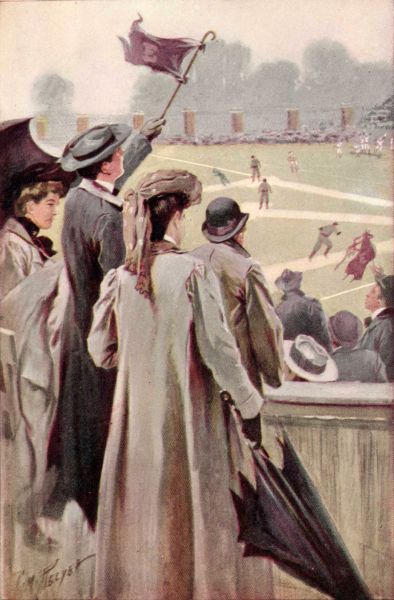
The Erskine stand was a bank of purple. The senior
class president, bareheaded, wilted of collar and crimson
of face, was standing on a seat leading the singing:
“Robinson is wavering, her pride’s about to fall;
Robinson is wavering, she can not hit the ball;
Erskine is the winner, for her team’s the best of all;
Oh, poor old Robinson!”
Billings went to bat. Motter was whispering instructions
to Jack on first. Vose, calm of face, looked
about the bases, while his support called encouragingly
to him. Then, before his arm was well back, Jack had
started like an express-train toward second. At the
same instant King made as though to dash home, and
Northup played off half-way to third. The delivery
was a poor one, but Condit stopped it, threw off his
mask, and, bewildered, threw to second.
It was a costly mistake, for King was sliding across
the plate before second-baseman had received the ball,
and the Erskine fellows were hugging each other uproariously.
Jack had flown back toward first, but half-way
there he paused. Northup was caught on his way
to third, and now was dancing back and forth with the
ball crossing and recrossing above his head, and shortstop
and third-baseman closing in on him every second.
Then he stumbled and shortstop was on him
like a flash, and he crawled to his feet to dust the
loam from his shirt and trot off the field. Meanwhile
Jack had made a good slide for second, and had beaten
the ball.
The score was tied, there was but one out, and a
man on second! Is it any wonder that Erskine’s supporters
went mad with delight and danced and shouted
and threw flags and caps into the air?
When things had settled down once more Billings
stepped back into the box. From behind him came
imperative demands for a home run. Billings tried his
best to accommodate his friends the next instant, for
there was a loud crack, and the ball went arching high
and far toward right-field. But when it descended the
Robinson fielder was under it, and Billings stopped his
journey around the bases and came back. The left-fielder
sped the ball home quickly, but not soon enough
to keep Jack from reaching third.
The Robinson band had started bravely to work
once more, but across the diamond the Erskine leaders
had brought order out of chaos, and four hundred
purple-flaunting enthusiasts were again cheering slowly
and in unison:
“Erskine! Erskine! Erskine! Rah, rah, rah!
Rah, rah, rah! Rah, rah, rah! Erskine! Erskine!
Erskine!”
And the cheers took on new force when it was seen
that the Purple’s captain was the next batsman. Joe
had given a message to King, and now King was imparting
it to Jack down at third base, and Jack was
nodding back to Joe. Robinson’s catcher, Condit, was
badly rattled, and Joe knew it and was planning accordingly.
The stands settled down into comparative
quietude, and Vose, still calm and confident-looking,
pitching the game of his life, faced his new opponent.
The outfield came in a bit.
Vose’s first delivery was easily a ball, and his second
was undeniably a strike. Then followed an outshoot
and a drop, neither of which did Joe take to.
Back went the ball to Vose, and, with King shouting
weirdly at third, he shot his arms overhead and
sped it again toward the plate. Then an odd thing
happened.
The ball was a drop. Joe struck at it hard, dropped
his bat, and flew toward base. The catcher, who had
stopped the ball on the ground, stood up, glared bewilderedly,
and then, concluding that it had been the
third strike, threw to first-baseman, Vose shouting
warnings which he did not hear. Jack, the moment
Joe had struck, had started warily toward home, and
although first-baseman caught the ball and hurled it
back to the plate in the next instant, he was lying above
the base in a cloud of dust ere the catcher tagged him.
Again pandemonium broke lose on the Erskine stand.
The Purple was one run ahead.
Joe trotted back to the plate and picked up his bat,
and Jack went to the bench, dusty, panting, and happy,
to be hugged and slapped by the delighted occupants.
There followed a pause in the game’s progress during
which Robinson’s captain sought to find a rule that
would put Jack back on third. But Joe’s strategy was
within the law, and presently the Robinson catcher
picked up his mask miserably and the captain, disgruntled,
went slowly back to his position in center-field.
The incident appeared to have discouraged both the
battery and the support. Vose took up his work listlessly,
and in a moment Joe was walking to first on
four balls. A minute later he had stolen second. Motter
bunted toward first, and beat the ball to base. Joe
took third. Vose was now plainly rattled, and a wild
pitch became a passed ball, and Motter went to second,
Joe, however, fearing to attempt to score. Then Lowe
took up the stick.
Lowe bided his time, and had two strikes called on
him before he swung his bat. When he did he found
the ball fairly, and drove a terrific grounder into outfield
between first and second bases. Joe jogged home
from third, and Motter, his legs making a purple streak,
sped like the wind to third. Lowe sat down on first
and tied his shoe. Bissell went to bat, and was deceived
by a drop that absolutely hit the plate. And right there
the half ended, for Lowe tried to steal second, and was
put out four feet from the bag.
There was joy in the Erskine camp. The score
stood now 3 to 1. If her players could hold Robinson
from further scoring the day was won. And, with King
in the pitcher’s box, it seemed that it might be done.
Regan went to bat for Robinson, and stood there idly
swinging his stick while the umpire sang: “Strike
one!... Strike two!... Striker’s out!”
And then, to fill Erskine’s cup overflowing with delight,
King struck out Vose and Cox in just the same way;
and the cheering broke forth anew, loudly, triumphantly.
And the ninth and last inning began with
little Knox at the bat.
It would be pleasant to relate how Knox knocked a
home run and how Erskine continued the performance
inaugurated in the preceding inning. Unfortunately,
that is impossible. Knox was struck out, King was
thrown out at first, Northup made a base hit, but was
left there a minute later when Jack flied out miserably
to Vose. The stands were emptying themselves of their
throngs and supporters of the rival colleges crowded
along the base-lines cheering doggedly or ecstatically,
as the case might be. King picked up the ball, Joe
donned his mask, Motter thumped his mit, and Jack, at
second, danced about from one foot to the other out of
sheer joy. Near at hand Knox was grinning like a
schoolboy, and calling shrilly to King to “Eat ’em up,
Greg!”
“First man, fellows!” cried Joe cheerfully.
Condit stepped to the plate. He was pale, and
looked an easy victim. But luck turned its back upon
the Purple, for at his second delivery King struck the
Robinson catcher on the elbow, and the latter took his
base. Robinson’s friends took courage, and their cheers
thundered over the field. Then came Hopkins, the
“hard-hitter,” and swung his bat knowingly. King realized
that here was foeman worthy of steel, and was
accordingly careful.
But Hopkins was desperate. He found the second
ball, and it went flying toward center-field. Bissell
failed to reach it in time to get his hands on it before
it struck the ground, and Hopkins gained second, Condit
going to third. Morgan followed with a slow
grounder toward King. King fielded it to first too late,
after making sure that Condit was not trying to score,
and the bases were full. A home run would win for
Robinson! A two-base hit would tie the score!
The brown banners flaunted and gyrated in the air,
throwing strange dancing silhouettes upon the turf. The
shadow of the western stand had lengthened across the
infield. Back of the stand the sky was aglow with
orange, while toward the village a golden haze filled
the air.
The throng at large was silent, intense, expectant.
Yet here and there sections of the throng still shouted,
and back of the dense wall of spectators on the Robinson
side of the field the band was playing. A cheer,
undismayed yet faint, ran along the ranks of the Erskine
supporters. It is hard to shout when your heart is throbbing
away up in your throat. Devlin went to bat, his
determined chin thrust forth and his sharp eyes sparkling
from between half-closed lids as he watched the
pitcher. Joe Perkins half knelt behind him and held a
big mitten invitingly open on his left knee.
“Steady, fellows!” he called cheerfully. “Play
for the plate!”
His voice rang true, with never a quiver in it. Yet
now and then his heart raced and thumped for an instant
in a way that turned him half faint. Despite the tiny
beads of perspiration that trickled down his face, he was
livid, and the fingers in the hot leathern mit trembled
and twitched. If he could keep those brown-legged
players from crossing the plate the game was won for
Erskine and his labors and hopes were crowned with
success. If! He groaned as he thought of all that
might happen ere the third man was put out. For the
first time during the contest he was nervous; for the first
time almost in memory he was frightened through and
through. Then his gaze swept over the field and he
saw Motter at first carelessly flipping a pebble across the
grass, Weatherby alert and impatient at second, Northup
shading his eyes with his hand as he stood motionless
in right-field, Knox calling blithely to King as he
slapped his hands together, and beyond, Bissell and
Lowe, their figures throwing long, slanting shadows
across the turf. Then King’s left hand wandered carelessly
across his forehead, his arms shot up, and Joe,
reaching out, drew in the first delivery.
“Strike,” droned the umpire.
Joe’s fright passed with the settling of the sphere in
his hands. The blood crept back into his cheeks and
courage into his heart. Returning the ball, he eased
his mask, thumped his hands together, and called confidently
to King.
“That’s the eye, Greg; once more!”
Erskine applauded grandly. Then followed two
balls. The coaches were shouting like maniacs and the
runners were set, like sprinters on the mark, ready to
spring into flight on the instant. Joe signaled a drop.
It came, and Devlin tried and missed.
“Strike two,” droned the little umpire.
Again the supporters of the Purple shouted and
waved their colors against the evening sky. King swept
a glance about the bases, unmindful of the coachers’
taunts, settled himself once more, and pitched. Devlin’s
body moved quickly forward, ball and bat met
squarely, Devlin raced toward first, and the runners on
the bases sprang away.
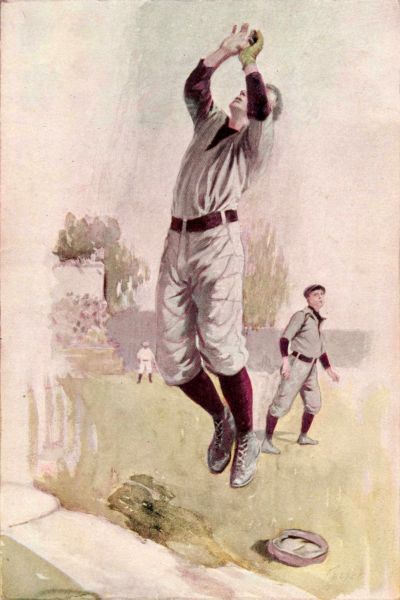
Out by second, Jack, on his toes, alert and ready for
anything, heard the crack of bat against ball, and instinctively
ran toward base. Hopkins, head down,
started like a flash toward third. Then Jack’s eyes
found the ball. It was speeding toward him, straight,
swift and well over his head. He stopped in his tracks
a foot or two behind the base-line, threw his hands high
into the air, put his weight on to his toes, and then sprang
straight upward until there was a good two feet between
him and the turf. To the excited watchers it seemed
that for an instant he hung there suspended, a lithe,
slim figure against the golden sunset haze. Then the
ball stung his hands, the throng broke into confused
shouting, and—
“Back! Back!” shrieked the coaches.
The runners turned in their tracks and scuttled for
the bases they had left like rabbits for their burrows.
Jack, the ball securely clutched, reached second in two
strides, and then, with a lightning survey of the situation,
threw straight and sure to Billings at third. Condit,
arrested ten feet from the plate by the coaches’
warnings, had doubled back, and now was racing desperately
for third base and safety. Six feet from the
bag he launched himself forward, arms outstretched.
A trailing cloud of red dust arose into the still air, and
the ball thumped into the baseman’s hands. The little
fat umpire swung his hand circling toward the bases.
“Game!” he said.
The long ranks broke like waves, and the players
were engulfed, then caught and tossed to the surface.
Jack, rocking perilously about on the shoulders of comrades,
looked dazedly yet happily down over a sea of
waving purple banners and upraised, excited faces,
while against his ears beat the thunderous refrain of
“Erskine! Erskine! Erskine!”
| ERSKINE. |
R. |
H. |
P. |
A. |
E. |
|
ROBINSON. |
R. |
H. |
P. |
A. |
E. |
| Perkins, c. |
1 |
1 |
8 |
2 |
0 |
|
Cox, 1b. |
0 |
3 |
9 |
0 |
0 |
| Motter, 1b |
0 |
1 |
8 |
0 |
1 |
|
Condit, c. |
0 |
1 |
13 |
1 |
1 |
| Gilberth, p. |
0 |
0 |
1 |
2 |
1 |
|
Hopkins, 3b. |
0 |
2 |
0 |
3 |
0 |
| Bissell, cf. |
0 |
0 |
2 |
0 |
1 |
|
Morgan, ss. |
0 |
0 |
1 |
3 |
0 |
| Knox, ss. |
0 |
1 |
0 |
0 |
0 |
|
Devlin, lf. |
0 |
0 |
1 |
0 |
0 |
| King, lf., p. |
1 |
2 |
2 |
0 |
1 |
|
Wood, cf. |
0 |
0 |
0 |
1 |
0 |
| Lowe, lf. |
0 |
1 |
0 |
0 |
0 |
|
Richman, 2b. |
0 |
1 |
1 |
2 |
1 |
| Northup, rf. |
0 |
1 |
1 |
0 |
0 |
|
Regan, rf. |
1 |
0 |
1 |
0 |
0 |
| Stiles, 2b. |
0 |
0 |
2 |
1 |
2 |
|
Vose, p. |
0 |
1 |
1 |
2 |
1 |
| Weatherby, 2b. |
1 |
1 |
2 |
1 |
0 |
|
|
— |
— |
— |
— |
— |
| Billings, 3b. |
0 |
0 |
1 |
1 |
0 |
|
Totals |
1 |
8 |
27 |
12 |
3 |
| |
— |
— |
— |
— |
— |
|
|
|
|
|
|
|
| Totals |
3 |
8 |
27 |
7 |
6 |
|
|
|
|
|
|
|
| Erskine |
0 |
0 |
0 |
0 |
0 |
0 |
0 |
3 |
0 |
—3 |
| Robinson |
0 |
0 |
0 |
0 |
0 |
1 |
0 |
0 |
0 |
—1 |
Two-Base Hits—Wood, Hopkins. Triple Play—Weatherby to
Billings. Bases on Balls—Off Gilberth, 3; Off Vose, 2; Off King, 1.
Hit by Pitched Ball—Northup (2), Condit. Struck Out—By Gilberth,
8; By King, 3; By Vose, 13. Sacrifice Hits—Knox, Richman,
Regan. Umpire—Cantrell. Time of Game—2.40. Attendance—4,000.