III.—RAREFACTION. — BAROMETER PRECAUTIONS. — NOTE ON THE VERIFICATION OF INSTRUMENTS AT THE KEW OBSERVATORY. — BAROMETER WARNINGS.
The diffusion of aqueous vapour through the air and
the rarefying influence of heat jointly effect an alteration
in the weight of the atmosphere. This alteration of
weight is determined by the Barometer, an instrument
invented by Torricelli, in 1643, and in so perfect a form
that in its essential features it has not been superseded.
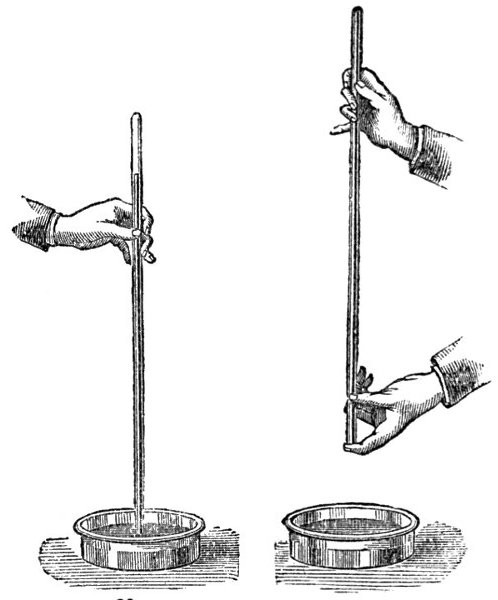
21. and 22.
Construction of Barometer.
Scale about 1/18.
The mode of construction
is illustrated
by Figs. 21 and
22. It consists in
hermetically sealing
a glass tube about
three feet long and
filling it with mercury.
The finger is
placed over the open
end of the tube,
which is then inverted
and placed in a
cistern of mercury
and the finger withdrawn.
The left-hand
figure shows
the result; the mercury
is seen to fall
some three or four
inches, leaving an empty space at the top of the tube,
which is called the “Torricellian vacuum.”
The mercury is prevented from falling lower than is
shown, by the external pressure of the atmosphere on
the cistern. The weight of this column, therefore,
represents the weight or pressure of a corresponding
column of air many miles in height; and so close is
the relation between the column of mercury and the
external air that the height of the former changes with
the slightest variation in the weight of the latter, and
the instrument thus becomes a measure of the weight of
the air, from which property its name is derived, the
Greek words baros and metron signifying respectively
“weight” and “measure.”
When the mercury in the barometer tube
falls, that in the cistern rises in corresponding
proportion, and vice versa, so that there is an
ever-varying relation between the level of the
mercury in the tube and the mercury in the
cistern, which affects the accuracy of the
readings. In M. Fortin’s cistern this difficulty
is obviated by the use of a glass, with
flexible leather bottom and a brass adjusting
screw, as shown in the cut. Through the top
of the cistern is inserted a small ivory point,
the lower end of which corresponds with the
zero of the scale; and, to secure uniformity,
the level of the mercury in the cistern should
be adjusted by the screw at each observation,
until the ivory point appears to touch its own
reflection on the surface. The reading is
then taken.
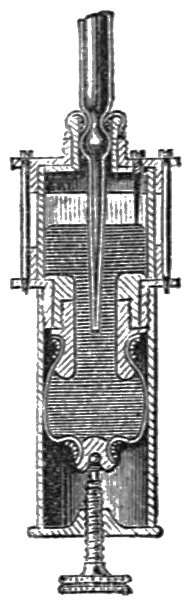
23.
Fortin’s
Cistern.
Scale about
1/6.
In making barometric observations for comparison
with others, it is necessary that all should be reduced
to the common temperature of 32° F., and for this purpose
tables have been calculated which will be found to save
much time.
Tables also for reducing observations of the barometer
to sea level, an operation equally indispensable with the
other corrections to make the
readings intercomparable, have
been published by direction of
the Meteorological Committee.
For the British Isles the
mean sea-level at Liverpool
has been selected by the
Ordnance Survey as their
datum, and the height of any
station may be ascertained by
first noting the nearest Ordnance
Bench Mark thus ↑, and
purchasing that portion of the
Ordnance map which includes
the station, near to which the
Bench Mark will be found
with the height above sea-level
duly entered. The levellings
made for railways will
also furnish the desired information.
Failing both these, the observer should
select two or more of the stations nearest
his locality for which official Meteorological
Reports are published daily in the
Times and other journals; and taking
observations of his barometer at 8 a.m.,
for a few weeks, should compare them
with the mean of the observations at
those stations. The comparison should
be omitted when the barometer pressure
is not steady.
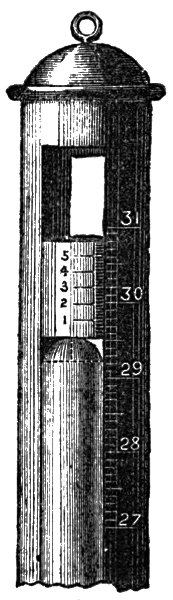
24.
Error of
Capillarity.
Scale about 1/2.

25. Standard Barometer. Scale about 1/7.
A Standard Barometer is constructed on
Fortin’s principle, and should have its tube
about half an inch bore, enclosed in a brass
body having at its upper end two vertical
openings, in which the vernier works. The
mercury is seen through these openings,
aided by light reflected from a white opaque
glass reflector let into the mahogany board
behind. The scale is divided on one side into English inches
and 20ths, and may have on the other French millimetres,
the vernier enabling a reading to be taken, in each case respectively,
of 1/500th of an inch and 1/10th of a millimetre.
In making the instrument, the mercury is boiled in the
tube, to ensure the complete exclusion of air and moisture;
while Fortin’s principle of cistern ensures a constant
level from whence to take the readings. A sensitive
thermometer with scale, engine-divided on stem, is attached
to the brass mount, which is perforated to admit
the attenuated bulb of the thermometer into absolute
contact with the glass tube of the barometer, to
ensure its indicating the same temperature as the contained
mercury. The instrument is suspended by a
ring from a brass bracket attached to a mahogany board,
and the lower end passes through a larger ring having
three screws for adjusting it vertically.
A “reading” is taken in the following manner:—1.
Note the temperature by the attached thermometer.
2. Raise or lower the mercury in the cistern by
turning the screw underneath until the reflected
image of the ivory point on the mercury seems to be
in contact with the ivory itself. By the milled head at
the side, the vernier is adjusted until its lower
edge just touches the top of the mercurial column, the
scale and vernier then indicate the height of the
barometer in inches, 10ths, 100ths, and 1000ths.
High-class instruments, such as that here described,
yield exact readings; but, in order to note them accurately,
it is important that the eye, the zero edge of
the vernier, the top of the mercurial column, and the
back of the vernier should be in the same horizontal
plane; conditions which may be obtained after some
practice.
The accompanying illustration shows a form of
barometer which, though not much used in this
country, is deservedly popular on the Continent as a
standard station barometer. It is called a Syphon
Barometer, and was designed by Gay-Lussac. The
open end of the tube is bent up in the form of
a syphon, the short limb being from six to
eight inches long; it is furnished with metal
scales and verniers, and is mounted on a
mahogany board with attached thermometer.
These barometers require no correction for
capillarity or capacity, each surface of
mercury being equally depressed by capillary
attraction, and the quantity of mercury
falling from the long limb occupies the same
space in the short limb. The usual correction
for temperature must, however, be
applied. A scale of inches, measured from a
zero point taken near the bend of the tube,
furnishes the means of measuring the long
and short columns. The difference of
readings is the height of the barometer.
The Vernier is a movable scale for subdividing
parts of a fixed scale, and was first
applied to that purpose by its inventor, M.
Pierre Vernier, in 1630. In the barometer
the parts to be divided are inches, which by
the aid of this invention are subdivided into
10ths, 100ths, and 1000ths.
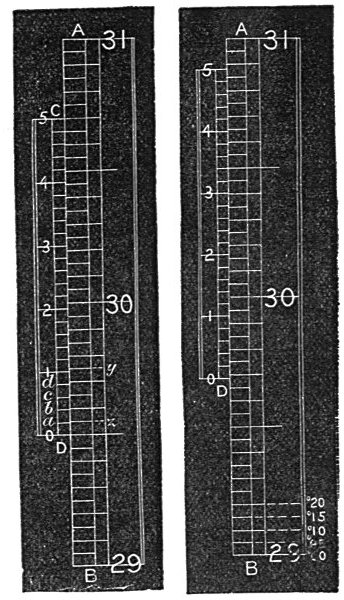
Fig. 27 shows the scale of a standard
barometer divided into 1/2-10ths, or ·05 of an
inch. The Vernier C D is made equal to 24
of such divisions, and is divided into 25 equal
parts, from whence it follows that one
division on the scale is 1/25th of ·05 larger
than one on the vernier, so that it shows
a difference of ·002 of an inch. The vernier
reads ·0, or zero, upwards; D, therefore,
indicates the top of the mercurial
column.

26.
Syphon
Barometer.
Scale
about 1/12.
In Fig. 27, zero on the vernier is exactly
in line with 29 inches and 5/10ths of the fixed scale;
the reading, therefore, is 29·500 inches. The vernier
line a falls short of a division of the scale by ·002-inch;
b, by ·004; c,
by ·006; d, by ·008;
and the succeeding
line by ·010. If the
vernier be adjusted
to make a coincide
with z on the scale, it
will have moved
through ·002-inch;
and if 1 on the vernier
be moved to coincide
with y on the
scale, the space measured
will be ·010-inch.
Consequently,
the figures 1, 2, 3, 4,
5, on the vernier,
measure 100ths, and
the intermediate lines
even 1000ths of an
inch. In Fig. 28 the
zero of the vernier is
between 29·65 and
29·70 on the scale.
Glancing up the vernier and scale, the second line
above 3 will be found in a direct line with one on
the scale; this gives ·03 and ·004 to add to 29·65, so
that the actual reading is 29·684. In those instances
where no line on the vernier is found precisely to coincide
with a line on the scale, and doubt arises as to which to
select from two equally coincident lines, the rule is to
take the intermediate 1000th of an inch.
For household and marine barometers such minute
subdivisions of the scale are unnecessary, and the scales
of such instruments are therefore divided only to 10ths,
and the verniers made only to read to 100ths of an inch,
which is effected by making the vernier 9/10ths or
11/10ths of an inch long, and dividing it into 10 equal
parts.
In “taking a reading” it is important
that it should be done as quickly as
possible, as the heat from the body and
the hand is sufficient to interfere with
that accuracy which is necessary where
the intention is to compare the readings
with those made by other observers.
This facility is soon acquired by a
little practice.

29. Farmer’s Barometer. Scale about 1/7.
Pediment Household Barometers,
though not so imposing in appearance
as the Wheel Barometer, yield direct
readings without the intervention of
the mechanical appliances necessary for
moving a needle over an extended dial.
Their mountings are for the most part
in oak, walnut, and other woods, the
scales are of ivory, porcelain, or
enamelled glass, and in their graduation
due regard is paid to the relative proportions
of cistern and tube, so that
the conditions essential to the production
of a Standard Barometer are
very closely attained. In common with
other barometers, it should hang in the
shade in a vertical position, so that light
may be seen through the tube. As a
purchaser would receive it in what is
called a “portable” state, it will be
necessary on first suspending it to take
the pinion key, fit it on the square-headed
pin at the bottom of the instrument,
and turn gently to the left till the
screw stops. The effect of this is to lower
the base of the cistern, and allow the
mercury in the tube to fall to its proper
level. The key should then be replaced
for use in moving the vernier. To make
this kind of Barometer portable for
travelling it should be unhung,
very gradually sloped
until the mercury is at the
top of the tube, when, the
instrument being upside
down, the base of the cistern
is screwed up by turning
the pinion key gently to the
right until it stops. Care
should be taken to avoid
concussion, and to have the
cistern end always uppermost,
or the instrument
lying flat.
Fig. 29 shows a useful form
of barometer for the farmer,
combining as it does three
instruments in one, for the
thermometer on the right
hand of the scale having
its bulb covered with muslin
kept moist by communication
with a cistern of water
enables the two thermometers
to be employed as a
Hygrometer, the use of
which is described at page
50. This barometer should
be suspended in a place
where it will be exposed as
much as possible to the external
air, but not in sunshine.
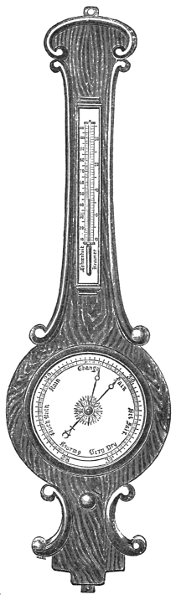
30.
Wheel Barometer. Scale
about 1/6.
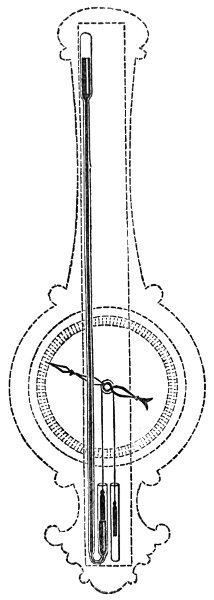
In Wheel Barometers the
varying height of a column
of mercury is shown by the
movement of a needle on a
divided circular dial, by
adopting the syphon form of
barometer tube, concealed behind the dial and frame.
An iron or glass float sustained by the mercury in the
open branch (Fig. 31) is suspended by a counterbalance
a little lighter than itself. The axis of the pulley has
the needle attached to it, and consequently moves the
needle with the rise and fall of the mercury. It is obvious,
therefore, that if the atmospheric pressure increases the
float falls and the needle turns to the right, and if it
diminishes the needle turns in the opposite direction.
The divisions on the scale represent inches, tenths, and
hundredths in the rise and fall of a column of mercury,
and these can be read with great
facility, as one inch occupies the
space of six or more on this very
open scale, according to size of
dial (Fig. 30). The wording is
arbitrary, and indicates the probable
weather that may be expected.
Important improvements have
recently been effected in this form
of household barometers, so that
they may be recommended as
good weather indicators where facility
of reading is a desideratum.
31.
Mechanism of Wheel
Barometer.
Scale about 1/8.
Since the more scientific “Pediment”
has attained so high a
degree of popularity, a certain
amount of unmerited obloquy has
attached itself to the Dial or Wheel
Barometer invented by Dr. Hooke.
It must be conceded that the standard
form of pediment barometers
in which the height of the mercury
is seen at a glance is more strictly
an “instrument of precision,” but
it should not be forgotten, although
a delicate mechanism intervenes
between the mercury and the
observer, it is so arranged that a tenth of an inch rise
or fall causes a movement of the index over an inch
of space.
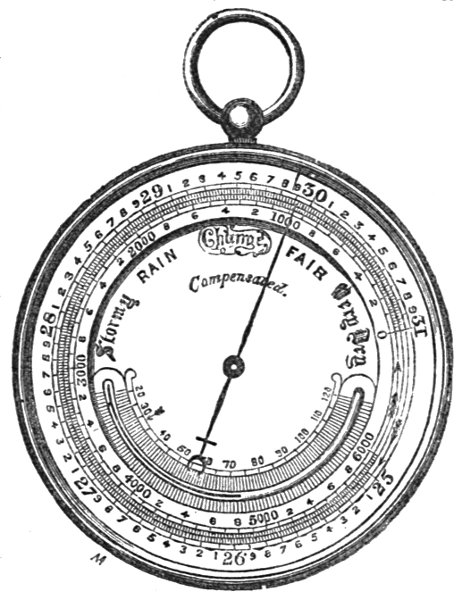
The Aneroid Barometer indicates variations in atmospheric
pressure by the elevation and depression of
the sides of an elastic metallic box from which the air is
exhausted and which is kept from complete collapse by a
powerful spring. In
cases where extreme
accuracy is not indispensable,
the portability
and sensibility
of this instrument
recommend it for use
by tourists and fishermen.
It is “quick in
showing the variations
of atmospheric
pressure.”[8] “The
Aneroid readings may
be safely depended
upon.”[9] “Its movements
are always consistent.”[10] “Atmospheric
changes are
indicated first by the
Aneroid.”[11] It is
especially adapted for determining mountain altitudes,
some being furnished with a scale of feet, enabling the
observer to read off the height by direct observation,
and if adjusted once a year by comparison with a mercurial
standard is quite trustworthy. It is fully described
in a small pamphlet entitled “The Aneroid Barometer:
How to Buy, and How to Use it,” by a Fellow of the
Meteorological Society.
32.
Aneroid Barometer. Full size.
By a suitable arrangement of clockwork, revolving a
cylinder bearing prepared paper, the aneroid barometer
forms an admirable self-recording instrument, showing
at a glance the height of the barometer: whether it is
falling or rising, for how long it has been doing so,
and at what rate the change is taking place, whether at
the rate of 1/10th per hour, or 1/10th in twenty-four
hours—facts which can only be obtained by very frequent
and regular observations from an ordinary barometer,
but which are nevertheless essential to
a reliable “weather forecast.”[12]
The height of mountains may also
be determined by the temperature at
which water boils, as this depends on
the pressure of the atmosphere, and
according to Deschanel, “just as we
can determine the boiling-point of
water when the external pressure is
given, so if the boiling-point be known
we can determine the external pressure,”
and as this varies with the elevation
above sea-level, the boiling-point
of water also varies.
These facts induced Wollaston to
attempt the determination of heights of
mountains by an apparatus which he
called the Barometric Thermometer,
subsequently modified by Regnault and
called a Hypsometer, but now more
generally known as a Boiling-point
Thermometer.
33.
Boiling-point
Thermometer.
Scale about 1/3.
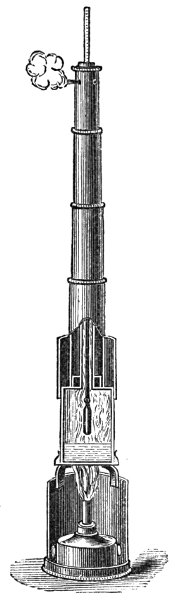
A portable form of boiling-point
thermometer is shown at Fig. 33,
which is much used by Alpine travellers,
and forms a trustworthy check on
the aneroid and barometer.
Concise Tables for calculating heights by means of Barometer or
Aneroid, and also by the Boiling-point Thermometer.
| Boiling-point of Water for pressure in next col. |
Barometer at lower Station. |
BAROMETER AT UPPER STATION.—INCHES. |
| In. |
30 | 29 | 28 | 27 |
26 | 25 | 24 | 23 |
22 | 21 | 20 | 19 |
18 | 17 | 16 | 15 |
| 213·78 | 31 |
859 | 873 | 889 | 905 |
921 | 939 | 957 | 977 |
998 | 1020 | 1043 | 1068 |
1095 | 1124 | 1155 | 1188 |
| 212·13 | 30 |
.... | 888 | 904 | 920 |
937 | 955 | 974 | 994 |
1015 | 1038 | 1062 | 1087 |
1115 | 1144 | 1176 | 1210 |
| 210·43 | 29 |
.... | .... | 919 | 936 |
953 | 971 | 991 | 1012 |
1033 | 1056 | 1081 | 1107 |
1135 | 1165 | 1198 | 1233 |
| 208·67 | 28 |
.... | .... | .... | 952 |
970 | 989 | 1009 | 1028 |
1051 | 1075 | 1100 | 1127 |
1156 | 1187 | 1220 | 1257 |
| 206·87 | 27 |
Factor A. |
988 | 1007 | 1028 | 1050 |
1073 | 1097 | 1122 | 1150 |
1180 | 1211 | 1246 | 1283 |
| 205·01 | 26 |
.... | .... | .... | .... |
.... | 1027 | 1048 | 1070 |
1093 | 1118 | 1145 | 1173 |
1203 | 1236 | 1271 | 1309 |
| 203·09 | 25 |
.... | .... | .... | .... |
.... | .... | 1069 | 1092 |
1116 | 1141 | 1169 | 1198 |
1229 | 1262 | 1299 | 1338 |
| 201·11 | 24 |
.... | .... | .... | .... |
.... | .... | .... | 1115 |
1140 | 1166 | 1194 | 1224 |
1256 | 1290 | 1327 | 1367 |
| 199·05 | 23 |
.... | .... | .... | .... |
.... | .... | .... | .... |
1164 | 1191 | 1220 | 1251 |
1284 | 1319 | 1358 | 1399 |
| 196·92 | 22 |
.... | .... | .... | .... |
.... | .... | .... | .... |
.... | 1218 | 1248 | 1280 |
1314 | 1350 | 1390 | 1433 |
| 194·71 | 21 |
.... | .... | .... | .... |
.... | .... | .... | .... |
.... | .... | 1278 | 1310 |
1346 | 1383 | 1424 | 1469 |
| 192·41 | 20 |
.... | .... | .... | .... |
.... | .... | .... | .... |
.... | .... | .... | 1343 |
1380 | 1419 | 1461 | 1507 |
| 190·00 | 19 |
.... | .... | .... | .... |
.... | .... | .... | .... |
.... | .... | .... | .... |
1416 | 1457 | 1500 | 1548 |
| 187·50 | 18 |
.... | .... | .... | .... |
.... | .... | .... | .... |
.... | .... | Factor A |
.... | 1497 | 1542 | 1592 |
| 184·87 | 17 |
.... | .... | .... | .... |
.... | .... | .... | .... |
.... | .... | .... | .... |
.... | .... | 1588 | 1639 |
| 182·10 | 16 |
.... | .... | .... | .... |
.... | .... | .... | .... |
.... | .... | .... | .... |
.... | .... | .... | 1690 |
| 179·20 | 15 | |
| Height in 1,000 feet. |
Factor D. additive. |
Latitude. |
Factor C. |
Mean Temperature. |
Factor B. |
| 2 | 5 |
0° | †2·7 |
10° | 0·951 |
| 4 | 11 |
10 | †2·5 |
20 | 0·973 |
| 6 | 17 |
20 | †2·0 |
30 | 0·996 |
| 8 | 23 |
30 | †1·4 |
40 | 1·018 |
| 10 | 30 |
40 | †0·6 |
50 | 1·040 |
| 12 | 37 |
45 | 0·0 |
60 | 1·062 |
| 14 | 44 |
50 | -0·5 |
70 | 1·084 |
| 16 | 52 |
60 | -1·3 |
80 | 1·127 |
| 18 | 60 |
70 | -2·0 |
| |
Rule I.—If the temperature of boiling water be observed at either or both Stations,
find the equivalent pressure in the 2nd column, and calculate the height as for barometer.
Rule II.—The readings of the Barometer being corrected and reduced to 32° F.,
multiply the difference of pressure between the Stations by factor A, found in line with
pressure at lower Station, and under that at upper Station; multiply again by factor B,
corresponding to the mean temperature of the air at the Station; apply as many times C
as there are thousand feet in the height, corresponding to the latitude; and add D, the
correction for gravity.
Example.—At the top of Snowdon, lat. 53° N., an aneroid read 26·48, correction
-0·18, the pressure at sea-level was 29·91; the temperature of the intermediate air
was 57°; find the height.
| Lower Station |
29·91 inches. |
| Upper „ |
26·30 |
|
|
----- |
|
|
3·61 |
|
| Factor A |
933 |
|
|
----- |
|
|
1083 |
|
|
1083 |
|
|
3249 |
|
|
----- |
|
|
3368 |
(neglecting decimals.) |
| Factor B |
1.055 |
|
|
----- |
|
|
16840 |
N.B.—In taking out the quantities, if accuracy is aimed at, it will be necessary to proportion for parts in the usual manner with such Tables. |
|
16840 |
|
3368 |
|
----- |
|
|
3553 |
|
| Cor. C = 3 × 1 = -3 |
|
| Cor. D |
+ 10 |
|
|
---- |
|
| Height |
3560 feet. |
The illustration (Fig. 33) shows the instrument with
the telescopic tube drawn out for use, and the thermometer
surrounded by the vapour of boiling water. The
lamp is protected from wind by a perforated japanned
tin case covered with wire gauze. When the boiler
is charged and the lamp ignited the mercury ascends,
and the point at which it becomes stationary shows
the temperature, which will give the elevation in feet
above the sea-level on reference to the table supplied
by the optician from whom the instrument is purchased.
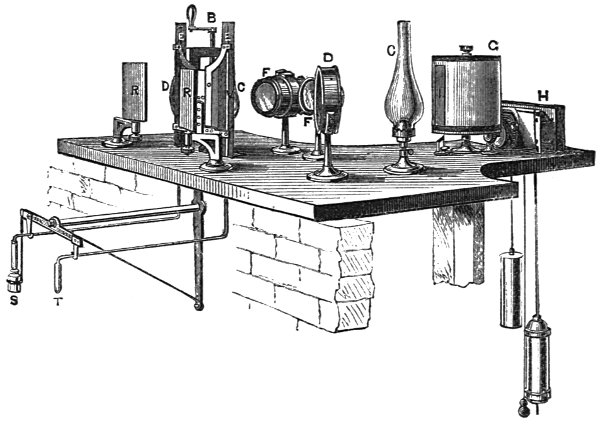
34.
Barograph. Scale about 1/6.
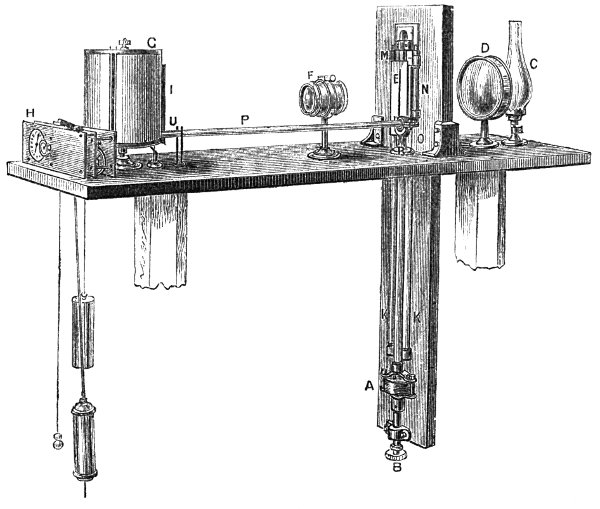
A highly-refined automatic arrangement is adopted
at some observatories called a Barograph, which, by the
aid of photography, becomes a self-recording mercurial
barometer. It is simpler in its arrangement than the
thermograph, and includes a clock of superior construction,
causing a cylinder bearing photographic paper to
make one complete revolution in forty-eight hours. A
double combination of achromatic lenses brings to a focus
rays passing through a slit placed in front of the mercurial
column, behind which is a strong gaslight or paraffin
lamp, the rays of which are condensed upon the slit by
a combination of two plano-convex lenses.
Although a barometer is an instrument artificially
constructed by man, it should not be forgotten that when
once made the column of mercury is placed in a passive
or quiescent state in direct relation with the great forces
of nature, so that its indications become to some extent
natural phenomena. This is aptly illustrated by what
is called the “daily fluctuation” of the barometer which
occurs in all countries, though the hours and extent vary
with the latitude, diminishing as the latitude increases,
according to a definite law. The phenomena does not
admit of a satisfactory explanation, but is doubtless
connected with the daily variations of temperature and
of vapour in the air. The mercury falls naturally (so
to speak) from nine or ten to between three and four
p.m.; it then rises till between nine and ten p.m.
It falls again about four a.m., and rises again about
ten a.m. It is usually highest at nine a.m. and nine
p.m., and lowest at three a.m. and three p.m.
These natural elevations and depressions of the mercury
should be allowed for in reading the barometer,
as any rise or fall in opposition to the natural rise
and fall possesses for that reason increased importance.
For instance, fine weather may be expected if the
mercury rises between nine a.m. and three p.m.; in like
manner rain may be expected should a fall take place
between three p.m. and nine p.m.
It will be inferred from the preceding facts that there
are certain hours better suited for “taking a reading”
than others. When one observation only is made daily,
noon is the best time, two observations should be made
at nine a.m. and nine p.m., and for three the best hours
are nine a.m. (maximum), noon (mean), and three p.m.
(minimum).
The opinion generally entertained that a high barometer
is an indication of fine weather, and a low one a
warning of bad weather, is open to exception, and an
increased value would attach to the indications of the
instrument in proportion as the following points are
noted and allowed for:—
1. The actual height of the mercury. 2. Whether it
is rising or falling. 3. The rate of rise and fall. 4.
Whether the rise or fall has been long continued.
The state of the barometer foretells coming weather,
and when the present weather disagrees with the barometer
a change will soon take place. A fall of half a
tenth, or more, in an hour is a sure warning of a storm,
a rapid rise is a warning of unsettled weather.
The barometer is generally lowest with wind from the
S.W., and highest with wind N.E., or with a calm.
N.E. and S.W. may be called the wind’s poles, and the
difference of height due to direction only from one of
these bearings to another amounts to about half an
inch.
If vacuum suspected, cause mercury to strike top of tube.
A clear metallic “click” indicates a good vacuum.
A dull “thud” indicates air or moisture.
In latter case return to optician, but if unable
Incline very gently until nearly inverted, when
Air if present will ascend in a bubble into the cistern.
Suspend barometer in good light out of sunshine.
Let no heat of fire or lamp affect it.
Let no sudden changes of temperature affect it.
It must hang absolutely vertically.
Note temperature of attached thermometer before reading barometer.
Then adjust mercury in cistern to touch ivory point.
Then adjust vernier and take reading quickly.
Ascertain height above sea-level according to direction.
The Storm Glass (Fig. 36) is a glass bottle, ten inches long,
containing a mixture of camphor, nitre, sal-ammoniac,
alcohol, and water. As “temperature affects the mixture
much,” an arrangement has recently been designed in
which the stem of a thermometer is immersed in the
fluid, as shown at Fig. 37, thus imparting a higher value
to its indications. The late Admiral Fitzroy says—
“Since 1825, we have generally had some of these glasses, as
curiosities rather than otherwise; for nothing certain could be made
of their variations until lately, when it was fairly demonstrated that if
fixed undisturbed in free air, not exposed to radiation, fire, or sun, but
in the ordinary light of a well-ventilated room, or, preferably, in the
outer air, the chemical mixture in a so-called storm glass varies in
character with the direction of the wind—not its force.”
The quarter from which the wind or storm is blowing is indicated by
the substance adhering more closely to the bottom of the glass opposite
to the point whence the wind or tempest arises.
The Sympiesometer is an instrument used chiefly at
sea for purposes of comparison with the mercurial and
aneroid barometers. Its indications result partly from
the pressure and partly from the temperature of the
atmosphere; it would, therefore, be more correctly named
a Thermo-Barometer.
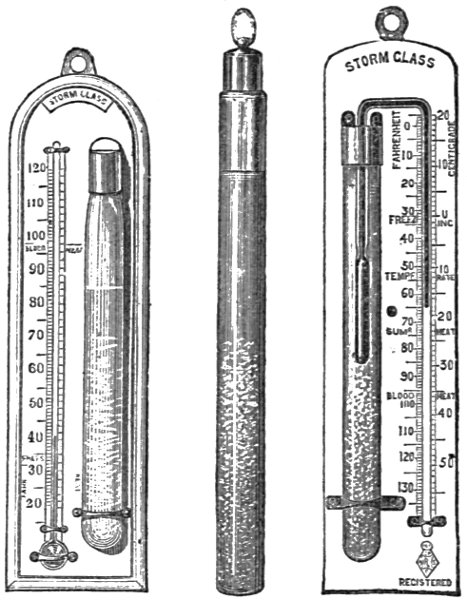
35. 36. 37.
Storm Glass, or Chemical Weather Glass. Scale about 1/5.
The height of the atmosphere has been variously
estimated:—By Bravais, from the duration of twilight,
at 66 to nearly 100 miles; by Dalton, in 1819, from
observations of the auroral light, at 102 miles; by Sir
John Herschel, from similar observations in 1861, at 83
miles; from observations of meteors, from 100 to 200
miles; by Liais, in 1859, from observations on the
polarisation of the sky, at no less than 212 miles.
The density of the atmosphere diminishes with distance
from the earth’s surface, in accordance with the
following rule:—“At a height of seven miles the density
of the atmosphere is reduced to one-fourth the density
at the sea-level, and for every additional seven miles,
the rarity of the air is similarly quadrupled.”
The Kew Committee of the Royal Society receive, for
verification and comparison with the standard instruments
of the Kew Observatory, barometers, thermometers,
and other instruments intended for meteorological
observation or scientific investigations.
Any persons ordering instruments of opticians may
direct them to be previously forwarded to the observatory
for verification.
A scale of charges is issued by the Committee which
is exclusive of packing and carriage, or of rail expenses,
when a special messenger is sent out. The Meteorological
Office, Victoria Street, London, also receives and
forwards instruments for verification to the Kew
Observatory.
The Committee wish it to be understood that they
cannot undertake the verification of an inferior class of
instruments (such as barometers mounted upon wooden
frames, and thermometers not graduated on the stem),
and that the superintendent of the observatory may at
his discretion decline to receive such instruments as he
may consider unfit for scientific observation.
|
May be Expected |
|
----- |
| |
| Increasing storm |
If mercury falls during a high wind from S.W., S.S.W., W. or S. |
| Violent but short |
If the fall be rapid. |
| Less violent but of longer continuance |
If the fall be slow. |
| A violent storm from the N.W. or N. |
If the mercury falls suddenly while the wind is due W. |
| N.W., N., or N.E. winds, or less wind, or less rain, or less snow |
If the mercury having been at its usual height, 29·95, is steady or rising, while the thermometer falls and the air becomes drier. |
| Wind and rain from S.E., S., and S.W. |
If the mercury falls, while the thermometer rises and the air becomes damp. |
| A violent storm from N.W., N., or N.E. |
When the mercury falls suddenly with a W. wind. |
| Snow |
If the mercury falls when the thermometer is low. |
| Less wind, or a change to N., or less wet |
When the mercury rises, after having been some time below its average height. |
| Strong wind or heavy squalls from N.W., N., or N.E. |
With the first rise of the mercury after it has been very low (say 29). |
| Improved weather |
When a gradual continuous rise of the mercury occurs with a falling thermometer. |
| Winds from S. or S.W. |
If the mercury suddenly rising, the thermometer also rises. |
| Heavy gales from N. |
Soon after the first rise of the mercury from a very low point. |
| Unsettled weather |
With a rapid rise of the mercury. |
| Settled weather |
With a slow rise of the mercury. |
| Very fine weather |
With a continued steadiness of the mercury with dry air. |
| Stormy weather with rain (or snow) |
With a rapid and considerable fall of the mercury. |
| Threatening, unsettled weather |
With an alternate rising and falling of the mercury. |
| Much wind, rain, hail, or snow, with or without lightning |
When the mercury falls considerably. If the thermometer be low (for the season) the wind will be N., if high, from S. |
| Lightning only |
When the mercury is low, the storm being beyond the horizon. |
| Fine weather |
With a rosy sky at sunset. |
| Wind and rain |
When the sky has a sickly greenish hue. |
| Rain |
When the clouds are of a dark Indian red. |
| Bad weather or much wind |
When the sky is red in the morning. |
| EXPLANATORY CARD.
|
| BY THE LATE VICE-ADMIRAL FITZROY, F.R.S., ETC.
|
| WEATHER GLASSES.
|
| The Barometer Rises |
The Barometer Falls |
| for Northerly wind |
for Southerly wind |
| (including from North-west, by the North, to the Eastward), |
(including from South-east, by the South, to the Westward), |
| for dry, or less wet weather,—for less wind,—or for more than one of these changes:— |
for wet weather,—for stronger wind,—or for more than one of these changes:— |
| Except on a few occasions when rain, hail, or snow comes from the Northward with strong wind. |
Except on a few occasions when moderate wind with rain (or snow) comes from the Northward. |
|
| For change of wind toward Northerly directions,— |
For change of wind toward Southerly directions,— |
| a thermometer falls. |
a thermometer rises. |
| Moisture or dampness in the air (shown by a Hygrometer) increases before rain, fog, or dew. |
|
| On barometer scales the following contractions may be useful:— |
Add one-tenth of an inch to the observed height for each hundred feet the Barometer is above the half-tide level. |
| RISE |
FALL |
| FOR |
FOR |
The average height of the Barometer, in England, at the sea-level, is about 29·94 inches; and the average temperature of air is nearly 50 degrees (London latitude). |
| NORTH |
SOUTH |
| N.W.—N.—E. |
S.E.—S.—W. |
| DRY |
WET |
The Thermometer falls about one degree for each three hundred feet of elevation from the ground, but varies with wind. |
| OR |
OR |
| LESS |
MORE |
|
| WIND. |
WIND. |
“When the wind shifts against the sun, |
|
|
Trust it not, for back it will run.” |
|
|
|
| EXCEPT |
EXCEPT |
First rise after very low |
| Indicates a stronger blow. |
| WET FROM |
WET FROM |
|
| NORTH. |
NORTH. |
Long foretold—long last, |
| Short notice—soon past. |
| (In South Latitude read South for North.) |
IV.—CONDENSATION. — HYGROMETER PRECAUTIONS. — CLOUDS. — RAIN.
Dew is a deposition of moisture from the air, resulting
from the condensation of the aqueous vapour of the
atmosphere on substances which have become cooled by
the radiation of their heat. This is, in fact, the substance
of Dr. Wells’s famous Theory of Dew, enunciated
in 1814, and which, according to Dr. Tyndall, “has stood
the test of all subsequent criticism, and is now universally
accepted,” and by which all the phenomena of
dew may be explained.
Dr. Wells’s experiments were interesting and conclusive.
He exposed definite weights (10 grains) of wool to
the air on clear nights, one on a four-legged stool, the
other under it, the upper portion gained 14 grains in
weight, the lower only 4 grains. On an evening when
one portion of wool, protected by a curved pasteboard
roof, gained only 2 grains, a similar portion on the top
of the miniature roof gained 16 grains. A little reflection
will suggest the explanation: radiation from the
wool was arrested by the pasteboard cover, while the portion
fully exposed to the sky lost all its heat, and thus
condensation ensued. Dr. Wells speaks with such candour,
and so pointedly, on this fact and its consequences, that
his words may be advantageously quoted: “I had often,
in the pride of half-knowledge, smiled at the means
frequently employed by gardeners to protect tender
plants from cold, as it appeared to me impossible that a
thin mat, or any such flimsy substance, could prevent
them from attaining the temperature of the atmosphere,
by which alone I thought them liable to be injured.
But when I had learned that bodies on the surface of
the earth become during a still and serene night colder
than the atmosphere, by radiating their heat to the
heavens, I perceived immediately a just reason for the
practice I had before deemed useless.”
Familiar instances of the formation of dew will have
been noted by many “watchers;” e. g., breathing on a
cold pane of glass, a tumbler of cold water becoming
dew-covered on being brought into a warm room, the
outside of a tankard of iced claret cup, &c. When,
radiation is so free and rapid that the temperature is
below the freezing point, the dew freezes as it forms,
producing hoar-frost.
In our climate the air is never completely dry, nor
completely saturated with moisture, and the amount of
aqueous vapour held in suspension is very variable.
This fact has important bearings on many branches of
industry, as also on the hygienic qualities of the atmosphere.
The consideration that a certain amount of
moisture in the air is necessary to the continuance of
health will suggest the importance of maintaining that
due proportion in the atmosphere of sick rooms, where
the artificial heat so injudiciously used, often disturbs
the healthful hygrometric condition of the air. Mr.
Glaisher is of opinion that the medical profession
should enforce, as far as lies in their power, the use of
this simple and effective instrument, which gives indications
so important to the comfort of the patient.
The amount of moisture in the air is estimated by the
use of instruments called Hygrometers, which may be
thus classified:—
1. Hygrometers of Absorption.—Made with hair,
oatbeard, catgut, seaweed, grass, chloride of calcium.
2. Hygrometers of Condensation.—Regnault’s,
Daniell’s, Leslie’s, Dyne’s.
3. Hygrometers of Evaporation.—Mason’s
Psychrometer, or Wet and
Dry Bulb Thermometers.
By an ingenious application of
the affinity of the oatbeard for moisture,
Damp Detectors are constructed
for tourists, commercial travellers,
&c., to test moisture and avoid the
consequences of sleeping in damp
beds. They are strongly gilt, and
resemble in size and shape a lady’s
watch.
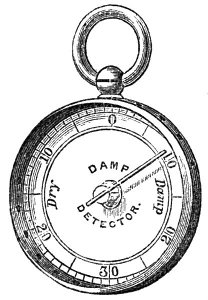
38.
Damp Detector.
Scale about 2/3.
In Saussaure’s Hygrometer the
frame is of brass, and the scale of the same metal silvered.
It has an attached thermometer, and the indications are
the result of the contraction and expansion of a prepared
human hair, consequent upon its absorbing or
yielding moisture. The scale is divided on the arc of
a circle, and an index
needle, working on an enlarged
arc, multiples the
indications.
Regnault’s Hygrometer
(Fig. 39) consists
of a thin and highly
polished silver tube or
bottle, into the neck of
which is inserted a delicate
thermometer. The
bottle has a lateral tubular
opening, to which is
attached a flexible tube
with an ivory mouthpiece.
Ether is poured into the
silver tube in sufficient
quantity to cover the bulb
of the thermometer. The
ether is then agitated by
breathing through the
flexible tube until, by the
rapid evaporation thus
produced, a condensation
of moisture takes place,
readily observable on the
bright polished silver surface, and the temperature
indicated by the thermometer at that moment is the
dew-point.
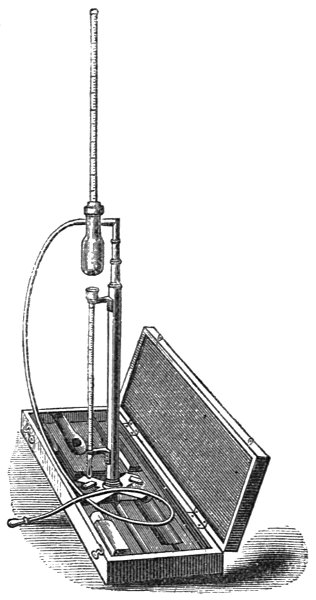
39.
Regnault’s Hygrometer. Scale
about 1/10.
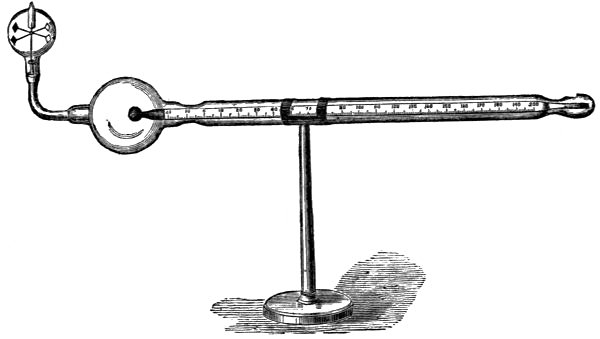
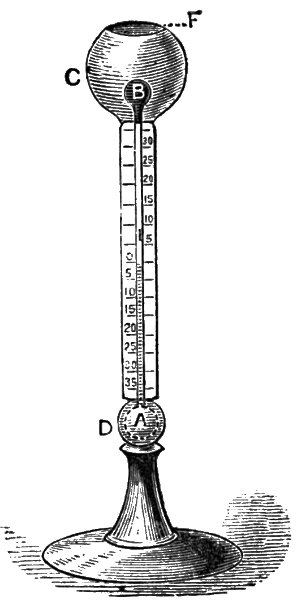
Daniell’s Hygrometer, or Dew-point Thermometer
(Fig. 40), consists of a glass tube, bent twice at right
angles, each extremity terminating in a bulb about
1-1/2 inch in diameter, supported on a brass stand, to
which a thermometer is attached to indicate the temperature
of the surrounding air. The
lower bulb is of blackened glass,
to facilitate the observation of
the dew-point; it is about three
parts filled with pure ether, and
contains a very delicate thermometer.
The upper bulb at the
extremity of the short stem is
transparent, but covered with
thin muslin, upon which, when
an observation is made, pure
ether is slowly dropped. The
evaporation rapidly lowers the
temperature, until a moment
arrives at which dew condenses
on the black bulb. A quick eye is
necessary to note this and the temperature
shown by the thermometer
simultaneously, the latter showing the
degree at which the atmosphere is
saturated with moisture at the time of
observation. To avoid error, it is usual
to note the temperature at which the
dew disappears, and take the mean of
the two temperatures.
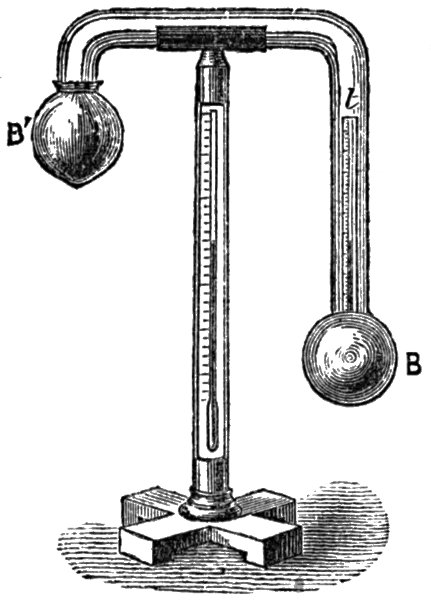
40.
Daniell’s Hygrometer.
Scale about 1/5.
Dyne’s Hygrometer, for showing
the dew-point by direct observation,
by means of iced water and black
glass, enables the observer to dispense
with the use of ether, and shows the
dew-point with great distinctness.
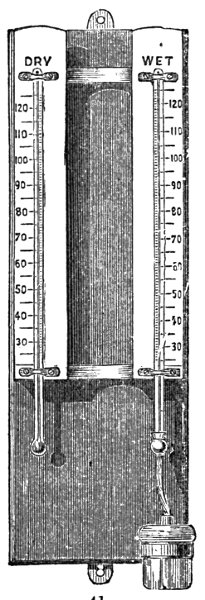
41.
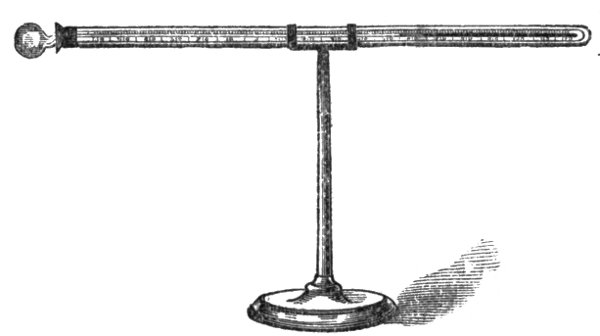
Mason’s Hygrometer.
Scale about 1/6.
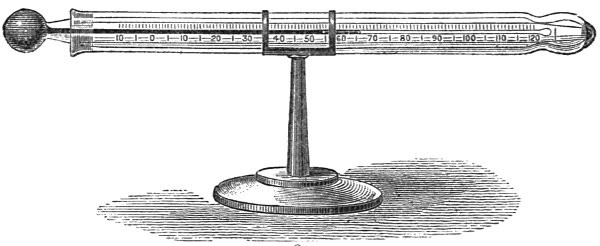
The hygrometer in most general use
is the wet and dry bulb thermometer,
and for which Mr. Glaisher has calculated
an elaborate set of tables, a brief
abstract of which sufficient for general
purposes is subjoined.
| For finding the Degree of Humidity of the Air from Observations of a Dry Bulb and a Wet Bulb Thermometer, sometimes called Mason’s Psychrometer. |
TEMPERATURE
BY THE
DRY BULB
THERMOMETER. |
DIFFERENCE BETWEEN DRY BULB AND WET BULB READINGS. |
| 2° |
4° |
6° |
8° |
10° |
12° |
| DEGREE OF HUMIDITY. |
| 34° | 79 | 63 | 50 | ... | ... | ... |
| 36 | 82 | 66 | 53 | ... | ... | ... |
| 38 | 83 | 68 | 56 | 45 | ... | ... |
| 40 | 84 | 70 | 58 | 47 | ... | ... |
| 42 | 84 | 71 | 59 | 49 | ... | ... |
| 44 | 85 | 72 | 60 | 50 | ... | ... |
| 46 | 86 | 73 | 61 | 51 | ... | ... |
| 48 | 86 | 73 | 62 | 52 | 44 | ... |
| 50 | 86 | 74 | 63 | 53 | 45 | ... |
| 52 | 86 | 74 | 64 | 54 | 46 | ... |
| 54 | 86 | 74 | 64 | 55 | 47 | ... |
| 56 | 87 | 75 | 65 | 56 | 48 | ... |
| 58 | 87 | 76 | 66 | 57 | 49 | ... |
| 60 | 88 | 76 | 66 | 58 | 50 | 43 |
| 62 | 88 | 77 | 67 | 58 | 50 | 44 |
| 64 | 88 | 77 | 67 | 59 | 51 | 45 |
| 66 | 88 | 78 | 68 | 60 | 52 | 45 |
| 68 | 88 | 78 | 68 | 60 | 52 | 46 |
| 70 | 88 | 78 | 69 | 61 | 53 | 47 |
| 72 | 89 | 79 | 69 | 61 | 54 | 48 |
| 74 | 89 | 79 | 70 | 62 | 55 | 48 |
| 76 | 89 | 79 | 71 | 63 | 55 | 49 |
| 78 | 89 | 79 | 71 | 63 | 56 | 50 |
| 80 | 90 | 80 | 71 | 63 | 56 | 50 |
| 82 | 90 | 80 | 72 | 64 | 57 | 51 |
| 84 | 90 | 80 | 72 | 64 | 57 | 51 |
| 86 | 90 | 80 | 72 | 64 | 58 | 52 |
The total quantity of aqueous vapour which at any
temperature can be diffused in the air being represented
by 100, the percentage of vapour actually present will
be found in the table opposite the temperature of the dry
thermometer, and under the difference between the
dry bulb and wet bulb temperatures. The degree of
humidity for intermediate temperatures and differences
to those given in the table
can be easily estimated.
Thus dry bulb 51°, wet
bulb 46°, give 69 for the
degree of humidity.
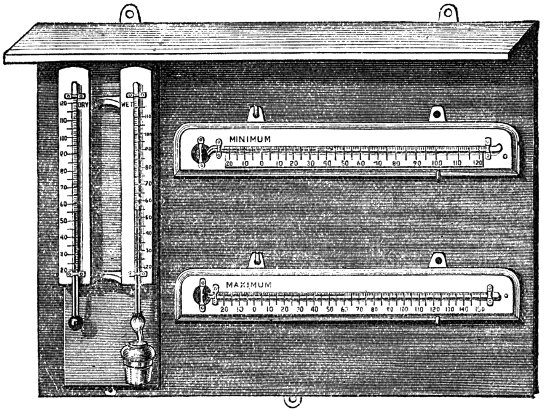
The instrument, as
shown at page 48, consists
of two thermometers
attached to a support,
which may be either slate
or wood. The bulb of one
of the thermometers has
some thin muslin tied over
it, and is kept moist by the
capillary action of a thread
dipping into a cistern of
water placed underneath.
It will be obvious that the
amount of evaporation
will be in proportion to the
dryness of the air, and that the differences of temperature
indicated by the two thermometers will be greatest when
the atmosphere is dry, and least when the air is damp.
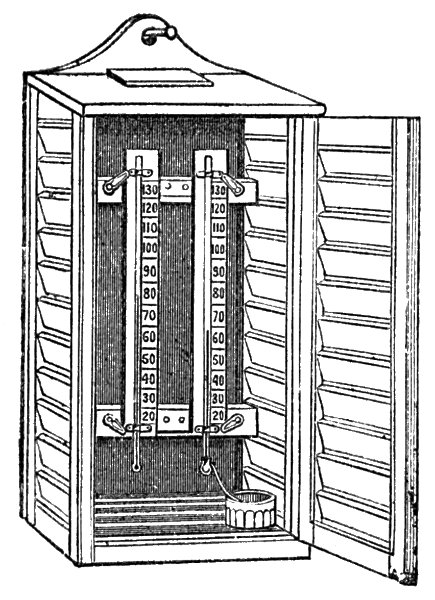
42.
Board of Trade Thermometer
Screen. Scale about 1/9.
Hygrometers should be exposed in the shade free from air-currents.
The covering of the wet bulb must be very thin.
The supply of water must be carefully regulated.
The bulb must be constantly moist, yet not too wet.
The supply of water must be ample in dry weather.
In damp weather water must not drip from the wet bulb.
Water reservoir should be as far as possible from the dry bulb.
Dry bulb must never receive moisture from any source.
Use distilled, rain, or softest water procurable, for wet bulb.
When lime deposits from use of hard water change muslin and worsted.
Replenish reservoir after, or long before, taking an observation.
Well wash muslin and worsted before using.
Also wash occasionally while in use.
Change muslin twice a month or according to condition.
Dust and blacks must not be allowed to accumulate on muslin.
⎧ When wet bulb is frozen, wet with ice-cold water by brush.
⎪ The water will first freeze, then cool to air-temperature.
⎨ After which wet bulb falls a trifle lower than dry one.
⎩ Then temperature of evaporation may be noted.
⎧ In thick fog wet bulb reads above dry bulb.
⎪ In cold calm weather, wet bulb reads above dry bulb.
⎨ This is owing to the air being perfectly saturated.
⎪ Covered bulb cannot therefore show temperature as well as uncovered.
⎩ In such cases both readings are assumed to be identical.
It is important that the instrument should be protected
not only from the sun’s direct rays, from rain and
snow, but also from wind, the currents of which would,
by increasing evaporation, cause the wet bulb thermometer
to indicate a temperature not strictly due to the
hygrometric condition of the atmosphere. For this purpose
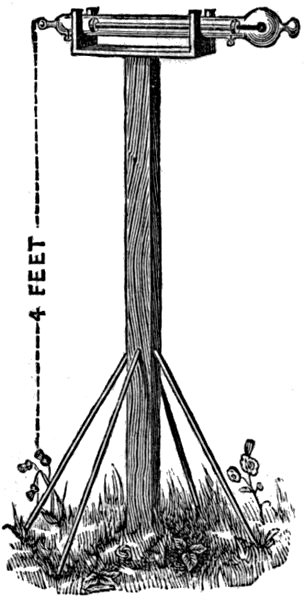
Thermometer Screens are employed. Illustrations
of two forms are shown at Figs. 42 and 43; they should
be placed facing the north at a distance of four feet from
the ground. Fig. 42 shows the form adopted by the Board
of Trade, for marine service, while Fig. 43 shows Mr.
Stevenson’s double-louvred screen with perforated bottom,
which ensures free ingress and egress of air, the exclusion
of snow and rain, and the direct rays of the sun.
Professor Wild recommends overlapping segments of
sheet zinc for the
construction of
these screens, as
possessing the advantage
over wood
of becoming
sooner in thermic
equilibrium with
the surrounding
air, and thus
preventing radiation.
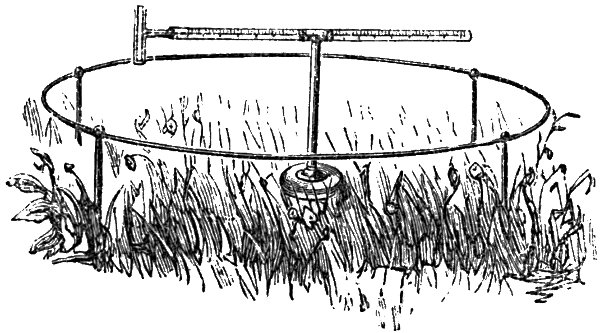
Stevenson’s
Screen should be
erected on legs
four feet high, and
should stand over
grass on open
ground. It should not be under the shadow of trees,
nor within twenty feet of any wall.
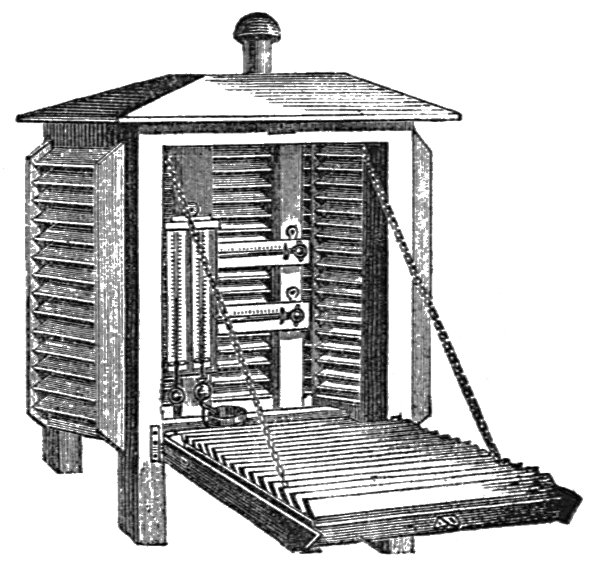
43.
Stevenson’s Thermometer Screen.
Scale about 1/10.
The important office performed by clouds in the
economy of nature entitles them to extended consideration.
A cloud may be defined as “water-dust,” since
aqueous vapour diffused through the air is invisible
until the temperature is sufficiently lowered to produce
condensation; no satisfactory explanation, however,
has yet been given of the mode of suspension of this
water-dust, nor why it remains suspended in opposition
to gravitation. It is tolerably certain that electricity
is not without its influence, though the apparently
stationary character of some clouds is deceptive, for
while there may be no apparent motion in the mass
the particles constituting the mass are undergoing continuous
renewal, which justifies the assertion of Espy
that every cloud is either a forming or dissolving cloud.
Aeronauts in ascending from the earth pass through
many successive alternations of cloud-strata and clear
air which owe their existence to the varying temperature
and degrees of humidity of the atmospheric
currents so superposed.
Luke Howard in his Askesian Lectures, 1802, divides
clouds into three primary modifications: cumulus,
stratus, and cirrus, with intermediate forms resulting
from combinations of the primaries, viz., cirro-cumulus,
cirro-stratus, cumulo-stratus, and cumulo-cirro-stratus
or nimbus. This nomenclature is now universally
adopted.
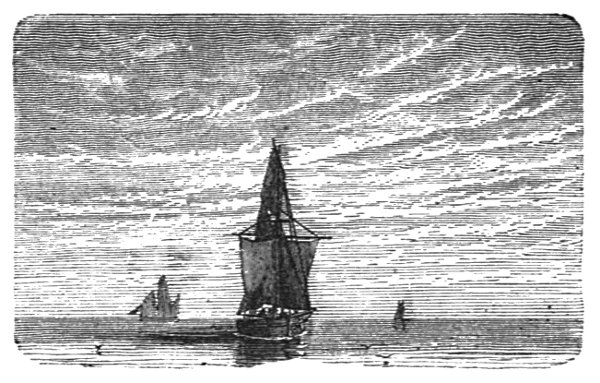
Cirrus, or mare’s tail cloud, appears as parallel,
flexuous, or diverging streaks or fibres, partly straight.
It is the lightest and the highest of all clouds, being
seldom less than three miles, and often ten miles, above
the earth, and shows the greatest variety of form.
On account of its great height it is assumed to consist
of minute snowflakes or crystals of ice, the refractions
and reflections from which produce the halos, coronæ,
and mock suns and moons which occur chiefly in this
cloud and its derivatives. It retains its varied outlines
longer than any other cloud; at sunrise it is the first to
welcome the sun’s rays, and at sunset the last to part
with them. It is the most useful of all clouds for
weather warnings.
1. Serene, settled weather may be expected when
groups and threads of cirri are seen during a
gentle wind after severe weather.
2. A change to wet may be expected when, after
continued fair weather, filaments, or bands of
cirri (apparently stationary), with converging
ends, travel across the sky.
3. Rain or snow, and windy, variable weather may
be expected when cirri with fine tails vary
much in a few hours.
4. Continued wet weather may be undoubtedly
expected when horizontal sheets of cirri fall
quickly and pass into the cirro-stratus.
5. A storm of wind and rain may be expected within
forty-eight hours when fine threads of cirri
seem brushed backward from the south-west.
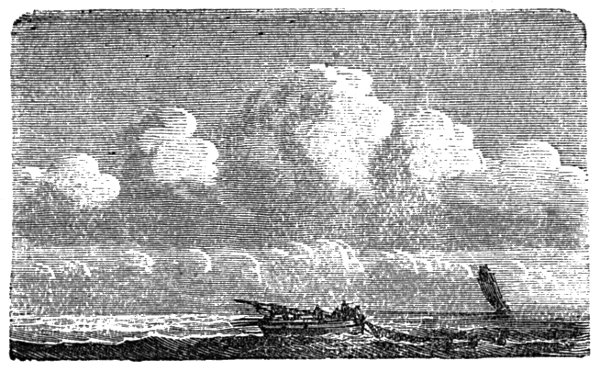
Cumulus.—This modification of cloud is most frequently
seen on bright summer days, and is appropriately
called “the day cloud” and “the summer
cloud.” It is formed only in the daytime, in summer
calms, and results from the rise of vapours from rivers,
lakes, and marshes into the colder regions of the air,
the lower portions of which are readily saturable. They
are characterized by a horizontal base, from which
they rise in dense conical and hemispherical masses
rivalling mountains in their magnitude.
Their formation is due to the convection of heat from
the earth’s surface, which renders the lower atmospheric
strata capable of holding a larger amount of aqueous
vapour and simultaneously establishes an upward
current, which reaching the colder regions of the air
brings about the condensation of the aqueous vapour
into the elegant and ever-beautiful forms admired alike
“by saint, by savage, and by sage.” These begin as
mere specks, which enlarge until the sky is nearly
covered in the afternoon, and towards sunset they
generally disappear, their tops becoming cirri when the
air is dry.
1. Fine, calm, warm weather may be expected when
cumuli are of moderate size and of pleasing
form and colour.
2. Cold, tempestuous, rainy weather may be expected
when cumuli cover the sky, rolling over each
other in dense, dark, and abrupt masses.
3. Thunder may be expected when cumuli of hemispherical
form are characterized by an extreme
silvery whiteness.
4. Rain may be expected when cumuli increase in
number towards evening, sinking at the same
time into the lower portions of the air.
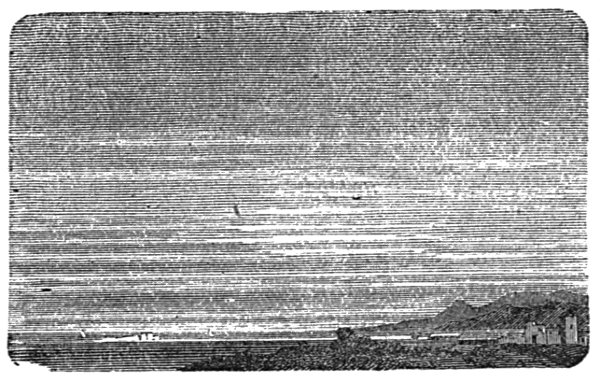
Stratus.—As its name implies, this is a horizontal
sheet of cloud formed near the earth at night (whence
it has been called “the night cloud”) by the condensation
of moist air from rivers, lakes, and marshes, or
damp ground which has lost its day-heat by radiation,
especially in calm clear evenings, after warm days. It
appears as a white mist near, and sometimes touching,
the earth. It attains its maximum density about midnight,
but is dissipated by the rays of the morning sun.
Its formation, watched from a height over a large city,
is highly interesting, and is attributed by Sir John
Herschel to the soot suspended over such localities, each
particle of which acts as “an insulated radiant, collects
dew on itself, and sinks down rapidly as a heavy body.”
Still more interesting is it to observe from a similar
elevation the dissipation of this cloud when the sun has
attained such an altitude that its rays fall on the upper
surface of the stratus cloud, which then heaves like the
billows of the ocean, while the whole mass seems to
rise spontaneously from the earth, and speedily vanishes
“into air, into thin air.”
1. The finest and most serene weather may be expected
when stratus clouds present the appearances
just described.
Cirro-cumulus, or “mackerel sky,” is a well-known
form of cloud occurring in small roundish masses, looking
like flocks of sheep at rest, and often at great
heights. It is seldom seen in winter.
1. Increased heat may be expected when cirro-cumuli
appear.
2. A storm or thunder may be expected when cirro-cumuli
occur mingled with cumulo-stratus in
very dense, round, and close masses.
3. Warm wet weather, and a thaw, may be expected
when cirro-cumuli occur in winter.
Cirro-stratus “appears to result from the subsidence
of the fibres of cirrus to a horizontal position, at the
same time approaching laterally. The form and relative
position when seen in the distance frequently give the
idea of shoals of fish.” It is called “the vane cloud”
and “mackerel-backed sky.”
1. Rain, snow, and storm may be expected when
cirro-stratus is seen alone or mingled with
cirro-cumulus, especially if the cirro-cumulus
passes away.
2. Fair weather may be expected when from a
mixture of cirro-stratus and cirro-cumulus
the former disappears, leaving the latter in
possession of the sky.
3. Thunder and heat are generally attended by
waved cirro-stratus.
Cumulo-stratus.—This form of cloud results from
the mingling of the cumulus and cirro-stratus; it
appears sometimes as a thick bank of cloud with overhanging
masses. The cloud known as “distinct” cumulo-stratus
appears as a cumulus surrounded by small
fleecy clouds.
1. Thunder may be expected when “distinct”
cumulo-stratus appear.
2. Sudden atmospheric changes may be expected
when cumulo-stratus appear.
Nimbus, or cumulo-cirro-stratus.—The name of
this cloud at once suggests that it is produced by a
combination of the three primary forms of cloud. The
nimbus is popularly known as “the rain cloud.” It is
really a system of clouds, having its origin chiefly in
the tendency of the cumulo-stratus to spread, overcast
the sky, and settle down to a dense horizontal black or
grey sheet, above which spreads the cirrus, and from
below which rain begins to fall.
1. A cessation of rain may be expected when the
grey lower portion of nimbus begins to break up.
2. A thunderstorm may be expected when the nimbus
character of the cloud is very perfect.
3. Very copious showers may be expected when the
cirri projected from the top of the rain-cloud
are very numerous.
Amount of Clouds.—Any record of the proportion
of sky covered by cloud should be made on a scale of
0 to 10. A clear sky is registered 0, and a sky wholly
obscured as 10, any intermediate condition being represented
by 5—7, or other figures deemed appropriate by
the observer. The kind of cloud should be noted, as also
the direction in which it is driven by the wind, whether in
the upper or lower strata of the air. This operation may
be assisted by an ingenious arrangement, exhibited by
Mr. Goddard in 1862, and called a “cloud reflector,”
obtainable at any optician’s. Observations at the Greenwich
Observatory establish the facts that the least
amount of cloud exists during the night, especially in
May and June, and the greatest amount at midday,
and in winter; also that from November to February
three-fourths of the heavens are obscured by sun-repelling
clouds.
Height of Clouds.—Great diversity of opinion
exists on this point. It is asserted, on the one hand,
that the region of clouds does not extend beyond five
miles above sea-level, but Glaisher has attained a height
of 36,960 feet, and from thence saw clouds floating at a
great height above him; and it is considered probable
that cirri are often ten miles above the earth.
Velocity of Clouds.—This is of two kinds: 1st.
Velocity of Propagation; and 2nd. Velocity of Motion.
The first occurs when at a given altitude the dew-point
is suddenly attained, when the sky on one occasion
was covered from the eastern to the western horizon at
the rate of 300 miles per hour. The second is dependent
on the force of atmospheric currents, which is
much greater in the upper regions of the air than in
those nearer the earth. Accurate observations of the
shadows of clouds, borne across the fields on a summer’s
day, warrant the assertion that an apparently
slow motion of clouds is equal to eighty miles an
hour, while a velocity of 120 miles is attained without
impressing the observer with the idea of rapidity.
On the subject of clouds Admiral Fitzroy says:—
|
May be Expected |
|
----- |
| Fine weather |
When clouds are “soft-looking or delicate.” |
| Wind |
When clouds are hard-edged or oily-looking. |
| Less wind |
In proportion as the clouds look softer. |
| More wind |
The harder, more “greasy,” rolled, tufted, or ragged the clouds look. |
| Rain |
When small-inky-looking clouds appear. |
| Wind and rain |
When light scud clouds are seen driving across heavy masses. |
| Wind only |
When light scud clouds are seen alone. |
| Change of wind |
When high upper clouds cross the sun, moon, or stars in a direction different from that of the lower clouds, or the wind then felt below. |
| Wind |
With tawny or copper-coloured clouds. |
The following “Weather Warnings” may be gathered
from the Colour of the Sky:—
Whether clear or cloudy, a rosy sky at sunset presages
fine weather; a sickly greenish hue, wind and
rain; a red sky in the morning, bad weather, or much
wind or rain; a grey sky in the morning, fine weather;
a high dawn (i. e., when the first indications of daylight
are seen above a bank of clouds), wind; a low dawn
(i. e., when the day breaks on or near the horizon), fair
weather. Light, delicate, quiet tints or colours, with
soft, indefinite forms of clouds, indicate and accompany
fine weather; but gaudy or unusual hues, with hard,
definitely outlined clouds, foretell rain and probably
strong wind. Also a bright yellow sky at sunset
presages wind; a pale yellow, wet; orange or copper-coloured,
wind and rain: and thus, by the prevalence
of red, yellow, green, grey, or other tints, the coming
weather may be told very nearly; indeed, if aided by
instruments, almost exactly.
After fine, clear weather the first signs in a sky of
a coming change are usually light streaks, curls, wisps,
or mottled patches of white distant cloud, which increase
and are followed by an overcasting of murky vapour that
grows into cloudiness. This appearance, more or less oily or
watery as wind or rain will prevail, is an infallible sign.
Usually, the higher and more distant such clouds
seem to be, the more gradual, but general, the coming
change of weather will prove.
Misty clouds, forming or hanging on heights, show wind
and rain coming, if they remain, increase, or descend; if they
rise or disperse, the weather will improve or become fine.
|
May be Expected |
|
----- |
| Fine weather |
When the sky is grey in the morning. |
| Wind |
With a high dawn. |
| Fair weather |
With a low dawn. |
| Wind |
When the sky at sunset is of a bright yellow. |
| Rain |
When the sky at sunset is of a pale yellow. |
| Wind and rain |
When the sky is orange or copper colour. |
| Fine weather |
When the sky has light, delicate, quiet tints and soft, indefinite forms of clouds. |
| Rain and wind |
When the sky has gaudy, unusual hues, with hard, definite outlined clouds. |
| Fair weather |
When sea-birds fly out early and far to seaward. |
| Stormy weather |
When sea-birds hang about the land, or fly inland. |
| Fair weather |
When dew is deposited. Its formation never begins under an overcast sky, or when there is much wind. |
| Rain |
On what is called a good hearing day. |
| Rain |
When remarkable clearness of atmosphere, especially near the horizon, exists, distant objects, objects, such as hills, being unusually visible or well defined. |
The atmosphere at a given temperature is capable
of retaining only a given quantity of aqueous vapour,
invisibly diffused through it, at which temperature it is
said to be saturated. Should the temperature from any
cause be lowered, the aqueous vapour at once becomes
visible in the form of either cloud, dew, rain, snow, or
hail. It has already been shown that, although marshes
and rivers, inland seas and lakes, yield by evaporation
watery vapours to the air, the ocean is the great source
of rain, whence it is lifted in vast quantities by the
sun’s radiant heat, to be subsequently condensed by
passing into cooler regions, or by contact with cold
mountain peaks, falling to earth as a fertilizing shower
or a devastating flood.
Sir John Herschel accounts for the formation of raindrops
by saying:—“In whatever part of a cloud the
original ascensional movement of the vapour ceases, the
elementary globules of which it consists being abandoned
to the action of gravity, begin to fall. The larger
globules fall fastest, and if (as must happen) they overtake
the slower ones, they incorporate, and the diameter
being thereby increased, the descent grows more rapid,
and the encounters more frequent, till at length the globule
emerges from the lower surface of the cloud at the
‘vapour plane’ as a drop of rain, the size of the drops
depending on the thickness of the cloud stratum and
its density.”
Rain is very unequally distributed, there being portions
of the torrid zone where it never falls, one locality
in Norway where it falls three days out of four, and
another on the western side of Patagonia, at the base of
the Andes, where it falls every day. The quantities recorded
as having fallen at one time in some localities are
simply appalling. A fall of one inch is considered a very
heavy rain in Great Britain, and this fact will enable
the reader partially to realize the following stupendous
recorded falls:—Loch Awe, Scotland, 7 inches in 30
hours; Joyeuse, France, 31 inches in 22 hours; Gibraltar,
33 inches in 26 hours; hills above Bombay, 24
inches in one night; and on the Khasia Hills, where the
annual rainfall is 600 inches, 30 inches have been known
to fall on each of five successive days. Mr. G. J. Symons,
the able editor of the “Meteorological Magazine,” and indefatigable
superintendent of 2,000 Rain Gauges throughout
the United Kingdom, has compiled a table, showing
the equivalents of rain in inches, its weight per acre,
and bulk in gallons, the following portion of which,
while very useful to the farmer, will enable the curious
reader to make some interesting calculations, based on
the figures quoted above:—
Table showing equivalent of inches of rain in gallons,
and weight per acre.
| Inches of Rain |
Tons per Acre |
Gallons per Acre |
| 0·1 |
10 |
2262 |
| 0·2 |
20 |
4525 |
| 0·3 |
30 |
6787 |
| 0·4 |
40 |
9049 |
| 0·5 |
50 |
11312 |
| 0·6 |
61 |
13574 |
| 0·7 |
71 |
15836 |
| 0·8 |
81 |
18098 |
| 0·9 |
91 |
20361 |
| 1·in. |
101 |
22623 |
The instruments called Rain Gauges or Pluviometers
are, as their name implies, constructed to measure the
amount of rain falling in any given locality, and those
in most general use have this principle in common: that
the graduated glass always bears a definite relation to the
area of the receiving surface. A very extraordinary and
hitherto unexplained fact in connection with the fall of
rain, and which justifies the opinion that its formation is
not limited to the region of visible cloud, is that a series
of rain gauges placed at different elevations above the
soil are found to collect very different quantities of rain,
the amount being greater at the lower level. Thus, twelve
months’ observations by Dr. Heberden determined that
the amount of rain on the top of Westminster Abbey was
only twelve inches, that on a house close by but much
lower eighteen inches, and on the ground during the same
interval of time twenty-two inches. Accordingly, ten
inches is the height at which meteorologists have agreed
the edge of the rain gauge should be placed from the
ground. The spot chosen should be perfectly level, and
at least as far distant from any building or tree as the
building or tree is high, and, if the gauge cannot be
equally exposed to all points, a south-west aspect is
preferable. It is also important that the rain gauge
should be well supported, in order
to avoid its being blown over by
the wind; and, should frost follow
a fall of rain, the instrument
should be conveyed to a warm
room to thaw before measuring the
collected contents. The graduated
glass furnished with each instrument
should stand quite level
when measuring the rain, and the
reading be taken midway between
the two apparent surfaces of the
water.
The best form of rain gauge is
that in use in the Meteorological
Office.
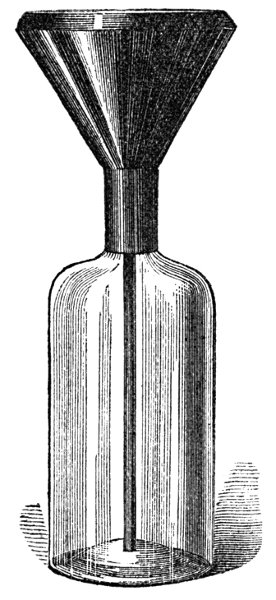
48.
Howard’s Rain Gauge.
Scale about 1/5.
Howard’s Rain Gauge consists
of a vertical glass receiver, or
bottle, through the neck of which
the long terminal tube of a circular
funnel, five inches in diameter,
is inserted. A metal collar
or tube fits over the outside of the
neck of the receiver, and aids in keeping the funnel level,
while the tube extends to within half an inch of the
bottom, thus ensuring the retention of every drop of rain
which falls within the area of the funnel. The glass
vessel furnished with the instrument is graduated to
100ths of an inch. A modification of this instrument is
made with a glass tube at the side graduated to inches,
10ths, and 100ths, showing the amount of rainfall by
direct observation, thus dispensing with the use of a
supplementary graduated measure.
In Glashier’s Rain Gauge special provision is made,
in two ways, to prevent possible loss by evaporation,
even in the warmest months of the year. 1. The receiving
vessel is partly sunk beneath the soil, thus
keeping the contents cool. 2. The receiving surface
of the funnel, accurately turned to a diameter of eight
inches, terminates at its lower extremity in a curved
tube, which, by always retaining the last few drops of
rain, prevents evaporation. The graduated vessel, in
this instance also, is divided to 100ths of an inch,
having due regard to the larger area, 8 in. of the funnel.
For use in tropical climates, where, as has been shown,
the rainfall is excessive, a modification of this instrument
is supplied by the instrument makers, having an
extra large receiver and tap for drawing off the collected
rain.
Luke Howard, in his “Climate of London,” says: “It
must be a subject of great satisfaction and confidence to
the husbandman to know at the beginning of a summer,
by the certain evidence of meteorological results on record,
that the season, in the ordinary course of things,
may be expected to be a dry and warm one, or to find, in
a certain period of it, that the average quantity of rain to
be expected for the month has fallen. On the other hand,
when there is reason, from the same source of information,
to expect much rain, the man who has courage to
begin his operations under an unfavourable sky, but with
good ground to conclude, from the state of his instruments
and his collateral knowledge, that a fair interval is
approaching, may often be
profiting by his observations,
while his cautious neighbour,
who ‘waited for the weather
to settle,’ may find that he has
let the opportunity go by.”
This superiority, however, is
attainable by a very moderate
share of application to the
subject, and by the keeping of
a plain diary of the barometer
and rain gauge, with the hygrometer
and vane under his
daily notice.
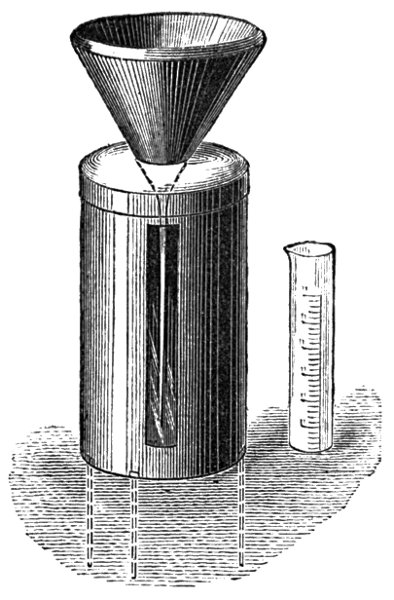
49.
Symons’s Rain Gauge.
Scale about 1/7.
Symons’s Rain Gauge resembles
Howard’s,
but has
the advantage
of having
the glass receiver enclosed in a
black or white japanned metal or
copper jacket with openings permitting
an approximate observation
of the collected rain. The
metal jacket is also furnished with
strong iron spikes, which are firmly
pressed into the soil, as shown at
Fig. 49, thus ensuring perfect
steadiness by its power to resist
the wind. The graduated measure
contains half an inch of rain (for a
5 inch circle) divided into 100ths.
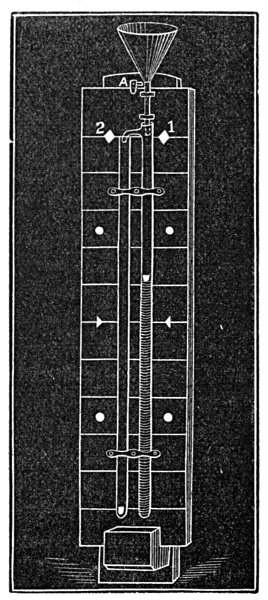
50.
Symons’s Storm Rain Gauge.
Scale about 1/12.
Mr. Symons has devised another
rain gauge of so ingenious and interesting
a character that it needs
only to become generally known
among amateur meteorologists to
be in universal demand. By its
means an observer at a distant
window may read off the rain as it falls. It is shown at
Fig. 50, where the usual 5-inch funnel surmounts a long
glass tube attached to a black board bearing a very open
scale marking tenths of an inch in white lines; a white
float inside the tube constitutes the index, which rises
as the rain increases in quantity. If, as sometimes
happens during a thunderstorm, the rainfall is excessive,
a second tube on the left permits the measurement
of a second inch of rain. It will be obvious that if the
time at which the rain begins to fall be noted the rate at
which it falls, as well as the quantity, is indicated at
sight by this instrument.
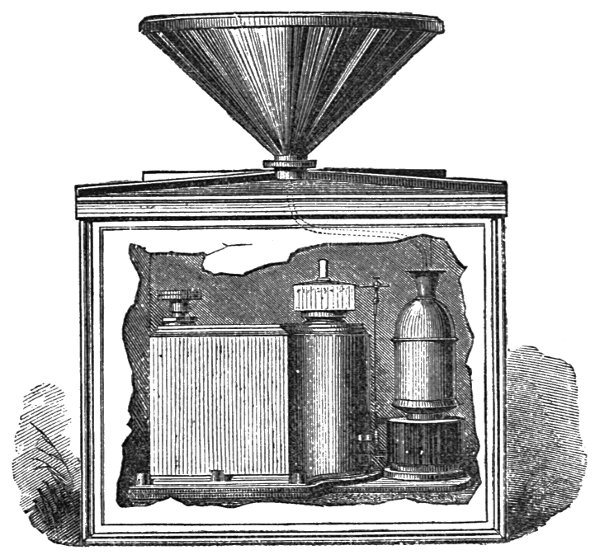
51.
Beckley’s Pluviograph. Scale about 1/7.
Crossley’s Registering Rain Gauge has a receiving
surface of 100 square inches. The rain falling
within this area passes through a tube to a vibrating
bucket, which sets in motion a train of wheels,
and these move the indices on three dials, recording
the amount of rain in inches, 10ths, and 100ths.
Printed directions are furnished with each instrument,
and the simplicity of the mechanism ensures due
accuracy. A test measure, holding exactly five cubic
inches of water, sent with each gauge, affords the means
of checking its readings from time to time.
Beckley’s Pluviograph possesses the exceptional merit
of recording with equal precision all rainfalls, from a
slight summer shower to a heavy storm of rain. It may be
placed in a hole in the ground, with the receiving surface
raised the standard height of ten inches above its level.
Fig. 51 illustrates the construction of the instrument.
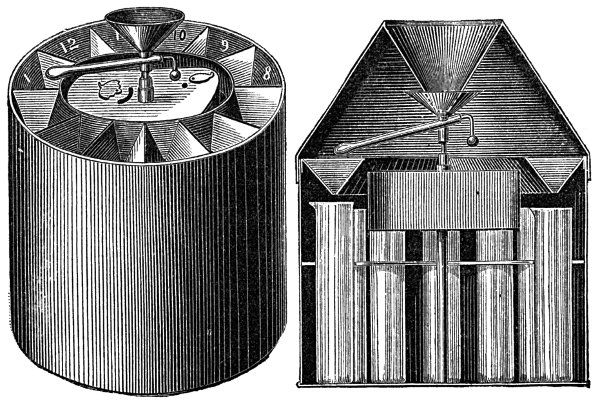
52. 53.
Stutter’s Self-recording Rain Gauge. Scale about 1/7.
The funnel has a receiving surface of 100 square inches,
protected by a lip 1-1/4 inch deep, to retain the splashes.
The rain flows into a copper receiving vessel on the right,
which, floating in a cistern of mercury, sinks and draws
down with it a pencil, which records the event on a
white porcelain cylinder moved by a clock. When the
receiving vessel is full the syphon comes into action,
rapidly drawing off the whole of the water, the vessel
rising almost at a bound, the action being recorded by a
vertical line on the porcelain cylinder. Two or more
cylinders are supplied with each instrument; and, as
the pencil marks are readily removed by a little soap
and water, a clean one may be always kept at hand for
exchange once in every twenty-four hours.
The Rev. E. Stutter’s Self-recording Rain Gauge
is ingenious, and for a self-recording instrument is very
moderate in price, while it efficiently shows the rainfall
for every hour in the twenty-four (Figs. 52, 53).
An eight-day clock with its upright spindle revolves
a small funnel with a sloping tube, the end of which
passes successively over the mouth of the twelve or
twenty-four compartments in the rim of the instrument;
beneath each compartment is placed a tube, as shown in
the sectional figure. All rain received by the outer
funnel drips into the smaller revolving funnel, and flows
down the sloping tube, the end of which is timed to
take an hour in passing over each compartment, so that
the rain, for example, which falls between twelve and one
o’clock will be found in the tube marked 1. Each tube
can contain half an inch of rain, and any overflow falls
into a vessel beneath, and can be measured; the tube
which has overflown shows the hour.