PART I. — POPULAR WEATHER PROGNOSTICS. — CYCLONE PROGNOSTICS. — WEDGE-SHAPED ISOBAR PROGNOSTICS. — STRAIGHT ISOBAR PROGNOSTICS. — ANTICYCLONE PROGNOSTICS. — CONCLUSION. — DISCUSSION. — POPULAR WEATHER PROVERBS AND PROGNOSTICS. — PROVERBS RELATING TO ANIMALS. — PROVERBS RELATING TO BIRDS. — PROVERBS RELATING TO CLOUDS. — PROVERBS RELATING TO DEW. — PROVERBS RELATING TO FISH. — PROVERBS RELATING TO FOG OR MIST. — PROVERBS RELATING TO FROST. — PROVERBS RELATING TO INSECTS. — PROVERBS RELATING TO THE MOON. — PROVERBS RELATING TO PLANTS. — PROVERBS RELATING TO RAIN. — PROVERBS RELATING TO RAINBOWS. — PROVERBS RELATING TO REPTILES. — PROVERBS RELATING TO STARS OR METEORS. — PROVERBS RELATING TO SNOW. — PROVERBS RELATING TO THE SUN. — PROVERBS RELATING TO THUNDER AND LIGHTNING. — PROVERBS RELATING TO TREES. — PROVERBS RELATING TO WIND. — PROVERBS RELATING TO YEARS AND SEASONS. — PROVERBS RELATING TO MONTHS, WEEKS, AND DAYS. — GENERAL PROGNOSTICS. — DR. JANNER’S REASONS FOR NOT GOING HUNTING.
9
By the Hon. Ralph Abercromby, F. M. S., and William Marriott, F. M. S., reprinted
from the “Quarterly Journal of the Meteorological Society,” published in
London.
The attempt to foretell the weather is not of recent date; the ancients
carefully studied the sky and clouds, and endeavored to predict the
kind of weather that was likely to ensue; and a number of the popular
prognostics of the weather of his time are recorded by Aristotle in his
work on meteors. In later times our forefathers studied the weather,
and as they had no instruments to guide them they observed natural
objects and noticed the appearances of the sky and clouds, and also
the movements of animals, birds, plants, &c. Shepherds and sailors
especially being exposed to all kinds of weather, would naturally be on
the lookout for any signs of a coming change, and after a time would
begin to associate certain appearances with certain kinds of weather.
A good deal of weather wisdom of the above character has been thrown
into proverbs, trite sayings, and popular verse; and we propose in the
present paper to examine and explain some of these by the aid of the
most recent discoveries of meteorological science. A great advance
has been made in meteorology during the last twenty years, owing to
the introduction of daily synoptic charts of the distribution of atmospheric
pressure, temperature, wind, rain, &c. From these it is evident
that there is a distinct relation existing between the distribution
of pressure and the direction and force of the wind, and the temperature
and weather generally. A glance at a number of the charts shows
that there is nearly always present either an area of low pressure, called
a cyclone, usually having an approximately circular form, and, as a rule,
moving in an easterly or northeasterly direction; or an area of high pressure,
called an anticyclone, also nearly circular in form, but almost stationary
in position. The wind in all cases also blows in a direction nearly
parallel with the isobars, having the region of lowest pressure on the
left hand. This has given rise to the simple law propounded by Dr.
Buy’s Ballot, for the northern hemisphere, viz: “Stand with your back
to the wind, and the barometer will be lower on your left hand than on
your right.” In cyclones the wind circulates in the opposite way to
which the hands of a watch move, but exhibits usually a little in-draught;
while in anticyclones the wind circulates in the same way as the hands
of a watch, but exhibits usually a little outward motion. The intensity
of the wind in all cases depends upon the closeness of the isobars; for
the closer the isobars the greater is the difference in pressure in a given
distance, and consequently the stronger the wind. Nearly all of our
weather is of the cyclonic or anticyclonic type, and is entirely dependent
upon the form and distribution of the isobars. It is, therefore, by the
aid of isobaric charts that we shall attempt to explain popular prognostics,
and to associate them with certain kinds of weather. The
method of research actually adopted has been for many years past to
10take notes of any good observation of any prognostic and put them in
a portfolio, with the nearest synoptic chart available, or preferably with
the nearest, both before and after. When a sufficient number had been
collected they were analyzed, and the remarkable result has been arrived
at that the greater number of prognostics are simply descriptive
of the weather and appearance of the sky, in the different portions of
the various shapes of isobars seen on synoptic charts, and that they
indicate foul or fair weather just as they precede the shifting areas of
rain or blue sky which are mapped out by the isobaric lines. These
charts not only show the success of the prognostics, but also explain
wherein they sometimes fail, by tracing the changes of each particular
condition of the weather. Hitherto the only prognostics which have
been accounted for have been those due to excessive damp, but by
means of isobaric charts many others can be readily explained. It
must not be supposed that the modern methods diminish the value of
prognostics, for even in forecasting weather from synoptic charts they
are of great value, and are always exceedingly useful to solitary observers
who have only a single barometer to depend upon besides these
prognostics, as, for instance, on board ship.
We hope that the present paper will create an interest on the part of
many in this subject, and show that it is within their power to assist in
advancing the science of meteorology, so that it may not remain any
longer in the unsatisfactory state set forth in the following old Bedfordshire
lines:
“Well, Duncombe, how will be the weather?”
“Sir, it looks cloudy altogether,
And coming across our Houghton Green,
I stopped and talked with old Frank Beane.
While we stood there, sir, old Jan Swain
Went by and said he knowed ’twould rain;
The next that came was Master Hunt,
And he declared he knew it wouldn’t.
And then I met with Farmer Blow,
He plainly said he didn’t know,
So, sir, when doctors disagree,
Who’s to decide it, you or me?”
We shall first take a typical well formed cyclone. In the accompanying
diagram (Fig. 1) the broad features of the relation of cloud and
rain to a cyclone centre are shown, the full line indicating the path of
the depression, and the dotted line at right angles to it is the trough or
locus of the lowest reading of the barometer.
11
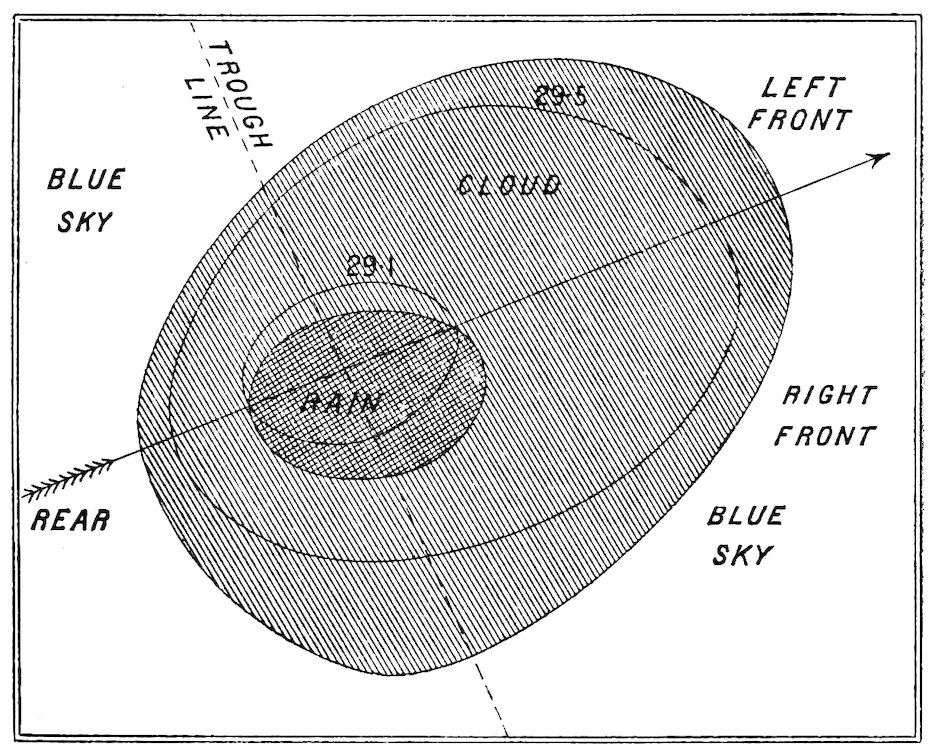
Fig. 1.—Weather in a Cyclone, November 14, 1875.
In the extreme front of the depression there is a blue sky, then, as
the barometer begins to fall, and sometimes even before that takes place,
a bank of cirro-stratus, preceded by a halo-bearing sky, makes its appearance,
which gradually becomes lower and denser, and forms an
overcast, dirty sky. In the whole front of the depression the temperature
rises, and the atmosphere feels muggy and close. In the right-hand
front the clouds assume the cumulo-stratus type, with driving rain
later on. In the left-hand front the air is cooler, but still oppressive,
with an easterly wind and overcast sky, succeeded by drizzling rain or
ill-defined showers. When the trough of the depression has passed the
barometer begins to rise, the wind changes and becomes squally, with
showers of rain; the air grows cooler, and the clouds break and ultimately
clear away.
Now, with regard to the prognostics with reference to Fig. 2, where
12the characteristic weather in the different portions of a depression are
given in a diagrammatic form, it will be seen that the first indication
of a coming change is the appearance of a halo round the sun or moon
in the cirro-stratus clouds. Hence,
When round the moon there is a brugh,
The weather will be cold and rough.
The moon with a circle brings water in her beak.
Halos predict a storm (rain and wind or snow and wind) at no great distance, and
the open side of the halo tells the quarter from which it may be expected.
Mock suns predict a more or less certain change of weather.
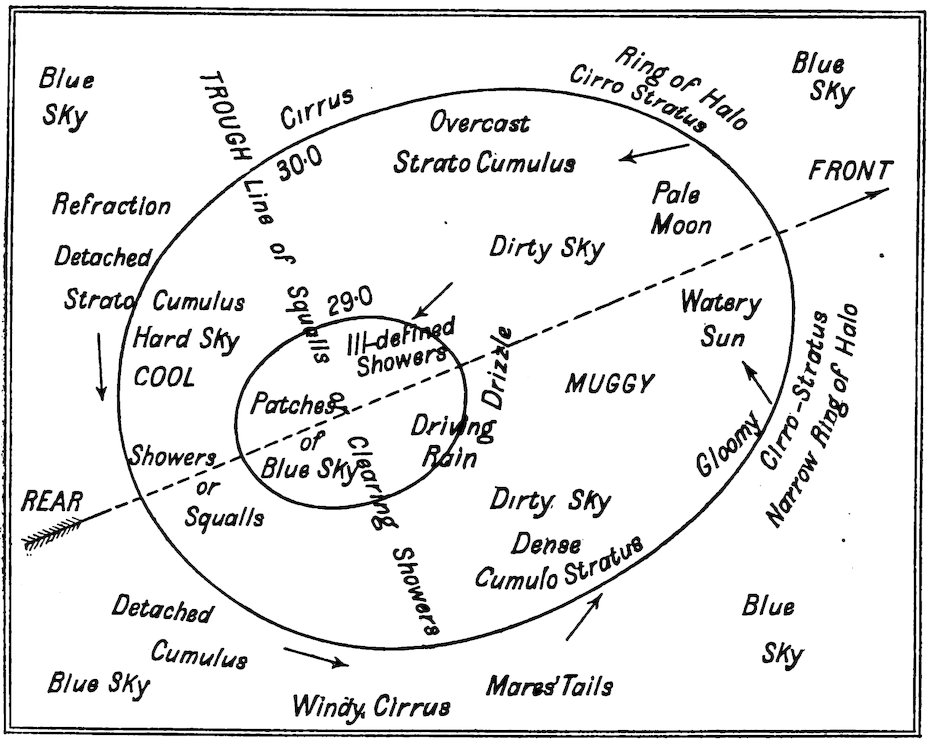
Fig. 2.—Cyclone Prognostics.
With regard to the open side of the halo indicating the quarter from
which the storm may be expected, it does not appear that this can be
much used as a prognostic. It, however, most probably originated in
the fact that halos are often seen in the southwest or west, when the
sun or moon is rather low, the lower portion of the halo being cut off
by clouds banking up in that direction, and that our storms generally
come from those quarters. As a specimen of the value of prognostics
we give some details of halos. When rain does not fall within thirty-six
hours, any subsequent rain probably belongs to a new depression.
During the six years ending June, 1882, one hundred and fifty-five
solar halos and sixty-one lunar halos were observed in the neighborhood
of London, and they occurred with the following winds:
| 13 |
|
N. |
NE. |
E. |
SE. |
S. |
SW. |
W. |
NW. |
Total. |
| Solar halos |
9 |
7 |
17 |
8 |
22 |
28 |
59 |
5 |
155 |
| Lunar halos |
4 |
3 |
8 |
3 |
8 |
11 |
21 |
3 |
61 |
| |
|
|
|
|
|
|
|
|
|
| WITH SOLAR HALOS. |
|
|
|
|
|
|
|
|
|
| |
|
|
|
|
|
|
|
|
|
| Rain fell on same day |
3 |
1 |
10 |
4 |
15 |
12 |
36 |
0 |
81 |
| Rain fell on first day |
1 |
2 |
1 |
2 |
2 |
10 |
12 |
1 |
31 |
| Rain fell on second day |
0 |
0 |
1 |
0 |
2 |
1 |
4 |
2 |
10 |
| Rain fell on third day |
3 |
1 |
0 |
0 |
0 |
1 |
1 |
1 |
7 |
| No rain |
2 |
3 |
5 |
2 |
3 |
4 |
6 |
1 |
26 |
| |
|
|
|
|
|
|
|
|
|
| WITH LUNAR HALOS. |
|
|
|
|
|
|
|
|
|
| |
|
|
|
|
|
|
|
|
|
| Rain fell on first day |
1 |
1 |
3 |
3 |
3 |
9 |
13 |
1 |
34 |
| Rain fell on second day |
0 |
1 |
0 |
0 |
1 |
1 |
3 |
0 |
6 |
| Rain fell on third day |
1 |
1 |
2 |
0 |
3 |
1 |
0 |
1 |
9 |
| Rain fell on fourth day |
0 |
0 |
0 |
0 |
0 |
0 |
3 |
1 |
4 |
| No rain |
2 |
0 |
3 |
0 |
1 |
0 |
2 |
0 |
8 |
After the halo comes the pale or watery sun and moon.
When the sun appears of a light, pale color or goes down in a bank of clouds, it
indicates the approach or continuance of bad weather.
If the sun goes pale to bed,
’Twill rain to-morrow, it is said.
A red sun has water in his eye.
When the moon has a white look or when her outline is not very clear, rain or snow
is looked for.
From the extreme damp in this part of the depression, while the sky
generally is pretty clear, cloud forms round and “caps” the tops of
hills, a circumstance that has given rise to numerous local sayings:
When the clouds are upon the hills,
They’ll come down by the mills.
When Cheviot ye see put on his cap,
Of rain ye’ll have a wee bit drap.
If Riving Pike do wear a hood,
Be sure the day will ne’er be good.
When Bredon Hill puts on his hat
Ye man of the vale beware of that.
From the same excessive damp the following may be explained:
When the walls are more than usually damp rain is expected.
Doors and windows are hard to shut in damp weather.
The sailor notes the tightening of the cordage on his ship as a sign of coming rain.
A lump of hemp acts as a good hygrometer, and prognosticates rain when it is
damp.
When walls built of stones which have been quarried below high water mark become
damp, wet weather is at hand.
Also, owing to excessive moisture, clouds appear soft and lowering,
and reflect the glare of iron-works and the lights of large towns:
The glare of the distant Ayrshire iron-works being seen at night from Cumbræ or
Rothsay, rain is expected next day.
In Kinkardine of Monteith (Perthshire) and in all that district the reflections from
the clouds of the furnaces of the Devon and Carrow works (to the east) foretell rain
next day.
Also:
When the flames of candles flare and snap or burn with an unsteady or dim light,
rain, and frequently wind also, are found to follow.
14This is especially applicable to oil-lamps or tallow candles.
As the depression approaches and the atmosphere becomes gloomy,
close, and muggy, some people are troubled with rheumatic pains and
neuralgia, old wounds, and corns are painful, animals and birds are restless,
and drains and ditches give out an offensive smell:
When rheumatic people complain of more than ordinary pains in the joints, it will
rain.
If corns, wounds, and sores itch or ache more than usual, rain is to fall shortly.
A coming storm your shooting corns presage,
And aches will throb, your hollow tooth will rage.
When animals seek sheltered places instead of spreading over their usual range, an
unfavorable change is probable.
Hark! I hear the asses bray,
We shall have some rain to-day.
If oxen turn up their nostrils and sniff the air, or if they lick their fore feet, or lie
on their right side, it will rain.
Goats leave the high grounds and seek shelter before a storm.
Hogs crying and running unquietly up and down with hay or litter in their mouths,
foreshow a storm to be near at hand.
When birds of long flight—rooks, swallows, or others—hang about home and fly
up and down, or low, rain or wind may be expected.
This tumbling of rooks is amongst the best known signs of rain in
places where those birds are found.
When the peacock loudly bawls,
Soon we’ll have both rain and squalls.
If toads come out of their holes in great numbers, rain will soon fall.
If glow-worms shine much, it will rain.
When gnats bite keenly, and when flies keep near the ground, we look for wind and
rain.
When spider webs are seen floating about in the air, farmers regard it as a sign of
coming rain.
When many bees enter the hive and none leave it, rain is near.
Also, from cloud and gloom, plants shut up their petals early:
The Convolvulus arvensis (small bind-weed), Anagallis arvensis (scarlet pimpernel),
and Calendula pluvialis shut up their flowers before approaching rain. (The pimpernel
has been called the poor man’s weather-glass.)
Dr. Jenner’s well-known lines are very good, as they contain references
to most of the natural prognostics. (See page 110, General Prognostics.)
It will be seen, however, later on, that the sayings about the rainbow,
distant hills, and whirling dust, though good prognostics, do not belong
to a depression.
As the depression centre approaches still nearer, rain sets in and continues
till the barometer turns to rise. The passage of the trough is
often associated with a squall or heavy shower, commonly known as “a
clearing shower.” Immediately the air becomes cooler and loses the
former muggy sensation, and soon small patches of blue sky appear.
When as much blue sky is seen as will make a Dutchman a jacket (or a sailor
breeches) the weather may be expected to clear up.
A small cloudless place in the northeast horizon is regarded both by seamen and
landsmen as a certain precursor of fine weather or a clearing up.
The steady rain breaks up into showers or cold squalls, which are
followed by hard detached cumulus or strato-cumulus till the sky becomes
blue again:
15When after a shower, the cirro-strati open up at the zenith, leaving broken or
ragged edges pointing upwards, and settle down gloomily and compactly on the horizon,
wind will follow, and will last for some time.
This is a description of a clearing up before the windy portion of a
depression has passed.
In the south of the depression near the outskirts, windy cirrus and
“mare’s tails” are observed, which indicate wind rather than rain, as
they are south of the rainy portion.
The cloud called goat’s hair or the gray mare’s tails forebodes wind.
If clouds look as if scratched by a hen
Get ready to reef your topsails then.
Mackerel sky and mare’s tails,
Make lofty ships carry low sails.
The shift of the wind is different in the right-hand portion of the depression
to what it is in the left-hand portion. In the former, on its
first approach, the wind backs to south and falls very light to an almost
ominous calm. The first puffs or “paws” of wind give rise to a
noise in tree tops without much wind, and little eddies of dust, or to a
whistling of the wind indoors, which are all well-known signs of rain.
Then, as the depression passes along, the wind gradually veers to southwest
and west, with increasing strength. Hence,
When the wind veers against the sun,
Trust it not, for back ’twill run.
When the wind is in the south
It is in the rain’s mouth.
In the left-hand side of the depression the wind will back right round
from south through east to north and northwest. In the rear of the
depression on the left-hand side the wind blows from the northeast and
then north, when the clouds begin to break and the weather to clear.
When the depression has nearly passed away the wind in the rear draws
round to the northwest, and gradually abates, and the weather becomes
fine. Hence the saying:
Do business with men when the wind is in the northwest.
This bringing the finest weather is said to improve men’s tempers, as
opposed to the neuralgic and rheumatic sensations felt in front of a depression.
Though the bulk of British weather is made up of cyclones and anticyclones,
there are two other distributions of pressure marked out by
wedge-shaped isobars and straight isobars respectively, which have
never before been described, but which are associated with many well-known
sayings. The chief interest in these prognostics consists in the
contrasts which they present to cyclone prognostics, as in many cases
they are associated with fine or dry weather, as opposed to the damp of
an approaching depression. We shall first describe the prognostics
which characterize the wedge-shaped area of high pressure that is frequently
formed between a retreating and an advancing depression, as it
is by far the most common.
All these prognostics owe their value to the fact that as the new depression
comes on, rain may be expected. By reference to Fig. 3 it
will be seen that in the rear of the retreating depression the weather is
beautifully fine, of the sort of which we should say that it was “too
fine to last,” or, if it lasted a whole day, we should call it a “pet day.”
16
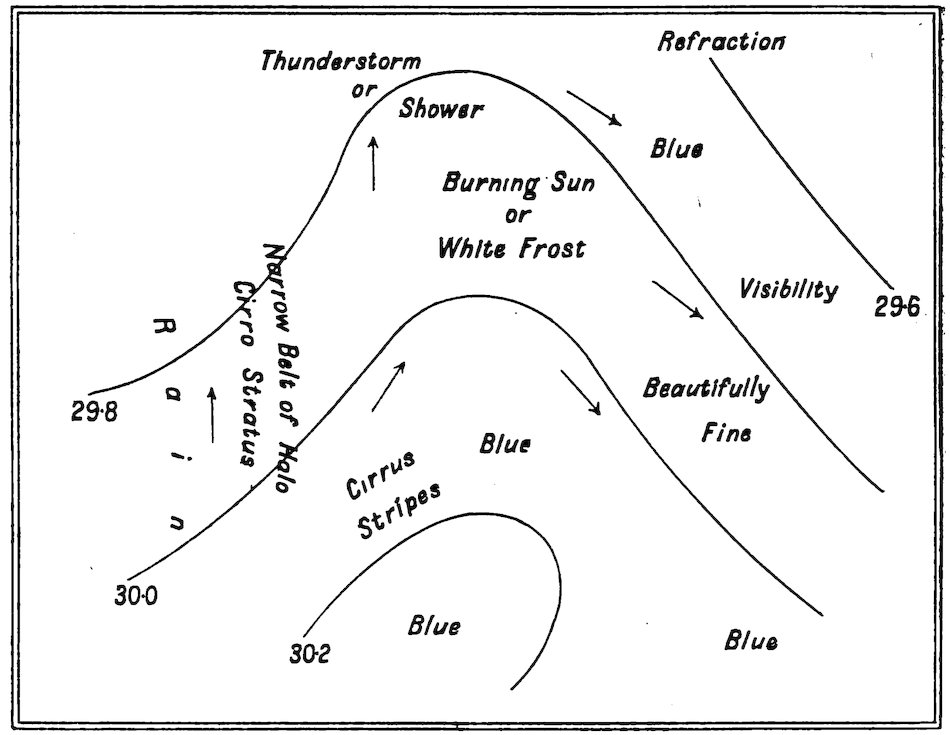
Fig. 3.—Wedge-sharped Isobars.
An unseasonably fine day in spring is called a pet day in Scotland. The fate of
pets they say awaits it, and they look for bad weather on the morrow.
During the day the sun is burning hot:
When the sun burns more than usual, rain may be expected.
During the night white frost is formed, owing to calm radiation:
A white frost never lasts more than three days; a long frost is a black frost.
Frost suddenly following heavy rain seldom lasts long.
As the day advances after a white frost, the air becomes dull from
the influence of the on-coming depression; whence the saying—
When the frost gets into the air it will rain.
During the very fine weather, on the east side of a wedge-shaped
area there is often great visibility with a cloudless sky:
The further the sight the nearer the rain.
When the Isle of Wight is seen from Brighton or Worthing, rain may be expected.
When to the people about Arbrouth the Bell-Rock light is particularly brilliant,
rain is expected.
About Cape Wrath and along that part of the coast when the Orkney Islands are
distinctly seen, a storm or a continuation of bad weather is prognosticated.
When from Ardersier and the adjoining parish on the southeast side of the Moray
Firth the distant Ross-shire hills are distinctly seen in the morning rain is expected
that day.
To the people in Eaglesham, in Renfrewshire, when the Kilpatrick hills appear
near a change to wet is looked for; but when they appear remote, dry weather will
continue.
If the old moon embraces the new moon, stormy weather is foreboded.
17Great confidence is placed in this old prognostic:
I saw the new moon late yestreen
Wi’ the old moon in her arm,
And if we gang to sea, master,
I fear we’ll come to harm.
The reason of “visibility” is uncertain; the old idea that it is due to
excess of vapor is certainly erroneous. The dry and wet bulb hygrometer
always indicates a considerable amount of dryness when it is remarked,
and Mr. Cruickshank has shown by long observation at Aberdeen that
visibility is greatest at the driest season of the year.
At the extreme northwest edge of a depression there is often unusual
“refraction,” a well-known sign of rain. This seems to be due to the
cold air in the rear of a depression being much below the temperature
of the sea. If so, it is a sign of rain, for the reason that one depression
is usually followed soon by another, which also explains the saying—
A norwester is not long in debt to a souwester.
Refraction and visibility combined also explain the following curious
local prognostic:
When Ailsa Craig is distinctly seen, and seems near at hand, the people of Cumbræ
look for change. When the weather is going to be finer it lies flat; but when rain is
coming it assumes the form of a mushroom.
Ailsa Craig is an isolated rock standing in the Firth of Clyde, about
thirty miles from Cumbræ. It has a conical top, with precipitous sides,
so that in ordinary weather only the top is seen lying flat on the horizon;
but sometimes in the rear of a depression it appears lifted by refraction,
and the light encroaches at the edges, as is often seen with projecting
promontories, giving the whole a fanciful resemblance to a mushroom.
The prognostic is mistrusted by the inhabitants during frost, and we
have proved it by our own observation. On the west side of the wedge-shaped
area, as the new depression comes on, the blue sky gradually
assumes a dirty appearance, accompanied by a halo, and gathers into
cloud, and later on rain begins to fall; while in the southern portion
the rain is often preceded by strips of cirrus, either lying in the direction
of the wind, or sometimes at right angles to it:
Cirrus at right angles to the wind is a sign of rain.
Now we come to the consideration of some very interesting rain prognostics
associated with straight isobars. While those in a depression
are preceded by an almost ominous calm, and a dirty, murky sky, these
are associated with a hard sky and blustery wind, of which it would be
ordinarily remarked “that the wind keeps down the rain,” or “that
when the wind falls it will rain.” While also the prognostics which
precede cyclone rain hold good for the reason that they are seen in
front of the rainy portion, those associated with straight isobars hold
good because, though there is little rain actually with them, the area
which they cover to-day will probably be covered by a depression to-morrow—the
conditions being favorable for the passage of depressions.
On turning to Fig. 4 it will be seen that while the pressure is high to
the south, it is generally low to the north, without any definite cyclonic
system, and that the isobars run straight nearly east and west.
18
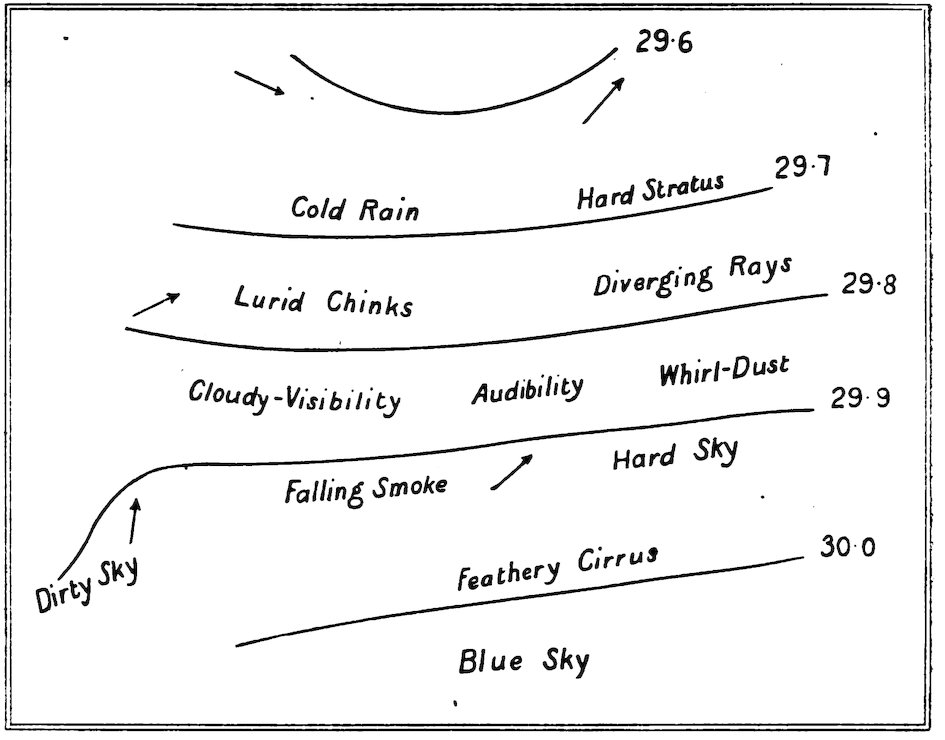
Fig. 4.—Straight Isobar Prognostics.
Near the high pressure the sky is blue, then as we approach the low
pressure feathery cirrus, or some form of windy sky, makes its appearance,
while a blustery wind whirls the dust, or blows the soot down;
and animals turn their tails to the wind to avoid its force on their faces:
When chimneys smoke and soot falls, bad weather is at hand. The whistling of the
wind heard within doors denotes rain.
When sheep, cattle, or horses turn their backs to the wind, it is a sign of rain.
Getting still nearer the low pressure, the sky is found to be gathering
into hard stratus, at first with chinks between its masses, through
which divergent rays stream down under the sun, which is spoken of
as “the sun drawing water.” Sometimes, especially in winter, these
rays are lurid, and are referred to in the following prognostic:
Along the north shore of the Solway, from Dumfries to Gretna, a lurid appearance
in the eastern or southeastern horizon, called from its direction “a Carlisle sky,” is
thought a sure sign of coming rain. They describe it as lurid and yet yellowish, and
the common saying is:
The Carle sky
Keeps not the head dry.
At the same time there is often great “visibility” with a hard overcast
sky, and moderately dry air, in which the stratus seems to play the
part of a sunshade, for as soon as the sun comes out the clearness of
distant objects diminishes. This visibility must not be confounded with
the visibility already described with a cloudless sky, which occurs with
wedge-shaped isobars. Simultaneously we often find “audibility.”
If the noise of a steamer or railway train is heard at a great distance, rain is predicted.
This distinctness of distant sounds must be carefully distinguished
from sounds which are not usually heard, being brought up by the wind
19coming from a rainy quarter. For instance, the whistle of a railway
train to the south of a house will not be usually heard with the normal
southwest wind of this country; but when the wind backs in front of a
depression to the south, then it will be heard, and although this will be
a good prognostic, still it is not true audibility.
When people of Monzie (Perthshire) hear the sound of the waterfalls of Shaggie,
or the roar of the distant Turret clearly and loudly, a storm is expected; but if the
sound seems to recede from the ear till it is lost in the distance, and if the weather
be thick a change to fair may be looked for speedily.
In Fortingall (Perthshire) if, in calm weather, the sound of the rapids on the Lyon
is distinctly heard, and if the sound descends with the stream, rainy weather is at
hand; but if the sound goes up the stream and dies away in the distance, it is an
omen of continued dry weather, or a clearing up if previously thick.
The course of Turret and Lyon is from west to east.
True “audibility” is best described by the saying:
A good hearing day is a sign of wet.
Much sound in the air is a sign of rain.
This last exactly conveys the kind of sound referred to. The reason
why audibility is produced is unknown, but the old idea that it is due
to excessive moisture in the air is certainly erroneous; in several instances
we have observed that the upper current of the wind appeared
to be moving much faster than the lower, and perhaps that may have
something to do with it. When the gradients are very steep, a little
rain sometimes falls with straight isobars, generally in light showers,
with a hard sky.
Though as a matter of convenience we have described the sequence
of weather as we proceed from high to the low pressure, it must be
clearly understood that it does not represent the sequence of weather
to a single observer, but rather what the weather will be simultaneously
in different parts of the country; for instance, that if there are cirrus
clouds in London there may perhaps be a lurid sky in Edinburgh. The
prognostic value of all is due to the fact that a depression will soon
form which will probably extend over the whole country.
Having spoken of cyclones, we shall now direct our attention to anticyclones.
In the daily weather charts we sometimes see but two or
three isobars, and these are a considerable distance apart, and extend
over a large area. The pressure is highest in the centre, and gradually
diminishes outwards. The air is calm and cold in the central area, but
on the outskirts the wind blows in the direction of the hands of a watch.
These are the special features of an anticyclone. The weather in an
anticyclone is almost the opposite of that in a depression; that in the
latter being wet and unsettled, while that in the former is usually settled
and fine, with more or less haze in the air. Another great difference is
that while depressions are generally rapid in their movements, anticyclones
are nearly stationary; and it is for this reason that they are associated
with “settled” fine weather. In the area of high pressure the
characteristic features are largely modified by what is termed “radiation”
weather, as determined by diurnal and seasonal variations; and
as the pressure is nearly stationary, these diurnal and seasonal variations
are the chief features of anticyclonic weather.
We shall now give the prognostics due to the variations in some detail,
Fig. 5. The sky being generally clear and the air calm, the temperature
is high in the day and low at night. In summer brilliant sun
20shine prevails during the day, and at night there is heavy dew, and in
low-lying places mist.
Heavy dews in hot weather indicate a continuance of fair weather, and no dew
after a hot day foretells rain.
If mist rises in low ground and soon vanish, expect fair weather.
Thin, white, fleecy, broken mists, slowly ascending the sides of a mountain whose
top is uncovered, predicts a fair day.
When the mist creeps up the hill,
Fisher out and try your skill.
When in the morning the dew is heavy and remains long on the grass, when the fog
in the valleys is slowly dissipated and lingers on the hill-side, when the clouds seem
to be taking a higher place, and when a few loose cirro-strati float gently along,
serene weather may confidently be expected for the greater part of that day.
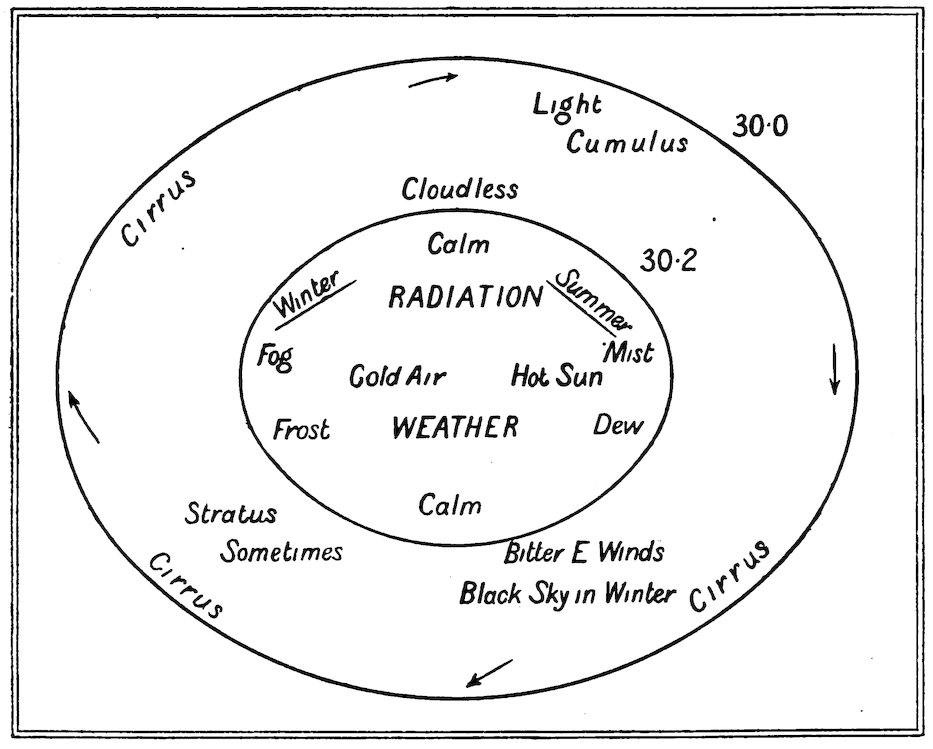
Fig. 5.—Anticyclone Prognostics.
These all refer to night radiation, mist being dispersed by the sun’s
rays. Fine, light, genial weather raises the spirits and exerts an enlivening
influence not only on human beings but also on animals, birds,
insects, &c. Hence the saying:
If larks fly high and sing long, expect fine weather.
When sea birds fly out early and far to seaward, moderate winds and fair weather
may be expected.
If rooks go far abroad it will be fine.
Cranes soaring aloft and quietly in the air foreshow fair weather.
If kites fly high, fine weather is at hand.
Wild geese, wild geese, ganging out to sea,
Good weather it will be.
When owls whoop much at night, expect fair weather.
Bats, or flying mice, coming out of their holes quickly after sunset and sporting in
the open air premonstrates fair and calm weather.
21Chickweed expands its leaves boldly and fully when fine weather is to follow.
In winter frost is generally prevalent in the central area of an anticyclone,
accompanied frequently by fog, which is most dense in the
neighborhood of large towns. This is all due to the radiation of calm
weather.
White mist in winter indicates frost.
In the evenings of autumn and spring vapor arising from a river is regarded as a
sure indication of coming frost.
This comes from the air being colder than the water.
When fires burn faster than usual, and with a blue flame, frosty weather may be
expected.
This is caused by reduced temperature of the outer air making a better
draught in the chimney.
In winter when the sound of the breakers on shore is unusually distinct, frost is indicated.
These last two prognostics are explained by the fact that the atmosphere
is very dense and still in an anticyclone.
In those places where fog does not form the sky will often be clear at
night, whence—
In winter when the moon’s horns are sharp and well defined, frost is expected.
The wind in an anticyclone system blows in the direction of motion of
the hands of a watch, but slightly outwards, and as the anticyclone
is nearly always stationary, the wind blows from the same quarter for
several days together.
When the wind turns from northeast to east and continues two days without
rain, and does not turn south the third day, nor rain the third day, it is likely to continue
northeast for eight or nine days, all fair, and then come to the south again.
If the wind is northeast three days without rain,
Eight days will pass before south wind again.
The wind is usually very light in force.
It is said to be a sign of continued good weather when the wind so changes during
the day as to follow the sun.
If wind follows sun’s course, expect fair weather.
This “veering with the sun,” as it is called, is the ordinary diurnal
variation of the wind, which in this country is very obvious with the
shallow gradients of an anticyclone. At sea-side places in summer
very often “the wind is in by day and out by night,” which is the
equivalent of the land and sea breezes of the tropics. Like two preceding
prognostics, it is only in anticyclones that local currents of air,
probably due to unequal heating of sea and land, can override the
general circulation of the atmosphere in this country.
Sometimes in winter, on the southern side of the anticyclone, bitter
east winds, with a black-looking sky, will prevail for several days together,
when it may be truly said:
When the wind is in the east
’Tis neither good for man nor beast.
Sometimes also the sky in this region will be covered with a uniform
stratus cloud, which is not of any great thickness, and when breaks
occur, the sun is seen to be shining brightly above.
On the northeast side of the anticyclone in summer, light, cumulus
22clouds frequently form in the morning, gradually increase till after the
maximum temperature has passed, and then decrease and disappear
towards evening.
If woollen fleeces spread the heavenly way,
Be sure no rain disturbs the summer day.
When the cumulus clouds are smaller at sunset than they were at noon, expect fair
weather.
Clouds small and round like a dapple gray with a north wind, fair weather for two
or three days.
The cirrus cloud is usually seen on the outskirts of an anticyclone,
if in the front it gradually disappears, but if in the rear it is a sign that
there will be a change in the weather, hence:
If cirrus clouds dissolve and appear to vanish, it is an indication of fine weather.
If cirrus clouds form in fine weather with a falling barometer, it is almost sure to
rain.
When, after a clear frost, long streaks of cirrus are seen with their ends bending towards
each other as they recede from the zenith, and when they point to the northeast,
a thaw and a southwest wind may be expected.
Both these latter prognostics refer to a depression coming in and
“breaking up the weather” and the anticyclone.
We have endeavored in this paper to deal with such prognostics as
can be readily classified, but besides these there are many more, what
may be termed unclassified prognostics. Our object has been to show
the relation between certain prognostics and certain forms of isobars,
and by this means to assign them their proper value. It cannot be
doubted that if careful attention were given to the observation of the
aspect of the sky, the different forms of cloud and local signs, these
would prove, even in conjunction with a single barometer reading, of
great assistance in predicting the weather. Of course those persons
who live in the neighborhood of large towns labor under a great disadvantage,
as the sky has nearly always a dirty appearance, and is frequently
obscured by smoke. For this reason London is about the worst
place to reside in for studying the weather.
We have only been able to give the rudiments of the new method of
considering prognostics, for the method is capable of great extension,
and we hope that we may succeed in interesting some of the Fellows
sufficiently to induce them to observe prognostics in conjunction with
the daily weather charts.
In conclusion, we would venture to express our opinion that the observation
of local signs of weather ought to form a most important element
in all arrangements for telegraphic reporting for the purpose of
forecasts, and that the duty should be impressed upon the observers of
reporting at once important changes in the local and general signs of
the weather. Great attention should also be paid to the observation of
the forms and motion of clouds, and as considerable lack of knowledge
prevails, even on the part of good observers, regarding the different
forms and modifications of clouds, we are glad to see that the
meteorological office has already commenced systematic observations of
cirrus clouds. Telegraphic observers should be specially instructed in
cloud observations and prognostics by some one thoroughly well versed
in the subject, so that there may be strict uniformity among all the
observers, but we admit that the proposal presents serious difficulties
in the way of realization.
23Theoretically, when the isobars are well defined we ought to be able
to write down the prognostics which might be visible, but practically
we cannot do so. Besides, there are sometimes cases of isobars which
have no well-defined shape, but with which thunder-storms or heavy
showers often occur. These, as is well known, do not affect the barometer,
but are abundantly forewarned by the commonest prognostics, and
as the rainfall is usually heavy in them the failure of the forecast
which omits to notice them is very conspicuous.
The scope of this paper precludes us from entering into the complicated
question of the non-cyclonic rainfalls in this country. It will be
enough to state that the prognostics which precede them are rather
those associated with broken weather, such as bright sunrises or heavy
clouds banking up without the barometer falling, than the muggy, dirty
weather of a cyclone front. The warning they give is also much shorter,
rarely more than three or four hours, if so long.
The result of this paper may be summarized as follows:
The authors explain over one hundred prognostics by showing that
they make their appearance in definite positions relative to the areas of
high and low atmospheric pressure shown in synoptic charts. The
method adopted not only explains many that have not hitherto been accounted
for, but enables the failure as well as the success of any prognostic
to be traced by following the history of the weather of the day
on a synoptic chart. The forms discussed are cyclones, anticyclones,
wedge-shaped and straight isobars. The details of weather in the last
two are now described for the first time. They also point out that
prognostics will never be superseded for use at sea and other solitary
situations, and that prognostics can be usefully combined with charts
in synoptic forecasting, especially in certain classes of showers and
thunder-storms which do not affect the readings of the barometer.[1]
Dr. Tripe said that some of the Fellows might think the paper
hardly suitable for reading at a meeting or printing in the journal of a
scientific society, but many of them took an interest in such papers, because
they were comparatively simple. In reference to the table of solar
and lunar halos in connection with rainfall, it appeared that rain was
pretty sure to fall within three days after the occurrence of a lunar
halo, and to the extent of 80 per cent., as regards solar halos, on
the first or second day.[2] He considered visibility was a good prognostic,
and afforded a more certain indication of the speedy occurrence
of rain than even mare’s tails. What caused visibility was unknown
to him. The prediction of rain from damp walls depended chiefly on
24the previous weather; a sudden change from cold to warm would have
the effect of making walls condense the moisture contained in the air
without approaching rain. The falling of soot down a chimney was,
he thought, hardly a good prognostic; it was caused to a great extent
by the direction and force of the wind, and also the angle at which the
wind struck the chimney-pot. He considered the paper a good one, and
a step in the right direction.
Dr. Marces said, with regard to visibility being a sign of rain, he had
himself observed on the borders of the Lake of Geneva, that if the
mountains on the opposite side of the lake could be seen very distinctly
on a cloudy day, rain was likely to fall within a short period. On such
occasions the coast appeared much nearer than usual. The late Professor
de la Rive, of Geneva, ascribed this phenomenon to the atmospheric
dust being hygrometric and becoming transparent in damp
weather from the moisture it absorbed.
Mr. Stanley remarked that solar and lunar halos depended upon the
moisture in the air, and that a sign of rain could be better assured by
reference to the hygrometers. He thought that fine weather in front
of a cyclone was due to increase of pressure, and therefore of temperature,
caused by the onward march of the cyclone. This increase of
temperature was known to render sound more audible, and by making
the air clearer distant objects became more visible. It was known
that condensed vapors disappeared under a slight increase of pressure,
just as, conversely, under the ordinary air-pump, vapors appeared on
a diminution of pressure. He considered that the fall of rain in the
centre of a cyclone was caused by the increase of pressure due to the
tangential action of the air in the cyclone. The straight isobars
described in the paper, were, he thought, in segments of a very large
cyclone, which was general in all large displacements of air.
Captain Toynbee thought that the great clearness of the air experienced
when isobars took the wedge-shaped form, was due to the fact
that such isobars represented a ridge of high barometrical pressure,
which lay between two cyclonic systems, and that the high pressure of
the ridge was maintained by air which had previously risen in front of
the advancing cyclonic system, when it had lost most of its moisture,
and now came down as a dry, pure, clear, northwesterly wind. Hence
the clearness of the air was, where wedge-shaped isobars were being
experienced, a sign of rain, because it indicated the fact that a cyclonic
system would soon advance over the same position. This explanation
was based upon the Rev. W. Clement Ley’s theory of the motion of air
in cyclonic systems.
Mr. Scott thought that it might have been desirable to give the authorities
or sources from which some of the principal sayings had been
derived, in order to show which were general and which were of more
local import. Reference had also been made to the prevalence of bad
smells with a falling barometer, and to the fact that rheumatic affections
and neuralgia were felt especially at such a time; but no attempt
had been made to explain the connection of those phenomena. It was
a well-known fact that a sudden reduction of pressure, such as that experienced
by divers when they returned to the surface of the water,
produced neuralgic affections. The authors had described straight line
isobars and their accompanying prognostics, but only for west winds,
for pressure lowest in the north. He should be glad to see the list of
prognostics extended so as to include those for straight isobars with
east winds when the pressure was lowest in the south. With regard to
refraction being a prognostic of rain, in some cases it was a prognostic
25of easterly winds, and was recognized as such in the west of Cornwall.
In the past summer he had himself verified this latter statement on several
occasions at Scilly and the Land’s End. The authors, he thought,
spoke a little too strongly when they said the barometer gave no sign
of thunder-storms. The type of isobar which accompanied these was
well known; it exhibited small undulations or incipient bights representing
imperfectly formed secondary depressions. At the same time
he must say that no one yet, in Europe at least, had been able to forecast
correctly the amount of rain for a given day in a given place. The
probability of some rain could be recognized, but no attempt could be
made to estimate its amount. This was apparently owing to ignorance
of the conditions of the upper atmosphere.
Mr. Dyason expressed an opinion that the formulaters of weather
prognostics in the past must have been color-blind, an affliction from
which he was not sure that the authors of the paper were exempt.
“Where are the scarlet, orange, green or gold harmonious, and the
general glow?” He had endeavored in a series of sketches of skies and
clouds to portray the colors as they presented themselves to his mind.
In relation to visibility he referred to the Lakes of Geneva and Lucerne,
quoting the lines used in the locality of Mont P
Si Pilate a un chapeau, le temps se mettra au beau;
A-t-il un collier, on peut la montée risquer;
Mais s’il porte son épée, il y aura une ondée.
Mr. Dyason exhibited a sketch of the Matterhorn taken south of Zermatt
during intense visibility. He did not admit “that London was a
bad place for skies;” those he now exhibited were sketched in a northwestern
suburb of the metropolis.
Professor Archibald considered that some of the prognostics mentioned
in the paper required more explanation. For instance, it was stated that
candles burned with an unsteady light in damp weather, but no reason
was given why they should do so. One very good prognostic in use in
Scotland appeared to have been omitted, namely: “The northwest wind
is a gentleman, and goes to bed.” He would also like to know why
fires burned with a blue flame in frosty weather. He considered that
visibility was often a local phenomenon connected with temperature.
He had noticed intense visibility and a fog in juxtaposition on that very
day, when travelling from Tunbridge Wells to London.
Mr. Symons pointed out that although it might be useful to trace the
origin of some of the weather proverbs, it would be extremely difficult
and perhaps impossible, as some of them were ancient. With regard
to the connection between lunar halos and rainfall, he thought that it
would be curious, considering the large number of wet days in this
country, rain falling on an average every other day, if some of them did
not happen to follow lunar halos. Respecting doors and windows sticking
in damp weather, this was rather the result of existing damp than
a forecast of more damp to come; for if existing damp foretold coming
damp it was not easy to see how dry weather could ever occur. With
regard to visibility, he was glad the authors had referred to Mr. Cruickshank’s
observations at Aberdeen, extending over twenty-one years, and
Mr. Symons thought that much might be learned from a thorough discussion
of similar observations.
Mr. Wilson directed attention to Professor Tyndall’s theory, that audibility
was due to the homogeneity of the atmosphere.
Mr. C. Harding thought that the paper would be useful to an isolated
observer, whose forecast was dependent upon his own observation. It
26appeared to him that in classifying the prognostics, the authors of the
paper had rather begged the question—given a certain occurrence which
was admittedly a prognostic of bad weather; this seems to have been
consequently classed as belonging to the front half of a cyclonic disturbance.
He suggested that with each occurrence of the prognostic
in question it would be better to note the existing conditions of atmospheric
distribution, and, finally, to classify by actual observation. He
stated that the form of isobars described by the authors as wedge-shaped
had been referred to many years ago in various publications, by Captain
Toynbee, as a “ridge” of pressure. Some distinction should have
been made between the weather of anticyclone in summer and in winter,
as it differed materially. Audibility had been referred to as a sign
of bad weather; he might say that it was notorious in ballooning that
for a given distance sounds could be heard more distinctly than on the
earth, and in a recent ascent he had noticed that the shrill voices of
children were much more audible than the voices of grown persons.
Mr. Abercromby, replying, said that Doctor Tripe’s analysis of halos was
interesting, but that if rain did not fall within twenty-four hours after a
halo, any rain after that would not be due to the cyclone which produced
the halo, but to a new one. Damp walls were certainly due to excess of
vapor, not to rapid changes of temperature. Soot was doubtless blown
down by wind, but when used as a prognostic it rather referred to soot
falling out of doors, and was to be attributed to excessive damp. Halos
were unquestionably due to the presence of a thin film of ice-formed cloud,
and not merely to the amount of moisture in the air. This ice film was
only formed in front of cyclones or thunder-storms, and for that reason was
a sign of rain. With regard to visibility alluded to by several speakers, he
could not admit that it was due to excessive moisture, for the hygrometer
showed that it was not so. He agreed with Captain Toynbee, so
far as believing that there was a descending current of dry, clear air
with a northwest wind on the front side of a “wedge,” but he doubted
if that was the whole explanation. In the centre of anticyclones there
was also a descending current of dry air, but no “visibility.” The
diagram of straight isobars was given for westerly winds, as that
type was by far the commonest. Like every other shape of isobars,
the details varied with the type of weather in which they occurred.
In an elementary paper it was considered inexpedient to go into so
much detail. In the case mentioned by Mr. Scott, isobars trending
east and west, but sloping towards the south, the same broad features
as given in the diagram would be reproduced, but with a harder sky
and an east or northeast wind. The prognostics would, however, be much
more likely to fail, for cyclones in the northerly or easterly types, to
which such isobars would belong, did not follow with the same regularity
as in the westerly type. The refraction, which was a prognostic of east
winds on the southwest of an anticyclone, was very different from the
refraction on the northwest edge of a cyclone, which portended a fresh
storm. The chief difference was the haziness of the horizon in the former
case as compared with its visibility in the latter. The latter kind was
hardly known on the south coast of England. He strongly suspected
that the condition common to both kinds was a relatively cool air over
a comparatively warm sea. The type of isobar which exhibited incipient
“bights” or imperfect secondaries, was doubtless that most frequently
associated with thunder-storms, but the kind of thunder-storms alluded
to in the paper as showing no trace on the isobars undoubtedly occurred.
Any reference to cloud or sky colors was intentionally omitted in this
paper, as also to prognostics relating to diurnal winds. Candles burned
27badly before rain, probably owing to a stagnant, damp air. Blue flame
was owing to the formation of carbonic oxide when a fire burned very
red on a frosty night. Doors and windows sticking in damp weather
indicated rain because damp preceded the rain area of a cyclone.
The idea suggested by Mr. C. Harding, that because certain prognostics
were known to be associated with bad weather, therefore they
were classed as belonging to the front of a cyclone, was entirely erroneous,
and exactly opposite to what had been done. The method Mr.
Abercromby had adopted for the last twelve years had been, when he
observed a good example of any prognostic, to make a note and put it
by with the nearest synoptic chart for the day, or often with both the
preceding and succeeding charts. When a sufficient number had been
collected, the charts were examined, and the necessary deductions
drawn from them. Thus the charts were classified according to the
prognostics associated with them. The results of all these researches
had been embodied in the paper, and the important fact deduced was
that every portion of every shape of isobars had a characteristic
weather and appearance. The general fact of a “wedge” being associated
with fine weather had been noticed many years ago by Captain
Toynbee, but the details of weather in different portions, and their relations
to prognostics, had a considerable amount of novelty.
Mr. Marriott said that it would be impossible to give the authorities
or sources from which all the sayings in the paper had been derived,
but the foot-note on page 23 contained a list of the works from which
the quotations had been made. The authors on the present occasion
had only dealt with certain classified prognostics; and this would explain
why many others had not been noticed. They hoped, however,
to deal with these in a future paper.
29
Ass.
An old adage says:
When the ass begins to bray,
Be sure we shall have rain that day.
Beaver.
In early and long winters, the beaver cuts his winter supply of
wood and prepares his house one month earlier than in mild, late
winters.
Bears.
When bears lay up food in the fall, it indicates a cold winter.
If the tracks of bear are seen after the first fall of snow, an open,
mild winter may be expected.
Bears and coons are always restless before rain.
The bear comes out on the 2d of February, and if he sees his
shadow, he returns for six weeks.
Expect rain when dogs eat grass.
Buck’s Horn.
If dry be the buck’s horn
On Holyroad morn,
’Tis worth a vest of gold;
But if wet it be seen
Ere Holyroad e’en,
Bad harvest is foretold.
Bull.
If the bull leads the van in going to pasture, rain must be expected;
but if he is careless and allows the cows to precede him, the
weather will be uncertain.
Cats.
When cats sneeze it is a sign of rain.
The cardinal point to which a cat turns and washes her face after
a rain shows the direction from which the wind will blow.
If the cat is basking in the sun of February, it must go again to
the stove in March. (German.)
When cats are snoring foul weather follows.
When cats are washing themselves fair weather follows.
Cats with their tails up and hair apparently electrified indicate
approaching wind.
It is a sign of rain if the cat washes her head behind her ear.
(Old lady on Cape Cod.)
30Cats clean table-legs, tree-trunks, &c., before storms.
When a cat scratches itself, or scratches on a log or tree, it indicates
approaching rain.
If sparks are seen when stroking a cat’s back, expect a change of
weather soon.
When a cat washes her face with her back to the fire expect a
thaw in winter.
When cats lie on their head with mouth turned up expect a
storm.
Cats purr and wash; dogs eat grass; sheep eagerly eat and turn
in the direction of the wind-point; oxen sniff the air, and swine
are restless before rain.
Cats have the reputation of being weather-wise, an old notion
which has given rise to a most extensive folk-lore. It is almost
universally believed that good weather may be expected when the
cat washes herself, but bad when she licks her coat against the
grain, or washes her face over her ears, or sits with her tail to the
fire. As, too, the cat is supposed not only to have a knowledge of
the state of the weather, but a certain share in the arrangement of
it, it is considered by sailors to be most unwise to provoke a cat.
Hence they do not much like to see a cat on board at all, and when
one happens to be more frisky than usual they have a popular saying
that the cat has a gale of wind in her tail. A charm often resorted
to for raising a storm is to throw a cat overboard; but, according
to an Hungarian proverb, as a cat does not die in water its
paws disturb the surface; hence the flaws on the surface of the
water are named by sailors “cat’s-paws.” In the same way also
a large flurry on the water is a “cat’s-skin;” and in some parts of
England a popular name for the stormy northwest wind is the
“cat’s-nose.”
Chipmunk.
In cold and early winters the chipmunk is very abundant on the
south shore of Lake Superior, and are always housed for the winter
in October. In short and mild winters they are seen until the 1st
of December.
Cattle.
When a storm threatens, if cattle go under trees, it will be a
shower; if they continue to feed, it will probably be a continuous
rain. (New England.)
When cows fail their milk, expect stormy and cold weather.
When cows bellow in the evening, expect snow that night.
In Texas, when cattle hasten to timber, expect a “norther.”
When a cow stops and shakes her foot, it indicates that there is
bad weather behind her.
When cows refuse to go to pasture in the morning, it will rain
before night.
When cattle collect near the barn long before night and remain
near the barn till late in the morning, expect a severe winter.
Expect rain when cattle low and gaze at the sky.
31Cattle are also said to foreshow rain when they lick their forefeet,
or lie on the right side, or scratch themselves more than they
usually do against posts or other objects.
When cattle go out to pasture and lie down early in the day, it
indicates early rain.
Deer.
When deer are in gray coat in October, expect a severe winter.
Dogs.
Dogs digging or making deep holes in the ground are said to indicate
rain thereby.
If a dog howls when some one leaves the house it indicates rain.
When a dog or cat eats grass in the morning it will certainly rain
before night.
When dogs eat grass rain follows.
Dogs refusing meat is an indication of rain.
Donkey.
When the donkey blows his horn
’Tis time to house your hay and corn.
Domestic Animals.
Domestic animals stand with their heads from the coming storm.
Flying squirrels.
When the flying squirrels sing in midwinter, it indicates an early
spring.
Foxes.
Foxes barking at night indicates storm.
Ground-squirrel.
When the ground-squirrel is seen in winter, it is a sign that snow
is about over.
Ground-hog.
If on Candlemas day (2d February) it is bright and clear, the
ground-hog will stay in its den, thus indicating that more snow and
cold are to come; but if it snows or rain he will creep out, as the
winter has ended. (German.)
Goat.
The goat will utter her peculiar cry before rain.
Hares.
Hares take to the open country before a snow-storm.
Hogs.
Hogs pick and store straws, leaves, &c., before cold weather.
Hogs rubbing themselves in winter indicates an approaching
thaw.
32Horse-hair.
If the hair of a horse grows long early, expect an early winter.
The hair of a horse appears rough just before rain.
Horses and cattle.
When horses and cattle stretch out their necks and sniff the air
it will rain.
Horses, as well as some other domestic animals, foretell the coming
of rain, by starting more than ordinary, and appearing in other
respect restless and uneasy on the road.
Horses and mules very lively without apparent cause indicate
cold.
When horses assemble in the corner of a field, with heads to leeward,
expect rain.
Kine, when they assemble at one end of a field with their tails to
windward, often indicate rain or wind. During the dead calm before
a storm we may often see them extending their nostrils, with
the head upwards, snuffing the air; this prognostic has been
noticed of old by Virgil, and after him by Lord Bacon and others.
Mole.
If the mole dig his hole two feet and a half deep, expect a very
severe winter; if two feet deep, not so severe; if one foot deep, a
mild winter.
When the moles throw up the earth, rain follows soon.
Musk-rat.
The musk-rats build their houses twenty inches higher and very
much warmer in early and long winters than in short ones.
Noise.
Animals making unusual noise indicates change of weather.
Oxen and Sheep.
When oxen or sheep collect together as if they were seeking shelter,
a storm may be expected. (Apache Indians.)
Pigs.
Pigs uneasy, grunting, and huddling together, indicate cold.
When pigs busy themselves gathering leaves and straw to make
a bed (in fall), expect a cold winter.
When in winter pigs rub against the side of their pen, it is a sure
sign of a thaw.
If the forward end of a pig’s melt is thicker than the other end,
the first part of winter will be the colder. If the latter end is
thicker, the last part of winter will be the colder.
When pigs go about with sticks in their mouths, expect a
“norther” in Texas.
33Prairie Dogs.
Prairie dogs bank up their holes with grass and dirt before a
storm; if they are playful, it is a sign of fair weather.
Partridges.
Partridges drum only in fall when a mild and open winter follows.
Rabbits.
In cold, long winters rabbits are fat in October and November;
in mild and pleasant winters they are poor in those months.
Rabbits seek the woods before a severe storm.
Rats and Mice.
Much noise made by rats and mice indicates rain.
Swine.
If swine be restless and grunt loudly, if they squeal and jerk
up their ears, there will be much wind. Whence the proverb,
“Pigs can see the wind.”
Swine make lairs on south side of shelter before cold weather.
Squirrels, etc.
When squirrels and small animals lay away a larger supply of
food than usual, it indicates that a long and severe winter will follow.
When squirrels lay in a winter supply of nuts, expect a cold
winter.
When he eats them on the tree,
Weather as warm as warm can be.
When squirrels are scarce in the autumn, it indicates a cold
winter.
Sheep.
If sheep ascend hills and scatter, expect clear weather.
Sheep bleat and seek shelter before snow.
You may shear your sheep
When the elder blossoms peep.
Sand Mole.
The sand mole makes a mournful noise just before frost.
Spaniels.
When the spaniel sleeps it indicates rain.
Wolves.
Wolves always howl more before a storm; deer and elk come
down from the mountains at least two days before a storm.
If the wolves howl and foxes bark during the winter, expect cold
weather.
34If wolves howl in the evening, expect a “norther.” (Texas.)
Mammals as Weather Prophets.
Dr. C. C. Abbott showed that the autumnal habits of certain animals
that are popularly supposed to be indicative of the character of
the coming winter could not be depended upon, although by the majority
of people living in the country they were considered as sure indications
of what the winter would prove to be. Dr. Abbott had kept
a careful record, extending over twenty years, regarding the building
of winter houses by musk-rats, the storing of nuts by squirrels,
and other habits of these mammals, and had found that the habits
referred to, or their omission in certain autumns, bore no relation to
the character of the coming winter. (Trenton Nat. Hist. Soc.,
meeting February 13, 1883.)
Birds of Passage.
When birds of passage arrive early in their southern passage,
severe weather may be looked for soon.
When birds cease to sing, rain and thunder will probably occur.
If birds in general pick their feathers, wash themselves, and fly
to their nests, expect rain.
A dry summer will follow when birds build their nests in exposed
places.
Birds flying in groups during rain or wind indicate hail.
Birds and fowl oiling feathers indicate rain.
Birds singing during rain indicate fair weather.
If birds in the autumn grow tame,
The winter will be too cold for game.
Bats.
Bats flying late in the evening indicate fair weather.
Bats who speak flying tell of rain to-morrow.
If bats flutter and beetles fly about, there will be a fine morrow.
Blackbirds.
Blackbirds’ notes are very shrill in advance of rain.
Blackbirds flying south in autumn indicate an approaching cold
winter.
Blackbirds bring healthy weather.
Blackbirds flocking in the fall indicate a spell of cold weather.
Buzzards.
A solitary turkey-buzzard at a great altitude indicates rain.
Buzzards flying high indicate fair weather.
35Bluebirds.
When bluebirds twitter and sing, they call to each other of rain.
Chickens.
Chickens, when they pick up small stones and pebbles and are
more noisy than usual, afford, according to Aratus, a sign of rain.
Other authors prognosticate the coming of rain from the habit fowls
have of rubbing in the dust and clapping their wings.
When chickens crow before sundown, it is a sign of rain next day.
Chickens are said to be very noisy just before rain and cocks to
crow at unusual hours.
If chickens go out in the rain, it will rain all day.
When chickens come down from roost at night, rain will soon
follow.
During rain if chickens pay no attention to it, you may expect a
continued rain; if they run to shelter, it won’t last long.
When chickens light on fences during rain to plume themselves,
it will soon clear.
Chimney Swallows.
When chimney swallows circle and call, they speak of rain. (Zuñi
Indians.)
Cocks.
Cocks are said to clap their wings in an unusual manner before
rain, and hens to rub in the dust and seem very uneasy.
If the cock moult before the hen,
We shall have weather thick and thin;
But if the hen moult before the cock,
We shall have weather hard as a block.
If the cock crows more than usual or earlier, expect rain.
Cormorants.
When cormorants fly from the sea and sea fowls seek their prey
in pools or ponds, expect wind.
Cranes.
If cranes appear early in the autumn, expect a severe winter.
There will be no rain the day the crane flies down the creek.
When cranes make a great noise or scream, expect rain.
Cranes follow the last frost.
If cranes come early in autumn, expect a severe winter.
If cranes place their bills under their wings, expect rain.
When the cranes early (in October) fly southward, it indicates a
cold winter.
Crows.
One crow flying alone is a sign of foul weather; but if crows fly
in pairs, expect fine weather.
If crows fly south, a severe winter may be expected; if they fly
north, the reverse.
36If the crows make much noise and fly round and round, expect
rain.
Cuckoo.
If the cuckoo is heard long after St. John’s day, it means harsh
times. (German.)
When the cuckoo comes to the bare shorn,
Sell your cow and buy your corn;
But when he comes to the full bit,
Sell your corn and buy your sheep.
In April he opens his bill;
In May he sings all day;
In June he alters his tune;
Come August, go he must.
Cuckoos hallooing in low lands indicate rain; on high lands indicate
fair weather.
Dove.
Don’t plant your corn when the turtle-dove cries.
Domestic Fowl.
Domestic fowls dress their feathers when the storm is about to
cease.
Domestic fowls look toward the sky before rain.
Domestic fowls stand on one leg before cold weather.
When fowls collect together and pick or straighten their feathers,
expect a change of weather.
When fowls roost in day-time expect rain.
February Birds.
If birds caught in February are fat and sleek, it is a sign of more
cold weather.
Finch.
When the finch chirps, rain follows.
Geese.
Wild geese fly high in pleasant weather and low in bad weather.
The whiteness of a goose’s breast-bone indicates the amount of
snow during winter.
If the November goose bone be thick,
So will the winter weather be;
If the November goose bone be thin,
So will the winter weather be.
A very heavy plumage of geese in fall indicates an approaching
cold winter.
Everything is lovely, and the goose hawks high (not hangs high,
as is usually stated). Geese flying high is a sign of fair weather.
If the breast-bone of a goose is red, or has many red spots, expect
a cold and stormy winter; but if only a few spots are visible,
the winter will be mild.
37When you see geese in water washing themselves, expect rain.
Geese wash and sparrows fly in flocks before rain.
When geese fly at ten o’clock, or in the first part of the night, it
is a sign of cold weather.
If domestic geese walk east and fly west, expect cold weather.
When geese and ducks go into the water and flap their wings,
throwing the water over their backs, rain is approaching.
When geese or ducks stand on one leg, expect cold weather.
To read the winter of any year take the breast-bone of a goose
hatched during the preceding spring. The bone is translucent and
it will be found to be colored and spotted. The dark color and
heavy spots indicate cold. If the spots are of light shade and transparent,
wet weather, rain, or snow may be looked for.
Grouse.
When grouse drum at night, Indians predict a deep fall of snow.
Gulls.
Gulls will soar to lofty heights, and circling round utter shrill
cries before a storm.
Hawk.
When men-of-war-hawks fly high, it is a sign of a clear sky;
When they fly low, prepare for a blow.
Hedge Sparrow.
If the hedge sparrow is heard before the grape-vine is putting
forth its buds, it is said that a good crop is in store.
Heron.
When heron fly up and down as in doubt where to rest, expect
rain.
Hen.
When the hen crows, expect a storm within and without.
Jackdaws.
These birds frequent the flocks of rooks, and with them go out to
feed, as if they were aware of the superior sagacity of the rook in
finding out the most productive pasture, and had learned to avail
themselves of it. Starlings sometimes do the same. Sometimes
before the change of weather the daws make a great noise in the
chimneys wherein they build, and the sound coming down the flue
is distinctly heard in the chamber.
Jackdaws are unusually clamorous before rain.
Kites.
Kites flying unusually high are said to indicate fair weather.
Larks.
Larks, when they sing long and fly high, forebode fine weather.
As long as the lark is heard before Candlemas day (in Europe),
that long will it be silent afterward on account of cold yet to come.
(German.)
38Loon.
Hunters say that the direction in which the loon flies in the morning
will be the direction of the wind next day.
Larks.
Field larks, congregating in flocks, indicate severe cold.
Magpies.
Magpies, flying three or four together and uttering harsh cries,
predict windy weather.
Missel Thrush.
Missel thrush have been observed to sing particularly loud just
before a storm.
Martins.
When martins appear, winter has broken.
No killing frost after martins.
Martins fly low before and during rainy weather.
Migratory.
Migratory birds fly south from cold and north from warm weather.
When a severe cyclone is near, they become puzzled and fly in circles,
dart in the air and can be easily decoyed. (Observer on North
Carolina coast.)
Owls.
Owls hooting indicate rain.
If owls scream in foul weather, it will change to fair.
If owls hoot at night, expect fair weather.
The various omens which vulgar credulity has attached to the
hooting and screaming of this bird deserve particular attention.
When an owl hoots or screeches, sitting on the top of a house or by
the side of a window, it is said to foretell death. The fact seems to
be this: The owl, as Virgil justly observes, is more noisy at the
change of weather, and as it often happens that patients with lingering
diseases die at the change of weather so the owl seems, by
a mistaken association of ideas, to forebode the calamity. Both the
screech owl and the howlet seem to be alluded to among the harmful
fowls in Spencer’s Fairy Queen.
Screech Owl.
A screeching owl indicates cold or storm.
Parrots.
Parrots whistling indicate rain.
It is said that parrots and canaries dress their feathers and are
wakeful the evening before a storm.
Peacocks.
When the peacock’s distant voice you hear,
Are you in want of rain? Rejoice, ’tis almost here.
When the peacock loudly bawls
Soon we’ll have both rain and squalls.
If the peacock cries when he goes to roost, and, indeed, much at
any time, it is a sign of rain.
39When peacocks and guinea fowls scream and turkeys gobble, expect
rain.
The squalling of the peacock by night often foretells a rainy
day.
Peafowl utter loud cries before a storm, and select a low perch.
Petrels.
Petrels gathering under the stern of a ship indicate bad weather.
The stormy petrel is found to be a sure token of stormy weather.
When these birds gather in numbers under the wake of a ship, the
sailors are sure of an impending tempest.
Pintado.
Before rain the pintados, or guinea fowls called comebacks, squall
more than usual.
Pigeons.
Pigeons return home unusually early before rain.
It is a sign of rain when pigeons return slowly to the dovehouses
before the usual time of day.
Prairie Chickens.
Prairie chickens coming into the creeks and timber indicate cold
weather.
When the prairie chicken sits on the ground with all its feathers
ruffled, expect cold weather.
Quail.
When quails are heard in the evening, fair weather is indicated for
next day.
Quails are more abundant during an easterly wind.
Red Breasts.
Red breasts grow bolder and perch against the window in advance
of unusually severe weather.
Robins.
First robins indicate the approach of spring.
Long and loud singing of robins in the morning denote rain.
Robins will perch on the topmost branches of trees and whistle
when a storm is approaching.
Rooks.
If rooks fly irregularly and high, and seem to fall, expect rain.
Rooks dart and swoop through the air, sparrows group together
and keep up a discordant chirping before rain.
Rooster.
A crowing rooster during rain indicates fair weather.
When the roosters go crowing to bed they will rise with watery
head.
If a rooster crows on the ground, it is a sign of rain; if he crows
on the fence, it is a sign of fair weather.
40Sea Birds.
If sea birds fly towards land and land birds toward the sea, expect
wind without rain.
Sea-gulls.
If sea-gulls fly inland, expect storm.
When sea-gulls fly to land, a storm is at hand.
Snow-birds.
When snow-birds gather in flocks and light on fences and hedges,
expect rain.
Storks.
If storks and cranes fly high and steady, expect fair weather.
Summer Birds.
When summer birds take their flight, the summer goes with them.
Swallow.
When swallows in evenings fly high and chirp, fair weather follows;
when low, rain follows.
When the swallow’s nest is high
The summer is very dry;
When the swallow buildeth low
You can safely reap and sow.
When the swallows fly low, or when the geese fly, expect storm
or cold.
Swallows skimming along the ground indicate rain.
Swallows flying low indicate rain.
Circling swallows indicate rain.
Swan.
The swan builds its nest high before high waters, but low when
there will not be unusual rains.
Thrush.
When the thrush sings at sunset a fair day will follow.
Turkeys.
Turkeys perched on trees and refusing to descend indicates snow.
Water turkeys flying against the wind indicate falling weather.
Vultures.
Vultures are considered as evil omens, in consequence, probably,
of their following armies for the sake of carcasses of the slain,
whereon they feed. When they scent carrion at a great distance,
they indicate that state of the atmosphere which is favorable to the
perception of smells, which often forebodes rain.
Water Fowl.
If water fowl scream more than usual and plunge into water,
expect rain.
If water fowl make more noise than usual, also if robins approach
nearer houses than usual, expect frost soon.
Wild Ducks.
Wild ducks scattered around the lakes near Lake Superior form
41in large flocks and go south one month earlier in cold or early winters
than in mild or pleasant winters.
Wild Geese.
Wild geese flying over in great numbers indicates approaching
storm.
Wild geese, wild geese, going to the sea,
Good weather it will be;
Wild geese, wild geese, going to the hill,
The weather it will spill.
Wild geese moving south indicates approaching cold weather,
moving north, indicates that most of winter is over.
When wild geese fly to the southeast in the fall, in Kansas, expect
a blizzard.
Wild geese flying directly south and very high indicates a very
cold winter. When flying low and remaining along the river they
indicate a warm winter in Idaho. For spring, just the reverse when
flying north. (Old settler.)
Wild geese flying past large bodies of water indicates change of
weather; going south cold, going north warm.
Woodcock.
An early appearance of woodcock indicates the approach of a
severe winter.
Woodpecker.
When the woodpecker leaves, expect a hard winter.
When woodpeckers peck low on the trees, expect warm weather.
The ivory-billed woodpecker commencing at the bottom end of a
tree and going to the top, removing all the outer bark, indicates a
hard winter with deep snow.
Wrens.
When wrens are seen in winter, expect snow.
STORM-PRESAGING CLOUDS.
[From the New York Herald.]
An English meteorologist, the Hon. F. A. R. Russell, who for many
years has been a cloud observer, has recently given his conclusions as
to the predictive value of the upper clouds. As a celebrated example
of the clews given by cirrus clouds to coming weather he mentions that
the Rev. Mr. Ley, on a fine day, noticing certain indications of the
upper clouds in London, telegraphed from the strand to the meteorological
office ordering warnings of a heavy thunder-storm for four o’clock
that afternoon, which at the preannounced hour came crashing over the
metropolis. Mr. Russell’s researches lead him to the conviction that
the cirrus cloud is often a more timely monitor of approaching storms
than the barometer, and that the “bar or ribbed cirrus,” though somewhat
42uncommon, is “at least equal in value to the falling barometer as
a danger signal.” He finds also that “detached patches of cirrus, like
little masses of wool or knotted feathers, in a clear sky and of unusual
figure, moving at more than the average rate, precede disturbances of
great magnitude.”
From Aristotle’s time the value of cloud signs in storm and rain
prognostications has been recognized, but their interpretation has only
recently become possible, since the movement of storm centres over
wide areas has been systematically traced. The irregular motions of
the high clouds, perhaps more than their forms (presenting the appearance
of having been divided and torn by uprushing currents), indicate
dangerous cyclones. If the equatorial air current in which cyclones
are borne along is undisturbed by a cyclonic vortex, the clouds
floating in its higher strata would sail on it at a uniform rate. But if
we suppose that a storm is moving in the great current, the ascending
air in the storm’s centre is ceaselessly invading the cloud stratum above.
It is this uprushing air which divides the clouds. But as the interchange
between the surface and upper air in the cyclone centre tends to
retard the swift upper current which transports the cirriform clouds, the
motion of these clouds, both over the storm centre and far out in front
of it, must often be retarded. The very rapidly moving cirrus clouds
which Mr. Russell says precede great disturbances must precede them
at great distances from their centres—a fact which enhances their predictive
value and shows the importance of observing them systematically.
The terrible loss of life and property in the British gale of October
14, 1881, this writer thinks might have been less had the cloud
portents been duly watched and heeded, as the cirrus indications of the
day previous gave sufficient warning of the coming storm.
Anvil Clouds.
Anvil-shaped clouds are very likely to be followed by a gale of
wind.
Appearances.
Soft-looking delicate clouds foretell fine weather with weak,
moderate, or light breezes. Hard edged, oily appearing clouds,
wind. A dark, gloomy, blue sky indicates wind; a bright, blue sky
clear fine weather. Generally the softer the clouds the less wind.
Small inky clouds foretell rain.
Assemblage of Clouds.
If an assemblage of small clouds spread out or become thicker
and darker, expect rain.
Against the Wind.
If you see a cloud rise against the wind, when that cloud comes
up to you the wind will blow the same way that the cloud came,
and the same rule holds good of a clear place when all the sky is
equally thick except one clear edge. (Shepherd.)
Bull’s Eye.
A small, fast-growing, black cloud in violent motion seen in the
tropics, is called the Bull’s Eye, and precedes the most terrible
hurricanes.
Black Clouds.
Black clouds in the north in winter indicate approaching snow.
43Black Scuds.
Small black scuds (clouds), drifting from southwest, is a sign of
rain.
Bright—Dark.
If clouds be bright,
’Twill clear to-night;
If clouds be dark,
’Twill rain, do you hark?
Blue Sky.
Enough blue sky in the northwest to make a Scotchman a jacket
is a sign of approaching clear weather.
Cirro-Cumuli.
When cirro-cumuli appear in winter expect warm and wet weather.
When cirri threads are brushed back from a southerly direction expect
rain and wind.
Cirri and Cumulus.
When cirri merge into cerro-stratus, and when cumulus increase
towards evening and become lower clouds, expect wet weather.
Cumulus Clouds.
If a fair day, with cumulus clouds, expect rain before night.
Curdly Sky.
A curdly sky will not leave the earth long dry.
A curdly sky will not be twenty-four hours dry.
Cross-Wind Clouds.
If you see clouds going cross wind, there is a storm in the air.
Clouds—Wind.
Clouds flying against the wind indicate unsettled weather.
Dusky Clouds.
Dusky or tarnish-silver colored clouds indicate hail.
Disperse.
When clouds, after a rain, disperse during the night, the weather
will not remain clear.
Dark Sky.
If the sky becomes darker without much rain and divides into two
layers of clouds, expect sudden gusts of wind.
Dark clouds in the west at sunrise indicate rain on that day.
Equinox.
If it blows in the day it generally hushes toward evening.
The vernal equinoctial gales are stronger than the autumnal.
East Wind.
If rain falls during an east wind, it will continue a full day.
East Clouds.
Clouds in the east, obscuring the sun, indicate fair weather.
44Evening and Morning.
Evening red and morning gray will set the traveller on his way.
But evening gray and morning red will bring down rain upon his
head.
Fair.
If the sky beyond the clouds is blue,
Be glad, there is a picnic for you.
When there is enough clear sky to patch a Dutchman’s breeches,
expect fair weather.
Fleecy Clouds.
If, in winter, the clouds appear fleecy, with a very blue sky, expect
cold rain or snow.
If there be a fleecy sky, unless driving northwest, expect rain.
When the clouds are formed like fleeces, but dense in the middle
and bright toward the edge, with the sky bright, they are signs of
a frost, with hail, snow, or rain.
If the woolly fleeces strew the heavenly way,
Be sure no rain disturb the summer day.
Fine Weather.
If clouds at the same height drive up with the wind, and gradually
become thinner and descend, expect fine weather.
Gusts.
If there be a cloudy sky and dark clouds driving fast under
higher clouds, expect violent gusts of wind.
General Cloudiness.
When a general cloudiness covers the sky and small, black fragments
of clouds fly underneath, they indicate rain, and probably it
will be lasting.
Hen Scarts.
Hen scarts and filly tails
Make lofty ships wear low sails.
High, Dark Clouds.
If high, dark clouds are seen, in spring, winter, or fall, expect cold
weather.
Heavy Sky.
If the sky after fine weather becomes heavy with small clouds,
expect rain.
High Clouds.
If clouds form high in air in their white trains like locks of wool,
they portend wind and probably rain.
Hues.
Clouds being soft, undefined, and feathery, will be fair. Generally,
any deep, unusual hue of clouds indicate rain and wind, while
the more quiet and moderate tints indicate fair weather.
Heavy Rains.
If clouds float at different heights and rates, but generally in
opposite directions, expect heavy rains.
Horizontal Clouds.
Narrow, horizontal red clouds after sunset in the west indicate
rain before thirty-six hours.
45Hills.
When clouds are on the hills
They’ll come down by the mills.
Isolated Clouds.
When on clear days isolated clouds drive over the zenith from
the rain-wind side (see table I, part II) storm and rain follow
within twenty-four hours.
June.
It never clouds up in a June night for a rain.
Lookout Mountain.
When Lookout Mountain has its cap on, it will rain in six hours.
Low Clouds.
Clouds floating low enough to cast shadows on the ground are
usually followed by rain.
Mackerel Sky.
Mackerel sky, mackerel sky,
Never long wet, never long dry.
Mackerel Clouds.
The mackerel clouds always indicate storm if they first appear
about 15° north of west. (Kansas.)
Mackerel scales and mare’s tails
Make lofty ships carry low sails.
Mackerel clouds in sky,
Expect more wet than dry.
Mountain Clouds.
When the clouds hang on the mountain side after a rain and the
sun shines on the top of the mountain, the storm is over. When
gray clouds are seen for several days on the tops of high mountains,
in the fall, they indicate an early winter. (Apache Indians.)
Mackerel Scales.
Mackerel scales,
Furl your sails.
A mackerel sky,
Not twenty-four hours dry.
Northwest Clouds.
If a layer of thin clouds drive up from the northwest, and under
other clouds moving more to the south, expect fine weather.
Opening.
If clouds open and close, rain will continue.
Red Sky.
When it is evening, ye say it will be fair weather, for the sky is
red; and in the morning it will be foul weather to-day, for the sky
is red and lowering. (Matthew xvi, 2, 3.)
When clouds are gathered toward the sun at setting, with a rosy
hue, they foretell rain.
If there be red clouds in the west at sunset it will be fair; if the
clouds have a tint of purple it will be very fine, or if red bordered
with black in the southeast.
46Rounded Clouds.
A cloud with rounded top and flattened base carries rainfall on
its face.
Red clouds at sunrise indicate storm.
Red clouds at sunrise indicate rain on the following day.
Storm.
Behold there ariseth a little cloud out of the sea like a man’s
hand.
Prepare thy chariot and get thee down that the rain stops thee
not. And it came to pass in the mean while, that the heaven was
black with clouds and wind and there was great rain. (Kings
xviii, 44, 45.)
Stratus.
Stratus or fall cloud is a fog or mist, so called from being strewed
along the ground, and from its consisting of particular kinds of
clouds, which fall at night-time to the ground. A stratus in the
morning, in autumn, often ushers in some of the finest days we
enjoy.
Sunday Sunset.
If Sunday sunset is obscured, expect rain before Wednesday.
Salt Lake Valley.
A horizontal streak or band of clouds immediately in front of the
mountains on the east side of Salt Lake valley is an indication of
rain within one or two days. When black clouds cover the western
horizon, rain will follow soon, and extend to the eastward over
the valley. (Observer at Salt Lake.)
Storm.
If clouds look like they had been scratched by a hen,
Get ready to reef your topsails then.
If the clouds be of different heights, the sky being grayish or
dirty blue, with hardly any wind stirring, the wind, however,
changing from west to south, or sometimes to southeast, without
perceptibly increasing in force, expect storm.
South Clouds.
If clouds appear suddenly in the south, expect rain.
Sunrise.
If clouds fly to the west at sunrise, expect fine weather.
If at sunrise many clouds are seen in the west, and disappear,
expect fine weather for a short time.
Strips of Clouds.
If long strips of clouds drive at a slow rate high in the air, and
gradually become larger, the sky having been previously clear, expect
rain.
Streamers.
When streamers point upward, the clouds are falling and rain is
at hand. When streamers point downward, the clouds are ascending
and drought is at hand.
47Salmon Clouds.
A long strip of clouds called a Salmon, or Noah’s Ark, stretching
east and west, is a sign of stormy weather, but when it extends
north and south, it is a sign of dry weather.
North and south the sign of drought,
East and west the sign of blast.
Tints.
Light, delicate, quiet tints or colors, with soft, undefined forms of
clouds indicate and accompany fair weather; but unusual or gaudy
hues, with hard definitely outlined clouds, foretell rain, and probably
stormy weather.
Thin Light Clouds.
If there be a light-blue sky with thin, light, flying clouds, whilst
the wind goes to the south, without much increase in force, or a
dirty blue sky when no clouds are to be seen, expect storm.
Tails or Feathers.
If there be long points, tails, or feathers hanging from thunder
or rain clouds, five or six or more degrees above the horizon, with
little wind in summer, thunder may be expected, but storm will be
of short duration.
Two Currents.
Two currents of clouds indicate approaching rain, and in summer
thunder.
Thunder.
Against much rain the clouds grow rapidly larger, especially
before thunder.
Terraces of Clouds.
When the clouds rise in terraces of white, soon will the country
of the corn priests be pierced with the arrows of rain. (Zuñi Indians.)
Variety.
The different kinds of clouds indicate rain.
West Clouds.
When ye see a cloud rise out of the west, straightway ye say
there cometh a shower, and so it is. (Luke xii, 54.)
Brassy-colored clouds in the west at sunset indicate wind.
White Clouds.
If on a fair day in winter a white bank of clouds arise in the
south, expect snow.
If small white clouds are seen to collect together, their edges appearing
rough, expect wind.
48Wind.
If the wind blow between north and east or east, with clouds for
some days, and if clouds be then seen driving from the south high
up, rain will follow plentifully, sometimes forty-eight hours after;
if after the rain the wind goes to the south or southwest, better
weather will follow.
Yellow Sky.
A light yellow sky at sunset presages wind.
A pale yellow sky at sunset presages rain.
Absence of Dew.
The absence of dew for three days indicates rain.
If nights three dewless there be,
’Twill rain, you’re sure to see.
Easter.
The number of dews before Easter will indicate the number of
hoar frosts to occur after Easter, and the number of dews to occur
in August.
Heavy Dew.
If there is a heavy dew and it soon dries, expect fine weather; if
it remains long on the grass, expect rain in twenty-four hours.
Heavy dew indicates fair weather.
Clouds without dew indicate rain.
If there is a heavy dew it indicates fair weather; no dew indicates
rain.
Haying Season.
In haying season, when there is no dew, it indicates rain.
Much dew after a fair day indicates another fair day. A calm
and fair day followed by absence of dew indicates rain.
Midnight.
With dew before midnight,
The next day will sure be bright.
Plentiful Dew.
If the dew lies on the grass plentifully after a fair day, it indicates
that the following day will be fair. If there is no dew and no
wind after a fair day, rain will follow.
Southerly Winds.
A heavy dew in the middle latitudes is said to indicate southerly
winds.
A heavy dew with a south to east wind, fair—with a northwest
wind, rain. (New England.)
Summer Dew.
During summer a heavy dew is sometimes followed by a southerly
wind in the afternoon.
Wet Feet.
If your feet you wet with the dew in the morning, you may keep
them dry for the rest of the day.
49
General.
When fish bite readily and swim near the surface, rain may be expected.
Fish become inactive just before thunder showers, silent, and
won’t bite.
Fish bite the least
With wind in the east.
Fishes in general, both in salt and fresh waters, are observed to
sport most and bite more eagerly against rain than at any other
time.
Black-fish.
Black-fish in schools indicate an approaching gale.
Blue-fish, pike, etc.
Blue-fish, pike, and other fish jump with head towards the point
where a storm is frowning.
The approach of blue-fish to the Middle Atlantic coast is a
true indication of a shift of wind to the north within twenty-four
or thirty-six hours. The observer furnishing the above states
that he has not known this saying to have failed once in the past
twenty-five years, and assigns as a reason that in autumn all fish
go south, and the blue-fish, it appears, is able to anticipate this
change and approaches the coast, where it may strike the feed-fish
on their way south.
Clam-Beds.
Air-bubbles over the clam-beds indicate rain.
Porpoises in harbor indicate coming storm.
Cat-fish.
Fish swim up stream, and cat-fish jump out of water before rain.
If the skin on the belly of the cat-fish is unusually thick, it indicates
a cold winter; if not, a mild winter will follow. (Negro.)
Cockles.
Cockles and most shell fish are observed against a tempest to
have gravel sticking hard unto their shells, as a providence of nature
to stay or poise themselves, and to help to weigh them down,
if raised from the bottom by surges.
Cod-fish.
The cod is said to take in ballast before a storm. It is said by
Sergeant McGillivry, Signal Corps, U. S. A., that there is one instance
of this saying well authenticated, as follows: A number of
cod were taken twelve hours before a severe gale, and it was found
that each had swallowed a number of small stones, some of the
stones weighing three or four ounces.
Crabs and Lobsters.
The appearance of crabs and lobsters indicates that spring has
come, and that there will be no more freezing weather. Lake Ontario
black bass leave shoal water before a thunder-storm. This
has been observed twenty-four hours before storm.
50Cuttles.
Cuttles, with their many legs, swimming on the top of the water
and striving to be above the waves, presage a storm.
Cuttle-fish.
Cuttle-fish swimming on the surface of water indicate the approach
of storm.
Dolphins.
Dolphins, as well as porpoises, when they come about a ship, and
sport and gambol on the surface of the water, betoken a storm;
hence they are regarded as unlucky omens by sailors.
Eels.
If eels are very lively it is a sign of rain.
Equinox.
In equinoctial storms fish bite the best before the sun crosses the
line.
Fish—Flies.
When fish jump up after flies expect rain.
Frog-fish.
Frog-fish crawling indicate rain.
Lake Trout.
In the northern lakes of the United States white-fish and lake trout
leave reefs for deep water one month earlier in stormy falls
than in mild, calm falls, with little winds. (Chippewa Indians.)
Lobsters and Craw-fish.
When lobsters or craw-fish heighten their holes about the surface
of the ground, it is a sign of approaching rain.
Moon.
Fish bite the best when the moon is in the tail.
Mullet.
Mullet run south on the approach of cold northerly wind and
rain.
North Wind.
Fishermen in anger froth
When the wind is in the north;
For fish bite the best
When the wind is in the west.
Pike.
When pike lie on the bed of a stream quietly, expect rain or
wind.
Porpoises.
Porpoises, when they sport about ships and chase one another as
if in play, and indeed their being numerous on the surface of the
sea at any time, is rather a stormy sign. The same may be said of
dolphins and grampus. That the cause of these motions is some
electrical change in the air seems probable. Wilsford, in his Secrets
of Nature, tells us “Porpoises or sea-hogs when observed to sport
and chase one another about ships, expect then some stormy
weather.”
51Porpoises are said to swim in the direction from which the wind
is coming.
Porpoises run into bays and around islands before a storm.
Salmon and Trout.
Salmon and trout plentiful in river (Columbia) show an abundance
of rain in the surrounding country by which the river has
risen.
Sea-urchins.
Sea-urchins thrusting themselves into the mud, or striving to
cover their bodies with sand, foreshow a storm.
Shad.
Shad run south when the weather changes cold.
Shark.
Shark go to sea at the approach of a cold wave.
Skate.
Skate jump in the direction that the next wind will come from.
South Wind.
Wind in the south catch fish in the mouth.
Trout.
Trout bite voraciously before rain.
When trout refuse bait or fly,
There ever is a storm nigh.
Trout and Salmon.
When the trout or salmon-trout jump late in the fall, the Indians
of Washington Territory predict an open winter and an open
spring.
Trout and Herring.
Trout jump and herring schools more rapidly before rain.
Whales and Porpoises.
When porpoises and whales spout about ships at sea, storm may
be expected.
Winds.
The appearance of a great number of fish on the west Gulf coast
indicates bad weather and easterly winds.
August.
The number of August fogs indicate the number of winter mists.
In the Mississippi Valley, when fogs occur in August, expect
fever and ague in the following fall.
A fog in August indicates a severe winter and plenty of snow.
Observe on what day in August the first heavy fog occurs, and
you may expect a hard frost on the same day in October.
52April Fog.
Fog in April foretells a failure of the wheat crop next year.
(Alabama.)
If the first three days of April be foggy, there will be a flood in
June. (English.)
Continued Fog.
If there be continued fog, expect frost.
Dew.
When the dew is seen shining on the leaves, the mist rolled down
from the mountain last night. (Zuñi Indians.)
Damp Fog.
If there be a damp fog or mist, accompanied by wind, expect rain.
Fog Clouds.
When light fog clouds on evenings are observed to rise from the
valleys and hang around the summits of mountains, rain follows.
February Fog.
A fog in February indicates a frost in the following May.
Fog Frost.
He that would have a bad day must go out in the fog after a frost.
Frost.
During frosty weather, the dissolution of mist, and the appearance
of small detached cerro-cumulus clouds in the elevated regions of
the atmosphere are said to foretell that the termination of frost is
at hand.
Fog and Rain.
When the fog goes up the hill the rain comes down the mill.
Fog after Frost.
Fog after hard frosts and fog after mild weather indicate a change
in weather.
Falling Fog.
When the fog falls fair weather follows; when it rises rain follows.
Heavy Fog.
Heavy fog in winter, when it hangs below trees, is followed by rain.
Hunting and Fishing.
When the fog goes up the mountains you may go hunting; when
it comes down the mountain you may go fishing. In the former
case it will be fair; in the latter it will rain.
Light Fog.
Light fog passing under sun from south to north in the morning
indicates rain in twenty-four or forty-eight hours.
March, May, and August.
So many mists in March we see,
So many frosts in May shall be;
So many fogs in August we see,
So many snows that year will be.
Mirage.
A mirage is followed by a rain. (New England.)
53Mist—Sea.
When the mist takes to the sea
Then good weather it will be.
(English.)
Misty Mornings.
Three foggy or misty mornings indicate rain. (Oregon.)
Morning Fogs.
When a morning fog turns into clouds of different layers, the
clouds increasing in size, expect a rain.
Mountain Mist.
When mountains extend north and south, if fog or mist comes
from the west, expect fair weather. If mist comes from the top of
mountains, expect rain in summer, snow in winter. (Apache Indians.)
October Fog.
For every fog in October there will be a snow during the winter;
for each heavy fog a heavy snow, and for each light fog a light
snow.
Rising Fog.
A rising fog indicates fair weather. If the fog settles down, expect
stormy weather.
Seaward and Landward.
Fog from seaward, fair weather; fog from landward, rain. (New
England.)
Summer Fog.
A summer fog is a good indication of fair weather.
Southerly Wind.
In summer, when fog comes with a southerly wind it indicates
warm weather; when it comes with a northerly wind it is a sign of
heavy rain.
Weather.
When the mist is on the hill,
Then good weather it doth spoil.
Winter Fog.
A winter’s fog will freeze a dog.
Bearded—Frost.
Bearded frost is a forerunner of snow.
Birds of Passage.
If birds of passage arrive early from the north, expect frost.
Corn Frost.
With the coming of frost grows the corn old. (Zuñi Indians.)
Dark-moon Frost.
Frost occurring in the dark of the moon kills fruit, buds, and
blossoms; but frost in the light of the moon will not.
54Early Frosts.
Early frosts are generally followed by a long and hard winter.
Light or white frosts are always followed by wet weather, either the
same day or three days after.
Easter Frost.
Past the Easter frost and fruit is safe.
Fences, Trees.
In winter if the fences and trees are covered with white frost, expect
a thaw.
Frosty Trees.
If the trees are frosty and the sun takes it away before noon,
sign of rain.
First Katydid.
The first frost of the season occurs six weeks after we hear the
first katydid.
Frosts.
Heavy white frost indicates warmer weather.
Black frost indicates dry cold weather.
Bearded frost indicates colder weather and snow.
Frost, Rain.
Hoar frost indicates rain.
Foul Weather.
Frosts end in foul weather.
First Frost.
If the first frost occurs late, the following winter will be mild,
but weather variable. If first frost occurs early, it indicates a
severe winter.
Gray Sky.
If there be a dark, gray sky, with a south wind, expect frost.
Heavy Frosts.
Heavy frosts are generally followed by fine, clear weather.
Hoar Frost.
If there be an abundance of hoar frost, expect rain.
Ice.
If the ice crack much, expect frost to continue.
June Frosts.
There will be as many frosts in June as there are fogs in February.
Moonlight.
Moonlight nights have the hardest frosts.
Mist.
When the mist is on the hill,
Then good weather it doth spoil;
When the mist takes to the sea,
Then good weather it will be.
(England.)
55Rain, Frosts.
Heavy frosts bring heavy rains; no frosts, no rain. (California.)
Six Months.
Six months from last frost to next frost. (South.)
Spider Webs.
Spider webs floating at autumn sunset,
Bring a night frost, this you may bet.
Three Frosts
Three frosts in succession are a sign of rain.
Three white frosts and then a storm.
White Frost.
A very heavy white frost in winter is followed by a thaw.
White frost on three successive nights indicates a thaw or rain.
Water Snakes.
When small water snakes leave the sand in low damp lands, frosts
may be expected in three days. (Apache Indians.)
Wind, Northwest.
Frost will probably occur when the temperature is 40° and the
wind northwest.
A high wind prevents frost.
Ants.
If ants their walls do frequent build,
Rain will from the clouds be spilled.
When ants are situated in low ground, their migration may be
taken as an indication of approaching heavy rains.
Expect stormy weather when ants travel in lines, and fair weather
when they scatter.
If in the beginning of July the ants are enlarging and building
up their piles, an early and cold winter is at hand.
An open ant-hole indicates clear weather; a closed one an approaching
storm.
Ants, Crickets, Gnats, etc.
Ants are very busy; gnats bite; crickets are lively; spiders come
out of their nests, and flies gather in houses just before rain.
Butterflies.
The early appearance of butterflies is said to indicate fine weather.
When the white butterfly flies from the southwest, expect rain.
When the butterfly comes, comes also the summer. (Zuñi Indians.)
Bees.
When bees remain in their hives or fly but a short distance, expect
rain.
56Bees early at work will not perform a full day’s work.
Bees will not swarm before a near storm.
Bees returning hastily and in large numbers are said to indicate
approaching rain, although the weather may be clear.
When bees to distance wing their flight
Days are warm and skies are bright;
But when their flight ends near their home
Stormy weather is sure to come.
A bee was never caught in a shower.
If bees remain in the hive or fly but a short distance from it, expect
rain.
Black Insects.
When little black insects appear on the snow, expect a thaw.
Cockroaches.
When cockroaches fly it is a sign of approaching rain.
Crickets.
If the cricket sing louder than usual, expect rain.
Chrysalides.
When the chrysalides are found suspended from the under side
of rails, limbs, &c., as if to protect them from rain, expect much
rain. If they are found on slender branches, fair weather will last
some time. (Western Pennsylvania.)
Fleas.
When fleas do very many grow,
Then ’twill surely rain or snow.
When eager bites the thirsty flea,
Clouds and rain you sure shall see.
Flies.
A fly on your nose you slap and it goes,
If it comes back again it will bring a good rain.
When flies congregate in swarms, rain follows soon.
When flies bite greedily, expect rain.
Fall-bugs.
Fall-bugs begin to chirp six weeks before a frost in the fall.
Fire-flies.
Fire flies in great numbers indicate fair weather.
Garden Spiders.
If the garden spiders break and destroy their webs and creep
away, expect continued rain.
Glow-worms.
Before rain:
Glow-worms numerous, clear, and bright,
Illuminate the dewy hills at night.
When the glow-worm glows, dry hot weather follows.
57Gossamer.
Gossamer (the fine web of a certain species of spider) is said when
abundant in the air to afford a sign of a fine autumn.
Gnats.
Gnats flying in a vortex in the beams of the sun, fair weather
will follow; when they frisk about more wildly increasing heat is
indicated; when they seek the shade and bite more frequently, the
signs are of coming rain.
Gnats in October are a sign of long, fair weather.
Many gnats in spring indicate that the autumn will be warm.
If gnats fly in large numbers, the weather will be fine.
If gnats, flies, &c., bite sharper than usual, expect rain.
When gnats dance in February the husbandman becomes a beggar.
If gnats fly in compact bodies in the beams of the setting sun,
expect fine weather.
If many gnats are seen in the spring, expect a warm autumn.
When gnats dance in March it brings death to sheep. (Dutch.)
Hornets.
Hornets build nests high before warm summers.
When hornets build their nests near the ground, expect a cold
and early winter.
House Flies.
House flies coming into the house in great numbers indicate rain.
Harvest Flies.
When harvest flies sing, warm weather will follow.
Insects.
The early appearance of insects indicate an early spring and
good crops. (Apache Indians.)
Insects flying in numbers just at evening show change of weather
to rain.
Katydids.
Katydids cry three months before frosts. (South.)
Locusts.
When locusts are heard, dry weather will follow, and frost will
occur in six weeks.
Spider Webs.
When spiders’ webs in air do fly
The spell will soon be very dry.
Spider webs scattered thickly over a field covered with dew glistening
in the morning sun indicate rain.
When spiders work at their webs in the morning expect a fair
day.
Spiders strengthening their webs indicate rain.
58Long single, separate spider webs on grass is a sign of frost next
night. (Irish.)
Spiders in motion indicate rain.
If spiders break off and remove their webs, the weather will be wet.
If spiders make new webs and ants build new hills, the weather
will be clear.
If the spider works during rain, it is an indication that the weather
will soon be clear.
When the spider cleans its web fair weather is indicated.
If spider webs fly in the autumn with a south wind, expect east
winds and fine weather.
Spiders generally change their webs once every twenty-four hours.
If they make the change between 6 and 7 p. m., expect a fair night.
If they change their web in the morning, a fine day may be expected.
If they work during rain, expect fine weather soon, and
the more active and busy the spider the finer will be the weather.
Spiders, when they are seen crawling on the walls more than
usual indicate that rain will probably ensue. This prognostic
seldom fails. This has been observed for many years, particularly
in winter, but more or less at all times of the year.
If spiders in spinning their webs make the terminating filaments
long, we may in proportion to their lengths expect rain.
When you see the ground covered with spider webs which are
wet with dew, and there is no dew on the ground, it is a sign of rain
before night, for the spiders are putting up umbrellas; but others
say when the spiders put out their sunshades it will be a hot
day.
Scorpions.
When scorpions crawl expect dry weather.
Tarantulas.
When tarantulas crawl by day, rain will surely come. (California.)
Wasps.
Wasps building nests in exposed places indicate a dry season.
Wasps in great numbers and busy indicate fair and warm
weather.
Wood-lice.
If wood-lice run about in great numbers, expect rain.
Worms, Snails, etc.
Worms come forth more abundantly before rain, as do snails,
slugs, and almost all our limaceous reptiles.
Yellow Jackets.
Yellow jackets building nests on top of ground indicates an approaching
dry season.
59
April Full Moon.
Full moon in April brings frost.
A Saturday’s Moon.
If it comes once in seven years, comes all too soon.
Bean.
Go plant the bean when the moon is light,
And you will find that this is right;
Plant the potatoes when the moon is dark,
And to this line you always hark;
But if you vary from this rule,
You will find you are a fool;
If you always follow this rule to the end
You will always have money to spend.
Beans.
Plant garden beans when the sign is in the scales they will hang
full.
Cloudy Morning.
In the old of the moon a cloudy morning bodes a fair afternoon.
Cool Weather.
When the moon runs high expect cool or cold weather.
New moon far in north in summer, cool weather; in winter, cold.
Change.
If the moon changes (full or new) in fair or warm part of the day,
it indicates a warm moon, and if it changes in the cool part of the
day, it indicates that the weather will be cool during the moon.
If the moon is rainy throughout, it will be clear at the change,
and perhaps the rain will return a few days after.
If there be a change of weather at the time of the quarters (under
the same conditions as above), the new condition will probably
last some time.
Drought—Flood.
The further the moon is to the south the greater the drought; the
further west the greater the flood, and the further northwest the
greater the cold.
Dry Weather.
When the horns of the moon are sharp it indicates dry weather.
New moon far in the south indicates dry weather for a month.
Dry Moon.
A dry moon is far north and soon seen.
Day Moon.
When the moon is visible in the day-time, the days are relatively
cool.
East Wind.
If the moon changes with the wind in the east, the weather during
that moon will be foul.
60Fifth Day of Moon.
The fifth day of the new moon indicates the general character
of the weather until the full of the moon.
Full Moon.
In Western Kansas it is said that when the moon is near full it
never storms.
The full moon eats clouds. (Nautical.)
Fair Moon.
If the moon be fair throughout and rain at the close, the fair
weather will probably return on the fourth or fifth day.
Fair Weather.
Phases of the moon occurring in the evening, expect fair weather.
Five Changes.
Five changes of the moon in one month denotes cool weather in
summer and cold in winter.
Flood.
Two full moons in a calendar month bring on a flood.
Fine Weather.
If the full moon rises clear, expect fine weather.
Gale Moon.
If the moon is seen between the scud and broken clouds during a
gale, it is expected to scuff away the bad weather.
Halo.
The larger the halo about the moon the nearer the rain clouds
and the sooner the rain may be expected.
A lunar halo indicates rain, and the number of stars inclosed, the
number of days of rain.
The moon with a circle brings water in her beak.
Horns of Moon.
When Luna first her scattered fear recalls,
If with blunt horns she holds the dusky air,
Seamen and swain predict abundant showers.
(Virgil.)
Moon-shield.
If the moon show a silver shield,
Be not afraid to reap your field;
But if she rises halved round,
Soon will tread on deluged ground.
Moon-ring.
Last night the moon had a golden ring,
But to-night no moon I see.
61Moon, Wind clouds, etc.
When first the moon appears if then she shrouds
Her silver crescent, tipped with sable clouds,
Conclude she bodes a tempest on the main,
And brews for fields impetuous floods of rain.
Or if her face with fiery flushings glow,
Expect the rattling wind aloft to blow;
But four nights old (for that is the best sign),
With sharpened horns, if glorious then she shine,
Next day not only that, but all the moon,
Till her revolving race be wholly run,
Are void of tempests both by land and sea.
Moon Halo.
A large ring around the moon and low clouds indicate rain in
twenty-four hours; a small ring and high clouds rain in several
days.
Moon, Points of.
If the new moon appears with the points of the crescent turned
up, the month will be dry. If the points are turned down, it will be
wet.
Note.—About one-third of the sailors believe in the direct opposite
of the above. The belief is explained as follows: 1st. If the
crescent will hold water, the month will be dry; if not, it will be wet.
2d. If the Indian hunter could hang his powder-horn on the crescent,
he did so and staid at home, because he knew that the woods would
be too dry to still hunt. If he could not hang his powder-horn
upon the crescent he put it on his shoulder and went hunting, because
he knew that the woods would be wet and that he could
stalk game noiselessly.
Mist.
If there be a general mist before sunrise near the full of the
moon, the weather will be fine for some days.
New Moon.
New moon on its back indicates wind; standing on its point indicates
rain in summer and snow in winter. (Dr. John Menual.)
North Wind.
A new moon with a north wind will hold until the full.
North and South Moon.
If the new moon is far north, it will be cold for two weeks, but if
far south, it will be warm.
October Moon.
Full moon in October without frost, no frost till full moon in November.
Old Moon.
In the old of the moon
A cloudy morning means a fair afternoon.
The old moon seen in the new moon’s arms is a sign of fair
weather.
62If the new moon, first quarter, full moon, last quarter occur between
Summer: 12 and 2 a. m. Fair.
2 and 4 a. m. Cold and showers.
4 and 6 a. m. Rain.
6 and 8 a. m. Wind and rain.
8 and 10 a. m. Changeable.
10 and 12 p. m. Frequent showers.
12 and 2 p. m. Very rainy.
2 and 4 p. m. Changeable.
4 and 6 p. m. Fair.
6 and 8 p. m. Fair, if wind northwest.
8 and 10 p. m. Rainy, if wind south or southwest.
10 and 12 a. m. Fair.
Winter: 12 and 2 a. m. Frost, unless wind southwest.
2 and 4 a. m. Snow and stormy.
4 and 6 a. m. Rain.
6 and 8 a. m. Stormy.
8 and 10 a. m. Cold rain, if wind west.
10 and 12 p. m. Cold and high wind.
12 and 2 p. m. Snow and rain.
2 and 4 p. m. Fair and mild.
4 and 6 p. m. Fair.
6 and 8 p. m. Fair and frosty, if wind northeast
or north.
8 and 10 p. m. Rain or snow, if wind south or
southwest.
10 and 12 a. m. Fair and frosty.
Points of Moon.
If the points of a new moon are up, then, as a rule, no rain will
fall that quarter of the moon; a dull pale moon, dry, with halo,
indicates poor crops. In the planting season no grain must be
planted when halo is around the moon. (Apache Indians.)
Pale rise.
If the full moon rise pale, expect rain.
Rheumatic diseases.
Therefore the moon, the governor of the floods,
Pale in her anger, washes all the air
That rheumatic diseases do abound.
(Shakespeare.)
Red, Dim, or Pale Moon.
A dim or pale moon indicates rain, a red moon indicates wind.
The moon, her face if red be,
Of water speaks she.
(Zuñi Indians.)
If the full moon rises red, expect wind.
When the moon rises red and appears large, with clouds, expect
rain in twelve hours.
63Rain.
When the moon is darkest near the horizon, expect rain.
When phases of the moon occur in the morning, expect rain.
If the moon turns on its back in the third quarter it is a sign of
rain.
The moon, if in house be, cloud it will, rain soon will come. (Zuñi
Indians.)
Ruddy.
If on her cheeks you see the maiden’s blush,
The ruddy moon foreshows the winds will rush.
South Moon.
A south moon indicates bad weather.
Snow.
As many days old as the moon is at the first snow there will be
as many snows before crop-planting time.
Snow coming two or three days after new moon will remain on
the ground some time, but that falling just after full moon will
soon go off.
There will be as many snow storms during the winter as the moon
is days old at the first snow-storm.
Stars in Halo.
Moon in a circle indicates storm, and number of stars in circle
the number of days before storm.
Sixth Day of Moon.
If the weather on the sixth day is the same as that of the fourth
day of the moon the same weather will continue during the whole
moon. Said to be correct nine times out of twelve. (Spanish.)
Storm.
The rising or the setting of the sun or moon, especially the moon,
will be followed by a decrease of a storm which is then prevailing.
Saturday Moon.
A Saturday moon, if it comes once in seven years, it comes too
soon. A Friday’s moon, come when it will, comes too soon.
Saturday Change.
One Saturday change in the moon is enough, as it is always followed
by a severe storm.
Stormy, Wet Weather.
If there be a change from continued stormy or wet to clear and
dry weather at the time of a new or full moon, and so remains until
the second day of the new or full moon, it will probably remain fine
till the following quarter; and if it changes not then, or only for a
short time, it usually lasts until the following new or full moon;
and if it does not change then, or only for a very short time, it will
probably remain fine and dry for four or five weeks.
Threatening Clouds.
Threatening clouds, without rain, in old moon indicate drought.
64Thursday.
Thursday before the moon changes rules the moon.
Way to Wane.
The three days of the change of the moon from the way to the
wane we get no rain.
Warm Weather.
When the moon runs low, expect warm weather.
Warm and Cold Weather.
If the moon changes in the morning, it indicates warm weather;
if in the evening, cold weather.
A change in the moon which occurs between sunrise and sunset
will be followed by warm weather; when the change occurs between
sunset and sunrise, it will be followed by cold weather.
Ash Leaves.
When the ash leaves come out before the oak, expect a wet season.
African Marigold.
If this plant does not open its petals by 7 o’clock in the morning,
it will rain or thunder that day. It also closes before a storm.
Aspen Leaf.
Trembling of the aspen leaf in calm weather indicates an approaching
storm.
Berries.
When the bushes are full of berries, a hard winter is on the way.
When berries are plentiful in the hedge, on the May-bush, and
blackthorn, a hard winter may be expected.
Berries in the hedges often forebode a hard winter, and severe
weather frequently occurs in seasons when they are particularly
plentiful on the May-bush and blackthorn. This rule is not, however,
without its exception. But, at all events, peculiarities of the
seasons have a wonderful influence on the quantities of berries, particularly
those of holly. The peculiarities of the seasons and their
influence on plants constitute a very curious subject of research;
it comprehends the whole doctrine of special blights, whereby only
certain tribes of plants are affected. Epidemics and epizoötics
come under the same class, and are referable to specific conditions
of the atmosphere.
Beech-nuts.
When beech-nuts are plenty, expect a mild winter.
Beans.
Be it weal or be it woe,
Beans must blow ere May doth go.
Convolvulus.
The convolvulus folds up its petals at the approach of rain.
65Cherries.
As long as the cherries bloom in April it is said that the grape-vine
will be in bloom.
Chickweed.
The flowers of the chickweed contract before rain.
The chickweed, at 9 o’clock in the morning, if the weather is clear,
straightens its flowers, spreads its leaves, and keeps awake until
noon. If, however, there is rain in prospect, the plant droops and its
flowers do not open.
Corn-husk.
A double husk on corn indicates a severe winter.
Ears of corn are covered with thicker and stronger husks in cold
winters.
If corn is hard to husk, expect a hard winter. (Apache Indians).
Cockle-burs.
When cockle-burs mature brown it indicates frost.
Clover Leaves.
Clover leaves turned up so as to show light underside indicate
approaching rain.
Clovers contract at the close of a storm.
Cottonwood—Quaking Asp.
Cottonwood and quaking asp trees turn up their leaves before
rain.
Corn-fodder.
Corn-fodder dry and crisp indicates fair weather; but damp and
limp, rain—very sensitive to hygrometric changes.
Dandelions.
The dandelions close their blossoms before a storm; the sensitive
plant its leaves. The leaves of the May trees bear up so that
the under side may be seen before a storm.
Dandelion and Daisy.
The flowers of the dandelion and daisy close before rain.
Dogwood Blossoms.
When the blooms of the dogwood tree are full, expect a cold
winter. When blooms of same are light, expect a warm winter.
Frost will not occur after the dogwood blossoms.
Dead Nettles.
Dead nettles blow early and all the year; the red or purple kind
are scarce all winter. They afford a sign of a mild season when they
come in winter in abundance.
Early Blossoms.
Early blossoms indicate a bad fruit year.
Flowers.
When the perfume of flowers is unusually perceptible, rain may
be expected.
66Fox-fire.
Fox-fire seen at night indicates cold.
Frost—Cockle.
Frost has never been known to catch the cockle or blackberry in
bloom.
Fennel.
When fennel blooms, frost follows.
Fall Apples.
If the fall apples are one-sided, with thick, rough skins, a severe
winter may be expected.
Grasses.
Grasses of all kinds are loaded with seeds before a severe winter.
Goat’s-beard.
When goat’s-beard closes its petals at midday, expect rain.
Hay.
Better it is to rise betimes
And make hay while the sun shines,
Than to believe in tales and lies
Which idle monks and friars devise.
(Robins’s Almanac.)
Hog-thistle.
If the hog-thistle closes for the night, expect fair weather; if it
remains open, expect rain.
Jonquils.
Jonquils, of which there are several sorts, blow in the open ground
in March and April. The great jonquil and the odorous jonquil
blow about the middle of March, the lesser or proper jonquil
somewhat later. When they blow well and early they forebode a
fine season.
Leaves.
If in the fall of the leaves in October many of them wither and
hang on the boughs, it betokens a frosty winter and much snow.
If the leaves are slow to fall, expect a cold winter.
If the falling leaves remain under the trees and are not blown
away by the wind, expect a fruitful year to follow.
When leaves of trees are thick, expect a cold winter.
Late Blossoms.
Late blossoms indicate a good fruit year.
Marigold.
The marigold opens between 6 and 7 in the morning and generally
keeps awake until 4 in the afternoon. In such cases the
weather will be steady. If, on the other hand, it does not open by
7 o’clock in the morning, you may expect rain that day.
Milk-weed.
Milk-weed closing at night indicates rain.
67Mountain Moss.
When the mountain moss is soft and limpid, expect rain.
When mountain moss is dry and brittle, expect clear weather.
March Flowers.
“March flowers make no summer bowers,” because if the spring
is very mild, vegetation becomes too far advanced and is liable to
injury from frost.
Mushrooms.
When mushrooms spring up during the night, expect rain.
Mushrooms and toad-stools are numerous before rain.
Nuts.
Nuts with a thick covering denote a hard winter.
Onion-skins.
Onion-skins very thin,
Mild winter coming in;
Onion-skins thick and tough,
Coming winter cold and rough.
Pitcher-plant.
The pitcher-plant opens its mouth before rain.
Pimpernel.
When this plant is seen in the morning with its little red flowers
widely extended, we may generally expect a fine day; on the contrary,
when the petals are closed, rain will soon follow. This plant
has been styled the poor man’s weather-glass.
Red Sandwort.
When the corona of red sandwort contracts, expect rain.
Sensitive Brier.
The sensitive brier closes up its leaves on the approach of rain.
Sycamore.
Sycamore tree peeling off white in the fall, indicates a cold winter.
Sunflower.
Sunflower raising its head indicates rain.
Scotch Pimpernel.
When the corona, the Scotch pimpernel, contracts, expect rain.
Speedwell.
When the corona of the speedwell, and stitchwort contracts,
expect rain.
Sea-weed.
Sea-weed becomes damp and expands before wet weather.
Sea Grape.
In the West Indies and along the coast of Florida there grows a
small fruit-bearing tree called the sea grape, which when its fruit
is abundant and ripens early it is said by the Seminole Indians and
natives of the Bahama Islands to be a sign that there will be a
hurricane before the end of the season. The usual time of ripening
of this fruit is during September, and the hurricane season extends
from the first of August till the end of October.
68Silver Maple.
The silver maple shows the lining of its leaf before a storm.
Sea-weed.
A piece of kelp or sea-weed hung up will become damp previous
to rain.
Tulips and dandelions close just before rain.
Trefoil.
If the trefoil contracts its leaves, expect heavy rains.
Tree Limbs.
When tree limbs break off during calm expect rain.
Tree Moss.
North side of trees covered with moss indicates cold weather.
Trees.
Trees grow dark before a storm.
Tree Leaves.
When the leaves of trees curl, with the wind from the south, it
indicates rain.
Wild Indigo.
Just before rain or heavy dew the wild indigo closes or folds its
leaves.
Wheat.
For wheat a peck of dust in
March is worth a king’s ransom;
Or wet and soddy, the land
Must go to oats and corn.
Clearness.
Unusual clearness in the atmosphere, objects being seen very
distinctly, indicates rain.
Evening and Morning.
Evening red and morning gray
Are sure signs of a fine day.
Evening gray and morning red,
Put on your hat or you’ll wet your head.
Electricity.
Increasing atmospheric electricity oxidizes ammonia in the air
and forms nitric acid, which affects milk, thus accounting for souring
of milk by thunder.
Hours of Commencing.
If rain commences before daylight, it will hold up before 8 a. m.;
if it begins about noon, it will continue through the afternoon; if
it commences after 9 p. m., it will rain the next day; if it clears off
69in the night, it will rain the next day; if the wind is from the northwest
or southwest, the storm will be short; if from the northeast, it
will be a hard one; if from the northwest, a cold one, and from the
southwest a warm one.
If rain ceases after 12 m., it will rain next day.
If rain ceases before 12 m., it will be clear next day.
Morning Rain.
If rain commences before day, it will stop before 8 a. m.; if it
begins about noon, it will continue through the afternoon; if not
till 5 p. m., it will rain through the night; if it clears off in the
night, it will rain the next day.
If it rains before seven,
It will clear before eleven.
If rain begins at early morning light,
’Twill end ere day at noon is bright.
North Rain.
With the north rain leaves the harvest.
Northeast Rain.
With the rain of the northeast comes the ice fruit (hail). (Zuñi
Indians.)
Rain from the northeast (in Germany region of dry winds) continues
three days.
Notice.
Rain long foretold, long last;
Short notice, soon past.
October and November.
Plenty of rain in October and November on the North Pacific
coast indicates a mild winter; little rain in these months will be
followed by a severe winter.
Scalp-Locks.
When the locks of the Navajoes turn damp in the scalp-house,
surely it will rain.
South Thunder.
Rain with south or southwest thunder, squalls occur late each successive
day.
South Rain.
Rain from the south prevents the drought, but rain from the
west is always best.
South winds bring rain. (California.)
The south rain brings with it the beautiful odors of the land of
everlasting summer and brightens the leaves of growing things.
(Zuñi Indians.)
Rain which sets in with a south wind on the north Pacific coast
will probably last.
September Rain.
Rain in September is good for the farmer, but poison to the
vine growers. (German.)
70Seven and Eleven.
If it rains before seven,
It will cease before eleven.
Sunrise.
If it rains before sunrise, expect a fair afternoon.
Sunshiny Rain.
If it rains when the sun shines, it will rain the next day.
Swallows and Crickets.
Rain is indicated when—
Low o’er the grass the swallows wing,
And crickets, too, how sharp they sing.
September.
Heavy September rains bring drought.
Squalls.
When rain-squalls break to the westward, it is a sign of foul
weather.
When they break to leeward, it is a sign of fair weather. (Northeast
coast.)
Tide.
Rain is likely to commence on the turn of the tide.
In threatening, it is more apt to rain at the turn of the tide, especially
at high water.
Toad-stools.
If toad-stools spring up in the night in dry weather, they indicate
rain.
West Rain.
When rain comes from the west it will not continue long.
The west rain comes from the world of waters to moisten the
home of the She Wi. (Zuñi Indians.)
Wind and Rain.
Marry the rain to the wind and you have a calm.
Wind.
With the rain before the wind your topsail halyards you must
mind.
Clear.
The rainbow has but a bad character: she ever commands the
rain to cease.
Color.
If the green be large and bright in the rainbow, it is a sign of
rain. If red be the strongest color, there will be rain and wind
together. After a long drought the rainbow is a sign of rain. After
much wet weather it indicates fair weather. If it breaks up all at
71once, there will follow severe and settled weather. If the bow be
in the morning, rain will follow; if at noon, slight and heavy rain;
if at night, fair weather. The appearance of two or three rainbows
indicates fair weather for the present, but settled and heavy rains
in a few days.
Evening Rainbow.
If there is a rainbow at eve,
It will rain and leave.
East and West Rainbow.
Rainbow in the east indicates that the following day will be clear.
A rainbow in the west is usually followed by more rain the same
day.
Rainbow in the Sierras (i. e., in the east) in evening indicates no
more rain. (California.)
Fair Weather.
The boding shepherd heaves a sigh,
For see, a rainbow spans the sky.
High Rainbow.
When rainbow does not touch water, clear weather will follow.
Indications by Colors.
The predominance of dark red in the iris shows tempestuous
weather; green, rain; and if blue, that the air is clearing.
Low Rainbow.
A rainbow that comes near a camp-fire, or low down on the mountain
side, is a bad sign for crops. If seen at a great distance, it
indicates fair weather.
Morning and Evening Rainbow.
Rainbow in morning, shepherds take warning;
Rainbow at night, shepherds’ delight.
A morning rainbow indicates rain; an evening rainbow, fair
weather.
A rainbow in the morn, put your hook in the corn;
A rainbow at eve, put your head in the sheave.
Night and Morning Rainbow.
Rainbow at night, sailors’ delight;
Rainbow in morning, sailors’ warning.
Spring Rainbow.
A rainbow in spring indicates fair weather for next twenty-four
to forty-two hours.
Sudden Disappearance.
If a rainbow disappears suddenly, it indicates fair weather.
West and East Shower.
Rainbow in morning shows that shower is west of us, and that
we will probably get it. Rainbow in the evening shows that shower
is east of us and is passing off.
72
Frogs.
Frogs singing in the evening indicate fair weather for next day.
Frogs croak more noisily, and come abroad in the evening in
large numbers, before rain.
When frogs croak three times, it indicates that winter has
broken.
As long as frogs are heard before Saint Marc’s day, that long
will they keep quiet afterward.
Croaking frogs in spring will be three times frozen in.
When frogs warble, they herald rain. (Zuñi Indians.)
Frogs must be frozen up three times in spring after they begin to
croak.
The louder the frogs, the more’s the rain.
The color of a frog changing from yellow to reddish indicates rain.
Tree-frogs piping during rain indicates continued rain.
Tree-frogs crawl up to the branches of trees before a change of
weather.
Yellow Frogs.
Abundance of yellow frogs are accounted a good sign in a hayfield,
probably as indicating fine weather.
Glow-worms.
Glow-worms numerous and bright, indicate rain.
Worms.
If, after some days of dry weather, fresh earth is seen which has
been thrown up by worms, expect dry weather.
When worms creep out of the ground in great numbers, expect
wet weather.
Snails.
Snails moving on bushes or grass, are signs of rain.
When black snails cross your path,
Black clouds much moisture hath.
Leech.
A leech placed in a jar of water will remain at the bottom until
rain is approaching, when it will rise to the surface, and if thunder
is to follow will frequently crawl out of the water.
Leeches kept in glass jars move about more frequently just before
rain.
Lizards.
When lizards chirrup, it is a sure indication of rain.
Snakes.
Hanging a dead snake on a tree will bring rain in a few hours.
(Negro.)
Note.—Snakes are out before rain, and are, therefore, more easily
killed.
73In Oregon the approach of snakes indicates that a spell of fine
weather will follow.
When snakes are hunting food rain may be expected; after a
rain they cannot be found.
Hang up a snake skin and it will bring rain.
Snakes and snake-trails may be seen near houses, roads, &c., before
rain.
Snakes expose themselves on the approach of rain.
Comets.
Comets bring cold weather.
After an unusual fall of meteors, dry weather is expected. All
comets evidence the approach of some calamity, such as drought,
famine, war, floods, &c. (Apache Indians.)
Comets are said to improve the grape crop, and wine produced in
years when comets appear is called comet wine. (French.)
Falling Stars.
If there be many falling stars during a clear evening in summer,
expect thunder.
If there are no falling stars on a bright summer night, expect
fine weather.
Fair Weather.
When the stars set still the times are to be pleasant. (Zuñi Indians.)
Flickering.
When the stars flicker in a dark background, rain or snow follows
soon.
Huddling Stars.
When the stars begin to huddle,
The earth will soon become a puddle.
Many Stars.
When the sky is very full of stars, expect rain.
Many stars in winter indicate frost.
In summer, when many stars twinkle, clear weather is indicated.
Milky Way.
The edge of the Milky Way, which is the brightest, indicates the
direction from which the approaching storm will come.
North Star.
When the stars above 45° in altitude or the North Star flickers
strangely, or appears closer than usual, expect rain.
Numerous Stars.
When stars appear to be numerous, very large, and dull, and do
not twinkle, expect rain.
74Snow.
Many meteors presage much snow next winter.
Shooting Stars.
If meteors shoot toward the north, expect a north wind next
day.
Many shooting stars on summer nights indicate hot weather.
Tempest.
When a star tows the moon and another chases her astern, tempestuous
weather will follow. The phenomenon is probably styled
a big star chasing the moon. (Nautical.)
Twinkling.
Excessive twinkling of stars indicates very heavy dews, rain, and
snow.
When the stars twinkle very brightly, expect stormy weather in
the near future.
The Maltese say, “The stars twinkle; we cry ‘wind.’”
Wind and Rain.
If the stars appear large and clear, expect rain or wind.
Thaw.
If shooting stars fall in the south in winter, there will be a thaw.
Animation.
Snow is generally preceded by a general animation of man and
beast which continues until after the snowfall ends.
Corn.
Corn is as comfortable under snow as an old man is under his fur
cloak. (Russian.)
Christmas.
If it snows during Christmas night, the crops will do well.
So far as the sun shines on Christmas day,
So far will the snow blow in May. (German.)
Dry or Wet Snow.
When the snow falls dry it means to lie,
But flakes light and soft bring rain oft.
Ditch Snow.
When now in the ditch the snow doth lie,
’Tis waiting for more by and by.
Dry or Wet Snow.
If the snow that falls during the winter is dry and is blown about
by the wind, a dry summer will follow; very damp snow indicates
rain in the spring. (Apache Indians.)
First Snow.
There will be as many snow storms during the season as there
are days remaining in the month after the time of the first snow.
75When the first snow remains on the ground some time, in places
not exposed to the sun, expect a hard winter.
Last Snow.
The number of days the last snow remains on the ground indicates
the number of snow storms which will occur during the following
winter.
Heavy Snows.
Heavy snows in winter favor the crops of the following summer.
January Snow.
If there is no snow before January, there will be the more snow
in March and April.
Leaves.
When dry leaves rattle on the trees, expect snow.
Light and Heavy Snow.
A heavy fall of snow indicates a good year for crops, and a light
fall the reverse. (Dr. John Menaul.)
Mountain Snow.
If much snow be spread on the mountains in winter, the season
of planting will be made blue with verdure. (Indian.)
March Snow.
In March much snow
To plants and trees much woe. (German.)
Mud.
When snow falls in the mud it remains all winter.
November.
A heavy November snow will last until April. (New England.)
If the snow remains on the trees in November, they will bring out
but few buds in the spring. (German.)
Popping Wood.
Burning wood in winter pops more before snow.
Snow fertile.
Snow is the poor man’s fertilizer, and good crops will follow a
winter of heavy snowfall.
Snow trees.
If the first snow sticks to the trees, it foretells a bountiful harvest.
Snowball.
Cut a snowball in halves: if it is wet inside, the snow will pass
off with rain; if it is dry inside, the snow will be melted by the sun.
Snow-flakes.
If the snow-flakes increase in size, a thaw will follow.
Snow-moon.
If a snow-storm begins when the moon is young, the rising of the
moon will clear away the snow.
Snow-health.
The more snow the more healthy the season. (John Ayers,
Santa Fé.)
76Snow year.
A snow year, a rich year.
As many days as the snow remains on the trees, just so many
days will it remain on the ground.
It takes three cloudy days to bring a heavy snow. (New England.)
White Christmas.
A white Christmas, a lean graveyard.
Sleet.
Much sleet in winter will be followed by a good fruit year.
Aurora.
Aurora borealis denotes cold.
If Aurora with half-open eyes
And a pale sickly cheek salutes the skies,
How shall the vines with tender leaves defend
Her teeming clusters when the storms descend.
(Virgil.)
Candlemas Day.
So far as the sun shines in on Candlemas day (2d of February),
So far the snow will blow in before the first of May.
Cloudy Sunset.
The sun sets weeping in the lowly west,
Witnessing storms to come woe and unrest.
(Shakespeare.)
When the sun sets unhappily (with a hazy veiled face) then will
the morning be angry with wind, storm, and sand. (Zuñi Indians.)
Color.
Since the colors and duration of twilight, especially at evening,
depend upon the amount of condensed vapor which the atmosphere
contains, these appearances should afford some indications of the
weather which may be expected to succeed. The following are
some of the rules which are relied upon by seamen: When after
sunset the western sky is of a whitish-yellow, and this tint extends
a great height, it is probable that it will rain during the night or
next day. Gaudy or unusual hues with hard, definitely outlined
clouds, foretell rain and probably wind. If the sun before setting
appears diffuse and of a brilliant white, it foretells storm. If it
sets in a sky slightly purple, the atmosphere near the zenith being
of a bright blue, we may rely upon fine weather.
Days.
As the days begin to shorten
The heat begins to scorch them.
Dark Clouds.
If the sun sets in dark, heavy clouds, expect rain next day.
77If at sunrise there are many dark clouds seen in the west and
remain there, rain will fall on that day.
Double Setting.
Sun setting double indicates much rain. Red sun indicates fair
weather. Orange sun usually foul weather. Mock suns in winter
are usually followed by intense cold.
Dull Color.
When the sun appears a pale or dull color, expect rain.
Drawing Water.
Rays of the sun appearing in a cloud forebode rain. This phenomenon
is, in fact, caused by the image of the sun being reflected
in an intervening cloud, the reflected image radiating in the cloud.
It is noticed by Aristotle.
When the sun draws water, rain follows soon.
Sun drawing water indicates rain.
If the sun draws water in the morning, it will rain before night.
Easter.
If sun shines on Easter, it will shine on Whit Sunday.
Fiery Red.
In fiery red the sun doth rise,
Then wades through clouds to mount the skies.
Friday.
If the sun sets clear Friday evening, it will rain before Monday
night.
Golden Set.
The weary sun hath made a golden set,
And by the bright track of his fiery car
Gives token of a goodly day to-morrow.
(Richard III.)
Halo.
When the sun is in his house (in a halo or circle) it will rain soon.
(Zuñi Indians.)
A solar halo indicates bad weather.
A halo around the sun indicates the approach of a storm, within
three days, from the side which is the more brilliant.
If there be a ring or halo around the sun in bad weather, expect
fine weather soon.
A bright circle around the sun denotes a storm, and cooler weather.
Haze.
Haze and western sky purple indicate fair weather.
Haziness.
A blur or haziness about the sun indicates a storm.
Hot Sun.
If the sun burn more than usual, or there be a halo around the
sun in fine weather, “wet.”
78Looming Twilight.
Twilight looming indicates rain.
Low and High Dawn.
A low dawn indicates foul weather. A high dawn indicates
wind.
Murky Clouds.
When the sun rises with dim, murky clouds, with black beams,
clouds in the west, or appears red or green, expect rain.
Pale Twilight.
Pale, yellow twilight, extending high up, indicates threatening
weather.
Pale Set.
If the sun sets pale, it will rain to-morrow.
Pale Sunrise.
If the sun rises pale, a pale red, or even dark blue, there will be
rain during the day.
Pale Sunset.
A pale sunset, a golden sunset, or a green sunset, indicates rain.
Red Clouds.
If the clouds at sunrise be red, there will be rain the following
day.
Red.
A red evening indicates fine weather; but if the red extends far
upwards, especially in the morning, it indicates wind or rain.
Red Morn.
“A red morn: that ever yet betokened
Wreck to the seamen, tempest to the field,
Sorrow to shepherds, woe unto the birds,
Gust and foul flaws to herdsmen and to herds.”
(Shakespeare: Venus and Adonis.)
Red Sky.
A very red sky in the east at sunset indicates stormy winds.
Red skies in the evening precede fine morrows.
In winter if the sun rises with a red sky, expect rain that day;
in summer, expect showers and wind.
If the sun set with very red sky in the east, expect wind; in the
southeast, expect rain.
Sun Spots.
Wet seasons occur in years when sun spots are frequent.
Red Sun.
A red sun has water in his eye.
Scorching Sun.
When the sun in the morning (to 9 a. m.) is breaking through the
clouds and scorching, a thunder-storm follows in the afternoon.
When the sun is scorching (i. e., reflected from roofs and water
surfaces), rain follows soon.
79Sea-green Sky.
When the sky during rain is tinged with sea-green, the rain will
increase; if with deep blue, the rain will be showery.
Spotted Clouds.
If the sun rises covered with a dark spotted cloud, expect rain on
that day.
Spring.
If the sun appears dead, not bright and clear in the early spring,
expect poor crops and very little rain. This sign usually comes in
April. Dry winds may also be expected. (Apache Indians.)
Sun-dogs.
Sun-dogs indicate cold weather in winter or storm in summer.
A sun-dog at night is the sailor’s delight;
A sun-dog in the morning is the sailor’s warning.
Sunrise.
If de sun git up berry early and go to bed before he git up, it’s a
sign it rains before soon. (Negro.)
If the sun rises clear, then shadowed by a cloud, and comes out
again clear, it will rain before night.
Sunshining Shower.
Sunshining shower won’t last half an hour;
Sunshine and shower rain again to-morrow.
Ten and Two.
Between the hours of ten and two,
Will show you what the day will do.
Yellow Streaks.
Red or yellow streaks from west to east indicate rain in forty-eight
hours.
Yellow Sunset.
A bright yellow sunset indicates wind; a pale yellow, wet; a
neutral gray is a favorable sign in the morning, and unfavorable
in the evening.
The sun reveals the secrets of the sky,
And who dares give the source of light the lie.
(Virgil.)
Birds.
If the birds be silent, expect thunder.
Cattle.
If cattle run around and collect together in the meadows, expect
thunder.
Christmas Thunder.
Thunder during Christmas week indicates that there will be much
snow during the winter. (Kansas.)
80Death—Plunder.
Winter thunder is to old folks death; and to young folks plunder.
Distant Thunder.
The distant thunder speaks of coming rain.
Early Thunder.
Early thunder, early spring.
Early and Late Thunder.
Thunder and lightning early in winter or late in fall indicates
warm weather.
East Thunder.
If the first thunder is in the east, aha! the bear has stretched his
right arm and comes forth, and the winter is over. (Zuñi Indians.)
East Wind.
If an east wind blows against a dark, heavy sky from the northwest,
the wind decreasing in force as the clouds approach, expect
thunder and lightning.
Evening Thunder.
If there be thunder in the evening, there will be much rain and
showery weather.
Thunder in the evening indicates much rain.
Fall Thunder.
Thunder in the fall indicates a mild, open winter.
February Thunder.
Thunder and lightning in February or March, poor sugar (maple)
year.
First Thunder.
The thunder-storms of the season will come from the direction of
the first thunder-storm.
First thunder in winter or spring indicates rain and very cold
weather. (Dr. John Menual.)
With the first thunder the gods of rain open their petals. (Zuñi.)
Forked Lightning.
Forked lightning at night,
The next day clear and bright.
Frogs and Snakes.
The first thunder of the year awakes the frogs and snakes from
their winter sleep.
Heat.
Lightning brings heat.
July Thunder.
Much thunder in July injures wheat and barley.
Lightning without Thunder.
If there be lightning without thunder after a clear day, there
will be a continuance of fair weather.
81March Thunder.
Thunder in March betokens a fruitful year. (German.)
May Thunder.
If there is much thunder in May, the months of September and
August will be without it.
Morning Thunder.
Morning thunder is followed by a rain the same day.
When it thunders in the morning, it will rain before night.
North Lightning.
Lightning in the North will be followed by rain in twenty-four
hours.
Lightning in the North in summer is a sign of heat.
North—south.
Lightning in the North indicates rain in twenty-four hours.
Lightning in the South low on the horizon indicates dry weather.
(Kansas.)
North Star.
Lightning under North Star will bring rain in three days.
NW. Thunder.
Thunder-storm from NW. is followed by fine, bracing weather;
but thunder and lightning from NE. indicates sultry, unsettled
weather. (Observer at Santa Fé).
North Thunder.
Thunder in the north indicates cold weather and rain from the
west.
If the first thunder is in the north, aha! the bear has stretched
his left leg in his winter bed.
North Wind.
With a north wind it seldom thunders.
November Thunder.
Thunder and lightning on the northern lakes in November is an
indication that the lakes will remain open until the middle of December
or until Christmas. (Said to be reliable).
Red and Pale Lightning.
When the flashes of lightning appear very pale, it argues the air
to be full of waterish meteors; and if red and fiery, inclining to
winds and tempests.
September Thunder.
Thunder-storms in September mean plenty of snow in February
and March, and a large crop of grape wine. (German).
If it thunders much at the beginning of September, much grain
will be raised the following year.
Spring Lightning.
Lightning in spring indicates a good fruit year.
Spring Thunder.
If there be showery weather, with sunshine and increase of heat
82in the spring, a thunder-storm may be expected every day, or at
least every other day.
First thunder in the spring—if in the south it indicates a wet
season, if in the north it indicates a dry season.
South or Southeast Thunder.
Thunder from the south or southeast indicates foul weather, from
the north or northwest fair weather.
Sheet Lightning.
If there be sheet lightning with a clear sky on spring, summer,
and autumn evenings, expect heavy rains.
South Thunder.
If the first thunder is in the south, aha! the bear has stretched
his right leg in his winter bed. (Zuñi Indians.)
Summer Lightning.
Lightning in summer indicates good healthy weather.
West Thunder.
If the first thunder is in the west, aha! the bear has stretched
his left arm in his winter bed. (Zuñi Indians.)
Winter Thunder.
A winter’s thunder
Is a summer’s wonder.
When thunder is heard in winter, it indicates cold weather.
Thunder in the north indicates dry weather.
Thunder in winter means famine in summer.
Winter’s thunder
Bodes summer hunger.
Ash and Oak.
Ash before oak,
There’ll be a smoke;
Oak before ash,
There’ll be a smash.
(Meaning heat and wind.)
Dead Branches.
Dead branches falling in calm weather indicate rain.
Leaves.
Early falling leaves indicate an early fall.
Logs.
An easy-splitting log indicates rain.
Leaves.
Leaves turned up so as to show the underside indicate rain.
Maple.
When the leaves of the sugar-maple tree are turned upside down,
expect rain.
83
Aches and Pains.
As old sinners have all points
O’ the compass in their joints,
Can by their pangs and aches find
All turns and changes of the wind.
Blast.
The sharper the blast,
The sooner ’tis past.
Barometer.
When the glass is low,
Look out for a blow;
When it rises high,
Let all your kites fly.
Backing Wind.
If the wind backs against the sun,
Trust it not, for back it will run.
Brisk Wind.
A brisk wind generally precedes rain.
Changing Wind.
It is a sign of continued fine weather when the wind changes
during the day so as to follow the sun.
Winds changing from foul to fair during the night are not permanent.
Candlemas Day.
When the wind is on Candlemas day
There it will stick till the end of May.
Clear Sunset.
When the sun sets in a clear—
An easterly wind you need not fear.
Chenook Wind.
A Chenook wind is a warm wind which comes from the mouth of
the Columbia river or Chenook Point. A Walla Walla wind is a
cold wind which blows down the Columbia river. (Indian, North
Pacific.)
Drought and Blast.
North and south the sign o’ drouth,
East and west the sign o’ blast.
East Wind.
In summer, if the wind changes to the east, expect cooler
weather.
When the east wind toucheth it, it shall wither. (Ezekiel, chap.
xvii, 10.)
And, behold, seven thin ears and blasted with the east wind came
up. (Genesis, xli, 6.)
84The east wind brought the locust. (Exodus, x, 13.)
God prepared a vehement east wind. (Jonah, chap. iv, 8.)
The east wind hath broken thee in the midst of the seas. (Eziekel,
chap. xvii, 26.)
An east wind brings no good to man or beast.
Easter Sunday.
As the wind blows on Easter Sunday from 8 a. m. to 12 m., the
wind will be from that direction for the next forty days. (Chippewa
Indians.)
Equinox.
The wind being north-northeast and east three days before the
sun crosses the line, then southeast by way of east, then calm on
the 23d, will bring enough and stormy winds from east and west all
the winter.
East and West Wind.
When the wind is in the east,
The fish bite the least.
When the wind is in the west,
The fish bite the best.
Fixed East Wind.
If the wind becomes fixed in the east for the space of forty-eight
hours, expect steady and continuous rain, with driving winds in
the southwest during summer.
Gale.
A gale moderating at sunset will increase before midnight, but
if it moderates after midnight, the weather will improve.
Fog and Mist.
Fog and mist raise higher seas than wind.
Heat.
If the wind be hushed with sudden heat, expect heavy rain.
Indiana Winds.
In Southern Indiana a southwest wind is said to bring rain in
thirty-six hours.
Indian Proverbs Relating to Winds.
Wind from the north, cold and snow.
Wind from the western river of the northland, snow (northwest
wind).
Wind from the world of waters, clouds (west wind).
Wind from the southern river of the world of waters, rain (southwest
wind).
Wind from the land of the beautiful red, lovely odors and rain
(south wind).
Wind from the wooded cañons, rain and moist clouds (southeast
wind).
Wind from the land of day, it is the breath of health and brings
the days of long life.
Winds from the lands of cold, the rain before which flees the
harvest (northeast wind).
85Winds from the lands of cold, the fruit of ice (northeast wind).
Wind from the right hand of the west is the breath of the god
of sand clouds. (Zuñi Indians.)
Increasing Winds.
If the wind increases during a rain, fair weather may be expected
soon.
Milk Cream.
Milk cream makes most freely with a north wind.
Northerly and Southerly Winds.
If the wind is from the northwest or southwest, the storm will
be short; if from the northeast, it will be a hard one; if from the
northwest, a cold one; and from the southwest a warm one. After
it has been raining some time, a blue sky in the southeast indicates
that there will be fair weather soon.
North Wind.
If there be within four, five, or six days two or three changes of
wind from the north through without much rain and wind, and
thence again through the west to the north with rain or wind,
expect continued showery weather.
The north wind driveth away rain. (Proverbs, xxv, 23.)
Northeast Rain.
As a rule northeast rains indicate cold and damp soil, poor prospects
for small seeds, melons, &c. (Apache Indians.)
North, East, South, and West Winds.
When the wind is in the north,
The skilful fisher goes not forth;
When the wind is in the east,
’Tis good for neither man nor beast;
When the wind is in the south,
It blows the flies in the fish’s mouth;
But when the wind is in the west,
There it is the very best.
(Isaak Walton.)
Northeast Wind.
If the wind changes to the northeast or north, expect cold weather.
If there be northeast or east winds in the spring, after a strong
increase of heat, and small clouds appear in the different parts of
the sky, or if the wind changes from east to south at the appearance
of clouds preceded by heat, expect heavy rains.
Northwest and East Winds.
When the wind is in the northwest
The weather is at its best;
But if the rain comes out of the east
’Twill rain twenty-four hours at least.
Northwest and Northeast Winds.
Northwest wind brings a short storm;
A northeast wind brings a long storm.
86Northwest Winds.
Northwest wind brings only rain showers.
If there be a change of wind from the northwest or west to the
southwest or south, or else from the northeast or east to the southeast
or south, expect wet weather.
If the northwest or north winds blow with rain or snow during
three or four days in the winter and then the wind passes to the
south through the west, expect continued rain.
In summer if the wind changes to the northwest, expect cooler
weather.
If a northwest wind shifts to northeast, remaining there two or
three days without rain, and then shifts to the south, and then
back to the northeast, with very little rain, fair weather may be
expected during the following month. (Observer at Cape Mendocino.)
New Year’s Eve.
If New Year’s Eve night wind blow from south,
It betokeneth warmth and drouth;
If west, much milk, and fish in sea;
If north, much cold and storm there’ll be;
If east, the trees will bear much fruit;
If north, flee it man and beast.
November-December.
As the wind is in the month of November, so will it be in the
month of December.
No Wind.
No weather is ill
If the wind is still.
Night Winds.
Winds at night are always bright,
But winds in the morning, sailors take warning.
Pigs.
When pigs carry straws to their sty, a wind-storm may be expected.
Rising Wind.
First rise after very low
Indicates a strong blow.
Fast rise after a low
Precedes a stormy blow.
Rain-Wind.
Wind before a rain, set your topsails fair again.
Rain before the wind, keep your topsails snug as.
South Wind.
When ye see the south wind blow, ye say there will be heat; and
it cometh to pass. (Saint Luke, xii, 55.)
A wind in the south
Is in the rain’s mouth.
The rain comes south
When the wind is in the south.
(Scotch.)
87Brisk winds from the south for several days in Texas are generally
followed by a “norther.”
If there be dry weather with a light south wind for five or six
days, it having previously blown strongly from the same direction,
expect fine weather. (Texas.)
The southern wind doth blow a trumpet to his purpose, and by
his hollow whistling in the leaves foretells a tempest and a blustering
day. (Shakespeare.)
Southwest Wind.
In fall and winter if the wind holds a day or more in the southwest,
a severe storm is coming; in summer, same of northeast wind.
A southwest blow on ye
And blister ye all over.
(Shakespeare.)
Three southwesters, then one heavy rain.
The third day of southwest wind will be a gale, and wind will
veer to northwest between 1 and 2 a. m. (in winter) with increasing
force. (From fisherman on North Carolina coast.)
If the wind shifts around to the south and southwest, expect warm
weather.
Southeast Wind.
If the wind blows from the southeast during September 20th and
21st, the weather from the middle of February to the middle of
March will be warm.
Shifting During Drought.
In Texas and the southwest when the wind shifts during a drought,
expect rain.
September Winds.
If the wind blows from the south on the 21st of September, it indicates
a warm autumn.
Sun.
Winds that change against the sun
Are always sure to backward run.
Storm.
When a heavy cloud comes up in the southwest and seems to settle
back again, look out for a storm.
Wind-storms usually subside about sunset, but if they do not the
storm will probably continue during the following day.
Always a calm before a storm.
Squalls.
Squalls making up on the flood-tide will culminate about high water;
those making on ebb-tide will culminate about low-water.
(South Atlantic coast.)
West Wind.
Wind in the west, weather at the best.
Wind in the east, neither good for man or beast.
88West Wind.
A west wind north about
Never hangs lang out.
West, East, South, and North Wind.
The west wind always brings wet weather,
The east wind cold and wet together,
The south wind surely brings us rain,
The north wind blows it back again.
Veering Wind.
A veering wind indicates fair weather, a backing wind foul
weather.
Unsteady Winds.
The whispering grove betrays the gathering elemental strife.
Unsteadiness of the wind is an indication of changeable weather.
Whirlwinds.
When numerous whirlwinds are observed, the rotation being opposite
to that of the sun, look for wind and rain.
Weather.
Every wind has its weather.
White Clouds.
Heavy, white, rolling clouds in front of a storm denote high wind.
Almond Blooms.
Mark well the flowering almonds in the wood;
If odorous blooms the bearing branches load,
The glebe will answer to the sylvan reign,
Great heats will follow and large crops of grain;
But if a wood of leaves o’ershades the tree
Such and so barren will the harvest be.
Autumn.
A pleasant autumn and a mild winter will cause the leaves to fall
next September.
A moist autumn, with a mild winter, is followed by a cold and
dry spring, retarding vegetation. If the summer be rainy the following
winter will be severe.
Cherry Year.
A cherry year
A merry year.
Coat.
Who doffs his coat on winter’s day
Will gladly put it on in May.
89Cold Spring.
A cold spring kills the roses. (Arabia.)
Equinox.
As the wind and weather is at the time of the equinox, so will be
the wind and weather generally during the following three months.
As clear off the line, or equinoctial storm, so will all storms clear
for six months.
Fair.
One fair day in the winter does not make the birds merry.
Fall.
A wet fall indicates a cold and early winter.
Famine.
After a famine in the stall
Comes a famine in the hall.
Frosty Nights.
Frosty nights and hot summer days
Set the cornfields all in a blaze.
Harvest.
The harvest depends more on the year than on the field. (Denmark.)
Haw Year.
Indian Summer.
If we don’t get our Indian summer in October or November we
will get it in winter.
Late Spring.
A late spring is a great blessing.
A late spring never deceives.
Long Harvest.
A long harvest, a little corn.
Leap Year.
In leap year the weather always changes on Friday.
Late Spring.
A late spring is bad for cattle, and an early spring for corn.
Nut—Corn.
A good nut year, a good corn year.
Oak Tree—Barley.
When the oak puts on his goslin grey
’Tis time to sow barley, night or day.
90Old Year.
If the old year goes out like a lion the new year will come in like
a lamb.
Pear—Dear.
Plum.
In the year when plums flourish all else fails. (Devon.)
Rainy Winter.
After a rainy winter follows a fruitful spring.
Seasons.
Extreme seasons occur from the 6th to the 10th year of each
decade (especially in alternate decades).
A severe autumn denotes a windy summer;
A windy winter a rainy spring;
A rainy spring a severe summer;
A severe summer a windy autumn;
So that the air in balance is
Seldom debtor unto itself.
Short Harvest.
Short harvests make short earnings. (Yorkshire.)
Sloe Tree.
When the sloe tree is as white as a sheet
Sow your barley, whether it be dry or wet.
Snow.
A snow year a rich year.
Sow Beans.
Sow beans in the mud,
And they’ll grow like a wood.
Sow.
Sow thin, shear thin.
Spring Rain.
In spring a tub of rain makes a spoonful of mud;
In autumn a spoonful of rain makes a tub of mud.
Spring is both father and mother to us, and he who does not sow
will not reap. (Gallicia.)
If the spring is cold and wet, the autumn will be hot and dry.
Fog in January makes a wet spring.
If it storms on February 2d, then the spring is not very far; but
when bright and clear, then the spring will be late.
If it snows on February 2d, only as much as to be seen on a black
ox, then summer will come soon.
91When in February it is mild,
Brings the spring the frost by night.
If it does not rain on St. Michael’s (29th of September) and
Gallus (October 16th), the farmer will promise a dry spring.
Christmas in mud, Easter in snow.
If at Christmas ice hangs on the willow, clover may be cut at
Easter.
Spring and Autumn Rain.
Spring rain damps; Autumn rain soaks. (Russia.)
Summer.
As much fog as plagues you in March, so many thunder-storms
after one hundred days.
As much fog in March, so much rain in summer.
If it rains on June 27th, it will rain seven weeks.
As the weather on July 10th, so it will be for seven weeks.
When the sun enters “Leo” the greatest heat will then arise.
As the dog days commence so they end.
Midsummer rain
Spoils wine, stock, and grain.
Happy are the fields that receive summer rain.
Summer comes with a bound; winter comes yawning. (Finland.)
Summer in winter and summer’s flood
Never boded an Englishman good.
The Year.
Do not abuse the year till it has passed. (Spain.)
Thunder.
Thunder in spring
Cold will bring.
Wet Spring.
A wet spring—a dry harvest.
Winter.
In winter expect not fair weather from one night’s ice.
An early winter is surely winter.
Winter’s back breaks about the middle of February.
He that drops a coat on a winter day
Will gladly put it on in May.
Winter will not come till the swamps are full. (South.)
When the days get longer, comes the winter.
If cold at St. Peter’s day (February 22d), it will last longer.
The night of St. Peter’s shows what weather we will have for the
next forty days.
92St. Matthew breaks the ice; if he finds none he’ll make some.
After Matthew’s no fox will run over the ice.
If on St. Michael’s day the winds blow from the north and east, a
cold winter may be expected.
Light rain on St. Michael’s day is followed by a mild winter.
After a warm autumn a long winter.
When beech acorns thrive well and oak trees hang full, a hard
winter will follow with much snow.
Much fog in autumn, much snow in winter.
If October brings much frost and wind, then are January and
February mild.
Clear autumn, windy winter.
As many days from the first snow to the next new moon, so many
times will it thaw during winter.
When birds and badgers are fat in October, a cold winter is expected.
If on All Saints’ day the beech acorn is dry we will stick behind
the stove in winter, but if it is wet and not light the winter will
not be dry, but wet.
If it is at Martin (November 11th) fair, dry, and cold, the cold in
winter will not last long.
If the geese at Martin’s day stand on ice, they will walk in mud
on Christmas.
If the leaves of the trees and grape-vines do not fall before Martin’s
day, a cold winter may be expected.
As November 21st, so the winter.
When in November the water rises, it will show itself the whole
winter.
When the winter is not early it will not be late.
December changeable and mild,
The whole winter will remain a child.
Lengthened winter and tardy spring are both good for hay and
grain, but bad for corn and garden.
Winter thunder and summer’s flood
Never boded any good.
Winter finds what summer lays up.
Winter Thunder.
Poor man’s death, rich man’s hunger.
Winter Fire.
In winter a fire is better than a Muscat rose. (Persia.)
Year.
Wet and dry years come in triads.
A dry year never starves itself.
93
Month.
The month that comes in good will go out bad.
January.
If grass grows in January, it will grow badly the whole year.
In January if the sun appear,
March and April pay full dear.
A January thaw is a sign for a July freshet.
If the grass grows green in January, it will grow the worse for it
all the year.
In the Shepherd’s Almanac for 1676, among the observations on
the month of January we find the following: “Some say that if on
the 12th of January the sun shines it foreshows much wind. Others
predict by Saint Paul’s day, saying if the sun shine it betokens a
good year; if it rain or snow, indifferent; if misty it predicts great
dearth; if it thunder, great winds and death of people that year.”
A favorable January brings us a good year.
Fair on Saint Paul’s conversion day (25th) is favorable to all
fruits.
In January much rain and little snow is bad for mountains, valleys,
and trees.
Saint Paul fair with sunshine,
Brings fertility to rye and wine.
Have rivers much water in January, then the autumn will forsake
them. But are they small in January, then brings the autumn
surely much wine.
Is January wet, remains empty the barrel.
If Saint Vincent’s (22d) has sunshine,
One hopes much rye and wine.
If Saint Paul’s (25th) is bright and clear,
One does hope a good year.
If on Saint Paul’s it rains and snows, the grain will be costly.
Much rain in January, no blessing to the fruit.
Fruit that grows in January will generally be costly or dear.
January warm, the Lord have mercy.
January wet no wine you get.
Fog in January brings a wet spring.
Hoar frost and no snow is hurtful to fields, trees, and grain. If
grain grows in January there will be a year of great need.
Dry January, plenty of wine. January 1st.—Morning red, foul
weather, and great need. January 2d.—As the weather is this day
so will it be in September.
If the grass grows green in January, it will grow the worse for it
all the year.
January fill dyke,
February black and white.
94A summerish January indicates a winterish spring.
Always expect a thaw in January.
A January spring is worth nothing.
A wet January, a wet spring.
February.
Double faced February.
Violent north winds in February herald a fertile year.
February 2d bright and clear
Gives a good flax year.
On Romanus (28th) bright and clear
Indicates a good year.
If the ground-hog is sunning himself on the 2d he will return for
four weeks to his winter quarters again. St. Dorothea (the 6th)
gives the most snow. When the cat in February lies in the sun, she
will again creep behind the stove in March. When the north wind
does not blow in February, it will surely come in March.
If February gives much snow
A fine summer it doth foreshow.
There is always one fine week in February.
Of all the months of the year, curse a fair February.
Heavy north winds in February forebode a fruitful year. (German.)
If on the 2d of February the goose finds it wet, then the sheep
will have grass on March 25th.
When drops hang on the fence on the 2d of February, icicles will
hang there on the 25th of March.
For every thunder with rain in February there will be a cold
spell in May.
February rain is only good to fill ditches. (French.)
The nights of the 20th and 28th are called in Sweden “steel
nights,” on account of their cutting severity.
February makes a bridge and March breaks it.
February doth cut and shear,
February fill dike.
Be it black or be it white;
But if it be white
It’s the better to like.
March.
Winds in March and rains in April promise great blessings in
May. As much dew as shown in March so much fog rises in
August.
In beginning or in end
March its gifts will send.
As it rains in March, so it rains in June.
Is’t on Joseph’s day (19th) clear,
So follows a fertile year;
Is’t on Mary’s (25th) bright and clear,
Fertile is said to be the year.
95A damp, rotten March gives pain to farmers.
A dry March, wet April, and cool May
Fill barn, cellar, and bring much hay.
Rain in March, poor harvest.
Dust in March brings grass and foliage.
If it does not freeze on the 10th, a fertile year may be expected.
Snow in March is bad for fruit and grape-vine.
March will search, April will try;
May will tell you whether you live or die.
March wet and windy,
Makes the barn full and findy.
March damp and warm,
Will do the farmer much harm.
March dust and March wind bleaches like a summer’s sun.
(Scotch.)
A peck of March dust and showers in May,
Make corn green and fields gray.
When March is like April, April will be like March.
If March comes in with adder’s head,
It goes out with peacock tail.
A dusty March, a snowy February, a moist April, and a dry
May, presage a good year. (French.)
A bushel of March dust is worth a king’s ransom.
A windy March and a rainy April make a beautiful May.
A dry March never brings its bread.
March comes in like a lamb and goes out like a lion.
So many frosts in March, so many in May.
March wind and May sun
Make clothes white and maidens dun.
A March wisher
Is not a good fisher.
A windy March and a rainy April make a fine May.
March grass never did good.
March in January, January in March, I fear.
April.
Is’t in April fair and mild,
The nill may be so much more wild.
Thunder-storm in April is the end of hoar frost. After a wet April
follows a dry June. Whatever March does not want April brings
along.
April and May are the keys of the year.
A cold April the barn will fill.
A dry April not the farmer’s will; rain in April is what he wills.
Snow in April is manure; snow in March devours.
96April cold and wet fills barn and barrel.
At St. Gorgen (24th) the meadow turns into hay.
April snow breeds grass.
Moist April clear June.
Wet May, dry July. (German.)
When on St. George (24th) rye has grown so high as to hide a
crow therein, a good harvest may be expected.
When April makes much noise
We will have plenty of rye and hay;
When April blows its horn
Then it stands good with hay, rye, and corn.
A cold and moist April fills the cellar and fattens the cow.
When April blows his horn
’Tis good for both hay and corn.
April showers
Bring May flowers.
April borrows three days from March, and they are ill.
May.
A dry May is followed by a wet June. A normal wet and cool
May brings a wet June. An abnormal warm May brings a wet June.
Dry May brings nothing.
Many thunder-storms in May,
And the farmer sings hey! hey!
Rain in the beginning of May is said to be injurious to wine.
Cool and evening dew in May
Brings wine and much hay.
Hoar frost on the 1st of May indicates a good harvest.
The later the black thorn in bloom after May 1, the better the
rye and hay harvest.
If May will be a gardener, he will not fill the granaries.
Look at your corn in May,
And you’ll come sorrowing away;
Look at it again in June,
And you’ll come singing another tune.
A windy May makes a fair year. (Portuguese proverb.)
Water in May is bread all the year. (Spanish proverb.)
A hot May makes a fat churchyard.
A cold May enriches no one.
A May flood
Never did good.
A cold and windy May will fill the barn.
A dry May and a leaking June
Make the farmer whistle a merry tune.
May damp and cool fills the barns and wine-vats.
97Mist in May and heat in June
Makes the harvest right soon.
(Scotch.)
Cast not a clout
Till May be out.
Be it early or be it late,
May will bring the corn quake.
A swarm of bees in May is worth a load of hay;
But a swarm in July ain’t worth a fly.
If it rains on Philip’s and Jacob’s day (1st), a fertile year may
be expected to follow.
Cold May brings many things.
A cold May and wind
Makes full barns and a findy.
(Scotch.)
June.
Rain on St. John’s day (24th), and we may expect a wet harvest.
Previous to St. John’s day we dare not praise barley.
If it rains on St. Peter’s day (29th) the bakers will have to carry
double flour and single water; if dry, they will carry single flour
and double water.
Peter and Paul will rotten the roots of the rye.
O! St. Vitus (15th), O do not rain, so that we may not want barley.
A cold and wet June spoils mostly the whole year.
June, damp and warm, does not make the farmer poor.
Rain on St. Barnabas day is a good harvest in grapes.
Rain on St. John’s (24th) will damage the nuts.
If north wind blows in June, rye will be splendid at harvest time.
When it is the hottest in June, it will be the coldest in the next
February at corresponding days.
If St. Vitus day (15th of June) be rainy weather,
It will rain for thirty days together.
(Robin’s Almanac, 1697.)
Calm weather in June
Sets corn in tune.
A dripping June
Brings all things in tune.
If on the 8th of June it rain,
It foretells wet harvests, men hath sain.
July.
If it rains on the 2d (St. Mary’s), then it will rain the next four
weeks.
98As July, so the next January.
July, God send thee calm and fair,
That happy harvests we may see;
With quiet time and healthsome air,
And man to God may thankful be.
What July and August left undone in cooking, September will
have undone in roasting. (German.)
If it rains on July 10th, it will rain for seven weeks.
Dog days bright and clear
Indicate a good year;
But when accompanied by rain,
We hope for better times in vain.
Whatever July and August do not boil, September cannot fry.
Clear on St. Jacob’s day (20th) promises plenty fruit.
If three days previous to St. Jacob’s are clear, then the rye will
be good.
If the 1st of July be rainy weather,
’Twill rain more or less for three weeks together.
August.
Thunder-storms after Bartholomew’s day are mostly violent.
When the dew is heavy in August the weather generally remains
fair. When in beginning of August thunder-storms are
passing, they will generally last to end of month.
As August, so the next February.
As Bartholomew day, so the whole autumn.
If the first week in August is unusually warm,
The winter will be white and long.
When the months of July, August, and September are unusually
hot, January will be the coldest month.
On St. Mary’s day (15th) sunshine
Brings much and good wine.
When in August the sun shines warm, moon and stars are bright;
it is good for grapes, because they then ripen well.
Matthew’s day (24th) bright and clear,
Brings good wine in next year.
A wet August never brings dearth. (Italian.)
When it rains in August it rains honey and wine.
If the 24th of August be fair or clear,
Then hope for a prosperous autumn that year.
Dry August, arid, warm,
Doth harvest no harm.
September.
As September, so the coming March.
September rain is much liked by the farmer.
Is the autumn warm, bright, and clear,
We may expect a fertile year.
99When a cold spell occurs in September and passes without a
frost, a frost will not occur until the same time in October.
Fair on the first of September, fair the entire month.
As the deer goes into the heat, so he will again step out.
As the weather on the 8th, so it will be for the next four weeks.
A wet September; next summer drouth, no crops and famine.
(California.)
If Michael brings many acorns, Christmas will cover the fields
with snow.
September rain is good for crops and vines.
Thunder in September indicates a good crop of grain and fruit
for next year.
If the storms in September clear off warm, all the storms of the
following winter will be warm.
October.
Much rain in October, much wind in December.
If October brings heavy frosts and winds, then will January and
February be mild.
When it freezes and snows in October, January will bring mild
weather; but if it is thundering and heat-lightning, the winter will
resemble April in temper.
Warm October, cold February.
As the weather in October, so will it be in the next March.
If the first snow falls on moist, soft earth, it indicates a small
harvest; but if upon hard, frozen soil, a good harvest.
A good October and a good blast,
So blow the hog-acorn and the mast.
November.
As at Catharine (25th) foul or fair, so will be the next February.
As November, so the following March.
Thunder in November indicates a fertile year to come.
Flowers in bloom late in autumn indicate a bad winter.
November, take flail;
Let ships no more sail.
If there be ice in November that will bear a duck,
There will be nothing thereafter but sleet and muck.
December.
If it rains on Sunday before mass it will rain the whole week.
If Christmas finds a bridge, he’ll break it; if he finds none, he’ll
make one.
As Ash Wednesday, so the fasting time.
A warm Christmas, a cold Easter.
A green Christmas, a white Easter.
If windy on Xmas day, trees will bring much fruit.
100If the wind blows much on Stephen’s day (26th), the grape will
be bad in next year.
If it snows on Xmas night, we expect a good hop crop next year.
Christmas wet gives empty granary and barrel.
At Christmas meadows green, at Easter covered with frost.
Wet causes more damage than frost before, than after Christmas.
December cold, with snow, brings rye everywhere.
Days.
The first three days of any season rule the weather of that season.
The general character of the weather during the last twenty
days of March, June, September, and December will rule the following
season.
A bad day has a good night.
As the days lengthen,
So the cold strengthens.
The three days of September (20th, 21st, and 22d) rule the weather
for October, November, and December.
The first three days of January rule the coming three months.
The last twelve days of January rule the weather of the whole
year.
When there are three days cold, expect three days colder.
The twelve days commencing December 25th and ending January
5th are said to be the keys of the weather of the year.
Wednesday.
Wednesday clearing, clear till Sunday.
When the sun sets clear on Wednesday, expect clear weather the
rest of the week.
Thursday.
The first Thursday in March, the first Thursday in June, the first
Thursday in September, and the first Thursday in December are
the governing days for each season. Whatever point of the compass
the wind is on these days, that will be the prevailing direction
of the wind for that season.
If it storms on the first Thursday, or any subsequent, of a month,
count the remaining days of the month, add to this the number of
days remaining of the moon, and they will give the number of
storms for that season. (Wm. R. Ryan.)
Friday.
If the sun sets clear on Friday, it will blow before Sunday night.
If on Friday it rain,
’Twill on Sunday again;
If Friday be clear,
Have a Sunday no fear.
101Rain on Good Friday forebodes a fruitful year.
Friday is the best or worst day of the week.
If the sun sets clear on Friday, generally expect rain before Monday.
A wet Good Friday and a wet Easter day,
Makes plenty of grass but very little hay.
As the Friday, so the Sunday.
Saturday.
There is never a Saturday without some sunshine.
Sunday.
If it rains on Sunday before mass it will rain all the week.
When it storms on the first Sunday of the month it will storm
every Sunday.
First Sunday in month rain, it will rain every Sunday of the
month.
Sunday clearing, clear till Wednesday.
The last Sunday of the month indicates the weather of the next
month.
If sunset on Sunday is cloudy, it will rain before Wednesday.
Christmas.
A light Christmas, a heavy sheaf.
If the sun shines through the apple tree on Christmas day, there
will be an abundant crop the following year.
If on Christmas night the wine ferments heavily in the barrels,
a good wine year is to follow. (German.)
The shepherd would rather see his wife enter the stable on Christmas
day than the sun. (German.)
If ice will bear a man before Christmas, it will not bear a mouse
afterward. (English proverb.)
If Christmas day on Thursday be,
A windy winter you shall see.
Windy weather in each week,
And hard tempests strong and thick.
The summer shall be good and dry,
Corn and beast shall multiply.
A green Christmas makes a full graveyard.
A green Christmas indicates a white Easter.
Candlemas Day.
If Candlemas day be fair and clear,
There’ll be two winters in that one year.
On Candlemas day the bear, badger, or woodchuck comes out to
see his shadow at noon; if he does not see it he remains out; but if
he does see it he goes back to his hole for six weeks, and cold
weather continues six weeks longer.
102Have on Candlemas day
One-half your straw and one-half your hay.
Candlemas day if it be fair
The half of the winter’s to come and mair.
Candlemas day, if it be foul,
The half of winter’s past at yule.
On Candlemas day
Throw the candle and stick away.
When Candlemas is come and gone
The coal lies on a red-hot stove.
Just half your wood and half your hay
Should be remaining on Candlemas day.
If Candlemas day be fair and bright,
Winter will have another flight;
But if Candlemas day be clouds and rain,
Winter is gone and will not come again.
On Candlemas day just so far as the sun shines in, just so far will
the snow blow in.
I would rather see my wife on a bier
Than to see Candlemas clear.
Corpus Christi.
Corpus Christi day clear
Gives a good year.
If rain on Corpus Christi day, the rye granary will be light.
Dog Day.
Rain on first dog day, it will rain for forty days after.
Easter.
Rain on Easter gives slim fodder.
If fair weather from Easter to Whitsuntide, the butter will be
cheap.
Easter in snow, Christmas in mud;
Christmas in snow, Easter in mud.
Good Friday.
Good Friday rain brings a fertile year.
Hollantide.
If ducks do slide at Hollantide,
At Christmas day they’ll swim;
If ducks do swim at Hollantide,
At Christmas day they’ll slide.
Lent.
Dry Lent, fertile year.
Martinmas.
If the wind is in the southwest at Martinmas, it keeps there until
Candlemas. (French.)
Pentecost.
Rain at Pentecost forebodes evil.
103Paster Sunday.
If it rains on Paster Sunday, it will rain every Sunday until
Pentecost.
Palm Sunday.
If the weather is not clear on Palm Sunday, it means a bad year.
Shrovetide Day.
When the sun is shining on Shrovetide day, it is meant well for
rye and peas.
Saint Andrew’s Day.
On Saint Andrew’s night a glass of water should be placed on
the table. If the water has run over in the morning, a good year
is to follow; if it does not, expect a poor year for crops. (German.)
Saint Bartholomew.
If it rains on Saint Bartholomew’s day (August 24th) it will rain
forty days after.
Saint Bartholomew brings cold and dew. (Italian.)
Saint John’s Day.
Before Saint John’s day (24th of June) no early crops are worth
praising. (German.)
Before Saint John’s day we pray for rain; after that we get it
anyhow.
Saint Lawrence Day.
If on Saint Lawrence day (August 10th) the weather be fine, a
good autumn and good wine may be hoped for. (German.)
Saint Margaret’s Day.
Rain on Saint Margaret’s day (22d of July) will destroy all kinds
of nuts. (German.)
Saint Matthew’s Day.
If it freezes on Saint Matthew’s day, it will freeze for a month
together.
Matthew’s day (February 25th) breaks the ice; if he finds none,
then he’ll have some.
Saint Martin’s Day.
Saint Martin’s day (11th of November) if the wind is in the southwest
at Martinmas, it keeps there till after Candlemas. (Scotch.)
Saint Paul’s Day.
If Saint Paul’s day is fair and clear,
It does betide a happy year.
If Saint Paul’s be fair and clear,
It promises a happy year;
But if it chances to snow or rain,
There will be dear all sorts of grain;
Or if the wind does blow aloft,
Great stirs will vex the world full oft;
And if dark clouds do muff the sky,
The fowl and cattle oft will die.
104If Saint Paul’s day (25th January) be fair and clear,
It does betide a happy year;
But if it chance to snow or rain,
There will be dear all kinds of grain.
If clouds or mist do dark the sky,
Great store of birds and beasts shall die;
And if the winds do fly aloft,
Then war shall vex the kingdom oft.
Upon Saint Paul’s day
Put oats and barley in the clay.
Saint Patrick’s Day.
Saint Patrick’s day the warm side of a stone turns up, and the
broad-back goose begins to lay.
Saint Stephen’s Day.
If it be very windy on Saint Stephen’s day, there will be a poor
wine crop next year. (German.)
Saint Swithin.
A rainy Saint Swithin is well described by Gay:
Now on Saint Swithin’s feast the welkin lours,
And every pent house streams with hasty showers;
But when the swinging signs your ears offend
With creaking noise, then rainy floods impend;
Soon shall the kennels swell with rapid streams,
And rush in muddy torrents to the Thames.
All Saints’ Day.
If All Saints’ day will bring out the winter, Saint Martin’s day
will bring out Indian summer.
All Fools’ Day.
If it thunders on All Fools’ day,
’Twill bring good crops of corn and hay.
Ascension Day.
As the weather on Ascension day, so may be the entire autumn.
Saint Thomas’s Day.
Look at the weathercock on Saint Thomas day, at 12 o’clock, and
see which way the wind is, for there it will stick for the next
quarter.
Saint Vincent’s.
If the sun shines on Saint Vincent’s day (22d January), a fine
crop of grapes may be expected. (German.)
Whit Sunday.
If Whit Sunday brings rain, we expect many a plague.
Whitsuntide.
Whitsuntide rain, blessing for wine.
Rain on Whitsuntide is said to make the wheat mildewed.
Strawberries at Whitsuntide indicate good wine.
Whit Sunday bright and clear
Will bring a fertile year.
Whit Sunday wet, Christmas fat.
105
Some of the various signs of coming rain, which will be found in
their respective places, are thus recorded by Swift:
Careful observes may foretell the hour
By sure prognostics when to dread a shower.
While rain depends, the pensive cat gives o’er
Her frolics and pursues her tail no more;
Returning home at night you’ll find the sink
Strike your offended sense with double stink.
If you be wise, then go not far to dine,
You’ll spend in coach-hire more than save in wine.
A coming shower your shooting corns presage,
Old aches will throb your hollow tooth with rage.
Sauntering in coffee-house is Dulman seen;
He damns the climate and complains of spleen.
Meanwhile the South, rising with dabbled wings,
A sable cloud athwart the welkin flings,
That swilled more liquor than it could contain,
And, like a drunkard, gives it up again.
Brisk Susan whips her linen from the rope,
While the first drizzling shower is borne aslope.
Such is that sprinkling which some careless quean
Flirts on you from her mop, but not so clean.
You fly, invoke the gods; then, turning, stop
To rail; she singing still, whirls on her mop.
Not yet the dust had shunned the unequal strife,
But, aided by the wind, fought still for life,
And wafted with its foe by violent gusts,
’Twas doubtful which was rain and which was dust.
Ah! where must needy poet seek for aid
When dust and rain at once his coat invade?
Sole coat; where dust, cemented by the rain,
Erects the nap and leaves a cloudy stain.
Another author observes of a wet Saint Swithin:
Twice twenty days shall clouds their fleeces drain,
And wash the pavements with incessant rain.
Let not such vulgar tales debase thy mind;
Nor Paul nor Swithin rule the clouds and wind.
If you the precept of the Muse despise,
And slight the faithful warnings of the skies,
Others you’ll see, when all the town’s afloat,
Wrapt in the embraces of a kersey coat
Or doubled-bottom frieze; their guarded feet
Defy the muddy dangers of the street,
While, with hat unlooped, the fury dread
Of spouts high streaming, and with cautious tread
Shun every dashing pool, or idly stop
To seek the kind protection of a shop.
But business summons; now with hasty scud
You jostle for the wall; the spattered mud
Hides all thy hose behind; in vain you scour.
Thy wig, alas! uncurled, admits the shower.
So fierce Electos’ snaky tresses fell
106When Orpheus charmed the rigorous powers of hell;
Or thus hung Glaucus’ beard, with briny dew
Clotted and straight, when first his amorous view
Surprised the bathing fair. The frightened maid
Now stands a rock, transformed by Circe’s aid.
And now sharp hail falls down in hasty sallies,
And all the tiles with dancing showers rattle,
And the fair Jewess hies to sheltered alleys
To sell her strawberries in brimful pottle,
And farmers praise Saint Swithin come again
To wet the crops with forty days of rain.
Air Currents.
Currents of air change their course frequently, in the higher
regions of the air first, and are afterwards continued to the earth’s
surface; whence we can often foresee a change of wind by observing
the clouds. Both the strength of a coming gale and the point
from which it will blow may usually be determined by noticing the
velocity and direction of the clouds floating along in the upper currents.
Appetite.
When everything is eaten at the table, it indicates continued clear
weather.
Aurora.
The aurora when very bright indicates approaching storm.
Barometer.
If it freezes and the barometer falls two or three tenths of an
inch, expect a thaw.
If the weather gets warmer while the barometer is high and the
wind northeasterly, we may look for a sudden shift of wind to the
south. On the other hand, if the weather becomes colder while the
wind is southwesterly and the barometer low, we may look for a
sudden squall or a severe storm from the northwest, with a fall of
snow if it be winter time.
A sudden rise of the barometer is very nearly as dangerous as a
sudden fall, because it shows that the level is unsteady. In an
ordinary gale the wind often blows hardest when the barometer is
just beginning to rise, directly after having been very low.
A rapid rise of barometer indicates unsettled weather. A slow
movement the contrary, as likewise a steady barometer, which,
when continued, and with dryness, foretells very fine weather.
Bells.
Bells are heard at greater distances before rain.
Boots and Shoes.
Boots and shoes easy to pull on and off indicate dry weather.
Brick Walls.
Brick walls become damp before a rain.
Breeders.
Fine, warm days are called “weather breeders.”
107Calm.
A dead calm often precedes a violent gale, and sometimes the
calmest and clearest mornings in certain seasons are followed by a
blowing, showery day. Calms are forerunners of the hurricanes of
the West Indies and other tropical climes.
Camphor Gum.
Camphor gum is said to rise in alcohol before rain.
Clouds.
If clouds drive up high from the south, expect a thaw.
Coals.
Coals covered with thick white ashes indicate snow in winter and
rain in summer.
Coals becoming alternately bright and dim indicate approaching
storms.
Coffee Bubbles.
When the bubbles of coffee collect in the centre of the cup, expect
fair weather. When they adhere to the cup, forming a ring, expect
rain. If the bubbles separate without assuming any fixed position,
expect changeable weather.
Corns.
Corns giving trouble indicate bad weather.
When corns ache rain follows.
Cream and Milk.
Cream and milk, when they turn sour in the night, often indicate
thereby that thunder-storms are about, and will probably shortly
take place.
Creeks and Springs.
In dry weather, when creeks and springs that have gone dry become
moist, or, as we may say, begin to sweat, it indicates approaching
rain. Many springs that have gone dry will give a good flow
of water just before rain. (J. E. Walter, Leavenworth, Kans.)
Dandelion.
When the dandelions bloom early in the spring there will be a
short season. When they bloom late expect a dry summer.
Dreams.
Dreams of a hurrying and frightful nature and imperfect sleep,
are frequent indications that the weather is changed or about to
change. Many persons experience these nocturnal symptoms on
a change of wind, particularly when it becomes east. In all these
cases the effect seems to be produced immediately on the nervous
system, and through it on the stomach, so that the stomach shall
again react on the sensorium. The symptoms are enhanced by a
full stomach and other sources of indigestion. (Forster.)
Dust.
Dust rising in dry weather is a sign of approaching change.
Ears.
Ringing in the ear at night indicates a change of wind.
Ears, when there is a tingling noise, or what is called a singing
in them, afford thereby a sign of a change of weather, not simply
108of rain, as has been said, but of barometrical pressure in general.
The sudden increase of pressure, like the descent from high mountains,
or from balloons, causes in many persons a temporary deafness
and roaring in the ears. A sudden fall of the barometer affects
also the ears, but in a different manner, like mounting a high hill.
(Forster.)
Noises in the ears are frequently precursors of marked atmospheric
changes.
Eclipse Weather.
Eclipse weather is a popular term in the south of England for
the weather following an eclipse of the sun or moon, and it is vulgarly
esteemed tempestuous and not to be depended on by the husbandman.
Epidemics.
Epidemics are disorders of health brought on by atmospherical
influence; and modern discoveries have shown how much most
prevailing diseases partake of an epidemical nature. Scarlet fever,
typhus, the plague, and indeed most diseases of this sort, are now
considered epidemical. It would seem that there is a most immediate
connection between the peculiar state of the air and the
kind of disorders which might be thereby excited. For it may be
observed that, even of those disorders which are not generally admitted
to be contagious, one particular kind will prevail for a long
time. Thus, in winter, the different symptoms of that state of body
which we call a cold, appear in some measure to prevail and vary
together, so that it is common to hear people talk of the fashionable
complaint. Coughs, for a while, are the prevailing symptoms;
then sore throats are the most common. It is in spring that certain
kinds of cutaneous eruptions usually appear, and in autumn that those
irregularities in the functions of the digestive viscera called cholera
morbus, &c., happen, and which have been erroneously attributed to
eating much fruit. On the other hand, it cannot be considered that
atmospheric peculiarities alone produce epidemic and other complaints,
which must be regarded as having a compound origin, and
as resulting from the operation of peculiar states of the atmosphere
on persons of particular states of constitution, otherwise all persons
would be affected, which is contrary to experience. There are,
probably, innumerable varieties of temperament, of general habits of
life, and of pre-existing diseases, which in different subjects vary
the effects of the air. And many persons perhaps enjoy a state of
health and perfect action, which may be capable of resisting its
evil influence altogether. It would perhaps be productive of useful
results, if physicians of extensive practice would make accurate meteorological
registers during the prevalence of any epidemic or
contagious disorders. (Forster’s Encyclopædia of Natural Phenomena.)
Epizootic.
Epizootic is a name for epidemic disorders occurring among animals,
of which we have many and various instances on record. The
state of the electrometer and other meteorological instruments should
be carefully examined during the prevalence of such pestilence.
Elder Bush.
A number of superstitions may be traced back to the former connection
of the elder bush with the goddess. Witches were thought
to produce bad weather by stirring water with branches of elder.
109Electric Lights.
Last night I saw St. Elmo’s stars,
With their glimmering lanterns all at play
On the tops of the masts and the tips of the spars,
And I knew we should have foul weather that day.
Fire.
If the fire burns unusually fierce and bright in winter, there will
be frost and clear weather; if the fire burns dull, expect damp and
rain.
Fire always burns brighter and throws out more heat just before
a storm, and is hotter during a storm.
Blacksmiths always select a stormy day in which to perform
work requiring extra heat.
A fire hard to kindle indicates bad weather.
When the fire crackles and crackles lightly, it is said to be treading
snow. (Old woman.)
Floors.
Floors saturated with oil become very damp just before rain.
Fog Smoke.
When with hanging fog smoke rises vertically, rain follows.
Gale.
If, during the absence of wind, the surface of the sea becomes
agitated by a long, rolling swell, a gale may be expected. This
is well known to seamen.
General.
But the best sign of all
If soot down the chimney fall.
The dog long asleep so sound,
We know moisture is in the ground.
The guinea at night groans so loud;
It says the rain is in the cloud.
The peacock appears on the scene,
And, with its spots both black and green,
Flies up to roost and screams so shrill,
He is heard o’er all the hill,
Saying that the sun is set;
In the morning we will be wet.
Old master sits and look with sorrow
On the prospect of the morrow.
Other signs just as good
Come from the vermin of the wood.
The owls hollow, the children scare,
Thus he tells when the rain is near.
If you kill the snake and hang it up,
You will find this is good luck;
And this will always bring the rain
To people who are not profane.
The gnats bite and I scratch in vain,
Because they know it is going to rain.
The cat, with her silken paws,
Washing there her whiskered jaws.
110When these signs together come,
Nigger, you had better be at home.
(Negro.)
The cow looks up, and from afar can find
The change of heaven, and muffs it in the wind.
The swallow skims the river’s watery face;
The frogs renew the croaks of their loquacious race.
The careful ant her secret cell forsakes,
And drags her eggs along the narrow tracks.
At either horn the rainbow drinks the flood;
Huge flocks of rising rooks forsake their food,
And, crying, seek the shelter of the wood.
Above the rest the sun, who never lies,
Foretells the change of weather in the skies;
For if he rise unwillingly to his race,
Cloud on his brow and spots upon his face;
Or if through mist he shoots his sullen beams,
Frugal of light in loose and struggling streams,
Suspect a drizzling day; * * *
If fiery red his glowing globe descends,
High winds and furious tempests he portends;
But if his checks are swollen with livid blue,
He bodes wet weather by his watery hue;
If dusky spots are varied on his brow,
And streaked with red a troubled color show,
That shallow mixture shall at once declare,
Winds, rain, and storms, and elements at war.
(Virgil.)
[From “Weather Folk-Lore,” by Rev. C. Swainson, M. A.]
Wind.
The hollow winds begin to blow,
Clouds—Barometer.
The clouds look black, the glass is low,
Soot—Dogs.
The soot falls down, the spaniels sleep,
Spiders.
And spiders from their cobwebs peep.
Sun.
Last night the sun went pale to bed,
Moon.
The Moon in halos hid her head.
The boding shepherd heaves a sigh,
Rainbow.
For, see! a rainbow spans the sky,
Walls—Ditches.
The walls are damp, the ditches smell,
111Pimpernel.
Closed is the pink-eyed pimpernel.
Chairs and Tables.
Hark! how the chairs and tables crack;
Joints.
Old Betty’s joints are on the rack.
Ducks.
Loud quack the ducks, the peacocks cry,
Hills.
The distant hills are looking nigh.
Swine.
How restless are the snorting swine!
Flies.
The busy flies disturb the kine,
Swallow.
Low o’er the grass the swallow wings;
Cricket.
The cricket, too, how sharp he sings;
Cat.
Puss on the hearth, with velvet paws,
Sits wiping o’er her whiskered jaws;
Fish.
Through the clear streams the fishes rise,
And nimbly catch the incautious flies;
Glowworm.
The glow-worms, numerous and bright,
Illumed the gloomy dell last night;
Toad.
At dusk the squalid toad was seen
Hopping and crawling o’er the green.
Dust.
The whirling dust the wind obeys,
And in the rapid eddy plays;
Frog.
The frog has changed his yellow vest,
And in a russet coat is dressed.
Air.
Though June, the air is cold and still,
Blackbird.
The mellow blackbird’s voice is shrill;
Dog.
My dog, so altered in his taste,
Quits mutton-bones on grass to feast;
112Rooks.
And see yon rooks, how odd their flight,
They imitate the gliding kite,
And seem precipitate to fall
As if they felt the piercing ball.
’Twill surely rain; I see, with sorrow,
Our jaunt must be put off to-morrow.
(Dr. Janner.)
Wind.
Ere the rising winds begin to roar,
Sea.
The working seas advance to wash the shore;
Trees.
Soft whispers run along the leafy woods,
Mountains.
And mountains whistle to the murmuring floods.
Waves.
E’en then the doubtful billows scarce abstain
From the tossed vessel on the troubled main
Cormorants.
When crying cormorants forsake the sea
And, stretching, to the covert wing their way;
Coots.
When sportful coots run skimming o’er the strand;
Herons.
When watchful herons leave their watery strand,
And mounting upwards, with erected flight,
Gain on the skies and soar above the sight;
Meteors.
And oft before tempestuous winds arise
The seeming stars fall headlong from the skies,
And, shooting through the darkness, gild the night
With sweeping glories and long trains of light;
Chaff.
And chaff with eddy winds is whirled around,
Leaves.
And dancing leaves are lifted from the ground,
Feathers.
And floating feathers on the waters play;
Thunder.
But when the winged thunder takes his way
From the cold north, and east and west engage,
And at their frontiers meet with equal rage,
The clouds are crushed; a glut of gathered rain
The hollow ditches fills and floats the plain,
And sailors furl their dripping sheets amain.
Rain.
Wet weather seldom hurts the most unwise—
So plain the signs, such prophets are the skies;
113Crane.
The wary crane foresees it first, and sails
Above the storm and leaves the lowly vales;
Cow.
The cow looks up, and from afar can find
The change of heaven, and snuffs it in the wind;
Swallow.
The swallow skims the river’s watery face;
Frogs.
The frogs renew the croaks of their loquacious race;
Ant.
The careful ant her secret cell forsakes,
And drags her eggs along the narrow tracks.
Rainbow.
At either horn the rainbow drinks the flood.
Rooks.
Huge flocks of rising rooks forsake their food,
And, crying, seek the shelter of the wood.
Water-fowl.
Besides the several sorts of watery fowls
That swim the seas or haunt the standing pools,
Swans.
The swans that sail along the silvery floods,
And dive with stretching necks to search their food,
Then lave their backs with sprinkling dews in vain,
And stem the stream to meet the promised rain;
Crow.
The crow, with clamorous cries, the shower demands,
And single stalks along the desert sands;
Stars.
The stars shine smarter, and the moon adorns
Moon.
As with inborrowed beams her sharpened horns;
Gossamer.
The filmy gossamer now flits no more,
Halcyons.
Nor halcyons bask on the short sunny shore;
Swine.
Their litter is not tossed by sows unclean,
Mist.
But a blue, droughty mist descends upon the plain,
Owls.
And owls that mark the setting sun declare
A starlight evening and a morning fair.
114Hawk and Lark.
Towering aloft, avenging Nisus flies,
While dared below the guilty Scylla lies;
Wherever frightened Scylla flies away
Swift Nisus follows and pursues his prey;
Where injured Nisus takes his airy course,
Then trembling Scylla flies and shuns his course.
This punishment pursues the unhappy maid,
And thus the purple hair is dearly paid.
Ravens.
Then thrice the ravens rend the liquid air,
And croaking notes proclaim the settled fair;
Then ’round their airy palaces they fly
To greet the sun; and, seized with secret joy,
When storms are overblown, with food repair
To their forsaken nests and callow care.
Not that I think their breasts with heavenly souls
Inspired, as man who destiny controls;
But, with the changeful temper of the skies,
As rains condense and sunshine rarefies,
So turn the species in their altered minds,
Composed by calms and discomposed by winds.
Birds.
From hence proceeds the bird’s harmonious voice,
Cows and Lambs.
From hence the cows exult and frisking lambs rejoice.
Goose-bone.
When the goose-bone exposed to air turns blue, it indicates rain.
When the goose-bone exposed to air retains its color, expect clear
weather.
Gossamer.
In crossing the channel from Calais to Dover, I have observed
that captains of vessels have sometimes foreboded fine settled
weather from the settling on the masts and rigging of a certain
sort of web which we take to be the woof of some spider, though we
have observed it to alight on the ships when some way out at sea.
(Forster.)
Guitar Strings.
Guitar strings shorten before rain.
Headaches.
Headaches often indicate a change of weather in persons subject
to such complaints. Indeed, most periodical disorders seem to be
connected with some atmospheric changes. And it is very remarkable
that they should so often have their worst paroxysms and the
crisis of their terms about the time of the conjunction and the opposition
of the moon. (Forster.)
Hills.
Distant hills appear to be near just before rain.
115Horses.
Horses sweating in the stable is a sign of rain.
Human Hair.
Human hair (red) curls and kinks at the approach of a storm
and restraightens after the storm.
Indications of Clouds.
After fine weather the first signs in the sky of a coming change
are usually light streaks, curls, wisps, or mottled patches of white
distant clouds, which increase and are followed by an overcasting
or murky vapor that grows into cloudiness.
Lamp Wicks.
Lamp wicks crackle, candles burn dim, soot falls down, smoke
descends, walls and pavements are damp, and disagreeable odors
arise from ditches and gutters before rain.
Excrescence forming about wicks of lamps and candles, which
consume their fuel slowly, indicate rain.
The nightly virgin while her wheel she plies
Foresees the storm impending in the skies
When sparkling lamps their sputtering lights advance,
And in their sockets oily bubbles dance.
Lamps, from the manner in which they burn, forebode weather.
Before rain they burn less bright, the flame snaps and crackles, and
a sort of fungous excrescence grows from the wicks, which Virgil
was mindful to put among his prognostics of rain and wind. From
this indicatorial property of the burning lights arose many superstitions
relating to them, as the blue color of the flame being a sign
of ghost and death, and so on, of which the following explanation is
already offered in the Perennial Calendar:
“Numerous were the omens attached by credulous persons in former
days to the manner in which candles burnt, and particularly
to their flames. When they burned blue, it was accounted ill luck,
or else that some ghostly apparition was announced. Now when the
brain and nervous system are in a certain state peculiarly favorable
to spectral illusions, the imagination may easily color the flame of
a candle, without its really changing its tint; just as, in fevers,
people see spots of color on the wall, or imagine insects on the bedclothes.
For the same morbid condition of the animal system which
may cause persons to see the spectral prognostic, would in this case
cause them to behold the subsequent phantom, and thus the omen
and its awful consequence would be viewed together to the support of
superstition. Besides this, the particular mode of burning observed
in the wicks of lamps and candles is really found to be caused
by atmospherical peculiarities, and is a sure sign of rain.” (Forster’s
Encyclopædia of Natural Phenomena.)
Light.
Refractions of light of any remarkable kind frequently forebode
rain, sometimes storms; at sea the knowledge of this is very useful.
Circles around the sun and moon, mock suns, and other phenomena
of this kind, together with the unusual elevation of distant coasts,
masts of ships, &c., particularly when the refracted images are
inverted, are known to be frequent foreboders of stormy weather.
116Long Island.
When Long Island comes up the harbor, expect a storm. (Connecticut.)
Lumen Lambens.
Lumen Lambens is an electric light seen about plants of a summer
evening, of which the particular indications as to the coming
weather have not been yet accurately discovered.
Matting.
The matting on the floor is shrinking, dry weather may be expected.
When matting expands, expect wet weather.
Marigold.
When the marigold remains closed after 7 p. m., expect rain.
Night Clearing.
After a wet day the whole sky often clears at night. This is not
a certain sign of fair weather. The clouds may, and often do, form
just as heavily after sunrise next morning.
Oak Trees.
When oak trees bend in January, good crops may be expected.
Ocean.
There are various prognostics deducible from the appearance of
the ocean. When the surface of the sea is rough without any wind
blowing at the time, expect a gale before long; for the wind already
blowing in some distant part of the ocean is the cause of the swell
imparted to the sea.
Pavements.
If pavements appear rusty or if stoves or iron or steel rust during
the night, rain may be expected soon.
Pipes.
Pipes for smoking tobacco become indicative of the state of the
air. When the scent is longer retained than usual, and seems
denser and more powerful, it often forebodes rain and wind.
Rain.
The greater distinctness of distant objects indicates rain. The
air grows clear and distant objects are seen more clearly just before
rain.
Rigging Rope.
The rigging rope on vessels and clothes lines grows slack before
rain.
Rheumatic.
Rheumatic pains indicate bad weather.
Rocks.
Rocks sweat before rain.
Ropes.
Ropes difficult to untwist indicate bad weather.
Salt.
Saline impregnations deliquesce before rain. Salts become damp
before rain.
117Shifts of Wind.
The most dangerous shifts of wind or the heaviest northerly
gales happen soon after the barometer first rises from a very low
point, or, if the wind veers gradually, at some time afterwards.
Smoke.
Smoke frequently indicates the state of the air. A person being
accustomed to take his pipe early in the morning will have occasion
to observe that when the smoke hangs a long while in the air,
and scents the place around where he has been smoking, a good
hunting day always follows. (Forster.)
Smoke falling to the ground indicates rain.
Smoke ascending indicates clear weather.
When smoke rises from the bottom lands and goes to the mountain,
expect an early winter. (Apache Indians.)
When the sun presses the smoke out of chimneys, foul weather
follows.
When the smoke in clear weather rises vertically from the chimney,
the weather will remain clear.
Snow.
If snow falls in flakes which increase in size, expect a thaw.
Soap.
Soap covered with moisture indicates bad weather.
Soot.
When in cold weather the soot falls from the chimney, the weather
will change.
Falling soot indicates bad weather.
Soot burning on back of chimney indicates storms.
When the soot on pots over the fire sparkles, rain follows.
Sound.
Sound travelling far and wide
A stormy day will betide.
When on calm days the sound is carried far, rain follows.
Sounds.
Distant sounds heard with distinctness during the day indicate
rain.
Stones.
Quarries of stone and slate indicate rain by a moist exudation
from the stones. This seems analogous to the dampness on stones,
stone steps, and ornaments, both of stone and of metal, before rain
and in damp weather.
Stones sweating in the afternoon, the springs running flusher
(commonly called earth sweat), such are atmospheric indications of
rain.
Stringed Instruments.
Stringed instruments giving forth clear, ringing sounds indicate
fair weather.
118Storm.
It moderates to storm.
Stomach.
This organ in persons of weak and irritable constitutions is often
deranged at the change of the weather, and its digestive powers
are more under atmospherical influence than people are commonly
aware of. Before storms it is particularly liable to uneasy sensations.
Sweating Stones.
A sweating stone indicates rain.
Sweating Wall.
A sweating wall indicates rain.
Tables and Chairs.
The cracking of tables and chairs indicates rain or frost.
Thunder.
Abundance depends upon sour milk; meaning that thunder-storms
aid crops.
Thunder-storms almost always occur when the weather is hot for
the season; they are generally caused by a cold wind coming over
a place where the air is much heated. They do not cool the air; it
is the wind that brings them which makes the weather cooler. If
a thunder-storm comes up from the east, the weather will not be
cooler after it. This will not happen till another storm comes up
from the west. Thunder-storms are more violent the greater the
difference of temperature between the two currents of wind which
produce them.
Toothache.
Toothache is often a forerunner of some change of weather, like
other pains, and particularly that species which depends on inflammation
of a diseased socket or gum. In certain kinds of weather,
and particularly before rain or showers, decayed teeth and diseased
gums are very uneasy, and the pain often ceases when the rain begins
to fall. The periods of that sort of toothache which depends
on the exposure of the nerve in the cavity of the tooth seem to
exist independently of any particular weather, and occur most frequently
during the night, when the patient first gets warm in bed.
The progress of this sort of toothache is often as follows: The pain
after awhile becomes continuous instead of being periodical, and
by degrees subsides, but the socket then and ultimately the gum
become diseased, and are thence liable to be affected by the state
of the weather above described. (Forster’s Encyclopædia of Natural
Phenomena.)
Tortoises.
Tortoises creep deep into the ground so as to completely conceal
themselves from view when a severe winter is to follow. When a
mild winter is to follow they go down just far enough to protect the
opening of their shells.
Trees.
Trees snapping and cracking in the fall indicates cold weather.
Vernal Equinox.
If the wind is northeast at vernal equinox, it will be a good season
119for wheat and a poor one for corn; but if south or southwest,
it will be good for corn and bad for wheat.
Walls.
When in cold weather the walls begin to show dampness, the
weather changes.
Water Bubbles.
When water bubbles from the ground, expect rain on the following
day.
Wells.
Water rising in wells and springs indicates approaching rain.
Wet and Dry.
Dust in the wheat and dab in the oats—that is, sow wheat in dry
weather and sow oats at any time, even in wind.
Wheat and Corn.
If the spring is dry, sow wheat; if it is wet, plant corn.
Wind.
The whirling wind the dust obeys,
And in the rapid eddy plays.
Winter Storms.
In winter, after the prevalence of easterly winds, if the barometer
begins to fall and the thermometer to rise, a gale which commences
to blow from the southeast will veer to southwest, while
the barometer falls constantly. As soon as the wind passes the
southwest point the barometer begins to rise, a heavy shower of
rain falls, and a strong west-northwest or northwest wind may follow,
after which the sky clears and the weather becomes colder.
Winter Storm.
If in winter the barometer rises very high, and a thick fog sets
in, it is a sure sign that the southwest and northeast winds are “fighting
each other.” Neither of them can make head against the other,
and there is a calm, but there is a great danger of such a state or
things being followed by a bad gale.
Winter.
Six weeks from the time snow is seen on Mount Mansfield, winter
comes to stay.
Wood Fire.
Wood-fire coals frequently snuffing during the winter months
foretell snow.
269 West Eleventh Street,
New York City, October 16, 1882.
Sergeant Newlin, U. S. S. Office,
Cleveland, Ohio:
Dear Sir: I send with this two selections, taken as stated. Although,
perhaps, not quite what you seek, there may be enough in
them to warrant your perusing. As to their fitness for the purposes
you demand I leave to you.
Trusting they may not be unacceptable, I am, very respectfully,
120The following poems are, perhaps, more curious than interesting.
They afford, however, some idea of the superstitious dread with
which the advent of Christmas day must have been regarded in
these early times, not merely by the vulgar, but by all classes of our
forefathers, for the Francis Moores and Raphaels of the fifteenth
century found even kings willing believers in their extravagant
predictions. From the allusions in each verse of the first poem to
the risks that those who steal subject themselves to, one would almost
suppose thieving to have been the fashionable vice of the age,
practiced alike by both rich and poor, and that there was great need
of such injunctions against it.
Both of these poems are from the same Harleian MS. in the British
Museum (No. 2252, fols. 153–4). Christmas with the poets. London.
David Bogue, 86 Fleet street. 1855.
I.
Lordlings, all of you I warn:
If the day that Christ was born
Fall upon a Sunday,
The winter shall be good I say,
But great winds aloft shall be;
The summer shall be fair and dry.
By kind skill and without loss,
Through all lands there shall be peace,
Good time for all things to be done,
But he that stealeth shall be found soon;
What child that day born may be,
A great lord he shall live to be.
If Christmas day on Monday be,
A great winter that year you’ll see.
And full of winds, both loud and shrill,
But in the summer, truth to tell,
Stern winds shall there be and strong,
Full of tempests lasting long;
While battles they shall multiply,
And great plenty of beasts shall die.
They that be born that day I mean,
They shall be strong each one and keen.
He shall be found that stealeth ought,
Though thou be sick thou dieth not.
If Christmas day on Tuesday be,
That year shall many women die,
And that winter grow great marvels;
Ships shall be in great perils.
That year shall kings and lords be slain,
And many other people near them;
A dry summer that year shall be,
As all that are born therein may see;
They shall be strong and covetous.
If thou steal aught, thou losest thy life,
For thou shalt die through sword or knife
But if thou fall sick ’tis certain
Thou shalt turn to life again.
121If Christmas day, the truth to say,
Fall upon a Wednesday,
There shall be a hard winter and strong,
With many hideous winds among.
The summer merry and good shall be,
And that year wheat in great plenty;
Young folks shall die that year, also,
And ships at sea shall have great woe.
Whatever child that day born is,
He shall be doughty and gay, I wis,
And wise and crafty also of deed,
And find many in clothes and bread.
If Christmas day on Thursday be
A windy winter you shall see;
Windy weather in each week,
And hard tempests strong and thick.
The summer shall be good and dry,
Corn and beasts shall multiply;
That year is good lands for to till;
Kings and princes shall die by skill.
If a child that day born should be,
It shall happen right well for thee;
Of deeds he shall be good and stable,
Wise of speech and reasonable.
Whoso that day goes thieving about,
He shall be punished without doubt;
And if sickness that day betide
It shall quickly from thee glide.
If Christmas day on Friday be,
The first of winter hard shall be;
With frost and snow, and with great flood,
But the end thereof it shall be good.
Again, the summer shall be good also;
Folk in their eyes shall have great woe;
Women with child, beasts, and corn,
Shall multiply and be lost none.
The child that is born on that day,
Shall live long and lecherous be alway.
Who stealeth ought shall be found out;
If thou be sick it lasteth not.
If Christmas day on Saturday fall,
That winter’s to be dreaded by all;
It shall be so full of great tempest,
That it shall slay both man and beast;
Great store shall fail of fruit and corn,
And old folk die many a one.
What woman that day of child doth travail,
She shall give birth in great peril;
And children born that day by faith,
In half a year shall meet with death.
The summer shall be wet and ill;
Thou shalt suffer if aught thou steal;
Thou diest of sickness do thee take.
122II.
If Christmas day on the Sunday be,
A troublous winter ye shall see,
Mingled with waters strong;
Good there shall be without fable,
For the summer shall be reasonable,
With storms at times among.
Wines that year shall all be good,
The harvest shall be wet with flood,
Pestilence shall fall on many a country;
Ere that sickness shall have past,
And while great tempests last,
Many young people dead shall be.
Princes that year with iron shall die,
There shall be changing of many lords high,
Amongst knights great debate,
Many tidings shall come to men,
Many wives shall be weeping then,
Both of poor and great estate.
The faith shall then be hurt truly,
For divers points of heresy
That shall then appear,
Through the tempting of the fiend;
And divers matters unkind,
Shall bring great danger near.
Cattle shall thrive one and the other,
Save oxen, they shall kill each other;
And some beasts they shall die;
Both fruit and corn will not be good,
Apples will be scarce for food,
And ships shall suffer on the sea.
That year on Monday, without fearing
All things well thou mayst begin,
They shall be profitable;
Children that on this day are born,
I’ faith shall mighty be and strong,
Of wit full reasonable.
East Wind.
A change of wind, particularly a change from any other quarter
to east, makes most people feel uncomfortable, and produces headaches
in persons who are subject to them. Similar changes have
the most violent effects when they happen about the new or full
moon. It is difficult to ascertain in what degree the directions and
changes of wind are under the influence of electricity, but there are
many circumstances which would incline one to believe that these
changes are dependent on some similar principle to that which
causes atmospheric diseases in the human body, for certain winds,
as well as certain changes of wind, are known to produce epidemics
in many countries where violent atmospherical complaints prevail;
123and in every country of the world I believe the east wind is
almost proverbially unhealthy. Casual changes to east produce
headache and nervous complaints, and a long-continued wind from
that quarter produces an unwholesome season. Another curious
thing is, that with east winds good astronomical observations cannot
be made, the luminous objects seeming to dance or wave about
in the field of the telescope. (Atmospheric Phenomena—Forster.)
Shooting Stars a Prognostic of Bad Weather.
The connection between shooting stars and bad weather, mentioned
by many ancient writers, will appear probable if we consider
certain facts established in the domain of modern science.
Of all the various theories advanced to explain this startling phenomenon
(termed meteor, fire-ball, shooting-star, moon-stone, sun-stone),
that seems to be the most probable which considers them
planetary bodies of very small size, circulating in an orbit round
the sun, as our earth, and getting into that of the latter, entangled
by her attraction, which occasionally brings down some of them
upon her surface. Numerous planetary bodies, called Ceres, Pallas,
&c., exist between Mars and Jupiter, and similar bodies of smaller
dimensions may exist between the earth and its neighbors in the
solar system.
Periodicy is a great fact in cosmical arrangements, and this phenomenon
of shooting stars, &c., is strikingly periodical. Induced,
apparently, by certain popular weather maxims among the French,
M. C. St. Claire Deville has investigated the subject, and his conclusions
are positive as to the “perturbations of the earth’s temperature,”
coincident with the phenomenon as noticed from time
immemorial in about the first fortnight of February, May, August,
and November. M. Deville even ventures upon general conclusions
from the fact. He says: “Do not all these considerations
almost necessarily lead us to infer the influence of these critical periods,
by their sudden variations of temperature, not only on the
health of the vegetable creation, but that of the human race?
Should we not examine the registers of hospitals, to see if certain
diseases are not more frequent on certain days of certain years?
Can we not even go back to the past and see, in the history and
chronicles of past ages, if there are some traces of periodicy in certain
great perturbations in the health of nations like the two invasions
of cholera, which perhaps by chance occurred in 1832 and in
1849, about the center of the two critical periods, and which came
from the north like the aurora borealis, since it seems, also, that it
is these great atmospheric waves that propagate the perturbations
of temperature?” In confirmation of this view we may notice the
cattle plague, and the cholera still hovering over us and likely to
recommence its ravages.
Professor Erman, of Berlin, writing to Arago, in 1840, said that
“the two swarms or currents of asteroids (planetary bodies) which
the earth meets on the ecliptic, respectively, about the 10th of August
and the 13th of November, annually intervene between the earth
and the sun, the first in the days between the 5th and 11th of February,
the second from the 10th to 15th of May. Each of these
conjunctions annually causes at those dates a very remarkable extinction
of the heating ray of the sun, and thereby lowers the temperature
at all points of the surface of the globe.”
124With respect to the November display of the phenomenon, it appears
that its maximum was in 1799 and in 1833. Since then it has
almost entirely ceased, but according to the prediction of Olbers it
will resume the ascendant in 1867. Humboldt and others have reported
on these displays, but that of the night of the 12th and 13th
of November, 1833, in the United States, as described by Olmstead,
needs only to be mentioned for our present purpose. No less than
300,000 masses, forming parts of the solar system, passed through
that part of our terrestrial atmosphere which was visible at Boston,
Mass.
“It was supposed that they were only stopped in the atmosphere
and prevented from reaching the earth by transferring their motion
to columns of air, large volumes of which they would suddenly and
violently displace.
“It was remarked that the state of the weather and the condition
of the seasons following this meteoric shower were just such as
might have been anticipated from these disturbing circumstances
of the atmospheric equilibrium.”
M. C. Gravier believes that meteors show the direction of the
coming wind; that their slow motion foretells a calm to ensue, or to
continue if it exists; in fact, he says they are our weather-cocks
and anemometers in the upper regions of the sky. He predicts that
the rest of the present year (1866) will be more dry than wet, and
the temperature above the average.
Our object in this article is merely to draw attention to the critical
periods. It is obvious that if the passage of these meteors take
place by day we cannot see them, so that their non-appearance is no
reason why we should not be on our guard. From a list of storms
obligingly given us by the meteorologic office as having in past years
occurred at or about some of the periods we have named, and from
our own investigations, we believe that the subject is worthy of attention,
suggestive of caution at those critical periods, and altogether
deserving a more lengthy consideration than we can give it
in our limited space on this occasion.
During the great Barbadoes hurricane, August 10, 1831, fiery
meteors fell perpendicularly from a vast height. The correspondence
of the date, August 10th, is striking, and all are familiar with
the great “November Atmospheric Wave,” and its storms, especially
the great Crimean hurricane of disastrous memory (November
14, 1855). (Manual of Weathercasts, by Andrew Steinmetz.)
The following interesting report relative to weather prognostics
of the Zuñi Indians was furnished by Mr. G. H. Cushing, assistant
ethnologist of the Smithsonian Institution:
Zuñi, New Mexico,
September 29, 1882.
D. D. Graham, Esq.,
Acting subagent of the Zuñi Pueblo Indians:
Dear Sir: I have the honor to submit herewith a few hastily-prepared
statements from my notes relative to the weather prognostics,
proverbs, &c., of the Zuñi Indians:
With these Indians the study of weather, both from practical
and superstitious standpoints, has been the result of necessity, the
growth of generations. It is therefore no matter of surprise that
125the accompanying questions penetrate a rich domain with them of
research.
Indeed, nothing short of a moderately lengthy treatise would do
the subject, which is withal popularly a most interesting one,
justice.
Zuñi worship, like that of the ancient Greeks, relates principally
to this life.
To this life water is considered the greatest of necessities and
blessings. Hence, rain, the clouds, springs, and all beings, things,
and phenomena related to them, are regarded as sacred. A better
understanding of this may be gleaned from the fact that in Zuñi
mythology the sky and the celestial bodies, many terrestrial objects,
and all phenomena of either, are regarded not less than all organized
beings as animate and conscious existences, the whole, including
man, being denominated á hâ i, or, The Beings. The greater
number of the latter are included under two great classes:
1. Kia-pin = á-hâ-i; and
2. Kiä-shëm = á-hâ-i; the former signifying—
1. Beings (belonging) to water, and the latter,
2. Beings of the water.
These beings, as above explained, include all phenomena or objects
connected with water, are supposed to control greatly the
weather, &c.; hence the sayings relative to them and their influence
are legion.
I have selected only a few of the principal of these, illustrative
merely of the questions which I find in General Hazen’s blank, regretting
that lack of time does not permit of a more exhaustive
treatment of his subject.
In order that a few examples of the original Zuñi may be given
with the English renditions, I have answered the questions on a
separate piece of paper, indicating them by their number, as given
in General Hazen’s blank.
1. The Sun.
“Yä to k’ia kiá kwap, i lo na kia ná, thli to nì ä hi ha.” (When
the sun is in his house (i. e., in a halo or circle) cloud it will, rain
will come soon.)
“Yä to k’ia kwa k’ets a nam hortil k wa tâp, i tchi tin gä mu k’ia
ni ha, thli te kwa ni k’ia ná.” (When the sun sets unhappily (with
a haze-veiled face) then will the morning be angry with wind, storm,
and sand.)
2. The Moon.
The moon, being a deity of the lives of men, does not belong to
the “k’iä she ma hâi;” hence the proverbs relative to her, the legion,
have little connection with weather prognostics. Two, however,
are very often repeated: Yä o non kia kwop, í lo na kia ná, thli to
kiaw i a ni ha; meaning, the moon, if in house be, cloud it will, rain
soon will come. Yä o non an no pon i shi la a kiap (the moon, her
face, if red be), kiä shë ma an te peie á (of water speaks she). The
changes in the moon indicate rather changes in the affairs of men
than in weather.
3. The Stars.
With the exception of six of the stars, viz: of the north, of the
west, of the south, of the morning, of the evening, of the zenith,
and of the lower regions (or horizon), the smaller celestial bodies relate
126also more to the affairs of men than to the weather. These six
are spoken of as are the sun and moon. There is, however, one
proverb which differs from those of the latter: Morgä tchu we in
sha na í mup, a li hortel té k’ia na. The stars sit still if they do (the
times) to be pleasant are. (When the stars sit still the times are to
be pleasant).
4. The Rainbow.
A mi to lan u ha í ton illi; thli to i peyu á. (The rainbow has but
a bad character: she ever commands the rains to cease.)
5. The Fogs.
Shi wai a horthl yëil la ke’a á pei ni up, té tsï ti i há. (When the
mist rolls down from the mountains, cold will it be.)
6. The Dew.
“When the dew is seen shining on the leaves, So ho! the mist
rolled down from the mountains last night, &c.” (See proverbs relating
to fog.)
7. The Clouds.
“When the clouds rise in terraces of white, soon will the country
of the corn-priests be pierced with the arrows of rain.”
“When the clouds rise in balls of blue mist from the horizon,
snow will soon whiten the country of the corn-priests.”
8. The Frost.
With the coming of the frost grows the corn old.
9. The Snow.
“If much snow be spread on the mountains in winter, the season
of planting will be made blue with verdure.”
10. The Rain.
“With the north rain leaves the harvest.”
The west rain, it comes from the world of waters to moisten the
home of the Shi wi (Zuñi).
The south rain brings with it the beautiful odors of the hand of
everlasting summer and brightens the leaves of growing things.
“With the rain of the northeast comes the ice fruit (hail).”
11. The Thunder.
“The distant thunder speaks of coming rain.”
With the first thunder the Beloved (gods of rain) open their portals.
It first thunders in the north: Aha! the bear has stretched his
left leg in his winter bed.
It first thunders in the west: Aha! the bear has stretched his left
arm in his winter bed.
It first thunders in the south: Aha! the bear has stretched his
right leg in his winter bed.
It first thunders in the east: Aha! the bear has stretched his
right arm, and comes forth, and then winter is over.
12. The Winds.
Wind from the north, cold and snow.
Wind from the western rim of the northland, snow.
Wind from the world of waters, clouds.
127Wind from the southern rim of the world of waters, rain.
Wind from the land of the beautiful red, lovely odors, and rain.
Wind from the wooded cañons, rain and mist-clouds.
Wind from the land of day it is the breath of health, and brings
the days of long life.
Winds from the lands of cold, the rain before which flees the
harvest. Winds from the lands of cold, the fruit of ice.
Winds from the right hand of the west is the breath of the god of
sand-clouds.
13. Zoothistic Prognostics.
I am compelled to leave this department, from want of detailed
notes, almost untouched, although there is scarcely an action of the
animals without its interpretation, either relative to weather or to
the affairs of men.
14. Bats.
Bats who speak flying, tell of rain for to-morrow.
15. Birds.
When chimney swallows circle and call, they speak of rain.
When the bluebirds twitter and sing, they call to one another of
rain.
When the summer birds take their flight, goes the summer with
them.
16. Frogs.
When the frogs warble, they herald the rain.
17. Butterfly.
When the butterfly comes, comes also the summer.
When the flowers dry up, the birds of summer flee. See also
proverbs relative to summer birds (15).
When the world is damp, spring the seeds of the beloved (mushrooms
and other apparently spontaneous growths).
18. “When the locks of the Navajos grow damp in the scalp-house,
surely it will rain.”
The seasons in Zuñi are only three—spring, summer, and winter.
They are supposed to result from the change of weather and the
will of the sun; hence are themselves prognosticated.
The months are lunar, and there are no days of the Christian
week, save Sunday, when the Indians cannot trade, and which for
this reason they know of.
Relative to proverbs of the months and seasons, I can only say
there are many, but, as in the case with other matters above alluded
to, they are rather relative to the affairs of life (mostly sacred obligations
and observances) than to weather and agricultural operations.
G. H. CUSHING,
Assistant Ethnologist.
PART II. — GENERAL PHENOMENA. — Table No. I. — Winds most likely to be followed by rain or snow. — NOTES. — Table No. II. — Winds least likely to be followed by rain or snow. — NOTES.
129
INSTRUMENTAL AND OTHER LOCAL INDICATIONS OF APPROACHING
STORMS.
[Compiled from reports made to the Chief Signal Officer by observers of the Signal
Service, U. S. A.]
Albany, N. Y.
Storms set in with southerly winds, and are always preceded by
falling barometer, and usually by falling temperature, with nimbus
or cumulo-stratus clouds.
Alpena, Mich.
Cirrus, cirro-cumulus or cirro-stratus clouds in upper, and a dull
haze in lower atmosphere. Lower winds from westerly direction,
falling barometer and rising temperature.
Atlantic City, N. J.
Coronas and halos; prevalent haziness in lower atmosphere;
cirro-stratus clouds; unusual amount of humidity; stationary
barometer occurring after either a considerable rise or fall of the
mercury; backing winds.
Augusta, Ga.
Slowly falling barometer, with rising temperature, and wind from
the east or southeast, usually indicates rain, which continues until
wind veers to the west or northwest; cirro-stratus clouds precede
wind and rain, and are frequently noted from one to three days in
advance.
Baltimore, Md.
General storms by very high barometer, dense haze, light, variable
winds from east or northeast.
Southeast and southwest storms preceded by high temperature,
low barometer, and brisk northwest winds.
Local storms preceded by unusually high temperature, cumulus
clouds, and rapidly falling barometer.
Fort Benton, Montana Ter.
Wind storms, preceded by low barometer, low humidity, cirrus
or cumulus clouds, with wind from west or southwest, generally
the latter.
Rain, preceded by cumulo-stratus clouds, with wind from west to
north and northeast, barometer moderately low, remaining stationary
during storm.
Snow-storm, same condition as rain, except that barometer falls
and stratus clouds prevail.
130Bismarck, Dak.
Rapidly falling barometer, rising temperature, and light southerly
winds indicate rain or snow, according to season of year.
Falling barometer, rising temperature, with wind from northeast
or east, indicate snow.
Fine cirrus and cirro-stratus, floating low, presage wind.
Haze in night or early morning, or cumulus clouds, sharp and
well defined, moving from west or southwest, indicate fair weather.
When snow is falling, and the wind backs from east to north,
with decreasing velocity, clear weather may be expected.
Breckenridge, Minn.
Sudden movement of barometer in either direction, rising temperature,
light cumulus clouds, with northwest wind, precede
wind-storms.
Sudden depression of barometer, rising temperature, cumulus or
cumulo-stratus clouds, with southeast wind, precede rain or snow
storms.
An approaching storm is indicated by unusual clearness of the
atmosphere, and frequently by lunar halos.
Buffalo, N. Y.
Rising barometer, with comparatively clear sky, mild temperature
and light to fresh winds from west to southwest.
Light cirrus or cirro-stratus clouds move from the west, apparently
very high in the atmosphere; humidity and wind decrease,
and occasionally a calm ensues. This is followed by light winds
from northeast, east, or southeast. Barometer begins to fall, and
temperature to rise slowly; humidity increases steadily; cumulus
clouds appear, moving slowly from west or southwest, and are soon
followed by cumulo-stratus; wind increases in velocity, and shortly
before precipitation occurs a dense white vapor, resembling haze,
and moving with the surface current, gradually covers the whole
sky.
Wind-storms are preceded by unusually rapid barometric depression,
increase in temperature and humidity, stratus or cumulo-stratus
clouds, with southwest winds. Water at the head of Lake Erie
rises in advance of the storm.
Burlington, Vt.
Rapidly falling barometer, rising temperature, and cumulo-stratus
or stratus clouds, with wind from south or southwest.
Cairo, Ill.
Falling barometer, rising temperature, stratus or cumulo-stratus,
with wind from the south or southwest, precede rain; wind-storms
are preceded by rising barometer, falling temperature, and cirro-stratus
clouds, with brisk wind from west or northwest. Well-defined
lunar halos are followed by rain.
Cape Henry, Va.
Northeast storms are preceded by rapidly rising barometer and
upper clouds (usually cirrus), moving rapidly from northeast in long
white sheets changing to stratus in short time, and covering the
whole sky.
131Southeast storms are preceded by rapidly falling barometer, unusually
low humidity and variable southwest winds. Heavy ocean-swell
in advance of storm and from same direction in which storm
is advancing.
Cape Hatteras, N. C.
Winter rain storms preceded by rapidly falling barometer and
heavy cirro-stratus clouds, with wind from southeast or southwest.
Upper clouds moving from southwest indicate rain, but if from
west or northwest, fair weather.
Heavy ocean-swell from southeast indicates rain from that direction.
Wind storms preceded by dense haze, rapidly falling barometer,
and rising temperature with southerly winds and with
northerly winds, rising barometer, and falling temperature with
low humidity.
Cape May, N. J.
Easterly storms are generally preceded from twelve to twenty-four
hours by an unusually clear atmosphere, with high barometer and
temperature. Light winds prevail and mirage in various forms, but
more particularly the variety known as “loom,” which enlarges distant
objects in such a manner as to render distance very deceptive.
The sea comes in with a long, heavy, easterly, ground swell, and a
decided increase occurs in the rise of the tides. An unusual twinkling
of stars is observed, and a larger number of them are visible,
extending nearly to the horizon. The first clouds are generally
cirrus, from the west or southwest, followed often by haze, which
gradually thickens and lowers into a stratus, forming a heavy bank
in the southwest, which gradually extends over and into the northeast,
the whole mass deepening and lowering until nimbus clouds
form and appear moving with the wind. Storms of the greatest
severity and duration are generally with the wind from north-northeast
to east-northeast, and rapidly increase in violence. They
are attended with, or preceded by, a rapid depression of the barometer.
Temperature rises for a veering, and falls for a backing, wind.
Easterly storms, slowly forming, are attended by moderate winds.
Storms from the southeast are often violent, but of short duration,
lasting only from six to twelve hours, and shifting suddenly to the
opposite direction.
Charleston, S. C.
During the months of April, May, June, July, August, and September,
storms are preceded by slowly diminishing pressure, rising
temperature, increasing humidity, and cumulus clouds, with wind
from the west and northwest.
Winter storms come from the northeast and southeast. Those
from the northeast are preceded, for several days, by brisk wind
from that direction, rapidly rising barometer, slowly falling temperature,
increasing humidity, with stratus clouds moving slowly
from the northeast until the whole sky is covered and a dense mist
begins to fall, which soon becomes rain as the clouds approach the
earth. Storms from the southeast are the most dangerous. They
are preceded by light and variable southeast winds, falling barometer,
and rising temperature. The day immediately preceding the
132storm is generally a fine one, with a few cirrus or cirro-stratus
clouds, increasing humidity, wind variable, and rising slowly.
Cheyenne, W. T.
Rain storms are preceded by a low barometer from twenty-four
to forty-eight hours before their arrival, with wind from southeast,
east, northeast, and north.
Snow-storms strike the station from southwest, northwest, or
north, all storms of magnitude coming from the latter direction.
Wind-storms are preceded by a low barometer, with much briefer
warning than in the case of rain and snow storms, often occurring
within two or three hours after the first instrumental premonition.
Temperature rises and humidity increases; cirrus clouds move from
west to northwest.
Cincinnati, Ohio.
Ordinary rain storms, preceded by falling barometer, increased
temperature, hazy atmosphere, cirrus clouds, and northeast wind.
Corsicana, Tex.
Approach of norther indicated by bank of clouds in north or
northwest when the balance of sky is clear.
Gentle or brisk east wind precedes rain. Southwest or west
wind indicates the approach of clear, dry weather.
Davenport, Iowa.
Rain storms generally preceded by an east, southeast, or south
wind.
Wind storms preceded by steadily falling barometer, with light
wind from southwest.
Denver, Colo.
Falling barometer, rising temperature, cirro-stratus clouds, with
westerly winds. Most reliable indications of storms are seen to the
north and west on the mountains. A cap of clouds on the high
peaks, or low cumuli below the summits, presage rain or snow.
For wind, a black wall of cloud generally forms between high peaks
and the foot-hills, completely hiding the peaks and extending only
five or ten degrees above the horizon.
Detroit, Mich.
Falling barometer from twelve to twenty-four hours in advance of
storm, with wind from southeast or northeast.
Dodge City, Kans.
Falling barometer, with light southeast wind, hazy atmosphere,
cirrus clouds, and low humidity.
Dubuque, Iowa.
Wind storms preceded by rapid fall of barometer, with cirro-stratus
and stratus clouds moving from the west; wind changeable,
backing from southeast to west.
Rain storms preceded by slowly falling barometer and large
masses of cirrus and cirro-cumulus moving from southeast. Surface
winds southwest, south, and southeast.
Duluth, Minn.
Northeast storms, preceded by hazy atmosphere and fog over the
lake, the former turning to stratus and the latter to nimbus cloud
133as storm approaches. Falling barometer, increasing humidity, and
falling temperature.
Northwest storms by low and falling barometer, rising temperature,
high and increasing humidity, with cumulus and cumulo-stratus
clouds. This class of storms most frequent in winter and
spring.
Northern storms by falling barometer, falling temperature, increasing
humidity, and cumulus clouds; most frequent in winter,
and accompanied by snow.
Southern storms by falling barometer, rising temperature, increasing
humidity, with hazy atmosphere.
Eastern storms by high and rising barometer, rising temperature,
increasing humidity, with stratus clouds.
Western storms by falling barometer, high or rising temperature,
and humidity, with heavy banks of stratus clouds in western sky.
Occur at all seasons of year.
Fogs are usually followed by rain within twenty-four hours.
Eastport, Me.
Northeast storms are preceded by slowly falling barometer, falling
temperature, stratus clouds in the east, which spread over the
entire sky.
Southeast storms are preceded by heavy fall of barometer, falling
temperature, increasing humidity, stratus clouds, and detached
“scud,” with wind shifting from east to southeast.
In summer a continuance of southeast wind is followed by rain.
Sea-gulls gather together in flocks near the shore, uttering a peculiar
cry.
Erie, Pa.
Storms from north, northwest, and west are preceded by falling
barometer, brisk to high southerly winds, rising temperature, and
increasing humidity.
Storms from the southwest to southeast are preceded by slowly
falling barometer, rising temperature. With steady south wind at
any season of the year rain is probable within twelve hours.
Fort Gibson, Indian Ter.
Falling barometer, rising temperature and low humidity, the latter
forming an important element. If wind veers suddenly from
southwest to west, rain follows; if this change occurs slowly, wind
follows.
Cirro stratus changing to cumulo-stratus twenty-four to forty-eight
hours in advance of storm.
Fort Sully, Dak.
Rapidly rising and very high barometer, low temperature, cirrus
or cirro stratus clouds moving from the north or northwest, with
surface wind from southeast, backing to north and northwest.
High summer temperature, usually followed by brisk and high
south and southeast wind.
Galveston, Tex.
“Northers,” preceded by slowly falling barometer, decreasing humidity,
wind south or southeast, veering to north, with cirrus or
cirro-cumulus clouds moving from west or northwest.
134Indianapolis, Ind.
Sudden storms, by sudden fall of barometer, increase of temperature,
high humidity, with haze in lower and cirrus clouds in upper
atmosphere, moving from the west.
Winter storms, by high and rising barometer, rising temperature,
low humidity, cirrus and cirro-stratus clouds moving from the west.
These followed by falling barometer, with wind veering to east and
southeast, and stratus clouds.
Indianola, Tex.
“Northers” are preceded by protracted southeast winds, rapid rise
of barometer from four to six hours in advance of storm, high humidity,
with cirrus clouds moving from the west.
Jacksonville, Fla.
Falling barometer and rising temperature from four to six days
in advance of storm. Hazy atmosphere, wind north to northeast,
cirrus clouds moving from west and southwest; wind veering to
east, southeast, and southwest.
Keokuk, Iowa.
Falling barometer and cirrus clouds, with fresh easterly wind,
precede rain or snow, according to season.
Key West, Fla.
“Northers,” from October to May, preceded by hazy atmosphere,
easterly winds veering to southerly, cirrus, cirro-stratus, and cirro-cumulus
clouds, moving slowly from the southwest and west, and
finally a bank of stratus clouds in the western horizon, apparently
stationary. Falling barometer, high and rising temperature and
humidity.
Cyclones from July to November are preceded by northerly and
easterly fresh and brisk winds, drizzling rains at intervals, for several
days, low and nearly stationary barometer, steady, high temperature,
dark scud flying low, with surface wind, and cirrus, cirro-stratus,
and cirro-cumulus clouds above, moving slowly from the
south and west. The height and action of barometer and state of
weather are the most notable signs.
Rain storms prevail from May to November, are preceded by hazy,
close atmosphere, average low barometer, high temperature, rising
of “thunder heads” in the horizon in the direction from which rain
is to be expected, with an almost imperceptible motion and an appreciable
fall of barometer, several hours before storm approaches.
Knoxville, Tenn.
Barometer moves rapidly for a storm of short duration, temperature
rises, wind from east-southeast, south and southwest, from
eight to twenty-four hours previously, with upper clouds moving
from the west, wind stronger and of greater duration, with rising
rather than falling barometer. Rapid movement of cirro-stratus
clouds indicates wind, but is seldom observed.
La Crosse, Wis.
Barometer falls steadily for twenty-four hours, with rising temperature,
increased humidity, and cirro-stratus clouds before rain.
Wind storms same as above, with addition of cirrus of great elevation
moving in opposite direction to surface wind, and apparently
135highly electrified. Winter storms are preceded by gentle south or
southwest wind, veering to north or northeast.
Leavenworth, Kans.
Rain storms are preceded from twelve to forty-eight hours by
barometer falling steadily, increasing humidity, high temperature,
with wind east or south, cirro-stratus clouds in southern or western
horizon, and eastern horizon obscured by haze.
Red sky at sunrise indicates strong winds; if humidity is much
below the mean, the color is usually a brilliant scarlet; if humidity
is high, the color is more crimson, with a purple tinge and rain follows.
When wind backs from northwest to southwest, clear weather
follows.
Lexington, Ky.
Local storms are preceded by falling barometer, unusually high
temperature, low humidity, and cumulus clouds; northwest storms,
by falling barometer, cirrus clouds and wind veering to east; southwest
storms, by falling barometer, unusually high temperature
with wind backing to east and northeast.
Louisville, Ky.
Barometer falling slowly for forty-eight hours, unusually high
temperature and humidity, cirro-stratus clouds in morning for two
or three days in advance of storm, and light south wind.
Winter storms are generally from the northwest, with falling
barometer for twenty-four hours in advance.
Long Branch, N. J.
For northeast storm, falling barometer, rising temperature, cirro-cumulus
or cirro-stratus clouds, moving from west or southwest
with lower atmosphere hazy. If wind backs to northeast from
southwest, precipitation is greater than when it veers to the same
quarter. For eastern storms same conditions, except, that upper
clouds move from the westward. For northwestern storms the fall
of barometer is most rapid.
Lynchburg, Va.
Long-continued rain storms are preceded from six to twelve hours
by rising barometer, cirrus clouds moving from the southwest, with
surface wind for the northeast.
Hazy and smoky atmosphere indicates rain. Before rain, especially
when wind is in the south, the leaves of the maple, aspen,
poplar, and willow trees curl up so as to show their under side.
When cumulus clouds drift over low enough to cast perceptible
shadows, rain generally follows within forty-eight hours.
Marquette, Mich.
Falling barometer for twenty-four or forty-eight hours, rising
temperature, southerly wind, with cirro-stratus clouds moving from
a westerly or southwesterly direction.
Memphis, Tenn.
Northwest storms are preceded by slow fall of barometer at first,
followed by a more rapid fall as storm approaches; fresh southwest
winds, backing to southeast, rising temperature and humidity,
with slow formation of stratus clouds.
Greatest rainfall occurs with southeasterly winds.
Southwest and west storms are preceded by winds from the northeast
136and east, with same instrumental indications as for northwest
storms.
Mobile, Ala.
Barometer falls slowly ten or twelve hours, and more rapidly two
or three hours before storm; stratus clouds with southeast wind.
Morgantown, W. Va.
Falling barometer, rising temperature and humidity, with southwest
or west winds, and cirrus clouds moving from the westward.
In winter a storm usually follows a falling barometer, with south
wind. If barometer falls one-tenth of an inch between 7 a. m. and
12 m., bad weather follows within thirty hours. In winter, high
temperatures are generally followed by bad weather, especially if
accompanied by winds varying from northwest to northeast.
Increase of humidity between 12 m. and 3 p. m. is usually followed
by rain before night on same day.
Backing of wind to southward, with falling barometer, nearly
always followed by bad weather.
All wavy forms of cirro-stratus are sure signs of an approaching
storm. In summer, when cirrus moves from northwest or north, a
storm follows within thirty-eight hours.
Mount Washington, N. H.
Falling barometer, falling temperature, and cirro-stratus clouds
moving from a northerly direction. When in small quantities these
clouds indicate wind, and when in large quantities rain.
Nashville, Tenn.
Barometer falling slowly from twelve to forty-eight hours, increasing
temperature and humidity, cirro-stratus clouds moving
from southwest, with easterly surface wind from one to three days
in advance of storm.
Crimson sky in morning is generally followed by rain within
twelve hours.
New Haven, Conn. (Furnished by Prof. E. Loomis.)
Great storms are frequently preceded by an unusually pleasant
day, so that a very transparent atmosphere may, perhaps, be regarded
as an indication that a storm may be looked for within
twenty-four hours.
One of the first indications that we are on the edge of a great
storm consists in a slight turbidness of the atmosphere which would
scarcely attract the attention of an ordinary observer, but which is
sufficient to cause solar halos during the day and lunar halos during
the night, if there is a moon. During the colder months of
the year, our great storms are usually preceded by a rise of the
barometer above the mean and a veering of the wind to the northeast.
If the barometer rises considerably above the mean, and is
accompanied by a fresh wind from the northeast, a storm is pretty
sure to follow within twelve hours.
A considerable fall of snow is very frequently preceded for several
hours by the same signs (high barometer and northeast wind),
together with a feeling of extreme chilliness, much greater than is
usually experienced with the existing state of the thermometer.
During the warmer months a strong breeze from the south, accompanied
by towering cumulus clouds, is pretty sure to be followed
by rain within a few hours, generally a thunder-storm. The
137phenomenon which is most decidedly local in New Haven is the
direction of the prevalent wind, together with the diurnal change
in the wind’s direction. During the six colder months of the year
the prevalent wind is from the north-northwest, and the diurnal
change in the wind’s direction is slight. During the six summer
months the wind in the morning usually blows from the north or
northwest, but by noon, and sometimes by 10 a. m., it veers to the
south or southwest, and continues thus for the remainder of the day.
This peculiarity is supposed to be due to the difference of temperature
between the land and the neighboring water, and it modifies,
very sensibly, the direction of the New Haven wind in the neighborhood
of the storm centre. During the passage of a great storm
the wind at New Haven is much more northerly than is experienced
at interior stations similarly situated with reference to a storm
centre.
New London, Conn.
Falling barometer, rising temperature, cirrus and cirro-stratus
clouds moving from the westward, light scud over the sea horizon
moving with the surface wind, which is usually from the southwest.
Humidity increases, and tides are of unusual height.
New Orleans, La.
Rapid movement of upper clouds, with little or no wind at surface.
Falling barometer for several days in advance of storm, with
rising temperature. Southerly winds precede rain, with cirro-stratus
clouds moving from the westward.
New York, N. Y.
Rain storms, preceded by falling barometer, rising temperature,
increasing humidity, cirrus clouds in upper with stratus in lower
atmosphere, spreading gradually over the whole sky from the eastward.
Wind storms from an easterly direction, preceded by rapidly falling
barometer, with frequent oscillations, rising temperature, increasing
humidity moving rapidly at a great height.
Westerly storms, by rapidly rising barometer, free from oscillations,
falling temperature, increasing humidity, changeable winds,
with cirrus clouds in upper and stratus in lower atmosphere.
Norfolk, Va.
High and rapidly falling barometer, rising temperature, low humidity,
unusually clear atmosphere, with southeast and east winds.
North Platte, Nebr.
Low followed by rising barometer, cumulus and cumulo-stratus
clouds moving rapidly from northwest and west.
All storms approach from the northwest without reference to direction
in which wind may blow previously.
Rain storms are preceded by north or northeast wind.
Omaha, Nebr.
Falling barometer, rising temperature, high and increasing humidity,
and easterly winds.
Oswego, N. Y.
Wind storms are preceded by rapid fall of barometer, with wind
veering from southeast to southwest, west, and northwest.
138Rain storms, by oscillating barometer, with downward tendency,
hazy atmosphere, gradually changing to cirro-stratus or cirro-cumulus
clouds moving from the westward.
Northeast storms, by high barometer and low temperature.
Local storms, by sudden fall of barometer, rising temperature,
low humidity, cumulo-stratus clouds in west or southwest.
Pembina, Dak.
Falling barometer, rising temperature, with wind from south,
southeast, or southwest.
Philadelphia, Pa.
Falling barometer, rising temperature, easterly wind, haziness in
upper atmosphere, followed by cirro-stratus clouds moving from
the northwest.
Peck’s Beach, N. J.
Rising barometer for two or three days, followed by sudden fall
with heavy ocean-swell from the eastward, six or eight hours in
advance of storm.
Pittsburgh, Pa.
Falling barometer fifteen to thirty hours in advance, rising temperature,
variable easterly to southerly wind, with cirro-stratus
clouds moving from southwest or west. A dense fog or haze indicates
rain within twenty-four hours.
Port Huron, Mich.
Thick heavy haze or clouds in northwest, with southeast wind, indicates
rain. Low and falling barometer, with wind from the west-northwest
or east-northeast, indicates wind.
Portland, Me.
Rain storms are preceded by falling barometer, falling temperature,
and southwest wind.
Wind storms by falling barometer, northwest wind veering to
southeast, cirro-stratus and cumulo-stratus clouds moving from the
southeast. Southeast storms are often preceded by hazy atmosphere
in southeast.
Punta Rassa, Fla.
Falling barometer, west or southwest wind, cirrus clouds changing
to cirro-stratus with high humidity.
If the change to cirro-stratus occurs rapidly, rain will probably
follow within twenty-four hours.
Halos seen on successive nights indicate rain within twenty-four
hours. Birds fly about wildly a few hours before a storm occurs,
and men-of-war hawks, usually high fliers in clear weather, fly
low in contracted circles. Cyclones and tornadoes, are preceded
by hazy, slaty, and ominous appearance of sky, atmosphere sultry,
wind variable, and generally from east or southeast, clouds bank
up in the east, stratus clouds float unusually low and move swiftly,
detached inky-looking scuds still lower and swifter.
Rochester, N. Y.
Falling barometer, rising temperature, east or southeast wind,
low humidity, and clouds moving from the southwest. A northeast
wind backing to northwest or west, or veering to southwest in
winter, indicates rain or snow.
139Sandy Hook, N. J.
Low and falling barometer, high and rising temperature, hazy
atmosphere, with cumulo-stratus clouds moving from the west and
southwest, and roaring sea.
San Diego, Cal.
Wind storms are of rare occurrence, and are preceded by warm
east wind, with upper clouds moving from the west; oscillating
barometer, with downward tendency, several days in advance of
disturbance.
San Francisco, Cal.
Rain storms are preceded by falling barometer, low but rising temperature,
and west wind. During the rainy season if wind veers to
southeast rain follows.
Santa Fé, N. Mex.
Slight fall of barometer and rise of temperature, with cirrus
clouds in their various formations, moving from the southwest.
Savannah, Ga.
Barometer above mean and rising slowly for twenty-four hours,
remaining nearly stationary for six or eight hours, and then falling
slowly, temperature opposite to movement of barometer, cirrus
clouds forming near zenith, and moving to northeast.
Shreveport, La.
High and falling barometer, low humidity, and cirrus clouds calm
or moving from the west.
Saint Louis, Mo.
Winter storms are preceded by falling barometer, southeast wind,
cirro-stratus clouds and haze if temperature is high, and by stratus
clouds if it is low. Summer storms, by stationary barometer, temperature
above the mean, with cumulus and cirro-stratus clouds,
the former in large masses.
Saint Mark’s, Fla.
Barometer rises twenty-four hours before storm, with hazy atmosphere
and south wind, the barometer beginning about six hours before
storm to fall rapidly with rising temperature, and formation of
cumulo-stratus clouds.
The tide rises rapidly.
Saint Paul, Minn.
Falling barometer, rising temperature, low humidity, southeast
wind, with cirrus and cirro-stratus clouds.
Squan Beach, N. J.
Falling barometer, rising temperature, and dense haze; cirro-stratus
clouds indicate wind and rain.
Toledo, Ohio.
Barometer falling rapidly, rising temperature, low humidity,
easterly winds, cirrus clouds in western horizon moving eastward,
followed by stratus until sky is obscured.
Tybee Island, Ga.
Northeast storms are preceded by rising barometer, falling temperature,
low humidity, light cirrus clouds in bands from northwest
140to southeast, and moving from north or west, with light to fresh surface
wind from the south, and heavy sea swell from the northeast.
Southern storms by falling barometer, rising temperature, high
humidity, heavy masses of cumulo-stratus clouds, moving from the
southwest, smoky sky, heavy rolling surf, and gentle, variable, and
shifting north to east winds.
When the wind backs from northeast to west a gale generally
follows.
Vicksburg, Miss.
Slowly falling barometer, high and rising temperature, sky of
dull, whitish appearance, resembling haze near horizon; cirrus
clouds followed by dense masses of cumulus; wind in light puffs
from an easterly direction.
Virginia City, Mont.
Winter storms are preceded by low barometer, falling temperature
winds shifting suddenly from some westerly quarter to an easterly
one.
Summer storms by falling barometer and temperature, with westerly
winds and dense stratus clouds.
Wilmington, N. C.
Southeast storms are preceded by rapidly falling barometer, rising
temperature, increasing cloudiness and humidity, wind backing
to an easterly direction from the southwest or west, and cirro-stratus
clouds moving from the west or northwest.
Northeast storms by high and rising barometer, falling temperature,
increasing haziness, cirro-stratus clouds moving from the southwest,
with light winds veering to the northward and variable.
Southwest storms by falling barometer, high temperature, and
fair weather. Thunder-storms by low or falling barometer, unusually
high temperature, cumulus clouds in western horizon, wind
shifting suddenly from south or southwest to the northward.
1. Sky becoming overcast with cirro-stratus clouds moving from
the southwest, west, or northwest.
2. Increasing haziness, especially in the upper atmosphere after
a spell of fair weather.
3. Halos and corona.
4. Variable light wind veering and backing frequently, with a
tendency to an easterly direction.
5. Sun setting red among threatening clouds or giving the horizon
a greenish tinge.
6. Heavy dews in summer.
7. Driving scud, with increasing humidity.
Wood’s Holl, Mass.
Easterly storms are preceded by rapidly rising barometer and
temperature, cirrus clouds in early morning moving slowly from
the northwest twelve or fourteen hours before approach of storm,
and unusually high tides.
Southerly storms by rapidly falling barometer, rising temperature,
clouds moving rapidly from the southwest, heavy ocean-swell,
and tides running stronger, but not as high as before easterly
storms.
141Westerly storms by falling barometer, clouds moving in all directions,
ocean greatly agitated, with low tides.
Sea birds come into harbor six or eight hours before storm arrives,
and remain until it is over.
Wytheville, Va.
Slowly falling barometer, rising temperature, east to southeast
winds veering to west.
In winter snow storms are preceded by northeast winds, rising
temperature, and slow fall of barometer.
Well-defined cirro-cumulus moving from any direction indicate
rain.
Yankton, Dak.
Wind storms are preceded by falling barometer, sudden rise of
temperature, clouds moving rapidly from the northwest, with southeast
surface wind.
If a calm, with high temperature, occurs after a brisk northerly
wind for twenty-four or forty-eight hours, a northwest gale may be
expected.
Rain storms are preceded by barometric fluctuations, a hazy,
ragged-edged, dark cloud, and wind from east to northeast.
The following tables contain the information heretofore published in pamphlet
form under the title of “Rain and Dry Winds,” computed for geographical districts.
Table I. Shows the quadrant from which the winds are most likely to be followed
by rain or snow.
Table II. Shows the quadrant from which the winds are least likely to be followed
by rain or snow.
These tables are computed from all the observations made by this bureau since its
establishment to January 1, 1882.
The districts herein referred to are those adopted by this office as shown by the
“District Map.” For convenience of reference they are herein described at the foot of
each table.
| Geographical district. |
January. |
February. |
March. |
April. |
May. |
June. |
| Eastern Gulf States |
S to E |
S to E |
SW to SE |
SW to SE |
SW to SE |
SW to SE |
| Key West and Punta Rassa |
SE to NE |
S to E |
S to E |
S to E |
SE to NE |
SE to NE |
| Lower Lake Region |
SW to SE |
SW to SE |
SW to SE |
SW to SE |
W to S |
W to S |
| Lower Mississippi Valley |
SW to SE |
S to E |
S to E |
S to E |
SW to SE |
SW to SE |
| Middle Atlantic States |
SE to NE |
S to E |
S to E |
S to E |
SW to SE |
SW to SE |
| Middle Eastern Rocky Mountain Slope |
NE to NW |
E to N |
E to N |
E to N |
SE to NE |
S to E |
| Middle Pacific Coast Region |
SW to SE |
SW to SE |
SW to SE |
SW to SE |
SW to SE |
SW to SE |
| Middle Plateau District |
SW to SE |
SW to SE |
SW to SE |
SW to SE |
NW to SW |
NE to NW |
| Missouri Valley |
NE to NW |
NE to NW |
S to E |
SE to NE |
S to E |
S to E |
| New England States |
SW to SE |
SW to SE |
S to E |
S to E |
SW to SE |
SW to SE |
| Northern Rocky Mountain Slope |
NE to NW |
NE to NW |
NE to NW |
NE to NW |
NE to NW |
SE to NE |
| North Pacific Coast Region |
SW to SE |
W to S |
SW to SE |
SW to SE |
W to S |
W to S |
| Northern Plateau District |
W to S |
SW to SE |
SW to SE |
NW to SW |
W to S |
NW to SW |
| Ohio Valley |
SW to SE |
SW to SE |
SW to SE |
SW to SE |
SW to SE |
SW to SE |
| Rio Grande Valley |
SE to NE |
SE to NE |
SE to NE |
SE to NE |
SE to NE |
S to E |
| South Atlantic States |
E to N |
SE to NE |
W to S |
SW to SE |
SE to NE |
SW to SE |
| Southeastern Rocky Mountain Slope |
E to N |
S to E |
S to E |
S to E |
S to E |
S to E |
| South Pacific Coast Region |
S to E |
W to S |
W to S |
W to S |
W to S |
SW to SE |
| Southern Plateau District |
W to S |
W to S |
SW to SE |
W to S |
SW to SE |
S to E |
| Tennessee |
SW to SE |
SW to SE |
SW to SE |
SW to SE |
SW to SE |
W to S |
| Upper Lake Region |
SW to SE |
SW to SE |
SE to NE |
SE to NE |
S to E |
SW to SE |
| Upper Mississippi Valley |
S to E |
S to E |
S to E |
S to E |
S to E |
SW to SE |
| Western Gulf States |
S to E |
S to E |
S to E |
S to E |
S to E |
S to E |
| 142= |
| Geographical district. |
July. |
August. |
September. |
October. |
November. |
December. |
| Eastern Gulf States |
SW to SE |
S to E |
S to E |
S to E |
S to E |
S to E |
| Key West and Punta Rassa |
SE to NE |
SE to NE |
SE to NE |
SE to NE |
SE to NE |
SE to NE |
| Lower Lake Region |
W to S |
W to S |
W to S |
SW to SE |
SW to SE |
SW to SE |
| Lower Mississippi Valley |
NW to SW |
SW to SE |
SW to SE |
SW to SE |
S to E |
SE to NE |
| Middle Atlantic States |
SW to SE |
SW to SE |
S to E |
SW to SE |
SW to SE |
SW to SE |
| Middle Eastern Rocky Mountain Slope |
S to E |
S to E |
S to E |
SE to NE |
NE to NW |
E to N |
| Middle Pacific Coast Region |
SW to SE |
W to S |
SW to SE |
SW to SE |
SW to SE |
SW to SE |
| Middle Plateau District |
N to W |
SW to SE |
SW to SE |
SW to SE |
W to S |
SW to SE |
| Missouri Valley |
S to E |
S to E |
S to E |
S to E |
NE to NW |
NE to NW |
| New England States |
SW to SE |
SW to SE |
SW to SE |
SW to SE |
SW to SE |
NE to NW |
| Northern Rocky Mountain Slope |
S to E |
SE to NE |
NE to NW |
NE to NW |
N to W |
NE to NW |
| North Pacific Coast Region |
W to S |
SW to SE |
SW to SE |
W to S |
SW to SE |
S to E |
| Northern Plateau District |
W to S |
NW to SW |
NW to SW |
W to S |
SW to SE |
SW to SE |
| Ohio Valley |
W to S |
W to S |
SW to SE |
SW to SE |
SW to SE |
SW to SE |
| Rio Grande Valley |
S to E |
SE to NE |
SE to NE |
SE to NE |
E to N |
SE to NE |
| South Atlantic States |
SW to SE |
SW to SE |
SE to NE |
SE to NE |
E to N |
SW to SE |
| Southeastern Rocky Mountain Slope |
S to E |
S to E |
S to E |
S to E |
E to N |
E to N |
| South Pacific Coast Region |
W to S |
NW to SW |
N to W |
W to S |
W to S |
S to E |
| Southern Plateau District |
SW to SE |
S to E |
SW to SE |
SW to SE |
S to E |
W to S |
| Tennessee |
W to S |
W to S |
SW to SE |
SW to SE |
SW to SE |
W to S |
| Upper Lake Region |
SW to SE |
SW to SE |
SW to SE |
SW to SE |
W to S |
W to S |
| Upper Mississippi Valley |
SW to SE |
SW to SE |
SW to SE |
SW to SE |
S to E |
S to E |
| Western Gulf States |
S to E |
S to E |
S to E |
S to E |
S to E |
S to E |
Eastern Gulf States.—Eastern Mississippi, Alabama, and Northwestern Florida.
Lower Lake Region.—Lake Erie and Ontario, with adjacent territory.
Lower Mississippi Valley.—A belt of country, 200 miles broad, from Cairo to Vicksburg. Below
Vicksburg the character of the country so changes that it is no longer described as a valley.
Middle Atlantic States.—New York, New Jersey, Pennsylvania, Delaware, Maryland, District of
Columbia, and Virginia as the Middle States, and that part of those States lying east of the Alleghanies
as the Middle Atlantic States.
Middle Eastern Rocky Mountain Slope.—Eastern Colorado, Southern Nebraska, Kansas, northwestern
portion of Indian Territory, portion of Northern Texas, also a portion of Northeastern New Mexico.
Middle Pacific Coast Region.—Those portions of California west of the Sierra Nevadas and north of
the 37th parallel of latitude.
Middle Plateau District.—Western Colorado, Utah, Nevada, southwestern corner of Wyoming, and
the portions of California lying east of the Sierra Nevadas.
Missouri Valley.—A belt of country 200 miles broad, from Fort Sully, Dak., to Jefferson City, Mo.
New England States.—Maine, New Hampshire, Vermont, Massachusetts, Connecticut, and Rhode
Island.
Northern Rocky Mountain Slope.—Those portions of Montana and Wyoming lying east of the Rocky
Mountains, Southwestern Dakota, and Northwestern Nebraska.
North Pacific Region.—Those portions of Oregon and Washington Territory lying west of the Cascade
range.
Northern Plateau District.—Portion of Western Wyoming, Western Montana, Idaho, and the portions
of Oregon and Washington Territory lying east of the Cascade range.
Ohio Valley.—The belt of country, about 200 miles broad, from Pittsburgh, Pa., to Cairo, Ill.
Rio Grande Valley.—Southwestern Texas below the junction of the Rio Pecos with the Rio Grande.
South Atlantic States.—North Carolina, South Carolina, Georgia, and Northern and Eastern Florida.
Southeastern Rocky Mountain Slope.—Southeastern New Mexico, Central and Western Texas.
South Pacific Coast Region.—Those portions of California west of the Sierra Nevadas and south of
the 37th parallel of latitude.
Southern Plateau District.—Western New Mexico, Arizona, and Southeastern California.
Upper Lake Region.—Lakes Superior, Huron, and Michigan, with adjacent country.
Upper Mississippi Valley.—The belt of country, about 200 miles broad, from Saint Paul to Cairo.
0
Western Gulf States.—Western Louisiana, Western Arkansas, Eastern Texas, Southern Missouri,
and southeastern portion of Indian Territory.
143
| Geographical district. |
January. |
February. |
March. |
April. |
May. |
June. |
| Eastern Gulf States |
NW to SW |
NW to SW |
N to W |
N to W |
N to W |
NE to NW |
| Key West and Punta Rassa |
NW to SW |
N to W |
N to W |
N to W |
N to W |
N to W |
| Lower Lake Region |
NE to NW |
NE to NW |
NE to NW |
N to W |
E to N |
E to N |
| Lower Mississippi Valley |
N to W |
N to W |
N to W |
N to W |
NE to NW |
E to N |
| Middle Atlantic States |
N to W |
N to W |
N to W |
N to W |
N to W |
NE to NW |
| Middle Eastern Rocky Mountain Slope |
NW to SW |
NW to SW |
NW to SW |
NW to SW |
NW to SW |
NW to SW |
| Middle Pacific Coast Region |
E to N |
E to N |
NE to NW |
E to N |
E to N |
NE to NW |
| Middle Plateau District |
E to N |
N to W |
E to N |
E to N |
E to N |
W to S |
| Missouri Valley |
W to S |
W to S |
W to S |
NW to SW |
NW to SW |
NW to SW |
| New England States |
SE to NE |
N to W |
N to W |
N to W |
N to W |
N to W |
| Northern Rocky Mountain Slope |
S to E |
W to S |
W to S |
W to S |
W to S |
NW to SW |
| North Pacific Coast Region |
NE to NW |
NE to NW |
E to N |
E to N |
SE to NE |
SE to NE |
| Northern Plateau District |
NE to NW |
NE to NW |
E to N |
NE to NW |
E to N |
E to N |
| Ohio Valley |
N to W |
NE to NW |
N to W |
NE to NW |
NE to NW |
E to N |
| Rio Grande Valley |
NW to SW |
NW to SW |
NW to SW |
NW to SW |
NW to SW |
NW to SW |
| South Atlantic States |
NW to SW |
N to W |
N to W |
N to W |
N to W |
NE to NW |
| Southeastern Rocky Mountain Slope |
NW to SW |
NW to SW |
NW to SW |
NW to SW |
N to W |
N to W |
| South Pacific Coast Region |
NE to NW |
NE to NW |
NE to NW |
E to N |
E to N |
E to N |
| Southern Plateau District |
NE to NW |
E to N |
E to N |
E to N |
NE to NW |
N to W |
| Tennessee |
N to W |
N to W |
N to W |
N to W |
N to W |
NE to NW |
| Upper Lake Region |
E to N |
N to W |
N to W |
N to W |
N to W |
N to W |
| Upper Mississippi Valley |
NW to SW |
NW to SW |
NW to SW |
N to W |
N to W |
NE to NW |
| Western Gulf States |
NW to SW |
N to W |
NW to SW |
N to W |
N to W |
N to W |
| Geographical district. |
July. |
August. |
September. |
October. |
November. |
December. |
| Eastern Gulf States |
NE to NW |
NE to NW |
NW to SW |
NW to SW |
NW to SW |
NW to SW |
| Key West and Punta Rassa |
NE to NW |
N to W |
N to W |
NW to SW |
N to W |
N to W |
| Lower Lake Region |
E to N |
E to N |
NE to NW |
NE to NW |
NE to NW |
NE to NW |
| Lower Mississippi Valley |
E to N |
E to N |
NW to SW |
N to W |
NW to SW |
N to W |
| Middle Atlantic States |
E to N |
N to W |
N to W |
N to W |
N to W |
N to W |
| Middle Eastern Rocky Mountain Slope |
NW to SW |
W to S |
NW to SW |
NW to SW |
NW to SW |
W to S |
| Middle Pacific Coast Region |
NE to NW |
E to N |
E to N |
NE to NW |
SE to NE |
E to N |
| Middle Plateau District |
SE to NE |
E to N |
E to N |
E to N |
E to N |
E to N |
| Missouri Valley |
NW to SW |
N to W |
NW to SW |
NW to SW |
W to S |
W to S |
| New England States |
N to W |
N to W |
N to W |
N to W |
N to W |
NW to SW |
| Northern Rocky Mountain Slope |
NW to SW |
NW to SW |
SW to SE |
SW to SE |
SE to NE |
W to S |
| North Pacific Coast Region |
SE to NE |
SE to NE |
E to N |
E to N |
E to N |
NE to NW |
| Northern Plateau District |
SE to NE |
S to E |
S to E |
E to N |
E to N |
NE to NW |
| Ohio Valley |
E to N |
E to N |
N to W |
E to N |
N to W |
N to W |
| Rio Grande Valley |
NW to SW |
NW to SW |
NW to SW |
NW to SW |
W to S |
W to S |
| South Atlantic States |
N to W |
N to W |
N to W |
NW to SW |
NW to SW |
N to W |
| Southeastern Rocky Mountain Slope |
N to W |
N to W |
NW to SW |
NW to SW |
NW to SW |
NW to SW |
| South Pacific Coast Region |
E to N |
S to E |
S to E |
SE to NE |
NE to NW |
NE to NW |
| Southern Plateau District |
NE to NW |
NE to NW |
NE to NW |
NE to NW |
NE to NW |
E to N |
| Tennessee |
NE to NW |
E to N |
N to W |
N to W |
N to W |
N to W |
| Upper Lake Region |
N to W |
N to W |
N to W |
E to N |
E to N |
E to N |
| Upper Mississippi Valley |
N to W |
NE to NW |
E to N |
N to W |
NW to SW |
NW to SW |
| Western Gulf States |
NE to NW |
N to W |
NW to SW |
NW to SW |
NW to SW |
NW to SW |
Eastern Gulf States.—Eastern Mississippi, Alabama, and Northwestern Florida.
Lower Lake Region.—Lakes Erie and Ontario with adjacent territory.
Lower Mississippi Valley.—A belt of country 200 miles broad, from Cairo to Vicksburg. Below Vicksburg
the character of the country so changes that it is no longer described as a valley.
Middle Atlantic States.—New York, New Jersey, Pennsylvania, Delaware, Maryland, District of
Columbia, and Virginia as the Middle States, and that part of those States lying east of the Alleghanies
as the Middle Atlantic States.
Middle Eastern Rocky Mountain Slope.—Eastern Colorado, Southern Nebraska, Kansas, northwestern
portion of Indian Territory, portion of northern Texas, also a portion of Northeastern New Mexico.
Middle Pacific Coast Region.—Those portions of California west of the Sierra Nevadas and north of the
37th parallel of latitude.
Middle Plateau District.—Western Colorado, Utah, Nevada, southwestern corner of Wyoming, and
the portions of California lying east of the Sierra Nevadas.
144Missouri Valley.—A belt of country 200 miles broad, from Fort Sully, Dak., to Jefferson City, Mo.
New England States.—Maine, New Hampshire, Vermont, Massachusetts, Connecticut, and Rhode
Island.
Northern Rocky Mountain Slope.—Those portions of Montana and Wyoming lying east of the Rocky
Mountains, Southwestern Dakota, and Northwestern Nebraska.
North Pacific Region.—Those portions of Oregon and Washington Territory lying west of the Cascade
range.
Northern Plateau District.—Portion of Western Wyoming, Western Montana, Idaho, and the portions
of Oregon and Washington Territory lying east of the Cascade range.
Ohio Valley.—The belt of country, about 200 miles broad, from Pittsburg, Pa., to Cairo, Ill.
Rio Grande Valley.—Southwestern Texas below the junction of the Rio Pecos with the Rio Grande.
South Atlantic States.—North Carolina, South Carolina, Georgia, and Northern and Eastern Florida.
Southeastern Rocky Mountain Slope.—Southeastern New Mexico, Central and Western Texas.
South Pacific Coast Region.—Those portions of California west of the Sierra Nevadas and south of the
37th parallel of latitude.
Southern Plateau District.—Western New Mexico, Arizona, and Southeastern California.
Upper Lake Region.—Lakes Superior, Huron, and Michigan with adjacent country.
Upper Mississippi Valley.—The belt of country, about 200 miles broad, from Saint Paul to Cairo.
Western Gulf States.—Western Louisiana, Western Arkansas, Eastern Texas, Southern Missouri, and
southeastern portion of Indian Territory.