The housekeeping establishment of Eva Henderson, née Van Arsdel,
was in its way a model of taste, order, and comfort. There was that
bright, attractive, cosy air about it that spoke of refined tastes and
hospitable feelings—it was such a creation as only the genius of a
thorough home-artist could originate. There are artists who work in
clay and marble, there are artists in water-colors, and artists in
oils, whose works are on exhibition through galleries and museums: but
there are also, in thousands of obscure homes, domestic artists, who
contrive out of the humblest material to produce in daily life the
sense of the beautiful; to cast a veil over its prosaic details and
give it something of the charm of a poem.
Eva was one of these, and everybody that entered her house felt her
power at once in the atmosphere of grace and enjoyment which seemed to
pervade her rooms.
But there was underneath all this an unseen, humble operator, without
whom one step in the direction of poetry would have been impossible;
one whose sudden withdrawal would have been like the entrance of a
black frost into a flower-garden, leaving desolation and unsightliness
around: and this strong pivot on which the order and beauty of all the
fairy contrivances of the little mistress turned was no other than
the Irish Mary McArthur, cook, chambermaid, laundress, and general
operator and adviser of the whole.
Mary was a specimen of the best class of those women whom the
old country sends to our shores. She belonged to the family of a
respectable Irish farmer, and had been carefully trained in all
household economies and sanctities. A school kept on the estate of
their landlord had been the means of instructing her in the elements
of a plain English education. She wrote a good hand, was versed in
accounts, and had been instructed in all branches of needle-work with
a care and particularity from which our American schools for girls
might take a lesson. A strong sense of character pervaded her family
life—a sense of the decorous, the becoming, the true and honest, such
as often gives dignity to the cottage of the laboring man of the old
world. But the golden stories of wealth to be gotten in America had
induced her parents to allow Mary with her elder brother to try their
fortunes on these unknown shores. Mary had been fortunate in falling
into the Van Arsdel family; for Mrs. Van Arsdel, though without the
energy or the patience which would have been necessary to control
or train an inexperienced and unsteady subject, was, on the whole,
appreciative of the sterling good qualities of Mary, and liberal and
generous in her dealings with her.
In fact, the Van Arsdels were in all things a free, careless, good
natured, merry set, and Mary reciprocated their kindliness to her
with all the warmth of her Irish heart. Eva had been her particular
pet and darling. She was a pretty, engaging child at the time she
first came into the family. Mary had mended her clothes, tidied her
room, studied her fancies and tastes, and petted her generally with a
whole-souled devotion. "When you get a husband, Miss Eva," she would
say, "I will come and live with you." But before that event had
come to pass, Mary had given her whole heart to an idle, handsome,
worthless fellow, whom she appeared to love in direct proportion to
his good-for-nothingness. Two daughters were the offspring of this
marriage, and then Mary became a widow, and had come with her youngest
child under the shadow of "Miss Eva's" roof-tree.
Thus much to give back-ground to the scenery on which Aunt Maria
entered, on the morning when she took the omnibus at Mrs. Van Arsdel's
door.
Eva was gone out when the door-bell of the little house rang. Mary
looking from the chamber window saw Mrs. Wouvermans standing at the
door step. Now against this good lady Mary had always cherished a
secret antagonism. Nothing so awakens the animosity of her class as
the entrance of a third power into the family, between the regnant
mistress and the servants; and Aunt Maria's intrusions and dictations
had more than once been discussed in the full parliament of Mrs.
Van Arsdel's servants. Consequently the arrival of a police officer
armed with a search warrant could not have been more disagreeable
or alarming. In an instant Mary's mental eye ran over all her own
demesne and premises—for when one woman is both chambermaid, cook
and laundress, it may well be that each part of these different
departments cannot be at all times in a state of absolute perfection.
There was a cellar table that she had been intending this very morning
to revise; there were various short-comings in pantry and closet which
she had intended to set in order.
But the course of Mrs. Wouvermans was straight and unflinching as
justice. A brisk interrogation to the awe-struck little maiden who
opened the door showed her that Eva was out, and the field was all
before her. So she marched into the parlor, and, laying aside her
things, proceeded to review the situation. From the parlor to the
little dining-room was the work of a moment; thence to the china
closet, where she opened cupboards and drawers and took note of their
contents; thence to the kitchen and kitchen pantry, where she looked
into the flour barrel, the sugar barrel, the safe, the cake box, and
took notes.
When Mary had finished her chamber work and came down to the kitchen,
she found her ancient adversary emerging from the cellar with several
leaves of cabbage in her hands which she had gathered off from the
offending table. In her haste to make a salad for a sudden access of
company, the day before, Mary had left these witnesses, and she saw
that her sin had found her out.
"Good morning, Mary," said Mrs. Wouvermans, in the curt, dry tone that
she used in speaking to servants, "I brought up these cabbage leaves
to show you. Nothing is more dangerous, Mary, than to leave any refuse
vegetables in a cellar; if girls are careless about such matters
they get thrown down on the floor and rot and send up a poisonous
exhalation that breeds fevers. I have known whole families poisoned by
the neglect of girls in these little matters."
"Mrs. Wouvermans, I was intending this very morning to come down and
attend to that matter, and all the other matters about the house,"
said Mary. "There has been company here this week, and I have had a
deal to do."
"And Mary, you ought to be very careful never to leave the lid of your
cake box up—it dries the cake. I am very particular about mine."
"And so am I, ma'am; and if my cake box was open it is because
somebody has been to it since I shut it. It may be that Mrs. Henderson
has taken something out."
"I noticed, Mary, a broom in the parlor closet not hung up; it ruins
brooms to set them down in that way."
By this time the hot, combative blood of Ireland rose in Mary's cheek,
and she turned and stood at bay.
"Mrs. Wouvermans, you are not my mistress, and this is not your
house; and I am not going to answer to you, but to Mrs. Henderson,
about my matters."
"Mary, don't you speak to me in that way," said Mrs. Wouvermans,
drawing herself up.
"I shall speak in just that way to anybody who comes meddling with
what they have no business with. If you was my mistress, I'd tell you
to suit yourself to a better girl; and I shall ask Mrs. Henderson if
I am to be overlooked in this way. No lady would ever do it," said
Mary, with a hot emphasis on the word lady, and tears of wrath in
her eyes.
"There's no use in being impertinent, Mary," said Mrs. Wouvermans,
with stately superiority, as she turned and sailed up stairs, leaving
Mary in a tempest of impotent anger.
Just about this time Eva returned from her walk with a basket full of
cut flowers, and came singing into the kitchen and began arranging
flower vases; not having looked into the parlor on her way, she did
not detect the traces of Aunt Maria's presence.
"Well, Mary," she called, in her usual cheerful tone, "come and look
at my flowers."
But Mary came not, although Eva perceived her with her back turned in
the pantry.
"Why, Mary, what is the matter?" said Eva, following her there and
seeing her crying. "Why, you dear soul, what has happened? Are you
sick?"
"Your Aunt Maria has been here."
"Oh, the horrors, Mary. Poor Aunt Maria! you mustn't mind a word she
says. Don't worry, now—don't—you know Aunt Maria is always saying
things to us girls, but we don't mind it, and you mustn't; we know
she means well, and we just let it pass for what it's worth."
"Yes; you are young ladies, and I am only a poor woman, and it comes
hard on me. She's been round looking into every crack and corner, and
picked up those old cabbage leaves, and talked to me about keeping
a cellar that would give you all a fever—it's too bad. You know
yesterday I hurried and cut up that cabbage to help make out the
dinner when those gentlemen came in and we had only the cold mutton,
and I was going to clear them away this very morning."
"I know it, Mary; and you do the impossible for us all twenty times
a day, if you did drop cabbage leaves once; and Aunt Maria has no
business to be poking about my house and prying into our management;
but, you see, Mary, she's my aunt, and I can't quarrel with her. I'm
sorry, but we must just bear it as well as we can—now promise not to
mind it—for my sake."
"Well, for your sake, Miss Eva," said Mary, wiping her eyes.
"You know we all think you are a perfect jewel, Mary, and couldn't get
along a minute without you. As to Aunt Maria, she's old, and set in
her way, and the best way is not to mind her."
And Mary was consoled, and went on her way with courage, and with
about as much charity for Mrs. Wouvermans as an average good Christian
under equal provocation.
Eva went on singing and making up her vases, and carried them into the
parlor, and was absorbed in managing their respective positions, when
Aunt Maria came down from her tour in the chambers.
"Seems to me, Eva, that your hired girl's room is furnished up for a
princess," she began, after the morning greetings had been exchanged.
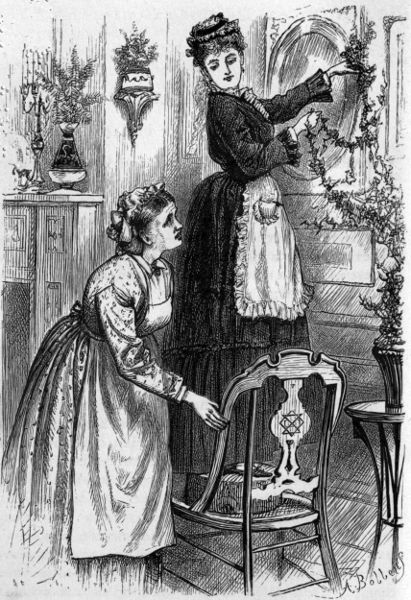
"What, Mary's? Well, Mary has a great deal of neatness and taste, and
always took particular pride in her room when she lived at mamma's,
and so I have arranged hers with special care. Harry got her those
pictures of the Madonna and infant Jesus, and I gave the bénitier
for holy water, over her bed. We matted the floor nicely, and I made
that toilet table, and draped her looking-glass out of an old muslin
dress of mine. The pleasure Mary takes in it all makes it really worth
while to gratify her."
"I never pet servants," said Mrs. Wouvermans, briefly. "Depend on it,
Eva, when you've lived as long as I have, you'll find it isn't the
way. It makes them presumptuous and exacting. Why, at first, when I
blundered into Mary's room, I thought it must be yours—it had such an
air."
"Well, as to the air, it's mostly due to Mary's perfect neatness and
carefulness. I'm sorry to say you wouldn't always find my room as
trimly arranged as hers, for I am a sad hand to throw things about
when I am in a hurry. I love order, but I like somebody else to keep
it."
"I'm afraid," said Aunt Maria, returning with persistence to her
subject, "that you are beginning wrong with Mary, and you'll have
trouble in the end. Now I saw she had white sugar in the kitchen
sugar-bowl, and there was the tea caddy for her to go to. It's
abominable to have servants feel that they must use such tea as we do."
"Oh, well, aunty, you know Mary has been in the family so long I don't
feel as if she were a servant; she seems like a friend, and I treat
her like one. I believe Mary really loves us."
"It don't do to mix sentiment and business," said Aunt Maria, with
sententious emphasis. "I never do. I don't want my servants to
love me—that is not what I have them for. I want them to do my
work, and take their wages. They understand that there are to be
no favors—everything is specifically set down in the bargain I make
with them; their work is all marked out. I never talk with them, or
encourage them to talk to me, and that is the way we get along."
"Dear me, Aunt Maria, that may be all very well for such an energetic,
capable housekeeper as you are, who always know exactly how to manage,
but such a poor little thing as I am can't set up in that way. Now I
think it's a great mercy and favor to have a trained girl that knows
more about how to get on than I do, and that is fond of me. Why, I
know rich people that would be only too glad to give Mary double what
we give, just to have somebody to depend on."
"But, Eva, child, you're beginning wrong—you ought not to leave
things to Mary as you do. You ought to attend to everything yourself.
I always do."
"But you see, aunty, the case is very different with you and me. You
are so very capable and smart, and know so exactly how everything
ought to be done, you can make your own terms with everybody. And, now
I think of it, how lucky that you came in! I want you to give me your
judgment as to two pieces of linen that I've just had sent in. You
know, Aunty, I am such a perfect ignoramus about these matters."
And Eva tripped up stairs, congratulating herself on turning the
subject, and putting her aunt's busy advising faculties to some
harmless and innocent use. So, when she came down with her two pieces
of linen, Aunt Maria tested and pulled them this way and that, in the
approved style of a domestic expert, and gave judgment at last with an
authoritative air.
"This is the best, Eva—you see it has a round thread, and very
little dressing."
"And why is the round thread the best, Aunty?"
"Oh, because it always is—everybody knows that, child; all good
judges will tell you to buy the round threaded linen, that's perfectly
well understood."
Eva did not pursue the inquiry farther, and we must all confess that
Mrs. Wouverman's reply was about as satisfactory as those one gets
to most philosophical inquiries as to why and wherefore. If our
reader doubts that, let him listen to the course of modern arguments
on some of the most profound problems; so far as can be seen, they
consist of inflections of Aunt Maria's style of statement—as, "Oh,
of course everybody knows that, now;" or, negatively, "Oh, nobody
believes that, now-a-days." Surely, a mode of argument which very
wise persons apply fearlessly to subjects like death, judgment and
eternity, may answer for a piece of linen.
"Oh, by-the-by, Eva, I see you have cards there for Mrs. Wat Sydney's
receptions this winter," said Aunt Maria, turning her attention to the
card plate. "They are going to be very brilliant, I'm told. They say
nothing like their new house is to be seen in this country."
"Yes," said Eva, "Sophie has been down here urging me to come up and
see her rooms, and says they depend on me for their receptions, and
I'm going up some day to lunch with her, in a quiet way; but Harry and
I have about made up our minds that we sha'n't go to parties. You
know, Aunty, we are going in for economy, and this sort of thing costs
so much."
"But, bless your soul, child, what is money for?" said Aunt Maria,
innocently. "If you have any thing you ought to improve your
advantages of getting on in society. It's important to Harry in his
profession to be seen and heard of, and to push his way among the
notables, and, with due care and thought and economy, a person with
your air and style, and your taste, can appear as well as anybody. I
came down here, among other things, to look over your dresses, and
see what can be done with them."
"Oh, thank you a thousand times, Aunty dear, but what do you think all
my little wedding finery would do for me in an assemblage of Worth's
spick-and-span new toilettes? In our own little social circles I am
quite a leader of the mode, but I should look like an old last night's
bouquet among all their fresh finery!"
"Well, now, Eva, child, you talk of economy and all that, and then go
spending on knick-knacks and mere fancies what would enable you to
make a very creditable figure in society."
"Really, Aunty, is it possible now, when I thought we were being so
prudent?"
"Well, there's your wood fire, for instance; very cheerful, I admit,
but it's a downright piece of extravagance. I know that the very
richest and most elegant people, that have everything they can think
of, have fallen back on the fancy of having open wood fires in their
parlors, just for a sort of ornament to their rooms, but you don't
really need it—your furnace keeps you warm enough."
"But, Aunty, it looks so bright and cheerful, and Harry is so fond of
it! We only have it evenings, when he comes home tired, and he says
the very sight of it rests him."
"There you go, now, Eva—with wood at fifteen dollars a cord!—going
in for a mere luxury just because it pleases your fancy, and you can't
go into society because it's so expensive. Eva, child, that's just
like you. And there are twenty other little things that I see about
here," said Aunt Maria, glancing round, "pretty enough, but each costs
a little. There, for instance, those cut flowers in the vases cost
something."
"But, Aunty, I got them of a poor little man just setting up a
green-house, and Harry and I have made up our minds that it's our duty
to patronize him. I'm going up to Sophie's to get her to take flowers
for her parties of him."
"It's well enough to get Sophie to do it, but you oughtn't to afford
it," said Aunt Maria; "nor need you buy a new matting and pictures for
your servant's room."
"Oh, Aunty, mattings are so cheap; and those pictures didn't cost
much, and they make Mary so happy!"
"Oh, she'd be happy enough any way. You ought to look out a little for
yourself, child."
"Well, I do. Now, just look at the expense of going to parties. To
begin with, it annihilates all your dresses, at one fell swoop. If
I make up my mind, for instance, not to go to parties this winter,
I have dresses enough and pretty enough for all my occasions. The
minute I decide I must go, I have nothing, absolutely nothing, to
wear. There must be an immediate outlay. A hundred dollars would be a
small estimate for all the additions necessary to make me appear with
credit. Even if I take my old dresses as the foundation, and use my
unparalleled good taste, there are trimmings, and dressmaker's bills,
and gloves, and slippers, and fifty things; and then a carriage for
the evening, at five dollars a night, and all for what? What does
anybody get at a great buzzing party, to pay for all this? Then Harry
has to use all his time, and all his nerves, and all his strength on
his work. He is driven hard all the time with writing, making up the
paper, and overseeing at the office. And you know parties don't begin
till near ten o'clock, and if he is out till twelve he doesn't rest
well, nor I either—it's just so much taken out of our life—and we
don't either of us enjoy it. Now, why should we put out our wood fire
that we do enjoy, and scrimp in our flowers, and scrimp in our home
comforts, and in our servant's comforts, just to get what we don't
want after all?"
"Oh, well, I suppose you are like other new married folks, you want to
play Darby and Joan in your chimney-corner," said Aunt Maria, "but,
for all that, I think there are duties to society. One cannot go out
of the world, you know; it don't do, Eva."
"I don't know about that," said Eva. "We are going to try it."'
"What! living without society?"
"Oh, as to that, we shall see our friends other ways. I can see Sophie
a great deal better in a quiet morning-call than an evening reception;
for the fact is, whoever else you see at a party you don't see your
hostess—she hasn't a word for you. Then, I'm going to have an evening
here."
"You an evening?"
"Yes; why not? See if I don't, and we'll have good times, too."
"Why, who do you propose to invite?"
"Oh, all our folks, and Bolton and Jim Fellows; then there are a good
many interesting, intelligent men that write for the magazine, and
besides, our acquaintances on this street."
"In this street? Why, there isn't a creature here," said Aunt Maria.
"Yes, there are those old ladies across the way."
"What! old Miss Dorcas Vanderheyden and that Mrs. Benthusen? Well,
they belong to an ancient New York family, to be sure; but they are
old as Methuselah."
"So much the better, Aunty. Old things, you know, are all the rage
just now; and then there's my little Quaker neighbor."
"Why, how odd! They are nice enough, I suppose, and well enough to
have for neighbors; but he's nothing but a watchmaker. He actually
works for Tiffany!"
"Yes; but he is a very modest, intelligent young man, and very well
informed on certain subjects. Harry says he has learned a great deal
from him."
"Well, well, child, I suppose you must take your own way," said Aunt
Maria.
"I suppose we must," said Eva, shaking her head with much gravity.
"You see, Aunty, dear, a wife must accommodate herself to her husband,
and if Harry thinks this is the best way, you know—and he does think
so, very strongly—and isn't it lucky that I think just as he does?
You wouldn't have me fall in with those strong-minded Bloomer women,
would you, and sail the ship on my own account, independently of my
husband?"
Now, the merest allusion to modern strong-mindedness in woman was to
Aunt Maria like a red rag to a bull; it aroused all her combativeness.
"No; I am sure I wouldn't," she said, with emphasis. "If there's
anything, Eva, where I see the use of all my instructions to you,
it is the good sense with which you resist all such new-fangled,
abominable notions about the rights and sphere of women. No; I've
always said that the head of the woman is the man; and it's a wife's
duty to live to please her husband. She may try to influence him—she
ought to do that—but she never ought to do it openly. I never used
to oppose Mr. Wouvermans. I was always careful to let him suppose he
was having his own way; but I generally managed to get mine," and Aunt
Maria plumed herself and nodded archly, as an aged priestess who is
communicating to a young neophyte secrets of wisdom.
In her own private mind, Eva thought this the most terrible sort of
hypocrisy; but her aunt was so settled and contented in all her own
practical views, that there was not the least use in arguing the case.
However, she couldn't help saying, innocently,
"But, Aunty, I should be afraid sometimes he would have found me out,
and then he'd be angry."
"Oh, no; trust me for that," said Aunt Maria, complacently. "I never
managed so bunglingly as that. Somehow or other, he didn't exactly
know how, he found things coming round my way; but I never opposed him
openly—I never got his back up. You see, Eva, these men, if they do
get their backs up, are terrible, but any of them can be led by the
nose—so I'm glad to find that you begin the right way. Now, there's
your mother—I've been telling her this morning that it's her duty to
make your father go back into business and retrieve his fortunes. He's
got a good position, to be sure—a respectable salary; but there's no
sort of reason why he shouldn't die worth his two or three millions
as well as half the other men who fail, and are up again in two or
three years. But Nellie wants force. She is no manager. If I were your
father's wife, I should set him on his feet again pretty soon. Nellie
is such a little dependent body. She was saying this morning how would
she ever have got along with her family without me! But there are some
things that even I can't do—nobody but a wife could, and Nelly isn't
up to it."
"Poor, dear little mamma," said Eva. "But are you quite sure, Aunt
Maria, that her ways are not better adapted to papa than any one's
else could be? Papa is very positive, though so very quiet. He is
devoted to mamma. Then, again, Aunty, there is a good deal of risk in
going, into speculations and enterprises at papa's age. Of course, you
know I don't know anything about business or that sort of thing; but
it seems to me like a great sea where you are up on the wave to-day
and down to-morrow. So if papa really won't go into these things,
perhaps it's all for the best."
"But, Eva, it is so important now for the girls, poor things, just
going into society—for you know they can't keep out of it, even if
you do. It will affect all their chances of settlement in life—and
that puts me in mind, Eva, something or other must be done about Alice
and Jim Fellows. Everybody is saying if they're not engaged they ought
to be."
"Oh, Aunty, how exasperating the world is! Can't a man and woman have
a plain, honest friendship? Jim has shown himself a true friend to our
family. He came to us just in all the confusion of the failure, and
helped us heart and hand in the manliest way—and we all like him.
Alice likes him, and I don't wonder at it."
"Well, are they engaged?" said Aunt Maria, with an air of statistical
accuracy.
"How should I know? I never thought of asking. I'm not a police
detective, and I always think that if my friends have anything they
want me to know, they'll tell me; and if they don't want me to know,
why should I ask them?"
"But, Eva, one is responsible for one's relations. The fact is, such
an intimacy stands right in the way of a girl's having good offers—it
keeps other parties off. Now, I tell you, as a great secret, there
is a very fine man, immensely rich, and every way desirable, who is
evidently pleased with Alice."
"Dear me, Aunty! how you excite my curiosity. Pray who is it?" said
Eva.
"Well, I'm not at liberty to tell you more particularly; but I know
he's thinking about her; and this report about her and Jim would
operate very prejudicially. Now shall I have a talk with Alice, or
will you?"
"Oh, Aunty dear, don't, for pity's sake, say a word to Alice. Young
girls are so sensitive about such things. If it must be talked of,
let me talk with Alice."
"I really thought, if I had a good chance, I'd say something to the
young man himself," said Aunt Maria, reflectively.
"Oh, good heavens! Aunty, don't think of it. You don't know Jim
Fellows."
"Oh, you needn't be afraid of me," said Aunt Maria. "I am a great deal
older and more experienced than you, and if I do do anything, you may
rest assured it will be in the most discreet way. I've managed cases
of this kind before you were born."
"But Jim is the most peculiar"—
"Oh, I know all about him. Do you suppose I've seen him in and out in
the family all this time without understanding him perfectly?"
"But I don't really think that there is the least of anything serious
between him and Alice."
"Very likely. He would not be at all the desirable match for Alice. He
has very little property, and is rather a wild, rattling fellow; and I
don't like newspaper men generally."
"Oh, Aunty, that's severe now. You forget Harry."
"Oh, well, your husband is an exception; but, as a general rule, I
don't like 'em—unprincipled lot I believe," said Aunt Maria, with a
decisive nod of her head. "At any rate, Alice can do better, and she
ought to."
The ringing of the lunch bell interrupted the conversation, much to
the relief of Eva, who discovered with real alarm the course her
respected relative's thoughts were taking.
Of old she had learned that the only result of arguing a point with
her was to make her more set in her own way, and she therefore bent
all her forces of agreeableness to produce a diversion of mind to
other topics. On the principle that doctors apply mustard to the
feet, to divert the too abundant blood from the head, Eva started
a brisk controversy with Aunt Maria on another topic, in hopes, by
exhausting her energies there, to put this out of her mind. With what
success her strategy was crowned, it will remain to be seen.