When good John Evelyn wrote his "Sylva, or a Discourse
of Forest Trees," he was greatly concerned lest our "wooden
walls" should diminish in strength for want of a succession
of stout Oaks in our woodlands, and therefore he put the Oak
in the forefront of his discourse. To-day steel and teak have
largely supplanted oak in the building of our navy, and our
walls of defence are no longer of wood. Yet in spite of these
changes, and the consequent reduction of the Oak's importance,
we must still look upon it as the typical British tree, and,
regardless of its place in botanical classifications, we shall
follow the lead of our master and place it first on our list.
There is no necessity for entering upon a minute description
of the botanical characters of so well known a tree. The
sturdy, massive trunk, firm as a rock; the broad, rounded
outline of its head, caused by the downward sweeping extremities
of the wide-spreading lower limbs; the wavy outline of the
lobed leaves, and the equally distinct egg-and-cup-shaped fruit—these
are characters that cannot be confused with those
of any other tree, and are the most familiar objects in the
landscape in most parts of our islands. To my mind, no
wood is so awe-inspiring as one filled with old oaks, all so
much alike, yet each with a distinct individuality. We regard
with reverence a human centenarian, who may have nothing
beyond his great age to commend him to us; but we think of
the long period of history of which he has been a spectator,
possibly an active maker of history. The huge Oak has
probably lived through ten or twenty such periods. Compared
with the Oak, man is but of mushroom growth. It does not
produce an acorn until sixty or seventy years old, and even
then it is not mature. Not till a century and a half have
passed over its head is its timber fit for use, and as a rule
it is not felled under the age of two hundred years. Many
trees are left to a much greater age, or we should not have
still with us so many venerable specimens, and where they
have not been left until partially decayed, the timber is found
to be still very valuable when finally cut down. Of one of
these patriarchs of the forest, cut down in the year 1810,
we have figures of quantity and value from a contemporary
record. It was known as the Gelenos Oak, and stood
about four miles from Newport, Monmouthshire. When felled,
it yielded 2426 cubic feet of sound timber, and six tons of bark.
It was bought just as it stood for £405, and the purchaser
had to pay £82 for labour for stripping, felling, and converting
into timber. Five men were employed for twenty days in
stripping the bark and felling the tree, and after that a pair
of sawyers, working six days a week, were five months
cutting it up. But the bark realized £200, and the timber
about £400. The timber and bark from this one tree were
about equal to the average produce of three acres of oak
coppice after fifteen years growth.
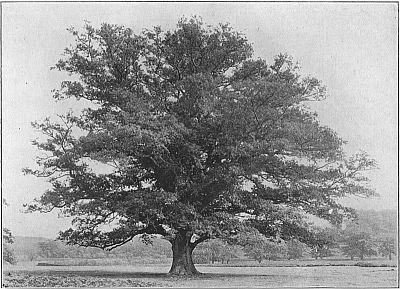 Pl. 2.
Oak—summer.
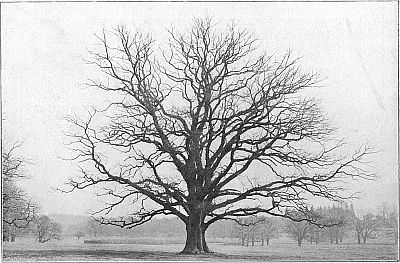 Pl. 3.
Oak—winter.
Full-grown oaks vary in height from sixty to one hundred
and thirty feet, the difference depending upon situation; the
tallest, of course, being those that have been drawn up in
forests, at the expense of their branches. Trees growing
freely in the open are of less height, and are made to appear
comparative dwarfs by the huge proportions of the bole. In
the forest this may be no more than ten feet in girth, but in
isolated specimens may be as much as fifty-four feet (Cowthorpe
Oak), with a much broader base. The thick rough bark is
deeply furrowed in a large network pattern, which affords
temporary hiding-places for insects. The branches are much
given to turn and zig-zag from side to side—a character that
makes them very useful in boat-building, as "knees" of
various angles may be cut from them without having recourse
to bending. The best knees are to be obtained from Oaks
grown in the hedgerow.
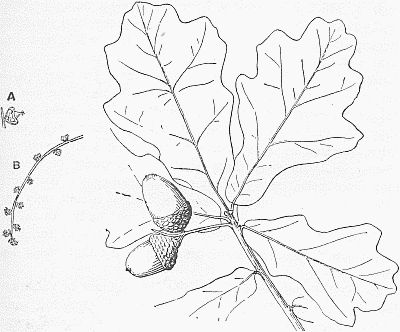 Oak.
Oak.
A, female flower; B, male flowers.
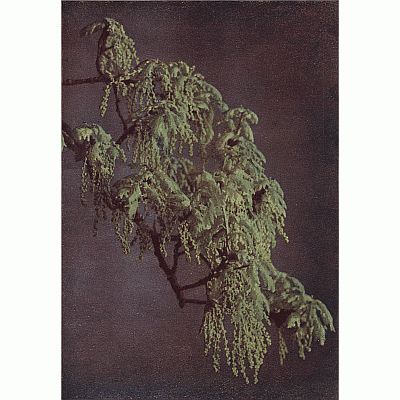
The Oak flowers in April or May, and the blossoms are of
two distinct forms—male and female. The males are in little
clusters, which are borne at intervals along a hanging stalk,
two or three inches in length. They are green, and therefore
inconspicuous; but examined separately, they will be found to
have a definite calyx, whose margin is cut into an uncertain
number (4-7) of lobes. There are no petals, but attached to
the sides of the calyx there are ten stamens. The female
flowers are fewer, and will be found on short erect stalks
above the male catkins. Each female flower consists of a
calyx, invested by a number of overlapping scales, and enclosing
an ovary with three styles. The ovary is divided
into three cells, each containing two seed-eggs. An acorn
should therefore contain six kernels, but, as a rule, only one
of the seed-eggs develops, though occasionally an acorn
contains two kernels. The overlapping scales at the base
of the female flower become the rough cup that holds the
acorn.
The Oak is subject to a considerable amount of variation,
probably due to differences of situation, soil, etc., and some
authors have sought to elevate certain of the varieties into
species by giving them distinctive names. It does not appear
to be certain, however, that these forms are at all constant,
and they are connected by intermediate forms that make the
identification of many individuals a matter of difficulty. In
one of these forms (sessiliflora) the stalk of the acorns connecting
them with the branch is very short, but the leaves
have a distinct footstalk, from half an inch to an inch long.
This form is more plentiful in the north and west, and is
conspicuous in the Forest of Dean. A second form, known
as pedunculata, has the leaf-stalk short or absent, the base
of the leaf broad and somewhat heart-shaped, and the stalk
upon which the acorns are borne very long. A third form
(intermedia), commonly known as Durmast, has short leaf-stalks,
short stalks to the acorns, and the under side of the
leaf downy. Pedunculata is found more on the lower hills
and the sides of valleys, whilst sessiliflora prefers higher ground,
with a southern or western aspect.
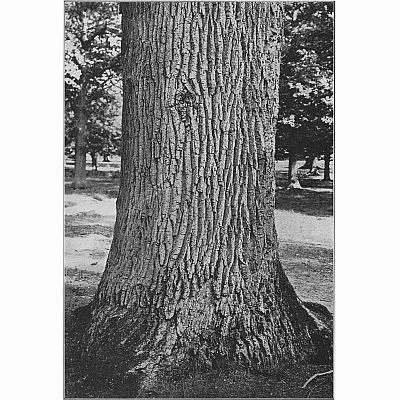 Pl. 4.
Bole of Oak.
 Pl. 5.
Flowers of Oak.
The Oak is most abundant on clay soils, but is at its best
when growing in deep sandy loam, where there is also plenty
of humus. Its roots in such soil strike down to a depth of
five feet, and therefore it thrives in association with Beech,
whose roots are much nearer the surface, and whose fallen
leaves supply it with humus.
The Oak is more persistently attacked by insects than any
other tree. One authority (Leunis) has tabulated the species
that get their living mainly or entirely from their attacks on
the foliage, timber, or bark, and they number about five
hundred. With some species this warfare is waged on so
extensive a scale, that in some years by early summer the
Oaks are almost divested of their foliage, and a new crop of
leaves becomes a necessity. But the reserve forces of the
Oak are quite equal to this drain, and the tree does not
appear to suffer, though a much less thorough attack would
be serious to a Conifer. One of the worst of these Oak-spoilers—though
it by no means restricts its energies to attacks on
this tree—is the Mottled Umber Moth (Hibernia defoliaria),
whose pretty caterpillars may be seen hanging by silken
threads from the leafless twigs.
A striking Oak insect is the Stag Beetle (Lucanus cervus),
which, in warm evenings in the south of England, may be
seen flying round the Oaks, the size and antler-like jaws of
the male arousing feelings of respect in the minds of those
who are not acquainted with its habits. The formidable
looking "horns" are usually harmless. The beetle spends its
larval stage in the wood of unhealthy Oaks, and, when
mature, seeks his hornless mate among its foliage.
Perhaps the most interesting of the Oak's pensioners to the
woodland rambler will be the varied forms of gall on different
parts of the tree. There is the so-called Oak-apple, of uneven
surface and spongy to the touch, which certain people still
wear on May 29th, in honour of Charles II.; the well-rounded
hard Bullet-gall of Cynips kollari, the Artichoke-gall of
Cynips gemmæ, the Spangle-galls of Neuroterus lenticularis,
so plentiful on the back of the leaf, and the Root-gall of
Biorhiza aptera. All these galls are abnormal growths, due
to the irritation set up by the Gall-wasps named, when they
pierced the young tissues in order to lay their eggs in them.
Where any of these galls are perforated it may be known
that the Gall-wasp whose grub fed within has flown, but
where there is no such perforation the grub is still within,
feeding upon the flesh of the gall, or in the chrysalis stage,
awaiting translation to the winged condition.
Several Oaks of foreign origin are also grown in our parks
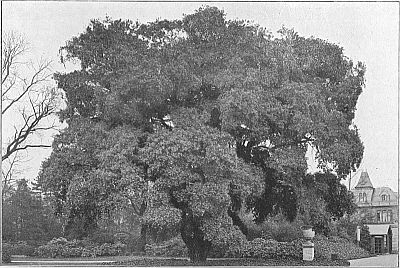
and open spaces; among them the Holm Oak (Quercus ilex)
whose evergreen leathery leaves have toothed or plain edges,
and occasionally the lower ones develop marginal spines,
whence its name of Holm or Holly Oak. It is notable for
retaining its lower branches, so that its appearance, as Loudon
remarks, "even when fully grown, is that of an immense bush,
rather than that of a timber tree." It is a native of Southern
Europe and North Africa, and appears to have been introduced
about the middle of the sixteenth century. It usually attains
a height of from twenty to thirty feet, but occasionally
specimens are seen up to sixty feet. It has a much thinner,
more even bark than that of our native Oak, and of a black
colour. The long brown acorns do not ripen until the second
year.
 Pl. 6.
Holm Oak.
 Pl. 7.
Acorns of Turkey Oak.
The Turkey Oak (Quercus cerris) is a much larger tree,
attaining to similar heights to our British Oak, but easily
distinguishable by its more pyramidal outline, and its attenuated
leaves. The lance-shaped lobes of these are unequal,
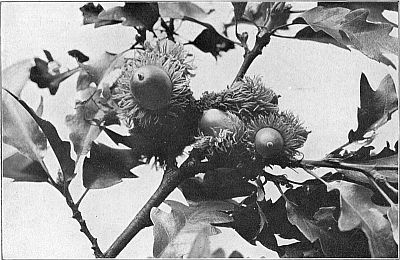
sharp, and angular; and the footless acorn-cups are covered
with bristly or mossy-looking scales. The acorns, which are
small and exceedingly bitter, rarely ripen till their second
autumn. The whole tree—trunk, branches, and twigs—is of
straighter growth than Quercus robur. It is a native of
Southern Europe and the Levant, and was introduced about
one hundred and seventy years ago.
The spring rambler in the woods may come upon a party
of woodmen stripping young Oaks of their bark, or felling
them, whilst cylinders of separated bark rest across poles in the
process of drying. This is the industry of barking for the
purpose of the tanner. When the Oaks in a coppice are
about sixteen years old they are most suitable for this purpose,
the bark then containing a larger percentage of tannin than
at any other period. The operation is best performed in May,
when the sap is in flow, and should be completed between the
first swelling of the leaf-buds and the unrolling of the leaves.
If the weather is cold and damp the bark will peel the better,
provided there is an absence of north or east winds. Before
the tree is cut down the bole is stripped, the first ring being
taken from just above the roots to a height of two and a half
feet above. When the tree is felled, it is cut into lengths and
the bark stripped from them; then all branches that are an inch
or more in diameter are peeled. The bark is piled to dry for a
couple of weeks, and is then broken into small pieces and sent
away in sacks.
It is not alone in the use of the bark that the tannic acid of
the Oak is made evident; it is to the presence of this that the
austerity of the acorn is due, and also the ink-producing
properties of certain Oak-galls. Everything connected with
the tree gets a roughness of flavour from this same principle.
Even that remarkable fungus, the Vegetable Beef-steak, that
may be found on old Oaks in autumn, is impregnated with it.
Prior regards the name Oak (Anglo-Saxon ac) as originally
belonging to the fruit, and only later transferred to the tree
that produces it. The more obvious explanation (though we
know that in etymological and other matters the obvious is
not always the true interpretation) is, that acorn (ac-corn)
signified the corn or fruit of the ac. Selby tells us that
"During the Anglo-Saxon rule, and even for some time after
the Conquest, Oak-forests were chiefly valued for the fattening
of swine. Laws relating to pannage, or the fattening of hogs in
the forest, were enacted during the Heptarchy; and by Ina's
statutes, any person wantonly injuring or destroying an Oak-tree
was mulcted in a fine varying according to size, or the
quantity of mast it produced."
 Pl. 8.
Fruit of Beech.
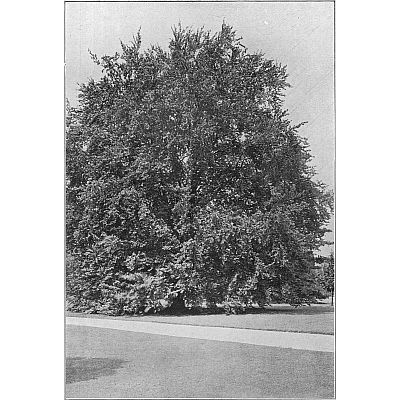 Pl. 9.
Beech—summer.
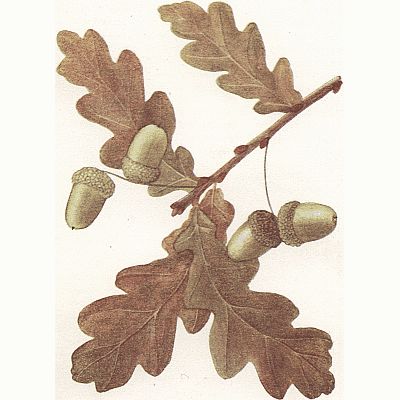 Pl. 10.
Acorns of Pedunculate Oak.
We speak of the Oak as the "Monarch of the Woods," and
to the Beech the title "Mother of Forests" has been given.
To the timber-merchant the Beech has little importance, but
the grower of timber freely acknowledges his heavy indebtedness
to this nursing mother, for, in the words of Professor
Gayer, the Bavarian forestry expert, "without Beech there can
no more be properly tended forests of broad-leaved genera, as
along with it would have to be given up many other valuable
timber-trees, whose production is only possible with the aid of
Beech." Quite apart from utilitarian considerations, we should
be very sorry to lose the Beech, with its towering, massive shaft
clad in smooth grey bark, its spreading roots above the soil,
and the dense shade of its fine foliage. Fortunately for the lover
of natural beauty, it is this luxuriant growth of leaves and the
shade it gives that are the redeeming virtues of the Beech
in the eye of the forester. Its drip destroys most of the soil-exhausting
weeds, its shade protects the soil from over-evaporation,
and the heavy crop of leaves enriches it by their
decomposition. On these points the forestry experts of to-day
join hands with John Evelyn, who, nearly 250 years ago, thus
referred to it—"The shade unpropitious to corn and grass,
but sweet, and of all the rest, most refreshing to the weary
shepherd—lentus in umbra, echoing Amaryllis with his oaten
pipe." And, again, after giving us a long catalogue of the
varied uses to which Beechwood may be put, he adds—"Yet
for all this, you would not wonder to hear me deplore the so
frequent use of this wood, if you did consider that the industry
of France furnishes that country for all domestic utensils with
excellent Walnut, a material infinitely preferable to the best
Beech, which is indeed good only for shade and for the fire."
In the days of open hearths and chimney corners the Beech
was extensively used for fuel, and it is still reputed to make
good charcoal; but to-day the chairmaker and the turner are
the chief users of its wood.
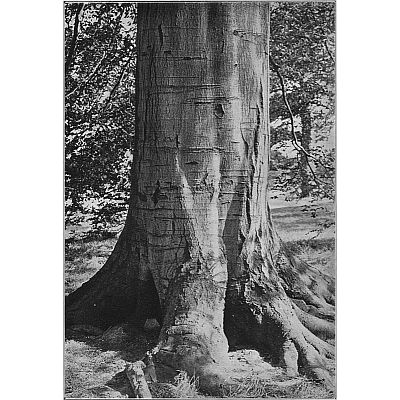 Pl. 11.
Bole of Beech.
The Beech well grown attains a height of about 100 feet,
and a girth of 20 feet. There was, until recently, a Beech
in Norbury Park, Surrey, 160 feet in height. Its branches
horizontally spreading gave it a head of enormous proportions.
Hooker gives the diameter of the Knowle Beech as 352 feet,
which means a circumference of about as many yards. It
will grow in most upland places where the Oak thrives, though
it does not need so deep a soil, and has a preference for land
containing lime. Fresh mineral soils, rich in humus, are the
best for it. In poor soils its growth is slow and its life is longer.
It begins to bear mostly at about eighteen years of age, and
thereafter gives good crops at intervals of three or five years.
In spring, just before the buds expand, the twigs of the
Beech have a very distinct appearance. They are long and
slender, placed alternately along the twig, and the brown
envelopes retain their shape long after they have been cast off.
It is interesting to note how well these are mimicked by a glossy
spindle-shaped snail (Clausilia laminata) that has a decided
fondness for the Beech. As the snails crawl up the bole or over
the moss at its base, it is not easy at a glance to say which are
snails and which bud-envelopes. This is one of the protective
resemblances adopted by many animals to give them a chance
of eluding their natural enemies—in this case the thrush and
other birds.
In the bud the leaf is folded fan-wise, and the folds run
parallel with the nerves. They expand into an oval, smooth-faced
leaf, with slightly scooped edges, and a most delicate fringe
of short gossamer, which falls off later. These leaves Evelyn
recommended as a stuffing for beds, declaring that if "gathered
about the fall, and somewhat before they are much frost-bitten,
[they] afford the best and easiest mattresses in the world to lay
under our quilts instead of straw.... In Switzerland I have
sometimes lain on them to my great refreshment." That last
clause seems to imply that the authorities at home would not
allow the introduction of new-fangled bed-stuffings, but remained
true to straw. These leaves are rich in potash, and as they
readily decay, they produce an admirable humus. In sheltered
places the leaves, turned to a light ruddy-brown colour, are
retained on the lower branches until cast off by the expansion
of the new buds.
In early summer, whilst the leaves are still pellucid, the shade
of a big Beech is particularly inviting. Later the leaves become
opaque, and their glossy surfaces throw back the heat rays.
Then the play of light upon the great mass of foliage is very
fine; but when autumn has turned their deep green to orange
and warm ruddy brown, and they catch the red rays of the
westering sun, the tree appears to be turned into a blazing fire.
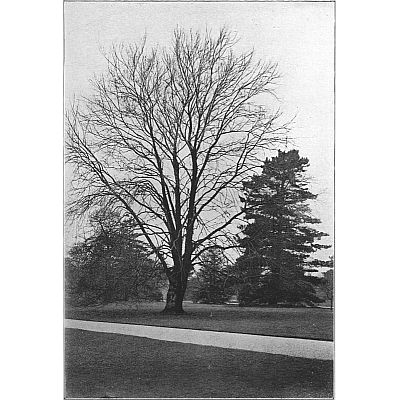 Pl. 12.
Beech—winter.
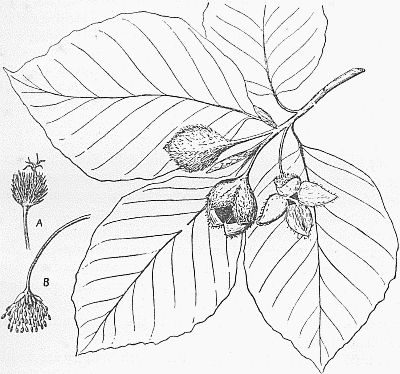 Leaves, flowers, and fruit of Beech.
A, female; B, male flowers.
The Beech flowers in April or May. The blossoms are rather
more conspicuous than is the case with the Oak, for the male
flowers are gathered together in a hanging purplish-brown
rounded tassel with yellow anthers. The female flowers, to the
number of two, three, or four, are clustered in a "cupule" of
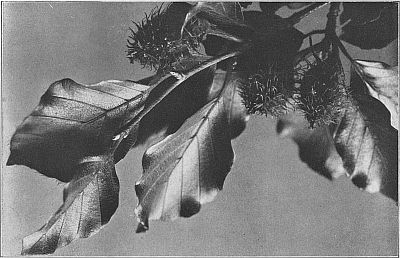
overlapping scales, like those of the Oak. But in the Beech the
"cupule" becomes a bristly closed box, which afterwards opens
by one end splitting into four triangular silk-hair-lined valves,
which turn back and reveal the three-sided, sharp-edged "mast."
This mast was formerly a very valuable product of the Beech-woods,
when herds of swine were turned in them to feed upon
the fallen Beech-nuts. Agricultural methods have changed;
but though our hogs are now confined in styes, and fed on a
diet that more rapidly fattens, Beech-mast is still a good food
eagerly taken by such woodland denizens as badgers, deer,
squirrels, and dormice.
The vitality of the Beech is so high that quite frequently the
bole divides at its upper part into several trunks, which rise
straight up, and each attains the dimensions of a complete tree.
Often such a tree stands on a sandy bank, and seems in imminent
danger of toppling over, but its uprightness secures it against
strain, and the roots that it sent down the steep side of the bank
have thickened into strong props. Many such trees may be
found along the hollow lanes in the Greensand district of Surrey,
and we have more than once sheltered from a storm under their
roots.
We have already mentioned the value of the Beech as a nurse
for other trees, and its frequent use for that purpose, but it
should also be stated that it is a powerful competitor with other
trees, and if these are left to fight their own battles unaided, the
Beech will be the conqueror. Evelyn saw this more than two
centuries ago, and pointed out that where mixed woods of Oak
and Beech were left to themselves, they ultimately became pure
Beech woods. The Beech appears to gain this advantage
through rooting in the surface soil, and, exhausting it of food
elements, suffers none to penetrate to the lower strata, where
the Oak has its roots.
A number of insects feed upon the Beech, but they are mostly
more beautiful or more singular than destructive. The Copper
Beech, which is so effectively used for ornament in parks, is
merely a sub-variety of the Common Beech, and all the examples
in cultivation are believed to be "sports" from the purple
variety, which itself was a natural sport discovered in a German
wood little more than a hundred years ago.
The modern word Beech is derived from the Anglo-Saxon
boc, bece, beoce, which had very similar equivalents in all branches
of the German and Scandinavian family, and from the fact that
the literature of these people was inscribed on tablets of Beech,
our word book has the same origin.
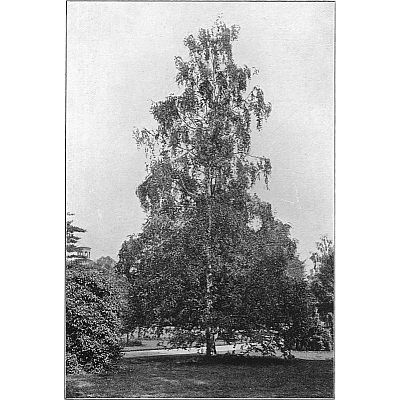 Pl. 13.
Birch—summer.
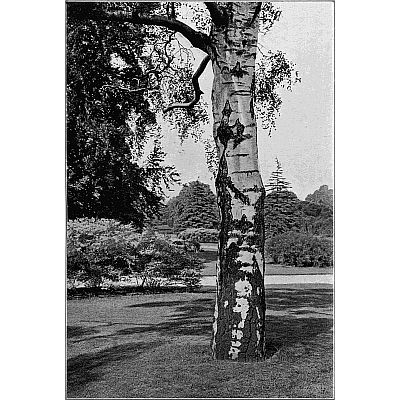 Pl. 14.
Bole of Birch.
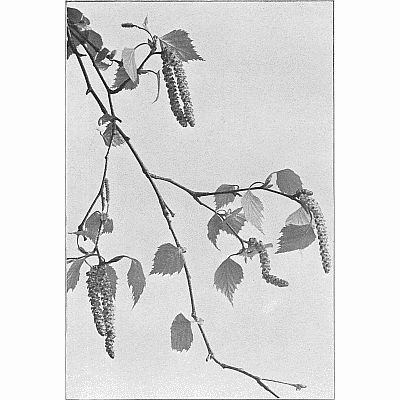 Pl. 15.
Catkins of Birch.
"The Lady of the Woods," as Coleridge christened the Birch,
is at once the most graceful, the hardiest, and the most ubiquitous
of our forest trees. It grows throughout the length and
breadth of our islands, and seems happy alike on a London
common, in a suburban garden, or far up in the Scottish highlands
(2500 feet). It penetrates farther north than any other
tree, and its presence is a great boon to the natives of Lapland.
It will grow where it is subjected to great heat, as well as where
it must endure extreme cold, with its slender roots exploring
the beds of peat, the rich humus of the old wood, or the raw
soil of the mountain-side, where it has to cling to rocks and a
few mosses. Given plenty of light, and it seems to care for
little else. Though a mere shrub in the far north, with us the
Birch has a trunk sometimes as tall as eighty, but more frequently
fifty feet, and a girth of from two to three feet. In its
first decade it increases in height at the rate of a foot and a
half or two feet in a year; but, of course, there is little breadth
to be built up at the same time. It reaches maturity in half a
century, and before the other half is reached the Birch will have
passed away.
The bark of the Birch is more enduring than its timber,
which may be partly due to its habit of casting off the outer
layer in shreds, like fine tissue-paper, from time to time. The
greater part of the bark is silvery white, which adds to the
apparent slenderness of the tree, and makes it conspicuous from
a long distance; for the attenuated and drooping branches,
dressed in small and loosely hung leaves, sway so constantly
that the trunk is scarcely hidden. The glossy, leathery leaves
vary in shape from a triangular form to a pointed oval, their
edges doubly toothed, and their footstalks long and slender.
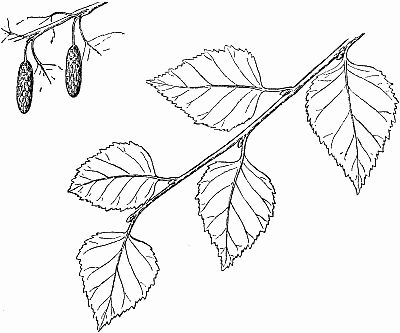 Birch leaves and catkins.
About April the hanging catkins of the Birch, which were in
evidence in the previous autumn, have matured and become
dark crimson; the scales separate and expose the two stamens
of each flower, which has a single sepal. The female flowers
are in a short, more erect spike, which consists of overlapping
scales (bracts), each containing two or three flowers. The
flowers have neither petals nor sepals, each consisting merely
of an ovary with two slender styles. After fertilization the
female spike has developed into a little oblong cone. The
minute nuts have a pair of delicate wings to each, and as they
are set free from the cones they flutter on the breeze like a
swarm of small flies. The moss that usually covers the ground
beneath the Birch will be found in October to be thickly speckled
with these fruits, which are something more than seeds, as they
are commonly termed; they are really analogous to the acorn—a
nut within a thin shell. The tree sometimes begins to
produce seed when only fifteen years old; but, as a rule, it is
ten years older before it bears, and thereafter it has a crop
every year.
It is strange how so striking and graceful a tree could have
been so persistently ignored by the old school of landscape
painters, when one remembers with what good effect modern
artists have utilized it. In this connection we need not apologize
for quoting at length a description of the tree from the
artist's point of view, because it also gives attention to those
points one would like the rambler to notice. Mr. P. G. Hamerton
in his Sylvan Year, says—
"The stem ... of the Silver Birch is one of the masterpieces
of Nature. Everything has been done to heighten its unrivalled
brilliance. The horizontal peeling of the bark, making dark
rings at irregular distances, the brown spots, the dark colour of
the small twigs, the rough texture near the ground, and the
exquisite silky smoothness of the tight white bands above, offer
exactly that variety of contrast which makes us feel a rare
quality like that smooth whiteness as strongly as we are capable
of feeling it. And amongst the common effects in all northern
countries, one of the most brilliant is the opposition of birch
trunks in sunshine against the deep blue or purple of a mountain
distance in shadow. At all seasons of the year the beauty of
the birch is attractive and peculiarly its own. The young beech
may remind you of it occasionally under strong effects of light,
and is also very graceful, but we have no tree that rivals the
birch in its own qualities of colour and form, still less in that
air and bearing which are so much more difficult to describe.
In winter you see the full delicacy of the sprays that the lightest
foliage hides, and in early spring this tree clothes itself, next
after the willow, with tiny triangular leaves, inexpressibly light
in the mass, so that from a distance they have the effect of a
green mist rather than anything more material. When the
tree is isolated sufficiently to come against the sky, you may
see one of the prettiest sights in Nature—the pure deep azure
of heaven, with the silvery white and fresh green of the birch in
opposition. And yet it is not a crude green, for there is a good
deal of warm red in it, which gives one of those precious tertiaries
that all true colourists value."
Linnæus named our common Birch Betula alba; but more
than a century ago Ehrhart pointed out that there were two
well-defined forms of the tree, which he proposed to separate as
distinct species under the names of B. verrucosa and B. pubescens.
Hooker regards the first of these as the typical form, for
which he properly retains the Linnæan name. It is distinguished
by having the base of the bole covered with coarse, rough, and
blackish bark, the smooth leaves looking as though their base
had been cut off, and the twigs warty. The B. pubescens of
Ehrhart appears to be a variety of Fries' B. glutinosa, which
Hooker treats as a sub-species of B. alba. The bark at its
base is smooth and white, its downy leaves have a triangular
base, and its twigs are free from warts. It sometimes assumes
a bush-like form.
The Dwarf Birch (Betula nana) is a distinct species, which
occurs locally in the mountainous parts of Northumberland and
Scotland. It is not a tree, but a bush, only two or three feet in
height. Its firm-textured, round leaves have scalloped margins
and short footstalks.
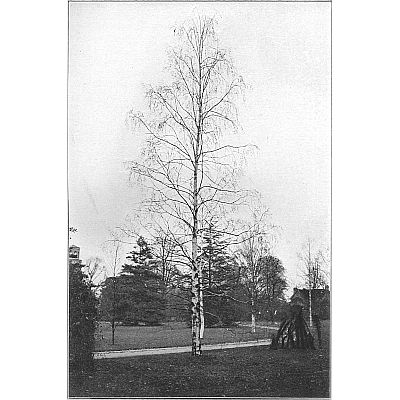 Pl. 16.
Birch—winter.
The foliage of the Birch in autumn turns to a yellow hue. At
this period—and, indeed, for a month earlier—there may be
seen beneath the Birch-trees one of the most striking of our
toadstools, the Fly Agaric (Amanita muscarius), so-called from
its use as the lethal ingredient in the making of fly-papers.
From a bulbous base a creamy yellow stem arises, decked about
half its height with an ample hanging frill. The upper side of
the spreading "cap" is painted with crimson, over which are
scattered flecks of white or cream kid—the remains of an outer
envelope that was ruptured by the expansion of the cap, and of
which the frill represents the lower portion. This species is
really poisonous, and the Kamschatkans are said to make their
vodka superlatively intoxicating by the addition of this fungus
to it. On the trunk of the Birch may sometimes be found
a large fungus named Polyporus betulinus, whose root-like
portion penetrates the bark and sucks up the sap.
Birch-bark is used for tanning certain kinds of leather, and
the peculiar odour of Russian leather is said to be due to the
use of Birch in its preparation. The Birch agrees with the
Beech in two respects—it is of little value for timber, but as a
nurse to young timber-trees it is of considerable importance.
Its name is from the Anglo-Saxon beorc, birce, and signifies the
Bark-tree.
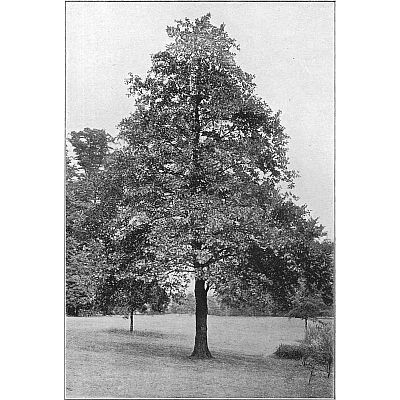 Pl. 17.
Alder—summer.
Although the Alder is abundant by riversides and in all low-lying
moist lands as far north as Caithness, it is not so generally
well known at sight as the Oak, the Beech, and the Birch. It is
a small tree ordinarily only thirty to forty feet in height, with a
girth from three to six feet, though occasionally it aspires to
seventy feet in height. This is when it is growing in moist loam,
upon which rain or floods have washed down good layers of
humus from woods at a higher elevation. If, with its roots thus
well cared for, its head is in a humid atmosphere, the Alder is in
happy case. If it has had the misfortune to get into a porous
soil, though this may be moist enough to please an Ash, the
Alder becomes merely a big bush.
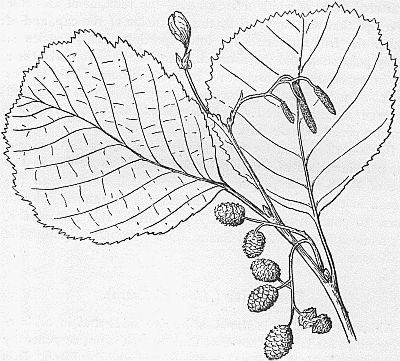 Alder.
The bark of the Alder is rough and black, and the wood soft.
Whilst the tree is alive its wood is white, but when cut and
exposed to the air it becomes red; finally, on drying, it changes to
a pinkish tint. As timber it has no great reputation, except for
piles or other submerged purposes, when it is said to be exceedingly
durable. It has also enjoyed a great reputation for
making the best charcoal for the gunpowder mills, and it is
largely used by the turner, the wood-carver, and the cabinet-maker.
The leaves, which have short stalks, and are from two
to four inches long, are roundish with a wedge-shaped base.
They have a waved and toothed margin, and remain green
long after the leaves of other trees have fallen. In their young
condition these leaves are covered with hairs, and are sticky to
the touch, and it is to this fact that the name glutinosa has
reference.
The flowering of the Alder is very similar to that of the Birch,
but the male catkins have red scales, and each flower four stamens.
The female spikes have the fleshy scales covered by red-brown
bracts of a woody consistence, which persist after the fruit has
dropped out of them. Seed is not produced until the Alder is
twenty years old, and the crop is repeated almost every year
after. The cones are ripe about October or November, when
they scatter their fruit, but the empty ones persist in hanging to
the branches throughout the winter in numbers sufficient to give
the leafless tree a brown appearance from a little distance. The
immature male catkins are in evidence at the same time.
There is a variety (incisa) of the Alder in which the leaves are
so deeply toothed that they bear a close resemblance to those
of the Hawthorn.
In some localities the tree is called the Howler and Aller, the
latter word apparently the original name, for its Anglo-Saxon
forms were ælr, alr, and aler.
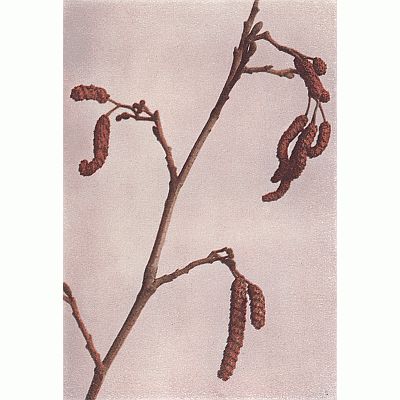 Pl. 18.
Catkins of Alder.
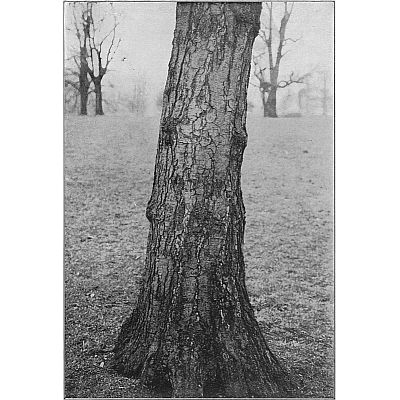 Pl. 19.
Bole of Alder.
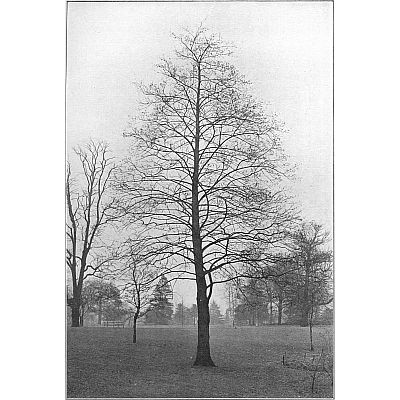 Pl. 20.
Alder—winter.
The Hornbeam is frequently passed by as a Beech, to which
it has a very close superficial likeness, but a comparison of leaves,
flowers, or bole would at once make the differences obvious. It
is usually found in similar situations to the Beech, though it
does not ascend so far up the hills as that species. On dry, poor
soils it does not attain its full proportions and may only be classed
as a small tree; but when growing on low ground, in rich loam
or good clay, it reaches a height of seventy feet, with a girth of
ten feet. If two measurements of the bole's diameter be taken
at right angles to each other, they will be found to differ greatly.
A section of the trunk will not show a circular outline, but rather
an ellipse, the bole appearing to have been flattened on two sides.
It is coated with a smooth grey bark, usually spotted with white.
The leaves are less symmetrical than those of Beech, and are
broader towards the base. They are of rougher texture, hairy
on the underside, and their edges are doubly toothed. In
autumn they turn yellow, then to ruddy gold, but a few days later
they have settled into the rusty hue they retain throughout
the winter, in those cases where they remain on the tree until
spring.
The wood is exceedingly tough, and not to be worked up with
ease, but it is considered to make admirable fuel. Evelyn says,
"It burns like a candle." There are those who say that the name
Hornbeam has reference to the tough or hornlike character of
its beams; others declare that in the days when bullocks were
yoked to the plough the yoke was made of this wood, as being
fitted by its toughness to stand the strain, and as it was attached
to the horns, it became the horn-beam. A third theory is that
the name was derived from Ornus, the Manna-ash, with which
early botanists confused it, but with all respect to the authority of
Dr. Prior, who favours it, we prefer to stand on the first suggestion,
with old John Gerarde, who says ("Herball," 1633): "In
time it waxeth so hard that the toughnesse and hardnesse of it
may be rather compared to horn than unto wood, and therefore
it was called Hornbeam or hardbeam." The carpenter is not
pleased who has hornbeam to work up, for his tools lose their
edge far too quickly for his labour to be profitable. Evelyn tells
us that it was called by some the Horse-beech, from the resemblance
of the leaves.
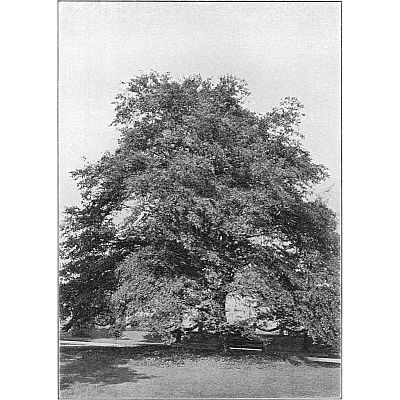 Pl. 21.
Hornbeam—summer.
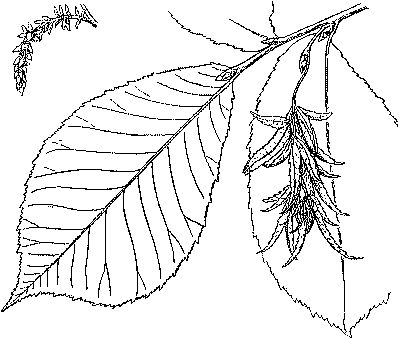 Hornbeam.
The two kinds of catkins are similar and cylindrical, but
whilst the male is pendulous from the beginning, the female is
erect until after the formation of the fruit, when it gradually
assumes the hanging position. The bracts of the male are oval,
with sharp tips, each containing an uncertain (3-12) number of
stamens. In the female the bracts fall early, but their place
is taken by three-lobed bracteoles, which enlarge after flowering,
and become an inch or an inch and a half long. A single flower
occupies each bracteole, consisting of a two-celled ovary and two
styles. Only one cell develops, so that the hard green fruit contains
but one seed. The appearance of these fruits in autumn
as they hang in a spray from the underside of the branches is
quite distinct from those of any other of our native trees.
The Hornbeam's title to be considered indigenous has had
some doubts thrown upon it because there are some records of
specimens having been introduced during the fifteenth century,
but that is not sufficient ground upon which to deny nationality.
We have known persons to bring home from distant parts as
treasures wild plants and ferns that were growing within a mile of
their own homes. It appears to be a real native of the southern
and midland counties of England, and of Wales. A line drawn
across the map from North Wales to Norfolk roughly marks the
limit; north of that line the Hornbeam appears to have been
planted, as also in Ireland.
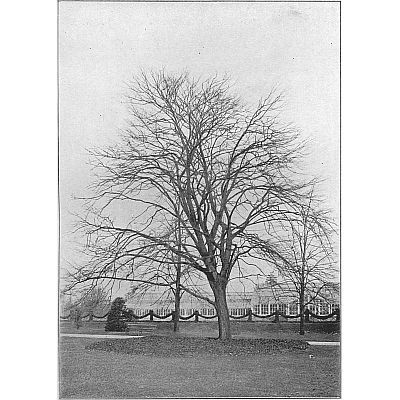 Pl. 22.
Hornbeam—winter.
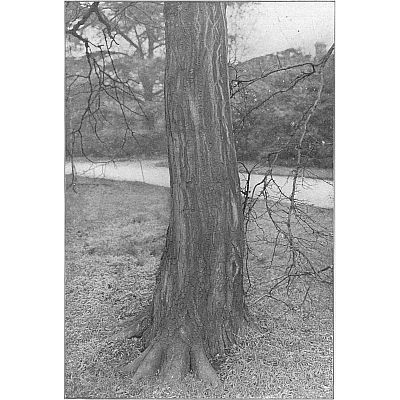 Pl. 23.
Bole of Hornbeam.
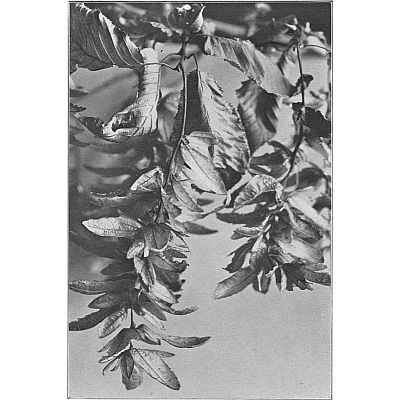 Pl. 24.
Fruits of Hornbeam.
It is rarely that the Hazel is allowed in this country to develop
into a tree; as a rule it is a shrub, forming undergrowth in wood
or copse, or part of a hedge. As it is cut down with the copse
or hedge, it cannot form a standard of any size. But that the
Hazel left alone will develop into a small tree is shown by an
example in Eastwell Park, Kent, whose height a few years ago
was thirty feet, with a circumference of three feet round the bole.
As soon as the nuts are formed the bush is easily identified by
all, so that a description of its character is hardly necessary.
The large, roundish, heart-shaped leaves are arranged alternately
in two rows along the straight downy shoots. Their margins
are doubly toothed, and when in the bud they are plaited, the
folds being parallel to the midrib. Soon after the buds open,
many of the leaves assume a purplish tint for a while; in autumn
they turn brown, and finally pale to yellow.
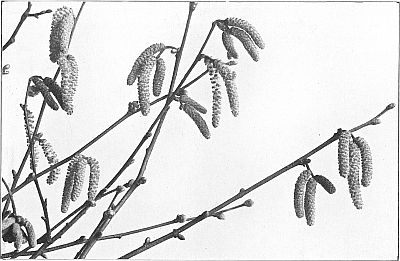 Pl. 25.
Hazel Catkins.
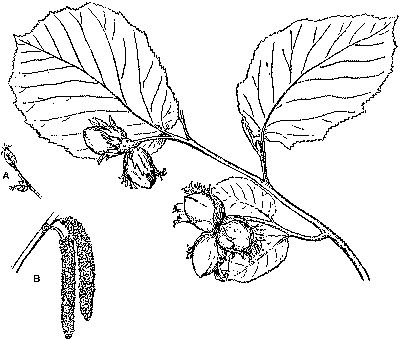 Hazel.
A, female flowers; B, male flowers.
Before the leaves appear the Hazel is rendered conspicuous by
the male catkins, which are familiar to country children under the
name of Lamb's-tails. These may be seen in an undeveloped condition
in the autumn, when the nuts are being sought. A cluster
of two or three hard, little, grey-green cylinders is all that may
then be seen of them; but throughout the winter they lengthen,
their scales loosen, and in February they are a couple of inches
long, pliant, and yellow with the abundant pollen which blows out
of them as they swing. The female flowers are by no means conspicuous,
and have to be looked for. They will be found in the
form of swollen buds on the upper parts of the shoots and branches,
from which issue some fine crimson threads. These are the styles
and stigmas, and on dissection of the budlike head, each pair
of styles will be seen to spring from a two-celled ovary nestling
between the bracts or scales of which the head is composed. It
is only rarely that the seed-egg in each cell develops; as a rule
one shrivels, and the other develops into the sweet "kernel" of
the Hazel-nut. The shell is the ovary that has become woody
and hard; the ragged-edged leathery "shuck" is the enlarged
bracts that surrounded the minute flower.
The Hazel likes a good soil, and will not really flourish without
it, though it will grow almost anywhere, except where the moisture
is stagnant. Its wood is said to be best when grown on a chalky
subsoil. Of course, as timber, the Hazel does not count, but its
tough and pliant rods and staves are valuable for many small
uses, such as the making of hoops for casks, walking-sticks, and—divining-rods!
The bark is smooth and brown.
The Barcelona nut, imported so largely in winter, is only a
variety of the Hazel; as also the Cob and the Filbert, so largely
cultivated in Kent. The name is the Anglo-Saxon hæsl, or
hæsel, and signifies a baton of authority, from the use of its rods
in driving cattle and slaves.
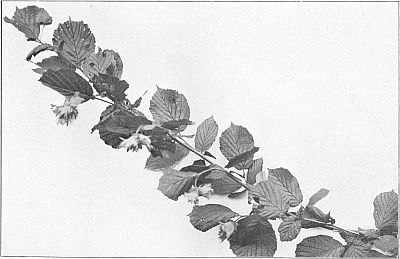 Pl. 26.
Hazel Nuts.
Those persons who obtain their ideas of trees mainly from
the specimens they can see in suburban roads and gardens are
in danger of getting quite a false impression of the Lime. It is
a long suffering, good-tempered tree, and like human individuals
of similar temperament, is subjected to shameful treatment.
The suburban gardener who has a row of Limes to trim uses
the saw, and amputates every arm close up to the shoulder, so
that when the season of budding and burgeoning arrives the
row of Limes will look like an upward extension in green of the
brick wall. Such are the atrocities upon which Suburbia has
to base its ideas of one of the most imposing of trees.
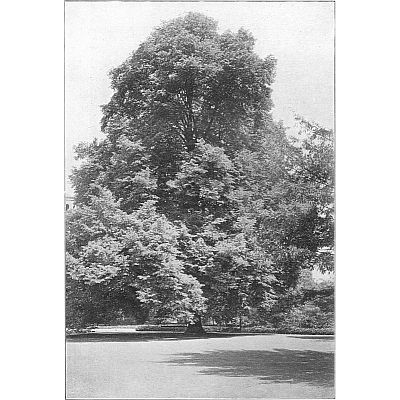 Pl. 27.
Lime-tree—summer.
The Large-leaved Lime, growing in park-land or meadow,
with its roots deep in good light loam, and its head eighty or
ninety feet above, is quite another matter. Such a tree is a
thing of beauty, and one can stand long at its base looking up
among the wide-spreading limbs so well clothed with leaves of
fine texture and tint. The girth of such a specimen at four feet
from the ground would be about fifteen feet. Larger individuals
have been recorded, up to twenty-seven feet.
There are three kinds of Lime in general cultivation in this
country, but the differences between them are not great. They
are the Large-leaved (Tilia platyphyllos), the Small-leaved
(T. parvifolia), and the Intermediate or Common Lime (T.
vulgaris). The last-named is generally admitted to be an
introduced kind, and it is the one most commonly planted.
Respecting the claims of the other two to rank as natives, there
has been some difference of opinion among authorities. The
Small-leaved Lime, which does not occur in woods north of
Cumberland, was regarded by Borrer as a true indigene, but H. C.
Watson considered its claims as open to doubt, though he had
no such doubt of the Large-leaved Lime, which is only growing
really wild in the woods of Herefordshire, Radnorshire, and the
West Riding of Yorkshire.
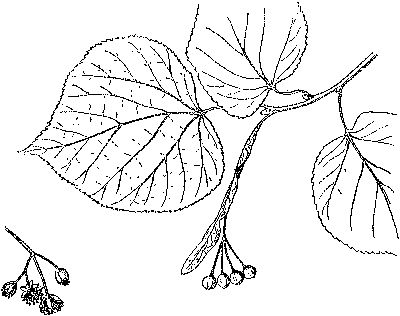 Lime.
Lime.
All our Limes have similar straight tall stems, clad in smooth
bark, and with a similar habit of growth. They are trees that
demand genial climatic conditions for their proper development,
and in consequence they do not put forth their leaves until May.
The period of their leafy glory is comparatively short, for they
are among the trees that lose their leaves earliest in autumn, after
having been for a few days transmuted into gold. The leaf of
the Lime is heart-shaped, with one of the basal lobes larger
than the other, and the edges cut into saw-like teeth. There
are slight differences in those of the three species, which will be
indicated below.
In its floral arrangements the Lime differs from the trees
previously mentioned in that it has distinct sepals and petals,
an abundance of honey, and strong, sweet fragrance as of
Honeysuckle. Unlike them, it does not trust to so rough and
ready an agent of fertilization as the wind, so that it waits until
its boughs are well clothed with leaves before putting forth its
yellowish-white blossoms. These are in clusters (cymes) of six
or seven, the stalks of all arising from one very long and stouter
stalk, which is attached for half its length to a thin and narrow
bract. Individually regarded, the flowers will be found to consist
of five sepals, five petals, an oval ovary with a style ending
in a five-toothed stigma, and surrounded by a large number of
stamens. The stamens discharge their pollen before the stigma
of that flower is fitted to receive it, so that cross-fertilization is
ensured by the visits of the innumerable bees that visit the
flowers for the abundant nectar they contain, and which the
bees convert into a first-rate honey.
The flowers are succeeded by globose little fruits, each about
a quarter of an inch across, yellow, and covered with pale
down. In a good season these will be found to contain one
or two seeds, but too often in this country the summers are too
cool to ripen them. The Lime does not begin to bear until
about its thirty-fifth year. It flowers every year thereafter,
but the question of its seed-crop depends entirely upon the
weather.
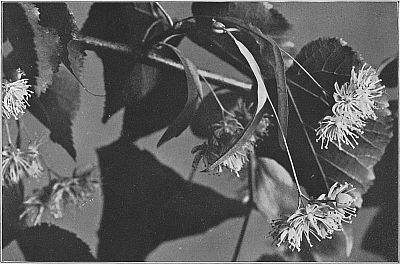 Pl. 28.
Flowers of Lime.
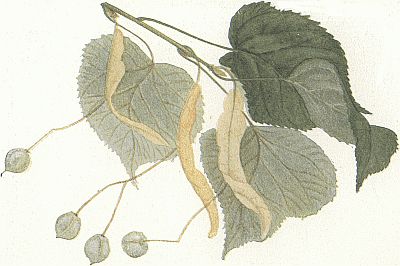 Pl. 29.
Fruits of Lime.
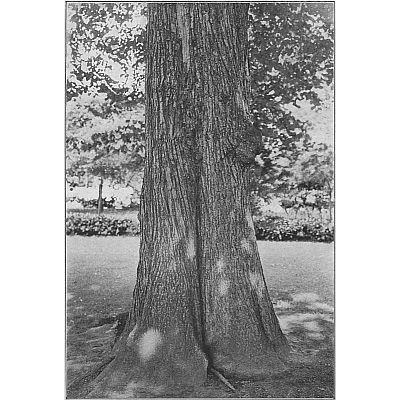 Pl. 30.
Bole of Lime.
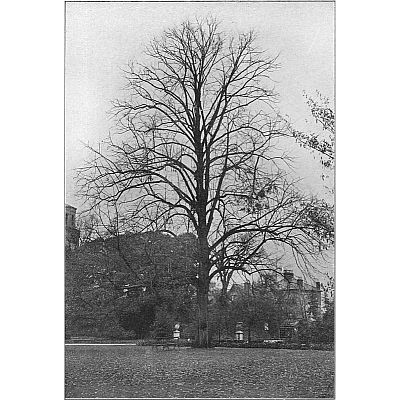 Pl. 31.
Lime—winter.
For the purposes to which large timber is usually put, the
light white wood of the Lime is not highly esteemed, not being
considered of sufficient durability; yet it serves for many
smaller uses, where its lightness and fine grain are strong
recommendations. It must not be forgotten that the wonderful
carvings of Grinling Gibbons were executed in this wood. It is
largely used by the makers of musical instruments; and, as
every one knows, it is from the inner bark of the Lime that those
useful bast mats, which are imported from Russia in such large
numbers, are made. Probably owing to its lightness, again, the
wood was used in old times for making bucklers. The question
of its value as timber is probably never taken into account when
it is planted in this country, where its ornamental appearance as
an avenue or shade-tree is its great recommendation. It is one
of the long-lived trees, its full life-period being certainly five
centuries. Those in St. James's Park are popularly supposed
to have been planted, at the suggestion of John Evelyn, somewhere
about the year 1660. There is a fine Lime avenue in
Bushey Park, probably planted by Dutch William.
Deer and cattle are fond of the foliage and young shoots
if they can get at them. Numerous insects exhibit a like
partiality; of these the caterpillar of the large and handsome
Lime Hawk-moth (Smerinthus tiliæ) is the most
characteristic.
The differences between the three species may be briefly
noted:—
Small-leaved Lime (Tilia parvifolia). Does not attain
the large proportions of the others. Leaves about two inches
across, smooth; on the lower surface the axils of the nerves are
glaucous and downy, with hairy patches between nerves. Fruit
thin-shelled and brittle, downy, and very faintly ribbed. The
upper leaves show a tendency to lobing.
Large-leaved Lime (Tilia platyphyllos). Bark rougher.
Twigs hairy. Leaves larger (four inches) and rougher, downy
beneath, axils of the nerves woolly. Fruit of more oval shape,
woody and strongly ribbed when ripe.
Common Lime (Tilia vulgaris). Intermediate between the
others. Leaves larger than those of T. parvifolia, smaller than
those of T. platyphyllos; downy in axils beneath. Twigs
smooth. Fruit woody, but without ribs.
The name Lime was originally Linde, a form which, with the
addition of n, is in use to-day. Chaucer and other English
writers spell it Line and Lyne, and the transition from this
form to that commonly used to-day has been effected by
changing the n to m. Originally it meant pliant, and had
reference to the useful bast from which cordage and other
flexible things were made.
Of the two species of Elms commonly grown in these islands
this alone is a native, though the Common or Small-leaved
Elm (Ulmus campestris) was introduced from the Continent by
the Romans, so that it has had time to get itself widely distributed
over our country. Other names for the Wych Elm are
Mountain Elm, Scots Elm, and Witch Hazel—the last-named
being now more generally applied to an American plant, the
Hamamelis. The philologists appear to be uncertain as to the
origin and meaning of Wych, but it seems most probably a form
of Witch. Just as a Hazel-rod is used by water-finders, who
declare that its movements indicate the presence of hidden
springs, so a wand of Ulmus montana may have furnished
the Witch-finder with a Witch Hazel for the detection of
witches!
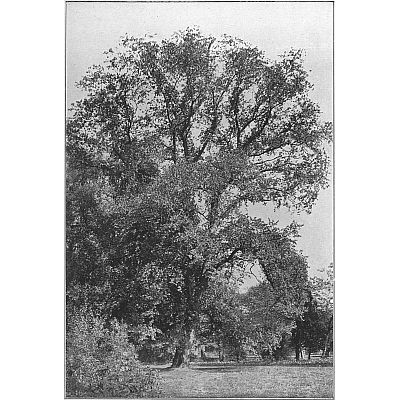 Pl. 32.
Wych Elm—summer.
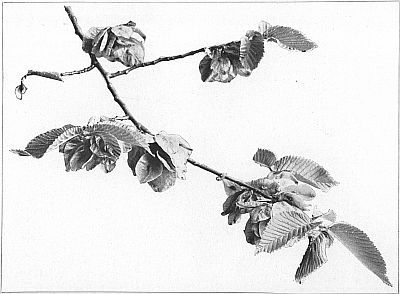 Pl. 33.
Fruits of Wych Elm.
The names montana, campestris, and Mountain Elm must not
be allowed to mislead us as to the habits of the two species, for
though the Wych Elm is known to reach an altitude of 3300
feet in the Alps, here it ascends only to 1300 feet (Yorks.),
whilst Ulmus campestris, which might be understood to be
less a hill-climber, grows at an elevation of 1500 feet in Derbyshire.
As a matter of fact, both species are much fonder of
valleys than of mountains.
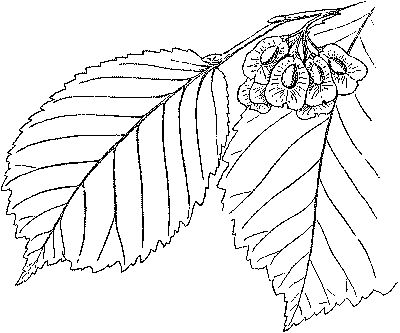 Wych Elm.
The Wych Elm forms a trunk of large size, from 80 to
120 feet or more in height, with a girth of 50 feet, and covered
with rough bark that is often corky. Its long slender branches
spread widely with a downward tendency, the downy forking
twigs bearing their leaves in a straight row along each side.
The leaves are somewhat oval in general form, but the two sides
of the midrib are unequal in size and shape. Their edges are
doubly or trebly toothed, and the surfaces are rough and harsh
to the touch. The hairs that cover the strong ribs on the under
surface serve for the protection of the breathing pores from
dust. On leaves of the pendulous form of this tree, grown in the
London parks and gardens, these hairs will be found to be
quite black with the soot particles gathered from the air. Trees
need carbon, but in this gross form they are too often suffocated
by it.
In March or April the brownish flowers are produced in
bunches from the sides of the branches. They are a quarter of
an inch long, bell-shaped, their edges cut into lobes, and finely
fringed. The ovary, with its two awl-shaped styles, is surrounded
by four or five stamens with purple anthers. They
appear in March or April, before the leaf-buds have opened,
and are dependent on the wind for the transfer of pollen. The
fruit is an oblong samara, about an inch long. This consists of
a single seed in the centre, invested by a thin envelope, which is
extended all round as a light membranous wing, which gives
it buoyancy and enables it to float through the air to a little
distance. These seeds are not produced until about the
thirtieth year of the tree's life, and though they are ripened
almost annually thereafter, good crops are biennial or triennial
only. It has often been stated that the Wych Elm does not
send up suckers, but it does, though not invariably; it does
so chiefly as the result of root-pruning or some other check to
the extension of the root-system.
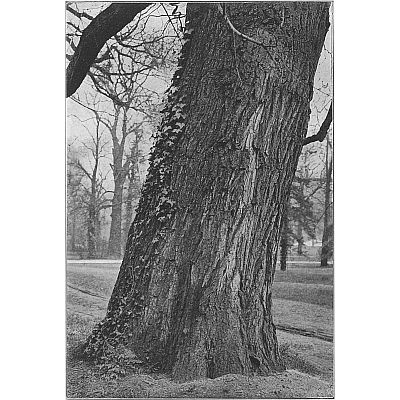 Pl. 34.
Bole of Wych Elm.
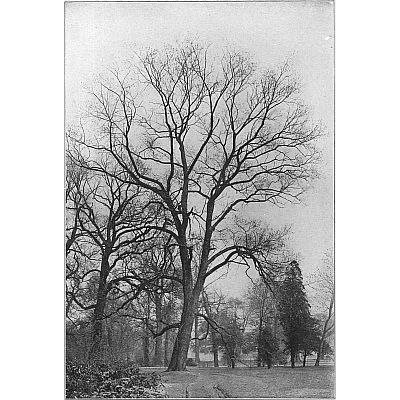 Pl. 35.
Wych Elm—winter.
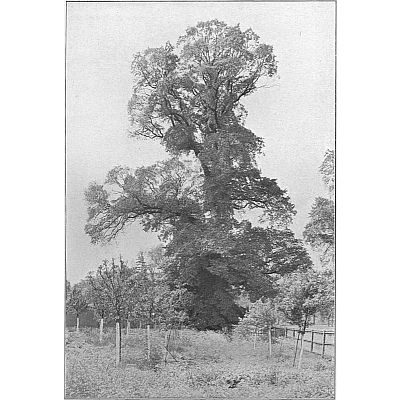 Pl. 36.
Common Elm—summer.
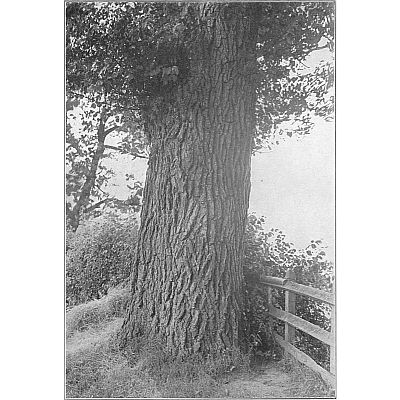 Pl. 37.
Bole of Common Elm.
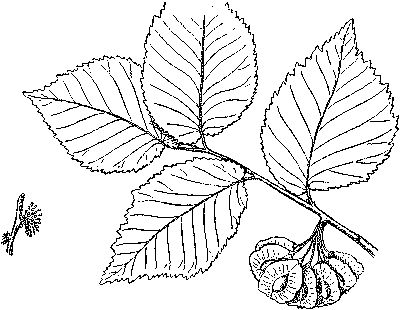
The Elm most frequently seen is the Small-leaved Elm
(Ulmus campestris), which is therefore entitled to its alternative
name of Common Elm. Constantly grown as a hedgerow
tree, it meets us at every turn, though it is much less plentiful
in Scotland than in other parts of the United Kingdom.
It is in all respects very similar to the Wych Elm, but
its leaves are smaller—usually from two to three inches long,
the twigs often covered with a corky bark, and the seed,
instead of being in the centre of the samara, is much nearer
to the notched end. The leaves are proportionately narrower
than those of montana, and it will be found that the hairs which
cover the midrib below possess in minor degree the irritating
qualities of the Nettle's stings. This is a fact not generally
known, but I became painfully aware of it a few years ago when
clearing away the suckers of an Elm that were encroaching too
much upon my garden border. Examination of these hairs
shows that they are constructed much on the same plan as those
of the Nettle—a member of the same Natural Order, by the
way. The fact that these leaves are browsed by cattle and
deer may explain this development of the hairs, which, whilst
they may serve to keep off sheep, have not yet reached a degree
of acridity sufficient to protect them from the larger beasts. Both
flowers and samaras are about a third smaller than those of
montana; but seed is very seldom produced in this country,
and the tree seeks to reproduce itself by throwing up abundant
suckers round the base of the bole, and even from root-branches
at a considerable distance from the trunk. These, of course, if
allowed to grow, would soon surround the tree with copse.
Campestris often attains a greater height with its straighter
trunk than montana, but its girth is not so great, seldom
being more than twenty feet. Its dark wood is harder and
finer grained than that produced by the native tree. Its
favour as a hedgerow tree is probably due to the fact that
it gives shade which is not obnoxious to the growth of grass.
Both species are subject to a great amount of variation, and
in nurserymen's catalogues these forms have appropriate
names, but they are not regarded as of sufficient permanence
to merit scientific distinction. In point of age—Elms are
known to exceed five hundred years.
 Common Elm.
Among the insects that feed upon the Elm's foliage, the
most noteworthy is the caterpillar of the fine Large Tortoiseshell
Butterfly (Vanessa polychloros). I have already mentioned
the relationship subsisting between Elms and Nettles, and it
is a point worth noting that nearly all our native species of
Vanessa feed in the larval state upon the leaves of the Nettle.
In London parks and squares the Elms are much infested
by the caterpillars of the Vapourer-moth, whose wingless
females may be seen like short-legged spiders on the bark,
whilst the male flutters in an apparently aimless way on wings
of rich brown with central white spots.
In October the leaves, which have for some time assumed
a very dull dark-green tint, suddenly turn to orange, then
fade to pale yellow, and fall in showers.
The name Elm was derived from the Latin Ulmus, and
appears to indicate an instrument of punishment—probably
from its rods having been used to belabour slaves. Prior
remarks that the word is "nearly identical in all the Germanic
and Scandinavian dialects, but does not find its root in any
of them. It plays through all the vowels ... but stands
isolated as a foreign word which they have adopted."
This "playing through the vowels" may be thus illustrated—Alm,
Ælm, and Elm (Anglo-Saxon and English); Ilme,
Olm, and Ulme, in various German dialects.
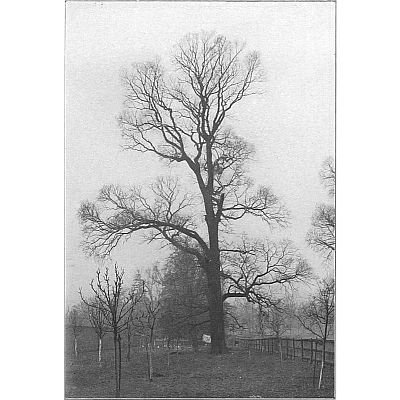 Pl. 38.
Common Elm—winter.
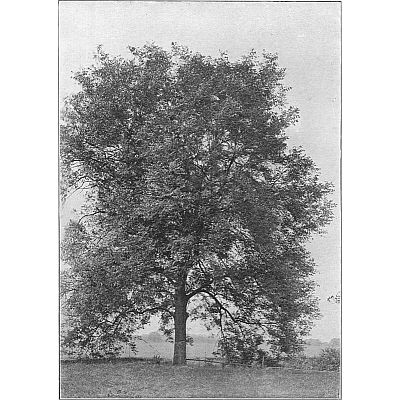 Pl. 39.
Ash—summer.
So commanding, yet at the same time so light and graceful,
does a well-grown Ash appear, that Gilpin called it the "Venus
of the Woods." This may appear to some to be rather too
close an approach to the "Lady of the Woods" (Birch), but in
our opinion it well expresses the characteristics of the two.
They are both exceedingly graceful, but the beauty of the
Birch is that of the nymph, whilst that of the Ash is the
combined grace and strength of the goddess. I have said
"a well-grown" Ash, a phrase by which the timberman would
understand a tree that had been hemmed in so closely by
other trees that it has had no chance of developing as a tree,
but only as a straight stout stick of wood, from eighty to one
hundred feet long. My well-grown Ash is in a meadow,
where both soil and atmosphere are moist and cool; where
it has had elbow-room to reach its long graceful arms upwards
and outwards, and to cover them with the plumy circlets of
long leaves. It is there, or on the outskirts of the wood, or
in the hedgerow, that the Ash is able to do credit to Gilpin's
name for it.
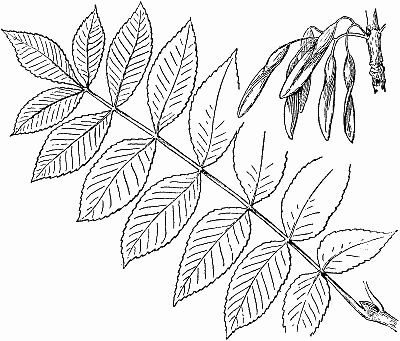 Ash.
Ash.
Before the reign of iron and steel was quite so universal,
Ash timber was in demand for many uses where the metals
have now supplanted it. It was then far more widely grown
as a hedgerow tree than is now the case. Selby laments the
neglect of this former custom, which kept up a supply of
tough and elastic timber, useful in all agricultural operations,
and added much to the beauty of the country. No doubt
the noxious drip and shade of the Ash have had much to
do with this abandonment of it, for few things can live
beneath it—a condition helped by its numerous fibrous roots,
which quickly exhaust and drain the soil, and so starve out
other plants. Although it thus drains the surface soil, it is
not dependent upon these upper layers for food, for its much-branched
roots extend very deeply in the porous soils it
prefers.
It must not be supposed from the foregoing remarks that
the Ash is confined to the lowlands. In Yorkshire it is found
growing at an elevation of 1350 feet; in Mid-Germany it
grows as far up as 3500 feet, and in the Alpine districts 500
feet higher still. It has a preference for the northern and
eastern sides of hills, where the atmosphere is moist and cool,
and the soil deep and porous, for it loves free and not
stagnant moisture for its roots.
The bark of both trunk and branches is pale grey, and
some look to this as the origin of the tree's English name.
On examining the leafless branches in early spring, two
things strike the observer—the blackness of the big opposite
leaf-buds, and the stoutness of the twigs. This latter fact is
due to the great size of the leaves they have to support,
which implies a considerable strain in wind or rain. What
are generally regarded as the leaves of the Ash are only
leaflets, though they are equal in size to the leaves of most
of our trees. The largest of the leaflets are about three
inches in length, and there are from four to seven—mostly
six—pairs, and an odd terminal one, to each leaf. They
are lance-shaped, with toothed edges. The leaves are late
in appearing, but, like Charles Lamb and his office-hours, they
make up for it by an early departure.
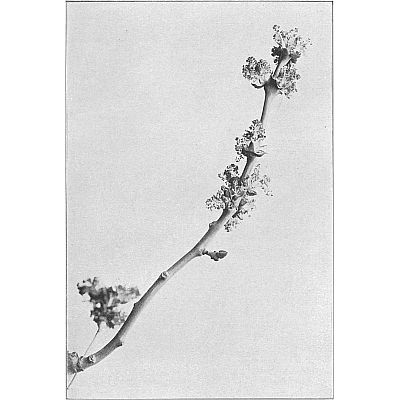 Pl. 40.
Flowers of Ash.
The flowers of the Ash are very poor affairs, for they have
neither calyx nor corolla, though their association in large
clusters makes them fairly conspicuous as they droop from
the sides of the branches in April or May. Stamens and
pistils are borne by the same or separate flowers, and both
kinds or one only may be found on the same tree. The
pistil is a greenish yellow pear-shaped body, and the stamens
are very dark purple. The flowers are succeeded by bunches
of "keys"—each one, when ripe, a narrow-oblong scale, with
a notch at one end and a seed lying within at the other.
The correct name for these is samaras. In looking at a
bunch of these "keys"—they are something like the keys to
the primitive locks of the ancients—one is struck by the
fact that they all have a little twist in the wing or sail,
which causes the "key" to spin steadily on the wind and
reach the earth seed-end first. They are, therefore, sometimes
known as "spinners." These are ripe in October; but though
the trees produce seed nearly every year after the fortieth,
one may chance to look at a dozen Ashes before he comes
upon one that bears a seed. The reason for this lies in the
fact that some trees have no female blossoms. The seeds
do not germinate until the second spring after they are sown.
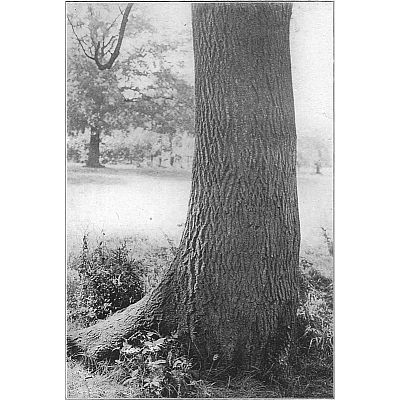 Pl. 41.
Bole of Ash.
Much of the Ash-wood in use for carriage-poles, oars, axe
and hammer shafts, and similar purposes where only small
diameters are needed, are obtained from Ash-coppice, which
rapidly produces well-developed poles. So strong and elastic
is the Ash timber when taken from young trees, that it is
claimed it will bear a greater strain than any other European
timber of equal thickness. The Ash is not one of the long-lived
trees, its natural span being about two hundred years,
but its wood is regarded as best between the ages of thirty
and sixty years.
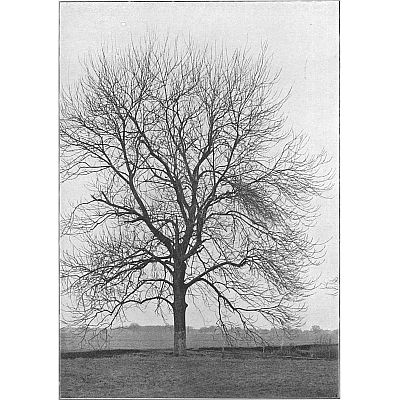 Pl. 42.
Ash—winter.
Cattle and horses are fond of Ash leaves, which were formerly
much used for fodder, and still are in some districts;
but it is said that to indulge cows in this food is fatal to
the production of good butter from their milk. In some
country places there is still extant a "Shrew-Ash"—a tree
into which a hole has been bored sufficiently large to admit
a living shrew-mouse, which has then been plugged in, to
die of suffocation. A touch of a leaf from this tree was
reputed to cure cramp, but especially that form of it supposed
to be caused by a shrew passing over man or beast. Then
there was the Ash whose bole had been cleft that it might
be a "sovran" remedy for infantile hernia. It is difficult to
account for the origin of these ideas, but they are deep-rooted
and die hard. John Evelyn remarks of this latter superstition:
"I have heard it affirmed, with great confidence and
upon experience, that the rupture, to which many children
are obnoxious, is healed by passing the infant through a wide
cleft in the bole or stem of a growing Ash-tree; it is then
carried a second time round the Ash, and caused to repass
the same aperture as before. The rupture of the child being
bound up, it is supposed to heal as the cleft of the tree
closes and coalesces."
The origin of the name Ash is uncertain, though many
fanciful suggestions have been made in explanation of its
meaning. Its Anglo-Saxon form was æsc, a word used by
the same people for spear, but that was because their spear-shafts
were made of Ash-wood.
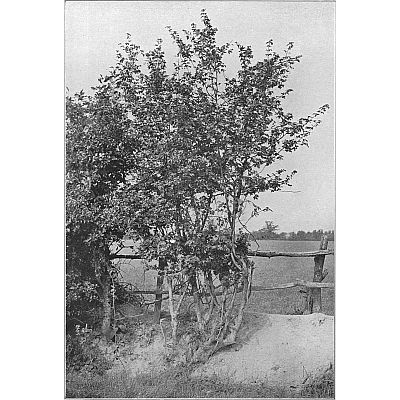 Pl. 43.
Field Maple.
There are a number of Maples in cultivation, but only
three of them are commonly met with in the open, and of
these one alone is a native. This is the Small-leaved, Common,
or Field Maple (Acer campestre), a small tree that attains a
height of twenty or thirty feet in the tall hedgerow or in
the wood, but is most familiar as a mere bush or as a constituent
of the low field-hedge. It does not grow to any
considerable thickness of bole, so has no importance as timber,
but the turner, the cabinet-maker, and the artist in fancy
pipes and snuff-boxes, are glad to make use of its fine-grained,
pale-brown wood. This is often beautifully veined, especially
the wood from the roots, and as it will take a high polish,
which brings out these markings plainly, it is a very desirable
wood for such purposes. The brown bark gives little clue
to the character of the wood it covers, for in young trees
it is rough and deeply fissured, though with age it becomes
smooth.
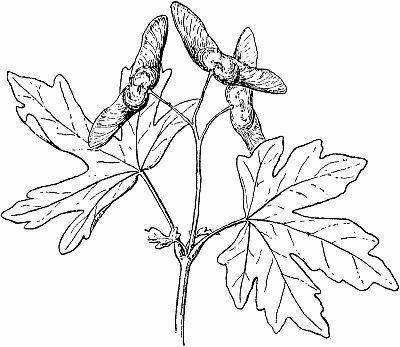 Field Maple.
The leaves vary greatly in size, those growing on a tree
being much larger than those produced by a bush. They
range from two to four inches in diameter, and are always
in pairs—springing from the sides of the branch exactly
opposite to each other. The general form of the leaf is
kidney-shaped, but it is cut up into five lobes, which are
more or less toothed. They are downy when young, of a
deep green colour, but too frequently this is disguised by
a thick layer of road-dust. In October they turn to a rich
yellow, and the Maple is then prominent even in a distant
view, for the bright colour of the foliage makes the tree stand
out prominently, in strong contrast with the still deep green
of the Oaks or Firs beyond.
The Maples are among the trees that have complete
flowers, although in this case they happen to be greenish
yellow. They are about a quarter of an inch across, have
narrow sepals and narrower petals, eight stamens, and a
two-lobed flattened ovary, that develops into the pair of
broad-winged "keys," or samaras. These are individually
much like those of the Ash, but unsymmetrical and curved,
half an inch long, with their bases joined together. Sometimes
in late summer these "keys" take on a colouring of deep
crimson, previous to turning brown as they ripen. As a
rule the contained seeds take eighteen months to germinate,
though a few may start growth the first spring.
The Common Maple is thought to be indigenous only from
the county of Durham to the southern coast, and in Ireland.
In Scotland it is only an introduced plant that has become
naturalized.
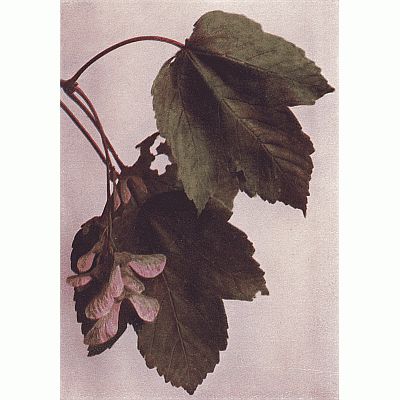 Pl. 44.
Fruits of Sycamore.
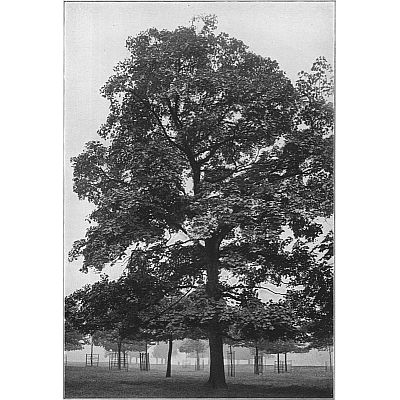 Pl. 45.
Sycamore—summer.
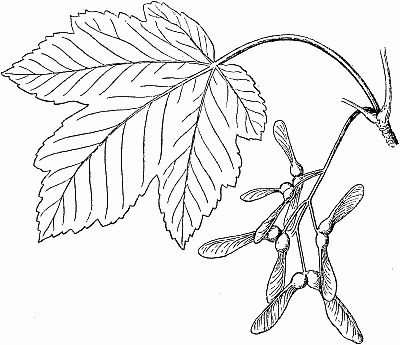 Sycamore.
The Great Maple, Sycamore, or False Plane (Acer pseudo-platanus)
is not a native tree, but it appears to have been
introduced from the Continent as far back as the fifteenth
century, so that it has had time during the intervening centuries
to get well established among us, and by means of its
winged seeds to distribute itself to remote corners of our islands.
It appears to be fond of exposed situations, growing to a large
size even near the sea, where the salt-laden gales destroy all
other deciduous trees. Recently in Ireland we ascended a
hill where the planting of pines and other trees had resulted
in comparative failure, and found that the wind-borne seeds
of the Sycamore had produced a large number of young
trees, which will probably serve later as nurses for more
desirable timber-producers. The close-grained, firm wood,
which can be worked with ease, is not highly esteemed.
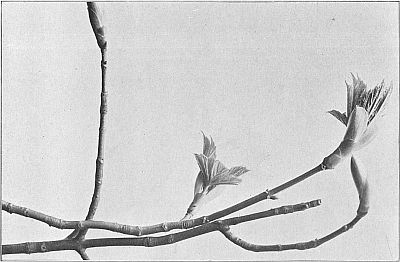 Pl. 46.
Leaf-buds of Sycamore.
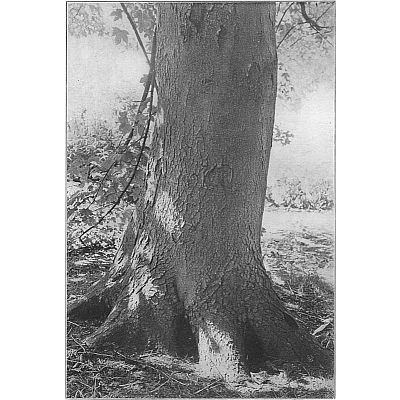 Pl. 47.
Bole of Sycamore.
Its name of False Plane is due to the Scots calling it the
Plane, misled of old by the similarity of the leaves, and the fact
that patches of the fine ash-grey bark flake off, as in the true
Plane, showing other tints. It grows to a height of sixty or
even eighty feet so quickly that it is full-grown when only fifty
or sixty years old, though it is supposed to live from a hundred
and fifty to two hundred and fifty years. Like that of the
Common Maple, the wood of the Sycamore is firm and fine-grained,
which does credit to the efforts of the French-polisher.
The leaves are more heart-shaped, but cut into five lobes, whose
edges are unequally toothed; they are six or eight inches across.
The flowers are similar to those of the Common Maple, but
larger, and in a long hanging raceme, which has a rather fine
appearance. The samaras are scimitar-shaped and red-brown,
about an inch and a half long. These are produced freely after
the tree is about twenty years old. Like many other Maples,
the Sycamore has sap which contains much sugar. Some of
this appears also to exude through the leaves, for they are often
found to be quite sticky to the touch. The black patches so
frequent on Sycamore leaves are the work of a small fungus—Rhytisma
acerinum.
The Norway Maple (Acer platanoides) is a tree of much more
recent (1683) introduction from the Continent. Its height is
from thirty to sixty feet, and its early growth is very rapid. The
leaves are even larger than those of Sycamore, of similar shape,
but the lobes are only slightly toothed. The clusters of bright
yellow flowers are almost erect; the tree does not produce seed
until it is between forty and fifty years old.
The Maple was the Mapel-treow or Mapulder of the Anglo-Saxons;
it was originally the Celtic mapwl, and the name
indicated those knotty excrescences on the trunk from which the
cabinet-maker got the mottled wood that was so highly prized
in early times for the making of bowls and table-tops, for which
fabulous prices have been paid.
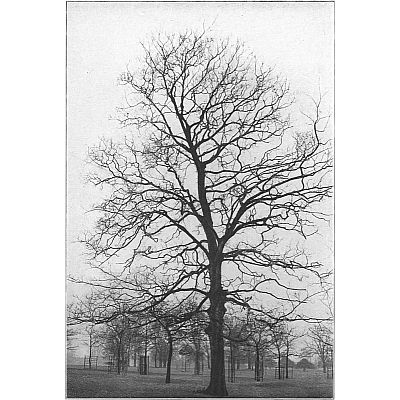 Pl. 48.
Sycamore—winter.
Almost everybody who has an elementary acquaintance with
trees knows a Poplar at sight, the foliage being so very distinct
from that of other trees. But the distinctions between the
several species are not so immediately obvious. Five kinds
of Poplar are commonly grown in this country, of which only
two are regarded as distinct indigenous species. These are
the White Poplar (Populus alba), and the Aspen (P. tremula).
A third indigenous form, the Grey Poplar (P. canescens), is
thought to be either a sub-species of P. alba, or a hybrid between
that species and P. tremula. Then of common introduced
species we have the Black Poplar (Populus nigra), and the
Lombardy Poplar (P. fastigiata).
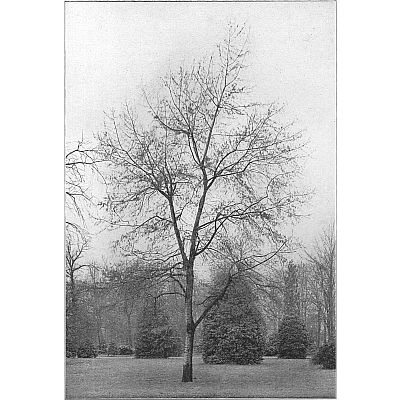 Pl. 49.
White Poplar, with Catkins—spring.
The Poplars (Populus) and the Willows (Salix) together
constitute the Natural Order Salicineæ. The two genera
agree broadly in the construction and arrangement of their
flowers in catkins, but whereas the Poplars have broad leaves
and drooping catkins, the Willows, with few exceptions, have
long slender leaves and erect catkins. The sexes are not
only in distinct flowers, but on separate trees—what botanists
describe by the term diœcious. The males appear to be far
more numerous than the females. In the popular sense there
are no flowers, for there are neither sepals nor petals, each
set of sexual organs being protected merely by a scale. The
catkins containing these flowers usually appear before the
leaves. As there is nothing to attract insects to the work,
the trees have to rely upon the wind for conveying the pollen
to the female trees. The first three species described below
have from four to twelve stamens; P. nigra and P. fastigiata
have from twelve to twenty stamens. The Poplars share the
love of the Willows for moist places. They are found more
frequently in gardens and hedgerows than in woods. Their
growth is rapid, and their timber, consequently, is of little value,
though its softness and lightness render it suitable for making
boxes, and its whiteness and non-liability to splinter fit it for
use as flooring. An additional point in favour of White Poplar
for the latter purpose is its unreadiness to burn.
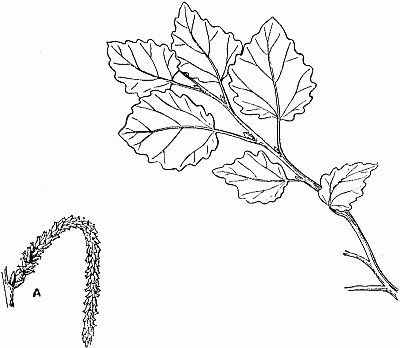 White Poplar, or Abele.
A, female catkin.
The White Poplar, or Abele (Populus alba), grows into a
large tree, something between sixty and a hundred feet high,
covered with smooth grey bark. Its branches spread horizontally,
and its broad heart-shaped leaves, which vary from an
inch to three inches long, are hung on long slender foot-stalks.
In most trees the leaf-stalks are flattened from above, but in
the case of the Poplars they are flattened from the sides, so
that when moved by the wind they flutter laterally. These
leaves have a waved margin, a smooth upper surface, and
are snowy white and cottony beneath. The leaf-buds are
also invested by cottony filaments. The roots produce numerous
suckers, even at a distance from the trunk, and the leaves
on these sucker-shoots are very large—two to four inches broad—of
a more triangular shape, the outline lobed and toothed.
The catkins, which appear in March and April, are cylindrical;
those of the male trees may be as much as four inches long,
each flower containing from six to ten stamens with purple
anthers. The female catkins are not nearly so long, the two
yellow stigmas are slender with slit tips, and the ovaries
develop into slender egg-shaped capsules, each with its fringed
scale. This species is said not to produce flowers in Scotland.
In July, when the seed capsules open, the surrounding vegetation
and ground are thickly strewn with the long white cotton
filaments attached to the seeds. The wood of this tree is softer
and more spongy than that of other Poplars.
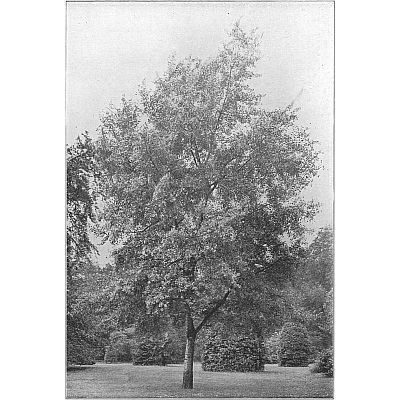 Pl. 50.
White Poplar—summer.
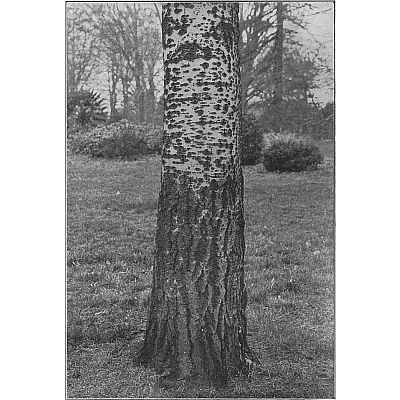 Pl. 51.
Bole of White Poplar.
The Grey Poplar (Populus canescens), which is thought to be
indigenous only in the south-eastern parts of England, is not
so tall a tree as P. alba, though it sometimes attains to eighty
or ninety feet, with a circumference between ten and twenty-four
feet. Its life extends to about a century, but its wood—which
does not split when nails are driven through thin
boards of it—is considered best between fifty and sixty years
of age. The leaves on the branches are shaped like those of
P. alba, but their under sides are either coated with grey
down or are quite smooth; those of the suckers have their
margins cut into angles and teeth. The female flowers mostly
have four wedge-shaped purple stigmas (sometimes two), which
are cleft into four at their extremities.
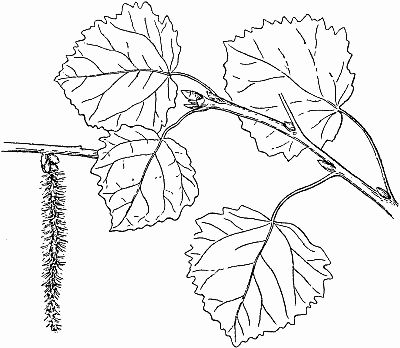 Aspen.
The Aspen or Asp (Populus tremula) does not attain either
to so large a size or so moderate an age as the Abele. Its
height, when full grown, is from forty to eighty feet, and after
fifty or sixty years its heart-wood begins to decay, and its
destruction is then hastened by the attacks of such internal-feeding
insects as the caterpillars of the Goat-moth and the
Wood Leopard-moth. The leaves on the branches are broadly
egg-shaped, approaching to round, the waved margin cut
into teeth with turned-in points. In one form (var. villosa)
the leaves are covered beneath with silky or cottony hairs;
in the other form (var. glabra) they are almost smooth.
The leaves on the suckers are heart-shaped, without teeth.
The leaf-stalks of the Aspen are longer than those of its
congeners, so that they are constantly on the flutter—a circumstance
that has led to an explanatory legend, to the
effect that the cross of Calvary was made of Aspen-wood, and
that the tree shivers perpetually in remembrance. Possibly
the present inferiority of Aspen timber is to be explained in a
similar manner. The catkins, which are two or three inches
long, are similar to those of the foregoing species, but the
scales have jagged edges. It is indigenous in all the British
Islands as far north as Orkney, but, though commonly found
in copses on a moist light soil, is more frequent as a planted
tree in gardens and pleasure grounds. It is a characteristic
tree of the plains throughout the Continent, but ascends to
1600 feet in Yorkshire, and in the Bavarian Alps is found
as high as 4400 feet. It is not a deep-rooting tree, the root-branches
running almost horizontally. Where accessible to
cattle or deer, the foliage of the suckers is eagerly browsed by
them.
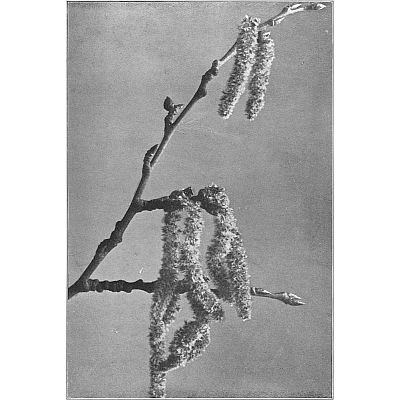 Pl. 52.
Catkins of Aspen.
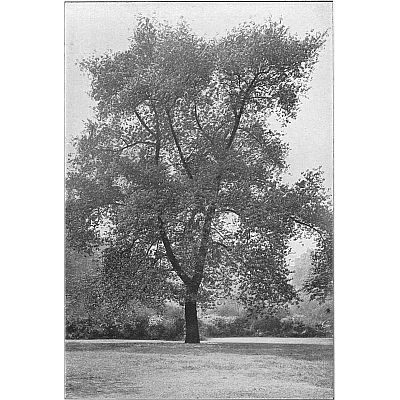 Pl. 53.
Black Poplar—summer.
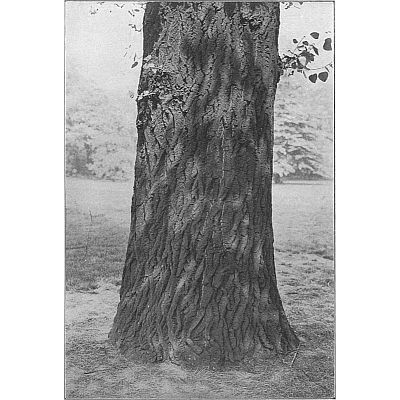 Pl. 54.
Bole of Black Poplar.
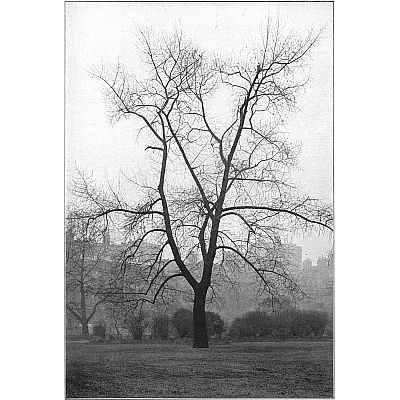 Pl. 55.
Black Poplar—winter.
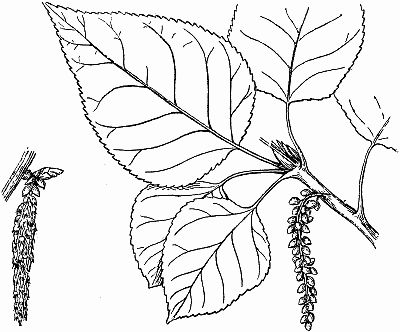 Black Poplar.
The Black Poplar (Populus nigra) appears to be so called
not by reason of any blackness of leaf or bark, but because of
the absence of any white or grey down on the underside of
its leaves. Its bark is grey, like that of the species already
mentioned, but readily distinguished from them by the great
swellings and nodosities that mar the symmetry of its trunk.
It is a tree of erect growth, fifty to sixty feet in height, with
horizontal branches, and leaves that vary in shape from
triangular and rhombic to almost circular, and in width from
an inch to four inches. They have rounded teeth on the
margins, which are at first also fringed, and in their young
state the underside is silky. The flowers in the catkins of
this and the next species are not so densely packed. Those of
the male are two or three inches in length, and dark red in
colour; their abundance before the tree has put out its leaves
makes the male tree a conspicuous object. The female catkins
are shorter and do not droop. When the roundish capsules
burst in May or June to distribute their seeds, the white cotton
with which the latter are invested gives prominence to the
female tree. The wood is chiefly used by the turner; in
Holland, where it is extensively cultivated, it provides the
material for sabots. The Black Poplar is not a native of this
country, but it is generally distributed throughout Europe and
Northern Asia. The date of its introduction is not known, but
it has been here for many centuries, and is quite naturalized,
springing up on river banks and in other moist situations.
Some botanists regard it as only a variety of the Lombardy
Poplar, but apart from the very different habit of the tree—not
by itself sufficient grounds for separation—there is the more
important fact that the Black Poplar rarely produces suckers
from its roots, whilst the Lombardy Poplar does so constantly.
However, this is a point we can leave for the botanists to
discuss; for the purposes of this book the two trees are
sufficiently distinct to be treated separately.
The Lombardy Poplar (Populus fastigiata) is no more a
native of Italy than of England. Its home is in the Taurus and
the Himalayas, whence it has spread into Persia. Introduced
into Southern Europe, it has become specially abundant along the
rivers of Lombardy, and so in France and England it bears the
name of that country. Lord Rochford introduced it to England
from Turin in 1758. Its leaves are like those of the Black Poplar,
but its branches, instead of spreading, all grow straight upwards,
so that the fastigiate or spire shape of the tree is produced—a
shape only found otherwise among coniferous trees, particularly
in the Cypress, the Juniper and the Irish Yew. It is its form,
great height (100 to 150 feet), and rapidity of growth that have
led to its wide use here as an ornamental tree—in many cases
as a mere vegetable hoarding to shut out some offensive view.
Its growth is extremely rapid, especially during its first score of
years, when it will attain a height of sixty feet or more, provided
it be grown in good, moist (but not marshy) soil. Its wood is,
of course, of little value, and is chiefly used for making boxes and
packing-cases, where its lightness, combined with toughness and
cheapness, is an advantage. The bark is rough and deeply
furrowed, unlike the other species, and the trunk is twisted.
Like the Black Poplar, it has smooth shoots, and the unopened
buds are sticky. It is propagated in this country by suckers and
cuttings. It is said that the first trees introduced were so
obtained, and that they were all from male trees; consequently,
that we have no female trees here, and seed production is impossible.
If the female grows here, it is certainly very scarce.
The bark has been used for tanning.
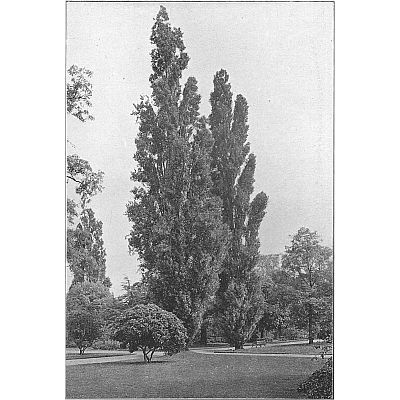 Pl. 56.
Lombardy Poplar—summer.
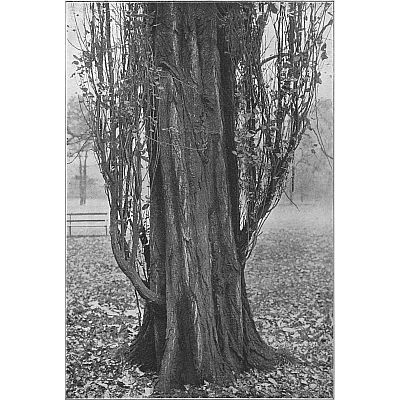 Pl. 57.
Bole of Lombardy Poplar.
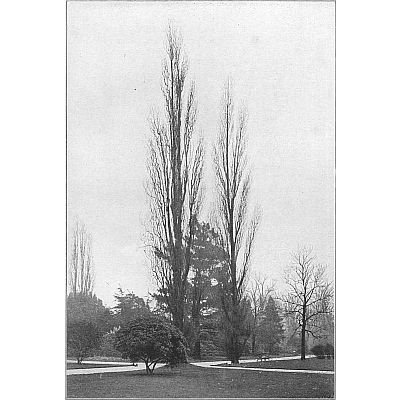 Pl. 58.
Lombardy Poplar—winter.
The Black Italian Poplar (Populus monilifera) is another misnamed
tree, for it is a native of North America, though introduced
to England from the Continent in 1772 by Dr. John Hope. It
has the distinction of being considered the most rapid-growing
even of the Poplars. Loudon gives its rate of growth in the
neighbourhood of London as between thirty and forty feet in seven
years! Even in Scotland (where it has been largely planted as
a substitute for Larch, since the partial failure of that tree) it
attains a height of 120 feet in sixty years, when planted along
the river banks. It is probably only a variety of P. nigra,
which it resembles in most points, but is larger, and of very
erect growth.
The Tacamahac or Balsam Poplar (Populus balsamifera) is
another importation from North America, introduced in 1692.
In its native country it grows to a height of eighty feet, but here
forty or fifty feet is more usual. Its leaves are of more slender
form than those of the other Poplars, egg-shaped, with a near
approach to being lance-shaped. Their edges are toothed, their
upper surface dark green and smooth, the underside whitish with
cotton. The distinctive character of the tree is the fragrance
of its foliage, which scents the air on moist evenings, and makes
the Tacamahac a desirable tree to plant near the water, where
alone it attains any moderate size.
There is not in the whole of the British flora another genus of
plants that presents such difficulties of identification as the genus
Salix. Even so hardened a botanist as Sir J. D. Hooker, in
reviewing the tangle of species, varieties (natural and cultivated),
and hybrids, is so far stirred from his ordinary composure that
he stigmatizes it as a "troublesome genus." When Sir Joseph
chose that mild adjective he was at Kew surrounded by the
national herbaria and with nicely labelled living plants at hand
for comparison. What, then, can the rambling nature-lover hope
to do with the Willows he comes across one at a time, without
much chance of comparing? He must be content to follow the
"lumpers," who group a number of these uncertain forms under
the name of a species to which they have evident relationship.
When he has mastered the distinctions between these aggregate
species, it will be early enough to attempt the segregation of the
forms and varieties under each.
In their natural condition Willows are graceful and picturesque,
but a large number of the examples met with in our rambles
have been so altered for commercial reasons as to be more
grotesque than beautiful. It is not the timber-man who is
responsible this time, for a pollard Willow, though it produces a
shock-head of long slender shoots, suitable for basket-rods, lets
in moisture at the top of the bole, and the wood is more or less
decayed and worthless. Only four of our native Willows can be
regarded as timber trees. These are the White Willow, the
Crack Willow, the Bedford Willow, and the Sallow. Like the
Poplars, their growth is very rapid, and their wood is consequently
light, but it has the advantage of Poplar-wood in being
tougher, and therefore serving for purposes where Poplar is of no
value. In the present day the growers of straight-boled Willows
find their best market among the makers of cricket-bats. A good
deal of it is also cut into thin strips for plaiting into chip-hats
and hand-baskets. The Osier is grown in extensive riverside
beds for the production of long pliant shoots for the basket-weavers;
though many of the so-called Osier-rods are really
stool-shoots from Willows that have been pollarded, or whose
leading shoot has never been allowed to grow. On those parts
of our coast where the crab and lobster fishery is pursued, a
regular supply of such shoots for weaving into "pots" and
"hullies" is a necessity, and a "withy bed" will usually be found
on some valley stream near, or on a damp terrace halfway up
the cliffs.
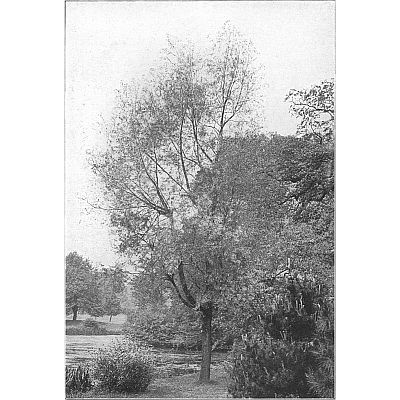 Pl. 59.
Crack Willow—summer.
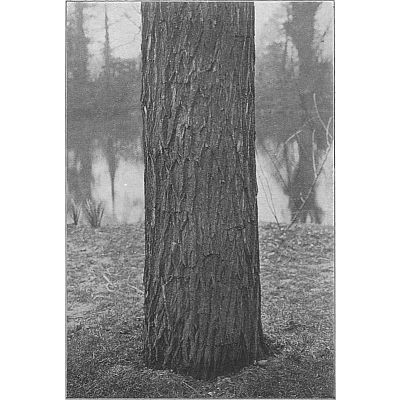 Pl. 60.
Bole of Crack Willow.
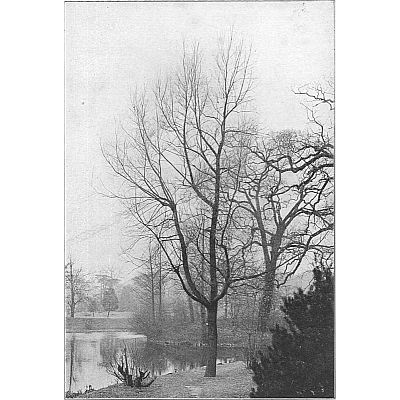 Pl. 61.
Crack Willow—winter.
The bark of the tree Willows has long been known to be rich
in an alkaloid called salicine, which has tonic and astringent
properties, and has often been used instead of quinine, though it is
not nearly so powerful as the Peruvian drug. The bark is also
used for tanning.
The association of the Willow with sadness is very old, but
there does not appear to be any satisfactory reason for it—certainly
to contemplate a naturally-grown Willow that grows
on the edge of a limpid stream, in which its graceful shoots and
slender leaves are reflected, does not suggest sad thoughts to the
average healthy mind. The association is chiefly with maidens
forsaken by their false lovers, as indicated by Shakespeare when
he makes Desdemona say—
"My mother had a maid called Barbara:
She was in love; and he she loved proved mad,
And did forsake her; she had a song of 'Willow';
An old thing 'twas, but it expressed her fortune,
And she died singing it."
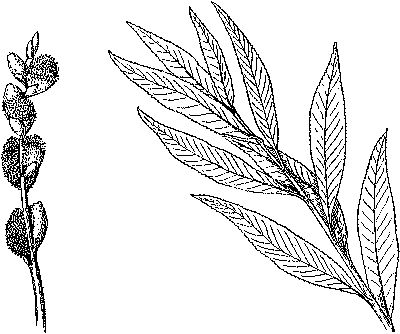 Crack Willow.
The Crack Willow or Withy (Salix fragilis) is one of the two
most considerable of our tree Willows. In good soil it will in
twenty years attain nearly its full height, which is eighty or ninety
feet. Its bole sometimes has a girth of twenty feet. Its smooth,
polished shoots afford the best ready means of distinguishing it, for
instead of their base pointing to the centre of the trunk as in other
trees, they grow obliquely, so that the shoots frequently cross each
other. They are both tough and pliant, but if struck at the base
they readily break off. This character explains the names Crack
Willow and fragilis. The leaves are lance-shaped, three to six
inches long, smooth, with glandular teeth, pale or glaucous on
the underside, and with half-heart-shaped stipules, which, however,
are soon cast off. As we have already indicated under the
head of Poplars, the male and female catkins of the Willows are
borne by different trees. In the case of the Crack Willow, the
male catkins are an inch or two long, proportionately stout, each
flower bearing two stamens (occasionally three, four, or five).
The female catkin is more slender, the flowers each containing a
smooth ovary, ending in a short style that divides into two curved
stigmas. The catkins appear in April or May. Although, like
most of the Willows, this species is fond of cold, wet soil in low
situations, it is not restricted to the plains. In Northumberland
it is found at 1300 feet above the sea. Its northward range
extends as far as Ross-shire, but it is a doubtful native in both
Scotland and Ireland.
The Bedford Willow (S. russelliana) is believed to be a hybrid
between S. fragilis and S. alba. It grows to a height of fifty
feet, with a girth of twelve feet. The leaves are more slender
than those of S. fragilis, taper to a point at each end, and are
very smooth on both sides. It occurs in swampy woods.
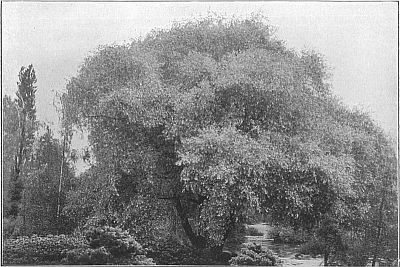 Pl. 62.
White Willow—summer.
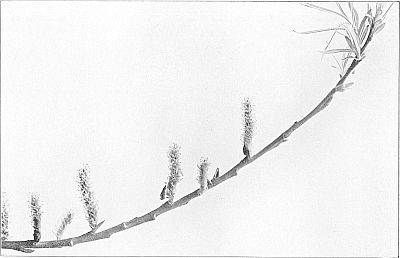 Pl. 63.
Flowers of White Willow.
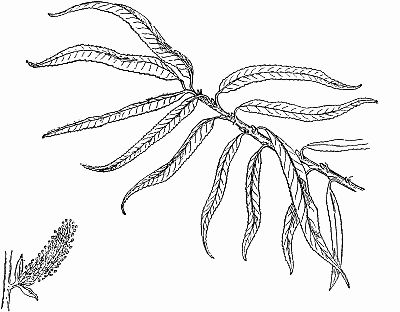 White Willow.
The White Willow (Salix alba) is so called from the appearance
of the leaves as the light is reflected from their silky surfaces,
which are alike above and below. It is a tree from sixty to
eighty feet high, with a girth of twenty feet, covered with thick
and deeply fissured bark. The leaves are from two to four inches
long, of a narrow elliptical shape. In the typical form the twigs
are olive-coloured, but in the variety vitellina (known as the
Golden Willow) these are yellow or reddish. In the variety
cærulea the old leaves become quite smooth above, but retain
the glaucous appearance of the underside. The White Willow
is found as far north as Sutherlandshire, but although it is
believed to be an indigenous species, most of the modern specimens
appear to have been planted. It affords good timber, and
the bark is almost equal to that of Oak for tanning. A great
number of the old Willows met with in our rambles are partially
decayed, a condition frequently the result of lopping large
branches, for the wound never heals, and decay setting in at that
point, extends down the bole. Upon such decaying specimens
one may often find one of the most handsome of our native
beetles—the Musk-beetle, with long, slender body and long
antennæ, all coloured in dark golden green, and diffusing the
aroma of a rose.
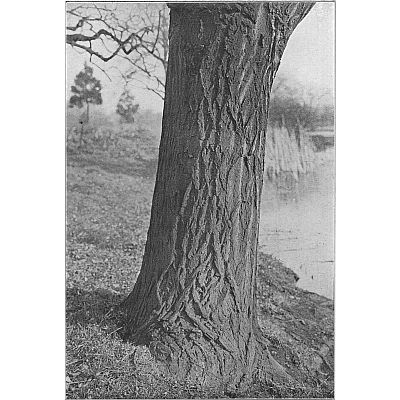 Pl. 64.
Bole of White Willow.
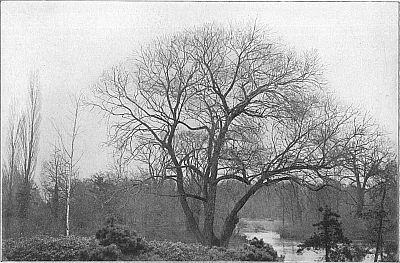 Pl. 65.
White Willow—winter.
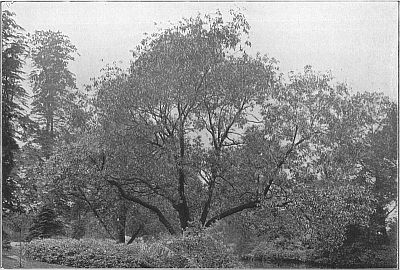 Pl. 66.
Almond-leaved Willow—summer.
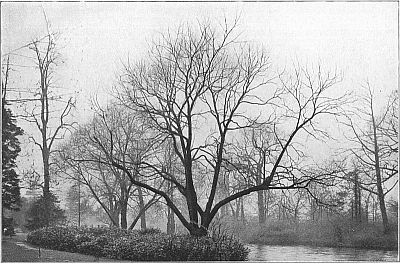 Pl. 67.
Almond-leaved Willow—winter.
The Almond-leaved or French Willow (Salix triandra) is a
small tree about twenty feet high, distinguished by its bark
being thrown off in flakes. Its slender lance-shaped leaves are
smooth green above and glaucous beneath, two to four inches
long, and with half-heart-shaped stipules. The male flowers
offer another distinguishing mark in their stamens being three in
number. Its habitats are the banks of rivers and streams, and
in Osier-beds. It is extensively grown on account of the long,
straight shoots produced from the stump when the tree is cut
down, which are of great use in wicker-work.
The Bay-leaved Willow (Salix pentandra) is met with either
as a small upright tree about twenty feet high, or as a shrub
eight feet high. Its oval or elliptical leaves are rich green,
smooth and sticky on the upper surface, and give out a pleasant
fragrance like those of the Bay-tree; they vary from an inch to
four inches long, and they may or may not bear stipules, but
if these are present they will be egg-shaped or oblong. The
stamens are normally five in each flower, but they vary up to
twelve. This is reputed to be of all our Willows the latest to
flower. A line drawn through York, Worcester, and North
Wales will give roughly its southward range as a native species.
South of that line it has been planted; north of it to the Scottish
border it is a native. It has been found growing at a height of
1300 feet in Northumberland.
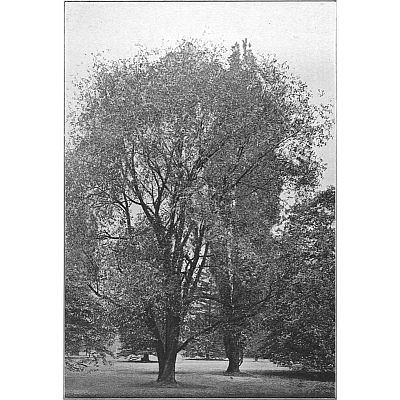 Pl. 68.
Bay-leaved Willow—summer.
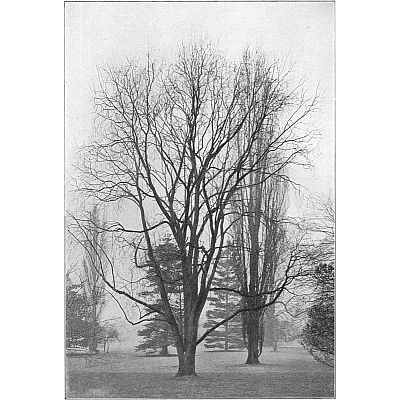 Pl. 69.
Bay-leaved Willow—winter.
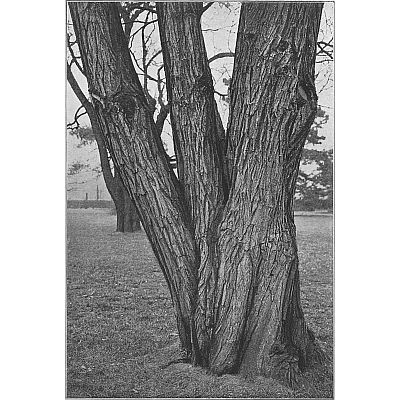 Pl. 70.
Bole of Bay-leaved Willow.
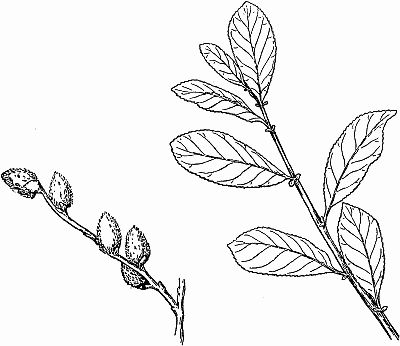 Sallow.
The Sallow (Salix caprea) is the only other species that can
properly be considered as a tree, as it attains to a height of
thirty feet, though fifteen to twenty feet is a more common
measurement. Its usually egg-shaped leaves vary from almost
round to elliptical or lance-shaped, and from two to four
inches in length. In the typical form, which occurs chiefly in
woods, dry pastures, and hedgerows, they are broad, smooth,
and dull-green above, covered with soft white down beneath;
the stipules half-kidney-shaped. This is the earliest of all our
Willows to flower, and the gold (male) and silver (female)
catkins are put out before the leaves. In the country, within
a few miles of the larger cities, this can hardly be a desirable
species to plant, for on the Sunday before Easter thousands
who at no other period exhibit any strong religious tendency
journey out to pick some "Palm," as they designate the Sallow
bloom, and the rough pruning the Sallows then get must in
many cases be disastrous. He who imagines that insect life is
suspended until spring is on the verge of summer should visit
the woods when the Sallow is in bloom; he will be astonished
at the swarms of bees and moths that are collecting the
abundant pollen or sipping the nectar provided for them.
Before the bright catkins can be seen the locality of the tree
may be known by the loud hum produced by hundreds of pairs
of wings. The all but invariable rule among the Willows—as
among Oaks, Beech, Birch, Hazel, and Pines—is to depend
upon the wind for the transfer of pollen from one tree to the
stigmas of another of the same species, but in the Sallow we
find a breaking away from what was doubtless the primitive
arrangement in all flowering plants, by the bribing with honey
of more reliable and less wasteful winged carriers.
The Gray Sallow (Salix cinerea) is really a sub-species of S.
caprea. It has a liking for moister places than the type, or
perhaps it would be more accurate to say that its growth in
moister situations has brought about the differences by which
it is separated from the parent form. These points are, briefly—the
buds and twigs are downy, the leaves smaller and proportionately
narrower, the upper surface downy, grey-green
beneath; the anthers of the male pale yellow, the capsule of the
female smaller.
The Eared Sallow (S. aurita) is probably also only another
form of S. caprea, distinguished by its small, bushlike proportions
(two to four feet high), long branches and red twigs; its
small wrinkled leaves, which are usually less than two inches
long, are of an almost oblong shape, downy beneath, and with
large ear-shaped stipules. Its likeness is much closer to S.
cinerea than to the type; it is fond of damp copses and moist
places on heaths, where it may be found at considerable elevations.
In the Highlands it ascends to 2000 feet.
There are Willows of dwarf habit, some with long straggling
branches and more or less prostrate stems, that grow upon
heaths. Each has a name under which it has at some time or
other been ranked as a distinct species, just as the forms of
Bramble and Rose have been. The differences between them
are minute, and of little interest save to the advanced scientific
botanist, who with his dried specimens spread before him
often detects subtle distinctions not apparent to the outdoor
student of the living plant. For the purposes of those
for whom this volume is intended they may be regarded
as one.
Dwarf Silky Willow (Salix repens). It is a low bush from
six to twelve inches high, the stem lying along the ground.
Some of the branches straggle in the same fashion, but those
which bear the flowers are more or less erect. The leaf-buds
and the young leaves are silky, a condition that usually endures
on the lower surface, and in some forms on the upper also.
They are broadly or narrowly lance-shaped, varying in the
different forms alluded to above; in size they range from a half to
one and a half inches in length, and may have lance-shaped
stipules, or none at all. The scales of the catkins are yellowish-green
or purple, with dark tips. After they have shed their
pollen the anthers turn black. One form or other of this
species will be found in all parts of the British Islands where
there are heaths or commons; in the Highlands it occurs as
high as 2500 feet.
Another group of small Willows that form bushes (rarely a
small tree) have been united under two species—the Dark-leaved
Willow (Salix nigricans), and the Tea-leaved Willow
(Salix phylicifolia). None of them occur south of Yorkshire,
and the chief distinction between the two species (?) consists in
the leaves of S. nigricans turning black when being dried for the
herbarium, whilst those of S. phylicifolia do not.
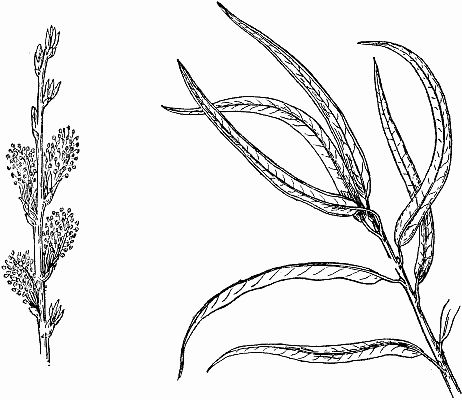 Osier.
The Osier (Salix viminalis). Many of the foregoing Willows,
when cut down low and induced to send out long, slender shoots,
are known as Osiers, but only two species are botanically regarded
as Osiers—this and the Purple Osier (S. purpurea).
The present species may remain as a shrub or grow into a small
tree, thirty feet high, with long, straight branches, which are
silky when young, but afterwards become polished. The leaves
vary in length from four to ten inches, and are slenderly lance-shaped,
tapering to a point in front, and narrowing into the
foot-stalk behind. They have waved margins without teeth,
and the upper surface netted with veins, the under surface
silvery and silky; stipules narrow lance-shaped. The Osier
may be seen in Osier-beds and wet places generally throughout
the country as far north as Elgin and Argyll. There are
several varieties and hybrids.
The Purple Osier (Salix purpurea). In all the other
Willows mentioned the stamens, whatever their number, all
have the filaments distinct from each other. In this species
alone the filaments of the two stamens are more or less
united. The Purple Osier gets its name from the red or purple
bark which clothes the thin but tough twigs. It is a shrub,
and grows from five to ten feet high. The leaves, which are
rather thin in texture, are from three to six inches long, of slender-lance-shape,
with toothed edges, smooth and glaucous on both
sides, but especially beneath, somewhat hairy when young.
They are almost opposite on the twigs, and when dried for the
herbarium turn black. There are several varieties of this shrub,
which were formerly honoured with specific rank.
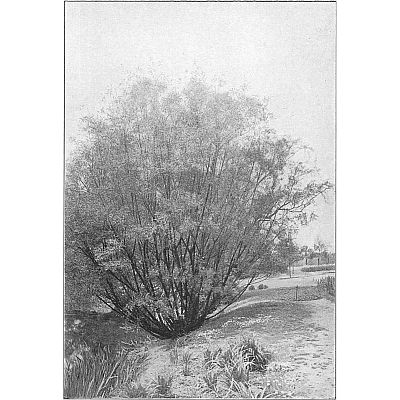 Pl. 71.
Purple Osier—summer.
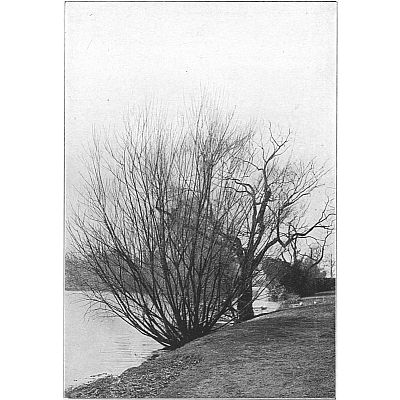 Pl. 72.
Purple Osier—winter.
There remains a group of several small species of very local
occurrence, with which we can do little more here beyond
naming them.
The Woolly Willow (Salix lanata) is a small shrub, two or three
feet high, with twisted branches, woolly twigs, and hairy black
buds. The broad egg-shaped or oblong leathery leaves are also
woolly, and two or three inches long. There are half-heart-shaped
stipules at the base of the very short leaf-stalk. It is an Alpine
plant, and is found about the mountain rills of Perth, Forfar,
Inverness, and Sutherland at elevations between 2000 and 2500
feet. Conspicuous in spring for its rich golden catkins. Sadler's
Willow (S. sadleri), of which only two or three specimens have
been found (in Glen Callater, 2500 feet), is probably a form of
this species.
The Lapland Willow (Salix lapponum) is of a similar proportion
to the last-named, sometimes erect, sometimes trailing.
Its leaves are more elliptic in shape, covered above with silky
hairs and below with cottony filaments. In lanata the raised
veins form a network pattern; in lapponum they are straight.
The stipules at the base of the long foot-stalk are small or
altogether wanting. Like the preceding species, it is restricted
to Scotch Alpine rocks, at elevations between 2000 and 2700
feet.
The Whortle-leaved Willow (Salix myrsinites) is a small, wiry,
creeping, or half-erect shrub, six inches to a foot high, with
toothed, dark glossy leaves, an inch or less in length, whose
net-veining shows on both sides. It is restricted to the Alpine
parts of mid-Scotland, from 1000 to 2700 feet.
The Small Tree-Willow (Salix arbuscula) is a small shrub,
whose stem creeps along the ground and roots as it goes, sending
up more or less erect branches a foot or two high. The downy
twigs are first yellow, then reddish-brown. The small leaves
vary from egg-shaped to lance-shaped, and are shining above
and glaucous beneath; toothed. In the Highlands of Aberdeen,
Argyll, Dumfries, Forfar, and Perth, between 1000 and 2400
feet.
The Least Willow (Salix herbacea) is not so restricted in its
range, for it is found in all parts of the United Kingdom where
there are heights sufficiently Alpine (2000 to 4300 feet) for its
tastes. It is only an inch or two high, and has consequently the
distinction of being the smallest British shrub. It is not so
herbaceous as it seems, or as its name implies, for its shrubby
stem and branches creep along underground, sending up only
short, scantly leaved twigs. The curled, roundish leaves do not
exceed half an inch in length; they are net-veined, toothed,
and shining. The catkins appear after the leaves.
The Net-leaved Willow (Salix reticulata) is another of the
Scotch Alpines. It is similar in habit to the last-named, but
larger, its buried branches sending up twigs a foot long. The
roundish-oblong, leathery leaves are not toothed; they are
smooth above and glaucous beneath, strongly net-veined on
either side. The purplish or yellow catkins do not develop till
after the leaves. It is restricted to the mountains of Aberdeen,
Forfar, Inverness, Perth, and Sutherland.
The Weeping Willow (Salix babylonica), so conspicuous an
ornament of riverside lawns, is an introduced species, whose
slender branches hang downwards. It has large, lance-shaped,
finely toothed leaves, smooth above and glaucous
beneath. Further description of so well-known a tree is unnecessary.
It attains a height of forty to fifty feet. The name
babylonica was bestowed in the belief that its headquarters were
on the banks of the Euphrates. It is now known to be a native
of Japan, and other parts of Asia.
The name Willow is the Anglo-Saxon welig, indicating
pliancy, willingness.
The British flora is singularly poor in coniferous plants,
the Scots Pine, the Yew, and the Juniper being our only
native species, and even of these some authorities will have it
that the Yew is not truly a Conifer at all; they place it in a
separate order—Taxaceæ. For our present purpose, however,
although the Yew does not produce cones, it will be convenient
to keep it in its old position. The principal feature distinguishing
all Conifers and their allies (Gymnosperms) from other flowering
plants (Angiosperms) is briefly this: Angiosperms have their
incipient seeds (ovules) enclosed in a carpel, through which a
shoot from the pollen grain has to penetrate in order to reach and
fertilize the ovule. In Gymnosperms the carpel takes the form of
a leaf or bract, upon which the naked ovule lies open to actual
contact with the pollen grain. After fertilization the carpel enlarges
to protect the seed, and becomes fleshy or woody, in the
latter case a group of carpels forming the well-known cones of
Pine or Fir.
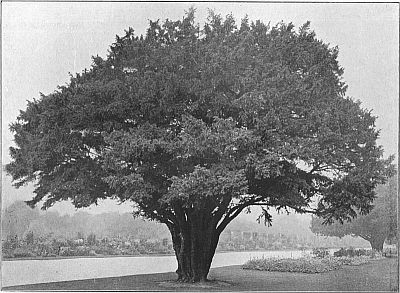 Pl. 73.
Yew.
In some of the groups (as the Yew, for example) the male or
pollen-producing flowers are borne by a separate tree from that
which bears the female or cone-producing flowers. In the Pines
both sexes are found on the same tree; but throughout the order
the pollen is carried by the wind. All the species are trees, or
shrubs. They are among the most valuable of timber trees, and,
in addition, yield a number of useful substances, such as pitch,
tar, turpentine, etc. The leaves are always rigid, extremely
narrow, and long in proportion: usually of the form that botanists
term linear, with the two sides parallel. In the Yews these leaves
spread out in two rows from opposite sides of the twigs; in the
Pines they are in clusters of two, three, or five, seeming to
be bound together at the base by a wisp of thin skin. The
number of leaves in each bundle is often a help in distinguishing
species.
The Yew (Taxus baccata) lacks the graceful proportions of
most of our trees, but it has for compensation a most obvious air
of strength and endurance. Who doubts, as he gazes at some
sombre Yew in the old churchyard, the story of the local
antiquarian, who tells him the tree has so stood for 2000 years. He
may, perhaps, mildly suggest that neither the church nor the
churchyard was in existence so far back, but even then the
antiquarian will probably have the last word by suggesting that
the grove of Yews of which this formed part was the church of
the past. Thousands see in cathedral aisles the reproduction in
stone of the pine-forest or the beech-wood. Standing before an
ancient Yew they may see whence came the idea for those
clustered columns. They actually exist in the bole of the Yew,
which presents the appearance not of a single trunk, but of
several trunks that have coalesced. This condition is due to the
Yew continually pushing out new shoots from the lower part of
its bole, which take an upright direction, and coalesce with the
old wood.
Although the Yew is a large tree, it is by no means a tall tree:
the height of full-grown Yews in this country ranging between
fifteen and fifty feet, though they are said to attain a greater
length in India. The bole of the Yew is short but massive,
covered with a thin red bark, that flakes off in patches much after
the manner of Plane-bark. Large specimens have a girth of from
twenty-five to fifty feet—or even more. Such a circumference
represents the growth of many centuries, for the annual growth-rings
are very thin. It is this very slow growth that produces
the hard, compact, and elastic wood that was so highly esteemed
in the days of the long-bow. Not only is the timber elastic and
strong, but it is exceedingly durable, so that it is said, "A post
of Yew will outlast a post of iron." Its branches start from the
trunk at only a few feet from the ground, and, taking an almost
horizontal direction, throw out a great number of leafy twigs,
which provide a dense and extensive shade. These leaves
are leathery in texture, curved somewhat after the manner
of a reaping-hook, shiny and dark above, pale and unpolished
below.
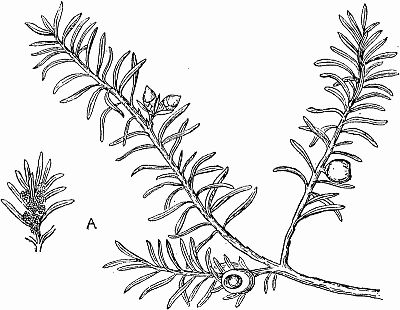 Yew.
Yew.
A, male flowers.
We have already mentioned that the Yew is a diœcious tree—that
is, one whose male and female blossoms are borne on
separate trees—but the statement requires qualification to this
extent, that occasionally a tree will be found bearing a branch or
branches whose flowers are of the sex opposite to those covering
the greater part of the tree. The male catkin is almost round,
a quarter of an inch across, and contains about half a dozen
yellow anthers, the base surrounded by dry overlapping scales.
They may be found during February and March, in profusion on
the underside of the boughs. The female flower is much smaller,
and consists of a fleshy disk with a few scales at its base, and on
this stands a single seed-egg. After fertilization of the seed-egg
the disk develops into a red wax-like cup around the enlarging
seed with its olive-green coat. The flesh of the cup is full of
sweet mucilage, which makes the fruit acceptable to children,
but the flavour is rather too mawkish to suit older tastes. Yew-berries
are not poisonous, as sometimes supposed; neither is the
contained kernel, which has a pleasant nutty flavour. Much has
been said and written as to the toxic property of Yew-leaves, and
it appears that though cattle and goats may browse upon them
with impunity, horses and human beings pay the penalty of
death for such indulgence. That word toxic, by the way, owes
its significance to the Yew. The tree was named taxus in Latin,
from the Greek toxon (a bow), because of the ancient repute of
its wood for making that instrument. The tree was held to be
poisonous, and so its name in the form of toxicum came to
designate all poisons.
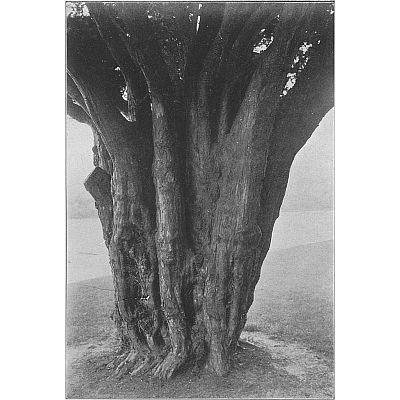 Pl. 74.
Bole of Yew.
There are some lines in In Memoriam which many readers
of Tennyson have found as obscure as the shade of the Yew
where they were conceived. The poet is addressing a venerable
churchyard Yew in these words:—
"Old warder of these buried bones,
And answering now my random stroke
With fruitful cloud and living smoke;
Dark Yew, that graspest at the stones
And dippest towards the dreamless dead,
To thee, too, comes the golden hour,
When flower is feeling after flower."
To any readers who have found a difficulty in understanding
these lines, we would say: visit the Yew groves in February
or March, when the male branches are thickly covered with
their yellow flowers, and strike a branch with your stick. In
response to the "random stroke" the pollen will fly off in a
"fruitful cloud" or "living smoke," some of it to be caught by
the minute female blossoms. This is the Yew-tree's "golden
hour, when flower is feeling after flower."
In the pre-gunpowder era, so important was it to have a
sufficient supply of suitable wood for the making of the dreaded
English long-bow, that the culture of the Yew was made the
subject of a number of royal ordinances, which, of course, were
allowed to drop out of observance when the bow was displaced
by the firearm. And now when men plant Yews they are mostly
the ornamental varieties, such as the Irish or Florence Court
Yew, which originated as a wild sport on the mountains of
Fermanagh about a hundred and forty years ago. Evelyn, it
is true, revived the interest in the Yew as an ornamental tree,
and it is with regret we add that at his suggestion it was first
put to the base use called topiary work, which had hitherto been
restricted to Box and Juniper. Evelyn showed how much more
closely and continuously the Yew could be clipped without
affecting its vitality, and the fashion he thus set—and regarded as
a "merit"—was very generally followed during the next century.
Many of the atrocities of those days are still with us, but only as
survivals; and we can so often agree with Evelyn that we may
forgive him for having led our ancestors astray in this matter.
Evelyn was by no means blind to the good points of the tree in
its natural condition, as witness this quotation, which is as true
to-day as when it was written:—
"He that in winter should behold some of our highest hills in
Surry clad with whole woods of these two last sorts of trees [Box
and Yew], for divers miles in circuit (as in those delicious groves
of them, belonging to the Honourable, my Noble Friend, the late
Sir Adam Brown, of Bechworth Castle), from Box Hill, might,
without the least violence to his imagination, easily fancy himself
transported into some new or enchanted country; for if in any
spot in England,
'tis here
Eternal spring and summer all the year."
Along the chalk range of which the celebrated Box Hill forms
part will be found many fine examples of the Yew, as at Cherkley
Court, near Leatherhead, where there is an actual Yew forest.
There was a monstrous Yew at Brabourne in Kent, in Evelyn's
time, for he tells us he measured it, and found its girth to be only
one inch short of fifty-nine feet. There are numerous giants of
the species still living in quiet country churchyards, where they
have probably served—as tradition states of those at Fountains
Abbey—as a shelter for the builders of the ancient church during
its erection. It is reputed to be the longest-lived of all trees,
and it is to be hoped that no hindrance will be put in the way of
these connections of the present with the far past living to their
full natural limit, whatever it may be. It is naturally a tree of the
uplands and lower hills, and shows a distinct preference for soils
that contain plenty of lime.
The Irish Yew (var. fastigiata), to which passing reference
was made, differs from the type in having all its branches growing
erectly, after the manner of a Lombardy Poplar, and in the leaves
being scattered promiscuously over the branchlets instead of
being in two regular rows. It attains a height of twenty to
twenty-five feet.
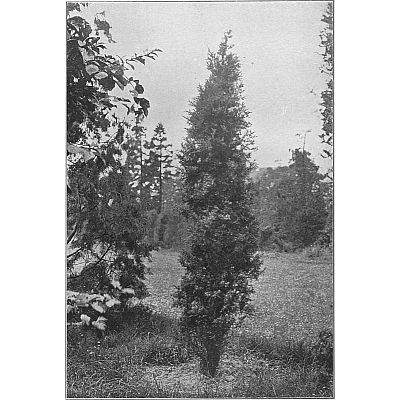 Pl. 75.
Juniper.
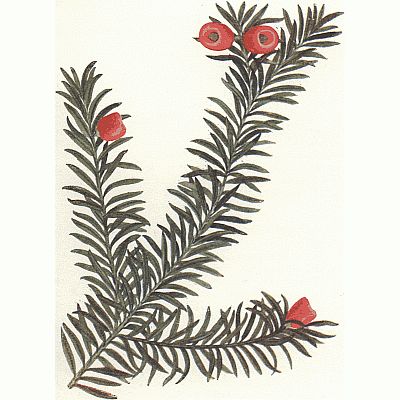 Pl. 76.
Fruits of Yew.
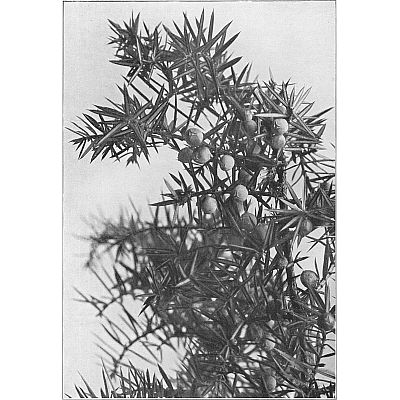 Pl. 77.
Fruits of Juniper.
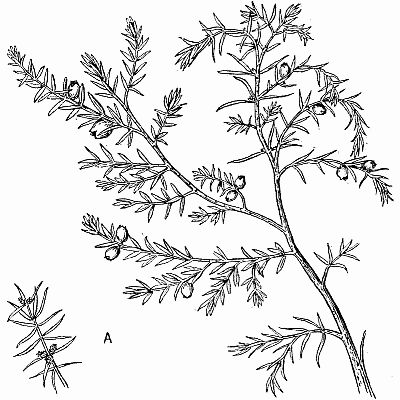 Juniper in fruit.
A, flowers.
The Juniper (Juniperus communis) is seldom more than a
shrub a few feet in height, though it occasionally develops into
a small tree from ten to twenty feet high, and with a girth of five
feet. It has a fibrous red bark, which flakes off like that of the
Yew. The leaves are shaped like a cobbler's awl, rigid, and
end in sharp points. They have thickened margins, the concave
upper sides are glaucous, and they are arranged round the
branches in whorls of three. The male and female flowers are
on separate trees. The male catkin may be known in May by
its numerous anthers and pale yellow pollen. The female catkins
will be found in the axils of the leaves, and resemble buds.
The scales are fleshy, and after fertilization the upper ones
slowly develop into the form of a berry, which has a few undeveloped
scales at its base. They do not ripen until the
following year, when they are blue-black, covered with a fine
glaucous bloom. They have a pungent flavour, which is utilized
in concocting gin, which indeed owes its name to this fact—the
word being merely a contraction of genévrier, the French form
of Juniper. The "berries" have long been known as a kidney
stimulant—a fact which has been fully utilized as the justification
of every gin-drinker. A beautiful little moth—Hypsilophus
marginellus—may often be taken about the Juniper, upon which
its caterpillar feeds.
To appreciate the variety of forms assumed by the Juniper
according to the elevation at which it grows, it should be seen
on slopes like those of the North Downs in Surrey—one portion
of the range at Mickleham is named Juniper Hill. In the
valleys it may be found as a small shapely tree, higher up the
slopes as a pyramidal shrub, and as we reach higher and more
exposed positions, the Juniper gradually dwindles to a low,
shapeless bush. This, however, must not be confounded with a
distinct variety to which the name nana has been applied; it
differs from the type in having shorter and broader overlapping
leaves, with curved tips. Var. nana is confined to the mountains
of the north of our islands, and ascends to 2700 feet, which
is 300 feet higher than is recorded of the type.
The Virginian Juniper (Juniperus virginiana), or "Red Cedar,"
as it is called on the American continent, is a much larger plant,
which is frequently planted in our parks and gardens. It varies
in habit, and may be low and spreading, bush-like, or tall and
tapering, thirty to forty feet high. Its leaves are in threes, like
those of our native species, but the three are united by their bases.
It is with the red heart-wood of this tree that our "cedar" pencils
are covered, large quantities of the timber of J. virginiana,
and formerly of J. bermudiana, being imported for the purpose.
The Virginian Juniper has been with us for many years. It is
mentioned by Evelyn in his "Sylva" (1664), and is believed to
have been introduced by him from North America.
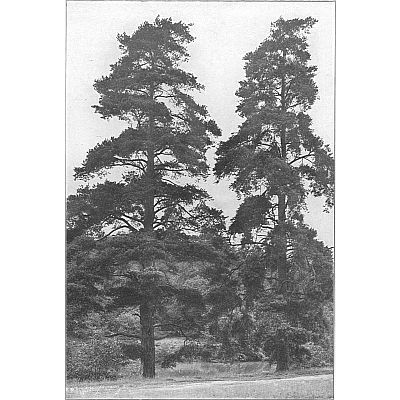 Pl. 78.
Scots Pine.
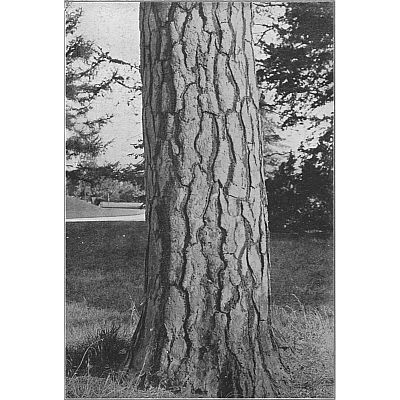 Pl. 79.
Bole of Scots Pine.
The Scots Pine (Pinus sylvestris), commonly but incorrectly
styled Scotch Fir, is the typical Pine-tree of Northern Europe,
where (especially in Russia and Northern Germany) it constitutes
huge forests. It is even said to cover far wider tracts of
country than any other forest tree. Although there is evidence
that in ancient days it was pretty widely distributed over Britain,
to-day all those Pine-woods of Southern England are the results
of planting, and it is only in a few places between Yorkshire and
Sutherland, and in Ireland, that it can be regarded as truly wild
and indigenous. Mr. John Nisbet points out that the term
"pine-forest" is a bit of tautology, for the old German word forst
was derived from foraha—now represented by föhre, a fire or
pine—so that "pine-forest" is equivalent to "pine-pine." However,
the etymologists will probably allow us to speak of Pine-woods,
and we will try to remember that when we use the word
forest it must always indicate an assemblage of Pine-trees.
In favourable soil, at a moderate elevation, the Scots Pine is a
fine tree a hundred feet high, with a rough-barked trunk, whose
girth is twelve feet. Under such conditions it develops a strong
tap-root, which goes deep; but where the soil is shallow or
otherwise unfavourable the tap-root is not developed. At great
elevations the upward growth is checked early, and it becomes
a mere evergreen bush. The branches are short and spreading,
those on the lower portions of the trunk dying early, so that the
tree soon gets that gaunt weather-beaten look that is so characteristic
of it. Then, after the growth of the leading shoot has
become feeble, the upper branches continue to lengthen, and so
bring about that flat-topped condition. Its growth is rapid,
and in twenty years it will attain a height of forty or fifty feet.
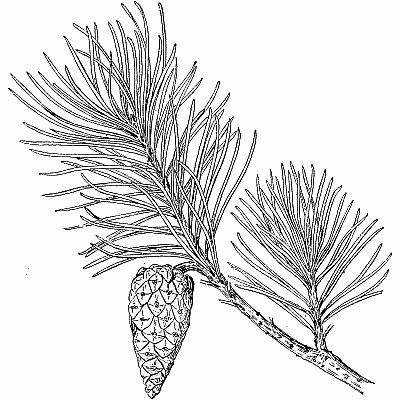 Scots Pine.
The leaves, which are in bundles of two, are from two to three
inches long, very slender, grooved above and convex beneath.
They remain on the tree for over two years, and in their
first season are of a glaucous hue, but in the second year this
changes to dark deep-green. Both male and female flowers are
borne by the same tree. The male catkins are individually
small (¼ inch), but are combined in spikes; this and the
abundant pale yellow pollen makes them conspicuous. The
female cones are somewhat egg-shaped, tapering to a point,
which is often curved. They are usually in clusters of three,
and grow to a length of two or three inches. The scales are
comparatively few, and their ends are thickened into an irregular
four-sided boss, at first ending in a little point. The seeds are
winged, and contained beneath the scales. They take about
eighteen months to ripen, when the scales separate in dry windy
weather, and allow the breeze to pick out the seeds and send
them flying through the air to a great distance. The pollen,
too, it should be noted, is of a form specially fitted for aerial
transport, each particle of pollen forming two connected spheres.
It is quite a common experience in May to find little heaps of
this pollen collected in hollows and at the margins of ponds in
the neighbourhood of Pine-woods; but, so difficult is it to get
people to understand the common facts of nature, that it is
generally regarded as evidence of a shower of brimstone having
fallen. It is not only the ignorant rustic who falls into this
error; judging from letters sent to the press by country parsons,
even the universities fail to prepare their alumni to deal with
such phenomena. After the eruptions of La Soufriere, several
wrote to say that quantities of powdered sulphur from St.
Vincent had descended in their Surrey and Hampshire parishes!
their notion being that the commercial "flowers of sulphur" are
the direct produce of volcanoes.
Although the wood produced by the Scots Pine in this country
is not considered of the highest quality, the species is certainly
of equal value as a timber-producer with any other tree. Owing
to our mild winters and long periods of seasonal growth, the
Pine-wood produced in Britain is coarse-grained and not very
durable. In the colder parts of Northern Europe, where
summers are short and the long winters are severe, the texture
of the timber is more solid and the grain closer. And so
enormous quantities of Pine-wood come to us from the Baltic
ports every year. In addition to the timber, other valuable
substances known to commerce are products of the Scots Pine—pitch
and tar, resin and turpentine, for example. The Pine
is an accommodating tree, for though it likes a deep soil in
which to strike its tap-root, it will grow upon rocky ground,
where the roots have to become horizontal and near the surface;
or it will form forests on poor sandy soils, even on the
loose hot sands near the seashore. This is a valuable power,
because the fall of its needles gradually forms a humus, and so
provides food for other plants which could not exist on raw
sand.
Other coniferous trees that have become more or less familiar
in our plantations and parks will be found in the second division
of this book.
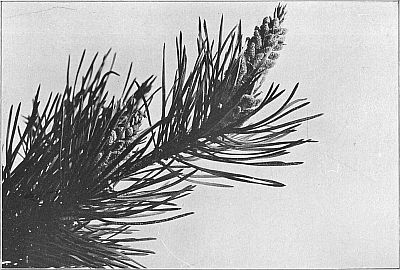 Pl. 80.
Male Flowers of Scots Pine.
The Holly must be regarded as one of our small trees,
although many specimens attain a height of forty or fifty feet,
with a girth of ten or twelve feet. It is well distributed throughout
our islands, ascending to a thousand feet, and it is probable that
no other tree is so well known, by its foliage at least, as the Holly,
or Holm, to give it its ancient name. The word Holm was incorporated
by some of our ancestors far back in the name
Holmsdale, which still attaches to the stretch of country at the
southern foot of the chalk hills in Surrey, and whose proud
motto is, "Never wonne, ne never shall." At the western end
of the Holmsdale is Holmwood, and still a little further west
Holmbury. In these places the Holly still grows bravely, not
far from the old home of John Evelyn, who must be thought of
whenever we talk of Hollies, though the recollection has to do
with Sayes Court, his Thames-side house, where the barbarian
Peter wrought such havoc with his cherished Holly-hedge. How
Evelyn must have lamented that outrage is indicated in this
extract from the "Sylva":—
"Is there under heaven a more glorious and refreshing object
of the kind, than an impregnable hedge of about four hundred feet
in length, nine feet high, and five in diameter, which I can show
in my now ruined gardens at Say's Court (thanks to the Czar of
Moscovy) at any time of the year, glittering with its armed and
varnished leaves? The taller standards at orderly distance,
blushing with their natural coral. It mocks the rudest assaults
of the weather, beasts, or hedge-breakers, et illum nemo impunè
lacessit."
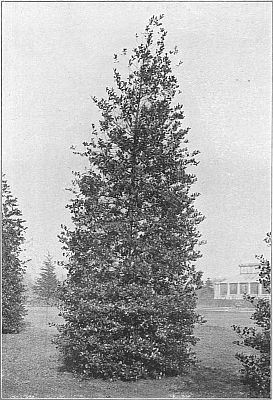 Pl. 81.
Holly.
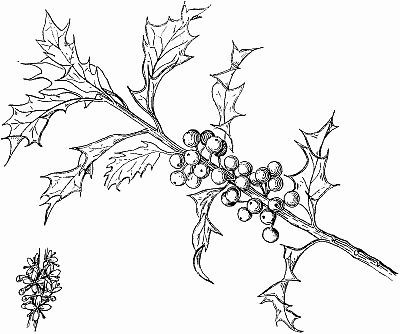 Holly.
The bark of the Holly is smooth and pale-grey in colour.
Time out of mind it has been used in the preparation of a viscid
substance known as birdlime, which, spread on twigs, holds the
feet of small birds. Respecting the foliage of the Holly, there
is little need to say anything, but for uniformity's sake we may
note that the leaves are oval in shape, of a leathery consistence,
with a firmer margin, running out into long sharp spines. It is
a fact worthy of note that when the Holly has attained to a
height of ten feet or so, it frequently clothes its upper branches
in leaves that have no spines—a circumstance that Robert
Southey sought to explain in his poem "The Holly-tree," on
teleological grounds. His second verse, however, contains
sufficient explanation of the fact it describes:—
"Below, a circling fence, its leaves are seen
Wrinkled and keen;
No grazing cattle through their prickly round
Can reach to wound;
But, as they grow where nothing is to fear,
Smooth and unarm'd the pointless leaves appear."
In some places the young shoots are gathered by the peasants,
dried, bruised, and used as a winter cattle-food. No doubt, in
the early history of the Holly, cattle found out its good qualities
for themselves, and browsed upon the then-unarmed foliage. In
self-defence the tree developed spines upon its leaves, and so
kept its enemies at a respectful distance. Above the reach of
these marauders the production of spines would be a useless
waste of material.
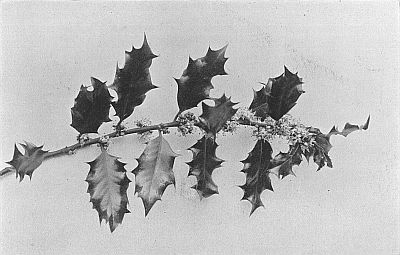 Pl. 82.
Flowers of Holly.
The flowers of the Holly, though small, are conspicuous by
their great number and white colour. They are about a quarter
of an inch across, with four petals and four stamens or stigmas.
Sometimes flowers with stamens are produced by the same tree
that bears flowers with stigmas; but often the male and the female
flowers are borne by separate trees, so that the possessor of a
Holly that is solely male is sometimes puzzled by the fact that
his tree, though covered with blossom, never produces a berry.
The fruit is analogous in structure to that of the Plum and
Cherry, and is technically termed a drupe; but instead of the
single stone of these fruits, in the Holly-berry there are four
bony little stones, each with its contained seed. The berries
ripen about September, and are then scarlet and glossy, though
here and there one finds a tree whose fruit never gets beyond
the yellow stage of coloration.
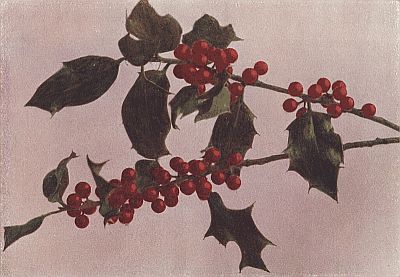 Pl. 83.
Fruits of Holly.
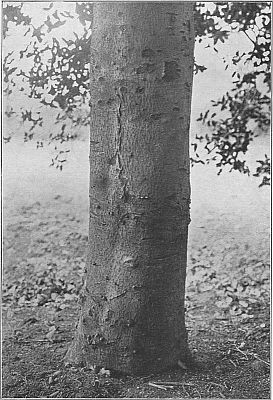 Pl. 84.
Bole of Holly.
Most parts of the tree have had their uses in medicine; the
leaves, for example, being said to have value as a febrifuge, and
the berries as a purgative, or in large doses (6 to 8) as an
emetic. The smooth bark of large Hollies is often attacked
by one of the most striking of our native lichens—Graphis
elegans—whose black fruiting portions look like a raised cuneiform
inscription. The Holly is not greatly subject to the attacks
of insects, but many of its leaves will be found to have been
tunnelled between the upper and lower skins by the larva of a
minute moth, one of the Leaf-miners. It also provides the
pabulum for the caterpillar of the Holly-blue butterfly (Lycæna
argiolus). The dead leaves may be examined for the minute
Prickly Snail (Helix aculeata).
The wood of the Holly has an exceedingly fine grain, due to
its slow growth, and it is very hard and white. These qualities
make it valuable for many purposes, often as a substitute for
Box-wood, and, when dyed black, in lieu of Ebony.
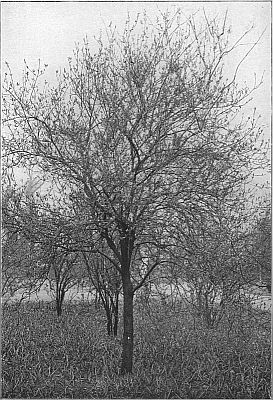 Pl. 85.
Spindle—winter.
The Spindle is right on the borderland between trees and
shrubs, for though it will grow into a tree twenty feet high, yet
our hedgerow specimens are usually bushlike, and only ten or
twelve feet high. Until the autumn the Spindle, we fear, is
rarely recognized as such, but gets confused with Buckthorn and
Dogwood. In October, however, its quaint fruits have changed
to a pale crimson hue, which renders them the most conspicuous
feature of a hedgerow—even of one plentifully
decorated with scarlet hips and haws and bryony-berries.
The unusual tint of the Spindle, and the fact that it swings on
a slender stalk, at once mark it out from the rigid-stalked hips
and haws.
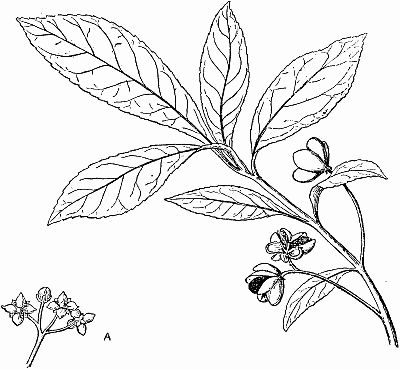 Spindle-tree.
A, flowers.
The trunk of the Spindle is clothed in smooth grey bark. The
twigs, which are in pairs, starting from opposite sides of a branch,
are four-angled. The shining leaves vary from egg-shaped to
lance-shaped, with finely-toothed edges. They are arranged in
pairs, and in autumn they change to yellow and red. When
bruised they give off a fœtid odour, the juice is acrid, and said
to be poisonous—a charge which is laid against the bark, flowers,
and seed as well. The small greenish-white flowers are borne
in loose clusters, of the type known as cymes, from the axils of
the leaves, and appear in May and June. Some contain both
stamens and pistil, but others are either stamenate or pistillate.
The calyx is cut into four or six parts, the petals and stamens
agree with these parts in number, but the lobes of the stigma only
range from three to five, corresponding with the cells of the
ovary. The fruit is deeply lobed, and marked with grooves,
indicating the lines of future division, when the lobes open and
disclose the seeds, at first covered with their orange jackets,
or arils, after the manner of the mace that encloses the
nutmeg.
The hardness and toughness of Spindle-wood has long been
esteemed in the fashioning of small wares where these qualities
are essential, and the common name is a survival of the days
when spinning was the occupation of every woman. Then
spindles were in demand for winding the spun thread upon, and
no wood was more suitable than that of Euonymus for making
them. It shares with the Cornel (Cornus sanguinea) the name
Dogwood; it is also Skewerwood, Prickwood, and Pegwood,
all suggestive of uses to which it is or was applied. The young
shoots make a very fine charcoal for artists' use.
The Spindle is indigenous throughout our islands, but cannot
be said to be generally common; it is rarer in Scotland and
Ireland than in England.
Among the exotic species cultivated in our parks and gardens
are the handsome variegated forms of the Evergreen Spindle
(Euonymus japonicus) of China and Japan, and the Broad-leaved
Spindle (E. latifolius) from Europe.
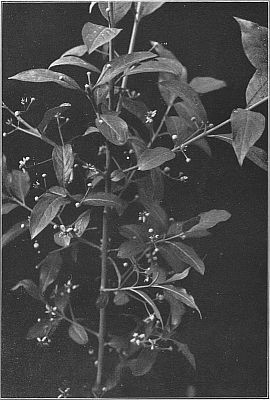 Pl. 86.
Flowers of Spindle.
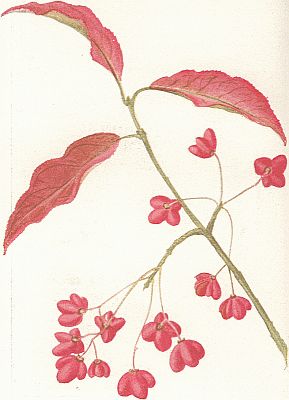 Pl. 87.
Fruits of Spindle-tree.
Our two native species of Buckthorn are shrubs of from five
to ten feet in height. In this one respect they agree; in almost
all others they differ. Both are Buckthorns in name, but the
Breaking Buckthorn (Rhamnus frangula) is quite unarmed,
whilst many of the branchlets of the Purging Buckthorn
(Rhamnus catharticus) are hardened into spines.
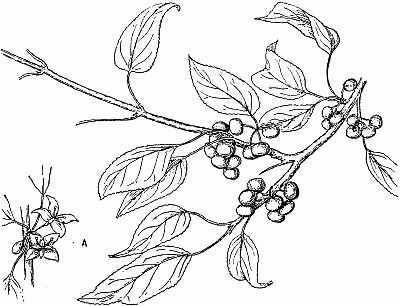 Purging Buckthorn.
A, flowers.
The Purging Buckthorn is distinguished by its stiff habit, and
by some of the leaves being gathered into bundles at the ends
of the shoots. The leaves are egg-shaped, with toothed edges,
and of a yellowish-green tint, with short leaf-stalks. The
yellowish-green flowers are very small, and will be found both
singly and in clusters from the leaf-axils. There are a four-cleft
calyx, four petals, four stamens, or four stigmas, for the
sexes are usually on separate plants. The fruit is black, round,
and about a quarter of an inch across, containing four stones.
These so-called "berries" are ripe in September. Formerly
they were much used as a purging medicine, but of so violent a
character that their use has come to be discouraged, and the
safer syrup of Buckthorn is prescribed instead. The juice of
these berries is the raw material from which the artist's sap-green
is prepared. It may be found in woods, thick hedgerows,
and bushy places on commons southward of Westmoreland,
showing a decided preference for chalky soils. In Ireland it
only occurs rarely.
The Breaking Buckthorn (Rhamnus frangula) is also known
as the Berry-bearing Alder, its leaves, with their lateral veins,
presenting something of the appearance of the Alder. Its
more slender stems are purplish-brown in hue, and all the
leaves are arranged alternately up the stems. The leaves
further differ from those of R. catharticus in having plain, un-toothed
edges, and their veins parallel one to another. The
flowers are similar in size to those of the other species, but are
whiter, less yellow, fewer in number, and on longer stalks. The
parts of the flower, too, are in fives instead of fours; and the
"berry," though similar to the previous species, is much larger
(half-inch diameter). In an unripe condition these fruits yield a
good green dye, much used by calico printers and others. The
wood made into charcoal is said to be the best for the purposes
of the gunpowder makers, who know it by the name of Black
Dogwood. The straight shoots of both species are used for
forming walking and umbrella sticks, and those of longer
growth for pea and bean sticks.
The Brimstone butterfly (Gonepteryx rhamni) lays its eggs on
the leaves of R. frangula, upon which the larva feeds. The
name Buckthorn appears to be due to an ancient misunderstanding
of the German name Buxdorn, which should have
been translated Box-thorn.
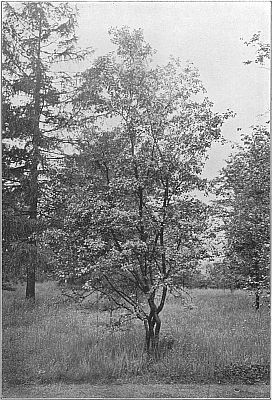 Pl. 88.
Breaking Buckthorn.
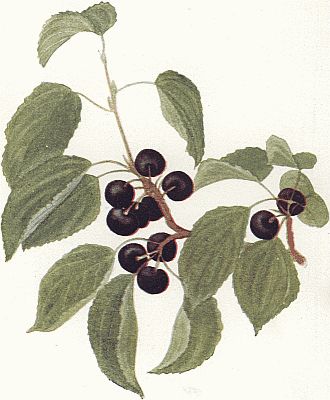 Pl. 89.
Fruits of Purging Buckthorn.
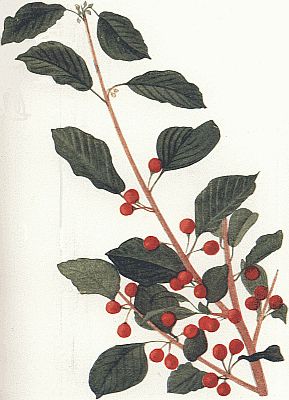 Pl. 90.
Fruits of Breaking Buckthorn.
With the single exception of the Hazel, all our native fruit-trees
are members of the extensive and beautiful Rose family. Before
Roman invasions brought improved and cultivated varieties,
our "rude forefathers" must have been glad to eat the Sloes,
Crabs, and Wild Cherries that are now regarded as too terribly
crude and austere, in an uncooked condition, for any stomach
but that of the natural boy, which appears capable of surviving
any ill-treatment. Some authors have regarded the Wild Plum
and the Bullace as being specifically distinct from the Sloe and
from each other; but the modern view is that their differences
only entitle them to rank as sub-species of the Sloe, and as
such they will be regarded here.
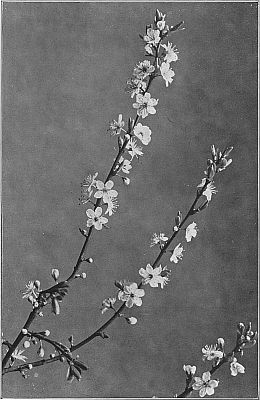 Pl. 91.
Flowers of Wild Plum.
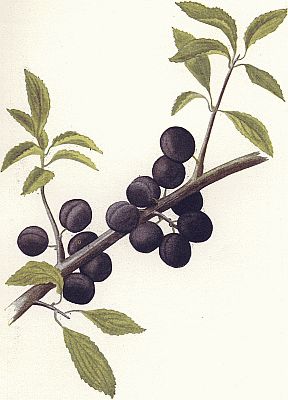 Pl. 92.
Sloes.
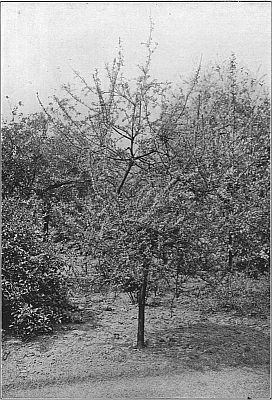 Pl. 93.
Blackthorn—spring.
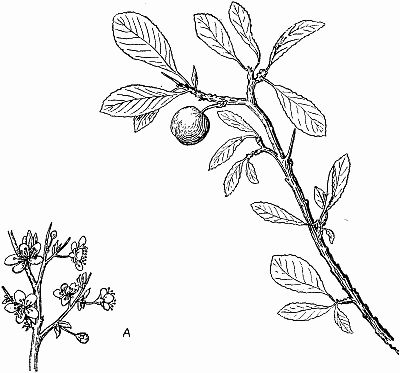 Blackthorn.
A, flowers.
The Sloe or Blackthorn (Prunus communis) is the rigid
many-branched shrub, with stiletto-like tips, that luxuriates on
some of our commons and in our hedgerows. The blackish
bark that gives its name to the shrub forms a fine foil in March
or April for the pure white starry blossoms that brave the cold
blasts before the leaf-buds dare unfurl their coverings. In some
places—as in Cornwall, where it is the principal hedge plant,
and where cliffs, creeks, and river banks are bordered by it—these
bare black or purple stems are almost hidden by the
abundant growth of the Grey Lichen (Evernia prunastri). In
this, the typical form, the branches and twigs turn in every
direction, so that it is impossible to thrust one's hand into a
Blackthorn bush without getting considerably scratched. The
well-known flower consists of a five-lobed calyx, five white petals,
and from fifteen to twenty stamens round the single carpel.
The stigma matures in advance of the stamens, so that it has
usually been fertilized by bee-borne pollen from another Sloe
before its own anthers have disclosed their pollen. The fruit
is about half an inch across, globose in form, and held erect
upon its short stalk; black, but its blackness hidden by a
delicate "bloom" that gives it a purplish glaucous hue.
Terribly harsh are these fruits to the palate, and a mere bite
at an unripe one is sufficient to set teeth on edge and contract the
muscles of mouth and face. And yet, when the tight jacket of
the Sloe begins to relax and pucker, the juice condenses into
more mealy flesh, and the acridity passes, one may eat not
one but a dozen, slowly, enjoying the piquancy of each before
swallowing. Country people make them into wine, and it used
to be said that much that is sold as port had its origin in the
skins of British sloes instead of Portuguese grapes. And for
special use "for the stomach's sake" old-wife followers of St.
Paul pin their faith to gin in which Sloes have soaked for
months.
In the days of our youth it was a stock jibe against the grocer
that most of his China tea had been grown on Blackthorn
bushes not far from home, and with tea at five or six shillings a
pound there may have been some basis of truth for the belief;
but with the prices of to-day it may be presumed that Blackthorn
leaves would cost the dealer at least as much as real tea-leaves
from Assam and Darjeeling.
The Bullace (Prunus communis, sub-sp. insititia) differs
from the Sloe in having brown bark, the branches straight and
only a few of them ending in spines, the leaves larger, broader,
more coarsely toothed, and downy on the underside. The
flowers, too, have broader petals, and the fruit—which may be
black or yellow—droops, and is between three-quarters and one
inch in diameter. In many places where this grows it can only
be regarded as an escape from cultivation.
The Wild Plum (Prunus communis, sub-sp. domestica) has
also brown bark, its branches straight, and not ending in spines.
The downiness noticed on the underside of the Bullace leaves
is here restricted to the ribs of the leaf. The fruit attains a
diameter of an inch or an inch and a half. Although found
occasionally in hedgerows, this sub-species is not indigenous in
any part of our islands. Hooker says the only country in
which it is really indigenous is Western Asia; but its numerous
cultivated forms are widely distributed.
It should be noted that the fruits of the Blackthorn and its
sub-species are formed within the flower; so are those of the
Cherries, to be next described, the ovary being botanically
termed "superior," that is, above the base of the calyx and
corolla, when the flower is in an erect position. This is a point of
some importance when one seeks to understand the different
formation of the fruit in so closely related a species as the Apple,
in which the ovary is "inferior," or below the flower.
Nature has been comparatively lavish in the matter of
Cherries, for she has bestowed three species upon the British
Islands. For the cultivated Cherry it is said that we ought
to thank the Romans, as for many other good things in the
way of food. Pliny states that we had the Cherry in Britain by
the middle of the first century A.D. Evelyn tells us that the
Cherry orchards of Kent owe their origin to "the plain industry
of one Richard Haines, a printer to Henry VIII.," by whom
"the fields and environs of about thirty towns, in Kent only,
were planted with fruit trees from Flanders, to the unusual
benefit and general improvement of the county to this day."
It is probable, however, that our own countrymen had already
effected some improvement on the wild sorts by cultivation,
for even in the woods some trees are found bearing fruit much
larger and of better flavour than usual, and such would be
selected for cultivation.
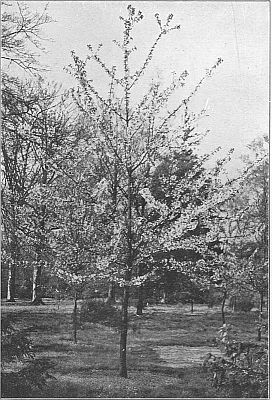 Pl. 94.
Gean in flower.
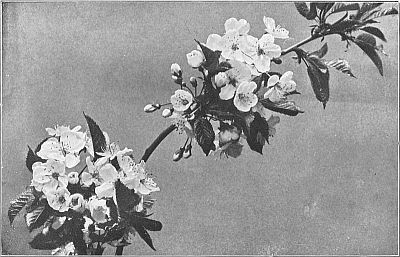 Pl. 95.
Flowers of Gean.
Our three natives are the Wild or Dwarf Cherry (Prunus
cerasus), the Gean (P. avium), and the Bird Cherry (P. padus).
Of these the Gean is the species most widely distributed
throughout our country, and we therefore give it precedence.
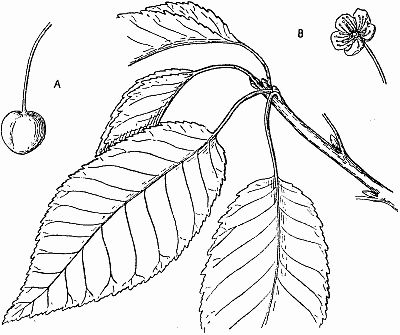 Gean.
Gean.
A, fruit; B, flower.
The Gean (Prunus avium) is a tree that in suitable soils
attains a height of thirty or forty feet, with short, stout branches,
that take an upward direction. The leaves are large, broadly
oval, with sharp-toothed edges, and downy on the underside.
They always droop from the branches, and in spring they are
of a bronzy-brown tint, which afterwards changes to pale green.
Soon after the leaves have unfolded they are almost hidden
by the umbels of wide-open white flowers, which have soft,
heart-shaped petals, and whose anthers and stigmas mature
simultaneously. The firm-fleshed drupe is heart-shaped, black
or red, sweet or bitter, with scanty juice which stains the fingers.
This is believed to be the original wild stock from which our
modern Black Hearts and Bigarreau Cherries have been
evolved by the cultivator.
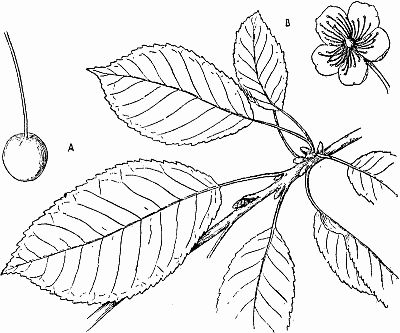 Wild Cherry.
A, fruit; B, flower.
The Dwarf or Wild Cherry (Prunus cerasus) is more bush-like
than tree-like, for it sends up a great number of suckers
around the main stem. The branches are slender and drooping.
The leaves, which are of similar shape to those of P. avium,
are smooth and deep blue-green in tint, with round-toothed
edges. The flowers are not so widely open as in the previous
species, but retain more of the cup-shape, whilst the notched
petals are firmer in consistence and oval in shape. The drupe
is in this species round, with red skin and juicy flesh of a
distinctly acid character. The juice does not stain as does
that of P. avium. The Morello or Brandy Cherry, the May
Duke, and the Kentish Cherries are considered to be derived
from this species. This does not extend further north than
Yorkshire; in Ireland it is rare.
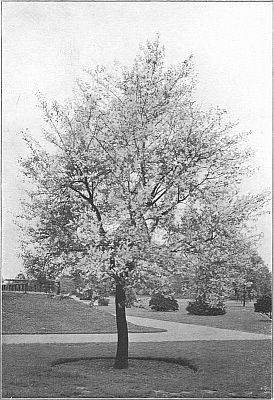 Pl. 96.
Bird Cherry—spring.
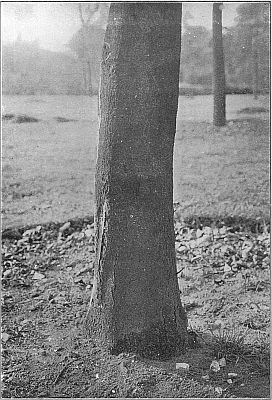 Pl. 97.
Bole of Bird Cherry.
The Bird Cherry (Prunus padus) forms a tree from ten to
twenty feet in height, with more elliptic leaves, which have
their edges doubly cut into fine teeth. The flowers are not
clustered in umbels, as in both the foregoing, but in a loose
raceme from lateral spurs of new growth. The flowers are
erect when they open, and the stigmas mature before the
anthers, so that cross-fertilization is favoured in this species.
After fertilization the flower droops, to be out of the way of the
bees in their visits to the unfertilized blossoms. The petals
in this species look as if their edges had been gnawed. The
drupes are small, black, and very bitter, with a wrinkled stone.
This is a northern species, coming not further south than
Leicestershire and South Wales. All three species flower in
late April or early May.
Cherry wood is strong, fine-grained, and of a red colour. It
is easily worked, and susceptible of a high polish, so that it is
in request by cabinet-makers, turners, and musical instrument
makers.
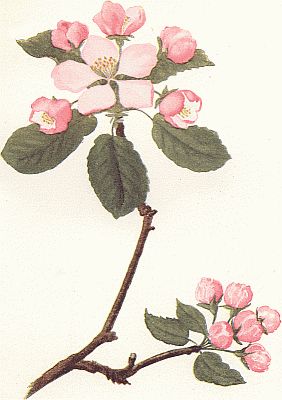 Pl. 98.
Flowers of Wild Apple.
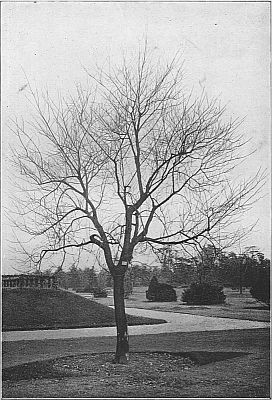 Pl. 99.
Bird Cherry—winter.
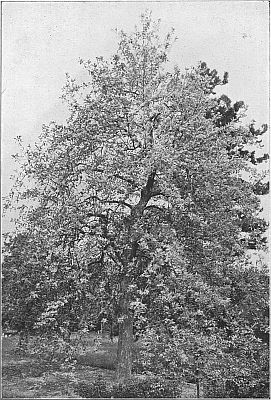 Pl. 100.
Wild Pear—spring.
The Wild Pear is only to be found growing in the southern
half of Britain, its northward range not extending beyond
Yorkshire, and even in the south its claim to be regarded as a
true native has been contested. Mr. Hewett C. Watson regards
it as more probably a denizen, that is, a species originally
introduced by man, which has maintained its hold upon the
new land. Upon this assumption it is probable that the introduced
specimens were already somewhat cultivated, but when
they (or their descendants) became wild they reverted to the
original condition of the species.
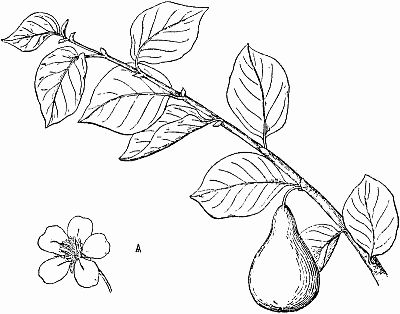 Wild Pear.
A, flower.
The Wild Pear, or Choke-pear, is a small tree, from twenty
to sixty feet in height, of somewhat pyramidal form. The twigs,
which are usually of a drooping tendency, are also much given
to ending in spines—a character scarcely apparent in the
cultivated tree. The leaves, too, of the wild tree are more
distinctly toothed than those of the Garden Pear. They are
oval in shape, with blunt-toothed edges, and downy on the
lower surface. Along the new shoots the leaves are arranged
alternately on opposite sides, but on shoots a year old they are
produced in clusters. The flowers, which measure more than
an inch across, are pure white in colour, and are clustered in
cymes of five to nine. They appear in April and May, and are of
the Wild Rose type, there being numerous stamens, from three
to five styles, which ripen before the stamens, five petals, and
the calyx, taking the form of a pitcher with a five-lobed mouth,
represents the five sepals.
In speaking of the Wild Plums we directed attention to the
fact that the ovary was within the flower; in the Pear (and the
other members of the genus Pyrus) it is below the flower, hidden
away in fact within the calyx-tube. When the flower opens it
is ready for fertilization, but as the stamens of that flower are
not yet mature this can only be accomplished by pollen brought
by the bees from other flowers as they rifle the honey-glands.
The effect of pollination is to cause special vegetative activity
in the neighbourhood of the ovary, resulting in the thickening
of the flesh of the calyx-tube around it, until it has become of
the characteristic pear-shape, and an inch or two in length. A
section of a pear or apple, taken lengthwise, will show a faint
green outline of the ovary, and will demonstrate how much
of the flesh is really belonging to the calyx-tube. The fruit of the
Wild Pear is green until about November, when it turns yellow.
It is of too harsh a character to be fit for eating.
A Pear formerly known as a variety (briggsii) of Pyrus communis
is now regarded as a distinct species under the name of
Pyrus cordata. It is found in Cornwall, and is distinguished by
its more oval leaves being rounded at the base, and by its much
smaller fruits being often globular.
The Pear is a long-lived tree, that grows singly or in small
groups on dry plains. It attains a height of about fifty feet in
thirty years, and its girth may then be three or four feet. The
timber is fine-grained, strong and heavy, with a reddish tinge.
Stained with black, it is used to counterfeit ebony.
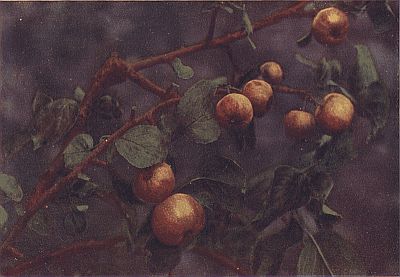 Pl. 101.
Wild Apples.
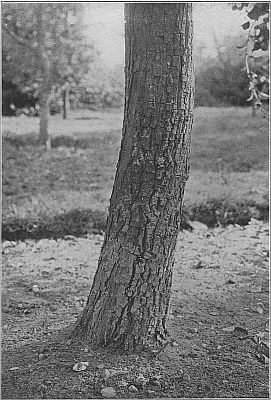 Pl. 102.
Bole of Wild Pear.
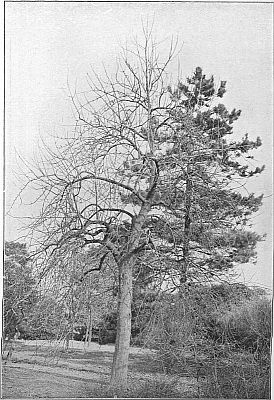 Pl. 103.
Wild Pear—winter.
It is by no means an easy matter to decide whether the
Crab-trees that grow along the hedgerows are truly wild or the
offspring of orchard apples. In woods, away from gardens and
orchards, there is less difficulty. Like the Pear, the Apple
appears to have been the subject of cultural attention from very
early times. This is proved by the philologists from the similarity
of the equivalents for our word Apple in all the Celtic and
Sclavonian languages, showing by their common origin that the
fruit was of sufficient importance to have a distinctive name
long before the separation of the peoples of Northern Europe.
The name of Crab is of comparatively recent origin. Prior
regards it as a form of the Lowland Scotch scrab, derived from
Anglo-Saxon scrobb, a shrub, indicating that it is an Apple-bush
rather than an Apple-tree.
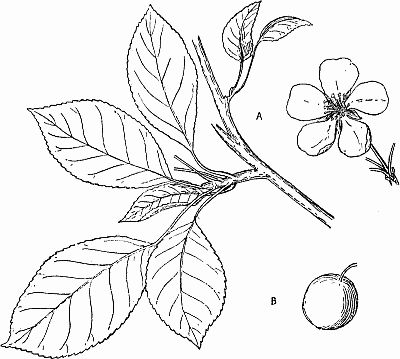 Crab or Wild Apple.
A, flower; B, fruit.
The Wild Apple has not the pyramidal form of the Wild Pear,
the branches spreading more widely when young and drooping
when older, so that the head is rounded. In height it varies as
a tree from twenty to thirty feet, though many examples of good
age still retain the dimensions of a bush. Owing to the spreading
character of the branches, the diameter of the head often
exceeds the height of the tree. The bole has seldom any pretensions
to symmetry, and is usually more or less crooked like
the older branches. The brown bark is not very rough, though
its numerous fissures and cracks give it a rugged appearance.
Its wood, like that of the Pear, is hard and fine-grained, but,
instead of having a reddish tinge, there is a tendency to brownness.
The leaves vary in shape, but are more or less oblong,
smooth above, sometimes downy on the lower surface when
young, and with toothed edges.
The flowers are about the same size as those of the Wild Pear,
but their white petals are beautifully tinted and streaked with
pink. The small clusters are umbels—that is to say, the footstalks
of similar length start from a common base. The fruit
is almost spherical, and instead of the foot-stalk gradually merging
into the apple, the attachment is always in a depression of
the latter. In the typical form of the Wild Apple the yellow and
red fruit hang by their slender stalks, but there is a variety (mitis)
in which the fruit is borne above the stouter stalks. The variety
may also be known by the downiness of the young leaves, the
calyx-tube, and the stalks. The fruit is about an inch across,
and so rich in malic acid as to be unfit for food in its natural
state, though children punish their digestive organs with it. Pigs
are partial to Crab-apples, a taste they have evidently inherited
from the wild boar. A delicious preserve, called Crab-jelly, is
made by stewing the whole fruit, then pressing the soft flesh
through a hair sieve, and boiling the pulp with sugar. Cyder is
made from the rotting Crabs; also a kind of vinegar called
verjuice, or vargis.
The Wild Apple is found all over the United Kingdom as far
north as the Clyde, and wherever it is known to occur it is worth
a special visit in May, when all its crooked branches and
straggling shoots are rendered beautiful by the abundance of
delicately tinted and fragrant flowers. It is also far from being
unattractive in the autumn, when the miniature apples hang
from the boughs.
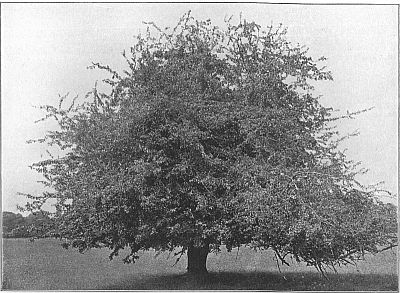 Pl. 104.
Wild Apple—summer.
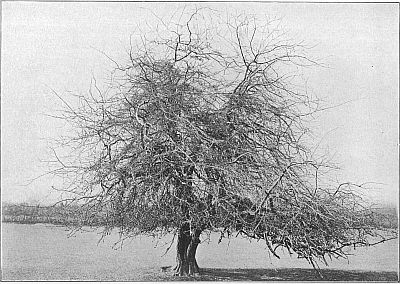 Pl. 105.
Wild Apple—winter.
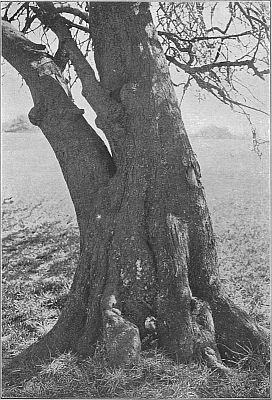 Pl. 106.
Bole of Crab, or Wild Apple.
Owing to its very local occurrence, the White Beam, though
widely distributed, is one of the less known of our trees and
shrubs. It comes into both these categories according to the
situation of its growth, for whilst in exposed mountainous
localities a specimen of mature age may be no more than four
or five feet high, and of bush-like growth, under the lee of a
wood, and on a calcareous soil, it will be an erect and graceful
tree of pyramidal form, whose apex is forty feet from the ground.
In its early years growth is tolerably rapid, but at the age of
ten it slackens pace, and after it has attained its majority its
progress is very slow. Its wood is fine-grained, very hard, white,
but inclining to yellow. The bark is smooth, and little subject
to the cracks and fissures that mark the Apple-bark. The
branches, except a few of the lowest, all have an upward
tendency.
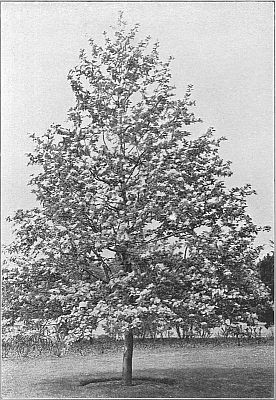 Pl. 107.
White Beam—spring.
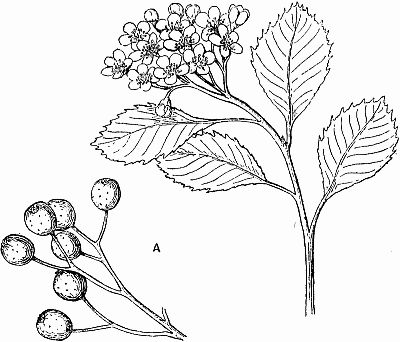 White Beam.
A, fruits.
The leaves vary considerably in the several forms or sub-species,
but in the typical form they are a broad oval, with the edges
coarsely toothed or cut into lobes, the upper side smooth, and the
lower side clothed with white cottony down, the almost straight
nerves strongly marked. The white flowers, which appear in May
or June, are only half an inch across, and gathered into loose
clusters. They are succeeded by nearly round scarlet fruits, half
an inch in diameter, known in Lancashire and Westmoreland
as Chess-apples. The tree is also known in the same districts
as Sea Owler, the latter word, according to Prior, being a
corruption of Aller or Alder, probably from the resemblance of
the plaited leaves to those of Alnus glutinosa. These Chess-apples
are very sharp and rough to the taste, but when kept
like Medlars, till they "blet" or begin to decay, are far from
unpleasant. Birds and squirrels eagerly seek for them on the
tree, and those that fall are as welcome to hedgehogs and other
mammals. This form is only found from the Midlands to the
South of England as far west as Devon, and in Ireland.
The sub-species latifolia (Pyrus rotundifolia of some
botanists) has broader leaves, varying from oval-oblong to
almost round, divided into wedge-shaped lobes, the cottony
down beneath being grey rather than white, and the nerves
less prominent on the underside. This form is found in
Cornwall.
The sub-species scandica (also known as Pyrus intermedia)
has the leaves less tough, more deeply divided into rounded or
oblong lobes, and the grey cotton beneath of a looser character.
This form is found in Scotland.
It should be noted that this species must not be called the
White Beam-tree, for the word beam is the Saxon equivalent for
tree. Other names for it include Hen-apple, Cumberland
Hawthorn, Hoar Withy, Quick Beam, and Whipcrop.
The Wild Service (Pyrus torminalis) is a small tree of
local occurrence, which does not extend further north than
Lancashire. In general appearance it may be taken for the
White Beam, but closer inspection will reveal the following
differences. The leaves, which are cut into tapering lobes and
coarsely toothed, are heart-shaped at the base; when young
they are slightly downy beneath, but when mature they are
smooth on both sides. Though the flowers are similar in size
and colour to those of the White Beam, the fruit is smaller
(one-third inch in diameter), less globular, and more like a large
haw, though the colour is greenish-brown. The flowers appear
in April and May, and the fruit, which is of a very dry, juiceless
character, is ripe in November. In some localities these fruits
are marketed, but they require to be kept like Medlars, until
decay sets in, before they are fit to be eaten.
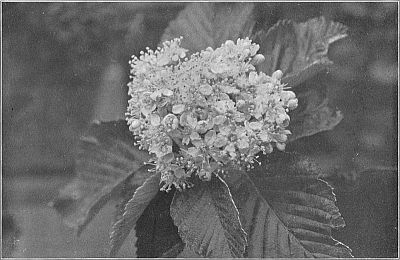 Pl. 108.
Flowers of White Beam.
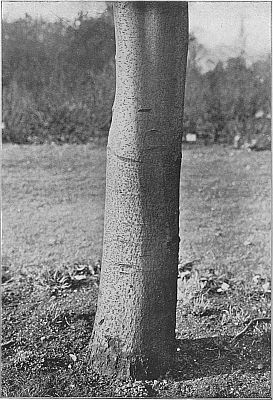 Pl. 109.
Bole of White Beam.
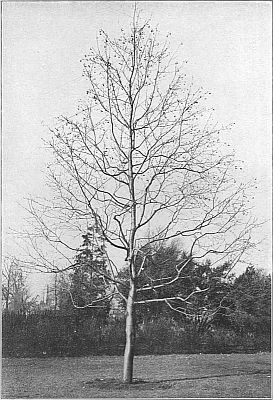 Pl. 110.
White Beam—winter.
Little description of the Mountain Ash is needed, for in recent
years it has come so much into favour that it is now one of the
commonest of the trees planted in little suburban gardens and
fore-courts. Its hardiness, its indifference to the character of
the soil, the fact that other plants will grow beneath it, and the
absence of need for pruning—all these points unite to make it
suitable and popular for growth in restricted spaces. But the
wood on the hillside is the natural home of the Mountain Ash,
and in the Highlands its vertical range extends to 2600 feet
above sea-level.
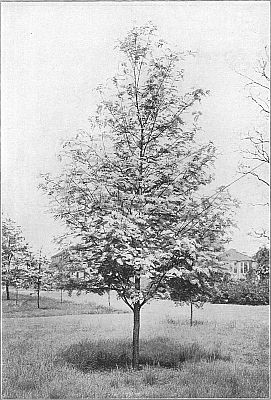 Pl. 111.
Rowan, or Mountain Ash—summer.
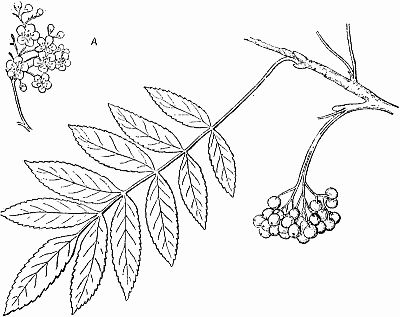 Rowan, or Mountain Ash.
A, portion of flower-cluster.
The Mountain Ash attains a height of from thirty to fifty feet,
and has a straight clean bole, clothed in smooth grey bark,
scarred horizontally as though it had been scored with a knife.
All the branches have an upward tendency, and the shoots
bear the long feathery leaves, whose division into six or eight
pairs of slender leaflets suggests the Ash, from which part of its
name has been borrowed. Gazing on this tree either in flower
or fruit, it would be quite unnecessary to explain that it is not
even remotely allied to Fraxinus excelsior, and that the
similarity of leaf-division is the only point of resemblance between
them. These leaflets have toothed edges, are paler on the
underside, and in a young condition the midrib and nerves
are hairy. The creamy-white fragrant flowers are like little
Hawthorn blossoms, though only half the size, and they appear
in dense clusters (cymes) in May or June. The fruit are
miniature apples, of the size of holly-berries, bright scarlet
without and yellow within. They ripen in September, and are
then a great attraction to thrushes, blackbirds, and their kind,
who rapidly strip the tree of them. Though this at first sight
may appear like frustrating the tree's object in producing fruit,
it is not really so, the attractive flesh being a mere bait to induce
the birds to pass the seeds through their intestines, and thus
get them sown far and wide. By this method the process of
germination is considerably hastened, whereas by hand-sowing
the seeds lie in the earth for eighteen months before shooting.
All the species of Pyrus produce their fruits with this object,
the larger more or less brownish ones being intended to attract
mammals, the smaller and red-coloured to tempt birds. The
seeds have leathery jackets to protect them from the action of
the digestive fluids, and are further wrapped in a parchmenty,
bony, or wooden "core" (endocarp) with a similar object. In
the case of the Rowan this is very like wood.
In the south of Britain the Mountain Ash is chiefly grown as
underwood and used as a nurse for oaks and other timber trees,
which soon outgrow it and kill it; so that in the woods it is
seldom allowed to grow into a fully developed tree, but, thanks
to the birds, it comes up on the common and the hillside, and
has a chance of producing its masses of ruby fruit. Its wood is
tough and elastic, but, owing to the smallness of its girth, it does
not produce timber of any size. Still, it makes admirable poles
and hoops.
The word Rowan is one of the most interesting of tree-names,
and connects the still-existing superstitious practices of our
northern counties, not only with the old Norsemen, but with the
ancient Hindus who spoke the Sanskrit tongue. The word is
spelled in many ways which connect it with the Old Norse runa,
a charm, it being supposed to have power to ward off the effects
of the evil eye. In earlier times runa was the Sanskrit appellation
for a magician; rûn-stafas were staves cut from the Rowan-tree
upon which runes were inscribed. Until quite recently the
respect for its magical properties was shown in the north by fixing
a branch of Rowan to the cattle-byre as a charm against the
evil designs of witches, warlocks, and others of that kidney. In
this connection we may quote also from Evelyn's "Sylva." He
says: "Ale and beer brewed with these berries, being ripe, is
an incomparable drink, familiar in Wales, where this tree is
reputed so sacred that there is not a churchyard without one
of them planted in it (as among us the Yew); so, on a certain
day in the year, everybody religiously wears a cross made of the
wood; and the tree is by some authors called Fraxinus Cambro-Britannica,
reputed to be a preservative against fascinations
and evil spirits; whence, perhaps, we call it witchen, the boughs
being stuck about the house or the wood used for walking-staves."
Among the numerous names of the Mountain Ash are
Fowler's Service (or Servise, from Cerevisia, a fermented
drink), Cock-drunks, Hen-drunks (from the belief that fowls
were intoxicated by eating the "berries"), Quickbeam, White
Ash (from the colour of the flowers), Witch-wood, and Witchen.
Quickbeam is in allusion to the constant movement of foliage,
quick being the Anglo-Saxon cwic, alive. Witch-wood and
Witchen are also forms of cwic.
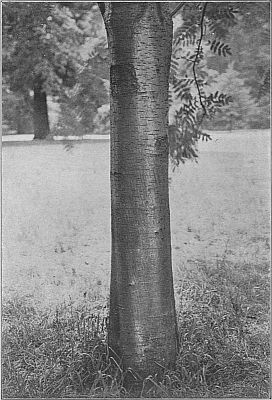 Pl. 112.
Bole of Rowan.
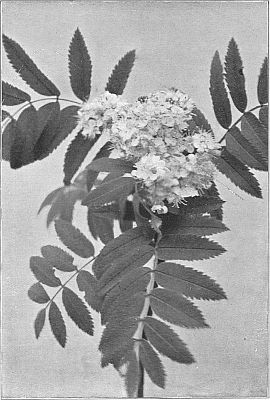 Pl. 113.
Flowers of Rowan.
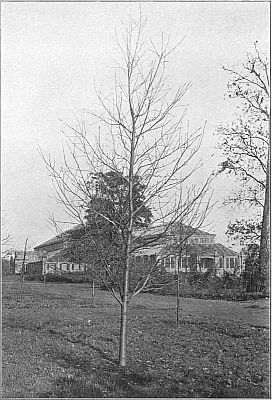 Pl. 114.
Rowan—winter.
The True Service (Pyrus sorbus) closely resembles the
Mountain Ash in habit and foliage, but it is not a native of
Britain, though it used to be claimed as such, on account of
its growing in the more mountainous parts of Cornwall and
in Wyre Forest, Worcestershire. The latter, however, is the
only Service tree that could put in such a claim, for it grows—or grew?—far
from habitations or cultivated land, and the
presumption is that it has not owed its introduction to man.
Still, "one swallow does not make a summer," and a solitary
wild tree does not give the species a title to be reckoned as
British. It is occasionally cultivated here, and its portrait,
with a brief account of its points of difference from the
Mountain Ash, may be useful. A comparison of the photographs
from the boles of the two species will show a great
difference: that of the Mountain Ash being smooth, whilst
that of the Service is rugged. The leaf is similarly broken
up into paired leaflets, but these are broader, and are downy
on both upper and lower sides. The white flowers are as
large as May-blossoms, and the fruits, which may be either
apple-shaped or pear-shaped, are greenish-brown, with rusty
specks, and four times the size of Rowan-berries. In winter,
when there are neither leaves, flowers, nor fruits to help in
the distinction, the bark may be taken in conjunction with
the leaf-buds, which are green and smooth in this species,
whilst those of the Mountain Ash are black and downy. The
fruit may be eaten after it has begun to decay, as in the case
of the Medlar.
Loudon describes the wood of the Service as the hardest
and heaviest of all the trees indigenous to Europe: fine-grained,
red-tinted, susceptible of a high polish, and much
in request in France for all purposes where strength and
durability are needed. He further says that it takes two
centuries to attain its full stature (fifty to sixty feet), "and lives
to so great an age that some specimens of it are believed
to be upwards of 1000 years old."
We have already made reference to the meaning of the
name Service. Another name—Sorb (from Latin sorbeo)—shows
closer affinity for the fermented liquor indicated by
Servise, for it means "drink down." A third name is Chequer-tree,
which Dr. Prior tells us is an antique pronunciation of
the word choker, in allusion to the unpalatable fruit, fit to
choke one. Choke-pear, it will be remembered, is a synonym
of the Wild Pear. Britten and Holland regard the name
Chequer-tree as having no connection with choking, but an
indication of the chequered or spotted appearance of the fruit.
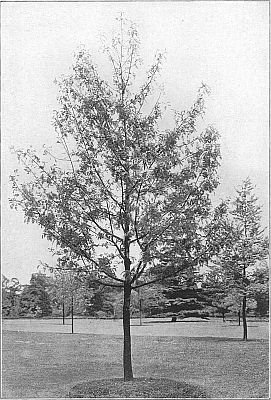 Pl. 115.
True Service Tree—spring.
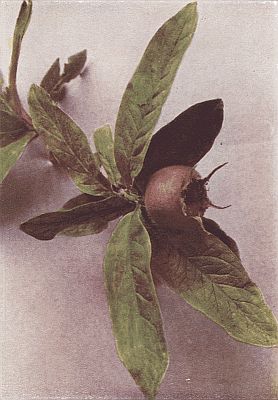 Pl. 116.
Fruit of Medlar.
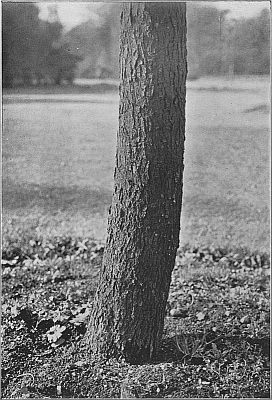 Pl. 117.
Bole of True Service.
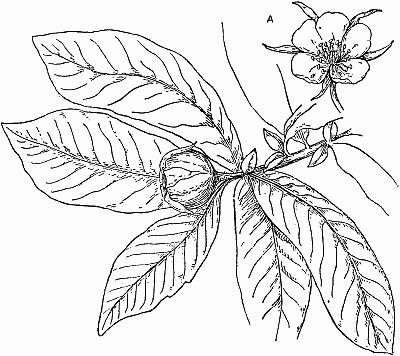 Medlar.
A, flower.
The Medlar (Pyrus germanica) is a small tree, native of
Persia, Asia Minor, and Greece, and which is generally held to
occur wild in England and the Channel Islands only as an
escape from cultivation. The theory is that the tree was
introduced at some date prior to 1596—when we have record of
its being in cultivation here—and that the Medlar-trees growing
in the hedges of south and middle England are from seeds of
these cultivated trees, which have been sown by birds, or more
probably mammals who have eaten the fruit. The fact that it
is not found in woods is taken as evidence that it is non-indigenous.
Such evidence is not the most convincing, but it
is the best available. It should be noted, however, that the
agents credited with its distribution along our hedgerows have
free access to woods, and that if these places were favourable
to the growth of the Medlar, we should probably find it there,
whether indigenous or exotic. Much more conclusive, we think,
is its restricted distribution abroad, as already indicated. One
would not expect to find a tree whose nearest home is Greece,
leaping over the whole of Europe and appearing as an indigene
in Britain.
In its wild condition the Medlar is a much-branched and
spiny tree, from ten to twenty feet high, in these respects
resembling the Hawthorn; but, like the Pear, it puts off its
defences when cultivated. Its leaves are large and undivided,
of an oblong-lance shape, downy beneath, and sometimes with
the edges very finely toothed. The solitary white flowers are
large—one and a half inches across—with a woolly calyx, whose
five tips expand into leafy growths. They appear in May or
June, and are succeeded by brown fruits, an inch or less across,
which may be described as round, with a depressed top, which
is ornamented with the remains of the calyx-lobes. They ripen
in October or November.
Though distributed as a wild tree throughout the length and
breadth of the British Islands, we are all more familiar with the
Hawthorn as planted material in the construction of hedges,
and this is a use to which it has been put ever since land
was plotted out and enclosed. For the word is Anglo-Saxon
(hægthorn), and signifies hedge-thorn. The man in the street
would say without hesitation that Hawthorn means the thorn
that produces Haws, but the philologist would tell him that it
is only a modern and erroneous practice to apply the name of
the hedge to the fruit of the hedge-thorn. It is also Whitethorn,
to make the distinction between its light-grey bark and that of
the Blackthorn; and May because of the period when it chiefly
attracts attention.
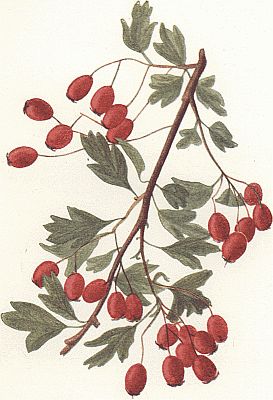 Pl. 118.
Fruits of Hawthorn.
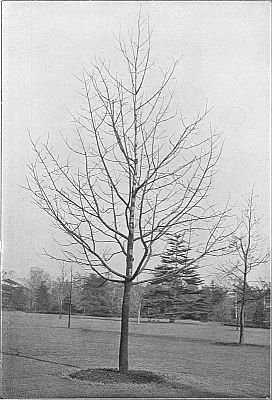 Pl. 119.
True Service—winter.
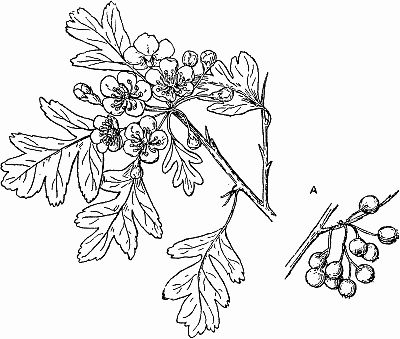 Hawthorn, or May.
A, fruit ("haws").
Where the Hawthorn is allowed its natural growth, it
attains a height of forty feet, with a circumference between
three and ten feet. Such a tree is represented in our photograph.
On our commons, where in their youth the Hawthorns
have to submit to much mutilation from browsing animals,
their growth is spoiled; but though some of these never
become more than bushes tangled up with Blackthorn into
small thickets, there are others that form a distinct bole
and a round head of branches from ten to twenty feet high,
which in late May or (more frequently) early June look like
solid masses of snow. The characteristic of the tree which
makes it so valuable as fencing material is found in its
numerous branches, supporting a network of twigs so dense
that even a hand may not be pushed among them without
incurring serious scratches. That this character is not confined
to it as a hedge shrub is clearly shown by the winter
photograph of the leafless tree.
The well-known lobed leaves are very variable both in size
and shape, and the degree to which they are cut. They
are a favourite food with horses and oxen, who would demolish
the hedges that confine them to the fields but for
the spines which protect the older branches at least. The
white flowers are about three-quarters of an inch across,
borne in numerous corymbs. The pink anthers give relief
to the uniform whiteness of the petals. The flowers, though
usually sweet-scented, occasionally give forth a very unpleasant
odour. The familiar fruits, too, instead of their usual crimson,
are yellow occasionally, as in the Holly. In favourable years
these are so plentiful that they quite kill the effect of the
dark-green leaves, and when such a tree is seen in the
October sunshine, it appears to be glowing with fire to its
centre. Beneath the ripe mealy flesh there is a hard bony
core, in whose cells the seeds are protected from digestion
when the fruit has been swallowed by a bird.
The Hawthorn is said to live from a century to two centuries,
growing very slowly after it has reached a height of
about fifteen feet. Its wood is both hard and tough, and
the name of the genus has reference to that fact, being
derived from the Greek kratos, strength.
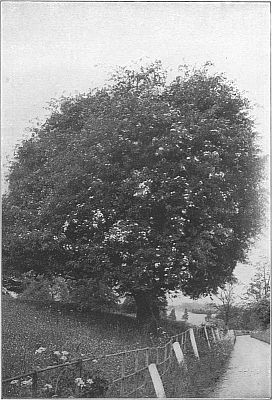 Pl. 120.
Hawthorn—summer.
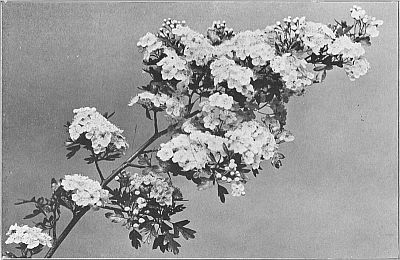 Pl. 121.
Flowers of Hawthorn—"May."
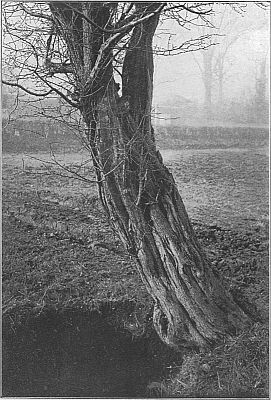 Pl. 122.
Bole of Hawthorn.
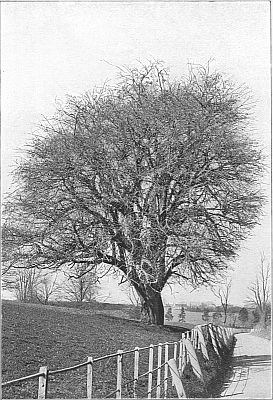 Pl. 123.
Hawthorn—winter.
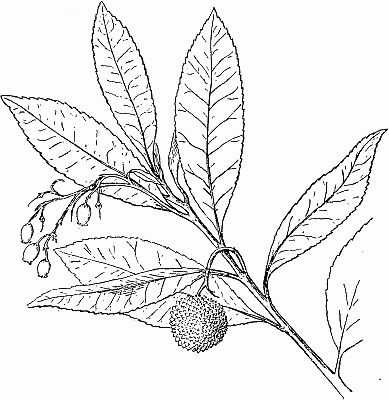 Strawberry-tree.
Not in the woods or by waysides in Great Britain will the
Strawberry-tree be found, though it may be seen in parks
and gardens; but in parts of the Emerald Isle it is native.
Killarney, Muckross, and Bantry are given by Hooker as its
Irish stations, but we have also found it in the woods at
Woodstock, Co. Kilkenny, in a situation where it seemed
unlikely such a tree would be planted. It does not attain a
large size—ordinarily about ten or twelve feet—though in
cultivation it may attain to twenty or even thirty feet. The
bark is rough and scaly, tinged with red, and twisted. The
leathery leaves are more or less oval, two or three inches
long, with toothed edges and hairy stalks. Although arranged
alternately on the shoots, they present the appearance at a
little distance of being clustered, rosette fashion, at the tips
of the twigs. The creamy-white flowers are clustered in
drooping racemes at the ends of the twigs, and are about
one-third of an inch across, bell-shaped. When the seed-eggs
have been fertilized the corollas drop off, so that in the
flowering season (September and October) the ground beneath
will usually be found strewn with them. The fruit is a round
berry, of an orange-red hue, whose surface is completely
studded with little points. As these berries do not come to
maturity until about fourteen months after the flowers have
dropped their corollas, we may see both flowers and almost
full-formed fruit on the tree at the same time. They are
not eatable until quite ripe, and even then they are not to
everybody's taste, on account of their austerity. In truth,
we have it on the testimony of Pliny that the old Latin
name unedo, now enshrined in the specific scientific name, was
given to it because to eat one of these tree strawberries
was a sufficiently extensive acquaintance for most persons.
It is perhaps unnecessary to add that, in spite of the
name, there is no relationship existing between this tree and
the Strawberry; nor is there more than a faint superficial
resemblance between the fruits of the two plants. The
Strawberry belongs to the great Rose family, whilst the nearest
British connections of the Arbutus are the Bilberries and
Heaths.
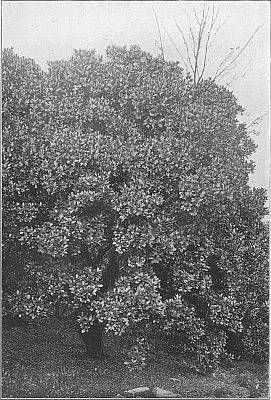 Pl. 124.
Strawberry Tree.
Among the constituents of the broad hedgerow, and the
copse that borders many a country road, the Dogwood or Cornel
is apt to be overlooked as Privet, to which its similar, opposite
leaves and clusters of small white flowers bear a superficial
resemblance. It has a great variety of local names, though
it must be admitted that many of these show close connections
one with another. This, however, makes them not less interesting,
but indicates how ancient and general is the underlying
idea which has given rise to them. Dogwood had originally no
connection with dogs, but was the wood of which dags, goads,
and skewers were made, because, as the Latin Cornus signifies,
it was of horny hardness and toughness. When the etymology
got changed by the substitution of "o" for "a" in dag, it was
also called Dog-tree, Dog-berry, Dog-timber, and Houndberry-tree,
and to explain the name it was said that the bark made an
excellent wash for mangy dogs. Gatter, Gatten, Gaiter, Gaitre-berry,
are all from the Anglo-Saxon Gad-treow, or goad-tree;
Gadrise means Goad-shrub (Gad-riis), and Gatteridge is gaitre
rouge, from the red colour of the bare twigs.
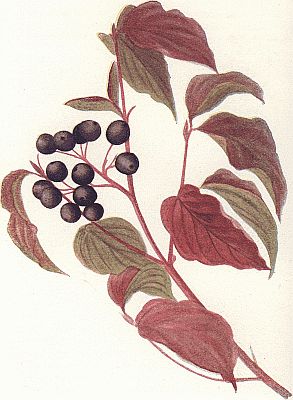 Pl. 125.
Fruits of Dogwood.
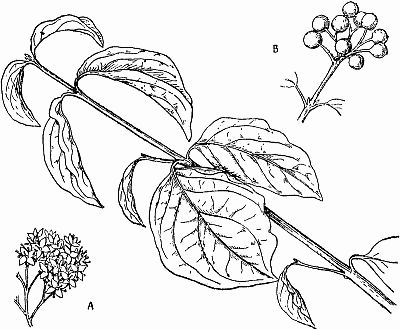 Dogwood, or Cornel.
A, flowers; B, berries.
But we must not overlook the shrub itself whilst considering
its wealth of names. It grows to a height of six or eight feet,
and is clothed with opposite oval leaves, which are smooth on
both surfaces. The honeyed flowers are produced in June or
July at the extremities of the branches in dense round cymes.
Individually they are small (one-third of an inch across), opaque
white, with four petals and four stamens, which mature concurrently
with the stigma. They give out an unpleasant
odour, which appears to render them more attractive to flies and
small beetles. The flowers are succeeded by small green berries,
which turn purple-black about September, and are exceedingly
bitter. They are said to yield an oil which is used in France
for soap-making, and has been here burned in lamps.
The Dogwood is widely distributed over Britain as far north
as Westmoreland. It does not occur in Scotland, and is rare
in Ireland. It would seem as though its place in North Britain
was taken by a herbaceous species, the Dwarf Cornel (Cornus
suecica), which grows upon Alpine moorlands from Yorkshire
as far north as Sutherlandshire. The stems of this, which have
as many inches to their stature as the shrub has feet, die down
annually. Its minute flowers are purplish instead of white, and
its smaller berries red.
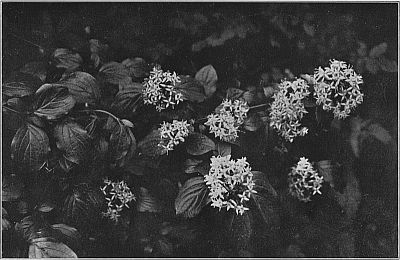 Pl. 126.
Flowers of Dogwood.
The Wayfaring-tree has a number of names by which it is
known locally, but the one we have used is generally known,
though it may have the disadvantage of being a comparatively
modern one whose parentage is known to us. The origin of
most of these popular names is lost in the mists of antiquity.
John Gerarde, whose "Herbal" was published in 1597, noting
its fondness for roadside hedges and thickets, called it Wayfaring-tree,
or Wayfaringman's-tree. Thereupon Parkinson,
nearly half a century later, remarks: "Gerard calleth it in
English the Wayfaring tree, but I know no travailer doth take
either pleasure or profit by it more than by any other hedge
trees." Our own experience serves to prove that Wayfarers, as
a class, have improved since Parkinson's day, for we have
frequently been questioned in the Surrey chalk-districts, at
various seasons, respecting the bold plant; in winter showing
its large naked buds, all rough with starry hairs, which keep
off frost, as well as do the many scales and thick varnish of
Horse-chestnut buds; in summer the broad, hairy leaves, looking
as dusty as a miller's coat, whilst above them spread the slightly
rounded heads of white flowers; later, when the flowers are
succeeded by bunches of glowing coral beads, that in autumn
become beads of jet. It is not confined to the chalk-hills, but
as far north as Yorkshire may be looked for wherever the soil is
dry, though it finds this condition best on the chalk, and is
there especially abundant. It is not indigenous in either Scotland
or Ireland.
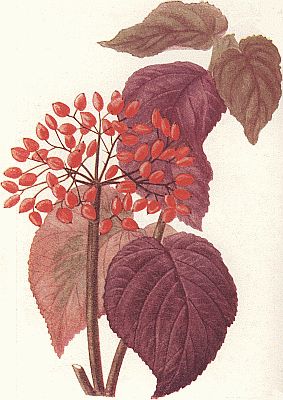 Pl. 127.
Fruits of Wayfaring-tree.
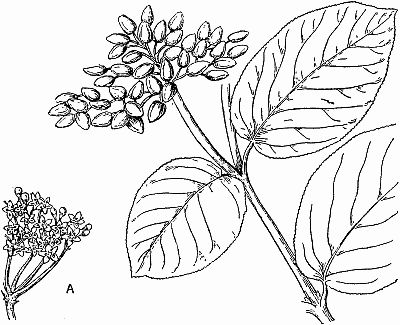 Wayfaring-tree.
A, portion of flower-cluster.
Though it grows to a height of twenty feet in places, it can
never properly be called a tree. Its downy stems are never
very stout. They branch a good deal, and it should be noted
that the branches are always given off in pairs, a branch from
each side of the stem at exactly the same height; the leaves are
produced in the same order. These leaves, which are three or
four inches in length, are much wrinkled, heart-shaped, with a
blunt, small end, white beneath, and the edges very finely toothed.
The flower-cluster is a cyme, and it should be noted that all the
white flowers comprised in it are of the same size and form, the
corollas being funnel-shaped, with five lobes, and the five stamens
are extruded from the mouth. The flowers, which are jointed
to the stalks, are out in May and June, and the flattened oval
fruits that follow are, as already stated, at first red, then black.
The local names for this shrub include Mealy-tree, Whipcrop,
Cotton-tree, Cottoner, Coventree, Lithe-wort, Lithy-tree, Twist-wood,
White-wood. Mealy-tree, Cotton-tree, Cottoner, and
White-wood all have obvious reference to the appearance of the
young shoots and leaves, due to the presence of the white hairs
with which they are covered. Lithe-wort and Lithy-tree, also
Twist-wood and Whipcrop, indicate the supple and elastic
character of the branches, which are often used instead of Withy
to bind up a bundle of sticks or vegetables, or to make a hoop
for a gate-fastener. In Germany the shoots, when only a year
old, are used in basket-weaving, and, when a year or two older,
serve for pipe-stems.
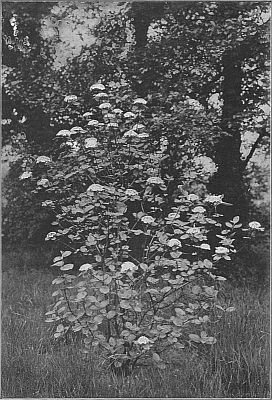 Pl. 128.
Wayfaring Tree.
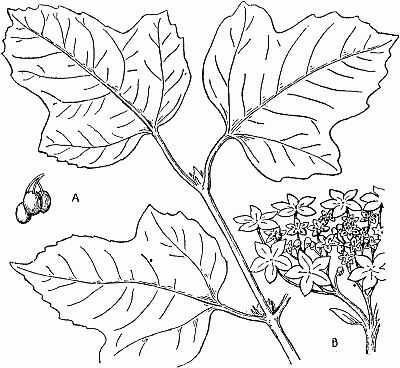 Guelder Rose.
A, fruit; B, flowers.
Although the Guelder Rose and the Wayfaring-tree are very
closely related, the differences between them are so great that
there is little danger of any person with ordinary powers of
observation confusing them. The Guelder Rose does not grow
so tall as its congener, twelve feet being about the extreme
height to which it attains in a wild state, and ordinarily it is
several feet less. It is not so fond of dry soils, and is more
frequently found in the copse, where it is not subject to the
extremes of heat and cold that have produced the hairy covering
of V. lantana. The stems and branches are quite smooth,
and the leaf-buds are wrapped in scales. The young leaves,
it is true, when they break from the bud, are covered with
down, but they throw this off as they expand to their full
size, and become smooth on either side. Instead of the leaf
being heart-shaped, it is divided into three deeply toothed
lobes, and it will be noted that at the base of the leaf-stalk
there is a pair of slender stipules, which lantana never has.
The cyme or flower-head is more rounded, and whilst the
mass of flowers are of the same size (a quarter of an inch)
as those of the Wayfaring-tree, those in the outer row are
three times the size—but they are entirely without stamens
or pistil! It would appear that in order to make the flower-cluster
more conspicuous, and thus attract insects, the material
that should have gone to furnish these organs has been used up
in the broader and whiter corolla. The inner and perfect flowers
are creamy-white, bell-shaped, and they secrete honey. Both
stamens and stigma mature simultaneously. The fruits are
almost round, and of a clear, translucent red. Respecting these
fruits, we cannot forbear from quoting a remark of Hamerton's.
He says, writing as the French recorder of the Sylvan Year:
"For any one who enjoys the sight of red berries in the most
jewel-like splendour, there is nothing in winter like the Viburnum,
the species we call Viorne obier, and if you meet with a fine
specimen just when it is caught by the level rays of a crimson
sunset, you will behold a shrub that seems to have come from
that garden of Aladdin where the fruit of the trees were jewels."
These fruits, though enticing to the sight, and juicy, are nauseous
to the taste.
The name Guelder Rose is a strange case of transference
from a cultivated to a wild plant: the var. sterilis, in which all
the flowers are like the outer row in the normal cluster, was first
cultivated in Gelderland; so Gerarde tells us that "it is called
in Dutch, Gheldersche Roose; in English, Gelder's Rose." In
the Cotswolds it is known as King's Crown, from the "King of
the May" having been crowned with a chaplet of it. Another
name for it is Water Elder, presumably given on account of
the similar appearance of the flower-clusters in Viburnum and
Sambucus.
The distribution of the Guelder Rose as a wild plant extends
northwards to Caithness, although it is rare in Scotland. It
occurs throughout Ireland.
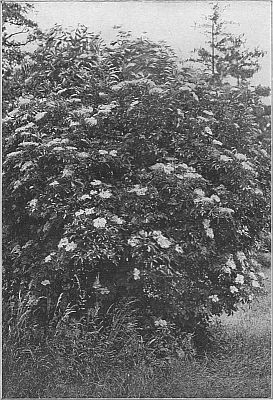 Pl. 129.
Elder.
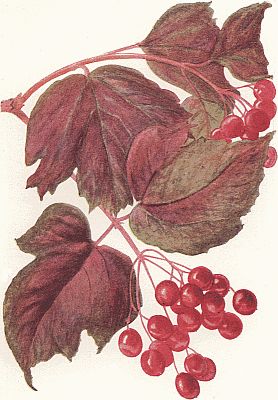 Pl. 130.
Fruits of Guelder Rose.
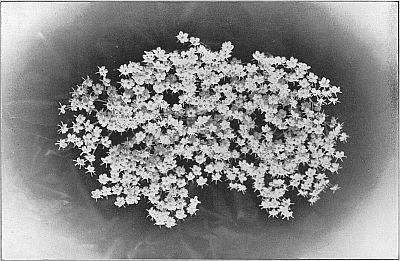 Pl. 131.
Flowers of Elder.
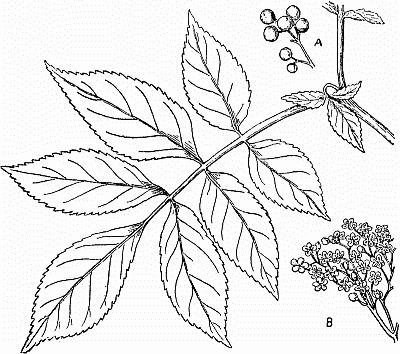 Elder.
A, berries; B, portion of flower-cluster.
The Elder is more a tree of the wayside than of the woodland,
often of low bushy growth; but where it finds good loamy soil
with abundant moisture it attains a height of twenty feet. None
of our trees grows more rapidly in its earliest years, and any bit
of its living wood will readily take root, so that its presence in
the hedge is often due to planting for the purpose of rapidly
erecting a live screen. Its quickly grown juicy shoots soon
harden into a tube of tough wood with a core of pith which is
readily extracted, and renders the tube available for a peashooter,
a pop-gun, or a music-pipe. Such uses have been
known from remote antiquity—probably one might say from the
beginnings of the human race. The ancient Greeks called it
Sambúke, from its wood having been used in the making of
musical instruments. In the north of Britain it is known as
Bourtree, Bore-tree, or Bottery, from the ease with which this
clearing out of the pith is effected, and it is pretty clear that the
more general name of Elder also has relation to the tubular
shoots. Piers Plowman calls the tree Eller, a name that survives
in Kent, Sussex, Lincoln, East Yorks, and Cheshire. This word,
according to Prior, is derived from the Anglo-Saxon eller and
ellarn, and seems to mean "kindler"—"a name which we may
suppose that it acquired from its hollow branches being used,
like the bamboo in the tropics, to blow up a fire." It is thus
probable that the housewife got her bellows, the musician his
pipe, and the schoolboy his pop-gun, all from the same source.
The stems are coated with a grey corky bark, and the
younger divisions of the branches show an angular section when
cut. When old, the wood becomes hard and heavy, and has
been used as a substitute for Box. The leaf is divided into five,
seven, or nine oval leaflets with toothed edges. The flower is of
the form that botanists describe as rotate, that is, the corolla
forms a very short tube, from the mouth of which five petal-like
lobes spread flat. This is a quarter of an inch broad, and
creamy-white in colour, giving out an odour which some persons
like, but which the writer considers offensive. Large numbers
of these small flowers are gathered into flat-topped cymes, five
or six inches in diameter. The primary stalks of these cymes
are five in number. The flowers are succeeded by small globular
berries, ultimately of a purple-black hue, and of mawkish flavour,
which are yet much sought after by country people for the making
of Elderberry wine, which they credit with marvellous medicinal
powers. In truth, the Elder still retains among rustic folk much
of the reputation it had when John Evelyn praised it so highly
in his "Sylva," where he says, "If the medicinal properties of
the leaves, bark, berries, etc., were thoroughly known, I cannot
tell what our countryman could ail for which he might not fetch
a remedy from every hedge, either for sickness or wound."
Occasionally one may find in the hedgerow an Elder with its
leaflets deeply cut into very slender lobes, so that the leaf has
resemblance to that of Fool's Parsley. This is an escape from
cultivation—a garden variety (laciniata) known as the Cut-leaved
or Parsley-leaved Elder.
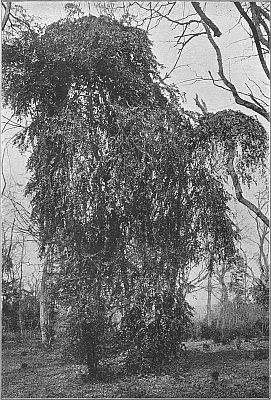 Pl. 132.
Box Trees.
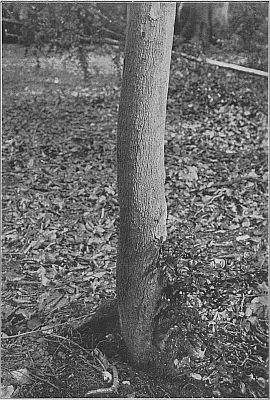 Pl. 133.
Bole of Box.
Though frequently to be met with in parks and ornamental
grounds, there are only a few places in this country where the
Box is really indigenous. These are in the counties of Surrey,
Kent, Buckingham, and Gloucester. On the famous Box Hill,
near Dorking, in Surrey, it may be seen attaining its proper
proportions as a small tree, and in sufficient abundance to form
groves covering a considerable area. It grows to a height of
fifteen or twenty feet, with a girth of about twenty inches. Its
slender branches are clothed with small, oblong, leathery leaves,
which give out a peculiar and distinctive odour. They are about
an inch in length, polished on the upper side, evergreen, and
opposite.
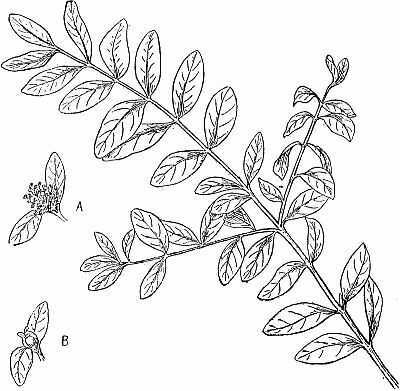 Box.
Box.
A, male flowers; B, female flower.
The flowers may be looked for from January to May, and
will be found clustered between the leaf and the stem. These
are quite small and inconspicuous, of a whitish-green colour,
and the sexes are in separate flowers. The uppermost one in
the centre of each cluster is a female flower; the others are
males. The males consist of four petals, enclosing a rudimentary
ovary, from beneath which spring four stamens. The
sepals of the female flower vary in number, from four to twelve,
and enclose a rounded ovary with three styles, which are ripe
and protruded before the males open. This develops into the
three-celled capsule with three diverging beaks, which correspond
with the styles, and in each cell there are one or two black
seeds.
The growth of the tree is very slow, and, in consequence, the
grain of its wood is very fine. It is also very hard, and so
heavy that alone among native woods it will not float in water.
On account of its fine grain and hardness, it is in request by the
turner and mathematical instrument maker, and was formerly
largely used by the wood-engraver for "woodcuts." Since the
introduction of the photographic "process" blocks, the industry
of preparing Box-wood for the engraver must have become all
but extinct, and for that reason Box plantations must be less
valuable assets than formerly. It is on record that when the
Box Hill trees were cut in 1815, the "fall" realized nearly
£10,000. Box Hill is in no sense a plantation; its slopes and
summit are clothed with a natural mixed wood of Box, Oak,
Beech, and Yew. Beneath every Box-tree will be found
hundreds of seedlings of various ages. Some of these may be
seen in our photograph, which depicts naturally grown Box-trees
on the famous hill. It will be noted that their "habit" is
widely different from that of the more bush-like forms so
familiar in gardens.


