It is one of the laments of ethnology that the smaller tribes of the
northern coast of New England faded from the scene of history
before we were able to grasp the content of their languages and
culture. At this late day practically all have dwindled below the
power of retaining the memory of their own institutions—their link
with the past. Nevertheless, some few groups along the coast have
maintained existence in one form or another down to the present.
In regions somewhat more remote, the tribes of the Wabanaki group,
hovering within the shelter of the northeastern wilderness, successfully
struggled through the trials of the transition period, preserved
their oral inheritance, and even, to a considerable degree, the
practices of their early culture. Here on native soil still dwell
the Penobscot and Passamaquoddy. On the western and southern
boundaries of Maine the Wabanaki bands escaped extinction only
by fleeing to Canada, where their descendants now live at the
village of St. Francis. Of the tribal names included in this group,
however, one in particular, the Wawenock, has long been reckoned
among the obsolete, though several times the suggestion had
appeared in print that the Indians residing at Becancour, Province
of Quebec, might be its survivors. In 1912 my interest in possibilities
of the sort culminated in the intention to follow up this
source myself. The results were extremely gratifying, for during
the winter’s visit traces were uncovered of those eternal values of
native language and tradition, which happily were still preserved
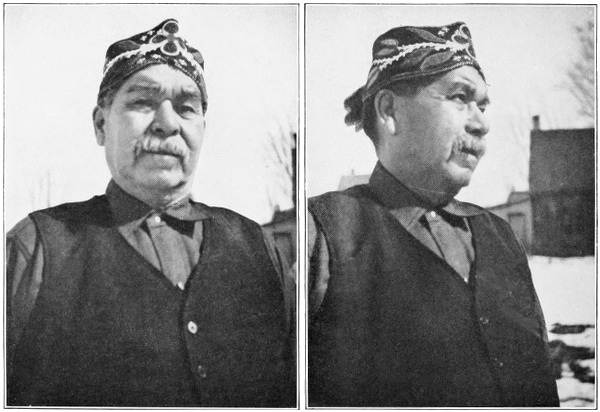
in the memory of François Neptune (pl. 13), one of the Wawenock
men. My object in the following pages is to present part of the
literary material obtained from him, to which I have prefixed a
sketch of the tribe’s history.
The proper name of the tribe is, however, Wali·na´kiak, “People of
the Bay country.”1 The term is current among the Wawenock survivors
of to-day, as well as among their neighbors and former allies,
the affiliated tribes originally from southern Maine, which now
constitute the St. Francis Abenaki.
Notwithstanding the fact that we have nowhere any definite
information on the exact boundaries of the Wawenock in their old
home, it is evident from Penobscot sources that the Wawenock territory
began where the Penobscot family claims2 ended, a short
distance west of the waters of Penobscot Bay. This would give the
Wawenock the environs of St. George’s Harbor and River, and all
the intervening coast as far as the mouth of Kennebec River, since
the latter is mentioned as their western boundary. A difficulty confronts
us, however, when we try to determine how far northward into
the interior the Wawenock claims extended. From geographical
considerations, since the region which is typical of the coast extends
inland about 30 or 40 miles, we might infer that the hunting grounds
of the tribe extended at least as far. The additional fact that the
Penobscot territory spread out westward as we go toward the interior,
and that they knew the Norridgewock and Aroosaguntacook as their
immediate western neighbors, would then leave the general tract
from the headwaters of St. Georges, Medomac, Damariscotta and
Sheepscot Rivers and Togus Stream, all east of the Kennebec River,
and southward to the coast, to be regarded as Wawenock territory.
The Wawenock have been already definitely assigned to the Sheepscot
and Pemaquid,3 which would seem to have been at about the
center of their habitat. That their territory was also known as
Sagadahock (Sαŋkəde´łαk, Penobscot) is shown by a statement giving
different local names to parts of the Kennebec River—names which
corresponded more or less to the names of local bands—as follows:
“Aransoak, Orantsoak,4 Kennebec River from the lake (Moosehead
Lake) to Norridgewock. Below Skowhegan it was called Canebas or
Kenebas5 to Merrymeeting Bay, thence to the sea, Sagadahock.”6
Bearing upon this is the fact that part of the St. Francis band
residing near Durham, Province of Quebec, until recently preserved
the local name kwən·a·´mwiak, “long point people.” This has been
thought to be possibly connected with the term just given. Joseph
Laurent7 assigns the same name (Kwanahômoik) to Durham and
gives the meaning “where the turn of the river makes a long point.”
It is evidently, however, a later name acquired by these St. Francis
families after they had settled at Durham.
In ancient times the tribes on the coast of Maine extended into the
interior, but were more or less locally identified with the mouths of the
rivers and the large bays. The Wawenock were then located southwest
of the Penobscot, whose proper territory on the coast only surrounded
Penobscot Bay. According to tradition among the Penobscot,
their nearest relatives, the Wawenock, as we shall henceforth call them
on preferred authority,8 are definitely remembered as Wα̨li·´naki·ak,
“People of the bay country,” because they were located on the shores
and in the country back of what is now known as Sagadahoc.
This country lies southwest of Penobscot Bay and includes a number
of smaller bays from St. George’s Bay, in Knox County, westward
to the mouth of the Kennebec River, embracing Lincoln and part of
Sagadahoc Counties. The Penobscot also refer to the inhabitants
of this region as Sα̨ŋkədeła´wiak, “People of the mouth of the river”
(Sagadahoc), the term being evidently another name for the Wawenock.
At the present time, not having held any contact with the
Wawenock since their removal to Canada early in the eighteenth
century, they know the tribe only by name. There is some evidence,
however, in one of the family names, Neptune, which occurs among
both the Penobscot and Wawenock, that during this period some of
the latter may have joined the Penobscot or vice versa.
From these sources we can derive a fairly definite idea of the
Wawenock habitat and also two of the tribal synonyms.9 Sagadahoc
seems to have been a commonly used designation for both the
country and people.
In the matter of the first European contact with the tribe it is
probable that Captain Waymouth in 1609, when he encountered
the Indians while riding at anchor off the coast of Maine, in what
is now thought to be George’s Harbor, encountered men of the
Wawenock. The chances are, however, about even that they were
Wawenock or Penobscot. We may assume in either case, nevertheless,
that some of the descriptions, which the scribe of the expedition,
James Rosier, left us, refer to the Wawenock, because subsequently
during his sojourn in the neighborhood he met a great many natives,
concerning some of whom he has given considerable information.10
Subsequent historical literature contains nothing, so far as I could
find, until about a century later when the Wabanaki tribes of Maine
had become hostile to the English colonists in Massachusetts. Father
Rasles, the Jesuit missionary who took charge of a mission in 1690,
founded at Norridgewock several years before, mentions the tribe as
the Warinakiens.11 An estimate for this year states that the Sheepscot
(a local name for the Wawenock) had 150 men and the Pemaquid
100.12 The Wawenock were one of the tribes to be represented in
the mission at Norridgewock, which was some 50 miles from the
heart of their country.13 During this period the Wawenock appear
to have gradually drifted northward toward the interior, probably in
order to associate more closely with the Christian proselytes of the
Norridgewock and Aroosaguntacook.14
Mention is made of a withdrawal of some of the Indians in 1713 to
Becancour, Province of Quebec, which probably refers to the Wawenock.15
Another notice, dated 1717, gives under the name of Wawenock,
a total of 15 men; the same source stating that in 1726 those at
“Sheepcut” numbered 3 and at “Pemaquid” 10.16
As regards the mission at Norridgewock, Father Rasles was
accused of attaching the tribes so warmly to the French cause that
they soon became regarded as dangerous enemies of the English
colonists. In 1724 an expedition was sent against the Norridgewock,
which resulted in the destruction of their village, the dispersion of the
tribe, and the death of Rasles.17
Much has been written, both by English and French historians,
showing that Father Rasles was murdered and mutilated by the
English in this unfortunate massacre,18 but another version of the
affair is related by the Wawenock informant. In this it is claimed
that Rasles secretly betrayed the mission to the English.19
After this unfortunate event the Wawenock who still dwelt there
moved from Norridgewock with their relatives, the Aroosaguntacook20
allies, who became known thereafter as the St. Francis Abenaki.
The Wawenock never became so thoroughly incorporated
with the St. Francis Indians as to lose their identity as did the other
bands from southern Maine. They did, however, share in the
general term Abenaki, and were designated in later accounts as the
Abenaki of Becancour.
According to their own traditions of the removal,21 the Wawenock
informant says, they reached the St. Lawrence River opposite the
mouth of St. Maurice River, having probably come down the St.
Francis River from the south. The place is known in Wawenock
as Noda´wαŋgαŋk, “Place of the dance.”22 The exiles, who were
of course obliged to recognize the territorial hunting rights of the
Algonquin proprietors,23 are said to have asked if they could hunt
with them. In response, it is claimed, the Algonquin gave the
Abenaki a concession extending 2 leagues above Three Rivers, down
to the St. Lawrence to the mouth of a river on the south side where
there is an island called Mαtasu̹´, a corruption of the name of the
Seigneur Montesson who held the title to it.24 There the Wawenock
separated from the Abenaki allies and located on what is now Becancour
River. Maurault25 says that in the move of 1679 the Sokoki
(Sako´ki·ak “Saco River people”) in part settled at Becancour.26
They evidently played a considerable part in the Indian wars that
devastated southern Maine at this time, and in 1726, when the first
serious attempt was made by the Massachusetts government to
secure peace, the Wawenock receive frequent mention in the records
of the proceedings. At the treaty of Falmouth, Casco Bay, in 1726,
before Gov. W. Dummer, of Massachusetts, “Wenemovet answered
that they had full power to act for them (the Norridgewock) and for
the Wewenocks and for the ‘Arresuguntenocks’ and (St.) François.”27
In speaking of Governor Dummer’s treaty, the “Norridgwocks,
St. François, and Wowenock Indians” are again mentioned as being
in Canada, whither the bulk of the allies must have moved by this
year (1726).28 Also Loron,29 a Penobscot chief, explained to the
Governor how he was entitled to make peace for the “Norrigwock,
St. François, and Wowenocks,” who were not present at the treaty,
by reason of having received a wampum belt from them empowering
the Penobscot to speak in their behalf.30 Loron also said that the
Norridgewock Indians were scattered among the “Arresaguntecook”
Wewonock or St. François tribes.31 It is interesting to observe the
names of some of the native treaty delegates in these accounts
because some of them have survived in the tribe until the present day,
as we shall see later. They also have some ethnological value. It
seems that, owing to the absence of some of the tribes from the occasion
of the first treaty in 1726, it became necessary to hold another
the following year to ratify it. Accordingly in the conference of
that year (1727) held again at Falmouth, the following sachems subscribed
to the ratification of the treaty made through the Penobscot
in the year preceding. “Toxeus,32 Sagamore of Nerridgawock,
Ausummowett,33 Sagamore of Arresaguntacook, Woosszurraboonet,34
Sagamore of Wowenock” are mentioned.35 Later again we learn of
“Memmadgeen and Woosszaurraboonet, Captains and Councillors,
two of the chiefs of the Wowenock Tribe and delegated by them,
accompanied by Auwemmonett, the chief sachem’s son, Wenerramett,
Paterramett,36 Saawerramet, Quinoise,37 chiefs and others of the said
tribe of Wowenock.” The conference was attended by “40 Nerridgawocks
and 15 Wawenocks.”38 The fact that these tribal groups were
fairly independent politically is shown by th”eir desire to have “separate
seals of the treaty,” one for each tribe. Some more Wawenock
personal names were given by Quinoise, one of the above-mentioned
delegates, when he enumerated Indians whom he knew held
some English captives. They were Wauhaway, Acteon, Omborowess,
Maneerhowhaw, Pier, Sungehaugundo, some of whom were
St. François, some Wawenocks and some Scattacooks (from Connecticut).39
But the peace did not last long and war again broke out between
the English and Wabanaki tribes. Another treaty was consummated
at Falmouth in 1749. In this compact, which finally brought an end
to the Indian troubles in southern Maine, the “Arresuguntoocooks
and Weweenocks” were represented by “Sawwaramet, Aussaado,
Waannunga, Sauquish, Wareedeon, Wawawnunka.”40 From this
time on the Abenaki relinquished their attempts to retain their claims
in Maine and retired to Canada, where the Wawenock came into possession
of land at Becancour on Becancour River, while the Norridgewock
and Aroosaguntacook, together with survivors of the other
smaller tribes, settled permanently about 30 miles away at St.
Francis, on St. Francis River. Maurault in 186641 asserted that
only 10 families remained at Becancour, though they were of purer
blood than the Abenaki at St. Francis. He says that in 1708 the
Indians at Becancour numbered 500, having come from Lake
Megantic, with others from the Androscoggin and Chaudiere Rivers.
The number probably included Sokoki who had joined them in 1679
(see p. 173).
Although the Indians forming the St. Francis village and the
Wawenock had many interests in common they remained independent
of each other, not only in dialect but in political respects, in
having their own reservations, chiefs, and administration, both religious
and civil. The same conditions hold to-day. At St. Francis
the Wawenock from Becancour are regarded as friendly strangers.
This brings us down to recent times. Politically the Wawenock
have now about lost their name, being known in occasional reports
as the Abenaki of Becancour. In 1910 they numbered 26,42 including
absentees, upon their reservation of 135⅔ acres. Most of them
have scattered, some having gone to the French towns, while I
encountered several families who have migrated to Lake St. John
and live with the Montagnais as hunters and trappers.43
The following are the family names of the tribe. Some are still
in existence (marked *); others have recently become extinct.
| Pabi·welə mα´t |
“He is thought small.” The family name
of the grandmother of François Neptune,
our informant. This name may be the
original of “Paterramett” mentioned
in the treaty of 1727 (cf. p. 174). |
| *Metsałabα̨lα´t |
“Lost his Breath” (?) This name is undoubtedly
the original of “Wooszurraboonet” of 1727
(cf. p. 174). |
| Sogαla´n |
“It rains.” |
| Sezawegwu´n |
“Feather in the hair.” |
| Mekwas·α´k |
“Red stain.” |
| Abələwe´s· |
French “Ambroise.” The same as “Omborowess” in 1727 (cf. p. 175). |
| *Obä̦´ |
French, (St.) Urbain. |
| *Neptα´n |
Neptune, doubtful origin. This is also a Penobscot family name. |
| *Nicola´ |
Nicholas, also a Penobscot family name. |
So far as can be said at present the material culture of the Wawenock
was practically identical with that of the Penobscot and St.
Francis Abenaki. Not much of this is preserved by the survivors at
the present day. The tribe, however, still keeps its organization
under a chief. In the traditions of the Wabanaki Confederacy, as
far as we know them, the Wawenock are not mentioned, though they
had been represented in the alliance at an earlier time.
As for social organization no knowledge is preserved of the family
hunting territories, for it seems that at Becancour hunting has not
been a practicable occupation for several generations. Neither
dances nor ceremonies have been performed within the memory of
the old people, so we only have the names of several dances which
are remembered through tradition. The term alnαk`hadi´·n denotes
the common dance (Penobscot alnαba´gan) performed as a part of the
marriage ceremony which, like that of the Penobscot, is proposed by
means of wampum. Several strings of wampum, which were given
to the parents of his grandmother by her husband when he proposed
marriage, were fortunately obtained from François Neptune. Nawadəwe´·,
“song and dance” (Penobscot, Nawa´dəwe), was a war dance
in which the men carried tomahawks, and skogogwəga´n, “snake
dance,” was similar to the Penobscot ma`tagi´posi·, “moving in a
serpentine manner.”
In the field of folk lore, medicinal lore and shamanism much still
remains to be done with the informant. The culture hero and
transformer Gluskα̨be´, “the Deceiver,” is the same as that of the
Penobscot, and shares generally the same characteristics. A comparative
study of the transformer (Gluskap) cycle in Wabanaki
mythology is being prepared by the writer, so it does not seem
essential to refer just now to cognate elements in the mythology of the
other tribes of the group.
Within the last generation the Wawenock dialect has gone completely
out of use. Most of the survivors are half-breeds and speak
French. The only person I found who knows the dialect is François
Neptune, supposedly a full blood, in his sixties (1914), the oldest
man at Becancour, whose acquaintance I had the good fortune to
make in 1914 during a trip of reconnaissance among the Abenaki in
company with Mr. Henry Masta of this tribe.44 Neptune’s interest
in his dialect, which he knew to be on the verge of extinction, made
work with him quite easy, although the state of his health prevented
our doing more at the time. The following few myths in text will,
I think, enable us to form some idea of its intermediate position
between Penobscot and St. Francis Abenaki when more of the texts
already collected in both of these dialects are published.45 It seems
hardly necessary to remark that, in the scanty material on this region
so far available in print, there exists absolutely nothing in the Wawenock
dialect.