Editorials BY THOMAS E. WATSON — Sam Spencer — The Ungrateful Negro — An Indignant Wisconsin Editor — The Man and the Land — Random Comment
Not long ago the Voting Trustees
of the Southern Railway Company
wrote to Samuel Spencer,
President of that robber combine, in
the following terms:
“We congratulate you upon the success
achieved in the extension and operation
of the property which have resulted
in nearly doubling the extent of its lines,
trebling its gross earnings, and increasing
its net earnings above fixed charges,
over five hundred and twenty-five per cent.
in the period of eleven years which have
elapsed since its formation.”
Bully for Sam!
He set out to please the men who
bought him, and he has done it.
The Wall Street rascals who grabbed
up the railroads in the Southern States
knew very well that they themselves
could not do the work which was required
for the success of their schemes.
The Belmonts and the Morgans could
not in person approach the editors,
the politicians, the legislators and the
federal judges.
Strategy requires that local men be
used in the looting of any given state or
section. One traitor inside the citadel
is worth ten thousand soldiers on the
outside, when the object is to take the
citadel. To bribe somebody from within
to open the gates is far more effective,
vastly more to be desired, than to attempt
to breach the walls or batter
down the gates.
Consequently when Western states
are to be plundered, the Wall Street
corporations use Western men as their
tools. Local Western corruptionists sell
out to Wall Street, and do in Western
states the dirty work of their Wall
Street masters.
So in the South, the Wall Street
robber-gangs do not operate in person;
they act through Southern agents.
In pursuance of this subtle policy,
the Wall Street corporations, who gobbled
up the various lines which now
compose the Southern Railway System,
put at the head of it a Southern man,
a Georgian, of the name of Samuel
Spencer.
They chose wisely. They generally
choose wisely. The expert workman
does not better know how to select his
tools than such men as Belmont, Morgan,
Ryan, Rogers and Rockefeller
know how to pick out the men who can
do what Wall Street expects.
The Wall Street rascals had faith in
Sam Spencer, and Sam has justified
that confidence.
Never did any robber-chief have an
abler lieutenant than Belmont, the
Rothschild agent, has had in Sam.
The task to which they set him was
hard. It demanded that he freeze his
heart and stifle his conscience. It demanded
that he shut out from his view
of life every other purpose whatsoever,
save the heaping up of dividends for a
ravenous gang of Wall Street rascals.
To make his work seem good in the
sight of the men who had bought him
it was necessary that he combine railroads
which the law said should not be
combined, that he destroy competition
where the law said
it should live, that
he charge excessive
rates to shippers
and passengers when
the law said the
rates should be reasonable.
He has done this
in spite of the law,
in spite of the people.
How?
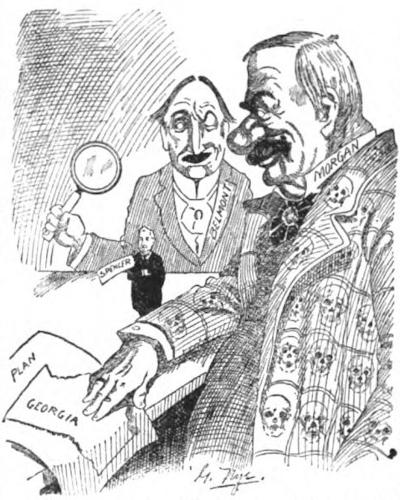
“One traitor inside the citadel is worth
ten thousand soldiers on the outside.”
Editors have been
bribed into collusion
or silence; politicians
have been softened
with boodle;
lobbyists have been
kept in clover; legislators
have been
duped or corrupted.
Railroad Commissions
have been seduced
or defied, federal judges have
been mellowed with favors, blandishments,
indirect temptings which poor
human nature can seldom resist.
Bully for Sam!
He is victorious all along the line.
From Washington City he rules the
South. In his native State of Georgia
he is monarch of all he surveys. He
made Terrell governor, and he means
to make Howell governor. He controlled
nearly all the daily papers, but
he wanted another—so he had Jim
English to cut the ground from under
the feet of John Temple Graves and
scoop the Atlanta News.
Hamp McWhorter is his hireling,
and Hamp keeps the mechanism of
corruption oiled. Hamp keeps the
Legislature in pliant mood. Hamp
jollies and greases the local politician.
Hamp peddles the free passes. Hamp
picks and chooses the “local attorneys.”
Hamp “sees” the editor who appears
to require “seeing.”
But the Brain and Will of the whole
plot are those of Sam Spencer.
For eleven years that God-given
brain and will have been concentrated
upon one purpose, only one—to
heap up riches for Wall Street rascals!
Great has been
the result. Sam
Spencer’s masters
are so highly pleased
with his work that
they congratulate
him!
How interesting!
It seems to me that
they are the fellows
to be congratulated.
Sam has doubled the
amount of their property,
he has trebled
the gross income
from that property,
and has increased
their net revenues
over 525 per cent!
Colossal profits
these. How were
they made?
By such a system
of dishonesty, extortion,
law-breaking, and reckless disregard
of human life as has rarely been
known, even in the history of modern
commercialism.
The merchants and farmers throughout
the Southern States have been
ruthlessly robbed. The melon growers,
the fruit men, the truck gardeners have,
in thousands of cases, been so hounded
and harried and victimized by excessive
charges, secret rebates and discriminations
in favor of other shippers, that
they have been literally driven out of
the field, broken and despairing.
Roadbeds, bridges, safety appliances,
have been so wantonly neglected that
almost every mile of the Southern Railway
System from Washington southward
has known its tragedy, where
men, women and children were dashed
to sudden, horrible death.
It was not the hard necessity of poverty
that drove Sam Spencer to a policy
so heartless as this. He had the means
wherewith to put his roads in first-class
order, had he wished to spend the funds
in that way. It was not necessary for
him to rob the men who were obliged
to patronize his roads. If a fair, legitimate
profit upon actual investment
was all that he sought, he could have
got it without doing the slightest injustice
to any human being.
But he wanted more than that. A
reasonable return upon the actual investment
was not enough. So, he neglected
the bridge until it fell, with its
sickening horror, its shrieking mass of
passengers doomed to frightful death.
He neglected the safety appliances, and
the full force of workmen, until some rotten
crosstie, or defective rail, or open
switch, or telegram which the dulled
brain of an overworked engineer failed
to comprehend, brought about derailments
and collisions, with the heartrending
consequence of crushed and
burning cars, of crushed and burning
men, women and children.
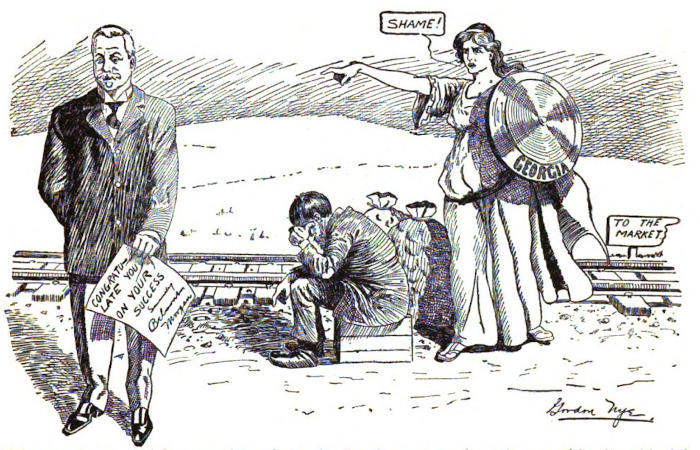
“The merchants and farmers throughout the Southern states have been ruthlessly robbed.”
Had the same proportion of the earnings
been used to improve the property,
as is the universal custom in Europe,
there would have been the same security
to the passenger that there is in
Europe.
But the net profit to Wall Street
would have been only a fair return upon
the money actually invested—as it is
in Europe.
Wall Street demands more than that.
Sam Spencer’s task was to get what
Wall Street wanted.
Have I not already said that Wall
Street knows how to pick out its man?
It never chose a better tool for its
purpose than Sam Spencer.
He has doubled the amount of their
property.
That is good.
But he has done better than that.
He has trebled the gross earnings.
And that is good, too.
But he has done still better than that.
He has increased the net earnings
more than five hundred and twenty-five
per cent!
Good, better, best.
That enormous profit had to be made
out of somebody.
Freight rates and passenger rates are
taxes which the transportation companies
levy upon freight and passengers.
When Sam Spencer added 525
per cent. to the net revenue of his masters,
he had to tax it out of the people
who patronized the Southern Railroad.
Who were these people? Mostly,
Southern people. The tax was levied
upon the South, and paid by the South.
Sam Spencer is a Southern man?
Bless you, yes!
Wall Street hired him to systematize
the robbery of his own people,
and he has done it.
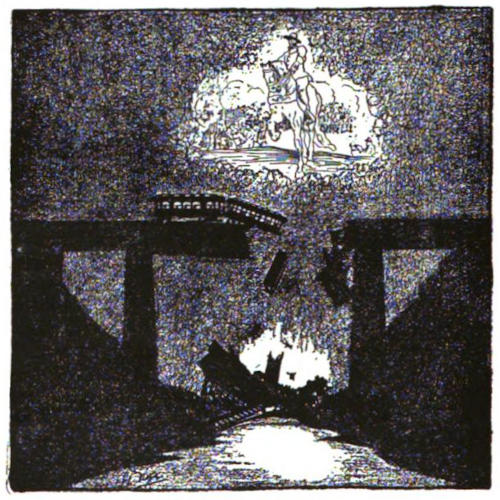
“We lost fewer lives to the invading host
of Sherman than we have lost to the railroads
under Sam Spencer.”
During the eleven years of his
rule he has plundered his own
people of more money than they
lost by Sherman’s “Marching through
Georgia.”
The people of the South have lost
more to the Wall Street railway corporations
than they lost to the whole
of Sherman’s army.
The battles of the Civil War were
bloody, for it was Greek meet Greek,
and it was, in truth, the tug of war.
Especially were the battles bloody
when Sherman came down against us,
for he brought Western troops—the
best that the Union had.
But we lost fewer lives to the invading
host of Sherman than we have lost
to the railroads during the eleven
years that Sam Spencer has been one
of their most relentless and unscrupulous
lieutenants.
He and his allies in plunder and
crime killed and wounded, last year,
the staggering total of 92,000 human
beings.
The ghastly record grows bloodier
every year.
Human life is nothing; dividends
are everything.
Five hundred and twenty-five per cent!
And Sam Spencer’s bosses pat him
on the back and congratulate him.
Ah, yes; they were feeling good.
They expanded. They bubbled over.
As who should say: “Sam, you are
a trump. When we bought you, we
believed we had bought a good thing;
now we know it. You have been tried,
and you have proven true. We set you
to the task of plundering your own people,
and you have not flinched from the
job. You have skinned them to the
queen’s taste. You have doubled our
estate, trebled the earnings, and so
squeezed the train-crews, the section
hands, the roadbed, the shipper and
the passenger, that you have swelled
our profits more than 525 per cent.
We congratulate you—and, we pocket
the money.”
From a Newspaper
THE AMERICAN FLAG INSULTED BY NEGRO BISHOP IN MACON.
DENOUNCED GLORIOUS EMBLEM AS A CONTEMPTIBLE RAG AT THE
STATE NEGRO CONVENTION.
Macon, Ga., Feb. 16.—In an address before the five hundred delegates attending
the convention of negroes in this city to discuss racial problems,
Bishop H. M. Turner declared the American Flag to be a dirty and contemptible
rag. He further said that hell was an improvement on the United
States when the negro was involved.
In closing he said:
“I have heard of both white and black men perpetrating rape upon innocent,
angelic women, but no negro in this country has been tried by the
courts and found guilty of the heinous crime of rape in fifteen years.
“I know that bloody-handed and drunken mobs have said so, but what
Christian people would accept what they say? Yet there are millions of
men who pretend to be moral and claim to be sensible in this country, who go
to these drunken mobs to get information relative to the conduct of colored men.”
How it came to pass is a question
which human wisdom may not solve,
but in the earliest dawn of history we
find the races of men separated by color
and by characteristics, very much as
they are at this time.
In spite of all the comings and goings,
the migrations and conquests, the discoveries
and colonizations, the world is
pretty nearly the same old world, so far
as the distinct races of men are concerned.
The Jew is still the Jew, the
Gentile still the Gentile. All the currents
of the ages have not washed the
yellow man white, nor turned the red
man yellow, nor the black man red.
The hot sun of the tropics pours down
upon the heads of the sons of men as
fervidly as in the days of Abraham,
Isaac and Jacob, but it has not been
able to kink the hair, flatten the nose,
blubber the lips or blacken the hide of a
single man, woman or child of the
Aryan race. The Chinaman, racially,
is what he was in the time of Confucius;
the Hindoo is yet the dark man whom
Khrishna sought to lead to the higher
life.
In Africa, the home of the negro,
there has been a monotonous repetition
of the same old facts which historians
learned from monumental inscriptions
and indestructible tablets thousands
upon thousands of years old.
The African negro has always been a
distinct type, an inferior type, a savage
type, a non-progressive type. Left to
himself, he wore no clothing, built no
houses, had no commerce, systematized
no production of any sort and
never had the faintest conception of
doing anything to improve himself or
his condition. He killed for the day
the game he needed for the day. For
the future, he made as little provision
as the Indian and the Esquimau.
Beyond the herding of cattle he had
no instinct for accumulation. His
normal state was that of warfare
against some other black tribe. His
religion was the grossest superstition.
He offered up to his heathen gods
the sacrifice of the negro child; and
when his appetite for four-legged animals
was sated, he changed his diet by
cooking and eating another negro.
Where the sexual relations of the
men and women were not promiscuous,
they were polygamous. Strictly speaking,
there was no such thing as morals
known among them. Property rights
which certain men had, or claimed, in
certain women might be respected, but
the conception of virtue was not reached.
They never evolved an alphabet.
They never advanced beyond the crudest,
rudest, most brutal tribe-life.
They had chiefs, or kings; and these
kings exercised, despotically, the power
of life and death over their ignorant
subjects.
They had conjurers and witch doctors,
and it was one of the time-honored
customs that the witch doctors should
“smell out,” for death, the wretched
creatures whom the king wanted to
kill, or whom the witch doctors themselves
wished to put out of the way.
Thousands upon thousands of years
ago, negro warriors sold their negro
captives into slavery. Negro husbands
would offer their wives and
daughters to foreign travelers. Negro
fathers would sell their children. In
some of the oldest monumental inscriptions
of the human race, the negro
appears as the chained slave of
foreign masters.
Anybody on
earth who wanted
to buy him could
do it. His king was
ready to sell him;
his father was ready
to sell him. The
Egyptian, the
Greek, the Roman
owned black slaves
as far back as the
records go; and the
historian Gibbon
did no more than
express the universal
experience and
opinion of the ages
when he wrote that
the negro was a
distinctly inferior
race.
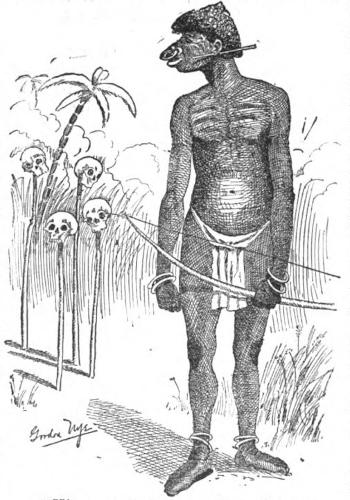
“His normal state was that of warfare
against some other black tribe.”
Of all the negroes
that have ever lived
Tchaka was the
greatest. He ruled
in Africa, in the
eighteenth century.
He was a man of immense natural
power. His ambition was boundless,
his soul untroubled by fear or scruple.
Absolute master of a strong tribe, he
hurled it against other tribes, one after
another, until he had conquered and
devastated an imperial territory. In
his march to dominion, it is estimated
that he caused the slaughter of a million
human beings, all of whom were
his brothers in black. But he never
built a city; never put a ship on the
sea; never made two blades of grass
grow where one had grown before. He
founded no institutions of any kind.
He was densely ignorant and superstitious
himself, and he had no conception
of anything higher or better.
To kill, to conquer, to feast, to indulge
bestial lust, to inspire terror, to
exploit and mercilessly abuse the abject
servility of the negroes over
whom he ruled were his “pleasures
of living.”
It was believed that he caused the
death of his own mother; it is known
that when he buried her he buried
fourteen young negro
girls with her—buried
them alive!
It is known that,
during the “period
of mourning”
which followed, he
caused the death of
some thousands of
maddened and
helpless negroes. It
is also known that
his sisters got his
brothers to assassinate
him. Then
one of these brothers
murdered the
other, and so became
king of that
happy land.
In Africa where
the negro is still to
be seen in his natural
state, you can
still buy negroes
from negroes. Husbands
will yet sell
wives, fathers will
yet barter daughters and sons. The
buying and selling of negroes goes on
now just as it did in the days of the
Pharaohs. There is not so much of
it as there used to be—to the regret,
doubtless, of African chiefs who have
negroes they would like to sell.
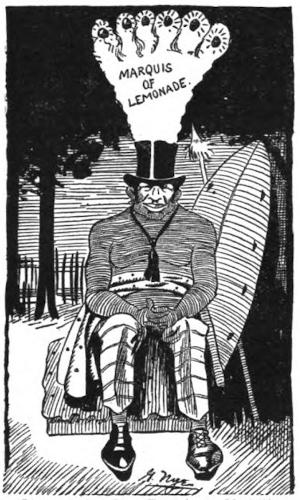
One of the San Domingo Nobility.
Not long ago there was a story
which went the
usual rounds. An
English traveler was
about to set out from
a certain coast town
of Africa upon a
journey into the interior.
He expected
to be gone for several
months. In fitting
himself out with
camp equipage, he
bought a negro girl
to carry along—to
serve as his mistress.
Her father sold her,
and the only surprise
that was caused by
the transaction was
the amount paid.
The Englishman gave
about one hundred
dollars for the girl
and it was generally
considered an extravagant
figure. As to
the girl, she seemed
proud to have been
selected, and gratified
at having been
sold so high. When the Englishman
had finished his trip, he probably sold
her at a discount to some other white
man who desired a complete camp outfit.
Excepting those portions of Africa
wherein the white man has set his foot
and impressed his will, the negro is at
this day the same lustful, brutal, besotted
cannibal and voodoo slave that
he was thousands of years ago.
In Jamaica, the white man has to
steer for him, and control him.
He did not even know what to do
with bananas till Col. Baker, a white
man, came along and taught him.
In Liberia, he has gone back to
heathenism and savagery, because the
white man’s strong hand is not there to
guide and control.
In San Domingo, he had—as a starting
point—one of the fairest civilizations
the world has known. Aided by
the yellow fever, the black man drove
out the white; and now he has gone
back into chaos,
voodooism, cannibalism
and imbecility.
In the United
States, negroes can
run a bank, for they
can see white men
running banks all
around them and
they are quick at
imitation.
How is it in San
Domingo, where the
black man rules the
white?
Apparently there
is not a bank in San
Domingo. If there is,
it cannot be trusted.
Why do I say this?
Because that portion
of the San Domingan
custom-house
receipts which was
to be paid to the
creditors of the negro
republic had to be
deposited in a New
York bank for safe-keeping.
In the United States, the negroes can
run colleges, manufacturing establishments,
automobile street-car lines,
newspapers and magazines. Why?
Because they see how the whites run
colleges, manufactories, and automobiles,
newspapers and magazines.
In San Domingo there is no Tuskeegee,
Hampton or Howard. In San Domingo
there are no flourishing manufactories
created and operated by
negroes; and no up-to-date automobile
street-car lines, such as the negroes
started in Nashville, Tennessee.
The negroes of San Domingo ought
to have a commerce—one of the most
profitable in the world; but they
haven’t. Their navy is a myth, and
their army a joke. One revolution
chases after another with such confusing
rapidity that when our Senate
meets to debate the ratification of the
San Domingan treaty which Roosevelt
had arranged, the “President” with
whom Roosevelt had made the treaty
is a fugitive, whose “Cabinet” has compelled
him to take to the woods.
There used to be an “Order of Nobility”
in San Domingo, with its Marquis
of Lemonade and its Duke of
Marmalade; but as these eminent Noblemen
have failed to show up in the
later turmoils I fear their titles have
become extinct, or that the “Order of
Nobility” has been abolished.
Which is a pity. It would have been
something worth living for to have seen
the Duke of Marmalade paying a visit
to this country, receiving the adoring
attentions which New York’s “Swell
Set” pay to all “noblemen” whomsoever.
Nowhere else in the universe is the
negro treated so well as in the United
States.
He was once a slave, but his own
people sold him. Either he was a captive
in war who would have been slain,
broiled and eaten, if the English or
Dutch sailor had not come along and
offered to buy him; or he was in the
power of his chief, his father or his
brother, and was by them offered for a
price.
Some of the blacks who were brought
to this country may have been kidnapped,
but, as a rule, there was no need
for kidnapping. Negroes could be
bought for a song all along the Coast
and all through the interior of Africa.
The most successful “kidnapper” was
New England rum.
Yes, it is a literal historical fact that
the negro was sold into slavery by his
own people, just as Joseph was sold by
his brethren.
In the long run what was the consequence
to the negro?
He was changed from a savage into
a semi-civilized man.
In his native land he had been an
ignorant serf whose life depended upon
the temper of a despotic brute—his
chief.
He exchanged a slavery for a slavery;
and the slavery to which he was brought
lifted him from a brute into a man.
We taught him how to work; we
taught him how to read; we taught
him how to think; we taught him how
to live.
To free him from the bondage into
which his own brethren had sold him,
a million white men rose in arms.
There were four years of terrible, horrible
strife; half a million white men fell
in battle; six billions of dollars were
devoured in the flames of Civil War;
and over all that period of strife, and
over the host which finally triumphed,
waved the flag which the freed negro—freed
at such frightful cost—now safely
denounces as a dirty and contemptible
rag!
When the “Brothers’ War” was over
and while the former owner of the slaves
was prostrate, those who had fought
that the black man might be free,
clothed him in the garments of citizenship,
giving him the ballot, giving him
office, giving him power, at the same
time that tens of thousands of white
men were outlawed.
“Show to the world that you are capable
of government,” said the white
philanthropist to the blacks; and the
result was a hideous carnival of mismanagement,
incompetency and gross
rascality which at last made even the
professional white philanthropist sick
and ashamed.
Taking out of the hands of the blacks
the political power which he had shown
himself unfit to wield, the whites have
ever since occupied toward him the attitude
of a guardian over a ward, manifesting
for him a helpful sympathy,
aiding his advancement with substantial
contributions, leading him upward
and onward by precept, example and
wholesome control.
Schools were established for him.
Churches were built for him. White
men and white women devoted their
lives to lifting the black man, the black
woman, the black child into the nobler,
purer paths. White men taxed themselves
to put an end to the negro’s
ignorance and superstition. The white
man opened his purse to endow colleges
for the negro’s special benefit.
The white man opened the door of opportunity
to the black, and gave him a
chance in every field of human endeavor.
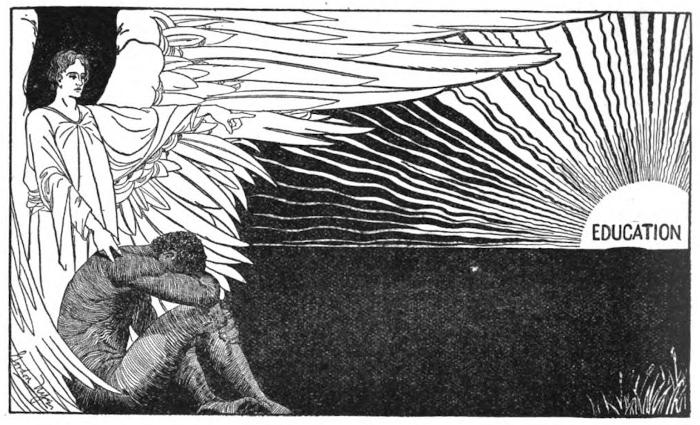
“We taught him how to work; we taught him how to read; we taught him
how to think; we taught him how to live.”
Not for one month could the negro
prosper in the United States, if the
white man became his enemy.
In one month, we could by concert
of action, so smite the negro that his
mushroom growth would wither like
the severed gourd-vine. The maddest
thing, the most suicidal thing that the
black man could do would be to arouse
the enmity of the whites.
When that day comes, if it shall ever
come, the white man will not any more
stop to count the cost of annihilating,
or of driving out the blacks, than Spain
halted to count the cost of smiting and
driving out the Moor.
In the United States the negro is
seen at his best, because of the constant
example, guidance and control of the
whites.
Nowhere else on the planet has
the negro the religious establishment
which he has copied from us, with our
earnest help.
Nowhere else has he the educational
system which he has patterned after
ours, aided at every step by us.
Nowhere else has he the banks, manufactures,
newspapers, magazines, modernized
farms, elegant professional offices
which he has fashioned upon our
models, amid our plaudits of approval
and encouragement.
By the hundreds, by the thousands,
the negro has been admitted to positions
of honor and trust. He has been
in the Senate; he has been in the House
of Representatives; he has been in the
State Legislatures; he has served on
juries; he is in the army; he is on the
police force.
In the proud, aristocratic city of
Charleston doth not the redoubtable
Dr. Crum, a negro, sit at the Receipt
of Customs, drawing a fatter salary
than was ever enjoyed by Matthew, the
Apostle of Christ?
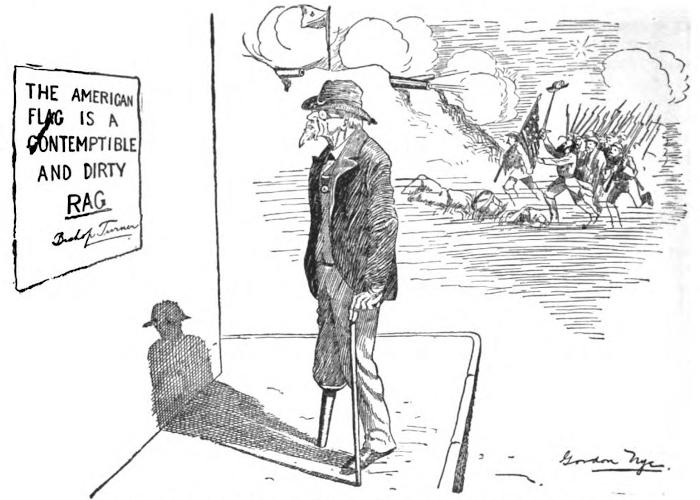
“To free him from bondage half a million white men fell in battle.”
There are no Dr. Crums in Africa or
Liberia. And in San Domingo it is the
white man who sits at the receipt of
customs—nobody being willing to trust
the negro with his own money.
Hath not our Roosevelt declared
that when Judson Lyons, Register of
the Treasury, goes out, another negro
shall take his place? Thus it shall
continue to happen that Uncle Sam’s
paper money will not be good in law
until a negro has set his name to it.
Once upon a time, a white man, in
the United States, gave a negro school
a million dollars in a lump. Doctor
Booker Washington got the money.
I wonder how long the learned Doctor
would have to live in Africa, Liberia,
or San Domingo before he could get
a million dollars with which to operate
a school.
Really, it sometimes occurs to me
that if such negroes as Bishop Turner
are honest in their denunciations of the
United States, they would pack up
their belongings and go right back to
dear old Africa, the home of the race.
Nothing on earth prevents their doing
so.
Rather than go to hell I would go to
Africa; and if I believed I was living in
a land which was worse than hell, I
would even try San Domingo, for a
change.
What bosh, nonsense and self-assertive
insolence is embodied in Bishop
Turner’s denunciation of the Flag and
of the Government!
Poor, down-trodden negro!
What a doleful howl he sets up when
he is asked to ride in a separate car;
and when he is told that separate
churches, separate schools, separate
hotels, and separate social life is best
for both races. How he raves and
froths at the mouth when we tell
him that for his own sake, as well as
ours, we who have, with desperate
difficulty and hardship and sacrifice,
built up our civilization, cannot afford
to allow it to fall into the power of the
inferior race. We have seen what
they did with this same Civilization
in San Domingo when the French
Revolution, most unwisely, entrusted
it to the blacks.
Reconstruction days taught us that
the San Domingan experience would
be repeated here, if the negro rule continued.
To save ourselves from such
a calamity, and to save the negro from
himself, we put back into the hands of
the whites that civilization which had
been the outcome of centuries of effort
on the part of the whites.
And when the Negro Convention
of today has not met to howl but to
brag, what a beautiful, brilliant picture
their orators can paint, as they proclaim
the progress and prosperity of
the negro. What wonderful statistics
they use to prove that the negro
has advanced in knowledge more
rapidly than the whites of Russia, of
Hungary, of Italy and of Spain!
What a glittering array of accumulated
millions do they claim, in lands,
chattels and hereditaments! With
what vociferous gusto do they “point
with pride” to their farms, their stores,
their banks, their newspapers, their
magazines! To listen to them when
they have assembled to jubilate instead
of to howl, you would suppose that, so
far as the negro was concerned, the
horn of plenty was full, the land flowing
with milk and honey. Even Bishop
Turner, with an amazingly unconscious
inconsistency, fills his letter of so-called
denial with boastings of the
handsome homes in which the negroes
live, the furniture which the white man
just ought to go and see, the “library”
which would delight the scholar, the
piano music and the organ melodies
which, in negro homes, soothe the ear
and charm the sense.
Let us admit that every bit of this
bragging and boasting is founded upon
solid fact. Then, in the name of
common sense, let me inquire: “Where,
oh, where, is the negro race doing all
these marvelous things?”
In what country, under what flag, is
he piling up these millions of money?
Under what government is he outstripping
the Russian, the Spaniard,
the Austrian? Where is it that he has
bought so many farms, established so
many banks, built such fine houses,
secured such attractive furniture, and
gotten an organ for ’Liza Jane and a
piano for Susan Ann?
Is it in Africa? No. In Liberia?
No. In San Domingo? No.
The negro is doing the splendid
things to which he “points with pride”
in that country whose flag is a dirty rag,
in that land which is worse than
hell!
Poor, down-trodden negro!
He makes an idle wager in Baltimore
that he will kiss a white girl, in a white
hotel; and he walks up to her in the
public dining room, puts his hands
upon her and kisses her!
In Chicago, he sits down in a white
restaurant, and beckons a white woman
waitress to come and wait upon him;
and when she refuses, he goes straight
to a magistrate, swears out a warrant,
has the girl arrested, and sends her to
prison!
Poor down-trodden negro! In New
York City, and perhaps in other cities,
negro men hold white women in a state
of slavery, to minister to their lusts;
and the political power of these
negroes is so great that the lawful
authorities have been utterly unable
to free these white slaves from the
bestial degradation in which they are
held by their black masters.
In Washington City—but that would
require a chapter to itself. If there is
a Paradise on this earth, a Garden of
Eden filled with ceaseless joy for the
non-producing, insolent, self-assertive
blacks, it is our Capital City of Washington,
where more than two thousand
negro men and women draw Government
pay in federal offices.
Oh, that Bishop Turner had described
to the Macon Convention one of those
“Receptions” at the mansion of Judson
Lyons, Register of the Treasury—such
as Judson often held. Oh,
that the Bishop had told the Convention
how many of Judson’s colored
guests came in automobiles, which
were left lining the sidewalk and obstructing
the street. Oh, that the
Bishop had described to the Convention
the similarity between the negro
“Reception” at the mansion of the
Register of the Treasury and the white
reception of the President of the
United States!
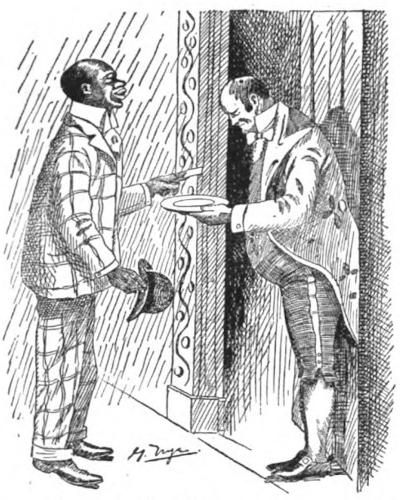
“Poor down-trodden negro!... he
is sometimes compelled to take dinner with
John Wanamaker and lunch with Theodore
Roosevelt.”
Poor, down-trodden negro! In this
land which is worse than hell, it actually
happens that he is sometimes
compelled to take dinner with John
Wanamaker, and to lunch with Theodore
Roosevelt!
The amazement within me grows as
I dwell upon the black man’s woes, and
I marvel that Doctor Washington, Judson
Lyons, Bishop Turner “and others
among ’em” do not pack right up and
go straight back to dear old Africa.
And to think that the man who declared
this country to be worse than
hell is a “negro preacher.” I had supposed
that if there was any human being
who found the United States an
ideal abode, it was the “negro preacher.”
He is the one incumbent whom I had
been led to believe had a mighty rich
thing in salary, and a still richer thing
in “perqueesits.” If I had been asked
to go out and find the man who could
unreservedly indorse the proposition
that life is worth living, I should have
struck a bee line for the nearest negro
preacher.
Of course, if I had been unable to
find him, my next choice would have
been the negro school-teacher.
The army of negro preachers is a
shining host, waving palms of victory,
and apparently happy; the army of
negro school-teachers is another shining
host, waving palms of victory, and
apparently happy.
The white man’s money, directly and
indirectly, supplies the sinews of war to
both these shining hosts—a fact which it
did not suit the purpose of Bishop Turner
to mention in the convention which
had met to howl, and which, consequently,
was bound to howl.
In Africa, in Liberia, in San Domingo,
negro preachers have not flourished,
increased, or put their hands upon so
many good things as they have done in
poor, little, old North America. And
the shining hosts of negro school-teachers,
flush with the white man’s
money, do not wave any palms of victory
beyond the limits of the country
which is worse than hell, the country
whose flag is a dirty, contemptible rag
“where the negro is involved.”
Take out of your pocket a five-dollar
or one-dollar treasury note, or certificate,
and look at the name signed to
give it validity.
“Judson W. Lyons, Register of the
Treasury.”
Do you find it?
Well, that name has been a legal
necessity to every treasury note issued
by the Federal Government during the
last eight years.
Judson W. Lyons is a negro.
For the last eight years he has been
holding the high, responsible and well-paid
office of Register of the Treasury
of the United States.
Nevertheless, this Judson W. Lyons
went down to Macon, Georgia, to attend
a convention of negroes, and in this
convention he heard Bishop H. M.
Turner, a negro, denounce the flag of
his country as “a contemptible and
dirty rag;” and Judson did not open
his mouth to protest.
He also heard this ungrateful Bishop
declare that—“Hell is an improvement
on the United States when the negro is
involved.”
Still, Judson W. Lyons sat there in
apparent acquiescence—he an officer
of the Government!
Now when you are told that every
blessed son and son-in-law of Bishop
H. M. Turner was appointed to office
under President Cleveland, and when
you bear in mind that Judson Lyons
has so long been in the enjoyment of a
Federal office which pays him $8,000
per year, you can form a fair idea of a
radical defect in negro character. It
is Ingratitude.
Bishop Turner has been treated with
the utmost consideration by the whites.
He enjoys a larger income than he
could hope to draw as witch doctor in
Africa, or as voodoo man in San Domingo.
He lives on the fat of the land,
grows juicy himself, and yet runs no
risk of being hot-potted by hungry
brethren—as he would in his native
land of Africa. He dresses in a manner
which would have stunned King Tchaka;
and to see him take his ecclesiastical
ease in a Pullman car is a sight
for the sore-eyed.
What is the Bishop angry about?
Apparently for the reason that
“drunken mobs” in the North, South,
East and West diabolically persist in
accusing the negro of committing
rape.
The Bishop says that the negro is
innocent. Being innocent, he is necessarily
as innocent as a new-born babe.
The Bishop declares that “no negro has
been tried by the courts and found
guilty of this crime of rape in fifteen
years.”
This statement makes the other twin
for Booker Washington’s assertion that
“not more than six” graduates of
negro colleges have ever gone wrong.
A more precious pair of Siamese-twin
lies have not been put in type since the
decease of the late lamented Baron
Munchausen.
My opinion is that Bishop Turner,
if he continues to cultivate the evil
spirit which broke loose in the Macon
Convention, will some day know, by
experience, whether hell IS an improvement
over the United States;
but, before that time comes, I would
suggest that he step down to San Domingo
and soak himself in the luxuries
of that region for awhile, as a preparation
for the other place.
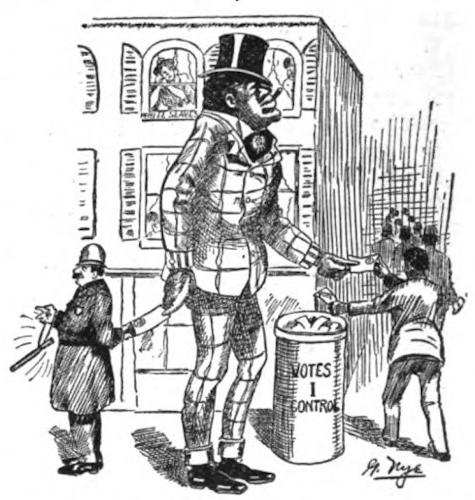
“In New York a negro is at the head of the
white slave traffic.”
Note.—Public opinion expressed itself
so hotly concerning his attack on the flag
that Bishop Turner felt driven into a
perfunctory and involved denial; but
having read this so-called denial I am
convinced that the bishop did use substantially
the words reported, because of
the significant fact that his so-called denial
contains language quite as offensive, quite as
insulting, as that which he surlily pretends to
disclaim. Had this been the first time that
Bishop Turner had denounced the Government
that has done so much for his race,
had it been the first time he had outrageously
vilified the people among whom he lives,
there might be room for doubt concerning
the Macon speech. But Bishop Turner has
for years been speaking and writing in precisely
the vein which appears in the reports
that went out from Macon. He has become
conspicuous as a chronic assailant of the
whites. Therefore I have not the slightest
doubt that he used at Macon in substance, if
not in the very words, the reports as telegraphed
all over the country.
Mr. John L. Sturtevant, whose card
informs the interested universe that
he, the said John L., is editor of The
Waupaca Post, of Waupaca, Wis.,
flew into a passion when he read the
February number of this Magazine.
The why and the wherefore of his
sudden rage are best explained in a
red-hot letter which I now give in full,
just as it came sizzling from the frying
pan:
Feb. 17, 1906.
Thomas E. Watson, New York.
Dear Sir: In the February number of
your magazine, on page 400, under the caption
“Best on Earth” you state: “The big
Milwaukee First National Bank burst and
the people lost $1,450,000.” The statement
is absolutely false. F. G. Bigelow, president
of the bank, appropriated that amount from
the bank’s funds to his own use, but the
bank did not burst nor did the “people,”
in the sense in which you use the word, lose
one cent. The loss fell upon the stockholders
and was fully paid from the surplus
which the bank had accumulated during an
honorable and successful career. Your
magazine is full of just such reckless and
libelous statements as this, which make
thoughtful readers look with distrust upon
the few truths it contains. Intentionally,
or otherwise, you constantly do grave injury
to many people and the pity of it is your
readers who do not think or reason are led
along the paths of populism, socialism and
anarchy.
Sincerely yours,
J. L. Sturtevant.
Touching the falsehood to which the
furious John L. refers, I have this to
say: My article was based upon a
“special” sent out from Chicago
which went the rounds of the Press,
and which was not contradicted.
The “special” from which I took the
facts, appeared, on December 19, 1905,
in the Augusta Herald, one of the most
reliable and conservative Democratic
daily papers in the United States.
The indignant Sturtevant does not
deny that the bank was looted of the
sum stated by me, but because I said
that “the people” lost the money he
charges me with having made a statement
that was “absolutely false.”
Sturtevant alleges that the money was
not stolen from “the people” but from
“the stockholders!”
He is equally indignant because I
said that the bank “burst.” He alleges
that the stockholders were able
to stand the theft of nearly a million
and a half dollars, and that the bank
didn’t burst.
An Editor of a Magazine is at a disadvantage
when compared to the
Editor of The Waupaca Post, of Waupaca,
Wisconsin. Sturtevant evidently
stands at the head-waters of information,
and gets his news fresh from
the spring. That’s one of the luxuries
of living and editing at Waupaca.
A poor devil of a Georgia editor, like
me, has to take his information second-hand.
In spite of all that I can do, it
is impossible for me to be there, all
over the world, when things are happening.
Sturtevant was close to Milwaukee
when Bigelow looted his bank, and
therefore, knew at first hand what the
facts were. On the contrary, I was
thousands of miles off, and had to rely
upon telegraphic despatches, published
in reputable newspapers.
In the “special” from Chicago which
appeared in the Herald, of Augusta,
Ga., December 19, 1905, this language
appears:
“The three big bank wrecks which
are still fresh in the public mind on
account of their size and recent date
are: the Enterprise National Bank
of Allegheny, Penn.; The First
National Bank of Topeka, Kans.; the
First National Bank of Milwaukee,
Wis.!”
Then in a tabulated statement, the
“special” gave sums which were classified
as “losses.”
In this separate list of “losses” occasioned
by “the bank wrecks,” the
First National Bank of Milwaukee,
heads the table with $1,450,000.
Therefore, instead of my statement
in the Magazine being reckless and
false, it was carefully based upon
a “special” sent out from Chicago
in December, which at the time my
paragraphs were written had gone
unchallenged for more than a
month.
Even when corrected by Mr. Sturtevant,
how much good is done to the
National Banking system whose claim
to be “the best on earth” I was ridiculing?
My point was that the lootings of
this boasted “best system on earth” were
so frequent and so colossal that it was
absurd to claim that the system was
“the best on earth.” How does the
Waupaca Champion of looted banks
improve matters by explaining that
the president of the bank merely stole
a million and a half from the stockholders?
How does he weaken my attack by
saying that the bank was able to stand
the huge robbery?
Is bank rottenness saved from denunciation
because the looted bank
happened to be rich enough to survive
the blow?
Is bank gutting made respectable
because the stockholders alone were
gutted?
Suppose the stockholders had not
been rich enough to make good the
loss; suppose the bank had not possessed
“a surplus” of that immense
size—wouldn’t “the loss” have fallen
upon “the people,” and wouldn’t the
bank have “burst”?
Ah, Mr. Sturtevant! When you say
that a National Bank has gained such
tremendous profits out of the privilege
of creating money and lending it to the
people at high rates of interest that a
robbery which runs up into the millions
does not stagger it in the least,
you simply convince the intelligent
reader that National Banks reap far
greater gains out of Special Privilege
than their champions are in the habit
of admitting.
As to the “other” reckless and
libelous statements which the Waupaca
Editor says I have been making
in the Magazine, I can only invite him
to name them.
The Magazine is here to stay, and
it is not conscious of having made
reckless and libelous statements.
The columns are open to brother
Sturtevant, and to all others, who wish
to challenge any statements made
therein.
Whenever I am shown to be wrong,
I will gladly make correction, and, if
need be, apology.
If, on the contrary, the other fellow
happens to be wrong, I will endeavor,
in a mild, conciliatory but earnest
spirit to show him his error.
Brother Sturtevant, of Waupaca,
asserts that I am constantly doing
grave injury to many people.
I appeal to Sturtevant to furnish me
a list—a partial one, at least—of the
people whom I am constantly injuring
so gravely.
If he can establish the fact that in
the 200,000 words or more, which I
have written for the Magazine, a grave
injury has been inflicted upon any
man, woman or child, I stand ready
to make the fullest amends.
Make good, brother Sturtevant!
Certain good friends of mine were
shocked, a few months ago, when they
learned that I was one of those monsters
who believe in the private ownership
of land.
Some of them deplored my ignorance,
and urged me to go straightway
and read “Progress and Poverty.”
Well, I had read Henry George’s book
soon after its publication, and had
once had the precious advantage of
serving a term in Congress with the
great Tom Johnson; yet I never had
been able to see the distinction, in
principle, between the private ownership
of a cow and the private ownership
of a cow-lot.
Some men are just that stupid, and
when Ephraim gets “sot” on a thing
of that kind, even Louis Post, of The
Public, has to let him alone.
Certain other friends made the point
on me that I did not understand
Count Tolstoy. That is possible. In
his various ramblings into various
speculative matters, Tolstoy, like our
own Emerson, gets lost, sometimes,
in mazes of his own making; and he
uses language which may delight
professional commentators, but which
is sorely vexatious to an average citizen
who really wants to know what
the philosophers are driving at.
Tolstoy is careful to avoid History.
The flood of light which might be
thrown upon the land question by the
records of the human race is shut out
altogether.
And this is the weak spot in the armor
of every champion who enters the
list against the Private Ownership of
Land. If History makes any one
thing plain, it is that a Civilization
was never able to develop itself on any
other basis than that of Private
Ownership.
Like other champions of his theory,
Tolstoy forgets the elemental traits of
Human Nature. He forgets how unequal
we are by Nature; how we differ,
in character, capacity, taste and purpose;
how few there are who will labor
for the “good of all,” and how universal
is the rule that each man labors,
first of all, for himself.
He forgets that every beast of the
field has its prototype in some members
of the human family; he forgets
that the man-tiger is now more numerous
than the four-footed sort; that the
man-fox is more cunning than his
wild brother; that the man-wolf hunts
with every human herd; that the man-sloth
is marked by nature with her
own indelible brand; that some men
are born timid as the deer are; that
some are born without fear as the lion
is; that the human hog grunts and
gorges, and makes himself a nauseating
nuisance, on the streets, in hotels,
in the Pullman cars—in fact everywhere,
but most of all where people
have to eat and sleep.
This is the fundamental error which
doctrinaires are prone to make. They
forget what Human Nature actually is,
always has been, and perhaps, always
will be.
They argue about ideal conditions,
unmindful of the fact that ideal conditions
require ideal men—and that we
haven’t got the ideal men.
Every society, every state, must
from necessity be made up of the Good,
the Bad, and the Indifferent and the
law-makers of that society, that state,
will from necessity be compelled to
frame laws suited to that community.
Hence, the laws will not be absolutely
the best, considering the question as an
abstract question, but they will be the
best which that community is capable
of receiving.
All legislation, like all Society, is a
compromise.
In a state of Nature I would be
absolutely free. But I would be alone.
To protect myself in person, property
or family, I would have to rely upon
my individual arm. My absolute freedom
would be an absolute isolation
and a relative helplessness.
I would find that I could not endure
such a life. I would therefore seek
companionship among other men who
felt the same needs that I felt, and we
would come together for the “good of
all.” One hundred families coming
together in this way form the nucleus
of Society, of the State. Each man
gives up a portion of his individual
freedom when he enters this union of
families which forms such a nucleus.
Why does he surrender a portion of
his wild, natural, individual freedom?
Why does he agree to be bound by the
will of the Community instead of his
own will? Why does he consent to be
governed by the public when he had
previously been his own ruler? He
does it because it is to his interest to do
it. He finds that, while he has surrendered
much, he has gained more. The
Community throws around him the
protection of a hundred strong arms
where previously he had but his own.
The Community, in a hundred ways,
ministers to his wants, his weaknesses,
his desires, his prosperity.
In other words, the Community
gives more than it took.
Association which improves the Community
tends to improve each member
thus associated; and from this association
come all those blessings which
we call Civilization.
Resolve the Association back into
its elements; let each individual separate
from the mass; let each one say,
“I’m my own man,”—and what becomes
of Civilization?
It perishes, of course.
Now where will Tolstoy find the basis
of Society in Nature?
In the human instinct for getting-together.
And that instinct seems to
grow out of our hopes, and our fears,
our profound belief that we need our
fellow-man, and that we are not strong
enough to stand alone, no matter how
much we would like to do so.
Deep down in your heart you will find
the primeval, natural craving for independence,
individuality, separate living,
separate doing. With the great common
mass of humanity this tendency
has been weakened by disuse until it is
not an active principle. It is like a
muscle which has lost its strength from
inaction. Hence, the common man
goes with the herd, just as a flock of
sheep follows the bell-wether.
Society, then is a matter of convention:
Nature did not frame it.
Nor does Nature impose upon us the
relation of Husband and Wife.
Why do we adopt the present marriage
system, which differs in so many
respects from Nature, and from former
practices of the human race?
Simply because we believe it to be
an improvement. We know it is better
than the promiscuous intercourse of the
sexes: we believe it to be better than
Polygamy; we hope that it will some
day be a more radiant success than the
Divorce Courts would seem to indicate.
Now as to the land.
Undoubtedly, the earth was given to
the human family as a home for the
family. Undoubtedly, Nature teaches
that the earth belongs in common to
the entire human race.
Thus it was in the beginning. But,
just as the wild horse became the property
of the bold tribesman who caught
it and tamed it; just as the natural
fruit of the forest belonged to him who
gathered it; just as the cave or hollow
tree became the dwelling of the first
occupant, so the well in the thirsty
plain became the property of him that
had dug down to the waters; and the
pasturage which one had taken up
might not be taken away from him by
another.
Mine was the bark hut which my
labor had built; mine the canoe which
my hands had hollowed out; mine the
bow and arrows which I had fashioned;
mine the herds and flocks, the goats
and asses which I had tamed and reared
and cared for till they had multiplied.
Should the idler, or the thief of the
tribe, take from me that which my labor
had produced? Must my canoe belong
to the whole tribe? Must my garment
which I had made out of the skins of
the wild beast belong to the sloth who
loafed in the tent while I risked my life
in the woods?
Nature said, no!
Nature, speaking through elemental
instinct said: “That which your labor
made is yours.”
Yours the hut, yours the canoe, yours
the garment of skins, yours the bow
and arrows—and that was the beginning
of Private Property in Personalty.
But look again at the ways of Nature
and of the tribe.
Pasturage failed after awhile; natural
fruits were no longer sufficient to sustain
life; game disappeared from the
forest; fish grew scarce in the streams.
Something had to be done to make good
the shortage. The soil was there, suggesting
cultivation. The products of
Nature must be supplemented by human
industry. But before the soil
could be cultivated, the trees had to be
cut away; cattle and wild beasts had to
be fenced out; the virgin earth had to be
made the bride of toil before the fruitful
seed would bring forth harvests.
Now who was to do the work?
The Idler wouldn’t; the Feeble
couldn’t; the Hunter didn’t; the strong,
clear-headed Laborer made the farm.
Those who assail private ownership
of land say that “the man who makes
a farm doesn’t make it in the sense that
one makes a basket or a chair.” They
see clearly that, if they admit that the
pioneer who goes into the wilderness or
the swamps and creates a farm, is to be
put on the same footing as the man who
goes into the woods, gets material and
makes a canoe, or a chair or a basket, it is
“farewell world” to their theory about
the land. Therefore they say that the
farm was already there, waiting for
the farmer. All the farmer had to do
was to go there and tickle the soil with
a hoe, and it laughed with the harvest.
How very absurd! You might just
as well say that the willows that bent
over the waters of the brook were baskets
waiting for the tardy basketmaker to come
and get them. You might just as well
say that the hide on the cow’s back was
a pair of ladies’ shoes waiting for the
lady to come and fit them to her dainty
feet.
Must we get rid of our common sense,
our practical knowledge, before we can
argue a case of this sort? Do not
these doctrinaires know that they are
denying physical facts, plain everyday
experience, when they say that a piece
of wild land in the desert, in the swamps,
on the mountain side, or in the woody
wilderness is a farm waiting for the
farmer? Sheer nonsense never went
further. But they are compelled to
this extent because of the necessities of
their case. They see at once that if
ever they admit my position that the
laborer takes raw materials with which
nature supplies him, and out of those raw
materials creates something that did not
exist before, then the laborer is entitled
to that which his labor creates.
Now, do you mean to tell me, that
for thousands of years there were farms
waiting the pioneers here in North
America? Consider for a moment what
the New England, or the Southern, or
the Western farmer had to do before he
had made a farm. He had to go into
the woods with an axe in one hand and
a rifle in the other. Very frequently he
was shot down before he could make
his farm, just as Abraham Lincoln’s
grandfather was killed. Very frequently
he died from the fever engendered in
the woods before he had made his farm,
just as Andrew Jackson’s father did, in
the effort to make a farm in the wilderness
of North Carolina. Supposing
the farmer was able to snatch up his gun
quick enough to shoot the Indian who
was trying to shoot him, and supposing
that his constitution was strong enough
to resist the malarial atmosphere in
which he had to labor while creating
that farm, what was the process
through which he went in making that
farm? He had to cut off an enormous
growth of timber. He had to grub up
stumps and roots. He had to plow and
cross-plow the soil until it had become
a seed bed. He had to inclose
the farm to keep out the wild animals
which would have devoured his crop.
If in a rocky section, he had to remove
the stones which encumbered the
ground. If in a damp, swampy section,
he had to exercise skill, as well as labor,
in draining the soil. After four or five
years, the laborer had made a farm—something
as different from the wild land
which he found in the woods as the pine
tree is from the lumber which lies upon
the lumber-yard; as different as the wool
on the sheep’s back is from the coat
which you wear; something as different
as the willow and the bamboo are from
the chairs and the baskets which
are made from them.
Now, the doctrinaires say that it
would be a sufficient reward to that laborer
to give him the crop that he made on
the land. Would it? For what length
of time will you give him those crops?
If you ask the laborer, he will say, “I
made this farm; I risked my life in the
work: I shortened my days by the labor,
the exposure, the drudgery of making
this farm. I never would have gone to
this amount of toil if I had not believed
that society would secure me in the
possession of the farm after I made it.”
Having established him in his security
of possession, which I say is
tantamount to title, suppose that
laborer wants to change his farm for
a stock of manufactured goods, or
for silver and gold, or for horses, or
for another piece of land, do you
mean to say he shall not have the right
to do it? If so, you limit his title, and
you have not the right to do so. That
which he made he ought to have the right
to dispose of on such terms as please him.
His title having originated in the sacred
rights of labor, you should not limit his
enjoyment or his disposition of that
which his labor created. If you recognize
his right to exchange one product
of his labor for another, you recognize
his right to exchange all products of his
labor for others. In other words, by
plain course of reasoning, you arrive at
the principle that the bargain and sale
of lands is founded upon the right of the
laborer to exchange the product of his
labor with those who may have product
of labor which he could use to better
advantage than he can use his own.
Now, let us see. The laborer who
made the farm dies. What shall become
of it? Away back in the origin of
property, occupancy was the first title
recognized. As long as one individual,
or one tribe, occupied a certain spot
their right to use it was recognized, but
no longer. When possession was abandoned,
the next individual, or the
next tribe who occupied that spot, had
the right of possession. When tribes
ceased to wander about, the occupancy
of the spot which the tribe had taken
possession of became permanent.
Therefore, the title to that spot grew
up in the tribe along with permanent
possession. No civilization was ever
created by wandering tribes. It is only
when the tribe fixes its permanent residence
in some particular spot, recognized
as exclusively its own, that there
is any such thing as law and order and
civilization. It is clear enough when
we consider one tribe in its relations
to other tribes. Let us consider the
tribe in its relations to its members.
Each individual in the beginning
had a title by occupancy to the spot
which he cultivated, and this security
of possession lasted so long as the
occupancy lasted. If the tribesman
abandoned his spot of land, with the
intent to surrender the same, then
the next fortunate tribesman who
came along could take possession of it
and hold it. But, in the course of
time, this created great inconvenience,
because, as favored spots became more
desirable, the competition to get them
was fiercer. Hence, there were feuds,
bloody struggles, disorders in the tribe.
Consequently, by natural evolution
society was forced, first, to recognize
the right of the individual as long as he
wished to occupy the spot which he
had taken possession of; second to provide
for the succession to that title when
the spot became vacant.
The learned men tell us that, at the
death of the occupant, his own family,
his own children, being naturally the
first who would know that he was dead,
were naturally the first who would take
possession after his death. Therefore,
the sons of the deceased tenant always
became the first occupants of the vacant
land which had been left vacant
by the death of their father. This
succession of the sons to the fathers
becoming universal, was finally recognized
by the law of the tribe; and in
the course of time it was recognized
further in the law which allowed the
tenant to make a will and to say who
should take his property after his death.
Thus by slow and almost imperceptible
degrees, the tribe recognized, first,
the right of the man who had made a farm
to hold it as long as he lived; second, the
right of his children to follow in his
footsteps and to receive the benefit of
that which their father had created by
his labor; third, and last, came the law
of wills and testaments which allowed
the tribesman to say what should go
with his property after his death.
If the occupant died without heirs
and without having made a will, the
land went back to the tribe, or the
state, to be disposed of as public property.
This principle is recognized to
this day in the doctrine of escheats.
Property in land differs in nowise
from property in horses and cows.
The law of property is the same naturally
in real estate as in personal estate,
and I can conceive of no revenue in
any community which is so just as that
which lays itself with an equal burden
upon all kinds of property in proportion
to the amount thereof. In the
beginning, one tribesman, like Abraham
or Lot, might have his cattle
browsing upon a thousand hills, while
another tribesman might have made a
little farm in some secluded valley, or
upon some thirsty, rocky mountain-side
where vines were planted, or where
olive trees bore their fruit to the
industrious citizen who had year in
and year out watched and tended
their growth. Would there be any
justice in compelling those little farmers
to supply the revenue for the
common purpose of the tribe, and not
compel a contribution pro rata from
the men who owned “exceeding many
flocks and herds”?
The trouble about these doctrinaires
is that they start at the present day
and reason backward, while I start at
the fountain head and reason down.
I take things as history shows them to
have been; they take things as they
think they ought to have been.
The doctrinaire further says that if
the tribesman who made a farm had
been satisfied to fence in his farm, only,
the common would have remained after
all had been supplied. In this country,
we have millions of acres of “commons”
now waiting any one “member
of the tribe” who wants to go and
take his share. The truth of it is,
the doctrinaire doesn’t want to go out
into the wild land and make a farm.
He wants to stay where he is, and take
one that some other fellow has made.
Especially doth he crave a slice of the
Astor estate, which doctrinaires have
talked of so much that they can almost
identify their shares therein.
One of the doctrinaires quotes the following
from “Progress and Poverty”:
“If a fair distribution of land were
made among the whole population,
giving to each his equal share, and laws
enacted which would impose a barrier
to the tendency to concentration, by
forbidding the holding by anyone of
more than a fixed amount, what would
become of the increased population?”
I do not consider it any part of my
task to assail the position taken in
“Progress and Poverty,” but I think
it a satisfactory answer to the foregoing
question to say that in the very
nature of things posterity must be the
heirs-at-law of the conditions of those
who went before. To say that we can
so frame a social fabric as flexibly and
automatically to give an equal share
of everything to every child born into
the world hereafter, regardless of
whether that child’s parents were
thrifty, industrious, virtuous people,
or, on the other hand, were thriftless,
indolent, vicious people, seems to me
to be one of the wildest dreams that
ever entered the human mind. No
matter how equal material conditions
might be made today by legislation,
the inherent inequality in the capacities
of men, physically, mentally, spiritually,
would evolve differences tomorrow.
There is no such thing as
equality among men, and no law will
ever give it to them. What the father
gains the children lose; and the grandchildren
may regain. While one man
runs the race of life and wins it; another
man, equally tall and strong
will run the race and lose it. Just
why, it is, in some cases, difficult to
tell.
Some men naturally lead; some naturally
follow; some naturally command;
others naturally obey: some are
naturally strong; others are naturally
weak. The law of life to some
is activity; others say that they
were born tired; and there is a certain
pathos in their excuse for indolence,
for they were born tired. One man
is naturally brave—physically, morally—and
he will venture. Another
man is naturally a coward—physically
or morally—and he will not venture.
A dozen different traits, or combination
of traits, make failure or success
in life, and to say that success
or failure, vice and virtue, good
and bad, are the results of environment
and social conditions, is as
misleading, as a general statement of
fundamental facts, as to say that the
dove and the hawk, the tiger and the
sheep, the rattlesnake and the harmless
“black runner” are the results of
environment. Nature in its act of
creation made the difference between
the fowls of the air, the beasts of the
field, the fish of the sea, the men and
women who inhabit the earth. From
the remotest ages, of which we have
record, human nature has been the
same that it is today. Paganism
presented precisely the same types of
man in its savagery and its civilization
that Christianity now presents in its
savagery and civilization. “There is
nothing new under the sun,” and the
very theories which the doctrinaires
now think are matters of modern discovery,
unknown to our ancestors,
and which would have been adopted
had our ancestors been as wise as we,
were discussed in the days of Aristotle
and had the very best thought of the
sages of antiquity.
Let it be remembered, however, that
I have always qualified the Private Ownership
of Land by acknowledging the
supremacy of the State. The tribe, the
community, the State, the Government
holds supreme power over the life and
liberty of citizens, and over the ownership
of the soil. The State calls for me
to give up my individual pursuits, my
individual liberty, my individual preference,
and to take my place as a soldier
in the ranks of the army. I am
compelled to obey; that is an obligation
which rests upon me as a member of
society. Thus the State can demand
my life of me whenever the State
declares that it is necessary for
the defence of the State. In like
manner, the State can restrain me of
my liberty. For instance, in times of
epidemics, we have shotgun quarantine
which destroys my liberty of movement.
I would be shot down like a dog
if I sought to break through the lines of
quarantine, although to make such an
escape might mean my individual salvation,
whereas obedience to law
amounts to sentence of death. In this
case, as in the other, the State practically
demands my life as an individual
as a sacrifice for the good of the greater
number of citizens. So, as to property,
no man holds an absolute title to land
as against the State. The Government,
acting for all the tribe, for all the people,
can tear down or burn my house to stop
the spread of fire. It can confiscate my
property for public purposes, when the
public need requires it. It can take
my land for public buildings, for canals,
for railroads, or for new dirt roads
through the country. My rights in the
premises would be recognized in the
payment to me of damages. My individual
rights would be assessed in so
many dollars and cents. Thus my home,
which might be almost as dear to me as
my life, would be coldly valued
in money, and although I left it
with bitter regrets, even with bitter
tears and a bitter sense of wrong, I
would have to surrender my individual
preference to what is supposed to be by
constituted authorities the necessity of
the State. This right of the public to
take away any portion of the soil from
the individual, and to dedicate it to the
use of the public, is called the right of
Eminent Domain, and is a remnant of
the old system which recognized that
the title to all the lands was in the
King. Of course the King stood for
the State. Centered in the personal
sovereign were those sovereign rights
which belong to the people as a whole,
and the people as a whole, represented
by the King, were admitted to be the
owners of the ultimate fee in the land,
and could compel any individual to
surrender his individual holdings for the
benefit of the entire people, just compensation
having first been paid to the
individual. It is in that sense that I
say private ownership of land is just as
holy a principle, just as equitable,
as private ownership in the basket
which I made from the rushes I
gathered along the stream, or from
the splints which I rived out from
the white oak; just as sacred as my
right to the boat which I hollowed
out from the forest tree, or the bark
hut, or the hut of skins, which my labor
erected to shelter me and my family.
The doctrinaire asks: “Could he not
be as secure in his possession if the land
were owned and exaction made by all
the people?” Certainly. That is my
contention. The whole tribe did exercise
dominion over the land, but to encourage
the individual member of the
tribe to improve a particular portion of
the wild land, the tribe agreed to protect
the individual in that which his labor
had created, namely a farm. My
contention now is that the ultimate
ownership of the land is in all the people;
but society had a perfect right to
divide it on such terms as were thought
best and to guarantee to each individual
“security of possession,” or title, to
that which he had produced. The
great trouble with Mr. Doctrinaire is
that he does not begin at the beginning.
If he would study the condition
of the human race as it gradually
evolved from the patriarchal state, the
tribal state, the nomad state, into that
fixed and complex status which we
now call “Christian Civilization,” he
would readily understand how private
ownership of land was the axis upon
which the improvement of the conditions
of the individual and of the State
turned. As long as tribes wandered
about from province to province, with
their herds of goats, or sheep, or cattle,
nibbling the grass which nature put up,
and moving onward to another pasture
as fast as one was exhausted, there
could be nothing but tent life, nothing
but personal property. The house had
to move every time the family moved.
Therefore, when the herds devoured the
grass in one place, and the tribe had to
move to another, tents were struck, the
few household goods were packed on
the backs of the wives, or on the backs of
other beasts of burden, and the family
moved. When man and beast multiplied
to such an extent that nature no
longer supplied a sufficiency of food, it
became necessary for the tribe to settle
down, and to divide the territory upon
which they settled among the various
members of the tribe. That was done
in Germany, as well as in various other
countries, but I take Germany because
the German tribes were our own ancestors.
They divided the lands every
year. It was seldom the case that the
same tribesman occupied the same
home for more than one year. Like
the Methodist preachers of today, their
homes were always on the go. The
farmer’s home in those days was precisely
like the Methodist preachers’
homes today—a matter to be fixed at
the annual conference. The Methodist
preacher who today is preaching in the
town may next year be sent into the remote
rural precincts: the mountain parson
may next year be sent to the seaboard.
The church is fixed and the parsonage
is stationary, but the preacher
and his wife and his children are forever
moving. Now in precisely the
same manner the tribesmen of the German
tribes used to be going from farm
to farm, and there were no considerable
improvements made while that state of
affairs existed. Why? Because we
are just so constituted that we do not
care to build houses for other people to
live in, if we know it. When we start
out to beautify a home, we may never
enjoy it, but we expect to do so at the
time, and without that expectation
there would be no beautiful homes.
Mr. Doctrinaire thinks because each
tribesman would try to grab the best
piece of land, there was original injustice
in allowing private ownership. If
he will think for a moment, he will realize
that the native selfishness of man
does not make against the private ownership
of land to any further extent
than it does to the private ownership of
personal property. When the tribesmen
went out to hunt, each hunter
sought to bring down the finest stag.
Each hunter naturally wanted to hunt
where the best game was to be found.
Hence those eternal wars between the
Indian tribes which brought down the
population on the American continent.
Hence also those feuds and tribal wars
which desolated the East in the times
of nomad life.
We find Abraham and Lot in a bitter
dispute over a certain pasture; but as to
the well which Abraham “had digged”
there was no resisting his claim, that
well was his property. Why? Because
in the quaint language of the Bible,
“He had digged that well.” In other
words, while nature put the water
in under the soil, and while nature
made the soil itself, it was Abraham’s
judgment which selected the place
where he could find the water, and it
was Abraham’s labor that removed the
earth which covered the water. In
other words, Abraham made the well, in
precisely the same sense that the
pioneer in the wilderness makes
a farm.
But, as I said, the competitive principle,
each one wanting to get what is
best, reveals itself in all directions.
Every fisherman has always wanted the
best fishing grounds. Nations have
been brought to war by this cause, to
say nothing of tribal disputes and individual
contests.
Nowhere have I contended that it
was private ownership of land that
made it possible for the laborer to
claim and retain the product of his
labor. I could not have said that
because I know quite well that personal
property preceded property in
land. In other words, the laborers
acquired a full title to the rude garments
in which they clothed themselves,
the rude implements which
they used in the chase, their weapons,
canoes, etc., long before they ever
made farms. This has been explained
fully elsewhere and does not at all
antagonize the statement that after a
tribesman has acquired by his labor
an interest in the land, the government
of the tribe may be so arranged that the
produce of the land will be taken away
from the land-owner as fast as he produces
it. Instead of robbery by taxation
in land—products preceding private
ownership in land—the reverse is
the case. To fleece the laborer of
what he produces on his farm was the
after-thought of those who governed
the tribe.
This is shown by the wretchedness
of the peasant class in Russia today.
Historians tell us that the Russian
peasant formerly owned a very considerable
portion of the land, just as the
French peasants did, and in addition
to the individual ownership which was
in the Russian peasantry, there was a
large quantity of communal land which
belonged to each community of peasants
as a whole. In the process of
time, the ruling class in Russia put
such burdens upon the peasant proprietor
that he gradually lost his land
and became a serf. Of course, Mr.
Doctrinaire recalls that in 1860 the
serfs of Russia were freed, and they
were given a large portion of the land
which had been taken away from them
by the Russian nobles. They also
held the communal lands. What has
been the result? The ruling classes
have put such heavy burdens in the
way of dues and taxes upon the peasants
that their ownership of the land,
communal and individual, has brought
them none of the blessings which they
anticipated. Thus we have a striking
and contemporaneous illustration of
the great truth which I have sought to
emphasize, namely, that the mere
ownership of land does not emancipate
the people.
Arthur Young, the famous “Suffolk
Squire,” rode horseback over the rural
districts of France, just before the
Revolution broke out. He found that
the French peasants owned their own
farms. He made a close and sympathetic
study of their condition.
And what was that condition?
Wretched to the very limit of human
endurance. The king, the noble,
and the priest were literally devouring
the Common People. Privilege, Titles,
Taxes, Feudal dues were driving the
masses to despair, to desperation.
Yet the French peasant had “access
to the land.”
In England, at that time, the peasants
did not own land, and yet their
condition was incomparably better
than that of the French.
Why? Because they were not ground
down by Taxes and Feudal dues.
Could you ask a more convincing
illustration?
Mr. Doctrinaire makes the point
that when one member of the tribe
decided to undertake the arduous
task of making a farm out of a few
acres of the millions which belonged
to the tribe, this industrious member
of the community “robbed” all the
others when he claimed as his own
that which his hands had made. I can
see no more “robbery” in this case
than in that of another tribesman who
went and cut down one of the millions
of forest trees which belonged to the
tribe, and with painful labor hollowed
out this tree and created a canoe. At
the time the one tribesman made the
canoe, every other tribesman had
the same chance to do the same thing.
At the time the one tribesman went
into the woods and made a farm every
other tribesman had the same right.
If Mr. Doctrinaire thinks that the
first occupant of any particular
spot did not have the right to locate
a farm, he might as well say that the
first finder of the cavern, or the hollow
tree, did not have the right to occupy
that which he had first found, and yet
he knows perfectly well that this right
of discovery and occupancy was always
recognized from the beginning of time
and that from the very nature of things
it had to be recognized to prevent the
bloodiest feuds in every tribe. (A
curious survival of this Right of Discovery
is to be seen even now in the
claim to the “Bee Tree” by the first
to find it.)
Mr. Doctrinaire says, impliedly, that
if the tribesman had fenced in no more
than the spot out of which he had
made a farm, injustice would not have
been done to the tribe: but he says the
tribesman went further and fenced in
a great deal more—“vast areas,”
which he could not use, and also
“claimed” these as his own. How
does Mr. Doctrinaire know that? I
did not state anything of the sort.
Nor does the historian state anything
of the sort. I was tracing title to land
to its origin, and I contended that the
origin of title to land was labor. Consequently,
my contention was that the
tribesman fenced in that which his
labor had redeemed from the wilderness—his
original purpose in fencing
it in being partly to identify what was
his own, partly to assert his exclusive
possession, but chiefly to protect his
crop from the ravages of the wild animals
that were still roaming at large in
the forest. Mr. Doctrinaire must remember
that the fencing of the farm
was one of the most tremendous
difficulties that the pioneer met with.
He had no barbed wire; he had no
woven wire, he had no convenient sawmill
from which he could haul plank.
No; he had to cut down enormous
trees, and by the hardest labor known
to physical manhood, he had to split
those trees into rails, and with these
rails fence in that little dominion
which he rescued from “the wild,”
that little oasis in a great desert of
savagery.
To put up the fence was heroic work.
To keep it up was just as heroic, for
forest fires destroyed it from time to
time, and the pioneer had to replace
the barrier against the encroachment
of animal life and the inroads of savagery
with as great a tenacity and as
sublime a courage as that of the people
of Holland, who tore their country
from the clutches of the ocean and
barred out the sea with dikes. Tell
me, that after the pioneer had created
this little paradise of his—rude though
it might have been—amidst the terrors
and the toils and sacrifices of that life
in the wilderness, it should be taken
from him by the first man who coveted it,
and who said, “here, take your crop,
that is all you are entitled to:
take your crop and give me your
farm!” Would that have been right,
at the time private property was first
recognized by our people in Germany?
Would that have been right at the
time our pioneer farmers in New
England and Virginia created their
farms, endured difficulties and dangers
which make them stand out in heroic
outline on the canvas of history? No,
by the splendor of God! It would
have been robbery and nothing less
than robbery for the tribe to have
confiscated the farm which the pioneer
of America had made—partly with his
rifle, partly with his axe, partly with
his spade—and throw it into the common
lot where the idler and the criminal
would have just as much benefit from
it as the pioneer who had made the farm.
As to the abuse of land ownership,
that is an entirely different question.
I agree that there should be no monopoly
of land for speculative purposes.
The platform of the People’s Party has
constantly kept that declaration as a
part of its creed. The abuse of land
ownership is quite a different thing
from land ownership itself. I am
not defending any of its abuses. I
am simply saying that the principle is
sound. All those things which belong
to the class of private utilities should be
left to private ownership, because I believe
in individualism; but all those
things which partake of the nature of
public utilities should belong to the
public.
Mr. Doctrinaire says that railroads
have their power based in the fixed
principle of private ownership of land. I
deny this utterly. It was always necessary
for the civilized community to have
public roads. Even the Indians had
their great trails which were in the nature
of public roads. A public road never
of itself did anything injurious to a community.
The taking of land for a public
road confers a benefit upon the entire
community. It is for that reason it is
laid out. The amount of land which is
taken for a road, whether you cover it
with blocks of stone, as the Romans
did, or whether you cover it with iron
rails, as modern corporations do, can
inflict no injury whatever upon the community
unless you go further. For instance,
if you erect toll gates on the
public highways and vest in some corporation
the right to charge toll on
freight and passengers at those toll
rates, then you have erected a tyranny
which can rob the traveler and injure
the community. In that case, you can
clearly see it is not the road, it is not the
land over which the road passes, that is
hurting the individual and the public.
The thing which hurts is that franchise
which empowers the corporation to tax
the citizens and the property of the citizens
as they pass along that highway.
In like manner, the road which the
transportation companies use could
never have inflicted harm upon individuals
or communities. The thing
which hurts is the franchise which empowers
the corporation to rob the people
with unjust freight and passenger
tolls as they pass along the highway.
Mr. Doctrinaire mires up badly in
trying to evade the point which I made
about Italy. I contended that while
it was true that great estates were the
ruin of Italy, there had to be some
general cause at work, injurious to the
average man, before the soil could be
concentrated into these great estates.
This is very obvious to anyone who will
stop to think a moment. Mr. Doctrinaire
thinks that the great estates in
Italy were acquired by simply claiming
the land and fencing it in, by “each
individual claiming far more than he
could use.” If all the land of Italy had
been claimed and enclosed, the power
that these land claimers had over subsequent
comers is obvious; but how did
“the claimers” get the lands? The most
superficial knowledge of Roman History
ought to convince Mr. Doctrinaire that
Italy was cut up into small holdings
until one branch of the government,
the aristocracy, represented by the
Senate, gathered into its own hands
by persistent encroachment all the
powers of the State. After that had
been done, they fixed the machinery
of government so that the aristocracy
were almost entirely exempt from public
burdens, whereas the common people
had to bear not only their just portion,
but also the portion which the aristocracy
shirked. The ruling class, the
patricians, not only escaped their
burdens in upholding the State but
they appropriated to themselves the revenue
which the Roman State exacted
from the lower class, the plebeians.
The result was that the Italian peasant
found himself unable to sustain the
burdens which the government put
upon him and he abandoned his farm,
just as the French peasant quit the land,
for the same reason, prior to the French
Revolution. In other words, the small
proprietor had to sell out to the patrician,
and the patricians got these great
estates in the same manner that Rockefeller,
for instance, got the estate which
he now holds at Tarrytown. The
Standard Oil King did not simply
stretch his wires and “claim” land.
He bought out the people who found
themselves unable or unwilling to hold
their lands. Rockefeller stood relatively
on the same ground of advantage
held by the Roman patricians. Governmental
favoritism, and special privilege,
the power of money which he had
attained through unjust laws, made him
more able to buy than the individual
owners around him were to hold.
Therefore he absorbed the small estates,
and his estate became the “great
estate,” just as such great estates were
created in Italy.
Mr. Doctrinaire can see the process
going on around us. He can see how
great estates absorb small estates.
Our legislation for one hundred years
has been in the interest of capital
against labor. A plutocracy which enjoys
the principal benefits of government,
and contributes almost nothing
to the support of the government, has
been built up: charters have been
granted by which large corporations
exploit the public; and in this way
great estates, whether in stocks or
bonds, or gold, or land, have been created.
The same principles, the same favoritism,
the same privilege, working
in different ways, brought about the
same results in France before the
Revolution, in Rome before its downfall,
in Egypt, in Persia, in the Babylonian
Empire. If there is any one
word which can be appropriately used
as an epitaph for all the dead nations
of antiquity, that word is “privilege.”
The government was operated by a
ruling class for the benefit of that class,
and the result was national decay, national
death.
Mr. Doctrinaire asks me: “How did
the ruling class at Rome come to control
the money?” I might answer by
asking him: “How did the controlling
class in the United States come into control
of the money?” He would certainly
admit that they have got control
of it. How did they get it? They
took into their own hands, in the days
of Alexander Hamilton, the control of
governmental machinery. They erected
a tariff system to give special privileges
to manufacturers. Out of this
has come the monopoly which the
manufacturers enjoy of the American
market, and the natural evolution of
the tariff act which Alexander Hamilton
put upon our statute book more
than one hundred years ago, produced
The Trusts.
Again, the power to create a circulating
medium to be used as money and
to expand and contract this circulating
medium, thereby controlling the rise
and fall of markets, was a vicious principle
embedded into our system by,
Alexander Hamilton, more than one
hundred years ago.
Again, the granting of charters to
private companies to exploit public
utilities is another means by which
our patrician class has secured the
control of money. Now at Rome
there was a similar process. Instrumentalities
were different, the names
of things were different, but the
ruling class at Rome had the power
of fixing the taxes, and they appropriated
to themselves the proceeds of these
taxes. They had the power of legislation
in their hands and exploited the
public for their own benefit. In this
way they secured, of course, the control
of money. The one advantage of
paying no tax themselves and of appropriating
to themselves the taxes which
they levied upon the plebeians was
sufficient to give them not only the control
of money, but the control of the
land and of the man. In fact that tremendous
power, to fix the taxes and to
appropriate the public revenue, is all
that the ruling class of any country
need have in order to establish an
intolerable despotism over the unfavored
classes.
Mr. Doctrinaire has the fatal habit of
crawling backwards with his logic. He
says that the Roman Patrician could
not have controlled the money until he
got control of the land. The slightest
reflection ought to convince him that
this cannot be true. No class of men
ever secured the control of money by
merely controlling the land. Just the
reverse is the universal truth. Without
any exception whatsoever governmental
machinery, the taxing system,
usury, expansion and contraction of the
currency hold the land-owner at their
mercy. The land-owner, as such, never
had them at his mercy and he never
will.
Another instance of the crawl-backwards
method of reasoning is given
when Mr. Doctrinaire says that usury
grew out of land monopoly instead of
land monopoly growing out of usury.
When a man gets himself into such a
state of mind that he can deliberately
write a statement of that sort for publication,
he is beyond reach of any ordinary
process of conviction and conversion.
My statement was that usury
is a vulture that has gorged itself upon
the vitals of nations since the beginning
of time. Mr. Doctrinaire says this is
not true. On the other hand, he says
that land monopoly came first, and then
usury. If the rich people got all the
land first, so that they had a land monopoly,
upon whom did they practice
usury? How could they fatten on those
who had nothing? If Mr. Doctrinaire is
at all familiar with the trouble between
the Russians and the Jews in Russia he
knows that one of the accusations
brought by the Russian against the Jew
is that the Russian land-owner has been
devoured by the money-lending Jew.
If he knows anything about our agricultural
troubles in the South and in
the West, he knows that the Southern
and Western farmer complains that he
has been devoured by usury. If he
knows anything about the history of
the Russian serf, he knows that the
money-lending patricians made serfs
out of the small land-owners by usury.
If he will study the subject, he will find
that in Rome, Egypt and Assyria the
small land-owner was devoured by
usury, had to part with his property
and thus surrender to those who were
piling up great fortunes by governmental
privilege and by the control
of money.
Take the Rothschild family for an example.
Did they have a land monopoly
which made it possible for them
to wield the vast powers of usury?
Theirs is a typical case. Study it a
moment. A small Jewish dealer and
money-lender in Frankfort is chosen by
a rascally ruler of one of the German
States as a go-between in a villainous
transaction whereby the little German
ruler sells his subjects into military service
to the King of England. These
soldiers, who were bought, are known
to history as the Hessians, and they
fought against us in the Revolutionary
War. This was the beginning of the
Rothschild fortune, the transaction
having been very profitable to the
Rothschild who managed it. Later,
during the Napoleonic Wars, the character
of a Rothschild for trustworthiness
became established among princes
and kings who were confederated
against Napoleon and many of the financial
dealings of that day were made
through him. Of course, these huge
financial transactions were profitable to
the Rothschild. Again, a certain German
ruler, during those troublesome
times, entrusted all of his cash to the
safe-keeping of a Rothschild, the purpose
being to put the money where Napoleon
would not get it. For many
years the Rothschild had the benefit of
this capital, and he put it out to the
very best advantage in loans and speculations,
here and there. By the time
Napoleon was overthrown at Waterloo
the Rothschild family had become so
rich and strong that it spread over the
European world. One member of the
family took England, another France,
another Austria, another Belgium, the
parent house remaining in Germany,
and to this day the Rothschild family
is the dominant financial influence of
the European world. In other words,
by the power of money and the power of
usury, they were able to make a partition
of Europe and they are more truly
the rulers of nations than are the Hapsburgs,
the Hohenzollerns, the Romanoffs,
or any other one dynasty which
nominally wields the sceptre.
Now, can Mr. Doctrinaire ask for a
better illustration of the truth of my
statement that the power of money is
not based upon the monopoly of land;
and that the monopoly of land is the
fruitage of the tree of usury? Originally,
the Rothschilds owned no land.
It was only after they had become so
rich that they were compelled to look
around for good investments that they
began to buy real estate. Their vast
fortune, which staggers the human
mind in the effort to comprehend it, was
not the growth of land monopoly, but
was the growth of usury. What the
Rothschilds have done in modern
times, men of like character did in ancient
times, and just as the modern
world will decay and collapse if these
evil accumulations be not prevented,
so in ancient times people went to decay
and extinction because no method of reform
was found in time to work salvation.
Mr. Doctrinaire asks me what is the
cause of the Standard Oil monopoly. I
thought that if there was any one thing
we all agreed about it was that the
Standard Oil monopoly had its origin
in violations of law, in the illegal use
of those public roads which are
called transportation lines, the secret
rebate, the discriminating service, the
favoritism which the transportation
company can exercise in favor of
one shipper against all others, to the
destruction of competition. You might
end land monopoly, but as long
as the railroad franchises exist, the
Standard Oil monopoly will exist, if
they can get the favored illegal treatment
which they got in the building
up of their monopoly and which
they still have in sustaining it. The
power of Privilege in securing money,
and the power of money in destroying
competition, was never more strikingly
evident than in the colossal growth of
Standard Oil. Mr. Doctrinaire might
own half the oil wells in America, but
unless he made terms with the Standard
he would never get his oil on the
market at a profit. The Big-Pistol
is not the ownership of the oil-well.
The Big-Pistol is the mis-use of
franchises.
With all the power that is in me, I
am fighting the frightful conditions
which beset us, but I know, as well as I
know anything, that the principle of
the private ownership of land has had
nothing whatever to do with our trouble.
Repeal the laws which grant the
Privileges that lead to Monopoly; equalize
the taxes; make the rich support
the government in proportion to their
wealth; restore public utilities to the
public; put the power of self-government
back into the hands of the people
by Direct Legislation; restore our Constitutional
system of finance; pay off the
National debt and wipe out the National
banking system; quit giving public
money to pet banks for private benefit;
remove all taxes from the necessaries
of life; establish postal savings banks;
return to us the God-given right to freedom
of trade.
With these reforms in operation, millionaires
would cease to multiply and
fewer Americans would be paupers.
Trusts would not tyrannize over the
laborer and the consumer, Corporations
could not plunder a people whose political
leaders they have bought. Some
statesman might again declare as Legaré
declared twenty years before the
Civil War: “We have no poor.”
English travelers might have no occasion
to say, as Rider Haggard said last
year, that our condition was becoming
so intolerable that there must be reform
or revolution. On the contrary,
the English travelers might say once
more, as Charles Dickens said in 1843,
that an Angel with a flaming sword
would attract less attention than a beggar
in the streets.
And with these reforms accomplished
any man in America who wanted to work
a farm of his own could do it.
I cannot promise that he would get
one of the corner lots of the Astor estate,
but I have no doubt whatever that if
he really wanted a farm, and were willing
to take it a few miles outside of the city,
town, or village, he could get just as
much land as he cared to work.
Sir Walter Scott used to say that he
had never met any man from whom
he could not learn something. No matter
how ignorant the humblest citizen may
appear to be, the chances are that he
knows a few things which you do not
know; and if you will “draw him out”
you will add to your knowledge.
The Virginia negro who happened to
pass along the road while the Chief Justice
of the Supreme Court of the United
States was puzzling his brains over the
problem of mending his broken sulky-shaft,
knew exactly the one thing which
John Marshall did not know.
The great lawyer was at his wit’s end,
helpless and wretched. How could he
mend that broken shaft and continue
his journey? He did not know and he
turned to the negro for instruction.
With an air of superiority which was
not offensive at that particular time,
the negro drew his pocket-knife, stepped
into the bushes, cut a sapling, whittled
a brace and spliced the broken
shaft.
When the Chief Justice expressed his
wonder, admiration and pleasure, the
negro calmly accepted the tribute to
his talent and walked off, remarking,
“Some folks has got sense and some
ain’t got none.”
That little story is a hundred years
old, but it’s a right good little story.
A school-teacher, whom I loved very
dearly, told it to me when I was a kid.
He was the only man I ever knew who
had it in him to be a great man, and
who refused to strive for great things
because, as he said, “It isn’t worth the
trouble.”
He was naturally as great an orator
as Blaine or Ben Hill. He was far and
away a loftier type than Bryan, for he
had those three essentials which Bryan
lacks—humor, pathos and self-forgetful
intensity of feeling. But after
one of his magnificent displays of oratory
he would sink back into jolly indolence,
and pursue the even tenor of
his way, teaching school. “It is not
worth while. Let the other fellows
toil and struggle for fame and for office,
I don’t care. They are not worth the
price.”
Few knew what was in this obscure
teacher, but those few knew him to be a
giant.
Once, at our College Commencement,
the speaker who had been invited to
make the regular address was the crack
orator of the state. He was considered
a marvel of eloquence. Well, he came
and he delivered his message; and it
was all very chaste and elegant and
superb. Indeed, a fine speech.
He sat down amid loud applause.
Everybody satisfied. Then the obscure
genius to whom I have referred
rose to talk. By some chance the faculty
had given him a place on the program.
I looked at my old school-teacher as
he waddled quietly to the front. I saw
that his face was pale and his eyes blazing
with fire. I felt that the presence
and the speech of the celebrated orator
had aroused the indolent giant. I knew
he would carry that crowd by storm—would
rise, rise into the very azure of
eloquence and hover above us like an
eagle in the air.
And he did.
Men and women, boys and girls,
laughed and cheered and cried, and
hung breathless on his every word, as
no crowd ever does unless a born orator
gets hold of them. Actually I got to
feeling sorry for the celebrity who had
made the set speech. He sat there
looking like a cheap piece of neglected
toy-work of last Christmas.
The faces of the leading people after
my old teacher had sat down, were a
study. The expression seemed to say,
“Who would have thought it was in
him!”
I don’t think he ever made another
speech.
The brilliant eyes will blaze no more.
The merry smile faded long ago. The
great head, that was fit to bear a crown,
lies low for all the years to come.
He left no lasting memorial of his
genius. Only, as through a glass
darkly, you may see him, in a book
called “Bethany,” written by one in
whom he, the unambitious, kindled the
spark of an ambition which will never
die.
There being no smokers in the
“smoker,” I went in there to stretch
out. The Florida East Coastline train
was working its way down the peninsula,
and was doing it very leisurely.
Into the “smoker” came a young fellow
with whom I opened conversation.
It turned out that he had been pretty
much all over Europe. He had toured
Germany several times. On the Sir
Walter Scott principle, I sought knowledge
from him, and he told me several
interesting things.
One evening he had been at Heidelberg
when the soldiers mounted guard.
This being a regular function many
civilians had assembled to see it.
An officer was putting the men
through some of their exercises, when,
at the order to “ground arms,” one
of the privates let his gun down too
slow.
The officer flew into a rage, rushed up
to the soldier, slapped his jaws, kicked
him repeatedly on the shins, struck
him with the flat of his sword, and spat
time and again in the man’s face!
Of course the officer was cursing the
private for every vile thing he could lay
his tongue to, all the while.
Said my informant, “He not only
spat in the man’s face once, but he did
it four or five times.”
I asked, “Was there no murmur of
disgust or indignation in the crowd of
citizens who were looking on?”
“None whatever,” he said. “The
people took the occurrence as a matter
of course. It happens so often.”
Then the young man rose up in the
smoker, and showed me how the private
had stood in his place, rigid, staring
straight ahead, not daring to change
his position or expression while enduring
the kicks and spits of the
officer. Not a word of protest or
complaint did he venture to utter.
That’s Militarism, gone crazy.
Not long ago one of our high-priced
city preachers declared publicly that
we Americans needed an Emperor to
head our army.
Do you recall a story which went the
rounds of the newspapers a few years
ago? In substance it hinted that William
Hohenzollern, Emperor of Germany,
had compelled one of his young
officers to kill himself.
My traveller related to me the particulars
as he had learned them in
Germany.
The Emperor was holding a banquet,
a revel, on board his yacht, the Hohenzollern:
wine had been drunk freely;
loose talk was going on. The Emperor
made some insulting reference to the
mother of a lieutenant who was seated
near him.
Upon the impulse of the moment, the
brave boy did a most natural thing—he
slapped the brutal defamer of his
mother in the mouth.
Consternation paralyzed the Emperor
and all his guests.
The lieutenant left the yacht; no
one tried to stop him. Going ashore,
he made ready to quit the world; and
next morning he rode his bicycle deliberately
off a precipice and fell headlong
to his voluntary death.
And the high-priced, city preacher
declared that we needed an Emperor!
Frederick the Great was really a
great man.
Riding along the streets of Berlin one
day, he saw a crowd looking up at a
placard on a wall, Reining his horse,
the old King inquired, “What is
it?”
He was told that the placard contained
a lot of violent abuse of himself.
“Hang it lower, so that the people
can read it better,” ordered the King,
and he rode on.
The pompous despot who now sits
upon the throne of Frederick the Great
puts girls and old women, as well as
boys and men, in jail if they dare to say,
or to write, anything disrespectful of
him.
Is democracy gaining ground anywhere?
Are not those historic allies,
the Church and the State, encroaching
steadily upon the masses? Are
not the High Priest and the War
Lord constantly putting a greater distance
between themselves and the Common
People?
Does not the individual citizen have
less power and recognition now than at
any other time since the founding of
our Government?
Poor General Wheeler! After all
his efforts to please Northern sentiment,
they would not permit him to be
buried with the Confederate flag in his
coffin!
The Nation is a mighty good paper,
but it ought not to class General N. B.
Forrest as “a scout” and “guerrilla.”
General Forrest was named by
General Lee, during the last year of
the war, as the best soldier that the
Civil War had developed.
Forrest was greater than his commanding
general at Fort Donelson, at
Murfreesborough, and at Chickamauga.
He finally swore that he would not obey
any more fool orders from blundering
superiors, and he struck out for himself.
During the short time that he
held independent command his achievements,
considering his resources, rivalled
those of Stonewall Jackson in
the Valley Campaign.
Nor should The Nation be too hard
upon the West Point officers who followed
their native states out of the
Union. Justice to those officers requires
one to remember that they were
taught at West Point that the States
had the right to secede from the Union.
If The Nation will consult the text-book
from which Generals Lee, Johnston,
Beauregard and Wheeler were instructed
in Constitutional Law, it will
discover that these young officers simply
put in practice that which their
teachers had taught them to be their
right.
The book to which I refer is Rawle’s
work upon Constitutional Law.
After General Wheeler had tried so
hard to win the heart of the North, don’t
you think they might have allowed the
Confederate flag to rest upon his folded
hands?
That was the flag which he had followed
in the storm of actual war. The
Cuban business was nothing. It was
child’s play, and pitiful child’s play at
that. But the Civil War was real, was
colossal, rent a continent asunder, and
shook the world. It was the Confederate
flag which had led Wheeler to his
fame. His youth, his first and best,
had been given to that; of all the banners
on earth none could have been
dearer, holier to him than that.
To look upon it was to bring back the
years and the deeds which had brought
him glory. It associated itself with
the heroes who had listened to his
battle-cry, and who had sanctified
their sacrifice to duty with their blood.
It spoke to him of the hopes and the
griefs and the despair of his home, the
South; it recalled the enthusiasm and
the heartbreak; the splendid devotion
of noble women, and the resignation of
conquered men.
Surely, surely the Confederate flag
must have been the dearest emblem of
Duty and Sacrifice to General Joe
Wheeler.
Don’t you think that Charity might
have softened the heart of the North
to the old warrior who was dead, and
that they might have let him rest under
the “Conquered Banner?”
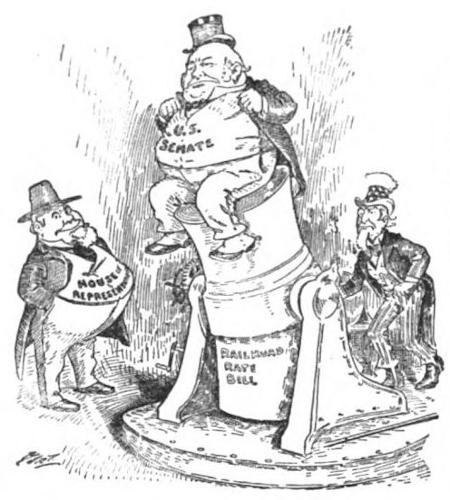
The House: I give you warning, old man; it’s loaded!
Bart, in Minneapolis Journal
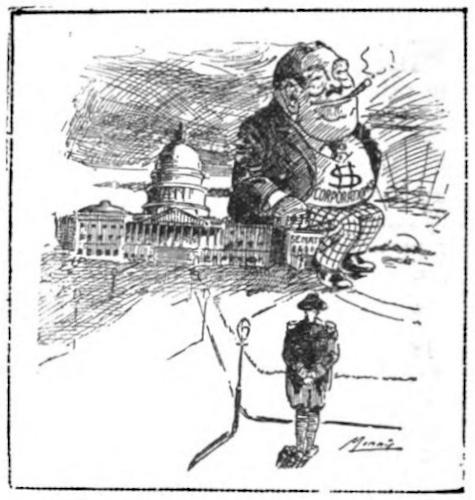
If George Washington Came to the Capital Today
Morris, in Spokane Spokesman-Review
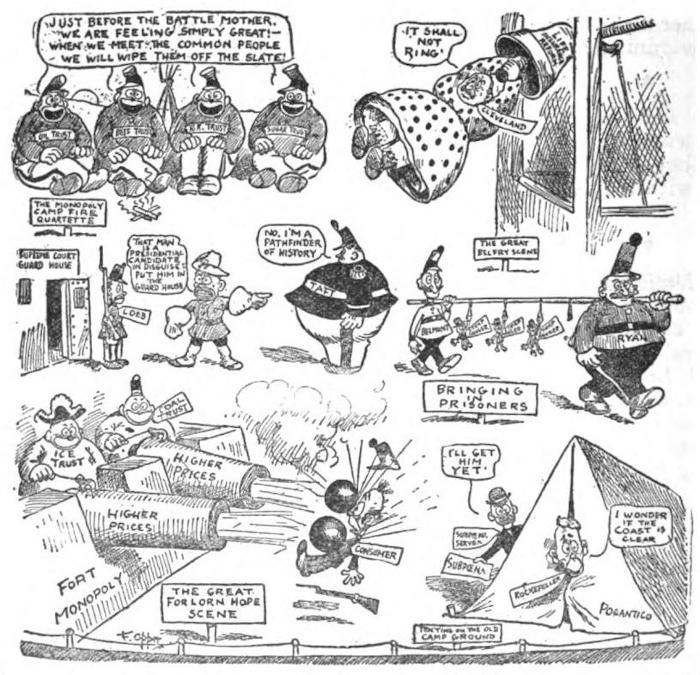
The Stirring War Drama Entitled: “Chased By the Enemy; or, Curfew Shall Not Ring This Evening”
Opper, in N. Y. American
Machine Rule and its Termination BY GEORGE H. SHIBLEY President of the People’s Sovereignty League and Editor of the Referendum News. — THE WINNETKA SYSTEM — A NEW THIRD PARTY
Underneath the existing political
and legislative evils in
this country there is found a
common cause—the rule of the few
through machine politics. The powers
of sovereignty are exercised by the
few. Proof of this is the fact that the
evils complained of are banished, or
are in process of disappearing, wherever
the people have established their sovereignty—have
established the right to
a direct vote on public questions. This
system is the initiative and referendum.
It is exercised in combination with representatives,
and the system as a whole
is termed Guarded Representative Government—the
people’s sovereignty is
guarded.
This improved system of representative
government is an evolutionary
product, and being such it will gradually
extend throughout the world. A
practical question is: How best can
its spread be promoted? To arrive at
an answer, one must study the methods
whereby the improved systems came
into being.
We find that the forerunners were
third parties and non-partisan organizations.
The first declaration by a
political party in this country was the
Socialist Labor Party in 1889. Next
came a declaration by the Knights of
Labor in 1891. The same year there
appeared “The Referendum in America,”
by Ellis Paxton Oberholtzer,
Ph.D. The next year J. W. Sullivan
published his book, “Direct Legislation.”
During the year the National
Direct Legislation League was
organized. There was also published,
during 1892, “Direct Legislation by
the People,” by Nathan Cree of Chicago.
On July 4th of the same year, 1892,
the newly organized People’s Party
commended “to the favorable consideration
of the people and the reform
press the legislative system known
as the initiative and referendum.”
And state conventions of the People’s
Party and the allied parties also paid
considerable attention to the initiative
and referendum. During the Autumn
the American Federation of Labor
gave its emphatic endorsement to the
initiative and referendum by commending
“to affiliated bodies the careful
consideration of this principle and
the inauguration of an agitation for its
incorporation into the laws of the respective
states.”
The same year the National Grange
adopted a resolution recommending to
the state and subordinate granges the
Swiss legislation method known as the
referendum and the initiative.
The following year the People’s
Party, wherever it was in power, endeavored
to submit to the people a
constitutional amendment for the
initiative and referendum, but as a
two-thirds vote was required there
was a temporary failure.
In 1896 the People’s Party at its
national convention came out strongly
for the initiative and referendum, as
also did the National Party convention,
composed of 299 delegates who seceded
from the Prohibition convention. The
Socialist Labor Party also reaffirmed
its people’s sovereignty plank of 1892.
The first legislation in this country
for the initiative and referendum was
by the People’s Party in Nebraska,
1897. The voters in municipalities
were empowered to petition for the
adoption of the initiative and referendum
system for local affairs, and the
system was to be adopted if approved
by a majority of those who should vote
upon the question. Hon. John W.
Yeiser was chiefly instrumental in
securing the law, and he endeavored to
secure its adoption in Omaha, but without
success.
The same year, 1897, the People’s
Party representatives in the South
Dakota Legislature combined with the
Silver Republicans and Democrats to
submit a constitutional amendment for
the initiative and referendum. Most
of the Republicans in the Legislature
fell in line and voted with the promoters
of the reform. At the next election,
1898, the voters adopted the system.
Afterward the Republican party,
which then had a majority in each
house, enacted the statute to put it in
operation. Since then two sessions of
the Legislature have been held and the
effects of the referendum (the people’s
veto) have been splendid. The following
words are credited to the Republican
Governor, Hon. Charles Herried, by
a member of the Toronto Parliament:
“Since this referendum law has been
a part of our constitution we have had
no chartermongers or railway speculators,
no wildcat schemes submitted to
our Legislature. Formerly our time
was occupied by speculative schemes
of one kind or another, but since the
referendum has been a part of the constitution
these people do not press
their schemes on the Legislature, and
hence there is no necessity for having
recourse to the referendum.”
The initiative in South Dakota was
crippled by inserting a “joker”! The
system provides that five per cent.
of the voters may propose bills to the
Legislature, “which measures the Legislature
shall enact and submit to a vote
of the electors of the state.”
The year (1898) that the voters of
South Dakota balloted upon the question
of adopting the improved system
of representative government, the
People’s Party, Silver Republicans and
Democrats in Utah submitted to the
voters of the state the question of
adopting a constitutional amendment
for the referendum and initiative. At
the next election the voters adopted
the system; but the Republican party
gained control of the Legislature and
refused to enact a statute for putting
the constitutional amendment into
operation. Two years later the same
thing occurred.
The same year that the Fusionist
Legislature in Utah submitted the
amendment a similar thing was done by
a Republican legislature in Oregon. A
proposal for an amendment in Oregon
has to pass two successive legislatures;
therefore the question was a live issue
in the next campaign—1900. The
People’s Party, the Democratic and
the Republican state platforms each
pledged that, should the party be
placed in power in the Legislature, it
would permit the voters to ballot upon
the question. The Republican party
secured a majority in the Legislature
and submitted the question. In the
next campaign, 1902, the question was
again a live issue, for it was to be balloted
upon by the voters; and again all
the parties declared for the improved
system and advised the voters of the
state to adopt it, as also did the
Granges and Organized Labor, likewise
both the United States senators and
the Republican governor, and nearly
all the prominent men in political life
in Oregon, together with most of the
newspapers in the state. All advised
the adoption of the system, and the
vote of the people was 11 to 1 for the
system.
Governor Geer’s advice to the voter
was: “If the referendum amendment
is adopted by the people and made use
of after adoption, it will be helpful
all around as a restraining influence
over careless legislatures. Even if not
often brought into requisition, the fact
that it is a part of the state Constitution,
ready to be used as a check against
ill-advised legislation at any time, will
justify its adoption. It may not be
needed now any more than it was 100
years ago, but there have often been
times in the past when even ‘Our
Fathers’ could have been wisely
checked by this wholesome reservation
of the rights of the people.”
In Nevada, at the legislative session
of 1901, the Fusionist party had a
majority in the Legislature and voted
to submit to the people the question of
adopting the referendum. The next
Legislature gave its consent and submitted
a constitutional amendment for
the initiative. At the following election
the voters adopted the referendum,
but the Legislature elected was Republican
and it refused to consent to
the submission of the constitutional
amendment for the initiative.
The same year in Illinois, 1901, a
Republican Legislature and governor
established the advisory initiative in
municipalities and in state affairs.
Through this system the voters in
Chicago have voted three times for
municipal ownership of street railways
and the instructions are being obeyed.
The Republican senators from Illinois,
Cullom and Hopkins, are both on
record as favoring the initiative and
referendum.
Since 1901 the progress of the initiative
and referendum has been
through the systematic questioning of
candidates by non-partisan organizations.
The start in this direction
came from the successful experiences
of Winnetka, Illinois. These experiences
began in 1896 and continued
from year to year with unvarying
success.
Winnetka is a suburb of Chicago,
peopled largely by bright and active
business men. Certain would-be monopolists
proposed to the village council
that it grant them a forty-year franchise
for a gas plant. This was opposed
by the citizens, for they wanted public
ownership of city monopolies. They
possessed a publicly-owned waterworks
system and aimed to keep themselves
from the clutches of private monopoly.
Fortunately, at the time the gas franchise
was asked for, there was being
held each month a public meeting to
consider public questions. It was
called the “town meeting.” At the
next town meeting, after the gas question
came up, a resolution was adopted
asking the village council to submit the
question to the people. A deputation
of leading citizens called upon the city
council at its next meeting and Mr.
Lloyd was accorded the privilege of
speaking. After a warm time the
council reluctantly agreed to submit
the question to the voters and abide by
their decision. The polls were opened
and the proposed franchise received
only 4 votes, with 180 against it.
This settled the gas franchise and it
did much more, for at the next caucus
for nominating village trustees it was
proposed and decided that only those
men should be nominated who would
stand up before their fellow-voters and
promise, if nominated and elected, to
submit all important questions to a vote
of the people and abide by their decision.
This was agreed to by the
voters present, and each nominee for
village trustee stood before his fellow-citizens
and promised.
Thus was the system installed, for
there were no competing nominations.
The casting of ballots on election day
was a mere form.
From that day until the present time
the people of Winnetka have been the
sovereign power as to ordinances. They
are a Self-emancipated People.
Reviewing the foregoing, it is seen
that the pledges for installing the referendum
system were secured by questioning
candidates, while the system itself
is through rules of procedure, which
may be incorporated in the rules themselves
or in an ordinance or statute.
The system is the advisory referendum,
the candidates being pledged to
carry out the people’s advice. This
they have done in Winnetka and elsewhere,
as we shall show. But the system
is intended for use only until the
usual form can be installed. In fact,
it is through an advisory initiative
that a change in the Federal Constitution
is to be secured, and in the
near future.
Immediately after the election in
1900 the writer, who was a delegate to
the People’s Party National Convention
of that year, withdrew from the
Bureau of Economic Research and began
devoting his entire time and energies
to spreading the news concerning
the Winnetka System, the primary
aim being to help establish the people’s
sovereignty in national affairs and to
do so without waiting to change the
written words of the Federal Constitution—a
practically unalterable instrument
until such time as the advisory
initiative is installed. The following
July the second social and political
conference at Detroit approved the
Winnetka System—the advisory initiative
and advisory referendum—as
also did the National Direct Legislation
League.
And Prof. Frank Parsons, president
of the National Referendum League,
said: “The Winnetka System is clearly
great in its possibilities—a bridge ready
for immediate use to the promised
land.”
Mr. Eltweed Pomeroy, president of
the National Direct Legislation League,
wrote: “I am also glad that you demonstrate
that direct legislation is not
only a great scheme which will be of
inestimable value in its entirety, but
that it is more than that, and can be
applied on a small scale here and now,
and that almost anyone can exercise
influence enough to secure a first step.”
Mr. Louis P. Post, editor of The
Public, visited Winnetka during August,
1901, and in his paper of September
7 described the system, saying in
conclusion:
This Winnetka Plan of securing the advantages
of direct legislation without waiting
for party action, has special merit. It
can, for one thing, be easily made the subject
of effective non-partisan organization.
For another, if the organization were to become
influential, it would completely effect
its purpose. Meanwhile, here and there
locally the purposes would be effected even
though balked and delayed in the larger
government divisions. Moreover, the plan
has been for years in actual and effective operation
at Winnetka. Finally, it contemplates
a spontaneous command from the people
as to public servants, not a petition from
them as to public masters.
The Executive Council of the American
Federation of Labor, at a meeting
in Washington, D. C., September 20,
1901, considered briefly the Winnetka
System, and the following is the published
report:
It was decided to issue an address to all
affiliated organizations, requesting them to
endeavor to secure the passage of local ordinances
and laws for the initiative and referendum
on measures relating to local interests,
and thus to secure the beginning of this system
of direct legislation, with the view of
subsequently enlarging the scope of that
method of enacting laws in the interests of
the people.
Thus the new system—the systematic
questioning of candidates for the
establishment of the people’s sovereignty—began
and was endorsed
throughout the land. During the four
and a half years that have since
elapsed the system has made steady and
rapid progress.
In December, 1901, President Gompers,
of the American Federation of
Labor, in his annual message recommended
the system, and the convention
ordered that it be explained in the
American Federationist, “in order that
Trade Unionists may be able to study
it as carefully as it deserves.” Accordingly
it was published in an eighty
page extra number and 20,000 copies
were circulated in addition to the regular
mailing list.
Gov. Altgeld wrote concerning this
extra number: “It presents the subject
of the initiative and referendum
and representative government in the
most lucid, striking, and comprehensive
manner that I have ever seen.” He
added: “Through the agency of the
labor organizations it ought to get into
every neighborhood, and in time it will
create a sentiment that will be irresistible.”
Gov. Altgeld’s prediction is correct.
The very first year after the issuance
of the extra number of the Federationist
the Winnetka System was established
in Detroit, Mich., Toronto, Canada,
and Geneva, Ill.; with the pledging
of the Missouri Legislature for the
submission of a constitutional amendment
for the initiative and referendum;
also the systematic questioning of candidates
by organized labor in several
other states, and the questioning of
candidates as to the initiative and referendum
by the granges in the state of
Washington. The net result of questioning
candidates was a majority vote
for the initiative and referendum in six
legislatures; also the pledging of nine
of the sixteen congressmen of Missouri
for a national system of advisory initiative
and advisory referendum, and
the pledging of the United States senators
elected from Missouri and Illinois.
During the course of the campaign the
actions of four state conventions of the
two great parties were reversed—the
Republican state conventions in Missouri,
California and Montana; and the
Democratic state convention in Montana.
The states where the majority
vote in the legislature was secured
were Missouri, Colorado, California,
Montana, North Dakota and Massachusetts.
In Illinois there was a two-thirds
vote in the House, but the Senate
refused to act. This Illinois vote was
caused by an instruction from the voters
through an advisory referendum
taken under the 1901 act of the Legislature.
The vote of the people was
5 to 1 for the establishment of the improved
system.
Before the meeting of the legislatures,
after the autumn elections, the
American Federation of Labor at its
annual convention established a national
system for the questioning of
candidates, the interrogatories to apply
to such measures as the organization
should deem most important.
The next year, 1903, legislatures
were elected in but ten states and, as
organized labor in these states had not
yet been educated to the use of the
questioning system, except in Massachusetts,
little was accomplished for the
initiative and referendum. In Massachusetts
the labor people found themselves
almost alone in demanding the
people’s sovereignty, and during 1903
were quiescent. But in Kentucky
Hon. J. A. Parker did valiant work.
Through his paper, The Home Tribune,
he called for workers for the referendum
in Kentucky. At a joint state convention
of the Allied People’s Party
and the United Labor Party, a platform
was enunciated in which existing political
and legislative evils were outlined;
and it was pointed out that the
remedy is an improved system of government—the
establishment of the
people’s sovereignty through the initiative
and referendum, to be exercised
in combination with representative
government. The proposed change,
it was declared, was the open door
through which all the desired legislative
reforms would come. It was
further declared that candidates of the
Democratic and Republican parties
should be questioned, and wherever a
reliable candidate would pledge in
writing for the improved system of government,
no opposing candidate of the
Allied Party should be nominated, and
that every possible effort would be
made to help elect the pledged candidate.
The result in Mr. Parker’s own
words at the close of the campaign was
as follows:
In all my work I found but little antagonism.
The one obstacle was the bitter, unreasonable
campaign carried on in this state,
in which all principle was lost sight of, and
the issue made on the hanging of Caleb
Powers. The election was a riot of fraud
and dishonor, and showed too clearly what
little hope there can be in partisan action.
The last election, not only in Kentucky, but
all over the nation has shown that to gain any
substantial reform we must concentrate all
effort on pledging candidates, and if this
effort is supported by intelligent local
effort we can win in any state. An instance
of this is found in a senatorial district
in this state, where Dr. J. S. Dossey had enrolled
perhaps 300 volunteers for Majority
Rule. The Republican signed our pledge,
and, the Democrat ignoring the matter until
after the time fixed as a limit, I wrote letters
to our workers stating the situation. Within
forty-eight hours came the Democrat’s
pledge with a strong letter to support it,
declaring that if elected he would give our
bill his hearty support.
The following year, 1904, the Presidential
contest absorbed a large degree
of attention, yet the people’s sovereignty
cause was triumphant in four
states—Montana, Nevada, Texas and
Delaware—with considerable progress
in many others; and a 33⅓ per cent.
increase in pledged congressmen in
Missouri, i.e., twelve of the sixteen are
pledged to the people’s sovereignty in
national affairs through the advisory
initiative and advisory referendum, as
also are five of the Chicago congressmen,
and scattering ones throughout
the country. The Pennsylvania
granges, which are very strong, established
a magazine of their own and
questioned candidates for the initiative
and referendum and other measures.
The next year, 1905, like 1903, was a
year in which few legislatures were
elected, yet one state and probably
two were rescued from machine rule—Ohio
and possibly Massachusetts. In
Ohio the required three-fifths of the
Legislature are pledged to the submission
of a constitutional amendment
for the initiative and referendum; and
in Massachusetts it is hoped that an
advisory referendum system will be
established. The Ohio campaign is
especially noteworthy in that most of
the Republican candidates refused to
pledge, while the Democratic candidates
pledged universally, the initiative
and referendum being part of the state
platform. Election day was a surprise
to every one, for many of the people’s
sovereignty candidates were elected
where it was supposed they were hopelessly
beaten. The Democratic gain
in the Senate was 47.5 per cent.—an
unprecedented landslide. The change
was not caused by the Anti-Saloon
League’s work, for the Republican
candidates were pledged to its cause.
The change was due to the independent
voters, who had been apprised of the
attitude of candidates through the publication
of the answers to the initiative
and referendum question. Early in
October the State Federation of Labor
at its annual convention instructed that
all candidates for the Legislature should
be questioned as to the initiative and
referendum, and the replies published.
The Woman’s Suffrage Association
also questioned candidates as to the
initiative and referendum. Referendum
Leagues were active, and years ago the
Union Reform Party had specialized on
the initiative and referendum, thereby
instructing the voters—a lesson which
they evidently did not forget.
This same year the State Federation
of Labor increased most materially
their activity for the people’s sovereignty.
The Pennsylvania Federation
of Labor set the pace. At its annual
convention it provided not only for the
questioning of political candidates, but
took steps to provide for a people’s
sovereignty committee within each
union, and arranged in other ways for
an educational and non-partisan campaign
for the initiative and referendum.
A fraternal delegate was received from
the state grange, which also is working
for the people’s sovereignty. Later in
the year the New Jersey State Federation
of Labor adopted the Pennsylvania
program, and a few weeks afterward
the New York State Federation
did likewise. At the annual convention
of the American Federation of
Labor, representing one-eighth of the
people of the United States, the executive
council report recited the rapid
spread of the people’s sovereignty
cause through the questioning of candidates,
and said:
The systematic questioning of candidates,
to which reference has been made, is gaining
in importance each year. More and more
our state branches, central bodies and local
unions are realizing the system’s usefulness.
It enables our people to prevent the evasion
of issues by party machines, and the self-interests
of candidates cause them to answer
favorably in most cases. And the success
of organized labor’s political work without
engaging in party politics strengthens the
union in the sentiment of its members and
increases their number.
Co-operation is also advanced with other
interests, such as organized farmers. In
Pennsylvania, Oklahoma, Indian Territory
and Texas the organized farmers, with organized
wage earners, are questioning candidates
as to the establishment of the people’s
sovereignty in place of machine rule. This
is accomplished without a formal alliance.
We recommend the general use of the
questioning-of-candidates system.
The state Granges in sixteen commonwealths
have declared for the initiative
and referendum. These states
are: Oregon, Washington, Colorado,
Montana, South Dakota, Minnesota,
Wisconsin, Illinois, Missouri, Texas,
Oklahoma, Kentucky, West Virginia,
Pennsylvania, Rhode Island and Maine.
The Farmers’ Union, a rapidly growing
organization (described in Watson’s
Magazine for February) has adopted
the initiative for use within the
association. The National American
Woman’s Suffrage Association declared
last year for the initiative and referendum,
and this year’s convention has
urgently requested action by the state
associations. Last year in Ohio the
Woman’s Suffrage Association questioned
candidates as to the initiative
and referendum, and this year it is
likely that the suffrage association in
every state will apply the system. The
Referendum Leagues are also questioning
candidates.
All these organizations have learned
or are learning that the questioning of
candidates immediately terminates the
machine’s power to sidetrack the live
issues, provided there is an organization
to take the case to the voters. One
individual in a state can easily co-ordinate
the forces for the questioning of
candidates, and thereby secure the immediate
termination of the machine’s
power to evade the live issues. One
person in a state has repeatedly secured
this result; in fact, every reform
within a state is largely due to the
engineering tact and skill of some one
individual. Today, as never before, it
is easy and practically costless to terminate
machine rule by establishing
the initiative and referendum.
Heretofore the essential element in
questioning candidates as to people’s
sovereignty has been a State Referendum
League, in order that the business
and professional interests shall be
represented. But in January a new
departure occurred in Pennsylvania.
The Pennsylvania Referendum League
changed its form of organization to the
Referendum Party of Pennsylvania.
The platform is as follows:
The Referendum Party urges the following
legislative action as the only certain
peaceable means of forever eradicating the
gigantic evils that have gradually crept into
our system of government:
1. The calling of a constitutional convention
to revise the state constitution.
2. Granting to the people the right to
veto unjust laws or ordinances by direct
vote; this right to be exercised only if a
vote is demanded on any law or ordinance,
by petition signed by two percentum of the
voters of the state or locality affected.
3. Granting to the people the right to
enact, by direct majority vote, needed laws
which their Legislature fails or refuses to
enact.
This is known as the Referendum System.
Wherever it has been in operation it has
effectually stamped out bribery, graft,
bossism and ring rule, and has made “government
by the people and for the people”
a practical reality instead of a mere theory.
The Referendum Party invites the co-operation
of all who favor this action.
The members of the preliminary
committee on organization are:
- Clarence V. Tiers, Chairman, Pittsburg, Pa.,
- Clement V. Horn, Wilkinsburg, Pa.,
- H. F. Lea, Bellevue, Pa.,
- H. W. Noren, Allegheny, Pa.,
- Walter Becker, Allegheny, Pa.,
- John C. Innes, Pittsburg, Pa.,
- George D. Porter, Philadelphia, Pa.,
- John E. Joos, Allegheny, Pa.,
- Nathaniel Green, Swissvale, Pa.,
- J. Ludwig Koethen, Jr., Pittsburg, Pa.,
- Hon. W. F. Hill, (Master State Grange) Chambersburg, Pa.,
- James Wm. Newlin, (Member of Constitutional Convention 1873) Philadelphia, Pa.
Reformers will watch with great
interest this new experiment in third
party politics. By limiting the demand
to a constitutional convention and the
initiative and referendum, and proposing
to endorse such of the reliable
candidates as pledge for the people’s
sovereignty, the program is largely that
of a Referendum League, plus the possibility
of making an independent nomination.
But a league can circulate
nomination papers; in fact, every league
impliedly stands ready to do so, if necessary.
One thing is clear; that the
Pennsylvania situation was such that
the change to a Referendum Party put
life and vigor into the referendum movement.
Not only were hundreds of enthusiastic
offers of support sent in, it
is said, and from every quarter of the
state, but leaders in the minority party
and in the Lincoln party were brought
to a point where they found it desirable
to take immediate notice of the organization.
One reason for this is that the
granges in the state, large in number
and strong in membership, and organized
labor, have not only declared for
the initiative and referendum, but are
systematically questioning candidates
and publishing their replies. All that
is needed to give great political power
to these voters is an organization that
stands ready to nominate referendum
candidates. The mere existence of
such an organization will accomplish
most of its purposes. In this connection
the experience of Jo A. Parker, in
Kentucky, described above, should be
borne in mind; also the fact that the
People’s Party Conference of 1902 at
Louisville almost adopted the program
which Mr. Parker applied in Kentucky
the following year. But in states
where the minority party is under progressive
leadership it is probable that
a State Referendum League is the best
possible instrument.
Isn’t it clear that the thing for the
People’s Party to do is to complete at
once the establishment of the initiative
and referendum in America by going
at it through the Kentucky or Pennsylvania
program? Or that the workers
in a state should organize an Initiative
and Referendum League?
If we review the foregoing pages
several things become clear:
1. That machine rule can be terminated
and the people’s sovereignty
re-established without waiting to change
the written constitution. All that is
required is a majority vote in the city
council, legislature or congress. By
this means an advisory-vote system
can be established and then the candidates
for public office can be pledged
to obey the will of their constituents
when expressed by referendum vote.
This is merely the re-establishment of a
direct vote system for instructing representatives—a
system as old as representative
government itself. The
President of the United States is selected
through an advisory vote by the
people and public questions are also being
determined by advisory vote;
for example, municipal ownership of
street railways in Chicago.
2. The basis of machine rule is an
evasion of vital issues by both the leading
parties. This power can be terminated
at once by the systematic
questioning of candidates as to vital
issues, provided an organization or candidate
stands ready to take the case to
the people. Another way of stating the
reason for questioning candidates is
that the people are entitled to know
how the candidates will vote if
elected.
3. A third party organization can
question candidates and declare that
unless there is within each district a
clear-cut written pledge by a reputable
candidate, it will place one in nomination.
Or the program can be to place
on the third-party ticket some of
the old line party candidates, except
in those states where fusion is prohibited
by law.
4. The People’s Party during its
palmy days was a leading factor in
popularizing the initiative and referendum,
and in securing its adoption,
and today, by centering its effort on the
termination of machine rule through
the establishment of the initiative and
referendum, it can at once complete
the rehabilitation of the American system
of government. Not only can the
remaining states be redeemed within
the next two years, but it is thoroughly
practicable to exert in national affairs
this year an influence that shall result
in a pledged majority in the national
House and Senate—the pledges to be
for the advisory initiative and advisory
referendum. The entire body of organized
labor is centering its efforts in
this direction, the referendum leagues
are demanding it, and all that is needed
to secure immediate victory is a political
party that stands ready to put
up candidates. The mere existence of
such a party will win the day. How
best can the desired end be attained?
A Basket And A Fortune By Louise Forsslund AUTHOR OF “THE STORY OF SARAH”, ETC.
The Old Men’s Home, Indian Village, Long Island. June 10, 19—
To the Matron of the Old Ladies’ Home, Shoreville, Long Island.
Dear Miss: The writer of this letter has had
a windfall and he wants one of your woman-folks
to have a share in it. He has lived
in an old folks’ home himself for ten years,
hand running, and he has a feeling for them
others. My cousin Obadiah Hawkins died
up to Lakeland last week. He never would
so much as lend me a penny whilst he was
living, but now he’s dead, he’s left me ten
thousand dollars in ready money and a house
and a home. There’s a pump in the kitchen.
He never was no hand for investments and
the money was all in an old silver water
pitcher. It’s all good and the matron here
has counted it over. I always wanted a
home of my own and never was able to afford
one. I always wanted a wife of my own and
never could get up gumption enough to ask
any woman to share my bad luck. Now the
luck has turned. I got the home. All I
need is the wife. I be going to drive over
this afternoon and see if you got anybody
that’s willing. I put it that way ’cause I
ain’t much account if I have come into a tidy
little fortune. I wear a wig and have spells
of lumbago. It’s the lumbago what brought
me here. There ain’t a lazy bone in my body.
As for the requirements of the lady. She
must be under seventy years old; she mustn’t
wear a wig or dye her hair. I want one respectable
suit of hair between us. She
mustn’t squint or take snuff, and if she is sot
on keeping chickens—some women be—she
must keep them in the coop. I’ll build the
coop. And she must love flowers and garden
sass.
Expecting them to be on deck this afternoon
at three o’clock, I am,
Yours most respectfully,
Samuel Jessup.
A moment’s intense silence followed
the matron’s public reading of this letter
in the large hall which served as the
community room of the Old Ladies’
Home. The matron, her young gray
eyes twinkling and shining, looked from
one old face to the other. Some were
broadly grinning under their crowns of
gray hair, some were hurt and scornful,
some were only puzzled and amazed—these
belonging to the old ladies who
had held their shriveled, shaking hands
as trumpets before their ears during the
reading of the letter. And some faces
were marred by a shrewd, keen, calculating
look as if to exclaim: “I wonder
if—!” The matron looked at them
all, her smile slowly growing broader,
then quickly she looked down at her
desk and said with business-like briskness:
“That is a very honest letter. I wish
you could all give it your serious attention.
There is no fraud in it, for I have
telephoned to the Old Men’s Home, and
Mr. Jessup is a noble, straightforward
character. Now, are any of you willing
to see him this afternoon? I suggest
that all those who can not or who will
not give Mr. Jessup a chance for their
hands this afternoon, leave the hall.”
There was a curious reluctance on the
part of the old ladies to move. There
was much wagging of heads, much
nudging of elbows, whispers and winks
and murmurs from every quarter, but
no one stirred. Those who really had
no personal interest or legitimate right
to an interest in Mr. Jessup’s quest for
a wife stayed to see what the others
might do. The matron repeated her
request. Then old Mrs. Smith, bent
and humpbacked, took up her cane and
hobbled slowly toward the stairway.
“Ef he wanted me,” she declared
with mock asperity, “he should oughter
come twenty year ago. Ye notice,”
she added, looking over her shoulder
with her sharp, shrewd peaked face,
“he didn’t tell how old he was.”
“He’s sixty-nine,” laughed the matron.
“Most men of his age would
have insisted on a wife of eighteen.”
There was a scurrying sound among
the group of old ladies and suddenly
there darted across the hall a younger,
slimmer, straighter figure than Mrs.
Smith’s.
“Miss Ellie!” protestingly called the
matron, “where are you going?”
Miss Ellie paused, her face flushed
with shame to think she had not fled
from the hall before. She paused and
looked at the matron. However old
she was, Miss Ellie did not look more
than fifty years. Her hair was luxuriant,
half silver, half gold, faded, yet
giving a curious effect of a halo of
moonlight. The flush mounted higher
up the spinster’s cheeks until it crept
over her forehead to the edge of her
hair. For a moment she stood thus,
looking at the youthful matron. Then,
with a world of reproach in her tones,
she said simply: “Miss Jessica!” Then
she went up the stairs with quick and
trembling limbs, but with an air of
dignity that acted as a rebuke upon
those lingering the hall.
“Proud Miss Ellie!” murmured Jessica,
herself feeling ashamed.
“I do think,” began Mrs. Honan in a
loud, strident key, “I do think myself
that the man didn’t show very fine feeling.
The idea of him a-spectin’ a
woman ter jump at his head. Ef he
wanted a wife, why didn’t he come
a-lookin’ around modest an’ quiet-like
in the good, old fashioned way?”
With that she swept out of the hall.
She was down on the register as having
passed her seventy-third birthday, and
anyway, she mused, she had always
preferred a yard full of chickens to a
yard full of flowers, because chickens
are more lively. They keep you better
company, she said. Then, with or
without verbal excuse, one woman after
another left the hall. There were two
with the deplorable squint, several far
on the shaded side of seventy, some
who wore honest wigs, and some too
honest to proclaim either that they did
not dye their hair or that they had
never sniffed at the contents of a snuffbox.
Then there were the dear old
ladies loyal to their dead husbands, the
old ladies who did not care to give up
the serene, uneventful security of the
Old Ladies’ Home for a house shared
only with a man afflicted with lumbago
and very decided notions. However,
ten remained, openly ashamed, yet not
sufficiently ashamed to reject Samuel
Jessup’s hand before they had seen him.
“It don’t mean that none of us promise
to take him, oh no!” said Mrs.
Young, a woman living in the memories
of her long reign as a belle. “It only
means that we’d like to get a good look
at him. We’ve had plenty of chances
all our lives. We ain’t none of us here
because no man wanted us—neither us
widders nor us maidens. We’re here
from ch’ice, Miss Jessica, from ch’ice!
But still if there’s another ch’ice open
to us with a real, kind honest man—his
letter shows he’s that, bless his
heart!—we’d each of us ten like to have
one tenth of a show at him.”
Then, greatly flustered at having
spoken with such unmaidenly freedom
on such a subject, Mrs. Young moved
away from the desk across the hall and
out of doors, where she could take a
good long breath. After she had gone,
one of the nine remaining candidates
wondered aloud how Mrs. Young would
look without her false front, for of
course no one would deceive Samuel
Jessup as to her quantity of hair.
“But the rest of it?” whispered
another. “You can’t wash all that dye
off in one day, can you?”
“Waal!” retorted a third, coming
hotly to Mrs. Young’s rescue, “a man
who wears a wig hasn’t no right ter be
so particular.”
Said the first one firmly: “She
shouldn’t deceive him.”
Answered a third: “Deceive him all
she wants ter as long as it’s in somethin’
no man would have wit enough
ter find out.”
At three o’clock to the minute,
Samuel Jessup appeared, emerging
from a closed coach together with a
plump middle-aged woman who carried
with extraordinary care a large market
basket covered with a red tablecloth.
“Good gracious!” exclaimed Mrs.
Young, peeking with half the household
from the upper hall windows. “He’s
been an’ picked up a wife on the road
an’ come to offer his apologies.”
She laughed merrily at the possible
joke against them all. And yet what a
pity that would be, too, for Samuel was
a pleasant, self-reliant looking little
man with his head hanging sideways as
if he had never lifted it from a one-sided
attack of the mumps. Somehow this
attitude made him appear younger.
But the wig! That was too much in
evidence and they all decided that it
must be clipped at once. Samuel did
not scan the house with lover-like eagerness
as he came up the steps. Instead,
he watched the basket with intense
interest—so intense that he stumbled
on the way.
“I bet he’s got a dog in it!” cried one
of the candidates. “I will not stand
no leetle measly pet dog around the
house, a-sheddin’ hair all over the parlor
sofy. I ain’t agoin’ downstairs!”
But she went with the others and
met Mr. Jessup. The woman with the
basket was nowhere in sight, having
been relegated to the dining-room.
No attempt whatever was made to explain
her to the old ladies. Samuel
Jessup was immediately enthroned by
the matron in her private office; and
one by one in alphabetical order of
their names, Jessica sent the candidates
to him, thinking that this would be
more delicate than to have them all
face him at once. Delicacy in this
affair did not seem so difficult after
coming face to face with little Mr.
Jessup. Very modestly, and with his
head more on one side than ever, he
told the matron that she must convey
to the ladies his doubts as to any one
of them accepting him. He thought
it was very kind of them to receive
him anyway, and—this with a quick
keen look into Jessica’s wise and bonny
face—he hoped that they would not
laugh at him.
The first five filed out of the room
after only a few moments’ conversation,
each briefly explaining in her turn why
Mr. Jessup “hadn’t took” with her.
One did not like the way he held his
head. One never could stand that wig.
She knew that it got askew every time
he took a nap. One thought him too
much like her dead husband. One
thought him too unlike her departed
John to make a happy union possible.
One said she never could bear a pump
dribbling water in the kitchen; and he
was too stubborn and “sot” in his ways
to take it out. Then went in the sixth—she
who had not rebuked the deceit
of Mrs. Young’s dyed hair and she who
hated pet dogs. After a longer period,
she came out and with customary candor
bluntly declared that she would
have had Samuel Jessup in a minute,
but she saw that she did not take with
him.
“The woman that gits him will be
lucky,” she declared, “basket and all.”
Nothing more would she tell. Then
into the private room went the seventh
old lady. She immediately demanded
of Samuel an explanation of the woman
and the basket; whereupon Samuel
said that he refused to be questioned by
any woman and he knew that they
could not get along well together.
She came out sniffing contemptuously,
and vowed that in her opinion there
was something very mysterious about
this man. Number Eight went in even
more eagerly, on tip-toe. She had
read romances all her life. She loved
mysteries and she was so sensitive
about living in an Old Ladies’ Home
partly on charity that she would have
married any man that asked her. Almost
any man—but not quite. She
and Samuel Jessup talked together for
a long time.
“I am sure we would git along,”
said Samuel at last, his heart stirred to
sympathy for one who hated a Home
of this sort with the same proud hatred
that he had borne. “But,” he went
on, “before I let you decide, I be agoin’
to take you into the dining-room and
show you the basket. What belongs
in the basket belongs with me an’s
agoin’ with me. I ain’t much ter git,
but come an’ see the basket!”
Her romantic old heart beating high
with excitement, Miss Ruby tip-toed
ahead of him, across a tiny, dark back
hall into the dining-room. On the very
threshold she paused, her eyes popping
out of her head as she looked within;
then she uttered a faint scream and
went scuttling into a corner among the
shadows of the dim passage.
“Good-bye, Mr. Jessup!” she called
tragically. “Good-bye!” and there
ended Samuel Jessup’s affair with Miss
Ruby.
A humorous light twinkled in the old
man’s eye as he went back into Jessica’s
office and waited for the ninth
candidate. She was a woman famous
in the Home for always managing to
find some one to wait upon her, and
she wanted a house of her own with
several servants, an unobtrusive husband,
and stained glass windows in the
parlor.
“I kinder fancied stained glass winders
myself,” said Samuel. “But you
can’t be keepin’ a hull passel o’ servants.
One servant gal—that’s all I
agree to, ma’am.”
She thought that one servant might
do if they put out the washing. Samuel
looked dubious for a moment, seeing
himself a henpecked husband, and
then that twinkle came again into his
wholesome eye.
“Before we decide, m’am, I want ter
show you what I got in that there basket.
Me an’ the basket be inseparable.”
She preceded him into the dining-room,
her shoulders high and her nose
uplifted. She stood for some moments
staring at the contents of the basket,
the basket’s owner, and the basket’s
guardian staring at her. Slowly her
face grew rigid. She shook her head
once. She strove to speak, swallowed
hard and then gasped;
“How dast you presume, Samuel
Jessup!”
Samuel winked at the guardian of
the basket and chuckled soft and low.
But then he realized that he really
wanted a wife, a companion in his old
age, a mistress for the snug little home,
and now there was but one candidate
left. To be sure he might find some
one outside the Home, but he had wanted
in truth to share all that he had—the
basket not excepted—with one who
had tasted as he had the well buttered
bread of charity in an old folks’ home.
Soberly he went back to the private
room, and Mrs. Young came drifting
leisurely in to him. She congratulated
herself on being the last. She wanted
never to be twitted with having failed
to give the others every possible chance,
and she knew that had she entered the
private room first the result would have
been the same. She would be the wife
selected by Mr. Jessup if she wanted
him. A woman with real charm for
old men, a woman who could have
graced many a home in her lazy, yet
pleasingly frivolous ways, she felt that
Samuel could not resist her if she chose
to throw her charm around him.
“This is a very ridiculous position,”
she began, with a quavering little trill
of laughter. “I never went a-seekin’
a man before. They always sought
me.”
This was more than Samuel’s natural
gallantry could withstand. He took
her small lean fingers in his and drew
her down beside him on the couch.
Her fingers twined around his hand.
She wore jewels—relics of bygone
splendors—which seemed pitifully out
of keeping with her present state. To
Samuel they told a long, familiar story,
and sent a feeling of pity out from him
to her.
“Mis’ Young,” he said gently. “I
am jest as much obliged to all of you
folks fer seein’ me as I kin be.”
“To us all?” she asked and lifted her
eyes.
They had been very fine blue eyes
once and now they were bright in spite
of their puffy lids. And her thin hair,
parted simply in the middle, was more
becoming than the false front had been.
He wondered that she had no gray hairs,
but was too straightforward himself to
suspect the deception. What a very
pretty woman she still was, and, with
that not displeasing girlish attempt at
flirtation, how exceedingly feminine!
“Obliged to us all?” she repeated,
her eyes still uplifted, her hand still
clinging to his. She remembered how
eloquently hands can speak and so did
Samuel, but of a sudden he felt that
his horny old hand had become tongue-tied.
He knew that she wanted him to
say: “I be obliged to you in perticular,
Mis’ Young.”
And he did stumble through some
such gallant speech, but all the while
he was thinking: “So I have got to take
this! This frivolous old lady with a
spot of red paint on either cheek and a
pair of penciled eye-brows.” Why had
he not mentioned rouge in his letter?
Mrs. Young still looked at him, still
held his hand, remembering of old the
value of long looks and of silence. Of
a truth many and many a man had she
captivated in this way in the days of
long ago and once again in her mind’s
eye she could see suitor after suitor at
her feet. She had refused them all,
after the first one had given her his
name and then gone into the unknown
world. Even after coming into the
Old Ladies’ Home, she had refused
offers of marriage, and yet, now of a
sudden, she wished to share the good
fortune and the ill fortune of Samuel
Jessup. She laid her free hand on his
shoulder and murmured a line from
her favorite Browning—Browning who
was a mere name and scarcely that to
Samuel:
“Grow old along with me,
The best is yet to be.”
Samuel was embarrassed. He pushed
his wig back from his brow and,
going opposite to the natural, sidewise
slant of his head, it gave him a
rakish expression, delightful to Mrs.
Young’s eye. Then all of a kindle with
the light of an eager hope went Samuel’s
own brown orbs.
“Yes, yes,” he said glibly, “but the
best ain’t ter be. It’s here, right now,
in the dinin’-room. Come along with
me.”
He was so mixed as to his own desires
and emotions that he half hoped,
half feared that she would stand the
test, but when she saw the basket and
its contents, first horror crossed her
face, then the shadow of a deep disappointment
fell among the wrinkles and
the rouge and the penciled eye-brows.
Sadly she faced Samuel Jessup as if
certain of his answer before her questioning:
“And you insist on a-keeping it?”
“It’s mine. It belongs ter me. I
had it jest half a day, but now all the
women in the country couldn’t make
me give it up. I don’t want ter be
imperlite,” added Samuel in a milder
tone, “but them’s the facts. Me an’
the basket, or ‘Good-bye, Samuel.’”
She interpreted him literally. Holding
out her fragile, jeweled hand, she
clasped his warmly, yet with honest
sadness and compassion:
“Good-bye, Samuel. If it hadn’t
been for the basket—.” She paused,
slowly withdrawing her hand, and
then went on again: “You’re makin’
an awful mistake. Who’d a thought
it of a man o’ your age! I shall never
forget you. Good-bye, Samuel.”
With one swift, half hungering, half
frightened glance at the basket, she
slipped out of the room. Samuel did
not laugh and his eyes did not twinkle
as he went up to the matron’s desk.
“Miss Jessica, they’ve all practically
refused me. What shall I do?”
He had a vision of an endless quest of
an eligible, willing old lady from an old
folks’ home.
Miss Jessica thought a long while,
biting the end of her pencil, and at last
she said slowly, half reluctantly:
“There is one more—who—answers
your requirements, but she was too
proud to enter the lists.”
Samuel’s face lit up. Proud women
can be very tender and only a tender
soul could accept the basket. Moreover,
a woman with sufficient spirit to
resent his action today was a woman
after his own heart. He lifted his head
from its sidewise slant and, throwing
back his shoulders, looked Jessica
square in the eyes:
“What’s the woman’s name?”
“Miss Ellie Smith.”
“Waal, I be goin’ ter change it!”
vowed Mr. Jessup. “Whar be she?”
The matron hesitated, wondering
whether she could play the part of
the traitor to dignified, self-reliant
Miss Ellie, but Jessica was very
young. She looked down the long
years that these two had traveled,
and seeing how dusty and stony
and hard the road had been, wondered
why they should not come into a
restful, fragrant garden at last. Ellie,
she knew, even yet, with the help of the
right man, could make the garden.
And now as she looked keenly into
Samuel Jessup’s eyes—eyes shaded by
iron-gray brows, but deep, dark brown
eyes, limpid, sparkling, full of tenderness
and an appealing hunger for tenderness—she
felt that Samuel could
play an all-sufficient Adam to Ellie’s
Eve, in the garden.
“Miss Ellie’s all alone in the kitchen,
hulling strawberries for supper,” she
said very low. Then bending far over
her desk, as if completely absorbed in
her books, she went on: “It’s the south
dining-room door. Go right in, take
the basket with you—no, no, not that
woman, too—and ask Miss Ellie if she
won’t take charge of your basket for an
hour or so.”
Samuel grinned. He wagged his
head back and forth until his wig shook
in sympathetic anticipation. Years
and years seemed to fall from him, until
with his small, thick-set figure and his
sparkling, youthful eyes he looked like
a boy getting ready to steal apples.
With short, firm, quicksteps he entered
the dining-room. No one would have
thought him a victim of lumbago from
his gait now. Then of a sudden, Miss
Jessica, no longer able to contain herself,
went into her private room, where
he had consulted with the ten, and
danced around with glee.
“Miss Ellie, you darling!” she whispered
to herself. “I know you’ll do
it!”
Miss Ellie, in a prim, dainty blue
gingham dress, with a great bib apron
enveloping her slender figure, sat at the
south kitchen window hulling berries,
the basket of red fruit on the table beside
her, a yellow earthen bowl in her
lap. Her silver-gold hair caught sunbeam
lights from the window until each
single thread danced and twinkled.
Little curls of silver gold nestled against
the nape of her slender neck. Her face
was that of an April lady’s—first the
clouds chased across it, clouds of contempt,
of anger and of regret; and then
it took on a soft blaze of tenderness and
of passionate longing.
She did not want Mr. Samuel Jessup
or any other man. She scorned the
woman who might take him today for
his home and that little sum of money;
but why—why had she with all her
power of loving and of attracting love,
all the unspent passion of motherhood
that had been her ruling passion since
the doll-baby age—why had she come
to see sixty-one without finding Mr.
Right? Lovers in moderate numbers
she had had in the days of long ago, and
old people do not forget the loves of the
springtime, but all the while—all
through the spring and the summer and
this swiftly passing autumn—or was it
really winter-time?—there had never
come to her one whom she would rejoice
to call her mate! Him she did not
regret so much nowadays, or she regretted
him with a vague, indistinct
feeling. He might have liked strong
drink and smoked a strong pipe indoors.
But the children! Ah, the children
that had never come!
She had outlived all her people.
There were no nieces, no nephews, no
one in all the world whom she could call
her own, and there had never been and
never could be a little grandchild to
pull at her skirts.
“Dran-ma! I love oo, dran-ma!”
Only yesterday she had heard a little
child lisp this into the ears of Mrs.
Young.
“Dran-ma, I love oo, dran-ma!”
whispered Ellie, bending far over the
berries with the hot gushing of tears
coming into her eyes.
Both the ache of motherhood and the
ache of grandmotherhood were upon
her. Never to have felt the touch of
her own babe at her breast! And, now
that old age had withered the breast,
never to hear the prattle of grandchildren
in her ears! And her ears
were still so finely attuned, unlike
the average grandmother! Miss Ellie
looked up from her berries at the window.
Her eyes were too dim to see,
and wiping the tears away she looked
out of the window again, down the garden.
So, young girls stare wistfully as
if they would look to the very end of
the world and discover what, in the very
end, may come to them.
The dining-room door opened. Miss
Ellie turned back to her task. She
scorned to look up and ask her fellow
inmate of the Home who had won Samuel
Jessup. It was probably Mrs.
Homan coming to help with the supper.
Steps came across the kitchen. Ellie
bent far over the yellow bowl and went
on with her berry hulling. It needed a
great many berries to supply that supper
table. The sunbeam darted down
from the top of Ellie’s head to seek out
with its twinkling, gold-shod feet the
silver-gold curls in Ellie’s neck. The
steps paused close beside Ellie. Suddenly
the spinster realized that they
were not Mrs. Homan’s steps and she
looked up. Scorn, indignation, amazement,
and then something more subtle,
something which one sees in faces everywhere
all over the world, and something
which makes the world more
beautiful, crossed her face. There
stood Samuel Jessup with the huge market
basket in one hand. He held out
the basket to Miss Ellie. He looked at
her eagerly, almost with piteous appeal,
as if to say:
“They would have none of it, but—you!
You?”
The red table cover had been thrown
off the basket. There lay the contents
before Miss Ellie’s eyes. A big white
pillow and resting upon it, a baby—a
real, live, pink-and-white, wide-awake
baby. More than this, a baby who at
first sight of Miss Ellie holding poised
in her hand a huge, red strawberry,
struggled up into a sitting position, held
out his two pudgy, dimpled little hands
and cried with the softest, most ecstatic
little cry imaginable: “Dranny!”
The baby’s grandmother had died
last week, but neither Miss Ellie nor the
baby knew that, and Samuel Jessup
kept a wise silence.
Trembling, agitated, scarcely able to
see or hear for the moment following
the baby’s cry, Miss Ellie put down the
red berry, placed the bowl on the table,
and then turned to take the baby. She
asked no questions. She simply took
him. She knew that he was hers. Even
now again—would her heart burst
with joy and her ears lose their power
of hearing!—even now again he was
murmuring and mumbling: “Dranny!
Dranny!” Now she knew that she
would hear the prattle of one she called
grandchild in her ears and guide with
her shriveled old hands the unsteady
movements of these little feet. Samuel
Jessup counted not at all just then;
but if he had attempted to take away
that baby, she would have fought him
like a mother-tigress.
Samuel had meant to say much. He
said nothing, but simply put his hand
against his throat and looked at her.
He saw her devour with eyes and lips
the tender little form—saw her seek out
the baby wrinkles in the fat little dimpled
neck—saw her munch hungrily at
the baby’s yellow curls—saw her feel
every bone of the little body through
the stiff starchy white dress as if she
loved each one more than the other.
And then at length he watched her
unfasten the shoes, pull off the tiny
white socks and then adore with the
pent-up passion of the lonely years the
adorable little rosy heel of his baby.
Samuel cleared his throat with a loud
noise and walked across the room. He
noticed a red calico curtain at the cupboard
door and wondered whether
Miss Ellie had made it. In his
mind’s eye, he saw another kitchen,
smaller than this, cosier, but still
with red calico curtains at the cupboard
door and crisp white swiss
ones—as crisp as the baby’s dress—at
the windows. He knew that Miss
Ellie would not want to get those curtains
stained up with tobacco smoke—she
looked so dainty—so he would volunteer
to do his smoking on the back
porch. If she left the window open,
he could look through and talk to her
and the little one. He came beside
Miss Ellie’s chair and stood looking
down at her lovely head and the
baby’s cheek pressed against her own.
The baby, quieted with happiness
against that breast, was profoundly still.
Through the open door came a wonderful
fragrance—as the fragrance of
youthful love—blown in from the syringa
bush beside the kitchen door.
They must plant a syringa beside the
kitchen door-step in the new home,
thought Samuel. Out of the stillness,
he spoke, his voice very husky.
“You be a woman arter my own
heart—I knowed it when I see you a-settin’
here a-hullin’ berries. It’s more
than I ’spected. I never dreamed it
could be: I was that old. But, Miss
Ellie, you be—you be—” He lost his
voice entirely for a space and fearfully,
reverently, he lifted in his trembling
fingers one of the silver-gold curls that
lay on her neck, lifted it and immediately
let it fall in place again. “You
be,” he whispered, “a woman arter my
own heart. I never found sech a one
when I was young. I know it now, fer
ef I had, I wouldn’t ’a’ been afeared of
no bad luck fer neither her ner me. I’d
a took her an’—” another pause and
then with brave, masculine assurance,
“she’d ’a’ took me.”
Miss Ellie did not move, she did not
speak. She felt that his voice was very
far away, away off back in her youth
where she had dreamed of the mate
who was yet to come. Closer she
pressed her cheek to the baby’s and so
assured herself that baby and the man
who had brought her the baby were real
and belonged to today.
Samuel was speaking again, his hand
now on the back of her chair, so that it
brushed against the ruffle that ran
across the shoulders of her apron.
“I allers wanted children, an’ when
I got too old to have the hope o’ ever
a-marryin’, I used ter say ter myself:
‘Oh, ef they was only leetle grand-younguns
now!’ Then the fortune
come. Says I fust thing: ‘I’ll have
a baby. I’ll be a granddaddy yit.’
Thar wa’n’t much mean about me. I
be sixty-nine, but I wanted my own
home, an’ my own wife, an’ my own
baby. But I wanted the baby most of
all. So the fust thing I done when the
money come was ter go to that thar
Margaret Jane Orphan Asylum an git
this here baby. He hadn’t been there
but a week. Jest lost his grandma an’
his grandpa—didn’t yer, yer pore leetle
cuss, yer? He’s legally adopted. His
name is Samuel Biggs Jessup, Jr.
Ain’t he a wallopin’ fine feller!”
Samuel exploded at the last. His
bashfulness, his self-depreciation, his
afraidness, were all gone. He bent
over, his hands on his knees, and looked
into the baby’s face. The baby’s face
was very close to Ellie’s. The baby’s
face was dimpled and smiling, while
over Ellie’s face there was a flush of
joyous young motherhood together
with the proud, all-wondering delight
of grandmotherhood, and blending
with both, a sweet shame and shrinking
such as no one but a virgin can wear.
Oh, exquisite, young-old Miss Ellie!
Your eyes swimming in unshed tears
were so beautiful then with the inner
light that Samuel blinked to see them.
“Miss Ellie,” he whispered. Very
still was the kitchen. The syringa outside
the door shook out its perfume
just for these two. The wind murmured
through the fragrant flowers—it
murmured:
“Again and again and again! Even
for the old, this same old story!”
“Ellie,” whispered Samuel. “I want
you even more than I want the baby.
Will you marry me?”
Again the silence fell, and after a
long while, the voice of Ellie’s dream-swept,
ideal-keeping youth came from
within the curves of the baby’s cheek
where her lips were hiding:
“Samuel, you been a long time
comin’.” Her voice faltered and then
gathering a girlish tremor went on,
“But, even ef you hadn’t brought the
baby, I should say you was wuth all
the waitin’.”
Control or Ownership? BY CHARLES Q. DE FRANCE
Few men who have studied the
question, and who are free to
make a frank statement of their
views, see much hope for a “square
deal” in railroad rates under private
ownership. Most of those who really
want a square deal, however, are giving
the President their moral support, not
because they expect him to solve the
problem with his formula of “control,”
but because they feel that the agitation
he has caused and is fomenting
will inure to the benefit of the public
ownership and operation idea. His
opponents charge as much—and they
are correct. Many of their arguments
against control are valid, too, if we
grant that private ownership in this
age of our civilization is best. Of
course, we do not grant that.
It seems certain at this writing
(March 4) that the Hepburn-Dolliver
bill will become a law—one of those
dead letters, so many of which already
encumber our Federal and State statute
books. That it cannot and will not be
enforced, except in a few spectacular
instances to fool the multitude, is as
certain as anything in human affairs.
The roads will continue to take all that
the traffic will bear, to give rebates, and
to water stock in the good old way. If
any doubt this, let them read the intensely
interesting letters in various
newspapers sent out each week from
Washington by Lincoln Steffens. Mr.
Steffens has, after most thorough investigation,
reached the conclusion
that our people are suffering not so
much because of bribery and corruption
as from having abdicated in favor of the
railroads and other big corporations.
It is not necessary now for a railroad
corporation to bribe a congressman or
senator—because most of these supposed
people’s representatives are actually
the railroad representatives, and
many of them heavy stockholders.
Mr. Steffens can lay no claim to a
patent on this information by right of
original discovery, for Populists said
the same thing (only not so aptly, perhaps),
twelve to fifteen years ago. But
he is reaching an audience that the
Populists did not and possibly never
could reach. And he tells the story so
well that we must accord him the
highest meed of praise. I cannot refrain
from quoting a paragraph concerning
the spectacle he sees in Washington
(New York World, March 4):
“We, the people of the United States, are
the petitioners. (For railroad rate legislation).
We are coming here asking through
the President that that bill (Hepburn-Dolliver)
be passed so as to relieve us from
certain abuses practised everywhere by our
chartered common carriers, the railroads.
And the representatives of those railroads
and their allied corporations sit here enthroned;
and they decide upon our case.
They may decide in our favor but—the
intolerable fact of it all is—they decide.
They rule; they may be good rulers; but
they rule.”
That is the deliberate statement of a
man who has gained an enviable reputation
for thorough-going investigation.
He is not a demagogue or a writer of
penny-dreadfuls. He is on the ground
and supports every one of his general
statements with concrete examples.
Mr. Steffens blames the people for
the present state of affairs. I heartily
agree with him. But I believe we
should try to reason out where the first
big mistake was made and arrive at a
conclusion as to the best way out of the
difficulty, unless, perchance, our people
really like the rule of railroad oligarchy.
I believe it is a useless task to chide the
people for lack of civic righteousness,
for indifference, for supineness, for
failure to go to the primaries, etc.,
unless we point out clearly how complete
sovereignty may be secured. It
is useless to scold a man for not filling
his lungs with oxygen, if you advise him
to stay in a room overcharged with carbonic
acid gas.
The present state of affairs is due
primarily to two great causes, or really
to one cause operating through two
different channels:
(a) The private ownership of railroads.
(b) The private control of the issue
and circulation of money.
The latter cause, in my judgment, is
immeasurably greater than the former;
but public opinion is now directed
toward the former, so that a discussion
of it is sure of a careful hearing. I do
not insist that permitting the private
ownership of railroads was an irremediable
mistake; in fact, there is much
good argument in favor of the contention
that under private ownership the
roads were developed faster and better
than they, in all likelihood, would have
been under public ownership. And
we may admit, without at all prejudicing
our case, that in the evolution of
railroading, private ownership was best
at the start. This is not capable of
demonstration—but we need not quarrel
over it.
A railroad is a highway; and a highway
is one of the attributes of sovereignty.
Whoever owns and controls
the road is to that extent a sovereign.
And under our aggravated system of
laissez faire, ownership and control
always go together, except with the
slightest modifications. Hence, with
private ownership of railroads, it was
inevitable that we should reach just
such a state of affairs as Mr. Steffens
pictures. Why shouldn’t “representatives
of those railroads and their allied
corporations” sit here enthroned?
The owners of those roads are absolute
sovereigns over the principal
avenue for the distribution of commodities;
and under our highly developed
methods of production, with extreme
division of labor, a great distribution
of commodities is absolutely essential.
With power to tax at will all users of
highways, their owners can control, in a
great measure, all productive industry.
I am not a believer in total depravity.
I can see no necessity or reason for
calling railroad magnates hard names, or
accusing them of unpatriotic scheming
for power—except, possibly, for the
purpose of arousing a lethargic people
to a sense of their own wrongs. Being
an actual sovereign, because owning
the highways—the real, vital highways—and
possessing the power to
tax, I can understand how the railroads
were, in a great measure, compelled to
unite de jure and de facto sovereignty.
With non-railroad or anti-railroad men
in the legislative, administrative and
judicial bodies, “sand-bagging” and
hold-ups were common. In self-defense
(for no man ever lived who
likes to be deprived of power),
the railroads bribed and corrupted.
They were by no means the sole
culprits. The taker of a bribe is
just as despicable as the giver. But
gradually the system evolved to its
present state—the union of all sovereign
powers. The Government persisted
in its refusal to go into the railroad
business—so the railroads quite naturally
went into the governing business.
We cannot undo what has been done.
We cannot turn back the wheels of
time and begin all over again with
public ownership of railroads; but we
can, and I think we will, in not many
years hence, take over the railroads
and make them public property, operating
them by Government officials.
The union of sovereign powers is now
complete: the owners of highways and
“their allied corporations,” by their
representatives, are now enthroned as
the actual Government. This is as it
should be, except that the ownership is
too limited. It should be made to include
the whole people.
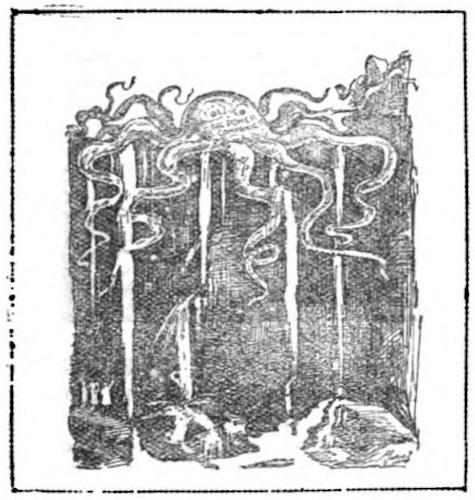
Will It Come to this at Niagara?
Morris, in Spokane Spokesman Review
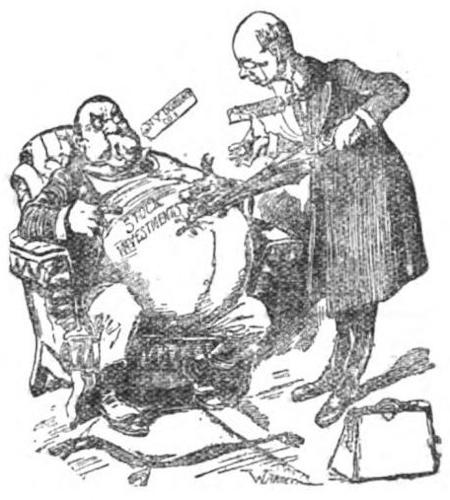
“What, Doctor, All of This?”
Warren, in Boston Herald
Puzzle.—Which Way Is He Going?
Handy, in Duluth News Tribune
R. R. Magnate: I cannot tell a lie. I am
going to do it with my little hatchet.
Handy, in Duluth News Tribune
THE SACRIFICE BY JACK B. NORMAN.
“Don’t think that I ain’t
willin’ for you to have
the home-place like pa
wanted you to, Indie,” said the thin,
tired voice that was fast wearing
into silence, “’cause I am. It’s no
more ’n right after all you’ve done
for me ’n pa. The t’others has all
got homes o’ their own an’ you ain’t
got nobody to fall back on. But,
Indie, promise me you won’t close the
door agin poor Tom if he should come
back. Give him shelter an’ welcome
for my sake, won’t you?”
Indie promised solemnly. Her
thoughts went back to one still, tranquil
night years before, when the doors
of that same home had been closed
against the wayward son by the father
who vowed never to look upon his boy’s
face again. The mother—a frail,
submissive, toil-worn woman—had
mourned in secret, but her prayers
had been unanswered.
“You’ve been dreadful good to us,”
the dying voice murmured; “I hope the
Lord will make it up to you somehow,
Indie. Do you reckon the girls will git
here ’fore I die?”
“Yes, Aunt Viney, I really b’lieve
they will. But you go to sleep if you
can. I’ll wake you as soon as they git
here.”
By and by the sick woman fell into
a gentle doze that deepened into the
sleep that knows no earthly waking.
The married daughters came too late,
but if they were greatly grieved over
their mother’s death they made little
outward sign. They stayed at the
home place for two days, during which
the will was read. It deeded all that
remained of the Pasely farm, that had
been divided and subdivided to supply
marriage portions for four, to Indie, in
consideration of her faithful services
for the old folks.
“Maybe you can ketch Lem Powers
with this bait,” was Louise’s spiteful
comment, after the reading was over.
“Everyone knows you always wanted
him bad enough.”
Mary, the eldest cousin, laughed
dryly. “Indie can’t complain of the
way our folks treated her,” she said
with ill-concealed bitterness. “This
farm is worth a thousand dollars above
the mortgage money. It ain’t many
poor relations that has property like
this left to ’em.”
“I guess Indie knows that she didn’t
come by it plum honest,” the third
cousin remarked. “She knowed how
to work around the old folks so’s to git
’em to leave her what they had. Well,
we ain’t the kind to make trouble even
if we have been wronged.”
When they had gone, Indie abandoned
herself to a passion of helpless,
piteous grief. She recalled one cruel
hour long ago when her cousin Louise
had accused her of caring, unasked, for
friendly, pleasant Lem Powers, whose
off-hand calls on the family stood out
in Indie’s memory as the brightest
events of her lonely, toilful life. Indie
was twenty-three and plain, for the
flower-like prettiness of her early childhood
had long since succumbed to the
triple blight of care and drudgery and
loneliness. It had been known among
her neighbors and acquaintances that
Indie, at the age of eighteen, had never
been “spoke for,” wherefore she had
meekly accepted the stigma of spinsterhood
that comes very early to the
Southern country girl and had withdrawn
from the mild frivolities of youth
to become a household drudge in her
uncle’s family in order that her cousins
might have more leisure and freedom.
After the death of her hard-working
uncle, she had stayed with her ailing
aunt while the girls married and left
her.
“I wisht I’d died instid of Aunt
Viney,” Indie sobbed in utter loneliness.
For two years Indie lived quietly and
comfortably in the old home, paying
her simple expenses by raising garden
truck for the town hotel. Then a letter
came from Tom’s widow imploring
his people to send her enough money to
defray Tom’s funeral expenses to avert
his threatened burial in the potter’s
field. It was a pathetic appeal, involving
the brief story of Tom’s struggles,
how he had worked his way with
his little family from Texas to the old
home state, where he had obtained employment
in a factory. He had met
his death through a boiler explosion the
day before the letter was written.
Tom had always hoped for a reconciliation
in spite of his father’s unyielding
hardness, the widow wrote. In conclusion,
she begged his people not to
allow his body to be consigned to a
nameless grave.
Indie went straight to Mr. Griggs,
the real estate agent, who held the four-hundred-dollar
mortgage on her farm,
and asked him to lend her a hundred
dollars. He refused gently but firmly.
“Why, Indie, by the time you sell
that farm it may not be worth five hundred
dollars in all,” he said. “The
interest on the mortgage is about due
now and here you are wanting to borrow
more!”
“It’s for a particular purpose that
can’t wait a day,” Indie told him anxiously,
trembling in every nerve with
the fear of disappointment.
“I can’t help that. Business is business
you know, and every man must
look out for his own interests. There
is only one way to get that money and
that is to sell the place as it stands before
the debts eat it up completely. I
know a party that would buy, probably.”
“Oh, I couldn’t sell the only home
I’ve got,” Indie said piteously.
“It’ll come to that in the end, anyhow,”
Griggs answered indifferently.
“My advice is to get rid of it now, while
there is a few dollars in it for you. Anyway,
you can’t raise that hundred you
want any other way. If I was in your
place I’d sell and go down to Birmingham
and get work in the factory, where
you’ll make something besides a mere
living.”
Indie’s heart almost stopped beating
at the very thought of leaving the old
familiar haunts for a strange city.
Yet, Tom must have a decent burial at
any cost to herself.
“What could you get for the farm?”
Indie asked huskily.
“Eight or nine hundred I reckon.”
“Could you let me have the hundred
right now if I agree to sell the place?”
she asked.
“Yes.”
“Then I’ll sell—because I’ve got to
have that money right off.”
Indie hurried home and began to put
things to rights. She packed up her
personal belongings and moved all her
humble furniture into one room, where
it could be easily got at in case she
should send for it a little later, if she
were fortunate enough to secure steady
work in the factory which Mr. Griggs
had referred to. He had even given
her a clipping from the Sunday paper
containing an advertisement calling for
twenty new hands, “experience not
necessary.”
Indie was sweeping the back yard
when some one strode up the pebbled
walk with brisk, business-like steps,
which she mistook for Mr. Griggs’s walk,
for he had promised to stop in on his
homeward way. But it was not the
agent. It was Indie’s old friend Lem
Powers, whom she had so timidly avoided
for years. His broad-brimmed hat
was turned up squarely in front, framing
his dark, strong, sunny face in a sort
of a rough halo.
“Evenin’, Indie,” said he, with a tug
at his up-standing hat-brim. “Do you
happen to have a wrench about the
place? My buggy wheel’s locked an’ I
ain’t got no tools with me.”
Indie shook down her sleeves hurriedly,
keenly conscious of her unpleasing
appearance. “Won’t you set down
while I hunt up the wrench?” she asked,
nodding toward the veranda bench.
“I’ve done packed up everything, but
I can find the wrench easy’s not.”
“Packed up!” the young man echoed
in blank astonishment, with a sweeping
glance at the denuded premises.
“Why, you don’t aim to move, do you?”
“I expect to leave Shallow Ford to-morrer
mornin’,” Indie answered solemnly.
“You don’t say so? Goin’ to live
with your cousins?”
“No, oh no,” Indie answered quickly,
with a dry smile. “None of them ain’t
never asked me to live with ’em, and
even if they had I wouldn’t go.”
“I didn’t know you had other kin.”
“I ain’t. I aim to go to Birmingham
to work in the factory. I seen a
advertisement callin’ for twenty new
hands and I thought it would be a good
chance to get started.”
“Whatever put that idee into your
head, I’d like to know? I don’t
b’lieve you’ll like the work one bit,
Indie,” the young man said with grim
conviction. “It ain’t healthy, to begin
with. Don’t you rec’lect how pale an’
peekedy them Baldwins looked when
they come back here on a visit after
havin’ worked in the thread factory
down at Birmingham? They didn’t
have the sperit of a jack rabbit between
’em, an’ their ways was plum changed
too—sorter forrard like. You won’t
like the sort of company they keep,
Indie.”
“I’ve got to go now,” said Indie,
doggedly, “cause I’ve done put the
place for sale. Mr Griggs thinks he
can sell it without any trouble.”
“He may. Indie, is it on account
of the mortgage you’re leavin’?”
Indie shook her head. She could not
tell Lem her real motive.
“’Cause if it is,” said Lem, earnestly,
“I’d be only too glad to stand good for
the debt if you’ll let me.”
Indie’s pale face reddened painfully,
and her head went back an inch or two,
for she had her pride in spite of her
helplessness. “I couldn’t ever raise
enough truck to pay off the debt,
anyhow,” she answered coldly.
“You could rent the place an’ pay
off that way. I do wish you would let
your old friends do a little something
for you, Indie,” he pleaded, growing
red and embarrassed under her increasing
coldness.
“It’s too late to rent now, ’cause it’s
way past corn-plantin’ time,” Indie
objected, “an there ain’t nothin started
but two acres o’ roastin’ ears an’
some garden truck.”
“I should think you’d hate to leave
the old place,” Lem observed, letting
his bright gaze wander over the green
pasture strip and the narrow creek
bottoms where the young corn waved
idly in the evening breeze.
Indie’s thin face clouded with the
shadow of regret, but she made no reply,
for she would not have admitted,
on pain of death, that her heart ached
with the pathos of renunciation.
“Ain’t there nary thing I can do for
you, Indie?” Lem asked, after an awkward
pause, in what seemed to the
listener a very off-hand, indifferent voice.
“No thanky. There ain’t a thing to
do but to take the cow over to board
with the Bankses. Seems like I can’t
bear the thoughts of sellin’ her to out-an’-out
strangers, so I thought I’d
board her till some of the neighbors
gits ready to buy her. Miss Clayton’s
goin’ to keep Billy for me till I get
settled, so’s I can take him.”
Billy, the big tortoise-shell cat that
purred on the door step, lifted his head
at the sound of his own name and
blinked contentedly, whereupon Lem
stooped and stroked his glossy fur.
“I guess Billy’ll miss you if no one else
does,” he remarked dryly.
Then he rose and held out a big
brown hand. “Well, good-bye, Indie,
an’ good luck to you,” said he. “If
ever I can do anything for you, let me
know, will you?”
“Good-bye,” said Indie gravely.
Indie went away the next morning—a
morning full of balm and peace.
Fresh, fragrant winds scattered the
rose petals thickly over her shoulders
as she hurried down the garden path
to meet the stage. She did not trust
herself to glance back, for some strange,
dumb emotion tugged at her heart-strings
and soundless voices called to
her out of the sweet silence that enveloped
earth and sky.
She shivered as she entered the hot,
sultry, dust-laden train with its burden
of dull, spiritless travelers. “It must
be the air,” she murmured to herself
as she sank into a seat. “These cars
is awful clost with the sun beatin’ down
on ’em an no air stirrin’. Now, if a body
was at home they could open the doors
an’ winders an’ set in the shade.”
“Home! Home! Home!” said the
swiftly revolving wheels that bore her
relentlessly away from the old, sweetly
familiar scenes toward an unknown,
lonely future. She watched the green
fields and woods that whirled past the
windows until they grew less and less
frequent, with dingy little stations
squatted between them. The landscape
changed and the car grew hotter
and the smoke thicker, for the train
was approaching the factory district
of Birmingham, the Alabama metropolis.
Children, with unclean, pallid, faces,
stared up at the car windows as the
train pulled through their grimy quarters,
and men in blackened, greasy
clothes lounged along the tracks in the
occasional shade of a sweltering brick
wall.
Indie found the squalid home of
Tom’s widow after much patient wandering
about the uneven, unswept
streets. Many minutes passed before
her ring was answered; then a white-faced
woman opened the door a very
little way. Yes, she was Mrs. Pasely.
Did anyone want to see her?
“I am Tom’s cousin, Indie,” the
caller announced simply. “I’ve brung
the money for Tom’s funeral.”
The widow cried a little at first while
she told Indie of Tom’s tragic death,
but her mind was too absorbingly occupied
over the funeral to permit of
the luxury of self-pity. She dressed
hurriedly and went out to communicate
with the undertaker, leaving Indie
with the children, three little, frail,
colorless, old-young beings, who reminded
Indie of cellar-grown plants.
The widow was not long away; late
that afternoon the two women and
their three charges followed Tom’s
remains to consecrated ground.
“I never can tell you how thankful
I am,” was all Mrs. Pasely said to Indie
concerning her sacrifice, “for now I
feel at rest about poor Tom bein’ laid
away like he ought to be. If the baby
was just well I’d try to start out an’
make a livin’ and do my best without
Tom,” she added mournfully, “but it
seems like I ain’t got no heart to do
nothin’ while he’s so weak and puny.
He ain’t been to say real well since we
left Texas, where we lived right out in
the country. I’ve tried everything I
could think of but nothin’ don’t do him
no good as I can see. The doctor says
he won’t never git well till I take him
back to the country, an maybe not
then. Me’n Minnie’s got promise of
work in the factory next week, but if
little Tom ain’t no better I can’t leave
him with jest Jim to look after him.
If we only could git back to Texas agin
we’d all git well an’ stout, an’ I wouldn’t
care if we was poor. All I care about
is for little Tom to git well.”
Oh, if she could only take them all
back to the farm with her, thought
Indie. A great wave of home longing
surged through her heart as she thought
of the peace and beauty of the deserted
home. She knew just where the shadows
of noontide lay darkest over the
old rose-bordered yard—knew that the
back veranda where she always ate her
simple midday meals with Billy purring
at her feet was just then in the thickest
shadow of the china-berry trees, and
that all was still and sweet and tranquil
in that far-off haven of rest. Instead
of factory walls there were green, blossomed
hedges; instead of the strident
clamor of motor cars and mill gongs
there was a ceaseless chorus of song
birds, and instead of the hot, smoke-tainted
air of the city, there was the
fine, earthy fragrance of the good
sweet soil that lay fallow while so many
weary toilers sweltered in their city
prisons.
Indie made Tom’s widow understand
the whole situation, then she offered
herself in any capacity that could serve
little Tom, who had the look that she
dimly remembered in young Tom when
she first went to live with his parents.
Indie would take work in the factory as
she had planned to do and board with
Tom’s widow to help along all she
could, or she would take them all back
to the farm and work very hard to make
a mere living while little Tom had a
chance for his life.
“Why, I’d be willin’ to work day an’
night on a farm!” the widow answered
earnestly. “I’m jest plum certain
Tom will git well way off there in the
country. Oh, do take us back with
you! Me’n Minnie an’ Jim can make a
real good crop between us. You’ll see!”
That was what Indie wanted. She
would sacrifice the last thing that remained
to her—her pride—and ask
Lem to help her by standing good for
the hundred-dollar note, and far the
rest she would work as she had never
worked before.
“We’ll go tomorrow,” Indie announced.
“You git right to work
packin’ up what you want to take.”
The world was aflame with the splendid
fires of sunset when the little party
alighted before the farm gate on the
following evening. “I’m real glad it’s
light enough for you to see the flowers
an’ things,” said Indie, as she led the
way up the rose-bordered walk that
seemed to greet her with sweet familiarity.
“Good thing I left the key
under the porch steps right where I
could find it handy. There, now walk
right in an’ set down, while I kindle a
fire an’ git some supper.”
She had bought a few eatables the
last thing before leaving Birmingham,
which she speedily converted into a
tempting meal. Her guests rewarded
her industry to a gratifying degree,
even to little Tom, who seemed to have
acquired a good appetite which delighted
his frail, worried mother beyond
bounds. “He ain’t et like that in I
dunno when!” she exclaimed with tears
of joy.
It was close upon Indie’s usual bedtime
when her ministration ended. She
slipped out for a quiet rest on the front
door-step to enjoy the peace and loveliness
of the perfect spring night, but
hardly had she seated herself when the
garden gate creaked rustily and someone
strode up the walk with heavy
strides. At the sight of the dim figure
on the step the intruder stopped
precipitately.
“Who’s there?” asked a familiar
voice.
Indie rose tremblingly. “It’s Indie
Bright,” she answered. “Did you
want to see me?”
“Indie!” exclaimed a voice so thrillingly
joyous that the listener felt herself
quiver from head to foot with a
strange, inexplicable ecstasy.
“Ain’t it Lem Powers?” she asked.
“Has anything happened?”
“That’s what I’d like to know,”
came the surprised answer. “I thought
you was gone!”
Indie told her story briefly, carefully
deflecting all merit from herself. “I’m
real glad it happened that way,” she
finished, “for I did hate to sell the old
place.”
Lem drew a deep breath. “You’re
jest five hours too late, Indie,” he said
in a queer voice, “for the agent sold the
farm this afternoon at four o’clock.”
Indie felt the solid earth recede beneath
her. “Sold it!” she echoed
fearsomely. “Oh, Lem, whatever shall
I do!”
“I dunno. There ain’t no use in
tryin’ to buy it back, ’cause the man
that bought it won’t part with it for
anything, except——”
He paused and went a step nearer.
“Except you’ll give him what he’s
always wanted—yourself. Indie, I
never did want no other girl but you,
an’ never will.”
Indie shrank away, but a strong,
warm hand found hers in the shadow,
while the low earnest voice went on to
tell her of a miracle that thrilled every
fibre of her being with unspeakable
happiness.
“I aimed to ask you the day you
told me about leavin’,” Lem confessed,
“but by the way you talked I thought
it wouldn’t be no use, so I bought the
place hopin’ you’d want to come back
some day.”
“Lem,” said Indie, after a long,
happy silence, “I never had no idee
that—that you ever wanted me. I
thought it was Cousin Louise you
wanted.”
“Louise—after I’d seen you!” Lem
cried incredulously. “Why that would
be like chosin’ a bit o’ glass instid
of a real diamond. It was Louise
as told me how you’d took a dredful
dislike to me from the very first, an’ of
course I couldn’t help but believe it
by the way you always acted when I
was around. I tell you, Indie, that
made a heap o’ difference to me. I’d
a done anything in the hull world for
you an’ would yit if you’d only let
me.”
Indie drew a deep breath that sounded
strangely like a stifled sob. “Oh,
Lem, that’s just the way I’ve always
felt about you,” she confessed very
softly and hesitatingly.
After a long, long while, during which
the years and their burden of care and
loneliness and heart-ache slipped away
from Indie’s heart like an wornout garment,
she drew her hands away from
Lem’s close clasp. “You’d better
go now, Lem,” she said very gently,
“’cause it’s gitting late an’ I don’t want
to wake the folks up after they’ve got
to sleep.”
“All right, Indie. I’ll be back tomorrow
to see about putting in a late
crop o’ corn for Tom’s folks to work
out. We’ll jest let ’em keep the place
free of rent for a while an’ see to it that
they make enough to keep ’em. You
can look after ’em all you want to, for
it ain’t but a little piece from our place
over here. Good night, Indie.”
Indie lingered in the soft, starry dusk
for a few moments after Lem had gone,
to gloat over her great happiness; and
presently something dark and small
scuttled out of the lilac hedge and
bounded into her lap with a mew of
welcome. It was Billy, quivering with
elation and delight.
Indie caught her pet to her breast
with a cry of rapture. “Oh, Billy,
Billy, ain’t it lovely to be home again!”
Our Civilization BY COUNT LYOF TOLSTOY
Men say that civilization, our
civilization, is a great good.
But they who have this conviction
belong to the minority who
live not only in this civilization but by
it; who live in ease, almost idleness,
in comparison to the lot of workmen.
All such men; kings, emperors,
presidents, princes, ministers, functionaries,
soldiers, proprietors, investors,
merchants, engineers, doctors,
scientists, professors, priests, writers,
are so sure our civilization is a great
good that they cannot bear the thought
that it should disappear or that it
should even be changed.
Ask, however, of the great mass of
agricultural people, slave people,
Chinese, Hindus, Russians—ask nine-tenths
of humanity whether this
civilization, which seems a superlative
good to those who are not agriculturists,
is really a blessing or not?
Strangely enough, nine-tenths of humanity
will reply in the negative.
What they need is soil, fertilizer,
irrigation, sun, rain, forests, harvests,
and simple farming implements that
one can make without abandoning the
agricultural life. As for civilization,
either they know nothing of it, or
it presents itself to them under the
aspect of the debauchery of cities,
with their prisons and their bagnios;
or under the aspect of taxes and useless
monuments, of museums, of palaces;
or under the aspect of duties which
prevent the free circulation of products;
or under the aspect of cannon,
of armor and of armies that ravage
whole countries. And they say, if
that is civilization it is of no use to
them, and that, it is even hurtful to
them. The men who enjoy the advantages
of civilization maintain that
it is good for all humanity; but in this
case they cannot bear testimony because
they are both judges and parties
concerned.
One cannot deny that we are now
far along the road of technical progress;
but what is far along on that road?
A little minority lives on the back of
the work people; and the work people,
they who serve the men that enjoy
civilization in the whole Christian
world, continue to live as they lived
five or six centuries ago, profiting
only from time to time of the leavings
of civilization.
Even if they live better, the breach
that separates their lot from that of
the rich classes is rather wider than it
was six centuries ago. I do not say,
as many think, that, since civilization
is not an absolute good we should
throw out at one stroke the structure men
have devised for the struggle against
nature; but I do say that, to make sure
this structure shall really serve men
well, it is necessary that all and not
only a small minority enjoy it. No one
must be deprived of his due by
others under the pretext that these
benefits will return one day to his
descendants.
The good and reasonable life consists
in choosing, of many ways that lie
open, the way that is best.
Therefore Christian humanity in
the present situation should choose
between two things: either to continue
along the path of wickedness in which
existing civilization gives the greatest
number of benefits to the smallest
number of people, keeping the others
in poverty and slavery; or immediately,
without postponing it to a future
more or less remote, to renounce in
part, or wholly, the advantages which
this civilization has given to certain
privileged ones, thereby preventing
the liberation of the majority of men
from poverty and serfdom.
A Coal Miner’s Story BY CHARLES S. MOODY, M. D.
The average worthy citizen reclining
beside an open coal-grate,
reading the press accounts of the
latest coal strike, has little interest in the
matter further than his interest in the
probable effect of the labor disturbance
upon the price of his winter’s fuel. When
he reaches that part of the narrative
that tells of the troops having been
ordered to the scene of action, the powerful
arm of the military invoked to put
down the uprising among the working-men,
he heaves a sigh of relief that now
the strike will be of short duration and
the price of coal will not be advanced.
Seldom does he consider the matter
from the standpoint of the man who
mines the coal.
Were that one big lump glowing
warmly in the centre of the grate gifted
with the power of speech, it would tell a
tale that might well harrow up the feelings
of the most callous. Alas! it is
dumb, just as the man who dug it out of
the bowels of the earth is dumb. It
glows its heat away, crumbles into gray
ash, and the worthy citizen retires to
his rest with mind untroubled by any
unpleasant thought of want or penury
among those who go down into the unwholesome
deeps of the mine and toil
all day shut out from God’s gracious
light that he and you and I may enjoy
comfort and warmth.
At one time of my life the relentless
wheel of Fate in its ceaseless revolving
whirled me to its nadir, and spilled me
into the squalid chaos of a coal-mining
town, and, not content with that, hurled
me into the nethermost hell of all that
seething vortex of toil and poverty.
That the worthy citizen may see
something of that side of the shield—the
side sable—I will attempt to tell it,
not with the graces of one skilled of pen,
but in all its plain, naked, glaring
hideousness.
At this point allow me to crave pardon
for the frequent use of the personal
pronoun. I am speaking as a coal-miner,
and can tell it better by using
the first person.
I was raised in the Far West. My
life had been spent among the green
mountains of the Pacific Coast, and I
knew but little of the land beyond the
Rockies. When ambition came, as it
comes to youth everywhere, I dreamed
of other lands where that ambition
might find its full fruition. I left the
mountain home, and set out to conquer
the world of my dreams. My
journey ended at the little town of Excello,
in Northern Missouri. I was
moneyless, and, as I soon ascertained,
friendless. Disappointment glared at
me from every door. Every vocation
in life seemed filled, and all the avenues
leading thereto were crowded with men
eager to push the possessor of a job
from his place and occupy it in his
stead. I tried every possible chance
for work, but without avail. Not even
a country district school, with all its
manifold possibilities of poverty, was
open to the stranger.
Not far from Excello, the Kansas and
Texas Coal company have opened up
extensive mines at Ardmore. At last,
desperate and in absolute despair, I
turned to the coal mines that wait with
black, widespread maws to suck in
such flotsam of humanity as I was then.
I set out from Excello on foot in the
bleak dawn of a March morning, for the
only Mecca left open to me. A donkey-engine
drawing a train of coal-cars soon
overtook me, and the engineer stopped
his train and took me on. It was but a
trivial act of kindness to a stranger, but
it stands out so distinct and vivid by
reason of its rarity that I must speak of
it here. Motives of the most sordid
meanness so completely actuate the
principles of those people that the simple
act of one of them giving a tramp a
ride glows from out the grime of greed
like a gem.
The little engine grumbled and rattled
its way down the banks of a dirty
yellow stream, dignified by being called
a river, until it halted beside the head-house
of one of the mines, and I was
permitted to take my first view of Ardmore,
one of the worlds that I had come
so far to conquer. Ah, the irony of it
all! What a contrast to the mental
picture that the boy had painted upon
the canvas of fancy not so many weeks
before!
First the tall head-house and hoist,
with the coal-screens all under one roof
standing black and grimy at the mine’s
mouth. Then the long incline, up
which crawled the laden cars from the
mine, looking for all the world like
filthy serpents from some subterranean
world. Off to one side towered the
culm-pile, emitting its choking sulphurous
smoke and polluting the muddy
water of the little stream that wound
about its base. Off yonder, on either
side of the same stream, perched a
double row of squalid grimy shacks,
like gigantic carrion birds waiting to
pounce upon the filth that flowed down
the current of the river. These were
the homes of the miners. Home! What
a travesty on the sweetest word in
any tongue! In the distance clustered
the offices of the Company and the
Company store, that most powerful
tentacle of the giant octopus by
which the Company holds its operatives.
I made my way down the narrow
sidewalkless street, past the rows of
miserable huts with their reeking front
yards filled with children in no less
degree reeking, past that bane of all
mining towns, the low doggery, where
for a few cents the miner buys the
vilest of vile liquor, on to the town
proper. The contrast between the two
was startling. The officials must perforce
reside where they collect their
tithes, but they strive to make life bearable.
Every house was neatly painted
and every lawn set with trees and
smoothly kept. I saw ill-clad women
and low-browed men black with the
grime of the mine entering a large building
which I rightly surmised to be the
Company store. The offices were on
the other side, and those who entered
there did so with an air of the utmost
servility, as though they fully expected
to be kicked into the street.
It is wonderful what an influence
one’s surroundings will have upon their
character. Here I had been in Ardmore,
only thirty minutes and I caught
myself approaching that office in
the same servile manner affected by all
whom I saw enter there. I stood for
some minutes hesitating before the portals
where sat enthroned those who
held my destiny in their hands. Cold
and hunger are grim and determined
drivers, however, and both were flaying
me with their whips. Summoning my
manhood I entered, approached the
employment window and begged the
right to earn my bread. The clerk
gave me one keen look that swept me
from head to foot and tersely assigned
me to servitude in Mine 33, the one I
had passed in the morning. He handed
me an order on the store that entitled
me to a miner’s outfit to be paid for out
of the first money earned. He also
assigned me a number by which I was
henceforth to be designated in all my
dealings with the Company. I became
Number 337, and if I differed in any
particular from the man bearing that
same number in the Jefferson City penitentiary
I was unable to detect that
difference. True, I was permitted to
walk the streets unmolested, but the
product of my toil belonged to the Kansas
and Texas Coal Company. I felt
relieved. I had passed from the ranks
of the unemployed. Henceforth I was
to be a sovereign American citizen enjoying,
as such, the Constitutional
right to earn my bread.
I passed into the store and purchased
such things as appeared needful, using
one of the miners as a model from which
to deduce my needs. A coarse pair of
heavy shoes, ducking overalls and shirt,
a pit cap with place in front to carry
the lamp, the lamp itself, a gallon of
lard oil for the same, a dinner-pail
called a “deck” and the necessary picks
and shovel about completed the outfit.
One of the clerks rather grudgingly
answered my question regarding a
boarding-place by informing me that
there was a house on the hill that made
a practice of feeding miners. Carrying
my bundle, I called at the designated
house and secured board and lodging.
The house was slightly better than
those I had passed before and, standing
upon higher ground, was rather less
filthy. I soon found that the miner is
expected to do without all the luxuries
and generally all the necessities of life.
Water seemed the only article that
could be obtained in plenty and for that
I soon had reason to be truly grateful.
The table fare was of the coarsest and
cheapest variety possible. It possessed
the sole merit of sustaining life, and that
to me at the time overbalanced all other
considerations. The beds were arranged
in rows in an upper room. Two
people were expected to occupy one bed.
I had assigned to be my bed-fellow a
young Cornishman, and I suspect the
landlady selected him for that position
owing to the fact that he was slightly
less dirty than her other boarders.
That evening my “buddy,” that is,
the man who was to be my working
companion, called to see me. He was a
man of middle-age who had spent his
life in the mines. He had the pronounced
stoop that I noticed in all the
miners and which I very soon acquired.
His skin was of that sickly yellow
hue characteristic of convicts and
coal-miners, brought about by being
shut out from the light of day. It
seems that I drew a very lucky number
in having this man assigned me for
“buddy.” The other miners told
me that he possessed a “machine.”
That is, after years of toil in the mines
he had been able to save enough to buy
a drilling-machine that retails at the
Company store for fourteen dollars.
Wonderful fortune! Almost a lifetime
spent in labor, and all that he had to
show for it was a fourteen-dollar drilling-machine!
We talked long into the
evening and I found him not without
ideas that were expressed in a crude
way, but above all, and, what was of
vastly more importance to me just then,
he was a practical miner. I do not
know what he might have thought about
it, but he had the tact not to hint anything
about objecting to a green hand
as “buddy.” Indeed, I suspect that
the Company would hardly tolerate
any criticism of their actions in that
regard.
I appeared next morning clad in the
habiliments of a coal-miner. My
“deck” was filled and handed me and
I followed the long line of stooping
figures headed for the mines. We
paused at the mouth of the pit and
lighted our lamps and swung them
from the front of our caps. Then,
stooping still lower, passed down the
long incline that leads into the coal vein.
Soon the gloom surrounded us, and the
flickering yellow-light from the burning
lamp became our only guidance. Once
upon the level of the coal body, the air
became oppressive and warm. Used as
I had always been to the free air of the
mountains, I paused and gasped for
breath. I was merely one atom of the
inward moving black stream and was
pushed onward. I soon grew accustomed
to the lack of oxygen and before
many days learned to exist upon a
minimum supply of that article just as
I learned to exist upon a limited supply
of many other articles that in my
ignorance I had considered essential.
I neglected to state that I had been
met at the pit mouth by my “buddy,”
who escorted me through the mazes of
the underground streets of the mine to
the Third West, which was the field of
our future efforts for some time to come.
On the way in he conversed very cheerfully
about the condition of one of his
children who was ill with pneumonia
and not expected to live the day through.
I half suspect that he secretly hoped
that the Death Angel would come, and
not only relieve the little one of her
sufferings, but relieve him of one hungry
mouth to feed.
It was over a mile from the surface
to where our work lay. It consisted in
“turning off a room”—that is, making
an entrance into the bare face of the
coal at right-angles to the direction of
the tunnel. This was necessarily slow
work and we accomplished but little
the first day. All day long I sat upon
my heels and picked a narrow trench
from top to bottom into the resisting
body of the coal. Long ere night came
my cramped limbs refused to move
another inch. I was simply racked
from head to foot with pain. There
never was a more welcome sound than
the signal at the head of the entry to
begin firing. Soon the boom of shots
reverberated down the entry like the
sound of cannonading, and the miners
began straying out past us. We gathered
up our tools and, placing them in a
safe place, followed them. Ah, the
blessed exhilaration of that air as I
reached the surface! It was like being
conveyed into another and better
world. I glanced at my “buddy.”
He had not changed one muscle of expression.
With dogged, shambling footsteps
he was setting off toward one of
the miserable shacks.
Curiously I watched the miners as
they appeared. All nations seemed
gathered there. Italians, Czechs, Russians,
Finns, Hungarians, Slavs, Cornishmen,
Americans, yes and negroes.
While the colored man was not permitted
to become a miner in that particular
mine, he was employed in various
other capacities. I saw children
of tender years going from work, their
dinner-pails upon their arms, the stoop
already in their shoulders, the hectic
flush already in their cheeks. “Merciful
God,” I thought, “this greedy giant,
not content with sucking the life-blood
of men, must rob the school as well to
sate its lust!” I learned afterward
that there was a child-labor law on the
statute books of good old Missouri, but
that it was openly and flagrantly violated,
and that the Commissioner of
Labor was a party to the violation.
I passed on homeward. Every step
seemed weighted with lead. I dragged
myself up the long hill and entered the
house. I was shown the wash-room
and my particular washing-tub filled
with steaming hot water. The room
was already filled with miners taking a
bath. I stripped and found that though
I had been in the mine but a day my
body was black with coal-dust. The
next half-hour I spent in trying to remove
the grime, with but poor success.
The other miners finished their ablutions
and departed. I was shocked
at the manner in which the most of
them performed that important duty.
A dash of water on the head and neck,
a wet towel over the body, rubbing off
the most evident particles, a brisk
scrubbing of the head, neck and ears,
and they were ready for supper. I was
so long at my bath trying to accomplish
the impossible that the landlady
tapped on the door and informed me
that supper only waited my appearance.
I overheard one of the miners designate
me as “that new dude” when I entered
the dining-room. To be cleanly, then,
was considered among these sons of toil
as being a species of foppishness. (I
soon learned to perform my ablutions
more scientifically, and remove a maximum
amount of coal-dust in a minimum
length of time.) I was too tired
to eat, too weary to sleep. All night
long I tossed about in that comfortless
bed and sighed for the coming of morning.
It came at last and dawned upon
another day of labor.
Today we drilled our first hole and
placed the first shot. I had the satisfaction
of loading my first box of coal,
affixing my leather tag to it and starting
it on its journey toward the weighing
office, thereby satisfying a small
part of the Company’s claim against me
for the clothes I wore. My “buddy”
had lost his child the night before, and
this afternoon the little one was to be
buried in the graveyard on the hill back
of the town. He asked me, as though
requesting a favor, whether he might
attend the funeral! Asked me, almost
a stranger, whether he might attend
the funeral of his own child! Heavens,
what a system! My heart was so
heavy that I could not work, but he
seemed to take it all as a matter of
course. In fact I detected a cheerful
note in his voice as he informed me of
the demise.
During the afternoon I had nothing
to do but carry the picks out to the
blacksmith-shop to be sharpened, for
which service we are to pay the smith
each a dollar per month. After they
were prepared I returned with them to
the mine and employed the time in
looking into the other rooms where the
miners were at work. In almost every
instance I found them idle. Inquiry
revealed the fact that they were waiting
for coal-boxes. They had plenty of
coal to load, but no boxes to load it in.
The Company makes it a practice to
allow no man to get ahead. Once he falls
into their grasp the idea is to keep
him there. Even at thirty-five cents
per long ton, the price paid, the miner
could make fair wages if he were furnished
boxes, but the Company does
not intend that he shall make fair
wages.
Our room advanced rapidly now,
and we always had coal ahead to load
what boxes came to us, which were few
enough. The most we ever got in any
one day was six, that is three for each
of us, and could we succeed in placing
a ton in each one we would have made
the munificent sum of $1.05. Out
of that princely wage we were supposed
to pay for board, lodging, hospital fees,
blacksmith, and powder. By the way,
there is the greatest steal perpetrated
by the coal companies. They furnish
the miner with his powder at a cost to
him of $2.50 per keg. Of course they
do not say in so many words that he
shall not buy his powder from other
dealers at 90 cents per keg, but if he
does do that they see to it that his
tenure in the mine is very short, and
they have divers ways of disposing of
him without discharging him outright.
There are two methods of mining
soft coal. The method used in Mine
33 was what is known technically as
“shooting off the solid,” that is, drilling
a deep hole in the solid coal body and
blasting it down very much as rock is
blasted in railroad building operations.
This method, while it procures the
greatest amount of coal with the least
expenditure of labor, is at the same
time very expensive to the miner who
must buy his powder and in addition
to his regular blacksmith tax must
pay for the sharpening of all the drill
bits.
It is in these blasting operations that
so many men in soft-coal mines lose
their lives. The force of the blast
loosening the coal at the same time
jars the slate roof of the mine. When
the workman returns and starts picking
down the standing column of “shot”
coal the treacherous top gives way,
and, like a deadfall, buries the unfortunate
man beneath tons of slate. Then
there are three bells signaled to the top
and down comes the padded car, if the
man is not entirely dead, and he is
carted away to the hut miscalled a
hospital. The next day some of his
friends are around with a paper and
each miner is supposed to contribute a
box of coal to the relief of the injured
miner. Should the accident, however,
result in the instant death of the man
there is no such ceremony as calling the
padded car. He is simply dumped into
an empty coal box and hauled to the
surface with the next trip going out.
Once there, his very existence is forgotten
in the mine and work goes on
as before. The same formality regarding
the gift of the box of coal is gone
through with for the benefit of his
widow and orphans. In all my mining
experience I never knew of a miner
refusing to subscribe to a fund of this
kind, though they could ill afford to do
so out of the scanty wage they were
earning. You feel inclined to do it,
for you know not what instant you will
yourself require like assistance.
One method employed by the Company
in getting rid of an objectionable
miner is so ingenuous in its simplicity
that it deserves mention. They have
what is known as a sulphur bell. If a
miner loads a lump of sulphur into his
box that is so large that he might be
supposed to detect it the men at the
screens pull a rope that rings a bell in
the weighing-office and the unfortunate
miner has a check placed against his
number. He not only has that box
of coal docked about half, but he gets a
demerit as well. Three of these demerits
results in his dismissal from the
mine. Now, let us illustrate. In the
first place, there is so much of the sulphurous
mineral scattered through
the coal body that it is an absolute
impossibility to remove all of it down
there in the half light of the underground
world. There is hardly a box of
coal that reaches the weighing scales that
does not contain several pounds of the
substance. That some miners do place
lumps of it in their boxes to increase
the weight is perfectly true. A miner
becomes objectionable to the powers
that be by reason of talking too much
(for some of them do think and express
their thoughts to their fellows) and the
powers that be decide to get rid of him.
They could simply call him into the
office and hand him his time, but that
is not the policy. The word is passed
to the man at the bottom of the screens
to “bell” Number so and so out. The
Argus eye of the man is upon every
box of coal that comes sliding down the
incline. He hears this man’s number
called and detects a lump of sulphur
sliding along with the descending coal.
He reaches up, yanks the bell rope and
that miner is one-third out of a job.
It may take several days to complete
the task, but Fate is no more certain
than that it will be completed. Usually
a miner who knows himself to be
under the ban and sees a sulphur
check opposite his number takes the
hint and calls for his time. Wonderfully
simple. Charmingly effective.
Another and equally effective method
is that of slow starvation. The
banned miner finds that he is not
getting an equal number of boxes with
his fellows. He complains to the
driver and obtains but scant satisfaction.
Things go on until pay-day and he
finds himself behind with the company.
He is questioned very closely as to the
reason for this and solemnly warned
not to allow it to occur again. Naturally
it does occur again and he is
forced to look elsewhere for work.
These instances are, however, comparatively
rare. It is the policy of the
octopus to hold securely every victim
who falls into the slimy toils. Only
when a man has the courage to assert
his manhood does he become objectionable
to the company. So complete is
the system that there are few such.
It does not require one skilled in
the economics of the labor problem to
point out the glaring evils of a coal-mining
system. They are so evident
that even he who runs may read.
They are so patent that even the dull
creatures who toil under them feel in
a blank way that something is wrong.
Just what, they cannot say. They
realize that they are always hungry,
always toiling and always in debt.
There are three things that the strong
arm of the judiciary should suppress—child
labor, peonage, and weight frauds.
I have purposely placed child labor
first, for it deserves the first place.
Children of very tender years are forced
into the mines, where they serve in
various capacities, some of them even
being utilized by their parents in the
actual mining operations. This is
done that the parent may obtain an
extra supply of coal boxes by reason
of his having a “buddy,” though the
coal is all loaded out under his number.
Principally, however, the little
fellows are employed as “trappers,”
to open and close the immense valves
that direct the air current down the
various entries. All day long these
infants stand in the noisome draft and
swing back and forth those heavy
doors. With the strong current of air
pushing or pulling against these valves
it is no light task for even a man to
perform. Then the damp air, playing
about the half clad figure, induces
colds, pneumonia and consumption.
It is a rare thing to see one of these
little “trappers” who is not coughing
with some form of respiratory trouble.
The parents lie cheerfully regarding
the child’s age, and the child itself lies
just as cheerfully. Poor creatures,
they are hardly to be blamed! The
few pennies that are thus obtained
help to keep the almost empty pot
boiling at the squalid home.
The system of peonage is worse far
than African slavery ever could have
been. From year’s end to year’s end
the miner never sees money. He is paid
in coupon books good at the store for
the necessities of life and that is all
he is expected to have, and precious
few of them. In almost every instance
the Company has sold to the miner one
of the miserable houses, for which he
is to pay a certain sum every month.
The Company proudly boast that their
miners own their own homes. The miner
is given a contract to be held in escrow
(by the Company) whereby upon the
payment of the purchase price he is to
have a deed to the property. It is a
very significant fact that there were
only eighteen deeds on record in Macon
County covering these properties.
In other words, only eighteen miners
actually owned their homes. It was
never the intention of the Company to
allow the miner to secure title to his
“home.” If any considerable number
of them showed symptoms of making
good on the payments, the Company
had many ways of causing them to
default and thus violate the ironclad
terms of the contract.
The contention regarding weights
is one of long standing. The miner is
supposed to mine a long ton of 2240
pounds. In reality he mines nearer
3000 pounds. The scales are hidden
from the view of the miner and the
weigh boss cheerfully deducts from the
weight of the miner’s box anything
that he sees fit and he usually sees fit
to deduct about one fourth. This
systematic robbery is carried on all
the time. Could the miner obtain
what his labor actually produces, his
condition would be less miserable. He
does not obtain it, however, and he
seems powerless to bring about change.
Now we will return to my own
personal experiences in the mine.
Our room was a good one, save that the
slate top was very treacherous and we
took particular care to keep it well
timbered. My “buddy” was a
thorough miner and fully knew the
virtue of propping the top perfectly.
The room had been driven up some
sixty yards when the accident happened,
that brought home to me the dangers
of mining.
We fired a fourteen-foot hole in the
evening, before leaving the mine. The
next morning my “buddy” arrived
before I did, and began loading the box
that was standing in the room. Upon
my arrival I found the box half filled,
but my “buddy” nowhere in sight.
A mass of slate had fallen and I knew
instinctively that my “buddy” was
beneath the mass. I called some of
the nearby miners and, after propping
the top, we fell to work removing the
debris. First an arm showed; then
the entire body was exposed to view.
He had been instantly killed. I loaded
the body into the half filled box and
accompanied it to the top. It became
my duty to inform the wife of the misfortune.
She, poor woman, took the
news stolidly, as though she had long
expected it. Indeed, I think they
grow to look forward to the time when
the husband will be carried in, crushed
out of all semblance to a human being.
We buried him in the bleak graveyard
on the hill and, as his “buddy,” it became
my duty to carry around the
paper that asked assistance for the
widow. In her stolid way, I suppose,
she was grateful for the charity, but
she never showed it by any emotion of
the face, taking the whole thing as a
matter of course.
It had been a very wet Spring and
the falling rain had completely saturated
the ground and, soaking through,
had loosened the slate and soapstone
top until falls were of almost daily
occurrence. As yet we had not been
visited with any that were disastrous
in nature. A few tons of rock in some
of the rooms, a miner killed or hurt,
was about all. In June, however,
occurred the fall that imprisoned several
hundred of the miners in the West
entries for two days. Down toward
the beginning of the first West an old
deserted room caved in, carrying with
it the top above the entry proper.
For several days the miners had noted
that the room was “working,” that is,
the top was pressing upon the props.
This was evidenced by the collection
of fine flakes of slate that covered the
room and the entry when we entered
the mine in the morning. With characteristic
negligence the matter was
passed up and nothing done but to
remove the iron track from the room.
One day I paused at the mouth of the
room, attracted by a peculiar noise.
At intervals there was a sound like the
snapping of an overwrought violin
string. I afterward learned that the
sound was produced by the bending
props throwing off fine splinters.
That evening when we passed out the
props were snapping as they broke
under the enormous pressure. A faraway
rumbling was heard, like wagons
passing over a covered bridge. The
room was certain to fall during the
night, the old miners said.
It did not, however, for it was still
“working” the next morning. Sometime
during the forenoon I heard a
sound as of distant artillery fire.
Boom, boom, boom,—the sound came
up the entry, causing a current of air
to flare the lights hither and yon. This
continued for an hour; then the room
caved. There was a crash of falling
stone, a sound impossible to describe
in any other words than terrible, a
great gust of wind, and every lamp in
the entry was extinguished. We
rushed down the entry to find that all
egress was shut off. The fall of the
room had carried with it the entry as
well, and we were prisoners behind
thirty feet of solid rock. The pit
boss instantly ordered every man to
put out his light and lie down. Every
cubic foot of air must now be conserved,
for it would be hours at least
before the pipe could be driven in to
supply fresh. There we lay in the
Stygian blackness in that foul atmosphere
waiting the signal from the relief
party. Hours passed, and no signal
from the other side. Every minute
the air became more foul until at last
we were panting for breath, the sweat
running from every pore. Then came
the faint tap that told us the rescue
party was driving the pipe. Never a
sound came with such melody to my
ears. It seemed an age before the
steel-nosed pipe broke through and a
welcome rush of oxygen was forced
in by the air-pump. The pit boss
signaled along the pipe that all was
well. Then the work of rescue began.
All day they picked out and carted
away the fallen rock. All night the
work went on without ceasing. Another
day and another night followed
before they broke through the barrier,
and we streamed out of the mine,
hungry, thirsty and weary from loss
of sleep.
I was beginning to realize that
while in time I might become an
accomplished coal-miner, my chances
for living a long life to enjoy that trade
were exceedingly limited. I decided
to sever my connection with the Kansas
and Texas Coal Company, fully
realizing that the Company would not
mourn much at my loss, and I had no
intention of falling on its neck to weep
at the parting.
The incident that crystallized my
half-formed ideas into immediate
action took place in the room one day
when I approached nearer the swift
current of the Dark River than I cared
to do. By accident the driver shoved a
box into our room (by this time I had
a new “buddy”) and we had no coal
with which to load it. A box was so
valuable that we could not afford to
allow it to be taken out unloaded, so
we cast about for sufficient coal for
the purpose. Sometime since we had
shot a small blast on the pillar and the
pit boss, coming in, had ordered us to
let it stand as we were too far to the
south. This shot was still standing.
The coal was loose and needed only to
be mined off for us to have sufficient
coal to load out the box. That duty
devolved upon me, and I shoved the
box back and began mining off the
shot. In a short time I had it all cut
round save a small portion that I could
not reach with the pick. I returned
to the “face” and procured a long
chum drill and with it began to cut
down the standing coal. I was seated
tailor-like upon the floor, my legs
doubled under me. When the coal
mass gave way it rolled toward me
and pressing the drill across my body
pinioned me beneath it. I felt no
danger, for my “buddy” could soon
extricate me from the position. I
called to him and he started in my
direction. As he did so I glanced up
and was horrified to see several yards
of the slate top easing downward.
Frantically I grasped the drill that
was binding me down and gave it a
wrench. It gave and another wrench
broke it in twain. To flop over and
crawl on my hands and knees out of
the way of danger was only the work
of an instant. As I did so the great
slab fell, tearing off my shoe soles as
though they were but paper. I owe
my life to the fact that the top did not
give way instantly, but broke gradually.
So thoroughly frightened was
I that I sat in a stupor for some time.
When I had sufficiently recovered to
be able to walk I made my way out
of the mine, went to my boarding
place, removed my pit garments and
bade Ardmore a lasting and affectionate
farewell.
I have torn a few soiled and tattered
leaves from my book of life and have
here given them to you. That the
story is not well told I fully realize.
That it is true in every particular must
stand its only merit.
THOSE THAT ARE JOINED TOGETHER BY CHARLES FORT
You are standing on an Eighth
Avenue corner, looking down a
side street toward the ugly
black streak made by the Ninth Avenue
elevated railroad. You see peddlers,
right hands curving at the sides
of their mouths, left hands holding
pails of potatoes; a woman with a basket
of wash, which is tucked under a
sheet; many fire escapes that look like a
jumbling of giant gridirons, when seen
from the corner. You notice the signs
over doorways: a gilded boot; a carpenter’s
sign projecting a little farther;
glazier’s sign, of stained-glass squares
trying to eclipse signs of shoemaker and
carpenter; tailor’s sign almost obscuring
all of them. In the tailor-shop
windows are prints of the latest fashions,
labeled, “Types of American
Gents.” American gents, going to
work, in overalls and sweaters, pause
to enjoy the very latest in riding, golf,
and hunting costumes, and perhaps
go in to order a three-dollar pair of
breeches. The tailor shop occupies the
first floor of a three-story frame house—a
grimy-looking house; its grimy
clapboards are stained by streaks of
rain dripping from the rusty fire-escape.
The McGibneys lived in the second-floor
rooms. McGibney was log-shaped;
he seemed as big around at his ankles
as at his chest, and, though he
wore collars, it was because everyone
else wore collars, and not because his
neck was perceptible. Close-cropped
hair, a rather sharp nose, bright, alert
eyes, cheeks red and all other visible
parts of him pinkish. Mrs. McGibney
was a plump, delicately featured little
woman, who could express most amazing
firmness upon her small features.
When she had household cares, she
worried; when she had household duties,
she bustled. And it would surely
please you to look at Mrs. McGibney
when she worried; left forefinger beginning
over the fingers of the right hand;
left forefinger lodging on right little
finger, Mrs. McGibney pausing to look
into space, counting up to assure herself
that the butcher had not cheated;
forefinger beginning again and dealing
with the grocer, this time; another fixed
look into space to be sure the grocer
had not imagined a can of tomatoes or
a pound of flour. It would please you,
because you would know that not one
penny, worked so hard for by McGibney,
would be wasted. When Mrs.
McGibney bustles—ah, now that is
pretty! That means a very keen sense
of responsibility, nothing shirked, nothing
that will make McGibney’s comfort
neglected. Bustling to the oven door,
opening and shutting it; fingers dabbing
at under lip and sizzling on under
side of a flat iron; frying-pan moved
back on the stove; quick, short steps to
the table to roll out breadcrumbs;
dash to a window to sharpen a knife
on the sill—when Mrs. McGibney
bustles!
Evening! Both of them in the
cheerful kitchen. Very cheerful kitchen!
Three conch-shells, like big pink
ears, up on the mantelpiece, and four
palm leaves, painted green, stuck in a
flower pot, just like a bit of Florida.
The dish-pan, on the stove murmuring;
a subdued rattle and good-natured
growling of bubbles forming on the
bottom of the pan, and dishes fluttering
on them. The oil-cloth was bright and
new-looking, except in the corner where
heavy McGibney sat. There, chair legs
had indented as if someone had beaten
around at random with a hammer.
And in his corner, reading the newspaper,
sat McGibney, his wife sitting
beside the table his elbow was on,
frowning, puzzling, and counting her
fingers. “Yes,” said Mrs. McGibney,
“I can keep expenses down to five dollars
a week, but you mustn’t charge on
my book what you spend. I don’t
think I ought to mark down the cent
for your newspaper, do you? I’m
not going to have my book any more
than it’s got to be. I’ll cross off this
two cents for a stamp. Now, you know
you oughtn’t to charge me for that; it
was for your own letter—don’t sit like
that! How often have I told you you
ruin the oil-cloth?”
McGibney not only continued to tilt
back and dig into the oil-cloth but
rocked himself on the hind legs of the
chair; one is sometimes tempted to
torment severe little women when they
are too serious.
“Oh, I don’t care; you’re not harming
me. Go ahead, if you feel like paying
for new oil-cloth.” McGibney
could not sit straight without some
demonstration to cover his accession;
he put out fingers like tongs and
pinched just above her knee. If you
are an old married man, you know
just how far from dignified and severe
that immediately made McGibney.
Then McGibney sat straight, sat as if
he would have sat straight anyway.
A rap on the door. Mrs. McGibney
put away her account book as if it were
wrong to keep account-books; McGibney
sat crooked as if it were wrong to
sit straight. No matter what one is
doing, one feels that someone else coming
makes a difference. Mrs. McGibney
started toward the door, went to
the stove instead, and covered the
dish-pan; started again but paused to
twitch a curtain; finally got to the door
and opened it, but had glanced back
twice and had motioned to McGibney
to put away a bag of crackers.
“Oh, it’s you, Clara?” exclaimed
Mrs. McGibney. “Why, come right
in!”
Into the room came a stocky person,
with a broad, flat, amiable face. Everything
about her seemed to suggest
that she was made to work hard and
suffer, usually not complain, but,
quite without reasoning, flash into
short-lived rebellion against hardships
now and then. Like your impression
of peasantry more than a century ago,
down-trodden, without leaders, should
be your impression of Clara. In her
heavy arms was a huge bundle, done
up in a sheet, four corners of the sheet
hanging loose at top. She appeared to
be carrying a monstrous turnip, all
white, loose ends like white turnip-tops.
“Why, good evening!” said Clara
awkwardly, turning to the right, turning
to the left, with her huge bundle,
looking for a place to set it down, but
still clinging to it, her chin buried in
the top of it, the big bundle making her
look like a pouter-pigeon.
“Mrs. McGibney,” said Clara, turning
to the right, to the left, still clinging,
“I don’t like to ask you, knowing you
ain’t got accommodations, but could
you lend me the loan of your ironing-board
for the night? I’ve flew the
coop on him for good and all this time,
and tomorrow will get a room for myself;
but, if you can let me have your
ironing-board, I can sleep on it here, on
the floor tonight. This is my wash,
which I brought with me, not to leave
him so much as a stitch that’s mine.
Would it be too much to ask for your
ironing-board?”
“Why, put down that heavy bundle,
Clara!” cried Mrs. McGibney, having
dabbed at the bundle, but missed it;
“it’s sopping wet!”
“Sopping wet!” repeated Mrs. McGibney,
as if pleased. And she was pleased,
for here was an occasion for her to bustle
around the room. Very much did
Mrs. McGibney like to bustle around
a room. And Clara, by the door, sat
at the table at the other end of which
McGibney sat.
“It’s wet because I just took it in off
the line, not to leave him anything of
mine,” said Clara. She moved uneasily
in her chair. And she winked,
as if in physical distress.
“I can’t move my line, because the
rain’s made it too tight,” said Mrs.
McGibney, “but we can hang up the
wash here to dry. Ironing-board?
Ironing-board, how are you!” She
pounced upon the huge turnip, seizing
turnip-tops, plucking them apart. “No,
but we can make you comfortable
in the front room, Clara.” Sheet
spread out and wash in a mound.
“And you’ve carried this with you all
the way through the streets? I’ll fix
up lines.” Two parallel lines, rigged
up one from each end of the table to
the opposite wall, sheets thrown over
them; kitchen looking like Monday
morning in your back yard. Room
divided into three compartments: Clara
in one, by the door; middle one,
including the table, reserved for Mrs.
McGibney; McGibney isolated in the
third. Mrs. McGibney hung wash on
the backs of chairs, and, forgetting
how picture frames collect dust, jumped
up at comers of picture frames, with
more wash. Then she returned to
her chair, which was in the middle
compartment.
“Not bothering you too much,” began
timid Clara. An expression of
pain suddenly shot across her broad
face. “Oh,” she breathed, “I guess
that must be the tintypes! Anyway,
don’t bother about me. Oh! yes, I’m
sure it’s the tintypes. Tintypes has
such sharp corners, even if there is pink
paper frames to them. I had nowhere
else to carry my belongings, which I’d
not leave behind, as I have flew the
coop on him.”
Clara stuck one foot out and lifted
her skirt somewhat. Untied a handkerchief
from somewhere, though I
have heard that the material is usually
more elastic—never mind; in a most
matter-of-fact way, Clara untied the
handkerchief. As if it were the most
natural thing in the world to do, and
very serious about it, she delved and
drew forth an alarm clock, a comb,
shoe-strings, a looking-glass, a tea-strainer,
a box of matches, the tintypes——
“It was the tintypes!” cried Clara.
“I knew, because they got such sharp
corners and was sticking me, all the
way over, most every step I took.”
Mrs. McGibney and McGibney, who
drew his sheet aside, stared at the astonishing
collection on the table and
then laughed heartily. Clara, looking
calm and unintelligent, drew forth a
can of baking powder. Nothing to
laugh at could she see, but the others
seemed amused, so she smiled sympathetically
with them.
“Yes,” said Clara, no longer timid,
for it was her way to be awkward at
first and then feel as much at home as
anybody, “I’ve flew the coop on him
forever. I’ve said I meant it before,
but this time I do mean it. And he
can be so nice when he wants to be.
You know that yourself, Mrs. McGibney.”
“He always seemed a perfect little
gentleman whenever I saw him,” declared
Mrs. McGibney.
“It’s a shame you two can’t get
along better!” was heard from behind
McGibney’s sheet. “I’ve always found
Tommy all right.”
And Clara exclaimed: “He’s the
nicest little man in the world! This
time I have flew the coop on him forever.”
She smiled at her sheet, so
that no one within hearing should be
depressed, just because she had troubles.
“I don’t know!” said Clara, with
her broad, slow smile, “it’s pretty
hard for a woman to come home from
her day’s work, and find the man
stretched on the floor before her sleeping
it off. Isn’t it?” she asked, as if
by no means sure and wishing to hear
what others thought.
From behind two sheets:
“It certainly is hard!”
Rumbling up over McGibney’s sheet:
“You hadn’t ought to put up with it!
It is hard!”
“Isn’t it!” cried Clara, as if crying.
“There, I was right, after all! I
thought, myself, it was hard, and here’s
others thinks the same. And then,
when you’re getting along nice, both
working and laying by a little, and
going to buy the brass lamp in Mason’s
window, and get a whole half-ton of
coal instead of by the bag, which is robbery,
and then he goes out to change
the savings into one big bill which you’d
never be tempted to break, and comes
back in the morning without one
cent—” Clara paused. She would not
like to be ridiculed for regarding trifles
too seriously. “I don’t think he does
right by me—does he?”
Both sheets agitated. Over both
sheets:
“He certainly don’t do right by you!”
“Does he!” cried Clara, almost excited,
also triumphant, hearing her own
suspicions verified.
“He oughter be ashamed of hisself!”
rumbled McGibney.
Clara looked up, and there was a
slow heavy frown, instead of the slow
heavy smile.
“There’s worse than him!” she said
sharply.
“I’ll never speak to him again!” declared
Mrs. McGibney.
“You might speak to worse, Mrs.
McGibney. I’m sure he always spoke
most kind of you——”
“How could he speak otherwise of
me?” demanded Mrs. McGibney in
quick anger.
“Now! now! now!” rumbled McGibney,
thrusting his sheet aside and
looking warningly at his wife.
“Not making you a sharp answer,
Mrs. McGibney,” pursued thick, slow,
heavy Clara, “he never said nothing
but kind words of you. There’s lots
worse than him and he was always a
good husband to me, excepting when he
was bad, and I hope I’ll never lay my
two eyes onto him again.”
And Mrs. McGibney looked at the
McGibney sheet as if to say, “You’d
best always keep quiet!” and her resentment
was over, for she was fond of
Clara and had known her many years.
“I’ll get a pint of beer,” said McGibney.
“Can I leave youse two without
there being a clinch? You like a little
ale in it, don’t you, Clara?”
“Don’t never mind me!” said Clara
restlessly. “I just remember I left the
gas burning and him sleeping his buns
off. Do you think the gas would go
out and then start up again and not
burning? I’ve heard tell of such cases.
Not meaning to go back to him, maybe
I’d better go back and turn the gas out.”
“Do go back, Clara!” urged Mrs. McGibney,
feeling through the sheet for
Clara’s hand and impulsively seizing
Clara’s nose, trying again for the hand,
closing fingers upon Clara’s ear, Clara
leaning over, with head near her knees,
“Give him another chance. A wife’s
place is at home. Don’t mind what
others tell you—your husband is dearer
to you than all the rest of the world.
Go back and make him promise to do
better.”
“I don’t wish him no harm,” said
Clara, hesitatingly. “This time I’ve
flew the coop on him forever, even if he
is the nicest little man in the world
when he has a mind to be—if I thought
the gas would go out on him, I might
go back and turn down the gas, anyway.”
Oh, then, here was a fine chance for
Mrs. McGibney to bustle. Down came
everything on the lines, as if it were
Monday night in the back yard. Down
came everything from the backs of
chairs and from picture frames. Back
into a bundle with everything! Big
white turnip again, loose, sprawling
turnip-tops.
“I might try him again for a week,
anyway,” decided Clara. Out and
away and back home with her big white,
turnip and its pouter-pigeon effect, too
bulky for her arms to go around, her
chin lost in fluttering turnip-tops;
back home with bundle, alarm clock,
looking-glass, box of baking-powder
and tintypes taken one almost impossibly
happy day at Coney Island.
An evening or two later. McGibney
out for a walk. Mrs. McGibney up to
her elbows in the washing that had
driven him out, for if he had remained
in he would have had to carry boilers of
water to the stove from the sink in the
hall. So McGibney had said, “Marietta,
I ain’t getting fresh air enough.
I don’t sleep good unless I take a little
walk in the evening.” Mrs. McGibney
had to fill the boiler one dishpanful at a
time and that was satisfactory to McGibney.
Rap on the door. Mrs. McGibney
quickly concealed socks with holes in
them and turned to the door. Vain
little Mrs. McGibney! She paused to
rummage through the wash until she
found curtains. They were very fine
lace curtains. The very fine curtains
were placed where a caller would surely
see them and note how very fine they
were. Then Mrs. McGibney’s hand
did around and around on the door
knob, hand slippery with soap-suds,
until the slipperiness wore off and she
could open the door. She exclaimed:
“Why, Tommy! come right in.” The
“nicest little man in the world” was an
uneasy, squirming, twisting, little man;
bald-headed; Hebraic nose like a number
six inclining at forty-five degrees;
chin with a dimple looking like a bit
gouged out of it; very neat; fussy.
And a very polite little man, scraping,
bowing, grinning.
“Sit down, Tommy. You won’t
have much room to stir. The old man is
out, but will be back almost any minute.
Sit down, but first I’ll trouble you to
fill the boiler for me, if you don’t mind.
How is Clara?”
Tommy seemed to scrape and bow to
the boiler, before lifting it, seemed to
scrape with his right foot and bow to
the wash-tub as he passed it and went
scraping and bowing down to the sink,
filled the boiler, came back with it, set
it on the stove and stood grinning, prepared
to scrape and bow, if given half a
chance to, until invited again to sit
down.
“My!” said Mrs. McGibney, “the
wash does gather on one so!”
Tommy opened his eyes wide and
wrinkled his forehead to express profoundest
sympathy. Not only with
eyes and forehead, but with elbows,
feet, knees and hands, it was his way to
show how very attentively he listened
to anyone speaking to him; ready to
laugh heartily at anything he might be
expected to smile at; equally ready to
commiserate with anybody.
“Are you feeling pretty well?”—soap
dabbed on a McGibney shirt. “How
is—” laundry-brush up and down where
the soap was, which was at elbows; McGibney
would lean on elbows. “Clara?
Is she—” up and down with the shirt
on the wash-board—“feeling pretty—”
wringing out and dropping shirt on pile,
on a newspaper, “well?” Pile too
high and toppling over, top pieces falling
on the floor outside the newspaper.
Not a speck on them, but rubbing over
for them, anyway.
“Oh, yes, ma’am; Clara is very well.
I have left her.”
“You’ve what? You’ve left her?”
“Oh, yes, ma’am!” said Tommy,
head bobbing, shoulders, arms, knees,
all of him bobbing. “I called to see
would you keep these tintypes for me?
I’m going to Maddy-gascar, where I
hear there’s openings.”
“Why, Tommy, what’s the matter?”
“She don’t keep the house picked up—not
saying a word against her,” answered
Tommy. “These tintypes is
mine, and she can have everything else;
but these is mine, and it was my money
paid for them down to Coney Island,
me and her in them, and all I got in the
world I care about, and will you keep
them for me till I can send for them
from Maddy-gascar?”
“Why, of course I’ll do that, Tommy;
but you know you’d never do such a
thing as leave Clara. That would be
very wrong of you.”
“Oh, yes, indeed, ma’am, very wrong
of me! Not saying one word against
her, she lies in bed all day and won’t so
much as do any sweeping. There’s
never any cooking, and I’m tired to
death of the delicatessens and rather
go to Maddy-gascar and eat spiders, me
going in the spider-web industry there.
She don’t do no wash like you, Mrs. McGibney,
but just rinses out in cold water.
She’s so lazy she washes dishes by rubbing
newspapers on them. That ain’t
so bad as when she does wash them;
she washes clothes in the dish-pan and
then washes dishes after them—not
that I’d say one word against her. So,
will you mind the tintypes with her
and me in them, ma’am? They’re all
I have to care about, ma’am.”
“Oh, now Tommy—” But how
could one possibly argue with Tommy?
With eyes and forehead and elbows
and knees, he would most emphatically
agree with everything said to him.
“Your wife is a very good woman.”
Of course she was! Best in the city!
Best in the whole world! But would
Mrs. McGibney care for the tintypes?
“It’s very wrong of you, Tommy!”
Wrong? Shocking! Heartless!
Wicked, shocking, heartless Tommy!
Of course he was, and he admitted
every word of it; but would Mrs. McGibney
take care of the tintypes until
he could send from “Maddy-gascar”
for them?
Tommy left the tintypes on the
mantelpiece, hoping he was disturbing
nothing by so doing; imploring Mrs.
McGibney not to bother with them if
she thought they would take up too
much room, begging her to throw them
in the ashes or burn them, or jump on
them if they should be the slightest
annoyance to her; then he went away.
Back in five minutes. Well, after
all, “Maddy-gascar” was pretty far
away and he had heard stories about
the Esquimaux there, so he would take
the tintypes back with him; Clara
might wonder where they were. Five
minutes later. Back again. Perhaps
Mrs. McGibney had better not say anything
to anyone about the tintype
matter. Bowing, bobbing, scraping.
Oh, not a word would Mrs. McGibney
say! Rest assured of that! Indeed,
she had quite enough to do in attending
to her own affairs. Mrs. McGibney
promised to say nothing, and like a
busy little housewife with too much to
do to waste time gossiping, breathed
not a word of it till McGibney came in.
“It’s all Tommy’s fault!” said McGibney.
“I’m afraid Clara is a good deal to
blame,” said Mrs. McGibney.
“Oh, yes, always stand up for the
man, of course!”
“Oh, yes, take the woman’s part
every time, won’t you?”
The next time the McGibneys saw
Clara, there was no persuading her to
go home. She had no home.
“Because,” said Clara, “when we
found there wasn’t no use in our trying
to get along together, we just broke up
and gave away everything in the rooms
and went down the stairs and down
the stoop together. We didn’t so
much as say good-bye nor nothing;
he went up the street and I went
down.”
“That’s right!” declared McGibney,
“when two people can’t get along together,
it’s best for them to part, I
say!”
“You say!” cried indignant Mrs.
McGibney. And scornful Mrs. McGibney!
“Well, I’m entitled to speak, ain’t
I?” grumbled McGibney.
“No!” firmly. “Leastwise, not when
you talk like that.” She looked her
scorn and continued:
“No, Clara, there’s nobody dearer
to any woman than her own husband.”
Looked at McGibney as if he were a
pile of wash just toppled over into the
ash-pan. “Your husband will be with
you when others are far away.”
Looked at him as if he were two piles
of wash toppled over into three ash-pans.
“There ain’t any luck in any
such advice as he’s giving you. I
know how I love my own dear husband,
and you know you’re the same,
and you’ll find what the world is when
you’re alone in it.” Glared her indignation,
scorn, contempt for McGibney,
who mumbled, with an air of sagacity,
astonishing to himself:
“Ain’t wimmen the queer things,
though!”
“I’ve flew the coop on him forever!”
said Clara, with her broad, amiable,
unintelligent smile. “I got a little hall
room for myself, and—me go back to
him? Oh, my! is that a step on the
stairs? I wouldn’t wish it, not for the
world, for him to find me here! I
never want to see the face of him
again!” Clara looked around for a
place to hide; ran to the door of the
front room, and, with her hand on the
knob, stood listening.
“’Tain’t him! It’s someone going
upstairs,” she said, smiling her relief.
“I’ll never go back to him.”
A week later. Clara again. And
Clara was out of breath.
“Oh, Mrs. McGibney, has the man
come yet? I thought I saw him over
on Ninth Avenue, and I run clear
around the block for fear he’d be after
me and track me here. I was just buying
a bit of furniture and going to start
rooms for myself, when I get a few bits
together. And is it too much to ask
you to store them for me till I get
rooms, Mrs. McGibney?”
“We’re only too glad—” began
Mrs. McGibney.
“Oh, on your life, don’t stir! It’s
him! He mustn’t know where I am,
or he might try to get me back! I
don’t never want to see him again!”
whispered Clara. “On your life, not
giving no orders, don’t stir, or he’ll
know you’re in and see me here.”
There was a rap on the door.
“Oh, my! Look out—would he hear
us?”
Out in the hall:
“McGibney! Anyone know where
McGibney lives?”
“Oh!” breathed Clara, “that’s all
right. It’s the furniture men.”
And two men from a Ninth Avenue
furniture store came in with a bureau.
At least they set it in the hall, and
turned to hasten down the stairs;
paused to do little better than that,
and rolled the bureau half way into
the room; turned to run back to the
store, but, in turning, thrust back with
their heels, and pushed the bureau
quite into the room, which was conscientious
enough delivering of goods
to suit anybody.
“I bought that!” said Clara, proudly.
The bureau was rolled into the
front room, and she helped, her hands
caressing more than pushing. There
was no back to the bureau. The varnish
was worn off. Some one had
broken open the top drawer, splintering
the wood on each side of the keyhole.
“It’s mine!” said Clara rapturously.
“It took three days of hard scrubbing
on hands and knees, for me to buy that.
It’ll be every bit as good as new, with
a few boards nailed on the back, and
a little oil rubbed over it.”
The bureau was rolled to a corner
of the front room, but Clara could not
leave it, hovering over it, stooping and
pulling out drawers, one by one, gazing
delightedly at the disgraceful old
wreck.
“Yes!” said Clara. “The other day
when I was scrubbing the restaurant
floor, there was customers looking at
me, and they says, ‘Look at that poor
woman! Ain’t some got hard lots in
life!’ They needn’t of pitied me! I
was earning that! Just a few boards
and a little oil is all it needs, and I’ll
get as fine a home together as anybody’s
got—what’s that?”
Clara ran to the kitchen to listen.
“I’m so afraid he’ll find me that I do
be hearing sounds all the time!” she
said. “Ain’t that bureau something
elegant? I’ll have my own bit of a
home and never see him again.”
Then, as McGibney came out to the
kitchen, shutting the front-room door
behind him, she asked;
“Ain’t that sounds of excitement in
the street? Maybe there’s a fire!”
Clara ran to the front room and pretended
to look out the window. She
had heard nothing; it was only a pretext
to get back to the disgraceful old
wreck. On her own hands and knees
she had earned it.
“Ain’t it nice!” said Clara, ecstatically.
“I got my eye on a gilt-framed
mirror I’ll buy next week. It’s nice,
ain’t it?”
Clara went away. Back in five minutes.
“I guess maybe I left my rolled-up
apron in the front room.” Whether
she had or not, she stood looking at the
bureau; turned to go; looked again;
moved it to get a better light on it;
stepped toward the door; paused and
looked back.
“I bought that!”
And she went away, leaving McGibney
standing in the front room.
With an expression of deep melancholy
he stood looking at the clumsy,
broken bureau. He looked at his best
furniture surrounding it—fragile, gilded
chairs, on a big rug better than any
other rug in the neighborhood—a
sideboard with French plate glass in
it; the very fine curtains. He was a
log-shaped man, and not remarkably
æsthetic, but his eye was sorely offended.
“Oh, well,” said the melancholy,
log-shaped man, “if us poor folks don’t
help each other, who will?” And the
eye of Mrs. McGibney was equally
offended; but Mrs. McGibney was not
melancholy, for here was an opportunity
for her to bustle. Out with the sofa
and around in front of the bureau!
The standing lamp placed where it
would help to conceal the bureau. To
hide the bureau was quite a problem,
but Mrs. McGibney rejoiced in it.
She bustled.
The next Saturday night Clara
bought a wicker rocking-chair. Fearful-looking
old rocking-chair! Interstices
of it filled with white paint; all
paint worn off wherever arms, legs,
and backs had rested on it.
“It’s nice, ain’t it?” said Clara,
dreamily, fondly.
McGibney sat straight, as if he had
just dug through the oil-cloth and
feared reprimanding. Then he fell
back limply.
“Yes, ve-ry,” he said, without enthusiasm.
“It’ll fill out your front room nice,
while I’m waiting for it, won’t it?”
“Oh, ye-es; it’ll be ve-ry nice.”
“And so comfortable!” said Clara.
She sat in the chair and clumsily
rocked it. “Try it, Mrs. McGibney!
You ain’t got no idea how comfortable
it is. You sit in it, Mr. McGibney.
Just lie back and push with your feet
and see what a comfort it is. My! I
can just see myself in it, me with my
shoes off and resting after the day.
Such comfort in it! I don’t guess I
ever made such a bargain before.
But what do you think? That mirror
I was so set on was bought! That’s
mean, ain’t it? I was awful provoked
when I heard it. Just the same, I got
my eye on a stove that’s fine and well
worth the four dollars they ask for it.
It’s all nickel in front, and only one of
the bricks broken, and can be fixed
with five cents’ worth of fire-clay.
It’ll look nice in your front room, won’t
it?”
“Ve-ry nice!” answered distressed
McGibney.
Clara got up to go. Had to sink back
and take another rock in the chair, so
comfortable after the day’s work, and
one’s shoes off. It was indeed worth
scrubbing for! Up to go. Well, just
one more rock—away back and slowly
down again, you know. And you, too,
look again at it! My! but what a bargain!
And Clara bought it! On her
own hands and knees she had
earned it. Before going away, Clara
lingered at the door. Perhaps they
would laugh at her if she should take
another rock, but she might look at the
chair for another moment.
“Ain’t this pretty oil-cloth you got!”
Looking only at the chair.
“I must get a kitchen table like
yours.” Looking only at her own
rocking-chair. She left McGibney staring
gloomily, but saying, sturdily:
“Us poor folks must help each other!”
Mrs. McGibney bustled.
It was a different Clara when seen
again. Her face was flushed; the unintelligent
but soft eyes were like eyes
that could not see outward things, as if
they were engaged in the unusual
occupation of looking within at her own
mind. Convince Clara that she had a
grievance, and thick, obstinate brooding
replaced uncomplaining stolidity.
By force of habit, Clara’s slow,
amiable smile flickered, but her eyes
were as if turned upon brooding within.
“Someone’s did that a-purpose!”
said Clara, slowly, deliberately, staring,
seeming to see neither McGibney nor
Mrs. McGibney. “Me that thought I
didn’t have a enemy in the world!
Where would I get a enemy, me always
kind to everybody? I had my heart
set on that stove that only needed a
little fire-clay. Someone’s bought it,
just to annoy me. When the mirror
went, I didn’t think nothing of it, but
the stove too, is to annoy me. They
won’t make nothing by that, and bad
luck will come upon them for it.”
“Why, Clara, it only happened that
way,” reasoned Mrs. McGibney. “Nobody
would go and be as mean as that
to you, specially as they’d have to
spend money.”
“It’s tricks done me!” declared sullen,
dogged Clara. “Oh, there’s somebody
at the door. Maybe it’s him
after me. Say I’m not here, Mrs. McGibney!
On your life, don’t let him
find me! I got to work for my living,
anyway, and I’ll work for myself and
not divide with no man. Never—oh,
I guess it’s the kitchen table!”
“A kitchen table, Clara?” demanded
McGibney. “Did you say a kitchen
table?”
“Yes!” said Clara, brightening. “It’s
nice! You can put it in the centre of
your front room and maybe have
ornaments onto it. It’s a very nice
kitchen table.”
Door opened; a table thrust into the
room; heels flying down the stairs.
“Don’t you think it’s nice?” Clara
asked eagerly.
“Nice?” repeated honest McGibney.
“Oh, is that the table?”
Scratched legs to it; two plain boards
forming the top of it; heads of nails
sunk in the boards, and once filled with
putty; putty fallen out.
Clara shook it to show that the legs
were firm. She would varnish it and
cover it with a beautiful table cover
she had seen in the five-and-ten-cent
store, though there was one just as
good in the three-and-nine-cent store.
“Next week,” said brightened Clara,
“it’s going to be portcheers. They’re
chenille and grand for a doorway. No
room ain’t complete without portcheers.”
She again shook the table to
show how firm the legs were and then
went away.
McGibney and Mrs. McGibney stood
out on the front stoop of the rust-stained
frame house, looking at the
tailor, who was putting up a new sign:
“Pants pressed, ten cents. Full-dress
suits cleaned and pressed, one dollar.”
McGibney thought of “full-dress” suits
and looked down the street, at rags and
dirt and ashes. It was Saturday night
and they were going over to Ninth
Avenue, to Paddy’s Market. Along
came Clara, reaching the stoop, starting
up the stoop, half up the stoop before
she saw the McGibneys.
“Oh, is it you?” said Clara, with only
the beginning of the slow, amiable
smile.
“The portcheers is gone!” she said,
without excitement. “My heart was
set on them—the portcheers has gone.
Would you say to me, now, that it only
happens that way, Mrs. McGibney?
Is there somebody playing mean, low
tricks on me, or ain’t there? Does
three times in succession just happen?
The portcheers was bought last Monday.
Was that only accident? Oh,
but I came around to see would you
lend me fifty cents? There’s a hat-rack
I want. It’s meant for a front
hall, but the mirror in it is nice and
there’s a bit of marble to it, and it’ll
look nice in my rooms, where, to my
longest day, no man’ll ever hang his
hat on it, unless you, Mr. McGibney,
when you and Mrs. McGibney come
and see me. I don’t like to ask you
for fifty cents, Mrs. McGibney, and you
just going to do your bit of marketing.”
“There’s fifty dollars in the bank
that you can have any time you say so,
Clara!” exclaimed McGibney.
“We’d rather have you owing it
than have it in the bank, Clara,” said
Mrs. McGibney, “because the bank
might bust.”
Clara looked embarrassed. “Don’t
you want to come look at the hat-rack?”
she asked. “It’ll set your front room
off fine!” The McGibneys pinched
each other’s arms, as if saying, “Oh,
Lord, preserve us!” All three went
down the street toward Ninth Avenue,
Clara preferring one side of the street;
then, thinking the other side was
darker, choosing the darker side so
that if they should meet “him” he
might not recognize them.
Torches on wagons, wagonloads of
oranges, twenty for twenty-five cents;
pairs of rabbits slung on headless barrels,
plump rabbits hanging outside,
furry rags, shot to pieces, inside the barrels;
piles of soup greens and mounds
of cabbages; cries of “Everything
cheap! Only a few more left!” Paddy’s
Market! Then the second-hand
furniture store, with bed springs and
pillows outside it; stoves with covers
and legs in the ovens; rolls of matting;
everything second-hand, even crockery
and tea-kettles. Clara went into the
store, Mrs. McGibney having paused
to dig a thumb-nail into potatoes to see
whether they were frozen, McGibney
lingering with her, because he would
have to carry the potatoes.
Clara came back to the sidewalk.
Again her eyes were unseeing. “The
hat-rack,” said Clara, staring at nothing
visible, “is sold. I ain’t been gone
from here ten minutes. It’s sold.
Everything I got my heart on is sold.
I don’t know who’s doing it, but they’ll
never have a day’s luck for it.”
“But what could I do, lady?” The
furniture man came cringing out to her.
“You know you didn’t leave no deposit.
Would you like to look at some
mats for your front hall? You didn’t
leave no deposit, so what could I do?
I got a very heavy, rich and elegant
mat here for your front hall; though
the number of a house is onto it.”
“Look here, Jack,” said McGibney.
“Who’s buying up all the things this
lady looks at? Is it any particular
party?”
“Come to think of it, it is,” answered
the furniture man. “He’s the gent
took the unfurnished rooms upstairs.
‘What’s he look like?’ Well, he bows
most polite every time my wife waits
on him and I see his head was some
bald——”
“Wait for me!” said Clara. “Up on
the next floor, you say? Just only
wait one minute for me, Mrs. McGibney,
and I’ll only go to tell him what I think
of this latest meanness he’s playing me.
Then I’ll be through with him forever.
This is the last trick he’ll play me!”
And she went to the stairs leading to
the rooms over the store.
“It must be Tommy,” said McGibney.
“And I always took him for such a
perfect little gentleman,” was Mrs. McGibney’s
comment.
“Just wait a minute!” Clara had
said; but, after several minutes, McGibney
became uneasy.
“I’ll go up and see,” he said. “It
maybe ain’t Tommy, and Clara may
start mixing it with some stranger
that’s got as much right to the furniture
as her.”
But it was Tommy, for, as the McGibneys
went up the stairs, Clara’s
words, plainly audible, told them so.
“Never!” they heard—“Was it my
dying day, I’d never forgive you. It
was too cruel and I’ll never forget it.”
“Ain’t she the stubborn thing!”
snapped Mrs. McGibney.
“Did I live to be as old as Mickthusalem,
I’d not forgive you for it! Oh,
Tommy, how could you go up the
street when I went down? To treat
me so! Don’t never mind nothing
else; play me tricks and scold me and
don’t do right nor anywheres near
right, but how could you do that? Oh,
Tommy, how could you go up the
street when I went down? Me expecting
your feet after me every second,
me looking back at the corner. You
going up, and me going down! Rob
me of them portcheers I see you got
there, and play me tricks with that
mirror, and do like you want to about
all the hall-racks in the world, but you
never come to find me when I was hiding
away! Have the red portcheers
and welcome to everything my heart
was set on, but you never come to me
when I was hiding, and how could I
tell you where I was hiding away? Oh, I
been so unhappy without you, Tommy;
there’s nobody got any sympathy for
a deserted wife, but just a jeer at her
and say, ‘No wonder he left, if you take
one look at her big platter face’—but
my eyes is nice and my hair is lovely,
I was always told. Take away the red
portcheers my heart was set on, Tommy,
and I know you don’t love me, but we
belong to each other, just the same, but
don’t—oh, if you ain’t looking to break
my heart—don’t never again go up a
street when I’m going down!”
The McGibneys saw them standing
in the centre of the room, arms about
each other, hands patting each other’s
shoulder-blades.
Tommy began to whimper. Arms
mothered him. Steady tapping away
on his shoulder-blades. Then Tommy
blubbered outright:
“Oh, Clara, I been missable! I been
missable something fierce, living alone!
I ain’t ate nor slept, but been working
straight along and got a good job and
doing pretty good, and so much as a
day’s work you’ll never have to do.
No! not if it’s your longest day!” A
bow and a bob and a scrape, for he had
discovered the McGibneys standing
irresolute in the hall. He continued
to blubber and he continued to tap
away at shoulder-blades.
“But why didn’t you come to find
me, Tommy, when I was hiding away?
I told the Finnigans and everybody,
so you must of known where I was hiding
away!”
Clara would not have seen a hundred
McGibneys. Clara was tapping most
mightily with both hands upon shoulder-blades.
“On account of the brass lamp!”
blubbered Tommy. A bob and a bow
and a scrape! “I done fierce bad
spending our savings that was for the
brass lamp, and I couldn’t go find you
where you was hid till I had that here,
in this new home, for you to see, and be
complete, and then you’d know I was
sorry and it would prove I was going
to do right. But it wasn’t tricks,
Clara! Honest, it wasn’t tricks! Me
standing on the other side of the street,
and looking in the store window at you,
and no overcoat, because I needed
every cent to show I was going to do
right. And you look at the mirror. I
say, ‘Clara likes that mirror. Then
Clara must have that!’ Me standing
with my toes all pinched up, as my
shoes is bad, and you looking at them
red portcheers. Then Clara must
have red portcheers! Me jumping
up and down, like I’m froze, but
standing there every Saturday night
to see what Clara likes and Clara’s going
to have that!” Bobbing, bowing,
and scraping toward the hall, from
Tommy; from Clara, rather a look of
resentment toward the hall.
A final tap on shoulder blades and:
“Why, come in and see where we’re
going to start up again!”
“Ain’t it strange!” said calm, stolid
Clara. “He found me, after all!”
And from all four of them, and all
four meaning every word:
“In all the world, there ain’t nobody
like your own! If it ain’t but big
enough to hold a trunk, there’s no
place like your own!”
“And,” said supremely happy Tommy
and Clara, “now we’ll celebrate!”
Will It Keep Them Off?
Carter, in New York American
The Russian Apostle of Populism BY THOMAS C. HUTTON — Naturally
Fifty years ago a grayheaded
prisoner, neglected, gaunt, unbefriended,
died in the dungeons
of Schlüsselburg, and today a
thousand Russian cities are ringing
with the name of Mikal Bakunin, the
apostle of Populism, one of the many
reformers who were stoned by a contemporary
public and sainted by its
descendants.
Russia spurned the impassioned
orator; Germany exiled him, after a
few months of toleration, and now his
projects are discussed by millions who
seem determined to give them a fair
trial.
“A pack of knout-serving flunkeys,”
Bakunin called the German officials
who enforced the frontier-laws in the
interest of the Czar, and soon after a
messenger in uniform served him with
a copy of the Prussian press-laws, and
a hint at the expedience of making himself
invisible.
His virulent tongue hurt him a good
deal, and his popularity was somewhat
modified by his social radicalism;
but the long neglect of his revenue
plan is one of the strangest facts
in the literature of political economy.
One might as well reject Kepler’s
solar hypothesis, because the
great astronomer got a little cloudy on
the question of witchcraft.
And, after all, Bakunin only whispered
his matrimonial theories, but
shouted his tax-protests before multitudes
who ought to have known better
than to class them with his chimeras.
Briefly stated, his main reform plan
is this: That governments ought to
earn their own revenues as they cast
their own cannon and build their own
battleships.
“Look at your great Government
stud-farm of Trakehnen,” said he, in
a speech on the old Breslau market-square.
“Model stables, model granaries,
fine pastures, all more than self-supporting,
monthly auctions of forage
and surplus horses. Oats are barreled
in airy magazines, and, for greater security,
the granary warden breeds
cats, and hires two boys to take care
of them.
“All lovely, so far. But now suppose
those boys were to break in a
private cottage and snatch away a
poor youngster’s kitten, on the pretext
that the Government might have need
of it? At sight of a club, the little
lad would have to let his pet go, but
could you blame him for growling?—Why
don’t you get oats of your own?
And let my little kitten alone?—And
that is exactly what I am growling
about when I see tax-collectors confiscate
a poor man’s last milch-cow or
nanny-goat.”
The orator then described the estate
of Prince Gorkas, a semi-independent
land-magnate near Tiflis, in the southern
Caucasus. The Prince’s tenants
pay a moderate rent; freeholders keep
his good will by buying his cattle and
coal. Free schools, fairly good, and
no tax-collectors—a pattern of what
an empire ought to be on a large scale.
Foreseeing the eventual need of money
for the purchase of a neighboring
estate, the Prince had a mountain-side
planted with plum trees, to sell the
dried fruit. His engineers opened a
mine of cannel-coal, and soon had a
large market. Their master hoarded
and was thought capable of driving a
sharp bargain, but gossips would have
risked the lunatic-asylum if they had
spread a report that Prince Gorkas had
broken into the little crossroad store
and helped himself to a share of the
old storekeeper’s savings.
Fruit plantations are also managed
by the Shah of Persia, and mines of vast
values by the Russian Government.
Prussia and Austria own extensive
timber forests and realize a handsome
profit after paying reasonable wages
to thousands of wardens, rangers and
woodcutters.
Saxony operates national mines and
large national glass-works.
Do kings need ordnance? Let them
hire foundries to cast it for them. Do
they need gunpowder? Hire chemists
to mix it for them.
Do they need money? Why, let
them hire business-men to earn it for
them. Not the faintest ghost of a
doubt but it can be done.
A little more difficult than raising
royal race-horses? Perhaps so. But
does that give His Majesty the right to
race down a peddler and take his money
away from him? Now reflect, and do
not let your verdict be biased by the
idea that might makes right, or that
a long-established absurdity becomes
reasonable.
Why collect revenues by Government
highway robbery, by Government
hold-up methods, by harpies in Government
uniform, when the test of practical
experience proves that revenues
can be raised by Government industries?
Would you bring the State in unfair
competition with individuals? “Don’t
for one moment,” says Bakunin, “believe
that lie of lazybones. Secretaries
of Finance find it easier to hire marauders
than to hire skilled mechanics,
that’s all.”
Who is hurt by the great stockfarm
at Trakehnen? It could be enlarged
twenty times, and still give private
enterprise a chance to raise prize-horses
at a considerable profit. Who
complains about Government forestry?
It gives bread to hundreds of thousands;
it protects the fountains of fertilizing
streams; it prevents droughts,
but does not prevent individuals from
conducting timber-plantations at a
profit exceeding that of grain farms.
The Belgian Government owns coal-mines,
but private mine-owners will
continue to prosper till they exhaust
the supply of the mineral. No glass-worker
has ever objected to the Government
glass-works of Saxony. They
invite co-operation; the demand for
artistic glass products exceeds the
supply.
If Government mines and factories,
why not Government commerce, and,
above all, Government real estate
transactions—Government landlordism
to an extent that will hurt no other
landlord, and benefit millions of tenants?
Found new communities on the plan
of reserving a certain percentage of
building lots for state purposes, and
lease those reservations for five to ten
years to the highest bidder. If the
Government erects buildings, let them
be models of their kind—fire-proof
storehouses, sanitary tenements.
Government plantations ought to be
drained till gnat-plagues are no more;
equipped with improved machinery,
with airy cottages; a blessing to all concerned,
and yet an undoubted source of
revenue, since experience proves that
wholesale farming operations are the
most profitable.
One tobacco plantation of the French
Government yields a yearly net revenue
of 2,000,000 francs, and the only objection
is the nature of the crop;
national agriculture could raise profitable
harvests without catering to a
stimulant habit. Government commission
houses should import Jamaica
bananas, rather than Jamaica rum.
On the Bakunin plan, national revenue
industries should, as a rule, select
their ground where the strain of competition
is the least likely to be felt.
After that, objectors should be referred
to a chronicle of such alternatives as
trust despotism.
“No governments,” he asks, “decline
to dirty their hands delving for boodle?
Oh, ye prayerful pirates! Lineal descendants
of the bushwhacker princes
who preferred clubs to spades! Below
their dignity to cut wood, but did cut
purses and throats. Too highborn to
clean out a pig-sty, but did clean out
peddlers and often whole caravans.
“And now the descendants of those
beautiful buccaneers, too proud to
mine or farm, but not ashamed to fall
upon a poor farmer’s homestead and
confiscate his last horse! Not too
dignified to hold up a crippled huckster
and collar two-thirds of his hard earned
pennies. Too sensitive to work the
windlass of a silvermine, but rough-handed
enough to wring silver from a
consumptive shopkeeper. Our grandiose
rulers, I should say, are in small
business when they break in to snatch
a widow’s kettle and cot-bed.
“Yet that’s done every day in the
year. Statistics claim that somewhere
on earth a child is born every second.
And at least every minute sees the
birth of a child that will have to die of
hunger, because its mother’s bread
has been filched by tax-collectors.
“Have Governments a right to supply
their needs at the expense of widows
and orphans, while thousands of
able-bodied young men stand ready to
earn revenue for them?”
High tariff bullies, says the Russian
reformer, are marine highway robbers.
At first sight, the burden of spoliation
seems shifted to the shoulders of foreigners,
but, look closer, and you find
natives obliged to buy imports at extortion
rates.
Passengers, waiting to be examined
by custom-house officers, says Bakunin,
always remind him of travelers, lined
up to be searched by footpads.
“How commerce revives,” he says,
“wherever those shackles are partly
removed! How would it flourish if
they were altogether abolished? Traffic
that now obliges skippers to starve
their sailors could be made abundantly
profitable.”
A hundred years before the birth of
Henry George, a revenue system,
closely resembling the “Single Tax”
plan, was recommended by the father
of Gabriel Mirabeau, and by the Roget
School of French Communists.
“It would relieve some classes of our
wage-earners,” says Bakunin, “but
would burden others, and why harass
them, if we can undoubtedly find ways
to get along without direct taxation?”
Why make land the scapegoat of a
sin that might be avoided?
In 1849 the Russian Government got
its clutches on the bold reformer, and
silenced him by the usual argument of
despots. The voice that had entranced
mass-meetings in a hundred cities of
southern and western Europe was
stifled in the catacombs of Schlüsselburg.
But Time, the All-Avenger, has made
the martyr’s name a rallying cry of
East-European reformers, and America
should honor the memory of Mikal
Bakunin as that of a hero and pioneer
of reform—a man whose marvelous
gift of intuition had recognized all the
ideals of Populism, all its principles
and promises, but who succumbed to
the superhuman task of effecting its
progress under the handicap of a monarchical
government.
Knicker—There goes a man who would rather fight than eat.
Bocker—Soldier?
Knicker—No, dyspeptic.
LUCIANNA’S KEEP BY ELLIOT WALKER.
“I’ve got twenty dollars for the
rent an’ fifteen more for what’s
likely to come up,” observed
Enos Matchett cheerfully, as he put
down his teacup. “There’s nothin’
to worry about this first of month,
anyhow. Eh, Martha?”
His wife fingered her napkin in a nervous
way, usual to her when the appalling
call of their landlord was due, not to
mention others who fished from pockets
soiled packages of rubber-banded slips
to draw out tentatively and none too
expectantly those alarming accounts
marked at their tops with the discredited
name of Enos Matchett.
Poor Martha. The “Oh! Yes. I’ll
speak to my husband about it,” and
the hundred other subterfuges were
growing gaunt with repetition. She had
a regular repertory of excuses to apply
as conditions demanded. For a first
presentation a fixed and nonchalant
smile and a “come ’round next
month,” caused quick riddance of
the unwelcome. “Next month,” it
was, “I declare, I guess Mr. Matchett
overlooked that little bill. Perhaps,
you’d better leave it so he’ll
keep it in mind.”
From then on, rang the changes of
high prices, hard times and honest intentions
until at last came the sharp,
bullying threat of the collection lawyer
and the crawling process of paying
by small installments.
Sometimes she tore up the bills,
sometimes they went into the fire,
never, until her last bridge had collapsed,
did she worry Enos.
He worked, hopefully, from morning
to night at odd jobs and occasional bits
of carpentry. A fortunate month might
fatten their attenuated exchequer to a
bulge of sixty dollars, but the months
were not all fortunate and there was
seldom a penny came in that remained
over a fortnight. To meet the rent
was imperative. That had to be met.
For the rest—wits, hopes, and a somewhat
shattered faith in the Lord’s
providence.
However, when the Lord endowed
average femininity with a high scorn of
bills and an abnormal intelligence in
the evasion of payment much was done
for man.
Enos, undoubtedly, would have become
as flighty and irresponsible as was
Lucianna, upstairs, had he been obliged
to face the shafts which his worried better
half so successfully foiled to the last
ditch.
Now, Martha gazed across the table
at him, with the smile of one temporarily
relieved from anxiety.
“That’s good,” she answered. “It’s
queer how we’ve kep’ along.”
“Ain’t it?” responded Mr. Matchett.
“I was consid’rable pestered ten days
ago as to how we’d come out this month,
but Miss Joslyn paid me, an’ I had a
week steady on Doctor Bullen’s fence.
No one in particular a-hurryin’ us jest
now, I s’pose?”
“Don’t think of any special tormentor,”
returned Martha, biting her thin
lips. Indeed, no obvious projection in
the wall of torment occurred to her
at the moment. Their creditors were
“lined up,” in equal aggression. One
was as bad as another.
Enos tugged at his gray mustache—a
sparse adornment, getting white at the
ends.
“Guess we’ll blow a dollar on something
for Lucianna then,” he ventured
generously.
“Guess not!” exclaimed Martha, with
decision. “The child’s got toys enough.
Feedin’ her is more to the point. I
never see such an appetite. She’s
happy. Let her alone and put your
money where ’twill be appreciated.”
Lucianna, now a child supposed to
have attained twenty-five years, and a
very queer one at that, had employed
most of her day in making faces at such
of the passers who did not meet her approval,
and smiling at those who did.
These courtesies were accentuated by
taps on the window panes.
The poor harmless creature could be
allowed little liberty as she ran away
and sat on doorsteps, proclaiming herself
a burglar of kittens. Given a
kitten, or stealing one, Lucianna would
go home delighted.
The influx of kittens became too trying.
Enos, a soft-hearted man, would
do no murder. Martha, steeled to crime
through desperation, had disposed of
several, really unfit to exist, and found
homes for more. Lucianna forgot them
over night. Therefore, it had lately become
necessary to confine her to her
room, where she was allowed one kitten
during the day.
This satisfied Lucianna completely.
Besides, she possessed six dolls, toys galore,
and when these joys palled there
was the window.
Whatever possessed the Matchetts to
make a home for the unfortunate girl
was a mystery to their acquaintances, as
she was no kin. Years before, when
life was younger and brighter, with Enos
at a paying job, and Martha ambitious
for a servant yet unable to afford a regular
domestic, Lucianna, then a pretty
child of about thirteen, had appeared
and asked for something to eat.
She was well grown and seemed
strong, although exhausted by walking
and hunger.
Martha took her in, and an idea
seized the good woman, after certain
questions had been put and answered.
It was their plain duty to keep this
little stranger until somebody claimed
her, and in the event of no one turning
up for the waif, why not train her for
service?
Lucianna was reticent about her past
career. Enos thought she lied. Martha
said she was too young to remember.
It seemed a case of no mother, a
father who had gone away leaving her
with unkind people who did not love
her.
In corroboration of this last statement
Lucianna exposed a plump arm
decorated with small bruises of various
ages and colors.
“Pinches,” she explained, snuffling.
This settled Enos, who went down cellar
and split more kindlings than he had
ever done at one bout.
When he came up, perspiring and
still glaring, Lucianna had been fed and
put to bed. Martha was washing the
soiled socks, and singing thoughtfully.
“Seems nice to have a child in the
house,” she remarked.
“We’ll keep her along,” returned
Mr. Matchett. “Good little thing.”
“As gold,” affirmed his wife.
This was the advent of Lucianna.
Beyond the fact of her surname being
Crowson, her clothes plain, her eyes
blue, her light hair cut short, and that
she bore marks of abuse, the worthy
couple knew nothing.
Neither did they go out of their way
for information. Lucianna proved affectionate,
willing and useful, with a
passion for cats.
In a year she had become almost as
their own. Enos worshiped her. Martha
did, too, but made Lucianna work,
as befitted her position as helper.
Another year and the girl developed
peculiarities that worried them. She
eyed them shyly. She grimaced at
Enos most impertinently when he trod
on her cat’s tail. Martha spanked
her. Lucianna laughed.
A few months more and she became
erratic, irresponsible and useless, but
always good natured. As Enos expressed
it, “Lucianna had gone back to
bein’ a kid.”
Some money went for medical advice.
There was but one opinion. “Weak-minded.
The patient might grow
worse, but hardly probable if kindly
treated. With great care under expert
treatment she might improve. Such
cases were outside the regular practice.
Would recommend a sanitarium, or an
asylum. Of course, if they wished to
have her remain at home, no objection
could be raised; but a burden—a
burden.”
“We’ll keep her along,” announced
Enos. “We’ve got hands and hearts
yet, hain’t we?”
“God forgive me for spankin’ her,”
wept Martha. “The poor thing
couldn’t help her actions, an’ she never
held it against me. Jest laughed, she
did, takin’ it all in good part.”
“She sha’n’t go to no asylum,” cried
Mr. Matchett, rising to the occasion.
“Sanitariums an’ expert doctors ain’t
for our pockets. She come to us for
carin’, growed to be our little girl, an’
by Josh! Lucianna will be kep’ along.”
She was; and always reported to be
“about the same.”
Ten years of it—ten long, trying,
down-hill years, but neither Enos Matchett
nor his wife had ever wavered in
loyalty or love to their charge. Indeed,
the worse things got, the more they
thought of Lucianna.
Her daily airing (on the wiry arm of
Martha), her whims, her playthings,
were all attended to, religiously.
If, as frequently happened, she made
a bright remark, her devoted keepers
nodded sagely, saying, “She’s gettin’
better.”
As for the expense, whatever their
thoughts in secret, both kept a guarded
silence. Only this evening had Martha
for the first time deprecated the failing
of Enos to “blow a dollar for Lucianna.”
He stared at her, curiously, and
grunted.
“Pooh!” said he, recklessly. “Got
fifteen ahead.”
Martha’s tongue uncurbed at this unseemly
boast. Her long nose twitched.
“Ahead!” she snorted. “You stay
in my place tomorrow, Enos Matchett.
You mind the door for one mornin’
and see how much you’re ahead.”
“All right,” returned Enos, his placid
features animating resentfully. “I
can spare the time till noon. No need
of snappin’ at me as I see. No sense in
deprivin’ Lucianna of a little pleasure,
neither. There’s nobody pressin’ us
hard—said so yourself. What’s a dollar,
anyway?”
Alas! to the contempt of Mr. Matchett
for the single dollar was due much
of their financial tribulation.
“I’m going up to visit with the girl,”
he added. “She won’t be snappy.”
This parting thrust rankled in Martha’s
bosom, and the supper table was
cleared with rather unnecessary clatter.
The improvident, easy-going Enos
always let her have her own way. He
turned over his earnings to her more
careful hands, spending very little on
himself, and trusted implicitly to wifely
wisdom in all household matters. A
real quarrel between them had never
occurred.
Responsibility, shifted from his fat
shoulders to her narrow ones, was both
agreeable and natural to Enos. His
make-up was that of the man who
never “troubled trouble,” until cornered.
Then he became actually belligerent
and invited war. Up to this
rare point Mr. Matchett bluffed good-humoredly.
When assailed by creditors on the
street he was invariably in a hurry to
perform some important and paying
job—a fictitious pleasantry.
“Can’t bother about that now,” he
would grin. “Drop ’round to the
house an’ see Mis’ Matchett. She
’tends to the finances, an’ if she hasn’t
spent all I give her lately, you’ll get
something.”
This ingenious disposition of duns
was not meant to be unkind.
“Martha’ll fix him,” Enos would
chuckle, trotting along. “She don’t
mind.”
So the brunt fell on Martha, and it
was patiently borne.
But nerves grow irritable under constant
pricking until they are ready to
snap. Martha did mind. Of late she
had felt like hiding whenever the door-bell
rang. It took a long breath, a determined
effort, a clutch at her quick
beating heart for an appearance of unconcern,
and her poor brain quivered
with apprehension at its dearth of
successful excuses.
“Let him have a turn,” she muttered,
wiping the dishes. “The rent collector
won’t be ’round ’till afternoon, but
there’s a-plenty of others likely to show
up. His fifteen dollars will get melted
fast enough. I could sprinkle it right,
but he don’t know how. The first
feller will get it all, an’ then——”
Martha paused to laugh, dismally.
There was another side. How about
future calls from those turned down
by Enos? He might lose his temper.
All the worse for her.
“I’m most hopin’ nobody’ll come,”
she faltered. “I ain’t so sure of gettin’
the best of this.”
However, the following morning saw
her marching off smilingly, with Lucianna
in high feather at the prospect of
a long stroll.
Enos regarded their departure with
complacence, expecting an undisturbed
session. At the most, some small bill
might be presented. He knew just
how he would pay it; carelessly, with a
jaunty, indifferent air, as if the amount
was a trifle. This was his unvarying
attitude of settlement—when he settled.
With newspapers and a pipe, it would
be quite a holiday. He established
himself comfortably, soon forgetting
indebtedness in perusing the details of
late murders.
Shortly after nine o’clock came a ring
of the bell—a feeble peal—Enos went
to the door.
The caller was a stranger to him,—a
dapper, gentlemanly man whose pleasant
face bore an embarrassed expression.
“I—I wish to see Mrs. Matchett,” he
began.
“Out for a walk,” said Enos, a bit
pompously. “Any message? I’m Mr.
Matchett.”
“Well,” the man pursed his lips and
hesitated. “I—I wanted to speak with
your wife about an account. Something
of her own, you know—er—wearing
apparel. If I could get the money
today it would be a great convenience.”
Enos laughed indulgently.
“Clothes, eh? You needn’t be modest
about that. I don’t rec’lect her
havin’ any new ones for years, but it’s
all right, I guess. I’m payin’ the bills.
Trot it out an’ I’ll settle right now an’
glad to.”
The man looked relieved. “If it’s
perfectly convenient?” he said.
“Perfectly,” puffed Enos. “I’ve got
the stuff ready for any little thing that
may come up.”
He unfolded the paper and glanced
at the total under a short list of items.
It was just thirty-five dollars.
Matchett gazed at the figures, too
appalled to change countenance beyond
a drop of the jaw.
Slowly, he pulled out his precious
roll, and counted the money into the
other’s hands.
“Receipt that bill!” he grunted.
“I’m ever so much obliged,” said the
man glibly, his eyes on the paper as he
signed the long name of a well known
dry goods house, “and I wish you
would explain to Mrs. Matchett.”
“I will,” returned Enos shortly.
“You see, we’ve sold out recently,”
pursued his caller. “We are collecting
all old accounts. This, as you perceive,
is very old. We have never bothered
Mrs. Matchett. I hated to come, really
I did, but the present conditions made
it imperative. Before your wife purchased
the goods, she went to Mr. Morley—head
of the old firm, you know, and
told him so honestly that she couldn’t
tell when she would be able to pay,
and her reasons for buying, that it quite
tickled the old gentleman. He came to
me—I have charge of the dress goods
department—Parker is my name.
“Says he, ‘Parker, wait on this lady
and I’ll speak to the bookkeeper as to
the bill.’ He gave orders to keep it
back, so it’s never been presented.
Very unusual and unbusinesslike, of
course, but Mr. Morley had peculiarities.
Pity he died. Our new head is a very
different sort. Very strict. So I felt
it was my place to see Mrs. Matchett,
as I sold her the goods and she would
remember. Ladies are apt to forget
their little bills if not reminded. I
think your wife will remember.”
“I think so,” said Enos. “Well, the
thing’s paid and that’s all.” His voice
was steady, but deeper than usual.
“That’s all. Yes, sir. Sorry to
trouble you, and very many thanks.
I’m much relieved to find it was no inconvenience.
So many people complain
of hard times. Good day.”
Mr. Parker skipped down the steps.
Mr. Matchett locked the door.
He went to the most remote room in
the house and sat for two hours in a
state of apathetic despair, broken only
by short bursts of wrath. Oh, Martha
should long recollect this day!
Several times the bell rang insistently,
but Enos paid no heed.
At last he settled on a plan of action
and went wearily down to unlock the
door.
The two women came in, shortly before
noon. In the sunshine and freedom,
Martha had cast care to the winds.
Her eyes were bright. In her thin
cheeks played a faint color. Lucianna
had behaved beautifully. Now, she
giggled at sight of Enos, and clamored
for dinner.
“We’ll have some soon,” said Martha,
stirring about. “Had a quiet morning,
husband?” mischievously.
“I ain’t seen a bill against me,” replied
Mr. Matchett, calmly. “I’ve set
still till I’ll be glad to get into the air.
Let’s eat, an’ I’ll be startin’.”
The eye-brows of his wife lifted in
wonder. After all, she was glad of the
news. It would have been too bad to
have Enos upset.
He ate in silence while she chatted
volubly of her outing, not remarking
his lack of attention.
“Through?” he asked, as Martha
rolled her napkin and sat back.
“All through,” she smiled.
“Well, I ain’t,” said the man, leaning
forward, his eyes stern and reproachful.
“Nor you, neither. We’ve
a bit of dessert to chew on, Martha
Matchett. I told you I hadn’t seen a
bill against me. I’ve seen one against
you, an’ I’ve paid it! Yes, marm.
Paid it! Here!” he thrust the paper
at her.
“Dear God!” moaned the woman,
after a lightning glimpse. “It’s come
on to me at last. Oh! Enos, husband,
don’t look so at me. It was for Cousin
Minna’s weddin’—four years ago;—I
wanted to go. I didn’t have no dress,
nor fixin’s. You was away. I went
to Mr. Morley’s store an’ had ’em
charged. He said I could pay when I
had the money. I’ve never had it.
The dress I’ve never worn since. I—I
hid it away till I could pay for it, Enos—oh,
dear, oh, dear.”
She sobbed, piteously, staring wildly
at him through her tears.
“An’—you—paid—it,” came her
horrified gasps. “Every—cent—we
had.”
“You can attend to the rent, Martha,”
the voice of Enos was unmoved
as he arose. “I’m goin’ to rake
lawns.”
He went out without another word
or look, leaving her weeping and rocking
to and fro.
From the outside he gazed at the
house. It was a pretty cottage of a
cheap kind. They had lived there for
three years, and Martha’s vines had
grown. Her flower bed, so carefully
tended, how pretty it was! On the opposite
side of the road lay a great vacant
lot—a pasture on the city outskirts.
Trees were there—and cows. In summer,
children played among the grasses.
In winter, they coasted. It was just
the place for Lucianna—for Martha—for
Enos, too.
“Got to leave it,” groaned the man.
“No use talkin’. It’s pay or get out.
Plenty wants it—and old Craddock
won’t wait again. Third time we’ll
have moved. Confound Minna’s weddin’
an’ a deceivin’ woman. If I’d
known it—oh! if I only had—but I
said I’d pay an’ I did. Now, let her
do some payin’.”
Lucianna tapped on the window and
beamed at him. His answering smile
was a ghastly farce. Tears were on
the round cheeks of Enos as he hurried
away. Last night he had been so confident
and happy. He stumbled, walking
on.
No suspicious moisture showed on
Martha’s cheeks, as she marched over
her doorsill twenty minutes later.
Her tears had dried. A hard determination
glittered in the black eyes.
Under her hastily arranged bonnet,
Mrs. Matchett’s face, strained and set,
was tense with resolve.
Lucianna did not witness her departure,
else there would have been
wailing and much pounding on the
window. Fortunately the girl had
fallen asleep. Only on occasions of
great moment was she left alone.
This was one of them.
Martha hastened along.
The old sign of “Morley, Cowperthwait,
Rensellaer and Company” still
remained over the entrance of the great
department store—but the kindly old
founder was gone.
Martha knew that—she had read of
his death, and the passage of the business
into new hands. But that old
bill wouldn’t be a worry. She had a
whole string of excuses and explanations
for the lingering liquidation of her
debt in the case of the resurrection of
this buried but haunting ghost. Now,
Enos had “gone and paid it,” to the
ruin of them all.
Through the throng she pushed and
elbowed. How changed everything
was. How busy and big. Martha had
not entered that growing emporium
since the date of her reckless purchase.
For a second her heart failed at the
enormity of her mission. Then she
clenched her teeth and grabbed a passing
bundle boy by the shoulder.
“Say!” she exclaimed, hoarsely. “I
want to see the head of the firm, the
man who is attendin’ to Mr. Morley’s
work. Where is he?”
The startled lad pulled away, blinked
and grinned.
“Guess not,” he retorted. “He’ll
take yer skelp off. He won’t talk to
nobody this time o’ day.”
“It’s important, I tell you,” cried
the woman, fiercely. “It’s a money
matter an’ I will see him.”
“Gwan ter trouble, then!” said the
boy, pointing a mischievous finger at
a closed door marked “No admittance.”
“I’ll call de ambulance. He
ain’t no Mr. Morley. I see you come
out a flyin’ in jest two seconds.”
But Martha was past him, her grasp
on the knob, and the door closed behind
her as he stared.
“Here! Here!” ejaculated a stout,
bald man, turning impatiently from
his desk with a twist of his revolving
chair. “You’ve made a mistake, madam.
Go right out, please.”
“I won’t,” said Martha. “I’m here
on important business—an’ I’ll state
it before I move one step. You’ve
taken Mr. Morley’s place. You’re the
head of things, an’ I’ve come straight
to you.”
A queer smile crossed the broad face.
The man took out his watch. “I’ll
give you just one minute,” he said,
coolly. “What’s the trouble. Talk
fast, now.”
Martha talked fast.
“I got thirty-five dollars worth of
stuff here most four years ago,” she began,
excitedly. “Mr. Morley said I
could pay when convenient. Now
you’ve sent to my house when I was
out, an’ my husband paid it. I want
that money back.”
Her listener laughed outright.
“Why! Why!” he coughed. “My
dear woman, you have a very accommodating
husband; that’s evident. Four
years! What were you thinking of?
Madam, the account should never have
run so long. You owed it. It’s been
paid. The transaction is closed. We
cannot give you back the money.
What a ridiculous request!”
The woman drew in her breath,
shudderingly.
“People must settle their obligations,
you know,” pursued the man
patting his fat leg. “That is the rule
of business. If I owed you anything
I should pay it. If you owe me, you
have to pay also. Such a demand as
yours is absurd. Can’t you see that?”
“I can see me an’ Enos turned out
of our little home.” Martha’s voice
was stony. “The money for that bill
of mine was every penny we had. The
rent’s got to be met before night. My
husband’s an honest man—too honest
to have any credit. I can see him
growin’ old an’ gray in some shanty.
I can see a poor half-witted girl cryin’
for the room she loves. These are the
things I can see. Yes, sir, that’s the
worst of it. Lucianna won’t understand——”
“Eh!” interrupted the merchant
sharply. “Who?”
“Lucianna, sir. Not our own daughter,
but most the same, poor thing.
We’ve been glad to have her, an’ make
her a home, an’ never minded the cost.
She was so little when she came to us
for shelter, smart an’ bright as anybody
with her blue eyes an’ yellow hair, winnin’
us like she was our born baby.
’Twasn’t her fault she got queer.
We wouldn’t put the child where she’d
be abused again, so we kep’ her. Now,
to root her out from comfort into the
Lord knows what—I can’t bear to
think of it. Me an’ Enos might get
along somehow, but there’s Lucianna.
I want that money back!”
Martha’s tone became sharp as she
remembered her errand. Tears had
blinded her eyes during the rapid explanation,
quite forgetful for the moment
of all save the coming deprivations
of her loved ones.
Now, she winked them away to glare
at the man in the chair. His ruddy
face had gone to a dreadful whiteness.
His hands were working. A strange
sound came from the thick throat before
he stammered feebly:
“I—I—lost—a little girl. Her—this—one—do
you know the last name?”
“I’ve most forgot—she’s had ours
for so long.” Martha began to tremble.
“Let’s see? Yes. Say, it can’t be,
your name is Crowson? That’s hers,
Lucianna Crowson.”
“My God!” the stout man sprang
up. “It is! It is! Everything points
to her being the same. It must be so.”
He seized Martha’s hands with such
vehemence that she recoiled with a
startled, backward step.
“Don’t act so crazy!” came her
alarmed exclamation. “You let go an’
be careful. The blood’s clean to the
top of your head. Set down an’
behave.”
“Yes! Yes!” cried Crowson, releasing
her, to pace the small room
with a broken laugh and a fierce curse.
“Wait! I’ll be myself in a minute.
She’s my girl—I tell you. They wrote
me she was dead—the people I left her
with—after the child was cured. I’m
her father, my dear woman. Don’t
mind me, I’ll pull up directly. Wait!”
Martha shrank against the wall, as he
laughed wildly and growled imprecations.
Presently he steadied, tightening his
muscles and breathing deep.
“I’m all right,” said he, huskily.
“You must excuse this, Mrs.—Mrs.—”
“Matchett,” answered his caller.
“Certainly! ’Tain’t no wonder you felt
shook up, if you’re really Lucianna’s
father.”
“There is no doubt about it;” the
man sat heavily in his chair. “Listen!
She was eleven years old when she fell
off her pony and injured her head. I
was a comparatively poor man then,
but I got the best surgeons. For
months my little one lay in a hospital.
We had no settled home. My wife died
long before. Business called me away.
When I returned Lucianna was pronounced
cured. At least it was deemed
safe to place her with some family
where she would have every care, and
no excitement. Should the trouble
recur, an operation would be necessary.
“I found a home for her. Matters
were arranged. Again I went West.
Letters reached me regularly for many
months. All seemed to be going well,
in fact so satisfactorily that I, immersed
in the starting of a business, ceased to
worry. Yes, it must have been two
years before I stopped my remittances,
although those crafty letters had grown
infrequent.
“I wrote the Harpinsons that I
would be East soon and intended to
take the child back with me.
“Then I received the shocking news
of her death. Diphtheria, they said,
and very sudden. A malignant case,
and—well—the burial had been at
night. Everything was done as if she
belonged to them. As soon as quarantine
was over they were going to move
and would inform me of their location.”
Martha stood with her mouth open.
“Did they?” she hissed. “We must
have had Lucianna for a good while before
those critters said she was dead.”
“Yes,” said Crowson, frowning.
“They bled me as long as possible. I
received one more letter, postmarked
Boston—a few details of no importance,
but I had no suspicions. Since then,
my letters have come back stamped,
‘no such party at address.’”
“But—” broke in Martha.
He held up an appealing hand.
“I know, I know,” he interrupted.
“I should have gone on at once. Yet
what could be done? The quarantine—the
detention from business—the
added grief. My child was gone. All
was over. Nothing seemed left to me
save strenuous work and the making of
money. I own three stores like this, the
result of losing Lucianna. Now I have
found her, I’ll not work so hard.”
“She won’t know you from Adam,”
said Martha, jealously.
“Perhaps—in—time,” replied Crowson,
stroking his forehead. “Thank
God! I’ve the means to find out.”
“Have we got to give up Lucianna?”
quavered the woman. “If—if it’s for
her good, I s’pose I could stand it, but
what will Enos say? She won’t want
to go, neither.”
The man turned his head suddenly,
and coughed.
“We will fix everything right,” he
said, gently. “I’ll take no step without
your consent. Let’s see! To get
back to business—” he smiled, whimsically.
“You mustn’t think a personal
matter can influence our regulations.
That bill of yours must be settled.”
Martha jumped. In her excitement
she had quite forgotten the landlord,
the house and the gravity of the Matchett
situation.
Speechless, she drew herself up.
Could this hard-headed man be so devoid
of humanity, after what had happened,
as to refuse her assistance?
“Still,” he went on in his matter-of-fact
tone, “I’ll give you a little more
time on it. Till next week, say. Here
is the money, but say nothing about it.
Quite against rules, you know.”
He pulled out a wallet and handed
her four bank notes, three tens and a
five.
“Thanks!” said Martha, counting
them mechanically. “I s’pose you
want this;” she held out the receipted
bill.
“Oh yes—I must have that.” He
put it carefully in a pigeon-hole.
“I’m ever so much obliged,” murmured
the woman, “an’ I’ll try to
scrape up something by next week. I
s’pose you’ll be ’round to see Lucianna—an’
talk with Mr. Matchett.”
“Very soon.” Crowson’s mouth
trembled at the corners. “How long
have you had Lucianna?”
“Twelve years come Saturday. Enos
was sayin’ so night before last. We
call it her birthday, an’ most always
give her something. Not this year,
though. Can’t afford it.”
The merchant figured on a pad.
“Twelve. Six hundred and twenty-four,”
he whispered. Then aloud.
“The Harpinsons charged me ten dollars
a week for Lucianna’s keep. It
was none too much.”
“They skinned you,” said Martha,
adjusting her bonnet. She felt dazed
and tired; quite bewildered at the prospect
of losing Lucianna, uneasy regarding
Enos, yet thankful for the temporary
financial respite.
“I’ve got to hurry home,” she announced.
“There’s nothing more to
say except that I’ll do my best to settle
my bill and I’m obliged to you. I’m
mighty glad for you, sir, but the thought
of what we’re losing makes me fairly
sick. It ain’t right to say so, but I
most wish I hadn’t come.” She turned
with a choke.
“One moment,” said Crowson. “I
want your address. What is your full
name, Mrs. Matchett?”
“Martha.”
“Any middle name?”
“Hum! Lupkins,” returned Martha
reluctantly. “We live at 462 Goodland
Avenue—used to be Squash Street.
You’ll find us easy enough—good
day.”
“One thing more. It will take only
a minute. You have arranged your old
account. There’s another you seem
to have overlooked.” He touched a
button on his desk.
“There ain’t another!” declared Martha,
defiantly. “I don’t owe a cent here
besides this.”
The door opened quickly. A young
man bustled in.
“Hinkley,” ordered Mr. Crowson, and
his eyes twinkled, “draw a check at once
to the order of Martha L. Matchett for
six thousand two hundred and forty
dollars.”
When Enos crawled into supper, he
was a weary, conscience-smitten person.
His anger had dissipated. What should
come he knew not, but Martha’s feelings
must be considered, first of all. He pictured
her in the depths of despair—forlorn,
distracted, possibly “packing.”
An appetizing odor filled the house.
Enos sniffed.
“Beefsteak an’ onions an’ coffee,”
he commented, gratefully. “Jest my
likin’s. She wants to make up. Where
did she get the meat?”
Drawing his chair to the table, Mr.
Matchett gazed at his spouse with a dismayed
visage.
Surely there was something wrong
here. The display of luxuries, Martha’s
unnaturally bright eyes, her compressed
lips, the new black dress, her air of
superiority.
“What’s the matter?” said Martha.
“Pitch in. I’ve got a nice supper an’
dressed up to show you how smart I can
be under afflictions.”
Enos took a mouthful.
“I—I guess Craddock didn’t come
for the rent,” he essayed. “Never
knew him to skip us before.”
“He come,” replied Martha, loftily.
“An’ you—” the man’s fork shook
against his plate.
“Paid him, of course,” said Martha,
airily. “You told me to attend
to it.”
Her husband half rose from his seat.
“You ain’t right, my dear,” he said,
soothingly—“what’s affected you?”
“Set down!” commanded the woman,
laughing. “We’ve found a friend, an’
our girl’s found a father. It’s all straight,
Enos. In case you want a bit of spendin’
money, I’ve endorsed this over to you.”
Mr. Matchett did sit down. His countenance
underwent many changes as he
fingered the check. “Wh—what’s it
for?” he stuttered.
“Lucianna’s keep,” said Martha.
On the pleasant days, when the roads
are fine, an automobile stops before the
Matchett’s door. Presently it rolls
slowly away. Martha sits very erect by
the side of a golden-haired companion,
and an Angora kitten nestles between
them. There is a good deal of laughing
and talking, and sometimes passers
stare, but no one in the big car minds.
The stout man in front with the chauffeur
turns, smiling at the women.
“Pretty distressing for us all, the
removal of that lesion,” he says, “but
she’s reading little books, now.”
And when Enos asks a question with
his eyes, upon Martha’s return from
these trips, he gets the same old words:
“She’s gettin’ better.”
Who Pays the Taxes? BY WILLIAM H. TILTON
The residents of a small New Jersey
village were recently called together
for the purpose of considering
the advisability of incorporating
the village into a borough; and the Philadelphia
newspapers reported that an
application for incorporation had been
signed by a large number of “taxpayers
and citizens.” What is meant
by this dividing of the people into two
distinct classes? This question becomes
of more than passing importance
in view of the fact that the case cited
is not an isolated one. For instance,
during the political campaign of 1905,
in New York City, a prominent newspaper
spoke editorially of the candidacy
of William R. Hearst for Mayor
on a municipal ownership platform as
an “appeal to the untaxed and an attack
upon the taxpayers.”
The Secretary of the National Reciprocity
League, in an address at
Chicago, is reported to have said that
“Municipal ownership and operation
of street railways had become a craze;
that people who do not pay taxes are
the most enthusiastic supporters of the
craze, as those who pay taxes are opposed
to the idea.”
The late Charles T. Yerkes, in reference
to the election of Judge Dunne
as Mayor of Chicago on a municipal
ownership platform, said: “The city
will run heavily in debt. Will the poor
man suffer? No; because the poor
man does not pay taxes. Men with
property pay taxes; these will suffer.”
Mr. Yerkes did not say just what kind
of property was meant; but as the returns
of personal property in Chicago
are said to be less today than they
were twenty years ago (although the
city is three times as large, with six
times the wealth), it is evident that the
owners of that kind of property—stock-owners
of that kind of property—stocks,
bonds, mortgages, paintings,
jewelry, silver services, etc.—are not
going to suffer to any great extent if
they can help it. Then it must be the
real estate owner, again, who is expected
to do the suffering, because of
the increase of taxes, should there be
any such increase.
Day after day we read in the newspapers
communications in reference
to public questions which are signed
“Taxpayer,” or “Property Owner,” as
if that fact should give more weight or
influence to their opinions or suggestions.
Others go still further. A
Pittsburg preacher in a recent sermon
denounced universal suffrage, saying,
“Only property owners should vote and
all others should be disfranchised.”
Numerous other instances could be
cited which tend to show a growing
tendency to consider the real estate
owner as the only person who pays
taxes.
Now the great majority of our people
have probably not looked upon these
signs of the times with any apprehension
as yet; but “great oaks from little
acorns grow,” and this increasing disregard
for the rights of men, as men,
this creating of class distinctions with a
tax-bill as a line of demarcation, on the
theory that one small class pays all the
taxes and is, therefore, entitled to
rights and privileges that are denied to
others, is dangerous and contrary to
all principles of Democracy.
Owing to the inherent defects of
human nature, no doubt there will
always be those among us who will
expect and demand more than they
are entitled to, but the average American
is satisfied with a square deal.
When deprived of what he considers
his just rights, however, he is, like most
other people, inclined to become indifferent
to the rights of others. Sooner
or later he helps to swell the large army
of the discontented; and history
teaches that discontent is not only the
mother of progress, but the mother of
trouble. “On the contentment of the
poor rests the safety of the rich.”
It is not intended to discuss in this
article the justice or injustice of any
particular tax, but simply to consider
the question of taxes—how they are
paid and who pays them—in the hope
that we may thereby the more intelligently
render unto Cæsar the things
that are Cæsar’s.
Let us consider first the tax on real
estate, one of the most important illustrations
of the so-called “direct” taxation
which Mill has defined as “that
which is demanded from the very
person who, it is intended or desired,
should pay it.” Now it is, of course,
true that this tax is levied against the
property and the tax-bill is rendered
in the name of the nominal owner, who
is, naturally, expected to pay it; but
whence comes the money with which
he discharges this debt against his
property? If the premises are rented
or leased, are not the taxes, insurance,
cost of repairs, interest on investment,
etc., all added to the rental which is
asked of and paid by the tenant?
There are leases drawn today which
contain a clause providing “that any
increase in the taxes shall be added to
the rental.” And yet, during the late
struggle in Philadelphia over the attempted
lease of the gas works to a
private corporation for seventy-five
years, a gentleman appeared before
the committee of councils on behalf,
as he said, of the taxpayers and rent-payers.
During the passage of the mortgage
bill through the 1905 session of the
New York Legislature, a member of the
committee appointed by the real-estate
owners to oppose the measure said:
“The result, should the bill pass, will
be for the real-estate owners to raise
the rents. It is the public who will
have to bear the burden, not the real-estate
owners.” So we appear to have
very relevant testimony to the effect
that the man who receives the tax-bill,
the man “on whom the tax is levied
and who is expected to pay it” really
acts as an agent, collecting the tax from
his tenant and passing it on to the authorities.
Is the tenant then a taxpayer
or a citizen? As more than
eighty per cent. of the people of the
United States occupy rented houses,
the sooner this question is satisfactorily
answered and each of us understands
his own individual responsibility, the
better for all concerned.
Would not the rent-payer hesitate
to cast his ballot for corrupt municipal
government—with its accompanying
reckless and dishonest expenditures
of the public money—would he not
hesitate to strike or riot, if he knew that
the expenses (the teamsters’ strike
in Chicago, in 1905, is said to have cost
the city $100,000 a month for special
policemen) and losses would eventually
have to be paid by increased taxes
added to his rent?
The United States Steel Company
is said to have done much to eliminate
strikes at its different plants by selling
a portion of the capital stock of the
company to its employes. Every man
who owns even one share now feels
that he is a part of the organization,
that its interests are his interests, its
losses his losses; and he is not inclined
to do anything that will injuriously
affect himself. When property owners
understand and admit it, and rent-payers
realize that they are a part of the
municipal corporation, of the state and
of the republic, that the public interests
are their interests, the public losses
their losses, that we must all rise or fall
together, a great deal will have been
accomplished toward the creation of
better feeling and a consequent improvement
in existing conditions.
Adam Smith says of taxation that
“the subjects of every state ought to
contribute toward the support of the
Government as nearly as possible in
proportion to their respective abilities;
that is, in proportion to the revenue
which they respectively enjoy under
the protection of the states.”
Montesquieu defined taxation as
“that portion of a person’s property
which one contributes to the state in
return for protection in the enjoyment
of the balance.”
Both these eminent authorities look
upon the payment of taxes as a duty
which the citizen owes to the state in
return for something which he receives
from the state; but neither says in just
what manner that duty must be performed,
and there are undoubtedly
numerous ways in which the obligation
of the citizen may be discharged.
A very important phase of the tax
question to be considered here (owing
to its being the source of almost the
entire income of the United States
Government) is what is known as “indirect”
taxation, or the tax on commodities,
processes, etc. This is more
easily collected than a direct tax, because
the consumer hardly realizes
that he is being taxed when paying for
articles which he may use his own
discretion about purchasing; but it
bears most heavily upon the poor, as
only articles in general use will yield the
necessary revenue.
For instance, the tariff on imports,
for the fiscal year ending 1905, produced
more than $260,000,000. This
enormous amount was, of course, paid
at the custom house by the importer
of the goods, but it was then added to
the cost of the goods and finally paid
by the consumer. This tax is great
or small, depending entirely upon the
necessities or desires of the people.
The higher the social and economic
development of a people, the greater
will be the burden of this tariff tax; as
what were once considered luxuries
eventually become necessaries of life,
and a larger proportion of income is
consequently expended for food, wearing
apparel, household goods, etc.
Under such circumstances, a man who
is in receipt of a fair-sized income
(even though possessing little or no
taxable property), if he buys freely for
the wants of himself and his family,
may contribute more toward the support
of the Government than his
wealthy landlord, who buys sparingly,
swears off his personal taxes, and collects
his real estate taxes from his
tenants.
The internal revenue tax on spirits,
fermented liquors and tobacco produced
in 1905 about $230,000,000,
which, while also paid primarily by the
manufacturer or distiller, is then added
to the cost of production and included
in the selling price, which is paid, of
course, by the consumer. Not only
the man who smokes or drinks, but
everyone who uses spirits in the manufactures
or arts, in patent medicines
or drugstore prescriptions (many of
which contain large quantities of
liquor), is contributing a share of this
tax. Oleomargarine produced during
the same period over $600,000, and
playing cards about $425,000.
Another very important source of
income, levied in times of emergency,
as during the war with Spain, is the
stamp tax, which produces millions of
dollars. The man with a small bank
account pays as much for a stamp
when issuing a check for one dollar, as
does the man who issues a check for
$100,000 or more; and each pays the
same when purchasing an article of
manufacture which is sold under a
stamp.
Again, we should not overlook such
items as license fees, financial, mercantile
and franchise taxes, which, while
levied by the city, state or national
governments upon some particular
person, firm or corporation, are really
added to the cost of production or
operation and ultimately paid by the
general public. For instance, during
the political campaign of 1904 in New
Jersey, when equal taxation of railroad
property was the burning issue, the Republican
candidate for governor, in a
speech at Trenton, stated: “No matter
how high the tax on railroad property
is made, the people who pay the
freight rates and passenger fares will,
in the end, pay it.” As a railroad director,
he undoubtedly knew whereof
he spoke. Like the salesman’s expense
account—which included an
overcoat, although it didn’t show—the
freight and passenger rates also include
the franchise taxes, which tend to increase
the cost of everything we eat,
everything we wear, every article of
use or adornment in the home, every
portion of the material required in
building the house, which ultimately
has its effect on the rent the tenant
must pay. In the light of these facts
it would seem that, instead of there
being question as to “who pays the
taxes,” the problem is to discover the
man who does not pay taxes in some
form.
Again, there are thousands of Americans
who do not own one dollar’s
worth of real estate, and many of them
very few household goods, but who
have a birthright in this free land by
reason of descent from the heroes who
pledged their lives, their fortunes, and
their sacred honor for the liberties we
now enjoy; who fought and bled and
died for the principle of equal rights,
no taxation without representation,
and who established upon this continent
a “government of the people, by
the people, for the people.”
And the men of ’61! Have they not
as much right to a voice and vote in the
affairs of the nation as those who remained
at home and laid the foundations
of a fortune during that critical
period? Had the soldier remained at
home, perhaps he too might now be a
heavy taxpayer, or tax-dodger. But
he answered the nation’s call in the
hour of need, he sacrificed his opportunities
and offered his life upon the
altar of his country. And, if he escaped
with his life, he returned home,
after years of privation, suffering and
hardship, probably ruined in health
or crippled for life, compelled to make a
new start. Has he not discharged his
obligation to his country?
Who are the men who would rob an
American of his birthright, who insist
that none but property owners should
vote or hold office while all others—the
payers of rents, of the tariff, of the internal
revenue, of franchise and stamp
taxes, etc.—should be disfranchised?
Can they show a better title than the
men, or their descendants, who do the
work in time of peace and the fighting
in time of war, but who may not have
been able to secure any real property—honestly
or otherwise?
The Constitution of the United
States provides that no man shall be
deprived of his right to vote on account
of race, color or previous condition of
servitude. What right have we to
attempt to deprive any man of that
privilege because he does not own
property and pay “direct” taxes?
Mettius Curtius said that “Rome’s
best wealth was her patriotism.” Yet
that patriotism was deadened and
destroyed by privilege and class distinction,
and Rome fell. Patriotism
is unquestionably the best wealth of
any nation; but it cannot be aroused
or fostered in a republic by dividing the
people into classes, the rulers and the
ruled, on the basis of ownership of
property.
Ill fares the land, to hastening ills a prey,
Where wealth accumulates and men decay.
The success, progress and safety of
this republic rests upon the contentment
of the whole people, and that
contentment depends upon justice and
fair dealing. And every citizen, “unless
he goes naked, eats grass, and
lives in a hole in the ground,” is a taxpayer
to a greater or less extent, according
to the benefits he derives. He
has the same interests in the national
welfare; the same responsibilities; is
entitled to equal rights and privileges
before the law; and when we have fully
realized the fact we will have established
a higher standard of citizenship,
we will each have more respect for
ourselves and for one another, and
a deeper, truer love and higher regard
for our country and its institutions.
Their Joke on the President
Davenport, in N. Y. Evening Mail
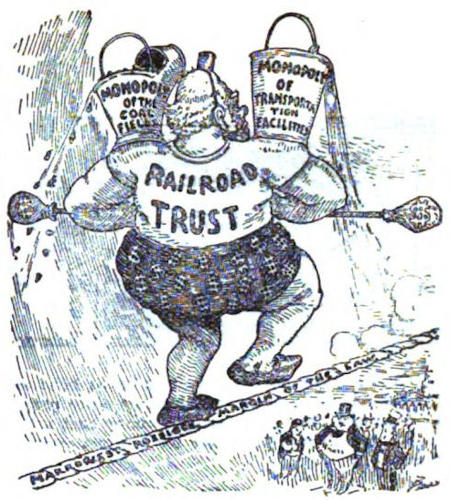
Our Uncommon Carriers
Bart, in Minneapolis Journal
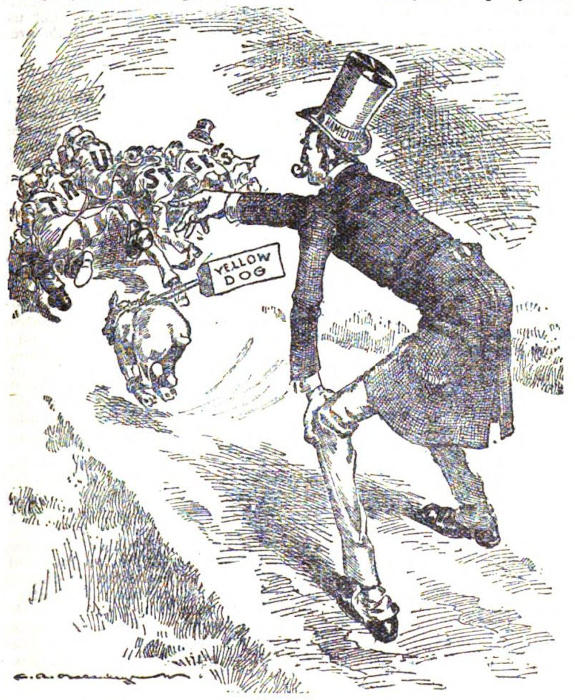
Sick ’em!
Macauley, in N. Y. World
Letters From The People
Our readers are requested to be as brief as possible in their welcome
letters to the Magazine, as the great number of communications
daily received makes it impossible to publish all of them or even
to use more than extracts from many that are printed. Every effort,
however, will be made to give the people all possible space for a direct
voice in the Magazine, and this Department is freely open to them.
J. D. Steele, Charleston, W. Va.
I have been a reader of your Magazine
since its first issue, and while I partly agree
with Mr. George H. Steele, Rockham, S. D.,
that none of us are perfect, I admire you for
having the courage of your convictions, and
it would be impossible to estimate the good
your publication has all ready done.
As a remedy for the evils existing, as set
forth by Mr. Bert H. Belford, Widners, Ark., I
would suggest that our poor, ignorant, down-trodden
farmers in the South get posted.
There certainly is no reason for any grown
up man of the present generation not being
able to read, and almost every daily and
weekly newspaper would put the most
ignorant backwoodsman in possession of the
facts which Mr. Belford states the farmers
are ignorant of.
I believe I have never seen a letter from
this state, but West Virginia hasn’t waked
up yet. She is always behind in everything
except graft.
May you live long and continue the good
work you have undertaken!
A. J. Jones, Parlier, Cal.
Tom Watson’s Magazine is one of the
greatest educators of the age, stands prominent
in its class, is fearless, bold and decisive,
is just what the people want. Every
Populist should read it and give it the
widest circulation possible.
Watson’s editorials are great and to the
point. The Letters from the People are
very interesting. Would be pleased to hear
from our workers throughout the United
States every month through the columns of
Tom Watson’s Magazine. In regard to the
work in California, we are preparing our
petition for a place on the ballot, and will
have a People’s Party ticket in this State
this coming election. Our slogan is: “The
middle of the road now and forever!” We
take no part in any other party in existence,
or coming into existence. Let us profit
by past experience. The people here, regardless
of party, are ready to accept our
principles. You may hear something drop
in California in 1908. We have a press
ready to join us at once. Let us get busy
at once. Brothers, the fields are white for
harvest.
G. S. Floyd.
The lucid manner in which you expose the
evils of our banking system should convince
any one not blinded by ignorance or prejudice
of the evils lurking therein, even as at
present conducted, but if they secure the
additional special privileges that they seek,
what may we expect?
Brother Starkey of Nebraska who writes
discouragingly in the December number
should take heed, as the worm has turned in
Pennsylvania and Ohio, and one may hope
and believe that your efforts have helped to
produce that result.
I was in Kansas in the early seventies
when the horde of bogus Greenback editors,
shipped out from New York and New England
with rolls of Wall Street money, bought
up the Greenback press throughout the West,
pretending loyalty to the principles until
secure in possession, when the hireling
traitors came out in their true colors and the
Greenback press vanished like mist before
the noonday sun.
The President’s eulogy of the pension
office is worth no more than his certificate of
character to Paul Morton. To judge from
observation and the star-chamber methods
of that bureau one would conclude that it is
run primarily as a factor in politics, and that
the only criterion for the grade and tenure of
a pension is the whim or discretion of an
irresponsible official. Evidently the system
is rotten and needs overhauling or
revolutionizing. From the nature of the
service it is doubtless true that irregularities
are inherent therein, but certainly
there is room for improvement.
Conventionality, a parent of aristocracy,
is responsible for the misfortune of Midshipman
Meriweather; herein we see one of the
evils of militarism; the discipline they recommend
so highly is the discipline of an underling,
and this is mainly why they desire it.
Hurrah for Hearst!
You give Henry George, Jr., a severe prod
in the current number. The single tax is
sprung by the plutocrats when they wish to
confuse and demoralize the reform forces.
Nelson D. Stilwell, Yonkers, N. Y.
The non-appearance of the February number
of your magazine caused me genuine concern.
I stand by you, every inch, in what you
advocate and teach, and wish the circle of
your readers might be extended many fold. I
first had my attention called to the present
evil condition of things by reading Lloyd’s
“Wealth vs. Commonwealth,” and that but
paved the way for further reading and investigation
until my present condition of freedom
from the bondage of ignorance has been
attained.
I have observed the trend of things for ten
years last past and confess that instead of
improvement and reform, I see a steady
progress towards further enslavement. What
will be the end of it all? I am beginning to
doubt the maintenance of society and law
and order if the entrenched forces attempt
to maintain their control. God forbid that
our country should be baptized again with
blood. But upon the heads of these “fools
and blind” men be it, who cannot see the
handwriting on the wall.
Your articles on finance and money interest
me and absorb all my attention and edify
me very much. Your Magazine has a purpose
back of it, and no one will give a more
ready acquiescence than the writer.
To be a reformer is to align oneself with
the noblemen of bygone days whose hearts
throbbed for the people. No greater example
could be found than Christ, whose
kingdom is called “the times of Reformation.”
Permit me to bid you God-speed.
Horace C. Keefe, Wallula, Kan.
I have somewhere said “this is the decade
of the three Toms”—Tom Watson, Tom
Johnson, and Tom Lawson. They are each or
all likely to leave lasting footprints on the
century, and I’m anxious that my Tom’s
shall not be the least. I say “my” because
Tom Watson stands for all that the country—if
not the world—must come to, to have
peace and answer the daily Christian pleadings—that
“Thy will be done on earth as it
is in Heaven”; to be His will it must embody
all that the doctrine of brotherly love contemplates;
that is ideal, that is Populism.
The other Toms stand for that part of the
whole they contemplate or are willing to concede
from a more or less selfish standpoint.
Your Magazine is startlingly convincing in its
arguments and facts—but, my dear fellow, it
lacks that dignity that a Presidential candidate
for a great principle should command.
I know your excuse will be that your appeal
to the masses must be in such style—DON’T
DO IT.
It is the aggressive intelligent few that
shapes the destinies of countries, and that will
be so with ours; if the reverse were true,
why does not the labor class have 50 or more,
the farmers 100 or more, the socialists a like
number of members in Congress? Such a
result would show intelligence and a hope
that something would result. Cut out such
queries as—Why the negro maids? Deductions
and conclusions are debatable but
not style. The writer is one of the martyrs
for the cause and has been your ardent
admirer and well wisher. There is no question
as to the ultimate outcome—though you
and I may not be permitted to enter in.
W. E. Arrant, Alto, Tex.
I read and will say that your Magazine is
interesting and entertaining in many respects,
and I admire your ability and style in showing
up the evilness and corruption of this age,
which no doubt is doing good in the way of
educating the readers thereof on the main
cause of the present economical and industrial
conditions that now confronts the
whole people and oppresses the poor that
labor and toil that they may share a small
portion of their labor: while the rich revel in
riches and the poor live in poverty.
I have been a student for several years,
studying the economic conditions, the causes
and effects of present conditions. The more
I read and learn of the causes and effects, the
more I wonder how and why the masses of
the people have been so completely deceived
so long.
I have been a Populist for several years.
Was discouraged and disgusted with the
fusion act in 1896, and since that time I
began to read and study the Socialist doctrine
to find out what they had to offer as a
remedy for the whole people. Through this
search for knowledge I found that the Populist
Party was only a reform measure dealing
with the effects and only a national movement,
while the Socialist Party is international,
and goes to the root of the cause of
the unjust system of exploitation, and means
the emancipation and freedom of the whole
human family—a plan and system by which
one can not rob another by a plan of legalized
system of robbery. It means a system
to be established upon earth by which one
can live for all and all for one. It means
that we shall establish a righteous system by
which one nation shall not have its hands at
another’s throat for pelf. It means a system
by which it will be possible for all Christians
to live a pure Christian life and practice the
Golden Rule in fact and truth.
I realize the error of having more than one
party representing the interest and prosperity
of the whole laboring and working
people; therefore, judging between the two,
the Populist and the Socialist, have cast my
lot with the Socialists, and expect to make
the fight for justice and emancipation for
wage slavery in the Socialist Party.
I appreciate your position and hope that
you will accomplish much good with your
valuable Magazine in the way of educating
the people. I fail to see how you can ever
expect to help to finally free the laboring
people from economic bondage of slavery,
without joining the Socialist Party. You
have asked the people to give their ideas as
to what they think about the existing conditions.
I have given my views as I see
them. I can realize no permanent hopes
for relief outside of the Socialist and the co-operative
commonwealth.
Harry Partington, City.
I took the publication since the first number
and today I have in the house only the
December copy, as I want to get everybody
to read them that will and thereby have persuaded
several to buy them, and you can
depend on me to continue to do so, and will
try and get others to do so. I look at it that
I am in the city and can get it at the news-dealers
with more certainty than as a yearly
subscriber.
What I think of Tom Watson’s Magazine
can never be told. I would like it semi-monthly,
but I know I shall have to wait
possibly some time before that comes. Dear
sir, believe me, I am a very sincere believer
and practicer of his doctrine and have been
since the Democratic party undertook to
carry the 16 to 1 doctrine under the auspices
of W. J. B. of Nebraska. Sorry Billy failed
then and 1904.
Hurrah for W. R. Hearst, but the money
power is too strong yet. But hammer at
them and teach us to be steadfast.
David Meiselas, Brooklyn, N. Y.
I have at last determined to congratulate
you upon the success you have made with your
Magazine. It is, beyond any doubt, good
work. In reality I can hardly think to write
all the praise the editorials are worth. I enjoy
them as I would some classic by Shakespeare,
or some scientific work by Darwin.
The more I read them, the more I like them.
They are digestible; and talk about brain
food—it is the best.
Yes, Thomas E. Watson should be well
considered as a champion for the cause of the
people. Either he is a second Hearst or
Hearst is a second Watson. They are so
much alike in their fights for the people you
can hardly tell which is which.
Over here in New York we are having a
grand time, viz:
Murphy telling things about McClellan and
vice versa. The big insurance grafters howling
for more. Mr. Ivins telling things about
the “reform grafter,” Mr. District Attorney,
etc., etc.
Abraham Lincoln said we should have a
“government of the people, by the people
and for the people.” I must say we are living
up to it, in New York—nit. We are having
“a government of McCarren, by McClellan
and for Murphy.” Great government, is
it not?
If this is not the age of wonder, I don’t
know what. But, Mr. Watson, keep up your
steady work; don’t forget the Hon. Platt and
Depew, the former our Chinese advocate and
president of the largest express company; the
latter the champion lobbyist of them all.
Don’t forget our generous Senator Knox
(with his generous rate bill). There are
many more whom you should prey upon.
G. White, Enloe, Tex.
Yes “I will help”; it is one of the very, very
few papers and magazines that I can heartily
indorse from the old Liberty Bell to the last
sheet of its reading matter; the gags and
brakes that are applied to other editors, or a
great majority, at least, disqualify them as
editors.
The things that we most need to know are
suppressed and the reading public are kept
in the background on the most vital questions
of the day. There is a mighty storm
gathering in this once glorious republic; its
muttering thunders can be distinctly heard.
The glaring, forked tongues of wrath can be
plainly seen over the tops of the distant hills
that hedge in our eighty million people.
The old ship on which we have sailed thus
far is out of repair; the pilot asleep, or
cares nothing for the safety of his passengers;
the captain has bought most of the crew; the
breakers are just ahead.
I know not how my fellow-countrymen
may feel over the affair, but for your humble
Texas farmer it’s a sad picture. The light
that once burned so bright not only lit up
North America from Alalch Mountain to
the Rockies, but crossed both oceans and
gave to the world an object lesson of what a
free people could do.
The same light guided Prescott at Bunker
Hill. It was the never-setting star at Valley
Forge that led Washington to the gate of
glory at Yorktown. Is it true that the territory
bequeathed to us (“and it was paid in
blood”) is to be betrayed into the hands of
the enemy for the small pittance of thirty
pieces of silver? Is the money-bag of America
to rule or ruin? Or will those who think
and yet have a chance to act demand a settlement?
Tom Watson’s Magazine is one
that is asking for a settlement. May the
day soon come.
N. M. Hollingsworth, Terry, Miss.
I see that you contemplate enlarging and
improving the Magazine. I can see the place
for enlarging, but not improving in the subject
matter, except by enlarging and perhaps
improving the material, etc. It is as good as
human agency can make it. I only wish it
could be read by every man, woman, boy and
girl in the land. It is such an educator as we
need, and it is being read by a great number.
I was at our county cotton-grower’s meeting
last Saturday and was delighted to find
so many reading your splendid Magazine.
I secured a subscriber and have promise of
several more which I will forward in a day or
two. I have seen your letter to the Atlanta
Journal in which there is enough exposure of
Clark Howell’s perfidy, etc., to consign him
to the garbage heap.
If you think it worth while in the Educational
Department of the next number of
your Magazine, tell us what effect bucket
shops and trade exchanges have on the price
of such produce as are dealt in.
Wishing you and your Magazine all the
good that can come to a mortal and a great
publication, I remain your devoted friend
and admirer.
S. T. Z. Champion, Sterrett, Pa.
I am a constant worker and reader of this
great reform movement and have been for
the past twelve years, and have voted the
ticket straight till they got me to straddle
W. J. B. one time and I got such a fall I fear
I will never live to get over it. I am getting
old. I am one of Robert E. Lee’s old web-foot
boys and stacked my old Enfield rifle at
Appomattox Court House on the 9th of
April, 1865. It looks like a miracle to see
the fingers pushing a pen that pulled the
trigger 40 years ago, and yet when I think of
the blood that was shed for this great nation’s
freedom and to see it being stolen away from
us by those money knaves it makes me feel
like I am just 16 years old. I have nine boys,
all Populists. Oh, how I want us to live to
get at least one more vote for that grand and
noble boy, Thomas E. Watson, for our next
President. Don’t you all feel me rejoicing
over New York’s election, but I fear they
will not let Hearst have his seat as mayor
of New York. I have just read Watson’s
answer to Hoke Smith’s letter. It is a grand
reply.
You can count on me when the last roll is
called. I’ll be there. Yours for reform.
W. H Thomas, Fairhaven, Mo.
After spending 25 years in the thickest of
the fray I could hardly go back to the “wallowing
in the mire.” No, my brother, I
never say die, but am still pegging away.
Yes, I am a Populist. I am a rampant Socialist
and I think that most of my old comrades
have followed my example and I can
see no reason why all Populists should not do
the same. You know, my brother, that the
Socialists are growing as no other party ever
grew and they are bound to become a dominant
factor in politics in the near future. It
is evolution. Reforms do not go backward.
The Populists have done a grand work, but
Socialism is inevitable and I would rejoice to
see all old Populists get aboard the band
wagon. You are doing a noble work and to
show you that I appreciate it I am going to
send you a dollar for the magazine and 50
cents for that fountain pen, although I can
illy afford it, as I am 65 years old and dependent
on my labor for the support of my family.
Don’t Teddy, the Trust-buster, make you
tired? I think he is the biggest fraud that
ever sat in the Presidential chair.
Wishing you long life and abundant success,
I am with you till the battle is won.
James A. Logsden, Moline, Ill.
I have read with great interest the editorial,
“Tolstoi and the Land,” in the
October number of Tom Watson’s Magazine,
and while I cannot agree with you in
the position you take upon the land question,
I accredit you with sincerity and honesty of
purpose. In common with many others of
us, you are giving of your time, energy and
substance, to bring remedial justice and
economic truth to human society.
Being fair-minded and in earnest pursuit
of economic truth and equity, you will, I am
sure, accept honest criticisms of your
opinions.
In the outset you propound three questions,
which are as follows:
“Is it true that the real grievance of the masses
is that the land has been taken away from them?”
“Will no reform bring them relief until the land
has been given back to them?”
“Will universal happiness be the result of putting
an end to private ownership of land?”
To negate these questions you call upon
history to bear witness:
“As a guide to our footsteps the past must always
be to some extent our light, our guide.”
With this I am heartily in accord. It has
been rightly said:
“History keeps the grass green upon the graves
of former civilizations, and stands as a beacon
light to future ones. It is the ever-living Janus,
peering both into the past and into the future.”
But history does not prove, as you assert,
that civilization exists as a result of private
ownership of land. These are your words:
In passing upon this and statements
appearing in subsequent paragraphs, I
think I shall have fully answered your three
previous questions. When it “became a
matter of self-interest for some individual to
improve the land” was it because of his
ownership or of his security of possession?
When you admit that “as long as each
individual felt that his parcel of land might
go out of his possession at the next regular
division there was no incentive to improvement,”
you have admitted the latter.
“Not until the individual became assured
that the benefit of his labor would accrue to
himself did the waste become a farm and the
hovel a house.” What was his assurance—private
ownership or security of possession?
That it was not private ownership is proven
by the tenant system in vogue in every
civilized country in the world. Obviously
it is not private ownership that impelled the
landless tenant to go upon land owned by
others, clear away the forest and “make the
land a farm.” Then what is his assurance?
Security of possession—the knowledge that
he will be left unmolested to enjoy the “product
of his labor.” This tenant enjoys his
security of possession because of the tribute
he has been compelled to pay to the owner to
leave him unmolested in his possession and
enjoyment. Could he not be as secure in his
possession if the land were owned and the
exaction made by all the people?
Therefore, “if the history of the world
shows anything at all, it shows this,” that
civilization has developed and progress has
gone forward, not by reason of private
ownership of land, but in spite of it.
“If, what is manifestly impossible,” says Mr.
George, “a fair distribution of land were made
among the whole population, giving each his
equal share, and laws enacted which would impose
a barrier to the tendency to concentration by
forbidding the holding by any one of more than
a fixed amount, what would become of the increase
of population?”
Your assertion that there would be no
improvement under such a condition as you
mention is self-evident. But this, instead
of being an argument against the Henry
George philosophy, is, in fact, an argument
in its favor.
What Mr. George does propose I shall endeavor
to make clear in subsequent paragraphs
when I touch upon your hypothesis
regarding the primitive tribesmen.
Before passing to this, however, I desire
to direct your attention to your observation
that “the right of each citizen to hold as his
own began with the laborer who claimed the
product of his labor.” The convincing
power of this statement is lacking, because
you have failed to prove to us that without
private ownership of land man can not
“claim the products of his labor.” As a
matter of fact, you can not furnish such
proof because it is manifestly untrue. Before
the savage, wandering in the primeval
forest, ever dreamed of laying claim to any
parcel of the soil as his own, did he not so
lay claim to the fish and game he took? Did
he not so lay claim to the fruits and berries
he gathered? Did not the tribesman who
followed his flocks and herds over the plains
so lay claim to them as the product of his
labor? Without ever a thought of the
private ownership of the soil, he had produced
them as truly as the stockman of today
produces the cattle he sends to market,
and he valiantly disputed the right of any
person to any share of them. Most truly he
who labors is entitled to labor’s product,
but to say that in order to claim such product
it is necessary to privately own
land is to fly into the face of obvious fact.
How many of the wage earners of today are
land owners? How much is added to the
wages of those few who are, by reason of this
fact? You yourself raised the point that it
is not necessary to own land in order to
fleece the public, laborer, land-owner and all
out of their earnings. If this be true how
do you harmonize it with your former claim
that it was private ownership of land that
first made it possible for the laborer to
claim and retain the product of his labor.
I come now to the case of the “score of
tribesmen” of whom you speak. While the
score were fishing, hunting, drinking or
gambling, the one cleared the wild land,
fenced out the rest and claimed it as his
land. But, in fact, did this make it his
land? By virtue of what did it become his
land? You doubtless had this question in
mind when you attempted to answer it in
the following:
“Having put his labor into the land, having
changed it from a waste into a farm, it was the
most natural thing in the world that he should
claim it as his own. Why shouldn’t he? He
made it a farm.”
What was his ultimate purpose in putting
his labor into the farm? Was it not the
products which his labor, applied to the land,
would bring forth? You say “he made it
a farm.” He found it a farm awaiting
his efforts. You will agree that he was
entitled only to the result of his own labor.
In fact, this is the truth for which you are
contending. What were the results of his
labor, the farm or the products? Manifestly
the latter. These he enjoyed. Upon
what possible ground, then, could he go still
further and claim also the soil as belonging
to himself and his heirs forever?
Moreover, you will concede that before
this tribesman determined to abandon the
spear and the rod and become a farmer, this
piece of ground could have been taken by
any of the other twenty men; in other words
it was common. It must be further conceded
that in casting about to find a suitable
location for his farm, he chose the site which
offered the best natural advantages relative
to fuel, water, fertility of soil, and proximity
to the tribal bartering place. At this point let
us carry your illustration still further and
assume that all or part of the other twenty
tribesmen decided to become farmers also.
In the same manner as their forerunner,
they look about for the best location, and the
one offering the best advantages. But it is
taken, and the others must take second,
third or fourth place, according to who gets
located first. But these men have equal
rights. Why should some of them enjoy
the exclusive ownership and possession of
those sites which give them natural advantages
over the others? Manifestly, they
should not. But how can they equalize
these advantages? Just to the extent that
farmer number one holds advantage over
farmer number twenty-one—just to that
extent should number one compensate the
little community as a whole for the privilege
which he enjoys. And so with all the
others. A community is forming, with its
natural demand for revenue for common
purposes. Here is the natural revenue. Here
lies the fundamental principle which political
economists call the Law of Rent. Here
reposes the very essence of the law of compensation.
Here also is found the basis
principle of economic justice, which, traced
to its last analysis, as civilization advances,
is capable of developing the highest expression
of human society. Here is the
answer to your question,
“Will universal happiness be the result of putting
an end to private ownership of land?”
It was not “just that the twenty idle
tribesmen should take away from the one
industrious tribesman that which his labor
had created.” Neither was it just that he
should rob the other twenty when they
came to exercise their equal right to the use
of the land, as he manifestly would if he were
left to the exclusive use of the soil, or the
best portion thereof, without compensating
those he has excluded.
Let him retain possession of the farm and
his products under these conditions, and you
have, not private ownership of land, but
common ownership.
Another point that you have obviously
overlooked, and one that goes to the heart
of the social problem, is the element of land
monopoly. Your tribesman was not satisfied
with selecting the best land, and fencing
so much thereof as he could till by his own
exertion, but he fenced in vast areas that he
could not use, and also claimed that as “his
own.” By so doing he not only enjoyed the
fruits of his own labor, but forced the other
twenty to share their products with him as
a tribute for using that part of “his land”
which he himself could not, or did not, care
to use. You may say that they had equal
opportunities with him to get first choice.
Even if this were granted, it makes no difference
in principle. The fact still remains that
he has the power to wring unwilling tribute
from them. Only one could have the best,
and though his contemporaries may have
been justly punished for their lack of foresight—which
I do not admit—there is yet
another side to the question. What is the
status of future generations in relation to
this proposition? Are they guilty of sleeping
upon their rights when all the land has been
taken before they were born, or are they
born into conditions which they have had no
voice in making?
If your lonely tribesman, for whose welfare
you manifest such solicitation, had been content
with the amount of land he could
utilize to good advantage, had he been willing
to contribute his just share to the common
expense, and had he been sufficiently
just to recognize and respect the equal rights
of his compeers, the common would yet have
remained after all had been supplied. What
was true of the primitive state is true today
in our highly organized society. Shifting
conditions make no changes in universal
principles.
“Society” (did not) “as a matter of self-preservation
admit the principle of private
ownership of land.” It admitted it because it
did not know a better plan—because it did not
know the Laws of Rent and of Compensation.
You deny that “great estates were the ruin
of Italy.” “Before a few could buy up all
the land there must have been some great
cause at work, some advantage which the
few held at the expense of the many.”
“What was that advantage?” you ask. No
better answer can be given to this query than
to refer you back to your own illustration of
the farmer tribesman. Did he buy the land?
You say he “fenced it in and claimed it as
his own.” In like manner did all land pass
into private control, each individual claiming
far more than he could use. After all
the land of Italy had been “claimed” and
enclosed, or that of any given community
thereof, the power that these land claimers
held over subsequent comers is obvious.
The only asset of the individual without
material wealth is his labor, which is only
one—the active—factor in production.
Under circumstances such as the foregoing,
he is debarred from the passive factor—land—and
can apply his labor to it only by paying
tribute to those who have claimed it.
In the circle of the human family, those
endowed with keen, unerring foresight are
comparatively few. It cannot be gainsaid
that those few, knowing that land is fixed in
quantity—which cannot be expanded as
population increases, and as demand for it
increases—saw in the early periods, as they
see today, what a powerful advantage they
could wield over their fellows by “fencing
in” all the available land—by fencing out,
not only the cattle, as you put it, but also
their fellow-men. Is it not plain that this
was the source of the power of which you
complain? Was it not this that furnished
the advantage you name? Can you not see
the stream of unearned tribute wrung from
the hands of honest labor constantly flowing
into the coffers of these land owners? And
seeing it, can you then maintain that great
estates were not the ruin of Italy?
What made the “ruling class of Rome,
that had concentrated into their own hands
all the tremendous powers of the State?”
What gave them the power to “fix the
taxes” and enact the “infernal laws” which
you rightly contend ought to have been
repealed? “Ah!” you say,“they controlled
the money.” By what power did they come
to control the money? Was it by a power
inherent within themselves, or was it not the
power which they derived from the corner
which they held upon the natural revenue
which they diverted from the public treasury
into their own coffers, thus making it
necessary to provide for the common expense
by unjust taxes upon the products of labor?
“They controlled the money.” But
what is money? Is it the means or the end?
Is it not merely a labor-saving invention to
facilitate trade? Is it not money only by
common consent? Is it not merely a commodity
converted for convenience into a
medium of exchange? You make the point
that by controlling the money, they controlled
commodities. But if they had not
controlled the land, which is the source of all
commodities—even the money itself—how
could they have controlled the money?
Can you not see that men divorced from
the toil and permitted to produce only on the
terms of some other person are forced into
the labor market, to vie with each other in a
competition that grows keener and more
vicious as a population increases?
You say that “the power to fix taxes is
the power to confiscate.” The very opposite
is true. The power to confiscate is the
power to tax. Give that power to one class
and what more does it want? Let that class
confiscate land values, which you agree are
naturally common property, and you give it
the power to rob its victim, not merely to the
“limit of their capacity to pay,” but to
literal starvation, if they choose to carry the
principle of private ownership of land to its
logical conclusion. For certainly to recognize
the right to private property in land is
to recognize the owner’s right to do with his
land what he pleases. To recognize this is
to recognize the land-owner’s right to deny
to the landless either the use of his land, or
any of its products, on any terms whatsoever.
Thus, in carrying the principle of private
ownership of land to its logical conclusion,
and recognizing it as a just principle, is to
sanction literal murder. Can a system that
has this for its ultimate, be other than a
vicious system, even though it may never be
carried to that extent? It is by means of
this vicious system that human sufferings
are augmented by a thousand fold and the
sum of human happiness is correspondingly
diminished.
Do not the foregoing facts prove to you
that your statement that “usury is the
vulture that has gorged itself upon the vitals
of nations since the dawn of time,” is economically
untrue? Is it not clear that
usury is only an effect of a deeper-seated
cause inherent in land monopoly?
As proof that the universal condition of
inequality is not inherent in land monopoly,
you say that the Rothschilds and other
“kings of high finance” do not “buy up vast
domains that they may be served by a lot
of tenants.” But when touching upon this
phase of the question, you should always
bear in mind that all land is not farm land.
The power of the coal barons to exploit does
not arise so much from the fact that they
own large tracts of land, as from the fact
that it bears large deposits of coal. Nor
does their power to exploit affect merely the
miners of coal. Coal is a public necessity,
and the ownership by these barons of a comparatively
small area of land places them
in a position to place—by reason of unreasonable
prices—a tax upon every user of
coal.
What is the basis of the railroad’s power
for unrestrained exploitation? Unquestionably
it arises from its exclusive franchises,
inherent in its rights of way.
Mr. J. Pierpont Morgan and others of his
class do not derive their unearned revenues
from their power to tax. But whence this
taxing power which affects every user of their
several products?—Monopoly of franchises,
monopoly of mineral resources, such as
mines, quarries, etc.? What is the source of
the Standard Oil monopoly?—Its ownership
of oil land or enough thereof to force independent
owners to sell on the company’s
terms, and its consequent power to force
railroad discriminations in its favor? Where
did the beef trust and other industrial corporations
derive their monopoly power?
Railroad rebates—“the big pistol”—railroads
with their monopoly franchises. And
the railroad monopoly and these other
breeds will be extinct in an instant. End
land monopoly and make railroad franchises
common property and the railroad monopoly
will be at an end. Had not the Amalgamated
Copper Co. controlled the majority
of the copper-bearing lands of the world,
“The Story of Amalgamated” would never
have been told.
Referring again to the railroads, was it not
largely the great land grants donated to
them by our Government that were the beginning
of their power? These grants operated
in two ways to the advantage of the
railroads. First, they greatly increased the
wealth of the railroads, and, second, they
diminished the power of the people by diminishing
the area of land open to settlement.
“Land is plentiful and it is cheap. The
country is dotted with abandoned farms that
can be had almost for the asking.” You
say “almost for the asking.” This implies
that he who takes these farms must pay
something to him who has “abandoned”
them. Why almost? Why not take them,
as in the case of the primitive tribesman,
without asking? You state that they have
been abandoned because the owner could
not make a decent living upon them. Then
why make the condition of the next owner
more hopeless by levying tribute against him
for the use of a worthless farm?
Make land common property, safe-guard
the interests of all by assuring to each land-holder
perpetual use, providing he pay his
equitable share into the common treasury—which
in each case would be the increment
of value. Then “abolish all other forms of
taxation.” This will secure every one in the
enjoyment of his labor’s product, will abolish
monopoly and the individual or corporate
taking power, vicious tariffs, and all. This
is all you have demanded.
Your demand is a just one, but—as I
trust you may be brought to see—your
remedy is superficial and cannot be made
effective. You must dig in deeper soil, else
your laudable efforts are vain. The abrogation
of offensive legislative enactments and
the enactment of other statutes dealing with
effects will avail nothing. Nothing save the
rooting out of the mother of evils can possibly
accomplish the end for which you are so
courageously and manfully striving.
Your work is a noble one, and its power
for good is measured only by the number of
people whom you can reach. I admonish
you to give the land question thorough and
painstaking investigation. I trust you will
bear with me for what may seem excessive
frankness. But you are not looking for
bouquets, but simple, unembossed truth.
When I say to you that in my opinion you
have not familiarized yourself with the philosophy
you are attempting to refute, you
will accept this criticism in the broad view
of public interest.
I have gone into greater detail in my
comments upon your editorial than I expected
to go in the outset, but it has seemed advisable,
in order to get a clear view of all the
points raised by you. However, I trust
I have not gone beyond the limit of the space
that may be available.
A VETERAN REFORMER HITS THE TARIFF
HARD
E. S. Gilbert is close to ninety years old but
uncommonly well preserved, having been interested
in every Presidential campaign since he was a
boy of sixteen, and has acquired a vast fund of political
knowledge, of which he still has a firm grasp.
He has seen and remembers nearly every President
from Andy Jackson down—nineteen of them—and
talks interestingly. He says as he sees things
now the political situation is just as it was in the
early fifties. Then two minor parties were dying,
and the leading party—the Democratic—was
undergoing disintegration. Today, as he sees it,
Democracy and Populism are dying, and the Republican
party is undergoing disintegration.
The Republican Party sprang up in the fifties,
and he looks for a new, strong party to come out
of the present chaos in a few years. Following is
a thoughtful article, from Mr. Gilbert’s pen, which
recently appeared in the Lincoln Independent:
Editor Independent: Here are a few figures
for men who think.
In the year 1901 there was manufactured
in the United States thirteen billions of dollars’
worth of goods. Authority, Secretary
Shaw.
The average rate of duties upon imported
merchandise is 52 per cent. Authority,
Walter Wellman.
Now, fifty-two per cent of thirteen billions
of dollars is $6,770,000,000, which the present
tariff of duties authorizes the manufacturers
to collect of the American people
each year, if they can. It actually enables
them to collect a large portion of it—but not
all. The probabilities are they collect about
two-thirds. They collect nothing for goods
exported.
There is honest competition on some
classes of goods, such as flour and the cheaper
cotton fabrics, and perhaps some others,
that prevents them from collecting it of the
people. So, in order to be fair, we will cut
this sum in halves.
We then have the sum of $3,385,000,000,
which is considerably less than is probably
collected. In order not only to be fair, but
to be absolutely safe, we will cut off the $385,000,000,
and we have the sum of three billions
of dollars—three thousand millions—collected
by the manufacturers and paid by
the people as the result of the Dingley tariff
bill.
Bear in mind, that this is over and above
what is collected in duties for the support of
government. Bear in mind, this money is
paid to the manufacturers, the capitalist
and not to the laborers. Bear in mind that
if this three billions of dollars were divided
among the employees of the manufacturers,
it would give to them something less than six
millions of laborers a little over $500 apiece.
Bear in mind, that this would pay the entire
labor bill of all the manufacturers of the
United States.
Then ask yourselves: Is this state of things
the result of the intelligence or genius of the
people? Or is it the result of misinformation
or stultification?
E. S. Gilber.
W. F. Short, Eurekaton, Tenn.
I am well pleased with the Magazine and
think it is superior to any other magazine
that I ever read. It is just what I expected
our brave and noble Tom to get up. Yes,
the Magazine is all right. The language is
beautiful, forcible and courteous. I was a
subscriber from the first issue and have sent
in my renewal for this year. I have more confidence
in Tom Watson than in any man who
has tried to right the wrongs of the people.
I believe him to be so conscientious that he
would not sacrifice principles for any office
in the gift of the people, and I do wish we had
one thousand men like our true and honest
Tom to battle for justice and rights of the
people. I stand for the principles advocated
by Jefferson, Jackson and Lincoln.
I can make but one suggestion for the
Magazine, and that is to place it in a better
wrapper, so it will not be lost in the mail.
R. Brown, Buck Knob, Ark.
I am no writer and no scholar, but I write
a few lines to you in order to congratulate
you on your Magazine. I think it the best
magazine on earth and the Missouri World
the best paper and the most patient publishers
on earth. I could not have the patience
to publish a paper and send it out
among so many prejudiced block-headed
farmers and laborers and get so little return
for my labor. I live in the mountains of
Arkansas and I have been lashing with my
tongue and knocking at these old Mossbacks
with T. E. Watson Magazines and the
Missouri World for one or two years. Some
of them won’t read a reform paper when it
is given to them, but I give T. E. Watson’s
Magazine and the Missouri World to them
all the same. On some of them the moss
I see is loosening. I am going to try to
organize a club in our township shortly.
I am for government ownership of all the
railroads, coal mines, oil fields and all manufactures
that take a company to run and
government money, and no one man to own
more than one hundred and sixty acres of
land and not that unless he lives on and
cultivates the same. I will fight for all this
and more as long as I live and have a dollar
that my family can get along without.
I am nearly sixty-four years old and have
eight sons, all of whom will vote the Populist
ticket and all be old enough in 1908 to
vote, and will vote the Populist ticket.
Stephen Lewis, Martin’s Ferry, O.
Your article in the January issue of your
Magazine in regard to the high-handed methods
of the U. S. Steal trust in obtaining property
from defenceless people has been read
with much interest, and I approve of your
bold and fearless manner in attacking unlawful
corporations and lawless promoters.
That part in your article on the Steal trust
where you raise the point as to whether the
men who demolished the widow’s home were
union men or not was noted in particular and
I venture the opinion that they were not,
because Pittsburg, with all its much vaunted
prosperity is and has been recognized by
union workmen as the cradle from which
that disreputable class of workmen known
as scabs have come. Pittsburg harbors more
scabs than any other city in the country, regardless
of size. The man who made the
Steal trust possible operated his mills at
Homestead with scabs at the sacrifice of
human life and forced a lower scale of wages
upon the men with the state militia. Yet
this man is regarded by a great many so-called
respectable people as a philanthropist
because he is erecting monuments to himself
in the form of libraries in different parts
of the country.
M. G. Carlton, Zolfo, Fla.
I appreciate the Magazine and feel that
it is one of the best. I am a Populist and
took great pleasure in casting my vote for
you at the last election, knowing at the time
that the chances for success were bad. Yet
I cast the vote with as great pride and satisfaction
as if I had known you would be
elected. I know how to sympathize with a
defeated candidate as I myself ran on the
Populist ticket for Representative against
the noted Zuba King—the wealthiest man
in De Soto County and one connected with
one or more of the best banks of the country,
and got beaten, of course, but I was not
whipped but beaten by the money crowd
and I believe as strongly in the principles of
the Populist Party as I ever did. I am just
the same today.
W. Scott Samuel, Pawhuska, Okla.
Thinking that Tom Watson’s Magazine
might like to hear from a locality where
politics “rules the court, the camp, the grove,”
I relate this little incident. A few weeks
ago, when the town sites of the Osage reservation
were to be opened for sale and an
auctioneer appointed to sell the lots, the
news was published that a certain man, Amos
Ewing, had received the appointment of
auctioneer. Now, the reputation of this
man, Ewing, is a stench in the nostrils of
every honest man in Oklahoma. From
petty defalcations to embezzlement of trust
funds, which he was forced to disgorge, comes
the reputation of the versatile and oleaginous
Amos. And so, when it was known
that our great “square deal” bear hunter
had through his secretary named Amos for
this promotion of trust and emolument, it
was not long before the mails were loaded
with protests from different localities in
Oklahoma where the seductive Amos had
exercised his peculiar grafts. Did it do any
good? Alas for the square deal! When the
sale of lots commenced at Pawhuska this
creature, Ewing was in the position that
should have been filled by some one at least
not a self-convicted grafter, and he’s there
yet, and all the protests, charges, etc., filed
against him are as though they never happened.
How’s that for the “square deal”?
In conclusion, permit me to compliment
Tom Watson’s Magazine for its fearless
exposé of moral rottenness in high places.
Hoping the good work will go on, I desire to
share in the glory of the time when its principles
shall prevail.
Malcolm B. Webster, Atlantic City, N. J.
I have been an interested and delighted
reader of your Magazine for some time past,
and feel that I am getting from it a political,
social and economic education such as I
should not have known where to look for else.
While still but very young, I have long
felt that I could say upon the above subjects:
“Myself, when young, did eagerly frequent
Doctor and saint, and heard great argument
About it and about—but evermore came out
By the same door wherein I went.”
Now I begin to feel that there is a back door
used by the “powers behind the throne,”
and that your Magazine leads one to it to
observe the edifying spectacle of the manipulation
of the puppets by the powers.
James Porges, Chicago, Ill.
Keep up the good work. You have the
support of thousands in your efforts to
awaken the lethargic American public to the
fact that they are being robbed with the aid
of our corrupt laws and the special privilege
Government.
T. B. Rogers, Logansport, Ind.
I don’t know how to praise that book
enough. I think it is the strongest political
document we have. Surely, if we could get
the voters of the nation to read it, we would
have reform, for if any reasonable person
reads it he can’t help but endorse those
principles. I have been loaning those magazines
I received to my neighbors, and they
all acknowledge that the book tells the truth.
I think I can get up a club in the near future,
for those that read them promise me they
will subscribe for it.
As for myself, I don’t need any literature
on the subject, for I have been in the front
ranks of the movement ever since 1872. I
was a Peter Cooper man and have marched
along in that line ever since. Never voted
for anything else. When I cannot vote the
Populist ticket, I don’t vote at all. There
were a few of us that started the movement
here in Cass County, Indiana, and we worked
hard and spent a good deal of money. We
had some of our best speakers here to help us.
We had the Hon. Jesse Harper of Danville,
Ill., N. H. Motsinger of Sholes, Ind., Judge
S. W. Williams of Vincennes, Ind., and a
number of other good speakers, and the result
of our work was that we cast over 900
votes for the Populist county ticket. We
felt very much encouraged, but when the
next campaign came—well, you know what
happened to our Party.
We are right and all we can do is to keep
on fighting. I am in favor of staying in the
fight until the last ditch is taken.
I will close by wishing you great success.
Thomas Knox, Bennett, Neb.
I appreciate reading your Magazine. I
also appreciate your manly and courageous
way of putting the truth before your readers.
My only hope is that I would like to have the
pleasure of knowing that the writings of as
strong a reasoner and clear thinker could
enter every home of the common herd so that
reason could displace prejudice or party insanity.
We all regret the disconnection of
that able defender of the common people,
Mr. T. H. Tibbles, from the editorial columns
of the Nebraska Independent. We hope for
his health and his early return to Nebraska,
to continue the battle for us common people.
In conclusion I hope for Mr. Charles Q. De
France’s health and happiness. May his
labors be a power for good and light to the
people. I also hope Thomas E. Watson’s
health and life may be spared for many
years in the good cause.
H. L. Fagin, Kansas City, Mo.
Is it not good to feel that the present wave
of civic, economic and industrial righteousness
seems practically certain to sweep every
thing before it? There is a quiet, studious
earnestness and determination everywhere
existent, that portends certain and tremendous
results. The best part of it is that the
masses have largely been educated to the
point where they no longer expect to accomplish
everything in a day, but rather realize
that to get even a large share of what they
insistently demand they must begin in the
primaries and conduct a continuous campaign.
You are doing a great work and you have
your reward and will have it. Every honest
and ardent spirit everywhere communes
with and strengthens every other such. No
more honest, open, fearless man than you is
on earth today. That might be better expressed,
but the meaning is there—I will let
it pass.
The universal spirit of righteousness encompasses
and permeates you—you are
surely a part of the divinest essence. Being
a man, you must like to know that other men
appreciate and approve—and to the utmost.
And that they do in an ever expanding circle.
The days of sophistry, of deception, of
class and special privileges, of municipal,
state, and national corruption are rapidly
passing. The people are becoming wise.
They know their friends. They know who
is true, despite the tremendous efforts of a
press, largely subsidized to mislead and deceive.
But there are newspapers and newspapers,
just as there are magazines and magazines.
I need not tell you to keep on straight
ahead. You couldn’t stop if you wanted to.
Tell the truth just as you are doing, and as
much of it as you have space for, in allopathic
doses. I cannot agree with all your conclusions,
nor will any thoughtful student; but
in most I do most heartily concur, and I do
know that all your influence is for good.
John McFord, Sheridan, N. Y.
I like your Magazine very well, but I would
like it much better if you and your Magazine
would come out flat-footed for Socialism. If
public ownership or collective ownership of
the railroads, telegraphs, etc. is a good thing
for the people, why not have public ownership,
or rather collective ownership, of the
lands, the machinery, etc.? Political democracy
without industrial democracy is futile
and amounts to nothing. I had the pleasure
of voting for you in ’92, and it is a matter of
profound regret to me that you cannot see
your way clear to step forward into the
Socialist Party, where all true middle-of-the-roader
Populists logically belong. Populism
is a compromise, a half way measure.
Socialism is the whole cheese.
John P. Thorndyke, Canaan, N. H.
You publish more real stuff than any magazine
I have ever read in my life. I am
sixty years of age, and we take seven other
magazines, and without any exaggeration it
is but justice to your efforts to say that there
is by far more real, good, well-seasoned, relishable
food for the digestion of the average
brain, than is afforded in any other magazine
I have seen. Having practiced medicine for
a number of years, I have sometimes volunteered
my diagnosis of the disease troubling
some of our great (?) men and I flatter myself
that an observance of that particular
case has proven the correctness of my examination
at a distance. For instance, I
think the main trouble with our great Senate
is constipation of the brain, which invariably
forbids the entertainment of honest thought.
Now I hope that some one with sufficient
“sand” in his gizzard will see that every
member of the present Congress and Cabinet
receives a copy of your very valuable Magazine.
It will be worth more to them than
a post-graduate course in the schools of
Rockefeller and Morgan.
John B. Bott, Grant, Pa.
To a constant and appreciative reader
of Tom Watson’s Magazine (purchased
monthly at the Union News Co.’s stands) it
does seem strange that so great and good a
man as “Tom” should, under the stimulus of
praise and success or the twittering of a pert
maid, really become ashamed of his familiar
cognomen and his old clothes.
For two days I have been searching, here
and there, high and low, for Tom Watson’s
Magazine: always explaining that “Tom”
has gone into “innocuous desuetude” and
“Watson” has stript himself of his old
clothes and donned full regulation uniform,
but all to no effect.
Am hoping the new clothes won’t make
Mister Watson too vain, and that at least his
relations, Populist friends and host of well
wishers will not fail to recognize him in his
docked designation and fine regimentals.
I wish to add that it was the “Tom” that
appealed to me, above all things else, when
the news agent showed me No. 2 of Vol. I.
and asked me if I had seen Tom Watson’s.
I replied that I had not, but that “Tom”
had the true flavor and I’d take a dose.
There are, I am sorry to say, Watsons big
and Watsons little; Watsons wise and Watsons
foolish; Watsons mediocre galore, but
only one “Tom” Watson, and he seems to
be, God forbid, going to the bad.
Robert L. Cooper, Savannah, Ga.
I have been, previous to the last year, what
may be termed a “Tom Watson hater.”
Like a lot of other “pig-heads,” I have heard
the other side all the time, declining to read
or look upon with reason anything you wrote
or said. I was prevailed upon to read your
“Napoleon.” I followed it up with “France”
and “Jefferson,” together with a number of
your speeches, letters and magazines. I
have arrived at the conclusion that of the
very few sincere men of the day, WATSON
STANDS IN THE FRONT RANK.
You have my unbounded admiration and
very best wishes for the splendid fight you
are making for improvement of conditions
in our country—especially our beloved
state, Georgia. I may add that there are a
great many other young men in this community
who are of the same opinion.
That your books are being read is attested
by the frazzled-out copies in our public
library, and the difficulty one has in securing
the use of them even for the short time allowed
for the use of a popular book.
Aaron McDonald, Galveston, Ind.
I received a copy of the old guard news
letter some time back, and was not in shape
to respond at that time, and when I got in
shape to, I took sick and was not able; but
now as I am able and in shape I will send one
dollar to help pay expenses of organizing.
It seems that through this part of the country
Populists are dead. There are lots that are
sick on account of the rascality of the
officers of the old parties, but speak to them
about Populists and you can seldom get a
grunt out of them. It may be a calm before
the storm. Hope it is, for I think there are
Independents enough in this neighborhood
to cut things short when they do get at it.
The hardest pull seems to be in giving up the
old name. They seem to think that reform
must come through their party. I have
asked several how they expect to get reform
when Wall Street owns the Cabinet and Senate.
That is like putting the devil in the
pulpit to preach the gospel.
Hoping you will meet success.
H. B. Paxton, Wheatland, Mo.
I am 66 years old, and have been in the
reform movement from Cooper to Watson,
except once for Bryan. Everything is
being quiet with us—politics as well as everything
else. We had at one time 500 Populist
voters in this Hickory Co., about one-fourth
of the voting strength of the county.
As we haven’t any organization in the
county, I haven’t much idea what our
strength is at this time, but there are quite a
number of true blues yet.
Your Magazine is all right. Will send my
renewal soon and I assure you I will try to
get others to subscribe.
T. T. Mattox, Hope, Ark.
I am still a Populist and read Watson’s
Magazine. Think there are no words nor
figures to enumerate or define the good effect
it is having on the one big National party
made up of the new parties, Democrat and
Republican. There are but two National
parties now—the Watson and the Swollen-tails.
Good news gone to Canada and the
nations of the globe.
Dear Watson, you are doing more good
than if in office.
H. E. Pomeroy, Mason, Ill.
I think you are fooling away time and
money. Look at William J. Bryan in the
last National convention. See Judge Parker
now. This nation is too wealthy to be ruled
by patriots. Wall Street is the government.
You can’t do anything with Wall Street.
The masses have no principle above whiskey
and tobacco, and the churches are in the
hands of priestcraft. If you have a copy of
Æsop’s Fables read about the fox and the
flies.
J. A. Dahlgren, Bradshaw, Nebr.
I cannot let this opportunity go by without
telling you what I think of your Magazine.
It is undoubtedly the very best reform
magazine now published. Your editorials
certainly have the right tone. Your
article on the situation in Georgia gives us
Northerners new light on the subject. While
we do not have the negro problem to contend
with here in Nebraska, we nevertheless have
the railroad question to fight over from year
to year. We must pay tribute to Harriman
and Hill, and other Wall Street kings, besides
countless two-by-four politicians who
apparently have no other aim in life than
to serve the railroads and betray the
people. I am glad to see that grand old
man Tibbles writing for Watson’s Magazine.
Before I close I must ask you to give
us another story something like “Pole
Baker.”
George Chapman, East Cleveland, O.
I am prompted to write you from the fact
that I believe you to be the right man in the
right place, and I honestly think that the
seed that you are now sowing will take root
and bear fruit, as they are being sown in
fertile soil.
No party, or parties, can long withstand
your bombardments, no matter how well fortified
they may be, as your guns are loaded
with facts.
W. S. Stanley, Logansville, Ga.
I feel it my duty to express that in my
estimation, which I take from a national and
reasonable standpoint, Tom Watson is one of
the greatest Americans living and his Magazine
the best I ever read.
I earnestly hope that some day not far
distant, Tom Watson will be our Commander-in-Chief
of our National Government.
How any honest and patriotic man can
oppose the principles advocated by Tom
Watson, I cannot see.
Tom Watson is a great man. Why?
Because he is honest, brave, fearless and
aggressive. Because he is standing for the
rights of the great mass of people at large,
leading them onward and upward from a
Government of the privileged few to a Government
of the unprivileged many.
For the last fifty years our Government
has been leading more and more toward
anarchy.
Tom Watson, may you live long to voice
the principles of Jeffersonian Democracy!
J. J. Hall, Hutchinson, Ark.
Tom, why don’t you knock that “intrinsic
value” rot into a cocked hat? I think that
policy is one of the greatest barriers to
progress of the masses in studying finance.
The sooner they learn that value does not
exist in substance but in the mind, the better.
This is the first and most important fact to
be learned by the student of monetary
science, and when once understood all the
relative facts are easy. Take a shot at it,
Tom. You can make it both instructive
and readable.
Yours for success.
Of course I like the Magazine.
Alfred French, Washington, D. C.
I look forward to the arrival of your
Magazine every month with a great deal of
interest. Other magazines I give away, but
yours I do not care to part with.
I shall speak for it, have spoken for it, and
very likely shall continue to stand by it so
long as you condemn the discrimination
made by officials in favor of the bankers.
I have said for years that the men who own
the railroads and the bankers rule the country.
L. R. Green, Spottsville, Ky.
I am proud of being one of the “old
guard,” having marched without halting in
the “middle of the road,” without ever
lowering our colors or ever thinking of surrender.
Am proud of our matchless leader, Tom
Watson, and his Magazine, his two-edged
sword. Friends of popular government,
let’s give the Magazine a million subscribers
and make its editor President in
1908!
Arthur F. Mann, Brooklyn, N. Y.
The Magazine is O. K. The February
number is strictly 100%. It would be cheap
at 25 cents. Thank you for the sample
copy received today. I’d already purchased
mine of my news-dealer. However, I’ll see
the sample copy is put into good hands and
hope it will “work.” Mr. Watson, you are
doing “us plain Americans” a world of good.
Keep it up. May your life be spared to us
for many years to come!
F. F. Gordy, Richland, Ga.
Aside from the fact that both Howell’s
and Smith’s friends claimed the victory at
the joint debate, was the further fact that
Tom Watson got the greatest ovation of any.
The first half of Howell’s speech brought out
your name, which caused the audience to
rise en masse and the applause shook the
building. While I am for Smith, still I am
looking beyond him to something better.
C. Will Shaffer, Olympia, Wash.
The Magazine is all right and is on the
right track.
M. W. Henry, Waelder, Tex.
I am a reader of your most excellent and
truly demo-republican Magazine. Our adversaries
assumed the garb of angels to
serve the devil in. There is not a single
fundamental principle contended for by our
patriotic democratic-republican forefathers
contained in either the democratic or republican
party platforms, but both parties
are thoroughly Hamiltonized and irretrievably
committed to the aristocratic British
Banking and Bonding System which financiers
know to be absolutely incompatible
with the perpetuity of democratic institutions.
All of the enemies of our free
institutions are in one or the other of these
parties and their bosses are engaged in making
dupes of the common voters. The
interests of the capitalists are the same
whether North or South, and as they have
complete control of both the old parties the
people have no reasonable hope of relief from
oppression from either. Direct legislation
is essentially democratic and is what the
enemies of our free institutions most fear.
Its triumph will be the triumph of human
liberty over plutocratic despotism. It will
restore the Government into the hands of
our people, from whom it has been wrested
by the boodlers and grafters, prompted by
conscienceless greed and avarice. A victory
along this line will be a greater victory for
humanity than that of Yorktown or Appomattox.
Thomas S. East, Anderson, Ind.
One of the very best magazines that I
have ever read. I want to say to you that
the good seed you are sowing will live long
after you and I and others of the “Old
Guard” have passed to the other side. And
just as soon as my business matters will
permit, I want to send you a large subscription
list and in this way help on the good
work. For I truly believe all who have the
cause at heart will at this time lend their
influence to the work, so that Plutocracy and
all the attending evils that flow out from the
corrupting influences that spread and grow
like vile and obnoxious weeds in a corn field,
may be rooted out.
Ever yours for the cause of humanity, I
am in the fight to the finish.
I have every number of the Magazine
up to date.
Fred Diehl, New York.
I am very sorry to hear that you are not
well and permit me to send you all the good
health wishes I can give. We need you in
our struggle for progress. You should be
preserved for our work in the coming crisis
that I believe will soon take place in the
world, especially in this country.
This article on the Chinese question I send
you contains my innermost convictions on
that problem and I believe should be listened
to before we create another problem almost
impossible to solve. I do not want to impose
upon your good nature, but if you find
it possible to publish in your Magazine,
would you kindly do so?
If not, then kindly send it back to me.
My mind is for what is right. I would
like to work for the betterment and right adjustment
of all conditions in need of improvement.
There are, to my mind, many reasons why
Chinamen should be restricted from coming
to the United States. The Chinese are not
eligible to citizenship. It is not good policy
to encourage immigrants to come here in
great numbers that cannot become citizens.
Every man (and let us hope every woman, in
the near future) should bear his portion of
responsibility to the government. Chinamen
do not seem to grasp the idea of freedom
as do the people of Anglo-Saxon and
Latin origin, nor do they appreciate our
rights and privileges for which we struggled
for centuries. Chinamen would, perhaps
could, not use these rights intelligently nor
enthusiastically.
They bring to us peculiar oriental vices
from which we are yet free, but they would
contaminate us and undermine our lives.
Economically and socially they are impossible;
economically, because they would undersell
the American workman and destroy
our standard of living; socially, because they
lack the necessary elements to make a congenial
race. It is not true, to my mind, that
a race is superior because it can undersell another
any more than a herd of rats is superior
over man or tiger and lions over man because
they can overcome man by numbers
and ferocity. The Chinese themselves protected
and preserved their civilization from
invaders by building that huge wall around it
thousands of years ago. It was Chin, it is
said, the great reformer, as he was called,
that did it and the great land today bears his
name. The Huns invaded Germany and
robbed the unprotected peasants. The fact
that the Germans could protect themselves
from endless invasions through fortifications
and armed resistance showed the superiority
of the Germans over the Huns.
I believe I am a friend of humanity and
that is the reason I believe in the restriction
of the Chinamen (our brothers) from coming
here. One of the reasons (and I think it is
the greatest of all) should be sufficient,
that is that they are in great danger of being
massacred through the economic struggles
and competition and the inevitable crash is
sure to come. We had already symptoms of
such massacres in the West. The killing of
the Jews in Russia will look mild in comparison.
Chinamen coming here in great
numbers would result in greater disasters
than we can imagine. We would create another
race problem. Have we not enough
with our negro problem? There is an excuse
for people coming here whose homelands are
overpopulated and who can easily and naturally
assimilate. China has vast unoccupied
lands with unopened resources and its population,
great as it is, is not actually compelled
to seek foreign territory. The Chinamen
should pioneer their own great land. Let
them stay at home and open their unworked
national wealth. We cannot blame the
ignorant peasants for coming here. They
do not know the possibilities of their own
country and if they did it would do them no
good. It is the so-called intelligent, progressive
Chinese that are to blame. The
people of China are hampered and restricted
by their own ancient customs fatal to themselves.
Chinamen are coming to the United
States to reap the benefit of civilization of
another race with which they have little in
common. It does not seem that the Chinese
come here to become actual settlers, and such
immigrants are not beneficial to the land in
its present state of development.
May the time be not far distant when all
can go where they wish without any barrier
or restriction. When that time comes we
must free first ourselves and within our own
countries. We must not endanger another
land with our own shortcomings.
Joel B. Fort, Adams, Tenn.
In your valuable Magazine you hit the
“Rascals,” who have combined in violation
of law and good morals to rob the producer
and consumer, to suit me exactly.
If it should come in the way of your comments,
the good people of the Dark Tobacco
District of Tennessee and Kentucky would
rejoice with “exceeding great joy” if you in
your inimitable style would hit the infernal
Tobacco trust a jolter. This, the most heartless
of all, took possession of this District,
composed of about twenty-two counties, and
laid it off in territories and appointed an
agent to buy the tobacco (the only money
crop) at his own price. No one was allowed
in his territory, and consequently there was
no opposition or competition. They took
the tobacco at two dollars less than the cost
of production. The condition became pitiable
and laborers who were unable to support
their families left the country and went
to the cities, railroads and mines. The people
became angered, and on the 24th of
September, 1904, organized “The Dark Tobacco
Protective Association.” This association
controlled 75% of the tobacco, and
in six months raised the price to double the
former price. Now tobacco is selling for
more than twice its price under the Trust rule.
We appealed to the law, but had we waited
for the law to protect us we would have
starved. We went after the thieves red-hot
and for more than a year hell would have
been a good cooling place for them. Any
help you can render us in your excellent
Magazine, which is largely read in this section,
would be greatly appreciated.
Before I close let me pay you the tribute
you richly deserve by saying that any heart
breathing the gentle and ennobling sentiment
found in your pieces “In the Mountains”
and “A Day in the Autumn Woods” lives
close to his God and fellow-man, and a man
who could write the “Widow Lot” can
never die, and is a national benefit. Great
men have always had the misfortune to die
before their works were appreciated and admired:
I sincerely hope you may be spared
to fight the battle of the people against
Snobbery, Shams, Hypocrites, Grafters, and
the Robber Barons of the Trusts.
I send you a copy of a speech against the
Tobacco Trust; if you have time to read it
you will see why it is that I so eagerly await
the issuance of every number of your Magazine.
James Griffith Stephens, Valdes, Alaska.
I am reading every number of your Magazine
with great interest. I notice that you
never touch on subjects pertaining to Alaska;
have you forgot that we are on earth? Listen
to this tale of woe.
Alaska cost the United States seven million
five hundred thousand dollars in the
year 1867. Since then Alaska has paid into
the treasury the sum of one hundred and
fifty million. Note the interest on the purchase.
Still we have no means of representation.
There are today in the District of
Alaska 60,000 population who stand in the
same place that our forefathers stood when
the tea-party took place. It is a shame that
in this land of the free we are denied ANY
means of representation. There is a mistaken
idea that Alaska has a territorial form
of government. It has no voice from the
people whatever. We are peoned. And
why? Because Alaska affords one of
the choicest trees in the orchard of
graft. And its political plums are distributed
among the carpetbag grafters who
enforce their presence upon the pioneers
who are fostering and fathering the country.
There is not an elective office in the District.
Our mining laws are obnoxious and afford
the greatest chance for official graft. Did
you ever stop to consider what a great
country Alaska is, and how it is controlled?
If I may, without taking too much of your
valuable time, I will call your attention to
the following facts.
Alaska is one-third as large as the United
States.
It is not an iceberg, but affords future
homes for millions.
Alaska is in the same latitude as England,
Norway, Sweden, Denmark and Russia.
Alaska has the greatest fisheries on earth.
These fisheries are controlled by the beef
trust. GRAFT!
Alaska has great beds of finest anthracite
coal, now being gobbled up by the Pennsylvania
coal barons. GRAFT!
Alaska is covered by fine forests now being
taken up by means of soldiers’ fractional
script. GRAFT!
Alaska has the largest stamp mill on earth.
The mine has produced over $22,000,000 in
gold, more than three times the cost of the
District. This mine is not timbered and
there is an average of one man killed a day
by caving. GRAFT!
Alaska has the only fur-seal islands in the
world. These islands are leased to a big
corporation. GRAFT!
Alaska has a navigable river twenty-eight
hundred miles in length, a reservation at the
mouth controls the harbor and permits are
issued for warehouses to two big corporations
only, so Alaskans again have to stand
for GRAFT!
I could go on giving cases of graft for a
month, but time is limited. An article by a
well informed writer in Appleton’s Booklovers’
Magazine, entitled “The Looting of
Alaska,” is well worth reading.
S. C. Le Baron, Smiley, Tex.
Three numbers of your Magazine received,
for which I am truly thankful inasmuch as
it stands for the principles which have been
my political platform ever since the Greenback
party was organised. It is only financial
inability that kept me from becoming a
subscriber at the start, for I felt very certain
it would be a powerful educator, and the
copies at hand prove my hopes fully realized.
If it could be gotten into the hands of those
who feel the need of a change in conditions
but still can’t be made to understand the
cause of these conditions, it would indeed be
a powerful factor in the reform movement.
The copies received are out doing missionary
work; there is enough strong and conclusive
argument in any one of them to set an unprejudiced
mind to thinking seriously
whether these things are so. I have been in
this movement over thirty years, and having
passed my eighty-first birthday, feel that I am
not destined to work much longer, but when I
see the circumstances which inevitably tend
to an enthrallment of the masses, I feel like
doing my best to avert the coming disaster.
My hope lies in the integrity of an intelligent
citizenship and it is through outspoken literature
that intelligence can be acquired.
E. J. Whelan, Tipton, Mich.
I like the way you write and the way you
put it, but I am discouraged. It doesn’t seem
as though the rank and file will ever see the
point. The most of them will agree with me
about the condition of the country, but when
they come to vote, they vote the same old
ticket. That is the way they do. Some one
gets hold of them before election and they
vote it straight. Only a short time ago a
friend of mine said to me that he thought we
as a Government were getting right where
Russia is, and it would take the same internal
revolution to get rid of the monopolies and
trusts that are holding us down. Now I
will venture anything that that same man
will vote with the old G. O. P. and vote a
straight ticket too. Now it makes me sick,
but I think if they can stand it, I can, and
have made up my mind to let the whole
thing go to the devil. It looks as though the
men with Hon. before their names were
thieves. It is called “graft” now.
F. A. Jeter, Alto, Tex.
I am on your side, never have been on any
other way and I know that if the laboring
people do not get some relief, and that soon,
we are gone. Your Magazine has done good
here. Has changed hot-headed Democrats
to Populists.
A. C. Shuford, Newton, N. C.
In a letter some time back you stated
that you believed the “Money Question” to
be infinitely more important than any other
before the American people. You are undoubtedly
correct in the view you take of the
matter. People take the same superstitious
view of money that they do of religion, and
how to reach the reason of the average man
through all this thick covering of superstition
is quite a problem. I have thought
over this problem for years and am not much
nearer the solutions of it now than when I
first began. I have practiced caution in my
contact with men, and to look back for twenty
years I can see quite a change has taken
place in my own neighborhood as well as
elsewhere. I have been a great admirer of
Jefferson and have read everything he has
written which I could get my hands upon.
His boldness in attacking the church is a
marvel to me. Here is the power which
enslaves the minds of the people and keeps
them from using their thinking machines.
The result of such methods is that the average
man is afraid to think for himself. No
step of progress can be made until this vast
machine is shattered, and yet care must be
used in doing so, because man must have
some foundation upon which to stand. Do
not misunderstand me, please. I am a believer
in Christian principles as I understand
them.
The money power and other monopolies
are allowed to maintain their grip through
the church largely. How best to expose and
open this organisation to attack is a problem
I wish you or some other man would solve.
The average politician knows well how to
play upon this feeling which the Church
creates and as long as the organisation is
allowed to continue its process of enslaving
the minds of our children, just so long will
the crop of “Grafters” be an abundant one.
Sallie T. Parrish, Adel, Ga.
I believe your Magazine is more eagerly
awaited than any other publication extant,
and I think the people read what you write
first. I am sure I do. You are the only
writer who has ever made politics more fascinating
to me than romance.
I used to read your paper when I was a
child almost as ardently as I read the Magazine
now. Some of the editorials appealed
to me so strongly that I preserved them in
my scrap book, not because I understood
them then, but because I felt intuitively
that there was something sublime in them.
Not long since I showed one of those
selections—The Highest Office—to a young
man—a Democrat and a teacher in the same
school that I was. He finished reading it
just as the bell rang for the morning session.
The moment the opening exercises were
over he sprang upon the rostrum, shook his
black hair out of his face and exclaimed:
“Children, I have found a gem! Let me
read it to you.”
Your Magazine is being read by many
honest Democrats who a few years ago
thought the Democratic party was all it
claimed to be and that you were wrong.
Now they frankly endorse your principles
and praise your courage, honesty and brilliant
intellect.
I must thank you for a clearer knowledge
of political questions, public affairs and
economic conditions than I ever would have
had had it not been for you.
Your “Bethany” I consider one of the
treasures of my modest collection of books.
Not long ago one of those reasonable, broad-minded,
intelligent Democrats was telling
me how much he liked your Magazine. He
said he read everything in it—“Pole Baker”
and all the rest—that he didn’t think you
had ever written an uninteresting sentence
in your life and that he thought you the
purest, most upright man in public life today.
I asked him if he had read “Bethany.”
He had not, but when I told him about it
he was anxious to do so. I sent him mine.
He is a man near sixty and he read it with
all the intensity and abandon that a sentimental
girl of sixteen would devour one of
Laura Jean Libbey’s novels. He and I
were alternate day watchers at the bedside
of a convalescent patient—one very dear to
us both—but I had it all to myself that day
until late in the afternoon, when the blessed
trained nurse decided to forego a part of her
nap and relieve me awhile.
I think you have done and are doing the
world more good than any other man in it,
and I hope that you may be granted many
years of life and strength to champion the
cause of humanity and labor for justice,
truth and equity, and I know that some
time your noble life will be rewarded.
I am very glad you have added the department
of “Books” to your Magazine.
I don’t think it could be improved now, unless
you were to add an amateur or young
writer’s department.
Mrs. B. C. Rude, Lyons, N. Y.
I am getting Tom Watson’s Magazine
from the news-stand and like it very much.
It is refreshing to see one man who dares say
what he believes.
Halley Halleck.
I have read every issue of your Magazine
up to and including December publication.
It is certainly the greatest publication of the
kind in existence. As an educator it has no
equal. It expresses more opinions and
views and in the most fearless manner of
any paper in the world. Long may it live
and reach all parts of the globe!
The question which you are so ably advocating
is taking root and spreading and
arousing public opinion so as to bring the
monarchical money-kings to justice. May
God speed the time when they will be handled
as other criminals, to wear the stripes, balls
and chains!
That local state government is no exception
I got from that ex-representative of
the Legislature, the King Lobbyist, Hamp
McWhorter. He has an office in the Equitable
building, and any senator he thinks he
can use he simply ’phones one of his henchmen
at the Capitol, telling him to send such and
such a senator to his office, where he gets
in his dirty work.
In another instance, when a member a
few years ago introduced a resolution to
have the Governor appoint a committee to
investigate the merging of railroads, the
vice-president of the Southern Railroad was
soon in a seat beside him, making inquiries
as to what would satisfy him. Well, the
member was appointed local attorney at a
salary of five hundred per annum for a
number of years. The motion was quickly
withdrawn and if this individual ever represented
the road in a case I never heard of it.
However, he drew the salary and rode on a
free pass.
This lobbyist is for suing. He commences
with his free pass on probable
candidates. As I remember, at a station a
man who was a country merchant, farmer
and mill owner presented a pass to the agent
and asked if it was valid. The agent informed
him it was genuine. Sure enough,
he was a candidate and elected as senator
the next race.
Don’t you think the Texas law should be
applied, which is that the guilty party is
taken out and given a good thrashing the
first time and for the second offence double
the dose?
W. D. Wattles, Winchester, Ind.
Permit me to express my appreciation of
the February number of Watson’s. It is
the best Magazine I have seen, and I have
seen most of the good ones. I like your
practice of publishing short, pointed articles,
and your cartoons are of the best. Your
educational and news summary departments
seem to me to be especially valuable. I
shall take it into my pulpit Sunday
evening, and read from your editorial.
D. C. Pryor, Uvalde, Tex.
When I was a boy I saw a carpenter place
side by side three pieces of lumber which he
was pleased to call “dimension timber.”
These pieces were something like forty feet
long and were two inches wide and eight
inches deep. He took iron spikes and nailed
the three pieces together until they looked to
be all in one piece. He told me it was “a
girder” for the “warehouse” he was constructing.
I wanted to know why he did not
use a solid piece of timber of the same measure.
He answered by saying that the three
pieces united together with the stronger part
of the one fitting opposite the weaker part
of the others would give the girder a greater
strength in the power of resisting the immense
weight that would have to be borne than if
the girder had been made of just one piece
of lumber.
In connection with the foregoing incident
I wish to draw a pen picture of a scene which
is passing before my vision: At Washington,
within the shadow of the Capitol, standing
side by side facing the west upon the
steps of that magnificent structure, are three
of the greatest men of renown the world has
ever known. In the centre of the group
stands the “Immortal Lincoln,” to the right
of Mr. Lincoln stands the “Irreproachable
Jefferson,” and to the left stands the “Irrepressible
Watson”—whose mind is the very
incarnation of Jeffersonian principles. Above
this scene on either side, hanging toward the
centre at half mast, are our national colors,
beneath which is a life size portrait of “The
Father of Our Country.” Above the portrait
in raised letters I read “Eternal vigilance
is the price of liberty.”
Now I wish to impress upon those who
may care to read this article and who are
tired of living under the present system of
“graft and greed,” and to those of us who
have always believed in party lines and are
more or less prejudiced in favor of our political
tendencies, that there can be no reformation
ever made in either of the old parties
that exist at the present time. I therefore
believe we should endeavor to secure the
very best “dimension timber” that can be
had out of the now scattered ranks of the
Republican, Democratic and Populist parties,
and with the nails of iron and bands of
steel bring them together and make of them
a girder for our country that the gods of
ancient Greece could not knock asunder!
And why not at an early date advertise this
new party and organize party clubs throughout
the land and let the watchword be
“Eternal vigilance is the price of liberty”?
I would suggest that we name this “new
party” Demo-Re-Polican or so word the
name that each member from an old party
may not feel that he had lost all of his former
identity. I have not the least hope of electing
as the chief magistrate of the nation a Southern
man for years to come, and it is useless
to put one at the head of the ticket to be
slaughtered just to make a Roman holiday.
But Mr. Watson can be our leader, and when
we win “There will be glory enough for us
all.”
“Conckalochie.”
(This is an Indian word for encampment,
or a bringing together of the tribes for the
exchange of commodities.)
Edwin Hyde Nutt, Dresden, N. Y.
I think you are on the right track exactly,
and will do all I can to get you some new subscribers.
I live in a land of Gold-bugs, and
if there is a place on earth that needs a missionary
it is Yates County, N. Y. We have
lost our interest in Mr. Bryan. How could he
stultify himself to vote for Parker, we can’t
see. Think he will have a hard time to make
Democrats out of old Greenbackers. He
knows the greenbacks are the best money in
the world. Why does he try to break up
the Populist Party?
R. N. Crowell, Rob Roy, Ind.
I am on the down-hill of life; nearly sixty-four
years old. Have been a student of history
for twenty-five years and would love to
do something to free us from the slavery and
tyranny of boss rule. When I go hence I will
leave a posterity behind me and would love
to know that I have done a little something
to make our country a free and independent
and a Christian people in deed and in truth.
Have traveled in fourteen states, been
through the Indian Territory and have had
some opportunity of learning something of
the situation that we now are in both
religiously and politically.
I glory in the principles of Washington,
Jefferson, Jackson, Lincoln and the People’s
Party. I admire Thomas E. Watson because
he stands square to the front for right and
justice for the common people against money,
greed and selfishness for place and power.
Brother American, wake up and help shake
off the shackles that our money lords are
binding us with before it is too late!
Yours for liberty, peace and righteousness,
for God and a common brotherhood of man.
Let us unite and tear down the walls of sin
and selfishness and bring in the millennial age
of peace and righteousness that we may be
called the children of God in deed and in
truth.
T. M. Barton, Butler, Ky.
You evidently have mistaken me for my
deceased brother, William, who was an ardent
Populist, while I am a good Republican
“from away back.” I am not with you in
public ownership, free silver, etc., but with
you heart and soul in downing the great
trusts, monopolies, etc. Now it seems to
me this can be done in no better way than by
standing right at President Roosevelt’s back.
We can hardly hope to find an abler, more
courageous and more earnest champion of
the people than he. Personally, Mr. Watson,
as I have measured you, mentally and morally,
by your speeches and writings, I like
you, just as I do many a good Democrat and
Populist, without agreeing with them politically.
The fact is that the late elections
have given us a great lesson in free thought
and free action—in placing principle and
patriotism above party allegiance. As we
witness the aggressive greed, the intolerable
impudence, the great power of the great corporations,
we may well remember “Eternal
vigilance is the price of liberty.”
Peter E. Cooper, Dover. N. J.
Like very much your arrangement of having
only four numbers to a volume, as four
will make a convenient size to handle when
bound. Hope you will continue that feature.
In making changes, spoken of in January
issue, I hope you will not change the size
(you can add as many pages as you like) as
present size is very convenient and, when
bound, will look much nicer if of uniform
size.
I am going to have mine bound in full law
sheep, as I consider them a valuable addition
to any library.
William Hamilton, Cleveland, O.
I am interested in the success both of your
Magazine and its ideas and would be pleased
to know how you are coming on and what
the prospects are.
Educational Department
A STORY CONCERNING GENERAL GEORGE
WASHINGTON
A correspondent, in the course of a private
letter, reports a very interesting tradition
which illustrates the character and bearing
of The Father of his Country.
I give it in the language of the writer:
“To return to General Washington. Your picture
of him makes me want to repeat to you a
piece of tradition that was handed down to me
by my father.
“My father’s uncle, Governor George R. Gilmer,
of Georgia, told my father that his father,
Thomas M. Gilmer, of Virginia, told him that General
Washington was the most extreme type of the
aristocrat that this country had ever produced.
That he had seen him drive up in his coach and
four to a country court house at election time to
vote that he would alight, and with head erect
and neither looking to the right nor the left, as the
crowd uncovered, parted and almost prostrated
themselves to the ground, would march up, deposit
his ballot, and without the slightest acknowledgment
to the crowd or to any individual, without
even so much as a nod or turn of the head, he
would march in state through the path made by
obsequiousness and reverence and love back to
his coach, where he would sit the picture of rigidity
and indifference as he rode away.”
Georgetown, Pa., Jan. 17, 1906.
Hon. Thomas E. Watson, Thomson, Ga.
Dear Sir: Can you direct me where I can get
Alexander Stevens’ “War Between the States”?
I would like to purchase this book.
Yours truly,
⸺ ⸺.
ANSWER
The book is out of print, but is easily
obtained through the old book dealers.
The price ranges from $5 to $10.
Try Joseph McDonough, Albany, New
York, or The Americus Book Company,
Americus, Ga.
San Saba, Tex., Feb. 5, 1906.
Hon. Thomas E. Watson, Thomson, Ga.
Dear Sir: I see in the newspapers that Mr.
So and So’s seat in the New York exchange is
worth nearly $100,000. What is meant by that?
Why is it worth so much and what do they do?
Thanking you in advance for the information,
I am.
Very truly yours,
⸺ ⸺.
ANSWER
The New York Stock Exchange is simply
an exclusive gambling hell where very rich
gamblers bet on the rise and fall of the stock
of the big corporations.
The “nearly $100,000” is the entrance fee.
The reason why the price is so great is because
the operations and the opportunities
are so vast.
Compared to the colossal stakes and winnings
of the Stock Exchange, the gambling
which goes on at Monaco, or at Tom Taggart’s
place at French Lick Springs is puerile.
Since the world was created, no such gigantic
gaming has been known as the mad speculations
in the New York Stock Exchange.
Of course, the losses are as large as the
gains, but those on the inside of the Exchange
have an enormous advantage over
those on the outside. Those on the inside
are generally the masterful fellows who shear
the lambs outside.
The organized, experienced and expert
players within the Exchange have the same
point of advantage over the gullible, unorganized
public that the cool dealers at the
gaming tables have over the men and women
who buck against the bank.
For the privilege of getting on the inside
of the game, Mr. So and So pays nearly
$100,000.
New York, Jan. 7, 1906.
Hon. Thomas E. Watson, Thomson, Ga.
Dear Sir: Will you kindly answer the following
questions in your Educational Department?
(1) What is the difference between Single Tax
and Populism?
(2) Is it true that Grover Cleveland is to receive
$12,000 per year from the “Big Three,”
and, if so, why?
(3) Why was not the Prudential Company
investigated? Their premiums are about the
same as the others. In talking with their agents
I find them the same as agents of the “Big
Three.”
(4) Is Paul Morton treating the policy holders
justly when he takes $80,000 per year as his salary?
Your Magazine is a God-send to the people at
large and I trust it will be read by men and women
throughout the country. Thanking you in
advance, I am.
Very truly,
⸺ ⸺.
ANSWER
(1) Single Tax puts all the burden of
supporting the Government on one form of
wealth, viz.: the value of land.
Populism equalizes taxation, and would
compel each owner of property to pay in
proportion to his wealth.
The Single Taxer would put all the load
on land, leaving money, stocks, bonds and
personal property of every sort untaxed.
Populists cannot see any justice in taking
the value out of the land of the farmer,
while twelve billion dollars of railroad stocks
and bonds go untaxed.
Carnegie holds about three hundred million
dollars in the bonds of the Steel Trust.
Those bonds are as good as gold. They pay
Mr. Carnegie a regal income. Why should
my land have the value taxed out of it and
Carnegie’s bonds go free? There is no justice
in this scheme. It does not measure up
to the Populist dogma of “Equal rights to all.”
(2) Yes. To cloak insurance rascality
with his respected name. The robbers who
run those insurance companies simply
bought the use of Mr. Cleveland’s name.
He consents to play the humble but useful
part of decoy duck for $1,000 per month.
Gen. Robert E. Lee, just after the Civil
War, was offered $50,000 per year by one of
these very companies. He refused to sell
the use of his name. He was a poor man,
and went to teaching school for a living. In
this quiet, modest, but noble way “the greatest
soldier that the Anglo-Saxon race ever
produced” (see Theodore Roosevelt’s “Life
of Thomas H. Benton”) was supporting his
family at the time of his death. Mr. Cleveland
is not a poor man. His income is
$5,000 per year, over and above what silly
magazines pay him for occasional articles
which are valueless. Therefore Mr. Cleveland
need not have sold his name to the life
insurance rascals. But the $12,000 tempted
him, and he sold out.
(3) Dryden’s Prudential was investigated
and very rotten it was shown to be.
(4) No. He is simply stealing the
money. Calling it “salary” does not keep
it from being loot.
Chicago, Feb. 7, 1906.
Hon. Thomas E. Watson, Thomson, Ga.
Dear Sir: Will you please give me the information
as set forth in the following questions?
(1) How many years must an alien live in this
country before he can take out his final papers?
(2) Can an alien, on declaring his intentions to
become an American citizen, exercise the voting
franchise before getting final papers?
(3) I have been nine years in this country and
never bothered about taking out my papers as a
citizen. If I were to declare my intentions of
becoming a citizen now, how long would it be
before I could exercise the vote franchise?
Thanking you in anticipation of an early answer,
I remain,
Yours respectfully,
⸺ ⸺.
ANSWER
(1) The conditions under and the manner
in which an alien may be admitted to
become a citizen of the United States are
prescribed by sections 2 and 165 to 174 of the
revised Statutes of the United States. The
alien may, immediately upon landing in this
country, declare upon oath before a Circuit
or District Court of the United States, or a
District or a Supreme Court of the Territories,
or a Court of Record of any of the
states having common law jurisdiction and
a seal and clerk, that it his bona fide intention
to become a citizen of the United States.
He cannot take out his final papers until
after he has resided at least five years continuously
within the United States, and
within the State or Territory where such
Court is at the time held, one year at least.
He cannot take out his final papers until
the lapse of two years after declaring his
intention. Accordingly, if the alien should
immediately declare his intention upon landing,
it would be necessary for him to wait
until the expiration of five years before
taking out his final papers. However, if he
had resided three years in the United States
before declaring his intention, then he could
secure his final papers at the end of two years.
(2) The right to vote comes from the
state. Naturalization is a Federal right.
In nearly one half of the states of the Union
an alien who has declared his intention has
the right to vote equally with fully naturalized
or native born citizens. In the other
half, only citizens vote.
(3) In your case, living in the State of
Illinois, it would be necessary for you to declare
your intentions and take out your final
papers inasmuch as only citizens of the
United States can vote in that state.
In Alabama, Arizona, Arkansas, Indiana,
Kansas, Michigan, Missouri, Nebraska, Oregon,
South Dakota, Texas and Wisconsin,
an alien who has declared intention is permitted
to vote. In some of these states
additional qualifications are added. For
example, in Indiana he must have resided
one year in the United States, not necessarily
in Indiana. In Michigan he must have
declared his intention two years and six
months prior to November 8, 1904; otherwise
he is barred from voting. In Missouri,
if he has declared intention not less than
one year, or more than five, before election.
And so on. In Nebraska, if he has declared
his intention thirty days before
election, provided he has resided within the
state six months. And so on, several of the
other states having similar qualifications.
In the states not mentioned the requirements
are that voter must be a citizen by
nativity or naturalization. In some of the
states there is a provision that the citizen
shall have paid a registration fee of $1, as in
Delaware. That he shall have paid taxes
within two years, if twenty-two years old,
or more, as in Pennsylvania. If he can read
and write, as in Massachusetts. If he can
read or understand the Constitution, as in
Mississippi. If he has paid all his taxes since
1877, as in Georgia. If he is an Indian, with
several tribe relations, as in South Dakota.
As was said before, naturalization is a
Federal right. The laws relating to it apply
to the whole Union alike, and provide that
no alien may be naturalized until after five
years’ residence. Even this doesn’t give him
the right to vote unless the state confers the
privilege upon him. On the other hand, the
right to vote comes from the state, but the
state could not confer this right upon an
alien who had not declared intention.
HOME BY Mrs. Louise H. Miller. — HOME DEPARTMENT — MAKING YOUR COMMUNITY BETTER — FLOWERS FOR JUNE NUMBER — For May, June and July — Suggest Future Subjects — WHY SHOULD WOMEN BE INTERESTED IN POLITICS? — THE INTEREST OF EVERYDAY THINGS. — Sponges — Maize — VARIOUS HINTS. — Home Talk. — Valuable Pointers — To Make Sure of Milk Churning in Cold Weather — To Polish Nickel on Stoves — To Clean Iron Kettles — To Remove Large Stones From Fields — Shoe-Soles — To Clean Wall Paper — To Clean a Chimney — For a Cut — To Cleanse Sponges — HEROISM AT HOME. — A PRIZE FOR THE BEST TRUE STORY — HER CAREER — HER SACRIFICE — QUIET COURAGE — RECIPES, OLD AND NEW. — Bread Pudding — Ginger Snaps — Corn Batter Cakes — Sponge Cake — Pea Soup
The Home Department welcomes suggestions, recipes, useful hints, brief
articles, short accounts of what women have done in their homes and home
towns, and brief, true stories of “Heroism at Home.” We are all
working together and we want to put into our Department anything that
will make the housewife’s life brighter and more useful. We, all of us,
are the editors of “Home”; let us make it as good as we can.
Every month there will be a prize of a year’s free subscription to
Watson’s Magazine, sent to any address desired, for the
best contribution. There will also be, every month, a prize of
another such free subscription for the best true story of “Heroism at
Home.” These two prizes will not be given to the same person.
The names of those contributing recipes and suggestions will be printed
with what they send in, unless they request to have their names
omitted. The names of those contributing stories of “Heroism at Home”
will not be printed unless in exceptional cases. The reason for
not printing the names in this case is that the stories are true and
the characters in them are real people who might be sensitive about
having their most private affairs set forth in type with their right
names appearing in it. If we published the names and addresses of the
person who sends in the story about them it would be almost the same as
publishing their own names. In each number there will be a note saying
that such and such a story receives the prize, but no names will be
given. The names in the story will be left blank or fictitious names will
be supplied. Under the head of “Heroism at Home” are further particulars.
There is no need to worry about “not knowing how to write.” What our
Department wants is the facts. If any corrections are really
needed, they can easily be made. We aren’t trying to be “authors”—we’re
just women trying to help one another.
The Editors of the Magazine tell me that it will simplify matters very
much if we make a few simple rules for sending in contributions. Let us
see how the following will work out:
1. Make all contributions short and to the point.
We have only a few pages altogether; there are a lot of us to contribute
and there are many things to talk about.
2. Address everything carefully and in full to Mrs. Louise H. Miller,
Watson’s Magazine, 121 West 42d Street, New York City.
3. Write on one side of the paper only.
4. No letters or manuscripts will be returned.
Make a copy of everything you send if you want to keep it.
May Number.—A continuation of this
month’s subject for discussion.
June Number.—Our common ornamental
flowers, wild and cultivated.
July Number.—What women can do toward
improving and beautifying their home
cities, towns, or country districts.
The Department this month is something
like! The Other Editors have taken hold!
I knew that I should have to write most of
it for the first two months, until time enough
had passed for contributions to come in
from the rest of you. Now the suggestions,
recipes, articles, and stories of “Heroism at
Home” have begun to come from all over
the country and our Department begins to
take on its permanent form. Every month
from now on ought to be a big improvement
over all that went before.
The letters received have made me very
happy, for they contain many words of praise
and good wishes for the Department and
prove that the writers are ready and willing
to help edit it and that they can. Don’t
misunderstand me. The words of praise are
not for my work in the Department, but for
the Department itself—for the plan of having
us all work together for our common
good. It is a good plan and, now that you
are actually at work with me, I know we are
going to work that good plan out and work
it out well!
Unfortunately, some of the letters did not
reach me in time for publication in this number.
They will not be lost to the Department
on that account, however. Also, the
final date set for letters on Why Women
Should be Interested in Politics came so soon
after the day when the March issue was mailed
out that there was hardly time for many to
reach us. The Magazine was very late last
month. The Editors couldn’t help it, and
they are trying hard to get this April number
out promptly on time. After this we will not
set any particular date for letters to be in, but
if, for instance, you want to say something
in the May number, send it to me as soon as
you can after getting this issue.
After talking with the Editors and thinking
it over by myself I can see that it will not
always be best to publish every letter as soon
as it comes in. For example, an excellent
letter has been sent to us from Nebraska
telling how the women of a certain town have
organized and done a great deal for the
beauty, comfort and usefulness of their little
city. It came in response to something I
had said in the Department. Now this letter
is just the kind of thing we want, but it
seems to me better not to use it in this issue
which is devoted chiefly to woman’s interest
in politics.
Don’t you think it would be better to devote
a whole number later on to the subject
of what women can do for their native towns
or districts? They have organized in a great
many places and there are several national
societies devoted to civic improvement. The
members either do things themselves, or use
their influence to secure good local laws to
bring these things about. It is surprising
how much they accomplish.
The field is a large one and covers many
things—beautifying public squares and
streets, making front and back yards attractive,
improving the schools and school-yards,
securing parks for the people, making better
the towns’ sanitary conditions, establishing
dinner-clubs for factory girls, pushing the
right kind of legislation for the community,
planting trees, flowers and grass, establishing
traveling or stationary libraries, starting
church or public lecture courses, public
baths, hospitals, suppression of smoke and
other nuisances such as overhead telephone
wires and ugly advertising boards—oh, there
is no end to what can be done! Of course,
no two communities need just the same improvements
and town and country have
different problems, but wherever you live
you will find something that can be made
better. And we women can do it! “A revolutionizing
power as to all that changes
the ‘order of one day’ lies in feminine hands,
through the use of what is distinctly hers,”
says that wise woman who, under the name
of “C,” writes those splendid articles called
“Home Thoughts” for the New York Post.
All this isn’t a matter of theory. These
things have been done in many places. And
why shouldn’t woman be able to bring about
public improvements? More than half the
population of the United States are women.
In many places we can vote. Everywhere
we wield a great influence over those that do
vote. And surely we have brains enough.
To my mind, local women’s clubs organized
for some such purpose as this are a good
deal more worth while than women’s clubs
organized merely for self-improvement.
Work for the improvement of others—that
is the best way to improve yourself. Be a
citizen as well as an individual. Women’s
literary and current events clubs are good
institutions when they don’t try to do foolish
things or make us neglect our home duties,
but these same clubs might do the world,
and the members, too, greater good if they
would also turn their attention to helping
the whole community to better things.
But to return to that Nebraska letter. I
suggest that we keep it till our July number
and devote that whole issue to the question
of women and civic improvement. I hope
that every one of you who has done any
work of that kind, or seen it done, will write
to the Department and tell us about it. Remember
that the July number comes out
June 25 and that the letters should reach me
about three weeks before that time. Write
now.
June is a month of flowers, how will it do
to devote the June number to them? That
is a very big subject, so we’d better narrow
it down a little. Suppose we consider only
the ornamental flowers common to our gardens,
woods and fields. Let us all contribute
something as to the care and raising and
nature of them.
We will not “study botany,” as they do in
school and college, but, besides collecting
information on planting, watering, repotting
etc., we can get a very good bird’s eye view
if what flowers are. Nearly all of us have
probably raised flowers or seen them raised,
but there are enough interesting facts about
them to fill a hundred numbers of our Department.
Let us try to collect as many
interesting facts as possible so that we can
have a broader knowledge when we see them
or work with them in the future.
We will not include the plants or trees that
bear our common fruits and vegetables. This
is a subject by itself and perhaps we can take
it up in some later number.
Though we are going to confine ourselves
to our common flowers and plants let us get
a general idea of where they belong in the
vegetable kingdom—in regard to ferns,
mosses, mushrooms, sea-weeds, lichens, etc.
For instance, which of these is the nearest
relative to the asparagus—the oak, the fern,
the lily, the mushroom or the rose? The
question isn’t important to us in itself, but a
very little effort will enable us to understand
the general arrangements of the plants so
that it will be an added pleasure all our lives.
What is a plant? What is it composed
of? What does it eat? Drink? Breathe?
What are the leaves for? The roots? The
flowers? Why do plants differ so among
themselves? Why does one grow from a
bulb, another from fine roots? Why is the
seed of a maple put in that peculiar little
case you crunch under foot on the pavement?
Oh, there are lots of “whys”! The nice part
of it is that it is all very simple, after all.
We can find out a great deal with very little
trouble. There are plenty of easy books on
the subject, nowadays, and a good many
people who know about plants. Many of
you know all these things, and more, without
asking.
The things suggested in the last paragraph
are important to us if we are raising
flowers. If you raise flowers you are a
flower-nurse and a flower-doctor. How
can a nurse or doctor do much for a patient
unless she knows what the patient eats,
drinks and breathes, and what the various
members and organs of the patient are for?
Where did our flowers originally come
from? Are they all native to America?
If not, how did they get here? Were they
always as they are now?
How do plants reproduce their kind? Do
all plants have seeds? Do seeds always
grow into plants just like the one on which
they grew? If so, have all the many varieties
existed from the first? If not, how can
you get another plant like the parent? Do
you know what Luther Burbank, the “California
Wizard,” is doing? Has a seed one
parent or two? Where is it, or where are
they? It’s easy to ask questions, isn’t it?
Yes, and it’s surprisingly easy to answer
them, if you try. An encyclopedia will help
you, if you consult it. So will an unabridged
dictionary, though it doesn’t say
much and is often very technical. Of
course a botany will and there are many
“popular” books now that give you much
interesting information. Don’t make a
lesson out of it. You may be able to answer
some or all of the above questions without
help of any kind. If not, take a few minutes
some time soon and browse around among
some of those books and pick up anything
that strikes your fancy. If there are no
books handy, ask your friends. It is as
good as a game of “Authors” any day!
If your friends don’t know, you are very
lucky. Then you can do a little observing
and thinking on your own hook. That is a
hundred times better than being told or
taught.
There is nothing that can be made more
deadly dry and tedious than “botany”:
there are few things that can be made more
delightful and interesting than a commonsense
study of flowers!
Have flowers played a part in history?
What was the “War of the Roses?” What
is the fleur-de-lis, the emblem of France and
used so much in decoration and jewelry?
Do you remember the story of Narcissus in
Greek mythology? What other flowers
have figured in history? Do you remember,
in our February number, what royal family
had the broom flower as their badge?
What is the national flower of Scotland?
Of Ireland? Of our country?
Do we Americans use much taste in making
bouquets? What is your idea of a really
beautiful and artistic bouquet? Do you
know the Japanese idea of a bouquet?
Is it healthful to have many plants
around you? How do plants keep the water
fresh in an aquarium?
Tell us your best remedies for insects that
injure plants? What plants are best for the
house in winter? In summer? Do you
know how to make good window-boxes?
Tell us anything you know about plants and
their care.
Would your town or district be pleasanter
and better to live in if more flowers and trees
were growing in it? What are parks worth
to a large city? But there. I am running
into our subject for July!
Are you supposed to answer all those
questions? Bless you, no! No one has to
do anything in our Department. We get
work enough in our daily lives—our Department
is to afford us a change and relief from
everyday work. It isn’t any the less play
because we can profit by it and learn things
from it. And perhaps it will teach us how
to turn some of our daily work into an interesting
kind of game (if we haven’t learned
how to do that already) and yet do it better
than we did before. The questions are
merely to suggest things for our June number.
Pick out a few that interest you and
find out something about them or tell us
what you know already. Mercy, no! You
don’t have to! But you’re likely to find a
little of it amusing and pleasant and to add
a bit more interest to your life.
If we only know how, and try, we can make
our lives so much more pleasant for ourselves
and those about us! It is very easy.
And it doesn’t take much time or brains or
money or anything else, except “gumption”
enough to try.
So for May we will continue our discussion
of woman’s interest in politics; in June, our
common, ornamental flowers, wild and
cultivated; in July, what women can do
toward improving and beautifying their
native town or district.
I have asked the printer to put the above
announcement at the beginning of our
Department for the sake of convenience.
I believe it will be a good plan to announce
our monthly subjects three numbers ahead
all the time, so that we can have plenty of
time to think them over in advance, make
suggestions and send in information.
Now, what shall we have for the August
number? If there is something you are
interested in or want to talk about or hear
others talk about, send it in to the Department.
Do this not only for August but for
all the following numbers. I chose the subject
for the first few months in order to get
our plan started. Now I have had more than
my share of “chooses” and all the others are
for you to select. It may be that I can arrange
to have a special prize offered each month for
the best monthly topic suggested. I’ll try.
There is one answer that is sufficient in
itself—Because her daily bread depends
upon politics!
Is there any particular reason why she
should go about her daily work like a mole
and pay no attention to the things that make
her life hard or make it easy? Doesn’t she
suffer from unjust laws and bad conditions
and profit by just laws and good conditions
as much as her husband does, or her
father, son, or brother?
Someone objects that politics is for the
man to take care of; housework is woman’s
sphere. That isn’t quite a fair statement of
the case. The man’s part in the care of the
family is his business: the woman’s is her
housework. Politics is a third question.
Why should the man alone have this to see
to? A good many objections will be offered
to this, too, but all these objections will boil
down to just one thing—because he does! And
that isn’t any reason at all. If you were
asked why little children should work in
factories and kill their health and youth,
would you consider “Because they do!” a
sufficient or sensible reason?
The men say that when women discuss
anything they never get anywhere because
they fail to define the terms they use, and
may all be talking about different things
under the same name. I think men make
this mistake about as much as we do, but
let’s be on the safe side this time and define
just what we mean by “politics.”
Politics in our country have become so
disreputable that we are likely to feel that
having anything to do with them is bad
taste or even degrading. It is natural to
feel that way, but is it silly, nevertheless.
It is bad taste, or even degrading, to have
anything to do with a notorious criminal,
but not if you are making him better instead
of letting him make you worse! This is
particularly true when it is partly your fault
that he became a criminal!
Now as to the definition of politics. The
Standard Dictionary gives this:
1. The branch of civics that treats of the
principles of civil government and the
conduct of state affairs; the administration
of public affairs in the interest of
the peace, prosperity, and safety of the
state; statecraft; political science: in a
wide sense embracing the science of
government and civil polity.
2. Political affairs in a party sense; the
administration of public affairs or the
conduct of political matters so as to
carry elections and secure public offices;
party intrigues; political wire-pulling;
trickery.
3. A man’s political sentiments, party
preference, or connection.
The word, then, has three shades of meaning.
The third one we need not bother with,
since it merely means any man’s opinion
on the things given under Number 1 and
Number 2.
Now let’s contrast Number 1 and Number
2. There are some large words there,
but if we take it a piece at a time we shall at
least see that there is a tremendous difference
between the two shades of meaning.
In Number 1 politics means the fair and
unprejudiced study of how a nation should
be governed, but in Number 2 politics means
How much can you get out of it regardless of
the general welfare!
In Number 1 the object is the “peace,
prosperity and safety of the state,” but in
Number 2 the object is to “carry elections
and secure public offices”—“party intrigues;
political wire-pulling; trickery.”
It is Number 1 we are considering primarily.
True, if our daily bread depends on
politics, we are also interested in “how much
we can get out of it,” but we mean by this
how much we can get justly and honestly—our
equal share along with everyone else.
“Equal rights to all, special privileges to
none.”
No, no! I’m not advocating the People’s
Party principles just because I quote one of
their watchwords. That motto is not theirs
alone, but that of every honest citizen, no
matter to what party he belongs. It is
merely an expression of the principles set
forth in the Declaration of Independence.
Whatever I may believe personally, it is no
part of my business to plead the cause of any
political party in our Department. We have
nothing to do with parties. Our object is
to consider how our nation is governed and
how it should be governed—national, state,
county, township and city governments,
under whatever names these divisions may
be called in different places.
We are primarily concerned with definition
Number 1. We want to know how our
nation should be governed. After that we
will consider Number 2, and see how it is
governed.
Now, considering the awful amount of
writing and talking there is about politics,
the infinite number of questions there are to
decide, and the unending difference of opinion
on these questions, we can see at the outset
that we can’t decide it all in two numbers
of our Department. Nor in a hundred. We
are not going to try to. All we want is an
intelligent idea of the general situation and
of our duty in the matter.
What is government at bottom? In the
beginning there was no government or
organization of any kind, not even the
family organization. Each man or woman
lived his or her own life separate from all
others. The first organization came about
when a man and woman decided to live together
and raise children. They soon found
that when they had a child to take care of
they could not go on independently of each
other as they had before. They had two
things to do—to care for the baby and keep it
safe every minute from wild beasts and other
people, and to secure food for themselves and
their child. If they both went hunting for
food there was no one to watch the baby; if
they both watched the baby, there was no
way of getting food. They saw that they
had to have some arrangement. They had
to divide the labor. So the woman tended
the baby and the man went hunting for all
three. Each of them gave up a little of the
former independence and received a new
thing in return—help from another person.
Thus the “family” began. It was the first
step towards society and government. They
gave up part of their freedom in return for
help from others.
People lived by hunting animals and
gathering fruits and berries at first. If a man
laid by any food for his family, another man
was likely to take it away while he was away
hunting. He found it pretty hard to have
to do anything himself and he at odds with
other men. Pretty soon it dawned on him
that it would pay to make some “arrangement”
with those other men. He wouldn’t
rob them, if they didn’t rob him. Later he
arranged with a few of them to keep their
families close together so that some of the
men could protect them while the other men
hunted for all. In some such way began the
“town.” Each of them gave up a part of
his freedom in return for help from others.
When many towns had sprung up these
towns began to see they could to advantage
make “arrangements” among themselves
(just as individual men had done) for protection
and other purposes. Thus the “state”
or country came into existence. Each town
gave up part of its “independence” in return
for help from other towns.
Thus “society” was formed and grew
more and more complex. Of course, I have
only sketched the process in a very general
way, but the idea is there. The one point
we have to consider is that no one of these
arrangements or institutions—the family,
town and state—would be possible unless
every member gave up part of his original
freedom in return for help from others. A
bargain has to be made. For instance, the
different men and their families each made a
bargain with the whole number to give up
part of their freedom, time and energy to the
band. In return each was to receive his
share of the freedom, time and energy the
others had given to the band or town. Each
man made a bargain with the town. He
owed the town something: the town owed
him something.
That was the beginning of government,
and that is the arrangement at the bottom of
any government to this day. Every government
(town, county, state or national) is
just a bargain between the various individuals
and all of them taken together. Each
owes something to all: all owe something to
each.
The point is, in each case, is this bargain a
fair one? Does the individual give up more
than he receives in return?
In olden times the average individual did
give up far more than he got in return. Often
he didn’t get much besides protection against
some other government. Yet for this he
frequently had to give up nearly all his freedom,
time and energy. A few individuals
gained control of the government and,
though they might not contribute as much
as the others, took most of what the others
gave for the use of the whole number, calling
themselves kings, or dukes or emperors.
The mass of the people forgot that originally
the “government” meant all the people.
They came to consider the few who had
gained control of the government as the
government itself. That is, they let themselves
be cheated out of their share in it.
Our Declaration of Independence was one
of the things that resulted when, after centuries
of misrule and suffering, the mass of
the people began to wake up to the fact that
they had been cheated all that time under a
bargain which had originally been fair.
They had been giving more than they got in
return.
In an absolutely fair government every
individual would receive just as much as he
gave and give just as much as he received.
A modern government is so vast and so complex
that it would be hard to measure each
man’s share exactly, but the nearer any government
comes to that, the better and fairer
it is. England, for example, comes nearer
to that ideal than does Russia; Russia nearer
than Afghanistan.
The chief trouble in Russia is that the mass
of the people have to give more than they
receive. A comparative few have gained
possession of the government and each takes
a very, very large share of what all contribute,
leaving almost no share at all for the
majority.
Of course it is almost impossible to trace
out just what each Russian peasant gives up
to the government, and what he receives in
return. Without a government of some
kind he could not produce or hold anything
except by force against his fellows—land,
goods, money, family, all would be totally
insecure. As it is, he does get some security
in these respects. In return he gives practically
all his freedom, time and energy. On
the other hand, a Grand Duke may give up
to his country hardly any freedom, time and
energy, and yet be rolling in wealth. Something
is wrong. It is not a fair bargain. It
is not a good government.
How about our government? Is it a fair
bargain?
Modern civilization is very complex. No
two men can really give just the same amount
to the common country, since all men differ
in ability. But the country asks only certain
things from its individuals. To be fair
the point is to ask the same from all. The
country gives only certain things to its individuals:
the point is to give the same to all.
Our country doesn’t demand military service
in time of peace, as do many other countries.
And, in return, it doesn’t give us a tremendous
standing army. If it did demand military
service, to be fair it would have to make
the demand equally of all able to bear arms.
If it did give us a big standing army, to be
fair it would have to use this army to protect
us all equally.
If our country taxes certain goods, it must
tax them everywhere—not for one man and
not for the next. If there is a tax of one
cent on every bale of a certain commodity,
each man should pay one cent for every bale
he owns. If there is a tax of one cent on
every dollar, each man should pay one cent
for every dollar he owns.
Is this the case in the United States?
If the Government gives certain privileges
to a few men, it should give the same to all.
Is this always done in our country?
Of course all may not always want a certain
privilege. It is open to all, but only a
few use it. Is this all that is required of the
Government? Or, since the Government has
nevertheless given some of the general fund
to only a few, should these few make some
adequate return for what they have used
from the common property? Is this always
done in our country?
Ask yourself similar questions about every
case that comes up. What I have said
doesn’t pretend to “explain politics,” but it
ought to give everyone a test or basis to refer
everything back to. Ask yourself whether
any law or custom is a fair bargain. You
can tell well enough when you deal with the
grocer or the milkman whether you are getting
a fair bargain. Try to in these other
matters.
But to come back to why women should
take an interest in politics. One reason has
been suggested—that her daily bread is affected
by them. Another has been hinted
at—that it is partly your fault that politics
as practiced in this country are corrupt
(definition No. 2). Since we are to devote
the next number of our Department to this
same question, we will do little now in this
issue except suggest reasons and ask questions.
I’m not going to do all the expressing of opinion
just because I happen to have the chance
all to myself this month. By next month I
hope there will be letters and opinions from
a great many of you.
In some parts of our country women can
vote and it is likely that some day they will
do so everywhere. When the country or
state gives her the right to vote does that
put her under any obligation to do or give
anything in return for this privilege?
Who gives women (or men) the right to
vote—the city, state or country?
Is it fair to give it to some women and not
to all? Is it fair to give it to men and not
to women?
Would politics be purer if women took
more interest in them? If women voted?
In those places where women cannot
vote what can they do towards securing
good government? Can they do anything
through their husbands, brothers and fathers?
Through their neighbors? Through their
own children? Can they do anything
through the church? The schools? Last
year, when Philadelphia threw off boss-rule,
what was the method that succeeded in making
the corrupt politicians surrender after
all other methods had failed?
Can you tell the Department of any instance
where the women have brought about,
or helped to bring about, reforms in town,
country, state or national government even
when they were not allowed to vote?
Do you remember the saying that “the
hand that rocks the cradle rules the world”?
How much truth is there in it?
If you had a really intelligent idea of
politics as they should be and as they are,
would it bring you into closer touch with the
men-folks of your family? Would it broaden
your horizon? Would it interfere with
household duties? Would it make you a
better citizen? Could you accomplish real
good by having this knowledge?
What is the best way of acquiring an intelligent
idea of the subject, it you haven’t
one already? Take the opinion of those
around you? Read weighty and technical
books and articles? Read first a very simple
book on civics—on the organization of our
Government? Would it be a good plan to
read your boy’s school text-book on this
subject?
Can some one point out a few articles in
the numbers of this Magazine which make
their point very clear and are easy enough
for anyone to understand? Send the Department
the names of a few that appealed to
you, so that some more of us can venture
on them. Similar articles in other magazines
which the average woman can grasp
without a previous extensive knowledge
of politics or political economy? Books?
Can you decide a question until you have
heard both sides of it?
Is it safe to believe all you read, or does
it pay to consider when you read it, who
wrote it, what personal or party reason he
may have had for writing it?
Consider your local newspaper. Do you
know the difference between the “set” matter
and the “plate” matter and the “ready-print”
matter in its pages? Why is this
difference very important in deciding as to
the value of an article in that paper? Who
writes set matter? Has he “any fish to fry”
when he writes? Who writes plate and
ready-print matter? Has he any fish to fry?
With a little care you can tell these three
kinds of printed matter apart in your local
paper. (Ready-print matter is used only
in some country weeklies and dailies and
some other small local papers. It can be
“spotted” by noticing what pages of the
paper always have it. Unfold the paper and
lay it flat on the floor. If it is ready-print
and has few pages enough to make only one
sheet, all of the pages on one side will be
ready-print. There won’t be any local articles
or items in the print. Both ready-print
and plate are in different type from set matter.)
If a corrupt man or corrupt men
wrote the ready-print and plate could they
wield a vast influence? More than by
writing the set matter? It is well worth
thinking about.
Are there many magazines or papers that
are not controlled by political or business
interests? How much can you believe in a
publication controlled in that way?
The voters of the country are divided into
several political parties. Would it be better
or worse if there were no regular parties and
every voter voted independently?
What is a real democracy? Is the United
States a real democracy now? Why?
What is meant by direct legislation—the
initiative, referendum, recall and imperative
mandate? Big words, but they stand for
things worth knowing about and having an
opinion on. And they are easy enough to
understand. Would these things tend toward
real democracy? Have they been tried
in actual practice? If so, have they proved
a success? Why? What effect would they
have on the whole party system?
There, I think that is enough questions
for one person to ask. Someone is likely to
ask me a question in return—How do politics
affect our daily bread? Well, there are
several hundred answers to that. Let’s each
of us suggest for the May number one or more
ways that politics (according to both definition
No. 1 and definition No. 2) affect our daily
living.
We are not going to try to become experts
in politics, but we do want to have an
intelligent general idea of them. It is our
duty. In our May number I hope to have
many opinions from women all over the
country.
We had a glimpse last month at some of the interesting things concerned
in bread and bread-making. The house is full of things we have known so
long that we scarcely think of them except as parts of the daily routine,
but which, if we turn our attention to them, prove veritable mines of
information, history, travel and even romance.
A sponge is the skeleton of a very, very,
tiny animal, or rather of a colony of thousands
of such animals that live under water.
When the little animals die they leave behind
them this network of elastic fibers that they
have built up. For a long time it was
thought that sponges were plants, and even
now scientists know really very little about
these little animals. You have noticed
how many kinds of sponges there are.
These different varieties are caused partly by
differences in temperature and chemical composition
of the water and partly by the fact
that there are more than one species or variety
of the animal itself. There is no need
to enumerate all the kinds of sponges from
the fine, soft ones used in surgical operations
to the big, coarse ones used for washing
carriages. Nearly all the sponges inhabit
salt water and the best ones come from the
Mediterranean, particularly the Levant or
that eastern part of the Mediterranean
bounded by Syria, Asia Minor and the Holy
Land and Egypt. Others are found in the
waters around Florida and in those near
Australia. The sponges are secured by
means of native divers. In some places
these men work all day long from sunrise
to sunset through six months of the year,
resting during the winter. The work is, of
course, very hard and few of them reach old
age. Often they are treated with inhuman
cruelty by their employers and many are
killed by sharks. Particularly in Florida
there have been attempts made to raise
sponges artificially, but though it is easy to
secure the spawn of the tiny animals and
succeed in getting them to attach their little
colonies to stones, coral or other objects
under water, the sponges never reach any
considerable size and are commercially
useless. They have also tried to propagate
them by cuttings or slips, but here arises the
difficulty of making the cuttings attach
themselves to other objects, which is necessary
to their development. And the little
animals themselves, they go right on very
quietly drinking in water and getting all
they need from it—air, food and drink—whether
they are off the coast of Europe,
Asia, Africa, America or Australia or in a
little glass aquarium being looked at through
a microscope by a dried-up old man with
spectacles and side-whiskers. And we use
the sponges.
The right name of what we call corn or
Indian corn is maize. The word is derived
from the Spanish word maiz, which comes
from the native Haitian word mahiz. Corn
in Europe means what we call wheat.
Maize, or corn, like all our grains, belongs
to the big Grass Family and is a native of
America. Most of our other grains come
from Europe and Asia, just as we ourselves
did. It probably came from the table-lands
of Mexico and Peru and has always been the
chief food of the Indians. It was introduced
into Asia, southern Europe and northern
Africa and spread quickly and widely for a
while. However, the climate was not hot
enough for it in Europe and it is not raised
there very much now. The English generally
consider it fit only for animals and rather
turn up their noses at us for eating it
ourselves. The only time I ever saw any
offered to an Englishman he was very polite
about it but managed to avoid eating even
a single mouthful from the nice, tender ears.
Other nations are horrified at seeing otherwise
well-bred Americans pick up a roasting-ear
and gnaw it off the cob, and it must be
confessed that it does look pretty bad unless
a person is careful to hold it with only one
hand and bite it off daintily. Many Americans
who travel in Europe miss it terribly
and one woman confessed to me that her
chief reason for coming home was just to get
some real American corn once more. I
understand, though, that the English look
on our popcorn very differently. It is said
that two New England spinsters introduced
it over there a number of years ago and their
little stand rapidly became so popular that
they amassed a very considerable fortune
and lived happily ever afterwards. We use
sweet corn not only on the cob, for fritters,
puddings and so on, as corn-meal and for
stock, but extract from it whisky, starch and
glucose sugar. Besides sweet corn and popcorn
the common kinds are flint and dent.
Sweet corn gets its name from the large
quantities of sugar in it. Popcorn pops
because it has a great deal of oil and this oil
explodes when sufficiently hot. Corn varies
in color from white to black, but most of it
is yellow or white. Like wheat, Government
experts and other scientists in this
country, Canada and elsewhere have been
experimenting with corn for years and by
cross-breeding and selection (about which
processes I hope the Department will receive
some interesting contributions for our
June number) they have vastly improved
the old varieties and produced many new
ones.
When I was a child I remember being
much impressed on being told that you
never, never could find an ear of corn with
an odd number of rows in it. Maybe you
can, but I never have been able to, and, as
that advertisement says, “there is a reason.”
Can someone tell us for our June Department?
You may have heard the story of
the Southern planter before the War who
offered to give freedom to any slave who
could find an ear of corn with an uneven
number of rows. None of them could,
though it is easy to believe they hunted a
good deal, until finally another white man
showed one of the slaves how he could cut
a row out of an ear when it was very young
so as to leave no mark when he presented it
and demanded his freedom. The master
kept his word and the slave went free.

It was almost equally hard to award the
prize for the best general suggestion or recipe
sent in. After some careful deliberation, it
seemed that, all things considered, the free
subscription this month should go to Alicia
E. Storm, of Plessis, N. Y., though we hesitated,
especially between this and Mrs.
Richardson. A little later I hope to be
able to send a little souvenir to everyone
who sends in a contribution and doesn’t
get a regular prize. In case this plan carries
out, as I think it will, of course all
who have contributed before that time will
be remembered. And always there is the
gratitude of those who benefit from your
suggestion, and my own sincere thanks and
your consciousness of having helped other
women in their daily trials and perplexities.
We have no kitchen cabinet, and we keep
a small table set for three in our kitchen,
which is not large. The cooking stove, sink,
and cupboards taking most of the room. I
needed a small table to use for work and
mixing table. There was a space behind the
stove. I bethought me of the crate in which
my sewing machine came. It is just the
thing. The table is just about the right
height, and the shelf below is as convenient
as the top. I find that on baking day it
helps very much to get everything one needs
before commencing work. I use an earthen
mixing bowl. After the bread and biscuits,
I make pies, as the lard is then cold. Then
I make my cakes and afterward doughnuts.
It is a saving of time and fuel if one can bake
a variety at once, as in cold weather victuals
keep longer than in summer. A convenience
for storing pies can be made by having
several shelves sawed out large enough to
hold your tins. One can use laths (four of
them) for uprights, fastening them well at
the four corners of the bottom shelf; then
fasten the others about three inches apart.
This gives more space, and keeps pies from
being mussed.
Did you ever experience the difference
between two neighborly calls? Mrs. A.
relates the latest bit of gossip, making up in
insinuations what she lacks in fact. She
talks about her dressmaker, criticizes the
appearance and dress of her friends, and
gives you an uncomfortable feeling—thinking
perhaps you will be the subject of unpleasant
remarks. Mrs. B. is fresh and
cheery. She asks about your plants, and
tells of the growth of her own—of every new
bud. She tells of the cunning things her
baby has said, of the nest her canary is
building, of the new book she is reading.
She tells, perhaps, of some ludicrous mistake
she has made in her cooking, laughing at the
same. This woman may not be intellectual
in the highest sense, but she is charming.
Her call will have made you happy all the
day. We leave the effect of our presence—sometimes
for long. So should we act that
no sting of uneasiness be left in the hearts of
those with whom we come in contact.—Alicia
E. Storm, Plessis, N. Y.
Every work is easy and pleasant if you go
at it as you go to a picnic. In house cleaning
I fix one room at the time. It takes a
week, but I have the most of each day and I
do my work better, as I don’t have to hurry.
No confusion in the regular routine of work;
one thorough sweeping and dusting is enough
for one day. If the tablecloth is clean
enough for the home folks, it is all right for
company. Don’t try to cook a variety of
dishes each day. You won’t hold out so
well, and one or two will do as well, and
change them every day. Sheets, towels and
some other things can be used all right without
ironing. If you smoothed all the
wrinkles out of all the rough clothes, you
might have the wrinkles in your face. I read
and rest some every day. Prepare two
dinners on Saturday, and go to church and
Sunday-school. I do have some trouble and
everyone does, but I am always thankful,
and my life-work is a delight to me. Let us
try to do all things to the glory and honor of
God. Although in the country, we have one
of the best “teachers.” Our children attend,
cold or hot, regularly. They are taught the
Sunday-school lesson at school Friday afternoon.—Mrs.
E. A. Richardson, Thomaston, Ga.
Many persons who churn in winter have
trouble because butter will not come if
chilled, and are obliged to throw the milk
away, or feed it to the stock. If they will
steam, not boil, the milk after milking, they
can allow it to freeze solid and it will churn
all right if thawed and warmed properly.
This recipe has been worth many dollars to
me, and hope it will help other women housekeepers.—Mrs.
D. L. Burrows, Gibson, Ga.
Use stove polish. It is the very best
thing. Rub a light coating over it and
polish with polishing cloth or brush. The
cloth or brush is generally sufficient. Only
give an occasional coat of polish.—Mrs. D.
L. Burrows, Gibson, Ga.
Boil skim-milk in it and then wash with
good soap-suds. Use six quarts for an
eight-quart kettle, and boil and simmer for
twenty-four hours. This will also prevent
future trouble.—Mrs. E. R. Putney, Kansas
City, Mo.
Make the stone very hot on one side only;
pour water on it to make it crack, and help
it along with a heavy hammer. Another way,
in the winter, is to bore a hole pretty well into
the stone, fill with water and plug it firmly
shut. The force of the water as it freezes
will crack the stone. Still another way is to
make a hole in the direction of the veins or
cleavage of the stone, put in a cleft cylinder
of iron, then drive an iron wedge between
the two halves of the cylinder. L. L. Deweese,
Piqua, O.
Melt together tallow and common resin,
two parts of first to one of second. Apply
hot—as much as the sole will absorb. Neat’s-foot
oil is good also. These remedies keep
the leather soft, prevent its cracking, and
make it waterproof.—Mrs. N. O. Baker,
Jersey City, N. J.
Take off the dust with a soft cloth. With
a little flour and water make a lump of stiff
dough and rub the wall gently downward,
taking the length of the arm each stroke,
and in this way go round the whole room.
As the dough becomes dirty, cut the soiled
parts off. In the second round commence
the stroke a little above where the last one
ended, and be very careful not to cross the
paper or to go up again. Ordinary papers
cleaned in this way will look fresh and bright,
and almost as good as new. Some papers,
however, and these the most expensive ones,
will not clean nicely. In order to ascertain
whether a paper will clean nicely, it is best to
try it in some obscure corner. Fill up any
broken places in the wall with a mixture of
plaster of Paris and silver sand, made into a
paste with a little water, then cover the place
with a piece of paper like the rest, if it can be
had.—Mrs. B. C. Benton, Denver, Col.
Place a piece of zinc on the live coals in
the stove. The vapor thus produced will
carry off the soot.
Sift powdered resin on the wound, wrap
with a soft, clean cloth, and wet occasionally
with water.—Miss Anna Paisley, New
Orleans.
Wash in a solution of a teaspoonful of
ammonia to two quarts of water, and afterwards
in a solution of one part of muriatic
acid to twenty-five of water. Sponges
should be thoroughly rinsed, aired, and dried
after every using. Unless they are kept very
clean it is not well to use them. A piece of
rough towel or tablecloth hemmed at the
edges is much better. Another way to
clean sponges is to steep them in buttermilk
for some hours, then squeeze out and wash
in cold water. Lemon juice is also good.

Every month the Department will publish a little story of heroism in
the home—not any one act of heroism, but the tale of how someone
lived heroically, lived self-sacrifice in everyday
life. It must be true and must be about somebody you know
or have known or know definitely about. It must not have over 500
words. The shorter, the better. Whoever sends in the best story
each month will not only have it printed but will receive a year’s free
subscription to Watson’s Magazine sent to any name you choose.
Tell your story simply and plainly.
Please state whether the names and places mentioned in your story are
real or fictitious. The Department does not print real names in these
stories. Please do not send in stories about someone rescuing another
from drowning or anything like that—we don’t want stories of single acts
of heroism but of lives bravely and unselfishly lived out.
The stories of “Heroism at Home” have
begun to come in. We can not print all of
them in this number, but there will be a
place for the others later on. Only one told
of a single heroic incident. It was a brave,
unselfish act, but that isn’t what we are
going to use under this head—not things
done suddenly, perhaps on impulse or by
instinct, but the kind of heroism that lasts
day after day. This one story, too, was
told in verse and though it was good I fear
we had better confine ourselves to simple
prose. I hope the writer will send us another
good true story in prose and of heroic
living.
The prize this month is awarded to “Her
Career.” It was very hard to decide
among several stories that told of some very
beautiful and useful lives, so I got others to
help me. I imagine it is never going to be
easy to decide which is the very best of the
stories each month. How the stories are
told is not considered at all, but the heroic
lives described are very hard to weigh
against one another. But I will do the best
I can.
No, she never wrote a book, nor went as a
missionary to Japan, nor won a degree in
college. She never even taught school, nor
belonged to a woman’s club.
But she has been the inspiration of her
family and has radiated blessings on all she
knew.
Thirty years ago she was a dark-haired,
dark-eyed bride of eighteen. They were
poor, but they had health and strength and
bright dreams of the future. They built a
small log house on the land they had bought
on credit and began to improve it. Their
days were filled with hopeful work and their
nights brought rest and refreshing sleep.
But soon a shadow fell across the sunlight
that streamed on her pathway. Her
husband began to drink. He was soon a
helpless victim of the fiery appetite and
could not go where liquor was without
getting drunk.
She was refined and regretted to the very
depths of her soul her husband’s weakness.
Sometimes she was righteously indignant,
but she never upbraided him with moral
lectures in which she posed as a mistreated
angel, though she often talked it over with
him after the “spree” was over.
Children came. The “sprees” became
more frequent and things looked more
gloomy, but she worked tirelessly and
trusted everlastingly.
At last the county voted liquor out. This
did some good; the temptation was farther
away. But even then he would make
several trips a year to the nearest liquor
town and always with the same result. If
a neighbor were going to town at the same
time she would ask him to look after her
husband. And when the erring man staggered
home she would put him to bed and
cook him something to eat—not always ham
and eggs and delicacies, but the best she had.
She never slipped anything in his coffee to
cure him secretly.
And she has almost won. He is not proof
against them yet, but the “sprees” are few
and far between.
Six children call her mother—two womanly
daughters well married, another a lovable
and accomplished young woman, a handsome
son, with his mother’s wonderfully
calm eyes, who detests liquor, and two young
girls at school.
A neat white house with green blinds has
taken the place of the log structure.
She is a model housekeeper and has always
done all her work—cooking, sewing, washing,
ironing, scrubbing, milking, churning,
sweeping, poultry-raising and one thousand
and one other things. Besides this she has
tied up sore toes and cut fingers, poulticed
boils, applied hot salt to all manner of aches
and pains; doctored mumps, whooping-cough
and la grippe; and successfully nursed
measles, pneumonia and fever.
Her face has lost some of its freshness and
her hair is turning gray, but she is still the
blessed counselor of her family and she still
finds time to visit and make herself a true,
cheerful friend and neighbor.
Miss ⸺ lives in ⸺, Ohio. She was
born on a farm where she lived with her
father and mother and two brothers and
one sister. The father became surety for a
friend who failed, and it took the father’s
farm to pay the debt. The family therefore
left the farm, and moved to the county-seat,
in the suburbs, and in a small house and two
lots began life anew. He rode the country
buying stock for other men, kept cows and
peddled milk in the town, kept forty hens
and sold eggs, cultivated the lots in garden
produce, and kept the family together. One
fortunate result of leaving the farm, the
children were put into the city schools.
Miss ⸺ graduated in the high school, and
obtained a certificate to teach. The two
brothers married and left the city. Then
finally the sister married and left. Miss ⸺,
at the age of 26, was left to care for her
parents in their declining years.
She obtained a position as teacher in the
city schools and devoted her wages to the
care of the home, and looked after her
parents when out of school hours. There
came offers of honorable marriage, for she
was strong, healthy, comely and attractive.
She could not consider them. Her parents
could not do without her. They were declining
in strength and looked to her for the
care of the household. She taught on, and
with her wages kept them in comfort. Two
years ago the good old mother, weary of life,
departed for the better land. Two years
longer the old father lived, kept the house
during the day while the daughter was in the
schoolroom and awaited the sound of her
footsteps in the evening returning from the
school. In January he lay on the bed stricken
with a fatal sickness, though unknown
to him or her, and while they talked together
as she bent over him he ceased to breathe,
and she was left alone in the world, unmarried,
without a home, and the prime of
her good life spent in assiduous care of her
parents—at the age of forty years! All
hope of a home and family of her own sacrificed
to her sense of duty to her father and
mother! What is to be her reward? Many
another has made a like sacrifice, but how
is she to recoup the loss of the fourteen years
spent in their service—the loss of her own
home and family and children and all the
sweet consolations of the state of motherhood?
Was it not a heroic life? How few
would have met it! Only those who know
of her self-sacrifice will know how to honor
her. Her fidelity, so unobtrusive, will be
little noted by the world. But how grand
and noble the sacrifice she has made!
Elizabeth Stanton was born about sixty-five
years ago in a beautiful Southern town.
She was the youngest daughter of Judge
James Stanton, one of the ablest jurists of
the state.
Few young ladies had superior advantages
to Elizabeth, and fewer still possessed her
amiable disposition and strong character.
Being beautiful, accomplished and wealthy,
it is no wonder she married the only son of a
millionaire. A few years after their marriage
her husband erected the finest residence
in the state. Although built forty years ago
it stands proudly today without an equal
in the state.
Elizabeth had everything that heart could
wish save one—her husband was dissipated
and grew more so as years came on. But
no ear save the Master’s ever heard her complain
and she was always cheerful.
A few years after the Civil War her husband
died, leaving his palatial home mortgaged
and his vast estate squandered.
Elizabeth was left with three children and
a small amount of money. She gave up her
magnificent home and wealth without a
murmur and returned to her old home. In
a few years she married again, a man of fine
personality, a scholar and typical Southern
gentleman, one born to wealth and knowing
little how to acquire it. His fortune was like
that of most Southern people after the Civil
War. They remained in their native home
till their small fortune was nearly gone.
Then they removed to Florida and lived on
a homestead, in a tent with a dirt floor for
two years. Elizabeth had never before
lived without servants, never cooked a meal
or laundered a handkerchief. Now she did
all her own work, even to the washing, and
taught a country school several months of
each year. She found time to visit and
elevate the poor, rough people around her,
and never by word did she let them know she
was not of their class. She was greatly
admired and beloved by all who knew her.
During these years of hardship she was just
as bright and cheerful and apparently as
content as when she trod the marble floors
of her former mansion. She smilingly remarked
to me once that she was glad they
had been chastened. It had made her a better
woman and was the means of her husband’s
conversion. As fortune always favors the
brave, she did not always live in poverty.
In a few years they had a fine orange grove
bearing, and her husband was elected to a
high office.
I have never known a more heroic life of
any woman. When clouds have hovered
over me I have thought of this brave, beautiful
character and it has been my inspiration.
From a collection of recipes that dates
back almost to “War-Time” we shall give a
few every month. Along with them will be
given new recipes of the present day.
One pint bread crumbs, fine, one quart
milk, three or four eggs. Season and sweeten
to taste, then bake. Spread a layer of
jelly or jam quite thick or white of eggs a
little sweetened, and brown a little.
Three cups of molasses, one cup of brown
sugar, two small cups of lard, four tablespoons
of ginger and one of cloves, and
enough flour to roll them out.
One and a half pints of corn-meal, the
same of milk, one half teaspoon of salt, five
eggs beaten together and put in with the
corn-meal and milk, one and a half teaspoons
of baking-powder.
Six eggs, one pint of flour, one pint of sugar,
three-fourths of a cup of water, two
tablespoons of baking-powder.
One half peck peas. Take the shells and
put on with two quarts of water. When
well boiled take off and put through the colander.
Take the water and pour into it
the peas. Let boil until very soft and tender.
Take off and put through the colander
again. Take a quart of cream, or cream and
milk, two even tablespoons of flour and less
than one ounce of butter. Put in and let
come to a boil. Pepper and salt to taste.
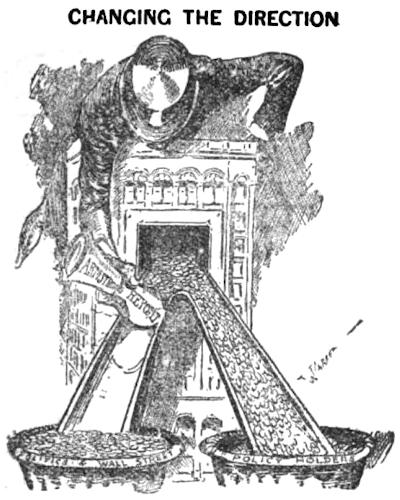
CHANGING THE DIRECTION
Warren, in Boston Herald
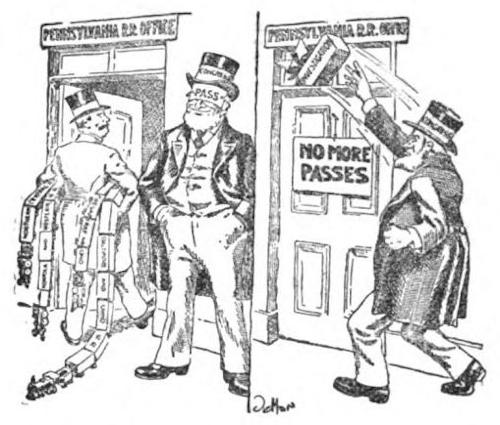
Before After
DeMar, in Philadelphia Record
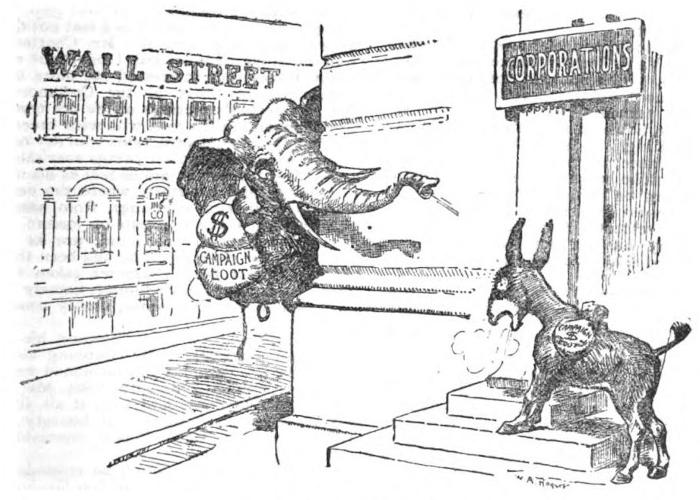
“Sh— Sh— You Blamed Ass!”
Rogers, in N. Y. Herald
April, 1906
BOOKS BY Thomas E. Watson.
Note: Reviews are by Mr. Watson unless otherwise signed.
On the Field of Glory. By Henryk Sienkiewicz.
Little, Brown & Co., Boston.
After the reader has finished reading this
book he disapproves of the title. He has
been taken into ancient Poland, where the
winter snows lie deep, where the wolves of
the forest come with the night to make danger
for the traveler. He has been shown
how the upper class lived in the time of the
Soldier-King, John Sobieski. He follows the
thread of a passionate and tender and
happily ended love-story. He laughs with
and at the four brothers, the huge, rude,
boisterous, but brave and good-hearted
foresters. He feels impressed by the genius
of the author during the whole time, for he
knows that this strange Polish world, with
its unfamiliar men and women, is a creation
born of the mental processes of a great
literary artist.
It is not an historical novel in the sense
that “Quo Vadis” was. There is no field of
glory at all. John Sobieski does not appear
before us as Nero was made to do in the
book just named.
The John Sobieski of this novel might be
any other King. So far as we are told about
his appearance, manners, dress, personal
peculiarities, he might have been Rudolph
of Hapsburg or Henry of Valois.
There are no battles, no sieges, no heroic
advance or retreat. As the book closes, the
Polish army has set out from Cracow to
Vienna; and that’s as near as we approach
the field of glory.
With the heroine the reader never gets in
full sympathy. She drives away the man
who has always loved her and whom she
loves without knowing it.
She then consents to wed her hideous,
lecherous, old guardian. More indignant
than the bride, the spirits of the Unseen
World resent this unnatural union, and they
prevent it by claiming the groom while the
marriage feast is being eaten.
With the hero the reader is on good terms
from first to last, for his is a fine character
finely drawn.
When the guardian and intended husband
is dead, and the rejected lover is far away,
the hero is subjected to trial and temptation,
beset by dangers, marked for destruction
by a lustful brute, neglected and hated
by family connections. It is then that human
interest of the deepest kind centres in
the poor orphan girl Panna Anulka, whom
we had condemned on account of her
readiness to marry old Pan Gideon. We
follow her fortunes then with painful attention
and we rejoice when she is saved.
While “On the Field of Glory” is not,
perhaps, so great a book as “Quo Vadis,”
its atmosphere is purer, its store of love
more tender and its portrayal of ancient
manners and character apparently quite
as faithful.
The Strange Story of the Quillmores. By
A. L. Chatterton. Stitt Publishing
Company, New York.
To write a novel which shall hold the
reader with a strong and constant grip, and
yet give him no love-story, is a feat not done
by everyone that tries it. Mr. Chatterton
tells no story of love, but I have not read
many books that interested me more than
“The Strange Story of the Quillmores.”
Mr. Chatterton’s pictures of life are true to
life: his men are the men who wear breeches—not
impossible abstractions who say or do
things which no human beings ever said or
did. And his women are as real as his men.
Uncle I’ and his store, where the neighbors
buy all sorts of things, from ham to
coffins, and where a group of loafers and
tattlers is generally on hand, are as well
known to the reader as if he had been there.
Uncle I’ must be a character taken from
life. He is full of quiet humor, homely wisdom,
sound common sense, manly courage
and loyalty.
Old-fashioned Uncle I’, keeping his old-fashioned
carry-all store, swapping stories
and repartee with his old-fashioned neighbors,
struggling heroically with his old-fashioned
telephone, and with it all, living
up to the best standards of honesty and
usefulness—yes, Uncle I’ is a complete artistic
success.
So is Doctor Gus. True, he reminds the
reader, in a general way, of Ian Maclaren’s
Scotch country doctor, but Doctor Gus is
American, and he is stamped with sufficient
individuality to make him a very live man
to the reader.
What could be better than the old German
woman, Mother Treegood? The chapter in
which Mother Treegood comes to visit Uncle
I’s wife, who is broken with grief on account
of her dying daughter, is one that is
worthy of Dickens. It has the heart-throb
of human sorrow, human sympathy, human
love.
I don’t know of anything more touching,
in its simple unpretentious way, than the
story of how Mother Treegood’s boys, the
twins, ran away from home, and how one of
them was drowned in the Ohio River, and
was sent home for burial.
“My pretty boy was to our house brought,
aber no one could him know—he was in the
wasser—de water—so long—oh das Kalte,
Kalte Wasser! so many, many days. I took
more of the fever—und go out of my head—und
so I never my Liebling seen again.”
The cry that was heard in Ramah, “Oh,
that cold, cold water!”
Then, later on, there came a little box of
tin-iron, “mit a hole cut in the on-top side.”
But let Mother Treegood tell it in her own
way:
“One day there came by the express company
a little bundle. When it was opened—it
was an oyster can—a box of tin-iron,
mit a hole cut in the on-top side. The letter
was from de other boy—und it say—that
his brudder, who vas ver-drownded, did
begin his business life in a hotel in Cincinnetty,
as a bellboy, und he safe his money
und put it in the oyster can. Und in dat
oyster box was the shin-plasters, the five
centses, und de ten centses—yoost as he
take them in for noospapers and shoe-blacking—und
it was yoost enough, ach mein
lieber Gott!—yoost enough to pay for his
grave at Brookfill.”
Surely this is very effective. It probably
happened just that way. To know
that it could, and perhaps did, is just the
right impression for the author of a novel to
make on the reader.
Another splendid episode is that wherein
a “run on the bank” begins, as the funeral
of Colonel Quillmore is in progress. The
chapters which relate the tragedy, the fire in
the Colonel’s laboratory, the wild ride of
Father Lessing and Uncle I’; the dramatic
climax where Mrs. Quillmore lashes herself
into raving madness; the funeral procession
whose mourners get caught up in the growing
excitement of the “run on the bank,” and
leave the hearse to fly to the bank for their
money; the nerve and resource of Doc. Gus
in saving the bank, and in saving the cashier
from the would-be lynchers—are chapters
which bear convincing testimony to the
power and creativeness of the author.
The book is so finely conceived and written
that one is tempted to scold the author for
a few glaring faults which are well-nigh inexcusable.
Why paint L’Oiseau so black when he
was to be white-washed at the end? There
was no need to have him behave so brutally
to the boy, Lanny Quillmore. It was a blunder
to make him insult the boy, incur the
hatred of the boy, assault the boy, and drive
the boy from his own home. The lad is
allowed to think and believe that L’Oiseau
is on terms of criminal intimacy with Mrs.
Quillmore, Lanny’s mother. There was no
necessity for this. If L’Oiseau was brother-in-law
to Mrs. Quillmore, and was prompted
by paternal interest in paying her such suspicious
attention, and in being out in the
woods with her at unseasonable hours in the
night, why permit the lady’s son to torture
himself under a misapprehension?
What earthly reason was there for keeping
from her only son a knowledge of the fact
that L’Oiseau was her brother-in-law, and
that her abnormal physical and mental condition
required these unusual and suspicious
attentions from him?
Again, L’Oiseau was rambling about at
night with Mrs. Quillmore when she lost consciousness,
fell by the wayside, was found
by the priest, and succored by Doc. Gus.
What had become of her escort, L’Oiseau?
He had mysteriously disappeared, and
Doc. Gus had a right to put the worst construction
upon his conduct. Father Lessing
knew the truth; why did Father Lessing
allow Doc. Gus to remain in ignorance?
But the most serious blunder in the plot
relates to the climax—the fire in Colonel
Quillmore’s laboratory.
Doc. Gus sees the shadow of two men
thrown upon the window shade. Only one
of these men is accounted for, and the reader
is left not only in doubt as to what happened,
but in hopeless confusion. He cannot adopt
any theory which will explain all the facts.
Now, that is against the rules. Let the
plot be ever so complicated, the mystery
ever so deep, the author must either clear it
up himself, or furnish the reader with the
clue. Wilkie Collins, in spite of his bewildering
tangles, unravels everything before
he quits. In “Edwin Drood,” the book
which Dickens was writing when death
interrupted the story, the author had constructed
one of his most involved and
difficult plots. Before he had furnished the
key to the riddle, he died. Yet Edgar Allan
Poe was able to tell, with unerring certainty,
just how the story was meant to end. By a
keen analysis of the facts which Dickens had
already related, and by a course of reasoning
that left no room for doubt, Poe demonstrated
that Jasper, the guardian and devoted
friend of Edwin Drood, had murdered him;
that jealousy was the motive; that the body
of the victim was hidden in the new tomb
which the inflated ass, Sapsea, had recently
built for the deceased Mrs. Sapsea; and
that the corpse was located by old Durdles,
the drunken workman whose skill with
his hammer was so great that he could,
by tapping, tapping, tapping on the outside
or a wall, tell whether a foreign substance,
such as a human body, was inclosed
within.
Poe’s own matchless story, “The Gold
Bug,” illustrates the rule which Mr. Chatterton
broke. There are all sorts of mystifications
to start with, but they are cleared
up at the end.
Even in Frank Stockton’s famous “The
Lady or the Tiger,” the rule is kept. The
reader is left in a dilemma, but he can clear
up everything by choosing one horn or the
other. If he says that it is the lady who is
behind the door which is about to be opened,
no mystery remains. If he says that it is
the tiger which is behind the door, nothing
is left of the puzzle.
But in the Quillmore story there is no possible
explanation which will dispose of the
facts. If Colonel Quillmore died in the laboratory,
and L’Oiseau did not kill him, who
did? What about the two men quarreling
in there at the time of the tragedy? What
becomes of that other man? And how could
Quillmore’s son meet him again in Paris?
With the exception of L’Oiseau, no one had
the motive to kill Colonel Quillmore; and the
author made a point of showing that other
people were afraid to go near the laboratory.
But if the Colonel did not die in the laboratory,
how did his false teeth get into the
mouth of the dead man when Doc. Gus
dragged him out of the flames? How did the
Colonel’s Masonic ring get on the dead man’s
finger? How did the Colonel make his escape
without being seen, and, who was it that
he quarreled with and killed before he fled?
Nobody appears to have been missing from
the neighborhood. Usually when somebody
is killed, somebody is missed.
Had Mr. Chatterton refrained from putting
another man in the laboratory, had he
left the Colonel dead in the flames, identified
by his Masonic ring, had he left the
reader to suppose that the sudden death of
the Colonel and the sudden blaze which
broke out in the building resulted from some
dangerous chemical experiment, such as the
Colonel delighted in—the story would have
lost not a grain of interest and would have
escaped a flagrant violation of the rules of
literary construction.
The Game and the Candle. By Frances
Davidge. D. Appleton & Co., New York.
Frances Davidge set herself too difficult a
task when she attempted to make the characters
in her novel. “The Game and the
Candle,” speak in epigrams on every other
page. The consequence is that the story,
with its really brilliant beginning, develops
into a commonplace love-story, and is only
saved from absolute banality by its unforeseen
and dramatic ending. In the field of
literature which attempts to picture New
York society the story will not find an enduring
place, but it serves its purpose very
well. The novelists are numberless who
have sought to satirize our men and women
of wealth and leisure; but few have given
us any books that have lived longer than
their allotted span of one brief season. The
big society novel has not yet been written.
Miss Davidge evidently knows a great deal
of the foibles, the follies and the manners of
the people of whom she writes, and her career
is worth watching. At present she seems a
bit immature and prolix, but there is no
doubt as to her ability to write amazingly
clever dialogue and to tell a story logically
and well. Some of her characters are greatly
overdrawn. One wishes that there were
less of Gussie Regan, the hair-dresser; and
Emily Blair, lovable as she is, could never
have existed. Altogether, however, the
story is pleasing and will find, doubtless, a
large and appreciative audience.
H. C. T.
The Carlyles. By Mrs. Burton Harrison.
D. Appleton & Co., New York.
In “The Carlyles” Mrs. Burton Harrison
relinquishes the modern field which she has
occupied for so long and with such marked
success, and goes back to Civil War times for
the scenes of her story. The Reconstruction
period has been covered by innumerable
writers. Indeed, it has been so frequently
used by novelists and proven so fruitful a
field, that one is apt to be overcome at the
courage of an author who selects it now as
the background for a tale; but Mrs. Harrison
brings a certain freshness and charm to
a subject that, it would seem, could inspire
none. The opening chapter, which describes
the impoverished condition of the Carlyles,
brought on by the ravages of war, reveals
the author at her best, and shows her intimate
knowledge of life in Richmond in the
’60’s. The splendid fortitude of old Mr.
Carlyle in the face of his calamity and financial
ruin, and the pride of the aristocratic
Southerner are depicted with faultless art.
The story itself is the old one of a girl who
is unable to choose between two lovers, one
of whom, of course, is a Yankee soldier and
the other a Southerner fighting as a lieutenant-colonel
under Lee. The usual complications
occur. Lancelot Carlyle, a cousin and
lover of Mona, the heroine, is imprisoned at
Fort Delaware, and of the long period of his
confinement Mrs. Harrison writes graphically,
describing minutely the terrible ordeal
of prison life. Fine as this portion of the
novel is, however, it is in the chapters dealing
with quiet domestic scenes that Mrs.
Harrison writes with most force and distinction.
The incident of the Christmas
dinner-party, with the unheralded return of
Lancelot and the sudden death of old Alexius
Carlyle, is handled with consummate skill.
The author has written no finer passage in
any of her previous novels, nor one more
certain to move her readers to tears.
H. C. T.
The House of Mirth. By Edith Wharton.
Charles Scribner’s Sons.
Undoubtedly no novel during the past season
has elicited more favorable criticism and
more numerous letters from constant readers
than “The House of Mirth.” The book
had a certain artificial success from the
start, because the impression went abroad
that here at last was a book about
Society, meaning the smallest number of
the narrowest brains in any community
from Kankakee to New York. On this
very account there are a few millions
of people in the United States who would
not care to read it; but in view of the
fact that some of the most serious
critics have hailed “The House of Mirth”
as a great American novel—only the bookseller
now speaks of the American novel—a
good many of the few millions, being persons
of means and intelligence, would be
tempted to indulge themselves in the rare
luxury of such a boon. We cannot profess
to treat the book as a true picture of American
Society; because while we know how to
wear the clothes and order the things to eat
and drink, when we have the money, we
have never, in our best-dressed and best-fed
moments, been able to convince ourselves
that we are anything but hopelessly middle
class. Yet we are happy—sometimes;
and we are bound to marvel at some of the
things the society people in “The House of
Mirth” do. For the most part they act like
those people in New York who are loosely
described as Fifth-avenue bohemians, which
means they are people of much money,
thoroughly informed about the decorative
issues of life, with nothing to do but bore
themselves and with a taste and intelligence
that, in literature or the theatre, never
craves anything more exciting than a
musical show or a third-class novel, written
by a man in Chicago, about lords and ladies
of some corner lost and forgotten in Continental
Europe. Our marvel that these
society people should seem so underbred is
only an exhibition of our unfamiliarity with
a certain social stratum. We would have
no right to make record of it, if it were not
for the fact that so many people, of the
better class themselves, have written letters
of protest to divers publications, protesting
against the impression that “The House of
Mirth” is a story accurately representing
New York society. We quote one letter
from the New York Times Saturday Review:
“I am not a literary man, much less a
literary critic, but I look forward each week
to the appearance of The New York Times
Book Review with renewed interest and read
the various criticisms of your readers as to
the merits of “The House of Mirth,” which
in almost every instance meets their approval
as a literary production of unusual merit.
The writer, however, an octogenarian, born
and bred in New York City, member of one
of its oldest families and presumably familiar
with its society, can but look upon “The
House of Mirth” as a gross libel upon that
society, and as an insult to a class as pure,
as refined, and as intellectual as may be
found the world over....
“That such a condition as is therein described
does exist in the lower strata of
New York society, which may be termed
swelldom, composed largely of “newrich”
who swarm from other parts of the country
to exploit their newly acquired wealth in
showy equipages, wondrous wardrobes, and
loud manners to the disgust of refined people,
cannot be denied; but why a lady who
has the entrée into the best society should
elect to open the sewers of its lowest strata
and allow its fœtid airs to escape through
the medium of her pen is beyond the ken of
your contributor.”
T. R. W.
For our part, we prefer to depend upon the
octogenarian who has just spoken, and who
asserts his membership in one of the oldest
families in New York, for an opinion upon
the accuracy of “The House of Mirth” as a
Society novel. As a novel pure and simple
it seems to us to be radically defective in
imaginative power, slow and cumbrous in
construction, and wholly ineffective to
impose an illusion. We say this with regret
because we have read a good many of the
author’s short stories from the time the
first volume of them was issued; and the
impression conveyed by her work in the
short story field, as contrasted by the impression
of this novel, makes clearer to us
than ever the conviction that to write a
short story a short-story writer is required,
and to write a novel a novelist, and they
have always been two persons from Mr.
Kipling down and across. The author’s
style is clear, sharp, refined, as before; but the
gross defect of “The House of Mirth” is that
the characters are pushed here and there
by the author like so many wooden soldiers
on a cardboard field of battle. They have
no more volition than marionettes. In fact
they are merely described names except in the
instances of the three chief characters. One
could have borne with the waxlike fibre of
the attendant persons if the figure of Lily Bart,
the heroine, would stand the gaze of the
naked eye during even half the book. Lily
is described by the author as possessing a
fine sense of diplomacy in intercourse with
the people of her set, yet her whole register
of action from the first page reveals her as
moving through the comedy without prudence,
yet without conscience, with maneuver,
yet without skill; with an under-appeal
to the reader’s sympathy, yet exasperating
the reader until in the moment of
tragedy he feels that the heroine deserved
all she got and ought to have got it sooner.
But, when one gets away from the book, one
feels that the fault is not the fault of the
character, but of the author who has paltered
by trying to make literary academics
and psychology square with life itself and a
good story.
The minor irritations of the book are
the absolutely fictional flavor of the names
of most of the characters, the use of English
or Continental idiom, and the mummery
of the illustrations. Among the English
phrases which the author so much affects is
the word charwoman for scrubwoman. It
may be that Society calls a scrubwoman a
charwoman, but we would like to see any
society man or woman do it to the lady’s
face.
It is announced that Clyde Fitch is to
dramatize “The House of Mirth” for production
next fall and that he will adhere to
the construction of the story as much as
possible. The book is worthy of Mr. Fitch’s
lofty talent.
R. D.
Letters and Addresses. By Abraham Lincoln.
Unit Book Publishing Company.
Even if there were a man, at this day of
awakening in the United States, who could
honestly say he had no interest in politics,
providing he had any intelligence at all and
ambition to think, he could not pass over
such a book as “Lincoln’s Letters and
Addresses” for the simple reason that on
account of the style alone, the reading of
them is a solace and a refreshment that
endures. Of course, most of us are familiar
with the addresses and the letters that
have been so widely quoted, repeated, and
learned by heart in school, that they are
become as household words; but in such a
book as this, containing infinite riches in
little room, one secures not only the loftiest
kind of pleasure but also a strangely intimate
and attractive vision and understanding of
the gaunt, unshapely figure whose genius
towers higher as the years are added to the
history of our country.
R. D.
Contrite Hearts. By Herman Bernstein.
A. Wessels Company, New York.
Some books are interesting because of their
content alone; some only on account of the
personality of their author: some for the
reason that both the author and the content
of his book are humanly valuable. Of the
third distinction is “Contrite Hearts,” a
story of Jewish life in Russia and the United
States, by a writer who on occasion before
has shown that he can use an alien
language with simplicity and force. He
has shown before also that he can present
a picture of the people of his race
without bias and with a due understanding
of their defects and qualities. The Jew in
America as presented in melodrama is a
creation almost wholly of the romance
spirit of the theatre. It is not to be denied
that the prevalence of the very poor Jews in
the lowest ranks of traffickers among men
has provided an obvious type. In sharp
contrast to this is the growing dominance of
the Jew in the very highest ranks of commerce.
Between the two must of necessity
exist the Jew of the middle class; and all
these varieties of the race have expanded to
their utmost in the United States rather than
in any other country. From a purely
artistic standpoint, therefore, there is nothing
more evident than that the field of Jewish
manners and customs is wide and rich
ground for the novelist. The transmutation
in one generation of a peasant in Russia, with
no rights beyond those of a street mongrel,
to a man in the most advanced as well as
the most vigorous civilization of the day,
is material too obvious to be overlooked
by the most casual scribe.
Mr. Bernstein, while not a writer of dramatic
quality has that quieter and more sincere
gift native to Russians, whether Jew
or Gentile, of presenting life as an actuality
against the artificial background of
the printed page. Many who are called
novelists among ourselves, and who have
never talked or written any language but
English, could learn a good deal of simplicity
from this foreign-born author. Of course, one
runs across the traces of his birth in certain
peculiarities that even constant practice cannot
wear out. These blemishes, however,
are never vulgar as are the strainful phases
of an indigenous author who uses his language
as a race-track tout spreads himself
with the flashy colors and fabrics that the
clothier and the haberdasher of his station
provide. It is rather interesting to hear
what one of the characters in “Contrite
Hearts” has to say of this country.
“Here in America it is different. All are
equal. Everyone is free. And all roads
to success are open to the able, the enterprising,
the persevering. There is no difference
here between Jew and Gentile.
People flock hither from all lands, and
within a few years the Jew, the Frenchman,
the German, the Irishman, the Italian—all
are proud that they have become American.
You ask me about the Jews, about
Jewish affairs, about Jewish institutions—well,
we have various kinds of Jews here.
Orthodox Jews—these are the plain Jews
like ourselves. Reform Jews—Jews who imitate
the ways of the Christian. There are
also Jews here who try to be both Orthodox
and reform at the same time—that is,
neither this nor that.”
Is this all true?
R. D.
Politics in New Zealand. By Prof. Frank
Parsons. Edited by Dr. C. F. Taylor.
Dr. C. F. Taylor, Publisher, Philadelphia,
Pa.
This is one of the Equity Series published
quarterly by Dr. Taylor, and contains the
chief portions of the political parts of a book
entitled, “The Story of New Zealand,” by
Prof. Frank Parsons and Dr. Taylor. The
latter is a large, heavy book selling at $3.00,
and is doubtless the most complete history
of New Zealand and exposition of present
conditions there ever published. It is a
beautifully illustrated volume containing
860 pages, and includes history, description,
the native people (the Maoris) and their
treatment by the whites, the splendid
resources of the country, and, more than all,
a full and interesting account of the rise and
development of the remarkable institutions
and government of New Zealand which are
attracting the attention of all the rest of the
world.
As Dr. Taylor well says in his explanatory
note in “Politics in New Zealand,” the
size and cost of the “Story of New Zealand”
prevent it from reaching the masses of our
people, and the political facts, particularly
of that progressive country should reach the
mind and thought of our voters. “It is,”
he says, “with a view of placing these political
facts within the easy reach of the masses
of our people, that I have selected the most
important of these facts from the large book
and arranged them as you see them in this
unpretentious pamphlet.” “Politics in New
Zealand” is now being used in combination
with subscriptions to Watson’s Magazine.
(See advertising pages.)
The great value of “Politics in New Zealand”
lies in the fact that it gives the workings
of many Populistic ideas put into actual
practice. In this country the People’s
Party has been obliged to theorize and resort
to an appeal to the reasoning faculties of
the people. It has been unable to point out
many illustrations of the actual working of
its theories, except by reference to foreign
countries. For example, to sustain its contention
for public ownership of railroads, it
has been obliged to use the lines in Germany
and other monarchies as illustrations. The
United States is such a vast domain as compared
with countries in Continental Europe,
that considerable discrimination is necessary
in order to draw a fair conclusion. Besides,
the European countries are so old that the
habits of the people are a great factor not to
be lightly dismissed. In using New Zealand,
however, as our object lesson, the conditions
are more, nearly parallel. It is true that
country is much smaller than the United
States, but in point of age and habits of the
people, there is much similarity. Accordingly,
New Zealand is without doubt the
best object lesson in the world for proving
the soundness of Populistic theories.
Those who have either bought or sold real
estate in the older portions of the United
States, understand the difficulties and uncertainties
surrounding land titles under
the system which is in vogue generally. As
Prof. Parsons points out, it is often necessary
to search through many big volumes of
deeds and mortgages, and carefully construe
the provisions of various wills and conveyances
in order to follow the title to its source,
and form an opinion as to its validity. And
even then the opinion of the most accomplished
expert may prove fallacious, and the
purchaser may lose his land through some
defect of title. As early as 1860 the New
Zealanders passed an act to remedy this
condition of things by establishing what is
known as the Torrens system of title registration.
The owner of land may give the
registrar his deeds and the claims of all persons
interested, and the registrar investigates
the title once for all. He accepts it if he
finds it valid, and registers the applicant as
proprietor, giving him a certificate to that
effect. The certificate gives an indefeasible
title in fee, subject only to such incumbrances
and charges as may be entered on
the register. An independent purchaser has
only to consult the register to learn at once
who is the owner of the land, and what burdens,
if any, rest upon it. He is not obliged
to trace the title back to the Government
Patent. This system is now in force in some
places in the United States, but its adoption
is generally opposed by those who profit by
examining titles—that is to say, the lawyers.
There were some telegraph lines constructed
under the provincial governments
of New Zealand prior to 1865, but nothing
was done in a national way until that year.
Then the General Assembly authorized the
Governor to establish electric telegraphs and
appoint a commissioner to manage them.
Existing lines and offices were to be purchased,
new lines built, and a national system
developed. The commissioner made
the regulations, fixed the rates, and employed
operators to transmit all messages
presented. Afterward the telegraphs became
a part of the postal system. This
naturally led to government ownership and
operation of the telephone when the latter
means of transmitting intelligence was introduced.
It is also a part of the postal system,
and as Prof. Parsons points out, “The
Government is ‘hello-girl’ as well as postmaster,
telegraph operator and banker.”
Mr. Gladstone secured the establishment
of postal savings banks in England in 1861.
New Zealand adopted the idea in 1865, and
since that time nearly every country in the
civilized world, except the United States,
has followed England’s example. The object
of the New Zealand Post Office Savings
Bank Act (1865) was stated to be: “To give
additional facilities for the deposits of small
savings at interest, and with the security of
the Government behind it.” Practically
all the money order offices in New Zealand
(470 a few years ago) were open under the
Postal Banking Law for the transaction of
savings bank business, while there were but
five private savings banks in the Islands.
In New Zealand there is a place of bank
deposit for each 1,800 people. In the United
States there is one for each 7,650 people.
The total deposits in all sorts of banks is $110
per head of population in the United States,
$125 in Great Britain, and $140 in New
Zealand. Comment seems to be unnecessary.
The postal banks will not receive
less than a shilling at a time, but printed
forms are furnished on which stamps may be
pasted, one or more at a time, until the total
amounts to a shilling or more, when the slip
can be deposited as cash to the amount of
the stamps pasted on it. The great advantage
of postal banking, and in fact all government
banking, is its safety. No postal
bank in any country has ever closed its door
for liquidation, or experienced a run on its
funds.
In view of our insurance scandals and the
recent investigation, the chapter on Government
Insurance is especially interesting at
this time. In 1870 New Zealand adopted
the Australian ballot and a public works
policy, together with a Government Life Insurance
Department. As the author points
out, “The philosophy of this new departure
was very simple. The purpose of insurance
is the diffusion of loss. Instead of allowing a
loss to fall with crushing weight on one individual,
or family, it is spread out over a large
number of stockholders or premium payers.
If it is a good thing to distribute loss over a
few thousand people who hold stock in a
given company or pay premiums to it, it is
still better to distribute the loss over the
whole community. It is also wise to eliminate
the expenses and profits of insurance so
far as may be, and put the guarantee of the
Government behind it, so that it may reach
as many people and afford as much security
as possible.”
The insurance department was popular
from the very start. The latest report when
this book was written (1901) showed in force
42,570 policies covering $51,000,000 of insurance,
or practically half the total business
of the Colony. The Government office had
beaten the private companies in fair competition,
for there was no attempt to exclude
private insurance companies. It had, in
1901, a much larger business than any of the
companies, and almost as much as all the
companies put together. This refers, of
course, to the ordinary life insurance business,
for there were 21,000 policies in industrial
societies, which were not included in the regular
life insurance statement. Two of our
companies mixed up in the recent scandal,
the Equitable Life and the New York Life,
had, in 1901, been in the Colony 15 and 13
years respectively. The Equitable had 717
policies in force and the New York Life 139,
as against 42,570 Government policies.
The people of New Zealand prefer the
Government insurance because of its safety—it
has the guarantee of the Government behind
it. It is in no danger of vanishing
through insolvency, as ordinary insurance
does now and then. Because of its cheapness,
the rates being lower than any ordinary
private companies; and because of its freedom
from all oppressive conditions. The
only conditions are that the premiums must
be paid, and the assured must not commit
suicide within six months after the insurance
is taken out. As Professor Parsons says,
“The policy is world-wide. The assured may
go where he will, do what he likes—get himself
shot in battle, smoke cigarettes, drink
ice-water and eat plum pudding, or commit
suicide under the ordinary forms after six
months, and the money will still be paid to
his relatives.” Instead of wasting valuable
time and gray matter on devising schemes to
prevent scoundrels from looting private insurance
companies, why not devote a little
thought to inaugurating a system of government
insurance?
An unique institution in New Zealand is
the Public Trust office, established in 1872.
Its purpose is to serve as executor, administrator,
trustee, agent, or attorney, in the settlement
and management of the property of
decedents, or others, who for any reason are
unable or unwilling to care for it themselves;
to insure honest administration and safe investment;
to provide for a wise discretion
that may avoid the difficulties and losses incident
to a strict fulfilment of wills and trusts
imperfectly drawn; and to give advice and
draw up papers, wills, deeds, and other instruments
for the people in all parts of the
Colony.
“In the earlier years,” says the author,
“nominations for representatives were made
and seconded vocally at an assembly of the
voters of the district. But since the Act of
September (1890) representatives are nominated
by petition in writing, signed by two or
more voters of the district, transmitted with
the candidates’ assent and a $50 deposit to
the returning officer, who immediately publishes
the names of the candidates. Each
candidate must be nominated on a separate
paper which must be transmitted to the returning
officer at least seven days before the
polling day. If the nominee doesn’t get one
tenth as many votes as the lowest successful
candidate, the $50 deposit is forfeited to the
public treasury. This shuts out frivolous
nominations. The nominations are usually
made some time before the voting day, and
the candidates go about the district and meet
and address the electors in all parts of it. No
candidate would stand any chance of election
who failed to give the people he wished to
represent an opportunity to get acquainted
with him and ask him questions about his
attitude on issues likely to come before the
next Parliament. Seamen, sheep-shearers
and commercial travelers are permitted to
vote by mail. Such person gets a ballot
paper filled up by the Postmaster with the
names of the candidates in the applicant’s
district, and the postal voter then marks the
ballot and mails it.”
Another Populistic economic theory put in
practice in New Zealand is the Land and Income
Assessment Act which abolishes the
personal property tax and establishes graduated
taxation on land values and incomes.
The avowed objects of the law are to tax “according
to ability to pay,” “to free the small
man,” and, “to burst up monopolies”; and
its cardinal features are the exemption of improvements
and of small people and the special
pressure put on the big monopolies and
corporations and on absentees.
All improvements are exempt. All buildings,
fencings, draining, crops, etc.—all value
that has been added by labor, all live stock
also and personal property; only the unimproved
value of the land is taxed. Mortgages
are deducted also in estimating the land taxes
as they are taxed to the lender. There is a
small-estate exemption of $2,500, where the
net value of the estate doesn’t exceed $7,500.
So that if a farmer has no more than $2,500
of land value left after deducting improvements
and mortgage liabilities from the value
of his real property, he pays no land tax.
Besides the three exemptions mentioned,
there is another conditional exemption. If
an old or infirm person owns land or mortgages
returning less than $1,000 a year, and
can show that he is not able to supplement
his income, and that the payment of the tax
would be a hardship, the commissioner may
remit the tax. Here the custom is quite the
other way. The millionaire swears off his
tax. Out of 110,000 land owners, in New
Zealand, only 16,000 pay tax.
The graded tax begins when the unimproved
value reaches $25,000. It rises from
¼ of a cent on the pound of $25,000 to 16⁄4ths,
or 4 cents, a pound on a million dollars, or
more, of unimproved value. This graduated
tax is in addition to the ordinary level-rate
land tax levied each year, which is 2 cents
on the pound. Absentee owners of large
estates have still another tax to pay. If the
owner of an estate large enough to come
under the graded tax has been out of the
country a year, this graded tax is increased
20%.
The income tax applies to net income from
employment, and net profits from business.
There is an absolute exemption of $1,500,
except in the case of absentees, and companies
whether absentees or not, and a further
additional exemption up to $250 a year for
life insurance premiums, if the citizen wishes
to spend his money that way. All income
derived from land or from mortgages, so far
as they represent realty, is outside this tax,
which affects only income from employment
or business. The farmer, who derives all his
income from land, pays no income tax. The
same may be said of a lawyer, doctor, teacher,
artisan, or any other person who makes no
more than $1,500 a year. The total number
of income-tax payers is only about 5,600.
United States Consul Connolly, reporting
to our Government in 1894 and 1897, has
considerable to say regarding taxation in
New Zealand. He says that country excels
in the matter of taxation. That in a very
short time the system of taxation had been
revolutionized and the incidence almost entirely
changed, not only without disturbing
to any appreciable extent existing interests,
but with the most beneficial results. He
says the income tax was most fiercely denounced
as inquisitorial, destructive of the
first principles of frugality and thrift—in
fact all the forms of evil lurked in the shadows
of the words “income tax,” and a united
effort was made to resist this “iniquitous
tax,” but all to no purpose. And that in
1897, after six years of experience, the more
liberal and fair-minded of those who opposed
the income tax frankly admitted that it is
a fair and unembarrassing tax. “In New
Zealand the land and income tax is now
popular; it is accepted in lieu of the property
tax; it is a success.”
In the United States the Government is
paternalistic toward banks, railroads and
manufacturing interests. It loans its credit
to the national bankers at most advantageous
terms, but has persistently refused to
favor other classes in a similar way. In
New Zealand, however, in 1894, there was
established a Government loan office which
lends public funds to farmers, laborers, business
men, etc. at low interest, and on easy
terms. The security taken is on freehold,
or leasehold, interest clear of incumbrances
and free of any breach of conditions. The
loans are on first mortgage of land and improvements.
No loan is to be less than $125,
or more than $15,000, and the sum of the
advances to any one person must not exceed
$15,000. There are two kinds of advances,
fixed loans and installment loans. The first
may be for any period not exceeding ten
years, and the principal is due at the end of
that term. The second is for 36½ years, and
part of the principal is to be paid each half
year. Interest in both cases is at 4½%, if
paid within fourteen days of the time it is
due (5% if payment is not prompt); and in
the case of an instalment loan, 1% more is
to be paid for the reduction of the principal.
Passing over the chapters devoted to the
labor department, the state farm, the factory
laws, the shop acts, the 8-hour day,
industrial arbitration and co-operation, all of
which are of intense interest, but of such
a nature as to preclude brief statement, we
come to the Government ownership and
operation of the railways. The year 1894
Prof. Parsons calls “the glory year of land
resumption. Government loans to farmers,
nationalization of credit, labor legislation
and judicialization of strikes and lock-outs.”
It was in this year that another important
move was made through a vital change in
the national railway policy. In 1887 a
commission system was inaugurated, under
which the roads were put in the hands of
commissioners appointed by the Governor,
with the assent of Parliament. This did
not prove satisfactory to New Zealand.
The commissioners managed the roads with
a view to making a good financial report.
They were looking for profit. In the Parliamentary
debates it was charged that rates
were so high that firewood went to waste in
the forest, and potatoes rotted in the fields,
while the people in the cities were cold and
hungry in the years of depression; that goods
were frequently hauled more cheaply by
wagon than by rail; that while rates were
reduced somewhat now and then, it was
done by reducing wages; that the pay of the
men was cut while the salaries of high-priced
officials were increased, and so on. This is a
striking parallel to conditions in the United
States today.
Prof. Parsons admits that the commissioners
were honest, but they were simply railroad
men, running the roads to make money
for the treasury. Finally public indignation
became intense. The air was full of complaints,
and in 1893 the abolition of the commission
was made an issue in the campaign,
and the people, by an overwhelming majority,
elected representatives pledged to put the
roads under direct control of the Minister
of Railways and the Parliament, and to
bring the railroads within speaking distance
of the people.
The result of this change is that the roads
are no longer run primarily for profit, but for
service; and the men are treated with the
consideration due to partners in the business.
It is announced that the definite policy of
the Government shall be that all profits
above the 3% needed for interest on the railway
debt shall be returned to the people
in lower rates and better accommodations.
This is in striking contrast to the facts brought
out in the letter of Engineer William D.
Marks to Hon. Wharton Barker, recently
printed as a public document at the instance
of Senator Tillman of South Carolina, in
which it is shown that the people of the
United States are today paying interest on
a fictitious railway capitalization of something
like $7,000,000,000.
In 1899 the Minister of Railways announced
a reduction of 20% on ordinary
farm products and 40% on butter and cheese,
etc. These concessions, Prof. Parsons declares,
amount to one seventh of the receipts—equivalent
to a reduction of $150,000,000
on the yearly freight rates in the United
States. That alone would be a yearly saving
of almost $2 a head for the people of the
United States. In 1900 Mr. Ward, the new
Minister of Railways, announced a general
lowering of passenger fares as the first fruits
of his administration. “The announcement
was received with cheers by the audience—stockholders
in the road.” Care is taken
in New Zealand that small men shall not be
put at a disadvantage. The State roads
carry 400 pounds at the same rate as the ton
rate, or the train-load rate, and one bale of
wool goes the same rate as a thousand. No
such thing is known in New Zealand as the
lowering of rates to a shipper because of the
great size of his shipments. All the rates are
made by the management openly. There
are no secret modifications of the tariff.
There may be a variation on scheduled rates
to equalize a long haul, or enable a distant
mine or factory to reach the market in
condition to compete with nearer rivals,
but the total charge is never lower than
the rate that is given to others for the same
service.
The State roads are used to advance the
cause of education. Children in the primary
grades are carried free to school.
Other children pay $2.50 to $5, according
to age, for a three-months season ticket up
to sixty miles. This gives them a possible
120 miles a day for 3 to 6 cents in round numbers,
or 20 to 40 miles for a cent. A child
who goes in and out six miles each day rides
12 miles for 3 cents.
It is impossible in the limits of this article
to more than touch upon many of the other
advances made in New Zealand. The Referendum
is now used to a considerable extent
in local affairs, and its use is being extended.
Old age pensions are in force, being a much
better method than maintaining poor houses.
Immigration is carefully guarded. The
State is now opening coal mines and engaging
in the business of furnishing fuel to the people.
Many other innovations of this character
are being considered and put in operation
from time to time.
Prof. Parsons summarizes his study of
New Zealand in some sharp contrasts and
conclusions, from which we quote in part:
“The United States is in form a Republic,
but ... an aristocracy of industrial
power. New Zealand is in form an Imperial
Province, but in fact it is substantially a
Republic. The will of the great body of the
common people is in actual control of the
Government.
“In America, farmers organize for agricultural
needs, and the working-men organize
for labor purposes, but they do not join forces
to take control of the Government in their
common interest, as is the case in New Zealand.
Not only have our farmers and workers
failed to get together, but neither group
has learned to use the ballot for its interest
in any systematic way. The farmers divide
at the polls and organized labor divides at
the polls. In New Zealand the small farmers
are practically solid at the ballot box,
and organized labor is solid at the ballot, and
the two solids are welded together into one
irresistible solid.”
C. Q. D.
BACK HOME. By Eugene Wood. S. S.
McClure Co., New York.
It isn’t often that an author writes a real
review of his own book. Well, maybe he
does, too, but it seldom happens that he
writes it as a preface to the book itself, very
seldom that it is an interesting one, very,
very seldom that it tells you what to expect
to find in the book, and very, very, very seldom
that he isn’t too much wrapped up in
his own private idea of his story to write a
fair one from our point of view. However,
Eugene Wood, being unconventional and
other pleasing things, has done all this in the
preface to his “Back Home.” When you
have read the preface, you are glad you did,
instead of feeling sorry you wasted time on it
and fearful lest a book by the same author of
that preface will be something of a bore.
After Mr. Wood’s preface you know Mr.
Wood and about what to expect in Mr.
Wood’s book. You like one, and you know
you are going to like the other.
It would be the easiest thing in the world
for the reviewer to sit down and write reams
of “copy” on “Back Home” and the good
things therein, but it is much more to the
point for him who reads to listen to Mr. Wood
himself. If you are human instead of petrified,
you will enjoy both the preface and the
book. Both reach for the heart-strings,
and the terms—the term is good.
Here is the larger part of the preface:
“Gentle Reader:—Let me make you acquainted
with my book, ‘Back Home.’
(Your right hand, Book, your right hand,
Pity’s sake: How many times have I got to
tell you that? Chest up and forward, shoulders
back and down, and turn your toes out
more.)
“Here’s a book. It is long? No. Is it exciting?
No. Any lost diamonds in it? Nup.
Mysterious murders? No. Whopping big
fortune, now teetering this way, and now
teetering that, tipping over on the Hero at
the last and smothering him in an avalanche
of fifty-dollar bills? No. Does She get Him?
Isn’t even that. No ‘heart interest’ at all.
What’s the use of putting out good money to
make such a book; to have a cover-design
for it; to get a man like A. B. Frost to draw
illustrations for it, when he costs so like the
mischief, when there’s nothing in the book to
make a man sit up till ‘way past bedtime’?
Why print it at all?
“You may search me. I suppose it’s all
right, but if it was my money, I’ll bet I could
make a better investment of it. If worst
came to worst, I could do like the fellow in
the story who went to the gambling-house
and found it closed up, so he shoved the
money under the door and went away. He’d
done his part.
“And yet, on the other hand, I can see
how some sort of a case can be made out for
this book of mine. I suppose I am wrong—I
generally am in regard to everything—but
it seems to me that quite a large part of the
population of this country must be grown-up
people. If I am right in this connection,
this large part of the population is being unjustly
discriminated against. I believe in
doing a reasonable amount for the aid and
comfort of the young things that are just beginning
to turn their hair up under, or who
rub a stealthy forefinger over their upper lips
to feel the pleasant rasp, but I don’t believe
in their monopolizing everything. I don’t
think it’s fair. All the books printed—except,
of course, those containing valuable information;
we don’t buy those books, but go
to the public library for them—all the books
printed are concerned with the problem of
How She got Him, and He can get Her.
“Well, now. It was either yesterday
morning or the day before that you looked
in the glass and beheld there The First Gray
Hair. You smiled a smile that was not all
pure pleasure, a smile that petered out into a
sigh, but nevertheless a smile, I will contend.
What do you think about it? You’re still on
earth, aren’t you? You’ll last the month out,
anyhow, won’t you? Not at all ready to be
laid on the shelf? What do you think of the
relative importance of Love, Courtship, and
Marriage? One or two other things in life
just about as interesting, aren’t there? Take
getting a living, for instance. That’s worthy
of one’s attention, to a certain extent. When
our young ones ask us: “Pop, what did you
say to Mom when you courted her?” they
feel provoked at us for taking it so lightly
and so frivolously. It vexes them for us to
reply: “Law, child! I don’t remember.
Why, I says to her: ‘Will you have me?’ and
she says: ‘Why, yes, and jump at the
chance.’” What difference does it make
what we said or whether we said anything at
all? Why should we charge our memories
with the recollections of those few foolish
months of mere instinctive sex-attraction
when all that really counts came after, the
years wherein low passion bloomed into
lofty Love, the dear companionship in joy
and sorrow, and in that which is more, far
more than either joy or sorrow, “the daily
round, the common task?” All that is wonderful
to think of in our courtship is the marvel,
for which we should never cease to
thank the Almighty God, that with so little
judgment at our disposal we should have
chosen so wisely.
“If you, Gentle Reader, found your first
gray hair day before yesterday morning, if
you can remember, ’way back ten or fifteen
years ago—er—er—or more, come with me.
Let us go ‘Back Home.’ Here’s your
transportation, all made out to you, and in
your hand. It is no use my reminding you
that no railroad goes to the old place. It
isn’t there any more, even in outward seeming.
Cummins’s woods, where you had your
robbers’ cave, is all cleared off and cut up into
building lots. The cool and echoing covered
bridge, plastered with notices of dead and forgotten
Strawberry Festivals and Public Vendues,
has long ago been torn down, to be replaced
by a smart, red iron bridge. The
Volunteer Firemen’s Engine-house, whose
brick wall used to flutter with the gay rags of
circus-bills, is gone as if it never were at all.
Where the Union School-house was is all torn
up now. They are putting up a new magnificent
structure, with all the modern improvements,
exposed plumbing, and spankless
discipline. The quiet, leafy streets echo
to the hissing snarl of trolley cars, and the
power-house is right by the Old Swimming-hole
above the dam. The meeting-house,
where we attended Sabbath-school, and marveled
at the Greek temple frescoed on the
wall behind the pulpit, is now a church with
a big organ, and stained-glass windows, and
folding opera-chairs on a slanting floor.
There isn’t any “Amen Corner,” any more,
and in these calm and well-ordered times nobody
ever gets “shouting happy”.
“But even when “the loved spots that our
infancy knew” are physically the same, a
change has come upon them more saddening
than words can tell. They have shrunken
and grown shabbier. They are not nearly so
spacious and so splendid as once they were.
“Some one comes up to you and calls you
by your name. His voice echoes in the
chambers of your memory. You hold his
hand in yours and try to peer through the
false-face he has on, the mask of a beard or
spectacles, or a changed expression of the
countenance. He says he is So-and-so.
Why, he used to sit with you in Miss Crutcher’s
room, don’t you remember? There was
a time when you and he walked together,
your arms upon each other’s shoulders. But
this is some other than he. The boy you
knew had freckles, and could spit between
his teeth, ever and ever so far.
“They don’t have the same things to eat
they used to have, or, if they do, it all tastes
different. Do you remember the old well,
with the windlass and chain fastened to the
rope just above the bucket, the chain that
used to cluck-cluck when the dripping bucket
came within reach to be swung upon the well-curb?
How cold the water used to be, right
out of the north-west corner of the well! It
made the roof of your mouth ache when you
drank. Everybody said it was such splendid
water. It isn’t so very cold these days, and
I think it has a sort of funny taste to it.
“Ah, Gentle Reader, this is not really
‘Back Home’ we gaze upon when we go
there by train. It is a last year’s birds’ nest
The nest is there; the birds are flown, the
birds of youth, and noisy health, and ravenous
appetite, and inexperience. You cannot
go ‘Back Home’ by train, but here is
the magic wishing-carpet, and here is your
transportation in your hand all made out to
you. You and I will make the journey together.
Let us in heart and mind thither
ascend.
“I went to the Old Red School-house with
you. Don’t you remember me? I was
learning to swim when you could go clear
across the river without once ‘letting down.’
I saw you at the County Fair, and bought a
slab of ice-cream candy just before you did,
I was in the infant-class in Sabbath School
when you spoke in the dialogue at the monthly
concert. Look again. Don’t you remember
me? I used to stub my toe so; you
ought to recollect me by that. I know
plenty of people that you know. I may not
always get their names just right, but then
it’s been a good while ago. You’ll recognize
them, though; you’ll know them in a
minute.”
A. S. H.
The Say of Other Editors — The Best
Clark Howell’s politicians and newspaper
supporters over the state are sending
up a unanimous wail because Tom Watson,
a Populist, manifests some interest in Georgia
politics. They swear he is trying to
break up the Democratic party and gain control
of the state. Well, what about Major
J. F. Hanson, the Republican president of
the Central Railway? He has been active
in state politics for a long time, and wields
more influence than a thousand ringsters who
are “cussing” Tom Watson. If it is a high
crime for Populist Watson to take a hand in
Georgia politics, what kind of crime is
Republican Hanson guilty of when he joins
Hamp McWhorter and Sam Spencer in a
prolonged struggle to dominate the public
policies and politics of Georgia? Will some
of the political time-servers please answer?—Newnan
(Ga.) News.
The fact that Mr. Howell has never replied
to the question why he was so anxious
for Watson to call and see him, leads us to
believe that he was after the same thing he
accuses Smith of—attempting to get what
honey he could out of the Populist beegum.—Washington
(Ga.) Reporter.
The latest proposition is to put the Quay
statue at Harrisburg in a niche. That would
be a good plan provided they wall up the
niche afterward.—Broken Bow (Neb.) Beacon.
The railroad rate bill was passed by the
House by a vote of 346 to 7, last week
Thursday.
The bill is now up to the Senate. It may
stay there for some time before it passes, if
it is passed at all.
The corporation-ridden Senate is a disgrace
to a people who are said to elect their
public servants. The men who made the
Senate so far from the touch of the common
people either were short-sighted, or defrauded
the real American citizen out of one
of the most necessary needs in this age of
graft and political corruption.
The Grange favors the direct nomination
and election of our United States Senators,
and in due course of time we, the people,
shall be electors in deed and action. By
direct vote of the people, making the senators
responsible and answerable to the
masses, alone can we inject purity into our
elections and accomplish reform in public
affairs.—Sandusky (Mich.) Salinac Farmer.
Up to January 16 the Congressional
Record contained 2,300 columns of speeches
made so far by congressmen, but it has to
record only one important bill passed.
William Jennings Bryan’s costume in the
honorable position of a “Datto” of Mindanao
consists of a high hat and a black silk
apron. In cold weather he is permitted to
varnish his legs.—McEwen (Tenn.) New Era.
The members of the lower house of Congress
are debating the railroad rate bill this
week. At the end of that time the public
will know which ones are entitled to railroad
passes under the new regulation of the companies
that only employees are to receive
them.—Matthews (I. T.) News.
We admire patriotism but we don’t like
toadyism. It makes us tired to see how
quick some editors sneeze when a high official
takes snuff. And when the snuff is
taken purely and solely for political effect
it makes it all the more disgusting.—Marshville
(N. C.) Our Home.
“This is the time,” says Senator Platt,
“when little bosses will find their level.”
And it is also the time when some great
bosses are finding rock bottoms.—Stanberry
(Mo.) Owl.
What’s the difference between a street
curb boodler and one that sells out for a
promise of an appointment? Ans.—One
gets his money before voting while the other
gets it afterwards, if he does not get left—principle
same.—Batavia (O.) Democrat.
Why are all the candidates opposing Hoke
Smith? There must be some reason for it.
Everyone had faith in him, believed him far
superior to a majority of other people, until
he got into the race. Why this change?
Why so many attacks upon him? Is it because
he is advocating reforms which have
already been adopted by several of the other
Southern states? It must be because he
stands for something, and is not ashamed
or afraid to tell what it is.—Marietta (Ga.)
Courier.
With Clark Howell devoting most of his
time to “cussing” out Tom Watson, Hoke
Smith is sailing smoothly on to the gubernatorial
chair.—Dalton (Ga.) Citizen.
The New York Sun puts it this way: “If
John Mitchell’s statement at the miners’ convention
is not a bluff, there will be either an
enormous increase in the coal bills of the
American people or the most costly and
disastrous strike the country has ever seen.”
But what do the mine owners and the striking
mine workers care about that, so long as
the people who buy the coal are willing to
bear their suffering in silence—paying without
a murmur any price the coal barons put
on their product; and feeling well assured
that nothing will be done by the suffering
people to change the laws by which these
barons are enabled to inflict this suffering.—Waterbury
(Conn.) Examiner.
During the last ten years stocks and
bonds amounting to $12,500,000,000 have
been floated in this country. This additional
capitalization of the industries and railroads
of the country is about equal to the total
value of all grain crops raised by the farmers
during the same period. It is one-third
more than the total value of the products of
all mines in the country for the same period.
It is equal to one-eighth of the total wealth
of the United States in 1900. That is the
way the “great” financiers absorb the
wealth produced by the toilers of the nation.
After studying the above statistics you may
realize the force of Gov. Johnson’s statement
that fictitious valuation and the consequent
tax on the producers is the great curse of
this country. Ignatius Donnelly used to
tell a story about a hen that laid an egg in a
nest fitted with a false bottom. The egg
disappeared, and the hen laid another, continuing
in her vain effort to have an egg show
up in the nest until there was nothing left of
her but the feathers. The fictitious capitalization
is the false bottom that takes the
products of the laborer, leaving him nothing
to show for his efforts.—Willmar (Minn.)
Tribune.
The Hepburn rate bill now pending in
Congress is nothing more nor less than the
Hearst bill with a few loopholes in it for the
convenience of those railroad companies
that may desire to side-step its provisions.—Globe
(Ariz.) Register.
The fact that the congressmen of both
old parties are almost a unit for the railroad
rate bill now pending in Congress, should be
enough to satisfy any reasonable man that
the people can get their rights only through
a new party. The bill is a miserable pretense
engineered by railroad tools in Congress,
and its object is to make the people believe
they are going to get relief through the old
parties.—Chillicothe (Mo.) World.
Gov. Magoon testifies that men may be
put to death in the Panama Canal zone without
trial. It seems to be easier to put them
to death than to put them to work.—Athens
(Ill.) Free Press.
The time has come when we need men
that stand for something. The day is past
when our forefathers stood for truth, honor,
principle; and all that was right must be
called into play again or this republic will
be but an iridescent dream.—Marion (Ala.)
Democrat.
A writer in a recent issue of a so-called
farm paper says the reason boys go to towns
and cities to live is because they long for a
life in which they will be independent of
every one else on earth. Then why in
thunder do they go to the cities to find it?
A man might as well dig out gopher holes
expecting to find wolves as to go to the cities
to find an independent life. The place to
find that is on the farm. Here we are our
own boss, and if any one else does not like
the way we do, we are in a position to tell
him to go to—with no danger of losing our
job.—Irrigon (Ore.) Irrigator.
It now looks like Marion Butler is arranging
to take charge of the Republican Party
in North Carolina. We make no prediction
about what will be or what will not be done.
Those who know his past record will hesitate
before surrendering entirely to a man who is
so thoroughly repudiated by all classes in
this state.—Asheboro (N. C.) Courier.
The Chicago Tribune asks: “Granting
that it will take seven years to construct the
Panama canal, have the seven years begun
yet?” That is rather a hard question, not
knowing the personality of the timekeeper.
However, there is one thing in connection
with the scheme that we are all well aware
of—the big salaries of the political constructors
have begun, all right.—Farmington
Valley Herald, Hartford, Conn.
According to the Pantagraph, Senator
Cullom should be re-elected because he
stayed in Washington after the session of
Congress of last winter and did work that he
was drawing a salary of $5,000 a year to do.
The statement that his present illness was
brought on by overwork seems preposterous.
Who ever heard of a United States Senator
overworking, unless it was to keep himself in
office? From present indications, it seems
that the people of the state are willing to give
Mr. Cullom a rest from his overwork.—Colfax
(Ill.) Press.
John A. McCall, late head of a giant life
insurance company, is dead, and, as far as
mortal knows, is at rest for the first time for
months. This erstwhile gentleman and
master of high finance was “weighed in the
balance and found wanting.” The weighing
was done by fellow citizens, which made
remorse all the more keen. Rapid decline
followed and McCall, broken-hearted, deserted
and despised, is gone. His fate should
be an example to others who are tempted
to do wrong. A half dozen other luminaries
of New York, who were caught dead to
rights in the insurance frauds, are fast following
in McCall’s wake, and are even now
all but ostracized by social and business
associates. The weight of the common
verdict against them is bearing heavily upon
their shoulders, streaking their hair and furrowing
their faces. Their sins are finding
them out.—Washington (Ill.) Register.
Old political systems are being broken up
by the heat of public common sense and non-partisan
movements. The independent
American citizen and voter is going to
make himself felt, by gosh!—Mt. Vernon
(Ind.) Unafraid.
John A. McCall has departed to the
great bar of all time. There is no doubt but
that shame and humiliation killed this
proud, self-made man.
Wrong-doing is bound to bring its death
sentence to all lives, rich or poor.—Milford
Centre (O.) Ohioan.
“Some day, we pray to God, there will come
a House which will hold tight the purse-strings,
and, on some measure of right, say to
our lords: ‘Pass the bill or get no money.
We will go to the country on this issue.’
And then we will have achieved what the
English House of Commons won in 1832, and
our Senate will become the perfunctory body
the House of Lords ever since has been.”—St.
Louis Dispatch.
That sounds like it came from way up in
the amen corner, and is likely to have many
hearty responses.—Salem (Va.) Times-Register.
Mr. Rogers, of the Standard Oil Trust, is
the last man in the world who should show
contempt for the law. The law which is
brought about through class legislation has
enabled him to become a millionaire by robbing
the public, and it is through respect for
the law that an enraged public permits him
to hold his ill-gotten gains.—Rolla (Mo.)
Sharp Shooter.
Well, the railroad rate bill has passed the
House, with only seven negative votes—all
Republicans. But in the Senate is where
the tug-of-war comes.—Malad (Ida.) People’s
Advocate.
Pure food is once more an issue in both
houses of Congress, and the bill bids fair to
be defeated in the Senate, which numbers
among its members not a few who have interests
in groceries, fisheries, packing and
canning houses that will be unfavorably
affected by pure food legislation. The clause
most necessary to the effectiveness of the
bill, the one providing that all packages shall
be labeled to show exactly the contents of
the package whether medicine, food or beverage,
and which enables the purchaser at
least to know with what and when he is
poisoning himself, is the very clause that
seems in greatest danger of defeat.—Adams
(N. Dak.) Budget.
And now the assertion comes forth that a
large white goat in a New York town by the
name of Rockefeller, while the family heads
were bowed in sorrow, climbed upon the
porch and devoured the wreath of flowers
which hung on the door. But, pshaw!
that is only characteristic of the name—swiping
all in sight.—Wrens (Ga.) Reporter.
It is probable that when the Hepburn
railway rate bill gets back to the lower house
of Congress that it and its author will
scarcely have a bowing acquaintance.—Glenwood
(Mo.) Phonograph.
The fight in Congress over the railway
rate bill seems to center on court review of
the orders of the Interstate Commerce Commission.
Now the courts have the right
under the Constitution to review all orders of
the commission or they have not. Therefore
why should the fight be over this feature
of the bill unless the railroads believe that
the courts have had this authority if denied
in the measure, we are unable to comprehend.
On the first blush we should say that the
courts, if asked, would have this right, for
they have claimed the right to review almost
any and every thing till the Democratic
Party was forced to denounce “government
by injunction.” Still, the railroads occupy a
peculiar position toward the people of the
country.
The stockholders in a railroad corporation
have not the same rights the stockholders
have in nearly every other corporate body.
The railroads have been permitted to condemn
our land for their use, but in so doing
they incurred certain responsibilities to the
public that are imposed on no other corporation.
It would therefore seem but just that if
railroads can force us to part with our real
estate, surely we, the people, have a right to
say that these roads shall be managed just as
the people through their representatives in
Congress desire, and unless such regulations
are confiscatory the courts shall have no say.—Tarboro
(N. C.) Southern.
Having resigned from seventy corporations,
Senator Depew must be awful lonesome
when the directors meet and make a
noise like declaring a dividend.—Schaghticoke
(N. Y.) Sun.
Here is what we found in Sunday’s Constitution
about the Governor’s race.
One article about Hoke Smith and Tom
Watson brands them as assassins of Democracy.
In another place is the following complimentary
clipping about Estill: “The weekly
papers are giving Colonel John H. Estill the
squarest kind of a deal. The Savannahian
is the man to watch and his following seems
to be growing rapidly in all quarters of the
state.”
And on the same page is another clipping
from the Tifton Gazette, in which Estill,
Judge Russell and Mr. Howell are spoken of
as men of the most sterling integrity, distinguished
ability and unflinching honor, and
either of them would do Georgia credit in the
gubernatorial chair.
Is it a wonder that the common people
believe that Clark Howell, Estill and Judge
Russell are in a combination to beat Hoke
Smith?—Lawrenceville (Ga.) Gwinnett Journal.
The old adage “competition is the life of
trade” has been transformed to “combination
is the life of trade” to suit the condition
of the times.—Oakland (Md.) Journal.
“Wall Street Is Playing with Fire” is
the startling head line in a local paper.
There is no need for alarm, though. Wall
Street has plenty of water to put out any fire.—Almond
(N. Y.) Gleaner.
The great copper war which for years
has been waged between Heinze and the
Amalgamated has been ended by what is
practically a merger of the opposing interests.
This fight between stock gamblers for the
control of immense properties has for years
divided the people of Montana into bitter
factions, has disorganized politics, corrupted
judges and legislatures and had a baneful
effect upon all the people of the state. Now
that the contending forces have made peace
the public will probably be the more thoroughly
fleeced.—Warren (Minn.) Sheaf.
Precedent has been found which shows
that Henry H. Rogers could have been legally
made to testify. We have been of that
opinion all the time, but it is only another
instance where the sword of Justice and the
law has proved insufficient when met by the
shield and armor of gold.—Santa Anna (Tex.)
News.
Congress has decided to investigate the
coal and oil trusts. A nice summer’s job is
here cut out for somebody. It is hoped
there will be no Garfield business about the
investigation. The miserable failure Commissioner
Garfield made of that Beef Trust
investigation should be enough to disgust
even a Roosevelt.—Seaford (Del.) News.
According to a statement issued by the
Bureau of Statistics last Saturday with reference
to the number and value of farm animals
in the United States, there are more cows
than any other one domestic animal. But the
horse, while next to the lowest in number,
is more valuable. The mules rank lowest in
number and the sheep lowest in value. The
report shows that the total value of all the
farm animals to be nearly $4,000,000,000.—Hamilton
(Tex.) Herald.
The United States Senate, by a vote of 38
to 27, has passed the shipping subsidy bill.
The bill appropriates $200,000,000 of the
taxpayers’ money for the American merchant
marine. What a lovely gift! Voting
the people’s money to boost a class of wealthy
business men. What a lovely principle!—Veblen
(S. Dak.) Advance.
While a lot of fellows have been sent to
jail for stealing loaves of bread, hams, shoes
and such, none of the big insurance thieves
have even been indicted. Justice is not only
blind, but she is deaf as a post, dumb as an
oyster, and she couldn’t smell a fertilizer
factory at ten feet.—Pennsboro (W. Va.)
News.
To judge from the Standard Oil witnesses
in the New York investigation, we shall no
doubt hear a demand for the Government
to be ruled for contempt in wanting to know
too much.—Parco City (Okla.) Democrat.
John A. McCall, ex-president of the
New York Life Insurance Company, who
confessed that he stole hundreds of thousands
of dollars belonging to widows and orphans
and used the money as a corruption fund to
help elect McKinley and Roosevelt presidents
of the United States, is dead and gone,—we
don’t know where, but if we were dead
too, we wouldn’t hunt him up.—Granville
(Ia.) Gazette.
Members of the lower house are chuckling
over the predicament one of their colleagues
finds himself in. It seems the unsophisticated
private secretary of this especial representative
forwarded to Washington by
mail three parts of a sectional bookcase,
using his employer’s postal frank. The
bookcases contained private books, and one
of them is said to have concealed a miscellaneous
collection of kitchen utensils intended
for the owner’s home there. The entire
collection was “unfrankable” and the local
postmaster has called on the representative
to pay postage on his property to the amount
of $72. The name of the representative is
being kept secret, but that doesn’t soothe
his feelings to any great extent.—Bowlder
(S. Dak.) Pioneer.
President Roosevelt and Secretary
Taft are said to favor a lock canal. If
reports are true, that’s the matter with the
project now. It’s locked with red tape and
departmental interferences.—Clifton (Tenn.)
Mirror.
Governor Pattison of Ohio signed the
Freiner two-cent fare bill which was accepted
by the Senate and it is now a law. It will not
go into effect, however, until thirty days have
elapsed. The law provides that two cents
shall be the maximum rate charged in Ohio
for transporting passengers on the railroads
of Ohio for all distances in excess of five
miles.—Winfield (La.) Comrade.
The Senate has passed the corrupt subsidy
bill granting $20,000,000 a year to the
steel trust infant industry so that our merchant
marine can compete with that of other
nations. Isn’t that satisfactory evidence
that U. S. senators should be elected by
direct vote of the people? Remove the
tariff and our ship builders can “compete”
without a subsidy.—Alva (Okla.) Renfrew’s
Record.
There’s one consolation to the poor man
when he thinks of John D. Rockefeller being
the richest man in the world; he knows that
the devil won’t let him bring a cent of it to
hell with him.—St Louis (Mo.) National
Rip Saw.
It is just as true today as it ever was that
the safest and most honorable way for a man
to secure a competence is to do it little by
little, taking a lifetime for the work. The
haste to be rich and make money fast is the
economic curse of America today. Every
man wants to draw a prize in the business
lottery and it is seldom indeed that he is content
with small savings and safe investments.—Headland
(Ala.) Post.
Managers of the Hepburn Rate Bill
contemplate providing it with a set of puncture-proof
tires when it starts its round of
the Senate.—Alma (Neb.) Record.
The United States Senate passed a “Ship
Subsidy Bill” the other day in just three
minutes. Anything that has “Subsidy” (the
proper word is graft) to it gets through just
as soon as some member makes plain the
amount of graft in the measure.—Smith
Crater (Kan.) Messenger.
It is being told that a Kansas man, accompanied
by his little son, visited the Senate
while in Washington last week and the boy
was particularly interested in Edward
Everett Hale, a magnificent looking old man.
His father told him that he was the chaplain.
“Oh, he prays for the Senate, doesn’t he?”
asked the boy. “No,” replied the father,
“he gets up and takes a look at the Senate
and prays for the country.”—Enid (Okla.)
Echo.
The Ohio legislature has passed a law
making a uniform rate of two cents a mile
on all railroads in that state. The railroads
on the other hand have decided to cut off
all forms of transportation except the two
cent fare. This includes reduced transportation
for conventions, 1,000-mile books, all
charity business, round trip rates, and clergymen’s
rates.—Stewartville (Minn.) Times.
Leslie Shaw, Secretary of the Treasury,
says that we have the best banking system
on earth. Still in the past few months
failures in five national banks have footed
up to almost $7,000,000. Now if these banks
had had out a flood of asset currency, backed
only by the assets of the banks, and no
doubt they would have had, the Government
would probably have lost as large a sum,
and all of this would have had to come out of
the people for the benefit of the speculators.—Lansing
(Mich.) Capital City Democrat.
The end of old Steve Elkins, the blocks-of-five-election
buyer, he, who, with the aid
of his father-in-law, Gassaway Davis, got
control of most of the coal mines and railroads
of West Virginia, is in sight. The extortions
of the coal trust and railroad combine
that Elkins organized have become so
unbearable that the Republican governor
of that state has appealed to Senator
Tillman to secure an investigation. The
Republicans of the Senate dare not deny it.
When the truth comes out that will be the
end of Elkins, for which all the people will
give thanks unto God.—Omaha (Neb.) Investigator.
They don’t seem to be doing much digging
on that great canal, but they manage to bury
a considerable amount of money there.—Cresson
(Tex.) Courier.
She (indignantly)—Stop, sir! You shall not kiss me again! How rude you
are! Don’t you know any better?
He (cheerily)—I haven’t kissed every girl in town, it is true, but as far
as I have gone I certainly don’t know any better.
News Record — Home News — Foreign News
FROM FEBRUARY 8 TO MARCH 8, 1906
February 8.—John A. McCall, former President
of the New York Life Insurance
Co., is seriously ill at Lakewood, N. J.
Richard A. McCurdy, former President of
the Mutual Life Insurance Co., plans to
leave the United States and make his
home in Paris.
The New York Life Insurance Company’s
“house cleaning” committee reveal that
Judge Andrew Hamilton has received
$1,347,382 from that company since
1892. This is $283,383 in excess of the
total payments disclosed by the Armstrong
Committee. The committee recommends
legal action against John A.
McCall for the recovery of the amount.
Senator La Follette, of Wisconsin, introduces
a bill in the Senate making it an
offense for any Government officer, official
or employee to accept a railroad
pass or franking privilege over telegraph
lines.
By a vote of 346 to 7 the House of Representatives
passes the Hepburn railroad
rate regulation bill just as it came
from the Committee on Interstate and
Foreign Commerce, and declared by
Chairman Hepburn to be exactly in
accordance with recommendations of
President Roosevelt on the subject.
The House of Representatives passes the
General Pension bill for the year ending
June 30, 1907. The bill appropriates
$140,245,000. Congressman Gardner,
of Michigan, declares that when the last
pensioner on account of the Civil War
has disappeared from the rolls, $12,000,000,000
will have been expended.
February 9.—The Illinois coal operators
decide to refuse the demands of the
United Mine Workers for an increase
in wages.
The Pennsylvania House of Representatives
passes a resolution directing the
attorney general of that state to ascertain
whether any railroad companies
in Pennsylvania are engaged in the
mining of coal, and if so, to proceed
against them.
By reducing the rate of railroad fares to
two cents a mile, it is estimated that
the people of Ohio will be saved $4,000,000
a year, or a sum equal to almost
all the taxes paid for the support of the
state government.
The Senate Committee takes under consideration
the Hepburn railroad rate bill.
The taking of testimony against Senator
Reed Smoot, the Mormon, ends. Senator
Smoot’s counsel will introduce
testimony in his defense.
The House of Representatives passes 429
pension bills. The Judiciary Committee
of the House begins an investigation
to ascertain whether or not
Congress has the power for Federal
control of insurance.
Secretary Taft appears before the Senate
Committee on the Philippines and says
the United States will probably suffer
no reduction in tariff income under the
Philippine tariff bill passed by the
House of Representatives.
Secretary Root proposes to reorganize the
State Department and put it on a business
basis.
Charles E. Magoon, governor of the
Panama Canal Zone, appears before the
Senate Committee on Interoceanic
Canals. He declares the sanitary conditions
good, the Supreme Court of
Panama capable and impartial, and
advises the coinage of silver money for
use on the Isthmus.
The differences between President Dolan,
of the United Mine Workers of the
Pittsburg district, and the delegates
to the convention are taken to the
courts.
February 11.—Samuel Glasgow, manager
of a milling company of Spokane, Washington,
claims to have received Chinese
papers from his representative in China,
claiming that a recent speech of William
J. Bryan to Chinese merchants had
been used to stir up renewed antipathy
to American goods.
John Mitchell, President of the United
Mine Workers, reaches New York City
to confer with the mine operators on the
new scale of wages demanded by the
miners.
President Baer, of the Reading Railroad,
states that the Pennsylvania Legislature
has not the power to interfere with
the vested rights of coal-carrying railroads.
February 12.—The Senate passes the resolution
introduced by Senator Tillman
which directs the Interstate Commission
to investigate the alleged discrimination
by railroad companies in the
matter of the transportation of coal and
other commodities; as to whether the
railroad companies own stock in coal
companies or in other commodities carried
by them; whether any of the railroad
officers are interested in such commodities;
whether there is any monopolizing
combination or trust in which
the railroads are interested, and whether
any of the railroad companies control
the output of coal or fix its price. The
Commission also is directed to investigate
the system of car distribution, and
whether there is discrimination against
shippers either in the matter of the distribution
of cars or otherwise.
Senator Lodge, of Massachusetts, makes a
speech in the Senate favoring a revision
by the courts of all rates made by the
Commission. This would practically
kill the effectiveness of the Hepburn bill.
The Pennsylvania House of Representatives
adopt a resolution that the Attorney
General be instructed to inquire
into the allegations that the Pennsylvania
Railroad, the New York Central
and the Buffalo, Rochester and Pittsburg
Railroad companies, and their leased
lines, are directly or indirectly engaged
in the mining of bituminous coal, and
if it be found that they are engaged in
this business that he proceed against
them.
Leaders of the United Mine Workers reach
New York to hold a conference with
their President, John Mitchell.
February 13.—F. Augustus Heinze, defeated
in the courts, sells his Montana copper
mines to the trust, ending the great
Montana copper war.
John Mitchell and the wage-scale committee
of the Mine Workers are working
on the schedule of demands which will
be presented to the mine operators.
The committee to which Thomas W. Lawson
has turned over all his proxies of
the Mutual and New York Life Insurance
Companies agree to employ counsel
to aid them in their efforts to oust the
new managements of the two companies.
Five members of Lawson’s committee
are governors of various states.
Attorney General Hadley, of Missouri,
who is conducting the State’s case
against the Standard Oil Co., goes to
Iowa and gets testimony from former
officers of the Standard’s subsidiary
companies. He states that he has
made out his case against the Standard.
George W. Beavers, of New York, former
Chief of the Division of Salaries and Allowances
of the Post Office Department,
pleads guilty to a charge of conspiracy,
and is sentenced to two years imprisonment.
Machen and others have already
been convicted and are serving sentences.
The Bituminous Coal Trade League, of
Pennsylvania, sends Congressman Gillespie,
of Texas, a petition stating that
Senators Elkins, of West Virginia, and
Gorman, of Maryland have caused violations
of the anti-trust laws. Former
Senator H. G. Davis, of West Virginia,
father-in-law to Senator Elkins, cousin
to Gorman, and Vice Presidential nominee
of the Democratic party in 1904, is
also accused of being a party to these
violations.
February 14.—The “housecleaning” committee
of the New York Life Insurance
Co. submits a report to the trustees of
the company, showing that $148,702.50
has been illegally contributed to campaign
funds in the last three elections.
The committee recommends that suits
for the recovery of the same be brought
against John A. McCall and all other
officers who had anything to do with
making the contributions.
John G. Brady, Governor of Alaska, resigns.
The House of Representatives passes the
appropriation bill for fortifications. The
total amount appropriated is $4,383,993,
$600,000 of this to be spent in fortifying
the Philippines and Hawaii.
The Senate passes the ship subsidy bill.
If the bill becomes a law it is estimated
that $26,000,000, will be taken from the
United States Treasury and paid out in
bounties to vessel owners during the
next ten years.
The resolution of Representative Sulzer,
of New York, calling for an inquiry regarding
the sale of the old New York
Custom House to the National City
Bank, of New York, passes the House
by a unanimous vote.
February 15.—John Mitchell presents the
demands of the miners to the mine owners.
Committees are appointed to represent
both sides.
Congressman Longworth procures a license
to marry Miss Alice Roosevelt. The
President attends Mr. Longworth’s
bachelor dinner.
James W. Alexander is again stricken with
paralysis and is in a sanitarium at Deerfield,
Mass.
Officers of the beef packers again testify
that Commissioner Garfield promised
that no evidence they gave would be
used against them. The testimony
brought out these facts: First, Commissioner
Garfield apparently took the
word of Armour & Co.’s general superintendent
that the Armour Car Company,
which has been declared the tap root of
the Beef Trust, was not owned by Armour
& Co., and had nothing to do with
the fresh meat industry, and made no
further attempt to get information concerning
the private car line monopoly.
Second, Swift & Co. gave information
reluctantly to the Commissioner of Corporations,
and only after consulting
counsel. At this conference attorneys
for the other packers in the trust were
present. The secretary of Swift & Co.
contributed the information that he
sought this advice of counsel because he
“wanted it.”
February 16.—James W. Alexander, former
President of the Equitable Life Insurance
Co., is operated on. The physicians
refuse to tell the nature of the operation,
but give hopes of Alexander’s recovery.
Reports from Memphis, Tenn., state that
more than fifty per cent of the Southern
peach crop has been killed and the other
fifty per cent is commercially worthless.
State Senator James Minton, of New
Jersey, invites Thomas W. Lawson, Ida
Tarbell and Attorney-General Hadley,
of Missouri, to attend a public hearing
on his resolution calling on Attorney-General
McCarter, of New Jersey, to
bring proceedings to annul the charter
of the Standard Oil Company.
Stuyvesant Fish, a member of the “housecleaning”
committee of the Mutual Life
Insurance Co., resigns because Standard
Oil interests obstruct a thorough investigation
of the company’s affairs.
On account of the illness of Senator Tillman,
the Senate postpones the vote on
the railroad rate bill until February 23.
February 17.—Miss Alice Roosevelt, the
daughter of the President, is married,
in the White House, to Congressman
Nicholas Longworth, of Cincinnati.
Justice Rufus W. Peckham, of the United
States Supreme Court, advises the
“housecleaning” committee of the
Mutual Life Insurance Co. to bring
action against Richard A. McCurdy,
ex-president of the company, before he
leaves this country.
Fire destroys $1,000,000 worth of wheat
at Duluth, Minnesota.
President Peabody, of the Mutual Life
Insurance Co., refuses to give his consent
for an investigation of the company’s
board of trustees by the “housecleaning”
committee.
February 18.—John A. McCall, late president
of the New York Life Insurance
Co., dies at Lakewood, N. J. His death
was hastened by the recent insurance
scandals. The New York World sums
up the result of the insurance investigation
as follows:
John A. McCall, dead, fortune shattered;
J. W. Alexander, mental and physical
wreck; James H. Hyde, self-expatriated
in Paris; Robert A. McCurdy, preparing
to follow Hyde; Robert H. McCurdy,
preparing to follow his father; Judge
Andy Hamilton, on the Riviera; Thomas
D. Jordan, in seclusion; Andrew Fields,
in seclusion; Louis Thebaud, going to
Paris; W. H. McIntyre, in seclusion;
George W. Perkins, reputation smirched;
Chauncey M. Depew, damaged in reputation.
John B. Stetson, the millionaire hat manufacturer
of Philadelphia, dies at Gillen,
Florida.
John Mitchell and his associates, representing
the anthracite miners, complete
their demands to the coal operators.
They will be presented in a day
or two.
President Roosevelt prepares to have the
frauds in connection with the Indian
affairs in Indian Territory investigated.
February 19.—Eight suits are begun by the
Mutual Life Insurance Co. against the
McCurdys, Louis A. Thebaud, son-in-law
of Richard A. McCurdy, and C. H. Raymond
& Co., for restitution of moneys
of the company illegally spent. This
includes campaign contributions, illegal
salaries, rebates and illegal commissions.
President Roosevelt recommends to Congress
a lock canal of eighty-five foot
level across the Isthmus of Panama.
The lock canal was also favored by the
Canal Commission and Secretary Taft.
A majority of the Board of Consulting
Engineers favored a sea level canal.
The United States Supreme Court decides
that it is illegal for railroads to sell
commodities which they transport as
common carriers. The decision of the
Court bears directly on railroads that
own or operate coal mines.
Congressman E. Spencer Blackburn, of
North Carolina, is accused of accepting
a fee for using his influence to obtain
action by an executive department.
The offense is similar to the one committed
by Senator Burton.
The trial of the beef packers continues at
Chicago. E. Dana Durand, chief assistant
to Commissioner Garfield, testifies
that the Department of Commerce
turned over certain data obtained from
the packers to the Department of
Justice.
Sixteen miners are killed by an explosion
at Maitland, Colorado.
A sub-committee of the House Committee
on Interstate and Foreign Commerce
takes action on the Tillman, Gillespie
and Campbell resolution to authorize
the Interstate Commerce Committee to
investigate the connection between
railroads and coal and oil companies.
All three of the resolutions will be embodied
in one and sent back to the
House for passage.
The Interstate Commerce Commission
orders an investigation of the rates and
practices of the railroad carriers engaged
in transporting oil from Kansas and
Indian Territory to interstate destinations.
Representative Campbell introduces a
joint resolution to authorize the Interstate
Commerce Commission to immediately
investigate and report to
Congress from time to time whether any
interstate commerce carriers own or
control any oil or other products which
they ship as common carriers; whether
the officers of such carriers charged with
the distribution of cars and furnishing
facilities for transportation are directly
or indirectly owners of companies interested
in oil products; whether a combination
in restraint of trade exists
between the carriers and the shippers
of oil products, and whether the officers
of oil companies are officers, agents
or members of the directory of any common
carrier.
Congressman Mann, of Illinois, introduces
a bill to make insurance business interstate
commerce.
Senator Tillman introduces a bill in the
Senate to prohibit corporations from
making money contributions in connection
with political elections.
February 20.—The McCurdys prepare to
fight the suits brought against them by
the Mutual Life Insurance Co. for the
restitution of money illegally taken
from the company. The McCurdys
and Raymond & Co. also charge that
other officials and trustees of the Mutual
received rebates on their own
policies.
Opinions of prominent lawyers show that
the Supreme Court’s decision against
railroads owning commodities which
they haul as common carriers will
prevent railroads from operating if
not from owning coal mines. Most
of the big coal mines in the country
are either owned, controlled or operated
by the railroads.
Commissioner of Corporations James R.
Garfield testifies in the case of the
Government against the beef packers
now being tried at Chicago. He denies
that he promised the packers
immunity from prosecution or that all
information given him would be regarded
as confidential.
Pittsburg, Pa., follows the example of
other cities and throws off the yoke of
boss rule. George W. Guthrie, a Democrat
supported by the independent
factions, defeats Alexander M. Jenkinson,
the Republican candidate of the
Frick-Mellon-Cassatt combination.
The House Committee on Interstate and
Foreign Commerce recommends a favorable
report to the House on the bill for
an investigation by the Interstate
Commerce Commission of the relations
between railroads and coal and oil
companies. This is the resolution introduced
in the Senate by Senator Tillman,
with a few modifications of the Gillespie
and Campbell resolutions substituted.
February 21.—President Roosevelt announces
that he will not try to influence
the Senate Committee’s action on the
Hepburn railroad rate bill, but intimates
that he will veto any bill that
does not meet his approval.
John Mitchell declares there will be a coal
strike in the bituminous coal fields.
The Senate passes a pure food bill by a
vote of 63 to 4. The bill makes it a
crime to ship from one state to another
any article of food, drugs,
medicines or liquors which is adulterated
or misbranded, or which contains
any poisonous or deleterious substances.
General Grosvenor, of Ohio, is defeated
for re-nomination to Congress. Gen.
Grosvenor has been in Congress twenty
years.
The House of Representatives takes up
the army appropriation bill. Chairman
Hull, of Iowa, urges the need of
preparing for an emergency, as there is
fear of trouble with China.
John A. McCall is buried in New York
City. McCall left no money and the
suits for recovery of money illegally
paid Hamilton will be dropped.
Because of his stand for an honest investigation
of the Mutual Life Insurance Co.,
the trustees who fear exposure plan to
oust Stuyvesant Fish from the presidency
of the Illinois Central Railroad.
February 22.—John Mitchell, president of
the United Mine Workers, has another
conference with several mine
operators on a new scale of wages to be
paid after April 1.
Mrs. Minor Morris, who was forcibly
ejected from the White House some
time ago, issues a statement in which
she denounces the President for her
treatment.
Senator Knox, of Pennsylvania, introduces
a railroad rate regulation bill
giving the courts the right to review
any order or action of the Interstate
Commerce Commission. It is the intention
of the railroad senators to add
the court review clause of the Knox
bill to the Hepburn bill.
In the report to the New York Legislature
the Armstrong, or Insurance Investigating,
Committee, makes the following
recommendations.
Not only should stock corporations be
permitted to give policy-holders the
right to vote, but an opportunity should
be afforded for conversion into purely
mutual companies.
The law as to investments in securities
should be amended so as to provide:
That no investment in the stock of any
corporation shall be permitted, except
in public stocks of municipal corporations.
The statute should forbid all syndical
participations, transactions for purchase
and sale on joint account, and the
making of any agreement providing that
the company shall withhold from sale
for any time or subject to the discretion
of others any securities which it may
own or acquire.
No officer or director should be pecuniarily
interested in any purchase, sale or loan
made by the corporation.
Contributions by insurance corporations
for political purposes should be strictly
forbidden.... Any officer, director
or agent, making, authorizing or
consenting to any such contribution
should be guilty of a misdemeanor.
The company should be compelled to set
forth in its annual statement to the
Superintendent of Insurance all sums
so disbursed (for lobbying), giving the
names of the payees, the amounts paid
and the specific purpose of the payment.
Limit the amount of new business; prohibit
bonuses, prizes and awards; limit
renewal commissions to four years and
to, say, 10 per cent. of the first year’s
premiums; prohibit loans and advances
to agents; limit total expenses to the
total “loadings” upon the premiums.
The companies should be required annually
to file with the Superintendent
of Insurance a gain and loss exhibit for
the year in a prescribed form, showing
the amount available for distribution,
the amount of dividends
declared and the method of calculation
by which they have been determined.
Section 56 should be repealed and the
matter should be left subject to the
general provisions of the Code of Civil
Procedure relating to actions against
corporations.
In addition to requiring approval of the
Superintendent of other than certain
standard forms, provision should be
made for the standardization of the
new types of policies.... The
issue of other policies than those thus
provided for should be prohibited.
The committee recommends publicity of
names and addresses of policy-holders
and the giving them the right to verify
statements and prosecute for falsity.
The committee recommends requiring
statements in elaborate detail covering
all transactions, and favors giving
the Superintendent of Insurance power
to examine under oath.
February 23.—Stuyvesant Fish resigns as a
trustee from the Mutual Life Insurance
Co. and will head a committee of policy-holders
to fight the present management.
Insurance men plan to fight the new laws
recommended by the Armstrong Committee
before the New York Legislature,
and, if unsuccessful there, to carry the
matter before the courts.
The Hepburn railroad rate regulation bill
is reported by the Senate committee
without any amendments. Through
trickery of Senator Aldrich, the bill will
be presented to the Senate by Senator
Tillman as a Democratic measure.
The House of Representatives passes a
resolution ordering an investigation of
the relations between coal and oil carrying
railroads and coal and oil companies.
Commissioner Garfield again testifies in
the trial of the beef packers at Chicago.
He admits that the Department of Commerce
and Labor furnished the Department
of Justice with evidence.
Johann Hoch, the noted bigamist, is
hanged at Chicago.
February 24.—The House Committee on
Immigration unanimously agrees on a
bill to amend the immigration laws.
The new bill will make naturalization
uniform throughout the United States,
and confines the issuance of citizenship
papers to United States Circuit and District
Courts, and to the highest court of
original jurisdiction of each state. The
bill further provides that an alien must
be able to read, write and speak English
before he can become a citizen.
Since Senator Aldrich’s trick of having
Senator Tillman, of South Carolina, report
the Hepburn railroad rate bill,
which makes it a Democratic measure,
Washington despatches state that the
long standing feud between the President
and Senator Tillman will end.
February 25.—C. Augustus Seton, who is
under arrest in New York City, confesses
to forging $4,300,000 worth of
Norfolk and Western Railroad stock
certificates.
Coal mine operators give out statements
saying there will be a strike, as they will
refuse to grant the miners’ requests.
T. L. Lewis, vice-president of the
United Mine Workers, declares there
will be no strike and that the operators
will grant the requests of the miners.
Harry Orchard, who assassinated the late
Governor Steunenberg, of Idaho, confesses
to taking part in 26 murders.
Ex-Speaker David B. Henderson dies at
Dubuque, Iowa. Mr. Henderson served
two terms as speaker, succeeding the
late Thomas B. Reed. He was elected
in 1883 and served continuously until
the end of the Fifty-seventh Congress.
February 26.—The Missouri Supreme Court
hands down a decision which it is
believed will influence the Supreme
Court of New York to order H. H.
Rogers to answer the questions asked
him in the Standard Oil investigation.
At the time Attorney-General Hadley,
of Missouri, was taking depositions in
the case in New York City, Rogers
was put on the witness stand. He
refused to answer certain questions and
expressed his contempt for Missouri
Courts. Mr. Hadley went before Justice
Gildersleeve, of the New York
Supreme Court, and asked for an order
forcing Rogers to answer or be held in
contempt of court. The order was
refused on the grounds that the questions
involved had never been passed
upon by the Missouri courts. Now
comes the Missouri court with a strong
decision which covers every point at
issue.
President Roosevelt intervenes to prevent
the threatened coal strike.
In accordance with a decision handed
down by the Supreme Court of Texas,
the Pacific, the United States, the
American and Wells-Fargo Express
Companies, and fifty of the principal
railroads of the state, will have to pay
$5,225,000 in penalties for violating
the anti-trust law. The court holds
that when a railroad company enters
into an agreement with an express
company which excludes other companies
from doing a business on its
lines, it restrains trade and stifles competition,
which is prohibited by the
anti-trust law.
The supposed shrewd trick of Senator
Aldrich in having Senator Tillman report
the Hepburn railroad rate bill
now has the Republican Senators
embarrassed. The Senate seems to be
in favor of the bill and the Republicans
dare not let it pass as a Democratic
measure. Realizing that something
must be done, they appeal to Senator
Spooner to draft a rate bill that will
suit all factions of the Republicans
and be put through the Senate as a
party measure.
William Nelson Cromwell, the New York
lawyer who unloaded the Panama
Canal property on the United States,
and who has since acted as counsel
to the President and Secretary Taft on
Panama matters, appears before the
Senate committee. He denies that he
was the cause of ex-Chief Engineer
Wallace’s resigning. When questioned
as to his dealings with Secretary Taft he
refused to answer.
February 27.—Steel Trust officials and
George Gould order the bituminous
coal mine operators to make peace with
the miners and prevent a strike.
The Insurance Commissioners of Kentucky,
Minnesota, Wisconsin, Tennessee
and Nebraska ask the New York
Insurance Department to co-operate
with them in making an investigation
of the Mutual Life Insurance Co.
William Nelson Cromwell again appears
before the Senate Committee on Interoceanic
Canals. He continues to refuse
to answer questions as to his dealings
with Secretary Taft and the amount of
his fees. Senator Morgan, of Alabama,
produced a copy of Cromwell’s contract
with the French company, or Panama
Canal Co., which gave Cromwell the
power to organize companies, issue
stock, bonds, etc., and finance any and
all sorts of organizations to further the
idea of selling the canal to the United
States.
February 28.—It is reported from Pittsburg
that the United States Steel Corporation,
through President W. Ellis Corey,
has demanded of the Pittsburg Coal
Company, with which it has a twenty-five-year
contract for coal, the minimum
for each year being set at 8,000,000 tons,
that there be no strike in the Pittsburg
district. At the same time the Gould
interests, so heavy in the West and
Southwest, have ordered peace. As a
result there will be no strike of the bituminous
miners, who will receive a satisfactory
advance.
It is reported from Springfield, Ohio, that
local militia, called out to check a race
riot caused by the shooting of M. M.
Davis, a brakeman, by a negro, has
been unable to stop the riot. An appeal
has been made to the Governor to
send more troops. Early this morning
houses were burning in the negro quarter,
and the authorities are powerless.
Yesterday the President signed the Urgent
Deficiency Bill, which contains an
appropriation of $118,000 for New York
State to pay its claim for money to
equip Government troops during the
War of 1812.
Five hundred delegates of the Independence
League, guests of William R.
Hearst, appeared yesterday at Albany
to plead before the Governor and the
Legislature for the passage of measures
in which the league is interested.
The Commissioners of Insurance in the
states of Kentucky, Minnesota, Wisconsin,
Tennessee and Nebraska have
requested the Insurance Department of
New York State to co-operate with
them in an investigation of the Mutual
Life Insurance Company.
It is reported from Little Rock, Ark., that
Thomas E. Jordan, former Controller
of the Equitable Life Insurance Company,
and who could not be located
during the Armstrong Investigation, is
stopping with his wife at Hot Springs,
Ark.
The debate in the Senate on the railroad
rate question opens today with a speech
by Senator Foraker, of Ohio.
Yesterday, before the Senate Committee
on Interoceanic Canals, Senator Morgan,
of Alabama, in his examination of William
Nelson Cromwell, produced an
agreement between the Panama Canal
Commission and William Nelson Cromwell,
showing that for a large compensation
the Panama Canal Company
contracted to pay William Nelson Cromwell
a large compensation to Americanize
the Panama project. Mr. Cromwell
said the enterprise proposed in the
document was abortive and died long
ago. Senator Morgan tried to learn
from Mr. Cromwell how much he had
received in fees from the old or new
Panama Company and by persistent
questioning deduced the fact that the
total payments to Mr. Cromwell did not
exceed $200,000, extending over a term
of years, and giving to him from $10,000
to $15,000 a year. Mr. Cromwell declined
to say what service he had performed
for these sums, admitting only
that his clients were satisfied. The
inquiry will be continued.
At a dinner yesterday at Washington the
Republican members of Congress from
New York proposed as the next nominee
of the Republican Party for Governor
of New York State, Charles E.
Hughes, the inquisitor of the Armstrong
Investigation Committee. The platform
indicated was based on general
reform and municipal ownership.
The Inter-State Commerce Commission
at Washington yesterday announced its
decision in the cases of the Fred G.
Clark Company against the Lake Shore
and Michigan Southern Railway Company
and the Waverley Oil Works
against the Pennsylvania Company and
others. In these cases the New York,
New Haven and Hartford Railroad
Company was the principal defendant.
The commission holds that the combination
rates on petroleum and its
product from Cleveland and Pittsburg
to points reached by the New York,
New Haven and Hartford Railroad
result in unreasonable and unjust rates,
and that the refusal of the railroad
company to consent to participate in
through rates is unjust and the situation
is such as to favor greatly the Standard
Oil. In its final conclusion the commission
holds that the act to regulate
commerce does not authorize it to compel
the establishment of joint rates or
the conditions of interchange in case the
connecting carriers fail to agree in respect
thereto; and it therefore concludes
that notwithstanding that the combination
rates are unjust and the
general shipping situation is such as to
work a practical monopoly in favor of
the Standard Oil Company, the Commission
is without authority to grant
relief in these cases and the petitions
are therefore dismissed.
Yesterday at Washington the House Committee
of Agriculture decided by a vote
of 8 to 7 not to recommend any appropriation
to buy seeds for free distribution
by the Department of Agriculture.
Special counsel for the State of Missouri
will make application before the New
York courts to compel Henry H. Rogers
to answer questions in the inquiry the
State of Missouri has been making into
Standard Oil methods.
In the United States Circuit Court at
Chicago yesterday, Judge Landis gave
a decision that the Interstate Commerce
Committee has the power to compel
witnesses to answer questions in the
hearing of Street’s Western Stable Car
Line before the commission.
At Oklahoma City, Okla., yesterday, the
assistant attorney-general began to
take testimony in the ouster case
against the Standard and other oil companies.
A wholesale oil dealer testified
that he had been instructed to get
samples of oil shipped if he had to steal
them; and also that there had never
been any competition between the
Standard Oil and the Waters-Pierce
Company in Oklahoma.
At Albany yesterday, Senator Saxe’s bill
to impose a tax on personal property
wherever found, a measure designed to
wipe out tax dodging by rich New
Yorkers who establish their legal residence
elsewhere, was passed in the
Senate and goes to the Governor.
At Aiken, S. C., yesterday, Professor S. P.
Langley, Secretary of the Smithsonian
Institution, died of paralysis.
March 1.—Senator Foraker in the Senate
yesterday made a speech, lasting three
hours, in which he attacked the Hepburn
railroad rate bill.
For several hours last evening the city of
Springfield, Ohio, was in the hands of a
mob which burned two houses and
partly destroyed a dozen others. All
of these houses were inhabited by negroes.
Hundreds of negroes have fled
from the city.
The annual report of the Pennsylvania
Railroad shows a net income for the
year 1905 of more than $38,000,000, an
increase of about $10,000,000 as compared
with 1904. The operating expenses
were reduced and traffic increased.
At the annual meeting of the Equitable
Life Assurance Society yesterday the
directors were informed that counsel of
the society were definitely engaged in
working out a plan of mutualization.
Richard A. McCurdy, former president of
the Mutual Life Insurance Company
sails for Europe today for an indefinite
stay abroad.
William Nelson Cromwell reappeared
yesterday before the Senate Committee
of Interoceanic Canals and admitted
that he drew the monetary agreement
entered into between the Republic of
Panama and Secretary of War Taft.
This agreement caused criticism in the
Senate recently because in fact it was a
treaty made without consulting that
body.
At Washington the Foreign Relations
Committee finished its work on the Santo
Domingo treaty and reported it to the
Senate. The Republicans voted solidly
for the report and the Democrats
against it.
The Independence League of New York
State has decided to perfect an organization
in every assembly district in the
State of New York. In William R.
Hearst’s address at Albany he said:
“The fundamental idea of the Independence
League is independence of
boss control, of corporate control and
of any party subject to boss rule and
corporation control.”
Yesterday the Senate in executive session
ratified the treaty between the United
States and Japan relating to copyrights
of works of literature and art.
March 2.—It is reported from Washington
that the President has been conferring
with Senators, Representatives, members
of the Interstate Commerce Commission
and members of his Cabinet
on the question of the Hepburn railroad
rate bill, and he is willing to accept
three or four amendments of the bill if
they will strengthen it for trial before
the courts.
At Springfield, Ohio, the state militia
charged the mob and dispersed it.
The members of the Commercial Club of
that city met to take action for the enforcement
of the law, and said in
speeches that the present conditions
were due to politicians catering to
negroes and low whites, and lax police
and court methods.
John F. Wallace, formerly chief engineer
of the Panama Canal Commission, becomes
an employee of the George Westinghouse
Company at a salary of $50,000
per year. Mr. Wallace is to assist in
building electric railways paralleling
steam railways in many parts of the
country.
It is reported from Washington that our
Government takes a very serious and
gloomy view of the situation at Algeciras,
and would not be surprised to see
the Moroccan conference end in a
rupture.
The existence of a Mutual Life policy-holders’
movement of world-wide scope,
at the head of which will undoubtedly
be Stuyvesant Fish, became known
yesterday through the exchange of
telegrams between Lord Northcliffe,
formerly Sir Alfred Harmsworth, and
Mr. Fish. Lord Northcliffe is chairman
of the British protection committee of
the Mutual Life policy holders.
March 3.—John R. Walsh, president of the
Chicago National Bank, which failed
December 18, 1905, was arrested yesterday
on a Federal warrant charging him
with violation of the national banking
laws in making false reports to the
Controller of Currency and with conversion
to his own use of bank funds
amounting to $3,000,000. He was
released after giving a bond of $50,000.
At Meridian, Miss., a tornado swept
through the business centre of the town,
destroying $5,000,000 of property and
about thirteen lives.
Springfield, Ohio, is quiet after two nights
of rioting and incendiary fires. The
state militia is still on duty.
At Chicago, executives of all the Eastern
railways in session failed to settle the
differential rate controversy. On account
of the attitude of the Erie Railroad
it seems impossible to avert a rate
war. Every line except the Erie voted
for the arbitration of the question.
The Senate Committee of the Philippines
voted to smother the Philippine tariff
bill yesterday. It is said that efforts
will be made to have the measure reconsidered
or called before the Senate.
Commissioner of Public Works, J. M.
Patterson, of Chicago, yesterday gave
his resignation to Mayor Dunne. Mr.
Patterson says he has become a convert
to Socialism.
March 4.—A delegation representing practically
all life insurance companies
doing business in the United States will
go to Albany on March 9, the day set
for the hearing of the bills that the
insurance investigation has presented,
to state the case of the companies before
the Legislature.
Ex-Governor James Stephen Hogg died
yesterday at Houston, Tex. at the age
of 55.
March 5.—It is reported that on the evening
before his death the late Ex-Governor
Hogg said: “I want no monument of
stone, but let my children plant at the
head of my grave a pecan tree, and at
the foot a walnut tree, and when these
trees shall bear, let the pecans and walnuts
be given out among the plain
people of Texas that they may plant
them and make Texas a land of trees.”
At St. Augustine, Fla., yesterday, Lieutenant-General
John M. Schofield, retired,
died of cerebral hemorrhage at
the age of 75.
March 6.—In the House of Representatives
at Washington, John Sharp Williams
attacked the President and the Attorney-General
and introduced a resolution,
which was passed by the House, inquiring
whether the Department of
Justice had instituted criminal prosecutions
against any of the individuals
or corporations adjudged by the Supreme
Court of the United States in the
Northern Securities case to have violated
the anti-trust laws.
The Enterprise Transportation Company,
carrying freight between New York
and Fall River, Mass., appeared before
the Interstate Commerce Commission
in New York City, complaining that the
trunk lines out of New York refused to
make through freight rate arrangements
with the Enterprise Transportation
Company. Lawyers representing nearly
all the big railroads were present.
March 7.—Andrew Hamilton, who was legislative
agent for the New York Life
Insurance Company at Albany, returned
yesterday to New York. On
the steamship he was registered as “H.
A. Milton.”
The suit of the State of Kansas against
the Standard Oil Company was dismissed
by the Supreme Court of Kansas
on March 5th. This ends, so far as
present litigation is concerned, the
movement begun a year ago by Kansas
against the Standard Oil Company and
re-establishes that corporation in the
position it held previous to the effort
made to exclude it from the state.
Yesterday District-Attorney Jerome of
New York City appeared before the
grand jury and asked that indictments
be found against the despoilers of the
life insurance companies.
In the 20th annual report of the Boston
Chamber of Commerce, published yesterday,
it is pointed out that Boston has
become re-established as the second port
of the country.
March 8.—W. H. Moore, Municipal Ownership
candidate for Mayor of Seattle, was
elected on a platform pledged to municipal
ownership of public utilities.
All over the Dominion of Canada the
banks are collecting American silver
money and shipping it to Montreal,
whence it is shipped to Washington and
changed for gold. The removal of
American silver from Canada will be a
good thing for the banks and profitable
for the government. The banks will
be paid of ⅜ of one per cent for collecting
it and the government will bear all
transportation charges. It is estimated
that the government will clear at least
one-half of a million dollars.
It is reported that Andrew Hamilton, the
legislative agent for the New York
Life Insurance Company, who has just
returned from Paris, consulted with
District-Attorney Jerome before his
return to find out just what his chances
were with the law.
It has been learned that the National City
Bank and the Hanover Bank were the
only two New York Banks who received
yesterday their allotment of a special
deposit of $10,000,000 of government
funds which Secretary Shaw last week
announced. The news has caused
much talk and criticism in banking
circles.
In a special message to the Senate and the
House the President said that the action
of both houses in passing the resolution
directing the Interstate Commerce
Commission to investigate the subject
of railroad rate discriminations and
monopolies in coal and oil was hasty,
ill-considered and ineffective.
February 9.—Mutiny is said to continue in
the Russian Black Sea fleet. Admiral
Chouknin is wounded by a woman at
Sevastopol. Siberian plague has broken
out among the Russian troops in
Manchuria.
Professor Cattier, a prominent Belgian,
publishes a book stating that King Leopold
has received $15,000,000 graft
from the rubber trade of the Congo Free
State.
Passengers from Venezuela say President
Castro is actively preparing for war with
France. The people do not agree with
the President’s views and a revolution
may follow.
The negro inhabitants of the Transvaal
and Orange River Colonies, South
Africa, are demanding of England all
the political rights enjoyed by the
whites.
The Colonial Minister of France presents
to the Council of Ministers, a plan for
the political, administrative and economic
reorganization of the French Congo.
Because of recent disorders, King Charles
dissolves the Portuguese Parliament.
Fifty-five miners are drowned in a gold
mine at Johannesburg, Transvaal.
The foreign representatives unite in demanding
that the Shah investigate conditions
in the Province of Shiraz, Southern
Persia. Reports from other parts of
Persia also show strong feeling against
the Shah.
February 10.—A bomb kills four gendarmes
at Warsaw. Assaults on police continue
throughout Russian Poland.
The English garrison at Tibet is reported
surrounded by hostile tribes.
The Irish members of Parliament again
elect John Redmond chairman of the
Irish Parliamentary party.
An armed expedition is sent against the
religious fanatics of Natal.
February 12.—The general opinion at Algeciras
is that France and Germany will
reach an agreement on the Moroccan
question.
General fear of another uprising and massacre
in China is expressed by despatches
from different parts of that country.
A proclamation is issued by the Governor-General
at Odessa declaring the Russian
Government will put to death any one
found with deadly implements.
Ex-Premier Balfour, of England, declares
his policy to be one to build up British
industries by maintaining a larger foreign
market for manufacturers.
The Imperial Protestant Federation sends
a petition to King Edward, of England,
asking him to refuse consent to the
marriage of Princess Ena to King Alfonso
of Spain.
The new railroad over the Andes Mountains
between Santiago, Chili, and Buenos
Ayres, Argentine Republic, begins operations.
February 13.—Another revolution is started
in Santo Domingo.
St. Petersburg police save one of the
Government banks from a mob of
revolutionists. Another armed revolt
is frustrated at Kharkoff, Russia.
Many political prisoners are being sent
to Siberia.
Reforms are being agitated in Persia which
may result in that country’s being
given a constitution.
Despatches from Algeciras state that the
United States will finally settle the
dispute between France and Germany
over the Moroccan question.
Venezuela offers to arbitrate her differences
with France.
The British Parliament meets preliminary
to the formal opening on Feb. 19.
February 14.—Balfour and Chamberlain
agree on a protective policy for England.
This will have no effect at this
time, as a new Parliament overwhelmingly
in favor of free trade has just been
elected.
Despatches from Algeciras indicate that
the American delegates to the Moroccan
conference are gradually bringing France
and Germany to a settlement of their
dispute.
The secret has leaked out that America,
England and Japan have had a secret
agreement concerning China since the
close of the Russo-Japanese war.
A monument at El Caney in honor of the
Americans who lost their lives during
the siege of Santiago is unveiled.
February 15.—Fearing an outbreak in
China, two of Admiral Sigsbee’s cruisers
are sent to reinforce the American Far
Eastern fleet.
St. Petersburg reports show that the
Russian Terrorists hire boys to throw
bombs.
The situation at Algeciras is unchanged.
February 17.—The Czar of Russia prevents
a disruption of his Cabinet by bringing
about peace between Premier Witte and
Interior Minister Durnovo. General
Linevitch turns over his command of
the Russian troops in the far East to
Gen. Grodekoff. St. Petersburg police
arrest a band of Terrorists and discover
enough poisons to kill half the population
of St. Petersburg.
It is discovered that China has placed
orders with German manufacturers for
1,000,000 small arms and 100 cannon.
Venezuela completes all preparations for
war. The Venezuelan Government
appoints Guzman Garbiras to succeed
M. Veloz-Goiticoa as Minister to the
United States.
February 18.—Clement Armand Fallières,
recently elected President of the French
Republic, assumes his duties.
The Russian Government orders the
Governor General of East Siberia to
prevent Capt. Einar Mikkelson from
hoisting the American flag on any
island which he may discover in the
Arctic Ocean north of East Siberia and
between Wrangel Land and the Parry
Islands.
The body of the late King Christian IX
of Denmark is entombed in Roskelde’s
cathedral, Copenhagen.
A despatch from Shanghai, China, states
that nothing is known there of conditions
requiring the sending of United
States troops to that Country. The
Methodist Foreign Missionary Society
receives reports from its head missionaries
at different Chinese cities stating
that there is no danger of disturbances.
The Southern Baptist Missionary
Board, through its secretary, cables
its missionaries to take refuge in the
nearest seaports, where they can be
under the protection of foreign consulates.
The King of Hungary prepares to dissolve
the Diet when it assembles today.
February 19.—The Hungarian Diet is dissolved
by armed troops and police.
Another anti-Jewish riot occurs at Vietka,
Russia. Most of the city is burned, but
no deaths are reported.
The “General Memorandum” issued by
Admiral Nelson to his captains at
Trafalgar is found at Merton.
The mutineers of the Russian battleships
Kniaz Potemkin, who were sentenced
to death, have had their sentences commuted
to imprisonment.
King Edward opens the newly elected
English Parliament. In his speech
the King expresses a desire that the
government of the country shall be
carried on in a spirit regardful of the
wishes of the Irish people.
February 20.—Germany rejects the final
proposal of France for a settlement of
the Moroccan controversy. The points
in dispute will now come before the
delegates of all the Powers.
A company of British mounted infantry
and three officers are massacred by
fanatics in Sokoto, Northern Nigeria.
A despatch from Ekaterinodar, Ciscaucasia,
states that a fight is in progress
between a detachment of Russian soldiers
and 600 mutinous Kuban Cossacks.
Members of the Hungarian Diet decide to
accept the dissolution of that body
without protest.
The British House of Commons records
its determination to resist any proposals
which will create any system of
protection.
The Russian Government is trying many
prisoners for participating in a movement
to overthrow the Government.
The political dissatisfaction throughout
the Empire seems to be as great as at the
beginning of the late revolution.
February 21.—Ambassador White, head of
the American delegation to the Algeciras
conference, expresses the opinion
that France and Germany will reach
an agreement on the Moroccan question.
Attacks upon Catholic missions are made
by Chinese in several of the southeastern
provinces of China.
The British House of Commons pledges
a system of intelligent self-government
for Ireland.
February 22.—German Reichstag passes
a bill to extend reciprocal tariff rates
to the United States until June 30, 1907.
Fear that the Algeciras conference will end
without France and Germany reaching
an agreement on the Moroccan question
is expressed by the French press.
People returning from China declare that
the situation is very critical and a revolution
is feared. The feeling against
the present government is strong and
the boycott of American goods is rigidly
enforced.
Religious fanatics destroy a French post
in Sokoto, Central Africa.
February 23.—The American Minister to
China states that he sees very little
reason for apprehension over China’s affairs.
Wu Ting Fang, former Minister
to the United States, says China is passing
through a crisis. He justifies the
boycott of American goods. All missionaries
are advised by Assistant Secretary
of State Bacon to move to places
where they can be protected.
Despatches from Algeciras state that the
fear of war over Germany’s rejection
of France’s proposals on the Moroccan
question is growing less.
Bills providing for general suffrage are
introduced in the Lower House of the
Austrian Parliament.
Reports from St. Petersburg state that
Count Witte has not resigned.
A revolt against the Turkish Government
is reported to be spreading in Yemen,
Turkish Arabia.
February 24.—W. K. Vanderbilt, Jr., is
attacked by a mob near Pisa, Italy,
after his automobile runs down and injures
a boy.
Active preparations are being made at
Manila for any trouble with China.
Director General Ivanoff, of the Vistula
Railroad, is assassinated at Warsaw,
Russia.
The Spanish Government distributes
money in the famine stricken provinces
to relieve the sufferings of the people
and prevent disorders.
The German Foreign Office states that
there is little danger of war between
Germany and France over the Moroccan
question. French despatches say about
the same.
February 25.—More riots occur at Warsaw
and Odessa, Russia. Six persons are
killed and 15 wounded.
The customs war between Austria and
Servia ends. Servia agrees to Austria’s
demands.
Secretary Root says the United States
has no right to interfere with conditions
in the Congo Free State, Africa.
President Castro, of Venezuela, declares
he will clear his country of all foreigners,
break up the Monroe Doctrine and humble
France.
Canada will appoint a commission to
investigate life insurance business in
Canada.
Two packages of dynamite are found at a
gate of the Forbidden City, Peking,
China.
February 26.—Despatches from Shanghai,
China, tell of the murder of missionaries
at Nan-Chang. Six Jesuits and
two members of an English family are
reported murdered. The remaining
foreigners escaped to Kiu-Kiang in
boats. Several missions at Nan-Chang
and Kiang-se were destroyed, among
them the American.
February 27.—The Americans who escaped
the Nan-Chang, China, massacre are
reported safe at Kiu-Kiang.
Cossacks knout several prisoners to death
at Odessa, Russia.
Ex-Premier Balfour is elected to the British
Parliament from London.
Duchess Sophie Charlotte, of Oldenburg,
and Prince Eitel Frederick, second
son of the Emperor of Germany, are
married at Berlin. The Emperor also
celebrates his silver wedding.
France asks the Czar of Russia to use his
influence to get Germany to agree to
France’s terms on the Moroccan question.
Premier Witte reopens negotiations to
determine the extent of a proposed
agreement with England.
Japanese officers assume control of the
Imperial War College and the Trade
and Commercial Schools at Canton,
China. The United States English
and French war vessels sail for different
Chinese ports to protect foreigners.
February 28.—Duchess Sophia Charlotte
Oldenburg, the daughter of the Grand
Duke of Oldenburg and Prince Eitel
Frederick, the second son of the Emperor
of Germany, were married yesterday
in the chapel of the palace at Berlin.
President Caceres, of Santo Domingo, in a
message to his Congress, recommends the
revision of the Constitution, of the import
and export duties, the improvement
of the ports and public roads, the
enactment of laws benefiting agriculture,
the free administration of justice
and other improvements becoming a
civilized nation. He recommends to
Congress also the study of the treaty
now before the United States Senate
and declares that it is necessary to the
welfare of his republic.
The leading papers of St. Petersburg
evince no satisfaction over the announcement
of the date of the meeting of the
Duma. It is said that the Duma will
be prorogued almost immediately until
autumn.
Premier Witte has become an advocate of
an Anglo-Russian understanding and it
is reported that negotiations are about
to be opened in London to determine
the extent of a proposed agreement.
If they are successful the new grouping
of the Powers will check Germany’s
ambition.
It is reported from St. Petersburg that
Russia is using all her influence at Berlin
to prevent a rupture between
France and Germany.
The French officials at the Moroccan Conference
at Algeciras do not look favorably
upon the Berlin report that Germany
will make concessions if France
will also yield something. The French
say that they have made concessions
to which Germany has not responded.
It is reported from Manila that Japanese
officers have assumed control of the
imperial war college and the trade and
commercial schools at Canton, China.
The battleship Ohio, flagship of the American
fleet at the Asiatic station, has
sailed for Hong Kong, where it will dock
and make repairs, so as to be ready for
possible emergencies.
A telegram from Odessa states that in the
village of Ivanislaw, in the Province of
Kherson, 50 Cossacks and 70 gunners
appeared a few days ago under orders
from a police official and knouted 13
peasants. One of these peasants went
mad and others are dying. A schoolmaster
became insane after witnessing
the scene. The sole offense chargeable
against the villagers was their re-election
of communal representatives which
was in conformity with the ukase of
Dec. 24 last.
March 1.—The reactionary policy of Interior
Minister Durnovo received a setback
yesterday when the action of the St.
Petersburg police in closing the central
bureau of the Constitutional Democracy
was disowned by the Government.
Permission was given for the
reopening of the bureau.
A dispatch from St. Petersburg says that
the financial embarrassments of Russia
are increased by the necessity of paying
Japan for the maintenance of Russian
prisoners.
The new general tariff and conventional
tariffs between Russia and Germany,
France, and Austria-Hungary go into
effect today.
March 2.—It is reported from Shanghai
that the Chinese Government has decided
to instruct its ministers abroad to
assure the Powers that there is no cause
for uneasiness in the present situation
in China and that there are no signs of
an anti-foreign movement.
March 3.—As the result of a series of special
councils composed of forty high dignitaries
presided over by the Czar, the
main guarantees of liberty have been
granted to the Russian people and a
manifesto is to be coded and incorporated
in the laws of the empire.
March 4.—A terrific cyclone swept over the
Society and Cook’s Islands in the Pacific
Ocean on February 7 and 8. It is said
10,000 persons perished. The damage
to property is estimated at a million
dollars.
March 5.—At Tokio a bill was introduced in
the Diet providing for the nationalization
of the railways, and authorizing
the government to compel companies
to sell out to it at a price based on the
cost of building plus twenty times the
average profits for the last three years.
March 6.—It is reported that the Germans
have refused any concessions at the
Moroccan conference at Algeciras.
Russia proposed that France and Spain
control the policing of Morocco. France
was willing to accept the proposition,
which was indorsed by Spain, Portugal
and England. Herr von Radowitz,
chief German delegate, opposed the
proposal.
The editor of a Barcelona (Spain) daily
paper was sentenced to eight years’
imprisonment for printing an insulting
dispatch concerning King Alfonso.
March 7.—An imperial manifesto has been
published setting forth the decisions
of the imperial council with regard to
the execution of the Czar’s manifesto
of last October. The manifesto reveals
the purpose of the government to keep
a firm check on the Duma. The imperial
veto is absolute. The Czar controls the
upper house; and the ministers have
power to legislate when the parliament
is not sitting.
The Rouvier Ministry of France is defeated
in the Chamber of Deputies by a
combination against the Anti-Clericals
and immediately resigns.
March 8.—Reported from Berlin, intense
indignation and mortification are shown
at Russia’s action in throwing off her
reserve and standing by France in the
proposition that the control of the police
of Morocco shall be entrusted to
France and Spain. It is said that no
more concessions can be obtained and
that Germany must now show her hand
and back down; that Von Radowitz,
representing Germany at Morocco, will
be sacrificed. There is also talk of Von
Buelow’s resignation.
Along The Firing Line BY The Circulation Manager
January was our best month for
subscriptions at the time I wrote
for the March number, but I
guessed that February would be
better still—and I guessed correctly.
Although January had 27 business days,
as against 22 in February (Lincoln’s
and Washington’s birthdays cut in on
the little, short month), yet we received
nearly fifty-one per cent more renewals
and new subscriptions in the latter
month. And if we may judge the March
business by the first three days (I write
this March 4), the stormy month will
bring more subscriptions than January
and February combined. It may possibly
be a case of “coming in like a lion
and going out like a lamb”—but I do
not think so. Our subscribers, agents,
and clubbing newspapers are showing a
much greater interest than formerly—and
as the list grows our field of opportunity
broadens.
One would naturally suppose that
every subscription received would narrow
our field—but it doesn’t. On the
contrary. I can imagine a state of
affairs—a list so large—that every subscriber
secured would make it harder
to get another, for we can’t expect
every man, woman and child to take
any one publication. But no magazine
ever reached that dizzy height.
Practically every subscriber we get is a
missionary who brings in at least one
convert within the year, and many of
them send in dozens of new subscriptions.
I need hardly use space in saying
that we thoroughly appreciate these
kindnesses and endeavor to show our
appreciation by making Watson’s
Magazine better and better each
month. That’s a foregone conclusion.
Temporarily, however, we are embarrassed
by the great influx of subscriptions,
and for a little while we ask
the kind indulgence of our friends.
Everything shall be taken care of, but
for a few weeks there may be some delays.
It takes time to train new subscription
clerks.
Our one weakness heretofore has been
lack of proper organization to keep in
touch with and look after the interests
of the news-dealers. This has been
remedied by placing a thoroughly competent
man in charge of the news-dealer
circulation. A complete roster of the
news-dealers is being made and every
effort will be put forth to increase news-stand
sales. The tens of thousands of
booksellers and news-dealers throughout
the United States, supplied by the
American News Company and its
branches, constitute an army of distribution
which has taken many years and
an immense sum of money to raise and
equip. We want to make use of that
army to the best advantage of our patrons,
the dealers and ourselves. Probably
more than one-half of the reading
public buys regularly of news-dealers,
and a much larger percentage buys
occasionally. Wherever our friends
prefer to buy of the dealer, we earnestly
wish them to do so; and if at any time
there is any difficulty in securing
Watson’s at the news stands, write us
about it. We are now equipped to
take care of all complaints of this character
promptly.
There is, however, an immense reading
public receiving mail on R. F. D.
routes—yet it is only thirteen years ago
that Mr. Watson, after a hard fight,
secured a small appropriation in Congress
to be used in experiments with
rural free delivery of mail—real “rural”
delivery, not the kind Mr. Wanamaker
had tried in the small towns previously.
But even after Mr. Watson got the appropriation,
Cleveland’s Postmaster-General
refused to use it. “Scandalous
use of the people’s money,” he
doubtless argued, “and, besides, it
might develop into something which
would hurt the express companies.”
To Mr. Watson is due the credit for securing
the first appropriation for rural
free delivery. He is the father. But
we must give the devil his due—the Republican
Party built up the system Mr.
Watson originated. Well, that party
never was afraid to spend the people’s
money.
Now, these R. F. D. patrons get mail
at their respective doors every weekday.
They need not, and do not, go
often to the nearest village or town.
Hence, they cannot so well depend
upon news-dealers for Watson’s. They
are best served by subscribing and having
Uncle Sam’s mail-carrier bring it to
the door.
The news-stand buyer pays thirty
cents a year more for Watson’s than
does his rural brother—but he invests a
much smaller amount each time, so the
two sacrifices (but it isn’t exactly correct
to call buying Watson’s a “sacrifice”)
are about equal. This calls to
mind a suggestion, that has been made
several times, to allow taxes to be paid
in instalments. Cold-blooded figures
say that it is exactly the same whether
one pays a $24 tax in one payment, or
in four of $6 each, or in 12 of $2 each;
but actual experience says, No; there
is a difference.
Funny, isn’t it, how the Republican
Party denounces some proposition as a
Populistic vagary—and then turns
’round and does the very thing it has
denounced! In 1896 we were told that
the people would have none of silver—those
“fifty-cent dollars”; yet between
1897 and 1903 the Republican
Party coined more silver than in any
other seven years of the country’s history.
Not “free coinage,” of course,
but that Sherman silver which was
stacked up in vaults, and which no one
wanted.
Public ownership was denounced as
“confiscation,” anarchy, socialism,
paternalism, and so on. But Teddy
and Uncle Sam went into the railroad
business down in Panama, and only
recently that fat boy, Taft, bought 300
acres of coal lands at Batan, Philippine
Islands, for $50,000, money voted by
Congress for the purpose, and it is
given out flatly that “it is the intention
of the Government not to relinquish
title to the mines.” They will be
leased to competitive bidders. The
Secretary of War is drawing a bill to
provide for this leasing, and says, oh,
ye gods, listen: That the Government
will regulate the price of coal in the
Philippines!
Didn’t we hear something about the
impossibility of doing such a stunt as
“regulating prices” away back in 1896
and later? Couldn’t regulate the price
of silver by letting it into the mints at
$1.39 plus an ounce. Oh, no! Seems
to me we ought to have an “International
agreement” on the price of
coal. Otherwise, what’s to prevent
those disreputable “furriners” from
dumping their pauper-mined coal into
the Philippines, and carrying away
every ounce of our gold?
Who said the People’s Party is
dead? Out in Coal City, Ill., the
Populists recently nominated the following
village ticket:
The People’s Party met in Borella’s Hall
and made the following nominations: For
trustees, two years, John McNamara, Peter
Bono, and Axtel Anderson. For village
clerk, Edward Fulton. For police magistrate,
Frank Francis. For library directors,
James Leish and Walter Palmer.
Some call it the decadence of party
spirit, but others believe it a recovery
from partisan insanity—this independent
attitude of men who formerly wore
a party collar with meekness, if not
with actual pride. A year or more ago
Dr. Engelhard, of Rising City, Neb.,
expressed it in the picturesque language
of the West, thus: “I am now
a political maverick.” At a recent
dinner of the Wisconsin Society of
New York, Representative Henry C.
Adams, of the Badger State, pleading
for the “insurgents” who are in rebellion,
not “against good government
but against bad government,” graphically
described the political situation
of today as follows:
“Party feeling has run to the lowest ebb
ever known in American politics. It is hard
work to tell a Democrat from a Republican.
The South is swinging toward protection.
New England is flirting with free trade.
Pittsburg goes Democratic. New York City
barely escapes the rule of a Socialist. Missouri
sends Republicans to Congress. Folk
is cheered by Republicans. La Follette is
voted for by Democrats. The House of
Representatives votes almost unanimously
for the President’s rate bill, and a Republican
committee gives it in charge of a Senator
from South Carolina to report to the Senate.”
In Mr. Edgerton’s excellent article
on “Farmers’ Organizations” (February
number) he failed to mention a
very strong one in the grain belt—the
American Society of Equity, with
headquarters at Indianapolis. It
claims a membership of over 200,000
farmers, and its president, J. A. Everitt,
asserts that its members will hold
their wheat for $1.00 and other cereals
correspondingly—and that they expect
to win. Let’s hope they may.
But let’s think a little. That won’t
cut down railroad dividends, or make
kerosene and rent any cheaper; and it
will make bread higher. So suppose
the Farmers’ Union, down South,
pushes cotton up to 15 cents; and the
American Society of Equity pushes
wheat up to a dollar; and the “Big 6”
here wins its fight for an 8-hour day at
9 hours’ pay—won’t all these wealth-producers,
after matters get readjusted,
be about where they were before? I’m
not throwing cold water on the efforts of
any of these organizations, for I glory
in their fighting proclivities—but I
can’t see any permanent advantage
accruing to any of them so long as the
railroads and the banks are armed with
letters of marque and reprisal, and
legally empowered to rob every actual
producer and every consumer. Each
of these organizations carefully avoids
politics. Is that wise? Possibly; but
I can’t see it that way.
“How shall I remit for subscriptions?”
ask a number of agents. Well,
most anything that will bring the
money will do, but we have this preference:
A United States Post Office
Money Order, made out to Tom Watson’s
Magazine. That will give us
your name on the order, making it
easy to trace errors—and our bank
charges no exchange for handling.
But we never refuse cheques, drafts,
express orders, currency, or postage
stamps, if sent us in good condition.
“But,” I hear a chorus of voices saying,
“we thought you’d changed the
name, and just now you said ‘Tom
Watson’s Magazine.’” Just so, I
did. That is the name of the corporation
which publishes Watson’s Magazine.
The corporation known as
Tom Watson’s Magazine has not
changed its name. It has five offices:
President, vice-president, secretary,
treasurer and cashier. These offices
are held by three Populists, as follows:
President, Thomas E. Watson.
Vice-President and Treasurer, H. C. S.
Stimpson.
Secretary and Cashier, C. Q. de
France.
I need not introduce Mr. Watson.
Mr. Stimpson is secretary of the
People’s Party in New York State; and
I am secretary of the National Committee.
Don’t make your remittance payable
to any of the officers, but simply to the
company, Tom Watson’s Magazine,
and address your communications to
the Magazine—not to individuals.
C. Q. de France
Of Vital Importance to Patriotic Citizens
National Documents
a collection of notable state papers chronologically arranged to form a
documentary history of this country. It opens with the first Virginia
Charter of 1606 and closes with the Panama Canal Act of 1904, and
comprises all the important diplomatic treaties, official proclamations
and legislative acts in American history.
Settle All Disputes Intelligently
You can trace from the original sources the development of
this country as an independent power. Never before have these
sources been brought together for your benefit. The volume
contains 504 pages and a complete index enabling the
reader to turn readily to any subject in which
he may be interested. Bound in an artistic green
crash cloth, stamped in gold. Printed in a plain,
readable type on an opaque featherweight paper.
As a Special Offer to the readers
of Watson’s Magazine, we will send
this book postpaid and the Magazine
for one year for $2.20. Your order
and remittance should be sent
direct to TOM WATSON’S
MAGAZINE, 121
W. 42d St.
N. Y.
The Reliance Shoe.
$6.00
Shoes For $3.50
For MEN
In Fractional Sizes at Factory Price.
415 Patent Colt Blucher, $3.75 delivered
We fit you perfectly and save you the
jobber’s and retailer’s profits. The
sole of a Reliance shoe is made of oak
bark-tanned leather, tough and durable,
and costs as much as the sole of
any $6.00 shoe. Every piece of leather
in every Reliance shoe is up to the
same high standard. The workmanship
is the product of the most skilled
shoemakers. Reliance shoes are made
on custom lasts and handsomely finished.
In wear and shape-retaining
qualities, foot comfort and style, we guarantee the Reliance
at $3.50 equal to any $6.00 shoe made. The graceful curve
of the heel prevents slipping up and down, and the narrow
shank properly supports the weight and gives the foot
absolute comfort. If you’ll investigate Reliance shoes, you’ll
wear no other make. Be fair to yourself and do it now. We
fully satisfy you in every way or return your money.
Write for our free stylebook and measurement blank.
Delivered, express prepaid, $3.75.
Reliance Shoe Company
40 Main St., Friendship, N. Y.
The Improved Boston Garter
WORN ALL OVER THE WORLD
REFUSE ALL SUBSTITUTES OFFERED YOU
The Name is stamped on every loop—
The Velvet Grip CUSHION BUTTON CLASP
LIES FLAT TO THE LEG—NEVER SLIPS, TEARS NOR UNFASTENS
Sample pair, Silk 50c., Cotton 25c. Mailed on receipt of price.
GEO. FROST CO., Makers
Boston, Mass., U.S.A.
EVERY PAIR WARRANTED
ALWAYS EASY
DENTACURA
The Tooth Paste
The Ideal Dentifrice
A chain of testimonials from dentists in
practice attests the unequalled excellence
of Dentacura Tooth Paste. It
cleans the teeth, destroys bacteria, prevents
decay. It is applied to the brush without the
waste attending the use of powder. That you
may know by experience its value we will
send you free a sample tube of Dentacura and
our booklet, “Taking Care of the Teeth.”
Write at once. Offer expires May 15th, ’06.
Dentacura may be had at most toilet
counters. Price 25c. If your dealer does not
have it we will send it on receipt of price.
DENTACURA COMPANY, 192 ALLING ST. NEWARK, N.J.
MENNEN’S BORATED TALCUM TOILET POWDER
Pure as the Lily
—healthful and refreshing; that is why MENNEN’S
is always used and recommended by
physicians and nurses. Its perfect purity and absolute
uniformity have won for it universal esteem. In
the nursery it is supreme, unequalled for chafing,
nettle-rash, chapped hands, etc., it is soothing,
sanitary and healing. MENNEN’S face on every box—see
that you get the genuine. For sale everywhere or by mail,
25c. Sample free. MENNEN’S VIOLET (Borated) TALCUM
has the scent of fresh cut violets.
Gerhard Mennen Co.—Newark, N.J.