Editorials BY THOMAS E. WATSON — Down in Georgia — Pinkerton’s Report to Ye Bankers — Wayland’s Mistake — Calhoun for Public Ownership — Judge Du Bose’s Letter and the Public Debt — Talmage in Russia: Fourteen Years Ago — A Prophet Whose Voice Was Not Heeded — The Highest Office — Editorial Comment
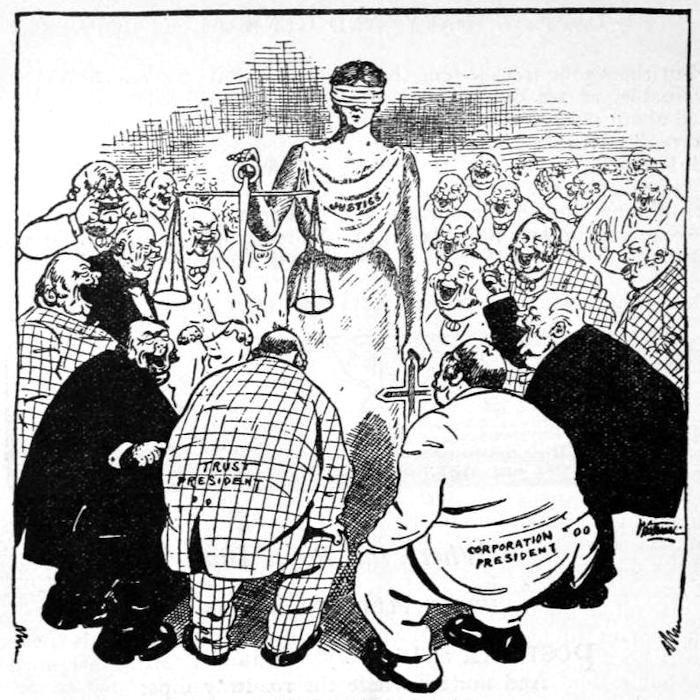
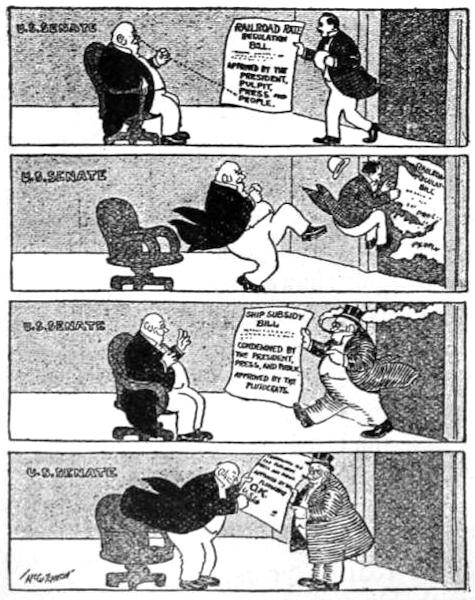
CLARK HOWELL’S DEFENSE OF THE CORPORATIONS
A national magazine can do
no better work than to take a
hand in a local fight, when the
issues involved are national.
As explained in previous articles,
the state of Georgia has been completely
conquered by a Wall Street combination.
Morgan, Belmont and Ryan
are our masters. They rule Georgia
through the Democratic party just as
they rule New Jersey through the Republican
party, and New York through
both the old parties.
In New York, the tools of this Wall
Street combination are such men as
Murphy, Pat McCarren, Judge Parker,
and Bill Sheehan. In Georgia the tools
are such men as Hamp McWhorter, Joe
Terrell, Clark Howell.
These men call themselves Democrats,
but they work for Morgan the
Republican as earnestly as they work
for Belmont the Democrat. The Wall
Street Railroad Kings rule and rob our
state, and they do it by means of the
men who control the machinery of the
Democratic party.
Hoke Smith is leading a great revolt
against this Wall Street domination,
and he is doing it superbly. He is going
to win, because the people know he
is right. He is going to win, because
the people know that they are being
foully mistreated by the railroads. He
is going to win because the people can
no longer be driven by the party lash.
He is going to win because the people
have at last determined to vote for
what they want.
In the January number of this magazine,
I specified the wrongs which the
people of Georgia suffer at the hands of
the railroads. Mr. Clark Howell, the
Corporation Candidate for Governor,
tried to answer me, and probably flatters
himself that he did so.
Let us see.
I made the statement that the railroads
had violated our Constitution by
“a joint ownership of competing lines,
thus establishing the monopoly which
the Constitution forbids.”
That is a serious charge. If it be
true that the railroads have trampled
the Constitution under foot and established
a monopoly in defiance of law,
that fact alone should damn them. No
man, no set of men, no corporation, no
combination of corporations, should be
allowed to make law for themselves in
Georgia. We should compel all persons,
natural and artificial, to respect
and obey our laws.
Does Clark Howell deny the accusation
brought by me against the
railroads?
Does he deny that the Morgan-Ryan-Belmont
interests work together in
beautiful harmony in Georgia?
By no means. On the contrary, he
parries the blow by saying that if
any unlawful combination exists, Hoke
Smith was the lawyer who represented
the law-breakers in court.
That’s a pretty defense for the railroads,
isn’t it?
According to that kind of logic we
must not enforce the law against people
who steal because Hoke Smith, as a
lawyer, has actually defended thieves.
Logic of that sort would compel me to
antagonize the law against murder
because as a lawyer, I defended dozens
of men charged with that crime.
Hoke Smith’s position as a candidate
for governor is one thing; his
position as attorney in law cases is
another; and there is no use trying to
fool the people about it. If the railroads
have made an illegal combination
we must smash it, no matter who the
lawyers were that represented the
railroads at that time.
My editorial states that the railroads
treated our Railroad Commission
with contempt by refusing to obey its
rules, its decisions, its orders.
As an example, I cited the case of the
town of Flovilla, Georgia, where the
railroads had for two years refused to
provide the accommodations for passengers
on their way to the Indian
Spring.
Mr. Howell jumped on this statement
with the triumphant crow of a bantam
rooster.
He had caught me telling what was
not true. No wonder the little rooster
crowed. Not many men have upset
statements made by me.
Like many another little rooster,
Clark crowed too soon.
Listen:
Clark says: “The truth of the matter
is, the Railroad Commission ordered the
building of a new depot at Flovilla, and
the records of the commission show
that the order was complied with.”
If the records of the commission
show that, Somebody has fooled the
Commission cruelly, for there has been
no new depot built at Flovilla!
Crow again, little rooster.
In 1904 the railroad made an addition
to its freight room, at Flovilla, and
stopped.
Hon. Pope Brown, Chairman of the
Railroad Commission, had his talk with
me after we came back from the New
Orleans Cotton Convention. I think
it was in the last week in January, 1905.
It was not later than Feb., 1905.
At that time the railroads had done
nothing for the passengers at Flovilla.
For a number of years the people of the
community had been clamoring for
decent accommodations without success.
The Mayor had tried, and failed.
The Railroad Commission had issued
orders, and had been treated with
contempt.
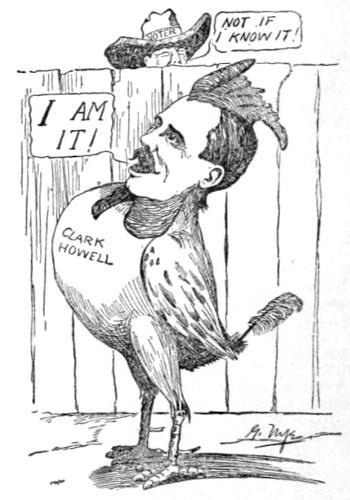
“Crow again, little rooster.”
Then what happened?
The thunder of the Anti-Corporation
Campaign began to rumble. Hoke
Smith’s stern voice began to be heard
calling the Railroads to judgment.
The Corporation law-breakers and
Commission-Scorners began to tremble
in their boots.
And in the Spring of 1905, after
Brown’s talk with me, the railroad
men got a move on and ran down to
Flovilla, built a little shed for passengers
near the old depot and put some
water-closets in the old depot.
Crow again, little rooster.
EX-CHAIRMAN BROWN’S LETTER
Hawkinsville, Ga., Jan. 5, 1906.
Hon. Thomas E. Watson, Thomson, Ga.
Dear Tom—Yours of the 3rd inst., just
received. I have been very busy of late
winding up business of the old year and arranging
for the new year. You know this
is about the busiest time for the farmer.
Therefore I have not read the papers closely
and have not seen the denial of Mr. Howell
concerning the improvements at Flovilla
ordered some time ago by the Railroad Commission.
I do not recall exactly what I said
to you in regard to this matter, but I will
give you the facts according to my best recollection:
While Judge Atkinson was Chairman, the
Commission, on its own motion, seeing the
necessity of improved facilities at Flovilla,
ordered that a pavilion be built like the one
at Warm Springs, if my memory serves me
correctly; also that water-closets be put in,
and other improvements be made in connection
with the passenger station. It was
a considerable length of time before any attention
was paid to this order at all. After
so long a time, and continual nagging on the
part of the Commission, which no doubt the
records will show, the railroad put up a little
shed there, which is but a make-shift, and
called it a pavilion. Upon one pretext and
another they delayed putting in the closets,
and if they have been put in at all I do not
know it.
In speaking about this matter on one occasion
to a representative of the Southern Railway,
whom I happened to meet on the train,
I suggested to him that these improvements
ought to be made. His reply was, that the
railroads did not feel disposed to do anything
for Butts County for the reason that the
juries were too ready to give verdicts against
the railroads. My reply to him was, that if
the railroads would do their duty by the people,
the people would in turn be willing to do
justice to the railroads.
Mr. Dozier, the Banker at Flovilla, and
Mr. Duke, a lawyer representing the Southern
Railway at Flovilla, and others there,
will corroborate what I have said. In my
report to the Railroad Commission about the
condition of depots in the state I called attention
to several instances where the railroads
had refused to comply with the orders
of the Railroad Commission, and there has
never been any denial made by the railroad
people.
At Pitts, Ga., there was a little pigeon
house built and located, contrary to the orders
of the Railroad Commission. The records
of the Railroad Commission will show
this to be a fact. Also it will be found by
the records that while Judge Atkinson was
Chairman an order was made requiring the
roads to stop their passenger coaches at the
station for the convenience of passengers,
rather than to have them stop one hundred
or two hundred feet away from the depots.
This order has also been absolutely ignored
by all the railroads that have come under my
observation.
There has not been an order regulating
freight rates issued by the Railroad Commission
in some time, unless it was absolutely
satisfactory to the railroads, where the
railroads have complied with it.
Mr. Ed. Baxter, who is Chief Counsel, as
I understand, for all the Southern Railways
served notice upon the Railroad Commission
in the City of Atlanta before the Federal
Court in the following language as near as I
can remember:
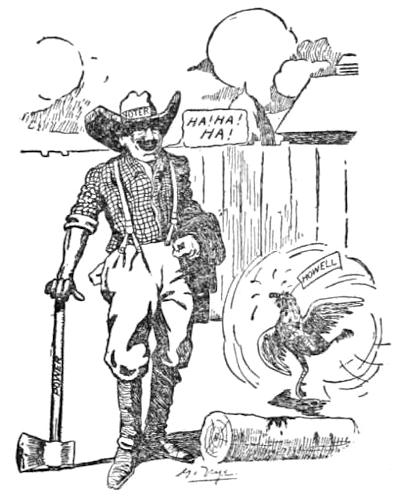
“Poor little rooster—crowed too quick.”
“The Railroad Commission may well understand
that they have reached the length
of their tether; henceforth we will put ourselves
under the ægis of the Federal Courts.”
In other words, whenever the Georgia
Railroad Commission, or any other State
Commission, or Inter-State Commission,
undertakes to put in a rate that is not satisfactory
to the railroads, then they would
appeal to the Federal Courts. Again, and
in its last analysis, the meaning is plain
enough to any man who wants to understand
it, that the railroads have taken this position,
as is evidenced by their opposition to the bill
now before Congress and advocated by
President Roosevelt:
“We propose to make rates without any
interference from State or Federal authority;
we propose to fight any law, or any authority
to take this right away from us.”
And that, it seems to me, is the great issue
overshadowing all other issues of the present
time in this state and every other state in
the Union, as to whether or not the railroads
shall be allowed to make rates without any
interference from any State or Federal authority.
Whenever we give them that
power they are absolutely masters of the situation,
and they know it. They can bribe
legislatures, judges and jurors, and levy tribute
upon the people themselves to pay for
this corruption.
Now, the circumstances leading up to our
meeting with Mr. Ed. Baxter in the Federal
Courts, are interesting and amusing. In a
few days I will give you the details in
another letter. I hope that I have not already
trespassed upon your patience.
Hoping that you are entirely restored to
health, with kind regards to each member of
your family, and best wishes for yourself, I
am
Your friend,
Pope Brown.
In the letter just quoted, Hon. Pope
Brown repeats the statement that the
railroads did treat with contempt the
order of the Commission; and he relates
a conversation he had with one of the
representatives of the Southern Railroad,
in which that official gave, as a
reason for not making the required improvements
at Flovilla, that the people
of that county had given verdicts against
the Railroad.
Yet the railroad candidate for Governor
has deliberately tried to deceive the
people of Georgia into believing that
when the Railroad Commission ordered
a new depot for Flovilla, the railroads
promptly obeyed the order and built a
new depot right away.
Poor little rooster—crowed too quick.
In my article, it was stated that the
Flovilla case was but one out of many
that could be mentioned. Since Clark
Howell undertakes to prove to the people
of Georgia that the railroads are
good, law-abiding citizens, I will mention
some other instances in which they
violate the law every day of their lives,
persistently, deliberately, insolently,
contemptuously.
The law requires them to post bulletins
of delayed trains at every station in advance
of the delayed train, in order that
passengers may be put upon notice.
This law is of great consequence to the
traveler. If the train is one, two, or
three hours late, and the traveler can
learn that fact upon his arrival at the
depot, he can dispose of himself to the
best advantage during the interval.
But suppose the train is three hours late
and the passenger does not know it?
Suppose he asks the agent, and gets his
head bit off with a sharp, curt, offensive,
indefinite answer? He then hangs around
in the waiting room; he is afraid to
leave the depot for fear the train will
come while he is away; yet he may
have to sit there, anxious and suffering,
for three mortal hours; when, if the
bulletin had been posted, he could have
escaped some of the inconveniences of
the situation.
The law puts a penalty of twenty
dollars upon the railroad for each violation
of this rule; and there isn’t a day
when hundreds of violations of it do not
occur in Georgia. Not ten per cent of
the agents of the railroads obey this
law. Ninety per cent of them constantly
violate it. Ask any drummer who
travels through the state! Talk about
obedience to the little one-hoss Railroad
Commission? Why, here is a
statute of the Code of Georgia, passed
by the sovereign Legislature and signed
by the Governor, and the railroads treat
it as a dirty piece of waste paper.
In his letter, ex-Chairman Brown
says that the railroads have never put
into operation an order of the Commission
as to freight rates, unless that order
was absolutely satisfactory to themselves.
He gives an instance, at Pitts,
Georgia, where the railroads went directly
to the contrary of the orders of the
Commission. While Judge Atkinson
was Chairman of the Commission, an
order was passed requiring trains to
quit stopping one or two hundred feet
away from the depot, and to stop at the
station, for the convenience of passengers.
Ex-Chairman Brown says that this
order “has been absolutely ignored by all
the roads that have come under my observation.”
In Chairman Brown’s official report,
he calls attention to instance after instance
where the railroads had ignored
the rules, the decisions, the orders of the
Commission.
I challenge Clark Howell to deny the
truth of that report.
What Georgian doesn’t remember
with indignant shame the threat of the
Southern Railroad, voiced by its lawyer,
Mr. Ed. Baxter, when he “served notice”
on the Railroad Commission that
the Railroads were tired of being pestered
by our little one-hoss Commission?
Said Mr. Baxter: “The Railroad Commission
may well understand that they
have reached the length of their tether;
henceforth we will put ourselves under the
ægis of the Federal Court.”
That was nice, dutiful language,
wasn’t it?
That sounds like obedience to the
Railroad Commission, doesn’t it?
Here were these Wall Street law-breakers,
who had for two years been
defying the Commission on the Flovilla
matter, who had ignored their rulings
on the stoppage of passenger trains,
who had continually refused to obey
the law requiring them to post bulletins
of delayed trains, who, at Pitts,
had acted contrary to the orders of the
Commission, and who had never accepted
a freight rate decision which was
not just what they wanted—and their
lawyer had the insolence to serve notice
on the Commission that if it bothered
his Wall Street clients further, he
would turn his back upon it and seek
that unfailing haven of Corporate rascality,
the Federal Courts!
Crow once more, little rooster!
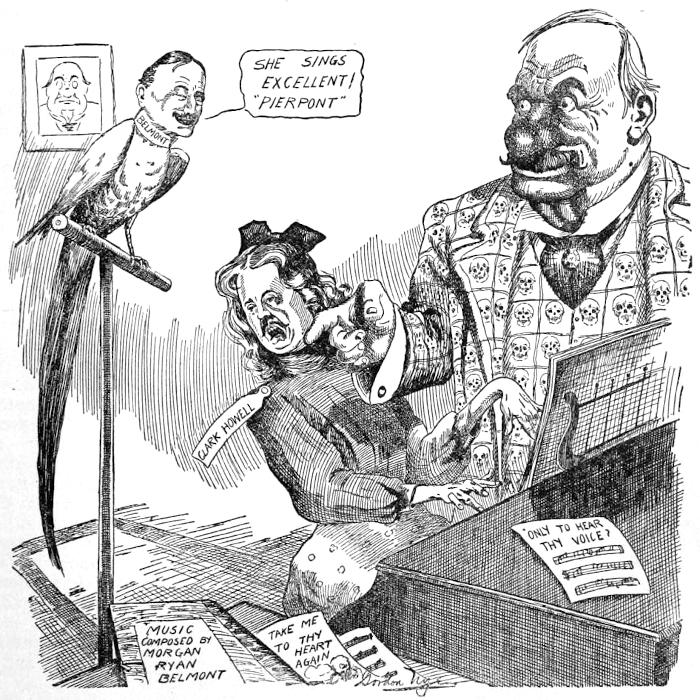
“Some editors make editorial music that way.”
As to the illegal charges made by the
roads, in the manner explained by me
in the 3rd specification of my article, I
stand my ground, and I say that the
Supreme Court has never declared that
such a discrimination against a town on
the main line was legal. On the contrary,
it was held to be illegal.
As to specification number 4, that
the Corporations rob the people of the
state by compelling them to pay dividends
upon fictitious capitalization,
who can deny it?
Every privately owned railroad in
this state has had all the water poured
into it that it would hold. The fixed
charges are based upon this fraudulent
capitalization. The people pay dividends
upon it. The freight and passenger
rates are kept up, and accommodations
kept down, and labor squeezed,
and safety appliances neglected, and
bridges allowed to stand till they fall
beneath a load of screaming, bleeding,
dying passengers, because the Wall
Street rascals who watered the stock
demand dividends upon the millions
which they created out of ink and paper.
Clark Howell dares to say that the
Central is capitalized for less now than
before the war.
For shame! For shame!
One must be awfully hard up for
an office before he can bring himself
to make a statement like that for a
railroad.
The Capital stock of the Central was
$7,500,000 before the war; and General
Toombs declared that half of it was
water. The Capital stock of the Central
proper is perhaps 75,000 shares,
as it was before the war. It may be
even less. But that’s a matter of no
consequence whatever.
The really important question is,
How much capitalization does the Central
carry upon which it has to pay revenue?
Everybody remembers how Pat Calhoun
got control of the Central, and
everybody knows how thick Clark
Howell was with Pat. Wanted to put
him in the Senate, you know.
Well, Pat and his Wall Street friends
slapped a debt of sixteen million dollars
on the Central during the gay time they
had control of it.
Then the road was wrecked in the
most approved Wall Street manner,
and many a genuine widow and real orphan
wept bitterly in their grief, for
they had gone to bed in comfort and
woke to poverty.
It was one of the nastiest, cruelest,
completest pieces of Wall Street rascality
that was ever worked upon an unsuspecting
people, and Clark Howell
could tell some queer things about it, if he
would.
The Central fell into the Federal
Courts, was put through the form of a
sale, and that international scoundrel,
J. Pierpont Morgan, appeared on the
scene as “reorganizer.” When the
Central had been properly Morganized,
it was laden with fictitious capital to
the tune of $55,000,000; and upon
this fictitious capital the people of Georgia
are made to pay revenue.
When Clark Howell stated that the
Central was capitalized for less than
before the war, he did not, perhaps,
tell a falsehood in a strict technical
sense; but, in the impression which he
knew his language would make, and
which he intended it to make, he was
as far from the truth as when he pictured
the railroads trotting down to
Flovilla, promptly and dutifully to
build that town a nice, new depot—“one
of the most attractive and best
equipped depots.”
As to the $10,000 campaign fund
furnished by the railroads to elect
Terrell, Mr. Howell says “it’s denied
by everybody involved.” Ah, indeed?
When did “everybody involved” deny
it? Who are the “everybody involved”?
Will Joe Terrell go before a notary
and make oath that the railroads did
not contribute $10,000, or other
large sum, to his campaign fund?
Joe may not be everybody “involved,”
but he certainly is involved.
If he can make an affidavit of that
sort, let him do it. His own honor
and the honor of the state demand it.
Let Joe swear it was not done, and I
will publish his denial prominently in
this magazine.
At the same time, however, I want
him to explain to the people of Georgia
why he, their Chief Magistrate, offered
a seat on our Supreme Bench to that
notorious railroad lobbyist and corruptionist,
Hamp McWhorter. I would
like to have this explanation attached
as exhibit A, to the affidavit denying
the railroad Campaign fund.
The other specifications in my article
Mr. Howell meets with merely a general
denial. Of course, there’s nothing to
discuss where a general denial is made
to a specific statement.
So far from the record of the Legislature
showing that the railroads do
not dominate it, those records prove
that very thing.
Can you pass the Anti-Free Pass
bill?
No. The railroads oppose it. It is
the cheapest, most effective method of
bribery, and they mean to keep it.
They will keep it.
Can you pass a law compelling the
railroads to equip all passenger stations
with water-closets; and to keep the
waiting rooms open at night?
No. It would cost too much. They
couldn’t do that, and pay dividends
on watered stock also.
If they had to spend money providing
accommodations for passengers,
such “lawyers” as Hamp McWhorter
and Tom Felder might lose fat corporation
fees.
No indeed; you couldn’t pass a bill
requiring the railroads to treat our
wives and daughters decently at the
stations where they have to wait for
trains. It would cost too much.
Yonder sits an elderly lady on a pile
of cross-ties. She is sick. She has
been brought to the station to take an
early train to the city where a specialist
can be consulted about her case.
It is cold. A heavy fog almost as bad
as a drizzle of rain, hangs in the air.
The door of the waiting room is locked.
There is no fire, no light, no shelter at
the station. The aged woman sits
upon the cross-ties awaiting the coming
of the train—sick, cold and suffering.
Is that your mother, my son? No.
But it might be. Just such a scene
was witnessed by a friend of mine
some weeks ago; and the railroad which
treats its customers in that beastly
manner is one of these same Wall
Street gangs of thieves that rob the
state of Georgia through the Hamp
McWhorters, the Joe Terrells, the
Clark Howells who pose as the Democratic
Party.
Great God! Are the people never to
wake up to the fact that the machinery
of the Democratic Party in Georgia
belongs to a lot of Wall Street rascals?
Don’t they know that the platform
of the Democratic State Convention
is never handed out till Hamp McWhorter
marks it “O. K.”?
Don’t they know that the majority
of the daily papers belong to the railroads
and are controlled by the railroads?
The Hon. Clark Howell closes his
feeble editorial by making a side-thrust
at this Magazine as “a subsidiary
company to Town Topics.”
As to that, the answer is swift and
to the point.
I am this Magazine.
Not a line can go into it to which I
object. Not a line can be kept out of
it to which I put my approval. My
contract gives the control of the Magazine
to me completely. What more
could anybody exact? That Town
Topics owns a majority of the stock is
true. But Town Topics has no more
rights over the Magazine itself than
the Atlanta Constitution has.
Tom Lawson, or H. H. Rogers, or
Judge Parker, or W. J. Bryan might
buy a majority of the stock. I could
not prevent that. But nobody can
interfere with my control of the Magazine.
I have no doubt that Mr. Clark
Howell envies me my independence.
It is extremely doubtful whether he
can say for himself and his paper what
I have said for myself and the magazine.
I shouldn’t wonder if he held his
place upon the condition that his paper
must be railroad. He wouldn’t dare
to have an opinion unfavorable to
railroad. When he sits down to write
editorials, I compare him in my own
mind to the little girl going to the
piano to practice her music-lesson.
She is a good little girl, and she follows
the notes. She improvises no music.
She puts out her trained fingers and
she touches, one by one, with painful
fidelity, the notes written down on the
score. She couldn’t think of striking
any note which was not written down
on the score. Dear little thing!
Day after day, month after month,
year after year, the trained fingers
strike the notes indicated in the lesson.
If by chance she hits a chord not on the
book, there’s a rap and a sharp word
of reproof from the authority which
presides over the “practice.”
“What’s that?” comes the cry of
the teacher or parent, and the little
girl, frightened at the false note, hurriedly
gets back to the written score.
Dear little thing. That’s the way
to learn to play by note.
Some editors make editorial music
that way, and the scores are written in
Wall Street.
Accordingly to the report made
by the Pinkerton Detective Agency
to the American Bankers’ Association,
at its last meeting, there
were arrested and prosecuted during
the ten years preceding September,
1905, five hundred and fifty-four
citizens who had committed crimes
against these banks. Some of these
erring citizens had committed forgery,
others burglary, eleven were classified
as robbers, and fourteen were called
sneak thieves. These last named
probably stole the cashier’s umbrella,
or got away with the president’s gold-headed
cane.
The Law came down, hard and heavy,
upon the citizens who had sinned against
the banks, and the transgressors were
given sentences aggregating two thousand
and one hundred years in prisons,
chain-gangs and penitentiaries.
Think of it—2,100 years!
The sum total of the money which the
banks lost by the operations of all these
criminals, during the entire period of
ten years, appears to have been less than
one hundred thousand dollars.
Yet the law-breakers who caused the
loss must vindicate the law by a penal
servitude of more than two thousand
years.
There’s Justice for you.
During that period of ten years how
many banks have gone to smash? How
many presidents and cashiers have
looted the funds committed to their
care?
How many millions of dollars have
the common people lost by the rascality
of dishonest bank officers? How many
times have we seen frantic crowds of
men and women gather about the door
of some busted bank—men sick at heart
because of sudden ruin, women screaming
in terror because robbed of every
dollar they had on earth?
Yet when an infamous scoundrel like
John R. Walsh of Chicago converts to
his use the millions of money held in his
banks, Leslie Shaw, Secretary of the
Treasury, hastens into print to say that
it was all right; Mr. Walsh had done no
more “than other bankers do.”
There was a Savings Bank in the holy
town of Boston, Mass. It gave itself
the comfortable name of the Provident
Savings Bank. Trusting common people
put $200,000 of their money into it.
Thieves on the inside stole the money.
At one swoop, this particular bank
robbed the people of twice as much as
the whole of rascaldom had got from
the Associated banks in ten years!
Frank Bigelow robbed the First National
Bank of Milwaukee, of $1,450,000.
He was President of the American
Bankers’ Association.
He not only looted the bank, but falsified
its books. He did not commit the
crime upon impulse or sudden temptation.
He did it deliberately, systematically,
colluding with his cashier to
plunder the fools who had trusted him.
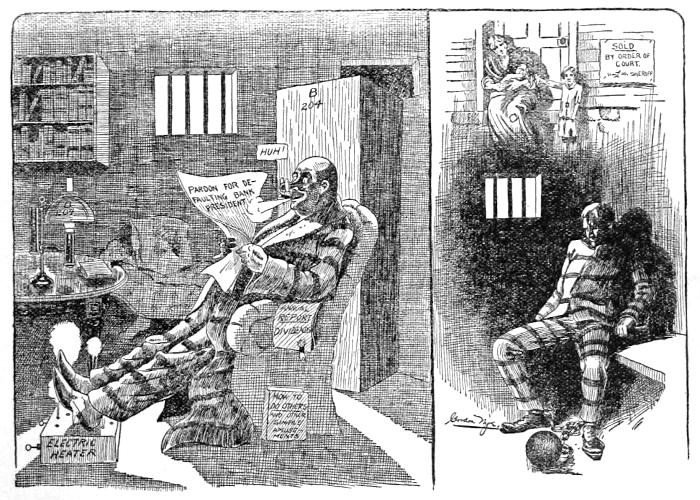
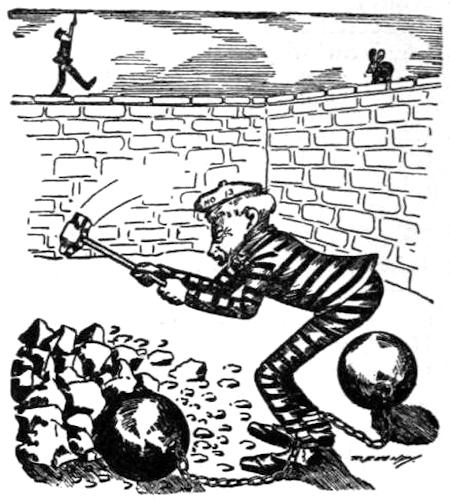
The banker who stole $1,400,000; and a man who stole a turkey and a duck.
The Law went through the form of
giving this million dollar thief a sentence
of seven years. His penalty is a sham;
his “punishment” a mockery. He will
be “detained” in comfortable quarters
a few months; his health will then “fail”;
he will then be pardoned, and will be
ready to steal trust funds again.
So it is all along the line.
Woe to the hungry tramp who steals
bread to eat. Woe to the ragged woman
who snatches food for her starving children.
Woe to the bad men who steal during
ten years, one hundred thousand dollars
from the Members of the American
Bankers’ Association. These five or
six hundred bad men will be sentenced,
in the aggregate, to a penal servitude of
over two thousand years.
But let the President of the Bankers’
Association steal one million and
four hundred thousand dollars from the
men and women who trusted him with
their money, and the highly-connected
thief gets off with a nominal punishment
and a seven-year term which will
never be enforced.
During the last twelve months, dishonest
bank officers have stolen more
than twelve million dollars from the
depositors.
How many of these rascals have been
tried and convicted?
Less than half a dozen.
Yes; Frank Bigelow, sometime President
of the American Bankers’ Association,
laid careful plans, in collusion
with his cashier, and stole fourteen
hundred thousand dollars of Trust
funds.
Nominal sentence, seven years.
John Shannon, of Ohio, at about the
same time, stole a turkey and a duck;
and John Shannon is now serving out
in the Ohio penitentiary a penal sentence
of five years!
John Shannon, my jo, John!
Why didn’t you wear a silk hat, and
steal a million dollars from the inside of
a bank?
One of the most interesting and
powerful men of this generation is
J. A. Wayland.
He is a pioneer Socialist.
He is a hard worker, a hard hitter,
and a man who never quits.
For the last fifteen years he has been
a wonder of the world, to me. Henry
Gronlund was not more unselfish, John
P. Altgeld was not more intense, and
Arthur Brisbane is not more effectively
equipped.
When I first knew of Wayland, he
had come down to Tennessee to put his
beautiful dream into operation. He
had founded a Colony on the basis of
Universal Brotherhood. He meant to
demonstrate to mankind the ease with
which we could make angels out of one
another, if we would only set about it
in the right way.
As I remember, the name of Wayland’s
Happy Land was Ruskin—the
name of an English dreamer who wrote
many beautiful things and lived one of
the saddest lives imaginable.
The vital spark in the Ruskin colony
was Wayland’s paper. He called it
“The Coming Nation.” The circulation
of this paper grew to be enormous,
and the soul of the paper was Wayland.
But some of the angels who had drifted
into the colony became jealous of
Wayland, and they made the point that
the paper should not continue to be the
property of Wayland—the man who
had made it—but should become the
common property of everybody who
had drifted into the colony.
If my memory serves me right, Wayland
yielded to his angel-brothers,
and turned his magnificent property
over to the Toms, Dicks, and Harrys
who had come into Ruskin from the
four corners and elsewhere.
After this, the angels found fault
with Wayland about something else
and then something else; and then some
other thing: until the great-hearted,
great-minded man threw up his hands
in despair.
He surrendered everything to the
Colony—paper, shops, farms and all—and
went away from there, never to return.
What became of the Colony? The
smart fellows who knew so much more
than Wayland ran the whole thing into
the ground. The brethren had hardly
kicked Wayland out before they began
to kick each other out. The master-hand
and the master-mind being absent,
the small men quarreled among
themselves, and chaos ensued. The
Ruskin Colony went to pieces, and one
of the remnants strayed into South
Georgia. There it lived a brief, troubled
life, and there it died an unlamented
death.
What became of the magnificent
paper, “The Coming Nation?”
Wayland’s genius had made it; by
every law of common sense and common
justice it belonged to Wayland.
His brethren did not think so. The
paper was as much theirs as his. They
took it away from him. Then they
didn’t know what to do with it. And
it died.
With a pluck which nothing could
daunt, Wayland opened out in Girard,
Kansas, and modestly commenced
another paper. This time he called it
the “Appeal to Reason,” but in spirit
and purpose it was “The Coming Nation”
risen from its grave. Patiently,
persistently, fearlessly, Wayland hammered
away at Girard until he built up
a monster circulation, and again was
the owner of an extremely valuable
property—the product of him, the said
Wayland. No other man could have
made that paper. No other man could
any more be Wayland, and do what
Wayland does, than any other man
could be Edison, and do what Edison
does.
By every sane and just rule, the
Appeal to Reason was Wayland’s property.
He had gone into a desert,
with a handful of type and a bottle of
ink, and by the force of his genius had
brought forth a finished product—a
successful newspaper.
What happened to him then is only a
matter of rumor. Conjectures can also
be made from some indignant, sorrowful
sentences which he published over
his own signature.
But it seems clear that his Ruskin
experience was repeated. His angel-brothers
made him take his own medicine
in heroic doses. The men who
had not created the paper, claimed an
equal share in it—or something of that
sort; and there were the usual points
made against Wayland which the
small would-be leaders make against
the leader.
Rumor had it that Wayland went
through a Gethsemane of peculiar
bitterness, but just how it all was, the
outside world was not given to know.
The great soldier in the cause of humanity
covered the wounds his own
men had made, and was too proud to
complain.
But Wayland is now making a
mistake.
He is offering land prizes for the
largest number of subscribers. He proposes
that, as a premium, in a certain
competition on subscriptions, he
will convey, by deed, a farm in Florida
to the fortunate Socialist who gets the
greatest number of subscribers to the
Appeal to Reason! I can hardly believe
what I see in Wayland’s own
paper.
What! Is it possible that Wayland
has wickedly gone and bought a quantity
of land?
Is it possible that he has “robbed”
some honest citizen of his real estate?
And can it be true that other Socialists
not only want to share in this
“robbery,” but want it so bad they
will compete for it?
Dear me! I didn’t know that
Socialism was like that. If it is, I
believe I’ll take some stock in it myself.
My impression has been that the
Socialists were opposed to private
ownership of land. I have had forcible
reminders of that fact in letters
which came hot from the enraged
writers. Private ownership is “robbery”;
that’s the way they write to
me. Did I not see a Socialist orator
wave his small, white hand gracefully
at all the stores, factories and dwellings
in St. Louis, in the summer of
1904, and did I not hear him say in his
musical voice to the assembled laborers:
“All that is yours; go and take it!”
Then, with a silk handkerchief he,
with courtly gesture, wiped the moisture
from his marble brow, and continued:
“Don’t take a part of it, take
it all. Don’t be satisfied with a loaf,
take the whole bakery.”
Then he froze me and Joe Folk with
a glare of merciless severity, and continued,
“These men”—indicating me and
poor Joe, with a supercilious gesture—“these
men talk to you about shorter
hours of labor, and the Eight Hour day.
I don’t want any Eight Hour day:
what I want is to live in the best possible
manner on the least possible work.”
And now Wayland is going to spoil
all this. He is going to quicken the
appetite of Socialists for private property.
Instead of feeding a million
men on the definite expectation of
getting a slice of the Astor Estate, at
some indefinite time, he is going to
reverse the process and feed as many
as qualify, on a definite slice of Florida
land right now.
I make this prediction: As fast as
Wayland makes home-owners out of
his followers he will lose crusaders.
Beware Capua, friend Wayland!
A zealous Socialist, who owns nothing,
but who is spurred on by that
God-given desire for private property,
will eagerly compete for Wayland’s
prize and will win it. He will pocket
the deed, and move to his land. He
will find, perhaps, that it does not quite
come up to representation; but it is
too late to back out. He settles on
his seventy acre tract. If it has no
house, he builds. If he has one already,
he does all that he can to make
it more attractive. It is his. When
the storm beats without, he snuggles
close to his fireside, and thanks God
that this is his shelter from the wild
night. His wife will lay her loving
touches here and there, and the house
will take on a look which reflects the
individuality of the owners. Flowers
in the front yard, vines clinging about
the porch, bright pictures on the wall,
ferns and grasses in the vase over the
mantel, a climbing rose, perhaps, to
race for the cone of the house and to
throw out its crimson colors from the
roof. Toil which one loves will be freely
spent on garden and field, for the
toiler is working for those he loves best.
In a few years, under the care of
home-owners, the neighbors will
say, “It doesn’t look like the same
place.”
And it isn’t the same place. The
owners have transformed it. They
have put elements of value and beauty
there which nature did not supply.
They have so directed their labor, their
judgment, their good taste, their tender
interests, that the home which they have
created is as different from the wild
land, as the noble watch-dog at the door
differs from the gray wolf of the wilderness.
Do you suppose that this man and
his wife and his children can ever be
made to believe that they have “robbed”
some body of that land, and that
it is wrong for them to hold it as private
property?
Never in the world!
Wayland has made a confession as
well as a blunder.
By offering such a prize, he knows he
is appealing to one of the strongest human
passions—the passion for home-owning.
Every full-sexed girl instinctively
feels that her destiny is Motherhood—and
she plays with dolls, nurses them,
kisses them, hugs them to her little
bosom, calls them pet names, fondly
dresses them in every beautiful way
that her infant fancy can suggest, and
rocks them to sleep in the tiny cradle.
That is the God-given instinct of Motherhood.
Every full-sexed man, on the other
hand, is born with a craving for his
mate, and next to that, a home to put
her in.
Individualism, crying aloud to me
and to you, says “choose your mate and
make her yours.” The idea of promiscuous
mating is abhorrent. Collective
mating would be hideous. You want
individual mating. You want to separate
your mate from every other woman
and from every other man—and if
another man invades your individual
rights, you slay him like a dog.
There’s the natural feeling, the
natural passion, the natural individuality—and
everybody knows it.
This craving for individual mating
with women, bases itself firmly on the
individual home. Give me my mate,
and let me take her to my home:—and
you have consistency, you have nature,
you have a foundation for home-life
and all that flows from it—a foundation
firm as the everlasting hills.
But the two go together. They are
parts of the same system. Surrender
one, and you endanger the other.
If you are a Collectivist—your logic
will never stop at Collectivism in property
only.
If you believe in the one wife, believe
also in the home, which shall be yours
individually, just as your wife is yours,
individually.
Through the never-failing courtesy of
Senator Clay, of Georgia, it was recently
my good fortune to come into possession
of two bulky volumes issued by the
Government, and entitled, “Annual
Report of the American Historical Association.”
The second volume of this
report contains the Private Correspondence
of John C. Calhoun, and a most
interesting collection of letters it is.
Glancing through these letters hurriedly,
I came upon one which Mr. Calhoun
wrote to William C. Dawson, of
Georgia, in 1835, wherein he declares
himself strongly in favor of state-built
railroads.
It will be remembered that at that
time there was a surplus of revenues in
the Treasury.
This surplus was not given away in
premiums to bond-holders as Mr.
Cleveland gave sixty million dollars a
few years ago.
It was not deposited with the National
Banks to be used in their business
as Mr. Roosevelt now disposes of
$56,000,000 of the
public funds.
In the days of Calhoun,
governmental
robbery of the taxpayer
for the benefit
of the non-taxpayer
had not been reduced
to a science as it has
since been.
In Mr. Calhoun’s
day, it was believed
that when the Government
had collected
from the taxpayer a
greater sum than was
needed for governmental
expenses, the
excess should, as a
matter of common
honesty, be returned to the taxpayer.
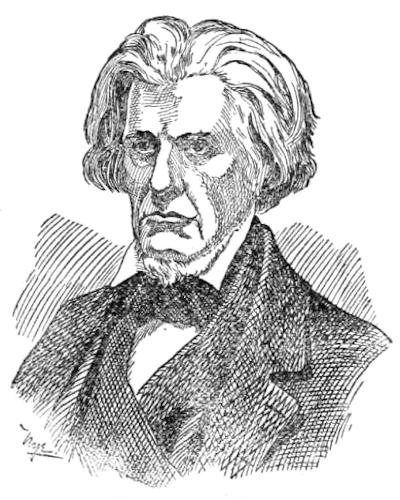
John C. Calhoun
It being impracticable, however, to
restore the money in exact proportion
to each individual taxpayer, the Government
did the next best thing—it
divided the surplus pro rata, among
the states.
In his letter to Dawson, Mr. Calhoun
estimates the entire amount of the surplus,
extending over a series of
years, at seventy or eighty million
dollars.
The share of Georgia and South Carolina,
he estimates at $3,500,000.
Now what does he advise shall be
done with this money which has been
drawn from the taxpayers of the two
states?
He advises that it be spent by Georgia
and South Carolina in building railroads
to connect those two states with the
lines leading to the West and Southwest.
Spent in that manner, the surplus taxes
of the two states would be so invested
as to benefit all the people of Georgia
and South Carolina.
It wouldn’t go to fatten a handful of
greedy, millionaire bond-holders.
It wouldn’t go to a few pet National
banks to be loaned out as private
capital.
It being public money, it would
be used for a public purpose;
and the great
public roads which
it would build would
belong to and benefit
all the people
of the two states
which had paid the
taxes into the Federal
Treasury.
Says Mr. Calhoun:
“To make this
great fund available
for so important an
object, the legislatures
of the states
interested ought to
move forthwith. I
hope Georgia will
take the lead. The
action of no other
state could have half the influence.”
Mr. Calhoun, with marvelous foresight,
sketched the system of railroads
which has since been built. Just where
he declared in 1835 that the railroads
ought to be, they are now to be
found.
Had his counsels been followed,
those public highways would now
be the property of the public.
Folly, stupidity, sordid franchise-grabbing
had their own way, however,
and the magnificent system
of highways which Calhoun laid
out for the people belongs to the corporations.
Montgomery, Ala., Jan. 6, 1906.
Hon. Thos. E. Watson:
Dear Sir—It is not evidence of dissatisfaction
with the common infirmities of the
human lot that discussion of the characters of
men in public office assumes the latitude of
warning to society. Servility of understanding
reduces the individual to prostitution of
manhood. He can no longer be free, who is
dependent in mind and thought. The duty of
the American citizen is in the defence of his
prerogative of “sovereign,” and upon this
principle only may reputation in a public
officer become a convertible term with character
in public office.
In the year 1769 “Junius” wrote fifty-four
letters to the Public Advertiser, a daily journal
of London. The publisher was indicted.
“Junius” continued to write. He wrote to
Sir William Draper; to the Duke of Grafton;
to the Ministry; to King George himself.
Who “Junius” was, none knew. The few
declared his writing turbulent and revolutionary;
worthless for the occasion. He held
to the record. With indignant invectives he
proved the government corruptions. With
high disdain he declared he asked for no authority,
when he had law and reason on his
side, to speak the truth. With keen and
pungent retort he exposed the lapse of society
in the evidences of iniquity in social leaders.
I would not offend by flattering him “who
would not flatter Jove for his power to thunder.”
But the beneficiary is ever a debtor to
his benefactor. I may write with confidence
where expression is due.
The modest caption, “Editorials by Thomas
E. Watson,” has already attained to a decisive
expectancy in the public mind. In
brief time the words that monthly come to
us under it will shed a wider and widening
light.
Revived iniquities which inspired “Junius”
are come for exposure. History repeats
itself in facts and interpreters of facts.
“Junius” in immortal energy told the people
of the Gentlemen in the House of Commons,
the Judges upon the Bench, the Lords, and
the Dukes, and the Ministry and the King;
of malfeasance in office and of decay in private
virtue.
The theme then is the theme now. Patrick
Henry caught the spirit of “Junius”;
the “Editorials by Thomas E. Watson”
draw upon the glorious past to shed light
upon the living day.
Anxiously we await some words from you
upon the most insidious consumer of free
institutions—the bonded debt of the United
States. Please answer these questions:
1. Is not the Government interest-bearing
bond the true foundation of the “trust”?
2. Can the “trust” be eliminated from
commerce before the government bonds are
paid and extinguished?
3. As long as the bonds remain and money
concentrates under their influence and protection
in New York, can money so concentrated
be redistributed from New York in
the sources of industry and commerce by any
other process than by “trust” industries
process?
Let me illustrate: In the Birmingham
(Ala.) manufacturing district there are three
great iron manufacturers, to wit: The Tennessee
Coal and Iron Company; The Sloss-Sheffield
Company; The Republic Company
and the Alabama-Consolidated Company.
Continued effort is made to merge two
or all of these powerful forces. The Pontifex
Maximus in the situation, the great
bridge over which the merger, if merger
there is to be, must pass, is a bank of issue—a
national bank—willing and also able to
finance the movement in transit and after
consummation.
Now, the willing and capable bank in the
premises must possess an adequate supply of
non-taxable, interest-bearing Government
bonds, upon which, to their full face value, it
may issue paper money equal to the exigencies
of the great merged corporations.
Without the bonds, upon which to issue the
money, the bank could not finance the
merger.
If the iron manufactories be merged, the
necessary sequence must be the merging of
the railroads that enter Birmingham. In
order to effect the merging of the railroads
financing which would duplicate the original
example, here cited, must follow.
Commerce, founded on the public debt, is
founded upon Government mortgages upon
universal private industry.
Must not that kind of commerce subvert
free institutions?
Yours truly,
(Signed) John Witherspoon Du Bose.
The writer of the letter on the public
debt is the author of the “Life and
Times of William L. Yancey,” a book
which is a treasure-house of varied and
valuable information.
That this Magazine has made such a
favorable impression upon so able and
representative a man, is of itself a great
encouragement to us who are devoting
our lives to it.
The question asked by the distinguished
Alabamian is a spear-thrust into
the very vitals of our vicious system of
Class-Rule and Special Privileges.
When Alexander Hamilton set out to
make our government as English as the
Constitution would admit of, he laid
the foundations of his work in the English
system of Protection, the English
system of Finance, and the English system
of Funding the Public Debt.
With his Protective system he meant
to favor one class of industries at the expense
of others: thus rallying to the
support of the government those who
shaped its laws to fill their pockets with
the money which belonged to other
people.
With his system of Finance, and his
National Bank of issue, he meant to
form a co-partnership between wealth
and government. To the favored few
was to be delegated that tremendous
power to create currency which had always
been a prerogative of the Crown
until Barbara Villiers, the harlot,
wheedled from the dissolute Charles II.
that concession to the bankers.
With his system of Funding the Public
Debt, Hamilton meant to mortgage
the Nation, in perpetuity, to the wealthy
few, in order that they might always
hold their power over the masses, and
their advantage over the government.
William Pitt is said to have remarked
cynically, when he saw our government
copying the British system: “Their
independence will not do them much
good if they adopt our system of
finance.”
We all remember how bitterly Jefferson
combated the Hamilton measures.
We can turn to his writings now, and
read the scathing terms in which he denounced
them. We can also read his
predictions of the evils which would
come upon us if we allowed Hamilton’s
class-law system to develop.
Haven’t the evils come?
The great historic renown won by the
Democratic Party and its leaders was
gained in combating this class-law system
of Alexander Hamilton.
Democrats, and the Democratic Party,
always stood in battle array against
the Protective System, contending
that it was immoral, unjust, oppressive,
despoiling the many to enrich the
few.
Democrats, and the Democratic Party,
always went up against the National
Banks to fight them, declaring
that such an institution was of deadly
hostility to the spirit of republican
government.
Democrats, and the Democratic
Party, always clamored against the
Funding System, and demanded that
the Public Debt be paid off.
Those were the memorable, historic
principles of Democrats in the years
preceding the Civil War—in the years
when the Democrats had a mission, a
creed; leaders who had convictions,
champions, who loved ideas well enough
to cherish them more dearly than office.
What was President Jefferson’s proud
boast?
That he had so cut down Government
expenses that the Public Debt
would soon be a thing of the past.
What was Jackson’s proud boast?
That he paid the Public Debt.
That was the golden era of American
history.
The National Bank had been abolished.
The National Debt had been paid
off.
The Protective principle had been
stricken out of the Tariff, and that
infamous system had been reduced
to a moderate revenue basis.
There was hardly a millionaire in the
whole country.
There was hardly a pauper in the
republic.
The individual citizen amounted to
more, as a man, than he does now.
Wages were low, but the money commanded
a larger amount of the
necessaries of life than the higher wages
of today.
Strikes and lockouts were unknown.
“We have no poor,” was the matter-of-fact
statement made in Congress by
Hugh S. Legaré of South Carolina.
“There are no beggars,” said the
English visitor, Charles Dickens.
In the whole world there probably
was not a people more contented, progressive,
and generally well-off than
we were in the Forties.
Which were the naturally wealthy
sections? The South and West.
Which was the naturally sterile section?
The East.
Where is the bulk of all the immense
wealth that has been produced since
the Civil War? In the East.
How came it there? Class-law took
it from the sections where it was produced,
and gave it to those who were
more cunning and selfish in framing
national statutes.
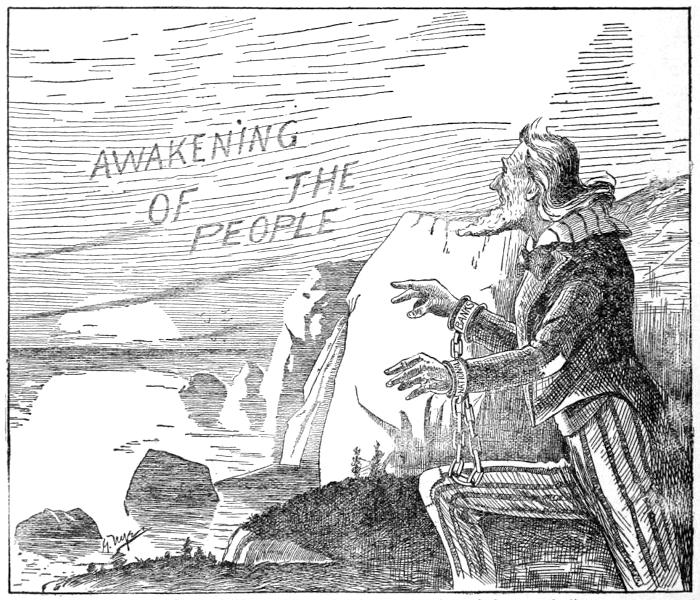
“I see signs of life and hope in the awakening of the people.”
There is no fouler chapter in the history
of crime than that which is to be
written concerning the manipulation
of our National Debt. How many
hundreds of millions have been made
out of the government by the rascals
who juggled with the bonds, it would
stagger faith to state. The starting
point, where Belmont, Rothschild,
Sherman and the Bank of England
compelled Congress to depreciate the
Greenback, the exchange of bonds at
par for Greenbacks at their full face
value, the change of the terms of the
bond from lawful money to coin, and
from coin to gold, the huge commissions
paid to favored bankers, the
colossal deposits of public funds to be
used in private speculations, the sudden
and mysterious fortunes accumulated
by Secretaries of the Treasury,
like Sherman, and by Senators, like
Gorman, the stealthy mission of Ernest
Seyd, the covert influence of the
Haggard & Buell circulars—all these
are but high-points in a long journey
of national shame, legalized robbery,
ruinous prostitution of the powers of
government to gorge the few on the
life-blood of the many.
Who does not know that our Public
Debt could be paid off at any time if
the ruling class wanted it paid?
Who does not realize the anomaly
of the richest nation on earth bearing
a bonded debt as though it were a
luxury?
Who does not recognize the grim
irony of wearing a bondholder’s chain
as though it were a string of pearls?
Wipe out the Public Debt and there
would be no foundation for the National
Banks. One form of privilege having
been abolished, the other would
follow. And then others would follow!
The bonds are the keystone to the arch.
The Public Debt is the nucleus of the
system by means of which Wealth runs
the Government for its own benefit.
Who wants the Government to economize?
Not the Privileged. By no
means. If the Government were to
economize there would be such a surplus
in the Treasury that the Government,
for very shame, would have to pay itself
out of debt.
The Privileged are determined to
keep the Government in debt, and
hence there will be no economy.
The fields of expenditure shall widen,
widen, and be kept on widening. Salaries
shall increase, and increase, and be
kept on increasing. Offices shall be
multiplied, and multiplied, and be kept
on multiplying.
The Panama Canal can get all it
wants; let the Philippines cost what
they may; give more to the Navy; give
more to the Army; give more to Rivers
and Harbors; give more to Pensions;
give the Railroads four times as much
as it is worth to carry the mails, and
then give them a special subsidy to keep
the contract; give $45,000 for carrying
mail to the Island Tahiti when the
“cussed foreigner” offered to do it for
$3,500; give with so lavish a hand that
even the South will get a pull at the
sugar-teat, and shall join in the Hallelujah
Chorus of “O, ain’t it good!”
A child ought to be able to see the
profound policy which underlies the extravagance
of the Federal Government.
The Tariff must not be lowered; the
Public Debt must not be paid off; the
reign of the Trusts must not be threatened:
“Stand Pat!”
That’s the watchword of heartless
Plutocracy which has erected its powers
upon the three bed-rock measures of
Alexander Hamilton.
“Stand Pat!”—blares the bugle-note
of Class-law leaders, for they know
that a system depends upon all of its
component parts. If there should be a
leak in the dike, anywhere, the angry
ocean might come pouring in.
Where are the Democrats, and the
Democratic Party?
What soldiers are pitching their tents
upon the historic fields of Democracy?
What lines of battle are forming under
the time-honored banners of Jefferson
and Jackson?
Alas! The mighty strain and struggle
of the Democratic Party during
these degenerate days, has been to imitate
every bad habit of the Republicans.
Democrats vote with the Republicans
to continue the National banks,
to continue the Public Debt, to continue
the Protective system, to embark
upon an imperial colonial system, to
perpetuate the rule of the Trust, to
multiply objects and amounts of National
extravagance.
Where do I see signs of life and hope?
In the rapid awakening of the people
to the fact that in the name of Party
they are being stripped of everything
that makes for the independence and
prosperity and happiness of the average
citizen.
After the downfall of Beecher,
Doctor Talmage became the most
conspicuous preacher in the United
States. His sermons and his writings
had an immense audience. “Talmage’s
Sermon” was a standing headline, in
American Monday morning newspapers,
and they were widely known
in Europe also. No visitor to New
York thought of returning home until
he had attended services at the Brooklyn
Tabernacle and qualified himself
to boast of the fact that he had “heard
Talmage.”
The fact that Doctor Talmage had
been engaged to furnish articles to any
periodical, was sufficient to boost its
circulation into the tens of thousands.
No Lyceum, no Chautauqua, no Lecture
Course was complete without Talmage.
Formal banquets, in quest of oratorical
attractions, never failed to urge the
attendance of Doctor Talmage.
Somehow the man became the fashion,
the rage. He was the Caucasian Booker
Washington. Everybody having agreed
that he was a wonderful man, the ball
kept on rolling by the law of inertia.
Nobody could tell you wherein he
was great; nobody could quote anything
remarkable from his writings or
his sermons; nobody knew of anything
phenomenal that he had done, or was
supposed to be able to do. His capacity
for the benevolent assimilation of
an indefinite number of voluntary donations
was strikingly like Booker Washington’s
power in the same direction;
but beyond the fact that Talmage
preached to a large congregation, and
wrote books which many people read,
his greatness was hard to define.
However, Talmage had his day. He
was the fashion. At home and abroad
he was a man whom it was the correct
thing to treat with distinguished consideration.
Foreign potentates, princes
and powers knew Talmage as a mighty
man of the pen; likewise as a man of infinite
capacity for talk; also as a man
who traveled with a photographic outfit.
Consequently a man to be handled
with care; “this side up,” as it were.
His progress through a foreign land,
was not merely an incident; it was an
event. He was greeted with dress-parade
formalities. Foreign princes, potentates
and powers knew that Talmage
would write a book about them when he
got home; that the book would be read
by hundreds of thousands; that public
opinion would be influenced by it; and
that the photographs of the princes, etc.,
would appear in the book. Consequently
the smiling faces which were turned
toward the Talmage Camera by the
helpless potentates etc., were almost
distressing in their laborious amiability.
As to Russia, Doctor Talmage seems
to have gone there by imperial invitation
and prearrangement.
“Stepping from the Moscow train on
returning to St. Petersburg, an invitation
was put in my hand inviting me to
the palace.... I had already
seen the Crown Prince in his palace....
The royal carriage was waiting,
and the two decorated representatives
of the palace took me to a building
where a suite of three rooms was
appointed me, where I rested, lunched,
examined the flowers and walked under
the trees.” Then the royal carriage
came again, took him through the magnificent
and beautiful grounds to the
palace of the Czar. During his stay,
officials crowded around him, lavished
attentions upon him, stuffed his ears
with glowing accounts of the lovely conditions
prevailing in Russia, and made
Doctor Talmage feel good generally.
Russian autocracy laid itself out to
capture Talmage, and it captured him
completely.
From a picture on page 408 of his
book, I infer that Russian enthusiasm
broke from every restraint, and that he
was caught up in the arms of a delirious
populace, and borne triumphantly
through the streets, on the shoulders of
his worshipers. The picture represents
Russian citizens (who bear a disconcerting
resemblance to New York
dandies), waving their hats wildly—(Derby
hats)—and shows Doctor Talmage
sitting gracefully upon the shoulders
of two elegantly dressed enthusiasts;
and the silk hat of the Doctor is
held aloft in his eloquent right hand,
while his left is extended in what I take
to be his favorite gesture. The picture
represents all the Russians with their
mouths shut. It also represents Talmage
with his mouth shut—a fact
which arouses a suspicion that the picture
is spurious. Under such circumstances,
Talmage could no more have
kept his mouth shut than Bryan could.
Other pictures show Doctor Talmage
in the act of responding from his carriage
to a street ovation; also of rising
to make a few remarks to a grand
gathering in a hall draped with the Stars
and Stripes; also of making a speech
on the arrival of a ship from the United
States bringing bread to feed the Russian
peasants.
There are, also, pictures showing
Talmage seated on one side of a small
table and the Czar seated on the other;
Talmage in the act of being received
into the family circle of the Czar;
Talmage standing erect in his carriage,
hat outstretched, in the act of returning
the salutes of hat-waving crowds
which pause and look pleasant, apparently,
until Talmage’s picture man can
draw his focus, spring his slide, and say,
“That’ll do.”
I state all this to show the readers
how public opinion is sometimes made
to order. The Russian autocracy knew
that Talmage was the best possible
press-agent they could use. He was intensely
vain, easily flattered, a snob to
the core, a man whose very soul quivered
with delight under the smile of
royalty.
There had been a great deal of abuse
heaped upon Russia. The newspapers,
magazines, political pamphlets had been
telling the civilized world a vast deal
about the barbarities practiced by the
Russian government. George Kennan,
the brave American traveler, had risked
all the rigors of Siberia to see for himself
how prisoners were treated there.
His reports had thrilled the hearts
of millions with furious indignation
against the Czar, and with profound pity
for the victims of imperial tyranny.
Tolstoy, Stepniak, Kropotkin and many
others had been heard.
Russian autocracy was in bad odor
throughout the Christian world, and if
such a man as Talmage could be enlisted
for the defence, it would be a fine
thing to do. His voice would carry
weight throughout Europe and the
United States. Therefore, it is reasonably
certain that the Russian government
had an axe to grind when it made
the Talmage visit an occasion for a series
of ovations.
At any rate, the Russian government
got from Talmage when he came to
write his book of travels, a chapter of
the most fulsome, least discriminating
praise that you will ever read.
Russia was all right, in every respect.
Travelers were never subjected to vexatious
delays or examinations—for Talmage
had not been delayed or vexed. He
actually carried into Russia some books
which criticised the government, and
the magnanimous officials made no objection.
There was no religious persecution
in Russia! On the contrary,
Jews and Gentiles, of all descriptions,
could worship God in any manner that
pleased them. The Government never
interfered.
If a nobleman conspired against the
life of the Czar, he was arrested, put into
a carriage, blindfolded, driven about
for many hours to make him believe
that he was on his way to Siberia, and
he was then set down, at his own door,
safe, unharmed, free!
If a poet wrote scurrilous verses
about the Empress, he was brought
into the family circle of the Czar and
asked to read the lines in the hearing of
the lady. That was the worst.
Siberia was described as a country
of Italian softness of climate; and banishment
to the Siberian prisons, mines,
etc., was altogether better for criminals
than ordinary jails.
Doctor Talmage defended Russian
autocracy, Russian police, Russian
prisons, indignantly hurling back upon
the slanderers of Russia their foul accusations.
Listen to him—Talmage:
“But how about the knout, the cruel
Russian knout, that comes down on the
bare back of agonized criminals? Why,
Russia abolished the knout before it was
abolished from our American navy.”
Think of reading this stuff at a time
when the ears of the world are yet tingling
at the sound of the Cossack whips!
Think of reading this when we know
that before Talmage’s book was written,
and while it was being written, and
ever since it was written, Russian peasants,
by thousands, have been flogged
every year for non-payment of taxes!
“The Emperor received me with
much heartiness. And at the first
glance, seeing him to be a splendid
gentleman, with no airs of pretension
and as artless as any man I ever saw,
it seemed to me that we were old
friends from the start.”
Doctor Talmage did not visit the
Russian prisons which he defended;
did not go to Siberia, which he compared
to Italy; did not make any
investigations of peasant-life; did not
go among the working classes; did not
talk with Tolstoy, nor any man of the
dissatisfied elements. In fact, Talmage
declares, in effect, that nobody
was dissatisfied.
Listen to Doctor Talmage, Page 422:
“He who charges cruelty on the imperial
family and the nobility of Russia,
belies men and women as gracious and
benignant as ever breathed oxygen.”
Shades of von Plehve!
When we read such lines as the above
and recall how that gracious and benignant
nobility have drenched Russia
with blood of peasants, Jews, city
workingmen, republican agitators—littering
the streets with ghastly heaps
of murdered men and women and
children—we may well stand amazed
at the success with which the wool
was pulled over the eyes of the Rev.
T. De Witt Talmage, D. D.
“There are no kinder people on
earth than the Russians, and to most
of them cruelty is an impossibility.”
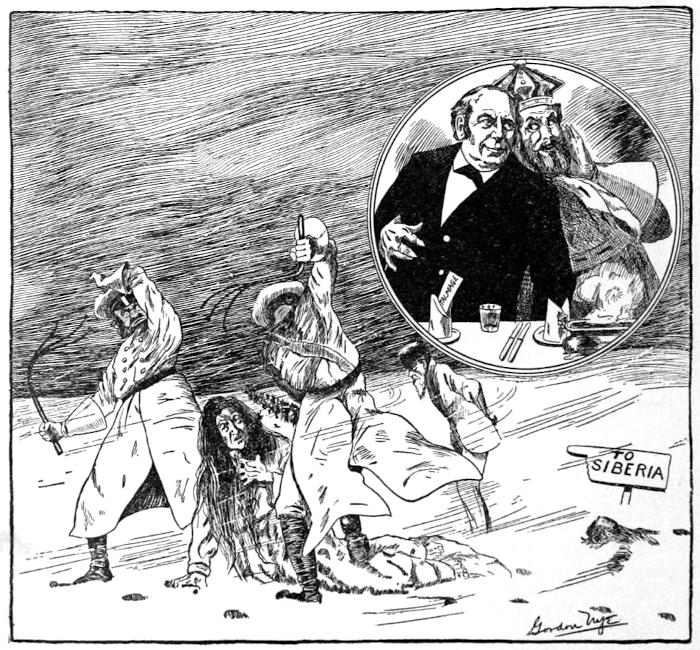
“Dr. Talmage did not go to Siberia, which he compared to Italy.”
Of the Czar, Doctor Talmage says:
“He’s doing the best things possible for
the nation which he loved, and which as
ardently loved him.... Things
are going on marvelously well, and I
do not believe that out of 500,000
Russians you will find more than one
person who dislikes the Emperor, and
so that Calumny of dread of assassination
drops so flat it can fall no flatter.”
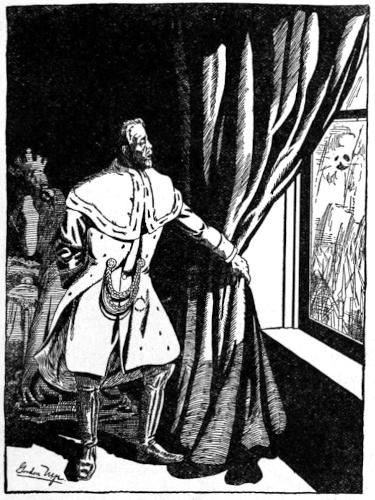
“I prophecy for Nicholas the Second a long
and happy reign.”—Dr. Talmage
According to Doctor Talmage the
story that the Czar dreaded the assassin
was a base Calumny, and he, Talmage,
flattened it out in his book “so flat it
can fall no flatter.”
I wonder what the present Czar
would feel, think and say if he could
now read Talmage’s comfortable assurances
on the subject of “dread of
assassination.”
While in Russia, Doctor Talmage
saw the Rulers, and no others. He
talked with the governing class, and
no others. He saw a ship from the
United States bringing bread to the
Russian farmers, but it never occurred
to his mind that a drouth in one portion
of the huge Russian Empire was
no good reason why the New World
should have to save Russian peasants
from starvation.
Looking only on the surface,
seeing only what his
“old friend” the Czar,
wished him to see, he
praised the Russian government
in terms of the
most unqualified eulogy.
Before the Talmage book
was ready for the press,
Prince Cantacuzene, the
Russian Minister Plenipotentiary
at Washington,
summoned Doctor Talmage
to the deck of a Russian
man-of-war, in Philadelphia
harbor, and presented
to the enraptured
American “a complete gold-enameled
tea service accompanied
by a message
of love which I cannot now
think of without deep
emotion, since Emperor
Alexander has disappeared
from the palaces of earth
to take his place, as I believe,
in the palaces of
heaven.”
In behalf of the Czar,
the formalities of a trial
on Judgment Day, were
waived, it would seem; and
the Czar went direct from
Peterhof to his mansion in
the skies.
The Emperor Alexander, it is well-known,
was succeeded by his son Nicholas,
the reigning Czar.
Talmage’s book was published in 1896.
Here is what he predicted:
“I prophesy for Nicholas the Second
a long and happy reign!”
That was a very natural inspiration.
Talmage had delved into Russian
affairs and found conditions ideal.
The government was mild, just, progressive.
The people were contented,
and devoted to the Czar. There was
no cruelty in the administration, and
no suffering among the peasants, excepting
the locality affected by the
drought. The bread had been sent to
feed the peasants, and all would be well.
The Knout had been abolished. The
serf, freed, was happy. Religious
toleration was in practice; the circulation
of political literature unhampered.
There was not a cloud upon the horizon.
George Kennan, Stepniak, Tolstoy,
Kropotkin had been slandering
vilely the most humane Government of
Europe—a Government which Talmage
compared to ours, to our discomfiture
in various respects.
With a Podsnapian wave of his hand,
Talmage said to Europe, “Let this international
defamation of Russia cease.”
With that Royal welcome fresh in his
memory, with those public ovations
still ringing in his ears, with that “complete
gold-enameled tea service” gladdening
his eye, with the “message of
love” conveyed by the Prince Cantacuzene
still warming his heart, how could
Doctor Talmage prophesy otherwise?
The spirit of the occasion demanded
prophecy, and there it stands recorded,
page 432:
“I prophesy for Nicholas the Second a
long and happy reign!”
Almost in sight of where I live,
there is a heap of stones that marks
the spot where stood the hut in which
George McDuffie was born.
His folks were “poor folks.” Concerning
his ancestry nothing is known.
When I was a boy somebody told
me a story to this effect:
Little George McDuffie was at the
cowpen where his mother was milking,
and he had a calf by the ears holding
it away from the cow. A traveler, in
a buggy, drove up and stopped. Seeing
the boy, and not realizing the absorbing
character of the boy’s job, the wayfaring
man called out:
“Come here, Bubbie, and hold my
horse.”
To which the lad replied: “If you’ll
come here and hold my calf, I’ll go
there and hold your horse.”
According to the story, the traveler
was so tickled by the boy’s readiness
of wit, that he took a fancy to him
and secured him a position as clerk in
a store in the city of Augusta.
Well, George McDuffie wasn’t much
of a clerk. He loved to read books
better than to wait upon customers.
It came to pass that his fondness for
books attracted the attention of one
of the Calhouns—not John C., but his
brother, I believe—and Mr. Calhoun
placed the boy at the celebrated school
of Dr. Waddell to be educated.
The balance is history. McDuffie
became one of the greatest legal advocates
and political orators this country
has ever known.
Later in life he became involved in
a newspaper controversy which drew
him into two duels. In one of these
he received a wound which injured his
spine and affected his brain.
In his melancholy decline, and not
long before his death, McDuffie was
moved by a yearning to come back to
Georgia and visit the spot where his
boyhood home had stood. He came
from South Carolina by private conveyance,
and spent the night with my
grandfather. Next day he went on
down to the Sweet-water Creek neighborhood
where the McDuffie hut had
been. My father used to tell me that
when they led the broken statesman
to the spot, pointed out the remaining
shade tree and the dismantled chimney,
they drew away, leaving him alone with
his memories. After awhile they returned
to find Mr. McDuffie sitting
upon the stones of the ruined hearth,
crying like a child.
When the boy, George McDuffie,
left the store in Augusta and went over
into South Carolina to go to school, he
carried all of his earthly possessions in
one little pine box.
When he became a man he made
much money, owned large estates and
moved as a peer among the proudest
leaders of his day.
But he never parted with the little
pine box. It was a souvenir of the old
days of youth and poverty. It was
sacred in his eyes, and he treasured it.
When his mind was almost gone, he
would put his arms about the box, and
tell again the story of how it had held
all that he owned when he came into
South Carolina—a poor boy, on his
way to the great battle-field of life.
Did you know that
to this almost forgotten
statesman, George
McDuffie, belongs the
distinction of having
made the most powerful
and most prophetic
speech that was ever
made in Congress
against our damnable
Tariff System?
Well, it does. Such
men as Nelson Dingley
and Joseph H. Walker
were good judges in
such a matter, and they
regarded McDuffie’s
argument as the
strongest ever made
against the New England
scheme of enriching
its Capitalists by plundering other
sections. Dr. Goldwin Smith should
also be a competent judge, and you
will find that McDuffie’s speech is the
one he quotes from in his “Political
History of the United States.”
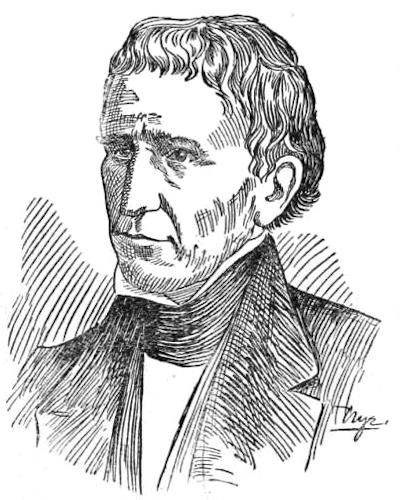
George McDuffie
Mr. McDuffie’s great speech against
the protective system is too long to be
reproduced here; but in the concluding
paragraphs he predicted with such
clearness of vision the reign of rotten
business and rotten politics which now
afflicts us that his words read like inspired
prophecy:
“Sir, when I consider that, by a
single bill like the present, millions of
dollars may be transferred annually
from one part of the community to
another; when I consider the disguise
of disinterested patriotism under which
the basest and most profligate ambition
may perpetrate such an act of injustice
and political prostitution, I cannot
hesitate, for a moment, to pronounce
this system the most stupendous instrument
of corruption ever placed in the
hands of public functionaries.
“It brings ambition and avarice
and wealth into a combination
which it is fearful to contemplate,
because it is almost impossible to
resist.
“Do we not perceive, at this very
moment, the extraordinary
and melancholy
spectacle of less than
one hundred thousand
capitalists, by means
of this unhallowed
combination, exercising
an absolute and
despotic control over
the opinions of eight
millions of free citizens
and the fortunes
and destinies of ten
millions?
“Sir, I will not anticipate
or forbode
evil. I will not permit
myself to believe that
the Presidency of the
United States will ever
be bought and sold.
But I must say that
there are certain quarters of this
Union in which, if the candidate for
the Presidency should come forward
with this Harrisburg tariff in his hand,
nothing could resist his pretensions if
his adversary were opposed to this
unjust system of oppression.”
“Indeed, Sir, when I contemplate the
extraordinary infatuation which a combination
of capitalists and politicians
have had the heart to diffuse over more
than one-half of this Union—when I see
the very victims who are about to be
offered up to satiate the voracious appetite
of this devouring Moloch, paying
their ardent
and sincere
devotions at
his bloody
shrine; I confess
I have
been tempted
to doubt
whether mankind
was not
doomed, even
in its most enlightened
state
to be the dupe
of some form
of imposture,
and the victim
of some form
of tyranny.
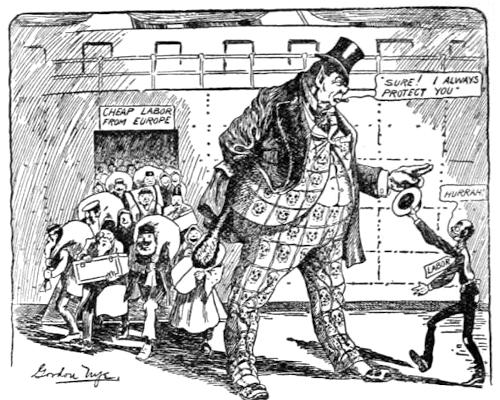
How American Capital Protects American Labor
“Sir, in
casting my
eyes over the history of human idolatry,
I can find nothing, even in the
darkest ages of ignorance and superstition,
which surpasses the infatuation
by which a confederated priesthood of
politicians and manufacturers have
bound the great body of the people of
the farming States of this Union as if
by a spell, to this mighty scheme of
fraud and delusion.”
Bear in mind that this speech was
made in 1824.
Then look around you and see how
prophetically Mr. McDuffie pictured the
future.
The Presidency is bought and sold.
Congress is bought and sold. The confederated
priesthood of politicians and
manufacturers do dominate an infatuated
people whom it deludes and plunders.
The Trusts are nothing in the world
but the legitimate children of Privilege
and Protection.
Campaign boodle-funds are nothing
in the world but the sop which the Corrupt
Combination of Capitalists pay to
renew the lease which they hold on the
Government.
And, as Mr. McDuffie said, the most
astounding feature of the whole diabolical
system is the completeness with
which the politicians and the Privileged
can dupe the
victims of
Protection into
the belief
that Privilege
benefits the
unprivileged.
With the
doors of immigration
standing
wide open
vomiting into
our industrial
world all the
cheap white
labor of the
universe, our
Protected
capitalists are
still able to
convince our
wage-earners that American capital
protects American labor from the competition
of foreign “pauper” labor!
Having ground down the price of
factory labor to such a low point that
they can undersell foreigners in the
foreign market, our Privileged and
Protected Capitalists can nevertheless
convince American laborers that the
motive for high tariffs is to enable the
Capitalist to pay big wages!
And they swallowed it—the wage-earners
swallow it, meekly, blindly,
trustfully.
The record of a Century teaches
them nothing.
The evidences of their own senses
are ignored.
The very factory hands who at Fall
River lived off the soup of the Salvation
Army devoutly believed that if it
hadn’t been for the Protective system
they wouldn’t even have got the soup.
The factory girl who is paid five
dollars per week, and who, when she
complains that she cannot live on the
wage, is sardonically advised to get a
gentleman friend, actually believes
that were it not for Privilege and
Protection she would not get the five
dollars.
God in heaven! No wonder that
George McDuffie expressed his doubt
as to whether the masses could ever
be enlightened. No wonder his prophetic
speech vibrated with an undertone
of despair.
Less than one-tenth of the laborers
of this country own their homes; yet they
have been Protected for a hundred years.
Less than a quarter million men own
practically the entire wealth of the
whole United States; yet Privilege and
Protection are not for their benefit.
You go to the millions of Unprivileged
and Unprotected citizens and
you point out to them how they are
plundered by being made to pay twice
as much as they should on every
article which they buy.
They understand it; they admit the
fact; but the corrupt politician has
taught them what to say.
This is the lesson:
“Yes; we pay twice as much as the
goods are worth, but it is patriotic and
humane, because we thereby enable
millions of American wage-earners to
get big wages.”
Fine, isn’t it?
If the man who repeats that little
lesson, and believes it, would go into
the districts where Protection is and
where the system has been at work
longest he will find himself in precisely
the places where wages are
lowest, where Capitalists are harshest,
where squalor and vice are rankest,
and where the maddened victims
of our soulless wage-system are
nursing in their hearts the passions of
hell.
Let seasons come and go, let the
sunlight and shadows fall where
God’s pleasure puts them—do your
duty as conscience and reason reveal
it to you. Let no other man measure
your work or your responsibilities;
let no artful sophistry, in favor of
the expedient, veil from your steadfast
eyes the summits of Right. Let parties
rise and fall; let time-servers flop and
flounder, let the heedless praise of the
hour lay its withering garlands at the
feet of him who will purchase them by
bending to every passing breeze, every
popular whim, every local prejudice.
Do thou look higher if joy and
strength and peace and pride are to be
thine. In this brief life (hardly worth
the living) know this one thing: that a
man’s honor should be just as dear to him
as a woman’s virtue is to her. Did the
Roman girls not go gladly to the lions,
to the bloody death in the arena,
rather than to recant their Christian
faith, or to accept a lawless lover? Did
not the Armenian woman, a few years
ago, leap to death over the precipice,
rather than to apostatize or to be
violated? Isn’t the ground still wet
with the life-drops of poor Else Kroegler,
who let her white throat be gashed,
and gashed, and gashed, by the black
devil who assailed her, till her life was
gone, rather than to live dishonored?
And shall a man be less heroic than a
woman? Is there nothing within us
that cannot be bought? Is there no
Holy of Holies of conviction and principle,
into which the corruptor shall
not enter? Is there nothing that we
hold sacred as the citadel of proud,
fearless, upright manhood?
Once upon a time a barbarous peasant
worked his way upward and
onward, until he wore the imperial
purple of Rome; and he said: “I have
gained all the honors and none of them
have value.” Did not Cæsar, himself,
grow sick at heart of the eminence
he had wickedly won, and say that he
had lived long enough?
If we must bow to what is wrong,
flatter what we despise, preach what
we disbelieve, and deny what we feel
to be true, is success thus won anything
but a gilded dishonor?
To be a man, such a man as you
know God would have you be—manly,
truthful, honest—scorning meanness,
hating lies, loathing deceit, meeting the
plain duties of life, and shirking none
of its plain responsibilities—is not
that the highest office you can fill?
The Washington Post is generally
accurate in its statements of facts,
but it erred in saying that one of the
legal grounds for divorce in Georgia is
insanity occurring after the marriage.
Our statute book is not disgraced by
a provision of that kind.
Insanity is a misfortune for which,
as a rule, the victim is not to blame.
Besides, it is a disease which is often
cured, or a terrible visitation which
sometimes passes away as suddenly as
it came.
Suppose the Legislature deprives
the afflicted wife of possibly her only
protector by granting the husband a
divorce; suppose the wife then regains
her sanity—would not the situation
be horrible?
When I reflect upon the shameful
things the Wall Street millionaires
have led our Legislature to do, I am
by no means certain that some Ryan
or Morgan, tired of his old wife, might
secure from the Hamp McWhorter
machine a legislative license to go and
buy a fresh one—but such a deal has
not, as yet, been consummated.
Congress is beginning to catch on
to the enormous frauds in the weighing
of the mails. In the first issue of this
Magazine, I called attention to the
notorious fact that certain Congressmen,
who belong to the railroads, were
in the habit of lending to their bosses
the frank whose mark on mail matter
entitles it to go through the mails without
payment of postage.
For example: Suppose the Southern
Railroad wants the use of the frank of
the Honorable Leonidas F. Livingston,
whom “the Democratic Party” of
the Atlanta, Ga., District sends to
Congress. In that case, the Honorable
Leonidas will lend his bosses his rubber
stamp which, being inked and pressed
upon a sack of mail matter, leaves
thereon this inscription:
L. F. Livingston, M. C.
This inscription being placed upon
the sack, the postal authorities are
compelled by law to carry the sack to
any part of the United States free of
charge. The magic letters “M. C.”
which stand, of course, for “Member
of Congress,” are as good as gold in the
postal service. Now why does the
Southern Railroad want to use the
frank of the Honorable Leonidas?
For this reason:
The Government pays the railroads
for carrying the mails, at so much per
pound; to get at the “average” for
the whole year, the Government weighs
the mail for ninety days; therefore it
is hugely to the advantage of the railroads
to make the “average” as high
as possible; and consequently the railroads
themselves crowd into the mails,
during those ninety days, every God-blessed
piece of old junk they can lay
their hands on.
See?
But if the railroads had to pay postage
on that old junk, their profits
would be cut down to just that extent.
They would have to pay thousands of
dollars to the Government, in postage,
during the ninety days.
By getting from the Honorable Leonidas
the use of his frank, the railroad
can escape payment of postage on the
old junk. By the collusion of the
Honorable Leonidas, the Southern
Railroad is not only enabled to swindle
the Government in the creation of
a fraudulent “average,” but they even
unload on the Government the expense
of carrying the bogus mail which constitutes
the swindle.
In the first number of this Magazine,
I gave Livingston’s name as that of one
of the rascals who help the railroad
swindle the people.
I give it again.
The Honorable Leonidas is one of
the unscrupulous knaves who covers
the multitude of his individual sins
with the generous, rubber-coat mantle
of “the Democratic Party.”
The time is rapidly approaching in
this country when a scoundrel will be
treated as a scoundrel, regardless of
his being a member of the Democratic
Party or the Republican Party. Thieves
and corporation doodles will not forever
escape detection and infamy by
crying out “I am a Democrat,” or
“I am a Republican.”
The gaping world is told that the
Princess Ena, of the Royal House of
Great Britain, is about to marry
Alfonso, the decadent lad who is King
of Spain. The Royal House of Great
Britain holds the throne upon the Parliamentary
Condition that it shall be
Protestant. The Act which recognized
the Hanoverian succession reads: “The
Princess Sophia and the heirs of her
body being Protestants.”
But the crown of Spain would not be
allowed to rest upon the head of a heretic.
No, indeed! The King and Queen
of Spain must be Catholics.
But King Alfonso wants the fair
Princess Ena, and the ambitious Ena
wants to become Queen of Spain.
Is there any way out? Oh, yes.
The Princess Ena, of the Royal House
whose Protestant faith is a matter
of Parliamentary measure, being determined
to marry a King whose crown depends
upon his being a rigid Catholic,
happily solves the problem by “turning”
Catholic.
Very well. If to Henry of Navarre
“Paris was well worth a mass,”
why shouldn’t the throne of Spain be
worth as much to the fair Princess Ena?
And, by the way, the Princess Ena
has had some illustrious examples set
her in the matter of changing one’s
creed.
Did not unhappy little Anna Gould
“turn” Catholic to ease the conscience
of her precious Castellane?
And did not the daughter of the
American “house” of Mackay “turn”
Catholic when she became an Italian
princess?
Human motives are pretty much the
same everywhere, and to many people
religion is a mere matter of respectable
conformity to the manners and customs
of those who make up the environment.
John D. Rockefeller is running about
from one hiding place to another, to
keep from being found by the officers of
the law. How silly. Why does he not
come into court with a shattered memory
and a pack of perjuries like some of
the other high-rolling rascals who have
been before the courts recently?
As to one-third of the things which
might land him in the penitentiary, if
he admitted them, he can say, “I decline
to answer on advice of counsel.”
To another third he can say that he
does not remember.
To the remaining third, he can make
perjured replies.
Then old John will be in line with
Rogers, McCall, McCurdy, Depew and
some others who have recently figured
in the New York legal proceedings.
While Rockefeller is hiding out like a
common criminal, would it not be appropriate
for one of his high-priced
preachers to come forth in another sermon,
or interview, or signed article, explaining
to us common mortals, what
a good and pious, and benevolent man
old John D. is?
The Recording Angel must have a
busy time trying to keep straight the
accounts of some of our high-priced city
preachers.
There was Bishop Potter, for instance,
who choked off the Reverend
Mr. Chew when that subordinate divine
wanted to give us a piece of his mind
concerning Life Insurance rottenness in
New York. The high-priced Bishop
put himself in the attitude of warding
off attack from the robbers of widows
and orphans.
The Constitution of the United
States expressly declares that no money
shall be taken from the Treasury without
an appropriation by Congress.
Therefore, when Lyman Gage and
Leslie Shaw, Secretaries of the Treasury,
took $15,000,000 out of the Treasury
and placed it in the Standard Oil
Bank in New York City they violated
the supreme law of the land. The $56,000,000
which Mr. Roosevelt’s administration
has been allowing the National
Banks to hold and to use is held and
used in violation of the Constitution.
What do our big men care for the law?
Nothing. The law is for the small and
the weak.
It was not your mother or sister or
wife, but it might have been, and therefore
the thing that happened to her
should stir your blood.
A lady who is every bit as good, so
far as anybody knows or says, as Mrs.
Roosevelt, went to the White House to
see the President on business. She
wanted to plead for her husband, who
had been arbitrarily thrown out of a
good office at the instance of a very contemptible
cur named Hull, who happened
to be a Congressman, and chairman
of the House Committee on Military
Affairs.
A swell-head White House official
named Barnes, told the lady that the
President was engaged and could not
see her.
She remarked that she would wait until
the President was disengaged—that
she meant to stay until she did see him.
In other words, she placed herself in
the position of “the importunate widow.”
She was desperately in earnest;
her husband had been foully wronged;
it was a matter of vital importance to
her; and her wifely heart made her
brave the rebuff of asinine Barnes.
Mr. Roosevelt had recently returned
to the White House from a “progress”
through the Southern provinces, during
which progress he had exhibited
himself to his admiring constituents
as the most affable, approachable, genial
and generous of men. What was
more natural than for Mrs. Morris to
think that a little persistence on her
part would bring the gallant Teddy to
the front, beaming with that glorified
grin and extending that cordial hand
which had so recently enraptured the
people of the South?
Stage-play, however, is one thing and
“business” is another. Teddy is a
genial democrat when playing to the
grand-stand, and a bumptious autocrat
in some of his White House moods.
To cut the long story short, the
lady was ordered out of the White
House, and when she kept her seat she
was seized upon by three white men
and one negro and forcibly dragged
out. Her silk dress was torn, her ornaments
scattered, her flesh bruised.
The white men pulled her by the arms
and shoulders, the negro held her by
the legs; she was dragged through the
mud to a cab, thrown into it like a common
criminal and driven off to a criminal’s
resort, the House of Detention.
A more shocking outrage has never
been committed at the White House.
It was indecent, it was brutal, it was
despotic, it was violative of all democratic
usage and of every human consideration.
The poor lady was so terribly
frightened, so rudely handled,
subjected to such a public and unprovoked
humiliation that she was
thrown into a fever and confined to her
bed for many days.
No—I have already stated that it was
not your sister, or your mother or your
wife whose legs were held by Roosevelt’s
nigger while his three white ruffians
dragged her, screaming, through
the mud, and flung her, bruised and
frantic, into a cab to be driven off as
criminals are driven.
But it might have been.
And when you consider the incident
from that point of view you will admire
the courage with which Senator Ben
Tillman denounced the outrage, while
you regard with utter scorn the cowardly
attitude of the great majority in both
branches of Congress who were afraid
to say what they thought.
Mr. Roosevelt was not originally responsible
for the outrage, but he chose
to become so by his refusal to express
any regrets at the occurrence, and by
his failure to rebuke the brutes who
were guilty of such needless violence to
a respectable visitor at a public office
which belonged as much to her as to
anybody else on this earth.
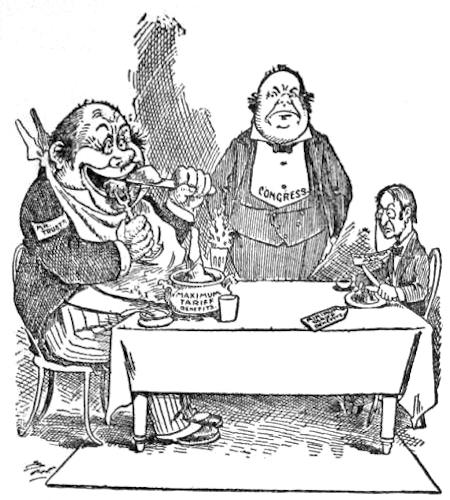
Maximum and Minimum Benefits, at Least
There is talk of congress adopting the maximum and minimum
tariff plan. Haven’t we something of that sort in
force now.
Bart., in Minneapolis Journal
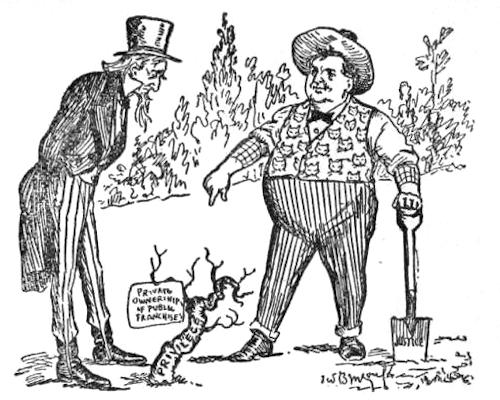
The Builder of the City
Tom L. Johnson—“That, sir, is the root of all municipal mischief,
and it must be dug out clean!”
Bengough, in The Public
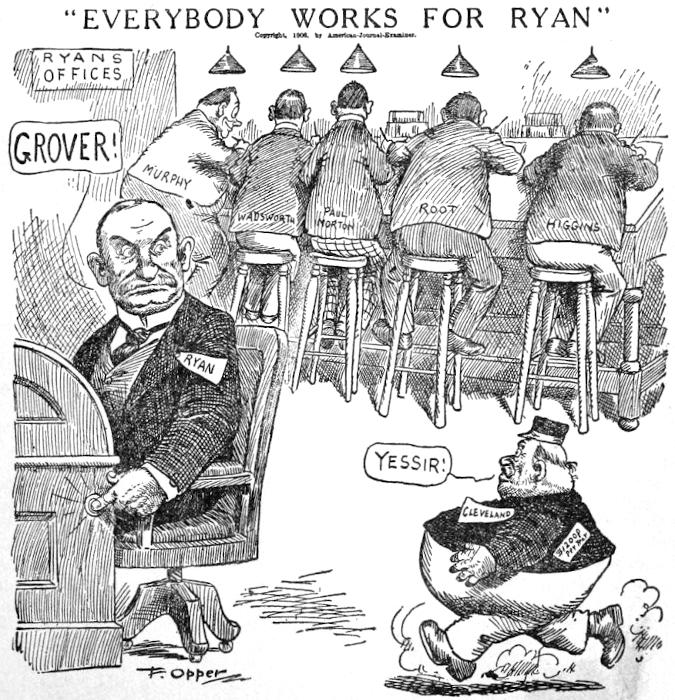
“EVERYBODY WORKS FOR RYAN”
F. Opper, in N. Y. American
Lookin’ T’wards Home BY HELEN FRANCES HUNTINGTON — Bobby Jonks; His Hand and Pen
“No, we ain’t a’needin’ any more
hands right now,” said Polly
Ann in a brisk, business-like
voice that discouraged prolixity on
the part of the loitering applicant
whom Polly knew to be unreliable
from a working point of view, for he
bore all the outward marks of shiftlessness
which her eyes had been
trained to discern at one comprehensive
glance.
“I reckon I’d as well wait an’ see
the boss,” was the hopeful answer.
“It won’t do no good to wait,
’cause he ain’t got no work for you,”
Polly reiterated with dry patience.
“’Sides, the boss is too busy to waste
any time outside o’ business.”
“Oh, well, then I’ll call again,” the
applicant observed amiably. He shuffled
out, hands in pockets, and Polly
Ann eased back in her chair behind the
railed-in desk that overlooked the long
rows of pallid, expressionless faces
bowed over the spindles that whirred
monotonously through the dull roar
of machinery. Polly was used to the
noise; its absence, during the brief
Sunday rests, made her nerves ache
dimly as if their rightful functions had
been forcibly suspended, for she had
grown up within the mills. Her
mother had been first to succumb to
the insidious fever which sooner or
later fastens upon the unsound, poorly
nourished slaves of the great White
Despot known to the world as the
Southern Cotton Mill industry. Polly’s
young sister had followed their mother
to her quiet rest within a year, after
which the overburdened, inadequate
father “aimed” to return to the upland,
clayey farm which he had so
hopefully abandoned two years before;
but before he could save enough money
to cover his debts he added to his burdens
by marrying a factory widow
with four pallid, old-young children.
Polly lived with them until they moved
to Atlanta in hopes of financial betterment,
then she assumed the brunt of
home-making for her two undisciplined
brothers. Meanwhile, her industry
had increased as her thin, deft
fingers became more and more proficient.
Her interest in her fellow-slaves
broadened into a mute, protective
supervision which the keen-witted boss
recognized and rewarded by placing
her in a position of trust which, humble
though it was, relieved her of the bitter
grind of mill labor.
Spring was in the air. It looked in
at the dim windows and drifted through
the open doors where the sunlight
drenched the worn, splintered floor
with fine gold. Polly recognized something
familiar—the sweet, far-reaching
scent of wild azaleas that grew
thick and tall along the distant Chattahoochee
hill; she closed her eyes and
let her fancy drift back to the green
pastures and still waters of the old
haunts of her heart’s desire, until her
revery was shattered by a human appeal.
It was a sunny young voice that recalled
Polly to tangible things, and it
belonged to a very young girl of the
“cracker” type, with a face of spring-like
innocence, who introduced herself
as “Mis’ Lomux, from Lumpkin,” with
a smile of such irresistible sweetness
that Polly’s thin, sallow face lighted
with answering pleasure.
“You-all’s got a job fer me this time,
ain’t you?” the stranger asked anxiously.
“I was here last Chuesday,
an’ the boss said he ’lowed he’d have
a place fer me by today. I aimed to
git here right soon this mornin’ so’s to
start work on time, but the chillun
give out in spite of all I could do, an’
I was jest obleeged to stop along with
’em at a house where the folks promised
to keep ’em till they got rested.”
“The boss is right busy now,” said
Polly in very kind voice. “I don’t
much believe he needs any more hands,
’cause he tuk in a new batch Saturday,
but you can wait an’ see what he says.
Set down an’ rest yourself till he comes
along.”
“He surely will give me somethin’ to
do,” Mis’ Lomux said hopefully,
“’cause he done promised he would.”
“Well, mebbe he will, then. Did
you ever work in a mill afore?”
“No’m, but I can learn real fast.
They say ’tain’t hard.”
“No, ’tain’t to say hard, but it’s
turrible wearin’,” Polly answered.
“You don’t look real stout, nuther.”
“That’s one reason why I come,”
Mis’ Lomux admitted frankly, “though
I’m stout a’ plenty to putter all day
without restin’ any bit. Last fall I
was tuk with a spell o’ fever an’ sence
then I jest ain’t been able to do like I
uster. Plowin’ an’ sech-like beats me
plum out in no time. I tried my best
to take Tobe’s place after he left, but I
jest couldn’t make out no way.”
“Who’s Tobe?” Polly interrupted
with deepening interest. “Your
brother?”
“No’m, he’s my husband.”
“Your husband!” Polly echoed surprisedly.
“You look dreadful young
to be married. How long have you
been married?”
“Be ten weeks on Sunday,” the
bride replied unenthusiastically.
“An’ he’s left you a’ready!”
“Yes’m.” Mis’ Lomux nodded her
blond head solemnly. “He done broke
his promise an’—an’ I don’t aim to
live with him no more, ever.”
Polly Ann searched the flower-like
face with something akin to pity.
“You ain’t a’ carin,’ are you?” she
asked in a whisper.
Mis’ Lomux’s denial was emphatic,
but unconvincing. “I ’lowed all husbands
was like pa,” she admitted
sadly, “an’ that’s why I married Tobe
so quick after he axed me. You see
when pa died that throwed me an’ the
chillun onto the county, with me not
able to do fer ’em like I would a’ been
if I hadn’t had the fever. What to do
I didn’t know ’cause the chillun
couldn’t work by their selves to do
any good. When Tobe Lomux sent
me word that he’d tak the hull lot of
us if I’d have him, I was glad enough
to marry him on that account, no matter
what come. Not that I got ary
thing agin Tobe—no one ain’t fer
that matter,” she interrupted herself
to say extenuatingly, “for he’s a real
steady, honest person. Tobe’s high-tempered,
though. Fust thing I
knowed his folks come meddlin’ round
talkin’ about him havin’ to do fer a’
passel o’ lazy chilluns an’ sech-like an’
it warn’t no time fore Tobe had put the
chilluns to work like a gang o’ niggers.
Me! Why, I jest couldn’t stand that
not fer a minit! I up an’ told Tobe
to hire his own niggers or quit us,
’cause them pore chillun warn’t goin’
to be nobody’s slaves. An’ he went”;
she finished, growing very white and
cold.
“He warn’t much or he wouldn’t a’
acted that way,” was Polly’s stern
verdict.
The bride winced. “I aim to show
’im we can git on without him an’ his
uppidy folks,” she retorted, with a
flame of delicate color. “That’s why
I come here, jest to make a livin’ fer
us all till I can stouten up agin crap-making
time next spring. By that
time the two little boys’ll be big enough
to help with the plowin’. Boys grows a
heap in a year.”
“Did you say you brung the chillun
along with you?” Polly wanted to
know.
“Yes’m, we all set out together yesterday
mornin’. Tain’t to say so dreadful
fur—jest eighteen miles—but
they ain’t used to travelin’ steady, an’
they give plum out early this mornin’,
so I left ’em along with some folks
while I come on ahead to git work.”
Polly Ann’s interest was of a keenly
personal order, which admitted of vast
concessions in favor of the second applicant
for the already crowded ranks
of mill laborers. She had turned the
first comer away almost at sight, but
Mis’ Lomux was different—her plaintive
needs appealed to Polly Ann’s
warm, starved little heart in a fashion
quite unknown to her since her mother
and sister had passed beyond her
faithful care.
“Where’s your things?” Polly asked
after a museful pause.
“We’re totin’ all we’ve got,” Mis’
Lomux answered frankly. “Pa didn’t
have much of anythin’ when he died
an’ I sold what little there was to git
the chillun fit close to come down here
in.”
Polly rose and stepped from the little
platform with an air of decision.
“You set there while I go hunt the
boss,” said she.
So Mis’ Lomux waited hopefully
until Polly returned from the fore part
of the great building to say that there
would be a vacancy in the spindle department
the very next day. “You’d
better fetch the chillun right along,”
Polly advised, “’cause you’ll have to
be ready to go to work at seven o’clock
tomorrow mornin’. There’s a’ empty
shack at the end of Factory Row that
you can rent real cheap. I’ll see about
rentin’ it while you’re gone.”
Polly saw them pass the mills late
that afternoon, a dusty, tired band of
wayfarers, each carrying small, queer-shaped
bundles which contained the
sum of their meager possessions, and
felt herself glow with satisfaction as
she thought of what she had contrived
to put into the rough little shack, in
the way of household furnishings.
She went over after work hours to
assist with the setting to rights.
By the end of the first week Mis’
Lomux and the two little boys, who
were to help with the next year’s crop,
had obtained steady employment in
the mills. Their bright faces gleamed
out among the listless, pallid, faded
faces of the “old hands,” with primrose
freshness that attracted Polly
Ann’s eyes many, many times during
the long noisy day; but soon their
morning glow waned and the difference
grew less and less marked except
for Mis’ Lomux’s illuminating smile
which never dimmed or wavered, early
or late, while the little loved faces
turned towards hers. The delicately
rounded girlish figure grew thin, and
Mis’ Lomux drooped more and more
just as Polly’s mother and sister had
drooped before doom overtook them,
yet never a word escaped her patient
lips. There was, indeed, no time for
self-pity, for all her thoughts were
centered upon the children whom she
sheltered from every harsh word and
look with a maternal zeal that never
failed of its loving purpose, in spite
of the children’s wilfulness apparent
to every one but Mary Lomux. Polly
realized shrewdly how it had been
with Tobe, whose judgment had lacked
the softening influence of love, for
although the children were of naturally
lovable disposition, Mary had
undeniably spoiled them from a man’s
view-point.
Every Sunday morning Mis’ Lomux
piloted her little flock away to the hills
which seemed to beckon her far beyond
the noise and smoke and grime
of Factory Row to the place of her
heart’s desire. Polly Ann often accompanied
her friend because the occasion
afforded opportunity to add to
the meager lunches in a manner that
lapped over several succeeding meals.
On such occasions the girls talked
continually of the tranquil, humble
joys of home, while the children lay in
the grass, too tired to play or chatter.
Mary comforted their weariness with
a promise of a speedy reprieve.
“We’re goin’ home in the spring,
sure,” she would say with illuminating
smiles, “an’ when you’ve been there a
day or two you’ll plum fergit about
ever feelin’ puny or tired. Jest keep
lookin’ t’wards home.”
But the event seemed to recede.
Summer’s golden glory paled before
autumn’s riper loveliness, and the air
grew pungent with harvest fragrance
that made Mis’ Lomux’s heart sick
with longing. Polly noticed that her
friend was losing ground daily, but
there was no help for her at the mills,
and Mary would not hear of returning
to the fallow farm before the growing
season began.
“I jest couldn’t bear to let the chilluns
go to the poor farm,” she said
yearningly. “Folks’d always have
that to throw up to ’em when they
growed up. An’ there’s them Lomuxes!
They’d talk wuss’n anybody.”
During the late autumn one of the
boys met with an accident which kept
Mary from work for several days and
drained her slender savings to the last
nickle. Then winter came with its
chill continuous rains, when the mills,
always dull and somber, grew doubly
gloomy. Doors and windows were
kept closed and the prisoned air grew
more and more poisonous as the workers
exhaled it over and over. Mary
protected her boys as well as possible.
She had made herself so well-liked by
her fellow-workers that no one interfered
with her many little devices for
the children’s comfort and no one manifested
the ill-will which is so generally
exhibited towards favorites; for it was
impossible to be harsh toward the
brave little woman who fought so
desperately against losing odds.
Toward spring Mis’ Lomux was obliged
occasionally to take a day off on account
of blinding headaches.
“’Tain’t nothin’ at all,” she invariably
protested, in answer to Polly’s
anxious questions. “Folks that’s had
the fever ginerally feel this way every
year about the same time. When the
weather gits warmer I’ll be stout as
ever.”
But Polly knew better. She had
seen that look of deadly weariness too
often to be deceived.
“Ain’t you never heard from Tobe?”
Polly asked one evening when she sat
on the steps of Mary’s shack watching
her friend’s strenuous attempts to hold
herself erect while she patched a pair
of faded little trousers.
Mary bowed her head very low as
she answered, “No.”
“Where’s he at?”
“In Atlanta, workin’ in the engine
shops, an’ doin’ well; his maw told
Billy Sanders a while back.”
“An’ he knows you’re down here
slavin’ like a nigger for all them chillun?”
“I reckon he does, ’cause his maw
writes to him.”
“Then all I’ve got to say is that he
must be a turrible no-count feller to
let his wife—”
“’Tain’t his fault,” Mary flung back,
lifting her deathly pale face for a
moment. “It’s them Lomuxes that
made all the trouble to start with. If
his maw hadn’t found fault with the
chillun he never would a’ done what
he did.”
“If you knowed that, what made you
send him off?” Polly wanted to know.
“I jest couldn’t stand the thought
of Tom bein’ teched by nobody. None
of them chillun ever had a hand laid
onto ’em afore, an’ I couldn’t bear that
they should—ever!”
“Well, ’tain’t none of my business,
of course,” said Polly drily, “but I
will say that if Tobe was half a man
even, he’d do his part now that you
need him so bad.”
“He couldn’t—not after what I
said,” Mary protested mournfully. “I
told him never to come back no
more till Kingdom-come, an’ he said
he wouldn’t—not if I begged him on
my dyin’ bed!”
“My land, what a mean sperited
feller he must be!” Polly exclaimed
contemptuously. “I wonder the Lord
didn’t punish him for sech talk. In
my opinion, Mary, you’re a heap better
off without him than you’d be with
him.”
Mary’s head drooped very low over
her work, but in spite of that Polly
saw the tears that fell on the little
patched garments. There was a long
silence during which Polly hated Tobe
Lomux as heartily as she pitied Mary.
Then she delivered herself of a bit of
advice that had burned within her
heart for weeks. “If I was you, Mary,
I’d give up an’ let the county take
care of me—jest for a little spell.
You ain’t able to work another day,
an’ to tell you the truth I don’t believe
you’ll be let work much longer,
’cause the boss has noticed how bad
you look. I’ll git the circuit-rider to
speak a good word for you at the poor
farm so’s they’ll give you a little shack
off to yourself.”
“Oh Polly, I couldn’t go—I couldn’t!”
Mary cried chokingly. “For myself
it wouldn’t matter what come, but
the chillun—they would always be
looked down on fer livin’ at a poor
farm.”
“What’s to become of ’em if anything
bad was to happen to you, I’d
like to know?” asked practical Polly.
“You’ve done for ’em an’ humored ’em
till they’re sorter spoiled. They
couldn’t git along with strangers. The
poor farm’s the only thing, Mary. I
don’t doubt but that you’ll be stout
enough by next spring to go back to
the farm an’ make a crop, but you
won’t if you stay here.”
“I’ll rest up a bit,” said Mary dejectedly.
“We can git along on what
the boys makes for a few days an’ by
that time I’ll be stout enough to go
back to work.”
But in that surmise Mary was mistaken.
On the fourth day when she
resumed her place at the reels, outraged
nature succumbed completely to
the long strain, and she dropped in a
dead faint among her whirling spools.
That happened the day before Polly
was to go on a long advertised excursion
to Atlanta, and, although Mary
was quite ill on the eventful morning,
Polly did not offer to stay with her
friend but hurried through her gala
preparations in great excitement. She
looked thinner and paler and smaller
than ever in her unaccustomed finery.
“I’ll fetch you a little somethin’ from
Atlanta, if I git time to go to the
stores,” Polly promised, while she
waited on Mary’s porch for the hack
to gather up its fluttering load along
Factory Row.
Polly left the crowded train at Atlanta
and hurried off in search of the
engine shops. She had little difficulty
in locating Tobe Lomux, whose industry
had made him quite a favorite there.
He was a sturdy, well-built young fellow
with a good, honest face and a firm
undimpled chin that bespoke a will of
iron. He looked at little frail, anxious
Polly as if she were something too insignificant
for serious notice.
“I’m a friend of Mary Lomux’s,”
Polly began with a furiously beating
heart, for her hopes had dwindled discouragingly
during her long, worried
ride, “an’ I’ve come to find out if you
aim to leave her die without doin’ a
thing to prevent it.”
“Mary—die!” Tobe’s head went
back with a wrench that sent the blood
bounding to his face. “What’s that
about Mary?” he asked gruffly.
“Don’t you know that she’s killin’
herself at the cotton mills down at
Gainesville, workin’ for them chillun?
Ain’t nobody wrote an’ told you that,
Tobe Lomux?”
Tobe ignored the question. “Did
Mary send you to me?” he asked in a
voice that Polly misinterpreted.
“No, she didn’t. She’s got too
much grit for that even if she is too
sick to hold up her head. I didn’t
have much hopes of gittin’ any satisfaction
from you, judgin’ by the way
you’ve acted, but I thought I’d try
jest onct. What I want to know,
Tobe Lomux, is if you’re goin’ to let
her die—or not?”
“Me! Why, good Lord, what can
I do? If Mary wanted me I’d—I’d—Well,
she don’t, that’s all.”
“Mary didn’t send for you,” Polly
broke in eagerly, “but if you’re any
sort of a man you’ll drop that spike
an’ take the fust train to Gainesville.
That’s what you’d do, if——”
The tool dropped from Tobe’s grimy
hand, and his head and shoulders went
back defiantly. “I’m goin’ right back
along with you,” he said, jerking off
his leather apron and shaking down
his sleeves. “Wait till I draw my
pay. We can talk on the train.”
Polly remembered that homeward
ride to her dying day, for it was the
first time in her defrauded life that
she had been brought face to face with
a great passion whose very crudeness
added to its strength. Tobe had held
himself with grim, fearful ardor to his
labor, while his stubborn aching heart
yearned for one word of reconciliation
from Mary. His mother had written
strange, slighting things relating to the
blighting factory life that Tobe abhorred,
and he had waited and Mary
had suffered in silence. Before the
train reached Gainesville Tobe’s busy
brain had evolved a plan which he
confided to Polly while they stood on
the station platform waiting for the
country stage which was to take Tobe
up to Lumpkin that very afternoon.
“I’ll be down by noon tomorrer,
sure,” was his parting promise.
Polly paid a brief visit to Mary’s
shack when she reached Factory Row,
fearing to stay long lest her secret
should escape her eager lips. She was
tired, she explained so tersely that the
sick girl felt hurt and neglected. The
following day Polly appeared at sunrise.
“I don’t aim to work today,” she
announced, “so I may as well set with
you, Mary. You jest lemme fix you
up on the porch where you can git
the air while I red up the house a bit.”
Mary was too listless to object, so
she dragged herself out to the narrow
porch where the warm spring sunshine
drenched the rough boards with a
golden flood, upon which the blossomed
torches of the cypress vine made small,
dancing shadows.
“Ain’t it a turrible pretty day!”
Polly exclaimed glowingly. “Makes
me think of way up in Lumpkin, don’t
it you?”
“I jest can’t bear to think of it at
all!” Mary wailed, with a yearning
glance toward the far, golden hills.
“I’ll bet the honeysuckles is jest
thick all over them river hills by now.
Don’t you rec’lect how blue the bottoms
looked along about this time
when the dog vi’lets is out full?”
“It’s time to lay off the cotton
fields,” Mary murmured. “Polly, if
anything should happen to me, you’ll
see that the chillun keeps together at
the poor farm, won’t you?”
“Shucks, you’re goin’ to get well—that’s
what’s goin’ to happen to you,
Mary Lomux. Now lie still and rest
while I straighten up the house.”
Mary lay quite still for a long, long
while, looking toward home with a
great wistfulness in her weary eyes
and a dark fear in her heart. By and
by a wagon turned across the bare,
sun-baked flat that separated Mary’s
shack from the factory grounds and
stopped at the head of Factory Row.
It was spotlessly new, even to the
snowy bow-sheet, and the household
furnishings visible through the shirred
opening were new, also. Mary saw
the driver spring down lightly and
throw the reins over a broken gatepost.
Then Tobe stumbled up the
steps, dully ashamed of his unconquerable
emotion, for he came of a
race who count it unmanly to betray
any outward sign of feeling. But it
was impossible for him to speak calmly.
“I didn’t have no idee you was sick,
Mary,” said he shakingly. “I’m real
glad Polly come an’ told me about it.
I thought I’d drop in an’ see how you’s
comin’ on, jest to be neighborly,” he
added in a voice that seemed to come
from a great distance.
Mary struggled up with a smothered
cry, but fell back weakly among the
pillows and cried instead of answering,
while Polly stared helpless from
the doorway and Tobe wrestled with
his heart’s desire to take the poor
little woman in his arms and comfort
her in love’s own way. And while
they waited a thin little voice came
from the pillows.
“I ain’t a bit sick,” it said, “jest
that flustered I can’t help but cry.
Don’t mind me—Tobe. I’m real—glad
to see you.”
“Mary,” Tobe rose from the chair
into which he had dropped and stooped
over the little trembling figure until
his big, firm, strong hands rested on
her shoulders. “Mary, do you reckon
you could make out to go on up to
Lumpkin with me? I’d love, the best
kind to raise a crop this year.”
A cry of inarticulate joy struggled
up from the pillows and after a moment
a little tear-wet, lovely radiant
face looked up at Tobe. “Do you
mean—Oh, Tobe, would you take the
chillun too?” Mary faltered.
“Sure thing, an’ be only too glad.
Land, how I’ve missed them young
’uns!” cried Tobe, every fiber of his
being aglow.
Mary’s joy brimmed over. “Oh
Polly, did you hear that!” she called
in sheer ecstacy. “I couldn’t be happier—no,
not if I was in heaven.”
The young man lifted his head and
looked straight at Polly with wet,
shining eyes. “Say, you’ve got to go
long with us,” he said unsteadily,
“’cause I ain’t goin’ to leave Mary do
a lick of work till she gits plum strong
agin, no matter what comes. Git
ready, will you, Polly?”
“Me! My land, how pleased I’d
be. Why, it’d be like gittin’ to heaven—mighty
nigh,” said Polly growing
hot and cold by turns. “Now that the
boys is both goin’ down to live with
pa, too. Seem like things is turnin’
out too good to be true.”
“Don’t it! Tobe, can we go soon?”
Mary asked breathlessly.
“Soon as you’n Polly can fix what
you want to take along,” Tobe answered
eagerly. “I’ll go over an’
fetch the chillun from the factory
while you all git ready. We’d oughter
git home by dark.”
Then he rose and strode buoyantly
across the sun-baked hill to the factory
door and Mary rose, too, tremblingly,
but without hesitation, while Polly
held herself in readiness to support her
frail figure should her strength desert
her. But there was no further need
of anxiety, for Mary had tasted the
elixir of life during that brief, transfiguring
hour when love had put to
rout the dreariness of hope deferred
and filled her heart with joy unspeakable.
Man is an animal, but you can easily detect him from the rest of them when
he has his hat on. He is of few days and full of things that the doctors
cut out if they get half a chance. My Uncle Bob is a bachelor. A bachelor is
a man who smokes in bed and burns himself up every once in a while and goes
to glory a-hollerin’, while everybody else says “Oh, pshaw!” and “Did you ever?”
All bachelors are wise, but my Uncle Bob knows ’most everything; he says
he believes he’d be in Congress right now if it wasn’t for his modesty—no, honesty.
But, says he, there is one thing he never could fully make up his mind
about, and that is whether clam-digging is fishing or agriculture. A hog is a
quadruped; the love of money is the root of all evil—thus we see why the motto
of a rich man so often is “Root hog or die!” A man is either a biped or a cripple,
according to whether he has messed around in a sawmill or not. The difference
between a biped and a quadruped is two legs. A three-legged stool is a
tripod, and is mostly used by country editors. A turtle is a quadruped, but he
can’t climb a tree and get off a good joke about making a noise like a nut. Neither
can some people.
On the only three occasions in a man’s history when he cuts any particular
mustard he is called “it”—when he is a baby, a bridegroom and a corpse. And
in all three instances he is said by his admiring friends to look real natural.
Man was made to mourn, but Uncle Bob says the dad-dogged fool always thinks
he can get out of it by marrying again. A woman may be as handsome as a
circus horse but she is never satisfied to let another woman be handsome, too.
It’s different altogether with a hog—he is perfectly contented to let everybody
else be hogs if they want to. Oh, why should the spirit of mortal be proud?
Assessment Insurance A HOMILY ON THE ROYAL ARCANUM BY MICHAEL MORONEY
There is no real or true life insurance
but the straight old line
regular life, where the policy
is payable only at death. Term life
insurance, so called, is simply banking
for the benefit of the company which
takes the risk. In regular life insurance
the insured has a certain expectancy
at the time of taking out the
policy. Payment for the amount he
is to receive at death is spread out over
his expectancy, less four per centum
interest compounded, and he pays it in
annual, semi-annual, or quarterly installments,
as may be agreed upon.
If he lives out his expectancy, he will
have paid in all he is to receive at death,
either directly, or by the interest carried
on his premiums. Of course there
is a certain amount of loading in the
premiums he pays, but for the purposes
of our illustration, that need not
be considered. In this plan, the policy
holder is really insuring himself, and
when he dies his beneficiary, or estate,
simply receives back the money he has
paid in. The fact that there are so
many life insurance companies and that
they have become so wealthy and powerful,
illustrates the power of interest,
especially when it is compounded.
The Royal Arcanum professes to
give life insurance at actual cost, which
it does not and never did. It was
organized from the top down. Fifteen
persons met in Boston on June 23,
1877, and constituted themselves the
Supreme Council. Twelve of them
became officers, and three were incorporators
simply. This body reserved
to itself all the power of legislation and
of receiving and paying out the moneys
of the order. Provisions were made
for the organization of subordinate and
grand councils of the order, but they
were simply wards of the Supreme
Council. Members were received on
medical examinations from 21 to 55
years of age and paid for $3,000 insurance,
one dollar at 21 years, and up to
four dollars at 55 years. The rise
from year to year was from 4 to 20
cents. The assessments were to be
paid when called for, after the death
of a member. The order grew and
prospered from year to year until 1898,
when the management thought it saw
the necessity of increasing the rates.
It made 21 at the rate of $1.76 and 54
rate of $7.00. The rise each year was
from 6 to 44 cents. At this time the
order had 195,105 members, and the
loss in membership in the order in the
next six months was about 10,000.
However the order continued to
prosper until after the annual meeting
of the Supreme Council in 1905, when
it adopted a new table of rates, which
began at $1.89 at 21 and rose to $16.08
at 65, but from Oct. 1, 1905, all the
members were to be assessed at attained
ages, whereas before that all had been
assessed at entrance ages. In other
words, on Oct. 1, 1905, each old member
was required to reënter the order
as a new member, and pay at attained
ages. New members after that date
were to pay at entrance ages, but all
were to pay $16.08 per month on
$3,000 when they reached 65 years.
At the time of the making of this new
rate the order had over 300,000 members.
Since then it has lost 50,000
members, and a majority of its members
are opposed to the new rates.
There was no occasion for the new
rates, as, under the laws of the order,
additional assessments could have been
made, at any time, to provide for excessive
mortality, and the order could
have been worked out on additional
assessments until it failed, as it is
bound to do.
An organization within the order
has been formed to contest the new
rates, and this has brought a suit in
the Supreme Judicial Court of Massachusetts
to have them declared
invalid. The protestants claim that
when each member entered the order
he made a contract to pay assessments
at age entrance, and that while the
Supreme Council may call extra assessments,
as mortality may require, it
cannot increase the rates, or compel
members to pay at attained ages. Also
that the new rates are unreasonable
and will create a surplus of $3,700,000
every year, which is contrary to the
laws of the order and of the State of
Massachusetts. The Supreme Council
claims that each member when he
entered the order surrendered all his
rights to protest or object to any action
of that body and agreed in advance to
approve any action which it might take
in regard to rates.
All of the old life insurance policies
of every kind and character are based
on contract, and it was supposed that
the rates at entrance in a fraternal
order constituted a contract between
the member and the supreme body of
the order. Many of the courts of the
several states have so held, but it was
for the Supreme Council of the Royal
Arcanum to defy reason and common
sense and to claim that they were the
autocrats of the order. All insurance
should be like a deposit in a savings
bank, that can hardly be lost. The
Royal Arcanum, however, has depended
upon lapses. Thirty-five is the age
usually taken for illustration in insurance.
At that age the average of
lapses per 1,000 lives is 37 per cent plus.
In May, 1905, there were 305,083 members
in the order. That would mean
that out of 305,083 members if all were
of the age of 36, in any year, 111,000
would lapse. The average policy in
the Royal Arcanum is $2,231.67 and
out of that there would be lost by
lapse, $826.70. If all the members
were 36 years of age, on the whole
$680,848,000 insurance in force there
would be lost by lapse, at thirty-six
years, $251,923,760 annually. Now
in honest insurance there should be no
lapses or forfeitures and in the insurance
of the future there will be nothing
of the kind. But on this plan, no
matter how long one has paid, or how
much he has paid in, if he stops paying,
he loses all. Misfortune or accident
may compel him to stop paying, but
no matter what may be the cause, he
loses, and other persons dying quickly
have had the benefit of the money he
has paid in. A member who entered
in 1879 at the age of 36 will have paid
in on September 1, 1905, about $800,
or $30.72 per year. A person insured
at the sum of $3,000 would have to live
to the age of 133 to pay that sum out
at the rate for the first 26 years. But
assume the insured has paid $800 to
October 1, 1905, and remains in the order.
He pays $97.20 the first year of the new
rates, $103.68 the second year and
$192.96 the third year and the same
sum each year thereafter. His expectancy
is 12.81 years at 63. If he lives
out his expectancy, he will have paid into
the order, $3,277.12, or $277.12 more
than he will receive. But suppose he
should live till 85 years of age, he will
by that age pay in $5,205.72, or about
$2,205.75 more than he can draw out.
Will any man join an order of that
kind where he shall forfeit all by the
failure to make a single payment? So
long as he can get into a company
which will give him paid-up insurance,
extended insurance, or a cash-surrender
value, he will not.
Every man insured in a fraternal
association is in the condition of Damocles.
The sword suspended over his
head is likely to drop at any time. The
moment confidence is lost the whole
matter dissolves like a rope of sand, and
the insurance is gone. Suppose the
Royal Arcanum had ceased to do business
on June 1, 1905, $680,648,000
of its insurance would have terminated
at that time, which would have
been a loss of about $2,231.67 to each
member. That is, 305,083 persons
would have lost $2,231.67 insurance
each. These same persons and their
predecessors had paid in $97,004,175.82
of which $94,790,627.86 had been
paid out on death losses. Since the
new rates have been published the
order has lost 50,000 members carrying
$111,583,500 insurance. Of the sum
paid in, $36,090,650 has been paid in
by men who have dropped out and the
balance of loss is to be paid by the
survivors. Thus it is ever with assessment
companies. They must and will
fail as soon as it is demonstrated that
the adopted rates will not carry any
organization for a generation. The
new rates of the Royal Arcanum have
simply demonstrated the utter worthlessness
of assessment companies, and
the value of regular life insurance
where each policy holder contributes
a fund to pay his own policy.
The Royal Arcanum is no better
than a suicide club, for it is only the
suicides and the weaklings who can
have any benefit of the order. The
new rates require the members to pay
greater sums in premiums than in old
line companies, and at the same time
the company insists upon the old and
exploded system of forfeitures, refuses
any paid up or extended insurance, and
any cash-surrender values. Who will sit
down to a feast of this character? No
one but an old member who has paid
in too much to stop, and no new man
will join the order. The whole scheme
of the new rates was to drive the old
members out so that the order would
not be compelled to pay their death
losses. The order is an autocracy.
There are twelve life members in the
Supreme Council who represent no one
but themselves. Three of these are
original charterers and nine are Supreme
Past Regents. There are twenty-nine
officers, who as such are members
of the Supreme Council. These thirty-eight
by the aid of twenty representatives
can control the Supreme Council,
and there is added a new life member
every two years in a new Supreme
Past Regent. No one should be a
member of the Supreme Council but
some one who represents a constituency.
Yet John Haskell Butler, of
244 Washington Street, Boston, Mass.,
controls the entire Supreme body.
In this he is ably supported by
W. O. Robson, Supreme Secretary.
How these two gentlemen of eminent
talent could be imposed on in the
adoption of the new rate, which in the
case of the old member who entered
at thirty-six years, compels him to pay
a surcharge of $64.18 per annum more
than necessary to carry his risk, or in
his expectancy a total of $1,226.98
more than he should pay, or 70 per
centum more than his equitable share,
is more than we can understand.
The average of the surcharge on all
the old members is 67 per centum, and
is 27 per centum higher than the new
members pay. Naturally, if the membership
could be held together, these
new rates would create and pile up a
surplus, or excess, of $3,700,000 per
year over any sum that the laws of
Massachusetts permit the society to
hold, which at the present time is about
$30,000,000.
However, the society has never attempted
to create any surplus or reserve
over and above about $2,000,000,
nearly equal to the proceeds of three
assessments. What kind of financing
is this which at one fell stroke burdens
the members with paying sums which
will produce $3,700,000 per year after
paying over all mortuary calls? Heretofore
the order has preached for twenty-eight
years that the surplus remains
in the pockets of its members and shall
so remain. Now it is to be created and
placed in the control of Mr. Butler and
his one hundred and fourteen associates
who are souls with a single thought.
And what for? What kind of actuaries
did the Supreme Council employ to
make these new rates that such a result
is brought about and that the policy of
twenty-eight years is reversed at a
single session, without any notice to
the members? The members of the
Royal Arcanum, the men who pay the
money disbursed by Mr. Butler and
his associates, have no voice in proposing
any new legislation for the order,
nor in approving or rejecting any
enacted by the Supreme Council.
They must pay whatever the one
hundred and fifteen guardians ask of
them or get out of the order.
The $3,700,000 surplus exacted the
first year, under the new rates, is not
to be used for paid-up or extended
insurance or cash-surrender values, but
is simply to be kept on hand as a
reserve. The reserve, which has heretofore
been carried in the pockets of
the members, is now to be transferred
to the pockets of the Supreme Council.
Why are the members of the order, who
have carried their insurance at great
sacrifices, to have an additional burden
placed on them? Why must this great
reserve be created unless for the same
reasons it was created in the three
great companies in New York City?
What is the object of creating a reserve
when there is no paid-up or
extended insurance and no cash-surrender
to be made, and when assessments
are required to be called for as
needed to pay death losses? Why
should any assessment company have
a reserve beyond a few assessments
ahead? What kind of actuaries did
the Supreme Council have to make
tables to produce such results? What
fit guardians of 250,000 people are the
one hundred and fifteen members of
the Supreme Council who would adopt
a table of rates producing such results?
The control of the funds must have
driven these one hundred and fifteen
people mad to have produced tables
which will so work. Would it not
have been better to have called extra
assessments from time to time under
the authority of the laws of the order
and of the State of Massachusetts,
until the order was compelled to
fail, than to have adopted the new
rates, which are more expensive than
old-line insurance and which if approved
in the legal contest now pending will
insure the failure of the order at once?
The only true assessment insurance
is to pay the death losses as they occur,
by assessments, and which must include
a fund for management and
control. When the assessments become
too great the company dissolves
and that is the end of it. All those
who have not died during its existence,
or who have lapsed in the same time,
have lost their bets, and those who
have died have won.
I am not able to give the number
who have been members of the order
since its origin. It could not have
been more than 400,000. Of this
number 35,000, or one-twelfth, have
died. Over 33 per cent., or 133,333,
have lapsed, and if the institution fails,
as it certainly will, 367,000 have lost
every dollar they have put in, in order
that 35,000, or one in twelve, might
draw prizes.
Such institutions are contrary to
public policy and should be suppressed.
Each state insurance department
should require such statistics as will
show all the facts any one might wish
to know.
If I had the exact statistics, I am
satisfied the proportion of those who
pay in and lose would be much higher
than I gave it.
The laws of political economy must
be evolved just as we evolve those of
nature, and they are as certain when
we know them, but any institution
which requires a party to live beyond
his expectancy in order to pay in the
amount of his benefit certificate is a
fraud. At 21 a man’s expectancy is
45 years. Now a man at 21 who
entered the order June 23, 1874, would
have paid in to December 31, 1905,
$404. It would take him over 166
years to pay in the $3,000 at the same
rate. As he can never do that, his death
loss must be paid by some one else,
and consequently his insurance by
others is a fraud and a gambling
transaction.
As eleven persons must contribute
to pay the loss of the twelve and then
lose everything themselves, the whole
scheme is an imposition contrary to
the interest of society. Eleven men
contribute and lose $250 each that
one man’s beneficiary may gain $3,000,
and these eleven men lose every dollar
they put in. After twenty-eight years
of preaching to the public that they
had found the El Dorado of Insurance,
that they were furnishing insurance at
cost and that the members carried the
reserve in their pockets, Messrs. Butler,
Robson & Company now come to the
front and admit that all this time their
scheme has been a fake and a failure.
They say the unclean spirit departed
from them in May last, but I think he
returned to them with seven others
worse and they have turned the
Arcanum into a madhouse.
I do not have the personal acquaintance
of all the seven, but two of them
might be called Landis and Barnard,
because the condition of the Arcanum
is worse than before. Now every
member must pay in his $3,000 in
the period of his expectancy, and if he
lives beyond it he must pay till he
dies. The new rates indicate that
members must die before reaching 65
years, and if they decline, then they
must be fined $192.96 per annum for
their refusal to do so.
Any man who enters the order now,
in view of what he must submit to at
and after the age of 65, ought to have
his sanity inquired into. It is high
time the State should intervene and
protect the public from the schemes of
these fraternal orders. The fraternity
is humbug, and for every loss paid
there are many more losses to society
from which it should be protected.
The correct scheme of insurance has
not yet been discovered or announced,
but when it is it will not be gambling
or commercialism, but will be simply
indemnity—which it should have been
from the start.
Back To Nature—Part The Way BY EUGENE WOOD. — A Difference — His Identity
About once in every so often, we,
as a race, all lay back our
heads, shut our eyes, and let
out the shuddering shriek: “Back to
Nature!” It is so loud and heart-felt
a cry that it makes you wonder why we
have to go back at all—why we didn’t
stay there. If the Get-Strong-Quick
professors are right, this thing of our
wearing clothes, and dwelling in houses,
and eating dainty cooked food three
times a day is sheer tom-foolishness, all
the more tom-foolish in that once we led
the healthy, happy life that inevitably
results from fasting three or four days
in the week, then dining on goobers
and timothy hay; wearing nothing but
a nose-ring and a dash of paint, and
sleeping in the hollow trees.
For most of us, “Back to Nature” is
too long a road to travel—all the way.
Nevertheless, the cry is so loud, and so
general throughout the civilized world
that we cannot dismiss it as impracticable
and meaningless. It betokens
something. I think I know what, and
if it didn’t look so much like serious
thinking for you and me, I’d write out
what I think it means. I’ll say this,
though: If we judge the future by the
past this universal impulse to touch the
naked earth once more, and so to gather
strength and vigor from it, means that
the world is pregnant with a great
event, and we must be fortified for the
labor-pains of it. A new age is struggling
to be born. Mark my words.
The timid venture, on the way back
to Nature, of a two-weeks’ sitting on
the front stoop of a boarding house in
the mountains or at the seashore does
not satisfy us now. Bold and daring
spirits have even gone to live in the wild
woods, and have come back to tell us it
was bully. We all know it is great fun
to play at being boys again, but for
most of us the problem is complicated
by our having wives and daughters
whom we cannot well put in cold storage
during our absence. I know that
under the pressure of the need to go
back to Nature some have even taken
the women with them. I—I—I don’t
know about that. It doesn’t look very
alluring to me. Mind you, I don’t
know a thing about living in the wilderness
except what I have read and heard,
but as near as I can come to it, there
seems to be considerable packing to be
done. There’s the canoe in the first
place. If I were thinking of going into
the woods, I shouldn’t stir a stump unless
I had a canoe. But you take one
fifteen or eighteen feet long, and carry
it about three miles through thick-set
timber, and I should say along about
the last half of the third mile you’d begin
to notice it. You’d have to have
some kind of a tent, and even when
they’re made of silk, I should think
they would make something of a
bundle. You’d want your gun and
ammunition; you’d want your fishing
tackle; you’d need a small ax; you’d
have to carry a coffee-pot, a frying-pan,
a deep pot, a plate, a knife and fork and
cup; you’d need at least one blanket
and a rubber sheet of some kind; you’d
need to pack your bacon and your flour,
and erbswurst, and matches, and quinine,
and morphine, and rags for bandages
in case—you know—and saccharine,
and whisky if there are snakes
around, and—oh, yes, tobacco; don’t
let me forget tobacco—and, oh, I don’t
know what all. No women’s fixings in
this partial list, you see. I don’t know.
I knew a man that took his wife along
with him to the woods—but then, don’t
you see, it was on their honeymoon.
Oh my! It makes all the difference in
the world when you’ve been married
ten or fifteen years. Yes, I should say
so.
I once read a most fascinating series
of articles by a woman who had this
delightful experience. The intention was
to chirrup: “Come on, girls! It’s perfectly
elegant!” But she didn’t fool
me. I could see that whenever there
was anything that was arduous, or tedious,
or mussy in the housekeeping line
“the gentlemen of the party eagerly
volunteered.” Yes. M—hm. I can
just see ’em. Mind you, I wouldn’t go
so far as to say that a woman in the
woods is a darn nuisance. No indeed.
Only—Well, I tell you. Her husband
may be eager to play Injun, but I
don’t believe she would be very keen to
play squaw. That is, and “tote fair.”
There is this in favor of taking ’em
along: Not every man can cook. I
know that out there in the forest, when
you make camp as the shadows lengthen
after a long day’s tramp, when every
muscle aches, but aches with glad
fatigue; after a day in which your lungs
have drunk in the pure air thinly fragrant
with the vague odors that the
glazed leaves distill, as it were offering
incense to the god of day; when you
have quenched your thirst from a spring
in the bottom of whose earthen bowl
the sands are reeling and staggering in
the delirium of glee; when you have
hearkened to the wild beauty of some
unknown bird-call echoing through the
lofty Gothic aisles; when the western
sky flames into undreamed-of glories
and then fades away until the lonely
stars come out, I know they say that
you can choke down any old mess and
relish it. Maybe so. I am as good a
hand at eating pancakes as anybody
else, but I don’t know about them for
every meal and every day; bacon is my
favorite vegetable, but there comes a
time; fish once a week is all I care for.
No. It doesn’t seem alluring to me.
They tell me hemlock boughs make a
fine mattress. Yes? I know where I
can get better for less money. They
tell me that sleeping on the ground with
the high sky for a ceiling is simply great.
If it comes to that, I have slept on the
ground, and the morning after I knew
exactly where my hips and shoulders
were. I don’t mind granddaddy long-legs
tracking over my face. They’re
kind of interesting. But I have never
been able to put away the thought that
if it should turn chilly in the night, and
some snake should come and crawl in
bed with me, and smuggle his cool slimy
body down my back, it would probably
break my rest. I shouldn’t fancy it,
I’m positive.
I tell you. I compromised the matter
thus last summer. I got back to
Nature—part the way. Not so far
though as to get out of touch with the
milkman. I had things cooked to suit
me; I slept high and dry upon a Christian
bed, and yet I wasn’t indoors a
minute of the time the whole enduring
summer. And I’m never going to be
another summer under a wooden roof
if I know how to help it. I’ll tell you
about it if you like.
There were five of us that wanted to
live in the outdoor air for twenty-four
hours out of every twenty-four. There
was the Honest Man who went to gainful
business every day; there was the
Lazy Man who didn’t do one tap the
summer long, though often besought to
do so, who now takes his pen in hand to
drop you these few lines; there was the
Honest Man’s wife; and there were the
Lazy Man’s Wife, and his growing
Daughter.
The Honest Man already had in
stock a 12 × 14 tent, and a small A-tent.
The Lazy Man bought a 10 × 12 tent
for himself and wife, and the next size
smaller for his daughter. Each family
brought bed-clothing and personal apparel.
(It was a first-rate opportunity
to wear out old clothes.) The communal
property, dishes, oil-stove, egg-beaters,
and all such were paid for half-and-half.
It stood the Lazy Man for
outfit just $49.27 all told, and the outfit
is now down cellar waiting impatiently
for summer to come again, when
it will be as good as new and won’t cost
anything.
The summer previous, the Honest
Man had gone exploring and found a
spot on the Canadian shore of Lake
Erie within an hour’s ride on the steamer
from his business. A whopping big
maple tree, thick and umbrageous,
stood a hundred feet or so back from
the water’s edge, on a sand slope carpeted
with wild grape vines. The
beach was of fine white sand, without
a pebble bigger than a moth-ball, and
it slanted so slowly into the water that
breast-deep was fully a hundred yards
from shore. This made it rather poky
for the men-folks when they went in
swimming, but it was ideal for the women,
to whom a foot of depth is drowning
depth. The lake being soft water,
nobody can adequately express the joy
the women had in washing their hair.
This favored spot was a shade more
than a mile away from the steamboat
pier at which, six or eight times a day,
excursion steamers unloaded revelers
who sought the pallid ecstasy of a non-alcoholic
pleasure resort. (It was Canada,
remember, and while you might
go in swimming on the Lord’s day,
you could not ride upon the giddy-go-round.
A district attorney from
the smoky city on the American side
presumed to fish on Sunday, and got
sassy to the constable who said he
shouldn’t. Thereupon they snaked
him off to a neighboring village
to the hardware store where the ’Squire
kept court and fined him $20 and the
costs.) We were far enough away on
the long board walk to miss the transients,
and by looking carefully through
the trees you could just see one house
from our place, the castle of our landlord.
I am aware that it’s nice to be
exclusive, and get away from common
folks, but it’s so blamed expensive.
Even millionaires when they want to
make sure of getting any place have to
travel with the cheap crowd. You can
think that over. You will find it’s so,
although I haven’t time to work it out
in detail.
The Honest Man having lived on this
spot the summer before, the floors were
laid of boughten lumber, and the frames
were up. Also, the private walks,
made of such bits of board as the Good
Lord had pleased to send upon the rolling
waves, nailed upon saplings from
the wood back of the camp, were still
in place, so that there wasn’t much to
do, a circumstance that grieved the
Honest Man no little. He liked to be
busy. The Lazy Man was patient under
this affliction. He did help when
there were things to do. He got the
nails and handed the hatchet, and generally
fetched and carried, knowing
full well what are the drawbacks incident
to being a heaven-gifted literary
genius, such as not being of the least
account about a place.
Among the triumphs of the Honest
Man’s saw and hammer were the tables,
prime among them being the dining-table
under the same maple tree, whereon
we ate our every meal from July 2
until September 3. It is fitting that in
this public manner I should return
thanks for our kind and considerate
treatment by the weather. I can
cheerfully recommend it to all and sundry.
It rained at times, I won’t deny.
It had to. I can see that. But I must
say it was most forbearing in the matter,
and rained only out of meal hours.
Once or twice it was plain to see that it
strained a point in our behalf, for example,
that time we had to have our
Sunday ice-cream in our tents, and the
two or three occasions when the breakfast
dishes were practically storm-washed.
This dining-table, the serving-table,
the table in the cook-tent, and the
china-closet—Oh my yes! We had a
china-closet. It was made out of a
packing box, had shelves in it, and four
plank legs—these articles of furniture
were covered with marbled oil-cloth,
and the door of the china-closet was of
the same rich material, being secured
with loops and nails. The cook-tent
reared its lofty A on a frame with
a waist-high board-wall, lined with
shelves. It was so studded with nails
that for once in their lives the women
were speechless of complaint that there
weren’t places enough to bestow the
junk without which, so it seems, life
in the kitchen is insupportable.
Hard by the china-closet was the refrigerator,
in whose construction, let
me say, the Lazy Man bore his part.
He dug the hole in the sand in which
was sunk a barrel with a perforated bottom
through which the melting ice
drained off. The women professed
they lay awake nights listening for the
things piled upon the ice to topple
over into smash. They had to
worry about something. There wasn’t
a thing else for them to do but cook,
and make the beds and wash the
dishes.
I suppose that cooking by a camp-fire
is the extreme of picturesqueness.
It is also mighty hard upon the back,
to say nothing of its blinding you with
smoke, and frying the grease out of
your face, even after you have learned
that it isn’t really necessary to have a
conflagration big enough to melt the
nose off the coffee-pot, but that a cupful
of live coals and a tiny bunch of twigs
will do the trick. You have to stand
over such a fire to keep it going, and
when it rains it is the deuce and
all. So we had a blue-flame oil-stove
with an oven, and had everything
cooked in the highest style known to
the art, just as it was before we started
on our way back to Nature. There
was just one thing the women missed.
Endless hot water laid on. Their heaviest
burden was to remember “the
dying woman’s advice.” Don’t you
know what that is? “Sally,” she
whispered with her latest breath, “always
put on the dish-water before you
sit down to your victuals.”
But if the Lazy Man could not
bring his mind to penning deathless
Literatoor, he could at least tote
water from the lake, so it wasn’t so
bad after all.
The need of cooking was great indeed.
In no spirit of carping criticism
I desire to say that I have seen the
Honest Man, many and many’s the
time, wolf down six big potatoes at a
meal and other things accordingly. We
others did our feeble best, but we never
quite compassed that. I did eat six
ears of green corn once, but you must
remember that they were right off the
vines, as you might say, and you know
how good green corn is when it’s fresh.
This was no lonesome wilderness
wherein we had to scuffle for our food.
The milkman came right after breakfast
with the morning’s milk. The
morning’s milk remember, not the night
before’s. Then came the iceman. I
want to tell you about him. I had seen
him pushing the lawn-mower on a green
velvet lawn before a mansion up the
beach a ways. I thought he was turning
an honest penny taking care of it for
some one else. Bless your heart, he lived
there. He had a fine big farm behind
it, but it was all seeded down in grass,
because the harvest of ice from the
lake before him in the winter brought
him more money for less work than the
rich loam behind him could raise in summer
crops. Then came the grocer from
the village back in the country. He always
brought us kerosene, sometimes
he brought us groceries, and all too seldom
he brought us the flat loaves of the
Italian baker in the village, flat and
crusty loaves, which the grocer scornfully
called “dog-bread.” There was
“the bearded lady” that brought us
home-made bread just once—just once.
Evidently she had confused the relative
proportions of the yeast and flour. Then
came the old man with the broken hand,
talk about which shortened the day for
him and us; also, his wife, a dear old
soul, who sold us from time to time bouquets
picked from her garden, old-fashioned
flowers made up so round and hard
that if a man were clouted on the head
with a nosegay you’d have to take him
to the hospital. There was “the bonnet
lady,” a sweet-faced Dunkard in the
habit of her faith. There were several
whom we came to know right well, and
after they began to suspect that, like as
not, we weren’t as crazy as we seemed,
living in tents—Did you ever hear the
beat of that?—they showed they were
just folks, same as anybody else. But
the one I liked the best was the man
that came on Saturdays to fetch us eggs
and butter. I aroused his interest by
telling him that where I came from they
sold eggs by quarter’s worth; so many
for a quarter, more when eggs were
cheap, fewer when eggs were dear. Well
sir, he like to never got over that. It
was like the returned missionary, telling
how the poor heathens live in China. He
was a very conscientious man. “I’m
sorry,” he would say, “but I’ve got to
charge you 21 cents for them there eggs.
They ain’t worth it. No eggs is worth
that much, no time o’year. They ortn’t
to be more’n 18 cents at any time.
But the others is sellin’ ’em for 21, and
I s’pose I got to, too.”
One and all, as soon as ever they could
in decency get round to it, had this one
question to ask: “What do you do when
it rains?” They’d ask it with such a
now-I-got-you look that it was funny
to see how set-back they were when we
made answer: “We do the same as you,
we go in out of it.” But on the rebound
you could notice the doubt forming itself
in their minds as to whether we knew
enough to do that. I’m sure they drove
away thinking we were kind of be-addled
in our intellects. I’ll have to own up to
having asked: “What do you do when
it rains?” in the beginning; and also,
“What do you do when it blows?” But
now I am convinced that a canvas tent
well staked is equal to any weather, and
I believe that if it had a red-hot stove in
it, a body might be right cozy in a tent
even in zero weather. I am going to
preserve that conviction unshaken by
never putting it to the test.
I said that the grocer from the village
inland stopped. You notice that I
didn’t say the butcher. He wouldn’t.
You might go out and “holler” at him:
“Hay! Hay there! Hay you! I want
to talk to you. Hold on a second.”
He never let on he heard you. I didn’t
have a revolver, or I should have held
him up. I did corner him once down at
the Grove, and he explained to me he
really could not be bothered with our
money for his meat. He and his two
men had all they could attend to now,
what with their regular trade and the
two hotels and the boardinghouses down
along the beach. If he sold to private
customers, he’d have to hire more help.
When I suggested that he do that very
thing and make more money, he smiled
at me as one smiles at the foolish prattle
of a child. Nup. He was awful sorry
he couldn’t accommodate me, but—.
And that ended it.
So for awhile, whenever we paddled
down to the Grove in the canoe for the
mail we stopped at the meat-shop. The
Grove was where the giddy-go-round
was; the razzle-dazzle air-ship, the whistle
of whose tiny engine squealed like a
frightened pig; the cake-and-coffee shop,
the “red-hot” stand; the high-class
“vawdvill,” admission ten cents, children
five; the dancing floor, patronized
by youth and beauty in duck jumpers
and sleeves rolled high on red and peeling
arms, ragged with strips of tissue-paper
hide, each mouth distorted with
an “all-day sucker” whose pine stem appetizingly
protruded; the combination
barber-shop and post-office where they
were all out of two-cent stamps for weeks
together, and “Joe’s.” I’ll get round
to “Joe’s” in a minute if you’ll just be
patient, but now I must tell you about
the meat-shop. He was a fine fellow,
the first butcher, much sought after
when he had got into people’s confidence.
There was the landlord that rented him
the shop; there was the landlady where
he roomed and boarded; there was the
man he bought his meat of; there was
the man he bought his twine and paper
of; the man he borrowed $20 of and the
man he borrowed $5 of—all seeking
him and not finding him. He was—and
then he was not. It was one of
those mysterious disappearances you
read about.
After he went away, we summer folks
ungratefully conspired to ruin the land
that sheltered us. You know there is
no quicker and surer way to do that to
a country than by shipping valuables
into it. The more iron and steel and
wool and chinaware and diamonds—all
kinds of things you pay money for—the
more of them are brought into a
country, the poorer it gets. If it were
possible to cover the ground knee-deep
with all that heart could wish but brought
from another country, the inhabitants
would have to give right up, and everything
would go to smash. Conversely
a country which imports nothing is always
immensely rich and prosperous.
You know how that is in private life.
The man that raises everything he eats;
that does his own butchering, makes his
own shoes, whose wife spins all the flax
and wool the family needs—such a man
is always well-to-do; he’s independent.
While those who have to buy everything
are always poor and forlorn. We all
know this, but such is the depravity of
the human heart, we want to buy things
without asking whether they are made
in our country or not. If it wasn’t for
our wicked hearts prompting us to want
things, we could easily keep out the foreign
goods. So as to sort of even up the
injury we do our country, it is arranged
that whenever we thus sinfully buy foreign
wares we pay a fine for it. The fine
for ruining Canada by bringing in fresh
meat to eat is six cents a pound. Now
I want to tell you that when we had
no butcher and the village butcher
wouldn’t stop for us, there were people
so selfish that they not only ruined Canada
by bringing over fresh meat, but they
smuggled it! Yes sir! Smuggled it. And
King Edward needing the money so
badly, with all the expense he is under.
The United States is just as up and
coming, though, as Canada. Every bit.
We don’t propose that our fair land shall
be devastated by a flood of cheap Canadian
mutton (it is most mighty good
mutton; I’ll say that for it), so there is
a fine on anybody that brings it over.
The Beef Trust has expensive families
to send to college too.
In response to popular demand, the
baker consented to run the butcher-shop.
If you found the place locked
up, you stamped on the stoop and
yelled awhile. He would come out,
rolling the dough off his fingers and cut
you off some meat. Sometimes, though
you’d have to wait until he got those
pies out.
He was as good-hearted a man as
ever lived, but he caused me many a
sleepless night. I’ll tell you how it
was. One day I didn’t go for the meat.
The Honest Man’s Wife went. She got
a roast, five pounds and a quarter it
was, at 18 cents a pound. The man
figured on the cost. He put it down 70
cents, but that didn’t look quite right
to him, so he set down a figure 1.
“Dollar seventy,” he said.
Now the Honest Man’s Wife had
taught school, and was right good at
ciphering.
“Would you mind,” she asked as
innocent as a cat lapping milk, “would
you mind figuring that out for me?”
“Sure thing, lady,” said the baker-butcher.
“Five pounds and a quarter.
There’s your 5¼, at 18 cents. There’s
your 18. Five tums 8 is 40. Put
down the aught and carry 4. Five
tums one is 5, and 4 is—is—er—er—Five
times 8 is 40. Put down the
aught and carry—Hold on. I guess I
made a mistake. Call it 97 cents.”
He smiled pleasingly.
“Seven cents,” mused she. “M—,
won’t you please figure out for me how
one-fourth of 18 is 7?”
Well now. I had been paying for
meat without ever figuring it out. Considering
that with his limited arithmetical
powers he was certain to make mistakes,
and considering that those mistakes
were equally certain to be all in
his favor, can you wonder that I have
tossed and tossed for hours upon a
sleepless couch trying to recall the
times I bought meat of him, how much
it weighed and what I paid him?
I promised to speak of “Joe’s.”
Behold I show you a mystery. I saw a
billhead of his. His initial was M. Try
my best I couldn’t make out to spell
Joe with an M. Yet everybody called
him Joe. I asked the Signora, his
mother-in-law. She pressed her lips
strongly together and wildly shook her
head. “Eena Cannodda dey gotta no
sensea,” she exclaimed. “Eesa nemma
notta Joe. No. Eesa nemma
Mike. Michaele. Seguro. Surea
tinga. Cannodda mans ee say: ‘Eh
Joe? Youra nemma Joe? Eh?’ Ee
know dey gotta nuss sense a eena Cannodda.
Ee say: ‘Sure a-tinga.’ Eesa
neema notta Joe. No. Eesa nemma
Mike. Michaele. Seguro. Surea
tinga.”
At Joe’s you could buy all things
necessary to support life from ham to
hairpins, including Canadian tobacco,
which needs a protective tariff if ever
anything does in this world. Not because
it is a weakling though. It
biteth like a serpent and stingeth like
an adder. Funny thing about that Canadian
smoking tobacco. Sometimes
it puts you in mind of sauerkrout, and
sometimes it puts you in mind of boneset.
I don’t think it is quite as bitter
as boneset, though.
Shelter, and food, and water and tobacco
being thus accounted for, there
remains another prime necessity of life,
and that is, sleep. I don’t believe
there is one person in a hundred that
knows the real luxury of sleep. Consider
the uncounted hordes that live in
terror of “night air.” Consider the
more enlightened that raise their bedroom
windows just a trifle, to calk them
up as soon as ever it turns a little cool.
But even when wide open, a bedroom
with a window in it is not by any means
the same thing as a tent to sleep in,
a tent by the lakeside, its front all flaring
open, and its sides and top working
like bellowses with the breeze. We had
regular wire springs and to the wooden
frames we nailed pieces of 2 × 4 for legs.
On these were mattresses and bedclothes,
plenty of them. For when we
read of city folk dying of sunstroke and
rolling off their roofs where they had
gone to get a mouthful of the lifeless
air, robbed of its ozone before it reached
them, we were snuggling under one
and sometimes two pairs of blankets.
And then, I had the pleasure (a small
and tepid pleasure you may think it,
but very real to me) of trying to
prop my eyelids open every night, as
I lay stretched out upon my bed, till
I could thrust my hand out between
the sidewall and the baseboard, and
feel the glossy leaves of the cool grapevine,
and try to unkink a tendril before
I lost consciousness. Sometimes
I couldn’t get that far. We’d stay up
till all hours, nine and even ten o’clock,
fighting off sleep. It was a nightly
problem with us which we’d rather do,
go to bed and get that lovely sleep, or
stay awake a minute or two longer
staring at the “friendship fire.”
I have vainly tried to think which
held the greater fascination for me:
The lake as it shifted its hues before my
eyes from reddish brown to vivid apple-green
through leaded gray and royal
purple, the farther shore now so sharp
and clear that you could see the houses
on it, now but a thin slice of pearl
against a pearly sky, the water between
us and it now a floor veined and
streaked like marble, and now ridgy with
billows, that practised, as it were, their
scales upon the yellow beach, their
hand-backs remembering what the
teacher said, “no knuckles,” and their
finger tips dancing in the white froth:
or, the fire of evenings, fluttering its
ribbons of orange taffeta against the
back log, snapping its blank cartridges
in sport at us, the red coals so many
heaps of glowing jewels in an Indian
prince’s treasure-house. The lake
enthralled me in the day-time. It
numbed my brain; it paralyzed my pen-hand,
and left me only the still and
speechless joy of living. When the
darkness fell, the firelight drew me
with the master-spell. From the lake
I now and then could turn my eyes.
The fire was jealous. Not for a full
minute would it let me go. In its genial
warmth and light our souls expanded,
and we sang the old songs that
everybody knows, the songs that lie
so near the heart its strings must thrill
in concord with them, but, through all,
our eyes were fastened on the fire.
What magic it must be that thus can
charm unhaltingly through all the long,
long centuries that have drifted by like
mist since first men gathered about the
friendly flame! The wonder of it!
The wonder of it! Without the Fire
there could never be the Family, with
all that means to us; no Hearth, no
Home, with all that means to us. The
first priestess was she that kept the
coals alive; an altar is but a cooking-place.
Lineal descendant of the first
flickering blaze fed with twigs is all our
god-like industry, all that has made us
lords of earth and sea. Back to nature
we may go, but farther back than fire
we dare not, lest we perish body and
soul.
Perhaps it was the dumb fear of this,
the heritage of pre-historic ancestry
that made us sigh when the time came
to tear the logs apart and quench them
for the night.
How happy were those dear idle
days! Happy, not only in the retrospect,
but each moment savoring pleasant
to the taste. Once I thought that
Heaven must be rather bore-ous with
nothing left to strive for, no ambition,
no anxiety. I know better now. I
could live on and on forever in that
camp and never wish for anything but
to live. As I write, the pictures of the
sweet, calm evenings out upon the placid
lake in the canoe return to me. It
heaves in gentle swells, the umber
water netted on its ripple-crests with
soft reflections of the flushed sky fading
into tints too delicate for words of color.
Black against the lucent edge of heaven
march the slim poplars. The stars are
struggling out, and taking pattern from
them, the riding-lights of yachts shine
yellowly. The waves plash gently on
the shell that holds us, and the water
gurgles against the paddle that urges
onward, or tinkles in drops like tiny
bells. Something catches in the throat.
It is too beautiful, too heavenly for
earth-born. From far across the waters
comes Caruso’s voice, by magic reproduced,
sweet to suffocation.
“Un regal serto sul crin possarti
Ergerti un trono vicino al sol.
Ah! Celeste Aida! Forma divina.”
On the taffrail of the departing
steamer we leaned and watched the
spot until the darkness and the distance
smothered the pale gleaming of the
tents where our friends lingered yet a
little longer. We sighed; we could not
help it. A little more and tears would
have flowed.
I want to go back there. I want to
go back! Back to Nature—or at
least part way.
“That long-whiskered, pompous gentleman over there, who is doing most
of the talking, is a prominent citizen, isn’t he?” inquired the tourist.
“Ah-nah!” pessimistically replied the landlord of the tavern at Polkville,
Ark. “He’s a member of the Legislature.”
“Does any one know this poor fellow?” asked the Good Samaritan, addressing
the crowd which had quickly gathered at the scene of the accident.
“His mind seems to have become an absolute blank, and——”
“Trust official! Trust official!” shouted the assemblage in one voice. “Out
of his head and thinks he’s on the witness stand!”
The Philosophy of Money BY J. B. MARTIN
One of our Ohio martyred Presidents,
James A. Garfield, in
delivering a speech in Congress,
the last one, I believe, uttered this sentence:
“Whoever controls the volume
of money in this country will be absolute
master of its industries and
commerce.”
A truer sentence was never uttered
in our House of Representatives. But
to see clearly and forcibly its truthfulness
and effects, one must have a
proper idea of what money is, by what
power it is created, the factors or elements
of money, and its functions and
use.
Briefly stated, money is the debt-paying
instrument in all civilized
nations, whose people are actively engaged
in making contracts, buying and
selling. Every contract creates a debt,
hence the necessity of a debt-paying
instrument.
Barbarous nations resort to barter;
that is, giving one product or commodity
for another, and yet with all of our
boasted civilization we have men—some
prominent ones too—who claim
that money is a commodity.
I propose dealing in facts, as they
are the stern sentinels of truth. Every
nation enacts laws compelling its citizens
to tender certain things, variously
called “dollars,” “pounds,” “francs,”
etc., as the only legal means of payment
of debts and taxes. This is the vital
point of the whole money question.
Law, and law alone, makes money.
Let us see what money is, and how it
comes into existence.
Our gold, silver, and paper coins;
also our nickel and copper coins, are
really made up of three distinct factors or
elements, each of which may, and often
does, exist independently of the other
two. This fact is one of the central
truths concerning money.
What are these three constituents?
First is the denominator or namer of
the unit—Dollar. This is an ideal or
abstract term given to an intangible
thing. Second, some tangible or material
substance to represent the dollar,
or some multiple of it; and third, its
life, the legal tender function.
No two of these can make money;
they must all three be named by
sovereign power, Congress, or we have
no money. Sovereignty is a unit and
cannot be divided, nor can it be delegated.
This is why National Bank
notes are not a legal tender; they are
simply the debt of the bank circulating
as a substitute for money, so as to gratify
the greed of the money sharks, and
the “Power” that is aiming to be “master
of our industries and commerce.”
But we are told that Congress, sovereign
power, cannot make money out
of nothing, that there must be intrinsic
value in our monetary tokens. Let us
analyze this proposition in the light of
facts and logical reasoning.
The second factor in money is the
material substance used to represent
the dollar, or some multiple of it. This
material substance does not make the
dollar. Remember this.
The important factor in the dollar is
its life—the legal tender function—and
sovereign power alone can grant this.
Under our constitution, sovereign
power is placed in the hands of the
American people—the whole people,
not a part of them,—and their representatives
in Congress exercise that
power; so that whatever Congress says
shall be money is money in the United
States. So it can be safely affirmed
that law alone creates money. The
fiat or decree of law in the United
States gives us our money.
But we are told that paper money,
greenbacks, is all right when they are
made redeemable in coin. The word
“redeem” should never be used in connection
with our money here in the
American Republic. According to our
big dictionary, redeem means “to purchase
back,” “to ransom, liberate, or
rescue from captivity or bondage.”
Now as we have seen, Congress issues
our money and puts it in circulation
among the people. Is not Uncle Sam’s
stamp on a piece of paper just as good
as it is on a piece of silver or gold? If
not, why not? Will some one please
tell us? Then again I ask, wherein is
there any sense or logic in Uncle Sam,
the sovereign power in the United
States, buying himself back? Where
has our sovereign power got to, that
Uncle Sam must ransom, or rescue himself
from captivity or bondage?
As we have seen, sovereign power
alone can issue money. That being a
fact, Congress alone should issue all
our money, whether coin or paper, and
it should all be made a full legal tender;
and no one kind “redeemable” in
another kind; with no state or National
note circulation as a substitute
for money.
Another very important consideration
is that it should be issued in sufficient
volume to effect all our exchanges on a
cash basis, or as nearly so as possible;
for debt and usury, now called interest,
is the present curse of every civilized
country on earth.
This accomplished, the Government
should establish Postal Savings Banks
in every city having a population of
two thousand or more, where the people
could deposit their surplus money,
until needed, in perfect safety, paying
a small per cent. just as they do for insuring
their buildings.
There is always a ratio existing between
the total volume of money, free
to flow in the channels of trade, and all
things on the market for sale, including
labor. This ratio is called—price.
Statistics show that we had our largest
volume of money at the close of the
Civil War. In 1866 we had $80.00 per
capita. We then had high prices and
every man willing to work was employed.
There were no tramps on the
road begging for work or something
to eat.
The accursed policy of contraction
then commenced, at the instigation of
the “Power” that was aiming to “be
master of our industries and commerce.”
Contracting the money volume continued
until 1878, when we had less
than $20.00 per capita. Then our roads
and city streets were full of tramps, so-called.
No work was to be obtained.
Shops and factories were closed and
farmers did their own work.
In 1866 there were but 520 failures
in the United States with liabilities
amounting to $8,579,000. In 1878,
there were 10,478 failures with liabilities
amounting to $234,383,132. Such
were the effects of contracting the debt-paying
instrument of our country at
the dictation of Wall Street money
tyrants.
The Rothschilds in Europe are the
“Power” that controls the volume of
money in every one of the European
countries, and the result is they are the
“absolute masters of the industries and
commerce” of every government in
Europe.
Furthermore, it can be safely said
that through their agent, August Belmont,
and his clique in New York,
they are aiming to become the “absolute
masters of our industries and commerce”
here in the United States.
Can it be possible that an American
President would join in this crusade
against the best interests of the American
people? It would really appear so,
for Theodore Roosevelt in his recent
message to Congress recommends retiring
of the greenbacks and “redeeming”
the silver dollars in gold. That
means that our gold coin shall be our
only perfect money, with National
Bank notes (the debts of the banks,
drawing double interest, once on the
bonds deposited to secure the notes,
and again on the notes; for no bank
note passes over the counter of the bank
issuing it, until interest is paid in advance),
as a substitute for money; thus
giving the banks the power to increase
or diminish our volume of money, just
as it may suit their sweet will and avaricious
purposes.
At this point of the discussion we are
told that we must have a standard of
value, and that gold is a never-varying
standard of value the world over. In
reply to that I find in Sir Frederick
Eden’s table of English money, from
the Conquest in 1066 down to 1601,
that in 1551 gold was worth only 4
shillings 7½ pence per ounce in London—a
little over one dollar of our
money; and in Doubleday’s “Financial
History of England,” page 277, that in
1813 gold was worth 5 pounds 10 shillings
an ounce in London—twenty-seven
dollars and a half in our money.
Does that look as though gold was a
never-varying standard of value?
Besides, there is and can be no such
thing as a “standard of value.” We
can have a standard for quantity, gravity,
and extension, but not of value.
We have the gallon, the bushel, the
pound and ton, the yard, rod and
mile, but where is the unit for value?
Some may say; “Why the dollar is
the unit of value”—not correct. The
dollar is the unit in the expression of
price; and, as we have seen, price is the
ratio, so the word dollar is not a unit of
value. Not until we can measure an
idea with a quart cup, measure it with a
foot rule, or put it in the scales and
weigh it, can we have a measure of
value; for remember, value is an idea,
an action of the mind, and what has
civilization invented to measure an idea
with?
Value is human estimation of desirable
things, which are limited in quantity,
or which require sacrifice to obtain.
There we have a full, clear and scientific
definition of value, “Human estimation”—clearly
an action of the mind—an
idea.
Whenever there is a general inability
to pay debts on account of an insufficient
or low volume of money, we call it
a—panic. We have had five such periods
in the history of the American
Republic, viz: in 1819, 1837, 1857,
1873 and 1893.
How much better it would have been
for our Republic had our fathers, who
framed our Constitution and established
the Government under it, given us a
safe, sound and scientific financial system;
with all money, whether coin or
paper, issued by the Government, and
in sufficient volume to do a cash business;
volume to be increased as population
and business increased; all made
a full legal tender for all debts public
and private, and at no time to be a contraction
or reduction in its volume.
Then we would have had none of the
periods called panics and our advancement
in all branches of business and
science would be far in advance of what
it now is.
It may be said, and truthfully, that
our fathers had no time to devote to the
money question; but there were a few
in those days who did study it and
profited by it just as there are at the
present time.
If the farmers, the mechanics and
wage-workers,—the creators of wealth—in
this country ever expect to get any
relief from the tyranny and oppression
of this octopus that is “aiming to be
master of their industries and commerce,”
they must go to work earnestly
and systematically in their various
organizations—the Grange, The Farmers’
Alliance, the Patrons of Husbandry
and the various Labor Unions—to
studying the money question, and if
they persevere they will see clearly as
President Garfield did over a quarter of
a century ago, that “whoever controls
the volume of money in this country
will be absolute master of its industry
and commerce.”
There were a few men even at the
time our Government was organized
who understood the money question.
Tom Paine, Thomas Jefferson and Benjamin
Franklin concurred in the theory
that “good paper money, based on the
credit of the people is the best money
ever invented by man.” “Equal and
exact justice to all men, special privilege
to none,” was their motto.
Let me quote further from Garfield.
In that same speech he said: “But I
admit freely that no Congress is wise
enough to determine how much money
the country needs. There never was a
body of men wise enough to do that.
The volume of currency needed depends
upon laws that are higher than Congress
and higher than Government. The
laws of trade alone can determine its
quantity.”
Demand for use is the natural law of
money supply, and the Government
should furnish such an amount as may
be legally demanded; the idea being
that the business of the country will
absorb as much as it needs, and no more.
My opinion is, the volume ought not
to be less than $50.00 per capita; and,
as I believe, $100 per capita would be
none too much to effect all our exchanges
for cash, which is the proper
way to do a safe business.
According to the Treasurer’s Reports
for 1864, 5 and 6, and Fawcett’s, “Gold
and Debt,” we had in circulation at the
close of the Civil War about $80 per
capita, which was none too much.
Then it was that we had high prices and
good times.
Our present Comptroller of the Currency
reports $31 per capita in the various
kinds of money and substitutes for
money now in circulation. This is
altogether too small an amount for the
production and exchanges required in
this broad land of ours. The result is
debts are being made and credits are
expanding at a fearful rate, preparing
the way for our next great panic.
As stated above, we have never yet
passed beyond twenty years without
having a panic, and a moment’s thought
will present to the mind the fact that we
are now on the last half of the twenty
years since 1893.
It is coming, for we all know that
“like causes always produce like results;”
and the cause is an inadequate
volume of the debt-paying instrument—money—to
do the business with.
The result is that deferred payments—debts—must
be made, and, as we have
seen, a panic is a prevailing inability to
pay debts. So look out for breakers in
the near future.
Our present situation is no time to
advocate commodity money, for the
defenders of hard money ought to know
that hard money and hard times always
go hand in hand.
Demand for use is the natural law of
money supply; and, as the demand
now is far in excess of the supply, it is
safe to say, that unless more money is
put into the channels of trade, there
will be a severe money stringency; if
not a genuine old-fashioned panic.
I have often wondered why $100,000,000
in gold is kept penned up in
the Treasury Building in Washington.
So far as doing the people any good it
might as well be in the bottom of the
ocean.
Money performs precisely the same
function in the social organism that
blood does in the animal organism.
Blood is the vitalizing force in
the human body, and money is
the vitalizing force in the body
politic. Everybody knows that the
loss of blood causes weakness in a
human person, and just so the loss of
money—a contraction of the money
volume—causes weakness in a government;
hence no “Power” should be
permitted to control our volume of
money.
Every voter in this Republic has a
head above his shoulders supposed to
contain a think-shop; and, if the
“Power” now controlling our money
volume, and as a result our “commerce
and industries,” is to be removed and
better times secured, every think-shop
must get down to business, with a full
determination to see that our “commerce
and industries” shall not be interfered
with, that the volume of money
be increased enough to effect rapid exchange
of products and the payment of
debts.
The difficulty in accomplishing this
lies in the fact that so many think-shops
are never used, and again, some
never read any newspaper except “my
party paper,” containing nothing for
think-shops to work at, and the result
is—ignorance.
Thought is the mother of ideas, and
ideas move the world. The reading
man will naturally be an observing man,
a thinking man, always looking for the
cause of results which are transpiring
around him, either in politics or
science.
The election in several States last fall
indicated very clearly that more men
were using their think-shops than in
previous campaigns. The good work
has commenced and may it continue
until our Republic be free from any
organization that dare attempt to be—“Master
of our industries and commerce.”
THE CAPTAIN, DAVY, AND GENERAL KUROPATKIN A STORY OF KOREA BY ROBERT DUNN.
West from Ping-Yang, the old
Korean capital, flows Tai-Dong
River into the Yellow
Sea. Where in its mouth the flood tide
weakens, and junks with lumber slung
over sides drop their brown mat sails;
there, where the clean sharp hills most
beautifully are tricked with mirage and
blue mist, squats the town of Chinnampo.
Kuroki’s army landed there on the
March night early in the war when the
ice, as if by magic, ground out toward
China. Oiled torches spiked to rafts
bobbed on the chill stream, and the
winches of blacker transports creaked
and whistled to the snowy shore.
From the holds swung aloft rice and
fodder and knock-kneed, shaggy ponies.
Impish guards of the Mikado in
red and green, privates in long coats
and spectacles, sprang forth rigidly on
land. No noise, no fuss; the brown invasion
of Asia was furtively begun.
The long barracks were ready, and they
that had watched Jap coolie sappers
a-building them—beer and sweet-cake
sellers from the islands, pioneers in the
new westward hegira—sat proud and
bland that night in their paper-slat
doors. Meanwhile, from his desert of
filth and thatched mud huts all about,
crouched cousin Korean in the darkness,
unsurprised and cynical, smoking
a yard-long bamboo pipe as he dropped
soft syllables of philosophy on the vanity
of effort, and with disdain drew his
wadded white robes closer.
Even when the red sun flag fluttered
darkly up its pole, no cheers followed.
But from a hill overlooking the town
an oath arose.
“Damn these Japs, damn their mustard
bellies,” growled Captain Cyrus
Brewster, chewing a stogie on the porch
of his lonely bungalow.
Isolated on his hill, the captain was
just such a Yankee, thin-nosed, blue-eyed
and muffin-mouthed but with an
imperishable look of youth for all his
curled gray hair, as you might find in a
bungalow with a flag-pole in front were
you wrecked, for instance, off Patagonia;
which is to say he was an iconoclast,
and hated the world. He shipped
from Chinnampo two million dollars
a year in bullion from a gold mine
near the Yalu River, for which he was
“agent;” passed white men’s food and
chemicals through the custom-house,
and swore at coolies loading them on
the light-draught junks he ran to the
head of navigation on the Tai-Dong,
whence carts trundled to the mines.
But worse than the world he hated
the Japanese, for they militantly coveted
for barrack joists the only pine
grove in the region, which adorned his
homestead. They could not seize the
land without stirring diplomatic mud,
since the captain had bought his stake
from the Russians, who had eked it
from Seoul in ’96, when the Jap ambassador
burned the old Empress in
kerosene, and her son fled to the Slav
legation. Therefore the Islanders had
threatened eviction, with smiles and insults;
dickered blandly with bows, lies,
and tissue documents inkily fly-tracked,
as the captain repulsed them with a
fist blow on the table, and cable blanks
inscribed with fiery messages to Washington,
which he never sent.
“War news?” he’d exclaim to missionaries
bound up river. “Don’t ask
me, by crotch! I don’t bother the
monkeys in their damned town, and
they don’t come up here to me.”
Thus being pro-Russian and a truly
brave man, Brewster felt he must vindicate
his notions in action. Having
heard that a Cossack captain near Wonsan
on the west coast would be pleased
to know how many men and rice sacks
landed with Kuroki, he let a young
Russian travel, dressed as a Japanese,
on his junks between the lines. This
fellow’s name was Davydoff, a machinist,
who patriotically had quit the
mine when the war broke out, but being
lame could not enlist. In disguise,
he traveled by the name of Ikeda. I
do not know how the captain squared
with his conscience in abetting a spy, but
that Yankee defect is an over-worked
myth, anyhow; and a world malevolent
enough to land a man, aged fifty, alone
in Korea, with a past like an erasure in
a pirate’s log, should grant indulgence.
This very hour tonight he awaited
Ikeda, erst Davydoff. Now through
his night glass he searched the river,
now the silent town distorted by no
flickering camp-fires, the torches, dying
into iridescence, revealed the black
Tai-Dong as a covert serpent stealing
across a world numb and indifferent in
white age. “Like them yeller oriental
hearts, that river,” he muttered, nodding
at the stream, “reaching out
acrost the world fer us white men’s sceptres,
learnin’ to smile whiles they suffer.
Oh, they’ll get the sceptres.”
You see, the captain believed firmly in
the Yellow Peril. Soon he turned toward
the angled thatches of the town,
and a white painted gable far from the
barracks caught his eye.
His sharp features softened with recollection.
“I see yer hev yer schoolhouse
lit, young missy,” he murmured.
“Night school. Workin’ overtime civilizin’
Koreans.” For first the invaders
had built the barracks, then the
school—copying the white man’s way in
lifting a yellow burden—which to the
captain menaced a right regeneration of
Korea. The brown people thus handled
the surest civilizing weapons of the
white, who were sealed meanwhile further
north in their fortresses of privilege
and prejudice; so the bungalow on the
hill and the schoolhouse among the huts
symbolized the passing of Asia.
“Karin San’s there,” mused the captain,
and a vision of the white clad Korean
boys with long hair parted in the
middle, the girls in green silk tunics,
their snub noses buried in books of English
and Japanese, uprose before him as
he had seen them through the doorway,
repeating the alphabet in unison, on a
day he had passed the schoolhouse.
Then Karin San had bowed low on the
threshold, saying, “It is a beautiful
day, You-think-yes? I am Karin-San-the-school-teacher-of-English,”
and a
big red pin had fallen from the shiny
convolutions of her oiled hair, as she
bowed so low. “Great Christopher!”
the captain had gasped; the same dizziness
now touched his breast as he
watched.
Many times since he had visited Karin
San, stealing down to the school unknown
to the Japs, or even Davydoff.
He would sit beside her on her platform,
and she would turn to him for
correction when her red lips mistrusted
how an English word should sound.
After lessons they would talk of Japan
and America, for the captain had the
reserve of age and disappointment, and
to Karin the war was no more a subject
for discussion than the coming of spring
itself.
“Shame me for lovin’ you, Karin
San,” he muttered now tonight. “One
of the yeller-bellies I hates. Hypocrite!”
and he turned toward a gigantic
sort of dog-house under his flag-pole,
where hibernated in winter and dozed
in summer, the captain’s big brown Siberian
bear, Kuropatkin, which he
loved even more than his twisty pine
trees. He tapped on the house with
his bamboo stick, and wished the General
“Happy New Year.”
“It’s time ye waked and brushed yer
teeth,” he said. “World’s a bit livelier
in these parts than when ye went to bed
last year.”
The rattle of a chain told the hibernation
was over, while eight hundred
pounds of shagginess squeezed into the
open; tested the ground for frost with a
paw, waved its head as a man sounds a
stiff neck, and as if to say, “My! but
this is early in the summer to wake a
fellow!”
But the captain had stooped quickly
and snatched at a red object in Kuropatkin’s
house. “Cuss them, Gen’ral!”
he exclaimed, grasping a shinbone hung
with flesh. “The Japs has tried to pizen
ye! Peach kunnels,” he growled
holding the meat to his nose. “But
Mr. Jap Mustard-belly ain’t so all-fired
wise, and don’t know God A’mighty
can’t pizen a b’ar. He’ll learn a thing
or two ’bout Rooshian b’ars some fine
day, though now he’s got the nerve and
numbers to do most anything.”
Kuropatkin, cocking his head on one
side, raised an ankle, and, pointing like
a setter dog into the pine-grove, let out
an “Oof!”
“You see Mr. Mustard yonder?”
drawled the captain, following the General’s
gaze. “You’re sayin’ you’re
pretty wise, you b’ars, ain’t you? I
guess the’ ain’t no monkey law yit about
watch dog or b’ar licenses in this country.
My timber’s lyin’ pretty loose
about this hill. We’ve likely got a
vendetta on, General,” and having
kicked away the poisoned bone, the captain
unhooked Kuropatkin’s ankle
chain, thus freeing him.
Quite right was the Yankee about
Jap nerve and a vendetta. The Islanders’
next militant move in the feud
came that very night. In his French
bedstead—the only kind in Korea,
with its thin iron mosquito-frame
aloft—he was wakened by a rasping,
cracking sound out in his grove. Now
and then came a swish and a thump.
Then——
“Yai! Yai! Eee! Eee! and a diabolical
yeodle curdled the moonlight on
the hill-side. Presently a big brown
object lolled from the shadows of the
pines, and stalked majestically toward
the flag-pole.
“Got the fisheatin’ Japs in the act,
did yer, Pat?” whispered the captain
out the window, shaking with laughter.
“Oofski!” grunted Kuropatkin,
crowding into his house. Next morning
Brewster walked to his grove to find
that three of his tallest pine trees
had been chopped and carted off,
while two axes hung at hasty angles
in a half-felled fourth. After breakfast,
Puk-Chong, his Korean “boy,”
started for the Jap headquarters with
the copy of a telegram, declared in a
brief note to be then on its way to the
American Minister at Tokio. Brewster
himself walked unnoticed down the hill
to the cable office, which lies far from
the barracks. He actually despatched
the message sent in copy to the commandant,
there being yet no war correspondents,
and hence no censorship in
Korea. It was rather a more fire-eating
complaint than any he had pretended
to send to Tokio before, and some
time passed before he knew the importance
of his act.
After tiffin, two Jap soldiers appeared
on his veranda, mutely inquisitive in
their brown leggins, yellow shoulder-straps,
and high crowned caps. They
drew white gloves from their hands,
smiled, and bowed three times till their
long swords clicked on the floor. The
shorter, darker soldier—he with a wispy
convex mustache and eyes like a dissipated
doll—handed the captain a letter
bearing the long brown Korean stamp.
The captain whistled as he opened it.
It was addressed in a round, shaded
hand suggesting steel pens and primary
writing books. Reading it, he glowered;
then smiled, as if he discerned
something pleasant on a mountain
across the river; frowned again and more
deeply, coughed, and put the letter
gently into his left-hand breast pocket,
where his heart underneath beat faster.
“So Korean postmen ain’t good
enough to carry white men’s letters no
more?” demanded the captain.
“We dare no longer trust the shiftless
Korean with letters to so august a
person,” explained the taller soldier,
and both bowed.
“They won’t let you steam them
open and read them, like you have this
one?” said the captain. “Hey?”
“Your bear,” said the doll-eye, after
each had stared with polite blankness
at the captain, “is he dangerous?” and
the soldier indicated the flag-pole.
“Mebbe your pardner’s pants ken
show that,” drawled the Yankee, taking
the other by the shoulder and turning
him around. “Um, no,” he growled,
“but that b’ar knows pizen when he
smells it.”
“Pizen?” said the doll-eye vacantly,
“What you call pizen?”
“We feed it to b’ars regular in Americky,”
replied the captain fiercely. “We
put it on shin bones and shove it in their
kennels. It makes them strong so they
ken bust chains and plug axes inter
trees.”
“Ah, so, so,” gasped the pair, with
the Jap stare which conceals understanding.
The captain knew the soldiers could
never have called on so direct a mission
as to deliver a letter or complain of
Kuropatkin’s attack; and that to show
anger to mere privates at losing his
trees would yield him only smiles of
scorn and pity. What had they come
for? Brewster had his suspicions,
which he started to test. He thrust
his hands carelessly into his pockets,
observing that he guessed he wouldn’t
“get no more letters at all, steamed or
unsteamed.” To which the emissaries
replied that he did them an injustice,
that they had no desire to interfere with
the honorable foreigner’s business, but
sought rather to safeguard his privacy
by official deliveries.
“So deska,” said the captain with
falling inflection, which means, “Well,
well, now, you don’t say.” “You mean
then, any Jap can bring me mail?” he
challenged.
“Yes,” said the tall one. “Indeed.
Certainly. If he is in the army.”
“Then I’d like your boss’s permission,”
said the captain slowly, “to detail
that Jap boy Ikeda I have traveling
to the mines for me to bring my mail.”
“Ah—he is expected back soon?” interrupted
both at once, stepping forward
eagerly at mention of the spy,
confirming Brewster’s suspicion.
“No,” drawled the Yankee. “No.
Ikeda’s welched—gone south to Seoul
to fight for the Korean Emperor.”
“So,” said both with eager incredulity,
“We have a great pity for you.”
“Do you think yer boss could git him
back fer me?” asked the captain sadly.
No answer.
“You are telling the truth?” said the
doll-eye suddenly.
“No,” said the captain, “I ain’t—not
altogether. Good morning.”
The soldiers consulted one another
with clever glances. The captain whistled
easily, for he was quite sure now
that they had come to arrest Davydoff.
“Good morning,” he repeated.
The pair started down the walk to
the gate, but turned to bow. As they
did so, the Yankee seemed to see their
stoop grow rigid. They gazed over his
head to the door of the bungalow. He
turned. Behind him in the doorway
stood what seemed to be a Jap—a man
wooden-shoed, in a gray kimono, a derby
hat squashed flat over his ears—Davydoff
returned.
“Your boss is pretty obligin’,” called
the captain to the soldiers. “Without
my askin’ he seems to have telegraphed
Ikeda in Seoul to come back and carry
my letters. An’ he’s come.”
But the soldiers had started back up
the garden walk on a run.
“Hi! Pat,” called the captain, “Sic
’em, Pat, sic ’em!” he shouted.
A chain in the big dog-house rattled,
and before the emissaries had paced ten
yards, their twin brown gaiters were
flying across the garden and swinging
over the rail fence, before the galumphing
Kuropatkin.
“I hev a great pity fer ye,” imitated
the captain. “They expect all lies or
all truth,” he observed, turning to the
bewildered spy. “Mix ’em, an’ yer
ken wig a yeller-belly—if ye hev an intelligent
b’ar.”
The youth exclaimed, trembling; “I
have heard all. The two Japanese
there know me for an informer. It is
danger to remain here.”
“It’s a bullet fer ye on the bund tomorrow,”
said the captain, thoughtfully
eying him, and “jail fer me.”
The boy limped dazedly to the wash-basin
in the dining-room, and a black
wig fell to the floor. In a moment a
blue-eyed, yellow-haired youth sat
down to tiffin opposite the captain. A
whitish beard curled thinly over his
chin, and except for the roundness of
his head and his hair’s creeping low on
the forehead—as in all exiles’ and settlers’
sons of the Siberian steppe—he
would have passed in America for the
second generation of a Baltic immigrant,
refined and sharpened by transplantation.
“It would be but dying for my country,”
he said with effort, but now calm,
after the two had eaten awhile in silence.
“The great work is done. Kosakin,
the Cossack, has all the figure of
the landing.”
“Yes, Davy, but Rooshia ain’t the
captain’s country,” explained the Yankee.
“We got to hide you.”
The captain lapsed again into silence,
listening absently to an excited tale of
suspicion, strategy, and escapes on a
week’s trip from Wonsan, told in the
Russian’s queer, inverted English. As
they rose from the table, Brewster drew
from his pocket the letter given him by
the doll-eyed soldier, and handed it to
Davydoff. “Suppose you read this,”
he said. Davy took it, and read:
Exalted Sir? The pupils Oyama school of
primary, Chinnampo, request being you the
oneman English speak, observe the try-on
of drama given bye and after Red cross aid,
in the new school house of the night you get
this. Appreciation would be subgestion and
correction English spoken. Drama, Uncle
Tom’s Cabin.
Humbly to be yours,
Most Honorific Sir,
Tatso Karin.
“I guess we’ll have to take in the
show,” remarked the captain, as the
boy glanced up with a queer look of
amazement. “We got to go somewheres.”
“Is there no place else?” asked the
boy excitedly, “I would myself surrender
rather than now to enter the schoolhouse.”
The captain met his glance intently.
“It’s our one chance, Davy,” he said,
searching the boy’s eyes. “I’ll tell ye.
I know thet young school missy pretty
well. Unbeknown to you, I’ve helped
her hearing class. She’s the one friend
I have in town. If the game’s up with
us, as I believe, I’d like to say good-bye
to her,” and the captain with bent
head turned away.
Davydoff sprang to his feet and
paced up and down the room, clenching
and unclenching his hands, darting
glances at the captain. “No, no,” he
cried. “Not there! Not there! Never,
by my honor!”
The Yankee turned to catch his eye.
“It is ye suspicion the letter’s a
trap?” he asked searchingly. “It
ain’t, I promise ye. Jap though she
is, she’d never—never—” he stammered.
“Or——”
The Russian stopped short and
their eyes met. “No, no,” he answered,
“I apprehend no trap, not from
Karin. Only if—” he checked himself.
Understanding glimmered in his
blue eyes. Then—“If she is as well
your friend, I will go. I will go to the
schoolhouse with you.”
At dark, the captain followed by
Davy, black-haired and derby-hatted,
with Kuropatkin swaying comfortably
between, halted suddenly as they
entered the moon-lit pine grove. Looking
back toward the bungalow, they
saw two-brown gaitered figures patter
up the garden path and steal behind
the bear house, where one leaped monkey
fashion on its roof. The other
with prehensile feet shinned the flag-pole
and hurled a stone down upon
Kuropatkin’s roof. Finding he was
not at home, they dashed on toward
the bungalow.
“Jes’ caught the gang-plank in
time, ain’t we?” laughed the captain.
“Dodged the yeller-bellies so far.”
Emerging from the grove, they stole
across frozen stagnant water, among
squalid red clay huts with tiny lattices
under the thatching. Four soldiers,
singing with locked arms as they
passed, kicked a fallen Korean chimney—a
tin kerosene can. Not a white-robed
philosopher was in sight, but
through the huts’ straw fences, they
could see long-haired hags huddled
over smoky braziers in which bubbled
the head of a dog or hoof of a bull.
Through low door-ways in the haze of
tiny, ill-trimmed lamps, sore-covered
children in soiled bright silks rolled on
matless earth beside chests clamped
with iron.
At last the schoolhouse, white, high-gabled,
and awkwardly occidental,
faced them. They chained the bear to
a rail of the steps, and without knocking
entered a long empty room of half a
dozen glass windows, its plain boards lit
by two big swinging kerosene lamps,
and decorated with British and Japanese
flags. From the platform at the far
end, behind a drawn red cotton curtain
strung on a long wire, a spiral stair
wound to the loft under the gable overhead.
Chairs and benches were piled
in the corners.
Karin San tripped down the stair in
her best iris kimono and big obi, pausing
at intervals as she crossed the floor
to bow the glittering comb in her
black hair. Her powdered oval face
resembled an enamel shell. With half
closed eyes and red lips parted, she
seemed striving to speak volumes of
welcome, and to be intensely amused
and overwhelmed by her inability.
“Kombomoi kombomoi,”[1] she gasped
and the captain responded, his heart
beating faster, but his eyes suspicious
of the vacant building.
“Very sorry, very sorry, Brewster
San,” pleaded the little school mistress.
“Tonight, no Uncle Tom. No show.”
Little Eva’s red shawl hung from a
nail over the platform, also the gray
beard and spectacles of Uncle Tom,
while on it rested a couple of buckets
filled with ice-cakes. From wondering
how that spectacular scene of Eliza’s
crossing was to be portrayed—if a samisan
could render the proper jumpy
music—the captain’s eyes fixed Davy’s
in mute wonder.
“Military authority—Major Kumoda—just
now order me no show,” Karin
apologized, again bowing with a smile
in which her visitors, though used to
oriental deception, could read no duplicity.
“Mebbe soldier come.”
The soft chords in her neck glistened
like velvet, but again the captain
turned from them to his spy, saying,
“Right you were in growlin’ to come
here. Better say yer prayers, boy,
if you Rooshians is as good at prayin’
as they tell. She’s snared us for the
mustard-bellies.”
“You shall not so accuse her!”
burst out the spy. “May not her deed
be honorable? Did not the soldiers
open and read her missive? Having
not found us on the hill, they have reason
to look here at once.”
But the schoolmistress had crept to
a window and was looking out, her snub
nose pressed tight against the pane.
From outside came the mutter of
voices, and crunch of feet on the lingering
snow.
“Damn us for fools!” broke out the
captain. “And I’ve dragged ye down
to death, boy, for they dassent shoot a
Yankee. Davy, blame me. I don’t
ask yer to forgive,” and his voice weakened.
“I told yer I come to bid the
girl good-bye. It’s not the first time
this cowardly fool heart o’ mine hes ruined
me with others. But after all
these useless years o’ my life, to
find this yeller girl respond to all the
stored-up sorrers—” he broke off,
gulping.
“Then I am happy to come,” said
the Russian with tense slowness, “if
for your sake, my captain. It is then
not the forgiveness, I owe,” he added
bitterly, with set teeth, “but—” and
he burst out laughing, shouting—“So
there was no place else to hide?
As well here as elsewhere might one be
taken!”
“Boy, I knew ye had no fear of
death,” said the captain, laying a hand
on Davy’s shoulder. “An’ how I love
her—Karin!”
He walked to the bright little figure
tremblingly preoccupied by the window,
and extended his arms. The
Russian could stand it no longer.
With fierce Slavic impulse, he tore off
his disguise with one dash of his arm,
and, erect with blazing eyes, checked
the captain.
“Captain! Fear of death? Never!”
he cried. “Because the soldier must
think Karin in league with me, a vile
spy, I would rather have surrendered
myself than come here to hide with
her. Yet I go, because you, my friend—dear
to me—request, and jealously I
think you also love her. You
confess, Captain, we have long been
esteemed together, and to you I owe
more than my life; yet Karin you
shall not seize from me, even in the
moment of my death. I love
her better than my life or your own,
or her life. We have long loved. Yet
may she love you the more. In this
hour, I leave to her to choose between
us!”
With a cry, the little schoolmistress
threw herself into Davy’s outstretched
arms, and was smothered in a long
embrace.
The captain bent his head. “Davy,
forgive me,” he whispered after a
silence. “I never guessed she was
yourn a’ready, else I’d not—I do ask
yer forgiveness now.”
The spy limped toward the Yankee
to press his outstretched hand, and a
stone struck the schoolhouse door.
“You hear,” laughed Karin, at the
window again with woman’s tact, but
losing innocence of her lover’s danger.
“Major and two soldiers afraid of him.
He very brave, but I think soon soldier
shoot him. They would come arrest
you! You will hide? Go, go upstair!
My room!” she cried excitedly, pointing
to the spiral.
The captain looked out. “Hold
yer ground, Gen’ral,” he called. “This
ain’t no picnic bitin’ wood thieves.
He’ll hold on to the last, Davy. I
seen him nip the major’s sword, and
wink at me—By crotch, they’re gaggin’
him!” He turned to the lovers. “Go,
Davy, go! Up them stairs with her.
It’s yer one chance. I’ll face the
monkeys and take my medicine. It’s
the least I owe yer,” and a vain thought
of his cable message and the American
gunboat at Chemulpo a hundred miles
away flashed through him.
Karin San seized the spy by the arm,
and they vanished up the spiral stairway.
Immediately bayonets crashed
upon the door, and it burst open. The
doll-eyed soldier and his companion
of the morning, preceded by the green-capped
cavalry officer, hurled themselves
into the room. The officer seized
the captain by both arms. “Brewster,
American, we arrest!” he cried,
and turning to the doll-eye, delivered
a rapid order to search the house,—so
judged the Yankee—for he smiled
and bowed at his prisoner, saying, “We
find also you friend, Russki spy.”
But the doll-eye and his mate were
checked in ascending the stair by
Karin San descending with upraised
arms and her sweetest smile. The
privates paused and bowed. The three
at first spoke calmly back and
forth. Then the doll-eye began shouting
at the schoolmistress, once with
what the captain was certain would
be an oath in English. But always she
replied to them earnestly smiling, never
pleadingly, gravely shaking her
head, her hand upon her heart; always
quiet, determined, arguing with utter
self-possession, calmly appealing—to
what? wondered the captain, in such
fanatics of patriotism.
At length both soldiers turned and
saluted the Major, uttered a short sentence,
and descended the stair.
The officer turned to Brewster, elevating
his long mustachios in a sardonic
smile. “You see,” he said, “the
love of country of the Japanese. Perhaps
you think it is the respect for
woman, wherefore my soldier do not
search the teacher room. It is not.
Boy, man, woman, all labor for the
same end, our country. No one would
betray; we trust one another absolute.
It is so we exist; we fight; we win.
“We think the spy Russki enter here
with you. But Karin San, as much
myself officer of the Emperor, declare
he is not here,” he went on with a self-satisfied
smile. “We believe her. He
has escape,” and turning to the soldiers
he gave them another sharp
order—to search the town and the
hills about.
Next morning, sitting cross-legged
and politely silent with his captor, at
a breakfast of sweet chicken hash and
cabbage, Captain Brewster sprang to
his feet. “Bzoo-oo-oooo!” groaned a
whistle under the glittering hills along
the river. Away dashed his manikin
host without word or glance. Between
the cedar slats of the captain’s prison—the
major’s house by courtesy—the
Yankee sighted the long, thin funnel
and squat deck of an American gunboat.
Two hours passed. Then the doll-eyed
soldier who stood guard on the
veranda, slid open the paper house-door.
Three tall Yankee tars followed
by a young lieutenant with sandy
hair and a long upper lip, scraped
heavy feet on the major’s mats.
“Brewster, are you responsible for
this?” said the officer, handing the
captain a pink paper oblong.
“Guess I be,” drawled the prisoner,
taking the cable message. He read:
State Department orders unconditional
protection for Brewster, American,
Chinnampo.
The telegram was addressed to the
commander of the gunboat, dated
Tokio, and signed by the United States
Minister there.
The captain whistled a moment.
“Say, what’s your state?” he inquired
of his countryman.
“Maine,” replied the lieutenant.
“Aroostook County?” demanded the
captain.
“No, Skowhegan on the Amonoosuc.
Born in Penobsticook myself,
but my folks was raised on the Allegash,”
grinned the officer.
When the captain had whistled
again, he observed, “Like to be back
there, wouldn’t you, in a country
where they have Christian names you
can pronounce?” And the lieutenant
embellished his assent gracefully, with
expletives.
“These young Napoleons,” he began
soon, indicating the little major’s
green cap which bobbed in the rear,
“are interfering with my orders. They
say that you’ve been running a spy
ranch. Their chiefs have pulled out
for the Yalu, so they want to dicker
with Tokio before I take you cruising
and talk over the spring fishing back
home.”
“Let me give you a tip on that,
lieutenant,” said the captain, putting
his hand on the officer’s shoulder.
Then he whispered awhile into the
young man’s ear. At first the lieutenant
shook his head seriously; then
quite as gravely dug the captain in the
ribs. And as the delegation, including
the manikin major, withdrew, Brewster
called after to his new friend,
“Mind the boys use only blank shells.
We want a bluff, not an international
war.”
And so the little cavalry officer never
came back to his prisoner at all. In
half an hour, “Boom-boom!” resounded
guns from the blue Tai-Dong. The
doll-eye thrust his head into the paper
door. “You hear? You hear?” he
cried pointing to smoke curling about
the Stars and Stripes on the river.
“America—Japan—cross—fight—so,”
said Brewster, linking his two
forefingers. And the doll-eye dashed
away.
The captain’s ruse of firing blank
shots to force the telegram had worked.
When he believed that the coast was
clear, he stepped out on the veranda.
Only the lieutenant from Maine was
walking up the hill.
“I’ve got a Jap servant and his wife
that I’d like to take abroad with us,”
said the captain to his savior, as they
descended into the town, where not
even a Jap private was in evidence.
“They’re over yonder in that white
building,” and he pointed to the
schoolhouse. “And wait,” added the
captain, while the officer despatched
an orderly from the landing, “Could
he fetch along my—my—pet Newfoundland
dog, as well?”
Remarked the younger man from
Maine, as the two watched from the
gunboat the clean hills fold over the
straw roofs of Chinnampo: “If there’s
trouble from all this, that’s for the
dudes in Washington to fix. Spies is
spies, but them pine trees is pine trees,
and valuable, as we ought to know.
Too bad about old Kuropatkin, though
most orderlies would be afraid of bears—Hello!
Look!”
He pointed to the water. Aport,
a black oblong rippled the surface of the
river—Kuropatkin swimming out to
the vessel.
“Hi, Pat! Sic ’em, sic ’em!” shouted
the captain.
When the ship had heaved to and
started again, the captain’s face was
salt and wet against a shaggy brown
coat.
Also wet were the faces of a light-haired
youth, and a little teacher of
English as she is Japped.
Repeal the Land Laws BY HUGH J. HUGHES — Candid — Proof
There remains something considerably
less than 500,000,000
acres of public land open to settlement.
From this total amount careful
and conservative estimates deduct
300,000,000 acres as not suited to present
known methods of agriculture.
The remaining 200,000,000 of the public
domain is passing into the hands of
private individuals at a rate exceeding
17,000,000 acres per year. At the present
rate of diminution the valuable
public domain will be exhausted within
the next decade and a half.
The public domain lies largely in the
States and Territories of Arizona, Nevada,
New Mexico, Oregon, Washington,
Utah, Montana, Idaho, Wyoming,
Colorado, South and North Dakota
and California. In Texas, by virtue
of the agreement with the United
States at the time of annexation,
the title to the public lands rests
in the State. Liberal grants to the
Western States, of lands for school
and institutional purposes, should be
added to the public domain in order to
arrive at the total land available for
future settlement. These State lands
are sold at prices somewhat below the
price of similar unimproved lands in the
same locality, but on long terms, and
appeal about equally to the farmers
and the speculators. Their gradual
disposal is placing in the treasuries of
the Eastern States a large school fund.
The people are the beneficiaries under
the administration of the State land
laws. A possible 50,000,000 acres of
farming land is available from this
source after the National domain is
gone. It is well to note in passing
that the value of the State lands
rises in proportion to that of surrounding
lands. It is controlled and
disposed of with entirely different motives
from those supposed to govern
the control and disposal of the lands
of the general Government. It is not
free land in any sense of the word.
There are many who, remembering
how the Western limit of grain raising
has crept westward across Kansas, Nebraska
and the Dakotas, look for a repetition,
or, more properly speaking, a continuation
of this phenomenon across
the remaining public domain. It is
true that we are only on the borderland
of plant-breeding possibilities. Spelz,
or macaroni wheat, Kaffir corn, and
other drought-resistant cereals are making
a marvelous change in Western
farming conditions, and in the certainty
of crop maturity; but as was
stated before, under known conditions,
only two-fifths of all this Western land
is now or will ever be adapted to agriculture.
On the remaining three-fifths,
grazing, limited in amount, will continue
to be profitable. Within this
large area lie the giant ridges of
the Rocky Mountains. Great gulches
channel their slopes. Valleys are
strewn with the debris of ages of erosion.
Rain fall is scanty. Water supplied
from artesian wells has only a
limited possibility of use. Irrigation is
local in application, and limited not only
by stream supply, but also by the
topography of the country. We have
reached the limits of the immediate
adaptation of agriculture to climatic
conditions.
The area of the valuable public domain
is measurable, but it is as yet not
measured. To the eastward of the area
named there is some land still open to
settlement under the homestead act.
What sort of land is it? Land covered
with glacial drift, swamps, hills, sandy
land—the cast away heritage of three
generations of keen-eyed farmers.
Greater stress of need will bring some
of this under the plow, but the fact remains
that it is undesirable land, viewed
from the standpoint of the man who
desires not only a home, but a competence.
Alaska, with unknown but probably
limited agricultural possibilities, is already
beginning to attract the attention
of the speculative public. Farmers
are not greatly interested in the development
of agriculture in a region so
remote and where the season precludes
farming on a broad scale.
This somewhat lengthy statement of
present day conditions is necessary in
order to understand the danger that
menaces us as a people through the
alienation of the public domain from
its legitimate uses. The land open to
settlement is passing, not into the possession
of makers of homes, but into the
hands of speculators who are enriching
themselves in the first instance at the
expense of the farmers, but ultimately
at that of the people at large.
The vast grants to the transcontinental
railroads, by means of which the
Government paid private parties royally
for building roads that have, since
their construction, charged the people
for services rendered “all the traffic
will bear,” threw open, wide open, the
doors to the land speculator.
Railroad lands were bought up at a
low figure by companies backed by
Eastern capital, just as today similar
companies are buying up and exploiting
the Canadian Northwest. Settlers
were sought for and brought in by the
car load. They were located on a quarter
section of Government land, and
sold as much more of the adjoining speculators’
land as they could be persuaded
to buy. Under other firm names these
same gentlemen who exploited the public
and corporation lands sold horses
and farm machinery to the new settler,
taking mortgages as partial security on
crops not yet grown. The lean years
came, and the land companies reaped
to the full their harvests.
So passed away from the people millions
of acres of land in the Dakotas,
Nebraska, Kansas and the bordering
States. Today that land is selling back
to the people at prices ranging from
$10 to $40 an acre—land which I have
seen sold under the sheriff’s hammer
at less than $1.00 an acre.
These land agencies are, in a thousand
ways, busying themselves in the securing
of further lands for speculative
purposes. The days of wholesale
grants having gone by, they are turning
their attention to the lands of the
individual settler, and under their
tutelage clerks, teachers, town men and
women, hired laborers, men who do not
know wheat from barley or rye from
flax, are filing upon the last of the tillable
public lands. Under the homestead
law, these settlers are allowed
six months after entry in which to
establish homes on their land. This
time is taken full advantage of. Then
a board shack is built and the law
complied with by the breaking of a few
acres of sod. Eight months more of
(constructive) continuous residence,
and the land becomes the property of
the settler upon a cash payment of
$1.25 to $2.50 an acre, according to
location. The company furnishes the
commutation money and “finds” a
purchaser for the claim. The shack is
boarded up or moved off. The sod
grows to weeds. The settler, having
made from $800 to $2,500 by a little
enterprise and a good deal of perjury,
is eliminated from the problem.
This cat’s-paw of organized land
plunder is securing for his principals
a large, a very large, percentage of all
the public lands passing under private
ownership. It would be safe to say
that one holding out of every four
passes into speculative hands. Judged
by conditions, past and existing, in the
two Dakotas, this estimate might be
doubled, and yet fall within the facts.
On this point see the report of the
Commissioner of the General Land
Office for 1905. The land companies
immediately list their newly acquired
lands, and by an ingenious system of
“booms,” carefully nursed and let loose
at the proper time, they advance the
price of their lands to a point sometimes
double or treble the original
market value of the raw prairies. This
is wholly, or almost wholly, a paper
increase in value. Roads, schools,
markets remain as before save for the
change wrought by the actual settlers.
This is, in essence, the same thing as
the watering of railroad or other stocks,
and it is done for the same purpose—that
the “ins”—the land speculators—may
fatten on the “outs”—the farmers.
And if the land valuations now obtaining
in the fringe of settlement
bordering the public domain be from
25 to 75 per cent water, how about its
effect on the land values in older
sections—say in Iowa, or Ohio, or
Illinois?
Obviously the price will be enhanced.
And the immediate, discernible effect
of that is to render it more difficult for
the landless man to become an owner.
I have seen land go from $25 an acre to
$60 and over, in Iowa and other States
in the East. The land utility is the
same as in years gone by. It will
raise no more—sometimes less than
former years. But every dollar added
to the price has increased the rental,
and decreased the possibilities of a
laboring man becoming owner of his
own farm.
Someone will say that this is untrue;
that the returns from an acre of land
are today greater than in former years.
What I mean is that an acre of land
cropped for ten or fifteen or twenty
years is no more valuable today as a
producer of grain or live stock than it
was then. The added value of the crop
is due to better markets, better implements,
better knowledge of agriculture.
In other words it is a net gain
due to labor and intelligence, and as
such should go to labor. Instead of
that it is consumed in rent. With
every advance in the values of Western
lands and the consequent narrowing of
the opportunities afforded the landless
man of the Eastern and Central States,
the values, or rather the prices, of these
older lands advance.
And if the speculator is able at this
time to force the price of land up by
leaps and bounds—if he can take raw
prairie and, without adding to its
value by so much as one furrow of
breaking or one bushel of ripened
grain, can make it double his money
for him, how will it be when the last
of the tillable public lands are taken?
How will it be when the only desirable
vacant lands are held for speculative
purposes? How will it be when there
is no alternative between paying some
farmer for a part of his holding or paying
some land company its price, based
upon monopolistic values?
Today, in the West, favored by cheap
land—$25 to $30 an acre—I am giving
$1.30 as rental for every $1.00 I receive
as tenant. Here it still is possible for
a man to start single handed and win a
farm, but the crops remain about the
same, the prices are slowly bettering,
the cost of the bare necessities of living
is lowering, the price of land is rapidly
advancing, the rental is going up, and
my wages as a tenant are becoming
relatively less. I can still say, “Unless
you give me a living chance, I will go
to the free lands and make my own
home.” I still can pay for a home for
myself here. But I know that a decade
hence conditions will have changed.
There will be no ‘farther West’ in the
sense in which we know it today. The
increased land values will shut out a
great body of men from becoming
land owners, or they will achieve their
aim only at the expense of a life-time
of grinding toil. The basis of a landed
aristocracy on the one hand, and of a
landless tenant class on the other will
have been laid. And you do not live
so far to the Eastward, nor are you so
deeply buried in the great cities that
the thrill of that new birth of despotism
shall not reach you, and be a portent
of danger to your independence as a
citizen and as a man.
Repeal the land laws! Let the settlement
of the public domain cease until
we know its capabilities. Better to
deprive a few worthy men and women
of the advantage afforded by the
laws than to throw away the birthright
of unborn millions. We do not
know very much as yet about the
ability of the West to sustain population,
but this we do know, that no general
land law can apply to this great semi-arid
region and give anything like equal
justice. Investigate carefully the
areas desired for settlement. Make
the unit of the homestead variable,
according to the amount needed to
support a family. In irrigated sections
but a few acres will suffice. In
even the drier districts it may well be
questioned whether more than 160
acres should be granted any one settler.
We cover altogether too much ground.
Our Western farming has borne bitter
harvestings of the weed called “land
hunger.” We need to concentrate.
And whatever laws may be enacted,
they should be of such a character as
will stop speculation in lands intended
for the people. Let the lands be sold,
and no title pass until after a reasonably
long term of years, and after actual
continuous residence and actual valuable
improvements have shown beyond
question that home making was
the primary object of the settler.
But the urgent present need is for
repeal of the various laws that permit
this land plunder. We can settle
details of future administration later
on. We cannot later on return to the
people their stolen lands.
Mrs. Newrocks—If there’s anything I hate it’s writing letters.
Newrocks—Do you?
Mrs. Newrocks—Yes, indeed. I wish somebody would invent an easy substitute
for spelling.
First Commuter—This is a one-horse railroad, anyhow.
Second Commuter—Of course it is. Why, J. P. Morgan never tried to
get control of it.
THE TRIUMPH OF JUSTICE BY CLARENCE S. DARROW.
It was in 1850 that William Henry
came to Chicago. He was then a
young man of twenty-five and
fresh from his father’s farm. While William
was still in his teens it was plain
that the slow life of New England would
never satisfy his ambitions and desires
and so his restless nature turned him to
the great, wide West.
William had scarcely landed in the
little, muddy, struggling town before
he knew that he and the city would
grow up together. Even in its early
days, Chicago had that wonderful power
which clings to it still—that power of
inspiring every one who touches it with
absolute confidence in its greatness and
its strength.
When William Henry came to Chicago
it was a little village stuck fast in
the swamp and mud that bordered the
great lake, while in every other direction
stretched the endless prairie with
its black soil and its green, waving grass.
But William Henry was young and
Chicago was young and even then in his
imagination he saw before him the endless
stone streets and the unnumbered
stores and factories and homes that the
future years would bring.
He had not long been in Chicago before
he caught the spirit of its vigor
and they both marched rapidly toward
wealth and power. He soon founded a
tobacco warehouse and salesroom on
Lake Street, and his business steadily
increased with the growth of the city
until he gained that imposing title of
dignity, influence, selfishness and narrowness,
“a business man.” As he
left the busy years behind, his warehouse
grew greater, and he moved from
place to place until he occupied a whole
building on Lake Street which he had
bought and paid for from the incense
that a generous people was everlastingly
sending up, if not to his glory, still to
his profit.
William Henry had come from the
farm, and with all his city life and training
he kept the inborn love for the
soil, for the blue sky, the open air and a
piece of land big enough for a cottage, a
garden, a barn and a chicken house—such
necessities as he had known in his
younger days. These simple surroundings
of a rural life which seem hard and
bare while they are living things, because
of the toil and pains that all the
necessities of life impose—these simple
companions of our youth seem, somehow,
to grow into the fiber of our being,
and when we look back upon them
from our artificial surroundings and our
worn out feelings, the mist of the gathering
years covers them with a glamor
that makes us think that our childhood
was lived in a fairyland.
So when business grew prosperous,
Henry looked for a piece of land. He
did not want a twenty-five foot lot or
even an acre, but he wanted a fine, big
“patch” on which he “could turn
around.” He always kept a horse and
buggy, and every Sunday after his
week’s work was done, he would drive
out into the country to find a “patch.”
He drove out beyond the brick stores;
out beyond the houses and frame cottages;
out beyond the utmost limit of
the place; out on the open prairie, covered
with water in the spring and rank
with high weeds and waving grass in
the summer months, and out there in
the country he found a “patch” of fifty
acres of raw prairie, which, like a herd
of wild horses on the plains, had never
been subdued by man. His friends and
neighbors laughed when he told them of
his “farm” clear out beyond the confines
of civilization, almost to the red
man’s reservation, but he told them to
wait and see. In his prophetic brain
there rose the scene of a great city,
stretching out along the lake, reaching
far to the north and south and west—a
wondrous conglomeration of all the people
of the earth drawn together by the
magic name “Chicago.”
In his vision, he could see railroads
and street cars, stone pavements and
brick houses covering the “patch” with
teeming life. Poor Henry, he was not a
fool; he was too wise. For there are
two men for whom the world never has
any use; one is the fool and the other
the philosopher. The fool believes that
there is nothing but today; the wise
man thinks that there is nothing but
tomorrow. So the fool toils and the
wise man dreams, and the mediocre
man reaps the harvest—reaps the harvest
born of the poor man’s work and
the wise man’s dreams.
When William Henry bought this
patch, he had a vision of a time when
relieved from business cares, he would
build a house like the one his father
owned, only on a larger scale. He
would have a garden, such as it seemed
to him was planted behind his father’s
house. He would have a barn with
horses, and cows that gave real milk,
and a chicken house where real eggs
were laid, and then, still further on in
the magical future that he knew was in
store for the city that he loved, he saw
his “patch” cut up into building lots
and covered with stores and factories
and houses built of brick and stone and
standing firm and brave to verify his
faith and dreams.
So Sunday after Sunday he drove to
his “Farm”, week by week he carried
out his neighbors and his friends. He
planted trees and he dug a well. He
worked and planned and planted and
dreamed out on his “patch” beyond
the great town ever reaching farther
and farther toward the cherished spot.
Well, the dreams and plans of man all
go for naught in the presence of the
blind forces that control the world, and
one day Henry was startled by the cry
of fire. In the twinkling of an eye his
warehouse was in flames and all of his
tobacco at once turned into smoke,
without so much as the aid of a single
pipe. When Henry awoke from his
stupor, all Chicago was a smoldering
heap of ashes, and he was a ruined man.
The only thing that escaped the flames
was the little green patch so far away
on the prairies that even the fire scorned
to search it out.
Henry no longer had the strength and
energy of twenty years before, but he
did the best he could. He built a little
cigar store in place of the great warehouse
that was once his pride. He still
went back and forth on Sundays to his
patch of ground, and now he dreamed
only of a little house out there on the
farm where he might keep a cow and
some chickens, and return to the simple
life that his childhood years had known.
But there was one man who found his
patch, and this was the tax gatherer.
No land was ever yet too far away for
him. Year by year, the assessor put a
value on his farm, and the little cigar
store could not yield the revenue to pay.
Of course, he never dreamed of selling
the land to some one else; no one does.
Deep in the soul of man is planted the
old inborn desire to own a portion of the
earth.
When Henry had no money to pay
the tax, some of the “patch” was
sold. With never failing regularity
the assessment came, and with almost
equal regularity a piece of the “patch”
was sold to a buyer of tax-titles. Finally,
one Sunday in the early spring,
Henry drove down to his little farm.
It was the first visit since the fall.
Here and there a swale filled with
the rain of early spring stood in his
path. Now and then the black mud of
the rich prairie held his buggy fast,
but finally, after much time and trouble,
he reached the farm, and there, plain before
his eyes, was a high, tight board
fence which barred him out. His first
impulse was to go back and get a gang
of men to tear down the fence; his next
was to hire a lawyer. After some search
he found a lawyer that he thought would
do. The lawyer knew more about the
case when it was done than when he
started bravely in. Of course, Henry
had no money, else the taxes would
have been paid, so the lawyer took the
case on shares and agreed to pay the
costs, and then they started in to get
the “patch.”
No one familiar with the courts would
expect me to tell the history of this case.
It is familiar to even the common lawyer
who reads the State reports. It was
about the year 1880 that Henry’s lawyer
filed the first papers in the court.
The lawyer was young and full of hope—full
of the hope that is the heritage of
all the young; the hope that gives courage
to live and fight and endure in the vain
belief that it all counts for something;
the hope that keeps alive while years
and adversity, with their deadening,
staggering blows, teach that all strivings
are equally vain. But Henry’s lawyer was
young. He had the money to commence
the suit and he thought that this would
be enough. Both Henry and his lawyer
could see the fence fall down and the
farm platted and sold and their money
in the bank, while Henry’s life was in
the early autumn and the lawyer’s in
the first green of summer time. But
the days and weeks and months and
years went by.
At first they lost the case, but they
were not cast down. There were other
courts that were better because they
were higher up, and besides all this, the
law provided that in a contest for real
estate each side had the right to try his
case twice, and the right to go each
time to the highest court of the State.
Had Henry’s life been at stake he could
have had but a single chance and no
right to go to a higher court, unless
the judges graciously granted him permission,
and then only on the showing
that he was innocent of the crime.
But land is one thing and life is another.
And this is quite right, for the
amount of land upon the earth is fixed,
while there is no limit to human life.
Well, in a year or two the Supreme
Court reversed the case, and then Henry
and his lawyer had another chance.
In the meantime two more years were
passed in waiting and the case came on
again. This time Henry won. It was
the turn of the other side to find a higher
court. But the Supreme Court found a
flaw and sent it back to be tried again.
Two or three more years were spent in
waiting before the case was reached.
At last it came again. Henry had grown
old and white and feeble; his clothes,
too, were shabby and unkempt. His
little cigar store had dwindled until only
his old comrades came to loaf and talk
of the grand old days “before the fire.”
Henry never doubted that he would
win. Through it all he had held the
same faith in final victory that he had
ever cherished about the future of his
“patch.” He had lived to see cable
cars run past his land, to see crosstown
electric cars on each side of the little
farm, and to see the elevated road
stretching slowly down in anticipation
of the sub-division that would one day
come.
Henry took the stand and told the
story of his “patch,” of his early years
when he drove out on the raw prairie
and fixed the stakes; of his Sunday
pilgrimages with his many friends; of
his well, and grove and green hedge; of
the high board fence that he found on
the spring day so long ago. He looked
like a patriarch as he sat bent over in
the witness chair, and his voice and
story was that of some long-forgotten
day.
The jury could not resist the old man’s
case and again he won. Once more the
other side took it to the higher court,
but found no relief. Still, under the
rules of the law, they had the right to
one more trial, because a piece of real
estate was involved. So, of course,
they took the last chance that the wisdom
of the law held out to them.
In the meantime, Henry’s lawyer had
spent $5,000 and waited twelve long
years. He was no longer young, and
most of the illusions and dreams of
early life had passed away. He was
fighting now from habit, and because
he had learned that there was really not
much else in life. He knew that one
fights for the sake of fighting, not for
the hope of any reward that falls to
the victorious cause. Two years more
dragged on. Henry, of course, grew older
and more shabby year by year; then,
too, disease had come with age; poverty
and age and disease often travel hand in
hand. This is when poverty comes in
the latter part of life. When it comes
in youth the lucky victim misses age.
Henry had an iron will, and then he had
a life’s ambition which seemed to defy
years and poverty and disease. But
time is the only warrior that never knows
defeat, and it was plain that age and
sickness were to triumph even here.
Finally, one day the long-looked-for
trial came. If Henry won, this would
be the end. It was now fifteen years
since the first paper was filed. The
lawyer sent a carriage for Henry on this
long-to-be-remembered day. It came
back empty to the court. Henry had
been taken to the hospital in the morning
before the carriage came. He had
protested, and asked to go to court, but
it was of no avail, so they drove him to
the great brick building and carried him
slowly to the elevator and took him to
the top floor and laid him on the bed.
He asked for his lawyer, and was told
that he was busy with the case, which
he had concluded to try without his
client’s presence in the court.
Day after day dragged on; each night
Henry asked about his case; each day
he was told that he was sure to win.
The nurse knew nothing about the case,
she saw only the old sick man, as white as
the spotless coverlet that she smoothed
tenderly above his wasted form. She
knew that he might as well spend his
last few hours in peace, so she told him
that the case was coming along all right
and that he was sure to win. Henry’s
mind was failing with his strength. The
nurse could never tell when he was
asleep or awake. Sometimes he seemed
to be back on his father’s farm, a little
boy. Again, he was driving out over
the bare prairie looking for his “patch.”
Then he wanted to get out of bed and
buy a cow and some chickens for his
“farm,” and then he sank to sleep.
In the meantime, the lawyer fought
valiantly along. Finally the case was
ended, and for the last time the jury
gave the land to Henry. The lawyer
waited only to hear the verdict read,
then rushed to the elevator and down to
the street. He took a carriage and told
the driver to go with all speed to the
hospital. He ran to the wide approach,
passed the doorkeeper, went up the
stairs two steps at a time and turned
down the hall. He stopped at Henry’s
door, opened it softly and went in.
The nurse was standing silent near
the little iron bed. At the window the
setting sun was struggling through the
smoke and grime of the great city and
painting the sky with a dull red glare.
Its last beams struggled through the
dim window and fell upon the white
coverlet, the worn, sad face and the
scattering hair. Henry was as still as
the bed on which he lay.
The lawyer looked down at the old,
white face, and saw the eyes staring out
at the red beams of the setting sun.
He could plainly see that they rested
on nothing this side of the crimson
sky.
A RADICAL CORPUSCLE BY CHARLES FORT.
A white corpuscle, of venerable and
intellectual appearance, dug a
claw into the lining of an artery
and paused.
Past him surged millions of his fellows,
all intent upon doing what they believed
they had been sent into the Man to do,
which was to earn a living; tired mother-leucocytes,
starting out upon the
day’s work dragging small leucocytes
after them; young leucocytes, with not
a care in the world and never a thought
for tomorrow; serious-looking leucocytes,
weighed down with responsibilities.
Here and there were some whose individuality
would attract attention—that
old fellow with the prominent proboscis,
forced along in the rush, as
others were, but at the head of an association
formed by him, so benevolent to
himself that he got all the white meat,
while the workers divided pickings, of
every disease germ captured. There
had been battles with an invasion of
diphtheria germs, skirmishes with germs
of typhoid, small-pox, and scarlet fever.
The leucocytes had overcome every
enemy, and they were a triumphant,
arrogant race.
The venerable corpuscle might have
clung where he was, all day, without
interfering with traffic, were it not for a
peculiarity of the corpuscles. A very
hungry white corpuscle, coursing ravenously,
noticed the venerable old gentleman,
and paused. Stronger than even
hunger was his feeling that he should
have to learn why the old gentleman
was standing on a corner, instead of
pouncing, grabbing, and struggling.
Small leucocytes, with messages to deliver,
paused and gaped; and, because
they paused and gaped, such a crowd
gathered that a burly corpuscle, with a
stout club, came along and growled:
“G’wan, now! don’t be blocking up
this artery.”
But the wise old corpuscle had provided
himself with a permit.
He began: “Fellow leucocytes——”
“Hooray!” from irresponsible, small
leucocytes.
“Fellow leucocytes, I look around
and see among you some who may remember
me. These may recall that a
long time ago I withdrew from the activity
and excitement of our affairs, and
may wonder where I have been. I have
been secluded in the land of gray soil at
the upper end of our world. In a remote
convolution of this gray matter
I have lived and have absorbed something
of a strange spirit permeating it—the
spirit of intelligence—and I have
learned much from it. I feel that I
have a mission among you. Let me
start it abruptly with a question. Fellow
leucocytes, do you know why we
are placed here in this Man?”
“To get all we can out of it!” answered
a sleek, shiny corpuscle.
The others laughed good-naturedly,
agreeing that this was their sole reason
for being.
“Out of it!” cried the wise old corpuscle.
“Why not out of him? Then
you don’t believe that the Man we inhabit
is a living creature? You think
that because his life is not like our life,
he has no life? And you think that,
when you can feel the element of him
that we inhabit, pulsate?”
“Oh, that’s only the tide!”
“You have never heard his voice?”
“Nothing but thunder!”
“You think he never moves?”
“Nothing but a manquake, now and
then.”
“You doubt that he is kept alive by
internal heat, just as we are? For,
without heat, there could not be life.”
A studious white corpuscle had become
so interested that he permitted a
fine plump pneumonia germ to pass
him without pouncing upon it. He
stepped forward and said, learnedly:
“Yes, there is internal heat in the
world we inhabit, but we are taught
that the Man was once a ball of fire and
is now gradually cooling off. It is ridiculous
to say it is alive like us. Look
how fine and delicate is our flesh; see
the Man made of coarse, rough substance
forming banks along every river
we navigate. Think of how tremendous
its heat is, when it is great enough
to keep these teeming millions of us
from perishing! Could any living creature
produce such heat? You say we
can feel it move? It must move very
infrequently then, for these manquakes
are far apart. And you regard as a
pulsating, the coming and going of the
tide? Why, our hearts beat thousands
of times in the span of one ebb and flow
of the tide we are familiar with!”
Said the wise old corpuscle: “I say
that not only is this Man alive, but that
he, and millions like him, inhabit a
world as vast to him as he is to us.”
“Oh, let the old fellow rave!”
laughed good-natured leucocytes.
But the financier-corpuscle, with the
prominent proboscis, coming along
with a germ under each arm, rolling
half a dozen others in front of him,
muttered, savagely:
“Another of those cursed agitators!”
“This wide Man of ours,” pursued
the cursed agitator, “is between five
and six feet in length, according to his
system of measuring. The world that
he inhabits is twenty-five thousand
miles in circumference. Telepathy has
told me so; I have been able to interpret
throbs of his intellect to mine. He
calls his world the Earth. I say that
he is a white corpuscle to the Earth, as
we are to him. He will not accept this
belief. He argues as do you. Flesh
that he lives upon is so gross that he
calls it rock and soil; as rivers and
brooks he looks upon arteries and veins.
He knows of a tide and sees it pulsate.
During one ebb and flow, his own heart
beats thousands of times. He says the
Moon causes the tide. Perhaps; then
the Moon is the Earth’s heart. He
feels agitations similar to those we
know as manquakes. They are very
infrequent. He knows that there is
heat in the Earth, but can not conceive
that it is a source of life, because of its
extreme degree. He has no sense of
proportion. He can not conceive that
a tremendous creature with an existence
of ages must move, breathe, and
throb in proportion to bulk and longevity,
and be sustained by heat that
would consume him.”
“Too deep for me!” cried a group of
young leucocytes. “Oh, he’s some
kind of a fake! Start in advertising
something, in a minute!” Each jumped
on a red corpuscle and went sliding
down hill.
But the studious white corpuscle
again stepped forward.
“Friends,” he said, “let us not deride
this old person. Let us, rather, point
out his astonishing errors to him. Be
tolerant, I say! Be tolerant, by all
means, even when we are opposed. Sir,
we’ll admit that there are many Men
instead of only this one, and that all
inhabit some vast creature that they
call the Earth. But what for? We
are here for pleasure, profit, and to store
up germs.”
“Are we? For a long time it has
been my theory that we are here solely
for the welfare of the Man we inhabit;
that our food and our enemies are elements
inimical to him; we remove them
in his behalf.”
“Vile agitator!” The financier-corpuscle,
coursing round again, was so
agitated that he nearly dropped a germ.
“Let him speak!” urged the studious
corpuscle. “His views differ from
mine, but I will be tolerant! I have
arguments that will silence him soon.
Now, then, my friend, if our reason for
being is such as you describe, and you
liken men to us, these many men you
speak of must occupy a relation to
their Earth similar to ours to this Man.
Do they pounce upon and destroy every
organism malignant to their creature?”
“I have no doubt of it!” cried the
old corpuscle. “I believe that, existing
with those that are workers, are others,
similar to them but idle or weak, or,
at any rate, of no value to the Earth. I do
not say that these worthless ones are
pounced upon and eaten, but I do believe
that in some way those of no value are
forced out of existence; perhaps, besides
weak and idle individuals, there
are whole tribes who are being exterminated,
unable to survive in the struggle
with the fit.”
“What industrious, unselfish beings
these Men must be to do so much for
their Earth!” sneered a doubter.
“Now, let him speak!” urged the
tolerant philosopher. “I have arguments
that will destroy his views, in a
moment. Let there be freedom of
speech, by all means!”
“Industrious and unselfish?” repeated
the old corpuscle. “Are we?
Industrious, yes; but unselfish, no!
For our own existence we are working
in this Man’s behalf. We are not philanthropists.
For the necessities of life
we perform our appointed functions,
most of us never dreaming that we are
laboring in the interests of the Man we
inhabit. So it is, I believe, with them!
I can’t quite imagine what their beneficent
tasks are, but perhaps they till
the soil, as we till the soil of this Man,
keeping the Earth’s system in good
order, doing everything in the belief
that they are working only for themselves.”
“Pursue your analogy!” cried the
rival philosopher. “If we populate a
living creature, then the creature inhabited
by Man must itself be a corpuscle
floating in the system of something
inconceivably vaster. We are
leucocytes to Men; Men are to the
Earth; then hordes of Earths are to a
Universe? You speak of many Men.
Are there hordes of Earths?”
“You have expressed a thought of my
own! I believe that there are other
creatures like the Earth. Perhaps
they are faintly visible to the Earth.
Perhaps they revolve and have orbits
and course through a system just as we
do.”
“There,” cried the old corpuscle’s
opponent, “I’ve got you! Be tolerant
to him, my friends; I’ll silence him in a
moment. My friend, then these vast
revolving creatures like the Earth are
remote from one another? They float
in nothingness, then? But you have
called them corpuscles, or tiny parts of
a whole. How can they be parts of a
solid, when they are widely separated
bodies floating in nothingness?”
“Take an object of any kind,” was
the answer. “Of what is it composed?
You call it a solid, but I have lingered
long enough in this Man’s brain to catch
glimmers of what he calls the atomic
theory. This doctrine is, that all matter
is composed of ultra-microscopic
particles known as molecules. These
molecules are not stationary; they
revolve; they have orbits; in everything
you think solid and dead, tiny
specks of itself are floating and are
never still. A myriad worlds like the
Earth, are only molecules floating in
ether, forming a solid, just as the molecules
of any substance you are familiar
with form a solid. Only comparatively
are they far apart, as to a creature microscopic
enough, the molecules of a bit
of bone would seem far apart and not
forming a solid, at all. To the molecules
nearest to him he would give
names, such as Neptune or Mars; like
Men, he would call them planets; remoter
molecules would be stars.”
“Wretched nonsense!” cried the
other philosopher-corpuscle. For he
had no argument left. “Subversive
of all modern thought! You ought to
be locked up for promulgating your
wild views! I’ll be the first to hang
you, if someone will bring a rope! You
have it that all existence is a solid,
then? That a myriad worlds like your
fancied Earth are molecules to an ultimate
creature? But there can, then,
be no ultimate creature; he, in turn is
but a microscopic part of— Beware
of him and don’t listen to him, my
friends!”
Suddenly a number of rough-looking
corpuscles began to circulate through
the crowd, paid in typhoid germs by
the wrathful financier-corpuscle, who,
standing farther down the artery, could
not control his excitement, as he cried:
“Vile agitator! Already there is too
much murmuring against my invested
rights!”
“You tell us,” shouted a rough-looking
corpuscle, “that we, the conquering
inhabitants of this Man, fresh
from a war in which we were gloriously
victorious, are placed in this Man only
for his welfare?”
The crowd muttered indignantly.
“Fellow leucocytes,” said the old
philosopher, earnestly, “I do tell you
that! Through our own selfish motives
we do our best to benefit him,
but each one of us for himself only,
haphazard and without system. Then
never mind what Man’s relation to
his Earth may be, and never mind
what his Earth’s relation to its
Universe may be; let us think
only of our relation to this Man.
Let us have done with our grabbing
and monopolizing, and study and find
out just what is best for us to do in our
appointed task of taking care of this
Man. With that view, let us all work
together and overcome that egotism
that makes the thought of our own true
humble sphere so repellent——”
But, excited by the defeated philosopher-corpuscle
and the emissaries of
the financier-corpuscle, the crowd had
become a mob. Angrily it shouted:
“And he says that we, with our great
warriors and leaders, our marvellous
enterprises, our wondrous inventions,
are only insignificant scavengers of this
Man we inhabit? Down with him! Or,
if we’re too civilized to tear him apart,
put him away where he belongs!”
And the fate of the wise old corpuscle
would have been the fate common
enough in the tragedies of philosophy,
were it not that a few disciples hurried
him away, seeking refuge in a tiny vein
far from battle, struggle, and selfishness.
“He says we were made for the
Man!” jeered the few leucocytes who
gave the distasteful doctrine another
thought. “But we know, and have
every reason to know, that this Man
was made for us!”
Election Reforms THE TREND TOWARD DEMOCRACY BY J. C. RUPPENTHAL
Broadly speaking, election is
simply choice. In a narrower
sense the term is limited to the
choice of persons for political offices,
or for nomination to such offices, by the
people, or by a somewhat numerous
body, as distinguished from appointment
by a single person; or the determination
of other questions submitted
by law to popular vote.
This paper seeks to present the general
features of American laws in the
nature of election reform, in the narrower
sense, with especial reference to
the decisions of the highest courts
thereon.
When the thirteen original American
Colonies revolted against the mother
country, their government was essentially
that which had been evolved in a
thousand years of struggle and conflict
in England. But in details, there was
as wide divergence as could well be imagined
among people of practically
common origin, race, religion and language.
With the more permanent union
under the Federal Constitution came
an impulse to conform much governmental
procedure to a common standard.
Especially was this true in the
matter of elections.
After 130 years of trial and change,
nearly all of the States vote on the same
day, choose representatives in Congress
and Presidential electors, as well as most
other officers in the same manner, and
do not differ very widely in methods of
voting. The qualifications of Electors
are somewhat diverse, though probably
less so than at the beginning, and everywhere
the right of suffrage has been
widely extended. The period of active
assimilation to common standards
lasted to the time of the Civil War.
Then the universal, extended and
heated discussion of human rights, the
fury of partisanship, the passions engendered
in the great internecine conflict,
the adoption of the 13th, 14th and
15th amendments, and following all
this, the expansion of the nation in
wealth and power, together with the
accumulation of colossal fortunes, and
the growth of corporate importance and
influence, all these led to the trial and
testing of the most fundamental and
long-established rights of man, while
every new measure in law, has had to
run the gantlet from the preliminary
proposal in caucus, convention, primary,
or elsewhere, to the final decision
thereon in the highest judicial tribunal.
There was no final judicial inquiry
into the right of suffrage until
in 1857 in New York and in 1859 in
North Carolina; but such became numerous
in the reconstruction period.
From questioning new rights of black
men, it was a short step to attacking
old rights of white men.
How the matter of popular elections
has grown in importance may in a degree
be illustrated by the court decisions.
The syllabi up to September 1, 1896, in
all State and Federal cases affecting
elections, occupy 553 columns of a digest;
for the eight and one-half years
immediately following, up to April 1,
1905, 396 columns are so filled. Seemingly
nearly four-fifths as many points
relative to the elective franchise have
been passed on in less than a decade, as
in the earlier 120 years of free government.
Except in the instance of Kentucky,
1889, on the Australian ballot
for the city of Louisville, no question
reached a court of last resort prior to
1890 on such matters as the Australian
ballot, factional nominations, and nomination
papers, while in that year four
such cases were decided in the New
York Court of Appeals alone, and others
in Montana and Missouri.
In the earlier, simpler, primitive days
an important aim was the securing to
each State its rights, real or fancied;
latterly more attention has been given
to the rights of the individual to an
effective share in Government from its
beginning in primary election, caucus,
convention, or otherwise, within a party
or without it, and continuing until his
wishes are at last crystallized in the
form of laws, and to protection against
fraud, violence and intimidation while
exercising the prerogatives of an enfranchised
citizen. Not unknown are
instances of denying rights already
possessed and restricting privileges
long exercised. There has been tyrannical
suppression of individuals and
classes. But the sweep of the years,
though slow-moving, has been in consonance
with the Declaration of Independence—“to
secure these rights, to
life, liberty and the pursuit of happiness,
governments are instituted
among men deriving their just powers
from the consent of the governed.”
Yet I doubt not, through the ages,
One increasing purpose runs,
And the thoughts of man are widened
With the process of the suns.
In the recent movement for election
reforms, four lines of advance are
marked: (1)—To secure the voter, by
protecting him from evil influences,
as is the object of the various “corrupt
practices acts” and kindred laws; by
guarding him against fraud, intimidation
and overawing, by means of an
absolutely secret ballot, as under the
Australian system; and by preventing,
as with voting-machines, any manipulation
of ballots or count. (2)—To extend
the franchise by reducing the
qualifications of Electors, and so making
suffrage more nearly universal, as in
the 15th Amendment, and the laws
enabling women to vote. (3)—To increase
popular control over officials and
their acts, over law-making, and over
the initial steps in making nominations,
as in making offices elective instead of
appointive, in adopting the initiative,
the referendum, and the recall, and in
prescribing legal forms for primary
elections and making nominations.
(4)—To secure more equitable representation
of every individual, class,
party or interest; to avoid the despotism
of a majority, or worse yet, a plurality;
and to prevent the practical
effacement of minorities.
(1) To preserve the purity of elections,
many states have “Corrupt Practices
acts” forbidding the purchase of
votes, directly or indirectly, by candidates,
committees or others, with
money, intoxicating liquors, cigars,
promise of office, or otherwise. Some
limit the amount of expenditures of
candidates; others require detailed
sworn statements of campaign outlays
to be publicly filed. President Roosevelt
in at least his last two messages
urged Congress to enact stringent laws
to prevent bribery and corruption in
Federal elections, and to secure publicity
of the expenses of candidates,
parties and committees, and of the
source of contributions.
Voting was doubtless at first viva
voce. In some States, particularly in
the South, elections were so conducted
for many years, and in Kentucky this
was in accordance with a constitutional
provision. For a number of
reasons, however, voting by ballot was
adopted in all the States, either originally,
or superseding the viva voce method.
The written or printed ballot was
gradually perverted to such degree
that in 1857 the legislature of South
Australia adopted an official secret
ballot, printed and paid for by the public,
and wholly controlled and handled
by public officers. The idea was speedily
carried to England, spread over
Continental Europe, and at a somewhat
later date reached the United States,
where in some form, almost everywhere
modified, it has become part of the
electoral machinery in every State,
under the name of Australian ballot.
On first test in American courts, the
system was held to be unconstitutional,
but it has later been sustained
almost everywhere as being merely
regulative. The tendency of these
laws has been to make elections more
formal, and less flexible. Changes on
the ballot and “scratching” are no
longer possible with the ease of the old
private ballot system. But in general
the voter’s choice is not restricted to
the names printed on the ballot.
Constitutional guarantees of secrecy
are not impaired by those clauses
which permit aid by election officers,
to the disabled or illiterate, in marking
the ballot. In some States, as Tennessee
and Maryland, illiterates are
indirectly or partially disfranchised
by laws which permit aid only to persons
“that by reason of blindness or
other physical disability” are unable
to mark their ballots.
These laws have been sustained in
the highest courts. Regulations, if
not too difficult in the opinion of the
court, are upheld, and likewise provisions
that require a party to have
cast a certain percentage of the vote
at the last preceding election, before
it may be entitled to an official ballot.
Even forcing a citizen to choose between
voting under an obnoxious
party heading, or not at all, is, at least
in New Jersey, viewed as no deprivation
of his rights.
In a number of States, voting
machines which automatically register
the voter’s choice have been authorized,
and to some extent used.
At this point mention may be made
of compulsory voting, which has been
seriously discussed as advisable to
bring out otherwise good citizens who
are apathetic as to their civic responsibilities.
In 1898 the people of North
Dakota adopted a constitutional
amendment, permitting the Legislature
to impose a penalty for failure to vote.
(2) Although the theory of the Declaration
of Independence is broad, the
practice as to the “consent of the governed”
was decidedly limited at the time of
the Revolution, and the ruling power in
at least some of the States was vested in
so few persons as to be oligarchic rather
than popular. Property qualifications
were often essential to the right of suffrage.
These no longer exist in any
State. Also age, race, sex, citizenship,
residence and payment of taxes determined
a person’s eligibility either to
vote, or to hold office, or both. A
higher age is set generally in Europe,
but in America twenty-one years is universally
accepted as marking maturity
for voting purposes. Race distinctions
were wiped out by the fifteenth amendment
to the Constitution of the United
States. Religious tests were always few,
and are probably wholly abolished—the
last effort being to bar Mormons in
Nevada about twenty years ago, but
held unconstitutional. Sex is no
longer considered in Wyoming, Idaho,
Utah and Colorado. While only males
are fully enfranchised in the other
States, suffrage has been given to females
in many matters, particularly
municipal and school. Only American
citizens may vote in a large number of
States, but in others aliens also, who
have declared their intentions to become
citizens by naturalization, have
full rights. In an anomalous position
are Porto Ricans and Filipinos, who are
neither citizens nor aliens. Residence
where the elector offers to vote is always
required, usually a year or more
in the State, but sometimes less; and
a shorter time in the county and voting
precinct, or city and ward.
The extreme mobility of our population,
so different from conditions in
the Old World, or even earlier America,
has led to a feeling that, in some way,
the good citizen should be enabled to
express his choice in National elections,
though for any reason he may have
moved from one State to another shortly
before election; likewise that he save
his vote for State and district officers
and measures, though crossing county
lines; and on county matters, though
removing from precinct to precinct.
An effort to avert this temporary disfranchisement
was made in Kansas,
by a law permitting railroad employees
to vote where their occupation happens
to take them on election day. The payment
of taxes has long been a pre-requisite
to casting a ballot in Pennsylvania
and other Eastern States. In the
South, this requirement, as well as
educational qualifications, appears to
gain ground.
(3) The extension of the subjects
of popular decision has been most
marked, and the drift is increasingly
in that direction. A further innovation,
rapidly growing, is the expression
of a wish or preference by the electorate
where such vote is merely advisory and
not binding. Office after office, once
appointive, is made elective, and when
so gained by the people is never surrendered
again. In 1776-1783 only
Georgia, among the Colonies elected
judges. Today thirty-one States elect
them. Then scarcely a governor was
chosen by the people. At first presidential
electors were named in a variety
of ways. But by 1832, the right had everywhere
been yielded to the people.
The very many resolutions of amendment
offered in Congress, providing
for the election of United States Senators
by direct vote, the passage of
such measures repeatedly by the House,
and the persistent, reiterated requests
for this reform by various Legislatures,
all show a deep-seated popular desire.
Scarcely had America copied from
Australia her ballot system, when, becoming
adept as Rome in absorbing
from surrounding nations, she borrowed
from the Swiss the Latin terms referendum
and initiative, although the principles
thereby expressed are as long
established on this continent as English
settlements. For centuries among Germanic
peoples, there has been a steady
transition of power. The right to petition
the crown grew into legislation.
Final power was transferred from king
to parliament, and now in turn it is
passing from the legislative branch
directly to the electorate.
None of the colonial charters, except
those of Pennsylvania, had any provision
for amendment, and of the original
States, only Massachusetts and
New Hampshire submitted their constitutions
to the people for ratification.
By 1787, provision for amendment,
thitherto wholly lacking in all State
constitutions, unless Pennsylvania’s,
was added to eight of them. The custom
of amending constitutions by popular
vote arose, and is now established
in every State except Delaware. Thus,
changing the organic law, upon legislative
initiative, has become commonplace.
The next step—to permit the
people themselves to initiate the change
and finally for them to ratify or reject
and even to propose important laws,—was
slower of acceptance. Switzerland
began this revolution in free government
in 1830 and by 1848 had the principle
embedded in its federal constitution.
About 1886 discussions of the
Swiss institutions, and especially the
initiative and referendum, as seen by
American students abroad, began to
appear in leading American journals
and magazines. In 1898 South Dakota
amended its constitution by adopting
a provision for initiative and referendum.
In 1900 Utah followed this example.
In 1902 Oregon by the decisive
ratio of eleven to one in the popular
vote, adopted the most clearly expressed
section yet developed in our
country. In 1904 Nevada added a
similar feature to the organic law.
In April, 1901, the matter of an initiative
and referendum amendment
first reached a supreme court, coming
up in South Dakota, regarding acts to
take immediate effect, passed under the
emergency clause of the amendment.
The court held that the Legislature is
sole judge as to what laws are “necessary
for the immediate preservation
of the public peace, health or safety,
or support of the State government and
its existing institutions.” The fundamental
principles involved were not
questioned on either side. But in December,
1903, the initiative and referendum
amendment was directly attacked
in the Supreme Court of Oregon,
and unanimously sustained. The
Court, per Bean, J., said: “Nor do we
think the amendment void because in
conflict with Sec. 4, of Art. 4, of the
Constitution of the United States, guaranteeing
to every State a republican
form of government. Now the initiative
and referendum amendment does
not abolish or destroy the republican
form of government, or substitute
another in its place. The representative
character of the government still remains.
The people have simply reserved
to themselves a larger share of
legislative power, but they have not
overthrown the republican form of
government, or substituted another in
its place. The Government is still divided
into legislative, executive and
judicial departments, the duties of
which are discharged by representatives
selected by the people. Under this
amendment, it is true, the people may
exercise a legislative power, and may
effect veto or defeat bills passed and approved
by the Legislature and governor
but the legislative and executive departments
are not destroyed, nor are
their powers or authority materially
curtailed.” Although the question of
the nature of laws initiated, or otherwise
adopted by the people, upon reference
to them, was not directly before
the court, it said: “Laws proposed
and enacted by the people under the
initiative clause of the amendment are
subject to the same constitutional limitations
as other statutes and may be
amended or repealed by the Legislature
at will.”
Concerning that clause in the amendment
which says: “the veto power of
the governor shall not extend to
measures referred to the people,” the
court held that this applies to bills
actually referred to the people, and
not to all that might be referred, and
that all acts not submitted to a referendum
may be vetoed. The Utah
and Nevada amendments have not
been tested in court. Indeed, that
of Utah is not self-executing, and the
Legislature has not yet enacted a
method of procedure to give it effect.
The South Dakota amendment specifically
applies to municipalities as well
as the State. Nebraska in 1898 enacted
a general initiative and referendum
statute for counties, townships, cities,
villages and school districts.
Since the time when “popular
sovereignty” was a party shibboleth
in the free or slave-State controversy,
so many matters are frequently, if not
habitually, submitted to a vote that
such course no longer excites comment.
The charter of Greater New York was
adopted upon a referendum, which
method has become the rule rather
than the exception in giving charters
effect. Within the charters themselves,
the Initiative and Referendum
appears with increasing frequency.
Many of the earlier acts referring
matters to the people were assailed
as unconstitutional on the ground of
delegating legislative power to the
people. The diverse decisions on the
subject cannot be reconciled. Beginning
with Delaware in 1847 and continuing
to as late date as 1902 (in
Ohio), various courts have pronounced
such laws invalid. On the other hand,
the Supreme Court of Louisiana decided
flatly in 1853 and again in 1854
that conditional legislation, to take
effect upon popular approval, is not
unconstitutional. Then began some
subtle and attenuated “distinguishing”
among decisions. Many courts came
round to the position that “while the
Legislature cannot delegate its power
to enact laws, it may provide that
whether or not a law enacted shall be
operative, may be made to depend upon
the popular will.” An interesting fact
is that the courts in the Southern
States invariably upheld reference to
the people, and that adverse decisions
are very numerous in the North. A
peculiar referendum was attempted in
Massachusetts, but was declared unconstitutional.
The act provided for
submitting the question of extending
municipal suffrage to women, but by
a special section allowed the women
to vote on the proposition of their own
enfranchisement. Where there are
constitutional clauses requiring some
matters to be referred to the people,
the rule of expressio unius est exclusio
alterius has been invoked in opposing
the submission of other laws to the
people, but in vain. The failure of the
proper officers to provide for taking a
vote at the first election after the passage
of a referendum law, cannot defeat
the will of the people, or deprive
them of the option of acceptance or
rejection. Until accepted by popular
vote, the law takes effect only for the
purpose of submission, and at a later
election mandamus will lie to require
the officials to hold the election properly.
In 1900 a movement began in
Australia to make it obligatory to
refer the matter to the people in case
of a deadlock between the two houses
on any bill or resolution.
The latest development of the principle
is the advisory referendum, and
advisory initiative. As the name indicates,
these simply show to the
legislative and executive departments
the will of their constituents, and no
legal obligation rests upon the officials
to give form to the popular expression.
In 1901 Illinois enacted a “public
opinion law.” Delaware has pending
a constitutional amendment to establish
the advisory initiative and
referendum. In 1905 Texas enacted
a very interesting experiment in the
way of a primary election law, which
not only provides for nomination of
candidates by direct vote, but contains
provision for the use of the
initiative and referendum within party
lines to direct party policy, and determine
what principles shall be promulgated
in the party platform.
Many city councils have voluntarily
resorted to this method of learning the
people’s will. In Buffalo in the fall of
1905 three questions were to be submitted.
But the commissioner failed
or refused to put the questions upon
the voting machines at the proper
time. Mandamus was brought in the
Supreme Court. Thereupon Justice
Krause granted the writ on one question,
that relating to public ownership
of a light and power plant by the city,
but denied it on the other two, saying
as to these: “They involve questions
of legislation over which the city
council manifestly has no power.
Indeed, their very purpose is not to
furnish information for the guidance
of the local authorities; but they are
peculiarly matters for the Legislature.”
When the Federal Constitution was
submitted for ratification, many of the
conventions in the several States, dissatisfied
with certain features and more
often with omissions in, the new instrument,
offered amendments. These
were numerous and varied, and some
were later adopted. In New York and
Rhode Island the conventions offered
an amendment for the recall of United
States Senators at the will of the
Legislature, and the substitution of
others. In 1803 and again in 1806,
the Virginia Legislature passed resolutions
in support of such amendment for
recall. A revival and much broader
application of the principle has lately
been seen. In 1903 the city of Los
Angeles, California, amended its charter
by popular vote, and in addition to
the initiative and referendum, it placed
in the people’s arsenal another powerful
weapon—the recall. A few words
in the charter clearly define the recall.
In the special election in September
1904, the councilman whose course
in voting for two certain ordinances
was not approved by his ward, was
defeated by another candidate. The
incumbent then petitioned the Supreme
Court for a writ of mandamus to compel
the rest of the council and city
government generally to recognize him
for the remainder of his term. Without
deciding the point, the court
assumed the validity of the recall
amendment, but sustained the petitioner
on the ground that the procedure
in calling the special election was not
quite regular. Even on this point,
Chief Justice Beatty dissented. In an
inferior court, the matter had come
up in another form, and Judge Ostler
decided against the incumbent, holding
that the recall amendment is not
obnoxious to either the State or Federal
constitution, that it was not necessary
to make charges in the petition for
election, but simply to make statements
of reasons to enlighten the public;
that the officer had no property
in the office nor vested right to hold to
the end of his term; that it was no
contract, but a mere agency, terminable
at any time by the principal, the
sovereign people.
With the general adoption of the
Australian ballot, whether pure or
modified, a certain rigidity and official
formality was introduced, which makes
independent action, or the rejection of
“regular” party candidates, however
unworthy they be, increasingly difficult.
This put a premium upon the control
of conventions and party machinery,
and the naming of party candidates
by whatever means. To secure a fair,
untrammeled expression of popular
will in the initiatory step of making
nominations, a system of primary
election laws has been evolved, and
now exists in almost every State. The
early forms applied where parties
voluntarily, in primary elections, made
nominations, sometimes of candidates
by direct vote, but more often only of
delegates to conventions, all under
party management and control, subject
to such public laws; the later forms
are mandatory, requiring all parties
to nominate candidates, or delegates,
at an official primary election, under
public control. The usual course of
evolution has been to hold primaries
for naming delegates, and then to
assume the nomination of all candidates
without the intervention of
delegates.
About 1879 or 1880 a primary election
law was enacted in Kentucky,
but no obligation was imposed on
any party or persons to nominate
candidates by primary election. In
1895, almost simultaneously, several
States adopted compulsory primary
laws, limiting their operation at first
to one or several large cities, and
later extending them over the State
in either a mandatory or an optional
form. So widely do these enactments
differ, that it is hard to deduce
general statements of their features.
Many have been upheld, and not a
few overthrown. There has been a general
tendency to substitute mandatory
for optional laws. After a bitter fight,
extending over a series of years, Wisconsin
by a majority of over 50,000
adopted a mandatory primary election
law in 1904, that provides for nomination
by direct vote, of almost all officers
from the smallest up to candidates for
United States Senators, by all parties
upon the same day at the same polling
places and with the same election officers,
who are publicly chosen from the
two leading parties in the State. In
1900 California expressly recognized
the primary election by a Constitutional
provision, and empowered the
Legislature to prescribe conditions on
which voters may participate in such
elections. The Constitution of Mississippi,
Section 247, declares that the
Legislature shall enact laws to secure
fairness in primary elections. Where
the primaries are official and mandatory,
all expenses are paid by the public;
where they are voluntary, the cost
falls on the party holding them. Myriads
of questions have arisen out of
these elections, and Legislatures have
sought in a variety of ways, to solve
them. The proclivity of some voters
to take part in all primaries has been an
ever-present problem in those States
that permit the several parties to hold
their primaries at different times and
places.
Where it is entirely optional with a
party, whether or not to nominate by
primaries, having decided affirmatively
the party must conduct such election
strictly in accordance with the statutes.
The first primary laws made past acts
the test of qualification to take part in a
party primary election. But later laws
incline to accept future intentions instead,
while New Jersey, at least, requires
both faith and works. Kentucky’s
court has held that the Constitutional
provisions relating to elections,
do not apply to primary elections, but
most courts that have considered
the subject, take the opposite view.
Massachusetts holds that a primary law
is not unconstitutional in authorizing
printing on the ballots, the names of
candidates presented by a certain number
of voters, if blanks are left for the
insertion of the names of other candidates
not so presented. But Minnesota
denies this poor boon to voter and candidate,
and says that no blanks need
be left in which to write a name.
In many instances, only parties casting
a certain percentage of the total
vote are privileged to avail themselves
of the mandatory laws, and such limitation
has been upheld where ample
provision is made for nominations in
other ways, by the minor parties. In
some of the laws, the procedure is minutely
detailed; others are very brief
and general. Some leave much to the
party rules and machinery already in
existence, or that may be provided, and
even expressly declare that the party’s
rules shall govern in matters not provided
for in the law. While the provisions
of a primary law may apply
only to general elections, seemingly to
the exclusion of special elections, it is
not therefore a special law, within the
Constitutional meaning of the term, and
in all elections to which the act does not
apply, the old statutes will govern as
before the passing of a primary law.
Nor is a law rendered special by requiring
direct choice of the candidates in a
single ward or township, while for larger
divisions, delegates are selected to
hold nominating conventions. A New
York statute distinguishes between
municipal and other elections in determining
party affiliations, so that a man
may claim party regularity, though
voting differently at will in city affairs.
The inalienable right of the people to
call Cincinnatus and Putnam from their
plows, when the office seeks the man
has been vindicated by the Supreme
Court of Michigan.
(4) Ever since man first espoused
the doctrine of majority rule in popular
Government, students have been perplexed
by the problems presented when
three or more candidates for one office,
or three or more solutions of one question,
have been before the people.
Likewise, the utter elimination of the
minority from a voice in affairs, and its
treatment as a wholly negligible factor,
has troubled philosophers and statesmen
who desire justice and truly representative
government. In the early
history of this nation, five or more of
the original commonwealths chose their
representatives in Congress on a general
ticket; five chose by districts, and
this system gradually spread, until in
1842 it was made mandatory. Numerous
constitutional amendments were
offered, especially in the early days, to
elect Presidential Electors by districts,
and Representatives by districts. In
1877 and again in 1888, Maish of Pennsylvania
presented resolutions of amendment
dividing the electoral votes of
each State in proportion to the popular
vote for the several candidates. Many
States provide for the distribution of
election boards, and some few other
offices among political parties, usually
between the two leading parties. In
1870 Illinois adopted a constitution
with a section to secure proportional
representation, or more properly, minority
representation, in the legislature.
Quite a number of proportional measures
have been passed in the different
States, but most of them have been pronounced
to be unconstitutional. In
March 1889, the Michigan Legislature
enacted a law embodying the “cumulative”
plan to represent the minority.
It was held unconstitutional. In the
opinion, Chief Justice Champlin discusses
the matter philosophically and
historically, and describes the four plans
known as the “restrictive” or “limited
vote,” the “Cumulative,” the “Geneva,”
“free vote,” or “Gilpin” plan,
and the “Hare” or “single vote” system.
To this there has since been added
perhaps as, fifth—the “Gove” plan.
The “restrictive” or “limited vote”
plan has been used in American elections
more than any other method designed
to assure representation of a
minority. The Pennsylvania Constitution
prescribed the limited vote for
Judges of the Supreme Court, County
Commissioners and some other officers.
The principle has been extended by simple
statutory enactment, in the Keystone
State, and upheld there. But
similar laws in Ohio, New Jersey and
Rhode Island, have been repeatedly
pronounced unconstitutional. In foreign
countries, the system is much used.
The “cumulative” plan is much used in
corporations, and some attempt has
been made to apply it in general elections,
the Illinois selection of its lower
house, being the most prominent example.
Beginning in 1874, Ohio, too,
used this method for a while in selecting
Legislators. In 1889 it was applied in
Boston to choosing Aldermen. In
Michigan the attempt so to elect the
lower house was held void, as has been
stated. The “free vote” has gained no
foothold in our land, but is much used
in Europe. The Hare-Spence plan has
been in use in some parts of Denmark
since 1856, also in Tasmania, parts of
Australia and New Zealand.
The “preferential ballot,” which is a
prominent feature of the Hare-Spence
method of securing proportional representation,
has also been used where
single candidates are to be chosen to
office, in order to assure a majority
choice among three or more candidates.
Even this simple survey of events
shows strongly the steady advance of
the electorate in taking power into their
own hands. If any mistrust the people,
if any have any misgivings lest
the masses be incapable of using wisely
the powers they have assumed, he may
find relief in the thought that whereas
the average mature American of the
year 1800 had enjoyed but 82 days of
schooling in his life, his descendant of
today receives 1,034 days’ public instruction.
The trend toward democracy
may be the result of men’s conscious
deliberate design; it may be unconscious
destiny.
States are not great,
Except as men may make them.
Men are not great, except they do and dare;
But States, like men,
Have destinies that take them.
That bear them on, not knowing how or where.
Our Sword of Damocles
Warren, in Boston Herald
Uncle Doesn’t Seem to be Going Anywhere
Wilder, in Chicago Record-Herald
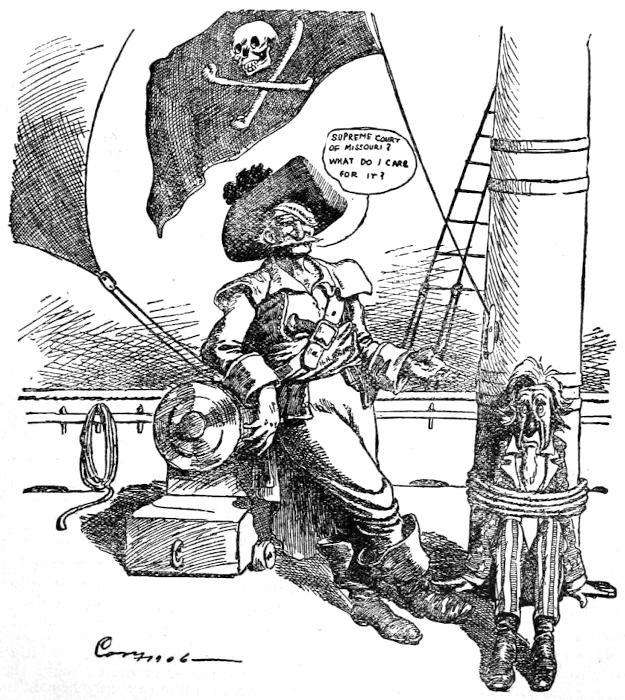
The Jolly Rogers
Cory, in N. Y. World
PIERRE, SANSCULOTTE BY LA SALLE CORBELL PICKETT.
You wonder why the world should
be so fair to me today—to me,
Pierre of the People, the poor
oppressed people, whose heart’s blood
has been crushed out until it rushed
forth in floods that cover the streets of
Paris with a crimson stain?
Even for me the sun shines today
and the flowers bloom with a fragrance
they never breathed before—the red
stains that clot the dust in the street
are great crimson roses blossoming
with a glory never before worn by
flowers.
“Pierre,” said Monsieur le Géneral,
“you are not a traitor to France, are
you?”
“No, Monsieur,” I said sturdily,
setting my teeth and giving him as
steady a look as he was bending upon
me.
I told the truth. We who would free
France from the rule of the aristocrats
are not traitors. Rather are they traitors
who would make of our nation a
stagnant pool of slavery and corruption.
Monsieur le Géneral looked at me
again, keenly.
“We may not agree upon definitions.”
“My definitions are from the book
of real life, Monsieur le Géneral. They
are always in agreement with the truth.
Monsieur knows, though, that he may
trust me for himself, however my definitions
may differ from his own. He
has not forgotten that I saved his life
once from an English sword. I know
the memory is graven upon the mind
of Monsieur le Géneral as deeply as the
scar is cut in my arm.”
“I think you love me, Pierre,” he
replied.
I laid my hand on my heart, bowing
till my head almost touched one of the
crimson roses in the velvet of Monsieur’s
carpet.
“More than my life, Monsieur.”
What could I say fairer than that, for
was not life the dearest thing to me then?
So matters stood with my lord and
me on that morning when he sent me
with a missive to Mademoiselle Denise.
To her or to another, what mattered it
to me? They were all young demoiselles
and, as such, of far less consequence
than the silver mounting of my
lord’s pistols or the flash of his gold-sheathed
sword.
As I crossed the courtyard a dark-eyed
page, idling by the fountain that
sparkled in the sun, was singing:
“By the garden-wall the rose blooms red,
And lifts to the sun its royal head;
There’s never a flower of such sweet grace
As the blossoming rose on my lady’s face—
Rose-red, flower grace,
Never a rose like my lady’s face.”
With that refrain ringing in my ears,
“Never a rose like my lady’s face,” I
went from the shining flood of sunshine
into a hall that seemed like dusky
twilight after the outside brilliance.
But in the centre was a space where
the sunlight drifted down through an
open window into a circle of radiance
and in the middle of it stood Mademoiselle,
a shining figure that dimmed all
other light. She was clad in white and
gold, and the long folds of her robe lay
in shimmering snow along the marble
floor. Her amber hair was like a river
that the morning sun-rays cross. Her
eyes shone like great sapphires set
under long lashes of gold and arched
over by golden brows. It was as if
the light of a thousand suns had centered
in one fair woman.
The scar, once a proud and happy
place upon my arm, burned as if a
coal of fire had been dropped upon it
and for one wild moment I could have
cut from me the arm that had interposed
to save the life of my master.
Then I knelt before her, when she had
waved her hand for my approach, and
presented the letter. She looked at it
carelessly and turned her eyes from it
to me where I knelt and beckoned me
to rise.
“Tell me of yourself,” she said in a
voice that was like the softest strain of
a lute. “Who are you?”
Who was I? Yesterday I would
have said a man. Had I not done a
man’s part in battle? Was it not a
man’s right arm that had stretched
itself forth to save a great life? Now I
was—nothing. There was not a grain
of dust in the streets of Paris smaller
than I.
“Nothing, my lady,” I said, not daring
to lift my eyes to her face, nor
scarcely to look at her hand lying like
a white lily on the snow of her gown.
“That proves you very much,” she
said, “for a man never thinks himself
nothing till he has a standard of merit
with which to compare himself and the
possession of such a standard is a proof
of worth.”
“I am only Pierre—the servant of
Monsieur le Géneral.”
With what pride I should yesterday
have avowed myself the servant of so
brave a soldier and so grand a gentleman.
With what hatred of him and
what contempt for myself did I make
that statement today. Did not the
great gulf between the gold and white
Queen of the World deepen and widen
infinitely with the significance of my
words?
“Monsieur le Géneral is fortunate.”
She wrote a line on a leaf from a gold
and white tablet and gave it to me,
sealed with a golden seal.
I bowed low and went out from her
presence with my face toward her. At
the entrance I lifted my eyes and looked
dazzled at the spot of light in the centre
of the great hall. Thus I passed out
into the courtyard flooded with sunlight
which seemed dim in comparison
with that supernal radiance.
The dark-eyed page had seated himself
on the rim of the basin into which
the fountain fell with a tinkling music
that kept rhythm with the song he was
still singing. With the refrain yet ringing
in my ears, “Never a rose like my
lady’s face,” I went back to Monsieur
le Géneral with the missive she had
given me.
A little later the blood of the Paris
streets spattered to the gold robes of the
court. I saw the head of Monsieur le
Géneral carried by me on a spike and
the dark-faced, ragged man who bore it
sang a ribald song as he looked mockingly
up into the face, one word of
which would have been his death-warrant
had it been uttered when that
head yet sat upon the stately shoulders.
For a moment a sorrowful thought of
the days when I loved him lay like a
cloud upon my mind, but what time
was there then for thinking of love—at
least of that love.
I left the crowd of raging demons and
ran across the courtyard where the
fountain yet tinkled merrily down into
the basin. No dark-eyed page loitered
there and sang of the red rose and his
lady’s face to the music of the falling
water. I dashed past the fountain
and ran into the great hall. It was
empty and there was the print of muddy
feet trampled over the marble floor.
I went to the Leader of the People.
“Where is Mademoiselle Denise?”
His wicked eyes flashed vindictively.
“Ah, Pierre, if you owe a grudge to
the aristocracy of France you can feed
to it now the most luxurious viands of
earth. Even she is offered to the vengeance
of justice and her head will
grace a pike as none other has ever
done.”
I threw myself down before him.
“Citizen, what has she done to you
or to France?”
“Done? She has done nothing.
She is. That is the crime of an aristocrat.”
I pleaded with him for the life of that
woman whose gold and white beauty
was the fairest thing I had ever gazed
upon and whose beautiful heart looked
out from eyes that showed all its goodness
and truth. Citizen Beauget had
received many services at my hands in
the days when I was near the powers of
the court because the favorite of the
king had owed his life to me.
“Eh!” he cried. “A citizen of
France seeking to save the life of one of
the oppressors of France? Ah, I have
it. If she will marry you, good Pierre,
her life is yours. Ha, the white and
gold lily of the court marry Pierre,
the Sansculotte! Beautiful thought!
Perhaps she will wish to save her life.”
Then I stood up before him and
looked at him with a scorn before
which he dropped his gaze.
“Citizen Beauget, Mademoiselle will
marry where she loves or kiss the cruel
‘Maiden of Liberty’ with pure lips
and a brave heart.”
But I took the paper he gave me and
went straight to the prison where she
stood, and even there space was bright
because of her. She turned and looked
at me and the glow that comes once to
a woman’s face was in hers when her
eyes fell on me.
“You have come to help me die,”
she said reaching out her hand.
I took the hand and fell upon my
knees and pressed it to my lips.
“Nay, not so, Mademoiselle. I come
to bid you live, if I read truly what is
written on your face.”
Hand in hand we went out into the
night and neither the terror of the
living nor the faces of the dead staring
up into the moon-lit sky marred the
peace that filled our hearts.
The New Party What Shall It Be Named? BY CHARLES Q. DE FRANCE Secretary People’s Party National Committee — A Wild Enthusiast — Unfinished
There are phenomena a-plenty,
said the New York World editorially
(December 31), “which
unmistakably foretell a new party and
a new issue in American affairs. It
comes in a multitude of shapes and
clothed in a multitude of garments.”
Coming from the source it does, this
utterance is significant. There is no
doubt about the existence of the phenomena,
but your conservative usually
delights in playing ostrich. Personally
I would like to question the accuracy
of the World’s forecast—for I contend
that we have now more political
parties than economic conditions warrant—but
regard for truth requires
affirmation instead of denial. The new
party is bound to come.
“Mr. Bryan,” the World continued,
“has already defined it (the new party)
in terms of triple state socialism—city
ownership, State ownership and national
ownership of all public utilities.”
Granting that this is correct, it is not
hard to see that a new party is superfluous,
for the People’s Party now covers
this ground; and the Democratic Party
has in places adopted a portion of the
program.
The public mind, however, is thinking
of a new party—and that settles it.
The arguments of a few feeble individuals
cannot change public opinion.
So let us accept the inevitable and try
to make the best of it.
The new party, it is safe to say, will
pre-empt a large portion of the ground
now occupied by the People’s Party.
It will declare for true democracy. It
will adopt one of two methods in making
its declarations. It may, in a few
well worded paragraphs, state fundamental
principles of democracy, avoiding
the peculiar isms of the various
factions which will be brought together
in the new organization; or it may
attempt to frame a plank acceptable to
each of the factions. It is needless to
say that the former will lay the foundation
for success, while the latter will
give rise to dissensions and result, finally,
in disintegration.
But I do not wish to suggest a platform
for the new party. Able men
will be present at its birth, and they
will know what to do. I do wish to be
heard, however, on the question of
name for the infant party.
Populists well know that for the
past four years I have fought persistently
against changing the People’s
Party name. I have freely admitted
its faults, but have insisted that a faulty
name is less dangerous than a change.
The organization of a new party presents
a different problem. A new name is
necessary.
What shall it be?
Viewed superficially there are many
good names which might be adopted;
but when subjected to careful analysis,
the number dwindles down to a very
few. I take it that the name should indicate
the predominant feature of the
party; that it should be but one word,
and that word short, preferably of three
syllables, not explosive or difficult to
pronounce, but capable of being uttered
easily; that whether used as noun or
adjective no change is necessary; that
it should not be an unusual or a newly
coined word, but one the meaning of
which, in its generic sense, is now well
understood by, or at least familiar to
the public.
A year or so ago a writer in The Public
(Chicago) suggested Isocrat, one who
believes in equal rule; and Orthocrat,
one who believes in good rule—both
charming names but violating what I
believe to be very important: that the
name should not be unusual, newly
coined, or unfamiliar to the public.
Isocrat, isocratic, isocracy; orthocrat,
orthocratic, orthocracy. Ingenious inventions,
but hardly suited to our purpose.
Several persons in the past few years,
notably Rev. John V. Potts, of Ohio,
have made good arguments in favor of
“The People’s Democratic-Republican
Party.” I shall not discuss this further
than to suggest that a 27-letter
name is too long; and that to designate
a member of the party would require a
hopeless amount of circumlocution.
“Home Rule,” “American,” etc.,
have been suggested; but a little
thought will disclose their weak points.
I suggest the good, old word Radical.
Nine men out of every ten today—who
would likely become affiliated with
the new party—will, when questioned
as to their political belief, generally preface
their remarks by declaring, “I am
a radical.” Why not give them an
opportunity to say it with a capital R?
The Radical Party; a Radical;
Radical measures; Radicalism.
Not so many years ago the suggestion
of this name would have aroused a
storm of protest—but it is different today.
Then a radical was looked upon
as a rash man, if not, indeed, a revolutionist.
Men coveted the distinction
of being regarded as conservative. To
put a radical in an important public
office, as Governor, for instance, would
“drive capital out of the State.”
Only a “con-ser-r-va-tive” (how they
did roll that r) could prevent things
from going to the demnition bow-wows.
Today it is almost criminally libelous
to call a man “safe and sane,” so
great a change has come over the public
mind. The words “radical” and
“conservative” have come to be understood
in a new light. The new meanings
have quite obscured the old. A
“conservative” is looked upon today
as the beneficiary, as principal or agent,
of some special privilege—franchise,
tariff tax and the like—which gives him
the power to absorb wealth produced
by others, without rendering an equivalent
therefor. Naturally, he desires
to “conserve” this unfair advantage—for
civilization has by no means eliminated
the wolf in man—and is, therefore,
opposed to radical change. He is
a conservative, a stand-patter, a let-well-enough-aloner.
I make no claim of altruism for the
radical, and am inclined to look with
suspicion upon the man who prates
overmuch about doing everything for
others and nothing for himself. Self-preservation
is the first law of Nature,
and man hasn’t learned how to repeal
it. Besides, it isn’t necessary, even if
we knew how. But there is selfishness
and selfishness. Conservative selfishness
means to build up one’s self at the
expense of others; radical selfishness
has for its motto, “Live and let live.” In
other words, by promoting the general
welfare, I can best advance my own
interests.
But, for the sake of argument, let us
admit that men are alike in their selfishness;
that all are wolfish, whether conservative
or radical. Common sense
teaches us that only a comparative few
can be the beneficiaries of special privileges.
If we all possessed equal powers
to rob, conferred by legislation, the result
would be about the same as though
none of us possessed such powers. The
former alternative is, of course, impossible;
for a special privilege would
cease to be such if made general. But
the latter is possible. Let us frankly
confess that the radical would be a conservative
if he could become the beneficiary
of a special privilege. Given
the opportunity, I feel sure he would act
much as other legalized robbers do.
I believe we have indulged in too
much denunciation of the beneficiaries of
special privileges, the legalized plunderers,
and paid too little attention to
the criminal ignorance of the great
majority who permit themselves to be
robbed. I believe we should admit that
the masses have acted as “them asses”—and
resolve to quit playing the fool.
That’s why I suggest the name Radical
for the new party. It means a going to
the root of the trouble and uprooting
it. It means a change which will hurt
the pride of a few, because they can no
longer hoodwink and rob their tens of
thousands under guise of law—a change
which will benefit the pockets of the
many, because they will no longer be
picked by legal enactment.
And this would be a radical change.
Let it be made by a Radical party.
“He——?”
“Oh, he is the kind of a chap that would try to blow up a balloon
with baking-powder.”
Johnny—Mamma, I was having such a nice dream when I woke up.
Mamma—Were you?
Johnny—Yes. I wish there was some way I could go ahead with that dream.
The Municipal Boss By W. D. Wattles
The present revolt against bossism
and the recent destruction
of several of the strongest
and best constructed machines, naturally
suggest the question as to the
permanence of the results. The vital
problem now is whether the boss will
rise again, or whether a new one will
come in his stead. To know the answer
we must understand the causes
and conditions which bring the boss
into existence.
The supposition that the boss arises
by virtue of his strong personality;
that he is an organizer, a general, one
born to command; that the “machine”
is the product of his skill and genius,
and that no one who does not possess
the same elements of character can
follow him, is wrong. The municipal
boss is an effect rather than a cause.
He is the product of certain forces,
working under certain conditions, and
so long as the forces are unchecked
and the conditions unchanged, a new
boss must inevitably be created to fill
the place of every one the people may
dethrone.
In municipal politics, the boss comes
into being at the point where the criminal
rich come in contact with the
criminal poor. The criminal rich desire
franchise privileges, which are
among the most productive and valuable
of all forms of property. How
valuable they are may be better understood
if we remember that a recent
conservative writer estimates the franchise
values of Greater New York at
four hundred and fifty millions of
dollars, a staggering sum, but the real
market value of actual property which
has been virtually stolen from the
people. Property, too, of great earning
power as compared with most
other investments, capable of paying
almost unlimited dividends; and often
giving its possessors control over all
other branches of business, even over
life itself. And this property, amounting
to half a billion dollars in New York
alone and to an incalculable sum in the
cities of the whole United States, has
been appropriated by the criminal
rich through the agency of the municipal
boss.
In order to consummate these thefts,
the franchise grabbers must have a
purchasable city council. To elect
and maintain a purchasable city council
two things are necessary: a division
of the “good” citizens against each
other, and a boss to unify and keep
solid the criminal poor as a balance of
power.
The “good” citizens—by this term
I mean the great mass of fairly well-meaning
people—are kept divided by
the extension of national political interests
into municipal affairs. This
division is the first condition essential
to the development of the boss.
The criminal poor—meaning not
merely professional criminals, but all
who gamble, get drunk, have occasional
fights, and are liable to get into trouble
with the police—having with them
the saloons, dives and all the hosts of
graft and shady business, hold the
balance of power. The boss maintains
his hold upon them by means of
his ability to help them out of trouble.
The first step of the boss must be to
corrupt the police force and the justices’
courts. This is not hard, for the police
and the justices are usually very anxious
to be corrupted; it pays them
much better to be corrupt than to be
honest.
So the boss comes in as a business
agent between the criminal poor and
the police, enabling the criminal to escape
punishment, and the police to get
rich by sharing in the profits of crime.
Under this régime the criminal poor
are permitted to prey upon society by
dividing their spoils with the police.
The power of the boss is in his ability
to withdraw his protection from any
individual who may waver in his political
support. The boss never preys
upon the poor, whether criminal or not,
he is always a friend in need, a refuge
in time of trouble to those who follow
without questioning.
By means of this following he elects
his henchmen to the city council; and
so it is to him that the criminal rich
must come when they want to appropriate
franchise property. The boss
really steals the franchise and sells it
to the rich.
Thus, under the boss régime, both
the criminal rich and the criminal poor
are permitted to prey upon society.
We understand, now, that the municipal
boss is the product, first, of the
political condition which keeps the
good citizens voting against each
other; second, of the condition which
makes possible the private ownership
and control of municipal public
utilities; third, of two forces, equally
desirous of preying upon society—the
criminal rich and the criminal
poor.
And it is evident that so long as the
conditions continue and the forces are
permitted to operate, the creation of
new bosses is inevitable.
It is only possible to hold the good
citizens together in independent
organizations in a very spasmodic and
uncertain fashion so long as the party
system prevails in national politics,
but it is always possible to unite them
on any one question by means of the
referendum. Therefore, the first condition
may be changed by the enactment
of laws requiring the submission
of all franchise questions to the popular
vote. On a referendum, the good
citizens of all parties, if they vote intelligently,
will present a united front
to the forces of graft. This will prevent
the consummation of new thefts, but
it will not restore the property already
stolen, except by the slow process of
awaiting the expiration of the present
franchise grants.
The second condition may be removed
by training the people in
knowledge of the practicability of the
municipal ownership and operation of
public utilities. Until the people believe
in municipal ownership as a
practical possibility, it is impossible;
once they do believe, and are ready,
it is probable that the laws of the States
for the recovery of stolen property
will be found sufficient to bring about
the restoration to them of all that is
rightfully their own.
At the end, we always come to the
proposition that to check the forces of
evil we must eliminate the profits of
evil doing. There is no other way.
By this plan, the social problems in
which the municipal boss appears will
be found easy of settlement, and possibly
those connected with the state
and national boss also. For they, like
their prototype of the city, are not the
great personalities we have deemed
them, but merely the products of
conditions easily changed and of forces
amenable to control.
The Silence of Johnny BY Harriette M. Collins.
“Is the letter from Johnny, Mary
agra?” The pathetic appeal in
Mrs. Ryan’s quavering voice,
and the heart-hunger expressed in her
wrinkled, parchment-like face brought
a lump to the throat of her daughter
as she replied:
“No, mother darlin’, it’s from Andy
this time.”
“Why doesn’t Johnny write, an’
why doesn’t he come an’ see his poor
ould mother afore she dies?” the old
woman wailed. “Och, but me heart
is sore wid the longin’ for me darlin’
boy, an’ me ould arrums is achin’ to
hould him agin! Niver a word from
him this three years, come Chrisymas!
It’s not like Johnny! It’s not like
Johnny at all, at all!”
“But, mother achree, Johnny doesn’t
forget you,” Mary answered soothingly.
“An’ he never forgets to
send you two pounds every three
months by Liza, or Andy, or Katie.”
“I know it, Mary. Johnny was always
a ginerous boy: but it’s not his
money I want, but himself back agin!
Shure I’d rather beg wid Johnny than
own the wurruld an’ all wid-dout him!”
Mrs. Ryan answered. “Read Andy’s
letter for me, Mary acushla.”
While Mary Ryan read aloud the
letter which she had just brought from
the village post-office, her mother
gazed yearningly over the restless expanse
of dark blue ocean, which
stretched away to the crimsoning west.
With dreamy eyes, which saw but
heeded not, she watched the hovering,
screaming sea-gulls, the white-sailed
fishing-smacks and the long, black
streak of smoke that, far away on the
horizon, marked the course of an outward-bound
steamer.
For many years Mrs. Ryan had
been in the habit of sitting on the rude
bench by the door of the cabin, that
was perched high up on the rugged
hill-side, and watching the steamers
as they came and went.
Four times during those weary years
the mother’s heart within her had
grown numb with pain as she saw the
black streak fade in the distance and
knew that one of her darlings was being
borne away from her.
Andy was the first to leave the overcrowded
cabin and seek work in the
grand land of plenty across the water.
In a year, Andy sent the passage money
for Liza, and, in another year, Liza
sent the passage money for Katie.
Then Johnny, the idol of her declining
years, kissed his mother good-bye and,
with cheery, hopeful voice, promised
to return to her in two, or at most,
three years. With that dumb resignation,
sometimes born of a sense of
hopeless inability to cope with circumstances,
Mrs. Ryan had watched him
wend his way, with many a backward
glance and wave of the hand, down the
narrow zig-zag path to the village and
the train for Queenstown, where the
merciless steamer waited to bear him
away forever from her loving arms.
She remembered still how the sunbeams
had glinted upon his auburn
hair that morning, and how handsome
he had looked in his new tweed suit and
green tie. She thought of the tears
that had welled up in his blue eyes
when she gave him her parting blessing,
and she recalled the silent anguish with
which she had sat by the cabin door
and watched the black steamer, silhouetted
against the golden sunset and
slowly disappearing in the distance.
It had been hard to see the others go,
but Johnny—what would life be without
Johnny?
That was five years ago. For two
years Johnny had written regularly,
telling of steady work and good wages,
and promising to come home for a vacation
as soon as possible. Then there
came a short, badly-written note enclosed
with a letter from Andy, and
after that—silence.
Andy and Liza and Katie wrote
regularly and sent money for the support
of their mother and Mary. It was
Mary’s mission to remain in the Old
Country and take care of the feeble,
aged mother.
Every three months, Andy or one of
the girls sent an order for two pounds
and wrote that Johnny sent it with his
love. That was all. They never
answered the questions concerning
Johnny, his doings and his whereabouts
which Mary repeatedly wrote at her
mother’s behest.
“Is that all, Mary? Is there nothing
at all, at all about Johnny?” Mrs.
Ryan queried in disappointed tones,
when her daughter had finished reading
Andy’s letter.
“There’s not a word in it about
Johnny, mother darlin’,” Mary answered
reluctantly.
“Andy said Nancy Quin is comin’
home on the boat that gets in Saturday,
didn’t he?”
“Yes, mother,” Mary replied,
“Nancy is comin’ to spend a month
with her people.”
“An’ Nancy Quin lives out in the
same family as Liza?”
“Yes, mother; she’s parlor-maid
where Liza’s cook.”
“Then, plaze God, Mary, when
Nancy comes to see me I’ll larn the
truth about the onnatural silence of
Johnny! Och, but he was the darlin’
boy—always so gay and pleasant!”
There was a brief silence, after which
the old woman drew a worn and yellow
sheet of paper from beneath the plaid
woolen kerchief that was folded across
her bosom.
“Read it for me, Mary agra,” she
said sadly, “read it for me agin—the
last letter from Johnny. God bless
him, wherever he is, this day an’ night!”
Mary held the frayed and faded sheet
before her eyes. The writing was almost
illegible and the paper was worn
into holes where it had been folded,
but she knew the words by heart and,
as if conning a familiar lesson, repeated
them slowly:
“Dear Mother. Don’t fret if I don’t write.
I will sind money to you now an’ agin by
Andy an’ the girls. Mebbe if it’s God’s
will we’ll meet before long. God bless you,
mother darlin’. Goodbye from Johnny.”
“Three years an’ niver a word from
him!” sighed the old woman, as she
again laid the long-treasured note in
its accustomed place over her heart.
“Och, but me ould eyes is achin’ for a
sight of him—me darlin’ boy!”
The sunbeams were glittering upon
the wide, heaving expanse of ocean
which lay between Mrs. Ryan’s cabin
and the great Western world whither
her children had gone.
Sitting upon the beach by the open
door, the aged woman watched Nancy
Quin laboriously climbing the steep,
zig-zag path which led to the cottage.
When the visitor reached the door and
the usual salutations had been exchanged,
Mrs. Ryan steadfastly fixed
her eyes upon the girl’s face and asked:
“In the name of God, Nancy Quin,
why doesn’t Johnny write an’ why
doesn’t he come home?”
“Arragh, thin, Mrs. Ryan, darlin’,
how should I know that? I haven’t
laid me eyes on Johnny these three
years.” Nancy answered evasively,
but her embarrassment and the compassion
in her voice were not lost upon
her questioner.
“Don’t lie to a poor, ould woman,
Nancy acushla,” Mrs. Ryan entreated,
“but tell me, God’s truth, where me
boy is an’ why he doesn’t come to me?”
For a moment Nancy Quin looked
with infinite pity into the anxious,
wrinkled, pleading face, then, dropping
her eyes before the old woman’s wistful
gaze, answered brokenly:
“Don’t fret yourself about Johnny,
Mrs. Ryan agra. You’ll soon see poor
Johnny; you’ll be wid your boy before
long,” and turning away with a stifled
sob, she entered the cabin in search of
Mary, while Mrs. Ryan sat very still
upon the bench and gazed with tearless,
unnaturally bright eyes out upon the
bounding, white-crested waves of the
Atlantic.
“Oh, Mary acushla, she’s read it in
my face!” Nancy cried in remorseful
tones, “an’ I promised I’d keep it from
her.”
“Keep what from her?” Mary asked,
anxiously. “Is it anything about
Johnny, Nancy agra?”
“Yis, Mary,” Nancy answered sorrowfully,
“Sure an’ it wrings me heart
to tell you. Poor Johnny was killed—run
over at a crossin’ three years ago.”
“An’ why didn’t they let us know?”
Mary sobbed, “Where was the use of
deceivin’ us?”
“It was the poor boy’s wish,” Nancy
replied tearfully. “They took him to
the hospital and kept him alive for a
day, an’ before he died, he made Andy
an’ the girls promise they’d never let
his mother know of his end. He had
a hundred and fifty dollars saved to
take him home an’ he bade them sind
it to her a little at a time wid his love.
His last words were ‘Don’t let poor
mother know! It would kill her! Don’t
let poor mother know!’”
There was a long silence, broken only
by the subdued sobbing of the girls.
At last Mary said, wiping her eyes with
her apron:
“By the help of God, Nancy, we
must still keep it from mother. She’s
not long for this world, an’ Johnny,
poor boy, was the light of her eyes!”
Going out of the cabin, they found
Mrs. Ryan still seated upon the bench.
“Mother darlin’,” Mary said softly,
“it’s growin’ cold, an’ you’d better
come in for your cup of tay.”
There was no answer. A smile of
ineffable peace lingered upon the aged,
care-worn face. In the faded blue
eyes, whose unseeing gaze was fixed
upon the merciless ocean which had
taken her darlings, one by one, from
her arms, shone the wondrous light
“that never was on sea or land.”
To his mother, the silence of Johnny
was no longer a mystery. He had not
come to her, but she had gone to him.
Letters From The People
Our readers are requested to be as brief as possible in their welcome
letters to the Magazine, as the great number of communications
daily received makes it impossible to publish all of them or even
to use more than extracts from many that are printed. Every effort,
however, will be made to give the people all possible space for a direct
voice in the Magazine, and this Department is freely open to them.
John Nill, Watertown, N. Y.
Your criticism on prevailing evil conditions
is justly and emphatically to the point.
But I would call your attention to the
world’s experience that at no time has a reform
taken place unless new ideas, new
methods for reform comprehensive to the
public for relief and improved conditions
were introduced at the same time when the
old deplorable affairs were condemned. To
excite the multitudes without a proper and
thorough education on social and national
relations calculated to promote peace, harmony
and prosperity, is dangerous. Look at
Russia. If you will add as many correct and
direct advices to the general public as you do
criticism, you may be successful in initiating
a reform that may far surpass any in the
past ages.
J. B. Phillebaun, Mountain Grove, Mo.
To say that I endorse the principles advocated
by the magazine puts it mildly. The
old parties must be checked or we are politically
and financially ruined. You have
started in the direction. You have got the
people thinking and that is half the battle.
Push the good work already started and I
hope victory will crown your effort. I want
to go on record as a firm believer in Tom
Watson principles.
J. F. Winterbottom, Washington, Ind.
I have received every copy that has been
printed. Just as soon as I have read them I
let others have them. I am well pleased
with the Magazine.
W. J. Alford, Molena, Ga.
The Magazine is fast eliminating political
ignorance throughout America, which, in
fact, is the pillow upon which rests the great
evils we suffer.
William Putnam, Downing, Tex.
Your Magazine is a wonderful power because
all classes of our people read it, and its
truth is so plain and reasonable no one can reject
it, let their politics be as they may.
J. W. Oliver, Kissimmee, Fla.
I have read each issue of your Magazine
and all in each issue. Sometimes I do not
agree with you but you are trying to keep on
the right track, and come very near to staying
in the “middle of the road.” I am a native
Alabamian and a Democrat of the “Moss
Back” kind.
Go ahead. I am with you and if necessary
will vote with you, independent of my party.
Edgar J. Hadley, Arkwright, R. I.
Have taken your Magazine from the first
number and would not be without it at any
price. As an educator it is A No. 1. I
wish that every wage earner could be gotten
to read it. No one can read the splendid articles
it contains without becoming a more
intelligent citizen.
The only alteration I would suggest is a
little better cover.
E. Simmons, Mt. Leonard, Mo.
I have read every number from the first
number. I shall never vote either of the old
party tickets again. I am 83 years old next
Tuesday. My health is failing. I think we
ought to unite with Prohibitionists, for the
sale of intoxicants is about as big an evil as
we have and we have got the great whiskey
interest to overcome before we can get into
power for both the old parties are their
friends. Yes, my dear brother, I am with
you. With my little influence I will do what
I can.
H. D. Cope, J. P., Rogers, Ark.
I received your copy of Tom Watson’s
Magazine and think she is a dandy. I hope
you succeed. I see some of the Pittsburg
papers kicking on it and asking why it is allowed
to pass the mails.
J. W. Murphy, Grove Hill, Ala.
I think Tom Watson’s Magazine is a good
one. The editorials are the biggest things I
ever saw. I don’t like such stories as “The
Gray Weed,” “The Tiger God,” etc., etc.,
but I like Tom Watson and all that I have
read from his pen. My wish is that Tom
Watson may live long to ring that “Liberty
Bell” until the people shall awake and rise
in their might and throw off their shackles.
Panola Watchman, Carthage, Tex.
We appreciate your magazine very much,
especially the articles from the pen of Mr.
Watson and, while he lambasts the party to
which we belong, much of it is deserved and
we hope he will continue to lay on until
prevalent evils are corrected.
Sam J. Hampton, Durant, I. T.
I have been reading your magazine ever
since the first issue and I think it the clearest
boldest and most fearless journal in America.
I shall continue to read Watson’s.
T. J. Anderson, Blossom, Tex.
I have never had the pleasure of meeting
you personally, but have known of you ever
since you entered Congress in 1892. Since
that time I have eagerly sought to read all
you have said and written. Being strictly
in accord with your political views, I greatly
admire the firm stand you have taken in
alleviating the burden from the masses of
people, your honesty of purpose and the plain
and outspoken way you have in presenting
your views. I have had the pleasure of voting
for you twice and yet hope to see you
elected our national executive. The crowning
act of your life was your work in the last
election when you took our banner from the
dust of fusion and confusion and unfurled it
to the breeze, and fought the battles of reform
practically alone. May you yet receive
your reward.
As to your Magazine, I subscribed for it
before it was ever printed. Am well pleased
with it. Have no improvement to suggest.
I quit the Democratic Party in 1890. Have
only made one mistake since and that was
when I voted for Bryan in 1896.
L. P. Sullivan, Emmet, Ark.
I like it splendidly and it gets better every
copy. I could not do without it.
Long life to you.
F. M. Martin, Mt. Moriah, Ark.
To say that I like the Magazine is only putting
it lightly. It is the only political gospel
I know of being published at present. Love
to have it read in every home in the United
States. Then have every one act upon its
teachings. I know of no way of making it
better unless advocating return to Africa by
American Africans. That subject seems to
be neglected, though I don’t know that I
could write on that subject to any advantage.
Go on with the great work. It will eventually
accomplish the desired result.
Edward H. Hotchkiss, Seattle, Wash.
I am very much pleased with your Magazine.
I have got it from the news-stand
from the first copy to the present. I don’t
know how I would get along without it for
every number is better than the last. I think
it’s the best book of Education that is published.
Its principles are right and just to
all, and I wish both of the old parties would
take a few doses of the medicine prescribed in
your book. I think they might be cured of
some of their corruption.
K. D. Strickland, Carlton, Ga.
I think Tom Watson’s Magazine contains
more profitable and really more necessary
information for the American citizen than
any other publication. It is a regular monthly
feast to read his pieces. In reading his
pieces, I am made to feel as though I was
communicating with the supernatural.
I wish to call Mr. Watson’s attention
through his Magazine to his physical health.
Take care of your health, Mr. Watson. We
need your wonderful mental power with good
health behind it. You are so completely
absorbed and enthused in your great work
for the people, you might over-tax the brain
and bring on a collapse: that would be a
national and incalculable misfortune.
Amos H. Edwards, Bentonville, Ark.
I think it a very able and valuable Magazine.
Frank Holland, Cement, Cal.
Yours of recent date received. As I wrote
to you some time ago, I am a migratory cuss,
and therefore rely upon the news-stands for
my magazine. I read Watson’s, Everybody’s
and McClure’s, regularly, and any others that
in glancing over, interest me. I have no time
to read stories. What I want is political and
scientific.
I like Watson’s. Prize it highly and after
reading it, treat it as I do all the others, i. e.,
hand it to someone else to read. I cannot
suggest any way in which your work can be
improved. I will do what I can to induce
others to read your Magazine.
S. M. McDougal, Arkinda, Ark.
I think it all right. Just what we need.
I don’t see that I can add anything better to
it. I am doing all I can for you.
I am 60 years old, and have been a
reformer ever since Tilden ran for President.
I said then there wasn’t a hair’s
length difference in the old parties.
John S. Van Dyck, Van Dyck, Tenn.
Your Magazine is simply grand, glorious,
rich and racy. It makes ’em wiggle.
I consider Tom Watson the grandest,
greatest and most brilliant man of this or
any other age, and may God grant him
strength to continue the fight for human liberty
and human right until the fight is won.
C. E. Skinner, Modoc, Ind.
I am very much interested in the wave of
reform that is sweeping over our country as
indicated by the recent elections. Keep
hammering away, Bro. Watson, you have
my entire sympathy and support.
M. E. Rose, South Rutland, N. Y.
I think your Magazine is doing a great deal
of good in waking up the dull minds of the
common people, which I hope in 1908 will
sweep the cussedest set of rascals into—well,
say the penitentiary.
George S. Harley, Laurel, Ind.
I think it is “just about right.” It just
suits me. I can’t see how it could be made
any better. The last number (December) is
worth the price of a year’s subscription. It
is full of good things.
E. E. Ropes, Deland, Fla.
I am a Massachusetts Yankee, a Republican.
I served under Jim Lane in Kansas;
under Sherman in Georgia. When I first received
your magazine I told your old school-mates
Alex and Lee Morris that I might vote
for you for President. It seems, however,
that you oppose protection. That lets me
out. I believe every honest, intelligent, patriotic
American is a protectionist.
Jonas Welch, Oakdale. La.
I do not think that it could be improved.
All it needs is for the people to read it more
and educate themselves on the reforms that
the Populists advocate.
A. H. Ellis, Hayward, O. T.
I have been a reader of your splendid Magazine
from the first issue. I saw by the papers
prior to the time you commenced your
publication that you were going to edit a
magazine. I immediately began to plan to
stop the circulation of a 50-cent dollar long
enough to get it to you for one year’s subscription,
but son beat me to it, he having no
taxes to pay, nor no overalls to buy, went
barefooted, wore a seven cent straw hat and
a thirty cent hickory shirt and saved his money
and sent it in to you while I was sweating
blood trying to pry a money lender loose
from one of his idols.
I’m glad to know that I am not disappointed
in the character and make-up of your
magazine. You call a spade a spade. You
did that while you were in Congress and it is
a reproach to the grand old Commonwealth
of Georgia that a hide-bound, moss back, clay-eating
democracy could not have been broad
enough to have let you stay in Congress.
Who was the man that defeated you? I
don’t know. I doubt if his name is known
outside of the Congressional District. Georgia
has produced but four men that have
challenged the serious attention of the people
of the country. Viz:—Old James Oglethorp,
Alexander Stevens, Bob Toombs and Thomas
E. Watson.
I see that many of your correspondents
hope to see you President. No, Thomas,
you will never be President of the United
States. Why? First, you are too big, have
convictions and the honesty and courage to
express them. Second, too many fools (with
an adjective prefixing “fools”). Your editorials
are very fine. I have seldom read
anything finer than “Dropping Corn,” “A
Tragedy in a Tree-top.” Then there is your
insurance policy which is a source of joy.
“Monarchy Within the Republic” by Mr.
Fox was instructive. The cartoons are superb.
The McCurdy family, in your last,
conveys the idea that the McCurdy’s are
“agin” race suicide, but you must remember
that sapsuckers are more numerous than
eagles. You very skillfully put the good to
Bryan, but say what you will, he stands head
and shoulders above any other Democrat of
this day. Compare him, if you please, to
Alton B. Parker. When I hear the name of
Bryan, I think of the American Eagle soaring
the blue ether of Heaven. When I hear
the name of Parker, I think of a tomtit sitting
on a watering trough.
Best wishes for Thomas Watson’s Magazine
and a long life for its brainy, honest and
fearless editor.
Orlando K. Fitzsimmons, Buffalo, N. Y.
I have taken your magazine from the first
number and am much pleased with the good
work you are doing.
Warren Beebe, Burlington, Ia.
Of several magazines which I read, I like
yours the best.
Katharyne Clarke, North McGregor, Ia.
I have read every issue of your Magazine
since the beginning and would like to say a
word of praise. Your work and efforts are
casting seed that will surely cause “two
blades of grass to grow where before there
was only one.” Success to you.
H. V. Hill, Kell, Ill.
I like your Magazine above all others.
Keep up the good work.
An Old Reformer.
Your magazine read and reread in my
home every month by myself and five grown
sons. We all admire the principle set forth
in your grand editorials and know that what
you say is truth, but I do think that you are
a little too harsh and a little too personal
when you speak of Cleveland, Rockefeller,
Ryan, Belmont, Morgan, McCarren, Taggart
and others of that class. You know that
poor human nature is the same the world
over and if we were to kill out these men
whom you handle so roughly, others would
soon take their places. So then the system
which brings this state of affairs about in our
government is to be blamed more than these
men. Therefore, let’s strive (in the right
spirit) to remove the evils which beset us as
a Christian people. “Vengeance is mine,
saith the Lord.” And besides, I want you to
live long and lead this grand fight for reform,
but when I read your cutting editorials I
shudder for fear some of these people may
have you assassinated.
I address you as “dear comrade” because
I am getting to be an old man now and enlisted
in this movement for reform away
back in the palmy days of the Grange, and
myself on the “Ocala Platform”, believing
it to be just and in line with the principles
later on, under the Alliance banner, planted
our Revolutionary sires fought for, and I am
proud to say that out of fifty odd Congressmen
who were elected on that platform, Tom
Watson is the only one who remained true,
and I admire every red hair on your head for
your loyalty and bravery, and have always
voted for you when an opportunity was
offered, and if I were called upon to make a
national ticket of men whom I believe to be
true, it would be,
- Tom Watson,
- Theodore Roosevelt,
- Gov. Folk,
- Frank Burkitt,
- Gov. Vardaman,
- Scott Hathorn,
- W. R. Hearst.
D. L. Anderson, Soochow, China.
My son was on a visit to the States last
summer and he sent me your books—“The
Story of France,” “Napoleon” and “The Life
of Thomas Jefferson.” The books reached
me during the summer holidays, and as
new books are somewhat scarce out here and
yours moreover looked so inviting, I began to
read the day after their arrival, and day after
day this reading continued until I had gone
through the four volumes.
On finishing the last volume I purposed to
write and thank you for the pleasure you had
given me through your books, but the fall
term of the University opening about that
time I was very busy and so did not write.
But now I wish to thank you for a very
pleasant summer, for the enjoyment and instruction
I received from your excellent
books. New light has been thrown on
France and her relations to the other powers
of Europe, especially to England. Napoleon
becomes, to me at least, a new man in your
hands. Your “Thomas Jefferson” is a
much needed antidote to much of the history
that has been written and gives a clear
view of the man and his times. Especially
would I thank you for your statements with
reference to the formation of the Constitution
of the United States, also for your explanation
of the “Genet Affair.”
In one or two allusions that you make to
affairs out here, you have evidently been
misled by the newspapers. In your “Napoleon,”
page 215, you say:
“In the year 1900 Russians, Germans and
other Christians invaded China to punish
the heathen for barbarities practiced upon
Christian missionaries.”
I don’t think that you state correctly the
real object of this invasion of China. The
missionary’s part in this Boxer affair was to
suffer. Not only were many murdered, but
both those who were murdered and those
who escaped were made the “scape goats”
in the eyes of the world. I enclose a slip
that recently appeared in one of the Shanghai
papers that gives the true genesis of this
Boxer trouble. The armies of the different
nations did not “invade China to punish the
heathen for barbarities practiced on Christian
missionaries,” but they came to rescue
their respective ministers, who by their
blundering policy had gotten themselves
shut up in Peking. If these officials had not
been in Peking the armies would never have
come. I don’t know of any Government
that cares quite that much for a missionary,
though they all seem quite ready to use a
murdered missionary to advance their land-grabbing
schemes.
Again on page 218 you mention that Admiral
Seymour ordered his wounded killed,
etc. This was published in the papers at
the time, but there never was any truth in
it. It was simply one of the many horrid
stories that went out from Shanghai during
those dark days—manufactured in Shanghai.
And now, Mr. Watson, I trust that you
will pardon me for inflicting you with this,
but I felt that I ought to write and thank
you for those books. I trust your pen will
not rest. I sincerely wish that you would
do for Germany or for Italy what you have
done for France.
W. E. Brown, Gainesville, Fla.
It is a splendid work you are doing. Your
Magazine is a live wire and you are a powerful
dynamo. The good you and Bryan are
doing can never be reckoned or measured.
You are right, and right is the most powerful
force in existence, because God himself is the
author and is behind all right. May you
live to see your work crowned with success.
While touching up other things, don’t forget
we poor farmers of Florida. Between high
freights and commission merchants we catch
it. I am what you might call a one-horse
farmer, but every year I pay the railroad
$2,000 to $3,000 freight on stuff I make to
get it to market to say nothing about the
freight I pay on what I buy. I would like
to make a trade agreeing to give one-half my
stuff to get the other half to market and sold.
And when on account of delays or for want
of ice or any cause not traceable to downright
negligence our truck arrives in bad condition
and is sold for freight the railroad takes it
all. I had one year 102 baskets shipped
over one line and 15 over another. The 15
sold for $3.00 per basket, the 102 were refused
because the car was not properly iced on the
way to New York and arrived rotten, and I
never got a penny. A piece of negligence,
but could not be proved. This is by no means
an unusual case and every truck farmer in
the state, I guess, could make such a complaint
or one equally unjust to the shipper.
But the railroad agent for the A. C. L. at this
place, so it is commonly talked on the streets,
absconded with $2,000 of rebate paid to him
by the railroad to be paid to a big phosphate
concern here, and there is nothing doing.
They say he won’t even be arrested and, of
course, the railroad and the receiver of
stolen money will not be punished, although
I was told by an attorney of this city that
the railroad commissioners were notified
of the facts in the case.
So I say, God speed you, and may you be
the means of accomplishing great good for
this, our glorious country—too good to be
wrecked by sordid greed.
J. S. Pearson, McEntyre, Ala.
I had a sack of one bushel of oats (32 lbs.)
price 75 cents and 20 cents worth of seed (all
in one cash) sent by express from Birmingham,
Ala. to Thomasville, Ala. (a few hours
run by rail). I had to pay $1 charges and
part of the oats were eaten (I suppose) by
rats. I shipped a box of pears (50 lbs.) from
Thomasville, Ala., to Braidentown, Fla. I
was told by clerk or agent the express charges
were $2.00. I told him I would not pay such
a charge. Another clerk or agent looked in
a book and said the charges were $1.00. I
paid it. That was on Friday. The pears
reached Braidentown, Fla. Tuesday. They
should have been in Selma or Mobile Saturday
morning, and where they were from then
until Tuesday we know not. A letter saying
the box had been opened and a part of the
pears taken out was received yesterday.
Have I no redress? I wrote to the Mayor of
Birmingham to know if such thieving was
allowed in his city.
N. W. Rogers, N. Y. City.
I have read, with increasing interest, all
the issues of your very excellent Magazine,
and it gives me pleasure to express my appreciation
of the effort you are making to
educate the public.
The task of one who is endeavoring to expose
corruption and corporate greed is, as I
know from personal experience, a discouraging
one; nevertheless I have a firm conviction
that justice must finally be meted out
to the smug respectability that has been
robbing the whole country. The loathsome
and criminal devices resorted to by our
would-be aristocracy, in their greedy desire
to acquire money, merits a more active opposition
than that brought about by a public
exposure of their crimes. Complete restitution
of all funds wrongfully acquired in the
exercise of an extortionate monopoly would be
but a small punishment.
I wish you all success in your endeavors
and only regret that I cannot at the present
time take an active part in the campaign.
F. Schweizer, Woodlawn, Nebr.
Even Diogenes with his lantern would
in vain search justice in this country. To
tell the truth in this country is punished as
lese-majesty. Therefore I may be hung for
lese-majesty, but I don’t care.
I was born and raised in free Switzerland
and I will die as a free man who dares to
express his honest opinions. If I am wrong,
show me my errors. It really seems that
people never will hear and accept the truth,
until some fellows have been hung for telling
the truth.
Let us be honest and acknowledge that
our so high praised Christian civilization is
a total failure. Might is right. The greatest
hypocrite and most brutal beast is the
absolute master, who dictates the terms by
which he will rule. Their mottos are:
“Everyone for himself and the devil takes
the hindmost and—The people be damned.”
F. Hodgman, Climax, Mich.
I find in the literary department much
to commend and little, if anything, to find
fault with. In the editorial and political
department, I can not say as much. You
advocate many things which men of all
parties have always been agreed on—that is,
honest men of all parties. If you could
only get the people to take you seriously
and make the ten commandments a partisan
issue, you would win out hands down, for a
big majority of the people are honest in principle
and want an honest Government. I
dissent from very much that you are trying
to teach in the way of political economy
and you make many assertions and statements
which I believe to be errors. But
that does not count. The greatest fault I
find with it as a magazine is the tendency
toward being a common scold—with a good
deal to denounce and little or nothing to
commend.
C. E. Hedgpath, Centralia, Mo.
Mr. Watson, allow me to say that while
I admire your talent and much more your
honesty, I cannot agree with you that the
“great middle class” are the only ones
needing protection. There is a party in
the field fully organized and standing for
“all the people”. “Government ownership”,
with the Government as it now
stands, would only add to our burdens. But
first—Let the people own the Government.
For this the Socialist Party stands.
O. E. Samuelson, Kiowa, Kan.
I have received two numbers of your
Magazine and have studied them when I
could spare time. I was in the Populist
movement one time. It was all right in
its time, but its time is past and now we
have something better—Socialism. So your
Magazine is not enough revolutionary.
P. R. Richardson, Gardi, Ga.
“Hon. Hoke Smith, Atlanta, Ga.
“Dear Sir: There are so many high-flying
silver-feathered Democratic office-seekers
that unless a man is well posted he
can never tell the real man from the political
tool. But seeing that Thomas E. Watson
has promised you his support for Governor
of the great State of Georgia, it explains
away and clears up all doubts. So around
our fireside cane-grindings we will talk and
drink to your health, and when the day of
the primary comes along we will roll in our
votes.
“Yours very truly,
“P. R. Richardson.”
Being a subscriber to the Magazine, I
offer the above letter for publication in the
Magazine.
D. C. Pryor, Uvalde, Tex.
I send you a “legal tender,”
A thing you have often seen,
For which, please send to me, “dear Tom,”
Your splendid Magazine.
Whilst I am a Democrat
Its ranks I’d hate to leave,
But I’d vote for you, “dear Tom,”
Before I’d vote for Cleve.
Dr. H. P. Boyce, Los Angeles, Cal.
Your editorial “Peonage in Panama” published
in the December number, was read by
me with a great deal of interest, as I have
lived for seven years in Central America and
am thoroughly familiar with labor conditions
there, having during my residence there had
constantly in my employ on plantation work
from 15 to 50 laborers, or mozos, as they are
called.
Of course, I do not know the exact conditions
under which these laborers were
contracted in Martinique, but am confident
the conditions were similar to those under
which all labor in that country is contracted.
The employer of labor signs up a number of
men and the men ask for, expect and receive
an advance of money against their future
services of an amount equal to from two to
four months’ wages. There is a form of
contract signed in which the laborer acknowledges
the receipt of so much money
paid him for future work to be done by him
under the contract, by which he also agrees
to work for the employer for a specified time
at the rate of so much per month. This is
the general custom in those countries and
with the class of labor available is the only
way in which the employer can be reasonably
certain of securing and retaining his laborers,
as the law forces the mozo to live up to his
contract and also makes him secure in obtaining
his money after he has worked out
the amount advanced.
It was unquestionably the case with the
Martinique negroes that they had all received
advances of money against their future services,
and that the money had all been spent
before leaving their homes and, such being
the case, where would the employer have
found himself if he had submitted without
any resistance and allowed the laborers to
nullify their contracts and return home?
The Martinique and Jamaica negroes are as
a rule a very unruly, unreliable and impertinent
class and it requires strenuous
measures to keep them in subjection and
make them live up to their contracts. They
cannot be compared to the American negro,
who is much easier to manage.
I appreciate your feelings in the matter,
but do not think you thoroughly appreciate
the conditions of affairs as they exist in regard
to the relations of employer and
employee.
When the Martinique negro claims he
does not know conditions as they exist at
Panama, or other points on the Central American
coast, he is lying, as they are all of them
more or less familiar with the entire coast
from personal visits to it or information acquired
from friends who have been on the
coast.
I know nothing from personal observation
of the Peonage system in the Southern States
but I do know that the contract labor system
is the only way to handle labor in Panama,
for you cannot get them without the advance
of money and if you do not protect yourself
by the contract, the chances are 9 out of 10
that your man will never show up to work
it out.
A gang of those negroes numbering 500 or
600 are not easily handled by any means,
and force must be used at times, or at least
a strong display of it made or discipline
would not be maintained twenty-four hours.
Conditions are altogether different from anything
existing here and matters must be
judged differently. Existing conditions
must dictate the line of action to be pursued
in any given case and from my knowledge
of the character of the men and the conditions,
I do not see how the authorities
could have acted otherwise than in using
force, if necessary, to persuade these negroes
to disembark. You certainly would not
consider it just that these negroes take the
contractors money, spend it, have their fare
paid on the steamer to Colon and then on
arrival deliberately say they would not land
and work out what they had already been
paid, but were going to return home. There
would be no justice in such a course and if
the employer had to use force to obtain what
was coming to him, the man’s labor in exchange
for his money which the man had
already spent, it seems to me he was entirely
within his rights. These laborers owed this
money to the employer just as much as a
man owes money that he has borrowed from
another and given his note for, and, just as
much as the borrower should expect to pay
his note, just so much should this laborer
expect to give his services in payment of the
money advanced to him. As I have stated
before, the laws of these countries recognize
this condition of the field of labor and uphold
the employer just as our laws recognize a
man’s liability when he signs a note agreeing
to repay money advanced to him. When
the laborer has repaid by his services the
money advanced to him he can no longer be
held to his contract, but just so long as the
laborer demands the advance of money
before doing any work, just so long must he
expect to be forced, if necessary, to carry
out his agreement, and his services as laborer
being his only asset he must give those
services.
In those countries you only have your
laborer as long as you keep him in your debt,
for as soon as he gets a month’s wages in his
pocket, he is ready to loaf and get drunk.
I think if you were thoroughly acquainted
with conditions there, as I am, you would
take a different view of the matter. I have
been a constant reader of your Magazine
since the first issue and enjoy it very much,
but felt I must give you my views on this
question.
John C. Sanner, Redding, Cal.
“Who Are The Rabble?”
It is de rigeur nowadays for a “genteel”
personage travelling along a country road in
a buggy or automobile to address any casually
met pedestrian as “my man” when
seeking local information. This seems boorish
to my old fashioned notions. We are
evidently becoming very aristocratic along
with our tremendous increase in national
wealth. It is a very great exhibition of gall
for a large employer to so bespeak an humble
subordinate.
I will present to the editor of the Tom
Watson’s Magazine, if he can find space, an
article addressed mainly to the uneducated
and unthoughtful hard working men and
voters of our United States. The writer is
an uneducated man and a life-long hard
toiler and acquainted with grief, sorrow and
adversity and has lived over three score and
ten years. My mother being left a widow
with four little dependent children, she was
forced to hire me at seven years old for bread
and hence I feel interested in millions of men,
women and children that are dependent and
in grief and sorrow, that if they had equal
rights and justice in this government, they
would be a prosperous and happy people,
and a just principle that presides in my
heart prompts me to write an article addressed
to that dependent, unthinking army
of men in this government. Though I am
forced to write from the hand of an uneducated
man or from the language of my
mother’s tongue, I hope my position will be
understood.
In the first place I want to draw your
minds to the man that has no equal in this
government to wit: Thomas E. Watson.
The day before the national election of 1901
I heard him make a speech in the city of
Gainesville, Ga. He said that there was no
chance for the Populists in this election, but
that he would commence the fight the next
day after the election for 1908 and now you
see he is true to his word. He has begun
with an educational school by offering his
school-book or magazine in the house of
every family in the United States that wants
it, when each monthly book or magazine is
worth more than the year’s subscription
to any thinking man, and I feel greatly astonished
that every workingman of the
nation does not take it, for I am sure it is the
greatest educator as to how the world has
moved on in the great governmental ways
since the creation until the present day, and
especially the last forty years of the government
of the United States. Then I earnestly
beg and solicit all men to take the magazine,
and especially the workingmen, that you
may learn that this little delicate man, Tom
Watson, is the workingman’s friend and is
making a fight for you and your weary wife
and children that they may be freed from
slavery and brought from under the greedy
law of the privileged few that are now corporated
into a thievish and robbing body,
that they may steal and rob the workingman
of his hard earnings. Yes, he has taken
this greedy lion or corporation by the throat
with a cry that he surrender to the working
people their rights and that they must be
equal to you. Then, my brother workingman,
I appeal to you with all my earnest
and honest heart to rally to this honest and
brave man, Watson, and stand by him and
vote for him and aid him to devour the
greedy lion that you may have your liberties
and rights for yourself, wife and children.
Now, in conclusion I will say I have been a
hard laboring man all my life and I am now
standing on the bank of Jordan and may,
before you read my little message to my
brother working voters that I am so much
interested in, be across the river. Though
I am in eternity at the election of the next
President I have three sons and seven sons-in-law
and grandchildren that will vote for
the hero, Watson, for the interest of workingmen.
J. N. Hale, Cairo, Ga.
Forty-eight years ago I was born a Democrat
and I have been one ever since. I love
true democratic principles now, but find it
impossible to work and vote for these principles
and remain true to the party as it is
now organized and run. I have been a member
of the State Dem. Ex. Com., was Chairman
of the 5th Congressional Committee
when you were being cursed, abused and
robbed and was glad of your defeat because I
thought you wrong. I thought the fight for
reform should have been made within the
party; but, alas! there is no reform and never
will there be reform so long as the Belmonts,
Gormans, Clevelands and other trust tools
are in control.
I now believe that you are right. The
only hope for the people is to rise up and hurl
from their rotten pedestals both of the old
parties and take the reins of government into
their own hands. Never before were the
people more ready to act. Here in the new
County of Grady, which was “officially
born” today, the people are overwhelmingly
in favor of cutting loose from the old parties
and marching under a new banner. I will
advocate in my paper which I have just
started, new, clean methods, and fight for
democracy as you see it and so ably preach it.
The people are now with you and pure
democracy is going to win.
J. F. Laman, Arp, Tenn.
I have been a subscriber to Tom Watson’s
Magazine from first to last and expect to
continue as long as the light holds out to burn
and I believe it is getting brighter. I hope
and pray for Tom Watson to live to see the
good day when he can realize that his work
has been crowned with complete success.
You ask me to give my views concerning the
Magazine. I know it is the best I ever saw,
and I have seen a good many. As to improvement,
I have no suggestions to submit
in regard to the make-up of the Magazine,
but I do suggest that you make it hotter, if
possible, for the scoundrels who rob honest
toil of the fruits of its labor.
I have been a Populist as long as anybody
I know of and the older I become the deeper
my belief is in the justice of our cause and
our principles. I was an admirer of Tom
Watson when he was a member of Congress
years ago and I am for him now and will remain
for him as long as he travels in the road
he is now in and I have no fear that he will
apostatize.
With best wishes for you and all your co-workers,
I remain your friend to the end.
T. A. Thompson, Guntown, Miss.
1 am a Populist and have been one since
1880 and opposed to Fusion first, last, and
all the time. I have been receiving your
Magazine since November. I have three
brothers that live in Alabama that have been
voting the Democratic ticket all their lives,
and I want them to read something that will
open their eyes for I consider them politically
blind; and I want to help you in your gallant
fight for the right. I like your Magazine.
I wish I was able to send you 100 dollars to
have it sent to men that think that they cannot
afford to spend one dollar for a paper.
But the trouble with them is that they don’t
think at all. They use their heads to hang
their hats on only. In the Presidential election
of 1876 I voted my last Democratic vote
for President. I hope to live to see a reformer
elected President of our Government.
I believe that time is near when the people
will get their eyes opened. Bossism is dying
slowly but surely. Populism is not as dead
as the two old twin parties would like to see
it.
Success to your Magazine and to the People’s
Party and its principles.
A Happy New Year to you.
J. W. Waite, So. Hadley, Mass.
I have much enjoyed the Magazine; but
have for sometime been in doubt as to
whether I should be warranted in letting you
continue to send it. Its good strong meat
has not disarranged my digestion; it’s not
that, but it comes near—very near—to being
a lack of circulation of the life current of
the country on the little corner I occupy.
I was a railroad man over 20 years and
was discharged, not for incompetency, but for
propagating Populist doctrines. Vocally
and with the pen I spread the words of Jefferson,
Lincoln and many others. I posted
them on bulletin boards and wrote some articles
for the Dedham Transcript—near Dedham,
Mass. I was laboring the last few
years of my railroad service. However, my
story is not so interesting as that of many.
I have three sons railroaders—all scattered,
and I have been living here alone on a little
corner belonging to the oldest, locomotive
engineer for the New York, New Haven &
Hartford Railroad. He reads your Magazine
occasionally and I send one occasionally to
the others.
A. C. Hillman, Salina, Kan.
I am one of the nineteen that voted for you
in the 3rd ward of our city in the last Presidential
election. I am of the same opinion
still.
J. H. Vandegrift, Branchville, Ala.
I desire to say to you that I have been
reading your Magazine carefully ever since it
was put in print and I am proud to say that
it is a great eye-opener to our common laboring
people.
Now, I will say to you that I am 78 years
of age, was born in St. Clair County, Ala.,
was raised a farmer and I certainly know how
to sympathize with our laboring farming people
all over the country.
I am proud to see that we have such patriotic
men as Thomas E. Watson going over
our country educating our people in the
cause of righteousness. Now I am happy to
know that the people are waking up to know
that justice and righteousness will prevail against
fraud and rascality. I feel happy to
believe that Tom Watson will be our next
president. Now let us all get to work by
showing up the light of truth to our misguided
laboring people. Our forefathers
taught us the principles of self-government—equal
rights to all and special privileges to
none. I would say that every voter should
read Watson’s Magazine and vote for Watson
for President.
W. V. Edwards, Lewisburg, Tenn.
It is the best paper published. I don’t
know how you could improve it. I have
been handing out my paper so you see I have
obtained four old yellow dog subscribers. I
hope to send more soon. I am one of the
Old Guard. I am for Tom Watson against
all comers. Tom and Hearst would make
a team, so put me down for them.
J. R. Murdock, Dallas, Tex.
Tom Watson’s Magazine is the best educator
that I read. I learn more by reading
it than I do from all the daily papers I can
get. Mr. Watson’s editorials are worth the
subscription price. I believe Tom Watson
is the greatest and grandest statesman in
America today. With Watson for President
we can smash the present National Banking
system and abolish corporate railroad robbery
and regain our freedom stolen from us
through corrupt legislation both State and
National. I am for Watson in 1908 for President.
Can vote for him with a clear conscience
without fear of ever regretting casting
my vote. I am still proud I voted for
him November, 1904. Give it to old Grover
and the wiggle tails and trust. As ever I
am for Watson and Liberty.
J. E. Reed, Collinsville, Tex.
I have read every number of your most
wonderful Magazine. I say wonderful because
it has no equal in championing the
cause of the people and in denouncing the
big thieves who go scot free because they
have plenty of money with which to bribe
both judge and jury. For the last decade
there has been a huge suspicion in the minds
of the masses that both the old parties are
dominated by the same Wall Street influences
and your brilliant editorials have confirmed
this suspicion. There was a huge
suspicion that the leaders of the so-called
Democratic Party in 1904 betrayed the people
into the hands of Wall Street, and your
editorials have certainly confirmed this suspicion.
Indeed the “magazine with a purpose
back of it” is having a mighty influence
with every honest and fair-minded man. The
literary features of your Magazine are excellent.
The “Educational Department” alone
is worth more than the subscription price.
In fact your Magazine has no peer for the
price in America.
Dear Tom, we trust your health will continue
good, that you may continue to expound
those sacred principles that have emanated
from the Sage of Monticello.
J. R. P. Wall, Rutland, Fla.
I desire to express my appreciation of your
superb Magazine. I have read every number
and shall continue to read it as long as
you are at the head of it. The only way to
improve the Magazine is to put more of your
own writings in it—say “The Life and Times
of Jefferson” in serial form.
May your health be preserved that you
may continue the good work.
T. A. Calhoun, Mansfield, Ga.
“The Life Worth Living” expresses my
opinion of your Magazine. It teaches the
true idea of scholar, statesman and patriot.
Let us make a sacrifice of ourselves for the
good of mankind and then we will be led out
of the wilderness.
I have been in the fight 39 years and will
be to the end. I am for principle and not
party.
Hart Henley, Dallas, Tex.
Public opinion should be so modified that
a man desiring peace could remain peaceable
without being branded coward. Had such
been the case, young Branch’s life might
have been spared.
Deduced from the papers it seems a
dread of opprobrium had as much to do with
young Merriweather’s acceptance of Branch’s
challenge as irritation or resentment.
Have read your Magazine. Admire it
very much and like the way the opinions of
the people are voiced. Being one of them,
I send you an opinion to voice.
T. L. Wheeler, Staunton, Ind.
I like your Magazine and realize that you
are doing a great work for the people.
L. D. Riggins, Clanton, Ala.
I consider that Tom Watson’s Magazine
is doing a Godly work for humanity in teaching
them to know how to discriminate between
a democratic and an aristocratic
government.
A Subscriber, Petaluma, Cal.
My husband and I have read your Magazine
since its first issue, and we would not be
without it. There is often a conflict as to
who shall read it first though perhaps half a
dozen other new magazines are lying about
unread, for we take many. My husband,
busy high-school teacher, says Tom Watson
refreshes him after his hard day’s work. As
he reads it, I can hear him chuckling occasionally,
sometimes laughing heartily. We
enjoy the editorials, especially, but it is all
good. The fiction is of a high order. I hope
to see your Magazine in our public library.
Many more would like it if they knew of it,
and a great many do most of their reading
here in the public library.
My husband has his life insured in the
Equitable—I hate the word. He did it to
protect me and the children in case of his
death. But now we are undecided whether
to keep up the thing or not. Do you think
the Equitable might fail to fulfill the contract
in case of death? I should like to know your
opinion. We have just paid three premiums
and another will be due next spring. I
have two little children and if my husband
should be taken we should be in a dreadful
plight. But we are trying to make other
provisions. It is simply outrageous the way
the people are treated. It fills one with
helpless rage.
I was interested in the article “Phases of
the Peonage Question.” Was the planter
who “had to kill a negro” ever tried for it?
I would like to know that planter’s name and
address, so that I can follow his suit when it
comes off. I am interested in this question.
Won’t you request the author to give me
this information, if you cannot give it. I
prefer to have it through the pages of the
Magazine.
With best wishes for your success in trying
to bring about more just conditions.
Charles Burbage, Row, I. T.
I have read and reread every copy of Tom
Watson’s Magazine from cover to cover
and like each number better than the proceeding
one. It is far the best of the fifteen
magazines that I read each month and I
would not do without it for twice the price.
Your editorials are convincing. Just keep
on pumping the hot shot into the trusts and
corporations for, if they are let alone, they
will soon be taking the house and lot while
the old man and boys are at home. They
would not wait for the old lady to become a
widow.
Matilda Magley, Green Ridge, Mo.
I have been one of your true friends, since
I got acquainted with you as a Congressman.
I love your style of calling things and people
by their right names. Your paper is doing a
noble work now, while the people are being
confused over the late insurance frauds, railroad
and banking scandals, trust, corporations
and thefts from the honest common
laborer, and they see it is worth while to do a
little of their own thinking. I hope the day
will soon dawn, when people will see the folly
of relying on other men’s views not in accord
with true reform.
Yours till victory is won.
W. O. Robinson, Smyrna, Ga.
I regard your magazine as one of the grandest
magazines of the day and I, with many
other loyal Georgians, regard it as a great
privilege to do honor to the illustrious name
of Tom Watson as the South’s Greatest Son.
I voted for Watson for President, and am
proud of my vote.
G. S. Ward, Island, Ky.
I regard Tom Watson’s Magazine as one
of the best magazines published today for
truth telling and divulging the hypocrisy of
high official men. It now has plenty of cartoons.
In fact it is the best I ever read.
G. W. Crook, Camden, W. Va.
I have a fixed arrangement with our news-dealer,
T. P. Wright and Co., of Weston, by
which I get it promptly; but for that, of
course I would subscribe. I think, as some others
do, that it is all right to encourage news-dealers,
as many copies in this way pass into
the hands of persons who otherwise would
not become readers of it.
I have no suggestions to offer as to improvement.
Tom will attend to that. What
he don’t see “ain’t” worth discussing. His
last reply to Keely, was worth to me all the
magazine has cost me from March to January.
My chief regret is that Tom and W. J. B.
are not pulling the same line. Hope they
will soon.
George G. Bryson, Gallatin, Tenn.
I was among the first subscribers to your
magazine. If spared by Father Time, will be
among the last of its readers. Nothing better
in point these days than Tom’s editorials.
George Heywood, Binghamton, N. Y.
I think 15 cents more appropriate price
and think most who read it at all, or buy it,
feel the same way. I would like to be on
your list, but I move about so I must get it at
news stands.
Seemingly few people have time for anything
but getting a living. It is such a
“bread and butter” world, do you wonder at
the enthusiastic Socialists? There is plenty
produced and the distribution is so unjust
and cruel.
C. C. Edmonson, Grand View, Ark.
Populist is the synonym of right.
Success to your magazine.
John Medert, Indianapolis, Ind.
The million and a half of voters who were
freed from party thralldom by the Populist
movement have made it impossible for the
Democratic Party to get back to Clevelandism,
or for the Republican Party to “stand
pat” on anything. The Senators who “grinned
like Cheshire cats” at Senator Allen when he
made charges against them, are having troubles
of their own. The outlook is hopeful, and
the law of disintegration is still at work.
Thomas Wybrants Lodge, Ha Ha Tonka, Mo.
I am, and intend to remain, a regular subscriber
and reader of your fearless and honest
Magazine, which, along with Post’s Public,
are the only papers I care to read, and see you
also consider Post’s paper “excellent.” I
do not think you are just to Tolstoi, and so
enclose you his own letter of April 27, 1894.
In your editorial of October you confound
“ownership” with “possession.” If you
will read chapters XVIII and XIX of “Social
Problems” the great essential difference
will be clear to you. Neither George nor
Tolstoi ever proposed any division or partition
of the land—nothing of the sort.
George indeed, in chapter II, book VIII of
“Progress, and Poverty” makes this most
plain, saying “I do not propose either to purchase
or to confiscate private property in
land.” But surely, Mr. Watson, if you have
not, carefully, without bias read these incomparable
works, you ought to do so; he expressly
disclaims his “fundamental reform”
as being any “panacea;” he fully recognizes
and so does Tolstoi “that even after we do
this, much will remain to do.” I am an old
and very poor man of 73. Had I the means
I’d buy and send you George’s “Condition of
Labor.” No honest Christian after reading
that little, but truly logical and ethically admirable
“Open Letter to the Pope,” could
say, much less maintain, that Nature (God)
did not intend the Rent of Land—Land values—for
the use and the support of human
Governments. I hope you will honestly
“read, mark, learn and inwardly digest”
George’s works. You then would see and
own that “The Land Question is the Labor
Question” and far more important than “The
Money Question,” serious though that certainly
is. I subscribe myself your earnest
and true admirer.
Dorrance B. Currier, Hanover, N. H.
Frankly—I enjoy reading Tom Watson’s
Magazine, especially his editorials, more
than anything else I read, for I agree with
them and have for the past thirty years advocated
them.
If the Magazine can be improved you know
how to do it better than I do, but we readers
should supply you the means by a united
effort to double your subscription list.
Whatever may be the alignment of political
parties two years hence, the principles advocated
by Mr. Watson will be represented by
one of them. To you, then, reader of this
letter in California, Florida, Minnesota or
among the granite hills of New Hampshire,
what will you do to help and do it NOW?
I will pay for four copies.
One for my self to read over and over.
One to be placed in the local barber shop,
to catch the eye of a waiting customer.
One for Dartmouth College’s reading room.
One for my farmer friend, with the request
that he lend it to his neighbor.
As nothing succeeds like success, please
inform your readers of it, from time to time,
for the cause is quite as much ours as yours.
D. T. Mitchell, Woodlandville, Mo.
I have always been an admirer of Tom
Watson and am yet, as I am of W. J. Bryan.
But while I am an admirer of these men I
have no faith in their proposed remedies for
the ills, both political and social, from which
the proletariat of this great nation are suffering.
They both lean, and in a certain sense
lead, in the right direction, as I think, but,
alas, stop short of any effective measures for
the permanent and general well being of the
great mass of wealth creators in this great
big trust-governed nation.
The leaning and leading of these men that
I admire is in the primer of Socialism. But
there it stops, and as long as it stops there it
will, in my humble judgment, eventuate in
no permanent good to the great body of our
citizenship today so sorely in need of deliverance
from the wealth-absorbing institutions
and processes of these U. S. of Trustdom.
Equality of opportunity to grow and develop
the very best there is in each child
born into this world ought to be the certain
inheritance of every American born child,
and that you can never have with our present
system of inheritance. Every worker ought
to have free access to nature’s store house of
wealth and then be guaranteed in the certain
possession of what he brings therefrom and
this can never be had with individual ownership
of land.
Yours for Truth and Justice.
George R. Murray, Greenwich, Conn.
I have been reading your Magazine since
your first issue and I can assure you it is
like good wine—it improves with age. You
have got the right spirit of independence
and you are putting practical issues before
the public in a manner never before attempted.
Keep up the good work and your
efforts will soon be appreciated by the toilers
who have been blind to their interests in
the past, and kindly devote as much of your
valuable time and space to organized labor
and their interests as possible, and I can
assure you it will be highly appreciated by a
large number of your admirers, “union
men.”
Yours for Right and Truth.
John S. Iszard, Georgetown, S. C.
I have been reading your Magazine for
three months and I find it is the best one
that I have ever read and I will continue
reading them. Of all the magazines that
sell for ten cents, give me Tom Watson’s.
Mrs. George Peters, Prescott, Ariz.
I have just finished reading in your valuable
Magazine, “Is Money to Rule Us?” a
subject that greatly interests me. What is
money? It is nothing more than a little
glittering dirt, taken from the bowels of the
earth by man, rolled in little flat round
pieces, and given the name of money. And
we, who consider ourselves civilized, allow
that glittering dirt to influence us far more
than principle.
A. D. R. Hamby, Ava, Mo.
I have one of your first copies and would
not enter any serious objections, but as to
my own taste there are some of the fictitious
articles that are not conducive to good information
and might be substituted with
better literature. I believe that the people
have too many fancy fictitious falsehoods
and long and tedious explanations which
could be reduced to plain and simple facts.
I am a native of Georgia and I like the
name Tom Watson and the cause he espouses
a great sight better. Here is my motto:
“Unity, Unity, Unity, Unity.”
Robert Heriot, Little Rock, Ark.
I have read each number of Tom Watson’s
Magazine since its publication—buying it
at the book store.
Being a Democrat in politics, of course, I
think it is the most interesting periodical
published in the United States. I don’t
know which to admire most—the principles it
advocates or the brilliant manner in which
they are presented. I hope some day to be
able to read “The Life of Napoleon,” “The
Life and Times of Thomas Jefferson,” and
“The Story of France” by the editor of the
Magazine. I will say though, that I believe
if all the reforms advocated by the Populists
(who are nothing more or less than real Democrats)
and the best plank in the platforms
of the two old parties that do not conflict
with the former, were adopted into law, that
the condition of the lower strata of society
would be benefited very little.
The reasons therefor would take up too
much space in this letter but they are ably
set forth in “Progress and Poverty” by
Henry George, and in chapter nine, Social
Statistics. In one of the early editions by
Herbert Spencer, George’s remedy, explained
in a few words, provides for confiscating rent
for the purposes of governmental expenses
and abolishing all taxation on labor. If anyone
thinks the above change would hurt the
farmer, he should read what Tom Johnson,
the Mayor of Cleveland, O., has to say on the
subject. A perfect monetary system and a
transportation system run at cost, would
only make much more wealth to be absorbed
by the earth owners. The writer has been a
loyal member of organized labor (Brotherhood
of Locomotive Engineers) since 1872,
and he has come to the conclusion that no
permanent relief can be expected in that
direction even without taking taxation from
productive effort.
M. C. Read, Tampa, Fla.
All your editorials are well suited in style
to interest the masses—all stubborn facts
beyond contradiction. If the masses could
be properly politically educated the great
difficulty would be removed. In the way of
reformation there are many obstacles to
change our governmental affairs by a vote
of the people. They seem to be hypnotised
by the great money power of corporations.
The press is almost entirely subsidized. The
reader gets but one side of the question discussed
by writing or orations. Each candidate
of his party makes his speeches without
joint debate, generally, and the result—but
very few have but a vague idea of present
conditions. Today is my birthday. Born
the 9th of January, 1820, but I hope and
trust I am to pass another Presidential election
and I assure you, sir, it would be the
grandest desire of my long life to see you
seated in the Presidential chair in 1908.
From T. E. W., Ohio.
In the January number of Watson’s
Magazine, among the items of home news
from November 9 to December 7, I notice
that the Standard Oil Co. raised the price of
refined oil ½ cent a gallon. That is equivalent
to 21 cents a barrel. That was only one
half of the story. They dropped the price
of Crude Oil at the same time 3 cents a barrel,
or from $1.61 to $1.58 per barrel, and not a
paper or a magazine in the country as far as I
have seen has a word to say about it. I do not
think it of any use to comment on it to you.
I have no idea you knew of it, or you would
have been after them with a hot stick.
On page 268 in commenting on John D.,
you say he is the man who compelled the
railroads, etc. It has always been a surprise
to me that some of our statesmen as well as
Ida Tarbell, Tom Lawson and other
writers, talk about the Standard Oil
Company compelling the railroads. I have
had twenty-five years’ experience in the
business and I say it is nothing of the kind.
The railroads are the Standard Oil Co.
Rockefeller, as far as the oil business and the
railroads are concerned, is only a stool pigeon.
If you want proof of it look at Pullman.
When Pullman was alive everything was
Pullman. When he died it was found he had
only a one-sixth interest. If he could make
the money he did on his one-sixth interest,
what must the gang back of him have made?
Now oil can be carried cheaper for long distances
by rail than by pipe-line. What is
the use of talking about the railroads being
compelled? I do not believe this country
has any more idea of what it is up against
than a lot of babies.
I should like to see you. I know you are
in New York often. Some time when I am
in the city I will call at your quarters and see
if you are there.
Reddin Andrews, A. M., Tyler, Tex.
I have read every number of Watson’s
Magazine. It is immense. There is nothing
like it in the whole realm of literature.
It is the only magazine dealing with political,
social and economic questions, that tells the
whole truth. It is the only one that is in
position to afford indulgence in such a luxury
as telling the whole truth.
It seems to me that Watson’s Magazine
has met with greater favor than you could
have anticipated. I wish that it had a million
subscribers. I do not now take time,
nor tax your patience by reading further, to
mention some special excellencies of the
Magazine.
A. C. Ditty, Appleton City, Mo.
Am still a Populist, but Populists are few
here. The most of them got such a dose of
Bryanism in ’96 that it killed the most of
them and that was just what Bryan and his
bunch wanted, and it worked well in these
parts; yet some of the fools say Bryan is a
good Populist. If Bryan is a Populist, I am
not—no, not by a d—n sight! He stands
for anything to get a big name and make a
big blow. That’s all, and if the Populists
ever expect to do anything they must let
such cattle as W. J. alone. Nothing in him
but wind and not Pop wind either. He is
plumb full of plut. wind and that isn’t good
for a Populist; or that is my view of the
orator from the Platte. I hope to see a new
revival along Populist lines in the near
future.
I will try to convert some of the old fellows.
They all admit we are right, but yet they
still vote the old ticket. That is mighty poor
logic. The great trouble, as I see it, is this.
The prejudice that grew out of the War
still sticks in the people, and as long as the
Democrats and Republicans can hold the
reins, just so long will that prejudice remain
with the people either one killed. I was a
Confederate soldier but I have no love for
either of the old parties. I claim it was the
war Democrats that licked us Johnnies—no,
not licked, but overpowered us.
H. N. Holmes, Hemple, Mo.
I am one of the charter members of your
Magazine and I have been handing it out to
some mighty good men for them to read. I
am forty-eight years old and have read a heap
and I believe that I will be inside of the truth
when I say that there is more good sound
sense in one of your Magazines than in all of
the newspapers that I ever read outside of the
Missouri World and the paper that you used
to publish. I took it as long as you ran it.
I have followed you ever since you were in
Congress. I got a couple of your campaign
books at that time, voted for you every time
I got a chance to. I would rather cast ten
thousand votes for Tom Watson than one for
the sainted Bryan. I wouldn’t give Tom
Watson for all the Bryans that could stand
on Nebraska soil. I don’t think he is good
stuff for reform, or for the plutocrats either.
I will close by saying that I think Tom Watson’s
Magazine is the finest in the world,
and I have never seen anything that would
equal it for an educator. Give it to them,
Tom. I believe the boys are leaning your
way.
J. L. Reynolds, North Augusta, S. C.
I thought enough of your Magazine to
send you a renewal of my subscription which
will carry me through to April, 1907. I have
always admired Mr. Watson as a writer, and
as long as he writes as well as during these
last two or three years I shall continue to
read his stuff.
I admire some of his politics but am not a
third party man, nor am I populistic in my
views. I am an independent, I presume, or
“on the fence” ready to fall in line with an
honest party, one foreign to the present.
I see no reason why the Magazine should
not reach into the millions. It is good
enough, fair enough, bold enough, and honest
enough to give each and every one a fair deal.
Tell Tom to hit Roosevelt and he’ll please me.
F. C. Gibbs, Waterville, Minn.
You are doing splendid work with the Magazine.
I was chairman of the State Central
Committee of this State in 1896, the year
Bryan ran the first time, and the year he
destroyed the People’s Party. When he
swallowed the gold standard, Parker, gold
telegram, boots and all, he lost the last vestige
of respect I had for him. He has been
weighed in the balance and found wanting.
S. A. Hauser, Winston-Salem, N. C.
I have never stated to you my position on
the money question. You say “Mr. Hauser
seems to think that there is substantially no
difference between the Socialist position on
money and that taken by the Populist.”
Yes, there is some difference. The Pops are
wedded to the legal tender system which is
the only sane system, too safe and sound and
just for the exploiters. I am a Socialist and
my position is this on the money question.
I would have legal tender only till the co-operative
commonwealth is established.
Then I would use labor checks to denote the
price of a given article. For instance, if it
took John Smith 30 minutes to make a hat,
30M. would be the cost in labor, and hence
would be the price of the hat. So Dick
Jones, who labors 30 minutes and makes a
pair of shoes, could take his time check and
exchange it for the hat. In Rev., 18 chap. and
11 verse, you will find this: “For no man buyeth
their merchandise any more.” That
time is coming and it looks as if it was nearly
here. The Ethics of Socialism are the same
as the Bible and are therefore right. Therefore
Socialism is irrefutable.
I know the Pops and Soc. ought to unite,
but whether they will or not is the question.
If the Pop Party represents the workingman’s
interest then the working people in that
party and the working people in the Soc.
Party should harmonize their differences.
When they become sensible enough they will.
The capitalists have laid the example for the
workingman. He must do or be done
forever.
Charles R. Long, Bedias, Tex.
I want to work to get all the plain people
to concentrate forces regardless of party
lines.
Hurrah for Tom Watson, Tom Lawson,
Tom Paine and Tom Jefferson.
A. M. Brannan, Guy, Ark.
I reckon the Lord only knows how much I
rejoice while reading the Missouri World and
Watson’s Magazine, and in each of them
see that we yet have men who have the wisdom
and ability to turn on the light and are
not afraid to do it. Yes, men who are veteran
patriots, worthy of all the honor that has
ever been conferred on them and to whom
this American government will owe lasting
praise and gratitude for its salvation. Now,
sir, I don’t believe I have said too much so
far and what I say more than this is real. I
now feel like repeating the words of Paul
Jones when asked if he was not ready to surrender,
“I have just begun to fight,” and I
tell you the truth when I say that I have
been saying this for thirteen years. But let
me tell you, and all who may see this, the
meanest, dirtiest thing I have done politically
in all these thirteen years. Right now
some of the Old Guard are ready to say
“He voted for Bryan and Fusion.” Well,
yes, I did. The fact is I didn’t know as
much then as I do now and I wanted relief,
and I got it. Yes, got relieved of a chance to
vote for reform until the last Presidential
election when I got to vote, and not only to
vote but work also for the election of our
gallant, patriotic, country-loving, people-serving
and never-surrender Thomas E.
Watson. And if it is the Lord’s will I pray
that he may not, as our brave L. L. Polk,
fall before the great battle is fought, or rather
finished, but that he may live to see his ambition
realized and all the down trodden and
corporation ridden laborers and producers
once more free and enjoying the fruits of
their labors, and this government once more
in the hands of the people.
I have just returned from Foulkner Co., a
county south of where I live, and while there
I met one of my old Populist friends and he
began to tell me about receiving one of Watson’s
Magazines, and, said he, “It is the best
thing politically I ever saw,” and, “In a
short while after that they registered my
name as a subscriber and I have been reading
it ever since.” He then went on to say
that Dr. Snoddy of Saltillo has received the
November number, and said the doctor says
it is the richest and ablest political magazine
he ever saw. So I see how much good we
all may do by sending out Populist literature
among the people.
Ed. J. Chastain, and I went to work and
got 5 subscriptions for that champion of the
people’s cause. If I was able to I would send,
or have sent, Tom Watson’s Magazine to 20
men here in this country. Yes, and I believe
if Congress was creating money and regulating
the value thereof as the Constitution says
they should, I would be able to do this. Yes,
and not only that, but 20 men would have
the money if we had a just division of the
wealth that we produce, but when I ask a
man to subscribe for the Magazine he says,
“I would love to have it but I am not able,”
and so it is. So now, you poor man, see
where we are at. The money changers and
money creators have got us now where we
can’t afford to spend a little of the little
money, we can get for something that will
tell us how to find where we are at. I believe
the day is now dawning on our American
land. Our great chiefs and hypocritical
leaders, who have been looking across the
briny deep with pitying eyes, are now beginning
to feel a little muddled and puzzled at
the turn things are taking on this side, and I
feel like the dirt will be finally scraped off
deep enough so that enough of the deceived
wealth producers, real government supporters,
can see the greatness of our (Populist)
claims and the injustice of the favoritism
that does now exist as shown up by our noble
watchmen, and elect men to steer the ship
of state once more so as to save this one
glorious American government to the people
who pay the tax to run it. And now, in conclusion,
let me say that it seems like we are doing
nothing here in Arkansas; at least it appears
so to me. Yet I think if we had an organizer
to go ahead, that many of the bewildered
Democrats, and Republicans too,
would fall into line and march with us to
victory. I see that Benty has been appointed
national organizer. If he should see this
I hope he will let us know when we may expect
him in our part of Arkansas. I live in
Van Buren County.
I am aiming to take and read and study
the inestimable Tom Watson’s Magazine
just as long as I can raise a dollar to pay for
it, and I am going to get all to subscribe for it
I can, and sometime in the future I want to
write something for the benefit of preachers,
as there is much depending on them just
now.
Owens Miller, Gatesville, Tex.
I have been purchasing the Magazine from
our news agent since the publication began,
and have all the back numbers up to and including
the November issue. I can’t afford
to lose a single issue as I desire to keep them
for reference in the future. Our news agent
sold all of his December supply before I
called.
I quit the Democratic party when Cleveland
demanded and compelled a Democratic
Congress to finish the Republican financial
policy by repealing the Sherman Silver law,
and selling bonds to supply a gold reserve in
the treasury, and I have been a Populist from
that day to this.
Of course, I have been left almost alone
since W. J. B. and his followers appropriated
the bulk of our platform timbers and in that
way captured and allured thousands of our
good reformers back into the so-called Democratic
fold, and things have looked gloomy
and lonesome around the old camp-fires most
of the time, but I can’t get my consent to undertake
to keep up with the shifting peregrinations
of the Democratic band-wagon under
its latter-day leadership. So I am content
to remain with the faithful mid-roaders who
have had the courage to resist the allurement
of the fleshpots of modern Democracy.
I am by profession a lawyer and while I
voted the old party ticket and supported all
of its nominees, regardless of their fitness for
the positions they were running for, I had a
good patronage and was doing fairly well,
but when I threw off the shackles and refused
to obey the party lash, scores of my old
friends withdrew their patronage and suddenly
concluded that I had lost my influence
with the courts and juries of the county, and
joined in a hue and cry to ruin my business
and by this means to force me to at least be
quiet in reference to my political convictions.
Some of my ancestors were Irish and some
Scotch and I was born and grew to manhood
in Kentucky, and of course the blood that
runs in my veins and the atmosphere that I
breathed in my young life combined has
developed a disposition that revolts at coercion
in matters of conscience and the right
to speak and vote as I see the right to be.
However, I have lived these things down
in a measure, and am still earning a living for
myself and family in spite of persecutions,
and I enjoy the privilege of occasionally reminding
the hide-bound Democrats of
their inconsistencies and of asking them
what position their party occupies today
and what its position will be in 1908. Of
course they don’t know just where they are
at now and no prophet could afford to predict
where they will be even next year, and
so they are mute and can only reply by a
sickly smile.
I often wonder how much longer this rotten
fabric can hold together. Of course a
party with no fixed principles or common
policies, can never succeed in gaining control
of the government machinery and they
ought not to, for no one can foresee or even
surmise what the results would be with such
a mass of inharmonious elements undertaking
at the same time to steer the course of the
ship of state. The Populo-Democrats would
pull hard on the oars in one direction and the
Republico-Democrats would strive to pull
the vessel in the opposite direction, and of
course the results would be “confusion
worse confounded.”
I can see but one way of hope and that
comes from the wide-spread disposition to
condemn crimes in high places, and to break
away from partisan bossisms throughout the
land. This may be the breaking of old party
chains that will ultimately result in independent
political thought and action, and culminate
in an era of honesty in the administration
of public affairs and also in private dealings
among men. At least I hope so.
Educational Department
Steamboat Springs, Colo. December 29, 1905.
Honorable Thomas E. Watson,
Dear Sir:
(1) Are the Greenbacks all retired, and if so,
when retired?
(2) Are the Greenbacks legal tenders?
(3) Are National Bank bills legal tender paper,
and if not, on what basis do they have circulation?
(4) What is meant by “free coinage” as advocated
by silver men?
(5) Could the holder of greenbacks during the
War convert them into Government bonds at
their face value?
(6) Did the United States Government ever
propose to pay the National Debt in silver or gold
at its option, and when? If not, why not?
(7) If silver coin is not a legal tender, why do
silver dollars pass current at their face value, and
why do National Banks pay out their silver at their
counters and refuse to exchange them, as is usually
the case, for gold?
(8) Who determines the value of foreign coins?
Yours,
⸺ ⸺.
ANSWER
(1) No. $346,000,000 still circulate, much
to the annoyance of the National Bankers.
(2) Yes. Except for Import dues and
interest on Bonds.
(3) The law declares that they are
“money” and guarantees their payment;
hence they pass as money, but are not, strictly
speaking, Legal Tender. The basis of
their circulation is the Credit of the Government.
The people have to pay taxes to meet
the interest on the bonds in order that the
National Bankers shall have the vast profit
and power of using the Government Credit
for their private gain.
(4) The privilege of taking silver bullion
to the mint and having it turned into coin
on the same terms that are granted to the
owners of gold bullion.
(5) Yes.
(6) The Public Debt, at the time it was
contracted, was payable in lawful money.
The same motives which led the money-Kings
to impair the credit of the Greenback
with the “Exception Clause,” led Congress
to change the law to the effect that the bonds
should be payable in Coin. This of course
meant either silver or gold, at the option of
the Government. Another step was taken
and the bonds are now payable in gold.
(7) Because, under the rulings of the
Secretary of the Treasury, the Gold Reserve
can be drawn upon to keep silver and paper
currency up to the Gold Standard. I presume
that National Bankers prefer to keep
their gold because it is the money of final
payment.
(8) Commercial usage, and the banks.
Foreign coins have no legal status. Their
value and currency is a matter of private
agreement.
New York, December 24, 1905.
Honorable Thomas E. Watson, Thomson, Ga.
Dear Sir: In your “A Call to Action” in
January issue, you have forstalled my wish, in
part only.
As soon as a reasonable number respond by
sending their names to Mr. Forrest, I want you to
sink all personal desires by asking Messrs Hearst,
La Follette, Folk, Douglass of Mass., Johnson of
Minn., Garvin of R. I., and such other men as you
know to be loyal and true, and insist upon their
coming to the conference, as it is high time that
all good men and true, combined to destroy the
Grafters.
This meeting should be held about the time of
debate on the question of opening of the ballot
boxes in New York and having a fair count; this
will give us a chance to hang the members of the
Legislature who refuse to give us an honest count
of the ballots cast on November 7th last.
Every leader like Hearst, Folk, La Follette, and
possibly Watson—et al, has the Presidential Bee
in his bonnet, and each is afraid that the other
fellow will get it; but do you not agree with me,
that in a issue like this, all personal feelings should
be secondary? Let us by some means get all of
these men to line up at the conference.
Sincerely yours,
⸺ ⸺.
ANSWER
Yes: I fully agree with you. The Presidential
Bee which buzzes in my bonnet is a
feeble little thing, and with the help of a
few stalwart friends I think it can be controlled.
I am willing to line up any time.
Yes: I looked into your book and think
it is great. As you say it is the only book
which intimates that there are two sides to
Fire Insurance.
I have been thinking here of late that it
is highly probable that some Fire Insurance
Companies are grander rascals than some
Life Insurance Companies. Your book
deepens that suspicion. $25.00 is little
enough for the book.
Milledgeville, Ga.
Hon. Thomas E. Watson, Thomson, Ga.
Dear Sir: Will you please answer the following
in the Educational Department of your Magazine?
(1) Where can I get a McEllicott’s “Debater?”
I have been to my book store and they haven’t got
it, and do not know where to order it from.
(2) I want to be a first class lawyer, and I want
to know if it would be better to go on and get a
High School and College education, and have all
of those dead languages to learn, or get a High
School education and read and learn all necessary
studies at home, and state what books and where
I can get them, which to study first, second, third
and all the rest until I have finished my course.
Yours for success,
⸺ ⸺.
P.S.—Is there any use of studying ancient
history?
ANSWER
(1) I find that McEllicott’s Debater is
out of print, but if you will send fifty cents
to F. E. Grant, 23 West 42nd street, New
York City, he will mail to you an excellent,
up-to-date book which covers about the
same ground as the McEllicott Debater.
Mr. Grant is an unwearied, indefatigable,
never-say-die bookseller, and he makes a
speciality of getting all sorts of books for all
sorts of people.
(2) Get a thorough High School Education
and let the dead languages go to thunder.
If you want to learn any other language
than English, study French.
P.S. Yes: there is a good deal of use in
studying ancient history. It is worth a
great deal for a man to have a clear general
idea of what was done on this earth before
he got here.
You don’t want to feel bad because of
your ignorance when gentlemen with whom
you may be talking refer to Semiramis, Alcibiades,
Cyrus, Alexander, Cæsar and the
rest of those ancient celebrities. Oh, yes:
read up on history, ancient and modern, so
that when you associate with intelligent
people you will know what they are talking
about.
Belfast Mills, Va., Jan. 1, 1906.
Hon. Thomas E. Watson, Thomson, Ga.
Dear Sir: What are some of the distinguishing
features of the “Code Napoleon?”
Which do you consider the half-dozen most important
and significant events in the history of the
world in 1905? Ditto in the history of the United
States for 1905?
Who were the ten or twelve greatest statesmen
in the South during the Reconstruction Period?
Dividing the history of the United States from
1860 to 1905, into epochs, what periods would you
name?
Does not Roosevelt’s administration mark a new
period or epoch?
Yours truly,
⸺ ⸺.
ANSWER
(1) To answer with any fulness would require
more space than we can now spare.
The Code Napoleon follows, in a general way,
the Roman Civil Law, while most State
Codes in the United States are founded upon
the Common Law of England.
(2) The war between Russia and Japan;
the separation of Norway and Sweden; the
defeat of Clericalism in France; the quasi-alliance
between Great Britain and France;
the overthrow of the Tory ministry in England
and the appointment of a Labor Agitator
as a member of the Cabinet; the “butting
in” of the German Emperor in Moroccan
affairs; the labor and peasant revolutionary
movements in Russia.
(3) The Hearst campaign in New York
City; the Roosevelt peace; the Life Insurance
revelations; the Lawson articles on Frenzied
Finance; the President’s declaration for
Federal regulation of railways; the set-back
to political Bossism in the State and City
elections last Fall; the establishment of this
Magazine.
(4) Zebulon Vance of North Carolina;
George G. Vest of Missouri; L. Q. C. Lamar
of Miss., John. T. Morgan of Ala., Benj. H.
Hill of Ga.; James Z. George of Miss.; Roger
Q. Mills of Tex.; James B. Beck of Ky.
(5) The War Period is a distinct epoch;
the Reconstruction Period is another, and
this period may be said to have ended when
President Hayes withdrew the troops from
the South.
The election of a so-called Democrat
(Cleveland) over a Republican (Blaine) may
also be said to have marked the advent of
another epoch.
The McKinley-Mark Hanna dispensation
was also an epoch and will take its place in
history as the high-water mark of class-legislation,
Trust making and rotten politics.
Yes; Roosevelt seems to be making himself
an epoch—just what sort of one neither
he nor anybody else seems to know.
Hon. Thomas E. Watson,
Dear Sir: Would you kindly inform me through
your Educational Department:
Whether there has been adopted by any nation
the 8 hour law?
And what change would have to be made in our
Constitution to put such a law into effect in this
country?
Thanking you in advance for the desired information.
Respectfully,
⸺ ⸺.
ANSWER
New Zealand has what is practically the
8 hour law. In other words, from one end of
the colony to the other 8 hours is recognized
as the Standard Working Day, both in public
and private service.
In the United States, 8 hours is the legal
working day on public works.
No change would have to be made in our
Constitution to make such a law general in
this country.
Congress and the States have just as much
legal right to make an Eight Hour Day as
they have to make a Thanksgiving Day, or
other Holiday.
Rockham, S. D., Jan. 1, 1906.
Hon. Thomas E. Watson, New York.
Dear Sir: There it is, in Watson’s Magazine for
January 1906, page 276. Report of Wm. H. English;
“a large sum to our credit for lost and destroyed
bills.”
Now the question I would ask—tried to ask
once before, but failed to make it plain—is: By
whose authority and to what extent or per cent. do
National Banks profit by bills supposed to be destroyed
through the carelessness of you and I and
others, not accustomed to handling money?
We know many bills are lost, and it seems to me
that, if the value cannot be restored to the original
losers, it ought to result in profit to the general public,
the Government. Why should the bank get
any credit, did I not have to pay them for my loan?
⸺ ⸺.
ANSWER
Referring to page 108 of November number
of the Magazine, I find that our correspondent
was informed that the Government
made good to the National Banks all old
notes which were worn out, mutilated or destroyed,
and that this was done by virtue of
Section 24 of the National Bank Law.
I really do not know how to give a plainer
answer.
Old bank notes which become worn out,
mutilated, or destroyed are replaced by new
notes. The Comptroller of the Currency issues
the new notes under and by virtue of the
law. The entire National Bank act is a disgrace
to the Statute Book, and section 24 is
simply one of its clauses.
Passaic, N. J., December 17, 1905.
Hon. Thomas E. Watson, New York.
Dear Sir: Every month your Magazine grows
better and your editorials are great in their unborrowed
simplicity, power and naturalness, and in
their humble consciousness of truth and right.
(1) But how do you manage to call Napoleon a
Democrat? I reverence the word Democrat, it is
my religion as well as my politics, and I don’t like
to hear such an unquestioned authority as you
call him a Democrat. It will be an interesting
article, I think, if you answer my objection.
(2) In an answer to a correspondent in regard
to the best English histories you omit the favorite—my
favorite—and I think the best—John Richard
Green’s Shorter History of the English People.
Why did you omit it? Another interesting article.
(3) I can’t understand what you mean by saying
that the “cry of the people ground down by
their masters, was what brought Napoleon back
from Elba.” I have read your history of Napoleon,
too. Was it not solely his ambition, and he
saw in the disaffection of the people a chance to
swell his armies?
Let me congratulate you on Clarence Darrow’s
story. It has the element that made Burns and
Wordsworth.
Please accept my congratulations. Wishing
you a Merry Christmas and you and your Magazine
a Happy and Prosperous New Year.
Yours very truly,
⸺ ⸺.
ANSWER.
(1) I call Napoleon a democrat because he
made war upon caste and privilege, upon
Kings and aristocracies, and because he
favored universal education, equal opportunities
for all, and equal rights for all.
In judging any man, great or small, you
must allow for environment.
Born in Corsica, and coming to France to
be educated for the army in a royal school,
Napoleon could hardly be the kind of democrat
the average American boy so naturally
becomes.
France was ruled by a King and aristocracy,
just as other European nations were.
Monarchical institutions, hundreds of years
old, stood on every hand.
The Revolution crashed through them all,
and prostrated them all, but the Revolution
could not sustain itself. Reaction set in,
and there was danger of a Bourbon restoration.
Napoleon struck in at “the psychological
moment,” and became the people’s King.
Personally he became despotic, but his work
was always democratic.
I call him a democrat because he made
it possible for the poorest boy in France to
advance to the highest pinnacle of glory;
because he lifted the boycott against men
of obscure birth and made merit the test of
distinction; because he abolished the outrageous
privileges of feudal nobility in every part
of Europe which came under his control; because
he rebuked the bigotry of priesthood
and punished a clerical Ass who had insulted
the corpse of an actress; because he scornfully
repulsed the flatterers who wished to
“make up” a fine ancestral tree for him,
and proudly dated his nobility from the date
of his first great achievement; because he
studied to improve the condition of the
common people; because he tried to make
school-teaching practical—that is he tried
to have his schools fit every boy for the
career which that boy’s talent was suited for;
because he equalized taxation; because he
based his administration and his Code upon
the broad righteous principle of “Equal
Rights for all and special privileges for
none.”
(2) An oversight. Green’s “Short History”
is a classic and every library should
contain it.
(3) The Bourbons had broken the pledges
which they had made as a condition precedent
to their being restored. Not until
Talleyrand and the other traitors had besought
the help of the Czar Alexander, would
Louis XVIII even go through the form of
granting the reforms which had been promised.
When the Allied armies withdrew, the
Bourbon reaction set in with a headlong
rush. The veteran soldiers of the army
were affronted brutally by young aristocratic
officers who had never smelled gunpowder.
Napoleon’s officers who had won renown on
scores of battle-fields were contemptuously
maltreated. The wives of the officers were
snubbed by the high-born dames of the old
nobility.
The revolutionary and Napoleonic system
was being uprooted in various directions,
and the people of France realized that the
Bourbons meant to restore the Old Order
with all of its brutal inequalities and injustice
and oppression. The people saw that the
Bourbon restoration meant once more the
galling chains of the noble and the priest.
Hence, when Napoleon came from Elba, the
masses of the French hailed him wildly.
They followed him with mad cries of “Hang
the priests!” The Masses clamored for arms,
asking to fight and die for The Man, Napoleon.
Even after Waterloo, they clung to
him frantically, tumultuously rallying to
him, and begging him to give them guns.
Had Napoleon frankly thrown himself into
the hands of the masses of the French people,
he could have hung the Talleyrands, Fouchés
and Marmonts, and driven the Allies out of
France.
But Napoleon was a soldier of the Military
Academy. He had no faith in the fighting
quality of “the mob.”
Another hundred years had to elapse
before the Boers of South Africa could show
to the world that if your mob is the right
sort of mob, and has the best guns, and can
shoot with the best aim, it can knock your
painfully disciplined army into a cocked hat.
Yes: Clarence Darrow is a writer of
marvelous power. Read his “An Eye for
an Eye,” and you will realize that the
Chicago lawyer has all the genius of Tolstoy
when it comes to making a story of thrilling
interest out of the commonest human
materials.
Van Dyck, Tenn.
Hon. Thomas E. Watson,
Dear Sir: I have seen it stated that the working
people of this country make or create $7 worth
of wealth for each day in the year. For every
man engaged in gainful pursuits do the statistics
justify such a statement. If so, we do not get our
share. My father is a very great Populist and I
aim to make some speeches in the future and will
take it as a very great kindness if you will let me
know if I will be perfectly safe in making that
declaration.
Thanking you in advance I remain your great
admirer.
ANSWER
There are 29,000,000 people in this country
engaged in gainful pursuits.
An author (Bolton Hall) who has devoted
much study to our economic situation states
these producing citizens annually create
wealth to the amount of $19,000,000.
You can figure out for yourself how much
each worker creates. Ten per cent of our
population get almost all the annual production
of wealth.
Grand Prairie, Texas, January 1, 1906.
Hon. Thomas E. Watson, Thomson, Ga.
My Dear Sir: A Republican here claims that the
tariff shuts out the cheap labor of the European
countries and on that account, the laborers here in
our factories get high prices. He says that the
factories of England pay their laborers twelve to
fifteen cents per day on account of free trade in
England. He says children work for five cents
per day, and railroad engineers get only $4 per
month. He says that if this country were to
adopt free trade, the factories of the European
countries could come over here and buy our cotton
and raw products, ship them to England, manufacture
them, ship them back here and sell them
cheaper than our factories could do it, and the
result would be that our factories would be compelled
to close down, thus throwing thousands of
people out of employment. I think his claims are
extravagant. I want you to explain this fully.
I want to be loaded for him the next time I meet
him, and if I can get “loaded up” on your ammunition,
I will dead sure knock him out.
I have read all you have written about the
Bank system and am prepared to put up a very
fair argument. I don’t understand this, Mr.
Watson. In a recent issue of your Magazine, you
say there is no reason on earth why the Government
should not loan the money direct to the people
instead of the 5000 bankers. Please explain
fully just how this could be done. How much per
share did Cleveland get for the bonds that he sold
on the midnight deal? I have heard it said that
he sold them for $125 per share.
Thanking you for the great work you are
doing for the common people and with kindest
regards to you personally,
I am, very truly,
⸺ ⸺.
P. S.—I am a Georgian. I met you personally
on two occasions at Athens. Perhaps you have
long since forgotten me. I would consider it an
honor to be known by you, and to know you as
a personal friend. In ’96 I wrote you from Athens
for a copy of the P. P. P. I had misplaced my
copy wherein you showed up the littleness of Bill
Arp’s school history of Georgia. You sent me a
copy from Thomson; I have it yet.
ANSWER
The Republican who told you those things
about English wages did not know what he
was talking about. The idea of a railroad
engineer getting four dollars per month,
and factory hands being paid five cents per
day! The figures are so ridiculous that even
a Protection-soaked Republican ought to
know better.
If high Tariffs benefit the laborer, why is
it that workmen get better wages in free-trade
England than in high-Tariff France,
Italy and Germany? If high-Tariffs give
the benefit to the laborer why is it that the
Salvation Army had to save the factory
hands at Fall River, Mass., from starvation,
by ladling out free soup? The best paid
laborers in the United States are the negroes
of the South who raise cotton, a free trade
product. The laborer gets a larger share
of the cotton he produces than any employee
in any protected industry.
In England the wages paid to factory
hands are at least equal to those paid in the
United States when the amount of the wage
is compared with the amount and quality
of the product.
Ask your Republican friend if he does not
know that his great Apostle, James G.
Blaine, made this assertion some twenty
years ago.
The statement was not denied then and
cannot be denied now.
There is a huge army of the poor and the
unemployed in England, but it is not due to
Free trade.
It is the natural result of three things.
(1) Land monopoly.
(2) A diabolical financial system.
(3) The host of non-producers who use
the government as a means of getting their
support and their wealth by oppressing the
producers.
The Government could easily establish
a Bureau of Loans, and could adopt a business-like
system of lending money direct to
the people.
This principle has been put in successful
operation in Great Britain, Norway, Greece
and other foreign countries.
Not long ago, the firm of N. A. Harris &
Co., of Chicago, New York and Boston, put
out a Circular offering for sale “Sanitary
District of Chicago” bonds to the amount
of $500,000. As a recommendation of
these bonds, Harris & Co., declared in the
Circular that the United States Government
had accepted the bonds as security for
Government deposits.
In other words, the National Banks have
been borrowing the people’s money out of
the Treasury on the faith of these bonds.
Of course, the banks paid no interest.
Now does it not occur to you that the
Government could as well lend some of that
money to you at four or six percent interest
upon security equally good, as to lend it to
a favored few without interest?
I do not believe that Mr. Cleveland profited
personally by the sale of the bonds. He
acted stupidly and he acted in violation of
law. The whole transaction had an ugly
look because Morgan had recently been his
client and Stetson (who drew the contract)
had recently been his partner. But I do not
think he acted corruptly.
Mr. Cleveland did not get 125 for the
Bonds.
Oh, no. He sold them for 103½, and
Morgan, Belmont, Rothschild & Co. immediately
realized 112¼.
Savannah, Ga., December 18, 1905.
Hon. Thomas E. Watson.
Dear Sir: I have been a constant reader of
your eminent Magazine from the first issue and
have become converted to your Populist principles
of which I will stand by as long as I have the liberty
of voting.
Tonight we have organized a club in the city of
Savannah, Ga., principally of working men, so that
we might study politics, and thoroughly understand
how to cast our ballot intelligently, and for
the best of our interest; we think the day is fast
approaching when if the workingman doesn’t
wake up and take hold of the reins of government,
he will find in the near future that his liberties
have flown never to be regained. My object in
writing to you is for information in your Educational
Department. How would you advise as to
the most intelligent way to do this?
They don’t seem to understand how to get together,
and I believe you can give us the desired
information.
Respectfully,
⸺ ⸺.
ANSWER
I would advise the reading, by the members
of the club, of such books as the following:
“Politics in New Zealand,” “Poverty,”
by Robert Hunter; “The Menace
of Privilege,” by Henry George; “Letters
and Addresses of Thomas Jefferson,” recently
published by The Unit Book Publishing
Co., New York, “Bossism and Monopoly,”
by Spelling.
These books will not cost a great deal,
and they will give you a very complete
survey of our political and economic condition.
Washington, D. C., January 17, 1906.
Hon. Thomas E. Watson, New York.
Dear Sir: As you will notice in the wording
of the question printed above, which we shall debate
with the University of Cincinnati, the entire
discussion will probably hinge on the term “Capitalistic
combinations called trusts.”
In order to get the consensus of authoritative
opinion as to what capitalistic combinations are
called trusts by those who are most competent to
use the term intelligently, we are taking the liberty
of asking the editors of a dozen of the most prominent
monthlies, weeklies and dailies in the United
States to give us their definition of this term.
Will you, therefore, be kind enough to sacrifice
enough of your time to state briefly what capitalistic
combinations, in your opinion, should be
called trusts.
Very respectfully,
⸺ ⸺.
ANSWER
My conception of a Trust is: A combination
of individual or corporate capital which
practically establishes such a monopoly that
it can control the output, dictate the price,
and crush competition.
Blue Hill, Neb., November 29, 1905.
Hon. Thomas E. Watson.
Dear Sir: I am a regular reader of your Magazine,
having bought the first one ever sold in our
town. I like it very much. It speaks my sentiments
better than I know how to express them
myself. I have never heard but one thing said
against your Magazine—one party thought you
were a little hard on the darky.
I want to ask one question. If you were elected
President of the United States, and had a House
and Senate of your own faith and political belief,
and you were to abolish the gold standard and the
national banks, what effect would it have upon the
country? Would not the banks totter and fall
and ruin many depositors? Banks have become
a necessity. In your message to Congress, what
kind of banks and what kind of money would you
recommend?
At present, corn husking is the issue of the day,
but that will soon be over. Then I will take your
subscription blanks and go out among the farmers
and see what I can do for the best Magazine on
earth.
Yours respectfully,
⸺ ⸺.
ANSWER
(1) I don’t think I have been “too hard
on the darky.”
Doctor Booker Washington, spoiled by
too much praise, got too gay in his statements
concerning the rapid progress of the
negro in civilization. The Doctor’s idea
seemed to be that as soon as you caught a
young African, washed him, combed him,
put clothes on him, and taught him how to
read, write and cipher, he was at once civilized.
I knew better than this, and the Doctor
does now. He will be more particular how
he claims superiority for the negro race,
hereafter. Especially since his brethren
in Santo Domingo have given that “Republic”
another push hellwards.
On that island, one of the most favored
spots on the globe, the negroes had the advantage
of beginning with an elegant civilization
which the French had taught them.
The negroes expelled the French, set up
a government of their own, and the record
of their republic has been one of the foulest
blurs on the history of the human race.
They get worse and worse and worse. There
are not a sufficient number of whites in
Santo Domingo to keep the negroes straight:
in this country there are. That makes all
the difference.
(2) If I were President and could do
away with the Gold standard, restoring the
currency to the constitutional status, depriving
the National Banks of the privilege
of creating paper currency, and exercising
that power directly by the use of Treasury
Notes, why should the banks “totter and
fall?”
A good many of them have tottered and
fallen; many more of them are going to
“totter and fall.” Why? Because the
system is rotten. Thousands of individual
banks and bankers are as sound as gold
dollars, but the system isn’t, for the reason
that too much bank-made currency, of
various sorts, is afloat; the line of credits
has been lengthened until it is about to snap;
wild-cat speculation is rampant; and thousands
of banks are dabbling in business
which isn’t legitimate banking.
I am in favor of Banks of Deposit and
Discount—so long as we cannot get Postal
Savings Banks.
But I am opposed to Banks of Issue—that
is, banks which issue their promises to pay
and get rich on what they owe. These are
the National Banks. Render to Cæsar the
things which are Cæsar’s; restore to the
Government the sovereign power of issuing
paper currency.
Depositors would not be endangered by
our policy of expanding the currency; the
more money in circulation, the more certain
the depositors would be to get paid.
(3) In my Message to Congress, I would
recommend Postal Savings Banks, for the
reasons stated in the December issue of this
Magazine, page 231.
The kind of money I would recommend
would be that which the Fathers fixed in the
Constitution, and which the practice of a
hundred years seemed to render “irrevocable”—a
system which had the sanction of
Washington, Hamilton, Jefferson, Adams,
Madison, Monroe, Jackson and Lincoln.
The Constitutional system of currency,
as shown by the law and the practice of
Presidents, and the decisions of the Supreme
Court, is Silver, Gold, Treasury Notes, and the
silver dollar was the unit of money.
Congress sold itself to Bank of England
agents, and changed our system of currency
to suit European financiers.
Mr. August Belmont, of New York, could
tell you how much Rothschild money his
bank spent to bring about the change.
And I hold in my desk sworn evidence that
Ernest Seyd, Bank of England Agent, spent
$484,000 for the same purpose.
The fight for reform will never stop till
you have wiped out that shame, and have put
our financial system back on the sound basis
built by the Fathers.
If the Corn husking issue has been settled,
please hustle for those subscriptions
if you would make us happy.
Westminster, S. C., Jan. 3, 1906.
Hon. Thomas E. Watson, Thompson, Ga.
Dear Sir: I am very much interested in the Educational
Department of your excellent Magazine,
and glean much valuable information from it.
The inductive or interrogatory style, so often
and advantageously used by yourself in your editorials,
is the best method of teaching on any subject.
Questions are easily asked—any one can
do this.
Answering is sometimes more difficult.
(1.) If National Banks should be abolished, and
the Government issue the money used by the people,
how would it be put in circulation?
(2.) If the National Banks were abolished, would
it not be a matter of convenience in business transactions,
be necessary, to have private banks?
(3.) Can you furnish back-numbers, from the
beginning of your paper?
These questions are frequently asked by the common
people, and some of us are puzzled to know
how to answer satisfactorily.
Grover Cleveland, I think, once said, that however
money might be created, the middle-man, by
trusts, monopolies, and speculations, would take
the advantage and oppress the poor and needy, just
the same.
If you think the above questions worthy of notice,
please answer in your February number.
I am glad to note the contemplated improvement
in your Magazine. I will do my best to get
you more subscribers.
Yours respectfully,
⸺ ⸺.
ANSWER
The National Banks now have outstanding
notes to the amount of $550,000,000 in
round numbers. If the privilege of issuing
these notes as money were taken away from
the National Banks, the paper money now
in circulation would be reduced to $550,
000,000. Suppose the Government should
issue an equal sum in its own notes to take
the place of the National Bank notes—how
could the Government put its own notes into
circulation?
(1) It could immediately put the entire
amount in circulation by applying it to the
part payment of the public debt. We are
the richest nation on earth: the richest that
history knows anything about—yet we keep
ourselves mortgaged with a perpetual National
Debt because the favored few demand
bonds to bank on. If National Banks were
abolished, as real Democracy always sought
to do, there would be no further excuse for
keeping the Bond-Mortgage on the National
estate.
(2) It could put the entire amount $550,
000,000, in circulation gradually by paying
the national expenses with it.
(3) It could put the money in circulation
by building Government railroads with it.
(4) And my opinion is that the whole
sum could be benevolently assimilated by
that Panama Canal business which the sleek
Cromwell and his Varilla unloaded on the
impulsive Roosevelt.
Second Question: Yes. We wage no
war on private banks. As long as banks
confine themselves to legitimate banking,
loans, discounts &c., they are not a source of
national danger. It is only when a certain
class of bankers, like the National Bankers,
usurp the Governmental function by supplying
the country with money, that they are, as
Jefferson said, more dangerous to Republican
institutions than standing armies.
Question 3: Yes.
Memphis, Tenn., Nov. 30, 1905.
Hon. Thomas E. Watson, New York.
Dear Sir: I am a regular reader of your Magazine,
which I find very interesting and instructive. I
believe in the Public Ownership of Public Utilities,
but fear that does not go far enough to cure the
land of the evils that now curse it. With Government
banks, Government railroads, Municipal
Ownership of Public Utilities, there would still be
that awful strife of the many for bread and butter.
If we may ride cheaper on the “Railhighways,” if
we get our Water, Gas, and Electric Light cheaper,
will not the wages of the workers go down as the
cost of living decreases? Will not then as now, the
“iron law” of wages be operative?
Please answer in your Educational Department.
Yours,
⸺ ⸺.
ANSWER
As the cost of living decreased, the purchasing
power of wages would increase, and
every dollar now paid to Labor would command
for the laborer a greater quantity of
necessaries, comfort and luxuries of life.
How could you suppose that the wages of
workers will go down when the masses of the
people wrest the Government out of the
hands of the plutocrats? Public ownership
of public utilities cannot be brought about
until the people rout the Privileged Few at
the polls, when that day comes do you fear
that the people will cut down their own wages
as the Privileged Few have done?
Not many weeks ago the price of cotton
advanced. The farmers of the South had
suffered so long and so much from low prices
that they organized. The result was a rise
in the price of raw cotton.
How did the Protected Manufacturers of
New England meet this increase in the cost
of raw material?
The Government reports show that the
manufacturers have been earning twice as
much on their invested capital as the farmers
had earned. It was fair for the farmers to
contend for a juster division. Hence their
organization.
The manufacturers saw that they would
lose a part of the unjust profits which they
were reaping from the Protective system,
and they promptly cut down—their fat dividends?
Heavens! No. They cut down
the wages of the factory boys and girls, men
and women, who are protected by our blessed
Tariff.
Now if the people ruled this country, if
there was no Privilege, no Monopoly, no taxing
of some to enrich others, no granting of
Governmental powers to private Corporations,
no corrupt alliance between Commerce
and Government, you may bet your bottom
dollar that fat dividends would be cut, before
men, women and children would be desolated
by a reduction of wages.
Galion, Ohio, Dec. 21, 1905.
Watson’s Magazine,
Gentlemen: Please give me some suggestions in
your interesting Educational Department on the
negative side of this question: Resolved, that the
United States is retrograding in morality and
righteousness.
⸺ ⸺.
ANSWER
The negative side of that question might
draw arguments of facts from “Social Progress”
by Dr. Josiah Strong, “The History
of the People of the United States” by
McMaster. To keep your mind clear from
haunting doubts, however, avoid such books
on the other side as “The Tramp at Home,”
by Lee Meriwether, “American Pauperism,”
by Isidor Ladoff, “The Menace of Privilege,”
by Henry George, “Poverty,” by
Robert Hunter.
It would be well also, not to read of the
Life Insurance revelations, nor the facts
which disclose how corporations corrupt and
control the politicians.
Temple, Ga. Dec. 8, 1905
Hon. Thomas E. Watson, Thomson, Ga.
Dear Sir: Please answer the following questions
in the Department of Education.
Would you advise me to study the following
books with the hope of getting a thorough knowledge
of law?
1. How to Study Law.
2. Constitutional Law, Federal and State.
3. Personal Rights and Domestic Relations.
4. Contracts and Partnerships.
5. Agency and Bailments, including Common
Carriers.
6. Negotiable Instruments and Principal and
Surety.
7. Wills and Settlements of Estates.
8. Personal Property and Equity or Chancery
Law.
9. Public Corporations and Private Corporations.
10. Real Property and Pleading and Practice.
Very truly yours,
⸺ ⸺.
ANSWER
There are ten different books indicated in
this formidable list, whereas the subjects
enumerated are all treated with sufficient
fullness in the text-books which I have heretofore
suggested to law students, viz:
(1) Blackstone’s Commentaries,
(2) Kent’s Commentaries,
(3) Greenleaf on Evidence,
(4) The State Code.
Dyson, Wilkes Co. Ga.
Hon. Thomas E. Watson, New York.
Dear Sir: Will you please tell me in your Magazine
the principal object you had in leaving the
Democratic party and going into the People’s
party?
Have the Republican or Democratic parties ever
advocated the Government ownership of public
utilities? If so, which one and when? Has that
question ever been agitated in Europe? When
and who by?
Truly yours,
⸺ ⸺.
ANSWER
My election to Congress was due to my
support of the Ocala Platform of the Farmer’s
Alliance, and when the Indianapolis
Convention of 1891 instructed all Congressmen
so elected to stand by the principles of
the Alliance regardless of the Caucus dictation
of political parties, I declined to enter
the Democratic Congressional Caucus in
Washington.
(1) I was immediately denounced in the
bitterest terms by nearly every Democratic
paper in Georgia; yet I could not have done
otherwise without betraying the Alliance-men
who had elected me.
I did not join the Alliance as so many
time-servers did; I remained on the outside,
but they trusted me so implicitly that I
received the solid Alliance vote. How,
then, could I walk into the Caucus trap, to
be silenced and tied by a majority vote which
was dead against the Alliance demands?
During the summer of 1891, I had held a
series of great public meetings throughout
my District, and these Conventions of the
voters overwhelmingly and enthusiastically
instructed me to stand by the principles
rather than the party, if the time came
when it was necessary to choose the one
course or the other. Then came the organization
of the People’s Party, after it had
become plain that neither of the old parties
meant to give the people relief.
I went with the People’s Party because my
election had been due to those principles,
and because the same overwhelming majority
of Democrats who had elected me had
gone into the People’s Party, and because I
had no hope whatever of getting the reforms
inside the Democratic Party.
(2) Neither the Republican nor the Democratic
party has ever advocated “Government
Ownership of Public Utilities.”
In Europe the principle is almost universally
recognized and practiced.
Government ownership of Railroads is
the rule on the Continent. In England the
Imperial Government owns the Telegraphs
and Telephones. The Government Parcels
Post does the work of an Express Company.
Municipal railroads, telegraphs, telephones,
lighting plants, water systems, laundries,
bathing establishments, bakeries, etc., etc.,
are in operation all over Great Britain and
all over Europe.
We are the laggards, we smart folks of the
United States. We are the only nation of
civilized cattle on earth which the Corporations
find easy prey.
Milledgeville, Georgia, December 18, 1905.
Hon. Thomas E. Watson, Thompson, Ga.
Dear Sir: Tom Watson’s Magazine contains
more sound principles and good common horse
sense, (just what the people need) than any other
paper published in the United States, and I wish
you would answer the following questions, to wit:
(1) Does it not look like the North, East and
West are determined to adhere to their hellish, reconstruction
policy to the end of time?
(2) What material difference does it make to
Georgia, or the Common people in her limits
whether she has six or eleven representatives in
Congress?
(3) Is it not true that the only material benefit
in being represented at all in these times, accrues
to the fellow who draws the five or six thousand
salary annually?
(4) Is it not true that the Northern, Eastern and
Western Democrats vote as a unit with the Republicans
whenever any question affects the South
is the issue?
(5) Why is it that the Southern Democrats do
not stand as a unit and vote for whatever is best
for the whole country, regardless of party, and
thereby hold the balance of power in the Government?
(6) How can the North, East and West be convinced
and made to understand that the negro
lives in the South, is part of the South, and that
the white people of the South are going to say and
dictate what the negro’s political and social status
shall be while he remains in the South?
(7) Are there not thousands of white people in
every State of the Union who are as incompetent
to cast a vote intelligently as the negro is, and
why not reduce the representatives in Congress
from each State accordingly?
ANSWER
My opinion is that a majority of the people
of the North, East and West have become
satisfied to let the South exercise the same
right to settle her domestic affairs that they
practice in settling theirs.
Only a minority—some members of which
try to make up in noise what it lacks in
numbers—cling to the old prejudices, passions,
and policy of interference. Mr. Ernest
Crosby—a hot partisan for negro rights—has
recently published a “Life of Garrison,”
and very boldly admits that while Slavery
was wrong the war which was waged upon
the South was also wrong.
Ten years ago such a sentiment would
have drawn volleys of protest from the
North, the East and the West.
There are no protests now; and I shouldn’t
wonder if a majority of the intelligent people
of those sections would admit that
while Slavery was a moral wrong, that it had
been practiced by both sections, given a
solemn Constitutional sanction as a condition
precedent to the Union, that the South had
a right to withdraw from a voluntary compact
whose terms had not been kept, and
that the war which was made upon her to
force her back into the Union was a colossal
mistake and wrong.
(2) None whatever.
(3) It is.
(4) If it is a question where sectional
interest or feeling is aroused—yes.
(5) Because of the tyranny of party
name and party organization. Southern
Democrats dare not vote independently.
(6) I think they begin to understand it.
The more they see of the negro in Mass, the
better they will realize our problem. As
long as they seem to think that all the
Southern negroes are as nice and wise as
Booker Washington, they will, of course,
find it difficult to get our point of
view of the race question. But they
will gradually come to see that there is only
one Booker Washington and that he isn’t
doing anything more than running a large
school which any ordinary white College
President could run on one half the money
which Doctor Washington rakes in—why
opinion will change. The doings of the
negroes in San Domingo—where there are
no mean Southern whites to beat, cheat,
or lynch them—will also have influence
in opening the eyes of the world as to what
the negro, in Mass, actually is.
The idea that the negro is merely a white
gentleman whom the Almighty inadvertently
painted black will disappear, in time.
(7) The “suppressed vote” in some of the
states of the Union appears to be quite large
and the number of illiterate, criminal and
incompetent voters is likewise great. A
square deal would demand that whatever
rule is applied to the South should be applied
to the others.
Idalia, Colo., December 29, 1905.
Hon. Thomas E. Watson, New York.
Dear Sir: Will you kindly print in your next
issue of your Magazine the names of Presidential
candidates of the Democratic and People’s
party of 1896 and 1900.
Most respectfully,
⸺ ⸺.
ANSWER
1896, Democratic Candidates, Bryan and
Sewall. People’s Party Candidates: Bryan
and Watson.
1900, Democratic Candidates: Bryan and
Stevenson. People’s Party Candidates:
Barker and Donnelly.
Gilmore City, Mo., December 2, 1905.
Hon. Thomas E. Watson.
Dear Sir: I am a reader of your Magazine and
am highly entertained by its editorials especially,
also by its Educational Department. Am a member
of the Old Guard and I take the liberty to ask
you a few questions in the line of Populism.
(1.) Does England call her navy to a certain
point from thousands of miles distant to fire a
salute on George Washington’s Birthday, or that
of any of our noted Presidents, as we did eighteen
vessels a month ago for King Edward? How
ridiculous for a republic!
(2.) Why has not the Census of 1900 been given
to the public, as were former ones, within two
years after being taken? It was the disclosures
of the 1890 Census that tripled the Populist vote
in ’92.
(3.) Has the $900,000,000 of farm mortgage
indebtedness been increased or diminished in the
ten years following 1890?
(4.) Are the free holdings of the people increasing
on a ratio with the increase of population
in these U. S.?
Yours very truly,
⸺ ⸺.
ANSWER
(1) No.
(2) You can get the Census Reports of
1900, by spurring up your Congressman.
(3) The “encumbered” homes show an
increase, as do the “hired” homes.
(4) No. Concentration of wealth in the
hands of a few goes on at a more frightful
rate than ever. Five thousand men now own
one-sixth of the entire wealth of the Union.
One man, J. D. Rockefeller, could buy the
State of Georgia, give it away, and then have
enough to buy it back.
Cooledge, Texas.
Hon. Thomas E. Watson.
Dear Sir: I received your August number
of Magazine. I don’t know exactly what it is
you propose. It is perhaps the dull apprehension
of an old hayseed from down at the fork of
the Creek.
(1.) Is the money you propose for the Government
to issue to be redeemable Treasury Notes,
or is it to be absolute Fiat money?
(2.) Do you propose the free and unlimited
coinage of gold and silver at 16 to 1? If not at
that ratio, what ratio do you propose?
(3.) Is it not a fact that from 1792 to 1834 we
were practically on the silver standard and that
after 1834 we were practically on the gold standard,
and that this change was the effect of the
change of ratio, made by the act of 1834? Why
was it that in 1853 the Government coined fractional
silver of lighter weight in proportion to
value than the standard dollar?
(4.) You claim for the Government the power
to create money. If that be so, why clamor
for gold and silver only? Let us suppose that
the United States Treasury is now full of such
money as you propose, Gold, Silver or Fiat. I
want some of it. How am I to get it?
I agree with you heartily that the making of
our Federal Government is all out of joint, and
I think that it is the unwarranted meddling
with affairs over which it has no rightful control.
The remedy, as I think, is not in enlarging and
extending its powers, for every step taken in
that direction makes worse conditions possible.
Let us say to her in plain language: “Thus far
shalt thou go, and no farther. Get back to the
track marked out for you and stay there.”
What is here written is in all honesty and
in a controversial spirit and should you see fit
to refer to them, I will be glad to have the number.
I am not a subscriber now. May be soon.
Best wishes.
ANSWER
(1) Money that is “redeemable” in other
money is not my idea of money. A dollar is
not redeemed by swapping another dollar for
it. The only redemption of the dollar which
amounts to anything beneficial is when a
debt, public or private, is redeemed by paying
it off in legal tender. I redeem my promissory
note by paying the amount of money
it calls for: I redeem all my other dues and
debts in the same way. Nothing is redeemed
when a gold dollar is given for a silver dollar,
or a metallic dollar exchanged for a paper
dollar. That method of fooling the people
will go out of fashion as the people become
educated. All money is absolute fiat money.
That is, the law makes the money. God
made no money. Nature made no money.
Evolution made no money. The law takes
raw material and makes money out of it, just
as the lumberman takes a log and makes
plank or shingles out of it.
The Government fiat makes gold money,
makes silver money, makes nickel money,
makes copper money. It would with equal
ease and certainty make iron or paper money.
Whenever the law says that a paper dollar
shall go just as far, as a legal tender, as the
gold dollar goes, the paper will suit me and
you just as well as the gold.
(2) Yes.
(3) No. See page 275, January issue of
this Magazine.
(4) I do not clamor for gold and silver
only. We demand the money of the Constitution
which has been taken away from us
by venal Congressmen who were bribed by
Wall Street and the European financiers.
How could you get some of the fiat money?
This is but another form of the old question
of getting the paper money into circulation.
There are several ways.
(1) The Government could pay off the
National debt.
(2) The Government could build new
railroads, or buy those already built.
(3) The Government could pay current
expenses with it.
(4) Could build the Panama Canal with it.
(5) Could establish a Department which
would lend it to the people, direct, at a low
interest, as is done in Europe.
In Norway and Sweden the Government
lends money to the farmers on their land, on
long time, at low interest. These banks have
been most beneficial and successful.
In France and in Russia the Government
makes loans upon produce.
In Germany the Government bank lends
money on land security, directly to the land-owner.
In Greece, the farmers can get money from
the Government banks.
In Great Britain, the Government lends
money to the citizen to buy land.
The only reason in the world why our people
cannot secure similar advantages, is that
we are cruelly oppressed by corporation tyranny
and greed.
HOME BY Mrs. Louise H. Miller. — IS READING WORTH WHILE? — SHOULD WOMEN BE INTERESTED IN POLITICS? — THE INTEREST OF EVERYDAY THINGS. — Wheat — Flour — Yeast — Hops — Salt — VARIOUS HINTS. — Removing Grease Spots — Dish-Mop — Spice Cabinets — Soup-Stock — A Fuel Saver — Table Mats — Coal Oil and Gasoline — A Cheap Shower Bath — A Warmer Bed — Hanging Pictures — Save your Eyes — To Reduce Weight — Peeling Onions — To Keep Lemons — To Clean Knives — Floor Polish — HEROISM AT HOME. — A PRIZE FOR THE BEST TRUE STORY. — THE MONTH’S MEMENTO. — The Wickedness of Worry — RECIPES, OLD AND NEW. — Lemon Pie (Old) — Simple Pudding — Irish Potato Pie (Old)
Last month I spoke of how easy it is to let
a light day tire you as much as a heavy one.
If you can do three-thirds in one busy day
why does it take all another day to do two-thirds
and tire you about as much in one case
as in the other? Why didn’t you have a
third of it for your own amusement or improvement?
What became of that third?
It is all just another proof that it pays to do a
thing with all your heart, with all your mind,
and with all your body. If you had worked
as earnestly the second day as you did the
first, you would have done the day’s work,
had a third of it to yourself, and been no
more tired than you were the first. It
wasn’t because you were lazy—you just
“had the time” and put it all on the daily
work instead of taking some of it for yourself.
I can hear a small chorus of objections to
the above. Wait a minute. No one knows
better than I that the housework for one day
is often different in kind and amount from
that of the day before; that one’s strength is
often not the same two days in succession;
that there are extras and specials and interruptions;
that the baby may sleep most of
one day and cry most of the next; that many
things depend on the mother; that some women
really have all they can do day in and
day out and year after year and work at high
speed all the time until they die of it; that
often what fits one case does not fit another.
I know all that. But the principle is
true! And nine times out of ten that principle
applied to your own case would help
you physically, mentally and morally. And
those about you.
“I know all that,” says some one.
“There’s nothing new in that.”
I venture that this person, however well
she knows it, hasn’t been applying it. No
there’s nothing new in it. That’s just where
the danger lies—it is so old a principle that
we forget all about it.
“Yes,” say a dozen more, “you are right.
That person ought to apply it and profit by
it. If we had work like hers we could accomplish
a lot by it. But we haven’t, more’s
the pity, and our work is such that we can’t
do that way with it.”
There lies the real trouble. As in everything
else, we can see how others can make an
improvement, but when it comes to our own
case, why, that is quite different, because
this and because that and because the other.
The funny part of it is that these other people,
while they are blind about themselves
as we are about ourselves, can see very easily
how we could improve matters. Of course
other people generally think they could improve
our methods much more than they
really could, but it is equally true that we
think they could improve it less than they
really could. Two heads are better than
one, and it does help to see ourselves as others
see us.
I don’t believe many busy women can
save as much as a third from their lighter
days, but I do firmly believe that nearly
every one of you can save some part of it.
Maybe it is only half an hour, but much can
be done in even that little space several
times a week. What we need in our daily
work is more generalship. Your body is like
an army blundering around without a leader
unless you guide it with your head. That is
what your head is for—to save your body
and help it accomplish more. The trouble
is that we all get into a rut too easily and
go on doing our work in the same old way for
years. We quit thinking, quit using generalship.
What each of us needs to do many times a
year is to sit down and carefully consider
her own work. Does too much time go to
one thing and too little to another? Can we
omit any of it without harm to anybody?
Is there some way of doing this duty more
quickly without slighting it? Would such a
simple thing as changing the height of the
sink, the kitchen table, the wash-bench, save
time, strength and aching back? Will a
plain shelf or two along the kitchen wall
make work easier? Would an hour spent on
a carefully planned rearrangement of the
kitchen utensils and supplies save many
hours during the coming months? There is
no end to the useless things one can buy for
a kitchen, yet there are many appliances and
arrangements that, some in one household,
some in another, will pay for themselves
many times over in a year. Read advertisements,
papers, magazines—you can glance
through the advertisement pages in a very
few minutes—perhaps go to demonstrations
by agents of practical devices for lightening
housework. Notice what your friends are
using. Look much and buy little. But
keep yourself awake to new ideas, and now
and then when you are sure of your ground
adopt some of them. Where there is no outlay
of money necessary try frequent experiments,
but not many at a time. If any of
your family or friends are of an inventive
turn of mind, call them in for consultation.
The most valuable inventions are the simplest
ones.
You cannot believe all you read or hear
about, but you can generally believe your
own eyes if you use them carefully. Go to
those of your friends who seem to manage
their work well. If they have any utensils
or appliances that actual experience has
proved good investments, note them carefully.
Maybe you or some of your family
can make something that answers the same
purpose. If not, sleep on the question and
if your judgment still says that it will pay in
the end to get it, try hard to raise the money.
Even on a basis of dollars and cents it may
pay in the long run. And it is generally a
question of more than money—a question
of body, mind and soul.
Note carefully how other good housekeepers
manage their work. There is a practical
study for you! You have probably watched
them many times before this, but now watch
them with seeing eyes.
Turn your attention to the tasks that burden
you heavily. Here reforms are needed
most. You will hardly be ready to assert
that you are doing these tasks in the very
best way in the world. Find out why not,
and then try to improve on the old method.
After you have thought over your work in
general sit down some evening and plan out
the duties of the next day as far as you know
them. Forget how you used to manage.
Maybe you will be able to make only one or
two small changes the first time. That is a
good beginning. Try again later. Keep
your wits about you and your thinking-cap
on all the time. It will pay.
As the world grows older it accomplishes
more in a given time than it used to do.
They can make a hundred things now in the
time it took to make one fifty years ago.
Are you a part of the world and its progress
or are you something left behind in the onward
march? Not your fault? Well, you
can be pretty sure that it is partly your fault
and that you can remedy some of it if you
only will.
FREE SUBSCRIPTION
Besides the prize for the best story of “heroism
at home,” every month another free year’s
subscription will be given for the best item or
paragraph of any kind for the Department.
The two subscriptions will not be given to the
same person. The subscription may begin
with any number you please.
Someone says that the world’s progress
doesn’t concern her off in her little corner—that
she has her work to do and that’s all
there is to it. Well, perhaps it doesn’t in
one way of speaking, but her life is both less
happy and less useful than if she let the
world’s progress concern her a little. She
says it wouldn’t help her any in making biscuit
or sweeping the floor if she did know
some of the stories of history, how the revolution
in Russia is getting on, about the great
writers and painters, about anything outside
her work. Well, it wouldn’t—in a way.
The biscuits wouldn’t be any better nor the
floor any cleaner. But any one that isn’t
half-witted can learn to sweep a floor or even
to bake biscuits. You are, or ought to be,
more than a cook and a housemaid. You
are a home-maker, and though good biscuits
and clean floors are very necessary things in
any house, they are not enough to make a
home out of it. In a true home there must be
mental and moral, as well as physical, comfort.
You are still something more. You
are a woman and a free human being. You
have your duties to other people, as everyone
has, but, like everyone, you have a duty
to yourself. You were given a brain and a
soul, as well as a body. You can easily see
the need of feeding your body: the need of
feeding your brain and soul are equally necessary.
Why were they given to you? To
starve?
No pen, however powerful, no voice, however
eloquent, can present in the full force of
its true colors the value of intellectual and
moral development to the housewife, the
woman, the home-maker. Religion is not a
subject for our Department. The matter of
creed is for each one to settle for herself.
But in those questions of ethics and social
morals that arise in any household and generally
have, after all, their foundation in religion,
and in all those questions of intellectual
living and growth, this Department of
ours does have its field and its purpose.
Why? Because, as I said, a home, a real
home, has its moral and intellectual sides as
well as its material side. Because even its
material side, the everyday round of duties,
cannot be made what it should be unless
brain and soul are made fit to direct the
body. Because as wives, mothers, daughters,
sisters we are responsible for the members
of our family, and for ourselves as human
souls. It is not enough to bring a child into
the world and then feed it, wash it, dress it,
give it a place to sleep, and one day say to it:
“We have raised you. Go forth and make
your living.” Of course not. We all know
that, though goodness knows there are plenty
of people who don’t do even that much. It
is not enough to furnish a clean, warm house
and three meals a day to the bodies of your
husband, parents, brothers or sisters. They
could get that much at a boarding-house or
hotel. They, and you, must have moral and
mental food, baths, clothes and beds as well
as physical ones—a home—not merely a
house. We cannot give what we don’t have.
To furnish these things to them we must
first get them ourselves.
Then we should give heed to moral and
intellectual living and growth because it is
our duty. There is another reason—because
it is for our own happiness and pleasure.
It was once my privilege to go over a thousand
or two letters from people who, after becoming
members of a great and good system
of education by correspondence, had written
in the fullness of their hearts to tell how it
had made their lives brighter and happier
and to thank the school, not as much for the
knowledge they had acquired from their reading
and study at home, but for the great
pleasure and joy the having of this knowledge
had brought them—for the new intellectual,
social and moral life that had come
to them with it. The letters came from all
over the English-speaking world, but I
was most struck by the fact that a large
part of them came from housewives. The
following is a fair sample of hundreds from
farmers’ wives, laborers’ wives, clerks’ wives,
business-mens’ wives:
“Life has been a new thing to me since I took
up your course. My housework used to be an
awful drudgery—a never-ending grind. Now it
is easy and I do it better, for my mind has something
outside to think about and be interested in.”
The wording wasn’t alike in any two, but,
in every one of the hundreds written, there
was the same idea—“something outside to
think about and be interested in.” This
was the note sounded in nearly every one of
all the letters from men and women both.
Some were women living many miles from
the nearest neighbor, some were bed-ridden
invalids, some factory girls, some servants, a
few fashionable “society women,” some of
the men, lonely sheep-herders on the Western
plains, some naval officers, some this,
some that, but one and all gave thanks from
grateful hearts for a lift out of the rut of
daily drudgery, for a broader horizon, for
greater usefulness. I cried over some of
those letters. They came straight from the
heart if ever anything did.
That was the voice of experience, not the
voice of theory. What they could do, we
can do. We are not going to have any study
courses or any lessons to learn. There will
be nothing any of us has to do. But I believe
each of us is going to think things over,
talk it over and then make herself some
spare moments, if she hasn’t some already,
and set to work to make life a better thing
for herself and those dear to her by getting
“something outside to think about.”
How am I going to bring this about? Oh,
I am not going to do it—we are! I have no
idea of going into any house and saying, “Do
that this way, and do this that way.” All
of us are going to help by making suggestions,
by giving experiences, by offering interesting
bits of information. It is for you
to decide which of these you can use. The
thing to be desired above all others is that
each of us may learn to think for herself.
Many think for themselves very keenly already—perhaps
more keenly than I do—and
these are the very ones that can help the
rest of us most; but we can all think better,
if we all think together.
By the next number, April, which will
come out March 25, there ought to be a fair
number of questions and suggestions from
our readers. Don’t forget that the best suggestion
or bit of information sent in each
month entitles the sender to a year’s free
subscription, to any name and address desired.
And remember that another free
year’s subscription goes every month to the
person, man or woman, who sends us the
best true story of heroic living in common
everyday life. The notices elsewhere in our
Department give the particulars.
How are we going to get “something
outside to think about?” Well, there are
plenty of things outside and there are plenty
of ways of bringing them into our lives.
Each of us will find some things and some
ways—all by herself if she will try and then
she can tell the rest of us about them—but in
our Department each month we can take
one set of things, see whether there
isn’t something of value there for us, ask
questions, make suggestions, try experiments,
offer bits of information, talk about
it with our families, think about it while we
are working and while we are resting or
amusing ourselves, bring new things into
our lives. I am not going to set up as a
teacher and there isn’t going to be any
course of study. There is only one thing I
claim to know that some of you don’t know—that
we, any of us, can make our lives
brighter and more valuable by feeding our
minds as well as our bodies. I know this
by experience—not only by my own experience
and that of my two daughters but also
by the experiences of scores and hundreds
of other women I have known and, perhaps,
helped a little. I never talked to anyone
in print before, but for many, many years,
ever since one golden day when I discovered
that I was actually making my own life happier
and fuller and less ugly by an effort to
feed my starving mind in my few spare
moments, I have never missed a chance to
do what I could to show other women how
they could get the same blessing for themselves.
In this number we will talk and think
about reading and what it can do for us if we
go about it right. Next month we will consider
woman’s interest in politics. After
that there are many more subjects—flowers,
trees, gardens, stock, other animals,
history and women in history, business and
women in business, painting and women
artists, women’s clubs and study circles,
customs of other nations, food, correspondence
courses, music and women musicians,
and hundreds of other subjects. I want you
to help me select the subjects as we go along.
“In science, read, by preference, the newest works;
in literature, the oldest. The classic literature is always
modern. New books revive and redecorate new ideas;
old books suggest and invigorate new ideas.”—Bulwer.
What is reading worth to a busy housewife?
“Well,” says one, “it may be worth
a good deal, but I haven’t time to find out.”
If this woman knew there was a twenty-dollar
gold-piece to be picked up at the end
of a few minutes walk, would she have time
to stop her housework long enough to go and
get it?
What can we get by reading? Maybe
only rest, amusement and a “change.”
Maybe this and also some knowledge. Maybe
some valuable experience. Are any of
these worth taking time from housework
for?
There is surely no need of saying that
rest, amusement and change are necessary
in the long run for any kind of work. You
save time by taking a vacation. Somebody
has said that anyone can do twelve months
work in eleven, but that no one can do
eleven months’ work in twelve, meaning
that we can accomplish more in a year by
devoting one month of it to a sensible vacation.
There can be no doubt that we can gain
much knowledge from books. It is one of
the chief sources from which the world gets
all that it knows. But is any of this knowledge
worth while for a housewife? If anyone
doubts it, stop and think. How about
the Bible, the newspapers, the cook-book?
Is this the only reading from which we can
profit? In your own experience surely you
can recall at least a few other books that told
you something you were glad to know.
How do you get experience from reading?
Isn’t it safer to learn human beings and
their ways by studying them direct? Yes,
and no. It depends on the book. Perhaps
the author can tell you in a few hours more
real truth about men and women than you
can learn alone in years.
We have heard so many queer things
about “literature” that we are likely to think
of it as fancy things written by a lot of
delicate, long-haired men and masculine
women and having very little to do with our
own everyday lives. Well, there are many
over-cultured and over-educated people who
would define literature that way. But they
are mightily wrong! The best literature is
generally simple, not “fancy.”
Literature is the spoken or written record
by which each generation of mankind is
enabled to preserve the knowledge and experience
of the generations before it and to
begin where the last one left off instead of
having to begin all over again.
It doesn’t matter whether it is written
or only spoken. Indeed, before man invented
the alphabet or even learned to transmit
his ideas and feelings by crude, rough pictures
there wasn’t any literature except
what was spoken or recited. The “Iliad”
and “Odyssey” of Homer were sung or
recited, long before they were put down on
parchment. Our fairy-stories and legends
generally date back hundreds and hundreds
of years and were preserved only by each
generation telling them to the next. In
later days, especially during the Middle Ages,
many valuable poems and stories, and even
more of history, would have been lost to us
forever if wandering bards and minstrels
had not recited or sung them and taught
them to others. There is no way, except
literature, by which we can learn from the
past. Did you ever think that our generation
has, by itself, added only a very, very
tiny bit to the knowledge existing in the
world when our generation was born? All
our great inventions would be impossible
without this previous knowledge.
Of course, literature in its stricter sense
is more limited than all the material covered
by the definition above. A dictionary, for
example, can hardly be called literature.
A bit of writing or talking to be literature
must show the imprint of the author’s personality
and it must have in it something
valuable enough to make it worth preserving.
But, in general, the definition as given
gets at the root of the matter, and that is all
we need be concerned with. It shows that
literature is not a fad or an amusement of
too highly cultivated people, but one of the
biggest and most valuable things in the
world. We, no matter who or where we are
or even whether we can read or write, are
dependent on literature in our everyday
lives.
How can we tell good literature from bad?
Well, it is often pretty hard to tell about
the books and stories of today, but there is
a very easy way of telling about what was
written a hundred or a thousand years ago.
Nowadays, when most people can read and
write and the printing-press makes it possible
to produce great numbers of books and
papers, there are thousands of people writing
all the time and naturally a lot of them
write very poor stuff. We talk about the
“best selling books” and go wild over some
new novel. We did the same last month
and we’ll do the same next month.
“What is the most popular novel this
month?”
“Oh, ‘So-and-so’ by So-and-so. It’s
simply grand!”
“What was the most popular novel last
month?”
“Let’s see. Oh, yes—‘So-and-so,’ by
So-and-so. It’s a perfectly charming story.”
“What was the most popular novel a
year ago?”
“A year ago? Mercy, I don’t know!
There are so many novels now.”
There it is. All the time people are raving
about the “latest” book. Like as not
in a year they can’t even remember its
name. Why is that? Because, hardly any
of these books are really good literature.
Many of them are interesting and amuse us
while we read them, but that’s all. In a
year, or less, we have forgotten them.
Then what is good literature? We can
find out this way. Consider all the books
that were written a thousand, a hundred,
fifty or even twenty-five years ago. How
many of them are read now? Comparatively
very, very few. Now why? Because
they weren’t good enough. There is a sure
test for you—if a book lives on after its
author is dead and buried you can be pretty
sure that it is good literature. It had something
to say that did more than amuse people
for a month. The author had put into
it some little bit of human nature, of human
life, that is as true for people a hundred
years later as it was for those who first read
it. (Mind you, I am talking about novels,
stories and plays, about fiction and poetry,
not just about such things as histories which
are generally preserved anyway because of
the cold facts in them.) The authors of such
novels or poems have written into them some
of their own experience and observation of
life. The characters in them are real human
beings, and the feelings, thoughts, passions,
sentiments, actions of the characters, or
those expressed by the author without the
aid of his characters, are, in general, the
same feelings, thoughts, passions, sentiments
and actions that you and I and our
acquaintances have in us today. Therefore
we understand the people in those
books and sympathize with them, even
though they may have lived centuries ago,
in a foreign land, dressed in strange clothes,
bound by strange customs and outwardly
having very little in common with us. There
is only one thing that people are always interested
in—human nature. It is according
to whether a book gives us a true picture
of human nature that it lives or dies,
that it is good literature or bad.
With new books now appearing by thousands
it is almost impossible to tell which
will live and which will die, which are really
good and which are not. Time is the only
sure test. The men talk about Dr. Conan
Doyle’s “Sherlock Holmes” stories now and
some of us women like these tales equally
well, but will they be alive in 1975 or
not? Emile Gaboriau died only twenty-three
years ago. His detective stories are
better ones than Dr. Conan Doyle’s, but
they are no longer read except by the few.
Wilkie Collins wrote novels that made you
hold your breath with interest and were
widely read. He has been dead only seventeen
years, yet already “The Moonstone,”
“The Woman in White” and his other
books are of the past. Both Gaboriau
and Collins have some real merit and will
probably always be read at least slightly,
but what of the thousands of other authors
who wrote books twenty-five years ago
and whose very names are forgotten?
Among the books that have come down
to us from the past we can choose pretty
safely. If they have lived this long we can
be sure there is something worth while in
them. I know a few sensible women, some
of them with both time and money, who
make it a rule never to read any book until
it has been published a year. If at the end
of that period it is still interesting other
people, then they buy it, being pretty sure
that it must have at least some small
merit. They say it is surprising how very
few books do remain in the public attention
that long.
Now I know just what will happen.
Some of you know all I have been saying
as well as I do, but some one is sure to say:
“Oh, yes, that’s all true enough, I suppose,
but when I find time to read, I don’t
want to wade through anything heavy.”
Nobody asked you to. Books aren’t
“heavy” just because they are good.
Thomas Bailey Aldrich’s “Marjorie Daw”
and “The Story of a Bad Boy,” Mark
Twain’s “Tom Sawyer,” “Huckleberry
Finn” and “Innocents Abroad” are certainly
far, far from being heavy; so are
Charles Kingsley’s “Water Babies,” De Foe’s
“Robinson Crusoe;” so are Dr. Brown’s
“Rab, and His Friends,” Ouida’s “A Dog
of Flanders,” though both bring tears to the
eyes; so are the poems of Robert Burns and
Longfellow; so are Æsop’s “Fables,” the
stories of Joel Chandler Harris and Thomas
Nelson Page; so are hundreds of others.
Yet all these just named are good literature.
If by “heavy” you mean only things that
are dull or hard to understand, the list of
good books that are not “heavy” grows tremendously,
and there are still others that
may be hard to understand in places but are
nevertheless interesting enough to “amuse”
you all the way through. Shakespeare,
George Eliot, Hawthorne, Poe, Tennyson,
Stevenson, Dickens, Thackeray, Whittier,
Helen Hunt Jackson, Hugh Conway, Bret
Harte, Augusta J. Evans, Louisa M. Alcott
and scores besides are more than “worth
while.” If there are now and then dull
or difficult pages in some of them yet they
are all the world away from being “heavy.”
Reading for amusement only is much
better than not reading at all. We need
amusement. But there is one danger. If
what we read for amusement happens to be
poor literature it is not true to life and you
are learning things about yourself and others
that are not true and may lead you into
mistakes some day. You know what dime
novels—Wild West and detective stories—will
do to young people. It isn’t only because
they are exciting and deal with crime,
but because they give false ideas of life and
false ideals. There are thousands of books,
apparently harmless enough, that will hurt
grown people as much as dime novels hurt
the children. There are plenty of books
you can read “just for amusement” which
are also very good literature and very good
teachers of life. Why waste time on the
poor ones?
When I say a book is good or bad I am
not referring to its morals but to its merit
as literature. A hopelessly poor piece of
literature may have excellent morals, and
a book that is good literature may be very
unsafe from a moral point of view. The
relation of literature to morals is too big
a question for me to discuss. Each of us
must steer her own course in regard to this
question. It is, however, helpful to remember
that if the purpose and main lesson of
a book are morally good, even though it
may deal a little with questionable subjects,
its reading may tend toward good rather
than evil.
Next month in the April number we will
take up woman’s interest in politics. Is
there any reason for her being interested in
them? What effect do city, state and national
laws and law-makers have on her own
personal welfare or that of her family? If
she raises children what effect does that have
on future politics? What two great questions
now before the country bear directly
on the price she pays for food and clothing
and on the price her husband receives for
what he sells or for his labor? What about
the men the voting members of your family
help elect to the state legislature or the national
Congress or White House? (Perhaps
if you live in Colorado, you vote for President
yourself.) What about the wives and
children of these men? What about the
candidates who were not elected and their
families? If there is an election on, ought
you to know which of the candidates are rascals,
which represent wrong principles, which
will vote for measures that will make the
things you buy more expensive? Ought you
to use your influence against such men?
Let us each see who can send in the best
reason for a woman’s being interested in
politics. The answers must be very short,
and they must reach our office before March
10, for the April number, as you know, appears
March 25, and by March 10, at the very
latest the printer should be working on whatever
is to go in it. This seems like working a
long ways ahead of time, but the Editor tells
me that most magazines by that time, will
be all done with the April number and working
on May or June! So you see you will have
to write very quickly to be in time.
We had a glimpse last month at some of
the interesting things connected with bread
and bread-making. The house is full of
things we have known so long that we scarcely
think of them except as parts of the daily
routine, but which, if we turn our attention
to them, prove veritable mines of information,
history, travel and even romance.
This month we’ll consider some of the things
concerned in bread-making.
Wheat, for example, takes us all over the
earth and back to the days before there was
any history at all. Wheat, like our other
grains, belongs to the Grass Family and its
scientific name is Triticum vulgare. It is the
most valuable of all the cereal grasses and,
next to maize, or Indian corn, the most productive.
Rice is really its only rival as a
human food. It is generally supposed that
it originally came, like so many of our grains
and fruits, from the plains of Central Asia,
but it has been found that a certain wild
grass of Western Asia and the Mediterranean
regions, can be cultivated into what we call
wheat. It is the bread-food of most European
nations (who, by the way, call it corn)
and is supplanting maize in America. In
our country alone 40 or 50 million acres are
devoted to it every year, and the yield is a
million or so over half a billion bushels.
Generally, one-fifth to two-fifths of this is
sent to other countries. Russia, Canada and
other countries produce large quantities of it.
Wheat was widely grown in the pre-historic
world. As far back as there is any
record of languages there was a word for
wheat. We know that the Chinese (who
knew about gunpowder, printing, glass,
spectacles and many other things centuries
before we “invented” them) cultivated
wheat as far back as 2,700 B. C., and regarded
it as a direct gift from heaven. The
Egyptians attributed wheat to their heathen
goddess Isis. The Greeks believed that
Ceres, their goddess of agriculture, gave it to
her favorite, Triptolemus, and lent him her
miraculous chariot to drive over the earth
and distribute the new grain to the sons of
men. There is a pyramid in Egypt, which
scientists estimate was built 3,359 years
before Christ was born, more than 5,000 years
ago, and in one of the bricks of this pyramid
they found imbedded a little grain of wheat.
How much that single grain told the world!
The lake-dwellers of Switzerland and Italy
also left traces showing they knew the use
of wheat, as did the inhabitants of what is
now Hungary, in the Stone Age.
There are more cultivated varieties of
wheat than of any other grain, the number
running up into the hundreds. New varieties
are generally secured by taking the
pollen from tiny flowers of one variety and
putting it on the pistil of another, so that the
resulting seeds, while they take after both
parents, produce a new variety unlike either
of them. This process of cross-breeding has
been made to produce marvelous results not
only in other grains, but in fruits, nuts,
flowers and trees, as any of you who are
familiar with the work of Mr. Luther Burbank,
the “California Wizard,” know.
Flour, being generally a product of wheat,
has had much the same history, but the process
of milling has a little story of its own.
The earliest mills consisted merely of two
stones, one round, the other hollowed out.
The grain was placed in the hollow and then
crunched into small bits by the round stone.
Later on, man thought of putting a handle
on the round stone, making something like a
mortar and pestle. Another and later way
of improving this crude mill, was to groove
the round stone and make it fit into a fairly
deep hole in the under stone, with a place
for the ground meal to come out. This is
called a quern. You have heard of someone’s
being “caught between the upper and
nether mill-stones.” In Deuteronomy
(XXIV, 6,) we find this: “No man shall
take the upper or nether mill-stone to pledge,
for he taketh a man’s life to pledge.” In
Numbers (XI, 8), “ground it in mills or beat
it in a mortar” shows that the children of
Israel, knew both kinds of mill, and other
passages show that they had at least two
kinds of meal or flour.
The Romans used only the mortar and
pestle, and until 173 B. C. the poor woman
did all the work. Then baking became a
regular occupation, and the bakers were
called pistores, which means “pounders.”
When the Romans conquered Spain, Italy,
France, Germany, Holland, Belgium and
Britain they took their customs with them.
The hand-mill was followed by one with
animal power, and later by one with water-power.
As late as 1800 A. D. there were to
be found in remote parts of Scotland and
Ireland crude mills made of two large stones
ground against each other by running or
falling water.
The wheat grain is really not a seed, but a
fruit, for it is composed not only of the true
seed, but of the seed and its husk or covering.
The two considered together, make what
botanists call a “fruit.” In modern milling
this husk is generally separated from the
seed and made into bran, while the seed becomes
flour. When the two are mixed we
have “whole wheat” flour.
Good flour, should be a pure, uniform
white powder, only faintly tinged with
yellow, free from grits and lumps, should
show some adhesiveness when pressed,
should have no smell of damp and moldiness
or any acidity of taste.
Most flour now, is “new process” flour,
made by a gradual crushing between sets of
rollers revolved by water-power, steam or
electricity. The “new process” originated
in Hungary and France and began to be
generally adopted about 1880.
Yeast is a vegetable. Strange as it may
seem, yeast is a tiny fungus growth, though
it takes a microscope to see it. In brewing
(particularly with hops), in wine-making and
in any other process of fermentation where
the liquid contains some sugar and some albuminous
matter, the clear liquid becomes
“muddy.” Then the minute things that
made it muddy collect into a foaming, bitter
mass which is yeast. This yeast has the
power of setting up fresh fermentation when
put with other things. It is fermentation
that makes bread-dough “raise.” Oh, yes,
there is alcohol in bread-dough, but it doesn’t
stay there. As I told you last month, 12,000,000
gallons of alcohol are made and lost
in bread-making every year in Germany
alone! Some day scientists will learn how to
save it.
We generally think of hops when yeast is
mentioned. I wish any of you who can tell
us the story of hops would send it in to our
Department.
How could we cook, or eat, or live without
salt? It is an absolute necessity for people
and animals. Also, it is very valuable as a
fertilizer, and was used as such centuries and
centuries ago by the Hindoos and Chinese.
Further than this, soda is derived from salt,
and as soda is necessary in making both
glass and soap, these two useful things could
not be made if it were not for salt. Most of
our modern textile fabrics are more or less
dependent on chlorine, which is made from
salt. We all know how valuable salt is as a
preservative for butter, meats and other
animal food, and now they are learning a way
to preserve timber with it. We know, too,
its use in freezing ice cream, but may not realize
how much it is used for refrigerating
other things. In short, even if we could live
at all without it, life would be pretty miserable.
The chemists call salt chloride of sodium
and use this symbol for it—Na Cl, which
shows what it is composed of, but doesn’t
mean anything to me.
We get salt in three ways—from rock-salt
mines, from natural brine springs and from
evaporating sea water. The world’s biggest
rock-salt mines are in Gallicia, upper Austria,
Bavaria, Hungary, Transylvania, Wallachia;
at Vic and Dienze, France; at Bix, Switzerland;
at Cadrona, Spain, and at Cheshire, England.
That at Wieliczka in Gallicia is a mile
long, three-fourths of a mile wide and over a
thousand feet deep. Some of its chambers
are 150 feet high—as high as a sky-scraper—and
one of them is fitted up as a chapel to St.
Anthony, the altar, statues and everything
being solid salt. In this mine is a lake 650
feet long and 40 feet deep. There are horses
there that have never seen the light of day,
and men, women and children who live in salt
houses and never see the outside world above
their heads. It is a small village buried
down under the ground. When the emperor
and his family visit the mine, it is brilliantly
illuminated and a grand festival is held in a
great hall.
In Africa are large beds of salt land, beds
of rock-salt and a lake covered at times with
a shining white crust of pure salt two feet
thick. France, Spain, Portugal, Italy and
some Mediterranean islands are the chief
producers of sea-salt. In China there are
salt wells of great depth and number.
In Spain, France and other countries salt is
a government monopoly, and no one else can
sell it. Travelers tell me they have seen salt
lakes in Spain where the people living along
the shores were prevented by the guardia
civile, or national police, from picking up the
salt deposited in large quantities at the water’s
edge. They had to buy it of the government.
The poor use salt sparingly over
there even now, and you may remember that
the heavy tax on salt was one cause of the
awful French Revolution.
In our country nearly every state has salt
deposits of some kind. Virginia furnishes
lots of rock-salt. The most important salt
springs are in Onondaga County, New York,
and furnish nearly half of what the country
uses. The state owns them and gets a royalty
of one cent a bushel. Michigan produces
about twenty million bushels a year.
To remove a grease-spot from cloth, lay a
piece of clean blotting paper over the spot
and then pass a hot iron back and forth over
blotter. As the grease is melted and soaked
into the blotter, cover the stain with a fresh
part of the blotter and continue the operation
until the stain has disappeared.
The little dish-washing mop is a comparatively
recent invention, but its use is increasing
as its advantages are learned by experience.
It is merely a handle about ten inches
long with a miniature mop, smaller than
your clenched fist, at the end. With very
little trouble a home-made one can be arranged,
which is practically as good as the
store ones, though the latter can be bought
for ten or fifteen cents. The little mop
saves the hand from going into the water so
much, answers every purpose of the old dish-rag,
and can, like the cloth, be cleaned by
vigorous boiling.
The little tin or wooden cabinets, now on
sale in large quantities at the bigger stores,
with from four to twelve small drawers for
spices, are great space-savers and time-savers.
The only objection is that, despite the label
on each drawer, the busy cook is sometimes
likely to get hold of the wrong one.
If soup-stock is put to cool in an earthware
vessel, instead of a metal one, much better
results are obtained. It is claimed that this
is one of the secrets of the excellent soups
the French are famous for.
If one uses a gas stove, a single burner can
be made to do several times its ordinary
work by means of a thin sheet of iron, about
a foot square, placed directly over it. The
flame spreads out against this sheet and renders
its whole area available for cooking, so
that two, three or even four small vessels can
get from this one burner enough heat to boil
water, or at least to keep the contents warm
against the time for serving. No more gas
is used than when a single vessel is allotted
to each burner. It is possible to buy a sheet
of iron, an eighth or a quarter of an inch
thick, made expressly for this purpose, the
edges being turned down to raise it about
half an inch from the surface of the stove.
Asbestos, bought in large pieces, cut into
round, oval or square mats, and either
covered daintily or placed under regular
table-mats, makes not only an economical
protection for a polished table against hot
dishes, but a very sure one.
If you are in the habit of starting a fire by
pouring coal-oil on the kindling, break yourself
of it. You may do it safely fifteen hundred
times and be blown up the next. Coal-oil
will not even burn if you drop a match in
a barrel of it, but if you spread it out in any
way (as on a lamp-wick) it will not only
burn but the gas thus formed will often explode
with terrific force. Never fill a coal-oil
lamp while it is burning.
Gasoline is still more dangerous. If the
fire insurance inspector finds out that you
keep even a small bottle of it in the house,
he will have your policy cancelled immediately,
unless you have paid extra for a special
clause permitting you to keep a small
amount on the premises. I knew a physician
who was killed and blown clear across
the street by the explosion of gasoline in a
saucer, which was being used for cleaning
spots on the carpet of a house he was visiting.
The vapor caught fire from an open grate
two rooms away from where the saucer had
been left. Gasoline is an excellent cleaner,
but if you use it, do so out of doors. Let no
one come near with a lighted match or cigar,
and throw away any of the liquid that may
be left. As an explosive, gasoline is much
more powerful than gunpowder.
Five feet of rubber tubing and a ten-cent
spray will make as good a shower-bath
apparatus for the bath-tub as any one
could ask. The stem of the spray will
twist into one end of the tubing and if the
bath-tub faucet has the right kind of attachment
it will twist into the other end,
making a long flexible shower-spray that
will prove an unending comfort. If the
faucet hasn’t the right kind of nozzle to fit
a hose, one can be purchased from the
plumber or hardware store for very little.
Besides the pleasure and comfort a spray
gives, there is the added satisfaction of
thoroughly cleaning the body with perfectly
clean water before drying with the towel.
If you continue to feel cold in bed even after
piling on a mountain of covers, turn your attention
underneath. A feather-bed lets no
cold reach you from below, and a box-mattress
is often nearly as good a protection,
but an ordinary mattress, even a good
one, is very likely to let the cold through.
If you don’t use a comforter under the
sheet, for the sake of the mattress and for
greater softness to the body, put one there
for warmth. If this is not enough, spread
several layers of newspaper or wrapping
paper between this comfort and the mattress.
It will crackle under your weight
for a time, but it will keep you warm and
cosy.
If you are hanging a picture from a nail
in the wall instead of from the picture-molding,
you can save the wall by using a
very small, thin wire nail. If it is driven
in without “wobbling” and downward at
a narrow angle with the wall a small nail
will hold a surprisingly large picture.
Do not sleep with a strong light shining
into your eyes. In sleep the eyes are relaxed
and, closed though they are, suffer
from too strong a light. The sun shining
into them before you wake in the morning
is especially bad. Never read or put the
eyes to a strain before breakfast.
A physician gives the following foods as
a broad and common-sense diet for those
wishing to reduce their flesh: lean mutton
and beef, veal and lamb, soups not thickened,
beef-tea and broth, poultry, game,
fish and eggs, bread in moderation, greens,
cresses, lettuce, etc., green peas, cabbage,
cauliflower, onions, fresh fruit without
sugar.
It is said that if when peeling onions one
holds a needle or any small piece of polished
steel between the teeth, the steel will attract
the acid fumes of the onion and save
the eyes.
1. Cover with buttermilk or sour milk
and change once a week. This will also
freshen dry lemons.
2. Put in clean white cask or jar, cover
with cold water, change every other day
and keep in a cool place. This method
will keep lemons fresh for months.
Many are unfamiliar with this old-time
method: Take even portions of fine coal
ashes and soda, mix with a little water, rub
the knives briskly with the preparation,
wash in tepid water without soap, and wipe
dry.
One quart turpentine, six ounces yellow
beeswax, four ounces white resin. Melt
the beeswax and resin together over a slow
fire and when partly cool add the turpentine.
Bottle for use.
Every month the Department will publish
a little story of heroism in the home—not any
one act of heroism, but the tale of how some
one lived heroically, lived self-sacrifice, in
everyday life. It must be true and must be
about somebody you know or have known or
know definitely about. It must not have over
500 words. The shorter, the better. Whoever
sends in the best story each month will not only
have it printed but will receive a year’s subscription
to Watson’s Magazine sent to any
name you choose. Tell your story simply
and plainly.

“Worry is one of the worst curses of modern
life. I say of modern life, not because
people a thousand years ago did not worry,
because as civilization advances men become
more highly strung, more sensitive, and less
capable of detachment. Thus, we often
say, in a very expressive phrase, that a thing
‘gets upon our nerves.’ Something distressing
happens to us, and we cannot shake
it off. Some one treats us rudely, harshly,
or unkindly, and the word or deed rankles in
our minds. We think it over until it is magnified
into a grievous and intentional insult.
We take it to bed with us, and no sooner is
the light put out than we begin to recall it,
and turn over in our minds all the circumstances
that occasioned it. We sleep feverishly,
haunted all the time with the sense of
something disagreeable. We wake, and the
accursed thing is still rankling in our minds.
This is one form of worry, which is very common
among people of sensitive minds.
Another form of worry is the tendency to
brood over past errors. The business man,
or the public man, is suddenly overwhelmed
with the conviction that he has made an awful
mess of things. The worst of all calamities
is the lack of energy to grapple with
calamity, and in most cases it is worry that
breaks down a man’s energy.
A third, and perhaps a more common form
of worry, is the gloomy anticipation of future
calamities. There are some men who, however
happy they may be today, are perpetually
frightening themselves with the possibilities
of a disastrous tomorrow. They
live in terror. When actual sorrow comes
upon us, most of us discover unexpected resources
of fortitude in ourselves. But nothing
sickens the heart so much as imagined
sorrow. Of this form of worry we may well
say, “It’s wicked!”
I have no doubt that most of my readers
know by experience what some of these
things mean. No doubt also many of them
have many real causes for anxious thought,
and they will ask me how I propose to deal
with it. One of the best ways is to be content
to live a day at a time. Sydney Smith
counsels us with rich wisdom to take short
views of life. Each day is an entity in itself.
It is rounded off by the gulf of sleep;
it has its own hours which will never return;
it stands separate, with its own opportunities
and pleasures. Make the most of them.
Another good and simple rule is never to
take our griefs to bed with us. ‘Easy to
say, but how difficult to do,’ will be replied.
But it is largely a matter of will and habit.
John Wesley once said that he would as
soon steal as worry, for each was equally a
sin. To worry is wasteful and foolish; we
have also to recollect that it is wicked.”—W. J. Dawson.
Two lemons, five eggs, two teaspoonsful of
melted butter, eight large spoonsful of white
sugar. Squeeze the juice of both lemons
and grate the rind of one. Stir together the
yolks of three eggs and the white of one,
with the sugar, juice and rind, beat well,
add one coffee-cup of cream and beat well
for a few minutes longer. Pour the mixture
into the waiting crust dough. Bake until
pastry is done. Meanwhile beat the remaining
whites of eggs to a stiff froth and
stir in four spoonsful of white sugar. Spread
on top and brown slightly. This is enough
for two pies.
(No eggs or milk needed) Slice some
good bread rather thick, cutting away the
crust. Butter on both sides, lay in a deep
dish and fill it up with molasses after seasoning
with ginger, cinnamon or lemon.
Two good pints of potatoes after they
are boiled and mashed. Put through a
sieve while warm. Add small cup of butter,
milk enough to make a batter. Cinnamon,
lemon, spices and sugar to taste. Four
eggs beaten separately, stirring in the whites
after the yokes. This is enough for four pies.
BOOKS BY Thomas E. Watson. — Cause for Joy
The Social Secretary. By David Graham
Phillips. The Bobbs-Merrill Co., Indianapolis.
An exceedingly clever novel, dealing chiefly
with the effort of a Congressional family to
break into good society in Washington, D. C.
The Congressman is a Western man with a
lot of money, and with a wife who has lots
of horse sense and a sound heart.
They need a pilot to steer them into the
realms of fashion and influence. To this
position comes a beautiful, spirited and accomplished
girl who belongs to a well-known
family which is eminently respectable but
is in reduced circumstances.
The campaign mapped out by the Social
Secretary in behalf of the Congressional family
is finally crowned with success, and the
heroine marries the son of the Congressman,
as a natural, logical result.
In the course of the campaign, the author
gives us many an enlightening glimpse of
what goes on in Washington “behind the
scenes.” This little item for instance: When
President Roosevelt is called away from the
dinner-table by some urgent matter which
requires instant attention, Mrs. Roosevelt,
all the ladies, and all the gentlemen rise as
the President rises and remain standing until
he returns.
I, for one, was quite surprised to know
that our sturdy lion-hunter, bronco-busting
President had fallen into snobbery of that
description. I hope it isn’t so.
A Maker of History. By E. Phillips Oppenheim.
Little, Brown & Co., Boston,
Mass.
A book which catches hold of you and takes
you right along. It is original in its plot,
dramatic in its incidents, absorbingly interesting
in its narrative.
A young Englishman, by accident, happens
to witness a meeting between the Emperor
of Germany and the Czar of Russia—a
meeting which elaborate precautions had
been taken to keep secret. Another accident
puts into the possession of the young Englishman
a page of the secret treaty between
the two Emperors. The scheme of this
treaty is that Russia shall give England a
casus belli, that Germany shall come to the
assistance of Russia, and that Great Britain
shall be despoiled. The young Englishman
is suspected, and his footsteps are dogged by
German spies. Later he talks imprudently
in a Parisian restaurant, and becomes an object
of intense interest to the French Secret
Service. He suddenly and mysteriously
disappears. His sister arrives in Paris, is
astonished at the disappearance of her brother,
and starts out to search for him. Then
the sister disappears.
After a time everything turns out happily
for hero and heroine, but in the
meanwhile many an event of thrilling interest
happens to keep the reader wide awake and
wondering what the outcome will be.
The Greatest Trust in the World. By
Charles Edward Russell. The Ridgway-Thayer
Company, New York City.
This book is made up of the articles which
were published in Everybody’s Magazine,
and which created such a profound impression
by their calm, relentless exposure of the
most cruel and most lawless and most despotic
Trust on earth. Not even the Standard
Oil Company grinds the common people
as the Beef Trust does, for the latter deals
with food products which are indispensable
to life, and the Beef Trust can and does say
to the people, “Pay my price or die.”
The book treats of the might of this monopoly;
of the great yellow car, the bandit of
commerce; of the manner in which the
Trust intimidates the railroads; of the
manner in which the Federal Government
white-washed the Trust; of the union between
rotten business and rotten politics.
It is a book that all should study.
American Diplomacy. By John Bassett
Moore. Harper & Brothers, Publishers,
New York City.
My own impression has been that “American
Diplomacy” has never amounted to
much, and I cannot say that Dr. Moore’s
book has convinced me to the contrary.
The only apparent triumph of American
Diplomacy was the securing of French aid
in the Revolutionary War; and as to that
most students will agree that “diplomacy”
had nothing to do with it. France saw an
opportunity to strike at her hereditary foe,
Great Britain, and she sent an emissary to
the American Congress to drop certain hints
which led to the sending of Dean, Lee and
Franklin to Paris. Where France was already
so eager, “diplomacy” could claim no
triumph.
It is to be regretted that Dr. Moore fails
to mention John Laurens in connection with
French aid. The fact is that Washington
and Congress became dissatisfied with Franklin,
and that John Laurens was despatched
to France to hurry matters up. He did so.
He got the money with which Washington
made the decisive Yorktown Campaign,
and brought it home with him. Surely Dr.
Moore ought to have mentioned the name of
John Laurens.
In the famous Jay treaty, “American
Diplomacy” made a craven surrender to
Great Britain, and in the Treaty of Ghent
we certainly won no laurels. Andrew Jackson
and his Southern volunteers threw the
only crumb of comfort which the situation
could boast when they shot the life out of
Wellington’s veterans at New Orleans.
In the various negotiations concerning
the Northwestern boundary, “American
Diplomacy” has yielded up an Empire to
British bluff and shrewdness. During the
Civil War, “American Diplomacy” ate
humble pie with a vengeance more than
once; and even in the Venezuelan affair
when Cleveland’s attitude seemed so heroic,
England, it would appear, packed the arbitration
board and got pretty much
everything that she wanted.
In the last tilt between us and the mother
country, touching the Canadian boundary,
we were assured that the arbitration was a
mere matter of form, and that Great Britain
could not possibly get anything at all. Yet
when the award was made, it developed that
Great Britain had got slices of stuff all along
the line—the land line and the water line.
American Diplomacy?
Bah!
Look at the manner in which Great Britain
used us as her depot of supplies during
the Boer War.
She held John Hay in the hollow of her
hand, and with our aid crushed the republics
of South Africa.
Fables and Symbols. By Clemence De La
Baere, Sacramento, Cal.
Those who love truth and humor served up
in the literary form of the fable, will find
this an entertaining little volume. There
is much wit and wisdom packed away in
these stories; and they reveal a thorough
knowledge of human nature and of present
conditions.
Garrison the Non-Resistant. By Ernest
Crosby. The Public Publishing Co.,
Chicago.
When a Southern writer eulogizes such a
bitter foe to his people as was William Lloyd
Garrison, his words will bear the same discount
as must be given to the words of a
Southern ex-Brigadier, when he goes North
and tells pleased audiences, “I am glad you
whipped us.”
The truth is the South does not love
Garrison and is not glad she was “whipped.”
When Mr. Crosby frankly states, as he
does in this book, that Garrison had no sympathy
whatever for the sufferings of the
white laborers of the land, he put his finger
upon the trait which caused Garrison’s great
unpopularity in the South.
He was narrow and fanatical, and while
he hated slavery for its own sake, he hated
the South about as much as he hated slavery.
Wendell Phillips, after the negro was
freed, went on broadening in the scope of his
sympathies and his work. He became one
of the stalwart champions of the rights of
white labor. He studied its case, denounced
its wrongs, demanded better things for the
millions of toilers who were being exploited
and destroyed by insatiable commercial
greed.
Not so Garrison. The negro freed, the
South reeking with her own life-blood, her
homes in ashes, her soul crushed in utter
desolation, Garrison was happy. His work
was done. White men, white women, white
children might groan and suffer and die in a
worse slavery than had afflicted the blacks
of the South, but Garrison did not sympathize—did
not lift a finger, did not utter a
word in their behalf. Another trait in
Garrison’s character was just the trait to
stir the dislike of a Southern man. He carried
to such an extent his doctrine of non-resistance,
that he declared he “would not
defend by force his own wife in case of an
assault.” In other words, rather than forcibly
resist the criminal who sought to violate
his own wife, he would stand idly by and
permit the crime to be committed. I do not
know how many Northern men endorse a
sentiment of that kind. In my judgment
they are few, very few. But I do know that
there is not a respectable man in the South
or West, who would not feel disgraced by the
utterance of such a doctrine. Mr. Crosby
deserves great credit for his courage and
candor in admitting that while slavery was
wrong, the war waged upon the South was
wrong. Of course it was wrong. The whole
negro race, here and throughout the earth,
were not worth the frightful cost of the
Civil War. Mr. Crosby’s book would have
been more valuable had he omitted the last
two chapters. The author is a very talented
man but he cannot get to know the true
status of the South by listening to the talk
of loafers in the office of the hotel where he
happens to stop.
Sidney Lanier. By Edwin Mims. Houghton,
Mifflin & Company, Boston and
New York.
A more interesting biographical work than
this it would be difficult to name.
The author is temperate in his estimate
of the genius of his subject, and relates the
life struggles of the Georgia poet with sympathetic
spirit.
As the years go by the fame of Sidney
Lanier will grow. That he wrote some
poems which have little merit is true; that his
peculiar and unfortunate mannerism mars
the beauty of other poems which do possess
merit is also true; but after all this is conceded,
it can be confidently claimed that
he sometimes rose to the heights of Keats
and Shelley, and that his art sometimes
equalled the marvelous skill of Edgar Poe.
Here and there, throughout Lanier’s
poems, can be found gems of thought and
expression which in loftiness, purity and
exquisite form lose nothing by comparison
with the higher work of the best English
poets.
Nor will the story of his life ever lose interest.
It is so full of innate nobility; he
met the most exacting duties so cheerily, so
bravely; he fought the battle for bread with
such manly confidence, such sweet sympathy
for others; he gave to the world so
much more than he asked from it; he was
so independent and yet so companionable;
he so long held at bay, with buoyant pluck,
the ghastly White Terror, Consumption;
he was so refined and strong and lovable
and valiant and nobly aspiring that always
and everywhere the simple facts in
the life of this Georgia boy, Confederate
soldier, painstaking lawyer, aspiring author,
heaven-endowed musician, original poet,
will move the hearts of men to respect,
to sympathy, to admiration and love.
Civil War and Reconstruction in Alabama.
By Walter L. Fleming. The Columbia
University Press, New York, Publishers.
The Macmillan Company, Agents.
All things considered, this is the most
valuable contribution that has yet been
made to the literature of the Reconstruction
Era.
The book contains some 800 pages, and
the mass of important data is a monument
to the industry of the author.
Not only are we given a full account of
the manner in which Secession was brought
about, not only do we get the story of military
operations during the Civil War and
Carpet-Bag operations afterward, but we
are given illuminating pictures of social
and economic conditions, the unspeakable
rottenness of negro government; the cotton
frauds and stealings; the troubles in the
churches; the movements of the Ku Klux
Klan (which Tom Dixon most unaccountably
traces back to the clan life of Scotland);
the struggles of the native whites to throw
off the carpet-bag and negro yoke; the upbuilding
of an educational system; the
gradual creation of a new industrial system;
and the final triumphant vindication
of Alabama of the right of local self-government
and white supremacy.
Mr. Fleming has done a great and beneficent
work in the gathering of the mass
of facts which he embodies in this volume.
Compared to his, every other book on
the same subject seems fragmentary.
Frenzied Finance. By Thomas Lawson.
The Ridgway-Thayer Co., New York.
No matter what Mr. Lawson’s motive may
have been, he has done a public service in
the exposure of the methods of Wall Street
which cannot be overestimated. For thirty
years the story which Lawson has told has
been asking for an audience. Time and
again, books and magazine articles were published
warning the people of the ways of the
system. As far back as the days of Peter
Cooper, loud voices of clear-eyed men were
raised in the effort to rouse public attention.
The literature of the Greenback movement,
of the Farmers’ Alliance movement, and of
the People’s Party movement was full of
notes of warning, full of statements of fact
exactly on line with Lawson’s revelations.
Why then did the revelations of Lawson
sound like a new trumpet and rouse the country
so quickly and so universally? Because
Lawson spoke from the inside: because Lawson
was one of the kings of finance himself:
because Lawson had played the game himself:
because Lawson drew to himself that
peculiar attention which attaches to the witness
who “turns State’s evidence.” A robber
who has worn the mask and ridden with
the band on many a midnight marauding
foray is always listened to with breathless
interest when he enters the box and tells how
the robbery was planned, how the crime was
committed, and now the spoil was divided.
This is but natural. No matter how much
proof one may have to establish the guilt of
the accused, one feels, always, that there are
details which none but the criminal can supply.
Here Thomas Lawson’s value is beyond
dispute and beyond price. That the
methods of Frenzied Finance are substantially
what Lawson says they are, can no
longer be a matter of doubt.
“When You Were a Boy.” By Edwin L.
Sabin. The Baker & Taylor Co., New
York.
It seemed impossible that another successful
book on school-life and boyhood days
could be written, but the author has shown
how easily one may be mistaken about a thing
of that sort. Here is no story of a fascinating
but impossible “Little Lord Fauntleroy”;
here is no coarse, witless, stupid “Stalky &
Co.,” here is no “Huckleberry Finn” or
“Tom Sawyer,” or “Tom Brown,” or
“Peck’s Bad Boy,” or “Master William Mitten.”
The hero of “When You Were a Boy”—is
you. The author has looked into his own
heart and drawn your picture to life. You
had your little “fist and skull” fights—and
here they are in this book. You had a pet
dog who did all sorts of funny, aggravating,
endearing things, and then died while you
were off from home; and the author tells of it,
intimately. Your first experience with your
father’s shot-gun, your savage rapture over
the first thing you killed—here it is in the
book. And the first fishing trip, the first
“party” you attended, the first girl you
“saw home,” the first sweetheart—it is all
put down, accurately, vividly. Even that
time—you mean little whelp!—when you
determined to punish your parents by “running
away from home,”—the author found it
out on you, and you will hang your head once
more, and your eye will dim, as you read
about it, in the book. The author does not
preach and does not prose, and does not sentimentalise—but
“When You Were a Boy”
is one of the most life-like delineations of the
American boy—his character, his feelings,
his habits, his fun and frolic, his passions,
his standards—that has ever been put in a
book.
Bossism and Monopoly. By Thomas Carl
Spelling. D. Appleton & Co., New York.
An exposition of the evils of the twins—Bossism
and Monopoly. Mr. Spelling brings
the record of trust robbery and boss despotism
down to date, and while he necessarily
has to treat the same facts and conditions
which so many other writers have handled,
none of them has a firmer grip upon the subject
than he—nor have any of them produced
a more essentially useful book. He is the
only writer who has seized upon and utilized
the tremendously important facts set forth
by Albert Griffin in the financial articles
which he wrote for this Magazine some
months ago. What Mr. Griffin calls Hocus
Pocus Money another may call fictitious values,
unsupported credit, wild-cat inflation,
or any other name, but the fact as first pointed
out by Mr. Griffin is that the Privileged Few
in the Banking world are taxing the people
to an enormous amount for the use of bogus
money.
Mr. Spelling also deals with the Railroad
problem in a masterly way, advocating, as
all sane men will soon be found doing, Government
Ownership.
The Coming Crisis. By Gustavus M.
Pinckney. Walker, Evans and Cogswell
Co., Charleston, S. C.
This is a book to read closely and to think
about. It is full of solid fact and sound
reasoning. Its tone is calm, but its thought
is deep, and it deals with matters of gravest
import.
A quotation will give some idea of the
scope of the work:
(1) “Society under government naturally
tends to fall into two parties, one attached to
the consumption of taxes and increase of
power, the other attached to the decrease
of taxes and to the limitation of power.
(2) The tendency of the first party is to
absorb the rights and property of the second:
the tendency of the second is to resist the
process.
(3) Remaining unchecked, the first will
steadily encroach and absorb until the second
is compelled in self-preservation to resist by
tendering the issue of force.”
That’s a clear bold statement and a true
one.
Illustrating the method by which the one
party appropriates the property of the other,
Mr. Pinckney cites our infamous Tariff
System.
“The amount of prices advanced under a
40 per cent. tariff and transferred from one
private pocket to another, would ... soon
extend to figures to dwarf the national debt.”
Some one has calculated that from Independence
to 1861, the amount thus transferred
from private pockets to other private
pockets, without consideration, was something
like $2,770,000,000.
The sum so stolen from private pockets by
the damnable Tariff, since 1861, and put into
other private pockets is a great deal more
than the colossal figures mentioned above.
Mr. Pinckney likewise takes up the National
Banker and shows how the Government
allows him advantages over his fellow man
that are “utterly without right, reason, or
justification.” After explaining the juggle
which takes place over the bonds, and the
notes, he sums it up thus:
“The people are taxed in order that the
privilege of issuing money may be farmed out
to the banks.”
Nobody has ever summed up the iniquity
of the National Banking System in a more
startling sentence, and a good Democrat,
like Mr. Pinckney, must have been sorely
grieved when he saw every Democratic Senator
and every Democratic Representative
unite with the wicked Republicans in 1893-1894
to renew the charters of the National
Banks for twenty years.
Space forbids the extending of these comments
further. I will only add that no
student of present conditions can afford to
miss Mr. Pinckney’s book.
Letters and Addresses of Thomas Jefferson.
Edited by Wm. B. Parker, of Colombia
University, and Jonas Viles, of the
University of Missouri. The Unit Book
Pub. Co., New York.
When two college professors start out to
give the world a new book on Thomas Jefferson,
the world has a right to expect an
unusually valuable book.
Professors Parker and Viles did not
undertake an original composition. Theirs
was the simpler task of making a good
selection from the letters, State papers and
addresses of Mr. Jefferson. That such a
selection should be a success, it was necessary
that the compilers acquaint themselves
intimately with all that Jefferson
wrote, and that the selections made should
fairly represent Jefferson himself—Jefferson
the man, the scholar, the farmer, the
builder, the inventor, the advanced thinker,
the man of bold speculative ideas, the
statesman, the student of social and industrial
problems.
Have our learned professors done this?
Mr. Jefferson’s book, “Notes on Virginia,”
contains more than 300 pages. It is full
of his most characteristic thinking. It
displays the working of his mind on matters
great and small, social, racial, historic
practical and speculative.
Our Professors quote eight pages from
the book, wherein Mr. Jefferson discusses
Religion, Slavery and American Genius—three
subjects only. These are important
quotations, but what a pity it is that the
Professors did not quote Jefferson’s profound
study of the Indians, their physical
and mental peculiarities, their mode of
life, their love of their children, their fortitude
under suffering, their undying loyalty
to friends, their skill and bravery in war,
their eloquence in council, their system
of tribal government. Mr. Jefferson wrote
nothing more interesting than this account
of the Indians of Virginia. It was in this
that he reproduced and handed down to
posterity that gem of oratory which we
boys used to “speak” at school—“Logan’s
speech” sent to Lord Dunmore.
On page 166 of the “Notes,” Mr. Jefferson
gives a concise and comprehensive
statement of the wrongs which the colonies
suffered at the hands of the King. Inasmuch
as we have developed a school of
Tory historians who make light of the American
grievances, it might have been a good
thing had the Professors quoted Mr. Jefferson’s
summary of those grievances.
On page 172 of the “Notes,” Mr. Jefferson
makes a remarkable prediction of the
manner in which abuses will creep into our
Government, and he solemnly warns his
countrymen to combat these abuses “before
they shall have gotten hold on us.”
Inasmuch as the abuses which Mr. Jefferson
dreaded have gotten hold on us, his
prophecy, published more than a hundred
years ago, deserves a place in any collection
of Jefferson’s works.
On page 216 of the “Notes,” Mr. Jefferson
has a word to say on popular self-government
which every American boy
should read as soon as he becomes a voter.
I am sorry the Professors left it out.
The most powerful chapter in the “Notes
on Virginia,” is that beginning on page 228
and ending on page 235. As it stands
written, it is a masterpiece. To spoil a
good thing is easy; and the Professors
spoilt the best chapter in Jefferson’s book
by cutting out only a portion of it for use,
and not the best part at that.
On page 240 of the “Notes” is Mr.
Jefferson’s splendid tribute to the working
classes of the rural communities—but
the Professors seemingly attached no value
to it.
What could have been more timely
than the re-publication of Mr. Jefferson’s
magnificent plea against War, and against
Militarism, which covers pages 253, 254,
and 255 of the “Notes”? The Professors could
not have embraced in their collection anything
of greater intrinsic and eternal value
than this, and they have given much space
to matter which, compared to this, is mere
trash.
I have neither the time nor the patience
to compare the letters which these Professors
have collected with those which they
have left out. If they selected the letters
in the same spirit that they culled from
the “Notes,” their compilation is just
as far from doing justice to Mr. Jefferson
as “The True Thomas Jefferson,” by
W. E. Curtis, was from the truth. There
is no American book of the same size that
contains more errors than Curtis’s “True
Jefferson;” and when I saw that these two
Professors had named that book as one of
their authorities—well, you can see for
yourself how it stimulated my attention.
Democracy in the South Before the Civil
War. By G. W. Dyer, M. A., Pub.
House of the M. E. Church South.
Nashville, Tenn.
The author modestly calls this a compendium
of a more comprehensive work which
will be published later.
It is an exceedingly valuable study. The
author has dug up a lot of buried treasure.
His refutation of many unfounded opinions
concerning social economic and political
conditions in the South prior to the Civil
War is supported by a diligence of research
that gather all the necessary evidence.
Among other facts of importance which
Mr. Dyer establishes, Prof. John Bach McMaster
to the contrary notwithstanding, are:
(1) There was no land monopoly in the
South. On the contrary there was a better
pro rata distribution of land than in the free
States.
(2) Manual labor was not a badge of disgrace.
On the other hand, the white
population of the South was engaged in all
kinds of manual labor, excepting menial
service.
(3) The South had a larger number of
miles of railroads in 1860 in proportion to
her free population than the rest of the
country.
(4) In 1860, Southern people were engaged
in almost all kinds of manufacturing.
(5) In 1860 the South was the richest
section of the country, and her wealth was
increasing with greater rapidity than that of
the other sections.
It will be remembered that in one of his
great speeches in Congress William L. Yancey
demonstrated this truth.
(6) Wages were higher in the South than
in the North in 1860.
So they are even now. The laborer who
produces that free trade product, cotton,
gets nearly one-half of the value of the cotton
produced. In the Protected industries
of the North the laborer does not receive an
average of twenty-five percent of the product
of his labor.
Mr. Dyer proves another fact worth
mention:
The idea of a State fund for the education
of those who were not able to pay their tuition
originated in the South. In other
words, the present American system of
State free public schools was born in the
South. If Mr. Dyer’s more comprehensive
work increases in value as it increases in size
it will deserve to be a most successful book.
“Sonnets to a Wife.” By Ernest McGaffey.
William Marion Reedy. St. Louis, Mo.
Mr. McGaffey makes his Sonnets a continuous
hymn of the beautiful in Nature.
The clean atmosphere of the open world is
in every sonnet. All the airs of heaven
blow pureness about these lovers. The
spiritual significance of the great Nature,
of which husband and wife and their love
for each other are a part, is always strongly
suggested, and this without cant either of
orthodoxy or of the dolorous minor poet
lamenting the loss of himself to the world.
The Eternal Spring. A Novel. By
Neith Boyce. Fox, Duffield & Co., New
York, $1.50, postpaid.
The story opens at an Italian villa, overlooking
Florence. Elizabeth Craven is wearing
“second mourning” for a deceased husband
who was too old for her, and who had never
satisfied her womanly cravings for male
companionship. Elizabeth is thirty-eight
years old, but is still in the flush of health
and strength and beauty. Hers is the villa,
and to her comes Barry Carlton, who has
been stock-gambling for several years in
Chicago, and has quit because he had won
a modest competence and had brought himself
to the brink of nervous collapse.
Barry Carlton had known Elizabeth
intimately five years before and had become
warmly attached to her. Poor Elizabeth!
She had loved Barry all the while, and she
loves him yet.
She is radiantly happy as she welcomes
Barry to her villa. She knows that he has
come from America to ask her to become his
wife. He is thirty years old, and while worn
down to a painful thinness she has no doubt
whatever that rest and loving attention will
soon restore his robust youth.
Then she will live. She has never known
life; she has been cramped and confined all
these years; when she marries her young
lover, she will know the passion of living.
But alas! Barry wooes tamely. Elizabeth
is coy, expecting more heat. Barry
cannot give it, the wooing lags, no engagement
occurs, and then comes the shipwreck
of Elizabeth’s hopes. Barry falls in love
with a divinely gifted and lovely young
creature who is also a guest at the villa.
A strange thing happens to the reader.
Elizabeth has won his heart, and she holds
it to the end. She is so womanly in her
devotion to Barry; so womanly in her grief
at losing him, so majestic in her renunciation
of her own hopes, so beautifully generous
and helpful to the man and the girl who have
broken her own heart, that the reader feels
himself about to say:
“One Elizabeth were worth a dozen
Claras.”
For the reader does not fall in love with
Clara. She is a bit unnatural and uncanny.
Her mother, the bad but magnificent Mrs.
Langham, is far more real and interesting.
As to Barry himself, the reader never does
quite understand why the women find him
so irresistible. It does not appear that he
is very handsome, or very accomplished, or
very anything else, excepting that he is
abominably selfish in his dealings with Elizabeth.
The women who fall in love with him
rave about his “honesty,” but that is a
quality which seldom carries women off their
feet. Decidedly Elizabeth remains the heroine
and next to her in interest comes the
bad, beautiful Mrs. Langham. The author
tells the story with superb art. There are
no incidents, no thrills, no dramatic climaxes,
and yet there is not a dull page in
the book.
“Well, now, which do you think is correct, ‘measles is’ or ‘measles are’?”
chucklingly inquired the landlord of the Torpidville tavern. “Also,
would you say, ‘The Glee Club are’ or ‘the Glee Club is’?”
“D’know!” replied the patent-churn man, shortly. “Those old catch-questions
don’t interest me a little bit. But what I’d like to know is why everybody
looks so pleased and smiling today? Is there a picnic or celebration or something
of the sort on the tapis?”
“No, skurcely that. It’s the relief that is tickling ’em, not anticipation.
You see, the Glee Club of the village Academy was going to give a concert and
cantata tomorrow night, assisted by our best local talent, and now the measles
have, or has, as the case may be, broken out, up there in the temple of learnin’,
and every member of the Glee Club have, or has, got it, or them, good and plenty
and the entertainment has been indefinitely—haw! haw!—postponed.”
The Say of Other Editors
The Democrat has no axe to grind, no
scores to settle nor heads to whack in advancing
the erection by the city of an electric
lighting plant. From every standpoint
it is right.—Grand Ireland (Neb.) Democrat.
Paul Morton, president of the Equitable,
says he is not going to pay any more money
to legislators to protect his insurance company.
This reminds the Syracuse (N. Y.)
Herald of the story of the old darkey, never
regarded as being at all particular about how
or where he gathered up a penny, who
dropped his pocketbook in a crowd one day.
As the nickels and dimes scattered about, the
old man began to scramble for them, shouting,
“Befoh de Lawd! Let evahbody be
honest now.”—Leeton (Mo.) Times.
Democracy means always independence
of thought, and unless the party leaders treat
the people fairly they will find it also means
independence of action. This was fully
demonstrated last year in both National and
State campaigns, and it is time the Democratic
leaders in Missouri should heed the
warning.—Ozark (Mo.) Democrat.
Congress is now asked to appropriate
$16,500,000 in one lump to the Isthmian
Canal. This nice little sum will only serve to
grease the skillet for a short time.—Panola
Watchman, Carthage, Tex.
It has been only a few weeks since Mr.
McCall of the New York Life Insurance
Company was standing on his dignity
and trying to make a joke of the insurance
investigation—just as Mr. Rogers
of the Standard Oil Company tried to
make a joke of the investigation in New
York last week. But today Mr. McCall
is a disgraced man in the public eye, and
another man signs as president of the
New York Life. And it may be only a short
time until Mr. Rogers is holding an unenviable
seat with Mr. McCall and a lot of other
unscrupulous fellows who a short time ago
imagined that they were practically the
whole financial show. These money grafters
are up against an aroused public sentiment
which in America today spells destruction
for whatever it may be directed against.
In America there is no system that can stand
against the will of the people, and Mr. Rogers
and his Standard Oil crowd will yet live
to see the day—and that soon—when they
will put off their arrogant airs in answering
a criminal investigation by the legal representatives
of a great state.—Darlington
(Mo.) Record.
The Department of Agriculture is now
undertaking to show the farmers how they
can raise better tobacco. What the farmers
would much prefer would be for Secretary
Wilson to show how to get more than 34
cents for it from the Tobacco Trust.—Tarboro
(N. C.) Southerner.
The steamer America, from Honolulu for
San Francisco, carried $750,000 in coin sent
by registered mail by local bankers, in order,
it is alleged, that the money might be at sea,
and beyond the territorial jurisdiction on
December 31st, when a tax of one per cent.
is levied on all money on deposit by the banks
on that date. It is understood that the
money will be returned immediately. Deducting
the charges of shipment, the saving
made will be approximately $7,000.—Argonaut,
San Francisco.
The attention of the public is unpleasantly
attracted to the position of Henry H.
Rogers, active head of the Standard Oil
trust, in relation to the testimony sought
by the supreme court of Missouri. The
Missouri court, in seeking the enforcement
of the anti-trust law of that State, has undertaken
to procure testimony upon the allegation
that the Standard company is violating
the law. Among the witnesses is Mr. Rogers.
He dodged service of the subpoena
until outwitted by an officer and in the witness
chair he refuses to answer questions
propounded by the attorney general of Missouri.
He refuses with a supercilious air
that asserts his contempt for such humble
affairs as courts and officers of the law. The
world’s greatest trust, the world’s richest
men, tell the world that they are not amenable
to the regulations to which the balance
of the world is bound to conform. This is
the anarchy of wealth. Recently representatives
of the oil trust told Commissioner Garfield
that the Standard Oil was greater than
the government; that John D. Rockefeller
was a bigger man than the President of the
United States; that he owned the Senate and
the House and was able, by the mere passing
of the word, to cause the removal of Secretary
Metcalf and Commissioner Garfield.
A few years back in history the Standard
Oil corporation defied the Supreme
Court of Ohio and caused the political
defeat of the presumptuous attorney who
brought an action against it and won because
his case was just. Now comes Henry H.
Rogers, second to John D. Rockefeller,
bristling with defiance because a Western
court proposes to make him and his associates
obey the same law that common persons
have to obey. It is greatly to be feared
that the oil magnates are invoking a test of
strength—feared because some one is going
to be roughly handled should there come a
popular adjustment between the forces of
wealth and government. The American
people have been very patient and are still
patient. But if they are called upon to pass
upon certain points raised by the contumacy
of Mr. Rogers and the rest, the controversy
will be short, sharp and decisive.—Howard
(S. Dak.) Advance.
Let those with a sense of humor laugh
now, while the game is barely on, at such
naïve expressions of alarm as those of Secretary
Taft in a recent speech wherein he feared
that the “dangerous classes,” such as populists
and socialists, might succeed in arraying
the masses against capitalism to the injury
of the latter. Secretary Taft fears that the
ninety per cent of our population are going
to demand the right to rule. Awful, isn’t
it?
This fat sow of the system with its nose
in the trough, its distended guts groaning
and still filling, sounds the warning that
the razor-backs are preparing to assume
control of the swill. Wough! Secretary
Taft believes that this country is only safe
when every bank, the House, the Senate,
every State legislature, and every public
office is manned and controlled by a McCall,
McCurdy, Hyde, Armour or Rockefeller;
that is, safe for the system. We say this
country is not safe when ten millions of its
inhabitants live in dire poverty and two
hundred and seventy thousand people fill its
jails.
We say there is something radically wrong
with our educational and economic systems.
We say the multi-income grafters must be
hurled back to one man power, for there is
not a banker nor so-called financier in
America that has not for years been in collusion
with Hyde, McCall and McCurdy, and
consciously participated in their stealing.
Come, now, Secretary Taft, would men
who have been brought up to do real work
be any more dangerous in high places?—Parker
H. Sercombe in To-Morrow.
And now it is announced that all three of
the big life insurance presidents in New York
are down with nervous prostration. Sounds
from testimony as though it ought to be the
policy holders.—Alma (Neb.) Record.
With the arraignment of Standard Oil
officers, life insurance fakirs, Panama Canal
investigations, United States senators losing
their dignity, and being tried like other criminals,
and all manner of “big bugs” having
to shudder at the majesty of the law, we are
made to wonder what is going to happen
next.—Durant (I. T.) Farmer.
Announcement is made of another donation
by John D. Rockefeller to the University
of Chicago. This time it is $1,450,000.
Where did he get it?—Granville (Ia.) Gazette.
Rockefeller may fire Rogers for talking
too much. Rogers admitted that he knew
his own name and had heard of Standard
Oil.—People’s Voice, Norman, Okla.
Now that railroad passes are abolished
and the franking privilege is to be stopped,
what will Congressmen do, poor things?
They have been sending their soiled clothes
back to their district and having them returned
free, have been getting beef, butter,
eggs, and vegetables in the same way, and
to cap the anticlimax of their perquisites
Hon. Shepard of Arkansas has discovered
that their mileage allowance of twenty cents
per mile made in the old stage-coach era, is a
gross over-allowance and has introduced a
bill to cut it down to six cents a mile, which
is quite enough for the Pullman car accommodations
nowadays.—Luck (Wis.) Enterprise.
The State of New York which has a population
of 8,000,000 and wealth far in excess
of any state in the Union has had no representative
in the Senate since the holiday
opening of Congress. Its two Senators,
Platt and Depew, are prevented by ill-health
from attending the sessions and it is not
known when they will be able to take their
places in the Senate Chamber. Senator
Platt with his new wife is at Virginia Hot
Springs, looking in vain for the fountain of
youth. He is palsied with age and he is so
feeble that he cannot walk about unsupported.
On the daily drives and outings that
Mrs. Platt is obliged to take to maintain her
vigorous health she is never accompanied by
the aged Senator, who remains in his room
nearly all of the time. The situation with
Senator Depew is scarcely more agreeable.
Instead of the triumphant, jovial Depew of
old he is now a man broken in health and
spirit by the revelations of the New York
insurance companies which have placed him
in such a questionable light before the public.—Kiowa
(Colo.) Record.
As this country becomes more and more a
manufacturing country, it needs to give
more heed to this fundamental problem.
Urged by purely selfish motives, commerce
and industry are ever tending to exploit the
labor of the child because it is low priced,
and to oppose restraining legislation. This,
observes the Chicago Tribune, is why the
child labor laws of England are considerably
less stringent than those of progressive countries
on the Continent. The latter, pressing
upon each other’s frontiers, realize that child
labor impairs the military efficiency of a
nation. Military considerations may not
weigh so heavily with the people of this country
as they do with continental Europe.
But child labor should be prevented in America
with a view to securing for children that
better preparation for life and that worthy
type of ultimate citizenship which American
ideals demand. In the interest of social and
civic efficiency, and so of our national future,
the rising generation, both North and South,
should be protected against premature toil.—Bath
(N. Y.) Plaindealer.
The new officials in Philadelphia should
see that their predecessors get their just
dues—a long term in the penitentiary.—Winona
(Minn.) Leader.
When the People’s Party first submitted
its platform of principles to the people, the
soundness of its principles was questioned
and doubted by many, and even by some who
recognized the soundness of the principles,
yet had not lost hope, or were not convinced,
that reforms could not be brought about
swifter through their old parties than through
a new party organization, and for this reason
never aligned themselves with the People’s
Party; but the last ten years of endeavor to
secure reforms through the old parties has
convinced them that reform through the old
parties was like tracing the rainbow to find a
pot of gold hanging on the end of it.—People’s
Voice, Norman, Okla.
The state legislators certainly cannot now
have any reason for flinching on the question
of railroad rates. The Pennsylvania road
showed that while one third of their passengers
rode on passes they were able to pay a
nice dividend to stockholders. Now that
nobody rides on passes the public certainly
should secure the benefit by a reduction to
two cents per mile for travel. The law
makers can also consider the right of eminent
domain for the trolley lines, as well as the
right of electric lines to carry freight. The
latter propositions would mean thousands of
dollars in the pockets of the people. Instead
of the discontinuing of the passes being a
detriment to the people, it will undoubtedly
become a benefit.—Roscoe (Pa.) Ledger.
Hon. Ezekiel S. Candler, Jr., a member
of Congress from Mississippi, recently delivered
a speech before the House of Representatives
in which he favored legislation that
would abolish hazing in the United States
Naval Academy at Annapolis. Mr. Candler
very justly ridicules the idea that hazing is
necessary to make a boy courageous and
keep him from being a “sissy boy.”—Grand
Cane (La.) Beacon.
From what can be learned of the dispatches
concerning the punishment of grafters under
the present administration, it seems that
those who were brought in guilty, have invariably
been men who were opposed to some
of Roosevelt’s pet hobbies. Burton of Kansas,
you must remember, strenuously opposed
Roosevelt’s plan to reduce the duty on
Cuban raw sugar, and made a brilliant
speech in opposition to it. Poor old
Senator Mitchell, of Oregon, also opposed
some of Teddy’s pet schemes. He was pursued
unmercifully and maliciously, yet the
beef trust goes unpunished. Teddy’s investigators
are now busy defending them.
Those men arrested in Nebraska for the illegal
fencing and use of Government land
received but a nominal fine and a sentence of
six hours in the custody of the United States
Marshal. Secretary Shaw, another of Teddy’s
proteges, has declared that John Walsh of
Chicago is innocent of any statutory crime,
and has only done what many other bankers
have done. Just as soon as the failure of the
Walsh banks was wired to Washington, plans
were at once set on foot to protect them, also
to protect Walsh. Teddy will have to shift
his bearings a little or the people will soon
begin to believe that he is not the Simon-pure
reformer, graft crusher and trust buster
that the press agents are claiming him to
be.—Ex Porte, Florence, Colo.
The grain trust of Nebraska fixes the price
of every bushel of grain in the state. Not an
elevator in the state pretends to begin operations
till the price of grain fixed by the trust
comes, and it comes every day very early in
the morning. Supply and demand! Who
said supply and demand regulate prices?—Broken
Bow (Neb.) Beacon.
Germany is putting the tariff question
squarely before the “stand pat” Republican
clique in the Senate. That country proposes
to bar American goods by a prohibitory tariff
unless this country reduces the Dingley tariff
for Germany. This is a fair proposition and
one that the people generally in this country
would gladly welcome, but the eight or nine
Republican bosses would rather see this
country sink than give an inch on the
present tariff.—Vandalia (Ill.) Democrat.
H. Clay Pierce, president of the Waters-Pierce
Oil company, who has been holding
up the people of the Indian Territory and
Texas for a great many years past, pays
$25 a day for seven rooms the year round
at the Waldorf-Astoria, one of New York’s
big hotels.—Rush Springs (I. T.) Landmark.
The Standard Oil Company has during
the past year gobbled up about twenty gas
plants in various parts of the country. Having
an income of about forty millions a year.
John D. Rockefeller must put his money into
something that will bring him more interest.—Delphi,
(Ind.) Citizen Times.
Senator Burton has dismissed his private
secretary, because there was nothing
for him to do. There is also very little for
poor Burton to do unless it is “doing time.”—Princeton
(Ky.) Chronicle.
The Congressman, who, with his wife,
aunts, and mother-in-law, franks their
clothes home once a week to be washed, is
going to be the loser by the investigation of
the Congressional franking privilege pending.—Delton
(Mich.) Graphic.
Tom Watson wants to know if Bryan will
try to buy the throne of Peter the Great or
the second-hand coat of Peter the Great.
Mr. Bryan set the entire Japanese nation
against him when he tried to buy the “war
chair” that Togo had sat in, and the Watson
inquiries suggest nothing more out of place
than this foolish and very improper episode.—Rushville
(Ind.) American.
The reply of Thomas E. Watson to Clark
Howell is such a long letter that we cannot
get it in this issue of the Rambler, but will give
it Tuesday. The weakest of all the weak
things that Howell’s advisers have let him
do is the stirring up of Watson.—Cordele
(Ga.) Rambler.
And so “I am a Democrat, D. B. Hill”
has also been receiving a large sum of money
($5,000) each year for a long time from the
Equitable Life Insurance Company. Mr.
Hill says his salary was for his services as a
lawyer and not for his political influence.
Mr. Hill may have thought so, made himself
think so. But to a man up a tree the salaries
the insurance companies paid Hill, Depew
and other men of great political influence
were to make friends of them so that the
graft of the insurance officers could continue.
We presume most of the men of great
political influence in the ruling parties are
on the pay roll of one or more of the big
grafting corporations. A list of the congressmen,
governors, etc., who are getting
salaries as attorneys for the railroads,
trusts, etc., would be very interesting reading.—Missouri
World.
The Georgia gubernatorial campaign has
reached the letter-writing stage, apparently,
though it must be confessed that the man
who sprung the trigger isn’t profiting very
much by the result of his action. The secret
of the Sibley correspondence was carefully
guarded until the Columbus debate, and
then thrown upon the public in the form of a
bombshell, the expectation being that Mr.
Smith would be swept from his feet by the
explosion.
The result was anything but what was
anticipated. While Mr. Smith knew nothing
of what was coming, he did exactly as he
has done in the face of all the charges that
have been brought against him—made no
explanation whatever, because he had nothing
to explain.
The matter was explained, however, and
by the man who knew more about the whole
business than any one—excepting, of course,
Mr. Howell, and that man was Hon. Thomas
E. Watson. And Mr. Watson’s explanation
does just what it was intended to do—it
explains.
Attempts have since been made by Mr.
Howell to give further enlightenment on
the Sibley and McGregor episodes by publishing
the entire correspondence, but like
a man in quicksand, every struggle to extricate
himself only sinks him the deeper.
At no time has it been shown that Mr.
Smith sought an alliance with Mr. Watson,
or that one was ever made. Mr. Watson has
no political ambition at the present time,
and, in fact, states in one of his letters that
instead of seeking the election to the United
States Senate, he is supporting, and will cast
his vote for Hon. John Temple Graves for
the same reason that he is supporting Mr.
Smith—because Mr. Graves stands for the
same principles Mr. Watson has always advocated.—Dublin
(Ga.) Times.
Howell and McGregor are trying hard to
make it appear that Tom Watson and Smith
made a firm trade before Smith announced
for Governor; and in the next breath Clark
says Sibley offered him Watson’s support six
weeks after Smith announced. Funny how
he could support both of them!—Bullock
(Ga.) Times.
Mr. Howell is lustily calling to the “Loyal
Democrats” to save him from Tom Watson
and the bow-wows. Loyal to what?
To Clark and the corporations? But a few
weeks ago “Boss” Murphy was calling (and
buying) both “Loyal” Democrats and Republicans
to save him from Hearst and the
penitentiary. Honest Democrats, by the
Eternal, be loyal to yourselves, your wives
and children, and to the God that made
you.—Dalton (Ga.) Herald.
Why should ex-Populist Hon. Thomas E.
Winn be allowed to use the columns of the
only Democratic paper in the state, the Constitution,
to advise ex-Populists to vote for
Howell, and Hon. Thomas E. Watson be refused
to say whom he is for and why.
Tell us, Clark.—Lawrenceville (Ga.) Journal.
H. Clay Pierce, of the Waters-Pierce Oil
Company, a branch of the Standard, has been
in hiding at the Waldorf-Astoria hotel, in
New York, to prevent the serving of a summons
to appear before Attorney-General
Hadley, of Missouri. Pierce has had his private
yacht steamed up for days, ready to
leave the country at a moment’s notice.
Old John D. Rockefeller is also dodging
around, keeping out of the way of the officers.
The fact that the Standard Oil fellows are
afraid to go into court, and are continually
on the lookout for officers, ought to be
sufficient proof to the people that they
are guilty. Honest people are not afraid
of law or officers.—Garnett (Kan.) Independent
Review.
It seems that conditions down on the
isthmus, where the Government is engaged
in digging a big canal, will not stand much
probing. A Republican paper, friendly to
the administration, sent a representative
down there to report on the conditions, and
his report has caused an investigation to be
begun by Congress. President Roosevelt
will be fortunate if he saves himself from this
Congress, and he can afford to keep on friendly
terms with the Democrats.—Malad
(Idaho) People’s Advocate.
The Federal Senate of the United States
is becoming more and more like the House of
Lords in England. It is clearly not of the
people. Wealth is the title that makes membership
possible. A man without money, in
these later days, can no more enter this
American House of Lords than a camel can
pass through the eye of a needle. No matter
how a man may have acquired his riches,
even though every one of his dollars be
tainted, this “honorable” position as the
head of our Government is his—providing
he has the “dough to go around.” Oh!
the shame of it all! Why is it that the common
people, the masses, those who earn their
bread by the sweat of their brow—and they
are in the majority—do not rise up in their
might and make this office an elective one by
all the people instead of a few subsidized
purchased legislators, that it might come
from the people, and in coming from them,
represent them instead of the selfish money
interests of the country?—Detroit (Mich.)
Courier.
Common mortals have an awesome fear of
the majesty of the law, but not so with Rogers,
the Standard Oil lord lieutenant. They
are regarded by him as but minions of the
people; something far beneath his lofty
station. Let’s hope he is taught a wholesome
respect for courts of justice before
this Standard Oil rottenness is all suppressed.—Prescot
(Wis.) Tribune.
Of all the thin political tricks that have
been attempted to be put off on the people
of Georgia, that Sibley-Howell correspondence,
sprung by tricky Clark in the Columbus
debate, was the thinnest. Why they didn’t
have sense enough to date their letters two
months earlier, so as to antedate Hoke
Smith’s announcement, is an evidence of the
weakness of political trickery. There was
never a meaner nor more transparent job,
for it could deceive only fools.—Sparta
(Ga.) Ishmaelite.
It is said that the various corporations
of the country have employed and almost
monopolized all of the best legal talent of the
land. Be that as it may; no lawyer that is,
or for the last ten years has been, employed
by a corporation should ever be elected or
appointed to a public office. Especially
should they not be sent to Congress or state
legislature.—Cass (Tex.) Sun.
Two insurance companies that have defied
the state law requiring licenses and who have
other charges laid at their doors have been
taken into the civil courts by the State Insurance
Department. It is to be hoped that
they will not escape upon any technicality as
they did in the criminal action. It’s time
the insurance companies were made to understand
that the laws, weak and incomplete as
they are, must be enforced.—Cortez (Colo.)
Journal.
The year 1906 is an off year in politics.
No National tickets will be in the field; but
National issues will be emphasized and direction
given to the next campaign. It will be
well for us to look the field over and examine
our bearings. For many years we have
trusted the great political parties to make up
the issues that we, by ballot, are to decide;
but experience has taught us that political
parties make up blind issues, in which the
people are not interested. The great issue
before the people of this Government today
is the enforcement of the law. The great
monopolies, who are law defying in their tendencies,
must be compelled to obey the law.
The law-defying elements that are moved by
selfish motives alone, must be made to bend
to the will of the people.—Lockwood (Mo.)
Times.
Berlin, the capital of Germany, has solved
the vexed sewage problem in a way that
should commend itself to American cities,
where we are away behind in the disposal of
harmful and polluting refuse. The municipality
of Berlin purchased thousands of acres
of unproductive sand land near the city and
fertilizing this with the sewage, raises big
crops for the city’s benefit. Of course the
plant is costly, but the proceeds of the farm
repay all cost, besides a good profit.—The
American Farmer.
The Citizen regrets very much the domestic
infelicity which seems to exist under the
roof of the Atlanta, Ga., News. It is unfortunate.
Hon. John Temple Graves, as the
Rome Tribune puts it, “is the Atlanta
News.” We would not give a thrip of our
finger for it without him. He is the life of
it, and his brain and energy have made it.
He has kept it free from furtherance of his
political ambitions, and has made it these
years the impartial commentator of men and
affairs. The whole trouble is, no doubt, the
result of corporate greed, and the desire on
the part of certain influences to control its
policy.—Dalton (Ga.) Citizen.
The next political campaign in this county
will be more than interesting. Neither
party has a “walkover” any longer. No
candidate has a “cinch,” but those who win
will have to work and satisfy the people.
Moreover, our people are not going to vote
for men they know to be bad, merely because
nominated by their party. The object of
our system of ballots is to give every voter a
chance to exercise his individual opinion and
our people, Democrats and Republicans, will
do it.—Bloomfield (Mo.) Courier.
If there are 80,000 populists in Georgia,
Clark Howell had just as well come out of
the race, for his attack on Tom Watson is an
attack on each of them, and the result will
be that every one of them will vote with him.
They follow him wherever he leads with that
same spirit of loyalty exhibited by the grenadiers
who followed the matchless Napoleon.
It is a bad political move to disturb this
sleeping lion, who is, perhaps, the matchless
master of the Queen’s English in Georgia.
His store of information seems inexhaustable,
and his logic irresistible. True, regardless
of his politics.—Marietta (Ga.) Courier.
Right, you are, neighbor. Watson’s
reply to Howell on the Sibley letter was the
hottest, the strongest, the most cutting and
most biting political epistle that we have
ever read.
Every word in it was as sharp as a two-edged
sword and went as straight to the
mark as a rifle ball.
We care but little what some writers say
about us, but there are two people in Georgia,
Mrs. Felton and Tom Watson, with whom
we hope forever to keep on terms.
And Tom Watson is a man of convictions.
He isn’t afraid of abuse when it comes to
taking a stand for what he considers right.
Smart as he is, he sees through the political
scheme being worked in Georgia to
defeat Hoke Smith and he denounces it in no
uncertain terms.
Listen to him: “If Hoke Smith succeeds,
if the people will but realize that Hoke
Smith is the only anti-ring candidate in the
field, if they will but realize that the candidacies
of Clark Howell, Jim Smith, Dick
Russell, J. H. Estill, Jack Robinson, and
Hiram-Fat-and-Go-Last all tend to the
same object; if they will but realize that
these different candidates are jumping-jacks
which Hamp McWhorter has strung upon
the same string, and that when Hamp
strikes the string with the straw they all
dance in the most diverting and uniform
manner: if the people will but use their
common sense and refuse to be divided, then
Hoke Smith’s triumph is assured.”
Listen again to this patriotic paragraph:
“And in my purpose there is a motive so
dominant, and a plan so full of the promise
of glorious results for Georgia and the South,
that I shall not allow the rigid limits of party
lines to tie my hands; but shall hold myself
perfectly free to serve my people in the best
way that circumstances allow, and as duty
directs.”
And nobody will close Watson’s mouth.
On that score he says: “One-horse politicians
devoted to the ring need not think
that their permission is necessary for me to
advise with the people of Georgia. Their
consent will not be asked. As a Georgian
I have a right to be heard. My people came
here when the Indians still roamed in the
woods, and have been a part of Georgia ever
since, serving her dutifully in the time of
peace, fighting for her manfully in the time
of war. There never lived a man who was
more devoted than I to the best interests of
my state and of the South. As a Southern
man, I resent from the depth of my heart
the political degradation into which our
state has fallen, and I am going to do my
level best to help Hoke Smith redeem it.”—Lawrenceville
(Ga.) Gwinnett Journal.
The bankers want more “currency”—so
did the farmers a few years ago. At that
time it was a crazy scheme—today it is sound
finance!—Penns Grove (N. J.) Record.
Senator Depew is reported to be in failing
health, owing to the storm of criticism which
has forced him from many places of honor,
and which may lose him his Senate seat.
And this is the witty Chauncey who was wont
to laugh away opposition and carry his
points so easily! “Great will be the fall
thereof.”—Hogansville (Ga.) News.
We move to amend Secretary Shaw’s
motion for an elastic currency by striking
out elastic and substituting adhesive.—Republican
City (Mo.) Ranger.
Secretary Shaw’s scheme for an elastic
currency is to authorize the national banks
to strike from their notes as now issued the
words “secured by United States bonds
deposited with the treasury of the United
States,” and to issue 50 per cent more notes
whenever the demand seems to exist. Thus,
if the National City Bank of New York had
issued all the notes it could against Government
bonds, and a big stock gambler asked
for a loan of $1,000,000, the bank would issue
notes in that sum, charge him, say 10 per
cent, retire the notes when the loan was paid,
and pocket the interest in excess of the 6
per cent tax to the Government. Very nice
arrangement that for the national banks.
Little wonder that Wall Street takes kindly
to the candidacy of Mr. Shaw for the presidency.—Rushville
(Ill.) Times.
Let’s see: Does this country lead the
civilized world in progress? Well, hardly,
since every other civilized country on the
face of the earth, with the exception of Honduras
and Costa Rica, own and operate their
own telegraph lines and give a far more
satisfactory service to the public for a far
less consideration than it costs the dear people
in this country of progress, where corporations,
have, by robbing the people, accumulated
untold wealth with which they are enabled
to evade such laws as prove obnoxious to
them, and can buy law-makers and have
odious laws repealed and new ones made,
giving them all the powers they seek.—Cloverdale
(Ind.) Graphic.
The Standard oil magnates have been
again showing their contempt of law. Their
attitude hatches more anarchists than all
the Herr Most brand of incubators. The
lawless rich and powerful are the real
enemies of the republic.—Pennsboro (W. Va.)
News.
The American agrees most heartily with
Dr. Charles W. Eliot, president of Harvard
University, when he says the great
movement of the world is toward democracy.
This is the natural result of an advancing
civilization.
America overthrew the false doctrine of
the divine right of kings to rule when she
wrote the Declaration of Independence and
declared that all men were born equal.
Since then we have created by law a person
as great, as arrogant and tyrannical as the
king—the Public Corporation.
How can all men have an equal footing in
law when we give special privileges to the
corporate person and enable that person to
levy tribute at will on the wealth of the
nation?
How can all have equal rights, when the
corporate person can spend millions of dollars
to corrupt our city councils, our state legislatures,
our Congress and our courts?
The movement against these legalized law-created
individuals is the awakening of the
spirit of democracy, and it means the eventual
wiping out of these public service corporations
which occupy relatively the same position
in this country that the king does in a
monarchy. It means that genuine democracy,
the rule of the people, will supplant
the rule of the corporation. It means the
public ownership of all public utilities.—Creston
(Ia.) Morning American.
Whatever is said of Tom Watson, no one
will deny that he has convictions and the
nerve to stand by them. He knows no party
lines when it comes to fighting for the principles
he has so long advocated, and that is the
reason he is now supporting Hoke Smith.—Dalton
(Ga.) Citizen.
The Philippine tariff is a characteristic act
of the present régime. We first shot and
beat the poor savages into submission. We
then took away the market for their goods and
compelled them to sell to, and buy of, us.
We followed this with the Dingley tariff both
coming and going. The fact that this was
simple highway robbery did not shame us. At
the point of a gun they are compelled to stand
and deliver. The House has now passed a
bill providing that we will stop robbing these
“wards” of ours except the poor Sugar Trust
and Tobacco Trust and they shall only continue
their robbery until 1909. And do you
know that some Republicans are actually
claiming some credit for such a law as that?—Frankfort
(Ind.) Crescent Standard.
The author of our “Washington Letter”
slops over this week in fulsome praise of Paul
Morton, who at one time admitted his long-continued
violation of the anti-rebate law—a
crime which no honorable man would commit
under any circumstances. The Herald approves
of no such condoning of crime on the
part of any man from the President down to
the lowest.—Waseca (Minn.) Herald.
Burton cares not who makes the laws of
the country, provided he gets his salary and
mileage.—Cumberland (Md.) Independent.
By stepping inside of the door of the Senate
chamber so that the journal clerk could
view him for half a minute, Senator Burton
of Kansas was enabled to claim attendance
on the 59th Congress and draw $1,000 mileage
therefore. No, Senator Burton will not resign
while he can draw his salary of $5,000 a
year and mileage, even though his reputation
does rest under a cloud. That cloud has
a silver lining.—Alva (Okla.) Renfrews Record.
A few years ago there was considerable
riot in the subsidized press about the “disgrace”
that had been heaped upon Kansas
by the “Pops.” All manner of fun was
poked at Peffer’s whiskers—but he was never
sent to jail. This country had a good deal
of fun over “Sockless Jerry,” but he was
never accused of working any get-rich-quick
concern. No “Pop” state officer has ever
involved the state in such a scandal as has
been hanging over the state treasury for the
last three years. The “Pop” state secretary
never loaded the state school fund up with a
batch of worthless bonds. Honest now, how
much has the reputation of Kansas been improved
by the crowd that “redeemed it
from Populism.”—Mankato (Kan.) Advocate.
It is an honor, not a crime, to hold a public
office. It is a proper reward for activity in
politics, but he who accepts an office should
never forget that the moment he enters upon
the discharge of his duties he becomes then
an officer for all the people, not only those
who voted for his election, but those who
opposed it.—Indianola (Miss.) Enterprise.
As an evidence of the wide extent of the
reform sentiment among Oregon voters of
today, one has but to notice how anxiously
eager the would-be candidates for Congress
are to get into the reform band-wagon. At
least two of the Republican aspirants are
old-time ring politicians and probably care
but little for most of the reforms demanded
by the people further than to ride into office
on the reform wave. But reform is in the
air, gentlemen, and if you keep in the swim
you will have to join the throng, and be
honest about it, too.—Scio (Oregon) Santian
News.
H. H. Rogers of the Standard Oil Company
the concrete expression of the rank
insolence of a hundred millions of ill-gotten
wealth.—Rush Springs (I. T.) Landmark.
All cities which have adopted municipal
ownership of their lighting plant are glad
they did it, and would not think of going
back to private ownership. Why should
Grand Island be a back number in the progress
of the world?—Grand Island (Neb.)
Democrat.
News Record — Home News — Foreign News
FROM JANUARY 8 TO FEBRUARY 8, 1906
January 8.—Senator Rayner, of Maryland,
attacks President Roosevelt’s attitude
on the Santo Domingan question. He
declares the President has twisted the
Monroe Doctrine into a “Roosevelt
Doctrine.”
President Roosevelt transmits the report
of the Panama Canal Commissioners
and the Panama Railroad directors to
the Senate. The reports are accompanied
by a letter from the President
in which he challenges an investigation
of the canal work.
Senator Bacon, of Georgia, introduces a
resolution in the Senate asking President
Roosevelt why the United States is
mixing in the quarrel over Morocco,
which threatens to bring about a European
war.
A resolution is introduced in the House
for a committee to investigate the treatment
of Mrs. Minor Morris at the White
House. On Jan. 4, Mrs. Morris was
forcibly ejected by order of Secretary
Barnes.
Standard Oil interests organize a Glucose
Trust to control the entire glucose business
of the country.
H. H. Rogers again testifies in the investigation
of the Standard Oil Co.
brought by the State of Missouri. He
follows his tactics of refusing to answer
questions, and expresses contempt for
the laws of Missouri, and the Missouri
Supreme Court.
A landslide at Haverstraw, N. Y., kills
22 persons.
January 9.—The treatment of Mrs. Minor
Morris at the White House brings severe
criticism on Mr. Roosevelt. Prominent
senators and congressmen condemn
the President’s treatment of them
at the hands of his secretaries. The newspaper
correspondents claim that he exerts
a press censorship over the Departments
and allows nothing to be given to
the press except what suits him. Many
acts of misconduct in the Departments
have been kept a secret. A large force of
secretaries and secret service men prevent
officials from seeing the President
on official business, unless the President
cares to attend to such matters.
The House Committee on Postoffices and
Post Roads requests Postmaster General
Cortelyou to supply the Committee
with all information he may have on the
franking abuses.
The National Bank of Commerce, New
York City, drops J. H. Hyde, J. W.
Alexander, Senator Depew and Richard
A. McCurdy from its board of directors.
Judge J. H. Paynter is elected United
States senator from Kentucky to succeed
Senator Blackburn.
The Senate accepts the President’s challenge,
and orders an investigation of the
Panama Canal affairs.
Speaker Cannon succeeds in winning John
Sharp Williams’s support for the Philippine
Tariff bill. This insures its passage.
A judge of the New York Supreme Court
issues a writ ordering H. H. Rogers to
show cause for not answering the questions
of Attorney-General Hadley, of
Missouri, in the Standard Oil investigation.
January 10.—Secretary Taft replies to
Poultney Bigelow’s charges of maladministration
in Panama. He virtually
calls Bigelow a liar, but admits
that negro women were sent to the
Isthmus to be distributed as wives
among the laborers. The charge that
a boat-load of negroes from Martinique
were clubbed is also admitted.
The Federal Grand Jury at Utica, N. Y.,
indicts the New York Central and
Delaware and Hudson railroads for
rebating.
Mrs. Minor Morris, the woman who was
ejected from the White House, is in
a critical condition.
Dr. William R. Harper, President of the
University of Chicago, dies at his home
in Chicago.
January 11.—The Senate committee, which
has the Panama investigation in charge,
subpœnas Poultney Bigelow to testify
about mismanagement of the Canal
affairs.
President Roosevelt declares that it will
be the fault of Southern senators if the
treaty with Santo Domingo is not
ratified.
Ramon Caceres, who succeeded Morales
as President of Santo Domingo, declares
that he favors the Roosevelt
treaty, and that peace will soon be
restored.
Senator Bacon’s resolution of inquiry
into the Moroccan question is shelved.
January 12.—The House and Senate leaders
reach an agreement to meet the retaliatory
legislation of foreign countries
with a maximum and minimum tariff.
The minimum tariff is to be the Dingley
law. The maximum is a 25 per cent.
addition to the Dingley schedule.
Congressman Longworth, of Ohio, addresses
the House on the Philippine
tariff bill, and declares the Philippines
to be a shiftless, worthless lot of people.
The Insurgent Congressmen, that is, the
Republicans who oppose Speaker Cannon
on the joint statehood bill, claim
that they have 51 votes and will defeat
the bill. Two of them are from Missouri.
The President sends for the
entire Missouri delegation and tries to
whip the two members into line, but
fails.
Mrs. Cassie Chadwick begins her term of
imprisonment in the Federal Penitentiary
at Columbus, Ohio.
Congressman McCall, of Massachusetts,
warns his Republican colleagues that
they must revise the tariff, or the
Republican Party will be defeated at
the next election.
District Attorney Jerome, of New York
City, prepares to prosecute the guilty
officials of the big life insurance companies.
The Clyde Line steamship Cherokee goes
ashore on Brigantine Shoals, off Atlantic
City, N. J. Tugs and life-saving
crews have gone to the aid of the passengers
and crew.
January 13.—President Roosevelt holds a
conference with prominent New York
Republicans with reference to ousting
Odell from the leadership of New York
State.
The President has a conference with
Representative Hepburn and indicates
that he favors the Hepburn bill on
railroad rate regulation.
The notice to make H. H. Rogers testify in
the Standard Oil investigation is argued
before Justice Gildersleeve in the New
York Supreme Court.
The debate on the Philippine tariff bill
continues in the House.
Troops in the Philippines are being held in
readiness to sail for China in case the
feelings against Americans cannot be
controlled by the Chinese Government.
Attorney General Mayer, of New York,
prepares to bring suit against the McCurdys
and the directors of the Mutual
Life Insurance Co. for the restitution of
illegal salaries and commissions.
January 14.—All of the passengers and a part
of the crew are rescued from the stranded
steamer Cherokee. The captain,
two mates and the ship’s carpenter refused
to leave the vessel.
According to statistics gathered by insurance
men, 17,700 persons were killed or
wounded in the factories and steel
plants in Allegheny County, Penn., in
1905.
January 15.—Private Secretary Loeb denies
that the President stated, while trying
to whip the Missouri delegation into line
on the Statehood bill last Friday, that
money was being freely used by corporations
to defeat the bill. About the
time the denial is made, a delegation
from Arizona returned from the White
House, and stated that practically the
same charge was made to them.
Secretary Taft declares that the Southern
Pacific Railway, through its ownership
of the Pacific Mail Steamship Co., is responsible
for the congestion of freight on
the Isthmus of Panama, and consequent
hindrance of canal work. The steamship
company refuses to move the
freight on the Pacific side, hoping to
keep the blockade on the Atlantic side
so great that no Government boats can
land there with more supplies. This
will force shipment via the Southern
Pacific to San Francisco, and from there
to Panama via the Pacific Mail Steamship
Co.
The captain with the remaining members
of his crew abandons the Cherokee.
The rescue of passengers and crew was
made by Captain Casto, of Atlantic
City, N. J., with his crew in his schooner
Alberta.
The debate on the Philippine tariff bill is
brought to a close in the House of Representatives.
The President prepares a message to Congress,
favoring a lock canal. The Canal
Commission asks for $5,000,000 to continue
the work during the balance of the
present fiscal year.
January 16.—Marshall Field, Chicago’s
millionaire merchant, dies of pneumonia
in New York City, at the age of
70.
The Panama Canal Commission decides to
build the Canal by contract. The
President has approved the plan.
Congressman Hermann, of Oregon, who is
under indictment for participating in
land frauds, takes the oath of office, and
begins to draw his salary.
January 16.—The House of Representatives
passes the Philippine tariff bill.
The bill admits goods the growth or
product of the Philippines into the
United States free of duty, except
sugar, tobacco and rice, on which a
tariff of 35 per cent of the Dingley
rates is levied. Philippine goods
coming to the United States are
exempted from the export tax of the
islands. The bill further provides that
after April 11, 1909, there shall be absolute
free trade each way between the
United States and the Philippines.
The vote on the Statehood bill is indefinitely
postponed because Speaker Cannon
fails to secure a sufficient number of
pledges to make its passage certain.
The annual meeting of the United Mine
Workers of America is held at Indianapolis.
The Senate debates the question whether
Congress has the right to delegate to the
courts its power to fix railroad rates.
The resolution introduced in the New
York State Senate, asking Senator Depew
to resign, is lost by a vote of 34 to 1.
The Democrats refused to vote on the
resolution.
January 17.—Senator Tillman, of South
Carolina, bitterly attacks President
Roosevelt on account of Mrs. Minor
Morris’ treatment at the White House.
Senator Hale, of Maine, alone makes a
protest, and that on the ground of propriety.
The House of Representatives passes 166
private pension bills.
Ex-Senator David B. Hill, of New York,
asks that his connection with the Equitable
Life Assurance Society be investigated
by the New York State Bar
Association.
Three midshipmen are dismissed from the
United States Naval Academy at Annapolis
for hazing.
The 200th anniversary of the birth of
Benjamin Franklin is celebrated in Philadelphia
and Boston.
Suits for $2,000,000 are filed by the city
of Chicago against two street railway
companies for running cars overcrowded
with passengers.
January 18.—Poultney Bigelow refuses to
answer questions about conditions as
described by him in an article on the
Isthmus of Panama, before members of
the Senate Committee. He is arrested
for contempt, but is later released.
Secretary Root states that the United
States has no political interest in the
Moroccan conference, but has a trade
interest, and for that reason the United
States is represented.
Senator Tillman’s resolution, calling for
an investigation of the expulsion of
Mrs. Minor Morris from the White
House is tabled.
Secretary Taft advocates the construction
of a direct cable connecting the United
States with Panama. The Secretary
declares this cable indispensable to the
military control of the Gulf of Mexico
in time of war.
Eighteen miners are killed by an explosion
at Paint Creek, W. Va.
Congressman Sulzer, of New York, introduces
a bill to increase the President’s
salary to $100,000 and the Vice-President’s
to $25,000 per year.
The Keep Commission, appointed by the
President to investigate the method of
gathering statistics for crop reports,
recommends that the reports on the
cotton crops be restricted to monthly
reports showing the condition of the
growing crop during the growing season.
The acreage planted and the ginning
statistics of the Census Bureau
should be the only Government reports
on those matters.
January 19.—Luke E. Wright, former Governor
of the Philippines, is appointed
first Ambassador to Japan.
Representatives of the insurance departments
of several states confer with
Armstrong Committee, which conducted
the recent insurance investigation
in New York, with a view to
bringing about uniform insurance laws.
January 20.—The Senate Committee on the
Philippines takes under consideration
the Philippine tariff bill.
Robert H. Todd, Mayor of San Juan, Porto
Rico, appears before the House Committee
in behalf of the Larrinaga bill to
reorganize the Porto Rican civil government.
He declares that American
members of the executive council are
doing the insular Government a great
injustice by occupying as residences
Government buildings needed for the
housing of courts and departments of
the Government.
January 21.—Eighteen negroes are killed
and fifty injured in a stampede following
the discovery of fire in a church in
Philadelphia.
The thermometer registers 86 degrees in
Pittsburg. One person is overcome by
the heat. Cities all over the country
report much suffering from the heat.
Congressman Sulzer, of New York addresses
a mass-meeting of citizens at
Washington, D. C., and declares that
the Powers must end Russian cruelty.
Congressman Rainey, of Illinois, in addressing
the same meeting, said that
the United States had saved Russia
from the victorious Japanese and ought
now to save her from herself. Congressman
Towne, of New York, introduced
a resolution thanking the President
for his efforts in bringing about a
cessation of the unspeakable crimes
against the oppressed people of Russia.
January 22.—Senator Burton, of Kansas,
who has been convicted of malfeasance,
appears in the United States Senate for
thirty seconds. This entitles him to
collect his $1,000 mileage.
Secretary Taft denies that any member of
the Philippine Commission or any army
or naval officer owns directly, or indirectly,
any lands in the Philippine Islands.
January 23.—Senator Spooner, of Wisconsin,
attempts to defend the President’s
Santo Domingan policy in the Senate.
Senators Tillman, of South Carolina,
and Culberson, of Texas, make strong
replies.
Both Republican and Democratic members
of the House Committee on Interstate
and Foreign Commerce unanimously
agree on the railroad rate bill
introduced by Congressman Hepburn,
of Iowa. The bill will be sent back to
the House for passage at once.
Chief Engineer Stevens, of the Panama
Canal Commission, appears before the
Senate Committee, and advocates a lock
canal.
The Government opens its case against the
Beef Trust at Chicago.
Kansas oil refiners appeal to Commissioner
Garfield against impositions of the
Standard Oil Co.
A plot of anarchists to assassinate some
of the leading men of the country is unearthed
at Washington, Pa. Governor
Pennypacker was one of the doomed
number.
January 24.—Senator Lodge, of Massachusetts,
addresses the Senate in defence
of President Roosevelt’s Moroccan and
Santo Domingan policies.
A rule for consideration of the Joint Statehood
bill is passed by the House of
Representatives. This practically assures
the passage of the bill.
The Imperial Chinese Commissioners
visiting this country are received at the
White House by President Roosevelt.
State Senator Raines, introduces a bill in
the New York Legislature providing for
a recount of the vote cast in the recent
New York City mayoralty election.
January 25.—The Joint Statehood bill, providing
for the admission of Oklahoma
and Indian Territory as the State of
Oklahoma, and New Mexico and Arizona
as the State of Arizona is passed
by the House.
Senator Mooney, of Mississippi, criticises
President Roosevelt’s Moroccan and
Santo Domingan policies.
Attorney General Hadley, of Missouri,
who is in Cleveland, Ohio, taking testimony
in the Standard Oil investigation,
charges the Standard’s officials with
forgery committed in New York City,
and offers to submit the proof to District
Attorney Jerome in order that he
may prosecute.
General Joseph Wheeler dies at the home
of his sister in Brooklyn, N. Y.
Stephen Decatur, great-grandnephew of
the famous Stephen Decatur, is expelled
from the United States Naval Academy,
at Annapolis, for hazing.
Stuyvesant Fish, of New York, President
of the Illinois Central Railroad Co., declares
that corporations need the knife
of reform.
January 26.—President Roosevelt makes
a public statement that an attorney for
the Beef Trust paid a Chicago newspaper
reporter to write accounts of the
Beef Trust Trial favorable to the trust.
The members of Wisconsin’s legislative
committee to investigate life insurance
companies visit New York to confer
with members of the Armstrong Committee
about points to guide them in
their investigation.
Luke Wright, former Governor of the
Philippines, appears before the Senate
Committee on the Philippines, and advocates
the passage of the Philippine
Tariff bill, recently passed by the House.
Chairman Shonts of the Panama Canal
Commission appears before the Senate
Interoceanic Canal Committee and tells
what work is being done on the Canal.
He declares that a great amount of
work in the way of improving sanitary
conditions and building houses has been
completed, and that the actual digging
will begin about July 1. Mr. Shonts
admits that he is still President of the
Clover Leaf Railroad, at the salary of
$12,000 per year.
Mayor Billock and the chief of police of
Monongahela, Pa., request Gov. Pennypacker
to send troops to that place to
aid in the capture of a band of anarchists.
This is the same band which
planned the assassination of Gov. Pennypacker
and many other prominent men.
Attorney General Hadley, of Missouri,
examines men engaged in the independent
oil business at Cleveland, Ohio, in
the investigation of the Standard Oil
Co. by the State of Missouri.
The New York Legislature proposes
investigation of the banking system
similar to the insurance investigation
made by the Armstrong Committee.
The Iowa Legislature proposes an investigation
of Iowa insurance companies.
January 27.—The Panama Canal Commission
decides in favor of a lock canal.
The final decision will be made by Congress.
The House passes the Urgent Deficiency
bill making the appropriation to meet
the present demands of the Panama
Commission. The eight hour law is
eliminated so far as foreign labor is
concerned.
Insurance Commissioner R. E. Polk, of
Tennessee, notifies all of the insurance
companies which made contributions to
campaign funds to return such funds or
discontinue their business in Tennessee.
Counsel for the Beef Trust denies the statements
that money was paid newspapermen
to write accounts of the present
trial favorable to the Trust.
William H. Van Shaick, who was captain
of the steamer General Slocum, which
was burned in the East River, New
York City, on June 15, 1904, causing the
death of more than one thousand persons,
is found guilty of neglect of duty
and sentenced to ten years in the penitentiary.
January 29.—The House of Representatives
passes the following resolution: “That
the President is hereby requested to report
to the House all facts within the
knowledge of the Interstate Commerce
Commission which show or tend to show
that there exists at this time, or heretofore
within the last twelve months has
existed a combination or arrangement
between the Pennsylvania Railroad
Company, the Pennsylvania Company,
the Norfolk and Western Railway Company,
the Baltimore and Ohio Railroad
Company, the Philadelphia, Baltimore
and Washington Railroad Company, the
Northern Central Railway Company
and the Chesapeake and Ohio Railway
Company, or any two or more of said
railroad companies, in violation of the
act of July 2, 1890.” The resolution
was introduced several days ago by Mr.
Gillespie, of Texas, and had been referred
to a committee which had failed
to make a report on it. Seeing that a
majority of the railroad congressmen
were absent from their seats, Mr. Gillespie
put the resolution before the House
and had it passed before the railroad
men could be rallied.
Senator Heyburn charges that a press
agency is maintained at Government
expense in the Forestry Bureau. He
also states that mining and agricultural
interests are being interfered with in
Idaho by the Forestry Bureau.
Senator Tillman, of South Carolina, calls
up his resolution asking for an investigation
of the Chinese boycott. The
resolution is referred to a committee.
Secretary Taft asks for a reserve army of
50,000 men, at a cost of $2,000,000 per
year. The reserves are to consist of
men who have served one term of enlistment
in the regular army. They are
to be allowed to live wherever they
wish in the United States, but to be
subject to call by the President of ten
days each year for instruction, and on
the outbreak of a foreign war to be
called into active service.
Attorneys for the Beef Trust testify that
Commissioner of Corporations Garfield
promised members of the Trust immunity
from criminal prosecution if they
would give certain information about
Trust methods.
At Ormond Beach, Florida, an automobile
is driven two miles in 58⅘ seconds.
General Wheeler’s body is buried at Arlington,
the National cemetery near
Washington, D. C.
The Senate Committee on Territories reports
favorably on the Joint Statehood bill.
Secretary Taft states that it will be several
years before any contracts for Canal
work are let.
January 30.—In response to Congressman
Gillespie’s resolution, President Roosevelt
asks the Interstate Commerce Commission
for a report on the Pennsylvania
Railroad merger.
The Hepburn Railroad Rate Regulation
bill is taken up by the House of Representatives.
A vote on the bill is expected
by February 6.
A resolution is introduced in the New Jersey
Senate directing the Attorney General
of that state to bring suits to forfeit
the charters of the Standard Oil and its
subsidiary companies.
The earnings of the Steel Trust for the
quarter ending December 31, are $35,278,688.
Edward Morris, of Nelson Morris Co.,
testifies that Commissioner Garfield
promised the beef packers immunity
from prosecution when he inspected
their secret accounts. Samuel McRoberts,
Treasurer of Armour & Co., testifies
to the same effect.
January 31.—Senator Patterson, of Colorado,
a Democrat, makes a speech in the Senate
in support of President Roosevelt’s
policies in Santo Domingo, Morocco and
railroad rate regulation.
The debate on the Hepburn railroad rate
regulation bill is continued in the House
of Representatives.
Justice Gildersleeve, in the New York Supreme
Court, hands down a decision in
which he refuses to make H. H. Rogers
answer certain questions asked by Attorney
General Hadley, in the investigation
of Standard Oil methods, until
the Missouri courts have decided on a
similar case.
February 1.—Republican Senators deny
that the President has issued an ultimatum
to them on the railroad rate
question.
The House of Representatives passes a
resolution calling on the Director of the
Census for all cotton statistics.
The debate on the Hepburn bill continues
in the House.
Lieutenant General Adna R. Chaffee retires
from command of the U. S. Army.
Major General John C. Bates is nominated
to succeed him.
The Democratic Senators are alarmed by
Senator Patterson’s speech in favor of
the Santo Domingo treaty, and call a
caucus for Saturday.
February 2.—The President holds several
conferences with Senate leaders on a
compromise railroad rate regulation
bill. Some of the Republican Senators
are opposed to the Hepburn bill which
is now before the House.
The Democratic senators threaten to bar
all Democrats from future caucuses who
support the Santo Domingan treaty.
The joint conference of coal operators and
miners, held at Indianapolis, adjourns
without reaching an agreement on a
wage scale. The failure to reach an
agreement is almost sure to result in
another great strike, beginning April 1.
The Government wrings an admission
from the Beef Trust that the National
Packing Co. is simply a “holding”
concern. It buys all the cattle, but
does all of its business through constituent
corporations.
February 3.—The caucus of Democratic
senators at Washington adopts a resolution
that it is the duty of every
Democratic senator to oppose the
Santo Domingan treaty.
The National Executive Board of the
United Mine Workers decides on a plan
to raise $5,000,000 with which to carry
on the strike of the coal miners, beginning
April 1.
The Panama Canal Commission decides on
an 85-foot level lock Canal. It is estimated
that a lock Canal will cost
$100,000,000 less than a sea-level
canal.
February 5.—John F. Wallace, former chief
engineer of the Panama Canal Commission,
appears before the Senate
Committee and explains why he resigned.
He claims that incapable men
were given greater authority than the
chief engineer.
The leaders of the Pennsylvania coal
miners are divided on the question of
ordering the great strike.
The Democratic members of the House
Committee on appropriations make a
minority report opposing the appropriation
of $600,000 for fortifying Manila
and other cities in the Philippines.
The report of the Interstate Commerce
Commission shows that the Pennsylvania
Railroad really controls the
Baltimore and Ohio and several other
roads.
February 6.—President Roosevelt urges a
modification of the hazing laws at the
United States Naval Academy.
Thos. W. Lawson asks Gov. Cummins, of
Iowa, to serve on a committee of five
to vote New York Life and Mutual
Life insurance proxies, given to Lawson
by policy-holders.
There seems to be general dissatisfaction
among the coal miners over the proposed
strike. The miners ask the resignation
of the president of the Pittsburg
district, and the National President,
John Mitchell, is called on to
settle the dispute. The mine owners
are laying up a reserve supply of 6,500,000
tons to meet the demand in case
the strike takes place.
The House of Representatives continues
to discuss the Hepburn Railroad Rate
bill.
District Attorney Jerome orders witnesses
to appear before the New York City
Grand Jury with a view to criminal
prosecution of the officials of life insurance
companies.
The Standard Oil Co. is considering a
plan to increase its capital stock from
$100,000,000 to $600,000,000.
February 7.—A large number of amendments
to the Hepburn Rate Regulation
bill are rejected. The bill stands as the
House Committee reported it.
The Senate hears evidence against Senator
Reed Smoot, the Mormon from
Utah. Professor Wolfe, a former Mormon,
testifies that the Mormon oath
contains the “seed of treason.”
M. Taigny, former French chargé d’affaires
who was forced to leave Venezuela,
reaches New York City.
Senator Patterson, of Colorado, who
bolted the Democratic caucus on the
Santo Domingan treaty, introduces a
resolution declaring party caucus dictation
unconstitutional. Senator Bailey,
of Texas, replies to Senator Patterson,
and severely criticises the President,
the senator and the treaty.
February 8.—John A. McCall, former President
of the New York Life Insurance
Co., is seriously ill at Lakewood, N. J.
Richard A. McCurdy, former President of
the Mutual Life Insurance Co., plans to
leave the United States and make his
home in Paris.
The New York Life Insurance Company’s
“house cleaning” committee reveal that
Judge Andrew Hamilton has received
$1,347,382 from that company since
1892. This is $283,383 in excess of the
total payments disclosed by the Armstrong
Committee. The committee
recommends legal action against John A.
McCall for the recovery of the amount.
Senator La Follette, of Wisconsin, introduces
a bill in the Senate making it a
penalty for any Government officer, official
or employee to accept a railroad
pass or franking privilege over telegraph
lines.
By a vote of 346 to 7 the House of Representatives
passes the Hepburn Railroad
Rate Regulation bill just as it came
from the Committee on Interstate and
Foreign Commerce and declared by
Chairman Hepburn to be exactly in
accordance with recommendations of
President Roosevelt on the subject.
The House of Representatives passes the
General Pension bill for the year ending
June 30, 1907. The bill appropriates
$140,245,000. Congressman Gardner,
of Michigan, declares that when the last
pensioner on account of the civil war
has disappeared from the rolls, $12,000,000,000
will have been expended.
January 8.—Another plot to kill the Czar of
Russia is discovered.
The massacre of Jews in Russia is denounced
at a public meeting in England.
King Edward dissolves the existing parliament,
and orders the polling for the
new one to begin January 13 and end
January 27.
Negotiations for a settlement between the
Bermudez Asphalt Co. and Venezuela
again fail. Secretary Root will probably
ask Congress to settle the dispute.
A few minor disturbances occur in Russia.
Many arrests are made by the police.
St. Pierre-Miquelon agrees to aid Newfoundland
in her campaign against
American fishermen.
January 9.—A general uprising in Siberia is
feared by the Russian Government.
Martial law is being extended to more
provinces. The peasants continue to
burn and pillage in the Baltic provinces.
Russia pledges some of her railroads to
secure a loan from Paris bankers.
The Japanese Government plans to give
$75,000,000 in pensions and bonds to
the soldiers and sailors who fought in
the war with Russia.
January 11.—The cost of the Russo-Japanese
war to Russia reaches $1,050,000,000.
Premier Witte states that the Government
will not yield to the revolutionists’ demand
for transforming the National
Assembly into a Constituent Assembly
for the purpose of formulating a constitution.
Russian troops kill 65 revolutionists who
attempt to wreck a military train in Livonia.
The revolt in Esthonia ends.
The feeling against foreigners is growing
stronger in the Southern part of China.
Dispatches from Madrid, Spain, state that
there is little fear of a serious difficulty
between Germany and France over the
Moroccan question.
January 12.—General Morales resigns as
President of Santo Domingo, and prepares
to leave for Cuba on the U. S.
gunboat Dubuque.
Venezuela and France sever diplomatic
relations. France will push her claims
against Venezuela until they are fully
recognized.
The worst of the insurrection in Siberia
seems to be over. The leading members
of the Warsaw revolutionary committee
are arrested. Cossacks shell an
Armenian seminary at Tiflis, killing
more than 300 persons.
German Socialists prepare to hold meetings
in Berlin to commemorate the Red
Sunday in St. Petersburg, and to protest
against suffrage restrictions in
Prussia.
Dispatches from London state that the
European Powers will aid France in her
contentions against Germany on the
Moroccan question.
January 13.—A. J. Balfour, former Premier
of England and leader of the Unionist
party is defeated for re-election to Parliament
by T. G. Horridge, Liberal and
Free Trader. So far the Liberals and
Labor Party have gained eighteen seats
over the Unionists in the present election.
Fears prevail in Paris that the Emperor of
Germany will be too aggressive in the
Moroccan dispute.
January 14.—France recalls her Minister
from Venezuela. The French interests
are placed in the hands of the American
Minister.
The delegates are gathering at Algeciras,
Spain, for the conference on the Moroccan
question.
Carlos F. Morales, former President of
Santo Domingo, reaches San Juan, Porto
Rico. He declares in favor of the treaty
between Santo Domingo and the United
States now before the Senate for ratification.
The Santo Domingan troops rout the
rebels in a battle at Guayubin, Santo
Domingo.
M. Durnovo is made Minister of the Interior
by the Emperor of Russia.
General Nogi is enthusiastically welcomed
home by the people of Tokio.
January 15.—The election of members of
the British Parliament up to date shows
a landslide. The Liberals have elected
132 members while the Unionists have
elected thirty.
The peasants are said to be committing all
manner of horrible crimes in Orel,
Russia. Maj. Gen. Lisooiki is assassinated
at Penza. Assassins kill three
sergeants of police at Riga. The revolutionists
continue to resist the Government
in the Caucasus.
Dispatches from Paris state that France
will send warships to coerce Venezuela
into paying France’s claims.
The Czar starts a movement to reorganize
the Church in Russia.
January 16.—The Moroccan conference begins
at Algeciras, Spain. The Duke of
Almodovar, Spanish Minister of Foreign
Affairs, is elected President of the conference.
The Liberals continue to gain over the Unionists
in the election now being held in
England. John Burns, President of the
Local Government Board and a prominent
labor leader, is re-elected by 1,800
majority.
St. Petersburg Police raid a meeting of the
Workman’s Council and capture 22
members. Revolutionary documents,
correspondence and the headquarters
from which propaganda is conducted to
the army and navy are discovered. In
the Caucasus the rebels continue their
resistance to the Government.
January 17.—Joseph Chamberlain and his
seven candidates are returned to Parliament
from Birmingham, England.
M. Fallières, President of the French
Senate, is elected President of the
French Republic to succeed M. Loubet.
Venezuelan officials prohibit M. Taigny,
the French chargé d’affaires, from
landing in Venezuela. The heads of
the French cable officers at Caracas and
La Guayra are also expelled.
January 18.—Delegates to the Moroccan
conference agree that the shipping of
contraband arms into Morocco must be
stopped.
After giving M. Maubourguet the Venezuelan
chargé d’affaires, his passport,
the French Government has him escorted
to the Belgian frontier by special
police.
Serious riots occur in Hamburg, Germany,
between the police and Socialists.
About 20 policemen and 15 Socialists
are wounded when the police attempt
to disperse a crowd of Socialists erecting
a barricade in the street.
The Constitutional Democrats of Russia
meet in convention in St. Petersburg.
Trouble continues in the Baltic and
Southern Provinces, and the Czar is
still afraid to leave his palace.
January 19.—The Constitutional Democrats
of Russia vote to take part in the
elections to the duma.
Dispatches state that three French warships
have appeared off the coast of
Venezuela.
The insurgent forces capture Quito, the
capital of Ecuador. Vice-president
Baquerizo Moreno assumes executive
power and will appoint a new Cabinet.
According to advices received at the
Japanese Embassy, at Washington,
680,000 persons are starving in the
Northern Provinces of Japan. The
condition is due to the short rice crops,
which is only 15 per cent of the average.
January 20.—The new Government of
Ecuador lasts one hour. Baquerizo
Moreno is overthrown and General
Eloy Alfaro made President. About
two hundred persons were killed or
wounded during the fighting.
The Venezuelan Government continues to
garrison the ports and collect supplies
for the troops.
January 22.—Two hundred and twelve men
were killed and thirty-six injured by an
explosion on the Brazilian warship
Aquidaban.
After winning a battle in which three hundred
men were killed and one hundred
wounded, General Alfaro is recognized
by all factions as president of Ecuador.
January 23.—The United States leaves
France free to act as she sees fit in the
Venezuelan case. French warships are
reported under way to Venezuela.
The Powers are all using their influence to
bring about a reconciliation between
France and Germany over the Moroccan
dispute.
The steamship Valencia, from San Francisco,
is driven ashore on the coast of
Vancouver Island. Grave fear is felt
for the ninety-four passengers and crew
of sixty, as the storm is too severe for
any vessel to go to the rescue.
Fighting continues in the provinces of
Southern Russia, where the rebels are
holding their own.
January 24.—Reports state that 139 persons
lost their lives in the wreck of the steamer
Valencia near Cape Beale, Vancouver
Island.
Reports from Algeciras, Spain, indicate
that the Powers are inclined to favor
Germany’s contention.
The Russian troops are restoring order in
the Caucasus, Black Sea and Sidonia
district.
The returns of the English elections show
578 members elected to the House of
Commons. Of the total, the Liberals
returned 312, the Laborites 48, the Nationalists
81, and the Unionists 137.
The revolution in Ecuador spreads. Two
provinces are in the hands of the revolutionists.
January 25.—President Castro, of Venezuela,
claims that the French Minister, M.
Taigny, violated the laws of port in denying
Venezuelan police and boarding a
French vessel for protection.
Report from the Russian Baltic provinces
show that the revolution is by no means
suppressed. As soon as the troops capture
one town, fighting breaks out in
another.
January 26.—General Selivanoff, commander
of the Russian troops at Vladivostok,
is seriously wounded. The revolution
has taken on new life at that place.
Count Witte opposes giving any more
concessions to the people.
The Cuban Senate appropriates $25,000
with which to buy Miss Alice Roosevelt
a wedding present.
Dispatches from French West Africa state
that the Sultan of Morocco is endeavoring
to get the natives of the Soudan to
organize a holy-war against France.
Thirty-seven persons are saved from the
steamer, Valencia, which was wrecked
near Cape Beale, Vancouver’s Island.
All 154 persons left on board the vessel
were drowned.
The revolution in the Russian Caucasus
continues to spread.
France decides to boycott all Venezuelan
products before making a naval demonstration.
French and German envoys to the Moroccan
conference are holding meetings in
hopes of reaching an agreement on the
points in dispute.
January 27.—Reports from Vladivostok
show that the revolution has not
been crushed. St. Petersburg dispatches
claim that the revolution in the
Russian Baltic provinces is drawing to a
close. A fight between troops and
revolutionists takes place at Gomel and
the town is burned.
Discussion of the dispute of Germany and
France continues at Algeciras, Spain.
Twenty-five members of the diplomatic
corps at Caracas send a note to the Venezuelan
Government disapproving of
the treatment of M. Taigny, the French
Minister.
Fighting between Raisuli and the Anjera
tribesmen is renewed near Tangiers,
Morocco.
January 28.—General Linevitch reports
that the mutinous sailors at Vladivostok
have been disarmed. Reports from
Viatka show that school children held
a fort against a battalion of Russian soldiers
for fifteen hours.
Fighting continues in Morocco. The
rebels are victorious in several fights.
January 29.—King Christian IX of Denmark
dies suddenly at Copenhagen. The
King was the father of Crown Prince
Christian Frederick, of Denmark, Alexandra,
Queen of England, Dagmar,
Dowager Empress of Russia, King
George, of Greece, Thyra, the Duchess
of Cumberland, and Prince Valdemar
of Orleans. He was the grandfather of
the Czar of Russia and of King Haakon
of Norway.
The Russian authorities again claim that
the Vladivostok trouble has been
terminated.
President Castro is making active preparations
for a war with France.
January 30.—The Russian revolutionists
assassinate Gen. Griaznoff, Chief of
Staff of the Viceroy of the Caucasus at
Tiflis. Tiflis is placed under martial
law. Fighting is said to be in progress
between the Armenians and Tatars
in the Caucasus.
Frederick VIII, eldest son of the late King
Christian, is proclaimed King of Denmark.
January 31.—Japan urges England to reorganize
her army.
1,000,000 persons are reported starving
in Japan
Fierce fighting continues in the Caucasus
between Tatars and Armenians.
Russia is seriously divided over the elections
to the Duma. Censorship of the
press is rigidly enforced.
February 1.—Serious fights take place in
Paris between the police and the congregations
of Roman Catholic churches.
The operation of the new law separating
the Church and State causes the trouble.
British policy-holders in the Mutual Life
Insurance Co. pass resolutions demanding
representation, and that the company
increase its securities in that
country.
The conference on the Moroccan question
continues at Algeciras, Spain.
The entire Italian Cabinet resigns because
the Chamber of Deputies refuses it a
vote of confidence. A new Cabinet
will be formed at once.
Fire destroys buildings in Panama valued
at $500,000.
February 2.—Church riots continue in Paris.
China is reported on the brink of a revolution.
Anti-foreign feeling grows, and
trouble is feared.
The Czar of Russia receives a deputation
of peasants and promises them assistance.
February 3.—Reports from Venezuela state
that President Castro has ordered any
French warship seen in Venezuelan
waters to be fired upon.
The German Government declares that
the failure of the Algeciras conference
to reach an agreement on the Moroccan
question will not lead to war between
Germany and France.
Dispatches from Santo Domingo indicate
that absolute peace has been restored.
Chinese loot the home of Rev. Dr. Beattie
at Fati, China.
Fights over the separation of Church and
State continue in France.
February 4.—The boycott of American
goods continues in China, and another
massacre of foreigners is feared at
Canton.
Japan plans to increase the tonnage of her
navy to 400,000 tons by the end of 1908.
February 6.—The agitation against Americans
increases in China.
The elections to the Russian National
Assembly are set for April 7. The
opening session will be held April 28.
Advices from Vladivostok show that the
Russian revolution has not been
stamped out.
February 7.—The Emperor of Corea asks the
Powers to exercise a joint protectorate
over Corea in respect to her foreign
affairs.
Conditions in the Eastern provinces of
Russia show little improvement. Fighting
continues.
Fifty men are killed in a riot at Oruro,
Bolivia.
Recent events in China led the Powers to
reconsider withdrawing their troops acting
as legation guards.
Chinese revolutionists loot missions at
Changpu, near Amoy. The missionaries
escaped to the home of the local
Governor.
The betrothal of King Alfonso, of Spain, to
Princess Ena, of Battenberg, is officially
announced at Madrid.
Dispatches from Algeciras, assert that the
Moroccan conference will reach an agreement.
It is understood that Germany
will concede most of France’s claims.
Yin Tchang, the Chinese Minister to Germany,
states that the anti-foreign outbreaks
in China are evidence of the
awakening of a new national spirit. He
says China will no longer tolerate foreign
aggression, and will not allow the Chinese
abroad to be treated as an inferior
race. The Minister thinks no one power
will care to force a war with China, as
she can now put a modern army, of
200,000 men, in the field.
Along the Firing Line BY THE CIRCULATION MANAGER
There isn’t much to say this month
about circulation work except that
results have been highly satisfactory.
We appreciate the loyalty and energy
of our friends, and extend sincere
thanks for their help. January was
our best month, but at this writing
(Feb. 8) the indications are that February
will be still better. A great many
subscriptions expired with the February
number. Some weeks ago we sent
out a postal card notice asking for renewal
and one new subscriber. The
prompt replies to this card made us
throw up our hats and give three cheers
for the Old Guard. Nearly every one
who replied sent one to four new subscriptions
with his renewal.
Remember that the subscription
price is now $1.50, but as a favor to our
present subscribers we will accept renewals
and new subscriptions at the
dollar rate until March 31. Get in before
the time limit expires.
I made reference last month to Mr.
Forrest’s advertisement and the results
up to January 4—only a few days after
the January number was placed on
sale. Since then Mr. Forrest has received
several thousand coupons, and
more are coming in every mail. He
writes me that the conference is assured,
and that it will be a grand success.
Mr. Bentley’s club organization movement
is going right along and he expects
to call a conference at St. Louis
about May 1. I have suggested that
he and Mr. Forrest join forces and hold
but one conference. I can give no details
of Mr. Bentley’s work, except that
he is in touch with Populists in 1,800
counties out of some 2,800.
Organizations on a smaller scale are
springing up all over the country. In
Pennsylvania the Referendum Party is
beginning active operations. A preliminary
committee on organization
has been appointed, consisting of the
following gentlemen:
Clarence V. Tiers, chairman, Pittsburgh,
Pa.,
Clement V. Horn, Wilkinsburg, Pa.,
H. F. Lea, Bellevue, Pa.,
H. W. Noren, Allegheny, Pa.,
Walter Becker, Allegheny, Pa.,
John C. Innes, Pittsburgh, Pa.,
George D. Porter, Philadelphia, Pa.,
John E. Joos, Allegheny, Pa.,
Nathaniel Green, Swissvale, Pa.,
J. Ludwig Koethen, Jr., Pittsburgh,
Pa.,
Hon. W. F. Hill (Master State
Grange), Chambersburg, Pa.,
James William Newlin (Member of
Constitutional Convention 1873),
Philadelphia, Pa.
Headquarters are located at Pittsburgh.
Address communications to
Lock Box 305, Pittsburgh, Pa. The
Referendum Party requests the active
co-operation and financial support of
all who favor:
First.—The calling of a Constitutional Convention
to revise the State Constitution;
Second.—Granting to the people the right
to veto unjust laws or ordinances by direct
vote; this right to be exercised only if a vote
is demanded on any law or ordinance, by
petition signed by two per centum of the
voters of the State or locality affected.
Third.—Granting to the people the right
to enact, by direct majority, needed laws
which their Legislature fails or refuses to
enact.
Regarding candidates it is announced
that—
It is the intention of the Referendum
Party to nominate for the election of November
6, 1906, a complete state ticket including
candidates for the Legislature (Senators and
Representatives) but the State Executive
Committee suggest that, unless exceptionally
strong, aggressive, independent candidates
for either branch of the Legislature can be
nominated, it would be advisable for local
committees to indorse (by filing nomination
papers) candidates of some other party who
would pledge their support to the principles
of the Referendum Party as stated above.
After the election the Referendum Party
will be entitled to a regular place on official
ballots in every district where it polled two
per centum of the largest vote cast. For
this reason it is most desirable that it nominate
a candidate in every Legislative district
within the State. The forming of local organizations
in the Referendum Party should
therefore begin at once.
The People’s Party State Central
Committee of Kansas met at Topeka,
February 2, and directed Chairman
Babb and Secretary Fowler to call a
State convention some time in July.
Chairman Babb and some other members
of the committee favored the organization
of a voters’ league to question
and secure pledges from candidates
on the old party tickets, making no
third party nominations—something on
the plan devised by George H. Shibley,
editor of the Referendum News, Washington,
D. C. The committee was not,
however, a unit on this point, several
of the members insisting upon making
straight People’s Party nominations.
This, it seems likely, will be done.
“Union for the Common Good” is
the name of a new organization just
starting in Kansas. Rev. O. H. Truman,
La Crosse, is one of the moving
spirits. In the manifesto sent out by
this new aspirant for political honors
the committee say:
Whereas, undisputed proofs of corporate
greed, unscrupulous and law-defying, have
recently multiplied; and certainties that
“Boss” domination has largely prevailed in
city and state politics, frequently dictating
to the people from low resorts, encouraging
graft and other corruptions to fester and
flourish; and also the great exchanges for
disposing of stocks and bonds and grain have
long displaced the law of supply and demand
by their gambling methods, resulting in frequent
failures, suicides, and loss to all but
the unscrupulous few; and
Whereas, the people, at last aroused and
indignant, are now demanding redress and
prevention of further wrong;
Therefore, we deem it timely to organize
into a society those having a strong definite
purpose to reclaim all monetary, political,
and other rights and interests from the greedy
grasp of the few to the promotion of the
Common Good.
Civilization advances by evolution and
revolution. Evolution makes slow progress
over a long period of time, while Revolution
advances rapidly in a short space of time.
Revolutions are caused by giant evils
which must be overthrown suddenly or not
at all.
America has passed through two revolutions,
and we are now entering a third, equal
in importance and greater in character than
either of the others.
The great evils that now threaten our existence
are intemperance, trusts, and political
corruption.
We are to choose between Socialism and
Christian Government; nothing else is presented
and nothing else is worthy of our
attention.
Socialists have gathered much valuable
information; but their leadership would dethrone
God from our nation and overturn all
our history.
Christian Government would fulfill prophecy
in giving Christ the kingdom of this
world, and would be in line with national
experience.
Socialism is an ideal as yet untried, without
a code of morals to preserve from corruption.
In Christian Government the legislative,
executive and judicial powers would
be directly tested by the teachings of Christ.
The demands of complete Socialism are
too radical for this crisis or for any single
movement. Masses of men can be moved
only so far at any one time; and revolutions
are no exception to this universal rule. To
attempt more is to cause reaction and loss.
Christian Government would accept the
possible while striving for the Christ ideal of
perfection.
Nearly all revolutions have resulted in
war and we believe that complete Socialism
for this crisis would be no exception to that
rule.
The Christian and moral sentiment of the
nation is now sufficiently strong, if aroused
and united, to accomplish its work by the
moral power of the ballot without resorting
to war.
What measures do we propose for the present
crisis, and what remedies do we suggest
for existing evils?
American society may be roughly divided
into three great classes: A small, wealthy
class at the top; a great mass of laborers at
the bottom; and a medium Christian and
moral class in the middle. The church middle
class thus holds the balance of power, and
is responsible for safe leadership and moral
results.
The Christian and moral forces of the nation
must now be organized into a moral
society for the express purpose of leading
this reform movement and developing Christian
Government.
At the outset of our organization we need
consider only those remedial measures to
which all research and all demands are now
pointing; and our specialty as a society is to
urge and aid the careful testing of the best
means of relief from a dangerous condition,
and also to aid in fullest adoption and application
of measures approved after trial. The
key phrases or watch words for our organization
are these: “Thorough Testing” and
“The Common Good.”
We favor a fair and safe trial of municipal
and other Public Ownership, as it seems to
be in harmony with the destiny of our country
and the spirit of the age.
State incorporation having been tested
and found wanting, we urge national incorporation
instead, including reasonable restrictions,
and also liability to forfeiture if
lawless.
We favor the election of United States
Senators by direct vote of the people; also a
thorough test of the initiative and referendum
and the imperative mandate.
Any person of good moral character may
become a member of this society by accepting
the constitution and paying one dollar a
year to the national society, or a life membership
fee of twenty dollars.
Each member of the society shall have a
vote, by mail or otherwise, for all officers of
the national society, and on all principles
and policies adopted.
- O. H. TRUMAN
- J. M. McARTHUR
- J. ORVILLE WALTON
- BELLE FORD WALTON
- E. H. H. GATES
Committee.
Men and women are requested to send
names and fees for membership. The money
will be used for organizing and reported to
the society. Direct to
O. H. Truman, La Crosse, Kan.
Our Advertising Manager, Ted
Flaacke, is one of the Old Guard greenbackers;
but not until recently could
I convince him that some advertisers
would “turn him down” because of the
politics of Watson’s Magazine. Even
then I didn’t do the convincing—but
Ted knows now that I was right. He
tried to get an ad. from a certain baking
powder concern that was mixed up
in a scandal over in Missouri not so
long ago. Its product is claimed to be
“absolutely pure,” but the Missourians
were “shown” that some of its agents
couldn’t truthfully say as much of
themselves or their concern.
I’m right glad Ted got the icy stare.
We need the money, no doubt—but
“alum baking powders” won’t seriously
impair our digestion. And we’ll
feel better not to have had the ad.,
after all.
“Why, Flaacke,” said the man who
places the advertising, “if Watson’s
Magazine had a million circulation and
the rate was a dollar a page, I doubt if
we would use it.”
Yet some poor, simple souls still
think business men—big, brainy, successful
business men—never mix politics
and business. They do. And I
trust our people will not forget it.
Ever notice how a late train keeps
falling behind and getting later and
later the farther she goes?
Well, we had an experience similar
last month with the February number.
A combination of circumstances made
it certain that we should be a few days
late—say two or three. But in our
wildest dreams we never imagined being
over two weeks late. One after
another something new arose to still
further delay us.
I can sympathize now with the railroad
station agent who is obliged to
tell passenger after passenger that “No.
23 is 40 minutes late.... Yes, she’s
due here at 11:44.... Yes, that
would bring her here about 12:24.”
And so on and on and on. From Mr.
Watson’s editorials, however, I take it
that station agents on the Southern
Railway give out no information regarding
late trains. Maybe they will
after Hon. Hoke Smith is inaugurated
governor.
Anybody inquire why the February
Watson’s didn’t come? My dear
friend, you would think so if you could
see the stacks of letters and postal cards
which poured in—hundreds and hundreds;
yes, thousands, I believe. It
made us a great amount of additional
work and worry, but—
On the whole, we’re rather glad the
February number was late, because it
gave us conclusive proof of the high
esteem in which Watson’s Magazine
is held. People don’t worry and write
postal cards and letters about publications
in which they are not interested,
that’s a cinch.
A few of the Old Guard were frightened.
They thought we’d suspended! I
can’t blame them for that. It has always
been a rocky road for any radical
publication, and especially so if it advocates
Populism. But Watson’s
Magazine will be an exception. Nothing
but the accomplishment of the reforms
for which it stands could kill it.
That might, by removing the necessity
for such a magazine, but not necessarily.
The discontent of the masses
is too great now not to furnish a most
fertile field for Mr. Watson’s teachings—and
his influence is growing at a tremendous
pace. Even his enemies admit
that. And that means a pronounced
success for Watson’s Magazine.
Thanks to the Old Guard, Watson’s
Magazine gets subscribers at less
cost than any other publication. Everywhere
these old veterans are plugging
away for subscribers and scarcely
one of them will take a cent of commission
for his work. Some of the
other magazines are spending a fortune
in newspaper advertising, and, of
course, building up big lists; but we
are well satisfied with a slower growth
of subscriptions that will stay with us
year after year. February is forging
to the front in fine style and we shall
more than double our list by the end of
March.
“Figures won’t lie,” asserts the oracle.
“Thet’s so,” retorts the plain,
old, common-sense man, “but liars kin
figger.” And the old fellow is right.
Witness some of the stunts done by
Carroll D. Wright as to the increased
cost of living, and young Garfield’s
showing of a net profit to the Beef
Trust of a dollar, “marked down to 99
cents,” on each steer slaughtered.
My old colleague, T. H. Tibbles, Mr.
Watson’s running mate in 1904, and
now editor of a 25-cent-a-year Populist
weekly at Omaha, Neb., The Investigator,
was editor of the Nebraska Independent
when young Garfield made that
justly famous report. As I recollect,
Tibbles figured that the Beef Trust
must have a secret railroad (not a rebate)
to Mars and had smuggled in
countless thousands of beef cattle from
that little, old red planet, contrary to
the Dingley Bill “in such case made
and provided,” because—
There weren’t enough beef steers on
this old earth of ours—and haven’t
been since the days when Christ drove
the “System” out of the Temple—to
account for the Beef Trust’s fortune
at 99 cents per.
I have never examined Tibbles as to
his proficiency in arithmetic, but I’m
willing to bet a hat—a wide-brim
“Cady” (Eugene Wood, please analyze)—that
Tibbles either made a Sherlock
Holmes “deduction” regarding that
Martian railroad, or—
Perish the thought, that the martyred
President’s son—well, had been
doing some “figgerin’” and other
things.
I’ve been doing some real hard figgerin’.
The P. O. D., which means in
proper spelling, Post Office Department,
insists that because we change
to Watson’s Magazine, dropping the
“Tom,” that we must apply for a new
entry as second-class matter. Of
course, as a matter of fact, as our legal
friends remark—no, I won’t say that,
in view of what Abe Hummel did and
what Jerome is failing to do—our lawyer
friends, rather, we never have been
“second-class.” That’s a way Madden
has of irritating publishers. Tom
Watson’s Magazine always was first-class—now,
wasn’t it?
At any rate, we have to tell the P. O.
D. how many subscribers we have;
how many we sell at news-stands, etc.
Of the subscribers, we must show how
many came direct, how many took a
premium, how many subscribed through
an agent or a newspaper clubbing with
us.
It’s a big job to get this correct, because
right now we’re swamped with
new subscriptions and renewals. I
think I got it right, however, and as
the figures may interest you, I shall
give you an idea what each State is
doing.
Georgia still keeps far in the lead.
Texas, Alabama, Missouri, Nebraska,
New York, Mississippi, Arkansas, Tennessee,
Illinois and Kansas follow in the
order named, ranging from two to fifteen
per cent of the total.
Florida, North Carolina, California,
Louisiana, Indiana, South Carolina,
Ohio, Kentucky, Pennsylvania, Iowa
and Oklahoma—in the order named—have
less than two and one or more
than one per cent. of the total.
Washington, Virginia, New Jersey,
Minnesota, Michigan, Colorado, West
Virginia, Montana, Massachusetts, Indian
Territory, Idaho, Wisconsin, Oregon,
North and South Dakota (tied),
Connecticut, New Mexico, Maine, Arizona,
Maryland, District of Columbia,
Wyoming, Nevada, New Hampshire,
Vermont, Canada and Rhode Island
follow in the order named, each with
one-tenth of one per cent. or more up
to nine-tenths of one per cent.
And three-tenths of one per cent. of
the total goes to Alaska, Cuba, Delaware,
Hawaii, Mexico, Panama, Philippine
Islands, Porto Rico, Utah and a
number of European countries. Watson’s
Magazine is not only national
but international. Up in Nova Scotia,
Manitoba, and Northwest Territory
the radicals are enthusiastic over it.
Uncle Sam’s soldiers and sailors are
taking it in the far corners of the earth.
The War Department has asked for
subscription rates.
Yet Watson’s Magazine reaches
more people in the Sunny Southland
than most any other magazine, whether
published south of Mason and Dixon’s
line or north of it.
And it will bring business for the
advertiser who wishes to break into
the Southern field, because every subscriber
and news stand buyer has confidence
in Mr. Watson. Oh, dear, I
forgot. Advertising isn’t my line at
all. See Ted Flaacke about that. He
knows. But I know I’m right, nevertheless.
C. Q. de France