EDITORIALS — An Estimate of Abraham Lincoln — Why Mr. Bryan Can Never Be President — II. — III. — Foreign Missions — Treasure Trove — The Passing of Lucy and Rollo
(The Editor of a Northern magazine applied to me for an article on
Abraham Lincoln.
After some hesitation, I decided to comply with the request. In
doing so, my rule of SAYING WHAT I THINK
was followed. Mr. Lincoln was “sized up”, just as I would try to
measure the proportions of Cromwell, of Robert Bruce or of Gladstone,
or any other historical character.
But the Northern editor was “afraid” my article would stir up
“sectional feeling.” He, therefore, returned it with the polite letter
which follows.
Whosoever reads this rejected Lincoln article, which the Jeffersonian
Magazine now presents, will probably feel some surprise that so
liberal an estimate of Mr. Lincoln was ruled out, as contraband, by a
non-political Northern magazine.
It is proper for me to say that so much of the article as follows the
paragraph in which the South’s feeling toward Mr. Lincoln is expressed,
was written after the MS came back. Even with these additions, I fear
that my Northern brother would have been afraid to publish my estimate
of Lincoln.
“New York, November 21, 1908.
“The Hon. Thomas E. Watson,
“Dear Sir: We have read your estimate of Abraham Lincoln. We tried
our best to figure out some way by which it could be shaped around in
a manner that would be suitable for our magazine. You see, first of
all, in dealing with Lincoln or any Civil War subject we cannot afford
in any way to stir up sectional feeling. I am afraid your article is
open to criticism in this respect. If you were only in New York, and we
could go over this thing personally, I have no doubt but what we might
frame up an article that would be mutually satisfactory. The time is
so limited that I suppose we will just have to give it up. Yours very
truly,
Editorial Department.”)
When the editor of —— Magazine applied to me for an article on
Abraham Lincoln, my first inclination was to decline the commission.
Although it is high time that some one should strike a note of sanity
in the universal laudation of Mr. Lincoln, a Southern man is not,
perhaps, the proper person to do it. On further consideration, however,
it occurred to me that my position was radically different from that of
any other public man in the South. People on the other side of Mason
and Dixon’s line cannot be ignorant or oblivious of the fact that for
the last twenty years I have waged warfare upon the Bourbonism of my
own section and the narrowness of my own people. In every possible
way I have appealed to them to rise above sectional prejudice and
party bigotry. While I, myself, have suffered terribly during this
long series of years, some good has followed my work. Twenty years
ago, a white man in the South who openly professed himself a member
of the Republican party was socially ostracised. Every one realizes
how completely that state of things has been revolutionized,—we see
it in the heavy Republican vote cast in Southern States in the recent
election; we see it in the ovations given to Mr. Roosevelt and to Mr.
Taft in the Southern cities.
My part in bringing about this change for the better is so well known
in the North that no well informed man or woman will attribute to
sectionalism anything in my estimate of Mr. Lincoln which may appear to
be harsh or unjust.
Let us see to what extent the adulation of Mr. Lincoln has gone.
In Harper’s Weekly for November 7th, 1908, a British gentleman of the
name of P. D. Ross offers to amend the high estimate which Colonel
Harvey had already placed upon Mr. Lincoln by classing our martyred
President as “The greatest man the world has produced.” Colonel Harvey
soberly accepts the amendment,—thus Miss Ida Tarbell is left far
behind, and Hay and Nicolay eclipsed.
One of the more recent biographers of Mr. Lincoln hotly denounced as
untrue the statement that “He used to sit around and tell anecdotes
like a traveling man.”
Do we not all remember how, as children, we were fascinated with the
story of “The Scottish Chiefs”, by Miss Jane Porter? Did not the Sir
William Wallace of that good lady’s romance appeal to us as a perfect
hero, an ideal knight, exemplifying in himself the loftiest type of
chivalry? Yet, when we grew to be older, we were not surprised to learn
that Sir Walter Scott—certainly a good judge of such matters, and
certainly a patriotic Scotchman—wrathfully and contemptuously found
fault with Miss Porter because she had made “a fine gentleman” out of a
great, rugged, national hero. Every well balanced American, North and
South, ought to feel the same way toward those authors who take Abraham
Lincoln into their hands, dress him up, tone him down, polish him and
change him until he is no longer the same man.
The outpouring of Lincolnian eulogy which will greet the country in
February will probably be all of a sort—indiscriminate praise—each
orator and speaker straining and struggling to carry the high water
mark of laudation higher than it has ever yet gone.
Let us study Mr. Lincoln with an earnest desire to find out what he
was. Let it be remembered that the biography of him written by his law
partner, Mr. Herndon, was that biography in which the best picture of
him might have been expected. His law partner was his friend, personally
and politically. It was that law partner who converted him to
abolitionism. To the task of writing the biography of the deceased
member of the firm, Mr. Herndon brought devotion to the memory of a man
whom he had respected and loved; yet, being honest, he told the truth
about Mr. Lincoln,—painting his portrait with the warts on. The fact
that this record, written by a sorrowing friend, was destroyed, and a
spurious, after-thought Herndon biography put in its place, must always
be a fact worthy of serious consideration.
I can imagine one of the reasons for the suppression of Herndon’s
original manuscript when I note, with amusement, the vigor and
indignation with which a later biographer defends Mr. Lincoln from the
terrible accusation of “sitting around and telling anecdotes to amuse a
crowd.”
Those who take the least pains to ascertain the facts as to Mr.
Lincoln’s story telling habits soon convince themselves that nothing
said upon the subject could well be an exaggeration. In his day, the
broadest, vulgarest anecdotes were current in the South and West, and
thousands of public men, who ought to have been ashamed of themselves
for doing so, made a practice of repeating these stories to juries
in the court house, to crowds on the hustings, and to groups in the
streets, stores and hotels.
Upon one occasion, while I was in conversation with Thomas H. Tibbles,
a surviving personal acquaintance of John Brown and Abraham Lincoln, I
interrogated him eagerly as to both. Directing his attention to this
matter of Mr. Lincoln’s alleged fondness for the relation of smutty
stories, Mr. Tibbles very promptly replied that the very first time
he ever saw Mr. Lincoln he was directed to his room in the hotel by a
series of bursts of loud laughter. Mr. Tibbles’ curiosity was aroused
by the continuous hilarity which resounded from this particular room
and he went to it. There he found a great, long, raw-boned man seated
in a chair with his big feet up on the table, telling smutty yarns to a
circle of men who were exploding with laughter at the end of each story.
Every man must be judged by the standards of his time. People of
elegance and refinement, according to the standards of the Elizabethan
age, listened to comedies which were considered in good taste then, but
which would not be tolerated in any decent community now. The manners
of the West and of the rural South in Mr. Lincoln’s day, were quite
different from what they are now. Even now, however, there are men who
call themselves gentlemen, and women who think they are ladies, that
make a specialty of cultivating a talent for the relation of doubtful
stories. The fact that Mr. Lincoln let his gift of entertainment and
his fondness for the humorous lead him down to the low plane of his
audience does not by any means indicate a defect of heart or mind. As a
lawyer and as a politician, it was a part of his business to cultivate
popularity. He made friends in just such circles as that into which
Mr. Tibbles walked. The men who laughed with Mr. Lincoln, enjoying the
inimitable way in which he related anecdotes, naturally warmed to him,
and they gave him verdicts and votes.
Mr. P. D. Ross, Editor of the Ottawa (Canada) National, claims that
Mr. Lincoln was “The greatest man the world has produced”, and the
editor of Harper’s Weekly soberly falls into line.
Well, there should be some standard by which one is enabled to measure
a man’s greatness. Mr. Lincoln was a lawyer, a statesman, and a chief
magistrate of a republic. In each of these capacities let us see what
was his rank.
Does any one claim that he was the greatest lawyer that ever lived?
Surely not. There is not the slightest doubt that Mr. Lincoln was a
famous verdict getter. He could do about as much with a jury as any
advocate in the West, but he certainly never won any court house
victories that were more famous than those of Dan Voorhees, Emory
Storrs, Bob Ingersoll, Matt Carpenter, Sargent Prentiss, Robert Toombs
and of scores of other lawyers who could easily be named. In knowledge
of the law, force of mental power of the judicial sort,—such as Chief
Justice John Marshall and Daniel Webster and Rufus Choate had,—does
anybody for a moment claim that Mr. Lincoln out-ranks all other
lawyers? Surely not. He is not to be named in the same class as Reverdy
Johnson, Jeremiah Black, or Senator Edmunds, Charles O’Connor,—to say
nothing of Jeremiah Mason, of Massachusetts, and Luther Martin, of
Maryland, William Pinckney, of the same State, and Edmund Randolph, of
Virginia.
Mr. Lincoln served in Congress. Did he cut any figure there? None
whatever. He appeared to be out of his element. His Congressional
record is not to be compared to that of Thaddeus Stevens or Stephen
A. Douglas. We look into the lives of such men as Benjamin Franklin,
the elder Adams, of Thomas Jefferson, of Clay, Calhoun and Webster,
of Alexander Hamilton and George Washington, and there is no trouble
in finding their foot-prints on the sands of time; but in the
achievements of statesmanship where are the foot-prints of Mr.
Lincoln? You will look into the statute-books in vain to find them.
We have a great financial policy, born of the creative, forceful
statesmanship of Alexander Hamilton and Henry Clay; we have a great
protective system, owing its origin to the same two statesmen; we have
a great homestead policy, which owes its birth to Andrew Johnson, of
Tennessee; we have a great national policy of internal improvements,
but Mr. Lincoln was not its father. Consequently, there is not a
single national line of policy which owes its paternity to this
statesman whom Mr. Ross classes as “The greatest man the world has
produced.”
In the State of Illinois, compare Mr. Lincoln’s work with Mr.
Jefferson’s work in the State of Virginia. Did Mr. Lincoln leave his
impress any where upon the established order in Illinois? I have never
heard of it. In Virginia, Jefferson found the church and state united,
both taxing the people and dividing the spoils. Mr. Jefferson divorced
the church from the state, confiscated the church’s ill-gotten wealth,
devoting it to charitable and educational purposes; and put an end to
legalized religious intolerance. In Virginia there was a land monopoly,
perpetuated by entails and primogenitures. Mr. Jefferson made war
upon it, broke it up, and thus overthrew the local aristocracy. He
formulated a school system and established in America its first modern
college. Can anything which Mr. Lincoln, the statesman, did in Illinois
compare with Mr. Jefferson’s work in Virginia?
So far as national statesmanship is concerned, Mr. Lincoln is not to
be classed with either of “The Great Trio”, nor with Mr. Jefferson,
nor with Alexander Hamilton. Each of the five named were statesmen of
the first order, possessing original, creative ability in that field of
work. There is no evidence whatever that Mr. Lincoln possessed that talent.
It must be, then, as chief magistrate of the republic that he won the
title of “great.” That, in fact, is the case. He was a great chief
executive. As such, he deserves immortality. Because he sealed his
work with his life-blood, his memory will always be sacred. But, is
it absolutely certain that no other American would have succeeded in
piloting the vessel of state through the storm of the Civil War? Is
it quite certain that Stephen A. Douglas, himself, would not have
succeeded where Mr. Lincoln succeeded? Who knows and can dogmatically
say that Thaddeus Stevens or Oliver Morton, or Zach Chandler, or Ben
Wade could not have done it? What was it that Mr. Lincoln did during
the Civil War that was so much greater and grander than what might have
been expected from Andrew Jackson in the same crisis? Somehow I fail
to see it. He did not lose courage, but there were brave men before
Agamemnon, and the world has never been lacking in heroic types that
stand forth and meet emergencies.
In studying Mr. Lincoln’s course during the Civil War we can discover
a great deal of patience, a great deal of tact, a great deal of
diplomacy, a great deal of determination to win, a great deal of
consecration to patriotic duty. He struck the right key-note when he
said that he was fighting not to free the negroes but to preserve the
Union. This insight into the situation which enabled him to take the
strongest possible position showed political genius of a high order.
This alone would entitle him to be classed as a great statesman, a
great chief magistrate, a great national leader.
When we calmly reflect upon what he had to do, and the means which
were at his command for doing it, we see nothing in the result that
borders upon the miraculous. All the advantage was on his side. The
fire-eaters of the South played into his hands beautifully. They were
so very blind to what was necessary for their success that they even
surrendered possession of Washington City, when they might just as
well have held it and rushed their troops to it, thus making sure not
only of Baltimore, but of the whole State of Maryland—to say nothing
of the enormous moral advantage of holding possession of the capital
of the nation. It was a clever strategy which, while talking peace,
adopted those measures which compelled the Confederate authorities
to fire upon the flag at Fort Sumter. But that most effective bit of
strategy appears to have had its birth in the fertile brain of William
H. Seward. The diplomacy which kept dangling before the eyes of the
border states the promise to pay for the slaves until the necessity of
duping the waverers had passed, was clever in its way; but there is
no evidence that the fine Italian hand of Mr. Seward was not in this
policy also.
After the battle of Bull Run, Congress passed a resolution declaring
that the war was being waged for the sole purpose of preserving the
Union, and that the Federal Government had no intention of interfering
with slavery. This was subtle politics and it had the desired effect
upon the doubtful Southern States; but there is no evidence that Mr.
Lincoln was the first to suggest the resolution.
Was Mr. Lincoln sincere in making the beautiful and touching plea for
peace, in his first inaugural? Unquestionably. Yet he would make no
concessions, nor encourage any efforts at reconciliation. He opposed
the Crittenden Compromise, which demanded no sacrifice of principle
by the North and which surrendered much that had been claimed by the
South. Of the 1,200,000 square miles of public domain, the Southern
leaders offered to close 900,000 square miles to slavery, leaving it
to the people of the remaining 300,000 square miles to decide for or
against slavery when they came to frame their state constitutions.
Democrats, North and South, favored this Compromise. The Republicans
rejected it. Then, the last hope of peaceable settlement was gone.
Mr. Lincoln threw his influence as President-elect against the Peace
Congress, and rejected the South’s offer to adjust the sectional
differences by a restoration and extension of the old Missouri
Compromise line.
The proclamation in which Mr. Lincoln assured the seceding states that
slavery should not be disturbed provided the insurgents laid down
their arms by the 1st of January, 1863, proves that Mr. Lincoln is
not entitled to the very great credit that is given him for signing
the Emancipation Act. Mr. Lincoln was never a rabid abolitionist, and
was an eleventh hour man, at that; he bore none of the brunt of the
pioneers’ fight; he could show no such scars as Wendell Phillips and
Lloyd Garrison and Cassius M. Clay carried; he never ran the risk of
becoming a martyr, like Lovejoy; he stood aside, a good Whig, until
the abolition movement was sweeping his own section, and then he fell
into line with it like a practical, sensible, adjustable politician. He
himself joked about the manner in which Thaddeus Stevens, Benjamin Wade
and Charles Sumner nagged at him from week to week, and month to month,
because of his luke-warmness in the matter of emancipation. Of and
concerning those three more rabid abolitionists, Mr. Lincoln told his
somewhat celebrated anecdote of the little Sunday School boy and those
“same three damn fellows, Shadrach, Meshach and Abednego.”
Not until it became a military necessity to do it, did Mr. Lincoln
sign the Emancipation Act. Therefore, his hand having been forced
by military policy rather than by the dictates of philanthropy, it
does not seem just to class him with the crusaders of the abolition
government.
If he meant what he said in his famous letter to Alexander H. Stephens,
if he meant what he said even in his last inaugural,—to say nothing
of the first,—it was never Lincoln’s intention to go farther than to
combat the South in her efforts to extend slavery into the free states
and territories.
In guiding the non-seceding states through the perils of civil strife,
Mr. Lincoln’s position was never so difficult as was that of Mazarin,
nor that of Richelieu; not so difficult as that of Cromwell; not so
difficult as that of William the Silent, or William of Orange, and very
much less difficult than that of the younger Pitt,-“the pilot that
weathered the storm” of the revolutionary and Napoleonic wars. Mr.
Lincoln’s achievements as chief magistrate and as a statesman certainly
do not outrank those of George Washington, nor even those of Cavour,
to whom modern Italy owes her existence; nor of Bismarck, creator of
the German Empire. Finally, it should be remembered that the South was
combating the Spirit of the Age and the Conscience of Mankind. This
fact lightened Mr. Lincoln’s task, immensely.
How do the people of the South feel toward Lincoln? Kindly. We
honor his memory. We think that he was broad-minded, free from
vindictiveness, free from sectionalism, free from class-hatred. We
think he was a strong man, a sagacious man, and a very determined man.
We have always regarded his assassination as the worst blow the South
got after Appomattox. We think that he, alone, could have stemmed the
torrent of sectional hatred, and could have worked out a simple plan of
restoring the seceding states to the Union which would have reunited
the family without that carnival of debauchery and crime known as the
“Reconstruction period.”
We think that the man who made the appeal to the South which he made
in his first inaugural, and the man who at Gettysburg, soon after
the battle, praised the courage of the troops who made the effort to
storm such heights as those, and who on the night of Lee’s surrender
called upon the bands to play “Dixie,” was not a bitter partizan of the
Thaddeus Stevens stripe, who, after the guns had been stacked and the
flags furled, would have used all of the tremendous and irresistible
power of the Federal Government to humiliate, outrage, despoil and
drive to desperation a people who were already in the dust.
It is not true that Mr. Lincoln offered generous terms to the South
at the Hampton Roads Conference. He did not say to the Confederate
Commissioners, “Write the word ‘Union’ first and you may write
whatever you please after that.”
It is not true that he offered payment for the slaves.
The official reports made to both Governments, as well as Mr. Stephens’
story of the celebrated Conference, conclusively prove that Mr.
Lincoln demanded the unconditional surrender of the Confederacy as a
preliminary to any discussion of terms.
In fact, at the close of the Conference of four hours, Mr. R. M. T.
Hunter, one of the Confederate Commissioners, feelingly complained of
the harshness and humiliation involved in the “unconditional surrender”
demanded of the seceding states.
Mr. Lincoln declined to commit himself, officially, to the
proposition that the South, by laying down her arms and submitting to
the restoration of the national authority throughout her limits, could
resume her former relations to the Government. Personally, he thought
she could. He refused officially to commit himself on the subject of
paying the slave-owners for their slaves. Personally, he was willing
to be taxed for that purpose, and he believed that the Northern
people held the same views. He knew of some who favored a Congressional
appropriation of $400,000,000 for that purpose. But give any pledges?
Oh, no. The Confederacy must first abolish itself,—then there would
be a discussion of terms!
Fort Fisher, North Carolina, had recently fallen; the Confederacy was
reeling under the shock of repeated disaster, the thin battle lines of
the Gray were almost exhausted,—and Mr. Lincoln was now certain that
secession was doomed.
In the “Recollections” of J. R. Gilmore, there is a curious account
of an informal mission undertaken by himself and Col. J. F. Jaquess
for the purpose of ending the war. According to Gilmore, he went to
Washington, had an interview with Mr. Lincoln, and drew from him a
statement of the terms which he was willing to offer the Confederate
Government.
The gist of his several propositions was that the Confederacy should
dissolve, the armies disband, the seceding states acknowledge national
authority and come back into Congress with their representatives, that
slavery should be abolished and that $500,000,000 be paid the South for
the slaves. This was in June 1864.
Gilmore and Colonel Jaquess were given passage through the lines,
went to Richmond and saw Mr. Davis. After listening to the unofficial
proposals of the self-appointed envoys, Mr. Davis declared that the
South was not struggling to maintain slavery, but to make good “our
right to govern ourselves.”
As the terms offered took away this fundamental right from the South,
Mr. Davis declined to treat.
How hopeless, at that time, must have seemed the cause for which
Jefferson Davis stood! How eternally assured that of Mr. Lincoln!
Yet, see how old Father Time works his miracles,—the Jefferson Davis
principle has risen from the ashes, a very Phoenix of life immortal.
The Lincoln position has been abandoned by the Party which made him
its first President. The cause of Home Rule is stronger throughout the
world than when the fugitive President of the broken Confederacy faced
his official family, at its last Cabinet meeting, in the village of
Washington, Georgia, and asked, despairingly, “Is it all over?”
The hateful Amendments, which struck so foul and cruel a blow at “our
right to govern ourselves,” are now nothing more than monuments reared
by political partisans to their own vindictive passions. The better
element throughout the North would be glad to forget them. They have
been distorted by the Federal Judiciary and have proven to be a curse
to the whole country, in that they are the refuge of the corporations
which plunder the people.
Republican leaders look on, acquiescent, while state after state that
seceded from the Union puts into practice the principle for which the
South fought in the Civil War,—the right to regulate our own domestic
concerns.
A Republican President has made an Ex-Confederate soldier the official
head of the military establishment of the United States; a Republican
President has stood his ground against negro resentment upon the
proposition that the South may disfranchise the negroes if she likes; a
Republican President-elect manfully held the same position throughout a
heated campaign in which niggerites and Bryanites assaulted both Taft
and Roosevelt because of this pro-Southern attitude.
“We are fighting, not for slavery, but for the right to govern
ourselves.” So said our President; so said our Statesmen; so said our
soldiers; so said our civilians. And today we are vindicated.
The insanest war in history, as one studies it, is seen to have been
fought for a principle which both sides now admit to have been right,
and which Mr. Lincoln repeatedly and most earnestly declared was right,
before a shot was fired.
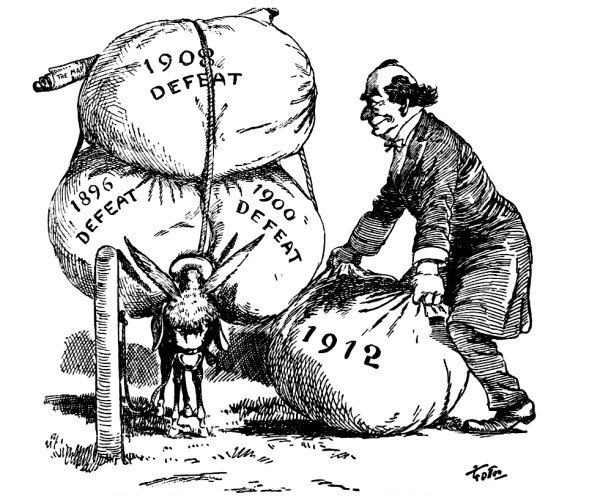
In 1896, it cost the Republicans six million dollars to defeat Bryan;
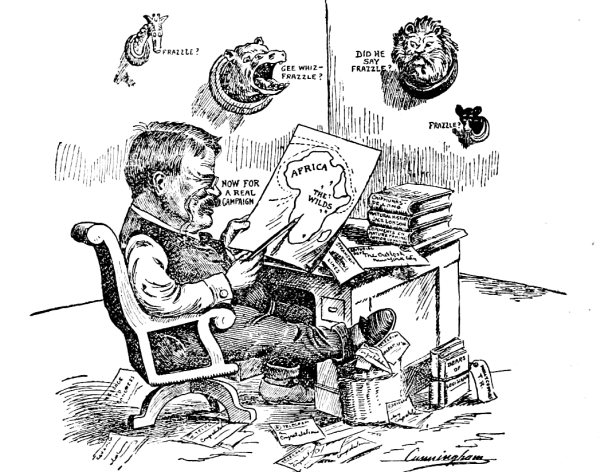
in 1900, it cost them four millions; in 1908, they “beat him to a
frazzle” with less than two millions.
In 1896, every chance was in his favor; he was young, handsome,
magnetic, eloquent, without a stain on his record. In the general
enthusiasm aroused by his “crown-of-thorns, cross-of-gold” speech,
people did not give heed to the craftiness and selfishness of the
Bland delegate who used Bland’s name as a stalking horse to get the
nomination for himself. For twenty years Richard P. Bland had labored
for Bi-metallism. He had won the fight by sheer bulldog pluck. The
Bland-Allison act of 1878 was a Bland triumph. The Sherman law of 1890
was a Bland victory, for Sherman himself said it must be passed to head
off a free-coinage act. When the Congress of 1892 convened, the Bland
forces had an overwhelming majority. Why then could we not make a law
restoring the white metal to its constitutional place as the equal
of gold? Because, in the contest for the Speakership, the Northern
Congressmen got control of the Committees as an exchange for the
office of Speaker.
But the tide of public feeling in favor of “Constitutional money” kept
on rising, and there is no doubt whatever that a majority of our people
in 1896, favored Bi-metallism. But Bryan, cunning and ambitious, used
his opportunities as a Bland delegate to undermine Bland, and at the
psychological moment treated Bland to what Garfield had treated Sherman.
What had Bryan done for Bi-metallism? Nothing. He did not even
understand the true meaning of it. As for Bland, he had fought the
battle of “Constitutional money” while Bryan was at school, and when,
in the hour of Silver’s triumph, the hero of its struggle was cast
aside by his ungrateful party, it broke the old man’s heart and he died.
When I think of the long series of years during which Mr. Bland was the
unflinching, untiring leader of the forces of Bi-metallism, and when I
think of the very substantial fruits of his labors, the manner in which
Bryan and the Democratic party flung him aside—the old horse turned
out to graze till he should drop—seems to me to be one of the most
convincing illustrations of the fact that “politics is hell.”
Having captured the Democratic nomination, Bryan turned his attention
to the Populists. They had proved that they could poll nearly two
million votes. Bryan wanted them. Through Allen of Nebraska and Jones
of Arkansas he laid his plans to get them. By as foul a trick as ever
was played in American politics, the Populist Convention was inveigled
into giving its Presidential nomination to Bryan. Having got what
he sought, he broke the contract, turned a deaf ear to all appeals,
underrated the measure of Mid-road Populist resentment, invaded “the
enemy’s country,” cherished the delusion that he could win New England,
hung on to the impossible Sewall, and so lost the Presidency.
It is a fact that the Republicans had no hope of success, after the
action of the Populist Convention, until Bryan himself adopted the
insane policy of making the race with two Vice-Presidential candidates
swinging on to the ticket.
In that campaign, the whole money question was dwarfed to the
discussion of “Free Silver.” The great issue of Constitutional,
scientific Bi-metallism was shunted on to the spur track of Free
Silver. In that campaign he lost the East and the North, irrevocably.
Instead of making a strong, broad, easily understood plea for a
restoration of the financial system of Jefferson, of Madison, of
Monroe, of Jackson, of Benton, of Calhoun, he selected that detail
of the money question which was of the least consequence, which was
the most difficult to explain to the ordinary voter, and which,—on
account of the selfish interests of the Silver Kings—lent itself most
favorably to Republican assault.
This error was Bryan’s own folly, for the Greenbacker and the Populist
had already demonstrated the advantage of treating the question in the
broad, fundamental way. To this day, Mr. Bryan pays the penalty. To the
business world, of every section of the Union, he is known as the “Free
Silver” crank, and the business world is dead against him.
In 1900, the Spanish war had temporarily engulfed economic questions.
Bryan was astute enough to feel this; consequently, he discovered a
new Paramount Issue. It was Imperialism. But Bryan was not the man to
derive any benefit from it, for the simple reason that he was as much
responsible for it as the Republicans themselves. Tired of camp life
at Tampa, Mr. Bryan hurried to Washington City, exerted his personal
influence with certain Democratic Senators, and prevailed upon Senator
Clay and others to vote with the Republicans to ratify the Treaty of
Paris.
As our Imperialism grows out of this Treaty, Mr. Bryan’s political
dishonesty in raising such an issue against the Republicans was so
glaring that they had very much less trouble in defeating him in 1900
than they had had in 1896.
Then came the ugly affair of the Bennett will; of Bryan’s acceptance of
gifts of money aggregating $12,000; of his efforts to secure, secretly,
a legacy of $50,000; of his astonishing lack of delicacy in drawing
up, in his home, a will for a doting old man who was Bryan’s guest; of
his mercenary persistence in his struggle against Bennett’s widow; of
his claim for a large fee as Executor of a will which he had drawn and
which the courts had set aside.
Then came the revelation that while appearing to the public as the
devoted, unselfish, patriotic champion of Free Silver, he had been in
the pay of the Silvre Kings all the time. Then we could understand
why he had narrowed the money question to that pitiful detail.
Millionaire Silver Mine-owners, like Marcus Daly and William A. Clark,
didn’t care a rap about Constitutional money. What they wanted was the
personal profit to be gained by them in carrying fifty cents’ worth
of the white metal to the U. S. Mints and having it turned into a
dollar. Free Silver meant millions of dollars to these Silver Kings.
Therefore they paid Bryan big prices to make speeches for Free Silver.
And the Peerless orator stuck to his text. And when the Silver Kings
discontinued the pay, Mr. Bryan discontinued the speeches.
Afterwards came the campaign against Parker’s nomination in 1904. Pretty
much everything that could be said to prove that such a nomination
would be a base betrayal of the Jeffersonian element of the Democratic
party, Bryan said. In Chicago, notably, he hired a hall, collected the
faithful around him, made an impassioned speech setting forth the shame
of such a Ryan-Belmont candidacy as that of Parker, and said that a
Democrat ought to be ready and willing to die rather than submit to
such a surrender of principle as would be involved in the nomination of
Parker.
Similar heroic declarations Mr. Bryan made against the Clevelandites,
the Wall Street element of his party, the undemocratic advocates of the
British gold standard which had chained the world to London. In his
book, in his paper, in his speeches,—particularly at Birmingham,—he
vowed that he would never support a gold standard candidate and that he
would quit the Democrats if the party adopted a gold standard platform.
“Is thy servant a dog that he should do this thing?” That was the
tone of Bryan’s indignant reply whenever he was asked whether he would
follow his party if it deserted its principles.
Alas! The heroics sounded well—but where was the hero?
We admit that Bryan made a great fight against the Ryan-Belmont
hirelings in the Democratic National Convention of 1904. His forensic
powers are of a high order, and they were magnificently displayed in
that debate. But he wasn’t true grit, wasn’t dead game,—did not prove
himself a thoroughbred. No, he is not the kind of bird that dies in the
cock-pit; he showed the “dominecker.”
Had he met Parker’s gold telegram with a defiant, “I accept the
challenge! Let those who are true to Democratic principles follow me
out of this Convention!” he would have smashed the Ryan-Belmont slate,
forced Parker out of the lists, won the nomination for himself, and
might have been President.
But he sunk the popular hero into the party hack,—let them put the
harness on, hitch him up and drive him in a direction that his record,
his vows and his convictions made it a disgrace for him to travel.
Then came the speeches in which he said as much in favor of Parker as
he had said against him,—and Parker had not changed a bit. The change
was there, and it was vast,—but it was in Bryan.
Then came the swing backwards to radicalism again. Bryan spoke at
the Jefferson Day banquet in Chicago in 1906 and said that the time
had come for the Democratic party to declare itself in favor of the
Government Ownership of the railroads. He advanced the proposition that
the states should own the local lines while Uncle Sam ran the trunk
lines. This absurd plan was the burden of the Bryan talk and Bryan
editorials for more than a year,—long enough for the whole country to
realize what an impractical “statesman” he is. So ludicrous a “break”
queered him still further with the men of the business world, and told
heavily against him in the campaign of this year.
Then, after his home-coming speech in Madison Square Garden, he made
his final declaration in favor of Government Ownership. Having toured
Europe and witnessed the advantages of State-owned public utilities,
his own convictions in favor of that system had been strengthened.
But Democratic editors and politicians raised a Bourbon outcry against
Government Ownership, and Bryan, after shuffling about awhile, took to
the woods.
Then he fell in love with the Initiative and Referendum. Mightily
in favor of giving Direct Legislation to the people was Bryan. But
again the Bourbons raised their hands in holy horror, and again Bryan
flunked. “Willing to teach the children that the earth is flat, or that
it is round, whichever a majority of the School Board prefer”;—that’s
the kind of pedagogue partisan politics has made out of W. J. B.
Then we heard him endorse Roosevelt, and agree with the President
that Congress ought to pay the campaign expenses of the two old
twins,—Chang and Eng,—and that honest bankers should be punished
for crimes they didn’t commit, and that the Government should not
establish Postal savings banks but should perpetuate the National banks!
Then we saw him dictate the Denver platform which is more Hamiltonian
than the Parker platform of 1904, and less favorable to the masses
than the platform of Mr. Taft. We saw him choose a Standard Oil tool
for the Chairmanship of his Finance Committee; we saw the Tobacco
represented on the same Committee; we saw him courting David B. Hill,
Judge Parker, Charles Murphy, Pat McCarren and “Fingy” Conners; we
saw him yoke up with the liquor interests in Maine, Indiana and Ohio;
we saw him change his whole political creed until Ryan, Belmont,
Harriman and Rockefeller had nothing to fear from him, and we saw him
conduct a campaign in which he stood for no distinct vital democratic
principle, whatever. Then we saw him dodge when the President asked
him, through the newspapers, how he stood on the Pearre bill which
seeks to have Congress declare that a man’s business is not entitled to
the same protection as his property. Impaled on that point, Bryan could
do nothing but squirm.
Then indeed, he lost out with level-headed men of all parties.
Burdened with the record of his own instability, Bryan this year lost,
practically, everything excepting the South. True, he got Nevada (two
electoral votes,) and Colorado (five votes,) and Nebraska, (eight
votes,) but this state he carried by making a piteous, tearful personal
appeal,—and even then he got only a plurality, not a majority, and ran
far behind the Democratic State ticket; but the West has repudiated
him, just as the South and East have done.
It would not be worth while to dwell upon the humiliation of that
political serfdom which kept the South in the Bryan column.
The South voted for Bryan, and is glad he wasn’t elected. Everybody,
who knows anything, knows that. The fact ought to be able to
penetrate the conceit of Bryan himself.
But is the fact important? It is, for its first consequence will be
the elimination of Bryan, and its second will be the restoration of the
South to her historic position in the Republic. It is the beginning of
Southern self-assertion; the end of her political nullity.
Never again can Mr. Bryan hope to secure the support of the South.
His record makes it impossible for her delegates to acquiesce in his
nomination.
This being so, the Bryanites of other sections will recognize the folly
of nominating him—for without the Solid South no Democrat can hope to
win the Presidency.
When Bryan adopted that policy of Africanizing the Democratic party,
he drove nails into his political coffin. The facts were not aired by
the Southern papers during the campaign, but Bryan will hear from them
when he bobs up serenely and goes after a fourth nomination. Ever since
the Civil War, the Democratic party in the South has claimed to be the
white man’s party. Because it was feared that a division of the whites
into two parties would result in giving to the negroes the balance of
power, the Southern people have allowed the Democracy of other sections
to legislate against our interests, to ignore our industrial existence,
to rob our producers under forms of law, to foist upon us candidates
not of our choosing, and platforms which we detested.
The Democrats of other sections were permitted to treat us as though we
belonged to them, because we feared to divide into two competitive
white parties,—feared Negro Domination.
For thirty years the South has been struggling to establish White
Supremacy, and to diminish the political importance of the negro.
Yet in this campaign of 1908 we heard Bryan’s lieutenant, Henry
Watterson, declare that the time had come for the Negroes to divide and
thus increase their political importance. The whole Bryanite campaign
was pitched to that key. “The time has come to increase the political
importance of the negro!”
In other words, the Bryanites deserted the Democratic position on
the negro question, and went over to the Thad Stevens-Sumner position,
at the very time that the Republicans, led by Roosevelt and Taft, were
coming over to the Southern view. We saw Bryan flirting with the
negro leaders, and seeking to make a Democratic asset out of the resentment
which they felt because of Roosevelt’s pro-Southern position on the
matter of the Fourteenth and Fifteenth Amendments. We likewise
saw Mr. Bryan witness with seeming approval, the parade of negro
clubs on whose banners were displayed extracts from Foraker’s speeches
denouncing the President for his dismissal from the army of the black
brutes who on their way to Brownsville insolently declared “When we
get there all the women will look alike to us, white, black and Mexican”;
and who put a climax to a series of outrages and threats by shooting
up the town—killing one man at his own gate, bringing down the Chief
of police with a shattered arm, riddling hotel and private houses with
bullets; and terrorizing men, women and children.
Yes, we saw Bryan receiving negro delegations who came to confer
with him about the negro soldiers; we saw the colored delegations
cordially met and hospitably entertained; and we heard them say, that
they were perfectly satisfied with the assurances which Mr. Bryan had
given them. They circulated, by the hundred thousand, a letter, bearing
the names of the most prominent negroes of the land, in which the statement
occurs that “We have been in communication with Mr. Bryan for
weeks and have received satisfactory assurances from him” as to
patronage, recognition, and the amendments.
Mr. Bryan must have been aware of the fact that this circular letter
was being used in his behalf. It is highly probable that his Campaign
Committee furnished the money which paid for the printing and the
mailing of it; and there is no doubt that the negro speakers who went
about asking for votes for Bryan, because of Brownsville and because
of the Southern Disfranchisement laws, were paid by the Bryanite Committee.
It would have been a calamity to the country had the desperate tactics
of the Bryanites met with success. The impression would have been made
that the negro vote elected him, and there is no telling how far that
would have influenced Mr. Bryan in his official dealings with the negro
leaders.
We must remember that he earnestly supported the candidacy of a negro
against a white man, in Nebraska. The negro got the office. It is said
that no such thing had occurred in Nebraska before.
He educated his daughter and one of his sons at the Social Equality
“University of Nebraska,” and another of his sons is a student there
now. To this Social Equality College, Mr. Bryan annually donates two
hundred and fifty dollars.
He has never uttered a word against the mixed schools of Nebraska
wherein the negro children are educated on terms of Social Equality
with the whites. He has never condemned the intermarriage of blacks and
whites. There is no law against it in Nebraska, and miscegenation is
common.
Born and reared in Illinois, Mr. Bryan holds the anti-Southern view
of the race question. By birth, education and environment, he got the
belief that Social Equality is right, and he practices what he believes
when he sends his children to be educated along with the negroes.
How can the South, knowing these things as she now does, ever support
Bryan again? To do so would be to reverse her position on that question
which to her is the most important of all. During the heat of the
campaign, Southern editors who knew of these things kept mum. It will
not be so when Bryan seeks the fourth nomination.
In the next national convention of the Democratic party, the South will
not be run over as the Bryanites ran over her at Denver.
If she demands the Vice-Presidency in 1912, it won’t go to the attorney
of the Brewers’ Combine of Indiana. If Lincoln’s name should again be
lugged into the Convention, it will again be honored, but when the
name of Robert E. Lee is mentioned it will not be hooted and hissed.
Democrats of the other sections may not be pleased by the attitude of
Southern delegations, but we venture the prediction that no Haskell
brass-bands will insult them by tauntingly playing, “Marching thro’
Georgia.”
But it is not such a misfortune to Mr. Bryan that he will never be
President. Several millions of very respectable men share that lot with
him. He is rich,—the only man that ever got rich doing reform work. In
Bryan’s case, indeed, there has been no reform work,—just floods of
talk about it.
He has friends everywhere, has no personal enemies, is of sanguine
temperament, is rounding out into a comfortable fatness, has no bad
habits, no gentlemanly vices, and is so unconsciously self-righteous in
all that he does that he fails to realize what bad taste he displays
when he introduces his wife’s name into a public speech and sets forth
at length her qualifications for the position of “First Lady in the
land.”
Personally, we bear Mr. Bryan no ill will and wish him no harm, but it
is our deliberate opinion that his inordinate ambition for office and
his mistakes as a leader have done more immense injury to the cause of
reform. He destroyed the Populist party, he has wrecked the Democratic
party, he has driven thousands of Conservative men into the Republican
ranks, and thousands of radical Democrats and Populists to the
Socialists.
His career has been rich in substantial rewards to Mr. Bryan himself,
but, on the whole, it has been the bane of Jeffersonian democracy.
The action of the South Georgia Conference of the Methodist Church in
voting $65,000 to Foreign Missions, last week, moves the Jeffersonian
to say another word upon that subject.
Some time ago, the New York World published a statement to the effect
that, out of every ninety dollars contributed in this country to the
Foreign Mission fund, only one dollar reached the heathen. This is a
sweeping arraignment of the honesty and efficiency of the management of
the funds which we are not prepared to indorse.
Our criticism follows a different line. The question raised by the
Jeffersonian is this,—What moral right have American Christians to
leave their own poor,—unfed, unclothed and unredeemed,—and
to drain off into foreign lands millions upon millions of American
dollars to feed and clothe and redeem the poor of those foreign lands?
It is a most serious question, Brother.
You tell us, as per formula, that we are commanded to carry the Gospel
to all the world. Granted. But where are we commanded to leave our own
poverty-stricken wretches to die like poisoned rats in their holes,
while we relieve the physical distress of the Chinese?
What moral right have we to deny the beggar at our gate, and to heed
the plaint of the Chinese beggar?
One of our private correspondents a little while ago, wrote us that a
certain preacher, whose attention he called to our statements on this
subject, declared that said statements “were misleading.”
Wherein? They could not mislead. If what we have said about our
foreign missionaries furnishing food, clothing, medicine, fuel, etc.,
to foreign “converts” is the truth, our people are entitled to know it.
If our statements are false, we want to know it.
A very prominent and able Baptist minister,—who has long been a
laborer in the Foreign Missions field,—and a well-known Methodist
minister, who has been similarly engaged, are responsible for the
statements made by the Jeffersonian.
One of these noble men said that the most discouraging thing about the
Foreign Missions work was, that when the rations to the “converts”
were cut off, the convert lost interest in the Christian faith.
What words could we employ that would arraign the system more severely?
The idea of the Jeffersonian is that each nation of the world should
take care of its own poor. We are not responsible for pauperism, vice
and crime in China. There is no more reason why we should be taxed for
contributions to maintain a commissary in Pekin or Hong Kong than in
Paris, Berlin or London. We leave to the French the task of providing
for the Parisian poor; we don’t think of supplying food, raiment and
medicine to Berlin paupers; and we consider it the duty of the English
to provide for London outcasts. Why, then should we virtually coerce
our American Christians into sending money to heathen lands for the
purpose of relieving the physical distress of the heathen?
While penning this editorial, it occurred to us to glance at a New York
exchange, for the purpose of noting some contemporaneous instance of
starvation, or of suicide because of hunger and lack of employment.
The newspapers of the North have been gruesomely full of many ghastly
incidents of that kind.
Yes, there it was, page 3, of the N. Y. Evening Journal, of December
4th, 1908.
A white woman, sick and starving, and with a babe at her breast, fell
exhausted on Fifth Avenue,—the home-street of the richest men the
world has ever known. All of them are Christians. When prosecuted for
their criminal methods of taking other people’s property away from
them, they blandly perjure themselves, escape the feeble clutches
of the law, turn up serenely at church, next Sunday, and contribute
handsomely to Foreign Missions.
The woman who fell starving, on the street where these richest of men
live, was named Mrs. Mary Schrumm. She was young, thinly dressed, and
had not tasted food for two days. The child was nearly famished,
almost frozen and had acute bronchitis. Her husband was out of work;
an old woman with whom she had found shelter had been given notice to
vacate; and Mrs. Schrumm had gone into the streets to seek refuge in
some one of the charitable institutions. She had been turned away from
each of these that she could reach. She had begged that her babe, at
least, might be taken in. No; the babe was sick, and they could
not take in a sick child!
God! And we talk about what the heathen need! The hardest-hearted
heathen that Jehovah ever made are some of the seared hypocrites who
call themselves Christians.
Denied everywhere, poor Mrs. Schrumm wandered about the streets, in the
bitterly cold wind, until she fell, completely tired out.
Then, indeed, charity had to sit up and take notice. The starving
woman was put into an ambulance, and carried to a hospital. She will
probably recover; her child will probably die.
Then, what moral right have you to let such unfortunates as these
fall starving in your streets, while you are sending
hundreds of millions of dollars abroad to feed, clothe, physic and
make fires for the hungry, “thinly clad,” sick and shivering Chinese?
Doesn’t your own “mother wit” tell you that Foreign Missions could
not consume such vast sums of money, if the missionaries limited
themselves to preaching the gospel!
Put on your think cap, son.
In the New York World of December 5, 1908, is reported the case of
George Schulze who shot himself to death, in spite of the pleadings of
his wife and children, because he was out of work, had tried in vain to
secure employment and was in despair.
If these were not typical cases, we would not dwell upon them. But they
are typical cases, and you know it.
The writer of the ballad which the Jeffersonian presents to its readers
this month was Clara V. Dargan. She was born near Winnsboro, S. C., the
daughter of Dr. K. S. Dargan, descendant of an old Virginia family of
the highest standing. Her mother was a native Charlestonian of Huguenot
blood, and from her the poetess inherited vivacity, social charm and a
love for romance. The Dargan family was wealthy, but lost everything by
the war. Miss Dargan published many poems and short prose stories in
the periodicals of the time. In 1863, she was the literary editor of
the “Edgefield Advertiser.”
One of her stories, “Philip, My Son,” was considered by so good an
authority as Henry Timrod to be equal to any story published in
“Blackwood’s.”
“Jean to Jamie” seems to us almost the perfection of a poem of that
class. The pathos of it is so genuine, so unobtrusive and so deep that
one feels, instinctively, that the lines of the poem ran from the heart
of one who had suffered. Henry Timrod said of it, “The verse flows with
the softness of a woman’s tears.” The poem, published in 1866, has long
since been lost to current literature. Believing it to be a treasure
that ought to be recovered, we reproduce it.
Jean to Jamie
What do you think now, Jamie,
What do you think now?
’Tis many a long year since we parted;
Do you still believe Jean honest-hearted—
Do you think so now?
You did think so once, Jamie,
In the blithe spring-time;
“There’s never a star in the blue sky
That’s half sae true as my Jamie,” quo’ I—
Do you mind the time?
We were happy then, Jamie,
Too happy, I fear;
Sae we kissed farewell at the cottage door—
I never hae seen you since at that door
This many a year.
For they told you lies, Jamie;
You believed them a’!
You, who had promised to trust me true
Before the whole world—what did you do?
You believed them a’!
When they called you fause, Jamie,
And argued it sair,
I flashed wi’ anger—I kindled wi’ scorn,
Less at you than at them; I was sae lorn,
I couldna do mair.
After a bit while, Jamie,—
After a while,
I heard a’ the cruel words you had said—
The cruel, hard words; sae I bowed my head—
Na tear—na smile—
And you took your letters, Jamie,
Gathered them a’,
And burnt them one by one in the fire,
And watched the bright blaze leaping higher—
Burnt ringlet and a’!
Then back to the world, Jamie,
Laughing went I;
There ne’er was a merrier laugh than mine;
What foot could outdance me—what eye outshine?
“Puir fool!” laughed I.
But I’m weary of mirth, Jamie,
’Tis hollowness a’;
And in these long years sin’ we were parted,
I fear I’m growing aye colder-hearted
Than you thought ava!
I hae many lovers, Jamie,
But I dinna care;
I canna abide a’ the nonsense they speak—
Yet I’d go on my knees o’er Arran’s gray peak
To see thee ance mair!
I long for you back, Jamie,
But that canna be;
I sit all alone by the ingle at e’en,
And think o’ those sad words: “It might have been”—
Yet never can be!
D’ye think o’ the past, Jamie?
D’ye think o’ it now?
’Twad be a bit comfort to know that ye did—
Oh, sair, would I greet to know that ye did,
My dear, dear Jamie!
Gentle reader, did you ever steep your mind in one of those Sunday
School hooks which were in circulation previous to our Civil War? If
not, ransack your grandmother’s garret until you find a specimen of
that Arcadian literature.
The little boy in those blessed books never quarrelled, never had a
fight, never had dirty hands, and would have been inexpressibly shocked
had he made a conversational slip in grammar. He was an intolerable
angel in breeches—was this little boy of the Sunday school book.
He couldn’t “talk back,” nor handle slang, nor throw rocks, nor
skin-the-cat, nor ride the billy-goat, nor tie things to a dog’s tail,
nor put a pin in a chair for somebody to sit on. If the Bad Boy hit him
in the stomach, he wept meekly, quoted a text, and went home to his
mamma.
In common conversation, the language of this Good Boy was drawn from
wells of English undefiled. Erasmus never used choicer words; and
Chesterfield was not more perfect in manners, than was this detestable
Good Boy.
Among youths of his own age, he was a miniature Socrates, washed and
otherwise purified. Wisdom oozed from him in hateful streams. The
sagacity of sages sat on him with uncanny ease.
When a grown man spoke to this Good Boy, the G. B. never replied until
he had lifted his right hand and ejaculated “Oh, Sir!” After the salute
and the “Oh, Sir,” came the response, which always did infinite credit
to the manners, mind and heart of this outrageously Good Boy.
Life was an easy-going affair to the G. B. All things came his way.
He was virtuous and he was happy. Nothing ever occurred to soil his
clothes or tangle his hair. His nose never bled, he never bit his
tongue, never struck his funny-bone, never mashed his thumb with the
hammer, never had his drink to go the wrong way. He was never drowned
while bathing in the pond, for the simple reason that he didn’t “go
in” on the Sabbath. The Bad Boy “went in washing” on Sunday and was
drowned, as a matter of course.
Daniel in the lion’s den was not safer amid the perils than was the
Good Boy among the ills which are incident to boyhood. Past vicious
bulls and snappish curs he walked serene and unharmed. Neither his gun,
nor his pony ever kicked him; neither the wasp, nor the bee, nor the
yellow-jacket ventured to sting him; nettles avoided his bare feet; no
boil came to afflict his nose, nor stye to distort his eye. No limb
of a tree ever broke under him, and gave him a nasty fall. He never
tumbled into the creek, nor snagged his “pants,” nor sprained his
ankle, nor cut his finger, nor bumped his head, nor walked against the
edge of the door at night.
Nothing could happen to this insufferable Good Boy—nothing bad, I
mean. His shoes never blistered his heels, his hat never blew away,
he never lost his hand-kerchief, never had a stone-bruise, never missed
his lessons, never soiled his book, never played truant, and never ate
anything which caused him to clap both hands to a certain place in
front while he doubled up and howled.
Oh, a pink of perfection was this odious boy of the ante-bellum Sunday
School books.
And next to him in comprehensive unbearableness was the little girl who
was the counterpart of this little boy.
Her name was Lucy. Or, perhaps, Marielle. Or, for the sake of variety,
Lucretia.
And what a portentous proposition in pantalettes she was, to be sure!
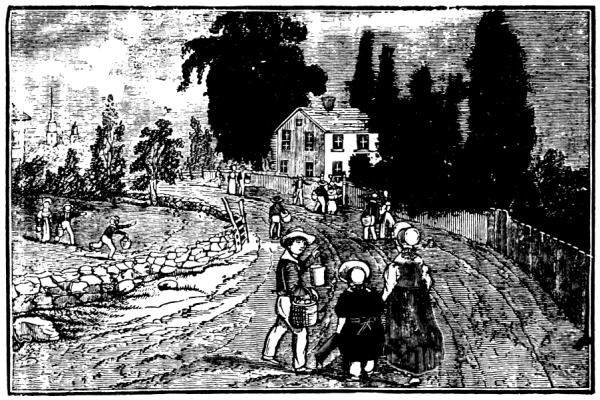
“Rollo, Lucy and Mariette went Together.”
She talked just as exquisitely as did the Good Boy. Her selection of
words was artistic, and her grammar immaculate. If William Pitt’s
natural style was that of the “State Paper,” the colloquial standard of
Lucy, Lucretia and Marielle was that of Madame de Stael.
She walked with primness; if she ran at all, it was with dignity; she
did not giggle, did not romp, never made a mud pie, never pinched the
Good Boy, and was such a formidable little thing, generally, that even
the Bad Boy never snatched her bonnet. Such a thought as that of
stealing a kiss from her never entered the head of any boy, good, bad
or indifferent.
This unearthly girl always seemed an impossibility to me, after I
became a grown-up, until I chanced to read about the daughter of John
Adams, second President of these United States. Mr. Adams married a
stately woman whose name was Abigail. What else could you expect, if
not that a girl born to John Adams and his wife, Abigail, would be a
tremendous little girl from the very start? Her parents named her
Abigail,—as an additional guarantee against chewing gum, coca-cola,
slang, and tomboyishness.
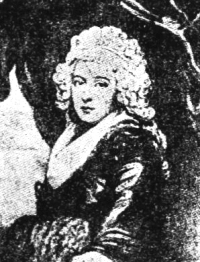
ABIGAIL ADAMS
At the age of eighteen, we find Miss Abigail Adams writing about her
father as though he were some Sphinx or Pyramid that she had been viewing.
Please go slow, as you read what this young lady says of her own papa:
“I discover a thousand traits of softness, delicacy and sensibility
in this excellent man’s character. How amiable, how respectable,
how worthy of every token of my attention has this conduct rendered
a parent, a father, to whom we feel due even a resignation of our
opinions.”
Did you ever? Just try to put yourself at the view-point of a girl who
could calmly sit down and analyze her father, as a naturalist would
disjoint a rare beetle. Think of a daughter referring to her father as
“this excellent man,” and classing him “respectable”! Think of a
daughter dutifully conceding, in writing, that her dad is “worthy of my
attention” and “even a resignation of our opinions.”
And, after all, she jumped from the sublime to the ridiculous by
marrying a man named Smith!
But she has restored my confidence in the girl of the Sunday school
book. Lucy did appear on this planet in the flesh; and when she
talked and wrote her style was that of little Abigail Adams. Marielle
was not an impossibility, nor was Lucretia. Even that obnoxious Good
Boy was true to life—if John Adams’ description of his son John
Quincy is not too highly colored by paternal pride. After reading said
paternal description I can understand how it was that, while Henry
Clay made friends out of those whom he refused, John Quincy Adams made
enemies by his manner in granting favors.
But no matter how many Lucys and Rollos existed prior to our War
between the States, it would be mighty hard to find a Lucy or a Rollo
now. Times have changed, manners have changed, types have changed.
What is responsible for the bold-eyed girl—the girl of loose speech
and loud manners? What is responsible for the irreverent boy—the boy
of the cigarette and of the look which undresses every handsome woman
that he meets? These are the boys that greet girls with a “Hello!”
and a leer that should offend. These are the girls who shout “Hello!”
to the boys, and who lie prone by the side of young men during a
“straw-ride” at night. Are all such maidens the daughters of mothers
who drink and gamble? Are all such youths the sons of men who have no
morals? By no means. Our whole social and industrial situation has
changed, and the people have changed with it.
Would that I could believe that our Public System is guiltless in
this matter. Use your eyes as you pass a crowded academy and note the
conditions which make against common decency—to say nothing of that
deference and respect with which every properly trained boy should
treat members of the other sex.
But there are causes deeper, more universal than the promiscuous mix-up
in the Public Schools. The centripetal power of class legislation is
drawing capital inward to the small centre of the Privileged. To the
masses is left a constantly smaller proportion of the nation’s annual
production of wealth. In turn, this law-made and abnormal condition
of things over-crowds the cities. In fact, rural life has become
so unattractive that the trend of population is from the farm to
the town. Every village has its surplus—the men and boys, white
and black, who have no visible means of support and who can not be
persuaded to work. In every town is the girl who hardly knows why she’s
there,—but she’s there.
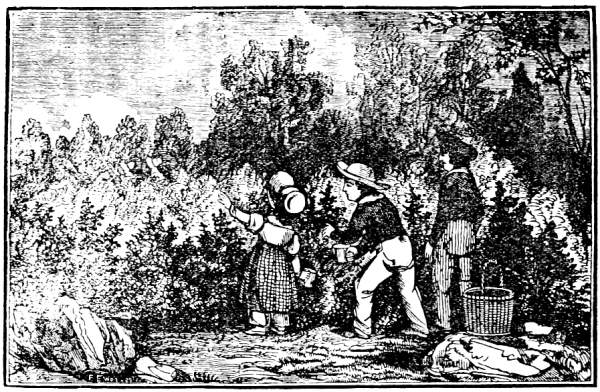
“‘Oh! Look,’ cried Lucy.”
And the pace-that-kills in the Chicagos and New Yorks is faithfully
represented, on a small scale, in each of our towns. Don’t all of us
know it? We do. But what is the remedy?
The temperance people believe that whiskey is at the bottom of the
trouble. The church people believe that irreligion is the source of the
evil. The school teacher believes that education will save the day.
But can not the student of human affairs see that the demoralization
incident to four years of civil strife shook our entire social system
like an earthquake? Did not the Spanish war light up,—luridly,
vividly, horribly,—the almost universal corruption which had seized
upon the body politic?
“Eat, drink and be merry—tomorrow we die.” When a nation rings with
that cry, it is close to the whirlpool. “Let us have a good time!” The
man drinks and makes much of his food; the woman drinks and thinks a
deal about her eating; the boy drinks and knows the good dishes; the
girl drinks and daintily scans the menu. “Hello!” shouts the dashing
boy; “Hello!” answers the dashing girl, and off they hurry to some
place where talk, songs, pictures and conduct are “up-to-date,”—and
in many and many a case the Hello couple are reeling hellward by
midnight.
Don’t we know that our statute-book is the Iliad of our woes?
The few are wickedly rich while the many are helplessly poor, because
the laws have been made for the purpose of bringing about that very
state of affairs. There is a fierce struggle for existence which waxes
more desperate every year. Men fight each other for a job, with a
ferocity like that of starving dogs fighting over a bone. Girls are
forced into positions where delicacy of feeling is trampled out and
where it requires heroic courage to resist the tempters who are ever on
her trail to pull her down.
Who does not know that the ten million dollars which one of our
religious denominations recently sent abroad for Foreign Missions would
be better employed if it were devoted to the breaking up of our hideous
marketing of white women to lewd houses? Who does not feel that the
hundreds of millions which our Government has spent in the Philippines
had better have been left in the pockets of the taxpayers here at home?
Who does not know that we ought to tremble for our future when we see
how our law-makers have been the willing tools of those who ruin the
millions of men and women, girls and boys, in order that a few hundreds
of ravenous rascals like Rockefeller and Carnegie and Havemeyer and
Ryan and Vanderbilt and Gould and Harriman shall each be richer than
any king ever was?
Most of us do know it. Some of us have long been trying to arouse
the patient, victimized millions to a sense of their own wrongs. But it is
an uphill work. Some despair, some scoff, some are callous, some won’t
listen, some are timid, some are interested in keeping things as they
are, some think it is God’s will that a favored few should reach the
Paradise of unlimited riches while the unfavored multitudes sink into a
hell of eternal wretchedness.
The lotus-eater’s plaint of “Let us alone” is to me as fearful as
that reckless, creedless, madly selfish cry “Let us eat, drink and be
merry: tomorrow we die.”
Jay Gould contemptuously dismissed the suggestion that, some day, the
American people might rise in arms against its swinish plutocracy. Said
Jason, the cynical,
“I could hire one-half of the people to shoot the other half.”
The man who said that was not more contemptuous of us than are the
plutocrats who rule and rob us now. But perhaps what he said is the
truth. They manage to keep us divided, about half and half, in the
bloodless battle of ballots; perhaps, if it came to shooting they could
divide us the same way.
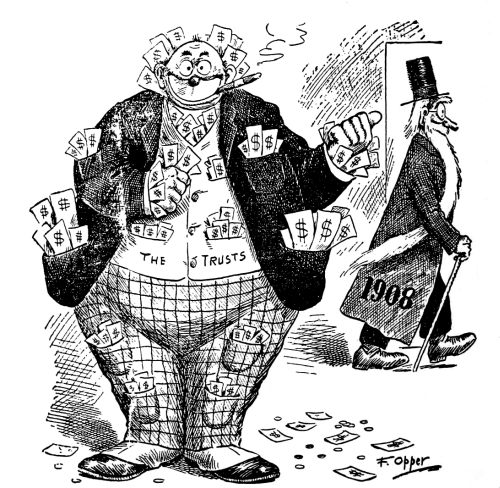
“He Certainly Was Good To Me.”
New York American