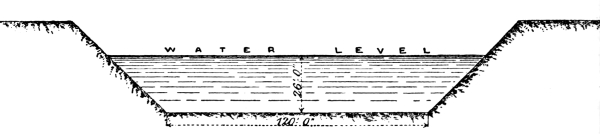
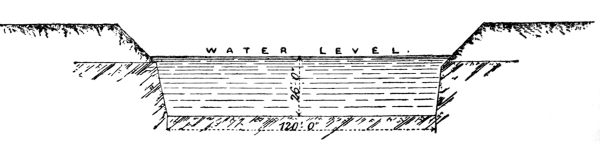
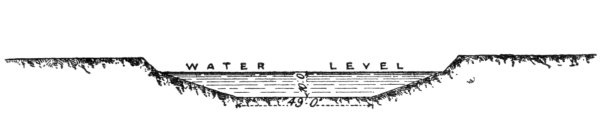
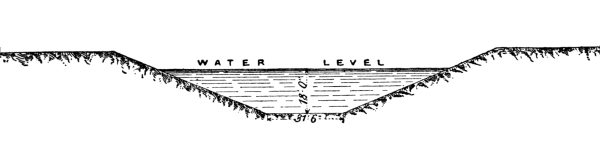
“A little model the master wrought
Which should be to the larger plan,
What the child is to the man.”
—Longfellow.
If the question were asked, “What is the greatest constructive work
that has yet been undertaken by man?” there would, without question, be
a great many different replies. There can, however, be only one reply
as to the most costly. Perhaps, also, there can be but one answer as
to the most disastrous to human life. The Panama canal would almost
certainly secure pre-eminence in these attributes. It might or might
not rank equally high as a work of engineering genius and possible
public utility.
There has probably never been a project that has so challenged the
admiration and the approval of the world as that of finding a waterway
between the Atlantic and the Pacific Oceans, at or near to the narrow
neck of land that separates Limon from the Gulf of Panama in Central
America. This enterprise has a long and a very eventful history. Many
explorers, geographers, statesmen, engineers, and economists have
either written on the merits and demerits of the undertaking, or have
otherwise become associated with it. Some of the more notable episodes
in the records of the isthmus may therefore be referred to, before
proceeding to describe the various projects now either in progress
or in contemplation, for opening it up for the purposes of trade,
commerce, and navigation.
One of the earliest direct references to the importance of a waterway
between the two oceans is that made by Cortez in his letters to Charles
V. The great conqueror, however, does not seem to have contemplated the
construction of such a waterway. He diligently searched for a natural
waterway or strait between the two oceans, and declared that to be “the
one thing above all others in the world I am most desirous of meeting
with,” on account of its immense utility. Some sixty or seventy years
later, there was a project put forward by the Spaniards for uniting the
two oceans by a waterway, but it does not appear to have been carried
any length. The Spaniards, indeed, were hardly the people to achieve
such a distinction. Unlike the ancient Romans, the Italians, and the
Chinese, their skill was not very marked in hydraulics. They were,
besides, much too superstitious to venture on interference with what
many of them believed to be an ordinance having all the fixity of a law
of nature.[165]
The American Isthmus next claims attention as associated with the
ill-starred fortunes of William Paterson and the Darien scheme.[166]
The earliest, and in some respects the best, information yet available,
relative to the topography of the country adjacent to the Panama Canal,
is that furnished by Dampier,[167]
who spent some time on the isthmus and noted all its chief physical
characteristics. Dampier’s observations, however, were chiefly made in
and about the Gulf of St. Michael, which he describes as lying “nearly
thirty leagues from Panama, towards the south-east,” and as “a place
where a great many rivers, having finished their course, are swallowed
up in the sea.” Dampier found the isthmus very low and swampy, “the
rivers being so oosy that the stinking mud infects the air.”
Lionel Wafer[168]
has also made an early and valuable report on the character of the
country bordering on the route of the present Panama Canal, describing
it “as almost everywhere of an unequal surface, distinguished with
hills and valleys of great variety for height, depth, and extent.” He
described the river Chagre, or Chagres, as one which “rises from some
hills near the South Sea, and runs along in an oblique north-westerly
course till it finds itself a passage into the North Sea, though the
chain of hills, if I mistake not, is extended much further to the west,
even to the Lake of Nicaragua.”
De Ulloas[169]
and some friends in 1735 made an ascent of the river Chagres on their
journey from Cruces to Panama. This voyage is interesting as being one
of the first that is recorded over the river that has since played so
prominent a part in the history of the canalisation of the isthmus.
They found the banks of the Chagres impassable, for the most part, from
the density of the vegetation and the velocity of the current. The
vessels that were then more or less accustomed to navigate the Chagres
were described by De Ulloas as chatas and bongos—the first carrying
600 or 700 quintals, and the latter 400 or 500. The river was found to
be so full of shallows that even vessels of this small size had to be
lightened every now and again until they had passed over them.
No one has taken a greater interest in the subject of a ship canal than
Humboldt, who regarded Kelley’s Atrato route with approval, and who,
replying to the objections brought against the proposal in his time,
declared that “there is nothing more likely to obstruct the extension
of commerce and the freedom of international relations than to create
a distaste for farther investigation by discouraging, as some are too
positive in doing, all hope of an oceanic channel.”[170]
A survey was made of the isthmus in 1827 by Captain Lloyd and Captain
Falmark, the former an officer of engineers in the Colombian service,
and the latter a Swedish gentleman acting in that capacity for the time
being. Beginning at Panama, they followed the old line of road from
that city to Porto Bello, a distance of 22¾ miles, where they found
the surface of the water in the river to be 152½ feet above high-water
mark at Panama. At Cruces they found a fall in the river of 114½ feet,
leaving only about 38 feet as the height above the Pacific. It was
found that at Panama there was a rise and fall of the tide in the
Pacific of 27·4 feet, being 13·5 feet above the high-water mark of
the Atlantic at Chagres. These and other observations led them to
conclude[171]
that “in every twelve hours, commencing with high tides, the level of
the Pacific is first several feet higher than that of the Atlantic; it
becomes then of the same height, and at low tide it is several feet
lower; again, as the tide rises, the two seas are of one height, and,
finally, at high tide the Pacific is again the same number of feet
above the Atlantic as at first.”[172]
In 1840 Mr. Wheelwright was commissioned by the directors of the
Pacific Steam Navigation Company to examine the capabilities of the
river Chagres, and the best means of communication with the South
Sea. He made a lengthy report on the subject, in the course of which
he confirmed many of Captain Lloyd’s observations, giving the depth
of high water on the bar of the Chagres at 15 feet. In 1843, again,
M. Napoleon Garella received from M. Guizot, as Minister of Foreign
Affairs, an order to make a survey of the isthmus, and he proposed a
summit-canal of more than three miles long, the level being reached by
thirty-six locks and three large aqueducts.[173]
In 1853, Mr. Squier explored that section of the mountain chain which
crosses the American isthmus to which Berghaus has given the name of
the Honduras-Nicaraguan group. This range commences at the Col de
Guajoca and extends to the valley of the Rio San Juan. Running at first
close to the shore of the Pacific, it gradually approaches the centre
of the isthmus. The eastern slope, broken by mountain offshoots and
watered by rivers of the first order, terminates on the north-east in
the point Gracias a Dios. The western slope forms a long, low, and,
comparatively speaking, level valley, crossed by an irregular and
independent series of volcanic peaks. This accessory line of volcanoes,
which presents the most distinctive feature of the physical geography
of Central America, is nowhere so distinct from the main line of rocky
axis as in the Honduras-Nicaraguan district. Mr. Squier proposed to
commence a railway at Puerto Caballos, in the Bay of Honduras, and
proceed due south to Fonseca Bay, on the Pacific, a distance of some
160 miles. The harbours on this route are said to be very superior to
those on the Tehuantepec route. The summit-level, however, is 2308
feet above the level of the sea. At such a height a canal would be practically
impossible, and the project was never carried any further than a survey.
Among the many alternative routes suggested for a canal across the
American isthmus, one that has found some favour in the United States
was that viâ the isthmus of Tehuantepec. This locality has been
repeatedly surveyed. Cortez had his attention called to it in the
sixteenth century. Don Augustus Cramer went over at least part of the
route in 1744. Again, in 1842-3, it was surveyed by Señor Moro, as
will be found in a book called ‘Survey of the Isthmus of Tehuantepec,
executed in the years 1842 and 1843, under the superintendence of a
scientific commission appointed by the projector, Don José de Garay.
London, 1844.’ In 1852 it was surveyed by Mr. J. J. Williams, on behalf
of the Tehuantepec Railroad Company of New Orleans. The project was
to ascend, from the Atlantic coast, the river Coatzacoalcos to its
junction with the Malalengo, from which spot a canal was to be carried
to the summit-level on the Mesa de Tarifa, through a series of locks,
rising 525 feet in all, and descending 656 feet into the lagoons on the
shores east of Tehuantepec. The canal would have a length of about 50
miles, and would require 19 additional miles of trench to convey water.
The length of this line was stated by Mr. Kelly, of New
York,[174]
at “about 210 miles,” and by M. Voisin, a director of the Suez
Canal,[175]
at 240 kilometres, or about 149 miles.
M. Moro estimated that 150 locks would be required on this route, and
twelve days would be required for vessels to pass through the canal.
The coast of Tehuantepec is, moreover, subject to fearful hurricanes
and to subterranean movements of volcanic origin, while, finally, the
supply of water at so high a level was believed to be
doubtful.[176]
At the first session of the Congress of Geographical Science, held
at Antwerp in 1871, the question of constructing a canal across the
American isthmus was presented for consideration. General Hame, of
the United States, was present, and took part in the congress. He
described the proposals of the two French explorers, MM. de Gogorza
and de Lacharme, who proposed to cut the Isthmus of Darien between
the navigable channels of the Tuyra, the Atrato, and the Caquiri. The
congress recommended the project of these gentlemen to the attention of
the great maritime Powers, and of the scientific societies throughout
the world. There the matter rested for a time.
At the second congress of the same body, held at Paris in 1875, the
question of the construction of a canal across the Isthmus of Darien
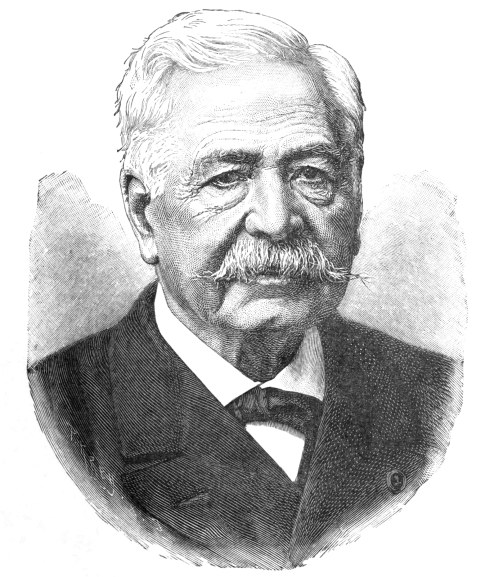
was again considered. M. de Lesseps, who was present on that occasion,
declared that all the authors of the various projects brought forward
for piercing the isthmus up to that time had made a grave mistake in
committing themselves to a canal with locks and sweet water. He urged
that, in order to meet the wants of commerce, all maritime canals
should be carried between the two oceans at the same level, in the
same way as the Suez Canal had been. Again a resolution was adopted,
urging on the various governments concerned that the utmost facilities
should be given for the construction of a ship canal in this part of
the world. The congress went a step further. In order to inquire into
the subject of the possibility of constructing such a canal, and the
conditions necessary for its accomplishment, a committee was appointed
under the presidency of Admiral Noury, and including among its members
MM. Daubrée, Levasseur, and Delesse, members of the Institute of
France. A syndicate was at the same time formed for the purpose of
exploring Central America, with a view to the adoption of the most
suitable route.
The results of the exploration thus undertaken were made known in
due time, and in 1879 an international congress was held at Paris
under the Presidency of M. de Lesseps, to consider proposals for an
interoceanic canal, when it was affirmed (1) that the construction
of an interoceanic canal, at sea level throughout, so desirable in
the interests of commerce and of navigation, was possible; and (2)
that such a canal should be constructed between the Gulf of Limon and
the Bay of Panama.[177]
These resolutions were adopted by no less than seventy-eight votes
against eight, there being, however, twelve who abstained from voting.
Five different projects were submitted for the consideration of the
conference. It is, however, a remarkable fact that none of them, except
the Panama Canal Scheme, proposed to provide for a canal without a
tunnel and without locks. As the Panama scheme was that recommended by
M. de Lesseps, the conference requested him to undertake the direction
of the work. The veteran replied that his best friends had endeavoured
to persuade him that after the accomplishment of his great work at Suez
he should seek repose; but, he added, “if a general who has won a first
battle is asked to engage in a second, he cannot refuse.” Directly
afterwards M. de Lesseps received from Victor Hugo a letter approving
his course, and adding, “Astonish the universe by great doings which
are not of wars. Is it necessary to conquer the world? No; it is yours.
It belongs to civilisation; it awaits it. Go; do it; proceed.” The
press of Paris were jubilant over the new enterprise, declaring that
France was continuing its great mission. In the Chamber of Deputies
Mgr. Freppel declared that with the piercing of the Isthmus of Panama,
a complete change will be effected in the relations of the entire world.
Thus encouraged on every side, M. de Lesseps sought the means for
his second great enterprise. He did not find it difficult to raise
a considerable sum. He pointed out to his countrymen that on the
250,000,000 of francs that they had contributed towards the actual
expenditure incurred on the works of the Suez Canal, they had benefited
to the extent of 1,220,000,000 of francs. The congress had made it
appear that the Panama Canal would cost twice that of the Suez, but
then it was expected to produce three times as good a result.
M. de Lesseps consented to occupy the position he did on the express
condition that all the complex problems connected with the undertaking
were fully and satisfactorily resolved by commissions of experts.
Five such commissions were appointed—of statistics, of economics, of
navigation, of construction or technique, and of ways and means. The
Technical Commission having considered the various proposals submitted,
drew up the following summary of their several merits.
| |
Proposed
Canal. | Length. |
Obstacles. | Estimated
Duration
of Work. |
Expense. |
Length of Time
occupied in going
through Canal. |
| | kms. |
| years. |
millions
of fr. | days. |
| Tehuantepec | 240 |
120 locks | .. |
.. | 12 |
| Nicaragua | 292 |
17 ” | 8 |
900 | 4½ |
| Panama | 73 |
none | 12 |
1·200 | 1½ |
| San Blas | 53 |
tunnel 14 kilom. | 12 |
1·400 | 1 |
| Atrato | 290 |
” 4 ” | 10 |
1·130 | 3 |
| |
The cost of the maintenance and working of each of the several schemes
was estimated at the same sum—130 million of francs, or 5 per cent.
of the anticipated receipts. No doubt appears to have been entertained
that the enterprise would prove highly remunerative. M. Voisin Bey,
Inspector-General of Ways and Bridges, calculated that the company
would be able to obtain an average of 15 francs on at least four
million tons of shipping expected to make use of the canal; and the
Statistical Commission committed themselves to the view that the two
canals of Suez and Panama would present the following comparison:—
| |
| |
Cost. |
Tonnage. |
Annual Receipts. |
| |
millions
of francs. |
millions
of tons. |
millions
of francs. |
| Suez | 500 |
3 | 30 |
| Panama | 1,070 |
6 | 9 |
| |
On the faith of these and similar statements, many of them, as we
now know, largely illusory, the Compagnie Universelle du Canal
Interocéanique de Panama was founded in 1879 with a capital of 600
millions of francs, or about one half the sum estimated as necessary,
but with authority to increase or reduce the capital as might be deemed
desirable.
At the outset of the undertaking, M. de Lesseps, following the
example that he had set with the Suez Canal, and in order to mark
the international character of the enterprise, offered to American
capitalists the opportunity of providing one half of the amount
required, and announced that whether the Americans subscribed towards
the enterprise or not it would be begun with the 300 millions of francs
which it was proposed to raise in Europe. Subscriptions towards this
moiety were invited in Europe in December 1880, and 102,230 subscribers
offered more than double the amount asked for, or 1,266,609 shares
in all, of which 994,508 shares were subscribed in France alone. The
financial outlook of the enterprise being thus encouraging, M. de
Lesseps lost no time in proceeding to Panama, in order that he might
study for himself, on the spot, the character of the work he had
undertaken to perform. He was accompanied by an engineering commission
of eight well-known experts, including MM. Dircks, the chief engineer
of the waterways of Holland, Danzats, chief resident engineer at Suez,
two Colombian engineers, and others. The opinion unanimously arrived
at by this commission was that the canal could be completed for 843
millions of francs, or about 34 millions sterling,[178]
in about eight years.
Meanwhile a grand superior consultative commission, which had been
convened at Paris, for the purpose of inquiring into the technical
details of the scheme, and determining a programme for their execution,
recommended that no time should be lost, and thereupon MM. Couvreux
and Hersent, well-known contractors, were entrusted with the execution
of the work to the extent of 500 millions of francs (20,000,000l.),
for which sum they declared that the canal could be constructed. The
work of levelling and dredging was prosecuted with vigour. There was,
however, a vast amount of preliminary work to be done. Twenty-three
different workshops and docks had to be provided along the line of
the canal, with workmen’s dwellings, hospitals, and other requisite
equipments. The Culebra, a mountain in the middle of the isthmus, was
selected for the erection of several considerable installations adapted
to the study of the problems to be solved. Through this mountain the
canal had to be cut to a depth of over 100 metres. It was calculated
that the organisation of the works, the providing of the necessary
materials of construction, the acquisition of the ground along the line
of route, and the commencement of operations generally, represented
something like one-third of the total work to be done. The Colombian
Government, through whose territory the canal was to be constructed,
did all they could to advance the project, offering to the company
500,000 hectares of land, with the minerals underlying the same, in
such localities as the company might select. This concession was deemed
at the time to be equal to about one-third of the cost of the canal.
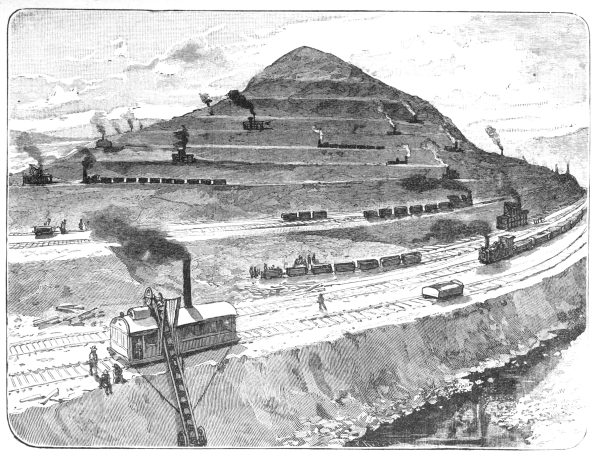
The Works on the Culebra Col, Panama Canal, in 1888.
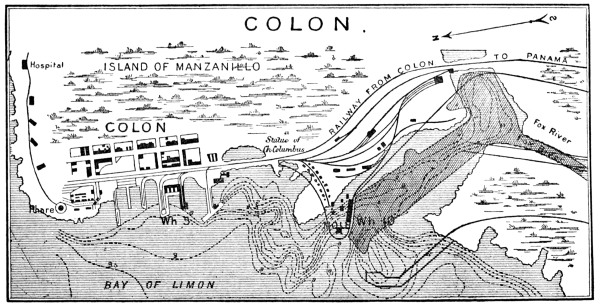
Plan of Colon, Atlantic End of the Panama Canal.
The first important step towards the prosecution of the Panama Canal
works was the selection of a site for landing the necessary plant. The
space in front of the town of Colon, at the north-eastern extremity of
the Bay of Limon, was occupied by wharves devoted to the existing trade
brought by steamers to the Panama Railway, and, therefore, another spot
had to be found. The village of Gatun was first chosen, being on the
river Chagres, and close to the railway and the proposed line of the
canal. It was supposed that this site would be healthier than the low
island of Manzanillo, on which Colon is situated, and the river Chagres
afforded communication with the sea, having a minimum depth of 13 feet
over its bar, which might be increased by dredging. Owing, however, to
the want of proper shelter, fever attacked the workmen at Gatun; and,
finally, the creek separating Manzanillo island from the mainland was
selected as a harbour for the works.
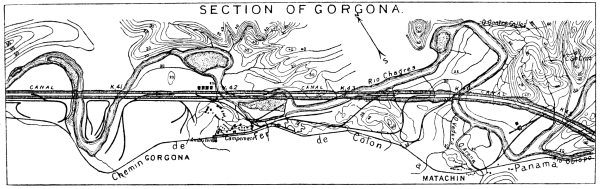
Section of the Panama Canal, showing its
Intersection with the River Chagres.
The outlet of the canal was to be situated in this creek; and in order
to protect the mouth of the canal and provide a good harbour for the
works an embankment was formed on the south-west corner of Manzanillo
island, and was carried about 650 feet into the Bay of Limon to afford
shelter, being protected along its exposed portion by rubble stone.
This embankment contains 458,000 cubic yards of earthwork, obtained by
the aid of excavators from some hillocks about three-quarters of a mile
distant, adjoining the railway; it covers an area of about 74 acres,
which was formerly partly marsh land, and partly covered by the sea.
The projecting mole was estimated to shelter nearly 3000 lineal feet
of wharfage.[179]
The position of the works will be understood from the annexed drawing.
Up to February 1883 the work undertaken at the canal had been almost
entirely preliminary. In that month M. de Lesseps, acting upon
recommendations contained in a report made by M. Dingler, chief
engineer of roads and bridges, proposed to the shareholders of the
company that the definite programme of the work to be done should
embrace a canal of a depth of nine metres below sea level, and a width
of 22 metres throughout its course; the construction of large ports at
Colon and at Panama; a great basin, five kilometres in extent, near
Tavernilla, about the centre of the canal, in order to allow vessels
to pass each other; a great dam at Gamboa, for the regulation of the
course of the Chagres river; and a tidal port at Panama, in order to
ensure access to and from the Pacific at all hours. In submitting this
programme, M. de Lesseps calculated that the excavation necessary to
the completion of such a canal would be about 110 millions of cubic
metres, and that the work of regulating the Chagres river would be
equal to a further 10 millions of cubic metres. This work, M. de
Lesseps estimated, could be completed in 1888—the excavations of land
in three years, and the dredging operations in two, so that “the canal
could, with mathematical certainty, be opened on the 1st January 1888.”
In confirmation of this calculation, he appealed to the experience at
Suez, where, with a total of 75 millions of cubic metres of excavation,
50 millions were done during the two last years of the work.
The state of affairs at the canal in the autumn of 1884 is described by
the American Admiral Cooper, who reported that although comparatively
little had been done in the actual work of excavation, in relation to
the vast work to be accomplished, yet all the preliminary plans had
been prepared, the soundings had been made, the line of route had been
cleared of its tropical vegetation, large supplies of materials of
all kinds were at command, dwellings and barracks for the employés
had been erected in elevated and salubrious localities, hospitals
had been established, and every arrangement requisite for meeting
possible eventualities had been carried out so completely that he was
confirmed in the belief that the canal would be finished in due time,
although he doubted its completion in 1888. At this time no less than
twenty different contractors, of eight different nationalities, were
engaged upon the work of construction. These contractors had undertaken
collectively to raise 62,691,000 cubic metres of excavation for a sum
total of 219,295,000 francs (8,772,000l. sterling), being at the rate
of rather less than 3s. per cubic metre. As the total quantity of
excavation required was estimated at 120 millions of cubic metres, the
opinion was held that the mere work of clearing the course of the canal
could be accomplished for about 440 millions of francs, or rather less
than 18 millions sterling.
Up to the end of 1884, the Canal Company had received a total sum of
471¼ millions of francs (about 19,000,000l.), and had expended 368¼
millions of francs[180]
(about 14¾ millions sterling), leaving only about 4¼ millions sterling
in hand. Even at this date it was confidently stated by M. de Lesseps
and his colleagues, that the canal could still be constructed for the
sum of 1070 millions of francs, or about 43 millions sterling. In other
words, it was held that for 25 millions sterling additional, the work
could be completed as originally planned.
The work proceeded, with occasional interruptions, due either to the
difficulty of obtaining sufficient capable labour, to the delay in
delivering the necessary dredging and other appliances, and to other
causes. The result of an appeal made through the ‘Bulletin du Canal
Interocéanique’[181]
in the latter part of 1884, was to place a further capital of 136½
millions of francs (about 5½ millions sterling) at the disposal of the
company.[182]
With this and the balance remaining of the previous issues, the company
were enabled to carry on the work until 1886, when they had to make
a further appeal for assistance. This time they made a larger demand
than they had done on the last occasion, and they succeeded in raising
a sum of 206½ millions of francs (8¼ millions sterling), making the
total amount subscribed to the end of 1886 not less than 886 millions
of francs, or about 35½ millions sterling. The company was by this time
getting into deep water. The public did not take to the bonds offered
so readily as they had formerly done, and the deep distrust that was
beginning to be felt in the success of the enterprise was shown by the
very low price at which the shares had to be offered.[183]
Meanwhile the prospects and progress of the company had been seriously
hampered by several exceptional sources of trouble. Political strife
on the isthmus disturbed the progress of the works, and led to a large
migration of the workmen employed. An act of incendiarism at Colon
destroyed a number of the principal buildings erected for the purposes
of the canal, and led immediately to the transfer of the headquarters
of the company from Colon to a new town created by them, and called
by the name of Christopher Columbus. At Culebra, again, where the
great work of cleaving a mountain was being proceeded with, there were
several unfortunate incidents which caused the employés to desert the
place almost in a body. These events were the origin of some sinister
rumours most unfavourable to the company. It was stated in the United
States that the political troubles had been expressly “got up” by the
personnel on the canal, with a view to giving France a pretext for
seizing the Isthmus of Panama. In Europe, on the other hand, it was
reported, and largely believed, that the United States proposed to take
advantage of the opportunity afforded by the disturbance at Colon to
seize the State of Colombia, through which the canal is carried. It
is no doubt true that the United States at that time intervened,
with a view to the re-establishment of order on the isthmus, but in
despatching Admiral Jouett with an expedition for that purpose, they
distinctly declared that their only object was to protect the lives and
property of American citizens, and that they would religiously fulfil
their engagements to maintain the neutrality and freedom of transit
between Colon and Panama.
Another difficulty with which M. de Lesseps and his colleagues have
had to contend from the beginning has been the unhealthy character of
the climate. In this respect Panama has always had a most unenviable
notoriety. The danger was therefore not unknown. Dampier, nearly 200
years ago, spoke of the “malignity of the waters draining off the land,
through thick woods, and savannas of low grass and swampy grounds;” and
Wafer reported about the same time that “the country all about here
is woody, low, and very unhealthy, the rivers being so oozy that the
stinking mud infects the air.” Walton, again, expressly declared that
the unhealthiness of the isthmus was one of the greatest obstacles to
the opening of a canal between the two oceans. “Disease,” he said,
“is a barrier against settling on the isthmus to improve it,” and
he found that “persons who have withstood every other climate there
became languid.” Humboldt appears to have made the climate of Panama
a special subject of inquiry, and reports that “for fifty years back
the vomito (black vomit of the yellow fever) has never appeared on
any point of the coast of the South Sea, with the exception of the
town of Panama.” This is explained by the fact that “the tide, when it
falls, leaves exposed for a great way into the bay a large extent of
ground covered with Fucus ulvæ and Medusæ, the air is infected by
the decomposition of so many organic substances, and miasmata, of very
little influence on the organs of the natives, have a powerful effect
on Europeans.”
Accounts of the extraordinary mortality at the works of the canal
have from time to time been circulated in Europe, which read like the
description of a pestilence, or of a devastating war. To Europeans
especially the climate has been highly fatal. M. de Lesseps and his
friends have tried, not unnaturally, to reassure the public, both
European and American, on this score. Even he, however, has been
compelled to admit a serious mortality. In his report on the progress
of the works in 1885, he stated that during the previous twelve months
more than 1100 deaths had occurred, of which some 320 were
Europeans.[184] In some of the rainy months the mortality was frightful.
In October and November it rose to nearly fifty per week. The Canal
Executive declared that this large number was swollen considerably by
the mortality of sailors arriving at Panama, but, however this may be,
the climate is without doubt one of the most malarious and deadly to
European constitutions that exists in the world.
These things being so, two results not unnaturally follow—the first,
that it was difficult to get the highest class of labour to undertake
the work; and the second, that the rate of wages paid, and the cost
of the work generally, were exceptionally high. During the years
1884-85-86, the personnel on the canal ranged between 12,000 and
25,000; and although M. de Lesseps announced in 1885 that the Company
had undertaken to provide barrack accommodation for 30,000, it is
doubtful whether that number was ever employed on the works at any one
time. We have already seen that the first contracts made with a number
of different contractors provided for the cost of excavation being
brought under 3s. per cubic metre. Señor Armero, however, in a report
made on the progress of the work in the latter part of 1887, stated
that every cubic foot had cost at least 2 dollars, or 8s. 4d.
for excavation, being nearly three times the amount at which M. de Lesseps
stated the first contracts to have been placed, for something like
one-half of the entire work.
With calculations so entirely falsified by results, the Panama Canal
Company found it necessary in 1887 to procure fresh capital. They
thereupon offered half a million shares, of the nominal value of 500
million francs at 440 francs on 1000 francs, and succeeded in raising
a further sum of about 114 million francs, making the total amount
of cash received to that date rather over 1001 million francs, or,
in other words, within 200 millions of the total amount for which
the canal was to have been completed. How far the canal still was
from completion at this time we may learn from the report made to
the Colombian Government in November 1887 by Señor Armero, who says
that the total amount excavated up to August of that year was about
34 millions of cubic metres, out of a total of 161 millions; that the
upper and easier part of the work had been accomplished, and that
greater difficulties would be encountered in working as the tide-level
was approached; that the cost of controlling the water of the Chagres
alone would amount to 471 million francs, or, roughly, one-third of the
whole estimated cost of the enterprise; that the sum still required to
complete the canal would be 3012½ millions of francs, or 120 millions
sterling, being nearly three times as much as the whole original
estimated cost; and that the amount to be paid on capital loaned during
the next six or seven years would add perhaps 40 millions sterling to
this amount.
This unfavourable report had naturally a depressing effect upon the
scheme when it was made public. And yet the reporter was not entirely
unfavourable to the enterprise. On the contrary, he prefaced his report
by the following remarks:—
“As up to date the sum expended is 818,023,900
francs, it is evident that the cost per metre of work has been
exorbitant. Were we to base our calculations on these figures, the
total cost of the canal would become fabulous, and it would probably
never be finished. But this is not the way to calculate. We have to
look at the costly preliminary works, the purchase of the railroad,
the immense amounts of materials which had to be collected, and the
purchase and erection of buildings, all of which were expenses which
had to be met in order that a work should progress which is perhaps the
most important and colossal of modern or any times. Thus the expense of
work per metre has diminished as the work has progressed, and only when
it shall have been completed shall we be able to determine the cost of
all the excavations.”
About the close of 1887, the canal was in extremis. The funds in hand
had sunk to a low point, and there appeared to be but little prospect
of raising more. M. de Lesseps, however, again proved himself equal
to the occasion. Instead of abandoning himself to despair, as the
vast difficulties, past, present, and to come, would have warranted,
he announced to his fellow-countrymen in a letter to the Premier that
he would proceed with the work piecemeal, providing in the meantime a
sufficient passage through the canal for the 7½ million tons of annual
traffic then anticipated,[185]
and looking forward to the completion of the canal, as originally
designed, by means of small levies on the annual profits, as in the
case of the Suez Canal. The Consultative Commission had, he added,
declared the practicability both of constructing on the central mass an
upper cutting which would allow of the continuance of the level works
by dredging, and of opening the maritime transport between the two oceans
as soon as these plans were completed. M. de Lesseps went on to say:—
“This approval leaves for extraction only
40,000,000 cubic metres, 10,000,000 being hard soil, and 30,000,000
dredgable soil. The carrying out of these reduced extractions being
materially ensured, we entrusted the task of submitting to us a
contract for the execution of the works to M. Eiffel, whose reputation
has been established by engineering skill equally exact and bold, and
by his great metallurgic works; imposing on him the obligation of
applying exclusively to French industry for the supply of materials,
and for all other co-operation.
“This morning (November 15) M. Eiffel has engaged
to execute these works at his own risk within the period and on the
conditions desired by the company. It now rests with the Government
of the Republic, inasmuch as French law obliges me to apply to it, to
insure definitively the execution of our programme, by authorising the
Universal Inter-oceanic Company to issue lottery obligations.”
On the 1st of January, 1888, the amount of money at the disposal of
the company was stated by M. de Lesseps to be 110 millions of francs
(4½ millions sterling), and it was calculated that 300 million francs
(12,000,000l.) would be required by the end of the year. M. de
Lesseps, in asking permission to raise this sum by a lottery, placed at
the disposal of the French Government all the contracts and documents
in the hands of the company, “whereby the execution of the programme
drawn up is guaranteed.”
During the first half of 1888, several discussions of a more or
less stormy character took place in the French Parliament on the
proposal to authorise on behalf of the Panama Canal Company an issue
of lottery bonds. In the result M. de Lesseps got his own way, the
Senate sanctioning a loan with 4 per cent. interest, and a deposit of
rentes as a guarantee. Subscriptions were opened on the 23rd of June.
The French people, backed by the most influential newspapers in the
country, looked favourably on the lottery. There were a large number
of prizes to be drawn, the chief being one of half a million francs
(20,000l.), and there were to be six drawings a year. At the outset,
with inducements that appealed so strongly to the French imagination,
the loan seemed likely to be covered several times over. All at once,
however, the flow of subscriptions stopped. It was then ascertained
that the opponents of the canal had set afloat some sinister rumours
with the object of frustrating the lottery scheme. One of these was the
rumour that Lesseps was dead. The veteran projector, however, was never
more entirely alive. Threatened with failure, he made almost heroic
efforts to avert it. He arranged for attending and speaking at meetings
in all the principal towns of France, beginning at Paris. The labours
now undertaken by the octogenarian canal-builder are thus referred to
by the Times correspondent at Paris:—
“I do not know what will be the fate of the
millions of lottery bonds which still remain to be placed, but what
is certain is that two men never gave themselves to a more laborious
work of propagandism than M. de Lesseps and M. Charles de Lesseps,
his son, have undertaken. If ever the Panama Canal is finished,
if it ever yields the results promised—as to which I can make no
assertion—it would not be too much to raise statues to these men,
who have spared themselves no toil, but have made almost superhuman
efforts to bring the work to a successful close. For a month M. de
Lesseps and his son have been visiting the industrial and commercial
centres, delivering addresses, taking part in banquets, organising
committees, and endeavouring to create a national movement favourable
to the realisation of this gigantic scheme. In all places where they
have been speaking they have had crowded audiences, which have eagerly
listened to them, and have shown sympathy with their efforts to make
the completion of the Panama Canal a national question. Frenchmen feel
that success in this work must avert a rebuff for the constructor of
the Suez Canal, who will continue to be styled ‘Le Grand Français’ so
long as the Panama Canal Scheme has not collapsed.”
On the 14th December, 1888, the Panama Canal Company suspended payment.
Announcement was made in Paris that in consequence of the subscription
not having extended to 400,000 obligations, the payment of all coupons
and drawn bonds would be temporarily suspended. The intimation caused
a severe shock in Paris, although it was not entirely unexpected. The
French Cabinet deemed the matter one of such importance that they held
a meeting to consider what should be done. It was decided to propose
a suspension for three months only. This was proposed for a double
reason—to gain time, and to prevent speculation on the Bourse. It was
stated by M. Peytral, the Minister of Finance, that the Government
wished to enable the old company, without going through the process of
bankruptcy, to hand over the canal to a new concern.
There have been few warmer discussions, even in the French Chamber,
than that which followed the proposal to interpose to this extent on
behalf of the canal company. It was argued by the opponents of the
Government that the canal should not be treated exceptionally; that the
bankruptcy law should be allowed its ordinary course; that the
Government had kept secret the report of its own engineer on the
condition of the company when it was known to be in danger; that the
Army Bill should not be delayed for the sake of a private company; and
that if the company did come to grief, nearly a million bondholders
would be ruined and a milliard of money would be lost.
On the 15th December the Chamber of Deputies, acting upon the Report
of the Committee appointed to consider the Bill, resolved by 256
votes against 81 to throw out the Bill. This decision created intense
excitement, not only in Paris, but throughout France—aye, and
throughout Europe. The shareholders in the company, 870,000 in number,
were threatened with disaster, many of them with ruin. The newspapers
contained reports of the condition of panic that prevailed in the
capital, which recalled the similar episodes of the South Sea Bubble
and Law’s Mississippi Scheme. The canal company’s offices in Paris were
besieged by eager and demonstrative crowds. They did not, however, vent
their anger and disappointment on M. de Lesseps. It was the Government
that was condemned. Lesseps was still the favourite of the people.
“Vive Lesseps” and “Vive Boulanger” were the cries of the hour. There
were not a few who regarded the occasion as one that justified the
country in getting rid of so pusillanimous a Chamber. The opportunity
of the Boulangists appeared to be at hand.[186]
The greatest but one of European Powers seemed likely to be drawn
into the vortex of revolution by the obscure problem of the cost of
constructing a waterway in a territory over which it had no control, at
thousands of leagues from its shores. The mutability of human affairs
had surely never a more striking illustration!
According to a statement which appeared in the Standard of the 17th
December, 1888, a Figaro reporter called on M. de Lesseps, and was
received by him in a drawing-room, where seven of his younger children
were having a romp with their mother. The following is a description of
the scene that took place:—
“You know the vote of the Chamber?”
“No,” he replied very calmly, stretching out his hand.
“The Government Bill is rejected; your application is
defeated; the majority against you is nearly a hundred.”
M. de Lesseps suddenly became very pale, but remained
silent. His hand, quite cold, let mine go. He carried his
handkerchief to his lips, as if to stifle a cry. Then,
resuming all his calmness, and drawing himself up to his
full height, he murmured, “It is impossible.”
“It is infamous,” exclaimed Madame de Lesseps.
“I could not have believed,” he proceeded, in a sad
tone, “that a French Chamber would thus sacrifice all
the best interests of the country. Have they then all
forgotten that one milliard and a half of French savings
(60,000,000l.) are jeopardised by this vote, and they
could have saved everything by a reprieve? However, in this
appalling crisis I have nothing to reproach myself with. I
have done all that was humanly possible to safeguard the
interests of each and all, because I know that the final
collapse of the Panama Canal would be not only the ruin of
the shareholders, but also a calamity for the country, and
a disaster for the national flag. What consoles me is the
frankness with which our new provisional administrators
have hastened to acknowledge that in our operations
everything has been clear, honest, and straightforward.
They told me so this very day, only an hour ago, and I
have no evidence to contradict that. I am also encouraged
by the thousands of letters I receive from my subscribers
and shareholders, those unknown friends who trust me as
they ever did, and who support me with valiant hearts in
this last battle. Their name is legion, and to save their
earnings I am prepared to make every sacrifice. Nay, even
monarchs have sent me telegrams to express their anguish
and sympathy. See, I have just opened this letter from
Queen Isabella. It is written in Spanish, but I will
translate it for you:—
My dear friend, Count de
Lesseps,—At the time when difficulties are accumulating around
you I feel impelled to tell you how firmly I believe in your great
work, which is an object of envy to the whole world, and how much I
admire your energy.
(Signed) Isabelle de Bourbon.”
As he concluded the reading of this letter his
children came round him and kissed him. “But you will succeed all
the same, won’t you, father?” they kept on repeating; and
one of the younger children, a little girl about seven,
coming up to me, said, “Did the Right vote against papa,
Monsieur?” I replied, “I do not think so, Mademoiselle.”
She said, “Ah!” and, delighted at having had her say, she
rushed into her mother’s arms, who, still thinking of
the vote, repeated, “It is infamous, and will drive six
hundred thousand subscribers to revolt. It will be the
ruin of all these poor folk.”
The experience of the Panama Canal Company, has only been a repetition,
on a large scale, of that of the Panama Railway projectors. That line
was commenced in 1850 and completed in 1855. The distance which it
traverses, between Aspinwall and Panama, is 47½ miles, and the cost of
construction was 48,600l. per mile, as compared with an average cost
of under 12,000l. per mile for the railways of the United States as
a whole. The great summit-level was attained at a height of 264 feet
above the mean tide of the Atlantic, and the ascent required gradients
of 1 in 18. The greatest source of the heavy expense of the Panama
Railroad was the labour difficulty, resulting from the influences of
the climate. Of this Dr. Otis[187]
says:—
“The working force was increased as rapidly as
possible, drawing labourers from almost every quarter of the globe.
Irishmen were imported from Ireland, coolies from Hindostan, Chinamen
from China, English, French, Germans, and Austrians, amounting in all
to more than 7,000 men, were thus gathered in, appropriately, as it
were, to construct this highway for all nations. It was now anticipated
that, with the enormous forces employed, the time required for the
completion of the entire work would be in a ratio proportionate to the
numerical increase of labourers, all of whom were supposed to be hardy,
able-bodied men. But it was soon found that many of these people, from
their previous habits and modes of life, were little adapted to the
work for which they had been engaged. The Chinamen, 1000 in number, had
been brought to the isthmus by the company, and every possible care
taken which could conduce to their health and comfort. Their hill-rice,
their tea, and opium in sufficient quantities to last several months,
had been imported with them; they were carefully housed and attended
to; and it was expected that they would prove efficient and valuable
men. But they had been engaged upon the work scarcely a fortnight
before almost the entire body became affected with a melancholic
suicidal tendency, and scores of them ended their unhappy existence by
their own hands. Disease broke out among them, and raged so fiercely
that in a few weeks scarcely 200 remained. The freshly-imported
Irishmen and Frenchmen also suffered severely, and there was found no
other resource but to re-ship them as soon as possible, and replenish
from the neighbouring provinces and Jamaica, the natives of which,
with the exception of the northmen of America, were found best able to
resist the influences of the climate.”
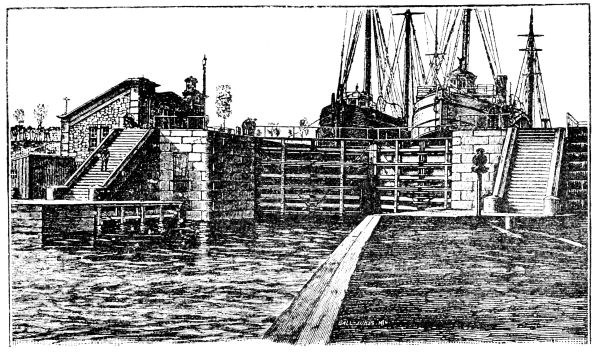
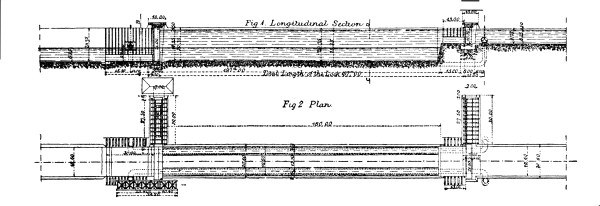
The proposed Panama Canal locks.—The original plans of the Panama
Canal provided for a waterway that should be 28 feet below the mean
ocean level throughout its entire length. It has since been found that
this design would involve an enormous expenditure and a serious delay,
and hence the decision in 1888 to provide a series of four locks on the
Pacific, and four locks on the Atlantic side. On the Atlantic side,
two of the locks were to have a fall of 8 metres (26 feet 5 inches),
and two others a fall of 11 metres each (36 feet 3 inches), while on
the Pacific side, three locks were to have a fall of 11 metres each
(36 feet 3 inches), and one a fall of 8 metres (26 feet 5 inches). The
height of the water level on the Pacific side would, therefore, be 41
metres (135·6 feet), and on the Atlantic side it would be 38 metres
(125·7 feet). The width of the lock gates was to be 18 metres (59·5
feet), and the length was 180 metres (595·5 feet). The locks and their
gates were to be constructed in iron, and it was estimated that 20,000
tons of cast, and 15,000 tons of wrought, iron would be employed in
their construction. The effect of this modification of the original
plans would, of course, be to reduce the amount of excavation necessary
in the Culebra cut by at least one-third, but it would also obviously
alter the entire character of the canal as first projected.
The opinion of some engineers appears to be that the frequent opening
and shutting of the sluice-gates, with such a considerable pressure of
water, would not be without a certain amount of danger. The pressure
would be increased little by little until it had been raised to a
breadth of 10 metres, and even as much as 15·40 metres. It is not
unusual to find a pressure of this extent at dock gates, but in the
largest canals hitherto constructed with locks, the pressure has seldom
exceeded three to four metres. In order to meet similar cases, it has
been proposed, where there was a constant use of a canal at all hours
of the day and night, to employ a very large number of small sluices
adapted to the slopes of the canal. This expedient has been put in
practice in the case of the eight successive sluices known as Neptune’s
Staircase, on the Caledonian Canal, and, on the Canal du Midi in
France, in the case of the seven sluices of the staircase of Béziers.
It is, however, held by Le Génie Civil that such small sluices,
although more easy to open and offering perhaps greater resistance,
are, nevertheless, not well adapted to the necessarily rapid and
constant working of a canal like that of Panama. This expedient having,
therefore, been abandoned, there remained that of movable caissons
suspended by the upper part, which is known as the Eiffel system. This
system, with its movable gate shut, and the recess into which it fits
when open on the right, is illustrated in one of the drawings attached
to this chapter, while another drawing shows the lock gate open.
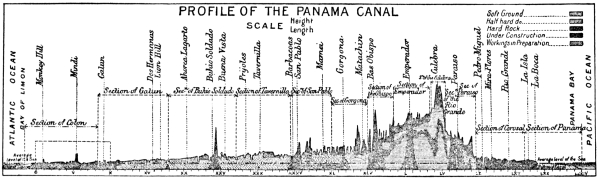
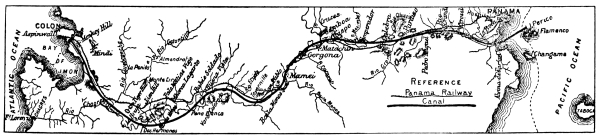
Tracing and Profile of the Panama Canal.
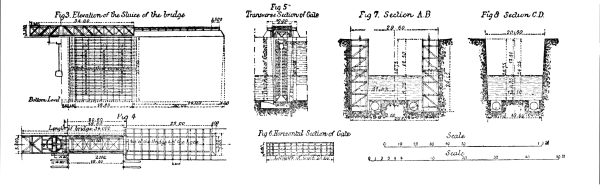
M. Eiffel’s Proposed Sluices for the Panama Canal.
The proposed modification of the original plans has been so designed
as to enable the works of the tide-level canal to be continued without
interruption. The lock canal was to be at sea-level from Colon to the
fourteenth mile, where the first lock with a lift of 26¼ feet would
be placed. The second lock with the same lift was to be placed 231⁄9
miles from Colon, and the third and fourth locks, with lifts of 361⁄11
feet each, at 27¼ and 28¾ miles respectively, making the summit-level
124⅔ feet above the Atlantic. The canal was to descend to the Pacific
by three locks of 361⁄11
feet drop, situated at 35½, 359⁄10, and 38₢
miles respectively from Colon, and one lock of 26¼ feet drop at 36¾
miles, thus making up the difference in level of 134½ feet between
the summit-level and low-water of spring tides at Panama. It has been
suggested that in the event of difficulties occurring in the excavation
of the Culebra cutting, the summit-level might be raised to 160¾ feet,
by inserting a lock with a lift of 361⁄11 feet
on each slope of the Cordilleras, whereby time might be gained by a further reduction in
the amount of excavation. The section adopted for the level canal was to
be maintained in each reach. The width of the locks was to be 59 feet,
and their available length 590 feet. At the Colon entrance, the canal
was to have a bottom width of 590 feet for 1·86 mile, and at the Panama
end, 164 feet for 3¼ miles; whilst the channel in the Pacific, from the
shore at Boca to Naos, was to be 164 feet wide. Allowing a speed of 6¼
miles per hour in the long reaches, and 2¼ miles in the short reaches,
and one hour for passing through a lock, a single ship would traverse
the canal in seventeen hours twenty-eight minutes, and in a convoy in
twenty-eight hours twenty-five minutes. Accordingly, ten vessels, or
25,000 tons, could pass through the canal in twenty-four hours, so
that, if necessary, 9,125,000 tons of traffic could be accommodated
annually. The water supply required for this traffic was estimated
at 1,050,000 cubic yards per day, which could be obtained from the
Chagres, the Obispo, and the Rio Grande. With the summit-level at 124⅔
feet above the sea, it could be supplied from the reservoir created by
the large dam at Gamboa; but if the summit-level was raised to 160¾
feet above the sea, pumps not exceeding 3600 h.p.
would be needed for lifting the supply the additional height. The gates
for the locks were designed to be hollow-iron counterbalanced caissons,
suspended from a frame with rollers, running on a roadway supported by
a swing-bridge across the lock, and continued above the recess at the
side, into which the caisson was to retreat for opening the lock.
The watertight compartments at the lower part of the caisson, as well
as the bottom portion, arranged to serve as a working-chamber, were
to communicate with the outer air by shafts, provided with air-locks,
so that water or compressed air could be introduced at pleasure. This
arrangement would enable the counterpoise of the caisson to be readily
adjusted, the different chambers to be easily reached for repairs,
and the working-chamber at the base to be used for cleaning the sill
from silt or débris. The caisson gates, in a lock of 361⁄11 feet
lift, would be 69 feet high, 71 feet long, 13⅛ feet broad at the tail,
and 32¾ feet high, 71 feet long, and 9⅚ feet broad at the head of the
lock. The locks, being situated in rock, would have the sides of their
chambers formed of the natural rock, with a slight facing of masonry
where necessary; but the side walls below the gates were to be iron
caissons, 18 feet broad, filled with concrete. The swing-bridges, of
iron or steel, were to be 18 feet wide, and 112 feet long, the swing
portion being 78 feet; and the recesses for the caissons were to be
98½ feet long; and 23 feet wide at the top. The filling and emptying
of the locks were to be effected by two cast-iron pipes, each 9⅙
feet diameter, and it was calculated that the required volume of
52,300 cubic yards of water could be admitted or shut out in fifteen
minutes.[188]
Special Features of the Enterprise.—Probably no great engineering
or constructive work of either ancient or modern times has been of
such a gigantic and difficult character as that of the canalisation
of the Isthmus of Panama. It is not that the length of the canal is
exceptional; it is, on the contrary, shorter than that of many existing
canals, some of which are of very small account indeed—being less
than one-half the Suez Canal, less than one-third that of the canal
of Languedoc, and less than one-fourteenth that of the Grand Canal of
China. It is probable, also, that the building of the Great Wall of
China, the Pyramids of Egypt, and several other works of antiquity that
might be named, extended over a much longer period, and involved the employment
of a greater number of men. The Royal or Grand Canal of China,
which was completed in the year 980, is said to have occupied the
labour of thirty thousand men for forty-three years.[189]
But none of the great works of previous epochs have been environed
with so many difficulties as the Panama Canal. The scheme, on the
face of it, does not look so formidable. It is only when we come to
look into its details, and compare them with those of other similar
undertakings, that we realise its magnitude. And it is only when we, in
like manner, compare its engineering features with those of the other
great engineering works of the world that we can appreciate the vast
energy, enterprise, and resource that has ventured to essay so colossal
a task.
The first and the most serious difficulty to be encountered was that
of controlling the waters of a torrential stream, almost equal to
that of some of the chief rivers of Italy, through which the canal
was to run. This stream, which crosses and recrosses the line of the
canal twenty-seven times, as shown in the drawing attached hereto, has
several different levels, and would, if left to itself, be certain to
destroy the canal in a very short time. It had therefore to be dealt
with by constructing an enormous embankment raised 45 feet above the
waters of the Chagres, so as to allow of their gradual escape. In this
dam there are 26 millions of cubic yards of cutting; in the Culebra
Col, a channel cut right through a mountain more than 300 feet above
sea level, there were estimated to be 37 millions more; and in the
entire line of the canal there were calculated to be about 75 to 100
millions of cubic yards of excavation, to accomplish which a serious
writer in the Edinburgh Review maintained that it would require
the labour of 20,000 men for forty-two years.
Worse than all, however, was the dreadful and deadly climate. Five
months of the year are continually wet. There are few fine days in the
other seven months. The annual rainfall is twelve to fifteen times
that of Europe. The mortality is excessive. The cost of labour is
consequently high,[190]
but pay what they may, the company could not command the amount of
labour it was anxious to employ. For the most part the labour has had
to be imported from Europe and the West Indies. The men were brought to
Panama at the expense of the Company, but a very large proportion of
them left again immediately, for various reasons, so that the company
has not been able to keep up the proper quotas of men with which they
undertook to provide their contractors, who were left at liberty to
throw up their contracts when they ceased to be remunerative. The cost
of the undertaking was thus enormously increased beyond the original
estimates. The difficulty of procuring ways and means, and the high
prices that had to be paid for borrowed money, have also seriously
added to the expenditure. Another serious element of cost has been the
outlay incurred in providing hospital and other facilities, and the
maintenance of the usually very considerable numbers who were stricken
with illness, induced by their unhealthy surroundings. These and other
difficulties have so seriously weighed upon the undertaking that its
accomplishment has been pronounced impossible, and M. de Lesseps and
his colleagues have been denounced for following a “will-o’-the-wisp.”
They have, however, persevered with their task for about eight
years, and have made heroic, and almost superhuman efforts to keep
the enterprise on its legs. In this effort they have had to depend
absolutely upon their own countrymen, although they have much less
maritime interest in the matter than the people of England and the
United States of North America. In the latter countries the canal has
all along been regarded with disfavour, not to say declared hostility.
In the United States especially, M. de Lesseps has been told again and
again that he was “beating the wind,” and that nothing but failure
could come of his project. For the time being it looks as if his candid
friends were right, and M. de Lesseps was wrong.
As might be expected, there have been very conflicting calculations
made as to the amount of traffic which an interoceanic canal on the
American isthmus would be likely to carry. The Geographical Congress,
held at Antwerp in 1871, did not venture to go beyond 4,000,000 tons
per annum. When the Canal Company was started, the expected tonnage
was raised to about 6,000,000 tons annually. In 1887 M. de Lesseps, in
his letter to the French Premier, put the quantity at 7,500,000 tons.
A writer in the Revue-Gazette Maritime et Commerciale (Paris) has
estimated that if the Panama Canal had been opened in 1884, there would
have passed through it the following tonnage:—
| |
| |
Ships. |
Tonnage. |
| Europe |
4,226 |
4,650,390 |
| Asia |
2,255 |
1,212,178 |
| America |
2,987 |
3,441,598 |
| Totals |
9,468 |
9,304,166 |
| |
This latter estimate appears to be greatly exaggerated. It is
apparently founded on the assumption that the greater part of the
Australasian trade would pass that way. But the fact is that the
geographical distance to Sydney does not differ by quite 500 knots
between any of the four routes that are, or would be, available—that
is, the Cape of Good Hope, the Suez Canal, Cape Horn, and Panama, the
distances increasing in the order stated. Nautical distance, moreover,
as has been properly remarked, “is only one element in determining
choice of route; prevailing winds and currents, avoidance of stormy
seas or of rock-bound coasts, have all to be studied by the mariner;
and the comparatively trifling difference in the length of the course
from the Thames to Sydney by four such different routes is enough to
show how important it is to have this question of routes illustrated by
the experience of the skilled navigator. This consideration is enhanced
by the remark that the dues for the passage of the canal would amount
to as much as the cost of more than 800 knots of additional voyage.”[191]
A much more reasonable and modest estimate than that of either of the
foregoing, is that made in a recent report on the proposed Nicaraguan
Canal. This estimate, based ostensibly on the United States Treasury
Reports, puts the total tonnage that would have made use of the canal
in 1885 at 4,252,000 tons, which is stated to be an increase of 53
per cent. in six years. At the same rate of increase, the tonnage
available in 1892, when the canal was expected to be completed, would
be 6,506,000 tons.[192]
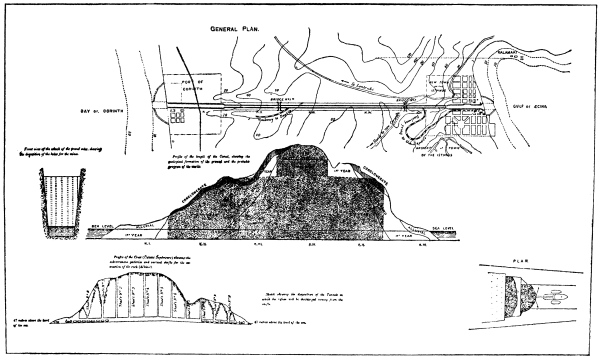
The diagrams attached hereto show the enormous difficulties that
have just been referred to in a much more graphic way than any mere
description could do. It will be observed from the illustration (p. 298)
that the Rio Chagres crosses the course of the canal no fewer than
five times in little more than five kilometres, and that the Rio Obispo
also steps in to add to the complications of the situation. On the San
Pablo section again, within a distance of three kilometres, the river
crosses the line of canal three times.
The Chagres river, which is so great an obstacle in the project of the
Panama Canal, rises on the western slopes of the Cordilleras, and runs
through a broken and irregular country, to the north of the auriferous
granite hills which branch off to Cruces and Gorgona. This river and
its affluents is said to drain an area of about 1550 square
miles.[193]
From Matachin, where the Panama canal parts company with the valley
of the Chagres, to the sea, there is a total distance of twenty-eight
miles, in the course of which the river falls about 35 feet.[194]
The rain of a single day is said to raise the waters of the Chagres
from 35 to 40 feet, and below Matachin there is a cataract of 50 to 60
feet. It was part of the project to abandon at this point the valley
of the Chagres, and to cut through the Cordilleras. The level of the
bottom of the canal is here 100 feet below that of the bed of the
Chagres, or 140 feet below the mean level of the nearest indicated
points on the section of the plans above and below the intersection. In
a length of nine miles, at the foot of the ascent of the Cordillera at
Matachin, the lowest point is 166 feet, and the highest 333 feet above
the bed of the canal. A tunnel of 7720 metres in length was at one time
proposed to be cut through this section, but M. de Lesseps stood out
for a cutting á ciel ouvert, and it has been remarked that according
to the plans there has been an assumption that the sides of this vast
cutting will stand so nearly perpendicular as to slope only one foot
horizontal in every ten feet vertical. In a dry climate, with good firm
clay or rock, this might not involve difficulty or danger, but the
climate of Panama is exposed to a tropical rainfall. A rainfall of six
or seven inches in a few hours is not uncommon.
The flood volume of the river Chagres has been estimated at 1600 metric
tons of water per second, which is four times the volume of the highest
flood ever measured on the Thames, and the rainfall, as a whole, has
been known to exceed 120 inches in a single year. Besides all this, it
was reported by M. de Lesseps himself,[195]
that the borings on the Culebra range, had reached the depth of 100
feet without having met with rock. Some engineers have therefore
condemned this part of the plans as faulty, arguing that such a cutting
could not be expected to stand at a slope of one to one, even in a much
drier climate—which means that the cutting through the Culebra would
require to assume greatly larger dimensions, if it were to be of any value.
One of the most serious undertakings connected with the Panama canal
was the proposal to retain the flood waters of the Chagres, by means
of the enormous embankment already referred to, between the Cerro
Gamboa on the south, and the Cerro Barneo on the north, thus raising
the level of the waters from 40 to 45 feet above the river, in order
to allow of their escape. Other two projects were submitted to meet
this difficulty—the first, that of constructing a canal for the
flood waters of the Chagres alongside of the navigable canal; and the
second, that of tapping the Chagres at Matachin, and diverting its
waters to the Pacific. As regards the first of these two alternatives,
it was objected that, as large affluents flow into the river below
Matachin, three parallel canals of large size would require to be
constructed, in order to make the alternative of any real value; the
second alternative, it was held, would afford no relief to the floods
of the Trinidad, the Gatun, and the smaller affluents of the Chagres
below Matachin, while it would be likely to increase the difficulties
of construction at the one end as much as it reduced them at the other.
Nor is it admitted by some authorities that the Gamboa dam would be
likely to answer its purpose. It is contended that many embankments
would be required, instead of only one, and that the construction of
such an embankment from such a cutting could hardly by any possible
effort be completed in twenty-six years, so that it would not be until
after that time had elapsed that the canal could be commenced between
Chagres and Matachin, with its bed 30 feet under sea level.
The low-water flood of the Chagres river, just below the site of the
proposed Gamboa Dam, is 209 feet wide by 7 feet 6 inches deep, the bed
being triangular in cross section. In November 1885, a flood occurred
here, under the influence of which the river was swollen to a width of
1560 feet, with a maximum depth of 28 feet, so that it was twelve times
as wide as the canal and almost as deep at its deepest point. It is
stated that the last four feet of the rise took place in four hours,
and in thirty-six hours the water had risen about 20 feet. The general
consensus of opinion among engineers appears to be that this immense
flood has to be provided for in some way. M. de Lesseps originally
proposed to meet the difficulty by constructing a dam, or embankment,
two-thirds of a mile long, 1300 feet wide at the base, and 164 feet in
height. This dam was to be designed so as to retain the floods which
descend the Chagres river, storing the water and allowing it to escape
gradually. The only alternative was to provide the flood waters with such
a rapid means of escape to the ocean that they could not flood the canal.
From considerations of economy, it was recently determined to abandon
the lock gates at the port of Panama. It was intended in the original
scheme to provide these gates in order to control the rise and fall of
the tide at this end of the canal. This movement of the tide varies
from 20 to 27 feet, being at least twelve times as much as at the other
end of the canal. Obviously, therefore, the canal would be seriously
affected by a tidal movement of so considerable a character, and
leading engineers have not hesitated to say that without the lock gates
at Panama the canal is an impossibility.
“American engineers,” we are told, “have never had but one opinion of
the canal. As a general thing they have never believed that it could be
built on the lines, within the time, nor for the money specified by M.
de Lesseps.” The same writer adds that “M. de Lesseps, having won fame
by scooping out some sand hills and connecting some lakes and streams
at Suez, thought it was a simple matter to make a canal anywhere.
He has persistently refused to see any difficulties, or to squarely
look the undertaking in the face, and to estimate the chances for and
against its completion, and the collapse of all this will simply be a
question of time.”[196]
Another American writer adopts much the same view, in even more
emphatic language, when he says[197]
that, “of the final cost of M. de Lesseps’s sea-level
canal at Panama, if there could be anything about it
save utter failure, nothing can be known, except that it will be a
fabulous amount.... The great difficulties and expense of excavation
are still before them, and the knotty, perhaps impossible, problem of
the Chagres river is still unsolved.”
Further light on the difficulties in the way of the enterprise was
thrown upon it in a report made by Lieut. Kemball, in 1887, to the
United States Government. He found on the Pacific slope, a short
distance west of the summit, that the route of the canal was here
crossed and recrossed by the Rio Grande, which had been trained in a
straight line down the north side of the valley, at a considerable
height above the level of the canal.[198]
It was found, however, when the rainy season had set in, that in
different places the hillside began to slide into the cutting made
for the deflection of the river, and that one bank moved almost
intact across the cut, with the top surface unbroken, and without any
disturbance of the vegetation. The existence of a substratum of a
greasy clay bank was the cause of this trouble. Such a foundation is,
of course, not to be relied on. It is ready, as has been pointed out,
to “swell upwards, or glide sideways, on the slightest provocation,
and it may easily develop into a difficulty of the most formidable
character, requiring the river to be carried round the back of the
hills away from the canal.”[199]
In the summer of 1887, Lieut. Rogers, of the United States Navy,
visited the canal works, and made a report on them. He declared that
in 1886, 11,727,000 cubic metres of excavation had been done, bringing
the total quantity completed up to that date at 30 millions of cubic
metres. This had, however, been done in the face of tremendous odds.
An American dredger of greater power was steadily engaged on the same
spot for weeks, the pressure of the material laid on the bank forcing
up the soft spongy bed of the cut so rapidly that the machine could do
little more than merely hold its own. The canal bed had here and there
been destroyed by floods. Lines and trucks had been buried under two
metres of silt. In the Culebra cut, the mountain to the left hand of
the cut was found to be moving towards the canal, at the rate of 11 to
12 inches per annum. Seeing that this was the case when not one-third
of the excavation had been completed, the query is naturally suggested,
What will be the rate of movement when the bed of the canal is 250 feet
or more under the level of the surrounding country?
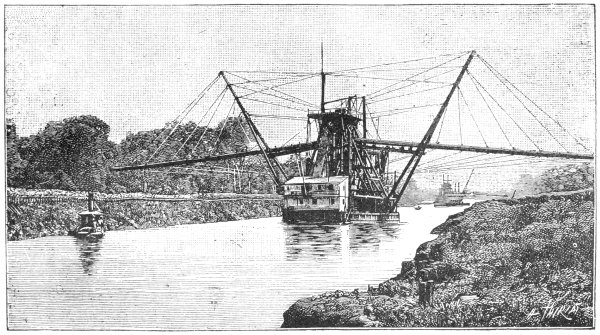
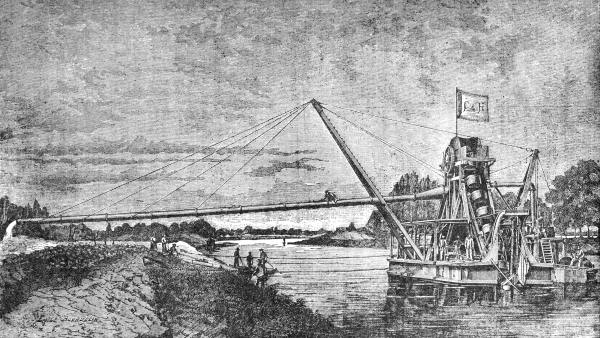
American Dredger on the Panama Canal.
Nor have English writers been slow to condemn the project both from
its economic and from its engineering points of view. The following
quotation is given as typical of much that has been written elsewhere:—
“We cannot avoid the remark that if the
Inter-oceanic Canal be regarded, not as a Bourse speculation, but
as an excavation which it is proposed to make by human agency, the
question of its actual feasibility has not yet been really entered
upon. An excavation which, if the last accounts of the borings be
correct, would contain at least twenty times the bulk of the great
pyramid; an embankment holding more than a third of the contents of
that excavation, and requiring twenty-six years for its execution at
the wholly unprecedented rate (from one end) of a million cubic yards
in a year; a canal displacing for its execution a torrential river of
four times the volume of the Thames in its heaviest flood, and with
its bed at a depth of thirty feet below sea level—all this to be done
while as yet the preliminary observations of rainfall, river discharge,
and cross section of country have to be made—the proposal of such an
enterprise seems rather worthy to adorn the name of Alexandre Dumas,
or of the author of the tales of the Arabian Nights, than that of any
person familiar with the practical execution of engineering
work.”[200]
With reference to the actual state of affairs at the Panama Canal in
1887, Mr. Froude has written in the following unmeasured terms[201]:—
“If half the reports which reached me are
correct, in all the world there is not perhaps now concentrated in any
single spot so much swindling and villainy, so much foul disease, such
a hideous dungheap of moral and physical abomination, as in the scene
of this far-famed undertaking of nineteenth century engineering. By the
scheme, as it was first propounded, £26,000,000 of English money were
to unite the Atlantic and Pacific oceans, to form a highway for the
commerce of the globe, and enrich with untold wealth the happy owners
of original shares. The thrifty French peasantry were tempted by the
golden bait, and poured their savings into M. de Lesseps’ lottery box.
Almost all that money, I was told, has been already spent, and only a
fifth of the work is done. Meanwhile, the human vultures have gathered
to the spoil. Speculators, adventurers, card sharpers, hell keepers,
and doubtful ladies have carried their charms to this delightful
market. The scene of operations is a damp tropical jungle, intensely
hot, swarming with mosquitoes, snakes, alligators, scorpions, and
centipedes; the home, even as nature made it, of yellow fever, typhus,
and dysentery, and now made immeasurably more deadly by the multitudes
of people who crowd thither. Half buried in mud lie about the wrecks
of costly machinery, consuming by rust, sent out under lavish orders,
and found unfit for the work for which they were intended. Unburied
altogether lie skeletons of the human machines which have broken down
there, picked clean by the vultures. Everything which imagination
can conceive that is ghastly and loathsome seems to be gathered into
that locality just now. I was pressed to go on and look at the moral
surroundings of ‘the greatest undertaking of our age,’ but my curiosity
was less strong than my disgust.”
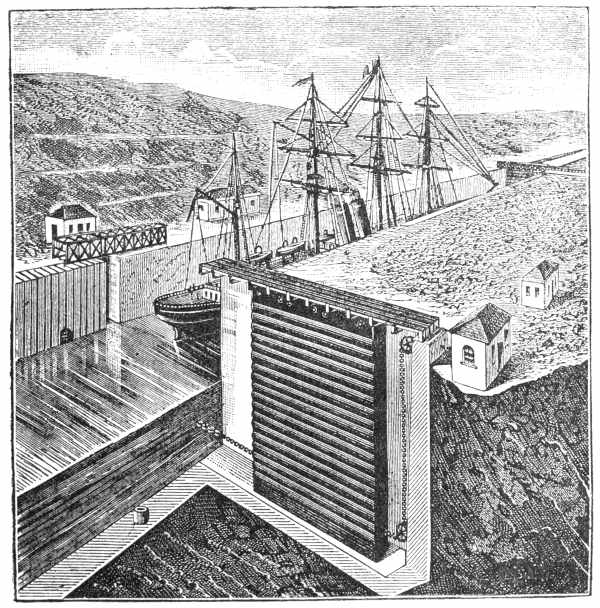
Proposed Sluice of 11 Metres on the Panama Canal,
showing the Rolling Gate Open.
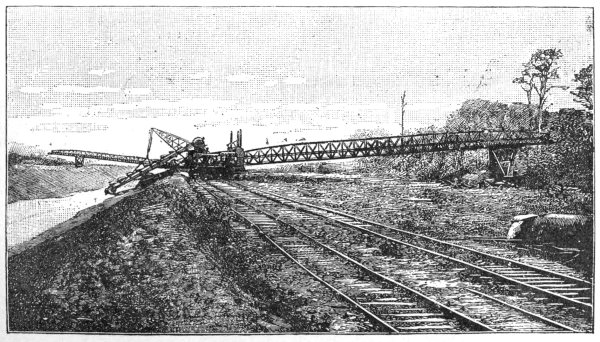
Dingle’s Dredger at Work at Gatun,
on the Excavation of the Panama Canal.
The time has not yet come when the true history of the Panama Canal
Scheme can be written. It may have been an ill-judged project, or
it may not. It has, however, had enormous difficulties to contend
with. Those difficulties began with the climate, continued with the
administration and finances, and concluded with the open hostility
of very many individuals and interests that were never very friendly
to its success. The enterprise was essentially French, alike in its
conception, initiation, engineering, and finances. The phenomenal
success that attended the Suez Canal probably led the majority of the
unfortunate people who put money into the Panama Canal to suppose that
it was to be another Egyptian Canal “writ large;” but there has also
been a strong feeling of esprit de corps, which we cannot fail to
admire, however disastrously it may have turned out for themselves,
which the French have put into this matter. The truth is that the
French people have come to regard themselves as a royal race in canal
construction. The Languedoc Canal, which they constructed in the
reign of Louis XIV. cost 14,000,000 livres, and marked a new epoch in
the history of canal construction.[202]
Of the Suez Canal, the leading features of which are so well known,
it is unnecessary to say more than that its success has not only been
phenomenal, but has been achieved in the face of the most discouraging
attitude on the part of the engineers of other countries, including
England. At the time that the Panama Canal was being promoted, M. de
Lesseps was able to point his countrymen to the fact that the shares
in the Suez Canal, which had been issued at 500 francs, had risen to a
value of 2200 francs, while the debentures issued at 300 francs were
worth 565. The impressionable French people did not stay to recollect
that the two enterprises were totally different in character, in cost,
in accessibility, in practicability, and in prospects. And it is only
fair to recollect that the original estimate of the cost of the canal
has been largely exceeded by circumstances that were hardly capable
of being foreseen. The repeated attacks made by inimical interests,
led to the company having to borrow on higher terms, as well as to the
suspension of work on the isthmus for nearly a year. A much larger
amount and higher rate of interest has had to be paid to share and
debenture holders than was ever expected. The Company have also had to
contend with a want of navvies, and with labour disturbance, that told
unfavourably on their interests.
The Report of the Special Commission appointed in 1889 to inquire
into the affairs of the Panama Canal was published in May, 1890, and
describes in detail the position of the undertaking. It is estimated
that some 30 millions will be required to complete it, so that its
ultimate construction does not appear at present very probable.