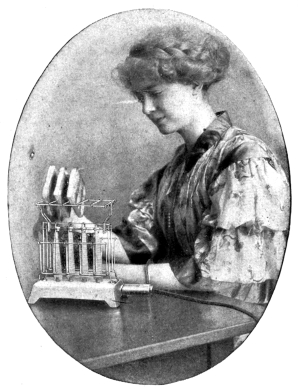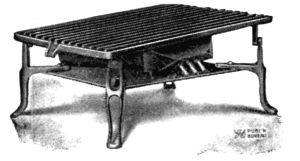
Electric Hot Plate
On the outskirts of the village of Oriskany Falls, in Oneida county,
N. Y., is a farm of about 100 acres, belonging to Mr. E. Burdette
Miner. This community was at one time one of the principal hop-raising
districts of the State. Mr. Miner has been engaged in raising hops for
fifty years, and raised 10,000 pounds of hops on seven acres the past
season. In recent years he has divided his attention between mixed
farming and dairying, keeping from twenty to twenty-five cows.
Before the installation of his water power, not the least of the
irksome tasks about the farmhouse was the daily filling and cleaning
of kerosene lamps and lanterns; and the wood was sawed, and the cream
separator and churn in the dairy room were operated, by hand. Five sons
contributed in no small measure to the prompt disposal of the daily
tasks. But the boys went forth into the world and acquired lines of
activity and interest of their own. Only the oldest son remained to
live on the farm. Another son studied electrical engineering, a third
chose mechanical pursuits, a fourth became a civil engineer, and a
fifth took up commercial work.
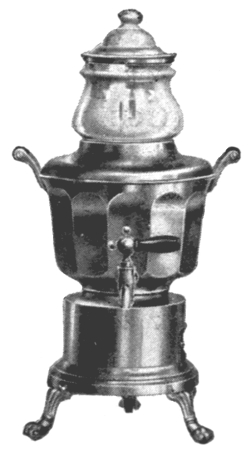
Electric Coffee Percolator
After coming in touch with the outer world and the great modern
achievements of science and invention, especially of a mechanical or
engineering character, the boys quite naturally set their wits to work
to devise some way in which the daily labors of those at home might be
made less burdensome.
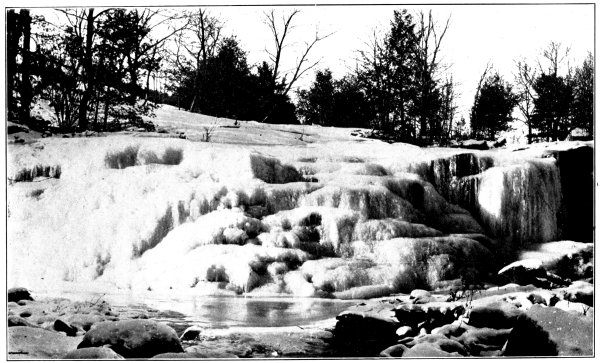
Through the farm flows Oriskany creek, which ripples over its gravelly
bed in a channel from twenty to thirty feet wide. The boys said to
their father, “Why not harness the creek and make it do some of the
work?” There was no precipitous fall of the creek on the farm, but
the boys proposed to concentrate at least a portion of the fall by
constructing a dam. This they intended to do primarily for the purpose
of developing enough power to light the homestead and farm buildings
with electricity and to saw the wood and do away with some of the other
tiresome farm tasks.
The elder Miner was not enthusiastic at first, but was finally
persuaded by the boys, who made surveys and plans for a water-power
development, and in October, 1905, with the assistance of three of his
boys and two day laborers, Mr. Miner began the construction of a dam
across the creek. This was to be no ordinary structure. The creek,
while peaceful enough at most times, had a habit, well known to Mr.
Miner, of bursting its bounds every spring and rushing through the farm
in a torrent. So the dam was built in such a way that, while it would
raise the water to a certain height during periods of ordinary flow, it
would not cause the floods to rise perceptibly higher than before the
dam was built. Accordingly, it was designed so that a part of it could
be lowered at flood times to allow free passage for the swollen stream.
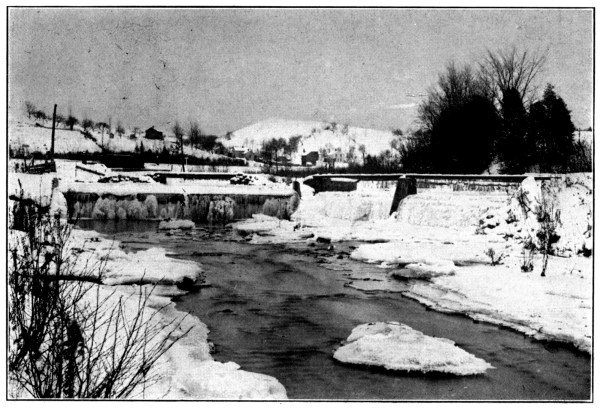
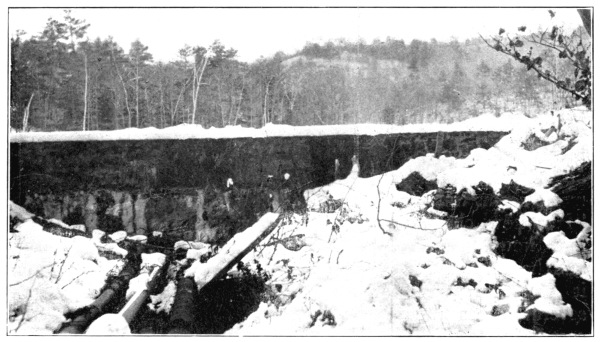
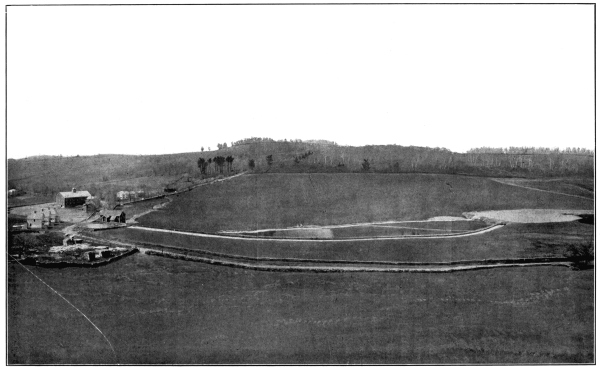
Dam of E. B. Miner, Oriskany Falls, N. Y.
Main dam at left; flood spillway at right
The bed of the stream at the site selected for the dam is composed of
solidly packed gravel. It was not considered advisable to lay timbers
on such a foundation, so a ditch about two feet deep and one and
one-half feet wide was dug across the creek bed and filled with
concrete, to which a heavy timber was securely bolted, to form the
upstream sill for the super-structure. The downstream side was
supported on a sill of heavy timber whose ends were embedded in the
concrete walls, or abutments, at either end of the dam and whose middle
portion was supported by posts, spaced six feet apart, which in turn
rested on large blocks of concrete placed in the bed of the creek.
This downstream sill was about two and one-half feet higher than the
upstream sill. A horizontal floor of double plank extending twelve
feet downstream from the upstream sill and supported by the concrete
foundations under the downstream sill formed an apron for the water to
fall on. This prevents back-washing under the dam. A double layer of
heavy plank was then fastened on the two sills, forming a sloping face
on the water side of the dam. On the upper edge of this plank-facing,
at the crest of the dam, are placed flashboards, one foot high and
extending the full length of the dam, thirty-six feet, but divided into
six sections, each six feet long. Each of these sections is hinged by
the lower edge to the crest of the dam, while the upper edge is held
from tipping over by chains fastened to cast-iron lugs located about
halfway down the planking. The chain is held in these lugs by pins
which are connected by rod and chain to a capstan, or spindle, located
at one end of the dam, and are so arranged that by turning the spindle
the pins will be drawn successively, thereby letting the flashboards
down one at a time. The idea of this arrangement is that, when a flood
is rising, the capstan may be turned with a heavy lever crank, winding
up the chain and pulling down the flashboards one at a time, to give
more space for the flood to pass through so as to prevent the water
upstream from the dam from rising too high. This plan has prevented the
washing away of Mr. Miner’s power house on several occasions.
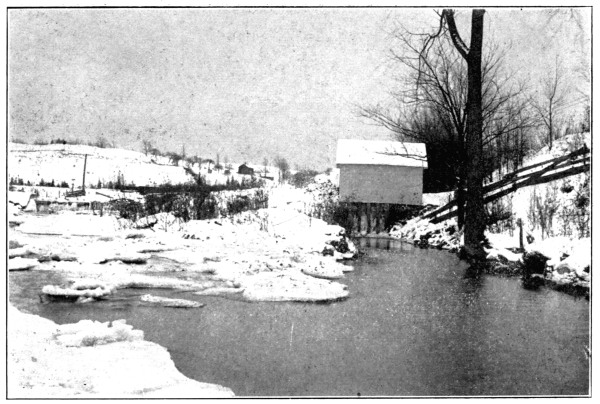
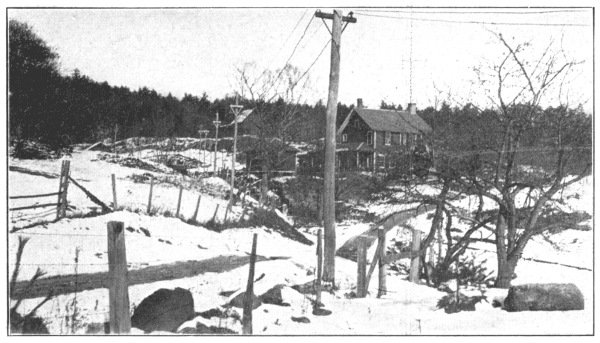
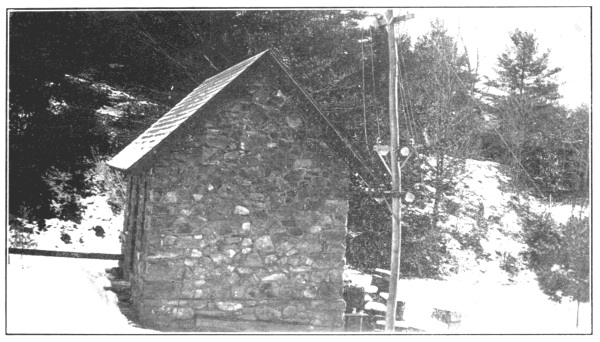
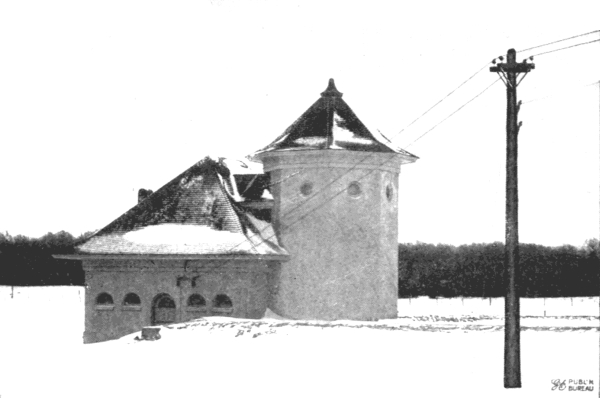
Farm Power House on Oriskany Creek
Dam in left background; tail-race in right foreground
The sloping face of the dam receives the direct pressure of the water
and transfers it to the sills, which in turn transfer it to the
concrete foundation. The reason for sloping the upstream face of the
dam is that the pressure of water is always normal, or perpendicular,
to the surface against which it presses; therefore, if the face of the
dam is sloping, the pressure is downward, rather than outward, as would
be the case with a vertical face. This results in greater stability for
the dam, due to the lessened tendency to tip over. With a dam of this
type the higher the water rises against or over it, the more nearly
vertical is the line of pressure, and the dam is held tightly down on
its foundation instead of tending to tip over. It follows that the
flatter the face of the dam the more stable it will be. Mr. Miner’s dam
raised the water about four feet.
But in spite of his provision for floods, Mr. Miner did not want to be
under the necessity of letting down his dam for every freshet, so he
provided an additional permanent spillway. This is a simple concrete
barrier, or wall, which flanks one end of the dam. In plan it was
built at an angle with the dam proper, and extends downstream along
the side of the natural bank. It was built with its crest a few inches
higher than the main dam, so that during periods of ordinary flow the
surplus water all passes over the main dam, but as soon as the creek
rises a few inches over the main dam, water begins to flow over this
extra spillway, which, being about forty feet long, will discharge a
considerable volume although the water flowing over it is only a few
inches in depth.
This spillway is strengthened on the downstream end by a concrete
abutment, which consists of a simple heavy block of concrete extending
above the top of the spillway. A similar abutment flanks the upstream
end and also constitutes an abutment for one end of the main dam. The
other end of the main dam is set against the opposite bank of the creek
and is protected from washing and is strengthened by a similar concrete
abutment.
It was considered desirable to place the little power house
away from the main channel of the stream, so an earth embankment was built,
extending from the downstream end of the flood spillway, a distance of
about sixty feet. This embankment, or dyke, is curved in such manner
as to divert the water behind it across a low place to a safe distance
from the main channel. Some excavating had to be done behind this
embankment in order to secure a channel of sufficient depth to prevent
the water from freezing to the bottom and to provide a smooth channel
of approach to the power house. This diversion of the water to one side
from the main channel prevents the accumulation of debris and silt,
which is a hindrance to the proper operation of a waterwheel. The pool
thus formed is called a “forebay” and is very quiet water. The velocity
of the water flowing through it is so slight that it will not carry
much debris.
At the downstream end of the forebay the diverting embankment
approaches a steep bank. At this point Mr. Miner built a small power
house. Under the power house is the wheel-box, which consists of a
box-like compartment having one side open to the forebay. This opening
is covered with a coarse screen to prevent leaves or other debris from
entering the wheel, but the water flows through it readily. In the
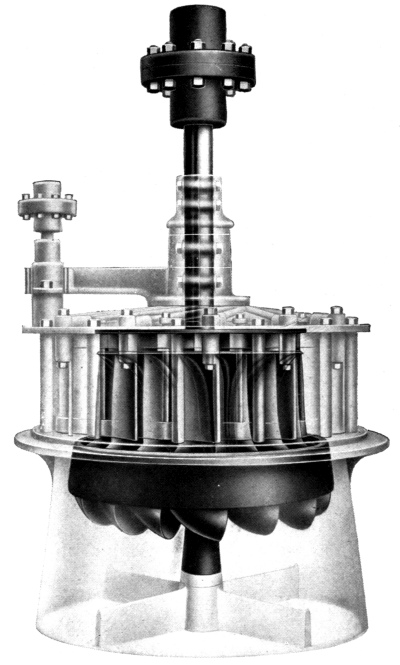
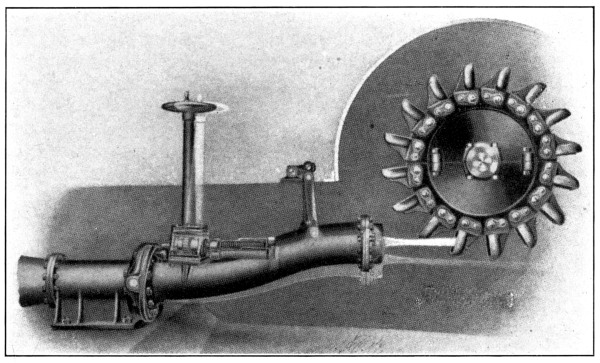
wheel-box a waterwheel, of the type known as a turbine, was placed.
This revolves on a vertical shaft, or axle, which is guided by bearings
in a metal case surrounding the wheel and resting on the bottom of the
box-like compartment. The wheel-case is open at the bottom to allow the
free escape of the water after it has passed through the wheel. The
construction of the turbines is such that the pressure of the water on
the curved vanes causes the wheel to revolve, just as the pressure of
wind causes a windmill to revolve. The water must have a free escape
from the opening in the bottom of the wheel-case and wheel-pit and to
provide for this a channel, called a “tail-race,” was excavated to
carry the water back to the creek. Natural conditions were favorable
here and a tail-race joining the main channel about 100 feet below the
power house was constructed with little difficulty. At the point where
the tail-race joins the creek the elevation is two feet lower than the
power house, so that there is little tendency for water to back up from
the creek into the tail-race. There is a certain amount of back-water
during freshets but the increased height of the water in the forebay at
such times partially offsets it.
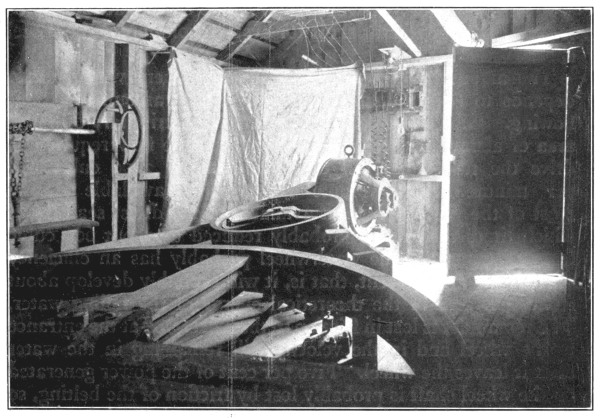
Interior of E. B. Miner’s Power House
The vertical shaft of the turbine extends up through and about two feet
above the floor near one end of the power house, where it is supported
on ball-bearings which enable it to be revolved with very little
friction.
At the other end of the power house, which is twelve feet
by sixteen feet in plan and seven feet high to the eaves, was placed an electric
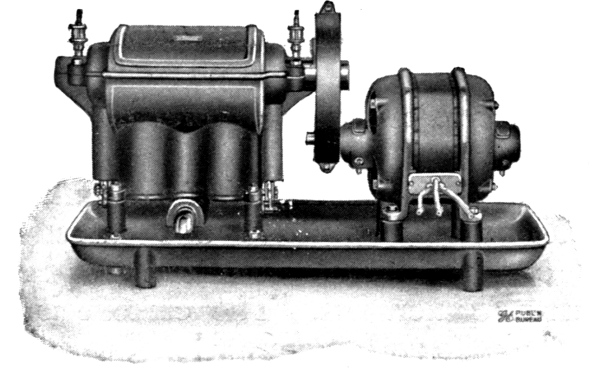
generator, or dynamo, rated at 12½ kilowatts, which is equivalent to
about 17 horsepower. This machine is intended to operate at about 1100
revolutions per minute. The waterwheel, under the pressure of about
six feet, would not revolve at such a high rate of speed. It was,
therefore, impracticable to connect the generator shaft directly to the
waterwheel shaft and it became necessary to magnify the revolutions by
connecting the two shafts by belt, using different-sized pulleys. A
large wooden pulley, seventy-six inches in diameter, was keyed on
the end of the waterwheel shaft. A much smaller pulley, about eight
inches in diameter, was placed on the driving shaft of the generator.
A leather belt connects the two, and since the wheel shaft is vertical
and the generator shaft is horizontal, it is necessary to pass the
belt over an intermediate pulley, or “idler.” This idler is set with
its axis at an angle with both the horizontal and vertical, so that
the transition of the belt from the horizontal to vertical is made
gradually. Since the driving pulley on the generator shaft is so much
smaller than the pulley on the wheel shaft, there are about nine revolutions
of the generator shaft for every revolution of the wheel shaft.
The amount of power which this equipment will generate depends to a
considerable extent upon the amount of water flowing. Oriskany creek
at this point has a tributary drainage area of about fourteen square
miles, and the flow required to drive the turbine to full capacity is
about 2900 cubic feet per minute. This volume is probably available
during most of the year, but is not available in the driest seasons,
at which times the flow is probably reduced to about 600 cubic feet
per minute. The waterwheel probably has an efficiency of about eighty
per cent, that is, it will probably develop about eighty per cent of
the theoretical energy of the falling water. The remainder is lost
in friction in the wheel-box at the entrance to the wheel and in the
velocity still remaining in the water after it leaves the wheel. Five
per cent of the power generated on the wheel shaft is probably lost by
friction of the belting, so that, at rated load, about seventy-six per
cent of the theoretical power of the water is probably delivered to the
shaft of the generator.
Mr. Miner realized that there would be times when he would not require
all or any of the power which would be produced. At the same time the
pond formed by the dam was not large enough to store any considerable
amount of water, and he had all the power he would require at any one
time, so it was not considered necessary to provide storage batteries
to store the electricity. On the other hand he did not wish to be
compelled to turn the water on and off at frequent intervals, as would
be necessary unless some auxiliary regulating apparatus were provided.
Therefore, it was decided to provide for the plant to run continuously
and to devise some means to consume the electric current when not
in use. A series of resistance coils were mounted on a frame in the
power house, and connected with the generator. When the demand for
electric current is less than the capacity of the generator, a small
electric device automatically throws one or more of these coils into
the circuit, and the surplus current is converted into heat by the
resistance of the coils. By means of this arrangement it was planned
to run the plant continuously, so that whenever electric current was
wanted it could be had simply by turning a switch at the house or barns.
The power plant, including the dam and all the features thus far
described, was completed and in operation before Christmas of the year
in which the construction was begun.
We have thus far seen how Mr. Miner developed his water power and
transformed it into electricity. It remains to see how he gets it to
his house and farm buildings, and how he uses it after he gets it there.
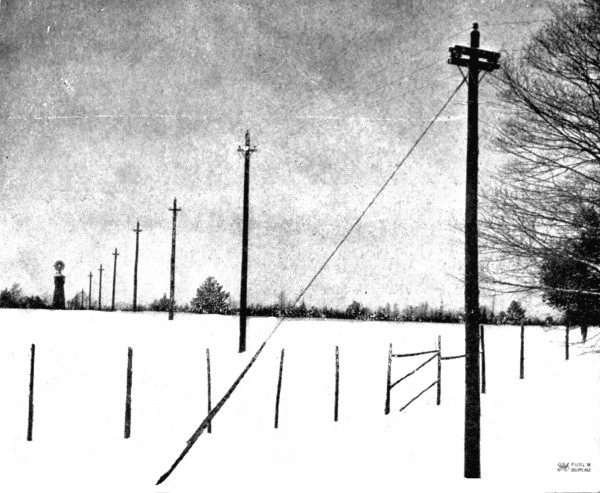
The power house is situated about 1700 feet from the house, where the
electric current was most wanted. This necessitated the construction of
a transmission line. For this purpose a double line of bare aluminum
wire was stretched on a row of poles about twenty feet high and about
one hundred feet apart. The poles are provided with ordinary crossarms
at the top on which are mounted the insulators carrying the wires.
As the transmission line leaves the power house it crosses a highway
and runs in a perfectly straight line to the house. Over the highway
insulated wires were used as a safety precaution, but bare aluminum
wire was used for the remainder because it was cheaper.
The buildings are all in a cluster and a branch from the transmission
line runs into each one where the current is used. All the wires which
are inside of any of the buildings, or are close to the woodwork, are
covered with insulation, and, where concealed, are further protected by
being placed in twisted metal tubes.
The first actual use of this hydro-electric power was for lighting. The
house was illuminated with electric lights, as were also the barn and
other buildings, there being ultimately about seventy 16-candle-power
lamps in use. Even the pig sty has its electric light, and there is no
more groping in the dark anywhere about the Miner farm buildings.
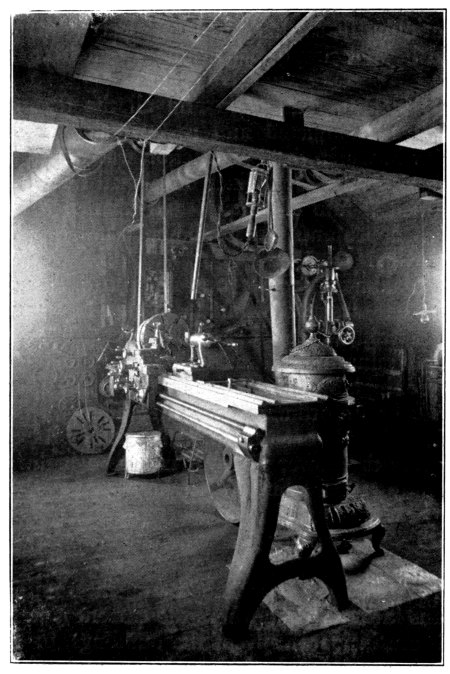
Lathe in E. B. Miner’s Machine Shop
But there was more power in the creek than was necessary to run the
electric lights. A circular saw was brought into use, belted to a
motor, and the supply of firewood was cut in a fraction of the time
previously required. The same motor is used to drive a lathe
and a drill in a machine shop which the Miner boys built and
equipped. This motor is belted to a countershaft from which additional machine
tools can be driven. One of the Miner boys has developed this machine shop as
a combined means of pleasure and profit. In addition to a considerable
amount of experimental machine work, he does all the farm repairs and a
considerable amount of machine work for neighboring knitting mills, as
well as general and automobile repair work, all of which has been made
possible by the harnessing of the creek.
Another motor, two-horsepower, driven by the electric current, is
belted to a vacuum pump, which is connected with a one-inch
pipe running to the house and the barn. In the house there are two taps, one
on each floor, to which the hose of a vacuum cleaner may be attached,
and Oriskany creek does the rest; the floors are cleaned in the most
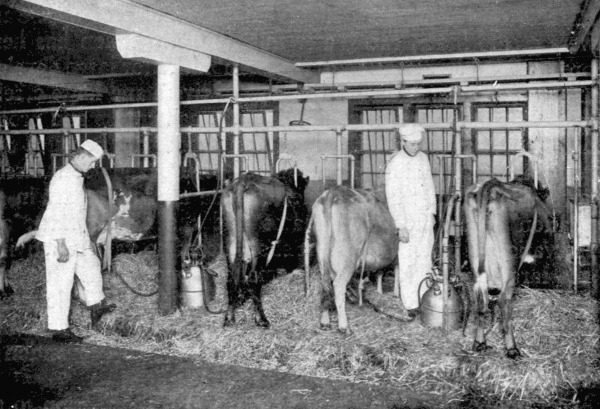
modern, sanitary and thorough manner. In the barn the pipe from the
vacuum pump runs above the cow stanchions with a tap at alternate
stanchions. The tubes of the milking machines are attached and the
creek milks twenty or twenty-five cows twice each day.
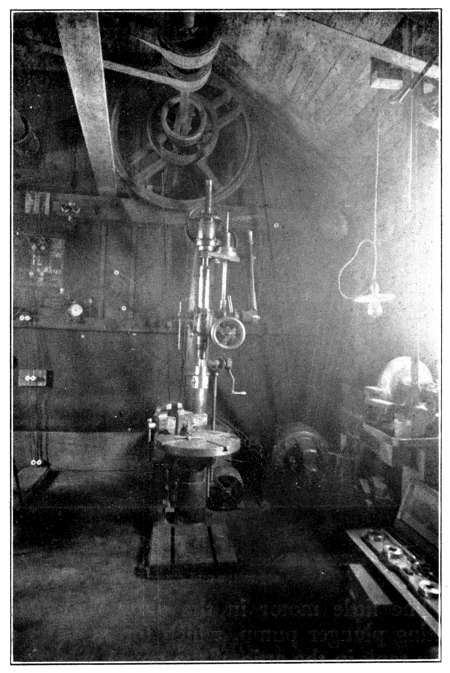
Drill in E. B. Miner’s Machine Shop
Note the electric motor in background belted
to countershaft near the ceiling
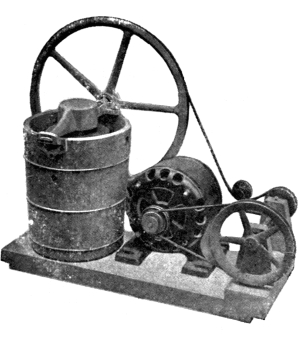
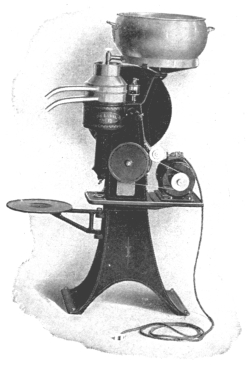
In the dairy room is a one-half-horsepower motor, which may be belted
to the cream separator or churn, and on the hot summer days it is
frequently belted to the ice cream freezer. An ingenious float device
in the separator turns off the power when the cream is all separated
from the milk and trips a can of clear water into the heavy, revolving
bowl of the separator, which still retains enough momentum to rinse
itself thoroughly before coming to rest.
In a similar manner other applications of the power have followed from
time to time, and one at a time most of the hand cranks on the Miner
farm have been relegated to the scrap heap; even the grindstone is
operated by a long, narrow belt running from the little motor in the
dairy out through the door to an adjoining compartment.
In the Miner residence are five electrical heaters, which Mr. Miner
states will raise the temperature to 75 degrees when it is zero
outside. Since these heaters were installed there has not been much use
for the wood saw. There are also in the house some electric fans which
stir up a breeze on the hot days. An electric ventilator fan in the
attic insures good ventilation at all times. In the kitchen the Miners
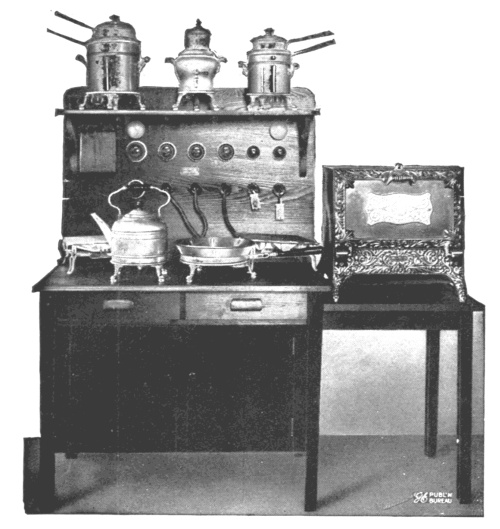
cook for a family of from five to ten with an electric range, and iron
with an electric iron attached by a cord to an ordinary electric lamp
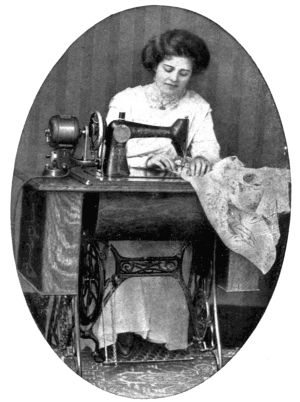
socket. A smaller motor operates the egg beater and cream whipper;
another small motor drives the sewing machine.
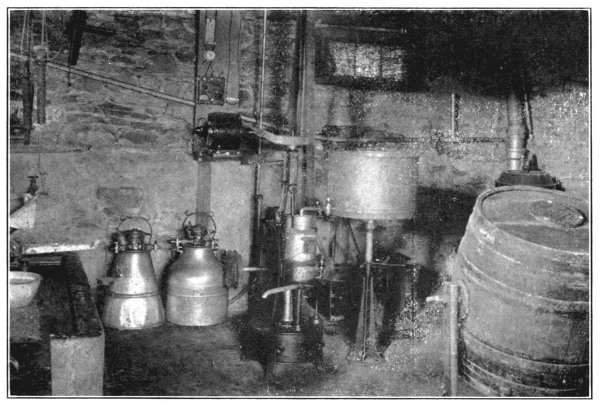
E. B. Miner’s Dairy Room
Vacuum milking machines in background; also small motor which
drives the cream separator and churn in the foreground
The little motor in the dairy room also drives a single-acting plunger
pump, which forces water up to a galvanized iron tank in the attic
of the house, whence water is piped and furnished by gravity to the
bathroom and kitchen. An electric heater in the kitchen heats the water
for the bath and kitchen.
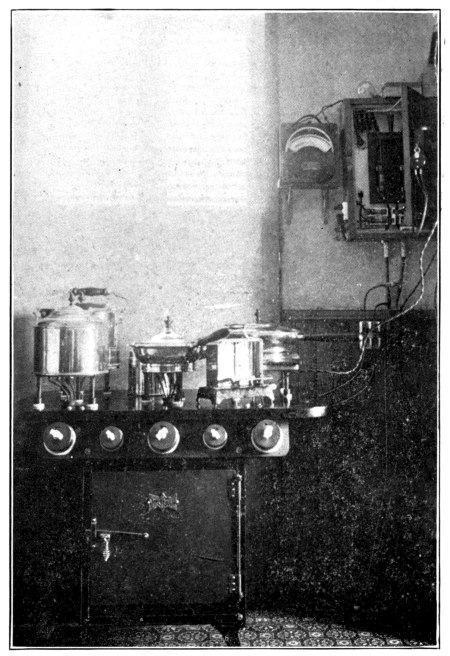
Electric Cooking Outfit, E. B. Miner’s Home
Other miscellaneous uses are made of the never-failing power of
the creek, such as filling the silo, and the power plant requires
practically no attention. Self-oiling devices on the waterwheel
and generator, and the use of the resistance coils to consume the
superfluous electricity, obviate the necessity for attention, except to
fill the oil cups every few weeks. Practically no trouble has been
experienced in the operation, the only interruption so far being due
to the formation of anchor ice in the forebay, which causes a little
trouble on extremely cold days. The waterwheel is run continuously,
night and day, summer and winter, and electric light or current is
always available at the touch of a button or by throwing a switch.
As to the cost of his plant Mr. Miner would give no figures. His motto
seems to be, “Not how cheap, but how good,” and he states that it would
require several times the cost to induce him to give up his water-power
plant. Engineers estimate the cost of reproducing his plant, including
the dam, power house, waterwheel, generator and transmission line, at
about $1800.