Poets have sung of the “babbling brooks” and the “mountain
springs” with their “silver cascades.” Painters have
sketched
“the placid stream,
Reflecting back the mirrored beam,”
in many a sequestered nook, where the beauty of the scene
gave to the soul its grandest appreciation of nature’s handiwork;
but the poet’s song and the painter’s canvas are too often
the false airs and the tinsel drapery of Momus—fun and folly.
But poets and painters live in a realm uncongenial to the startling
facts of modern chemistry. Virgil would undoubtedly have
been as ready to have believed that H₂O represented a glass of
milk, as that it was the equivalent of pure water; while, if
Raphael had been told that the pool of Bethesda was abundant
with “albuminoid ammonia,” he might innocently have believed
it to be “something good to eat.”
Tradition and popular education have taken wings in a tangent
direction from many of the fundamental principles of a
natural existence, and, while freighting the popular mind with
its bulky chaff, sparsely grained, they seldom recognize the revelations
of science. The plot of some well drawn novel, or the
fascinating performances of its hero, rest unforgotten in the
embrace of memory,—are sought after, cherished, and remembered
in all and by all ages. Science as yet is but little courted,
much less wedded to the popular taste, and the stubbornness
of facts is in direct ratio to the inflexibility of the public mind.
Science, however, is not always of one hue. It is full of attractions
and alluring fascinations. It needs only to be clothed in
well cut and fashionable garments, and properly and politely
introduced, to receive universal recognition and popular applause.
This is especially true of the science of sanitation,
because it is more closely allied to the vital interests of every
community and every family than all others, and, through the
simplicity of its primary principles, can be realized and understood
by all.
Pure water is essential to the health and comfort of every
community: there is no argument to the contrary. How such
a desideratum can be acquired and maintained is a problem
which requires the closest application of science, as well as
mechanical and engineering skill. The question, whenever and
wherever applied, becomes an isolated reality, and the solution,
instead of being based upon established formulas or analogy, is
almost wholly dependent upon the individual facts and conditions
connected therewith.
The aspect of the question a century hence will be very different
from what it is to-day, even as in its present bearings it
differs from the time when the woodman’s axe was the only
sound of industry that echoed through the sleeping valleys and
over the watchful hills of New Hampshire. In that day the
hardy pioneer quenched his thirst by the side of any stream or
spring with water as pure as earth could give. He thought not
to glance up the stream to see if it was spanned by a family
vault, or flanked by a barn-yard. Likewise, if he partook from
the bubbling spring or the primitive well, he never imagined a
crystal of urea came up in the tiny fountains of sand at its bottom,
or that the sparkle of the water was the carbonic acid of
a sink drain; for around him were no such dangers. But civilization
(in many respects a misnomer) came on, and brought
with her more evils than one,—seduced the virginity of nature,
and begot a host of illegitimate products and conditions. Into
her very veins—the streams and rivers—have been injected the
effete products of waste and decay; and to-day her very gifts,
poisoned by men, bring pain, poverty, tears, and death into
many households.
We have all, no doubt, traced some cases of the zymotic
order to polluted water, with evidence that left no doubt as to
the correctness of our conclusions. As to how far such influences
extend in the causation of disease is undetermined, but I
believe it extends far beyond the category of acute zymotic
diseases.
What of the great invalid corp that register their physical
afflictions under the comprehensive term “poor health,” and
who seem to have no specific disease, either acute or chronic?
What demon has laid so oppressive a burden upon the nerve
centres that half of life’s function is smothered, and the physical
energies nearly blotted out? I believe that contaminated water
is one of the prime factors in this unfortunate and distressing
aggregate. We have often traced typhoid fever, dysentery,
and other diseases to a polluted well or spring; but the cause of
insidious decay, progressive pallor, softening muscles, wasting
strength, and slow enervation is not so readily found nor so
zealously sought after. That contaminated water should produce
such results, associated perhaps with other unsanitary surroundings,
there can be no argument to disprove. A close
study of the subject for the past two years has led me to believe
that polluted wells are a most prolific source of sickness
and death throughout the state. I believe the medical profession
is not yet so thoroughly aroused upon this subject as the
facts demand, and that if the physicians of the state should
carefully investigate the question of water pollution, the result
would be one of wide-spread alarm at the ravages it is producing.
By far the most dangerous source of water supply is the well,
because of its close proximity to dwellings. If the surroundings
of a well are not free from all impurities and waste, we
have no right to expect pure water, and an attack of typhoid
fever, dysentery, or kindred diseases should not in the least
astonish us. Conditions which endanger our wells are the rule
and not the exception, both in the sparsely settled country and in
the city.
In a speech before the Central N. Y. Medical Association in
1875, Dr. Harvey Jewett said,—
“We are often asked, In what way does the water of our wells,
in farming communities especially, and in our larger villages,
become impure? It comes bubbling up from the deep fountains,
fresh, cold, pure, and clear as the crystal, and often gives no
indication by taste or smell of containing impurities. How
often do we see the waste water from our kitchens thrown out
upon the ground year after year, until the soil is saturated thereby?
Then, again, the continuity of sink-drains, cess-pools, and
privy vaults to our wells is sufficient to saturate the earth with
their poisonous, disease-producing elements. It is through the
agency of this apparently pure water, constantly, insidiously
introducing these subtle elements into the human organism,
that the fountains of life are poisoned and disease generated.
In large towns and thickly populated streets, with slovenly
domestics, the whole surface becomes saturated with the waste
water, and in wet seasons the well, being the only artificial
drainage, receives the drippings, converting it into a cess-pool
of filth. I have known instances where the waste water from
the sink-drain ran directly into the well, until the horrible stench
compelled an investigation and a remedy. Instances of this
kind are by no means rare, where a direct communication from
the sink to the well is found to exist. With some families in
the country the whole waste water of the household is thrown
out upon the ground, until the entire surface soil is saturated
like a sponge with the elements of disease. The popular but
erroneous idea, that filling in earth upon a water-saturated soil
removes the necessity of deep drainage, should be exploded
from the minds of the people, and the great central fact set
forth, that no water-saturated soil is fit for human habitation,
and that a large proportion of unhealthfulness and human ailments
can be traced directly or indirectly to this influence.”
I have had forwarded to me during the past year many samples
of well water from different sections of the state for examination,
and over ninety-five per cent. were contaminated. In
many instances no particular suspicion existed that the wells
were polluted, so “sweet and sparkling” was the water. With
the exception of a few wells in this city, the samples came from
the smaller villages and isolated farm-houses. I suspect, and
my experience is in accord with the idea, that the most dangerous
wells are to be found at the latter, because such a well is
subjected not only to the unsanitary influences of the household,
but of the barns, cattle-yards, hennery, pig-sty, etc. No one
can reasonably presume that a well situated in close proximity
to such surroundings can long remain pure, except that its altitude
is such as to render contamination impossible, which is
rarely the case. It should be borne in mind that a well is in
itself a system of drainage for a given area of the earth, which
area is dependent upon the depth of the well and the character
of the soil. The accepted formula is, that it drains a portion of
soil represented by an inverted cone, the base of which equals
in diameter the depth of the well. Thus, the well must drain a
certain amount of soil or earth, and unless this certain amount
is kept clean and uncontaminated, the well must become polluted.
It should not be forgotten that this described cone of
soil is the minimum amount that a well can drain, while with
favorable conditions the maximum area is almost unlimited. A
stratum of clay or other impervious substance, or fissures in the
rock formation, may act as the carrier of a little stream or vein
of polluted water till it reaches the well, and the source of pollution
may be a long distance away.
The sketch which is here reproduced from the last report of
the State Board of Health vividly illustrates the way in which
a well is often polluted.
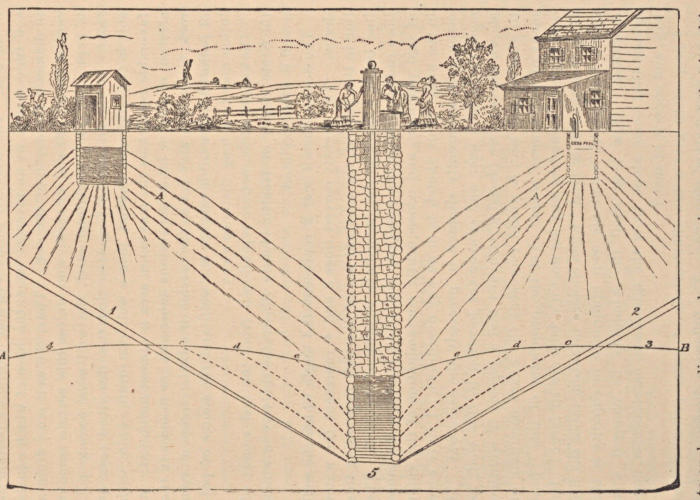
The double lines 1 and 2 represent the angle which the well
drains. The slightly curved lines 3 and 4 represent the water
line in the ground, the constant use of the well depressing this
line below a level in the immediate vicinity of the well. The
lines radiating from the cess-pool and vault illustrate the cause
of said pollution, and consequently contamination of the water
in the well. This sketch is in no way overdrawn: I have seen
many wells apparently situated in precisely the same way. If
somewhere in a near and convenient location to this well, as
shown above, were placed a barn-yard and a pig-sty in addition
to what we now see, it would represent the exact condition of
many of our farmers’ wells. Yet the proprietor of this “best
well in town” wonders why his doctor’s bills are so large! He
bows “to the will of God” when cholera infantum takes the life
of his little child, when his own ignorance or cupidity is the
destroyer. How long shall the Almighty be charged with
crimes that come alone from the ignorance, carelessness, neglect,
and conceit of men?
I propose to give a few illustrations of water pollution that
are of a very marked character. The following diagram is that
of a hotel in one of the thriving towns in this state, and the
facts connected therewith I obtained from a reliable physician
under the promise of not giving to the public the locality or his
name. I have seen the hotel myself, and assure you that the
location was as represented.
A case of typhoid fever occurred the past season (1882) in
the bed-room near the privy (see diagram No. 1). All the discharges
from this patient were thrown into the vault without
being disinfected. This vault was located about fifteen feet
from the well which supplied this house. Result: Fourteen cases
of typhoid fever, with one death, from the use of this water for
drinking purposes.
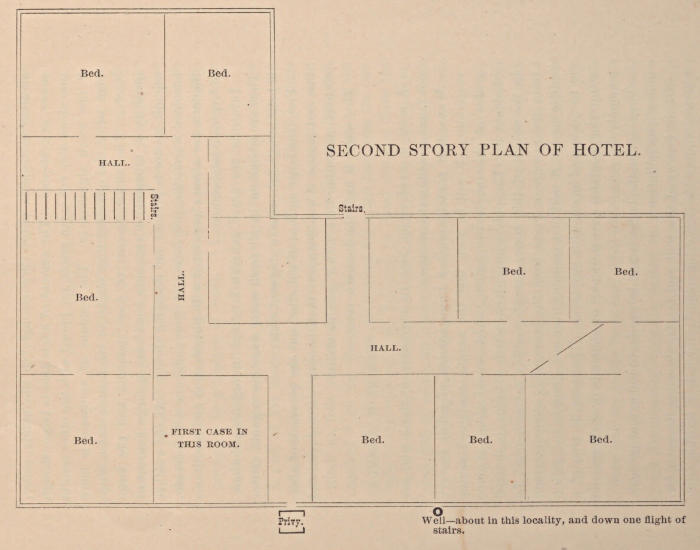
Diagram No. 1.
The following description and history of a well in Newport
(although I published the same in the last report of the State
Board of Health) is of such a remarkable character that it will
bear republication.
The attention of Dr. D. M. Currier was directed to this well
in the investigation of the cause of sickness in the family that
used this water, and the analysis which is given of the water
was made by Prof. Edmund R. Angell of Derry.
| Odor, |
slight. |
| Color, |
a little yellowish. |
| Total solids, grains per gallon, |
49.2 |
| Soluble solids, |
34.7 |
| Ignition of residue, |
it blackens. |
| Combustible and volatile matter, grains per gal., |
9.24 |
| Hardness, equivalent to grains of CaCo₃ per gal., |
11.00 |
| Alkalinity, ” ” ” ” |
15.00 |
| Chlorine, grains per gallon, |
12.00 |
| Ammonia, parts per million,— |
|
| Free ammonia, |
0.0666 |
| Albuminoid ammonia, |
0.3100 |
| Nitric acid, grains per gallon, |
2.69 |
| Nitrous acid, |
none. |
| Iodine, |
none. |
| Bromine, |
none. |
| Iron, |
very slight trace. |
| Copper and lead, |
none. |
Microscopic examination of sediment shows,—
- Bacteria:
- Bacteria Bacillus.
- Bacteria Vibrio.
- Infusoria:
- Flagellata Monadina.
- Flagellata Euglenia.
- Ciliata Enchelia.
- Ciliata Bursarina.
- Ciliata Parmecia.
- Silicious granules.
- Small pieces of decaying wood.
| Free carbonic acid, |
grains per gallon, |
11.9504 |
| Combined Co₂, |
” ” ” |
6.6528 |
| Total Co₂, |
” ” ” |
18.6032 |
Bases: Lime, magnesia, soda, potassa, ammonia.
Acids: Hydrochloric, sulphuric, nitric, phosphoric, carbonic,
silicic.
Most of the lime is in the form of carbonate held in solution
by carbonic acid; most of the magnesia exists as a salt soluble
in water, probably the sulphate; some of the alkalies are present
as carbonates. The iron is kept in solution by carbonic
acid.
The color and odor indicate contamination. The large
amount of soluble solids is suspicious. The blackening of the
residue during ignition shows the presence of organic matter
in solution. The large amount of combustible and volatile
matter is a grave indication. Because the alkalinity exceeds
the hardness, it shows the presence of an alkaline carbonate,
which is a suspicious circumstance, since it may result from the
decomposition of animal matter. The amount of chlorine is
unusually large. I think the average for well water is about
one grain. The large quantity of chlorine and the presence of
alkaline carbonates point very strongly to the stable, privy,
sewer, or cess-pool. The amount of nitric acid is large, though
this alone may not mean much, yet joined with the other results
it has much significance. The amount of ammonia is more
than twice the quantity that ought to condemn a water absolutely.
The small amount of free ammonia and the large
quantity of albuminoid ammonia show that a large amount of
organic matter is present and decaying slowly. As the weather
becomes warm, the proportion of free ammonia will increase.
Bacteria are always associated with putrefaction and conditions
of hygienic importance.
Infusoria are never generated except in organic solutions.
They are abundant in all fresh water wherever organic matter
is held in solution, also in stagnant water.
From the large amount of chlorine and the presence of alkaline
carbonates, it would appear that the water is contaminated
with animal rather than with vegetable matter.
This water is unfit for domestic uses.
Edmund R. Angell.
A word in explanation may be necessary to those who are
not familiar with water analysis.
Water that contains such a large amount of solids is very
suspicious. It will be seen that the sample contained twelve
grains of chlorine to the gallon, which would alone at once
condemn it. The only source from which chlorine is derived
in the waters of this state, except possibly a trace, must be
from the sewage or waste from the household, where common
salt is used. A well that contains over one grain to the gallon
is to be looked upon with suspicion. The same is true of a
water that contains over 0.01 part of ammonia or “albuminoid
ammonia.”
Then, again, the bacteria and infusoria, to the extent present,
indicate its pollution.
Of the history of this well and the family using its water Dr.
Currier renders the following report, which is a terrible commentary
upon the dangers of filth in drinking-water. Since
the report was made, Dr. C. states that there was a case of
typhoid upon these premises during the early part of the
winter, which he did not know of at the time his report was
written.
The farm-house, from the well of which was taken the specimen
of polluted water, is situated on a high bluff of land south-east
of the village, and is known by the name of East Mountain.
Upon this ridge of land are situated some of the best
farms in town. The soil is rich and deep, underlying which is
a sub-soil of clay, very hard and compact, but occasionally interrupted
by a deposit of sand. I have been told there were
beds of sand in the vicinity of this dwelling-house.
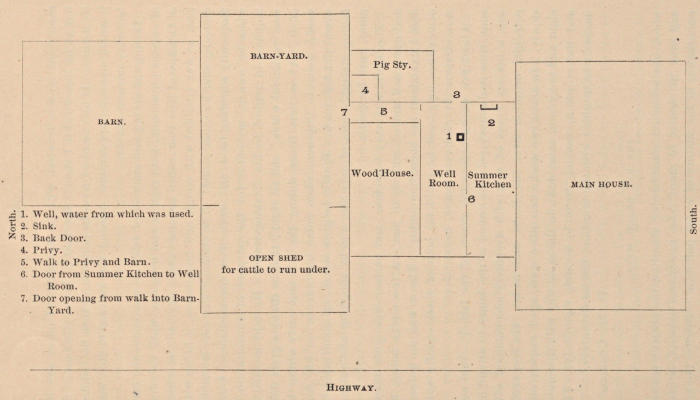
Diagram No. 2.
By the diagram sent, you will see that the well is under the
L part of the house. The water is drawn up by means of a
windlass in one of the back rooms. The well itself is some
twenty-five feet deep. In the summer kitchen, not more than
three or four feet from the well, you will notice the sink
marked 2 on the diagram, which discharges its water on the
ground by means of an open spout but a few feet from the outside
of the building. At 3, about an equal distance from the
well, is a back door, from which foul water, as on washing-days,
and filth of nearly all descriptions, were usually thrown, which
is not saying more than can be said of back doors to farm-houses
in general.
As you step out of this door, a little to your left you will see
the pig-sty, the centre of which cannot be more than fifteen feet
from top of well. The privy marked 4 is entered from the walk
leading from the well-room to the barn-yard, the excrements of
which are received upon the ground. The distance from the
door, 7, that opens into the barn-yard, and the well, is just
twenty-four feet by actual measurement. Stepping out of this
door you are in the barn-yard filled with cattle and sheep, on
the further side of which is the barn with its usual manure heap
and decomposing vegetable matter in general. Thus we have
the barn, barn-yard, privy, pig-sty, back door, and sink all in
dangerous proximity to the well, either one of which might
contaminate its water, and render it unfit for use.
It was on the 8th of March, 1883, that I procured the second
specimen of water from this well that I sent you. For over
three months prior to that date the ground had been frozen and
covered with snow, with no thaws during the whole winter
severe enough to cause any surface-water. The winter was
what is called a dry one, all the wells in that vicinity being
remarkably low, so that there could be no surface-water finding
its way into the well on that date, and probably had not for
months previous: the influence of the surroundings at that time
must have been at the minimum. If the water is bad under
this condition, what must it be soon after the frost is out, and
the well becomes filled with its maximum of surface-water?
Now the interesting question comes, What has been the effect
upon the health and lives of the family or families occupying
this house and using this water? I am informed that they did
not use the water at all times, under suspicion that it might not
be good: still it was used more or less.
Forty-one years ago the place was purchased and occupied
by a man then in the prime of life. He had seven children,
some of whom were born before and some after moving upon
the place. The father, mother, and all the children are now
dead, except one.
The date, age, and cause of death, as near as I can find out,
are as follows:
1849, a son, age 18 years; cause, typhoid fever.
1849, a daughter, age 16 years; cause, typhoid fever.
1863, a son, age 28 years; cause, consumption.
1871, mother, age 63 years; cause, gall stones; great sufferer
from sick headache.
1874, a daughter, age 27 years; cause, consumption.
1878, a son, age 37 years; cause, consumption.
1879, a daughter, age 34 years; cause, consumption.
1879, father, age 76 years; cause, old age, feeble a long
time.
1883, a son-in-law, age 47 years; cause, bronchial consumption.
This last was the only one of whom I had charge, and it was
during one of my professional visits that I discovered the situation
of the well. One of the first things of which he complained
was sore throat and hoarseness, laryngo-pharyngitis. At the
same time he was troubled with an eruption. I never saw it,
but as he described it I should say that it was erythematous in
its nature. If he exercised so as to perspire, or took hot drinks,
it would make its appearance, causing the surface to itch and
feel very uncomfortable.
During the spring and summer of 1882 he was under the care
of various physicians, both regular and irregular, until the first
of October of that year, when he came under my care, at which
time he was troubled with cough and hoarseness, it being with
difficulty that he spoke aloud. The stomach was very irritable,
frequently rejecting food, and more often his medicine. Once
when he was in my office for the purpose of consultation, I
inquired in regard to his drinking-water. He told me that it
was “splendid water,” and all right; that he drank a great deal
of it. At various times during the fall and early winter he
would seem to improve, when some imprudence on his part
would put him back. Finally he grew worse, as manifested by
failing strength, loss of appetite, and by coughing and raising
more, until his death.
The sputa was very tenacious, and at last was quite thick,
and composed almost entirely of pus. A few weeks before he
died I examined his chest thoroughly. There was no dulness
over either lung, and he could fill both of them equally well.
Auscultation revealed very heavy, moist rales.
About five weeks before the death of the father,—that was
some time in January,—I was called to the house to attend his
son, a lad six years of age, with dysentery accompanied with
petechial eruption over the limbs and body. He recovered
slowly. In about two weeks two other sons, aged respectively
eight and ten years, came down in the same way with dysentery
and the eruption, causing them to scratch vigorously. The
mother was troubled with the eruption, but no dysentery.
D. M. Currier.
which has attracted considerable attention the present season,
and been the source of many false newspaper reports, is most
remarkable in the history of water pollution. Briefly, the history
connected therewith is as follows:
A wealthy Philadelphian by the name of Lewis, who has
spent his summers at this noted beach for the last twelve years,
bought last spring a lot of land, and built a very expensive and
elegant summer residence. The location was upon an elevation
some forty or fifty feet higher than the sea, and but a
short distance from the water. This elevation is made up mostly
of seamy ledges, with but a few feet of soil covering the same.
From a sanitary point of view, no better site could possibly be
selected.
Instead of building a sewer to the ocean for drainage purposes,
he constructed a cess-pool forty feet distant from the
house, into which all the sewage from the house ran. In building
this cess-pool it was necessary to excavate three feet of the
ledge to get a good and sufficient depth. Sixty feet from this
cess-pool, and apparently upon the same level, was dug the
well which was to supply this residence with water. After
reaching the ledge, it was necessary to go ten feet into the rock
to get sufficient water, which was obtained in abundance, and
was excellent in quality. The well and cess-pool were both
constructed at the same time, and in two weeks after, the well
was polluted by this cess-pool. The family, not realizing the
source of pollution or its danger, continued to use the water for
a short time afterwards, or until it became so tainted that it
was repulsive to the senses of taste and smell. The result was
the death of Mr. Lewis, and a lady visitor who lived in the
vicinity and frequently drank of this water, and a severe illness
of a daughter of Mr. Lewis, his servant, and a guest of the
family. These seemed to be cases of blood poisoning, the
severer ones resembling in their last stage typhoid fever.
This instance of well pollution illustrates the fact that a rock
formation, though generally believed to be the best safeguard
against the contamination of a well, may be the most dangerous.
The seams which existed in this ledge no doubt served as
direct channels to convey the filth to this well.
The following instance of well pollution seems to illustrate in
what unsuspected ways water may become contaminated:
A short time since, Dr. C. A. Wood, of Greenville, sent me
several specimens of water for examination. The contamination
of some of them was of such a character that I asked him
for a history of the samples. I will here state that the specimens
marked “No. 2” and “No. 3” were both badly polluted,
and with different substances, so that, in testing, the chemical
reactions were quite different. In his reply to my letter of
inquiry he says,—
“The water I sent you last week marked No. 2 was dipped
directly from the well, as shown in diagram, while the water
marked No. 3 was pumped from the pump. The family have
been sick more or less ever since they occupied the house.
None of them have been well, but it is exceedingly difficult to
give a name to their complaints, except a general out of fix,
with a dull, tired feeling, headaches, sore throats, furred
tongues, &c., but no downright sickness so as to prostrate
them.”
It will be readily seen by the crude diagram that the cess-pool
filth which had accumulated around the lead pipe leading to the
well, by reason of a breakage in the sink-drain, had corroded
the water-pipe till it was full of small holes, which allowed
this filth to be drawn in and mixed with the water every time
any was drawn from the well. Such a condition is not likely
to be of very frequent occurrence, but it demonstrates the fact
that the source of water pollution may be sometimes subtle and
unexpected.
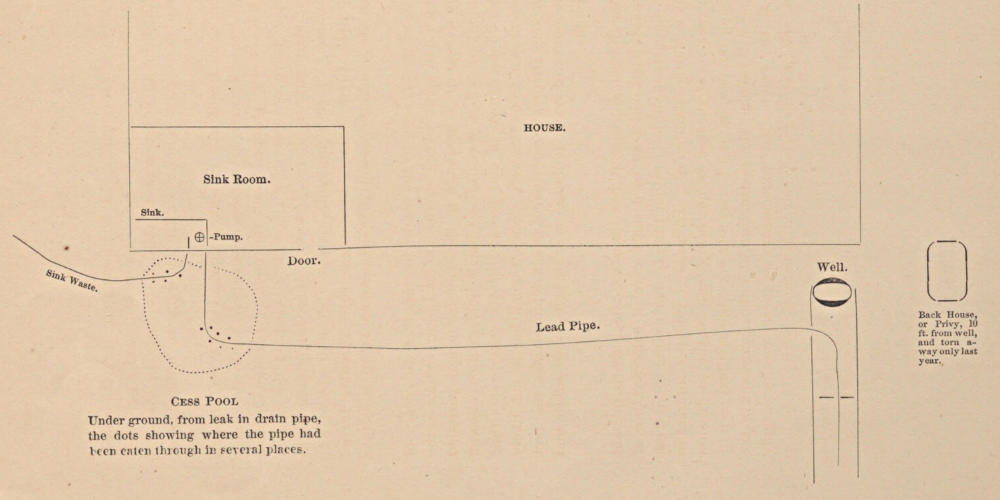
Diagram No. 3.
In the foregoing paper it has been my aim only to present
some points that will lead to a more careful consideration of
this all-important subject, rather than to discuss the topic from
a purely scientific standpoint. To awaken a deeper interest in
the prevention of disease is necessary both in the profession
and among the people, and I sincerely hope the medical men of
our state will become the instructors and the guardians of the
public to the extent that unnecessary sickness may be largely
averted, and nature’s gifts received in nature’s purity.