Raising my eyes for an instant from
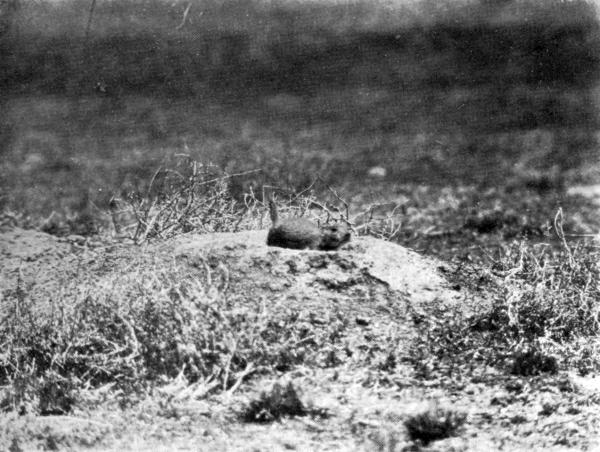
the antics of a woodchuck, they caught
a movement of the tall grass caused by
a crawling animal. This presently showed itself
to be a mountain lion. He was slipping
up on a mare and colt on the opposite edge of the
meadow. The easy air that was blowing across
my face—from horse to lion—had not carried a
warning of my presence to either of them.
I was in Big Elk Park, seated on a rock pile,
and was nearly concealed by drooping tree
limbs. Behind me rose the forested Twin
Peaks, and before me a ragged-edged mountain
meadow lay in the forest; and across this
meadow the lion crawled.
The colt kicked up its heels as it ran merry
circles round its mother. This beautiful bay
mare, like her colt, was born in unfenced scenes
and had never felt the hand of man. She had
marked capability and the keenness exacted
by wilderness environment.
I watched the bending grass as the lion crept
closer and closer. Occasionally I caught a
glimpse of the low-held body and the alert
raised head. The back-pointing, sensitive three-foot
tail, as restless as an elephant’s trunk,
kept swinging, twitching, and feeling. Planning
before the lion was within leaping distance
to warn the mare with a yell, I sat still
and watched.
The well-developed and ever-alert senses of
the mare—I know not whether it was scent or
sight—brought a message of danger. Suddenly
she struck an attitude of concentration and defiance,
and the frightened colt crowded to her
side. How capable and courageous she stood,
with arched neck, blazing eyes, vigilant ears,
and haughty tail! She pawed impatiently as
the lion, now near, watchful and waiting, froze.
Suddenly he leaped forward, evidently hoping
to stampede both animals and probably to
seize the separated colt. Instantly the mother
wheeled, and her outkicking heels narrowly missed
the lion’s head. Next the lion made a quick
side-leap to avoid being stamped beneath the
mare’s swift front feet.
For half a minute the mare and lion were dodging
and fighting with all their skill. A splendid
picture the mare made with erect tail and arched
neck as she struck and wheeled and kicked!
Again and again the lion tried to leap upon
the colt; but each time the mother was between
them. Then, watching his chance, he boldly
leaped at the mare, endeavouring to throw a
forepaw round her neck and, at the same instant,
to seize and tear the throat with his savage
teeth. He nearly succeeded.
With the lion clinging and tearing at her head,
the audacious mare reared almost straight on
her hind legs and threw herself backward.
This either threw the lion off or he let go. She
had her nose badly clawed and got a bite in the
neck; but she was first to recover, and a kick
landed upon the lion’s hip. Crippled, he struggled
and hurried tumbling away into the woods,
while the bleeding mare paused to breathe beside
the untouched colt.
The mountain lion is called a puma, catamount,
panther, painter, or cougar, and was
originally found all over North America. Of
course he shows variations due to local climate
and food.
The lion is stealthy, exceedingly cunning,
and curious in the extreme; but I am not ready,
as many are, to call him cowardly. He does
not have that spectacular rash bravery which
dashes into the face of almost certain death;
but he is courageous enough when necessity
requires him to procure food or to defend himself
and his kind. He simply adapts himself
to conditions; and these exact extreme caution.
The mountain lion may be called sagacious
rather than audacious. Settlers in his territory
are aware of his presence through his hogging
the wild game and his occasional or frequent
killing of colts, horses, cattle, sheep, and chickens.
But so seldom is he seen, or even heard, that,
were it not for his tracks and the deadly evidence
of his presence, his existence could not
be believed.
Though I have camped in his territory for
weeks at a time, and ofttimes made special
efforts to see him, the number of lions I have seen—except,
of course, those treed by dogs—is small.
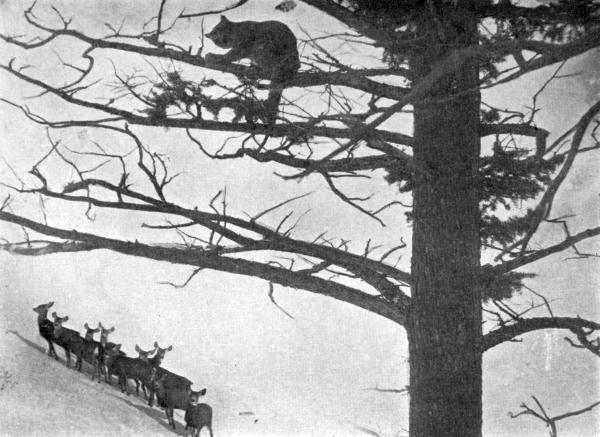
When a mountain lion is frightened, or when
pursued by dogs, he is pretty certain to take
refuge in a tree. This may be a small tree or
a large one. He may be out on a large limb
or up in the top of the tree.
The lion is a fair runner and a good swimmer.
Often he has been known to swim across lakes,
or even arms of the sea, more than a mile wide.
And he is an excellent tree climber, and often uses
a living tree or a dead leaning one as a thoroughfare—as
a part of his trail system on a steep
mountain side. Twice I have seen him on a
near-by limb at night watching me or my fire.
Once I woke in the night and saw a lion upon
two out-reaching tree limbs not more than eight
feet above me. His hind feet were upon one
limb, his forefeet upon a lower limb, and he
was looking down, watching me curiously. He
remained in this position for several minutes,
then turned quietly, descended the tree on the
opposite side, and walked away into the woods.
It is probable that lions mate for life. Sometimes
they live year after year in the same den
and prowl over the same local territory. This
territory, I think, is rarely more than a few
miles across; though where food is scarce or a
good den not desirably located, they may cover
a larger territory.
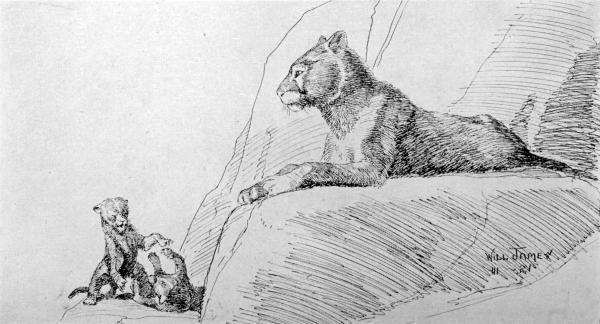
Lions commonly live in a den of their own
making. This is sometimes dug in loose sand
or soil where its entrance is concealed among
bushes. Sometimes it is beneath a fallen log
or a tree root, and in other places a semi-den,
beneath rocks, is enlarged. In this den the
young are born, and the old ones may use it a
part of each year, and for year after year.
Though occasionally a mother lion may raise
as many as five kittens, rarely does she succeed
in raising more than two; and I think only two
are commonly brought forth at a birth. These
kittens probably remain with the mother for
nearly a year, and in exceptional cases even
longer. As I have seen either kittens or their
tracks at every season of the year, I assume the
young may be born at any time.
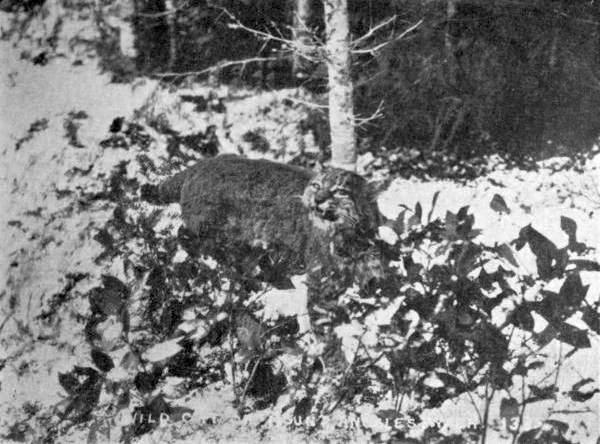
The mountain lion is a big-whiskered cat and
has many of the traits possessed by the average
cat. He weighs about one hundred and fifty
pounds and is from seven to eight feet long,
including a three-foot tail. He is thin and
flat-sided and tawny in colour. He varies
from brownish red to grayish brown. He has
sharp, strong claws.
Mr. Roosevelt once offered one thousand
dollars for a mountain lion skin that would measure
ten feet from tip to tip. The money was
never claimed. Apparently, however, in the
state of Washington a hunter did succeed in
capturing an old lion that weighed nearly two
hundred pounds and measured ten and a half
feet from tip to tip. But most lions approximate
only one hundred pounds and measure
possibly eight feet from tip to tip.
The lion eats almost anything. I have seen
him catching mice and grasshoppers. On one
occasion I was lying behind a clump of willows
upon a beaver dam. Across the pond was an
open grassy space. Out into this presently
walked a mountain lion. For at least half an
hour he amused or satisfied himself by chasing,
capturing, and eating grasshoppers. He then
laid down for a few minutes in the sunshine;
but presently he scented something alarming and
vanished into the thick pine woods.
One evening I sat watching a number of deer
feeding on a terrace of a steep mountain side.
Suddenly a lion leaped out, landing on the neck
of one. Evidently the deer was off balance
and on a steep slope. The impact of the lion
knocked him over, but like a flash he was upon
his feet again. Top-heavy with the lion, he
slid several yards down a steep place and fell
over a precipice. The lion was carried with
him. I found both dead on the rocks below.
The lion is a master of woodcraft. He
understands the varying sounds and silences
of the forest. He either hides and lies in wait
or slips unsuspected upon his victim. He slips
upon game even more stealthily than man;
and in choosing the spot to wait for a victim
he usually chooses wisely and, alert waits,
if necessary, for a prolonged time. He leaps
upon the shoulders and neck of horse, deer,
or sheep, and then grabs the victim’s throat in
his teeth. Generally the victim quickly succumbs.
If a lion or lioness misses in leaping,
it commonly turns away to seek another victim.
Rarely does it pursue or put up a fight.
A friend wished a small blue mule on me.
It had been the man’s vacation pack animal.
The mule loitered round, feeding on the abundant
grass near my cabin. The first snow came.
Twenty-four hours later the mule was passing
a boulder near my cabin when a lion leaped upon
him and throttled him. Tracks and scattered
hair showed that the struggle had been intense
though brief.
Not a track led to the boulder upon which
the lion had lain in wait, and, as the snow had
fallen twenty-four or more hours before the
tragedy, he must have been there at least
twenty-four hours, and he may have waited
twice as long.
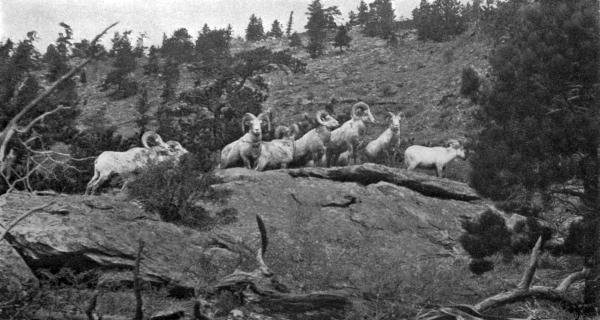
Another time I frightened a lion from a cliff
where he was waiting for a near-by flock of
bighorn sheep to come within leaping distance.
Though it was nearly forty-eight hours since
snow had ceased falling, not a track led to the
lion’s watching place or blind.
The lion probably is the game hog of the
wilds. Often I have read his red records in the
snow. On one occasion he killed nine mountain
sheep in one attack. He ate a few pounds of
one of them and never returned to the kill.
On another occasion he killed eleven domestic
sheep in one night. Inside of twenty-four
hours a lion killed a doe, a fawn, a porcupine,
a grouse, and was making a try for a mountain
sheep when I appeared on snowshoes.
He seems to prefer colts or horses for food.
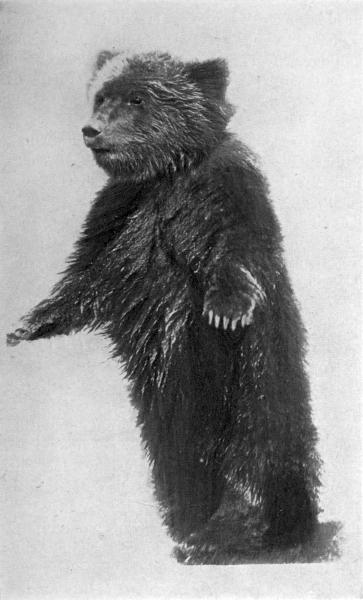
Photo. by Enos A. Mills
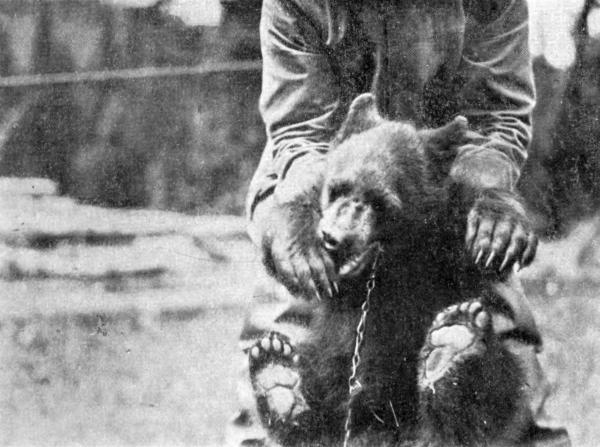
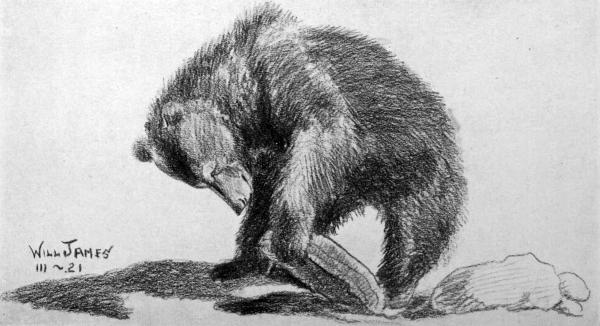
Johnny, My Grizzly Cub
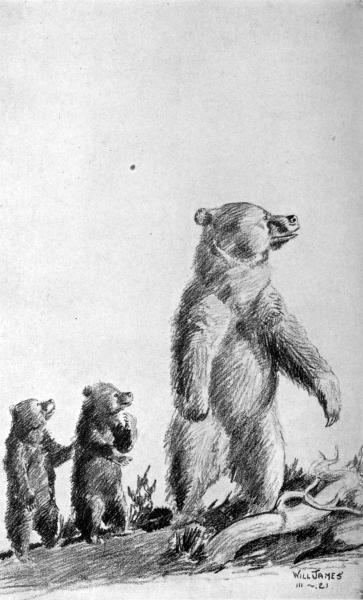
Drawing by Will James
Echo Mountain Grizzly
Mr. J. A. McGuire, editor of Outdoor Life,
who has made special investigations concerning
the killings of mountain lions, estimates that a
lion will kill a deer every week if he has the opportunity
to do so. From personal experience
I have known him to kill four deer in a single
week.
On one occasion, when I was hidden and
watching the carcass of a deer which a lion
had killed to see what carnivorous animal
might come to the feast, a mountain lion walked
quietly and unalertly to it and commenced to
eat. After a few minutes the lion suddenly
bristled up and spat in the direction from which
a grizzly bear presently appeared. With terrible
snarling and threatening, the lion held
on to the prize until the grizzly was within a
few feet. He then leaped toward the grizzly
with a snarl, struck at it, and dashed into the
woods. The grizzly, without even looking round
to see where the lion had gone, began eating.
From many experiences I believe that much
of the killing of domestic and wild animals attributed
to bears is done by lions. The lion
prefers warm blood and fresh meat for each
meal, and will kill daily if there is opportunity.
I have known bears to follow mountain lions
evidently for the purpose of obtaining food.
One day I came upon the recently killed carcass
of a cow. Only mountain lion tracks led
to it and from it. The following night I spent
at a near-by ranch house, and the rancher informed
me that on the previous day he had discovered
a bear eating the carcass of this cow
which he accused the bear of killing. The lion is
a most capable raider of ranches, and colts,
horses, sheep, pigs, and poultry are his prizes.
In northern New Mexico one day I saw a
lion bounding across an opening carrying a
tame sheep in its mouth. On another occasion
I saw a lion carrying off a deer that apparently
weighed much more than the lion itself. The
lion appeared to have the deer by the shoulder,
and it was resting on the lion’s shoulders in such
a way that I do not believe it touched the ground.
I suppose when the lion makes a kill in an
out-of-the-way place, where he may eat with comparative
safety, he does not take the trouble to
carry or to drag the victim off. Often, of course,
the kill is made for the benefit of the young,
and hence must be transported to the den.
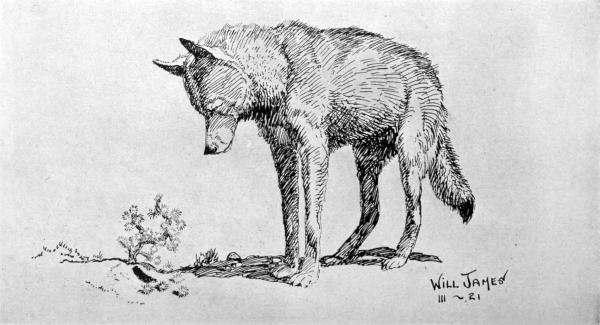
It is quite true that he will sometimes wander
back to his kill day after day and feast upon it.
It is also true, when food is scarce, that lions
will eat almost anything, even though they have
nothing to do with the killing. They have been
trapped at the bait that was out for bears: and
so, though a lion prefers blood and warm meat,
he will return to his kill to feast, or, if food is
scarce, gladly eat whatever he can obtain.
From many observations I judge that after
eating he prefers to lie down for a few hours
in some sunny or secluded spot, or on a many-branched
limb generally well up toward the
top of the tree but sometimes not more than
ten feet above the earth.
The lion has extreme curiosity. He will
follow travellers for hours if there is opportunity
to keep out of sight while doing so. Often during
long snowshoe trips I have returned over the
route first travelled. Lion tracks in the snow
showed that I was repeatedly followed for miles.
In a number of places, where I had taken a long
rest, the lion had crept up close, so that he could
easily watch me; and on a few occasions he must
have been within a few feet of me.
While walking through a forest in the Medicine
Bow Mountains I was startled and knocked
down by a glancing blow of a tree limb. This
limb had evidently broken off under the weight
of a lion. The lion also came tumbling down
but caught a claw on a limb and saved himself
from striking the earth. Evidently in his
curiosity to see me he had leaned out too far
on a weak limb. He fled in confusion, perhaps
even more frightened than myself.
The mountain lion is not ferocious. Mr.
Roosevelt, in summing up its characteristics,
concluded that it would be no more dangerous
to sleep in woods populated with mountain
lions than if they were so many ordinary cats.
In addition to years of camping in the wilds
in all sorts of places and under all conditions of
weather I have talked with careful frontiersmen,
skillful hunters and trappers, and these
people uniformly agreed with what I have found
to be true—that the instances of mountain lions
attacking human beings are exceedingly rare.
In each of these cases the peculiar action of the
lion and the comparative ineffectiveness of his
attacks indicated that he was below normal
mentally or nearly exhausted physically.
Two other points of agreement are: Rarely
does any one under ordinary conditions see a
lion; and just as rarely does one hear its call.
Of the dozen or more times I have heard the
screech of the lion, on three occasions there was
a definite cause for the cry—on one a mother
frantically sought her young, which had been
carried off by a trapper; and twice the cry was
a wail, in each instance given by the lion calling
for its mate, recently slain by a hunter.
During the past thirty years I have investigated
dozens of stories told of lions leaping
upon travellers from cliffs or tree limbs, or of
other stealthy attacks. When run down each
of these proved to be an invention; in most
cases not a lion or even lion track had been seen.
Two instances of lion attacks are worth
mentioning. One night in California a lion
leaped from a cliff, struck a man, knocked him
down, and then ran away. Out of this incident
have come numerous stories of lion ferocity.
The lion was tracked, however, and the
following day the pursuing hunter saw it crossing
an opening. It suddenly clawed and hit at
a boulder. Then, going on, it apparently ran
into a tree, and fought that. As it started on
the hunter shot it. This beast was badly
emaciated, had a swollen face from an ulcerated
tooth, and was nearly, if not entirely, blind.
Another instance apparently was of a weak-minded
lion. As though to attack, it came
toward a little ten-year-old girl in Idaho.
She struck it over the head with a bridle she was
carrying. Her brother hurried to the rescue
with a willow fishing pole. Together they beat
the lion off and escaped with a few bad scratches.
Yet had this been a lion of average strength
and braveness he must have killed or severely
injured both.
The mountain lion rivals the shark, the devilfish,
and the grizzly in being the cause of ferocious
tales. The fact that he takes refuge on
limbs as a place of lookout to watch for people
or other objects, and that he frequently follows
people for hours through the woods without their
ever seeing him—and, I suppose, too, the very fact
that he is so rarely seen—make him a sort of storm
centre, as it were, for blood-curdling stories.
Through years I investigated plausible accounts
of the ferocity of mountain lions. These
investigations brought little information, but
they did disclose the fact that there are a few
types of lion tales which are told over and over
again, with slight local variations. These tales
commonly are without the slightest basis of
fact. They are usually revamped by a clever
writer, a frightened hunter, or an interesting
story teller, as occasions offer. One of the commonest
of the oft-told tales that have come to
me through the years is as follows:
“Late Saturday evening, while Mr. and Mrs.
Simpson were returning from the village through
the woods, they were attacked by a half-starved
mountain lion. The lion leaped out upon them
from brush by the roadside and attempted to
seize Mr. Simpson. Though an old man, he
put up a fight, and at last beat off the lion with
the butt of the buggy whip.”
Sometimes this is a family and the time of
day is early morning. Sometimes the lion is
ferocious instead of half-starved. Sometimes
it is of enormous size. Once in a while he leaps
from a cliff or an overhanging tree limb. Generally
he chews and claws someone up pretty badly,
and occasionally attempts to carry off one of the
children.
Many times my letter addressed to one of
the party attacked is returned unclaimed. Sometimes
my letter to the postmaster or the sheriff
of the locality is returned with the information:
“No such party known.” Now and then I
ask the sheriff, the postmaster, or the storekeeper
some questions concerning this attack,
and commonly their replies are: “It never
happened”; “It’s a pipe dream”; “A pure
fake”; or “Evidently whoever told you that
story had one or two drinks too many.”
One day I came out of the woods in the rear
of a saw-mill. I was making my way to the living
room of the place, between logs and lumber
piles. Right round the corner of a slab
heap I caught sight of a mountain lion just as
it leaped at me. It missed me intentionally,
and at once wheeled and rose up to play with
me. In the two or three seconds that elapsed
between the time I had my first glimpse of
it and when I realized it was a pet I had almost
concluded that, after all, a lion may be a
ferocious animal.
On one occasion, when I was on a cliff at the
edge of a grassy opening, I was astonished to
see a coyote trot leisurely across and just before
he disappeared in the woods a lion appear
on the opposite side of the opening, following
contentedly along the trail of the coyote.
The next day I again saw this friendly pair, but
on this occasion the lion was leading and the
coyote following. Afterward I saw their tracks
a number of times.
Just why they were associated in this friendly
manner we can only conjecture. It will be
readily seen that the coyote, which has all the
wisdom of a fox, might follow a game-hog lion
about and thus, with little effort, get a substantial
and satisfactory food supply. But why
the lion should willingly associate with a coyote
is not quite clear. Perhaps this association
proved to be of some advantage to the lion in
his killing, or it may have been just one of those
peculiar, unaccounted-for attachments occasionally
seen between animals.
In any discussion concerning the mountain
lion, or, for that matter, any living animal,
hardly can the last word be said concerning the
character of the individual of the species.
Individuals vary, and now and then a mountain
lion, as well as a human being, shows marked
and peculiar traits. These may be the result
of unusual alertness and sheer curiosity, or
they may be subnormal, and cruel or murderous.