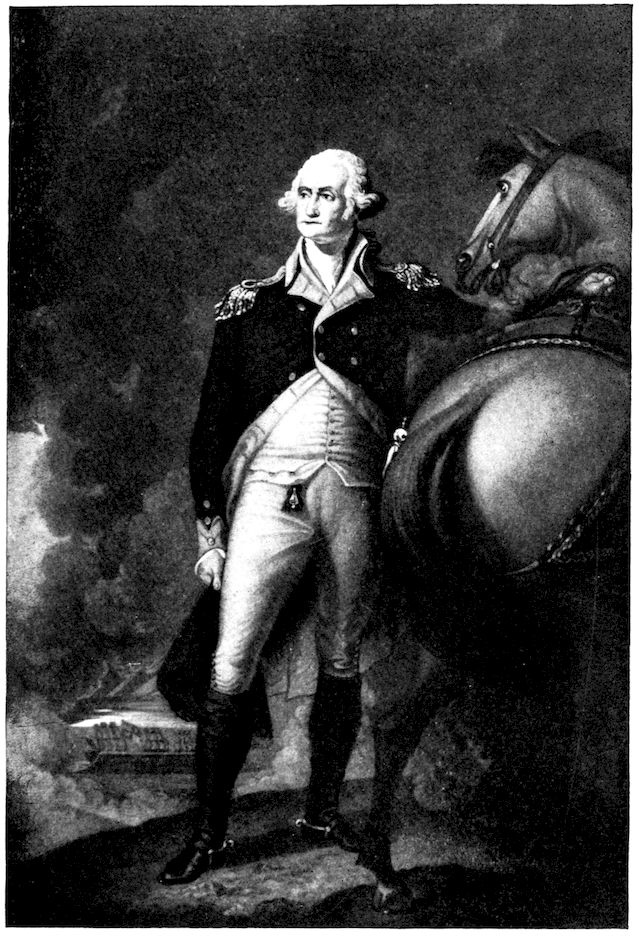
The cover image was created by the transcriber and is placed in the public domain.
Washington the Soldier — WASHINGTON THE SOLDIER
WASHINGTON
From the St Memin Crayon in possession of J. Carson Brevoort Esq.
BY
General Henry B. Carrington, LL.D.
AUTHOR OF
“Battles of the American Revolution,” “Battle Maps and Charts of the Revolution,” “Indian Operations on the Plains,” “The Six Nations,” “Beacon Lights of Patriotism,” etc.
WITH ILLUSTRATIONS, MAPS, CHRONOLOGICAL INDEX AND APPENDICES
“Th’ applause of list’ning senates to command;
The threats of pain and ruin to despise;
To scatter plenty o’er a smiling land,
And read his history in a Nation’s eyes.”
New York
Charles Scribner’s Sons
1899
Copyright, 1898
BY
LAMSON, WOLFE AND COMPANY
Copyright, 1899
By Charles Scribner’s Sons
All rights Reserved
Typography by Rockwell and Churchill
Presswork by The University Press
DEDICATED
TO THE
Sons and Daughters of Liberty Everywhere
KNOWING
THAT ALL WHO ASPIRE AFTER INTELLIGENT FREEDOM SHALL FIND THE WATCHWORD OF WASHINGTON THE SOLDIER—“FOR THE SAKE OF GOD AND COUNTRY”—THEIR LOFTIEST INCENTIVE.
PREFACE TO THE SECOND EDITION.
v
Since the first appearance of this volume, during the
winter of 1898–9, the author has considerately regarded
all letters and literary comments received by him,
as well as other recent works upon the life and times of
Washington. His original purpose to treat his subject
judicially, regardless of unverified tradition, has been
confirmed.
Washington’s sublime conception of America, noticed in
Chapter XXXVI., foreshadowed “a stupendous fabric of
freedom and empire, on the broad basis of Independency,”
through which the “poor and oppressed of all races and
religions” might find encouragement and solace.
The war with Spain has made both a moral and physical
impress upon the judgment and conscience of the entire
world. Unqualified by a single disaster on land or sea,
and never diverted from humane and honorable methods,
it illustrates the intelligent patriotism and exhaustless
resources of our country, and a nearer realization of
Washington’s prayer for America.
Looking to the general trend of Washington’s military
career, it is emphasized, throughout the volume, that the
moral, religious, and patriotic motives that energized his
life and shaped his character were so absolutely interwoven
with the fibre of his professional experiences, that
vithe soul of the Man magnified the greatness of the
Soldier.
In connection with Washington’s relations to General
Braddock, mentioned in the First Chapter, it is worthy of
permanent record that Virginia would not sanction, nor
would Washington accept assignment, except as Chief of
Staff. He was not a simple Aid-de-Camp, but of recognized
and responsible military merit.
HENRY B. CARRINGTON.
Hyde Park, Mass.,
September 21, 1899.
PREFACE.
vii
The text of this volume, completed in the spring of
1898 and not since modified, requires a different
Preface from that first prepared. The events of another
war introduce applications of military principles which
have special interest. This is the more significant because
modern appliances have been developed with startling
rapidity, while general legislation and the organization
of troops, both regular and volunteer, have been very
similar to those of the times of Washington, and of later
American wars.
His letters, his orders, his trials, his experiences; the
diversities of judgment between civilians and military
men; between military men of natural aptitudes and
those of merely professional or accidental training, as
well as the diversities of personal and local interest, indicate
the value of Washington’s example and the character
of his time. Hardly a single experience in his career
has not been realized by officers and men in these latter
days.
A very decided impression, however, has obtained
among educated men, including those of the military profession,
that Washington had neither the troops, resources,
and knowledge, nor the broad range of field service which
have characterized modern warfare, and therefore lacked
material elements which develop the typical soldier. But
more recent military operations upon an extensive scale,
especially those of the Franco-Prussian War, and the
American Civil War of 1861–1865, have supplied material
for better appreciation of the principles that were
viiiinvolved in the campaigns of the War for American Independence,
as compared with those of Napoleon, Wellington,
Marlborough, Frederick, Hannibal, and Cæsar.
With full allowance for changes in army and battle
formation, tactical action and armament, as well as
greater facilities for the transportation of troops and
army supplies, it remains true that the relative effect of
all these changes upon success in war upon a grand scale,
has not been the modification of those principles of military
science which have shaped battle action and the general
conduct of war, from the earliest period of authentic
military history. The formal “Maxims of Napoleon”
were largely derived from his careful study of the campaigns
of Frederick, Hannibal, and Cæsar; and these,
with the principles involved, had specific and sometimes
literal illustration in the eventful operations of the armies
of the Hebrew Commonwealth. As a matter of fact,
those early Hebrew experiences were nearly as potential
in shaping the methods of modern generals, as their civil
code became the formative factor in all later civil codes,
preëminently those of the English Common Law. The
very best civil, police, and criminal regulations of modern
enactment hold closely to Hebrew antecedents. And in
military lines, the organization of regiments by companies,
and the combinations of regiments as brigades,
divisions and corps, still rest largely upon the same decimal
basis; and neither the Roman legion nor the Grecian
phalanx improved upon that basis. Even the Hebrew
militia, or reserves, had such well-established comprehension
of the contingency of the entire nation being called
to the field, or subjected to draft, that as late as the
advent of Christ, when he ordered the multitudes to be
seated upon the grass for refreshment, “they seated
themselves in companies of hundreds and fifties.” The
sanitary and police regulations of their camps have never
ixbeen surpassed, nor their provision for the cleanliness,
health, and comfort of the rank and file. From earliest
childhood they were instructed in their national history
and its glorious achievements, and the whole people
rejoiced in the gallant conduct of any.
Changes in arms, and especially in projectiles, only
induced modified tactical formation and corresponding
movements. The division of armies into a right, centre,
and left, with a well-armed and well-trained reserve, was
illustrated in their earliest battle record. The latest
modern formation, which makes of the regiment, by its
three battalion formation, a miniature brigade, is chiefly
designed to give greater individual value to the soldier,
and not subject compact masses to the destructive sweep
of modern missiles. It also makes the force more mobile,
as well as more comprehensive of territory within its
range of fire. All this, however, is matter of detail and
not of substance, in the scientific conduct of campaigns
during a protracted and widely extended series of operations
in the field.
Military science itself is but the art of employing force
to vindicate, or execute, authority. To meet an emergency
adequately, wisely, and successfully, is the expressive
logic of personal, municipal, and military action.
The brain power is banded to various shaftings, and the
mental processes may differ by virtue of different applications;
but the prime activities are the same. In
military studies, as in all collegiate or social preparation,
the soldier, the lawyer, or the scientist, must be in the
man, and not the necessary product of a certificate or a
diploma. The simplest possible definition of a few terms
in military use will elucidate the narrative as its events
develop the War for American Independence, under the
direction of Washington as Commander-in-Chief.
Six cardinal principles are thus stated:
xI. Strategy.—To secure those combinations which
will ensure the highest possible advantage in the employment
of military force.
Note.—The strategical principles which controlled the Revolutionary
campaigns, as defined in Chapter X. had their correspondence
in 1861–1865, when the Federal right zone, or belt of war, was
beyond the Mississippi River, and the left zone between the Alleghany
Mountains and the Atlantic Ocean. The Confederate forces,
with base at Richmond, commanded an interior line westward, so
that the same troops could be alternatively used against the Federal
right, left, and centre, while the latter must make a long détour to
support its advance southward from the Ohio River. Federal superiority
on sea and river largely contributed to success. American
sea-control in 1898, so suddenly and completely secured, was
practically omnipotent in the war with Spain. The navy, was a
substantially equipped force at the start. The army, had largely to
be created, when instantly needed, to meet the naval advance.
Legislation also favored the navy by giving to the commander-in-chief
the services of eminent retired veterans as an advisory board,
while excluding military men of recent active duty from similar
advisory and administrative service.
II. Grand Tactics.—To handle that force in the
field.
Note.—See Chapter XVII., where the Battle of Brandywine,
through the disorder of Sullivan’s Division, unaccustomed to act as
a Division, or as a part of a consolidated Grand Division or Corps,
exactly fulfilled the conditions which made the first Battle of Bull
Run disastrous to the American Federal Army in 1861. Subsequent
skeleton drills below Arlington Heights, were designed to quicken the
proficiency of fresh troops, in the alignments, wheelings, and turns,
so indispensable to concert in action upon an extensive scale. In
1898 the fresh troops were largely from militia organizations which
had been trained in regimental movements. School battalions and
the military exercises of many benevolent societies had also been
conducive to readiness for tactical instruction. The large Camps of
Instruction were also indispensably needed. Here again, time was
an exacting master of the situation.
III. Logistics.—The practical art of bringing armies,
fully equipped, to the battlefield.
xiNote.—In America where the standing army has been of only
nominal strength, although well officered; and where militia are the
main reliance in time of war; and where varied State systems rival
those of Washington’s painful experience, the principle of Logistics,
with its departments of transportation and infinite varieties of supply,
is vital to wholesome and economic success. The war with
Spain which commenced April 21, 1898, illustrated this principle to
an extent never before realized in the world’s history. Familiarity
with details, on so vast a scale of physical and financial activity, was
impossible, even if every officer of the regular army had been assigned
to executive duty. The education and versatile capacity of
the American citizen had to be utilized. Their experience furnished
object lessons for all future time.
IV. Engineering.—The application of mathematics
and mechanics to the maintenance or reduction of fortified
places; the interposition or removal of artificial obstructions
to the passage of an army; and the erection of suitable
works for the defence of territory or troops.
Note.—The invention and development of machinery and the
marvellous range of mechanical art, through chemical, electrical, and
other superhuman agencies, afforded the American Government an
immediate opportunity to supplement its Engineer Corps in 1898,
with skilled auxiliaries. In fact, the structure of American society
and the trend of American thought and enterprise, invariably demand
the best results. What is mechanically necessary, will be invented,
if not at hand. That is good engineering.
V. Minor Tactics.—The instruction of the soldier,
individually and en masse, in the details of military drill,
the use of his weapon, and the perfection of discipline.
Note.—Washington never lost sight of the set-up of the individual
soldier, as the best dependence in the hour of battle. Self-reliance,
obedience to orders, and confidence in success, were enjoined
as the conditions of success. His system of competitive marksmanship,
of rifle ranges, and burden tests, was initiated early in his career,
and was conspicuously enjoined before Brooklyn, and elsewhere,
during the war.
The American soldier of 1898 became invincible, man for man,
because of his intelligent response to individual discipline and drill.
Failure in either, whether of officer or soldier, shaped character and
xiiresult. As with the ancient Hebrew, citizenship meant knowledge
of organic law and obedience to its behests. Every individual, therefore,
when charged with the central electric force, became a relay
battery, to conserve, intensify, and distribute that force.
VI. Statesmanship in War.—This is illustrated
by the suggestion of Christ, that “a king going to war
with another king would sit down first and count the
cost, whether he would be able with ten thousand to meet
him that cometh against him with twenty thousand.”
Note.—American statesmanship in 1898, exacted other appliances
than those of immediately available physical force. The costly
and insufferable relations of the Spanish West Indies to the United
States, had become pestilential. No self-respecting nation, elsewhere,
would have as long withheld the only remedy. Cuba was
dying to be free. Spain, unwilling, or unable, to grant an honorable
and complete autonomy to her despairing subjects, precipitated war
with the United States. The momentum of a supreme moral force in
behalf of humanity at large, so energized the entire American people
that every ordinary unpreparedness failed to lessen the effectiveness of
the stroke.
It was both statesmanship and strategy, to strike so suddenly that
neither climatic changes, indigenous diseases, nor tropical cyclones,
could gain opportunity to do their mischief. When these supposed
allies of Spain were brushed aside, as powerless to stay the advance
of American arms in behalf of starving thousands, and a fortunate
occasion was snatched, just in time for victory, it proved to be such
an achievement as Washington would have pronounced a direct
manifestation of Divine favor.
But the character of Washington as a soldier is not to
be determined by the numerical strength of the armies
engaged in single battles, nor by the resources and geographical
conditions of later times. The same general
principles have ever obtained, and ever will control
human judgment. Transportation and intercommunication
are relative; and the slow mails and travel of Revolutionary
times, alike affected both armies, with no partial
benefit or injury to either. The British had better communication
by water, but not by land; with the disadvantage
xiiiof campaigning through an unknown and intricate
country, peopled by their enemies, whenever not covered
by the guns of their fleet. The American expedition to
Cuba in 1898 had not only the support of invincible
fleets, but the native population were to be the auxiliaries,
as well as the beneficiaries of the mighty movement.
Baron Jomini, in his elaborate history of the campaigns
of Napoleon, analyzes that general’s success over
his more experienced opponents, upon the basis of his
observance or neglect of the military principles already
outlined. The dash and vigor of his first Italian campaign
were indeed characteristic of a young soldier impatient
of the habitually tardy deliberations of the old-school
movements. Napoleon discounted time by action.
He benumbed his adversary by the suddenness and ferocity
of his stroke. But never, even in that wonderful
campaign, did Napoleon strike more suddenly and effectively,
than did Washington on Christmas night, 1776,
at Trenton. And Napoleon’s following up blow was not
more emphatic, in its results, than was Washington’s
attack upon Princeton, a week later, when the British
army already regarded his capture as a simple morning
privilege. Such inspirations of military prescience
belong to every age; and often they shorten wars by
their determining value.
As a sound basis for a right estimate of Washington’s
military career, and to avoid tedious episodes respecting
the acts and methods of many generals who were associated
with him at the commencement of the Revolutionary
War, a brief synopsis of the career of each will
find early notice. The dramatis personæ of the Revolutionary
drama are thus made the group of which he is to
be the centre; and his current orders, correspondence,
and criticisms of their conduct, will furnish his valuation
of the character and services of each. The single fact,
xivthat no general officer of the first appointments actively
shared in the immediate siege of Yorktown, adds interest
to this advance outline of their personal history.
For the same purpose, and as a logical predicate for
his early comprehension of the real issues involved in a
contest with Great Britain, an outline of events which
preceded hostilities is introduced, embracing, however,
only those Colonial antecedents which became emotional
factors in forming his character and energizing his life as
a soldier.
The maps, which illustrate only the immediate campaigns
of Washington, or related territory which required
his supervision, are reduced from those used in “Battle
Maps and Charts of the American Revolution.” The
map entitled “Operations near New York,” was the first
one drafted, at Tarrytown, New York. In 1847, it was
approved by Washington Irving, then completing his
Life of Washington, and his judgment determined the
plan of the future work. All of the maps, however,
before engravure, had the minute examination and approval
of Benson J. Lossing. The present volume owes
its preparation to the personal request of the late Robert
C. Winthrop, of Massachusetts, made shortly before his
decease, and is completed, with ever-present appreciation
of his aid and his friendship.
The boyhood and youth of George Washington were
singularly in harmony with those aptitudes and
tastes that shaped his entire life. He was not quite
eight years of age when his elder brother, Lawrence,
fourteen years his senior, returned from England where
he had been carefully educated, and where he had developed
military tastes that were hereditary in the family.
Lawrence secured a captain’s commission in a freshly
organized regiment, and engaged in service in the West
Indies, with distinguished credit. His letters, counsels,
and example inspired the younger brother with similar
zeal. Irving says that “all his amusements took a military
turn. He made soldiers of his school-mates. They
had their mimic parades, reviews, and sham-fights. A
boy named William Bustle, was sometimes his competitor,
but George was commander-in-chief of the school.”
His business aptitudes were equally exact, methodical,
and promising. Besides fanciful caligraphy, which appeared
in manuscript school-books, wherein he executed
profiles of his school-mates, with a flourish of the pen, as
well as nondescript birds, Irving states that “before he
2was thirteen years of age, he had copied into a volume,
forms of all kinds of mercantile and legal papers: bills of
exchange, notes of hand, deeds, bonds, and the like.”
“This self-tuition gave him throughout life a lawyer’s
skill in drafting documents, and a merchant’s exactness
in keeping accounts, so that all the concerns of his various
estates, his dealings with his domestic stewards and
foreign agents, his accounts with government, and all his
financial transactions, are, to this day, monuments of his
method and unwearied accuracy.”
Even as a boy, his frame had been large and powerful,
and he is described by Captain Mercer “as straight as an
Indian, measuring six feet and two inches in his stockings,
and weighing one hundred and seventy-five pounds, when
he took his seat in the Virginia House of Burgesses in
1759. His head is well shaped though not large, but
is gracefully poised on a superb neck, with a large
and straight rather than a prominent nose; blue-gray
penetrating eyes, which were widely separated and overhung
by heavy brows. A pleasing, benevolent, though
a commanding countenance, dark-brown hair, features
regular and placid, with all the muscles under perfect
control, with a mouth large, and generally firmly closed,”
complete the picture. The bust by Houdon at the
Capitol of Virginia, and the famous St. Memin crayon,
fully accord with this description of Washington.
His training and surroundings alike ministered to his
natural conceptions of a useful and busy life. In the
midst of abundant game, he became proficient in its pursuit.
Living where special pride was taken in the cultivation
of good stock, and where nearly all travel and
neighborly visitation was upon horseback, he learned the
value of a good horse, and was always well mounted.
Competition in saddle exercise was, therefore, one of the
most pleasing and constant entertainments of himself and
3companions, and in its enjoyment, and in many festive
tournaments that revived something of the olden-time
chivalry of knighthood, Washington was not only proficient,
but foremost in excellence of attainment.
Rustic recreations such as quoits, vaulting, wrestling,
leaping, the foot-race, hunting and fishing, were parts
of his daily experience, and thoroughly in the spirit of
the Old Dominion home life of the well-bred gentleman.
The gallantry of the times and the social amenities of
that section of the country were specially adapted to his
temperament, so that in these, also, he took the palm of
recognized merit. The lance and the sword, and every
accomplishment of mimic warfare in the scale of heraldic
observance, usual at that period, were parts of his panoply,
to be enjoyed with keenest relish, until his name became
synonymous with success in all for which he seriously
struggled. Tradition does not exaggerate the historic
record of his proficiency in these manly sports.
Frank by nature, although self-contained and somewhat
reticent in expression; unsuspicious of others, but
ever ready to help the deserving needy, or the unfortunate
competitor who vainly struggled for other sympathy,
he became the natural umpire, at the diverting
recreations of his times, and commanded a respectful confidence
far beyond that of others of similar age and position
in society. With all this, a sense of justice and a
right appreciation of the merit of others, even of rivals,
were so conspicuous in daily intercourse with a large
circle of familiar acquaintances, whether of influential
families or those of a more humble sphere of life, that he
ever bent gracefully to honor the deserving, while never
obsequious to gain the favor of any.
Living in the midst of slave labor, and himself a
slaveholder, he was humane, considerate, and impartial.
Toward his superiors in age or in position, he was uniformly
4courteous, without jealousy or envy, but unconsciously
carried himself with so much of benignity and
grace, that his most familiar mates paid him the deference
which marked the demeanor of all who, in later years,
recognized his exalted preferment and his natural sphere
of command. The instincts of a perfect gentleman were
so radicated in his person and deportment, that he moved
from stage to stage, along life’s ascent, as naturally as
the sun rises to its zenith with ever increasing brightness
and force.
All these characteristics, so happily blended, imparted
to his choice of a future career its natural direction and
character. Living near the coast and in frequent contact
with representatives of the British navy, he became
impressed by the strong conviction that its service offered
the best avenue to the enjoyment of his natural tastes, as
well as the most promising field for their fruitful exercise.
The berth of midshipman, with its prospects of
preferment and travel, fell within his reach and acceptance.
Every available opportunity was sought, through
books of history and travel and acquaintance with men
of the naval profession, to anticipate its duties and
requirements. It was Washington’s first disappointment
in life of which there is record, that his mother did not
share his ardent devotion for the sea and maritime
adventure. At the age of eleven he lost his father,
Augustine Washington, but the estate was ample for all
purposes of Virginia hospitality and home comfort, and
he felt that he could be spared as well as his brother
Lawrence. With all the intensity of his high aspiration
and all the vigor of his earnest and almost passionate
will, he sought to win his mother’s assent to his plans;
and then, with filial reverence and a full, gracious submission,
he bent to her wishes and surrendered his
choice. That was Washington’s first victory; and similar
5self-mastery, under obligation to country, became the
secret of his imperial success. Irving relates that his
mother’s favorite volume was Sir Matthew Hale’s Contemplations,
moral and divine; and that “the admirable
maxims therein contained, sank deep into the mind of
George, and doubtless had a great influence in forming
his character. That volume, ever cherished, and bearing
his mother’s name, Mary Washington, may still be seen
in the archives of Mount Vernon.”
But Washington’s tastes had become so settled, that
he followed the general trend of mathematical and military
study, until he became so well qualified as a civil
engineer, that at the age of sixteen, one year after
abandoning the navy as his profession, he was intrusted
with important land surveys, by Lord Fairfax; and at
the age of nineteen was appointed Military Inspector,
with the rank of Major. In 1752 he became the Adjutant-General
of Virginia. Having been born on the
twenty-second day of February (February 11th, Old
Style) he was only twenty years of age when this great
responsibility was intrusted to his charge.
The period was one of grave concern to the people of
Virginia, especially as the encroachments of the French
on the western frontier, and the hostilities of several
Indian tribes, had imperilled all border settlements; while
the British government was not prepared to furnish a
sufficient military force to meet impending emergencies.
As soon as Washington entered upon the duties of his
office, he made a systematic organization of the militia his
first duty. A plan was formulated, having special reference
to frontier service. His journals and the old
Colonial records indicate the minuteness with which this
undertaking was carried into effect. His entire subsequent
career is punctuated by characteristics drawn
from this experience. Rifle practice, feats of horsemanship,
6signalling, restrictions of diet, adjustments for the
transportation of troops and supplies with the least possible
encumbrance; road and bridge building, the care of
powder and the casting of bullets, were parts of this
system. These were accompanied by regulations requiring
an exact itinerary of every march, which were filed
for reference, in order to secure the quickest access to
every frontier post. The duties and responsibilities of
scouts sent in advance of troops, were carefully defined.
The passage of rivers, the felling of trees for breastworks,
stockades, and block-houses, and methods of
crossing swamps, by corduroy adjustments, entered into
the instruction of the Virginia militia.
At this juncture it seemed advisable, in the opinion of
Governor Dinwiddie, to secure, if practicable, a better
and an honorable understanding with the French commanders
who had established posts at the west. The
Indians were hostile to all advances of both British and
French settlement. There was an indication that the
French were making friendly overtures to the savages,
with view to an alliance against the English. In 1753
Washington was sent as Special Commissioner, for the
purpose indicated. The journey through a country
infested with hostile tribes was a remarkable episode in
the life of the young soldier, and was conducted amid
hardships that seem, through his faithful diary, to have
been the incidents of some strangely thrilling fiction rather
than the literal narrative, modestly given, of personal
experience. During the journey, full of risks and rare
deliverances from savage foes, swollen streams, ice, snow,
and tempest, his keen discernment was quick to mark the
forks of the Alleghany and Monongahela rivers as the
proper site for a permanent post, to control that region
and the tributary waters of the Ohio, which united there.
He was courteously received by St. Pierre, the French
7commandant, but failed to secure the recognition of
English rights along the Ohio. But Washington’s notes
of the winter’s expedition critically record the military
features of the section traversed by him, and forecast
the peculiar skill with which he accomplished so much
in later years, with the small force at his disposal.
In 1754 he was promoted as Colonel and placed in
command of the entire Virginia militia. Already, the
Ohio Company had selected the forks of the river for a
trading-post and commenced a stockade fort for their
defence. The details of Washington’s march to support
these pioneers, the establishment and history of Fort
Necessity, are matters of history.
Upon assuming command of the Virginia militia,
Washington decided that a more flexible system than
that of the European government of troops, was indispensable
to success in fighting the combined French and
Indian forces, then assuming the aggressive against the
border settlements. Thrown into intimate association
with General Braddock and assigned to duty as his aid-de-camp
and guide, he endeavored to explain to that
officer the unwisdom of his assertion that the very
appearance of British regulars in imposing array, would
vanquish the wild warriors of thicket and woods, without
battle. The profitless campaign and needless fate of
Braddock are familiar; but Washington gained credit
both at home and abroad, youthful as he was, for that
sagacity, practical wisdom, knowledge of human nature,
and courage, which ever characterized his life.
During these marchings and inspections he caused all
trees which were so near to a post as to shelter an
advancing enemy, to be felled. The militia were scattered
over an extensive range of wild country, in small
detachments, and he was charged with the defence of
more than four hundred miles of frontier, with an available
8force of only one thousand men. He at once initiated
a system of sharp-shooters for each post. Ranges
were established, so that fire would not be wasted upon
assailants before they came within effective distance.
When he resumed command, after returning from the
Braddock campaign, he endeavored to reorganize the
militia upon a new basis. This reorganization drew from
his fertile brain some military maxims for camp and field
service which were in harmony with the writings of the
best military authors of that period, and his study of
available military works was exact, unremitting, and
never forgotten. Even during the active life of the
Revolutionary period, he secured from New York various
military and other volumes for study, especially including
Marshal Turenne’s Works, which Greene had mastered
before the war began.
Washington resigned his commission in 1756; married
Mrs. Martha Custis, Jan. 6, 1759; was elected member
of the Virginia House of Burgesses the same year, and
was appointed Commissioner to settle military accounts
in 1765. In the discharge of this trust he manifested
that accuracy of detail and that exactness of system in
business concerns which have their best illustration in
the minute record of his expenses during the Revolutionary
War, in which every purchase made for the government
or the army, even to a few horse-shoe nails, is
accurately stated.
Neither Cæsar’s Commentaries, nor the personal record
of any other historical character, more strikingly illustrate
an ever-present sense of responsibility to conscience
and to country, for trusts reposed, than does that of
Washington, whether incurred in camp or in the whirl
and crash of battle. Baron Jomini says: “A great
soldier must have a physical courage which takes no
account of obstacles; and a high moral courage capable
9of great resolution.” There have been youth, like Hannibal,
whose earliest nourishment was a taste of vengeance
against his country’s foes, and others have
imbibed, as did the ancient Hebrew, abnormal strength
to hate their enemies while doing battle; but if the character
of Washington be justly delineated, he was, through
every refined and lofty channel, prepared, by early aptitudes
and training, to honor his chosen profession, with
no abatement of aught that dignifies character, and
rounds out in harmonious completeness the qualities of a
consummate statesman and a great soldier.
CHAPTER II. THE FERMENT OF AMERICAN LIBERTY.
10
In 1755, four military expeditions were planned by
the Colonies: one against the French in Nova
Scotia; one against Crown Point; one against Fort
Niagara, and the fourth, that of Braddock, against the
French posts along the Ohio river.
In 1758, additional expeditions were undertaken, the
first against Louisburg, the second against Ticonderoga,
and the third against Fort Du Quesne. Washington led
the advance in the third, a successful attack, Nov. 25,
1758, thereby securing peace with the Indians on the
border, and making the fort itself more memorable by
changing its name to that of Fort Pitt (now Pittsburgh)
in memory of William Pitt (Lord Chatham), the eminent
British statesman, and the enthusiastic friend of America.
In 1759, Quebec was captured by the combined British
and Colonial forces, and the tragic death of the two
commanders, Wolfe and Montcalm, made the closing
hours of the siege the last opportunity of their heroic
valor. With the capture of Montreal in 1760, Canada
came wholly under British control. In view of those
campaigns, it was not strange that so many Colonial
participants readily found places in the Continental
Army at the commencement of the war for American
Independence, and subsequently urged the acquisition of
posts on the northern border with so much pertinacity
and confidence.
11In 1761, Spain joined France against Great Britain,
but failed of substantial gain through that alliance,
because the British fleets were able to master the West
India possessions of Spain, and even to capture the city
of Havana itself.
In 1763, a treaty was effected at Paris, which terminated
these protracted inter-Colonial wars, so that the
thirteen American colonies were finally relieved from the
vexations and costly burdens of aiding the British crown
to hold within its grasp so many and so widely separated
portions of the American continent. In the ultimate
settlement with Spain, England exchanged Havana for
Florida; and France, with the exception of the city of
New Orleans and its immediate vicinity, retired behind
the Mississippi river, retaining, as a shelter for her
fisheries, only the Canadian islands of St. Pierre and
Miquelon, which are still French possessions.
In view of the constantly increasing imposition of
taxes upon the Colonies by the mother country, in order
to maintain her frequent wars with European rivals, by
land and sea, a convention was held at New York on the
seventh day of October, 1765, called a Colonial Congress,
“to consult as to their relations to England, and provide
for their common safety.” Nine colonies were
represented, and three others either ratified the action
of the convention, or declared their sympathy with
its general recommendations and plans. The very brief
advance notice of the assembling of delegates, partly
accounts for the failure of North Carolina, Virginia, New
Hampshire, and Georgia, to be represented. But that
convention made a formal “Declaration of Rights,”
especially protesting that “their own representatives
alone had the right to tax them,” and “their own juries
to try them.”
As an illustration of the fact, that the suggestion of
12some common bond to unite the Colonies for general
defence was not due to the agencies which immediately
precipitated the American Revolution, it is to be noticed
that as early as 1607, William Penn urged the union of
the Colonies in some mutually related common support.
The Six Nations (Indian), whom the British courted as
allies against the French, and later, against their own
blood, had already reached a substantial Union among
themselves, under the name of the Iroquois Confederacy;
and it is a historical fact of great interest, that their constitutional
league for mutual support against a common
enemy, while reserving absolute independence in every
local function or franchise, challenged the appreciative
indorsement of Thomas Jefferson when he entered upon
the preparation of a Constitution for the United States of
America.
And in 1722, Daniel Coxe, of New Jersey, suggested
a practical union of the Colonies for the consolidation of
interests common to each. In 1754, when the British
government formally advised the Colonies to secure the
friendship of the Six Nations against the French, Benjamin
Franklin prepared a form for such union. Delegates
from New England, as well as from New York, Pennsylvania,
and Maryland, met at Albany on the fourth of July,
1754, the very day of the surrender of Fort Necessity to
the French, for consideration of the suggested plan. The
King’s council rejected it, because it conceded too much
independence of action to the people of the Colonies, and
the Colonies refused to accept its provisions, because it
left too much authority with the King.
Ten years later, when the Colonies had been freed from
the necessity of sacrificing men and money to support
the British authority against French, Spanish, and Indian
antagonists, the poverty of the British treasury drove
George Grenville, then Prime Minister, to a system of
13revenue from America, through the imposition of duties
upon Colonial imports. In 1755 followed the famous
Stamp Act. Its passage by Parliament was resisted by
statesmen of clear foresight, with sound convictions of
the injustice of taxing their brethren in America who had
no representatives in either House of Parliament; but in
vain, and this explosive bomb was hurled across the sea.
Franklin, then in London, thus wrote to Charles Thompson,
who afterwards became secretary of the Colonial
Congress: “The sun of Liberty has set. The American
people must light the torch of industry and economy.”
To this Thompson replied: “Be assured that we shall
light torches of quite another sort.”
The explosion of this missile, charged with death to
every noble incentive to true loyalty to the mother country,
dropped its inflammatory contents everywhere along
the American coast. The Assembly of Virginia was first
to meet, and its youngest member, Patrick Henry, in
spite of shouts of “Treason,” pressed appropriate legislation
to enactment. Massachusetts, unadvised of the
action of Virginia, with equal spontaneity, took formal
action, inviting the Colonies to send delegates to a Congress
in New York, there to consider the grave issues
that confronted the immediate future. South Carolina
was the first to respond. When Governor Tryon, of
North Carolina, afterwards the famous Governor of New
York, asked Colonel (afterwards General) Ashe, Speaker
of the North Carolina Assembly, what the House would
do with the Stamp Act, he replied, “We will resist its
execution to the death.”
On the seventh of October the Congress assembled and
solemnly asserted, as had a former convention, that
“their own representatives alone had the right to tax
them,” and “their own juries to try them.” Throughout
the coast line of towns and cities, interrupted business,
14muffled and tolling bells, flags at half-mast, and every
possible sign of stern indignation and deep distress, indicated
the resisting force which was gathering volume to
hurl a responsive missile into the very council chamber
of King George himself.
“Sons of Liberty” organized in force, but secretly;
arming themselves for the contingency of open conflict.
Merchants refused to import British goods. Societies of
the learned professions and of all grades of citizenship
agreed to dispense with all luxuries of English production
or import. Under the powerful and magnetic
sway of Pitt and Burke, this Act was repealed in 1766;
but even this repeal was accompanied by a “Declaratory
Act,” which reserved for the Crown “the right to bind
the Colonies, in all cases whatsoever.”
Pending all these fermentations of the spirit of liberty,
George Washington, of Virginia, was among the first to
recognize the coming of a conflict in which the Colonial
troops would no longer be a convenient auxiliary to
British regulars, in a common cause, but would confront
them in a life or death struggle, for rights which had
been guaranteed by Magna Charta, and had become the
vested inheritance of the American people. Suddenly,
as if to impress its power more heavily upon the restless
and overwrought Colonists, Parliament required them to
furnish quarters and subsistence for the garrisons of
towns and cities. In 1768, two regiments arrived at
Boston, ostensibly to “preserve the public peace,” but,
primarily, to enforce the revenue measures of Parliament.
In 1769, Parliament requested the King to “instruct
the Governor of Massachusetts” to “forward to England
for trial, upon charges of high treason,” several prominent
citizens of that colony “who had been guilty of denouncing
Parliamentary action.” The protests of the Provincial
15Assemblies of Virginia and North Carolina against
the removal of their citizens, for trial elsewhere, were
answered by the dissolution of those bodies by their
respective royal governors. On the fifth day of May,
1769, Lord North, who had become Prime Minister, proposed
to abolish all duties, except upon tea. Later,
in 1770, occurred the “Boston Massacre,” which is ever
recalled to mind by a monument upon the Boston Common,
in honor of the victims. In 1773 “Committees of
Correspondence” were selected by most of the Colonies,
for advising the people of all sections, whenever current
events seemed to endanger the public weal. One writer
said of this state of affairs: “Common origin, a common
language, and common sufferings had already established
between the Colonies a union of feeling and interest;
and now, common dangers drew them together more
closely.”
But the tax upon tea had been retained, as the expression
of the reserved right to tax at will, under the weak
assumption that the Colonists would accept this single tax
and pay a willing consideration for the use of tea in their
social and domestic life. The shrewd and patriotic citizens,
however boyish it may have seemed to many,
found a way out of the apparent dilemma, and on the
night of December 16, 1773, the celebrated Boston Tea
Party gave an entertainment, using three hundred and
fifty-two chests of tea for the festive occasion, and Boston
Harbor for the mixing caldron.
In 1774, the “Boston Port Bill” was passed, nullifying
material provisions of the Massachusetts Charter, prohibiting
intercourse with Boston by sea, and substituting
Salem for the port of entry and as the seat of government
for the Province. It is to be noticed, concerning
the various methods whereby the Crown approached the
Colonies, in the attempt to subordinate all rights to the
16royal will, that Massachusetts, Rhode Island, and Connecticut,
until 1692, were charter governments, whereby
laws were framed and executed by the freemen of each
colony. The proprietary governments were Pennsylvania
with Maryland, and at first New York, New Jersey, and
the Carolinas. In all of these, the proprietors, under
certain restrictions, established and conducted their own
systems of rule. There were also the royal governments,
those of New Hampshire, Virginia, Georgia, and
afterwards Massachusetts, New York, New Jersey, and
the Carolinas. In these, appointments of the chief
officers pertained to the Crown.
At the crisis noticed, General Gage had been appointed
Governor of Massachusetts Colony, as well as commander-in-chief,
and four additional regiments had been despatched
to his support. But Salem declined to avail
herself of the proffered boon of exceptional franchises,
and the House of Burgesses of Virginia ordered that
“the day when the Boston Port Bill was to go into
effect should be observed as a day of fasting, humiliation,
and prayer.”
The Provincial Assembly did indeed meet at Salem,
but solemnly resolved that it was expedient, at once, to
call a General Congress of all the Colonies, to meet the
unexpected disfranchisement of the people, and appointed
five delegates to attend such Congress. All the Colonies
except Georgia, whose governor prevented the election
of delegates, were represented.
This body, known in history as the First Continental
Congress, assembled in Carpenter’s Hall, Philadelphia, on
the fifth day of September, 1774. Peyton Randolph, of
Virginia, was elected president, and Charles Thompson,
of Pennsylvania, was elected secretary. Among the
representative men who took part in its solemn deliberations
must be named Samuel Adams and John Adams, of
17Massachusetts; Philip Livingstone and John Jay, of
New York; John Dickinson, of Pennsylvania; Christopher
Gadsden and John Rutledge, of South Carolina;
Patrick Henry, Richard Henry Lee, and George Washington,
of Virginia.
During an address by Lord Chatham before the British
House of Lords, he expressed his opinion of the men
who thus boldly asserted their inalienable rights as
Englishmen against the usurping mandates of the Crown,
in these words: “History, my lords, has been my favorite
study; and in the celebrated writers of antiquity
have I often admired the patriotism of Greece and Rome;
but, my lords, I must declare and avow, that in the master
states of the world, I know not the people, or senate,
who, in such a complication of difficult circumstances,
can stand in preference to the delegates of America
assembled in General Congress at Philadelphia.” This
body resolved to support Massachusetts in resistance to
the offensive Acts of Parliament; made a second “Declaration
of Rights,” and advised an American association
for non-intercourse with England. It also prepared
another petition to the King, as well as an address to the
people of Great Britain and Canada, and then provided
for another Congress, to be assembled the succeeding
May. During its sessions, the Massachusetts Assembly
also convened and resolved itself into a Provincial Congress,
electing John Hancock as president, and proceeded
to authorize a body of militia, subject to instant call, and
therefore to be designated as “Minute Men.” A Committee
of Safety was appointed to administer public
affairs during the recess of the Congress. When Captain
Robert Mackenzie, of Washington’s old regiment,
intimated that Massachusetts was rebellious, and sought
independence, Washington used this unequivocal language
in reply: “If the ministry are determined to push
18matters to extremity, I add, as my opinion, that more
blood will be spilled than history has ever furnished
instances of, in the annals of North America; and such
a vital wound will be given to the peace of this great
country, as time itself cannot cure, or eradicate the remembrance
of.”
Early in 1775 Parliament rejected a “Conciliatory
Bill,” which had been introduced by Lord Chatham, and
passed an Act in special restraint of New England trade,
which forbade even fishing on the banks of Newfoundland.
New York, North Carolina, and Georgia were
excepted, in the imposition of restrictions upon trade in
the middle and southern Colonies, in order by a marked
distinction between Colonies, to conserve certain aristocratic
influences, and promote dissension among the people;
but all such transparent devices failed to subdue the patriotic
sentiment which had already become universal in its
expression.
At that juncture the English people themselves did not
apprehend rightly the merits of the dawning struggle,
nor resent the imposition by Parliament, of unjust, unequal,
and unconstitutional laws upon their brethren in
America. Dr. Franklin thus described their servile
attitude toward the Crown: “Every man in England
seems to consider himself as a piece of a sovereign;
seems to jostle himself into the throne with the King; and
talks of ‘our subjects in the Colonies.’”
The ferment of patriotic sentiment was deep, subtle,
intense, and ready for deliverance. The sovereignty of
the British crown and the divine rights of man were to
be subjected to the stern arbitrament of battle. One
had fleets, armies, wealth, prestige, and power, unsustained
by the principles of genuine liberty which had
distinguished the British Constitution above all other
modern systems of governmental control; while the scattered
19two millions of earnest, patriotic Englishmen across
the sea, who, from their first landing upon the shores of
the New World had honored every principle which could
impart dignity and empire to their mother country, were
to balance the scale of determining war by the weight of
loyalty to conscience and to God.
CHAPTER III. THE OUTBREAK OF REPRESSED LIBERTY.
20
British authority, which ought to have gladly
welcomed and honored the prodigious elasticity,
energy, and growth of its American dependencies, as the
future glory and invincible ally of her advancing empire,
was deliberately arming to convert a natural filial relation
into one of slavery. The legacies of British law and the
liberties of English subjects, which the Crown did not
dare to infringe at home, had been lodged in the hearts
of her American sons and daughters, until resistance to a
royal decree had become impossible under any reasonable
system of paternal care and treatment. Colonial sacrifices
during Indian wars had been cheerfully borne, and
free-will offerings of person and property had been
rendered without stint, upon every demand. But it
seemed to be impossible for George the Third and his
chosen advisers to comprehend in its full significance, the
momentous fact, that English will was as strong and
stubborn in the child as in the parent.
Lord Chatham said that “it would be found impossible
for freemen in England to wish to see three millions of
Englishmen slaves in America.”
Respecting the attempted seizure of arms rightly in
the hands of the people, that precipitated the “skirmish,”
as the British defined it, which occurred at Lexington on
the nineteenth day of April, 1775, Lord Dartmouth said:
“The effect of General Gage’s attempt at Concord will be
fatal.”
21Granville Sharpe, of the Ordnance Department, resigned
rather than forward military stores to America.
Admiral Keppel formally requested not to be employed
against America.
Lord Effingham resigned, when advised that his regiment
had been ordered to America.
John Wesley, who had visited America many years
before with his brother, and understood the character of
the Colonists, at once recalled the appeal once made to
the British government by General Gage during November,
1774, when he “was confident, that, to begin with,
an army of twenty thousand men would, in the end, save
Great Britain both blood and treasure,” and declared,
“Neither twenty thousand, forty thousand, nor sixty
thousand can end the dawning struggle.”
During the summer of 1774 militia companies had been
rapidly organized throughout the Colonies. New England
especially had been so actively associated with all military
operations during the preceding French and Indian wars,
that her people more readily assumed the attitude of
armed preparation for the eventualities of open conflict.
Virginia had experienced similar conditions on a less
extended and protracted basis. The action of the First
Continental Congress on the fifth day of September, 1774,
when, upon notice that Gage had fortified Boston, it made
an unequivocal declaration of its sympathy with the people
of Boston and of Massachusetts, changed the character
of the struggle from that of a local incident, to one that
demanded organized, deliberate, and general resistance.
Notwithstanding the slow course of mail communications
between the widely separated Colonies north and
south, the deportment of the British Colonial governors
had been so uniformly oppressive and exacting, that the
people, everywhere, like tinder, were ready for the first
flying spark. A report became current during September,
22after the forced removal of powder from Cambridge
and Charlestown, that Boston had been attacked. One
writer has stated, that, “within thirty-six hours, nearly
thirty thousand men were under arms.” This burst of
patriotic feeling, this mighty frenzy over unrighteous
interference with vested rights, made a profound impression
upon the Continental Congress, then in session at
Philadelphia, and aroused in the mind of Washington,
then a delegate from Virginia, the most intense anxiety
lest the urgency of the approaching crisis should find the
people unprepared to take up the gage of battle, and
fight with the hope of success. All this simply indicated
the depth and breadth of the eager sentiment which actually
panted for armed expression.
The conflict between British troops and armed citizens
at Lexington had already assumed the characteristics of
a battle, and, as such, had a more significant import than
many more pronounced engagements in the world’s
history. The numbers engaged were few, but the men
who ventured to face British regulars on that occasion
were but the thin skirmish line in advance of the swelling
thousands that awaited the call “To arms.”
Massachusetts understood the immediate demand, having
now drawn the fire of the hitherto discreet adversary,
and promptly declared that the necessities of the hour
required from New England the immediate service of
thirty thousand men, assuming as her proportionate part
a force of thirteen thousand six hundred. This was on
the twenty-second day of April, while many timid souls
and some social aristocrats were still painfully worrying
themselves as to who was to blame for anybody’s being
shot on either side.
On the twenty-fifth day of April, Rhode Island devoted
fifteen hundred men to the service, as her contribution to
“An Army of Observation” about Boston.
23On the following day, the twenty-sixth, Connecticut
tendered her proportion of two thousand men.
Each Colonial detachment went up to Boston as a
separate army, with independent organization and responsibility.
The food, as well as the powder and ball of
each, was distinct, and they had little in common except
the purpose which impelled them to concentrate for a
combined opposition to the armed aggressions of the Crown.
And yet, this mass of assembling freemen was not without
experience, or experienced leaders. The early wars
had been largely fought by Provincial troops, side by side
with British regulars, so that the general conduct of
armies and of campaigns had become familiar to New
England men, and many veteran soldiers were prompt to
volunteer service. Lapse of time, increased age, absorption
in farming or other civil pursuits, had not wholly
effaced from the minds of retired veterans the memory of
former experience in the field. If some did not realize
the expectations of the people and of Congress, the
promptness with which they responded to the call was no
less worthy.
Massachusetts selected, for the immediate command of
her forces, Artemas Ward, who had served under Abercrombie,
with John Thomas, another veteran, as Lieutenant-General;
and as Engineer-in-Chief, Richard Gridley,
who had, both as engineer and soldier, earned a deserved
reputation for skill, courage, and energy.
Connecticut sent Israel Putnam, who had been inured
to exposure and hardship in the old French War, and in
the West Indies. Gen. Daniel Wooster accompanied
him, and he was a veteran of the first expedition to Louisburg
thirty years before, and had served both as Colonel
and Brigadier-General in the later French War. Gen.
Joseph Spencer also came from Connecticut.
Rhode Island intrusted the command of her troops to
24Nathaniel Greene, then but thirty-four years of age, with
Varnum, Hitchcock, and Church, as subordinates.
New Hampshire furnished John Stark, also a veteran
of former service; and both Pomeroy and Prescott, who
soon took active part in the operations about Boston, had
participated in Canadian campaigns.
These, and others, assembled in council, for consideration
of the great interests which they had been summoned
to protect by force of arms. At this solemn juncture of
affairs, the youngest of their number, Nathaniel Greene,
whose subsequent career became so significant a factor
in that of Washington the Soldier, submitted to his
associates certain propositions which he affirmed to be
indispensable conditions of success in a war against the
British crown. These propositions read to-day, as if,
like utterances of the old Hebrew prophets, they had
been inspired rules for assured victory. And, one hundred
years later, when the American Civil War unfolded
its vast operations and tasked to the utmost all sections
to meet their respective shares in the contest, the same
propositions had to be incorporated into practical legislation
before any substantial results were achieved on
either side.
It is a historical fact that the failures and successes of
the War of American Independence fluctuated in favor
of success, from year to year, exactly in proportion to
the faithfulness with which these propositions were illustrated
in the management and conduct of the successive
campaigns.
The propositions read as follows:
I.
That there be one Commander-in-Chief.
II.
That the army should be enlisted for the war.
III.
That a system of bounties should be ordained which would provide for the families of
soldiers absent in the field.
25
IV.
That the troops should serve wherever required throughout the Colonies.
V.
That funds should be borrowed equal to the demands of the war and for the complete
equipment and support of the army.
VI.
That Independence should be declared at once, and every resource of every Colony be
pledged to its support.
In estimating the character of Washington the Soldier,
and accepting these propositions as sound, it is of interest
to be introduced to their author.
The youthful tastes and pursuits of Nathaniel Greene,
of Rhode Island, those which shaped his subsequent life
and controlled many battle issues, were as marked as were
those of Washington. Unlike his great captain, he had
neither wealth, social position, nor family antecedents to
inspire military endeavor. A Quaker youth, at fourteen
years of age he saved time from his blacksmith’s forge,
and by its light mastered geometry and Euclid. Providence
threw in his way Ezra Stiles, then President of
Yale College, and Lindley Murray, the grammarian, and
each of them became his fast friend and adviser.
Before the war began, he had carefully studied “Cæsar’s
Commentaries,” Marshal Turenne’s Works, “Sharpe’s
Military Guide,” “Blackstone’s Commentaries,” “Jacobs’
Law Dictionary,” “Watts’ Logic,” “Locke on the Human
Understanding,” “Ferguson on Civil Society,” Swift’s
Works, and other models of a similar class of literature
and general science.
In 1773, he visited Connecticut, attended several of
its militia “trainings,” and studied their methods of
instruction and drill. In 1774, he visited Boston, to
examine minutely the drill, quarters, and commissary
arrangements of the British regular troops. Incidentally,
he met one evening, at a retired tavern on India wharf,
a British sergeant who had deserted. He persuaded him
26to accompany him back to Rhode Island, where he made
him drill-instructor of the “Kentish Guards,” a company
with which Greene was identified. Such was the proficiency
in arms, deportment, and general drill realized
by this company, through their joint effort, that more
than thirty of the members became commissioned officers
in the subsequent war.
The character of the men of that period, as in the
American Civil War, supplied the military service with
soldiers of the best intelligence and of superior physical
capacities. Very much of the energy and success which
attended the progress of the American army was traceable
to these qualities, as contrasted with those of the
British recruits and the Hessian drafted men.
Greene himself, unconsciously but certainly, was preparing
himself and his comrades for the impending
struggle which already cast its shadow over the outward
conditions of peace. Modest, faithful, dignified, undaunted
by rebuffs or failure, and as a rule, equable,
self-sacrificing, truthful, and honest, he possessed much
of that simple grandeur of character which characterized
George H. Thomas and Robert E. Lee, of the American
conflict, 1861–5. His patriotism, as he announced his
propositions to the officers assembled before Cambridge,
was like that of Patrick Henry, of Virginia, who shortly
after made this personal declaration: “Landmarks and
boundaries are thrown down; distinctions between Virginians,
Pennsylvanians, New Yorkers, and New Englanders
are no more;” adding, “I am not a Virginian, but
an American.”
By the middle of June, and before the Battle of Bunker
Hill (Breed’s Hill), the Colonies were substantially united
for war. During the previous month of March, Richard
Henry Lee had introduced for adoption by the second
Virginia Convention, a resolution that “the Colony be
27immediately put in a state of defence,” and advocated the
immediate reorganization, arming, and discipline of the
militia.
A hush of eager expectancy and an almost breathless
waiting for some mysterious summons to real battle,
seemed to pervade both north and south alike, when a
glow in the east indicated the signal waited for, and even
prayed for. The very winds of heaven seemed to bear the
sound and flame of the first conflict in arms. In six days
it reached Maryland. Intermediate Colonies, in turn, had
responded to the summons, “To arms.” Greene’s Kentish
Guards started for Boston, at the next break of day.
The citizens of Rhode Island caught his inspiration, took
possession of more than forty British cannon, and asserted
their right and purpose to control all Colonial stores.
New York organized a Committee of Public Safety,—first
of a hundred, and then of a thousand,—of her representative
men, as a solid guaranty of her ardent sympathy
with the opening struggle, declaring that “all the
horrors of civil war could not enforce her submission to
the acts of the British crown.” The Custom-house and the
City Hall were seized by the patriots. Arming and drilling
were immediate; and even by candle-light and until
late hours, every night, impassioned groups of boys,
as well as men, rehearsed to eager listeners the story of
the first blood shed at Concord and Lexington; and
strong men exchanged vows of companionship in arms,
whatever might betide. Lawyers and ministers, doctors
and teachers, merchants and artisans, laborers and seamen,
mingled together as one in spirit and one in action.
An “Association for the defence of Colonial Rights” was
formed, and on the twenty-second of May the Colonial
Assembly was succeeded by a Provincial Congress, and
the new order of government went into full effect.
In New Jersey, the people, no less prompt, practical,
28and earnest, seized one hundred thousand dollars belonging
to the Provincial treasury, and devoted it to raising
troops for defending the liberties of the people.
The news reached Philadelphia on the twenty-fourth
of April, and there, also, was no rest, until action took
emphatic form. Prominent men, as in New York,
eagerly tendered service and accepted command, so that
on the first day of May the Pennsylvania Assembly made
an appropriation of money to raise troops. Benjamin
Franklin, but just returned from England, was made
chairman of a Committee of Safety, and the whole city
was aroused in hearty support of the common cause.
The very Tory families which afterwards ministered to
General Howe’s wants, and flattered Benedict Arnold by
their courtesies, did not venture to stem the patriotic
sentiment of the hour.
Virginia caught the flying spark. No flint was needed
to fire the waiting tinder there. Lord Dunmore had
already sent the powder of the Colony on board a vessel
in the harbor. Patrick Henry quickly gathered the
militia in force, to board the vessel and seize the powder.
By way of compromise, the powder was paid for, but
Henry was denounced as a “traitor.” The excitement
was not abated, but intensified by this action, until Lord
Dunmore, terrified, and powerless to stem the surging
wave of patriotic passion, took refuge upon the man-of-war
Fowey, then in the York river.
The Governor of North Carolina, as early as April,
had quarrelled with the people of that Colony, in his effort
to prevent the organization of a Provincial Congress.
But so soon as the news was received from Boston of the
opening struggle, the Congress assembled. Detached
meetings were everywhere held in its support, and from
all sides one sentiment was voiced, and this was its
utterance: “The cause of Boston is the cause of all. Our
29destinies are indissolubly connected with those of our
eastern fellow-citizens. We must either submit to the
impositions which an unprincipled and unrepresented
Parliament may impose, or support our brethren who
have been doomed to sustain the first shock of Parliamentary
power; which, if successful there, will ultimately
overwhelm all, in one common calamity.” Conformable
to these principles, a Convention assembled at Charlotte,
Mecklenburg County, on the twentieth of May, 1775, and
unanimously adopted the Instrument, ever since known
as The Mecklenburg Declaration of Independence.
In South Carolina, on the twenty-first day of April, a
secret committee of the people, appointed for the purpose,
forcibly entered the Colonial magazine and carried away
eight hundred stands of arms and two hundred cutlasses.
Thomas Corbett, a member of this committee, secured
and opened a royal package just from England, containing
orders to governors of each of the southern Colonies
to “seize all arms and powder.” These were forwarded
to the Continental Congress. Another despatch, dated
at “Palace of Whitehall, December 23d,” stated that
“seven regiments were in readiness to proceed to the
southern Colonies; first to North Carolina, thence to
Virginia, or South Carolina, as circumstances should
point out.” These intercepted orders contained an
“Act of Parliament, forbidding the exportation of arms
to the Colonies,” and stimulated the zeal of the patriots
to secure all within their reach. Twenty days later, the
tidings from the north reached Charleston, adding fuel to
the flame of the previous outbreak.
At Savannah, Ga., six members of the “Council of
Safety” broke open the public magazine, before receipt
of news from the north, seized the public powder and
bore it away for further use. Governor Wright addressed
a letter to General Gage at Boston, asking for troops,
30“to awe the people.” This was intercepted, and through
a counterfeit signature General Gage was advised, “that
the people were coming to some order, and there would
be no occasion for sending troops.”
Such is the briefest possible outline of the condition of
public sentiment throughout the country, of which Washington
was well advised, so far as the Committee of the
Continental Congress, of which he was a member, could
gather the facts at that time.
Meanwhile, Boston was surrounded by nearly twenty
thousand Minute Men. These Minute Men made persistent
pressure upon every artery through which food could
flow to relieve the hungry garrison within the British lines.
Neither was the excitement limited to the immediate
surroundings. Ethan Allen, who had migrated from
Connecticut to Vermont, led less than a hundred of
“Green Mountain Boys,” as they were styled, to Ticonderoga,
which he captured on the tenth of May. Benedict
Arnold, of New Haven, with forty of the company
then and still known as the Governor’s Guards, rushed to
Boston without waiting for orders, and then to Lake
Champlain, hoping to raise an army on the way. Although
anticipated by Ethan Allen in the capture of Ticonderoga,
he pushed forward toward Crown Point and St. John’s,
captured and abandoned the latter, organized a small naval
force, and with extraordinary skill defeated the British
vessels and materially retarded the advance of the British
flotilla and British troops from the north.
These feverish dashes upon frontier posts were significant
of the general temper of the people, their desire to
secure arms and military supplies supposed to be in those
forts, and indicated their conviction that the chief danger
to New England was through an invasion from Canada.
But the absorbing cause of concern was the deliverance
of Boston from English control.
CHAPTER IV. ARMED AMERICA NEEDS A SOLDIER. — Major-Generals. — Brigadier-Generals.
31
The Second Continental Congress convened on the
tenth day of May, 1775. On the same day, Ethan
Allen captured Ticonderoga, also securing two hundred
cannon which were afterwards used in the siege of
Boston. Prompt measures were at once taken by Congress
for the purchase and manufacture of both cannon
and powder. The emission of two millions of Spanish
milled dollars was authorized, and twelve Colonies were
pledged for the redemption of Bills of Credit, then
directed to be issued. At the later, September, session,
the Georgia delegates took their seats, and made the action
of the Colonies unanimous.
A formal system of “Rules and Articles of War” was
adopted, and provision was made for organizing a military
force fully adequate to meet such additional troops
as England might despatch to the support of General
Gage. Further than this, all proposed enforcement by
the British crown of the offensive Acts of Parliament,
was declared to be “unconstitutional, oppressive, and
cruel.”
Meanwhile, the various New England armies were
scattered in separate groups, or cantonments, about the
City of Boston, with all the daily incidents of petty
warfare which attach to opposing armies within striking
distance, when battle action has not yet reached its desirable
opportunity. And yet, a state of war had been so far
32recognized that an exchange of prisoners was effected as
early as the sixth day of June. General Howe made the first
move toward open hostilities by a tender of pardon to all
offenders against the Crown except Samuel Adams and
John Hancock; and followed up this ostentatious and
absurd proclamation by a formal declaration of Martial
Law.
The Continental Congress as promptly responded, by
adopting the militia about Boston, as “The American
Continental Army.”
On the fourteenth day of June, a Light Infantry organization
of expert riflemen was authorized, and its companies
were assigned to various Colonies for enlistment
and immediate detail for service about Boston.
On the fifteenth day of June, 1775, Congress authorized
the appointment, and then appointed George
Washington, of Virginia, as “Commander-in-Chief of
the forces raised, or to be raised, in defence of American
Liberties.” On presenting their commission to Washington
it was accompanied by a copy of a Resolution unanimously
adopted by that body, “That they would maintain
and assist him, and adhere to him, with their lives and
fortunes, in the cause of American Liberty.”
It is certain from the events above outlined, which
preceded the Revolutionary struggle, that when Washington
received this spontaneous and unanimous appointment,
he understood definitely that the Colonies were substantially
united in the prosecution of war, at whatever cost
of men and money; that military men of early service and
large experience could be placed in the field; that the
cause was one of intrinsic right; and that the best
intellects, as well as the most patriotic statesmen, of all
sections, were ready, unreservedly, to submit their destinies
to the fate of the impending struggle. He had been
upon committees on the State of Public Affairs; was
33constantly consulted as to developments, at home and
abroad; was familiar with the dissensions among British
statesmen; and had substantial reasons for that sublime
faith in ultimate victory which never for one hour failed
him in the darkness of the protracted struggle. He also
understood that not statesmen alone, preëminently Lord
Dartmouth, but the best soldiers of Great Britain had
regarded the military occupation of Boston, where the
Revolutionary sentiment was most pronounced, and the
population more dense as well as more enlightened, to be
a grave military as well as political error. And yet, as
the issue had been forced, it must be met as proffered;
and the one immediate and paramount objective must be
the expulsion of the British garrison and the deliverance
of Boston. It will appear, however, as the narrative
develops its incidents, that he never lost sight of the exposed
sea-coast cities to the southward, nor of that royalist
element which so largely controlled certain aristocratic
portions of New York, New Jersey, and the southern
cities, which largely depended upon trade with Great
Britain and the West Indies for their independent fortunes
and their right royal style of living. Neither did he
fail to realize that delay in the siege of Boston, however
unavoidable, was dangerous to the rapid prosecution of
general war upon a truly military plan of speedy accomplishment.
His first duty was therefore with his immediate command,
and the hour had arrived for the consolidation of
the various Colonial armies into one compact, disciplined,
and effective force, to battle with the best troops of Great
Britain which now garrisoned Boston and controlled its
waters.
Reënforcements under Howe, Clinton, and Burgoyne
had already increased the strength of that garrison to
nearly ten thousand men. It had become impatient of
34confinement, and restive under the presence of increasing
but ill-armed adversaries who eagerly challenged
every picket post, and begrudged every market product
smuggled, or snatched, by the purveyors or officers and
soldiers of the Crown. Besides all this, the garrison
began to realize the fate which afterwards befell that of
Clinton in Philadelphia, in the demoralization and loss
of discipline which ever attach to an idle army when
enclosed within city limits. When Burgoyne landed at
Boston, to support Gage, he contemptuously spoke of “ten
thousand peasants who kept the King’s troops shut up.”
Gradually, the peasants encroached upon the outposts.
An offensive movement to occupy Charlestown Heights
and menace the Colonial headquarters at Cambridge, with
a view to more decisive action against their maturing
strength, had been planned and was ready for execution.
It was postponed, as of easy accomplishment at leisure;
but the breaking morning of June 17, 1775, revealed
the same Heights to be in possession of the “peasant”
militia of America.
The Battle of Bunker Hill followed. Each force engaged
lost one-third of its numbers, but the aggregate
of the British loss was more than double that of the
Colonies. It made a plain issue between the Colonists
and the British army, and was no longer a controversy of
citizens with the civil authority. The impatience of the
two armies to have a fight had been gratified, and when
Franklin was advised of the facts, and of the nerve with
which so small a detachment of American militia had
faced and almost vanquished three times their number of
British veterans, he exclaimed, “The King has lost his
Colonies.”
Many of the officers who bore part in that determining
action gained new laurels in later years. Prescott, who
led his thousand men to that achievement, served with
35no less gallantry in New York. Stark, so plucky and
persistent along the Mystic river, was afterwards as
brave and dashing at Trenton, Bennington, and Springfield.
And Seth Warner, a volunteer at Bunker Hill,
and comrade of Allen in the capture of Ticonderoga, participated
in the battles of Hubbardton and Bennington,
and the Saratoga campaign, during the invasion of Burgoyne
in 1777.
Of the British participants, or spectators, a word is
due. Clinton, destined to be Washington’s chief antagonist,
had urged General Howe to attack Washington’s
army at Cambridge, before it could mature into a well
equipped and well disciplined force. He was overruled by
General Howe, who with all his scientific qualities as a
soldier, never, in his entire military career, was quick to
follow up an advantage once acquired; and soon after, the
junior officer was transferred to another field of service.
Percy, gallant in the action of June 17th, was destined
to serve with credit at Long Island, White Plains,
Brandywine, and Newport.
Rawdon, then a lieutenant, who gallantly stormed the
redoubt on Breed’s Hill, and received in his arms the
body of his captain, Harris, of the British 5th Infantry,
was destined to win reputation at Camden and Hobkirk’s
Hill, but close his military career in America as
a prisoner of war to the French.
The British retained and fortified Bunker Hill, and the
time had arrived for more systematic American operations,
and the presence of the Commander-in-Chief.
Congress had appointed the following general officers
as Washington’s associates in conduct of the war.
Some of these have been already noticed.
Artemas Ward.
36Charles Lee, a retired officer of the British Army, a
military adventurer under many flags, a resident of Virginia,
an acquaintance of Washington, and ambitious to
be first in command.
Philip Schuyler, then a member of Congress; a
man of rare excellence of character, who had served in
the French and Indian War, and took part in Abercrombie’s
Ticonderoga campaign.
Israel Putnam.
Seth Pomeroy.
Richard Montgomery, who served gallantly under
Wolfe before Quebec, in 1759, and in the West Indies,
in 1762.
David Wooster.
William Heath, who, previous to the war, was a
vigorous writer upon the necessity of military discipline
and a thoroughly organized militia.
Joseph Spencer, of Connecticut, also a soldier of the
French and Indian War, both as Major and Lieutenant-Colonel.
John Thomas, also a soldier of the French and Indian
War, and in command of a regiment at Cambridge,
recruited by himself.
John Sullivan, a lawyer of New Hampshire, of Irish
blood; a member of the First Continental Congress, and
quick in sympathy with the first movement for armed
resistance to British rule.
Nathaniel Greene, already in command of the
Rhode Island troops.
Congress had also selected as Adjutant-General of the
Army, Horatio Gates, of Virginia, who, like Lee, had
served in the British regular army; commanded a company
in the Braddock campaign, and gained some credit
37for bravery at the capture of Martinique, in the West
Indies. He was also known to Washington, and shared
with Lee in aspiration to the chief command.
If Washington had possessed prophetic vision, even
his sublime faith might have wavered in view of that
unfolding future which would leave none of these general
officers by his side at the last conflict of the opening war.
Ward, somewhat feeble in body, would prove unequal
to active service; lack the military acuteness and discernment
which the crisis would demand, and retire from
view with the occupation of Boston.
Lee, so like Arnold in volcanic temper, would be early
detached for other service, in Connecticut, New York,
New Jersey, and South Carolina; would become a
prisoner of war at New York; would propose to the
British authorities a plan for destroying the American
army; would escape execution as a British deserter, on
exchange; and afterwards, at the Battle of Monmouth,
so nearly realize his suggestion to General Howe, as to
show that his habitual abuse of Congress and his jealousy
of his Commander-in-Chief were insufficiently atoned for
by dismissal from the army, and the privilege of dying in
his own bed, unhonored and unlamented.
Schuyler, devoted to his country, with rare qualities
as a gentleman and with a polish of manner and elegance
of carriage that for the time made him severely unpopular
with the staid stock of New England, would serve with
credit in Canada; organize the army which Gates would
command at Saratoga; be supplanted by that officer;
retire from service because of poor health; but ever
prove worthy of the confidence and love of his commander-in-chief.
Of him, Chief Justice Kent would
draw a pen-picture of “unselfish devotion, wonderful
energy, and executive ability.” Of him, Daniel Webster
would speak, in an august presence, in these terms: “I
38was brought up with New England prejudices against
him; but I consider him second only to Washington in
the service he rendered to his country in the War of the
Revolution.”
Putnam, who had been conspicuously useful at Bunker
Hill, would, because of Greene’s illness, suddenly succeed
that officer in command on Long Island, without previous
knowledge of the works and the surrounding country;
would, feebly and without system, attempt to defend the
lines against Howe’s advance; would serve elsewhere,
trusted indeed, but without battle command, and be
remembered as a brave soldier and a good citizen, but,
as a general officer, unequal to the emergencies of field
service.
Pomeroy, brave at Bunker Hill, realizing the responsibilities
attending the consolidation of the army for
active campaign duty, would decline the proffered commission.
Montgomery, would accompany Schuyler to Canada,
full of high hope, and yet discover in the assembled
militia such utter want of discipline and preparation to
meet British veterans, as to withhold his resignation
only when his Commander-in-Chief pleaded his own
greater disappointments before Cambridge.
The perspective-glass will catch its final glimpse of
Montgomery, when, after the last bold dash of his life,
under the walls of Quebec, his body is borne to the grave
and buried with military honors, by his old comrade in
arms, Sir Guy Carleton, the British general in command.
Wooster, then sixty-four years of age, would join
Montgomery at Montreal; waive his Connecticut rank;
serve under his gallant leader; be recalled from service
because unequal to the duties of active command; would
prove faithful and noble wherever he served, and fall,
39defending the soil of his native State from Tryon’s invasion,
in 1777.
Heath, would supplement his service on the Massachusetts
Committee of Safety by efficient duty at New
York, White Plains, and along the Hudson, ever true as
patriot and soldier; but fail to realize in active service
that discipline of men and that perception of the value
of campaign experience which had prompted his literary
efforts before he faced an enemy in battle.
Spencer, would discharge many trusts early in the
war, with fidelity, but without signal ability or success,
and transfer his sphere of patriotic duty to the halls of
Congress.
Thomas, would prove efficient in the siege of Boston,
and serve in Canada.
Sullivan, would also enter Canada; become a prisoner
of war at Long Island; be with Washington at White
Plains; succeed to the command of Lee’s division after
the capture of that officer; distinguish himself at Trenton;
serve at Brandywine; do gallant service at Germantown;
attempt the capture of Staten Island and of Newport;
chastise the Indians of New York, and resign, to
take a seat in Congress.
Greene, would attend his chief in the siege of Boston;
fortify Brooklyn Heights; engage in operations about
Forts Washington and Lee; take part in the battles of
Trenton, Princeton, Brandywine, Germantown, Monmouth,
Newport, and Springfield; would then succeed
Gates at the south, fight the battles of Guilford Court-House, Hobkirk Hill, and Eutaw Springs, and close his
life in Georgia, the adopted home of his declining years.
But, during the midsummer of 1775, the beleaguered
City of Boston, astounded by the stolid and bloody resistance
to its guardian garrison, began to measure the cost
40of loyalty to the King, in preference to loyalty to country
and duty; while the enclosed patriots began to assure
themselves that deliverance was drawing near. Burgoyne,
after watching the battle from Copp’s Hill, in
writing to England of this “great catastrophe,” prepared
the Crown for that large demand for troops upon which
he afterwards conditioned his acceptance of a command in
America.
The days of waiting for a distinct battle-issue had
been fulfilled. The days of waiting for the consolidation
of the armies about Boston, under one competent guide
and master, also passed. Washington had left Philadelphia
and was journeying toward Cambridge.
WASHINGTON AT FOUR PERIODS OF HIS MILITARY CAREER.
[Etching from H. H. Hall’s Sons’ engraving.]
CHAPTER V. WASHINGTON IN COMMAND.
41
On the twenty-first day of June, 1775, Washington
left Philadelphia for Boston, and on the third day
of July assumed command of the Continental Army of
America, with headquarters at Cambridge.
At this point one is instinctively prompted to peer
into the closed tent of the Commander-in-Chief and
observe his modest, but wholly self-reliant attitude toward
the grave questions that are to be settled, in determining
whether the future destiny of America is to be that of
liberty, or abject submission to the Crown.
For fully two months the yeomanry of New England
had firmly grasped all approaches to the City of Boston.
This pressure was now and then resisted by efforts of the
garrison to secure supplies from the surrounding country
farms; which only induced a tighter hold, and aroused a
stubborn purpose to crowd that garrison to surrender, or
escape by sea. The islands of the beautiful bay and of
the Nantasket roadstead had become miniature fields of
daily conflict; and persistent efforts to procure bullocks,
flour, and other needed provisions, through the boats of
the British fleet, only developed a counter system of boat
operations which neutralized the former, and gradually
restricted the country excursions of the troops within
the city to the range of their guns.
And yet the beleaguering force had fluctuated every
day, so that but few of the hastily improvised regiments
42maintained either identity of persons, or permanent numbers.
Exchanges were frequent between those on duty
and others at their homes. The sudden summons from
so many and varied industrial pursuits and callings was
like the unorganized rush of men at an alarm of fire,
quickened by the conviction that some wide, sweeping,
and common danger was to be withstood, or some devouring
element to be mastered. The very independence of
opinion and sense of oppression which began to assert
a claim to absolutely independent nationality, became impatient
of all restraint, until military control, however
vital to organized success, had become tiresome, offensive,
and sharply contested. Offices also, as in more modern
times, had been conferred upon those who secured enlistments,
and too often without regard to character or
signal merit; while the familiarities of former neighborhood
friends and acquaintances ill-fitted them to bear
rigid control by those who had been, only just before,
companions on a common level.
Jealousies and aspirations mingled with the claims of
families left at home, and many local excitements attended
the efforts of officers of the Crown to discharge their
most simple duties. After the flash of Lexington and its
hot heat had faded out, it was dull work to stand guard
by day, lie upon the ground at night, live a life of half
lazy routine, receive unequal and indifferent food, and
wonder, between meals, when and how the whole affair
would end. The capture of Ticonderoga, so easily affected,
inclined many to regard the contest before Boston
as a matter of simple, persistent pressure, with no provident
conception of the vast range of conflict involved in
this defiance of the British Crown, in which all Colonies
must pass under the rolling chariot of war.
And yet, all these elements were not sufficiently
relaxing to permit the enclosed garrison to go free.
43While thousands of the Minute Men were apparently listless,
and taking the daily drudgery as a matter-of-course
experience, not to be helped or be rid of,—there were
many strong-willed men among them who held settled and
controlling convictions, so that even the raw militia were
generally under wise guardianship. Leading scholars
and professional men, as well as ministers of the Gospel
and teachers of the district schools, united their influence
with that of some well-trained soldiers, to keep the force
in the field at a comparatively even strength of numbers.
The idle were gradually set to work, and occupation
began to lighten the strain of camp life.
At the date of Washington’s arrival to take command,
there was a practical suspension of military operations
over the country at large; and this condition of affairs,
together with the large display of Colonial force about
Boston, gave the other Colonies opportunity to prepare
for war, and for Washington to develop his army and
test both officers and men.
In his tent at Cambridge, he opened the packages
intrusted to his care by Congress, and examined the
commissions of the officers who were to share his councils
and execute his will. His own commission gave him
all needed authority, and pledged the united Colonies to
his hearty support. Confidence in his patriotism, his
wisdom, and his military capacity was generous and
complete. He represented Congress. He represented
America. For a short time he withheld the delivery of a
few of the commissions. Some officers, hastily commissioned,
although formerly in military service, had been
entirely isolated from opportunities for knowledge of
men and of questions of public policy. The emergency
required such as were familiar with the vast interests
involved in a struggle in arms with Great Britain; men
who would heartily submit to that strict discipline which
44preparation for a contest with the choicest troops of
the mother country must involve.
Washington’s constitutional reticence deepened from
his first assumption of command. Frederick the Great
once declared that “if he suspected that his nightcap
would betray his thoughts while he slept, he would burn
it.” Washington, like Frederick, and like Grant and
Lee, great soldiers of the American Civil War, largely
owed his success and supremacy over weak or jealous
companions in arms to this subtle power. And this,
with Washington, was never a studied actor’s part in
the drama of Revolution. It was based upon a devout,
reverential, and supreme devotion to country and the
right. His moral sense was delicate, and quick to discern
the great object of the people’s need and desire.
He was also reverential in recognition of an Almighty
Father of all mankind, whose Providence he regarded as
constant, friendly, and supervising, in all the struggle
which America had undertaken for absolute independence.
Under this guidance, he learned how to act with judicial
discretion upon the advice of his subordinates, and then,—to
execute his own sentence. Baron Jomini pronounced
Napoleon to have been his own best chief of staff; and
such was Washington. Congress discovered as the years
slipped by, and jealousies of Washington, competitions
for office and for rank, and rivalries of cities, sections,
and partisans, endangered the safety of the nation and
the vital interests involved in the war, to trust his judgment;
and history has vindicated the wisdom of their
conclusion. And yet, with all this will-power in reserve,
he was patient, tolerant, considerate of the honest convictions
of those with contrary opinions; and so assigned
officers, or detailed them upon special commissions, that,
when not overborne by Congress in the detail of some of
its importunate favorites, he succeeded in placing officers
45where their weaknesses could not prejudice the interests
of the country at large, and where their faculties could be
most fruitfully utilized.
If the thoughtful reader will for a moment recall the
name of some battlefield of the Revolution, or of any
prominent military character who was identified with some
determining event of that war, he will quickly notice how
potentially the foresight of Washington either directed the
conditions of success, or wisely compensated the effects
of failure.
Washington never counted disappointments as to single
acts of men, or the operations of a single command, as
determining factors in the supreme matter of final success.
The vaulting ambition, headstrong will, and fiery
daring of Arnold never lessened an appreciation of his
real merits, and he acquired so decided an affection for
him, personally, and was so disappointed that Congress
did not honor his own request for Arnold’s prompt promotion,
at one time, that when his treason was fully
revealed, he could only exclaim, with deep emotion,
“Whom now can we trust?”
Even the undisguised jealousy of Charles Lee, his
cross-purposes, disobedience of orders, abuse of Congress,
breaches of confidence, and attempts to warp councils
of war adversely to the judgment of the Commander-in-Chief
did not forfeit Washington’s recognition of that
officer’s general military knowledge and his ordinary
wisdom in council.
These considerations fully introduce the Commander-in-Chief
to the reader, as he imagines the Soldier to be in his
tent with the commissions of subordinate officers before him.
He began his duties with the most minute inspection of
the material with which he was expected to carry on a
contest with Great Britain. Every company and regiment,
their quarters, their arms, ammunition, and food
46supplies, underwent the closest scrutiny. He accepted
excuses for the slovenliness of any command with the
explicit warning that repetition of such indifference or
neglect would be sternly punished.
The troops had hardly been dismissed, after their first
formal parade for inspection, before a set repugnance to
all proper instruction in the details of a soldier’s duty
became manifest. The old method of fighting Indians
singly, through thickets, and in small detachments, each
man for himself, was clung to stubbornly, as if the army
were composed of individual hunters, who must each
“bag his own game.” Guard duty was odious. Superiority
by virtue of rank was questioned, denied, or ignored.
The abuses of places of trust, especially in the
quartermaster and commissary departments, and the
prostitution of these responsibilities to private ends were
constant. “Profanity, vulgarity, and all the vices of
an undisciplined mass became frightful,” as Washington
himself described the condition, “so soon as any immediate
danger passed by.” To sum up the demoralization
of the army, he could only add, “They have been
trained to have their own way too long.”
But the good, the faithful, and the pure were hardly
less restive under the new restraint, and few appreciated
the vital value of some absolutely supreme control. The
public moneys and public property were held to belong
to everybody, because Congress represented everybody.
Commands were considered despotic orders, and exact
details were but another system of slavery.
Nor was this the whole truth. Even officers of high
position, whether graded above or below their own expectations,
found time to indulge in petty neglect of plain
instructions, and in turn to usurp authority, in defiance
of discipline and the paramount interests of the people at
large.
47The inspection of the Commander-in-Chief had been
made. Immediately, the troops were put to work perfecting
earthworks, building redoubts, and policing camp.
“Observance of the Sabbath” was enforced. Officers
were court-martialed, and soldiers were tried, for “swearing,
gambling, fraud, and lewdness.” A thorough
system of guard and picket duty was established, and
the nights were made subservient to rest, in the place of
dissipation and revelry. Discipline was the first indication
that a Soldier was in command.
These statements, which are brief extracts from his
published Orders, fall far below a just review of the situation
as given by Washington himself. From some of
his reports to Congress it would seem as if, for a
moment, he almost despaired of bringing the army to a
condition when he might confidently take it into an open
field, and place it, face to face, against any well-appointed
force of even inferior numbers. That he was enabled so
to discipline an army that, as at Brandywine, they willingly
marched to meet a British and Hessian force one-half
greater than his own in numbers, became a complete
justification of the patience and wise persistence with
which he handled the raw troops in camp about Cambridge,
in the year 1775.
His next care was “the practical art of bringing the
army fully equipped to the battlefield,” known as the
“Logistics of War.” The army was deficient in every
element of supply. The men, who still held their Colonial
obligation to be supreme, came and went just as their
engagements would permit and the comfort of their families
required. Desertion was regarded as nothing, or at
the worst but a venial offence, and there were times when
the American army about Boston, through nine miles of
investment, was less in number than the British garrison
within the city.
48But the deficiency in the number of the men was not
so conspicuous and disappointing as the want of powder,
lead, tools, arms, tents, horses, carts, and medical
supplies. Ordinary provisions had become abundant.
The adjacent country fed them liberally and supplied
many home-made luxuries, not always the best nourishment
for a soldier’s life; but it was difficult to persuade
the same men that all provisions must enter into a
general commissariat, and be issued to all alike; and that
such stores must be accumulated, and neither expended
lavishly nor sold at a bargain so soon as a surplus remained
unexpended. Such articles as cordage, iron, horseshoes,
lumber, fire-wood, and every possible thing which
might be required for field, garrison, or frontier service,
were included in his inventory of essential supplies.
In his personal expenditures of the most trivial item
of public property, Washington kept a minute and exact
account. Of the single article of powder, he once stated
that his chief supply was furnished by the enemy, for,
during one period, the armed vessels with which he
patrolled the coast captured more powder than Congress
had been able to furnish him in several months.
Delay in securing such essential supplies increased the
difficulty of bringing the troops themselves to a full recognition
of their military needs and responsibilities, so
that the grumbling query, “What’s the use of copying
the red-coats’ fuss and training?” still pervaded camp.
Plain men from the country who had watched the martinet
exactness of British drills in the city, where there was so
much of ornament and “style,” had no taste for like subjection
to control over their personal bearing and wardrobe.
A single order of General Howe to the Boston
garrison illustrates what the Yankees termed the “red-coats’
fuss.” He issued an order, reprimanding soldiers
“whose hair was not smooth but badly powdered; who
49had no frills to their shirts; whose leggings hung in a
slovenly manner about their knees, and other soldierly
neglects, which must be immediately remedied.” This
seemed to the American soldier more like some “nursing
process;” and while right, on general principles, was not
the chief requirement for good fighting zeal.
For many weeks it had been the chief concern of the
American Commander-in-Chief how to make a fair show
of military preparation, while all things were in such
extreme confusion. Washington, as well as Howe, had
his fixed ideas of military discipline, and he, also, issued
orders respecting the habits, personal bearing, and neatness
of the men; closing on one occasion, thus emphatically:
“Cards and games of chance are prohibited. At
this time of public distress, men may find enough to do
in the service of their God and country, without abandoning
themselves to vice and immorality.” In anticipation
of active service, and to rebuke the freedom with
which individuals inclined to follow their own bent of
purpose, he promulgated the following ringing caution:
“It may not be amiss for the troops to know, that if
any man in action shall presume to skulk, hide himself,
or retreat from the enemy without the orders of his commanding
officer, he will be instantly shot down as an
example of cowardice; cowards having too frequently
disconcerted the best troops by their dastardly behavior.”
Amid all this stern preparation for the battlefield and
its incidents, the most careful attention was given to the
comfort and personal well-being of the privates in the
ranks. While obedience was required of all, of whatever
grade or rank, the cursing or other abuse of the soldier
was considered an outrage upon his rights as a citizen,
and these met his most scorching denunciation and punishment.
A Soldier was in command of the Continental Army of
America.
CHAPTER VI. BRITISH CANADA ENTERS THE FIELD OF ACTION.
50
The Continental Army about Boston was largely
composed of New England troops. This was inevitable
until the action of Congress could be realized by
reënforcements from other Colonies. The experience of
nearly all veteran soldiers in the Cambridge camps had
been gained by service in Canada or upon its borders.
British garrisons at Halifax, Quebec, and Montreal, as well
as at Ticonderoga, Crown Point, and St. John’s, offered
an opportunity for British aggression from the north.
The seizure of the nearer posts, last named, temporarily
checked such aggressions, but seemed to require adequate
garrisons, and a watchful armed outlook across the border.
There had been very early urged upon the Massachusetts
Committee of Safety more extensive operations into Canada,
especially as the “Canadian Acts of Parliament”
had become nearly as offensive to Canadians as other
Acts which had alienated the American Colonies from
respect for the common “Mother Country.” The Canadian
Acts, however, had not been pressed to armed resistance;
and differences of race, language, and religious
forms were not conducive to those neighborly relations
which would admit of combined action, even in emergencies
common to both sections. But the initiative of a
general movement into Canada had been taken, and Congress
precipitated the first advance, before Washington
became Commander-in-Chief. In order to appreciate the
51action of Washington when he became more directly
responsible for the success of these detachments from his
army, for service in Canada, they must be noticed.
The adventurous spirit of Arnold prompted the suggestion
that the conquest of Canada would bring disaster to
Great Britain and fend off attacks upon the other Colonies.
He once traded with its people, was familiar with Quebec,
and after his adventure at Crown Point, in June, had
written from that place to the Continental Congress that
Gen. Sir Guy Carleton’s force in Canada was less than six
hundred men, promising to guarantee the conquest of
Canada if he were granted the command of two thousand
men for that purpose. On the second day of June, Ethan
Allen, who had anticipated Arnold in the capture of
Ticonderoga, had made a similar proposition to the Provincial
Congress of New York. Both Allen and Seth
Warner had visited Congress, and requested authority to
raise new regiments. Authority was not given, but a
recommendation was forwarded to the New York Provincial
Congress, that the “Green Mountain Boys” should
be recognized as regular forces, and be granted the
privilege of electing their own officers.
It is of interest in this connection to notice the fact that
when Arnold, in his first dash up Lake Champlain, found
that Warner had anticipated his projected capture of Crown
Point, as Allen had that of Ticonderoga, he was greatly
offended, usurped command of that post and of a few
vessels which he styled his “Navy,” and upon finding that
his assumption of authority was neither sanctioned by
Massachusetts nor Connecticut, discharged his force and
returned to Cambridge in anger. This same navy, however,
chiefly constructed under his skilful and energetic
direction, won several brilliant successes and certainly
postponed movements from Canada southward, for many
months.
52Eventually a formal expedition was authorized against
Montreal, and Generals Schuyler and Montgomery were
assigned to its command. This force, consisting of three
thousand men, was ordered to rendezvous during the
month of August at Ticonderoga, where Allen and Warner
also joined it.
During the same month a committee from Congress
visited Washington at Cambridge, and persuaded him to
send a second army to Canada, via the Kennebec river,
to capture Quebec. Existing conditions seemed to warrant
these demonstrations which, under other circumstances,
might have proved fatal to success at Boston. The theory
upon which Washington concurred in the action of Congress
is worthy of notice, in estimating his character as
a soldier. He understood that the suddenness of the
resistance at Lexington, and the comparatively “drawn
game” between the patriots and British regulars at Breed’s
Hill, would involve on the part of the British government
much time and great outlay of money, in order to send to
America an adequate force for aggressive action upon any
extended scale; and that the control of New York and the
southern coast cities must be of vastly more importance
than to harass the scattered settlements adjoining Canada.
Inasmuch, however, as New York and New England
seemed to stake the safety of their northern frontier upon
operations northward, while Quebec and Montreal were
almost destitute of regular troops, and the season of the
year would prevent British reënforcements by sea, it
might prove to be the best opportunity to test the sentiment
of the Canadian people themselves as to their
readiness to make common cause against the Crown. If
reported professions could be realized, the north would be
permanently protected.
Taking into account that General Carleton would never
anticipate an advance upon Quebec, but concentrate his
53small force at Montreal, with view to the ultimate recapture
of St. John’s, Crown Point, and Ticonderoga, and
estimating, from advices received, that Carleton’s forces
numbered not to exceed eight hundred regulars and as
many Provincials, he regarded the detail of three thousand
men as sufficient for the capture of Montreal. This
estimate was a correct one. Its occupation was also
deemed practicable and wise, because it was so near the
mouth of Sorel River and Lake Champlain as to be readily
supported, so long as the British army was not substantially
reënforced along the Atlantic coast.
There was one additional consideration that practically
decided the action of Washington. The mere capture of
Montreal, on the north bank of the St. Lawrence river,
and so easily approached by water from Quebec, would
be of no permanent value so long as Quebec retained its
place as the almost impregnable rendezvous of British
troops and fleets. This view of the recommendation of
Congress was deemed conclusive; provided, that the
movement against Quebec could be immediate, sudden,
by surprise, and involve no siege. Under the assumption
that Congress had been rightly advised of the British
forces in Canada, and of the sentiments of the
Canadians themselves, the expedition had promise of
success.
There was a variance of religious form and religious
faith which did not attract all the New England soldiers
in behalf of Canadian independence. This was sufficiently
observed by Washington’s keen insight into human
nature to call forth the following order, which placed
the Canadian expeditions upon a very lofty basis. The
extract is as follows: “As the Commander-in-Chief has
been apprised of a design formed for the observance of
that ridiculous and childish custom of burning the effigy
of the Pope, he cannot help expressing his surprise that
54there should be officers and soldiers in this army so void
of common-sense as not to see the impropriety of such
a step at this juncture, at a time when we are soliciting,
and have really obtained the friendship and alliance of
Canada, whom we ought to consider as brethren embarked
in the same cause—the defence of the general
liberty of America.... At such a juncture, and in
such circumstances, to be insulting their religion is so
monstrous as not to be suffered or excused; indeed,
instead of offering the most remote insult, it is our duty
to address public thanks to those our brethren, as to
them we are so much indebted for every late happy
success over the common enemy in Canada.”
Washington, however, hinged his chief objection to
these distant enterprises, which he habitually opposed
throughout the war, upon the pressing demand for the
immediate capture of Boston, and an immediate transfer
of the Headquarters of the Army to New York, where,
and where only, the Colonies could be brought into close
relation for the organization and distribution of an army
adequate to carry on war, generally, wherever along the
Atlantic coast the British might land troops.
As early as June, Congress had disclaimed any purpose
to operate against Canada, and Bancroft says that the
invasion was not determined upon until the Proclamation
of Martial Law by the British Governor, his denunciation
of the American borderers, and the incitement of
savages to raids against New York and New England had
made the invasion an act of self-defence. But there had
been no such combination of hostile acts when these
expeditions were planned, and Mr. Bancroft must have
associated those events with the employment of Indian
allies during the subsequent Burgoyne campaign of 1777.
The details of the two contemporary expeditions to
Canada are only sufficiently outlined to develop the relations
55of the Commander-in-Chief to their prosecution,
and to introduce to the reader certain officers who subsequently
came more directly under Washington’s personal
command. The substantial failure of each, except
that it developed some of the best officers of the war, is
accepted as history. But it is no less true that when
Great Britain made Canada the base of Burgoyne’s invasion,
his feeble support by the Canadians themselves
proved a material factor in his ultimate disaster. He
was practically starved to surrender for want of adequate
support in men and provisions, from his only natural base
of supply.
It is sufficient, at present, to notice the departure of
the two expeditions, that of Schuyler and Montgomery,
assembling at Ticonderoga, August 20, and that of
Arnold, consisting of eleven hundred men, without artillery,
which left Cambridge on the seventeenth day of
September and landed at Gardiner, Me., on the twentieth.
Several companies of riflemen from Pennsylvania and
Virginia which had reported for duty were assigned to
Arnold’s command. Among the officers were Daniel
Morgan and Christopher Greene. Aaron Burr, then but
nineteen years of age, accompanied this expedition.
As the summer of 1775 drew near its close, and the
temporary excitement of Arnold’s departure restored the
routine of camp life and the passive watching of a beleaguered
city, the large number of “Six Months” men,
whose term of enlistment was soon to expire, became listless
and indifferent to duty. Washington, without official
rebuke of this growing negligence, forestalled its
further development by redoubling his efforts to place the
works about Boston in a complete condition of defence.
None were exempt from the scope of his orders.
Ploughed Hill and Cobble Hill were fortified, and the
works at Lechmere Point were strengthened. (See map,
56“Boston and Vicinity.”) Demonstrations were made
daily in order to entice the garrison to sorties upon the
investing lines. But the British troops made no hostile
demonstrations, and in a very short time the American
redoubts were sufficiently established to resist the attack
of the entire British army.
A Council of War was summoned to meet at Washington’s
headquarters to consider his proposition that an
assault be made upon the city, and that it be burned, if
that seemed to be a military necessity. Lee opposed the
movement, as impossible of execution, in view of the
character of the British troops whom the militia would be
compelled to meet in close battle. The Council of War
concurred in his motion to postpone the proposition of
the Commander-in-Chief. Lee’s want of confidence in
the American troops, then for the first time officially
stated, had its temporary influence; but, ever after,
through his entire career until its ignominious close, he
opposed every opportunity for battle, on the same pretence.
The only exception was his encouragement to the
resistance of Moultrie at Charleston, against the British
fleet, during June, 1776, although he was not a participant
in that battle.
Meanwhile, the citizens of the sea-coast towns of New
England began to be anxious as to their own safety. A
British armed transport cannonaded Stonington, and other
vessels threatened New London and Norwich. All of
these towns implored Washington to send them troops.
Governor Jonathan Trumbull, of Connecticut (the original
“Brother Jonathan”), whose extraordinary comprehension
of the military as well as the civil issues of the
times made him then, and ever, a reliable and constant
friend of Washington, consulted the Commander-in-Chief
as to these depredations, and acquiesced in his judgment
as final.
57Washington wrote thus: “The most important operations
of the campaign cannot be made to depend upon
the piratical expeditions of two or three men-of-war
privateers.” This significant rejoinder illustrated the
proposition to burn Boston, and was characteristic of
Washington’s policy respecting other local raids and endangered
cities. It is in harmony with the purpose of this
narrative to emphasize this incident. Napoleon in his
victorious campaign against Austria refused to occupy
Vienna with his army, and counted the acquisition of
towns and cities as demoralizing to troops, besides enforcing
detachments from his fighting force simply to hold
dead property. Washington ignored the safety of Philadelphia,
the Colonial capital, repeatedly, claiming that
to hold his army compactly together, ready for the field,
was the one chief essential to ultimate victory. Even
the later invasions of Virginia and Connecticut, and the
erratic excursions of Simcoe and other royalist leaders
into Westchester County, New York, and the country
about Philadelphia, did not bend his deliberate purpose
to cast upon local communities a fair share of their own
defence. In more than one instance he announced to the
people that these local incursions only brought reproach
upon the perpetrators, and embittered the Colonists more
intensely against the invader.
CHAPTER VII. HOWE SUCCEEDS GAGE.—CLOSING SCENES OF 1775.
58
As the siege of Boston advanced without decisive
result, orders from England suddenly relieved
Gage from command, and assigned General Sir William
Howe as his successor. That officer promulgated a characteristic
order “assuming command over all the Atlantic
Colonies from Nova Scotia to the West Indies.” He
made his advent thus public, and equally notorious.
Offensive proclamations, bad in policy, fruitless for good,
and involving the immediate crushing out of all sympathy
from those who were still loyal to the Crown, were the
types of his character, both as governor and soldier. He
threatened with military execution any who might leave
the city without his consent, and enjoined upon all citizens,
irrespective of personal opinion, to “arm for the
defence of Boston.”
This action imposed upon Washington the issue of a
reciprocal order against “all who were suffered to stalk at
large, doing all the mischief in their power.” Hence,
between the two orders, it happened that the royalists in
the city had no opportunity to visit their friends and see
to their own property outside the British lines, and the
royalists of the country who sought to smuggle themselves
between the lines, to communicate with those in
the city, were compelled to remain outside the American
lines, or be shot as “spies.”
Up to this time, the British officers and neutral citizens
59had not been interfered with in the prosecution of their
business or social engagements; and the operations of the
siege had been mainly those of silencing British action
and wearing out the garrison by constant surveillance
and provocations to a fight.
Supplies became more and more scarce within the
British lines. Acting under the peremptory orders of
General Howe, Admiral Graves resolved to make his small
fleet more effective, and under rigid instructions to “burn
all towns and cities that fitted out or sheltered privateers,”
Lieutenant Mowatt began his work of desolation by the
destruction of Falmouth, now Portland, Me.
In contrast with this proceeding was the action of
Washington. When an American privateer, which had
been sent by him to the St. Lawrence river, to cut off
two brigantines which had left England with supplies for
Quebec, exceeded instructions, and plundered St. John’s
Island, he promptly sent back the citizen-prisoners,
restored their private effects, and denounced the action
of the officer in command and his crew, as “a violation
of the principles of civilized warfare.”
Crowded by these immediate demands upon his resources,
and equally confident that there soon would be neither
army, nor supplies, adequate for the emergency, Washington
made an independent appeal to Congress, covering
the entire ground of his complaint, and stating his absolute
requirements. He wanted money. He demanded a
thoroughly organized commissariat, and a permanent
artillery establishment. He asked for more adequate control
of all troops, from whatever Colony they might come;
a longer term of enlistment; enlargement of the Rules
and Articles of War, and power to enforce his own will.
He also demanded a separate organization of the navy, in
place of scattered, irresponsible privateers, and that it be
placed upon a sound footing, as to both men and vessels.
60Congress acted promptly upon these suggestions. On
the fourth of October, a committee, consisting of Benjamin
Franklin, Thomas Lynch, and Benjamin Harrison,
started for Washington’s headquarters with three
hundred thousand dollars in Continental money, and
after a patient consideration of his views, advised the
adoption of all his recommendations.
A council of all the New England Governors was also
called to meet this committee. As the result of the conference
a new organization of the army was determined
upon, fixing the force to be employed about Boston at
twenty-three thousand three hundred and seventy-two
officers and men. Washington also submitted to this
committee his plan for attacking Boston. It was
approved; and soon after, Congress authorized him to
burn the city if he should deem that necessary in the
prosecution of his designs against the British army. In
all subsequent military operations the same principle of
strategic action was controlling and absolute with him.
On the thirteenth day of October, Congress authorized
the building of two small cruisers, and on the thirtieth,
two additional vessels, of small tonnage. A naval committee
was also appointed, consisting of Silas Dean, John
Langdon, Joseph Hewes, Richard Henry Lee, and John
Adams. On the twenty-eighth of November, a naval
code was adopted; and on the thirteenth of December, the
construction of thirteen frigates was authorized. Among
the officers commissioned, were Nicholas Biddle as captain
and John Paul Jones as lieutenant. Thus the
American Navy was fully established.[1]
On the twenty-ninth day of November, Captain John
Manly, who was the most prominent officer of this improvised
navy, captured a British store-ship, containing
a large mortar, several brass cannon, two thousand
61muskets, one hundred thousand flints, eleven mortar-beds,
thirty thousand shot, and all necessary implements for
artillery and intrenching service.
As the year drew to its close, the British levelled all
their advanced works on Charlestown Neck, and concentrated
their right wing in a strong redoubt on Bunker
Hill, while their left wing at Boston Neck was more
thoroughly fortified against attack.
Congress now intimated to Washington that it might
be well to attack the city upon the first favorable occasion,
before the arrival of reënforcements from Great
Britain. The laconic reply of the Commander-in-Chief
was, that he “must keep his powder for closer work than
cannon distance.”
On the nineteenth of November, Henry Knox was commissioned
as Colonel, vice Gridley, too old for active service.
Two lieutenant-colonels, two majors, and twelve
companies of artillery were authorized, and thus the
American regular Artillery, as well as the navy, was put
upon a substantial basis, with Knox as Chief of Artillery.
The closing months of 1775 also developed the progress
of the expeditions for the conquest of Canada.
The reënforcements required for the actual rescue of the
detached forces from destruction, increased the burdens
of the Commander-in-Chief. This period of Washington’s
military responsibility cannot be rightly judged
from the general opinion that Montgomery’s nominal
force of three thousand men represented an effective
army of that strength: in fact, it was less than half that
number.
Montgomery reached Ticonderoga on the seventeenth
of August. Schuyler, then negotiating a treaty with the
Six Nations, at Albany, received a despatch from Washington,
“Not a moment of time is to be lost,” and at
once joined Montgomery. They pushed for the capture
62of St. John’s, under the spur of Washington’s warning;
but on the sixth of September and again on the tenth,
were compelled to suspend operations for want of artillery,
having at the time a force of but one thousand
men present, instead of the three thousand promised.
Schuyler’s ill-health compelled him to return to Ticonderoga;
but with infinite industry, system, and courage
he was able to forward additional troops, increasing
Montgomery’s force to two thousand men.
Ethan Allen, who had been succeeded in command
of the “Green Mountain Boys” by Seth Warner, was
across the line, endeavoring to recruit a regiment of
Canadians. After partial success, regardless of order, he
dashed forward, hoping to capture Montreal, as he had
captured Ticonderoga. He was captured, and sent to
England to be tried on the charge of treason. In a letter
to Schuyler, Washington thus notices the event:
“Colonel Allen’s misfortune will, I hope, teach a lesson
of prudence and subordination in others who may be too
ambitious to outshine their general officer, and regardless
of order and duty, rush into enterprises which have
unfavorable effects on the public, and are destructive to
themselves.”
On the third of November, after a siege of fifty days,
St. John’s was captured, with one hundred Canadians and
nearly five hundred British regulars, more than half the
force in Canada. John André was among the number.
General Carleton, who attempted to cross the St. Lawrence
river, and come to the aid of St. John’s, was thrust
back by the “Green Mountain Boys” and a part of the
2d New York Regiment.
The treatment of prisoners illustrates the condition of
this army. It was not a part of the Cambridge army, as
was Arnold’s, but the contributions promised largely by
New York, and directly forwarded by Congress. One
63regiment mutinied because Montgomery allowed the
prisoners to retain their extra suit of clothing, instead of
treating it as plunder. Schuyler’s and Montgomery’s
Orderly Books and letters show that even officers refused
to take clothing and food to suffering prisoners until peremptorily
forced to do it. Washington was constantly
advised of the existing conditions; and when both
Schuyler and Montgomery regarded the prosecution of
their expeditions as hopeless, with such troops, and proposed
to resign, the Commander-in-Chief thus feelingly,
almost tenderly, wrote: “God knows there is not a difficulty
you both complain of which I have not in an
eminent degree experienced; that I am not, every day,
experiencing; but we must bear up against them, and
make the best of mankind as they are, since we cannot
have them as we wish. Let me therefore conjure you
both, to lay aside such thoughts; thoughts injurious to
yourselves, and extremely so to your country, which calls
aloud for gentlemen of your abilities.”
On the twelfth of November, Montgomery reached the
open city of Montreal; and the larger of the two Canadian
expeditions reached its proposed destination. But
before the month of November closed, the American force
“wasted away,” until only about eight hundred men remained.
Expiration of enlistments was at hand. Men
refused to re-enlist. Even the “Green Mountain Boys” returned
home. This was not the total loss to Montgomery.
Officers and men were all alike fractious, dictatorial, and
self-willed. They claimed the right to do just as they
pleased, and to obey such orders only as their judgment
approved. General Carleton escaped from the city in
disguise, and reached Quebec on the nineteenth. There
was no possibility of following him; and the work laid
but for Montgomery, had been done, although at great
cost and delay.
64Prof. Charles G. D. Roberts, of King’s College, Nova
Scotia, in his “History of Canada” (1897),[2] uses this
language: “General Carleton fled in disguise to Quebec,
narrowly escaping capture, and there made ready for his
last stand. In Quebec he weeded out all those citizens
who sympathized with the rebels, expelling them from
the city. With sixteen hundred men at his back, a
small force indeed, but to be trusted, he awaited the
struggle.”
Meanwhile Arnold, after unexampled sufferings and
equal heroism, had reached Point Levi, opposite Quebec,
on the ninth of November, only to find that the garrison
had been strengthened, and that he was stranded, in the
midst of a severe winter, upon an inhospitable, barren
bluff. The strongest fortress in America, defended by
two hundred heavy cannon, and the capture of which had
been the inspiration of his adventurous campaign, was in
full sight. Every condition which Washington had declared
to be essential to success had failed of realization.
On the fifth of October Washington wrote to Schuyler:
“If Carleton is not driven from St. John’s, so as to be
obliged to throw himself into Quebec, it must fall into
our hands, as it is left without a regular soldier, as the
captain of a brig from Quebec to Boston says. Many of
the inhabitants are most favorably disposed to the American
cause, and that there is there the largest stock of ammunition
ever collected in America.” On the same day
he also writes “Arnold expected to reach Quebec in
twenty days from September twenty-sixth, and that
Montgomery must keep up such appearances as to fix
Carleton, and prevent the force in Canada from being
turned on Arnold; but if penetration into Canada be
given up, Arnold must also know it, in time for retreat.”
And again: “This detachment (Arnold’s) was to take
65possession of Quebec, if possible; but at any rate, to
make a diversion in favor of Schuyler.”
But Arnold, on the sixteenth day of October, when, as
he advised Washington, he expected to advance upon
Quebec, was struggling with quagmires, swamps, fallen
trees, rain and mud, snow and ice, about Deer river,
and had not even reached Lake Megantic. Men waded
in icy water to their armpits; some froze to death:
others deserted. Enos, short of provisions, as he
claimed, marched three hundred men back to Cambridge.
And Arnold, himself, twenty-five days too late, stood
upon Point Levi, in the midst of a furious tempest of
wind, rain, and sleet, only to realize the substantial
failure of his vaunted expedition. Most of his muskets
were ruined, and but five rounds of ammunition remained
for the few men that were with him in this hour of starvation
and distress. Two vessels-of-war lay at anchor in the
stream. And yet, such was his indomitable energy, with
thirty birch-bark canoes he crossed the river, gained a
position on the Heights of Abraham, and sent to the fortress
an unnoticed demand for surrender. Then, retiring
to Point Aux Trembles, he sent a messenger to Montgomery
asking for artillery and two thousand men, for
prosecution of a siege. Montgomery, leaving in command
General Wooster, who arrived at Montreal late in
November, started down the river with about three hundred
men and a few pieces of artillery, and clothing for
Arnold’s men; landing at Point Aux Trembles about
December first, making the total American force only one
thousand men. On the sixth day of December, a demand
for surrender having been again unanswered, the little
army advanced to its fate. Four assaulting columns
were organized. All failed, and Montgomery fell in a
gallant but desperate attempt to storm the citadel itself.
Morgan and four hundred and twenty-six men, nearly
66half of the entire command, were taken prisoners. Only
the grand nerve of Montgomery brought the army to
the assault in this forlorn-hope affair,—for such it was.
Three of Arnold’s captains refused to serve under him
any longer; and mutiny, or the entire ruin of the army,
was the alternative to the risks of ruin in battle. Arnold
had a knee shattered by a bullet, and the remnants
of the army fell back, harmless, to the garrison, and
amid snow, ice, and proximate starvation, awaited future
events.
The treatment of the prisoners by General Carleton,
and the burial, with honors of war, of his old comrade
under Wolfe, the brave Montgomery, savors of the
knightly chivalry of mediæval times. When his officers
protested at such treatment of rebels, his response, lofty
in tone and magnanimous in action, was simply this:
“Since we have in vain tried to make them acknowledge
us as brothers, let us at least send them away disposed
to regard us as cousins.”
Almost at the same hour of the day when Carleton
passed through Point Aux Trembles, on his escape
to Quebec, Washington having heard of Montgomery’s
arrival at Montreal, was writing to Congress, as follows:
“It is likely that General Carleton will, with what
force he can collect after the surrender of the rest of
Canada, throw himself into Quebec, and there make his
last effort.”
With Arnold three miles from Quebec, intrenched as
well as he was able to intrench, confining his operations
to cutting off supplies to the city and keeping his five
hundred survivors from starving or freezing, and Carleton
preparing for reënforcements as soon as the ice might
break up in the spring, the invasion of Canada for conquest
came to a dead halt. The invasion of the American
Colonies was to follow its final failure.
67There were heroes who bore part in those expeditions,
and their experience was to crown many of Washington’s
later campaigns with the honors of victory. Meanwhile,
about Boston, enlistments were rapidly expiring, to be
again replaced with fresh material for the master’s handling
into army shape and use; and the American Commander-in-Chief
was beginning to illustrate his qualities
as Soldier.
CHAPTER VIII. AMERICA AGAINST BRITAIN.—BOSTON TAKEN.
68
On the thirty-first day of December, 1775, Admiral
Shuldham reached Boston with reënforcements for
its garrison, and relieved Admiral Graves in command
of all British naval forces. The troops within the lines
were held under the most rigid discipline, although
amusements were provided to while away the idle hours
of a passive defence.
The winter was memorable for its mildness, so that the
American troops, encamped about the city in tents, did
not suffer; but the in-gathering of recruits, to replace
soldiers whose enlistments had just expired, involved the
actual creation of a new army, directly in the face of a
powerful, well-equipped, and watchful adversary. And
yet, this very adversary must be driven from Boston
before the American patriot army could move elsewhere,
and engage actively against the combined armies and
navy of the British crown.
Indications of increasing hostilities on the part of
royal governors of the South were not wanting to stimulate
the prosecution of the siege to its most speedy
consummation; and although unknown to Washington at
the time, the city of Norfolk, Va., had been bombarded
on New Year’s day by order of Lord Dunmore.
69Impressed by the urgency of the crisis, Washington,
on the same day, was writing to Congress in plain terms,
as follows, leaving the last word blank, lest it might miscarry: “It is not, perhaps, in the power of history to
furnish a case like ours; to maintain a post within
musket-shot of the enemy, within that distance of twenty,
old British regiments without——”
General Greene kept his small army well in hand,
watchful of the minutest detail, inspecting daily each
detachment, as well as all supplies of ammunition and
food; and on the fourth of January, writing from
Prospect Hill (see map of Boston and Vicinity), thus
reported his exact position to the Commander-in-Chief:
“The night after the old troops went off, I could not
have mustered seven hundred men, notwithstanding the
returns of the new enlisted men amounted to nineteen
hundred and upwards. I am strong enough to defend
myself against all the force in Boston. Our situation
has been critical. Had the enemy been acquainted with
our situation, I cannot pretend to say what might have
been the consequences.”
The reader will appreciate at a glance the real opinion
of the American Commander-in-Chief as to his own immediate
future, and the general scope of operations which he
regarded as supremely important in behalf of American
Independence. He understood thoroughly, that Lord
Dartmouth originally opposed the military occupation of
Boston in order to prevent a collision between British
troops and the excited people, which he regarded as an
inevitable result. That distinguished and far-sighted
statesman, in order to prevent any overt acts of resistance
to the established representatives of the crown
at business or social centres, wrote to Lord Howe as
early as October 22, 1775, to “gain possession of
some respectable port to the southward, from which to
make sudden and unexpected attacks upon sea-coast
towns during the winter.” But British pride had forced
the increase of the army in Massachusetts Colony, and
70initiated a disastrous campaign. Lord Dartmouth never
wavered in the opinion that New York was the only
proper base of operations in dealing with the Colonies at
large. Lord Howe himself had advised that New York,
instead of Boston, should be made the rendezvous and
headquarters of all British troops to be sent to America.
Only the contumacy of General Gage had baffled the
wiser plans of superior authority.
During the first week of the new year, and while the
American army was under the stress of reconstruction,
Washington learned that General Clinton had been promised
an independent command of a portion of the fresh
troops which accompanied Admiral Shuldham to America,
and would be detailed on some important detached service
remote from New England waters. As a remarkable fact,
not creditable to the king’s advisers, the Island of New
York, at that time, was practically without any regular
military garrison; but its aristocratic tory circles of influence
could not conceive of a popular uprising against
the supremacy of George III. within their favored sphere
of luxury and independence.
Washington appreciated the situation fully. He recognized
the defenceless condition of New York and its
adaptation for the Headquarters of the Army of America.
He was also thoroughly convinced that General Clinton’s
proposed expedition would either occupy New York, or
make the attempt to do so. He acted without delay upon
that conviction, although reserving to himself the responsibility
of first reducing Boston with the least possible
delay. General Lee, then upon detached service in Connecticut,
had written to him, urging, in his emphatic style,
“the immediate occupation of New York; the suppression
or expulsion of certain tories of Long Island; and that
not to crush the serpents before their rattles were grown,
would be ruinous.”
71Washington was as prompt to reply; and ordered Lee
to “take such Connecticut volunteers as he could quickly
assemble in his march, and put the city in the best possible
posture of defence which the season and circumstances
would admit of.”
Meanwhile, every immediate energy of the Commander-in-Chief
was concentrated upon a direct attack of the
British position. The business capacity of Colonel Knox
had already imparted to the Ordnance Department character
and efficiency. Under direction of Washington he
visited Lake George, during December, 1775, and by the
last of February hauled upon sleds, over the snow, more
than fifty pieces of artillery to the Cambridge headquarters.
This enabled him to make the armament of
Lechmere Point very formidable; and by the addition of
several half-moon batteries between that point and Roxbury,
it became possible to concentrate upon the city of
Boston the effective fire of nearly every heavy gun and
mortar which the American army controlled.
It had been the intention of Washington to march
against Boston, across the ice, so soon as the Charles
river should freeze sufficiently to bear the troops. Few
of the soldiers had bayonets, but “the city must be captured,
with or without bayonets,” and his army released
for service elsewhere. In one letter he used this very
suggestive appeal: “Give me powder, or ice, and I will
take Boston.” Upon the occasion of “one single freeze
and some pretty strong ice,” he suddenly called a council
of war, and proposed to seize the opportunity to cross at
once, and either capture or burn the city. Officers of
the New England troops who were more familiar with the
suddenness with which the tides affect ice of moderate
thickness, dissuaded him from his purpose; but in writing
to Joseph Reed, for some time after his Adjutant-General,
he thus refers to the incident: “Behold, while we have
72been waiting the whole year for this favorable event, the
enterprise was thought too hazardous. I did not think so,
and I am sure yet, that the enterprise, if it had been
undertaken with resolution, would have succeeded; without
it, any would fail.” “P.S.—I am preparing to take
post on Dorchester Heights, to try if the enemy will be
so kind as to come out to us.” This postscript is an
illustration of Washington’s quick perception of the
strategic movement which would crown the siege with
complete success. He added another caution: “What I
have said respecting the determination in Council, and
the possession of Dorchester, is spoken sub-rosa.”
The month of February drew near its close, when
Washington, in the retirement of his headquarters, decided
no longer to postpone his attack upon the city and
its defences. Two floating batteries of light draught
and great strength were quickly constructed, and forty-five
batteaux, like the modern dredge-scow, each capable
of transporting eighty men, were assembled and placed
under a special guard. In order to provide for every
contingency of surmounting parapets, or improvising
defences in streets, or otherwise, fascines, gabions, carts,
bales of hay, intrenching-tools, two thousand bandages,
and all other contingent supplies that might, under any
possible conditions, be required, were also gathered and
placed in charge of none but picked men. Gen. Thomas
Mifflin, his Quartermaster-General, who had accompanied
him from Philadelphia, shared his full confidence, and
was unremitting by night and by day in hastening the
work intrusted to his department.
The inflexibility of purpose which marked Washington’s
career to its close, asserted its supremacy at this
crucial hour of the Revolutionary struggle, when, for the
first time, America was to challenge Britain to fight, and
fight at once. It had begun to appear as if his submission
73of a proposition to a council of officers implied some
doubt of its feasibility, or some alternate contingency
of failure. Washington discounted all failure, by adequate
forethought. Jomini, who admitted that Napoleon
seemed never to provide for a retreat, very suggestively
added: “When Napoleon was present, no one thought of
such a provision.” In like manner Washington had the
confidence of his troops.
It certainly is not anticipating the test of Washington,
as Soldier, to state some characteristics which were peculiarly
his own. His most memorable and determining acts
were performed when he was clothed with ample authority
by Congress, or the emergency forced him to make his
own will supreme. In the course of this narrative it
will appear that Congress did at last formally emancipate
him from the constraint of councils. Whenever he
doubted, others doubted. Whenever he was persistent,
he inspired the nerve and courage which realized results,
even though in a modified form of execution. Partial
disappointments or deferred realization did not shatter
nor weaken his faith. Washington, the American Commander-in-Chief,
was in such a mood on the first day of
March, 1776. He had a plan, a secret plan, and kept his
secret well, until the stroke was ready for delivery.
And yet, the progress of the siege up to this date, and
through two long winter months, had not been wholly
spent in details for its certain success. Even after the
first day of January, when he became acquainted with the
proposed movement of General Clinton, he began to anticipate
such a movement as an indication of his own
future action. A selection of guns for field service was
carefully made; batteries were organized and thoroughly
drilled. Then, as ever after, during the war, artillerists
were few in number, and the service was never popular.
The hauling of heavy guns by hand, then with rare
74exceptions habitual, made the service very hard; and
accuracy of fire cost laborious practice, especially where
powder was scarce, even for exigent service. Wagons
were also provided. Medical supplies were collected and
packed in portable chests. He also inquired into the
nature of the New England roads when the frosts of spring
first tweak the soil, and was informed that they would be
almost impassable for loaded wagons and heavy artillery.
During the same months the condition of Canada had
become seriously critical, through the activity of General
Carleton who expected reënforcements from England, and
had already threatened the northern border. It seemed
to Washington that Congress might even divert a part of
his own army to support the army in Canada, upon the
acquisition of Boston and the retirement of its British
garrison. The ultimate destination of that garrison, in
whole or in part, was full of uncertain relations to his
own movements. The disposition of the large royalist
element in Boston was also an object of care; but looming
above all other considerations was the supreme fact
that the war now begun was one which embraced every
Colony, every section; and that the conflict with Great
Britain was to be as broad and desperate as her power
was great and pervasive.
And yet, under so vast and varied responsibilities,
he matured and withheld from his confiding troops the
secret of his purpose to capture Boston suddenly and
surely, until the day of its crowning fulfilment arrived.
Just after sunset, on that New England spring evening,
from Lechmere Point, past Cobble Hill, and through the
long range of encircling batteries, clear to the Roxbury
line on the right, every mortar and cannon which could
take Boston in range opened fire upon the quiet city.
But this was only a preliminary test of the location,
range, and power of the adversary fire. The British guns
75responded with spirit, and equally well disclosed to competent
artillery experts distributed along the American
lines, the weight, efficiency, and disposition of their batteries
so suddenly called into action.
At sunrise of March 2d, the American army seemed
not to have heard the cannonading of the previous
night; or, wondering at such a waste of precious
powder, shot, and shell, rested from the real experience
of handling heavy guns against the city and an invisible
foe, at night. And through the entire day the army
rested. No parades were ordered. Only the formal calls
of routine duty were sounded by fife and drum. No heads
appeared above the ramparts. The tents were crowded
with earnest men, tilling powder-horns, casting or counting
bullets, cleaning their “firelocks,” as they were called
in the official drill manual of those times, and writing letters
to their friends at home. The quiet of that camp
was intense, but faces were not gloomy in expression,
neither was there any sign of special dread of the approaching
conflict, which everybody felt to be immediately
at hand. As officers went the rounds to see that
silence was fully observed, it was enough to satisfy every
curious inquirer as to its purpose,—“It is Washington’s
order.” And all this time, behind the American headquarters,
Rufus Putnam, civil engineer, Knox, Chief of
Artillery, Mifflin, Quartermaster-General, and General
Thomas, were ceaselessly at work, studying the plans and
taking their final instructions from the Commander-in-Chief.
On the night of the third of March, soon after that
evening’s sunset-gun had closed the formal duties of the
day, and seemingly by spontaneous will, all along the
front, the bombardment was renewed with the same
vigor, and was promptly responded to. But some of
the British batteries had been differently disposed, as if
76the garrison either anticipated an attack upon their works
on Bunker Hill, or a landing upon the Common, where
both land and water batteries guarded approach. (See
map.)
This second bombardment had been more effective in
its range. One solid shot from the city reached Prospect
Hill, but no appreciable damage had been done to the
American works; but some houses in Boston had been
penetrated by shot, and in one barrack six soldiers had
been wounded. Places of safety began to be hunted for.
Artificial obstructions were interposed in some open spaces
for protection from random shot and shell. No detail
under orders, and no call for volunteers, to break up the
investment of the city, had been made. No excited commander,
as on the seventeenth of June, 1775, tendered his
services to lead British regulars against Cambridge, to
seize and bring back for trial, as traitor, the arch-rebel
of the defiant Colonists. Red uniforms were indeed resplendent
in the sunlight; but there was no irrepressible
impulse to assail earthworks, which had been the work of
months, and not of a single night, and behind which
twenty thousand countrymen eagerly awaited battle.
And on this day, as before, the quiet of the graveyard on
Beacon Hill was no more solemn and pervasive than was
the calm and patient resting of the same twenty thousand
countrymen, waiting only for some call to duty from
the lips of their silent Commander-in-Chief.
The fourth of March closed, and the night was mild
and hazy. The moon was at its full. It was a good
night for rest. Possibly such a whisper as this might
have pervaded the Boston barracks, and lulled anxious
royalists to slumber. “Surely the rebels cannot afford
further waste of powder. They impoverish themselves.
Sleep on! Boston is safe!” Not so! As the sun went
down, the whole American camp was alive with its teeming
77thousands; not ostentatiously paraded upon parapet
and bastion, but patiently awaiting the meaning of a
mysterious hint, which kept even the inmates of hospital
tents from sleeping, that “Washington had promised them
Boston on the morrow.”
From “early candle-lighting” to the clear light of
another dawn, incessant thunder rolled over camp and
city. The same quick flashes showed that fire ran all
along the line; and still, the occupants of camp and city,
standing by their guns, or sheltered from their fire,
dragged through the night, impatiently waiting for daylight
to test the night’s experience, as daylight had done
before.
At earliest break of day it was announced to General
Howe that “two strong rebel redoubts capped Dorchester
Heights.” The news spread quickly, after the excitements
of the night. There was no more easy slumber in
the royal bed-chamber of British repose, nor in the luxurious
apartments of the favored subjects of George III.,
in the city of Boston, on that fifth day of March, 1776.
“If the Americans retain possession of the Heights,”
said Admiral Shuldham, “I cannot keep a vessel in the
harbor.”
General Howe advised Lord Dartmouth that “it must
have been the employment of at least twelve thousand
men.”
Another British officer said, “These works were raised
with an expedition equal to that of the genii belonging to
Aladdin’s lamp.”
Lord Howe said, further, “The rebels have done more
in one night than my whole army would have done in a
month.”
“Perhaps,” said Heath, “there never was as much done
in so short a space.”
The reader of this narrative, whether citizen or soldier,
78cannot fail to be interested in some account of the extreme
simplicity with which the construction of these works
had been carried on. The earth, at that time, was
frozen to the depth of eighteen inches, rendering the use
of pick-axe and shovel, and all intrenching-tools, of
little use; besides, the noise of their handling would
have betrayed the workmen. The secret of Washington’s
silent preparatory work, and the accumulation of such
heaps of material behind his headquarters, is revealed.
Hoop-poles, for hurdles and fascines,—branches cut from
apple orchards, and along brooks, for abatis, even as far
out as the present suburban towns of Brookline, Milton,
Mattapan, and Hyde Park, had been accumulated in great
quantities. Large bales of compressed hay, which were
proof against any ordinary cannon-ball, had been procured
also, so that the merely heaping up and arranging
these under the personal direction of Engineer Putnam,
according to a plan fully digested in advance, was but
easy work for a class of country soldiers peculiarly
“handy” with all such materials. Then, on the tops of
the improvised redoubts, were barrels filled with stones.
These, at the proper time, were to be rolled down the
hill, to disconcert the formal array of steadily advancing
British regulars.
The management of the whole affair was hardly less
simple. Eight hundred soldiers, not needed during the
cannonading, quietly marched out of camp the night
before,—some between Boston and Dorchester Heights,
and others at the east end of the peninsula, opposite
Castle Island; while still others, with tools, and a supporting
party of twelve hundred soldiers under General
Thomas, followed the advance. Three hundred carts,
loaded with suitable material, followed.
All this movement was liable to be discovered in spite
of the incessant roar of heavy ordnance over the works
79of besiegers and besieged. The flash of heated guns or
bursting bombs might light up the trail of this slowly
crawling expedition, and vast interests were staked upon
the daring venture. But, along the most exposed parts
of the way, the bales of pressed hay had been placed as a
protecting screen; and behind its sufficient cover, the
carts passed to and fro in safety. Even the moon itself
only deepened the shadow of this artificial protector,
while in position to light, as by day, the steps of the
advancing patriots. And there was, also, a brisk north
wind which bore away from the city, southward, all
sounds which were not already lost in the hurricane of
war that hushed all but those of battle.
But the American Commander-in-Chief had fully anticipated
the possible incident of a premature discovery
of his design against Dorchester. The success of his
plans for the night did not wholly depend upon the
undisturbed occupation and fortification of Dorchester
Heights. That silent procession of two thousand countrymen
was not, as at Bunker Hill, a sort of “forlorn-hope”
affair. It was not hurried, nor was it costly of
strength or patience. Reliefs came and went; and the
system, order, and progress that marked each hour could
not have been better realized by day. Instructions had
been explicit; and these were executed with coolness and
precision, as a simple matter of fact, to be done as
ordered by Washington.
The silent preparations of the preceding day had provided
for the main body of the American army other
employment than a listless watch of a vigorous bombardment
and its pyrotechnic illumination of the skies. At
battery “Number Two,” the floating batteries and batteaux
were fully manned, for crossing to Boston. Greene
and Sullivan, with four thousand thoroughly rested
troops, and these carefully picked men, were ready to
80move on the instant, if the garrison attempted to interfere
with Washington’s original purpose.
An eminent historian thus characterized the event: “One
unexpended combination, concerted with faultless ability,
and suddenly executed, had, in a few hours, made General
Howe’s position at Boston untenable.”
As soon as General Howe appreciated the changed
conditions of his relations to the besieging rebels, he
despatched Earl Percy, who had met rebels twice before,
with twenty-four hundred troops to dislodge the enemy
from Dorchester Heights. The command moved promptly,
by boats, to Castle Island, for the purpose of making a
night attack. Sharp-shooting, by the American “Minute
Men,” in broad daylight, behind breastworks, was not
courted by Percy on this occasion, nor desired by General
Howe. During the afternoon a storm arose from the
south, which increased to a gale, followed at night by
torrents of rain. Some boats were cast ashore, and the
entire expedition was abandoned.
By the tenth of March, the Americans had fortified
Nook’s Hill; and this drove the British from Boston
Neck. During that single night, eight hundred shot and
shell were thrown into the city from the American lines.
On the seventeenth of March, the British forces, numbering,
with the seamen of the fleet, not quite eleven
thousand men, embarked in one hundred and twenty
transports for Halifax. The conditions of this embarkation
without hindrance from the American army had been
settled by an agreement on the part of the British authorities
that the city should be left intact from fire, or other
injury, and that the property of royalists, of whom nearly
fifteen hundred accompanied the troops, should be also
safe from violation by the incoming garrison. As the
last boats left, General Ward occupied the city with a
garrison of five thousand troops.
WASHINGTON AT BOSTON.
[From Stuart’s painting.]
81Of two hundred and fifty cannon left behind, nearly
one-half were serviceable. Other valuable stores, and the
capture of several store-vessels which entered the harbor
without knowledge of the departure of the British troops,
largely swelled the contributions to the American material
of war.
The siege of Boston came to an end. New England
was free from the presence of British garrisons. The
mission of Washington to Massachusetts Colony, as Commander-in-Chief
of the Continental Army of America, had
fulfilled its purpose.
CHAPTER IX. SYSTEMATIC WAR WITH BRITAIN BEGUN.
82
Within twenty-four hours after General Howe
embarked his army, the American Commander-in-Chief
developed his matured plan to anticipate any design
of General Clinton to occupy New York City. The great
number of fugitive royalists who accompanied Howe’s
fleet and encumbered even the decks of battleships with
their personal effects, and the necessity of consulting the
wishes of very influential families among their number,
were substantial reasons for the selection of Halifax as
the destination of the ships. But of still greater importance
was the reorganization of his army, and a new supply
of munitions of war, in place of those which had been
expended, or abandoned on account of the siege of Boston.
Time was also required for the preparation and equipment
of any new expedition, whether in support of Carleton in
Canada, or to move southward.
Washington did not even enter Boston until he started
General Heath with five regiments and part of the artillery
for New York. On the twentieth the Commander-in-Chief
entered the city.
The British fleet was weatherbound in Nantasket Roads
for ten days; but on the twenty-seventh day of March,
when it finally went to sea, the entire American army,
with the exception of the Boston garrison, was placed
under orders to follow the advance division. General
Sullivan marched the same day upon which he received
83orders; another division marched April 3d, and on the
4th General Spencer left with the last brigade, Washington
leaving the same night.
In order to anticipate any possible delay of the troops
in reaching their destination, he had already requested
Governor Trumbull, of Connecticut, to reënforce the New
York garrison with two thousand men from Western Connecticut;
and he also instructed the commanding officer in
that city to apply to the Provincial Convention, or to the
Committee of Safety of New Jersey, to furnish a thousand
men for the same purpose. In advising Congress of
this additional expense, incurred through his own forethought,
but without authority of Congress, he wrote
thus discreetly: “Past experience and the lines in Boston
and on Boston Neck point out the propriety and suggest
the necessity of keeping our enemies from gaining possession
and making a lodgment.”
The Continental Army had entered upon its first active
campaign; but before Washington left Cambridge he
arranged for the assembling of transports at Norwich,
Conn., thereby to save the long coastwise march to
New York; and digested a careful itinerary of daily
marches, by which the different divisions would not
crowd one upon another. Quartermaster-General Mifflin
was intrusted with the duty of preparing barracks,
quarters, and forage for the use of the troops on their
arrival, and all the governors of New England were
conferred with as to the contingencies of British raids
upon exposed sea-coast towns, after removal of the army
from Boston. A careful system of keeping the Pay
Accounts of officers was also devised, and this, with the
examination of an alleged complicity of officers with the
purchase of army supplies, added to the preliminary
work of getting his army ready for the best of service
in garrison or the field. Two companies of artillery,
84with shot and shell, were detailed to report to
General Thomas, who had been ordered by Congress to
Canada, vice General Lee ordered southward.
Washington’s journey to New York was via Providence,
Norwich, and New London, in order to inspect
and hasten the departure of the troops.
A reference to the situation in that city is necessary to
an appreciation of the development which ensued immediately
upon the arrival of the Commander-in-Chief.
William Tryon, who subsequently invaded Connecticut
twice, and left his devastating impress upon Danbury,
Ridgefield, New Haven, Fairfield, Norwalk, and Green
Farms, was the royal Governor of New York. It is interesting
to recall the antecedents of this governor. He
had been Governor of North Carolina once, and attempted
a part similar to that so foolishly played by Governor
Gage at Lexington and Concord. Until this day, the
people of North Carolina will cite the “Battle of Alamance,”
which was a pretty sharp fight between Tryon’s
forces and the yeomanry of the “Old North State,” on
the sixteenth day of May, 1771, as the first blood shed in
resistance to the usurpations of the royal prerogative.
It was the same William Tryon, in person, temperament,
and methods, who governed New York City in 1776, and
Washington knew him thoroughly. The royalists and
patriots of New York City, in the absence of a controlling
force of either British or Continental troops, commingled
daily. A few British men-of-war really controlled
its waters; but the city was practically at rest. There
prevailed a general understanding that each party should
retain its own views; that the officers of the Crown should
keep within the technical line of their official duty, and
that the citizens would not interfere. Congress had no
troops to spare, and there was quite a general suspension of
arming, except to supply the regiments already in the field.
85An extraordinary coincidence of the arrival of General
Clinton from Halifax, with a small force, and the
arrival, on the same day, of General Lee, from Connecticut,
with about fifteen hundred volunteers, brought this
condition of armed neutrality to an end. Clinton had
positive orders to “destroy all towns that refused submission.”
When Clinton cast anchor at Sandy Hook and
communicated with Governor Tryon, and learned the facts,
he judiciously made the official courtesy due to the governor
his plausible excuse for entering the harbor at all,
“being ordered southward.” Lee, doubtful of Clinton’s
real purpose, fortified Brooklyn Heights back of Governor’s
Island, and began also to fortify the city, at the
south end of the island, still called “The Battery.”
Clinton followed his orders, sailed southward, visited
Lord Dunmore in Chesapeake Bay, joined Earl Cornwallis
at Wilmington, N.C., in May, on the arrival of that
officer from Ireland, and took part with him in the
operations against Fort Sullivan (afterwards Fort Moultrie)
near Charleston, during the succeeding summer.
Lee, ever arrogating to himself supreme command,
whenever detached, placed the Connecticut volunteers
whom he accompanied to New York upon a Continental
basis of service. In this he deliberately exceeded his
authority and came into direct collision with Congress,
which had ordered one of the regiments to be disbanded;
and offended the New York patriots, whom he characterized
as the “accursed Provincial Congress of New York.” His
action received the official disapproval of Washington;
and the visit of a Committee of Congress accommodated the
formal occupation by the Colonial troops to the judgment
of all well-disposed citizens. In no respect was the
episode of Lee’s temporary command a reflection upon
the patriotism of the citizens. He was ordered to the
south; and in the attack upon Fort Sullivan and the
86preparation of Charleston for defence he gave much good
advice, but had to be repressed and controlled all the
time by President Rutledge, who was as resolute as
Washington himself in the discharge of public duty once
confided to his trust. The attitude of South Carolina, at
this time, deserves special mention, and it has hardly
received sufficient recognition in the development of the
United States. Without waiting for the united action of
the Colonies this State declared its own independence
as a sovereign republic. John Rutledge was elected as
President, with Henry Laurens as Vice-President, and
William H. Drayton as Chief Justice. An army and
navy were authorized; a Privy Council and Assembly
were also elected; the issue of six hundred thousand dollars
of paper money was authorized, as well as the issue
of coin. It was the first republic in the New World to
perfect the organization of an independent State.
When Lee was ordered southward, General Thomas had
been ordered to Canada; and the first act of Washington,
after his arrival at New York, was the enforced depletion
of his command by the detail of four battalions as a
reënforcement to the army in Canada. These he sent by
water to Albany, “to ease the men of fatigue.” He also
sent five hundred barrels of provisions to Schuyler’s command
on the twenty-second.
The activity of the army about headquarters aroused
the royalist element and prompt action became necessary.
Washington addressed a letter to the New York Committee
of Safety, directing that further correspondence with
the enemy must cease, closing as follows: “We must
consider ourselves in a state of war, or peace, with Great
Britain.” He enforced these views with emphasis.
Late at night, on the twenty-fifth, an order was received
from Congress directing him to send six additional battalions
to Canada, requesting also an immediate report as
87to “whether still additional regiments could be spared for
that purpose.” General Sullivan accompanied this division;
and with him were such men as Stark, Reed, Wayne,
and Irvine. In reply to Congress, Washington stated
that “by this division of forces there was danger that
neither army, that sent to Canada and that kept at New
York, would be sufficient, because Great Britain would
both attempt to relieve Canada and capture New York,
both being of the greatest importance to them, if they
have the men.”
On the twenty-eighth day of April the whole army in
New York amounted to ten thousand two hundred and
thirty-five men, of whom eight thousand three hundred
and three were present and fit for duty. Washington’s
Orderly Book, of this period, rebukes certain disorderly
conduct of the soldiers in these memorable words: “Men
are not to carve out remedies for themselves. If they are
injured in any respect, there are legal ways to obtain
relief, and just complaints will always be attended to and
redressed.”
At this time, Rhode Island called for protection of her
threatened ports, and two regiments of her militia were
taken into Continental Pay. Washington was also advised
that Great Britain had contracted with various European
States for military contingents; that the sentiment in
Canada had changed to antipathy, and that continual disaster
attended all operations in that department. On the
twenty-fourth he wrote to Schuyler: “We expect a very
bloody summer at Canada and New York; as it is there,
I presume, that the great efforts of the enemy will be
aimed; and I am very sorry to say that we are not, in
men and arms, prepared for it.”
General Putnam was placed in command at New York,
and General Greene took charge of the defences on
Brooklyn Heights and of their completion. On the first
88day of June Congress resolved that six thousand additional
troops should be employed from Massachusetts,
New Hampshire, Connecticut, and New York, to reënforce
the army in Canada, and that two thousand Indians should
be hired for this same field of service. To this proposition
General Schuyler keenly replied: “If this number,
two thousand, can be prevented from joining the enemy,
it is more than can be expected.”
As early as the fifteenth of February Congress had
appointed Benjamin Franklin, Samuel Chase, and Charles
Carroll, as Commissioners to visit Canada and learn both
the exact condition of the army and the temper of the
people. Rev. John Carroll, afterwards Archbishop of
Maryland, accompanied them, and reported that “negligence,
mismanagement, and a combination of unlucky
incidents had produced a disorder that it was too late to
remedy.” Ill-health compelled the immediate return of
Franklin, but the other Commissioners remained until the
evacuation of Canada. The scourge of small-pox, to
which General Thomas became a victim, and other diseases,
together with the casualties of the service, had cost
more than five thousand lives within two months, and the
constant change of commanders, ordered by Congress,
hastened the Canadian campaign to a crisis. Scattered
all the way from Albany to Montreal there could have
been found companies of the regiments which Congress
had started for Canada, and which Washington and the
country could so poorly spare at such an eventful and
threatening period. General Sullivan had been succeeded
by General Gates, but with no better results. Sullivan
had under-estimated the British forces, and when apprised
of the facts, of which the American Commander-in-Chief
had not been advised in time, he wrote: “I now only
think of a glorious death, or a victory obtained against
superior numbers.” The following letter of Washington
89addressed to Congress, enclosing letters intimating the
desire of General Sullivan to have larger command, indicates
Washington’s judgment of the situation, and is in
harmony with his habitual discernment of men and the
times throughout the war. He says: “He (Sullivan) is
active, spirited, and zealously attached to our cause. He
has his wants and his foibles. The latter are manifested
in his little tincture of vanity which now and then leads
him into embarrassments. His wants are common to us
all. He wants experience, to move on a large scale; for
the limited and contracted knowledge which any of us
have in military matters, stands in very little stead, and
is quickly overbalanced by sound judgment and some
acquaintance with men and books, especially when accompanied
by an enterprising genius, which I must do General
Sullivan the justice to say, I think he possesses.
Congress will therefore determine upon the propriety of
continuing him in Canada, or sending another, as they
shall see fit.”
Already the St. Lawrence river was open to navigation.
On the first of June, General Riedesel arrived with
troops from Brunswick, and General Burgoyne with
troops from Ireland, swelling the command of General
Carleton to an aggregate of nine thousand nine hundred
and eighty-four effective men; and British preparations
were at once made to take the offensive, and expel the
American force from Canada. Before the last of June
the “invasion of Canada” came to an end, and the remnants
of the army, which had numbered more than ten
thousand men, returned, worn out, dispirited, and
beaten.
Washington had been stripped of troops and good officers
at a most critical period, against his remonstrance;
and Congress accounted for the disaster by this brief
record: “Undertaken too late in the fall; enlistments
90too short; the haste which forced immature expeditions
for fear there would be no men to undertake them, and
the small-pox.”
Gradually the principal officers and many of the returning
troops joined the army at New York. The occupation
of New York, the fortification and defence of Brooklyn
Heights, the tardy withdrawal of the army to Harlem
Heights, with a constant and stubborn resistance to the
advancing British army and its menacing ships-of-war,
have always been treated as of questionable policy by
writers who have not weighed each of those incidents as
did Washington, by their effect upon the Continental
army, as a whole, and in the light of a distinctly framed
plan for the conduct of the war. This plan was harmonious
and persistently maintained from his assumption
of command until the surrender of Cornwallis at Yorktown,
in 1781.
Operations in Massachusetts, and elsewhere, south as
well as north, from the first, proved that the heat of
patriotic resistance must be maintained and developed by
action; that, as at Bunker Hill and before Boston, passive
armies lose confidence, while active duty, even under
high pressure, nerves to bolder courage and more pronounced
vigor.
The correspondence of Washington and his Reports, as
well as letters to confidential friends which have been
carefully considered in forming an estimate of his career
as a Soldier, evolve propositions that bear upon the
operations about New York. The prime factor in the
Colonial resistance was, to fix the belief irrevocably in
the popular mind, in the very heart of the Colonists, that
America could, and would, resist Great Britain, with
confidence in success. The inevitable first step was to
challenge her mastery of the only base from which she
could conduct a successful war. To have declined this
91assertion of Colonial right, or to have wavered as to its
enforcement, would have been a practical admission of
weakness and the loss of all prestige thus far attained.
It was well known to Washington that the British
Government was so related to Continental rivals that
about forty thousand troops would be the extreme limit
of her contributions to subdue America. It will appear
from official tables, appended to this narrative, that,
during the entire war, the British force of every kind,
throughout America, exceeded this number slightly in
only one year; and that Washington’s plans, from time
to time submitted to Congress, were based upon requisitions
fully competent to meet the largest possible force
which could be placed in the field by Great Britain.
It was further evident that resistance of the first
attempt of the British to land, and the reduction of their
numbers and supplies, by constant, persistent, and confident
battle, would not only dispirit that army, but
equally arouse the spirit of the American army, assure
its discipline, and stimulate both Congress and the people
to furnish adequate men and means to prosecute the war
to success. Prolonged face to face hostilities in and
about New York, therefore, indicated not only Washington’s
faith in success, but prolonged the restriction
of British operations to a very limited field.
The Declaration of American Independence, on the
Fourth Day of July, 1776, was an emphatic act that
enlarged his faith and inspired resistance, upon the plans
so carefully matured before that event. And, even if
there be taken into account the peculiar circumstances
which facilitated the eventual retreat from Brooklyn
Heights, it is no less true that the Battle of Long Island,
the resistance at Pell’s Point, Harlem Heights, White
Plains, and about Fort Washington, were characterized
by a persistency of purpose and a stubbornness of hand-to-hand
92fighting, which kept his main army practically
intact, and enabled him to terminate the campaign of
1776 with a master stroke that astounded the world, and
challenged the admiration of the best soldiers of that
period.
CHAPTER X. BRITAIN AGAINST AMERICA.—HOWE INVADES NEW YORK.
93
In order rightly to measure the American War for
Independence by fixed standards, it is both interesting
and instructive to notice the systematic method
adopted by Great Britain to suppress revolution and
restore her supremacy over the revolting Colonies. The
recovery of Boston was no longer to be seriously considered;
but New England, as a strong and populous
centre of disaffection, must still be so restricted through
her coast exposure as to prevent her proportionate contribution
to the Continental army at New York. If
threatened from the north, New York also would be
compelled to retain a large force of fully equipped militia
for frontier defence. The occupation of Newport, R.I.,
which was only one day’s forced march from Boston,
together with the patrol of Long Island Sound by ships-of-war,
would therefore be positive factors in both limiting
a draft and the transportation of troops from Massachusetts.
If to this were added the control of the Hudson
River, by a competent fleet, the whole of New England
would be cut off from actively supporting the forces to
be raised in the Middle Colonies.
The fiery spirit and patriotic fervor of Virginia, as well
as the lusty vigor of North Carolina and other Southern
patriots, must also be subjected to a military surveillance
and pressure from the sea, and thus, equally with New
England, be deprived of a free and full contribution of
its proper quota to the American army.
94The three sections named, using New York as the base
of all British demonstrations in force, represented so
many radiating belts, or zones, of military operation;
and to secure ultimate British success, each of these zones
must be so occupied in its own defence that a force from
New York could be thrown with overwhelming effect upon
each, in turn, and thus render it practically impossible
for Washington to concentrate an effective army of resistance
to each assailing column. To the southward,
the waters of Delaware and Chesapeake bays, if once occupied
by a sufficient fleet, would sever the lower Colonies
from the American centre of service, as effectively as
those of Long Island and the Hudson River would isolate
New England. This was a sound military policy, and
had been fully adopted so soon as Lord Howe received
reënforcements and recovered breath after his severe
punishment at Boston.
The adoption of New York as the base of all British
supply, as well as service, not only had its central and
dominating site for the rendezvous, equipment, and
despatch of troops, but through its auxiliary naval stations
at Halifax and the West Indies, afforded opportunities
for expeditions where large land forces were not
required, and still keep such threatened localities under
constant terror of assault.
These considerations will have their better appreciation
as the progress of the narrative unfolds successive
campaigns.
Sooner or later, in order to achieve absolute independence,
and vanquish Great Britain in the fight, the American
army must so neutralize the domination of New York,
that its occupation by either army would cease to be the
determining factor in the final result of the war.
The prestige of Great Britain was overshadowing;
but could its arm reach the range of its shadow? Her
95fleets were many and mighty, but so were those of her
jealous foes across the British Channel. Her armies in
America must be adequate for operations in each of the
zones mentioned, and be constantly supplied with munitions
of war and every other accessory of successful field
service. And, on the other hand, the American army,
almost wholly dependent upon land transportation and
hard marching, must have a correspondingly larger force,
or fail to concentrate and fight upon equal terms with its
adversary.
The British Government having adopted a sound military
policy, so soon as the object lessons of Lexington,
Bunker Hill, and their expulsion from Boston unveiled
their dull vision, did not fail to realize the necessity for
an army strong enough to meet the full requirements of
that policy. Forty regiments were assigned to the
American service.[3] But the militia of New England had
already driven twenty battalions (half the number)
from its coast. Washington was no careless observer of
European conditions, nor of the straitened nature of
the British army organization, however superior to rivals
on the sea. His deliberate conviction, ever a rallying
force to his faith in deepest peril, that Britain could
never spare more than one more army as large as the
garrison of Boston, was the result of almost literal insight
of the practical resources at her command. Hence,
that Government contracted with petty European principalities
for seventeen thousand men, for immediate delivery.
These men were impressed and paid wages by their
own local princes who speculated on the greater sums to
be paid them, per capita, by Great Britain. The former
estimate of General Gage, at twenty thousand men,
and his significant hint as to the need of more than that
force, was no longer ridiculed; but forty thousand was
96decided to be the minimum number required for the immediate
prosecution of the war. Taking into account
the foreign troops, the British ministry estimated as
available for the American service a total, on paper, of
fifty-five thousand men. To this was to be added, upon
their hopeful estimate, four thousand Canadians, Indians,
and royalists. Allowing for every possible shrinkage, on
account of weakened regiments and other contingencies,
the effective force was officially placed at forty thousand
men.
Two facts are significant in connection with this specious
estimate of the British army. If the drain of this
forcible conscription upon the industry of Hesse-Cassel
and Hanau had been applied to England and Wales, at
that date, it would have raised an army of four hundred
thousand men; and yet, Britain did not venture to draw
from her own subjects, at home, for the defence of her
own Crown.
Washington rightly conceived that the whole scheme
would divide the sentiment of the British people, and
that the success even of these mercenary troops, against
their own blood in America, would prove no source of
pride or congratulation. It was his intense love of
English liberty, exhibited in its history, that undergirded
his soul with sustaining faith in American liberty; and
he read the hearts of the English people aright.
He did not wait long for its echo. The Duke of Richmond
used this emphatic and prophetic utterance: “An
army of foreigners is now to be introduced into the
British dominion; not to protect them from invasion,
not to deliver them from the ravages of a hostile army,
but to assist one-half of the inhabitants in massacring
the other. Unprovided with a sufficient number of
troops for the cruel purpose; or, unable to prevail upon
the natives of the country [England] to lend their hands
97to such a sanguinary business, Ministers have applied to
those foreign princes who trade in human blood, and
have hired mercenaries for the work of destruction.”
His closing sentence foreshadowed the alliance of America
with Louis XVI., of France. It reads thus: “The
Colonies themselves, after our example, will apply to
strangers for assistance.”
This British army was designed for four distinct, and
as nearly as possible, concurrent, operations: one through
Canada, down the Hudson River to Albany and New York,
with divergent pressure upon New England and central
New York; one to occupy Newport, R.I.; the third to
control New York City and its related territory in New
Jersey; and the fourth against representative centres
at the South.
Reference has been made to the anxiety expressed by
Washington as early as February, 1776, lest the siege of
Boston might be protracted until Britain could invade the
other colonies, particularly New York, with an overwhelming
retentive force. As a fact, only surmised
and not known by him for weeks, Sir Peter Parker and
Earl Cornwallis were ready to start from Cork, Ireland,
by the twentieth of January; but did not sail until the
thirteenth of February, and then the transports and ships
were so buffeted by storms, and driven back for refitting,
as not to reach Wilmington, N.C., until the third day of
May. Here, as before indicated, he was joined by General
Clinton, and both had the suggestive lesson of
American courage in their repulse by the brave Moultrie,
at Charleston, on the twenty-eighth of June.
And now we are to consider Washington’s reception of
the most formidable of these expeditions.
General Howe sailed from Halifax on the tenth of June
with one hundred and twenty square-rigged vessels besides
smaller craft; and on the fifth day of July the entire
98force, amounting to nine thousand two hundred men,
was landed upon Staten Island, in the lower bay of
New York. During the voyage two transports were
captured by American privateers, and General Sir William
Erskine, with a part of the seventy-first Highland
Regiment, were made prisoners. The incident is worthy
of notice as materially affecting the correspondence
between Washington and General Howe, shortly after
the event.
General Howe reached Sandy Hook in the despatch
frigate “Greyhound,” on the twenty-fifth of June, and
held a secret conference with Governor Tryon, on shipboard.
His fleet first cast anchor at Gravesend Cove,
July 1st, but after conference with Governor Tryon, he
changed his purpose. He would be too near Washington.
He wrote to Lord Germaine on July 8th as follows:
“He declined to land, as being so near the front
of the enemy’s works. It would be too hazardous, until
the arrival of the troops with Commodore Holtham, daily
expected. He was also waiting for the return of General
Clinton, and deemed it best to defer the possession of
Rhode Island until the arrival of the second embarkation
from Europe, unless Carleton should penetrate early into
this province [New York].” The letter thus closes: “As
I must esteem an impression upon the enemy’s principal
force collected in this quarter to be the first object of
my attention, I shall hold it steadily in view without
losing sight of those which may be only considered
collateral.”
Admiral Lord Richard Howe arrived on July 12th with
a powerful squadron and one hundred and fifty transports
filled with troops. On the thirteenth a communication
was despatched to George Washington, Esqr., on behalf
of the Brothers Howe, Commissioners, proposing terms
of peace. Washington, in a letter to Schuyler, facetiously
99styled these gentlemen “Commissioners to dispense
pardon to repenting sinners.” Howe’s Adjutant-General,
Patterson, called upon General Washington, on
the twentieth of July, respecting the exchange of prisoners,
especially General Erskine, and, “purely to effect,
the exchange of these prisoners,” addressed Washington
by his military title.
Generals Clinton and Cornwallis, repulsed at Charleston,
arrived August first, and Commodore Holtham,
having arrived on the twelfth, landed twenty-six hundred
British troops, eight thousand four hundred Hessians,
and camp equipage for the entire army. On the fifteenth
Sir Peter Parker arrived with twenty-four sail from the
south.
The British army thus encamped on Staten Island
numbered, all told, thirty-one thousand six hundred and
twenty-five men. The effective force, for duty, was
twenty-six thousand nine hundred and eight, of which
number twenty thousand accompanied General Howe to
the attack upon Brooklyn Heights. This was the largest
army under one command during the war.
Washington was fully advised of every movement, and
the Proclamation of Commissioner Howe to the people
was circulated with his full approval. Sensational rumors
were as common then as in modern times. As late as the
nineteenth of August General Roberdeau notified Washington,
in all seriousness, that “a post-rider had told him,
with great confidence, that General Howe had proposed
to retire with the fleet and army, and was willing to settle
the present dispute on any terms asked by Washington:
that this came from an officer who was willing to swear
to it; but as it might have a tendency to lull the inhabitants,
he made it the subject of an express.” This was
based upon another false rumor, that England and France
were at war. Such “recklessness of gossip-mongers”
100received from Washington a scorching rebuke which he
declared to be the “more important, since many of those
who opposed the war, on account of business relations
with the British authorities, were most active in words,
while lacking in courage to take up arms on either side.”
CHAPTER XI. BATTLE OF LONG ISLAND.
101
Only a summary analysis of the Battle of Long
Island is required for explanation of the general
operations indicated upon the map. Almost every hour
had its incidents of eventful interest, and few historic
battles, from its first conception to the ultimate result,
more strikingly illustrate the influence of one regardful
judgment which could convert unpromising features into
conditions of final benefit. The value of military discipline,
of presence of mind, and the subordination of every
will to one ruling spirit, never had a more definite illustration.[4]
The infinite value of small details, in preparation
for and the conduct of so serious a venture as to
meet this great British army, is exhibited at every phase
of its progress.
The American army contrasted unfavorably with its
adversary in every respect. Although the British forces,
and generally the American forces employed during the
years of the war, are to be found stated in the Appendix,
the official roll of Washington’s army, on this occasion,
will add interest to the event.
On the third of August its strength was as follows: Commissioned
officers and staff, twelve hundred and twenty-five;
non-commissioned officers, fifteen hundred and two;
present for duty, ten thousand five hundred and fourteen;
sick, present and absent, three thousand six hundred
102and seventy-eight: making a total of seventeen thousand
two hundred and twenty-five men.
Less than one-third of this force had served from the
beginning of the war. The artillery battalion of Colonel
Knox numbered less than six hundred men, and the guns
themselves were of various patterns and calibre, to be
handled by men who knew little of their use or range.
On the fifth of August Governor Trumbull of Connecticut
assured Washington that “he did not greatly dread what
the enemy could do, trusting Heaven to support us,
knowing our cause to be righteous.” Washington’s
reply, dated the seventh, was characteristic and practical:
“To trust in the justice of our cause, without our utmost
exertion, would be tempting Providence.” Although
Trumbull had already sent five regiments forward, he
soon sent nine additional regiments, averaging about
three hundred men each, in time to be present when the
British eventually landed in Westchester County.
Two regiments under Colonel Prescott, of Bunker Hill
fame, were on duty upon Governor’s Island. The works
on Long Island, begun by General Lee, had been completed
by General Greene, who had explored the country
thoroughly and knew the range of every piece. A
redoubt with seven guns crowned the Heights. The
exposed point of Red Hook, a combination of marsh and
solid land, was supplied with five guns. The intrenchments,
more than a half mile in length, were protected by
abatis and four redoubts which mounted twenty guns.
Greene occupied these redoubts and lines with two regiments
of Long Island militia and six regiments of Continental
troops, not one of which exceeded four hundred
men, for duty. The line extended from Wallabout, the
present Navy Yard, to Gowanus Bay.
The total nominal strength of the American army about
New York on the twenty-sixth of August, including the
103sick, non-effectives, and those without arms, was a little
over twenty-seven thousand men. The Connecticut
regiments which had just joined brought such arms as
they could provide for themselves, and were simply that
many citizens with nominal organization, but without
drill.
Meanwhile, the entire line from Brooklyn to King’s
Bridge, fifteen miles, with the navigable waters of the
Hudson, the Harlem, and East rivers, and their shore
approaches, had to be guarded. It was not entirely
certain but that Howe simply feigned an attack upon the
intrenched position upon the Heights, to draw thither
Washington’s best troops, and take the city by water
approach. Paulus Hook, then an island, was fortified in
a measure, but was unable to prevent the passage of two
vessels which at once cut off water communication with
Albany and the northern American army.
Washington had previously issued orders for the government
of sharp-shooters; and particularly, “not to throw
away fire. To fire first with ball and shot.” This order
had its specific significance, and was illustrated in the
Mexican War, and early in 1861, in America. “Buck-and-ball”
scattered its missiles, and wounded many who
would be missed by a single rifle-shot; and the wounded
required details of others for their care or removal. “Brigadiers
were ordered to mark a circle around the several
redoubts, by which officers are to be directed in giving orders
for the first discharge.” He also ordered “small
brush to be set up, to mark the line more distinctly, and
make it familiar to the men, before the enemy arrive within
the circle.”
The reader will recall the experience of Washington in
his early career, when similar methods made his success
so emphatic.
When advised of the landing of the British on the twenty-second,
104and that Colonel Hand had retired to Prospect
Hill (now Prospect Park), Washington sent six regiments
to reënforce the garrison of the Heights. Orders
were also sent to General Heath, then at the head of
Manhattan Island, to be prepared to forward additional
troops; and live regiments from the city force were ready
to cross East River so soon as it should be determined
whether the attack was to be made, in force, against the
Heights.
General Greene, prostrated with fever, had written on
the fifteenth, that “he hoped, through the assistance of
Providence, to be able to ride before an attack should be
made, but felt great anxiety as to the result.” On the
twenty-third, Washington was compelled to write to Congress,
“I have been compelled to appoint General Sullivan
to the command of the island, owing to General Greene’s
indisposition.” In a letter written by Sullivan, on the
twenty-third, respecting a minor skirmish after the British
landing, when Hand retired, he said: “I have ordered a
party out for prisoners to-night. Things argue well for
us, and I hope are so many preludes to victory.” This
confidence was hardly less unfounded than his faith in the
success of operations in Canada. It was the inverse of
sound reason, and made the “less include the greater.”
He was immediately superseded, and General Putnam was
placed in command.
The following are some of Washington’s orders issued
to General Putnam on the twenty-sixth of August, when
it seemed as if only his omnipresence could compel even
general officers to understand their responsibility for the
good behavior of the troops:
“Stop the scattering, unmeaning, and wasteful firing,
which prevents the possibility of distinguishing between
a real and a false alarm, which prevents deserters from
approaching our lines, and must continue, so long as
every soldier conceives himself at liberty to fire when,
and at what, he pleases.”
105“Guards are to be particularly instructed in their
duty.”
“A ‘brigadier of the day’ is to remain constantly on
the lines, that he may be upon the spot, and see that
orders are executed.”
“Skulkers must be shot down upon the spot.”
“The distinction between a well-regulated army and a
mob, is the good order and discipline of the former, and
the licentiousness and disorderly behavior of the latter.”
“The men not on duty are to be compelled to remain
at, or near, their respective camps or quarters, that they
may turn out at a moment’s warning; nothing being more
probable than that the enemy will allow little time enough
for the attack.”
“Your best men should at all hazards prevent the
enemy passing the woods and approaching your works.”
These orders were preëminently adapted to the character
of the American troops. Their neglect disconcerted
the entire plan of the Commander-in-Chief for an efficient
defence of the works.
The American force on the Heights, including Stirling’s
Brigade, which crossed over the river to Brooklyn on the
day of the battle, was not quite eight thousand men;
but included Atlee’s Pennsylvania Rifles, Smallwood’s
Maryland and Haslet’s Delaware regiments, which then,
and ever after, were among Washington’s “Invincibles.”
But notwithstanding Greene’s designation of suitable
outposts, and Washington’s orders, the disposition of the
American advance outposts was of the feeblest kind. At
the time of the first landing on the twenty-second, when
Colonel Hand fell back to Prospect Hill (see map), it
106does not appear from any official paper, or record, that
he gave notice of the landing of the second British division,
or established scouts to ascertain and report subsequent
British movements. Their landing, division after
division, had been as impressive as it was successful, and
deserves notice. Four hundred transports were escorted
by ten line-of-battle ships and twenty frigates. Seventy-five
flat-boats, besides batteaux and galleys, moving in
ten distinct, well-ordered divisions, simultaneously
touched the beach near the present site of Fort Hamilton,
and landed four thousand men in just two hours, according
to the Admiral’s “log-book,” after the signal reached
the topmast of the “flag-ship.” Five thousand additional
troops were landed with equal celerity and order, a little
lower down the bay. Before twelve o’clock, fifteen thousand
men, with artillery, baggage, and stores, were landed
without hindrance or mishap. On the twenty-fifth, De
Heister’s Hessian command landed with equal skill at
Gravesend.
A glance at the map indicates that the long range of
hills between Brooklyn and the sea had four openings
available for approach by the British troops; the first,
and shortest, along the bay by Martense Lane; the second,
in front of Flatbush and the American intrenchments;
the third, by road northward from Flatbush, to
Bedford and Newtown; and a fourth, by road past Cypress
Hill, which extended to Flushing, but crossed the Bedford
and Jamaica road about three miles eastward from Bedford.
General Stirling, who had been awakened at three
o’clock on the morning of the twenty-seventh, commanded
the extreme American right. In front of Flatbush there
were intrenchments, and one redoubt, with one howitzer
and three field-pieces. General Sullivan, second in
command, was, he stated after his capture, “to have commanded
107within the lines; but went to the hill near to
Flatbush, to reconnoitre, with a picket of four hundred
men, when he was surrounded by the enemy who had
advanced by the very road he had paid horsemen fifty
dollars for patrolling by night, while he was in command.”
Miles’ Pennsylvania Rifles and Wylie’s Connecticut were
at, or near, the Bedford Pass. The Jamaica road had
been overlooked, or neglected. Putnam, already somewhat
impaired in physical vigor, and wholly unacquainted
with the outposts, made neither reconnoissance nor change
of pickets, upon receipt of Washington’s orders. Instead
of feeling for, and finding, the enemy, he awaited their
arrival.
Without full details, the following incidents occurred
before Washington arrived and took command in person.
The British left wing, under General Grant, crowded Stirling
and his small command of seventeen hundred men
back nearly to the Cortelyou House; but they made a
gallant fight near the present Greenwood Cemetery. The
battalions of Smallwood, Haslet, and Atlee covered
themselves with honors. Stirling heard the firing at
Flatbush, and hastened his retreat.
Cornwallis, upon his first landing, on the twenty-second,
moved toward Flatbush, but finding it held by the American
advance works, dropped down to Flatlands. De Heister,
however, moved directly upon Flatbush, and commenced
cannonading the redoubt and intrenchments, where Sullivan,
being incidentally present, was in command. This
advance of De Heister was in effect a feint attack, to be
made real and persistent at the proper time.
On the British right, General Howe, with Clinton,
Percy, and Cornwallis, gained the Jamaica road undiscovered,
rested their forces until half-past eight in the morning,
and were soon directly in front of the American works,
in the rear of Sullivan and cutting off his retreat. Cornwallis
108gained position near the Cortelyou House, in the
line of Stirling’s retreat. De Heister, advised by Clinton’s
guns that the British right had accomplished its
flank movement, advanced promptly upon both Sullivan
and Stirling, and captured both, with a considerable
portion of their commands.
The Battle of Long Island had been fought. Washington
had declared that he would make the acquisition
of Brooklyn Heights by the British, if realized, “as costly
as possible.” It had been his expectation that by the advance
posts ordered, and careful pickets, he could prolong
resistance, if not winning full success. He had taken
pains to convince the troops that the resistance at Bunker
Hill and Fort Moultrie was a fair indication of their ability,
and that the British troops understood it well.
When John Jay proposed to burn New York and leave
it in ruins, Washington insisted that it would tend to
demoralize his army, and offer to the people and to the
world a painful contrast with the successful restoration
of Boston to her own people.
The Battle of Long Island had to be fought. As soon
as it began, Washington crossed the river with three regiments.
If Howe had made immediate advance, Washington
would have resisted, with quite as large a force as
Howe could have handled, in an assault.
Washington immediately, and in person, examined
every phase of the situation. His first act was to organize
a strong detachment to support Stirling who was
opposing the advance by the harbor road; but the swift
advance of the British Grenadiers across the very face of
the intrenchments, defeated his purpose. Every man
was summoned to roll-call and kept on the alert. At
early dawn the next morning he went through all the intrenchments,
encouraging the men. Before noon, General
Mifflin arrived with the well-drilled regiments of Glover,
109Shaw, and Magee. These organizations, which had been
sneered at as “proud of line arms and fine feathers,” as
they marched up the ascent with solid ranks and steady
step, supplied with knapsacks, and trim as if on special
parade, were received by the garrison with cheers and
congratulations. The garrison was now nine thousand
strong. But a “north-easter” set in. The rain fell in
torrents, tilling the trenches, and compelling even the
British regulars to keep to the shelter of their tents.
Washington was everywhere, and took no sleep. The
British opened trenches six hundred yards from the face
of Fort Putnam (now Washington Park), not daring
to storm the position; but could work only during intervals
in the tempest.
Washington held his enemy at bay. But upon the
same reasoning which enforced his first occupation of
Brooklyn Heights, boldly facing the British army at its
first landing, he resolved to evacuate the position without
decisive battle. His fixed policy,—to avoid positively
determining issues which were beyond his immediate
mastery, so as to wear out his adversary by
avoiding his strokes, and thereby gain vantage-ground
for turning upon him when worn out, over-confident,
and off his guard,—had its illustration now. His army
was not versed in tactical movements upon a large scale,
and was largely dependent for its success upon the supervising
wisdom with which its undoubted courage could
be made available in the interests of the new Nation.
The retreat from Brooklyn was a signal achievement,
characteristic of Washington’s policy and of the men who
withdrew under his guidance. They were kept closely
to duty, as if any hour might command their utmost
energies in self-defence; but their Commander-in-Chief
had his own plan, as before Boston, which he did not
reveal to his officers until it was ripe for execution. How
110well he kept his own counsel will be seen by his action.
The military ruse by which he achieved the result had its
climax five years later, when he so adroitly persuaded Sir
Henry Clinton of immediate danger to New York, that
the capture of Cornwallis closed the war, and the surrender
of New York followed. And as the month of
August, 1776, was closing, Generals Clinton and Cornwallis
were reckoning, by hours, upon the capture of Washington’s
army and the restoration of British supremacy
over the American continent.
Early on the morning of the twenty-ninth day of
August, the following private note was placed in the
hands of General Heath, then commanding at Kingsbridge,
by General Mifflin, the confidential messenger of
the American Commander-in-Chief:
Long Island, Aug. 29, 1776.
Dear General: We have many battalions from New Jersey
which are coming over to relieve others here. You will therefore
please to order every flat-bottomed boat and other craft at your post,
fit for transporting troops, down to New York, as soon as possible.
They must be manned by some of Colonel Hutchinson’s men, and
sent without the least delay. I write by order of the General.
Mifflin.
To Major-General Heath.
Commissary-General Trumbull, also, at the same time,
bore orders to Assistant Quartermaster-General Hughes,
instructing him “to impress every craft, on either side
of New York, that could be kept afloat, and had either
oars, or sails, or could be furnished with them, and
to have them all in the East River by dark.” The
response to these orders was so promptly made that the
boats reached the foot of Brooklyn Heights just at dusk
that afternoon. An early evening conference of officers
was ordered, and Washington announced his plan for
immediate return to New York. The proposition was
111unanimously adopted. The Commander-in-Chief acted
instantly. By eight o’clock the troops were under arms.
The fresh and experienced regiments were sent to man
the advance works, to relieve the weary troops, including
the militia. The sick were promptly gathered for the
earliest removal. Every indication promised immediate
action; and intimations were disseminated among the
troops that as soon as the sick and inefficient troops were
withdrawn, a sortie would be made, in force, against
Howe’s investing works. The ruse of anticipated reënforcements
from New Jersey, upon removal of the invalids,
cheered both sick and well. No possible method of inspiring
self-possession and courage for any endeavor
could have been more wisely designed.
Colonel Glover, of Marblehead, Mass., whose regiment
was composed of hardy fishermen and seamen,
had charge of the boats. The regiments last recruited,
and least prepared for battle, and the sick, were the first
to be withdrawn. As early as nine o’clock, and within
an hour after the “general beat to arms,” the movement
began,—systematically, steadily, company by company,
as orderly as if marching in their own camp. A fearful
storm still raged. Drenched and weary, none complained.
It was Washington’s orders. Often hand-in-hand, to
support each other, these men descended the steep, slippery
slopes to the water’s edge, and seated themselves in
silence; while increasing wind and rain, with incessant
violence, constantly threatened to flood, or sink, the miserable
flat-boats which were to convey them to the city,
only a few hundred yards away. And thus until midnight.
At that hour the wind and tide became so violent
that no vessel could carry even a closely reefed sail. The
larger vessels, in danger of being swept out to sea, had
to be held fast to shore; dashing against each other,
and with difficulty kept afloat. Other boats, with muffled
112oars, were desperately but slowly propelled against the
outgoing tide. A few sickly lanterns here and there
made movement possible. The invisible presence of the
Commander-in-Chief seemed to resolve all dangers and
apparent confusion into some pervasive harmony of
purpose among officers and men alike, so that neither
leaking boats nor driving storm availed to disconcert the
silent progress of embarking nearly ten thousand men.
Just after midnight, both wind and tide changed. The
storm from the north which had raged thus long, kept
the British fleets at their anchorage in the lower bay.
At last, with the clearing of the sky and change of
wind, the water became smooth, and the craft of all kinds
and sizes, loaded to the water’s edge, made rapid progress.
Meanwhile, strange to relate, a heavy fog rested
over the lower bay and island, while the peninsula of
New York was under clear starlight.
For a few moments, toward morning, a panic nearly
ensued. An order to hasten certain troops to the river
was misunderstood as applying to all troops, including
those in the redoubts; and a rumor that the British were
advancing, and had entered the works, led even the covering party
to fall back. Washington instantly saw the
error, restored the men to their places, and the British
pickets never discovered their temporary absence.
The military stores, and such guns as were not too
heavy to be taken through the mud, were safely placed
on the transports. With the last load, Mifflin, and last
of all, Washington, took passage.
During the day, the troops and stores on Governor’s
Island were also removed; and the evacuation was complete.
If the landing of ten thousand disciplined troops
by General Howe, on the twenty-second, over a placid
sea, and in bright sunlight, was magnificent for its beauty
and system, the safe embarkation of ten thousand men
113by Washington, on the night of the twenty-ninth, was
sublime for the implicit faith of the soldiers and the
supreme potency of his commanding will.
The Italian historian Botta says of this event: “Whoever
will attend to all the details of this retreat, will
easily believe that no military operation was ever conducted
by great captains with more ability and prudence,
or under more favorable auspices.”
At daybreak of the thirtieth, British pickets entered
the American works; and the most advanced were enabled
to fire a few shots at the last American detachment as
it landed safely upon the New York side.
CHAPTER XII. WASHINGTON IN NEW YORK.
114
Washington’s labors were neither lessened nor
interrupted when he assembled his army on the
thirtieth day of August, 1776. He had been in the saddle
or on foot, without sleep, for more than forty-eight hours;
and it would require a large volume even to outline the
mass of minute details which had to receive his attention.
His own account, as contained in private letters, can be
summed up in suggestive groups—such as, “tools carelessly
strewn about”; “cartridges exposed to the rain”;
and, “the soldiers, too often the officers, ignorant as
children of the responsibility of a single sentry or gunner,
wherever located, along rampart or trench.”
On the evening of the thirtieth, he thus described the
situation: “The militia are dismayed, intractable, and
impatient to return home. Great numbers have gone
off; in some instances almost by whole regiments, by
half ones, and by companies, at a time. With the deepest
concern I am obliged to confess my want of confidence
with the generality of the troops.”
He urged Congress to establish a regular army at once;
to enlist men for the war; pressed the immediate abandonment
of the city, and put the plain question, whether
it “should be left standing for British headquarters.”
On the second day of September, the number of men
present for duty was less than twenty thousand. On the
same day he reorganized its formation into three grand
115divisions, or corps: one under Putnam, in command of
the city; one under Spencer, in the absence of Greene, at
Harlem, to prevent a British landing there; and the third
under Heath, at King’s Bridge.
On the third of September, Congress ordered two
North Carolina battalions, under General Moore, to
march with all possible expedition to reënforce the army
at New York; also a Continental battalion from Rhode
Island; and urged Virginia to forward all the troops
within her power to furnish. On the same day, Putnam
urged the fortification of Harlem Heights, Mount Washington,
and the Jersey shore; if possible, to prevent
Howe’s ascending the Hudson River to attack the northern
army. On the next day, the fourth, Washington was
again compelled to occupy himself with such minute details
as belonged to officers of the lowest rank. Such “diabolical
practices as robbing apple orchards and gardens, and
straggling without aim or purpose, instead of drilling
and preparing for their country’s safety,” were officially
reprimanded, and three roll-calls per day were advised,
to keep the men near their duty. On the fifth of September,
Greene advised a general and speedy retreat from
the city, and a council was called to meet on the day
succeeding, for consideration of the proposition. The
council did convene on the sixth, and Washington
thus announces to Congress its action: “The Council
was opposed to retiring from New York, although they
acknowledged that it would not be tenable if attacked by
artillery”; and adds significantly: “Some, to whom the
opinion of Congress was known, were not a little influenced
in their opinions, as they were led to suspect that
Congress wished it to be retained at all hazards.” General
Putnam, in concurring with his Commander-in-Chief,
shrewdly observed: “This dooms New York to destruction;
but what are ten or twenty cities, to the grand object?”
116On the eighth of September, Washington reported the
militia of Connecticut as reduced from six thousand to
two thousand men; and in a few days their number was
but nominal, twenty or thirty in some regiments. The
residue were discharged and sent home with a recommendation
to Governor Trumbull, “that it was about time to
begin dealing with deserters.”
Although Washington concurred in Putnam’s general
idea of strengthening the Hudson River shore by earthworks
and redoubts, he anticipated failure to make them
adequate for control of its waters, because of the limited
power and range of his guns. The British had already
extended their right wing as far as Flushing (see map),
with posts at Bushwick, Newtown, and Astoria, and had
also occupied Montressor and Buchanan’s, now Ward’s
and Randall’s islands.
Upon appeal to Massachusetts, that Colony made a
draft of one-fifth of her population, excepting only certain
exposed localities and certain classes. Connecticut was no
less patriotic, and Governor Trumbull made earnest effort
to place the Colony foremost in support of the cause in
peril. That Colony, so closely adjoining New York on
the west, and exposed on its entire southern boundary
to maritime excursions, was peculiarly in danger. On
the fourteenth, Congress at last authorized eighty-five
regiments to be enlisted for five years; and the advice of
Greene, when he first joined the army in 1775, and of
Washington, after assuming command at Cambridge,
began to be accepted as sound policy and essential to
ultimate success.
At this stage of the narrative of Washington’s career
as a Soldier, it is interesting to consider his own views of
the situation as expressed in a letter to the Continental
Congress. He thus wrote: “Men of discernment will see
that by such works and preparations we have delayed the
117operations (British) of the campaign till it is too late to
effect any capital incursions into the country. It is now
obvious that they mean to enclose us on the island of
New York, by taking post in my rear, while their shipping
secures the front, and thus oblige us to fight them
on their own terms, or surrender at discretion.”
Again, “Every measure is to be formed with some apprehension
that all of our troops will not do their duty.
On our side the war should be defensive. It has even
been called a ‘war of posts.’ We should, on all occasions,
avoid a general action, and never be drawn into the
necessity to put anything to risk. Persuaded that it
would be presumptuous to draw out our young troops
into open ground against their superior numbers and
discipline, I have never spared the spade and the pick-axe;
but I have never found that readiness to defend,
even strong posts, at all hazards, which is necessary
to derive the greatest benefit from them.”
Again, “I am sensible that a retreating army is
encircled with difficulties, that declining an engagement
subjects a general to reproach; but when the fate of
America may be at stake on the issue, we should protract
the war, if possible. That they can drive us out is
equally clear. Nothing seems to remain but the time of
their taking possession.”
The thoughtful reader will find these quotations to
be very suggestive of some future offensive action on
the part of Washington whenever the British might
be shut up in winter quarters; and the reply of Congress,
whereby they authorize him “not to retain New York
longer than he thought proper for the public service,” was
accompanied by the following Resolution: “That General
Washington be acquainted that Congress would have
special care taken, in case he should find it necessary
to quit New York, that no damage be done to the said
118city by his troops, on their leaving it; the Congress
having no doubt of their being able to recover the same,
though the enemy should, for a time, have possession
of it.”
The experience of the Continental army before Boston
was now repeated. New recruits came in daily, to fill the
places made vacant by expiring enlistments; but again
the army seemed to be “fast wasting away.”
The interval is significant because of another effort on
the part of General Howe and his brother, Admiral
Howe, special commissioners, to settle the controversy
upon terms alike satisfactory to the American people and
the British crown; but John Adams, Edward Rutledge,
and Benjamin Franklin, commissioners appointed by Congress,
insisted first upon Independence, and a subsequent
alliance between the two nations as friendly powers.
This ended the negotiations. Such a settlement, if it had
been realized, might have imparted to Great Britain even
a prouder destiny than the succeeding century developed.
At that juncture of affairs, however, and as a key to
General Howe’s importunity in securing at least “a suspension
of hostilities,” he was urging upon the British
Government, with the same pertinacity as Washington
besought Congress, to increase his army. His figures
were large, and worthy of notice. He wanted ten thousand
men for the occupation of Newport, R.I., that
he might threaten Boston, and make incursions into
Connecticut. He demanded for the garrison of New
York twenty thousand men; of which number, seventeen
thousand should be available for field service. He asked
for ten thousand more, for operations into New Jersey,
where Washington had established a general Camp of
Instruction for all troops arriving from the south; and
still another ten thousand for operations in the Southern
Colonies. It is not improbable that much of General
119Howe’s tardiness in following up temporary success, in
all his subsequent campaigns, was based upon the conviction—embodied
in these enormous requisitions for
troops—that the war had already assumed a character of
very grave importance and a corresponding uncertainty
of the result.
Events crowded rapidly. On the tenth of September.
Washington began the removal of valuable stores. He
acted as quickly as if he were in Howe’s place, seeking
the earliest possible possession of New York. On the
twelfth, a Council of War decided that a force of eight
thousand men should be left for the defence of Fort
Washington and its dependencies. Of eight regiments
of the very best troops, reporting three thousand three
hundred and twenty-two present, the sick-roll reduced
the effective strength twelve hundred and nine men.
On the fourteenth, additional British vessels passed up
East River, landing troops at Kipp’s Bay on the sixteenth.
Then occurred one of the most stirring incidents of the
war. One of the best brigades in the army, and one
which had previously fought with gallantry and success,
gave way. Washington, advised of the panic, denounced
their behavior as “dastardly and cowardly.” He dashed
among them, and with drawn sword mingled with the
fugitives, to inspire them with courage. In his report he
says: “I used every means in my power to rally them to
the fight, but my attempts were fruitless and ineffectual:
and on the appearance of not more than sixty or seventy
of the enemy they ran away without firing a shot.” In
the strong language of General Greene: “Washington, on
this occasion, seemed to seek death, rather than life.”
These same troops, a part of Parsons’ Brigade, afterwards
redeemed themselves; and Washington was wise enough
to give them opportunity, under his own eye, as especially
trustworthy troops. This incident found its counterpart
120in the career of Napoleon. At the siege of Toulon,
one demi-brigade fled before a sally of less than one-fourth
its numbers: but afterwards lost nearly half its
strength in storming and entering the same fortress.
Immediately upon this unfortunate affair, the whole
army was withdrawn to Harlem Heights. This position
was regarded as impregnable; but the following extract,
from Washington’s report to Congress exposes the deep
anguish of his soul: “We are now encamped with the
main body of the army upon the Heights of Harlem,
where I should hope the enemy would meet with a retreat,
in case of attack, but experience, to my great affliction,
has convinced me that this is a matter to be wished,
rather than expected.”
The British lines were advanced, and extended from
Bloomingdale across to Horn’s Hook, near Hell Gate; and
General Howe made his headquarters at the Beekman
Mansion, not far from those just vacated by Washington
on Murray Hill.
And just then and there occurred an incident of the
war which made an indelible impress upon the great heart
of the American Commander-in-Chief; and that was
the execution of one of his confidential messengers, who
had been sent to report upon the British movements on
Long Island—young Nathan Hale. The Rev. Edward
Everett Hale, of Roxbury, Boston, furnishes the following
outline of service which had greatly endeared Captain
Hale to Washington:
“Just after the Battle of Lexington, at a town-meeting,
with the audacity of boyhood, he cried out, ‘Let us never
lay down our arms till we have achieved independence!’
Not yet two years out of Yale College, he secured release
from the school he was teaching in New London; enlisted
in Webb’s Regiment, the 7th Connecticut; by the first
of September was promoted from Lieutenant to Captain;
121and on the fourteenth, marched to Cambridge. He shared
in the achievement at Dorchester Heights, and his regiment
was one of the first five that were despatched to
New London, and thence to New York, by water. On
the twenty-ninth of August, 1776, while the garrison of
Brooklyn Heights was being hurried to the boats, Hale,
with a sergeant and four of his men, attempted to burn
the frigate Phœnix; and did actually capture one of her
tenders, securing four cannon. At a meeting of officers,
Washington stated that ‘he needed immediate information
of the enemy’s plans.’ When dead silence ensued, Hale,
the youngest of the Captains, still pale from recent sickness,
spoke out: ‘I will undertake it. If my country
demands a peculiar service, its claims are imperious.’
During the second week in September, taking his Yale
College diploma with him, to pass for a school-master, he
procured the desired information; but his boat failed to
meet him. A British boat answered the signal, and his
notes, written in Latin, exposed him. He was taken to
New York on that eventful twenty-first of September, when
five hundred of its buildings were burned; was summarily
tried, and executed the next day at the age of twenty-one.
His last sentence, when in derision he was allowed to
speak as he ascended the gallows, was simply this: ‘I only
regret that I have but one life to give to my country.’”
He had become a member of Knowlton’s Connecticut
Rangers; and the Beekman House and Rutger’s apple
orchard, where he was hanged from a tree, located by
Lossing near the present intersection of East Broadway
and Market streets, were long regarded with interest by
visitors in search of localities identified with the Revolutionary
period of Washington’s occupation of New York.
In resuming our narrative, we find the American army
spending its first night upon Harlem Heights. Rain fell,
but there were no tents. The men were tired and
122hungry, but there were no cooking utensils; and only
short rations, at best. They realized that through a perfectly
useless panic they had sacrificed necessaries of life.
For four weeks the army remained in this position, not
unfrequently engaging the British outposts, and on
several occasions, with credit, making sallies or resisting
attack; but the fresh troops, as ever before, had to mature
slowly, under discipline. After a brilliant action on the
sixteenth, in which Colonel Knowlton, who had distinguished
himself at Bunker Hill, was killed, as well as
Colonel Leich, and where Adjutant-General Reed, of
Washington’s staff, equally exposed himself—“to animate,”
as he said, “troops who would not go into danger
unless their officers led the way,” the Commander-in-Chief
issued an order of which the following is an extract:
“The losses of the enemy, yesterday, would undoubtedly
have been much greater if the orders of the Commander-in-Chief
had not in some instances been contradicted by
inferior officers, who, however well they meant, ought
not to presume to direct. It is therefore ordered, that
no officer commanding a party, and having received
orders from the Commander-in-Chief, depart from them
without orders from the same authority; and as many
may otherwise err, the army is now acquainted that the
General’s orders are delivered by his Adjutant-General,
or one of his aides-de-camp, Mr. Tighlman, or Colonel
Moylan, the Quartermaster-General.”
At this time, Massachusetts sent her drafted men under
General Lincoln. General Greene assumed command in
New Jersey. Generals Sullivan and Stirling, exchanged,
resumed their old commands.
The army Return of October fifth indicated a total rank
and file of twenty-seven thousand seven hundred and
thirty-five men, of whom eight thousand and seventy-five
were sick, or on a furlough; and requiring to complete
123these regiments, eleven thousand two hundred and seventy-one
men. On the eighth of October, General Moore,
commanding the Camp of Instruction (called the “Flying
Camp,” because of its changeable location) in New Jersey,
reported a total force of six thousand five hundred and
forty-eight men.
On the ninth of October, the frigates Phœnix and Roebuck
safely passed the forts as far north as Dobb’s Ferry.
It became evident that General Putnam’s methods would not
control the Hudson River route of British advance. Sickness
increased in the camps. The emergency forced upon
Washington the immediate reorganization of the medical
department; and he ordered an examination of applicants
before allowing a commission to be issued and rank conferred.
Such had been the laxity of this necessary class
of officers, that General Greene reported his surgeons as
“without the least particle of medicine”; adding: “The
regimental surgeons embezzle the public stores committed
to their care, so that the regimental sick suffer, and
should have the benefit of a general hospital.” Washington
issued an order, after his own very lucid style, deploring
the fact that “the periodical homesickness, which
was common just before an anticipated engagement, had
broke out again with contagious virulence.”
The want of discipline, however, was not wholly with
the rank and file. Adjutant-General Reed, in writing to
his wife, expressed his purpose to resign, for he had seen
a captain shaving one of his men before the house; and
added: “To enforce discipline in such cases, makes a man
odious and detestable, a position which no one will
choose.” And Colonel Smallwood, afterwards General,
and one of the best soldiers of the war, in writing to the
Maryland Council of Safety, complains of “the ignorance
and inattention of officers who fail to realize the importance
of that discipline which is so excellent in the Commander-in-Chief”;
124adding: “It would be a happy day
for the United States if there was as much propriety
in every department under him.”
At this period, General Howe again wrote to Lord
Germaine, that he “did not expect to finish the campaign
until spring”; “that the Provincials would not join the
British army”; and called for more foreign troops, and
eight additional men-of-war. The monotony of these
frequent requisitions of the British Commander-in-Chief
makes a tiresome story; but like the successive appeals
of Washington—to Congress, Provincial Councils and
Committees of Safety—they form an indispensable part
of the narrative of those facts which tested Washington’s
character as a Soldier.
Having observed increased activity of the British shipping
in the East River, and indications that Howe would
abandon a direct attack upon his fortified position upon
Harlem Heights, Washington prepared for the contingency
of more active duty elsewhere, and announced
October eleventh as the day for a personal inspection
of every company under his command.
CHAPTER XIII. WASHINGTON TENDERS, AND HOWE DECLINES, BATTLE.—HARLEM HEIGHTS AND WHITE PLAINS.
125
The steady hold of Harlem Heights against Howe’s
advance on the sixteenth day of September, sometimes
called the Battle of Harlem Heights, was another
“object lesson” for General Howe’s improvement, and he
observed its conditions. His adversary invited and he
declined the invitation to attack the American position.
His next plan was self-suggestive, to cut the American
army from its Connecticut supplies, since his fleet controlled
the Hudson River, and by a flank and rear movement
to pen it up for leisurely capture. He began this
movement October twelfth.
The Guards, Light Infantry, Reserve, and Donop’s
Hessians, landed at Throgg’s Neck (see map). But
Hand’s American Rifles had already destroyed the bridge
to the mainland; and even at low tide the artillery could
not safely effect a crossing. Colonel Prescott, with
others, especially detailed by Washington, watched every
movement, and held firmly their posts without flinching;
so that Howe placed his troops in camp, “awaiting reënforcements.”
On the sixteenth and seventeenth, several
brigades from Flushing, with the Grenadiers, landed at
Pell’s Point. Even here, Washington had anticipated
his advance; for Colonel Glover made such resistance
from behind stone fences, then common to that region,
that this last command also went into camp, “waiting for
126reënforcements.” On the twenty-first, Howe advanced
his right and centre columns beyond New Rochelle, where
he again went into camp, “waiting for reënforcements.”
During the week, General Knyphausen reached Staten
Island from Europe with additional Hessian troops; and
these, with the British Light Dragoons, landed at Myer’s
Point near New Rochelle. De Heister also came up from
Howe’s first camping-ground, and the entire army advanced
parallel with the River Bronx, to within four
miles of White Plains.
Much had been expected of the Light Dragoons and
their charges on horseback, with drawn sabres, to cut to
pieces the undisciplined rebels. But they inspired no
terror. It was the rebels’ opportunity. Washington
reminded the army, “that in a country where stone
fences, crags, and ravines were so numerous, the American
riflemen needed no better chance to pick off the riders
and supply the army with much-needed horses.” He
offered a “reward of one hundred dollars to any soldier
who would bring in an armed trooper and his horse.”
Colonel Haslet crossed the Bronx and attacked the
Queen’s Rangers, captured thirty-six, and left as many
on the field, besides carrying away sixty muskets.
Colonel Hand next had a lively skirmish with the Hessian
Yagers, who, accustomed to marching in close array,
met an experience similar to that of Braddock’s command
years before.
Besides all that, it was a constant inspiration to the
American troops, and not least to the Militia, thus to
distribute themselves along the extended British columns,
and shoot, when they pleased, at some live target. Howe
had already sent ships-of-war up the Hudson, and proposed
to swing to the left at White Plains, and sweep
the entire American army back upon the Harlem.
When Washington learned from his scouts that the
127British army was thus extended along the Sound, he
hurried all supplies forward to White Plains; pushed
forward his own army, division by division, along the
west hank of the Bronx, always on high ground; established
earthworks at every prominent point, and made a
small chain of communicating posts throughout the entire
distance. His purpose was to crowd the British army
upon the coast, where innumerable sea-inlets made
progress difficult; and by using the shorter, interior line
to White Plains, to place himself in position to fight to
advantage, upon ground of his own selection. Of course
time became an element of determining value. Howe
gained a start on the twelfth; but lost five days at Throgg’s
Neck, and four days more at New Rochelle. As Washington
already had a depot of Connecticut supplies at
White Plains, he advanced to that point with vigor, so
soon as he perceived that Howe would not attack from
the east, as he had declined to attack from the south.
On the twelfth, General Greene asked permission to
join from New Jersey, and on the fourteenth General
Lee reported for duty. Some reference to this officer is
of immediate interest. On that very morning he had
written a letter to General Gates, who, as well as himself,
had seen military service in the British army, each
holding commissions in the American army subordinate
to Washington,—Lee, as senior Major-General. The
insubordination and arrogance of this letter are patent.
The following is an extract:
Fort Constitution, Oct. 14, 1776.
My dear General Gates: I write this scroll in a hurry. Colonel
Wood will describe the position of our army, which in my
breast I do not approve. Inter nos, the Congress seems to stumble
at every step. I don’t mean one or two of the cattle, but the whole
stable. I have been very free in delivering my opinions, and in my
opinion General Washington is much to blame in not menacing ’em
with resignation, unless they refrain from unhinging the army in
their absurd interference.
128On the twenty-second of October, while General Howe
was still awaiting reënforcements two miles above New
Rochelle, General Heath’s division made a night march,
reached Chatterton Hill at daylight, and began to
strengthen the defences at White Plains. Sullivan’s
division arrived the next night, and General Lord Stirling’s
immediately after. On the twenty-third, Lee’s
Grand Division joined from New Jersey, and the entire
American army, with its best officers and troops, awaited
the action of General Howe. McDougall’s Brigade and
Lieutenant Alexander Hamilton, with two guns, occupied
Chatterton Hill. (See map.)
Washington’s position was not, intrinsically, the best
for final defence; but he had selected an ultimate position
which Howe could not assail without loss of communication
with New York.
The American left was protected by low ground, accessible
only with difficulty. The right was met by a bend
in the River Bronx. One line of breastworks controlled
the Connecticut road. Two successive lines in the rear
were upon a gradual ascent, capable of vigorous defence.
Washington also controlled all roads that lead westward
to the Hudson River. But more important than all,
somewhat advanced to the south-west, was Chatterton
Hill, commanding the L of the river, in which angle the
army of Howe had taken position. Behind the American
army was still higher ground, which commanded the
passes through the hills by the Peekskill and upper
Tarrytown roads.
Washington was now superior to his adversary in
respect of numbers, and was in one of his moods when he
invited attack. On the twenty-eighth of October, the two
armies confronted each other. But a direct advance by
Howe required first that he dislodge the Americans from
Chatterton’s Hill. Otherwise, Howe would leave his
129supplies exposed, as well as his left wing, to an attack
from the rear. He decided to storm the hill. The guns
of Hamilton and the steepness of the ascent foiled the
first attempt. Then Colonel Rahl, afterwards killed at
Trenton, and Donop, with their Hessian brigades, turned
the American right by another route, and the Americans
retired just as General Putnam was starting other troops
to their support. The British brigade of General Leslie
lost one hundred and fifty-four men, and the Hessian
casualties increased the entire loss to two hundred and
thirty-one. The American casualties were one hundred
and thirty.
On the twenty-ninth, both armies rested. On the thirtieth,
Lord Percy arrived with his division, and the next
day was designated for the advance. But the day was
stormy and the movement was suspended. The next day
following, was named in Orders for advance all along the
lines, “weather permitting,” the British improving their
time by strengthening their own position.
The next day came. The British army was by itself.
During the night, Washington had retired in good order,
five miles, to North Castle Heights, from which the entire
British army could not dislodge him. Such was the historical
battle of White Plains, more properly, the Battle of
Chatterton’s Hill, where the fighting took place.
Howe immediately abandoned New Rochelle as his
base, left White Plains on the fifth, encamped at Dobb’s
Ferry on the sixth, and thus gained communication with
his ships on the Hudson.
On the same day, the sixth, Washington advised Congress
that “he expected a movement of General Howe
into New Jersey.” He called a Council of War, under
that conviction, the same afternoon, and decided to throw
a considerable body of troops into that Province.
The retention of Fort Washington was a question of
130much embarrassment. Even its capture by Howe would
not be a compensation to him, or to Great Britain, for
the escape of Washington’s army. On the twenty-ninth
of October, General Greene prepared a careful itinerary
for a march through New Jersey, minutely specifying
the proposed distance for each day’s progress, and the
requisite supplies for each. That itinerary furnishes a
remarkable model of good Logistics. Washington wrote
to Congress, that “General Howe must do something to
save his reputation; that he would probably go to New
Jersey”; and then urged, “that the militia be in readiness
to supply the places of those whose terms of service would
soon expire.” To Greene he wrote: “They can have no
other capital object, unless it be Philadelphia.” It was
then known that General Carleton retired from Crown
Point November second, so that there was no danger of
a British movement up the Hudson. He again wrote to
Greene as to Fort Washington: “If we cannot prevent
vessels from passing up, and the enemy are in possession
of the surrounding country, what valuable purpose can it
answer to hold a post from which the expected benefit
cannot be had? I am therefore inclined to think that it
will not be prudent to hazard the men and stores at Fort
Washington; but as you are on the spot, leave it to you
to give such orders as you deem best, and, so far revoking
the order to Colonel McGee, to defend it to the last.”
At this time, more than half of the enlistments of the
army were on their extreme limit of service. Howe
promised the militia of New York, many of whom were
in the garrison of the fort, that “he would guarantee to
them their liberties and properties, as well as a free and
general pardon.” Many decided not to reënlist. On
the ninth of November, having in mind the eventualities
of a New Jersey campaign, Washington moved one
division of the army across the Hudson at Peekskill,
131and ordered a second to move the day following. On
the tenth he placed General Lee in charge of the general
camp, with careful instructions as to the discipline of the
men; and notified him, in case the enemy should remove
the whole or the greater part of their force to the
west side of the Hudson, to follow with all possible despatch,
leaving the militia to cover the frontiers of Connecticut,
in case of need.
On the eve of his own departure he also notified Governor
Trumbull of Connecticut, that “the campaign into
New Jersey would withdraw Lee and his division from
the Hudson”; and made arrangements for the “care and
storage for the winter, of all tents and stores that might
remain on hand after the discharge of enlisted men whose
term should expire.”
The following terse order was then issued to all the
divisions which were to accompany him in this, his “First
New Jersey campaign”:
“Colonels will examine the baggage of troops under
marching orders; tents and spare arms, to go in the first
wagons, then the proper baggage of the regiment; no
chairs, tables, or heavy chests, or personal baggage, to
be put in, as it will certainly be put off and left. No
officer of any rank to meddle with a wagon or a cart
appropriated for any other regiment, or use; that no
discharged man be allowed to carry away arms, camp
kettles, utensils, or any other public stores; recruiting
officers, as detailed, to proceed with their duty; no boys,
or old men, to be enlisted, and if so, to be returned at the
hands of the officer, with no allowance for any expense
he may be at.”
On the twelfth of November, before crossing the
Hudson River, Washington placed General Heath in
command of the Highlands, and proceeded to Fort Lee,
opposite Fort Washington. The British army had already
132removed from Dobb’s Ferry to King’s Bridge. At this
time, three hundred British transports with a large force
on board, lay at Sandy Hook, and their destination was
suspected to be either Newport, Rhode Island, Philadelphia,
or South Carolina.
Washington established his headquarters about nine
miles from Fort Lee. It is not desirable to burden the
narrative with the details of the capture of Fort Washington.
The fort had been built to control the river,
and it was weak, landward; depending upon the river,
even for water, having no well. The ground fell off
rapidly; but there were neither trenches nor regular
bastions, and only one redoubt. Washington wrote to
Congress, after reaching Fort Lee: “It seems to be generally
believed that the investing of Fort Washington, is
one object they have in view. I propose to stay in this
neighborhood a few days; in which time I expect the design
of the enemy will be more disclosed, and their incursions
made in this quarter, or their investure of Fort Washington,
if they are intended.” While the assault was in
preparation, Washington took boat to cross and examine
for himself the condition of the works; but meeting
Generals Putnam and Greene, who satisfied him that there
would be a stout defence, he returned without landing.
Three assaults were made, Generals Knyphausen, Percy,
Cornwallis and Matthews commanding divisions. These
repeated charges up the very steep ascents from the
rear, and from the open face of the work northward,
were very costly to the British and Hessian columns.
When their forces first gained the interior lines, surrender,
or rescue, was inevitable. To the demand for surrender
Magaw replied with a request for five hours’ delay.
A half hour only was granted. Magaw received a billet
from Washington stating that if he could hold out
awhile, he would endeavor to bring off the garrison at
night; but no delay was permitted, and the garrison surrendered.
It was for many years an unexplained fact,
how the British troops appeared so suddenly at the open
face of the fort, northward, below which was a deep
ravine, itself almost a protection. But William Dumont,
Magaw’s Adjutant, deserted, two weeks before the
investment, and placed detailed drawings of all the defences
in the hands of General Howe. This fact affords
the key to General Howe’s otherwise very singular excuse
to the British Government for not following Washington’s
army from White Plains to North Castle Heights,—“political
reasons” having been assigned by General
Howe, as “controlling his action.”
133The British loss in the assault was one hundred and
twenty-eight; and that of the Hessian troops, three
hundred and twenty-six. The American loss was one
hundred and twenty, killed and wounded, and two thousand
six hundred and thirty-four, prisoners. The loss in
cannon, tents, arms and military stores, was very severe.
Fort Lee was of necessity abandoned, its powder and
principal supplies being first removed in safety.
The first New Jersey campaign immediately ensued.
CHAPTER XIV. THE FIRST NEW JERSEY CAMPAIGN.—TRENTON.
134
Historical accuracy must recognize the First
Campaign of Washington in New Jersey, as a
masterly conduct of operations toward American Independence.
The loss of Fort Washington has been a frequent
topic of discussion, as if its retention or loss had determining
value. As already indicated by Washington’s
letters, there was no substantial benefit to be realized by
the detachment of troops to retain it, so long as British
ships controlled its water-front. Behind it was New
England, which could furnish no base of American operations
for a general war; and yet, in order to prosecute the
war to success, the American army must be established
where it could harass and antagonize British operations
at and out from New York. Fort Washington could do
neither, but, so long as held, must drain resources which
were more valuable elsewhere.
It has already been noticed, that Washington prepared
New England for its own immediate defence; and the
assembling of supplies ordered was in anticipation of the
campaign of 1777. The new system of enlistments, also,
provided for five years of contingent service. The rapid
organization of regiments at the South, and the authorized
increase of the army, in excess of any possible British
accessions from Europe, had induced the establishment of
the Camp of Observation before alluded to, and indicated
New Jersey as the essential centre of operations for all
135general military purposes. British operations from Canada,
or against the Southern Colonies, could be successfully
met only by a closely related and compactly ordered
base of operation and supply.
It is therefore a misnomer to dwell with emphasis
upon Washington’s next movement, as simply a “masterly
retreat.” The extracts, few out of many available, already
cited, are declarations of a clearly defined strategic system,
which would admit of no permanent failure so long as
Congress and the American people completely filled the
measure of his demands for men and money.
A glance at the disposition of both armies is invited.
All operations in the northern department were practically
suspended with Carleton’s withdrawal to Canada. But on
the ninth of November, the official returns of that northern
army showed a force of seven thousand three hundred and
forty-five rank and file, present for duty; with three
thousand nine hundred and sixty-one sick, present, and
absent. Enlistments were to expire with the year, but
weeks were to intervene. Lee’s Grand Division, at North
Castle Heights, at date of the loss of Fort Washington,
and as late as November, reported “seven thousand eight
hundred and twenty-four of effective rank and file, present
for duty and on command.” Enlistments here, also, were
near their limit; but Lee ultimately crossed into New
Jersey with thirty-four hundred effective troops. Washington
had the right to expect, and did expect, that this
force was available upon call. The division of General
Heath, commanding upon the Hudson, with headquarters
at Fishkill, numbered, on November twenty-fourth, five
thousand four hundred and ten men for duty. Leaving
to the governors of New England and New York the
responsibility of maintaining their quotas when enlistments
should expire, the time had come for American
operations in the middle zone of military action.
136Cornwallis was detached from his immediate command
and sent into New Jersey, with a strong force, to attack
Washington. The American army abandoned the space
between the Hackensack and Passaic rivers; crossed the
latter at Aquackonock on the twenty-first of November;
burned the bridge after a slight skirmish, and followed the
right bank of the Passaic to Newark, reaching that city on
the twenty-third. At this point, a muster of the army
was ordered by Washington, and five thousand four hundred
and ten reported for duty. New Brunswick was
reached on the twenty-ninth. Here another skirmish
with the army of Cornwallis took place. But Cornwallis
halted his command under orders of Howe to “proceed
no further than New Brunswick.”
Washington moved on to Princeton, and then to Trenton,
where he arrived on the third day of December.
He immediately gathered from Philadelphia all available
boats, and for a stretch of seventy miles cleared both
banks of the Delaware River of everything that could
float, and took them into his own charge.
The reader should appreciate that these movements
were not in the original design of the American Commander-in-Chief.
He would have made a stand at both
Hackensack and New Brunswick, if Lee’s Division, confidently
expected, had joined him as ordered; and at
least, the enemy’s progress would have been retarded.
Having left the Delaware regiment and five Virginia
regiments at Princeton, under Lord Stirling, he moved
all heavy military stores behind the Delaware, and
returned to Princeton. Meeting Lord Stirling, who was
falling back before a superior force of the enemy, he recrossed
the Delaware at Trenton, established headquarters,
and fixed the base for future action.
In writing to Congress on the fifth, he used this language:
“As nothing but necessity obliged me to retire before
137the enemy and leave so much of New Jersey unprotected,
I conceive it my duty, and it corresponds with my inclination,
to make head against them so soon as there shall be
the least probability of doing so with propriety.”
On the twelfth, he learned that General Lee had entered
New Jersey with his division. As early as November
twenty-fifth, he had ordered General Schuyler to
forward to him all Pennsylvania and New Jersey troops
then in the Northern Department.
A glance at the plans and movements of the British
army is now of interest. Howe reported his movements
as follows: “My first design extended no further
than to get, and keep possession of, East New Jersey.
Lord Cornwallis had orders not to advance beyond
Brunswick; but, on the sixth, I joined his lordship with
the Fourth Brigade of British, under General Grant. On
the seventh, Cornwallis marched with his corps, except the
Guards who were left at Brunswick, to Princeton, which
the Americans had quitted the same day. He delayed
seventeen hours at Princeton, and was an entire day in
marching to Trenton. He arrived there, just as the rear-guard of the enemy had crossed; but they had taken the
precaution to destroy, or secure to the south side, all the
boats that could possibly have been employed for crossing
the river.”
Cornwallis remained at Pennington until the fourteenth,
when the British army was placed in winter quarters;
“the weather,” says General Howe, “having become too
severe to keep the field.”
On the previous day, the thirteenth, General Charles
Lee, next in rank to Washington, while leisurely resting
at a country house at Baskenridge, three miles from his
troops, was taken prisoner by a British scouting detachment.
It may be of interest to the reader to be reminded,
that this Major-General required from Congress an
138advance of thirty thousand dollars, to enable him to transfer
his English property to America, before he accepted
his commission, and was disappointed that he was made
second, instead of first, in command. When captured,
he was in company with Major Wilkinson, a messenger
from his old Virginia friend, General Horatio Gates, who
had just been ordered by Washington to accompany certain
reënforcements from the northern army, to increase
the force of the Commander-in-Chief. This Major Wilkinson
escaped capture, but the British scouts used his
horse for Lee’s removal. On the table was a letter, not
yet folded, which the messenger was to convey to General
Gates. It reads as follows (omitting the expletives),—
Baskenridge, December 13, 1776.
My Dear Gates: The ingenious manœuvre of Fort Washington
has completely unhinged the goodly fabrick we had been building.
There never was so —— a stroke. Entre nous, a certain great
man is —— deficient. He has thrown me into a position where I
have my choice of difficulties. If I stay in the Province, I risk myself
and my army; and if I do not stay, the Province is lost forever.... Our
councils have been weak, to the last degree. As to
what relates to yourself, if you think you can be in time to aid the
general, I would have you, by all means, go. You will at least save
your army.
No comment is required, except to state that repeated
orders had been received and acknowledged by Lee, to
join Washington; but he had determined not to join him,
and to act independently with his division, regardless of
the orders of his Commander-in-Chief, and of Congress.
Two extracts only are admissible. Washington had
reprimanded Lee for interfering with the independent
command of General Heath, on the Hudson. On the
twenty-sixth of November, Lee wrote to Heath: “The
Commander-in-Chief is now separated from us. I, of
course, command on this side the water; for the future I
will, and I must, be obeyed.” On the twenty-third of
139November, in order to induce New England to trust
him, and distrust Washington, he wrote the following
letter to James Bowdoin, President of the Massachusetts
Council:
Before the unfortunate affair at Fort Washington, it was my
opinion, that the two armies, that on the east and that on the west
side of the North River, must rest, each, on its own bottom; that the
idea, of detaching and reënforcing from one side to the other, on
every motion of the enemy, was chimerical; but to harbor such a
thought, in our present circumstances, is absolute insanity.... We
must therefore depend upon ourselves. Should the enemy alter
the present direction of their operation, I would never entertain the
thought on being succored from the western army (that across
the Hudson, with Washington). Affairs appear in so important a
crisis, that I think even the resolves of Congress must be no longer
nicely weighed with us. There are times when we must commit
treason against the laws of the State, for the salvation of the State.
The present crisis demands this brave, virtuous kind of treason.
For my part, and I flatter myself my way of thinking is congenial
with that of Mr. Bowdoin, I will stake my head and reputation on
the measure.
James Bowdoin loved Massachusetts; but no selfish or
local considerations, such as were those of Lee, could
impair his confidence in the wisdom and patriotism of the
American Commander-in-Chief.
The capture of Lee was thus mildly noticed by Washington:
“It was by his own folly and imprudence, and
without a view to effect any good, that he was taken.”
General Sullivan succeeded to the command of Lee’s
Division. Gates joined from the northern army, and on
the twentieth of December, the Continental Army was reorganized
for active service.
General Howe had returned to New York December
20th. The British cantonments for the winter embraced
Brunswick, Trenton, Burlington, Bordentown, and
other places; with the Hessian, Donop, in command at
Bordentown, and Rahl at Trenton.
140The month had been one of great strain upon the
American Commander-in-Chief. He was, practically, on
trial. The next in command, who, by virtue of previous
military training, largely commanded public confidence,
had failed him, simply because Washington, with the
modesty of a true aspirant for excellence in his profession,
would not pass judgment, and enforce his own will,
in disobedience of the will of Congress. But, by this
time Congress itself began to realize that a deliberate
civil body was not the best Commander-in-Chief for field
service, and that it would have to trust the men who did
the fighting. It adjourned on the twelfth of December,
quite precipitately, but Resolved “That, until Congress
shall otherwise order, General Washington be possessed
of full power to order and direct all things relative to the
department and to the operations of war.”
Repair of bridges below Trenton, by the British troops,
led Washington to suspect that some move might be
made against Philadelphia, from the east side of the
Delaware River. He therefore divided the entire river
front into divisions under competent commanders, on the
day of the adjournment of Congress. Light earthworks
were thrown up, opposite all ferries and places of
easy landing, with small guards at frequent intervals;
and constant patrols were ordered to be in motion,
promptly to report any suspicious signs of British activity,
or the movement of other persons than soldiers of
the army. Points of rendezvous were also established, to
resist any sudden attempt of persons to cross; all boats
were kept in good order, and under guard; and rations for
three days were distributed and required to be kept up
to that standard, by night and by day. On the same day
he promulged an order that affected Philadelphia itself;
viz., “requiring all able-bodied men in the city, not
conscientiously scrupulous as to bearing arms, to report
141at the State House yard the next day, with arms and
equipments; that all persons who have arms and accoutrements,
which they cannot, or do not mean to employ in
defence of America, are hereby ordered to deliver the
same to Mr. Robert Tower, who will pay for the same;
and that those who are convicted of secreting any arms,
or accoutrements, will be severely punished.”
On the fourteenth, he also definitely resolved to “face
about and meet the enemy,”—a purpose which only the
conduct of General Lee had made impracticable before.
He wrote to Governor Trumbull, General Gates, and
General Heath, in confidence, of his purpose, “to take the
offensive.” To Congress, he wrote sternly, stating that
“ten days will put an end to the existence of this army”;
adding: “This is not a time to stand upon expense. A
character to lose; an estate to forfeit; the inestimable
blessing of liberty at stake, and a life devoted, must be
my excuse.”
At this juncture, Washington definitely resolved to
establish his permanent base, as against New York; and
selected Morristown, which had already been made the
rendezvous of the New Jersey troops. General Maxwell,
who was familiar with the country, was assigned to the
command of this new position. Three regiments from
Ticonderoga were ordered to halt at the new post. On
the twenty-third of December, Washington sent a confidential
communication to Adjutant-General Reed, then
with General Cadwallader, in which he designated
“Christmas night, an hour before day, as the time fixed
for an attack upon Trenton.” Reed had fully shared in
the desire for active, offensive duty, and in one letter thus
concurred in the Commander-in-Chief’s opinion, that “to
repossess ourselves of New Jersey, or any part of it,
would have more effect than if we had never left it.”
The purpose of Washington was so to combine the
142movements of various divisions, including one under
Putnam from Philadelphia, as practically to clear the
east bank of the Delaware of all Hessian garrisons.
Putnam feared that the Tory element would rise during
his absence, and that order was suspended. The right
wing, under Cadwallader, was to cross at Bristol (see
map); but owing to ice, which prevented the landing of
artillery, he returned to Bristol, and reported to Washington.
After expressing regret over his failure, he thus
closes: “I imagine the badness of the night must have
prevented you from passing over as you intended.”
Ewing was to cross over just below Trenton, to intercept
any reënforcements that might approach the garrison
from Bordentown; but the violence of the storm prevented
that movement also. Washington took charge
of the left wing, consisting of twenty-four hundred men,
which was to cross at McConkey’s Ferry, nine miles
above Trenton, accompanied by Sullivan and Greene as
division commanders. When preparations were complete,
and Washington in his saddle, Major Wilkinson, of
the staff of Gates, notified him that General Gates had
gone to Baltimore to visit Congress. This was a deliberate
“absence, without leave,” at an hour when he knew,
and in advance, that Washington intended to force a
battle; but Stark, of Breed’s Hill, was there. Glover,
the man of Marblehead and hero of the Long Island
retreat, was there; and William Washington, and James
Monroe, were there!
WASHINGTON BEFORE TRENTON.
[From Dael’s painting.]
143The Hessian garrison of fifteen hundred and forty men
had enjoyed a right “merry Christmas,” after the style
of their own “old country” fashion; and the night, inclement
without, was bright within, as dance and song
with every cheery accompaniment dispelled thoughts of
watchfulness of ice-bound Delaware and driving tempest.
It was indeed a night for within-door relish, and the
season of the year was most conducive to the abandonment
of all care and worry. “Toasts were drank” with
gleesome delight; and the hilarity of the happy Hessian
soldiers, officers and men, only ceased when the worn-out
night compelled them to seek relief in rest. The garrison
were sleeping as soundly when the stormy morning
broke into day, as if they had compassed a hard day’s
march during the night hours. The usual detail for
guard was distributed, but no other sign of life appeared
on the streets of Trenton. Before Colonel Rahl’s headquarters,
two guns, stationed there more as a recognition
of his commanding position than for use, were partly
buried in snow. A battery of four guns was in open
ground, not far from the Friends’ Meeting house; but
neither earthworks nor other defences had been deemed
essential to the security of the British winter quarters.
General Grant had indeed written from Brunswick on
the twenty-fourth: “It is perfectly certain there are no
more rebel troops in New Jersey; they only send over
small parties of twenty or thirty men. On last Sunday,
Washington told his assembled generals that the ‘British
are weak at Trenton and Princeton.’ I wish the Hessians
to be on guard against sudden attack; but, at the same time,
I give my opinion that nothing of the kind will be undertaken.”
General Grant did, it would seem, compliment
Washington’s sagacity, without comprehending his will-power
to realize in action every positive conviction of
possible duty. And so it was, that the garrison of Trenton
on that Christmas night slept at ease, until morning
dawned and Washington paid his unexpected visit.
Under cover of high ground, just back of McConkey’s
Ferry, on Christmas afternoon, 1776, Washington held a
special evening parade. Neither driving wind nor benumbing
cold prevented full ranks and prompt response
to “roll-call,” as company after company fell into line;
144and when darkness obscured the closing day, all was in
motion. It had been his design to complete the crossing
by midnight, and enter Trenton at five o’clock in the
morning. He was to lead, in person, and announced
as the countersign, “Victory or Death!” The order to
march to the river bank, by divisions and sub-divisions,
each to its designated group of boats, was communicated
by officers especially selected for that duty, so that the
most perfect order attended each movement. The few
days of mild weather which had opened the ice, had been
succeeded by a sudden freeze, and a tempest of hail and
sleet that checked the swift current and made a safe passage
of daring and doubtful venture. The shore was
skirted with ice, while the floating blocks of old ice
twisted and twirled the fragile boats as mere playthings
in their way. But no one grumbled at cold, sleet or
danger. The elements were not the patriot’s foe that
night of nights. All faces were set against their
country’s foes. They were, at last, to pursue their old
pursuers. The “man of retreats,” as Washington had
been called in derision by such men as Gates and Lee,
was guiding, and leading to “Victory or Death!”
The landing of the artillery was not effected until three
o’clock in the morning, with nearly nine miles yet to
march. At four o’clock the advance was ordered. The
snow ceased, but the hail and sleet returned, driven by a
fierce wind from the north-east. A mile and a quarter
brought them to Bear Tavern (see map). Three and a
half miles more brought them to Birmingham. Here a
messenger from General Sullivan informed Washington
that his men reported “their arms to be wet.” “Tell
your general,” replied Washington, “to use the bayonet,
and penetrate into the town. The town must be taken.
I am resolved to take it.”
145From this point Sullivan took the river road. Washington and Greene, bearing to the left, crossed to the old
Scotch road, and then entered the Pennington road, only
one mile from Trenton. The distance by each road was
about the same, four and one-half miles. Washington
moved at once to the head of King and Queen streets,
where they joined at a sharp angle; and here, under
direction of General Knox, Forrest’s Battery was placed
in position, to sweep both streets, even down to the river.
“It was exactly eight o’clock,” says Washington, “and
three minutes after, I found from the firing on the lower
road that that division had also got up.” The entire
movement was with the utmost silence, to enable
Sullivan and Stark to pass through the lower town and
take the Hessians in the rear and by surprise.
The battle was over in an hour. The Hessian troops
burst from their quarters, half dressed, but in the narrow
streets already swept by Forrest’s guns, any regular formation
was impossible. The two guns before Rahl’s
headquarters were manned; but before they could deliver
a single round Capt. William Washington and Lieut.
James Monroe (subsequently President Monroe), with a
small party, rushed upon the gunners and hauled the
guns away for use elsewhere. Sullivan had entered the
town by Front and Second streets. Stark led his column
directly to the Assanpink Bridge, to cut off retreat to Bordentown;
and then swung to the left, and attacked the
Hessians, who were gallantly attempting to form in the
open ground between Queen Street and the Assanpink.
Hand’s Rifles and Scott’s and Lawson’s Virginia regiments
were conspicuous for gallantry. All did well.
The American casualties were two killed and three
wounded,—Captain Washington and Lieutenant Monroe
being among the latter. The Hessian loss in killed and
wounded, besides officers, was forty-one. The number
of prisoners, including thirty officers, was one thousand
146and nine. Colonel Rahl fell, mortally wounded, while
using his bravest energies to rally his men for an attack
on Washington’s position at the head of King Street; but
the surprise was so complete, and the coöperation of the
American divisions was so timely and constant, that no
troops in the world could have resisted the assault. Six
bronze guns, over a thousand stand of arms, four sets
of colors, twelve drums, and many valuable supplies were
among the trophies of war.
The American army countermarched during the night
after the battle, reaching the old headquarters at Newtown
with their prisoners before morning; having made the
entire distance of fully thirty miles under circumstances
of such extreme hardship and exposure, that more than
one thousand men were disabled for duty through frozen
limbs and broken-down energies.
The Hessian troops were proudly escorted through
Philadelphia, and the country began to realize the value
of a Soldier in command. Fugitives from Trenton reached
Bordentown, where Colonel Donop had already been
so closely pressed by Colonel Griffiths in an adventurous
skirmish, as to require the services of his entire garrison
to meet it. He abandoned Bordentown instantly, leaving
the sick and wounded, and the public stores; marched
with all haste to Princeton, via Crosswicks and Allentown,
and started the next day for South Amboy, the
nearest port to New York.
On the twenty-seventh, Cadwallader crossed at Bristol
with eighteen hundred men, not knowing that Washington
had recrossed the Delaware. Generals Mifflin and
Ewing followed with thirteen hundred men; but Mt.
Holly and Black Horse had also been abandoned by the
Hessian garrisons.
While the American army rested, its Commander-in-Chief
matured his plans for further offensive action. A
147letter from Colonel De Hart, at Morristown, advised him
that the regiments of Greaton, Bond, and Porter would
extend their term of service two weeks. The British
post at Boundbrook and vicinity had been withdrawn to
Brunswick. Generals McDougall and Maxwell, then at
Morristown, were instructed by Washington “to collect
as large a body of militia as possible, and to assure them,
that nothing is wanting but for them to lend a hand, and
drive the enemy from the whole Province of New Jersey.”
On the twenty-eighth, he wrote thus to Maxwell: “As I
am about to enter the Jerseys with a considerable force,
immediately, for the purpose of attempting a recovery of
that country from the enemy; and as a diversion from
your quarter may greatly facilitate this event, by dividing
and distracting their troops, I must request that you will
collect all the forces in your power, and annoy and distress
them by every means which prudence may suggest.”
To General Heath, he wrote: “I would have you advance
as rapidly as the season will permit, with the
eastern militia, by the way of the Hackensack, and proceed
downwards until you hear from me. I think a fair
opportunity is offered of driving the enemy entirely
from, or, at least to the extremity of New Jersey.”
On the thirtieth, having again crossed to Trenton,
Washington was able to announce that “the eastern Continental
troops had agreed to remain six weeks longer,
upon receipt of a bounty of ten dollars; and the services
of eminent citizens were enlisted in an effort to use the
success at Trenton, as a stimulus to recruiting,” and, “to
hasten the concentration of the militia.” Washington
intensely realized that in a few weeks, at furthest, he was
to begin again the instruction of a new army; and determined
to get the largest possible benefits from the presence
of four thousand veterans who had consented to remain
for a short period beyond their exact term of enlistment.
148On the twenty-seventh of December, Congress clothed
Washington with full dictatorial authority in the matter of
raising troops, and in all that pertained to the conduct of
the war, for the period of six months; reciting as the
foundation of such action, that affairs were in such a
condition that the very existence of civil liberty depended
upon the right exercise of military powers; and, “the
vigorous, decisive conduct of these being impossible in
distant, numerous, and deliberative bodies, it was confident
of the wisdom, vigor, and uprightness of George
Washington.”
It was under the burden of this vast responsibility that
Washington rested, when he closed the year 1776 in camp
near Trenton. He responded to this confidence on the
part of the Continental Congress, in this simple manner:
“Instead of thinking myself freed from all civil obligation,
I shall immediately bear in mind that as the sword
was the last resort for the preservation of our liberty, so
it ought to be the first thing laid aside, when those liberties
are finally established. I shall instantly set about making
the most necessary reforms in the army.”
Thus rapidly, in as natural and orderly sequence as
seemed desirable, omitting incidents, correspondence, and
names of persons that do not seem essential in the illustration
of qualities which attach to the career of Washington
as a Soldier, the reader is brought to the midnight hour of
December 31, 1776.
All his struggles in camp, in field, on the march, have
closed with one tremendous blow struck at British prestige
and British power. The greatest soldiers and statesmen
of that period recognized its significance, and rendered
unstinted praise to the “wisdom, constancy, and intrepidity
of the American Commander-in-Chief.”
But, at that midnight hour, the Soldier who had been
the kind and faithful guardian of the humblest men in the
149ranks, as well as the example and instructor of the proudest
veteran, waited with swelling breast and aching heart for
the morning’s dawn; realizing the solemnity of its certain
ordeal, when the organization of a new army, and more
herculean efforts of the British crown, were to test not
only his own capacity and will, but test the readiness and
fitness of the American people to rise to the emergencies
of one supreme issue—“Victory or Death!”
CHAPTER XV. THE FIRST NEW JERSEY CAMPAIGN DEVELOPED.—PRINCETON.
150
Washington’s surprise of the garrison of Trenton,
equally surprised General Howe at New
York; and he made immediate requisition for twenty
thousand additional troops. His last previous requisition
for foreign auxiliaries met with little favor on the Continent,
and only thirty-six hundred men were secured for
service, both in Canada and other American Colonies.
In the meantime, Clinton made no demonstration from
Newport; and Massachusetts had recovered from the temporary
effect of his occupation of that post. Under the
impulse of the success at Trenton, new foundries were
established; and systematic effort was made to secure a
complete artillery outfit for the army, on the new basis of
eighty-eight battalions.
151But on the first day of January, 1777, the Commander-in-Chief
did not pause in the use of the means just at
hand. He realized that General Howe could not afford
to remain passive under the new conditions which his own
offensive movement had imposed upon the British army.
Lord Cornwallis, on the eve of returning to England,
was at once sent with a strong division to reoccupy
Trenton. But Washington, instead of retaining his
former position on the west bank of the Delaware, established
himself behind the small river Assanpink, which
enters the Delaware just south of Trenton, on the New
Jersey side. It was a bold act. Below him, toward Philadelphia,
were the forces of Cadwallader and Mifflin; and
these he ordered to his support. Their arrival, thirty-six
hundred strong, on the morning of January second,
increased his command to about five thousand men. This
little Assanpink River, swollen by the melted snow, was
impassable except by a bridge near its junction with the
Delaware. Along its steep and wooded banks, the
American army was distributed for a distance of two
miles. Watchful guards and several pieces of artillery
were stationed at every available fording-place, and these
were supported by some of the most reliable Continental
troops. Behind the first line, and on a little higher
ground, a second line was established.
In order to secure ample warning of the arrival of the
enemy and delay their approach, Washington established
several small posts along the road to Princeton. The
first, about a mile advanced, occupied rising ground well
flanked by woods and supported by two pieces of artillery.
Colonel Hand’s Rifles were pushed forward as far as
Five Mile Creek; and even, off the road, a small supporting
party held a defensive position at Shebakonk Creek,
where heavy timber and broken ground afforded a good
position for skirmishers to annoy an advancing force.
General Greene was placed in command of these outposts.
(See map.)
So many writers have worried themselves and their
readers in dealing with Washington’s movements during
the first week in January, 1777, as so many revolutions
of a lottery wheel of chance in which he was remarkably
lucky, that it is desirable to understand his own plans, and
how far he anticipated the contingencies which actually
happened. His mind not only grasped possibilities which
aroused confidence, at home and abroad; but embraced
strategic conceptions which affected the entire war.
152The Delaware was still filled with floating ice. Large
masses were banked within its curves, so that retreat
across the river, in the presence of a powerful adversary,
would be impracticable. And yet, he had not hesitated
to take position at Trenton, on the east bank of the river.
To have remained on the west bank would have made it
impossible for him to prevent Cornwallis from passing
down the east bank to Philadelphia, or at least from driving
both Cadwallader and Mifflin to that city, in disorder.
To have retired his own army to Philadelphia, would have
been the abandonment of New Jersey, and of all the prestige
of his exploit on Christmas night. He resolved to
save his army; and leave Philadelphia to the contingencies
of the campaign. If compelled to fight, he would choose
the ground; but he did not intend to fight under conditions
that would force him to abandon the aggressive campaign
which he had planned. During December, he had
secured a careful reconnoissance of the roads to Brunswick,
had learned the strength of its garrison, and formed an
estimate of the value of the large magazines which General
Howe had located at that post. He believed that a
quick dash would secure their destruction or capture.
While awaiting the advance of Cornwallis, he called a
council of officers, and this bold strategic movement was
fully indorsed by them. But no time was to be lost.
The initiative must be taken before the armies were
brought to a deadly struggle for the very ground already
occupied by his camp. Battle must be deferred until
another day. The baggage-wagons which accompanied
the commands of Cadwallader and Mifflin, now parked in
the rear of the army, were moved to its extreme right,
toward Princeton, and the army waited.
Washington visited the advance posts, where Greene
was on the alert, and being advised by him that he could
keep Cornwallis back until late in the afternoon, or until
153night, returned to headquarters. The advance of Cornwallis
was so successively annoyed by the outposts, that
he halted until additional regiments joined him. Greene
opened fire with his two guns, under orders from Washington
to “so check the enemy as to prevent battle until
the next day”; and Cornwallis again came to a halt.
He knew that the Delaware River was behind Washington,
and felt sure of his prey. Already the British had
made a tiresome march; and at this second halt, orders
were sent back to Princeton to bring up a part of the
force left at that place. Cornwallis had not been neglectful
of his flanks, however, but sent skirmishers along the
Assanpink, and even threw both shot and shell into the
woods in the direction of the American lines.
When the day closed, and Cornwallis encamped on the
north bank of the Assanpink, his pickets could see the
Americans at work throwing up intrenchments behind
the bridge, and at one point further up the stream. All
along the American lines immense camp-fires burned, and
these were abundantly replenished, during the night, by
fence-rails from the country near by. The British and
Hessians also maintained their camp-fires. A sudden
freeze made these fires comfortable. It also hardened
the ground, so that the American artillery and baggage-wagons
could move more readily than on the previous
day.
Washington hurried a messenger to General Putnam,
at Philadelphia, advising him of his proposed movement,
and instructing him to send troops to occupy Crosswicks,
a short distance above Bordentown, and thus take charge
of some baggage which has been sent in that direction.
All this time, the army, except its wide-awake and conspicuous
sentries at the bridge, and its active fire-builders
along the Assanpink, was on the march for Princeton.
When the vanguard reached Stony Brook, Washington
154re-formed his columns, and sent General Mercer, who had
served with him in the Indian War of 1756–66, to the left,
by the Quaker Road, intending to advance with the main
army directly to the village, by a lower road, under cover
of rising ground, and thus expedite his march upon
Brunswick, now weakened in its garrison by the presence
of Cornwallis at Trenton. But General Mercer’s small
command was suddenly confronted by a part of Colonel
Mawhood’s British regiment hastening to reënforce Cornwallis.
This precipitated the action, known as the “Battle
of Princeton.” As soon as firing was heard, Washington
hastened to the scene and took part in the fight.
A British bayonet charge was too much for the American
advance guard. The officers in vain attempted to rally
the men. Washington at once appreciated the ruin that
would result from protracted battle; and, as at Kipp’s
Bay, dashed into the thickest of the fight, and with
bared head urged the men to rally. He passed directly
across the fire of the British troops, and the Americans
responded to his appeal. Stirling, St. Clair, Patterson
and others promptly brought their troops into action; cut
off the retreat of a portion of the enemy to Princeton,
and fought them again, just south of Nassau Hall, Princeton
College.
The short action was costly in precious lives. Colonel
Haslet and General Mercer both fell, while endeavoring
to rally their men, and the total American loss was about
one hundred. The British loss was more than one hundred,
besides two hundred and twenty prisoners. The
part taken by Washington in the action requires no
further details of its incidents than its result. But the
day was not over. At early dawn, at Trenton, the “All’s
well!” which had been echoed across the little Assanpink
and along its banks the night before, ceased. The fires
still crackled and blazed with fresh wood added to the
155glowing coals; but no pacing sentry, nor picketed horses,
nor open-mouthed cannon were in view from the British
outposts. And yet, the sullen boom of cannon far in their
rear, from the direction of Princeton, caught the quick
ear of Gen. Sir William Erskine. In an instant he was
in the presence of Cornwallis, with the sharp cry, “Washington
has escaped us!” The beat “To arms!” was immediate.
There was no time even to pack supplies already
unloaded for battle. The troops were resting, after hard
marching at the dead of winter, but the presence of
Washington’s army at the head of King Street would not
have more thoroughly awakened them to duty. The distance
was only ten miles; while Washington, by his
circuit, had marched sixteen miles. But every moment
of delay imperilled their great magazines of supply for
the whole winter at Brunswick. All that had been stored
in the Trenton depot passed into Washington’s possession
on Christmas night. They brought with them, the day
before, only sufficient for a short morning’s capture of
their American adversary. Battalions marched toward
Trenton singly, as formed; artillery following so soon as
ready.
The British vanguard reached Stony Brook just as
the Americans disappeared up the road, after destruction
of the bridge. Cornwallis halted, to bring up artillery.
Washington, however, had already reached Kingston,
three miles beyond Princeton, and had crossed Millstone
River. Here, a council was held as to future action.
British fugitives in the direction of Brunswick had, most
assuredly, warned the garrison of its danger. At this
moment, the sound of cannon at Stony Brook showed
that Cornwallis was pressing forward with despatch.
The rear-guard left at Stony Brook was not yet in sight;
but the entire army was put in marching order, and
General Greene led the advance up the Millstone. As
156soon as the rear-guard joined, the British not appearing,
the bridge was destroyed, and the army moved through
woods, thickets, and improvised openings, under the lead
of well-posted scouts, for the hilly country to the northward.
When Cornwallis reached the Millstone, he had
another bridge to build. A few horsemen toward Brunswick
were all that indicated the presence or whereabouts
of Washington’s army. He pushed his men by a forced
march, to save Brunswick, and fight Washington. He
did indeed save Brunswick; but Washington and his army
were resting in a strong position near Pluckemin, beyond
his reach.
The American soldiers were foot-sore, unshod, weary
and hungry. There had not been time to distribute
rations, after breaking camp at Trenton. More than one-half
of the troops had only just arrived with Cadwallader
from Bordentown, when the night march began. The
imagination falters and cannot conceive the experiences
of these faithful men, so many of whom instead of returning
immediately home after New Years day, were voluntarily
serving beyond their enlistment, at the simple
request of their heroic Commander-in-Chief.
On the fifth of January, Washington sent his report to
Congress, and despatches to others elsewhere in command.
Two of these despatches are to be noticed. He
ordered Putnam, then at Philadelphia: “Give out your
strength twice as great as it is. Keep out spies. Put
horsemen in the dress of the country, and keep them
going backwards and forwards for that purpose. Act
with great circumspection, so as not to meet with a
surprise.” He ordered General Heath, then on the
Hudson, “to collect boats, for the contingency of the
detail of a part of his forces to New Jersey”; and also
instructed him, that “it had been determined in council
that he should move down toward New York with a considerable
157force, as if with a sudden design upon that
city.”
On the seventh of January, the American army reached
Morristown; where huts were erected and the Headquarters
of the Continental Army of the United States were established.
That army was resting, and working; working,
and resting,—but its Commander-in-Chief knew no rest.
On the same day, additional orders were issued to General
Heath; to General Lincoln, who had reached Peekskill
with four thousand New England militia; and to
other officers, north and south, in anticipation of ulterior
movements through every probable field of the rapidly
expanding war. This was also the first occasion for
Washington’s exercise of the high prerogative conferred
by Congress,—full control of all military operations
without consultation with that body.
Washington could reprimand, when necessary; while
always prompt to commend, when commendation was
both deserved and timely. Heath was before Fort Independence
on the eighteenth day of January. General
Lincoln advanced by the Hudson River road; General
Scott by White Plains; and Generals Wooster and
Parsons, from New Rochelle and Westchester. A few
prisoners were taken at Valentine’s Hill. General Heath,
with grave dignity, announced to the Hessian garrison of
two thousand men that he would allow them “twenty
minutes in which to surrender,” or they must “abide the
consequences.” Twenty minutes, thirty minutes, and
gradually, ten days elapsed. This large American force,
half-organized, as they were—without barracks, in midwinter,
under conditions of terrible exposure—endured it
all, without flinching, and hardest of all, unrelieved by
fighting. Suddenly, the Hessians made a sortie upon
the advanced regiment, and the whole army was retired.
Its fighting pluck had been frittered away. The combined
158divisions had arrived with admirable concert of
time. The plan was well-conceived and well-initiated;
but failed, because a soldier was not in immediate command.
As a demonstration toward New York, it did
affect Howe’s movements, and compelled him to keep his
forces well in hand; but its chief purpose was not realized.
On the third day of February, the American Commander-in-Chief
again wrote to General Heath, as follows:
“This letter is additional to my public one of this
date. It is, to hint to you, and I do it with concern, that
your conduct is censured, and by men of sense and judgment
who have been with you in the expedition to Fort
Independence, as being fraught with too much caution;
by which the army has been disappointed and in some
degree disgraced. Your summons, as you did not
attempt to fulfil your threats, was not only idle, but farcical,
and will not fail of turning the laugh exceedingly
upon us.”
During the winter and spring, the skirmishes were frequent,
and often with benefit to the American troops.
They began to acquire confidence, and the conviction that,
man for man, on fair terms, they were a match for either
British or Hessians, and did not care which invited a
fight. Washington issued a counter-proclamation to that
which Howe promulged when the American army advanced
into New Jersey; and then, all offensive operations
of the British army came to a sudden halt.
The eminently impartial Italian historian, Botta, thus
sums up his description of this offensive movement:
“Washington, having received a few fresh battalions,
and his little army having recovered from their fatigue,
soon entered the field anew, and scoured the whole country
as far as the Raritan. He even crossed the river and entered
the county of Essex; made himself master of Newark, of
Elizabethtown, and finally of Woodbridge; so that he
159commanded the entire coast of New Jersey in front of
Staten Island.
“He so judiciously selected his positions, and fortified
them so formidably, that the royalists shrunk from all
attempts to dislodge him from any of them.”...
“But the British army, after having overrun, victoriously,
the State of New Jersey quite to the Delaware, and caused
even the City of Philadelphia to tremble for its safety,
found itself now restricted to the only posts of Brunswick
and Amboy, which, moreover, could have no communication
with New York, except by sea.
“Thus, by an army almost reduced to extremity, Philadelphia
was saved; Pennsylvania protected; New Jersey
nearly recovered; and a victorious army laid under the
necessity of quitting all thoughts of acting offensively, in
order to defend itself.”
CHAPTER XVI. THE AMERICAN BASE OF OPERATIONS ESTABLISHED.—THE SECOND NEW JERSEY CAMPAIGN.
160
The narrative of Washington’s career as a Soldier, up
to the time when he foiled the best efforts of Howe
and Cornwallis to capture his weary band of Continentals
and militia, has been a continuous story of love of country
and devotion to her brave defenders. The most assiduous
care for their discipline, their health, their moral deportment,
and their loyalty to duty, has been the burden
of his soul. Pleading, remonstrance, and even reprimand,
however earnest and pungent, have never worn a selfish
garb, nor breathed of arrogance or fitful temper. Presumptuous
denunciations by his chief antagonist have
never impaired the dignity of his carriage, his felicity of
utterance, nor the serenity of his faith.
The indiscretions of his subordinates, their jealousies,
and their weaknesses, have been so condoned, or accommodated
to the eventful hours of camp or field service,
that while he rests in camp, during the opening week of
the second year of battling with the might of Britain, he
has in mind, only words of thanksgiving for mercies realized,
and a bold challenge to the American Congress and
the American people for men and means whereby to make
their sublime Declaration of Independence a realized fact.
161And yet, never before has there gathered about his
pathway such ominous mutterings of a threatening tempest.
It is no longer the spectacle of a half-organized
army parrying the strokes of a compact enemy, well
equipped for war. He has halted, faced the foe, and assumed
the aggressive. Washington has been fencing.
His first lunge in return draws blood. He will fight to
the finish.
Already, he understands that his first New Jersey campaign
indicates the real field of endeavor in which the
fate of his country is to be settled. Whatever may be in
store of sacrifice, or battle, he must now plan for victory;
and to ensure its happy realization, he must so neutralize
the domination of New York, that its occupation, whether
by himself or Great Britain, will cease to be a controlling
factor in the momentous struggle.
Even the battle-issue is no longer to be with its strong
garrison; but from Lake Champlain to Savannah, along
the entire Atlantic coast, and wherever great cities or
seaboard towns fight strongest for liberty, he is to be
their standard-bearer; and there the people are to bleed
and triumph. Like Habib in the Arabian tale, when he
drew from its scabbard the talismanic sword of Solomon,
and there flashed upon the glittering steel the divine word
“Power,” so he had the faith to know that “the substance
of things hoped for” was to be the trophy won.
Thus far, the recital of marchings and fightings has
proved his ability to command the confidence of his
countrymen, of Congress, and of disinterested mankind.
Hereafter, the details of battles must be relegated to
fuller records; and this account will be more closely
restricted to the potential part borne by him in their conduct,
general management, and improvement.
A reference to the accompanying map will furnish a
simple key to the progress of the War for American Independence.
Concentric circles about New York, as a
radius point, indicate the immediate sweep of the British
arm of offence. Similar circles about Morristown and
162Middlebrook indicate, that as a fortified centre this
section, like the hub of a wheel, would endanger
along its divergent spokes all operations out from New
York as far up the Hudson River as West Point, and
throughout the Province of New Jersey. It would
compel Great Britain to maintain a permanent garrison
of sufficient strength for all such excursions; and a correspondingly
large, half-idle force for the protection of
its own headquarters and its general depot of supplies.
It was like a mountain peak for an observatory; and
such was the systematic organization of scouts, messengers
and runners, in the confidence and pay of the
American Commander-in-Chief, that almost daily information
was furnished him of the minutest occurrence
in and about the British headquarters; and a regular
Shipping List was supplied by competent spies, of
every movement of British men-of-war, transports, and
tenders, as far out as Sandy Hook.
One of the most noteworthy facts connected with the
American civil conflict of 1861–’65, was the measurement
of generals on either side by knowledge of
their antecedent education, qualities and characteristics.
McClellan would have taken Vicksburg, as surely as did
General Grant: the mathematics of a siege are irresistible.
But he never could have marched to the sea, as did
Sherman, or swept like a tornado to the rear of Lee, as
did Sheridan. It appears from the correspondence of
Washington, that he carefully studied the antecedents
and followed the operations of his chief antagonists; that
in several of the most critical periods of the war he anticipated
their plans as fully as if he had shared their confidence
in advance. But he did not merely interpret the
lessons of campaigns as objectives for his own action.
He penetrated the secret chambers of Howe’s brain. He
cross-examined himself: “If I were in Howe’s place
163what would I do?” “In his own place, what will Howe
do?” “What must the British Ministry do, to conquer
America—in the way of ships, men, and money?” “Can
they do it?” “Can they risk their West India Colonies,
by the diversion of adequate means to conquer America?”
The expectancies of aid from France, partly realized through
the purchase of arms and munitions of war as early as
1776, were never out of his thought. To maintain one
central army intact, and wear out his adversary, was the
pivot on which hinged American destiny. In the hills of
New Jersey he worked this problem to its solution.
Washington remained at the Morristown headquarters
until the twenty-fourth of May.
On the twenty-first day of January, Howe withdrew
two thousand troops from Newport, R.I., to reënforce
the garrison of New York. Generals Spencer and
Arnold, then at Providence, R.I., with about four thousand
troops, were ordered by Washington, whenever
practicable, to attempt the capture of Newport; but they
regarded their force as inadequate for the purpose. General
Parsons, then upon recruiting service in Connecticut,
was also instructed to make a descent upon Long Island;
but his force was hardly equal to the movement, for want
of suitable boats. All these external signs of American
watchfulness and activity were as nettles to irritate the
British Commander-in-Chief, while he sat, powerless, in
his sumptuous headquarters at New York.
Knox was sent by Washington to Massachusetts to enlist
a battalion of artillery, and during his trip mentioned
Springfield as the proper site for the establishment of a
laboratory and gun-factory. General Schuyler, of the
northern army, was instructed to draw from New England
the entire force required to resist the anticipated advance
of Carleton from Canada. Washington assigned as a
special reason for this limitation, that “troops of extreme
164sections could not be favorably combined.” Besides this,
he proportionately relieved New England from sending
troops of her own from her borders, which would be most
exposed in case the invasion from Canada materialized.
General Maxwell was stationed at Elizabethtown to watch
tories and the movements of the British. Orders were
issued repressing plundering done by the militia, of which
complaint had been made. Similar outrages had been
perpetrated by British and Hessian troops in the vicinity
of New York; and Washington followed up his own ideas
of civilized warfare, by sending to General Howe a protest,
and a demand for similar remedial action on his
part.
At this period, a correspondence occurred as to the
position of General Charles Lee, then a prisoner of war
in General Howe’s custody. It was for a time quite in
doubt whether Lee would be treated as a prisoner of war,
or be shot as a deserter from the British army. The
pledge of Washington, that he would hang an officer of
equal rank if Lee were executed, ultimately secured
Lee’s exchange.
During the month of March, a ship from France landed
at Portsmouth, N.H., another invoice of military supplies;
and a second soon after reached Philadelphia with
a large cargo. These timely accessions of material of
war amounted to twenty-three thousand fusees, one thousand
barrels of powder, and blankets and other stores.
On the second of March, Washington communicated
to Robert Morris, of Philadelphia, some of his personal
studies of General Howe and his plans. The following
are pertinent extracts:
“General Howe cannot, by the best intelligence I have
been able to get, have less than ten thousand men in New
Jersey, and on board of transports at Amboy. Our
number does not exceed four thousand. His are well-disciplined,
165well-officered and well-supplied; ours, raw
militia, badly officered and under no government. His
numbers cannot be, in short time, augmented; ours must
be, very considerably, and by such troops as we can have
some reliance on, or the game is at an end. His situation
as to horses and forage is bad, very bad; but will it be
better? No, on the contrary, worse; and therefore, if for
no other, to shift quarters. General Howe’s informants
are too numerous, and too well acquainted, to suffer him
to remain in ignorance of them. With what propriety,
then, can he miss so favorable an opportunity of striking
a capital stroke against a city from which we draw so
many advantages, the carrying of which would give such
éclat to his arms, and strike such a damp to ours. Nor
is his difficulty of moving so great as is imagined. All the
heavy baggage of the army, their salt provisions, flour
and stores, might go round by water, while their superior
numbers would enable them to make a sweep of the
horses for many miles around them, not already taken off
by us.”
The separate movements suggested by Washington,
some of which have been referred to, indicated his purpose
to keep officers in the field wherever there promised
opportunity for aggressive action, while at the same time
enuring the militia to active field service.
Although Congress had granted the Commander-in-Chief
full powers for the conduct of the war, it did assert its
general prerogatives very freely in the matter of promotions
and appointments without consulting him. Ambition
for rapid promotion and honorable commands was as
conspicuous then as since. The promotions made during
the month of March were a source of much jealousy
and bitter conflict. Among the new Major-Generals, much
to Washington’s disgust, the name of Arnold was omitted.
General Wooster was at home in command of the Connecticut
166militia, having resigned his commission in the
regular service. Gen. George Clinton was assigned to
command the forts in the Highlands; and General McDougall
succeeded General Heath at Peekskill. General
Sullivan considered these details as so many independent
commands; and fretted over it so constantly and freely,
that Washington administered a rebuke which illustrates
the directness and frankness with which he handled such
provoking interruptions of the domestic harmony of the
army. He writes as follows: “Why these unreasonable
and unjustifiable suspicions, which can answer no other
end than to poison your own happiness and add vexation
to that of others? I know of but one separate command,
properly so-called, and that is in the Northern Department;
and General Sullivan, General St. Clair, or any
other general officer at Ticonderoga, will be considered
in no other light, while there is a superior officer in the
department, than if he were placed at Chatham, Baskenridge
or Princeton. I shall quit, with an earnest expostulation
that you will not suffer yourself to be teased
with evils that only exist in the imagination, and with
slights that have no existence at all; keeping it in mind,
that if there are to be several distinct armies to be formed,
there are several gentlemen before you in point of rank
who have a right to claim preference.”
General Greene was sent to Congress to urge relief for
the suffering army; and all governors were urged to
furnish supplies and troops for the ensuing campaign.
On the twenty-fifth of April, Governor Tryon of New
York made an incursion into Connecticut with two thousand
men, and fought with Wooster and Arnold at Ridgefield;
where Arnold distinguished himself, and Wooster was mortally
wounded. The loss of sixteen hundred tents was
also a serious affair at the time. General Greene was
despatched to inspect the Highlands and its defences. A
167British fleet had ascended the Hudson as far as Peekskill;
and as spring advanced, every possible preparation was
made for active duty, in all departments where British
troops could gain access by land or sea. On the twenty-third
of May, Colonel Meigs crossed from Guilford to
Long Island, and destroyed twelve brigs and sloops, one
of them carrying twelve guns, and a large quantity of
British stores, the small detachment guard having been
recalled to New York two days before.
It had become apparent to Washington that General
Howe, having withdrawn so many troops from advanced
posts, would enter New Jersey in force; and on the
twenty-ninth of May, he moved his headquarters to the
well-fortified position at Middlebrook. On the seventh of
June, Arnold was placed in command at Philadelphia, to
act with General Mifflin in anticipation of Howe’s possible
movement in that direction. On the twelfth, General
Howe, reënforced by two additional regiments recalled
from Newport, R.I., marched from Brunswick towards
Princeton with an aggregate force of seventeen thousand
men.
This second New Jersey campaign was short in duration,
and of small results. Howe intrenched near Somerset
Court House, where the Raritan River was not fordable;
and neither army could attack the other. He was
between Washington and Philadelphia. It was a challenge
to the abandonment of Middlebrook, risking an
open, circuitous march, if the American army intended to
prevent a British movement upon the American capital.
Howe expected to cut off the division of Sullivan, which
was at Princeton, but that officer had moved to the hills
to the north-west, near Flemington. Cornwallis advanced
as far as Hillsborough, when he found that no enemy
remained at Princeton. The British left was on the
Millstone, and their right rested at Brunswick. A glance
168at the map—“Operations in New Jersey”—will show that
any movement of the American army to the west or
south-west would uncover their defences at Middlebrook
to any attack by the road running due north from Brunswick.
Washington, anticipating the possibility of a general
action, and resolved to select a good opportunity
to bring it on, ordered all of the Continental troops at
Peekskill, except one thousand effective men, to march
in three divisions, at one day’s interval, under Generals
Parsons, McDougall and Glover, to his support; the first
two columns to bring, each, two pieces of artillery.
It certainly was General Howe’s impression that Washington
would have such fears for the safety of Philadelphia
as to risk an action south of the Raritan. On the
succeeding fifth of July he wrote to Lord Germaine, that
his “only object was to bring the American army to a
general action.” But Washington only strengthened his
works, and never believed that Howe was making Philadelphia
the object of his movement. The following letter
explains his views: “Had they designed for the Delaware,
on the first instance, they probably would have
made a secret, rapid march of it, and not have halted as
they have done, to awaken our attention and give us time
for obstructing them. Instead of this, they have only
advanced to a position to facilitate an attack on our right:
which is the part they have the greatest likelihood of
injuring us in. In addition to this consideration, they
have come out as light as possible, in leaving all their
baggage, provisions, boats, and bridges, at Brunswick,
which plainly contradicts the idea of their pushing for the
Delaware.”
On the morning of the nineteenth, Howe suddenly returned
to Brunswick. Greene and Maxwell were advanced
by Washington to a position between Brunswick and
Amboy. Howe marched early in the morning of the
169twenty-second. Morgan and Wayne drove in the Hessian
rear-guard upon the main army, after a spirited
skirmish. It had been Greene’s intention to have Maxwell
strike the column near Piscataway. Washington
advanced his entire army as far as Quibbletown, now Newmarket,
upon the advice of his officers that the retreat was
genuine; yet not without a suspicion, afterward verified,
that the whole was a ruse to entice him from his stronghold.
On the twenty-sixth, Howe put his whole army in motion
to resume the offensive. Cornwallis, with the extreme
right, was to gain the passes to Middlebrook.
Four battalions, with six pieces of artillery, were to
demonstrate on Washington’s left. Without further details,
the action is outlined as follows: Cornwallis found
himself confronted by Stirling. A lively skirmish ensued,
near Westfield, now Plainfield. The Americans were
overmatched in numbers, and lost nearly two hundred men
in casualties and prisoners, besides three brass guns, but
steadily fought on, while slowly retiring. Washington,
comprehending the whole movement, retired Maxwell’s
Division, without loss, and regained the passes threatened;
and the prolonged resistance of Stirling delayed Cornwallis
until too late for him to gain the American rear.
On the afternoon of the twenty-seventh, Cornwallis, after
a loss of seventy men, passed through Sampton unopposed,
and joined Howe who had already retired from
Washington’s front. The American Commander-in-Chief
dictated the choice of battlefield. Howe, representing
Great Britain, declined his terms. On the thirtieth,
Howe crossed to Staten Island, and his last military operations
in New Jersey came to an end. He afterwards
claimed that his forces were numerically inferior to those
of Washington; but both friends and critics, in the protracted
controversy which afterwards arose as to this
170costly and fruitless march into New Jersey, admit that
the disparity of force, in all respects, was with the American
army.
The simple fact remains unobscured, that as General
Howe’s acquaintance with Washington’s methods matured,
he better appreciated his qualities as a Soldier.
CHAPTER XVII. BRITISH INVASION FROM CANADA.—OPERATIONS ALONG THE HUDSON.
171
On the twentieth of June, Washington learned that
Burgoyne was approaching St. John’s; and that a
detachment of British and Canadian troops, accompanied
by Indians, had been organized for the occupation of the
Mohawk Valley, west of Albany, under Colonel St. Leger.
This would enable them to court the alliance of the
“Six Nations,” and to suppress the enlistment into the
American army of the scattered white population of
that region. On the same day, he ordered General
Putnam to hold in readiness to move up the river, at a
moment’s notice, four regiments of Massachusetts troops
which were then at his headquarters at Peekskill, and
also to hire sloops at Albany for their transportation
northward.
The briefest possible history of these expeditions is all
that can find space in this narrative. Lieutenant-General
Burgoyne left London on the twenty-ninth day of March,
and reached Quebec on the sixth day of May. He
promptly notified General Howe of his instructions, and
recognized Albany as his chief objective point, so soon as
he might recapture the posts on Lake Champlain, then
occupied by the American forces. The organization and
strength of the force with which he undertook his memorable
campaign is noticed elsewhere.[5] His confident
172expectation of obtaining an adequate Canadian force of
teams, teamsters, axe-men, horses, wagons, and guides
familiar with the country, proved unwarranted. Instead
of two thousand, less than two hundred reported for duty.
This was not the fault of General Carleton, for of him
Burgoyne said, “He could not have done more for his
own brother”; but the Canadians themselves were more
desirous of peace with their New England neighbors than
to be involved in war with them. The proclamation of
Burgoyne to the people of New England and New York
was arrogant and repellant, instead of being sympathetic
and conciliatory. Washington at once furnished the
antidote by the following: “Harassed as we are by unrelenting
persecution; obliged by every tie to repel violence
by force; urged by self-preservation to exert the
strength which Providence has given us, to defend our
natural rights against the aggressor, we appeal to the
hearts of all mankind for the justice of our course; its
event we leave with Him who speaks the fate of nations,
in humble confidence that as His omniscient eye taketh
note even of a sparrow that falleth to the ground, so He
will not withdraw His confidence from a people who
humbly array themselves under His banner, in defence
of the noblest principles with which He has adorned
humanity.”
General Burgoyne was equally infelicitous in his negotiations
with the Iroquois, Algonquins, Abenagies and
Ottawa Indians, whom he met on the twenty-second day
of June. In fact, General Burgoyne had no sympathy
with the British policy which ordered the hire of Indian
allies. The following declaration stands to his perpetual
credit, and should appear in every volume that may ever
be published which refers to his campaign in America.
His words were these: “The Indian principle of war is
at once odious and unavailing, and if encouraged, I will
173venture to pronounce its consequences, will be sorely repented
by the present age and be universally abhorred by
posterity.” And afterwards, in the presence of the Earl
of Harrington, when St. Luc claimed that “Indians must
fight their own way, or desert,” Burgoyne answered: “I
would rather lose every Indian than connive at their enormities.”
And still another incident is to be noticed,
especially as it places before the reader a very characteristic
utterance of General Gates, his adversary in that
campaign. The latter wrote to General Burgoyne as follows:
“The miserable fate of Miss McCrea, massacred by
Indians, was peculiarly aggravated by her being dressed
to receive her promised husband, but met her murderers
instead, employed by you. Upward of one hundred men,
women and children, have perished by the hands of
ruffians to whom it is asserted you have paid the price of
blood.” To this, the gallant general replied: “I would
not be conscious of the acts you presume to impute to
me, for the whole continent of America; though the
wealth of worlds was in its bowels, and a paradise upon
its surface.”
On the twenty-fifth of March, General Gates relieved
General Schuyler from command of the Northern Department;
but the latter was promptly restored, after presenting
his case before Congress. General Schuyler promptly
tendered to General Gates the command of Ticonderoga;
but it was sneeringly and disrespectfully declined. To a
requisition upon Washington for tents, made by Gates,
Washington replied: “As the northern troops are hutted,
the tents must be used for southern troops until a supply
can be obtained.” The reply of Gates is an illustration
of his ambition and jealousy, and points the trend of his
subsequent career. It reads as follows: “Refusing this
army what you have not in your power, is one thing; but
saying that this army has not the same necessities as the
174southern army, is another. I can assure your excellency,
the services of the northern army require tents as much
as any service I ever saw.” To Mr. Lovell, of the New
England delegation in Congress, Gates wrote: “Either I
am exceedingly dull, or unreasonably jealous, if I do not
discover by the style and tenor of the letters from Morristown,
how little I have to expect from thence. Generals
are like parsons, they are all for christening their own
child, first; but let an impartial, moderating power decide
between us, and do not suffer southern prejudice to weigh
heavier in the balance than the northern.” Washington,
of course, used the term “southern” simply in its geographical
sense; but this subtle appeal to Congressmen by
Gates was exactly the counterpart of that of his most
intimate friend General Charles Lee; and both alike, ultimately,
paid the penalty of their unsoldierly conduct.
On the ninth of June, Gates took a “leave of absence”
and left the department.
Schuyler ordered all forts to be put in condition for
service; appealed to the States to forward militia; and on
the twentieth proceeded to inspect each post for himself.
Although the garrison of Fort Ticonderoga consisted of
only twenty-five hundred and forty-six Continental troops
and nine hundred militia, it was deemed advisable to
“protract defence until reinforcements could arrive, or the
stores be removed.” St. Clair “did not consider it practicable
to fortify Sugar Loaf Hill,” which, subsequently
occupied by Burgoyne, placed the garrison at his mercy.
Meanwhile, the personal inspection by Schuyler realized
his worst apprehensions as to the actual condition of the
troops in the Northern Department. Supplies, other than
pork and flour, had not been accumulated, and there was
nothing to sustain the belief of the American people that
Ticonderoga had been made a real fortress. Schuyler
hastened to Albany, to forward troops and supplies.
175St. Clair wrote as late as the last of June: “Should the
enemy attack us, they will go back faster than they came.”
But on the first day of July, Burgoyne was before Ticonderoga,
and St. Clair abandoned the post without prolonged
resistance. The absence of General Schuyler at
so critical a time was the subject of a Court of Inquiry,
called at his own request, in view of very harsh criticisms,
chiefly from New England; but he was acquitted, with
“the highest honor for services already rendered.”
The close observation of the American Commander-in-Chief,
and the movements of Burgoyne’s army, drew
from him, when so many were despondent, the following
extraordinary prophetic letter to General Schuyler,
dated July 22d: “Though our affairs have for some
days past worn a dark gloomy aspect, I yet look
forward to a fortunate and happy change. I trust
General Burgoyne’s army will meet, sooner or later,
an important check; and as I have suggested before
[letter of July 15th], that; the success he has had, will
precipitate his ruin. From your accounts, he appears
to be pursuing that line of conduct which of all others is
most favorable to us:—I mean, acting in detachments.
This conduct will certainly give room for enterprise on
our part and expose his parties to great hazard. Could
we be so happy as to cut one of them off, though it should
not exceed four, five, or six hundred men, it would inspirit
the people, and do away much of this present anxiety.
In such an event, they would lose sight of past misfortunes,
and, urged at the same time by a regard for their
own security, they would fly to arms and afford every aid
in their power.” This forecast of the Battle of Bennington
was realized in its best promise; That battle, fought
on the sixteenth day of August, in which General Stark
and Colonel Warner won enviable renown, brought to the
former his well-earned promotion. Other nearly concurrent
176events in the Mohawk Valley—the gallant defence
of Fort Schuyler and the Battle of Oriskany, aroused
the militia to action; and General Schuyler succeeded in
organizing and preparing for the field a force fully adequate
to meet Burgoyne’s entire force, with the assurance
of victory. That he was superseded by Gates, and lost
the command of the northern army on the eve of its anticipated
triumph, was no discredit to him, but an incident
of political management which Washington himself,
at that period, was powerless to control.
On the seventeenth day of October, Burgoyne surrendered
his army, numbering five thousand seven hundred
and fifty-three men. The total strength of the American
army opposed to him was eighteen thousand six hundred
and twenty-four; of which number nine thousand
nine hundred and ninety-three Continental troops, besides
militia, were present.
Of the incidents most memorable in the entire campaign,
was the monumental daring of Arnold on the
seventeenth of September. Tedious discussions have in
vain attempted to deny him due credit for bravery at a
critical hour of that battle-issue; as if his subsequent
treason were to be reflected back to his discredit. His
eventual promotion, and the congratulations of Washington
when it was attained, and the latest duly authenticated
documents, are conclusive in his favor.
This brief outline of the invasion of Burgoyne only
intensifies the interest with which the mind returns to the
headquarters of the American Commander-in-Chief.
Every possible effort had been made by him, and with
success, to supply the northern army with men and means
to meet that invasion. The side issues, especially that
of Bennington, had, as Washington predicted, imparted
courage to other Colonies than those which were immediately
affected; for the cause was the common cause of all.
177The location of Washington’s headquarters in the fastnesses
of New Jersey had already so restricted the movements of
the garrison at New York, and threatened the city itself,
as to prevent the promised support which Burgoyne had
regarded as essential to the success of his invasion. A
careful perusal of his evidence before the House of Commons,
his field-notes, itineraries, and correspondence
with General Howe and the British War Office, leave no
doubt that he regarded his movement as having for its
ultimate result the entire control of the Hudson River
and the practical conquest of New England. But General
Howe, having in vain attempted to force the
American Commander-in-Chief to abandon New Jersey
and his perpetual menace to New York, or engage in a
general action without choice of time and place, resolved
to move by sea to Philadelphia and force him to fight for,
or lose without battle, the American seat of government
itself. His own views as to such an expedition are worthy
of notice. While practically ready to sail for the capture
of Philadelphia, he made other demonstrations, and wrote
a specious autograph letter, which was designed to reach
Washington, and put him off his guard. Washington
was not deceived by it. It reads as follows, addressed
to General Burgoyne:
New York, July 2, 1777.
Dear Sir: I received your letter of the 14th of May from Quebec,
and shall fully observe its contents. The expedition to B——
[Boston] will take the place of that up the North River. If, according
to my expectations, we may succeed rapidly in the possession of
B—— [Boston], the enemy having no force of consequence there, I
shall, without loss of time, proceed to coöperate with you in the defeat
of the rebel army opposed to you. Clinton is sufficiently strong
to amuse Washington and Putnam. I am now making a demonstration
southward, which I think will have the full effect in carrying
our plan into execution. Success attend you.
W. Howe.
178The allusion of Howe to General Putnam indicated a
better knowledge of the methods of that officer than
appreciation of the character of Washington. The headquarters
of General Putnam, who then commanded the
Highland range of the defences of the Hudson, were at
Peekskill. Forts Clinton and Montgomery were located
upon a high spur of the range, on the west side of the
river, separated by the Poplen, a small creek. Both
were above the range of guns from ships-of-war, and
so surrounded by ravines and crags as to be difficult of
approach, even by land. A boom and heavy chain extended
from the foot of the cliff to a sharp promontory
opposite, known as “St. Anthony’s Nose.” So many
troops had been sent to the support of Gates, that the
garrison consisted mainly of militia. Advices had
already been received that an expedition had been organized
at New York for a diversion of troops from any
further reënforcement of the American Northern army.
Governor Clinton therefore ordered a considerable militia
force to report to General Putnam for strengthening the
garrisons of the river posts. But General Putnam furloughed
the men during harvest and seeding, because the
New York garrison seemed to rest so peacefully in their
city quarters. Hearing of this extensive furlough,
Governor Clinton promptly modified his own order,
allowing one-half to remain upon their farms; but for
the other half to report at Peekskill and the forts named.
Before this modified order could take effect, the expedition
of Clinton was under way; while the entire force assembled
at the two forts was less than six hundred and fifty men.
179Clinton’s expedition left New York on the third of
October, and intentionally “made every appearance of
their intention to land only at Fort Independence and
Peekskill.” Putnam and his army, and his immediate
surroundings, on the east bank of the Hudson, were ostentatiously announced as Clinton’s objective, and Putnam
acted upon that basis. Governor Clinton was not so deceived,
but adjourned the Legislature, then in session at
Kingston, and hastened to Fort Montgomery to assist
in its defence, and advise its garrison as to the available
approaches to the post through the mountains, with which
he was familiar. (See map, “Attacks of Forts Clinton
and Montgomery.”)
Both Governor Clinton at Montgomery and Gen.
James Clinton at Fort Clinton distinguished themselves
by a stubborn resistance and great gallantry; but both
posts were taken on the night of the fifth. The American
loss was nearly three hundred—killed, wounded and missing;
and two hundred and thirty-seven were taken prisoners.
The British loss was forty killed and one hundred
and fifty-one wounded. General Clinton was wounded
in a bayonet charge, but escaped to the mountains; and
Governor Clinton escaped by a skiff and joined Putnam.
That officer was so confident of attack upon his own position
that he had fallen back to the heights behind Peekskill.
He thought it impracticable to leave that position
to attack General Clinton, who first landed upon the east
side of the river, but did make a reconnoissance southward
when too late. He says, in his Report: “On
my return from this reconnoissance with General Parsons
we were alarmed by a very heavy and hot firing,
both of small-arms and cannon, at Fort Montgomery.
Upon which, I immediately detached five hundred men
to reënforce the garrison; but before they could possibly
cross to their assistance, the enemy, superior in numbers,
had possessed themselves of the fort.”
The British advanced above Peekskill and destroyed
some stores at Connecticut Village, and General Vaughan
destroyed Esopus (Kingston). The forts were dismantled,
and General Clinton returned to New York.
180General Putnam, reënforced by militia from Connecticut,
New York and New Jersey, soon reoccupied Peekskill;
where he was shortly afterwards strengthened by
Continental troops from the northern army. The presence
of an intelligent commanding officer of reasonable
military skill, or the absolute control of both posts by
Governor Clinton, would have prevented their loss.
The limited range of this expedition of Sir Henry Clinton
confirms Stedman’s statement, that he had no intention
of pressing north to the aid of General Burgoyne.
CHAPTER XVIII. PENNSYLVANIA INVADED.—BATTLE OF BRANDYWINE.
181
The British Commander-in-Chief entertained no
doubts of the success of Burgoyne’s invasion from
Canada. His reiterated appeals to Britain for reënforcements
were not heeded, and he certainly knew that troops
could not be furnished up to his demand. But he still
hoped that the invasion from the north would so drain
New England and New York of their able-bodied militia,
as to render it impossible for either section to forward its
respective full quota to the Continental army of Washington.
Two campaigns into New Jersey had sufficiently
satisfied him that he never could bend Washington to his
knees; and yet he must get Washington away from his
position near New York, and then defeat that army
utterly, before British supremacy could be restored. This
conviction, once before noticed, was reflected in a letter
to Lord Germaine, from which extracts have interest.
He had “not overlooked New England,” but says in this
letter, that “Burgoyne’s movement would draw Washington’s
army northward, where the population was dense
and the spirit of defence was animated.” “In Connecticut,”
he continues, “there was no object for which he
would be willing to risk a general action; and only two
or three places upon the coast of Long Island Sound could
be kept in the winter.” But he adds that, if his “reënforcements
had been forthcoming, New England would
have had a share in the general operations of the campaign,
182while the main army acted toward the southward.”
“To have moved up the Hudson, in force, would have
imperiled New York, or sacrificed all other operations
to a union with Burgoyne, who was expected to force his
own way to Albany.” “To enter Pennsylvania, was not
only to assail the capital, but attempted the surest road
to peace, the defeat of the rebel army.”
All these considerations, thus tersely communicated to
the British Government, were sound in military policy;
and yet all of them had been anticipated by the American
Commander-in-Chief, as prudent on the part of General
Howe. Even very insignificant incidents were weighed
by him, as of determining value in a nearly balanced
scale; so that the number, character and distribution of
pickets from the New York garrison became valuable
indications to the keen espionage with which Washington
conducted his search for the real intent of General
Howe’s published or unpublished designs.
The British fleet had actually sailed from New York
before Washington received Howe’s letter of the second.
Clinton returned to the city on the tenth. On the
fifteenth, an express from Burgoyne informed General
Howe of the capture of Ticonderoga, and stated, that “his
army was in good health, and [which was never realized]
that Ticonderoga would be garrisoned by troops from
Canada, which would leave his force complete for further
operations.” Howe’s expedition southward left New York
on the twenty-third of July, and did not arrive off the
Delaware until the thirtieth.
Upon the first disappearance of the fleet, Washington,
suspecting some ruse—its possible return and a movement
in support of Burgoyne, or a descent upon New
England, or even New Jersey, started his army for
Coryell’s Ferry; to be ready to march northward, or
eastward, in the prospect of an active campaign. When
183assured that the entire fleet had positively sailed southward,
he marched with exceeding celerity to Philadelphia.
Active measures were initiated for gathering the militia,
sinking obstructions in the Delaware, and picketing
every spot along the river which might be utilized for the
landing of troops. But the appearance of the British
fleet in Delaware Bay, its speedy withdrawal, and its
long absence due to contrary winds, foiled all calculations
of Washington as to its ultimate destination. At
a Council of War, held on the twenty-first of August, it
was unanimously concluded that Howe had sailed for
Charleston, S.C. But, on the twenty-second, at half-past
one in the afternoon, Washington received the following
despatch from President Hancock: “This moment
an express arrived from Maryland with an account of near
two hundred sail of General Howe’s fleet being anchored
in Chesapeake Bay.”
This information was received with the most intense interest.
In the face of slow enlistments, scarcity of funds,
and deficiencies in clothing and all military supplies, the
transfer of British military operations from the Hudson
was regarded as an indication that New Jersey had been
substantially recovered from British aggression, and that
Washington had outgeneraled his adversary. The operations
of Burgoyne northward could be taken care of by the
rapidly increasing flow of New England militia to resist
his advance; and the Pennsylvania people were wide awake.
The army of Washington paraded through Philadelphia,
gayly decorated with evergreens. The enthusiasm of the
soldiers, rank and file, received fresh inspiration from the
almost wild demonstrations of thousands who bordered
their course of march. Incessant cheering, loud greetings
of encouragement, as well as bountiful gifts of delicacies
and of useful conveniences for the camp or march,
sent them forward hopeful and happy.
184The American army which finally marched against
General Howe’s well equipped force of nearly eighteen
thousand men was of the nominal strength of fourteen
thousand; but the entire roster added up not quite
eleven thousand “effectives, present for duty.”
The thoughtful reader, of whatever age or training, is
prompted to linger here a moment, and catch a parting
view of this column of earnest men, so proudly and joyfully
marching to meet in battle the magnificent array of
Britain’s chief captains and most honored battalions, the
famous Grenadiers of Hanau, and the dragoons and lancers
of Hesse. When all are waiting for the advance, who is
that man who swiftly rides past the column to its front,
erect in saddle, calm, self-reliant, imposing in presence,
and with face radiant in confidence and trust? What sort
of faith is that which inspires the utterance, which rings
like that of the Hebrew Captain when about to face the
horsemen and chariots of the Egyptian Pharaoh: “Tell
the people that they go forward”? How dare this American
soldier reckon upon chances for victory in such an
unequal measurement of physical force, unless he discern,
through plainest garb, the proof-panoply of those whose
cause is just? And whence the inspiration of those men
of brawn, whose nerves seemed turned to steel, that they
are so firmly and confidently ready to enter into the trying
ordeal of battle.
It is the Continental Army of America, with Washington
in command!
Only short halts at Derby, Chester and Wilmington
delayed their march; and after each halt, that single word,
“Forward!” as it ran down the lines, brigade after brigade,
again brought shouts from spectators and soldiers alike.
General Sullivan, who had been detained in New Jersey
to make an attack upon the British posts on Staten Island
which failed of its anticipated success joined the command
185just in time for Brandywine. There was no timidity
in this advancing army. Every heart beat with steady
cadence. Maxwell, with a selected corps of one hundred
men from each brigade, supplied the place of Morgan’s
Rifles, then with the northern army. He pushed forward
even to Elk River, accompanied by the youthful Lafayette,
hoping to save some stores gathered there before the
British could effect a landing, and possibly to obstruct
the landing itself.
This was on September third; but too late to save the
stores, for the British were already encamped. A sharp
skirmish with Cornwallis was reported by General Howe
to have resulted in a British loss of two officers and
twenty-two men, killed or wounded.
On the seventh, the entire army reached Newport, and
took position along Red Clay Creek. On the same day,
General Howe occupied Iron Hill, within eight miles
of Red Clay, and again the American Rifles had a skirmish
with the British advance. These picked men deliberately
took up position after position, and only yielded
to superior force as they slowly retired. The confidence
of Washington was everywhere fully realized. On the
eighth, the British army demonstrated in force; with view
to turning the right of Washington, and to cut him off
from communication with Philadelphia. At half-past
nine of the morning of the ninth, pursuant to the unanimous
vote of a council of officers, Washington took up a
new position, selected by General Greene, on the east
bank of the Brandywine and on high ground, just back
of Chadd’s Ford, and commanding the Chester and Philadelphia
road. The Battle of Brandywine followed. The
space which has been allowed for this narrative can admit
only such leading incidents as unfold Washington’s general
management, and the ultimate results.
A reference to the map will aid the reader to understand
186the relative positions of the opposing armies. The
American army was on the eastern bank of the river,
which was quite rugged of approach and easily defended.
Its left wing, southward, began with Armstrong’s Pennsylvania
militia. At the next ford, Chadd’s, and nearly
as far as Brinton’s, are Weedon, Muhlenburg and Wayne,
with Proctor’s artillery in their rear, behind light earthworks
thrown up in haste. In their rear, on still higher
ground, is the reserve division of General Greene, with
Washington’s headquarters. Next in order, up the river,
are the divisions of Sullivan, Stephen and Stirling, each
of two brigades—with Sullivan in virtual command, and
Stirling, next in rank, commanding the right division—and
practically reaching Jones’ Ford. Major Spear had
charge of scouts extended as far as the forks of the
Brandywine and the adjacent fords, both below and above
the forks. The upper ford, Jeffries, was not thoroughly
watched, and its distance almost precluded the liability
of its use. A road from Jones’ Ford runs perpendicularly
to the river, over to the Dilworth and Winchester road,
and just before reaching the Birmingham Meeting House,
passes high, rough and wooded ground, where the chief
fighting took place. The British encampment on the
tenth is indicated at the left of the map.
187On the morning of the eleventh, Maxwell crossed at
Chadd’s Ford; advanced to Kennett Meeting House, and
skirmished with Knyphausen, until compelled by a superior
force to fall back to high ground near the river.
Porterfield and Waggoner crossed at his left and attacked
Ferguson’s Rifles. Knyphausen brought up two brigades,
with guns; and this force, with the Queen’s Rangers, on
Knyphausen’s extreme right, compelled both American
detachments to recross the river. The American casualties
were sixty, and those of the Hessian and British
troops about one hundred and thirty. A fog along the
river had facilitated Maxwell’s operations; but it prevented
the American scouts from gaining accurate data as
to the movements of the British. While Knyphausen was
demonstrating as if to force a crossing at Chadd’s Ford,
Cornwallis was reported to be moving with five thousand
men and artillery toward a ford near the forks of the
Brandywine. Bland had crossed at Jones’ Ford, between
nine and ten in the morning, and reported this movement
of Cornwallis. Washington ordered Sullivan to cross
and attack Cornwallis, while he intended to cross at
Chadd’s Ford, in person, and attack Knyphausen, assigning
to General Greene an intermediate crossing, to strike
the left of the Hessian general. When the fog disappeared,
there was no evidence of the whereabouts of the
British column. It seemed hardly possible that it had
gone further up the river; while, if it had joined Knyphausen,
the force was too strong to be attacked. Washington
therefore revoked his orders, and withdrew the
skirmish party that had already made the crossing. As a
matter of fact, the movement of Cornwallis was but a
flanking support to the advance of the entire British
army; while Knyphausen’s advance towards Chadd’s
Ford, although prepared to cross, if opportunity favored,
was a ruse to draw attention from General Howe’s splendid
manœuvre. That officer left Kennett Square at daylight,
marched seventeen miles, and by two o’clock had
crossed the upper fork of the Brandywine, and was
moving down upon the right of the entire American
army.
As soon as advised that the British were advancing,
Washington ordered Sullivan to bring the entire right
wing into position to oppose their progress. The woods
were dense and the surface was rocky, so that three divisions
must swing back and present to the British advance
a new front, almost perpendicular to that with which they
188had previously faced the river. But it would bring them
to the high ground, before noticed, between Birmingham
Meeting House and the river. This movement, which
practically involved one of the most difficult elements of
Grand Tactics,—defined in the Preface as the “Art of
handling force on the battlefield,”—was not within General
Sullivan’s capacity. The best troops in the world
would have found it slow of execution, while no less
vital to success in the existing emergency. It required
of the division commanders just that kind of familiarity
with combined movements of brigades and divisions,
which is required of regiments in a single brigade, or of
companies in a regiment. Sullivan could not at the
same time command the Grand Division, or Corps, and
his own division proper, unless able to place that division
in charge of a brigadier-general who was fully competent
to command a division. It is also to be borne in mind
that the woods, rocks, undergrowth, and suddenness of
the order complicated the movement. Stirling and
Stephen succeeded in gaining the new position, barely
in time to meet the assault of Cornwallis, without time
for intrenching to any effect. Sullivan’s Division fell
into such disorder, that after sending four aides, and then
a personal appeal, he gave up the attempt to rally his
division. He says: “Some rallied, others could not be
brought even by their officers to do anything but fly.”
Only three of his regiments—those of Hazen, Dayton
and Ogden, ever reliable—gained and firmly held the
new position throughout the battle.
The enemy, which had formed behind Osborne’s Hill,
advanced rapidly, Cornwallis in the lead. The resistance
was stubborn and well maintained, as General Howe
admitted, from three o’clock until sunset. Sullivan, upon
finding himself powerless to rally and move his own
division, while he was responsible for the entire combined
189movement, went to the battlefield and was conspicuous
for bravery during the day. The resistance of Stirling
and Stephen was admirable; but the brigade of Deborre,
a French general, broke and fled, in wild disorder. The
absence of Sullivan’s Division left a gap on the American
left of nearly half a mile, and Deborre’s cowardice shattered
the right wing.
As soon as the right wing gave way, Washington
hastened, with Greene, to the front. There was no retreat
except toward Dilworth. By a direct march of nearly
four miles in fifty minutes, and a wheel to the left, of
half a mile, Washington was enabled to occupy a defile
from which to open a passage for the retreating battalions.
He then closed in upon their rear, and prolonged
the resistance with vigor. In an orchard beyond Dilworth,
three regiments made another stand. Night separated
the two armies. Stirling and Stephen saved both
artillery and baggage. Armstrong’s brigade, on the extreme
left, below Chadd’s Ford, was not engaged: but,
together with Maxwell’s, and Wayne, who was compelled
to abandon his guns, joined the main army, without further
loss. They had, however, kept Knyphausen beyond
the river. The entire army fell back to Chester. The
American casualties were seven hundred and eighty, and
those of the British were six hundred. Lafayette lost
a horse, and was himself wounded, in this his first service
after receipt of his commission.
Deborre was dismissed for cowardice. Conflicts as to
the defective reconnoissance that nearly sacrificed the
army arose, which need not be discussed. In justice to
General Sullivan, Washington wrote a letter responsive
to his request for some testimonial to submit to Congress,
which is here given in part: “With respect to your other
query, whether your being posted on the right was to
guard that flank, and whether you had neglected it, I can
190only observe that the only obvious if not the declared purpose
of your being there, implied every necessary precaution
for the security of that flank. But it is at the
same time to be remarked, that all the fords above
Chadd’s from which we were taught to apprehend danger
were guarded by detachments from your division, and
that we were led to believe by those whom we had every
reason to think well acquainted with the country, that no
ford above our picket-lines could be passed without making
a very circuitous march.” The British army remained
on the field; and the wounded of both armies were
properly cared for by General Howe. His skill as a
scientific soldier was again illustrated, as well as his habitual
failure to follow up a first success; but he was under
peculiar conditions which must have influenced his judgment.
His army had left its ships, which had been
ordered to go to the Delaware; as his objective was the
capture of Philadelphia, after first destroying the American
army. That army had retreated in remarkable order
and under good control. Humanity alone would have
persuaded Howe to care for the wounded, and a night
pursuit, of the Americans through that country, would
have been a wild venture.
Washington’s despatch to President Hancock announcing
his retreat to Chester, was dated from that place at
midnight, September 11, 1777. The wonderful presence
of mind of the American Commander-in-Chief, his aptitude
for emergencies, and his extraordinary capacity for making
the most of raw troops, were never more thoroughly
evinced during his entire public career. The uneven
ground, dense woods, and facilities for good rifle-practice,
were features favorable to inspire his troops with special
resisting capacity; and it is not beyond a fair presumption
to suggest that, if the main army had been allowed
two hours for fortifying their position, the British, accustomed
191to lighting in close order, would have been repulsed.
It is certain that General Howe had skilful as well as willing
guides, to secure to him, by so long a détour, his
surprise of Sullivan’s right wing. That was part of the
same toryism of that period which a few days later, and
not far away, betrayed Wayne’s forces, with great loss.
But with all the mistakes, and the retreat of the American
army, there was much of hope in the experience and
in the sequel of the Battle of Brandywine.
Note.—Lafayette, or LaFayette, makes his first appearance
in this battle. At that period “affix-names,” derived from fiefs,
seigniories, or estates, long held by families, were emphasized.
Hence, La villa Faya, in Auvergne, when acquired, was added to
the family name Motier. In the parish register, now in the war
archives of France, the name is thus recorded: “Marie-Joseph-Paul-Yves-Rock-Gilbert
Dumotier Lafayette.” He signed his name
Lafayette, and his grandsons, Senators Oscar and Edmond Lafayette,
followed his example. The permanent acceptance of the spelling
Lafayette is therefore fully warranted, and harmonizes with its use
for counties and cities in many of the States.
This gallant young volunteer in the cause of American Independence,
attended by Baron John De Kalb, and nine others, came to
America in the ship Victoire, chartered by himself; and on the 19th
of June, Lafayette wrote to his wife of his enthusiastic welcome at
Charleston, S.C. On the 27th of July, he reached Philadelphia.
He was commissioned Major-General by the American Congress,
and took his first seat at a Council of War, August 21st, when the
movement of the American army against Howe was under advisement.
CHAPTER XIX. WASHINGTON RESUMES THE OFFENSIVE.—BATTLE OF GERMANTOWN.
192
Washington marched directly to Philadelphia to
refit his army and secure ammunition and provisions,
and thence marched to Germantown, “for one day
of rest.” His confidence was not abated. The brave
soldiers who had left Philadelphia with such jubilant
anticipations of victory, were conscious of having fought
well against a superior force, and were never more willing
to honor the confidence of their Commander-in-Chief.
And Washington himself was not hurried, but systematic
and constantly in motion. On the thirteenth he
ordered Monsieur de Coudray to complete defensive works
along the Delaware River; General Putnam, to forward
fifteen hundred Continental troops; and General Armstrong,
to occupy the line of the Schuylkill, as well as to
throw up redoubts near its fords, in case he should find
it desirable to cross that river.
The left wing of General Howe’s army demonstrated
toward Reading and Philadelphia. The right wing, under
Generals Grant and Cornwallis, reached Chester on the
thirteenth. General Howe had taken care of the wounded
of both armies, but was compelled to obtain surgeons from
Washington to assist in that duty. At Wilmington, he
captured the governor, and considerable coin which he
proposed to use for the benefit of the wounded of both
armies. Inasmuch as Grant and Cornwallis were practically
193in the rear of the American army, he proposed to
march to Philadelphia via Germantown; and both threaten
the city, and cut off Washington from retreat northward
or westward. But, on the fifteenth, Washington crossed
the Schuylkill at Swede’s Ford; so that Howe’s halt, even
of a single day, on the battlefield, rendered it useless for
him to make a forced march to the city; and his opportunity
was lost.
Washington moved out on the Lancaster road as far as
Warren tavern. Howe, watching his keen adversary,
advanced toward Westchester, and both armies prepared
for battle. Howe made a partly successful attempt to
throw the American army back upon the Schuylkill River,
and both armies were prepared for action; when a heavy
rain which nearly ruined the ammunition of the Americans,
and “directly in the faces of the British troops,” as
reported by Howe, averted battle. Washington left
Wayne, however, with fifteen hundred troops, in a strong
position at Paoli (Wayne’s birthplace), with orders to
fall upon the British rear so soon as it should break camp,
and then moved to Yellow Springs and Warwick; but
upon finding that Howe did not intend to attack Reading,
recrossed the Schuylkill at Parkes’ Ford, and encamped on
the Perkiomy, September seventeenth. On the twentieth,
Wayne allowed himself to be surprised at night, through
the treachery of the country people, his old neighbors;
and left more than three hundred of his force as prisoners
in the hands of General Gray, although saving his guns
and most of his baggage. General Smallwood’s brigade,
left by General Washington for Wayne’s support, and
encamped but a mile distant, failed to be in time to render
aid during the night attack. This disaster took all
pressure from Howe’s army, and he moved on. Washington
reports as to Howe’s movement: “They had got
so far the start before I received certain intelligence that
194any considerable number had crossed, that I found it in
vain to think of overtaking their rear, with troops harassed
as ours had been by constant marching since the
Battle of Brandywine.” Colonel Hamilton was sent to
Philadelphia to force a contribution of shoes from the inhabitants,
as “one thousand of his army were barefooted.”
The simplest possible recital of these days of active
marching, sufficiently indicates the character of those
brave troops whose confidence in Washington seemed as
responsive to his will as if his nervous activities embraced
theirs as well.
A small portion of the British left wing crossed at
Gordon’s Ford on the twenty-second, and the main body
at Flatland Ford, on the twenty-third, reaching Germantown
on the twenty-fifth. On the twenty-seventh, Cornwallis
entered Philadelphia. Colonel Sterling of the
British army was sent to operate against the defences of
the Delaware,—and the fleet of Admiral Howe was
already on its way to Philadelphia.
The boldness of Washington’s attempt on the rear of
Howe’s army, and all his action immediately after the
Battle of Brandywine, were a striking indication of his
purpose to retain the gage of battle in his own hands.
He sent a peremptory order to General Putnam, who was
constantly making ill-advised attempts upon the outposts
of New York, to send him twenty-five hundred men
without delay; and most significant of all, directed him
“so to use militia, that the posts in the Highland might
be perfectly safe.” Congress immediately adjourned to
Lancaster,—and then to York,—after enlarging Washington’s
powers; and General Gates was ordered to send
Morgan’s riflemen to headquarters. This, however, he
delayed to do until after the close of the northern campaign.
General Howe established his headquarters at Germantown,
195having been one month in marching from the head
of the Elk to Philadelphia, a distance of fifty-four miles.
The town of Germantown consisted of a single street,
not so straight that a complete range of fire could reach its
entire length, nor so uniform in grade that a gun at Mt.
Aury, its summit, could have a clean sweep. The headquarters
of Washington were near Pennebeck Mills,
twenty miles from Philadelphia. At seven o’clock of
the evening of October third, he moved with two-thirds
of his army by four roads which more or less directly
approached the British encampments, intending to gain
proximate positions, rest his troops, and attack the entire
British line at daybreak. The plan of the movement is
of interest for its boldness and good method. The incidents
of the morning, which by reason of fog and other
mishaps rendered the battle less decisive, will not be
fully detailed.[6] The woods, ravines, and difficulties in
the way of clear recognition between friend and foe, in
that engagement, only enhance the value of the general
plan, and of the cool self-possession and control of his
army which enabled Washington to terminate the action
without greater loss.
6. See “Battles of the American Revolution,” Chapter LI.
Sullivan and Wayne, with Conway in advance as a
flanking corps, were to move directly over Chestnut Hill
and enter the town. Maxwell and Nash, under Major-General
Stirling, were to follow this column as a reserve.
Armstrong, with the Pennsylvania militia, was sent down
the Manatawny River road, to cross the Wissahickon
Creek, and fall upon the British left wing and rear. Greene
and Stephen, led and flanked by McDougall’s Brigade,
were to move by the Limestone Road, enter the village at
the Market House, and attack the British right wing.
Generals Smallwood and Forman, with the Maryland and
New Jersey militia, were to follow the old York road until
196a convenient opportunity should bring them to the
extreme right and rear of the enemy. (See map.)
Washington accompanied Sullivan’s command; and
was able, from his advanced position, early in the fight,
to appreciate that by the failure of an identity of support
on the part of the most remote divisions, the withdrawal
of the army had become necessary. The occupation of
the stone building, known as the Chew House, on the
main street, had little significance; except that it misled
the outlying divisions as to the real centre of conflict, and
detained the rear-guard and reserve longer than necessary.
The concurrent action of all the assailing columns,
in the directions indicated by their orders, would have
made the issue a well-balanced question of victory or failure.
One single incident is mentioned. General Stephen
left Greene’s command without orders, and moved toward
the sound of firing at the Chew House, only to find himself
firing into Wayne’s command, which was in its right
place. He was dismissed, on charges of intoxication.
General Sullivan was in his best element when under
superior command; and his conduct on this occasion was
admirable. His two aides were killed, and his division
rendered most efficient service. General Nash was among
the killed, and the American casualties numbered six hundred
and seventy-three, besides four hundred and twelve
prisoners.
The British casualties were five hundred and thirty-five,
but among the killed were General Agnew and Lieutenant-Colonel
Bird.
Washington regained Metuchen Hill, very little disturbed
by the small detachments that hung upon his rear;
and Howe returned to Philadelphia, abandoning his encampment
beyond the city limits.
197The Battle of Germantown is a signal illustration of a
skilful design, and, at the same time, of the ease with
which a victory almost achieved can be as quickly lost.
Its effect upon European minds was signally impressive,
as will hereafter more fully appear. Count de Vergennes,
the French Minister of Foreign Affairs, in speaking of
the report of this battle which reached him December
12th, said: “Nothing has struck me so much, as General
Washington’s attacking and giving battle to General
Howe’s army. To bring troops raised within the year,
to do this, promises everything.”
CHAPTER XX. JEALOUSY AND GREED DEFEATED.—VALLEY FORGE.
198
The struggle for American independence and the
career of the American Commander-in-Chief very
minutely foreshadowed the experience of most successful
soldiers with the political manipulations of partisans in
Congress ever since. The “On to Richmond,” and the
“On to Washington” cries of 1861, and the fluctuations
of the popular pulse with the incidents of successive
campaigns in the civil war, were used by demagogues
for selfish ends. But the same spirit had shown itself in
a degree quite as repugnant to devoted sons of liberty,
during the throes which accompanied this nation’s birth.
Nothing seemed too exacting as a test of the American
Commander-in-Chief. As the war enlarged its scope,
and the prospects of success brightened for the moment,
clamorous aspirants for office multiplied. The personal
bravery of the soldier was magnified at the expense of
discipline. The slow progress of the army was charged to
excessive caution. Nothing, so far as politicians were
concerned, was deemed too hard for the American militia,
if only the right sort of a quack administered their action,
and led them to its tests. But the consciousness of
unselfish devotion to duty, never boldly impeached,
and ever unimpeachable, sustained Washington. Amid
these clamors for office and preferment from Congressmen
and politicians, his faith in righteous methods, in
patient training, in kind and considerate treatment of
199all who took part in the struggle, whatever their antecedents
or rank, never for a moment swerved. His purpose
and his self-control matured, until he attained such
calm contempt for jealousy and intrigue that he could
move on through the deepest waters, regardless of restless,
dashing wave-crests.
The Battle of Germantown, and Howe’s abandonment
of his suburban encampment, naturally suggested the
immediate occupation of Philadelphia by the American
army. It, like Boston, “must be seized” at once. The
“almost” victory on the fourth of October, blinded the
vision of many to the broader range of national activity
which Washington’s supervision embraced. News of the
surrender of Burgoyne reached his headquarters on the
eighteenth day of October. He promptly congratulated
General Gates and the northern army, in terms of most,
gracious sincerity and emphasis. And yet, General
Gates presumed to send his Report to Congress direct,
and not to his Commander-in-Chief. Then, the “almost”
victory of Washington over Howe, at Germantown, was
contrasted with the complete victory of Gates over Burgoyne.
The fact that Washington fought with fewer
numbers, and these, of hungry, poorly armed men,
nearly worn out by marches and counter-marches, while
the northern army, three to one of their adversaries,
simply penned up first, and then starved out, a force that
had not rations for another day, counted little with these
pseudo-scientific experts. And yet, let it ever be remembered,
that the British garrison of Philadelphia was
not panting for any more field service. The very restriction
of that garrison to city limits and the immediate
suburbs, proved not only subversive of their discipline
and efficiency, but ultimately vindicated the wisdom of
Washington. He saw distinctly, just how its partial
inaction afforded him time to mature his own army
200organization; while the garrison of New York must, of
necessity, be kept equally passive, for lack of this very
strong detachment which idled in barracks, on the banks
of the Delaware.
But while the garrison of Philadelphia limited its excursions
to plundering farms and the country adjacent
for wood, forage and provisions generally, both commanding
generals were studying the relations of the
Delaware River to the conduct of all future operations
upon any decisive scale. The river had been so obstructed
that the fleet of Admiral Howe, which had been
compelled to land his army at the head of the Chesapeake
in September, could not yet communicate with the army
since it gained the city. He arrived off Newcastle on
the sixth day of October. Washington realized that by
retaining control of the Delaware he not only restricted
the supply of provisions and military stores to the garrison,
but retained easy communications with New Jersey
and the Camps of Instruction and rendezvous at the
adequately fortified posts of Morristown and Middlebrook.
At Billingsport, chevaux-de-frise obstructed the channel.
Just below the mouth of the Schuylkill was Fort Mifflin,
on Mud Island. On the opposite shore, at Red Bank,
was Fort Mercer. Washington determined to maintain
these posts, or make their acquisition by the enemy most
costly in men and materials. His foresight grasped, as
if in hand, the rapidly maturing facts, that Britain could
not much longer meet the drain of the American war and
at the same time hold her own against her European foes;
and that America needed only a thoroughly concerted
effort to consummate her independence.
Colonel Christopher Green, courageous at Bunker Hill
and during Arnold’s expedition to Canada, was assigned
to command Fort Mercer, with troops from his own
State, Rhode Island. Lieutenant-Colonel Smith, of Maryland,
201with Maryland troops, was stationed at Fort
Mifflin. These little garrisons were strengthened by the
detail of four hundred Continental troops to each. In
these details, the same wisdom marked Washington’s
choice; as Angel’s Rhode Island regiment reported to
Greene, and a portion of Greene’s Virginia regiment
reported to Smith.
The British army was not an idle observer of these
movements. On the twenty-second of October, the two
Grenadier regiments of Donop and Minnigerode, and two
regiments of the line, with the Infantry Chasseurs (all
Hessian), with eight 3–pounders and two howitzers,
approached Fort Mercer and demanded its surrender.
They had crossed at Coopers Ferry on the twenty-first,
slightly interrupted by skirmishers, and on the following
morning suddenly emerged from the woods, expecting an
easy and an immediate victory. Defiance was returned
to their demand. Two assaulting columns, already
formed, made an immediate and simultaneous advance
upon the north and south faces of the fort. The garrison,
however, knowing that it could not hold the exterior
works, which were still incomplete, retired to the interior
defences; but still occupied a curtain of the old works,
which afforded an enfilading fire upon any storming party
which should attempt the inner stockade. The withdrawal
of the garrison from the exterior works was
misunderstood. The assault was bold, desperate, and
brilliant. The resistance was incessant, deadly, overwhelming.
Colonel Donop fell, mortally wounded, and
near him, Lieutenant-Colonel Minnigerode. These confident
assailants lost, in less than sixty minutes, four hundred
men—being one-third of their entire force. And still,
one more attempt was made at the escarpment near the
river; but here also the Americans were on the alert.
Armed galleys in the stream opened a raking fire at
202short range, and dispersed the assailants. Two British
ships—the Augusta (64–gun man-of-war), and the Merlin
(frigate), which had been so disposed as to aid the assault,
grounded. On the next day, the former took fire
from a hot shot, and blew up, before her entire crew
could escape; and the Merlin was burned, to avoid
capture. The American loss was fourteen killed and
twenty-one wounded. Colonel Donop was buried carefully
by Major Fleury, a French officer in the American
service, and his grave at the south end of the old works
is still an object of interest to visitors. Colonel Greene,
Lieutenant-Colonel Smith, and Commodore Hazlewood of
the galley service, received from Washington and from
Congress worthy testimonials for “gallant conduct.”
In the meantime, the British had found two solid points
of land amid the marshy ground at the mouth of the
Schuylkill River, within cannon-range of Fort Mifflin,
where they constructed two heavy batteries bearing
upon that fort. Four 32–pounders from the Somerset
and six 24–pounders from the Eagle, with one 13–inch
mortar, were added to works erected on Province
Island, to bring a more direct fire upon the fort than
could be secured from the batteries at the mouth of the
Schuylkill River. (See map.)
In order to anticipate a possible movement of troops
into New Jersey, in case of a successful assault upon
Fort Mifflin, Washington ordered General Varnum’s
brigade to take post at Woodbury, near Red Bank, and
General Forman to rally the New Jersey militia to his
support. But the British made no attempt to land. The
later assault upon the fort, made on the tenth, was successful.
Seven ships of the British fleet joined in the
attack; among them the Somerset, the Roebuck, and the
Pearl, which had taken part in operations before Boston
and New York. Lieutenant-Colonel Smith was wounded
early in the action and removed to Fort Mercer, Major
Thayer succeeding to the command. Major Fleury, who
planned the works, was also wounded; and after a loss of
two hundred and fifty men, the remnant of the garrison,
on the night of the fifteenth, retired to Fort Mercer. At
dawn of the sixteenth, the Grenadiers of the Royal Guards
occupied the island.
203The Report of Washington upon this action thus honors
the brave defenders of Fort Mifflin: “The defence will
always reflect the highest honor upon the officers and men
of the garrison. The works were entirely beat down;
every piece of cannon was dismounted, and one of the
enemy’s ships came so near that she threw grenades from
her tops into the fort, and killed men upon the platforms,
before they quitted the island.”
On the eighteenth, General Cornwallis landed at Billingsport
in force, and Washington sent General Greene
to take command of the troops in New Jersey and check
his progress; but the demonstration was so formidable
that the garrison evacuated the works. The Americans,
unable to save their galleys, set fire to them near Gloucester
Point; and the British fleet gained the freedom of the
Delaware River.
During this movement, Lafayette, intrusted with a
detachment of troops by General Greene, had several
skirmishes with the enemy, and on the first of December
was assigned to command of the division left without a
commander by the dismissal of Stephen. While Cornwallis
was on this detached service, four general officers
of Washington’s army against eleven dissenting voted to
attack General Howe. The incident, occurring at such
a period, is noteworthy.
Late in October, the American army advanced from
Perkiomy to White Marsh; General Varnum’s Rhode
Island Brigade, twelve hundred strong, reported for
204duty, as well as about a thousand additional troops from
Pennsylvania, Maryland and Virginia. Generals Gates
and Putnam still retained troops for their semi-independent
commands; and General Gates, in particular, only
grudgingly sent such as were peremptorily ordered to
report to Washington. It was not until Colonel Hamilton,
Aide-de-camp, visited him in person, that Gates
sent the troops which were absolutely indispensable at
army headquarters, and as absolutely useless at Albany.
His ostentatious proclamation of his military success over
Burgoyne, and his criticism of the tardiness and non-efficiency
of his Commander-in-Chief, began to expose his
renewed aspirations to succeed to the chief command.
On the fourth of December, General Howe with a force
of fourteen thousand men, accompanied by Generals
Knyphausen and Cornwallis, advanced to Chestnut Hill,
within three miles of the right of the American army,
and slight skirmishing ensued. On the seventh, the
British troops left Chestnut Hill, and took a position at
Edge Hill near the American left. Morgan, just arrived
from the northern army, and the Maryland militia under
Colonel Mordecai Gist (subsequently Brigadier-General)
had a sharp skirmish with Cornwallis, losing forty-four
men and indicting an equal loss upon the enemy.
Major-General Gray and the Queen’s Rangers indicted a
loss of about fifty men upon an advance post of the
American left; and when night came on, the British pickets
were within a half mile of the American lines, where battle
was awaited with satisfaction and hopeful expectancy.
But on the morning of the eighth, the British camp disappeared,
for Howe had suddenly returned to Philadelphia.
205Howe’s Report, dated December 13th, reads as follows:
“Upon the presumption that a forward movement might
tempt the enemy, after receiving such a reënforcement
[reported afterwards as four thousand men], to give battle
for the recovery of this place [Philadelphia]; or, that a
vulnerable part might be found to admit of an attack
upon their camp; the army marched out on the night of
the fourth instant.” It was afterwards learned that Howe
had full knowledge of the jealous spirit then existing towards
Washington, and that several of his generals favored
an attack upon Philadelphia, against his better judgment.
Washington, in noticing Howe’s movement, says: “I
sincerely wish that they had made the attack; as the
issue, in all probability, from the disposition of our
troops and the strong position of our camp, would have
been fortunate and happy. At the same time, I must
add, that reason, prudence, and every principle of policy,
forbid us quitting our post to attack them. Nothing but
success would have justified the measure; and this could
not be expected from their position.”
The army of Washington, nominally eleven thousand
strong, had, says Baron De Kalb, but seven thousand
effective men for duty, so general was the sickness, from
extreme cold and the want of sufficient clothing and other
necessaries of a campaign. And yet, under these conditions,
Congress placed in responsible positions those
officers who were most officiously antagonistic to the
American Commander-in-Chief. On the sixth of November,
Gates had been made President of the Board of
War. Mifflin, withdrawn from duty as Quartermaster-General,
was also placed upon the Board, retaining his
full rank. On the twenty-eighth of December, Congress
appointed Conway Major-General and Inspector-General,
and placed him in communication with the Board of War,
to act independently of the Commander-in-Chief. Lee,
then a prisoner of war, through letters addressed to
Gates, Mifflin, Wayne and Conway, united with them in
concerted purpose to oppose the policy of Washington,
and to dictate his action; and more than this, there was a
206strong influence brought to bear upon Congress to force
Washington’s resignation, or removal from command.
Washington, however, established his headquarters at
Valley Forge, twenty-one miles from Philadelphia; and
on the nineteenth of December announced his winter
quarters by a formal order. On the same day he sent
General Smallwood to Wilmington, to occupy the country
south of Philadelphia and cut off supplies for that city
and its garrison. McDougall was established at Peekskill.
Putnam was on the shore of Long Island Sound
until the middle of December, when he was ordered back
to the Highlands. The absence of General Mifflin from
the army, and his total neglect of duty as Quartermaster-General,
in which he had once been so efficient,
“caused,” says Washington, “the want of two days’
supply of provisions, and thereby cost an opportunity
scarcely ever offered, of taking an advantage of the
enemy.”
It was an hour of deep distress to Washington, when,
on the twenty-third day of December, 1777, he felt compelled
to advise Congress of the condition of his army:
“The numbers had been reduced since the fourth of the
month, only three weeks, two thousand men, from hardship
and exposure. Two thousand eight hundred and
ninety-eight were unfit for duty, because barefoot and
otherwise naked. Only eight thousand two hundred
men were present for duty.” He added: “We have not
more than three months in which to prepare a great
deal of business. If we let them slip, or waste, we shall
be laboring under the same difficulties in the next campaign
as we have in this, to rectify mistakes and bring
things to order. Military arrangements and movements,
in consequence, like the mechanism of a clock, will be imperfect
and disordered by the want of any part.” The concluding
clause, italicized, illustrates one of his peculiar
characteristics—never to slight the humblest man or
agency in his country’s service, and never to count any
duty too small to be done well.
WASHINGTON AT VALLEY FORGE
[From the painting by Scheuster.]
207At this time, the Assembly of Pennsylvania began to
snuff up some of the malarious odors of selfish and senseless
gossip. They even remonstrated against his going
into winter quarters at all. His reply was not wanting
in directness and clearness. It reads as follows: “Gentlemen
reprobate the going into winter quarters as much
as if they thought the soldiers were made of sticks, or
stones. I can assure those gentlemen that it is a much
easier and less distressing thing to remonstrate in a comfortable
room, than to occupy a cold bleak hill, and sleep
under frost and snow, without clothing or blankets.
However, as they seem to have little feeling for the
naked and distressed soldiers, I feel superabundantly
for them, and from my soul I pity their miseries which
it is neither in my power to relieve, or prevent.”
On the twenty-sixth, General Sullivan, who generally
kept aloof from active participation in the movements of
the intriguing class of officers, urged Washington to
“make an attempt upon Philadelphia, and risk every
consequence, in an action.” General Sullivan meant
well; but the reader will recognize the characteristic
style of this officer under circumstances of special doubt
as to “what is to be done next.” But Washington
never wavered in his purpose. On the thirtieth of
December, Baron De Kalb was appointed Inspector-General,
vice Conway, resigned. Washington closed the
year at Valley Forge. The twelve months since he recrossed
the Delaware at Trenton and outgeneraled
Lord Cornwallis, had indeed been eventful. Once more,
amid snow and cold, surrounded by faithful but suffering
thousands, he plans for other perils and exposure; before
the goal of his desire, substantial victory, could bring
208to them and to his beloved country the boon of realized
independence. And yet, unknown to him, two days before
he occupied the barren site of Valley Forge a thrilling
event occurred beyond the Atlantic Ocean, and one
which was, in the providence of God, to verify the
soldier’s faith, and secure for him final victory.
As early as December 2d, the tidings of Burgoyne’s
disaster reached the royal palace of George III. Fox,
Burke, and Richmond favored immediate peace, and such
an alliance, or Federal Union, as would be for the material
interests of both countries. Burke solemnly declared
that “peace upon any honorable terms was in justice due
to both nations.” But the king adjourned Parliament to
the twentieth of January, 1778.
Meanwhile a speedy ship from Boston was on the high
seas, bound for France, and the account of Burgoyne’s
surrender was received by the American Commissioners.
On the twelfth of the month it was announced to the
Count de Vergennes, Minister for Foreign Affairs at the
French Court. The sensation throughout Paris was
intense. “Europe need no longer dread the British
power, since her very Colonies have successfully defied
unjust laws, and equally defied her power to enforce
them.” This was the public utterance. One pregnant
sentence already cited, that of Count de Vergennes, proved
the incentive to immediate action. “Saratoga” and “Germantown”
were coupled in a message sent to Spain, to
solicit her co-operation. Without any real sympathy
with America, Spain had already discriminated in favor
of American privateers which took prizes to her ports.
But France did not await reply before announcing her
own action. And just when Washington was gathering
his weary army into humble huts for partial shelter and
rest, and while his tired spirit was pained by the small
jealousies which impaired the value of his personal service
209and sacrifice, and threatened the harmony of his
entire command, a new ally and friend had taken him to
heart; and Louis XVI. was dropping into the scales both
the prestige and the power of France, to vindicate and
accomplish American liberty. On that day, December
17, 1777, Gerard, one of the secretaries of Count de
Vergennes, announced to Benjamin Franklin and Silas
Deane, two American Commissioners, “by the King’s
order,” “that the King of France, in Council, had determined
not only to acknowledge, but to support American
independence.”
The declaration of the Duke of Richmond, already cited,
which predicted “the application of the Colonists to
strangers for aid, if Parliament authorized the hire of
Hessians,” had been realized.
CHAPTER XXI. PHILADELPHIA AND VALLEY FORGE IN WINTER, 1778.
210
Mr. Charles Stedman, who served on the
staffs of Generals Howe, Clinton and Cornwallis,
during the Revolutionary War, in an interesting historical
narrative states that “the British army enlivened the dull
times of their winter residence in Philadelphia, with the
dance-house, the theatre, and the game of faro.” But it
is equally true that this large license which relieved the
monotony of garrison life, gradually aroused disgust and
positive hatred on the part of the citizens of that city.
No diversions in force against the American position, or
their chief outposts, were possible, since the garrison must
be alert for any sudden attack upon the city. The large
number of wealthy royalist families had much to dread
from the possible capture of their dwelling-place. Scouting
parties from Washington’s army pressed so closely to
the city limits, at times, that occasional efforts of small detachments
to secure wood for fuel and cooking purposes,
were admonished, that the limit of their picket-lines was
their boundary of possession and safe enjoyment. Carriage
drives and daily saddle exercise, which were favorite
recreations, had to be abandoned. They were unsafe; as
Washington’s cavalry, scouts and artillery needed all the
horses that were not needed by the farmers for farm use.
The American army drilled daily, under the patient
instruction of Baron Steuben, so far as they had clothing
and shoes for that purpose; while their comrades sat down
or laid themselves down by log fires and burning stumps,
to avoid freezing to death.
211After the camp was fully established, and Washington
had asserted his purpose to command, and allow no interference
by civilians of whatever pretension, or by military
men of whatever rank, the antagonism of the
previous months gradually retired from public exhibition.
It never drew breath from popular sympathy, and the soldiers
regarded his censors as their enemies. And so it was,
that in spite of sickness, wretchedness, inevitable desertions
and frequent deaths, the soldiers were kept to duty,
and acquired toughness and knowledge for future endeavor.
A calm reliance upon the future, and a straightforward
way of dealing with men and measures, were still
vindicating the fitness of Washington for the supreme
command.
To the demand of the British Government for the
reasons of the inactivity of the British army, General
Howe replied that, he “did not attack the intrenched
position at Valley Forge, a strong point, during the
severe season, although everything was prepared with
that intention, judging it imprudent until the season
should afford a prospect of reaping the advantages that
ought to have resulted from success in that measure;
but having good information in the spring that the
enemy had strengthened the camp by additional works,
and being certain of moving him from thence when the
campaign should open, he dropped thought of attack.”
During the winter, a proposition for the invasion of
Canada was again under consideration; and General
Lafayette, with other officers, visited Albany and the
northern army to see what arrangements were both available
and desirable for that purpose. It was soon dropped;
and was never fully favored by Washington.[7]
212During January, Congress sent a committee to visit
Valley Forge. As the result, Washington’s whole policy
was indorsed and their support was pledged. Baron Steuben,
recommended by the Commander-in-Chief, was confirmed
as Major-General without a dissenting vote.
Conway started for France early in April. The historical
“Conway cabal” had lost its most unprincipled
abettor. On the fourth of April, Congress authorized
Washington to call upon Pennsylvania, Maryland and
New Jersey, for five thousand additional militia. On the
ninth, General Howe received his recall to England.
On the tenth, Lafayette returned to camp. On the thirteenth,
General McDougall accompanied Count Kosciusko
to West Point, to perfect the fortifications at that post.
On the fifteenth, Gates was placed in command at
Peekskill.
When the spring opened at Valley Forge, the propositions
of the many generals, respecting the approaching
campaign, were as diverse and varied as the leafage of the
forest. As the mind recalls the relations of these officers
to earlier campaigns, it will be seen how essential to any
real success was the presence of a strong-willed Commander-in-Chief.
It is especially to be noticed, that men
whose judgment had been accredited as uniformly conservative
and yet energetic radically differed as to the
immediate objective of army action. It settles beyond
question the principle that the entire war, and the entire
country, had to be made of paramount consideration, in
the decision of any important movement.
Wayne, Patterson and Maxwell recommended an immediate
attack upon Philadelphia. Knox, Poor, Varnum
and Muhlenburg advised an attack upon New York, with
four thousand regulars and Eastern militia, Washington
in command; leaving Lee to command in Pennsylvania,
while the main army should remain at Valley Forge.
213Stirling recommended operations against both Philadelphia
and New York. Lafayette, Steuben and Du Portail
expressed doubts as to making any aggressive movement
whatever, until the army should be strengthened or the
British unfold their plans. This wise suggestion was
also the opinion of Washington.
On the seventh of May, the British ascended the Delaware
and destroyed public stores at Bordentown. Maxwell
and Dickenson had been sent across the river for
the protection of these stores; but heavy rains delayed
their march, and forty-four vessels, including several
frigates on the stocks, were burned.
But the seventh day of May, 1778, was not a day of
gloom at Valley Forge. Spring had fairly opened, and
the forest began to don its new attire for a fresh summer
campaign. At nine o’clock in the morning, the entire
army was on parade, with drums beating, colors flying
and salutes echoing among the hills. The brigades were
steady in their ranks. No brilliant uniforms were conspicuous
anywhere, and many had neither coats nor
shoes. The pomp and circumstance of war were missing.
There was no display of gold lace, or finery of any kind.
Strongly marked faces and tough muscles showed the fixedness
of purpose of these troops. But it was an occasion
of rare interest. This American army was in line, for
the reception of a visitor from over the sea. The visitor
was a herald sent by Louis XVI., King of France, to
announce to Washington and the American people that an
armed alliance between France and the United States of
America had been consummated. The French frigate
Le Sensible had landed at Falmouth (Portland), Me.,
with this messenger, and the American army was drawn
up in battle array to receive his message. The chaplain
of each brigade proclaimed the treaty and read its terms.
It was one of those occasions, not infrequent during the
214war, and habitual to Washington throughout his mature
life, when he had no way through which to express his
deepest anxieties or profoundest sense of gratitude, other
than that of communion with God. And now, the listening
army was called upon to unite in one “grand
thanksgiving to Almighty God that He had given to
America this friend.” The scene that followed can never
be described. It can only be imagined and felt. Huzzas
for the King of France mingled with shouts for Washington,
whose face, as described by one, “shone as did that
of Moses, when he descended from the Mount.” Caps
were tossed high in air. Hand-shaking, leaping, clapping
of hands, and every homely sign of joy and confident
expectation, followed. Washington had dismounted. He
stood with folded arms—calm, serene, majestic, silent.
For several moments the whole army stood, awaiting his
action. He remounted his horse, and a single word to
his assembled staff quickly ran through the lines—that
the Commander-in-Chief proposed that all should speak
together, by the soldier’s method, through powder. No
matter if powder were scarce. Every cannon, wherever
mounted about the long circuit of intrenchments, roared;
and the hills carried the echoes to British headquarters.
Throughout the lines of division and brigade, to the remotest
picket post, a running fire at will closed with one
grand volley; and then the camp of Valley Forge resumed
the “business” of preparing for battle.
With the opening of the spring of 1778, General Howe
also was moved to action. His winter supplies, as well
as those procurable from the fleet and the city, had been
expended. “The storehouses were empty.” Detachments,
large and small, were sent to scour the country.
To cut off and restrict these detachments, General Lafayette
was intrusted with a special command of twenty-four
215hundred men, and advanced to Barren Hill, about
half the distance to Philadelphia. It also formed a corps
of observation, and was the first independent command
of that officer under his commission as Major-General.
He was especially instructed to note signs of the evacuation
of Philadelphia, which Washington regarded as a
military necessity on the part of General Howe. The
American Commander-in-Chief, although reticent of his
own opinions, rarely failed to read other men accurately,
and rightly read Lafayette. With singular enthusiasm,
great purity of character, unswerving fidelity to obligation,
and a thorough contempt for everything mean or
dishonorable, this young French gentleman combined a
keen sagacity, sound judgment, prompt execution, and
an intense love for liberty.
Having taken position at Barren Hill, Lafayette at
once introduced a system of communication with parties
in the city of Philadelphia. He had with him fifty Indian
scouts, and Captain McLean’s Light troops. A company
of dragoons had also been ordered to join him. General
Howe had been relieved from duty on the eleventh, by
General Clinton; who signalized his accession to command
by a series of brilliant fêtes in honor of his predecessor,
on the eve of his departure for England. A
regatta on the Delaware; a tournament on land; triumphal
arches; decorated pavilions; mounted ladies, with
their escorts in Turkish costume; slaves in fancy habits;
knights, esquires, heralds, and every brilliant device,
made the day memorable from earliest dawn until dark.
And after dark, balls, illuminations both upon water and
land, fireworks, wax-lights, flowers and fantastic drapery,
cheered the night hours, “exhibiting,” as described by
André himself, master of ceremonies, “a coup d’œil,
beyond description magnificent.” The procession of
knights and maidens was led by Major André and Miss
216Shippen, the beautiful daughter of one of the wealthiest
royalists in Philadelphia. She long retained the title of
the “belle of the Michianza fêtes.” She subsequently
became the wife of General Arnold; and the incidents
thus grouped show how felicitous was Clinton’s subsequent
choice of André to negotiate with Arnold the exchange
of West Point, for “gold and a brigadier-general’s
commission in the British army.”
During the evening of this luxurious entertainment, and
while at supper, General Clinton announced to his officers
his intention to march at daybreak to Barren Hill, and
bring back for their next evening’s guest, the distinguished
French officer, Marquis de Lafayette. At four
o’clock on the morning of the nineteenth, when the twenty
hours of hilarity, adulation and extravagance closed,
General Clinton, accompanied by Generals Grant, Gray,
and Erskine, and five thousand picked troops, marched
to capture Lafayette. General Gray crossed the Schuylkill
with two thousand men to cut off Lafayette’s retreat,
in case Clinton successfully attacked in front. Washington
advanced sufficiently to observe the movement of
General Gray, and signalled with cannon to Lafayette
of his danger; but Lafayette, by occupying a stone
church and other buildings, and showing false fronts of
columns as if about to take the offensive, caused the
advance column of Grant to halt for reënforcements; and
then retired safely with the loss of but nine men. Lafayette
gives an amusing account of portions of the
skirmish: “When my Indian scouts suddenly confronted
an equal number of British dragoons, the mutual surprise
was such that both fled with equal haste.” The officers
and men of Lafayette’s command were greatly elated by
his conduct of the affair, especially as he was at one time
threatened by a force more than twice that of his entire
division; and the confidence thus acquired followed his
217service through the entire war. The congratulations of
Washington were as cordial upon his return, as those of
the officers of the Philadelphia garrison were chilling upon
the return of Clinton, without Lafayette as prisoner.
On the same day, General Mifflin rejoined the army.
In writing to Gouverneur Morris of New York, the American
Commander-in-Chief, noticing the event, expresses
his surprise “to find a certain gentleman who some time
ago, when a heavy cloud hung over us and our affairs
looked gloomy, was desirous of resigning, to be now
stepping forward in the line of the army”; adding: “If he
can reconcile such conduct to his own feelings as an officer,
and a man of honor, and Congress have no objection to
his leaving his seat in another department, I have nothing
personally to oppose to it. Yet, I must think that
gentleman’s stepping in, and out, as the sun happens to
beam out, or become obscure, isn’t quite the thing, nor
quite just, with respect to those officers who take the
bitter with the sweet.”
By this time, the movements of shipping, and within
the city, clearly indicated the design of the British to
abandon Philadelphia without battle. A Council of War
was convened on the twentieth, to hear reports upon the
condition of the various American armies; and Generals
Gates, Greene, Stirling, Mifflin, Lafayette, Armstrong,
Steuben and de Kalb were present. The opinion was
unanimous that the army should remain on the defensive,
and await the action of the British commander. On the
twentieth, also, General Lee rejoined the army. He had
been exchanged on the twenty-first of April for Major-General
Prescott, who had been captured five miles above
Newport, R.I., on the night of July 20, 1777. Lee had
been placed on his parole as early as the twenty-fifth of
March, and he actually visited York, where Congress was
in session, on the ninth of April.
218The relations of Charles Lee to the war were as marked
as were those of Arnold, except that Arnold rendered
valuable service until he turned traitor. During the
month of February, 1777, Lee secured permission from
General Howe to write letters to Congress, urging that
body to “send commissioners to confer confidentially concerning
the national cause.” On the twenty-first of
February, Congress declined to send such commissioners,
as “altogether improper”; and they could “not perceive
how compliance with his wish would tend to his advantage,
or the interests of the public.” Letters were also written
in March; and in one addressed to Washington on the
fifth of April, 1777, Lee had written: “I think it a most
unfortunate circumstance for myself, and I think no less
so for the public, that the Congress have not thought
proper to comply with my request. It could not possibly
have been attended with any ill consequences, and might
have been with good ones. At least, it was an indulgence
which I thought my situation entitled me to. But I am
unfortunate in everything, and this stroke is the severest
I have ever experienced. God send you a different fate.”
The answer of Washington was as follows: “I have
received your letter of this date, and thank you, as I
shall any officer, over whom I have the honor to be
placed, for their opinions and advice in matters of importance;
especially when they proceed from the fountain
of candor, and not from a captious spirit, or an
itch for criticism; ... and here, let me again
assure you, that I shall always be happy to be in a
free communication of your sentiments upon any important
subject relative to the service, and only beg
that they may come directly to myself. The custom
which many officers have, of speaking freely of things,
and reprobating measures which upon investigation
may be found to be unavoidable, is never productive
219of good; but often, of very mischievous consequences.”
During the year 1872 George H. Moore, of the New
York Historical Society, brought to light a certain paper
indorsed, “Mr. Lee’s Plan, 29th March, 1777,” which
was found among the papers of the brothers Howe, British
Commissioners at New York. Lee was at that date
a prisoner of war, but at the same time a British officer
who had been taken in rebellion to the British crown.
This letter is noticed, in order to make more intelligible
the subsequent relations of Lee to the American
Commander-in-Chief. The following is an extract: “It
appears to me, that by the continuance of the war,
America has no chance of obtaining its ends. As I am
not only persuaded, from the high opinion I have of the
humanity and good sense of Lord and Admiral Howe,
that the terms of accommodation will be as moderate as
their powers will admit; but that their powers are more
ample than their successor would be tasked with, I think
myself not only justifiable, but bound in conscience, in
furnishing ’em all the light I can, to enable ’em to bring
matters to a conclusion in the most commodious manner.
1 know the most generous use will be made of it in all
respects. Their humanity will incline ’em to have consideration
for individuals who have acted from principle.”
Then follow hypothetical data as to troops required on
the part of Britain, and these passages: “If the Province
of Maryland, or the greater part of it, is reduced, or
submits, and the people of Virginia are prevented, or intimidated,
from marching aid to the Pennsylvania army,
the whole machine is divided, and a period put to the
war; and if the plan is adopted in full, I am so confident
of success, that I would stake my life on the same.
Apprehensions from Carleton’s army will, I am confident,
keep the New Englanders at home, or at least, confine
220’em to that side of the river. I would advise that
four thousand men be immediately embarked in transports,
one-half of which should proceed up the Potomac
and take post at Alexandria, the other half up Chesapeake
Bay and possess themselves of Annapolis.” The
relations of various posts to the suggested movement,
and the character of the German population of Pennsylvania
who would be apprehensive of injury to their fine
farms, were urged in favor of his “plan” for terminating
the war on terms of “moderate accommodation.”
The reply of Washington to General Lee’s letter is a
very distinct notice that he was advised of the letters
written by him to Gates and others, derogatory of the
action of his superior officer, the Commander-in-Chief.
The return of Lee to duty found the American army in
readiness to bid its last farewell to the camp at Valley
Forge; but the ordeals through which so many brave
men passed, for their country’s sake, were hardly more
severe than were those through which their beloved Commander-in-Chief
passed into a clearer future, and the
well-earned appreciation of mankind.
CHAPTER XXII. FROM VALLEY FORGE TO WHITE PLAINS AGAIN.—BATTLE OF MONMOUTH.
221
The abandonment of Philadelphia by the British
army, as anticipated by Washington, had become a
military necessity. The city was too remote from the
coast, unless its army of occupation could be so reënforced
as to be independent of support from the British
base at New York. The reënforcements of troops called
for by General Howe had not been and could not have
been furnished. The recommendation of General Amherst,
military adviser of George III., “that forty
thousand men be sent to America immediately,” had been
positively disapproved. It was therefore of vital importance
that General Clinton should reach New York with
the least possible delay. Any attempt to return by sea
was obviously impracticable.
The incidents of the evacuation of Philadelphia were
similar to those which marked the departure of Howe
from Boston. The embarkation of three thousand citizens
with their families, their merchandise, and their
personal effects, upon vessels, to accompany the retiring
fleet, was a moral lesson of vast significance. This withdrawal
of the British garrison was no ruse, to entice the
American army from its camp, for battle, but a surrender
of the field itself, without a struggle. It announced to
America and to the world, that the British army lacked
the ability to meet the contingencies of field service,
222either in Pennsylvania or New Jersey; and that loyalists
would be left to their own resources for protection and
safety.
Other considerations precipitated the action of Clinton.
Congress had publicly announced the impending arrival
of a formidable French fleet from the West Indies; and,
as a matter of fact, so immediate was its advent, that the
advance frigates entered the Delaware Bay, just after
Admiral Howe turned Cape May, on his return to New
York. Meanwhile, every movement in the city was
hourly reported to Washington by his secret messengers,
and by families who kept constantly in touch with all
movements of the garrison. Hardly a ball or social
dinner, during the entire winter, was without the presence
of one or more of his representatives, who as
promptly reported the secret influences which were
making of the city a deadly prison-house for the British
troops. Even at the playhouses, comedians had
begun to jest upon the “foraging of the rebel scouts”;
and it is said to have been hinted, on one occasion, that
“there were chickens and eggs in abundance outside the
lines, if the soldiers would take the trouble to go after
them,” and that “it was hardly the right thing to let
Washington’s ragged army have the pick of all country
produce.”
The actual evacuation began at three o’clock on the
morning of June eighteenth, and the entire British army
was on the New Jersey side of the Delaware by ten o’clock.
Washington had so closely calculated the movement, that
General Maxwell’s brigade and the New Jersey militia
were already at work burning bridges and felling trees
across the roads, in order to delay Clinton’s march and
afford an opportunity for attacking his retiring columns.
General Arnold, whose wound still prevented field service,
entered the city with a strong detachment as the
223British rear-guard left. Twelve miles of baggage-train,
loaded with everything of army supplies that could be
heaped upon wagons, formed the long extended caravan
which accompanied nearly eighteen thousand British
veterans as they returned to New York, whence they
had started only eleven months before. The capture of
the American capital and the destruction of the American
army had been their fondest desire. Now, they shrunk
away from the same American capital as from a pest-house.
There was no longer an eager search to find
Washington. To make the earliest safe distance from his
presence, or his reach, was the incentive to the speediest
possible travel. It was no longer the destruction of that
one principal American army that engrossed thought and
stimulated energy; but how to save the British army
itself, for efficient service elsewhere. And Washington,
although fully appreciating the British situation, did not
know the fact that the British cabinet were actually discussing,
at that very time, the propriety of transferring all
active operations to the more sparsely settled regions of
the South.
The movements in New Jersey and Pennsylvania, as
well as those of Burgoyne, away from the sea-coast, recall
an emphatic communication from General Howe, which
contained this practical statement: “Almost every movement
in America was an act of enterprise, clogged with
innumerable difficulties. A knowledge of the country,
intersected, as it everywhere is, by woods, mountains,
water or morasses, cannot be obtained with any degree of
precision necessary to foresee and guard against the contingencies
that may occur.”
Washington was also fully advised of the character and
extent of Clinton’s retiring column, and of the opportunity
which the country afforded for breaking it up. Haste
was the need of Clinton. His delay, however slight, was
224Washington’s opportunity. Clinton reached Haddonfield
the same day. The militia of Maxwell made a short
resistance, and then retired to Mount Holy Pass. The
increased British vanguard compelled him to fall back;
but the destruction of bridges and interposed obstructions,
together with the excessive summer heat, made the march
of the British troops one of intense strain and exhaustion.
And yet, Clinton used such vigor in pressing forward to
anticipate more formidable obstructions, that he reached
Crosswicks before the destruction of the bridge at that
point was complete; and on the morning of the twenty-fourth,
his army crossed the creek. The column of Lieutenant-General
Knyphausen went into camp at Imlay’s
Town; while that of Clinton occupied Allentown, and
thereby effectively covered the advance division in case
of an American attack from the north. At this point, he
learned that Washington had already crossed the Delaware,
and that the northern army was expected to unite
with that of the American Commander-in-Chief. Such a
combination, just then, would render a direct retreat to
New York, via Princeton and Brunswick, extremely hazardous,
if not impossible. With the promptness which
characterized him, Sir Henry Clinton consolidated his
baggage and sent it in advance under Lieutenant-General
Knyphausen; placed the second division in light marching
order, under his own personal command, in the rear, and
took the Monmouth route to the sea. (See map.)
Washington was quickly advised of this organic change
in the British formation, and acted instantly. He had
crossed the Delaware River at Coryell’s Ferry, forty miles
above Philadelphia, without assurance of the definite purpose
of his adversary. Any other route of march by
Clinton than by Brunswick, would prevent him from
receiving military support from New York, and hold him
to the limit of supplies with which he started from Philadelphia. When, therefore, couriers from Maxwell notified
Washington of Clinton’s diversion eastward, from
Crosswicks, it was evident that Clinton would take no
risks of battle in reaching New York, or some port on the
coast accessible by a British fleet.
225Colonel Morgan was sent with five hundred men to
reënforce Maxwell. On the twenty-fourth, General Scott,
with fifteen hundred chosen troops, was despatched to
reënforce those in the immediate vicinity of the enemy,
more effectually to retard their retreat. On the twenty-sixth,
Washington moved the entire army to Kingston;
and learning that the British army was moving directly
toward Monmouth, advanced an additional force of one
thousand men under General Wayne, placing General Lafayette
in command of the entire corps, including the
brigade of Maxwell and Morgan’s Light Infantry. Orders
were also sent to Lafayette: “Take the first opportunity
to strike the rear of the enemy.”
Some writers have involuntarily followed Lee’s theory,
that the attempt by Washington to stop Clinton’s retreat
and to defeat so large and so well-appointed an army
as that of the British general, was folly from the start;
but such critics overlook the determining facts of the situation.
Washington never counted numbers so much as
conditions. He never swerved from a steady purpose to
wear out superior numbers by piecemeal, until they
were at his mercy or so benumbed by his strokes as to
yield the field. Hence it is seen, that with all his approaches
to the retiring columns of Clinton, he never
failed to hold in complete reserve and mastery every conceivable
contingency of a general engagement. Moreover,
as a matter of fact, his army, reënforced from the
north, was not inferior in numbers; was unencumbered
with baggage, and was not exposed to attack. A fight
was a matter of choice, and not at the option of the
226enemy. It is therefore of essential interest to notice how
systematically Washington advanced in this memorable
campaign of Clinton’s March to the Sea. It is of equal
interest to notice the development of the career of Lafayette,
under Washington’s supervision and confidence;
since America is more indebted to this discreet and gallant
officer than to any other, for the immediate service
which assured the surrender of Cornwallis at Yorktown,
three years later in the war.
At half-past four of the afternoon of June 26th, Lafayette
and Wayne were at Robin’s tavern. Lafayette
thus wrote to the Commander-in-Chief: “I have consulted
the general officers of this detachment, and the general
opinion seems to be, that I should march in the night,
near them [the enemy], so as to attack the rear-guard on
the march. Your excellency knows that by the direct
road you are only three miles further from Monmouth
than we are in this place. Some prisoners have been
made, and deserters are coming in very fast.”
Second despatch, 5 o’clock P.M.: “General Forman
is firmly of opinion, that we may overtake the enemy.
It is highly pleasant to be followed and countenanced by
the army; that, if we stop the enemy and meet with
some advantage, they may push it with vigor. I
have no doubt but if we overtake them, we possess a very
happy chance.”
Third despatch, dated Ice Town, 26th June, 1778,
quarter before seven: “When I got there [referring to
a previously expressed purpose to go to Ice Town for
provisions], I was sorry to hear that Mr. Hamilton [Colonel
Alexander Hamilton of Washington’s staff], who
had been riding all night, had not been able to find any
one who could give him certain intelligence: but by a
party who came back, I hear the enemy are in motion
and their rear about one mile off the place they had occupied
227last night, which is seven or eight miles from here. I
immediately put General Maxwell’s and Wayne’s brigades
in motion, and I will fall lower down, with General Scott’s
and Jackson’s regiments and some militia. I should
be very happy if we could attack them before they halt.
If I cannot overtake them, we could lay at some distance
and attack them to-morrow morning.... If we are
at a convenience from you, I have nothing to fear in striking
a blow, if opportunity is offered.”
“Special.—If you believe it, or if it is believed necessary,
or useful, to the good of the service and the
honor of General Lee, to send him down with a couple
of thousand men, or any greater force, I will cheerfully
obey and serve him, not only out of duty, but what I owe
to that gentleman’s character.”
The explanation of this passage is of interest, as it
happily illustrates the spirit with which Washington and
Lafayette operated in this important engagement, where
very grave discretionary responsibility devolved upon so
young an officer as the French Marquis.
Daily conferences were held by Washington with his
officers after leaving Valley Forge, and especially after
leaving Kingston. The official Reports of Washington
show that Lee positively declined the command of this
advance corps, until its large increase rendered it certain
that it held a post of honor, and would be pushed upon
the enemy. Lafayette was first assigned to this command
after a hot debate in council as to the propriety of
attacking Clinton’s army at all; and General Lee used
the following language, when the assignment of Lafayette
was made with his concurrence, that “he was
well pleased to be freed from all responsibility for a plan
which he was sure would fail.” But when Lafayette
gladly accepted the detail, and was so constantly reënforced
as to have under his command nearly one-third of the army,
228with the pledge of support by the entire army, General
Lee, as next in rank to Washington, immediately realized
his grave mistake, and when too late, claimed the command
by virtue of his rank. He then wrote to General Lafayette
as follows: “It is my fortune and my honor that
I place in your hands; you are too generous to cause the
loss of either.” Lafayette, in his Memoirs, thus alludes
to this surrender by Lee of claim to command by virtue
of rank, after having peremptorily and scornfully declined
it: “This tone suited me better”; and the letter already
cited was his response. Washington’s reply to this
magnanimous waiver by Lafayette of so honorable a
command is as follows: “General Lee’s uneasiness on
account of yesterday’s transaction, rather increasing
than abating, and your politeness in wishing to ease him
of it, have induced me to detach him from this army with
a part of it, to reënforce, or at least to cover the several
detachments at present under your command. At the
same time, I have an eye to your wishes; and have therefore
obtained a promise from him, that when he gives you
notice of his approach and command, he will request you
to prosecute any plan you may have already concerted for
the purpose of attacking, or annoying, the enemy. This
is the only expedient I could think of, to answer the views
of both. General Lee seems satisfied with this measure.”
On the evening of the twenty-sixth, the entire army
moved forward, leaving all superfluous baggage, so as
best to support the advance. On the twenty-seventh, a
severe rain-storm suspended the march for a few hours.
But the advance corps had been strengthened, as suggested
by Lafayette; and when Lee assumed command it
numbered fully five thousand effective troops. The main
army also advanced within three miles of English Town
and within five miles of the British army. The American
forces, now eager for battle, were equal in numbers to
229the enemy, with the advantage of being on the flank of
the long extended British columns which could not be
consolidated for action with their full strength.
A general idea of the skirmishes of the morning, without
elaboration of details, can be obtained from the map.
At the extreme right, on the Middletown road, Knyphausen
conducts the accumulated baggage-train, which, on
the night of June twenty-seventh, is shown to have been
distributed along the road approaching Freehold (Monmouth).
Upon the high ground, below, Clinton gathered
his forces as they arrived from the march. Lafayette
was near the Court-House, and had a sharp skirmish with
the Queen’s Rangers. He disposed his army northward,
with skirmishers as far advanced as Bryar Hill—even
threatening the pass by which Knyphausen had retired
toward New York. The baggage column, as early as
seven o’clock, had passed the Court-House. Lee appeared
upon the field and practically took command, but exercised
no direction over movements; gave contradictory
orders when he gave any; and brigade after brigade
failed to obtain from him instructions as to their movements,
or their relations to other brigades. At first, Lee
announced that the “entire British army was in retreat.”
When Clinton, after eight o’clock, descended from his
position to attack the scattered and irregular formation
of the American army, Lafayette, full of hope, was first
advised that a retreat had been ordered by General Lee.
He protested in vain. The brigades were allowed each
to seek its own choice of destination; and all fell back
under a general impression, rather than specific orders,
that all were to retreat and simply abandon demonstration
against the British army. Clinton’s continued advance,
even so far as Wenrock Creek, is indicated on the map.
The truth of history requires a statement which has
never been sufficiently defined, as to the antecedents of
230this overestimated officer, Charles Lee. As a subaltern
in the British army, he had been uniformly insubordinate,
and was in discredit when he was allowed to go abroad
and fight under various flags as a military adventurer.
He knew nothing of handling a large command, or combined
commands. Before the Battle of Monmouth, if
then, he had never been under fire in the lead of American
troops. He was cool enough and brave enough at
Monmouth, to retreat with his division; but it was saved
chiefly by the self-possession of its officers, and the
wonderful endurance of the rank and file. He was unequal
to the command, even if he had desired battle. To
have fought the battle, with any chance of being taken
prisoner, would have exposed him to a double penalty
for treason at the hands of General Howe. He was in
the attitude of defeating his “plan” (before alluded to),
and defeating the very invasion which he had so ingeniously
advised.
The increasing cannonading, before noon, aroused
Washington to his full fighting capacity. The return of an
aid-de-camp, with the information that General Lee had
“overtaken the British army and expected to cut off their
rear-guard,” was regarded as an omen of complete success.
The soldiers cast off every encumbrance and made
a forced march. Greene took the right, and Stirling the
left; while Washington in person, conducting the vanguard,
moved directly to the scene of conflict.
All at once, the animation of the Commander-in-Chief
lost its impulse. A mounted countryman rode by in fright,
a wild fugitive. A half-distracted musician, fife in hand,
cried “All’s lost!” A few paces more, and over the brow
of a small rise of ground overlooking the creek and
bridge, toward which scattered fragments of regiments
were pressing, the bald fact needed no other appeal to
the American Commander-in-Chief to assure him of the
231necessity for his immediate presence. Harrison and
Fitzgerald, of his staff, were despatched to learn the
cause of the appearances of fugitives from their respective
commands. They met Major Ogden, who replied to
their excited demands, with an expletive: “They are
fleeing from a shadow.” Officer after officer, detachment
after detachment, came over the bridge, ambiguous in
replies, seemingly ignorant of the cause of retreat, only
that retreat had been ordered. Neither was the movement
in the nature of a panic. Hot and oppressive as
was the day, there was simply confusion of all organized
masses, needing but some competent will to restore them
to place and duty.
Washington advanced to the bridge, and allowed
neither officer nor man to pass him. In turn, he
met Ramsey, Stewart, Wayne, Oswald, and Livingston.
To each he gave orders, assigned them positions,
and directed them to face the enemy. Leading
the way, he placed Ramsey and Stewart, with two guns,
in the woods to the left, with orders to stop pursuit. On
the right, back of an orchard, he placed Varnum, Wayne,
and Livingston; while Knox and Oswald, with four guns,
were established to cover their front. When Maxwell
and other generals arrived, they were sent to the rear to
re-form their columns and report back to him for orders.
Lafayette was intrusted with the formation of a second
line until he could give the halted troops a position which
they might hold until he could bring the entire army to
their support.
It was such an hour as tests great captains and
proves soldiers. The ordeal of Valley Forge had made
soldiers. In the presence of Washington they were
knit to him as by bands of steel. Company after
company sprang into fresh formation as if first coming
on parade.
232With the last retreating detachment, Lee appeared, and
to his astonished gaze, there was revealed a new formation
of the very troops he had ordered to seek safety in
retreat. Tn reply to his demand for the reason of this
disposition of the troops, he was informed that Washington,
in person, located the troops. He understood that
his personal command ceased with the arrival of the
Commander-in-Chief, and he reported for orders. He had
no time to speak, when he met this stern peremptory
demand, “What does this mean, sir? Give me instantly
an explanation of this retreat!” Appalled by the wrathful
manner and awfully stern presence of Washington,
as with drawn sword he stood in his stirrups, towering
above the abashed officer, Lee could only answer mechanically,
“Sir? Sir?” The demand was repeated with an
emphasis that hushed every observer. Washington’s
manner, bearing and tone, are described by those who
stood awe-bound by the scene, as “more than human.”
It was as if Liberty herself had descended to possess the
form of her champion!
All who felt his presence bent their wills as rushes
yield to the tempest,—so immediate, so irresistible was
his mastery of the occasion. When the half suppliant
officer ventured to explain that “the contradictory
reports as to the enemy’s movements brought about a
confusion that he could not control,” and ventured farther
to remind his Commander-in-Chief that he “was
opposed to it in council, and while the enemy was so
superior in cavalry we could not oppose him,” Washington,
with instant self-control, replied: “You should not
have undertaken it unless prepared to carry it through;
and whatever your opinions, orders were to be obeyed.”
Again turning to the silent officer, he asked one single
question. It was this: “Will you remain here in front,
and retain command while I form the army in the rear; or
233shall I remain?” Lee remained, until ordered to return
to English Town and assist in rallying the fugitives that
assembled there. It requires more time to outline the
events of a few precious moments at such a crisis than the
events themselves occupied. The map discloses the final
position. Greene was on the right, Stirling was on the
left—where an admirable position of artillery prepared
him to meet the British columns. Lafayette occupied
a second line, on slightly higher ground in the rear.
Greene sent six guns to McComb’s Hill, where they could
direct enfilading fire upon the British columns, already
advancing against the position in which Washington had
placed Wayne, Varnum and Livingston.
The real Battle of Monmouth had begun. The British
forces were repulsed at every point. At the hedge-row,
three brilliant charges were made, and Lieutenant-Colonel
Monckton of the British Grenadiers was among the killed.
As the day advanced, Lee reported in person, and again
requested “his excellency’s pleasure,” whether to form his
division “with the main body, or draw them up in the
rear.” He was ordered to re-form them in the rear of
English Town, three miles distant. Baron Steuben was
also on duty at that point. When, about five o’clock, all
cannonading ceased in the direction of the battlefield,
Colonel Gimât, of Washington’s staff, arrived at English
Town with an order for the advance of the troops which
had been re-formed under Lee’s supervision; announcing
that the British were in confusion. Colonel Gimât stated
in his evidence before the court-martial which subsequently
tried Lee, that when he communicated this order
to that officer Lee replied, that “they were only resting
themselves, and there must be some misunderstanding
about your being ordered to advance with these troops”;
“and it was not until General Muhlenburg halted, and the
precise orders of Washington were repeated, that Lee
234could understand that the cessation of firing was occasioned
by the retreat of Clinton, and not by the defeat of
Washington.”
During the evening, the American army advanced,
ready for a general attack upon the British troops, at daybreak.
Washington, with a small escort, visited every
picket. The position was made impregnable, and the
army was in the best possible spirits for a complete
victory, and expected victory.
At 10 o’clock at night, Clinton silently broke camp
and departed for Middletown, where he joined Knyphausen,
reaching New York on the last day of June.
The British and the American casualties were each about
three hundred, some of these being deaths from excessive
heat. It appeared afterwards, that the desertions from
the British army numbered nearly two thousand men.
European comments upon this battle were as eulogistic
of the American Commander-in-Chief as after the battles
of Trenton, Princeton, and Germantown. The historian
Gordon says of Washington, upon his reaching the
battlefield: “He animated his forces by his gallant
example, and exposed his person to every danger common
to the meanest soldier; so that the conduct of the soldiers
in general, after recovering from the first surprise occasioned
by the retreat, could not be surpassed.”
General Lee was tried for disobedience of orders in
not attacking the enemy; for misbehavior before the
enemy; a disorderly retreat; and insolent letters sent to
the Commander-in-Chief, after the battle, and was sentenced
to “suspension from command for twelve months.”
A reasonable self-control, which he never had exercised,
might, even at this crisis of his history, have saved him
his commission. He died ignominiously, and even in
his will perpetuated his hatred of religion and his
Maker. An abstract of the testimony taken upon his
235trial shows that the adjustment of the advance troops
by General Lafayette was admirable; that up to the time
when Lee ordered a retreat without consulting him, all
the troops were steady in their positions, awaiting some
systematic orders from Lee, who had just taken command;
that Lee did not intend to force the battle which
Lafayette had organized; that brigades and detachments
had no information of adjoining commands, or supports;
that when Lee’s orders for a general retreat reached
brigades, each brigade moved more through example
than instructions, without direction or intimation of any
new formation, or any reason for the retreat.
Recent writers have revived the tradition as to Washington’s
alleged profanity at the Battle of Monmouth. It
would seem that either Charles Lee, or his witnesses, or
the witnesses of the United States, under cross-examination,
immediately after the occurrence, would have testified
to such words, if spoken, for the sake of vindicating
Lee, when his commission and honor were in jeopardy.
Every witness agrees with Lee as to language used; but
none imply profanity. Silence in this respect is, prima
facie, the strongest possible legal evidence in disproval of
the charge.
One of the most eminent of American historians, in a
footnote, thus attempts to verify this vague tradition
respecting Washington: “It is related that when Lafayette
visited this country in 1825, he was the guest of Chief
Justice Hornblower at Newark, N.J., and that while seated
on his front porch, one evening, Lafayette remarked that
the only time when he ‘ever heard Washington swear,
was when he rebuked Lee at meeting him on his retreat
at Monmouth.’” The late Justice Bradley, who married a
daughter of Judge Hornblower, in a letter, thus meets
this statement: “Nothing of the kind ever occurred.
Lafayette did not stay at Mr. Hornblower’s, but at the
236principal public house of the city. There he was visited;
but the subject of the Battle of Monmouth was not mentioned.”
Lafayette does not, in his Memoirs, make such a charge;
nor in letters to his wife, which were voluminous in
sketches of his beloved commander. Invariably, he exalts
the character of Washington, as “something more divine
than human.”
An additional statement, however, is given, to indicate
the intensity of feeling and excitement of manner which
characterized Washington’s deportment on the occasion
referred to. The late Governor Pennington, of New Jersey,
afterwards Speaker of the American House of Representatives,
was a pupil of Dr. Asahel Green, President
of Princeton College, and related this incident of his college
career: “Dr. Green lectured on Moral Philosophy,
and used as his text-book Paley’s work on that subject.
When engaged on the chapter relative to profane swearing,
after Dr. Green had dilated on the subject, expanding
Paley’s argument on the uselessness and ungentlemanliness
of the vice, and the entire absence of any excuse for
it, some roguish student put to him this question: ‘Dr.
Green, did not Washington swear at Lee, at the Battle of
Monmouth?’ Now, the doctor was present during the
battle, in fact, a chaplain in the service, although a young
man, and was an enthusiastic admirer, almost worshipper,
of General Washington. When the question was put
to him, he drew himself up with dignity and said: ‘Young
man, that great man did, I acknowledge, use some hasty
and incautious words at the Battle of Monmouth, when
Lee attempted to excuse his treacherous conduct: but,
if there ever was an occasion on which a man might
be excused for such forgetfulness, it was that occasion!’”
In reply to an insolent letter written by General Lee
immediately after the battle, in which he protested against
237“very singular expressions used on the field, which implied
that he was either guilty of disobedience of orders, of
want of conduct, or want of courage,” Washington replied:
“I received your letter, expressed, as I conceive, in terms
highly improper. I am not conscious of any very singular
expressions at the time of my meeting you, as you
intimate. What I recollect to have said, was dictated by
duty and warranted by the occasion.”
As at Kipp’s Bay, when Washington denounced the
panic as “dastardly and cowardly,” and tradition called
that “profanity,”—thus, at Monmouth, Washington rebuked
Lee’s conduct. Lee’s letter, just cited, conveys
his estimate of Washington’s words and manner. He
also testified, that it was “manner rather than words”
that gave him offence.
The Battle of Monmouth, from first to last, was a supreme
test of Washington the Soldier. From Monmouth,
he marched to Brunswick, where he rested his troops;
thence to Haverstraw Bay; and finally, on the twenty-second
day of July, he established his summer headquarters
at White Plains.
Note.—Washington’s Military Order Book, from the 22nd of
June to 8th of August, 1779, in his own hand-writing, contains
the following General Order.
“Many and pointed Orders have been issued against that unmeaning
and abominable custom of swearing,—notwithstanding which,
with much regret the General observes that it prevails if possible,
more than ever. His feelings are continually wounded by the oaths
and imprecations of the soldiers whenever he is in hearing of them.
The name of that Being from whose bountiful goodness we are permitted
to exist and enjoy the Comforts of life is incessantly imprecated
and profaned in a manner as wanton as it is shocking. For the sake
therefore of religion, decency and order, the General hopes and trusts
that officers of every rank will use their influence and authority to
Check a vice which is as unprofitable as it is wicked and shameful.
If officers would make it an invariable rule to reprimand and, if that
does not do—punish soldiers for offences of the kind, it would not
fail of having the desired effect.”
CHAPTER XXIII. THE ALLIANCE WITH FRANCE TAKES EFFECT.—SIEGE OF NEWPORT.
238
Upon the return of General Clinton to New York as
the successor to General Howe in command of “all
the Atlantic Colonies from Nova Scotia to West Indies,
inclusive,” his outlook over the territories which fell
under his guardianship must have been that of faith
rather than of sight. With the exception of Staten Island
and the British supply depot, practically a part of New
York, only one other post in the Northern Department,
that of Newport, R.I., retained a British garrison. It
is very certain that Clinton did not regard his exodus
from Philadelphia and his collision with Washington’s
army at Monmouth with as much enthusiasm as did
Charles Lee, who, shortly after that battle, when demanding
a speedy court-martial, informed Washington that
“this campaign would close the war.” At any rate,
Clinton was hardly settled in his quarters, before tidings
reached him that, on the eighth, a formidable French fleet
of twelve line-of-battle ships and four frigates had made
the Delaware Capes; and that one of them, the Chinier,
had conveyed to the American capital Monsieur Conrad
A. Gerard, the first French Ambassador to the United
States of America. Silas Deane, one of the American
Commissioners at Paris, accompanied Monsieur Gerard.
Clinton had reason to rejoice in this tardy arrival. The
fleet sailed from Toulon, April thirteenth; but on account
239of contrary winds did not pass Gibraltar until the fifteenth
day of May. A voyage of ordinary passage would have
imperiled both Howe and Clinton; as four thousand troops
accompanied the squadron, and its naval force was, just
at that time, superior to that of Great Britain in American
waters.
In order rightly to appreciate the campaign which
almost immediately opened, it is interesting to observe
how the operations of both America and Britain were
controlled by incidents over which neither had control.
They also illustrate the contingencies which shape all
military and naval operations over a broad theatre of war.
A superior British squadron, under Admiral Byron, sailed
from Portsmouth, England, as soon as it was known that
France would actively support the United States. This
was on the twentieth day of May. Upon receipt of news,
supposed to be trustworthy, that the French fleet had
been ordered to the West Indies only, the order was
suspended in time for his return. Admiral Byron, who
had been ordered to relieve Admiral Howe, returned
to Plymouth. He did not actually sail with his fine fleet
of twenty-two ships until the fifth of June. Even then,
the ships were scattered by storms; and four of them,
reaching New York separately, narrowly escaped capture
by the French just after Count d’Estaing left that port
for Newport.
The French fleet, when advised of the evacuation of
Philadelphia, immediately sailed for New York. Its arrival
produced intense excitement. The Annual Register
(British) of that period reflects the sentiment very fully.
The British ships, then in port, were inferior in number
and weight of metal to those of France. Every available
vessel of sufficient capacity to carry heavy guns was immediately
subsidized for defence. The entire city was
exposed to attack as when occupied by the American
240army after its retreat from Long Island. It was a strange
change in the relations of the British and American
forces in that vicinity.
Washington, fully satisfied that Clinton could have no
possible inducement again to enter New Jersey, hoped,
that through the presence of the French ships and the
accompanying troops he might wrest Newport from
British control, and planned accordingly. He did not,
however, overlook the possibility of even striking New
York. He had been advised by the French Ambassador
of the very perilous relations of France in the West
Indies; and that the fleet which accompanied him to
Philadelphia, with the expectation of a decisive action
there, must soon be released for service elsewhere. Its
change of destination to the port of New York involved
an unexpected delay upon the American coast, and contingencies
of a very serious character. American critics
constantly complained that the French fleet did not at
once bombard New York City. Even some military men
of that period, and some historical speculators since
that time, would denounce the statement of the French
Admiral, that the depth of water was insufficient for his
ships to approach the city, as a mere excuse for not
doing so. Washington sent Colonels Laurens and Hamilton,
confidential members of his staff, to learn the facts;
and the most experienced pilots were offered fifty thousand
dollars if they would agree to conduct the ships to
the city. Hamilton’s Report read as follows:
“These experienced persons unanimously declared,
that it was impossible to carry us in. All refused; and
the particular soundings which I caused to be made myself,
too well demonstrated that they were right.”
Washington immediately turned his attention to Newport;
and the French fleet sailed at once to Rhode Island.
Count d’Estaing cast anchor off Point Judith, only five
241miles from Newport, on the twenty-ninth day of July.
As an indication of the condition of affairs at New York
after his departure, the following despatch of General
Clinton to Lord Germaine, bearing the same date, July
twenty-ninth, is of interest, declaring: “I may yet be
compelled to evacuate the city and return to Halifax.”
The reader will involuntarily recall the events of July
and August, 1776, only two years prior to the date of
this despondent letter. Then General Howe and Admiral
Howe superciliously addressed communications to
“George Washington, Esqr.” Now, General Howe was
homeward bound, relieved from further service in America,
because the same Washington had outgeneraled him
as a Soldier. And his brother, Admiral Howe, had been
granted his request to be transferred to some other
sphere of naval service.
As soon as the French squadron of Count d’Estaing
sailed from New York, Washington instructed General
Sullivan, then in command at Providence, R.I., to summon
the New England militia to his aid for a combined
attack upon Newport; assigned Generals Greene and
Lafayette to the command of divisions; and ordered the
brigades of Varnum and Glover to report to Lafayette.
These officers had served with Greene before Boston, and
Varnum was a member of Greene’s old company, the
Kentish Guards, which marched with him to Boston at
the outbreak of war. The proposed coöperation of
French troops also made the assignment of General
Lafayette equally judicious.
The British garrison consisted of six thousand troops
under Major-General Pigot. On the fifth of August
two French frigates entered the harbor, and the British
burned seven of their own frigates with which they had
controlled the waters, to avoid their capture. Details of
the siege of Newport, except as Washington bore relations
242to its progress and its ultimate failure, are not
within the purpose of this narrative. It was unfortunate
that General Sullivan so long detained the French
troops on shipboard; where, as one of their officers
wrote, they had been “cooped up” for more than five
months. Their prompt landing would certainly have
averted the subsequent disaster; as storms of unprecedented
fury soon after swept the coast, with almost equal
distress to the land forces and those on the sea. In
General Washington’s letter, advising of the departure
of Admiral Howe from New York for Newport, he thus
forecast the future: “Unless the fleet have advices of reenforcements
off the coast, it can only be accounted for
on the principle of desperation, stimulated by a hope of
finding you divided in your operations against Rhode
Island.”
The American force was about ten thousand men. The
tenth of the month had been specifically designated for a
joint movement; but General Sullivan, without notifying
the Count d’Estaing, anticipated it by a day, and failed.
Count d’Estaing was a lieutenant-general in the French
army; but agreed to waive his rank, and serve under
Lafayette. The report was current at that time, that
ill-feeling arose between General Sullivan and Count
d’Estaing because of the precipitate action of General Sullivan
on this occasion. On the contrary, Count d’Estaing
understood that but two thousand troops were in the
movement. He promptly called upon General Sullivan
to consult as to further operations; and in a Report to
Congress used this language, alike creditable to his judgment
and his candor: “Knowing that there are moments
which must be eagerly seized upon in war, I was cautious
of blaming any overthrow of plans, which nevertheless
astonished me, and which, in fact, merits in my opinion
only praise; although accumulated circumstances
243might have rendered the consequences very unfortunate.”
When he made his visit to General Sullivan, he left
orders for the troops that were to join in the land expedition
to follow. He had no knowledge, at that time,
that Admiral Howe had received reënforcements, and had
left New York to attack the French fleet then at Newport.
A large number of the French seamen were upon
Connanicut Island, on account of scurvy, and the fleet
was scattered, without apprehension of an attack from
the sea. A fog prevailed on the morning of the visit.
D’Estaing returned to his flag-ship, and as the fog lifted,
there appeared in the offing a British fleet of thirty-six
sail. Admiral Howe had been reënforced by a portion
of Admiral Byron’s fleet, which arrived in advance of its
commander; and this force was superior to that of his
adversary. D’Estaing was alert. Quickly gathering his
ships, in spite of a rising gale, he succeeded in gaining
and holding the “weather-gauge” of Howe, who did not
dare press toward the land against such an advantage in
D’Estaing’s favor. Both fleets were dispersed by the
tempest over fifty miles of ocean, repeatedly meeting
with collisions, and after several of his ships had been
dismasted, Howe ran the gauntlet of a part of the French
squadron, and returned to New York.
On the twentieth, Count d’Estaing returned to Newport;
and on the twenty-second sailed for Boston to refit.
A protest, signed by General Sullivan and others, including
John Hancock, who took an active part in the operations
of the siege, did not change his purpose. He had no
alternative. It is true that much bad feeling, soon proven
to have been absolutely unjustifiable, existed among
Americans at the date of his departure. Sullivan himself
issued an intemperate order, which he speedily modified,
but not until it had gone to the public; in which he
244used these words: “The general yet hopes the event will
prove America able to procure that by her own arms,
which her allies refuse to assist in obtaining.”
Just at this time, a courier from Washington reached
Sullivan’s headquarters with the information that General
Clinton had sailed from New York with four thousand
troops to reënforce the garrison of Newport; and strongly
intimated “the importance of securing a timely retreat
from the Island.” The suggestion was heeded. On the
twenty-sixth, the heavy baggage was removed. On the
twenty-eighth, a council of officers decided to withdraw to
the north end of the island, until a messenger could be sent
to Boston to urge the return of the French fleet. Lafayette
was the messenger, and made the round trip in a
few hours. Count d’Estaing very properly held, that to
put in peril the entire fleet of France, in support of land
operations so far from home and upon a strange coast,
was a practical disobedience of his orders, and unjust to
his sovereign; but, while he would not return with his
fleet, he informed Lafayette, that he “was willing to
lead the French troops, in person, to Newport,” and place
himself “under General Sullivan’s orders.” In a manly
explanation of his course, and notwithstanding General
Sullivan’s proclamation, of which he was advised, he used
this language: “I was anxious to demonstrate that my
countrymen could not be offended by a sudden expression of
feeling; and that he who commanded them in America, was,
and would be, at all times, one of the most devoted and
zealous servants of the United States.”
By three o’clock of the twenty-ninth, the Americans
occupied Quaker Hill and Turkey Hill. These localities
are still remembered for the gallantry of their defenders
during subsequent British assaults. At eleven o’clock,
Lafayette returned from Boston, and before twelve—as
reported by Sullivan—“the main army had crossed
245to the mainland with stores and baggage.” As at Brandywine,
Barren Hill and Monmouth, Lafayette remained
with the rear-guard, and brought away the last of the
pickets in good order, “not a man nor an article of baggage
having been left behind.”
On the morning of the thirtieth, one hundred and five
sail of British vessels were in sight, bringing Clinton’s
army to the rescue of the garrison. Howe returned immediately
to New York, although Gray made an expedition
from Newport which committed depredations at
Bedford, Fairhaven, Martha’s Vineyard, and all places
from which American privateers were fitted out for
assaults upon British commerce. Admiral Howe afterwards
sailed for Boston, but being unable to entice Count
d’Estaing to so unequal a contest, returned again to New
York. On the first of November, Admiral Byron appeared
off Boston with a large naval force, but was driven to sea
by a storm which so disabled his fleet that he was compelled
to go to Newport and refit. On his voyage from
England he had been compelled to stop at Halifax, and it
has been well said of this officer, that he chiefly “fought
the ocean, during the year 1778.”
Count d’Estaing sailed for the West Indies on the third
of November. The first coöperation of the French navy
in support of the United States had resulted in no victories,
on land or sea; but it had precipitated the evacuation of
Philadelphia, restricted the garrison of New York to
operations within the reach of the British navy, and was
a practical pledge of thorough sympathy with America in
her struggle for complete independence of Great Britain,
and of the emphatic determination of France to maintain,
as well as acknowledge, that independence.
CHAPTER XXIV. MINOR EVENTS AND GRAVE CONDITIONS, 1779.
246
The Headquarters of the American Army remained at
White Plains until the latter part of September.
Upon reaching that post, immediately following the Battle
of Monmouth, after two years of absence, the American
Commander-in-Chief, profoundly appreciating the
mutations of personal and campaign experience through
which himself and army had kept company in the service
of “God and Country,” thus expressed himself:
“The hand of Providence has been so conspicuous, that
he must be worse than an infidel that lacks faith; and
more than wicked that has not gratitude enough to recognize
the obligation.”
Washington’s self-control of a strongly passionate natural
temper, and his equanimity under most exasperating
ordeals, first were due to maternal influence, and then to
his faith in some guiding principle of the inner self which
enabled him to devote his entire faculties to passing
duty, unhampered by the many personal considerations
which so grievously worried many of his subordinates.
Upon the failure of operations against Newport, Sullivan
reoccupied Providence; Lafayette occupied Bristol,
and afterwards withdrew to Warren, beyond the reach of
the British shipping. Greene, still acting as Quartermaster-General,
went to Boston, to superintend the purchase
of supplies for the French fleet. It is to be noticed,
in connection with the presence of the French fleet at
247Boston, that one of its officers, Chevalier de Saint Sauveur,
was killed while attempting to quiet an affray
between the French and some disorderly persons who
visited a French bakery. On the next day, the Massachusetts
General Assembly, ordered the erection of a
monument to his memory.
Washington removed from White Plains to Fishkill,
ever on the watch for the defences of the Hudson and
the assurance of constant communication between New
England and New York. On the tenth, he was at
Petersburg. On the twenty-seventh, he announced the
disposition of the army for the approaching winter.
The formal assignments of commands to posts and
departments, at this time, indicate his judgment of their
relative value and exposure: “Nine brigades are disposed
on the west side of the Hudson River, exclusive of the
garrison of West Point; one of which will be near
Smith’s Clove, for the security of that pass, and as a
reënforcement to West Point, in case of necessity. The
Jersey brigade is ordered to spend the winter at Elizabethtown,
to cover the lower parts of New Jersey. Seven
brigades, consisting of the Virginia, Maryland, Delaware,
and Pennsylvania troops, will be at Middlebrook; six
brigades will be left on the east side of the river and at
West Point; three of which (of Massachusetts troops)
will be stationed for the immediate defence of the Highlands,—one
at West Point, in addition to the garrison
already there, and the other two at Fishkill and Continental
Village. The remaining three brigades, composed
of the New Hampshire and Connecticut troops, and
Hazen’s Regiment, will be posted in the vicinity of Danbury,
for the protection of the country lying along the
Sound; to cover our magazines lying on Connecticut
river; and to aid the Highlands, on any serious movement
of the enemy that way. The park of artillery will
248be at Pluckemin; the cavalry will be disposed of thus:
Bland’s Regiment at Winchester, Va.”
The significance of this last assignment will be
apparent, if it be remembered that the Hessian troops,
captured at Saratoga, preferred to remain in America;
so that, when Burgoyne’s army reached Cambridge for
transportation to England, the foreign troops were sent
to Virginia. Some threats had reached the ever-attentive
ear of the American Commander-in-Chief, that an attempt
would be made to release this command and employ it in
the field, at the south. Of the other cavalry squadrons,
Baylis’ was to occupy Frederick, or Hagerstown, Md.;
Sheldon’s, to be at Durham, Conn.; and Lee’s Corps,
(Col. Harry Lee), “will be with that part of the army
which is in the Jerseys, acting on the advanced posts.”
General Putnam was assigned to command at Danbury,
General McDougall, in the Highlands; and general headquarters
were to be near Middlebrook.
No extensive field operations took place in the Northern
States, after the Battle of Monmouth. Several restricted
excursions were made, which kept the American Commander-in-Chief
on the watch for the Highland posts; but
these became less and less frequent as the year 1778 drew
near its close. The British cabinet ordered five thousand
of Clinton’s troops to the West Indies, and three thousand
more to Florida.
On the twenty-seventh of September, General Gray
surprised Colonel Baylor’s Light Horse at Tappan, on
the Hudson, as completely as he had surprised Wayne
at Paoli. Lieutenant-Colonel Campbell, accompanied by
Lieutenant-Colonel Simcoe, confirmed their usual custom
of warfare by forays which brought little plunder and less
intrinsic credit. Cornwallis with five thousand men made
an incursion into New Jersey, between the Hudson and
the Hackensack; and Lieutenant-General Knyphausen,
249with three thousand men, operated in Westchester County,
between the Bronx and the Hudson, but with small acquisition
of provisions or other supplies.
On the eighth of October General Clinton, in writing to
Lord Germaine, says: “With an army so much diminished,
at New York, nothing important can be done,
especially as it is weakened by sending seven hundred
men to Halifax, and three hundred to Bermuda.” On the
fifteenth of October, Captain Ferguson of the Seventieth
British Foot, with three thousand regulars and the Third
New Jersey Volunteers (royalists) made a descent upon
Little Neck, N.J., where many privateers were equipped;
surprised a detachment of Count Pulaski’s American
Brigade, and inflicted a loss of fifty killed, but none
wounded, including Lieutenant-Colonel the Baron de
Bose, and Lieutenant de la Borderie. Ferguson says, in
his official report: “It being a night attack, little quarter,
of course, could be given; so that there were only five
prisoners.” Count Pulaski vigorously pursued the party,
inflicting some loss. This Ferguson was one of the
partisan leaders who was merciless in slaughter, as too
many of the auxiliary leaders of that period proved
themselves to be when upon irresponsible marauding
expeditions.
Meanwhile, Indian massacres in Wyoming Valley,
during July, and that of Cherry Valley, on the eleventh
of November, afterwards to be avenged, multiplied the
embarrassments of the prosecution of the war, and kept
the Commander-in-Chief constantly on the alert. The
condition of Clinton, in New York, had indeed become
critical. The position of the American army so restricted
even his food-supplies, that he had to depend largely upon
England; and on the second day of December he wrote
again, and even more despondently, to the British Secretary
of State: “I do not complain; but, my lord, do not
250let anything be expected of me, circumstanced as I am.”
The British Cabinet had already indicated its purpose to
abandon further extensive operations in the Northern
States, and to utilize the few troops remaining in America,
in regions where less organized resistance would be met,
and where their fleets could control the chief points to be
occupied. As early as November twenty-seventh, Commodore
Hyde Parker had convoyed a fleet of transports
to Savannah, with a total land force of thirty-five hundred
men; and on the twenty-ninth of December, Savannah
had been captured.
The year 1778 closed, with the Southern campaign
opened; but the American Congress had no money; and
the loose union of the States constantly evoked sectional
jealousies. Any thoughtful reader of this narrative must
have noticed with what discriminating judgment enlistments
were accommodated to the conditions of each section,
and that care was taken to dispose of troops where
their local associations were most conducive to their
enthusiastic effort. Washington thus forcibly exposed
the condition of affairs, when he declared that “the States
were too much engaged in their local concerns, when the
great business of a nation, the momentous concerns of an
empire, were at stake.”
Bancroft, the historian, thus fitly refers to Washington
at this eventful crisis in American affairs: “He,
who in the beginning of the Revolution used to call
Virginia his country, from this time never ceased his
efforts, by conversation and correspondence, to train the
statesmen of America, especially of his beloved State, to
the work of consolidation of the Union.”
At the close of 1778, General Washington visited
Philadelphia; and thus solemnly and pungently addressed
Colonel Harrison, Speaker of the Virginia House of Burgesses.
After urging Virginia to send the best and
251ablest of her men to Congress, he thus continues:
“They must not slumber nor sleep at home, at such a
time of pressing danger; content with the enjoyment of
places of honor or profit in their own State, while the
common interests of America are mouldering and sinking
into inevitable ruin.... If I were to draw a
picture of the times and men, from what I have seen,
heard, and in part know, I should, in one word say: that
idleness, dissipation, and extravagance, seem to have
laid fast hold of many of them; that speculation, peculation,
and an insatiable thirst for riches seem to have
got the better of every other consideration and almost of
every order of men; that party disputes and personal
quarrels are the great business of the day; ... while
a great and accumulating debt, depreciated money, and
want of credit, which in its consequences is the want of
everything, are but secondary considerations, if our
affairs wore the most promising aspect.... An
assembly, a concert, a dinner, a supper, will not only
take men away from acting in this business, but even from
thinking of it; while the great part of the officers of our
army, from absolute necessity, are quitting the service;
and the more virtuous few, rather than do this, are
sinking by sure degrees into beggary and want.”
There is a touch of the pathetic, and an almost despondent
tone with which the closing paragraph of this utterance
of the American Commander-in-Chief closes, when
he adds: “Our affairs are in a more distressed, ruinous
and deplorable condition, than they have been since the
commencement of the war.”
There was no danger from any extended movement
of British armies in force, and a consequent relaxation of
effort pervaded the Colonies which had been most largely
called upon for men to meet immediate invasion. This
partial repose brought actual indolence and loss of enthusiasm
252in general operations beyond the districts immediately
exposed to British attack. The winter garrison
of Philadelphia, like that of Howe the previous year,
languished in confinement, grew feeble in spirit, and
weakened in discipline. Congress shared the enervating
effect of the temporary suspension of active hostilities;
and it was not until the ninth of March, 1779, that the
definite establishment of the army, upon the fixed basis of
eighty battalions, was formally authorized.
The inaction of Clinton at New York gave the American
Commander-in-Chief an opportunity to turn his attention
to the Indian atrocities perpetrated the previous
year in central New York; and on the nineteenth of April
he sent a force under Colonel Schenck, Lieutenant-Colonel
Willett and Major Cochran, which destroyed the settlement
of the Onondagas, on the lands still occupied by
them, near the present city of Syracuse in that State.
An expedition was again planned for Canada, but the
wisdom of Washington induced Congress to abandon it.
Confederate money dropped to the nominal value of three
or four cents on the dollar; and Washington was constrained
to offer his private estate for sale, to meet his
personal necessities. Congress seemed incapable of
realizing the impending desolation which must attend a
forcible invasion of the southern States, and Washington
was powerless to detach troops from the north, equal to
any grave emergency in that section, so long as Clinton
occupied New York in force. General Greene, comprehending
the views of Washington and the immediate
necessity for organizing an army for the threatened States,
equal to the responsibility, asked permission to undertake
that responsibility; but Congress refused to sanction such
a detail, although approved by Washington. This refusal,
and the consequent delay to anticipate British invasion at
the South, protracted the war, and brought both disaster
253and loss which early action might have anticipated, or
prevented. The utmost that could be secured from Congress
was permission for the detail of a portion of the
regular troops which had been recruited at the South, to
return to that section for active service.
Lafayette, finding that active duty was not anticipated,
sailed from Boston for France, January 11, 1779,
upon the frigate Alliance, which the Continental Congress
placed at his disposal.
General Lincoln, of the American army—who had
reached Charleston on the last day of December, 1778—attempted
to thwart the operations of the British General
Sir Augustine Prevost; but without substantial, permanent
results. The British, from Detroit, operated as far
south as the valley of the Wabash River, in the Illinois
country; but Thomas Jefferson, then Governor of
Virginia, with troops raised in Virginia and North Carolina,
strengthened the western frontier and placed it in
a condition of defence, unaided by Congress.
The Middle States, however, had some experience of
the desultory kind of warfare which characterized the
greater part of the military operations of 1779. General
Matthews sailed from New York late in April, with two
thousand troops and five hundred marines, laid waste
Norfolk and Portsmouth, Virginia, destroyed over one
hundred vessels, and returned to New York with seventeen
prizes and three thousand hogsheads of tobacco,
without serious loss to his command. As if keen to
watch for the slightest opportunity of resuming active
operations from New York, and constantly dreading the
nearness and alertness of the American headquarters in
New Jersey, Clinton, on the thirteenth of May, under
convoy of the fleet of Sir George Collier, surprised the
small garrisons at Verplanck’s and Stony Point, re-garrisoned
them with British troops, and retired to Yonkers,
254leaving several small frigates and sloops-of-war to cover
each post.
The American army was removed from Middlebrook to
Smith’s Clove, on the ninth. On the twenty-third,
Washington removed his headquarters to New Windsor,
leaving General Putnam in command. General Heath
was ordered to Boston, and General Wayne was stationed
between the Clove and Fort Montgomery, near
Dunderburg Mountain.
Such were the modified positions of the two armies of
the north, at the close of June, 1779.
CHAPTER XXV. MINOR OPERATIONS OF 1779 CONTINUED.—STONY POINT TAKEN.—NEW ENGLAND RELIEVED.
255
In Fennimore Cooper’s interesting romance, “The
Spy,” he furnishes graphic delineations of the true
character of those minor operations about New York
which were parts of General Clinton’s military recreation,
while he had too small a force to meet Washington’s
compact army in actual battle. Night forays and short
excursions, under the cover of small vessels-of-war and
assured of safe retreat, were of frequent occurrence.
Mounted bands, officially known as the Queen’s Rangers,
had very large discretion in their movements and methods.
They galloped to and fro, at will, sometimes securing
plunder, and sometimes barely escaping with less than
they started with. As a general rule, some “spy” was
on the watch, and their ventures were simply mis-adventures.
The American “cow-boys” were just as real
characters, although less organized; and each party carried
on a small war of its own, for the plunder realized.
Clinton’s lucky capture of Stony Point encouraged him
to undertake other enterprises which weakened the resources
of the people, without enhanced prestige to the
British troops. On the first of July, Tarleton went out
for twenty-four hours, and on his return, made report.
He had “surprised Sheldon’s cavalry, near Salem; captured
Sheldon’s colors [accidentally left in a barn],
burned the Presbyterian church, and received little loss.”
256He says: “I proposed terms to the militia, that if they
would not fire from the houses, I would not burn them.”
But the militia that gathered in his rear made the expedition
unprofitable. In less than eight hours Washington
learned of the excursion.
On the third day of July, General Tryon, under convoy
of the fleet of Sir George Collier, which had escorted
General Clinton to Stony Point, sailed with twenty-six
hundred men for New Haven, Conn. On Sunday,
July fourth, when the people were observing the Sabbath
and looking forward with enthusiasm to the following
morning and the observance of “Independence Day,”
Tryon published the following letter to the people of
Connecticut: “The ungenerous and wanton insurrections
against the sovereignty of Great Britain into which this
colony has been deluded by the artifices of designing men,
for private purposes, might well justify in you every fear
which conscious guilt could form respecting the intentions
of the present movement. The existence of a single
habitation on your defenceless coast, ought to be a constant
reproof to your ingratitude.”
The landing of the various divisions at East Haven,
Savin Rock, and other points; and the vigorous defence
upon the New Haven Green, by Capt. James Hillhouse,
in command of the students of Yale College, are matters
of familiar history. Fairfield, Green Farms, Huntington,
Long Island, Greenfield and Norwalk shared in this raid;
but it only embittered the struggle, and on the thirteenth
the expedition returned to New York. When Tryon’s
expedition started, Washington was opposite Staten
Island; being on a tour of personal inspection of all posts
along the Hudson and the New Jersey approaches from
the sea. On the seventh of July, when advised that
Tryon had sailed, he sent an express to Governor Trumbull,
and ordered General Glover, then at Providence, to
257coöperate with the militia in case the enemy should make
any descent upon the Connecticut coast.
Meanwhile, and as the result of his tour of inspection,
he planned a counter movement to these demonstrations
of the New York garrison. During the six weeks’ occupation
of Stony Point by the British Grenadiers of the
Seventieth Regiment, under Lieutenant-Colonel Webster,
heavy guns had been mounted; breastworks and batteries
had been built in advance of the fort, and two rows of
abatis crossed the slope leading to the water. Washington,
perfectly familiar with the post and the additions
to its defences, prepared a minute plan for its capture.
General Wayne, it will be remembered, had been posted
near Dunderburg Mountain, in the distribution of officers
made on the twenty-third of the month. Wayne entered
into the plan with avidity. The detail of troops made
by Washington and the instructions given have interest,
as every possible effort was made to avoid failure or premature
disclosure of the design. Colonel Febiger’s Regiment,
followed by Colonel Webb’s (Lieutenant-Colonel
Meigs commanding) and a detachment from West Point
under Major Hull, formed the right. Colonel Butler’s Regiment,
and two companies of North Carolina troops under
Major Murphy, formed the left. Colonel Lee’s Light
Horse, three hundred strong, which had been manœuvered
during the day so as not to lead vagrants or spies to
suspect their destination, formed the covering party, and
took a position on the opposite side of a swamp near the
post. The troops left Sandy Beach at midnight and
marched by single files, over mountains, through morasses,
and deep defiles. At eight o’clock of the sixteenth, the
command was within a mile and a half of the fort.
Wayne made reconnoissance in person, and at half-past
eleven at night the advance was ordered. In order to
prevent any deserter from giving warning to the garrison,
258the purpose of the expedition was not announced until
the order to attack could be given personally, by each
officer, to his individual command.
The following order was at the same time communicated
to the men: “If any soldier presume to take his
musket from his shoulder; attempt to fire; or begin the
battle till ordered by his proper officer, he shall be
instantly put to death by the officer next him.” (This
implied, of course, death by the sword.) The advance
was to be “with fixed bayonets, and unloaded muskets.”
Each officer and soldier had been ordered to place a white
paper or cloth upon his cap, to distinguish him from
an enemy; and the watchword, to be shouted aloud
whenever one detachment reached its point of attack, as
an encouragement to the others and a terror to the garrison,
was, “The fort is ours!” Pioneer parties, carefully
selected, wrenched away the abatis. The detachments
moved instantly, as if impelled by some invisible,
resistless force. The two assaulting columns met in the
centre of the works almost at the same moment. Wayne
fell, seriously but not mortally wounded, while passing
the abatis. The entire American loss was fifteen killed,
and eighty-three wounded. The British loss was one
officer and nineteen men killed; six officers and sixty-eight
men wounded; twenty-five officers and four hundred
and forty-seven men taken prisoners; two officers and
fifty-six men missing. The night was dark, and the
difficulties of crossing the morass below the fort, at nearly
full tide, and clambering up rugged cliffs thick with briars
and underbrush, cannot be described. A modern visitor
will find it difficult enough to make the same trip, by
daylight. The stores, valued at $158,640, were divided
by Washington’s order among the troops, in proportion
to the pay of officers and men. The courteous treatment
extended by him to the prisoners received very gracious
259recognition from the British authorities. The faithfulness,
skill, and daring, and the good judgment with
which Wayne comprehended and carried out, in almost
literal detail, the plans of Washington, were greatly to
his honor, and evoked most appreciative commendation
from his superior officer.
General Clinton promptly organized a force, and proceeded
up the river to recapture the post; but Washington,
having dismantled it, decided that its further retention
was not of sufficient value to spare a garrison for its
permanent defence, and left it for occupation by the
British at their leisure.
Another excursion from New York by Tarleton, into
Westchester County, about the middle of August, was
reciprocated under Washington’s orders, with decided
éclat and success. On the nineteenth of August, Col.
Henry Lee crossed the Hackensack; moved down the
Hudson River, and at half-past two o’clock in the morning,
at low tide, captured Paulus Hook, where Jersey
City now stands, nearly opposite Clinton’s New York
headquarters. Not a shot was fired by the storming
party. Only the bayonet was used. The Americans
lost twenty, and the British lost fifteen, besides one hundred
and fifty taken prisoners.
For many months Washington had been watching for
an opportunity of sufficient relief from British activity,
to punish the Indians who perpetrated their outrages in
the Wyoming Valley; and as early as the sixth of March,
he tendered to General Gates the command of an expedition
for that purpose. In this assignment he enclosed an
order for him to assume General Sullivan’s command at
Providence, in case he declined the expedition. General
Gates, then at Boston, thus replied: “Last night, I had
the honor of your Excellency’s letter. The man who
undertakes the Indian service should enjoy youth and
260strength, which I do not possess. It therefore grieves
me that your Excellency should offer me a command to
which I am entirely unequal. In obedience to your command
I have forwarded your letter to General Sullivan;
and that he may not be one moment delayed, I have
desired him to leave the command with General Greene
until I arrive in Providence.”
General Sullivan marched from Eastern Pennsylvania,
reaching Wyoming Valley on the thirty-first of July,
and Tioga Point, N.Y., on the eighth of August, with
a force of five thousand men. Gen. James Clinton
joined him from the northern army. The brigades of
Generals Poor, Hand, and Maxwell, Parr’s Rifle Corps,
and Proctor’s Artillery, all familiar to the reader, formed
the invading force. On the twenty-ninth day of August,
the Battle of Chemung was fought, near the present city
of Elmira, and the towns of the Six Nations were laid
waste, including orchards, gardens, houses, clothing, and
provisions, indiscriminately. There was nothing in this
punishment of the Six Nations which commended the
American cause to their favor; but they did not regard
the details of these ravages as a part of Washington’s instructions.
When the War for Independence closed, and
their alliance with the United States became a fixed fact,
Washington represented their ideal of the great soldier—“He
had made the power of Britain to yield to his arms.”
Governor Blackstone, Chief of the Senecas, Cornplanter,
and Halftown, the famous trio who made the treaty with
Washington, were ever known as “the friends of Washington.”
A silver medal presented to Governor Blackstone,
which bore the simple inscription “Second Presidency
of George Washington,” was long esteemed as a
most precious relic. Handsome Lake, known as the
“Peace Prophet,”—brother of Tecumseh,—made as a
tribute to Washington one of the most impressive utterances
261of his mission among the Six Nations. Even as
late as the Eleventh United States Census, 1890, Washington’s
name, alone of all the American Presidents, was
not found among the children’s names of the Six Nations;
so greatly was he held in reverence. They also engrafted
into their religion the myth that “he occupies a mansion
at the gate of Paradise, where he becomes visible to all
who enter its portals and ascend to the Great Spirit, and
both recognizes and returns the salute of all who enter.”
This devotion of his Indian admirers is hardly less
valuable than the tributes of Frederick the Great and
other European soldiers and statesmen to the qualities of
Washington as a Soldier; and it permanently redeems
the name of Washington from any responsibility for the
excessive desolation with which the Six Nations were visited
in the expedition of 1779.
On the twenty-fifth of August, while Sullivan was
upon this Indian expedition, Admiral Arbuthnot arrived
with reënforcements of three thousand men, and relieved
Sir George Collier in naval command. On the twenty-first
of September, Sir Andrew Hammond arrived with
an additional force of fifteen hundred men, from Cork,
Ireland. At this juncture, Count d’Estaing, having captured
St. Vincent and Granada in the West Indies, suddenly
made his appearance off the coast of Georgia.
Spain had joined France in war against Great Britain; so
that the whole line of British posts, from Halifax to St.
Augustine, was exposed to such naval attacks as would
divert the attention of Great Britain from the designs of
her allied enemies against her West India possessions.
Washington, upon the arrival of these British reënforcements,
strengthened West Point with additional
works; but Clinton, even with his large naval force, did
not venture an attack upon that post, as had been his
intention when making requisition for more troops.
262On the twenty-fifth of October, 1779, General Clinton
abandoned Newport, R.I.; then Verplanck Point; then
Stony Point: and for the first time since Washington
landed in New York, in 1776, the whole of New England
and the entire stretch of the Hudson River, was
unvexed by British steel or British keel.
CHAPTER XXVI. SHIFTING SCENES.—TEMPER OF THE PEOPLE.—SAVANNAH.
263
If the mind weary of the recital of events which by
night and by day burdened the soul and tasked the
energies of the American Commander-in-Chief to their
utmost strain, it cannot but be refreshed by evidence of
his abiding confidence and patience in the cause of American
Independence, as the theatre of war enlarged and
gradually placed every colony under the weight of British
pressure. The issue of two hundred millions of paper
money had indeed been authorized, and a loan was invited
abroad; but, as ever, men were wanted, and were not
forthcoming. Even the States which had longest borne the
brunt of battle, and had only just been relieved from its
immediate dangers, seemed to weary under the reaction
of that relief, as if the storm had passed by, never again
to sweep over the same surface. It was also very natural
as well as true, that the pledge of French intervention
and the gleam of the oriflamme of France, did, in a
measure, compose anxiety and lessen the sense of local
responsibility for such a contribution of troops from every
section as would make the nation as independent of
France as of Great Britain.
There was a sense of weariness, a tendency to fitful
strokes of local energy, without that overwhelming sense
of need which first rallied all sections to a common cause.
Congress also seemed, at times, almost to stagger under
its load. But Washington, who sometimes grew weary
264and groaned in spirit, and sometimes panted with
shortened breath while toiling upward to surmount
some new obstruction, never, never staggered. For
him, there were “stepping-stones in the deepest waters.”
For him, though tides might ebb and flow, the earth
itself forever kept its even course about the guiding
sun; and for him, the sun of Liberty was the light of the
soul. Every circling year but added blessings from its
glow, and energy from its power. The intensity of his
emotion when he penned those solemn truthful words to
Harrison, showed but the impulse of a spiritual power
which the times demanded, but would neither comprehend
nor brook if from other sources than Washington’s majestic
will and presence. From the summit of his faith, he
clearly indicated with pen-point the driveling selfishness
which postponed triumph and made the chariot-wheels
drag so heavily through the advancing war.
The scenes were suddenly shifted to the southern stage
of operations. New characters were to take the parts
of some who had fulfilled their destiny; but many of
both men and ships that participated in the siege of
Boston itself, were still to act an honored part until the
revolution should be complete. The cities of Charleston
and Savannah were to be visited, as Boston, New York,
and Philadelphia had been visited: not with a paternal
yearning for their return to a cheerful “mother-home”;
but in the spirit of a master dealing with overworked
and fractious slaves. But the slaves had both burst and
buried their shackles; and whether in city or country, on
mountain or in valley, in forest or in swamp—wherever
animal life could exist, there, and everywhere, the South,
ever generous, ever proud, ever self-respecting, and ever
loyal to completions of duty, were to besprinkle the altar
of their country with life-blood, and consummate the War
for American Independence upon her consecrated soil.
265The short-sighted critics of the North who had tried to
play upon sectional prejudice, that some one of their
self-sufficient number might till Washington’s saddle,
began to wonder why he remained at his post in New
Jersey; why he did not surrender the northern command
to one of their number, and then go where his ancestral
home was endangered and the companions of his youth
were to struggle for very life itself. But the greatness
of Washington the Soldier was never more apparent
than now. Calmly he sustained himself at this point of
vantage; stretching out his arm—in turn to soothe and
warn, or to hurl defiance in the teeth of foes or stragglers,
but ever to nerve the nation to duty.
There was no costly throne set up at Morristown, or
Middlebrook. There was no luxury there. There were
camp-cots, and camp-chairs, and usually, rations sufficient
for the daily need; but the centre of the upheaving energies
of American Liberty was there; and these energies
were controlled and directed, with no loss in transmission,
by the immediate presence of the Commander-in-Chief.
It will be remembered, at the very mention of Southern
Colonies, or Southern States, how peculiar was
their relation to the mother country, from the earliest
British supremacy along the eastern Atlantic coast.
The Romanist, the Churchman, the Presbyterian, and the
Huguenot, in their respective search for larger liberty
and missionary work, had shared equally in a sense of
oppression, before their migration to America. They
had much in common with the early settlers of the New
England coast. The Hollanders of New Jersey and the
Quakers of Pennsylvania, between the extremes, were
not wholly absorbed in business ventures. But all alike
had additional incentives to a more independent life, far
removed from those social and artificial obligations which
reigned supreme in the Old World. There were indeed
266adventurers for conquest, for wealth, and for political
power, among them; and the aristocratic usages which
accompanied the royal prerogative were fostered by the
presence of slavery, so that they affected the vital
functions of the new Republic for generations. But, with
the exception of elements earlier noticed, the “ferment
of American Liberty” was never more decided, pure, and
constant in Massachusetts than in Virginia; nor more
bold, desperate and defiant, among the Green Mountains
of Vermont than among the pine woods and palmetto
groves of North and South Carolina.
The closing months of the nineteenth century seem to
have been reserved, in the providence of God, for the
consummation of that lofty anticipation of Washington
which Daniel Webster formulated in one sublime utterance,
“The Union; now and forever; One and Inseparable.”
And now, in the spirit of this memory of the pioneers
of American civilization, the narrative returns to the
immediate burdens upon the mind of Washington; as,
in the closing months of 1779, we face the mirror southward,
and catch its reflections.
As the winter season of 1779–’80 drew on, and the
ordinary hurricanes of the West India storm-belt indicated
a very restricted use of the French navy in those
waters, an effort was made to induce Count d’Estaing to
support an American attack upon Savannah. He responded
promptly; and besides sending five ships to
Charleston to perfect details for the combined movement
of both southern armies, anchored his principal squadron
of twenty ships-of-the-line, two 50’s and eleven frigates,
outside the bar of Tybee Island, on the eighth day of
September. Six thousand French troops accompanied
the fleet. Governor Rutledge of South Carolina so
267actively aided the enterprise, that a sufficient number of
small craft were procured to land thirty-five hundred and
twenty-four of these troops at Bieulien, on Ossahaw Inlet,
about twelve miles from Savannah. The march was immediately
begun. On the sixteenth, Count d’Estaing demanded
surrender of the city. The Legislature of South
Carolina adjourned. Militia replaced the regulars at Fort
Moultrie, and within four days, on the eighth, quite a strong
force marched for Savannah. General Lincoln left on the
tenth. Meanwhile, the British General Prescott had so
actively destroyed bridges and obstructed roads, that the
Americans did not join the French troops until the sixteenth.
Trenches were not begun until the twenty-fourth
of September, and the difficulty of obtaining
draught animals for hauling heavy siege-guns to their
proper position, still longer delayed the movement. The
enthusiasm of the American officers over the prospect of
French coöperation led them to assure Count d’Estaing
that his delay before Savannah would not exceed from
ten to sixteen days; and upon this distinct assurance, he
had thus promptly disembarked his land forces. The
French West Indies had been left without naval support;
and already an entire month had passed with every probability
that a British fleet from New York would take
advantage of the opportunity to recapture West India
posts so recently captured by the French. Abandonment
of the siege, or an assault, became an immediate necessity,
especially as Count d’Estaing had undertaken the
enterprise, urged by Lafayette, with no other authority
than his general instructions as to America, and his deep
interest in the struggle.
The assault was made on the ninth day of October.
It was desperate, with alternate success and failure at
different portions of the works; but ultimately, a repulse.
The British casualties were few, four officers and thirty-six
268men killed; four officers and one hundred and fifteen
men wounded and missing. The French loss was fifteen
officers and one hundred and sixteen men killed; forty-three
officers and four hundred and eleven men wounded.
Count d’Estaing was twice wounded, and Count Pulaski,
as well as Sergeant Jasper, so brave at Moultrie in 1776,
were among the killed. Colonel Laurens, aid-de-camp
to Washington, was conspicuous in the assault, as he
proved himself at Newport, and afterwards at Yorktown.
The French withdrew their artillery, and sailed on the
twenty-ninth. The Americans returned to Charleston.
The result of the siege affected both northern armies.
Washington abandoned an attack upon New York, for
which he had assembled a large force of New York and
Massachusetts militia. Learning that Clinton was preparing
to go South, either to Georgia or South Carolina,
he ordered the North Carolina troops to march to Charleston
in November, and the Virginia regulars to follow
in December. Clinton left New York on the twenty-sixth
of December for Charleston with seven thousand
five hundred men, leaving Lieutenant-General Knyphausen
in command.
Washington again placed General Heath in command
of the Highlands; sent the cavalry to Connecticut, and
with the remainder of the army marched to Morristown,
which for the second time became his winter headquarters.
CHAPTER XXVII. THE EVENTFUL YEAR 1780.—NEW JERSEY ONCE MORE INVADED.
269
The first act of General Washington upon reaching
Morristown was to invoice his resources and balance
his accounts. He “called the roll” of his army,
made record of all supplies, and framed estimates for
forthcoming necessities. It was a depressing exhibit.
Excluding South Carolina and Georgia troops, which
were assigned to their own home department, the entire
Muster, including all independent organizations as well
as drummers, fifers, teamsters, and all attachés of every
kind, and upon the impossible assumption that every
man on the original Roll was still living, and in the
service, footed up only twenty-seven thousand and
ninety-nine men.
The army was in huts. The snow was an even two
feet in depth. All defiles were drifted full, and hard-packed,
well-nigh impassable. But a few days more of
the year remained. On the thirty-first, within a few
days, two thousand and fifty enlistments would expire.
In ninety days more, March the thirty-first, six thousand
four hundred and ninety-six more would expire.
By the last of April, when active operations might be
anticipated, the total reduction by expiration of term of
service would reach eight thousand one hundred and
fifty; by the last of September, ten thousand seven
hundred and nine; and, during the year, twelve thousand
one hundred and fifty.
270The total force enlisted “for the war” was but fourteen
thousand nine hundred and ninety-eight men; and from
the numbers already given, were to be detailed the
necessary number of artificers, armorers, wagoners,
quartermasters’ employees, and all those subordinate
detachments which reduce the fighting force of an army,
as well as all casualties since their first muster. To this
is to be added the fact, that the several States furnished
their respective quotas at different times, and for different
periods, so that there was a constant addition of raw
levies. The army, in fact, had no opportunity to be
thoroughly drilled and disciplined, in all its parts. Such
was the condition of the Army of the United States,
when the second campaign in the Southern States
began.
Some reader may very naturally inquire why Washington
did not attack the British garrison of New York,
after Clinton’s departure for Charleston with so many
troops. Critics at the time made complaint, and some
writers have indorsed their criticisms through ignorance
of the facts. An examination of the original Returns
of Clinton, still found in the British archives, gives
the following result. This estimate was taken at the
time when Washington was preparing to make an attempt
on New York. The British force of that post and its
dependencies was twenty-six thousand seven hundred
and fifty-six effectives. There were in Georgia three
thousand nine hundred and thirty men; and in Florida,
one thousand seven hundred and eighty-seven effectives.
At Penobscot, Me., and at Halifax, subject to call,
there was an additional force of three thousand four hundred
and sixty, making an aggregated force of nearly
thirty-eight thousand men.
When General Clinton sailed with his seven thousand
five hundred men, the British force in the Southern Department
271became thirteen thousand two hundred and
sixty-seven; but it left in New York an effective strength
of twenty-one thousand and six men. And yet this garrison
was not without apprehension of attack. The
winter was one of unexampled severity. New York
harbor froze until teams could cross upon the ice. The
British army was almost in a starving condition. Country
supplies of wood were cut off, until vessels at the wharves
were chopped up for fuel. The American army was not
wholly idle. Lord Stirling, with twenty-five hundred
men, crossed to Staten Island on the ice, in spite of the
extreme cold, to attack that British supply-post; but a
sudden opening in the ice restored British communication
with the city, and his expedition failed of valuable
results. On the twenty-fifth of January, General Knyphausen
sent a small detachment across the ice at Paulus
Hook and captured a company at Newark; while Lieutenant-Colonel
Buskirk crossed from Staten Island, and at
Elizabethtown captured the picket and burned the Town
House, as well as the church of the Rev. James Caldwell,
Chaplain of Colonel Elias Dayton’s Regiment. On
the second of February, Lieutenant-Colonel Norton rode
in sleighs, to attack a small American post near White
Plains; but, otherwise, the British as well as the American
army had enough to do to prevent freezing to death.
During the extreme freeze of January, 1780, the suffering
in the American camp is reported as “baffling description.
The paths were marked by blood from the
feet of barefooted soldiers.” Bancroft and Irving have
left nothing to add here. General Greene, Quartermaster-General,
reported on the eleventh of January: “Such
weather I never did feel. For six or eight days there has
been no living abroad. We drive over the tops of fences.
We have been alternately out of meat and bread for
eight or nine days past, and without either for three or
272four.” It was a time, also, when the royalist element
gained some hope; and Clinton’s Official Return for December
reports a force of four thousand and sixty-four
Provincials then in British pay. The women of New
Jersey came to the rescue of the suffering soldiers of
Washington in a manner that exhausts all possible forms
of recognition. Clothing and feeding the naked and
hungry was their constant employment. Washington
says of New Jersey, that “his requisitions were punctually
complied with, and in many counties exceeded.”
During this entire period there was one supervision exercised
by the American Commander-in-Chief which knew
no interruption, whatever the inclemency of the weather.
Every pass to his strongly intrenched camp, and every
bold promontory, or distinct summit, that observed or
commanded approach, was guarded, and watch-fires were
instituted for signals of danger, or warning to the militia.
The perpetuation of his strongholds in New Jersey
saved the Republic.
During this well-nigh desperate condition of his army,
and the increasing peril to the Southern Department, he
made one more Report of his condition to Congress,
and it belongs to this narrative as a signal exhibit of his
wisdom and courage, as well as his discernment of the
increasing lethargy of sections not in immediate danger
from British aggression. It reads as follows: “Certain I
am, unless Congress are vested with powers by the separate
States competent to the great purposes of the war,
or assume them as a matter of right, and they and the
States act with more energy than they have done, our
cause is lost. We can no longer drudge along in the old
way. By ill-timing in the adoption of measures, by delays
in the execution of them, or by unwarranted jealousies,
we incur enormous expenses and derive no benefit
from them. One State will comply with a requisition of
273Congress; another neglects to do it; a third executes it
by halves; and they differ in the manner, the matter, or
so much in point of time, that we are always working up
hill. While such a system as the present one, or rather,
the want of one, prevails, we shall be ever unable to
apply our strongest resources to any advantage....
I see one head gradually organizing into thirteen. I see
one army branching into thirteen, which instead of looking
up to Congress as the supreme controlling power of
the United States, are considering themselves dependent
upon their respective States.”
On the third of April, Washington again wrote in such
plain terms of “the mutinous spirit, intense disgust, and
absolute desperation of his small, famished, ragged, and
depleted command,” that after hot debate, a committee of
three was reluctantly sent to advise with him as to measures
of relief.
That the reader may more fully appreciate the temper of
some narrow-minded men of that period, and at so fearful
a crisis, the following extract from a letter to the
Count de Vergennes is cited. In referring to the simple
question of appointing a committee to visit their Commander-in-Chief,
this American writes: “It was said
that the appointment of a committee would be putting
too much power in a few hands, and especially in those
of the Commander-in-Chief; that his influence already
was too great; that even his virtues afforded motives for
alarm; that the enthusiasm of his army, joined to the
kind of dictatorship already confided to him, put Congress
and the United States at his mercy; that it was not expedient
to expose a man of the highest virtues to such
temptations.”
General Schuyler, then in Congress, John Matthews
and Nathaniel Peabody served on this committee, and as
the result, Congress resolved to equalize the pay of the
274army, and make more systematic efforts to recruit and
maintain it.
On the twelfth of February, Congress affirmed the
sentence of a court-martial which sentenced Arnold, then
commanding at Philadelphia, to a reprimand for giving
passes to disaffected citizens and using public transportation
for private use. The reprimand was mildly administered:
but it made Arnold very angry. His life of
ostentatious display, his extravagant habits, and his
loose views of moral obligation, aroused public indignation;
and the mere matter of the charges upon which he
was sentenced would not have appeared so grave, except
that he was universally suspected of using his official
position for private emolument.
During all these struggles to keep his army together
and prevent British operations out from New York,
Washington was watchful of the operations then in
progress at the South. General Clinton cleared the ice
without difficulty, and left New York on the twenty-ninth
of December, as already stated, expecting to reach
his destination within ten days; but a storm dispersed
his fleet, and one vessel foundered. Nearly all of his
cavalry, and all of his artillery horses, perished. Although
they reached Tybee Island, their first rendezvous, within
the month, they did not leave for St. John Island, thirty
miles below Charleston, until the tenth of February; and
did not take up their position before Charleston, between
the Ashley and Cooper rivers, until the twelfth of March.
It appears from documentary data that the retention of
Charleston, garrisoned by only two thousand two hundred
regulars and a thousand militia, was largely induced by
the inhabitants of the city. It is true that Commodore
Whipple of the American navy regarded it as defensible;
but Washington did not concur in that opinion. He held
that the same force which would be required to hold the
275city, could do far greater and better service by remaining
without the city, besides being more independent in
securing supplies and coöperating with militia and other
forces seeking their support. Besides this, the defences
had been prepared to resist approach by sea, and not by
land. An extract from Tarleton’s history of the campaigns
of 1780–’81, is as follows, indicating the purpose
of the movement itself: “The richness of the
country, its vicinity to Georgia, and its distance from
Washington, pointed out the advantages and facility of
its conquest.”
The British forces broke ground on the first of April;
on the nineteenth established their second, and on the sixth
of May, their third, parallel. On the twelfth, the British
took possession of the city. The schedule of prisoners
prepared by Major André, of General Clinton’s staff,
included all citizens, as prisoners of war. The Continental
troops, including five hundred in hospital, did not
exceed two thousand. General Clinton followed up this
success by an absurd proclamation to the people, and
wrote a more absurd letter to Lord Germaine, which is
valuable to the reader, for the interest which attaches to
its terms in connection with subsequent operations of
Clinton, upon his return northward. It is as follows:
“The inhabitants from every quarter declare their allegiance
to the king, and offer their services in arms.
There are few men in South Carolina who are not either
our prisoners, or in arms with us.” On the fifth of June,
General Clinton returned to New York, leaving Lord
Cornwallis in command.
During the absence of Clinton from New York, and
with the opening of spring, Washington’s position
became more offensive to the garrison of New York.
Amid all his gloom on account of the condition of his
army, a bright episode gladdened his heart and nerved
276him for action. He had a visitor. The Marquis de Lafayette,
who reached Boston on the 28th of April, by the
frigate Hermione, entered Washington’s headquarters on
the morning of May 10th. He announced, that the
Count de Rochambeau was on the seas with the first
division of an army, coming to support the American
Republic. This French army was not directed to report
to the American Congress, nor to take orders from that
body. Washington opened the communication which
Lafayette was intrusted to deliver, in advance of the
arrival of Count de Rochambeau, and the following is a
copy of the instructions to that officer: “The French
troops are to obey Washington; to admit the precedence
of American officers of equal rank; on all formal occasions
to yield the right to the American army; and bear
in mind that the whole purpose is, heartily and efficiently,
to execute the will of the American Commander-in-Chief.”
On the fourteenth, after four days of confidential conference,
Lafayette, bearing a letter from Washington,
reported to the President of Congress for duty, preserving,
for the time, the secret that the troops of France
were already on their way to America.
But what a condition of affairs awaited the arrival of
these gallant allies! The American army had already
lost more in numbers than was anticipated by Washington
in the official Report, already noticed. On the second of
April, his entire force on both sides of the Hudson River
consisted of only ten thousand four hundred, rank and
file; and of these two thousand eight hundred had only
two weeks to serve. Lord Rawdon had, indeed, taken
from the New York garrison two thousand five hundred
men as a reënforcement to General Clinton; but nearly
twelve thousand remained behind. Although this increase
of Clinton’s command afforded Washington small ground
277for hope of success in the Southern Department, he realized
that it was impossible for him to abandon his present
position. But he immediately despatched southward the
Maryland and Delaware troops, which had fought in
nearly every battle with the skill of veterans, and the
First Artillery, all under the command of the Baron
De Kalb.
While sparing these well disciplined troops, Washington’s
position involved vastly increased responsibility.
On the twenty-fifth day of May, two Connecticut regiments
mutinied, declaring that they would “march home,”
or at least secure subsistence at the point of the bayonet.
Handbills were printed in New York and distributed,
urging the soldiers to desert. “This mutiny,” says Washington,
most impressively, “has given infinite concern.”
There was no money except the Continental, and of this
he says: “It is evidently impracticable, from the immense
quantity it would require, to pay them as much as to
make up the depreciation.” He further adds: “This is a
decisive moment, one of the most. I will go further,
and say, the most important America has ever seen. The
Court of France has made a glorious effort for our deliverance,
and if we disappoint its intentions by our supineness,
we must become contemptible in the eyes of all
mankind; nor can we, after, venture to confide that our
allies will persist in an attempt to establish what we want
ability, or inclination, to assist them in.”
General Greene thus addressed the Colonel of the
Morristown militia: “There are no more provisions than
to serve one regiment, in the magazine. The late terrible
storm, the depth of the snow, and the drifts in the
roads, prevent the little stock from coming forward which
is in distant magazines. The roads must be kept open
by the inhabitants, or the army cannot be subsisted.
Unless the good people lend their assistance to forward
278supplies, the army must disband. The army is stripped
naked of teams, as possible, to lessen the consumption of
forage. Call to your aid the overseers of the highways,
and every other order of men who can give despatch to
this business. P.S.—Give no copies of this order, for
fear it should get to the enemy.”
There was indeed reason for this considerate postscript.
The mutinous spirit which had been evoked by
sheer starvation, had been misinterpreted by the British
officers in New York; and General Knyphausen must
have been very proud of an opportunity to distinguish
himself, in the absence of General Clinton, when he conceived
of the poor American soldier as an unfortunate
hireling waiting for a deliverer. He would become
their Moses and conduct them back to the royal father’s
embrace. He organized his missionary venture carefully.
Accompanied by Generals Tryon, Matthews, and Sterling,
he crossed from Staten Island to Elizabethtown
Point. (See map.) He had a twofold plan in mind.
He would demonstrate to the people of New Jersey that
their half-frozen, hungry, and ragged countrymen with
Washington, could not protect their homes from hostile
incursions out from New York; and also supposed, in
case he were very prompt and expeditious, that he might
pounce, like a hawk, upon the coop of the arch-rebel
himself. General Sterling led the advance, starting before
daybreak. The column was hardly distinguishable,
company from company, so heavy were the sea-mist and
darkness. Suddenly, one shot, and then another, came
from an invisible American outpost. General Sterling
received the first, which ultimately proved fatal, and was
removed to the rear. Knyphausen took his place at the
front. The rising sun dispelled the fog, but disclosed
the assembling of Colonel Elias Dayton’s Regiment, from
various quarters. The anticipated surprise, and a corresponding
279welcome from the American soldiers, did not
occur. The militia retired after a few scattering shots,
and Simcoe’s Queen’s Rangers dashed forward, followed
by the British and Hessian Infantry. As by magic, the
militia multiplied. Fences, thickets, orchards, and single
trees were made available for as many single riflemen;
and at every step of advance, one and then another of
his majesty’s troops were picked off. During the march
to Connecticut Farms, a distance of only seven miles, no
friendly tokens of welcome appeared in sight. Puffs
of smoke, and the rifle’s sharp crack, could hardly be
located before similar warnings succeeded, and details
to take care of the wounded soon began to thin out and
sag the beautiful lines of the British front. Still, the
column advanced toward Springfield, and directly on the
line of travel which led immediately to Washington’s encampment.
At this point, Dayton’s Regiment, which had been so
troublesome as skirmishers, hastened step, came into
regimental order, and quickly crossed the Rahway bridge.
But, to the surprise of the advancing enemy, the division
of General Maxwell was in battle array, silently inviting
battle. General Knyphausen halted to bring up artillery
and his full force of five thousand men. He stopped also,
to burn Connecticut Farms, because, “shots from its
windows picked off his officers and guides.” Among the
victims to his responsive fire, was the wife of Chaplain
Chapman of Dayton’s Regiment. The news of her death
spread, as a spark over pine or prairie regions. When
within a half mile of Springfield, the Hessian general
again halted for consultation as to his next order.
Cannon sounds began to be heard from various directions,
answering signal for signal. The ascending smoke of
beacon-fires crowned every summit. The whole country
seemed to have been upheaved as if by some volcanic
280force. Maxwell’s Brigade was just across the Rahway,
and less than one-third the strength of the Hessian’s command.
But General Knyphausen was too good a soldier
not to peer through Maxwell’s thin line, and recognize, in
solid formation, the entire army of Washington, waiting
in silence to give him a hearty soldier’s reception. The
day passed; and for once, both armies were at full halt.
Knyphausen, for the time, was Commander-in-Chief of
both, for it devolved upon him alone to order battle.
He was filling the part of Pharaoh, and not that of Moses.
One monotonous sound echoed from a summit near
Morristown. It was the “minute-gun,” which had been
designated by the American Commander-in-Chief as a
continuous signal whenever he wanted every man within
hearing, who had a gun, to come at once to his demand.
Night came on, and with it, rain; but still the minute-gun
boomed on, with solemn cadence, and instead of
smoking hill-tops, the blaze of quickened beacons illumined
the dull sky as if New Jersey were all on fire.
The night covered the Hessians from view, and when
morning came they attempted to regain Staten Island;
but the tide retired, leaving boats stranded and the mud
so deep that even cavalry could not cross in safety.
Having heard on the first of June that Clinton was en
route for New York, Knyphausen simply strengthened
the New York defences and awaited the arrival of his
superior officer.
On the tenth, Washington wrote: “Their movements
are mysterious, and the design of this movement not
easily penetrated.” As a matter of fact, there were few
operations of the war which bore so directly upon the
safety of the American army and the American cause, as
the operations before Springfield during June, 1779; and
the conduct of both armies indicated an appreciation of
their importance.
281On the thirteenth of June, Congress, without consulting
Washington, appointed General Gates to the command
of the Southern Department. Gates had spent the winter
at his home in Virginia, but eagerly accepted this command,
although he had lacked the physical vigor to
engage in the Indian campaign in New York. His most
intimate friend and companion, both in arms and in
antagonism to Washington, Charles Lee, sent him one
more letter. It was a wiser letter than earlier correspondence
had been, and decidedly prophetic. It closed
with something like pathetic interest: “Take care that
you do not exchange your Northern laurels for Southern
willows.”
At this time, it did seem as if the bitter cup would
never be withdrawn from the lips of the American Commander-in-Chief;
for he had neither provisions for his
army, nor the means of making welcome and comfortable
his expected allies and guests from over the sea.
CHAPTER XXVIII. BATTLE OF SPRINGFIELD.—ROCHAMBEAU.—ARNOLD.—GATES.
282
Sir Henry Clinton returned from Charleston to
New York on the seventeenth day of June, 1780.
He must have contrasted his report made to the British
War Office, of the “conquest of South Carolina,” with
that made by General Knyphausen to himself, of the
recent experience of British operations in New Jersey.
But Clinton was ever a man of action, prompt and energetic.
He felt deeply the long protracted embarrassment
of his position, while holding such a vast and responsible
command without sufficient resources for pressing
exigencies. He knew, and Washington, with a soldier’s
instinct, knew that Clinton knew, that there was no
safety for New York, and no possibility of effective operations
out from New York, so long as a strong, faithful
American army held the fastnesses of New Jersey, and a
vigorous espionage of the Hudson River region was
maintained. The sweep of Washington’s arm was largely
shaping the future destiny of America from very humble
headquarters; but no less firmly and decisively.
283Clinton did not remain idle, nor undecided, a single
day. Troops were embarked upon transports immediately;
and all suitable demonstrations were made as if
an organized movement against West Point were designed.
Washington placed his entire army in motion
and advanced one division eleven miles, toward Pompton,
on the twenty-second, en route for the Hudson, to
be prepared for whatever might be the scheme of his
adversary. His confidential agents in New York were
always quick to report details of British movements.
Washington invariably exacted “minute” details; and
from these he interpreted the general plans of the enemy.
In this instance, the embarking of field batteries instead
of heavy guns, which could always be procured from
ships, satisfied him that his own headquarters and the
destruction of his army were Clinton’s real objectives.
He was prepared for Clinton’s choice of the alternate
movements. Although one division had been advanced
in the direction of the Hudson River, Generals Greene,
Maxwell, and Stark, with Harry Lee’s cavalry, and a
strong force of militia, had been left in position near
Springfield. Few battles of the American Revolution
have received less attention, as among the decisive battles
of the war, than that of Springfield, N.J. And yet few
were more strikingly illustrative of the strategic wisdom
with which Washington had planned the successful prosecution
of the war, as early as 1776.
On the morning of the twenty-third, at five o’clock,
the British army, having crossed from Staten Island in
two columns, began its advance. (See maps, “Battle of
Springfield,” and, “Operations in New Jersey.”) Its
force consisted of five thousand infantry, nearly all of
their cavalry, and eighteen pieces of artillery. General
Clinton, with the right wing, advanced along the Springfield
road with vigor, but deliberately, as if this were his
principal line of attack. Upon approaching the first
bridge near the Matthews House, he was obliged to halt
until his guns could gain a suitable position, since Colonel
Angel’s Rhode Island regiment, with one gun, commanded
the bridge over the Rahway, and occupied an orchard
which gave good cover. At first, the British guns were
284aimed too high and did little execution. By fording the
stream, which was not more than twelve yards wide,
Angel’s position was turned, so that he was crowded
back to the second bridge, over a branch of the Rahway,
where Colonel Shreve resisted with equal obstinacy and
bravery. By reference to the map it will be seen that
General Greene, as well as Dickinson’s militia on a slight
ridge in the rear of Shreve, was admirably posted for
reserve support. Angel lost one-fourth of his men and
was ordered to fall back, with Colonel Shreve, to the high
ground occupied by Generals Maxwell and Stark, near a
mill. Colonel Dayton’s Regiment was also distinguished
for its gallant conduct. Washington Irving refers very
pleasantly to the part taken in the action by Chaplain
Caldwell, whose church had been burned on the twenty-fifth
of January and whose wife had been killed on the
sixth of June, as follows: “None showed more ardor in
the fight than Caldwell the chaplain, who distributed
Watts’s psalm and hymn books among the soldiers when
they were in want of wadding, with the shout: ‘Put
Watts into them, boys!’”
The other British column had for its special objective
the seizure of the pass leading to Chatham and Morristown.
Major Lee’s cavalry, and a picket under Captain
Walker, had been posted at Little’s bridge, on the Vauxhall
road, and Colonel Ogden’s Regiment covered them.
General Greene found that he could not afford to hold so
extensive a front, and concentrated his force at other
positions eminently strong and capable of vigorous defence.
The remainder of Maxwell’s and Stark’s brigades
also took high ground, by the mill, with the militia force
of Dickinson, on the flanks.
General Knyphausen led this column in person. But
the Vauxhall bridge was as closely contested as had been
that at Springfield. Greene shifted his position, in view
285of this second attack and its pronounced objective, to a
range of hills in the rear of Byron’s tavern, where the
roads were brought so near, that succor might be readily
transferred from one to the other. The movement was
admirable, scientific, and successful. Tn his report to
Washington, he says: “I was thus enabled to reach
Colonel Webb’s Regiment, Lieutenant-Colonel Hunton
commanding, and Colonel Jackson’s Regiment, with one
piece of artillery, which entirely checked the advance of
the enemy upon the American left, and secured that
pass.”
The Battle of Springfield had been fought with coolness
and unfaltering bravery, and had been won. General
Clinton burned Springfield, crossed to Staten Island at
midnight, withdrew his bridge of boats, and reached his
headquarters in safety. His loss, as reported by contemporary
journalists, was placed at about one hundred
and fifty men; but comparison of his Reports and Musters,
before and after the expedition, make the killed, wounded,
and missing twice that number. The American loss was
one officer and twelve non-commissioned officers killed,
five officers and fifty-six privates wounded, and nine
missing; “Captain Davis and the militia not reporting.”
General Clinton’s report says: “I could not think of
keeping the field in New Jersey; and wished to land the
troops and give a camp of rest to an army of which many
corps had had an uninterrupted campaign of fourteen
months.”
For five years, New Jersey had been a constant theatre
of active war. It was indeed the strategic centre of the
war for American Independence. The bravery of her
soldiery, whose homes were constantly menaced, was
only surpassed by the heroism of her women. These,
constantly exposed to every possible desolation that
attended the marching and counter-marching of contending
286armies, never flagged, flinched, nor failed, until her
delivery was at last complete.
On the night of June 24, 1780, the day after the Battle
of Springfield, Washington, upon return to his headquarters,
addressed another call to Governors of States
for their full quota, under new assignments, and awaited
with interest further tidings from the progress of the
French allies, then on the sea. This Battle of Springfield
had vindicated his confidence in the Continental
troops; and, as in all armies, some regiments proved invariably
reliable, under whatever conditions they fought.
On the tenth day of July, 1780, the first division of
the French army sent by Louis XVI., in aid of American
Independence, consisting of six thousand troops, landed
at Newport, R.I. All were under the command of Lieutenant-General
Rochambeau, accompanied by Major-General
Chastellux, a relative of Lafayette, and escorted
by seven heavy battleships, under command of Chevalier
de Ternay.
Washington immediately submitted a project for the
capture of New York; but on the thirteenth of July
Admiral Graves readied that city with six ships-of-the-line,
which gave to the British such superiority of ships
and guns, that the plan was postponed to wait the arrival
of the second French division, of equal numbers, which
was supposed, at the time, to be already on its way from
France. But Sir Henry Clinton was not inactive. The
time to strike was before the French could unite with
Washington and take their place in the American army.
He planned a surprise, and advanced with eight thousand
troops as far as Huntington, L.I., for a descent upon
Newport; but Washington put his entire army in readiness
to advance upon New York. Clinton, having learned
that Rochambeau, advised by Washington, had gone into
camp in a strong position, and with the rapidly assembling
287militia would be superior in force, recalled his
troops. He converted the expedition into a naval blockade
of Newport, if possible thereby to cut off the second
division of the French army, upon its arrival within
American waters.
The Count de Rochambeau, with a soldier’s exactness,
soon caught the fire of Washington’s zeal, and well comprehended
the situation of American affairs generally.
So intense is his delineation of the condition of things as
he observed them, that if penned by Washington himself,
nothing could have been added. His letter to the Count
de Vergennes, dated on July sixteenth, only six days after
his landing in America, reads, in part, as follows: “Upon
our arrival here, the country was in consternation; the
paper money had fallen to sixty for one.... I
spoke to the principal persons of the place, and told
them, as I write to General Washington, that this was
merely the advance guard of a greater force, and that the
king was determined to support them with his whole
power. In twenty-four hours their spirits rose, and last
night, all the streets, houses, and steeples were illuminated,
in the midst of fireworks and great rejoicing....
You see, Sir, how important it is to act with vigor....
Send us troops, ships, and money; but do not depend upon
this people, nor upon their means. They have neither
money nor credit. Their means of resistance are but
momentary, and called forth when they are attacked in
their homes. Then they assemble themselves for the
moment of immediate danger, and defend themselves.
Washington sometimes commands fifteen thousand, and
sometimes three thousand men.”
The restriction of the French fleet to Narragansett Bay
so immediately after its arrival, led Washington and
Rochambeau to postpone operations against New York;
and it is proper to notice the fact that no news was
288received of the second division of French troops until late
in the fall, when it was reported as blockaded in the home
port of Brest. A proclamation was made and published
by Lafayette, with the sanction of Washington, announcing
to the Canadians that the French would aid them to
expel the British troops from their country. The object
of this proclamation was chiefly to divert the attention of
the garrison of New York from a proposed joint attack
upon that city, which Washington kept always in view.
The expedition was never seriously entertained; but
General Clinton, on the thirty-first of August, as anticipated
by Washington, forwarded a copy of the paper to
Lord Germaine, while at the same time he placed before
him, in confidence, a proposition of a different kind, from
which he derived a strong expectation of British gain,
through the acquisition, by purchase, of the principal
Hudson River military post, West Point itself.
Washington had advised General Arnold that he would
soon be tendered an active command. But that officer,
pleading as excuse continued suffering from his wounds,
expressed a preference for the command of a military
post. After urgent solicitation of himself and his friends,
he was authorized to designate the post of his choice.
As the result, on the third of August, he was assigned to
the command of “West Point and its dependencies, in
which all are included, from Fishkill to King’s Ferry.”
At the date of this assignment of Arnold to a post which
was rightly regarded by Washington as most vital to
ultimate American success, a clandestine correspondence
had already passed between Generals Clinton and Arnold,
through the medium of Major John André.
The attention of the reader is naturally retrospective,
as the name of André reappears in connection with that
of Arnold. He had been taken prisoner at St. John’s;
was once on parole at Montreal, and familiar with Arnold’s
289habits and the outrageous abuse of his public trust with
which, there, as afterwards at Philadelphia, he had been
charged. André also knew of his gambling, his extravagance,
his ambition, and his reckless daring, generally.
His own personal antecedents during the grand ovation
tendered to General Howe, upon that officer’s departure
from Philadelphia, in which he had so conspicuously
figured as escort to Miss Shippen, afterwards the wife of
Arnold, acquire special interest. He was, and long had
been, a confidential member of General Clinton’s staff.
Neither Clinton nor André could conceive, for a moment,
that Arnold and his wife, formerly Miss Shippen,
would betray André’s confidence; or, if the proposition
to betray West Point failed, that André would be allowed
to suffer.
On the twenty-fifth of August, General Clinton wrote
to Lord Germaine as follows: “At this new epoch of
the war, when a foreign foe has already landed, and an
addition to it is expected, I owe it to my country, and I
must in justice say, to my own fame, to declare to your
lordship that I become every day more sensible of the
utter impossibility of prosecuting the war in this country
without reënforcements.... We are, by some
thousands, too weak to subdue the rebellion.” On the
twenty-seventh of September, Lord Germaine wrote
in reply: “Next to the destruction of Washington’s army,
the gaining over of officers of influence and reputation
among the troops would be the speediest way of subduing
the rebellion and restoring the tranquillity of America.
Your commission authorizes you to avail yourself of such
opportunities, and there can be no doubt that the expense
will be cheerfully submitted to.” The British archives,
then secret, show that Lord Germaine was kept fully
advised of the whole scheme. On the thirtieth of
August, Arnold solicited an interview with some responsible
290party, in order definitely to settle upon the price
of surrendering West Point to Great Britain. André
was selected, as mutually agreeable to both Clinton and
Arnold. On the eighteenth of September, Arnold wrote,
advising that André be sent up to the sloop-of-war
Vulture, then anchored in Haverstraw Bay, promising
to send a person with a flag of truce and boat to meet
him. Clinton received the note on the next day. Under
the pretence of an expedition to Chesapeake Bay, freely
made public, a body of picked troops embarked on frigates.
André reached the Vulture on the twentieth. On
the twenty-first he landed, met Arnold, accompanied
him first to the Clove, and then to the house of Josiah
Holt Smith. (See map, “Highlands of the Hudson.”)
Smith’s antecedents were those of a royalist; but the
secret was too valuable to be intrusted to such a man;
and subsequent investigations failed to connect him with
any knowledge of the conspiracy. The terms of purchase
were, in so many words: “Pay, in gold, and a brigadier-general’s
commission in the British Army.”
The terms were settled and the bargain was closed.
Besides knowledge of the plans of the post and its
approaches, André was advised of the signals to be
exchanged; the disposition of the guards; and the points
of surest attack which would be within the immediate
control of disembarking grenadiers and sharp-shooters.
The Vulture had dropped down the river with the
tide too far to be promptly reached; so that André
crossed the river, and having proper passports attempted
to save time by returning to New York by land. While
passing through Tarrytown, he was challenged, stopped,
examined, and made prisoner. On the second of
October, he was executed as a spy. America grieved
over his fate, and no one with more of pity than did
Washington. His soul still felt sore over the fate of
291Nathan Hale, and after a solitary hour of anguish in
spirit, he suggested to General Clinton a method of
escape for André. He offered to exchange him for Benedict
Arnold. Clinton could not do this without loss of
honor to himself and Great Britain. André had to die.
Washington, with tender consideration and profound
sympathy, gave to Mrs. Arnold a safe conduct and escort
to her former home in Philadelphia, and shared the sentiment
of all who knew her best, that the wife was not the
confidante of her husband’s treason. Lafayette most tenderly
announced his sympathy in her behalf.
General Greene was immediately assigned to command
West Point and its dependencies. The garrison was
also entirely changed. The works were skilfully modified
and strengthened, so that any plans in the possession
of Clinton would be useless; and Washington took post,
in person, at Brakeness, near Passaic Falls, N.J.
It will be remembered that Baron De Kalb left Morristown
on the sixteenth of the previous April with reënforcements
for the Southern army. On the sixth of
July, he reached Buffalo Ford and Deep River, N.C.
On the twenty-fifth, Gates, who had been assigned to
command of the Southern Department, joined him.
“Away from Washington,” Baron De Kalb experienced
deeply the sentiment of unreasonable, but perhaps natural
jealousy of foreign officers which pervaded portions of
the American army; and General Caswell, in defiance of
positive orders to report to Baron De Kalb, marched
directly to Camden and reported to General Gates. It
had been De Kalb’s purpose, as an experienced soldier,
to advance by Charlotte and Salisbury, where supplies
could be readily obtained. “General Gates,” says Irving,
“on the twenty-seventh, put what he called the ‘Grand
Army’ on its march through a barren country which
could offer no food but lean cattle, fruit, and unripe
292maize.” The Battle of Camden, or “Sanders’ Creek,”
which followed, was a complete rout. Baron De Kalb
fought with the utmost confidence and bravery, but fell
upon the field, after having been eleven times wounded.
Any support whatever, on the part of Gates, would have
secured victory, or a well-balanced action. Gates overestimated
his own force; refused to examine his Adjutant-General’s
statement, or to consider the advice of his
officers, who understood exactly the true condition of the
crude material which he styled his “Grand Army,” and
fled from the battlefield at full speed. He did not halt
until reaching Charlotte, sixty miles away; and by the
twentieth reached Hillsborough, one hundred and eighty
miles distant, without gathering a sufficient force to form
an escort. He said that he was “carried away from the
field by a torrent of flying soldiers.” His self-conceit
and presumption, like that of Lee, on account of having
once served in the British army, and his utter want of
every soldierly quality, except the negative sense of
pride in having a personal command, were exposed to
the American people without delay. He claimed to have
made an attempt to rally his troops; but he had no influence
whatever. During the Burgoyne campaign, he was
never under fire; and Lee’s unheeded warning did indeed
secure to his memory the wreath of “Southern willow, in
place of that of laurel” which Congress had placed upon
his brow, when the laurel had been earned by the brave
and patriotic Schuyler. The troops of Delaware and
Maryland alone would have saved the battle, if properly
supported by Gates. The gallant Delaware Battalion
which fought with De Kalb, was almost destroyed. The
Maryland troops lost in killed, wounded and prisoners
nearly four hundred, out of a total of fourteen hundred;
but to their perpetual honor it is to be recorded, that of the
number swept away in the final retreat of the whole army,
293seven hundred non-commissioned officers and privates
reported for duty by the twenty-ninth of the month.
On the eighth of October, the Battle of King’s Mountain
was fought; and the names of Shelby, Campbell,
McDowell, Sevier, and Williams are still associated with
descendants from the brave participants in that battle.
It partially offset the disaster at Camden, and was an
inspiration to Washington in the adjustment of his plans
for Greene’s movements. It compelled Cornwallis to
delay his second invasion of North Carolina; and Tarleton,
in writing, says of this people, that “the counties
of Mecklenburg and Rowan were more hostile to England
than any others in America.”
Gates endeavored to gather the remnant of his army;
and, before his leaving to answer before a Court of Inquiry
ordered by Congress, about twenty-three hundred men
assembled. On inspection, it was found that but eight
hundred in the whole number were properly clothed and
equipped.
The Southern campaign became one of petty operations
mostly. Neither Cornwallis, Tarleton, Rawdon, nor
Balfour made progress in subjugation of the people.
Sumner, although wounded at Black’s Plantation on the
twentieth of October, gained credit in several lesser expeditions.
But universal British failures disappointed the
expectations of the British Commander-in-Chief at New
York. The loss of Charleston, in the opinion of Washington
and the best military critics, was not without its
compensations; and the collapse of Gates was an illustration
of Washington’s knowledge of men and his foresight
as a Soldier.
CHAPTER XXIX. A BIRD’S-EYE VIEW OF THE THEATRE OF WAR.
294
As a bird’s overlook of its wide field of vision cannot
comprehend all objects within range, except in
turn, so must the patient reader come back again to stand
behind Washington and look over his shoulder as he points
the glass of observation to the activities which he in turn
surveys; to catch with him their import, and so far as
possible strain the eye of faith with him, while with
slowly sweeping supervision he comprehends all that the
war for American Independence has intrusted to his care.
Mountain and valley, ocean and river, marsh and morass,
cave and ravine, are representatives of the various scenes
of agitation and conflict. The entire land is in excited
expectancy, and everywhere war is waged; but beyond
and over all these contending conditions he discerns the
even horizon of assured victory. And just now, immediately
at hand, under his very feet, as well as wherever
partisan warfare tears life out of sweet homes for the
sprinkling of liberty’s altar, there is indescribable pain
and anguish. His heart bleeds with theirs; for he is one
with them, and they are one with him, in the willing
consecration which generations yet unborn shall forever
honor.
And as the year 1780 came to its close, he drew his
sword-girth tighter, and seemed to stand many inches
taller, as he embraced, in one reflected view, the suffering
South and the half-asleep North. Between the two
295sections there was some restless impatience over such exacting
contributions of fathers, brothers and sons, to regions
so far from home; and just about his humble sleeping quarters,
were suffering, faithful sharers of his every need.
Tidings of the failure of Gates, with its disaster and its
sacrifices of brave legions, did not reach the Commander-in-Chief
until September. But it was impossible for him
to send troops in sufficient numbers to cope with the
army of Cornwallis. The second French division, so long
expected (and never realized), was reported to be blockaded
at home, and of no possible immediate use to
America. The British fleet still blockaded Newport.
Lafayette did indeed elaborate a plan for an assault upon
New York, Fort Washington, and Staten Island; but the
plan was abandoned through lack of boats for such
extended water-carriage. There were few periods of the
war where more diverse and widely separated interests
required both the comprehensive and the minute consideration
of the American Commander-in-Chief.
A few illustrations represent the many. Forts Ann
and George were captured, by a mixed force of Canadians,
Indians, and British regulars, in October. Fort
Edward was saved through the sagacity of Colonel Livingston,
who, having a garrison of only seventy-nine men,
averted attack by sending to the commanding officer of
Fort George an exaggerated report of his own strength,
with a promise to come to his aid. This was designed
to be intercepted, and the British regulars had actually
approached Saratoga, before their return to Lake Champlain.
An excursion from Fort Niagara into the Mohawk
Valley desolated the homes of the Oneidas, who were
friendly to the United States. Some leaders in certain
Vermont circles corresponded with British officials in
Canada; and such was the uneasiness which prevailed along
the northern and northwestern frontier, that three regiments
296had to be sent to Albany, to compose the unrest of
that single region. On the seventh of November, Washington
wrote: “The American army is experiencing
almost daily want; while the British army derives ample
supplies from a trade with New York, New Jersey, and
Connecticut, which has by degrees become so common
that it is hardly thought a crime.”
Early in September, a commercial treaty between Holland
and the United States came under consideration, and
Colonel Laurens was sent as commissioner to conduct the
negotiations abroad; but he was taken prisoner and
locked up in the Tower of London, to stand trial on the
charge of high treason against the British crown. His
papers were seized, and on the second day of December,
Great Britain declared war against Holland.
The condition of Great Britain, at that time, was indeed
one of supreme trial; and it is well for the people
of America to honor the inherent forces of British liberty
which vindicated, under such adverse ruling conditions,
the very principles for which their brethren fought in
America. It was the one solemn hour in British history
when America, if fostered as a trusted and honored
child, would have spared England long years of waste in
blood and treasure. Not only were Spain and France
combined to plunder or acquire her West India possessions;
but Spain was pressing the siege of Gibraltar.
Both Denmark and Sweden united with Catharine of
Russia to adopt the famous system of “Armed Neutrality,”
which declared that “free ships make free goods,”
and that “neutrals might carry any goods or supplies
wherever they pleased, with complete immunity from
search or capture.” That was a deadly blow at British
commerce. Even in the East Indies, her crown was one
of thorns. Hyder Ali swept through the Province of
Madras, and Warren Hastings was contending for very
297life, to save British rule in India from overthrow. France
sent aid to Hyder Ali, as well as to America; and was
thus, at this very period, unexpectedly limited in her
anticipated contributions to the army of Washington.
Domestic excitements increased Britain’s burdens.
Eighty thousand volunteers had been enrolled in Ireland
in view of apprehended French invasion. A large number
of her statesmen favored “peace at any price.” The
wonderful capacity of Great Britain to withstand external
force and to uncover the equally wonderful resources at
her command, ought to have convinced her rulers that
on the same basis, and by a legitimate inheritance, the
American Colonies were unconquerable.
On the eleventh of November, General Sullivan, having
resigned, took his seat in Congress. On the twentieth,
Washington thus addressed him:
“Congress will deceive themselves, if they imagine that
the army, or a State, that is the theatre of war, can rub
through another campaign as the last. It would be as
unreasonable to suppose that because a man had rolled a
snow-ball till it had acquired the size of a horse, he might
do it until it was the size of a house. Matters may be
pushed to a certain point, beyond which we cannot move
them. Ten months’ pay is now due the army. Every
department of it is so much indebted that we have not
credit for a single expense, and some of the States are
harassed and oppressed to a degree beyond bearing....
To depend, under these circumstances, upon the resources
of the country, unassisted by foreign bravery, will, I am
confident, be to lean upon a broken reed.”
At a conference held with Count Rochambeau at Hartford,
Conn., it had been proposed by General Sullivan,
“that the French fleet seek Boston, and the French
army join Washington”; but this was impracticable.
The stay at Newport prevented the operations of the
298British blockading fleet elsewhere along the southern
Atlantic coast; and thus far, restricted British movements
generally. As early as October sixteenth, General
Leslie left New York with three thousand troops; landed
at Portsmouth, Va., and joined Cornwallis at Charleston
late in December. A son of Rochambeau left Newport
on the eighteenth of October, ran the gauntlet of
the British fleet, in a gale, safely reached France, and
urged “immediate additional aid of men, arms, and
money.” The Chevalier de Ternay died at Newport, on
the fifteenth of December, and was succeeded by Chevalier
Destouches. Colonel Fleury, who will be remembered
as distinguishing himself at Fort Mifflin and Stony Point,
joined Rochambeau. These gallant French officers, like
their sovereign, were so devoted to Washington, and entertained
such absolute faith in his capacity as patriot and
soldier, that the narrative of his career during the war
would savor of ingratitude if their faithful service were
not identified with his memory. At that time, there was
a design under consideration, but never matured, for the
association of Spain with France in active operations on
the American coast.
Meanwhile, Washington proposed another plan for the
reconstruction of the army, through the consolidation of
battalions; thereby reducing their numbers, but fixing a
permanent military establishment. It will appear from
a letter written to Franklin on the twentieth of December,
that he had reached a point, where, even under so
many embarrassments, he felt that ultimate success was
not far distant. The letter reads as follows: “The campaign
has been thus inactive, after a flattering prospect
at the opening of it and vigorous struggles to make it a
decisive one, through failure of the unexpected naval
superiority which was the pivot upon which everything
turned. The movements of Lord Cornwallis during the
299last month or two have been retrograde. What turn the
late reënforcements which have been sent him may give
to his affairs, remains to be known. I have reënforced our
Southern army principally with horse; but the length of
the march is so much opposed to the measure that every
corps is in a greater or less degree ruined. I am happy,
however, in assuring you that a better disposition never
prevailed in the Legislatures of the several States than at
this time. The folly of temporary expedients is seen into
and exploded; and vigorous efforts will be used to obtain
a permanent army, and carry on the war systematically,
if the obstinacy of Great Britain shall compel us to continue
it. We want nothing but the aid of a loan, to enable
us to put our finances into a tolerable train. The
country does not want for resources; but we want the
means of drawing them forth.”
The new organization was to consist of fifty regiments
of foot, four of artillery, and other bodies of mounted men,
including in all, thirty-six thousand men, fairly apportioned
among the States. But not more than half that
number were ever in the field at one time, and the full
complement never was recruited. The prejudice against
a regular army of any size was bitter; and Hildreth states
the matter very truthfully when he says, that “Congress,
led by Samuel Adams, was very jealous of military power,
and of everything which tended to give a permanent
character to the army.” Mr. Adams was sound in principle,
for he not only realized that the Colonies had suffered
through the employment of the British army to enforce
oppressive and unconstitutional laws, but equally well
knew that a larger army than the State needed for its
protection against invasion and the preservation of the
peace, was inimical to true liberty.
Money was still scarce. A specie tax of six millions
was imposed, and the sixth annual campaign of the war
300drew near its close. John Trumbull, Jr., became Secretary
to the Commander-in-Chief, vice Robert H. Harrison who
became Chief Justice of Maryland; and Colonel Hand
became Adjutant-General, vice Scammon, resigned. Morgan
was promoted, and with General Steuben and Harry
Lee’s horse, was ordered to the Southern Department,
accompanied by Kosciusko as engineer, vice Du Portail,
captured at Charleston.
On the twenty-eighth of November, Washington designated
the winter quarters for the army, establishing his
own at New Windsor. The Pennsylvania Line were near
Morristown; the Jersey line, at Pompton; the Maryland
horse, at Lancaster, Penn.; Sheldon’s horse, at Colchester,
Conn., and the New York regiments at Fort
Schuyler, Saratoga, Albany, Schenectady, and other
exposed Northern posts. This distribution of troops,
from time to time indicated, enables the reader to understand
how a wise disposition of the army, when active
operations were practically suspended, equally enabled
Washington to resume active service upon the shortest
notice.
On the eighth of October, General Greene, who had
been tendered the command of the Southern Department,
vice Gates, submitted to Washington his plan of conducting
the next campaign. He desired, substantially, “a flying
army”; that is, “one lightly equipped, mobile as possible,
and familiar with the country in which operations were to
be conducted.” To secure to Greene prompt support in
his new command, Washington addressed letters to Gov.
Abner Nash, of North Carolina, Gov. Thomas Jefferson, of
Virginia, and Gov. Thomas S. Lee, of Maryland, soliciting
their cordial coöperation in the work of the new Department-Commander.
Greene began his journey on the
twenty-ninth day of November, attended by Baron Steuben.
He stopped at each capital to urge the necessity of
301immediate action, and secured the services of Generals
Smallwood and Gist, of Maryland and Delaware, for recruiting
service in those States. Upon reaching Virginia,
he found that State to be thoroughly aroused for her own
defence. General Leslie, whose departure from New
York has been noticed, had fortified both Norfolk and
Portsmouth, and this increase of the British forces had
very justly alarmed the people. Washington had already
sent Generals Muhlenburg and Weedon to Virginia to
organize its militia, and they were endeavoring to confine
the forces of Leslie within the range of his fortified positions.
These officers had also served under General
Greene, making their assignment eminently judicious.
The matter of supplies, of all kinds, became a matter of
the greatest concern, if operations were to be carried on
effectively against Cornwallis at the South: while also
maintaining full correspondence with the troops of the
centre zone, and the North. The consolidation of regiments
left many officers without commands; but the
selection of a competent Quartermaster-General became
an imperative necessity. Col. Edward Carrington was
selected, and of him, Chief Justice Marshall says: “He
was eminently qualified to undertake the task of combining
and conducting the means of the Quartermaster-General’s
department; obeyed the call to the office; and discharged
it with unequalled zeal and fidelity.”
For the purposes of this narrative, it is only necessary
to indicate the general conduct of operations southward,
so far as they illustrate the wisdom of Washington in
the selection of officers, and the instructions under which
he made use of their services. He concurred with Greene
in his general plan; and the initiative was undertaken
with as frequent exchange of views, through express
messengers or couriers, as was then practicable. Orders
were issued for Colonel Carrington to explore the country
302of the Dan, the Yadkin, and Catawba rivers, and to
make himself acquainted with the streams into which
they discharged themselves. Kosciusko, Engineer-in-Chief
of Greene, was charged with selecting proper places
for defending or securing safe fording-places. A principal
storehouse and laboratory was established at Prince
Edward’s Court-House, and Baron Steuben was charged
with maintaining the supply of powder from the manufactories,
and of lead from the mines of Fincastle County.
Such was the general preparation for the forthcoming
campaign.
General Greene reached Charlotte on the second of
December, and relieved Gates, who had been awaiting his
arrival for the surrender of his command. After exchange
of the proper courtesies, Gates returned to his farm.
The wisdom of Washington’s choice in the assignment of
General Greene may be seen by the citation of some of
Greene’s letters written at that crisis.
To Jefferson he writes thus: “I find the troops in a
most wretched condition, destitute of every necessity,
either for their comfort or convenience, and they may be
literally said to be naked. It will answer no good purpose
to send men here in such a condition.... There must
be either pride, or principle, to make a soldier. No man
will think himself bound to fight the battles of a State
that leaves him to perish for want of clothing, nor can
you inspire a soldier with the sentiment of pride while
his situation renders him more an object of pity, than of
envy. The life of a soldier, in the best estate, is liable
to innumerable hardships: but when these are aggravated
by the want of provisions and clothing, his condition
becomes intolerable; nor can men long contend with such
complicated difficulties and distress. Death, desertion,
and the hospital, must soon swallow up an army under
such circumstances; and if it were possible for men to
303maintain such a wretched existence, they would have no
spirit to face their enemies, and would invariably disgrace
themselves and their commander. It is impossible to
presume discipline, when troops are in want of everything:
to attempt severity, will only thin the ranks by
more heavy desertion.”
To Marion he wrote: “I am fully sensible that your
service is hard, and your sufferings great; but how great
the prize for which we contend! I like your plan of frequently
shifting your ground. It frequently prevents
surprise, and perhaps the total loss of your party. Until
a more permanent army can be collected than is in the
field at present, we must endeavor to keep up a partisan
war, and preserve the tide of sentiment among the
people in our favor, as much as possible. Spies are the
eyes of an army, and without them, a general is always
groping in the dark.”
In all these letters and the measures undertaken,
Greene reflects the principles upon which his Commander-in-Chief
carried on the war, and it was his highest pride so
to act, as if under the direct gaze of Washington. On
the twentieth of December, having been detained by rains
at Charlotte, he abandoned his huts; and by the twelfth
of January, 1781, was encamped on the banks of the
Peedee River, awaiting the opening of the final campaign
of the war for American Independence. Col. Christopher
Greene, as well as Colonel Washington, Harry
Lee, and Morgan, had already joined him, and Washington
had thus furnished to the Southern army his ablest
general and such choice details of officers and men as had
been faithful, gallant, and successful throughout the war.
CHAPTER XXX. THE SOLDIER TRIED.—AMERICAN MUTINY.—FOREIGN Judgment.—ARNOLD’S DEPREDATIONS.
304
Nothing new or unfamiliar to the American student
can be said as to the military operations of the
British, French and American armies during the closing
year of the war for American Independence; but they
may be so grouped in their relations to Washington as
a Soldier, that he may stand forth more distinctly as
both nominal and real Commander-in-Chief. His original
commission, it will be remembered, was accompanied by
the declaration of Congress that “they would maintain
and assist him, and adhere to him, with their lives and
fortunes, in the cause of American liberty.” After the
Battle of Trenton, when Congress solemnly declared that
“the very existence of Civil Liberty depended upon the
right execution of military powers,” it invested him with
dictatorial authority, being “confident of the wisdom,
vigor, and uprightness of George Washington.” And in
1778, after the flash of the Burgoyne campaign had spent
itself, and the experiences of the American army at Valley
Forge attested the necessity for a fighting army under a
fighting soldier, Washington was again intrusted with the
reorganization of the army, both regular and militia, in
respect of all elements of enlistment, outfit, and supply.
From the date of his commission, through all his acts
and correspondence, it has been evident, that he has been
perfectly frank and consistent in his assignments of officers
305or troops, either to position or command; and his judgment
of men and measures has had constant verification
in realized experience.
It was very natural for European monarchs, including
Louis XVI., to behold in the very preëminent and assertive
force of Washington’s character much of the “one-man
power” which was the basis of their own asserted
prerogative; and there were astute and ambitious statesmen
and soldiers of the Old World who hoped that a new
empire, and a new personal dynasty, would yet arise in
the western world, to be their associated ally against
Great Britain herself. They did not measure the American
Revolution by right standards; because they could not
conceive, nor comprehend the American conception of, a
“sovereign people.”
There was one foreign soldier in the American army,
and of royal stock, who must have clung to Washington
and his cause, with most ardent passion as well as obedient
reverence. Nothing of sacrifice, exposure, or vile
jealousy, whether in closet, camp, or field, amid winter’s
keenest blasts or summer’s scorching fires, was beyond
the life and soul experience of Thaddeus Kosciusko. His
name, and that of Pulaski, so dear to Washington, and so
true to him, should be ever dear to the American; and in
the history of their country’s fall, there should ever be
cherished a monumental recognition of ancient Poland and
the Pole.
It was one of the most striking characteristics of Washington’s
military life that he recognized and trusted so
many of these heroic men whose lives had been nursed
and developed in the cause of liberty and country. Such
men as these beheld in Washington a superhuman regard
for man, as man; and the youthful Lafayette almost worshipped,
while he obeyed, until his entire soul was penetrated
by the spirit and controlled by the example of his
306beloved Chief. Some of these, who survived until the
opening of the year 1781, were able to realize that its
successive months, however blessed in their ultimate
fruition, were months in which Washington passed under
heavier yokes and through tougher ordeals than were
those of Valley Forge or Yorktown. For the first time
during the Revolutionary struggle, the American citizens
who did the fighting might well compare their situation
under the guardianship of the American Congress, with
that of Colonial obligation under the British Parliament
and the British crown.
The fluctuations of numbers in the American army
seemed very largely to depend upon its vicinity to
endangered sections. Remoteness from the seaboard
induced indifference to expenditures for the navy, because
British ships could not operate on land; and seaboard
towns, which were constantly in peril, insisted upon
retaining their able-bodied militia within easy reach,
until armed vessels could be built and assigned for their
protection. The same unpatriotic principle of human
nature affected all supplies of food and clothing. It has
already been noticed that Washington was profoundly
grieved that country people courted the British markets
of New York, and that British gold was of such mighty
weight in the balance of “stay-at-home comfort,” against
personal experience in some distant camp. Starvation
and suffering could not fail to arouse resistance to their
constraints. The condition of the army was one of protracted
agony. Lafayette wrote home to his wife as
follows: “Human patience has its limits. No European
army would suffer one-tenth part of what the Americans
suffer. It takes citizens, to support hunger, nakedness,
toil, and the total want of pay, which constitute the condition
of our soldiers,—the hardiest and most patient
that are to be found in the world.”
307Marshall states the case fairly when he asserts that
“it was not easy to persuade the military, that their
brethren in civil life were unable to make greater exertions
in support of the war, or, that its burdens could not
be more equally borne.”
On New Year’s Day, January 1, 1781, the Pennsylvania
line (Continentals) revolted, and Captain Billings was
killed in the effort to suppress the outbreak. Thirteen
hundred men, with six guns, started for Philadelphia.
Wayne was powerless to control even his own command;
and so advised Washington. The Commander-in-Chief
was at first impelled to leave New Windsor and go in
person to the camps; but knowing that he had troops
who would obey him, whatever conditions might arise,
he addressed himself to this state of affairs with a dignity,
deliberation, and sympathy, so calm and yet so impressive,
that he both retained the full prestige of his position,
and secured full control of the disaffection. He
allowed passion to subside; and then resolved to execute
his own will, at all hazards. The details of his mental
struggle, and the precautionary measures taken by him
to master the situation, with eager and excited veterans
at his back to enforce his will, would fill a volume.
Recognizing the neglect of State authorities to furnish
their own respective regiments with food, clothing, and
money, he proudly, sublimely, and with a dignity beyond
any heroic act of the battlefield, called upon the Governors
of the Northern States to send their militia, at
once, to take care of Clinton’s army in New York, if
they wished to prevent the invasion and waste of their
own peaceful homes. In other words, as plainly as he
could do it, he made the “stay-at-homes” responsible for
their own further immunity from battle scenes and battle
waste.
This mutiny was indeed, a natural outbreak, inevitable,
308irresistible! It did not impair loyalty to country. The
emergency overwhelmed every purely military obligation
in that of self-preservation—of life itself. It did
impair discipline, and did disregard authority, for the
time; but in its manifestations had many of the elements
of lawful revolution. The State first failed in duty to its
defenders. For such a cause, the Revolution had its first
outbreaks at Lexington and Concord. Washington was
never so great in arms, as when with calm trust and
steady nerve he faced this momentous issue. Besides his
demand upon the States most exposed to British incursions,
for men, he demanded money. Massachusetts and
New Hampshire promptly gave twenty-four dollars extra,
in specie, to each enlisted man. Colonel Laurens was
appointed as special agent to France, to secure a loan.
Eventually, he succeeded; but Count de Vergennes,
when advised of his mission, wrote on the fifteenth of
February: “Congress relies too much on France for
subsidies to maintain their army. They must absolutely
refrain from such exorbitant demands. The great expenses
of the war render it impossible for France to meet
these demands, if persisted in.” Franklin, then at Paris,
wrote to his daughter, Mrs. Balche: “If you see Washington,
assure him of my very great and sincere respect,
and tell him that all the old Generals here amuse themselves
in studying the accounts of his operations, and
approve highly of his conduct.” Lafayette also wrote,
urging full supplies of men and money; with most
pointed assurances that the “American States would
surely realize success, and be amply able to refund all
advances which might be made by the king.”
Up to this time, the individuality of the States, in
spite of Washington’s repeated appeals for entire unity of
purpose and action on the part of all, had been jealously
maintained. A partial relief was afforded, when, on the
309second of March, 1781, the Articles of Confederation
finally went into effect, Maryland having yielded her
assent on the previous day. Four years and four months
had elapsed since their formal adoption and submission to
the several States for acceptance.
All the insubordination of the American army before
referred to, was well known at British headquarters in
New York. That of the previous year had disappointed
both Clinton and Knyphausen, who invaded New Jersey,
it will be remembered, hoping to reap some benefits from
its expression; but now that it assumed such unmistakable
signs of armed revolt, they doubled their interest in
its movements. General Clinton, mindful of his error on
a former occasion, simply watched Washington. He received
information of the general insubordination as early
as Washington, and on the morning of the twenty-third,
sent messengers to the American army with propositions
looking to their return to British allegiance. He entirely
misconceived the nature of the disaffection, and his agents
were retained in custody. In writing to Lord Germaine,
he says: “General Washington has not moved a man
from his army [near West Point] as yet; and as it is
probable that their demands are nearly the same with the
Pennsylvania line, it is not thought likely that he will.
I am, however, in a situation to avail myself of favorable
events; but to stir before they offer, might mar all.”
At this period, the influence of the American Commissioners—Adams,
Franklin and Jay, was proving very
beneficial to the American cause with the Governments of
Spain and Holland, as well as with France; and Colonel
Laurens, upon his arrival at Paris, after release from
prison, pretty plainly assured the French Ministry that
it “would be much wiser policy to advance money to
America, than to risk such an accommodation with England
as would compel America, so near her West India
310possessions, to make common cause with England against
France.” Notwithstanding these negotiations, then in
progress, the American army had become reduced to an
effective force of barely five thousand men; and the French
army could not be disposable for general service while
their fleets were so closely confined to the harbor of Newport.
The British fleet was wintering at Gardiner’s Bay,
L.I., so as to watch all vessels that entered or departed
from Long Island Sound, and maintained its blockade.
Late in January a violent north-east storm made havoc
with the British ships. The Culloden, line-of-battle
ship (74 guns), was sunk. The Bedford was dismasted,
and the America was driven to sea. Washington
seized upon this incident to make a diversion
southward and attempt, the capture of Arnold, who was
in full commission as a brigadier-general of the British
army.
Arnold had left New York with sixteen hundred men,
on the nineteenth of the preceding December, for
Virginia. His command consisted of the eighteenth
British (Scotch) regiment, Lieutenant-Colonel Dundas,
and the Queen’s Rangers, Lieutenant-Colonel Simcoe;
the latter being a skilful officer, shrewd and cool, but
noted, in the heat of battle, for characteristic ferocity in
shortening fights, and thus reducing the number of
wounded prisoners to be cared for. Clinton seems not
to have fully relied upon the discretion of Arnold, since
he reports, having “detailed two officers of tried ability
and experience, and possessing the entire confidence of
their commander.” As with so many naval expeditions
of that period, a gale overtook Arnold on the twenty-sixth
and twenty-seventh of December, scattering his
transports, so that without waiting for those still at sea,
he landed with twelve hundred men and moved up the
James River on the fourth of January. He landed at
311Westover, twenty-five miles below Richmond, and immediately
marched upon the city. On the afternoon of the
fifth, he entered Richmond. The militia, under Col.
John Nichols, only two hundred in number, assembled
upon Richmond Hill, but had to retire before Simcoe’s
advance. A few men stationed on Shreve Hill, also retired.
At Westham, seven miles above Richmond, a
foundry, a laboratory, and some shops were destroyed, as
well as the Auditor’s Records, which had been removed
from Richmond for safety. Arnold sent a proposition to
Governor Jefferson, offering to spare the city if no opposition
were made to his vessels ascending the river to
remove tobacco and other legitimate plunder of war.
Upon rejection of this proposition, he burned so much of
the city as time allowed, and returned to Westover, without
loss. He carried off seven brass cannon, three hundred
stands of arms found in the loft of the Capitol, and a
few quartermasters’ stores, as his sole trophies of war.
Upon information, however, that Baron Steuben was at
Petersburg with some militia, Arnold hastened to Portsmouth
to put its defences in better condition.
CHAPTER XXXI. THE SOUTHERN CAMPAIGN, 1781, OUTLINED.—COWPENS.—GUILFORD COURT-HOUSE.—EUTAW SPRINGS.
312
Before developing Washington’s plan for the capture
of Benedict Arnold, it is advisable to glance
at the military condition of the Southern Department in
which Arnold was then serving in command of British
troops. Lafayette had been intrusted with execution of
the plan. He knew perfectly well that Arnold would
not venture far from his fortified position at Portsmouth,
and thus incur risk of capture and an inevitable death
upon the gibbet.
The assignment of General Greene to the command of
that department was designed by Washington, for the
purpose of initiating a vigorous campaign against all
posts occupied by British garrisons, and gradually to
clear that country of the presence of British troops.
He had great confidence in such men as Marion, Sumter,
Hampton, and other partisan leaders, who were perpetually
on the alert, by night and by day, for opportunities
to repress royalist risings, and harass the enemy at every
possible point of contact. It was very natural, then,
to overestimate the British successes at Savannah and
Charleston, and even to assume that the British army
would be uniformly equal to active campaign service, and
would not find it difficult to maintain supplies in the
field. In view of the condition of roads, water-courses,
swamps, and the limited agricultural improvements of
313those times, it is greatly to the credit of the British officers
that so much was accomplished by them, in the face
of the partisan operations above noticed.
Washington appreciated this condition fully; urged
the Southern governors to renewed activity, and furnished
General Greene with instructions respecting what
he regarded as the final campaign of the war. The first
element of success which he enjoined as a duty was “to
avoid battle with fresh British troops, just out of garrison,
and therefore in complete readiness for action.” The
second injunction was, “so far as possible, to give a partisan
or skirmish character to engagements where inferior
numbers could keep their adversaries under constant
and sleepless apprehension of attack.” The third was,
“to utilize and control streams, swamps, and woods,
where the bayonet and artillery could not be successfully
employed by British troops.” The fourth principle of
action was characteristic of Washington’s early experience,
and was exemplified throughout the war—“never
to halt, over night, without making artificial protection
against surprise; and to surprise the enemy so far as
practicable, whenever all conditions seem to render such
surprise impossible.” Cæsar’s habitual intrenchments,
upon a halt, were types of Washington’s methods; and
the Crimean War made more impressive than ever the
value of slight, temporary cover for troops in the field.
The camp-kettle, the powder and lead, the pick and the
spade, were Washington’s indispensable tools.
It was therefore with great confidence in the result
that he intrusted this Southern campaign to the charge of
Nathaniel Greene; and for the same reasons he sent him
his best engineer, and his best corps of rifles and horse.
General Greene, immediately upon taking command,
removed all commissary supplies from the coast, to avoid
liability of their seizure, and to maintain his food-supply.
314He ordered Quartermaster-General Carrington to collect
all magazines upon the Roanoke, for ready access whenever
he might need ammunition or commissary supplies.
He wrote to Baron Steuben, to “hasten forward his
recruits”; to the Governors of Virginia and North Carolina,
to “fill up their quotas of regulars and call in all
the militia that they could arm”; to Shelby, Campbell,
and other participants in the Battle of King’s Mountain,
fought on the eighth of October, 1780, “to come forward
and assist in the overthrow of Cornwallis, and defeat his
second attempt to invade North Carolina.” It is certain
from his letters to Washington, that he expected to realize
success. The battle of Cowpens immediately followed.
While awaiting response to his demands for troops,
both militia and regulars, Greene promptly detached
Morgan, with Colonels Washington and Howard, to learn
the movements of Cornwallis and Tarleton, and fritter
away their strength by worrying tactics. Morgan came
so near Tarleton as to know that he could have a fight,
if he wanted a fight. This he resolved to have. Few
military events on record show superior tact, daring, and
success. He placed his command in the sharp bend of
Broad River, then swollen by rains, and so deep and
swift that neither boat, horse nor man could cross it;
where, as he afterwards reported, “his men had to fight,
or drown.” All that he asked of his advanced militia was,
that they would give two volleys and scamper from
his front, and re-form in his rear. He secreted Washington’s
dragoons out of view, for their opportunity. Tarleton
dashed madly after the scattering militia, and before
he could rally his impetuous charge of horse and foot, was
taken in the rear, utterly routed, and barely saved himself
after a sabre-cut from Colonel Washington; leaving on the
field, or as prisoners, seven hundred and eighty of his
command, two cannon, fifty-five wagons, one hundred
315horses, and eight hundred muskets. Cornwallis was but
twenty-five miles distant; but the exchange of sharp words
afterwards, between himself and Tarleton, did not lessen
the value and prestige of this timely American victory.
Congress and various States united in recognition of
Morgan’s gallant conduct. Broken down by rheumatism,
he was compelled to leave active service. From
Quebec, in 1775, to Cowpens, in 1780, he had been
“weighed” in many battle-scales, and never “found
wanting.”
On the twenty-fifth of January, while in camp on Hicks’
Creek, a fork of the Great Republic, Greene received the
message of Morgan that he “had many prisoners in charge,
but was pressed by Cornwallis.” It was most tantalizing,
at such an hour, not to be able to improve this victory.
The Southern army, including Morgan’s force, numbered,
all told, including four hundred militia, only twenty-one
hundred and three men, of whom the artillerists were but
forty-seven, and the cavalry only one hundred and twenty.
Greene wrote to Sumter, on the fifteenth of January, two
days before the Battle of Cowpens: “More than half our
numbers are in a manner naked, so much that we cannot
put them on the least duty. Indeed, there is a great
number that have not a rag of clothing on them, except a
little piece of blanket, in the Indian form, about their
waists.” But Greene put this force in the best possible
order; and on the twenty-eighth, accompanied by a single
guide, one aide-de-camp, and a sergeant’s party of twenty
troopers, he started to join Morgan. On the night of the
thirtieth, after a ride of one hundred and twenty-five
miles, he was with him.
The crisis was immediate. Greene wrote to Varnum,
then in Congress; to Gist, Smallwood, Rutledge, Washington,
and others, appealing for five thousand infantry
and from six to eight hundred horse. It seemed as if
316this very victory would only precipitate disaster. Washington
thus replied: “I wish I had it in my power to
congratulate you on the brilliant and important victory
of General Morgan without the alloy which the distresses
of the department you command, and apprehensions of
posterior events, intermix.... I lament that you
find it so difficult to avoid a general action; for our
misfortunes can only be completed by the dispersion of
your little army, which will be the most probable consequence
of such an event.” This letter reflects the wise
policy of Washington throughout the war; ever to reserve
in hand a sufficient force to control the time and place
for battle; while incessantly weakening that of his adversary
and compelling him, finally, to flight “against odds.”
As the mind reverts to the contentions for high command
which characterized the early years of the war; and
as one officer after another disappears from the battle
record, it would seem as if the officer who sat by the side
of Morgan on the banks of the Catawba, on the thirtieth
of January, 1781, must have felt as if a new generation
had taken the place of the old comrades of 1776, and that
he was simply waiting to pass away also.
But the hazard of delay was omnipotent to force
instant action. Colonel Lee was ordered to hasten and
join Greene. The report of the landing of British forces
at Wilmington, just in the rear of the small army he had
left at Hicks’ Creek, was a new source of anxious concern.
The time of service of the Virginia militia was about to
expire, and according to precedent, they would be prompt
in their departure. With quick sagacity, Greene placed
General Stephens in command, anticipating the exact
term of their expiring enlistment, and sent them home,
via Hillsborough, in charge of the prisoners of Tarleton’s
command. He thus relieved Morgan of this encumbrance,
and saved the detail of efficient troops for that escort duty.
317At this period, Cornwallis had abandoned Charleston
as his base of supply, and was confident of a successful
invasion of North Carolina. He certainly knew that
Phillips, Arnold, and Simcoe could spare no troops from
Virginia; and through the disaster which befell Tarleton,
one of the best soldiers of that period, at Cowpens, he
began to appreciate Clinton’s disappointing experiences
about New York. He unburdened his thoughts to Clinton,
in this melancholy vein: “Our hopes of success
were principally founded upon positive assurances, given
by apparently credible deputies and emissaries, that, upon
the approach of a British army in North Carolina, a great
body of the inhabitants were ready to join it, and coöperate
with it in restoring his Majesty’s Government. All
inducements in my power were made use of without
material effects.”
On the tenth of February, Greene had a force of only
two thousand and thirty-six men; of which, but fourteen
hundred and six were regular troops. A light corps of
seven hundred men was organized under Colonels Williams,
Carrington, Howard, Washington, and Lee, to
operate in separate detachments so far as practicable, and
thus keep the army of Cornwallis constantly under exposure
to attack, and compelled to make many exhaustive
marches. Kosciusko planned light earthworks, to cover
fords as the army crossed and recrossed the same; and
Greene was thus employing wise strategic methods for
future action, when of his own choice he might confront
Cornwallis in battle.
Many vicissitudes of thrilling interest attended these
desultory operations; and when sudden floods, and as
sudden abatement of swollen streams, had been successfully
utilized by the patriotic leaders, just at the right
moment, it is not strange that the American people, as
318well as Washington, saw in these deliverances the hand
of favoring Providence.
At this juncture, Greene realized also, as well as did
Cornwallis, that he could not expect any substantial aid
from Virginia. He could hardly keep his immediate
force in hand, while wear, waste, hunger and sickness
began to impair their fighting energy as well as physical
capacity. He determined to seek the first reasonable
opportunity to join battle with Cornwallis; and the Battle
of Guilford Court-House, on the fifteenth of March, realized
Washington’s full anticipations of such protracted
inaction.
The light troops of both armies had skirmished daily.
Cornwallis issued a proclamation giving a limit within
which the people must return to their allegiance to the
Crown. On the sixth of March a skirmish occurred at
Wetzell’s Mills, which brought nearly the entire army of
Cornwallis into action. On the eighth, Colonel Carrington
and Frederick Cornwallis, acting as commissioners
for the two opposing armies, agreed upon terms for an
exchange of prisoners. Cornwallis had been in the habit
of paroling militia, wherever found, and carrying them
on his list, as if captured in battle. In the adjustment
made, Greene obtained a few officers who would have
been otherwise idle during the campaign; but the
arrangement had no other immediate value.
The position of the two armies is worthy of notice, because
of its relations to succeeding events in Virginia.
For several weeks Cornwallis had made special endeavor
to control all upper fords. On the twenty-seventh of
February he crossed the river Haw and fixed his camp on
the Alamance, one of its tributaries. Greene adopted
a line nearly parallel with that of his adversary, and
advanced to the heights between Reedy Fork and Troublesome
Creek, having his divided headquarters near the
319Speedwell Iron Works and Boyd’s Mills, on two streams.
Greene had gained the choice of position, entirely reversing
the old relations of the armies. There were no
British troops in his rear, or on his eastern flank, and
none to endanger his communications with Virginia. He
could give battle; retire as he advanced, or move into
Virginia, by the same upper fords which Cornwallis had
once so carefully occupied. At this time, the army of
Cornwallis was also in great need of clothing, medicines,
and all other essential supplies. The strain of so many
unequal marches and skirmishes, through woods, thickets,
and swamps, and across innumerable small streams,
with no recompense in victories won, was very severe.
He therefore pitched his camp between the Haw and Deep
rivers, where the roads from Salisbury, Guilford and
Hillsborough unite, and thus controlled the road to Wilmington,
his only proximate base of supply.
Troops had already commenced reporting to General
Greene, and he decided to offer battle. The command
consisted of only fourteen hundred and ninety regular
infantry, one hundred and sixty-one cavalry, and twenty-seven
hundred and fifty-four militia. The army of Cornwallis,
which on the first of January numbered three
thousand two hundred and twenty-four men, had fallen
off, by March 1st, nearly one-third; and there was reason
for Greene’s hope that, in case his militia held firmly to
positions assigned them, victory might be realized. He
felt the enemy with Lee’s and Campbell’s cavalry; disposed
his troops in admirable form; and failed at last,
only through the weakness of his raw troops. For the
purposes of this narrative, only the result need be stated.
The American army retired to the iron-works on Troublesome
Creek, a distance of twelve miles, to rally forces and
prepare for future action. “It is certain,” says Colonel
Lee, “that if Greene had known the condition of the British
320forces, he need not have retreated, and the American
victory would have been complete.” Tarleton, who was
wounded in the action, after stating that “the British
army lost one-third of its number in killed and wounded,
during the two hours of battle,” said that “this victory
was the pledge of ultimate defeat.”
Greene, writing to Washington, said: “The enemy
gained his cause, but is ruined by the success of it.” Fox,
in the British House of Commons, said: “Another such
victory would ruin the British army.” Pitt called it “the
precursor of ruin to British supremacy at the South.”
The casualties of the American army were, nominally,
including missing, thirteen hundred and eleven; but so
many of the missing immediately rallied, that the Virginia
Brigade, after two days, reported as present for duty,
seven hundred and fifty-two; and the Maryland Brigade
mustered five hundred and fifty, showing a loss in action
of only one hundred and eighty-eight men, instead of
two hundred and sixty-one, reported on the seventeenth.
Of one militia brigade, five hundred and fifty-two were
missing. The British casualties were five hundred and
forty-four, and of the general officers, only Cornwallis and
Leslie escaped without wounds.
Cornwallis, after providing for the wounded as well as
possible, and leaving under a flag of truce those who
could not march, immediately crossed the deep river as
if moving to Salisbury; then recrossed it, lower down,
and entered Wilmington on the seventh of April, with
only fourteen hundred and forty-five men. He wrote to
Lord Rawdon, that “Greene would probably invade South
Carolina”; but the messenger failed to get through to
Charleston. Greene was delayed after the battle, to send
back to his supply-train for ammunition, lead and bullet-moulds;
but he followed so closely after, that he reached
Ramsour’s Mills the twenty-eighth, the very day on which
321Cornwallis had bridged the river and pushed on to Wilmington.
The effect of this withdrawal of Cornwallis was of great
value to the American cause, and cleared away obstructions
to a broader range of operations for the army of
the North. Subsequently, on the twenty-fifth of April
Greene met Rawdon, at Hobkirk Hill, in an action
sometimes called the Second Battle of Camden, as it was
fought near that town, in which the American casualties
were two hundred and seventy-one, and the British casualties
were two hundred and fifty-eight. Greene, after
the action, withdrew to Rugeley’s Mills, and Rawdon to
Camden. Stedman says: “The victory at Hobkirk Hill, like
that at Guilford Court-House, produced no consequences
beneficial to the British army.” On the seventeenth of the
subsequent September, Greene fought with Stewart, Rawdon’s
successor, the Battle of Eutaw Springs, the final
battle at the South. In this battle the American casualties
were four hundred and eight, and the British casualties
were six hundred and ninety-three. In dismissing these
operations in the Southern Department, a single extract
from Tarleton’s history of the war is of interest: “The
troops engaged during the greater part of the time were
totally destitute of bread, and the country afforded no
vegetable as a substitute. Salt at length failed, and their
only resources were water and the wild cattle which they
found in the woods. In the last expedition, fifty men
perished through mere fatigue.... We must not,
however, confine the praise entirely to the British troops.
The same justice requires that the Americans should not
be deprived of their share of this fatal glory....
On the whole, the campaign terminated in their favor,
General Greene having recovered the far greater part of
Georgia, and the two Carolinas.”
This same Nathaniel Greene led the Kentish Guards to
322Boston on the morning after the Battle of Lexington, in
1775, and his early announcement of the principles upon
which the war should be conducted to ensure final success,
had been verified. He had vindicated the confidence of
Washington in every line of duty, and in his Southern
campaign cleared the way for the crowning triumph of the
American Commander-in-Chief, at Yorktown.
CHAPTER XXXII. LAFAYETTE IN PURSUIT OF ARNOLD.—THE END IN SIGHT.—ARNOLD IN THE BRITISH ARMY.
323
The diversion of thought from Washington’s immediate
surroundings will find its compensation in
the development of his plan for the capture of Benedict
Arnold. Its execution had been intrusted to General
Lafayette, who was already assembling his command at
Peekskill, on the Hudson.
The superiority of the British fleet before Newport
having been reduced by the storm of January 22nd,
Monsieur Destouches, successor to Admiral de Ternay,
deceased, consented to send one ship-of-the-line and two
frigates to prevent Arnold’s escape by sea. The Count
de Rochambeau deemed it unnecessary and inexpedient to
send troops, because the movement was to be so rapid in
its execution. He assumed that the Continental forces
in Virginia were adequate for operations under Lafayette.
Letters from Washington, however, suggesting the detail
of a considerable land force, did not reach him until after
M. de Tully had sailed; or the entire French fleet, with
a strong military contingent, would have joined the expedition.
The three ships under the command of Monsieur
de Tully sailed on the ninth of February; captured the
British frigate Romulus in Linn Haven Bay, two privateers,
and eight other prizes; but upon arrival at
Elizabeth River, Virginia, finding that the depth of water
would not allow the passage up the river of his larger
ships, he returned to Newport.
324At this point, the beginning of the end of the war
becomes apparent. Every fortuitous change in the
details of immediately succeeding movements, and every
modification of plans previously considered, seem to
occur as if the American Commander-in-Chief adjusted
characters and events with the accuracy of a master of
chess who plays with a clear anticipation of the checkmate
of Clinton and Cornwallis, his two antagonists.
Each of the royal partners attempted, too late, the
process of “castle-ing”; so that New York, first, and then
Yorktown, became powerless to protect each other, or
the dependent posts, garrisons, and commanders of each.
And it is still more dramatic in the result than if Arnold
had been captured; for the expedition of the French
Marquis, which was at first regarded as only a temporary
absence on his part from the immediate command of
Washington, proved to be the vanguard of an advance
which, through his extraordinary tact and skilful handling,
finally inclosed Cornwallis, and made the opportunity
for his capture.
Lafayette started from Peekskill immediately upon
the departure of M. de Tully’s ships, taking with him
twelve hundred light infantry, made up of New England
and New Jersey troops. He reached Pompton, New Jersey,
on the twenty-fifth day of February; Philadelphia,
on the second day of March, and Head of Elk, on the
next day. If the reader will imagine Lafayette as
standing upon the high ground overlooking Chesapeake
Bay on the evening of March 3, 1781, let him recall
Maxwell’s visit to the same spot accompanied by Lafayette,
on the third day of September, 1777, just before
the Battle of Brandywine. On the former occasion, Lafayette
slept in a log cabin where he had been watching
the British landing. At daybreak, that cabin was within
the British picket-lines. A suspicion that it was occupied
325by an officer of Lafayette’s rank was certainly
beyond the conception of the Hessian Chasseurs who
bivouacked close by. In a letter written by Lafayette,
to his young wife, which was ever cherished by the late
Senators Oscar and Edmond Lafayette, grandsons of the
Marquis, he humorously contrasts his condition at the two
dates. “The landing of Cornwallis, at this particular
point” is noticed; then, “my first wound, in my first battle
near Birmingham Meeting House”; and then, “my present
independent command, and my hopeful expectation that
the same British General will not much longer bar the
way to American Independence.”
From this point, Lafayette sent his advance troops to
Annapolis; but he first made a personal trip, in an open
canoe, to Elizabethtown, to accelerate preparations for
the capture of the traitor Arnold. He visited Baron
Steuben at Yorktown, and learned that the Baron would
undertake to raise five thousand militia for his support.
He visited Muhlenburg at Suffolk; and then made a
personal reconnoissance of Arnold’s defences at Portsmouth.
The return of M. de Tully to Newport compelled
him to return to Annapolis and there await instructions
from Washington. Meanwhile, Washington, following
up his own letters to Rochambeau, visited Newport,
R.I., and accompanied Rochambeau to the French
Admiral’s ship. Eleven hundred men had already
embarked, awaiting the repair of a frigate before sailing.
On the eighth, four frigates and eight battleships proceeded
to sea. This was a profound surprise to the
British fleet, still anchored in Gardiner’s Bay, as well as
to Clinton, then in New York. The French fleet was
actually under weigh before Admiral Arbuthnot suspected
its design. He sailed promptly in pursuit, with an equal
force, and wrote to General Clinton, to “warn Arnold of
his danger.” On the sixteenth, the British and French
326squadrons fought a well-balanced battle, off the Chesapeake;
but the presence of the British fleet having
thwarted the chief object of its errand, Monsieur Destouches
returned to Newport on the twenty-sixth, after
an absence of only eighteen days. The inability of the
French fleet to control the waters of the Chesapeake modified
all plans.
Washington wrote to Lafayette on the fifth of April,
as follows: “While we all lament the miscarriage of an
enterprise [the capture of Arnold] which bid so fair of
success, we must console ourselves in the thought of
having done everything practicable to accomplish it. I
am certain that the Chevalier Destouches exerted himself
to the utmost to gain the Chesapeake. The point
upon which the whole turned, the action with Admiral
Arbuthnot, reflects honor upon the Chevalier, and upon
the marine of France. As matters have turned out, it
is to be wished that you had not gone out of the Elk;
but, I never judge of the proprieties of measures by after
results.” This letter, so timely and wise, as well as so
characteristic of its author, also instructed Lafayette to
return to Philadelphia; but on the sixth, he was ordered
to report to General Greene.
This order had hardly been issued when Washington
learned that Clinton, acting upon Admiral Arbuthnot’s
suggestion, had forwarded additional troops to the support
of Arnold, under command of General Phillips. He
at once countermanded Lafayette’s orders to report to
General Greene, and assigned him to command in Virginia,
reporting, however, both to General Greene and
himself. Greene received a copy of this order March
18th, three days after the Battle of Guilford Court-House,
and he dates his reply as follows: “Ten miles from
Guilford Court-House. I am happy to hear the Marquis
is coming to Virginia, though I am afraid from a hint in
327one of Baron Steuben’s letters that he will think himself
injured in being superseded in command. Could the
Marquis be with us at this moment, we should have a
most glorious campaign. It would put Cornwallis and
his whole army into our hands.”
Greene, at this time, knowing the condition of the
army of Cornwallis at Wilmington, believed that by the
advance of Lafayette from Virginia, and his own coöperation,
just as he started in pursuit of Cornwallis, the
capture of that officer’s entire command would be assured.
But in other ways than had been anticipated, the assignment
of Lafayette to command in Virginia did enforce
the ultimate surrender of the British army of Virginia.
Baron Steuben, with perfect confidence in the wisdom of
Washington, gracefully accepted the order as final, and
rendered to Lafayette prompt obedience and thoroughly
hearty support.
The troops that accompanied Lafayette, however, did
not like their transfer to a warmer climate. Desertions
were frequent, and a mutinous spirit was exhibited. Lafayette
hung the first deserter who was captured. A
second was arrested and brought before him for disposal.
He sent him adrift, with “permission to return to his home,
or wherever he desired to go.” He then issued an order,
reciting, that “he was setting out upon a dangerous and
difficult expedition; and he hoped the soldiers would not
abandon him; but that whoever wished to go away, might
do so instantly.” “From that hour,” wrote Lafayette,
“all desertions ceased, and not a man would leave.”
Washington himself, at this juncture of affairs, was
peculiarly embarrassed. Congress had assured him that
the new regular force of thirty-seven thousand men would
be in the field by the first of January. Marshall, the
historian, makes the following statement: “The regular
force drawn from Pennsylvania, to Georgia inclusive, at
328no time during this interesting campaign amounted to
three thousand effective men.” Of the Northern troops,
twelve hundred had been detached under the Marquis de
Lafayette, in the aid of Virginia. Including these in
the estimate, the States, from New Jersey to New Hampshire,
had furnished only five thousand effectives. The
cavalry and artillery at no time exceeded one thousand.
During May, the total force reached seven thousand, of
whom rather more than four thousand might have been
relied on for action; but even these had been brought
into camp too late to acquire that discipline which is so
essential to military service.
As early as February twentieth, when the Virginia campaign
was in prospect, General Washington begged Schuyler
to accept the head of the War Department, in these
earnest words: “Our affairs are brought to an awful crisis.
Nothing will recover them but the vigorous exertion of
men of abilities who know our wants and the best means
of supplying them. These qualifications, Sir, without a
compliment, I think you possess. Why, then, the department
being necessary, should you shrink from it? The
greater the chaos, the greater will be your merit in bringing
forth order.” General Schuyler replied on the twenty-fifth,
and declared his intention never to hold office under
Congress, unless accompanied by a restoration to military
rank; and added that “such inconvenience would
result to themselves [members of Congress] from such a
restoration, as would necessarily give umbrage to many
officers.”
Washington’s diary at this period affords a fair show
of existing conditions, and reveals his anxiety better than
another can depict it. On the first of May, his record is
this: “Instead of having magazines filled with provisions,
we have a scant pittance, scattered here and there, in
different States. Instead of having our arsenals filled
329with military stores, they are poorly provided, and the
workmen are leaving them.... Instead of having
the regiments completed under the new establishment,
scarce any State has an eighth part of its quota in the
field, and there is little prospect of getting more than
half. In a word, instead of having everything in readiness
to take the field, we have nothing.... And instead
of having the prospect of a glorious, offensive campaign
before us, we have a gloomy and bewildered prospect of
a defensive one, unless we should receive a powerful aid
of ships, land troops, and money, from our generous
allies, and these are at present too contingent to build
upon.... Chimney-corner patriots abound; venality,
corruption, prostitution of office for selfish ends, abuse
of trust, perversion of funds from a national to a private
use, and speculations upon the necessities of the times,
pervade all interests.... In fact, every battle and
every campaign is affected by these elements, and the
diffusion of political responsibility still makes the United
States only a loose partnership of scattered and loosely
related partners.”
At this date, May first, the British troops in Virginia
consisted of Arnold’s command of fifteen hundred and
fifty-three men, and that of Phillips, of twenty-one hundred
and sixty-three men. On the twentieth of May,
including the forces of Cornwallis, the entire British
force in Virginia did not exceed five thousand effective
troops. Arnold, Phillips, and Simcoe made numerous
excursions, destroying property, burning buildings, and
leaving marks of desolation upon Williamsburg, Petersburg,
Osborne, Hanover Court-House, Chesterfield Court-House,
and elsewhere.
Lafayette’s command was almost ubiquitous, harassing
the enemy at every point, so that they could hardly
make an expedition without being compelled to abandon
330portions of the property plundered, and return to their
fortified positions with the loss of some men and horses,
every time. So soon as Lafayette learned that Cornwallis
proposed to move northward from Wilmington to Virginia,
and unite his command with those of Phillips and Arnold,
he made an effort to reach Halifax Court-House, and cut
him off; but the shorter route enabled Phillips to defeat
Lafayette’s movement.
On the eighth of May, he wrote to Washington: “There
is no fighting here, unless you have naval superiority;
or, an army mounted on race-horses. Phillips’ plan
against Richmond has been defeated. He was going to
Portsmouth. Now, it appears that I have business with
two armies, and this is rather too much. Each is more
than double, superior to me. We have no boats, few
militia, and no arms. I will try and do for the best.
Nothing can attract my sight from the supplies and reënforcements
destined to General Greene’s army. I have
forbidden every department to give me anything that may
be thought useful to General Greene. When General
Greene becomes equal to offensive operations, this quarter
will be relieved. I have written to General Wayne [who
had been ordered to report to Lafayette, with the Pennsylvania
line, ordered south by Congress, on account
of their mutiny] to hasten his march; but unless I am
hard pressed, I shall request him to go southward.”
Washington thus replied to this letter: “Your determination
to avoid an engagement, with your present force,
is certainly judicious. General Wayne has been pressed
both by Congress and the Board of War, to make as
much expedition as possible.”
On the eighteenth of May, pursuant to orders of General
Greene, assigning him to sole command in Virginia,
and instructing him to report only to Washington, Lafayette
established his headquarters between the Pamunkey
331and Chickahominy rivers, equally covering Richmond and
other important points in the State; and sent General
Nelson with militia towards Petersburg. On the twenty-sixth
of May, Cornwallis received reënforcements under
General Leslie, and notified General Clinton of his
own intention to “dislodge Lafayette from Richmond.”
General Clinton’s letter of the twentieth had contained
the following postscript: “Pray send Brigadier-General
Arnold here, by the first opportunity, if you should not
have particular occasion for his services.” Cornwallis
replied: “I have consented to the request of General
Arnold to go to New York; he conceived that your Excellency
wished him to attend you, and his present indisposition
renders him unequal to the fatigue of service.”
In view of the great effort on the part of Washington
to arrest Arnold, it is well to consider some incidents
that disclose Arnold’s true position in the British
army. In none of his expeditions in Virginia did he face
Continental troops. He attempted to open a correspondence
with Lafayette, and threatened to send any
prisoners he might capture, to the West Indies; but Lafayette
never acknowledged a communication, simply
forwarding them to Washington. Among papers of
General Phillips which came to light upon his decease,
was a letter from Clinton showing that Phillips’ assignment
to duty, on the eleventh of April, was “for the
security of Arnold and the troops under his command,
and for no other purpose.” The reader, familiar with the
Burgoyne campaign, will remember the brilliant and
explosive burst of Arnold into the British lines, near
Bemis Heights. General Phillips, then serving under
Burgoyne, was one of the severest sufferers by that
assault; and the relations of the two officers, in Virginia,
were of the most constrained character. Upon the death
of Phillips an attempt was made on the part of Arnold to
332conceal the knowledge of that fact; and some direct correspondence
of Arnold with London officials had disturbed
Clinton, so that he desired to have him under his
immediate control. The departure of Arnold from Virginia
resolved the Virginia campaign into a series of
spirited marches, counter-marches, skirmishes and sharp
encounters, which ultimately drove Cornwallis behind the
intrenchments at Yorktown; and there he was securely
inclosed, until all things could be prepared for the presence
of the American Commander-in-Chief.
On the thirty-first of May, Washington wrote to Lafayette,
and thus closed his letter: “Your conduct upon
every occasion meets my approbation, but in none more
than in your refusing to hold a correspondence with
Arnold.”
CHAPTER XXXIII. NEW YORK AND YORKTOWN THREATENED.—CORNWALLIS INCLOSED BY LAFAYETTE.
333
On the twenty-first day of May, 1781, which proved
to have been that of the arrival of Cornwallis at
Yorktown, Washington held a conference with Count de
Rochambeau and General Chastellux at Wethersfield,
Conn., as to the details of the approaching summer
campaign. As one result of this interview, Count de
Rochambeau requested Count de Grasse, then in the
West Indies, to coöperate for a while with Count de
Barras, and close the port of New York. The French
fleet could not be very well spared from the West India
Station, for the reason that while coöperating with the
Americans, and on a foreign coast, it had neither accessible
docks nor other means of refitting and supply, in case
of disaster. Pending the disposition of this matter, the
immediate junction of the two armies was definitely
settled.
The American army, with an effective force of a little
less than forty-six hundred men, was ordered to Peekskill-on-the-Hudson.
The Count de Rochambeau, with the
Duke de Lauzun, marched from Newport and took post at
Ridgebury, Conn., near Salem, on the road to Danbury,
fifteen miles back from Long Island Sound.
Two British posts, just out of New York, one at
Morrisania, where Delancey’s Rangers had a station, and
from which constant incursions were made into Winchester
334county; and the other at the north end of Manhattan
Island, not far from Fort Washington, were designated
as the first objects of assault. Clinton had sent a considerable
foraging force into New Jersey, and it was supposed
likely that he might regard the posts named as
not in danger of attack, or leave them lightly garrisoned.
Sheldon’s Dragoons and a division under the
Duke de Lauzun were to attempt the first of the expeditions,
and General Lincoln was intrusted with the other.
Washington advised Governor Clinton of his plan, so
that he might concentrate the New York militia at the
proper moment; and signal guns, as well as beacon-fires,
had been arranged to give notice of success.
General Lincoln left Peekskill with eight hundred men,
on the morning of the first of June, proceeded to Teller’s
Point; there took boats, and with muffled oars rowed
down Tappan Bay by night, hugging the eastern shore.
On the morning of the second, he reached Dobb’s Ferry,
without being discovered by the enemy. At three
o’clock, on the morning of the second, Washington
started, without baggage, and leaving all tents standing;
passed through Tarrytown, reaching Valentine’s Hill, four
miles above King’s Bridge, by sunrise of the third, where he
gained a good position for the support of either expedition.
When General Lincoln crossed the Hudson, at Fort
Lee, he at once noticed that the British expedition into
New Jersey had returned and reoccupied the post near
Fort Washington; and that a British man-of-war had
anchored in the stream, near the shore just below that
fort. A surprise of Fort Washington became impossible.
He had, however, before leaving Peekskill, been supplied
with alternate instructions, anticipating this very emergency.
It had been Washington’s real purpose, now that
the French army was immediately within his control, to
draw Clinton, if possible, into a general engagement;
335and the entire French force awaited his signal for the
movement. So soon as Lincoln discovered the British
camp, he recrossed the Hudson and landed his troops just
above Spuyten Duyvil Creek, near old Fort Independence;
and then moved to high ground near King’s Bridge, so
as to act in concert with the Duke de Lauzun and cut off
any detachment which might attempt to cross the Harlem
to support Delancey. Meanwhile the Duke de Lauzun
had only reached East Chester, after a hot march over
very rough country, and was several hours later than the
hour designated for the assault. The troops of Lincoln
were discovered by a large foraging force of fourteen hundred
men which was sweeping over the country from right
to left, in search of cattle and other supplies, and a sharp
skirmish ensued. The Duke de Lauzun, hearing the firing,
pressed forward with forced step to join in the action.
Washington also moved rapidly to the front, and at his
appearance the British fell back rapidly to New York.
During the afternoon, after carefully reconnoitering the
position, Washington also retired to Valentine’s Hill, and
then to Dobb’s Ferry, as if entirely withdrawing his troops;
but, on the sixth, he was joined by Rochambeau, and on
the seventh, the American camp was fully established.
Its right rested on the Hudson, covered by earthworks,
and its left crossed Saw Mill River. (See Map, “Hudson
River Highlands.”) The French army occupied the hills
still farther eastward, as far as the river Bronx.
Washington at once made an effort to force General
Clinton to fight for the possession of New York. Pickets
were ostentatiously posted. Letters, designed to fall
into Clinton’s hands, were written, and as early as the
sixth, Clinton captured some of these “confidential”
papers and enclosed them to Lord Cornwallis, saying: “I
am threatened with a siege. Send me two thousand
troops; the sooner they come, the better.”
336The agitation in New York is described by contemporary
writers as “most intense and universal.” It was kept
under all possible control; but the coast-guards were
doubled, so that no stray boats might pass unchallenged,
by night or day, and mounted couriers constantly passed
and repassed, to furnish the speediest possible information
at British headquarters of any hostile advance. The
report published in slips, that “brick ovens were to be
erected in New Jersey, opposite Staten Island, to supply
bread rations, daily, for thirty thousand men,” was
encouraged by Washington, and was accepted as true by
the country near by, and generally at the north, New
Jersey included.
When the camps were fully established, and guns
were disposed for their best effect, Washington, accompanied
by Count de Rochambeau and Generals de Boville
and Du Portail, crossed to Jersey Heights, and with a
small escort of one hundred and fifty Jersey troops,
examined all the New York outposts, as far down as the
ocean. Neither was this a mere sham—hollow in substance.
The projected attack upon New York was a
deliberate alternative; to compel Clinton to withhold reënforcements
from the Southern army so that Cornwallis
could be overpowered and captured; or, if he ventured
to aid that officer, he must lose New York.
This reconnoissance in New Jersey was known to Sir
Henry Clinton, and he might have been very thankful to
General Washington for information that some of “his
[Clinton’s] stores were inadequately guarded”; that “at
some posts the small garrisons were doing no watchful
guard duty”; and that there was “no serious difficulty
whatever in seizing or destroying all the stores on Staten
Island, without material loss or risk.”
A second reconnoissance of the entire British front,
from King’s Bridge down the Hudson, and along Hell
337Gate channel, occurred on the evening of July 21st. This
was no feeble “feeling of the enemy.” Five thousand
choice troops took part in the investigation of the British
position. General Chastellux commanded one division,
and General Lincoln commanded the second. As early
as the eighth of the month, Sir Henry Clinton wrote to
Lord Cornwallis, as follows: “As your lordship is now
so near, it will be unnecessary for you to send your despatches
to the minister; you will therefore be so good as
to send them to me in the future.”
It is a fact that Cornwallis was encouraged by the
British War Office and the Ministry to write directly
to those departments. He stood high in esteem; and,
as will appear under his name in the Index, was subsequently
honored, although captured at Yorktown. The
letter of the eighth, thus referred to, was followed by
letters on the eleventh, thirteenth, and nineteenth of
June, with similar appeals for reënforcements; and these
appeals were forwarded by special couriers or fast frigates.
Then came the allied parade of the twenty-second. The
troops reached King’s Bridge at daybreak. Lauzun’s
lancers in their brilliant uniform, and Sheldon’s Light
Corps, scoured the vicinity of Morrisania, and the dragoons
went as far as Throgg’s Neck. The royalist
refugees fled to islands, vessels, and the woods. This
demonstration lasted during the twenty-second and
twenty-third of June. Then Washington and Rochambeau,
escorted by French dragoons, examined all advance
posts, passing directly within range of fire from both
vessels and picket posts. There was no pretence of
secrecy in this inquisitive inquiry as to the British strength
and British positions. It was a bold, deliberate challenge
of the garrison to retire if they so desired, or to fight if
they preferred battle. On the twenty-third, the troops
resumed their places in the quiet camp.
338On the twenty-sixth, Clinton called upon Cornwallis
for “three more regiments,” to be sent from Carolina,
writing: “I shall probably want them, as well as the
troops you may be able to send me from the Chesapeake,
for such offensive and defensive operations as may offer
in this quarter.” Cornwallis had previously offered to
send two of the Hessian regiments, then in South Carolina,
“as they could be spared in the hot summer
months,” and Clinton begged him to “renew that offer.”
A brief glance at the Southern Department is necessary
in order fully to measure the designs of the American
Commander-in-Chief, which, on the surface, seemed to be
local in their purpose. The army of Cornwallis, with reenforcements,
numbered about seven thousand effective
troops when he entered upon his active campaign against
Lafayette. It will be remembered that Cornwallis had
promised Clinton to drive Lafayette from Richmond.
When Lafayette saw that by attempting to hold Richmond
he would risk a general action, with the possible
loss of Virginia and consequent ruin to Greene’s army at
the South, he permitted that city to abide the fate of war,
and marched northward to the upper Rappahannock; to
effect an union with the forces of Wayne, approaching
from the north. He decided to avoid further contest
with Cornwallis, unless on terms of his own dictation.
The Assembly of Virginia, quickened to new energy,
retired to Charlottesville May 24th. But they authorized
the “issue of fifteen millions of bills,” and also the declaration
of martial law within twenty miles of any army
headquarters. That brought Richmond within the military
control of Lafayette. The Burgoyne prisoners
were also removed from Charlottesville, over the mountains,
to Winchester. The details of the pursuit of Lafayette
by Cornwallis, day by day, are full of thrilling
interest, but beyond the province of this narrative.
339On the twenty-eighth of May, Lafayette wrote as
follows to Washington: “The enemy have been so kind
as to retire before us. Twice, I gave them a chance of
fighting, taking good care not to engage them farther than
I pleased, but they continued their retrograde motions.
Our numbers are, I think, exaggerated to them, and our
seeming boldness confirms the opinion. I thought, at
first, Lord Cornwallis wanted to get me as low down as
possible, and use his cavalry to advantage. His lordship
had, exclusive of the reënforcements from Portsmouth,
(said to be six hundred) four thousand men; eight hundred
of whom were dragoons, or mounted infantry. Our force
is about his; but only one thousand five hundred regulars,
and fifty dragoons. One little action more particularly
marks the retreat of the enemy. From the place where
he first began to retire to Williamsburg, is upwards of one
hundred miles. The old arms at the Point of the Fork
have been taken out of the water. The cannon was thrown
into the river undamaged, when they marched back to Richmond;
so that his lordship did us no harm of consequence,
but lost an immense part of his former conquests, and did
not make any in the State. General Greene only demanded
of me to hold my ground, in Virginia. I don’t
know but what we shall, in our turn, become the pursuing
enemy.”
On the very next day, after this letter was despatched
to the American Commander-in-Chief, May twenty-ninth,
Cornwallis did, in fact, abandon pursuit. Tarleton, who
never lost opportunity to express his appreciation of the
tact, skill, and “invariable wisdom of Lafayette’s movements,”
states, that “an American patrol was captured;
and among letters of Lafayette to Greene, Steuben, and
others, was one to Governor Jefferson, urging him to
rally militia during his absence, and using this prophetic
expression: ‘The British success in Virginia resembles
340the French invasion of Hanover, and is likely to have
similar consequences, if the governor and the country
would exert themselves, at the present juncture.’”
When Cornwallis halted and moved back towards his
base, Tarleton was detached with two hundred and
fifty troopers, mounted on the picked stock of the best
private stables, taken at will, and attempted to capture
Governor Jefferson at Monticello. His report says: “I
imagined that a march of seventy miles in twenty-four
hours, with the caution used, might perhaps give the
advantage of a surprise.” Tarleton charged through the
Riviana River, captured seven members of the Legislature
and Brigadier-General Scott, and destroyed one
thousand arms and four hundred barrels of powder; but
the Governor escaped, and the Assembly immediately
convened at Staunton, beyond Tarleton’s reach. Then
he started down the Riviana to join Simcoe in an attack
upon Steuben’s depot of supplies at Elk Island. But
Wayne joined Lafayette, and Lafayette proceeded southward.
They soon started in pursuit of the retiring
column of Cornwallis. The pursued had indeed become
the pursuers. Tarleton thus writes: “The Marquis
Lafayette, who had previously practised defensive measures
with skill and security, being now reënforced by
Wayne and about eight hundred continentals and some
militia, followed the British as they proceeded down
James River. This design, being judiciously arranged
and executed with extreme caution, allowed opportunity
for the junction of Baron Steuben; confined the small
detachments of the King’s troops; and both saved the
property and animated the drooping spirits of the Virginians.”
On the thirteenth, Tarleton reported his own
movements and the waste he had accomplished.
The scouts of Lafayette intercepted the letter, and he
published it to the people before Cornwallis himself had
341knowledge of its contents. Cornwallis returned to his
headquarters, to find despatches fifteen days old awaiting
his attention. One contained this extraordinary information:
“The Continentals under Lafayette cannot exceed
one thousand; and the Pennsylvania Line, under Wayne,
are so discontented, that their officers are afraid to trust
them with ammunition. Postscript.—This may have,
however, since altered.”
On the very day of the receipt of this despatch, Tarleton
and Simcoe were actually compelled to cover the picket-lines of Cornwallis with their full force, to prevent Lafayette’s
Continentals and the Pennsylvania Line from
capturing the supply trains of his command. Cornwallis
started for Portsmouth on the fourth. A sharp action at
Williamsburg, in which Wayne made a brilliant bayonet
charge, and in which Lafayette, having lost a horse,
gallantly fought the battle on foot, resulted in a loss of
one hundred and eighteen Americans and seventy-five
British troops. From Portsmouth, Cornwallis took
boats for Yorktown, on the first of August; and on the
sixth, Tarleton says: “I threw my horses into deep
water, near shore, and landed without loss,” joining
Cornwallis on the tenth. Gloucester, opposite Yorktown,
was occupied and fortified. Constant skirmishes
occurred between Tarleton and Simcoe, of its garrison,
and the detachments which Lafayette kept active in the
vicinity.
On the eighth, Lafayette wrote to Washington as follows:
“We shall act agreeably to circumstances; but
avoid drawing ourselves into a false movement, which,
if cavalry had command of the river, would give the
enemy the advantage of us. His lordship plays so well,
that no blunder can be hoped from him, to recover a bad
step of ours. Should a fleet come in at this moment,
our affairs would take a very happy turn.” On the
342thirteenth, Lafayette established his headquarters in
the forks of the Pamunkey and the Mattaponey. On
the twenty-third, he wrote, in part: “In the present
state of affairs, my dear general, I hope you will come
yourself to Virginia. Lord Cornwallis must be attacked
with pretty good apparatus; but when a French fleet
takes possession of the Bay, and we form a land force
superior to his, that army must sooner or later be forced
to surrender, as we may then get what reënforcements we
please. I heartily thank you for having ordered me to
Virginia. It is to your goodness that I am indebted for
the most beautiful prospect which I may ever be able to
behold.”
On the thirtieth, Count de Grasse arrived in the Chesapeake
with twenty-six sail-of-the-line, besides frigates
and transports. On the third of September, Count de St.
Simon landed with three thousand two hundred French
troops, and was joined by Lafayette at Green Spring
on the same day. On the fifth, the allies occupied Williamsburg,
about fifteen miles from Yorktown. The
Count de Grasse had a limited period for operations on
the American coast, and united with the Count de St.
Simon to urge an immediate attack upon Yorktown,
before its defences could be completed, waiving seniority
of rank, and agreeing to serve under Lafayette.
Lafayette thus wrote to Washington: “I am not so
hasty as the Count de Grasse, and think that having so
sure a game to play, it would be madness, by the risk of
an attack, to give anything to chance. Unless matters
are very different from what I think they are, my opinion
is, that we ought to be contented with preventing the
enemy’s forages, with militia; without committing our
regulars. Whatever readiness the Marquis de St. Simon
has been pleased to express to Colonel Gimât respecting
his being under me, I shall do nothing without paying
343that deference which is due to age, talents, and experience;
but would rather incline to the cautious line of
conduct I have of late adopted. I hope you will find we
have taken the best precautions to prevent his lordship’s
escape. I hardly believe he will make the attempt. If
he does, he must give up ships, artillery, baggage, part
of the horses, all the negroes; must be certain to lose one-third
of his army, and run the greatest risk of losing the
whole, without gaining that glory which he may derive
from a brilliant defence.” On the eighth, Lafayette
wrote: “If you knew how slowly things go on in this
country! The governor does what he can; the wheels of
government are so rusty, that no governor whatever will
be able to set them free again. Time will prove that
Governor Jefferson has been too severely charged.
We will try, if not dangerous, on so large a scale, to form
a good idea of the works; but unless I am greatly
deceived, there will be madness in attacking them now,
with our force. Marquis de St. Simon, Count de Grasse
and General Du Portail agree with me in opinion; but
should Lord Cornwallis come out against such a position
as we have, everybody thinks he cannot but repent of it;
and should he beat us, he must soon prepare for another
battle.”
The time had arrived for the presence of the American
Commander-in-Chief.
CHAPTER XXXIV. BRITISH CAPTAINS OUTGENERALED.—WASHINGTON JOINS LAFAYETTE.
344
Washington was in his tent, where only the
quiet of a few hours at a time interposed their
opportunity for other than field duty. At one of those
intervals he was compelled to make assignments of the
American army for associated operations with his French
allies. He had just been advised that three thousand
Hessian auxiliaries had reënforced the British garrison
of New York. Appeals to the various State authorities
had failed to realize appreciable additions to his fighting
It was an hour of opportunity for America. Failure
to meet French support with a fair correspondence
in military force, would compromise his country before
the world. Amid such reflections, which were the basis
of a fresh public appeal, he was rallied to action by the
entrance of a special messenger from Newport, Rhode
Island. The frigate Concorde had arrived from the West
Indies, and the following despatch was placed in his
hands: “Count de Grasse will leave San Domingo on the
third of August, direct for Chesapeake Bay.”
With imperturbable calmness, Washington folded the
despatch, and then consulted with the Count de Rochambeau
alone, as to the best disposition to be made
of the squadron of Admiral de Barras, still at Newport.
That officer, although the senior of the Count de
345Grasse, promptly expressed his readiness to waive precedence
and serve as best advised by the American Commander-in-Chief.
He had indeed but seven ships-of-the-line
disposable and ready for sea; but this force was
deemed a sufficient convoy for the transports which were
to carry heavy artillery and ammunition, for siege purposes
before Yorktown. This courtesy of the French
admiral had its important sequel, in changing what would
have been a superior British naval force in those waters
to a determining superiority on the part of France, at the
most critical moment of that final campaign in behalf of
American Independence. Every officer of Washington’s
staff received instant instructions. They were only advised,
very reservedly, that supplies of heavy artillery
would be forwarded to General Lafayette, for his use;
but it began to be realized that with French troops sufficient
to complete the environment of Yorktown, and a
French fleet competent to destroy the coast defences, the
capitulation of Cornwallis could be enforced.
Letters were immediately sent by trusty messengers
to every Northern governor, to hasten forward their Continental
quotas yet in arrears, and to rally their militia in
force, for the “capture of New York.” Confidential agents
were also despatched to General Lafayette and the Count
de Grasse, with the joint instructions of Washington
and Rochambeau, sufficiently embodying an intimation of
plans held in reserve; but explicitly warning them not to
permit Cornwallis to escape, nor to receive reënforcements
by sea from New York. Other letters were written to
the authorities of New Jersey and Philadelphia, quite
minutely defining a plan for the seizure of Staten Island,
under cover of a French naval force; while the principal
allied armies were expected to force the upper defences
of New York by irresistible assault. Some of these despatches,
carefully duplicated, with enclosed plans, as once
346before, were put into the hands of other messengers,
designedly for interception by Clinton. Heavy batteaux
on wheels, hauled by oxen, made ostentatious movement,
together with wagon-loads of supplies, to the seashore
opposite Staten Island. General Heath was placed in
command of a large camp near Springfield, New Jersey,
for assembling and drilling a large force of militia.
Other small camps of Pennsylvania and New Jersey
militia, easily distinguishable by the spies of General
Clinton, dotted the country. The militia of Connecticut
and New York also hastened to participate in the long-hoped-for
emancipation of New York from British control.
As late as the nineteenth, in order to give General
Clinton fair notice that he might expect no unnecessary
or protracted delay in the attack already ripe for execution,
all roads leading to King’s Bridge were cleared of
obstructions. Fallen trees and scattered branches were
removed so as to expedite a swift assault upon the British
advanced outposts. All these were heaped up and
burned at night, as a reminder of the impending crisis.
Everything worked admirably as planned, and still, as on
the fourth of March, 1776, before Boston, the American
Commander-in-Chief kept to himself his secret purpose.
Afterwards, he thus explained his action: “That much
trouble was taken, and finesse used, to misguide and bewilder
Sir Henry Clinton, in regard to the real object, by
fictitious communications as well as by making a deceptive
provision of ovens, forage, and boats, in his neighborhood,
is certain. Nor, was less pains taken to deceive
our own army; for, I had always conceived, when the imposition
does not completely take place at home, it would
never sufficiently succeed abroad.”
During the nineteenth, while the obstructions were
being thus removed from the roads leading into New
347York, Colonel Hazen crossed the Hudson at Dobb’s
Ferry and demonstrated for an advance upon Staten
Island, from the Jersey shore, immediately opposite.
On the twenty-first, a detachment selected by Washington
himself crossed the Hudson at King’s Ferry, near Haverstraw.
The French army followed, and the armies were
united on the twenty-fifth. During this brief delay,
Rochambeau accompanied Washington to a final inspection
of West Point; and the headquarters of the American
army at New Windsor, between that post and
Newburg, were formally abandoned.
The combined armies of America and France no longer
threatened New York; but they had not been missed by
Clinton. The American forces moved rapidly toward
Springfield, on the Rahway, as if to strike Staten Island.
The great baggage-train and the same batteaux demonstrated
toward Staten Island. But the French army
marched for Whippany, in the direction of Trenton.
Washington and his suite reached Philadelphia about
noon, August thirtieth. Still they had not been missed
by Clinton.
But now, for the first time, the American army realized
that it was destined southward, and that a triumphant
entry into New York City was not to be the crowning
reward for service so faithfully done. Dissatisfaction
was openly and bluntly expressed. Even officers, long
in arrears of pay, equally with the rank and file, bitterly
complained. Rochambeau, quickly alive to the situation,
promptly advanced twenty thousand dollars in gold for
the men, upon the simple pledge of Robert Morris, of
Philadelphia, that it should be refunded by the first of
October.
Suddenly, Colonel Laurens, just from France, having
landed at Boston on the twenty-fifth, only five days before,
appeared at Washington’s quarters’ with report of
348the result of his mission to the French king. His ship
brought clothing, ammunition, and half a million of
dollars, as the first instalment of six million of livres
($1,111,111) generously furnished by Louis XVI., with
the pledge of additional sums to follow. This welcome
visitor further announced to the calmly attentive American
Commander-in-Chief this message: “Dr. Franklin
advised me that he had secured a loan of four million
of livres ($740,740) to cover American drafts made
before I could arrive in America; and Count de Vergennes
agreed to guarantee a loan in Holland, for ten
million livres ($1,851,851).”
If the heavens had opened and reverberating thunder
had distinctly articulated: “American Independence is
achieved!” the assurance of a Divine interposition would
hardly have appeared more emphatic to the waiting faith
of Washington, or have more thrillingly encouraged the
weary but obedient soldiers of his command.
And still this American army, thus refreshed in spirit
and joyous in the hope of speedy and final victory, had
not been missed from New York by General, Sir Henry
Clinton. Another fast-sailing frigate was speeding
through the Narrows, past Sandy Hook, southward, once
more to appeal to Lord Cornwallis to come to the rescue
of imperiled, beleaguered New York.
On the second day of September, the American army
made its third formal entry into Philadelphia, amid glad
acclaims of welcome, and sharing with the people in the
spirit of one great jubilee. At that very hour, another
courier vessel, in chase of the former, left New York with
a message for Cornwallis, which failed to reach him until
the fifteenth. It was in cipher, and read as follows:
New York, Sept. 2, 1781.
Mr. Washington is moving an army to the southward, with an
appearance of haste; and gives out that he expects the coöperation
349of a considerable French armament. Your Lordship, however, may
be assured that if this should be the case, I shall endeavor to reënforce
your command by all means within the compass of my power;
or, make every possible diversion in your favor.
P.S.—Washington, it is said, was at Trenton, this day, and
means to go in vessels to Christiana Creek, and from thence by Head
of Elk, down Chesapeake Bay also.... Washington has about
four thousand French, and two thousand Continentals, with him.
On the following day, the French army, having taken a
day for cleaning arms, uniforms, and accoutrements, made
a dress parade through the American capital. Every gorgeous
trapping of their brilliant, sentimental outfit was
proudly displayed before the wondering and delighted
populace. Contemporary writers could not sufficiently
describe the “magnificence of the parade, and the convulsions
of joy that animated the entire population.” And
yet, one eminent French officer, in describing the march
of the American army on the previous day, said: “The
plainly dressed American army lost no credit in the
steadiness of their march and their fitness for battle.”
On the same day, Washington received despatches from
Lafayette. One, dated August 21st, reported that “the
British troops were fortifying Gloucester, across the river
from Yorktown.” Others were as follows: “A small
garrison remains at Portsmouth”; “I have written to
the Governor, to collect six hundred militia upon Blackwater”;
“I have written to General Gregory, near
Portsmouth, that I am advised that the enemy intend to
push a detachment into Carolina; to General Wayne, to
move to the southward and to have a column ready
to cross the James at Westover; and that my own army
will soon assemble again upon the waters of the Chickahominy.”
Reference has already been made to Washington’s
receipt of Lafayette’s letter of August 8th, announcing
the occupation of Yorktown by Cornwallis.
Washington made no delay, but on the fifth of September
350started for the “Head of the Elk.” He had but just
passed Chester, when he met a courier from Lafayette, with
announcement of the arrival of the Count de Grasse. Riding
back to Chester, Washington advised Rochambeau of
the welcome tidings, and then pushed forward, arriving
at the Head of Elk the next morning.
The previous day had been one of peculiar excitement
in the city of Philadelphia. A formal review and rigid
inspection of the entire French army took place, and the
President of the American Congress received the honors
of the occasion. During the evening, the French officers
gave a grand banquet in honor of Chevalier Lauzun.
The despatch to Washington was read amid cheers. A half
hour later, a second despatch, announcing “the landing of
Count de Simon and his junction with Lafayette,” was
read; and read a second time, “all standing” in its honor.
On this memorable date, September 6th, other events
of interest are to be noticed. It was Lafayette’s twenty-fourth
birthday. In a letter to his wife, still preserved
by the family, he poured forth from an overflowing soul,
his “love for his great Captain”; “for the American
cause”; appreciation of his “enviable lot, as victory is
drawing nigh,” and his “longing to tell her, face to face,
of thrilling adventures, which had never been interrupted
by night or day.”
September 6th, also, Clinton wrote to Cornwallis:
As I find by your letters, that Count de Grasse has got into the
Chesapeake, and I have no doubt that Washington is moving with at
least six thousand French and rebel troops against you, I think the
best way to relieve you, is, to join you, as soon as possible, with all
the force that can be spared from here, which is about four thousand
men. They are already embarked, and will proceed, the instant I
receive information from the admiral that we may venture; or that
from other intelligence, the commodore and I should judge sufficient
to move upon. By accounts from Europe we have every reason to
expect Admiral Digby hourly upon the coast.
351On this same sixth of September, Clinton disclosed
his last move to check Washington’s advance, and take
Cornwallis out of check. Arnold, who had been so
summarily withdrawn from the South, landed at New
London, Connecticut, wantonly destroying houses, stores,
a church, the Court-House, ships, and whatever he could
damage without personal danger to himself; and made
forever memorable the cruel massacre of Colonel Ledyard
and the garrison of Fort Griswold after their honorable
surrender. He no less permanently made memorable
their extraordinary defence, in which the British assailing
column lost one hundred and sixty-three officers and
men, a number exceeding that of the entire American resisting
force. It was soon over; and Arnold did not dare
delay, and risk his fate with the yeomanry of his native
New England. The secret of Clinton’s cipher despatch
to Cornwallis on the second of August, respecting the
use of Arnold, was thus revealed. But the attention of
the American Commander-in-Chief was not diverted from
his own supreme purpose, whatever Clinton might undertake
in his absence.
The allied French and American armies remained at
Head of Elk for transportation; but during that interval,
Rochambeau accompanied Washington to Baltimore,
where illuminations and civil honors attested the welcome
of these distinguished guests. On the ninth, for the first
time in six years, the American Commander-in-Chief visited
his Mount Vernon home. On the tenth, his own
staff, together with the Count de Rochambeau and staff,
were his guests. On the eleventh, General Chastellux
and aides-de-camp joined the party. On the twelfth, the
visit came to its close. On the fourteenth of September,
Washington reached the headquarters of General, the
Marquis de Lafayette, commanding the Department, at
Williamsburg, Virginia.
CHAPTER XXXV. THE ALLIANCE WITH FRANCE VINDICATED.—WASHINGTON’S MAGNANIMITY.—HIS BENEDICTION.
352
The story of the siege of Yorktown and the surrender
of Earl Cornwallis, Lieutenant-General in
command, has been so fully detailed by many writers that
only a few features of the general conduct of that campaign,
and some special incidents not so frequently
noticed, are within the province of this narrative.
While the control of Chesapeake Bay and of Virginia
was essential to British success, Sir Henry Clinton
deliberately proposed to couple with that general
design another invasion of Pennsylvania, but from the
south. When Cornwallis moved northward from his
useless position at Wilmington, he was advised by General
Clinton to make a movement upon Philadelphia.
General Clinton must have very feebly remembered the
circumstances of his hasty departure from that city in
1778, or have overlooked Washington’s strategic control
of that entire region. The movement of Lafayette
southward, and the energy with which that officer rallied
Virginians to his support, were not appreciated by
either of the British Generals in time to be of benefit
to either.
Clinton and Cornwallis alike failed to comprehend that
when the American Commander-in-Chief parted with Lafayette,
and afterwards gave him so large a command, he
must have had in view some special service which that
353officer could perform with credit as a significant factor in
the entire campaign. Cornwallis knew, however, that
unless he could destroy Lafayette’s army, the British
cause in Virginia would certainly be lost. But the same
profound strategy which had inclosed Clinton at New
York, isolated Cornwallis at Yorktown.
Washington was well aware, that neither Louis XVI.
nor Rochambeau wholly favored an attack upon New
York. Their objections were substantial. Such a movement
involved the presence of enormous naval forces,
which once within the harbor, might be easily captured
or destroyed, whenever Great Britain could seriously
concentrate ships for that purpose. Neither could a
French fleet secure supplies of any kind, so long as
Clinton controlled the city. It was the natural naval
depot of Great Britain for the American coast, and convenient
for her West India dependencies. France, ever
willing to aid America, must, however, always have her
naval base in the West Indies, which wholly depended
upon her naval supremacy for immunity from British
aggression. Notwithstanding these considerations, the
harmony of the French and American alliance was never
interrupted, and mutual confidence was invariably enjoyed.
It is never to be overlooked that Washington cared
more for his position in New Jersey than for the possession
of New York. Its occupation without a controlling
fleet, would be as fatal as the presence of a fleet without
control of the city.
On the day after his arrival at Lafayette’s headquarters,
he requested the Count de Grasse to hasten the
transportation of the American troops from Baltimore;
and yet, added a postscript that “Lafayette already
anticipated” his request. On the seventeenth, he embarked
with Count Rochambeau, General Knox and General
354 Du Portail upon the frigate Queen Charlotte; and on
the eighteenth, visited the Count de Grasse upon his flag-ship,
the Ville de Paris. The distinguished visitors were
received with appropriate honors, and at once took under
consideration the plan for the most speedy prosecution of
the siege.
During that interview, Washington was advised of
an immediately preceding event which must interest
the modern reader, at a time when all maritime nations
are interested in naval development and ships of great
power. Just before his visit, there had been concentrated,
about the entrance to Chesapeake Bay, one of
the heaviest armaments known to maritime warfare.
Fifty-two ships-of-the-line—each with three, or even four
gun-decks, and ranging from sixty-four to one hundred
and twenty guns, besides frigates—constituted that imposing
battle array. It has already been noticed that
Admiral Barras sailed from Newport in convoy of transports
which carried heavy guns for siege use before Yorktown.
When Lafayette first moved southward, Washington
supplied his detachment with twelve heavy guns,
including two eight-inch mortars, one twenty-four and
two eighteen-pounder guns, for use in arming small
vessels, or assailing Arnold’s defences. These were difficult
of transportation, but no less indispensable as a
contingent part of his outfit. The wisdom of these
provisions had a twofold fruition. A British fleet had
been detached from the West India station for the purpose
of supplementing the New York and Newport squadrons.
Admiral Hood, in command, crossed the mouth of Chesapeake
Bay just before the arrival of the Count de Grasse;
looked into Delaware Bay, and reported to Admiral
Graves at Sandy Hook on the twenty-fourth day of
August. That officer had but five ships-of-the-line ready
for sea. Upon receiving advices from Gardiner’s Bay that
Admiral de Barras had actually sailed southward from
Newport, he incurred no delay, but on the thirty-first
of August sailed, with nineteen ships, in pursuit of the
French. On the fifth of September, he passed within
the Delaware Capes without having encountered Admiral
Barras at sea, and without the slightest intimation that he
was soon to be in the presence of a superior naval adversary.
The Count de Grasse, when notified of the appearance
of so many large ships, supposed at first that the fleet of
Admiral Barras, already due, was at hand. Seventeen
hundred of his seamen were on the James River, planting
heavy batteries; but so soon as the British flag revealed
the hostile character of the ships, he moved his first
division at once, seaward and southward, ordering the
second division to follow immediately. By this prompt
and judicious manœuvre he not only left the northern
channel open for the admission of De Barras from the
north, but secured the weather-gauge of the British fleet;
and this he maintained with equal skill and intrepidity.
These great fleets manœuvered for five days without a
general action, but with several sharp encounters in
which several vessels suffered severely. The French
casualties were two hundred and twenty, and the British
three hundred and thirty-six.
355During this exchange of hostilities, Admiral Barras
safely entered the bay with seven ships-of-the-line and
fourteen large transports, bringing heavy guns for the
siege. (See map.) The Count de Grasse slowly retired,
followed by Admiral Graves; but when the latter realized
that Admiral de Barras had indeed arrived, and that his
own fleet was now greatly inferior in force to that of his
adversary, he returned promptly to New York. The Count
de Grasse at the same time knew that Admiral Digby had
arrived at New York from the West Indies with three
line-of-battle ships (reported as six). All these particulars
356of the previous week’s operations were communicated
to General Washington and his party, on the Ville
de Paris. These officers at once started for their respective
camps. Owing to severe and contrary winds,
Washington did not reach Williamsburg until the twenty-second.
All at once, a very grave question, and one
which threatened to defeat his carefully matured plans,
confronted the American Commander-in-Chief. The Count
de Grasse outlined his purpose as follows: “To detach
two ships for the mouth of James River; to leave four
frigates and several corvettes, in the James; then, to sail
for New York, and either intercept or fight the British
fleet, before it could receive further reënforcements from
England or the West Indies; then, to return and act in
concert, each on his own side.”
Against this departure from the concerted plans of
Washington and Rochambeau, Lafayette protested in
vigorous terms. His influence at that time with the
French Court was paramount as to American affairs, and
Queen Marie Antoinette was even a greater enthusiast in
behalf of American liberty than Louis XVI. The instructions
of the King to Rochambeau, already cited, which
made Rochambeau subordinate to Washington in the
use of French auxiliary forces, were produced; and the
Count de Grasse gracefully withdrew his suggestion and
accepted the judgment of the generals in command of the
land forces, as his rule of action respecting his fleet.
On the twenty-fifth, the remaining troops en route
from the north reached Williamsburg, making a total of
twelve thousand regular troops, besides more than four
thousand militia. On the twenty-eighth, the entire army
advanced and took position within two miles of the
British works. On the twenty-ninth, after a thorough
reconnoissance, the movement began for the complete
investment of Yorktown, and all its approaches. From
the opening of the first parallel of approach until October
seventeenth, the activity of the allied forces, the spirited
and generous emulation of Frenchmen and Americans in
repulsing sorties, in storming redoubts, in bombardment,
or silencing the enemy’s guns, was incessant by night
and day.
357A careful inspection of the map will disclose the relations
of the allied forces, and the completeness of the
investment. Washington opened the fire in person.
The rivalry of the American and French troops became
intense. Generals Lincoln, Wayne, Knox, Du Portail,
Steuben, Nelson, Weedon, Clinton, St. Clair, Lawson,
and Muhlenburg, with Colonels Hamilton, Stevens,
Lamb, Carrington, Scammel, and Laurens, were among
the American leaders. Generals de Boville, de Vioménil,
Chastellux, de Choisy, de Lauzun, de St. Simon, and
Colonels de Dumas, de Deux Pont, and Gimât, were as
active, on the part of the French.
The line of redoubts and batteries marked F (French)
had been completed, and it was deemed necessary to storm
two British redoubts and take them into the parallel.
Famous soldiers and corps took part in simultaneous
assault, upon rocket signals, at night. Lafayette, with
Gimât, Hamilton, Laurens, and Barber, was assigned to
the redoubt nearest the river. The Baron de Vioménil with
the Count Deux Pont, supported by the grenadiers of Gatinais,
attacked the other. This regiment had been formed
out of that of Auvergne, once commanded by Rochambeau,
and long known as the Regiment d’Auvergne,
sans tache. When drawn up in line, Rochambeau
promised that if they did well, he would ask the King
to restore their old name; and this was afterwards
done by Louis XVI.
Before the signal of attack was given, some light words
passed between the Baron de Vioménil and Lafayette as to
358the superiority of the French Grenadiers for these attacks.
Lafayette’s column succeeded first, and he promptly despatched
Major Barber to the Baron, with a tender of
assistance. Hamilton and Laurens were conspicuous for
gallantry, moving over the abatis with unloaded muskets;
and the French officers were equally complimented for
daring and disregard of British resistance.
Clinton, at his New York headquarters, was in the
fullest possible possession of the record of events then
occurring in and about Yorktown. Space cannot be
given, even to a glance over his shoulder, as he reads,
day by day, repeated messages and short postscripts
from Cornwallis indicating the grave peril of his position,
and the conviction that protracted resistance is not to be
looked for. An attempt by Cornwallis, to cross the river
and gain New York by land, was a failure. On the
sixteenth, when he ordered these detachments to return,
he closed his correspondence with Clinton in this sad
and desperate paragraph: “Our works are going to ruin.
The boats are now being returned. We cannot fire a
single gun. Only one eight-inch, and a little more than
a hundred cohorn shells remain. I therefore propose to
capitulate.”
The seventeenth day of October, 1781, dawned, and at
10 o’clock A.M. two concurrent events occurred,—one
at New York, and its contrary, in Virginia. Sir Henry
Clinton, accompanied by a command of seven thousand
choice troops, under convoy of the magnificent squadron
of twenty-five battleships, two fifty-gun ships, and eight
frigates, sailed past Staten Island, for the rescue of the
worn-out garrison of Yorktown. He had previously
sailed past Sandy Hook, and the reader will appreciate
the involuntary contrast with a similar departure southward,
in the year 1776.
At the same hour, ten o’clock, A.M., a flag of truce
359bore to the headquarters of the American Commander-in-Chief,
the following note:
York, 17th October, 1781.
Earl CornwallisTo General Washington:
Sir: I propose a cessation of hostilities for twenty-four hours, and
that two officers be appointed by each side, to meet at Moore’s house,
to settle terms for the surrender of the posts of York and Gloucester.
I have the honor to be, etc.,
Cornwallis.
The following reply partakes of the dignity, wisdom,
and appreciation of existing conditions which have characterized
all letters of Washington previously cited. It
reads as follows:
My Lord: I have the honor to receive your Lordship’s letter of
this date.
An ardent desire to spare the further effusion of blood will readily
incline me to such terms for the surrender of your posts of York and
Gloucester as are admissible.
I wish, previously to the meeting of the Commissioners, that your
lordship’s proposals, in writing, may be sent to the American lines;
for which purpose, a suspension of hostilities during two hours from
the delivery of this letter will be granted.
I have the honor to be, etc.,
George Washington.
At half-past four in the afternoon, the proposals of
Cornwallis were received; but they were so general in their
nature, that the Viscount de Noailles and Colonel Laurens,
on the part of the allied armies, and Colonel Dundas and
Major Ross, of the British army, were charged with preparing
other terms of capitulation, for official signature.
These were completed on the eighteenth. On the nineteenth
they were signed at Yorktown, by Cornwallis and
Thomas Symonds of the Royal Navy, who led the attack
upon Fort Sullivan (Moultrie) in 1776; and, “In the
360trenches, before Yorktown, in Virginia,” by George
Washington and Le Compte de Rochambeau, and by Le
Compte de Barras for himself and Le Compte de Grasse.
At twelve o’clock, noon, the two redoubts on the left
flank of Yorktown were delivered, one to American infantry,
and the other to French Grenadiers. At one
o’clock, two works on the Gloucester side of the river
were respectively delivered to French and American
troops. At two o’clock, P.M., the garrison of York
marched to the appointed place of surrender in front of
the post, with shouldered arms, colors cased, and drums
beating a British march; grounded their arms, and
returned to their encampments to await a temporary
location in the States of Virginia, Maryland, and Pennsylvania.
At three o’clock, P.M., the Gloucester garrison
also marched forth—the cavalry with drawn swords and
trumpets sounding, and the infantry as prescribed for the
garrison of York.
The terms of surrender were the same as those observed
when General Lincoln surrendered Charleston to
Cornwallis, in 1780; and when General O’Hara, on account
of the illness of General Cornwallis, tendered the
sword of that officer to General Washington, as the
pledge of surrender, he was graciously referred to General
Lincoln as its recipient, and that officer as graciously
returned it. The land forces became prisoners to the
United States, and the marine forces to the naval army of
France. (See Appendix F.)
On the twentieth, Washington issued an order of congratulation
to the allied army, in the following words:
“Divine service is to be performed to-morrow in the
several brigades and divisions. The Commander-in-Chief
earnestly recommends that the troops not on duty should
universally attend, with that seriousness of deportment
and gratitude of heart which the recognition of such
361reiterated and astonishing interpositions of Providence
demand of us.”
The American army which paraded on that Thanksgiving
Day was not the same army that began the war. The
one central figure, Washington, the Commander-in-Chief,
is present. Some, crowned with well-deserved honors,
are serving in the Halls of Congress. Some, worn out in
service, have retired from active duty. All who had
inordinate ambition, and cared more for self than country,
have dropped from the Army Roster.
After the surrender of Cornwallis, American and French
officers vied in extending courtesies to the British officers,
as Lafayette describes their visits, “with every sort
of politeness, especially toward Lord Cornwallis, one of
the men of the highest character in England, who was
considered to be their foremost general.” In a parting
interview, Cornwallis replied to Lafayette: “I am aware
of your humanity toward prisoners of war, and I commend
to you my unfortunate army.” Lafayette, calling
attention to the earlier surrender of Burgoyne’s army,
answered: “Your lordship knows that the Americans
have always been humane towards captured armies.”
In recalling the incident in his “Mémoires Historiques,”
Lafayette says: “In truth, the English army was treated
with every possible consideration.”
Washington designated Lafayette as commander of an
expedition to Wilmington and Charleston, with the
brigades of Wayne and Gist. In his journal he says:
“It was to be entrusted to the Marq’s de la Fayette, in
case he could engage the Admiral to convey it & secure
the debarkation. I left him on board the Ville de Paris,
to try the force of his influence to obtain these.” Although
fixed for November 1st, it was dropped, and the French
feet sailed for the West Indies.
Lafayette obtained leave of absence, and sailed from
362Boston on the frigate Alliance, December 23rd, having
affectionately parted with Washington; and after a passage
of twenty-three days, landed at L’Orient, where he
was cordially welcomed home by his family and the entire
French people.
Washington’s faithful friend, Rochambeau, remained
with him, under his command, when the troops of the
Marquis de St. Simon and the fleet of the Count de Grasse
sailed for the West Indies. Rochambeau wintered at
Williamsburg; in the summer of 1782, returned through
Philadelphia, to the Hudson; thence to New England in
the autumn, and sailed for the West Indies during December,
1782. The American Congress did not fail to appreciate
the services of this distinguished French officer. A
“stand of colors” (ever since appreciated by his family),
and a piece of ordnance, were gifts; and it was decreed that
a marble monument should be erected at Yorktown, “to
commemorate the alliance between France and the United
States, and the victory achieved by their associated arms.”
Even before the departure of Rochambeau from America,
the crowning event of the fraternal alliance between
France and the United States had been realized, and
Independence was no longer a matter of doubt. On
the seventh day of May, 1782, Sir Henry Clinton was
relieved of all further responsibility in command of New
York, by Sir Guy Carleton; who assumed command, and
immediately announced to the American Commander-in-Chief
that he had been appointed as a Commissioner to
consider the terms of a permanent peace between Great
Britain and the United States of America. If the reader
will recall the antecedents of this officer and the spirit with
which he paroled the American troops, after the disastrous
assault upon Quebec in the winter of 1775, he will
appreciate the fitness of his taking part in the final
negotiations for fraternity and peace.
363The negotiations between these officers brought into
striking relief certain qualities of Washington as a soldier
which have had too slight recognition. The terms “tory”
and “royalist” have been used in this narrative as they
were specially in vogue at the different times and places
where they occur. It has been too often assumed by youth
who study Revolutionary history, that Hessian soldiers were
always brutal, that Tarleton and Simcoe, and especially
the Queen’s Rangers, were irresponsible marauders, and
that the tories generally were cruel, and deserving no
quarter.
As a fact, the Revolutionary War had, at its start,
many of those painful antagonisms among neighborhoods
and families which always attach to civil conflicts under
the best possible conditions. Among the thousands who
adhered to the British cause, and especially among the
royalist “Provincial Corps,” there were eminent divines,
physicians, lawyers, and scholars. All they had in the
world was involved in the struggle. Many of these sympathized
with the best British statesmen, and longed for
some adjustment of differences which would not require
abandonment of their homes in America. By a grave
oversight on the part of Great Britain, no adequate provision
was made by her ministry for this class of Americans
who had fought to the last for the Crown. The action
of Washington in coöperation with Sir Guy Carleton,
respecting these men, disbanded as soldiers, but cast upon
the world with no provision for their relief, was so marked
by generosity, active aid, and wise relief, that until this
day their descendants in Nova Scotia and New Brunswick
pay glad tribute to his memory. Through the joint efforts
of these two officers, five thousand were sent to St. John,
New Brunswick. The seventeenth day of May, 1783, when
the first large detachment of the Queen’s Rangers landed,
is honored as the Natal Day of that Province. Simcoe,
364their old commander, became the first Governor of Upper
Canada. In 1792, he organized a miniature Parliament
of two Houses. He founded the City of Toronto; and
in 1796, governed the Island of San Domingo.
Professor Roberts, in his “History of Canada,” already
cited, represents the migration of thirty thousand Americans
to that country immediately after the Revolutionary
War, as “no less far-reaching and significant in its results
than the landing of the Pilgrims at Plymouth.”
There have been those who regarded as the most noble
and unselfish act of Washington’s public career, his patriotic
protest against the demands of his unpaid, starving,
and self-sacrificing comrades, that he accept royal dignity
or else become the Oliver Cromwell of his generation.
But the consideration, firmness, and justice with which he
dismissed these mustered-out, disbanded royalists, and, in
spite of abuse and outcry, assisted them to independence
in a land of their own choice, adds another laurel to his
chaplet as the magnanimous, no less than the great, soldier.
The subsequent triumphal entry of Washington into the
City of New York, on the twenty-fifth day of November,
1783, was the crowning military incident of the war.
The numerous Centennial observances in honor of
events of the Revolution, since the second century of
American Independence began, have helped to bring to
light many family and other historical data which otherwise
would have been lost; and all of these relating to
the American Commander-in-Chief have only confirmed
the world’s estimate of Washington the Soldier.
Words, at best, are feeble exponents of principles
which actions so much better reveal; and battles on
paper, however minutely described, can never expose the
brain processes through which military orders are matured;
nor can the pen portray the experiences of the “rank and
file” of a suffering army, during such an ordeal of war as
365that in which George Washington was both the centra
executive force and the sympathetic guardian of the rights
of all, of whatever grade of service or duty. Stupidity,
jealousy, self-sufficiency, personal ambition, and treason,
could not survive their impact upon Washington. His
mastery of every antagonistic force, whether professedly
military or distinctly political, was due to that unsought
but real supremacy which incarnated unselfish patriotism,
and made American Independence the sole objective of a
righteous judgment and an irresistible will.
On the eighth anniversary of the Battle of Lexington,
April 19, 1783, the American Commander-in-Chief proclaimed
a formal “Cessation of hostilities between the
United States and Great Britain,” as the result of negotiations
concluded with Sir Guy Carleton on the previous
day.
This Proclamation, like the Letter of Louis XVI.,
received at Valley Forge on the seventh day of May,
1778, was ordered to be read at the head of every regiment
and corps of the army; after which, as the order reads:
“The chaplains with the several brigades will render
thanks to Almighty God for all His mercies; particularly,
for overruling the wrath of man to His own glory, and
causing the rage of War to cease among the nations.
“On such a happy day, which is the harbinger of
peace—a day which completes the eighth year of the war,
it would be ingratitude not to rejoice; it would be insensibility
not to participate in the general felicity.
“Happy, happy, thrice happy, shall they be pronounced,
hereafter, who have contributed anything, who
have performed the meanest office, in erecting this stupendous
fabric of freedom and empire on the broad basis of
independency; who have assisted in protecting the rights
of human nature, and in establishing an asylum for the
poor and oppressed of all nations and religions.”
CHAPTER XXXVI. WASHINGTON’S PREDICTION REALIZED.—THE ATTITUDE OF AMERICA PRONOUNCED.
366
The blending of the Nineteenth and Twentieth Centuries
comes at a moment of such marked transition
in all that directs human activity and relationship, that the
promise of Washington’s benediction, with which he proclaimed
peace, seems about to be verified with a fuller,
grander, and more universal scope of responsibility and
example than even his sublime faith encompassed.
“A stupendous fabric of freedom and empire on the
broad basis of independency,” has already been established.
The present generation and its actors in every
department of public duty—including Washington’s successor
in the Presidential Chair; the American Congress
in both Houses; Governors of all the States; and responsible
agencies in all sections—have seemed to unify their
efforts to maintain the empire thus established. Those
now living are the heirs to be made “happy, happy,
thrice happy,” through the legacy of his life; if they do
their part in “protecting the rights of human nature, and
in establishing an asylum for the poor and oppressed of
all nations and religions.”
Nothing in the career of Washington the Soldier was
more sovereign in its sway over citizens under arms, than
his constant appeal to a Divine Providence as the truest
ally of the soul, in hours of grave responsibility and
peril. This narrative would lose much of its value to
367America and to mankind, if the passages reflecting Washington’s
religious faith were to be lightly passed over;
and if he were to be measured only as a distinguished
representative of the military profession.
He has, indeed, been tested by the sternest maxims of
the military art. He has been found responsive to their
most exacting demands. But all such tests are largely
those of mere intellectual power—not disclosing excellence
in moral and social relations, except as these illustrate
“Statesmanship in War,” and complement other
qualifications of the Ideal Soldier. But Washington
was more than a soldier. It is no ill-conceived paradox
to assert that the ideal soldier, the greatest soldier, is not
the man who most literally represents knowledge of the
military art. It is asserted in the Word of Life, that
“he that ruleth his spirit is greater than he that taketh a
city.” It is not to be forgotten that the only proper
function of War is, to eliminate disturbants of the public
peace. To give life for country is to partake of the
Divine prerogative of giving life for humanity.
And the soldiers who fought under Washington were not
mere men, of certain ages, to be handled well in battle, as
parts of a machine. They were not hirelings, discounting
the chances of life and death for money. Peace and its
domesticities represented the goal of their pursuit; and
self-sacrifice, even of life, to secure that peace, was their
conscious service to family, to country, and to God.
The people, as a people, had no unholy frenzy for war as
a source of purely military glory. Only barbarous
nations, or the devotees of some great conqueror or fanatical
religionist, can thus pervert the patriotic sentiment
to the instincts of the beast.
Washington’s army was strong, because strong at
home. Country, was the aggregate of homes many.
Never did the term patriotism have a more radiant reflection
368of its intrinsic glory; and Washington, as “Pater
Patriæ,” was so paternal in his trust, that his army was
filial as well as loyal, in the highest quality of duty to
their great Captain. His faith in his country’s future was
based upon the intelligence of the people; and his army
was both intelligent and religious, because respect for
law and religion was the basis of the first settlement of
the American Colonies as well as the foundation upon
which they established all domestic and political concerns.
In 1780, Thomas Pownall, once royal Governor of
Massachusetts, pronounced “American Independence as
fixed as fate”; adding: “North America has become a
new Primary planet, which, while it takes its own course,
in its own orbit, must shift the common centre of gravity.”
He added this significant inquiry: “Will that
most enterprising spirit be stopped at Cape Horn; or,
not pass beyond the Cape of Good Hope? Before long,
they will be found trading in the South Sea, in the Spice
Islands, and in China. Commerce will open the door to
emigration. By constant intercommunication, America
will every day approach nearer and nearer to Europe.”
But this “independency of freedom and empire,” predicted
by Washington, is not independency of moral
obligation, or relation. It carries with its exercise an
independent control of both moral and physical activities
with which to insist that its inalienable rights shall be
universally respected.
The associated prediction of Washington has also been
realized—in “the establishment of an asylum for the
poor and oppressed of all nations and religions.” America
must therefore bear the responsibility of protecting
her wards everywhere, and penetrate the earth with the
conviction that wrong done to one, is wrong done to all.
Oceans are but lakes. Distances are but steps. Neither
light nor sound outspeed the cry of suffering humanity;
369and neither light nor sound must be allowed to outrun
the speed of wise relief. Beneficiaries of this Empire-Asylum,
between the great seas, have become elements of
our wealth and power. They have ceased to be foreign
elements in crystalized society; and blend, as integral
forces in the body politic, just as the elements of air and
water invisibly combine. Countless messages—of happiness,
prosperity, and peace—cross the great seas by
every steamship, to cheer their former countrymen with
the hope of like liberties, in times not far distant, which
they also shall enjoy. The prayers of a Christian people
for all mankind, which Heaven doth “gather in vials, as
sweet odors,” are not lost between earth and sky; but other
peoples, inhaling wafted fragrance, dream of the Land of
Washington.
Whatever may be the jealousies or dislikes of personal
or dynastic rule abroad, no truly enlightened nation can
long remain insensible to that exhibition of moral and
industrial power under which America is fully equipped
for the support of her honor and her flag. Her indwelling
peace matures and conserves financial independence;
and infinitely multiplies capacity and resources
with which to meet every just obligation to all mankind.
Her peace, while enriching herself, blesses all nations.
Her products of the shop and farm have become indispensable
to the good of all. This new “centre of
gravity,” has become, as Egypt once chanced to be, the
famine magazine, the granary of relief, to the famishing
millions of every land. The ability of America to spring
from the repose of peaceful industry and protect her
rights and the rights of humanity wherever assailed, has
compelled the world’s consideration and respect.
The terra incognita of olden times has become the
busy field of competitive industry. The vast empires of
China and Japan have caught from the American Republic
370their own best stimulus, and a timely suggestion to resist
aggressive strangers. From America, they fear no unjust
demands, no plunder of territory, no violation of
sound principles of international law. China, indeed, only
feebly responds to the quickening impulse; while Japan
recognizes and accepts her opportunity to become an
independent, self-respecting power—a truly modern
State!
At the famous Berlin Conference, Count Schouvaloff of
Russia, recently retired from public life, proposed a formal
Resolution, that no modern arms or ships be sold to
the empires of the East; declaring that “if those nations,
India, China and Japan, were thus armed, and once
began to contrast their millions of subjects and associated
poverty, with the smaller populations, but vast
treasure-houses of Europe, the cities of Vienna, Berlin,
and Paris, would be in more danger, through some tidal-wave
of desolation and plunder from the East, than from
all the standing armies of Europe.” And now that the
earth is but a sensitive “whisper-gallery,” and every
hammer’s stroke and every anvil’s ring reverberate in
every machine-shop where despoilers of the East fabricate
implements for its dismemberment and ruin, those
same Eastern nations in part accept, and Japan quotes,
the wise maxim of Washington: “In peace, prepare for
war.”
Washington’s career as a soldier is replete with counsel
which finds its crowning opportunity in the present attitude
of America before the world. So long as we deal
honorably with all mankind, the buzzing electric energies
of peace are our best assurance of success in a righteous
war. Only wanton neglect of prudent and adequate
preparations for the protection of our commerce, and of
our citizens wherever they chance to sojourn for legitimate
business or pleasure, can engender mistrust of our
371courage, and invite the very aggressions otherwise beyond
the possibility of occurrence.
But Washington, skilled in the European complications
of his times, never imagined that the same European
nations, or any of them, would select the extreme East as
the arena from which to replenish wasted home resources
by force; and then convert the continent of Europe into
one vast magazine of dynamite, until all chief agencies
which belong to domestic prosperity and happiness should
be drawn into the wild whirl of Colonial adventure, for
plunder. And as the reader recalls Washington’s earnest
appeals for unity of spirit in all national affairs, and is
reminded of his Farewell Address to the American People,
wherein he deprecated all political combinations abroad
which might qualify or compromise our absolute independence
as a Free Republic, he will be more profoundly
impressed with the great fact, that in the present attitude
of these United States before the world, the sublime anticipations
of the “Father of his Country” are maturing
to a resplendent and complete fulfilment. The only natural
alliance, in the event of monarchical combinations
to stay the advancing triumph of true liberty, would be a
concerted action of the United States and the mother
country, through the inheritance of like bequests under
Magna Charta. The pregnant future may yet give birth
to that fruition.
There is an awful grandeur, more densely charged
with ills than the fiercest spasms of Nature’s fury, in the
visible armaments which are costing peoples, not thrones,
annually, more than enough to feed and clothe every suffering
member of the human race. The alleged object is, “to
preserve the peace,” as if every nation naturally antagonized
all others. The peace of the silent grave, which would
turn one’s neighbor’s soil into a vast cemetery, seems
to supplant that peace “which passeth understanding,”
372when every heart and mind shall enter a condition of
happy repose and prosperous industry. The inquiry propounded
nearly nineteen hundred years ago—“From
whence come wars and fightings among you?” can be in
like manner answered, with solemn emphasis, to-day.
No uninspired pen can match the imagery of prophetic
vision which predicted the outcome of such conditions
as now threaten mankind—“Woe to him that calleth
Peace, Peace, when there is no peace!” But greater
woe shall befall those that “call evil good, and good
evil; that put darkness for light, and light for darkness;
that put bitter for sweet, and sweet for bitter.” As with
the man who wrongeth his neighbor, and taketh that
which is not his, to his own profit; so shall it be with
nations. Only those nations which love righteousness
and do justice shall rise above the wreck of all oppressors,
and take part in the enjoyment of that destined era of
righteousness and peace, when nations shall not “learn
war any more.” That nation alone will be truly great,
whose supreme purpose through every armament and
armed expression shall be in behalf of humanity, and to
punish or repress the destroyers of peace.
But present conditions had their marvellous premonition
in 1892—when “a Congress of Nations,” and “a
Parliament of Religions,” convened during the World’s
Columbian Exposition, at Chicago, in the State of Illinois.
For the purpose of that Exposition, a miniature city,
of more than Roman or Grecian classical beauty and
adornment, sprang up as by the power of magic, wherein
all the nations of earth blended their contributions,
in lines of utility and art. Their representatives, their
contributors, and their wise men, beheld “the triumphs
of peace,” uncontrolled by the prestige of artificial rank,
or by the persuasion of bayonet, cimeter, or dagger.
They journeyed to and fro in safety; were treated as
373brethren; as children of one supreme creative Father;
and took thence some valuable lessons for thoughtful improvement.
No social banquet at their far-distant homes,
nor regal display at their national capitals, could have
surpassed the cordial welcome or the deep significance of
that purely Republican entertainment. The temporary
shelter for their pleasure and comfort, costing millions,
besides their own generous outlay, had its day and its
uses; and then was set aside, as one gives away the
morning daily paper, after its quick perusal. Then
mighty warehouses, business blocks, and all the permanent
features of a vast inland city, one thousand miles
distant from the nearest ocean-port, rose instead of the
temporary palaces of entertainment; while the markets
of the world had received a new impulse, never to be
lost.
And such is the Land of Washington! His retirement
from command of the “Continental Army of America,”
in the spirit of Joshua, the Hebrew Captain, when the
people thought no honor too rich for his reward, magnified
his office and immortalized his example. Since his
career as a soldier demands no elucidation of his office as
legislator, statesman, or as the first President of these
United States, there remains little to be added; except to
commend to American youth, and to all patriotic youth,
wherever these pages may invite perusal, the exemplar
career of one whose unselfish patriotism, moral rectitude,
and exalted qualities as an Ideal Soldier can never lose
charm nor value.
Washington based his hopes of success upon the intelligence
of the American people. For their proper
training in arms, and the contingency of a summons to
defend their dearly bought liberties, he designed the Military
Academy at West Point on the Hudson. For a
uniform system of education in all that develops social
374culture and good citizenship, he proposed, with gift of a
proper site, a National University at the National Capital.
Since his immediate mission on earth closed, the American
Republic, which, under God, he established, has
donated through religious, educational, and benevolent
channels, more than three hundred millions of treasure;
and found full compensation, in the civilization and enlightenment
thereby imparted to less favored peoples
throughout the world. The American Census of 1890,
disclosed the fact, that American eleemosynary gifts
annually exceeded the cost of the largest standing army
of the world.
To-day, America is able, single-handed, to defend her
honor and her flag, whoever may deride her peaceful
habits and her homely virtues. The words of Washington,
used upon his return to White Plains in 1778, as
emphatically appeal to the American people to-day, as
when they were first uttered.
A Nation of nearly eighty millions stands ready to
vindicate the loftiest aspirations and redeem the confidence
of Washington. So surely as the Almighty Father
is a covenant-keeping God, whatever may be the scenes
of conflict forwarding His purpose, He will emancipate
man from error’s chain and the oppressor’s lash; and this
Republic must be ever prepared to maintain, from generation
to generation, one sentiment of the great Soldier—
“The hand of Providence has been so conspicuous,
that he must be worse than an infidel, that lacks faith;
and more than wicked, that has not gratitude enough to
acknowledge his obligation.”
APPENDICES
APPENDIX A. AMERICAN ARMY, BY STATES.
377
The American Army, after 1776, never equalled thirty-eight
thousand Regulars, at any one time. Small, temporary, and
unorganized detachments of minute men were often employed
to meet sudden forays; but the aggregate of those who afterwards
claimed Revolutionary service was far beyond the actual
numbers subject to Washington’s orders, or under control by
Congress.
In stating these aggregates as credited to their respective
States, under their designated quota, it is to be taken into
account, that each enlistment received a special credit, and
generally, by years or term of service. Hence, many who
served from April 19, 1775, until the nineteenth of April, 1783,
counted as eight, in the aggregate.
In the American Civil War of 1861–’65, the same rule followed.
Nine Ohio regiments, for example, and those militia,
marched to West Virginia for three months, reënlisted for
three years, and then reënlisted for the war. Several “One
Hundred Day” regiments, including the Sixtieth Massachusetts,
and many in Ohio, Indiana, and Illinois, became credits
to their respective States. The same men were sometimes
counted three times—that is, for each reënlistment.
The contributions of the States, during the Revolutionary
War, on this basis, were as follows:
New Hampshire
12,497
Massachusetts
69,907
Rhode Island
5,908
Connecticut
31,939
New York
17,781
New Jersey
10,726
Pennsylvania
25,678
Delaware
2,386
Maryland
13,912
Virginia
26,678
North Carolina
7,263
South Carolina
6,417
Georgia
2,679
Total
233,771
Also, see Index, “American Army.”
APPENDIX B. AMERICAN NAVY AND ITS CAREER.
378
The original organization of the American Navy is noticed
on pages 59–60 of the text.
On the thirteenth of December, 1775, several frigates, were
authorized, the annexed figures indicating their rate, by guns:
Alliance (32), twice identified with Lafayette (pp. 253, 361), and sold after the war.
Andrea Doria (32), burned in the Delaware to prevent capture
1777
Boston (28), captured at Charleston
1780
[8]Congress, burned in the Hudson, to prevent capture
1777
Delaware (24), captured by the British, in the Delaware
1777
Effingham (28), destroyed by the British, in the Delaware
1777
Hancock (32), taken by British ships Rainbow (44) and Victor (16)
1777
[8]Montgomery (24), burned in the Hudson to prevent capture
1777
Providence (28), captured at Charleston
1780
Queen of France (18), captured at Charleston
1780
Raleigh (32), captured by the British ships Experiment (50) and Unicorn (16)
1777
Randolph (32), blown up in action with the Yarmouth (64)
1778
The Confederacy (32), taken by a British ship-of-the-line, off the Virginia coast
1781
Trumbull (28), taken by British fleet, near Cape Henry
1778
379Virginia (28), taken by British fleet, near Cape Henry,
1778
Warren (32), burned in the Penobscot, by the Americans
1779
Washington (32), destroyed by the British, in the Delaware
Note.—John Paul, who took the name of John Paul Jones through gratitude
to a citizen of North Carolina who assisted him in securing a naval
commission (noticed on page 60 of the text), distinguished himself upon
the British coast, and in his capture of the British ship Serapis, Sept. 23,
1779. His own ship, the Bon Homme Richard, was fitted out in France,
by the aid of Benjamin Franklin, to war against British commerce.
Franklin, in the issue of his “Almanack,” with shrewd business and
moral maxims at the bottoms of the pages, used the nom-de-plume, “Poor
Richard.” It was graceful in John Paul to name the ship Richard, in
Franklin’s honor, with a complimentary prefix.
Of the later navy, that of 1812, the Brandywine (44), named after the
battle of that name, was placed at the service of Lafayette when he visited
America in 1825. (See note at end of Chapter XVIII., concerning Lafayette
as first appearing in that battle.)
APPENDIX C. COMPARISONS WITH LATER WARS.
380
The analogies between the Revolutionary War and later
American wars are noticed in the Preface. Some special points
should be noted for further comparisons.
The field casualties, including killed and wounded, in twenty-six
of the principal engagements of the Revolution, do not
greatly exceed 9,000; but other causes kept the army upon a
very unsatisfactory basis in respect of numbers as well as
efficiency.
Operations in Canada, early in the war, irrespective of the
expeditions of Montgomery and Arnold, cost, through a visitation
of small-pox, 5,000 lives in sixty days. (Page 88.)
At the April muster of the army in 1776, only 8,303, out of
a total of 10,235, were fit for duty. (Page 87.)
At the August muster, 1776, 3,678 were reported as sick,
either present or on furlough, out of a total of 17,225. (Pages
101, 102.)
At the September muster, 1776, less than 20,000 were reported
as fit for duty (page 114), out of a total of 27,000
(page 103).
At the Battle of Trenton, Christmas night, 1776, more than
1,000 out of a force of 2,400 were disabled by frost during the
brief march and engagement which gave such fresh vigor to
the cause of American Independence. (Page 142.)
At the October muster of the same year, out of a total of
25,735, the large number of 8,075 was reported as sick, or on
furlough. (Page 122.)
The camps at Morristown, Valley Forge, and at the South,
were scenes of great suffering, distress, and waste. The suffering
was greater in crowded and stationary camps than when
381on the march. Special diseases like measles, then as ever
since, prostrated great numbers who suddenly changed house
for canvas shelter. In 1862, at one of the healthiest cantonments
at the North, near Indianapolis, fully 1,400 were disabled
for duty within four weeks after reporting for muster.
A similar experience marked Camps Chase, Dennison, and
Jackson, Ohio, and Camp Douglas, Illinois.
That “three months” service in 1861 was exceptionally
effective under existing conditions, and similar service in the
war with Spain, in 1898, reads more like some fabulous tale
than the faithful record of continuous victories by an improvised
army, with a minimum sacrifice of life. (See Military
Notes in Preface.)
In the Revolutionary War, gardens and orchards, near
camps, seriously endangered both discipline and health.
Home luxuries from visiting friends became so injurious in
their effects that Washington was compelled to deal sternly
with this mistaken kindness. Besides all this, quartermasters
and commissaries, ignorant of their duties, speculated
upon public stores; and even surgeons embezzled supplies
until some regiments had no medicines for immediate emergencies.
(Page 123.)
Derelictions from duty were not peculiar to Revolutionary
times. Early in 1861, when haste was so urgent, and the
North was not prepared to clothe promptly even seventy-five
thousand men, the First and Second Ohio reached Harrisburg,
en route for Washington, only to find that the uniforms contracted
for and delivered were worthless. The Fifteenth Ohio,
after a rain, found themselves at Grafton, W. Va., just after
the battle of Philippi, with soleless shoes, glue having been
used in their manufacture instead of pegs or thread. The
Adjutant-General of that State, then inspecting Ohio troops,
peremptorily forbade their moving until an entire refit could
be supplied, and William Dennison, then Governor, sustained
his action.
The Continental Congress, during the war with Great Britain,
tried to act as Commander-in-Chief, until in conscious
impotence it surrendered military trusts to Washington, with
382the impressive Resolution, that “the very existence of civil
liberty depends upon the right exercise of military powers,”
and that “the vigorous, decisive conduct of these” is
“impossible in distant, numerous and deliberative bodies.”
(Page 148.)
The Revolutionary War, therefore, illustrated every form
of distemper which belongs to war in a republic, when its
citizens are suddenly called to face camp and battle conditions
without adequate training and preparation in advance.
Jealousy of a standing army, greed for office and place, and
incessant, selfish, or self-asserting antagonisms, were the chief
burdens that grieved the soul and embarrassed the movements
of Washington, the American Commander-in-Chief.
APPENDIX D. BRITISH ARMY, AT VARIOUS DATES. — 2. British Army at the Battle of Long Island. — 3. British effective force in America, June 3, 1777. — 4. British effective force in America, March 26, 1778. — 5. Aug. 15, 1778. — 6. May 1, 1779. — 7. December 1, 1779. — 8. British effective force in America, May 1, 1780. — 9. December 1, 1780. — 10. May 1, 1781. — 11. Sept. 1, 1781.
383
The British Official Records show that the entire British
force in America, including troops in Canada, Florida and the
Bahama Islands, hardly exceeded, at any one time—and then
not until 1780—42,000 men. Some of the regiments appear
upon the maps as participants in battles from the attack upon
Breed’s Hill until the final surrender of Cornwallis. The
colonels of these regiments, under British regulations, held
command as general officers; but the regiments retained their
personal relation to the commanding officer, although the
lieutenant-colonel commanded the battalions in the field, one
recruiting battalion always remaining at the home depot.
The following Tables have peculiar value, being compiled
direct from original sources:
1. British regiments assigned to America, 1776.
17th Dragoons
Preston’s.
4th Foot
Hodgsin’s.
5th Foot
Percy’s.
10th Foot
Sanford’s.
22d Foot
Gage’s.
23d Foot
Howe’s.
35th Foot
F. H. Campbell’s.
38th Foot
Pigot’s.
40th Foot
Hamilton’s.
43d Foot
Cray’s.
44th Foot
Abercrombie’s.
45th Foot
Haviland’s.
47th Foot
Carleton’s.
49th Foot
Maitland’s.
52d Foot
Clavering’s.
63d Foot
T. Grant’s.
64th Foot
Pomeroy’s.
65th Foot
Armstrong’s.
The above were stationed in Boston, with five companies of the Royal
Artillery.
On their passage from Ireland to Boston:
17th Foot
Monkton’s.
27th Foot
Massey’s.
46th Foot
Vaughn’s.
53d Foot
James Grant’s.
Then, in Canada:
7th Foot
Berlier’s.
8th Foot
T. Armstrong’s.
26th Foot
Lord Gordon’s.
2 Companies
Royal Artillery.
384Ready to sail for America, from Cork:
15th Foot
Caven’s.
33d Foot
Cornwallis’.
37th Foot
Coote’s.
42d Foot
Lord Murray’s.
54th Foot
Frederick’s.
57th Foot
Irwin’s.
Ordered for Boston:
16th Dragoons
Burgoyne’s.
King’s Guards
1,000 men.
Ordered for Quebec:
9th Foot
Lagonier’s.
20th Foot
Parker’s.
24th Foot
Taylor’s.
34th Foot
Lord Cavendish’s.
33d Foot
Elphinstone’s.
62d Foot
Jones’.
Also, 29th Foot upon opening of navigation.
Cunningham’s Regiment, the 14th Foot, was in part in Virginia; the
residue, with a Company of the Royal Artillery, was at St. Augustine,
Florida.
ADVANCE CORPS.
Four Battalions of Light Infantry and the Light Dragoons.
RESERVE CORPS.
Four Battalions of Grenadiers, 33d and 42d Regiments.
BRITISH COLUMN.
1st Brigade
44th, 15th, 27th and 45th Regiments.
2d Brigade
5th, 28th, 55th and 49th Regiments.
3d Brigade
10th, 37th, 38th and 52d Regiments.
4th Brigade
17th, 40th, 46th and 55th Regiments.
5th Brigade
22d, 43d, 54th and 63d Regiments.
6th Brigade
23d, 44th, 57th and 64th Regiments.
7th Brigade
71st Highland Regiment, New York Companies and Royal Artillery.
Colonel Donop’s command consisted of the Hessian Grenadiers and the
Chausseurs.
General De Heister’s command consisted of two Hessian brigades.
TOTAL OF COMBINED ARMIES, INCLUDING FORCE ON STATEN ISLAND.
General Clinton in his report gives Howe’s “effectives fit for duty” as
26,980—officers not included; but, including all officers, commissioned
and non-commissioned, as 31,625 men.
In New Jersey.
British Artillery
365
British Cavalry
710
British Infantry
8,361
Hessian Infantry
3,300
Anspach Infantry
1,043
13,779
In New York.
British Artillery
20
British Infantry
1,513
Hessian Infantry
1,778
3,311
Aggregate, 17,090.
385On this date, 2,631 men had been sent to Rhode Island, and the total
force of foreign troops which had arrived—including those of Hesse,
Anspach, and Waldeck—amounted to 14,777.
In New York.
In Philadelphia.
In Rhode Island.
British
3,486
13,078
1,610
German
3,689
5,202
2,116
Provincial
3,281
1,250
44
10,456
19,530
3,770
Aggregate, 33,756.
In New York and vicinity, 19,586; in Long Island, 8,117; in Rhode
Island, 5,189; Lord Howe’s fleet, 512; making an aggregate of 33,404.
A later return of November 1, on account of troops sent to Halifax and
to the West Indies, reduced the aggregate to 22,494 for duty.
New York
9,123
Long Island
6,056
Staten Island
1,344
Paulus Hook
383
Hoboken
264
Rhode Island
5,644
22,814
Halifax
3,677
Georgia
4,794
West Florida
1,703
Bermuda and Providence Island
470
10,644
Aggregate, 33,458.
At New York and its dependencies:
British
13,848
German
10,836
Provincial
4,072
Total
28,756
Halifax and Penobscot
3,460
Georgia
3,930
West Florida
1,787
Bermuda and Providence Island
636
Total
9,813
Aggregate, 38,569.
386
New York.
South Carolina.
Nova Scotia.
East Florida.
Georgia.
British
7,711
7,041
2,298
590
German
7,451
3,018
572
547
862
Provincials
2,162
2,788
638
316
1,016
17,324
12,847
3,508
1,453
1,878
Aggregate, including East Florida, Providence Island and Bermuda, 38,002.
Aggregate, including Providence Island and Bermuda, 42,075.
Note.—Stedman has the following estimate:
British and Rebel Force in 1776.
Dates.
British.
Rebel.
August
24,000
16,000
November
26,600
4,500
December
27,700
3,300
In 1777.
March
27,000
4,500
June
30,000
8,000
APPENDIX E. ORGANIZATION OF BURGOYNE’S ARMY.
387
To remain in Canada, part of 8th regiment, 460 men;
part of 34th, 348 men; parts of 29th and 31st regiments,
896 men; eleven additional companies expected from Great
Britain, 616 men; brigade detachments, 300 men; detachments
from German troops, 650 men, and Royal Highland
emigrants, 500 men; making a total of 3,770 men.
The army of invasion (see page 171) numbered as follows:
Men.
The grenadiers and light infantry (except of the 8th and 24th regiments), as the advance corps under General Fraser
1,568
First brigade; battalion companies of the 9th, 21st, and 47th regiments
1,194
Second brigade; battalion companies of the 20th, 53d, and 62d regiments, leaving 50 of each in Canada
1,194
German troops, except the Hanau Chasseurs, and 650 left in Canada
3,217
Total, with artillery
7,173
To this force were to be associated “as many Canadians and
Indians as might be thought necessary for the service.”
APPENDIX F. ORGANIZATION OF CORNWALLIS’S ARMY.
388
This force, when fully concentrated on Virginia, Aug. 1,
1781, consisted of the following troops: British, 5,541; German,
2,148; Provincials, 1,137; on detachments, 607; making
a total of 9,433 men.
The general Return of officers and privates surrendered at
Yorktown, as taken from the original Muster Rolls, is stated
by the Commissary of prisoners to have been as follows—General
and staff, 79; Artillery, 23; Guards, 527; Light Infantry,
671; 17th Reg’t, 245; 23d Reg’t, 233; 33d Reg’t, 260;
43d Reg’t, 359; 71st Reg’t, 300; 76th Reg’t, 715; 80th Reg’t,
689; two battalions of Anspach, 1,077 (these two battalions
alone had Colonels present), Prince Hereditary, 484; Regiment
of De Bose, 349; Yagers, 74; British Legion, 241;
Queen’s Rangers, 320; North Carolina Vols., 142; Pioneers,
44; Engineers, 23. Total, including commissary department,
and 80 followers of the army, 7,247 men. Total of officers
and men, 7,073. Seamen and from shipping, about 900 officers
and men. Other authorities increase this number to
over 8,000. It is evident that the Return of August 15, cited
on page 385, overestimates the really effective force.
Seventy-five brass cannon, 69 iron guns, 18 German and 6
British regimental standards, were among trophies captured.
The military chest contained £2,113, 6s, sterling. The
Guadaloupe 28, the old Fowey, the Bonetta (sloop) 24, and
Vulcan (fire-ship), thirty transports, fifteen galleys, and many
smaller vessels, with nearly 900 officers and seamen, were surrendered
to the French.
APPENDIX G. NOTES OF LEE’S COURT-MARTIAL. — FIRST LETTER. — SECOND LETTER. — WASHINGTON’S LETTER IN REPLY.
389
Major-General Lord Stirling, President.
Brigadier-General Smallwood.
Brigadier-General Poor.
Brigadier-General Woodford.
Brigadier-General Huntington.
Colonel Irvine.
Colonel Shepard.
Colonel Swift.
Colonel Wigglesworth.
Colonel Angel.
Colonel Clarke.
Colonel Williams.
Colonel Febiger.
John Lawrence, Judge-Advocate.
The Court met July 1, 1778, at the house of Mr. Voorhees,
New Brunswick, N.J.
The charges were as follows:
First—For disobedience of orders, in not attacking the
enemy on the twenty-eighth of June, agreeably to repeated
instructions.
Second—For misbehavior before the enemy on the same day,
by making an unnecessary, disorderly, and shameful retreat.
Third—For disrespect to the Commander-in-Chief, in two
letters dated the first of July and the twenty-eighth of June.
GENERAL LEE PLEAD “NOT GUILTY.”
On the twelfth of August, the Court found him to be guilty
under all the charges, and sentenced him to be “suspended
from any command in the Armies of the United States of
America, for the term of twelve months.”
Forty-two witnesses were examined. (See page 235 of
text, for their unanimity in vindication of Washington from
use of any language not proper, in his rebuke of Lee at the
time of his retreat.)
390The following are the letters that concluded with Lee’s
demand for a court-martial:
Camp English-Town, July 1, 1778.
Sir: From the knowledge I have of your Excellency’s character, I
must conclude that nothing but misinformation of some very stupid, or
misrepresentation of some very wicked, person, could have occasioned
your having made use of so very singular expressions as you did on my
coming up to the ground where you had taken post; they implied that I
was guilty either of disobedience of orders, of want of conduct, or want
of courage; your Excellency will therefore infinitely oblige me by letting
me know on which of these three articles you ground your charge, that I
may prepare for my justification, which, I have the happiness to be confident,
I can do to the army, to the Congress, to America, and to the world
in general. Your Excellency must give me leave to observe that neither
yourself nor those about your person could, from your situation, be in
the least judges of the merits or demerits of our manœuvres; and, to
speak with a becoming pride, I can assert, that to these manœuvres, the
success of the day was entirely owing. I can boldly say, that had we
remained on the first ground, or had we advanced, or had the retreat been
conducted in a manner different from what it was, this whole army and
the interests of America would have risked being sacrificed. I ever
had, and hope ever shall have, the greatest respect and veneration for
General Washington; I think him endowed with many great and good
qualities; but in this instance, I must pronounce that he has been guilty
of an act of cruel injustice towards a man who certainly has some pretentions
to the regard of every servant of this country; and, I think, Sir,
I have a right to demand reparation for the injury committed, and, unless
I can obtain it, I must, in justice to myself, when this campaign is closed
(which I believe will close the war), retire from a service at the head of
which is placed a man capable of offering such injuries; but, at the same
time, in justice to you, I must repeat, that I from my soul believe, that it
was not a motion of your own breast, but instigated by some of those
dirty earwigs who will forever insinuate themselves near persons in high
office; for I really am convinced, that when General Washington acts
for himself no man in his army will have reason to complain of injustice
or indecorum.
I am, Sir, and hope ever shall have
Reason to continue, your most sincerely
Devoted, humble servant,
CHARLES LEE.
His Excellency General Washington.
391
Camp, June 27, 1778.
Sir: I beg your Excellency’s pardon for the inaccuracy in mis-dating
my letter. You cannot afford me greater pleasure than in giving me the
opportunity of showing to America the sufficiency of her respective servants.
I trust that the temporary power of office, and the tinsel dignity
attending it, will not be able, by all the mists they can raise, to obfuscate
the bright rays of truth; in the meantime, your Excellency can have no
objection to my retiring from the army.
I am, Sir, your most obedient,
Humble servant,
CHARLES LEE.
General Washington.
Headquarters, English-Town, June 30, 1778.
Sir: I received your letter (dated through mistake, the 1st of July),
expressed, as I conceive, in terms highly improper. I am not conscious
of having made use of any very singular expressions at the time of my
meeting you, as you intimate. What I recollect to have said was dictated
by duty and warranted by the occasion. As soon as circumstances
will permit, you shall have an opportunity either of justifying yourself
to the army, to Congress, to America, and to the world in general, or of
convincing them that you were guilty of a breach of orders, and of misbehavior
before the enemy on the 28th inst., in not attacking them as you
had been directed, and in making an unnecessary, disorderly, and shameful
retreat.
I am, Sir, your most obedient servant,
GEORGE WASHINGTON.
Major-General Lee.
After the reading of the foregoing letters by the Judge-Advocate,
General Lee requested the following letter to be
also read:
Camp, June 30, 1778.
Sir: Since I had the honor of addressing my letter by Colonel Fitzgerald
to your Excellency, I have reflected on both your situation and
mine, and beg leave to observe, that it will be for our mutual convenience
that a Court of Inquiry should be immediately ordered: but I
could wish it might be a court-martial, for if the affair is drawn into
length, it may be difficult to collect the necessary evidences, and perhaps
might bring on a paper war betwixt the adherents to both parties,
392which may occasion some disagreeable feuds on the continent, for all
are not my friends, nor all your admirers. I must entreat, therefore,
for your love of justice, that you will immediately exhibit your charge,
and that on the first halt, I may be brought to a trial; and am, Sir, your
most obedient, humble servant,
CHARLES LEE.
The date of the assembling of the court-martial shows that
Washington acted promptly.
GLOSSARY OF MILITARY TERMS.
393
Abatis.—Felled trees, with sharpened branches, pointing outward
toward an approaching enemy.
Bastion.—A work of two faces and two flanks, with salient angles.
Batteau.—An old-style flatboat of large capacity, in form of the modern
scow.
Billet.—An old term for a brief letter; or, an assignment of troops to
certain quarters.
Boom.—A chain cable or line of spars bound together to prevent the
passage of vessels at a harbor entrance, or across a river.
Cabal.—A plot, or secret intrigue.
Cantonment.—A lodgment for troops.
Cheveau-de-Frise.—A cylinder, of iron when practicable, with sharp,
projecting spears on all sides; to oppose an invading force, or to close
a gap in the defences.
Command.—A body of troops, or a separate command.
Corduroy.—(“Cord of the King.”) An extemporized road, a uniting
cord, by a series of parallel logs across a swamp or soft ground.
Countersign.—A confidential word of recognition, changed daily or
more frequently, emanating from the officer in chief command.
Curtain.—A wall connecting two bastions.
Detachment.—A fraction of a command, or troops assigned to some
special duty.
Detail.—An assignment for special duty.
Engineering.—See Preface.
Fascines.—Bundles or faggots of brushwood, or small poles, tied together,
for defence or for crossing swamps.
Fusee.—A small musket of early times.
Gabions.—Cylindrical wicker baskets open at both ends, filled for
defensive purposes, making a temporary parapet.
Galleys.—Small vessels of light draft.
Grand Tactics.—See Preface.
Hurdles.—Pickets about three feet high, united by twigs, to give a solid
footing for a battery, or for crossing soft ground and swamps.
Itinerary.—Record of daily marches; including notes of country traversed,
streams crossed, and whatever may be valuable for record or
subsequent guidance.
394Line-of-battle ship.—A full-rigged ship, with two or more gun-decks.
Log-book.—The itinerary of a ship.
Logistics.—See Preface.
Magazine.—A depot of powder or of other supplies.
Muster.—A detailed record of troops, periodical or otherwise, for exact
information of the force under command.
Orderly Book.—A record of current orders, whether of commissioned
or non-commissioned officers.
Parapet.—A work, breast-high or more, for defence.
Patrol.—A small scouting-party beyond the usual line of sentries; or a
detail of search as to the movements of the enemy.
Picket.—An outside sentry, to guard against surprise.
Quota.—A fixed apportionment upon the basis of numbers.
Reconnoissance.—A personal examination of country within the range
of military movements.
Redoubt.—An inclosed defence.
Rendezvous.—A designated place for assembling troops or supplies.
Roster.—A list of officers, or of officers and men; on any duty, or subject
to duty.
Surveillance.—On the constant watch, with critical observation of
existing or contingent conditions.
Taking Post.—Occupying a designated position, whether under orders,
or in the contingencies of a march or an advance.
Zone.—A belt or stretch of country, indicating the sphere of action of
the various parts of an army, which secures concert of action in combined
movements.
CHRONOLOGICAL AND BIOGRAPHICAL INDEX.
397
Note.—The contemporaries of Washington named in this index are in general only
persons so associated with or opposed to the cause he stood for as to influence his military
action.
Events are treated and indexed in chronological order, so that the index becomes
thereby a miniature biography of the characters taking part in the events narrated. It
may often prove interesting to note the age of a prominent actor in these events at the
time, by calculating it from the year of his birth when given below.
Abbreviations.—For various nationalities: Am. (American); Br. (British);
Fr. (French); H. (Hessian). In the biographical notices, b. for birth and d. for death
are used; and occasionally, k. for killed, w. for wounded, and like familiar abbreviations
may be found. The subsequent career of many is indicated thus—Cornwallis,
sub. gov.-gen. India.
Ashe, John—brig.-gen.; b. 1721, d. 1781; declares while speaker of the North Carolina Assembly, concerning the Stamp Act, “We will resist its execution to the death,” 13
Wilmington, N.C., visited by Sir Peter Parker, Cornwallis and Clinton, May 3, 1776, 97
Winthrop, Robert Charles—scholar, historian, statesman; b. 1809, d. 1894;
gratefully remembered by the author (Preface), xiv
Note.—Mr. Winthrop delivered the oration at laying the corner-stone of the national Washington monument, at Washington, D.C., and also at its dedication.