I THE CITY OF WASHINGTON
1
The City of Washington is the central point
of interest of that stage on which is being
performed the second century act in the
great drama of self-government.
The actors here are the representatives of 85,000,000
of people. The spectators are all the peoples of the
world, to be succeeded by those of all future ages.
If this experiment in self-government should fail,
all other republics will surely perish; but we believe
that the Republic of the United States of America
has taken its place as a fixed star in the galaxy of
great nations, and that the stars on its flag will not be
dimmed till dimmed in the blaze of humanity's millennium.
Therefore, the actors and the buildings of this
great city, which are parts of the dramatis personæ
and the furniture of the stage, can not fail to be
interesting to any child of the republic.
Baron Humboldt, in 1804, when standing on the
west balcony of the Capitol building, said: "This
2point gives the most beautiful view of its type in the
world."
Senator Sumner said: "The City of Washington is
more beautiful than ancient Rome."
Besides what one can behold of the great city from
that point, across the Potomac can be seen the heights
of Arlington, where sleep so many of the sacred dead
of the nation.
The place is also famed as having been the home of
Robert E. Lee, noted in early days for a generous
Southern hospitality. If walls could speak, what
thrilling stories of chivalrous men and fair women
could be there heard!
On the south of Washington, in plain view, lies the
quaint old town of Alexandria, where Ellsworth was
killed, while far to the north is Howard University,
used chiefly for the education of colored people—the
one the type of the departing past, the other the
emblem of the possibilities of a coming hopeful future.
Washington is the only city in the world built exclusively
to serve as a capital. Just after the Revolution,
Congress, sitting in Philadelphia, was grossly
insulted by the unpaid returning troops, against whom
the city offered no adequate protection. Congress
then adjourned to the collegiate halls of Princeton,
where resolutions were offered to erect buildings for
the exclusive use of Congress, either on the Delaware
River or on the Potomac River.
Several States were applicants for the permanent
seat of government, but diplomacy and a good dinner
settled the question in favor of its present site.
We are apt to think everything was done in that
3day on the high plane of patriotism, but prejudice,
provincialism, and avarice each played its part.
Hamilton was desirous of having his treasury
policy adopted. The North favored this policy, but
the representatives from that section, accustomed to
the comforts of New York and Philadelphia, had no
inclination to establish the Capitol on a swampy
Southern plantation, away from the usual lines of
travel.
Washington was with the South. Jefferson gave a
great dinner, where, under the influence of rare old
wine and the witching words of Hamilton, Northern
ease, in exchange for Southern consent to the treasury
policy, gave way to the Southern desire that the
nation's Capitol should be located in its present
position.
The land was purchased from four planters—Young,
Carroll, Davidson, and David Burns. Mr. Burns was
not willing to part with his land at the rates offered.
When Washington remonstrated, the old Scotchman
said: "I suppose, Mr. Washington, you think that
people are going to take every grist that comes from
you as pure grain; but who would you have been if
you had not married the widow Custis?"
Posterity is apt to inquire, Who would ever have
heard of the widow Custis if she had not married
George Washington?
But government had ways, then as now, of bringing
about conclusions when property was wanted for public
purposes.
II A GENIUS FROM FRANCE
4
Among the pathetic figures of the early days of
the Capitol City is that of Major Pierre
Charles L'Enfant, who was selected by
Washington to draft plans for the new city.
L'Enfant was a skilful engineer who had come to
America with Lafayette in 1777. He did not go back
to France with his countrymen in 1783, but remained
in this country, and was employed by Washington as
an engineer in several places.
He devoted the summer of 1791 to planning, not the
capital of a small nation, but a city which could be
sufficiently enlarged should this continent be densely
populated from the Atlantic to the Pacific.
There was no other man in this country at that time
who had such knowledge of art and engineering as
Major L'Enfant. Plans of Frankfort-on-the-Main,
Carlsruhe, Amsterdam, Paris, Orleans, Turin, Milan,
and other European cities were sent to him from Philadelphia
by Washington, who had obtained the plan
of each of these cities by his own personal effort.
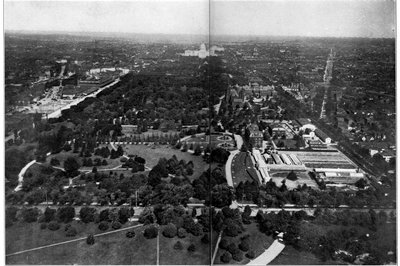
Photo by Clinedinst
BIRD'S-EYE VIEW OF WASHINGTON, LOOKING EAST FROM THE MONUMENT
5Washington himself desired the new city planned
somewhat like Philadelphia, a plain checkerboard, but
L'Enfant, while making the checkerboard style the
basis, diversified, beautified, and complicated the
whole by a system of avenues radiating from the
Capitol as the centre and starting-point of the whole
system. The streets running east and west are designated
by letters. They are divided into two classes
or sets—those north of the Capitol and those south
of it. Thus, the first street north of the Capitol is A
Street North, and the first street south of it is A Street
South, the next is B Street, North or South, as the
case may be, and so on. These distinctions of North,
South, East, and West are most important, as forgetfulness
of them is apt to lead to very great inconvenience.
The streets are laid off at regular distances from
each other, but for convenience other thoroughfares
not laid down in the original plan have been cut
through some of the blocks. These are called "half
streets," as they occur between, and are parallel with,
the numbered streets. Thus, Four-and-a-half Street
is between Fourth and Fifth streets, and runs parallel
with them.
The avenues run diagonally across the city. New
Jersey, Pennsylvania, Maryland, and Delaware avenues
intersect at the Capitol, and Pennsylvania, New York,
Vermont, and Connecticut avenues intersect at the
President's house. Pennsylvania Avenue is the main
thoroughfare. It is one hundred and sixty feet wide,
and extends the entire length of the city, from the Eastern
Branch to Rock Creek, which latter stream separates
Washington from Georgetown. It was originally
a swampy thicket. The bushes were cut away to the
desired width soon after the city was laid off, but few
persons cared to settle in the swamp. Through the
exertions of President Jefferson, it was planted with
four rows of fine Lombardy poplars—one on each
6side and two in the middle—with the hope of making
it equal to the famous Unter den Linden, in Berlin.
The poplars did not grow as well as was hoped, however,
and when the avenue was graded and paved by
order of Congress in 1832 and 1833 these trees were
removed. Pennsylvania Avenue is handsomely built
up, and contains some buildings that would do credit
to any city. The distance from the Capitol to the
President's house is one mile, and the view from either
point along the avenue is very fine.
Every circle, triangle, and square dedicated to monuments
bears testimony to the taste of the original
design. So little respect, however, was held for Major
L'Enfant's plans that Daniel Carroll, one of the original
owners of the land, was in the act of building a
handsome house right across New Jersey Avenue.
L'Enfant ordered it torn down. This was done, much
to the disgust of Carroll and to the indignation of the
commissioners. The government rebuilt the house
for Carroll, but was careful to place it in a more suitable
location. The old Duddington House, on Capitol
Hill, was long a landmark of the early Washington
architecture.
There were some other acts of irritability on the
part of L'Enfant, acts which now show his just appreciation
of his own great work. He was paid $2,500
for his services and dismissed. He believed he should
have been pensioned, as would have been done in
Europe.
Afterward he saw the city expand as the nation
grew strong, while he, a disappointed, poverty-stricken
man, wandered, a pathetic figure, about the
7Capitol until 1825, when he died. He had lived for
years on the Diggs farm, about eight miles from
Washington, and was buried in the family cemetery
in the Diggs garden, and when the dead of that family
were removed his dust was left in an unmarked grave.
Mr. Corcoran, the great banker of Washington, who
died in 1888, said he remembered L'Enfant as "a
rather seedy, stylish old man, with a long green coat
buttoned up to his throat, a bell-crowned hat, a little
moody and lonely, like one wronged." The heart of
a stranger in a strange, ungrateful land.
The City of Washington is his monument. No one
can now rob him of that honor. Let us hope that he
has awakened in His likeness and is satisfied.
Could the Colonial Dames or the Daughters of the
Revolution do a more beneficent and popular act than
to mark the resting-place of Peter Charles L'Enfant,
who drew the original plans of that city which is to
become the most beautiful city in the world?[1]
The letters of General Washington abound in references
to the difficulty of obtaining money to fit the
new city for capital purposes. Virginia made a donation
of $120,000 and the State of Maryland gave
$72,000. Afterward the latter State was induced to
loan $100,000 toward fitting the city for a capital.
The City of Washington was officially occupied in
June, 1800. Since then it has been the ward of Congress.
Strangers, even at this late day, often comment
on the long distance between the Capitol building and
the Executive Mansion; but Washington strongly impressed
8upon the mind of Major L'Enfant that the
latter must be at a considerable distance, so that members
of Congress should not fall into the habit of coming
too frequently to call upon the President, and thus
waste the time of the executive head of the nation.
It is not the purpose in these sketches to dwell too
much on the history of Washington, but rather to
make a picture of the city as it is in the first decade of
the twentieth century. A glimpse of it, however, in
the summer of 1814 is really necessary to complete our
references to the early days of the nation's capital.
In 1814 the city was captured by a small British
force under General Ross, and both wings of the Capitol
building, with its library and almost all the records
of the government up to that date, were destroyed by
fire, also the White House, as the Executive Mansion
was even then called, and most of the departments,
including the Navy-yard.
Mrs. Madison, in a letter to her sister, gives a
graphic picture of the time:
"Dear Sister,—My husband left me yesterday
morning to join General Winder. He inquired anxiously
whether I had courage or firmness to remain in
the President's house until his return on the morrow
or succeeding day, and on my assurance that I had no
fear but for him and the success of our army, he left
me, beseeching me to take care of myself and of the
Cabinet papers, public and private. I have since received
two despatches from him, written with a pencil;
the last is alarming, because he desires that I should
be ready at a moment's warning to enter my carriage
and leave the city; that the enemy seemed stronger
than had been reported, and that it might happen that
they would reach the city with intention to destroy it.
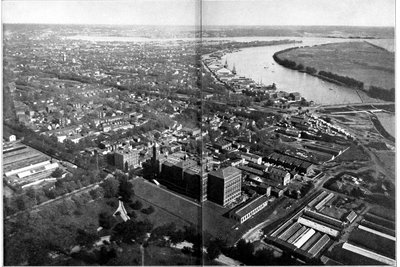
Photo by Clinedinst
BIRD'S-EYE VIEW OF WASHINGTON LOOKING DOWN THE POTOMAC FROM THE MONUMENT
"... I am accordingly ready; I have pressed
as many Cabinet papers into trunks as to fill one carriage;
our private property must be sacrificed, as it is
impossible to procure wagons for its transportation. I
am determined not to go myself until I see Mr. Madison
safe and he can accompany me, as I hear of much
hostility toward him.... Disaffection stalks
around us.... My friends and acquaintances
are all gone, even Colonel C., with his hundred men,
who were stationed as a guard in this enclosure....
French John (a faithful domestic), with his usual
activity and resolution, offers to spike the cannon at
the gate and lay a train of powder which would blow
up the British should they enter the house. To the
last proposition I positively object, without being able,
however, to make him understand why all advantages
in war may not be taken.
"Wednesday morning (twelve o'clock).—Since sunrise
I have been turning my spyglass in every direction
and watching with unwearied anxiety, hoping to
discover the approach of my dear husband and his
friends; but, alas! I can descry only groups of military
wandering in all directions, as if there was a lack
of arms, or of spirit, to fight for their own firesides.
"Three o'clock.—Will you believe it, my sister?
We have had a battle, or skirmish, near Bladensburg,
and I am still here within sound of the cannon. Mr.
Madison comes not—may God protect him! Two
messengers, covered with dust, come to bid me fly;
9but I wait for him.... At this late hour a
wagon has been procured; I have had it filled with
the plate and most valuable portable articles belonging
to the house; whether it will reach its destination,
the Bank of Maryland, or fall into the hands of British
soldiery, events must determine. Our kind friend,
Mr. Carroll, has come to hasten my departure, and
is in a very bad humor with me because I insist on
waiting until the large picture of General Washington
is secured, and it requires to be unscrewed from the
wall. This process was found too tedious for these
perilous moments. I have ordered the frame to be
broken and the canvas taken out; it is done, and the
precious portrait placed in the hands of two gentlemen
of New York for safe-keeping. And now, my
dear sister, I must leave this house, or the retreating
army will make me a prisoner in it by filling up the
road I am directed to take. When I shall again
write to you, or where I shall be to-morrow, I can not
tell."
We all know the story of Mrs. Madison's flight, of
her return in disguise to a desolated, burned, ruined
home. She would have been without shelter except
for the open door of Mrs. Cutts, her sister, who lived
in the city. From that point she visited the ruins of
all the public buildings while she awaited her husband's
return.
We are apt to think of the White House as a place of
teas, receptions, gayly dressed people, light, music,
flowers, and laughter; but it, too, has seen its
tragedies.
10Fifty years after the burning of the city the famous
Stuart picture of Washington, referred to in Mrs.
Madison's letter, was retouched and hung in the East
Room, and still constitutes one of the few ornaments
of the Executive Mansion.
During Mr. Roosevelt's administration (1902-1903)
extensive alterations and additions were made to the
Executive building.
The conservatory, so long an object of enjoyment to
the public, was removed to give place for a long white
esplanade on the west, forming the approach to the
Executive offices, while on the east side a white colonnade
now provides a most desirable entrance for large
crowds on public occasions.
It has been a matter of regret to D. A. R. women,
and to all the patriotic women of the nation, that the
portraits of the ladies of the White House have been
remanded to the basement corridors. Here are now
the portraits of Mrs. Van Buren, Mrs. Tyler, Mrs.
Polk (presented by ladies of Tennessee during Mr.
Arthur's administration), Mrs. Hayes (presented by
the National Woman's Christian Temperance Union
during Mr. Hayes's term), and Mrs. Benjamin Harrison
(presented by the D. A. R.), and the portrait of
Mrs. Roosevelt, by Chartran.
III THE CAPITOL BUILDING
12
The corner-stone of the old Capitol, which constitutes
the central portion of the new edifice,
was laid the 18th of September, 1793,
by General Washington, in the presence of
a great concourse of people and with imposing ceremonies.
The corner-stones of the wings were laid by President
Fillmore, July 4, 1851. Webster delivered the
oration of the occasion.
The old building is of yellow sandstone, kept painted
white to beautify and preserve it; the wings are of
white marble. On its central portico all our Presidents,
from Andrew Jackson to President McKinley,
have taken the oath of office. President Roosevelt
took the oath of office at Buffalo. This building,
which fronts the east, was set in accordance with the
astronomical observations of Andrew Ellicott, an engineer
from Bucks County, Pennsylvania, who succeeded
Major L'Enfant as general surveyor and engineer
in the new city.
Ellicott is described as bearing a marked resemblance
to Benjamin Franklin, except that he was more of a
Quaker in appearance, wearing a long, fine gray broadcloth
coat and a Quaker hat. He awaits the resurrection
in an unmarked grave at Ellicott City, Maryland.
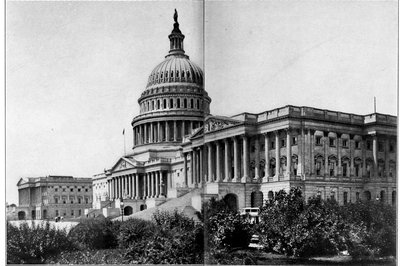
Photo by Clinedinst
THE CAPITOL
13The original building was constructed from plans
submitted by Stephen Hallet, the work undergoing
some modifications from the plans of Dr. William
Thornton.
The great wings were added during Fillmore's administration
from designs submitted by Thomas N.
Walter, architect, who not only superintended the
building of the additions, but also managed to harmonize
them with the original design.
Years ago it was quite the fashion for Americans
returning from Europe to make disparaging remarks
concerning the Capitol building, but that spirit seems
to have passed away, and the dignity, grace, and
beauty of its architecture now receive universal commendation.
Prince Henry of Germany remarked of this noble
structure: "For Capitol purposes it surpasses every
other building in the world. Its architectural beauty
is most impressive."
It is not our purpose to give a minute description
of the building. We have said that it faces east, for
the founders of the Capitol believed the city would
grow in that direction, but the landholders of early
days asked such high prices that the city began to
stretch toward the northwest, which is to this day the
fashionable part for residences, although Capitol Hill
is much more beautiful as to situation.
The base of the building is ninety-seven feet above
the river. The central structure is of Virginia yellow
sandstone, which is kept painted white. The wings
are of Massachusetts marble, and the one hundred
columns of the extension porticoes are of Maryland
marble.
14The building covers three and one-half acres. It is
seven hundred and fifty-one feet long and three hundred
and fifty feet wide.
The height of the dome above the rest of the building
is two hundred and fifty-seven feet, and its weight
is eight million pounds. This dome is surmounted by
Crawford's statue of Freedom, nineteen and one-half
feet high, and weighing fifteen thousand pounds.
The entire edifice constitutes the highest public building
in America not located on a mountain, being sixty-eight
feet higher than Bunker Hill monument, and
twenty-three feet higher than the steeple of Trinity
Church, in New York City.
Thomas G. Walker resigned his place as architect
in 1865, and was succeeded by the late architect of the
Capitol, Mr. Edward Clark, who died early in 1902.
His great work had been to finish the west front facing
the city, and to harmonize the conflicting and
foreign tastes of the many decorators of the building.
Mr. Elliott Wood, the successor of Mr. Clark, had
been the latter's chief assistant. Mr. Wood had long
been virtually in charge of the Capitol.
The architects had a candidate ready because Mr.
Wood was practically an engineer; to meet this and
yet give a faithful man his due, the name of the position
was changed to that of Superintendent of the
Capitol. He, like his predecessor, has much to do in
getting rid of the foreign artists' effects and in Americanizing
the whole.
15
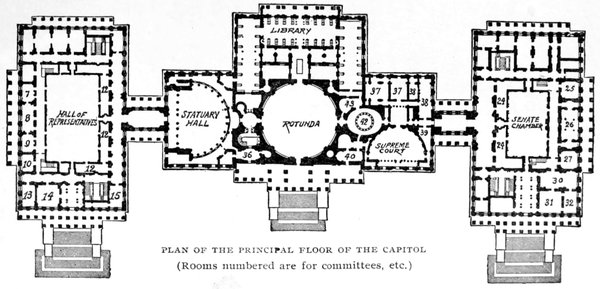
PLAN OF THE PRINCIPAL FLOOR OF THE CAPITOL
(Rooms numbered are for committees, etc.)
16Mrs. Mary Clemmer Ames says of the Capitol: "It
not only borrowed its face from the buildings of
antiquity, but it was built by men strangers in thought
and spirit to the genius of the new republic, and to
the unwrought and unembodied poetry of its virgin
soil. Its earlier decorators, all Italians, overlaid its
walls with their florid colors and foreign symbols;
within the American Capitol they have set the Loggia
of Raphael, the voluptuous anterooms of Pompeii,
and the baths of Titus. The American plants, birds,
and animals, representing prodigal nature at home, are
buried in twilight passages, while mythological barmaids,
misnamed goddesses, dance in the most conspicuous
and preposterous places."
An office building for the use of members of the
House has been constructed (1909) on the block
on B Street, between New Jersey Avenue and First
Street, southeast of the Capitol. A similar building
has been erected northeast of the Capitol, for the use
of Senators. The two buildings are connected by
an underground road, on which swift automobile-like
cars run for the convenience of legislators. The House
offices contain 410 rooms, the Senate offices 99 rooms.
The appropriation for each building was $2,500,000.
There is a general feeling in Washington that too
much luxury pervades these buildings.
IV INTERIOR OF THE CAPITOL
17
In 1808 Jefferson made Benjamin Henry Latrobe
supervising architect of what we now call
the old Capitol, being the central portion of
the present building.
He constructed the original Senate Chamber, now
the Supreme Court Room, on the plan of the old
Greek theater, the general outline of which it yet
retains. The House (now Statuary Hall) also had a
decidedly Grecian aspect. It was finished in 1811.
Statuary Hall is semicircular in shape, and has a
vaulted roof. Its ornamentation is not yet completed.
This is right. It would not be well to occupy all the
space in one generation. We need the perspective of
time to know that which will be of permanent interest
to the world.
Here Clay presided, here Webster spoke, and here
Adams stood for the right of petition and for the abolition
of human slavery. What pictures these scenes
would make! A plate in the floor southwest of the
center marks the spot in the House where John
Quincy Adams fell stricken with paralysis. In a room
opening from the Hall is a memorial bust, whose
inscription reads: "John Quincy Adams, who, after
fifty years of public service, the last sixteen in yonder
Hall, was summoned to die in this room February 23
1848."
18The room has special acoustic qualities which in
early days occasioned much trouble. A whisper
scarcely audible to the ear into which it is breathed is
distinctly heard in another part of the hall. It is one
of the most remarkable whispering galleries in the
world, and its peculiar properties, accidentally discovered,
produced no end of disturbances before they
were fully understood. Their effect has been much
modified by a recent change in the ceiling.
Each State is now permitted to place in Statuary
Hall two statues of its most renowned sons.
Virginia has Washington and Jefferson. Think of
that! New Hampshire has Daniel Webster, who
made these walls echo with his thrilling, patriotic sentences,
and John Stark, of Bunker Hill fame, who
cried: "See those men? They are the redcoats! Before
night they are ours, or Molly Stark will be a widow!"
Pennsylvania has Robert Fulton, the inventor, and
John Peter Gabriel Muhlenberg, the preacher, Major-General
in the Revolution. He was also Senator and
Member of Congress. New York has Robert R. Livingston,
of the Continental Congress, and Alexander
Hamilton. The latter was Washington's Secretary of
the Treasury during both of his Presidential terms.
He had much to do with securing a good financial
system for the new government. His pathetic death
enhanced his fame and ruined Burr; but under the
search-light of history one can not help wondering
had Burr been killed and Hamilton survived that duel,
would the halo of the latter have faded? The statue
of Hamilton is one of the best in the Hall. It was
made in Rome by Horatio Stone.
19The Illinois memorial is the famous Vinnie Ream
statue of Lincoln. I wish, because it was done by a
woman, that I could like it, but it is weak and unworthy.
In every line of his strong, patriotic face
lived the gospel of everlasting hope. This figure
might well stand for one vanquished in the race. (Was
Jesus vanquished? Was Paul? Was Luther? Was
Lincoln?)
There is a small bust of Lincoln, by Mrs. Ames,
which approaches nearer the true ideal of the great
apostle of Liberty.
Illinois is further represented by James Shields,
Senator. It would seem that men like Washington
and Lincoln, who were the product of national influences,
should be venerated as representatives of the
nation rather than of individual States.
Missouri is represented by Frank Blair and Thomas
H. Benton; Vermont, by Jacob Collamer and Ethan
Allen, the hero of Ticonderoga; Oregon, by Edward
Dickinson Baker, whose fine statue is by Horatio
Stone.
Jacques Marquette (by G. Trentanore), in the garb
of a Catholic priest, represents Wisconsin. Ohio has
President Garfield and William Allen.
Roger Sherman and John Trumbull represent Connecticut,
and Rhode Island memorializes Roger Williams
and General Nathanael Greene, of Revolutionary
fame—the former, in his quaint sixteenth century
garb, standing as well for religious freedom as for the
State which he founded.
Massachusetts presents Samuel Adams's statue, by
Annie Whitney, and John Winthrop's, by R. S. Greenough.
20What a goodly company they are, those New
England heroes![2]
Will Kansas have the courage to place there the
statue of John Brown, of Osawatomie? He yet is a
type of that unconventional State, which regards no
precedent, follows no pattern; that State which, in a
blind way, is striving to put the Ten Commandments
on top and to uphold the principles of the Sermon on
the Mount, no difference what man or what party goes
down in the strife; that State of which Whittier
truthfully said:
We cross the prairie as of old
The pilgrims crossed the sea,
To make the West, as they the East,
The homestead of the free.
Upbearing, like the ark of old,
The Bible in our van,
We go to test the truth of God
Against the fraud of man.
A brave fight the State has made against fraud. The
fight is yet on; but who doubts that the truth of God
"shall yet prevail," and who would better stand for
such a people than one who went down in that fight
with the "martyr's aureole" around his grizzled head?
Much, of course, must be left untold here; but it
is hoped that what has been said will create a desire to
see and learn more of those whom the State and the
nation has here honored.
V THE ROTUNDA
21
It is not the purpose in these sketches to go into
any minute descriptions of places or things
in Washington. To do that volumes would
be needed, and then much left untold.
The Rotunda is the central part of the old building
of the Capitol, and lies beneath the dome. It is circular
in form, with a diameter of ninety-five feet, and
with a height to the canopy above of a little over one
hundred and eighty feet.
The panels of the Rotunda are set with life-size pictures,
illustrating important scenes in American history.
There are "The Surrender of Burgoyne, October 17,
1777"; "The Surrender of Cornwallis at Yorktown,
Virginia, October 19, 1781" and "The Resignation of
Washington, December 23, 1783." These are by
Trumbull. They may not be perfect, considered as
works of art, but they commemorate events whose
memory should never die.
The surrender of Burgoyne was the greatest triumph
of American over British arms up to that date
(October 17, 1777). Had his twelve hundred Hessians
been English patriots the result might have been different.
When the British officer was sent to inquire
their condition for a fight, the answer of the British
was, "We will fight to a man." But the Hessians
replied, "Nix the money, nix the rum, nix
fighten."
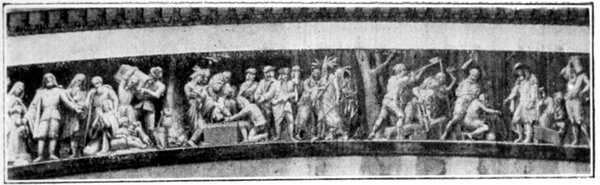
22
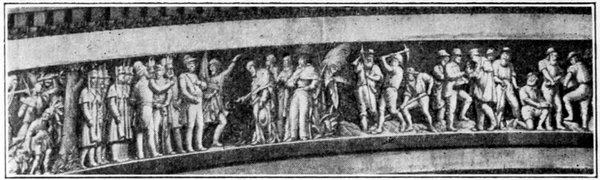
BRUMIDI FRIEZE IN ROTUNDA
It was in a cold, drizzling rain that Lord Cornwallis
made his surrender. He sat on his horse with his
head uncovered. General Washington said, "Put on
your hat, my lord; you will take cold." He replied,
"It matters not what happens to this head now." In
our exultation we are apt to forget his side.
No writer that I know of praises the scene of Washington's
resignation, yet the faces are so clear-cut
that you recognize every face which other pictures
have made familiar. The costumes are correct historical
studies, and I would not wish a line of them
changed.
Another picture of the Rotunda is "The Declaration
of Independence." How familiar, how dear each
face has become, from Lee, Jefferson, Franklin, John
Adams, Roger Sherman, and Livingston, to the plain
Quaker who stands by the door! Adams afterward
wrote: "Several signed with regret, and several others
with many doubts and much lukewarmness." That
shows in the picture, and contrasts with the enthusiasm
of the few, who with clear vision felt the dawn of
a larger liberty for the race.
We are so apt to enjoy the music and forget the
singer, to enjoy the painting and forget the artist,
that we venture a reminder concerning Colonel John
Trumbull, the artist aide-de-camp of General Washington.
He studied art in this country and in Europe.
In London he painted John Adams, our first Minister
to England, and, in Paris, Thomas Jefferson, our Minister
to France. General Washington gave him sittings,
and he traveled through the entire thirteen
colonies securing portraits. It was not until 1816,
after thirty years of careful preparation, that Congress
gave him the commission to paint the four great historical
paintings now in the Rotunda. They are the
best authentic likenesses now in existence of the persons
represented.
23
BRUMIDI FRIEZE IN ROTUNDA
"The Embarkation of the Pilgrims," by Wier, is
considered the best picture of the Rotunda. All the self-sacrifice
of leaving country, home, and friends is in
the women's faces, "All for God" is in the men's
faces. It is the little leaven of Puritanism which yet
keeps this country sweet.
It is amusing to see the bands of Indians who are
sent here to meet the "Great Father" stop before
"The Baptism of Pocahontas," painted by Chapman.
Evidently neither the faces nor the costumes suit them,
for they hoot and laugh, while they grunt with evident
approval at the picture of Boone's conflict with the
24savages and that of William Penn's conference with
the Indians of Pennsylvania.
At a height of sixty-five feet above the floor, and
encircling the wall at that point, about three hundred
feet in circumference, runs a fresco, by Brumidi and
Castigni, in imitation high relief, which well depicts
periods of American history, illustrating from the
days of barbarism to civilization. It is incomplete at
this time.
Brumidi was, while yet a very young man, banished
from Italy for participating in an insurrection. He went
to Mexico, and finally was brought to Washington
through the instrumentality of General Meigs. His
first work is in the room of the Committee of Agriculture
of the House, where he represented Cincinnatus
leaving the plow to receive the dictatorship of Rome;
General Putnam, in a similar situation, receiving the
announcement of the outbreak of the Revolution, and
other fine works are scarcely appreciated by the clerks
who daily work beneath them. For eight dollars a
day, the compensation he first received, Brumidi did
work which thousands of dollars could not now duplicate.
Almost every one knows that Brumidi began
the decoration of the frieze around the Rotunda of the
Capitol. He had completed in charcoal the cartoons
for the remainder of the decoration, and these drawings
he left to his son, supposing that the designs would be
purchased from him by the successor selected to complete
the work. This man, however, obtained in some
unknown way an idea of the sketches Brumidi had
made, and attempted to carry them out without the
aid of the originals.
25At the east door of the Rotunda are the famous
bronze doors designed by Randolph Rogers at Rome
in 1858, and cast at Munich. The high reliefs illustrate
leading events in the life of Columbus.
From near the Rotunda one can ascend to the dome
and overlook the entire District of Columbia.
VI CONCERNING SOME OF THE ART AT THE CAPITOL
26
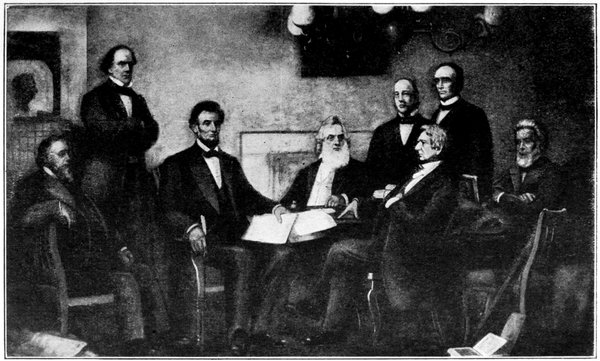
Among the interesting pictures in the Capitol is
Frank B. Carpenter's picture, "The First
Reading of the Emancipation Proclamation,
September 22, 1862." Mr. Lincoln was
accustomed to speak of the act which this picture represents
as the central act of his administration. Historians
have recorded it the leading event of the nineteenth
century.
It changed the policy of the war, and was received
by the army and the people as a necessary war measure.
According to Mr. Carpenter, he takes the
moment when Mr. Lincoln has just said: "Gentlemen,
I now propose to issue this Emancipation Proclamation."
Montgomery Blair said: "If you do, Mr. President,
we shall lose the fall elections." To this no one
offered a reply. Mr. Seward, who sits in front of the
table, said: "Mr. President, should we not wait for a
more decisive victory, so that the rebels may know we
are able to enforce the Proclamation?" Mr. Lincoln
leaned forward and said, in a low voice: "I promised
my God, if Lee were driven back from Maryland, to
issue the Proclamation." Mr. Seward said: "Mr.
President, I withdraw every objection." Chase, who
stands back of the President in the picture, and who
was not always in sympathy with Mr. Lincoln, laid his
hand affectionately on Mr. Lincoln's shoulder, to show
the President that in this matter they were in perfect
accord.
27
THE FIRST READING OF THE EMANCIPATION PROCLAMATION
28The Proclamation came just after the battle of
Antietam, which was far from being a decisive victory.
The Proclamation set forth that, unless rebellion ceased
by January 1, 1863, the slaves at that time would be
declared free. It was a case of "man's extremity
is God's opportunity."
Another picture which well merits a full description
(which we have not space to give) is W. H. Powell's
spirited picture, "The Battle of Lake Erie, September
13, 1813." It represents Commodore Perry transferring
his colors from the disabled flagship Lawrence to the
Niagara in the midst of a fire from the enemy. Perry
deserved all the glory he so richly won.
Mary Clemmer Ames thus beautifully describes that
great picture, "Westward the Star of the Empire Takes
its Way." The picture is in the stairway of the south
wing:
"At the first glance it presents a scene of inextricable
confusion. It is an emigrant train caught and
tangled in one of the highest passes of the Rocky
Mountains. Far backward spread the eastern plains,
far onward stretches the Beulah of promise, fading at
last in the far horizon. The great wagons struggling
upward, tumbling downward from mountain precipice
into mountain gorge, hold under their shaking covers
every type of westward moving human life. Here is
the mother sitting in the wagon front, her blue eyes
gazing outward, wistfully and far, the baby lying on
her lap; one wants to touch the baby's head, it looks
29so alive and tender and shelterless in all that dust and
turmoil of travel. A man on horseback carries his
wife, her head upon his shoulder. Who that has ever
seen it will forget her sick look and the mute appeal
in the suffering eyes? Here is the bold hunter with
his raccoon cap, the pioneer boy on horseback, a coffeepot
and cup dangling at his saddle, and oxen—such
oxen! it seems as if their friendly noses must touch
us; they seem to be feeling out for our hand as we
pass up the gallery. Here is the young man, the old
man, and far aloft stands the advance-guard fastening
on the highest and farthest pinnacle the flag of the
United States.
"Confusing—disappointing, perhaps—at first
glance, this painting asserts itself more and more in the
soul the oftener and the longer you gaze. Already the
swift, smooth wheels of the railway, the shriek of the
whistle, and the rush of the engine have made its story
history. But it is the history of our past—the story
of the heroic West."
There are pictures and busts, or full-length statues,
of almost every great man of our nation. Some of them,
within one hundred years, will be turned over to the
man's native State or town, with complimentary notes
and speeches the inner meaning of which is: "We
need the room for bigger men."
Before leaving the Capitol plaza a word must be said
of Horatio Greenough's statue of Washington, which
sits in lonely grandeur before the Capitol. Greenough
was much in Rome, and the antique became his model.
The statue represents Washington sitting in a large
chair, holding aloft a Roman sword, the upper part
30of his body naked, the lower part draped as Jupiter
Tonans.[3]
This conception brings out the majestic benignity of
the face of Washington, and shows to the life every
muscle and vein of his magnificent form. Greenough
said of his own work: "It is the birth of my
thoughts; I have sacrificed to it the flower of my days
and the freshness of my strength; its every lineament
has been moistened with the sweat of my toil and the
tears of my exile. I would not barter its association
with my name for the proudest fortune that avarice
ever dreamed of."
The work, however, has met with more of criticism
than of praise. A statue should represent a man in
the costume of his time. Washington should have
been shown either in the knee-breeches or in the full
military costume of his period. We want no foreign
effects in our statues. Washington had no aspiration
to be either Jupiter or Mars, but he earnestly desired
to be a good and useful man.
In this connection a few words in relation to the
character of future paintings that shall be selected for
the adornment of the Capitol may not be amiss.
In Paris, at the Exposition in 1900, the writer was
greatly impressed by the manner in which France perpetuates
historic events. The best picture of the commission
which settled the Spanish-American War was
painted by a Frenchman, the best picture of the Peace
Commission at the Hague was also French. One picture,
which will ever be valuable, represented President
Carnot and his Cabinet in the Exposition of 1889
receiving the representatives of all the colonies of
France.
31Our country should have pictures of the inauguration
of the President, with his leading men about him;
also of the receptions on New-year's day, showing
faces of foreign Ministers, the Cabinet, Members of
the Supreme Court, and our naval and military commanders.
I remember one brilliant company at Secretary Endicott's,
during the first Cleveland administration. The
Ministers of various foreign nations, in court costumes
and with all their decorations, were present. General
Sheridan, full of life and repartee, was there. General
Sherman had come over from New York to grace
with his presence the reception given by the Secretary
of War. General Greely, of Arctic fame, wore for the
first time the uniform of a brigadier-general. All the
leading army officers, in brilliant uniforms, were
present. Senators Edmonds, Sherman, Logan, Evarts,
Ingalls, Wade Hampton, Leland Stanford, Vance,
Voorhees, Allison, with many others, were part of
that memorable company. Mrs. Stanford wore the
famous Isabella diamonds. Among the guests were
Secretaries Vilas, Whitney, Bayard, and their accomplished
wives; Mr. Carlisle, then Speaker of the
House, and his stately, genial wife; and President and
Miss Cleveland, who made an exception to the Presidential
rule of non-attendance at such functions, and
by their presence added to the pleasure of the occasion.
Chief Justice Waite and Justices Field, Miller, Blatchford,
Gray, and Strong were present.
32What a picture for history that representative company
would now be! We need an art fund—perhaps
the Carnegie University beneficence may provide it.
Concerning the Capitol building, Charles Sumner said:
"Surely this edifice, so beautiful, should not be open
to the rude experiment of untried talent."
The Commission of Artists said: "The erection of
a great National Capitol occurs but once in the life of
a nation. The opportunity such an event affords is an
important one for the expression of patriotic elevation,
and the perpetuation, through the arts of painting and
sculpture, of that which is high and noble and held in
reverence by the people; and it becomes them as
patriots to see to it that no taint of falsity is suffered
to be transmitted to the future upon the escutcheon of
our national honor in its artistic record. A theme so
noble and worthy should interest the heart of the whole
country, and whether patriot, statesman, or artist, one
impulse should govern the whole in dedicating these
buildings and grounds to the national honor."
VII THE SENATE CHAMBER
33
In visiting the Capitol building most people
desire first to see the Senate Chamber, possibly
from the fact that the names of the
Senators are more familiar, because, as a
usual thing, men have been long in public life before
they have become Senators.
The Senate Chamber is 112 feet in length, 82 feet
wide, and 30 feet high. The floor rises like that of an
amphitheater; the walls are white, buff, and gold in
color, and the ceiling consists of panels of glass, each
one bearing the coat of arms of a State. Opposite the
main entrance, on a platform of dark mahogany, are
the desk and chair of the President of the Senate, who
is the Vice-President of the United States, or, as in the
present administration, a Senator elected by his colleagues
to preside over them when the office of Vice-President
has become vacant. Below the President is
a larger desk for the use of the Secretary of the Senate
and his assistants.
The heating and ventilating of the Senate Chamber
is said to be very good. In winter, however, the room
seems to be too warm. After an absence of fifteen
years, I find men who have been in the Senate during
that time have aged much more in appearance than
their contemporaries outside.
The mahogany desks of the Senators stand on a
34moss green carpet, making a good color combination.
The room is surrounded by a gallery which seats
about a thousand persons. This gallery is divided.
There is a private gallery for Senators' families and
friends, one part of which is set apart for the family
of the President. It is seldom occupied by the dwellers
in the White House, but often by visiting friends.
The reporters' gallery is over the Vice-President's
desk. There sit those busy, bright men who keep you
informed of what the Senate is doing. The gallery
opposite is for the diplomats. It is always interesting
to watch the faces of these distinguished foreigners as
they scan this body of lawmakers. Besides these there
are the gallery for ladies, or for gentlemen accompanied
by ladies, and the public gallery for men.
The Senate is the citadel of American liberty. Its
great debates have defined our constitutional rights
and duties, and prevented many violations of fundamental
law. Here Clay, Calhoun, Webster, Benton,
Chase, Sumner, Seward, Harrison, Edmunds, Evarts,
Ingalls, Logan, and Wade Hampton, with hundreds
of others equally eloquent and equally patriotic, have
stood for the right as they saw it, or sold their souls
for the mess of pottage.
The Republicans sit on the Vice-President's left and
the Democrats on the right. Although differing in
ideas of governmental policy, we must believe both
sides are actuated by a love of country.
The world is beginning to expect the United States
to be the final court of appeals in behalf of the lesser
nations, especially the other American republics. It is
the Senate's natural destiny, because of its treaty-making
35power, to facilitate a better understanding
between nations, to prevent wrongs, to increase commerce,
to secure international peace, and thus to
improve the governmental powers of the world. So
will our republic be the bridge over which the nations
of the earth will enter on a period of universal education
and modified self-government.
In my youth, on a visit to Washington, I saw
Schuyler Colfax preside over the Senate. He was a
nervous, restless man, who gave no attention to the
Senator speaking, and while he was in the chair the
Senate became a noisy, turbulent body. At another
time, for a few hours, I saw Henry Wilson, who was
Vice-President under Grant's second term, preside
over the Senate. Quiet, self-contained, serene, watchful,
attentive, he was an ideal presiding officer. Every
battle of life had left its mark on his strong, rugged
face.
In December, 1885, I came to Washington and remained
three years. Vice-President Hendricks had
died, and the Senate, which was Republican, was presided
over by John Sherman. He was in public life
from 1848 to the time of his death, and his name was
identified with almost every public measure from that
time to the end of the century. He was a man of
great wisdom and good judgment, but cold and without
any of those qualities which tend to personal popularity.
Later, John James Ingalls, of Kansas, was
elected President pro tempore. Tall, stately, dignified,
scholarly, thoughtful, a skilled parliamentarian, it is
probable the Senate never had a better presiding
officer. When Senator Ingalls occupied the chair the
36business of the Senate was put through with such
celerity and dispatch that a visit to that usually prosy
body became interesting.
Later, I saw Levi P. Morton, of New York, preside
as Vice-President. He was a fine business man who
had served his country with honor abroad, but had no
training as a presiding officer. He was regarded as
fair in his rulings.
The Senate was later presided over by Senator Frye,
of Maine, who has had a long experience in legislative
bodies, having served six terms as representative from
Maine, and having been elected to the Senate in 1881,
to fill the vacancy left by Blaine when he became
Secretary of State under Garfield. He was also a
member of the Peace Commission which met in Paris,
September, 1898, to settle the terms of peace between
the United States and Spain. The Senate is now presided
over by Vice-President Sherman, who has served
twenty years as Representative from New York. He
presided over the Republican Convention in 1895,
1900 and 1908.
When I take friends to the Senate now I notice
they ask first for Mr. Aldrich, of Rhode Island;
Bailey and Culbertson, of Texas; Lodge, of Massachusetts;
Nelson, of Minnesota; Tillman, of South
Carolina; Root, of New York; Owen and Gore, of
Oklahoma; Curtis and Bristow, of Kansas, and Dolliver,
of Iowa.
When I was here from 1885 to 1888 the following
were the stars: Edmunds, who for quiet strength,
massive force, persistent effort, fertility of resource,
and keen sagacity was never surpassed on the floor
37of the Senate. Like Mr. Hoar, his sentences in
rhetorical and grammatical construction were fit for
the Record just as they fell from his lips. William M.
Evarts, of New York, famous as counsel in the Beecher
trial, and attorney for the Republican party before the
Electoral Commission. He seemed like a man about
to do some great thing, but he originated no important
national or international law. Leland Stanford, noted
for his philanthropy and great wealth, and Wade
Hampton and Senator Butler, both of South Carolina,
were picturesque and interesting figures. General
Logan, Don Cameron, Preston B. Plumb, Blackburn,
and Beck, of Kentucky, stood next in interest, but
most of these have given place to a younger generation.
The most interesting rooms in the north wing beside
the Senate Chamber are the President's room, Vice-President's
reception-rooms, and committee-room of
the District of Columbia.
The walls of the President's room are in white and
gold, with crimson carpet, table, and chair effects—rather
high lights if one had to live in it, but very
pleasing for the short visits made by the President to
the Capitol. On the last day of each term of Congress
the President comes to this room for an hour or two
and signs any bills which yet remain. He also answers
the perfunctory question as to whether he desires to
present any further business to the Senate.
The Vice-President's room is much more used.
When the Vice-President in the Senate chamber grows
tired "of weary lawyers with endless tongues," he
calls some one to the chair and slips into the Vice-President's
38room, to rest and attend to his correspondence.
Garrett A. Hobart was the fifth Vice-President of
the United States to die during his term of office.
The others were Elbridge Gerry, William Rufus King,
Henry Wilson, and Thomas A. Hendricks. Gerry
was one of the great statesmen of the revolutionary
period and hailed from Massachusetts. He was Vice-President
in 1812, and died November 23, 1814, while
on the way to the capital.
Charles Warren Fairbanks, a Republican from
Indianapolis, Ind., became Vice-President March 4,
1905, at the beginning of Mr. Roosevelt's second term.
Mr. Fairbanks never held public office prior to his election
to the Senate in 1897, which place he held until
he resigned to take the oath of Vice-President.
Mr. Fairbank's influence in the City of Washington
will long be remembered as one of the pleasant memories
of the Capital. At church functions, at philanthropic
or patriotic conventions, Vice-President Fairbanks
found time in his overcrowded life to preside.
In social life Mrs. Fairbanks was the idol of the
D. A. R. women. Her hospitable home was ever open
for receptions, fetes and parties, and not in this generation
will Washington see a family so universally beloved
and so universally regretted.
James Schoolcraft Sherman, Republican of Utica,
N. Y., took the oath of office as Vice-President,
March 4, 1909. He had been a member of Congress
for twenty years, and ranked as one of the five leading
members of the House of Representatives. His ability
as a presiding officer is recognized in both branches
39of Congress. The Cabinet called together by President
Taft is composed largely of new men at Washington.
Mr. Philander Chase Knox, of Pennsylvania, takes
up the duties of the State Department so ably filled by
John Hay, Elihu Root, and Mr. Taft, with large
knowledge of state affairs.
Mr. Franklin McVeagh, of Chicago, an able business
man, takes charge of the Treasury Department at a
time when there is a deficiency in the Treasury, and
with a new tariff law to enforce.
Mr. Jacob McGavock Dickinson, like Mr. McVeagh, is
a Democrat from Chicago. As Secretary of War he will
need all his great acumen in managing the affairs of the
nation from the Panama Zone to the Philippine Islands.
Mr. George Woodward Wickersham, of New York,
as Attorney-General is a lawyer of high personal and
professional qualifications.
Mr. George von Lengerke Meyer was transferred by
President Taft from the Post-office Department, whose
service he greatly improved, to the Secretaryship of
the Navy.
Mr. Frank Harris Hitchcock, the new Postmaster-General,
has had long experience in postal affairs.
Mr. Charles Nagel, of St. Louis, Mo., has had a
business experience which will fit him for his arduous
duties as Secretary of Labor and Commerce.
Hon. James Wilson has been reappointed by President
Taft as Secretary of Agriculture, a position he
has held for twelve years.
Mr. Richard Achilles Ballinger, the new Secretary
of the Interior, of Seattle, Wash., is of the New West.
He has met a warm welcome at Washington.
VIII THE HOUSE OF REPRESENTATIVES
40
The Hall of Representatives is in the south wing
of the Capitol, and is similar in form and
design to the Senate Chamber, being semicircular,
with a gallery of twelve hundred
seating capacity extending around the entire hall.
Like the Senate, the walls are white, buff, and gold,
and the ceiling panels of glass, each showing in connection
with a State coat of arms the cotton plant in
some stage of development.
The Speaker of the House sits at a desk of pure
white marble, and in front of him are several desks
for the Secretary and his many assistants.
A silver plate on each desk bears the name of its
occupant. As in the Senate, the Republicans occupy
the left of the Speaker and the Democrats the right.
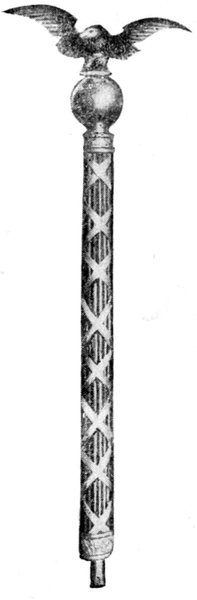
When the House is in session the mace is in an upright
position at the table of the Sergeant-at-Arms
on the right of the Speaker, and when the House
is adjourned, or in committee of the whole, it is removed.
The mace is a bundle of ebony rods, bound together
with silver bands, having on top a silver globe, surmounted
by a silver eagle. In the British House of
Commons the mace represents the royal authority, but
in the United States it stands for the power of the
people, which, tho not present in bodily form, yet is a
force always to be reckoned with. The one now in
the House has been in use since 1842. The Sergeant
carries it before him as his symbol of office when enforcing
order, or in conducting a
member to the bar of the House
by order of the Speaker.
41
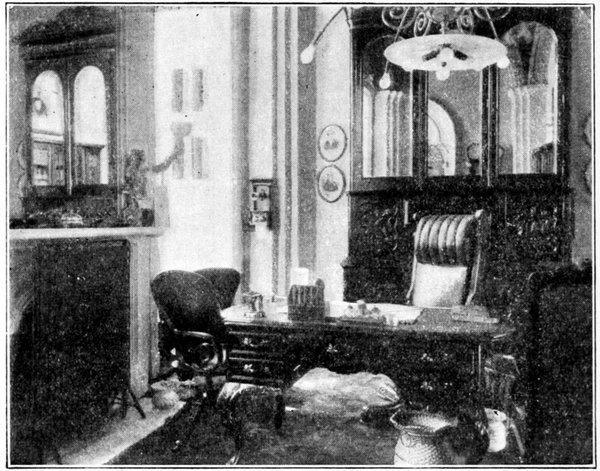
The Speaker's room is across the
lobby back of his chair, and is one
of the most beautiful rooms in the
building. It has velvet carpet, fine,
carved furniture, large bookcases
and mirrors, and its walls, as well
as the walls of the lobby, are hung
with the portraits of every Speaker,
from our first Congress to the
present one.
Most of the pictures in the House
of Representatives with which I was
familiar fifteen years ago have been
removed. Now there remains but
one—Brumidi's fresco representing
General Washington declining the
overtures of Lord Cornwallis for a
two days' cessation of hostilities.
Washington, like Grant, was an "unconditional surrender"
man.
Each State is entitled to a number of Representatives
in Congress, proportioned upon the number of its population.
The State is districted by its own State Legislature.
Then the district selects its own man, who is
supposed to understand its wants and needs, and elects
him to represent his people for two years.
He must be twenty-five years of age, seven years a
citizen of the United States, and a citizen of the State
which he represents. There are about three hundred
and fifty-six members and delegates. The latter represent
the territories of Oklahoma, New Mexico,
Arizona, and Hawaii.
42
Congress is an aggregate of selfish units, each
fighting for his district. No doubt good influences
prevail, but no one class of men, either the extremely
good or the extremely bad, has the entire say, for
law is the formulated average public opinion of the
age and country in which it is made.
It can not be too strongly impressed upon the voters
of this country that it is their duty to select good,
43strong, noble men with high convictions of public
duty, and then to keep them in Congress term after
term if they desire their district to be represented by
anything more than a mere vote. Important places on
committees are given men not alone in proportion to
intellectual merit, but in proportion to Congressional
experience. All men will not become leaders from
remaining there a long time, but none will without it.
It is a wonderful thing to note the changes in the
House since 1885. At that time John G. Carlisle was
Speaker of the House. So fair in his rulings was Mr.
Carlisle that one might spend hours in the gallery and
be unable to decide which side he favored.
Samuel J. Randall and Roger Q. Mills, of Texas,
were the leaders on the Democratic side, and the Mills
bill concerning tariff the chief object of legislative interest
before the country. Springer, of Illinois,
and Breckenridge, of Kentucky; Crisp, of Georgia;
Hooker and Allen, of Mississippi, were also among the
leaders of the Democracy. Of these some are now out
of politics, some are dead, and one disgraced.
Thomas B. Reed, of Maine, was the acknowledged
leader of the Republican side, with McKinley, Cutcheon,
Burrows, Boutelle, Holman, Butterworth, Henderson,
Payne, Morrill, of Kansas, Negley, of Pennsylvania,
and Cannon his backers.
It was great fun to see Reed come down the aisle
ready to puncture the pet plans of the Democrats. In
sharp, keen, extemporaneous, partisan debate he has
never been excelled in this country, and possibly never
in any other. No man ever appreciated his own power
more accurately than he. He charged on few windmills;
44but when he placed himself in antagonism to a
measure, it usually failed to pass, altho the Democrats
had a working majority. When he became Speaker
of the House, old members assured me, in spite of his
name "Czar" Reed, he was not more arbitrary than
either Blaine or Randall in the same position. As a
presiding officer no man ever put the business of the
House through more rapidly or more gracefully. He
was a fine parliamentarian, quick in decisions and most
able in his rulings.
My note on McKinley in 1885 says: "He can not
be considered a leader, for a leader is one who can
champion a party measure. This he can not do, as he
is not keen in repartee—the opposition walk all over
him; nor can he support a new man. He makes two
or three well-prepared, eloquent speeches each year;
these are usually on the tariff. He is a genial, pleasant
gentleman, probably with more personal friends in the
entire country than any one man now before the
nation."
William C. P. Breckenridge, of Kentucky, was considered
the most eloquent man for a prepared speech
on the Democratic side. But it was the eloquence of
a musical voice, graceful gesture, and an abundant
use of adjectives, not the eloquence of deep thought.
While he was speaking it was hard to believe that it
was not the best speech which could possibly be made
on that subject. When one read it in the Record he
wondered that he had been even interested.
In December, 1889, Mr. Breckenridge lectured in
Clearfield, Pennsylvania, to the Teachers' Institute.
His subject was "Kentucky's Place in History."
45He began by saying: "I was a rebel. I am glad
of it. If I had it to do again, I would do the same
thing!" Now, think of that before a Northern audience,
especially in a mountain county which is always
noted for patriotism. If his audience had been petrified
they could not more quickly have frozen in their
places.
He told the thrilling story of Kentucky in words of
matchless humor and pathos. He tried fun; no one
smiled. I was sitting on the platform, and the stories
were so amusing I was obliged to retire to the wings,
as to laugh in the face of that angry audience would
have been an indignity. He tried pathos. No one
melted. As he came from the stage, I said: "Colonel,
you gave a most eloquent address."
"What in thunder is the matter with that audience?"
he said. I replied: "When you said you
did not regret being a rebel, and you would do the
same again, you killed that audience so far as you
were concerned."
Just at that moment Mr. Matthew Savage, the
County Superintendent, came up. He flung down on
the table his check for one hundred dollars, and said:
"Take that, but I hope never to see your face again.
I am a Democrat, and the people of this county will
think I hired you to come here and talk treason. You
have spoiled my chances for the Legislature." The
people, however, understood the case, and it did not
hurt Mr. Savage politically.
IX CONCERNING REPRESENTATIVES
46
It is not all "skittles and beer" to be a Senator
or a Representative at Washington. The
continued pressure from a man's constituents
that he shall accomplish certain legislation
for his district, and the iron-clad rules which prohibit
his every movement, if in the House of Representatives,
are enough to break an ordinary man's health.
A new member goes to the House full of enthusiasm,
hoping to accomplish great things for those
who have trusted him; he finds that he is scarcely
permitted to open his mouth the first term. But he does
his best in committee, which is little enough; he runs
his feet off to get places for some hundreds of people
from his district who must be taken care of. Then he
keeps trying to be a good party man, and to do some
favor for the leaders, who, he hopes, will reward him
by giving him an opportunity to accomplish much-needed
legislation for his district, till in his second or
third term he becomes desperate, breaks out in meeting,
and knocks things about generally. If he proves
to be really an orator and succeeds in catching the ear
of the House, he may then begin to be more than a
mere party voter. On the other hand, he may be so
squelched that he subsides into "innocuous desuetude."
In the meantime he has borne all forms of unjust
47and unkind criticism at home. His opponents of his
own party and of the opposite party point, in scorn
and malice, to how little has been done for the district,
and tell in startling sentences how they would do
it and how they will do it when they are elected.
Then a "nagger" comes to Washington, who is still
worse. He demands a position, tells the Representative
how the latter owes his place to said nagger, and
insists on being immediately made chief clerk of some
department accessible only through the Civil Service,
and needing four times the influence a new member can
bring to bear. A man must learn to be serene under
nagging, misrepresentation, and even positive lies, and
rely upon time and his own best efforts to vindicate him.
There have been more caucuses held during the last
term than usual. A caucus is a good thing, as it gives
a man a chance to influence in a very slight degree
the decisions of his party. (See Henry Loomis Nelson's
excellent article in the Century for June, 1902.)
The House (in 1909) is ruled by Speaker Cannon,
Payne, of New York, Dalzell, of Pennsylvania, and
Tawney, of Minnesota. How long will such a hierarchy,
dominating nearly three hundred intelligent
men, be permitted to exist? The House is run like
a bank, of which the President and a few clerks do all
the deciding. Any correspondent who has the ear of
any of these few can tell you the fate of a measure before
it comes to vote.
The chairmen of committees, and a few others who
have been long in the House, are called into a committee
room to decide on how much debate will be
permitted, who will be heard, and whether or not the
48bill shall pass; and the rank and file, desiring to be
good party men, obey orders, and the bill fails or goes
through in exactly the form decided upon by the clique.
This is most un-American. It is true, more business
is thus accomplished; but the business does not represent
the average public opinion of the House.
The Committee on Rules, or its majority, constitutes
a stone wall against which men break their hearts and
ruin their reputations. Let us have less done, but
let what is done be an average result of public opinion.
The President can do but little to influence legislation.
His clubs are personality and patronage. If as
persistent as Mr. Roosevelt, he may eventually get an
"Administration" measure (like Cuban reciprocity)
through, despite opposition. Present Congressional
methods make politicans out of men capable, under
broader training, of becoming statesmen. But Mr.
Roosevelt did not "arrive" by the good will of the
machine, but in spite of it. If he attains a second
term, it will be against the plans of the machine;
but as in Lincoln's second term, politicians may be
forced to nominate him, or themselves go down before
the storm of public indignation.
In the meantime legislators in the House will go on
presenting little bills which they know they can never
get passed, but printed copies of which can be sent to
constituents to make them believe that their representatives
are really doing something.
The present method has this benefit: it shuts off
much of the lobbying which formerly disgraced the
anterooms of Congress.
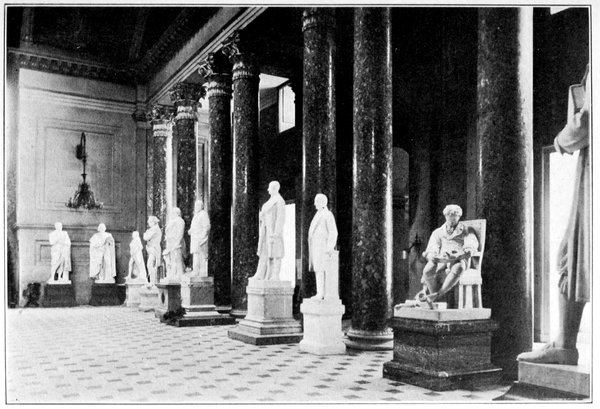
Photo by Clinedinst
STATUARY HALL
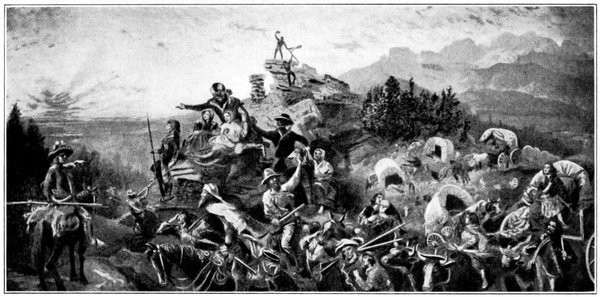
Photo by Clinedinst
From the painting by Emanuel Leutze
"WESTWARD HO!"
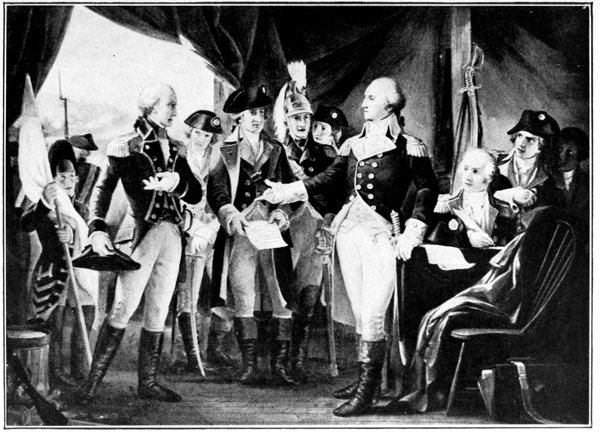
Photo by Clinedinst
From the painting by Brumidi
WASHINGTON DECLINING OVERTURES FROM CORNWALLIS
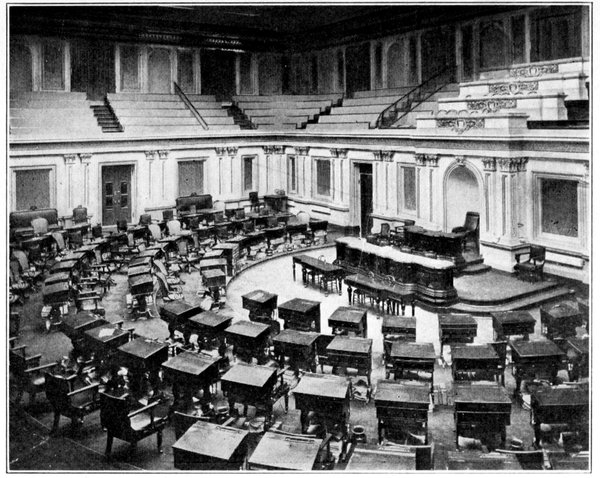
Photo by Clinedinst
THE SENATE CHAMBER
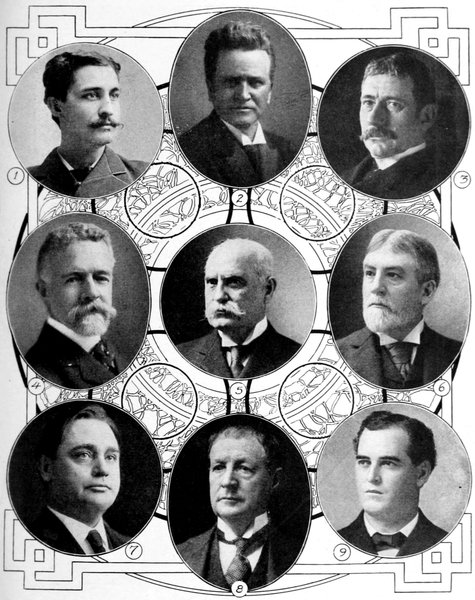
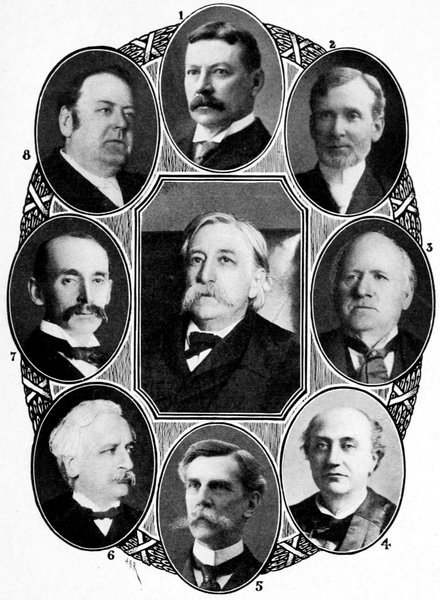
1. Benjamin F. Shively (D.), Ind.
2. Robert M. LaFollette (R), Wis.
3. Elihu Root (R.), N. Y.
Photo, Pach Bros., New York
4. Henry Cabot Lodge (R.), Mass.
Copyright, Clinedinst, Wash.
5. Nelson W. Aldrich (R.), R. I.
Copyright, Clinedinst, Wash.
7. Joseph W. Bailey (D.), Texas
Copyright, 1909, Harris & Ewing, Wash.
8. Francis G. Newlands (D.), Nev.
9. Charles A. Culberson (D.), Texas
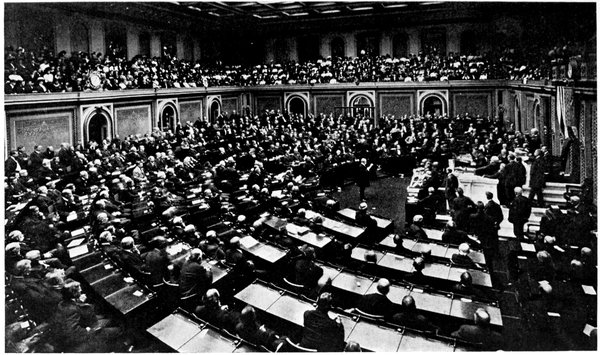
Copyright, 1907, by the George R. Lawrence Company, Washington, D. C.
THE HOUSE OF REPRESENTATIVES IN SESSION
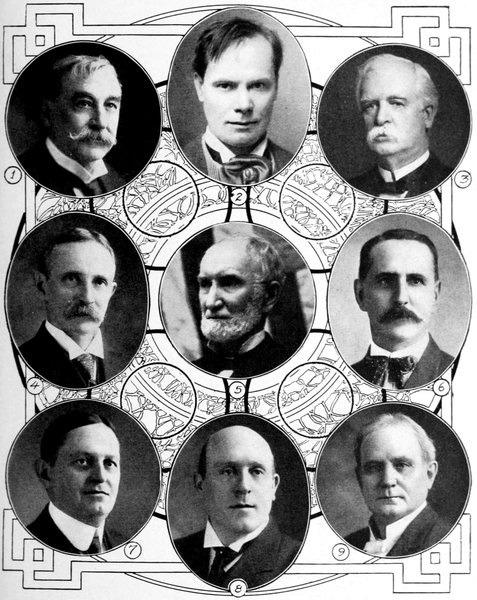
SOME PROMINENT REPRESENTATIVES
1. John Dalzell (R.), Pa.
Copyright, 1909, Harris & Ewing, Wash.
2. William Sulzer (D.), N. Y.
3. Sereno E. Payne (R.), N. Y.
Photo, Pach Bros., New York
4. David A. De Armond (D.), Mo.
Copyright, 1909, Harris & Ewing, Wash.
5. Joseph G. Cannon (R.), Ill.
Copyright, Harris & Ewing, Wash.
6. James A. Tawney (R.), Minnesota
Copyright, 1909, Harris & Ewing, Wash.
7. Oscar W. Underwood (D.), Ala.
Copyright, 1909, Harris & Ewing, Wash.
8. Ollie M. James (D.), Ky.
Copyright, 1909, Harris & Ewing, Wash.
Copyright, 1909, Harris & Ewing, Wash.
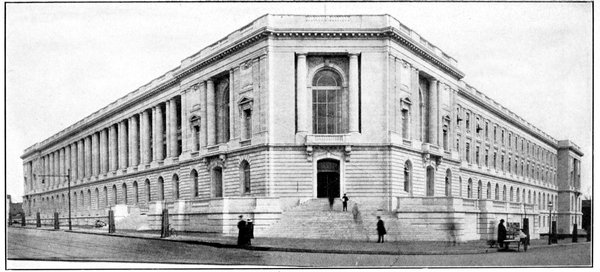
Photo by Clinedinst
NEW HOUSE OFFICE BUILDING
This building is connected with the Capitol by a tunnel. Electric automobile service is also maintained between the two buildings.
49There came a small cloud in the horizon. Mr. Littlefield,
of Maine, whom rumor claimed, at the opening
of a former Congress, to represent Presidential opinion,
saw his trust bill turned down. However, Mr.
Littlefield always delighted his hearers, who realized
that his fight against commercial monopolies was no
make-believe.
The following extracts from a speech of Hon.
F. W. Cushman, of the State of Washington, on the
question of reciprocity with Cuba, will throw much
light on present legislative methods in the House of
Representatives:
We meet in this Chamber to-day a condition that challenges
the consideration of every patriotic man, and that is, the set
of rules under which this body operates, or perhaps it would
be more nearly correct to say, under which this body is operated.
[Laughter.]
Mr. Chairman, I deem it my duty, knowing as I do that this
measure could not have been brought here in the shape in
which it now is, save and excepting for the remarkable conditions
created in this House by these rules—I say, sir, I deem
it to be my duty to pause for a moment or two on the threshold
of this debate and place a few cold facts about these
rules into this Record and before the 70,000,000 of people to
whom we are responsible.
I approach this subject with a decided degree of deference.
In the three years which I have been a member of this body
I have endeavored to conduct myself with a modesty that I
conceive to be becoming alike to the new member and to his
constituency. I represent a Congressional district comprising
the entire State of Washington, a Congressional district with
half a million people in it, and with vast and varied interests
demanding legislation for their benefit and protection in many
of the channels of trade and branches of industry.
It is with humiliation unspeakable that I rise in my place
on this floor and admit to my constituents at home that in this
50House I am utterly powerless to bring any bill or measure, no
matter how worthy or meritorious it may be, to a vote unless
I can first make terms with the Speaker.
It may be a matter of news to some of the good people
within the confines of the American Republic to know that
there is no way of getting an ordinary unprivileged measure
considered and voted upon in this House unless it suits the
Speaker. I am aware that there are several theoretical ways
of getting a measure up; but they have no actual reality—no
fruitage in fact. I make the statement on this floor now, that
no member of this body who introduces a bill—not a private
bill, but a public bill—can get it considered or brought forward
for final determination unless it suits the Speaker. And
if any one wants to deny that statement I am in a personal
position and in a peculiarly happy frame of mind right now to
give a little valuable testimony on that point! [Applause and
laughter.]
Imagine, if you please, a measure—not a private measure,
but a public measure—which has been considered at length by
a great committee of this House and favorably reported with
the recommendation that it do pass. That bill is then placed
on the "Calendar." The Calendar! That is a misnomer.
It ought to be called a cemetery [laughter], for therein lie the
whitening bones of legislative hopes. [Laughter.] When the
bill is reported and placed on the Calendar, what does the
member who introduced it and who is charged by his constituency
to secure its passage do?
Does he consult himself about his desire to call it up?
No. Does he consult the committee who considered the
bill and recommended it for passage? No. Does he consult
the will of the majority of this House? No. What does he
do? I will tell you what he does. He either consents that
that bill may die upon the Calendar, or he puts his manhood
and his individuality in his pocket and goes trotting down
that little pathway of personal humiliation that leads—where?
To the Speaker's room. Ay, the Speaker's room.
All the glories that clustered around the holy of holies in King
Solomon's temple looked like 30 cents [prolonged laughter and
51applause]—yes, looked like 29 cents—compared with that
jobbing department of this government! [Applause and
laughter.]
Then you are in the presence of real greatness. What then?
Why, the Speaker looks over your bill, and then he tells you
whether he thinks it ought to come up or not!
There is a condition which I commend to the patriotic consideration
of the American people. Contemplate that for a
method of procedure in the legislative body of a great and
free republic.
WHO IS THE SPEAKER OF THE HOUSE?
Who is the Speaker of this House who sets up his immaculate
and infallible judgment against the judgment of all
comers? Is there anything different or superior in the credentials
that he carries from the credentials that were issued
to you and to me from 70,000,000 of American people? When
he entered this House at the beginning of the Fifty-sixth and
Fifty-seventh Congresses he was simply a Congressman-elect,
bearing credentials like every other man on this floor. He has
no greater power now than any other member, save the additional
power we ourselves bestowed upon him by electing him
Speaker and then adopting this set of rules. The question
that now arises to confront us is: Have we put a club in the
hands of some one else to beat us to death? Have we elevated
one man on a pinnacle so high that he can not now see those
who elevated him? Is the Speaker of this House a mere
mortal man of common flesh and clay, or is he supernatural
and immortal? What miracle was wrought at his birth? Did
a star shoot from its orbit when he was born, or did he come
into existence in the good old-fashioned way that ushered
the rest of us into this vale of tears?
Why, man, he doth bestride the narrow world
Like a Colossus, and we petty men
Walk under his huge legs and peep about
To find ourselves dishonorable graves.
Men at some time are masters of their fates:
The fault, dear Brutus, is not in our stars
But in ourselves, that we are underlings.
52I make no onslaught on the individual. I have a high regard
for the Speaker of this House personally and for him
politically; but we face the fact that we have adopted a set of
rules in this body that are an absolute disgrace to the legislative
body of any republic.
Throughout the entire three years of my service in this
body I have been up against the little machine that dominates
the proceedings and the deliberations of this House. During
the entire three years prior to this time I have always treated
that machine with the deference due to its age and its reputation.
I trust you will excuse my frankness when I tell you
that from this time on I shall devote a little of my time and a
tithe of my energy to putting a few spokes in the wheel of
that machine that the designers of the vehicle never ordered.
[Laughter.]
I for one expect to live to see the day in this House not
when the Speaker shall tell the individual members of this
House what he is going to permit them to bring up, but when
those individual members, constituting a majority, will inform
the Speaker what they are going to bring up for themselves.
X THE SUPREME COURT ROOM
53
Continuing our examination of what is called
the original Capitol building, we would stop
next at the Supreme Court room, once the
Senate Chamber of the United States. For
quiet, harmonious beauty it is unequaled by any
other room in the building.
It was designed by Latrobe, after the model of a
Greek theater—a semicircular hall, with low-domed
ceiling, and small gallery back and over the seats
occupied by the dignified judges of the Supreme Court
of the United States.
"The Bench" is composed of large leather upholstered
chairs, with the chair of the Chief Justice in
the center, and those of the Associate Justices on either
side. In front of these is a table around which the
counsel are seated, and back of a railing seats are
arranged around the wall for spectators.
On the walls are the busts of the former Chief Justices
of the United States: John Jay, of New York;
John Rutledge, of South Carolina; Oliver Ellsworth, of
Connecticut; John Marshall, of Virginia; Roger B.
Taney, of Maryland; Salmon P. Chase, of Ohio; and
Morrison R. Waite, of Ohio. Back of the judges is
placed a number of graceful Ionic columns of Potomac
marble, the white capitals copied from the Temple of
Minerva.
The Standard Guide of Washington pictures the
present court in this way:
54
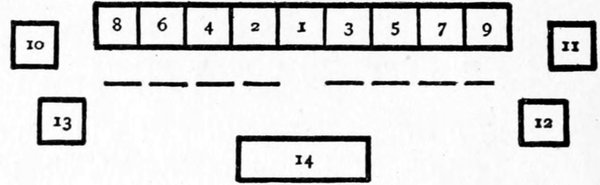
SEATING PLAN OF THE SUPREME COURT CHAMBER
Chief Justice occupies Chair No. 1
His colleagues sit on either side
No. 10—Clerk's Desk
No. 11—Marshal's Desk
No. 12—Reporters' Desk
No. 13—Attorney-General's Desk
No. 14—Counsel's Desk
In this hall Webster answered Hayne, and here
Benton and John Randolph made their great speeches.
On the left side of the Senate stood Calhoun in many
a contest with Clay and Webster on the right.
One day Calhoun boasted of being the superior of
Clay in argument. He said: "I had him on his
back; I was his master; he was at my mercy."
Clay strode down the aisle, and, shaking his long
finger in Calhoun's face, said: "He my master! Sir,
I would not own him for my slave!"
It is said to be the handsomest court room in the
world. Every week-day from October till May,
except during Christmas and Easter holidays, just at
twelve o'clock the crier enters the court room and
announces: "The Honorable Chief Justice and the
Associate Justices of the Supreme Court of the United
States," at which everybody, including visitors and
lawyers, stand. Just then nine large, dignified old
gentlemen, led by Chief Justice Fuller, kicking up
55their long black silk robes behind them, enter the
room; each, standing before his chair, bows to the
lawyers, the lawyers and spectators bow to them, then
all are seated.
The crier then opens court by saying: "O yea! O
yea! O yea! All persons having business with the
honorable the Supreme Court of the United States are
admonished to draw near and give their attendance, as
the court is now sitting. God save the United States
and this honorable court."
After this quaint little speech business begins.
The members of the court wear gowns like the ecclesiastical
robes of the Church of England. This began
in early days when this country took English law and
customs for pattern and precedent.
The seats of the judges are placed in the order of
the time of their appointment, the senior judges
occupying seats on either hand of the Chief Justice,
while the latest appointments sit at the farthest end of
each row.
This order of precedence extends even into the
consulting-room, where the judges meet to talk
over difficult cases, the Chief Justice presiding at the
head.
Our country is justly proud of its judiciary. The
Supreme Court of our country is the last rampart of
liberty. Should this court become corrupt our free
institutions will surely perish.
The Supreme Court of the United States has, however,
made some grave mistakes—witness the famous
decision of Justice Taney—but, for the most part, time
has only verified their decisions.
56The men who have sat here have not only been fair
representatives of the legal knowledge of their day
but also men of unimpeachable integrity and of the
highest patriotism. Many of them have been devout
Christians. Some on the bench at present are among
the best church workers of Washington.
Courts are conservative bodies. Conservatism produces
nothing, but is useful in preserving that which
enthusiasm has created.
This Supreme Court room has been made further
memorable as being the place in which, in 1877, sat
the Electorial Commission which decided the Presidential
contest as to whether Hayes, of the Republican
party, or Tilden, of the Democratic party, should be
the Executive of a great nation for four years.
In the fall of 1876, when the elections were over, it
was found that the result was in serious and dangerous
dispute. The Senate was Republican, the House
Democratic. Each distrusted the other. It was feared
that on the following 4th of March the country would
be forced to face one of two series dilemmas: either
that the country would have no President, or that two
would-be Presidents would, with their followers, strive
to enter the White House and take violent possession
of the government. Men would have shot the way
they voted. On the 7th of December, Judge George
W. McCrary, a Representative of Iowa, afterward in
Hayes's Cabinet, later a circuit judge of the United
States, submitted a resolution which became the basis
of the Electoral Commission. Three distant Southern
States had sent to the Capitol double sets of election
returns—one set for Mr. Tilden, one set for Mr. Hayes.
57On these nineteen votes depended the Presidency for
four years.
If they were counted for Tilden, he would have two
hundred and three votes and Hayes one hundred and
sixty-six; or, if counted for Hayes, he would have
one hundred and eighty-five votes and Tilden one
hundred and eighty-four. The States whose certificates
of election were in dispute were Florida, Louisiana,
South Carolina, and Oregon.
The members of the Electoral Commission were
selected either as representatives of their party, or men
considered the embodiment of honor and justice. The
Commission consisted of five Senators, five Judges of
the Supreme Court, and five Representatives from the
Lower House of Congress. The attorneys were the
leading lawyers of each party. The Cabinet, leading
Senators, Congressmen, foreign Ministers, and distinguished
people from all portions of the country, were
present. The wit, the beauty, the writers, the wisdom
of the country assembled in this room to weigh the
arguments, and at last to hear the decision that
Rutherford B. Hayes was rightfully to be the President
of the United States.
This tribunal, and the wise patriotism of Mr.
Tilden and his party, saved the country from a bloody
civil war.
XI INCIDENTS CONCERNING MEMBERS OF THE SUPREME COURT OF THE UNITED STATES
58
The Chief Justice of the United States is the
highest legal officer in this country.
The position has always been filled by
men of great learning and of high integrity,
and, differ as we may concerning the wisdom and justice
of some Supreme Court decisions, yet we must
believe the judges were sincere and honest in their
renditions.
When the country loses confidence in the integrity
of this court, the very foundation of our government
will be in danger.
The first Chief Justice was John Jay, appointed
September 26, 1789. He soon resigned to accept the
position of Envoy Extraordinary to England, where,
after the Revolutionary War, the adjustment of our
affairs demanded a person of great learning and skill.
The country was fortunate in having John Adams, John
Jay, and, later, John Quincy Adams as its representatives
in this delicate and important service.
John Rutledge, of South Carolina, was a later
appointment to the Chief Justiceship, but the Senate
refused to confirm the nomination. Then William
Cushing, of Massachusetts, one of the Associate Justices,
was nominated and confirmed, but declined to
serve. Oliver Ellsworth, of Connecticut, was then
59appointed, and was confirmed by the Senate March 4,
1796. He served till 1799, when he resigned to go as
the Special Envoy and the Minister to England.
John Jay was again nominated and confirmed by
the Senate, but refused to serve. John Marshall, of
Virginia, was appointed Chief Justice by President
John Adams in 1801. He died in 1835. His term
and that of Chief Justice Taney cover over sixty important
years in the history of our government.
John Marshall had served on the personal staff of
Washington in the Revolutionary War, and had
suffered the miseries and trials of the camp at Valley
Forge. At the time of his appointment he was Secretary
of State in Adams's Cabinet. He served in both
capacities till the close of Adams's administration.
The Supreme Court, when Marshall was called to
preside over it, was held in a low-vaulted room in the
basement of the Capitol, and remained there until the
new wings were finished, about 1857. Mr. Ellis, in
"Sights and Secrets of Washington," tells this story
of Marshall: "Upon one occasion Marshall was
standing in the market in Richmond, Va., with his
basket containing his purchases on his arm, when he
was accosted by a fashionable young gentleman who
had just purchased a turkey. The young man's foolish
pride would not allow him to carry the fowl through
the streets, and, taking the Judge for a countryman,
he asked him to carry it home for him. The request
was promptly granted, and when the young man's
home was reached he offered the supposed countryman
a shilling for his trouble. The money was courteously
refused, and upon asking the name of the person who
60had rendered him the service, the young man was not
a little astonished and chagrined to learn that his
thanks were due to the Chief Justice of the United
States."
A bet was once made that the Judge could not dress
himself without exhibiting some mark of carelessness.
He good-humoredly accepted the challenge. A supper
was to be given him upon these conditions: If his
dress was found to be faultlessly neat upon that occasion,
the parties offering the wager were to pay for
the entertainment; but if they detected any carelessness
in his attire, the expense was to fall upon him.
Upon the appointed evening the guests and the Judge
met at the place agreed upon, and, to the surprise of
all, the Judge's dress seemed faultless. The supper
followed, Judge Marshall being in high spirits over his
victory. Near the close of the repast, however, one
of the guests who sat near him chanced to drop his
napkin, and, stooping down to pick it up, discovered
that the Judge had put on one of his stockings with
the wrong side out. Of course the condition of affairs
was immediately changed, and amidst the uproarious
laughter of his companions the Chief Justice acknowledged
his defeat.
Mr. Ellis also says: "The following incident in his
(Marshall's) life is said to have occurred at McGuire's
hotel, in Winchester, Virginia:
"It is not long since a gentleman was traveling in
one of the counties of Virginia, and about the close of
the day stopped at a public house to obtain refreshment
and spend the night. He had been there but a
short time before an old man alighted from his gig,
61with the apparent intention of becoming his fellow
guest at the same house. As the old man drove up he
observed that both of the shafts of the gig were
broken, and that they were held together by withes
formed from the bark of a hickory sapling. Our traveler
observed further that he was plainly clad, that his
knee-buckles were loosened, and that something like
negligence pervaded his dress. Conceiving him to be
one of the honest yeomanry of our land, the courtesies
of strangers passed between them, and they entered
the tavern. It was about the same time that an addition
of three or four young gentlemen was made to
their number—most, if not all of them, of the legal
profession. As soon as they became conveniently
accommodated, the conversation was turned by the
latter upon an eloquent harangue which had that day
been displayed at the bar. It was replied by the other
that he had witnessed, the same day, a degree of eloquence
no doubt equal, but it was from the pulpit.
Something like a sarcastic rejoinder was made as to
the eloquence of the pulpit, and a warm altercation
ensued, in which the merits of the Christian religion
became the subject of discussion. From six o'clock
until eleven the young champions wielded the sword
of argument, adducing with ingenuity and ability
everything that could be said, pro and con. During
this protracted period the old gentleman listened with
the meekness and modesty of a child—as if he were
adding new information to the stores of his own mind,
or perhaps he was observing, with philosophic eye,
the faculties of the youthful mind and how new energies
are evolved by repeated action; or, perhaps, with
62patriotic emotion, he was reflecting upon the future
destinies of his country, and on the rising generation,
upon whom these future destinies must devolve; or,
most probably, with a sentiment of moral and religious
feeling, he was collecting an argument which, characteristic
of himself, no art would 'be able to elude, and
no force to resist.' Our traveler remained a spectator,
and took no part in what was said.
"At last one of the young men, remarking that it
was impossible to combat with long and established
prejudices, wheeled around, and, with some familiarity,
exclaimed, "Well, my old gentleman, what do
you think of these things?" If, said the traveler, a
streak of vivid lightning had at the moment crossed
the room, their amazement could not have been greater
than it was with what followed. The most eloquent
and unanswerable appeal that he ever heard or read
was made for nearly an hour by the old gentleman. So
perfect was his recollection that every argument urged
against the Christian religion was met in the order in
which it was advanced. Hume's sophistry on the
subject of miracles was, if possible, more perfectly
answered than it had already been done by Campbell.
And in the whole lecture there was so much simplicity
and energy, pathos and sublimity, that not another
word was uttered. An attempt to describe it, said the
traveler, would be an attempt to paint the sunbeams.
It was now a matter of curiosity and inquiry who the
old gentleman was. The traveler concluded it was a
preacher from whom the pulpit eloquence was heard.
But no; it was the Chief Justice of the United States."
Judge Marshall was followed by Roger Brooke
63Taney, of Maryland. He was nominated by President
Jackson, and confirmed by the Senate in 1836.
He died October 12, 1864. His decision in the Dred
Scott fugitive case may be ranked as one of the factors
which brought about the Civil War. The case was
substantially this: A negro slave, with a wife and
two children, sued his master for freedom under the
plea that, having been taken North into free States a
number of times, they were therefore entitled to freedom.
The decision covers many pages, but the nation
summed it up in these words: "The black man possesses
no rights which the white man is bound to respect."
Since Moses established a judiciary no decision
ever made such a disturbance. In the memory
of most people Taney's singularly pure life goes for
nothing beside the infamy of this decision. It outraged
the conscience of mankind. Taney claimed
that he did not make the law, he simply gave its interpretation.
The decision was approved by the majority
of the court, but he alone was made to suffer
the obloquy which followed.
This decision proved sufficient to bring down the
wrath of a just God on a nation so lost to human justice.
The South suffered for the sin of slavery, the
North for conniving thereto.
Judge Taney sleeps at Frederick, Md. (where most
of his private life had passed), beside his wife, who
was sister to Francis Scott Key, author of "The
Star-Spangled Banner."
In the summer of 1888 I heard Dr. Wardell, at
Ocean Grove, N. J., tell this incident concerning
Salmon P. Chase, who was appointed Chief Justice by
64President Lincoln in 1864, and who died in 1873.
Dr. Wardell claimed to have the story direct from Dr.
Newman, then pastor of the Metropolitan Methodist
Church, Washington, D. C.
He said that Chief Justice Chase was in the habit of
attending the Metropolitan Church, on Four and One-half
Street, Washington, and Dr. Newman (afterward
Bishop) noticed that while the Chief Justice was a
member of the official Board, and attended faithfully
to its duties, yet he always left the church when the
sacrament of the Lord's Supper was administered.
After one such occasion Dr. Newman went to him
and said: "Why do you not avail yourself of the
means of grace in the Lord's Supper?"
The Chief Justice answered: "I do not consider
myself worthy to partake of the communion."
The Doctor said: "We invite all who love the Lord,
and who do truly and heartily repent of their sins, to
join with us in this service."
"Yes, that is just it. What do you mean by
'repent'?"
Then the Doctor gave him a full and clear explanation
of repentance.
On the next communion day instead of leaving the
church the Chief Justice remained in his seat. After
all had communed, Dr. Newman said: "If any soul
feels its unfitness for this service, to him this invitation
is specially given. If such a one fails to acknowledge
the Savior and his own unworthiness before his fellowmen,
we are assured that the Savior will not acknowledge
him before his Father and His holy angels."
The Chief Justice rose, and staggered, rather than
65walked, to the front, and fell on his knees at the altar
railing. After giving to the kneeling man the bread
and wine, the Doctor, seeing the strong face of the
penitent drawn with grief, with the Justice still kneeling,
pronounced the benediction and dismissed the
congregation.
The next day, in the robing-room of the justices,
Chief Justice Chase said to Justice Miller: "Oh, I
want to tell you to-day what the Lord has done for my
soul! He came very near me yesterday."
Justice Miller replied: "Well, we will talk of that
some other time; now we have the wages of sin and
not righteousness before us."
After court adjourned that afternoon, the Chief
Justice went down to Alexandria to see an old servant
who had sent for him. He said to her: "Oh, Auntie,
I received a great blessing yesterday; all life is different.
I want to have a closer walk with God."
Within a few days he went to New York to transact
some business. The morning after his arrival he did
not come down to breakfast. The clerk waited till
eleven o'clock, and receiving no answer to his frequent
knocks, the door was forced, and there was found the
dead body of the Chief Justice. He had entered on
his closer walk with God.
It was well known throughout the country that Lincoln
was not in harmony with Chase, even when the
latter was Secretary of the Treasury, but Carpenter,
in his "Six Months in the White House," says:
"Notwithstanding his apparent hesitation in the appointment
of a successor to Judge Taney, it is well
known to his intimate friends that there had never been
66a time during his Presidency, when in the event of
the death of Judge Taney, Mr. Lincoln had not fully
intended and expected to nominate Salmon P. Chase
for Chief Justice."
The appointment must have come to Chase with a
little of the effects of "coals of fire," for he had not
been very loyal to Lincoln. He had the Presidential
bee in his own bonnet.
From 1874 to 1888 Morrison R. Waite, of Ohio, was
Chief Justice. Our present Chief Justice, Melville
W. Fuller, of Illinois, was called to the highest judicial
position in the country in 1888.
XII TEACHING PATRIOTISM IN THE CAPITOL
67
One can fancy a patriotic Englishman taking his
son to Westminster Abbey, and there telling
him the story of liberty, in the history of
the renowned dead who sleep about him,
until the youth is inspired with a patriotism deeper
than the love of kindred, and second only to the love
of God.
So an American father who desires his children to
assume their proper place among the great force of
American youth who are to perpetuate American
institutions, might well bring them to the Capitol of
the nation, and there in glowing words, and amid reminders
of every decade of the nineteenth century and
the latter part of the eighteenth, tell the story of
liberty as shown in republican institutions.
He could also take his children to Mount Vernon
for a day; there they might read together the history
of that serene, majestic character whose eminence has
carried him beyond national lines and made him belong
to the world as well as to us—a citizen of all
lands and of all ages.
History is best told by biography. Around Washington
would be grouped John Adams, Thomas Jefferson,
and Alexander Hamilton. These men, without
a precedent to follow, launched a new government,
establishing all the departments of its great machinery
68with such wisdom, justice, and patriotism that what
they did, what they thought and planned, but were
not able to complete, is to-day the standard of patriotism
and national achievement.
Then would follow that man whose life grows radiant
in the strong search-light of history—John Quincy
Adams; that Adams, who could truthfully say at the
close of a long, brilliant, and useful life, in the words
of an old Roman: "I have rendered to my country all
the great service she was willing to receive at my hand,
and I have never harbored a thought concerning her
which was not divine." With him would be his compeers,
Madison, Monroe, Burr, Clay, Webster, Jackson,
John Randolph, the elder Bayard, and Calhoun.
That father would not fail to make plain the stern
patriotism of Andrew Jackson and Daniel Webster
against the insidious treason of Calhoun and his
coterie.
During the early days of President Jackson's
administration he gave a state dinner in honor of Jefferson's
birthday. On his right sat Calhoun, Vice-President
of the United States, and up to this time the
intimate friend and confidential adviser of the Executive.
On Jackson's left sat Webster, with the black
brows of Jove.
The toasts of the evening had been ambiguous. Mr.
Calhoun gave this toast: "Our union, next to our
liberties the most dear; it can only be preserved by
respecting the rights of States, and by distributing its
burdens and its benefits equally."
Webster nudged the President. Old Hickory sprang
to his feet and gave the toast: "Our federal union;
69it must be preserved." Every man drank it standing,
Calhoun among the rest.
How near our country came to open rebellion is
shown in the last hours of Jackson. A friend at his
bedside said: "What would you have done with Calhoun
and his friends had they persisted in nullification?"
"Hanged them, sir, as high as Haman. They
should have been a terror to traitors for all time,"
said the dying statesman.
That father could tell part of the story of liberty
in the life of the younger Adams. At the age of
eleven Adams decided that he would be a Christian.
He said: "Of this one thing I must make sure: I
shall humbly serve God. If He makes me a great
man, I shall rejoice; but this He surely will do: if I
trust Him, He will make me a useful man."
God took Adams at his word. He sought the
Kingdom first. God added place. Adams was diplomat,
Senator, Secretary of State, President, Congressman.
He might well say with his dying breath, as he
was carried from his place in the old House of Representatives
to the Rotunda, "This is the last of earth,
but I am content."
Well he might be content. He had been a faithful,
honest, upright Christian man, who had received at
the hands of his fellow citizens the highest honors
they could confer, and in his death he passed to a home
among the redeemed, there with enlarged intelligence
and clearer vision to continue his work for God in
the beyond.
In this day, when writers are striving to make black
appear white, the father who would mingle Christianity
70with patriotism would not fail to sketch the life of
Aaron Burr in contrast with the young Adams.
Burr tells us that at the age of eighteen the Spirit
of God came upon him with such power that he fled to
the woods to settle that great question which faces
every human being—"Shall I be a Christian?" He
said to himself: "I purpose as a lawyer to succeed by
the tricks of the trade. There is many a short cut in
business which a Christian could not take, therefore I
shall not be a Christian."
He tells us that the Spirit of God never again
troubled him. He sinned against the Spirit, that unpardonable
sin. Left to himself, his destiny led him
to a high place only to make his fall more terrible.
Socially he was the most charming man of his day,
but he entered no home which he did not defile. No
woman loved him but to her sorrow.
Burr was holding the position of Vice-President as a
Republican when he was nominated by the Federalists
for Governor of New York. Some of the leading men
of that party refused to support him, among them
Hamilton. This led to the duel in which Hamilton
was killed, July 11, 1804.
Burr was disfranchised and banished by the laws of
New York, and was indicted for murder by the authorities
of New Jersey for having killed Hamilton on the
soil of that State. He could not enter either New
York or New Jersey to settle his business. He was
bankrupted, and more than $5,000 in debt when all
his property had been sold and the results paid over.
The day before the duel Burr had a right to suppose
himself a more important man than Hamilton.
71Was he not Vice-President? Had he not just received
a majority of the votes of the City of New York for
Governor of that State, in spite of Hamilton's greatest
exertions? Yet the day after the duel the dying Hamilton
had the sympathy of every human being, and
Burr was a fugitive from justice, not knowing friend
from foe. Never was there a greater revulsion of
feeling.
Southern men tried to console him by their more
courteous demeanor. Between the time of the duel
and the convening of Congress, Burr had kept himself
south of Mason and Dixon's line, for in any Northern
State he would have been arrested on a requisition on
the Governor.
He went back to Washington and again presided
over the Senate, but was simply scorched by the open,
daily manifestations of the scorn of Northern Senators.
The Southern men were more courteous in their demeanor.
On Saturday, March 2d, he took leave of
the Senate. That body was in executive session,
therefore no spectators were present. Mr. Burr, one
of the most eloquent as well as one of the handsomest
men of his day, rose in his place after the galleries
had been cleared. He began his address by saying
that he had intended to remain during his constitutional
time, but he felt an indisposition coming upon
him and he now desired to take leave of them.
The silence could be felt. There was no shorthand
reporter present, and exactly what he said is not now
known—perhaps nothing very different from what
other retiring Vice-Presidents have said. No reference
was made to the duel, none to the scorn he had
72merited, unless it were in his words, "For injuries received,
thank God, I have no memory."
He thanked the Senators for kindness and courtesy.
He prophesied that if ever political liberty in this
country died its expiring agonies would be witnessed
on the floor of the United States Senate. As he walked
out no man rose, no man shook hands with him; when
the door closed on him it shut him out forever from
position, usefulness, home, country, the love of women,
and the friendship of men.
At the President's reception on the following Morning
two Senators were relating the circumstances to a
group which had gathered round them. On being
asked, "How long did Mr. Burr speak?" one of
them answered, "I can form no idea; it may have
been a moment and it may have been an hour; when
I came to my senses I seemed to have awakened from
a kind of trance."
Burr, hurled from power and honor, wandered a fugitive
from justice, and at last would have been laid in
a pauper's grave but for the care of a woman who had
loved him in his better days.
Surely the Psalmist was right when, speaking of the
righteous and the unrighteous, he said: "And he shall
be like a tree planted by the rivers of water, that bringeth
forth his fruit in his season; his leaf also shall not
wither; and whatsoever he doeth shall prosper. The
ungodly are not so: but are like the chaff which the
wind driveth away."
XIII PEOPLE IN THE DEPARTMENTS
73
About one-third of all the employees in the
government departments at Washington are
women. Several receive over $2,500 per
annum, about fifty receive $1,600 per annum,
one hundred receive $1,400 per annum, four hundred
and fifty receive $1,200, three hundred receive $1,000,
and the remainder receive from $600 to $900 per annum.
The Civil Service Commission records for last year
show that 3,083 women were examined for the various
positions opened for them under the civil service. Of
these, 2,476 passed and 444 were appointed. Of the
applicants examined, 1,351 came under the head of
"skilled labor."
The most popular examination for women is that
of stenographers and typewriters. "Good stenographers"
is the ceaseless demand of the department
official—not mediocre, but good par excellence.
Government work is well paid only when well done.
Promotions are at least sometimes the reward of merit.
A very striking illustration of this occurred last winter,
when a young woman was made chief of one of the
divisions in the Post-Office Department because she
knew more about the work of that particular division
than any other employee in it. She receives a salary
of $2,240—among the highest paid to any woman in
the service.
74In the States a position at Washington is looked
upon as most desirable, but except for the highest positions,
and for the name of it, no ambitious man or
woman who desires to secure a competence by middle
life should consider a place in the departments.
There are nearly six thousand classified clerkships
in the departments, and many thousands of ungraded
positions. Clerks of the first class receive $1,200 per
year; of the second, $1,400; of the third, $1,600;
of the fourth class, $1,800. In ungraded positions,
salaries range from $700 to $1,000.
Chief clerks receive from $1,800 to $2,700; stenographers
and translators of languages from $1,200 to
$2,000; copyists from $60 to $75 per month. Thirty
days' vacation, without loss of salary, is allowed each
year, and in case of violent illness no pay is deducted.
Hundreds of fine young men, well educated, who
ought to be in the manufacturing businesses of our
country where they could develop, tamely accept from
$700 to $1,000 a year for mechanical work. In the
last few years there has been wonderful improvement
in the work done by department people. In 1885 I was
impressed by the flirtations in corners, the half hours
which were wasted in visiting by people receiving
government money. But few are idle now—at least,
where a visitor can see. They are all at their desks
promptly at 9 A.M.; they work till 4 P.M., with half
an hour at noon for luncheon. No bank records as
to punctuality, regularity, and diligence can be more
closely kept than those of the departments. There are
so many who are eager to take an idler's place that
no one dares to fritter away his or her time.
75It is said that if a woman banks on her femininity
with chiefs of divisions, or has unusual Senatorial
backing, she may dare to take some liberties—she may
be idle or incompetent, and not be reported; but these
cases grow fewer in number.
Now, as to civil service examination. No one can
get into the classified service without it; but in most
places, when one has passed the highest examination,
it takes Congressional influence to get a position.
Whatever may be the conditions in the future, there
never has been a time when influence was more used
than in the session of Congress ending July 1, 1902.
In making up the Bureau of Permanent Census, it was
not merit but influence which secured a place. Merit,
of course, helps everywhere, but in the session referred
to three-fourths influence to one-fourth merit were
necessary to secure any position.
There were twenty places to fill in the Congressional
Library, where it is claimed influence counts least.
Eighteen hundred people applied for the twenty places,
and of course those with Senatorial influence were
appointed. No doubt their qualifications also entered
into the account.
Seven hours, frequently spent in close, confined
rooms, doing work which brings no mental improvement,
often with a fretful, over-critical chief, anxious
to get an incumbent out in order to put in his own
friend, does not look to me like a desirable position.
It is evidently intended to give places more and
more to men who can go home and help manage elections.
It will not be until woman suffrage prevails in
the States that women will have an equal opportunity
76with men, even in the work world. Then department
people are ever anxious about their places. At each
change of Congress new people must be taken care of,
and much more is this true when the Executive is
changed. The Washington Post of July 15, 1902, has
this editorial:
The latest civil-service order of President Roosevelt is addressed
to this evil. One can not avoid wishing that it had
been issued early in December, 1901, instead of in July, 1902—before,
instead of after, a long session of Congress, during
which the "pull" was industriously plied with the usual results.
But "better late than never." It is a good order, and
its influence should be seen and felt in the improvement of
the service. Altho it was printed in the Post as soon as it
was made public, it will bear reproduction. Here it is:
No recommendation for the promotion of any employee in the classified
service shall be considered by any officer concerned in making promotions
except it be made by the officer or officers under whose supervision
or control such employee is serving; and such recommendation by any
other person with the knowledge and consent of the employee shall be sufficient
cause for debarring him from the promotion proposed, and a repetition
of the offense shall be sufficient cause for removing him from the
service.
When we speak of that order or rule as good, we mean to
say that it will prove so if faithfully and impartially enforced;
otherwise, it may only aggravate existing wrongs. For example,
suppose three clerks, A, B, and C, in the same division
are aspirants for promotion to fill a vacancy in a higher
grade. Suppose each of them to have very influential friends,
whose recommendation, were it proper to use it, might be the
controlling factor in the disposal of the prize. But A and B
obey that rule, relying on their respective records, while C
quietly hints to his friend or friends that a little boosting
would do him a great service. A personal call on the official
"under whose supervision or control such employee is serving"—a
personal call by Senator X or some other statesman of
weight—ensues, and C is promoted as a result of that call.
77That is what has happened in almost numberless cases. Will
it stop now? If "yes," the President's order will prove a
great promoter of reform in the civil service; if "no," it will
work in the opposite direction.
I took this editorial to a number of leading people
in the departments. "Yes," they said, "something
like that usually comes out about this time of the year
when Congress has adjourned. Even if President
Roosevelt means what he says, it can scarcely be executed.
The system is so complex, with so many
wheels within wheels, that patronage can hardly be
stopped. If a chief fails to promote a Senator's niece,
Mr. Chief will be apt to lose his own place, and this
consideration brings wisdom." Conditions have not
changed in 1909.
When a man or a woman has been four or five years
in a clerical government office, he or she is scarcely fit
for any other kind of place. In that time has been lost
ingenuity, resourcefulness, adaptation, how to placate
or please the public, and, above all, confidence to fight
in the great battle of industries; consequently, when dismissed,
the former place-holder hangs about Washington,
hoping for another situation. One can see more
forlorn, vanquished soldiers of fortune in the national
capital than in any other city of its size in the world.
If one desires to make a living only, and not lay up
for a rainy day, or if one has clerical talent only, then
a Washington position might be desirable; but when
one sees great, able-bodied men opening and shutting
doors for a salary, or a man capable of running a foundry
operating an elevator in a government building, it
disgusts him with the strife for place. Government
78clerkships may be desirable for women, but few of
them should claim the ability of first-class men. It is
commercial death to become once established in a department
at Washington.
The government has many first-class scientists in its
employ, people with technical knowledge. These are
the rare souls who, while they know more than their
fellow men, care less for money, and have neither time
nor ability to make it. For such men a good position
in the Agricultural, Geological, Smithsonian, Educational,
Indian, or other scientific departments is desirable,
but for no other class.
In no other place than Washington can one better
see the fact illustrated that once in each generation
the wheel of fortune makes a complete revolution,
turning down those at the top and turning up those
who are down. In the departments are now many
widows and daughters of men who were prominent in
Civil War times. One woman eighty-two years of
age was during the war the wife of a great general.
She now sits at a department desk from nine to four
daily, and no one does better work.
The old charge of immorality among the women of
departments is now seldom heard in Washington.
Among the thousands there must be a few black sheep,
but women have ways of making life so uncomfortable
for a derelict that she prefers to resign and occupy a
less public position. No Congressional influence can
shelter her head from the scorn of other women.
Corruption is more likely to originate with chiefs of
subdivisions, as in the recent case of young Ayres
of the Census Bureau, who was killed, and Mrs.
79Bonine, who was acquitted of his murder. The
trial was a mere farce, for society felt that whoever
killed the vile libertine who had used his place to
seduce or browbeat young girls had served society.
Justifiable homicide would doubtless be the verdict
should death strike a few others. Such cases are,
however, rarer than in commercial communities. The
people of the departments largely constitute the membership
of the churches of Washington. Senators and
Congressmen, with their wives, do not bring letters
from their home churches, but the department people
do. The latter practically support the churches and
the religious institutions and religious work of the
district.
XIV INCIDENTS IN AND OUT OF THE DEPARTMENTS
80
"I must go down to the Census Office to hold a
scrub-woman in her place," said a Western
Congressman to me. He added: "Let me
tell you about her. She does not belong to
my State, but you will not be surprised that I propose
to hold her in her poor place, which brings $20 per
month, when I explain her case. She is the widow of
a regular army officer. Her husband in the Civil War
was twice promoted for personal bravery. His native
town presented him with a sword as a tribute of his
courage. His widow scrubs floors along with colored
people, and his only daughter does menial service twelve
hours a day in the printing-office. Of course the widow
is too old for a Civil Service place, and that is the best
I can do for her. She has no G. A. R. influence, her
husband was so long a regular that she has no State
back of her. I am glad to do what I can."
Not long ago the beauty of a country town, let us
say of Texas, was brought to Washington for a place.
Her Congressman's quota of positions was full; he
knew, however, of one place which was ably filled by
a Southern woman who came here with President
Johnson's family as instructor for his grandchildren.
President Johnson had, before leaving, secured her a
place in a department, and now the Texan asked her
official head in the interest of the beauty. The girl
was bright, flippant, and loud. She used her first
month's wages to obtain a red velvet dress cut square
in the neck to show her white, firm skin. She did
her work fairly well, but one day people in her department
heard a scream, and they also heard some one
getting a severe slapping of the face amid cries of "I
have a big brother in Texas, and it will take him only
two days to get here, and he'll beat the life out of
you!" etc.
Chief Justice Melville W. Fuller
1. Justice William H. Moody
2. Justice Joseph McKenna
3. Justice John M. Harlan
4. Justice David J. Brewer
5. Justice Oliver W. Holmes, Jr.
6. Justice Rufus W. Peckham
7. Justice William R. Day
8. Justice Edward D. White
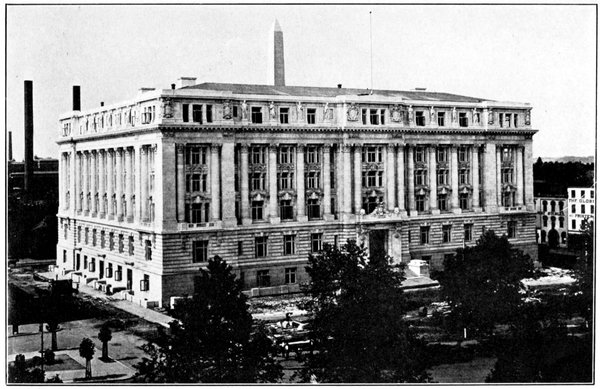
Photo by Clinedinst
NEW MUNICIPAL BUILDING
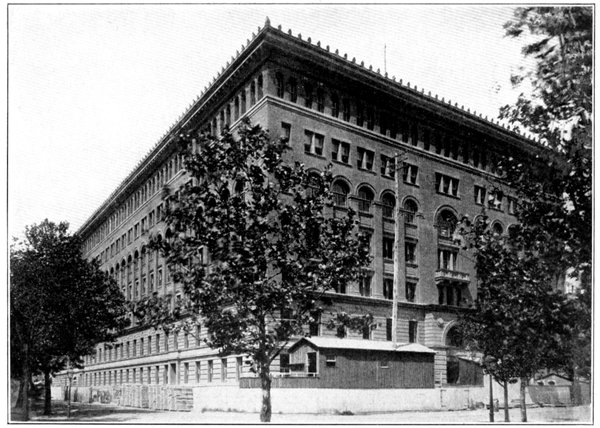
Photo by Clinedinst
THE GOVERNMENT PRINTING OFFICE
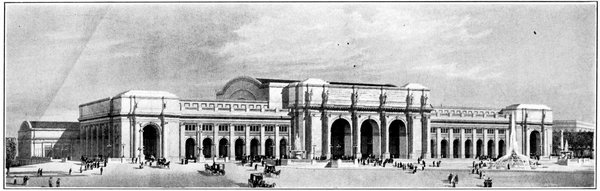
Copyright, 1906, by the John A. Lowell Bank Note Co., Boston, Mass.
THE NEW UNION RAILWAY STATION
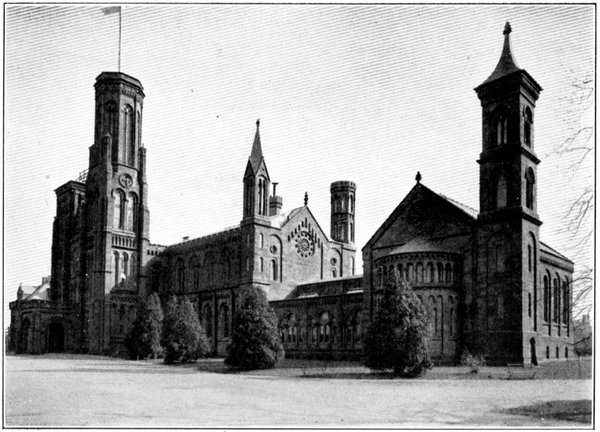
Photo by Clinedinst
THE SMITHSONIAN INSTITUTION
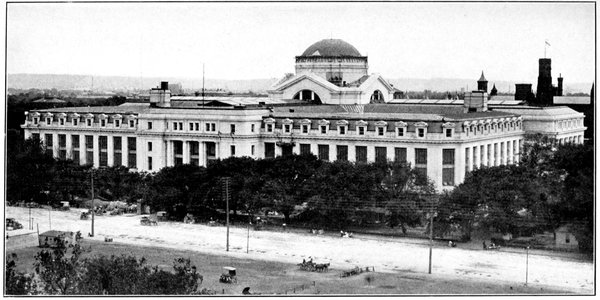
Photo by Clinedinst
THE NEW NATIONAL MUSEUM
81A shamefaced clerk was seen to emerge from the
room. When the others rushed in they found the girl
in a dead faint which was followed by hysterics. Then
the women said, "Aha! you got what you deserved
with your red dress, your loud manners, and flippant
talk."
The girl replied, "Well, I think you should have
had the decency to tell me that before, if my dress
and manners exposed me to insult. You will see, I
shall learn." Sure enough, the girl did learn to dress
quietly, and is now an efficient, decorous helper.
The wife of one of the new-rich, who have come to
Washington to spend their money in social life, was
being taken through the Census Department when
they had on the full force of several thousand. Looking
over that crowd, every one of the intellectual rank
of a first-class teacher, she said: "Ah! I see now
what makes servants so very scarce in Washington!"
Each one of these classed as of the rank of servants
had passed an entrance examination which her ladyship
could not have stood, even if her life had depended
upon it.
One of the peculiar features of department life is
82that it seems to dry up the milk of human kindness.
A man will move heaven and earth to get a high situation
under the government, then when others ask
from him less than he has asked of his friends, the
applicant is made to feel like a beggar. He is advised
to go home and tend to his own affairs—which may
be very good advice, but comes with bad grace from a
government official.
I knew a man from the South, the editor of a religious
paper, the most important man in the county,
who came to Washington to ask for the post-office of
his own town. His credentials had the endorsement
of every bank, every business house, every preacher,
doctor, and teacher in his town. He was permitted
to get as near headquarters as the Fourth Assistant
Postmaster, where he was told Senator Blank would
have that appointment. The Senator appointed a
Catholic in that town where there are not over forty
Catholics, and where a Lutheran College alone gets
more mail than the entire Catholic population. The
new man was a person non grata to the entire town,
but the Senator had paid a campaign debt.
Every person in Washington knows the sad life story
of a famous Washington woman—though it will be
fifty years before the full details can be publicly told—daughter
of a distinguished Western Senator, the
Secretary of the Treasury and Chief Justice of the
United States, the loved wife of a New England Senator,
who was divorced, and then began a downward
course, ending in ruin alike to her fortune and prestige,
which had best remain untold for this generation of
readers.
83Older people will remember that one of Grant's
Cabinet was forced to resign because of fraud in the
War Department. Valuable contracts were let, and
the wife of this official, totally unknown to her husband,
took thousands of dollars for her influence in
securing these contracts. At last trouble was threatened.
Congress appointed a committee to investigate.
The night before the exposure madame attended a
great ball at one of the legations. The French Minister
said: "I have been in most of the courts of
Europe; I have never seen any one, not even queens,
better dressed than madame." She wore a dress literally
covered with point-lace, a point-lace fan, and
more than $40,000 worth of diamonds.
Three Congressmen present knew what the next day
would reveal. On that day the Secretary was called
before the committee. They soon saw that he knew
nothing about the matter. Madame heard what was
going on and suddenly appeared before the committee.
She threw herself on her knees before them and entreated
shelter from disgrace.
The Secretary resigned at once. He sacrificed his
entire property to pay back the fraudulent money.
He opened a law office in Washington, but soon after
died; of course, people said he died of a broken heart.
Madame went abroad at once, and did not return till
after her husband's death. She now conducts a house
in Washington where men and women lose their souls
in gambling or worse.
XV TREASURY DEPARTMENT
84
The Treasury building, on Pennsylvania Avenue
and Fifteenth Street, was located by
President Jackson just east of the White
House so as to obstruct his view of the
Capitol, at the other end of Pennsylvania Avenue. It
is said that he grew tired of the little differences of
opinion between the commissioner and the architect,
Robert Mills, and one day in ill humor he struck his
staff in the earth and said: "I want the chief corner-stone
of the Treasury building placed just here!"
You may be sure it was placed just there.
The Secretary of the Treasury superintends the collection
and disbursement of all government revenue
from every source, except the Post-Office Department.
It takes many buildings to provide for the work of the
Treasury Department.
The Congressional Directory says:
The Secretary of the Treasury is charged by law with the
management of the national finances. He prepares plans
for the improvement of the revenue and for the support
of the public credit; superintends the collection of the
revenue, and prescribes the forms of keeping and rendering
public accounts and of making returns; grants warrants for
all moneys drawn from the Treasury in pursuance of appropriations
made by law, and for the payment of moneys into
the Treasury; and annually submits to Congress estimates of
the probable revenues and disbursements of the Government.
85He also controls the construction of public buildings; the
coinage and printing of money; the administration of the
Revenue-Cutter branch of the public service, and furnishes
generally such information as may be required by either
branch of Congress on all matters pertaining to the foregoing.
The routine work of the Secretary's office is transacted in
the offices of the Supervising Architect, Director of the Mint,
Director of Engraving and Printing, and in the following
divisions: Bookkeeping and Warrants; Appointments; Customs;
Public Moneys; Loans and Currency; Revenue-Cutter;
Stationery, Printing, and Blanks; Mails and Files; Special
Agents, and Miscellaneous.
A few minutes' thought on the above will show that
this is the very heart of the government of our country.
Its pulsations send the currency through all the
avenues of commerce; if it became bankrupt, disaster
would follow in every other department of the government,
and the prosperity of other nations would be unfavorably
affected.
The Treasury building was completed in 1841. It
has undergone considerable enlargement and many
modifications since that time. It is 460 feet on Fifteenth
Street, and has a frontage of 264 feet on
Pennsylvania Avenue. It is Grecian in architecture.
On each of the four sides are large porticos with most
graceful yet massive Ionic columns. The flower
gardens about the Treasury are among the most beautiful
in the city.
It would greatly surprise Alexander Hamilton, our
first Secretary of the Treasury, if he could see every
day at 4 P.M. the 3,000 workers pour out of the 300
rooms of the great building at Fifteenth Street and
Pennsylvania Avenue, and be told that this is only
86the central office of the Secretary of the Treasury.
The salary list of this building alone is about half a
million dollars annually.
The Secretary is a member of the Cabinet, and receives
$12,000 a year for his services. He has two
Assistant Secretaries, who each receive $5,000 and a
Chief Clerk, who has a salary of $2,700. The Chiefs
of Divisions receive about $2,500 each.
There are subtreasuries in most of the large cities of
the Union; also assay offices in Boise City, Idaho,
Charlotte, N. C., and St. Louis, Mo., to see that the
money is kept pure and up to the standard.
The scales upon which the United States coin is
weighed are said to be so accurate that if two pieces
of paper, in all respects the same except that one has
writing upon it, be laid one on either scale, the difference
in weight of the one bearing writing upon it will
show in the scale.
The cost of maintaining these subdivisions of the
Treasury is nearly one and a half million dollars
annually.
The First Comptroller seems to be the important
man of the Treasury. Every claim is submitted to
him. Not even the President's salary can be paid
unless he signs the warrant and vouchers for its correctness.
His salary is $5,000 per annum, but it takes
$83,000 to maintain all the appointments of his office.
The Treasurer of the United States receives $6,000
per year. He gives a bond for $150,000. He receives
and disburses all the money of the country and has
charge of the money vaults. He has an army of
assistants.
87The Treasurer's report for 1901 says that the condition
of the Treasury as to the volume and character
of assets was never better, and, in spite of the unusual
expense of the army in the Philippines and the raid on
the Pension Bureau, nearly $78,000,000 surplus remained
in the Treasury. On June 30, 1902, at the
end of the fiscal year, the surplus was over $92,000,000.
What a magnificent showing as to the prosperity of
our country, and what an occasion for national thanksgiving!
No robbery of the Treasury vaults has ever been
attempted. When one sees the solid walls of masonry
and the patrol of soldiers, on duty night or day, with
every spot bright with electric light, no such attempt
seems likely to occur. The entire vaults inside are a
network of electric wires. If, for instance, a tunnel
were made under the building, and a robber should
reach the vaults, the wires would ring up the Chief of
Police, who has telephone connection with Fort Meyer
and the navy-yard, so that within twenty minutes a
detachment of troops could be on the ground.
A few years ago a negro charwoman, in doing her
cleaning, found a package of bonds of more than a
million dollars in value. That faithful woman sat by
the package all night guarding it, knowing that it
must be of great value. Her faithfulness was recognized
and she was rewarded with a life position. Bowed
and broken, she was an historic figure in the building
until she died.
In this building all money from the Printing Bureau
and the mints is counted and verified. Here worn
money, that which has been buried, rotted by water
or charred by fire, is identified by the skilled eyes and
hands of women. Of the charred money received from
the great fire in Chicago, eighty per cent. was identified,
and new money issued in its place. Sometimes
money taken from bodies long drowned or buried has
to be handled. In such cases these women have the
entire room to themselves, as their usual neighbors
find that business in other quarters needs immediate
attention.
88
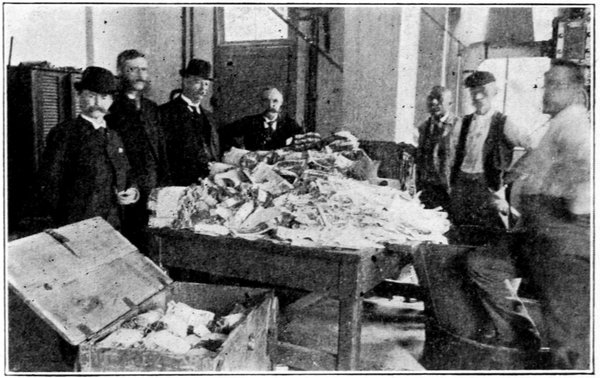
MACERATING $10,000,000 OF MONEY
The banks of large cities send in their soiled money
weekly or monthly and receive fresh notes in exchange,
the government paying transportation both
ways. This soiled money is made into pulp, which is
sold to paper-makers at about $40 a ton.
It is only the old money that is counterfeited.
Counterfeiters rumple and muss their money to give it
89the appearance of being long in use. Women are
especially skilled in detecting counterfeit money. If
among the returned coins or notes one single piece
proves to be counterfeit, the amount is deducted from
the salary of the examiner. Yet this great government
pays these women less than two-thirds what it
would pay to men for the same service, if men could
do it at all.
From the government of the United States it would
seem that the world had a right to expect that ideal
justice which each soul shall receive when it stands in
the presence of Eternal Justice.
The United States Treasury has charge of the
Bureau of Printing and Engraving, where all the paper
money, postage, revenue stamps, and bonds are made.
Bills, when sent from the Bureau of Printing and
Engraving, require the signatures of officials of the
bank from which they are to be issued before becoming
legal tender.
Secretary Shaw has at the Bureau of Printing and
Engraving his personal representative, who locks up
the plates, sees to the minutiæ of things, so that even
the smallest scrap of paper bearing government printing
must be shown, or the house is closed and search
made till it is found.
The custom officers who insult and browbeat you
at the port are of this department. Once on arriving
at New York, after being very ill all the way from
Antwerp, I had declared I had nothing dutiable, yet
in spite of that every article in my trunk was laid out
on the dirty floor of the custom-house. When I saw
the bottom of the trunk, I said: "Well, you have only
90proved what I told you. I believe you think because
I am trembling from weakness that I am frightened?"
"Yes, that is about the size of it; there is your trunk,
you may put the things back." "No," I said, "my
baggage is checked through, and I am not able to pack
it." I saw with some satisfaction the custom-house
officer do the packing. It had required my best efforts
to get the stuff into the trunk, but he did it.
This country has very silly custom-house rules on
personal clothing and small articles of art and vertu,
and the average artistic standard of dress and home
ornamentation of the country is lowered by these
ridiculous embargoes.
In 1895 I was abroad with a company of Presbyterians;
among them was Professor G., of the Presbyterian
Theological Seminary of California. He happened
to fall in with a little coterie of friends of whom I was
one. The most of us bought photos and souvenirs in
almost every city. The professor bought nothing.
One day he said: "I would so like to have brought
my wife with me, but I was not able to do so. I shall
be very saving, so I can take her back a nice present."
When we were in Italy some fool woman suggested a
cameo pin as a suitable and beautiful present for his
wife. Cameo pins have been out of fashion for twenty
years. He purchased one of great beauty for $30. As
we came into port, a friend said: "Professor, you
had better let some woman wear that pin for you or
you will have trouble." "Thank you, no; I expect
to pay the required duty to my country." "Oh, you
do not know your country yet; you'll get a dose!"
He paid $27 duty, and had not money enough left to
91get home. I felt that this duty was an outrage.
Things of beauty which are not for sale should surely
be admitted free.
The Treasury is the heart of the whole machine
that we call the "United States Government."
XVI SECRET SERVICE DEPARTMENT OF THE TREASURY OF THE UNITED STATES
92
Every one is interested in what is called the
Secret Service of the government. The
name covers many things, altho we usually
associate it with the government's protection
of the coin and greenback currency of the
country.
The detectives of this department are often employed
in assisting to find out or run down robbers of
banks, railroad trains, express offices, etc. They are
also used in detecting frauds at the custom-houses,
frauds in the departments of justice, pertaining to
naturalization papers, post-office robberies, and attacks
on the Mint. In the Pension Bureau they unearth
fraudulent attempts to represent dead pensioners, etc.
For work outside of their own departments they are
paid by their employers.
In the last report of the Secret Service, dated July 1,
1902, the chief enumerates 253 persons convicted of
attempt of counterfeiting currency, and 106 yet awaiting
action of the Court. The arrests for the current
year have numbered 573; of these, 413 were born in
the United States; of the 106 remaining, Italy furnished
65 counterfeiters; Germany, 25; Ireland, 15;
the others, except 6 Mexicans, are of the different countries
of Europe. Of the different States, New York
93produced 85 counterfeiters (including those who make
false representations of any kind in passing currency);
Missouri, 47; Pennsylvania, 45; while almost every
State has one or more. Altered and counterfeit notes
to the value of $46,004.95 have been captured, and
counterfeit coins to the value of $19,828.47.
The Chief of the Secret Service says that the year
has been fruitful in that class of criminals who alter
bills of small denomination to one of higher value.
Any change in a bill renders the maker liable to a fine
of $5,000, or fifteen years in prison, or both.
The walls of the Secret Service office are covered
with samples of counterfeiters' work. The history
of each would sound like a dime novel, but the
government is certain to catch any one who persists in
demoralizing the currency. Chief John E. Wilkie, a
first-class Chicago newspaper man, was brought East
by Secretary Gage. He has called to his assistance,
as Chief Clerk, Mr. W. H. Moran, who learned his
business from Mr. Brooks, one of the best detectives
any country has yet produced. Other officials tell me
the office has never been more ably conducted than it
is at present.
This bureau is urging that for persistent crime a
longer penal sentence shall be given. To illustrate
the persistence of two of these criminals, the following
extracts from the Secret Service records are, by courtesy
of the bureau, submitted:
John Mulvey, alias James Clark, arrested October 16, 1883,
at New York, N. Y., for having in possession and passing
counterfeit coin. Sentenced, October 22, 1883, to
three years in Auburn, N. Y., penitentiary and fined $1.
94William Stevens, alias John W. Murray, alias Jack Mulvey,
was again arrested June 14, 1886, at Baltimore, for
passing counterfeit 25c. silver coins, and was sentenced,
September 7, 1886, to serve one year in Maryland penitentiary
and fined $100.
Was again arrested under the same name October 5,
1887, at Philadelphia, Pa., for passing and having in
possession 25c. coins, and sentenced, December 1, 1887,
to eighteen months in the Eastern Penitentiary of Pennsylvania
and fined.
John W. Murray, alias William Stevens, alias Jack Mulvey,
was again arrested, July 10, 1889, at Hoboken,
N. J., for passing counterfeit standard $1, 25c., and 10c.
coins, and sentenced, January 22, 1890, to six months in
State Prison at Trenton, N. J., and pay costs.
Jack Mulvey, alias James W., alias John Clark, alias John
W. Murray, alias "Pants," alias Stevens, etc., was
again arrested January 12, 1891, at Pittsburg, Pa., for
having in possession and attempting to pass counterfeit
50c. coins, and was sentenced, March 5, 1891, to two
years in Western Penitentiary at Allegheny, Pa., and
fined $25.
John Murray, alias Jack Mulvey, was again arrested, January
25, 1894, at Chicago, Ill., for manufacturing counterfeit
25c. and 10c. coins and having same in possession,
and was sentenced, March 12, 1894, to three years and six
months at hard labor in the penitentiary at Joliet, Ill.,
and to pay a fine of $1.
James Foley, alias Jack Murray, alias Jack Mulvey, was
again arrested, February 24, 1897, at Chicago, Ill., for
having in possession and passing counterfeit silver
dimes, and escaped March 22, 1897, but was rearrested,
under the name of John O'Keefe, in New York, N. Y.,
April 6, 1897, for passing counterfeit 10c. pieces, and
sentenced, May 12, 1897, to seven years in Clinton Prison
and fined $1. Released from this prison February 27,
1902.
95Another case from the records of the Secret Service
would read as follows:
One day the doors of the Moundsville, W. Va.,
prison opened on a tall, slender, mild-eyed man, upon
whose face and form time and confinement had left
their impress, and he passed out to take up again the
broken thread of his life.
This was John Ogle's first day of freedom for more
than three years. On July 4, 1898, he was sentenced
to four years' imprisonment for trying to increase the
negotiable value of one-dollar bills by altering their denominational
characteristics.
Little more than a year before his brother, Miles,
was released from the Ohio penitentiary, where he had
paid the extreme penalty imposed by law for spurious
money making, only to die two days later of paralysis,
with which he had been hopelessly stricken over a year
before.
The Ogles, father and sons, during the past fifty
years have had much to do with the making of the
criminal history of this country. George Ogle, the
father, was a river pirate and farmhouse plunderer,
the Ohio River and its tributaries being the scene of
his operations. The sons, bred in an atmosphere of
crime, early embarked in independent unlawful enterprises.
Miles displayed pugnacity, intrepidity, and
skill, while John was shrewd, plausible, and cunning.
After serving five years for killing an officer who attempted
to arrest the family, and when but twenty-six
years old, Miles allied himself with the notorious
"Reno" gang of bandits, and became the pupil and
confederate of Peter McCartney, that past master of
96the counterfeiter's art. How well he applied himself
the records of the Secret Service will testify. An even
dozen skilfully executed spurious note issues were
directly traceable to him, despite the fact that two-thirds
of his manhood were spent behind prison walls.
John Ogle, while not possessed of the dangerous
skill of his brother, was his equal in hardihood, and,
in his way, quite as detrimental to society. For cool
daring, ingenuity, and resourcefulness he was without
a peer in his chosen profession, and some of his escapes
from the officers of the law bordered on the miraculous.
He was introduced to prison life in 1864, being
sentenced in the fall of that year to five years in the
Jeffersonville, Ind., penitentiary for burglary. Shortly
after his release he was traced to Cairo, Ill., with
twenty-eight hundred dollars of counterfeit money intended
for one of Miles' customers, and, after a desperate
fight, was placed in jail. He managed in some way
to effect his escape, but was soon recaptured at Pittsburg.
This time he told the officers that he knew of
a big "plant" of spurious bills and tools near Oyster
Point, Md., which he was willing to turn up if it would
benefit him. Being assured of leniency, he started
with a marshal for the hiding-place. En route he
managed to elude the watchfulness of his guard, and
jumped from the car-window while the train was at
full speed. At Bolivar, Tenn., Ogle was arrested,
January 8, 1872, with five hundred dollars of counterfeit
money in his pocket. A sentence of ten years was
imposed; but John had a reputation to sustain, so he
broke from the jail where he was temporarily confined
awaiting transportation to the penitentiary. Several
97months later he was arrested and indicted at Cincinnati
for passing bad five-dollar bills. Pending trial, he was
released on five thousand dollars bail, which he
promptly forfeited, and was again a fugitive.
February 18, 1873, one Tom Hayes was detected
passing counterfeit money at Cairo, Ill., but it was
not discovered that "Tom Hayes" was none other
than the much-wanted John Ogle until after he had
made good his escape. So chagrined were the officers
over this second break that all the resources of the
department were employed to effect his capture, and
but a week had passed before he was found in Pittsburg
and taken to Springfield, Ill., for trial. This
time there was no escape, and he served five years in
Joliet. As he stepped from the prison door Marshal
Thrall, of Cincinnati, confronted him with an order
for his removal to answer the indictment of May, 1872.
The Cincinnati jail was undergoing repairs. A painter
had left his overalls and hickory shirt in the corridor
near the cage where Ogle was placed. Adroitly picking
the lock of his cell with his penknife, he donned
the painter's clothes, took up a paint-bucket, and
coolly walked down-stairs, past the gate (which the
guard obligingly opened for him), through the jailer's
office, and into the street. Proceeding leisurely until
out of sight of the prison, the daring criminal made
his way to the river, which he crossed at Lawrenceburg,
and, discarding his borrowed apparel, struck
across the country, finally bringing up at Brandenburg,
Ky., where he obtained employment as a stonecutter.
Respectability was, however, inconsistent
with Ogle's early training; so about a week after his
98arrival he broke into a shoe-house of the town, stole
$200 worth of goods, and was arrested three days later
while trying to dispose of his plunder in Louisville.
Fearing a term in the Frankfort prison for some
reason, he informed the Kentucky officers that a large
reward was offered for his return to Cincinnati. This
had the desired effect, and he was sent to the Ohio
penitentiary to serve five years.
Returning to Cincinnati at the expiration of this
enforced confinement, he met his brother, who had
just been released from an eight-year "trick" in the
Western Pennsylvania penitentiary, and, altho no real
affection existed in the breast of either for the other,
John needed money, and Miles had money and required
assistance in a contemplated enterprise. An understanding
was soon reached, and these two dangerous
lawbreakers joined forces in another scheme to debase
their country's currency. Using the same conveyance
employed by their father in his plundering expedition
(a house-boat), they started from Cincinnati and
drifted down the Ohio River, John steering and keeping
watch while Miles plied the graver. When the
plates for a twenty-dollar silver note and a ten-dollar
issue of the Third National Bank of Cincinnati were
complete, Miles took the helm and John went below
to do the printing. $150,000 of the "coney" had
been run off by the time they reached the mouth of
the Wolf River, and here the trip ended. Disposing
of the boat, the brothers started back to Cincinnati.
En route they quarreled over the division of the notes,
and separated with the understanding that John was
to receive $500 of the proceeds of the first sales.
99Miles did not keep faith, and John subsequently
assisted the government officers in locating and securing
his brother, who was arrested in Memphis, Tenn.,
on Christmas day, 1884, with $6,000 of the counterfeits
in his pockets.
For a number of years thereafter John steered clear
of offenses penalized by the federal statutes, and successfully
feigned insanity when he could not escape
punishment for crimes against the State by any other
means.
This is what happened to one town marshal who
caught Ogle in the act of burglarizing a store and
failed to appreciate the character of his prisoner. It
was between two and three o'clock in the morning
when the capture was made, and as the lockup was
located about a mile from the scene of the crime, the
officer decided to keep the rogue in his room until
morning. Carefully locking the room door and handcuffing
John, he lit his pipe and made himself as comfortable
as possible—so comfortable, in fact, that he
was soon fast asleep. When he awoke his bird had
flown, and the officer's watch and purse were missing.
XVII POST-OFFICE DEPARTMENT
100

Every man and woman in the republic has a
personal interest in this department of the
government. You pay two cents for a
stamp, throw a missive into a box, and
start the machinery which requires 100,000 persons
to run it. If your letter is for the Philippines, you
use the railroad and the ocean steamer, with many relays
of men and engines to perform your bidding. If
your letter is for Alaska, you use the railroad, the
steamship, and the reindeer team to deliver it. Not
an hour, day or night, the entire year through, but
men are toiling to hurry your mail to its destination.
If your letter is for one of the large cities, skilful men
board the train, and as it approaches its destination
distribute the mail for each district, so that your letter
will not lie for hours in the central office. If your
letter is to a busy farmer who may be in the midst of
his harvest and has no time to go for his mail, one of
the government's faithful servants takes that letter to
him. Yet we are much more likely, withal, to growl
at Uncle Sam than to remember the faithful service we
receive for so little money.
The Post-office Department is one which is not yet
self-supporting. The last annual report of the Postmaster-General
shows that the receipts from ordinary postal
revenue amounted to $191,478,663.41. Figures are
101not at hand for a further revenue to the department
from money-order business, including post-office orders
which were uncalled for. The government expended
$16,910,278.99 more than it received. This deficit is
occasioned by the second-class matter, which includes
newspapers and magazines paying less than cost of
transportation. It is also due partly to the glaring
abuse of the franking privilege by members of the
Senate and House. If a description of what some
of these men commit to Uncle Sam to carry for them
free of charge were published they would hide their
heads in shame. While this abuse continues we are
not likely to get a one-cent rate on letters, a rate
which would greatly benefit the entire country. Poor
people are paying the postage for these Congressmen.
The United States Post-office Department and the
post-office for the City of Washington are in a building
on Pennsylvania Avenue, which extends over an
entire square from Twelfth to Thirteenth Streets,
N. W.
The Postmaster-General is a member of the President's
Cabinet. He receives $12,000 per annum for
giving to his country services which a railroad or
great newspaper would consider cheap at $25,000 per
annum. There are four Assistant Postmaster-Generals
who receive each about half as much as their
chief. These are appointed by the President and confirmed
by the Senate.
The Postmaster-General makes postal treaties with
foreign governments, by and with the advice of the
President, awards contracts, and directs the management
of the domestic and foreign mails.
102The First Assistant Postmaster-General has charge
of the salary and allowance division, free delivery system,
post-office supplies, money-order division, dead-letter
office, and the general correspondence.
The Second Assistant Postmaster-General has charge
of the contract division, division of inspection, railway
adjustment (which includes weighing and deciding on
what pay shall be given railroads), the mail equipment
division, and foreign mails.
The Third Assistant Postmaster-General has charge
of postage stamps and postmasters' accounts, registry
office, and the special delivery system.
The Fourth Assistant Postmaster-General has the
appointment of many postmasters and of post-office
inspectors, and has charge of the bonds and commissions
for postmasters. This last place was formerly filled
by Mr. J. L. Bristow, of Kansas. During the first year
of Mr. Roosevelt's Presidency Mr. Bristow officially
decapitated as many as fifty postmasters a day, and it
is claimed it was a slow year in the business. Of course,
for every one who lost his place some other fellow was
made happy. Mr. P. V. De Graw now has the office.
No impure books, pamphlets, or papers are allowed
transportation by the United States mail. Men in this
employ have a right to insist that their work shall not
include indecent matter. As far as possible the government
tries to prevent advertisers of dishonest businesses
from using the mails for fraudulent gain. It
is to be hoped that the time may soon come when all
financial schemers who now defraud the wage-earning
class by circulars on mining, oil, or industrial stock,
or other doubtful enterprises, shall be obliged to prove
103to the government officials that the scheme represented
is just what the circular sets forth. All Building
Associations and Insurance Companies should pass
under the same law. Good people would be glad of
this inspection, and bad people make it necessary.
The Postmaster-General recommends that the government
have inspectors appointed who shall see that
neither telegraph nor express companies be permitted
to carry matter for lotteries or any known fraudulent
enterprise. The McKinley and Roosevelt administrations
will be noted for the improvement and extension
of the rural delivery system.
The dead-letter office is one of great interest, and is
found in the general post-office building. Of unclaimed
letters there were last year nearly six million;
of misdirected letters, 454,000; and of letters without
any address, 39,837. Any letter which is unclaimed
at a post-office after a few weeks is sent to the dead-letter
office. Here it is opened, and if it contains the
name and address of the writer, the letter is returned;
but letters signed "Your loving Amy," "Your devoted
mother," "Your repentant son," fail to reach
the eyes and hearts of those who wait for them in
vain. Last year 526,345 unclaimed letters written in
foreign countries, probably to loved ones in the United
States, were sent to the dead-letter office. Think of
the heartaches which that means! Think of the loves
and friendships wrecked thereby!
Letters whose envelopes display the business card of
the writer are returned to the sender by the local postmaster
after a certain period. Papers, magazines, and
books with insufficient postage are sent to the dead-letter
104office, held for a short time, and then distributed
to hospitals, asylums, and penal institutions.
Wherever "Old Glory" floats, there the servants
of Uncle Sam carry his mail. Of this department
every citizen should be proud, for its speed and efficiency
is equaled by no other mail service in the
world.
XVIII DEPARTMENT OF AGRICULTURE
105
About fifty years ago, at the request of Hon.
H. E. Ellsworth, the sum of one thousand
dollars was set apart in the interest of
agriculture; now there is a Department of
Agriculture, and its Secretary is a member of the
President's Cabinet.
The present Secretary of this department is Hon.
James Wilson, of Iowa. He served several terms in
Congress, was Regent of the State University of Iowa,
and for six years prior to his present appointment was
Director of the Iowa Experimental Station and professor
of agriculture at the Iowa Agricultural College,
Ames, Iowa.
The Department of Agriculture consists of twenty
different divisions, each one of which is worthy of a
complete chapter. The department has many buildings,
but the main one stands within the grounds of
the Smithsonian Institution, in a bower of blooming
plants and clinging vines. Every kind of plant from
the tropics to the Arctic Circle which can be made to
grow in this climate can be found in this department.
Studies in ornamentation, best methods of grafting,
pruning, budding, hybridizing, and treating diseases
of plants, trees, and animals are thoroughly investigated
at its experimental stations.
Vegetable and flower seeds, grass seeds, plants, trees,
106bulbs, and grape-vines are distributed in the department
through the Senators, members, and delegates
of Congress. By this means the best varieties of the
vegetable kingdom are carried throughout the United
States. During the coming year the country will be
more carefully districted, and only such seeds and
plants as have been thoroughly acclimated will be sent
to the several districts.
Members of Congress from cities exchange their
quota of vegetable and crop seeds for flower seeds, thus
leaving more of the former for members with a farming
constituency.
The following statement shows the amounts of seeds,
bulbs, plants, and trees, so far as the allotments have
been made, for a recent fiscal year:
Each Senator, member, and delegate will receive—
| Vegetable Seed |
12,000 packages, 5 papers each. |
| Novelties Vegetable Seed |
500 packages, 5 papers each. |
| Flower Seed |
500 packages, 5 papers each. |
| Tobacco Seed |
110 packages, 5 papers each to districts growing tobacco. |
| Cotton Seed |
70 packages, 1 peck each, to districts growing cotton. |
| Lawn Grass Seed |
30 packages. |
| Forage Crop Seed |
Allotment not yet made. |
| Sorghum Seed |
Allotment not yet made. |
| Sugar Beet Seed |
Allotment not yet made. |
| Bulbs |
10 boxes, 35 bulbs each; or 20 boxes, 17 bulbs each. |
| Grape-vines |
8 packages, 5 vines each. |
| Strawberry Plants |
10 packages, 15 plants each. |
| Trees |
20 packages, 5 trees each. |
For seed distributed alone the government appropriates
$270,000. Think of the beneficence of that!
107The rarest and best seeds that money can buy will be
planted in every State and Territory of this country.
Experts are continually sent abroad to find new cereals,
fruits trees, animals, and flowers.
The department has at least one correspondent in
every county of the United States through whom the
statistics on acreage, quality of crops, and success of
experiments are reported at stated times.
All questions pertaining to farming are answered by
this department. If a man desires to buy a farm in
Kansas or Alaska, a portion of the country of which
he knows little, the department will tell him of the
climate, the crops likely to be remunerative, and the
obstacles of soil or climate to overcome. A chemist
will analyze the soil for him, tell him what it contains,
and what it needs to produce certain crops. An
entomologist will tell him the insects prevalent which
may destroy his crops. The scientist will also tell him
how to destroy the inserts, what birds to encourage
and what to banish.
At Summerville, S. C., the government has a tea
farm with a fully equipped factory, and the tea produced
is claimed by experts to equal the best imported
article. This year one thousand acres of rice land
near Charleston, S. C., will be put in tea. The cost
of producing American tea is about fifteen cents a
pound; the yield is four hundred pounds to the acre,
the wholesale selling price forty to fifty cents per
pound, and the retail price seventy-five cents to one
dollar per pound.
In the wheat-growing States the government is trying
a fine variety of macaroni wheat, in order to compete
108successfully with the imported article, of which
$8,000,000 worth enters this country annually.
In the cotton States the government is trying Egyptian
cotton, which is now imported to the value of
$8,000,000 annually.
In Arizona and other dry tracts dates and other
Egyptian fruits are being successfully acclimated. In
the hot states rubber, coffee, bananas, and cocoa are
being tried.
Our fruit markets are being extended into Europe,
and special agents and consuls are using every influence
to enlarge this market. At the Paris Exposition
our pears, apples, peaches, and plums were a never-ending
surprise to people of all lands. Californians
made us all proud of them by their lavish generosity,
and the result has been that pears and apples have
been sent in large quantities to Southern Europe, also
to Russia and Siberia.
New cottons are being sent throughout the South,
new prunes and plums along the Pacific Coast. Important
experiments are being made in sugar producing.
Pineapples are being acclimated in Florida,
plants which produce bay rum and various perfumes
are being introduced in several states, and olives from
Italy are being tried in Porto Rico and the Philippines.
In many different States soils have been examined.
In Lancaster County, Pennsylvania, it was found certain
soils contain ingredients to produce the finest Cuban
tobacco, and other soil regarded as useless was shown
to be capable of producing certain rare plants. Every
state should call for this kind of analytic help, until
we make the United States the garden of the world.
XIX DEPARTMENT OF CHEMISTRY ON PURE FOODS — DIETETICS
109
This subject of the relative value of foods is one
that interests every individual. The Department
of Agriculture is making a brave effort
to secure a law regulating interstate and international
commerce, requiring that all foods sent
from one state to another, or to foreign countries, shall
be labeled for just what they are, and shall conform to
the government standard in excellence.
For instance, renovated or "process" butter is now
passing its ordeal. "Process" butter means that a
large quantity of butter has been sent to a factory or
elsewhere, and there worked together and colored to
secure uniformity of appearance, and then placed on
the market. The government requires that it shall be
properly labeled. It is of less nutritive value than either
oleomargarine or butterine. A government leaflet
gives householders and merchants full directions for
discovering the real value of anything called butter.
Every farmer should secure a copy of the Agricultural
Year-book.
I remember once, a number of years ago, at a table
in London, discussing with some merchants from South
America the subject of buying their goods in the
United States instead of England.
One man from British Guiana said: "It is impossible
110to deal with the United States; they have no food-test
laws, and we buy one thing and get another.
Then take machinery and implements. The first three
or four purchases will be all right, after which they put
off on us shelf-worn goods which they could not sell
at home."
When the government can put an official stamp on
each article exported it will be good for the permanence
of our export trade.
No such general law now exists, and the best our
government can do is to certify that the goods comply
with the standard of the country to which they are to
be sent. It is believed that many of the preservatives
used with food products are harmless to the human
body, and a scientific test of this was conducted
in December, 1902. The Agricultural Department
called upon the young scientists of the colleges and
universities to assist in settling this question. A
picked body of students were supplied with the purest
food to bring them to perfect condition, and soups,
meats, vegetables, jellies, etc., containing preservatives
claimed to be harmless will be given them, and
as soon as a touch of dyspepsia is manifest the test
will be dropped. It was doubtful whether football
and baseball managers, not to mention such insignificant
factors as professors and mothers, would consent
that their favorites should be submitted to such experiments.
But scientists are earnest seekers for truth,
and enough subjects were readily found to make the
trial.
It is not so much the making of impure foods that
is objected to as it is an effort to provide that goods
111shall be labeled for what they are—that is, a can
labeled raspberry jam shall not consist of gelatine with
a few raspberry seeds and juice used for coloring, but
shall be the real thing.
In recent testimony before Congress a case of this
kind was brought out. A certain firm made jelly from
the refuse of apples—that is, rotten and wilted apples,
peelings and cores, stuff which when made cost the
firm one and a half cents a pound—and this they sold
as apple and currant jelly, selling hundreds of buckets.
The government forced the firm to label the buckets
correctly, and the sale became insignificant. Now, the
poor need cheap foods, but it is not fair that they
should have to pay more than a thing is worth; besides,
such frauds interfere with the industry of the farmer's
wife who sells pure jelly.
The government now sends agents into every city,
who buy from the shelves of grocers just what they
offer for sale. The grocer, of course, does not recognize
the government agent. The stuff is then sent to
the laboratory, and the grocer and manufacturer notified
as to results. The latter is told that his formula
will be published, and before that is done he will be
permitted to offer any statement that he may think
advisable.
We are apt to think the "embalmed" meat agitation
during the Spanish war will injure the trade of
the country more than the war itself, but that agitation
was right if it saved the health of even one soldier,
and, above all, if it secures society in the future
against deleterious canned meats.
It is well known, tho not approved by the government,
112that there are several canneries in the West
where horse-flesh only is used. The government
watches them closely and forces them to label the goods
for just what they are. These goods are sent to such
foreign countries as do not object to the use of horse-flesh.
Most States have stringent food laws, but so much
food is sent from the State in which it is produced to
another that State laws become inoperative.
The government finds glucose (not in itself harmful)
to be the basis of many frauds. Colored and flavored
it is sold as honey, and it is the foundation of
very many jams. Cocoas and chocolates are made
from wheat, corn, rice, potatoes; pepper, cinnamon,
allspice, nutmegs, and mustards are made from almost
every cereal. Pure vinegar is rare. Almost any kind
of wine can be drawn from the same spigot, colored
and flavored to suit the requirements of the wine
desired.
Sometimes in foreign lands I have thought that
London particularly needs a commission on pure
coffee. I think I shall know the taste of chicory as
long as I live from experiences in that city.
Most foreign countries make stringent food laws
chiefly on liquors and butter. Germany draws close
lines on meat, including all forms of sausage, with
some restrictions on butter, wine, coloring on toys,
and coloring matter generally.
Every European country has stringent laws on the
composition of beer. I wonder how long American
beer which rots the shoes of the bartender, and brings
paralysis to his right hand, would be tolerated in Germany
113or Britain? At the Buffalo Exposition, in the
government display, was one sample of "peach
brandy," the formula of which was forty gallons of
proof spirits, one-half pound of an essence, one quart
of sugar syrup, and a sufficient amount of coloring
matter. The "bead oil" on the same shelf, it was
claimed, was a solution of soap intended to produce a
"bead" on liquors, and thereby give the appearance
of age.
Could anything better prove the need of a government
standard than the above, or the further facts
that one man is now in the penitentiary for fraudulent
use of the United States mail in advertising ground
soapstone as a flour adulterant, and that fifteen cheaper
oils are now used to adulterate pure olive oil?
If I were a young college woman I would go in for
chemistry, and make myself a food specialist for grocers,
exporters, and importers. I would make my
home in some large institution where the food question
as to what nutriments the body needs, and what
will produce best results at the least cost, could be
tested scientifically. I would take the cook and her
helpers into a loving partnership to improve the dietetics
of the establishment, and yet reduce expenses.
There is a new business now ready for earnest college
women.
XX DEPARTMENT OF THE INTERIOR
114
The Department of the Interior was created by
act of Congress in 1849. When the names
of its subdivisions are enumerated, it will
readily be seen that no adequate description
of it can be given in one or two chapters.
It comprises the Patent Office, the Pension Office,
General Land Office, Bureau of Indian Affairs, Bureau
of Education, Commissioner of Railroads, and the
Office of the Geological Survey. Each office is managed
by a commissioner or director, who has under
him a large force of officials and clerks.
In the chief building of the Department of the Interior,
fronting on F Street, and extending from Seventh
to Ninth, and from F to G Streets, may be found the
Patent Office of the United States. No other department
so well reveals the inventive genius of the most
inventive people on earth.
Once at a table in Paris a Frenchman said to me:
"The Americans are inventors because they are lazy."
"Well," I said, "I have heard many surprising
charges against my countrymen, but that excels all.
How do you make that out?"
"Well, I am a manufacturer. I set an American
boy to keep a door open; before half an hour he has
invented a machine which will open and shut it, and I
find my boy playing marbles."
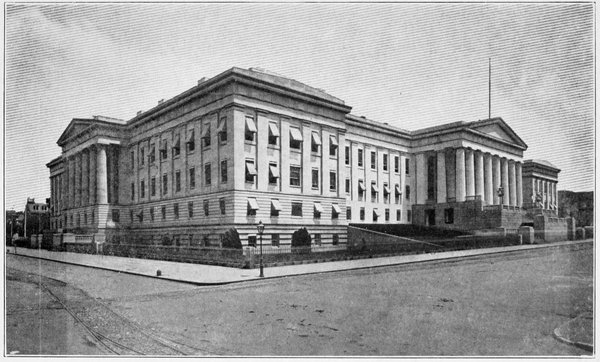
Photo by Clinedinst
THE PATENT OFFICE
115"Sensible boy! Yes, with that view of it, maybe
we are; we certainly do not care to do by hand that
which a machine can better perform."
The Patent Office is one of the few departments
which is more than self-supporting. In the year 1836
but one patent was taken out; during the year ending
December 31, 1901, the total number of applications
was 46,449. The total receipts for the year
were $6,626,856.71; total expenditures, $1,297,385.64—leaving
a balance far over five million dollars in
favor of the government.
There are divisions for different classes of inventions.
When a patent is applied for, examiners make
all necessary investigations, and carefully look into
the invention claimed to be new, comparing it, part by
part, with patents already existing before determining
whether a patent can be granted. They have a library
with plates and descriptions of about everything under
the sun. From this library inventors can have books
and plates sent them in order to compare their work
with inventions now existing.
The Secretary of the Interior is a member of the
President's Cabinet, and receives $12,000 per year. He
has charge of the Capitol (through the architect), the
Insane Asylum, and the College for Mutes—indeed, it
would seem that his work is sufficient for ten Secretaries.
There is an Assistant Secretary of the Interior,
who receives $4,000 per annum, and commissioners
of different divisions and bureaus who receive from
$3,000 to $6,000 annually.
Many officers of this department could command
116higher salaries in the commercial world, but these
positions secure honor and respect not only for the
man himself but also for his descendants, hence these
commissionerships are very desirable. For that reason
men give up a legal practise or a railroad position,
bringing salaries eight or ten times as large.
The present Secretary, Ethan Allen Hitchcock,[4] of
Missouri, great-grandson of Ethan Allen, of Vermont,
has a wide experience in manufacturing, railroad, and
mining interests, and has served as Ambassador to
Russia. He was called to his present place in 1898.
The Secretary in his report for 1901 entreats that at
least twenty more persons of fine mechanical ability be
appointed as examiners, as his force is much behind
in their work, altho many labor far over allotted time.
The Bureau of Education, established in 1867, is
probably as little known to the general public as any
branch of the government. It is a clearing-house.
The Commissioner of Education, Hon. William T.
Harris,[5] is one of the great educators of the world. It
is probable if the teachers of the United States could
have a personal vote, their unanimous choice would
fall upon Dr. Harris as their Commissioner. The
offices of the Bureau of Education are in a brick building
at the corner of G and Eighth Streets.
The Commissioner has about forty assistants, who
are confined to about twenty-eight rooms. This office
collects, tabulates, and reports on all schools in the
United States. Any one who desires to compare the curriculums
117of different institutions consults the Commissioner's
report. Or should one desire to know what is
being done in Europe, or any other part of the world,
along the line of art in schools, or manual or industrial
training, or the advanced education for women,
all such inquiries can be answered by reference to the
Commissioner's report.
This bureau is held in high estimation in Europe.
Many of the South American republics and some
Asiatic countries are trying, through the reports of
Dr. Harris, to model their school systems after that of
the United States.
Miss Frances G. French has charge of the foreign
correspondence, and tabulates statistics and reports on
thirty-two foreign countries.
The school work presented by the Department of
Education at Paris in 1900 secured favorable commendation
from the best educators of Europe. Only three
commissioners have preceded Dr. Harris: Hon. Henry
Barnard, 1867-1870; Hon. John Eaton, 1870-1886;
Hon. N. H. R. Dawson, 1886-1889. The latter was
a brother-in-law of Abraham Lincoln. Dr. Harris
was appointed by President Harrison, September, 1889.
The best work of the Bureau of Education lies in
bringing about homogeneity in the work of education
throughout the United States. Without the tabulated
work of the Superintendents of States, how would the
Superintendent of, say, one of the Dakotas, know
whether the work of the public schools of his State
corresponds with the work done in New York or Pennsylvania?
Yet the boy educated in Dakota may have
to do his life-work in Pennsylvania. Then the Commissioner's
118report keeps us informed what the State,
Nation, or Church is doing for the education of the
colored race, the Indian, or the people of our new
possessions.
A short extract from the Commissioner's report of
1899 will give an idea of the tabulated work for
women:
The barriers to woman's higher education seem effectually
removed, and to-day eight-tenths of the colleges, universities,
and professional schools of the United States are
open to women students. As is stated by ex-President Alice
Freeman Palmer, of Wellesley College, "30,000 girls have
graduated from colleges, while 40,000 more are preparing to
graduate." The obtaining of a collegiate education gives the
women more ambition to enter a profession, or, if they decide
to marry, it is stated that—
The advanced education they have received has added to their natural
endowments wisdom, strength, patience, balance, and self-control ...
and in addition to a wise discharge of their domestic duties, their homes
have become centers of scientific or literary study or of philanthropy
in the communities where they live.
It is stated that the advancement of women in professional
life is less rapid than in literature. The training of women
for medical practise was long opposed by medical schools and
men physicians. Equally tedious was the effort to obtain
legal instruction and admission to the legal profession, and
even to-day the admission to theological schools and the
ministry is seriously contested; yet all these professions are
gradually being opened to women. In 1896-97 there were in
the United States 1,583 women pursuing medical studies to
1,471 in 1895-96; in dentistry, 150 women in 1896-97 to 143 in
1895-96; in pharmacy, 131 in 1896-97 to 140 in 1895-96. In
law courses of professional schools were 131 women in 1896-97
to 77 in 1895-96; in theological courses 193 women in
1896-97.
The only aggressive work done by this bureau is in
119Alaska, and of this Dr. Sheldon Jackson[6] is agent or
superintendent. Besides doing a great work in education,
this department has brought about 1,300 deer
from Siberia to take the place of dogs, mules, and
horses in transportation, and at the same time to give
milk, butter, cheese, and meat to the population. The
reindeer are self-supporting, living on the moss which
grows abundantly.
These animals are loaned to individuals or missions,
and at the end of five years the government requires
an equivalent number to be returned. The Eskimo,
the Lapp, and the Finn become expert in handling
these herds, now numbering many thousands. By
them mails are carried, and whalers, sealers, miners,
and soldiers rescued from starvation, danger, or death.
The education as well as religious training of Alaska
is up to this time conducted through the mission
stations, all of which are visited, encouraged, and assisted
by Dr. Jackson.
The Youth's Companion tersely states the present
condition of things:
When the churches first planned to send missionaries and
teachers into Alaska, representatives of the several denominations
met and divided the territory among them. Should the
traveler ask the ordinary Alaskan miner what is the result of
effort, he would probably be answered that there has been no
result. The miner, in the words of Dr. Sheldon Jackson, is
unconscious that the very fact of his presence there at all is
the direct outcome of Christian missions. In 1877 Sitka and
St. Michaels were armed trading-posts, out of which the
soldiers shut the natives every night, that the inhabitants
might rest in safety. For ten years not a single whaler dared
to stay overnight at Cape Prince of Wales, so savage was the
120native population. Now, in all those ports, the miner and
whaler and traveler can dwell in safety, because of the civilizing
work of the missionaries. Probably ten thousand natives
have been brought under Christian influences, and many public
as well as mission schools have been opened.
Among the Moravian missions of the Yukon Valley few of
the natives can read or write. At bedtime a bell rings, and
the entire population goes to the churches. A chapter in the
Bible is read, a prayer offered, a hymn sung; and the men,
women, and children return to their homes and go to bed.
Where in the United States can be found a better record?
In introducing religion with the arts, sciences, and
conveniences of civilization, Dr. Jackson's work reminds
one of the words of Whittier:
I hear the mattock in the mine,
The ax stroke in the dell,
The clamor of the Indian lodge,
And now the chapel bell.
I hear the tread of pioneers,
Of nations yet to be,
The first low wash of waves where soon
Shall roll a human sea.
XXI BRANCHES OF THE DEPARTMENT OF THE INTERIOR
121
The Gallaudet College for the Deaf is situated
in Northeast Washington, at Kendall
Green. It is surrounded by about one hundred
acres of ground. Until within a year
it has been known as the Columbian Institution for
the Deaf and Dumb, but the Board of Directors, at the
request of the alumni, wisely changed it to Gallaudet
College, in honor and memory of Thomas Hopkins
Gallaudet, founder of deaf-mute education in America.
The honor is also deserved by the Hon. Edward M.
Gallaudet, LL.D., its president at the time. He is
probably the greatest teacher of mutes now living.
He is certainly the most distinguished one. It is the
only real college for this unfortunate class in the
world. All the other schools for mutes in this country
only prepare them to enter this institution. The college
embraces, in a four years' course, languages,
mathematics, natural science, history, philosophy, and
political science—about the usual classical course in
any college.
They are instructed by what is known as the combined
method—that is, both the oral and sign methods
are used.
Mutes among themselves greatly prefer signs. All
mutes can not learn the oral method, and I know by
122experience among mutes that the talking which they
learn is not very satisfactory. Their voices are too
loud or too low; in some of them the sound of the
voice is most distressing, not having the ear by which
to regulate it.
I met one woman in Washington stone-deaf who
could talk as well as any one, and I had met her three
times before I knew she was deficient in any sense.
Then she took me by the shoulders and turned me
toward the window, saying: "I do believe you are
talking. You know I can not hear thunder, so I must
see your lips."
The director for the school of mutes in Japan made a
lengthy visit to Washington to study the methods of
the college instruction, and several countries of Europe
have sent delegates to examine its workings. Dr.
Gallaudet has visited every great school for mutes in
Europe—not once, but several times—so that he
brings to his great work not only his own skill, knowledge,
and experience, but also the results of his observations
in many lands.
Congress appropriates about $50,000 per year for
the support of this college. Here the mutes from the
District of Columbia and of the Army and Navy, besides
sixty indigent students from different parts of the
country, without charge for board, receive a college
training. Beside these there are many who pay full
tuition. The annual attendance is between one and
two hundred. About six hundred young men and
women have been graduated, showing that deafness
does not interfere with the highest mental culture.
123The following extract from the report of 1893 will
give an idea of the beneficent work of this government
institution. The report says:
Fifty-seven who have gone out from the college have been
engaged in teaching; four have entered the Christian ministry;
three have become editors and publishers of newspapers;
three others have taken positions connected with
journalism; fifteen have entered the civil service of the
government—one of these, who had risen rapidly to a
high and responsible position, resigned to enter upon the
practise of law in patent cases in Cincinnati and Chicago, and
has been admitted to practise in the Supreme Court of the
United States; one is the official botanist of a State, who has
correspondents in several countries of Europe who have
repeatedly purchased his collections, and he has written
papers upon seed tests and related subjects which have been
published and circulated by the Agricultural Department; one,
while filling a position as instructor in a Western institution,
has rendered important service to the Coast Survey as a microscopist,
and one is engaged as an engraver in the chief
office of the Survey. Of three who became draftsmen in
architects' offices, one is in successful practise as an architect
on his own account, which is also true of another, who completed
his preparation by a course of study in Europe; one
has been repeatedly elected recorder of deeds in a Southern
city, and two others are recorders' clerks in the West; one
was elected and still sits as a city councilman; another has
been elected city treasurer and is at present cashier of a
national bank; one has become eminent as a practical chemist
and assayer; two are members of the faculty of the college,
and two others are rendering valuable service as instructors
therein; some have gone into mercantile and other offices;
some have undertaken business on their own account, while
not a few have chosen agricultural and mechanical pursuits,
in which the advantages of thorough mental training will give
them a superiority over those not so well educated. Of those
alluded to as having engaged in teaching, one has been the
124principal of a flourishing institution in Pennsylvania; one is
now in his second year as principal of the Ohio institution;
one has been at the head of a day-school in Cincinnati, and
later of the Colorado institution; a third has had charge of
the Oregon institution; a fourth is at the head of a day-school
in St. Louis; three others have respectively founded and are
now at the head of schools in New Mexico, North Dakota,
and Evansville, Ind., and others have done pioneer work in
establishing schools in Florida and in Utah.
In Dr. Gallaudet's travels he was met in every
country by the educated mutes, and by his sign language
could converse with them, showing that the
world has at least one universal language. Every
honor that grateful hearts could shower upon a devoted
friend and philanthropist was shown the doctor
in his travels in Europe. He deserves them all.
The Smithsonian Institution is situated on a fifty-two
acre reservation between the Capitol and the
Potomac River. The main building is near the center
of the grounds opposite Tenth Street, West. It is
built of a fine light purplish gray freestone which is
soft when it comes from the quarry, but becomes
almost like granite on long exposure to the air. It
constitutes the great National Museum, in animal,
vegetable, geological, and even social life. Relics of
almost every administration, particularly from Washington's
to Jackson's time, are preserved here.
James Smithson was the natural son of Sir Hugh
Smithson, first Duke of Northumberland. James
Smithson took a degree in Oxford in 1786. He died in
Genoa, June, 1829. He desired to found in the United
States, a land he never saw, an institution which should
live in the memory of men when the titles of his ancestors,
125the Northumberlands and the Percys, were extinct
and forgotten.
The institution is for the increase of knowledge
among men. It assists scientific men in original research,
and it publishes the results, which are sent to
leading libraries, and are also accessible to scientists
throughout the land.
The bequest was for several years before Congress,
but in 1846, when the funds had reached three-fourths
of a million dollars, the Smithsonian Institution was
founded.
Its translators turn all scientific works into English,
so that Americans can have the benefit of them in their
own language.
Miss Thora Steineger, a Norwegian lady, has charge
of the classification of all animals received by the
Smithsonian. Women's work in the scientific departments
is gradually increasing, as colleges, like Vassar,
Wellesley, Smith, and Bryn Mawr give more and more
attention to science.
Here one can see the birds of all lands, animals of
every clime, vegetation from every latitude. The
idols of heathendom glare at passers-by; the quaint
costumes of the Asiatics, the Eskimos of the extreme
North, and the inhabitants of the islands of the
sea are worn by wax figures so lifelike that one almost
fears to make any comment in their presence.
The fruits of much of the learning of the world are
under this roof, and every youth in our land should see
its classic stores.
XXII BUREAU OF INDIAN AFFAIRS
126
This bureau is located in a beautiful white
marble building between Seventh and
Eighth streets, facing the Patent Office.
These two buildings are among the very
best specimens of architecture in the capital.
Hon. Francis E. Leupp, the Commissioner of Indian
Affairs, receives a salary of $5,000; the Assistant
Commissioner receives $3,000. They have about one
hundred assistants in Washington, consisting of clerks,
bookkeepers, stenographers, superintendents, architects,
draftsmen, etc. Of persons connected with
Indian affairs, on the field, including Indian agents,
storekeepers, teachers, farmers, and artisans, fully
10,000 are paid government money. There are in the
United States, exclusive of Alaska, 269,388 Indians
under the government care. Of these, 184,881 are
not included in the five great tribes. Over 98,000 of
these Indians wear the dress of civilization, and over
46,000 can read and write. Of communicant church-members
there are 30,935—not a very large proportion
after two hundred years of instruction.
There are 59 agencies, and about 20,000 Indians outside
of the agencies. The reservations are, generally
speaking, the lands which white men considered they
would never want, being the most barren, forlorn,
hopeless spots in the state or territory in which they
127are located. Bad as they are, many of them are now
coveted by the white man, who, under the plea of
breaking up Indian tribal relations, will within a few
years buy or appropriate the last acre.
There are now no nomadic tribes; the hunting-grounds
are all taken, and the Indian must work,
receive government rations, or die. The Indians receive
over $200,000 in money, some by contract receive
rations through removal, and all are assisted with
agricultural implements, seeds, and breeding animals.
It was once my lot to see an Indian tribe forcibly
removed from some place in the North to the Indian
Territory. A more sorrowful sight can scarcely be
imagined. My recollection is that they were the Nez
Percés. They were large men with fine heads and
faces. The women were worthy to be the mothers of
warriors. As they camped for the night, the men
gathered in small circular groups, sat Turkish fashion
on the ground, and smoked their pipes in absolute
silence. Sorrow, dejection, and despair were written
all over them. The women pitched the tents and
cooked the suppers, with the bent bodies and cast-down
countenances of broken hearts.
A company of regular army men was their escort.
I spoke to the officers. The captain said: "I hope
my government will never again detail my company
to do such work. It simply uses me up to see these
broken-hearted people. Many have escaped, but I
can not shoot them."
That they have been deeply wronged, no one doubts;
that they are still in many cases victims of the white
man's cupidity, is self-evident; but the government is
128trying to do the best now possible for them. It is not
possible in a short time to correct the errors of a century,
but when kind hearts and wise brains are acting
in their behalf the future may be considered more
hopeful.
It is gratifying to see that the present Commissioner
urges that local schools shall do the work with the
Indians, for even tho the Indian should learn less, his
home ties will be maintained, and his knowledge, as
it is acquired, will be applied in the home. Then the
reconcentrado methods can be abolished.
Young Indians should be placed with farmers to
learn farming, and paid as much as their work is
worth. In the same way girls should learn housekeeping.
Of all people the Indian is a social being.
If placed on farms all the homes would center in one
place. Our young white people can not stand the
loneliness of the farm; how can we expect people who
have had tribal relations to endure it?
The white man's trades and occupations only to the
degree positively needed should be forced upon them;
but their own bead-work, fancy baskets, queer pottery,
and Navajo blankets should be greatly improved,
and their artistic tastes in their own line cultivated.
Let us make them see that we white people like their
own characteristic work, and we will not need to turn
their industry into new lines.
Miss Estelle Reel, Superintendent of Indian Schools,
visits all the Indian schools, whether in civilization at
Carlisle and Hampton or at the farthest reservation.
She receives a salary of $3,000, with an allowance
of $1,500 for traveling expenses. Stage-coach, buckboard,
railroad, boat, and canoe are familiar servants in
her work.
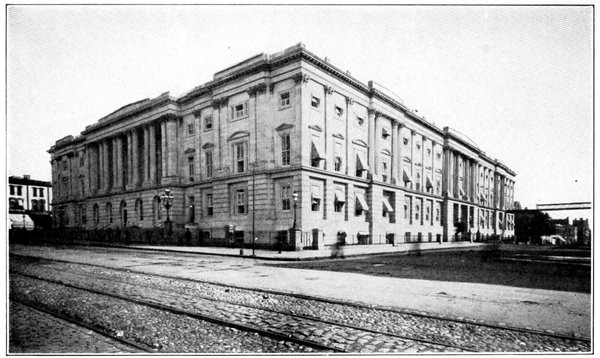
Photo by Clinedinst
THE BUREAU OF INDIAN AFFAIRS
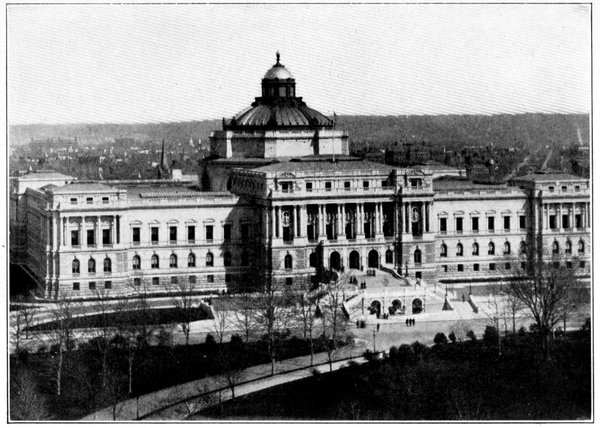
Photo by Clinedinst
THE CONGRESSIONAL LIBRARY
Looking from the Capitol
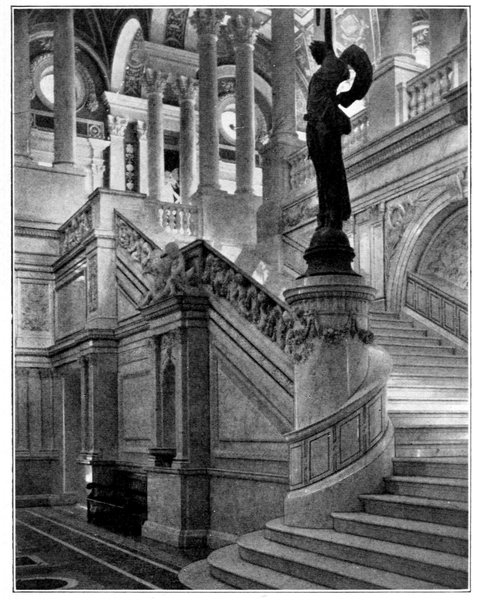
Photo by Clinedinst
GRAND STAIRWAY OF THE CONGRESSIONAL LIBRARY
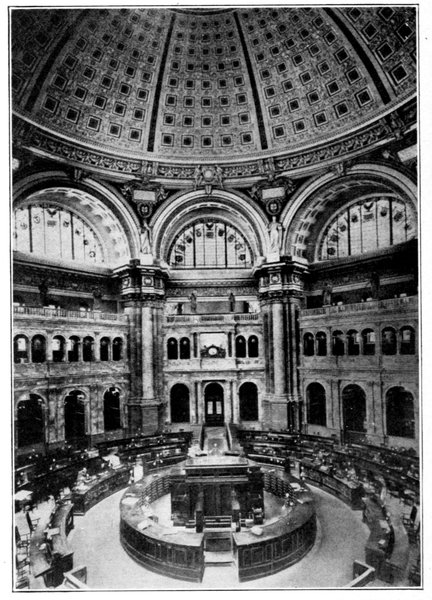
Photo by Clinedinst
THE ROTUNDA (READING-ROOM) OF THE CONGRESSIONAL LIBRARY
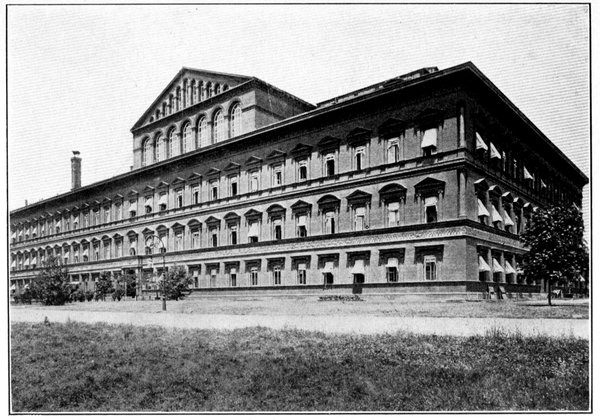
Photo by Clinedinst
THE PENSION OFFICE
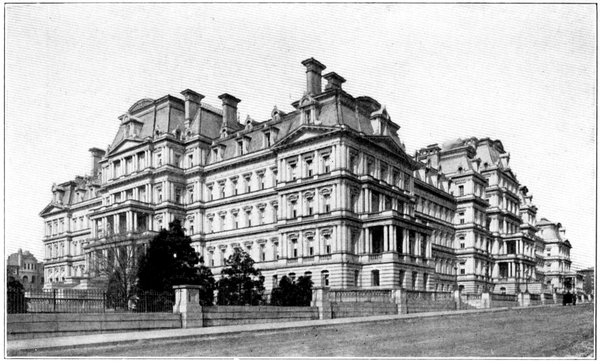
Photo by Clinedinst
THE STATE, WAR, AND NAVY DEPARTMENTS
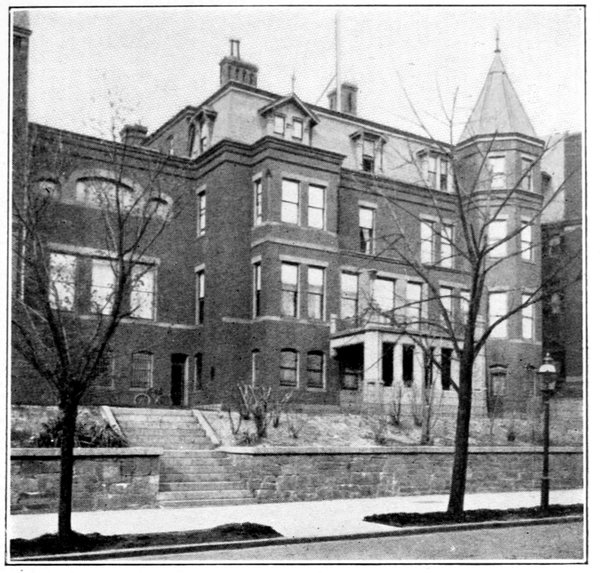
Photo by Clinedinst
THE GERMAN EMBASSY
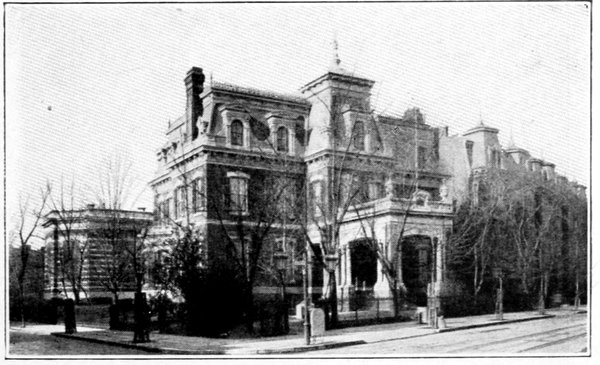
Photo by Clinedinst
THE BRITISH EMBASSY
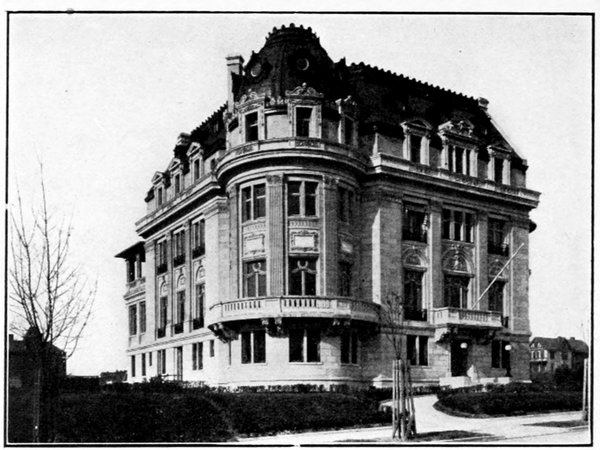
Photo by Clinedinst
THE NEW FRENCH EMBASSY
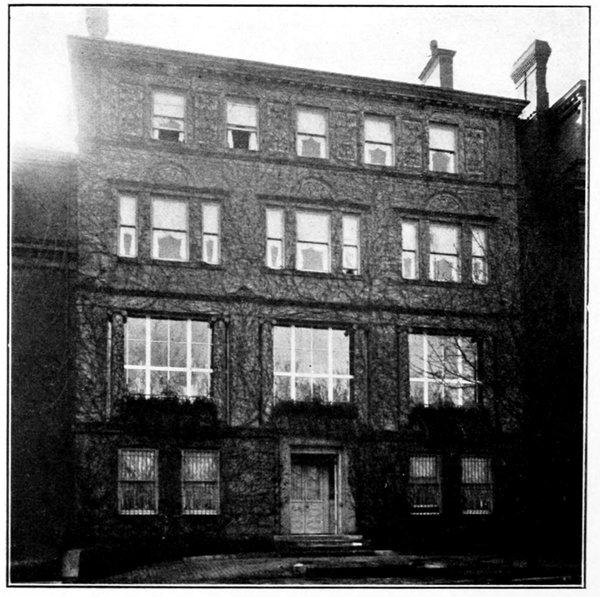
Photo by Clinedinst
THE RUSSIAN EMBASSY
129Every line of her splendid reports teems with heart-and-soul
enthusiasm. She has just put out a book
entitled, "Course of Study for the Indian Schools of
the United States, Industrial and Literary." Besides
the common school branches, it treats of the elements
of agriculture, bakery, basketry, blacksmithing, carpentry,
cooking, housekeeping, laundry, physiology,
shoemaking, tailoring, upholstering, and, in fact,
almost everything needed in daily living. Through
it all runs a real practical teaching in morality—that
good work is truth, bad work is untruth. Work in
any one is the measure of character.
You remember President Roosevelt, in his New
York speech concerning missions, spoke of the great
underpaid army of faithful clergymen all over this
land who, in obscure places, hold up the correct models
of morality, who keep the ideals of the nation to
honest, simple, earnest, true daily living. Much
more is this true of the missionaries among the Indians.
I remember once visiting the Indian school at Albuquerque,
New Mexico. Professor Bryan was then at the
head of it. The school was partly supported by funds
from the Presbyterian Church and partly by government
money. At the table I was trying to find from each
one his or her share in the great work they were
doing. I asked each one, and each gave me a short,
graphic account of his work. I sat at Professor
Bryan's right hand; just opposite me sat a bright-faced
German, looking the wisest person at the table.
130As I came to him I said, "And you, Professor?"
"Madam, I am the cook." Whether my face flushed
with surprise or not I do not know. No one smiled.
After a somewhat embarrassing moment for me, he
said: "Madam, since I was a little boy I have desired
to be a missionary to the Indians. I received a good
education, graduated at the Berlin University, took a
course in theology at a seminary in Germany, then
came here, where I found that my imperfect English
was an insurmountable barrier to religious work among
the Indians. We had no cook. Some of our best teachers
were ill nearly all the time, so I became the cook,
and I do it unto God, believing that every soul saved
by these devoted workers, whose health I have improved,
is part of my work. Do you approve?"
"Do I approve?" I said. "Why, every pot and
kettle becomes a sanctified implement in your hand.
The Master said: 'And whosoever of you will be the
chiefest, shall be servant of all. For even the Son of
man came not to be ministered unto, but to minister,
and to give his life a ransom for many.'"
XXIII THE LIBRARY OF CONGRESS
131
The great necessity for a separate building for a
Congressional Library was first urged by
Mr. A. R. Spofford, in his Librarian's Report
in 1872. An appropriation was made
for the purchase of the ground in 1886. The site consists
of ten acres of ground, facing the east front of
the Capitol. The ground and the old buildings
upon it cost $585,000, and the building itself, $6,032,124.34.
It is the handsomest, most convenient, and best
lighted and ventilated library building in the world,
and I believe it to be the handsomest building for public
purposes in the world. The building is of the Italian
Rennaissance order of architecture. It has three
stories and a dome, and covers three and a half acres
of ground. Its dimensions are 470 × 340 feet, and the
height of the wall 69 feet.
The Library, or collection of books, was founded in
1800, Congress appropriating $5,000 for that purpose.
When the Capitol building was fired by the British,
this Library was nearly destroyed. It also suffered
from fire in 1851.
The Library of Congress purchases rare books from
all lands. Its chief source of supply is through the
copyright law, which requires that two copies of every
book copyrighted should be sent to the Library. It has
132acquired by gift or purchase the Library of Thomas
Jefferson, of 6,700 volumes, for which $23,950 was
paid, the Force Historical Collection in 1865, the
Smithsonian Library in 1867, and the Toner Collection
in 1882.
The Smithsonian division is largely composed of
books on scientific subjects. The law library of over
92,000 books yet remains in the Capitol building.
The Force Library is a fine collection of books,
manuscripts, and papers concerning the early history
of America, especially of the Colonial times.
Every picture, photograph, piece of music, engraving,
dramatic production, pamphlet, or brochure published
in the United States can be found here in the copyright
edition. The collection is the largest in the western
hemisphere, comprising about 1,000,000 books and
pamphlets. The Library has forty-five miles of shelving,
which is more than twice its present requirements.
There are in the book division 207 employees, and in
the copyright-rooms 49. The caretakers number 116.
The appropriations by Congress for service, and for the
printing, binding, and purchasing of books, amount to
not less than $1,000,000 annually.
Any one can read or study in the Library, but only
Congressmen, members of the Supreme Court or their
families, or the President's family, are permitted to
take books from the building. No pen-and-ink work
is allowed in the Library, for fear of stains.
In the basement, one room is set apart for the blind,
where they may read for themselves, and almost every
afternoon they have a concert, or some noted author
reads from his own writings, or some distinguished
speaker lectures before a most appreciative audience of
blind people.
133
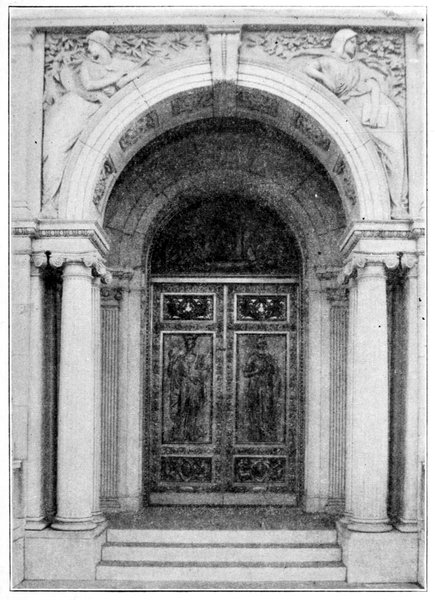
ONE OF THE BRONZE DOORS OF THE CONGRESSIONAL
LIBRARY
134The present Librarian is Mr. Herbert Putnam, of
Boston. The most interesting personality in the
building is Mr. Ainsworth R. Spofford, who was the
Librarian from 1864 to 1897.[7] He was appointed
during Mr. Lincoln's administration. He is a walking
encyclopedia.
I once asked him for the names of a few books on
anthropology. He poured out such a stream of titles
and authors that I was obliged to call for quarter. He
then wrote me out a list of fifteen titles and authors,
taking only a minute or two for the whole matter. He
seems conversant with every subject. His memory
concerning books is simply phenomenal.
In the Library is a perfect copy of Eliot's Indian
Bible, published in Cambridge in 1661, the last copy
of which brought $1,000. Here, too, may be found
the works of Cotton and Increase Mather (1671 to
1735), and leading journals, all publications of our
country from 1735 to 1800. Bound volumes of many
of them can also be found here. The first edition of
the Mormon Bible, published in 1830, and printed at
Palmyra, New York; Archbishop Cramer's version of
the Bible, 1553; Martin Luther's Bible; and the
Catholic version of the New Testament, 1582, are
among the rare volumes in the Library.
An extract from a copy of the Washington Post of
1897 well describes the official test of the device for
sending books to and from the Capitol:
An official test of the device for transporting books between
135the Capitol and the new Congressional Library was made yesterday
afternoon. Mr. John Russell Young, the Librarian;
Chief Assistant Librarian Spofford, and Superintendent Bernard
R. Green assembled in the small receiving-room, just off
Statuary Hall, about 2 o'clock. Mr. Young had prepared
for the test a list of books known only to himself until they
were ordered from the Library.
The first volume sent for was William Winter's poems. Mr.
Young gave out the name and Mr. Green wrote it on a slip of
paper. This was placed in the pneumatic tube, which flashed
it to Mr. David Hutcheson, who is in charge of the reading-room
of the new Library. The book was ordered by Mr.
Hutcheson from the shelf-clerk and sent to the desk in the
center of the reading-room by the Library carrier. It was
then taken to the big carrier in the basement and started on
its journey to the Capitol. The time consumed from the
moment of sending the order by pneumatic tube until the
leather case containing the desired volume deposited its cargo
before Mr. Young was exactly ten minutes.
Mr. Young then sent for a copy of "Faust" in German,
Hugo's "Les Châtiments," and Hildreth's "History of the
United States," vol. i., all on one order, and for the London
Times of 1815, the year of the battle of Waterloo, on a separate
order. The "Faust" and the history arrived in eight
minutes and "Les Châtiments" on the next carrier. The
order for the London Times was an extreme test, as the volume
is so large that the carriers in the Library connecting
with the shelves would not accommodate it, and a messenger
had to be sent from the main desk to the top deck of the south
stack, where the newspaper files are shelved. When the messenger
returned he just missed the carrier, which had been
sent off with one of the other volumes ordered, and he had to
wait the four minutes consumed by the transit of the carriers
before he could start the Times on its journey. It arrived at
the Capitol just thirteen minutes after the order for it was
sent.
The carrier consists of an endless cable, with two metal
baskets at an equal distance from each other. These work
136on the cable, the power for which is furnished by the Library
dynamo. The books are carried through the tunnel,
and when they reach the wheels which change the direction,
the speed is automatically slackened, so that the delivery
is made gently and without the possibility of damage.
Smaller books are first placed in a large sole-leather case.
The carriers are taken through the tunnel at the rate of
six hundred feet per minute. Should any trouble occur,
the mechanism can be instantly stopped by an electric
button, one at each end. The machinery of the carriers
and its instalment was largely the work of Superintendent
Green.
All who witnessed the test were surprised at the ease and
swiftness with which the books could be sent for, taken from
the shelves, and transported a distance of about a quarter of
a mile. Librarian Young was very much gratified. He
characterized the system as remarkable. The test also
demonstrated that the arrangement of the books in their new
quarters is perfect, as those sent for were selected at random
and were readily picked out from the enormous collection by
those in charge of the shelves.
In this labyrinth of beauty, known as the Library
of Congress, I believe a man would see no fault. But
women, except as allegorical characters, such as imaginary
figures of history, science, pomology, art,
etc., have no share in the scheme of ornamentation.
But men of all ages, of all branches of art, science,
commerce, and literature, are memorialized in painting,
sculpture, writing, or suggestion of some kind,
either concrete or abstract. It is true, Sappho (whom
I suppose the artist thought was a man), grown dim
in the long vista of years, is a lone woman among the
world's élite. No George Eliot, nor George Sand,
nor Harriet Hosmer, nor Rosa Bonheur, nor Mrs.
Browning, nor Mrs. Stowe now stands near Holmes,
137Whittier, Longfellow, Byron, or Landseer. This omission
is not like our gallant American men.
I remember once at a table in London some distinguished
English women were complimenting the
achievements of American women. I replied, "I
have met the college women of almost every European
country. I do not find American women in any way
mentally superior to the women of Europe. But
American women accomplish much more than their
sisters east of the Atlantic simply because of our men.
Now here in England your husband and brothers
insist on silence, but with us if a woman sings or talks
well it is the hand of her husband or father that leads
her to the front, and it is the kindness of our men that
starts us on our public life, helps us at hard places,
and encourages us everywhere. No, it is not our
women who are superior, it is our men, our gracious,
helpful men."
Whatever women in the United States have accomplished
beyond their sisters in foreign lands has been
done because of the friendly, cordial, helpful encouragement
of their husbands, brothers, and fathers; so in
this Library the womanhood of the world is slighted
in the house of her friends.
XXIV THE PENSION OFFICE
138
The Pension building is situated on Judiciary
Square, near G Street. It is the largest department
building in Washington, being 400
feet from east to west and 200 from north to
south, and 75 feet high.
The walls surround an interior courtyard, two galleries
extend around this court, and from these galleries
access is attained to the rooms on the second and third
stories. The building cost half a million dollars; it is
of mixed architecture, not beautiful in appearance,
but the best lighted, heated, and ventilated department
building in the city. It is sometimes called "the
Meigs (name of architect) Barn," because its outline
is not unlike a Pennsylvania red barn.
When the architect had finished escorting General
Sheridan through the building, just after its completion,
the former inquired enthusiastically, "Well,
Sheridan, how do you like it?"
"I find only one fault," said the General, solemnly;
"it is fireproof."
At the close of the year 1908 there were on the rolls
951,687 pensioners. During 1908 there were added
413,017, with a loss from death of 428,701, making a
loss above all gains of 15,684.
The number of pensioners should grow less each year.
There remain on the rolls the names of no widows
139and but two daughters of Revolutionary soldiers. In
the last report of the Commissioner of Pensions (1900)
but one soldier of the War of 1812 survived. He was at
that time (September 10, 1901) 101 years of age. Of
the Mexican War, the names of 2,932 soldiers and 6,914
widows are still on the rolls; of the Indian wars (1832-1842),
1,820 survivors and 3,018 widows. The war
with Spain left a legacy of 20,548 invalids, 1,145
widows, and 510 nurses, drawing pensions. Besides
these there is the great army of Civil War pensioners.
If the government would, at least twice each year,
publish in each county the names of persons receiving
pensions, the amount paid, and the alleged cause of
disability, it would bring the blush of shame to the
face of many a liar who now draws a handsome sum
from his government. The money is largely paid
into the United States Treasury not by the rich of
our country, but by the laboring class of men and
women.
Patriotism which requires a lifelong stipend is of
doubtful color.
Soldiers of the Spanish War at the time of their discharge
were obliged to sign papers declaring any disability
which existed. Then each soldier was examined
by the surgeon and his company officers, and
these again certified either to his perfect health or to
his disability. It was found that the health of many
had been greatly improved by exercise in the open air,
free life, and plain diet.
Eleven years after the Civil War only six per cent. of
the Union soldiers and sailors had applied for a pension;
it was found only a little over three years had passed
140since the close of the one hundred days' war with
Spain, yet more than twenty per cent. of the soldiers
and sailors of that war had applied for pensions.
The great majority of those mustered out had declared
over their own signatures, and that of the surgeon
and commanding officer of the company to which
they belonged, that they had no disability whatever.
Yet thousands of these very men applied for pensions,
and in their applications have set forth in minute
detail the large number of disabilities acquired in the
service. One man within forty-eight hours after his
discharge as a sound man discovered ten physical ills,
any one of which should suffice to secure the bounty of
a generous government.
I submit the following extract from Commissioner
Evans' last report:
A good object-lesson in this regard is furnished by the history
of a volunteer regiment which was recognized as one of
the "crack" regiments in service during the war with Spain.
Its membership was notably a fine body of men, and its officers
were men of experience and ability and skilled in military
matters. Few regiments had as good a record for service as
this one. It was at Camp Alger for a time, then at Camp
Thomas, then at Tampa, Fla.; thence sailed for Santiago de
Cuba, where it was placed in the trenches and did good service
until it returned to Montauk. From there it was returned
to the place of its enrolment, and at the expiration of a sixty
days' furlough was mustered out of service.
This regiment had a membership of 53 commissioned officers
and 937 enlisted men. There were no battle-field casualties,
but 1 officer and 22 men died of disease while in the service.
The published report of the medical officer on the muster out of this
regiment shows that 1 per cent. of the men of the regiment were
improved by military service; 5 per cent. were in as good physical
141condition as at time of enlistment; 24 per cent. were but slightly
affected, and, as a rule, the troubles were not traceable to military
service. Of the remainder (70 per cent.), or 528 men, the general
condition was as follows:
| Irritable heart, due to fever |
365 |
| Mitral regurgitation |
4 |
| Chronic bronchitis |
214 |
| Acute bronchitis |
47 |
| Phthisis |
3 |
| Gastritis |
158 |
| Enlarged or congested liver |
116 |
| Enlarged spleen |
316 |
| Inflammatory condition of intestines |
53 |
| Irritability of bladder and incontinence of urine |
76 |
| Nephritis |
5 |
| Hemorrhoids |
11 |
| Varicocele |
61 |
| Inguinal hernia |
3 |
| Rheumatism |
26 |
| Myopia |
19 |
| Slight eye strains |
29 |
| Slight deafness, due to quinine |
17 |
| Chronic nasal catarrh |
9 |
| Sprain of back |
3 |
| Old dislocation, right shoulder |
1 |
| Gunshot wounds, left forearm |
2 |
| Badly set Colles fracture |
1 |
| Secondary syphilis |
2 |
| Suffering from pains in the muscles, especially the calves of the legs and lumbar region, loss of weight from 10 to 30 pounds, accompanied by more or less debility |
471 |
| Relapses of fever continuing to recur up to January 4, 1899 |
87 |
Up to June 30, 1901, 477 claims for pension have been filed
in this bureau on account of service in said regiment for disabilities
alleged to have been contracted during the brief term
of its existence.
I am fully convinced that a small pension of $6 or $8 per
month for alleged obscure disability, such as diarrhea, piles,
rheumatism, impaired hearing, bronchitis, etc., is conferring
a misfortune upon a young man—in fact, a lifelong misfortune—for
142the reason that it puts him to a decided disadvantage
in the race for a livelihood always thereafter in the way
of securing employment.
The fact that he is drawing a "disability" pension puts
him on the list as disabled and unable to perform the amount
of labor that is expected of a sound man, and it seems like
misplaced generosity on the part of our government to thus
place a handicap upon the young ex-soldier in his search for
employment, as it is well known that a large percentage of
the young men that served in the war with Spain depend upon
manual labor for a livelihood.
Mr. Eugene F. Ware, the late Commissioner, issued
the following table to show the difference between
the regulars and volunteers of the Spanish-American
War:
| REGIMENTS |
Killed |
Wounded |
Missing |
Claims filed for pensions |
| Volunteers— |
|
|
|
|
| 1st—District of Columbia |
0 |
0 |
0 |
472 |
| 9th—Massachusetts |
0 |
0 |
0 |
685 |
| 33d—Michigan |
0 |
0 |
0 |
573 |
| 34th Michigan |
0 |
0 |
0 |
615 |
| 8th Ohio |
0 |
0 |
0 |
652 |
| Total |
0 |
0 |
0 |
2,997 |
| |
|
|
|
|
| Regulars— |
|
|
|
|
| 6th U. S. Infantry |
17 |
106 |
17 |
162 |
| 7th U. S. Infantry |
23 |
93 |
0 |
249 |
| 13th U. S. Infantry |
18 |
90 |
0 |
87 |
| 16th U. S. Infantry |
13 |
107 |
17 |
143 |
| 24th U. S. Infantry |
12 |
75 |
6 |
123 |
| Total |
83 |
471 |
40 |
764 |
It is believed that this spectacle, which indicates
lack of patriotism, is due to the solicitation of the
pension agent, who received $20 for every pension
secured. Now this condition of things is an outrage.
143The name of every man who receives a pension should
be published. If he really deserves it, no other citizen
will object; if not, he should be scorched by the
community.
Is it any wonder that with such a raid upon the
United States Treasury that the pension work is slow,
and that many soldiers and widows of soldiers of the
Civil War have not yet received their deserved pensions?
It seems to me the following extract from the report
of the Commissioner of Pensions, in reference to illegalities
connected with applications, may be of interest
as showing the condition of affairs in 1902:
The 226 indictments tried, which resulted in convictions,
were based upon the following charges:
| False claim |
64 |
| False certification |
26 |
| False affidavit |
16 |
| False personation |
5 |
| Perjury |
40 |
| Forgery |
18 |
| Illegal fee |
26 |
| Personating government officer |
21 |
| Retaining pension certificate |
2 |
| Prosecuting claims while a government officer |
4 |
| Conspiracy |
2 |
| Embezzlement |
1 |
| Attempted bribery |
1 |
It has been the uniform practise not to recommend prosecution
in any case unless the criminal intent of the parties
was clearly shown; and in the cases of soldiers and their dependents,
to resolve every doubt in their favor, and not to
recommend prosecution where it was apparent that they had
been drawn into a violation of the law by others. As a result
of this practise, the majority of the convictions secured were
against attorneys, agents, sub-agents, magistrates, and others
144responsible for the preparation and filing of false and fraudulent
claims and evidence, and those who falsely personated
soldiers or soldiers' widows.
Eugene F. Ware succeeded Mr. Evans as Commissioner
of Pensions early in 1902. Mr. Ware is a
Kansas man, prominent both in the literature and
politics of that State for the last twenty-five years.
He has stirred up matters in the Pension Bureau by
making even the humblest clerk feel that good work
will meet with promotion, and that no influence can
keep inefficiency in that responsible place. He has
also announced that no one who habitually uses intoxicants
can be entrusted with the responsibility of looking
after the aged and indigent soldiers, forlorn
widows, and helpless children. The consequence is
some have been dismissed for drunkenness, others
have resigned, others have quit their cups. Mr. Ware
comes from a state where prohibition has made the
jail a useless building except for storing the great
surplus of corn. One of his poems says:
The horse-thief went, the cowboy joined the church,
The justice of the peace is laughed to scorn;
The constable has tumbled from his perch,
The school has left the sheriff in the lurch—
The jail is full of corn.
His poem on John Brown, the hero of freedom,
satisfies. The first three verses read as follows:
States are not great except as men may make them;
Men are not great except they do and dare.
But states, like men, have destinies that take them
That bear them on, not knowing why or where.
145The why repels the philosophic searcher,
The WHY and WHERE all questionings defy,
Until we find, far back in youthful nurture,
Prophetic facts that constitute the why.
All merit comes from braving the unequal,
All glory comes from daring to begin;
Fate loves the state that, reckless of the sequel,
Fights long and well, whether it lose or win.
Mr. Ware was Commissioner of Pensions from May 10,
1902, to January 1, 1905. Then, much to the regret
of President Roosevelt, he resigned. Mr. Vespasian
Warner, of Clinton, Ill., was appointed Commissioner
January 16, 1905. Mr. Warner had an honorable
record as member of Congress from 1895 to the time
of his appointment as Commissioner. During the last
four years fewer complaints have come from the Pension
Office than in former years.
XXV STATE, WAR, AND NAVY DEPARTMENTS — STATE DEPARTMENT — THE WAR DEPARTMENT
146
The State, War, and Navy departments are in
one handsome four-storied granite building,
with a frontage of 343 feet and a depth of 565
feet, situated on Pennsylvania Avenue, just
west of the White House. The building is one of the
handsomest in the city, being of the French Rennaissance,
modified by American ideas. It has five hundred
rooms and two miles of marble halls. In the
west wing of the building the Secretary of War, Hon.
Elihu Root, and General Miles, Commander of the
Army, have handsome rooms for themselves and their
many assistants. In the east wing can be found the
Secretary of the Navy and rooms for the Admirals and
their corps of helpers, and in the south wing the popular
Secretary of State, the Hon. John Hay, with a
comparatively small number of assistants.
In the department of the Secretary of State one sees
the portraits of all the great men who have occupied
the position of Secretary of State from the time of
Washington down to the present occupant. Most
people would be interested in the Huntington portraits
of Grant, Sherman, and Sheridan, and in a copy of
Gilbert Stuart's portrait of Washington. In the State
Department the most interesting are the portraits of
147Thomas Jefferson, 1789, Washington's first term;
Daniel Webster, 1841 and 1850; William H. Seward,
1861 and 1865; Elihu B. Washburne, 1869; Hamilton
Fish, 1869; William M. Evarts, 1877; James G.
Blaine, 1881 and 1889; and F. T. Frelinghuysen, 1881.
A portrait of Lord Ashburton recalls the "Ashburton
Treaty" of 1842, which defined the boundaries between
the United States and the British Possessions in
North America, and provided for the suppression of
the slave-trade.
In the State Department are some of the most precious
archives of the nation. Here can be found the
original Declaration of Independence, the Constitution
with the original signatures. Here can be seen the
handwriting of most of the rulers of the world during
the last hundred years affixed to treaties. One of the
most unique of these is a treaty with Japan. The
clear Japanese characters cover many pages, the royal
signature is at the top, and you read from the bottom.
The treaty was brought to Washington by two Japanese
officials of high rank, who were charged with its
safe delivery on penalty of their lives. One day they
triumphantly entered the State Department bearing
aloft on two bamboo poles a curiously constructed box,
in which was the precious document. They were
greatly relieved when they saw it safely deposited with
the Secretary of State.
Here are the papers of Washington, Adams, and
Jefferson; here are all the flags taken in all the wars
in which the United States have engaged.
148
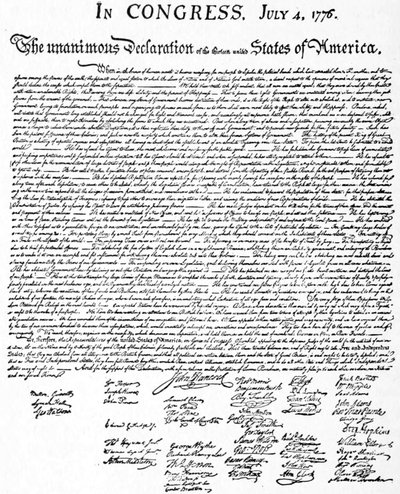
THE DECLARATION OF INDEPENDENCE
149The diplomatic rooms are of great beauty. Here
Mr. Knox receives foreign ministers, consuls, and
special messengers from foreign lands. Here at almost
any time can be seen members of some of the thirty-five
foreign embassies and legations. Many of these
legations own and maintain handsome residences. A
statement prepared by District Assessor Darneille
shows that foreign governments own over $500,000
worth of real property in the District of Columbia, the
estimated value of the land being $330,776, and the
improvements $284,500. The French and Chinese
governments have recently purchased valuable tracts
of land, and erected magnificent legation buildings
which will increase the value of property held by foreign
governments to nearly $1,000,000.
Probably the most characteristic feature of both
political and social life in Washington is afforded by
the presence of these legations. The members are
more conspicuous here than at any other national
capital in the world, except, possibly, Peking. Not to
speak of Asiatic costumes and customs, European
manners and morals, if we except those of England
and Germany, which are much the same as our own,
contrast most decidedly with their American correspondents.
Most of the men are pure pagans—cynics
and materialists. They look upon a profession of
Christianity at its best as a mark of intellectual weakness,
and at its worst of hypocrisy. Their own faces,
however, do not indicate that they are exceptionally
broad-minded or good and sincere men.
I have seen them in public receptions stand on one
side and chatter in French, Spanish, or Italian, poking
all sorts of fun at the hostess and her entertainment,
and then, as she approached, rush to greet her with a
150mock homage which made my flesh creep. I have
heard them declare that "all Americans are cads," and
the next instant prove the less sweeping proposition
that "all cads are not Americans" by fulsome compliments
to a distinguished Justice or Senator.
They, however, dispense a generous hospitality, and
society, which has learned to estimate them by their
own cynical standards, and is neither elated by their
smiles nor annihilated by their snubs, cultivates them
as best suits its own purpose.
The United States supports abroad thirty-eight
embassies and legations, consisting of ministers, secretaries,
and attachés, besides about one thousand
consuls.
The Congressional Directory gives the personal history
of Secretary Knox as follows:
Philander Chase Knox, Secretary of State (1527 K Street),
was born in Brownsville, Pa., May 6, 1853, son of David S.
and Rebekah Knox; his father was a banker in Brownsville;
graduated at Mount Union College, Alliance, Ohio, in 1872;
entered the law office of H. B. Swope, Pittsburg, Pa., and
was admitted to the bar in 1875; was assistant United States
District Attorney for the Western District of Pennsylvania in
1876; was elected president of the Pennsylvania Law Association
in 1897; was made Attorney-General in the Cabinet of
President McKinley in 1901 as successor to Hon. John
William Griggs, of New Jersey, resigned, and was sworn into
office April 9, 1901; was the choice of President Roosevelt for
Attorney-General in his Cabinet, and was confirmed by the
Senate December 16, 1901; resigned that office June 30, 1904,
to accept appointment as United States Senator, tendered by
Governor Pennypacker June 10, to fill a vacancy caused by
the death of Hon. M. S. Quay, and took his seat December
6; was elected by the Legislature in January, 1905, for the
151term ending March 3, 1911; resigned as Senator March 4,
1909, to accept the position of Secretary of State, and was
nominated, confirmed and commissioned March 5.
Congress had to repeal the act raising the salary of
the Secretary of State before Mr. Knox could take the
position, because he was in the Senate when the salary
was raised.
In time of war or just following a war the most interesting
department is that which was lately occupied
by Elihu Root and William H. Taft. Mr. Root is
noted as a great corporation lawyer, and at first seemed
to consider that the government of the United States
could be run on the same principles as a great corporation—that
is, "We shall do as we please in spite of
public opinion." But he was severely brought to task
for this. Later he became Secretary of State.
In spite of this, the report of this department, dated
December, 1901, shows difficult, conscientious, magnificent
work performed by the War Department since
the close of the war with Spain. Possibly the quiet
prejudice which existed throughout the country against
Mr. Root was largely the result of his treatment of
General Miles. He did not like the old General, but
the country did. Mr. Root could do many splendid
things before the farmer, who only reads his weekly paper
and to whose brain new things come slowly, forgave him
for rudeness to a man of the people, whose merit had
placed him at the head of the army. Any one who
thinks he wins favor by calling General Miles "old
fuss and feathers," as some newspapers do, quite forgets
that the American people like fuss and feathers.
152In spite of the above, Mr. Root is a great patriotic
man, who, with mental ability enough to earn $100,000
per year, gives his country the benefit of his
talents for what must seem to him the modest sum of
$12,000. As an organizer and great executive officer
he had no superior in the government employ. His
last report shows the army located as follows:
DISTRIBUTION OF THE ARMY, SEPTEMBER 25, 1901
| COUNTRY |
Officers |
Enlisted men |
Total |
| United States |
1,922 |
31,952 |
33,874 |
| Philippine Islands |
1,111 |
42,128 |
43,239 |
| Cuba |
166 |
4,748 |
4,914 |
| Porto Rico |
51 |
1,490 |
1,541 |
| Hawaiian Islands |
6 |
250 |
256 |
| China |
5 |
157 |
162 |
| Alaska |
17 |
510 |
527 |
| Total |
3,278 |
81,235 |
84,513 |
[In this table are included the 4,336 men of the Hospital Corps and the 25
officers and 815 men of the Porto Rico Provisional Regiment, leaving the
strength of the Regular Army 3,253 officers and 76,084 enlisted men.
In addition there are also in the Philippines 172 volunteer surgeons,
appointed under section 18 of the act of February 2, 1901, and 98 officers
and 4,973 native scouts.]
Of course, now that the war in the Philippines is
practically over, many more men have returned to the
United States.
In reading Mr. Root's report, nothing impresses one
more than the splendid arrangement for the better education
of army officers, not only as to military tactics,
but for full intellectual equipment. Enlisted men who
fit themselves by study, and retain good characters by
passing complete civil-service examination, become
eligible to official positions among the regulars. Also
officers of volunteer regiments by the same process
153become eligible to official positions in the regular
army.
Mr. Root recommended that officers of the National
Guard, or officers of former volunteers, be permitted
in their vacations to study with regular army officers
at West Point, and at the army post schools, so that we
may never again be caught without competent officers
for volunteer regiments. His report contains full
accounts of the forming of the new government in
Cuba, the Cuban Constitution, a full account of all
the troubles in the Philippines, the wonderful work
accomplished by the signal corps, the territorial and
military divisions of the Philippines, and recommendations
as to the proper currency and system of banking
necessary in our Oriental possessions.
He recommended the purchase of the lands of the
friars, who could not continue to hold their possession
peacefully on account of the hostility of the people,
whom they have grossly wronged.
His account of the very valuable unexplored timber
lands of the islands, and the industries needed, made
his report of great practical importance.
Men of the United States army have always been
noted for their high standard of honor. The country
believes in the integrity of the officers of the regular
army. When any of them fail themselves and betray
the trust imposed in them, it causes a shock to public
feeling such as malfeasance in no other official position
ever produces. To an unusually large extent they
have been worthy of the trust reposed in them by a
great nation.
The French are no more jealous of the good name
154of their army than are Americans. The person who
takes away the good name of our brave, patriotic,
self-sacrificing men, "who are a-doing and a-dying"
in the Philippines, because of the evil actions of less
than one-twentieth of their number, deserves public
execration. The least we can do for our army is to
give them their hard-earned laurels unspoiled.
The following sketch of Mr. Root, now Senator from
New York, is taken from "Who's Who in America":
Secretary of State from July 1, 1905, until March 4, 1909;
born in Clinton, N. Y., February 15, 1845; son of Oren and
Nancy Whitney (Buttrick) Root; graduated from Hamilton
College in 1864, where his father was for many years professor
of mathematics; taught at Rome Academy in 1865; graduated
from the University Law School of New York in 1867;
(LL.D., Hamilton, 1896; Yale, 1900; Columbia, 1904; New
York University, 1904; Williams, 1905; Princeton, 1906; University
of Buenos Ayres, 1906; University of San Marcos of
Lima, 1906; Harvard, 1907); married January 8, 1878, Clara,
daughter of Salem H. Wales, of New York; U. S. Attorney
for the Southern District of New York, 1883-85; delegate-at-large
to the State Constitutional Convention in 1894, and
chairman judiciary committee; appointed Secretary of War,
August 1, 1899, by President McKinley; reappointed March 5,
1901; resigned February 1, 1904; became Secretary of State,
U. S., July 1, 1905. Member Alaskan Boundary Tribunal in
1903; temporary chairman Republican National Convention
in 1904. Trustee of Hamilton College, Carnegie Institution,
Washington; Metropolitan Museum of Art, New York; President
Union League Club (New York), 1898-99; president New
York City Bar Association, 1904-05; president American Society
of International Law, 1906.
XXVI STATE, WAR, AND NAVY DEPARTMENTS (Continued) — THE NAVY DEPARTMENT
155
The offices of the Navy Department are situated
in the same building as those of the War
Department. The Secretary of the Navy
occupies some of these handsome rooms.
On their walls are the pictures of eighteen Secretaries,
more than half the number of those who have occupied
the high place being yet unrepresented. Secretary
Long urged that the pictures of those yet waiting
should be secured and given a place among these
worthies. Down to Lincoln's day the following persons
occupied the place of Secretary of the Navy:
During Washington's administration the Secretaries
of the Navy were also Secretaries of War. Three men
occupied the double position: Gen. Henry Knox, of
Massachusetts; Timothy Pickering, of Massachusetts;
and James McHenry, of Maryland. In John Adams's
administration the Navy was made a separate department.
The Secretaries of the Navy since 1798 have
been as follows: Benjamin Stoddert, of Maryland;
Robert Smith, of Maryland; Jacob Crowninshield, of
Massachusetts; Paul Hamilton, of South Carolina;
William Jones, of Pennsylvania; Benjamin W. Crowninshield,
of Massachusetts; Smith Thompson, of New
York; Samuel L. Southard, of New Jersey; John
Branch, of North Carolina; Levi Woodbury, of New
156Hampshire; Mahlon Dickerson, of New Jersey;
James K. Paulding, of New York; George E. Badger,
of North Carolina; Abel P. Upshur, of Virginia;
David Henshaw, of Massachusetts; Thomas W. Gilmer,
of Virginia; John Y. Mason, of Virginia;
George Bancroft, of Massachusetts; William B.
Preston, of Virginia; William A. Graham, of North
Carolina; John P. Kennedy, of Maryland; James C.
Dobbin, of North Carolina; Isaac Toucey, of Connecticut;
Gideon Welles, of Connecticut. Since then
have come John Faxon, Adolph E. Bane, Geo. M.
Robeson, Watson Goff, Jr.; N. H. Hunt, Wm. E.
Chandler, Wm. C. Whitney, Benj. F. Tracy, H. A.
Hobart, John D. Long, M. H. Moody, Paul Morton,
Chas. J. Bonaparte, S. H. Newberry and George von
L. Meyer. Mr. Long resigned in 1902, and was succeeded
by Mr. Moody, who later was transferred to the
Supreme Court. Of Mr. Meyer the Directory says:
George von Lengerke Meyer, of Hamilton, Mass., Secretary
of the Navy, is trustee Provident Institution for Savings,
Boston; director Old Colony Trust Company, Boston, Amoskeag
Manufacturing Company, Manchester, N. H., and United
Electric Securities Company, Boston; was a member of the
city government of Boston, 1890-1892; member of the Massachusetts
House of Representatives, 1892-1896; Speaker of the
Massachusetts House of Representatives, 1894-1896; Republican
national committeeman, 1898 to 1905; confirmed as
ambassador to Italy December 14, 1900; transferred as ambassador
to Russia March 8, 1905; recalled in February, 1907,
to enter the Cabinet as Postmaster-General, and took oath of
office March 4, 1907, holding that post until March 6, 1909,
when he took oath of office as Secretary of the Navy.
Now that the United States has become a world
power, the navy is the right arm of the government in
157taking needed supplies to our distant colonies, and in
protecting with devoted care the property of America
the world over.
The last annual report of the Secretary of the Navy
showed that the United States has 252 regular naval
vessels, 55 of special classes, besides as many more of
inferior classes called standard vessels, such as steam-cutters,
launches, cutters, etc. The Secretary's report
shows that $84,181,863.89 was appropriated for naval
expenses, of which about seventeen millions yet remain
unused. A large part of this has gone for new
vessels. No part of the government is increasing so
rapidly as the naval service. When all men are enlisted
for which legal provision has been made, the
naval and marine force will reach 34,810 men, or
nearly 8,000 more than were in the army prior to the
war with Spain. By the Congressional acts of 1864,
1868, and 1876 the navy was fixed not to exceed 7,000
men; the act of March 3, 1901, fixes the number at
25,000, but the necessities of the country have increased
it beyond this.
The average citizen knows far less about the navy
than about the army. Yet in time of war the army
would be of little use without an efficient navy. In
the Civil War no great progress was made in conquering
the South till the blockade shut in the Southern
States, preventing the export of cotton and the bringing
in of the necessities of life.
In the late war with Spain, brilliant as was the
service of the army, yet our navy carried away the
greater laurels.
The North Atlantic Squadron during the last
158fiscal year has been engaged in severe training in
marksmanship and evolutions, gaining facility in landing
large guns, etc. The vessels of this squadron have
extended their operations from Maine to Central
America, particularly among the West Indies. The
South Atlantic Squadron has assisted in commercial
interests along the coast of South America. The
European Squadron is now mostly in the Mediterranean
Sea. The Pacific Squadron is scattered over
such a great length of coast from Alaska to South
America that the ships can not drill as a squadron, but
are obliged to maneuver singly. The apprentice and
training squadrons have been along the coast of
Europe, but are now in the West Indies. These are
afloat continually, except when stopped for repairs or
supplies.
Possibly no condition in the war with Spain annoyed
us so much as the use of powder which emitted smoke
and thus showed just where our men were located,
while they dealt with an unseen foe. The navy has
taken up this matter, and is experimenting on the use
and making of smokeless powder. We shall not be
caught napping again. The navy is also practising
wireless telegraphy; and while it can not be said to
have adopted any of the half dozen systems now before
the public, yet so far it has secured the best results
from the Marconi system. This is used by Great
Britain and Italy. Germany uses the Slaby system,
France and Russia the Ducretet system. The Secretary
of the Navy insists that none is a perfect success,
as the difficulty of interference has not yet been
entirely overcome. Wireless telegraphy has carried
159messages between British war-ships 160 miles apart.
In 1908 and 1909 the fleet went around the world.
We have eight navy-yards, the principal one being
at Brooklyn. The barracks for the marines in Washington
are situated on Eighth Street, a short distance
from the navy-yard; they cost $350,000. The navy-yard
at Washington does not build large ships, but produces
chains, anchors, ordnances, such as rifles, breech-loading
guns, etc., together with a long list of materials
used in the navy.
Admiral Dewey is not only the pride of the navy
but of the nation. He receives $13,500 per year. Rear-Admirals
are paid $8,000.
Extensive and important improvements are to be
made at the Annapolis Naval Academy. The country
expects great proficiency in its army and navy, so no
pains, no expense should be spared in the preparation
of men of whom so much is required. A number of
years ago Commodore Perry, speaking to the students
of Antioch College (Ohio), told the following anecdote:
"Some twenty-five years ago I was carelessly walking
on the levee of a city of the Adriatic. A short distance
from the shore lay a man-of-war at anchor. I
called an oarsman to me, and had him take me out to
the vessel.
"I saw no one on board, but by a rope hanging over
the side I went on deck, hand over hand. I paid the
oarsman, and told him to return for me in an hour.
"I wandered over the beautiful ship, admiring its
guns, its keeping, its admirable appointments, and its
excellent management, shown by its condition. At
the end of my hour I began to look for my oarsman.
160Just then I discovered a door on my right. I opened
it, and in that room sat thirty-two boys. I had been
there an hour and had not heard stir enough to show
that so much as a bird was alive on that boat.
"The youngest cadet came to the door and welcomed
me with his cordial military salute. 'Boy, where is
your teacher?' 'Gone ashore, sir.' 'Do you keep
absolute order while he is gone?' 'Certainly, sir.'
"Then passing to the front, I said to one of the older
boys: 'Young man, why do you act so differently from
other boys? Are you afraid of being punished?'
"The cadet rose to his feet. 'Sir,' said he, 'you
see before you thirty-two cadets. We all expect to
govern others in our future work. The first element
of a good governor is self-government; sir, we are
practising that.'"
The Commodore added: "That was twenty-five
years ago. In the providence of God none of these
young men have been called to eternity. I will now
read you their names." And the audience recognized
in each man a name famous in the navies of Great
Britain, Germany, France, or America.
Now those lads had not merely kept silent. The
mastery of self made them victorious over temper, bad
habits, and all depraved tastes. They were men in
soul as well as in body. Truly, "He that ruleth his
spirit is greater than he that taketh a city."
XXVII DEPARTMENT OF COMMERCE
161
In February, 1903, President Roosevelt nominated
to the head of the new Department
of Commerce and Labor his secretary,
George B. Cortelyou, and to be Commissioner
of Corporations in that department James R.
Garfield, who is a son of President Garfield, and a
member of the Civil Service Commission. Of these
appointments the New York Times expressed the
general opinion of the press of the country:
The former appointment is significant chiefly because the
new Secretary is intimately known to the President, and his
policy in the department will probably represent the President's
views very closely. It cannot in any special sense be
regarded as a political appointment. The selection of Mr.
Garfield is also conspicuously on the merits of the appointee,
who is not an active politician, is an able lawyer, has been
prominent and useful in the promotion of municipal reform
and of the merit system in Ohio and as a Civil Service Commissioner.
He has plenty of energy, a cool head, experience
in public affairs, and may be expected to do all that can be
done with the powers of his new office, the value of which
must depend much on the character of the Commissioner and
the support and direction of the Secretary and of the President.
After that Mr. Cortelyou made an efficient officer
in this Department, then was transferred to the
Treasury, which he ably conducted during the panic
of 1907. At the end of the Roosevelt Administration
he was called to the presidency of the Consolidated
Gas Company in New York City.
162Mr. Garfield was soon called to deal with the
great corporations, and confronted the greatest problem
of the times. He came to his responsible place
a comparatively unknown man. His name carried
something of the halo which surrounds the name
of his distinguished father, and for that reason
he started with the best wishes of his countrymen.
Mr. Taft placed at the head of the Department of
Commerce and Labor Mr. Nagel, of St. Louis, whose
history the Congressional Directory sums up as
follows:
Charles Nagel, of St. Louis, Mo., Secretary of Commerce
and Labor (the Arlington), was born August 9, 1849, in
Colorado County, Tex. He left his home in 1863 as a result
of the civil war, accompanying his father to old Mexico, and
from there, by way of New York, to St. Louis. He graduated
from the St. Louis High School in 1868; from the St. Louis
Law School in 1872; attended the University of Berlin 1872-73;
admitted to the bar 1873. In 1876 he married Fannie Brandeis,
of Louisville, who died in 1889, one daughter surviving her.
In 1895 he married Anne Shepley, and they have four
children. He was a member of the Missouri Legislature from
1881 to 1883; president of the St. Louis City Council from 1893
to 1897; member of the St. Louis Law School faculty since
1886; Board of Trustees of Washington University; Board of
Directors of St. Louis Museum of Fine Arts. Made national
committeeman from Missouri in 1908. Has taken an active
part in politics for the last twenty years by participating in
conventions and speaking during campaigns, and has from
time to time delivered addresses before bar associations and
similar organizations upon various topics of public interest.
163
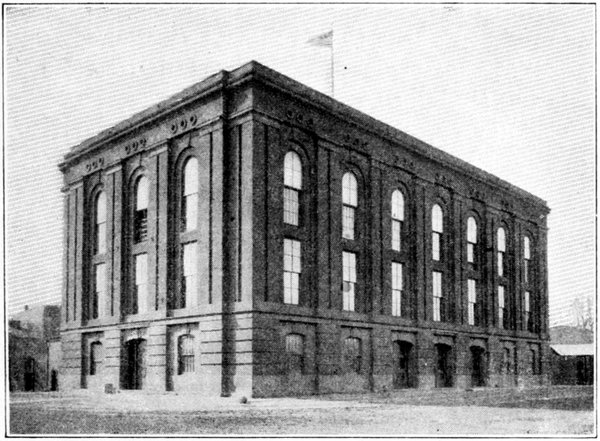
The new department has a wide scope, and under
efficient administration may exert a good deal of influence.
It takes over practically the scientific and
statistical work of the government, especially the
Coast Survey, the Bureaus of Statistics from the
Treasury and State Departments, and the Fish Commission,
besides the Labor Bureau, the Immigration
Bureau, and the enforcement of the Chinese Exclusion
Act, and it has a new Bureau of Manufactures,
with considerable duties. But undoubtedly
the most important work it can perform is in the
Bureau of Corporations. It will do a great work,
if it only secures publicity of accounts. The powers
of this bureau extend to "diligent investigation
into the organization, conduct, and management of
any corporation, joint stock company, or corporate
164combination engaged in commerce among the several
States and with foreign nations, excepting common
carriers." For this work the Commissioner is to have
the "right to subpœna and compel the attendance
and testimony of witnesses and the production of documentary
evidence and to administer oaths." One of
the objects of this power is to enable the Commissioner
to "gather such information and data as will enable
the President of the United States to make recommendations
to Congress for the regulation of" interstate
and foreign commerce.
The Survey, Quarantine, Immigration, and Life-Saving
bureaus are next in importance. Along the
coast new harbors and coast lines are constantly being
surveyed. When the quarantine officer boards your
ship at the entrance of New York harbor, and scares
you thoroughly lest he keep you in quarantine for the
sake of some poor Italian baby in the steerage, he
represents the Secretary of Commerce guarding a great
nation from disease. When the immigrant lands he is
interviewed by an agent of this department and his
money changed into United States currency. Some of
these agents recognize in the poor, frightened, lonely,
and travel-stained foreigner a human being who needs a
friendly word and helping hand, but others would scare
even an American woman, who knows her own value,
out of her wits; what, then, must be the effect of such
men on the feelings of these strangers? Nearly a half
million of foreigners a year enter our ports, and I
have seen many of them treated like cattle.
The Life-Saving Bureau has charge of the continuous
line of life-saving stations which guard our coasts.
165No braver men have ever lived than the devoted servants
of the government who patrol our shores. There
are 269 life-saving stations on the coasts of the Atlantic,
the Pacific, and the Great Lakes, and one at the
Ohio Falls, at Louisville, Ky. The men of these stations
were present last year at 693 disasters and saved 3,377
lives. Our government pensions soldiers and sailors
who are hired to destroy lives; surely greater pensions
should be awarded these heroes of the main for saving
life.
XXVIII THE EXECUTIVE MANSION
166
The President's house is generally known as
the White House. It is situated on Pennsylvania
Avenue, one mile west of the Capitol
building. It contains two lofty stories
above ground and a basement.
MRS. WILLIAM H. TAFT
(Copyright, 1908, by Harris & Ewing,
Washington. D. C.)
It was modeled after the palace of the Duke of
Leicester by the architect, James
Hobon. The foundation was
laid October 13, 1792, and the
building was first occupied by
President John Adams in the
summer of 1800. It was partially
burned by the British in
1814. The front is ornamented
by Ionic columns and a projecting
screen with three columns.
The space between these two
sets of columns constitutes a
carriage-way, admitting to the
main entrance.
The White House proper contains but thirty-one
rooms. The building was refitted and the wings for approach
and for the private offices of the President were
built during the administration of President Roosevelt.
Whether seen through the tracery of leafless trees or
through the verdure of summer, the White House always
looks cool, restful, and beautiful. The situation is not regarded
167as very healthful, but everything that modern
science can do is now being employed to improve its
sanitary condition.
All official duties will in time be attended to in the
offices which are situated just west of the White
House, so that the latter will be used only as the
private residence of the President's family.
Longfellow says:
All houses wherein men have lived and died
Are haunted houses.
How true this must be of the home of our Presidents!
George Washington watched its building, and
with his stately wife walked through it when it was
finished, and was satisfied. They were about ready
to leave the scene of action, but they did much to prepare
the stage for the procession of Presidents which
has followed.
For the last fifty years much complaint has been
made that the house has not been large enough and
that it was lacking in modern conveniences, but in
spite of these objections no trouble has yet been experienced
in finding men who were quite willing and
even anxious to occupy it.
The walls are covered with portraits of the Presidents
and their wives. All these portraits are interesting.
Mrs. John Adams bewailed the unfinished condition
of the house, and used the now famous East Room for
drying the family linen.
Of all the noble matrons who have graced the White
House, Abigail Adams was the wisest and greatest.
Her letters make her the Madam de Sévigné of our
168land. Her letter (written February, 1797) to her husband,
who had just succeeded Washington, sounds
like the voice of an oracle. We quote a portion:
"You have this day to declare yourself head of a
nation. 'And now, O Lord, my God, thou hast made
Thy servant ruler over the people; give unto him an
understanding heart, that he may know how to go
out and come in before this great people; that he may
discern between good and bad. For who is able to
judge this Thy so great a people?' were the words of
a royal sovereign, and not less applicable to him who
is invested with the Chief Magistracy of a nation, tho
he wear not a crown nor the robes of royalty. My
thoughts and my meditations are with you, tho personally
absent, and my petitions to heaven are that
'the things which make for peace may not be hidden
from your eyes.' My feelings are not those of pride
or ostentation upon this occasion. They are solemnized
by a sense of the obligations, the important trusts,
and numerous duties connected with it. That you
may be enabled to discharge them with honor to yourself,
with justice and impartiality to your country, and
with satisfaction to this great people, shall be the
daily prayer of yours—"
The first New-year's reception at the White House
was held by President Adams in 1801. Mrs. Adams
kept up the stately, ceremonious customs established
by President and Mrs. Washington. It was her son,
John Quincy Adams, as Monroe's Secretary of State,
who was afterward to write out a definite code for
almost every public ceremony. This code is largely in
force at the present time.
169Martha Washington comes into history simply as
the wife of a great man, but Abigail Adams was inherently
a superior woman. Of all the women who
occupied the White House she, only, gave the country
a son who became a great man, and occupied the highest
position in the gift of his country.
After John Adams came Thomas Jefferson, who
had imbibed ultra-democratic ideas in the French
Revolution. The ceremonies which prevailed in the
Washington and Adams period were temporarily laid
aside by this plain Virginia gentleman. He received
the formal dames of the land in his riding-suit, covered
with dust, riding-whip in hand, and with clanking
spurs on his heels. His lovely daughter, Martha
Jefferson Randolph, did her best to give the great
house the air of a pleasant home. She succeeded well,
and Jefferson's accomplished daughter smoothed many
of the asperities existing among public men who had
lived through the Revolution and suffered from the
jealousies, misunderstandings, and injustices of the
times.
Mrs. Dolly Madison was probably the greatest social
genius that has ever occupied the White House. The
papers of that day declare "Mrs. Madison is the most
popular person in the United States."
Washington social life yet abounds in pleasing legends
of her graceful, courteous kindness, not only to
the gentlemen and ladies of the legations, but to the
ignorant and socially unskilled who were among her
worshipers. James Fenimore Cooper, in a private
letter, gives a picture of the White House in the days
of James Monroe:
170"The evening at the White House, or drawing-room,
as it is sometimes pleasantly called, is, in fact,
a collection of all classes of people who choose to go to
the trouble and expense of appearing in dresses suited
to an evening party. I am not sure that even dress is
very much regarded, for I certainly saw a good many
there in boots.... Squeezing through a crowd,
we achieved a passage to a part of the room where
Mrs. Monroe was standing, surrounded by a bevy of
female friends. After making our bow here, we
sought the President. The latter had posted himself
at the top of the room, where he remained most of the
evening shaking hands with all who approached.
Near him stood the Secretaries and a great number of
the most distinguished men of the nation. Beside
these, one meets here a great variety of people in other
conditions of life. I have known a cartman to leave
his cart in the street and go into the reception-room to
shake hands with the President. He offended the
good taste of all present, because it was not thought
decent that a laborer should come in a dirty dress on
such an occasion; but while he made a mistake in this
particular, he proved how well he understood the difference
between government and society."
The Monroes came to the White House after it had
been restored after the burning in 1814. It was barely
furnished at that time, and contained but few conveniences
for entertaining. Mrs. Monroe brought furniture
directly from Paris, which she used for the East
Room. This has been frequently upholstered, and
constitutes part of the handsome furniture at the present
time.
171John Quincy Adams, the fifth President of the
United States, was one of the greatest men this country
has yet produced. Repellant manners injured his
usefulness and obscured the luster of his great name.
It is said he could grant a request and thereby lose a
friend, while Clay could say "No" so kindly as to
win a friend.
The life of Louisa Catherine Adams, wife of John
Quincy Adams, is one of surprising interest. She was
the daughter of Joshua Johnson, of Maryland, was
educated and married in London, accompanied her
husband to the many different courts to which he was
minister, and brought to the White House a larger
social experience than any of her predecessors.
She reestablished the stately ceremonials of the
Washington period, which greatly resembled the customs
of the English Court. Among the great men
who frequented her levees were Webster, Clay, Calhoun,
and Andrew Jackson (the latter always in buff
pants and vest with blue broadcloth coat and gilt
buttons).
Then came strenuous Andrew Jackson as President,
with only the memory of his beloved Rachel, who had
passed away before he became Chief Magistrate. She
had been buried in the beautiful dress prepared for her
husband's inauguration. A private letter yet extant
gives this picture of the days when Emily Donelson
(wife of the President's nephew) was the chief lady of
the land:
"The large parlor was scantily furnished; there was
light from the chandelier, and a blazing fire in the
grate; four or five ladies sewing around it; Mrs.
172Donelson, Mrs. Andrew Jackson, Jr., Mrs. Edward
Livingston, and others. Five or six children were
playing about, regardless of documents or work-baskets.
At the farther end of the room sat the President
in an arm-chair, wearing a loose coat, and smoking a
long reed pipe, with bowl of red clay—combining the
dignity of the patriarch, monarch, and Indian chief.
Just behind him was Edward Livingstone, the Secretary
of State, reading a despatch from the French
Minister for Foreign Affairs. The ladies glance admiringly
now and then at the President, who listens,
waving his pipe toward the children when they become
too boisterous."
Jefferson, Jackson, Van Buren, Tyler, and Arthur
were widowers when they entered the White House.
Van Buren was the Talleyrand of American politics.
Secretary of State under Jackson, he had won the
heart of his chief, whose influence secured him the
Presidency. His son's wife, Angelica Singleton Van
Buren, gracefully conducted the ceremonies of the
White House during the Van Buren administration.
General William Henry Harrison became President
in 1841. His wife never came to Washington. He died
one month after his inauguration. It was declared that
he was worried to death by the fierce office-seekers of
the time. His was the first funeral from the White
House.
John Tyler, who succeeded Harrison, was a polished,
cultured gentleman from Virginia. His was the literary
period, when Washington Irving, Edward Everett,
and John Howard Payne received foreign appointments.
173His first wife, Letitia Christian Tyler, made her first
public appearance at the White House at the marriage
of her daughter. She died in 1842. Eight months
before Tyler's term expired he was married to Miss
Julia Gardner, of New York. The festivities of the
time began with her wedding reception, and lasted till
the end of that administration.
James K. Polk, of Tennessee, became President in
1845. He was rather small physically, and so spare
or thin that the tailor had to make his clothing too
large to help out his appearance.
Mrs. Polk much resembled in manners Martha
Washington. She dressed well and gave frequent
levees, as receptions were then called. She received
her guests sitting, with the President standing by her
chair. A gentleman once said to her, "Madam, there
is a wo pronounced against you in the Scriptures:
'Wo unto you when all men shall speak well of
you.'"
In 1849 Gen. Zachariah Taylor was inaugurated as
the twelfth President of the United States. He lived
sixteen months and five days after he became President.
His wife, Margaret Taylor, was an invalid, but
his daughter, "Miss Betty" as she was familiarly
called, made the White House attractive.
Millard Fillmore, of New York, elected Vice-President,
became President July 10, 1852. He was
an eminent lawyer from Buffalo. His manners were
marked with great simplicity and affability. Mrs.
Abigail Fillmore was one of the few literary women
who have presided in the White House. She drew to
her side the literary men and women of the nation, and
174her receptions resembled the French salons in their
literary tone.
Franklin Pierce, of New Hampshire, became President
in 1853. He was a shy, modest man, who could
not cope with the strong men of the South, who were
even then preparing for secession. He was six feet
high. His coal-black hair and eyes gave him a most
striking appearance. His wife, Mrs. Jane Appleton
Pierce, was not a strong woman physically, but
managed to discharge the duties of the White House
with great dignity.
James Buchanan, of Pennsylvania, became the
fifteenth President of the United States in 1857. The
throes of the Civil War began in his administration.
He was a politician, not a statesman, and tried to suit
both sides, but ended by suiting neither. But the
duties of the White House were never more elegantly
administered than while Miss Harriet Lane, the niece
of President Buchanan, presided. There are white-haired
diplomats living to-day who compare everything
now done in the White House with Miss Lane's graceful
administration. She had been much with her uncle
when he was minister at foreign courts, and they both
had many friends among the scholarly men of the legations,
so that the White House became the rendezvous
of that class more than at any other period. She received
the Prince of Wales and his suite most gracefully,
omitting nothing which would add to the dignity
of the occasion.
Jefferson Davis said: "The White House under the
administration of Buchanan approached more nearer
to my idea of a Republican Court than the President's
175house had ever done since the days of Washington."
Abraham Lincoln, "the noblest Roman of them
all," became President March 8, 1861. He is the
greatest American that has yet lived. Washington
was the result of English influences, but Lincoln is the
highest representative of republican influences that has
yet governed this nation. A giant in stature, being
six feet and four inches in height, his grand physique
was but a type of the great heart and strong intellect
of a great man. He was called to preside over this
nation at the most critical time in its history.
Mrs. Mary Todd Lincoln found it difficult to keep
up the ceremonious customs of the White House with
a husband who followed no conventionalities, but
believed the Executive Mansion should be opened at
all times to every citizen. Mrs. Lincoln devoted much
time to the soldiers in the hospitals, and the White
House conservatory was kept stripped of flowers for
the benefit of the wounded and sick.
Andrew Johnson, of Tennessee, came to the Presidency
on the death of Mr. Lincoln in 1865. He was
not wise in his judgments, and had he been more
amenable to men of experience in governmental affairs
his life in Washington would have been much easier.
Time is revealing more and more that his troubles
were in a great degree the result of the jealousies and
disappointments of politicians. The sufferings of the
people of the White House during the days of President
Johnson's trials can never be estimated.
Martha Patterson, widow of Senator Patterson, of
Tennessee, and daughter of the President, administered
176the social duties of the Executive Mansion during
Johnson's administration, Mrs. Johnson being an invalid.
Mrs. Patterson said: "We are plain people
from the mountains of Tennessee, called here for a
short time by a national calamity. I trust too much
will not be expected of us." But sad as her heart
must have been in those days, she filled the duties of
her high place to the satisfaction of even the exacting
great dames of the period. Andrew Johnson's lovely
family are yet fondly remembered and deeply loved by
many who enjoyed the friendship of "the plain people
from Tennessee."
General U. S. Grant, of Illinois, became President
in 1869, and his administration was one long carnival
of social duties and enjoyments.
Mrs. Julia Dent Grant and her accomplished daughter,
Nellie, led the society of the Capitol through eight
brilliant years. The White House was entirely refurnished,
and the festivities were on a scale of magnificence
never equaled there before or since.
In 1877 Rutherford B. Hayes, of Ohio, became
President. He came in at a difficult and dangerous
time, but his administration brought peace and tranquility
to the nation.
Mrs. Lucy Webb Hayes was noted for her plain
dressing and strict temperance principles, which she
enforced even in the White House, much to the disgust
of the legations and to the delight of the Christian
people of the country.
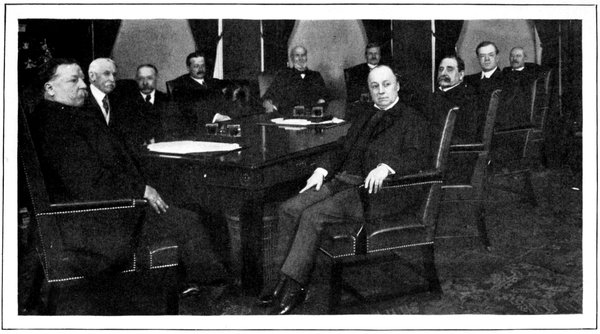
Copyright, 1909, by Harris & Ewing, Washington
THE PRESIDENT AND HIS CABINET
From left to right around the table—President Taft, Franklin MacVeagh, George W. Wickersham, George Von L. Meyer,
James Wilson, Charles Nagel, Richard A. Ballinger, Frank H. Hitchcock, Jacob M. Dickinson, Philander C. Knox.
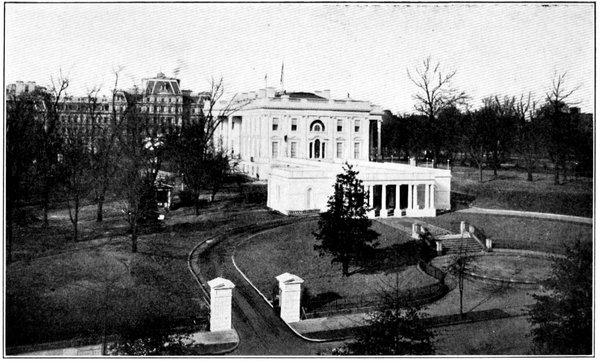
Photo by Clinedinst
ENTRANCE TO THE WHITE HOUSE
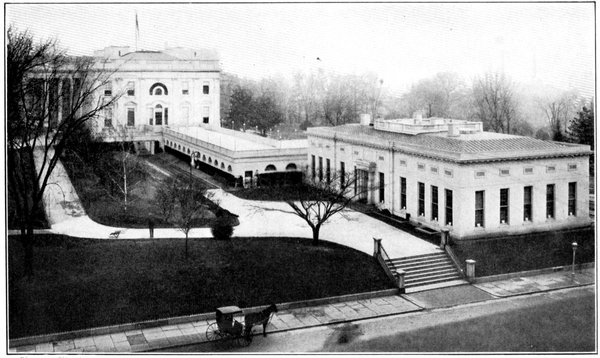
Photo by Clinedinst
NEW WING OF THE WHITE HOUSE
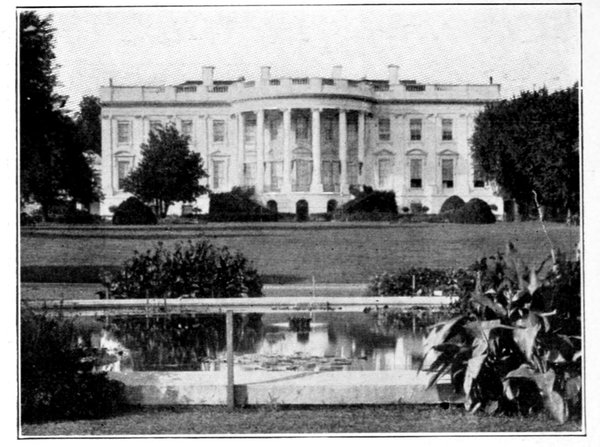
Photo by Clinedinst
SOUTH FRONT OF THE WHITE HOUSE
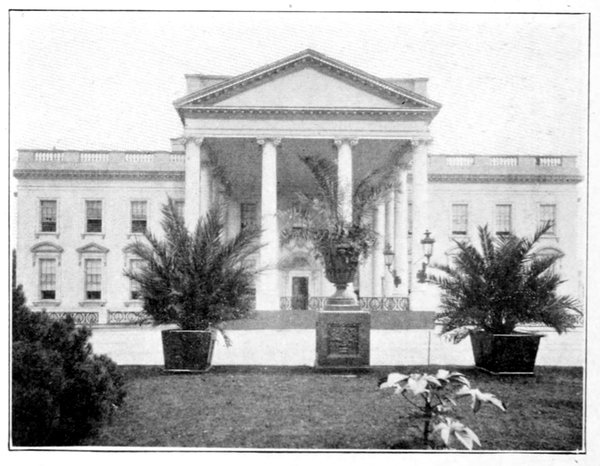
Photo by Clinedinst
NORTH FRONT OF THE WHITE HOUSE
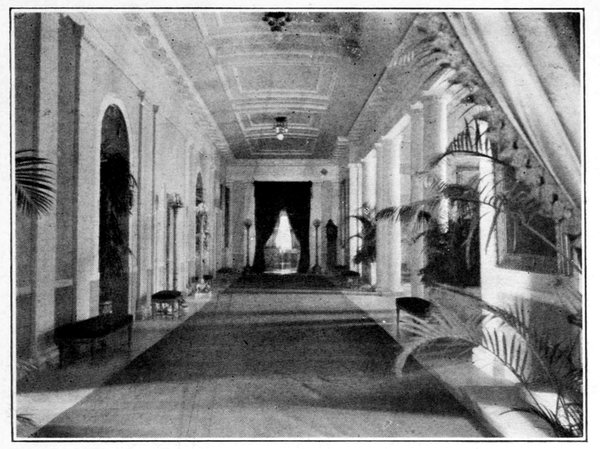
Copyright by Clinedinst, 1903
GRAND CORRIDOR—WHITE HOUSE
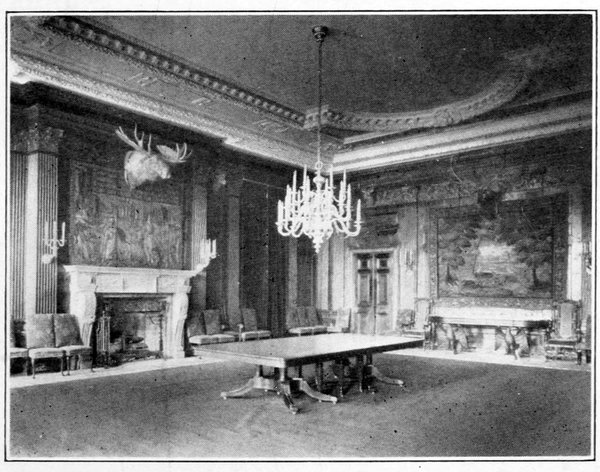
Copyright by Clinedinst, 1903
STATE DINING-ROOM—WHITE HOUSE
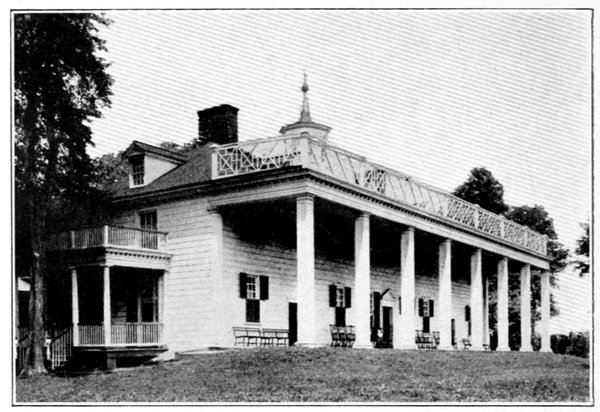
Photo by Clinedinst
MOUNT VERNON—FROM SOUTH LAWN
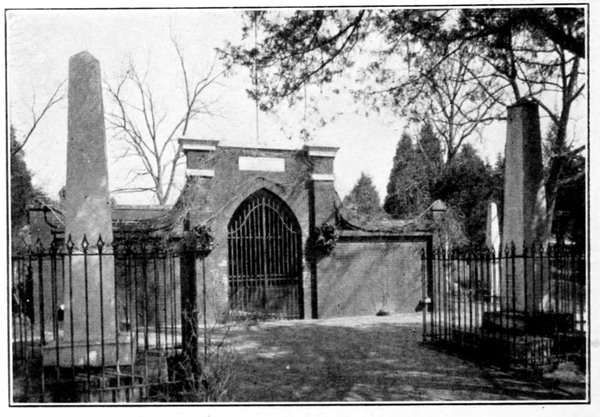
Photo by Clinedinst
TOMB OF WASHINGTON—MOUNT VERNON
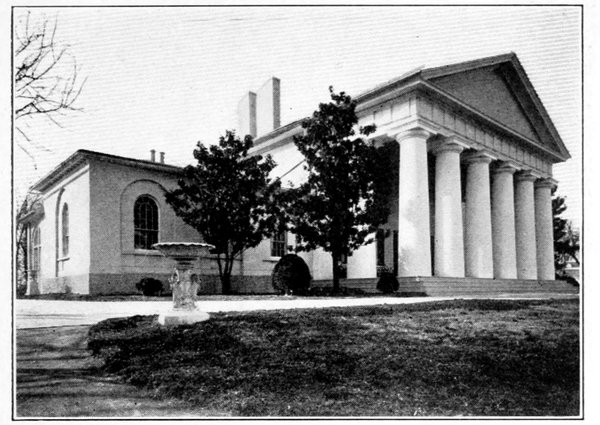
Photo by Clinedinst
HOME OF GENERAL LEE
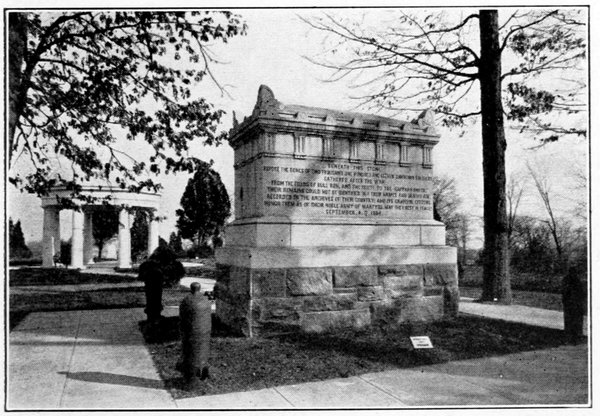
Photo by Clinedinst
MONUMENT TO THE UNKNOWN DEAD, ARLINGTON NATIONAL CEMETERY
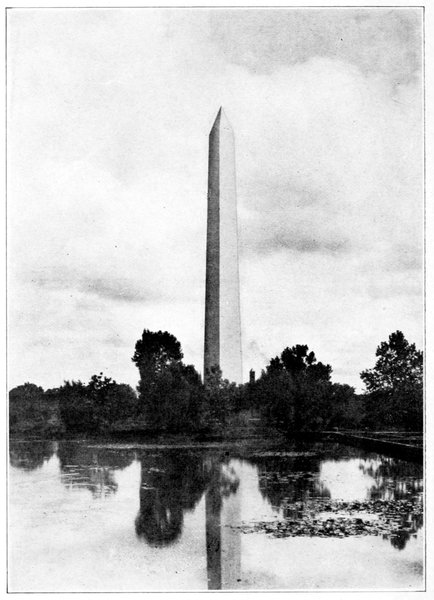
Photo by Clinedinst
THE WASHINGTON MONUMENT
177James A. Garfield, of Ohio, became President in
1881. His life in the White House from March to
September, 1881, scarcely gave time to show what the
social life in Washington would have been had he lived
to complete his term. His assassination cast a gloom
over the social life for a full year after Chester A.
Arthur became the Executive. He served to the end
of the term, in 1885. President Arthur being a widower,
the hostess of the White House during his term
was his accomplished sister, Mrs. Mary Arthur
McElroy.
Grover Cleveland, of New York, became President
in 1885. The Republican party had been in power
for twenty-five years, and when Mr. Cleveland was
elected the change of officers was as great as in the
days of Andrew Jackson. Cleveland was a man of the
highest integrity and the most unfaltering courage,
so that the change proved beneficial to the entire
land.
Miss Rose Elizabeth Cleveland, sister of the President,
presided at the White House until his marriage,
June 2, 1886, to Miss Frances Folsom, who became,
next to Dolly Madison, the most popular woman who
ever entertained in the historic old house.
In March, 1889, Benjamin Harrison became Chief
Magistrate. The first Mrs. Harrison was a woman
experienced in Washington society, and was much
loved by a very large circle.
In 1893 Grover Cleveland again became President,
and in 1897 William McKinley, probably the best-loved
man by the people of any President since the
days of Mr. Lincoln.
Mrs. McKinley, altho an invalid, with the assistance
of her nieces, kept up the reputation and social
festivities of the White House.
178Theodore Roosevelt became President September,
1901, and closed a brilliant and successful administration
March 4, 1909. His administration will be remembered
in history as a strenuous fight against
wrong-doing in high places. He will be honored for
having secured to the United States proper recognition
in world politics and for having promoted peace and
good will among nations.
William Howard Taft, of Ohio, was inaugurated
President March 4, 1909. No man has ever been
called to this high office with a broader training. He
is a graduate of Yale, has received the degree of LL.D.
from five universities, is a distinguished lawyer, has
been a wise judge, and a successful governor of the
Philippine Islands at the difficult period of transition.
As a traveler he has looked into the faces and is personally
known to all the great rulers of the world.
He has visited Cuba and the Panama Zone (the spheres
of probable disturbance), and has therefore had the
training which should fit him to deal wisely with both
the domestic and the foreign problems likely to arise.
Mr. Taft was married in 1886 to Miss Helen Herron,
of Cincinnati. They have two sons and one daughter.
Mrs. Taft has had a large social experience, and is
considered one of the most cultured women ever called
to direct the affairs of the White House.
XXIX INTERESTS IN WASHINGTON WHICH CAN NOT HERE BE FULLY DESCRIBED
179
In the third story of the Congressional Library
strangers can find two papier-maché models
which are of great interest. One represents
the City of Washington in 1902, the other
represents the Washington of the future.
Congress has called the great engineers of the War
Department and four of the leading artists of the
United States as a committee on civic improvement
for the capital city. The artists are: Mr. Daniel H.
Burnham, of Chicago; Mr. John C. Olmstead, the
noted landscape artist; Mr. Charles F. McKim, and
Mr. Augustus St. Gaudens.
By the plans the public buildings of the future will
be arranged around Capitol Square (which has now
two sides occupied by private residences), and will
then extend on both sides the mall, or flat, low-lying
district 1,600 feet in width, extending from the Capitol
building to the Potomac, a distance of one and a half
miles, and inclosing the Washington monument. The
buildings are all to be of white marble, harmonious in
design, and with a standard sky-line. The latter
feature is not pleasing in effect in the model. The
Pennsylvania Railroad and the B. & O. Railroad have
already given up their small stations, and now with all
other roads passing through Washington run into a
handsome new Union Station.
180At the front of Capitol Hill will be Union Square,
where the statues of war heroes will be grouped. The
streets from that point to the Washington monument
will have four rows of trees on each side. A great
theater, gymnasium, lakes, fountains, and baths will
remind one of ancient Rome. A magnificent memorial
to Abraham Lincoln will be placed south of the Washington
monument. Obelisks and arches which have
been used as memorials from the earliest ages will
form part of the ornamentation. People smile over
this wonderful design, but if from now on all public
work is done under this intelligent supervision even
one hundred years may make the dream of these artists
a glorious reality. Not a lamp-post will go up in this
new day, not a business sign will be displayed without
the approval of this art commission.
Designs for private houses as well as business
houses must be made to harmonize with the landscape
and other buildings which already exist. "May we
all be here to see."
Among the buildings and objects of interest which
can not here be fully described, nor their histories
elaborated, is the Ben Butler building on Capitol
Square, where President Arthur made his home while
the White House was being repaired.
There is also the old Capitol or Capitol Square (now
numbered 21, 23, 25), which was used by Congress
after the British had destroyed the Capitol in 1814.
These buildings were used as a military prison during
the Civil War, and here Wirtz, of Andersonville prison
memory, was executed. In one of them died John C.
Calhoun.
181
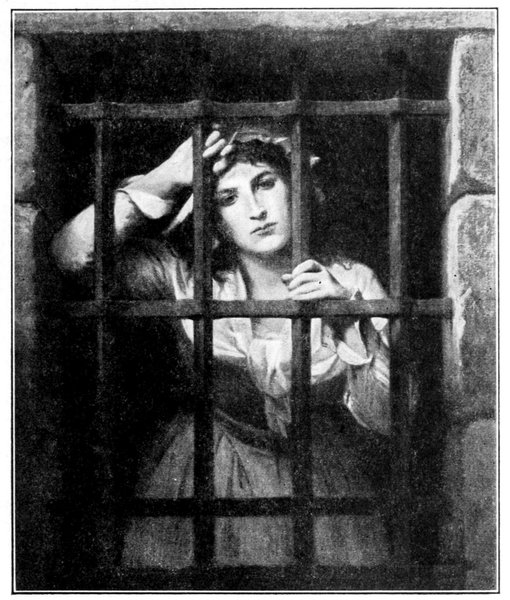
CHARLOTTE CORDAY
(One of the paintings in the Corcoran Art Gallery)
182The Washington monument, nearly six hundred
feet high, is said to be the highest monument in the
world. It was erected in memory of George Washington.
This grand structure is of pure white marble.
From the top there is a magnificent view of the surrounding
country. The monument, however, has
suffered from the disintegrating effects of the weather,
and from the ruthless hands of the relic-hunters. The
majestic appearance of the monument grows upon the
beholder, and its pearly whiteness reminds him of
the character of Washington, which grows fairer in
the mellowing light of history.
Arlington Cemetery should be visited by the pilgrim
to Washington. There sleep many of the sacred dead
of the nation, and there is the home of Robert E. Lee,
where he was called to decide between his country as
a whole or his native state.
Around Lafayette Square, which faces the White
House, history, poetry, romance, and chivalry have
twined an immortal wreath. Every monument commemorates
a hero. Here, too, is the old private residence
of Dolly Madison, the old home of the British
Embassy, where Owen Meredith wrote "Lucile";
also the Webster home, where once lived the French
Embassy; and St. John's Episcopal Church, where
many Presidents have worshiped. Here Webster,
Sumner, and Slidell lived at different periods. The
old Decatur house stands on this square. The Admiral
had a window cut through, so that he could
signal the President in the White House. They
missed the telephone. On this square lived Diaz, of
Mexico; here Don Cameron and Blaine each lived in
183the same house, afterward occupied by Senator Hanna.
On the north side is the handsome residence where
lived Secretary of State John Hay.
Georgetown, named after George III. of England,
is much older than Washington City. The stories of
its former grandeur and its distinctively Southern tone
make it a quaint object of interest. Its most interesting
literary shrine is the home of Mrs. E. D. E. N.
Southworth, the novelist, who wrote one novel for each
year of her long life.
The Corcoran Art Gallery, on Seventeenth Street,
extending from New York Avenue to E Street, just
southwest of the White House, has many objects of
interest both in painting and sculpture.
No traveler should fail to visit Mount Vernon, the
home of George and Martha Washington. The house
was built in 1783 by Lawrence, half-brother of
General Washington. The rooms seem small and
cramped, according to our modern ideas, but they were
the stage upon which lived and loved two names of
sacred memory. The buildings are in the custody of
the ladies of the Mount Vernon Association, and the
care of each room is in charge of some one State.
The United States Naval Observatory, north of
Georgetown, will interest lovers of astronomy, while
every square, circle, and triangle of Washington City
has some reminder of those whose heroic deeds, spiritual
devotion, or literary and scientific achievement have
beautified, ennobled, and glorified the world, and made
it more beautiful because of their lives.
184Continental Hall, the home of the Daughters of the
American Revolution, situated on Seventeenth Street,
south of the Corcoran Art Gallery, ranks with the
most beautiful of the white marble buildings. It
was begun in 1903, and will be finished in 1909, at a
cost of $500,000.
The National Society of the Daughters of the American
Revolution was organized October 12, 1890, in
Washington, and holds a charter from Congress.
It reports annually to the Smithsonian Institute, and
its reports are printed by Congress. It is the only
society of women in the world organized for strictly
patriotic purposes.
Mrs. Benjamin Harrison, wife of the President of
the United States; Mrs. Adlai E. Stevenson, wife of
the Vice-President of the United States and President
of the Senate; Mrs. Daniel Manning, wife of former
Secretary of the Treasury of the United States; Mrs.
Charles W. Fairbanks, wife of the Vice-President of
the United States; Mrs. Donald MacLean and Mrs.
Scott, of Illinois, have been the presidents-general
since its organization.
The chief work of the society is to mark historic
spots in all parts of the country, to perpetuate the
memories of the heroic dead, and to make patriotism
a passion instead of a sentiment. Another object is
to make good citizens of all boys and girls of the land.
It does much good in bringing together people from
different sections, thereby curing provincialism, and
bringing about friendly relations between different
parts of this great country.